Questions as text
Q1 · Which part of a phospholipid molecule makes up most of the thickness of a cell surface… 9700/11 Oct/Nov 2004
16 Which part of a phospholipid molecule makes up most of the thickness of a cell surface membrane? A glycerol B hydrocarbon chains C hydrophilic head D phosphate group
1 marks
Answer: B
This question in 9700/11 Oct/Nov 2004
Q2 · The diagram shows a cell surface membrane 9700/11 May/June 2006
6 The diagram shows a cell surface membrane. The lipid bilayer has an approximate width of 8 nm. How many times has the diagram been magnified? A 2.5 × 10² B 2.5 × 10⁴ C 2.5 × 10⁶ D 2.5 × 10⁸
1 marks
Answer: C
This question in 9700/11 May/June 2006
Q3 · The diagram shows part of a cell surface membrane 9700/11 Oct/Nov 2006
14 The diagram shows part of a cell surface membrane. P Q R What is the correct function for each of the structures labelled? regulates forms hydrogen bonds with transports ions and membrane fluidity water to stabilise membrane large polar molecules A R R Q B P Q R C Q R P D R P Q
1 marks
Answer: D
This question in 9700/11 Oct/Nov 2006
Q4 · An investigation was carried out into the effect of various chemicals on the permeability… 9700/11 Oct/Nov 2007
10 An investigation was carried out into the effect of various chemicals on the permeability of the
plasma membrane and tonoplast of beetroot cells. Beetroot cell vacuoles contain a red pigment,
which cannot pass out of the cells because it cannot diffuse through their tonoplasts and plasma
membranes.
1 cm® cubes were cut from beetroot and washed in running water for twenty minutes to remove
any pigment released from damaged cells.
They were then placed in different solutions and the results observed. In each case the solution
turned red.
What shows the correct behaviour of phospholipids and proteins in different solutions?
solution phosprolpids solution een
A dilute HCl Jv water at 40°C Jv
B dilute HCl Jv ethanol Jv
Cc ethanol Jv dilute HC Jv
D water at 40°C Jv ethanol Jv
1 marks
Answer: C
This question in 9700/11 Oct/Nov 2007
Q5 · The diagram shows a phospholipid molecule 9700/11 Oct/Nov 2007
11 The diagram shows a phospholipid molecule. X H H O H C C C H O O H C O C O Z Y What are X, Y and Z? X Y Z A hydrocarbon chain hydrocarbon chain phosphate-containing group B hydrocarbon chain glycerol phosphate-containing group C phosphate-containing group hydrocarbon chain hydrocarbon chain D phosphate-containing group glycerol hydrocarbon chain
1 marks
Answer: C
This question in 9700/11 Oct/Nov 2007
Q6 · Which part of a phospholipid molecule makes up most of the thickness of a cell surface… 9700/11 Oct/Nov 2007
17 Which part of a phospholipid molecule makes up most of the thickness of a cell surface membrane? A glycerol B hydrocarbon chains C hydrophilic head D phosphate group
1 marks
Answer: B
This question in 9700/11 Oct/Nov 2007
Q7 · Membranes in cells include the following components 9700/11 May/June 2008
15 Membranes in cells include the following components. 1 cholesterol 2 glycoproteins 3 phospholipids 4 proteins Which component is the most important for these functions of membranes? transporting ions recognising self / separating stabilising the function through non self dissolved ions hydrophobic layer membranes A 1 2 3 4 B 2 3 1 4 C 3 1 4 2 D 3 4 1 2
1 marks
Answer: B
This question in 9700/11 May/June 2008
Q8 · The epithelial cells of people with cystic fibrosis have a defect in the structure of the… 9700/11 Oct/Nov 2008
15 The epithelial cells of people with cystic fibrosis have a defect in the structure of the cell surface membrane. The ability of the cell to transport chloride ions out of the cell is affected. Which membrane component is involved? A cholesterol B glycolipid C phospholipid D protein
1 marks
Answer: D
This question in 9700/11 Oct/Nov 2008
Q9 · The diagram shows part of the cell surface membrane 9700/11 Oct/Nov 2008
16 The diagram shows part of the cell surface membrane. 1 2 3 4 5 Which components help to maintain the fluidity of the membrane? A 1 and 3 B 1 and 4 C 2 and 4 D 3 and 5
1 marks
Answer: D
This question in 9700/11 Oct/Nov 2008
Q10 · Cystic fibrosis is a disease where Cl – ions are unable to be transported into cells 9700/12 Oct/Nov 2009
17 Cystic fibrosis is a disease where Cl – ions are unable to be transported into cells. Which structure in the cell surface membrane is faulty? A B C D
1 marks
Answer: C
This question in 9700/12 Oct/Nov 2009
Q11 · An oxygen molecule diffuses directly from the air in an alveolus to haemoglobin in a red… 9700/12 Oct/Nov 2009
31 An oxygen molecule diffuses directly from the air in an alveolus to haemoglobin in a red blood cell. What is the minimum number of cell surface membranes through which this molecule must pass? A 2 B 3 C 4 D 5
1 marks
Answer: D
This question in 9700/12 Oct/Nov 2009
Q12 · Which molecules, found in the cell surface membrane, have the properties listed? 9700/11 Oct/Nov 2010
15 Which molecules, found in the cell surface membrane, have the properties listed? act as receptor sites form hydrogen bonds recognise for hormones with water antibodies A cholesterol and phospholipids and proteins and proteins cholesterol glycolipids B glycolipids and glycolipids and glycolipids and glycoproteins glycoproteins glycoproteins C phospholipids and proteins and cholesterol and cholesterol glycolipids proteins D proteins and cholesterol and phospholipids and glycolipids proteins cholesterol
1 marks
Answer: B
This question in 9700/11 Oct/Nov 2010
Q13 · Which molecules, found in cell surface membranes, contribute to cell recognition? 9700/12 Oct/Nov 2010
15 Which molecules, found in cell surface membranes, contribute to cell recognition? 1 glycolipids 2 glycoproteins 3 phospholipids A 1, 2 and 3 B 1 and 2 only C 1 and 3 only D 2 and 3 only
1 marks
Answer: B
This question in 9700/12 Oct/Nov 2010
Q14 · What is correct for the cell surface membrane and membranes within cells? 9700/11 May/June 2011
15 What is correct for the cell surface membrane and membranes within cells? A Both allow intracellular transport. B Both are stabilised by glycoproteins. C Both have sites for enzyme attachment. D Both protect cells from the contents of lysosomes.
1 marks
Answer: C
This question in 9700/11 May/June 2011
Q15 · The diagram shows part of a cell surface membrane 9700/12 May/June 2011
15 The diagram shows part of a cell surface membrane. 3 4 5 2 1 Which molecules have both hydrophobic and hydrophilic regions? A 1 and 5 only B 1, 3 and 5 only C 1, 2, 4 and 5 only D 2, 3 and 4 only
1 marks
Answer: C
This question in 9700/12 May/June 2011
Q16 · Increasing which type of bond helps to increase the fluidity of the cell surface membrane? 9700/12 May/June 2011
16 Increasing which type of bond helps to increase the fluidity of the cell surface membrane? A C — O — C B C — N C C C D hydrogen
1 marks
Answer: C
This question in 9700/12 May/June 2011
Q17 · What is correct for the cell surface membrane and membranes within cells? 9700/13 May/June 2011
13 What is correct for the cell surface membrane and membranes within cells? A Both allow intracellular transport. B Both are stabilised by glycoproteins. C Both have sites for enzyme attachment. D Both protect cells from the contents of lysosomes.
1 marks
Answer: C
This question in 9700/13 May/June 2011
Q18 · Which statements about the components of the cell surface membrane are correct? 9700/11 Oct/Nov 2011
16 Which statements about the components of the cell surface membrane are correct? 1 Diffusion can take place through lipids and protein pores. 2 Endocytosis only involves lipids. 3 Facilitated diffusion only involves proteins. 4 Osmosis only involves proteins. A 1, 2, 3 and 4 B 1, 3 and 4 only C 1 and 3 only D 2 and 4 only
1 marks
Answer: C
This question in 9700/11 Oct/Nov 2011
Q19 · Which statements about the components of the cell surface membrane are correct? 9700/13 Oct/Nov 2011
26 Which statements about the components of the cell surface membrane are correct? 1 Diffusion can take place through lipids and protein pores. 2 Endocytosis only involves lipids. 3 Facilitated diffusion only involves proteins. 4 Osmosis only involves proteins. A 1, 2, 3 and 4 B 1, 3 and 4 only C 1 and 3 only D 2 and 4 only
1 marks
Answer: C
This question in 9700/13 Oct/Nov 2011
Q20 · The diagram shows the fluid mosaic model of membrane structure 9700/11 May/June 2012
14 The diagram shows the fluid mosaic model of membrane structure. Which would enable a hormone to recognise its target cell? B A C D
1 marks
Answer: B
This question in 9700/11 May/June 2012
Q21 · What is the role of cholesterol in the cell surface membrane? 9700/12 May/June 2012
14 What is the role of cholesterol in the cell surface membrane? A to assist active transport B to assist facilitated diffusion C to provide hydrophilic channels D to regulate fluidity of the membrane
1 marks
Answer: D
This question in 9700/12 May/June 2012
Q22 · The diagram shows the fluid mosaic model of membrane structure 9700/13 May/June 2012
9 The diagram shows the fluid mosaic model of membrane structure. Which would enable a hormone to recognise its target cell? B A C D
1 marks
Answer: B
This question in 9700/13 May/June 2012
Q23 · The diagram represents the fluid mosaic model of membrane structure 9700/11 Oct/Nov 2012
15 The diagram represents the fluid mosaic model of membrane structure. 3 2 1 4 6 5 Which two components contribute to the fluidity of the membrane? A 1 and 3 B 2 and 4 C 3 and 5 D 4 and 6
1 marks
Answer: D
This question in 9700/11 Oct/Nov 2012
Q24 · Which role of the cell surface membrane is not a result of the properties of the… 9700/12 Oct/Nov 2012
15 Which role of the cell surface membrane is not a result of the properties of the phospholipids? A to allow cytokinesis to occur in mitotic cell division B to allow entry and exit of the water-soluble gases, oxygen and carbon dioxide C to allow phagocytosis of a bacterium into cells D to allow surface membranes to stabilise by binding with water molecules
1 marks
Answer: D
This question in 9700/12 Oct/Nov 2012
Q25 · An increase in which component would make the cell surface membrane more fluid? 9700/12 Oct/Nov 2012
16 An increase in which component would make the cell surface membrane more fluid? A cholesterol B glycolipids C glycoproteins D proteins
1 marks
Answer: A
This question in 9700/12 Oct/Nov 2012
Q26 · The diagrams show two molecules found in cell surface membranes 9700/13 Oct/Nov 2012
14 The diagrams show two molecules found in cell surface membranes. Which part affects the fluidity of the membrane? A B D C
1 marks
Answer: B
This question in 9700/13 Oct/Nov 2012
Q27 · Which of the following can increase the fluidity of the cell surface membrane at low… 9700/11 May/June 2013
16 Which of the following can increase the fluidity of the cell surface membrane at low temperatures? 1 double bonds between carbon atoms in the fatty acid chains 2 cholesterol 3 fatty acids having shorter chains A 1, 2 and 3 B 1 and 3 only C 2 and 3 only D 1 only
1 marks
Answer: A
This question in 9700/11 May/June 2013
Q28 · Which of the following can increase the fluidity of the cell surface membrane? 9700/12 May/June 2013
16 Which of the following can increase the fluidity of the cell surface membrane? 1 single bonds between carbon atoms in the fatty acid chains 2 cholesterol 3 fatty acids having longer chains A 1, 2 and 3 B 1 and 3 only C 2 and 3 only D 2 only
1 marks
Answer: D
This question in 9700/12 May/June 2013
Q29 · Which of the following can decrease the fluidity of the cell surface membrane? 9700/13 May/June 2013
16 Which of the following can decrease the fluidity of the cell surface membrane? 1 double bonds between carbon atoms in the fatty acid chains 2 cholesterol 3 fatty acids having longer chains A 1, 2 and 3 B 1 and 2 only C 2 and 3 only D 3 only
1 marks
Answer: D
This question in 9700/13 May/June 2013
Q30 · Molecules 1, 2 and 3 are found in cell surface membranes 9700/11 Oct/Nov 2013
13 Molecules 1, 2 and 3 are found in cell surface membranes. 1 glycolipids 2 glycoproteins 3 phospholipids Which contribute to cell recognition? A 2 only B 1 and 2 only C 1 and 3 only D 2 and 3 only
1 marks
Answer: B
This question in 9700/11 Oct/Nov 2013
Q31 · Which is correct for components of a cell surface membrane? 9700/12 Oct/Nov 2013
13 Which is correct for components of a cell surface membrane? increases allows recognition membrane fluidity of cell A cholesterol glycoproteins B glycolipids phospholipids C glycoproteins glycolipids D phospholipids cholesterol
1 marks
Answer: A
This question in 9700/12 Oct/Nov 2013
Q32 · A method called freeze-fracture can be used to study the structure of cell membranes 9700/12 Oct/Nov 2013
14 A method called freeze-fracture can be used to study the structure of cell membranes. The membrane is frozen and then split down the middle, separating the two layers of phospholipids from each other. Any proteins contained within one layer remain in that layer. Proteins which span the membrane can be found in either layer after freeze-fracture, depending on the protein’s properties. Which statement(s) about the results of freeze-fracture studies are correct? 1 It provides evidence for the bilayer nature of membranes. 2 It provides evidence for the arrangement of proteins. 3 It shows that the proteins in the membrane do not contribute to its strength. A 1, 2 and 3 B 1 and 2 only C 2 and 3 only D 1 only
1 marks
Answer: B
This question in 9700/12 Oct/Nov 2013
Q33 · Which statement about the fluid mosaic model of membrane structure is correct? 9700/12 Oct/Nov 2013
16 Which statement about the fluid mosaic model of membrane structure is correct? A The less unsaturated the fatty acid chains of the phospholipids, the more fluid the membrane. B The more unsaturated the fatty acid chains of the phospholipids, the more fluid the membrane. C The higher the temperature, the less fluid the membrane. D The lower the temperature, the more fluid the membrane.
1 marks
Answer: B
This question in 9700/12 Oct/Nov 2013
Q34 · Which statement concerning the role of cholesterol in the cell surface membrane is… 9700/13 Oct/Nov 2013
13 Which statement concerning the role of cholesterol in the cell surface membrane is correct? A It can act as a barrier to the entry into the cell of non-polar molecules. B It helps the entry and exit of ions through the fatty acids. C It maintains the fluidity of the membrane at low temperatures. D It makes the membrane more permeable to very small water-soluble substances.
1 marks
Answer: C
This question in 9700/13 Oct/Nov 2013
Q35 · The fluidity of the cell surface membrane can be changed by a number of factors 9700/11 May/June 2014
14 The fluidity of the cell surface membrane can be changed by a number of factors. As the fluidity of cell surface membranes decreases, which process would be least changed? A active transport B diffusion C endocytosis D osmosis
1 marks
Answer: A
This question in 9700/11 May/June 2014
Q36 · Which molecules in cell surface membranes contribute to cell recognition? 9700/11 May/June 2014
15 Which molecules in cell surface membranes contribute to cell recognition? A cholesterol, glycolipids, phospholipids B cholesterol, phospholipids, proteins C glycolipids, glycoproteins, proteins D phospholipids, glycoproteins, proteins
1 marks
Answer: C
This question in 9700/11 May/June 2014
Q37 · The structure of phospholipids and triglycerides include the following 9700/12 May/June 2014
10 The structure of phospholipids and triglycerides include the following. 1 glycerol linked to fatty acids 2 hydrophobic fatty acid chains 3 saturated fatty acid chains Which structures enable the formation of a lipid bilayer in cell surface membranes? A 1 and 2 B 1 and 3 C 2 and 3 D 2 only
1 marks
Answer: D
This question in 9700/12 May/June 2014
Q38 · The diagram shows the fluid mosaic model of a section of a cell surface membrane 9700/12 May/June 2014
14 The diagram shows the fluid mosaic model of a section of a cell surface membrane. 2 1 3 What is the role of each of the components labelled 1 to 3? 1 2 3 A antigen chemical receptor allow lipid soluble molecules to pass through B barrier to polar molecules stabilise the membrane antigen C chemical receptor allow lipid soluble regulate the fluidity molecules to pass through of the membrane D stabilise the membrane control the fluidity barrier to polar molecules of the membrane
1 marks
Answer: A
This question in 9700/12 May/June 2014
Q39 · Proteins in the cell surface membranes of human cells and mouse cells were labelled with… 9700/12 May/June 2014
15 Proteins in the cell surface membranes of human cells and mouse cells were labelled with red and green fluorescent dyes respectively. When a human cell and a mouse cell were fused together the red and green fluorescent labels were at first found in different regions of the cell surface membrane of the hybrid cell, but after 40 minutes they were evenly distributed in the entire cell surface membrane. What explains this observation? A All protein molecules in the cell surface membrane are fixed to structures within the cell, but phospholipid molecules move freely between them. B Groups of protein and phospholipid molecules in the cell surface membrane are attached to each another and move together. C Only protein molecules in the outer layer of the cell surface membrane can move freely between phospholipid molecules. D Protein molecules in the outer layer of the cell surface membrane and those which span the bilayer can move freely between phospholipid molecules.
1 marks
Answer: D
This question in 9700/12 May/June 2014
Q40 · The diagram shows part of a cell surface membrane 9700/13 May/June 2014
15 The diagram shows part of a cell surface membrane. 3 4 5 2 1 Which molecules have both hydrophobic and hydrophilic regions? A 1, 2, 4 and 5 B 1, 3 and 5 C 1 and 5 only D 2 and 4 only
1 marks
Answer: A
This question in 9700/13 May/June 2014
Q41 · Increasing which type of bond helps to increase the fluidity of the cell surface membrane? 9700/11 Oct/Nov 2014
13 Increasing which type of bond helps to increase the fluidity of the cell surface membrane? A C — O — C B C — N C C C D hydrogen
1 marks
Answer: C
This question in 9700/11 Oct/Nov 2014
Q42 · In plants adapted to cold conditions, their cell surface membranes change as the weather… 9700/11 Oct/Nov 2014
15 In plants adapted to cold conditions, their cell surface membranes change as the weather gets colder, allowing the plants to carry out exocytosis. Which change occurs in their cell surface membranes? A a decrease in the ratio of proteins to saturated phospholipids B a decrease in the ratio of unsaturated phospholipids to saturated phospholipids C an increase in the ratio of proteins to unsaturated phospholipids D an increase in the ratio of unsaturated phospholipids to saturated phospholipids
1 marks
Answer: D
This question in 9700/11 Oct/Nov 2014
Q43 · What is the width of the cell surface membrane? 9700/12 Oct/Nov 2014
16 What is the width of the cell surface membrane? A 0.5 – 1.0 nm B 5 – 10 nm C 50 – 100 nm D 0.5 – 1 µm
1 marks
Answer: B
This question in 9700/12 Oct/Nov 2014
Q44 · Some functions of molecules found in cell surface membranes are listed 9700/12 Oct/Nov 2014
17 Some functions of molecules found in cell surface membranes are listed. 1 cell recognition 2 ion transport 3 maintaining fluidity 4 mechanical stability Which are functions of cholesterol? A 1 and 2 B 1 and 4 C 2 and 3 D 3 and 4
1 marks
Answer: D
This question in 9700/12 Oct/Nov 2014
Q45 · The enzyme lactase is found in the membranes of epithelial cells lining the small… 9700/12 Oct/Nov 2014
18 The enzyme lactase is found in the membranes of epithelial cells lining the small intestine. The enzyme is formed by a single polypeptide that folds to give three regions. • an active site with the free amino group outside the cell • a short section inside the membrane • a short section inside the cell What type of amino acid would be found in each of the three regions? inside the inside the outside cell membrane cell A hydrophilic hydrophobic hydrophilic B hydrophilic hydrophobic hydrophobic C hydrophobic hydrophilic hydrophobic D hydrophobic hydrophobic hydrophilic
1 marks
Answer: A
This question in 9700/12 Oct/Nov 2014
Q46 · Which two substances maintain the fluidity of the cell membranes? 9700/13 Oct/Nov 2014
14 Which two substances maintain the fluidity of the cell membranes? A cholesterol and glycolipid B glycolipid and glycoprotein C glycoprotein and phospholipid D phospholipid and cholesterol
1 marks
Answer: D
This question in 9700/13 Oct/Nov 2014
Q47 · Membrane proteins are called ‘peripheral’ if they are temporarily attached to the… 9700/13 Oct/Nov 2014
15 Membrane proteins are called ‘peripheral’ if they are temporarily attached to the membrane or ‘integral’ if they are permanently attached to the membrane. Integral proteins are described as ‘intrinsic’ if they extend across the whole bilayer and ‘extrinsic’ if they are found only in one side of the bilayer. How would you describe a channel protein? A integral extrinsic B integral intrinsic C peripheral extrinsic D peripheral intrinsic
1 marks
Answer: B
This question in 9700/13 Oct/Nov 2014
Q48 · Which type of cell has a large number of glycoproteins on the cell surface membrane? 9700/11 May/June 2015
15 Which type of cell has a large number of glycoproteins on the cell surface membrane? A ciliated cell B goblet cell C lymphocyte D red blood cell
1 marks
Answer: C
This question in 9700/11 May/June 2015
Q49 · Which set of factors will produce the most fluid cell surface membrane? 9700/11 May/June 2015
17 Which set of factors will produce the most fluid cell surface membrane? a decrease in A • distance between phospholipid molecules • proportion of short fatty acid chains B • distance between phospholipid molecules • temperature C • proportion of phospholipids with saturated fatty acid chains • proportion of long fatty acid chains D • proportion of phospholipids with unsaturated fatty acid chains • temperature
1 marks
Answer: C
This question in 9700/11 May/June 2015
Q50 · Which description of cell surface membrane permeability is correct? 9700/12 May/June 2015
15 Which description of cell surface membrane permeability is correct? A An increase in the concentration of cholesterol molecules in the cell surface membrane can increase its permeability to hydrophilic substances. B Cell surface membrane permeability to large hydrophilic molecules is high and can be increased by membrane transport proteins involved in facilitated diffusion. C The permeability of the cell surface membrane to ions is increased with an increase in the proportion of saturated fatty acids in the phospholipids. D Without the presence of carrier and channel membrane proteins, the cell surface membrane has a low permeability to large polar molecules.
1 marks
Answer: D
This question in 9700/12 May/June 2015
Q51 · Which set of factors will produce the most fluid cell surface membrane? 9700/12 May/June 2015
17 Which set of factors will produce the most fluid cell surface membrane? an increase in A • proportion of phospholipids with saturated fatty acid chains • distance between phospholipid molecules B • proportion of long fatty acid chains • proportion of phospholipids with unsaturated fatty acid chains C • proportion of long fatty acid chains • temperature D • proportion of phospholipids with unsaturated fatty acid chains • temperature
1 marks
Answer: D
This question in 9700/12 May/June 2015
Q52 · Which set of factors will produce the least fluid cell surface membrane? 9700/13 May/June 2015
17 Which set of factors will produce the least fluid cell surface membrane? an increase in A • proportion of short fatty acid chains • distance between phospholipid molecules B • proportion of long fatty acid chains • proportion of phospholipids with saturated fatty acid chains C • proportion of short fatty acid chains • proportion of phospholipids with unsaturated fatty acid chains D • proportion of phospholipids with unsaturated fatty acid chains • temperature
1 marks
Answer: B
This question in 9700/13 May/June 2015
Q53 · Which statements about the fluid mosaic model of a membrane are correct? 9700/13 Oct/Nov 2015
16 Which statements about the fluid mosaic model of a membrane are correct? 1 Saturated fatty acid tails inhibit the movement of phospholipids in the membrane. 2 Glycoproteins in the outer layer of the membrane can move. 3 Channel proteins are fixed in position. A 1, 2 and 3 B 1 and 2 only C 1 and 3 only D 2 and 3 only
1 marks
Answer: B
This question in 9700/13 Oct/Nov 2015
Q54 · Which statements about triglycerides and phospholipids are correct? 9700/12 Feb/March 2016
9 Which statements about triglycerides and phospholipids are correct? 1 Triglycerides and phospholipids both have a hydrophobic region. 2 Triglycerides are non-polar molecules and phospholipids are polar. 3 Fatty acids in a triglyceride may be saturated or unsaturated but in a phospholipid they are always saturated. A 1 and 2 B 1 and 3 C 2 only D 3 only
1 marks
Answer: A
This question in 9700/12 Feb/March 2016
Q55 · Which row correctly links molecules in the cell surface membrane with their roles? 9700/12 Feb/March 2016
14 Which row correctly links molecules in the cell surface membrane with their roles? stabilises membrane barrier to polar receptor molecules 1 2 3 4 1 2 3 4 A glycolipid cholesterol glycoprotein phospholipid B glycolipid glycoprotein phospholipid cholesterol C glycoprotein phospholipid cholesterol glycolipid D phospholipid cholesterol glycolipid glycoprotein
1 marks
Answer: D
This question in 9700/12 Feb/March 2016
Q56 · Proteins which transport sugars out of cells have been identified 9700/11 May/June 2016
11 Proteins which transport sugars out of cells have been identified. These proteins are called SWEETs. Each SWEET has seven coiled, cylindrical regions which together make up a pore through the cell surface membrane bilayer, as shown in the diagram. 1 2 3 7 4 6 5 What describes each of the seven coiled regions (1-7) of a SWEET shown in the diagram? A primary structure held in its shape by bonds such as hydrogen bonds B primary structure held in its shape by peptide bonds C secondary structure held in its shape by bonds such as hydrogen bonds D secondary structure held in its shape by peptide bonds
1 marks
Answer: C
This question in 9700/11 May/June 2016
Q57 · What is a function of the cholesterol in a cell surface membrane? 9700/12 May/June 2016
12 What is a function of the cholesterol in a cell surface membrane? A acting as a membrane-bound receptor B controlling active transport C helping cells join together D regulating the flexibility of the membrane
1 marks
Answer: D
This question in 9700/12 May/June 2016
Q58 · Which roles of the cell surface membrane are a result of the properties of the… 9700/12 May/June 2016
13 Which roles of the cell surface membrane are a result of the properties of the phospholipids? 1 to allow cytokinesis to occur in mitotic cell division 2 to allow entry and exit of oxygen and carbon dioxide 3 to allow the phagocytosis of a bacterium into a cell A 1, 2 and 3 B 1 and 2 only C 1 and 3 only D 2 and 3 only
1 marks
Answer: A
This question in 9700/12 May/June 2016
Q59 · When a small quantity of phospholipid is added to a test-tube of water and then shaken… 9700/13 May/June 2016
9 When a small quantity of phospholipid is added to a test-tube of water and then shaken vigorously, an emulsion is formed by small droplets called liposomes. Which diagram shows the arrangement of phospholipid molecules in a cross-section of a liposome? A B C D
1 marks
This question in 9700/13 May/June 2016
Q60 · The list includes some of the molecules found in a cell surface membrane 9700/13 May/June 2016
13 The list includes some of the molecules found in a cell surface membrane. 1 glycolipid 2 surface protein 3 glycoprotein 4 trans-membrane protein Which molecules are involved in cell signalling? A 1, 2 and 3 B 1 and 3 only C 2 and 4 D 4 only
1 marks
This question in 9700/13 May/June 2016
Q61 · What is the minimum number of layers of phospholipids that a molecule of oxygen passes… 9700/13 May/June 2016
34 What is the minimum number of layers of phospholipids that a molecule of oxygen passes through when diffusing from the alveoli, through cells, to haemoglobin in the red blood cells? A 4 B 6 C 8 D 10
1 marks
This question in 9700/13 May/June 2016
Q62 · Which molecules are found at the outer surface of a cell surface membrane? 9700/11 Oct/Nov 2016
14 Which molecules are found at the outer surface of a cell surface membrane?
cholesterol glycolipids phospholipids
A v v Xx key
B J/ = present
Cc X = absent
D
~ KOK
\ x x
Ko 4
1 marks
Answer: D
This question in 9700/11 Oct/Nov 2016
Q63 · Which statements about the proteins in cell surface membranes are correct? 9700/11 Oct/Nov 2016
16 Which statements about the proteins in cell surface membranes are correct? 1 They can be involved in active transport and facilitated diffusion. 2 They can be involved in antigen recognition. 3 They have hydrophilic R groups to interact with the inner portion of the membrane. A 1, 2 and 3 B 1 and 2 only C 1 and 3 only D 2 and 3 only
1 marks
Answer: B
This question in 9700/11 Oct/Nov 2016
Q64 · Which molecules, found in cell surface membranes, help the immune system to identify… 9700/13 Oct/Nov 2016
14 Which molecules, found in cell surface membranes, help the immune system to identify cells? 1 cholesterol 2 glycolipids 3 glycoproteins 4 proteins A 1, 2 and 3 B 1, 2 and 4 C 1, 3 and 4 D 2, 3 and 4
1 marks
Answer: D
This question in 9700/13 Oct/Nov 2016
Q65 · What is the correct range of measurements for the width of the cell surface membrane? 9700/12 Feb/March 2017
16 What is the correct range of measurements for the width of the cell surface membrane? A 0.5–1.0 nm B 5–10 nm C 50–100 nm D 0.5–1 µm
1 marks
Answer: B
This question in 9700/12 Feb/March 2017
Q66 · The cells in the roots of beetroot plants contain a red pigment 9700/12 Feb/March 2017
17 The cells in the roots of beetroot plants contain a red pigment. When pieces of root tissue are soaked in cold water, some of the red pigment leaks out of the cells into the water. An experiment was carried out to investigate the effect of temperature on the loss of red pigment from the root cells. It was found that the higher the temperature of the water, the higher the rate of loss of red pigment from the root cells. Which of these statements could explain this trend? 1 Enzymes in the cells denature as the temperature increases, so the pigment can no longer be used for reactions inside the cells and diffuses out. 2 As the temperature increases, the tertiary structure of protein molecules in the cell surface membrane changes, increasing the permeability of the membrane. 3 Phospholipid molecules gain kinetic energy as temperature rises, increasing the fluidity of the phospholipid bilayer and allowing pigment molecules to diffuse out more easily. A 1 and 2 B 2 and 3 C 2 only D 3 only
1 marks
Answer: B
This question in 9700/12 Feb/March 2017
Q67 · The cell surface membrane structure is described as a ‘fluid mosaic’ 9700/12 Feb/March 2017
18 The cell surface membrane structure is described as a ‘fluid mosaic’. Which statement describes the ‘mosaic’ part of the cell surface membrane? A the different patterns that are obtained by the moving phospholipid molecules B the random distribution of cholesterol molecules within the phospholipid bilayer C the regular pattern produced by the phospholipid heads and membrane proteins D the scattering of the different proteins within the phospholipid bilayer
1 marks
Answer: D
This question in 9700/12 Feb/March 2017
Q68 · The structure of phospholipids and triglycerides include the following 9700/11 May/June 2017
10 The structure of phospholipids and triglycerides include the following. 1 glycerol linked to fatty acids 2 hydrophobic fatty acid chains 3 saturated fatty acid chains Which structures enable the formation of a lipid bilayer in cell surface membranes? A 1 and 2 B 1 and 3 C 2 and 3 D 2 only
1 marks
Answer: D
This question in 9700/11 May/June 2017
Q69 · What describes a carrier protein in cell surface membranes? 9700/11 May/June 2017
17 What describes a carrier protein in cell surface membranes? A a glycoprotein that is found on the outer surface of the membranes allowing cell recognition B a glycoprotein that is involved in moving substances through the membranes by both active and passive transport C a protein that allows the attachment of signalling molecules which brings about changes within the cell D a protein that is involved in moving substances through the membranes by passive transport through water-filled pores
1 marks
Answer: B
This question in 9700/11 May/June 2017
Q70 · In an experiment, fluorescent dyes were used to label proteins on the outer surface of… 9700/11 May/June 2017
20 In an experiment, fluorescent dyes were used to label proteins on the outer surface of cell surface membranes. Living human cells were labelled with one colour of fluorescent dye and mouse cells with a different colour of fluorescent dye. A human cell and a mouse cell are then fused to form a hybrid cell. At first, the different fluorescent labels remain separate, but after 40 minutes they are distributed randomly across the hybrid cell surface membrane. What does this experiment show? A Proteins are found only on the outer surface of cell surface membranes. B Proteins in the outer layer of a bilayer do not penetrate into the inner layer. C Proteins move freely in the phospholipids of a bilayer. D The cell surface membranes of the two cells are bilayers.
1 marks
Answer: C
This question in 9700/11 May/June 2017
Q71 · Proteins in the cell surface membranes of human cells and mouse cells were labelled with… 9700/12 May/June 2017
13 Proteins in the cell surface membranes of human cells and mouse cells were labelled with fluorescent dyes. The human cells were labelled with a red dye and the mouse cells were labelled with a green dye. A human cell and a mouse cell were then fused to form a hybrid cell. At first the different dyes remained separate. After 40 minutes the two dyes were evenly distributed in the hybrid cell surface membrane. What explains this observation? A All protein molecules in the cell surface membrane are fixed to structures within the cell, but phospholipid molecules move freely between them. B Groups of protein and phospholipid molecules in the cell surface membrane are attached to each other and move together. C Only protein molecules in the outer layer of the cell surface membrane can move freely between phospholipid molecules. D Protein molecules in the outer layer of the cell surface membrane and those which span the bilayer can move freely between phospholipid molecules.
1 marks
Answer: D
This question in 9700/12 May/June 2017
Q72 · The diagram shows the fluid mosaic model of membrane structure 9700/12 May/June 2017
15 The diagram shows the fluid mosaic model of membrane structure. 2 3 1 4 Which molecules in the membrane are identical? A 1, 2 and 3 B 1 and 4 C 2 and 3 only D 4 only
1 marks
Answer: D
This question in 9700/12 May/June 2017
Q73 · Which functions are correct for components of the cell surface membrane? 9700/13 May/June 2017
15 Which functions are correct for components of the cell surface membrane? stabilising the allowing osmosis barrier to hydrophobic layer to occur dissolved ions A cholesterol phospholipids and proteins phospholipids B glycolipids phospholipids proteins C phospholipids proteins cholesterol D proteins glycoproteins and glycolipids glycolipids
1 marks
Answer: A
This question in 9700/13 May/June 2017
Q74 · Which row shows a correct function of the components of the cell surface membrane? 9700/12 Oct/Nov 2017
17 Which row shows a correct function of the components of the cell surface membrane? phospholipids cholesterol proteins glycoproteins A prevent the entry of regulates allow exchange allow cell-to-cell non-polar molecules permeability of the of ions communication membrane between the cell and its environment B prevent the entry of stabilises the allow cell-to-cell provide sites polar molecules membrane by communication of attachment binding to water for hormones molecules C regulate the prevents the entry allow exchange stabilise the flexibility of protons of gases membrane by of the cell between the cell and binding to water membrane its environment molecules D regulate the fluidity stabilises the form channels for allow cell-to-cell of the cell membrane over a polar molecules recognition membrane range of temperatures
1 marks
Answer: D
This question in 9700/12 Oct/Nov 2017
Q75 · The diagrams show four fatty acids, each with a chain of 18 carbon atoms 9700/13 Oct/Nov 2017
11 The diagrams show four fatty acids, each with a chain of 18 carbon atoms. Which fatty acid, as part of a phospholipid molecule, would contribute most to the fluidity of a cell surface membrane? COOH A COOH B COOH C COOH D
1 marks
Answer: D
This question in 9700/13 Oct/Nov 2017
Q76 · The diagram shows an experiment in which two different cell surface membranes were joined… 9700/13 Oct/Nov 2017
18 The diagram shows an experiment in which two different cell surface membranes were joined to form a single large membrane. The outer surface of one membrane contained molecules of protein P and the outer surface of the other membrane contained molecules of protein Q. The positions of the two proteins in each membrane were observed just before they were joined together and 1 hour after they were joined. protein P protein Q + joined membrane after 1 hour Which statements are correct? 1 This provides evidence for the fluid mosaic model of cell membranes. 2 This shows that proteins can move freely in cell membranes. 3 This shows that the membrane is fluid but the proteins are not. A 1, 2 and 3 B 1 and 2 only C 1 and 3 only D 2 and 3 only
1 marks
Answer: B
This question in 9700/13 Oct/Nov 2017
Q77 · Cholesterol is an integral component of the cell surface membrane 9700/12 Feb/March 2018
16 Cholesterol is an integral component of the cell surface membrane. Which statement about cholesterol is correct? A It allows ions to pass freely through the cell surface membrane. B It has a hydrophobic head and a hydrophilic tail. C It helps to regulate the fluidity of the cell surface membrane. D It reduces the mechanical stability of the phospholipid bilayer.
1 marks
Answer: C
This question in 9700/12 Feb/March 2018
Q78 · Which type of bond in phospholipids has a role in increasing the fluidity of cell surface… 9700/12 Feb/March 2018
17 Which type of bond in phospholipids has a role in increasing the fluidity of cell surface membranes? A C — C B C C C C — O D C O
1 marks
Answer: B
This question in 9700/12 Feb/March 2018
Q79 · Which statements about the cell surface membrane are correct? 9700/11 May/June 2018
14 Which statements about the cell surface membrane are correct? 1 Channel proteins allow water soluble ions and molecules across the membrane. 2 Glucose can pass into the cell via carrier proteins. 3 Oxygen passes freely through the membrane as it is soluble in lipids. 4 Some glycoproteins act as antigens. A 1, 2, 3 and 4 B 1, 3 and 4 only C 1 and 2 only D 2, 3 and 4 only
1 marks
Answer: A
This question in 9700/11 May/June 2018
Q80 · What can increase the fluidity of the cell surface membrane at low temperatures? 9700/11 May/June 2018
16 What can increase the fluidity of the cell surface membrane at low temperatures? 1 double bonds between carbon atoms in the fatty acid chains 2 cholesterol 3 fatty acids having shorter chains A 1, 2 and 3 B 1 and 3 only C 1 only D 2 and 3 only
1 marks
Answer: A
This question in 9700/11 May/June 2018
Q81 · Which feature of phospholipids enables a bilayer to form? 9700/13 May/June 2018
10 Which feature of phospholipids enables a bilayer to form? A They are insoluble in water. B They are polar molecules. C They have hydrophobic and hydrophilic components. D They may contain saturated or unsaturated fatty acids.
1 marks
Answer: C
This question in 9700/13 May/June 2018
Q82 · The diagram shows part of the cell surface membrane 9700/13 May/June 2018
16 The diagram shows part of the cell surface membrane. 1 2 4 3 Which components act as antigens? A 1 and 2 B 1 and 3 C 2 and 3 D 2 and 4
1 marks
Answer: A
This question in 9700/13 May/June 2018
Q83 · The diagram shows a glycoprotein embedded in the cell surface membrane of a human red… 9700/11 Oct/Nov 2018
15 The diagram shows a glycoprotein embedded in the cell surface membrane of a human red blood cell. This glycoprotein is part of a system of cell surface blood group recognition sites. key = carbohydrate P cell surface membrane Q Which row identifies the role of this glycoprotein and regions P and Q of the molecule? role of region P region Q glycoprotein A antigen amino acids with amino acids with hydrophilic hydrophobic R groups R groups in the cell’s cytoplasm B carrier amino acids with amino acids with hydrophilic hydrophilic R groups R groups in the cell’s cytoplasm C channel amino acids with amino acids with hydrophobic hydrophilic R groups R groups outside the cell D receptor amino acids with amino acids with hydrophobic hydrophobic R groups R groups outside the cell
1 marks
Answer: A
This question in 9700/11 Oct/Nov 2018
Q84 · The removal of a plant cell wall by enzyme digestion leaves an intact membrane-bound… 9700/12 Oct/Nov 2018
4 The removal of a plant cell wall by enzyme digestion leaves an intact membrane-bound structure called a protoplast. Which statement explains why protoplasts are easily damaged? A Mitochondria stop producing ATP to maintain membrane integrity. B Net movement of water is no longer limited by turgor. C Secretory vesicles are unable to fuse with the cell surface membrane. D The shape of the cell structures is changed by the loss of cell shape.
1 marks
Answer: B
This question in 9700/12 Oct/Nov 2018
Q85 · The diagram is a drawing from an electron micrograph of a typical animal cell 9700/12 Oct/Nov 2018
16 The diagram is a drawing from an electron micrograph of a typical animal cell. Y X How many layers of phospholipids will a molecule of oxygen cross to travel directly from X, outside the cell, to Y, the matrix of the mitochondrion? A 3 B 4 C 5 D 6
1 marks
Answer: D
This question in 9700/12 Oct/Nov 2018
Q86 · In an experiment the proteins in the cell surface membrane of a living cell were labelled… 9700/13 Oct/Nov 2018
16 In an experiment the proteins in the cell surface membrane of a living cell were labelled with a fluorescent dye. A small area of the membrane was observed using a microscope. A laser was then used to permanently destroy the fluorescence of the dye molecules in this field of view. The fluorescence in this field of view was later seen to return. What does this experiment show? A Proteins are found only on the outer surface of cell surface membranes. B Proteins in the outer layer of a bilayer do not penetrate into the inner layer. C Proteins move freely in the phospholipids of a bilayer. D The cell surface membrane of the cell is a bilayer.
1 marks
Answer: C
This question in 9700/13 Oct/Nov 2018
Q87 · In plants adapted to cold conditions, their cell surface membranes change as the weather… 9700/13 Oct/Nov 2018
17 In plants adapted to cold conditions, their cell surface membranes change as the weather gets colder, allowing the plants to carry out exocytosis. Which change occurs in their cell surface membranes? A a decrease in the ratio of proteins to saturated phospholipids B a decrease in the ratio of unsaturated phospholipids to saturated phospholipids C an increase in the ratio of proteins to unsaturated phospholipids D an increase in the ratio of unsaturated phospholipids to saturated phospholipids
1 marks
Answer: D
This question in 9700/13 Oct/Nov 2018
Q88 · Which statements about the differences between phospholipids and triglycerides are… 9700/12 Feb/March 2019
12 Which statements about the differences between phospholipids and triglycerides are correct? 1 Phospholipids have hydrophobic regions but triglycerides do not. 2 The fatty acids in a phospholipid are always saturated but in a triglyceride they may be saturated or unsaturated. 3 Phospholipids are polar molecules but triglycerides are non-polar. A 1 and 2 B 1 only C 2 and 3 D 3 only
1 marks
Answer: D
This question in 9700/12 Feb/March 2019
Q89 · An investigation was carried out into the effect of different treatments on the… 9700/12 Feb/March 2019
13 An investigation was carried out into the effect of different treatments on the permeability of the cell surface membranes and tonoplasts of beetroot cells. Beetroot cell vacuoles contain a red pigment. This pigment is unable to pass out of the cells because it cannot diffuse through the tonoplasts or cell surface membranes. 1 cm3 cubes were cut from beetroot tissue and washed in running water for 20 minutes to remove any pigment released from damaged cells. The cubes were then placed in test-tubes with different contents and observed for five minutes. Which row shows a correct explanation for the observation recorded for one of the treatments? treatment observation explanation A dilute contents of membrane proteins hydrochloric acid test-tube stay clear have been denatured B ethanol contents of lipids, including membrane test-tube turn red phospholipids, have dissolved C water at 20 °C contents of membrane proteins test-tube stay clear have been denatured D water at 80 °C contents of lipids, including membrane test-tube turn red phospholipids, have dissolved
1 marks
Answer: B
This question in 9700/12 Feb/March 2019
Q90 · The diagram shows part of a cell surface membrane 9700/12 Feb/March 2019
18 The diagram shows part of a cell surface membrane. 1 6 2 3 4 5 Which row correctly identifies functions of two of the numbered molecules? molecule function molecule function A 1 acts as an antigen 4 stabilises the membrane B 2 acts as a receptor 5 active transport C 3 facilitated diffusion 4 regulates the fluidity of the membrane D 6 active transport 5 acts as an enzyme
1 marks
Answer: A
This question in 9700/12 Feb/March 2019
Q91 · The fatty acids elaidic acid and oleic acid have exactly the same structural formulae… 9700/12 May/June 2019
12 The fatty acids elaidic acid and oleic acid have exactly the same structural formulae, with one double bond in the chain. However, the shapes of the chains are different, as shown in the diagram. elaidic acid oleic acid COOH COOH Which row shows the effect of the presence of these fatty acids on the structure and behaviour of a cell surface membrane? elaidic acid oleic acid A does not fit closely with other fits closely with other fatty fatty acids so that the membrane acids so that the membrane is is less fluid at high temperatures less fluid at low temperatures B does not fit closely with other fits closely with other fatty fatty acids so that the membrane acids so that the membrane is is more fluid at low temperatures less fluid at low temperatures C fits closely with other fatty does not fit closely with other acids so that the membrane is fatty acids so that the membrane less fluid at high temperatures is more fluid at low temperatures D fits closely with other fatty does not fit closely with other acids so that the membrane is fatty acids so that the membrane more fluid at low temperatures is more fluid at high temperatures
1 marks
Answer: C
This question in 9700/12 May/June 2019
Q92 · The diagram shows a cell surface membrane 9700/12 May/June 2019
13 The diagram shows a cell surface membrane. X Y W Z Which is a correct role for a labelled molecule? A W is involved in controlling membrane stability. B X is involved in active transport. C Y is involved in cell signalling. D Z is involved in diffusion of ions.
1 marks
Answer: C
This question in 9700/12 May/June 2019
Q93 · The diagram shows a simple cell signalling pathway in which a signal molecule leads to a… 9700/12 May/June 2019
14 The diagram shows a simple cell signalling pathway in which a signal molecule leads to a response, such as a secretion. signal → P → Q → response molecule Which row identifies P and Q? P Q A activated enzyme in cytoplasm target in cell surface membrane B lipid in cell surface membrane extracellular enzyme C protein in cell surface membrane activated enzyme in cytoplasm D target in cytoplasm protein in cell surface membrane
1 marks
Answer: C
This question in 9700/12 May/June 2019
Q94 · The diagram represents the fluid mosaic model of membrane structure 9700/13 May/June 2019
17 The diagram represents the fluid mosaic model of membrane structure. 3 2 1 4 6 5 Which two of the numbered components contribute to the fluidity of the membrane? A 1 and 3 B 2 and 4 C 3 and 5 D 4 and 6
1 marks
Answer: D
This question in 9700/13 May/June 2019
Q95 · One of the glycoproteins present in the cell surface membrane of human cells is called… 9700/13 May/June 2019
19 One of the glycoproteins present in the cell surface membrane of human cells is called ICAM-1. ICAM-1 is a cell adhesion molecule and it is also used by the common cold virus to attach to human cells. Which statements are true about ICAM-1? 1 A drug binding to ICAM-1 to block the common cold virus could stop cells attaching to each other. 2 Part of the ICAM-1 structure must be complementary to proteins in the coat of the common cold virus. 3 The ICAM-1 structure must have hydrophobic parts to stabilise it within the cell membrane. A 1, 2 and 3 B 1 and 2 only C 1 and 3 only D 2 and 3 only
1 marks
Answer: A
This question in 9700/13 May/June 2019
Q96 · Cell surface receptors used in cell signalling are usually proteins that extend from one… 9700/11 Oct/Nov 2019
16 Cell surface receptors used in cell signalling are usually proteins that extend from one side of the membrane to the other side of the membrane. What is the role of the extracellular part of the protein? A binding the signalling molecule B functioning as an enzyme C increasing the solubility of the receptor D transmitting the signal from the target cell
1 marks
Answer: A
This question in 9700/11 Oct/Nov 2019
Q97 · High concentrations of ethanol can disrupt cell membrane structure and make the cell… 9700/12 Oct/Nov 2019
17 High concentrations of ethanol can disrupt cell membrane structure and make the cell surface membrane leaky. Yeast cells release ethanol as a waste product of metabolism. Yeast cells can alter the composition of the cell surface membrane to reduce the effect of ethanol. ● A saturated fatty acid, X, is replaced by an unsaturated fatty acid, Y. ● Y has a shorter hydrocarbon chain than X. ● There is an increase in the phospholipid to protein ratio. Which statement would explain why the effect of ethanol is reduced? A A greater proportion of phospholipid may increase the entry of ethanol via channel proteins. B An increase in hydrophobic interaction by phospholipid tails improves membrane stability. C An increase in the proportion of fatty acids with double bonds decreases membrane fluidity. D The shorter hydrocarbon chain of Y decreases membrane fluidity.
1 marks
Answer: B
This question in 9700/12 Oct/Nov 2019
Q98 · The diagram represents part of the fluid mosaic model of a cell surface membrane 9700/13 Oct/Nov 2019
13 The diagram represents part of the fluid mosaic model of a cell surface membrane. 1 2 3 4 Which parts of the membrane are hydrophilic? A 1, 2 and 3 B 2 and 3 only C 3 and 4 D 4 only
1 marks
Answer: A
This question in 9700/13 Oct/Nov 2019
Q99 · Which statements about the proteins and glycoproteins in cell surface membranes are… 9700/13 Oct/Nov 2019
14 Which statements about the proteins and glycoproteins in cell surface membranes are correct? 1 They can allow cells to bond together to form tissues. 2 They can recognise messenger molecules like hormones. 3 They can be antigens and allow cell to cell recognition. A 1, 2 and 3 B 1 and 2 only C 1 and 3 only D 2 and 3 only
1 marks
Answer: A
This question in 9700/13 Oct/Nov 2019
Q100 · Which description of cell surface membrane permeability is correct? 9700/12 Feb/March 2020
15 Which description of cell surface membrane permeability is correct? A An increase in the concentration of cholesterol molecules in the cell surface membrane can increase its permeability to hydrophilic substances. B Cell surface membrane permeability to large hydrophilic molecules is high and can be increased by membrane transport proteins involved in facilitated diffusion. C The permeability of the cell surface membrane to ions increases as the proportion of saturated fatty acid chains in the phospholipids increases. D Without the presence of carrier and channel membrane proteins, the cell surface membrane has a low permeability to large polar molecules.
1 marks
Answer: D
This question in 9700/12 Feb/March 2020
Q101 · A decrease in some factors will increase the fluidity of the cell surface membrane 9700/11 May/June 2020
14 A decrease in some factors will increase the fluidity of the cell surface membrane. Which pair of factors, when decreased, will increase the fluidity of the cell surface membrane? a decrease in A • distance between phospholipid molecules • proportion of short fatty acid chains B • distance between phospholipid molecules • temperature C • proportion of phospholipids with saturated fatty acid chains • proportion of long fatty acid chains D • proportion of phospholipids with unsaturated fatty acid chains • temperature
1 marks
Answer: C
This question in 9700/11 May/June 2020
Q102 · The diagram shows a cell surface membrane 9700/11 May/June 2020
15 The diagram shows a cell surface membrane. 2 3 1 4 Which statements about the labelled molecules in the membrane are correct? ● 1 is involved in the diffusion of ions. ● 2 is involved in facilitated diffusion. ● 3 is involved in the recognition of antigens. ● 4 is involved in membrane fluidity. A 1, 2 and 3 B 1 and 3 only C 1 and 4 D 2 and 4 only
1 marks
Answer: D
This question in 9700/11 May/June 2020
Q103 · The diagram shows the fluid mosaic model of membrane structure 9700/12 May/June 2020
15 The diagram shows the fluid mosaic model of membrane structure. Structures 1, 2, 3 and 4 are types of molecule. 2 3 1 4 Which types of molecules are always identical? A 1, 2 and 3 B 1 and 4 C 2 and 3 only D 4 only
1 marks
Answer: D
This question in 9700/12 May/June 2020
Q104 · What is the role of G protein in cell signalling? 9700/12 May/June 2020
16 What is the role of G protein in cell signalling? A to act as a membrane-bound enzyme B to act as a switch releasing a second messenger C to amplify the original signal D to change the shape of the protein receptor
1 marks
Answer: B
This question in 9700/12 May/June 2020
Q105 · When a small quantity of phospholipid is added to a test-tube of water and then shaken… 9700/12 May/June 2020
17 When a small quantity of phospholipid is added to a test-tube of water and then shaken vigorously, an emulsion is formed by small droplets called liposomes. Which diagram shows the arrangement of phospholipid molecules in a cross-section of a liposome? A B C D
1 marks
Answer: C
This question in 9700/12 May/June 2020
Q106 · A molecule of carbon dioxide is in the centre of a mitochondrion 9700/13 May/June 2020
4 A molecule of carbon dioxide is in the centre of a mitochondrion. Assuming there are no other cell structures in its path, how many phospholipid layers will the carbon dioxide molecule have to pass through in order to leave the cell? A 2 B 3 C 6 D 8
1 marks
Answer: C
This question in 9700/13 May/June 2020
Q107 · What describes the fluid-mosaic model of membrane structure? 9700/13 May/June 2020
14 What describes the fluid-mosaic model of membrane structure? A Cholesterol makes the membrane more fluid. B Fluids can cross the membrane by diffusion or osmosis. C Proteins act as receptors for cell signalling. D Proteins and phospholipids move and change places.
1 marks
Answer: D
This question in 9700/13 May/June 2020
Q108 · The cell surface membrane structure is described as a ‘fluid mosaic’ 9700/13 Oct/Nov 2020
15 The cell surface membrane structure is described as a ‘fluid mosaic’. Which statement describes the ‘mosaic’ part of the cell surface membrane? A the different patterns that are obtained by the moving phospholipid molecules B the random distribution of cholesterol molecules within the phospholipid bilayer C the regular pattern produced by the phospholipid heads and membrane proteins D the scattering of the different proteins within the phospholipid bilayer
1 marks
Answer: D
This question in 9700/13 Oct/Nov 2020
Q109 · Three molecules found in prokaryotes are listed 9700/13 Oct/Nov 2020
17 Three molecules found in prokaryotes are listed. 1 phospholipid 2 protein 3 peptidoglycan Which molecules are found in prokaryotic cell surface membranes? A 1, 2 and 3 B 1 and 2 only C 1 and 3 only D 2 and 3 only
1 marks
Answer: B
This question in 9700/13 Oct/Nov 2020
Q110 · The diagram shows a phospholipid molecule divided into three regions, X, Y and Z 9700/12 Feb/March 2021
11 The diagram shows a phospholipid molecule divided into three regions, X, Y and Z. R, in region X, represents a range of possible chemical groups. X R O O P O – O CH2 CH CH2 O O C O C O CH2 CH2 CH2 CH2 CH2 CH2 CH2 CH2 CH2 CH2 CH2 CH2 Y CH2 CH2 Z CH2 CH CH2 CH CH2 CH2 CH2 CH2 CH2 CH2 CH2 CH2 CH2 CH2 CH2 CH2 CH2 CH2 CH3 CH3 Regions X, Y and Z affect the properties of cell surface membranes in different ways. Which row shows the effect of each region on the properties of a cell surface membrane? increases permeability of repels polar attracts water hydrophobic molecules molecules region A X X Y and Z B Y Y and Z X C Y and Z X Y and Z D Z Y and Z X
1 marks
Answer: D
This question in 9700/12 Feb/March 2021
Q111 · Which statements about the fluid mosaic model of a membrane are correct? 9700/12 Feb/March 2021
14 Which statements about the fluid mosaic model of a membrane are correct? 1 The movement of phospholipids in the membrane is reduced if the fatty acid tails are saturated. 2 Glycoproteins in the outer layer of the membrane can move. 3 Channel proteins are fixed in position. A 1, 2 and 3 B 1 and 2 only C 1 and 3 only D 2 and 3 only
1 marks
Answer: B
This question in 9700/12 Feb/March 2021
Q112 · The enzyme lactase is found in the membranes of epithelial cells lining the small… 9700/11 May/June 2021
15 The enzyme lactase is found in the membranes of epithelial cells lining the small intestine. The enzyme is formed by a single polypeptide that folds to give three regions. an active site with the free amino group outside the cell a short section inside the membrane a short section inside the cell What type of amino acid would be found in each of the three regions? inside the inside the outside the cell membrane cell A hydrophilic hydrophobic hydrophilic B hydrophilic hydrophobic hydrophobic C hydrophobic hydrophilic hydrophobic D hydrophobic hydrophobic hydrophilic
1 marks
Answer: A
This question in 9700/11 May/June 2021
Q113 · A student wrote three statements about cell signalling 9700/11 May/June 2021
16 A student wrote three statements about cell signalling. 1 A signal chemical always has the same shape as a protein receptor on a target cell. 2 An increase in temperature may decrease the effect of cell to cell signalling. 3 A mutation may decrease production of active protein receptors for the cell surface membrane. Which statements are correct? A 1, 2 and 3 B 1 and 3 only C 1 only D 2 and 3 only
1 marks
Answer: D
This question in 9700/11 May/June 2021
Q114 · Which roles of the cell surface membrane result from the properties of the phospholipids? 9700/12 May/June 2021
14 Which roles of the cell surface membrane result from the properties of the phospholipids? 1 to allow cytokinesis to occur in mitotic cell division 2 to allow entry and exit of oxygen and carbon dioxide 3 to allow the phagocytosis of a bacterium into a cell A 1, 2 and 3 B 1 and 2 only C 1 and 3 only D 2 and 3 only
1 marks
Answer: A
This question in 9700/12 May/June 2021
Q115 · The diagrams show four phospholipid molecules 9700/11 Oct/Nov 2021
8 The diagrams show four phospholipid molecules. Which molecule could contribute most to the fluidity of a cell surface membrane? A B C D
1 marks
Answer: D
This question in 9700/11 Oct/Nov 2021
Q116 · Which properties of phospholipids explain why single layers of phospholipids added to… 9700/11 Oct/Nov 2021
9 Which properties of phospholipids explain why single layers of phospholipids added to water immediately form bilayers? 1 The hydrophobic fatty acid chains repel water molecules so the tails pack together. 2 The non-polar fatty acid chains are attracted to each other by hydrophobic interactions. 3 Hydrogen bonds form between the phosphate groups and water. A 1, 2 and 3 B 1 and 2 only C 1 and 3 only D 2 and 3 only
1 marks
Answer: A
This question in 9700/11 Oct/Nov 2021
Q117 · What explains how a signal molecule produced by one cell can be detected by a target cell? 9700/11 Oct/Nov 2021
14 What explains how a signal molecule produced by one cell can be detected by a target cell? A A signal molecule can bind to any type of cell surface receptor. B A signal molecule has a complementary shape to a cell surface receptor. C Signal molecules enter the cell by diffusion. D Signal molecules enter the cell by endocytosis.
1 marks
Answer: B
This question in 9700/11 Oct/Nov 2021
Q118 · The cells in the roots of beetroot plants contain a red pigment 9700/13 Oct/Nov 2021
15 The cells in the roots of beetroot plants contain a red pigment. When pieces of root tissue are soaked in cold water, some of the red pigment leaks out of the cells into the water. An experiment was carried out to investigate the effect of temperature on the loss of red pigment from the root cells. It was found that the higher the temperature of the water, the higher the rate of loss of red pigment from the root cells. Which statements could explain this trend? 1 Enzymes in the cells denature as the temperature increases, so the pigment can no longer be used for reactions inside the cells and diffuses out. 2 As the temperature increases, the tertiary structure of protein molecules in the cell surface membrane changes, increasing the permeability of the membrane. 3 Phospholipid molecules gain kinetic energy as the temperature rises, increasing the fluidity of the phospholipid bilayer and allowing pigment molecules to diffuse out more easily. A 1 and 2 B 2 and 3 C 2 only D 3 only
1 marks
Answer: B
This question in 9700/13 Oct/Nov 2021
Q119 · High concentrations of ethanol disrupt cell membrane structure by denaturing proteins and… 9700/12 Feb/March 2022
18 High concentrations of ethanol disrupt cell membrane structure by denaturing proteins and increasing the separation of adjacent phospholipid molecules. As a result, cell membranes can decrease in thickness by up to 30% and become more permeable. Yeast cells release ethanol as a waste product of metabolism. In response to increased ethanol concentration in their environment, yeast cells are able to increase the tolerance of their cell membranes to ethanol. Which statement correctly explains a response to ethanol that could account for the increase in tolerance of yeast cell membranes to ethanol? A Decreasing the ratio of saturated fatty acids to unsaturated fatty acids within cell membranes helps to prevent the tails of phospholipids on one side of the bilayer from sliding past the tails of phospholipids on the other side of the bilayer. B Increasing the proportion of palmitoleic acid (a C16 unsaturated fatty acid) to oleic acid (a C18 unsaturated fatty acid) in the phospholipids of the bilayer increases the fluidity of the cell membrane. C Activating a cell-signalling pathway triggers the unfolded protein response in the endoplasmic reticulum. The unfolded protein response pauses protein synthesis and initiates cell death in yeast cells with a high proportion of mis-folded proteins. D Increasing the proportion of ergosterol in the cell membrane prevents the accumulation of polar molecules, such as ethanol, within the cell. Ergosterol in yeast cells has a similar effect on membrane permeability as cholesterol in mammalian cells.
1 marks
Answer: A
This question in 9700/12 Feb/March 2022
Q120 · The diagram shows a liposome 9700/11 May/June 2022
14 The diagram shows a liposome. 1 2 Liposomes can be used to move therapeutic drugs into cells of the body to treat conditions such as cancer. Which row shows the property of a drug that could be transported in the sections of the liposome labelled 1 and 2? property of drug property of drug transported in location 1 transported in location 2 A hydrophilic hydrophilic B hydrophilic hydrophobic C hydrophobic hydrophilic D hydrophobic hydrophobic
1 marks
Answer: C
This question in 9700/11 May/June 2022
Q121 · The diagram shows a section of a glycoprotein molecule found embedded in a cell surface… 9700/13 May/June 2022
17 The diagram shows a section of a glycoprotein molecule found embedded in a cell surface membrane. Each of the amino acids is represented by a small shaded circle. amino acid Q amino acid chain forms an alpha helix Which row shows a property of the amino acids found in the alpha helix and a property of amino acid Q? property of property of amino acids found amino acid Q in the alpha helix A non-polar polar B non-polar non-polar C polar polar D polar non-polar
1 marks
Answer: A
This question in 9700/13 May/June 2022
Q122 · Which functions are performed by glycoproteins on the surface of a cell surface membrane? 9700/12 Oct/Nov 2022
15 Which functions are performed by glycoproteins on the surface of a cell surface membrane? 1 to act as enzymes catalysing reactions in the membrane 2 to have a specific site where chemicals can bind 3 to secrete specific chemicals used for cell signalling A 1, 2 and 3 B 2 and 3 only C 2 only D 3 only
1 marks
Answer: C
This question in 9700/12 Oct/Nov 2022
Q123 · The diagram represents a molecule from a cell surface membrane 9700/12 Feb/March 2023
10 The diagram represents a molecule from a cell surface membrane. A D B C Which description of one of the labels is correct? A fatty acid at the hydrophilic end of the molecule B hydrophobic end of the triglyceride molecule C hydrophobic end of the glycerol molecule D phosphate group at the hydrophilic end of the molecule
1 marks
Answer: D
This question in 9700/12 Feb/March 2023
Q124 · Which statement about cell signalling is correct? 9700/11 May/June 2023
14 Which statement about cell signalling is correct? A One type of receptor molecule will recognise all ligands in the body. B The binding of a ligand may cause a change to the shape of the receptor. C The receptors for ligands are always found on the inside of cells. D The same ligand is made by all of the cells in the body.
1 marks
Answer: B
This question in 9700/11 May/June 2023
Q125 · Which molecules in cell surface membranes are typically involved in cell recognition? 9700/12 May/June 2023
15 Which molecules in cell surface membranes are typically involved in cell recognition?
cholesterol glycolipids glycoproteins | phospholipids
A J Jv x x
B J x x Jv
Cc x Jv Jv x
D x x Jv JV
key
JV = involved
X = not involved
1 marks
Answer: C
This question in 9700/12 May/June 2023
Q126 · What can increase the fluidity of the cell surface membrane? 9700/12 May/June 2023
16 What can increase the fluidity of the cell surface membrane? 1 single bonds between carbon atoms in the fatty acid chains 2 cholesterol 3 longer-chained fatty acids A 1, 2 and 3 B 1 and 3 only C 2 and 3 only D 2 only
1 marks
Answer: D
This question in 9700/12 May/June 2023
Q127 · Which row shows the distribution of cholesterol and the carbohydrate chains of… 9700/13 May/June 2023
17 Which row shows the distribution of cholesterol and the carbohydrate chains of glycolipids and glycoproteins in a cell surface membrane? carbohydrate chains carbohydrate chains cholesterol of glycolipids of glycoproteins A between phospholipid mainly on the mainly on the heads only outer surface inner surface B between phospholipid mainly on the mainly on the heads only inner surface outer surface C between phospholipids mainly on the mainly on the inner surface inner surface D between phospholipids mainly on the mainly on the outer surface outer surface
1 marks
Answer: D
This question in 9700/13 May/June 2023
Q128 · Which component of cell surface membranes helps to reduce fluidity of the phospholipids… 9700/12 Oct/Nov 2023
15 Which component of cell surface membranes helps to reduce fluidity of the phospholipids at high temperatures? A phosphate groups B unsaturated fatty acids C cholesterol D proteins
1 marks
Answer: C
This question in 9700/12 Oct/Nov 2023
Q129 · Which statement about phospholipid molecules is correct? 9700/13 Oct/Nov 2023
11 Which statement about phospholipid molecules is correct? A They contain one saturated fatty acid and two unsaturated fatty acids. B They contain three phosphodiester bonds. C They contain hydrophobic regions and hydrophilic regions. D They contain a hydrophobic phosphate group that is soluble in water.
1 marks
Answer: C
This question in 9700/13 Oct/Nov 2023
Q130 · The diagram shows how adrenaline activates processes inside a cell 9700/13 Oct/Nov 2023
17 The diagram shows how adrenaline activates processes inside a cell. adrenaline β-adrenergic receptor cell s urface memb rane activates processes G protein inside cell Which row is correct? type of receptor result of ligand binding molecule to the receptor A phospholipid receptor leaves membrane B protein receptor changes shape C phospholipid receptor changes shape D protein receptor leaves membrane
1 marks
Answer: B
This question in 9700/13 Oct/Nov 2023
Q131 · What is the correct range of measurements for the width of the cell surface membrane? 9700/12 Feb/March 2024
15 What is the correct range of measurements for the width of the cell surface membrane? A 0.5–1.0 nm B 5–10 nm C 50–100 nm D 0.5–1.0 μm
1 marks
Answer: B
This question in 9700/12 Feb/March 2024
Q132 · Where in the cell surface membrane are the carbohydrate chains of glycoproteins and… 9700/12 Feb/March 2024
16 Where in the cell surface membrane are the carbohydrate chains of glycoproteins and glycolipids mainly located? glycoproteins glycolipids A inner surface inner surface B inner surface outer surface C outer surface inner surface D outer surface outer surface
1 marks
Answer: D
This question in 9700/12 Feb/March 2024
Q133 · What causes the phosphate heads of phospholipids to become polar? 9700/13 May/June 2024
5 What causes the phosphate heads of phospholipids to become polar? A The phosphate heads are joined to water molecules by hydrogen bonds. B The phosphate heads are insoluble in water. C The phosphate heads become ionised in water. D The phosphate heads are joined to water molecules by covalent bonds.
1 marks
Answer: C
This question in 9700/13 May/June 2024
Q134 · The diagram shows part of a cell surface membrane 9700/11 Oct/Nov 2024
16 The diagram shows part of a cell surface membrane. 1 2 Which row correctly identifies the molecules labelled 1 and 2? 1 2 A glycoprotein protein B glycolipid lipoprotein C glycoprotein phosphate head D glycolipid phosphate head
1 marks
Answer: C
This question in 9700/11 Oct/Nov 2024
Q135 · An investigation was carried out into the effect of four different treatments on the… 9700/11 Oct/Nov 2024
19 An investigation was carried out into the effect of four different treatments on the permeability of the cell surface membranes and tonoplasts of beetroot cells. Beetroot cell vacuoles contain a red pigment. This pigment cannot diffuse through the tonoplasts or cell surface membranes. 1 cm3 cubes were cut from beetroot tissue and washed in running water for 20 minutes to remove any pigment released from damaged cells. Two cubes were then placed in each of the four test-tubes containing different contents and observed for five minutes. Which row shows a correct explanation for the observation recorded for one of the treatments? treatment observation explanation A dilute contents of membrane proteins hydrochloric acid test-tube stay clear have been denatured B ethanol contents of lipids, including membrane test-tube turn red phospholipids, have dissolved C water at 20 C contents of membrane proteins test-tube stay clear have been denatured D water at 80 C contents of lipids, including membrane test-tube turn red phospholipids, have dissolved
1 marks
Answer: B
This question in 9700/11 Oct/Nov 2024
Q136 · Which statements about phospholipids in cell surface membranes are correct? 9700/12 Oct/Nov 2024
15 Which statements about phospholipids in cell surface membranes are correct? 1 Fatty acid tails allow most ions to pass through the membrane. 2 Hydrophobic tails point inwards facing each other. 3 All polar heads face the cytoplasm. 4 The phospholipids help with the flexibility of the membrane. A 1, 2 and 3 B 1 and 3 only C 2, 3 and 4 D 2 and 4 only
1 marks
Answer: D
This question in 9700/12 Oct/Nov 2024
Q137 · Which row is correct for parts of a phospholipid molecule? 9700/13 Oct/Nov 2024
16 Which row is correct for parts of a phospholipid molecule? can be saturated can also be found or unsaturated in a triglyceride A head tail B tail head C head head D tail tail
1 marks
Answer: D
This question in 9700/13 Oct/Nov 2024
Q138 · Which molecule forms a bilayer in the cell surface membrane of a bacterial cell? 9700/12 Feb/March 2025
18 Which molecule forms a bilayer in the cell surface membrane of a bacterial cell? A fatty acid B peptidoglycan C phospholipid D cholesterol
1 marks
Answer: C
This question in 9700/12 Feb/March 2025
Q139 · A molecule of oxygen diffuses from the air in an alveolus to haemoglobin in a red blood… 9700/12 Feb/March 2025
34 A molecule of oxygen diffuses from the air in an alveolus to haemoglobin in a red blood cell. Assuming that the molecule crosses cellular layers by passing through cells, rather than between cells, what is the minimum number of phospholipid layers that the molecule of oxygen must pass through? A 5 B 6 C 8 D 10
1 marks
Answer: D
This question in 9700/12 Feb/March 2025
Q140 · Cell membranes become less fluid as the temperature decreases 9700/12 May/June 2025
17 Cell membranes become less fluid as the temperature decreases. Bacteria and yeast cannot regulate their cell temperatures. How do bacteria and yeast maintain the fluidity of their cell membranes when the temperature decreases? 1 They increase the numbers of unsaturated fatty acids in their phospholipid molecules. 2 They increase the numbers of saturated fatty acids in their phospholipid molecules. 3 They increase the numbers of cholesterol molecules in their cell membranes. A 1 and 3 B 1 only C 2 and 3 D 2 only
1 marks
Answer: A
This question in 9700/12 May/June 2025
Q141 · The diagram shows part of a eukaryotic cell surface membrane 9700/13 May/June 2025
17 The diagram shows part of a eukaryotic cell surface membrane. 1 2 4 3 Which components act as antigens in cell surface membranes? A 1 and 2 B 1 and 3 C 2 and 3 D 2 and 4
1 marks
Answer: A
This question in 9700/13 May/June 2025
Q142 · Descriptions of three biological molecules found in cell surface membranes are given 9700/13 May/June 2025
18 Descriptions of three biological molecules found in cell surface membranes are given. ● X is a molecule comprised of carbon, hydrogen and oxygen, with a non-polar region and one region that extends out of the membrane capable of forming hydrogen bonds. ● Y is a molecule with a hydrophilic end that forms hydrogen bonds with the water outside the membrane, and a hydrophilic region that is located within the cell membrane. ● Z is a molecule that can position itself within the membrane due to a hydrophilic region at one end and two hydrophobic extensions that are positioned within the membrane. Which row correctly identifies a carrier protein and a glycolipid? carrier protein glycolipid A X Z B X Y C Z Y D Y X
1 marks
Answer: D
This question in 9700/13 May/June 2025
Q143 · What are the main roles of glycolipids in cell surface membranes? 9700/11 Oct/Nov 2025
15 What are the main roles of glycolipids in cell surface membranes? 1 to help cells to attach to each other to form tissues 2 to act as antigens for cell-to-cell recognition 3 to increase fluidity for the cell surface membrane A 1, 2 and 3 B 1 and 2 only C 1 and 3 only D 2 and 3 only
1 marks
Answer: B
This question in 9700/11 Oct/Nov 2025
Q144 · Which statement about phospholipids in the bilayer of a cell surface membrane is correct? 9700/13 Oct/Nov 2025
14 Which statement about phospholipids in the bilayer of a cell surface membrane is correct? A The non-polar phosphate heads face outwards and the polar fatty acid tails face inwards. B The polar phosphate heads face outwards and the non-polar fatty acid tails face inwards. C The non-polar fatty acid tails face outwards and the polar phosphate heads face inwards. D The polar fatty acid tails face outwards and the non-polar phosphate heads face inwards.
1 marks
Answer: B
This question in 9700/13 Oct/Nov 2025
Q145 · Proteins in the cell surface membranes of human cells and mouse cells were labelled with… 9700/13 Oct/Nov 2025
18 Proteins in the cell surface membranes of human cells and mouse cells were labelled with fluorescent dyes. The human cells were labelled with a red dye and the mouse cells were labelled with a green dye. A human cell and a mouse cell were then fused to form a hybrid cell. At first, the different dyes remained separate. After 40 minutes, the two dyes were evenly distributed in the hybrid cell surface membrane. What explains this observation? A All protein molecules in the cell surface membrane are fixed to structures within the cell, but phospholipid molecules move freely between them. B Groups of protein and phospholipid molecules in the cell surface membrane are attached to each other and move together. C Only protein molecules in the outer layer of the cell surface membrane can move freely between phospholipid molecules. D Protein molecules in the outer layer of the cell surface membrane and those which span the bilayer can move freely between phospholipid molecules.
1 marks
Answer: D
This question in 9700/13 Oct/Nov 2025
Q146 · Which statements about the cell surface membrane are correct? 9700/13 Oct/Nov 2025
19 Which statements about the cell surface membrane are correct? 1 Channel proteins allow water soluble ions and molecules across the membrane. 2 Glucose can pass into the cell via carrier proteins. 3 Oxygen passes freely through the membrane as it is soluble in lipids. 4 Some glycoproteins act as antigens. A 1, 2, 3 and 4 B 1, 3 and 4 only C 1 and 2 only D 2, 3 and 4 only
1 marks
Answer: A
This question in 9700/13 Oct/Nov 2025
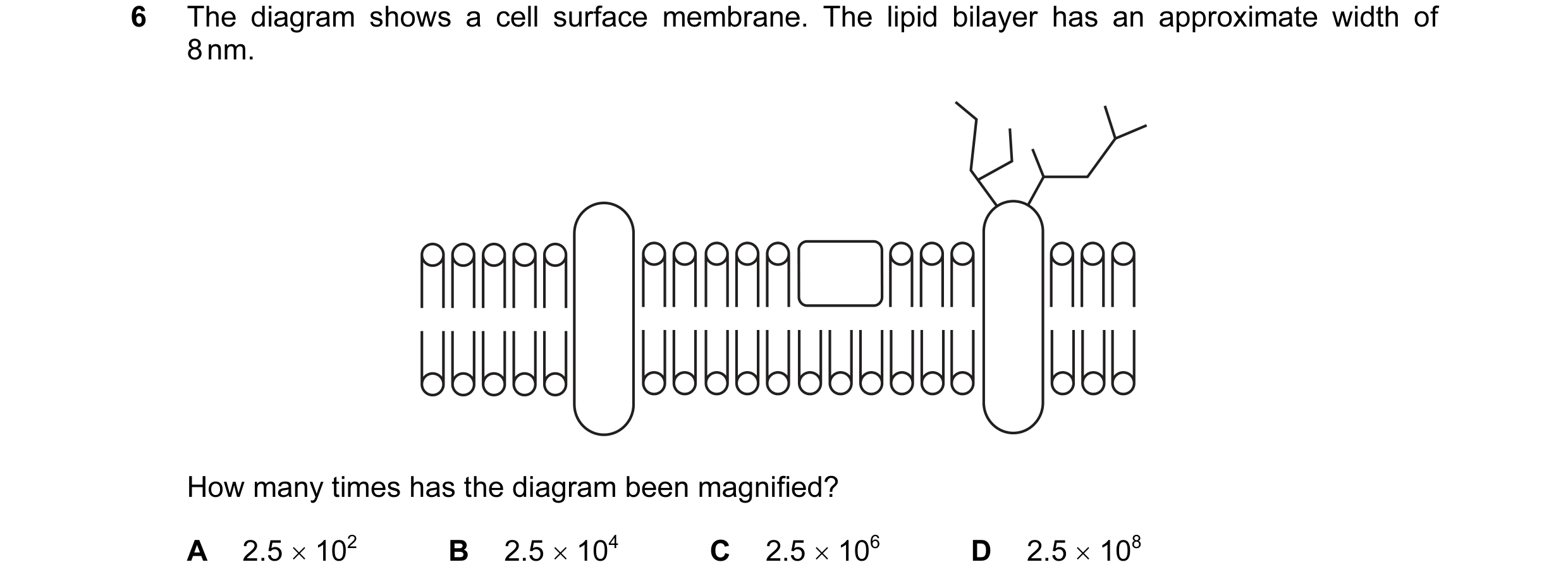
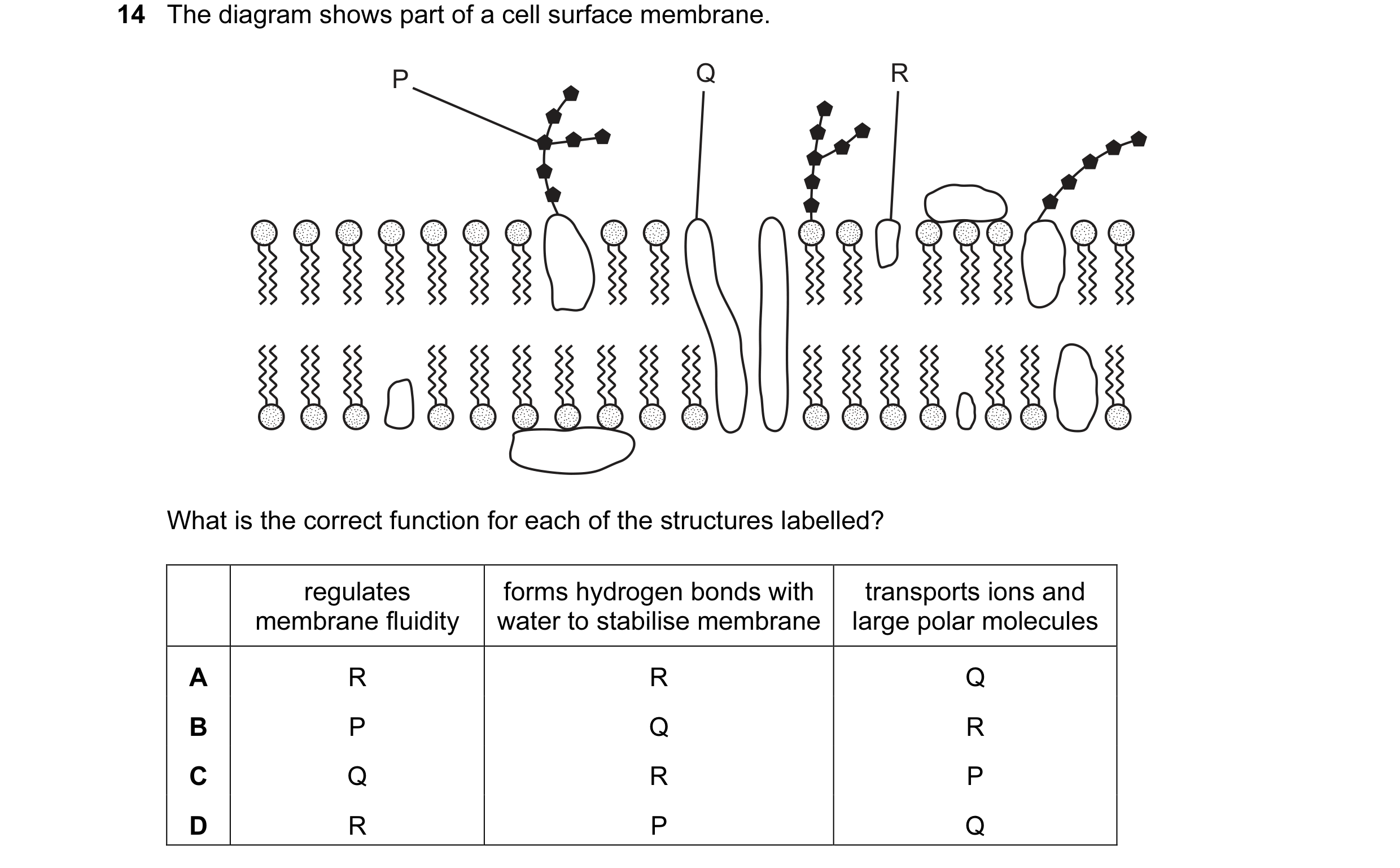 1 / 43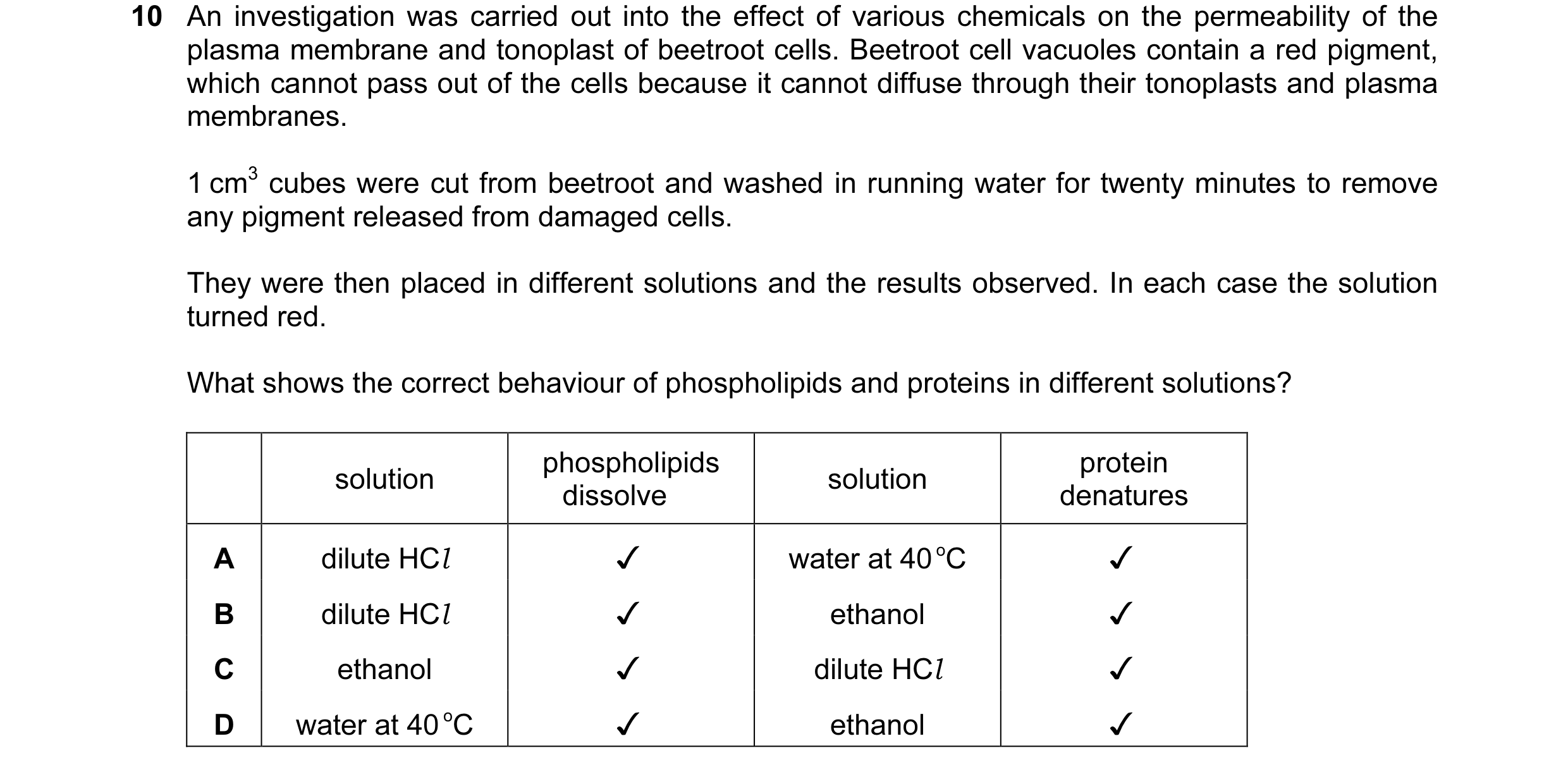
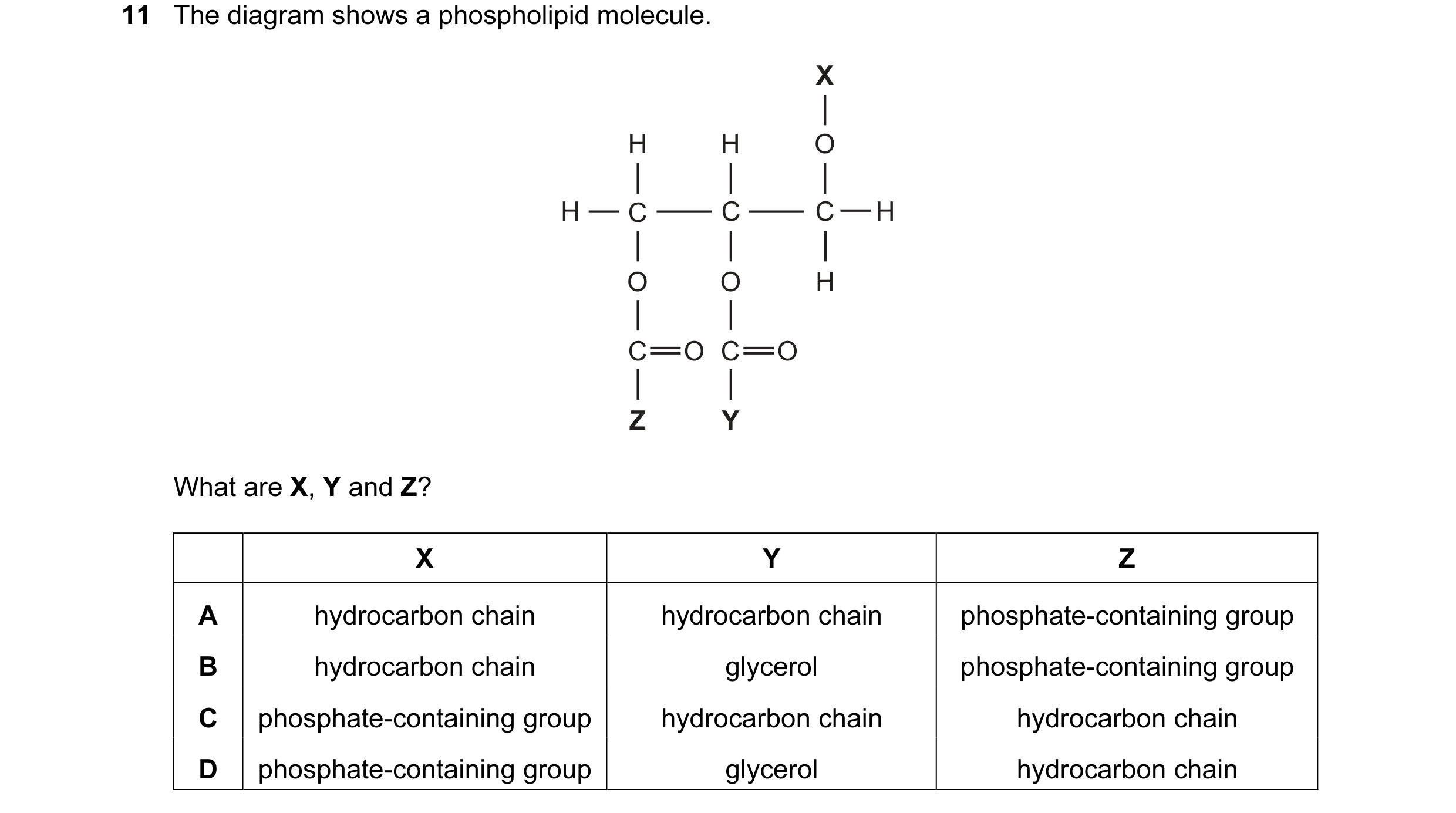
 2 / 43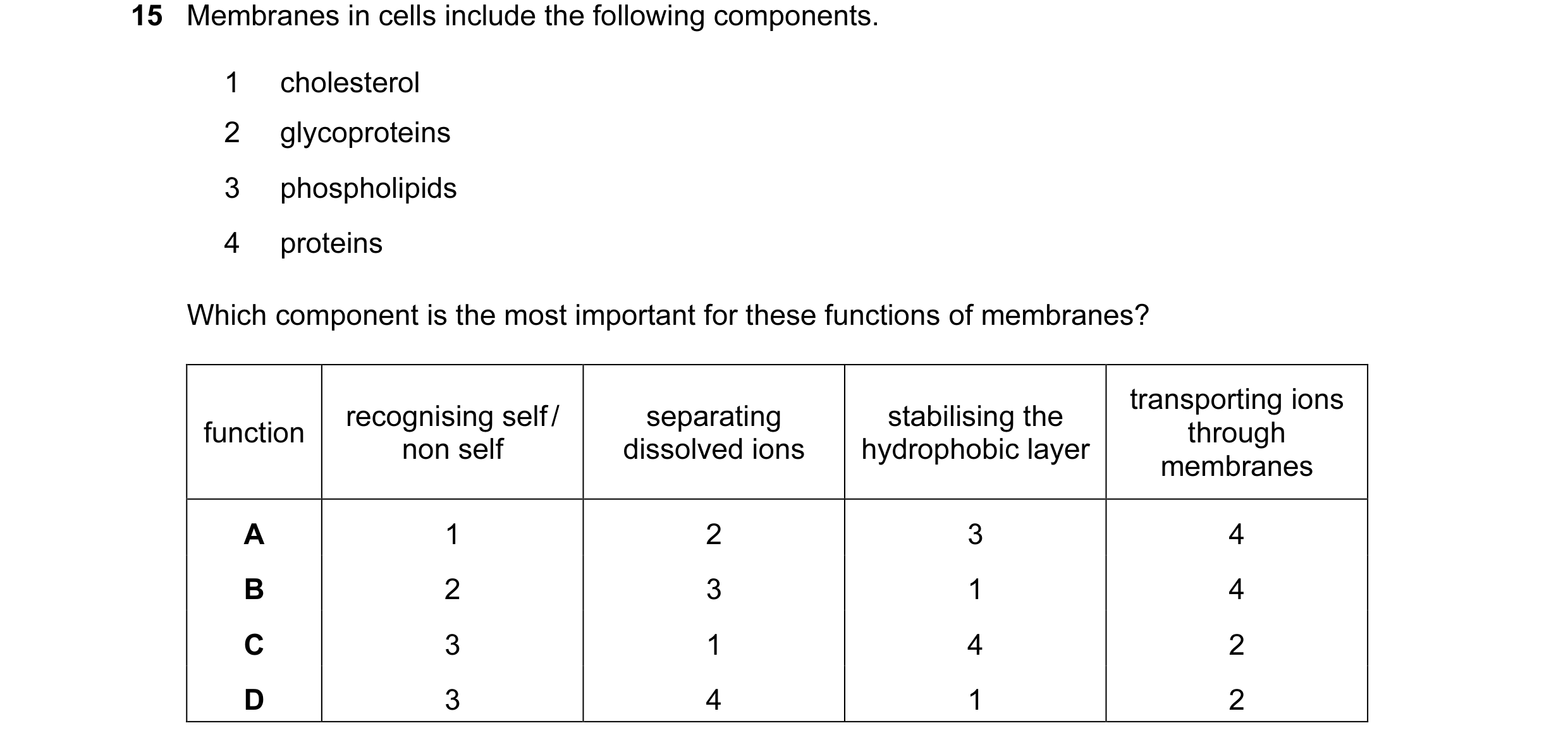
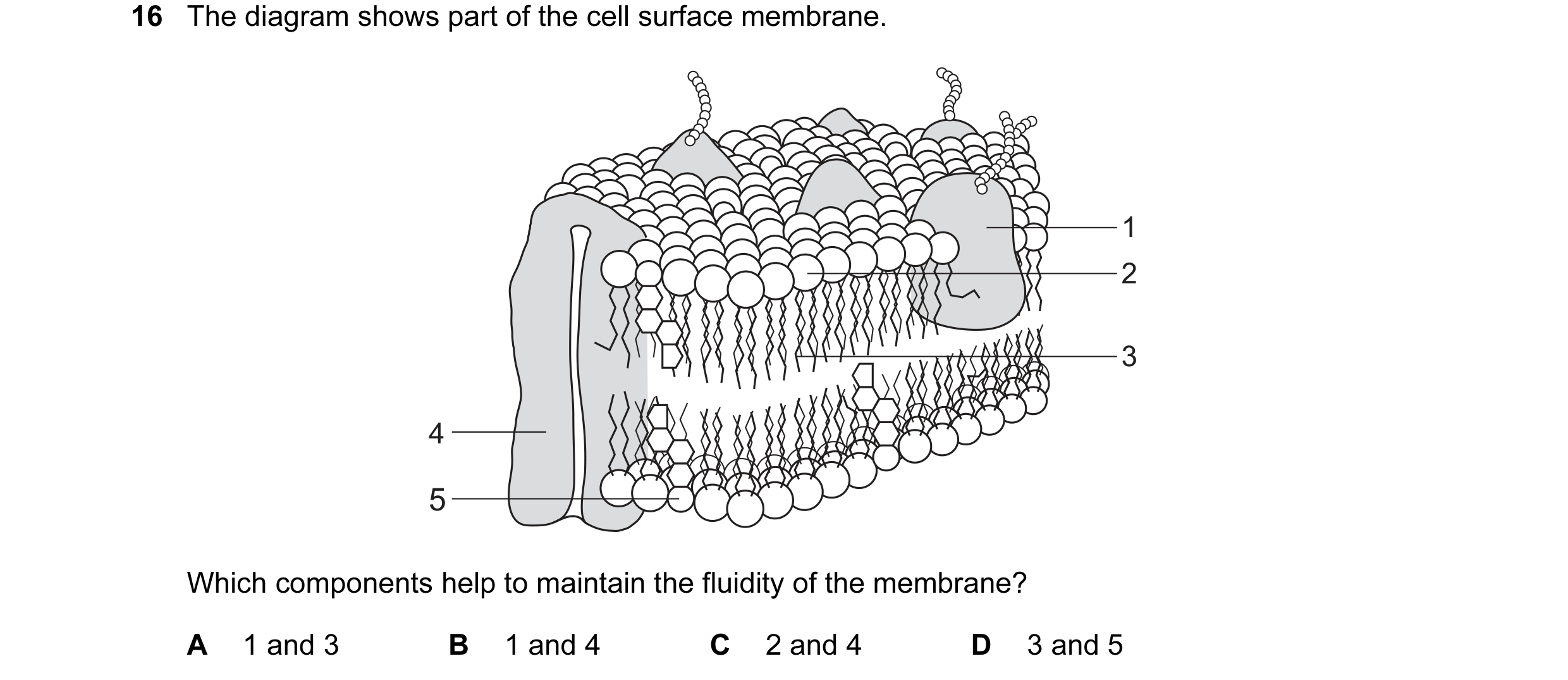 3 / 43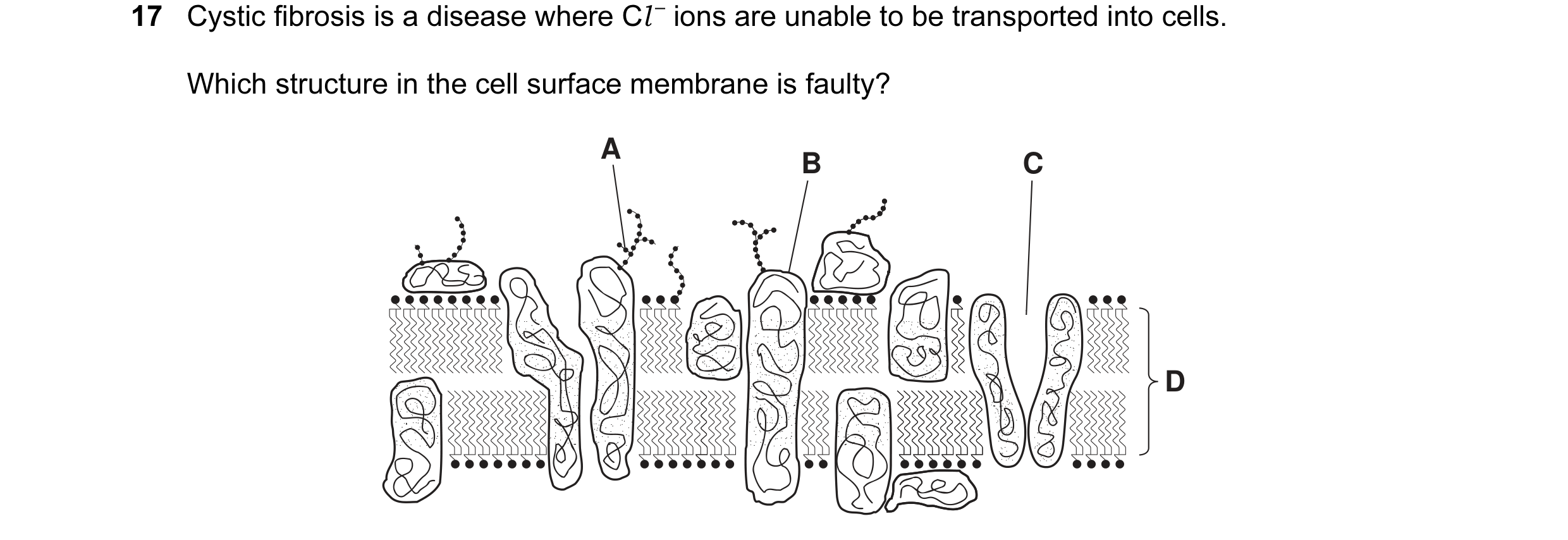

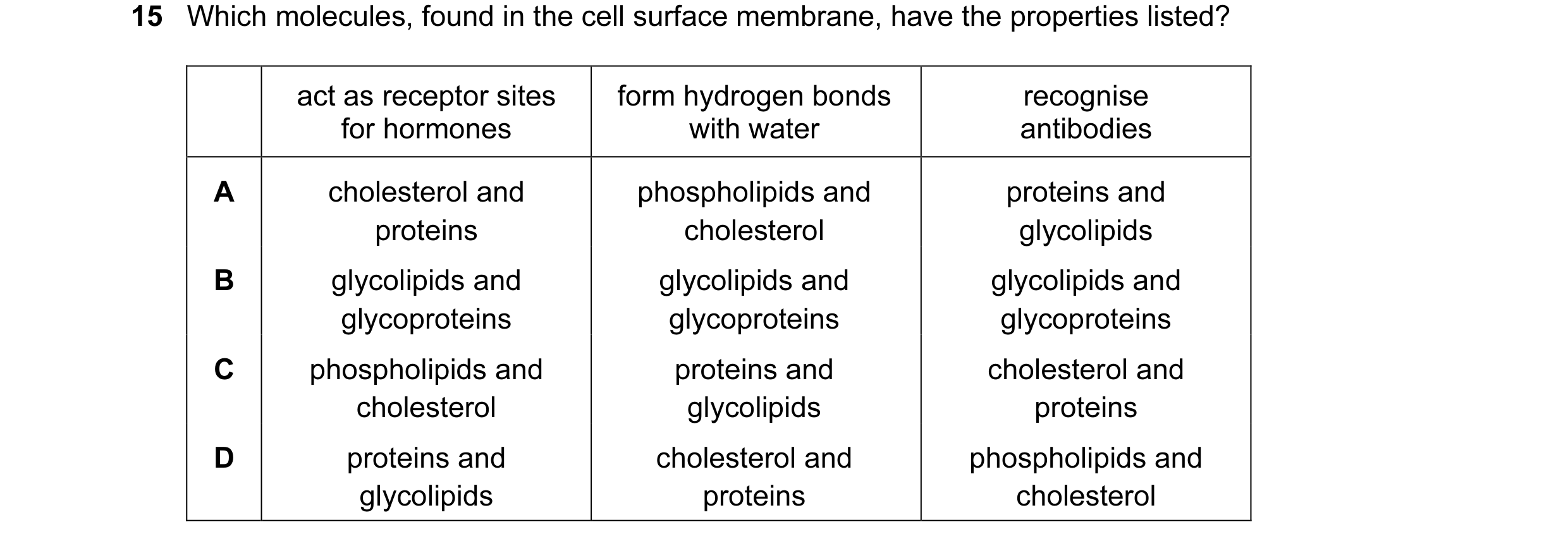

 4 / 43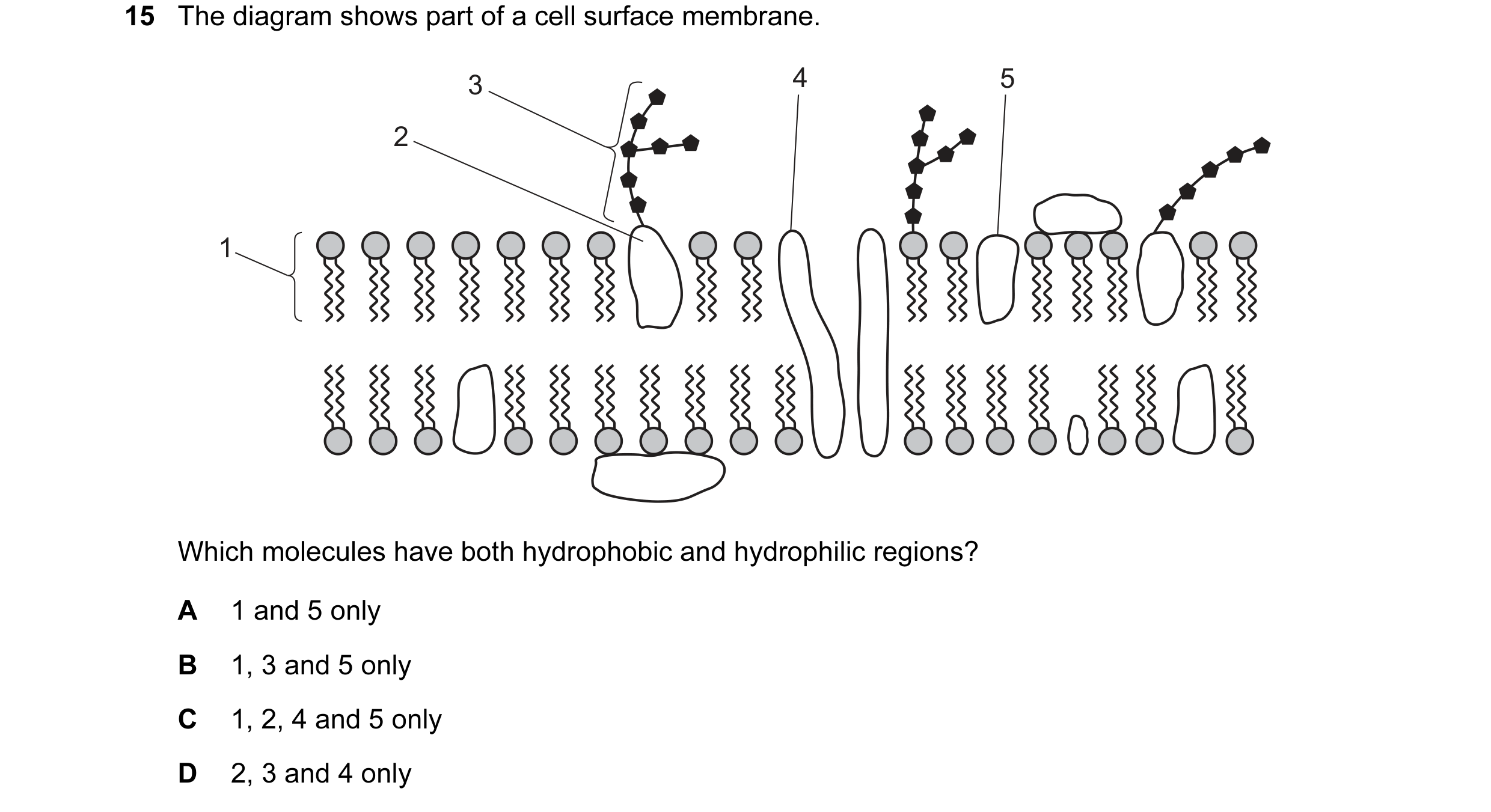
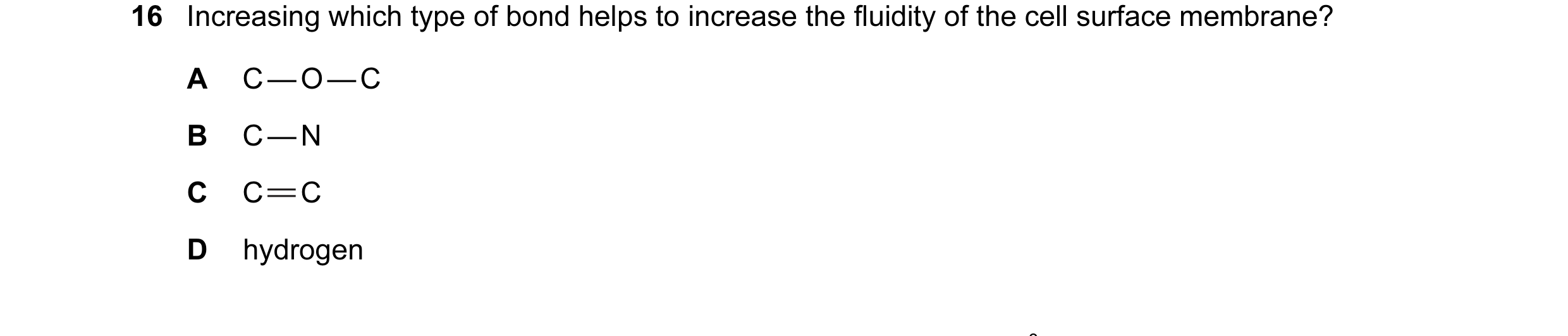

 5 / 43
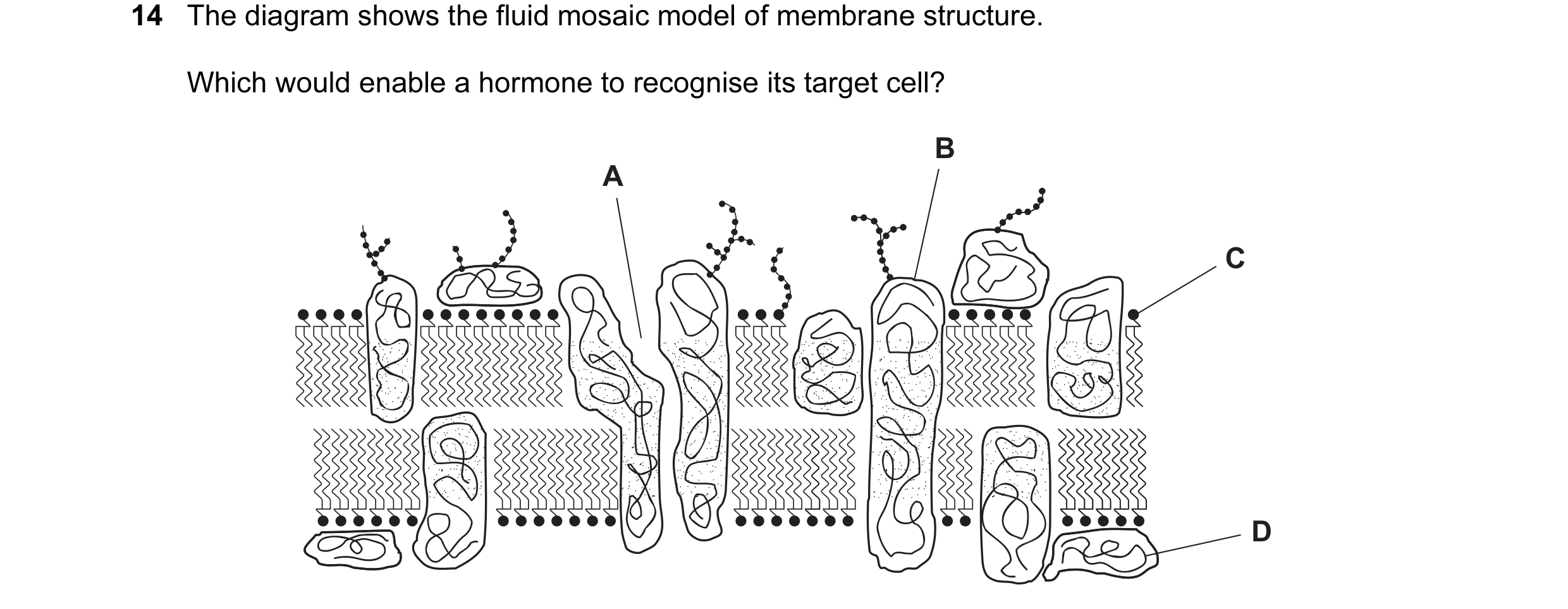

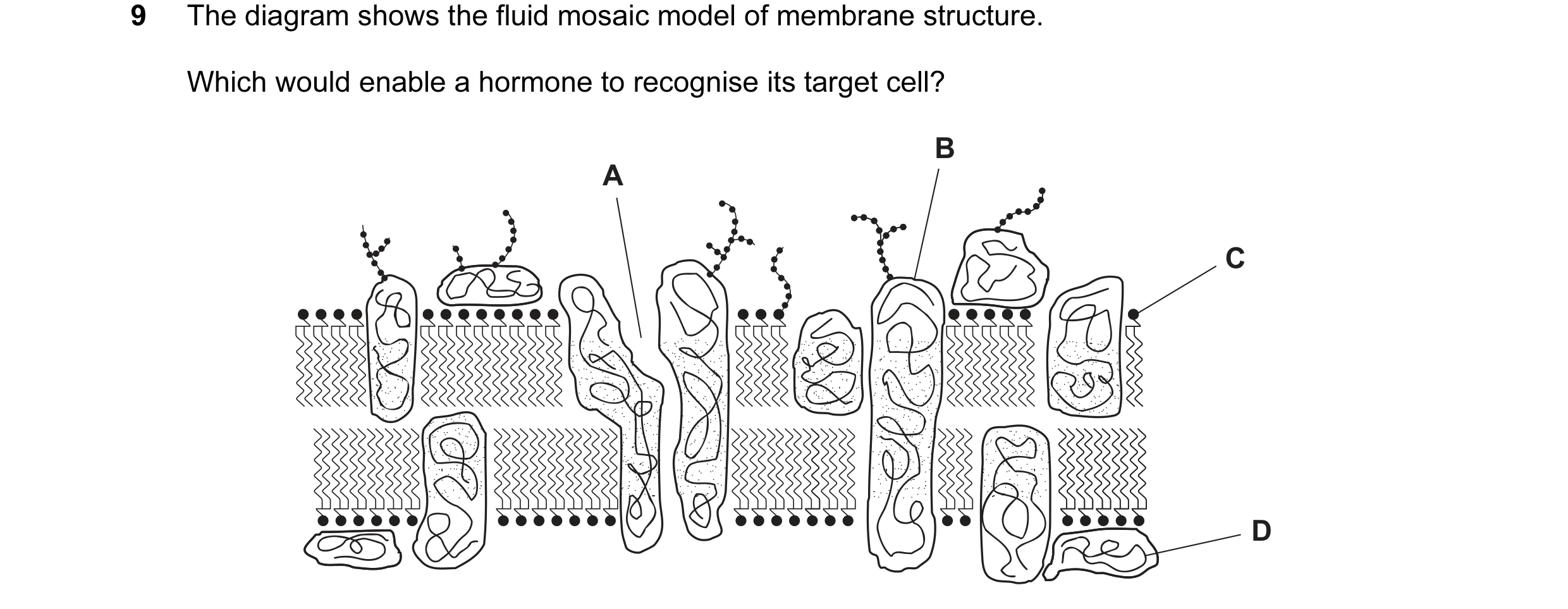 6 / 43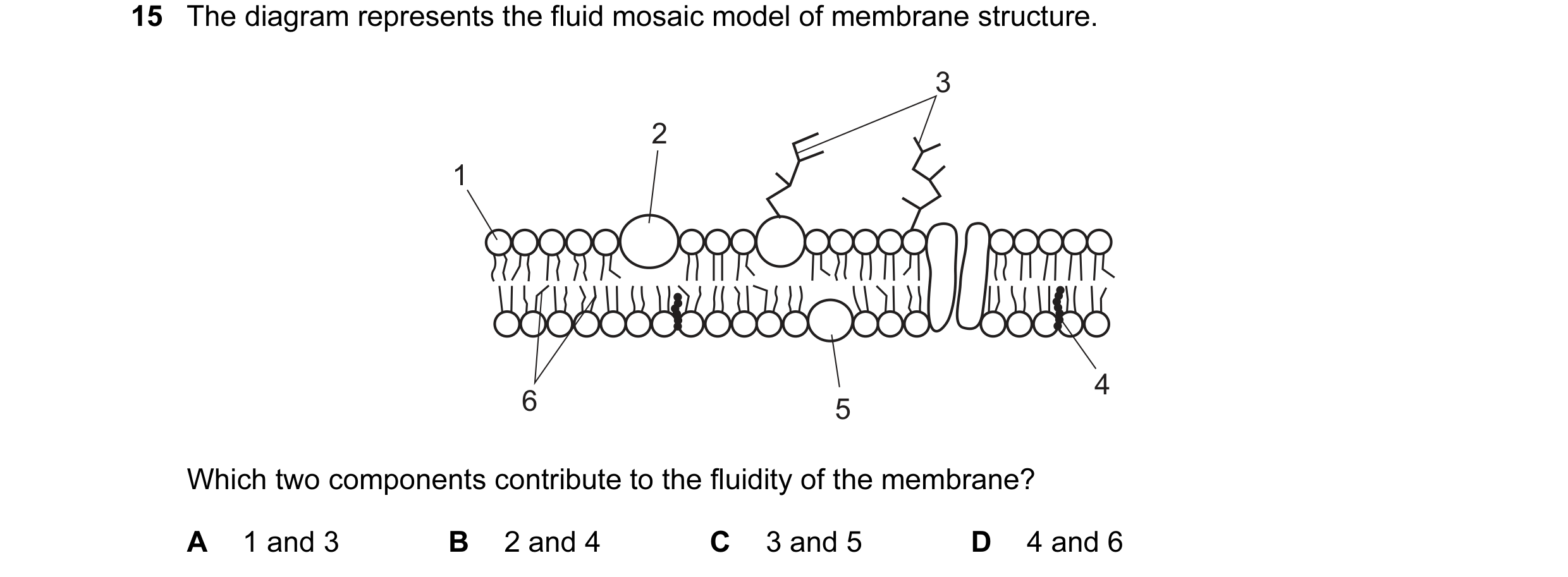


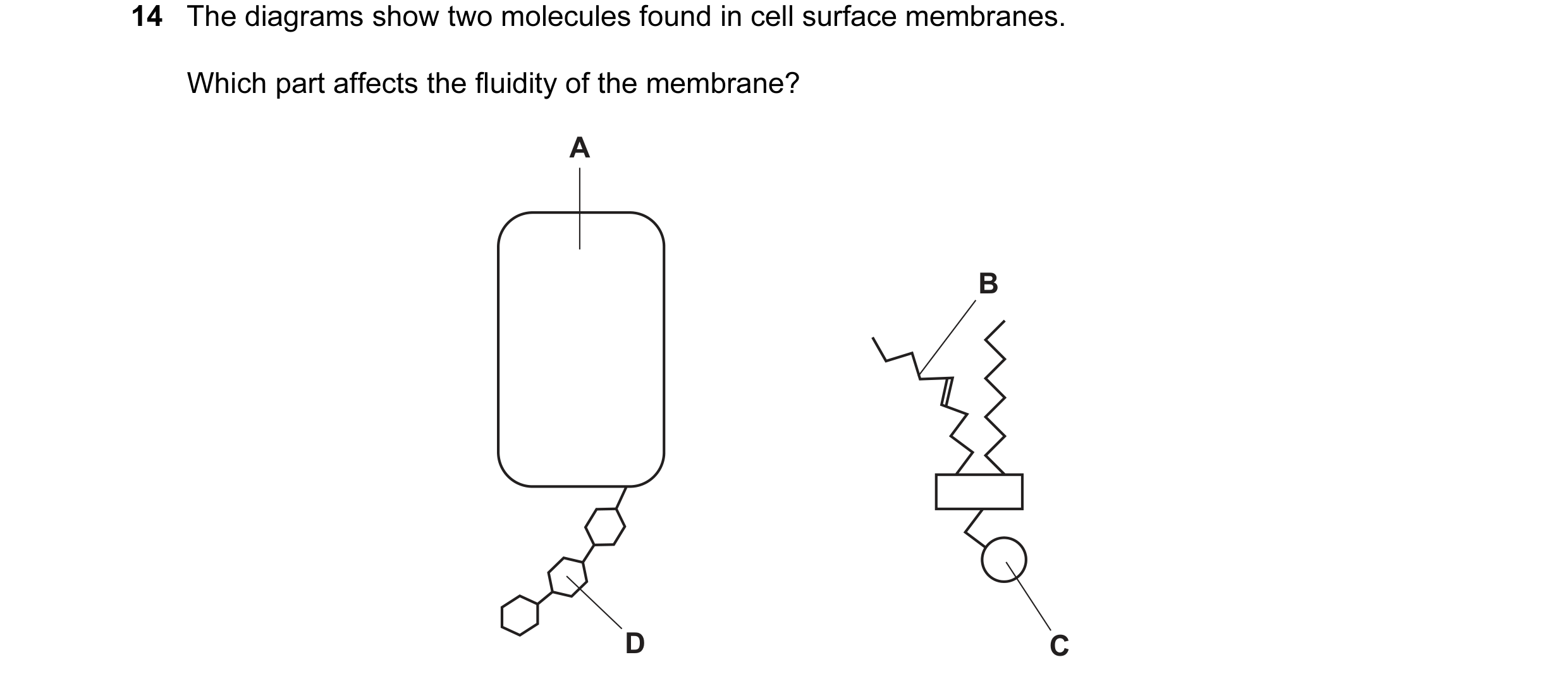 7 / 43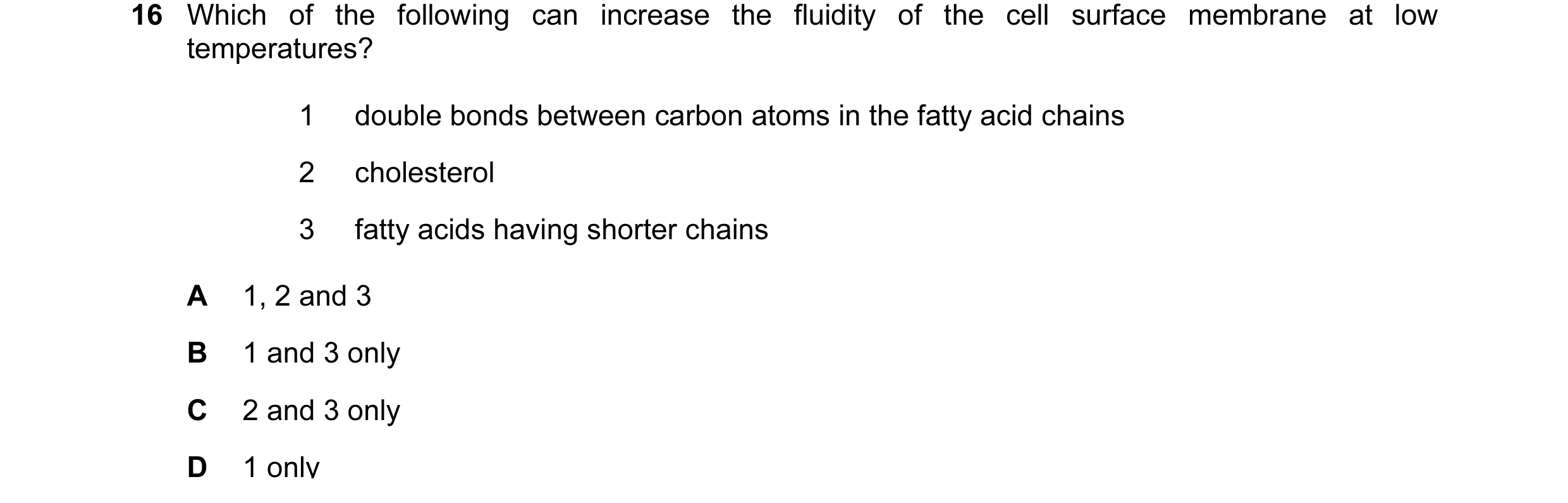
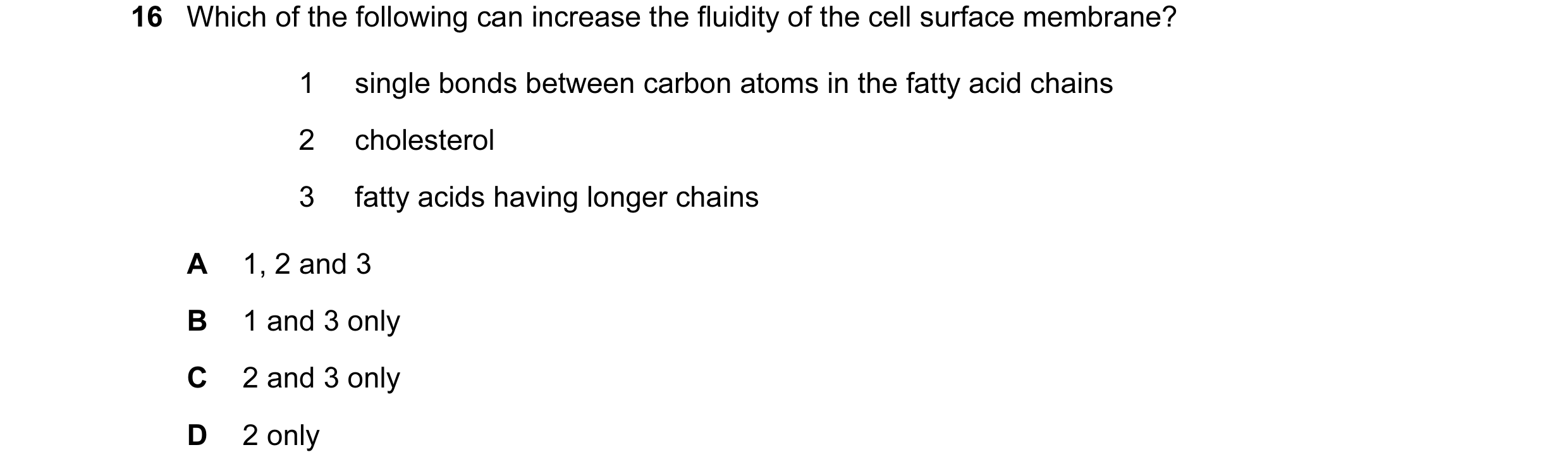
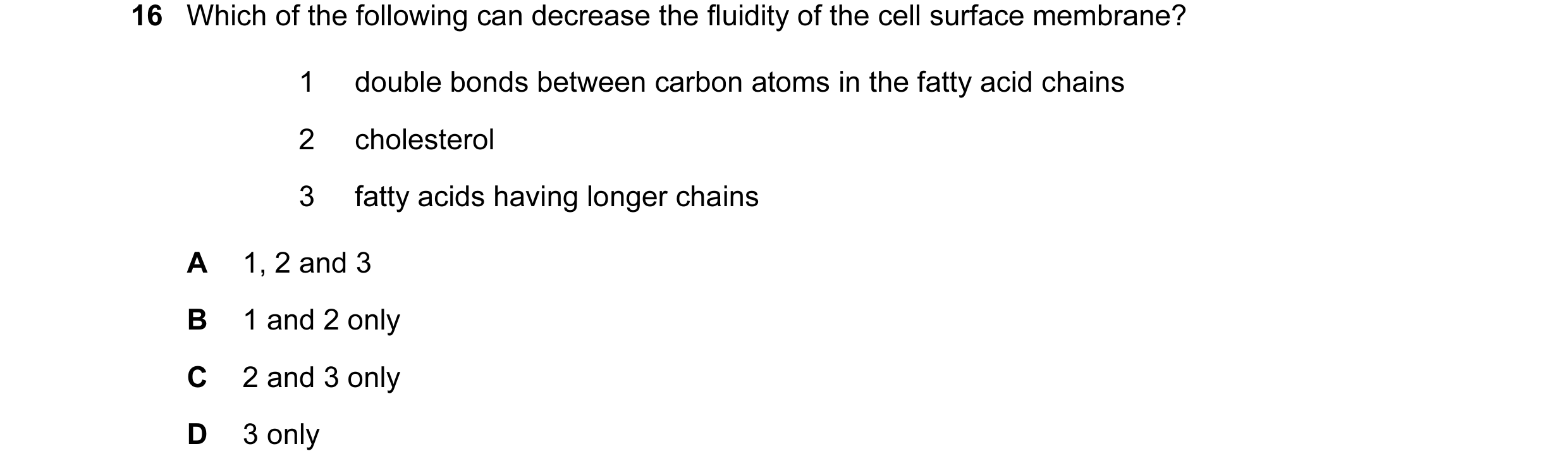
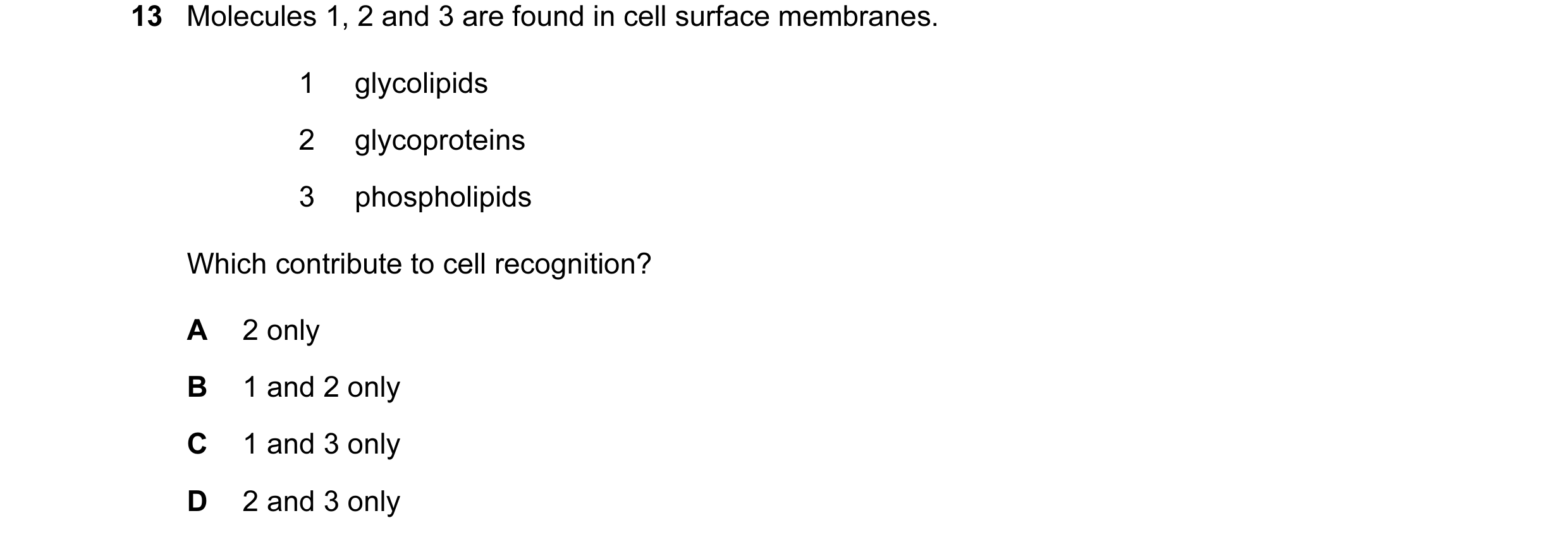 8 / 43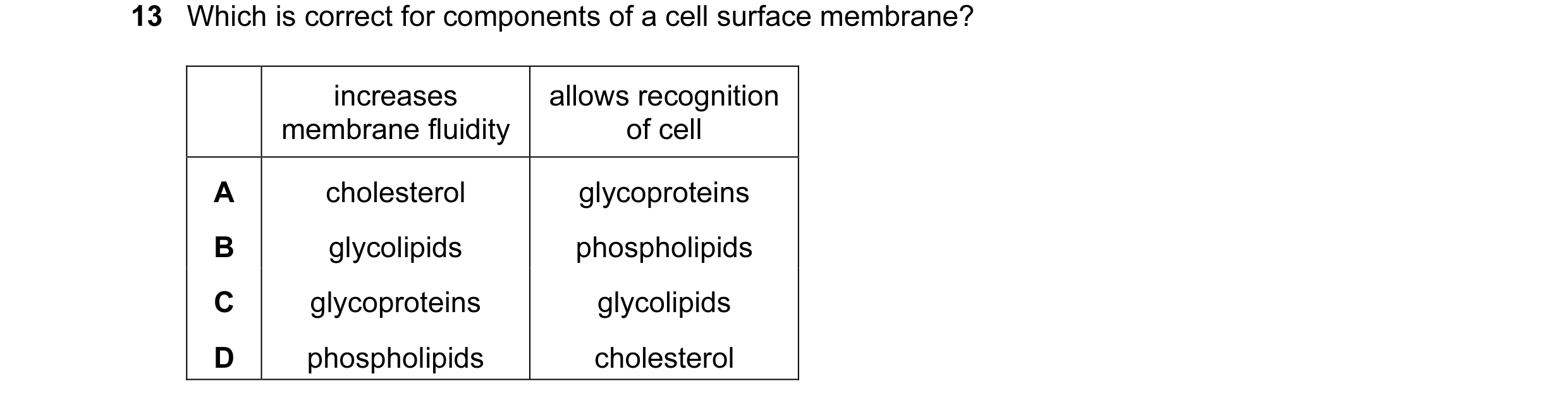
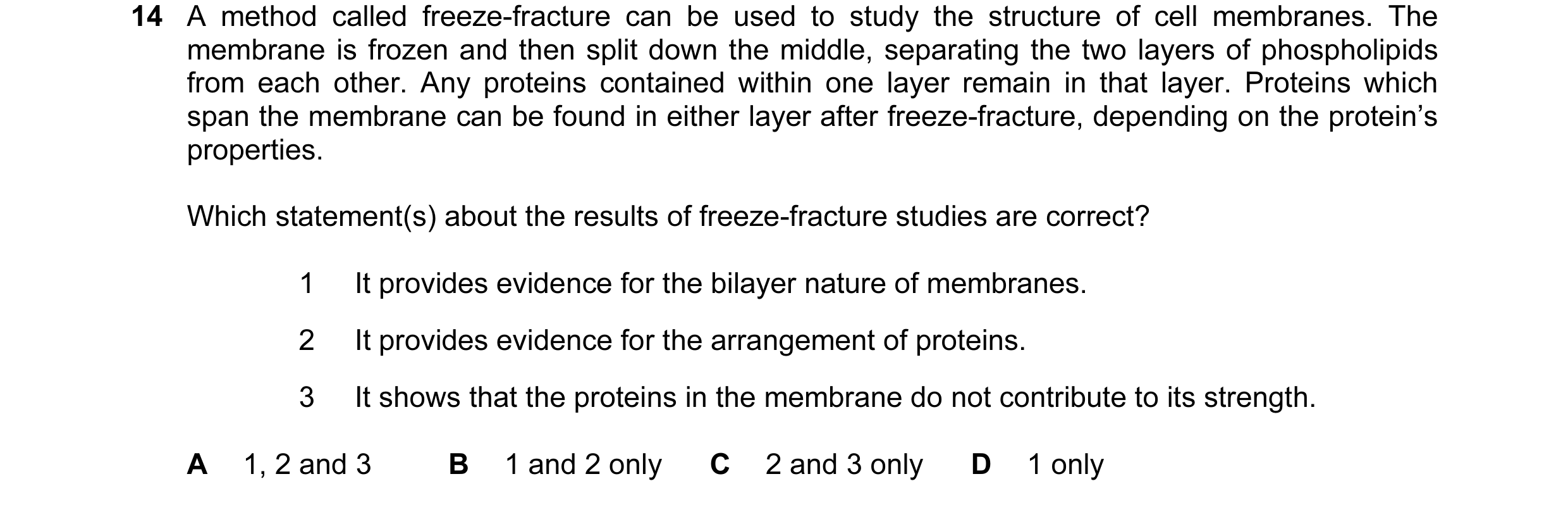
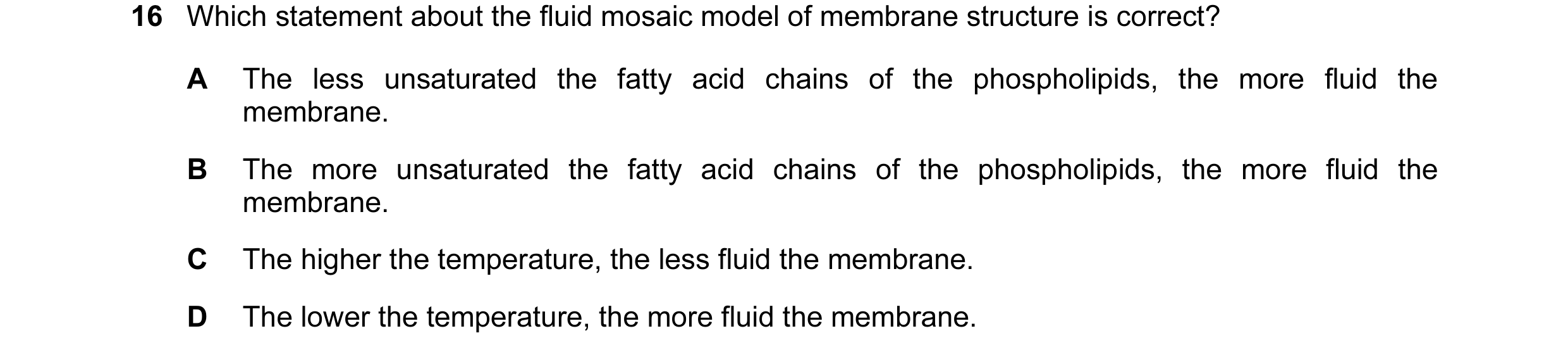

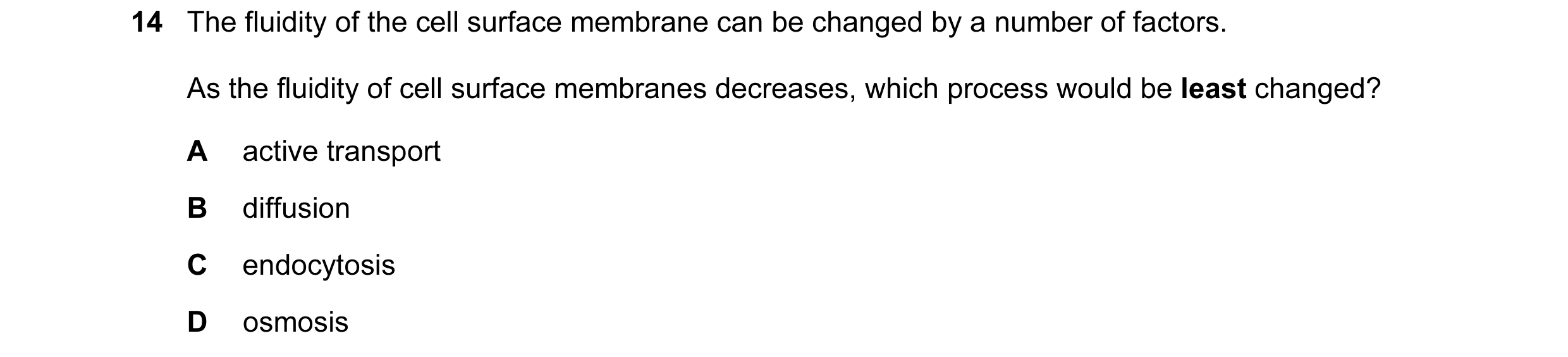 9 / 43
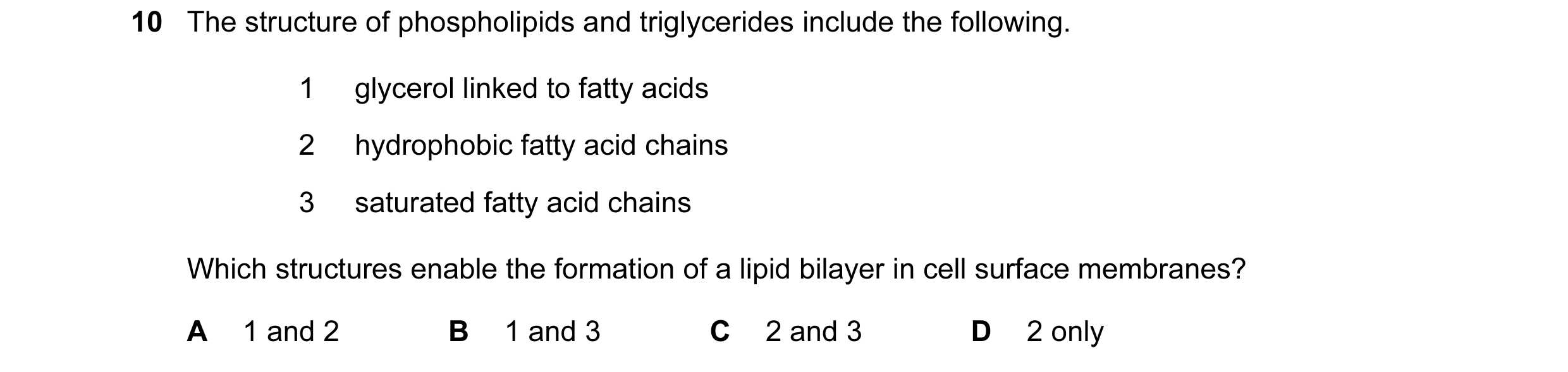
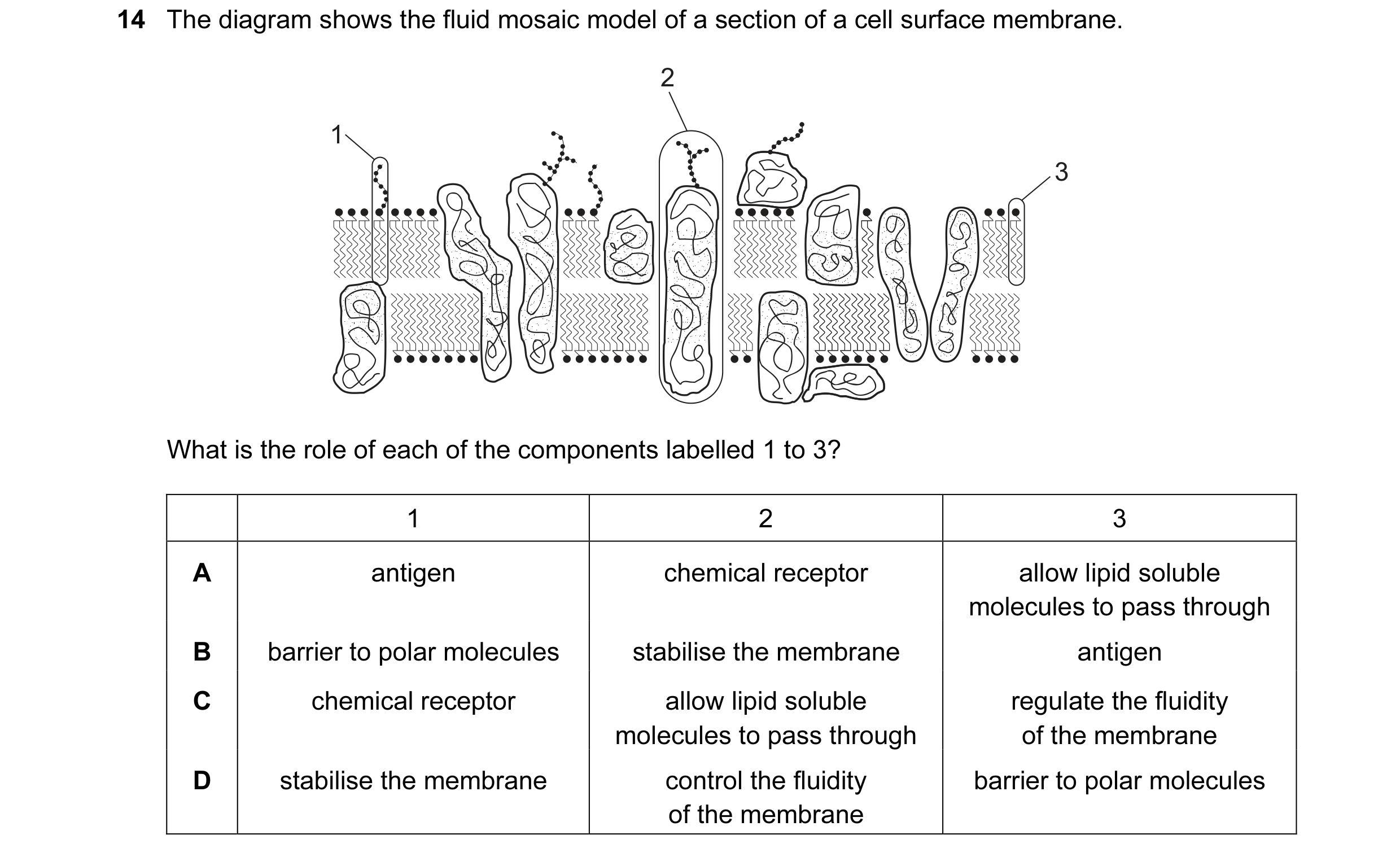 10 / 43
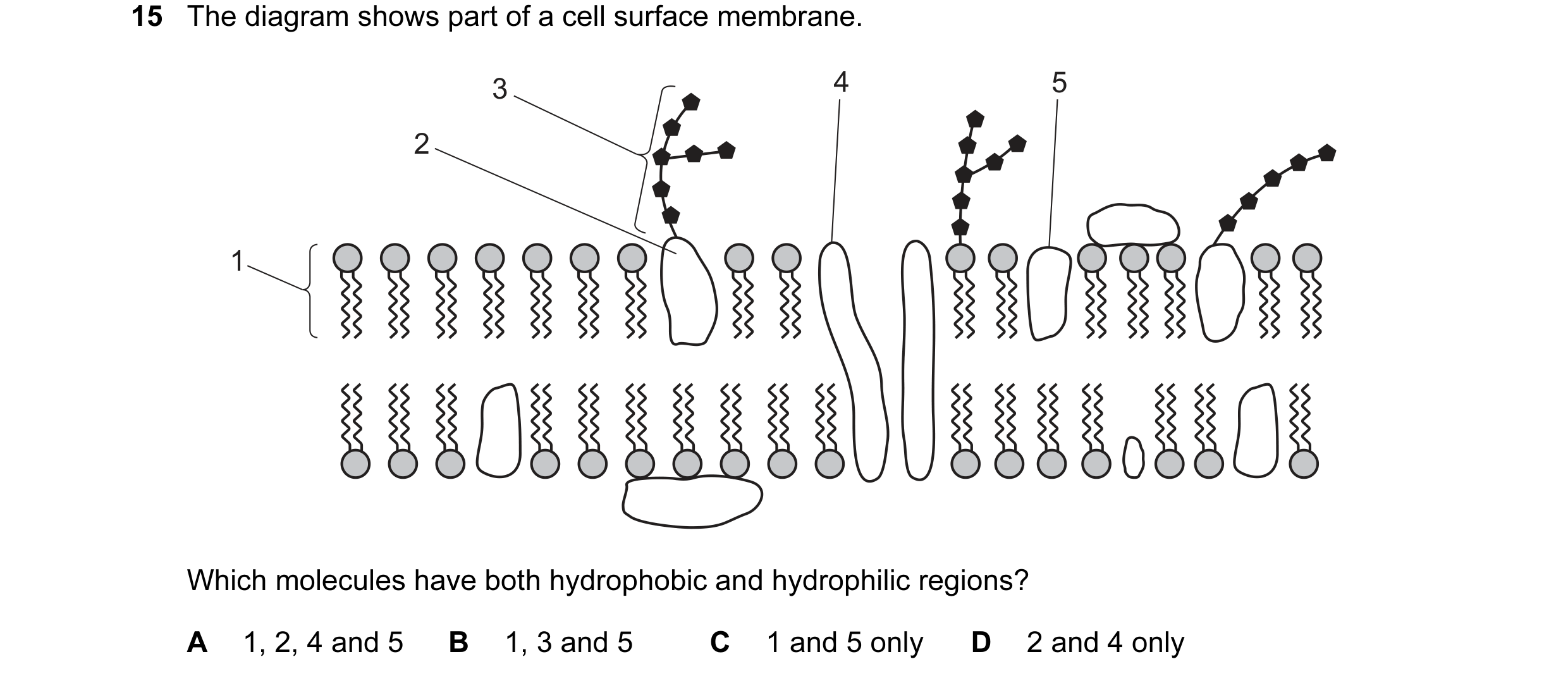

 11 / 43
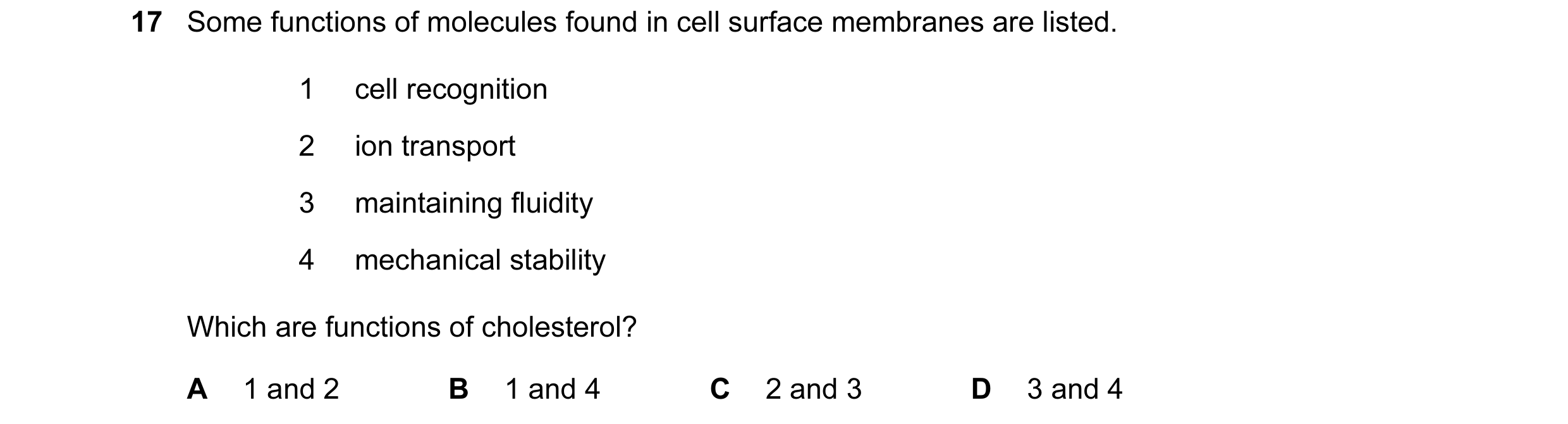
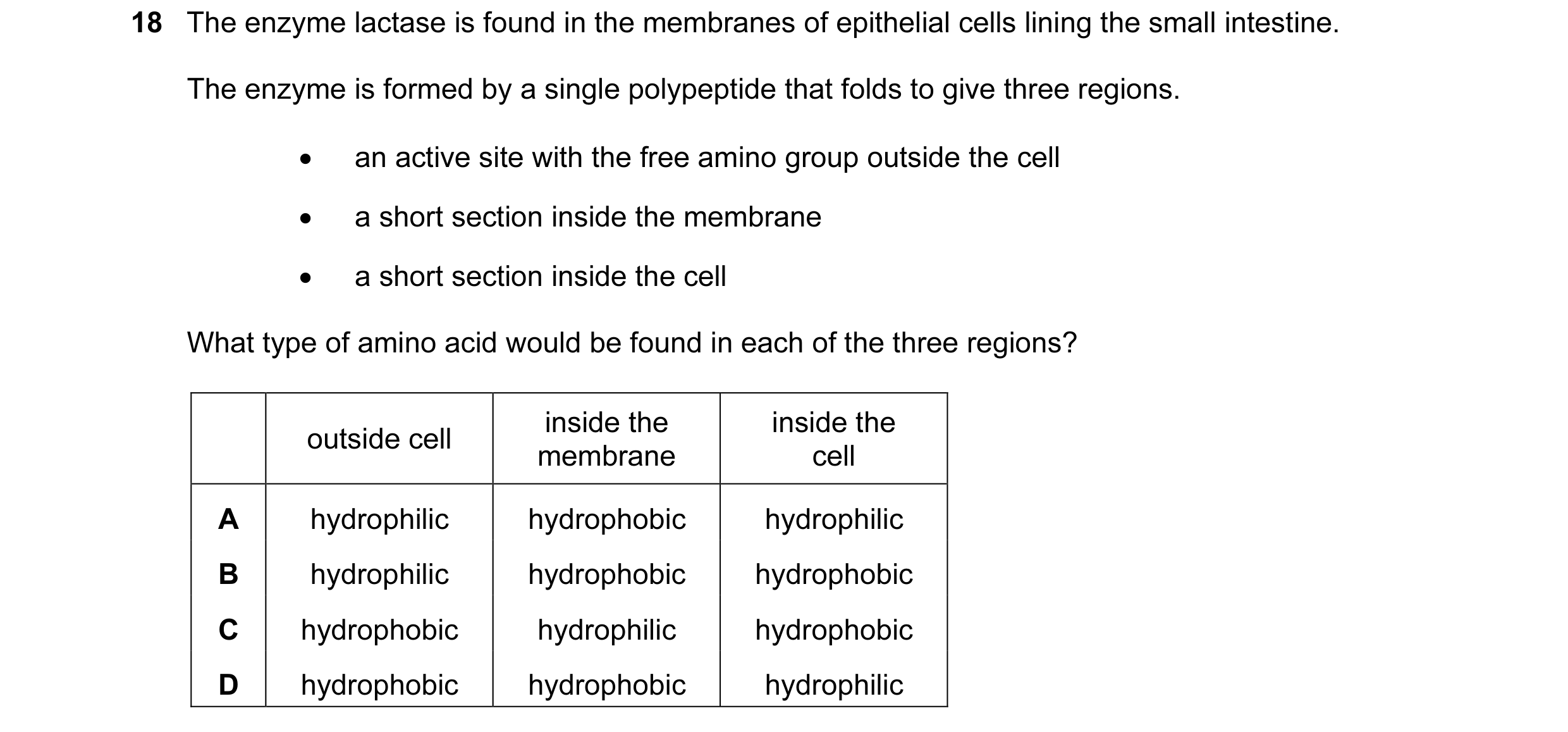

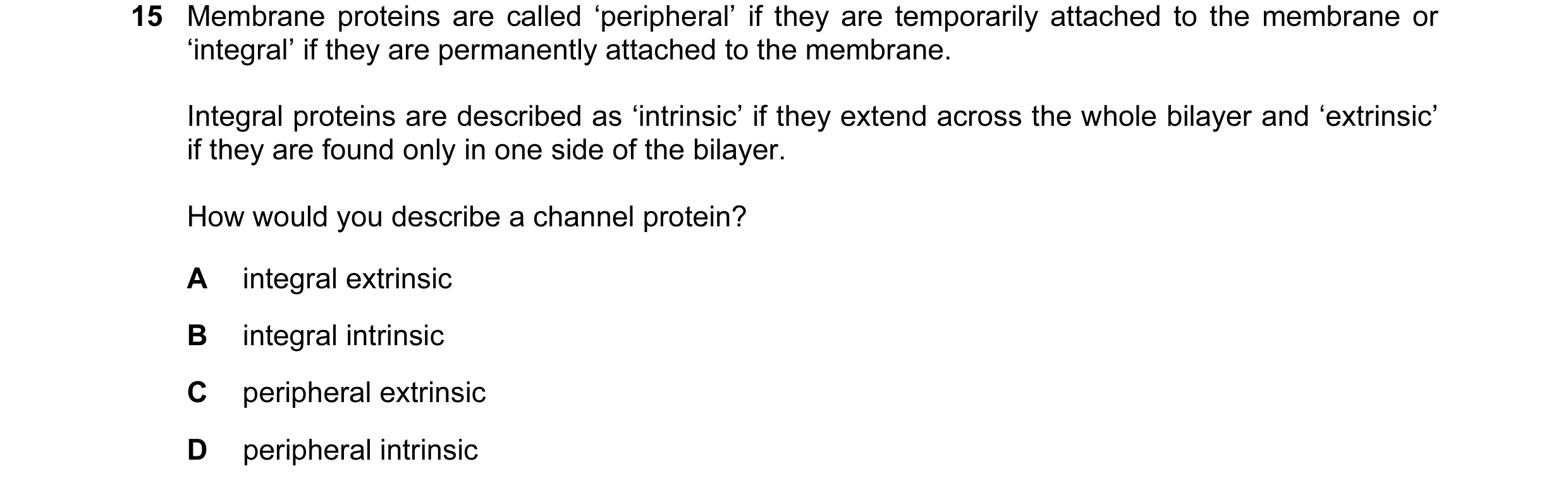 12 / 43
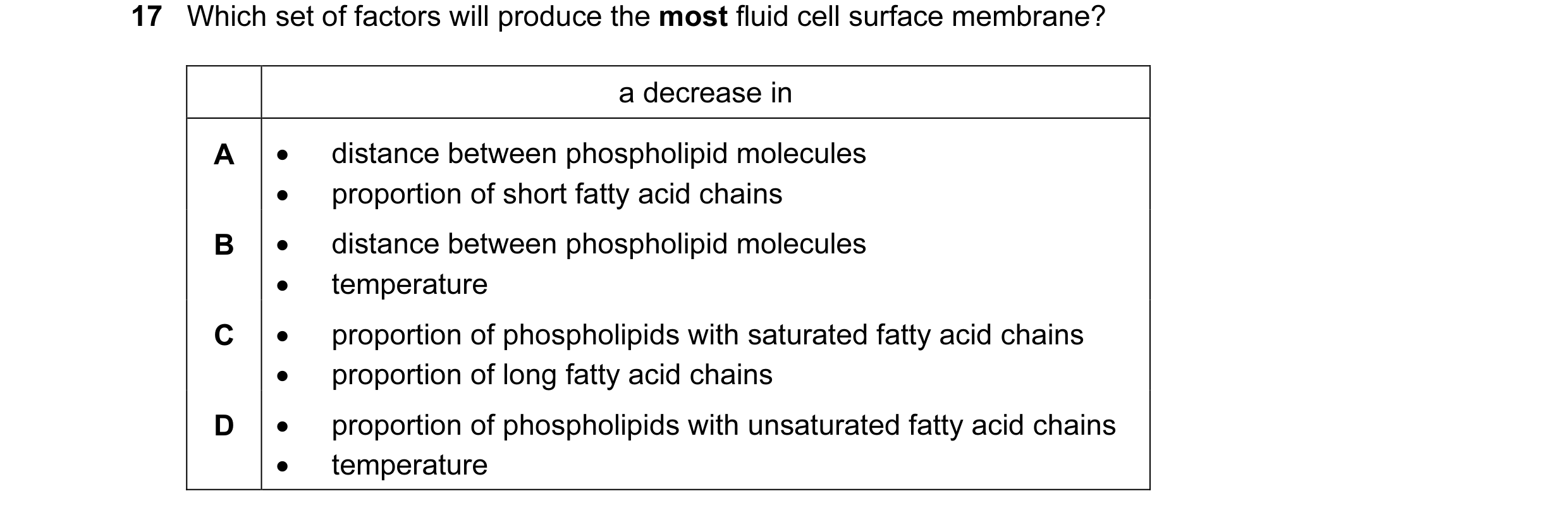
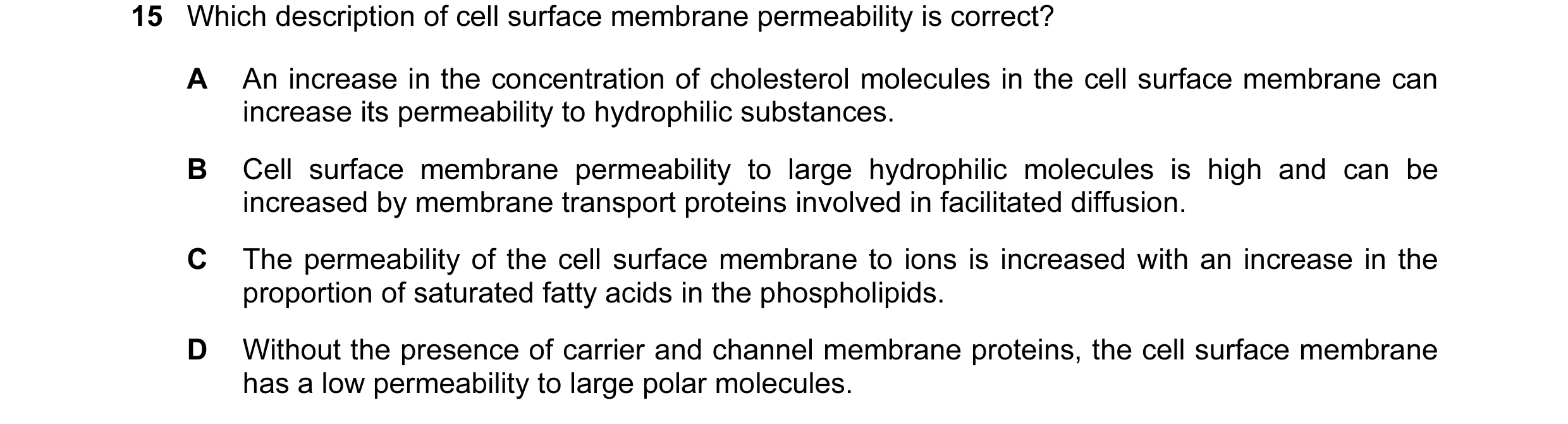
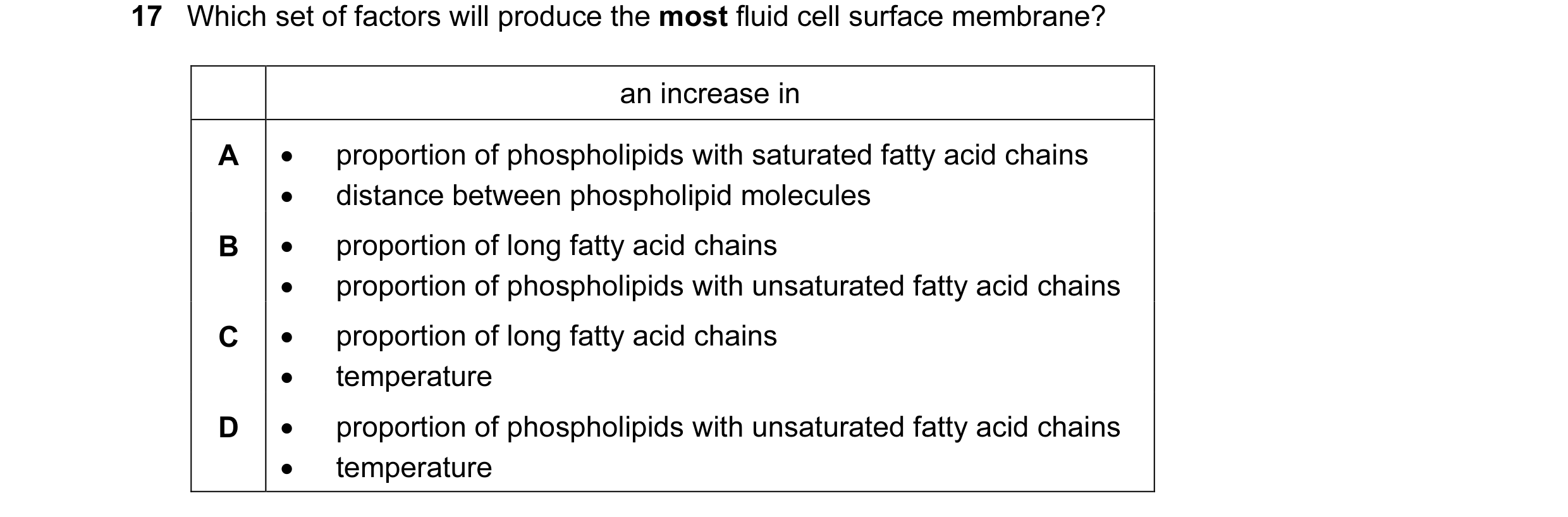 13 / 43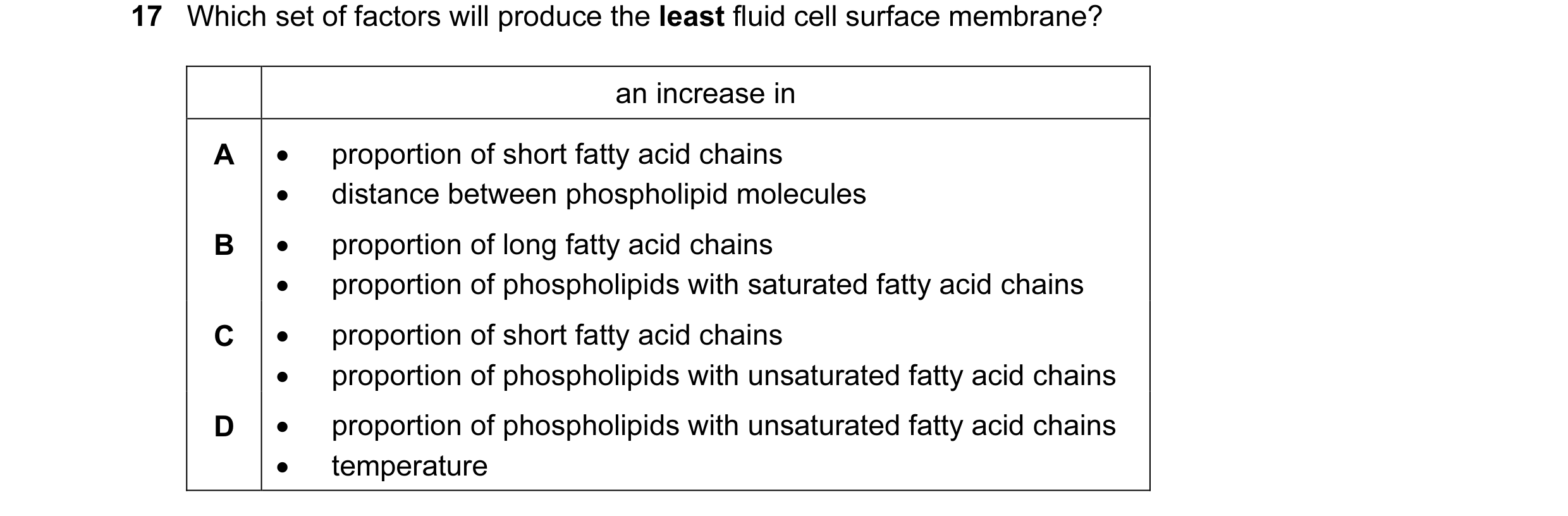

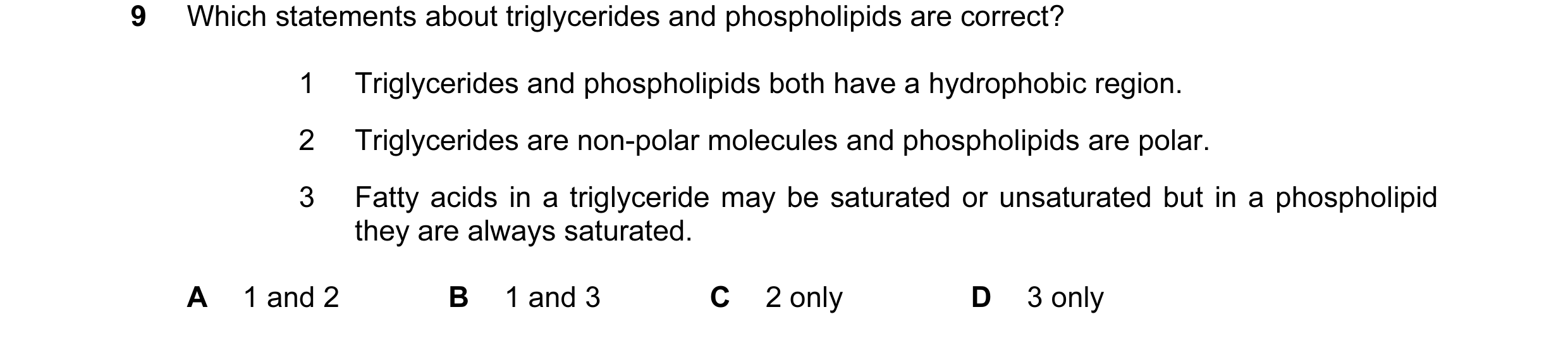
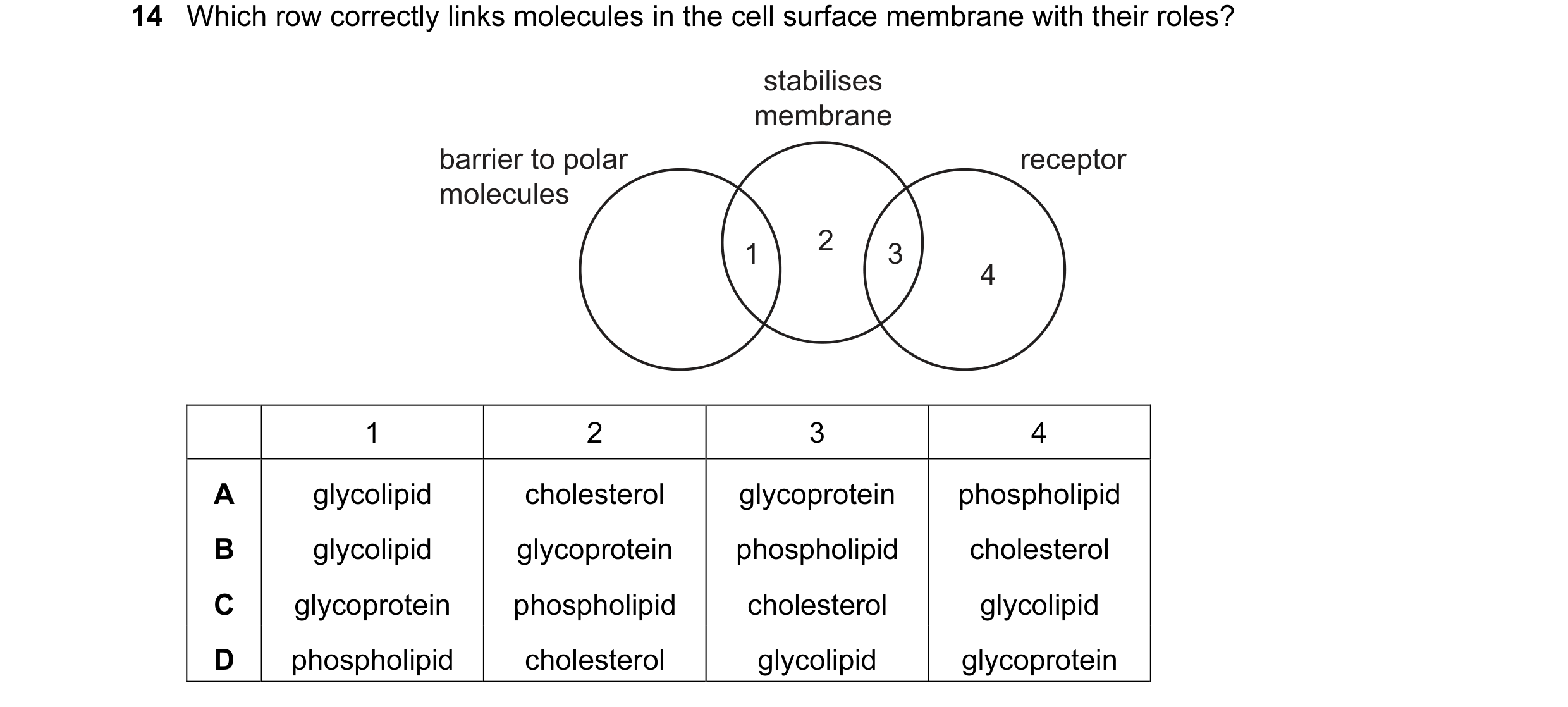 14 / 43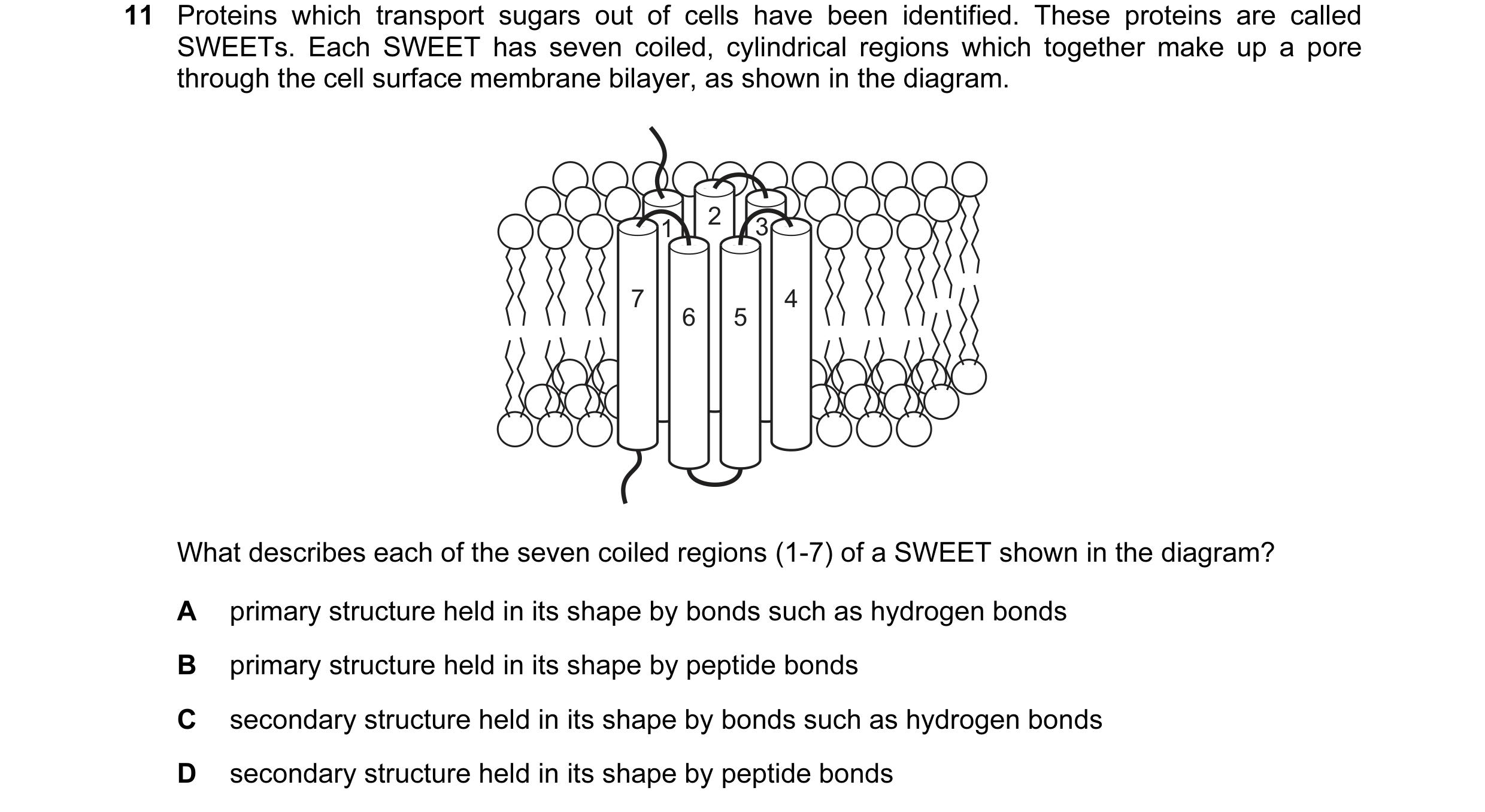

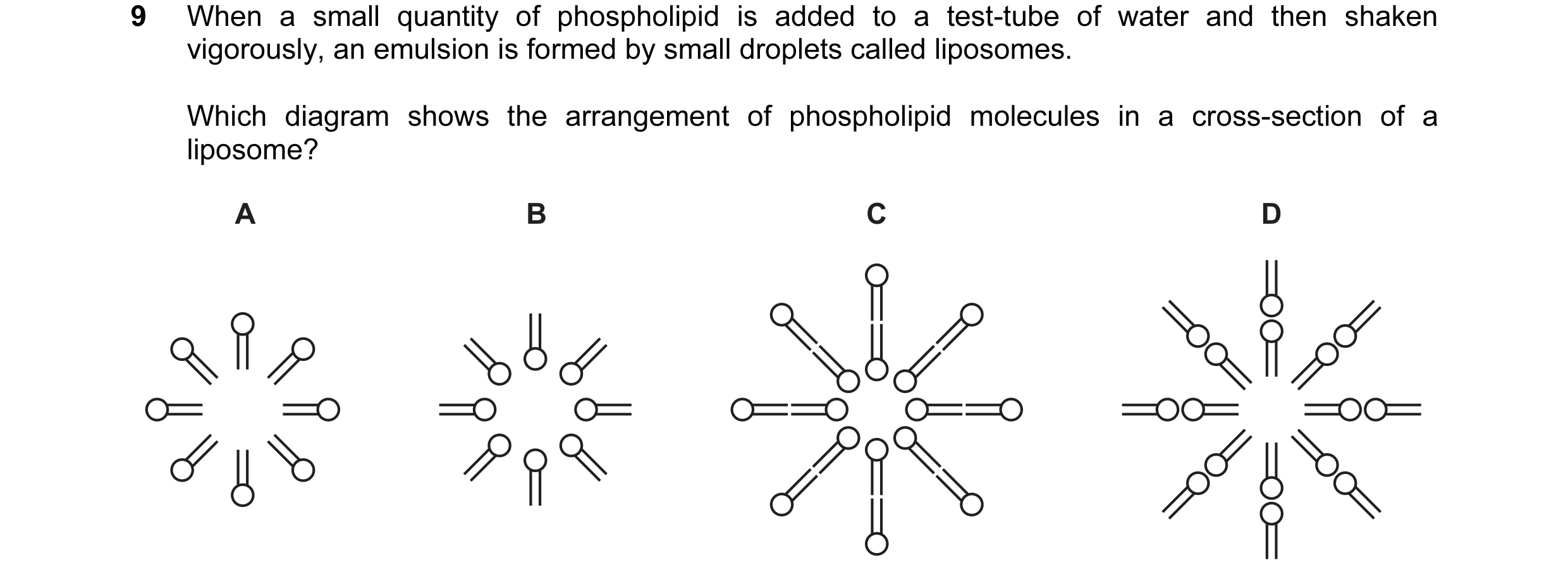 15 / 43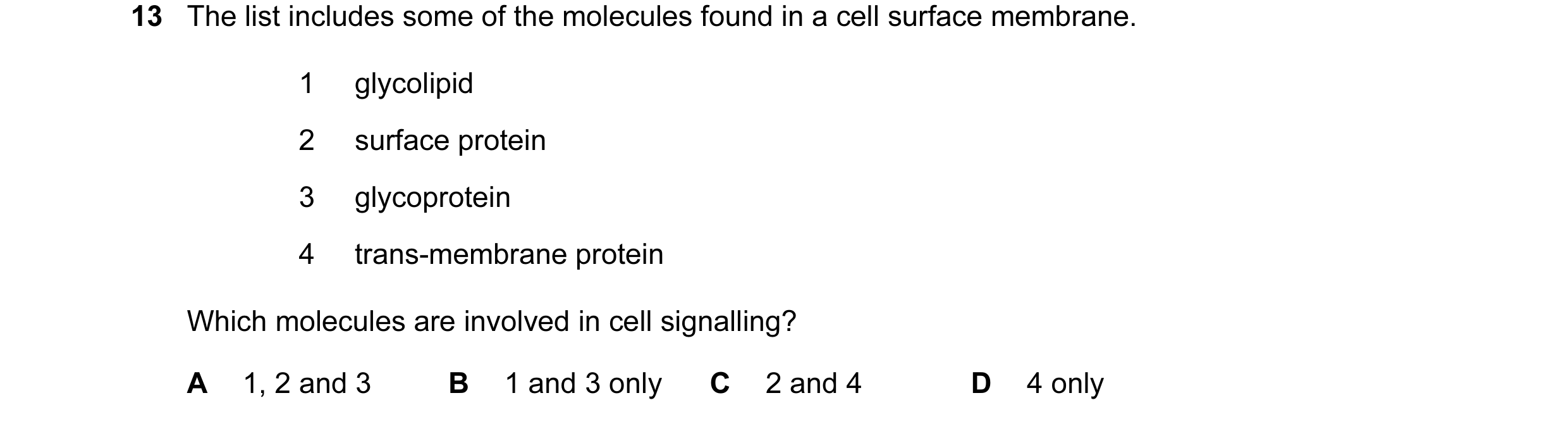

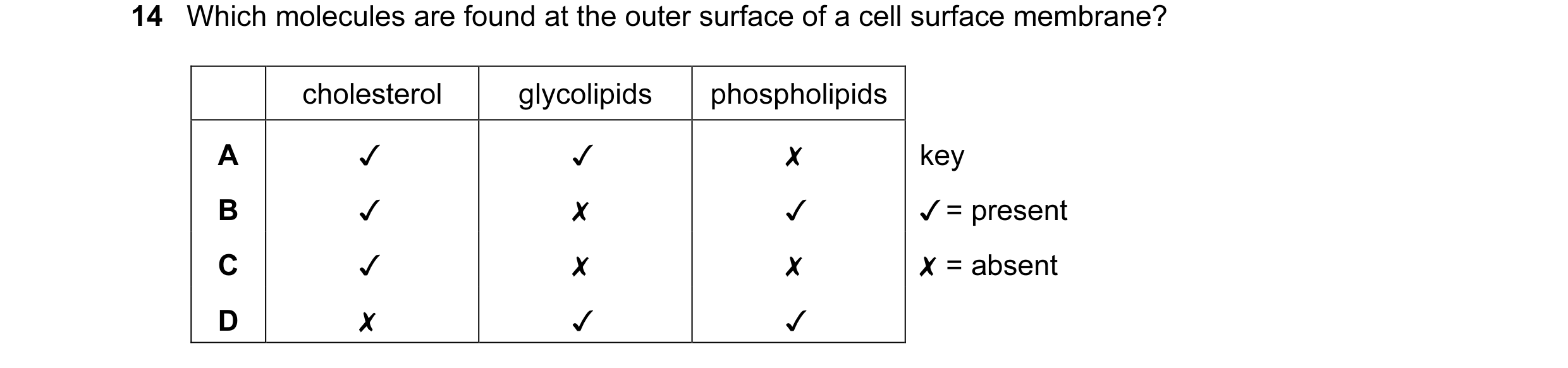

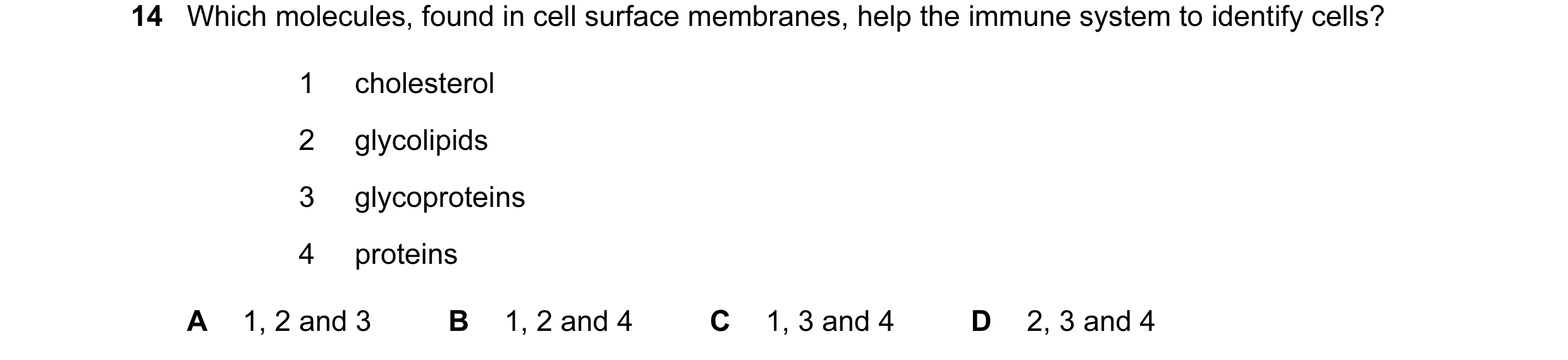
 16 / 43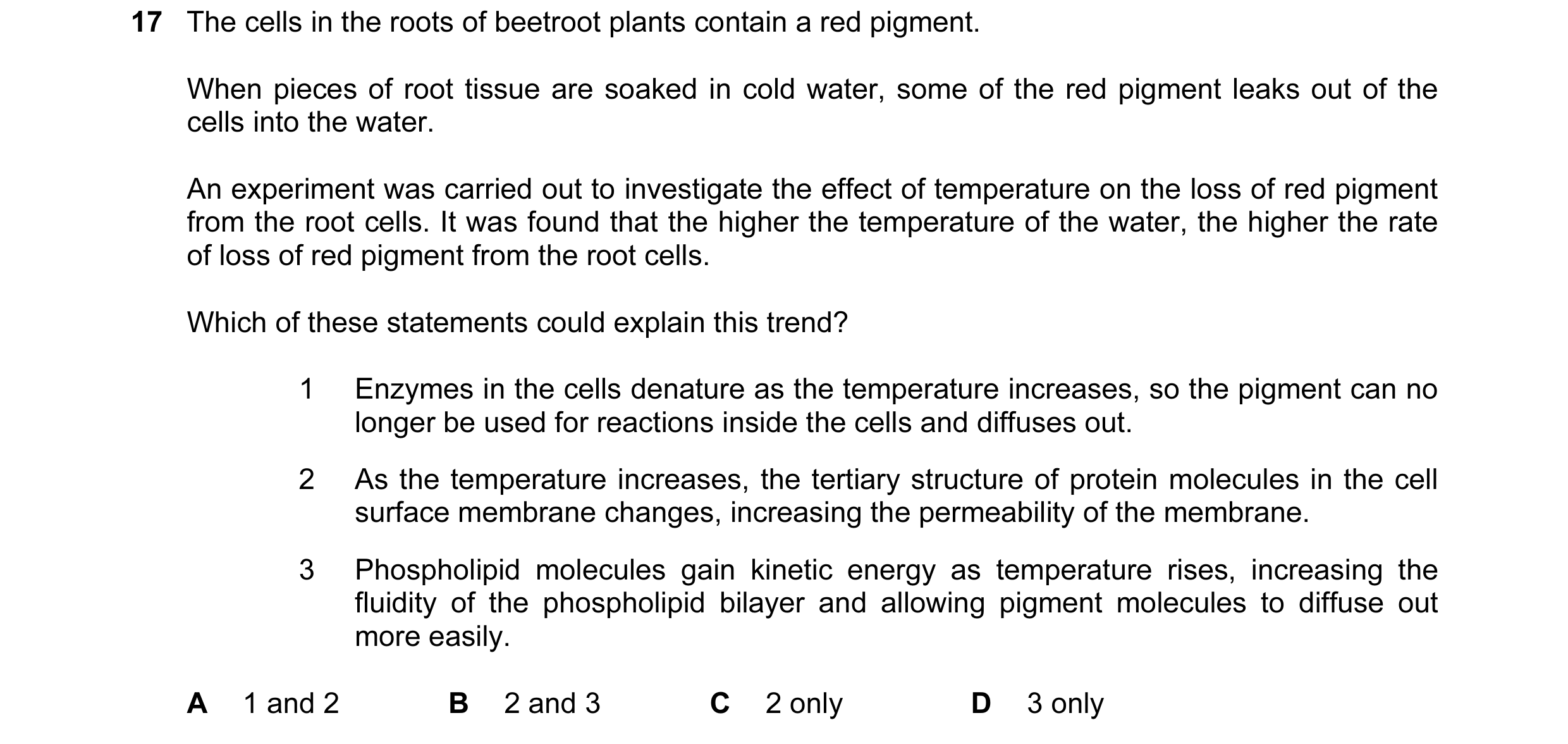
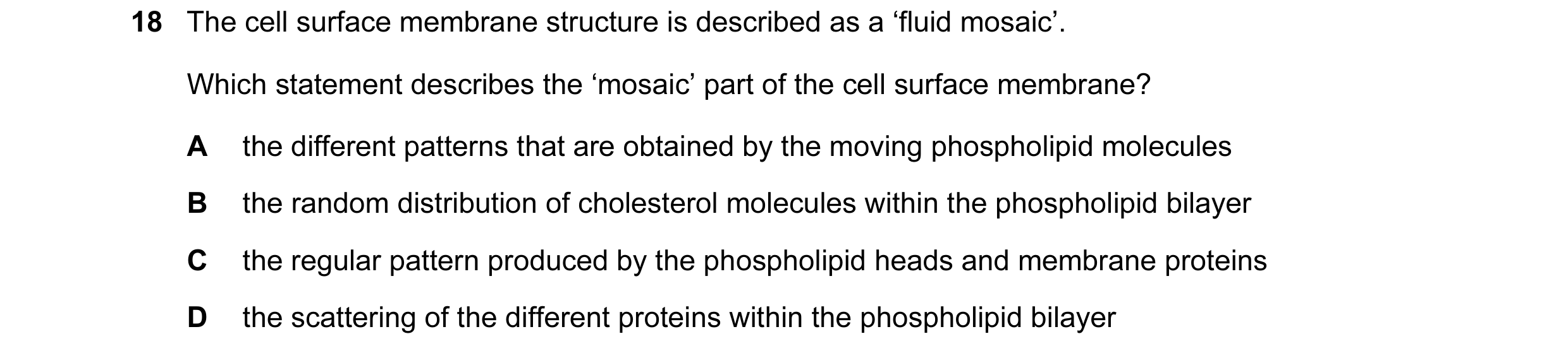
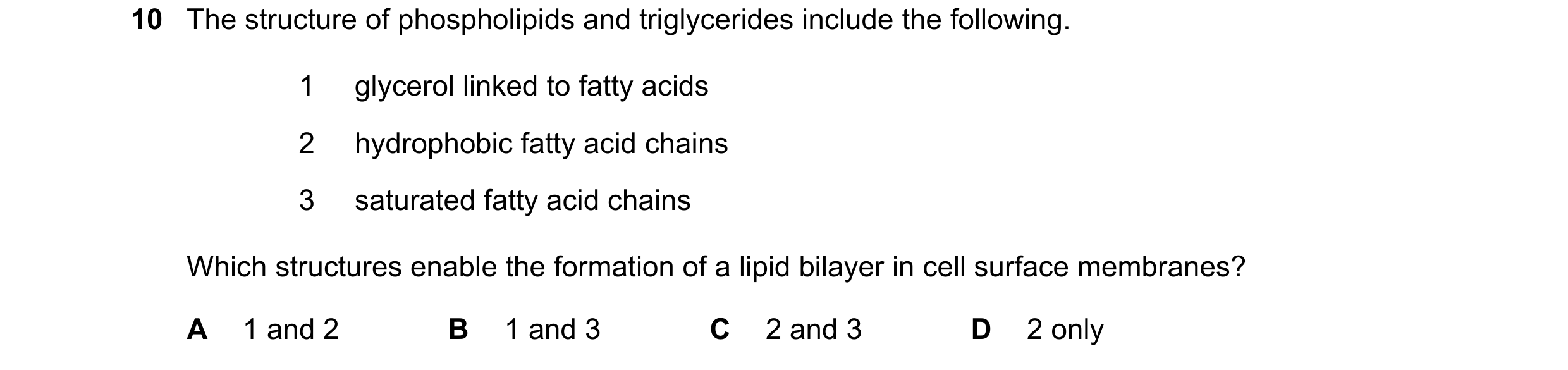
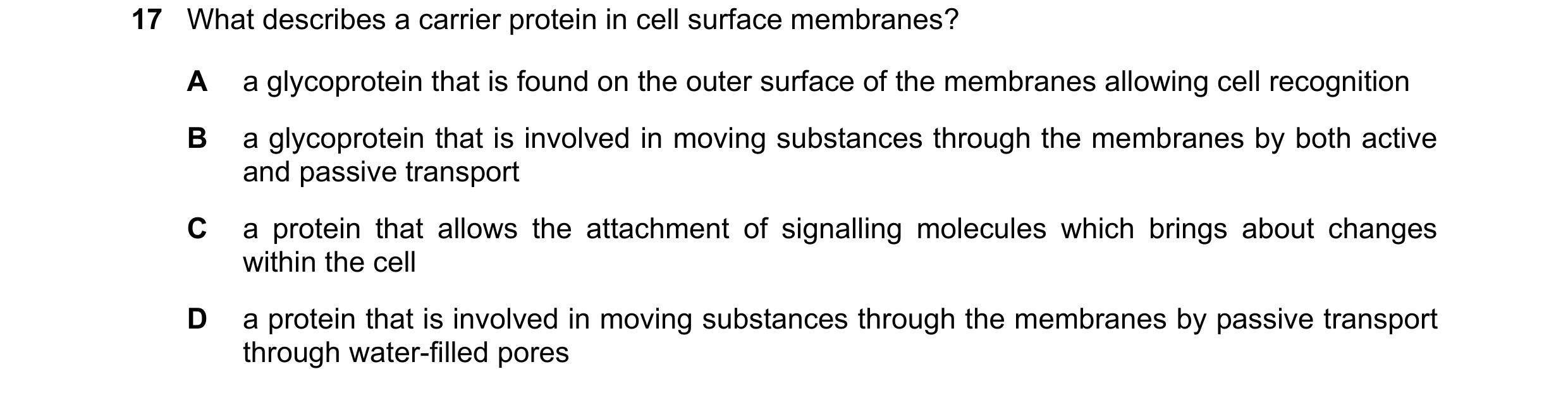 17 / 43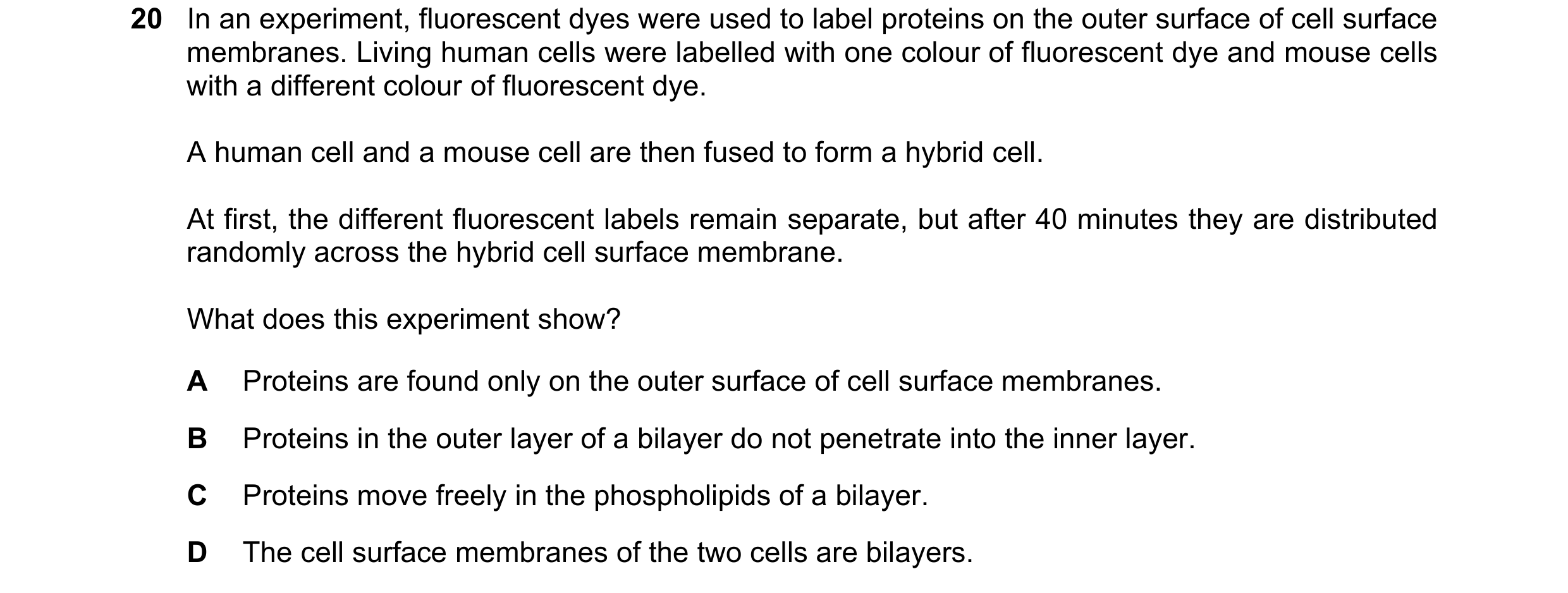
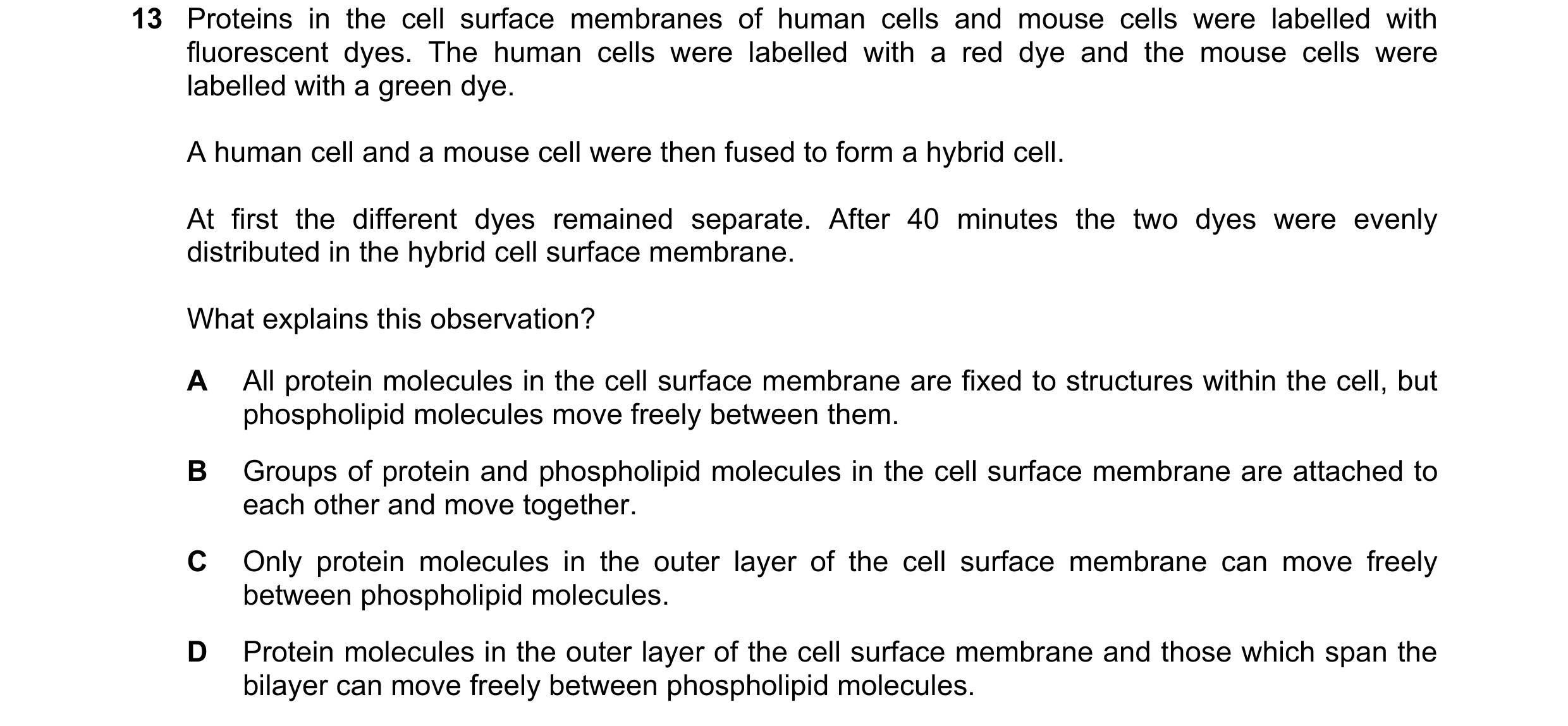
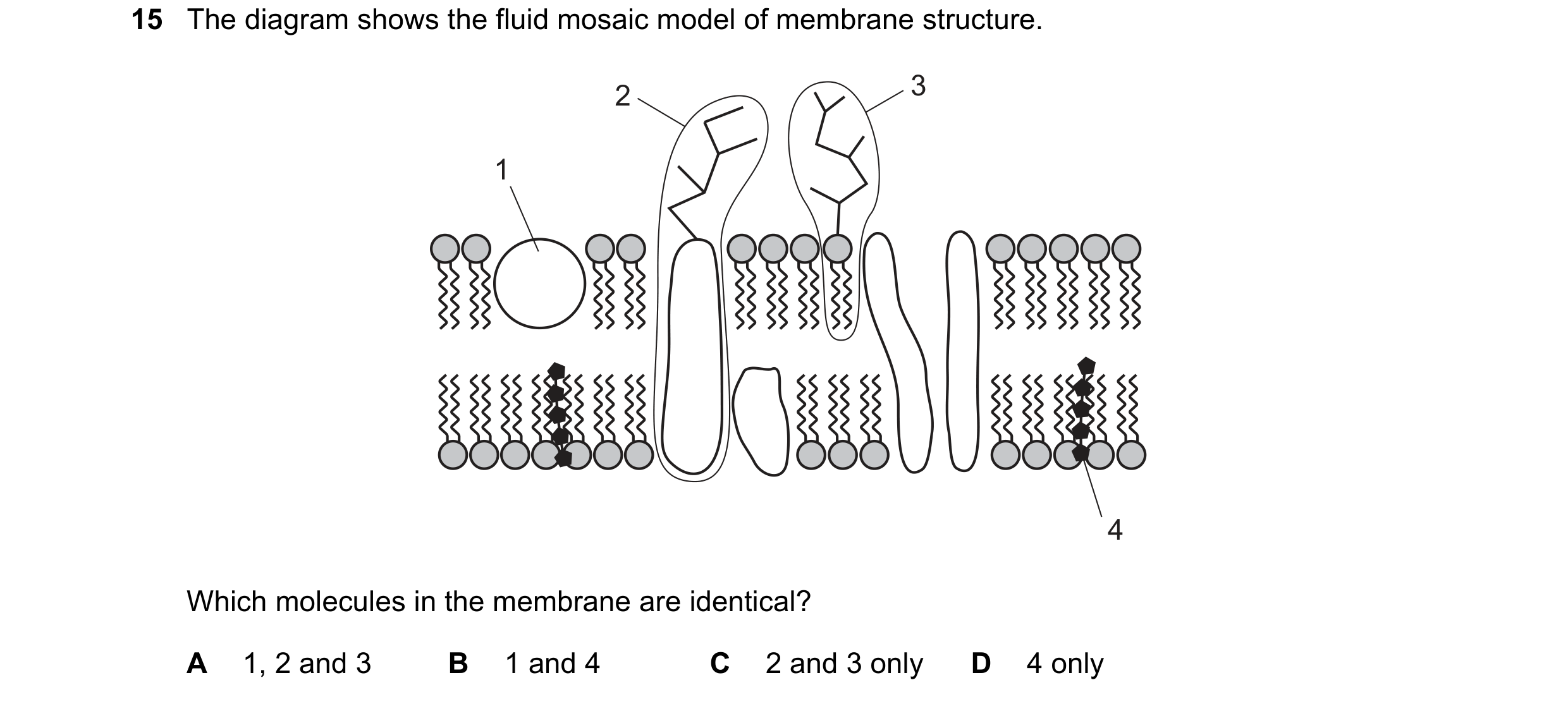 18 / 43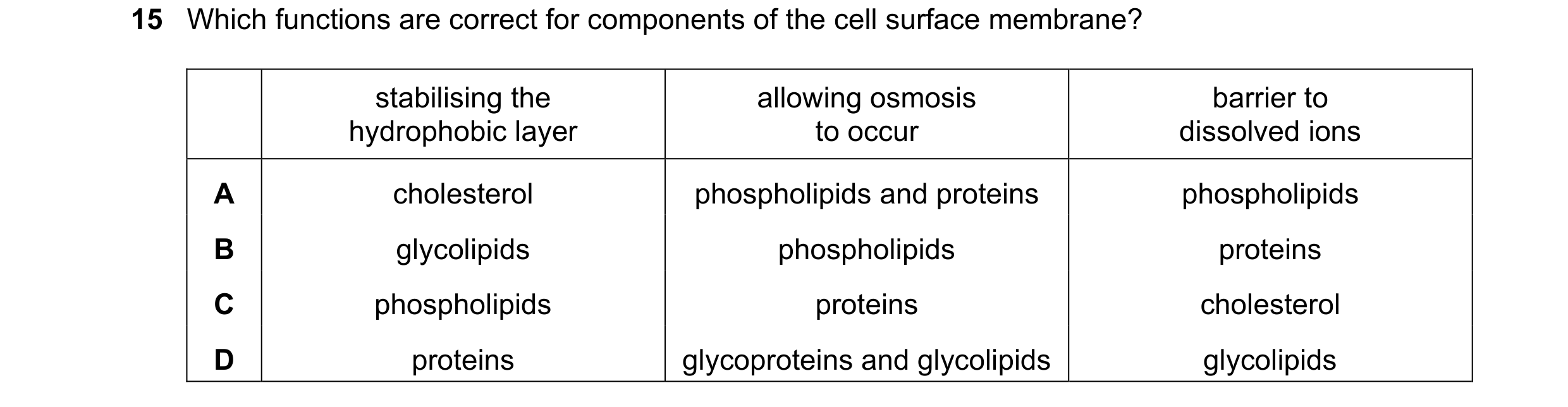
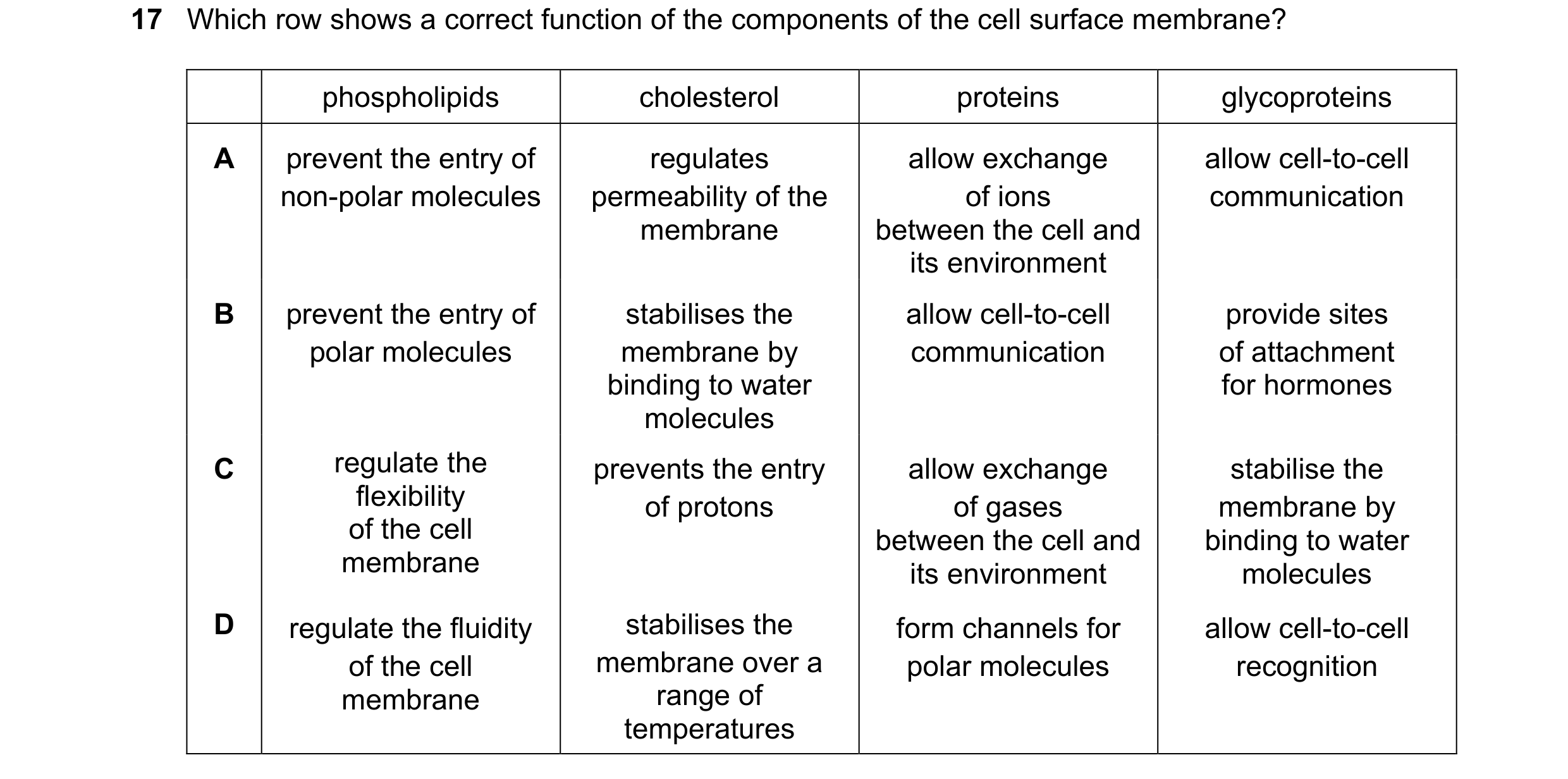
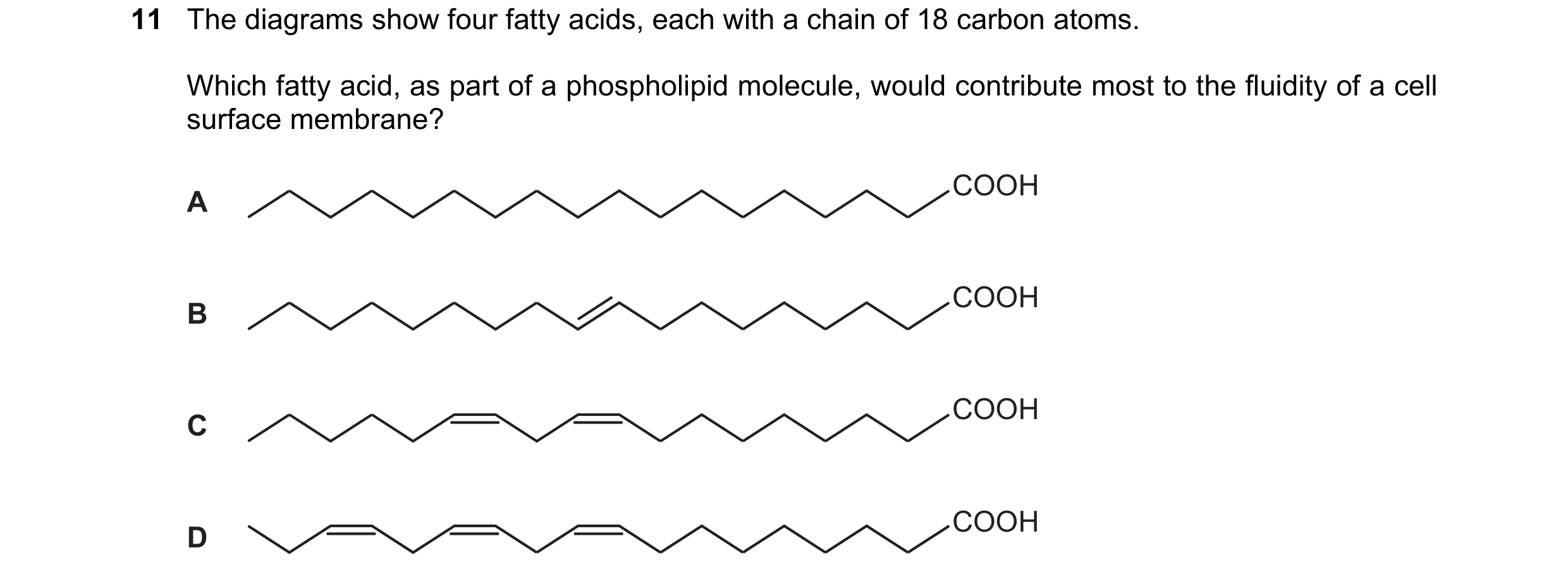 19 / 43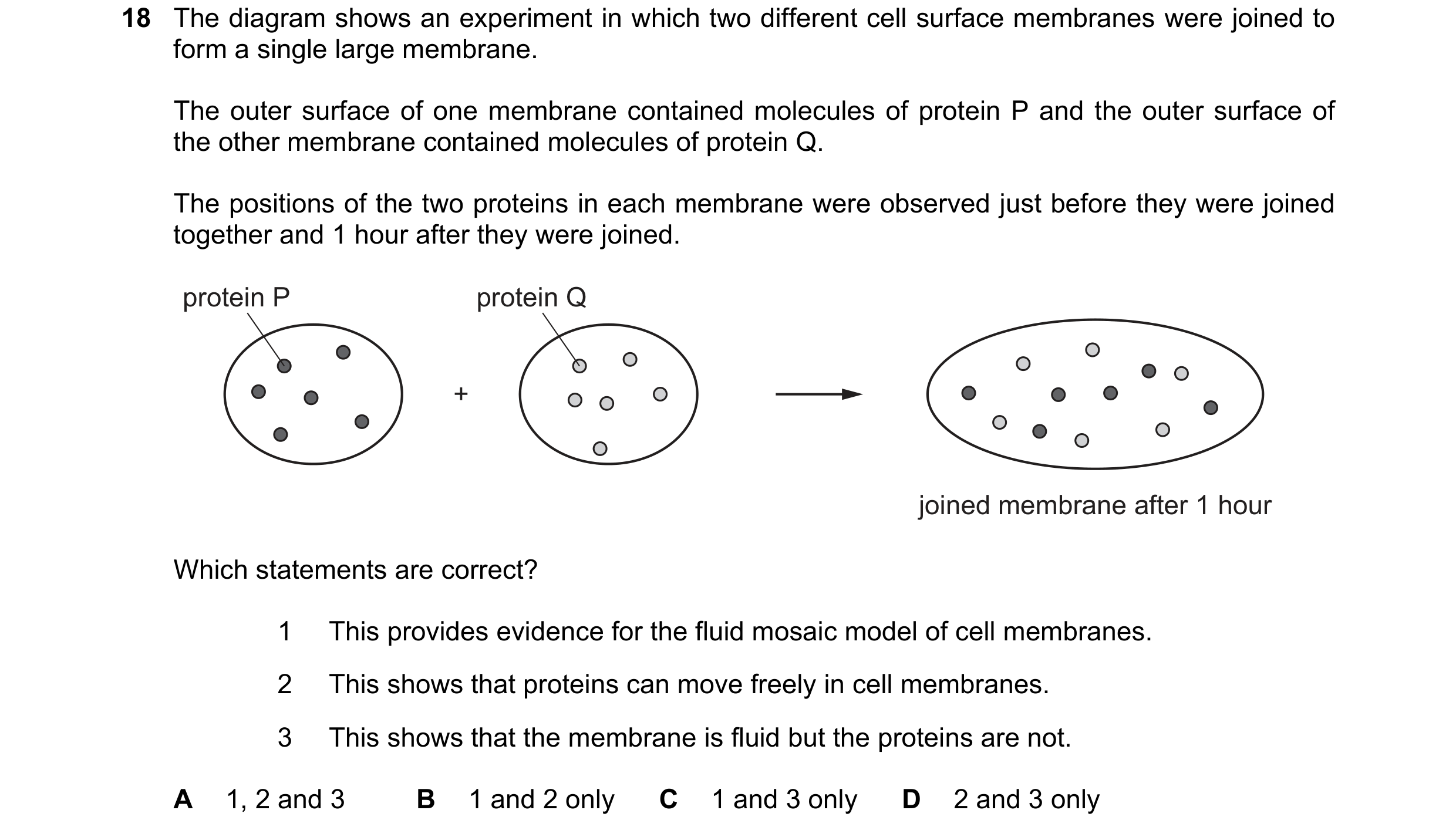
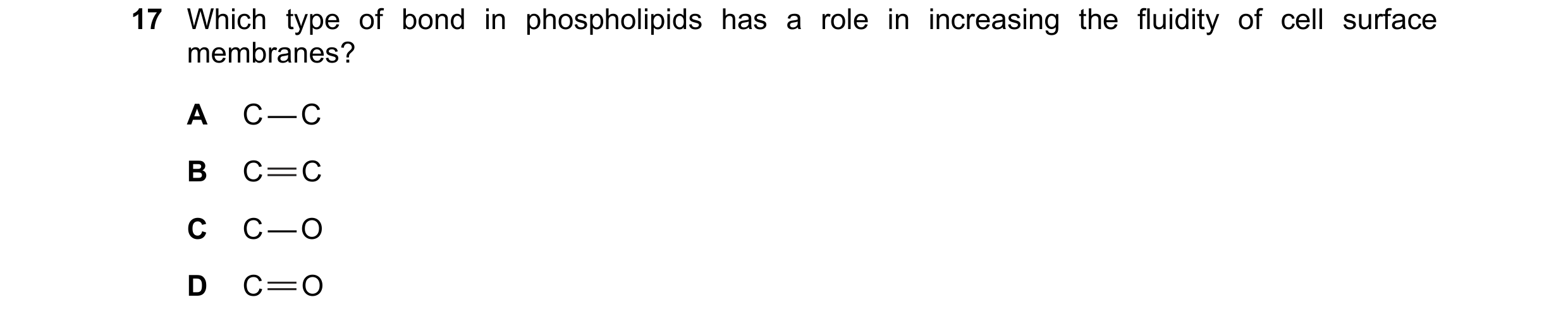
 20 / 43

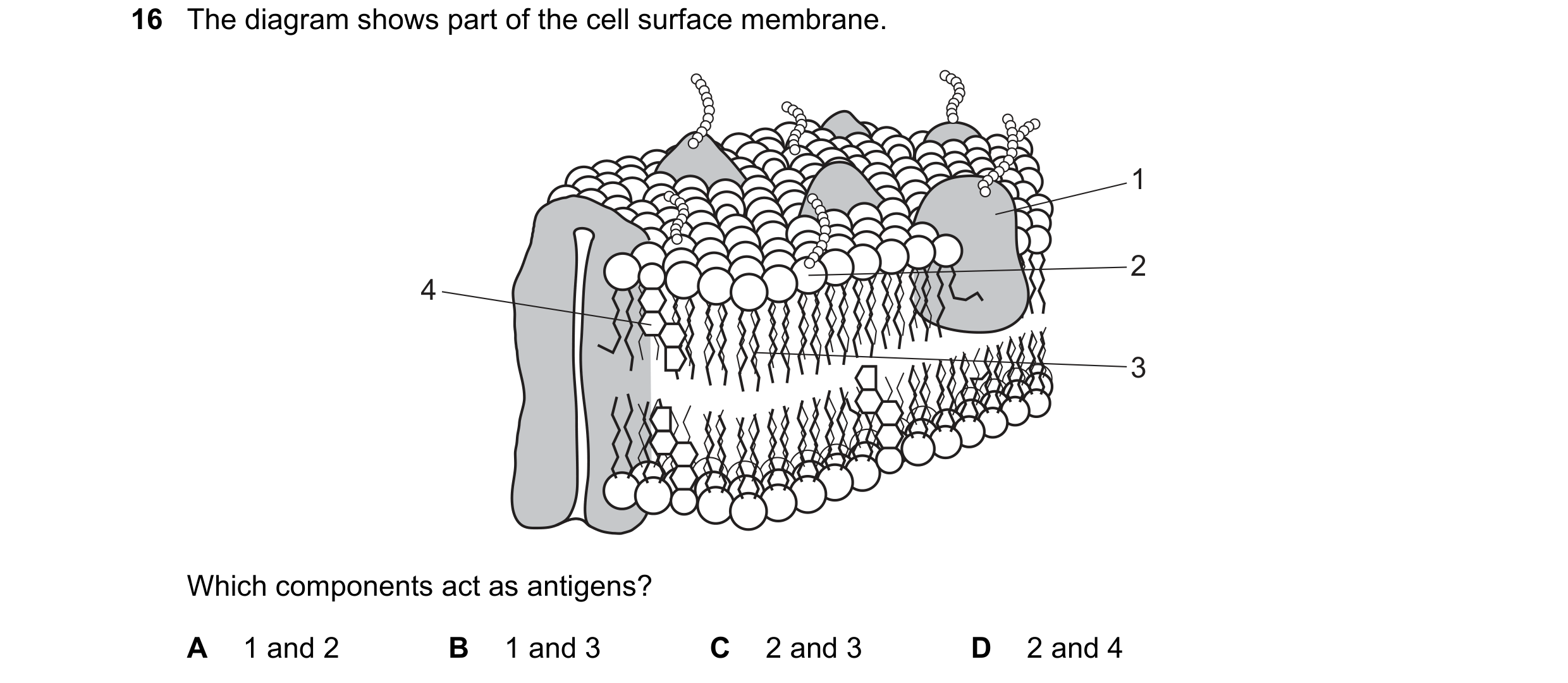 21 / 43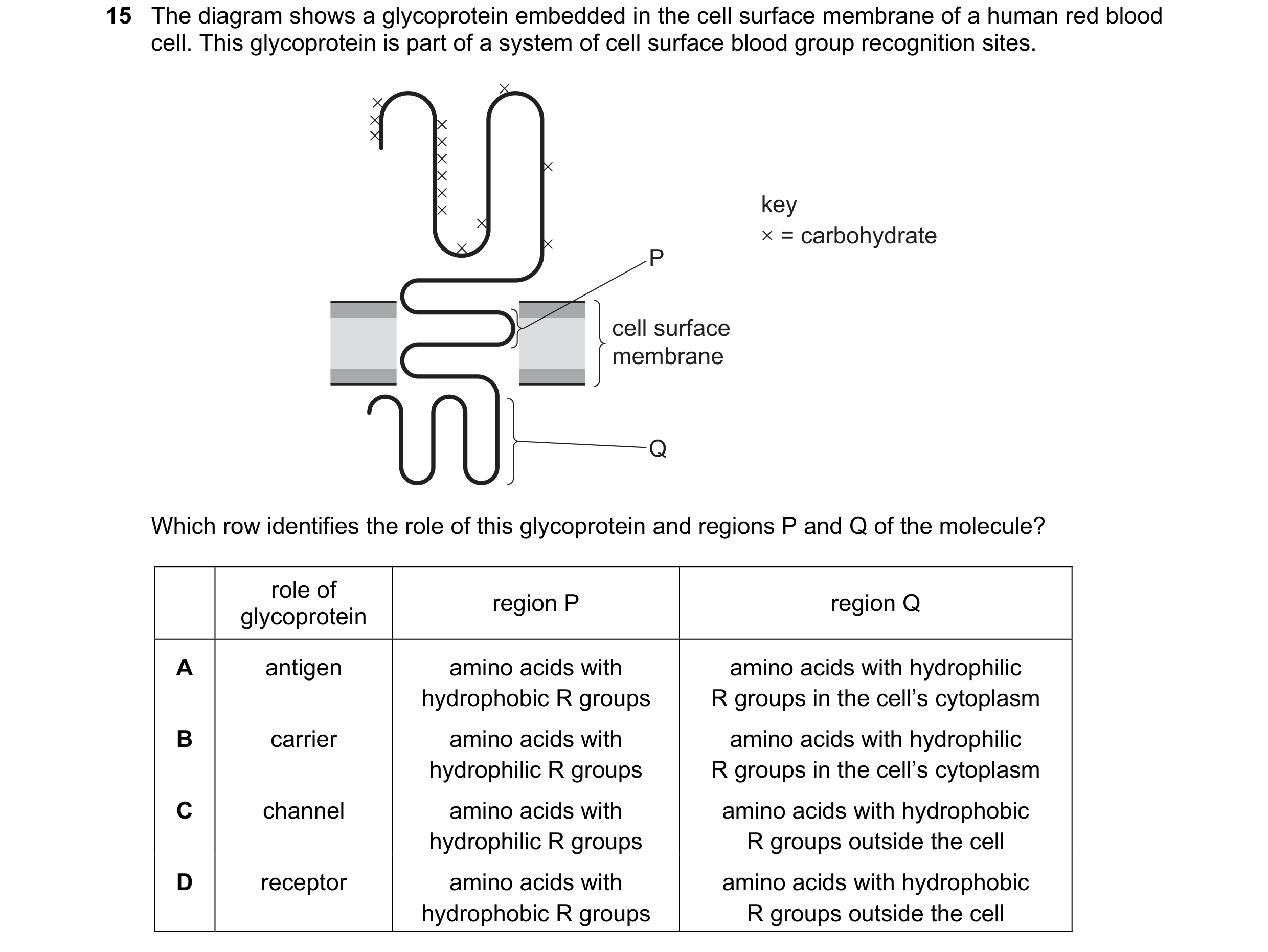
 22 / 43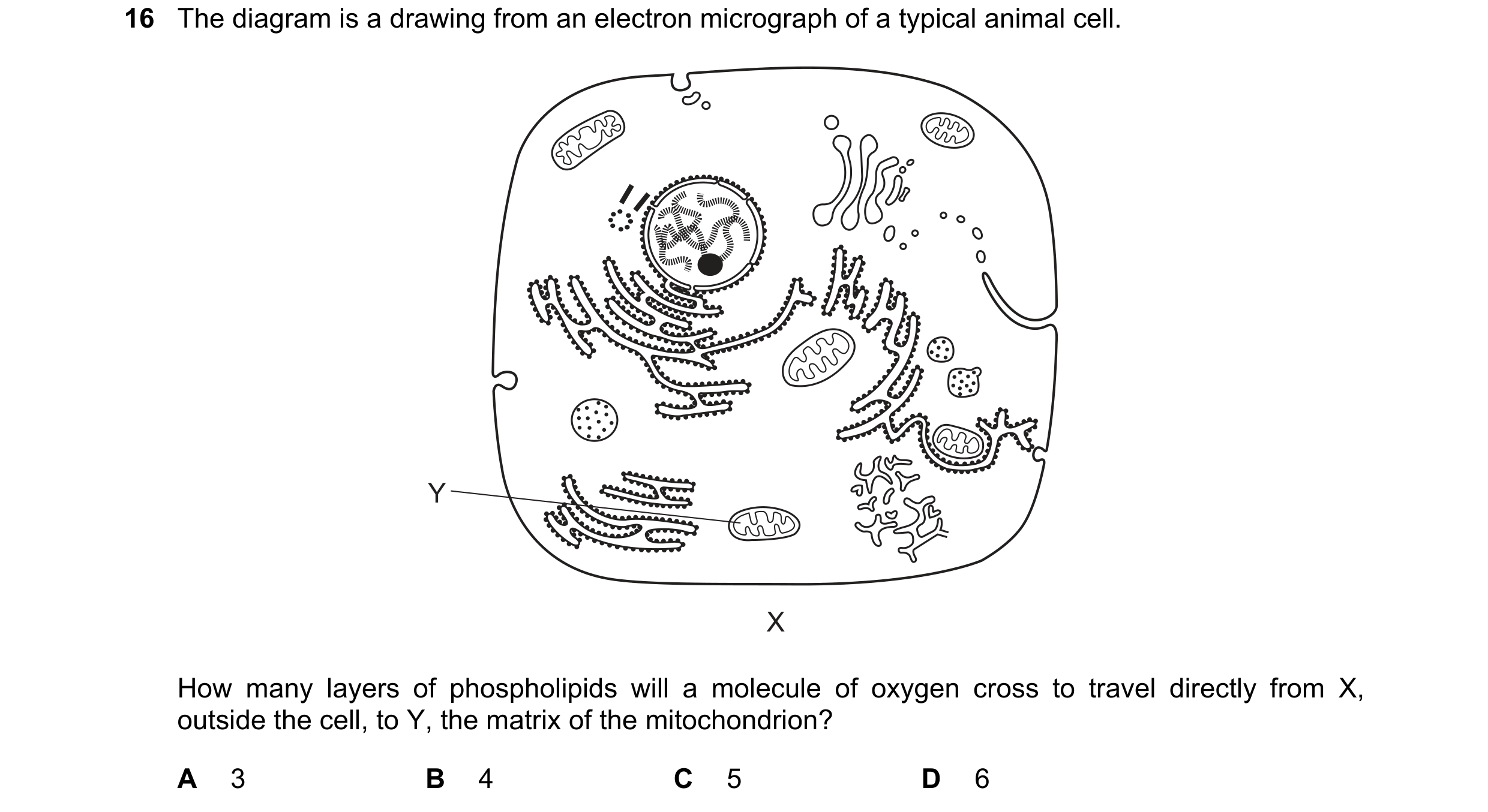
 23 / 43
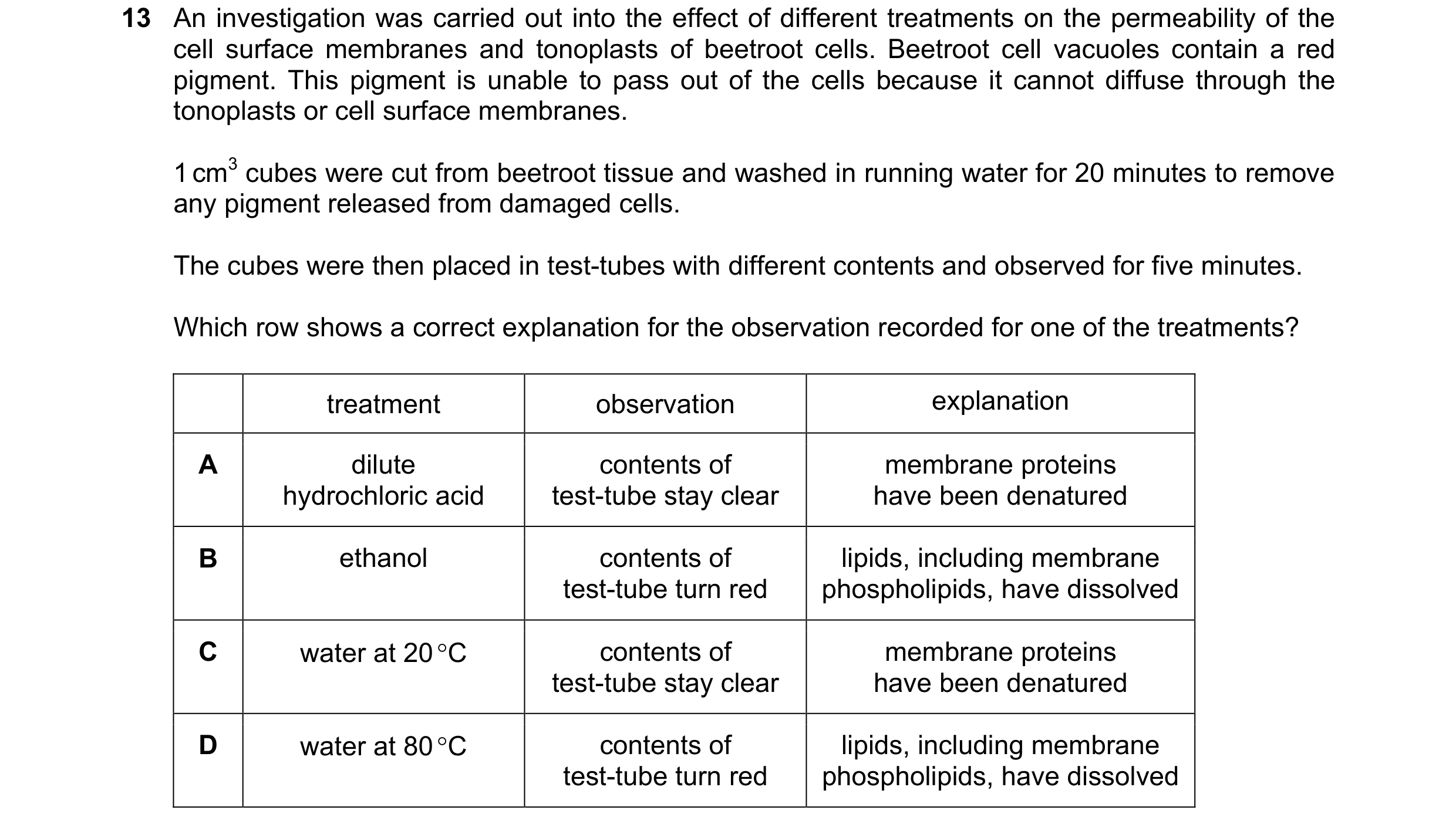 24 / 43
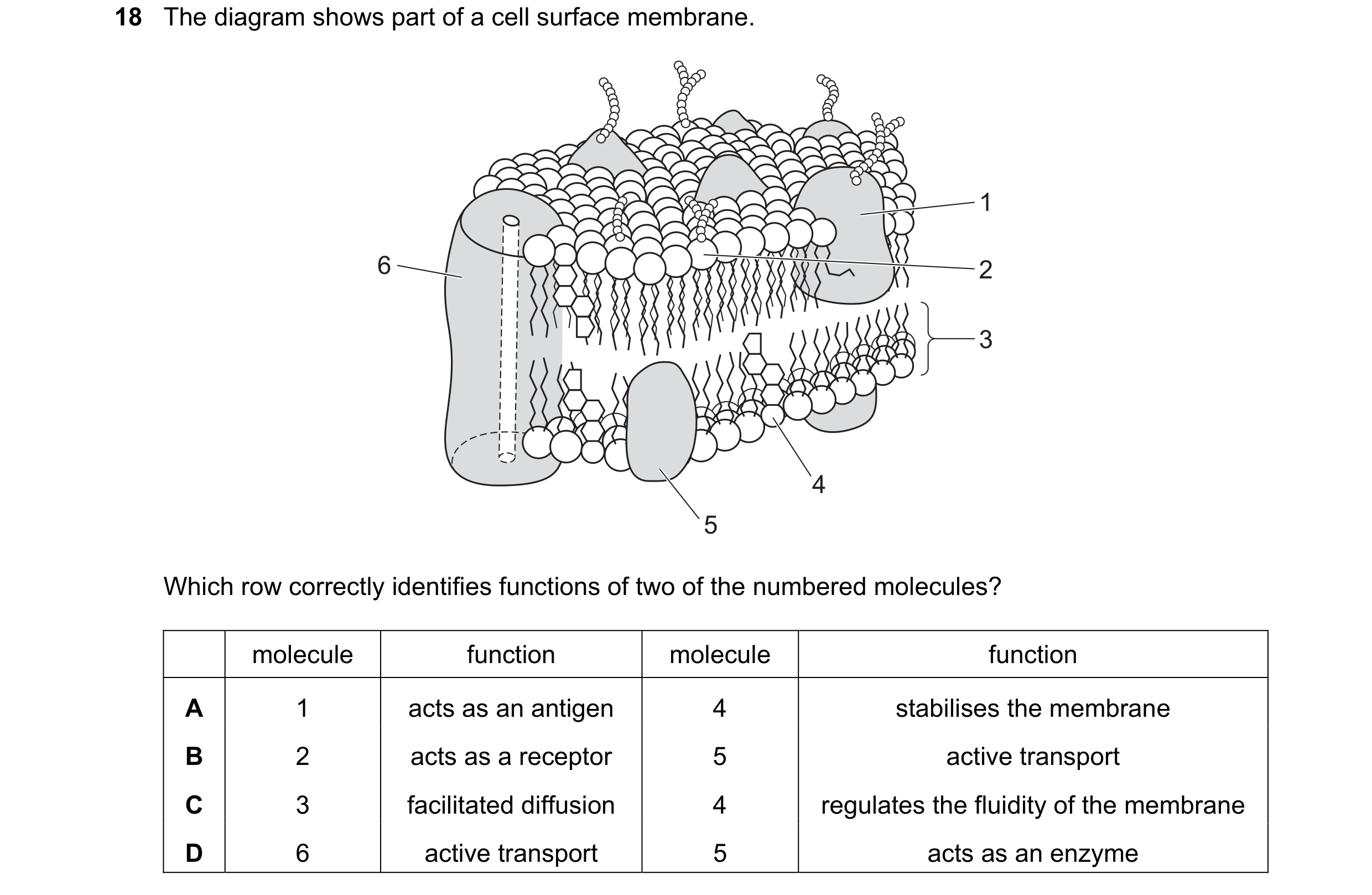 25 / 43
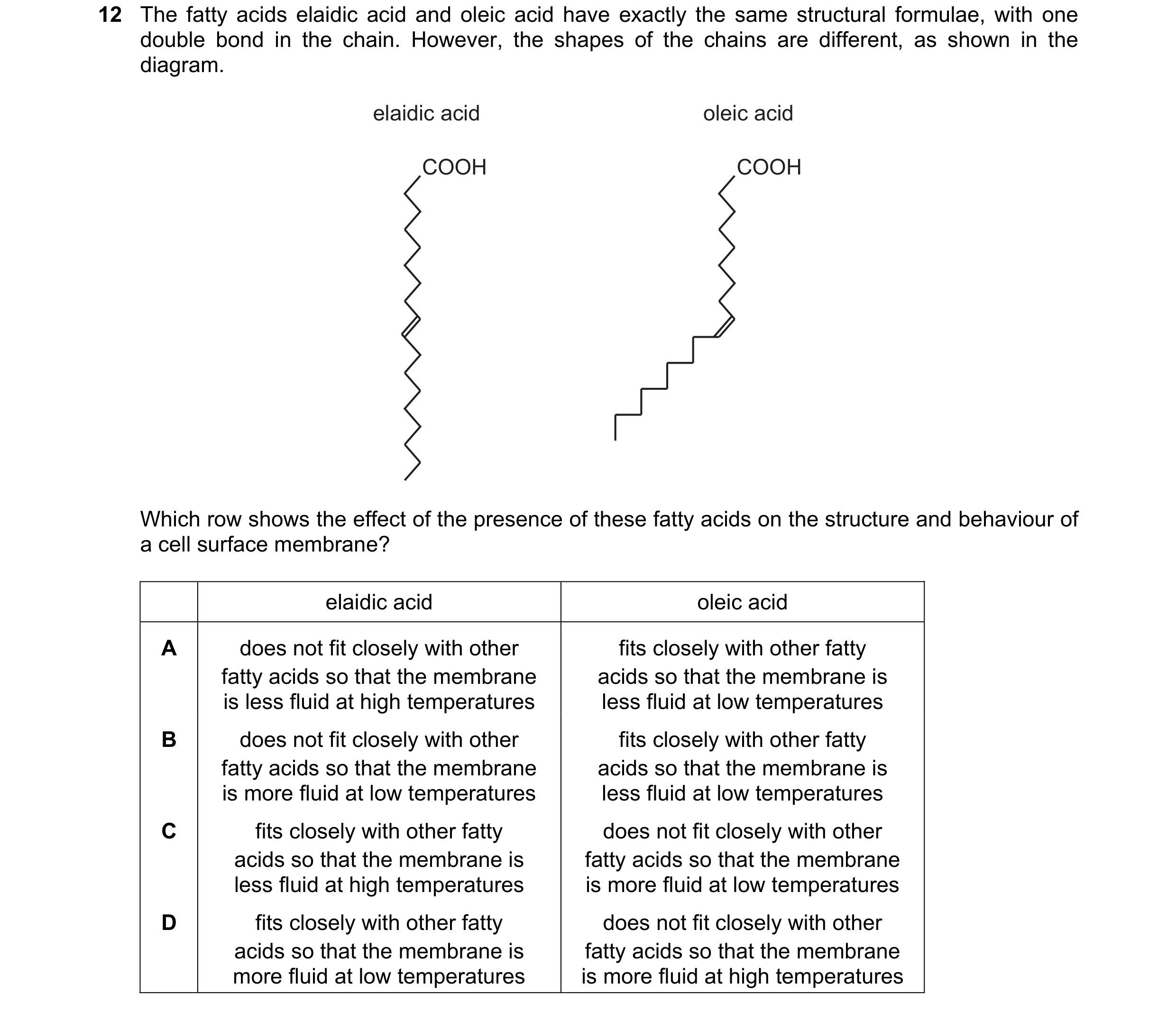 26 / 43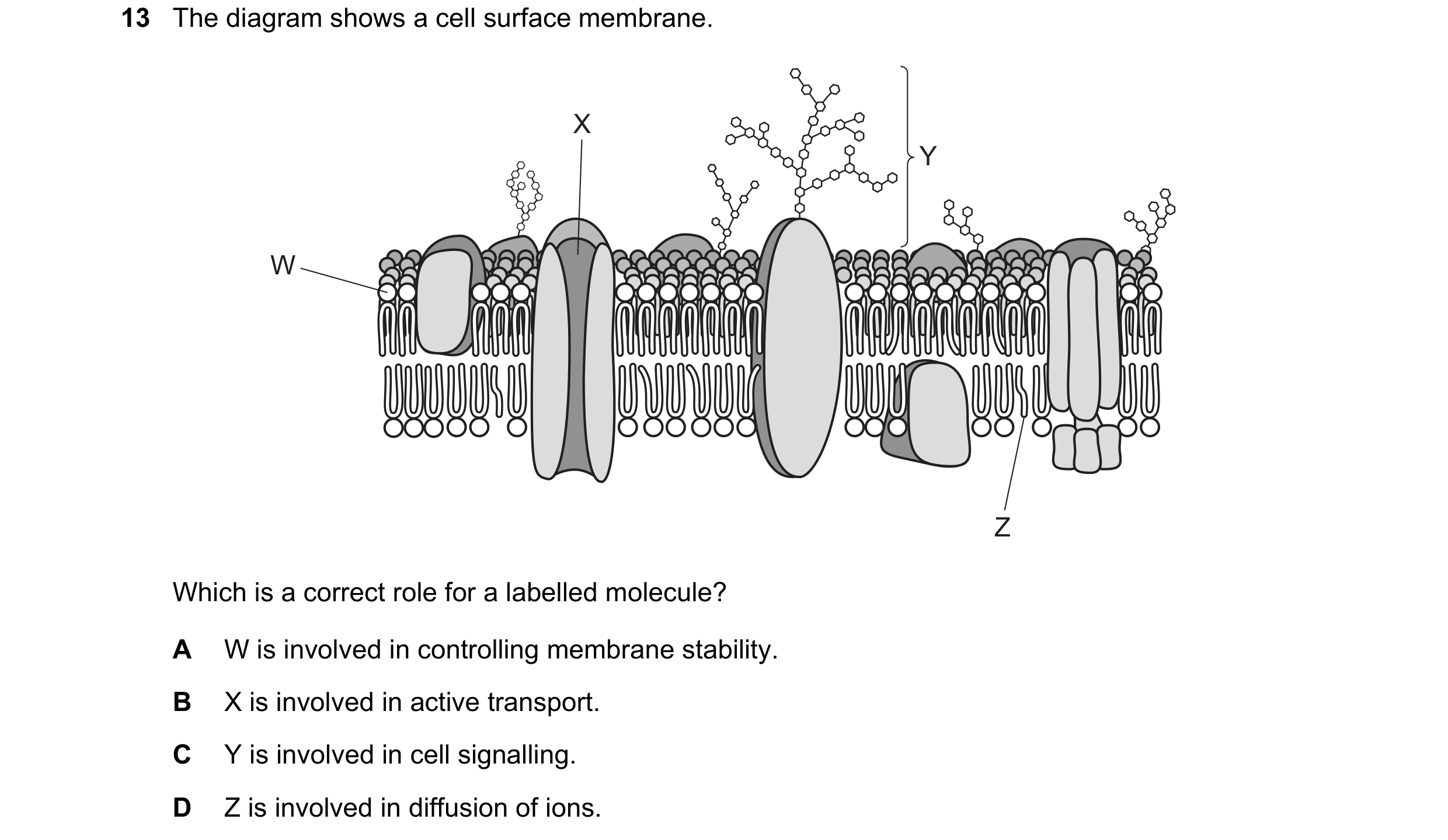
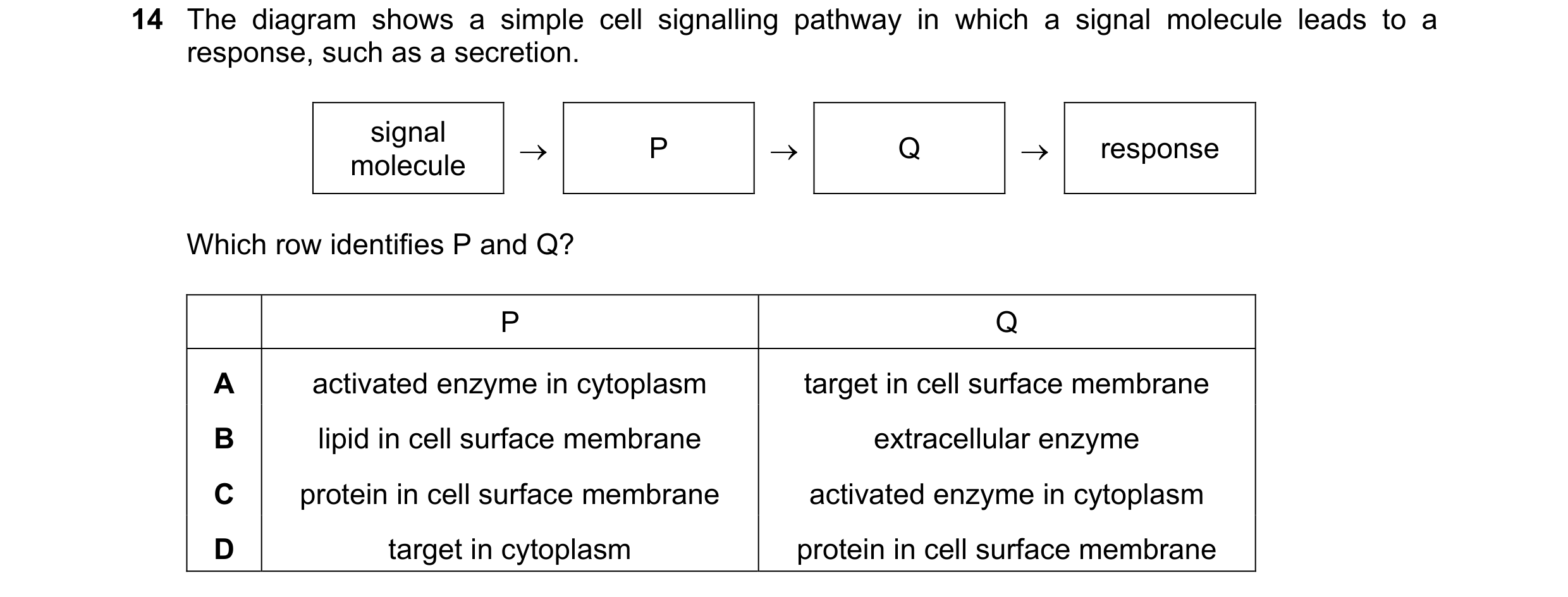
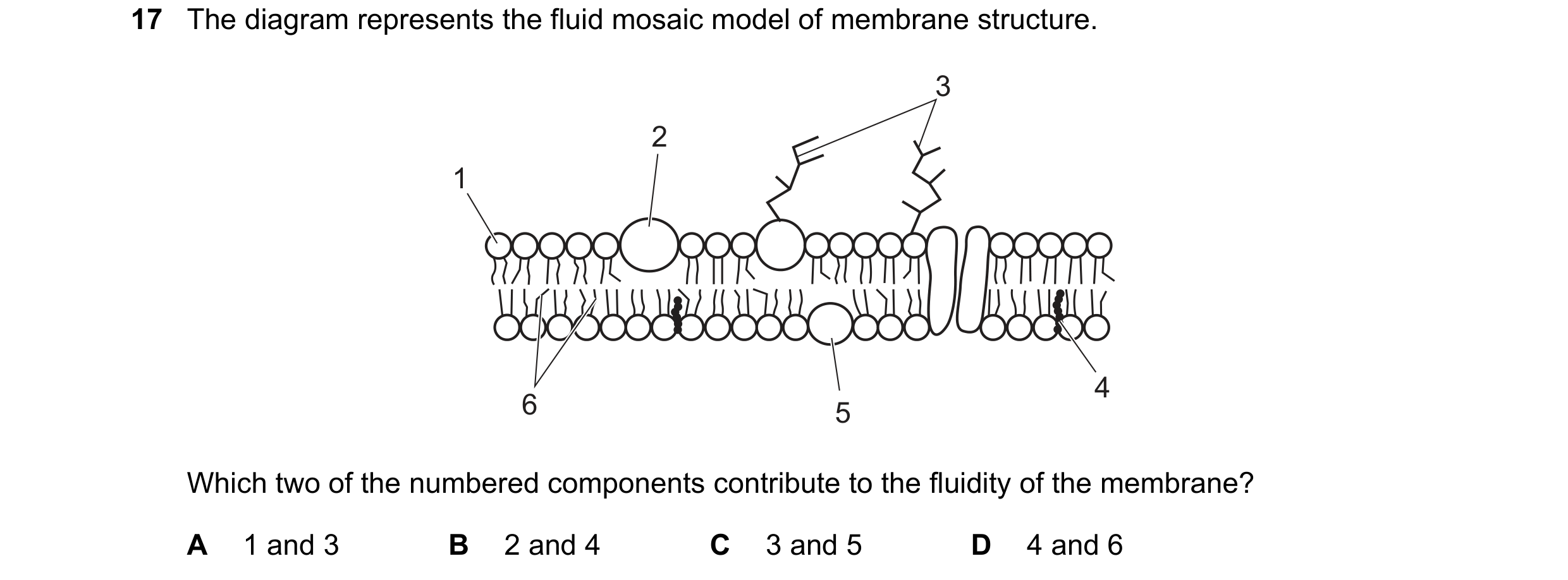 27 / 43
 28 / 43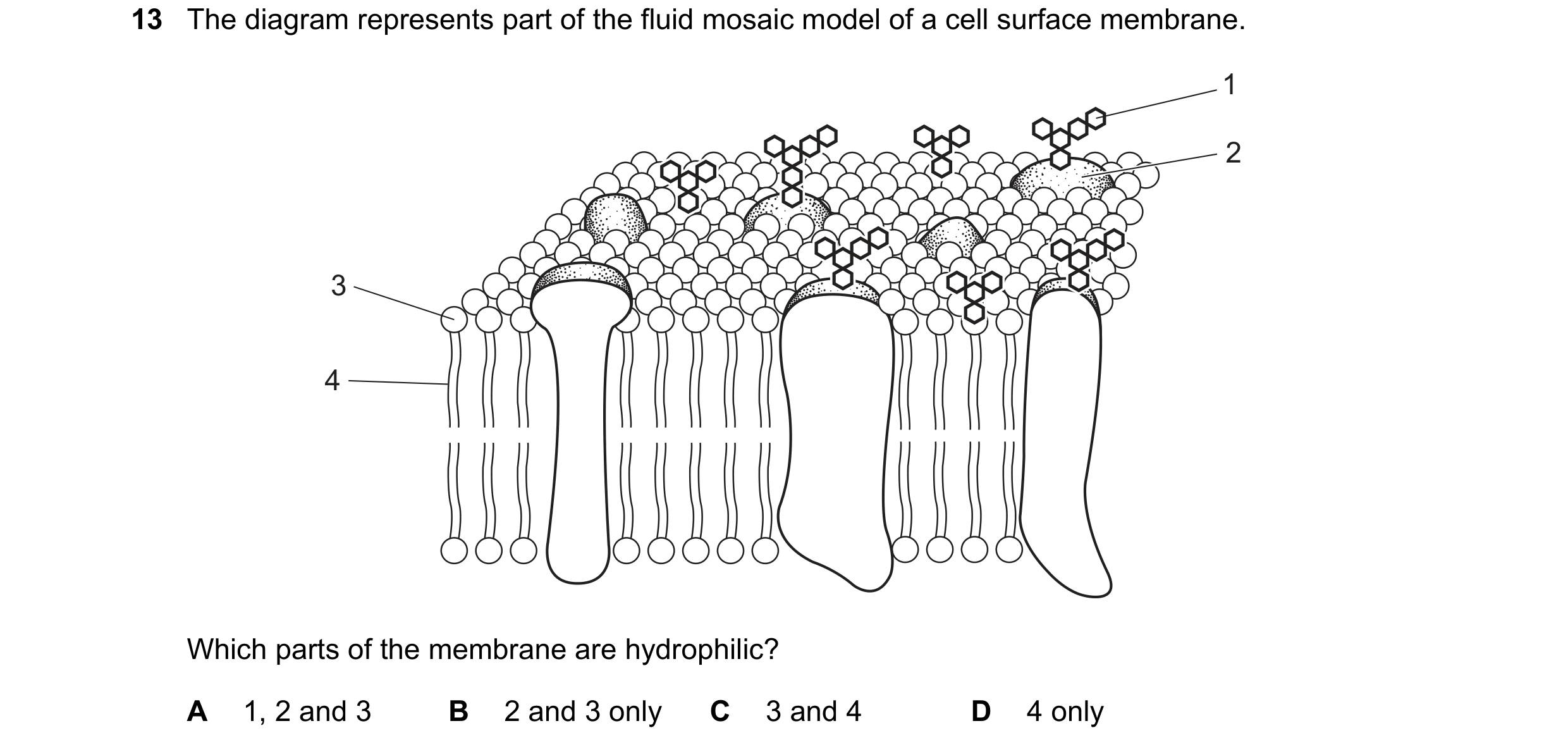
 29 / 43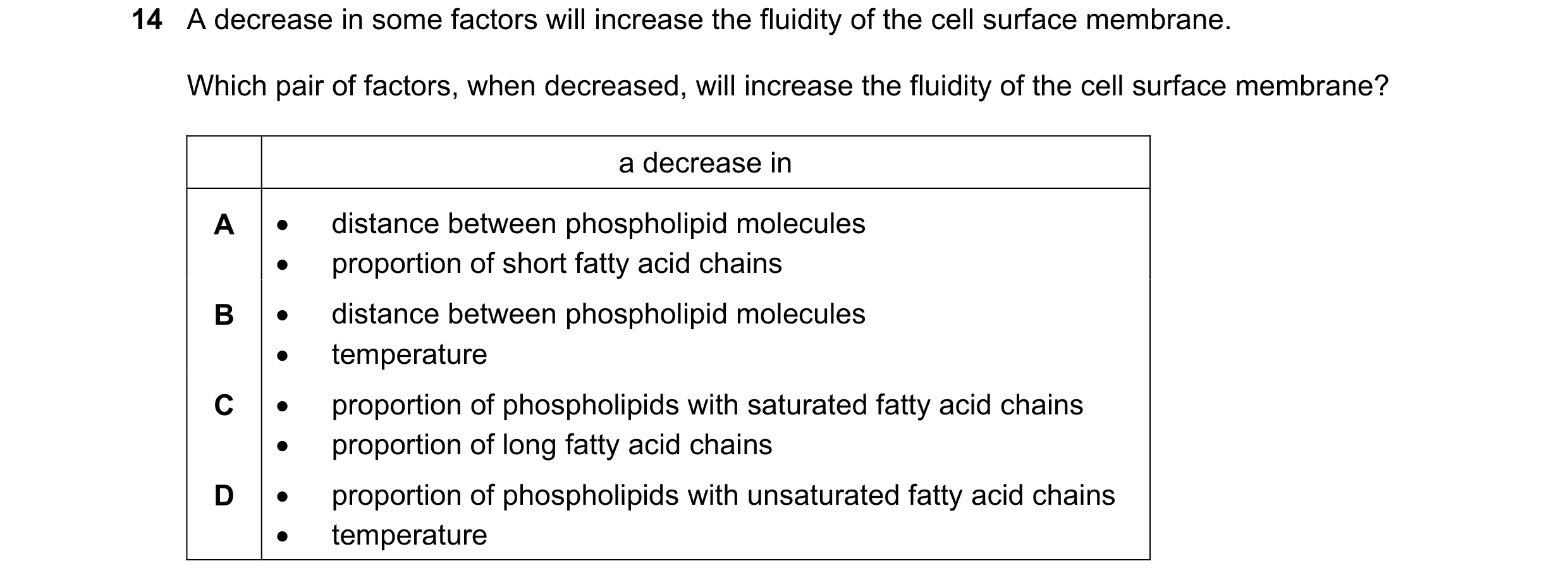
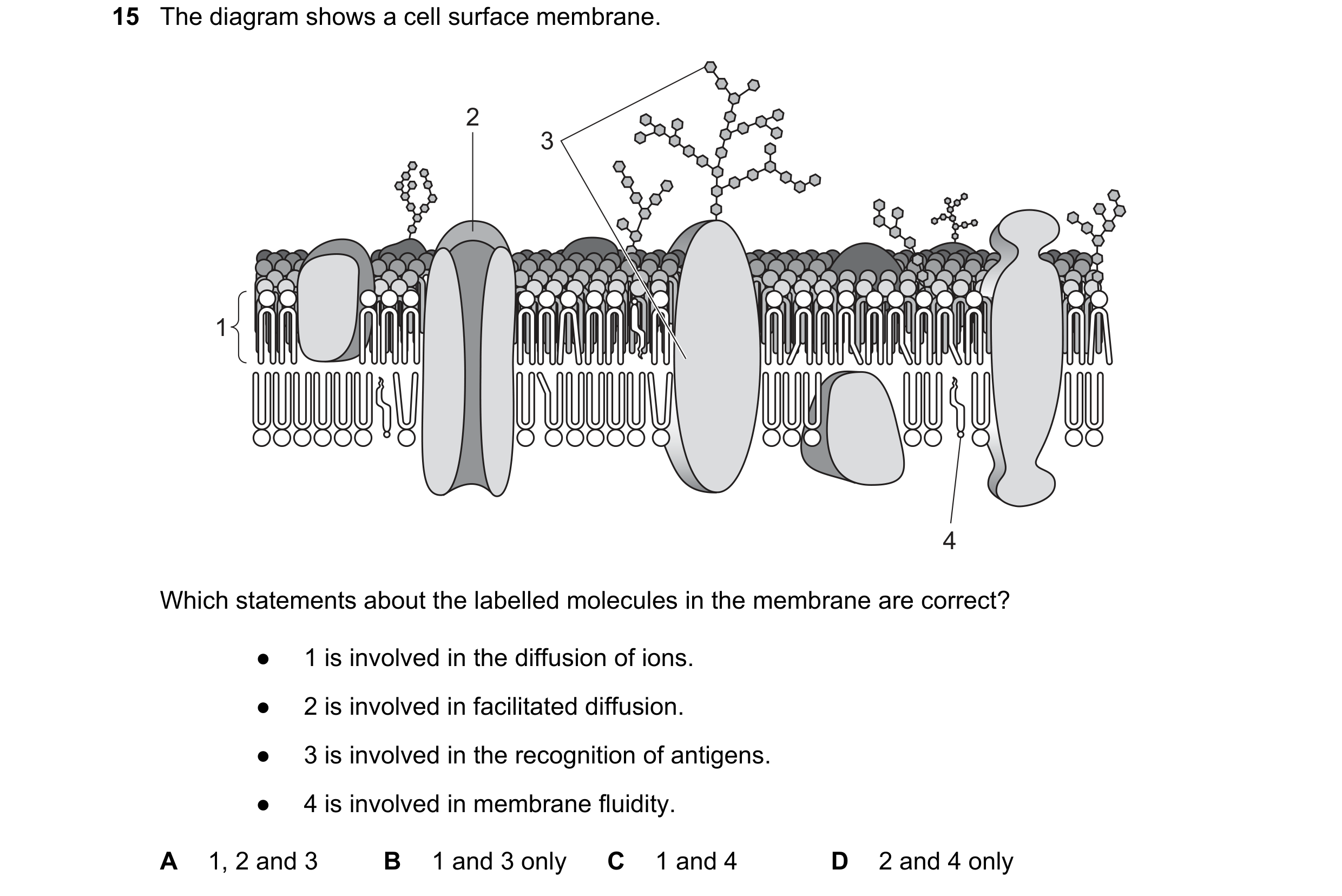 30 / 43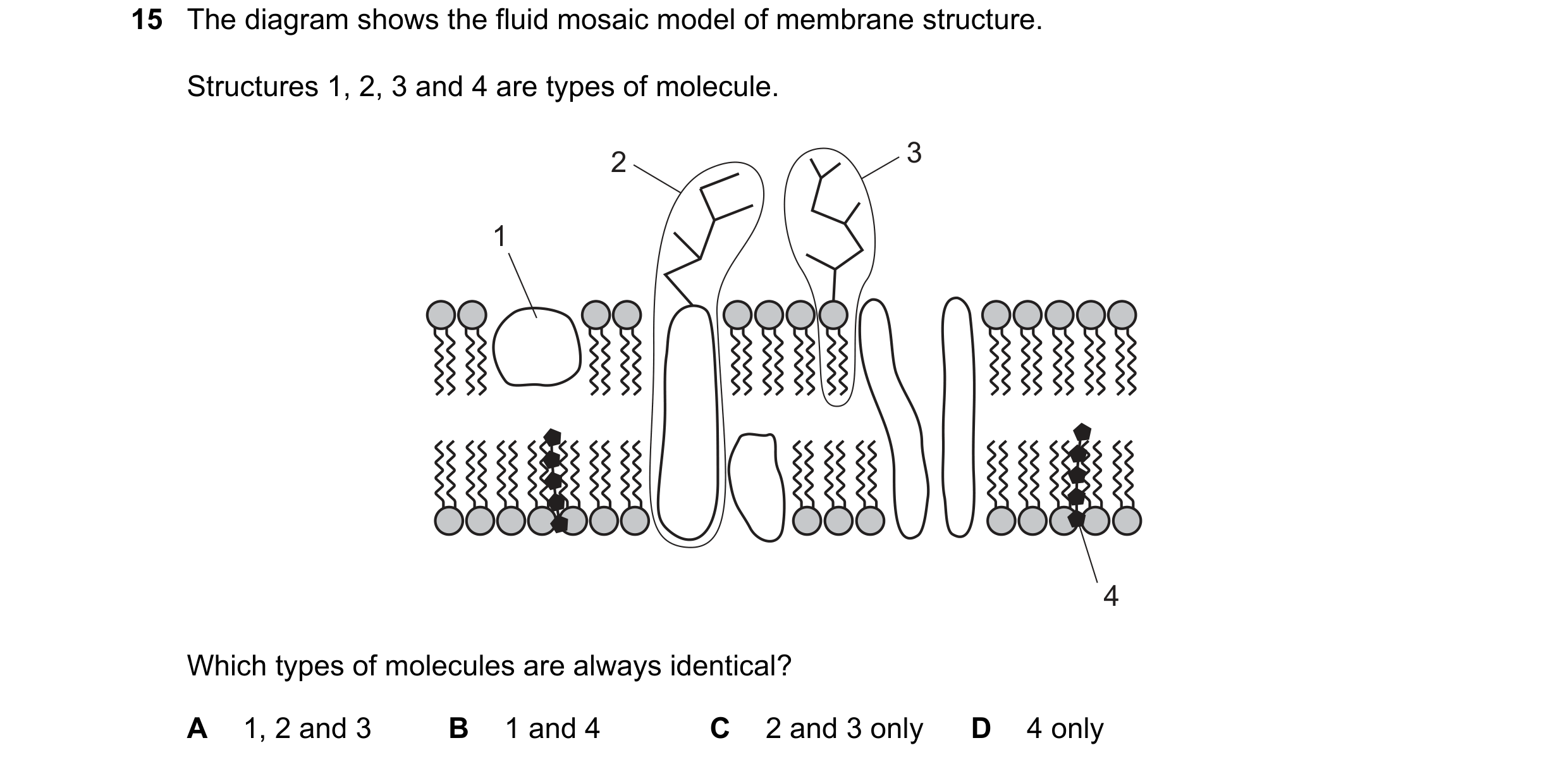

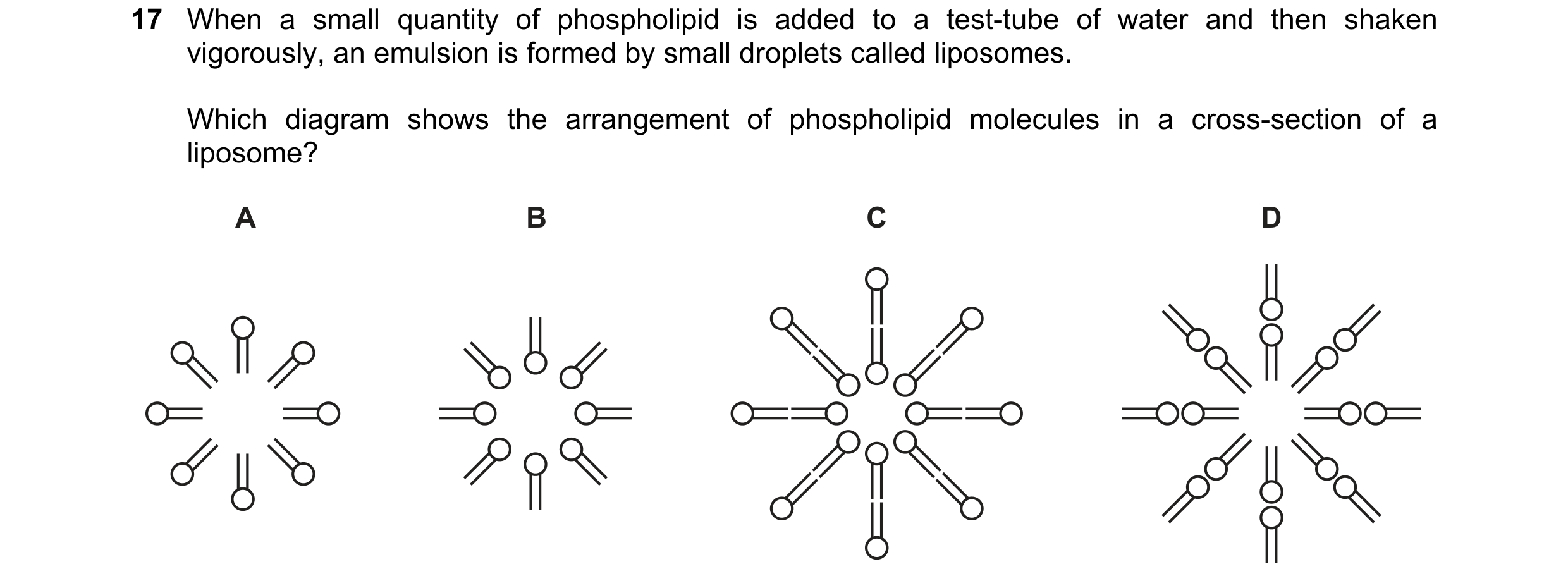
 31 / 43
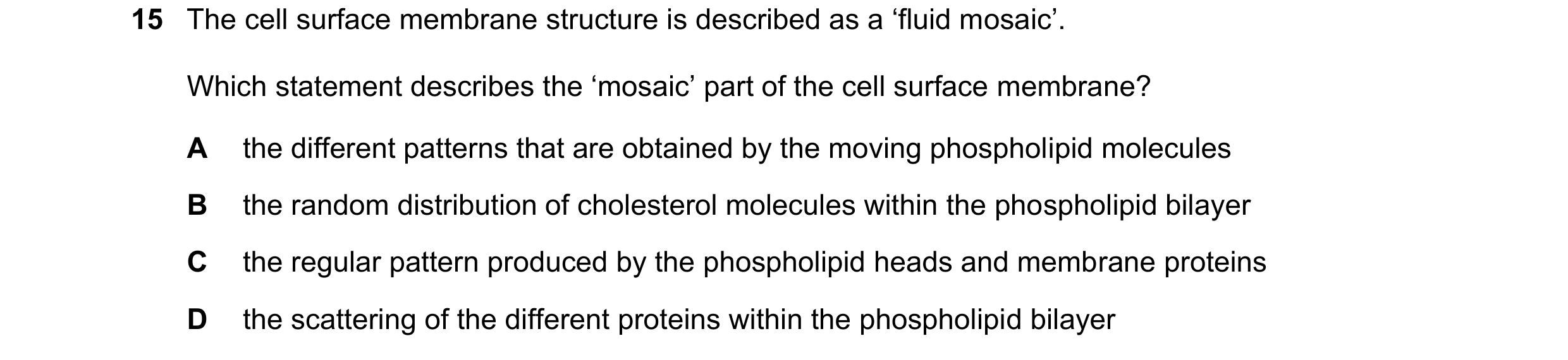
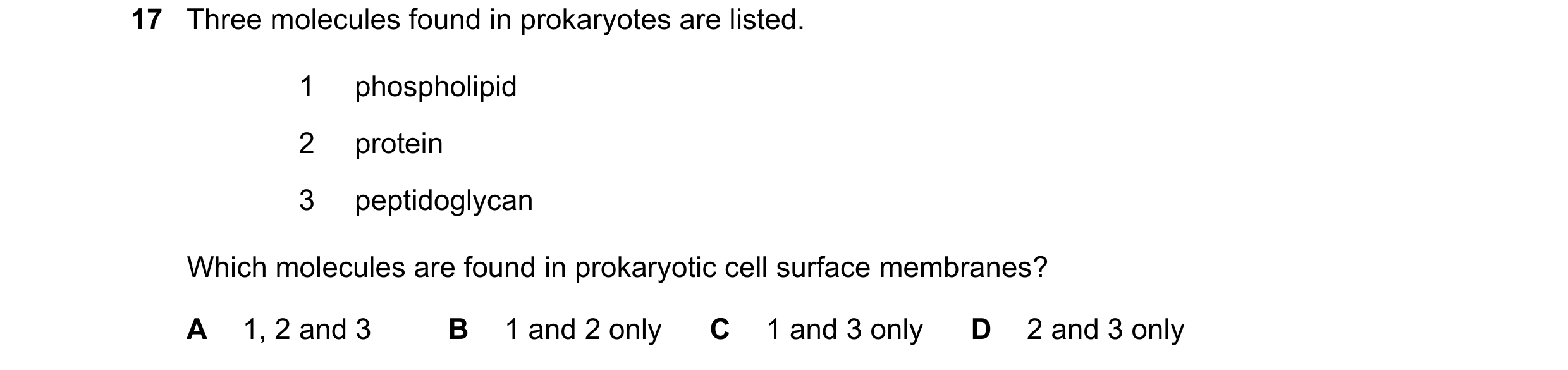 32 / 43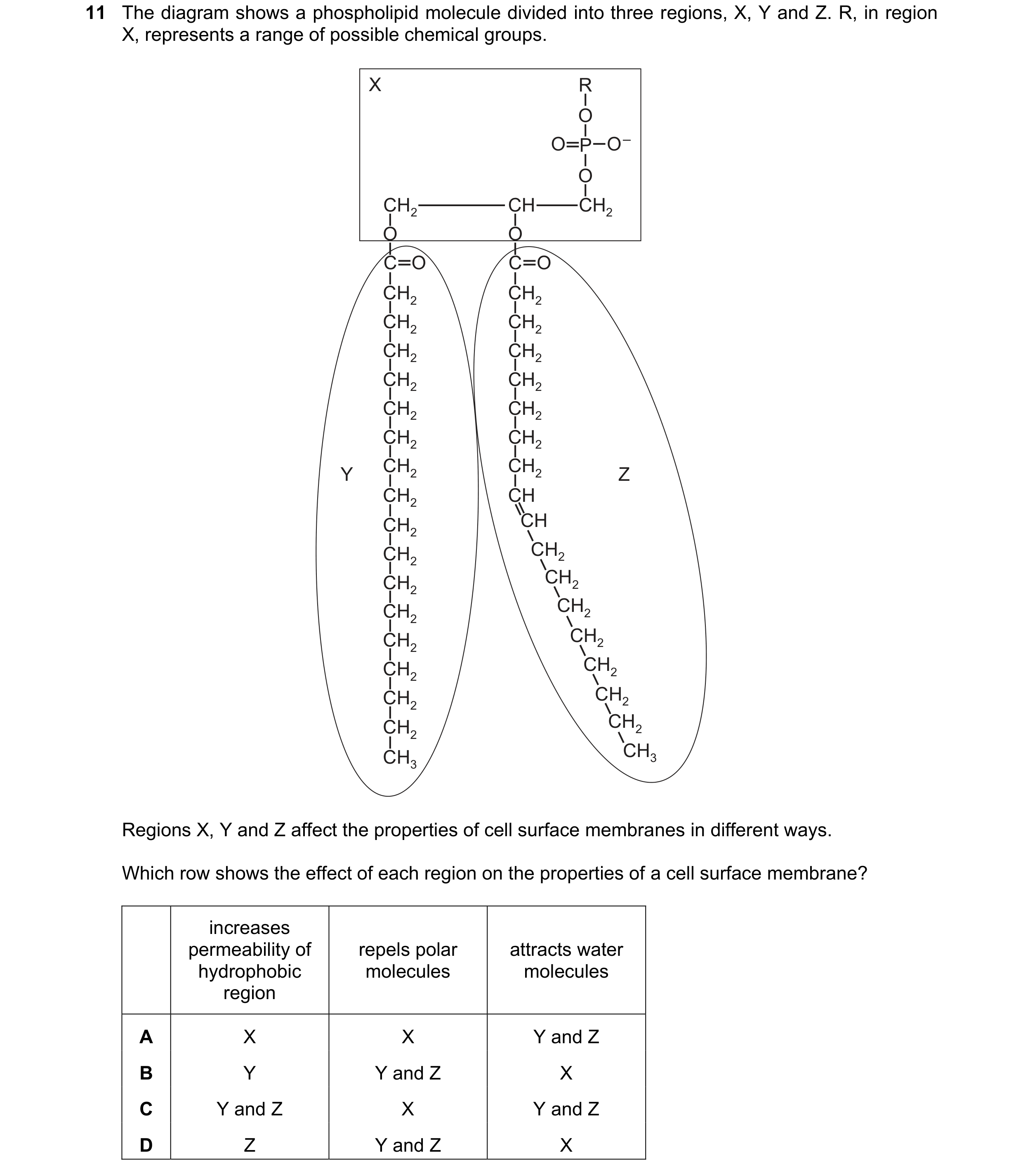
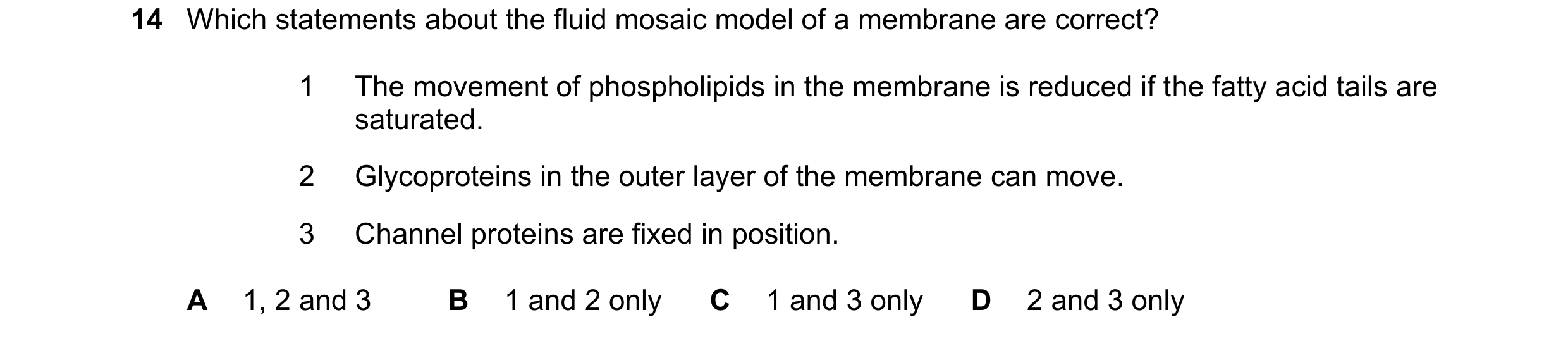 33 / 43
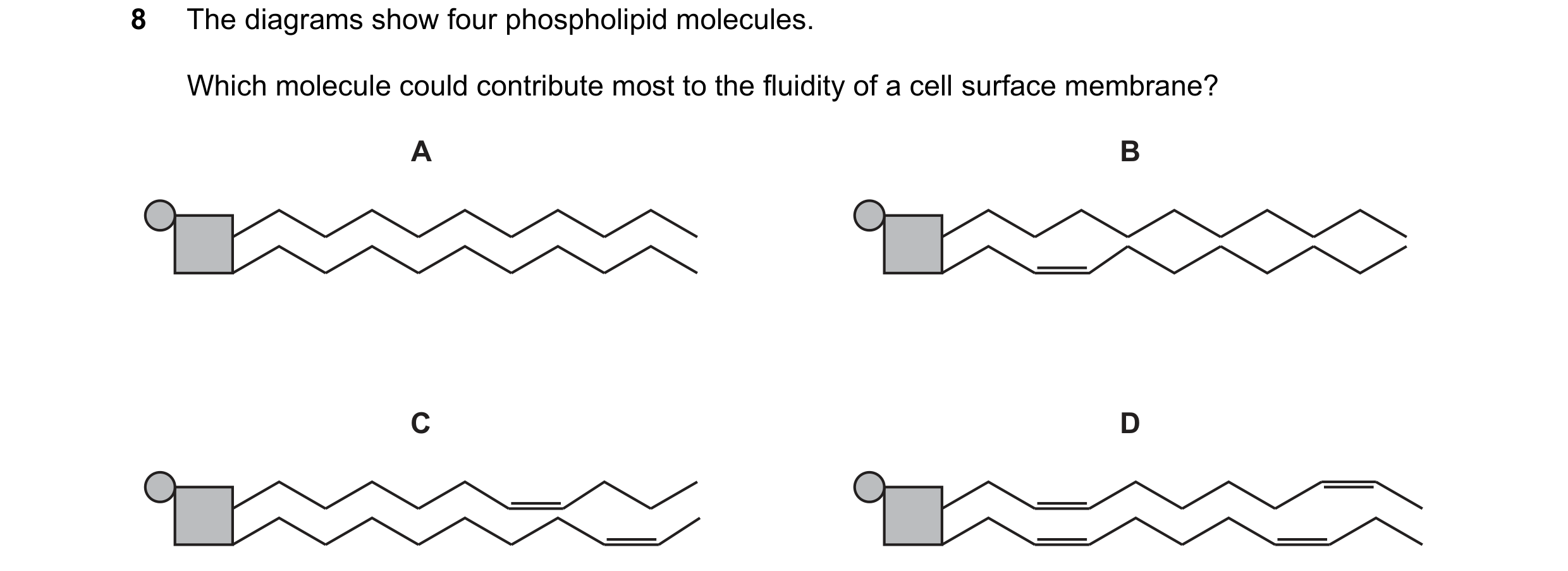 34 / 43

 35 / 43
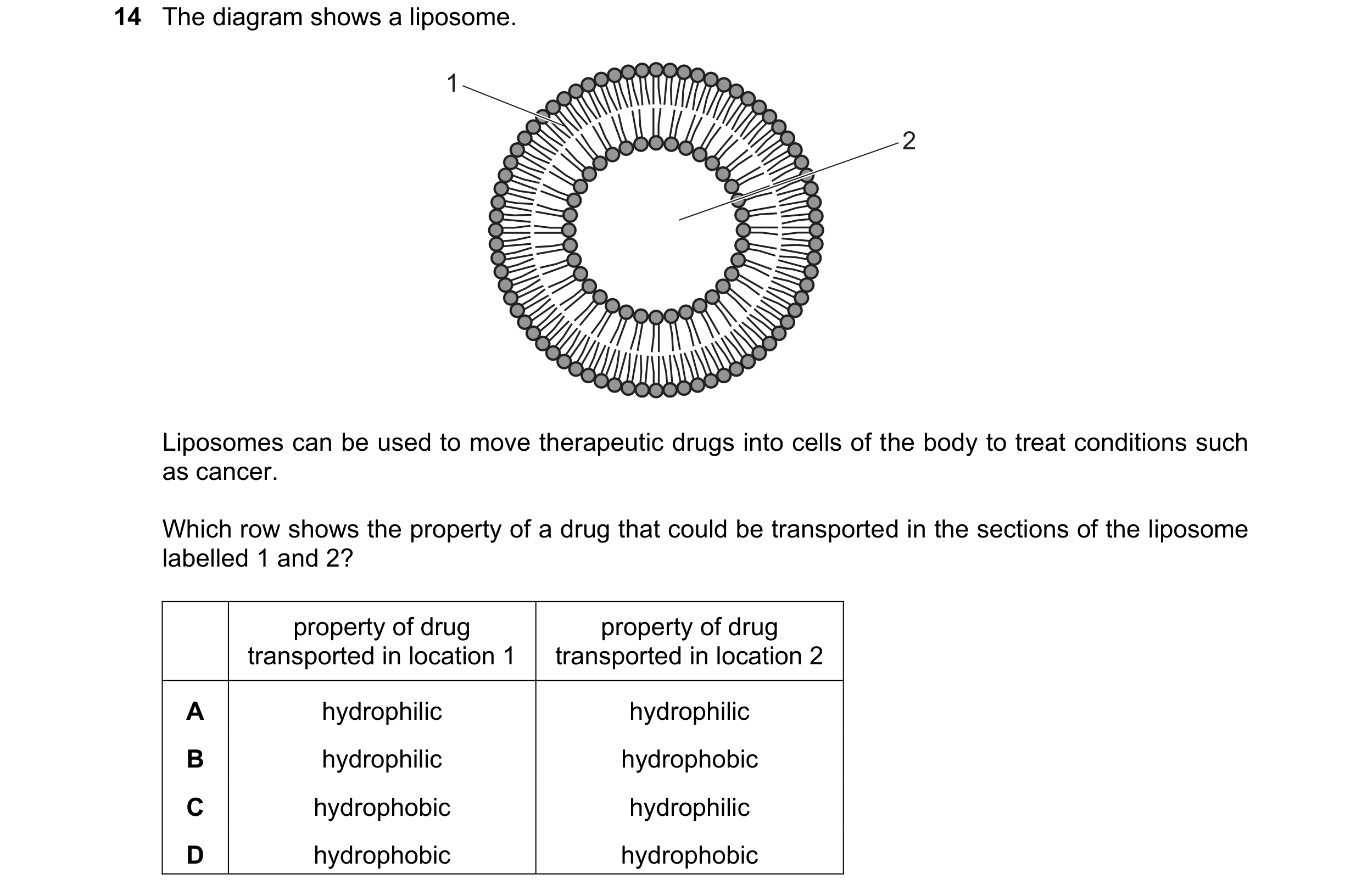 36 / 43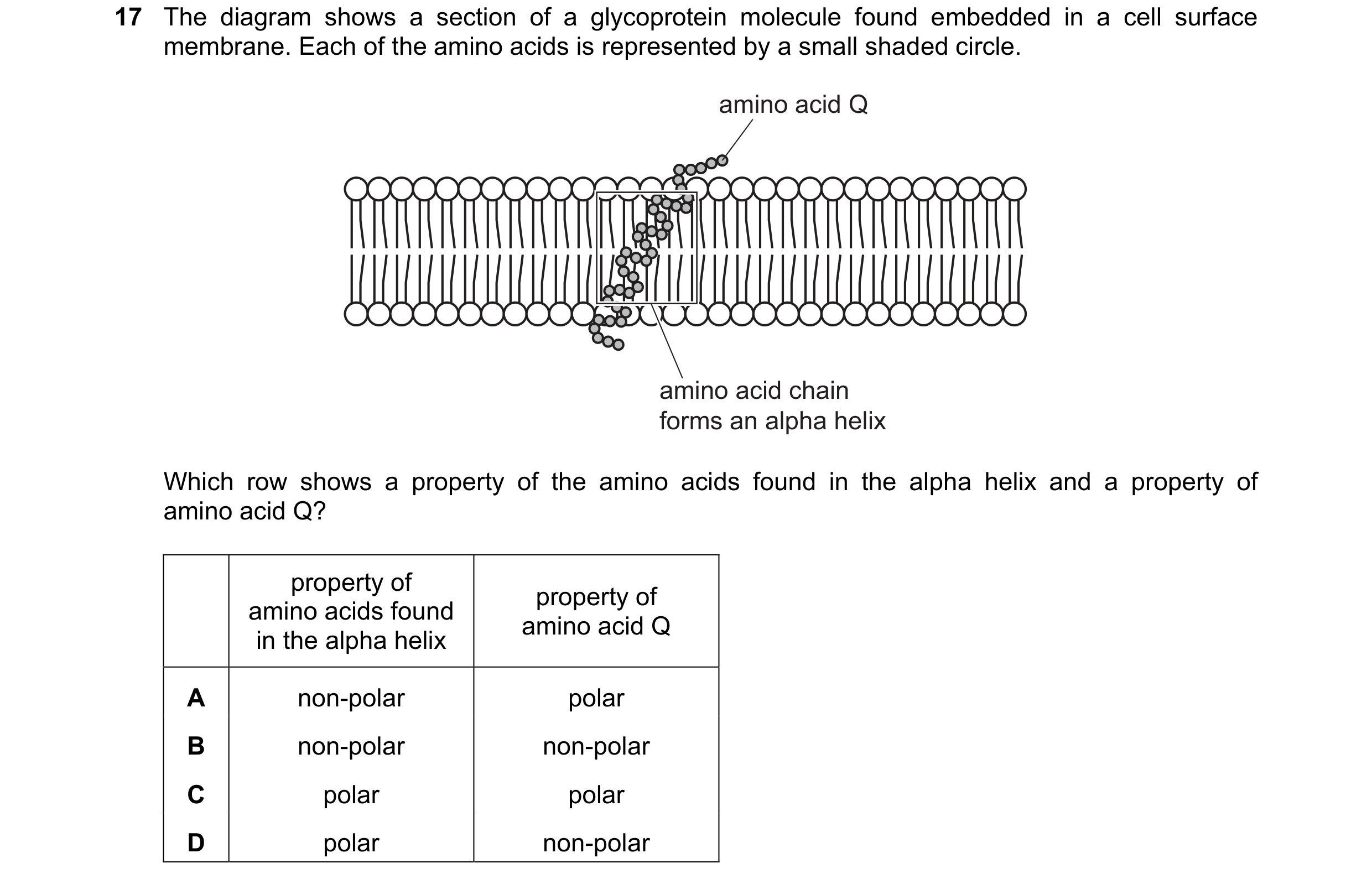

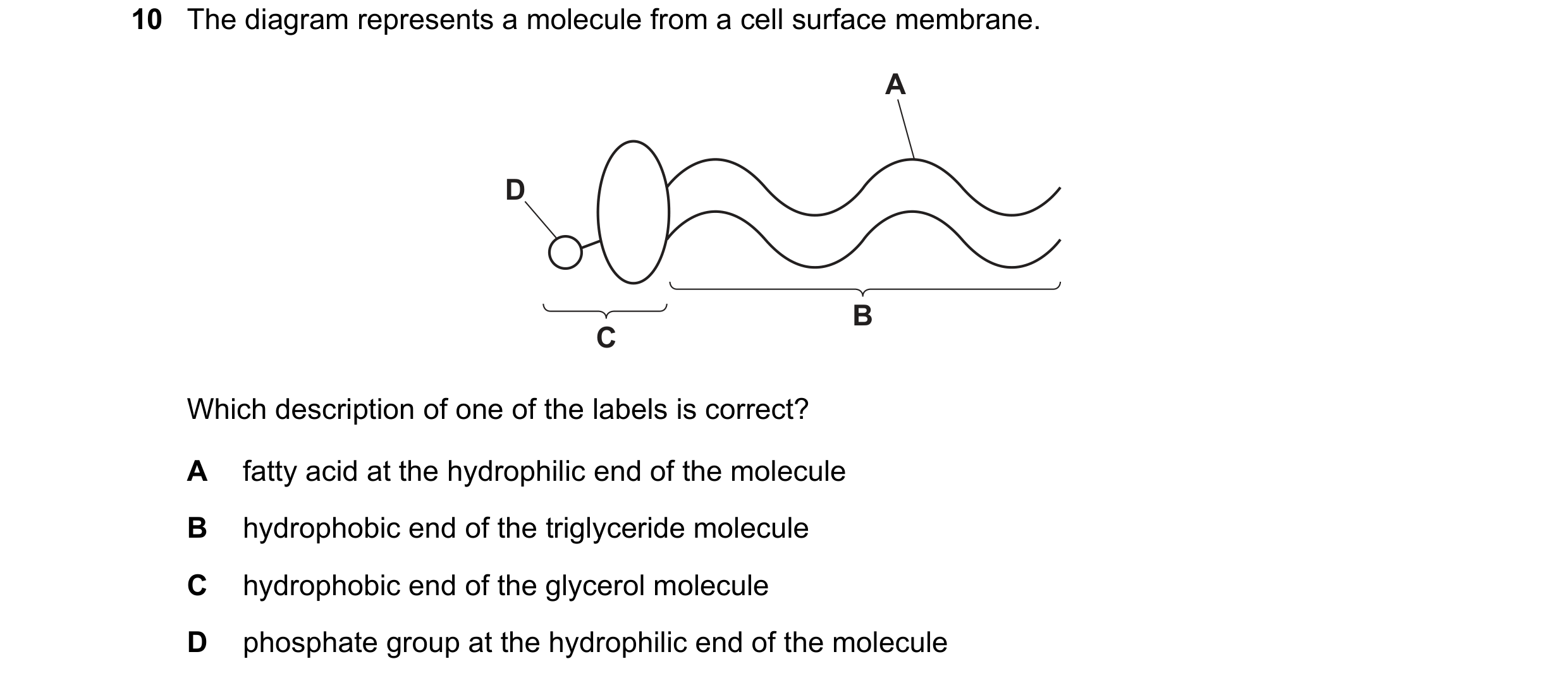 37 / 43
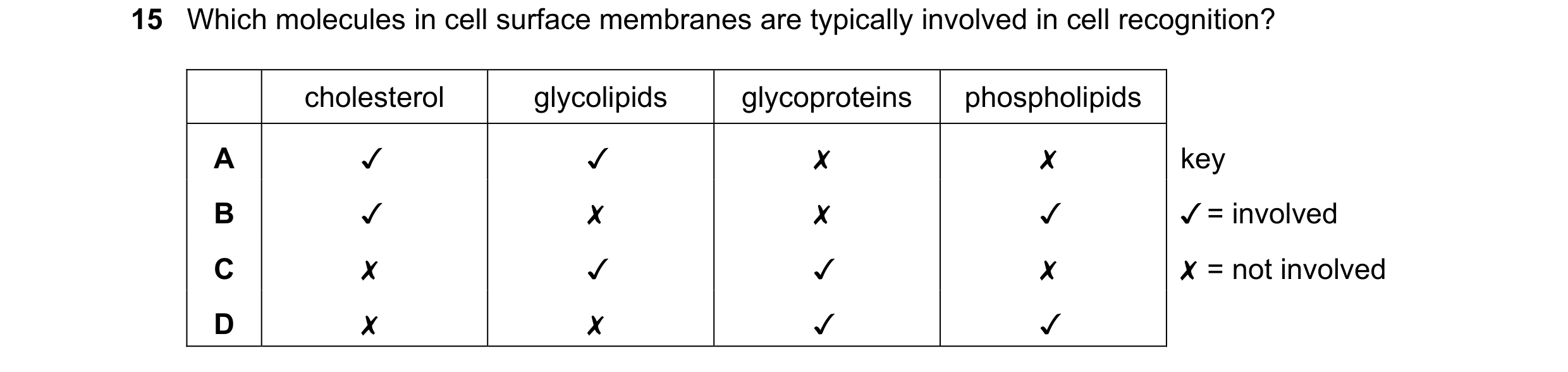

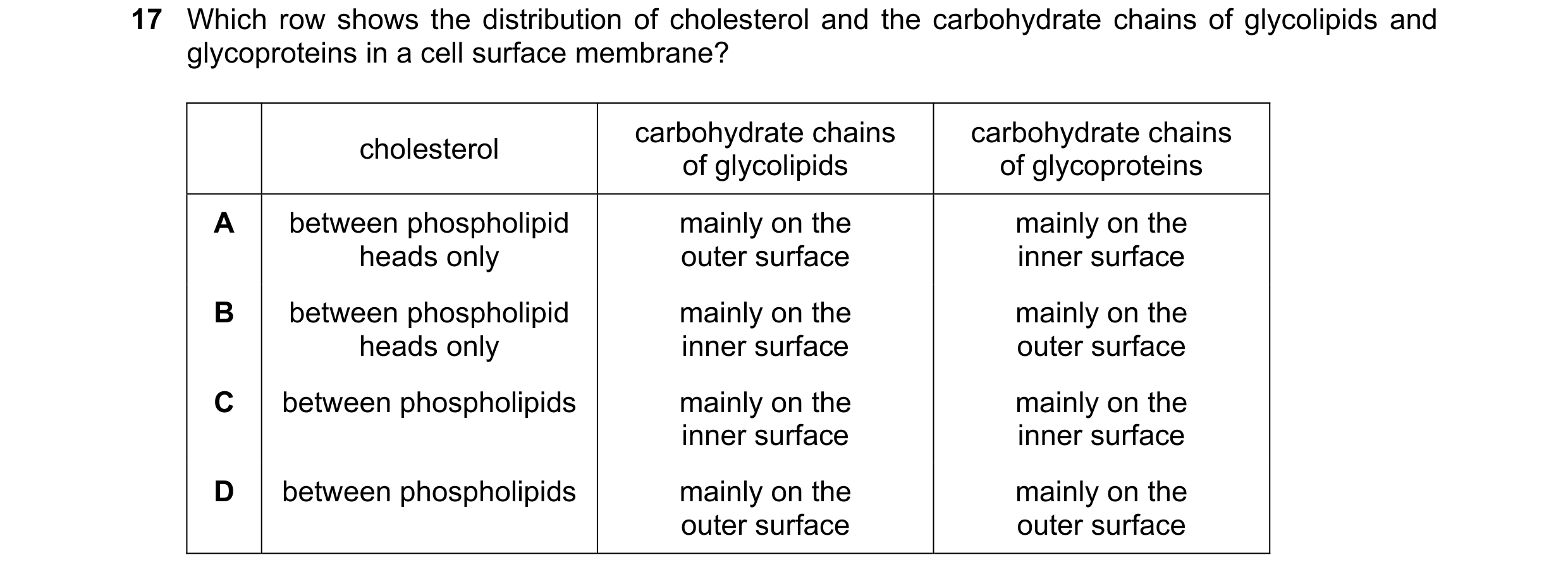
 38 / 43
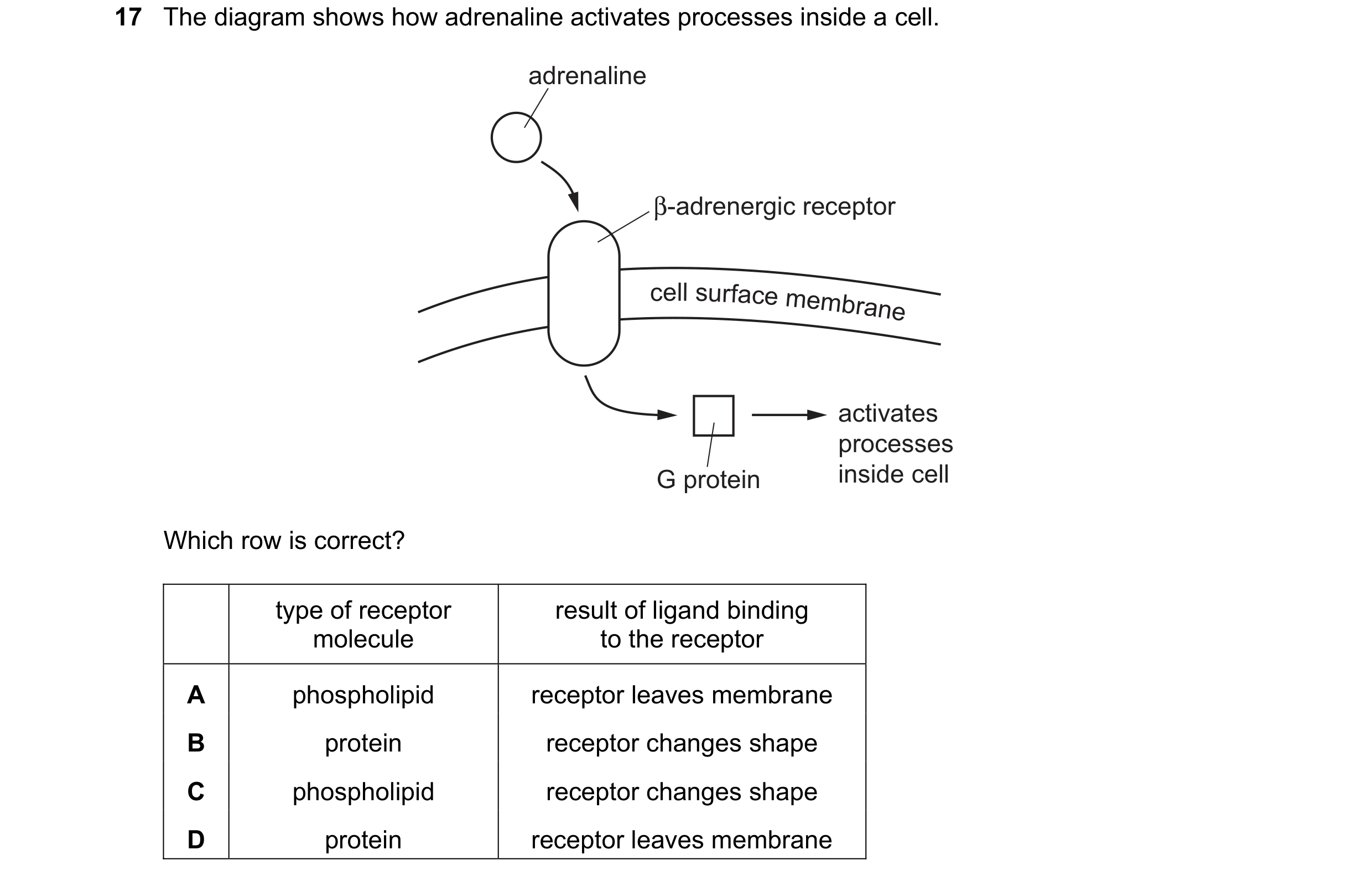

 39 / 43
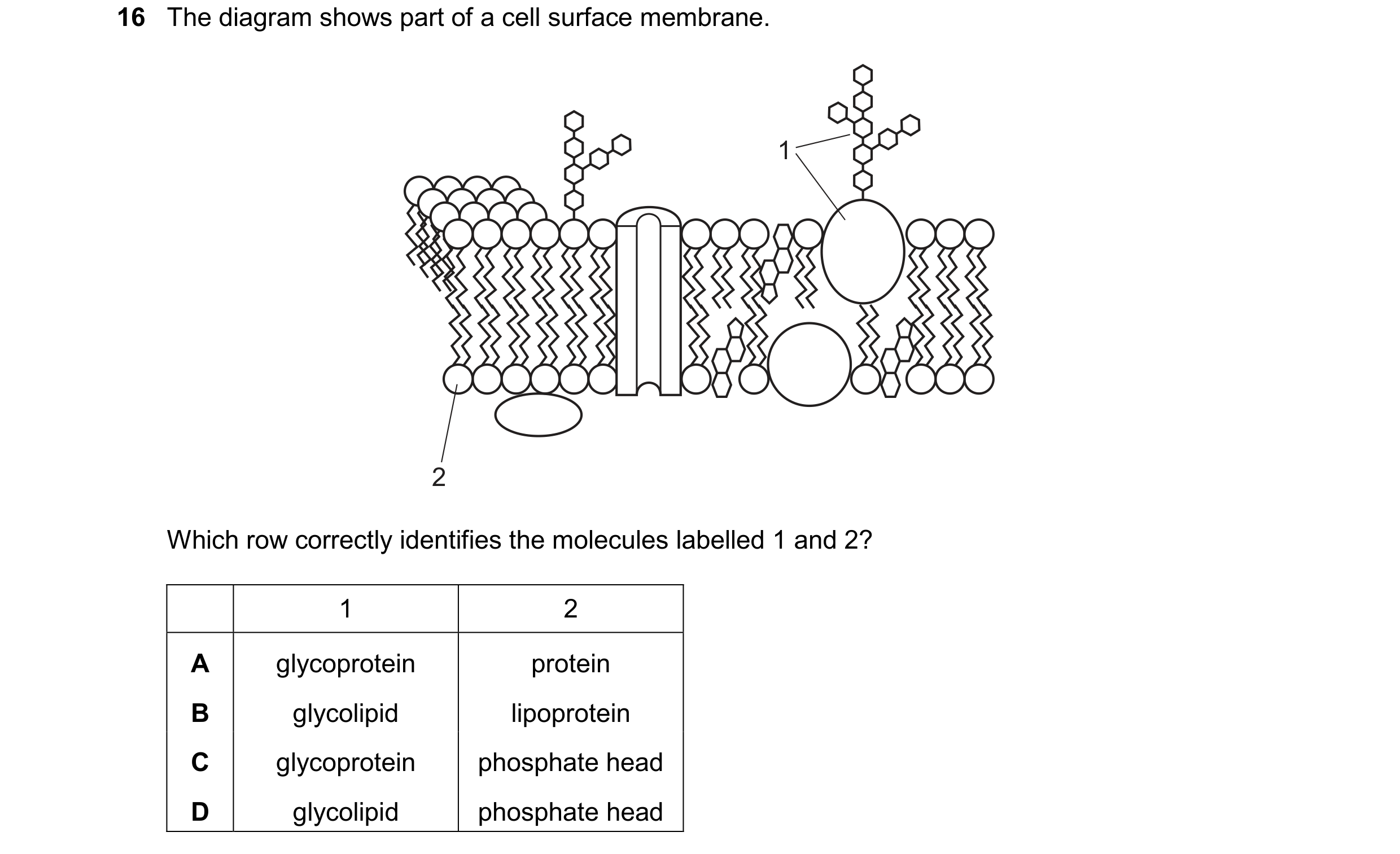
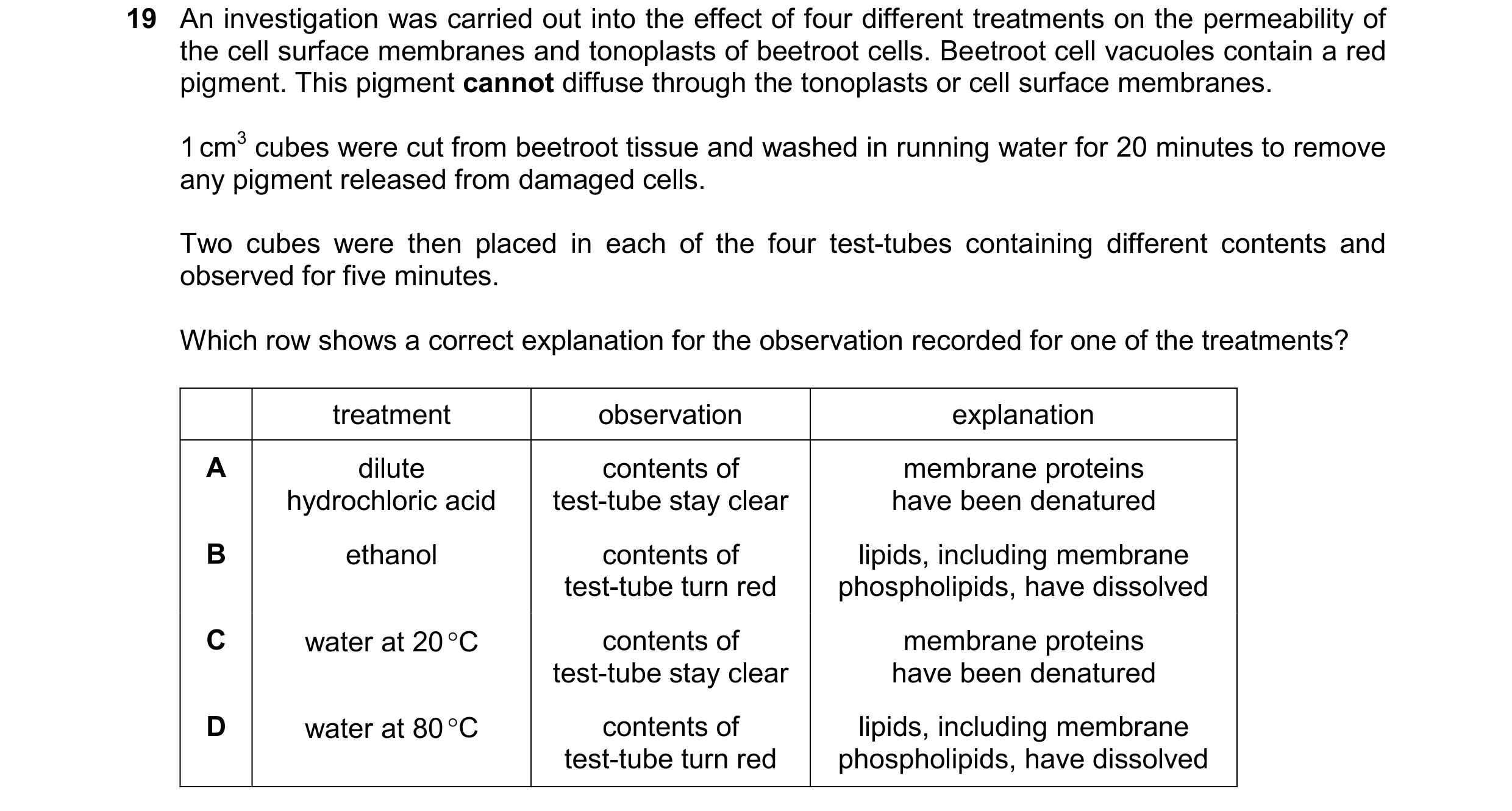 40 / 43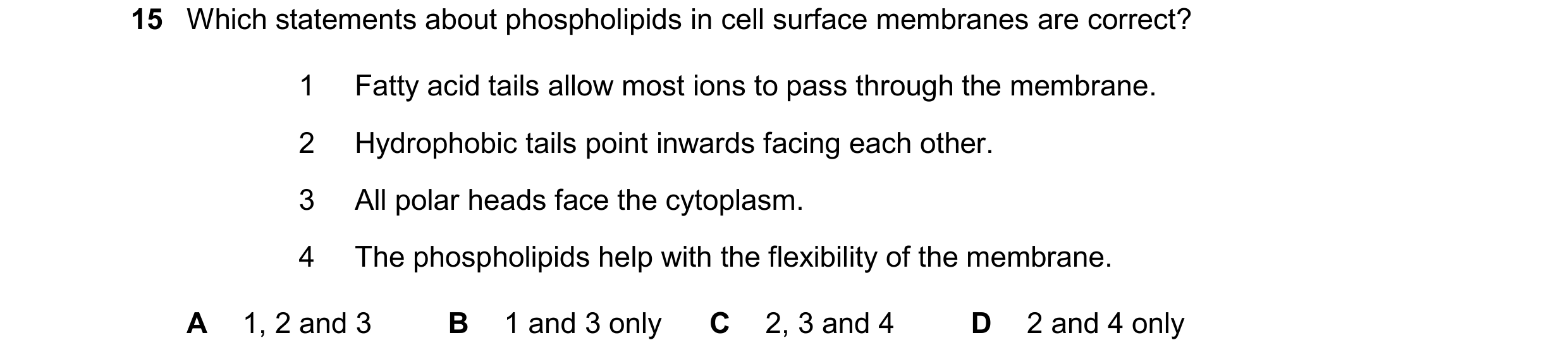
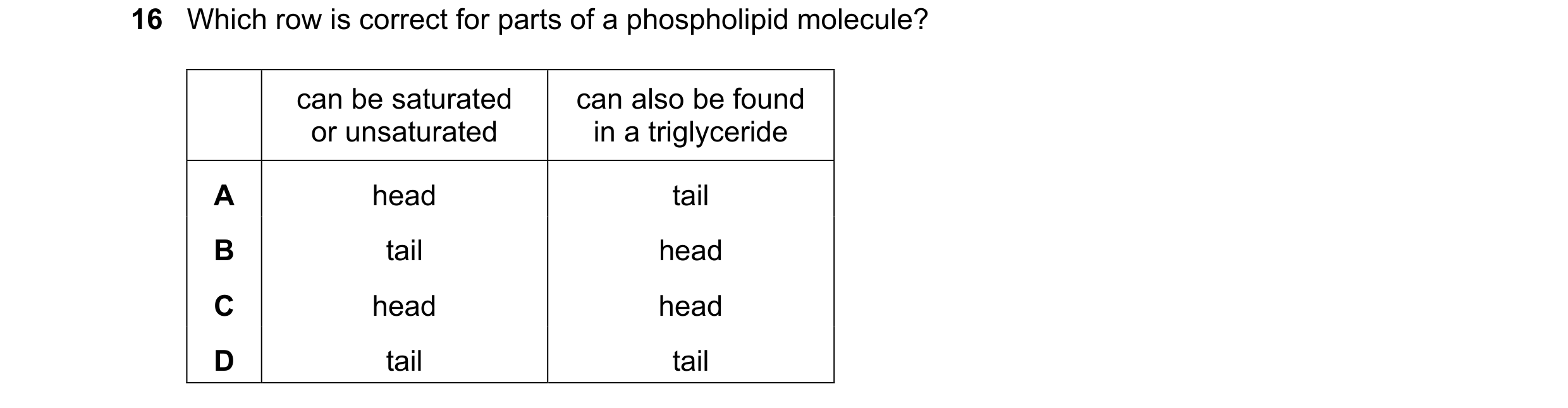


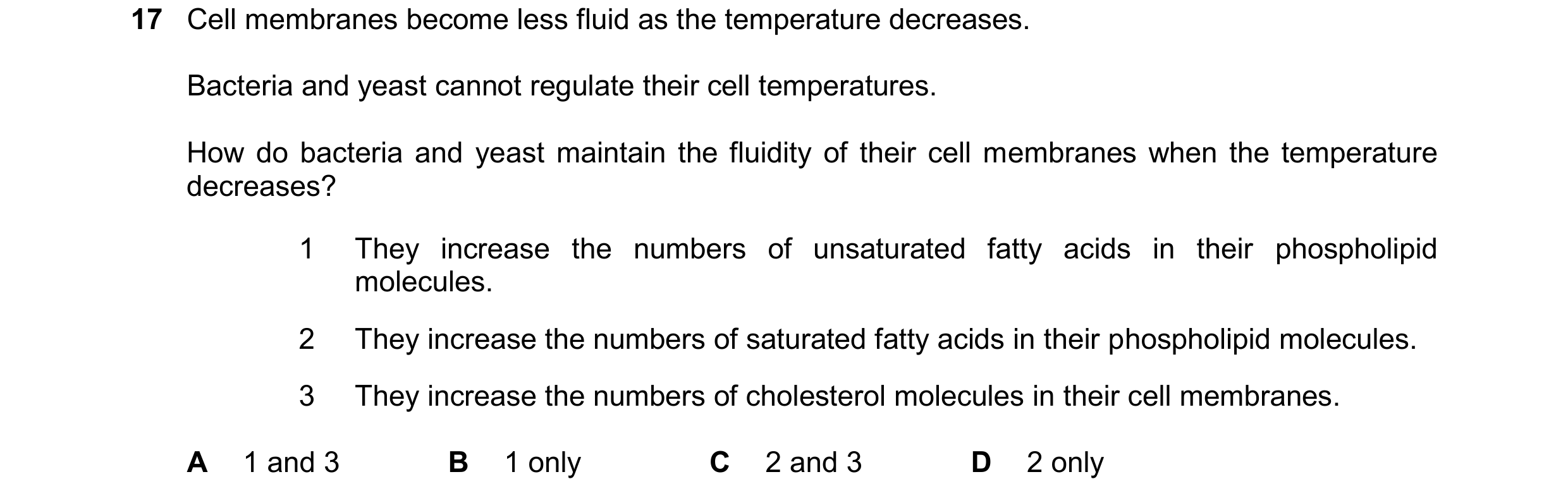 41 / 43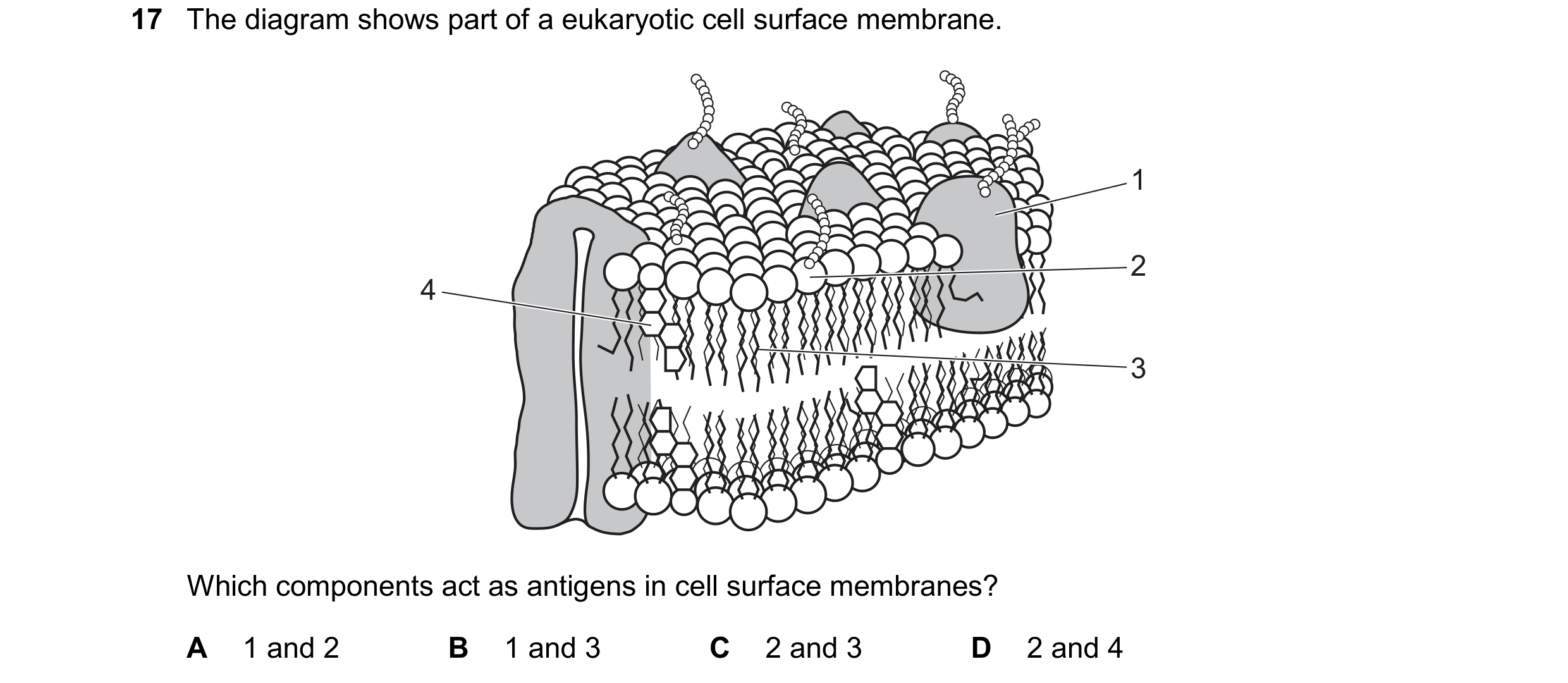
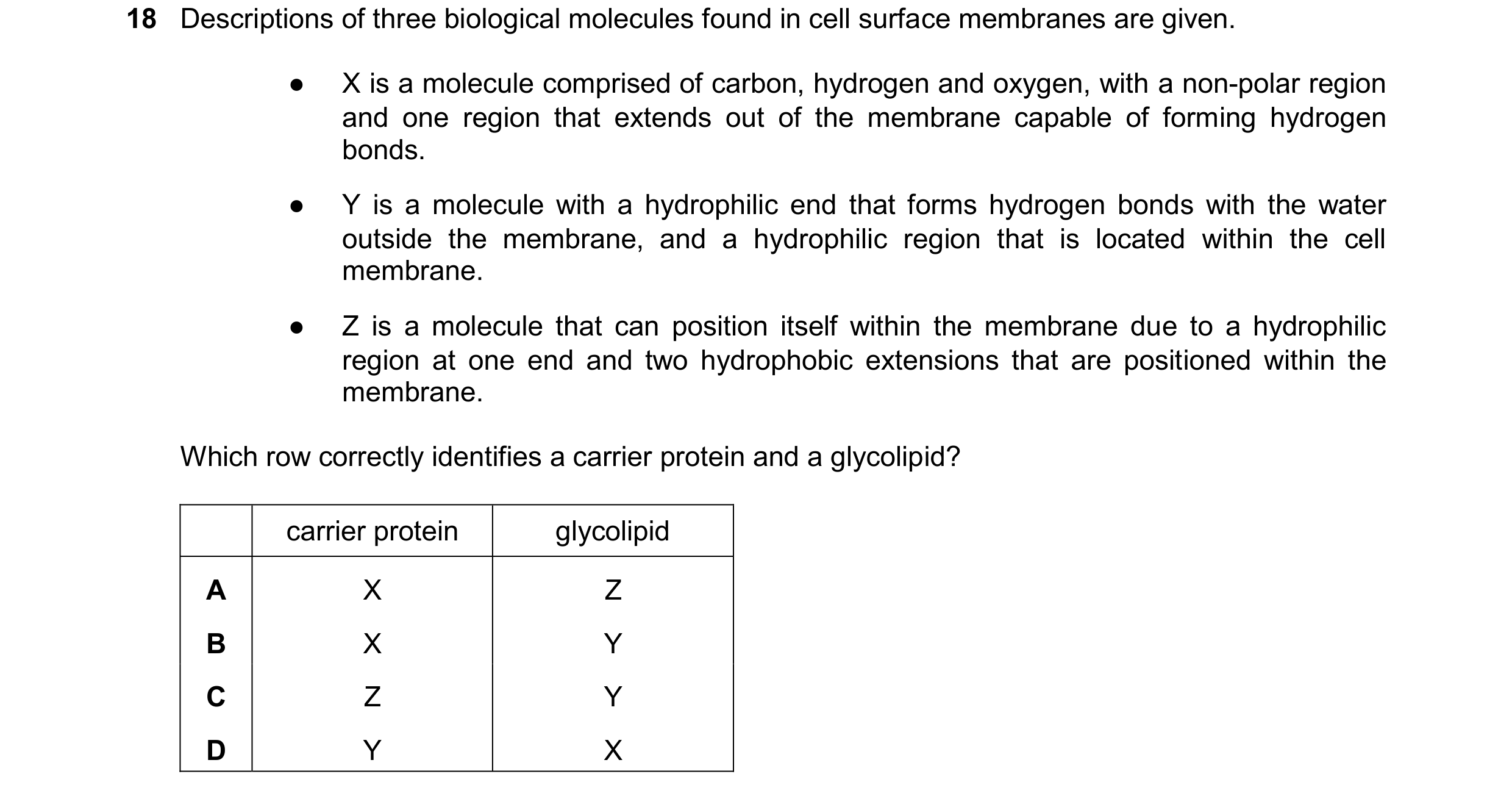

 42 / 43
 43 / 43