Questions as text
Q1 · A solid is ionic 0653/11 Oct/Nov 2005
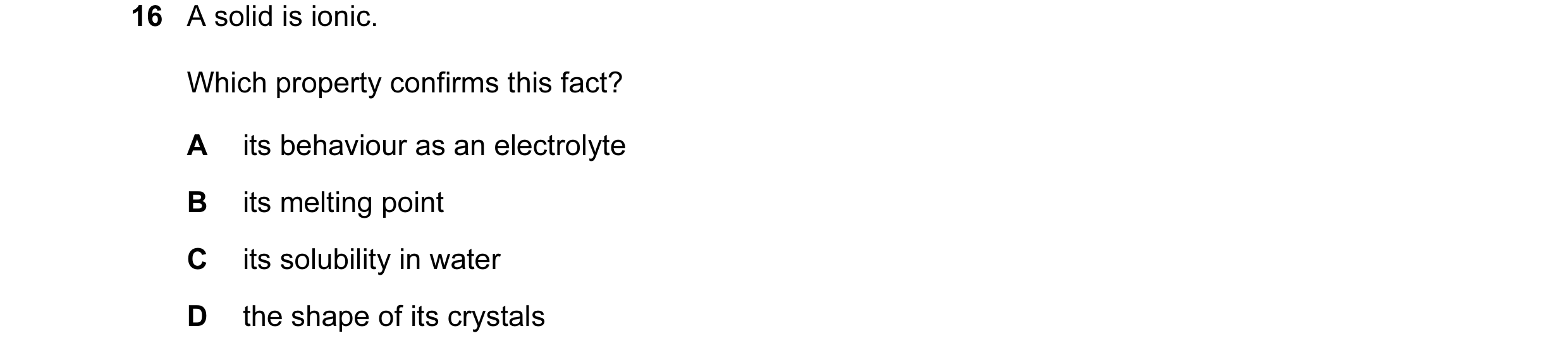
16 A solid is ionic. Which property confirms this fact? A its behaviour as an electrolyte B its melting point C its solubility in water D the shape of its crystals
1 marks
Answer: A
This question in 0653/11 Oct/Nov 2005
Q2 · The diagram shows the results of three experiments 0653/11 Oct/Nov 2005
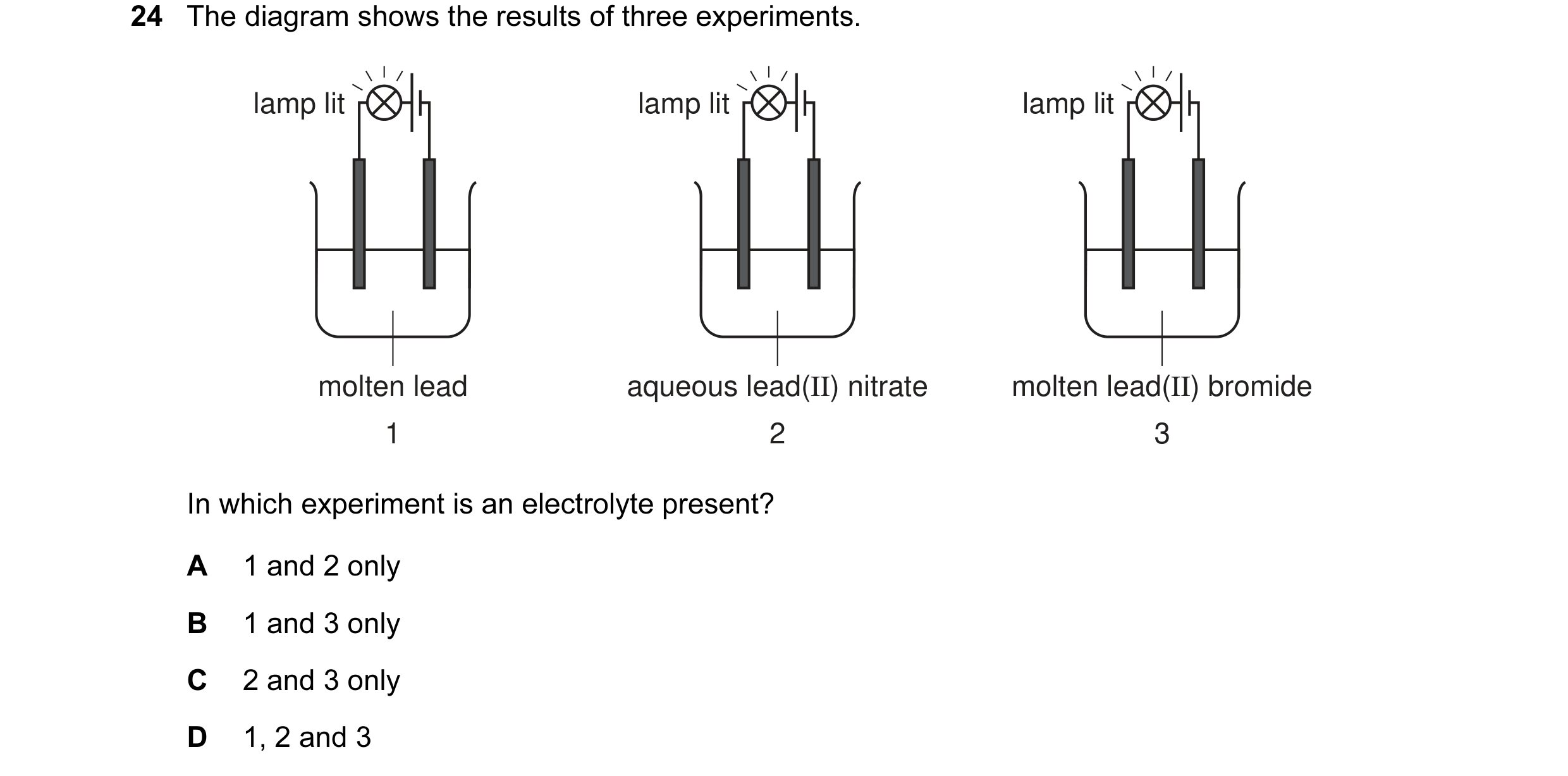
24 The diagram shows the results of three experiments. lamp lit lamp lit lamp lit molten lead aqueous lead(II) nitrate molten lead(II) bromide 1 2 3 In which experiment is an electrolyte present? A 1 and 2 only B 1 and 3 only C 2 and 3 only D 1, 2 and 3
1 marks
Answer: C
This question in 0653/11 Oct/Nov 2005
Q3 · Molten lead(II) bromide conducts electricity and the bulb lights up in the experiment… 0653/11 May/June 2006
24 Molten lead(II) bromide conducts electricity and the bulb lights up in the experiment shown. 6 V d.c. V electrode molten lead(II) bromide heat The bulb goes out soon after the heat is removed. 1 Lead and bromide ions can no longer move freely. 2 Lead and bromide ions have all reacted. 3 Lead(II) bromide has fully melted. Which reasons explain this? A 1 only B 2 only C 3 only D 1 and 2 only
1 marks
Answer: A
This question in 0653/11 May/June 2006
Q4 · Sodium chloride is an ionic salt that is used industrially as an electrolyte 0653/11 Oct/Nov 2006
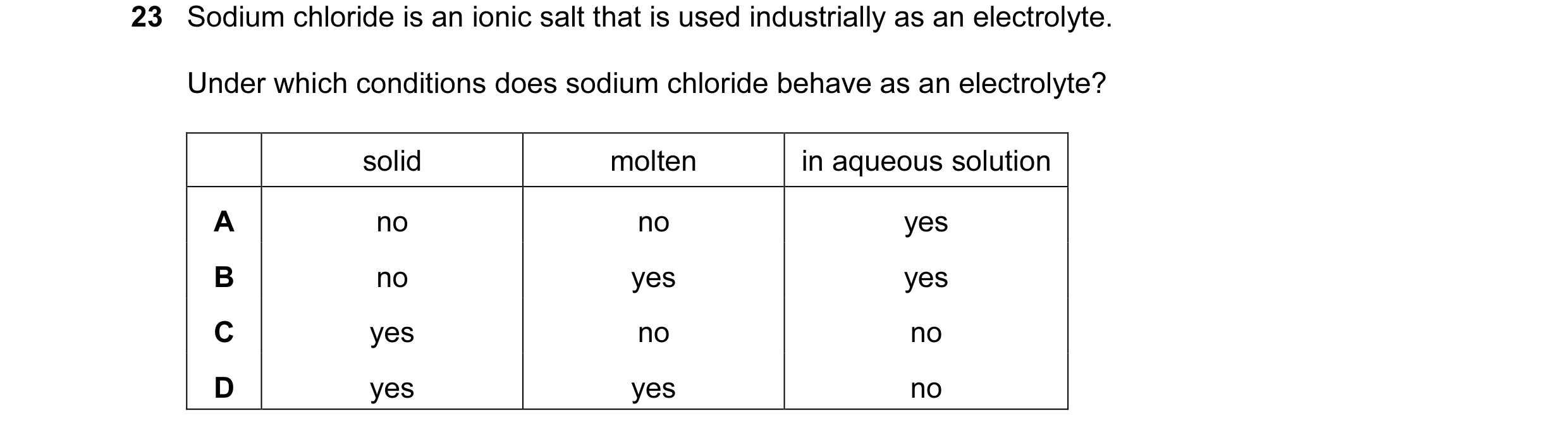
23 Sodium chloride is an ionic salt that is used industrially as an electrolyte. Under which conditions does sodium chloride behave as an electrolyte? solid molten in aqueous solution A no no yes B no yes yes C yes no no D yes yes no
1 marks
Answer: B
This question in 0653/11 Oct/Nov 2006
Q5 · A substance, X, is dissolved in water and electrolysed as shown 0653/11 Oct/Nov 2006
24 A substance, X, is dissolved in water and electrolysed as shown. 6 V d.c. + – carbon carbon anode cathode solution of X in water A yellow-green gas is given off at the anode and the cathode becomes brown. What is X? A copper(II) chloride B lead(II) bromide C sodium bromide D sodium chloride
1 marks
Answer: A
This question in 0653/11 Oct/Nov 2006
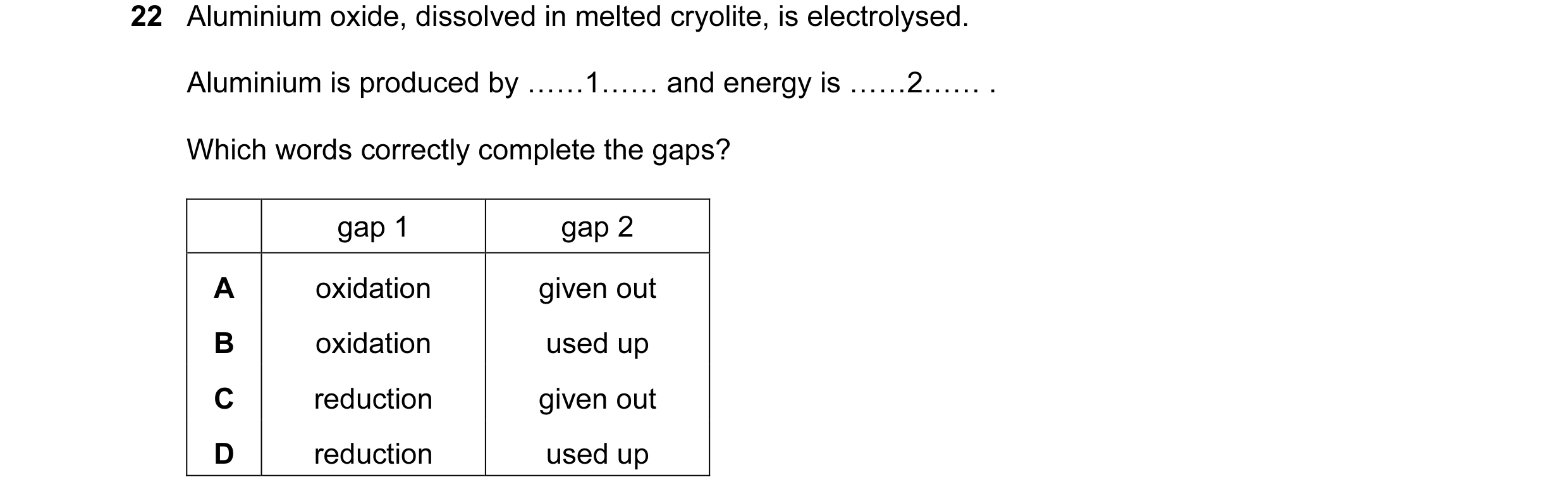
Q6 · Aluminium oxide, dissolved in melted cryolite, is electrolysed 0653/11 Oct/Nov 2007
22 Aluminium oxide, dissolved in melted cryolite, is electrolysed. Aluminium is produced by ……1…… and energy is ……2…… . Which words correctly complete the gaps? gap 1 gap 2 A oxidation given out B oxidation used up C reduction given out D reduction used up
1 marks
Answer: D
This question in 0653/11 Oct/Nov 2007
Q7 · The diagram shows an apparatus used for electrolysis 0653/11 Oct/Nov 2007
24 The diagram shows an apparatus used for electrolysis. water Which substance, when added to water, would act as an electrolyte? A calcium carbonate B copper(II) chloride C graphite D sugar
1 marks
Answer: B
This question in 0653/11 Oct/Nov 2007
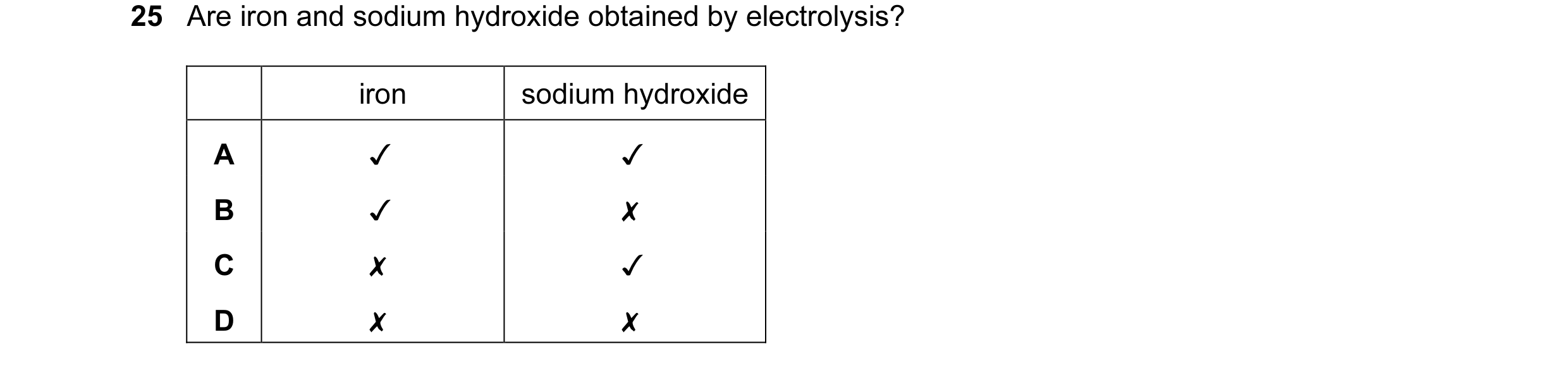
Q8 · Are iron and sodium hydroxide obtained by electrolysis? 0653/11 Oct/Nov 2007
25 Are iron and sodium hydroxide obtained by electrolysis?
iron sodium hydroxide
v v
0 0O WwW D>
x
v
x
~ « &
1 marks
Answer: C
This question in 0653/11 Oct/Nov 2007
Q9 · The apparatus shown is set up 0653/11 May/June 2008
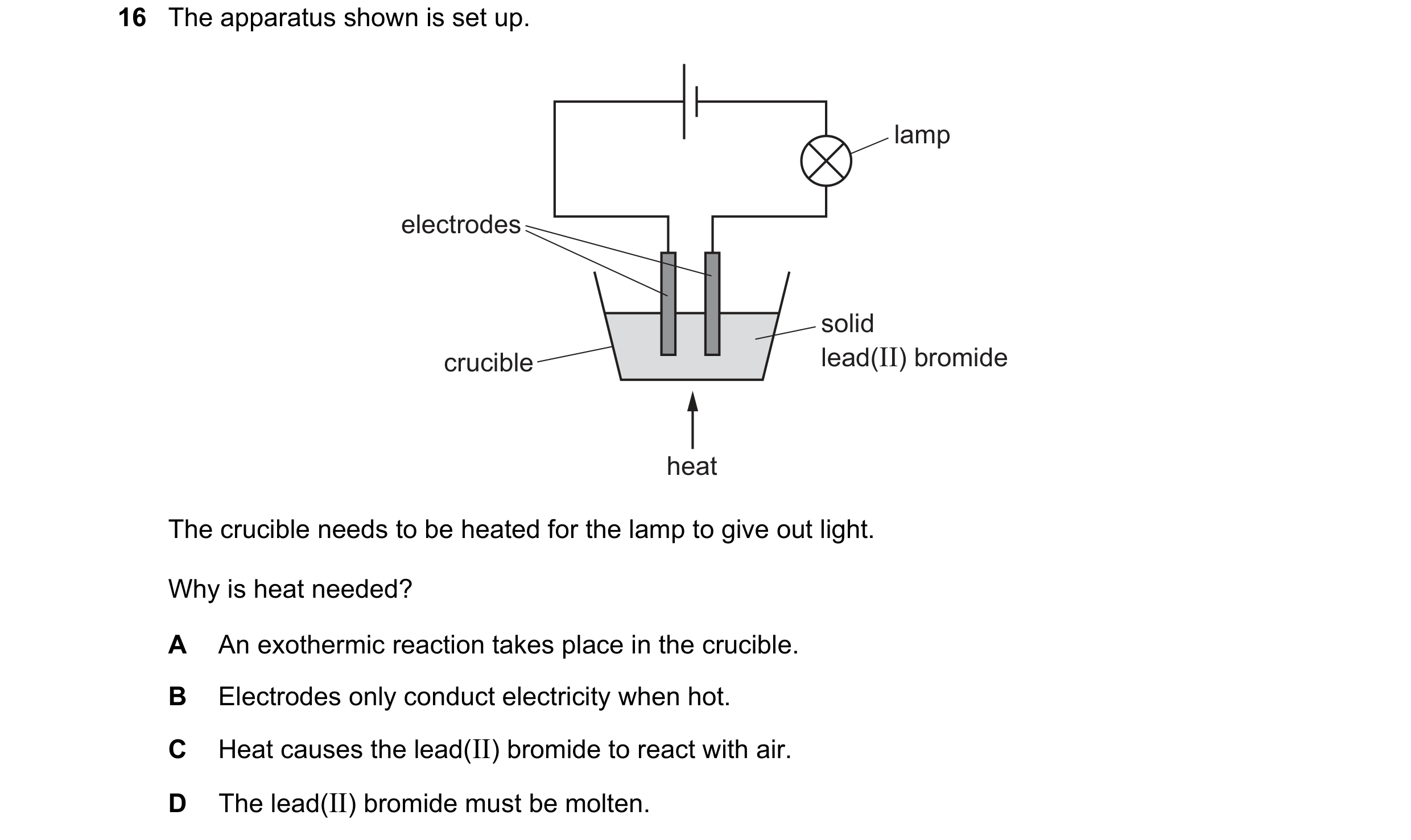
24 The apparatus shown is set up. lamp electrodes solid crucible lead(II) bromide heat The crucible needs to be heated for the bulb to give out light. Why is heat needed? A An exothermic reaction takes place in the crucible. B Electrodes only conduct electricity when hot. C Heat causes the lead(II) bromide to react with air. D The lead(II) bromide has to be melted.
1 marks
Answer: D
This question in 0653/11 May/June 2008
Q10 · Impure copper is purified by electrolysis, as shown 0653/11 Oct/Nov 2008
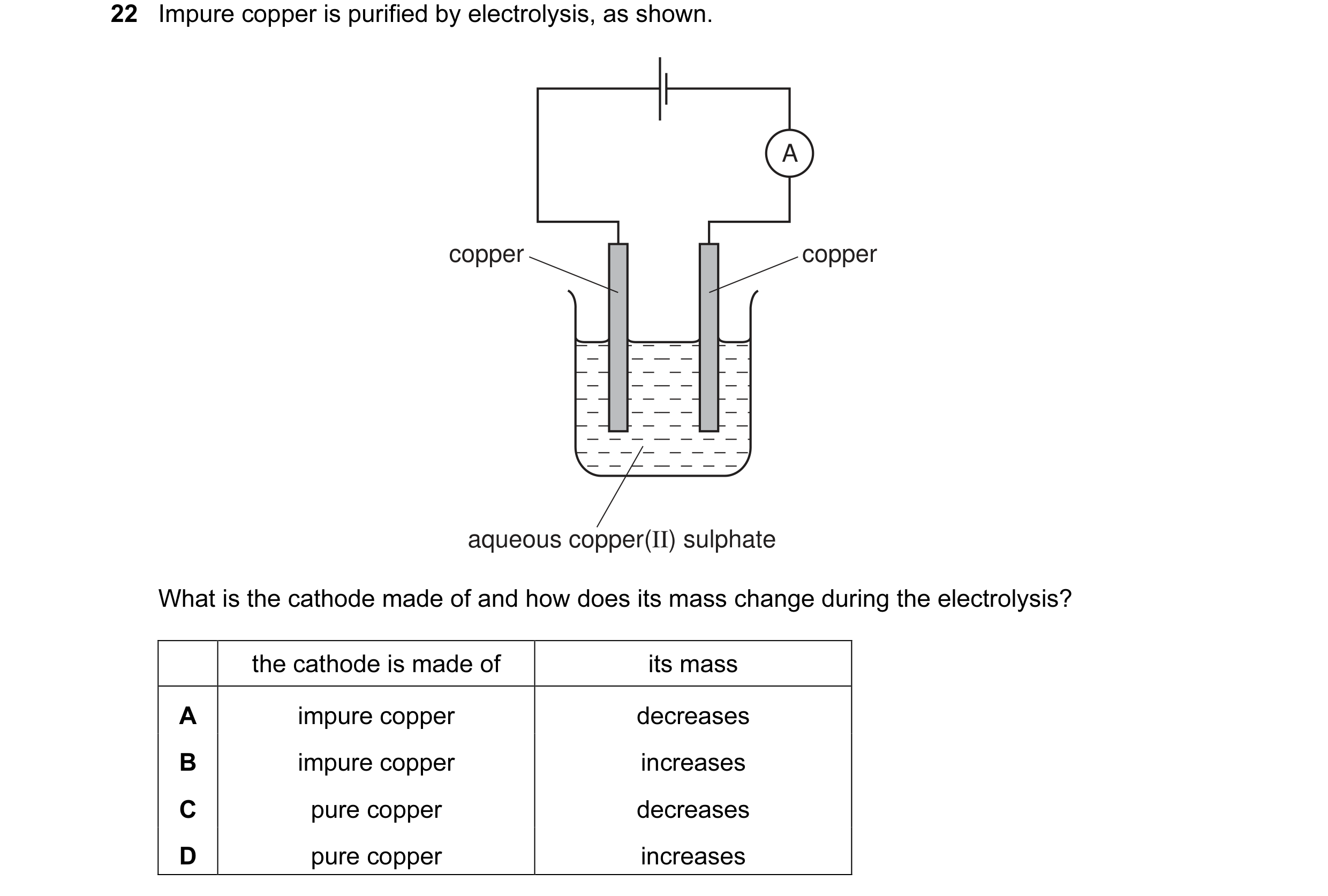
22 Impure copper is purified by electrolysis, as shown. A copper copper aqueous copper(II) sulphate What is the cathode made of and how does its mass change during the electrolysis? the cathode is made of its mass A impure copper decreases B impure copper increases C pure copper decreases D pure copper increases
1 marks
Answer: D
This question in 0653/11 Oct/Nov 2008
Q11 · Which diagram shows that an electrolyte is present? 0653/11 Oct/Nov 2008
25 Which diagram shows that an electrolyte is present? A B key battery solid solid electrical contacts C D unlit lamp lit lamp solution solution
1 marks
Answer: D
This question in 0653/11 Oct/Nov 2008
Q12 · A solid is ionic 0653/11 May/June 2010
15 A solid is ionic. Which property best confirms this fact? A its behaviour as an electrolyte B its melting point C its solubility in water D the shape of its crystals
1 marks
Answer: A
This question in 0653/11 May/June 2010
Q13 · Part of the apparatus used to electrolyse aqueous copper(II) chloride is shown 0653/11 May/June 2010
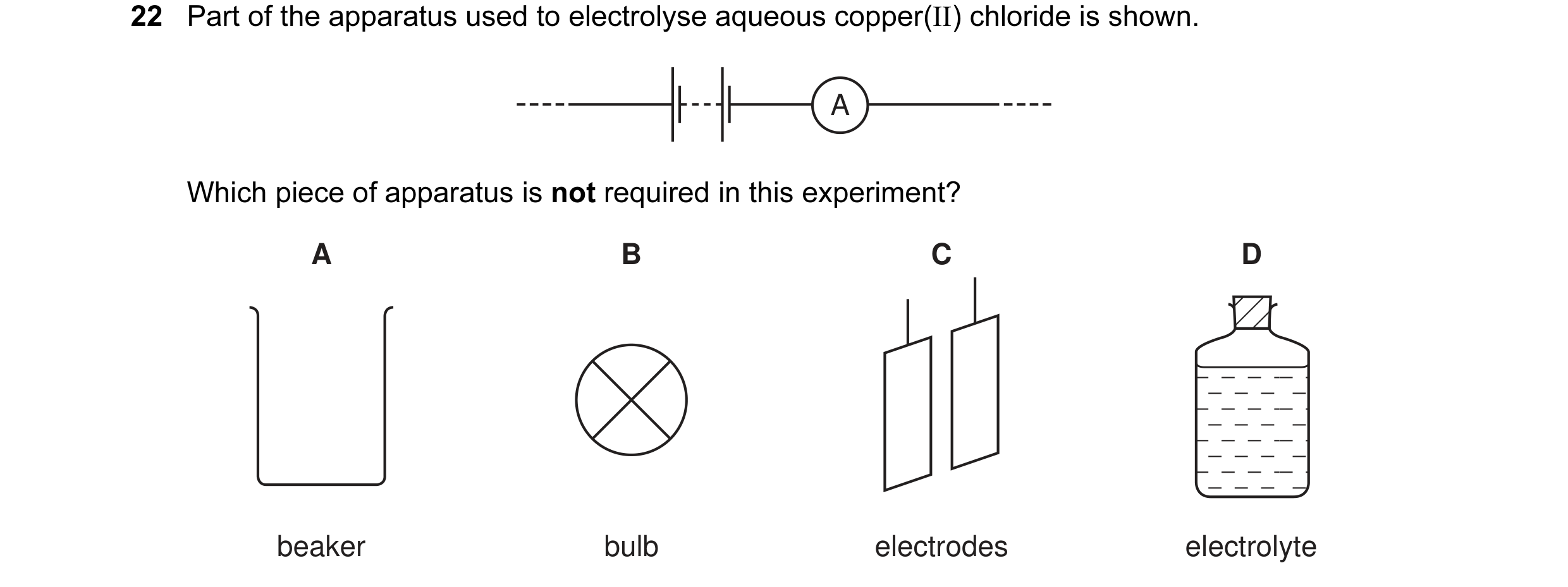
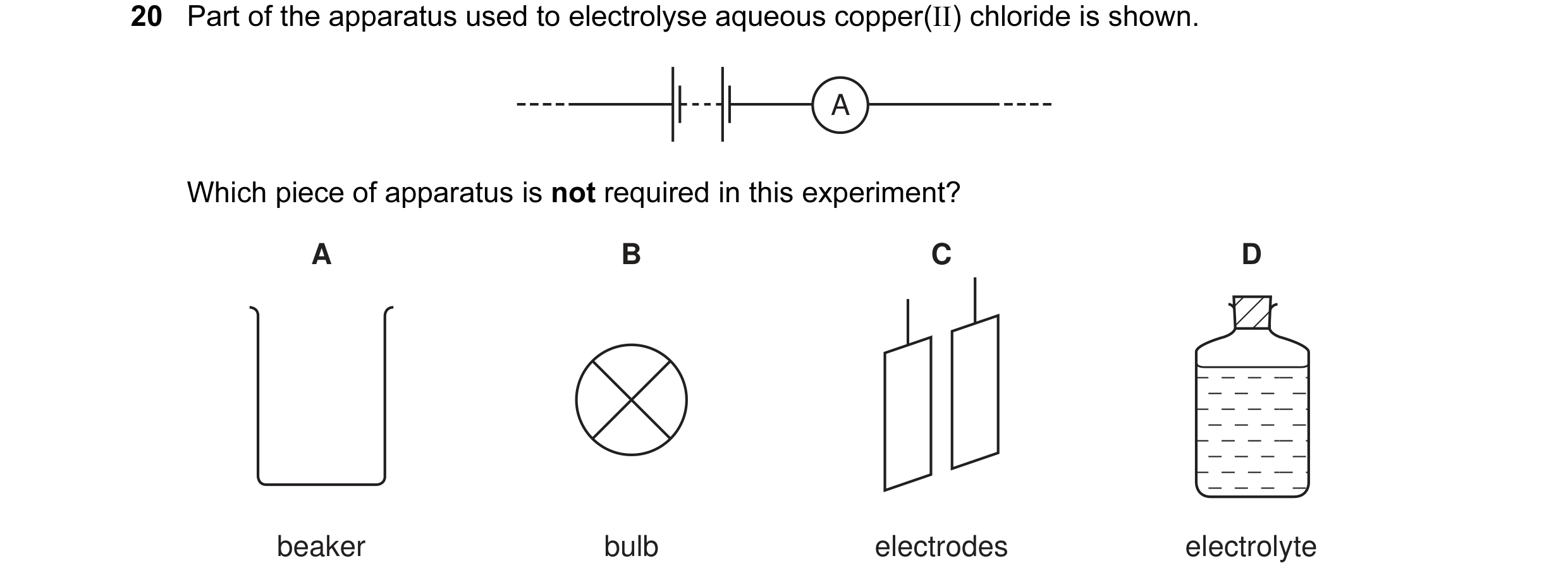
22 Part of the apparatus used to electrolyse aqueous copper(II) chloride is shown. A Which piece of apparatus is not required in this experiment? A B C D beaker bulb electrodes electrolyte
1 marks
Answer: B
This question in 0653/11 May/June 2010
Q14 · A solid is ionic 0653/12 May/June 2010
15 A solid is ionic. Which property best confirms this fact? A its behaviour as an electrolyte B its melting point C its solubility in water D the shape of its crystals
1 marks
Answer: A
This question in 0653/12 May/June 2010
Q15 · Part of the apparatus used to electrolyse aqueous copper(II) chloride is shown 0653/12 May/June 2010
20 Part of the apparatus used to electrolyse aqueous copper(II) chloride is shown. A Which piece of apparatus is not required in this experiment? A B C D beaker bulb electrodes electrolyte
1 marks
Answer: B
This question in 0653/12 May/June 2010
Q16 · A solid is ionic 0653/13 May/June 2010
15 A solid is ionic. Which property best confirms this fact? A its behaviour as an electrolyte B its melting point C its solubility in water D the shape of its crystals
1 marks
Answer: A
This question in 0653/13 May/June 2010
Q17 · Part of the apparatus used to electrolyse aqueous copper(II) chloride is shown 0653/13 May/June 2010
20 Part of the apparatus used to electrolyse aqueous copper(II) chloride is shown. A Which piece of apparatus is not required in this experiment? A B C D beaker bulb electrodes electrolyte
1 marks
Answer: B
This question in 0653/13 May/June 2010
Q18 · Aluminium occurs as aluminium oxide in the ore bauxite 0653/11 Oct/Nov 2010
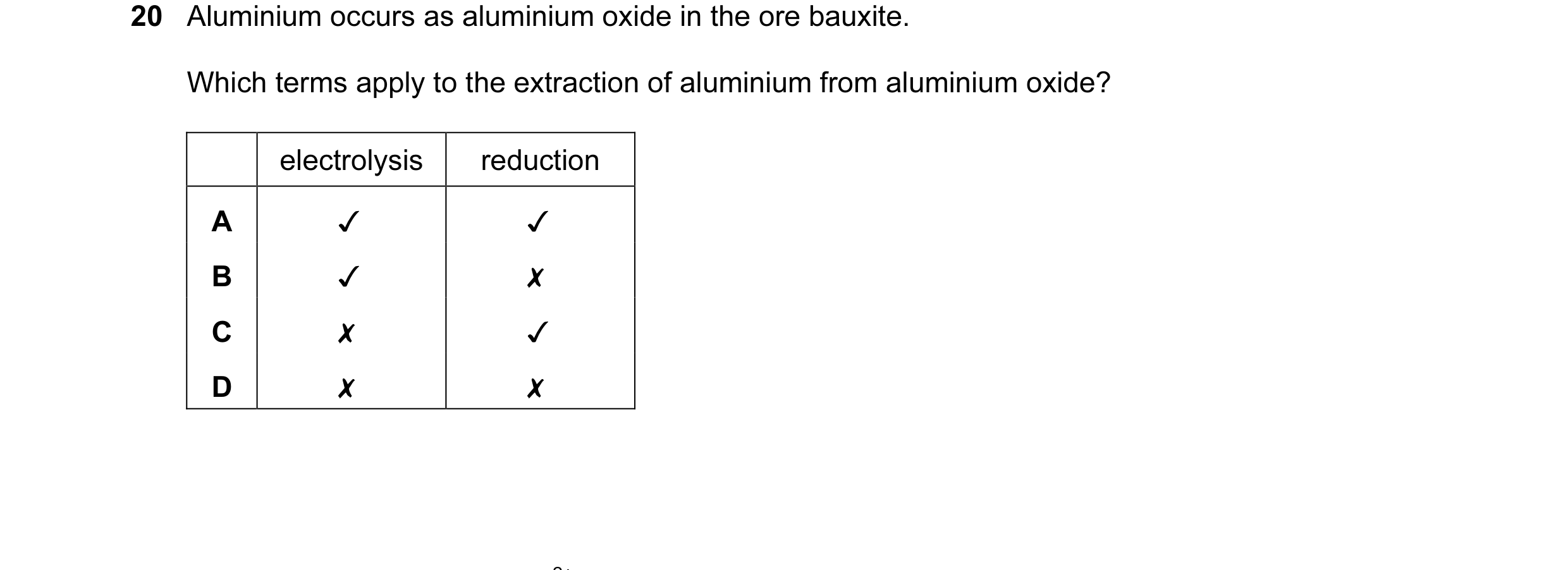
20 Aluminium occurs as aluminium oxide in the ore bauxite.
Which terms apply to the extraction of aluminium from aluminium oxide?
electrolysis reduction
A v v
B v x
Cc x v
D x x
1 marks
Answer: A
This question in 0653/11 Oct/Nov 2010
Q19 · An electrolysis circuit is set up using carbon electrodes as shown 0653/11 Oct/Nov 2010
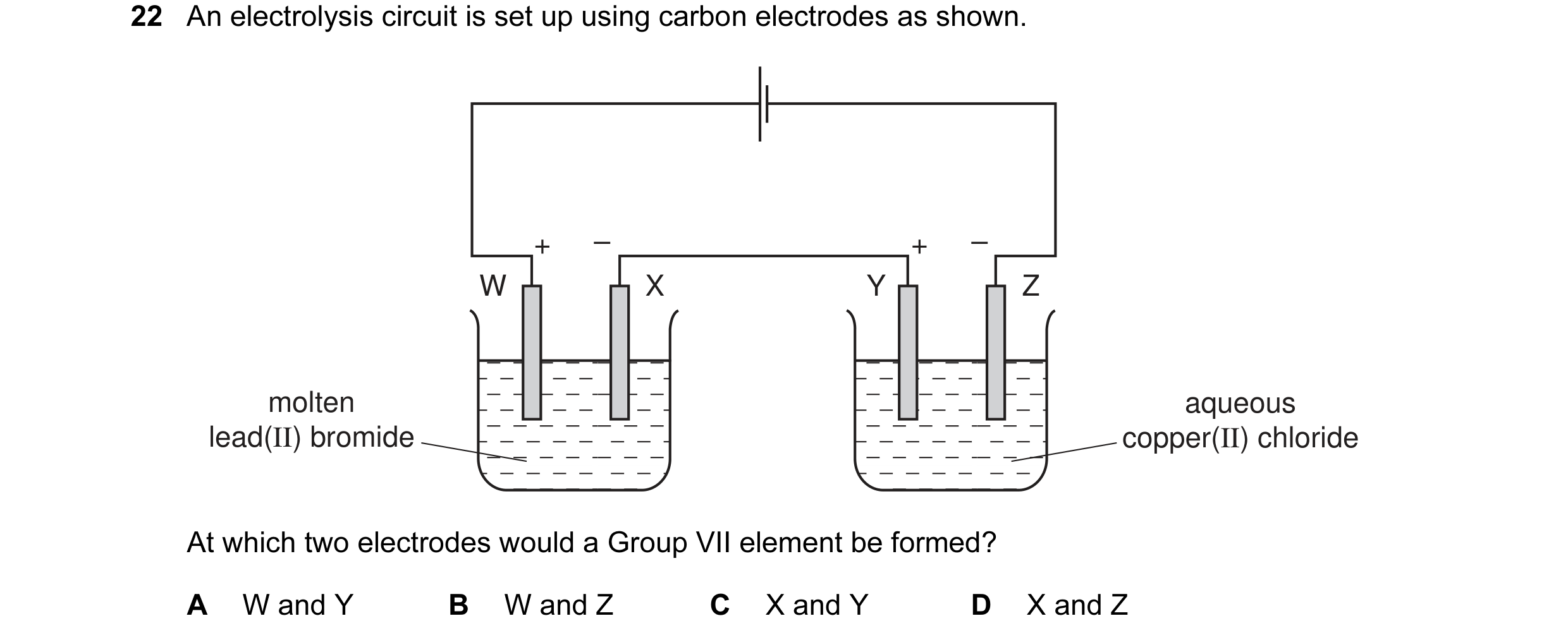
22 An electrolysis circuit is set up using carbon electrodes as shown. + – + – W X Y Z molten aqueous lead(II) bromide copper(II) chloride At which two electrodes would a Group VII element be formed? A W and Y B W and Z C X and Y D X and Z
1 marks
Answer: A
This question in 0653/11 Oct/Nov 2010
Q20 · An electrolysis circuit is set up using carbon electrodes as shown 0653/12 Oct/Nov 2010
22 An electrolysis circuit is set up using carbon electrodes as shown. + – + – W X Y Z molten aqueous lead(II) bromide copper(II) chloride At which two electrodes would a Group VII element be formed? A W and Y B W and Z C X and Y D X and Z
1 marks
Answer: A
This question in 0653/12 Oct/Nov 2010
Q21 · An electrolysis circuit is set up using carbon electrodes as shown 0653/13 Oct/Nov 2010
21 An electrolysis circuit is set up using carbon electrodes as shown. + – + – W X Y Z molten aqueous lead(II) bromide copper(II) chloride At which two electrodes would a Group VII element be formed? A W and Y B W and Z C X and Y D X and Z
1 marks
Answer: A
This question in 0653/13 Oct/Nov 2010
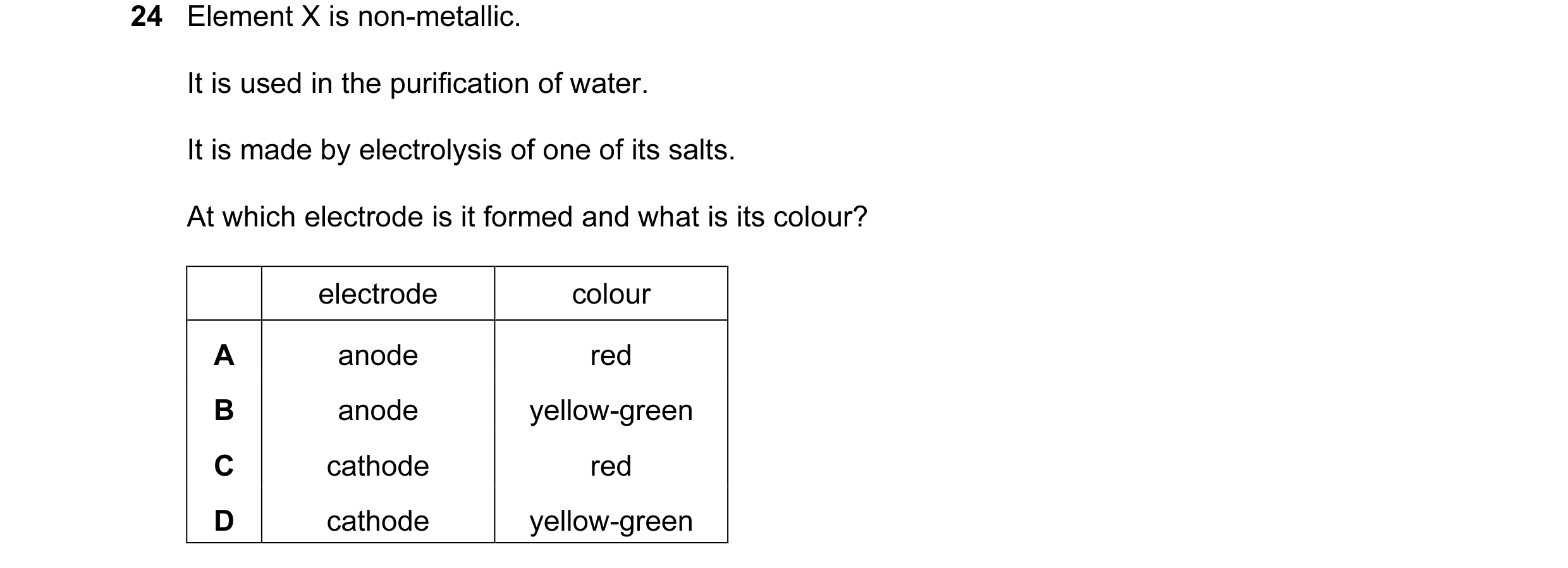
Q22 · Element X is non-metallic 0653/11 May/June 2011
24 Element X is non-metallic. It is used in the purification of water. It is made by electrolysis of one of its salts. At which electrode is it formed and what is its colour? electrode colour A anode red B anode yellow-green C cathode red D cathode yellow-green
1 marks
Answer: B
This question in 0653/11 May/June 2011
Q23 · Element X is non-metallic 0653/12 May/June 2011
25 Element X is non-metallic. It is used in the purification of water. It is made by electrolysis of one of its salts. At which electrode is it formed and what is its colour? electrode colour A anode red B anode yellow-green C cathode red D cathode yellow-green
1 marks
Answer: B
This question in 0653/12 May/June 2011
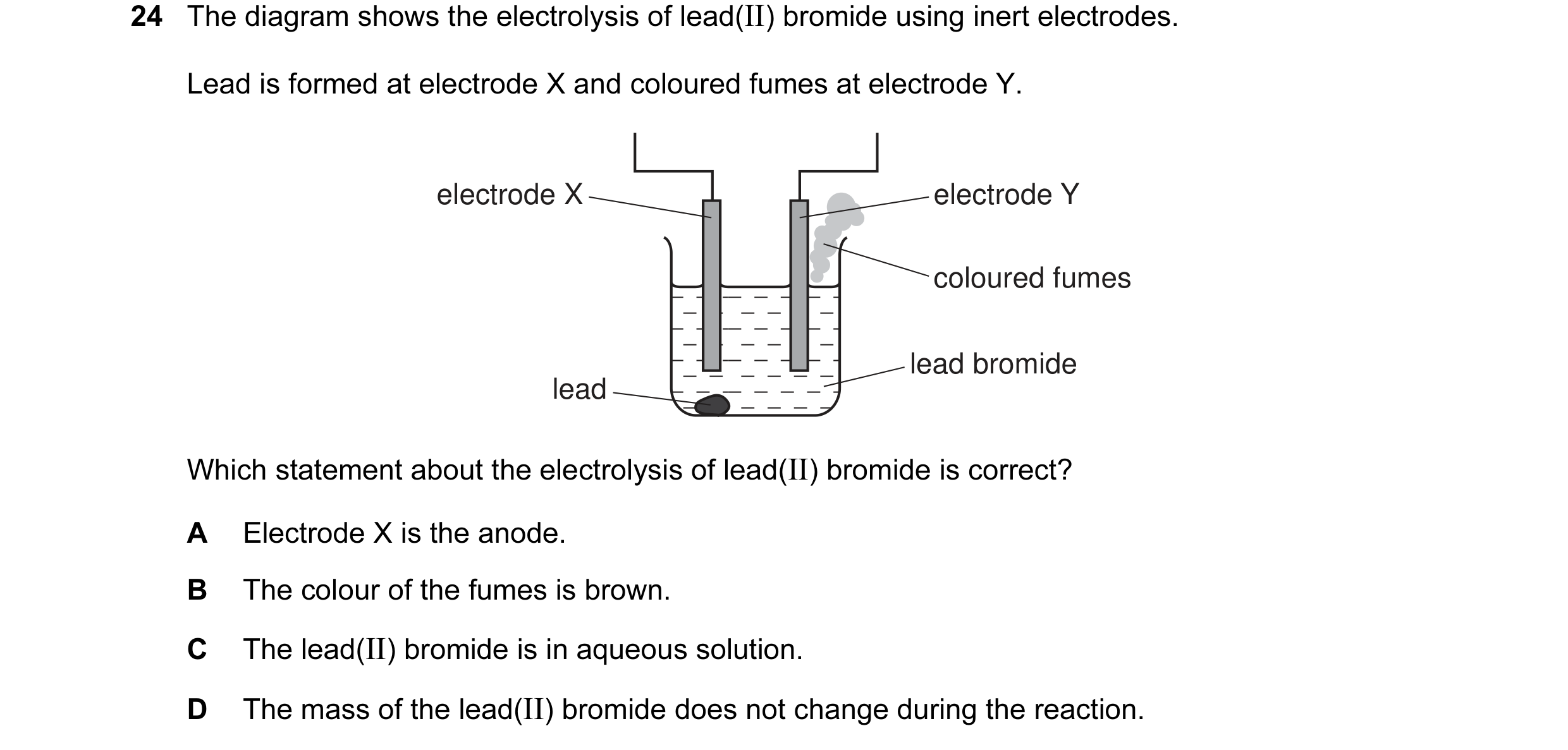
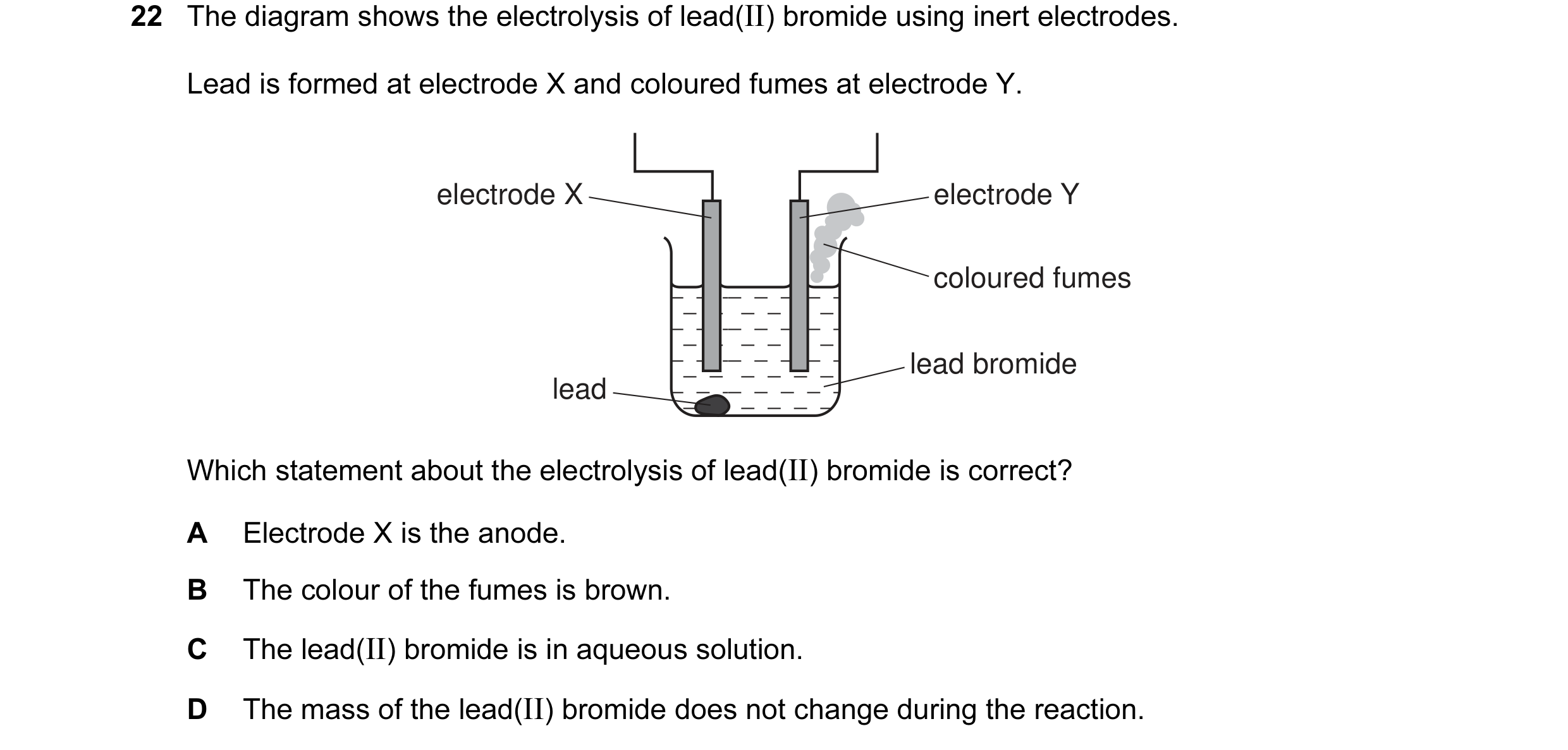
Q24 · The diagram shows the electrolysis of lead(II) bromide using inert electrodes 0653/11 Oct/Nov 2011
24 The diagram shows the electrolysis of lead(II) bromide using inert electrodes. Lead is formed at electrode X and coloured fumes at electrode Y. electrode X electrode Y coloured fumes lead bromide lead Which statement about the electrolysis of lead(II) bromide is correct? A Electrode X is the anode. B The colour of the fumes is brown. C The lead(II) bromide is in aqueous solution. D The mass of the lead(II) bromide does not change during the reaction.
1 marks
Answer: B
This question in 0653/11 Oct/Nov 2011
Q25 · The diagram shows the electrolysis of lead(II) bromide using inert electrodes 0653/12 Oct/Nov 2011
22 The diagram shows the electrolysis of lead(II) bromide using inert electrodes. Lead is formed at electrode X and coloured fumes at electrode Y. electrode X electrode Y coloured fumes lead bromide lead Which statement about the electrolysis of lead(II) bromide is correct? A Electrode X is the anode. B The colour of the fumes is brown. C The lead(II) bromide is in aqueous solution. D The mass of the lead(II) bromide does not change during the reaction.
1 marks
Answer: B
This question in 0653/12 Oct/Nov 2011
Q26 · The diagram shows the electrolysis of lead(II) bromide using inert electrodes 0653/13 Oct/Nov 2011
23 The diagram shows the electrolysis of lead(II) bromide using inert electrodes. Lead is formed at electrode X and coloured fumes at electrode Y. electrode X electrode Y coloured fumes lead bromide lead Which statement about the electrolysis of lead(II) bromide is correct? A Electrode X is the anode. B The colour of the fumes is brown. C The lead(II) bromide is in aqueous solution. D The mass of the lead(II) bromide does not change during the reaction.
1 marks
Answer: B
This question in 0653/13 Oct/Nov 2011
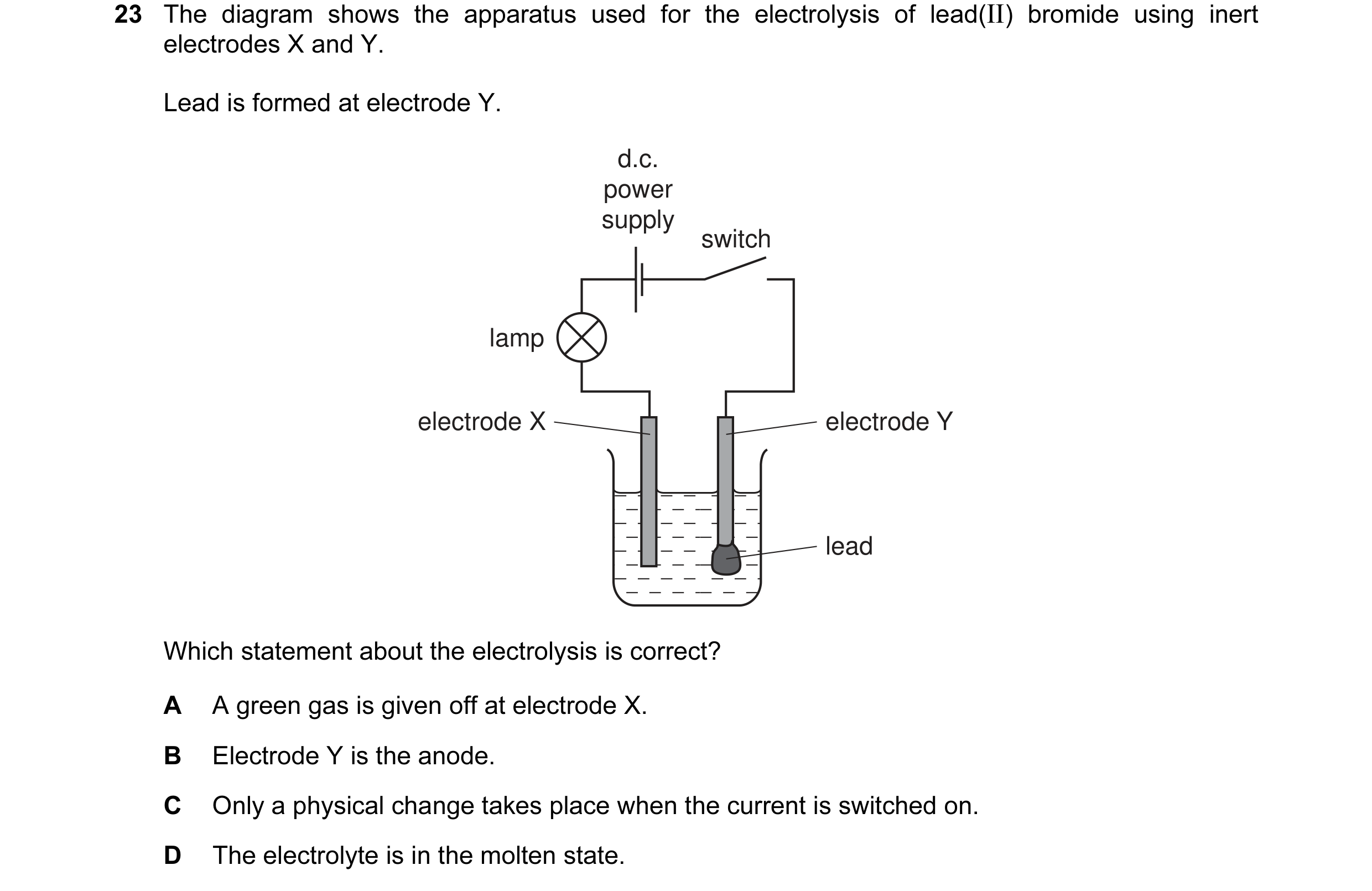
Q27 · The diagram shows the apparatus used for the electrolysis of lead(II) bromide using inert… 0653/12 May/June 2013
23 The diagram shows the apparatus used for the electrolysis of lead(II) bromide using inert electrodes X and Y. Lead is formed at electrode Y. d.c. power supply switch lamp electrode X electrode Y lead Which statement about the electrolysis is correct? A A green gas is given off at electrode X. B Electrode Y is the anode. C Only a physical change takes place when the current is switched on. D The electrolyte is in the molten state.
1 marks
Answer: D
This question in 0653/12 May/June 2013
Q28 · A solid X is placed in the circuit shown 0653/13 May/June 2013
17 A solid X is placed in the circuit shown. The lamp lights. X What is X? A an alloy B a compound C an electrolyte D a salt
1 marks
Answer: A
This question in 0653/13 May/June 2013
Q29 · Copper(II) bromide can be electrolysed in the same way as copper(II) chloride 0653/11 Oct/Nov 2013
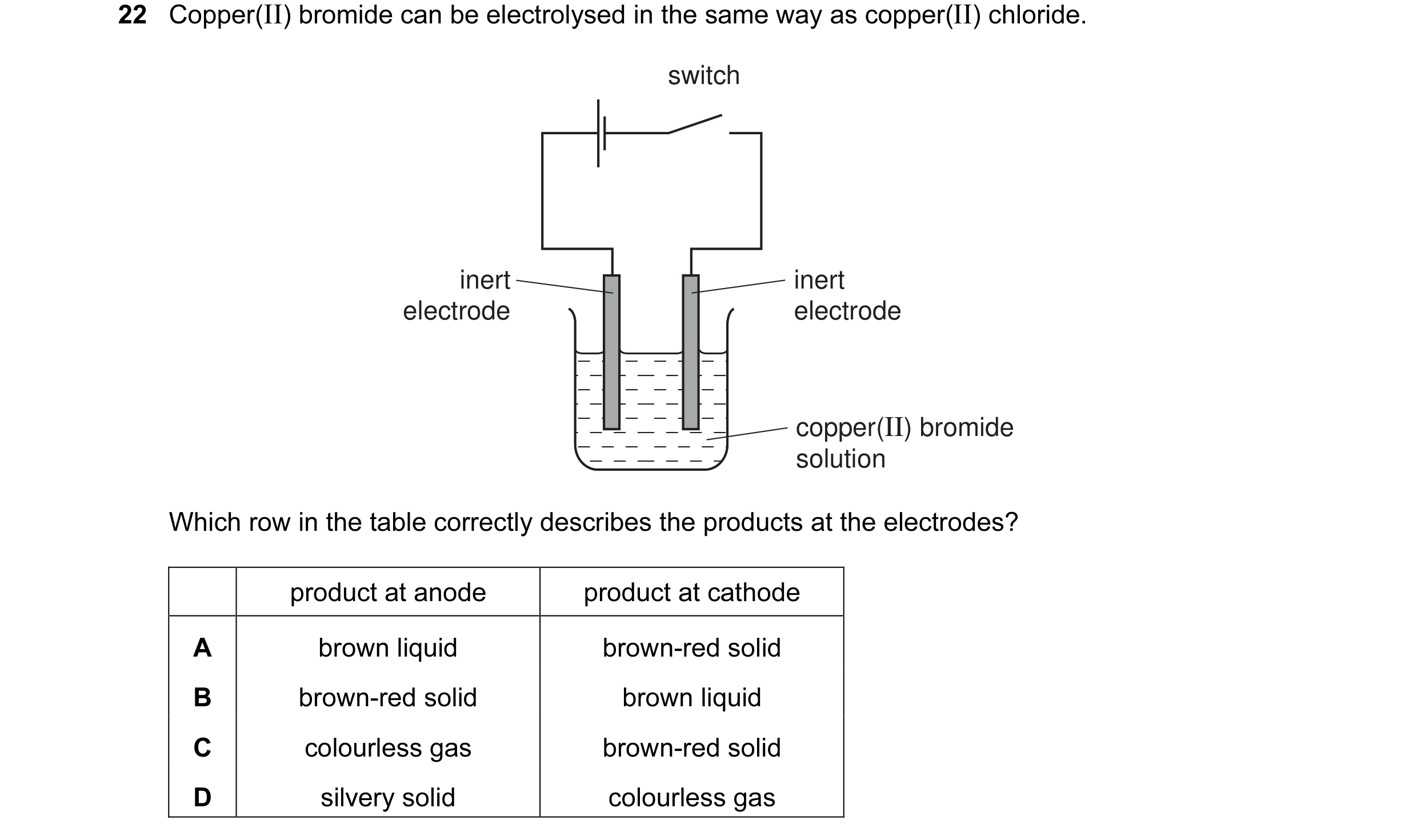
22 Copper(II) bromide can be electrolysed in the same way as copper(II) chloride. switch inert inert electrode electrode copper(II) bromide solution Which row in the table correctly describes the products at the electrodes? product at anode product at cathode A brown liquid brown-red solid B brown-red solid brown liquid C colourless gas brown-red solid D silvery solid colourless gas
1 marks
Answer: A
This question in 0653/11 Oct/Nov 2013
Q30 · Copper(II) bromide can be electrolysed in the same way as copper(II) chloride 0653/12 Oct/Nov 2013
22 Copper(II) bromide can be electrolysed in the same way as copper(II) chloride. switch inert inert electrode electrode copper(II) bromide solution Which row in the table correctly describes the products at the electrodes? product at anode product at cathode A brown liquid brown-red solid B brown-red solid brown liquid C colourless gas brown-red solid D silvery solid colourless gas
1 marks
Answer: A
This question in 0653/12 Oct/Nov 2013
Q31 · The breakdown of molten lead bromide by ……1…… forms the elements lead and bromine 0653/13 Oct/Nov 2013
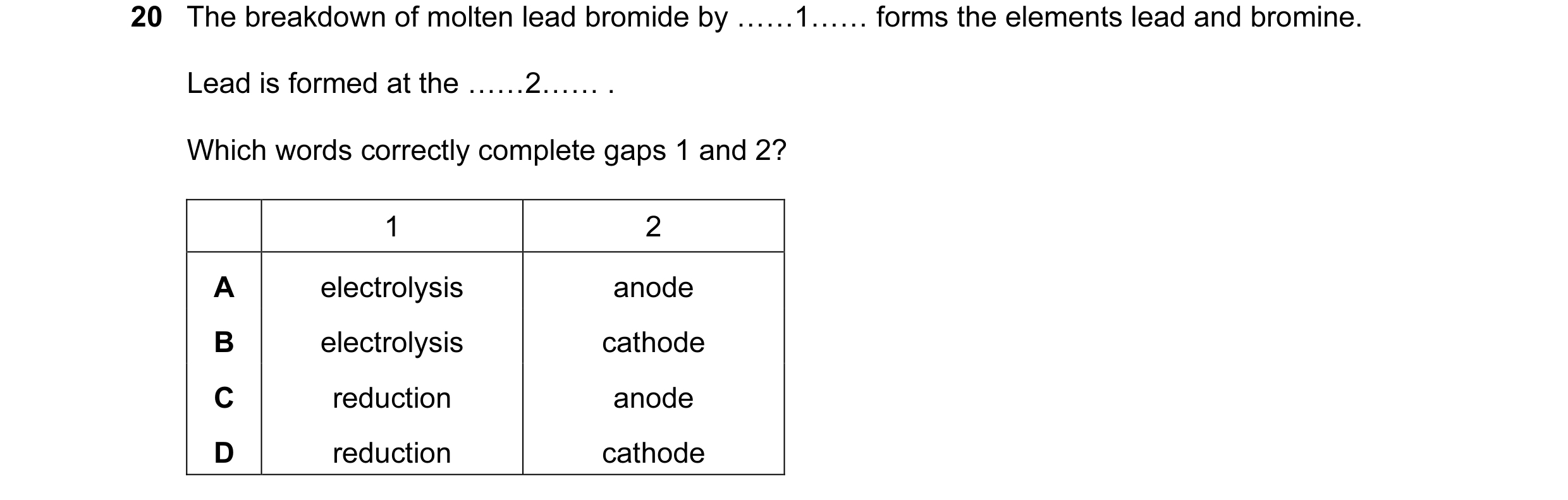
20 The breakdown of molten lead bromide by ……1…… forms the elements lead and bromine. Lead is formed at the ……2…… . Which words correctly complete gaps 1 and 2? 1 2 A electrolysis anode B electrolysis cathode C reduction anode D reduction cathode
1 marks
Answer: B
This question in 0653/13 Oct/Nov 2013
Q32 · An aqueous solution of X is electrolysed 0653/13 Oct/Nov 2013
21 An aqueous solution of X is electrolysed. carbon carbon anode + – cathode beaker aqueous solution of X The cathode increases in mass and turns red-brown. What is X? A copper(II) chloride B iodine C lead(II) bromide D sodium chloride
1 marks
Answer: A
This question in 0653/13 Oct/Nov 2013
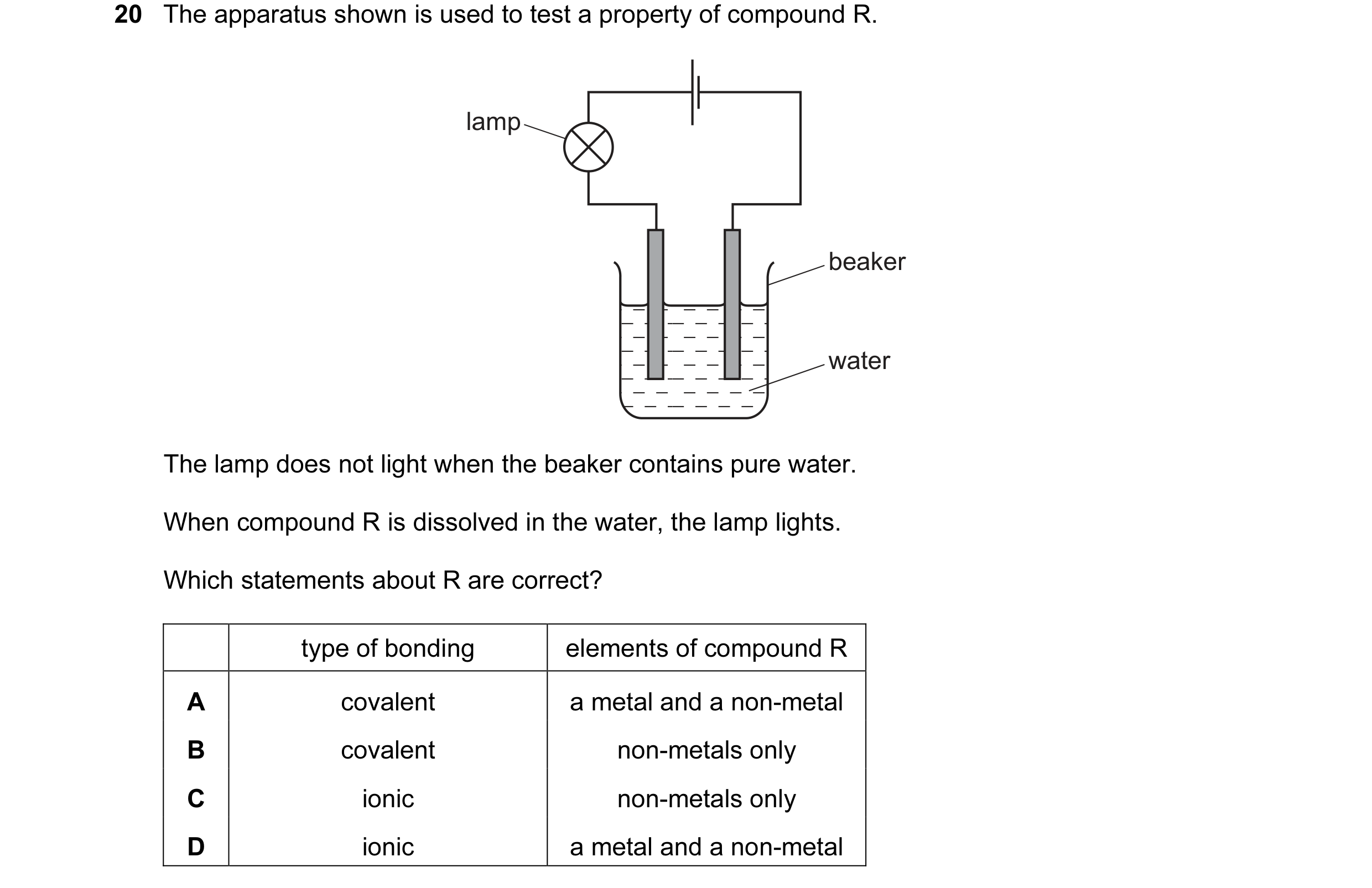
Q33 · The apparatus shown is used to test a property of compound R 0653/11 May/June 2014
20 The apparatus shown is used to test a property of compound R. lamp beaker water The lamp does not light when the beaker contains pure water. When compound R is dissolved in the water, the lamp lights. Which statements about R are correct? type of bonding elements of compound R A covalent a metal and a non-metal B covalent non-metals only C ionic non-metals only D ionic a metal and a non-metal
1 marks
Answer: D
This question in 0653/11 May/June 2014
Q34 · The diagram shows the electrolysis of molten lead(II) bromide 0653/11 May/June 2014
21 The diagram shows the electrolysis of molten lead(II) bromide. carbon electrode X + – carbon electrode Y molten lead(II) bromide Which statement is correct? A Bromine is formed at electrode Y. B Hydrogen is formed at electrode X. C Lead is formed at electrode Y. D Oxygen is formed at electrode X.
1 marks
Answer: C
This question in 0653/11 May/June 2014
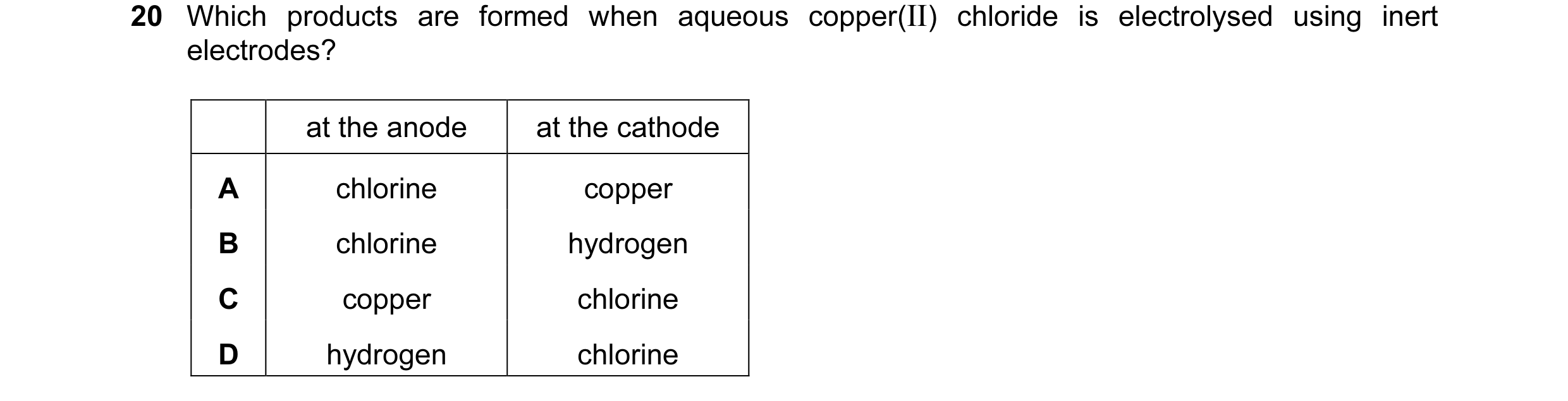
Q35 · Which products are formed when aqueous copper(II) chloride is electrolysed using inert… 0653/12 May/June 2014
20 Which products are formed when aqueous copper(II) chloride is electrolysed using inert electrodes? at the anode at the cathode A chlorine copper B chlorine hydrogen C copper chlorine D hydrogen chlorine
1 marks
Answer: A
This question in 0653/12 May/June 2014
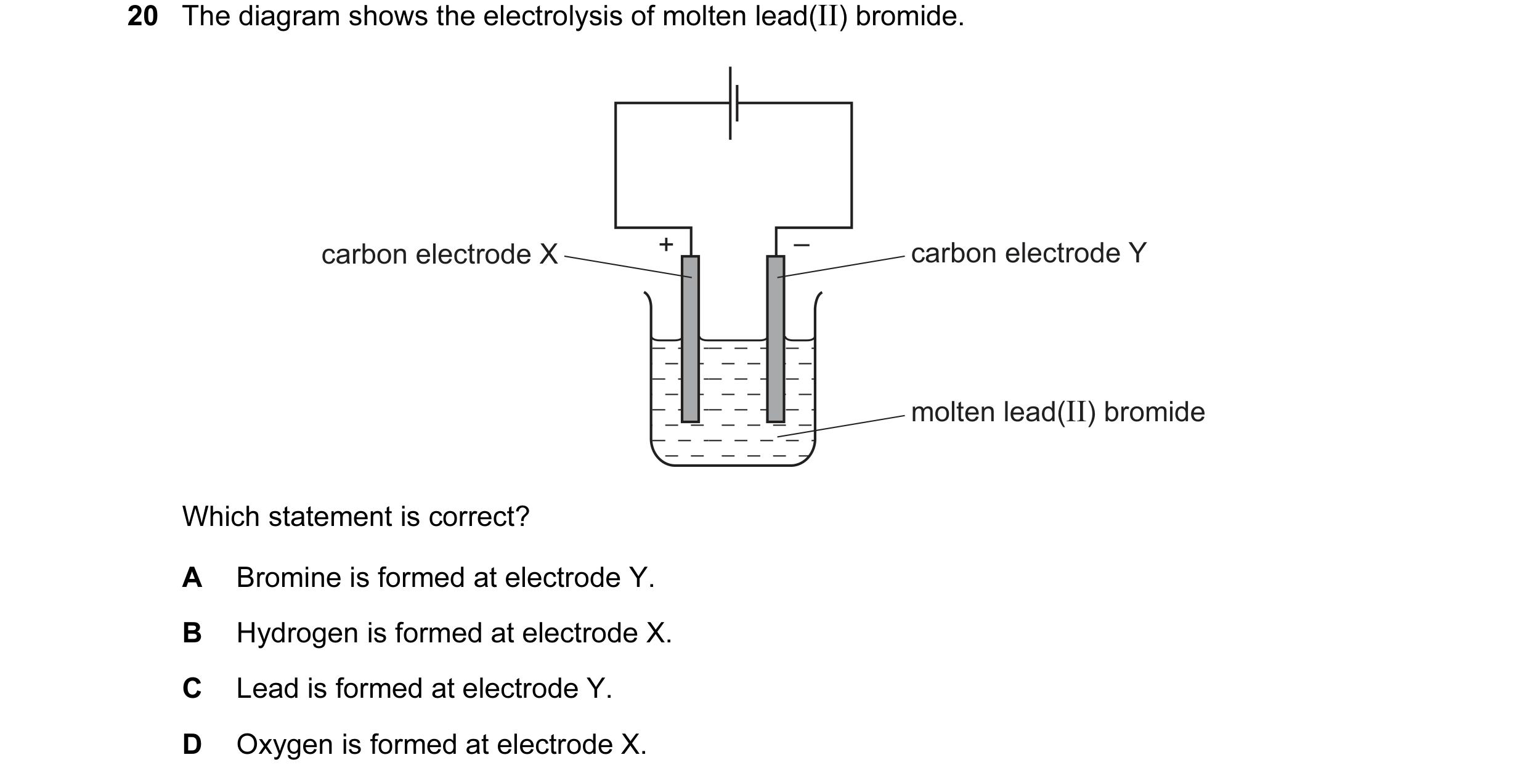
Q36 · The diagram shows the electrolysis of molten lead(II) bromide 0653/13 May/June 2014
20 The diagram shows the electrolysis of molten lead(II) bromide. carbon electrode X + – carbon electrode Y molten lead(II) bromide Which statement is correct? A Bromine is formed at electrode Y. B Hydrogen is formed at electrode X. C Lead is formed at electrode Y. D Oxygen is formed at electrode X.
1 marks
Answer: C
This question in 0653/13 May/June 2014
Q37 · In the electrolysis of molten lead(II) bromide, what is the electrolyte? 0653/11 Oct/Nov 2014
20 In the electrolysis of molten lead(II) bromide, what is the electrolyte? A anode B bromine C lead D lead bromide
1 marks
Answer: D
This question in 0653/11 Oct/Nov 2014
Q38 · In the electrolysis of molten lead(II) bromide, what is the electrolyte? 0653/12 Oct/Nov 2014
22 In the electrolysis of molten lead(II) bromide, what is the electrolyte? A anode B bromine C lead D lead bromide
1 marks
Answer: D
This question in 0653/12 Oct/Nov 2014
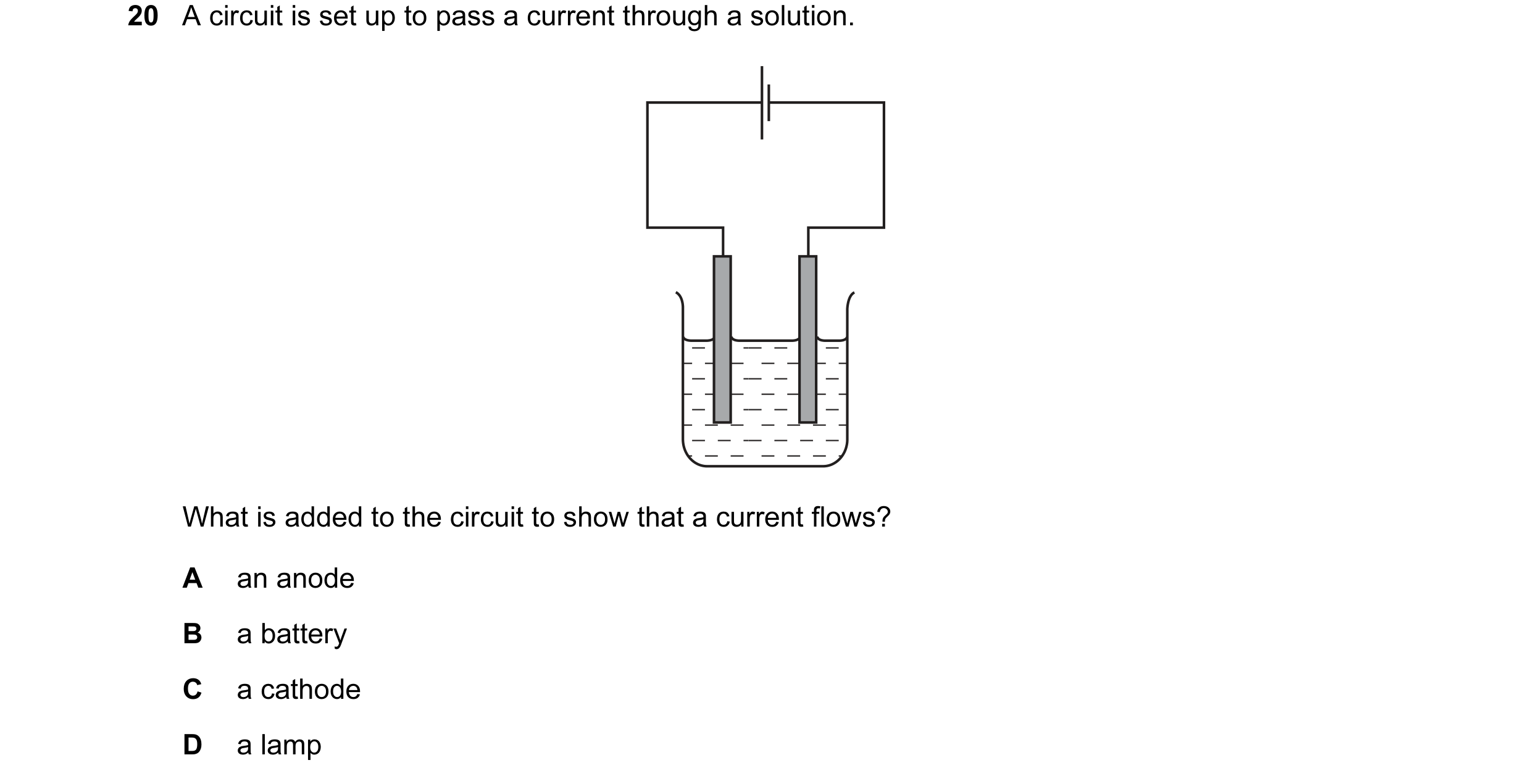
Q39 · A circuit is set up to pass a current through a solution 0653/13 Oct/Nov 2014
20 A circuit is set up to pass a current through a solution. What is added to the circuit to show that a current flows? A an anode B a battery C a cathode D a lamp
1 marks
Answer: D
This question in 0653/13 Oct/Nov 2014
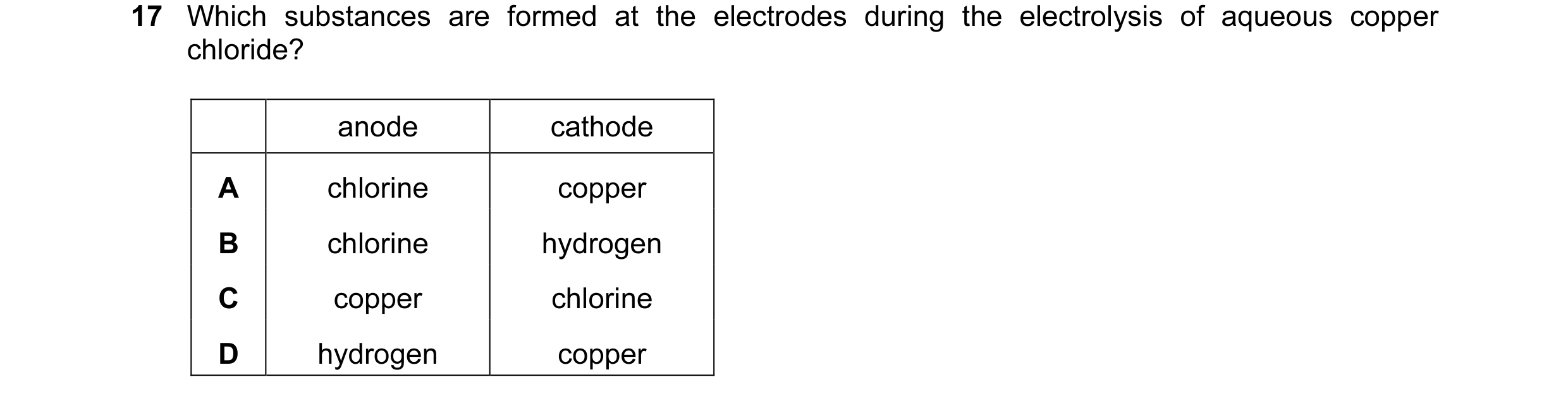
Q40 · Which substances are formed at the electrodes during the electrolysis of aqueous copper… 0653/11 May/June 2015
17 Which substances are formed at the electrodes during the electrolysis of aqueous copper chloride? anode cathode A chlorine copper B chlorine hydrogen C copper chlorine D hydrogen copper
1 marks
Answer: A
This question in 0653/11 May/June 2015
Q41 · The diagram shows the electrolysis of molten lead(II) bromide 0653/12 May/June 2015
18 The diagram shows the electrolysis of molten lead(II) bromide. + – electrode molten lead(II) bromide Which row is correct? name of product at the positive electrode negative electrode A anode bromine B anode lead C cathode bromine D cathode lead
1 marks
Answer: B
This question in 0653/12 May/June 2015
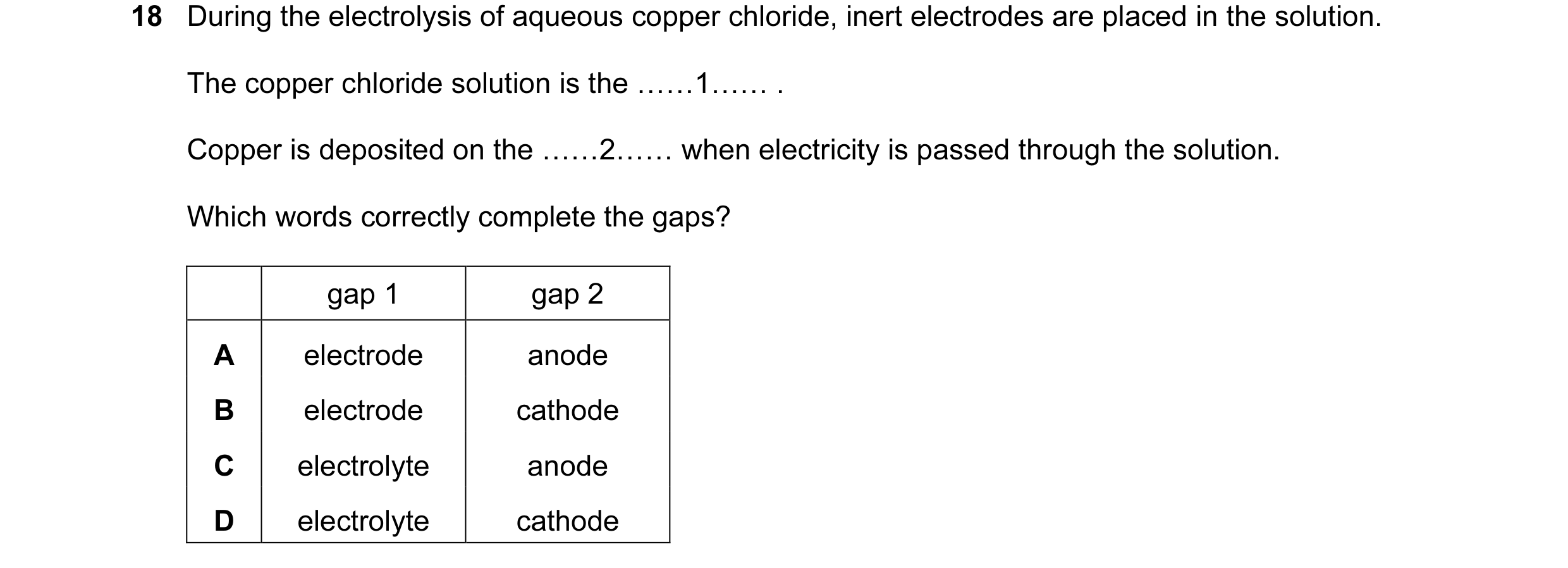
Q42 · During the electrolysis of aqueous copper chloride, inert electrodes are placed in the… 0653/13 May/June 2015
18 During the electrolysis of aqueous copper chloride, inert electrodes are placed in the solution. The copper chloride solution is the ……1…… . Copper is deposited on the ……2…… when electricity is passed through the solution. Which words correctly complete the gaps? gap 1 gap 2 A electrode anode B electrode cathode C electrolyte anode D electrolyte cathode
1 marks
Answer: D
This question in 0653/13 May/June 2015
Q43 · The apparatus shown is set up 0653/11 Oct/Nov 2015
18 The apparatus shown is set up. lamp electrodes solid crucible lead(II) bromide heat The crucible needs to be heated for the lamp to give out light. Why is heat needed? A An exothermic reaction takes place in the crucible. B Electrodes only conduct electricity when hot. C Heat causes the lead(II) bromide to react with air. D The lead(II) bromide must be molten.
1 marks
Answer: D
This question in 0653/11 Oct/Nov 2015
Q44 · The apparatus shown is set up 0653/12 Oct/Nov 2015
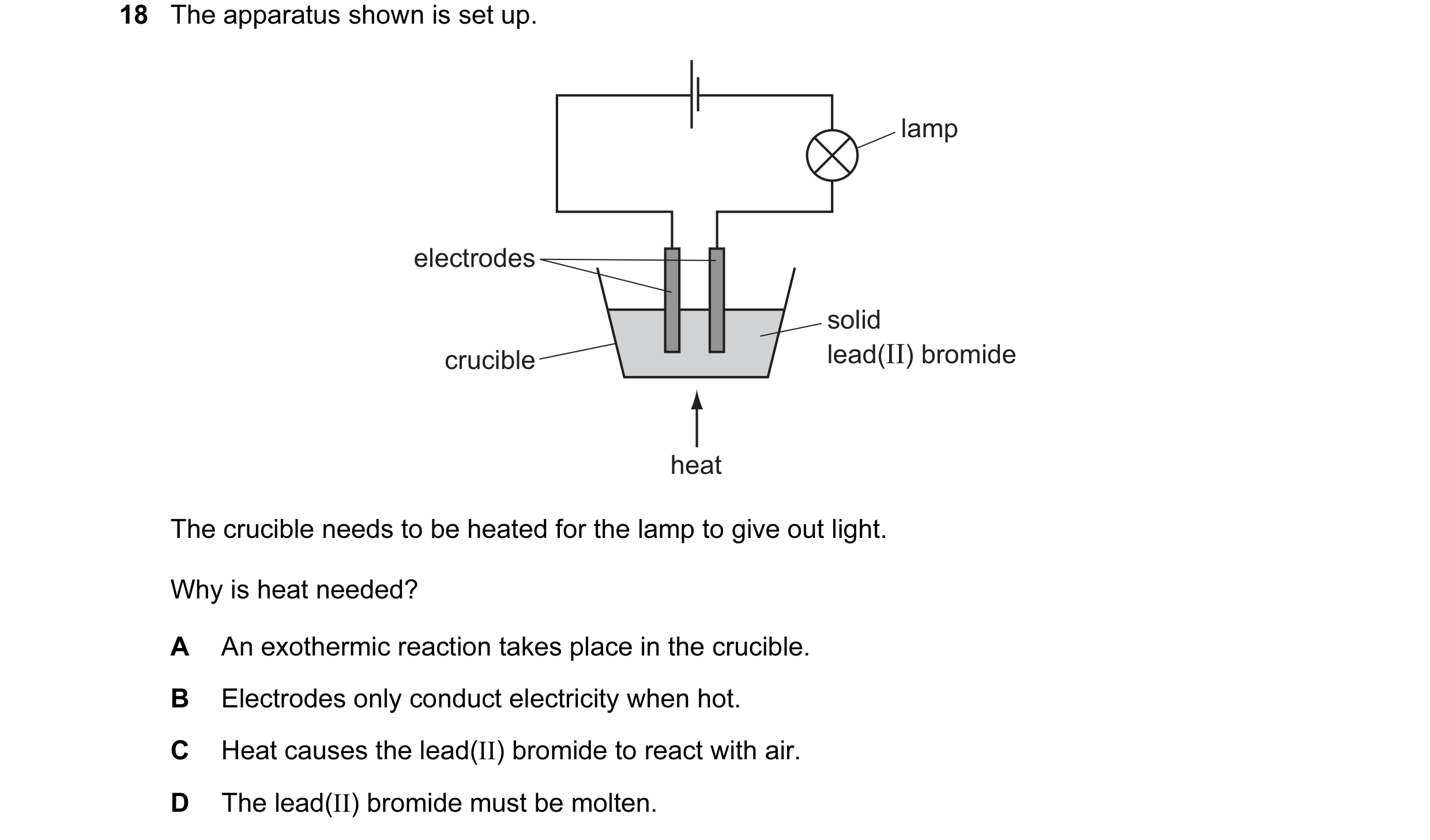
18 The apparatus shown is set up. lamp electrodes solid crucible lead(II) bromide heat The crucible needs to be heated for the lamp to give out light. Why is heat needed? A An exothermic reaction takes place in the crucible. B Electrodes only conduct electricity when hot. C Heat causes the lead(II) bromide to react with air. D The lead(II) bromide must be molten.
1 marks
Answer: D
This question in 0653/12 Oct/Nov 2015
Q45 · The apparatus shown is set up 0653/13 Oct/Nov 2015
18 The apparatus shown is set up. lamp electrodes solid crucible lead(II) bromide heat The crucible needs to be heated for the lamp to give out light. Why is heat needed? A An exothermic reaction takes place in the crucible. B Electrodes only conduct electricity when hot. C Heat causes the lead(II) bromide to react with air. D The lead(II) bromide must be molten.
1 marks
Answer: D
This question in 0653/13 Oct/Nov 2015
Q46 · The diagram shows the apparatus used for the electrolysis of lead(II) bromide using inert… 0653/11 May/June 2016
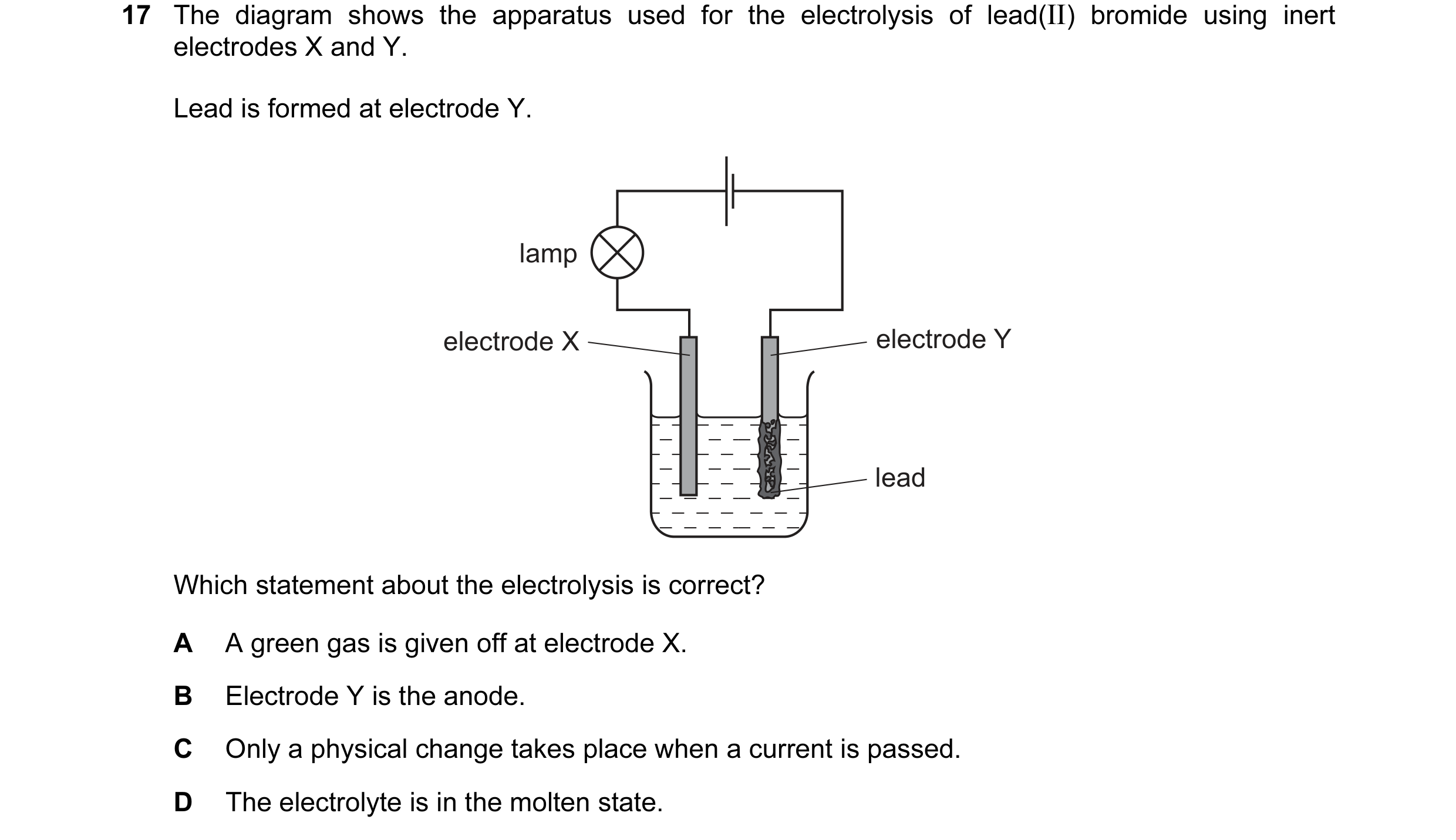
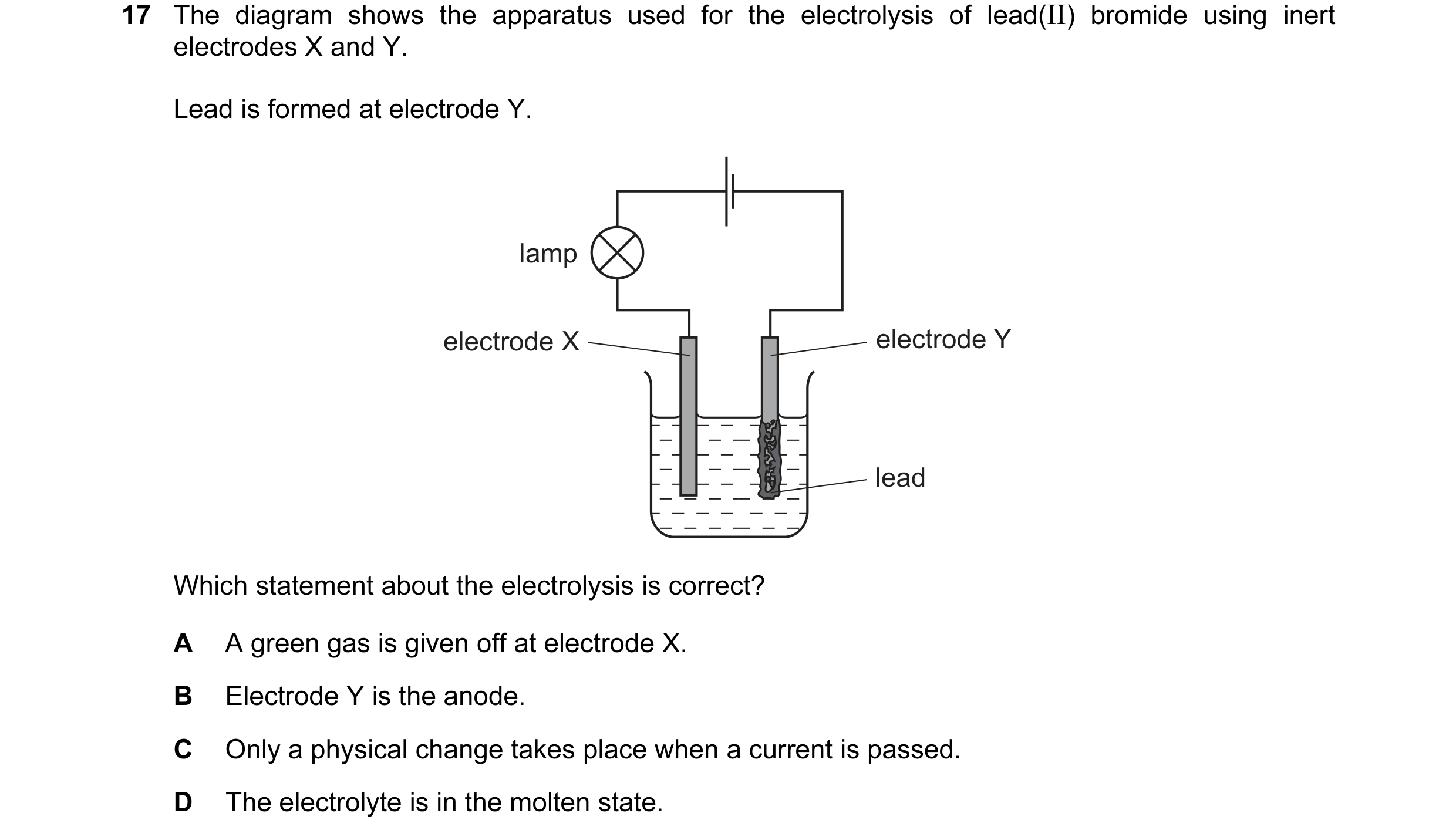
17 The diagram shows the apparatus used for the electrolysis of lead(II) bromide using inert electrodes X and Y. Lead is formed at electrode Y. lamp electrode X electrode Y lead Which statement about the electrolysis is correct? A A green gas is given off at electrode X. B Electrode Y is the anode. C Only a physical change takes place when a current is passed. D The electrolyte is in the molten state.
1 marks
Answer: D
This question in 0653/11 May/June 2016
Q47 · The diagram shows the apparatus used for the electrolysis of lead(II) bromide using inert… 0653/12 May/June 2016
17 The diagram shows the apparatus used for the electrolysis of lead(II) bromide using inert electrodes X and Y. Lead is formed at electrode Y. lamp electrode X electrode Y lead Which statement about the electrolysis is correct? A A green gas is given off at electrode X. B Electrode Y is the anode. C Only a physical change takes place when a current is passed. D The electrolyte is in the molten state.
1 marks
Answer: D
This question in 0653/12 May/June 2016
Q48 · The diagram shows the apparatus used for the electrolysis of lead(II) bromide using inert… 0653/13 May/June 2016
17 The diagram shows the apparatus used for the electrolysis of lead(II) bromide using inert electrodes X and Y. Lead is formed at electrode Y. lamp electrode X electrode Y lead Which statement about the electrolysis is correct? A A green gas is given off at electrode X. B Electrode Y is the anode. C Only a physical change takes place when a current is passed. D The electrolyte is in the molten state.
1 marks
Answer: D
This question in 0653/13 May/June 2016
Q49 · The apparatus for the electrolysis of lead(II) bromide is shown 0653/11 Oct/Nov 2016
19 The apparatus for the electrolysis of lead(II) bromide is shown. inert electrodes molten lead(II) bromide heat What is seen at each electrode? anode cathode A brown gas silvery solid B green gas silvery solid C silvery solid brown gas D silvery solid green gas
1 marks
Answer: A
This question in 0653/11 Oct/Nov 2016
Q50 · What are the products of electrolysis of aqueous copper chloride using inert electrodes? 0653/12 Oct/Nov 2016
19 What are the products of electrolysis of aqueous copper chloride using inert electrodes? A copper and chlorine B copper and oxygen C hydrogen and chlorine D hydrogen and oxygen
1 marks
Answer: A
This question in 0653/12 Oct/Nov 2016
Q51 · Aqueous sodium chloride is electrolysed using the apparatus shown 0653/13 Oct/Nov 2016
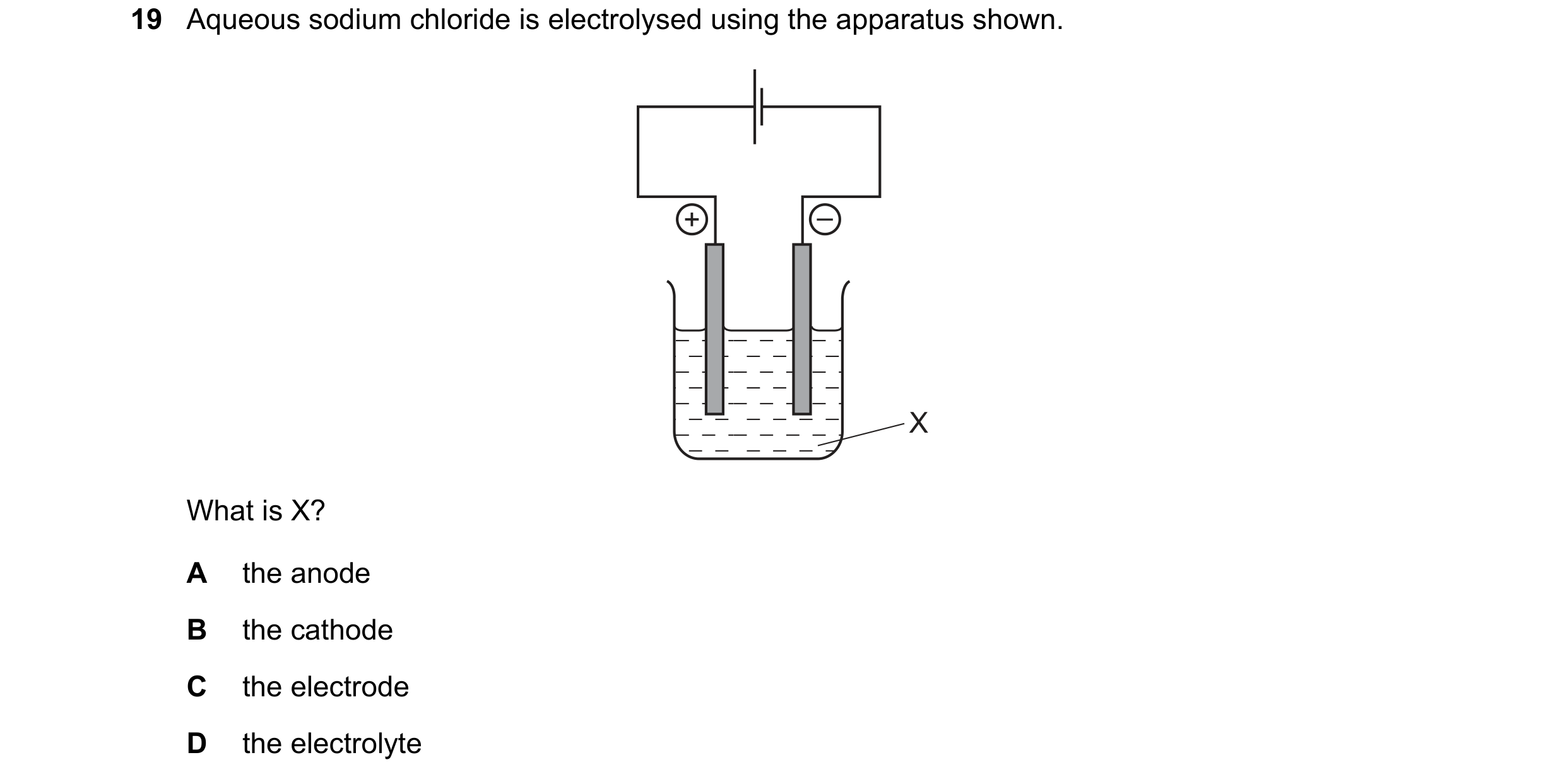
19 Aqueous sodium chloride is electrolysed using the apparatus shown. + – X What is X? A the anode B the cathode C the electrode D the electrolyte
1 marks
Answer: D
This question in 0653/13 Oct/Nov 2016
Q52 · Copper chloride and lead(II) bromide are ionic compounds 0653/12 Feb/March 2017
19 Copper chloride and lead(II) bromide are ionic compounds. Glucose is a covalent compound. Which substance undergoes electrolysis? A aqueous copper chloride B aqueous glucose C solid glucose D solid lead(II) bromide
1 marks
Answer: A
This question in 0653/12 Feb/March 2017
Q53 · The diagram shows the electrolysis of molten lead(II) bromide 0653/11 May/June 2017
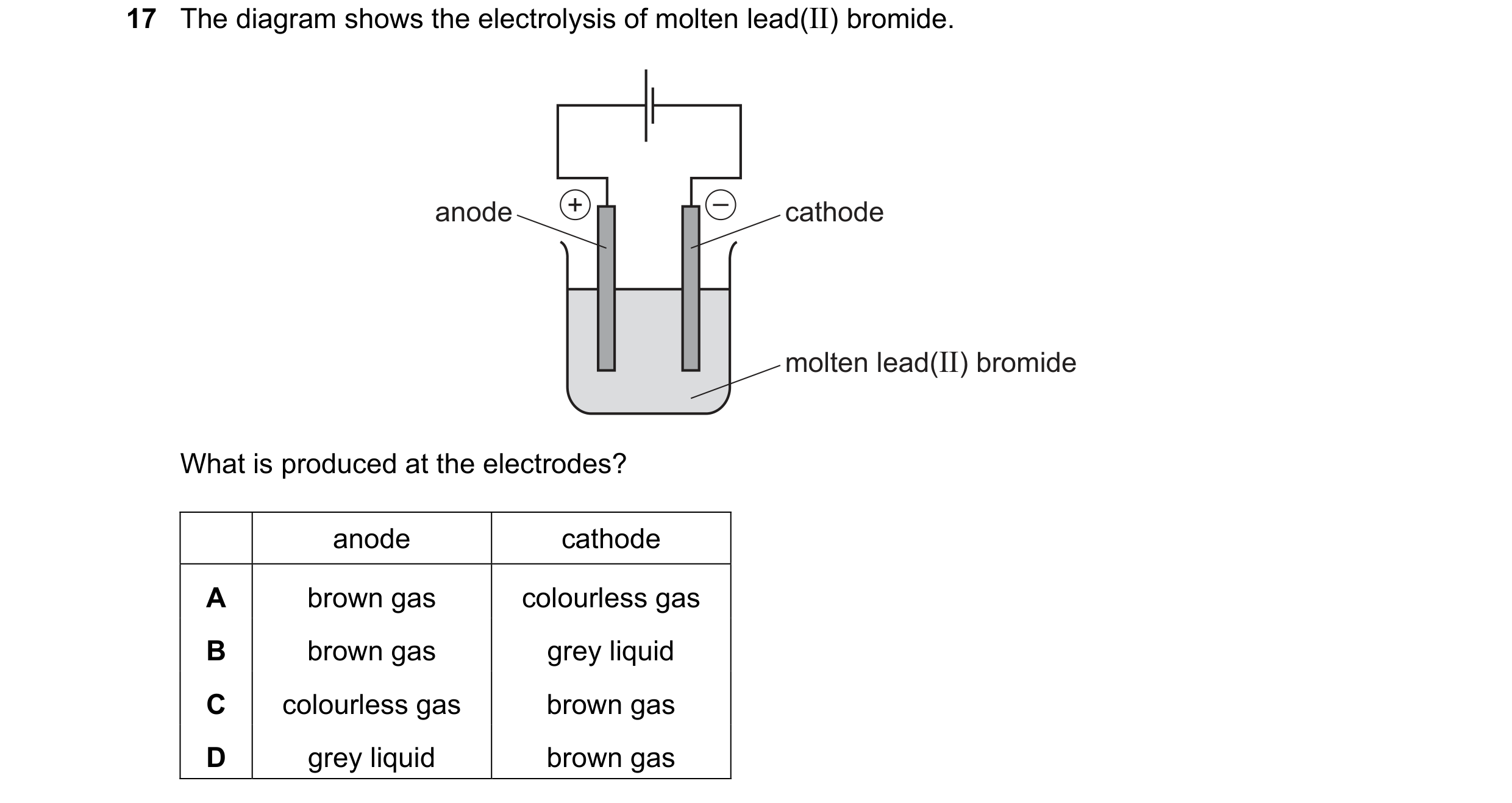
17 The diagram shows the electrolysis of molten lead(II) bromide. anode + – cathode molten lead(II) bromide What is produced at the electrodes? anode cathode A brown gas colourless gas B brown gas grey liquid C colourless gas brown gas D grey liquid brown gas
1 marks
Answer: B
This question in 0653/11 May/June 2017
Q54 · A molten compound X is electrolysed as shown 0653/12 May/June 2017
17 A molten compound X is electrolysed as shown. lamp anode + – cathode X heat A brown gas is produced at the anode and a grey metal is produced at the cathode. What is X? A aluminium oxide B copper chloride C lead(II) bromide D sodium chloride
1 marks
Answer: C
This question in 0653/12 May/June 2017
Q55 · A molten compound X is electrolysed as shown 0653/13 May/June 2017
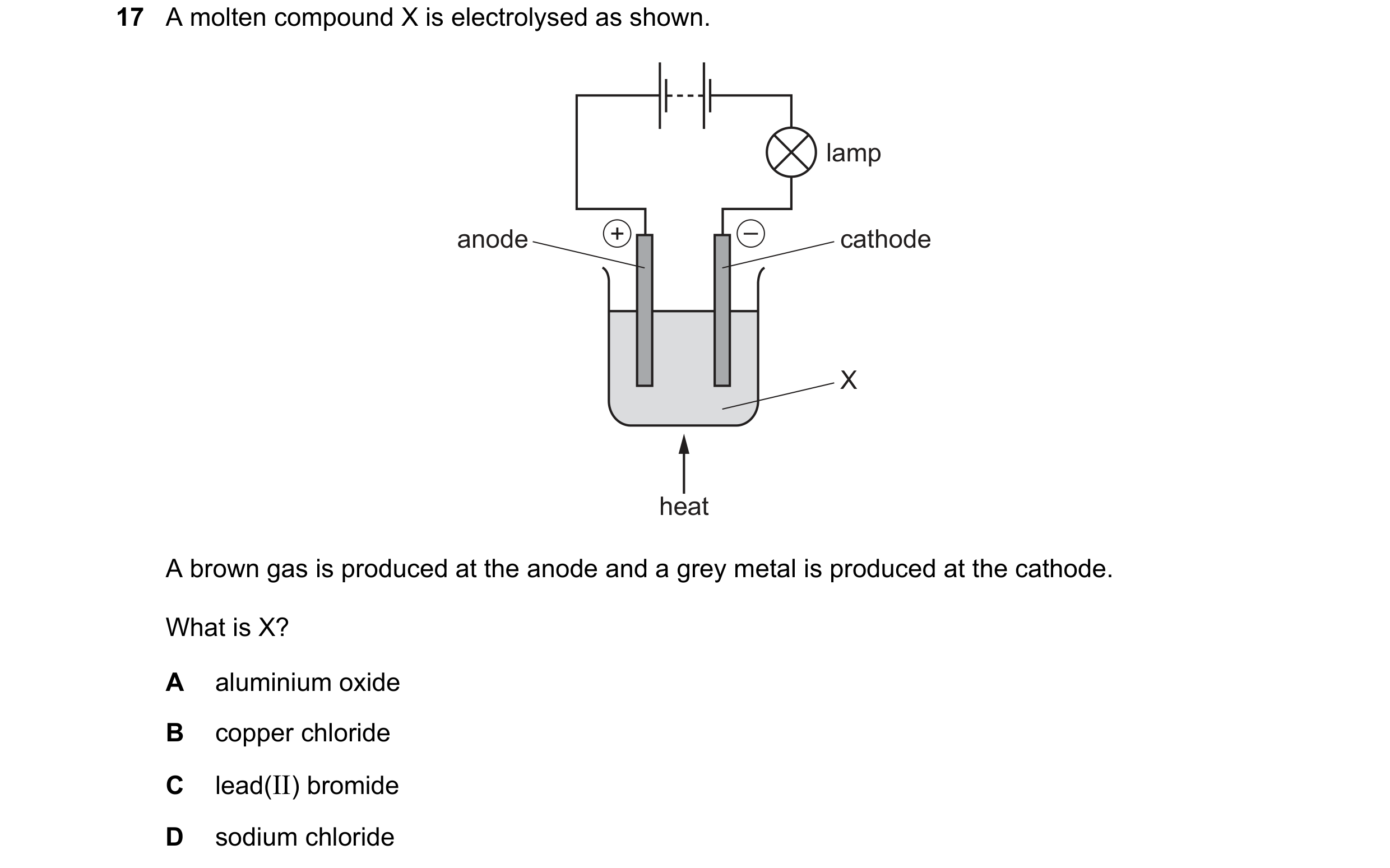
17 A molten compound X is electrolysed as shown. lamp anode + – cathode X heat A brown gas is produced at the anode and a grey metal is produced at the cathode. What is X? A aluminium oxide B copper chloride C lead(II) bromide D sodium chloride
1 marks
Answer: C
This question in 0653/13 May/June 2017
Q56 · What is produced at the anode during the electrolysis of molten lead(II) bromide? 0653/11 Oct/Nov 2017
18 What is produced at the anode during the electrolysis of molten lead(II) bromide? A bromide ions B bromine C lead D lead(II) ions
1 marks
Answer: B
This question in 0653/11 Oct/Nov 2017
Q57 · What is formed at the cathode during the electrolysis of aqueous copper chloride? 0653/12 Oct/Nov 2017
18 What is formed at the cathode during the electrolysis of aqueous copper chloride? A chlorine B copper C hydrogen D oxygen
1 marks
Answer: B
This question in 0653/12 Oct/Nov 2017
Q58 · Which row describes an ionic compound? 0653/13 Oct/Nov 2017
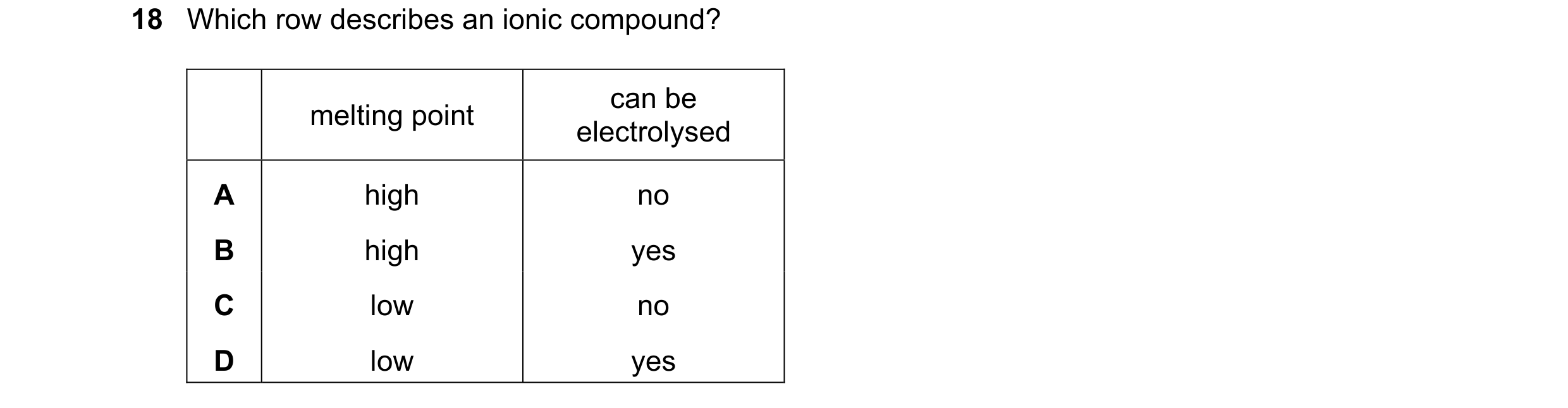
18 Which row describes an ionic compound? can be melting point electrolysed A high no B high yes C low no D low yes
1 marks
Answer: B
This question in 0653/13 Oct/Nov 2017
Q59 · During the electrolysis of aqueous copper chloride, inert electrodes are placed in the… 0653/12 Feb/March 2018
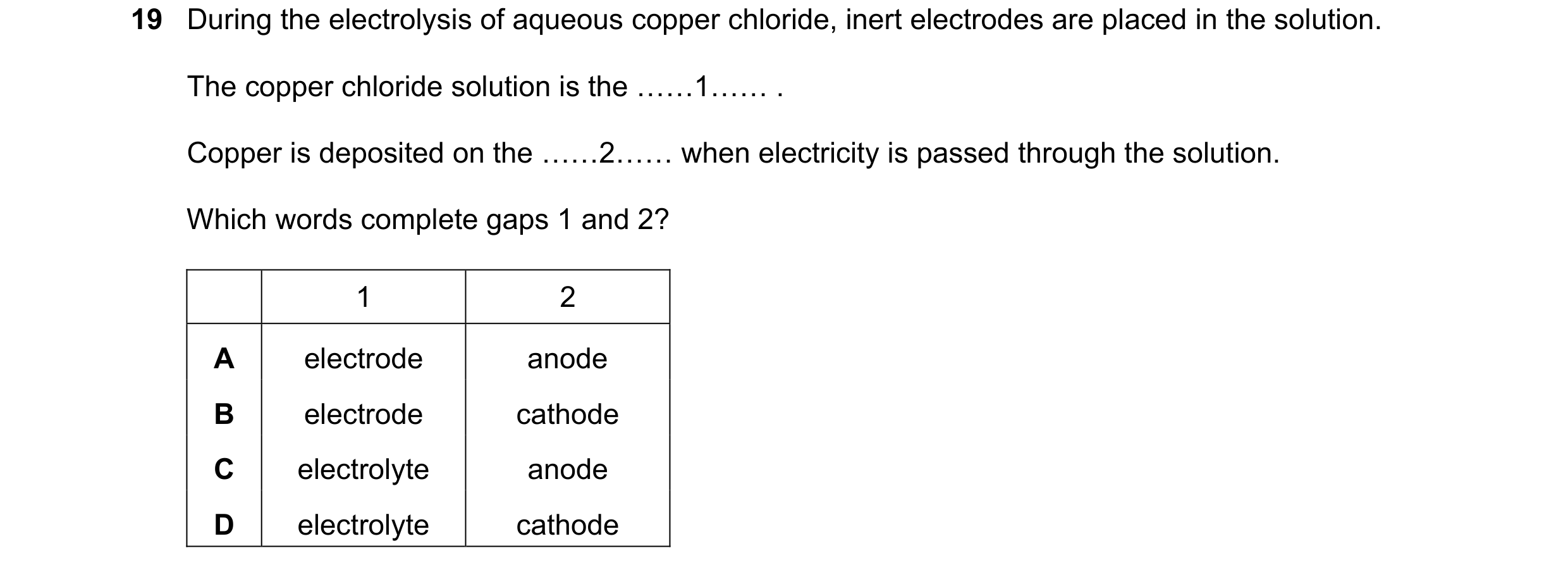
19 During the electrolysis of aqueous copper chloride, inert electrodes are placed in the solution. The copper chloride solution is the ««1«« . Copper is deposited on the ««2«« when electricity is passed through the solution. Which words complete gaps 1 and 2? 1 2 A electrode anode B electrode cathode C electrolyte anode D electrolyte cathode
1 marks
Answer: D
This question in 0653/12 Feb/March 2018
Q60 · The diagram shows apparatus for electrolysis 0653/11 May/June 2018
19 The diagram shows apparatus for electrolysis. Only one label is correct. electrode + – cathode anode electrolyte Which label on the diagram is correct? A anode B cathode C electrode D electrolyte
1 marks
Answer: D
This question in 0653/11 May/June 2018
Q61 · The diagram shows apparatus for electrolysis 0653/12 May/June 2018
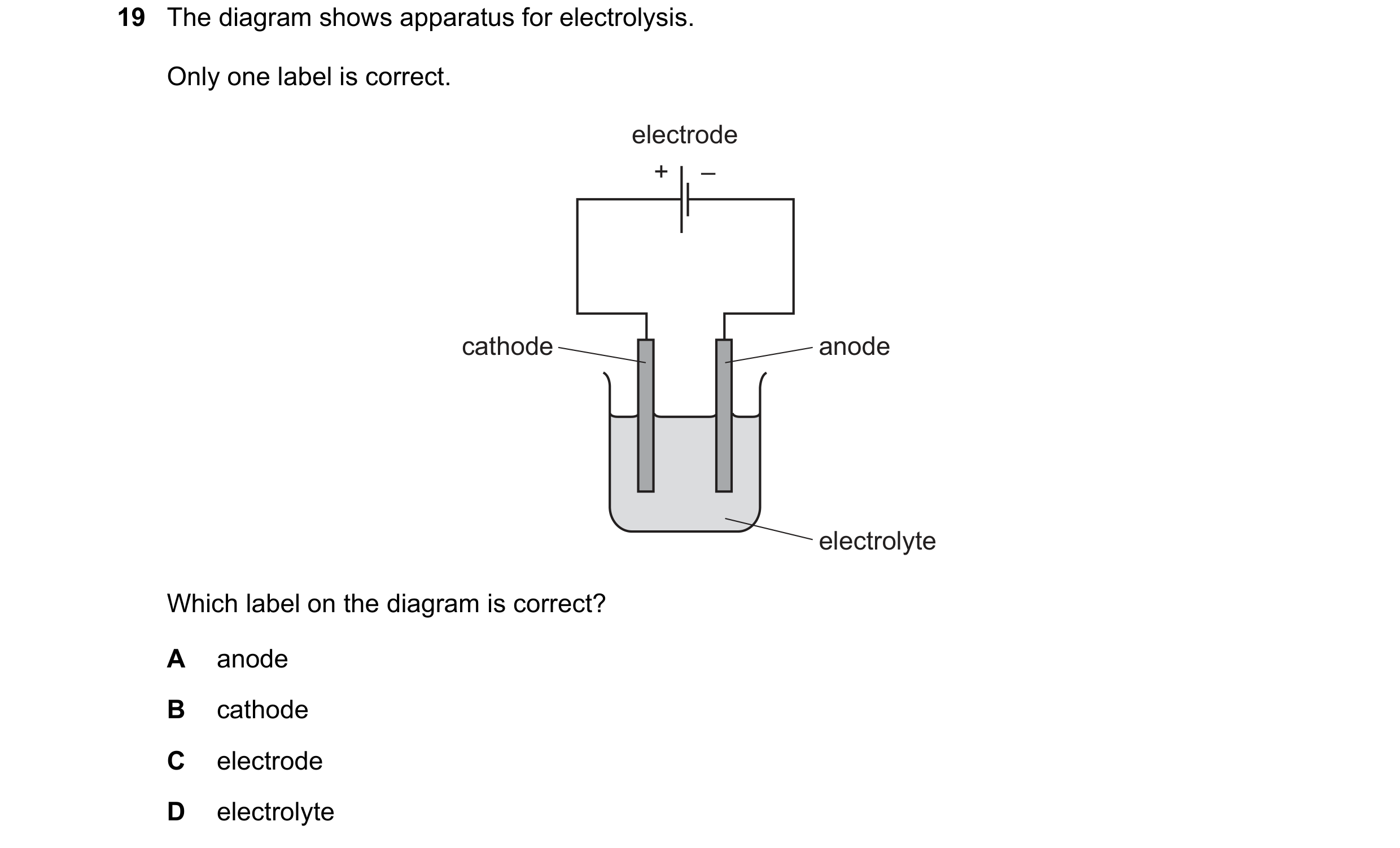
19 The diagram shows apparatus for electrolysis. Only one label is correct. electrode + – cathode anode electrolyte Which label on the diagram is correct? A anode B cathode C electrode D electrolyte
1 marks
Answer: D
This question in 0653/12 May/June 2018
Q62 · The diagram shows apparatus for electrolysis 0653/13 May/June 2018
19 The diagram shows apparatus for electrolysis. Only one label is correct. electrode + – cathode anode electrolyte Which label on the diagram is correct? A anode B cathode C electrode D electrolyte
1 marks
Answer: D
This question in 0653/13 May/June 2018
Q63 · The breakdown of molten lead bromide by ««1«« forms the elements lead and bromine 0653/11 Oct/Nov 2018
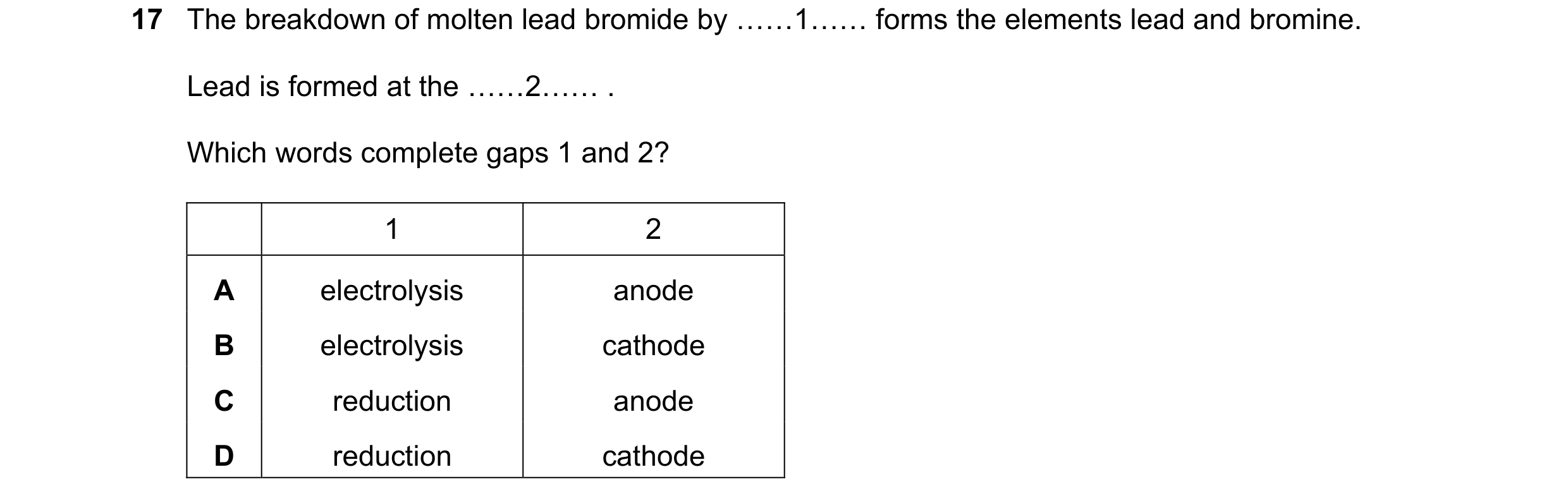
17 The breakdown of molten lead bromide by ««1«« forms the elements lead and bromine. Lead is formed at the ««2«« . Which words complete gaps 1 and 2? 1 2 A electrolysis anode B electrolysis cathode C reduction anode D reduction cathode
1 marks
Answer: B
This question in 0653/11 Oct/Nov 2018
Q64 · The breakdown of molten lead bromide by ««1«« forms the elements lead and bromine 0653/12 Oct/Nov 2018
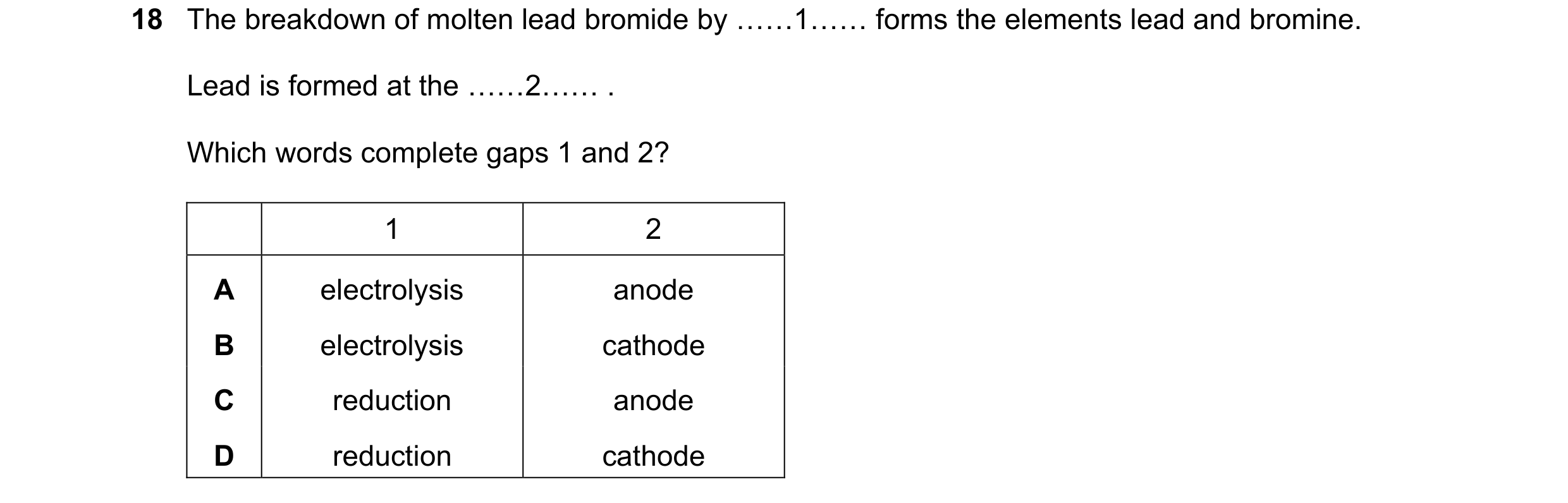
18 The breakdown of molten lead bromide by ««1«« forms the elements lead and bromine. Lead is formed at the ««2«« . Which words complete gaps 1 and 2? 1 2 A electrolysis anode B electrolysis cathode C reduction anode D reduction cathode
1 marks
Answer: B
This question in 0653/12 Oct/Nov 2018
Q65 · The breakdown of molten lead bromide by ««1«« forms the elements lead and bromine 0653/13 Oct/Nov 2018
18 The breakdown of molten lead bromide by ««1«« forms the elements lead and bromine. Lead is formed at the ««2«« . Which words complete gaps 1 and 2? 1 2 A electrolysis anode B electrolysis cathode C reduction anode D reduction cathode
1 marks
Answer: B
This question in 0653/13 Oct/Nov 2018
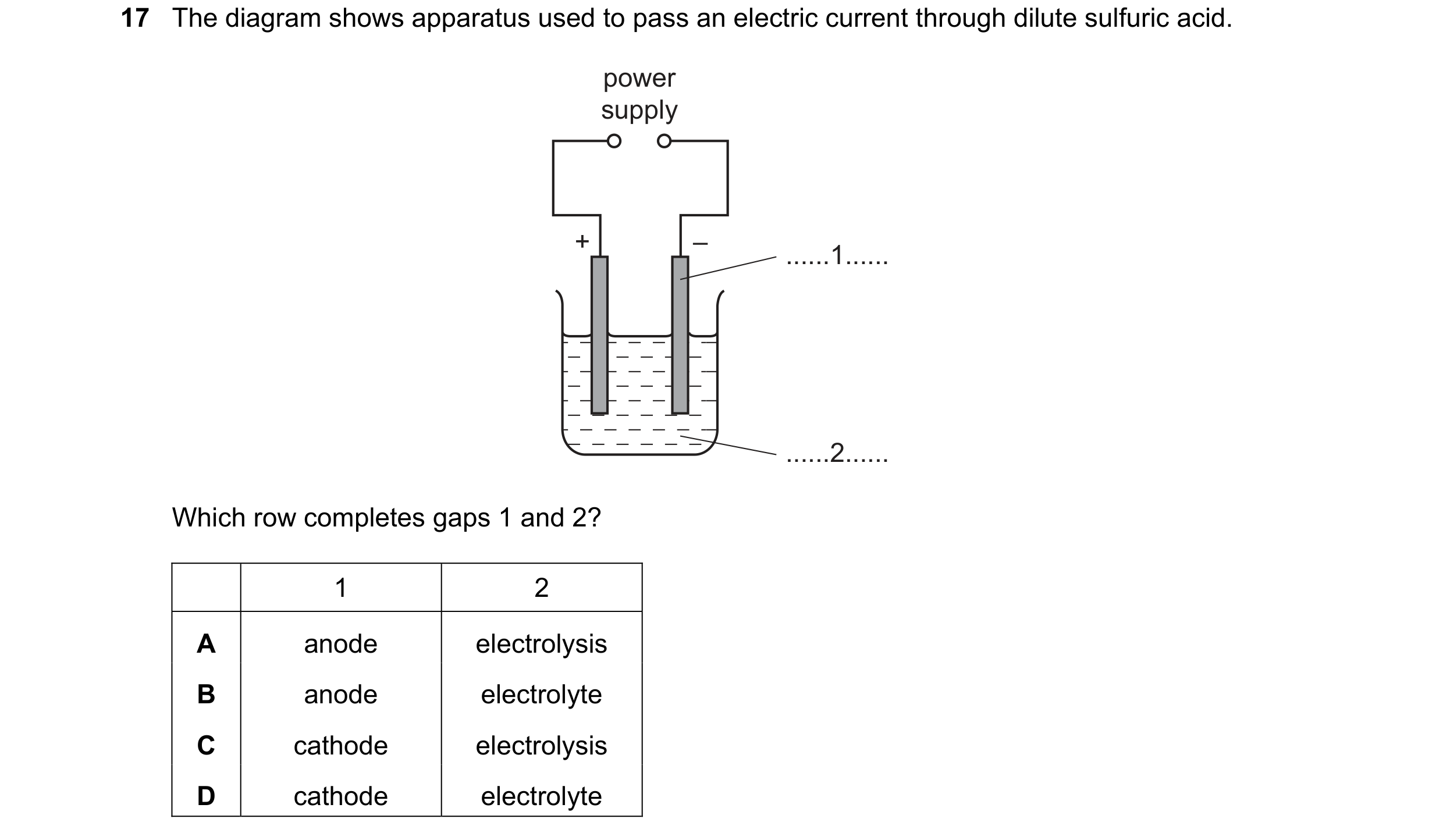
Q66 · The diagram shows apparatus used to pass an electric current through dilute sulfuric acid 0653/12 Feb/March 2019
17 The diagram shows apparatus used to pass an electric current through dilute sulfuric acid. power supply + – … 1 … … 2 … Which row completes gaps 1 and 2? 1 2 A anode electrolysis B anode electrolyte C cathode electrolysis D cathode electrolyte
1 marks
Answer: D
This question in 0653/12 Feb/March 2019
Q67 · Molten lead(II) bromide is electrolysed using inert electrodes 0653/11 May/June 2019
18 Molten lead(II) bromide is electrolysed using inert electrodes. power supply + – inert inert anode cathode molten lead(II) bromide What is formed at each electrode? anode cathode A grey solid orange-brown gas B grey solid grey solid C orange-brown gas orange-brown gas D orange-brown gas grey solid
1 marks
Answer: D
This question in 0653/11 May/June 2019
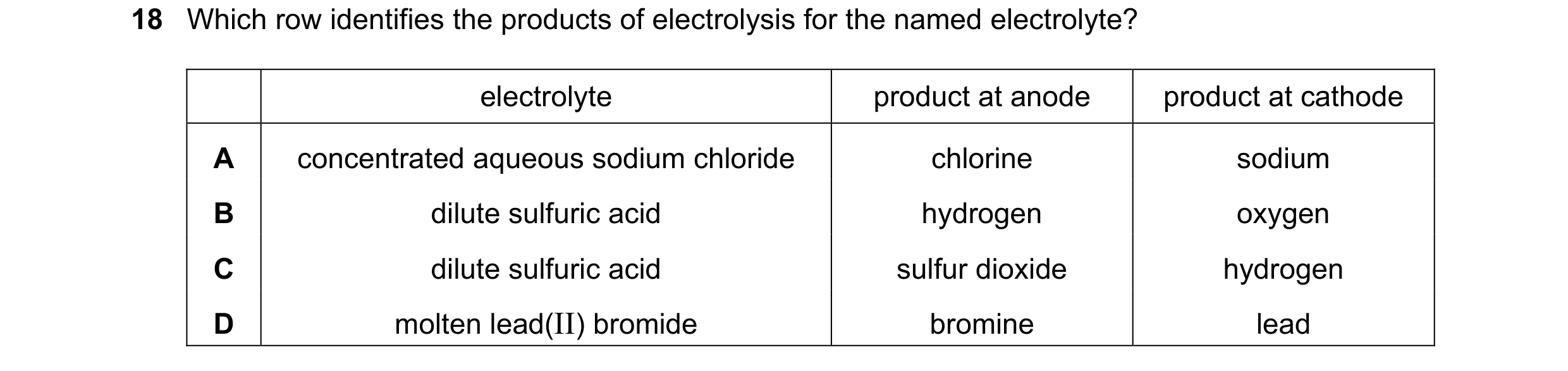
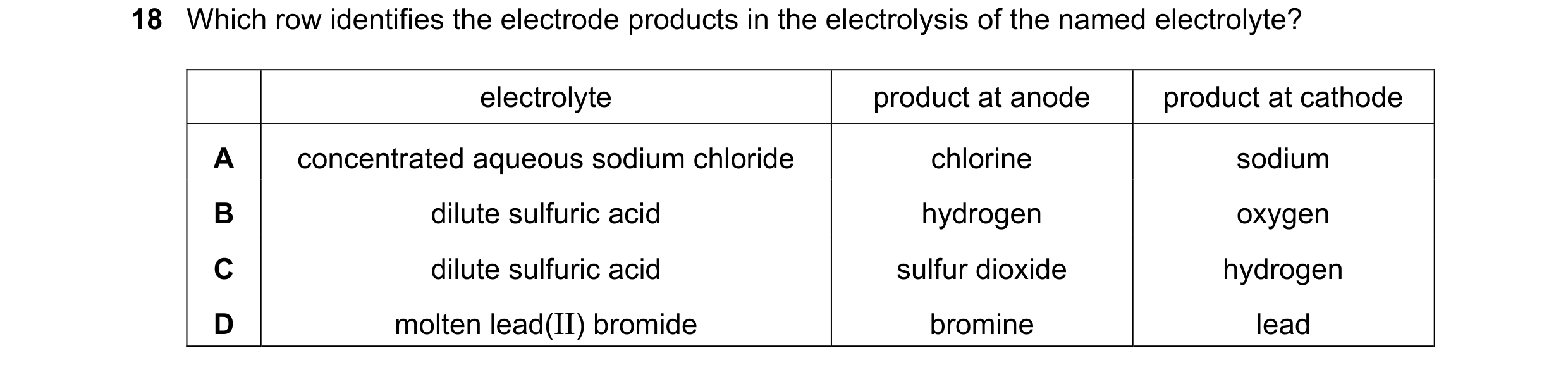
Q68 · Which row identifies the products of electrolysis for the named electrolyte? 0653/12 May/June 2019
18 Which row identifies the products of electrolysis for the named electrolyte? electrolyte product at anode product at cathode A concentrated aqueous sodium chloride chlorine sodium B dilute sulfuric acid hydrogen oxygen C dilute sulfuric acid sulfur dioxide hydrogen D molten lead(II) bromide bromine lead
1 marks
Answer: D
This question in 0653/12 May/June 2019
Q69 · Concentrated aqueous sodium chloride is electrolysed using the apparatus shown 0653/13 May/June 2019
17 Concentrated aqueous sodium chloride is electrolysed using the apparatus shown. power supply + – damp blue litmus damp blue litmus aqueous sodium chloride A piece of damp blue litmus paper is held above each electrode. Which row shows what happens to the colour of the litmus paper during the electrolysis? positive electrode negative electrode A litmus is unchanged litmus is unchanged B litmus is unchanged litmus turns white C litmus turns white litmus is unchanged D litmus turns white litmus turns white
1 marks
Answer: C
This question in 0653/13 May/June 2019
Q70 · Four processes are listed 0653/11 Oct/Nov 2019
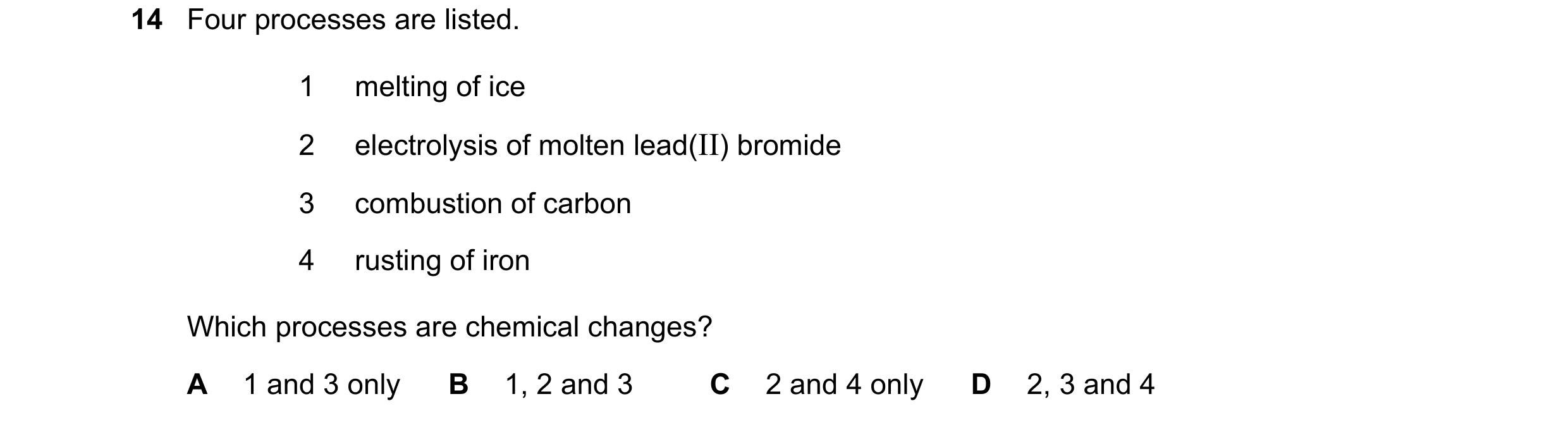
14 Four processes are listed. 1 melting of ice 2 electrolysis of molten lead(II) bromide 3 combustion of carbon 4 rusting of iron Which processes are chemical changes? A 1 and 3 only B 1, 2 and 3 C 2 and 4 only D 2, 3 and 4
1 marks
Answer: D
This question in 0653/11 Oct/Nov 2019
Q71 · Element X is a non-metal used in the treatment of the water supply 0653/11 Oct/Nov 2019
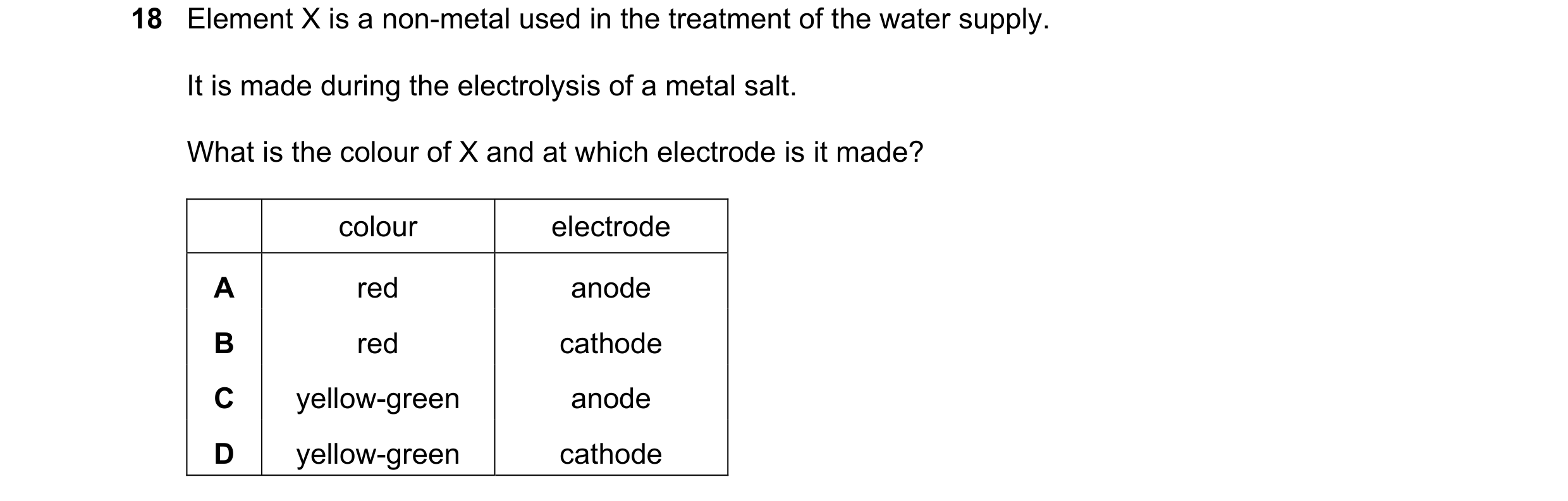
18 Element X is a non-metal used in the treatment of the water supply. It is made during the electrolysis of a metal salt. What is the colour of X and at which electrode is it made? colour electrode A red anode B red cathode C yellow-green anode D yellow-green cathode
1 marks
Answer: C
This question in 0653/11 Oct/Nov 2019
Q72 · Element X is a non-metal used in the treatment of the water supply 0653/12 Oct/Nov 2019
18 Element X is a non-metal used in the treatment of the water supply. It is made during the electrolysis of a metal salt. What is the colour of X and at which electrode is it made? colour electrode A red anode B red cathode C yellow-green anode D yellow-green cathode
1 marks
Answer: C
This question in 0653/12 Oct/Nov 2019
Q73 · Element X is a non-metal used in the treatment of the water supply 0653/13 Oct/Nov 2019
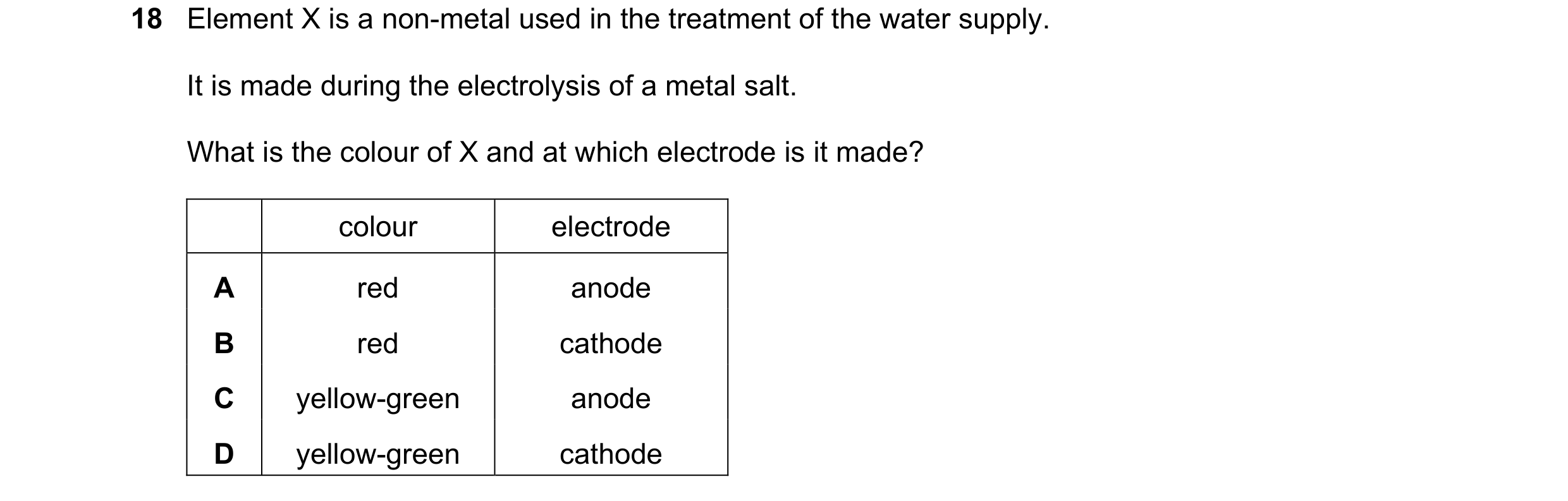
18 Element X is a non-metal used in the treatment of the water supply. It is made during the electrolysis of a metal salt. What is the colour of X and at which electrode is it made? colour electrode A red anode B red cathode C yellow-green anode D yellow-green cathode
1 marks
Answer: C
This question in 0653/13 Oct/Nov 2019
Q74 · During electrolysis, which electrode does not produce a gas? 0653/12 Feb/March 2020
17 During electrolysis, which electrode does not produce a gas? A the anode during the electrolysis of concentrated aqueous sodium chloride B the anode during the electrolysis of molten lead(II) bromide C the cathode during the electrolysis of concentrated aqueous sodium chloride D the cathode during the electrolysis of molten lead bromide
1 marks
Answer: D
This question in 0653/12 Feb/March 2020
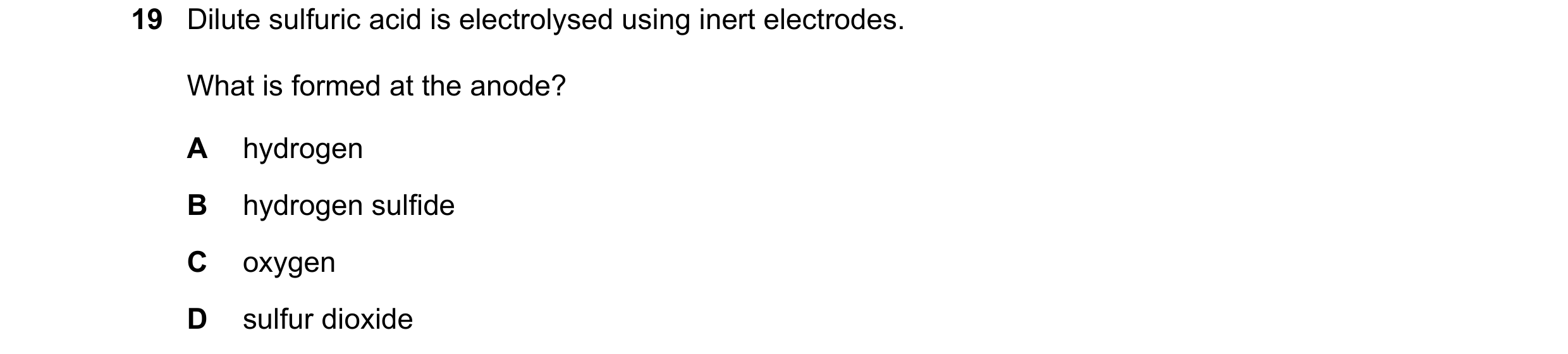
Q75 · Dilute sulfuric acid is electrolysed using inert electrodes 0653/11 May/June 2020
19 Dilute sulfuric acid is electrolysed using inert electrodes. What is formed at the anode? A hydrogen B hydrogen sulfide C oxygen D sulfur dioxide
1 marks
Answer: C
This question in 0653/11 May/June 2020
Q76 · The diagram shows apparatus used for electrolysis 0653/11 Oct/Nov 2020
18 The diagram shows apparatus used for electrolysis. Y + – Z X What are X, Y and Z? X Y Z A electrode anode cathode B electrode cathode anode C electrolyte anode cathode D electrolyte cathode anode
1 marks
Answer: C
This question in 0653/11 Oct/Nov 2020
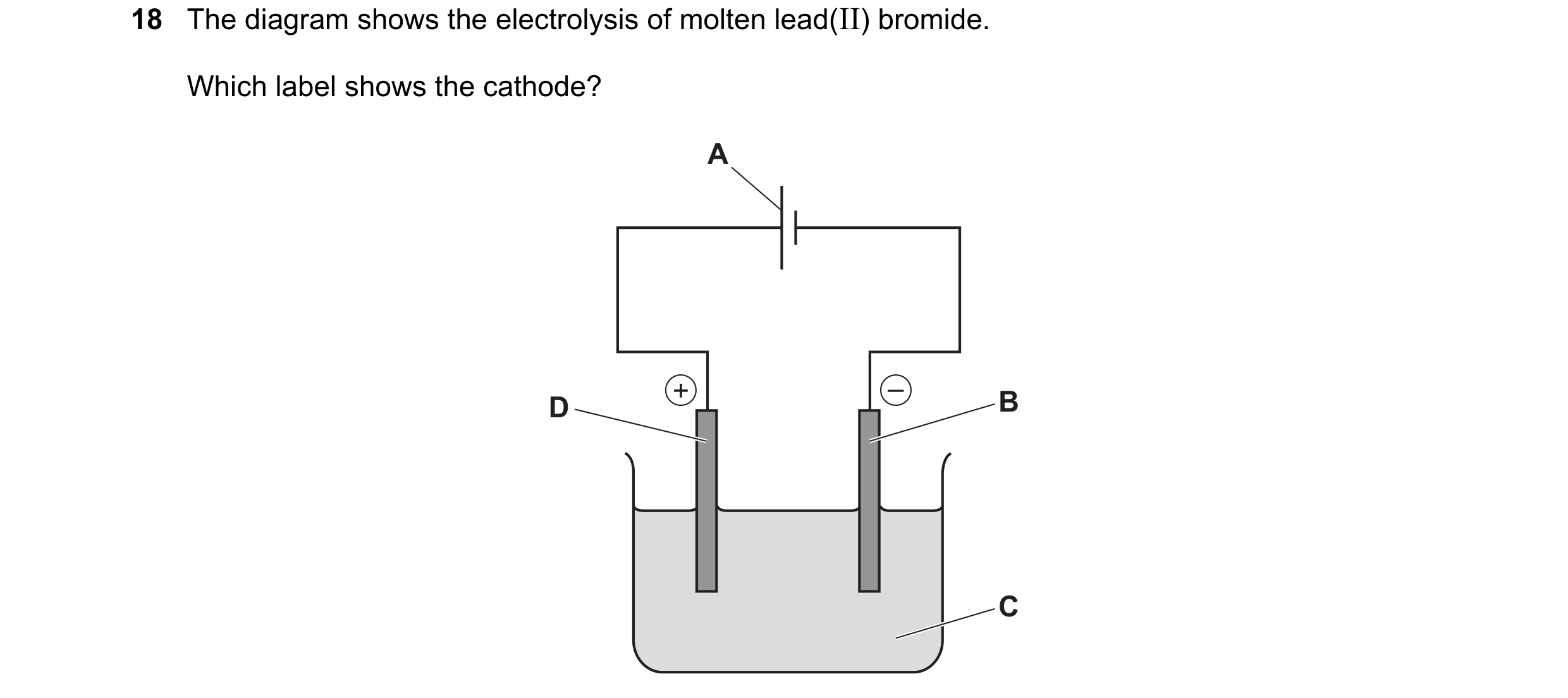
Q77 · The diagram shows the electrolysis of molten lead(II) bromide 0653/12 Oct/Nov 2020
18 The diagram shows the electrolysis of molten lead(II) bromide. Which label shows the cathode? A D + – B C
1 marks
Answer: B
This question in 0653/12 Oct/Nov 2020
Q78 · The apparatus for the electrolysis of concentrated aqueous sodium chloride using inert… 0653/13 Oct/Nov 2020
18 The apparatus for the electrolysis of concentrated aqueous sodium chloride using inert electrodes is shown. anode + – cathode concentrated aqueous sodium chloride Which statement about this electrolysis is correct? A A gas, which turns red litmus blue, is produced at the anode. B Hydrogen is produced at the cathode. C Oxygen is produced at the anode. D Sodium can be used for the inert electrodes.
1 marks
Answer: B
This question in 0653/13 Oct/Nov 2020
Q79 · The apparatus shown is set up 0653/12 Feb/March 2021
16 The apparatus shown is set up. lamp electrodes solid crucible lead(II) bromide heat The crucible needs to be heated for the lamp to give out light. Why is heat needed? A An exothermic reaction takes place in the crucible. B Electrodes only conduct electricity when hot. C Heat causes the lead(II) bromide to react with air. D The lead(II) bromide must be molten.
1 marks
Answer: D
This question in 0653/12 Feb/March 2021
Q80 · Dilute sulfuric acid is electrolysed using inert electrodes 0653/11 May/June 2021
17 Dilute sulfuric acid is electrolysed using inert electrodes. Which statement is correct? A Hydrogen is produced at the anode. B Both hydrogen and oxygen are produced at the negative electrode. C Sulfur dioxide is produced at the cathode. D Oxygen is produced at the positive electrode.
1 marks
Answer: D
This question in 0653/11 May/June 2021
Q81 · The apparatus used in an electrolysis experiment is shown 0653/12 May/June 2021
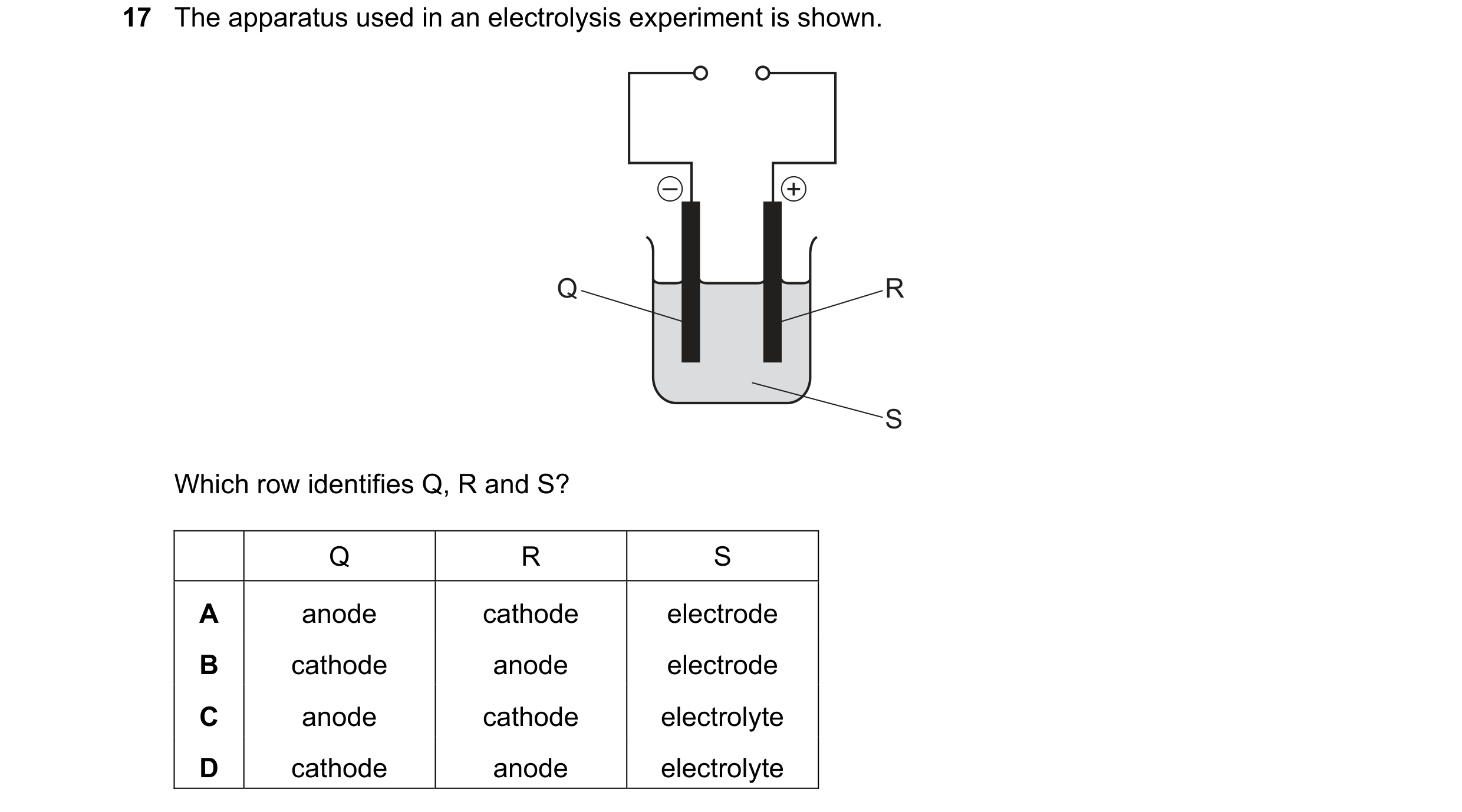
17 The apparatus used in an electrolysis experiment is shown. – + Q R S Which row identifies Q, R and S? Q R S A anode cathode electrode B cathode anode electrode C anode cathode electrolyte D cathode anode electrolyte
1 marks
Answer: D
This question in 0653/12 May/June 2021
Q82 · What are the products of the electrolysis of concentrated aqueous sodium chloride using… 0653/13 May/June 2021
17 What are the products of the electrolysis of concentrated aqueous sodium chloride using inert electrodes? anode cathode A chlorine hydrogen B chlorine sodium C oxygen hydrogen D oxygen sodium
1 marks
Answer: A
This question in 0653/13 May/June 2021
Q83 · Dilute sulfuric acid is electrolysed using inert electrodes 0653/11 Oct/Nov 2021
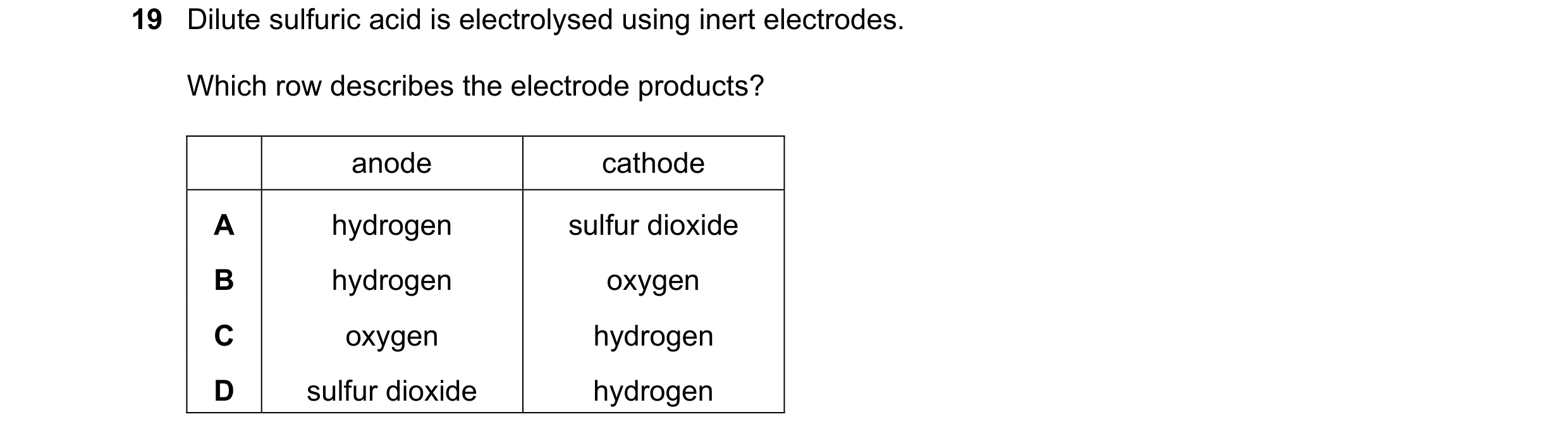
19 Dilute sulfuric acid is electrolysed using inert electrodes. Which row describes the electrode products? anode cathode A hydrogen sulfur dioxide B hydrogen oxygen C oxygen hydrogen D sulfur dioxide hydrogen
1 marks
Answer: C
This question in 0653/11 Oct/Nov 2021
Q84 · Which statement about the electrolysis of dilute sulfuric acid is correct? 0653/12 Feb/March 2022
18 Which statement about the electrolysis of dilute sulfuric acid is correct? A Only hydrogen is formed at the positive electrode. B Only oxygen is formed at the anode. C Only sulfur dioxide is formed at the negative electrode. D Sulfur dioxide and hydrogen are formed at the cathode.
1 marks
Answer: B
This question in 0653/12 Feb/March 2022
Q85 · Which type of substance undergoes electrolysis? 0653/11 May/June 2022
19 Which type of substance undergoes electrolysis? A molten covalent compounds B solid ionic compounds C gaseous covalent compounds D aqueous solutions of ionic compounds
1 marks
Answer: D
This question in 0653/11 May/June 2022
Q86 · Dilute sulfuric acid breaks down when electricity is passed through it 0653/12 May/June 2022
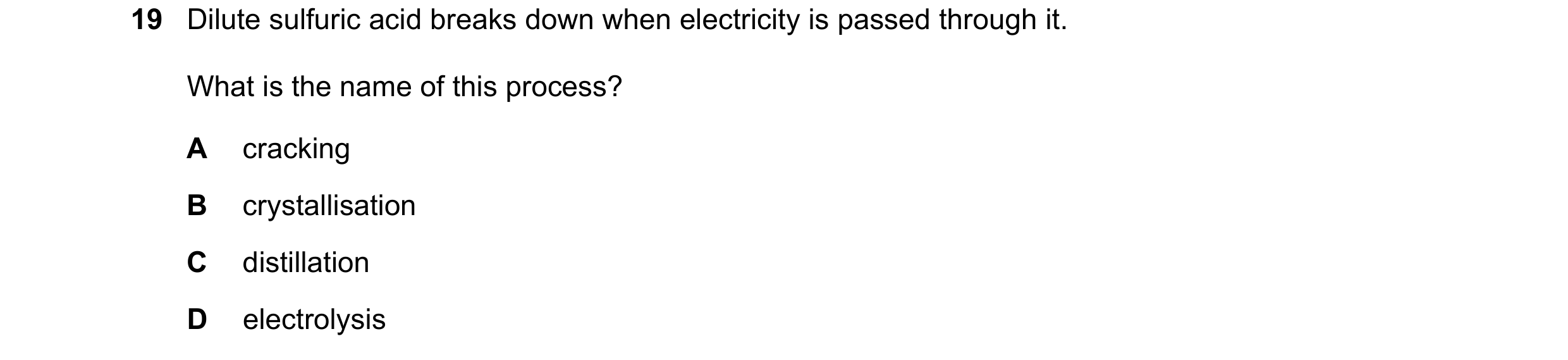
19 Dilute sulfuric acid breaks down when electricity is passed through it. What is the name of this process? A cracking B crystallisation C distillation D electrolysis
1 marks
Answer: D
This question in 0653/12 May/June 2022
Q87 · What is not needed for electrolysis? 0653/13 May/June 2022
19 What is not needed for electrolysis? A a bulb B a power supply C an electrolyte D electrodes
1 marks
Answer: A
This question in 0653/13 May/June 2022
Q88 · What are the products of the electrolysis of dilute sulfuric acid using inert electrodes? 0653/11 Oct/Nov 2022
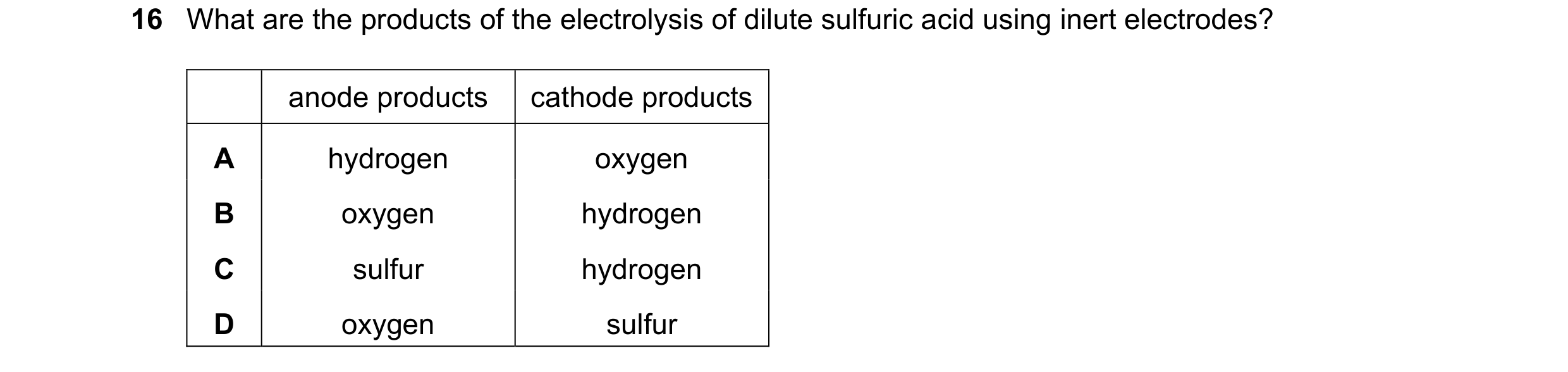
16 What are the products of the electrolysis of dilute sulfuric acid using inert electrodes? anode products cathode products A hydrogen oxygen B oxygen hydrogen C sulfur hydrogen D oxygen sulfur
1 marks
Answer: B
This question in 0653/11 Oct/Nov 2022
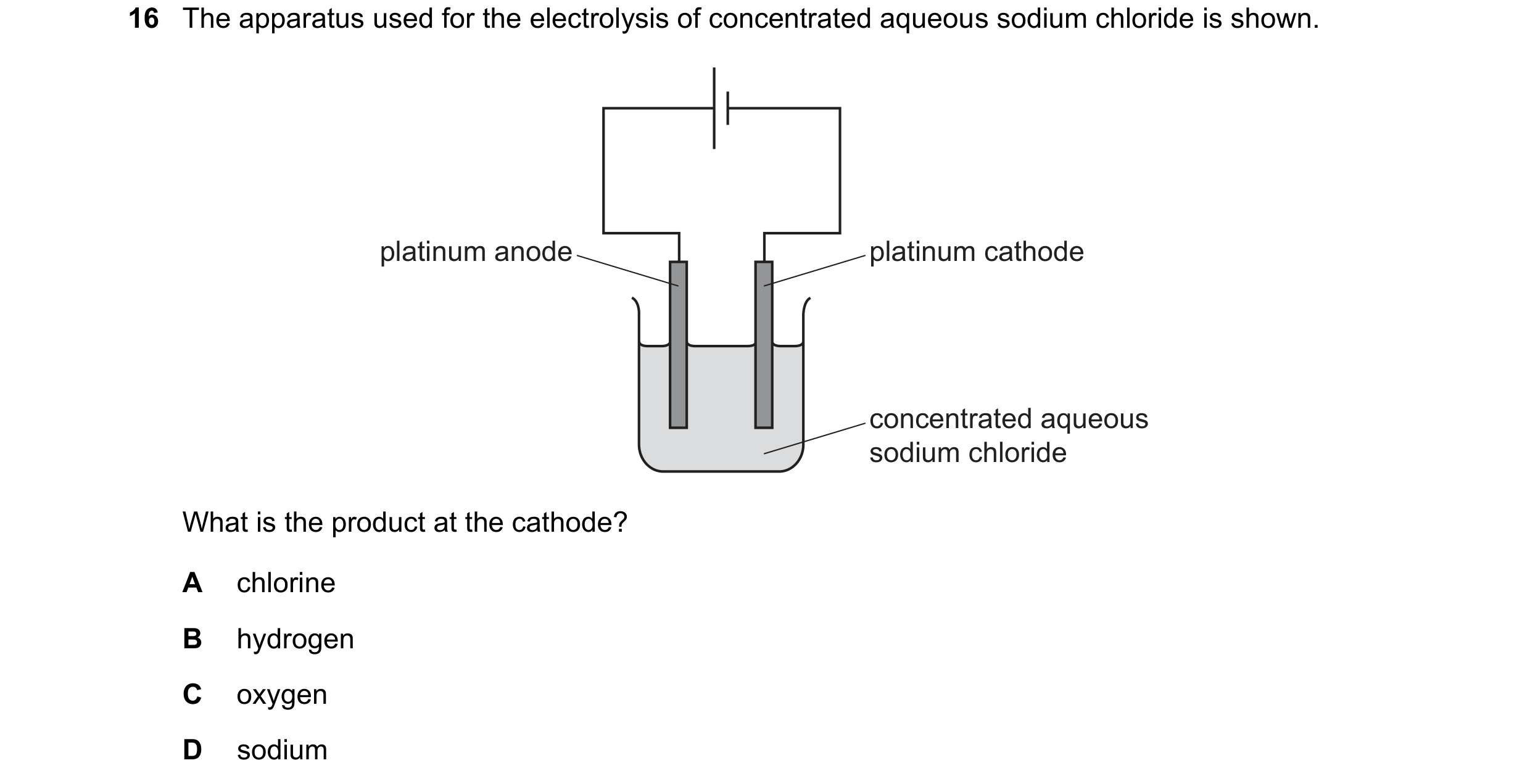
Q89 · The apparatus used for the electrolysis of concentrated aqueous sodium chloride is shown 0653/12 Oct/Nov 2022
16 The apparatus used for the electrolysis of concentrated aqueous sodium chloride is shown. platinum anode platinum cathode concentrated aqueous sodium chloride What is the product at the cathode? A chlorine B hydrogen C oxygen D sodium
1 marks
Answer: B
This question in 0653/12 Oct/Nov 2022
Q90 · The apparatus used for the electrolysis of concentrated aqueous sodium chloride is shown 0653/13 Oct/Nov 2022
16 The apparatus used for the electrolysis of concentrated aqueous sodium chloride is shown. platinum anode platinum cathode concentrated aqueous sodium chloride What is the product at the cathode? A chlorine B hydrogen C oxygen D sodium
1 marks
Answer: B
This question in 0653/13 Oct/Nov 2022
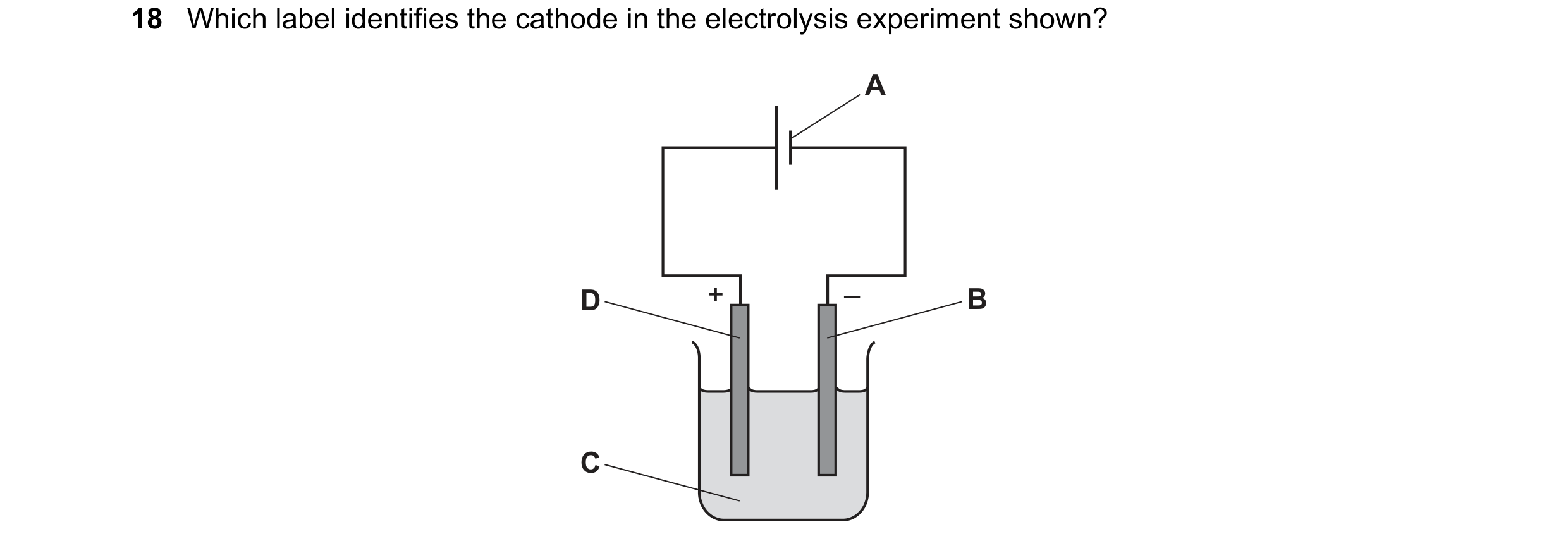
Q91 · Which label identifies the cathode in the electrolysis experiment shown? 0653/11 May/June 2023
18 Which label identifies the cathode in the electrolysis experiment shown? A D + – B C
1 marks
Answer: B
This question in 0653/11 May/June 2023
Q92 · Molten lead(II) bromide is electrolysed using inert electrodes 0653/12 May/June 2023
18 Molten lead(II) bromide is electrolysed using inert electrodes. What are the products at each electrode? anode cathode A bromide ions lead B bromine gas lead C lead bromine gas D lead bromide ions
1 marks
Answer: B
This question in 0653/12 May/June 2023
Q93 · Which word describes molten lead bromide during its electrolysis? 0653/12 Feb/March 2024
16 Which word describes molten lead bromide during its electrolysis? A anode B cathode C electrolyte D solution
1 marks
Answer: C
This question in 0653/12 Feb/March 2024
Q94 · What is observed when molten lead(II) bromide is electrolysed using inert electrodes? 0653/11 May/June 2024
18 What is observed when molten lead(II) bromide is electrolysed using inert electrodes? A Bubbles of a brown gas appear at the anode. B Bubbles of colourless gases appear at both electrodes. C Bubbles of a colourless gas appear at the cathode only. D No gas bubbles are observed at either electrode.
1 marks
Answer: A
This question in 0653/11 May/June 2024
Q95 · Which row identifies the electrode products in the electrolysis of the named electrolyte? 0653/12 May/June 2024
18 Which row identifies the electrode products in the electrolysis of the named electrolyte? electrolyte product at anode product at cathode A concentrated aqueous sodium chloride chlorine sodium B dilute sulfuric acid hydrogen oxygen C dilute sulfuric acid sulfur dioxide hydrogen D molten lead(II) bromide bromine lead
1 marks
Answer: D
This question in 0653/12 May/June 2024
Q96 · The apparatus used in an electrolysis experiment is shown 0653/13 May/June 2024
19 The apparatus used in an electrolysis experiment is shown. – + Q R S Which row identifies Q, R and S? Q R S A cathode anode electrolyte B cathode anode electrode C anode cathode electrolyte D anode cathode electrode
1 marks
Answer: A
This question in 0653/13 May/June 2024
Q97 · In which states do ionic compounds undergo electrolysis? 0653/11 Oct/Nov 2024
16 In which states do ionic compounds undergo electrolysis? A aqueous and solid B aqueous and liquid C gas and solid D gas and liquid
1 marks
Answer: B
This question in 0653/11 Oct/Nov 2024
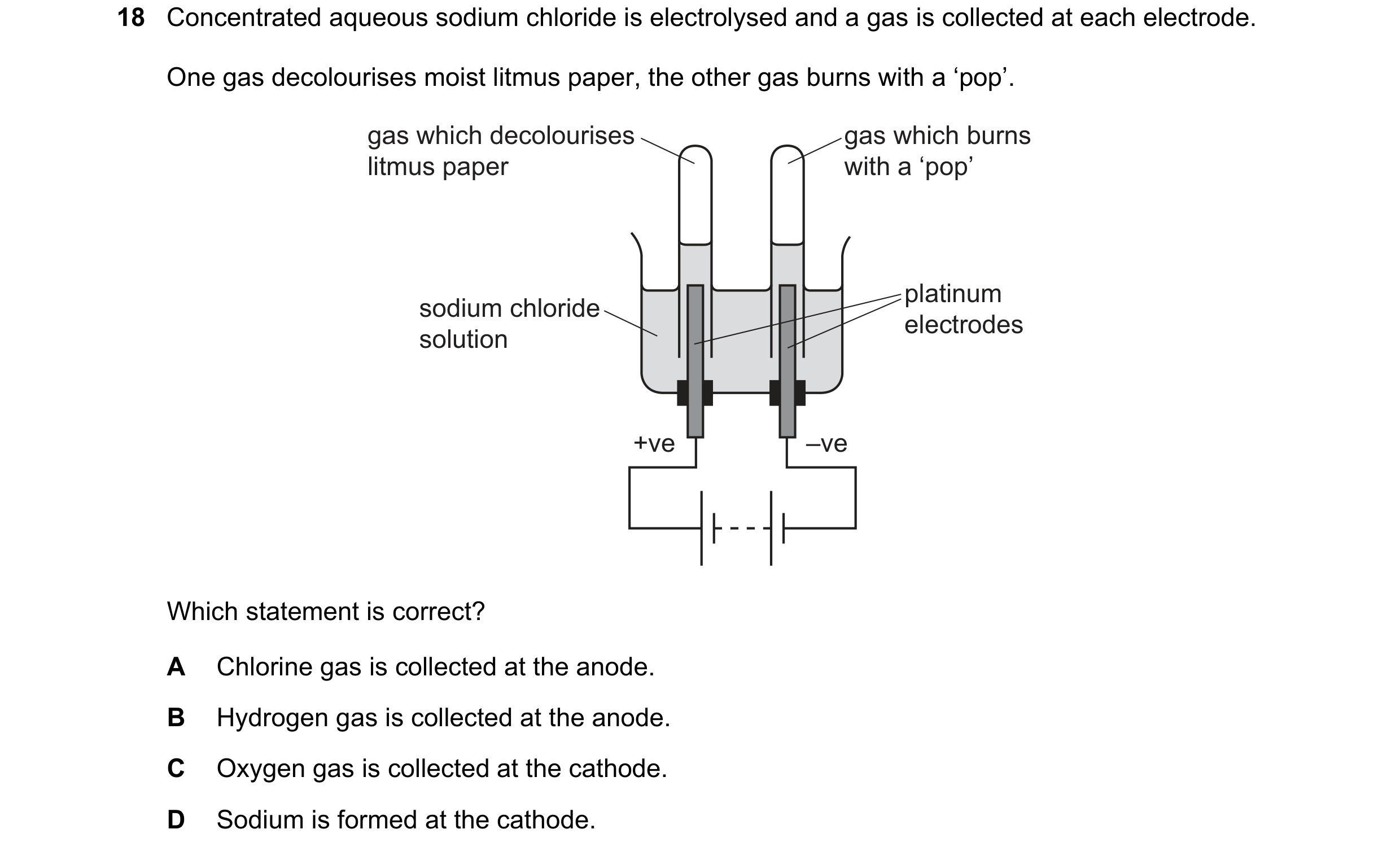
Q98 · Concentrated aqueous sodium chloride is electrolysed and a gas is collected at each… 0653/12 Oct/Nov 2024
18 Concentrated aqueous sodium chloride is electrolysed and a gas is collected at each electrode. One gas decolourises moist litmus paper, the other gas burns with a ‘pop’. gas which decolourises gas which burns litmus paper with a ‘pop’ platinum sodium chloride electrodes solution +ve –ve Which statement is correct? A Chlorine gas is collected at the anode. B Hydrogen gas is collected at the anode. C Oxygen gas is collected at the cathode. D Sodium is formed at the cathode.
1 marks
Answer: A
This question in 0653/12 Oct/Nov 2024
Q99 · Concentrated aqueous sodium chloride is electrolysed and a gas is collected at each… 0653/13 Oct/Nov 2024
18 Concentrated aqueous sodium chloride is electrolysed and a gas is collected at each electrode. One gas decolourises moist litmus paper, the other gas burns with a ‘pop’. gas which decolourises gas which burns litmus paper with a ‘pop’ platinum sodium chloride electrodes solution +ve –ve Which statement is correct? A Chlorine gas is collected at the anode. B Hydrogen gas is collected at the anode. C Oxygen gas is collected at the cathode. D Sodium is formed at the cathode.
1 marks
Answer: A
This question in 0653/13 Oct/Nov 2024
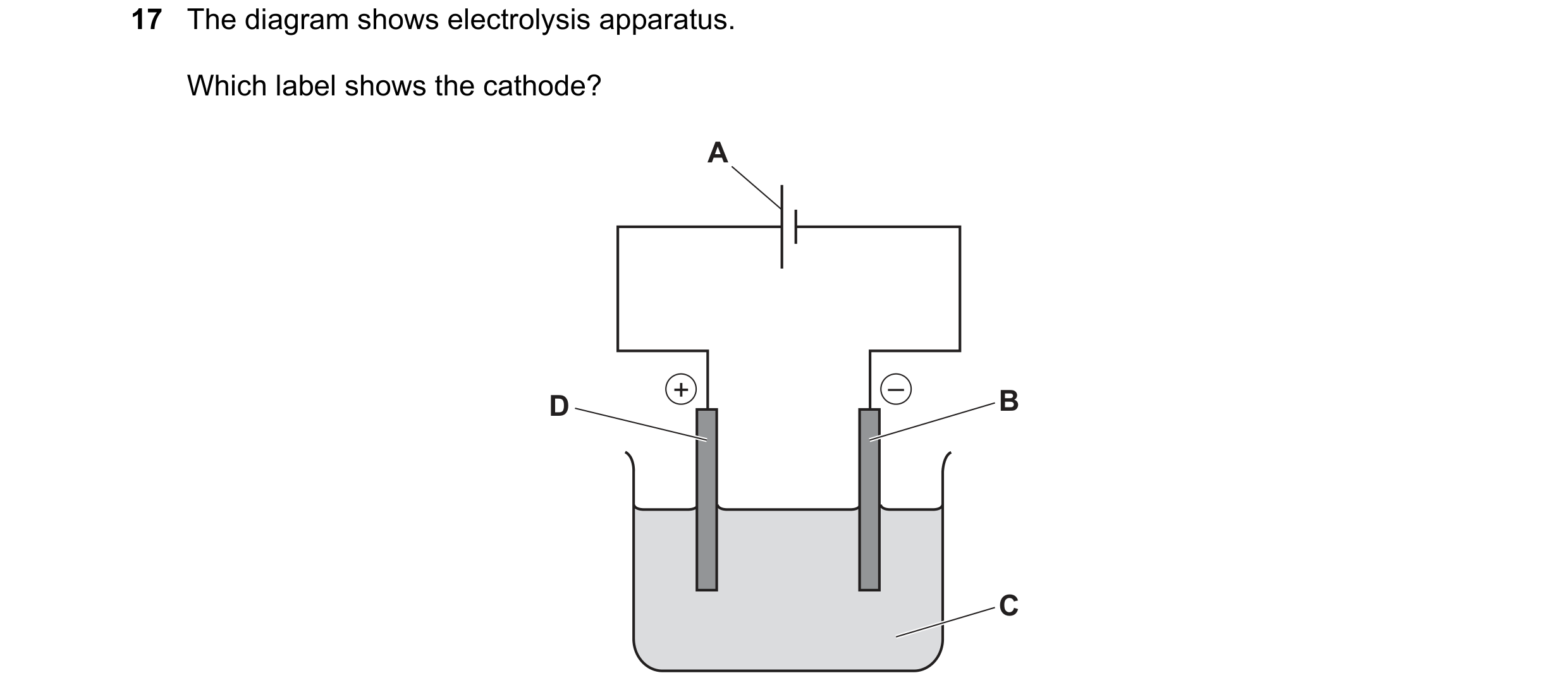
Q100 · The diagram shows electrolysis apparatus 0653/11 May/June 2025
17 The diagram shows electrolysis apparatus. Which label shows the cathode? A D + – B C
1 marks
Answer: B
This question in 0653/11 May/June 2025
Q101 · What is produced at the anode during the electrolysis of molten lead(II) bromide? 0653/12 May/June 2025
18 What is produced at the anode during the electrolysis of molten lead(II) bromide? A bromide ions B bromine C lead D lead(II) ions
1 marks
Answer: B
This question in 0653/12 May/June 2025
Q102 · The diagram shows the apparatus for electrolysis 0653/13 May/June 2025
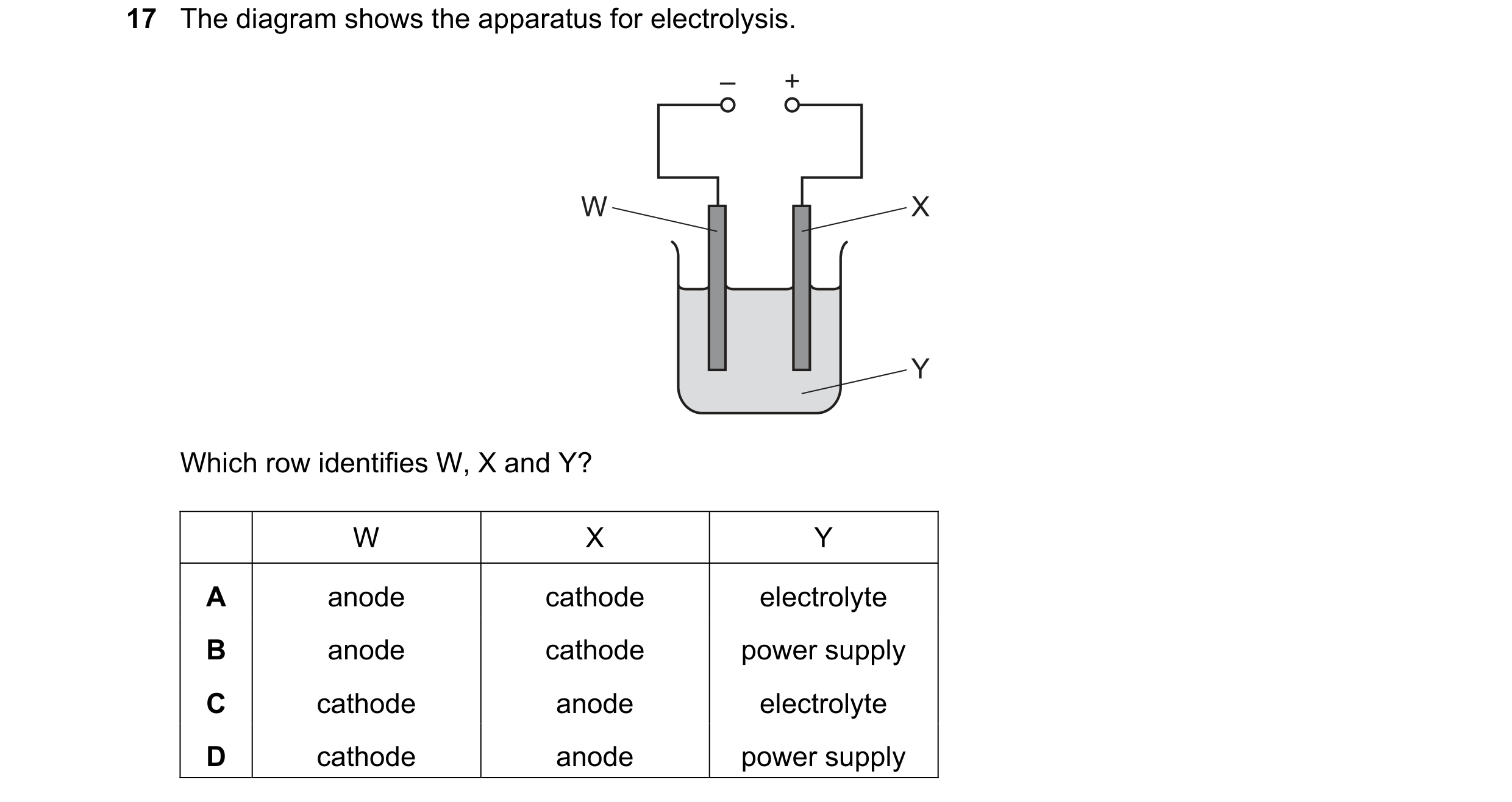
17 The diagram shows the apparatus for electrolysis. – + W X Y Which row identifies W, X and Y? W X Y A anode cathode electrolyte B anode cathode power supply C cathode anode electrolyte D cathode anode power supply
1 marks
Answer: C
This question in 0653/13 May/June 2025
 1 / 39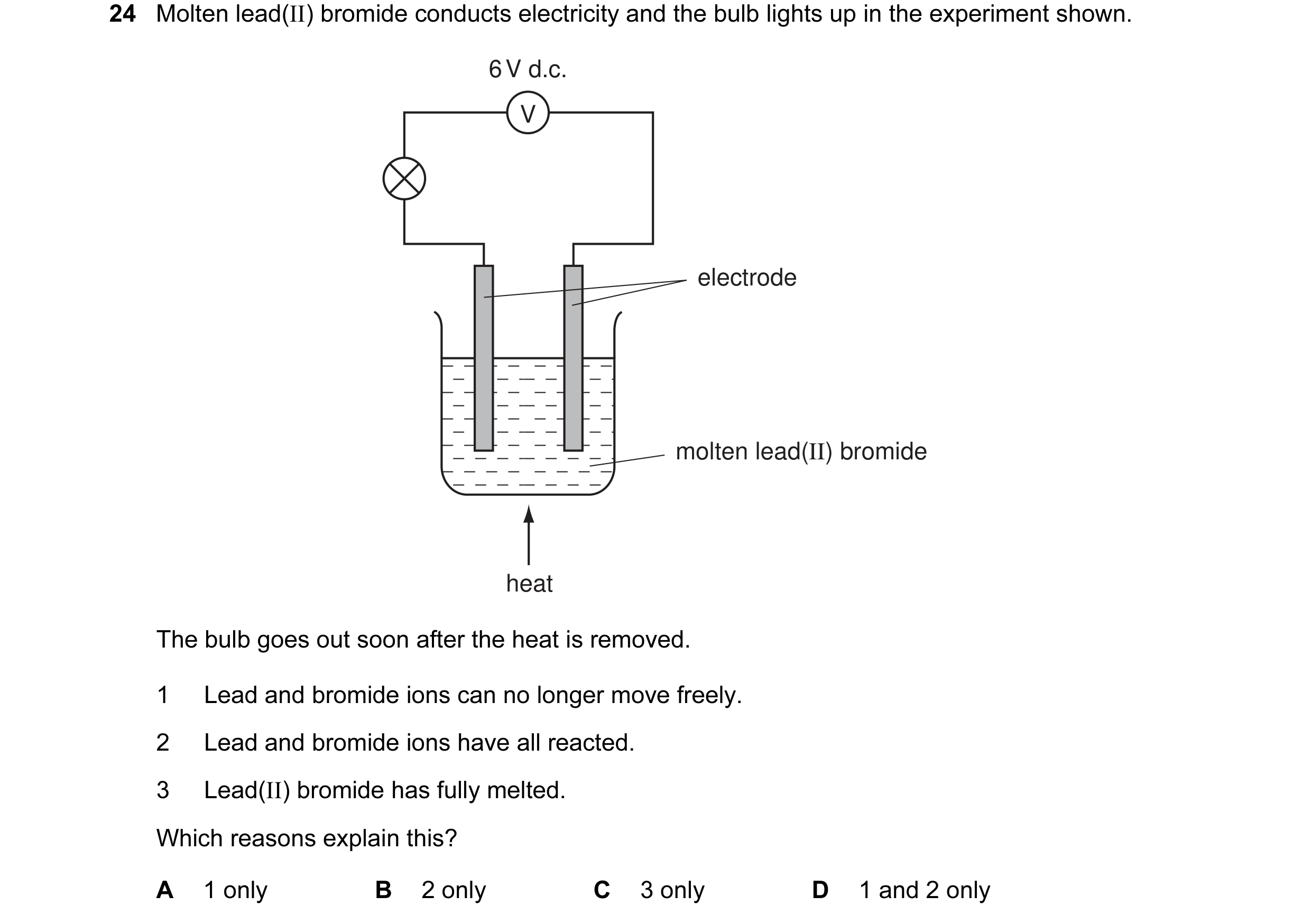
 2 / 39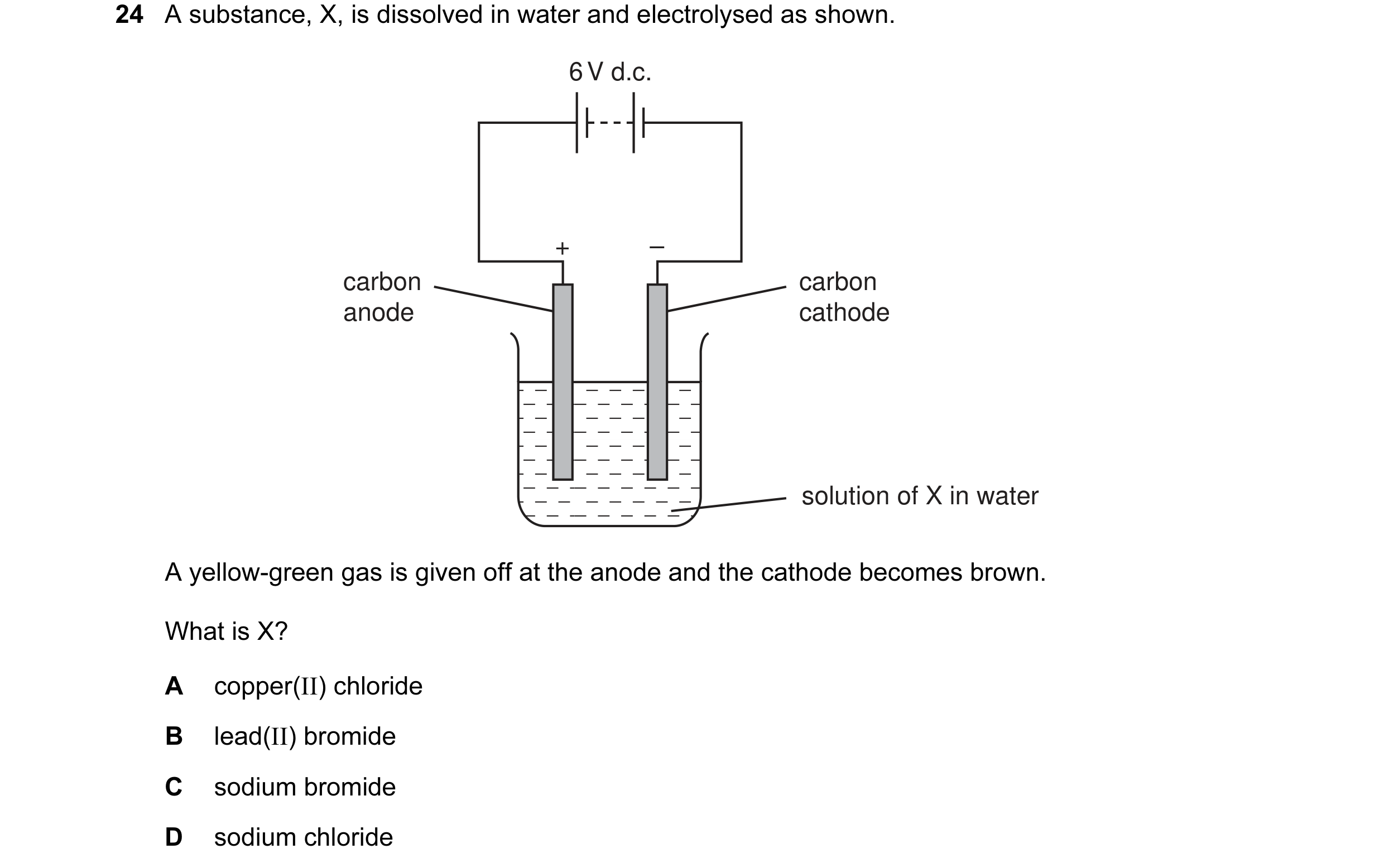
 3 / 39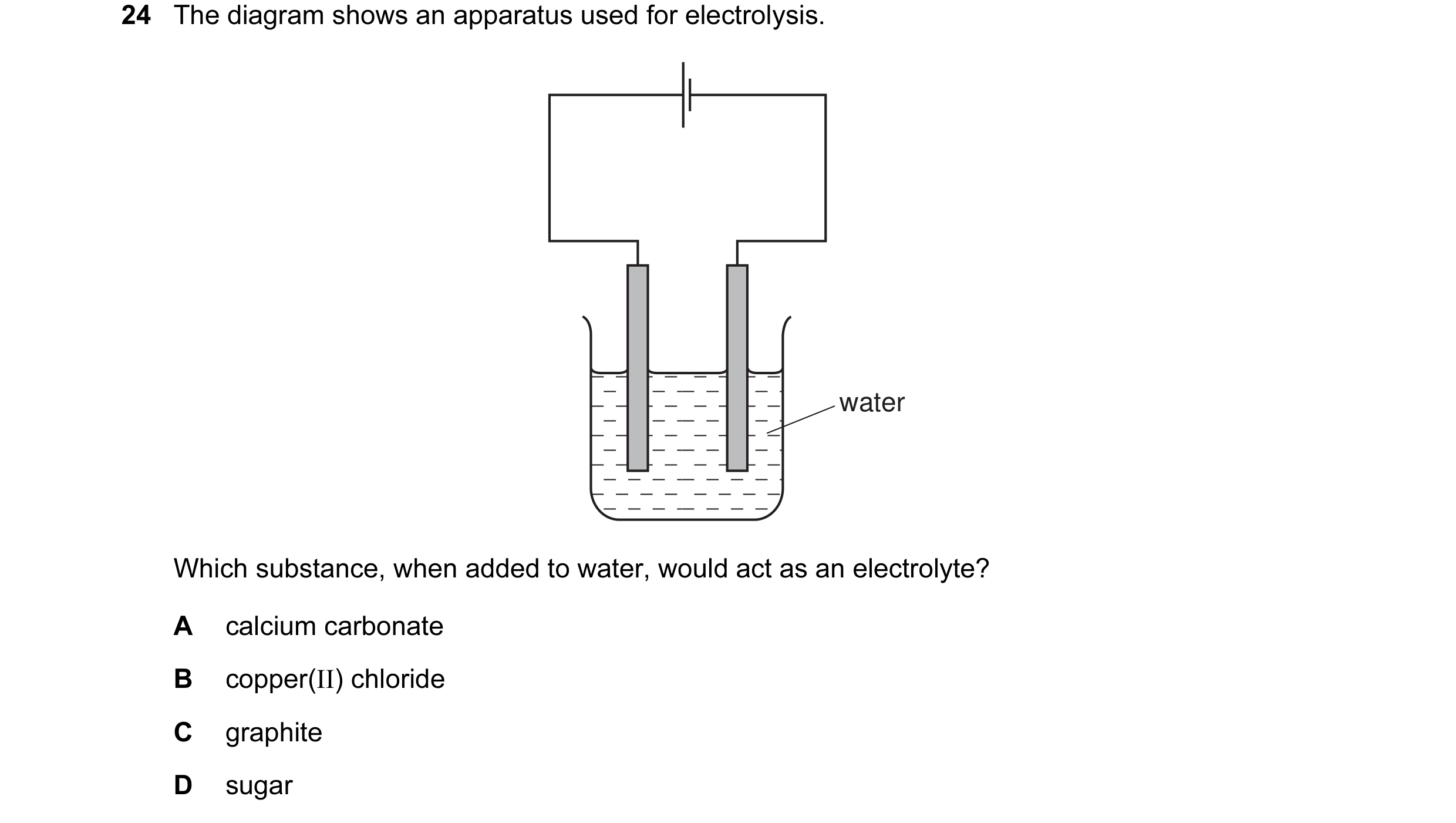
 4 / 39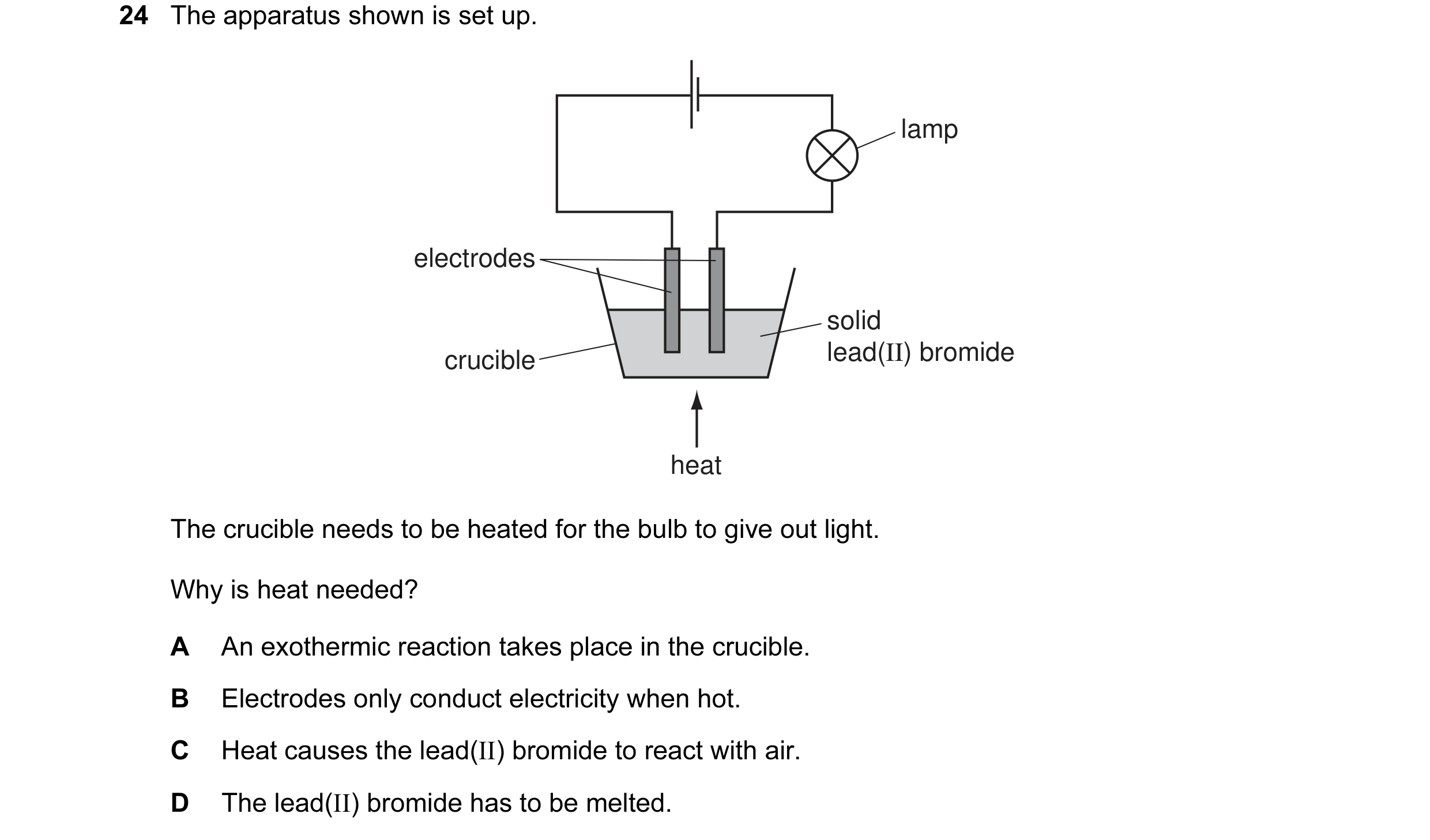
 5 / 39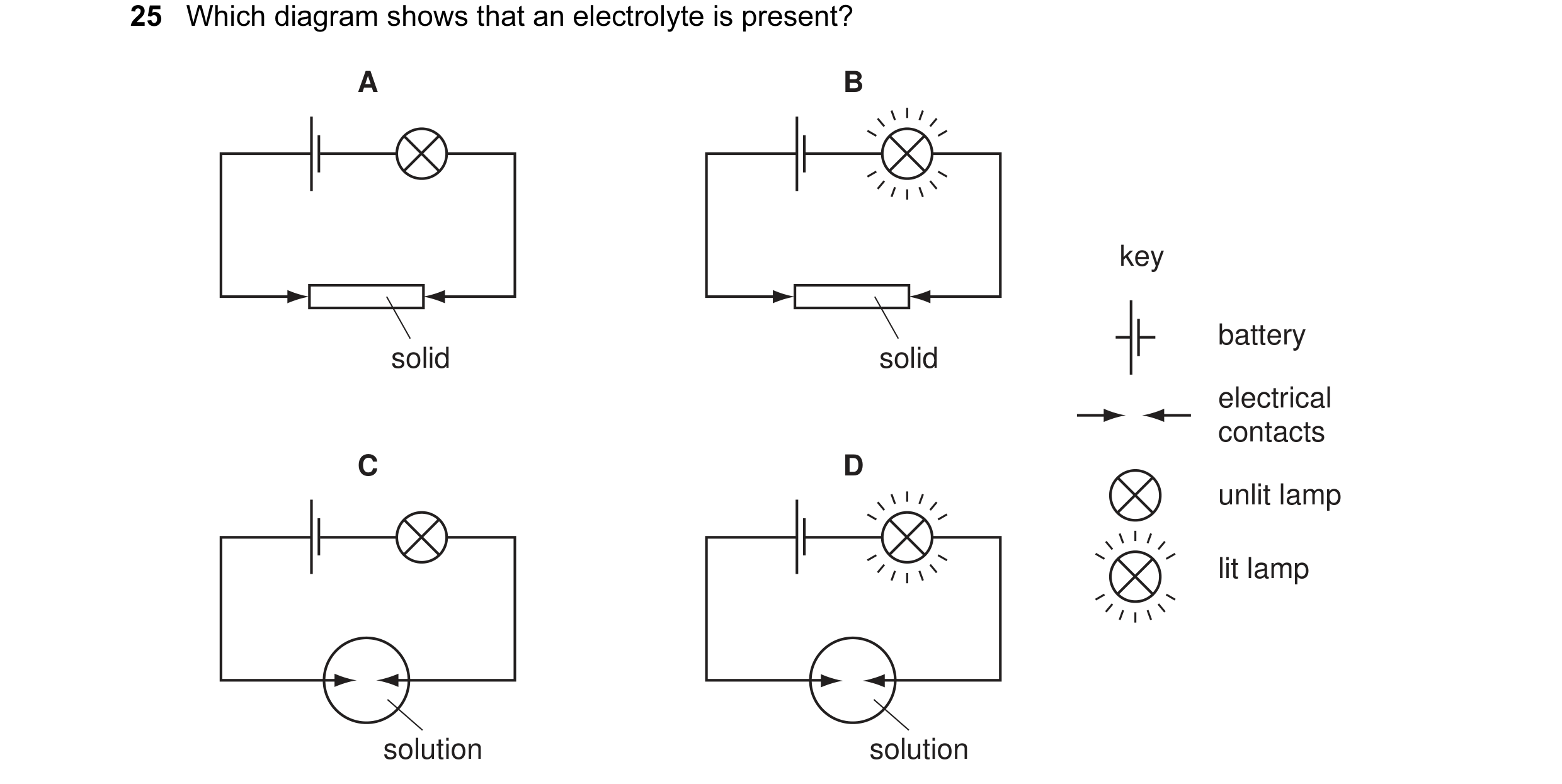
 6 / 39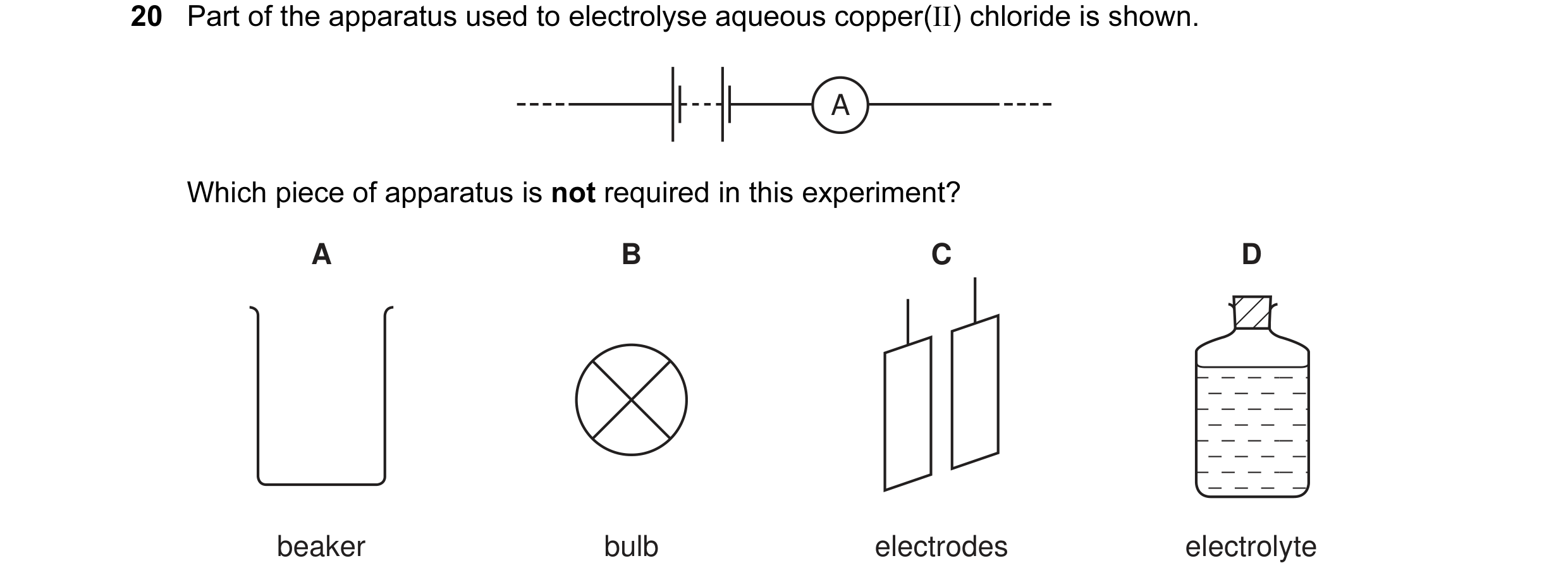
 7 / 39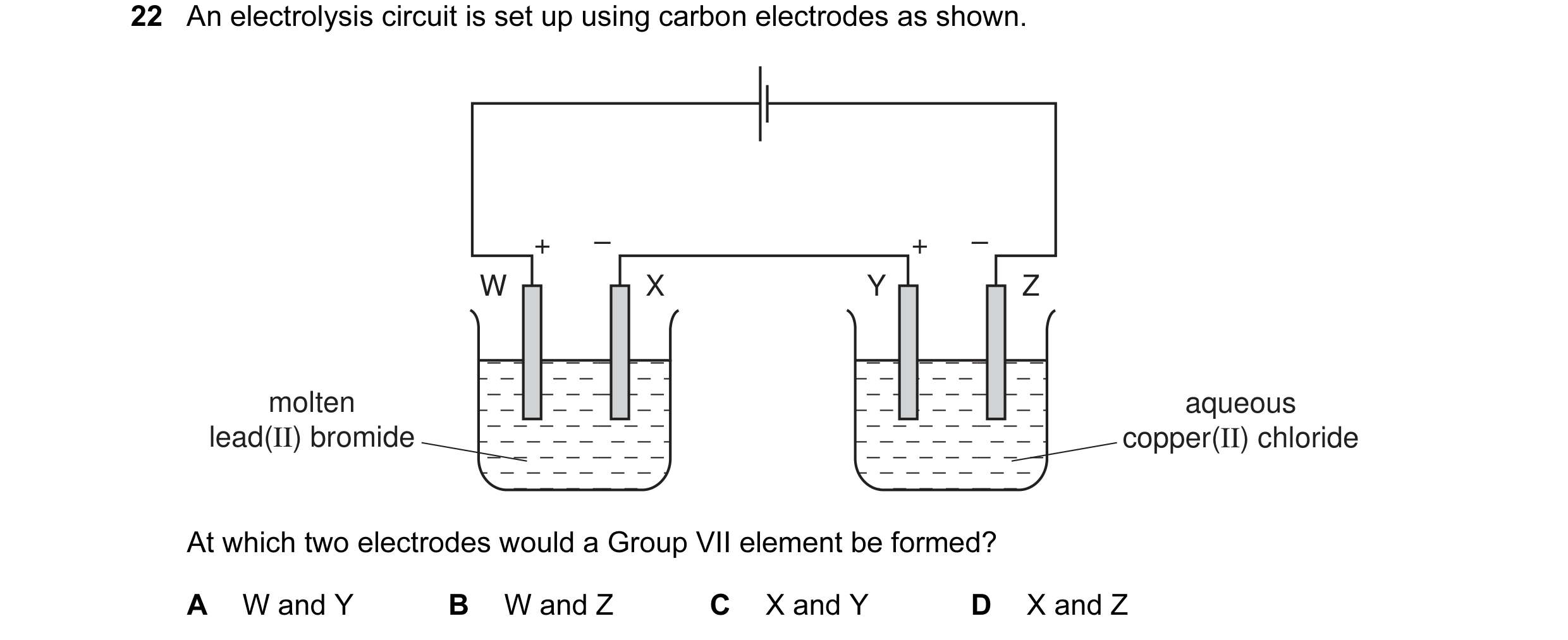
 8 / 39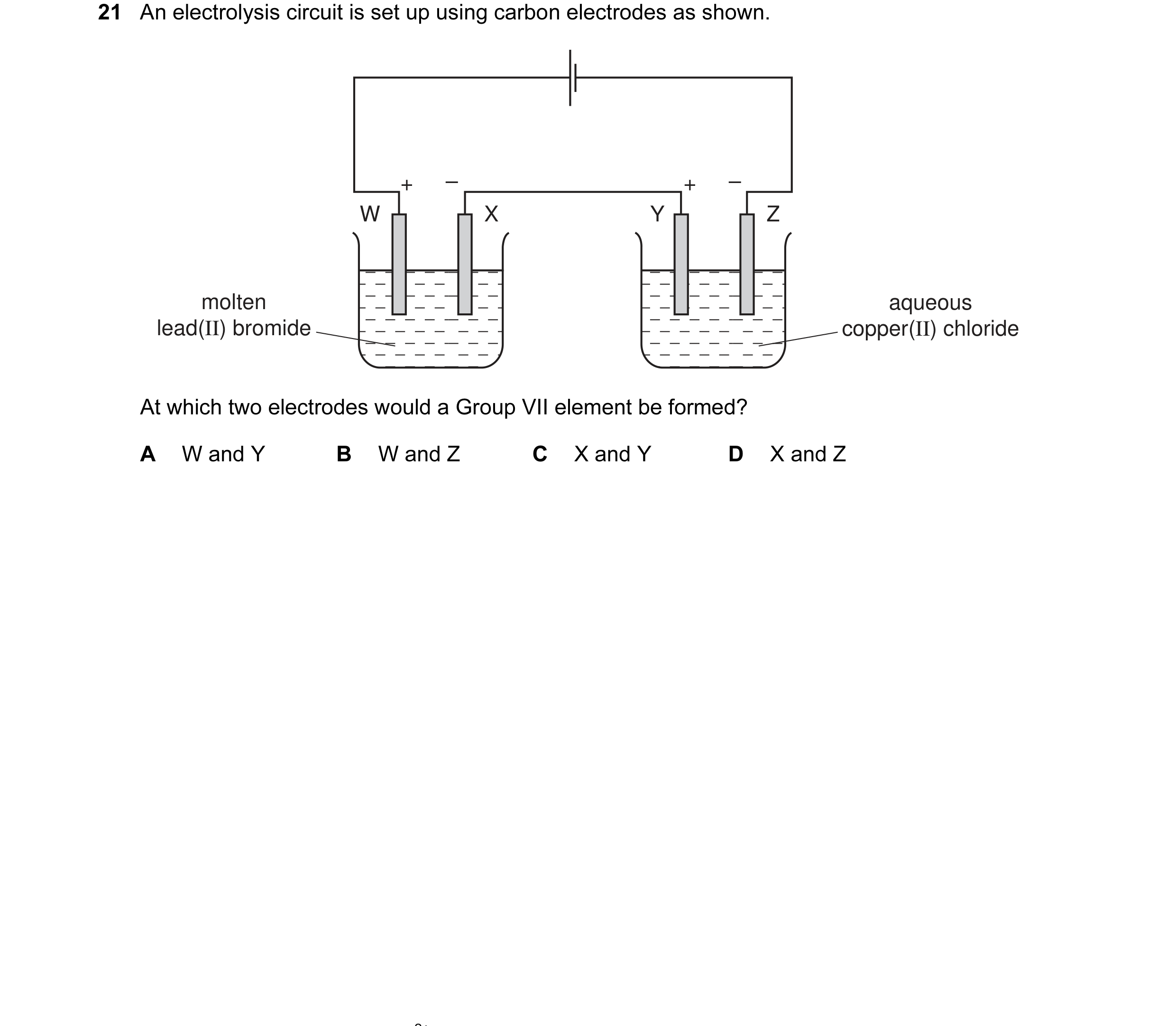
 9 / 39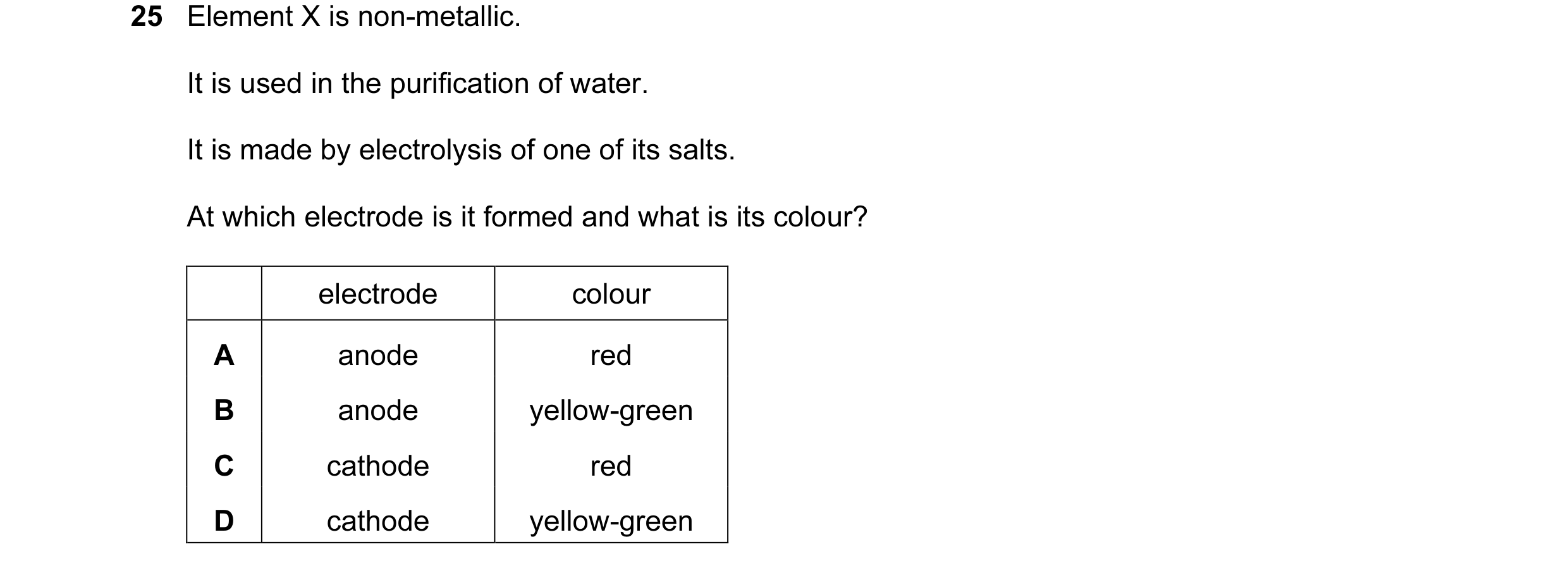
 10 / 39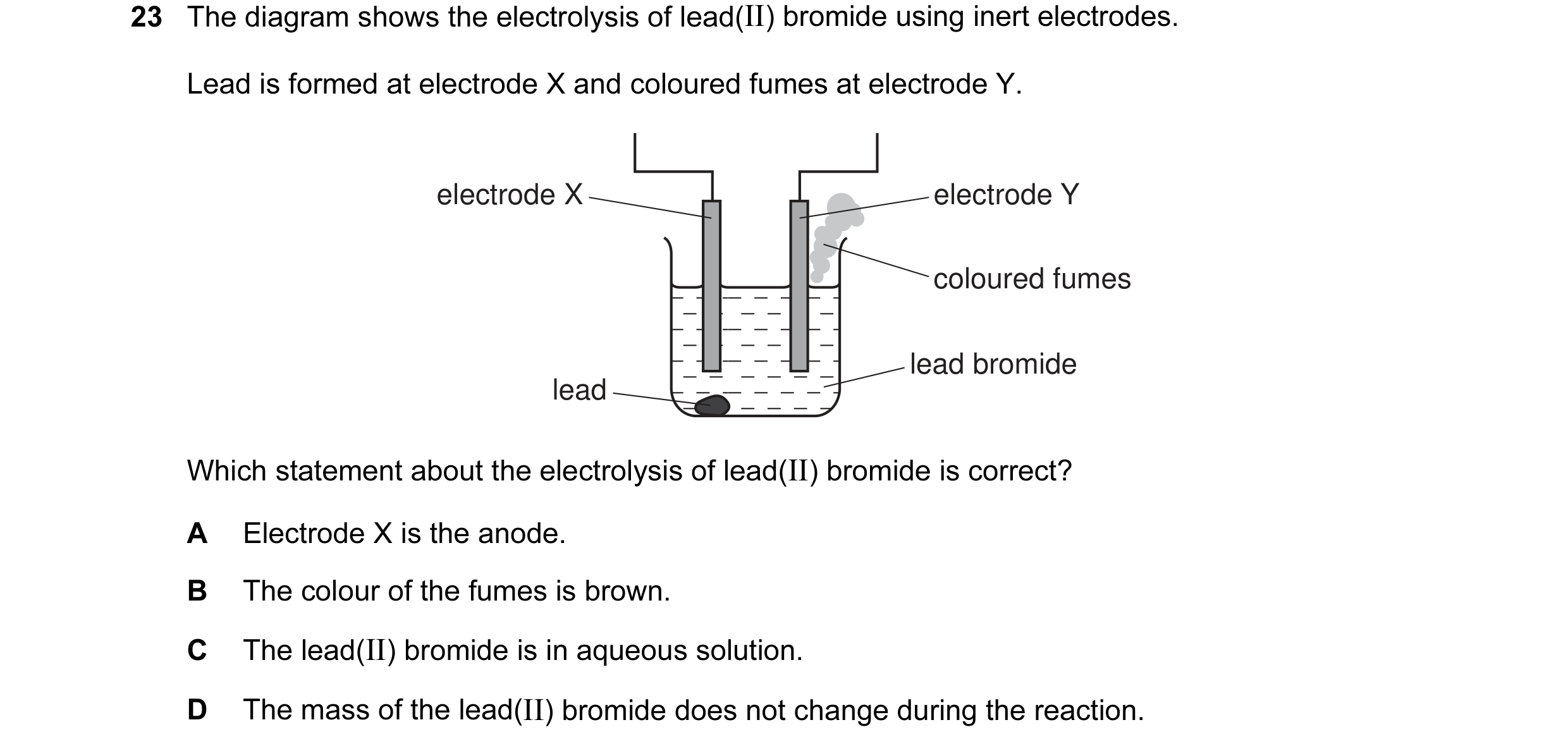
 11 / 39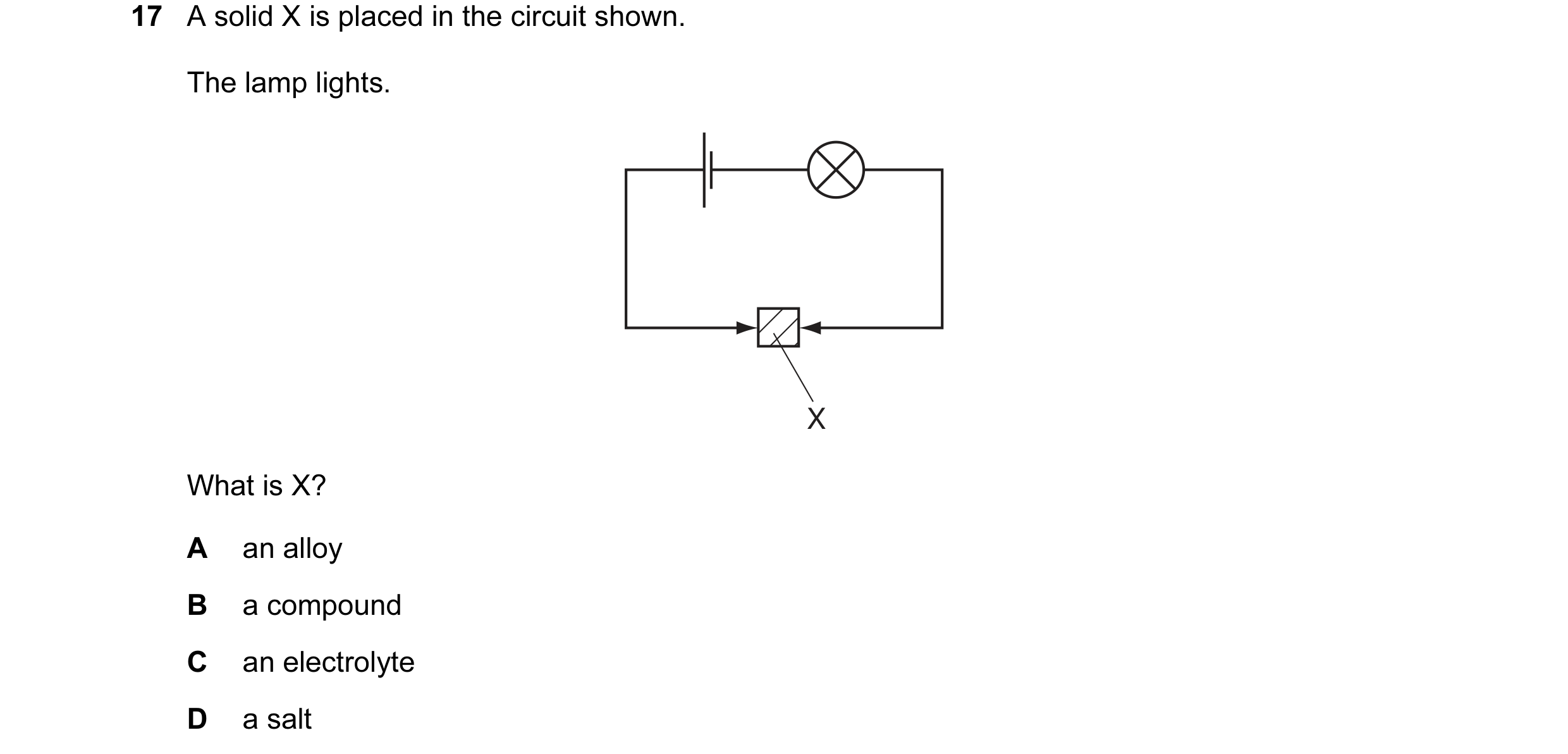
 12 / 39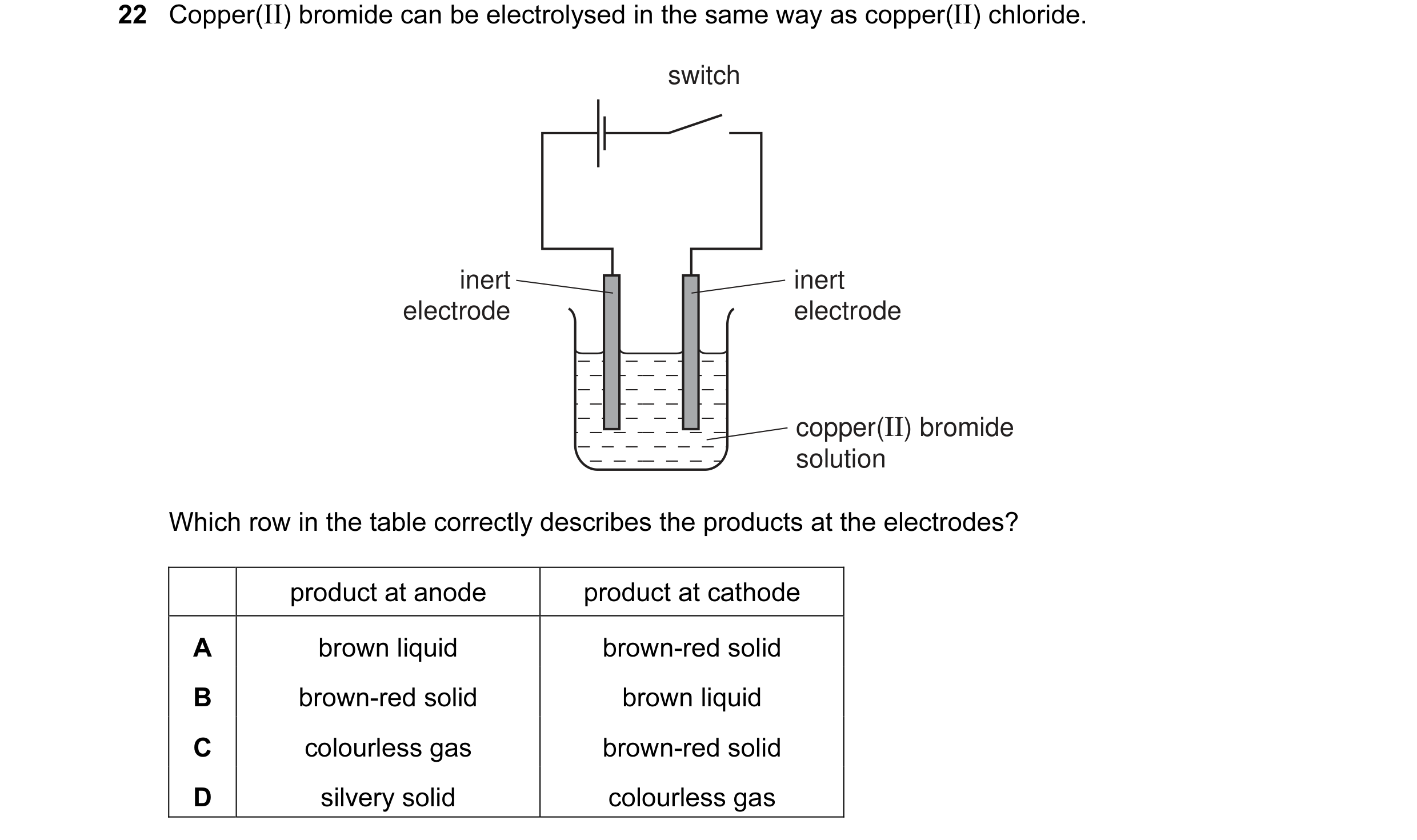
 13 / 39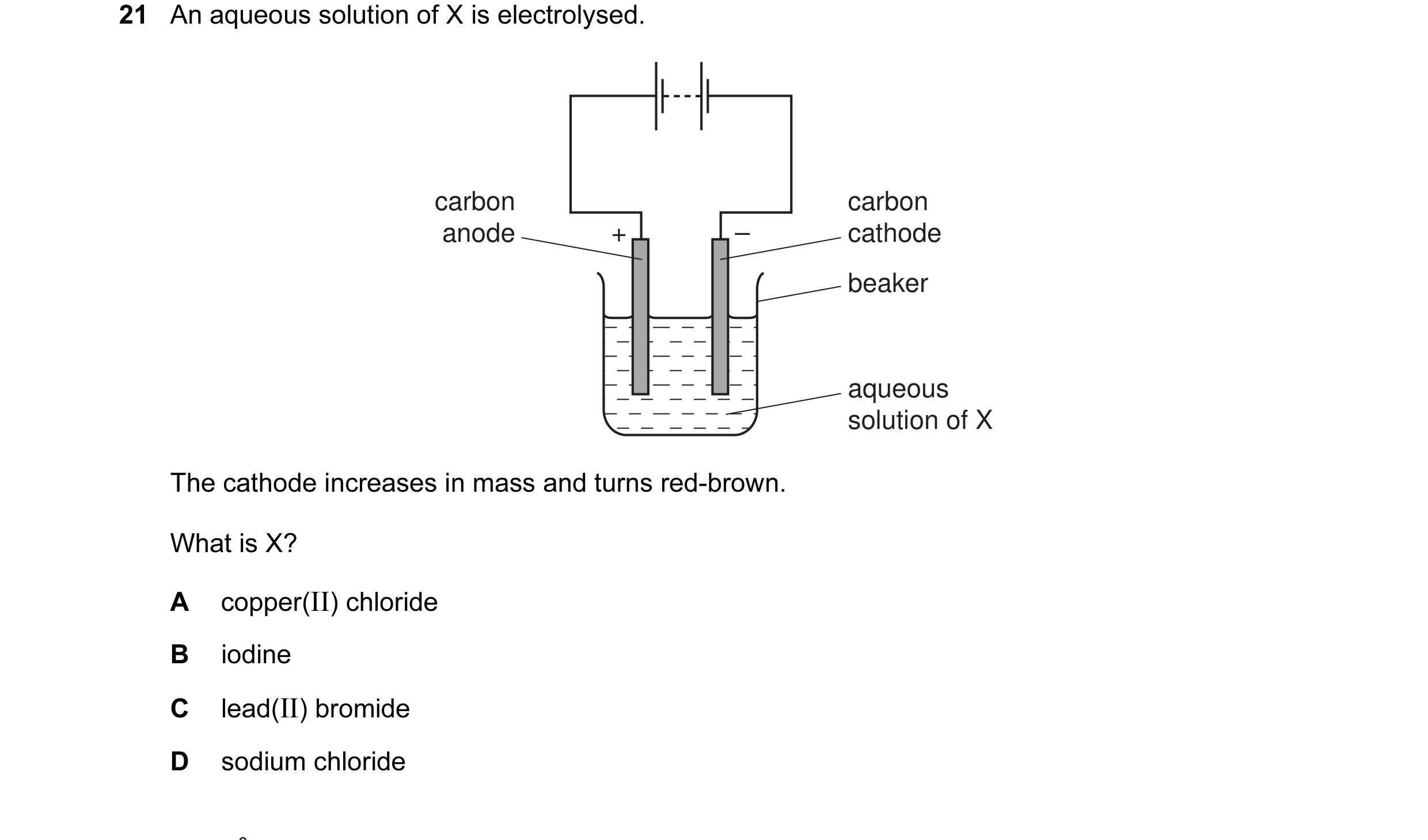
 14 / 39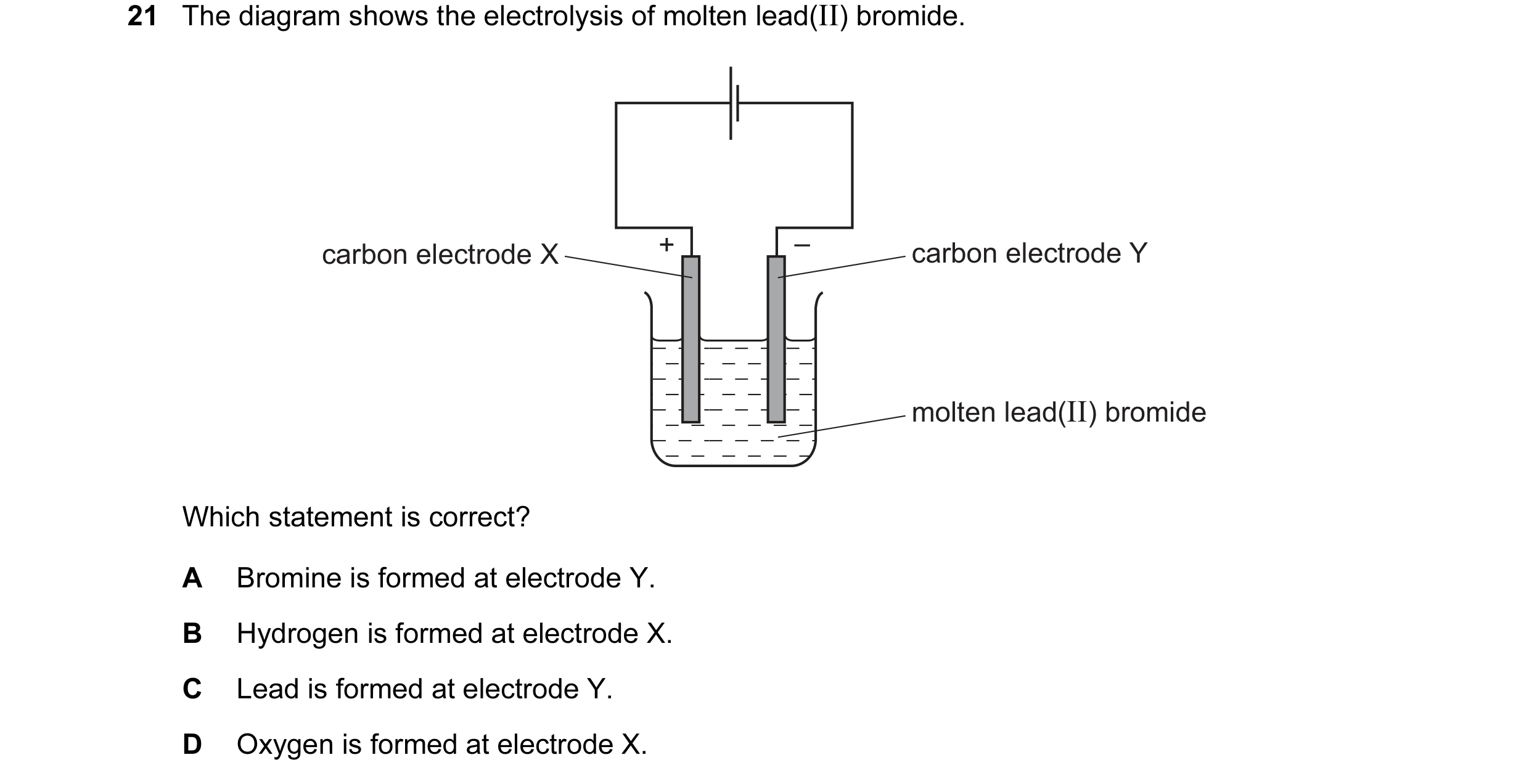
 15 / 39

 16 / 39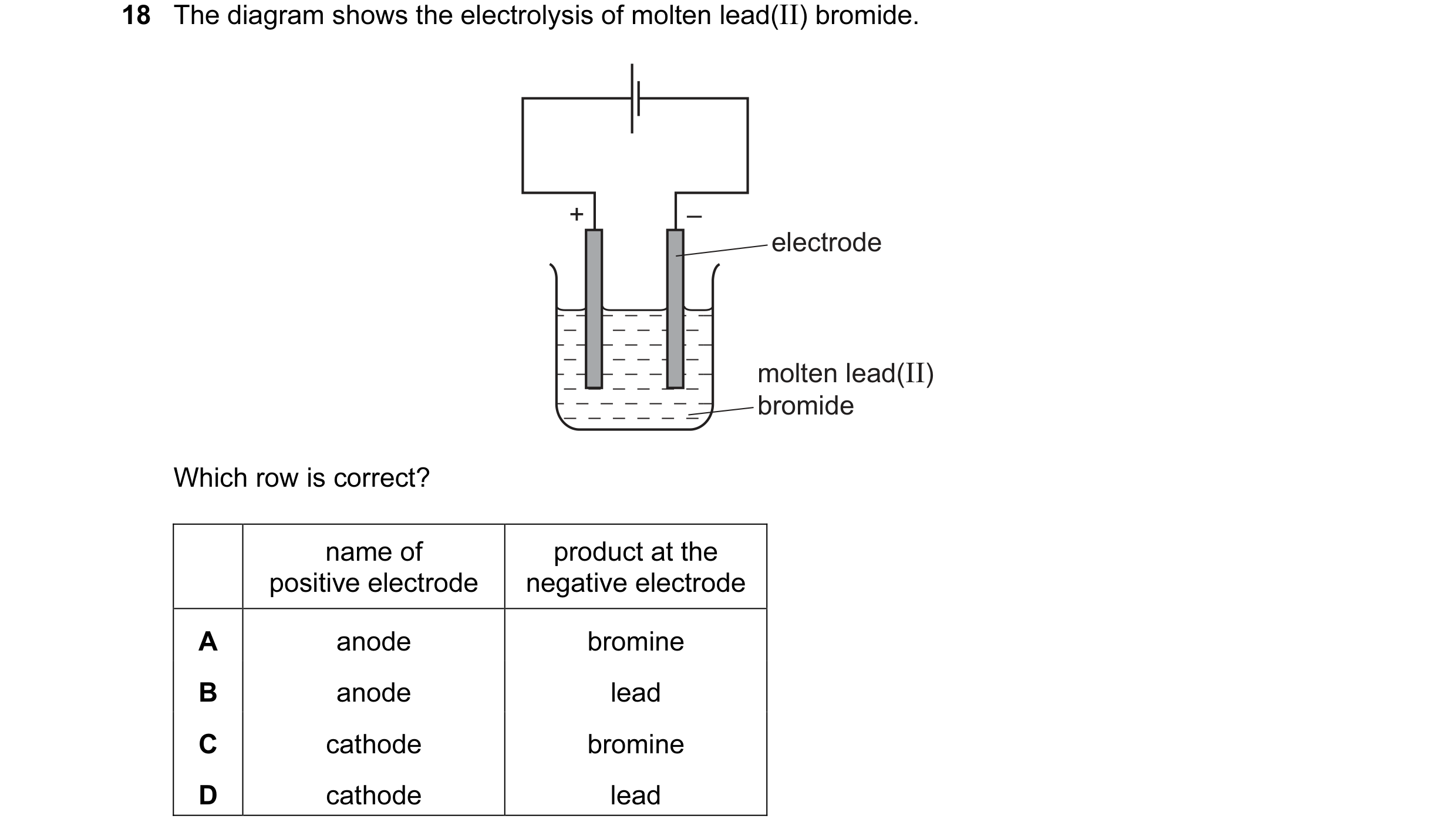
 17 / 39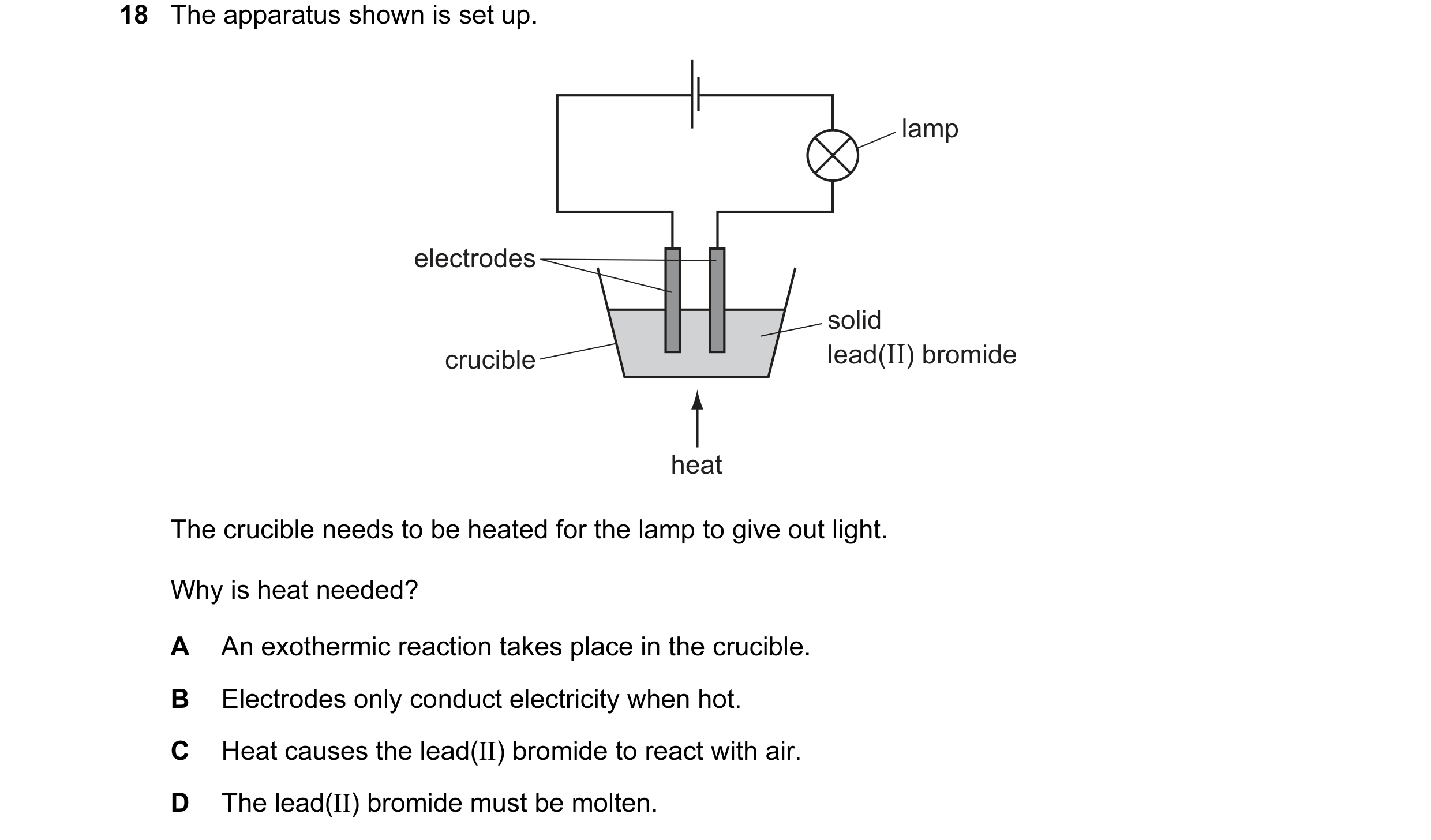
 18 / 39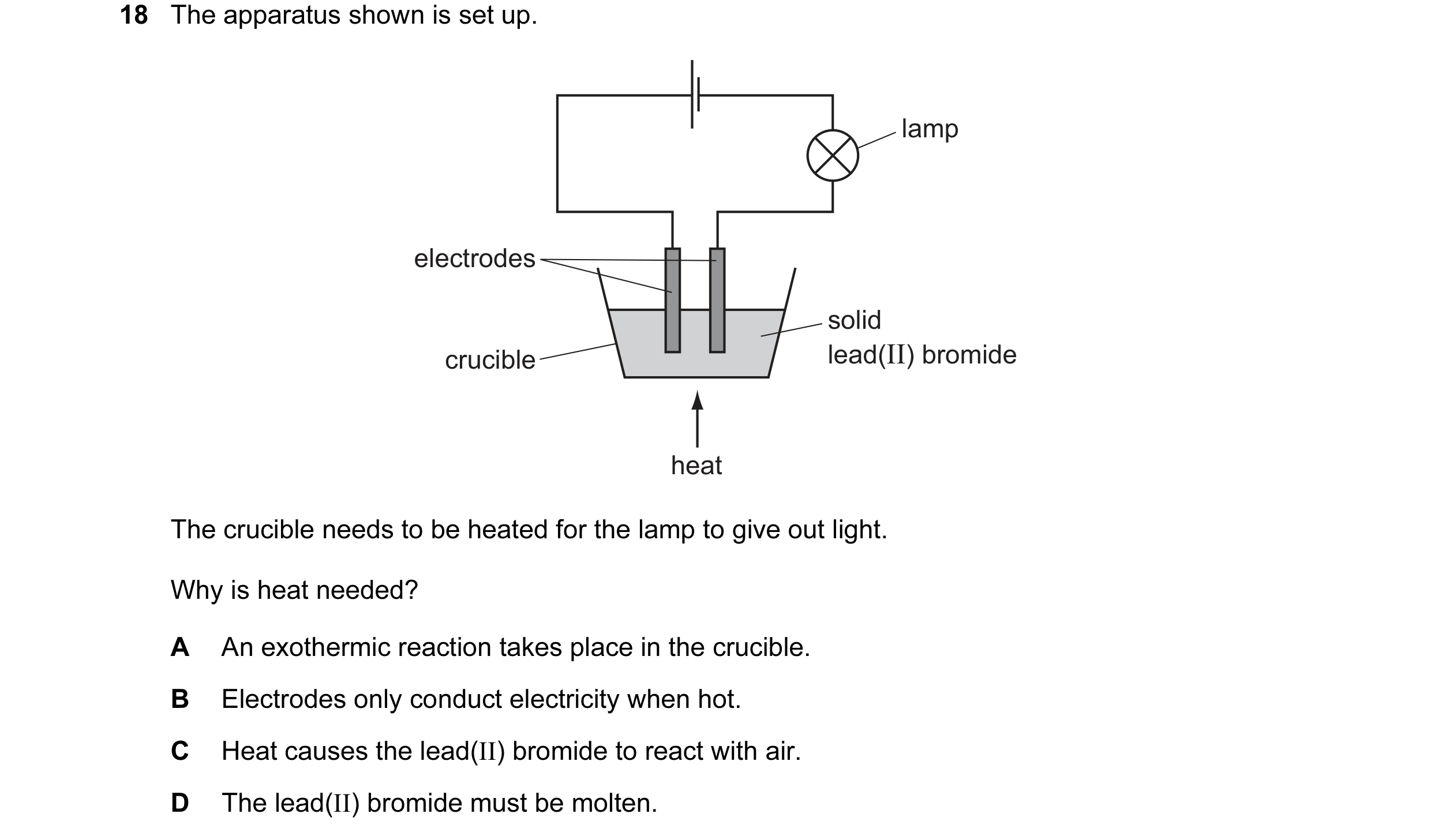
 19 / 39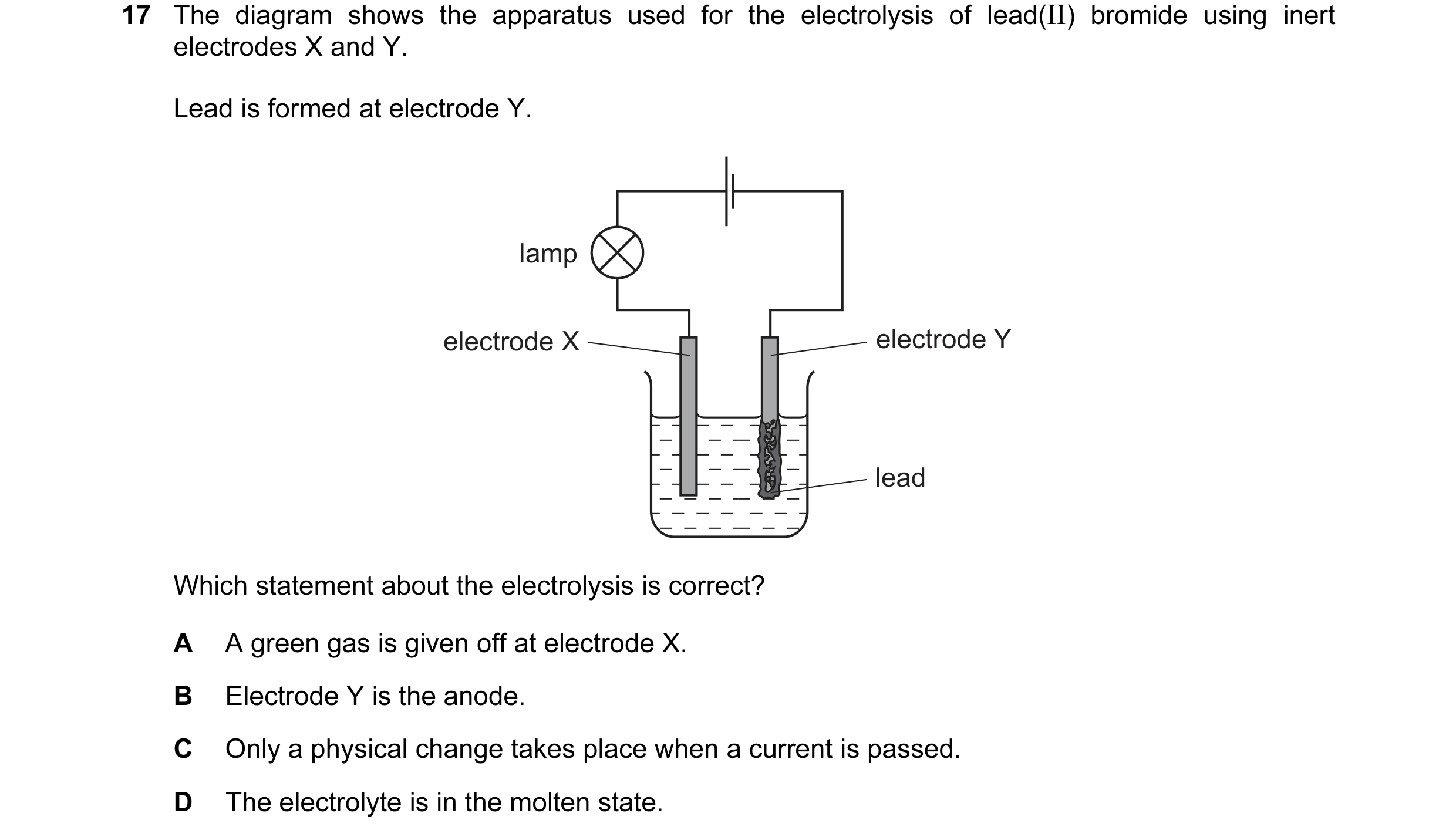
 20 / 39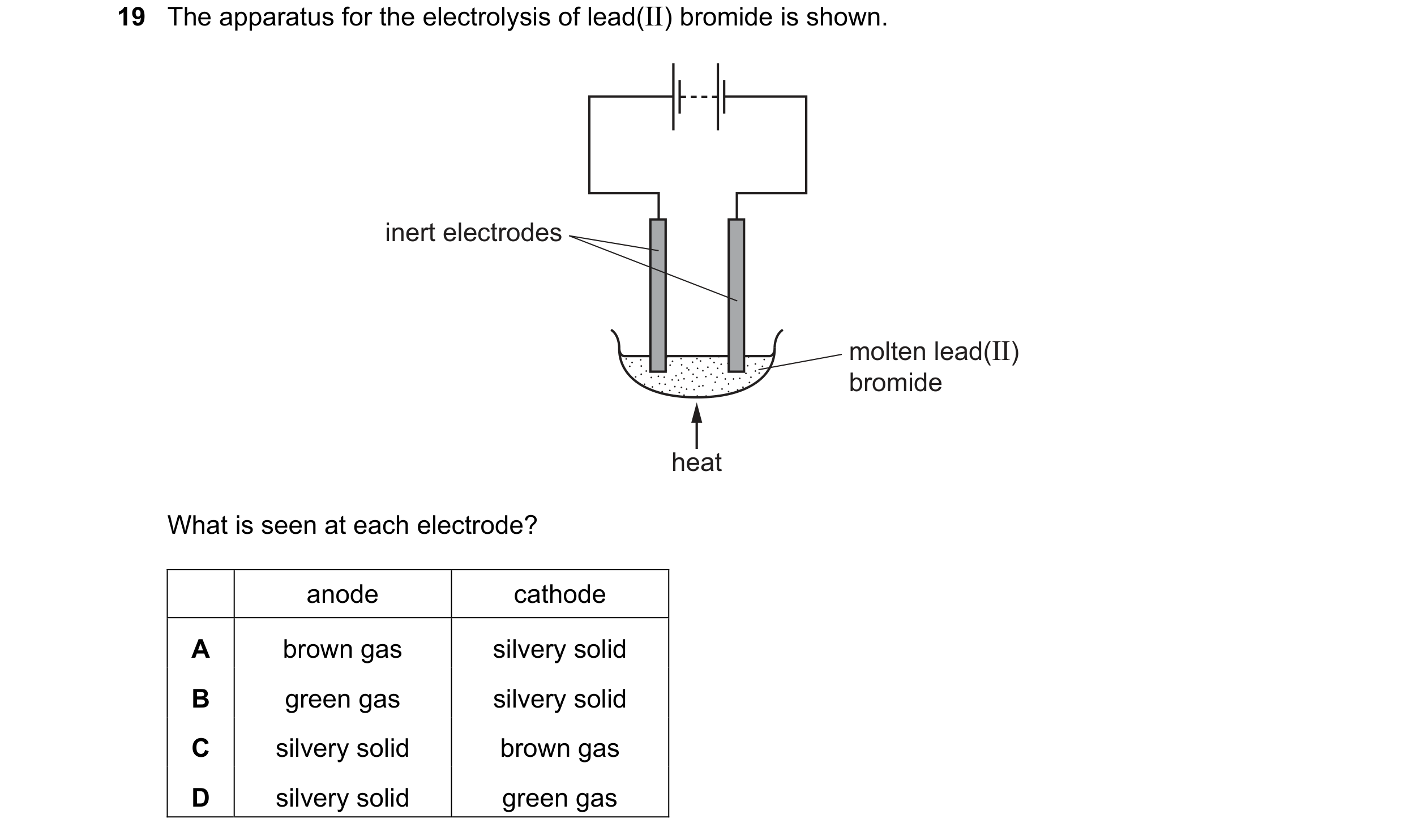

 21 / 39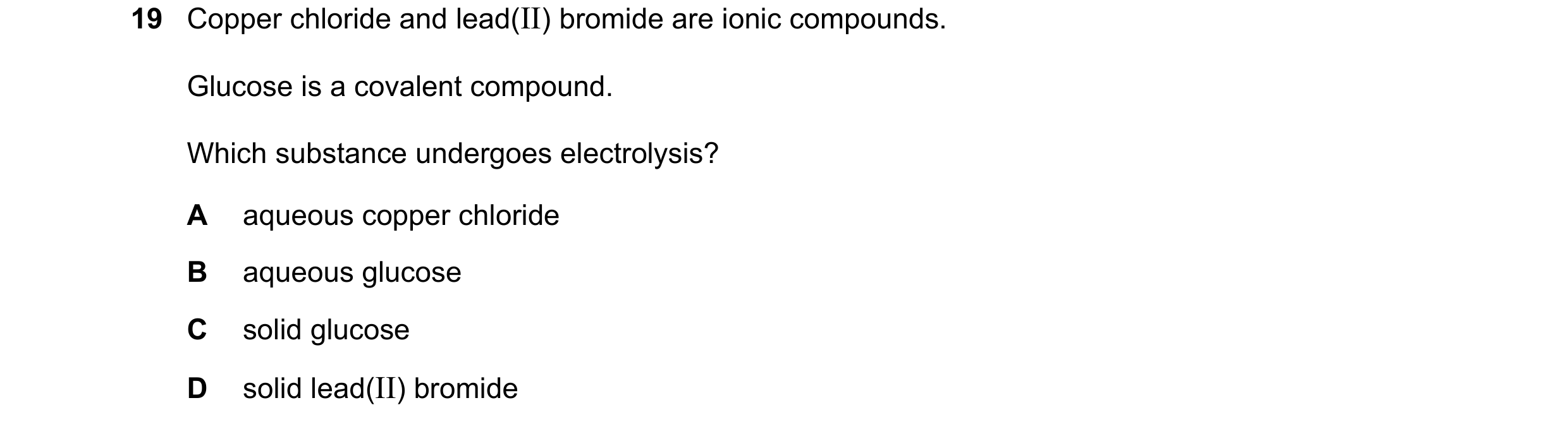
 22 / 39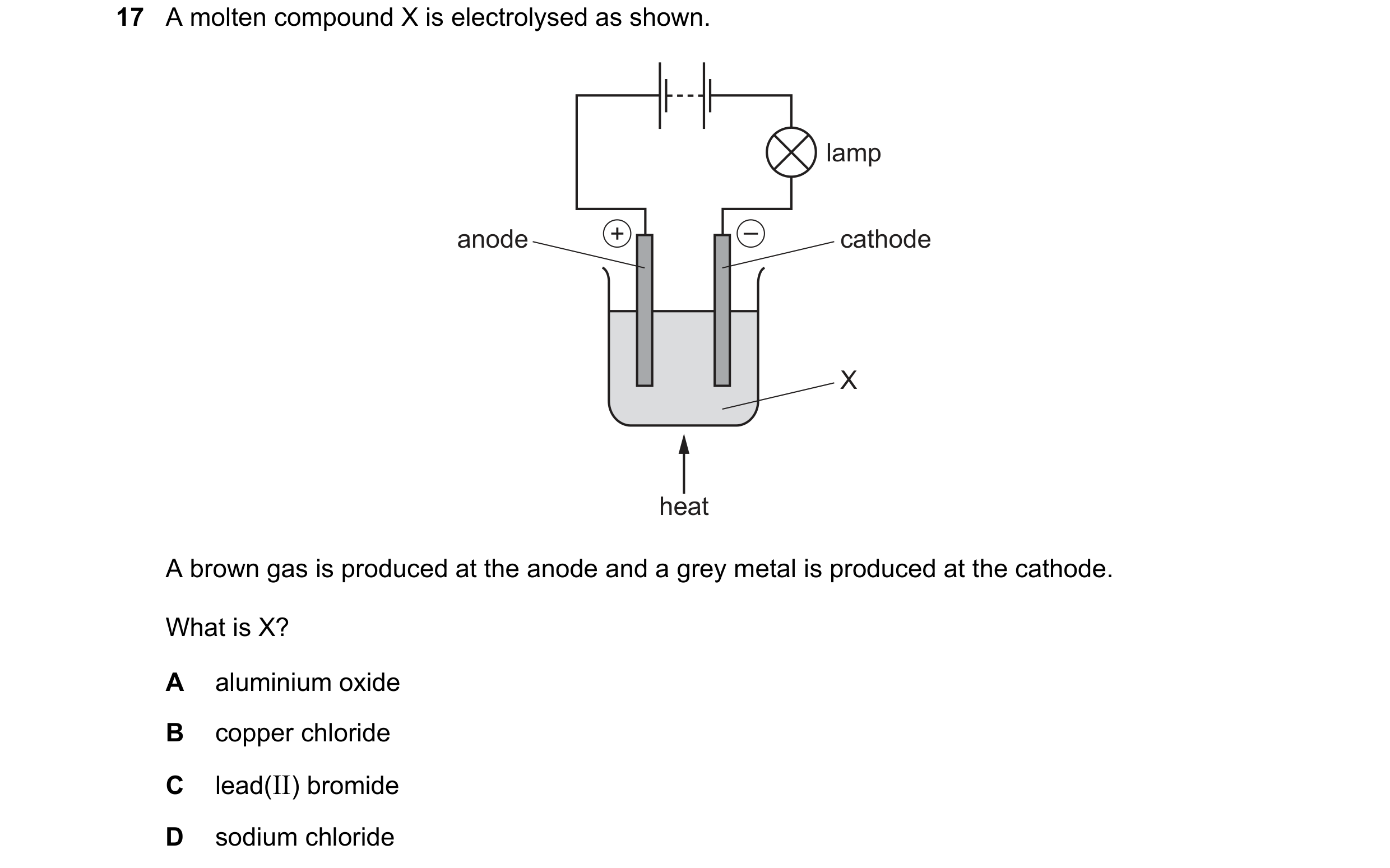
 23 / 39

 24 / 39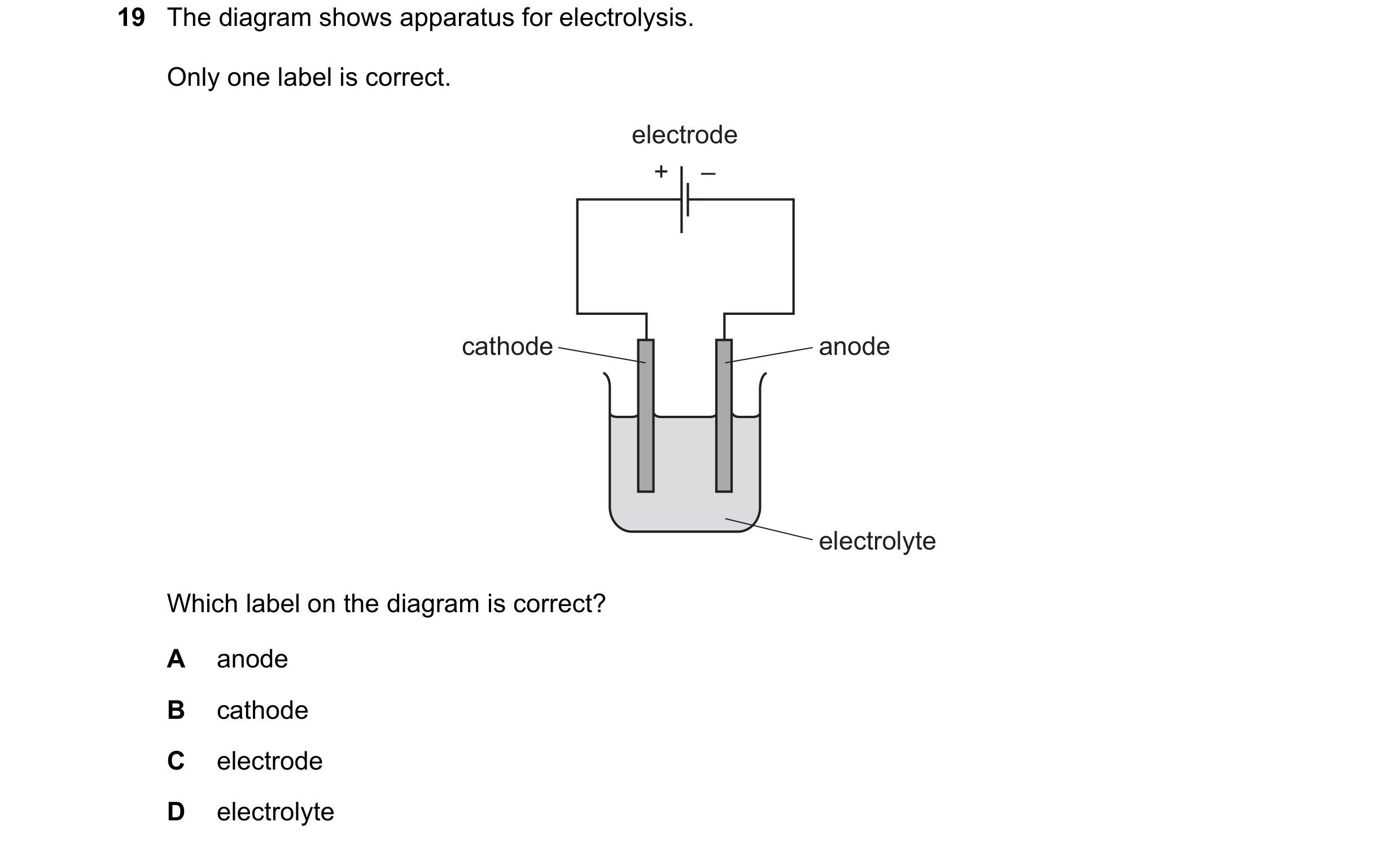
 25 / 39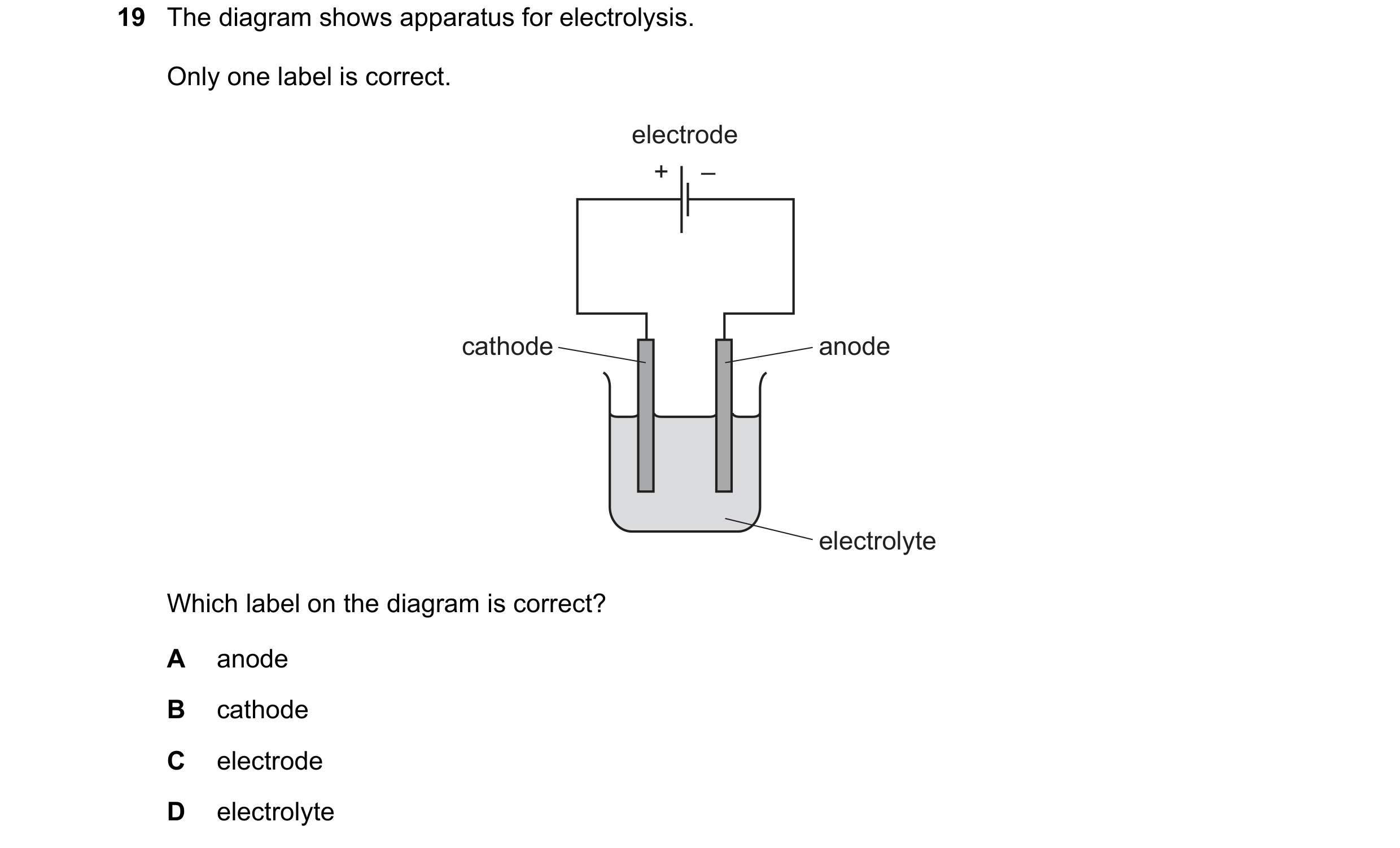
 26 / 39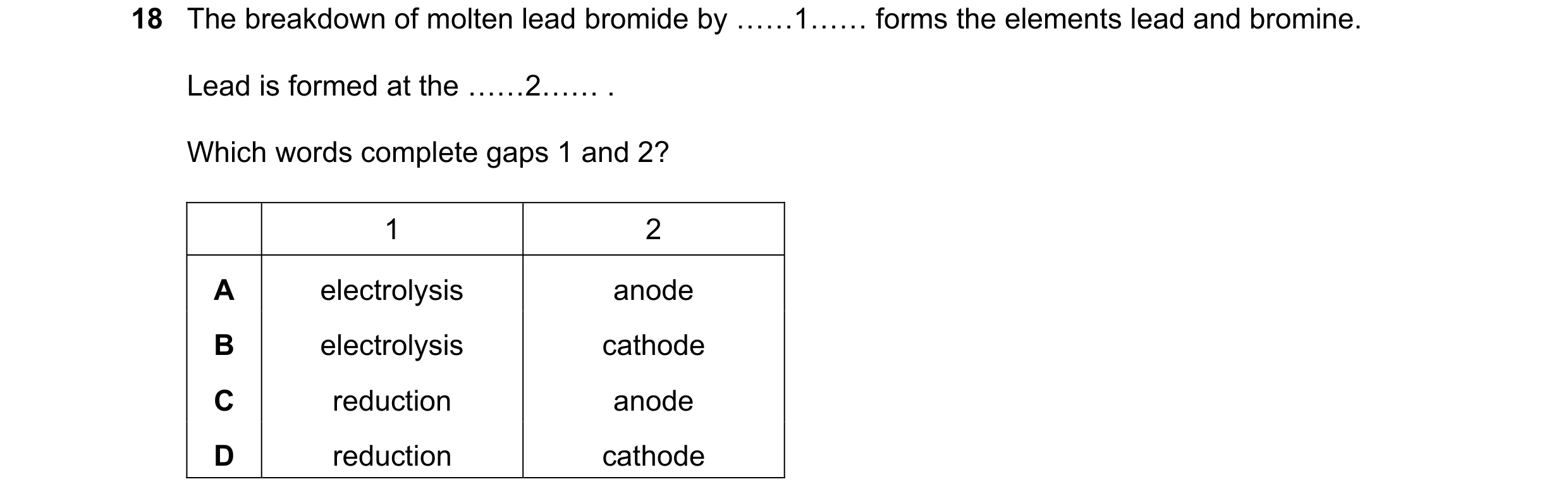
 27 / 39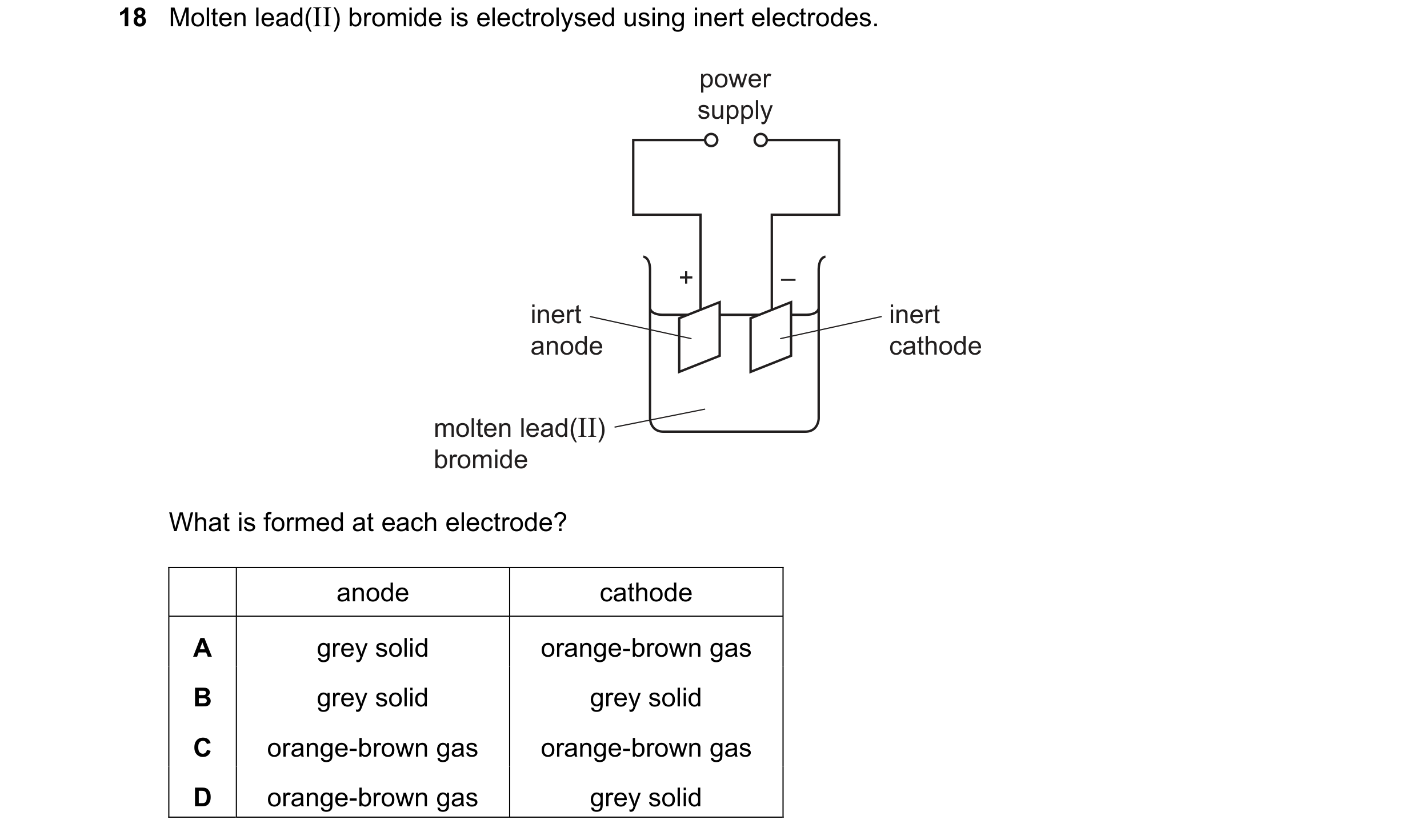
 28 / 39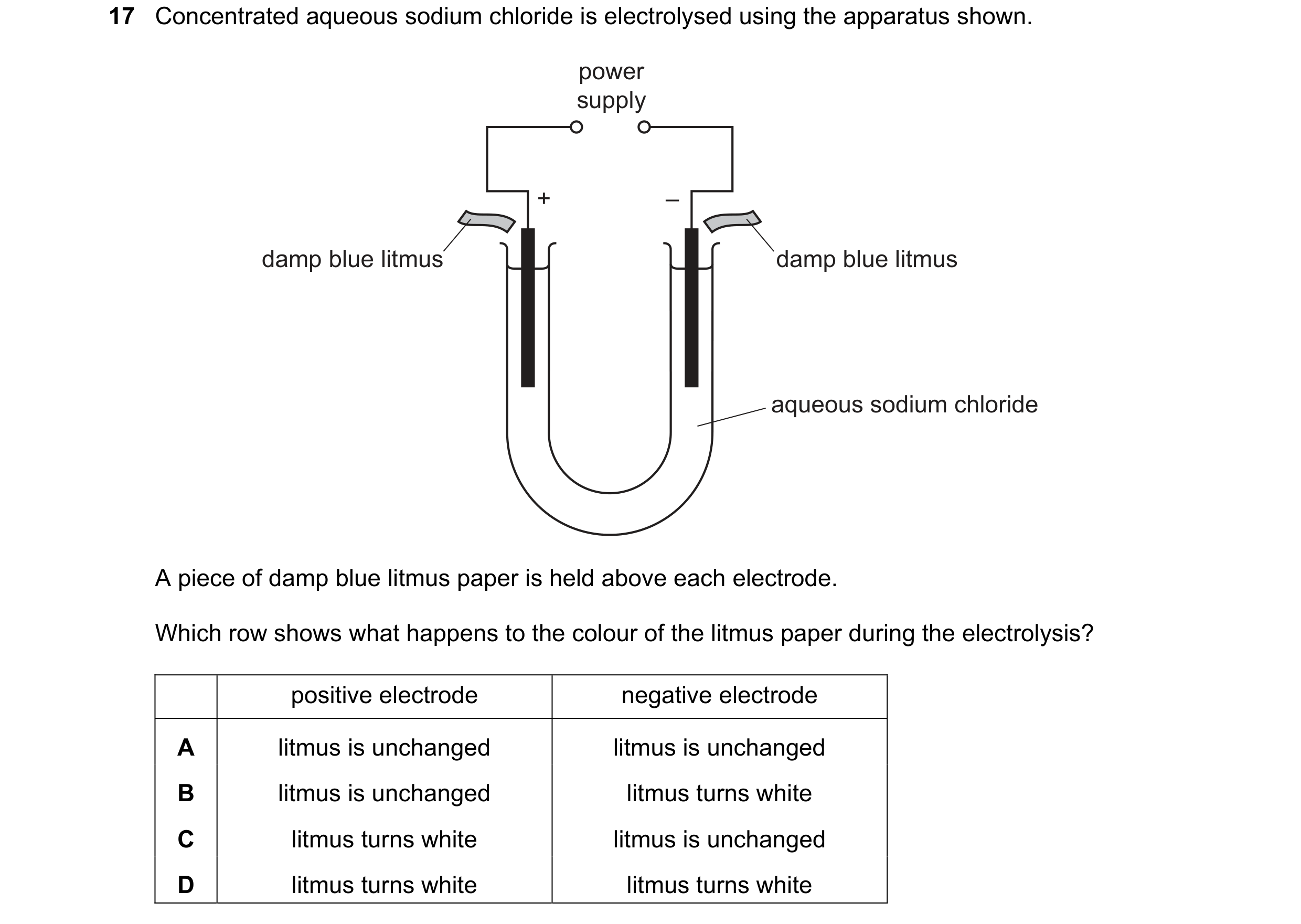
 29 / 39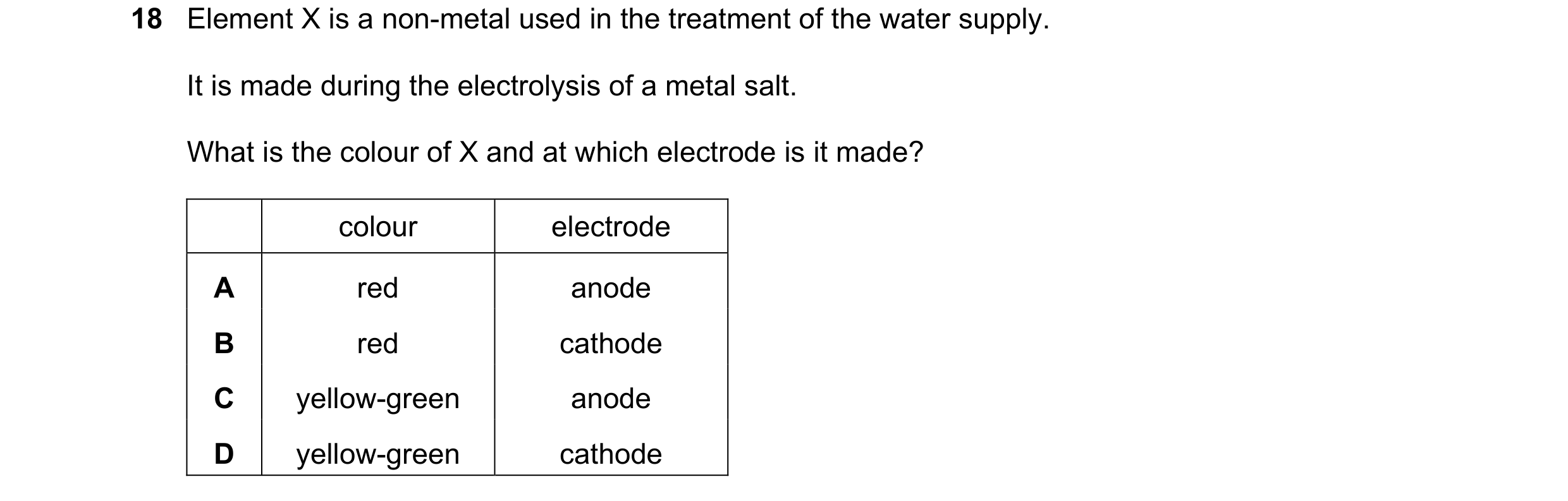

 30 / 39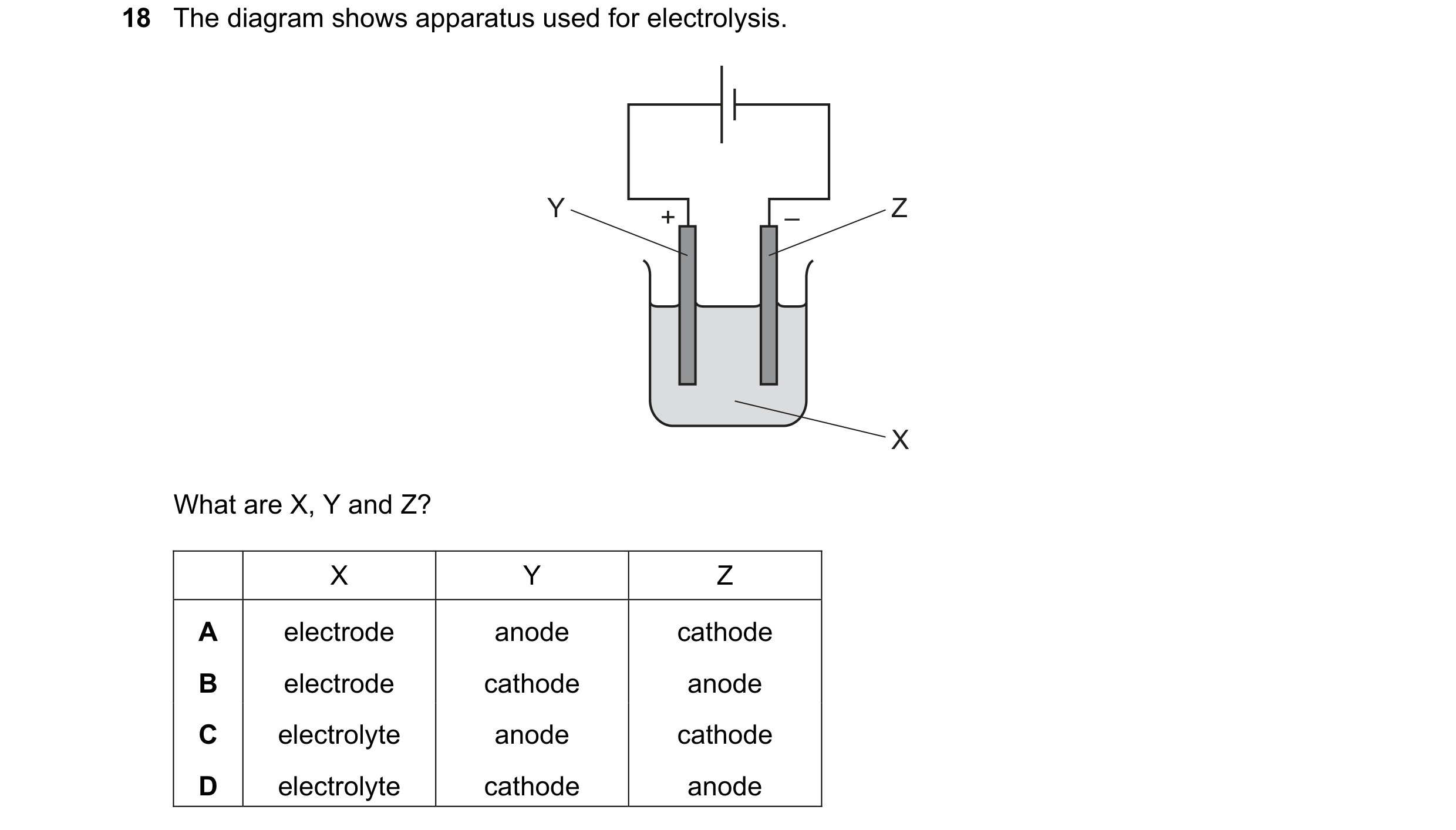
 31 / 39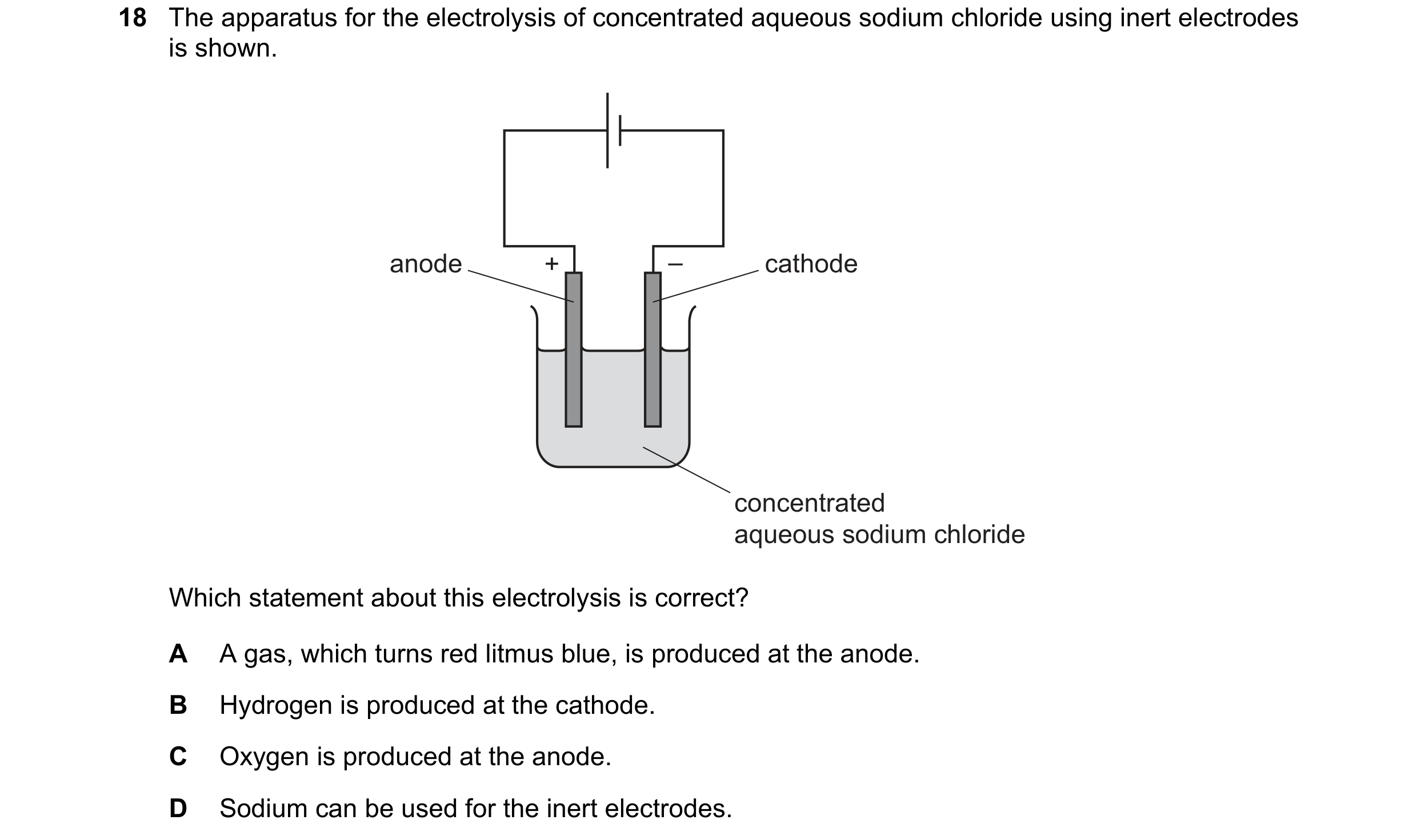
 32 / 39
 33 / 39


 34 / 39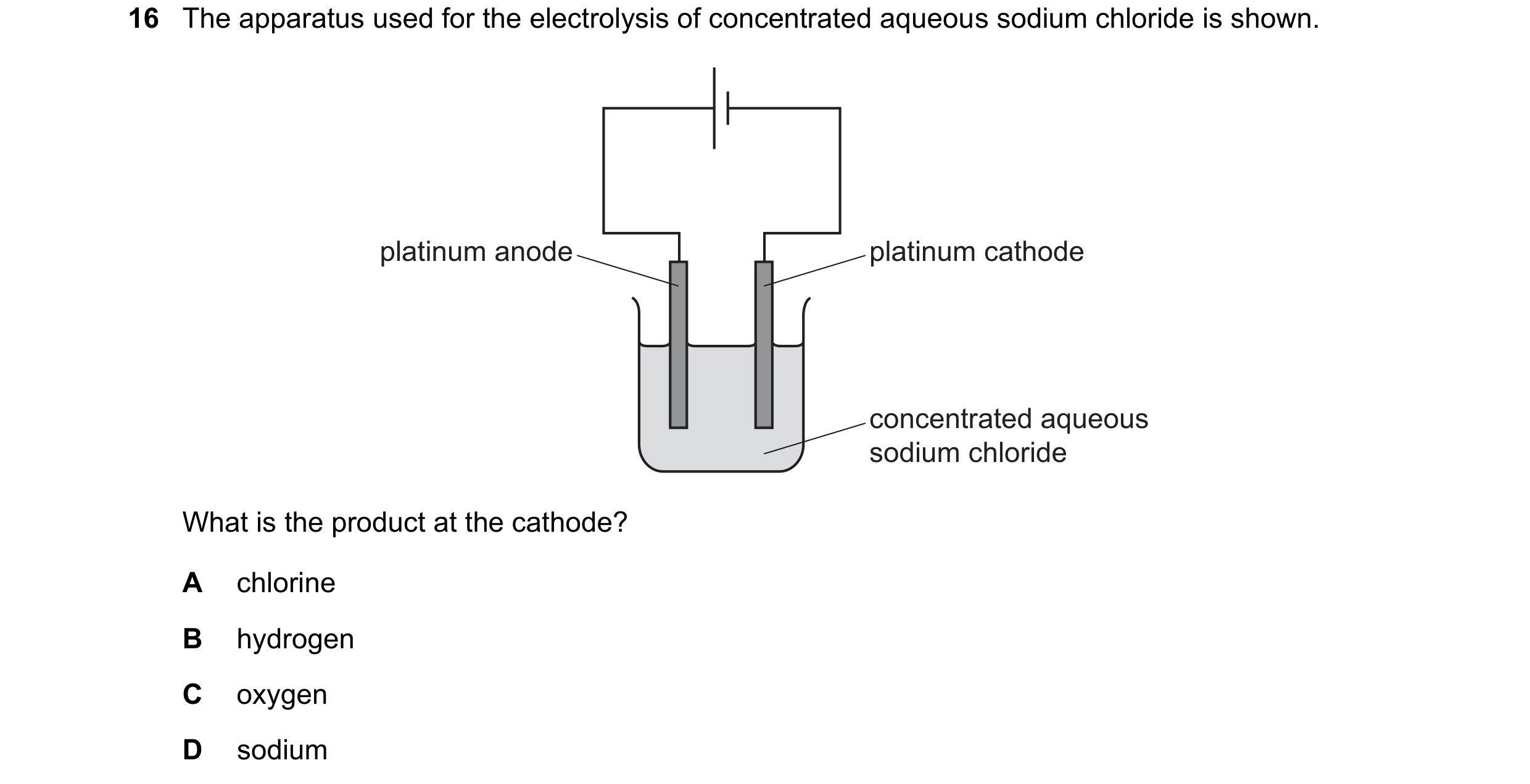
 35 / 39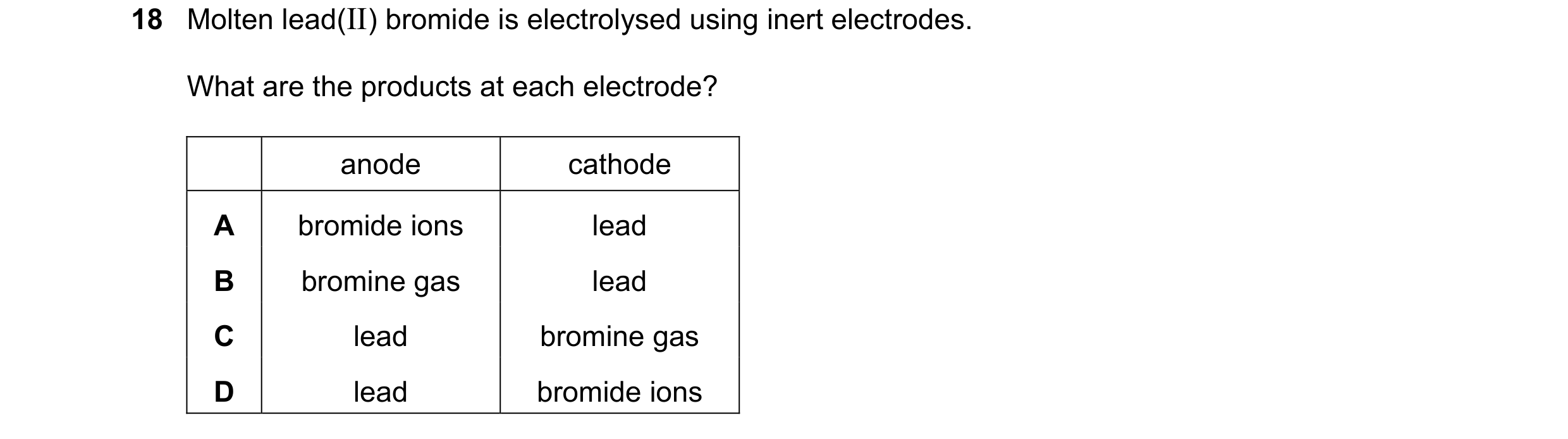


 36 / 39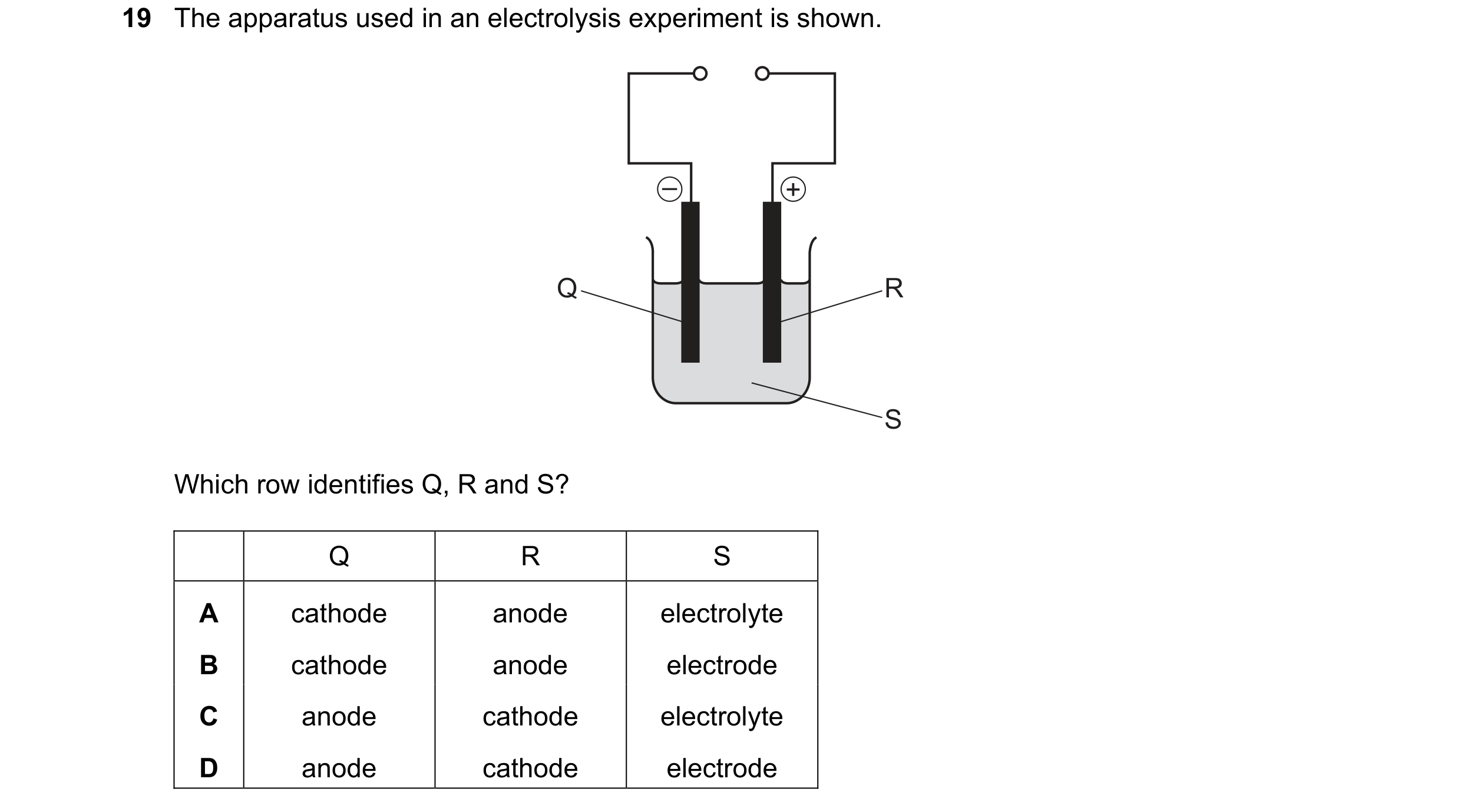

 37 / 39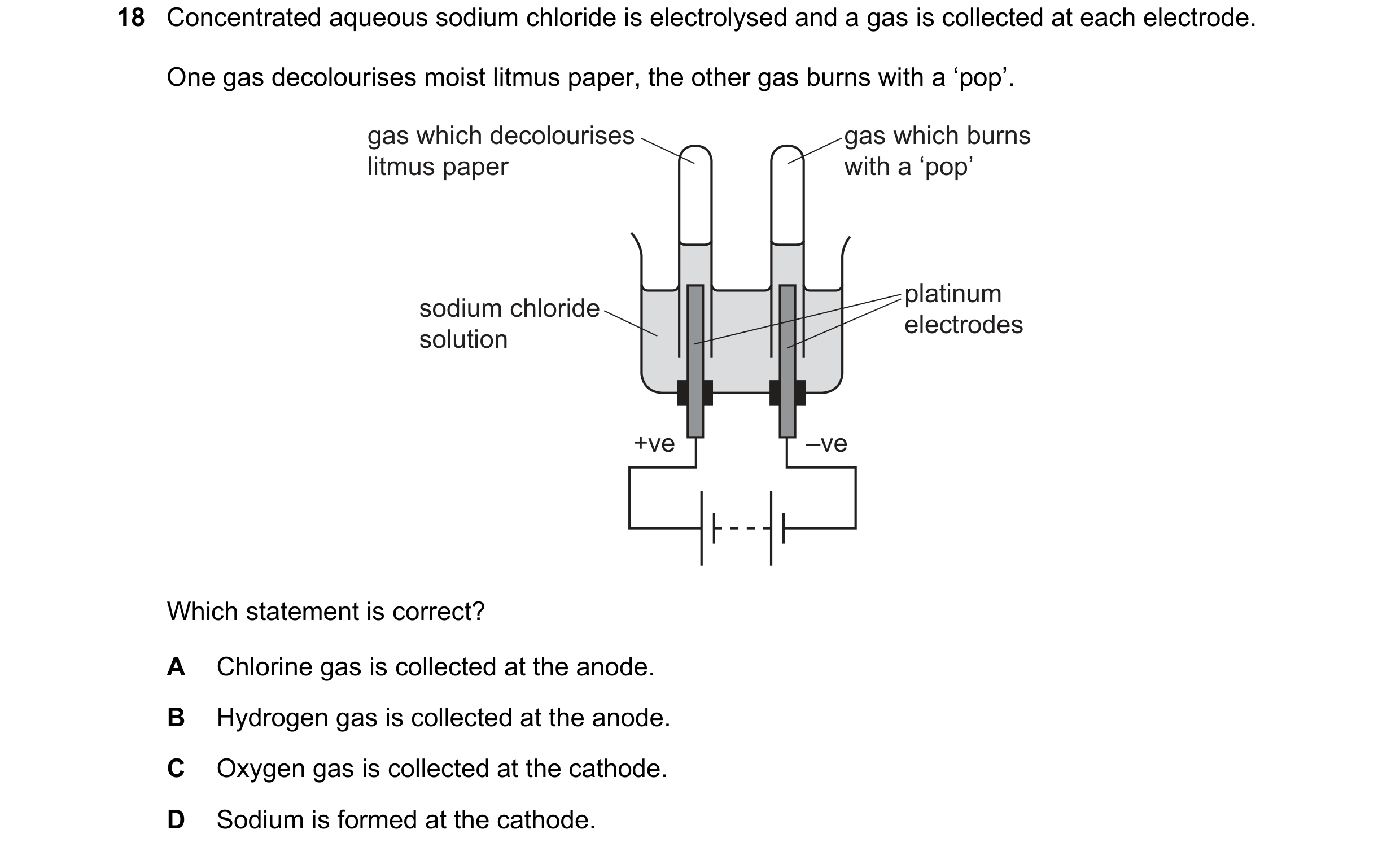
 38 / 39
 39 / 39