Questions as text
Q1 · Iron is extracted from iron oxide in the blast furnace, as shown in Fig 0653/42 Feb/March 2017
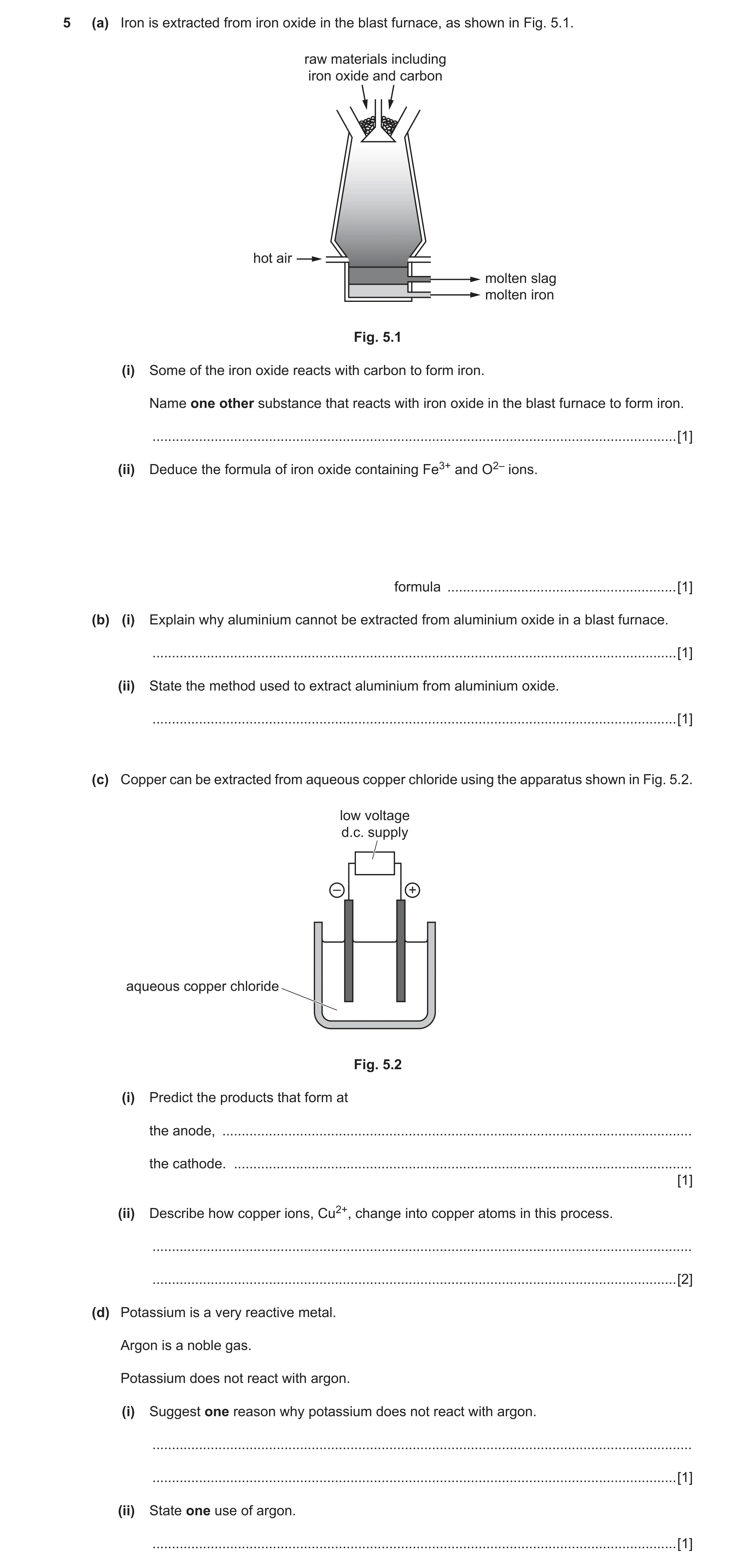
5 (a) Iron is extracted from iron oxide in the blast furnace, as shown in Fig. 5.1. raw materials including iron oxide and carbon hot air molten slag molten iron Fig. 5.1 (i) Some of the iron oxide reacts with carbon to form iron. Name one other substance that reacts with iron oxide in the blast furnace to form iron. … [1] (ii) Deduce the formula of iron oxide containing Fe3+ and O2– ions. formula … [1] (b) (i) Explain why aluminium cannot be extracted from aluminium oxide in a blast furnace. … [1] (ii) State the method used to extract aluminium from aluminium oxide. … [1] (c) Copper can be extracted from aqueous copper chloride using the apparatus shown in Fig. 5.2. low voltage d.c. supply – + aqueous copper chloride Fig. 5.2 (i) Predict the products that form at the anode, … the cathode. … [1] (ii) Describe how copper ions, Cu2+, change into copper atoms in this process. … … [2] (d) Potassium is a very reactive metal. Argon is a noble gas. Potassium does not react with argon. (i) Suggest one reason why potassium does not react with argon. … … [1] (ii) State one use of argon. … [1]
9 marks
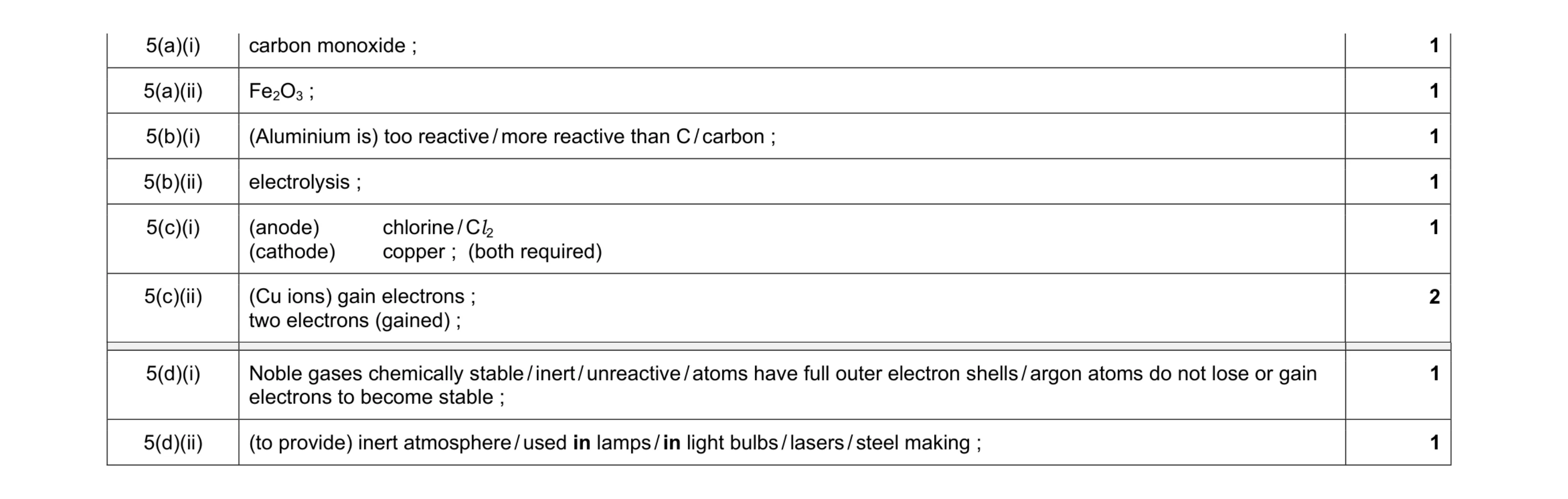
Mark scheme: 5(a)(i) carbon monoxide ; 1 5(a)(ii) Fe2O3 ; 1 5(b)(i) (Aluminium is) too reactive / more reactive than C / carbon ; 1 5(b)(ii) electrolysis ; 1 5(c)(i) (anode) chlorine / Cl2 (cathode) copper ; (both required) 1 5(c)(ii) (Cu ions) gain electrons ; two electrons (gained) ; 2 Question Answer Marks 5(d)(i) Noble gases chemically stable / inert / unreactive / atoms have full outer electron shells / argon atoms do not lose or gain electrons to become stable ; 1 5(d)(ii) (to provide) inert atmosphere / used in lamps / in light bulbs / lasers / steel making ; 1
This question in 0653/42 Feb/March 2017
Q2 · Use the Periodic Table on page 24 to determine the electronic structure of an aluminium… 0653/41 May/June 2017
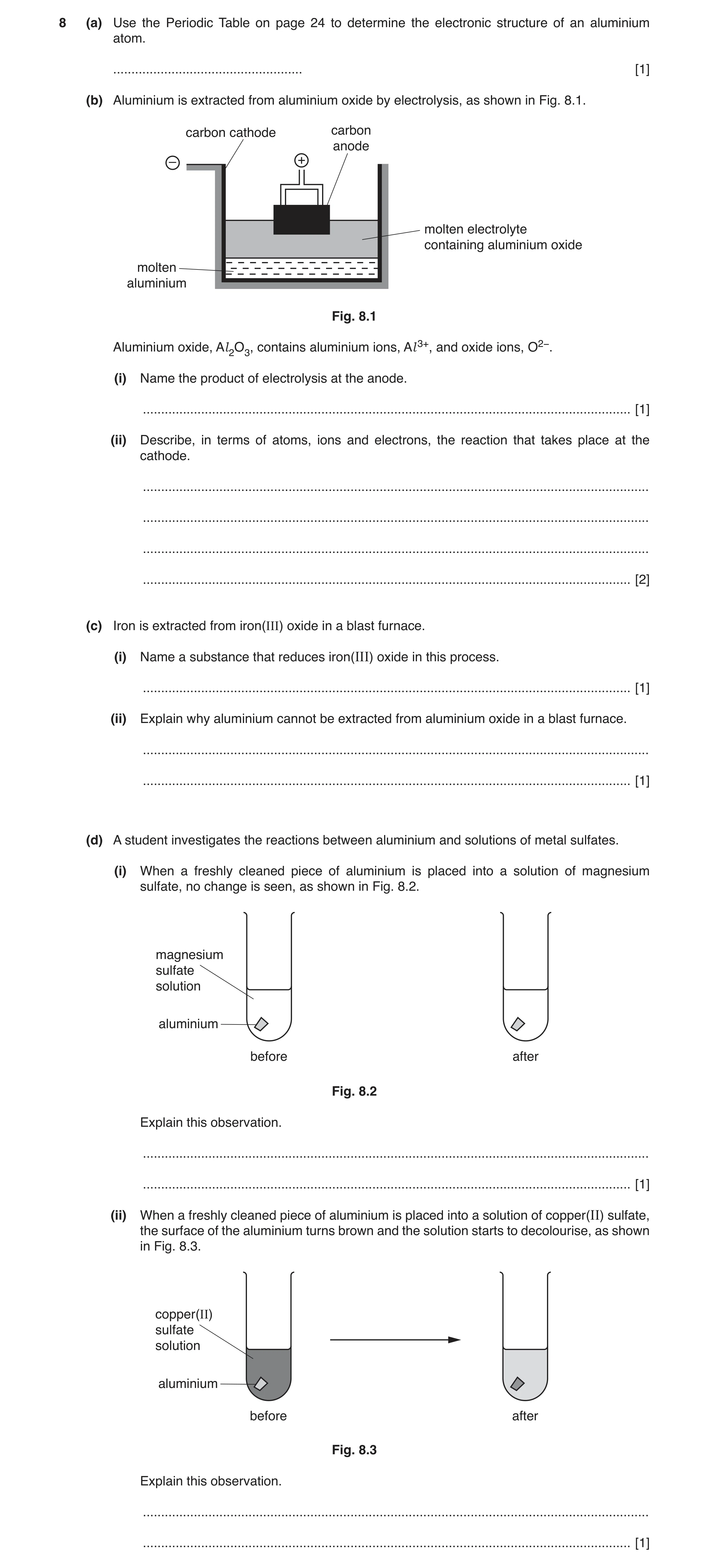
8 (a) Use the Periodic Table on page 24 to determine the electronic structure of an aluminium atom. … [1] (b) Aluminium is extracted from aluminium oxide by electrolysis, as shown in Fig. 8.1. carbon cathode carbon anode – + molten electrolyte containing aluminium oxide molten aluminium Fig. 8.1 Aluminium oxide, Al2O3, contains aluminium ions, Al 3+, and oxide ions, O2−. (i) Name the product of electrolysis at the anode. … [1] (ii) Describe, in terms of atoms, ions and electrons, the reaction that takes place at the cathode. … … … … [2] (c) Iron is extracted from iron(III) oxide in a blast furnace. (i) Name a substance that reduces iron(III) oxide in this process. … [1] (ii) Explain why aluminium cannot be extracted from aluminium oxide in a blast furnace. … … [1] (d) A student investigates the reactions between aluminium and solutions of metal sulfates. (i) When a freshly cleaned piece of aluminium is placed into a solution of magnesium sulfate, no change is seen, as shown in Fig. 8.2. magnesium sulfate solution aluminium before after Fig. 8.2 Explain this observation. … … [1] (ii) When a freshly cleaned piece of aluminium is placed into a solution of copper(II) sulfate, the surface of the aluminium turns brown and the solution starts to decolourise, as shown in Fig. 8.3. copper(II) sulfate solution aluminium before after Fig. 8.3 Explain this observation. … … [1]
8 marks
Mark scheme: 8(a) 1 8(b)(i) oxygen (gas) ; 1 8(b)(ii) aluminium ions gain electrons ; gain 3 electrons / ions are discharged / become aluminium atoms ; 2 8(c)(i) carbon / C / carbon monoxide / CO ; 1 8(c)(ii) aluminium / Al is more reactive than carbon / C ; 1 8(d)(i) Al is less reactive than Mg ; 1 8(d)(ii) Al is more reactive than Cu ; 1
This question in 0653/41 May/June 2017
Q3 · Electrolysis is used to break up some compounds into simpler substances 0653/41 Oct/Nov 2017
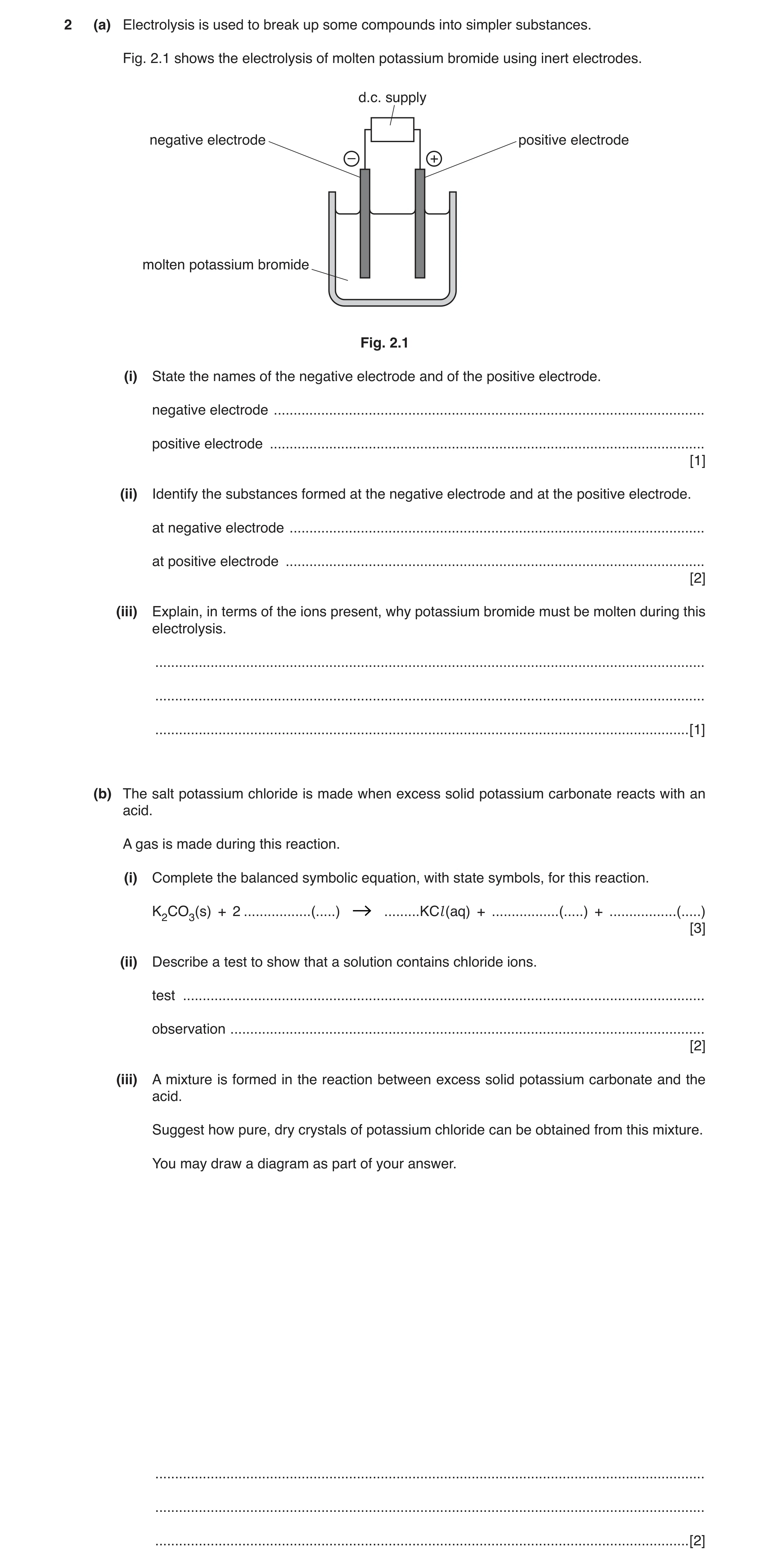
2 (a) Electrolysis is used to break up some compounds into simpler substances. Fig. 2.1 shows the electrolysis of molten potassium bromide using inert electrodes. d.c. supply negative electrode positive electrode – + molten potassium bromide Fig. 2.1 (i) State the names of the negative electrode and of the positive electrode. negative electrode … positive electrode … [1] (ii) Identify the substances formed at the negative electrode and at the positive electrode. at negative electrode … at positive electrode … [2] (iii) Explain, in terms of the ions present, why potassium bromide must be molten during this electrolysis. … … … [1] (b) The salt potassium chloride is made when excess solid potassium carbonate reacts with an acid. A gas is made during this reaction. (i) Complete the balanced symbolic equation, with state symbols, for this reaction. K2CO3(s) + 2 … ( … ) … KCl (aq) + … ( … ) + … ( … ) [3] (ii) Describe a test to show that a solution contains chloride ions. test … observation … [2] (iii) A mixture is formed in the reaction between excess solid potassium carbonate and the acid. Suggest how pure, dry crystals of potassium chloride can be obtained from this mixture. You may draw a diagram as part of your answer. … … … [2]
11 marks
Mark scheme: 2(a)(i) (negative) cathode and (positive) anode ; 1 2(a)(ii) (negative) potassium / K ; (positive) bromine / Br2 ; 2 2(a)(iii) ions must be able to move / be mobile ; 1 2(b)(i) (K2CO3 (s) + 2) «HCl (aq)« → 2 KCl (aq) + «CO2 (g)« + «H2O (l)« HCl ; RHS ; all three states ; 3 2(b)(ii) (test) (acidified) silver nitrate (solution) ; (observation) white precipitate / solid ; 2 Question Answer Marks 2(b)(iii) filter (to remove excess solid / potassium carbonate) ; and then one from heat / boil the solution / filtrate / mixture / diagram showing this process ; reference to evaporation / removal of water ; cool / leave (to allow crystals to form) ; max 2
This question in 0653/41 Oct/Nov 2017
Q4 · A student tries to produce chlorine gas and copper by electrolysis 0653/42 Oct/Nov 2017
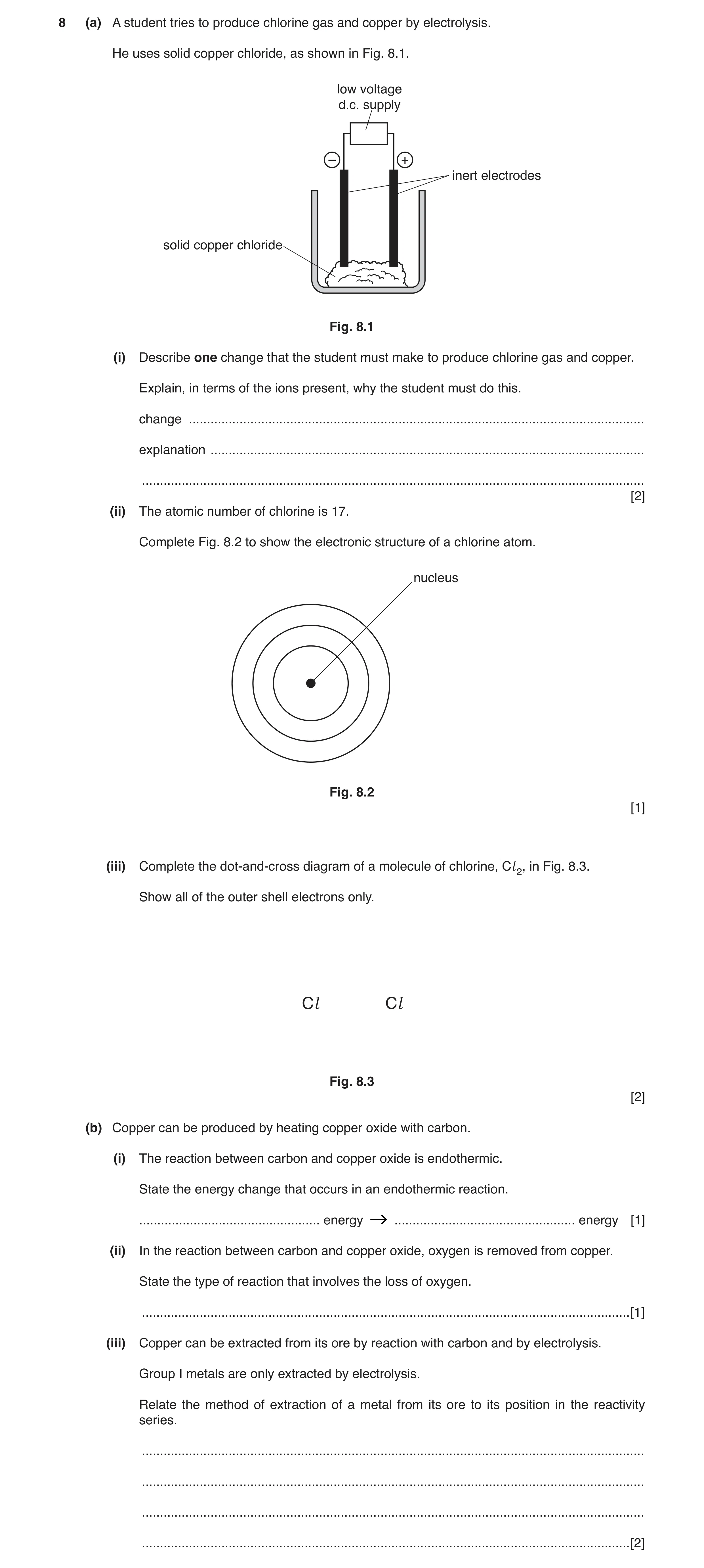
8 (a) A student tries to produce chlorine gas and copper by electrolysis. He uses solid copper chloride, as shown in Fig. 8.1. low voltage d.c. supply – + inert electrodes solid copper chloride Fig. 8.1 (i) Describe one change that the student must make to produce chlorine gas and copper. Explain, in terms of the ions present, why the student must do this. change … explanation … … [2] (ii) The atomic number of chlorine is 17. Complete Fig. 8.2 to show the electronic structure of a chlorine atom. nucleus Fig. 8.2 [1] (iii) Complete the dot-and-cross diagram of a molecule of chlorine, Cl 2, in Fig. 8.3. Show all of the outer shell electrons only. Cl Cl Fig. 8.3 [2] (b) Copper can be produced by heating copper oxide with carbon. (i) The reaction between carbon and copper oxide is endothermic. State the energy change that occurs in an endothermic reaction. … energy … energy [1] (ii) In the reaction between carbon and copper oxide, oxygen is removed from copper. State the type of reaction that involves the loss of oxygen. … [1] (iii) Copper can be extracted from its ore by reaction with carbon and by electrolysis. Group I metals are only extracted by electrolysis. Relate the method of extraction of a metal from its ore to its position in the reactivity series. … … … … [2]
9 marks
Mark scheme: 8(a)(i) add water / make into a solution / aqueous ; (so that) ions are mobile / can move ; 2 8(a)(ii) electrons arranged 2,8,7 ; 1 8(a)(iii) two electrons shown between Cl atoms ; six unshared electrons around each Cl atom ; 2 8(b)(i) thermal / heat (energy) → chemical (energy) ; 1 8(b)(ii) reduction ; 1 8(b)(iii) reactive metals / high in the reactivity series extracted by electrolysis ; less reactive metals / low in the reactivity series extracted by reaction with carbon ; reference to the relative reactivity of metal / named metal with carbon ; max 2
This question in 0653/42 Oct/Nov 2017
Q5 · A student tries to make lead from a sample of solid lead(II) bromide using the… 0653/41 May/June 2018
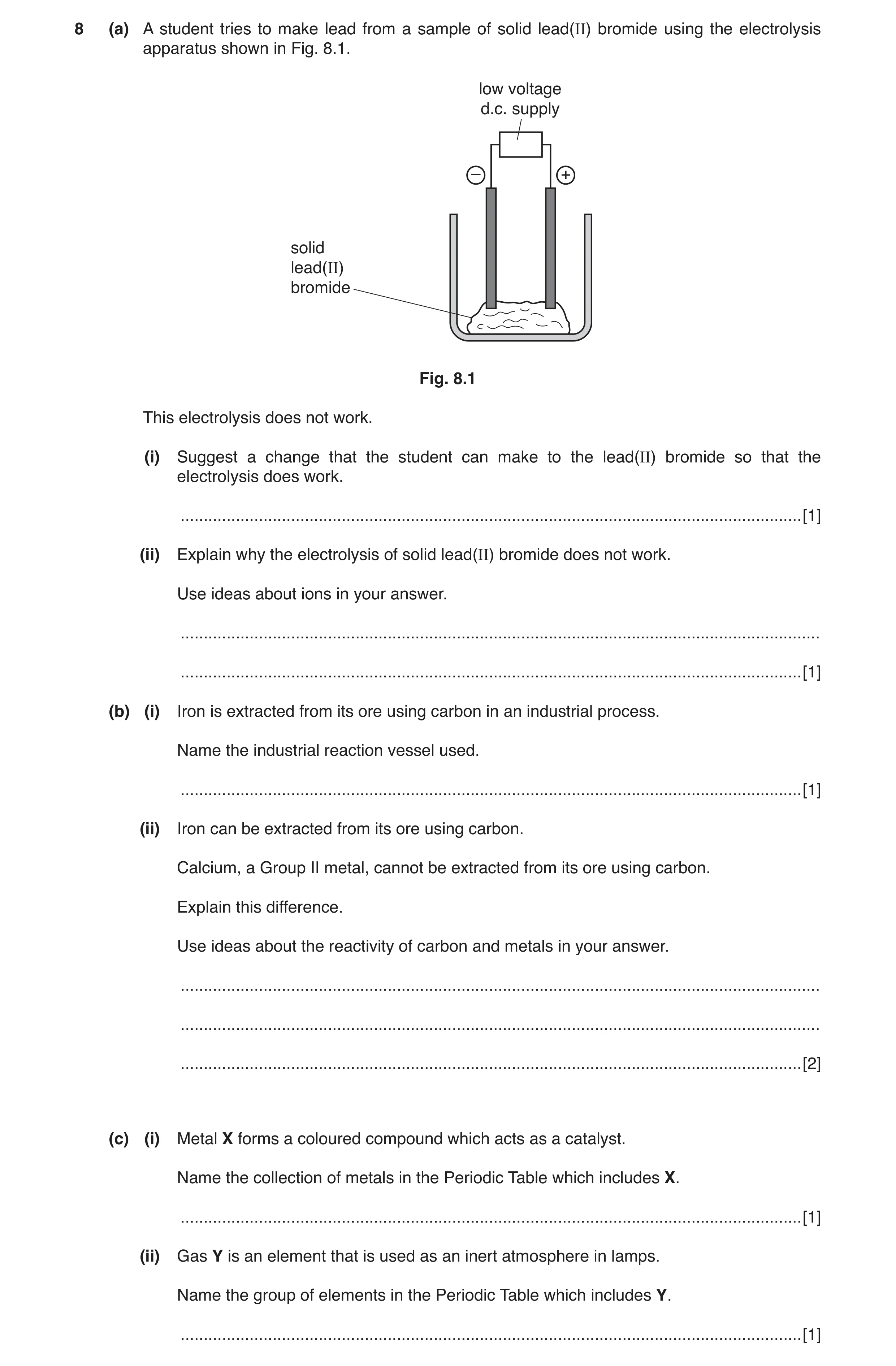
8 (a) A student tries to make lead from a sample of solid lead(II) bromide using the electrolysis apparatus shown in Fig. 8.1. low voltage d.c. supply – + solid lead(II) bromide Fig. 8.1 This electrolysis does not work. (i) Suggest a change that the student can make to the lead(II) bromide so that the electrolysis does work. … [1] (ii) Explain why the electrolysis of solid lead(II) bromide does not work. Use ideas about ions in your answer. … … [1] (b) (i) Iron is extracted from its ore using carbon in an industrial process. Name the industrial reaction vessel used. … [1] (ii) Iron can be extracted from its ore using carbon. Calcium, a Group II metal, cannot be extracted from its ore using carbon. Explain this difference. Use ideas about the reactivity of carbon and metals in your answer. … … … [2] (c) (i) Metal X forms a coloured compound which acts as a catalyst. Name the collection of metals in the Periodic Table which includes X. … [1] (ii) Gas Y is an element that is used as an inert atmosphere in lamps. Name the group of elements in the Periodic Table which includes Y. … [1]
7 marks
Mark scheme: 8(a)(i) melt / make it molten / convert it into a liquid form ; 1 8(a)(ii) ions not mobile / the idea that ions need to (be able to) move ; 1 8(b)(i) blast furnace ; 1 8(b)(ii) carbon is more reactive than iron ; group II metals / calcium are more reactive than carbon ; 2 8(c)(i) transition (elements / metals) ; 1 8(c)(ii) noble (gases) / Group VIII ; 1 Que estion Answer Ma arks
This question in 0653/41 May/June 2018
Q6 · A student adds magnesium powder to dilute hydrochloric acid 0653/42 May/June 2018
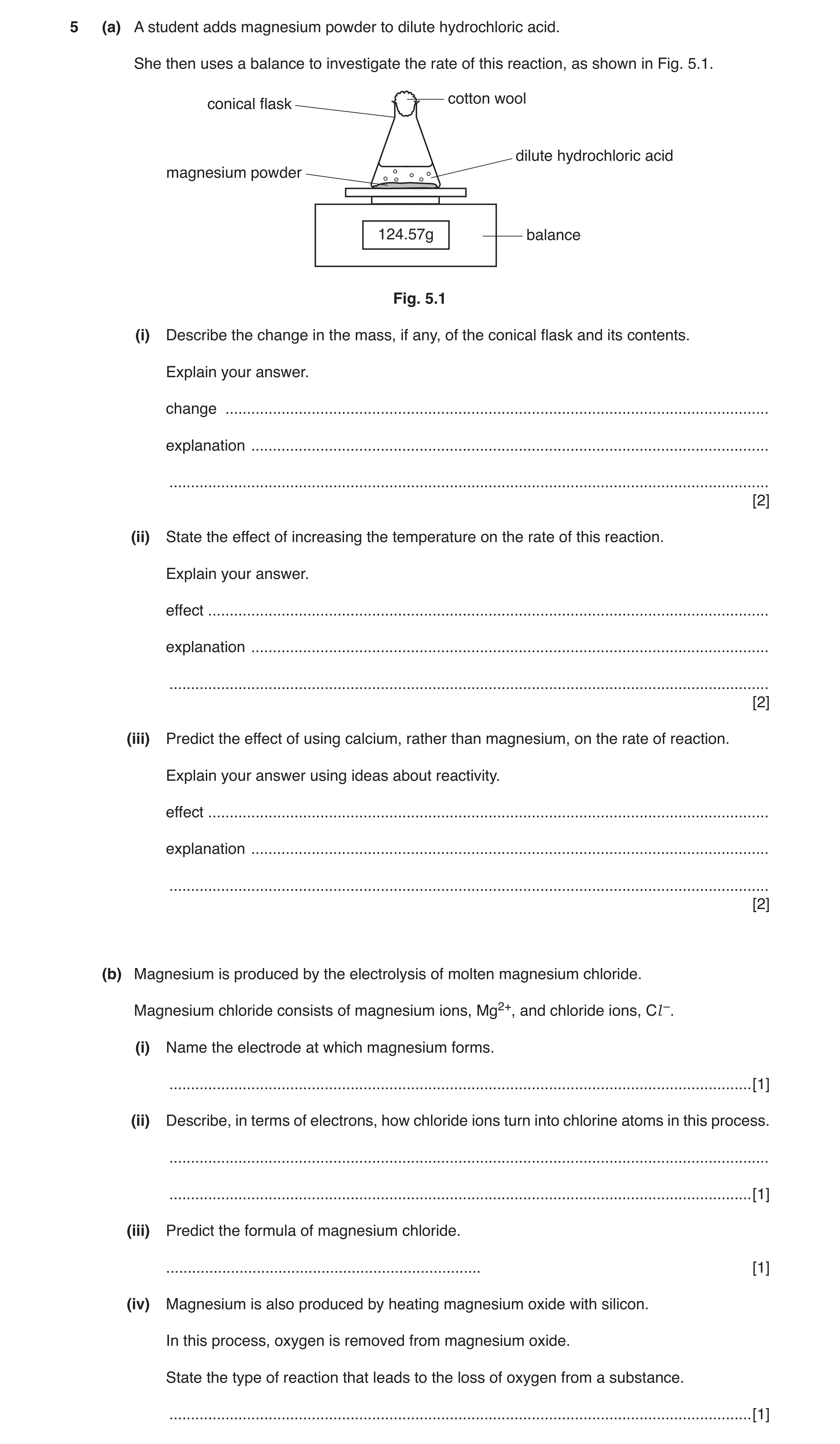
5 (a) A student adds magnesium powder to dilute hydrochloric acid. She then uses a balance to investigate the rate of this reaction, as shown in Fig. 5.1. cotton wool conical flask dilute hydrochloric acid magnesium powder 124.57g balance Fig. 5.1 (i) Describe the change in the mass, if any, of the conical flask and its contents. Explain your answer. change … explanation … … [2] (ii) State the effect of increasing the temperature on the rate of this reaction. Explain your answer. effect … explanation … … [2] (iii) Predict the effect of using calcium, rather than magnesium, on the rate of reaction. Explain your answer using ideas about reactivity. effect … explanation … … [2] (b) Magnesium is produced by the electrolysis of molten magnesium chloride. Magnesium chloride consists of magnesium ions, Mg2+, and chloride ions, Cl –. (i) Name the electrode at which magnesium forms. … [1] (ii) Describe, in terms of electrons, how chloride ions turn into chlorine atoms in this process. … … [1] (iii) Predict the formula of magnesium chloride. … [1] (iv) Magnesium is also produced by heating magnesium oxide with silicon. In this process, oxygen is removed from magnesium oxide. State the type of reaction that leads to the loss of oxygen from a substance. … [1]
10 marks
Mark scheme: 5(a)(i) (decrease) gas produced / released (by the reaction) ; to the surroundings / substance leaves the flask / apparatus ; 2 5(a)(ii) (increase) particles move faster / gain (kinetic) energy ; particles collide more often ; the idea that more of the collisions are successful ; max 2 5(a)(iii) increase ; calcium is more reactive (than magnesium) ; 2 5(b)(i) cathode ; 1 5(b)(ii) (each ion) loses (one) electron ; 1 5(b)(iii) MgCl2 ; 1 5(b)(iv) reduction ; 1 Que estion Answer Ma arks
This question in 0653/42 May/June 2018
Q7 · An aqueous solution of an ionic compound is electrolysed using inert electrodes 0653/43 May/June 2018
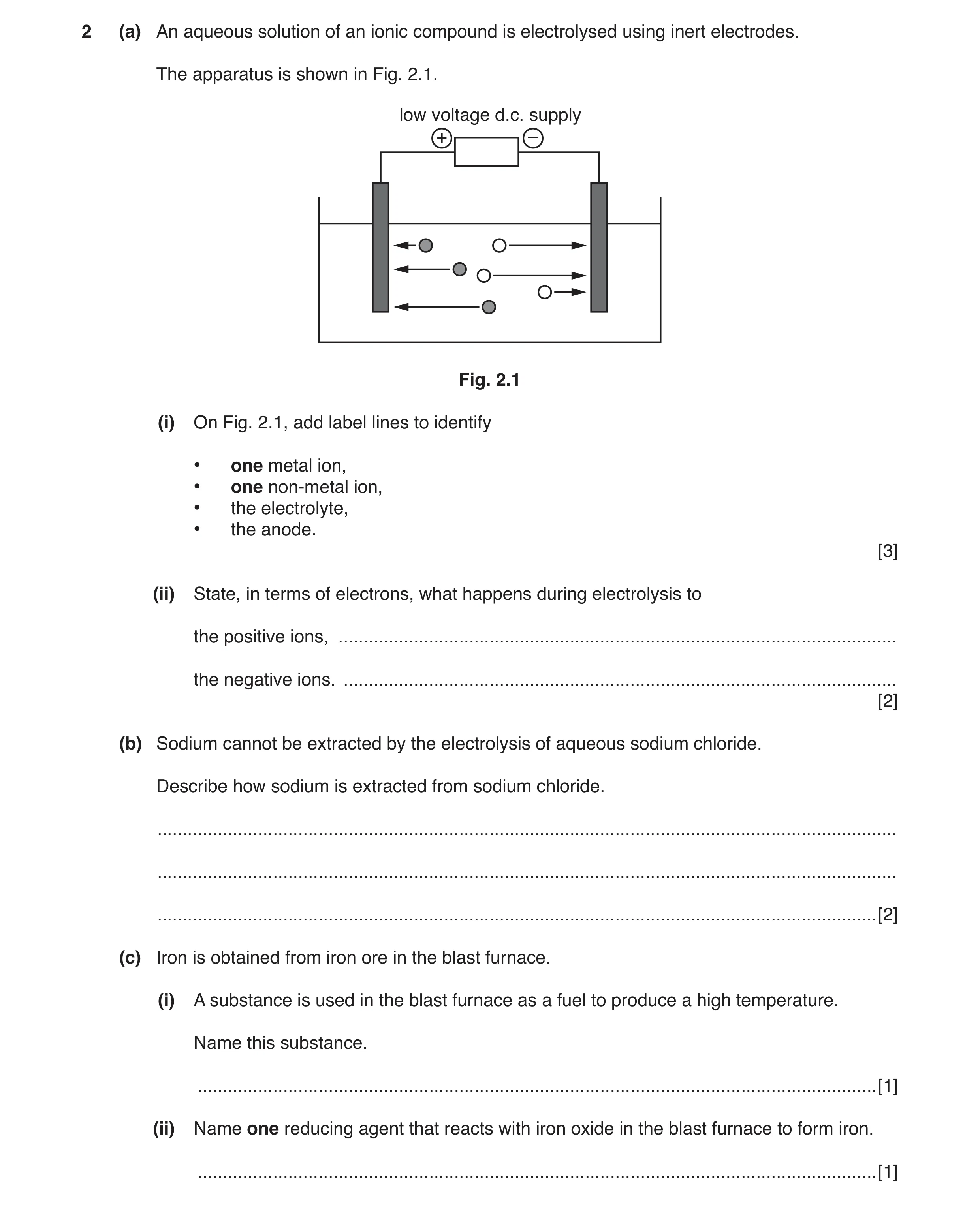
2 (a) An aqueous solution of an ionic compound is electrolysed using inert electrodes. The apparatus is shown in Fig. 2.1. low voltage d.c. supply + – Fig. 2.1 (i) On Fig. 2.1, add label lines to identify • one metal ion, • one non-metal ion, • the electrolyte, • the anode. [3] (ii) State, in terms of electrons, what happens during electrolysis to the positive ions, … the negative ions. … [2] (b) Sodium cannot be extracted by the electrolysis of aqueous sodium chloride. Describe how sodium is extracted from sodium chloride. … … … [2] (c) Iron is obtained from iron ore in the blast furnace. (i) A substance is used in the blast furnace as a fuel to produce a high temperature. Name this substance. … [1] (ii) Name one reducing agent that reacts with iron oxide in the blast furnace to form iron. … [1]
9 marks
Mark scheme: 2(a)(i) (metal ion) any moving towards negative electrode and (non-metal ion) any moving towards positive electrode ; (electrolyte) solution ; (anode) positive electrode ; 3 2(a)(ii) the idea that electron transfer occurs between ions and electrodes ; positive ions gain electrons and negative ion lose electrons ; 2 2(b) electrolysis ; molten (sodium chloride) ; relevant additional detail e.g. high temperature needed / inert electrodes used ; max 2 2(c)(i) carbon / coke ; 1 2(c)(ii) carbon monoxide / CO / carbon / C ; 1
This question in 0653/43 May/June 2018
Q8 · Name the type of bonding in a water molecule 0653/41 Oct/Nov 2018
2 (a) (i) Name the type of bonding in a water molecule. … [1] (ii) Describe how electrons are involved in the bonds in a water molecule. … … [1] (iii) Draw a dot-and-cross diagram of a water molecule. Show all of the outer shell electrons. H O H [2] (b) A student dissolves copper chloride in water. He then passes an electric current through the aqueous copper chloride using the apparatus shown in Fig. 2.1. electrode X low voltage electrode Y d.c. supply brown solid gas bubbles aqueous copper chloride Fig. 2.1 (i) Name electrode X and electrode Y. electrode X … electrode Y … [2] (ii) During this process particles move to the electrodes. A brown solid and gas bubbles form at the electrodes. Identify the particles 1. moving to electrode X, … 2. moving to electrode Y. … [2] (c) Predict the electrode products when an electric current is passed through molten lead oxide. product at negative electrode … product at positive electrode … [2]
10 marks
Mark scheme: 2(a)(i) covalent ; 1 2(a)(ii) shared (pairs of) electrons ; 1 2(a)(iii) two bond pairs ; two non-bond pairs on O atom ; 2 2(b)(i) (electrode X) cathode ; (electrode Y) anode ; 2 2(b)(ii) (to electrode X) copper ions / Cu2+ ; (to electrode Y) chloride (ions) / Cl – ; 2 2(c) (negative) lead ; (positive) oxygen ; 2
This question in 0653/41 Oct/Nov 2018
Q9 · A teacher tries to use the apparatus shown in Fig 0653/42 Oct/Nov 2018
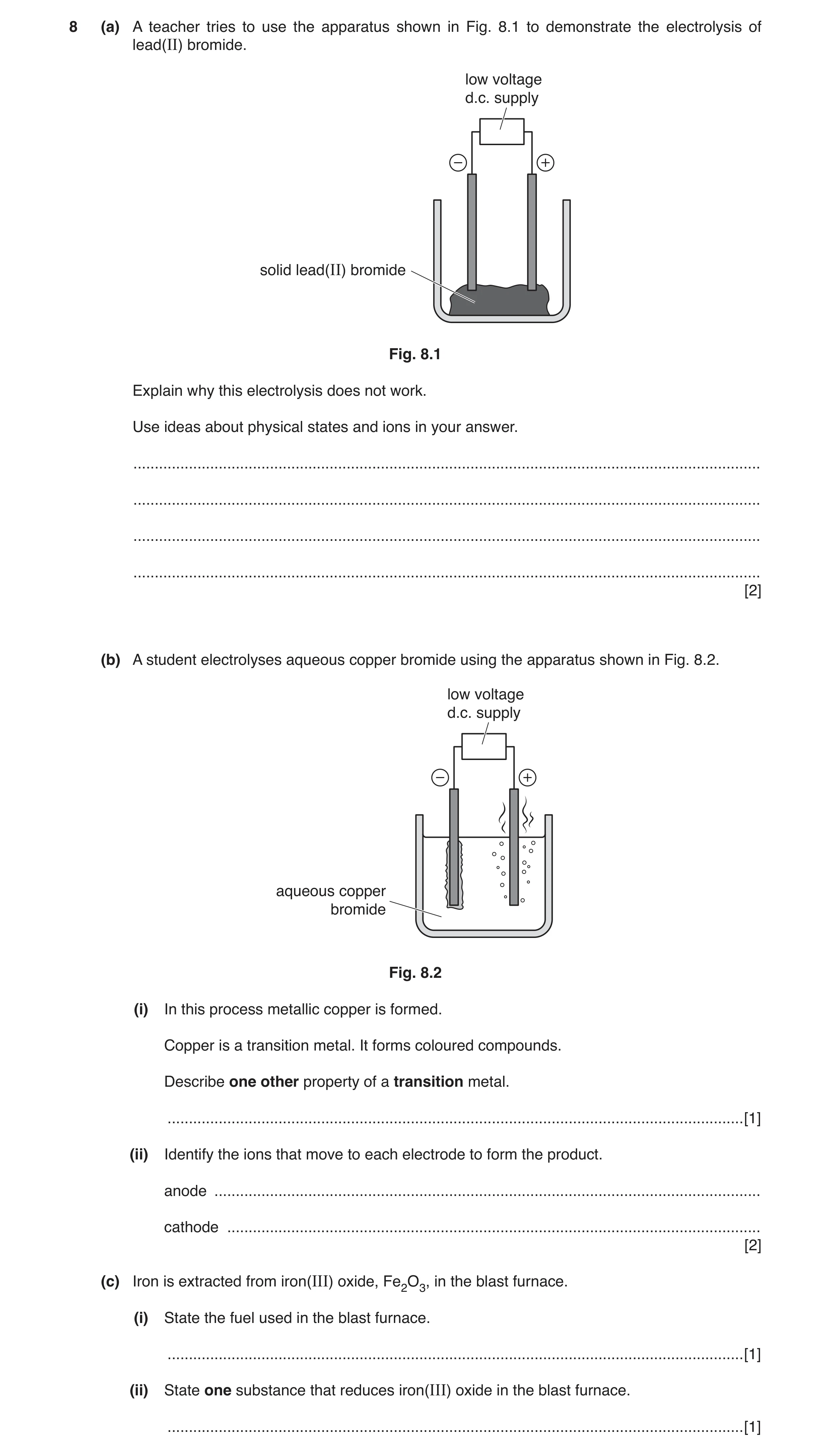
8 (a) A teacher tries to use the apparatus shown in Fig. 8.1 to demonstrate the electrolysis of lead(II) bromide. low voltage d.c. supply solid lead(II) bromide Fig. 8.1 Explain why this electrolysis does not work. Use ideas about physical states and ions in your answer. … … … … [2] (b) A student electrolyses aqueous copper bromide using the apparatus shown in Fig. 8.2. low voltage d.c. supply aqueous copper bromide Fig. 8.2 (i) In this process metallic copper is formed. Copper is a transition metal. It forms coloured compounds. Describe one other property of a transition metal. … [1] (ii) Identify the ions that move to each electrode to form the product. anode … cathode … [2] (c) Iron is extracted from iron(III) oxide, Fe2O3, in the blast furnace. (i) State the fuel used in the blast furnace. … [1] (ii) State one substance that reduces iron(III) oxide in the blast furnace. … [1]
7 marks
Mark scheme: 8(a) lead bromide is solid / needs to be molten / liquid ; so that ions are mobile / can move ; 2 8(b)(i) high density / high melting point / (element or compound) act as catalysts ; 1 8(b)(ii) (to the anode) bromide / Br– ; (to the cathode) copper(II) / Cu2+ ; 2 8(c)(i) carbon / C / coke ; 1 8(c)(ii) carbon monoxide / CO / carbon / C ; 1
This question in 0653/42 Oct/Nov 2018
Q10 · The apparatus a student uses to investigate the reaction between magnesium powder and… 0653/42 Feb/March 2019
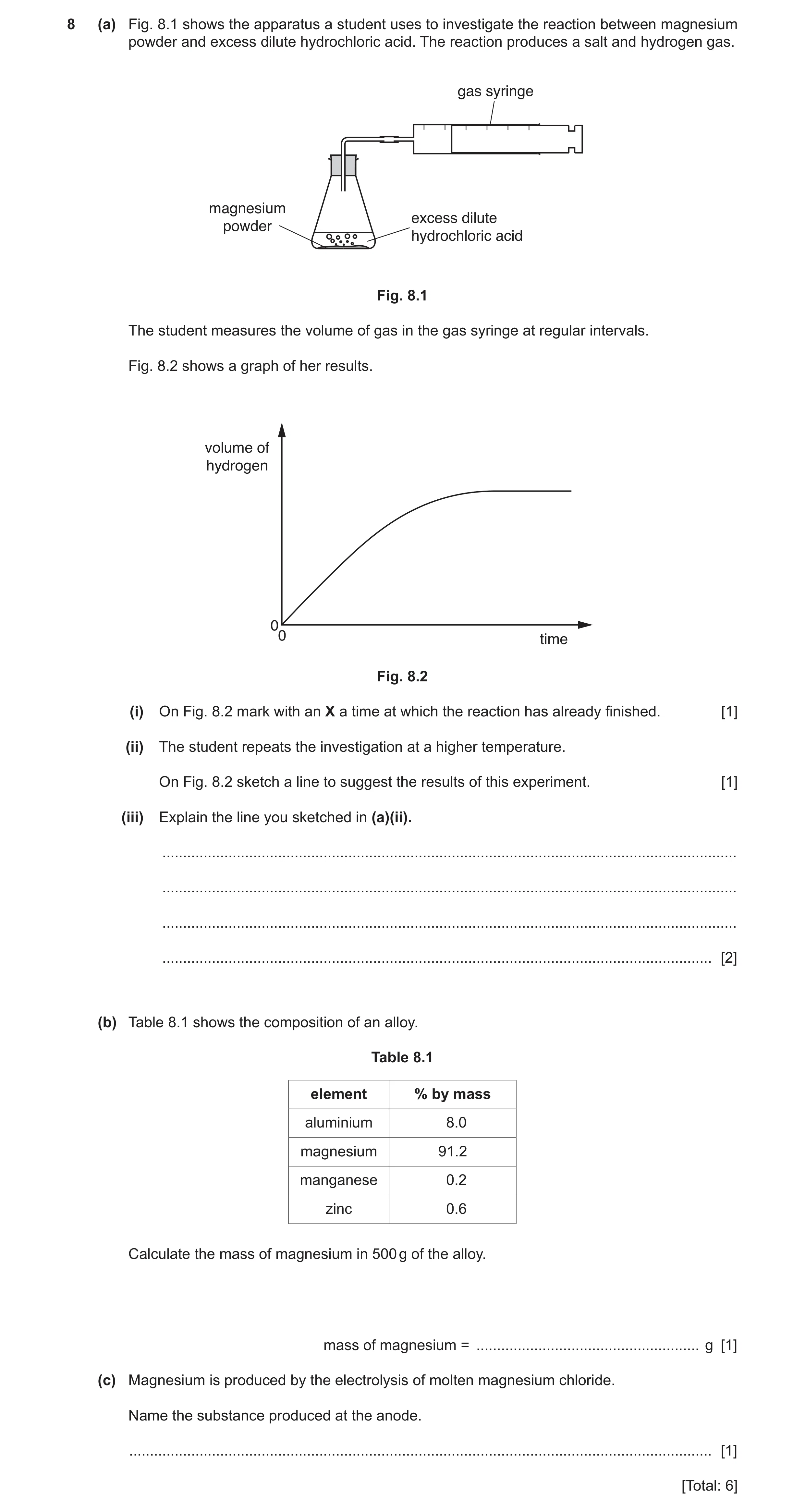
8 (a) Fig. 8.1 shows the apparatus a student uses to investigate the reaction between magnesium powder and excess dilute hydrochloric acid. The reaction produces a salt and hydrogen gas. gas syringe magnesium excess dilute powder hydrochloric acid Fig. 8.1 The student measures the volume of gas in the gas syringe at regular intervals. Fig. 8.2 shows a graph of her results. volume of hydrogen 0 0 time Fig. 8.2 (i) On Fig. 8.2 mark with an X a time at which the reaction has already finished. [1] (ii) The student repeats the investigation at a higher temperature. On Fig. 8.2 sketch a line to suggest the results of this experiment. [1] (iii) Explain the line you sketched in (a)(ii). … … … … [2] (b) Table 8.1 shows the composition of an alloy. Table 8.1 element % by mass aluminium 8.0 magnesium 91.2 manganese 0.2 zinc 0.6 Calculate the mass of magnesium in 500 g of the alloy. mass of magnesium = … g [1] (c) Magnesium is produced by the electrolysis of molten magnesium chloride. Name the substance produced at the anode. … [1] [Total: 6]
6 marks
Mark scheme: 8(a)(i) X anywhere on horizontal part of graph ; 1 8(a)(ii) curved portion steeper and horizontal line at same volume ; 1 8(a)(iii) rate of reaction faster (so steeper curve) ; same final volume of gas (so horizontal line at same height (volume)) ; 2 8(b) 456 (g) ; 1 8(c) chlorine ; 1
This question in 0653/42 Feb/March 2019
Q11 · A scientist analyses solution Q using chromatography 0653/42 May/June 2019
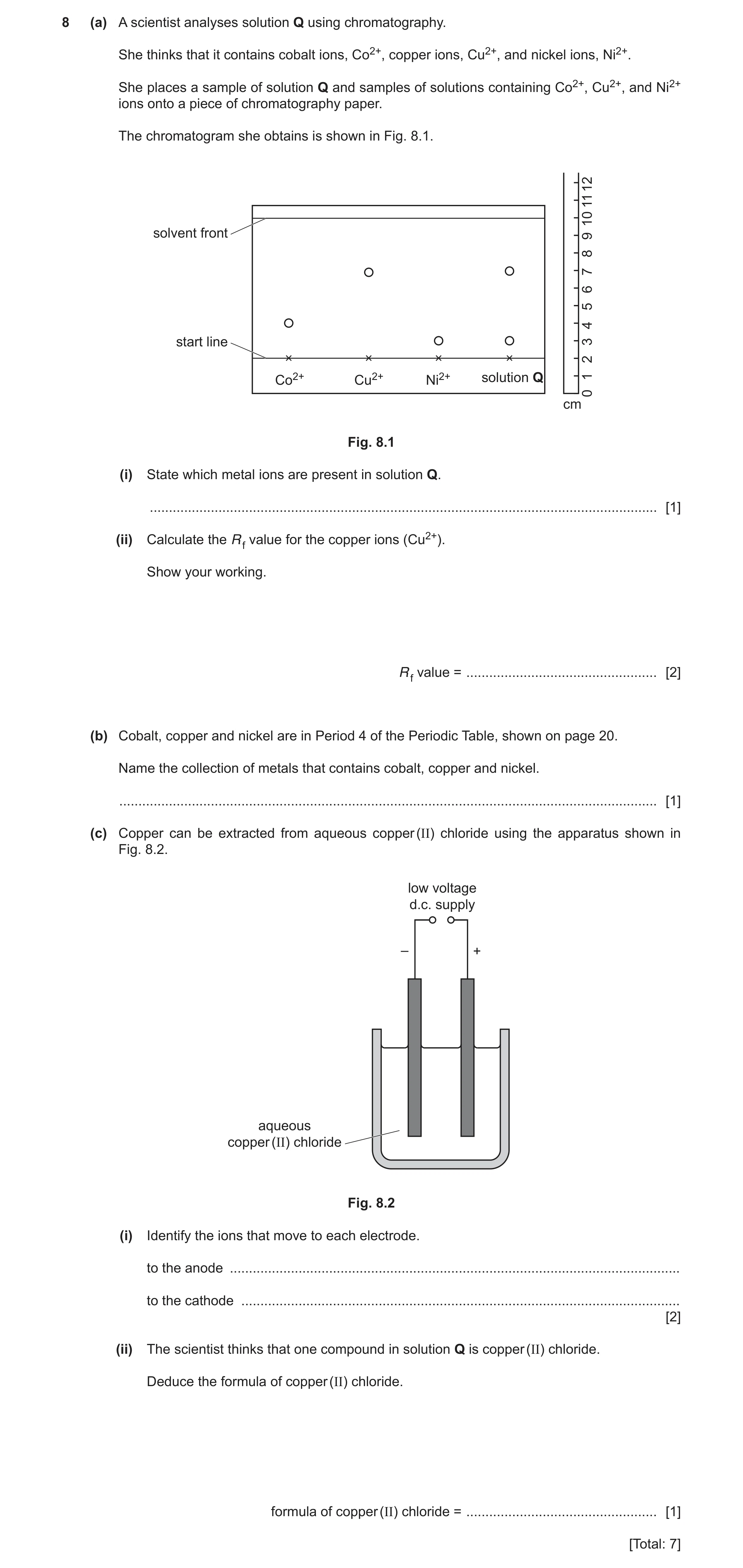
8 (a) A scientist analyses solution Q using chromatography. She thinks that it contains cobalt ions, Co2+, copper ions, Cu2+, and nickel ions, Ni2+. She places a sample of solution Q and samples of solutions containing Co2+, Cu2+, and Ni2+ ions onto a piece of chromatography paper. The chromatogram she obtains is shown in Fig. 8.1. 1112 10 solvent front 9 8 7 6 5 4 3 start line 2 Co2+ Cu2+ Ni2+ solution Q 1 0 cm Fig. 8.1 (i) State which metal ions are present in solution Q. … [1] (ii) Calculate the R f value for the copper ions (Cu2+). Show your working. R f value = … [2] (b) Cobalt, copper and nickel are in Period 4 of the Periodic Table, shown on page 20. Name the collection of metals that contains cobalt, copper and nickel. … [1] (c) Copper can be extracted from aqueous copper (II) chloride using the apparatus shown in Fig. 8.2. low voltage d.c. supply – + aqueous copper (II) chloride Fig. 8.2 (i) Identify the ions that move to each electrode. to the anode … to the cathode … [2] (ii) The scientist thinks that one compound in solution Q is copper (II) chloride. Deduce the formula of copper (II) chloride. formula of copper (II) chloride = … [1] [Total: 7]
7 marks
Mark scheme: 8(a)(i) nickel ions and copper ions ; 1 8(a)(ii) (7 – 2) ÷ (10 – 2) or 5 ÷ 8 ; = 0.6(25) ; 2 8(b) transition metals / elements ; 1 8(c)(i) chloride / Cl– ; copper / Cu2+ ; 2 8(c)(ii) CuCl2 ; 1
This question in 0653/42 May/June 2019
Q12 · Magnesium is an element in Group II of the Periodic Table, shown on page 20 0653/43 May/June 2019
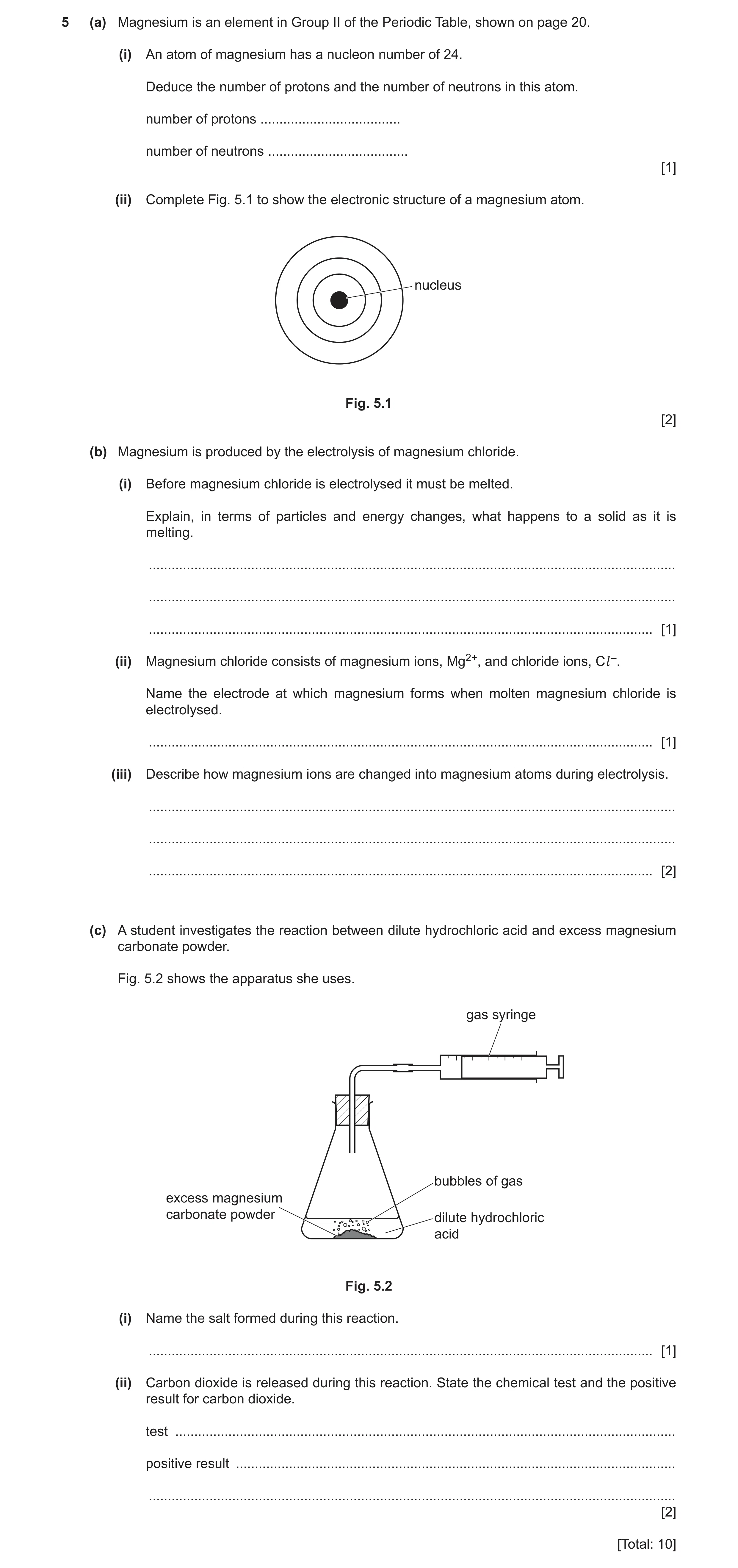
5 (a) Magnesium is an element in Group II of the Periodic Table, shown on page 20. (i) An atom of magnesium has a nucleon number of 24. Deduce the number of protons and the number of neutrons in this atom. number of protons … number of neutrons … [1] (ii) Complete Fig. 5.1 to show the electronic structure of a magnesium atom. nucleus Fig. 5.1 [2] (b) Magnesium is produced by the electrolysis of magnesium chloride. (i) Before magnesium chloride is electrolysed it must be melted. Explain, in terms of particles and energy changes, what happens to a solid as it is melting. … … … [1] (ii) Magnesium chloride consists of magnesium ions, Mg2+, and chloride ions, Cl –. Name the electrode at which magnesium forms when molten magnesium chloride is electrolysed. … [1] (iii) Describe how magnesium ions are changed into magnesium atoms during electrolysis. … … … [2] (c) A student investigates the reaction between dilute hydrochloric acid and excess magnesium carbonate powder. Fig. 5.2 shows the apparatus she uses. gas syringe bubbles of gas excess magnesium carbonate powder dilute hydrochloric acid Fig. 5.2 (i) Name the salt formed during this reaction. … [1] (ii) Carbon dioxide is released during this reaction. State the chemical test and the positive result for carbon dioxide. test … positive result … … [2] [Total: 10]
10 marks
Mark scheme: 5(a)(i) number of protons = 12 and number of neutrons = 12 ; 1 5(a)(ii) 12 electrons shown ; 2,8,2 configuration shown ; 2 5(b)(i) (thermal) energy absorbed which decreases inter-particle forces / allows particles to separate / move around freely ; 1 5(b)(ii) cathode ; 1 5(b)(iii) gain electrons ; (gain) two (electrons) ; 2 Question Answer Marks 5(c)(i) magnesium chloride ; 1 5(c)(ii) limewater ; goes cloudy / milky ; 2
This question in 0653/43 May/June 2019
Q13 · Aluminium is a Group III metal 0653/41 Oct/Nov 2019
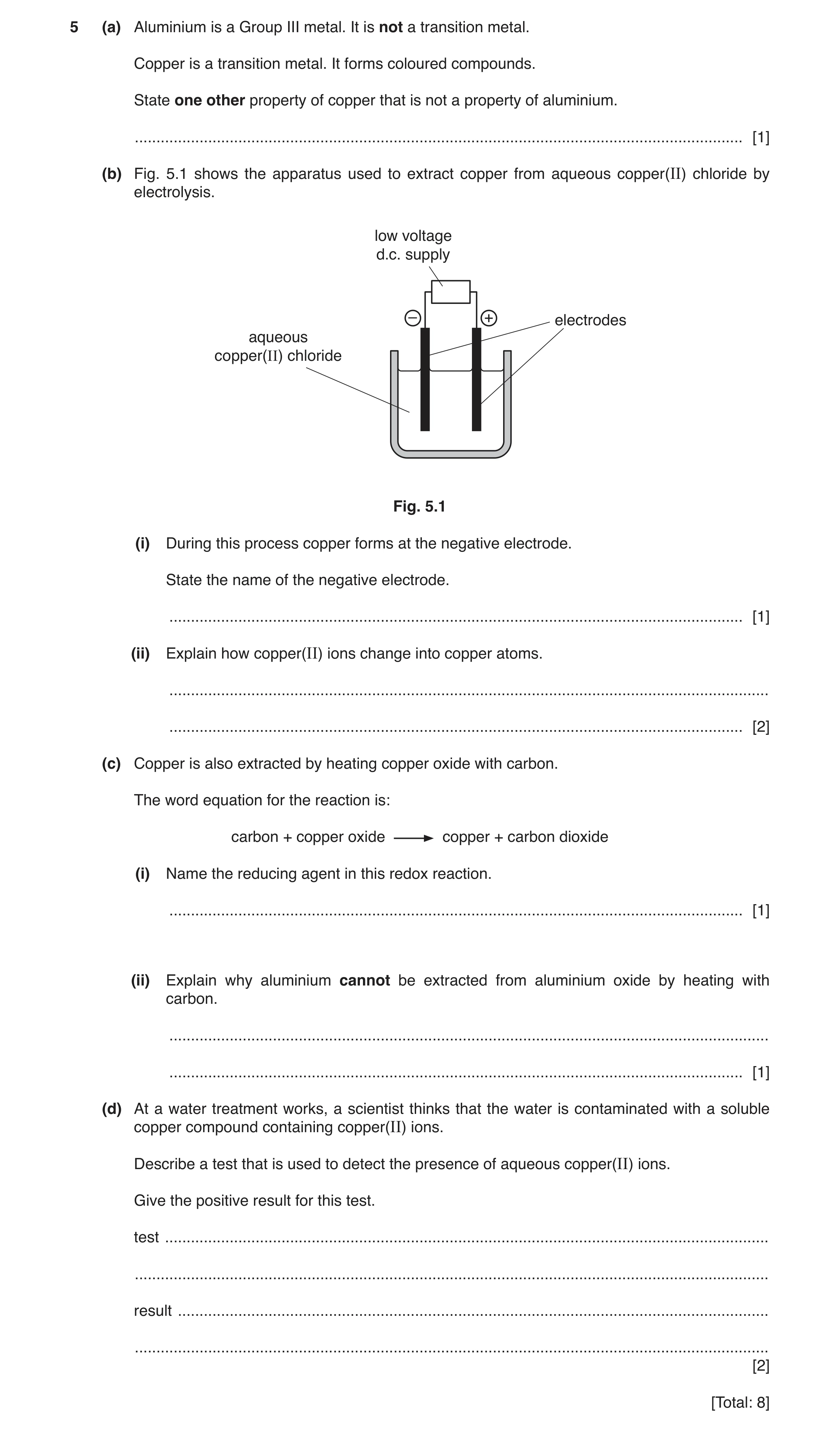
5 (a) Aluminium is a Group III metal. It is not a transition metal. Copper is a transition metal. It forms coloured compounds. State one other property of copper that is not a property of aluminium. … [1] (b) Fig. 5.1 shows the apparatus used to extract copper from aqueous copper(II) chloride by electrolysis. low voltage d.c. supply – + electrodes aqueous copper(II) chloride Fig. 5.1 (i) During this process copper forms at the negative electrode. State the name of the negative electrode. … [1] (ii) Explain how copper(II) ions change into copper atoms. … … [2] (c) Copper is also extracted by heating copper oxide with carbon. The word equation for the reaction is: carbon + copper oxide copper + carbon dioxide (i) Name the reducing agent in this redox reaction. … [1] (ii) Explain why aluminium cannot be extracted from aluminium oxide by heating with carbon. … … [1] (d) At a water treatment works, a scientist thinks that the water is contaminated with a soluble copper compound containing copper(II) ions. Describe a test that is used to detect the presence of aqueous copper(II) ions. Give the positive result for this test. test … … result … … [2] [Total: 8]
8 marks
Mark scheme: 5(a) high density / high melting point / acts as catalyst ; 1 5(b)(i) cathode ; 1 5(b)(ii) gains electrons ; two electrons ; 2 5(c)(i) carbon ; 1 5(c)(ii) aluminium is too reactive / aluminium more reactive than carbon ; 1 5(d) (aqueous) sodium hydroxide ; (pale) blue ppt ; or flame test ; blue–green / turquoise colour ; 2
This question in 0653/41 Oct/Nov 2019
Q14 · The elements in the Periodic Table, shown on page 20, are arranged in groups and periods 0653/43 Oct/Nov 2019
5 (a) The elements in the Periodic Table, shown on page 20, are arranged in groups and periods. (i) Chlorine is in Period 3. State the number of elements in Period 3. … [1] (ii) The number of outer shell electrons in the atoms of the elements changes across Period 3. Describe the relationship between the number of outer shell electrons and the metallic character of these elements. … … [1] (b) (i) Describe a chemical test for chlorine gas and give the positive result. test … … result … … [2] (ii) Explain how chlorination makes water safe to drink. … … [1] (c) Chlorine gas is bubbled through aqueous potassium bromide. Describe the colour change during this process. Use ideas about the reactivity of the halogens to explain your answer. colour change … … explanation … … … [2] (d) Chlorine gas can be obtained by the electrolysis of molten potassium chloride using inert electrodes. (i) Name the electrode at which chlorine forms. … [1] (ii) Describe how chloride ions are changed into chlorine atoms. … … … [2] (iii) State the other product of this electrolysis. … [1] [Total: 11]
11 marks
Mark scheme: 5(a)(i) 8 ; 1 5(a)(ii) the greater the number of outer shell electrons, the less metallic the elements become ; 1 5(b)(i) damp litmus paper ; bleaches ; 2 5(b)(ii) sterilises water / kills harmful microorganisms ; 1 5(c) yellow / orange colouration ; chlorine displaces bromine / chlorine is more reactive than bromine / chlorine oxidises bromide ions ; 2 5(d)(i) anode ; 5(d)(ii) chloride ion loses electrons ; one electron (per ion) ; 2 5(d)(iii) potassium ; 1
This question in 0653/43 Oct/Nov 2019
Q15 · When dilute sulfuric acid is electrolysed, hydrogen forms at the cathode 0653/41 May/June 2020
8 (a) When dilute sulfuric acid is electrolysed, hydrogen forms at the cathode. (i) Describe, in terms of electrons, what happens to one hydrogen ion at the cathode. … … [2] (ii) State the test for hydrogen gas and give the positive result. test … result … [2] (iii) Name the product at the anode. … [1] (b) Magnesium reacts with dilute sulfuric acid to produce magnesium sulfate. Explain why the rate of this reaction increases when the temperature of the acid is higher. Use ideas about particles in your answer. … … … … [2] (c) Name one other substance that reacts with dilute sulfuric acid to produce magnesium sulfate. … [1] [Total: 8]
8 marks
Mark scheme: 8(a)(i) (hydrogen ion) gains ; one electron ; 2 8(a)(ii) (test) lighted splint ; (result) goes pop ; 2 8(a)(iii) oxygen ; 1 8(b) any two from: particles, move faster / have more kinetic energy / move more ; particles, collide more frequently / more energetically ; more of the collisions provide the activation energy ; max 2 8(c) magnesium oxide / magnesium carbonate / magnesium hydroxide ; 1
This question in 0653/41 May/June 2020
Q16 · Copper is a transition metal 0653/42 May/June 2020
8 (a) Copper is a transition metal. State two properties of copper that are not properties of Group I metals. 1. … 2. … [2] (b) Zinc is extracted from zinc oxide, ZnO. (i) The formula of an oxide ion is O2–. Deduce the charge of a zinc ion. Explain your answer. charge … explanation … … [2] (ii) Explain why zinc can be extracted from zinc oxide by reduction with carbon. Use ideas about the reactivity series in your answer. … … [1] (c) Molten sodium chloride can be electrolysed. (i) Explain why energy is needed to melt sodium chloride. … … [1] (ii) Explain why sodium chloride must be molten, and not solid, during electrolysis. … … [1] (iii) Predict the products of this electrolysis at the anode and at the cathode. anode … cathode … [2] [Total: 9]
9 marks
Mark scheme: 8(a) forms coloured compounds ; has high melting point ; has high density ; 2 8(b)(i) (charge) 2+ ; (explanation) 2+ to balance 2– on oxide ion ; 2 8(b)(ii) carbon, above zinc in reactivity series / more reactive than zinc ; 1 8(c)(i) energy needed, for work to be done against attractive forces / to break interatomic ‘bonds’ / for particles to break free, from solid state ; 1 8(c)(ii) ions must be mobile ; 1 8(c)(iii) (anode) chlorine ; (cathode) sodium ; 2
This question in 0653/42 May/June 2020
Q17 · Sodium reacts with water to form aqueous sodium hydroxide, NaOH, and hydrogen gas 0653/41 Oct/Nov 2020
5 (a) Sodium reacts with water to form aqueous sodium hydroxide, NaOH, and hydrogen gas. (i) This reaction is exothermic. Fig. 5.1 is an energy level diagram for the reaction. On Fig. 5.1, label the energy level diagram to show the reactants, the products and the activation energy. energy progress of reaction Fig. 5.1 [2] (ii) During the reaction, the sodium melts. Describe, in terms of particle bonds and energy, what happens when sodium melts. … … … [2] (iii) Suggest the pH of the aqueous sodium hydroxide. Give a reason for your answer. pH … reason … … [1] (iv) State the formulae of the two ions present in sodium hydroxide. … and … [1] (b) Explain why sodium must not be added to dilute hydrochloric acid. … … [1] (c) Sodium is extracted from molten sodium chloride by electrolysis. Sodium is formed at the cathode. Name the product formed at the anode. … [1] (d) Sodium is an element in Period 3 of the Periodic Table. Describe the relationship between the number of outer shell electrons and the metallic character of elements across a period. … … [1] [Total: 9]
9 marks
Mark scheme: 5(a)(i) reactants and products labelled ; activation energy labelled ; 2 5(a)(ii) (sodium) particles gain (sufficient) energy ; to (overcome the attractive forces and) break the bonds between particles ; 2 5(a)(iii) 8–14 AND sodium hydroxide is a base ; 1 5(a)(iv) Na+ AND OH– ; 1 Question Answer Marks 5(b) too reactive / very reactive / explosive ; 1 5(c) chlorine ; 1 5(d) as number of (outer shell) electrons increases the element becomes more non-metallic / ora ; 1
This question in 0653/41 Oct/Nov 2020
Q18 · Iron is extracted from iron oxide in a blast furnace 0653/42 Oct/Nov 2020
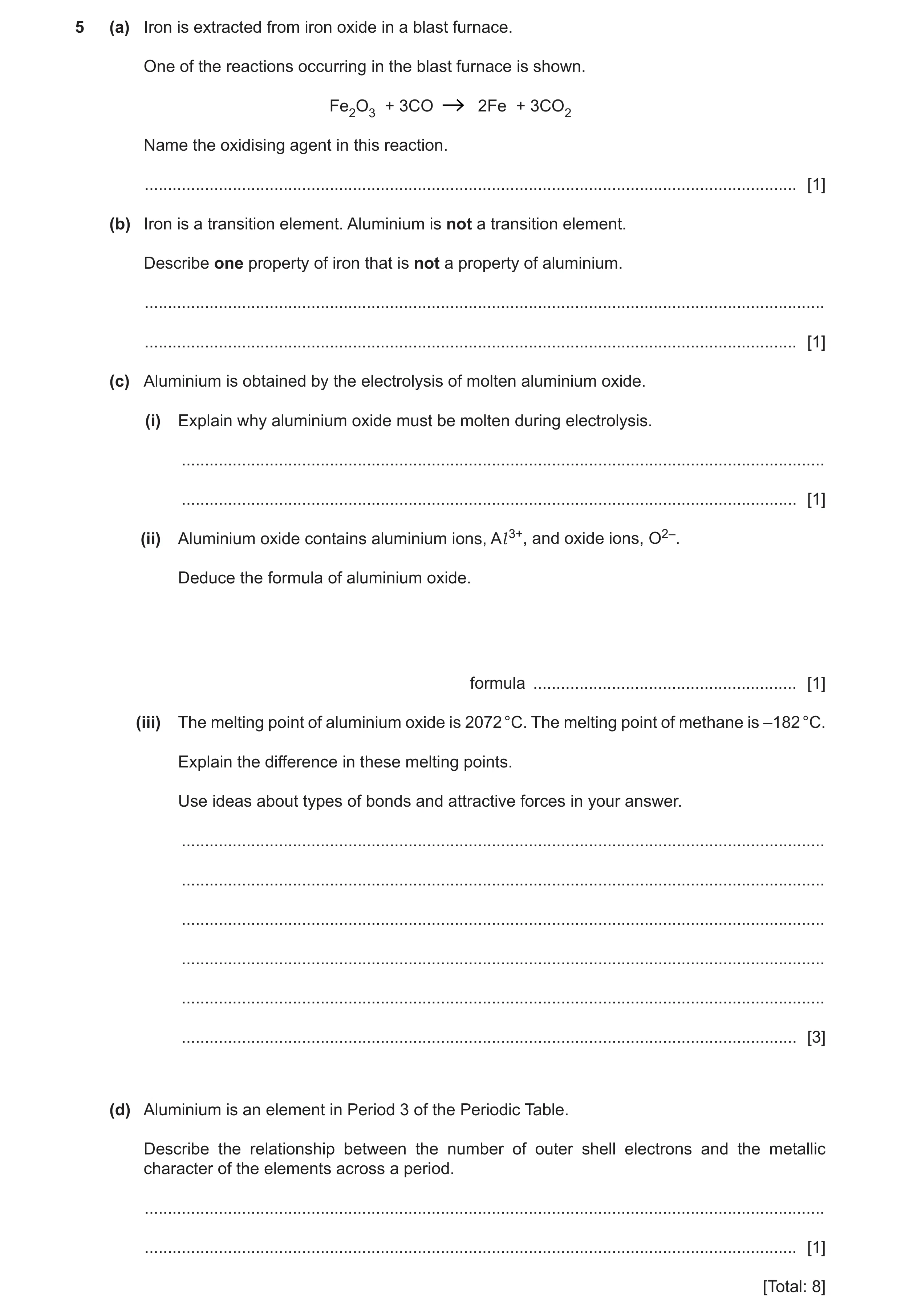
5 (a) Iron is extracted from iron oxide in a blast furnace. One of the reactions occurring in the blast furnace is shown. Fe2O3 + 3CO 2Fe + 3CO2 Name the oxidising agent in this reaction. … [1] (b) Iron is a transition element. Aluminium is not a transition element. Describe one property of iron that is not a property of aluminium. … … [1] (c) Aluminium is obtained by the electrolysis of molten aluminium oxide. (i) Explain why aluminium oxide must be molten during electrolysis. … … [1] (ii) Aluminium oxide contains aluminium ions, Al 3+, and oxide ions, O2–. Deduce the formula of aluminium oxide. formula … [1] (iii) The melting point of aluminium oxide is 2072 °C. The melting point of methane is –182 °C. Explain the difference in these melting points. Use ideas about types of bonds and attractive forces in your answer. … … … … … … [3] (d) Aluminium is an element in Period 3 of the Periodic Table. Describe the relationship between the number of outer shell electrons and the metallic character of the elements across a period. … … [1] [Total: 8]
8 marks
Mark scheme: 5(a) iron oxide ; 1 5(b) any one from: forms coloured compounds ; has high melting point ; has high density ; reference to use as a catalyst ; 1 5(c)(i) ions must be mobile ; 1 5(c)(ii) Al2O3 ; 1 5(c)(iii) (type of bonding) aluminium oxide is ionic AND methane is covalent ; stronger forces of attraction (between oppositely charged ions) in aluminium oxide / weaker forces of attraction (between molecules) in methane ; so more energy needed to separate particles / overcome attraction (hence higher melting point) / ora ; 3 5(d) as number of (outer shell) electrons increases, element changes from metallic to non-metallic ; 1
This question in 0653/42 Oct/Nov 2020
Q19 · When 1 g of copper carbonate powder is added to excess dilute hydrochloric acid, aqueous… 0653/42 Oct/Nov 2020
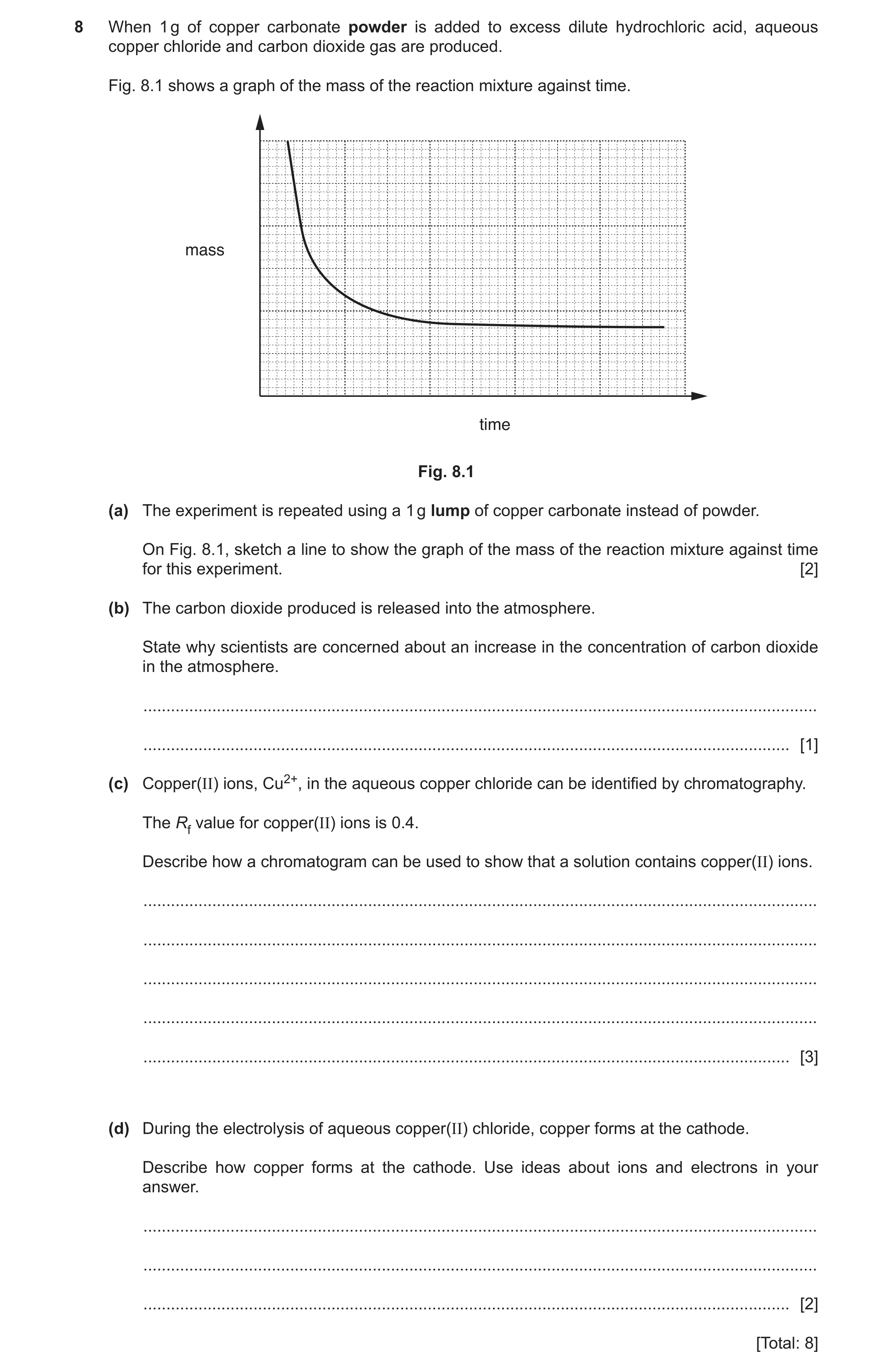
8 When 1 g of copper carbonate powder is added to excess dilute hydrochloric acid, aqueous copper chloride and carbon dioxide gas are produced. Fig. 8.1 shows a graph of the mass of the reaction mixture against time. mass time Fig. 8.1 (a) The experiment is repeated using a 1 g lump of copper carbonate instead of powder. On Fig. 8.1, sketch a line to show the graph of the mass of the reaction mixture against time for this experiment. [2] (b) The carbon dioxide produced is released into the atmosphere. State why scientists are concerned about an increase in the concentration of carbon dioxide in the atmosphere. … … [1] (c) Copper(II) ions, Cu2+, in the aqueous copper chloride can be identified by chromatography. The Rf value for copper(II) ions is 0.4. Describe how a chromatogram can be used to show that a solution contains copper(II) ions. … … … … … [3] (d) During the electrolysis of aqueous copper(II) chloride, copper forms at the cathode. Describe how copper forms at the cathode. Use ideas about ions and electrons in your answer. … … … [2] [Total: 8]
8 marks
Mark scheme: 8(a) line with shallower gradient showing slower rate of reaction ; line starting and finishing at same mass ; 2 8(b) enhanced greenhouse effect / global warming / example of a consequence of climate change ; 1 8(c) measure distance to spot (from base line) ; measure distance to solvent front (from base line) ; show that Rf = distance to spot ÷ distance to solvent front = 0.4 ; 3 8(d) idea of electrons gained by copper ions ; two electrons gained (per ion) / ions discharged ; 2
This question in 0653/42 Oct/Nov 2020
Q20 · Magnesium is an element in Group II and Period 3 of the Periodic Table 0653/43 Oct/Nov 2020
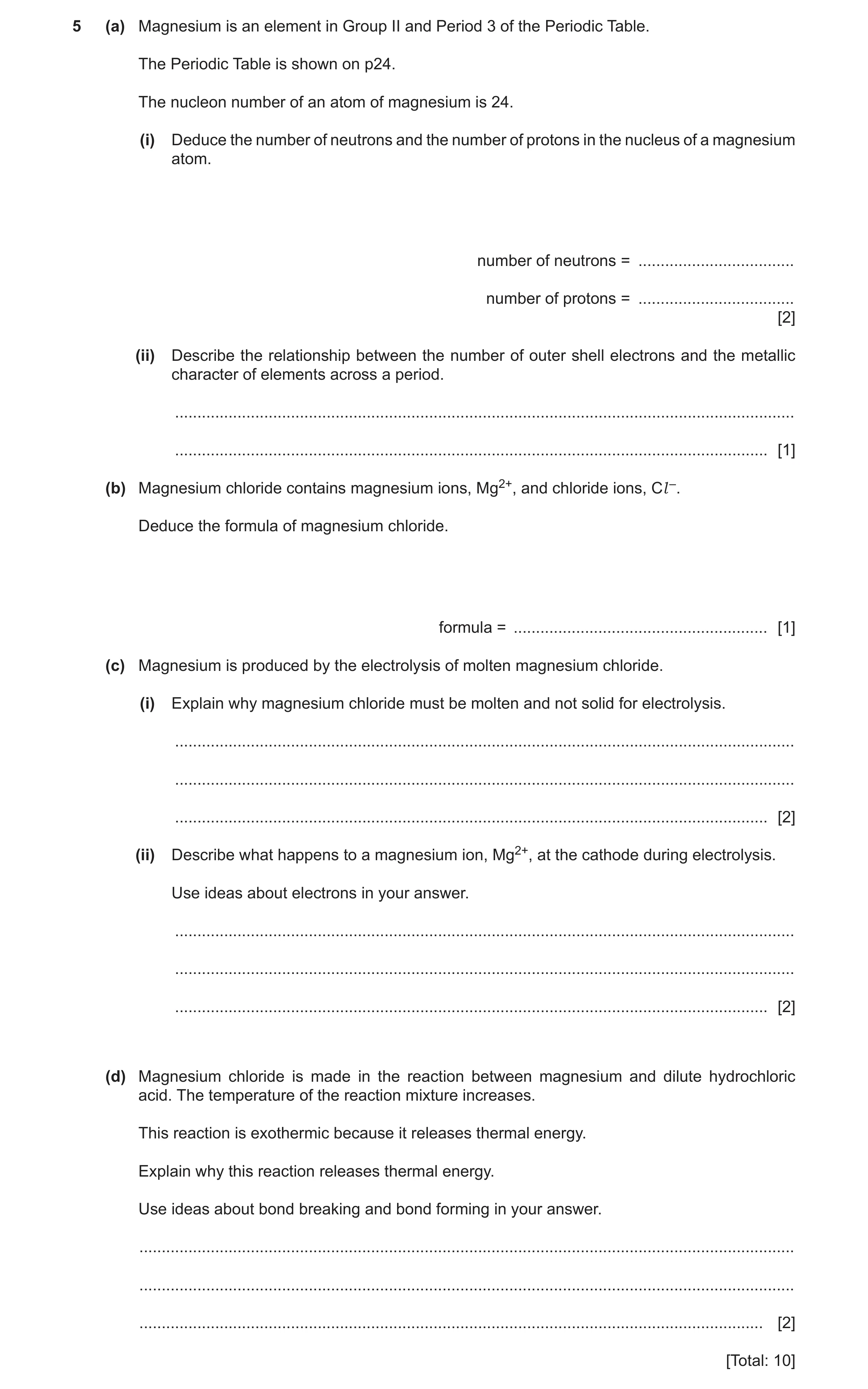
5 (a) Magnesium is an element in Group II and Period 3 of the Periodic Table. The Periodic Table is shown on p24. The nucleon number of an atom of magnesium is 24. (i) Deduce the number of neutrons and the number of protons in the nucleus of a magnesium atom. number of neutrons = … number of protons = … [2] (ii) Describe the relationship between the number of outer shell electrons and the metallic character of elements across a period. … … [1] (b) Magnesium chloride contains magnesium ions, Mg2+, and chloride ions, Cl –. Deduce the formula of magnesium chloride. formula = … [1] (c) Magnesium is produced by the electrolysis of molten magnesium chloride. (i) Explain why magnesium chloride must be molten and not solid for electrolysis. … … … [2] (ii) Describe what happens to a magnesium ion, Mg2+, at the cathode during electrolysis. Use ideas about electrons in your answer. … … … [2] (d) Magnesium chloride is made in the reaction between magnesium and dilute hydrochloric acid. The temperature of the reaction mixture increases. This reaction is exothermic because it releases thermal energy. Explain why this reaction releases thermal energy. Use ideas about bond breaking and bond forming in your answer. … … … [2] [Total: 10]
10 marks
Mark scheme: 5(a)(i) neutrons: 12 ; protons: 12 ; 2 5(a)(ii) as the number of electrons increases the element becomes less metallic ; 1 5(b) MgCl2 ; 1 5(c)(i) ions must be mobile / ions in a solid cannot move ; ions can move to the electrodes / for conduction of electricity 2 5(c)(ii) gains electrons ; (gains) two electrons / is discharged ; 2 5(d) energy is taken in for bond breaking / energy is released when bonds are formed / owtte ; (reaction is exothermic because) more energy released than taken in ; 2
This question in 0653/43 Oct/Nov 2020
Q21 · Apparatus used for the electrolysis of molten lead(II) bromide is shown in Fig 0653/43 May/June 2021
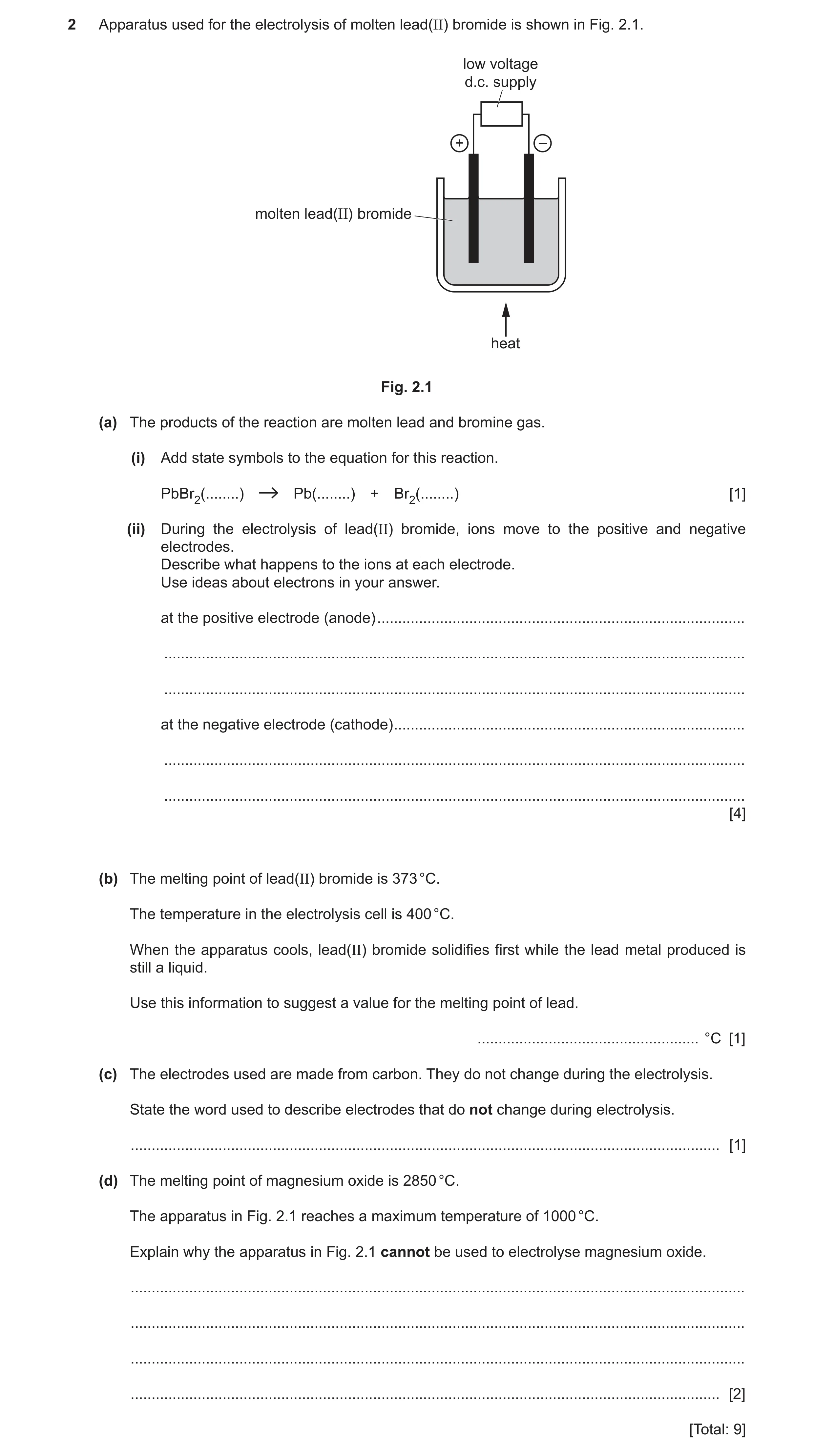
2 Apparatus used for the electrolysis of molten lead(II) bromide is shown in Fig. 2.1. low voltage d.c. supply + – molten lead(II) bromide heat Fig. 2.1 (a) The products of the reaction are molten lead and bromine gas. (i) Add state symbols to the equation for this reaction. PbBr2( … ) Pb( … ) + Br2( … ) [1] (ii) During the electrolysis of lead(II) bromide, ions move to the positive and negative electrodes. Describe what happens to the ions at each electrode. Use ideas about electrons in your answer. at the positive electrode (anode) … … … at the negative electrode (cathode) … … … [4] (b) The melting point of lead(II) bromide is 373 °C. The temperature in the electrolysis cell is 400 °C. When the apparatus cools, lead(II) bromide solidifies first while the lead metal produced is still a liquid. Use this information to suggest a value for the melting point of lead. … °C [1] (c) The electrodes used are made from carbon. They do not change during the electrolysis. State the word used to describe electrodes that do not change during electrolysis. … [1] (d) The melting point of magnesium oxide is 2850 °C. The apparatus in Fig. 2.1 reaches a maximum temperature of 1000 °C. Explain why the apparatus in Fig. 2.1 cannot be used to electrolyse magnesium oxide. … … … … [2] [Total: 9]
9 marks
Mark scheme: 2(a)(i) (l) (l) (g) ; 1 2(a)(ii) (at the positive electrode) bromide ions ; lose electrons ; (at the negative electrode) lead ions gain electrons ; lead ions gain two electrons ; 4 2(b) less than 373 (°C) ; 1 2(c) inert ; 1 2(d) the temperature is below the melting point of magnesium oxide / the apparatus is not hot enough to melt magnesium oxide / magnesium oxide remains a solid ; so the ions are fixed in position (cannot move) / so electricity cannot flow though the material / so electrolysis cannot occur / needs to be aqueous or molten to conduct ; 2
This question in 0653/43 May/June 2021
Q22 · A student uses inert electrodes for the electrolysis of dilute aqueous sodium chloride… 0653/42 Oct/Nov 2021
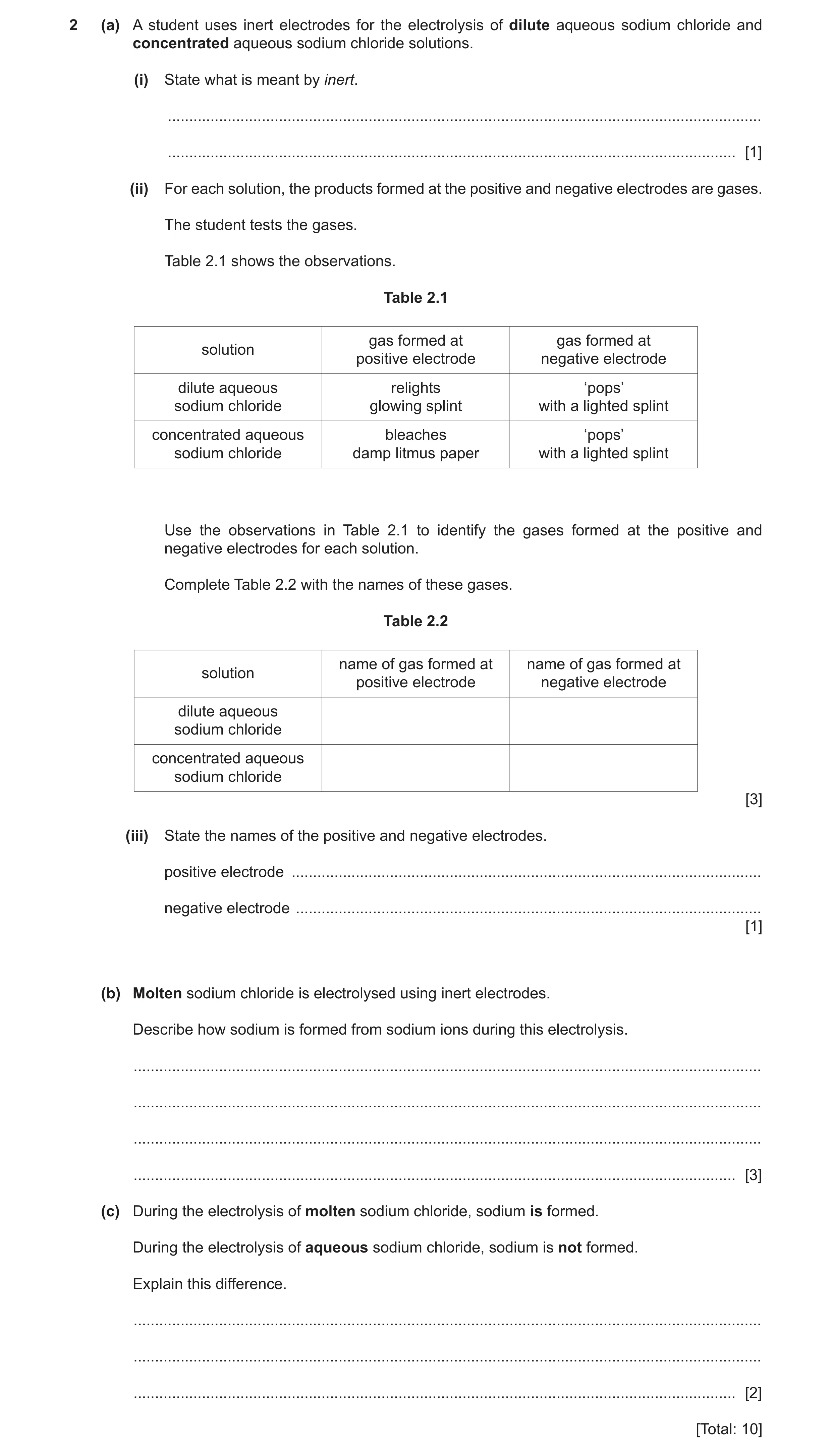
2 (a) A student uses inert electrodes for the electrolysis of dilute aqueous sodium chloride and concentrated aqueous sodium chloride solutions. (i) State what is meant by inert. … … [1] (ii) For each solution, the products formed at the positive and negative electrodes are gases. The student tests the gases. Table 2.1 shows the observations. Table 2.1 gas formed at gas formed at solution positive electrode negative electrode dilute aqueous relights ‘pops’ sodium chloride glowing splint with a lighted splint concentrated aqueous bleaches ‘pops’ sodium chloride damp litmus paper with a lighted splint Use the observations in Table 2.1 to identify the gases formed at the positive and negative electrodes for each solution. Complete Table 2.2 with the names of these gases. Table 2.2 name of gas formed at name of gas formed at solution positive electrode negative electrode dilute aqueous sodium chloride concentrated aqueous sodium chloride [3] (iii) State the names of the positive and negative electrodes. positive electrode … negative electrode … [1] (b) Molten sodium chloride is electrolysed using inert electrodes. Describe how sodium is formed from sodium ions during this electrolysis. … … … … [3] (c) During the electrolysis of molten sodium chloride, sodium is formed. During the electrolysis of aqueous sodium chloride, sodium is not formed. Explain this difference. … … … [2] [Total: 10]
10 marks
Mark scheme: 2(a)(i) does not react (with the solution) ; 1 2(a)(ii) (solution) (name of gas formed at positive electrode) (name of gas formed at negative electrode) (dilute aqueous sodium chloride) oxygen hydrogen (concentrated aqueous sodium chloride) chlorine hydrogen oxygen ; chlorine ; hydrogen AND hydrogen ; 3 2(a)(iii) positive: anode AND negative: cathode ; 1 2(b) sodium ions are positive ; attracted to the, negative electrode / cathode ; where they gain, electrons / one electron each (to form sodium) ; 3 2(c) only sodium cations are present in molten sodium chloride / molten sodium chloride does not contain any hydrogen (ions) / hydrogen (ions) also present in aqueous sodium chloride ; sodium is more reactive than hydrogen / hydrogen ions (in aqueous solution) more easily discharged / AW ; 2
This question in 0653/42 Oct/Nov 2021
Q23 · Hydrogen and oxygen are made when dilute sulfuric acid is electrolysed using inert… 0653/42 Feb/March 2022
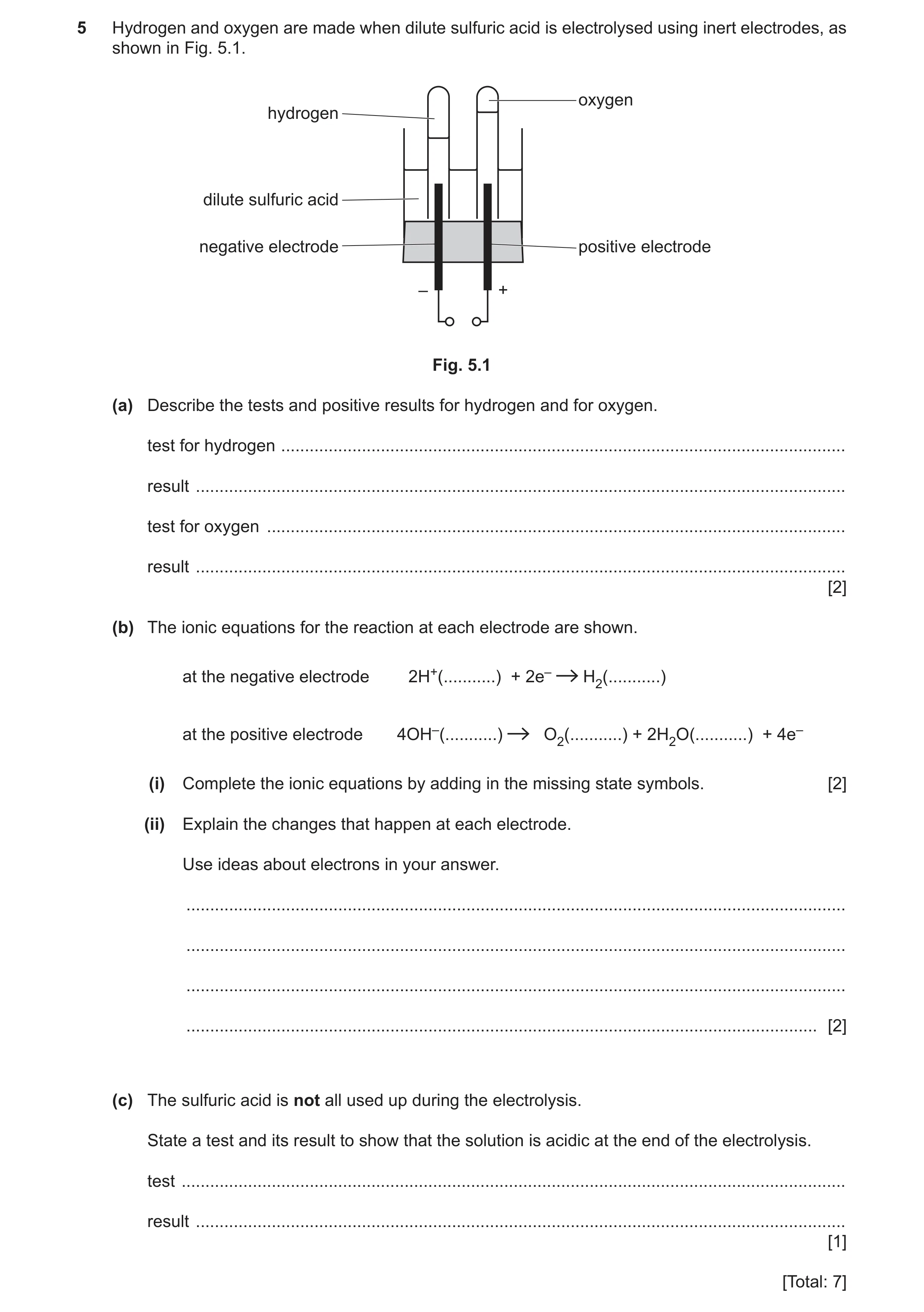
5 Hydrogen and oxygen are made when dilute sulfuric acid is electrolysed using inert electrodes, as shown in Fig. 5.1. oxygen hydrogen dilute sulfuric acid negative electrode positive electrode – + Fig. 5.1 (a) Describe the tests and positive results for hydrogen and for oxygen. test for hydrogen … result … test for oxygen … result … [2] (b) The ionic equations for the reaction at each electrode are shown. at the negative electrode 2H+( … ) + 2e– H2( … ) at the positive electrode 4OH–( … ) O2( … ) + 2H2O( … ) + 4e– (i) Complete the ionic equations by adding in the missing state symbols. [2] (ii) Explain the changes that happen at each electrode. Use ideas about electrons in your answer. … … … … [2] (c) The sulfuric acid is not all used up during the electrolysis. State a test and its result to show that the solution is acidic at the end of the electrolysis. test … result … [1] [Total: 7]
7 marks
Mark scheme: 5(a) hydrogen: lighted splint and pops / gives a squeaky pop ; oxygen: glowing splint and relights ; 2 5(b)(i) 2H+(aq) + 2 e– → H2(g) 4OH-(aq) → O2(g) + 2H2O(l) + 4e– (g) shown for hydrogen and oxygen ; (aq) for H + and OH – and (l) for water ; 2 5(b)(ii) (at the negative electrode / cathode) hydrogen ions gain electrons (to form hydrogen atoms / hydrogen molecules) ; (at the positive electrode / anode) hydroxide ions lose electrons (to form water molecules and oxygen molecules) ; 2 5(c) universal indicator / (blue) litmus AND turns red ; 1
This question in 0653/42 Feb/March 2022
Q24 · Concentrated aqueous sodium chloride is electrolysed using inert electrodes, as shown in… 0653/41 Oct/Nov 2022
2 Concentrated aqueous sodium chloride is electrolysed using inert electrodes, as shown in Fig. 2.1. chlorine gas hydrogen gas concentrated aqueous sodium chloride negative positive electrode electrode power supply Fig. 2.1 (a) Describe the chemical tests for hydrogen and for chlorine. State the positive result for each test. hydrogen test … positive result … chlorine test … positive result … [2] (b) The equation for the electrolysis of concentrated aqueous sodium chloride is shown. 2NaCl ( … ) + 2H2O( … ) H2(g) + Cl2(g) + 2NaOH( … ) (i) Complete the equation by adding the missing state symbols. [1] (ii) State the name of the product that has the formula NaOH. … [1] (c) Four statements about the electrolysis of concentrated aqueous sodium chloride are shown in Table 2.1. Put a tick (3) in one box in each row to show whether each statement is true or false. Table 2.1 statement true false OH– ions are attracted to the cathode. H+ ions gain electrons at the negative electrode. H+ ions come from the water in the solution. Hydrogen gas is made when OH– ions lose electrons. [2] (d) A solution of hydrochloric acid is mixed with universal indicator solution. State the colour and pH of this mixture. colour … pH … [2] [Total: 8]
8 marks
Mark scheme: 2(a) hydrogen test lighted splint AND positive result pops ; 2 chlorine test (damp) litmus paper AND positive result bleaches ; 2(b)(i) 2NaCl (aq) AND 2H2O (l ) AND 2NaOH (aq) ; 1 2(b)(ii) sodium hydroxide ; 1 2(c) 2 statement true false OH- ions are attracted to the cathode. ✓ H+ ions gain electrons at the negative electrode. ✓ H+ ions come from the water in the solution. ✓ Hydrogen gas is made when OH– ions lose electrons. ✓ two or three correct ; all four correct ; 2(d) colour red ; 2 pH answer in range 1–3 ;
This question in 0653/41 Oct/Nov 2022
Q25 · Lead(II) bromide is electrolysed using inert electrodes, as shown in Fig 0653/42 Oct/Nov 2022
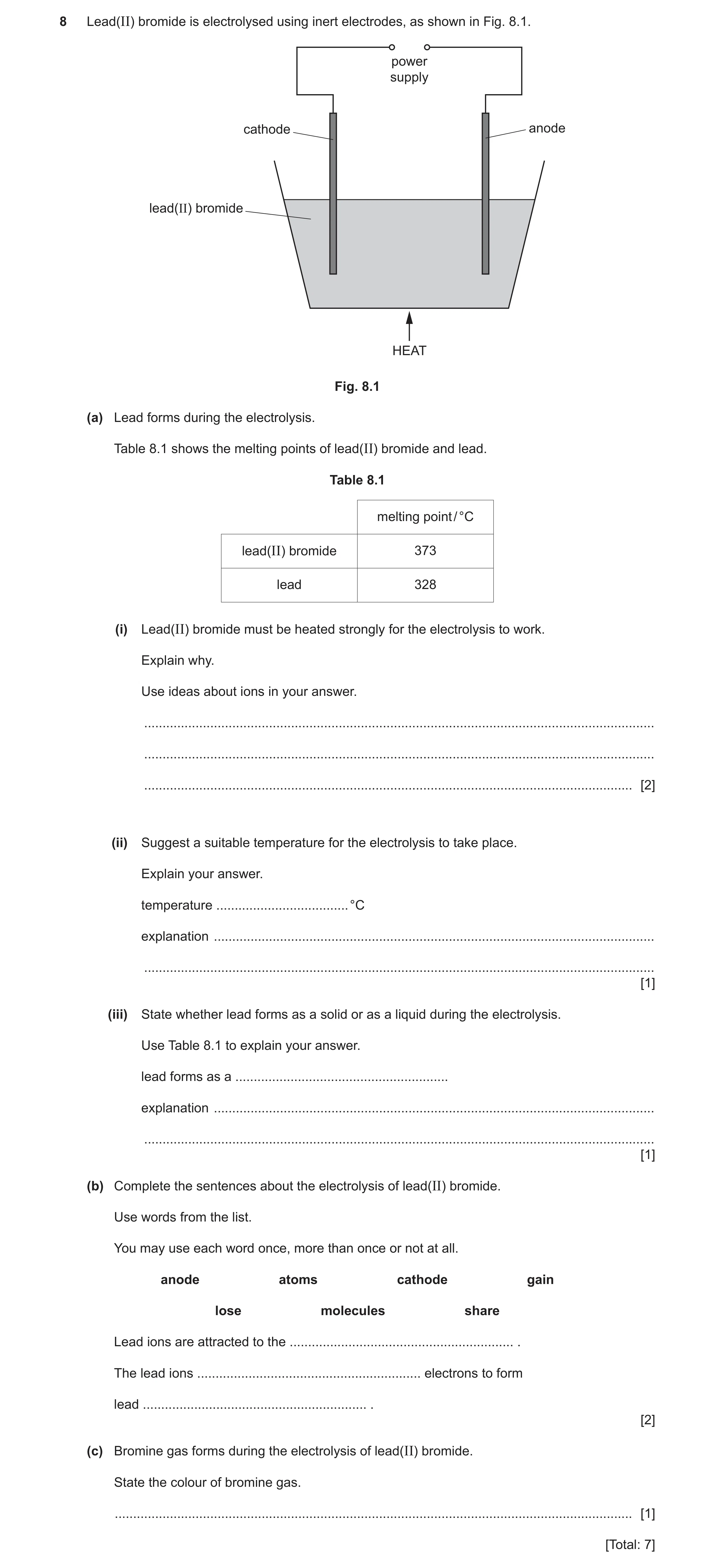
8 Lead(II) bromide is electrolysed using inert electrodes, as shown in Fig. 8.1. power supply cathode anode lead(II) bromide HEAT Fig. 8.1 (a) Lead forms during the electrolysis. Table 8.1 shows the melting points of lead(II) bromide and lead. Table 8.1 melting point / °C lead(II) bromide 373 lead 328 (i) Lead(II) bromide must be heated strongly for the electrolysis to work. Explain why. Use ideas about ions in your answer. … … … [2] (ii) Suggest a suitable temperature for the electrolysis to take place. Explain your answer. temperature … °C explanation … … [1] (iii) State whether lead forms as a solid or as a liquid during the electrolysis. Use Table 8.1 to explain your answer. lead forms as a … explanation … … [1] (b) Complete the sentences about the electrolysis of lead(II) bromide. Use words from the list. You may use each word once, more than once or not at all. anode atoms cathode gain lose molecules share Lead ions are attracted to the … . The lead ions … electrons to form lead … . [2] (c) Bromine gas forms during the electrolysis of lead(II) bromide. State the colour of bromine gas. … [1] [Total: 7]
7 marks
Mark scheme: 8(a)(i) any two from: 2 solid does not conduct / only liquid conducts / only conducts in molten state ; energy required to overcome forces (between ions) ; ions in a solid cannot move / ions in a liquid can move ; 8(a)(ii) temperature any temperature greater than 373 °C AND 1 explanation lead bromide must be, molten / a liquid / above the melting point of lead bromide ; 8(a)(iii) lead forms as a liquid AND 1 explanation lead has a lower melting point than lead bromide / idea that if lead bromide is liquid, it is above the melting point of lead / melting point of lead is below the temperature of the electrolysis / AW ; 8(b) cathode 2 gain atoms two correct ; all three correct ; 8(c) orange / brown ; 1
This question in 0653/42 Oct/Nov 2022
Q26 · Lead(II) chloride is electrolysed using the apparatus shown in Fig 0653/42 Feb/March 2023
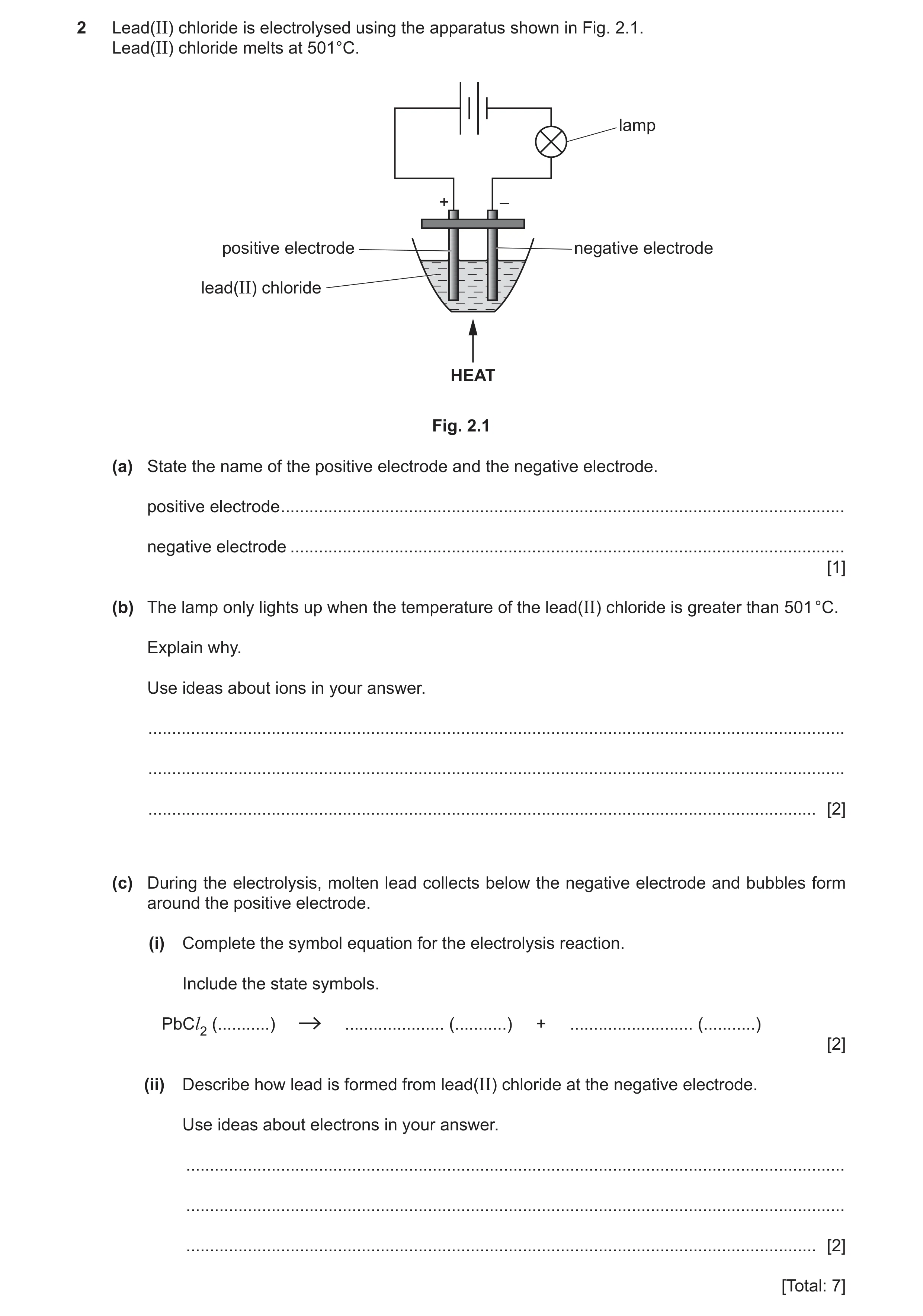
2 Lead(II) chloride is electrolysed using the apparatus shown in Fig. 2.1. Lead(II) chloride melts at 501°C. lamp + – positive electrode negative electrode lead(II) chloride HEAT Fig. 2.1 (a) State the name of the positive electrode and the negative electrode. positive electrode … negative electrode … [1] (b) The lamp only lights up when the temperature of the lead(II) chloride is greater than 501 °C. Explain why. Use ideas about ions in your answer. … … … [2] (c) During the electrolysis, molten lead collects below the negative electrode and bubbles form around the positive electrode. (i) Complete the symbol equation for the electrolysis reaction. Include the state symbols. PbCl2 ( … ) … ( … ) + … ( … ) [2] (ii) Describe how lead is formed from lead(II) chloride at the negative electrode. Use ideas about electrons in your answer. … … … [2] [Total: 7]
7 marks
Mark scheme: 2(a) (positive) anode AND (negative) cathode ; 1 2(b) needs to be, molten / in liquid form ; 2 so that ions move / ions do not move in solid ; 2(c)(i) Pb and Cl2 ; 2 (l) (l) (g) ; 2(c)(ii) lead (ions) gain electrons (from negative electrode) ; 2 (lead ions) form (lead / metal) atoms / are discharged / gains two electrons ;
This question in 0653/42 Feb/March 2023
Q27 · An electric current is passed through concentrated aqueous sodium chloride using inert… 0653/41 May/June 2023
2 An electric current is passed through concentrated aqueous sodium chloride using inert electrodes, as shown in Fig. 2.1. chlorine hydrogen negative electrode positive electrode Fig. 2.1 (a) Table 2.1 shows some of the names, formulae and sources of ions in concentrated aqueous sodium chloride. (i) Complete Table 2.1. Table 2.1 name of ion formula of ion source of ion chloride Cl – sodium chloride hydrogen water OH– sodium [3] (ii) State how the concentration of chloride ions changes during the electrolysis. Explain your answer. … … … [1] (b) State the chemical test for hydrogen and the observation for a positive result. test … observation … [1] (c) A solution of blue litmus indicator is added to the aqueous sodium chloride. When the current is first turned on, the litmus indicator at the positive electrode turns red. (i) Explain why the litmus indicator turns red. … … [1] (ii) As the electrolysis progresses, the red litmus indicator changes colour. State and explain this colour change. colour change … explanation … … … [2] [Total: 8]
8 marks
Mark scheme: 2(a)(i) H+ ; hydroxide and water ; Na+ and sodium chloride ; 2(a)(ii) decreases, because used up / forms chlorine ; 1 Question Answer Marks 2(b) (test) lighted splint AND (observation) pops ; 1 2(c)(i) shows an acid (produced) ; 1 2(c)(ii) (red to) colourless ; (because litmus is) bleached by chlorine (formed) ; 2
This question in 0653/41 May/June 2023
Q28 · Concentrated aqueous sodium chloride is electrolysed using platinum electrodes, as shown… 0653/42 May/June 2023
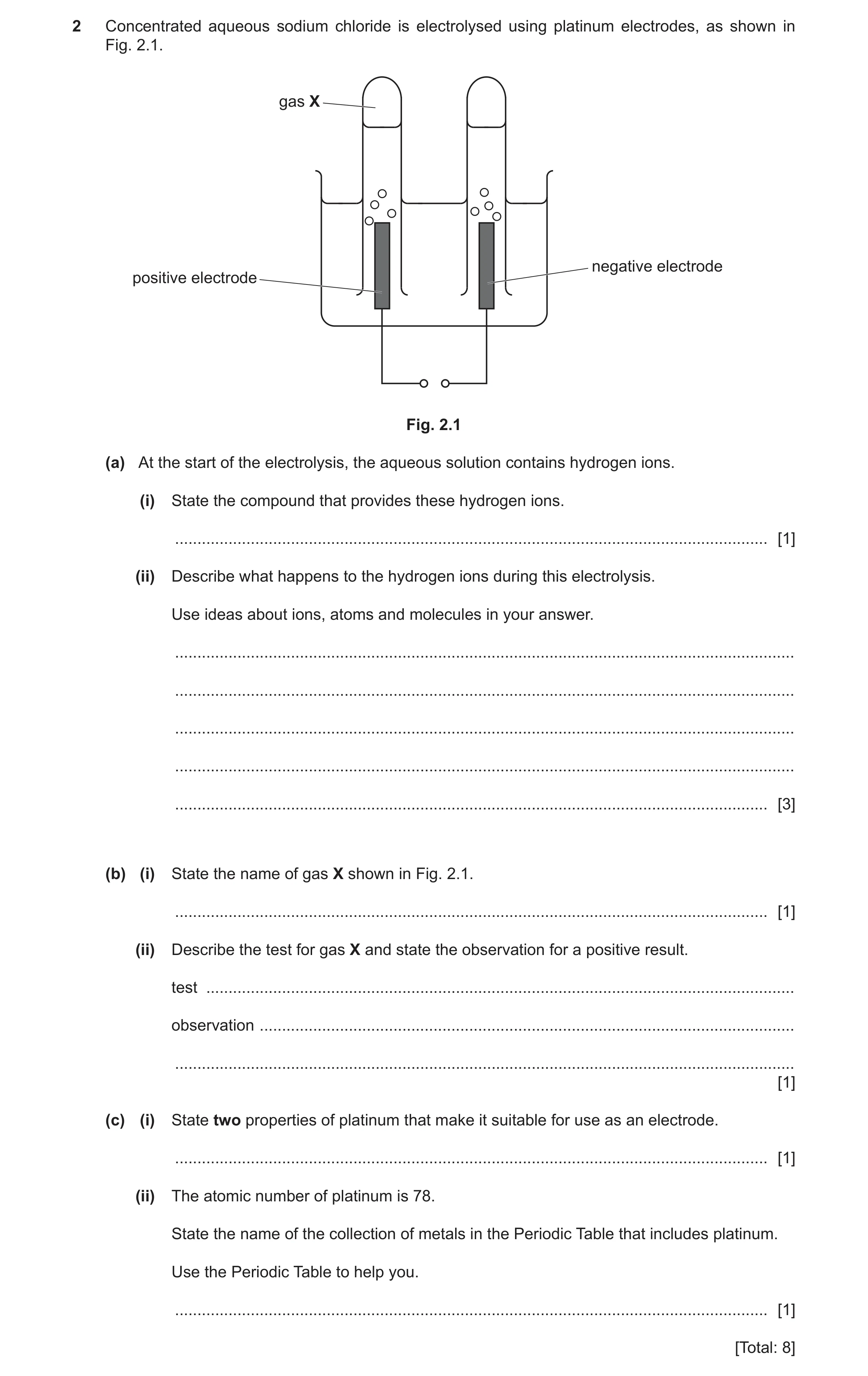
2 Concentrated aqueous sodium chloride is electrolysed using platinum electrodes, as shown in Fig. 2.1. gas X negative electrode positive electrode Fig. 2.1 (a) At the start of the electrolysis, the aqueous solution contains hydrogen ions. (i) State the compound that provides these hydrogen ions. … [1] (ii) Describe what happens to the hydrogen ions during this electrolysis. Use ideas about ions, atoms and molecules in your answer. … … … … … [3] (b) (i) State the name of gas X shown in Fig. 2.1. … [1] (ii) Describe the test for gas X and state the observation for a positive result. test … observation … … [1] (c) (i) State two properties of platinum that make it suitable for use as an electrode. … [1] (ii) The atomic number of platinum is 78. State the name of the collection of metals in the Periodic Table that includes platinum. Use the Periodic Table to help you. … [1] [Total: 8]
8 marks
Mark scheme: 2(a)(i) water ; 1 2(a)(ii) hydrogen ions attracted to / move to, cathode / negative electrode ; reference to gain of electrons ; (two) hydrogen atoms join to form a molecule (of hydrogen gas) ; 3 2(b)(i) chlorine ; 1 Question Answer Marks 2(b)(ii) (damp) litmus (paper) and bleached / goes white ; 1 2(c)(i) is inert / is unreactive and conducts (electricity) ; 1 2(c)(ii) transition (elements / metals) ; 1
This question in 0653/42 May/June 2023
Q29 · Dilute sulfuric acid is electrolysed, as shown in Fig 0653/43 May/June 2023
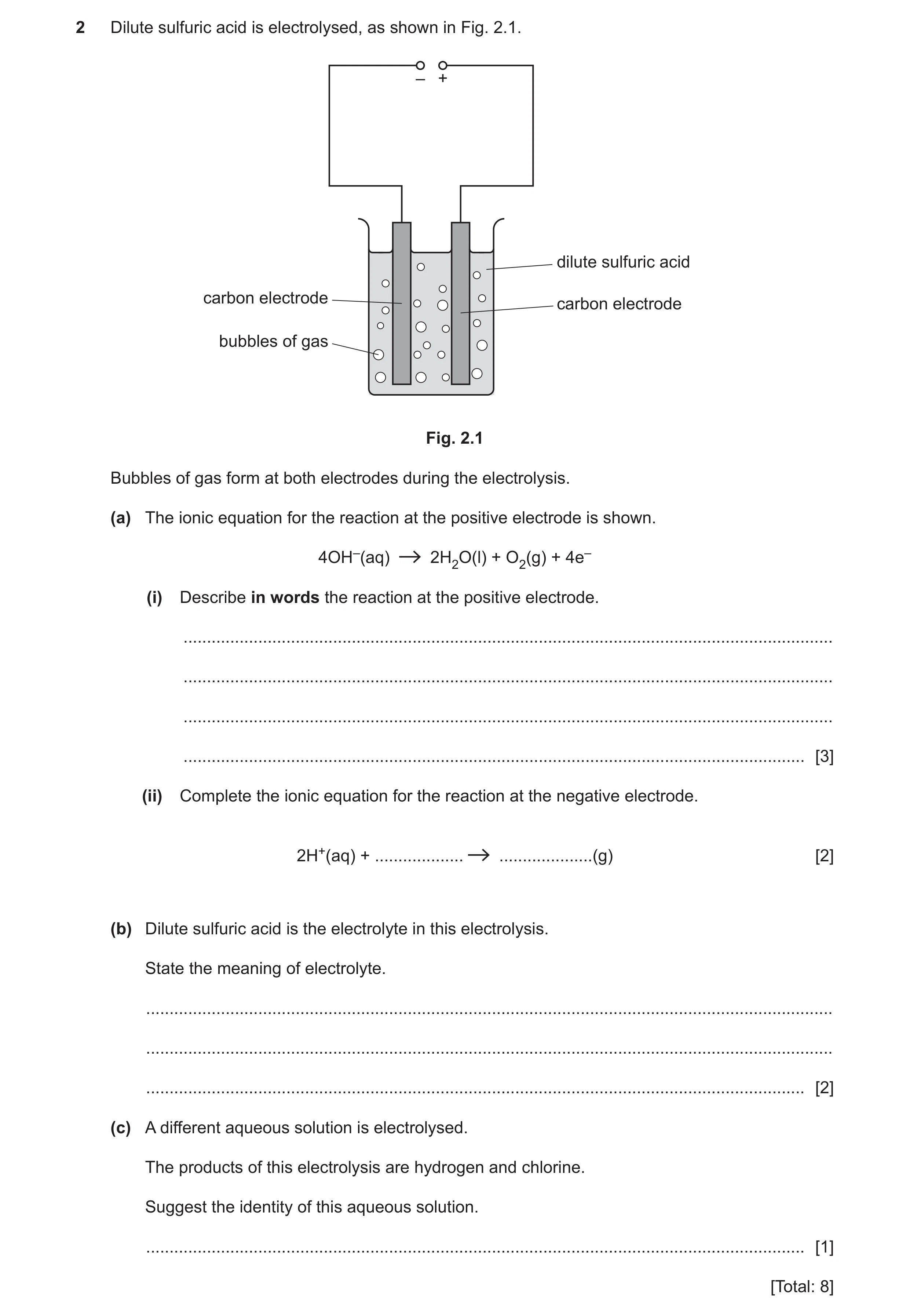
2 Dilute sulfuric acid is electrolysed, as shown in Fig. 2.1. – + dilute sulfuric acid carbon electrode carbon electrode bubbles of gas Fig. 2.1 Bubbles of gas form at both electrodes during the electrolysis. (a) The ionic equation for the reaction at the positive electrode is shown. 4OH–(aq) 2H2O(l) + O2(g) + 4e– (i) Describe in words the reaction at the positive electrode. … … … … [3] (ii) Complete the ionic equation for the reaction at the negative electrode. 2H+(aq) + … … (g) [2] (b) Dilute sulfuric acid is the electrolyte in this electrolysis. State the meaning of electrolyte. … … … [2] (c) A different aqueous solution is electrolysed. The products of this electrolysis are hydrogen and chlorine. Suggest the identity of this aqueous solution. … [1] [Total: 8]
8 marks
Mark scheme: 2(a)(i) hydroxide (ions) ; lose electrons ; to form (water and) oxygen ; 2(a)(ii) 2e ; H2 ; 2 Question Answer Marks 2(b) any two from: (molten or aqueous solution of) an ionic compound / a liquid (molten or solution) that contains ions ; the idea that an electrolyte, conducts electricity / contains mobile ions ; the idea that the compound in the electrolyte is broken down (into elements) ; 2 2(c) (aqueous) sodium chloride / other correct ; 1
This question in 0653/43 May/June 2023
Q30 · A student uses inert electrodes to investigate the electrolysis of lead(II) bromide, as… 0653/41 Oct/Nov 2023
2 A student uses inert electrodes to investigate the electrolysis of lead(II) bromide, as shown in Fig. 2.1. + – positive electrode negative electrode lead(II) bromide heat Fig. 2.1 (a) State the meaning of the term inert. … … [1] (b) The lead(II) bromide is heated, and its temperature is recorded. Table 2.1 shows some of the observations made as the temperature increases. Table 2.1 temperature / °C observations 20 no change 100 no change 200 no change 300 no change 1. lamp lights up 400 2. orange vapour seen at positive electrode 3. grey shiny liquid collects below negative electrode (i) Suggest why no change is observed at the first four temperatures recorded in Table 2.1. … … [1] (ii) Explain the three observations made at 400 °C. 1 … … 2 … … 3 … … [3] (c) The student repeats the investigation using lead(II) chloride instead of lead(II) bromide. (i) Two products are formed in the electrolysis of lead(II) chloride. Write the name and formula of each product. product 1 name … formula … product 2 name … formula … [2] (ii) Suggest one difference in the observations made when lead(II) chloride is electrolysed instead of lead(II) bromide. … … [1] [Total: 8]
8 marks
Mark scheme: 2(a) does not react / is unreactive ; 1 2(b)(i) lead(II) bromide, is still solid / has not reached melting point / AW ; 1 2(b)(ii) idea that charge can flow (in molten lead(II) bromide) ; 3 idea that the orange vapour is bromine (gas forming) ; idea that the grey shiny liquid is lead (forming) ; 2(c)(i) lead AND chlorine ; 2 Pb AND Cl 2 ; 2(c)(ii) different coloured, gas / vapour (formed) ; 1
This question in 0653/41 Oct/Nov 2023
Q31 · The electrolysis of concentrated aqueous sodium chloride using platinum electrodes 0653/43 Oct/Nov 2023
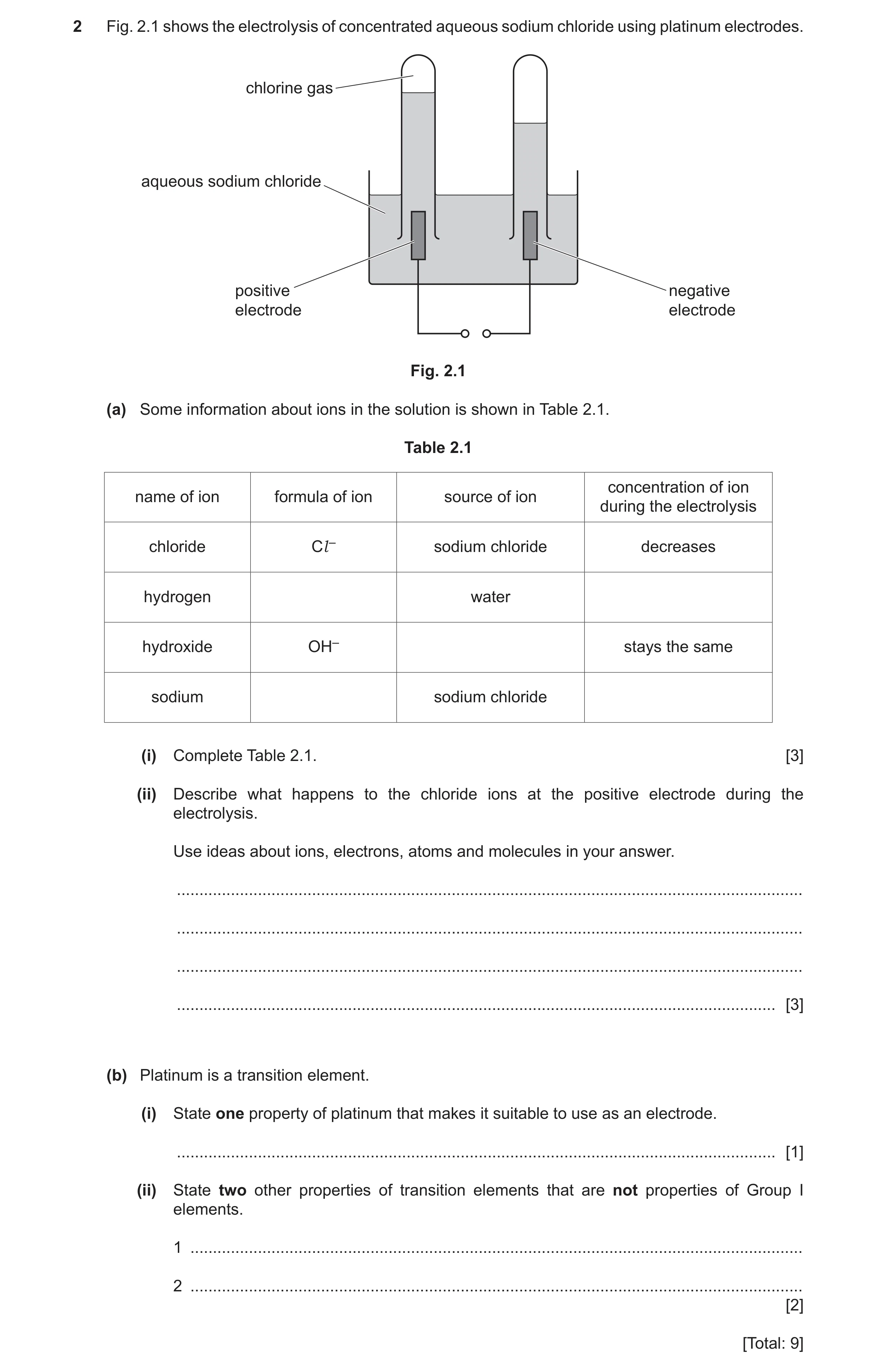
2 Fig. 2.1 shows the electrolysis of concentrated aqueous sodium chloride using platinum electrodes. chlorine gas aqueous sodium chloride positive negative electrode electrode Fig. 2.1 (a) Some information about ions in the solution is shown in Table 2.1. Table 2.1 concentration of ion name of ion formula of ion source of ion during the electrolysis chloride Cl – sodium chloride decreases hydrogen water hydroxide OH– stays the same sodium sodium chloride (i) Complete Table 2.1. [3] (ii) Describe what happens to the chloride ions at the positive electrode during the electrolysis. Use ideas about ions, electrons, atoms and molecules in your answer. … … … … [3] (b) Platinum is a transition element. (i) State one property of platinum that makes it suitable to use as an electrode. … [1] (ii) State two other properties of transition elements that are not properties of Group I elements. 1 … 2 … [2] [Total: 9]
9 marks
Mark scheme: 2(a)(i) hydrogen H+ AND decreases ; 3 hydroxide water ; sodium Na+ AND stays the same ; 2(a)(ii) (each) chloride ion loses (one) electron ; 3 chlorine atoms (form) ; two atoms join together to form a molecule (of chlorine gas) ; 2(b)(i) conducts electricity / inert / unreactive ; 1 2(b)(ii) any two from: 2 high melting point ; high density ; forms coloured compounds ; acts as a catalyst ; AVP ;
This question in 0653/43 Oct/Nov 2023
Q32 · The electrolysis of molten zinc chloride using inert electrodes 0653/42 Feb/March 2024
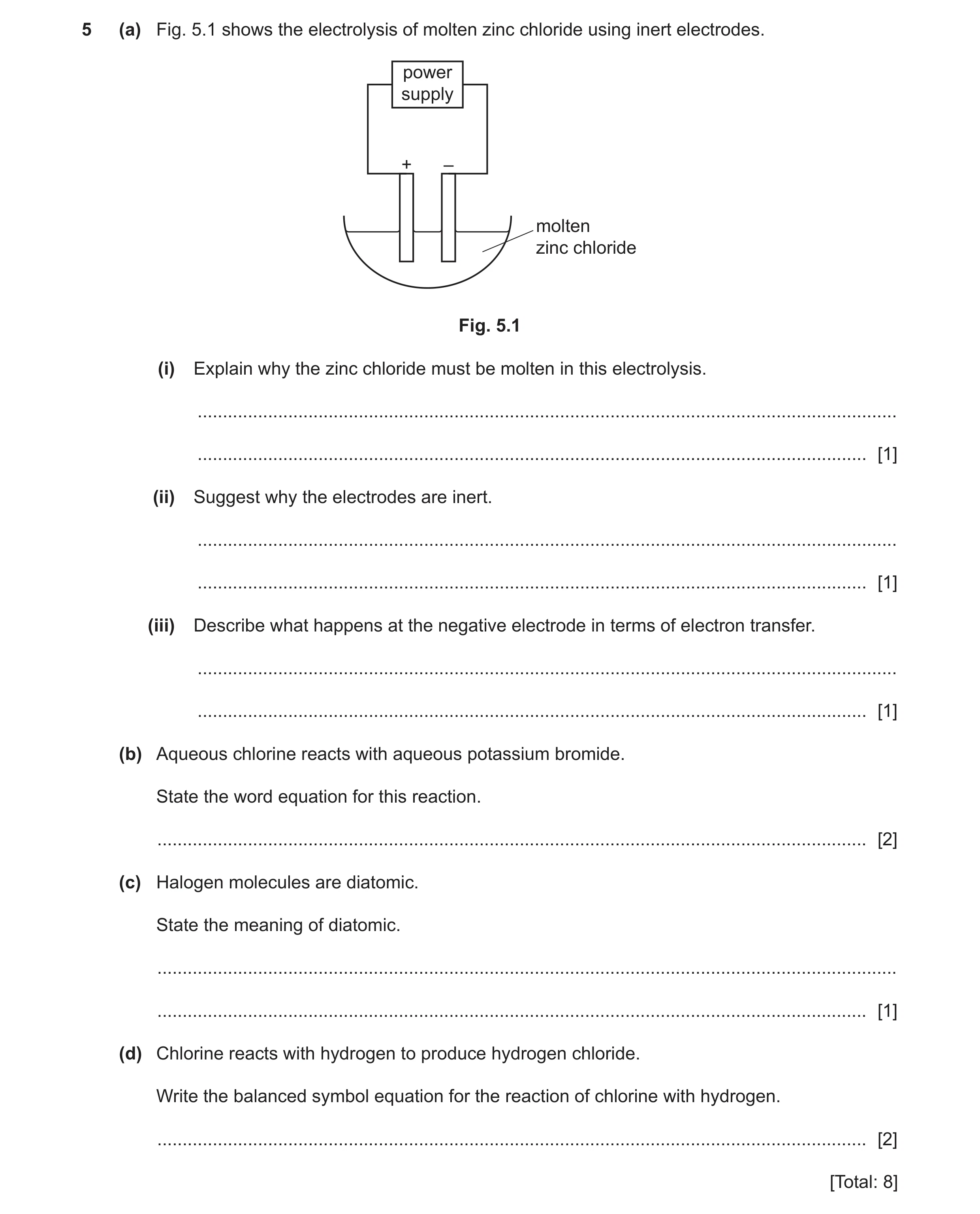
5 (a) Fig. 5.1 shows the electrolysis of molten zinc chloride using inert electrodes. power supply + – molten zinc chloride Fig. 5.1 (i) Explain why the zinc chloride must be molten in this electrolysis. … … [1] (ii) Suggest why the electrodes are inert. … … [1] (iii) Describe what happens at the negative electrode in terms of electron transfer. … … [1] (b) Aqueous chlorine reacts with aqueous potassium bromide. State the word equation for this reaction. … [2] (c) Halogen molecules are diatomic. State the meaning of diatomic. … … [1] (d) Chlorine reacts with hydrogen to produce hydrogen chloride. Write the balanced symbol equation for the reaction of chlorine with hydrogen. … [2] [Total: 8]
8 marks
Mark scheme: 5(a)(i) (molten because) ions must, be free to move / be mobile / migrate ; 1 5(a)(ii) (so that they) do not react / only provide a surface for electron transfer (to or from ions) ; 1 5(a)(iii) gain of electrons by, cations / (zinc) ions ; 1 5(b) chlorine + potassium bromide → ; ( → or = required) 2 potassium chloride + bromine ; 5(c) (molecule made of) two atoms, combined / bonded ; 1 5(d) Cl 2 + H2 → 2HCl ;; 2 reactants and products [1] balanced [1]
This question in 0653/42 Feb/March 2024
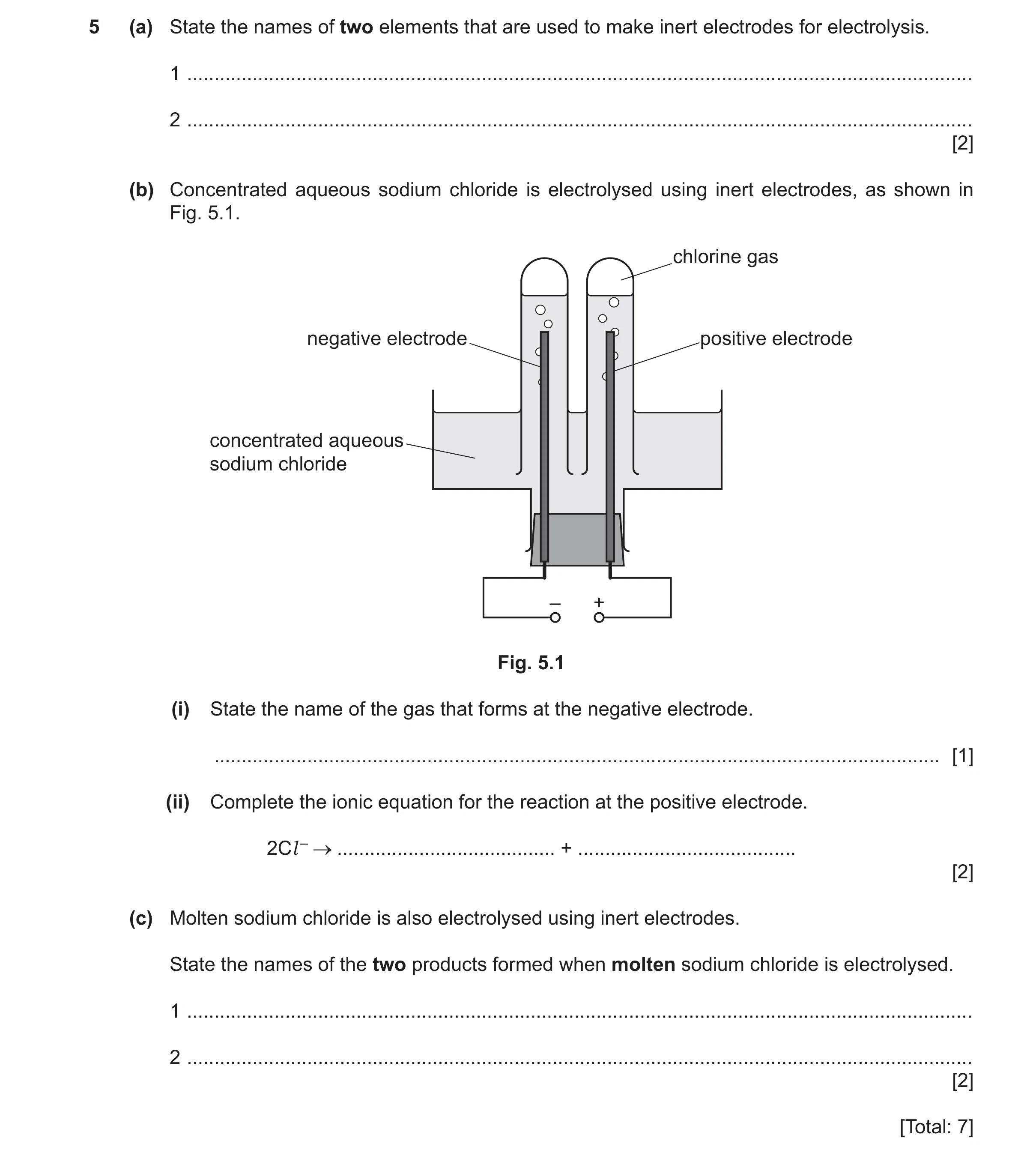
Q33 · State the names of two elements that are used to make inert electrodes for electrolysis 0653/42 Oct/Nov 2024
5 (a) State the names of two elements that are used to make inert electrodes for electrolysis. 1 … 2 … [2] (b) Concentrated aqueous sodium chloride is electrolysed using inert electrodes, as shown in Fig. 5.1. chlorine gas negative electrode positive electrode concentrated aqueous sodium chloride – + Fig. 5.1 (i) State the name of the gas that forms at the negative electrode. … [1] (ii) Complete the ionic equation for the reaction at the positive electrode. 2Cl – … + … [2] (c) Molten sodium chloride is also electrolysed using inert electrodes. State the names of the two products formed when molten sodium chloride is electrolysed. 1 … 2 … [2] [Total: 7]
7 marks
Mark scheme: 5(a) carbon ; 2 platinum ; 5(b)(i) hydrogen ; 1 5(b)(ii) Cl 2 ; 2 2e– ; 5(c) sodium ; 2 chlorine ;
This question in 0653/42 Oct/Nov 2024
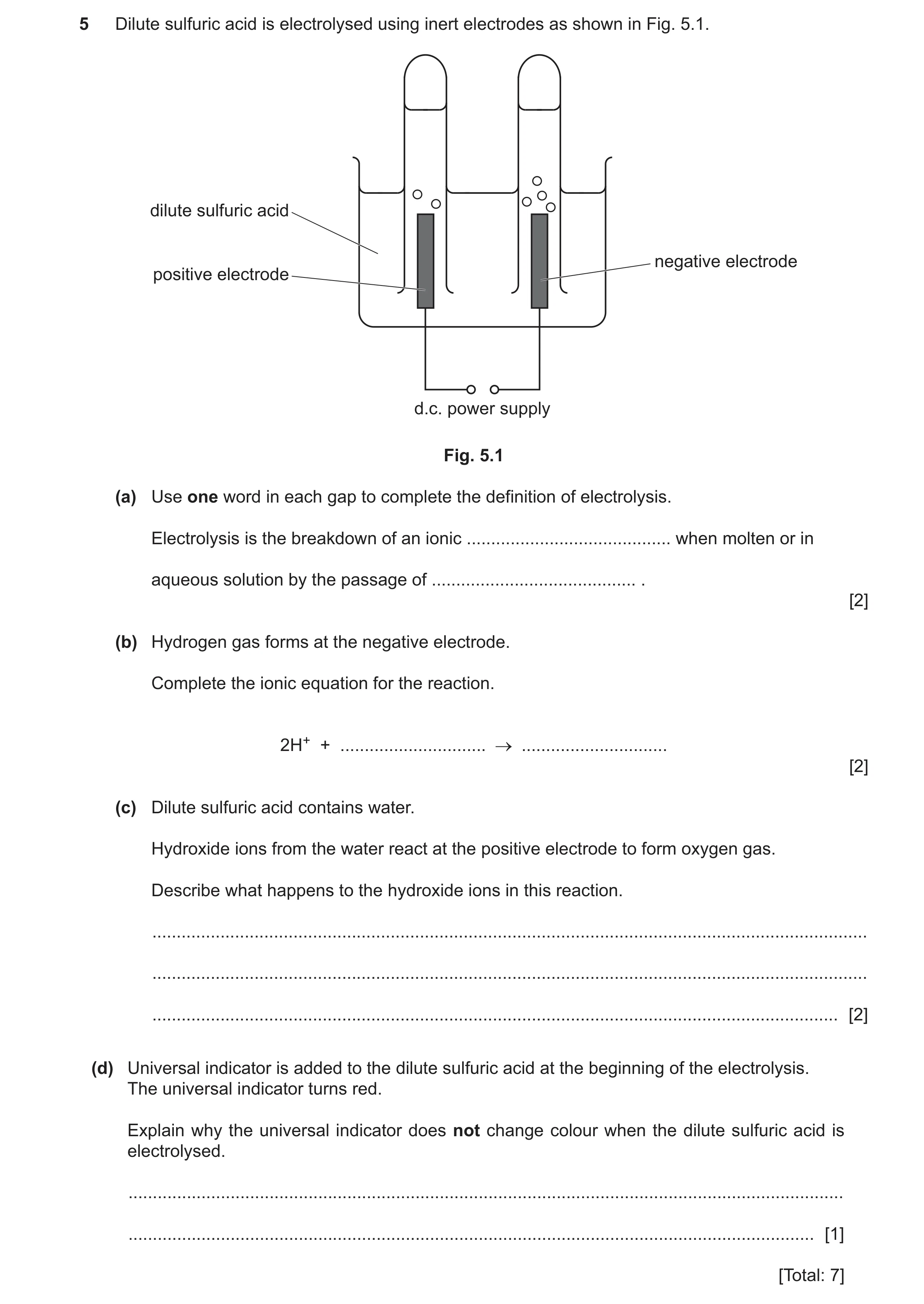
Q34 · Dilute sulfuric acid is electrolysed using inert electrodes as shown in Fig 0653/43 Oct/Nov 2024
5 Dilute sulfuric acid is electrolysed using inert electrodes as shown in Fig. 5.1. dilute sulfuric acid negative electrode positive electrode d.c. power supply Fig. 5.1 (a) Use one word in each gap to complete the definition of electrolysis. Electrolysis is the breakdown of an ionic … when molten or in aqueous solution by the passage of … . [2] (b) Hydrogen gas forms at the negative electrode. Complete the ionic equation for the reaction. 2H+ + … … [2] (c) Dilute sulfuric acid contains water. Hydroxide ions from the water react at the positive electrode to form oxygen gas. Describe what happens to the hydroxide ions in this reaction. … … … [2] (d) Universal indicator is added to the dilute sulfuric acid at the beginning of the electrolysis. The universal indicator turns red. Explain why the universal indicator does not change colour when the dilute sulfuric acid is electrolysed. … … [1] [Total: 7]
7 marks
Mark scheme: 5(a) compound ; 2 electricity ; 5(b) 2e– ; 2 H2 ; 5(c) (hydroxide ions) lose electrons / ions are discharged; 2 water (also) formed ; 5(d) acid remains / acid is not used up / only water is electrolysed ; 1
This question in 0653/43 Oct/Nov 2024
Q35 · Sodium fluoride, NaF, is an ionic compound 0653/42 May/June 2025
4 Sodium fluoride, NaF, is an ionic compound. (a) Tick (3) all the boxes that are properties of sodium fluoride. high boiling point insoluble in water conducts electricity when solid [1] (b) Complete the dot-and-cross diagram in Fig. 4.1 to show the outer-shell electrons for each ion in sodium fluoride. Include the charge on each ion. … … Na F Fig. 4.1 [3] (c) Fig. 4.2 shows equipment used in the electrolysis of molten sodium fluoride. power supply inert electrodes + – molten sodium fluoride Fig. 4.2 (i) Define electrolysis. … … … … [2] (ii) Predict the product formed at the: • positive electrode … • negative electrode. … [2] (d) Aqueous sodium fluoride reacts with aqueous silver nitrate, AgNO3, to form aqueous sodium nitrate, NaNO3, and one other product. Write the balanced symbol equation for this reaction. … [1] [Total: 9]
9 marks
Mark scheme: 4(a) high boiling point ; 1 4(b) sodium with 8 crosses in outer shell ; 3 fluoride with 7 dots and 1 cross in outer shell ; (1)+ and (1)− charges ; 4(c)(i) decomposition of an ionic compound (when molten or in aqueous solution) ; 2 by (the passage of an electric) current ; 4(c)(ii) positive electrode: fluorine / F2 ; 2 negative electrode: sodium / Na ; 4(d) NaF + AgNO3 → NaNO3 + AgF ; 1
This question in 0653/42 May/June 2025
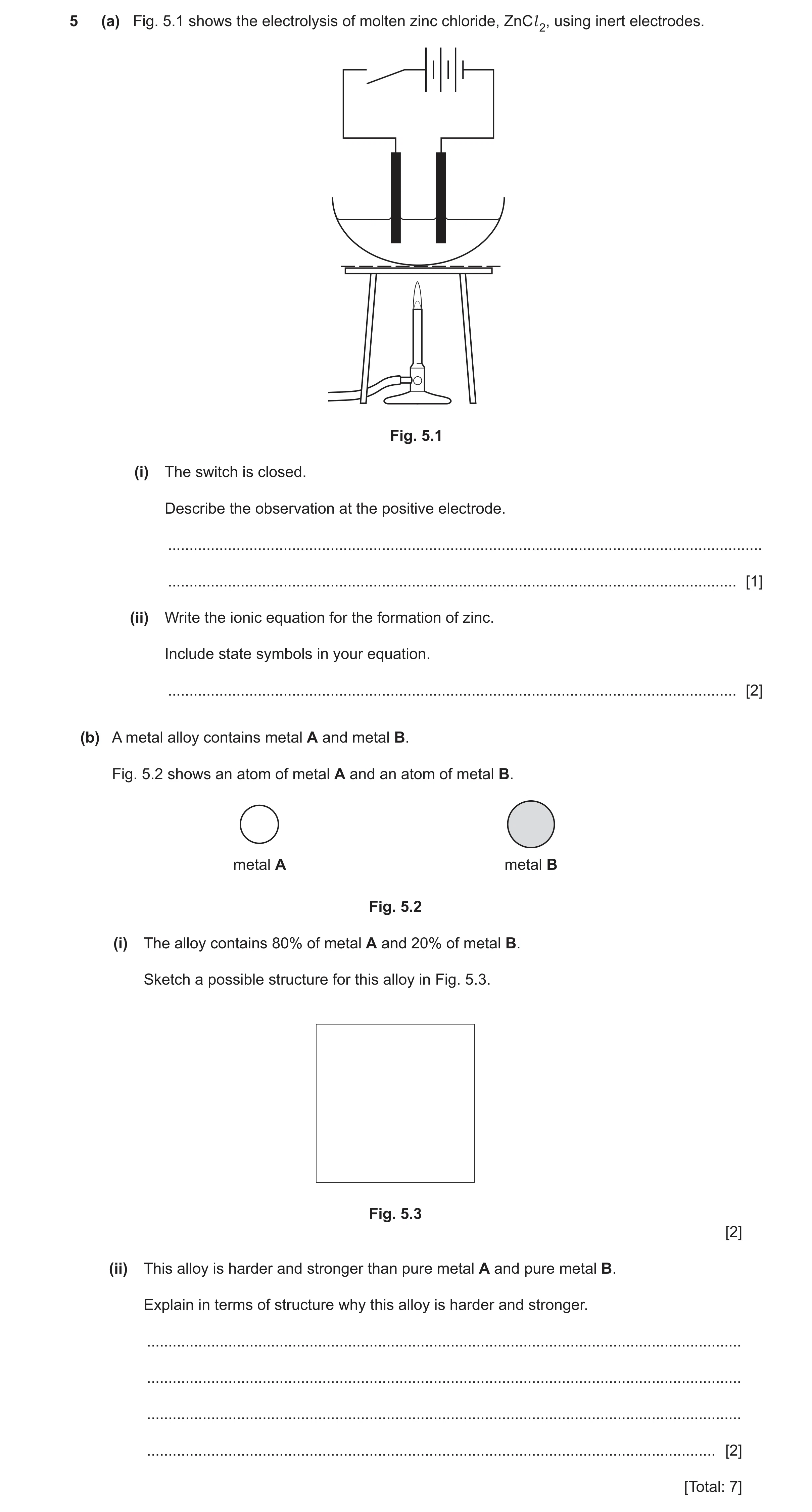
Q36 · The electrolysis of molten zinc chloride, ZnCl 2, using inert electrodes 0653/41 Oct/Nov 2025
5 (a) Fig. 5.1 shows the electrolysis of molten zinc chloride, ZnCl 2, using inert electrodes. Fig. 5.1 (i) The switch is closed. Describe the observation at the positive electrode. … … [1] (ii) Write the ionic equation for the formation of zinc. Include state symbols in your equation. … [2] (b) A metal alloy contains metal A and metal B. Fig. 5.2 shows an atom of metal A and an atom of metal B. metal A metal B Fig. 5.2 (i) The alloy contains 80% of metal A and 20% of metal B. Sketch a possible structure for this alloy in Fig. 5.3. Fig. 5.3 [2] (ii) This alloy is harder and stronger than pure metal A and pure metal B. Explain in terms of structure why this alloy is harder and stronger. … … … … [2] [Total: 7]
7 marks
Mark scheme: 5(a)(i) bubbles / chlorine / gas produced ; 1 5(a)(ii) Zn2+(l) + 2e– → Zn(s) 2 correct equation ; correct state symbols ; 5(b)(i) two types of atom shown, most touching at least one other atom and mixed ; 2 more metal A atoms than metal B atoms ; 5(b)(ii) atoms are different sizes ; 2 (layers / atoms) can no longer slide ;
This question in 0653/41 Oct/Nov 2025
 10 / 48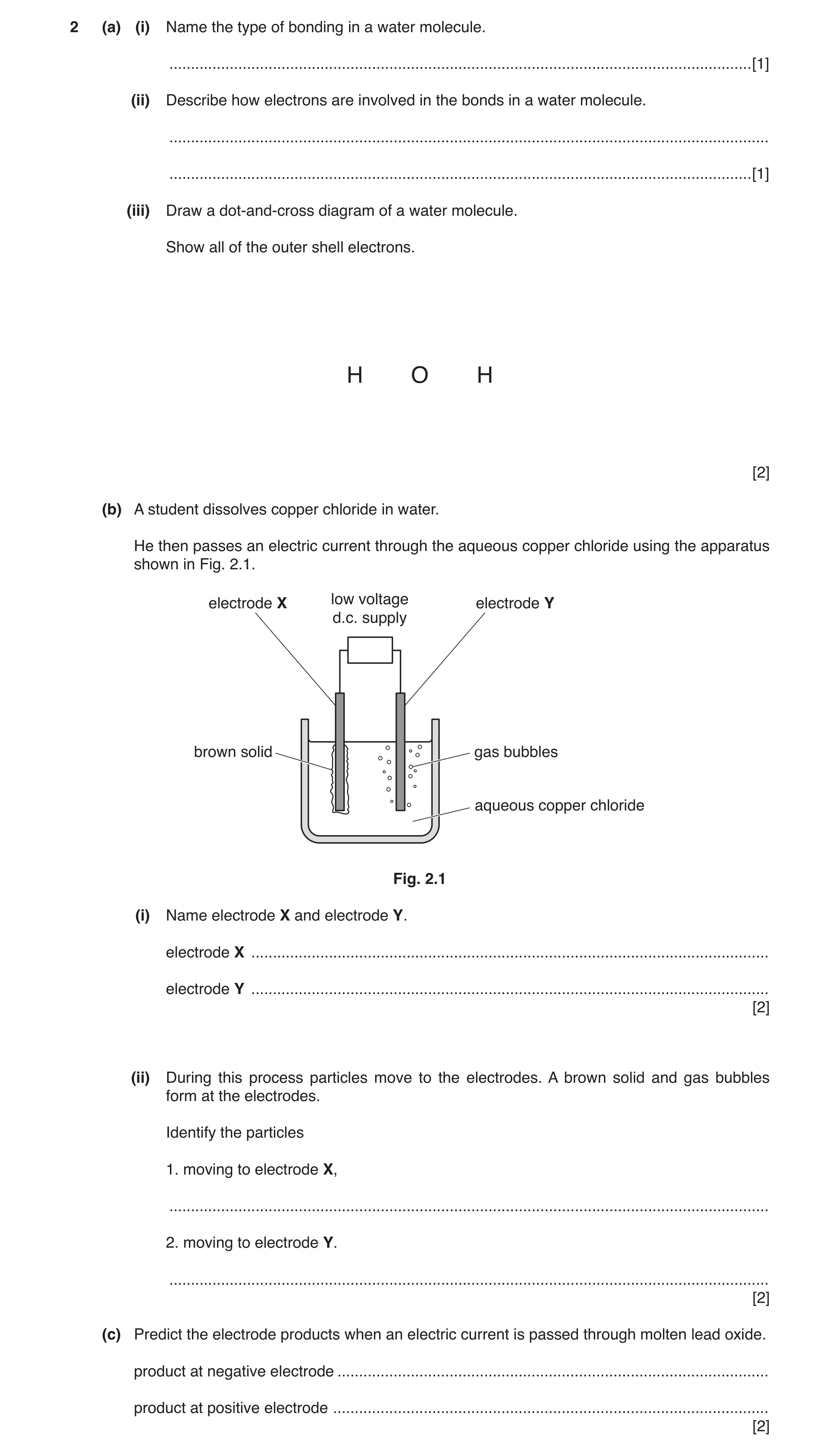
 21 / 48
 22 / 48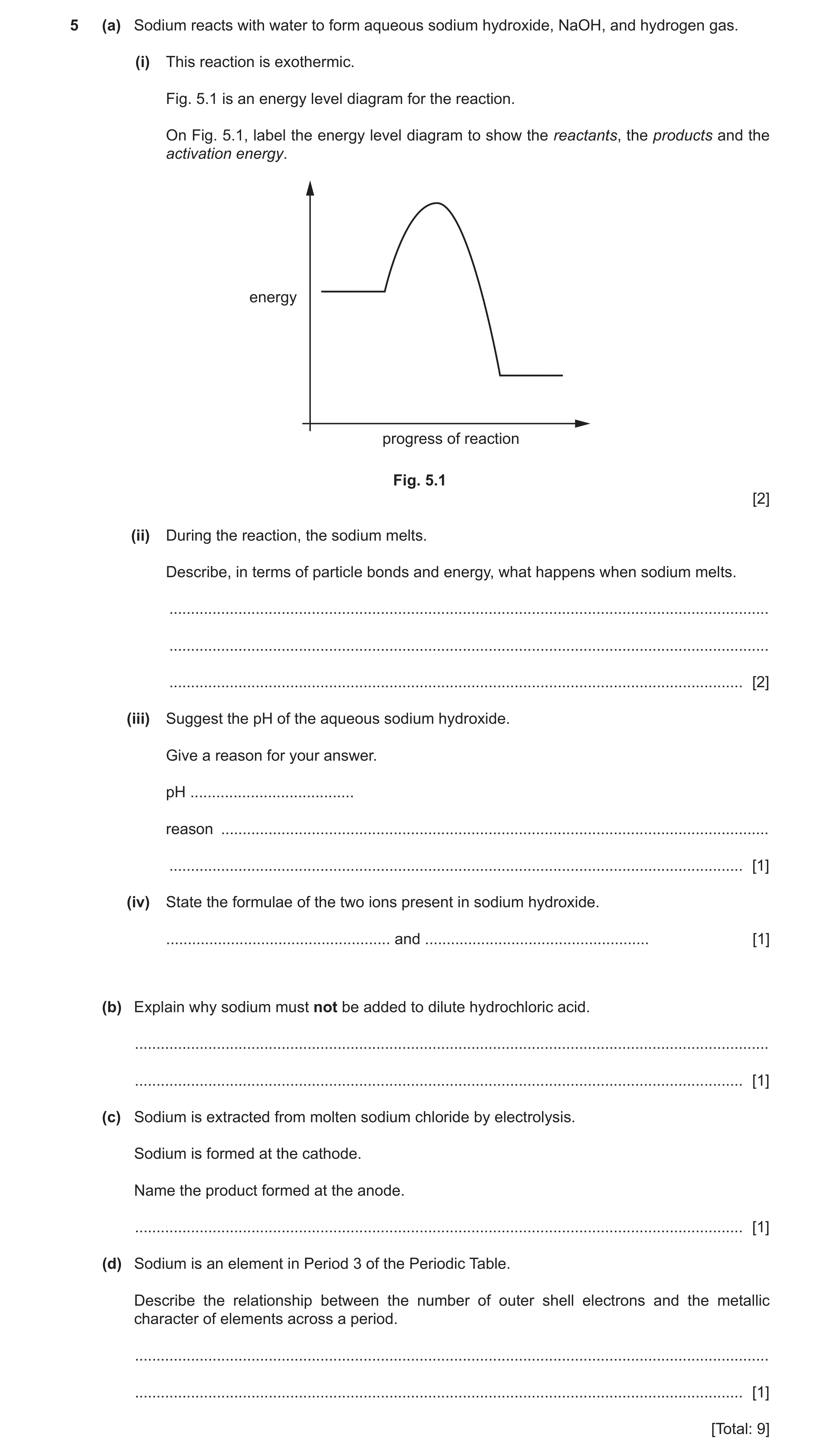
 31 / 48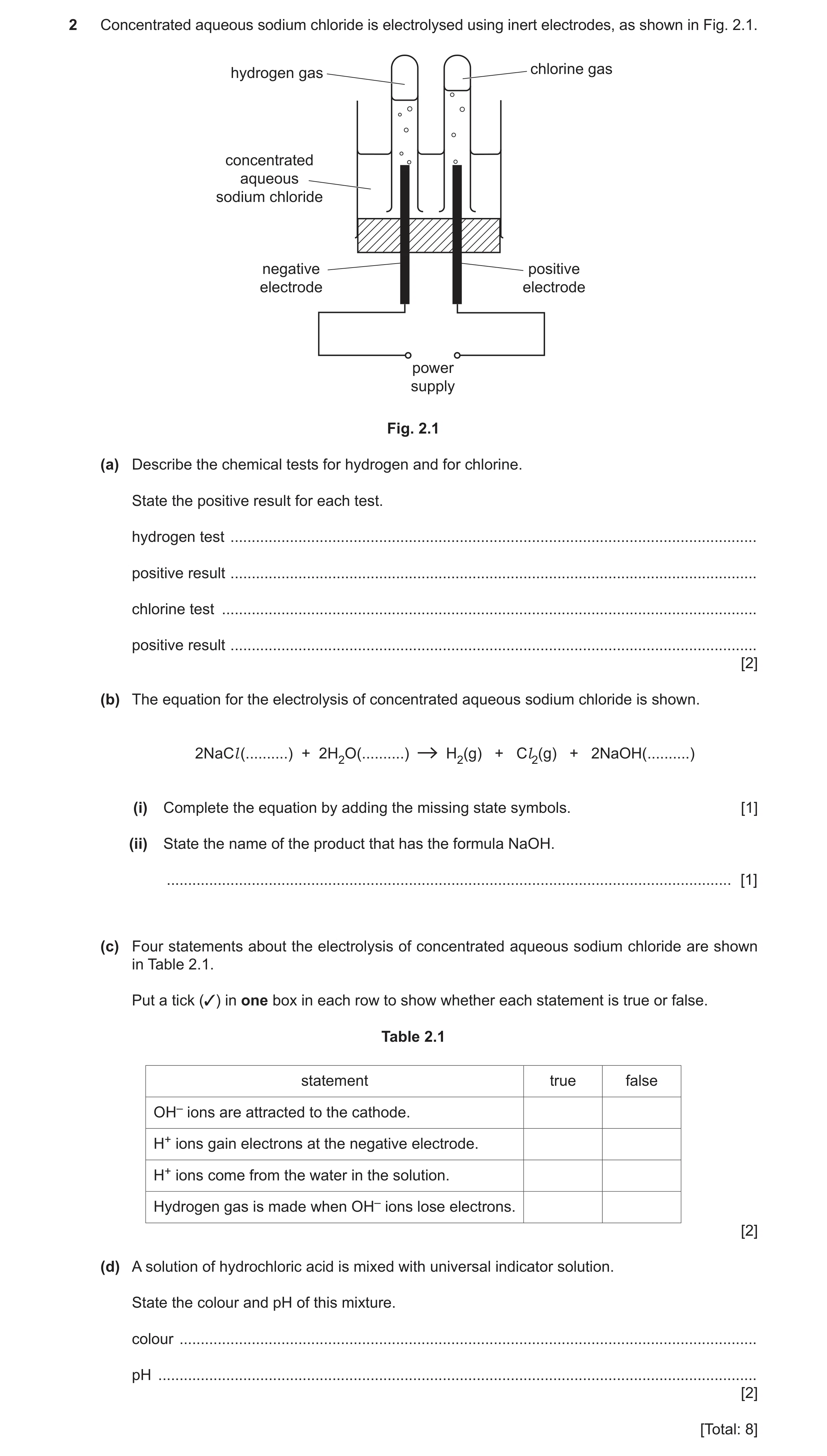
 35 / 48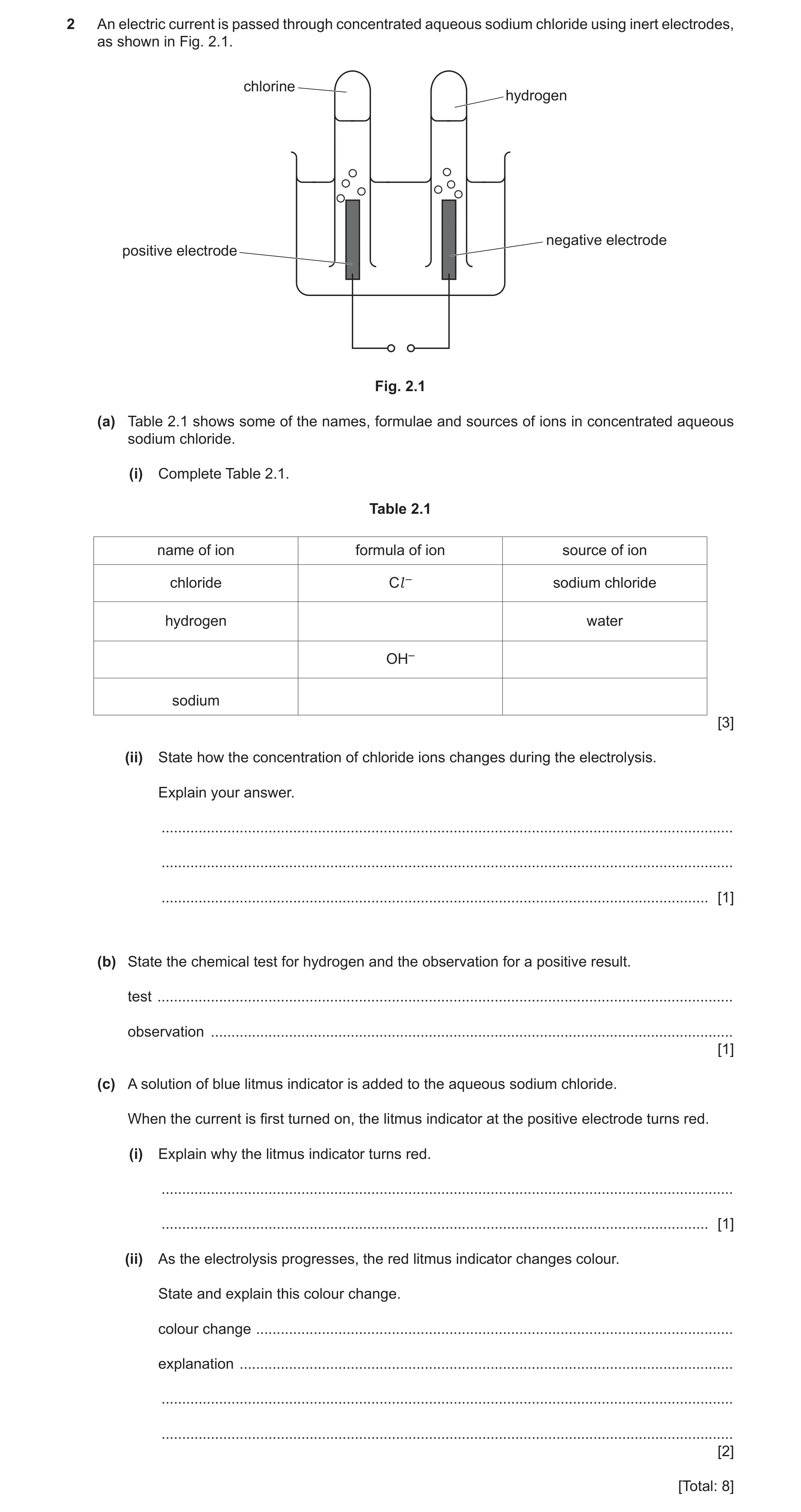
 39 / 48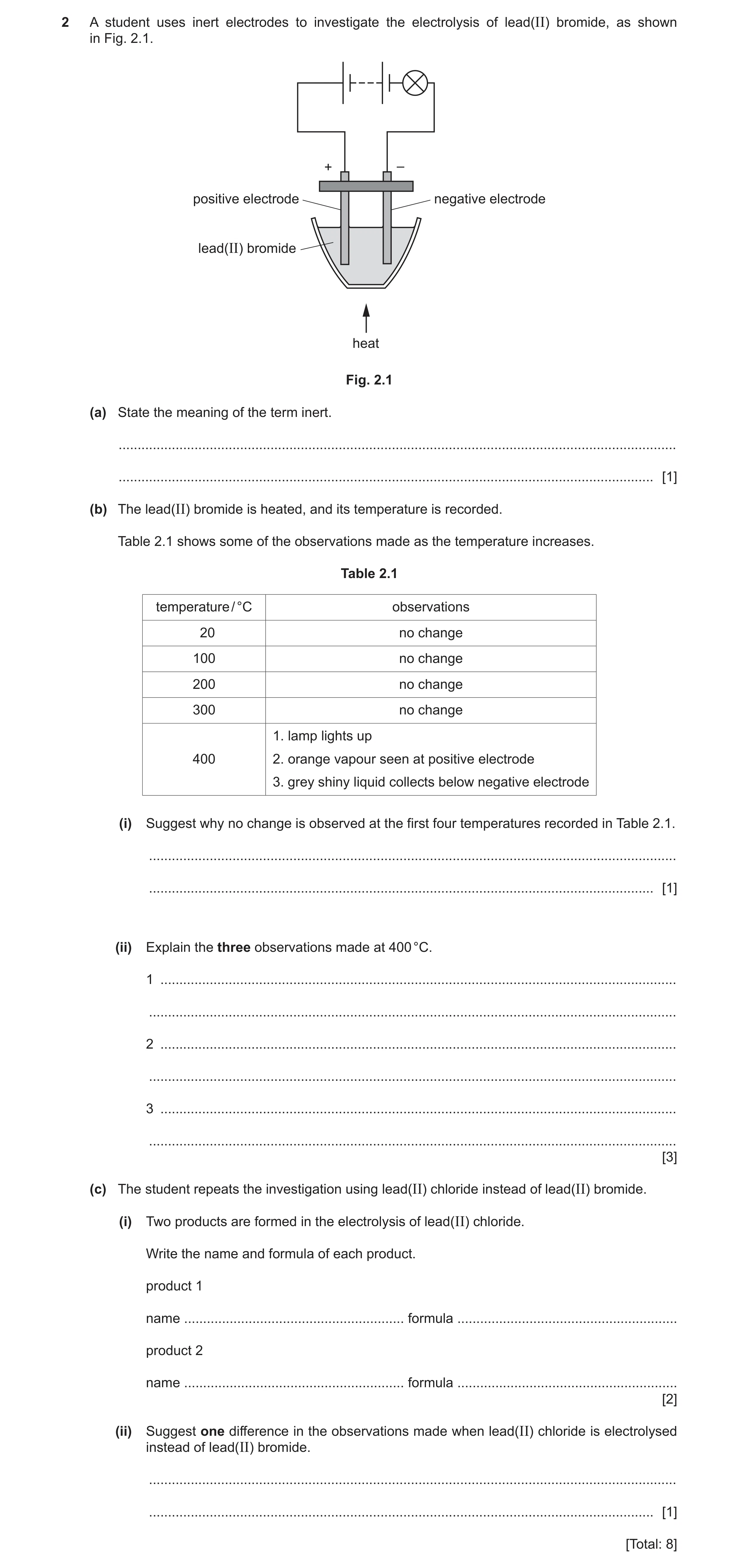
 43 / 48
 44 / 48
 45 / 48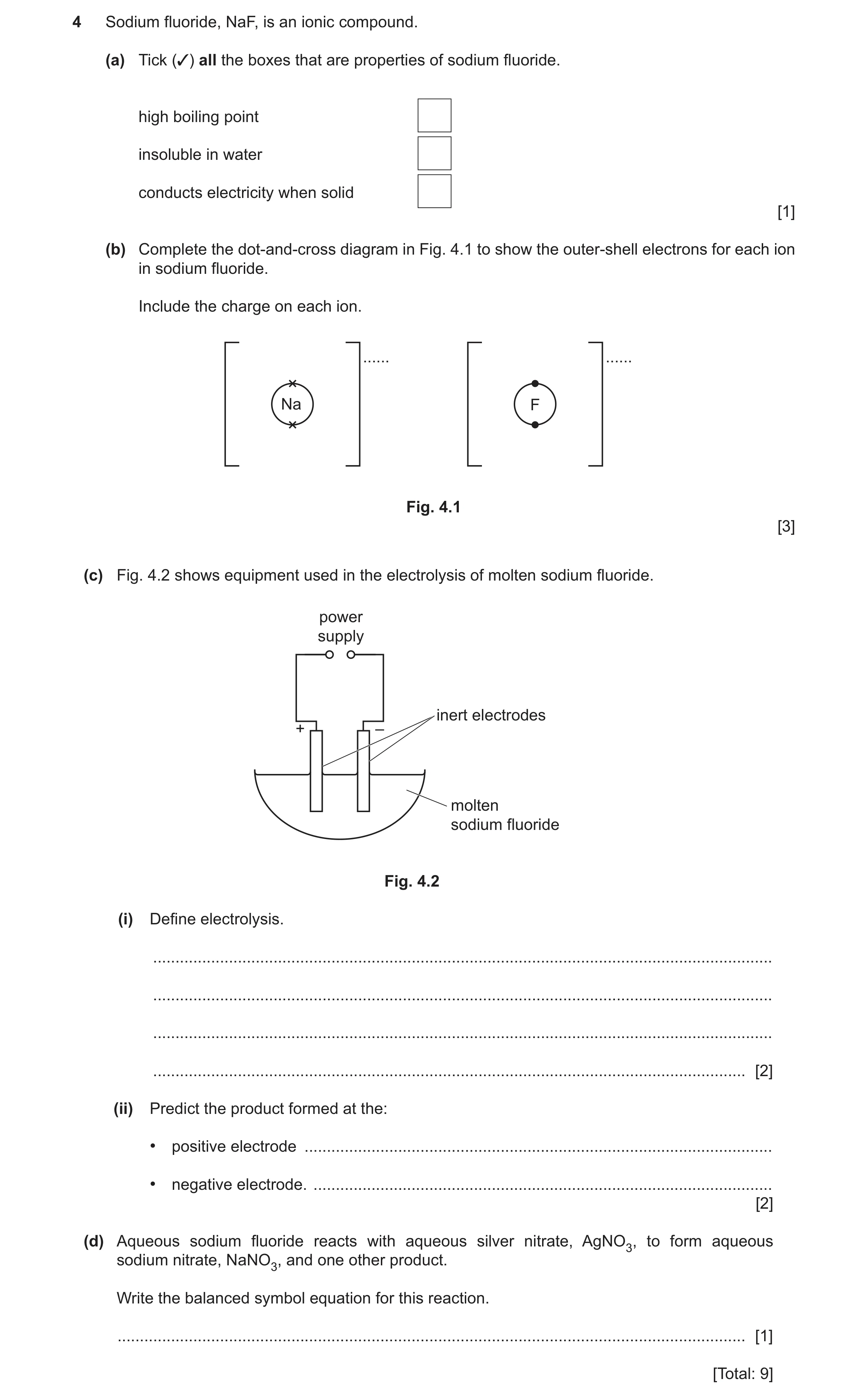
 9
9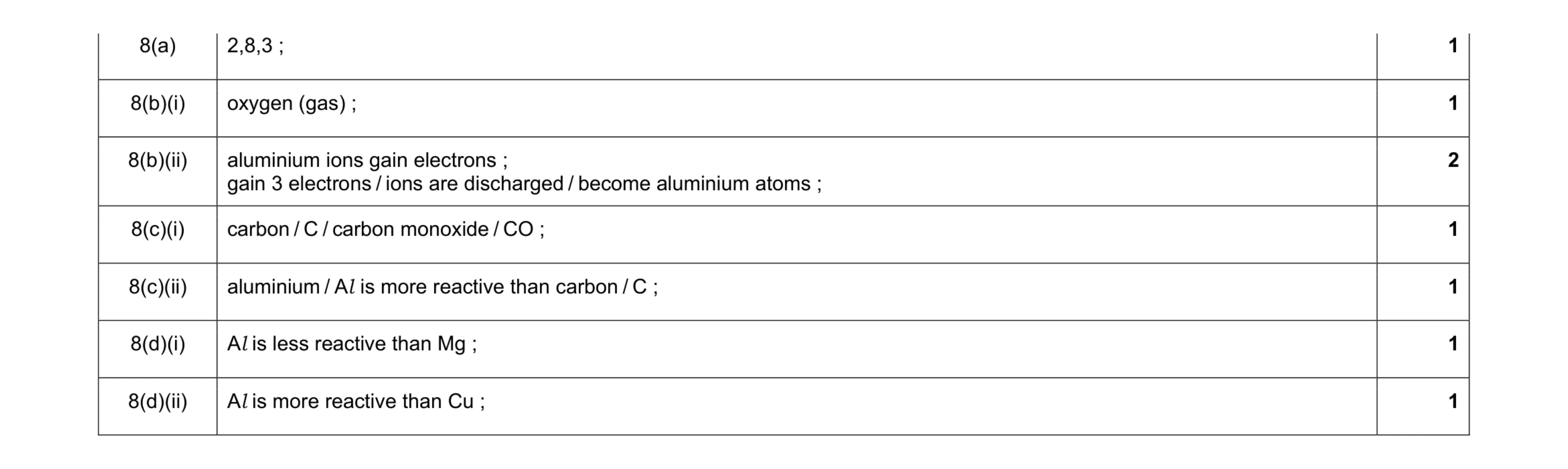 8
8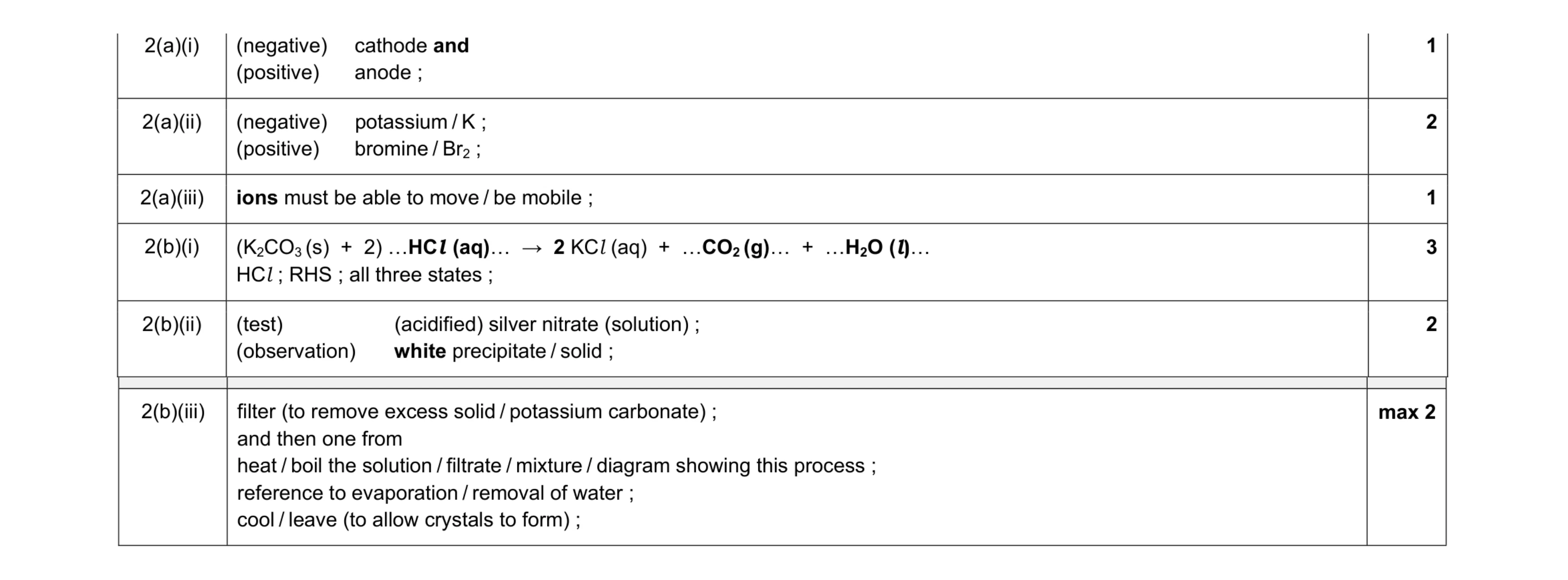 11
11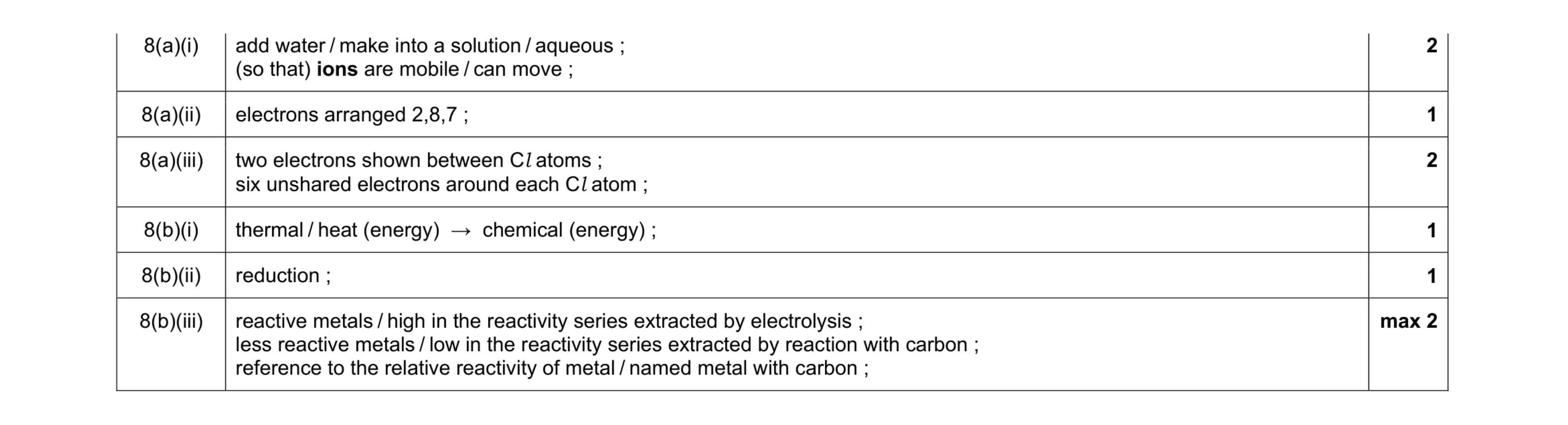 9
9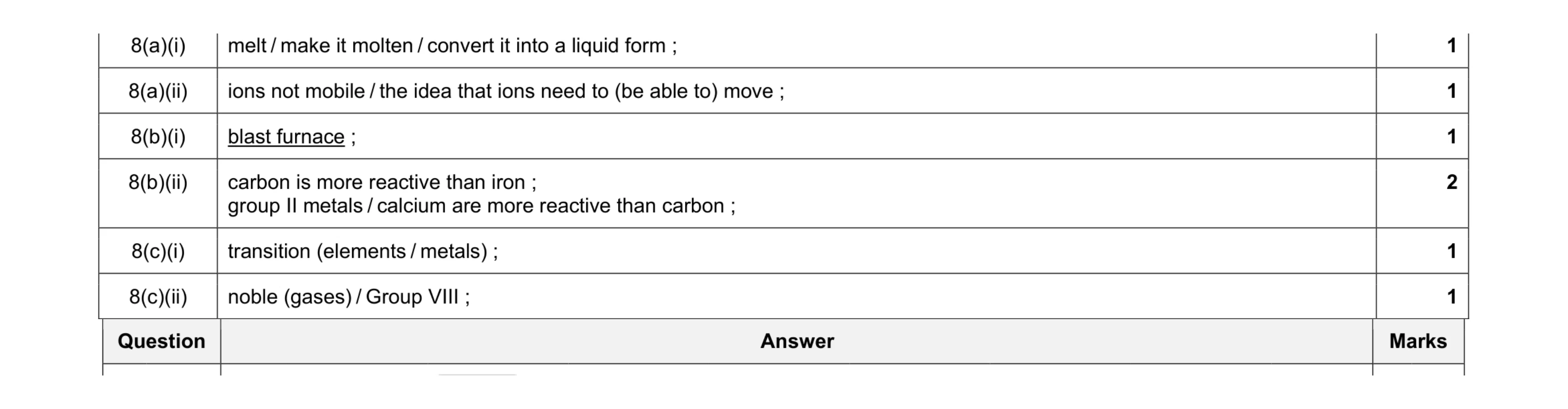 7
7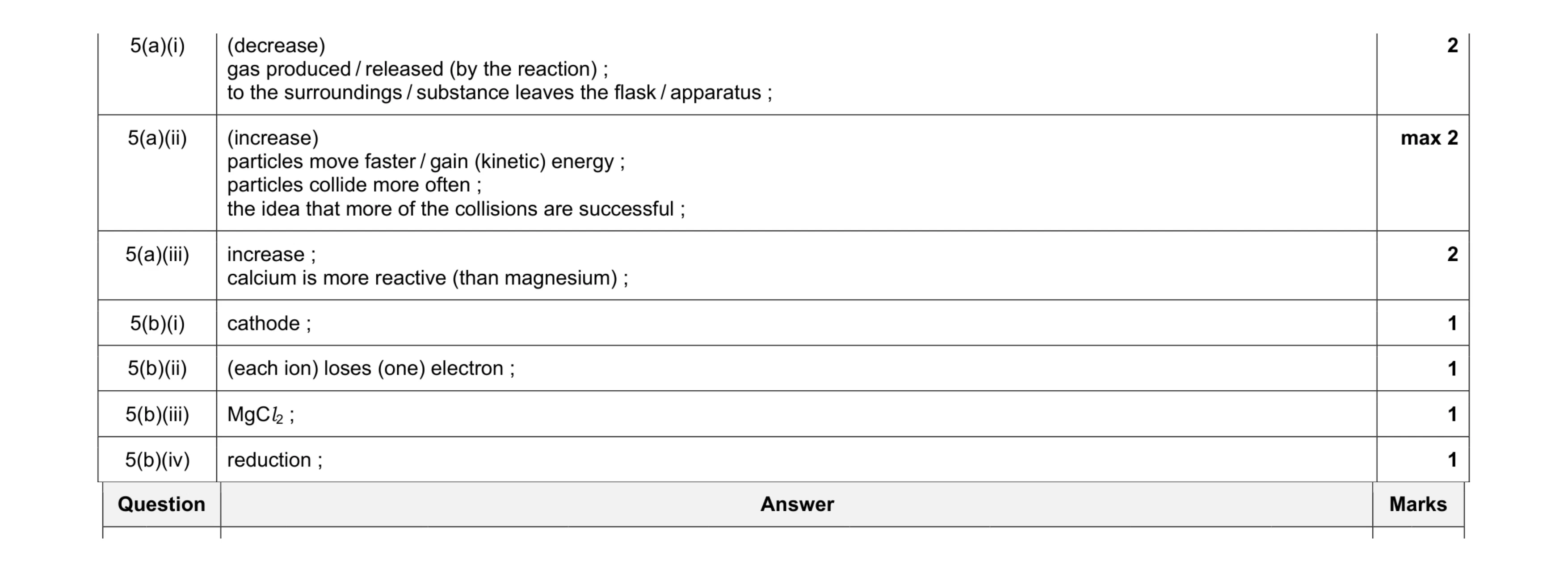 10
10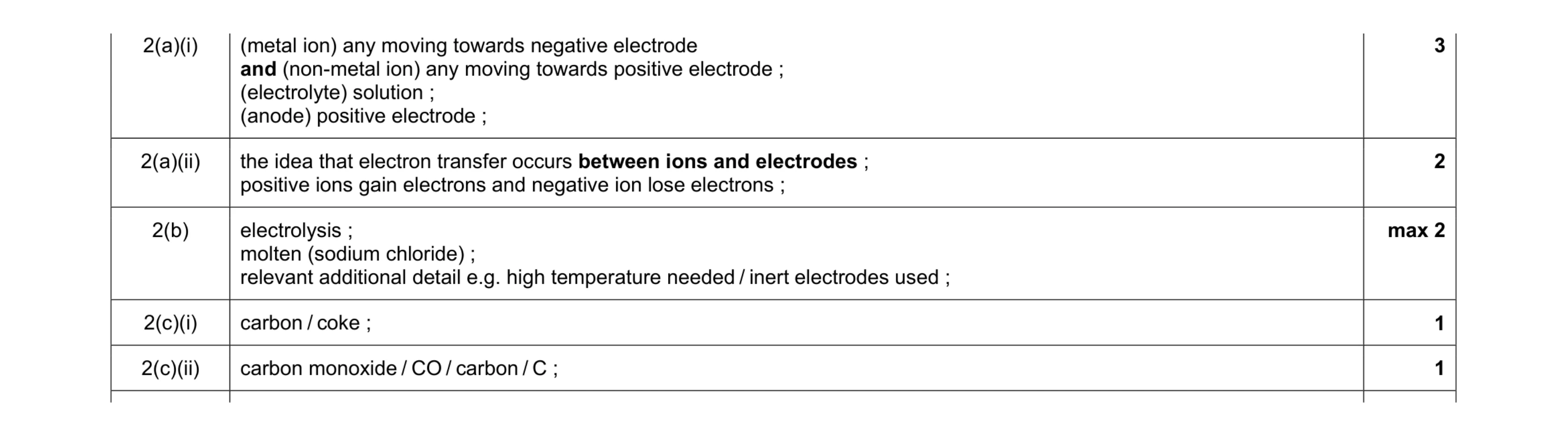 9
9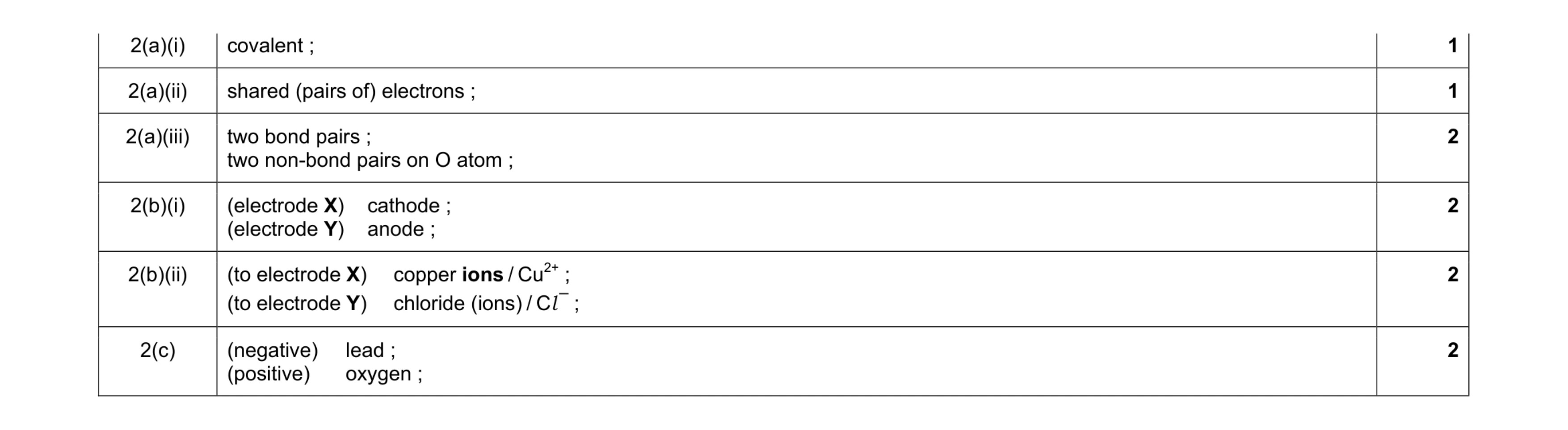 10
10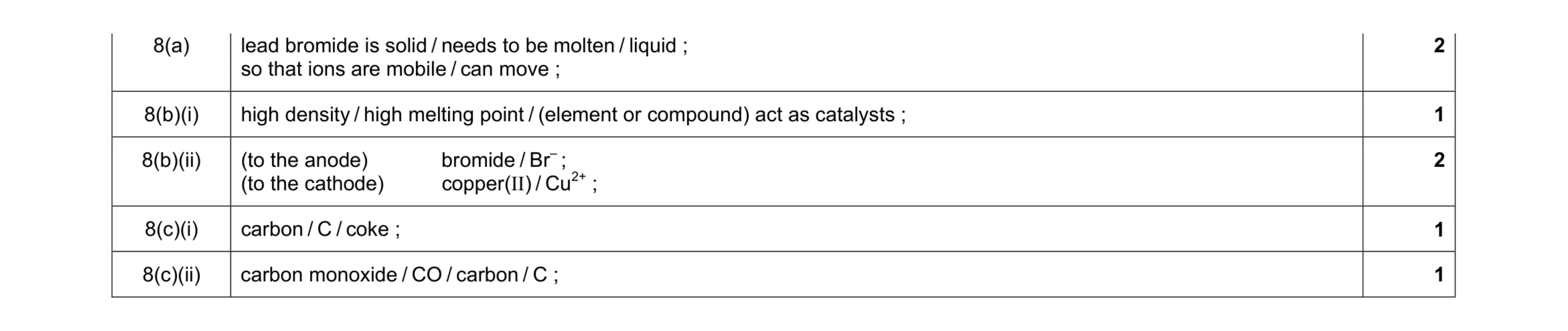 7
7 6
6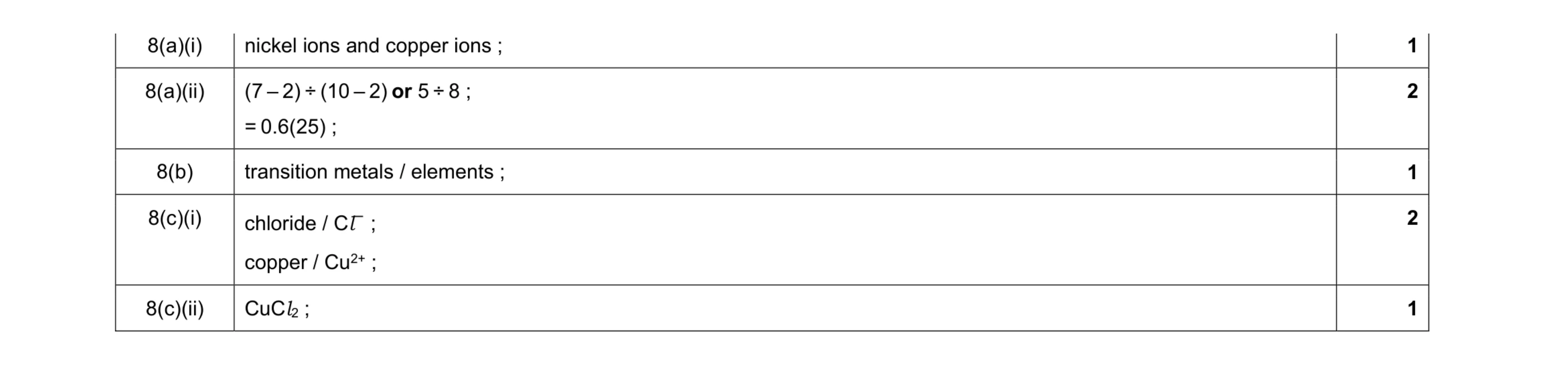 7
7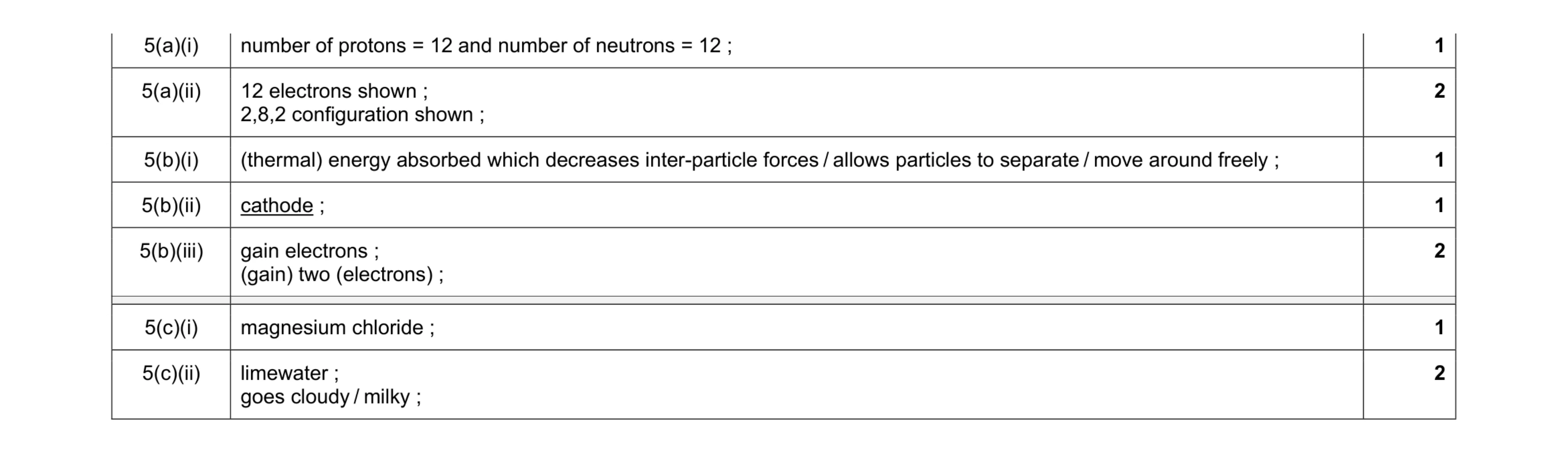 10
10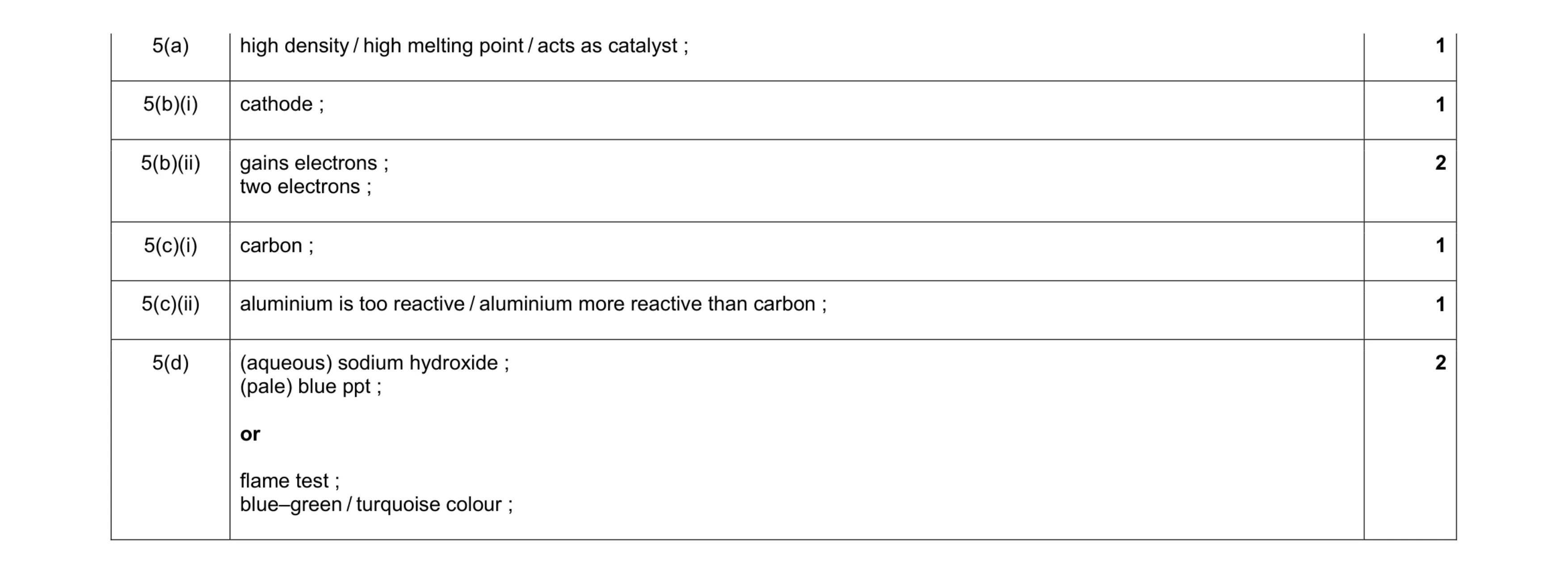 8
8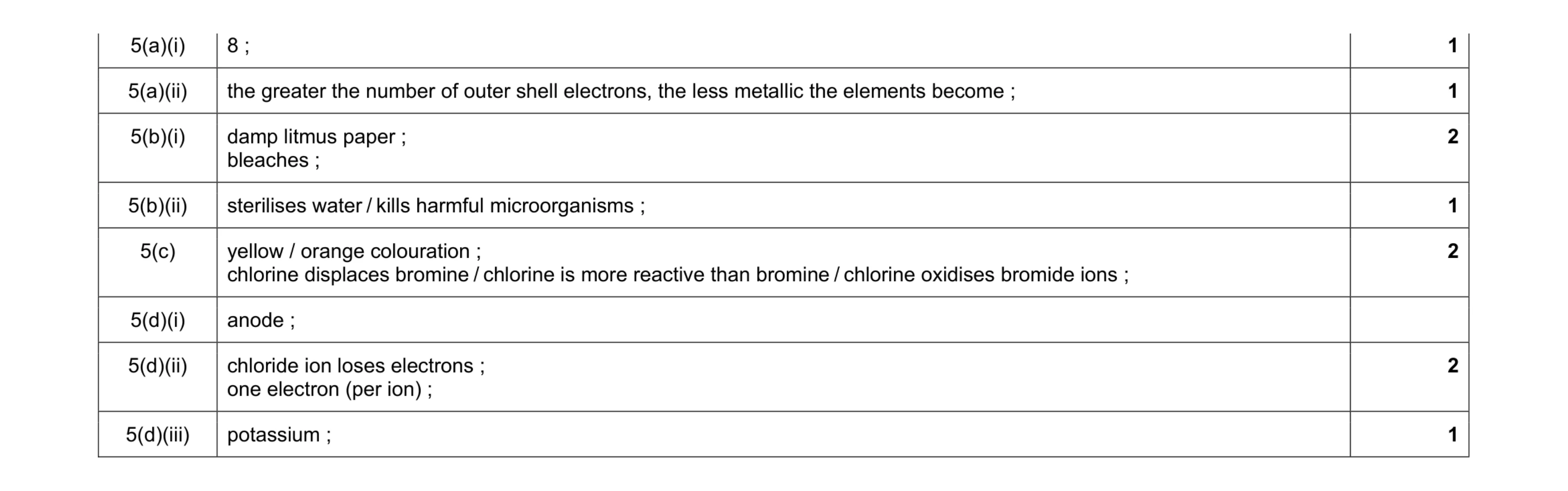 11
11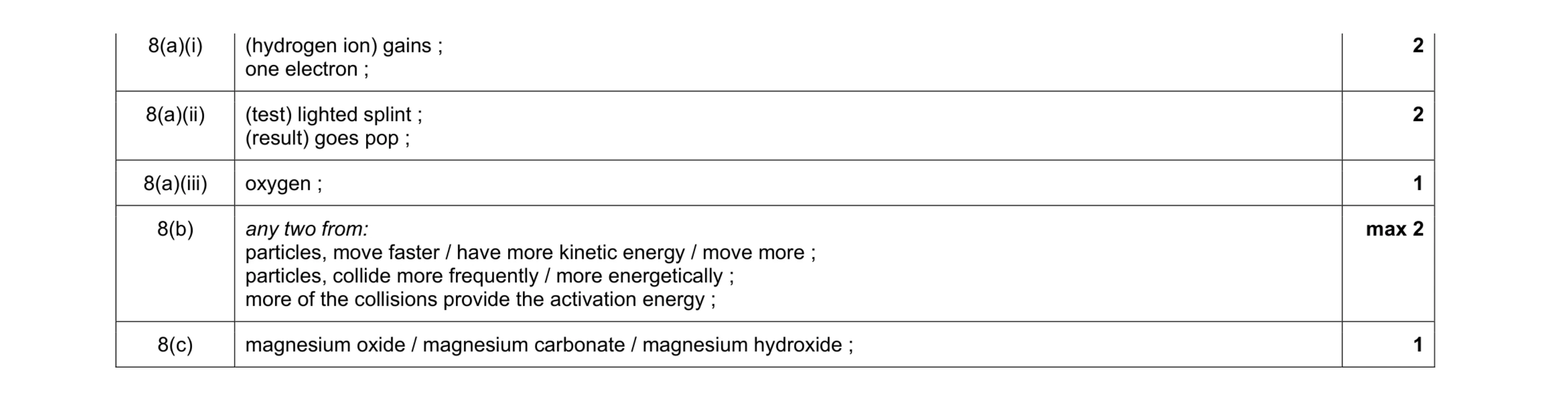 8
8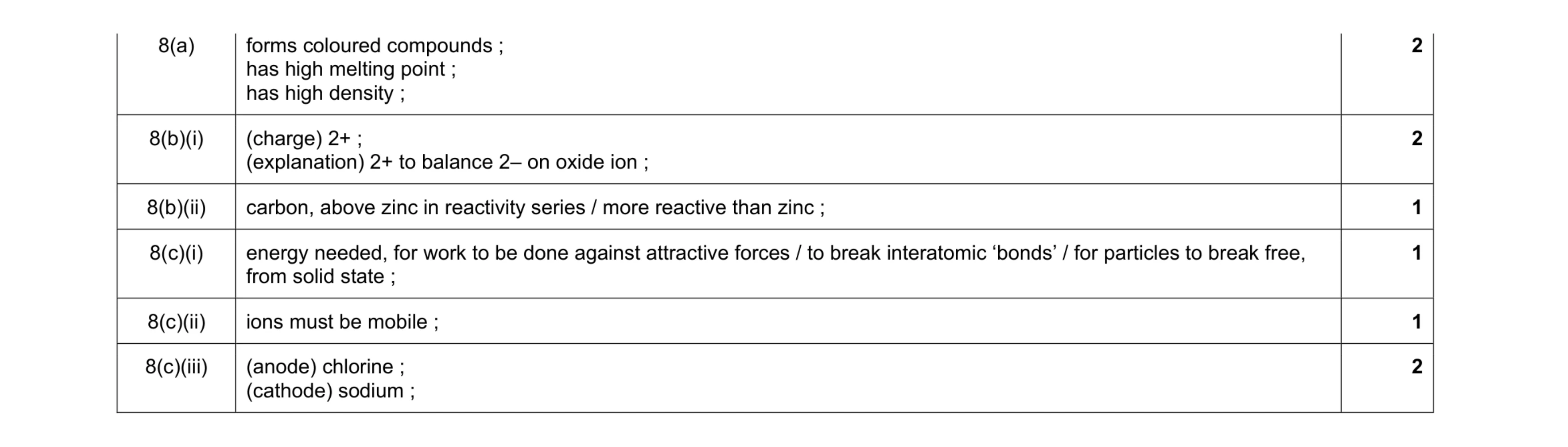 9
9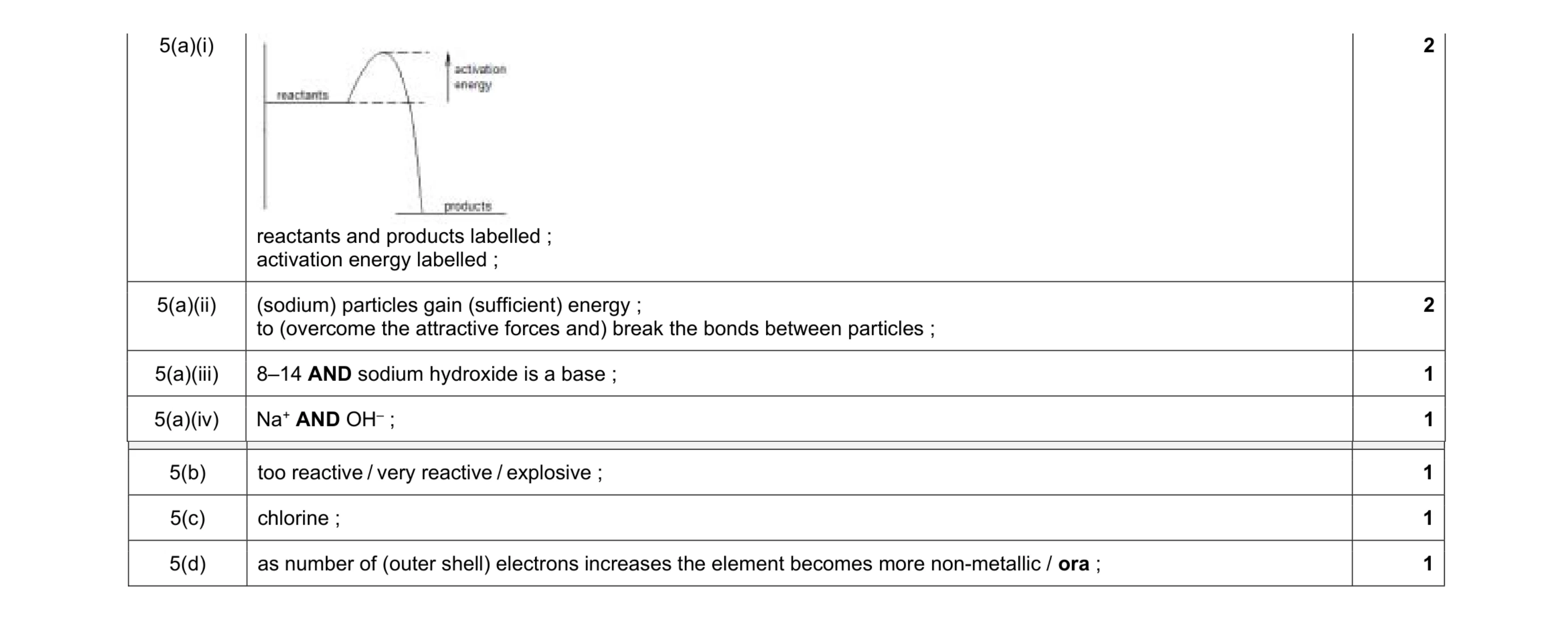 9
9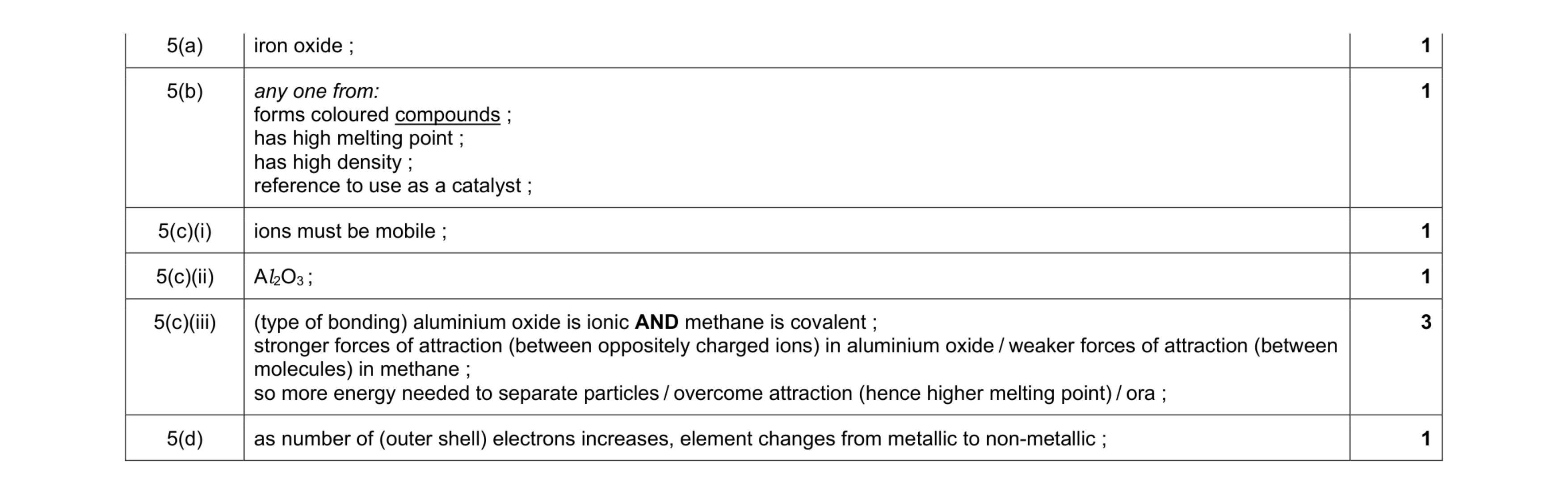 8
8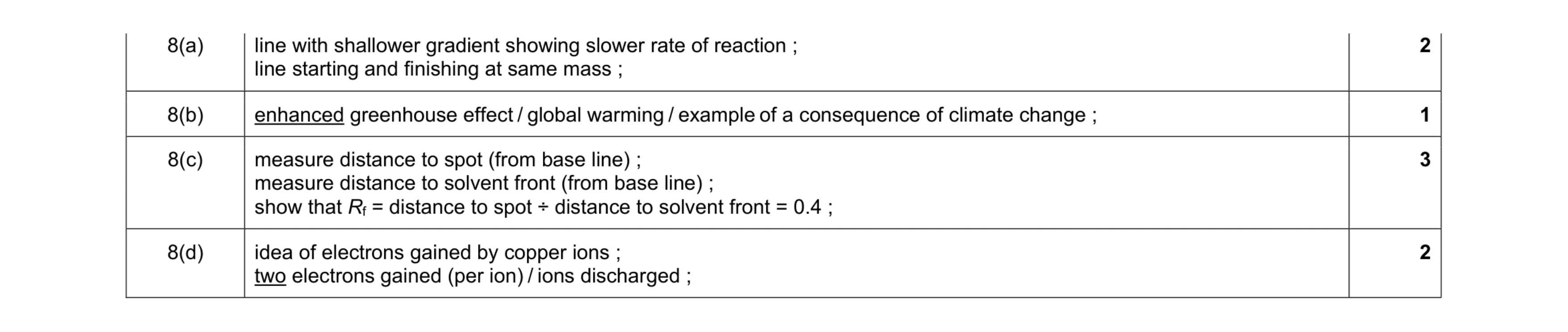 8
8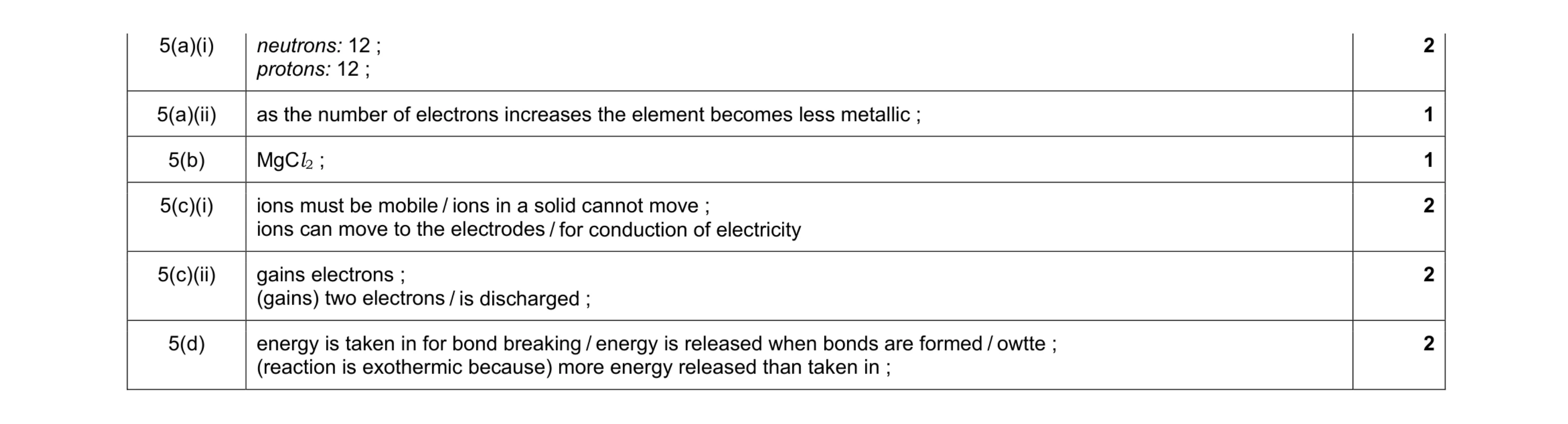 10
10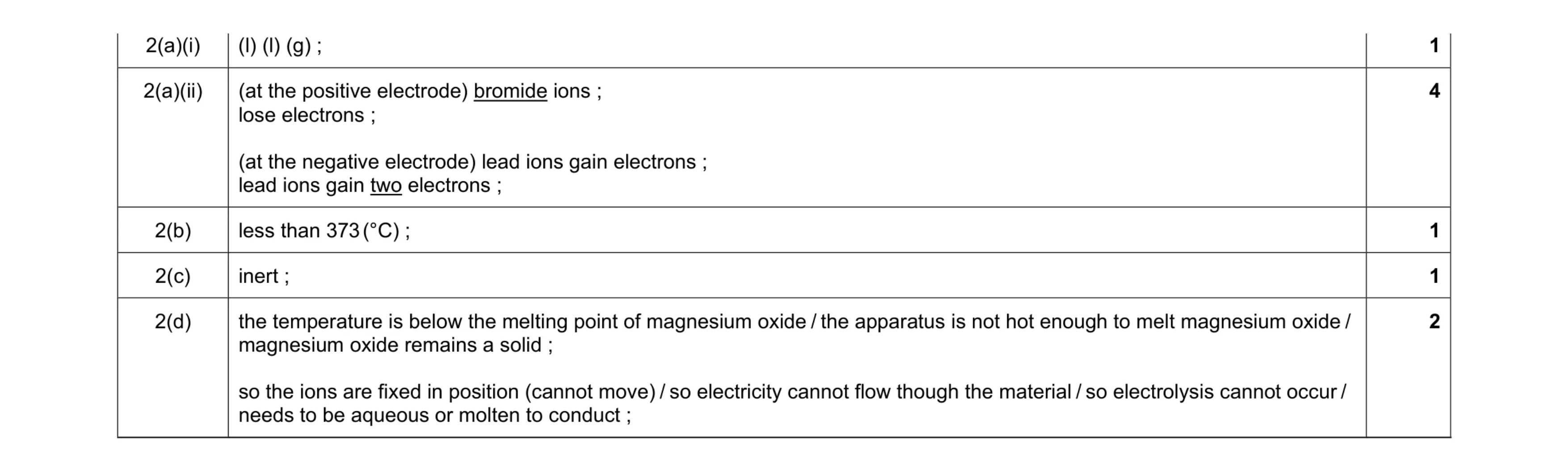 9
9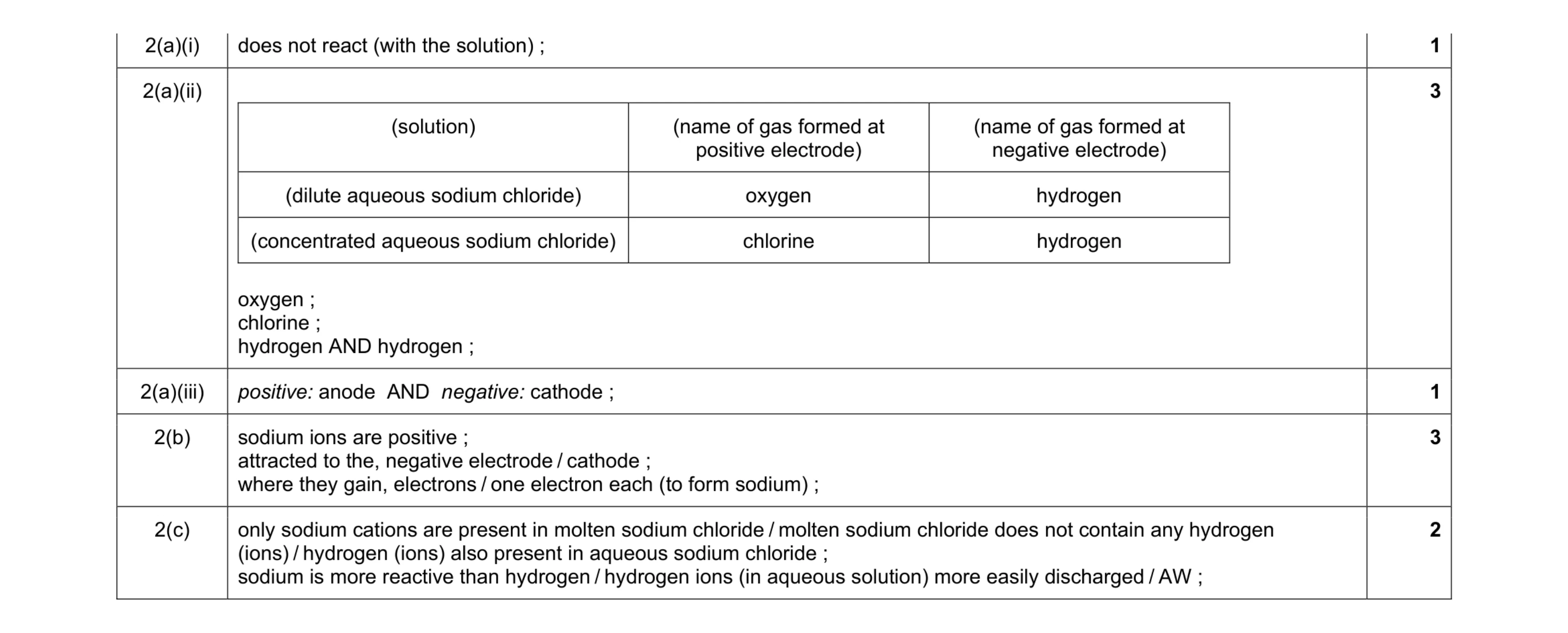 10
10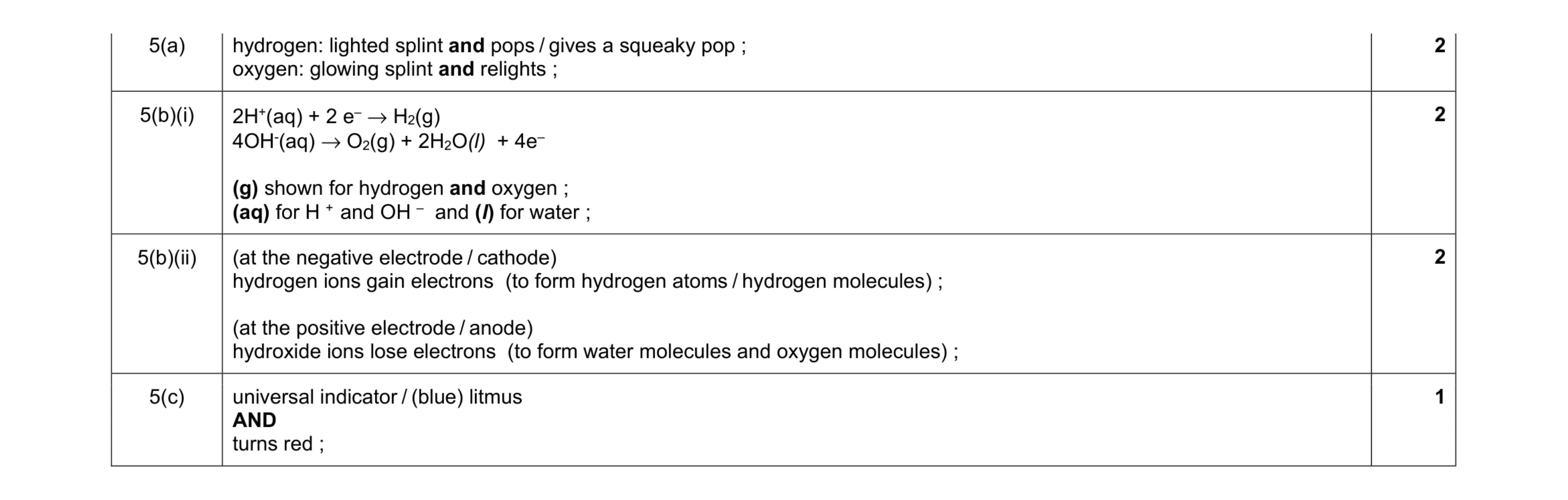 7
7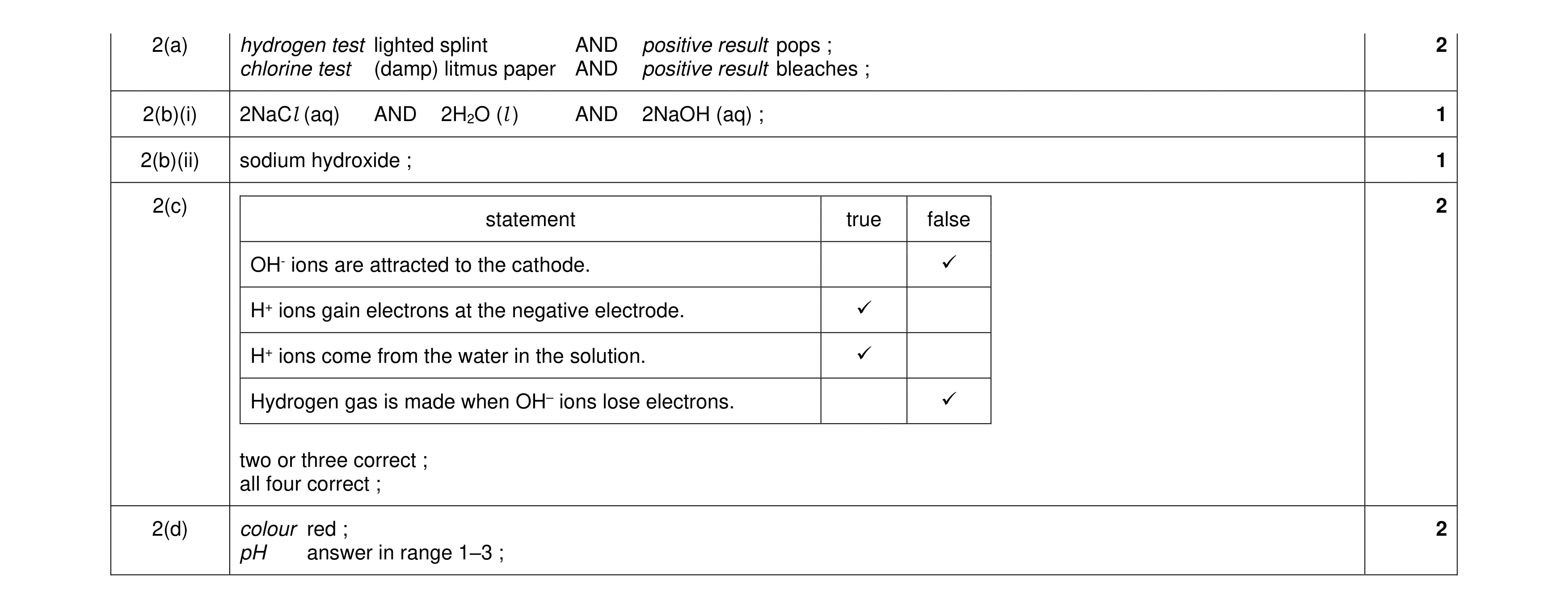 8
8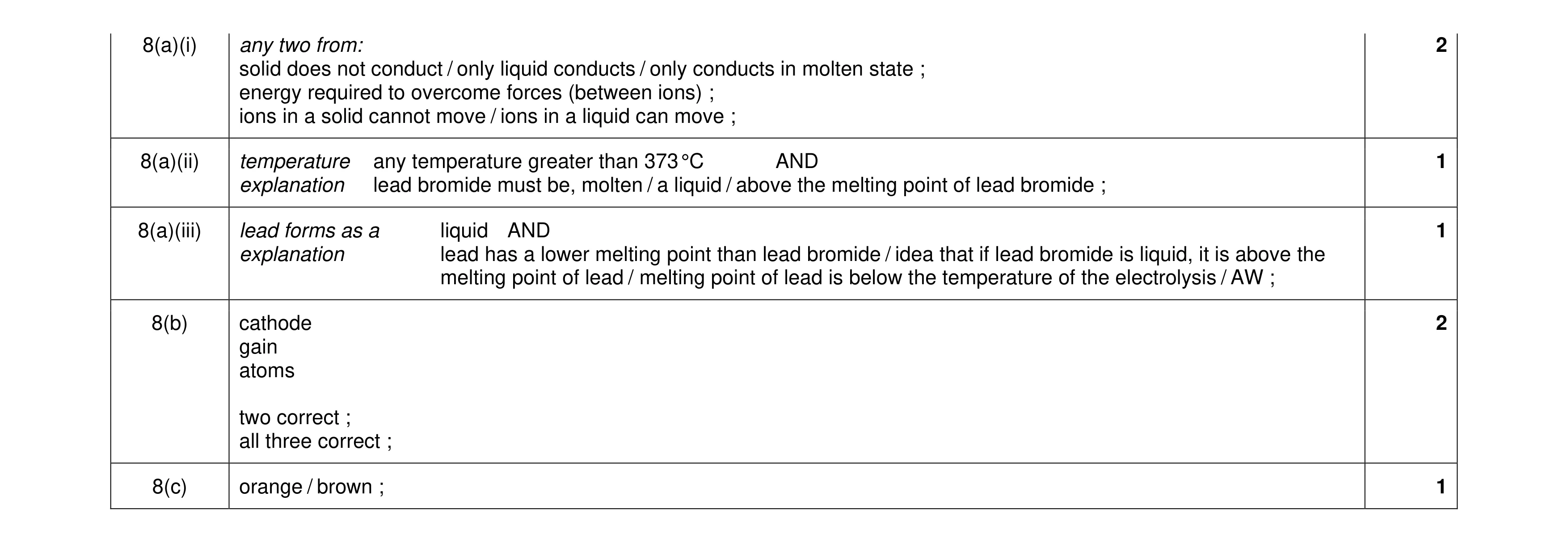 7
7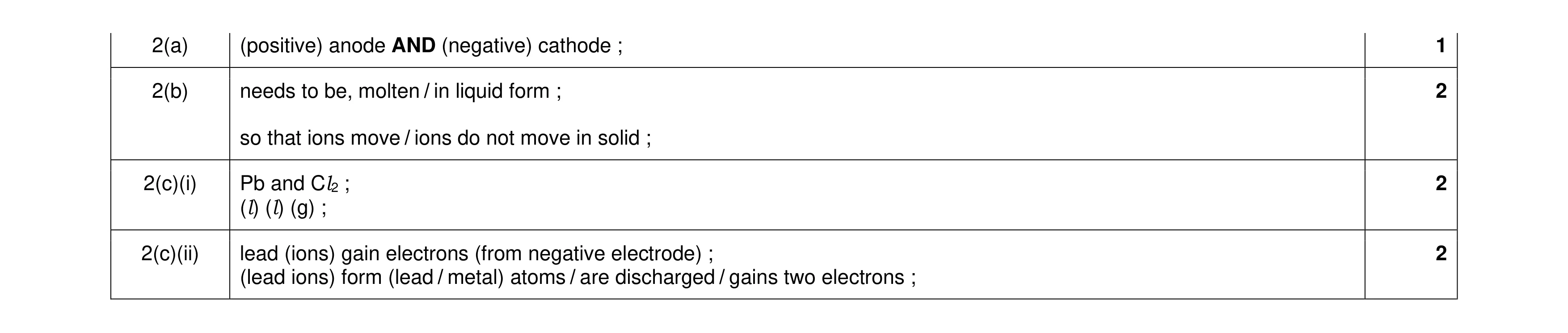 7
7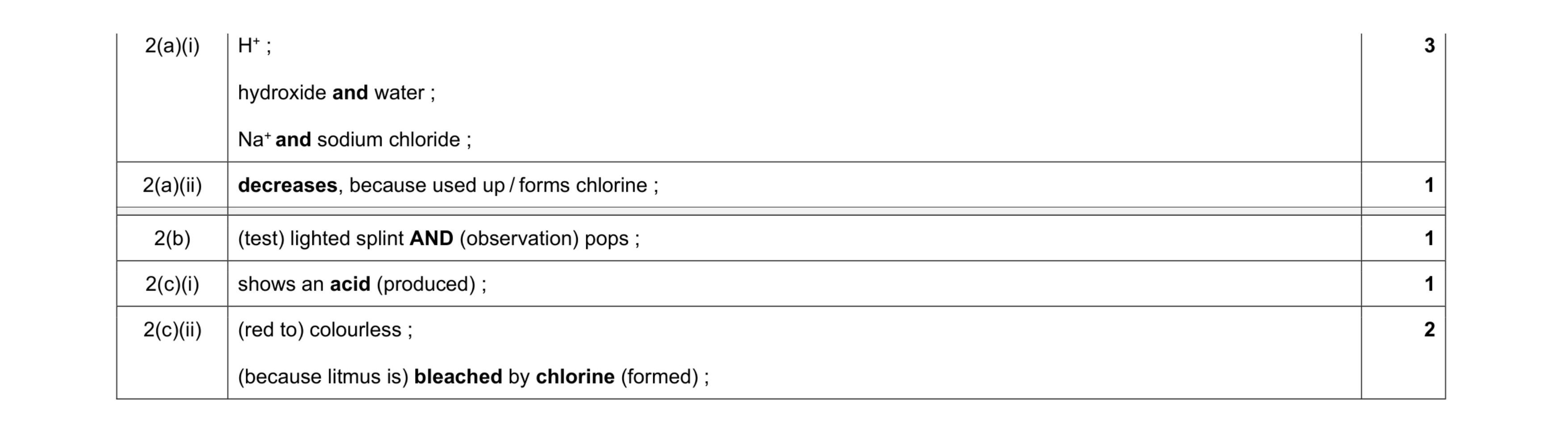 8
8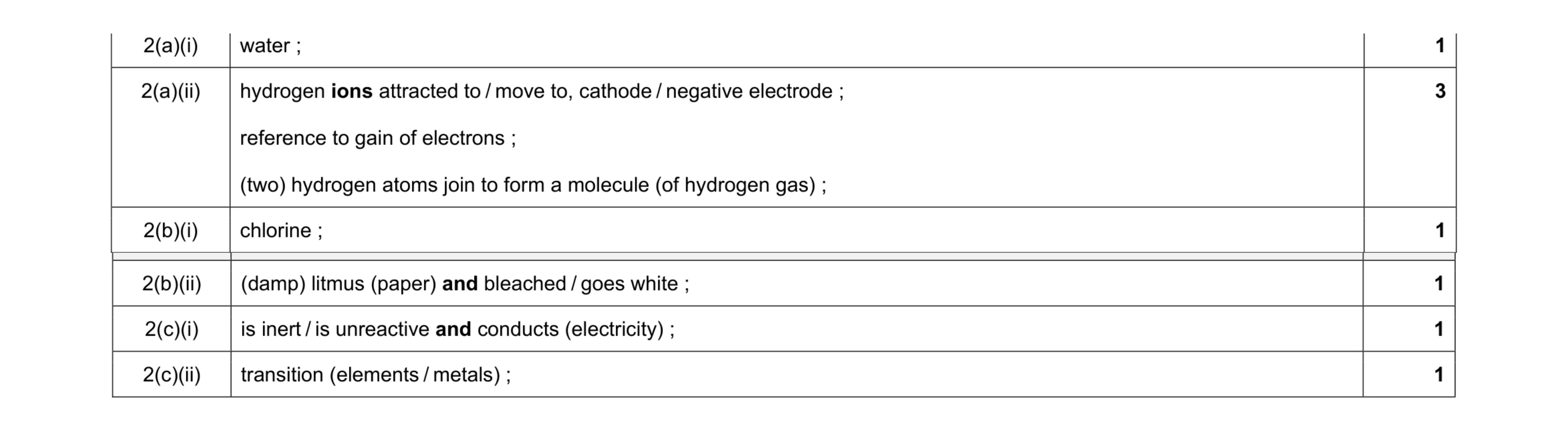 8
8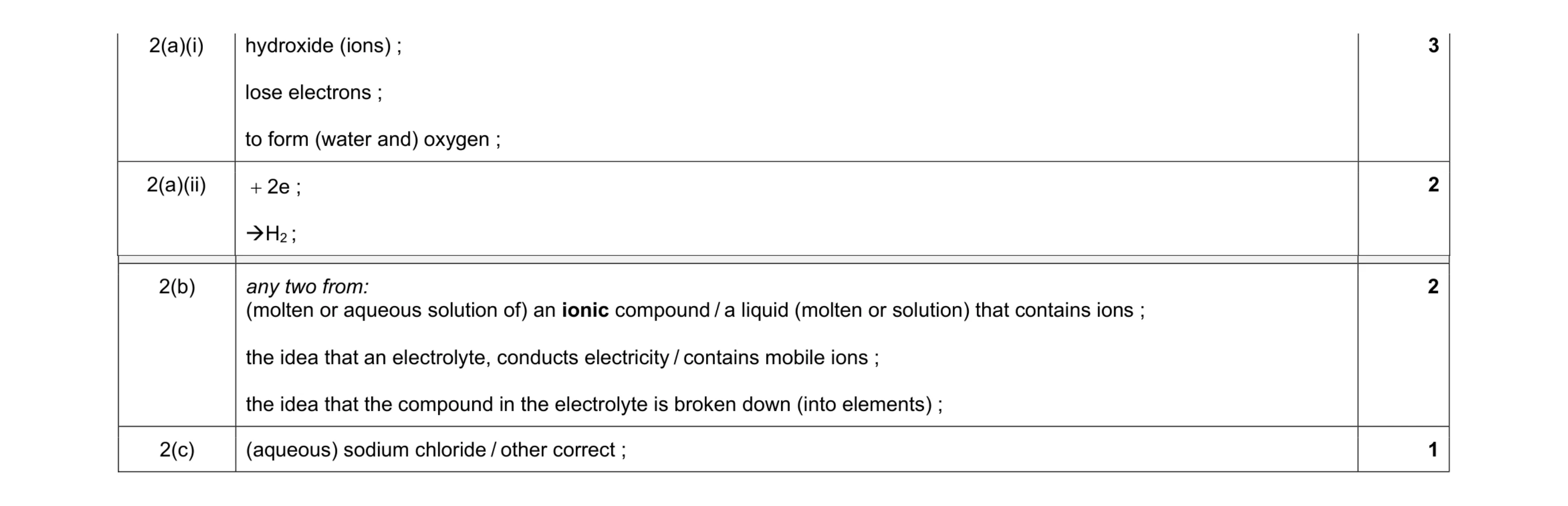 8
8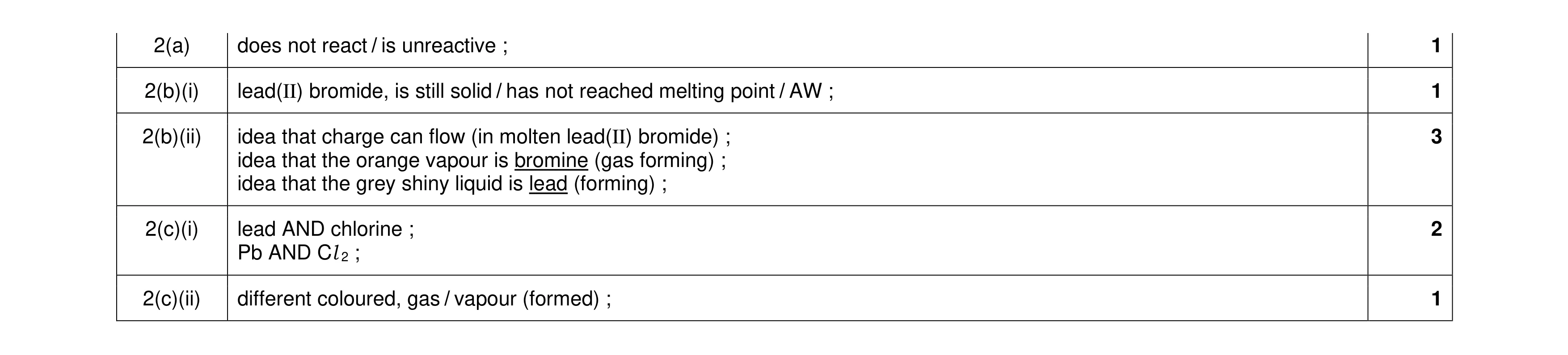 8
8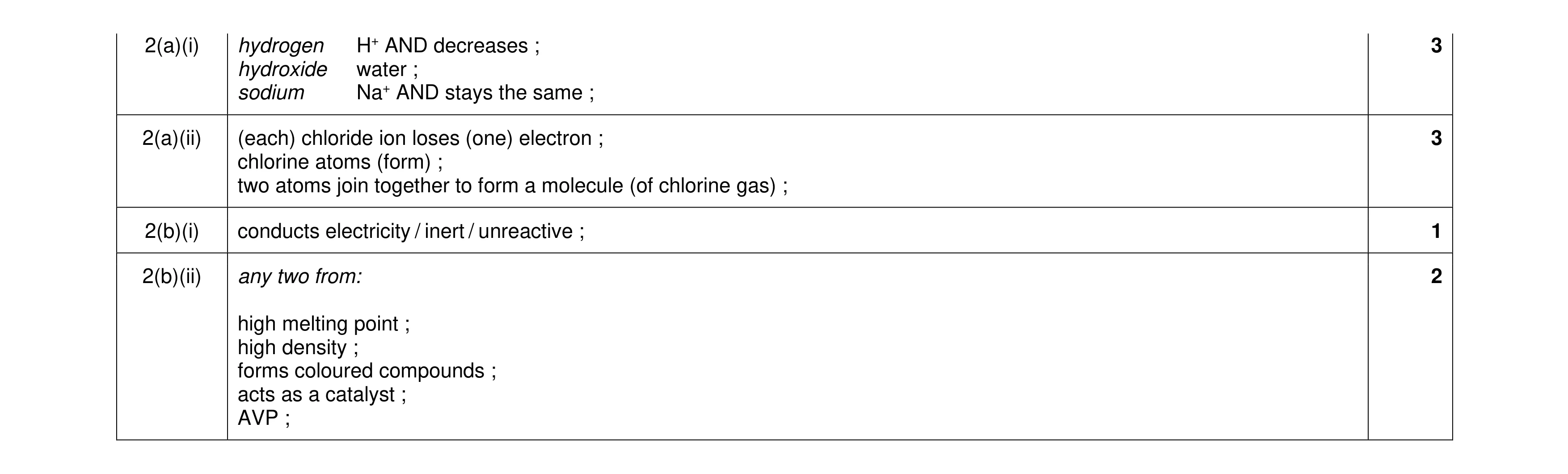 9
9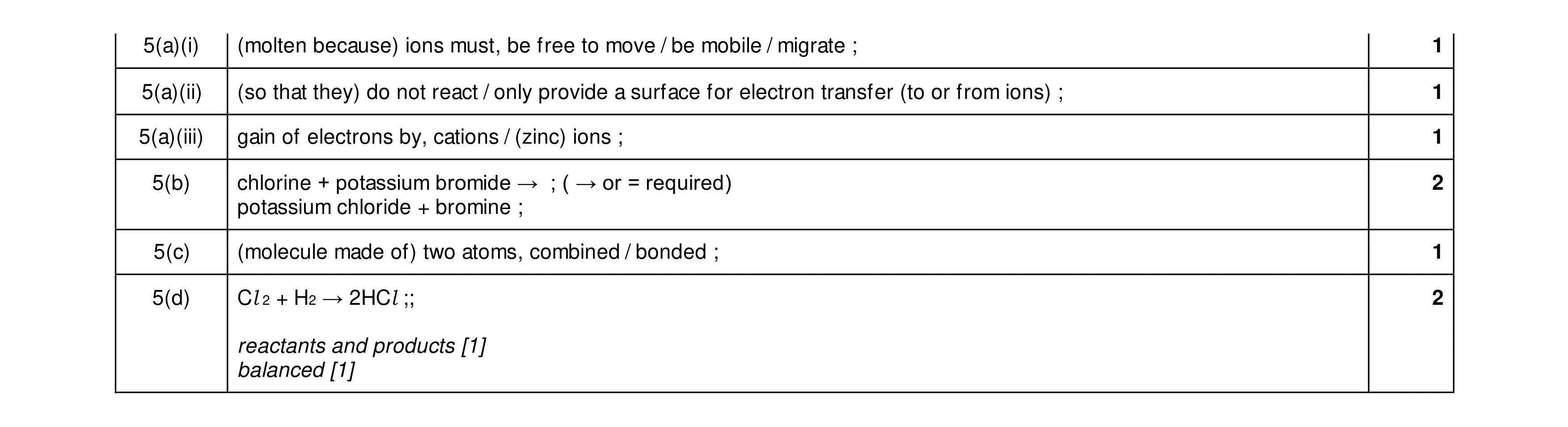 8
8 7
7 7
7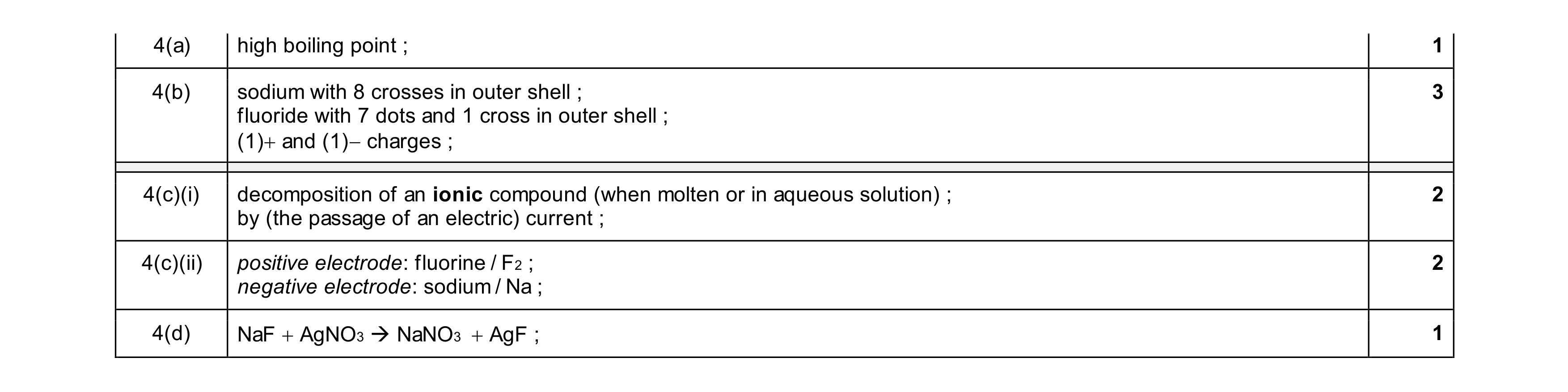 9
9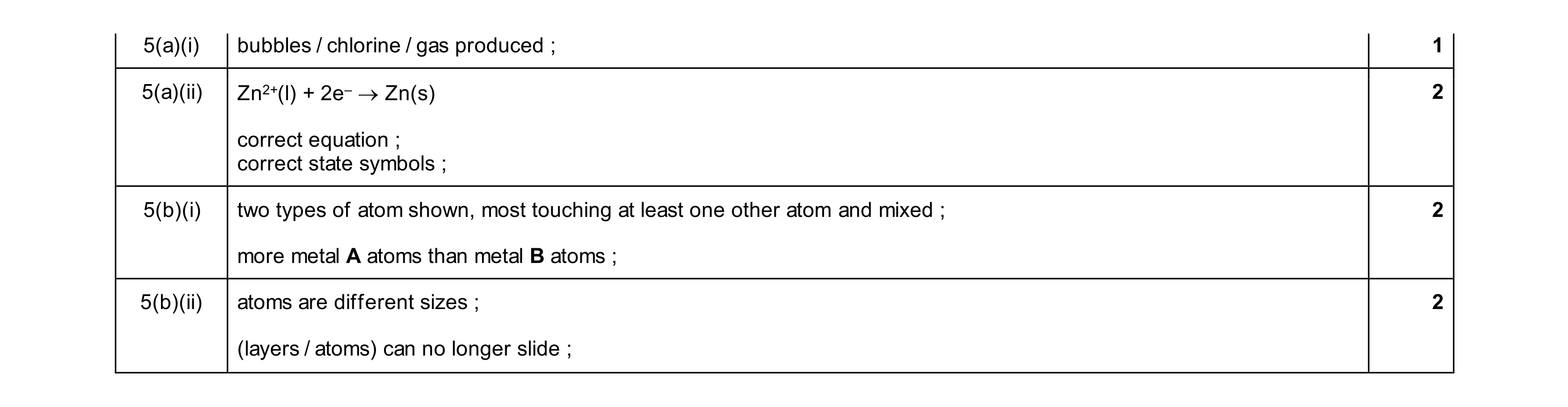 7
7