Cambridge IGCSE Science - Combined 0653 — 2017 Oct/Nov Paper 1 · Variant 2
0653/12/O/N/17 · 40 questions · 40 marks · ≈45 min
The question paper and its mark scheme, free to read here and free to download. This is Cambridge’s own paper, exactly as it was sat.
Question paper16 pages
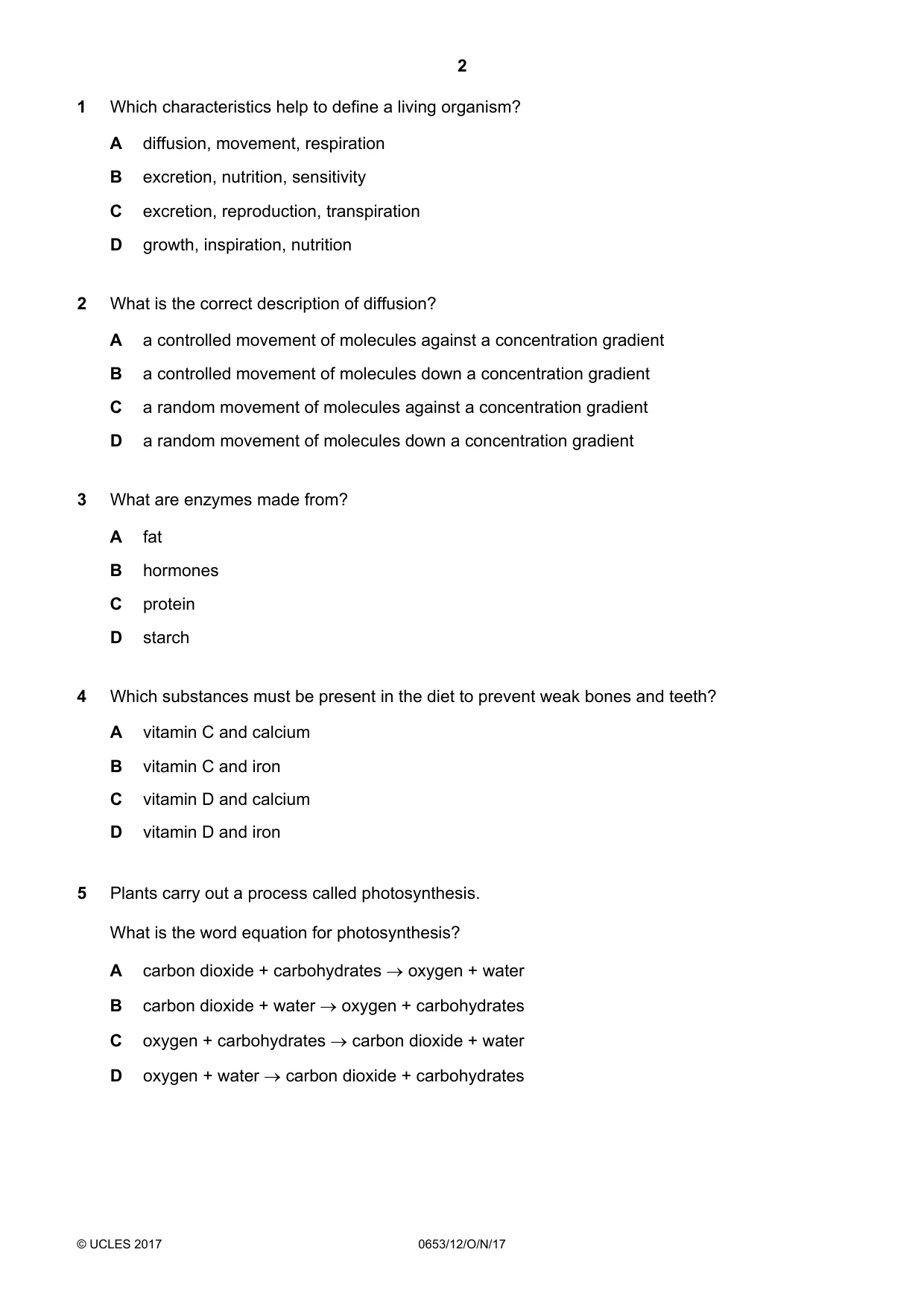
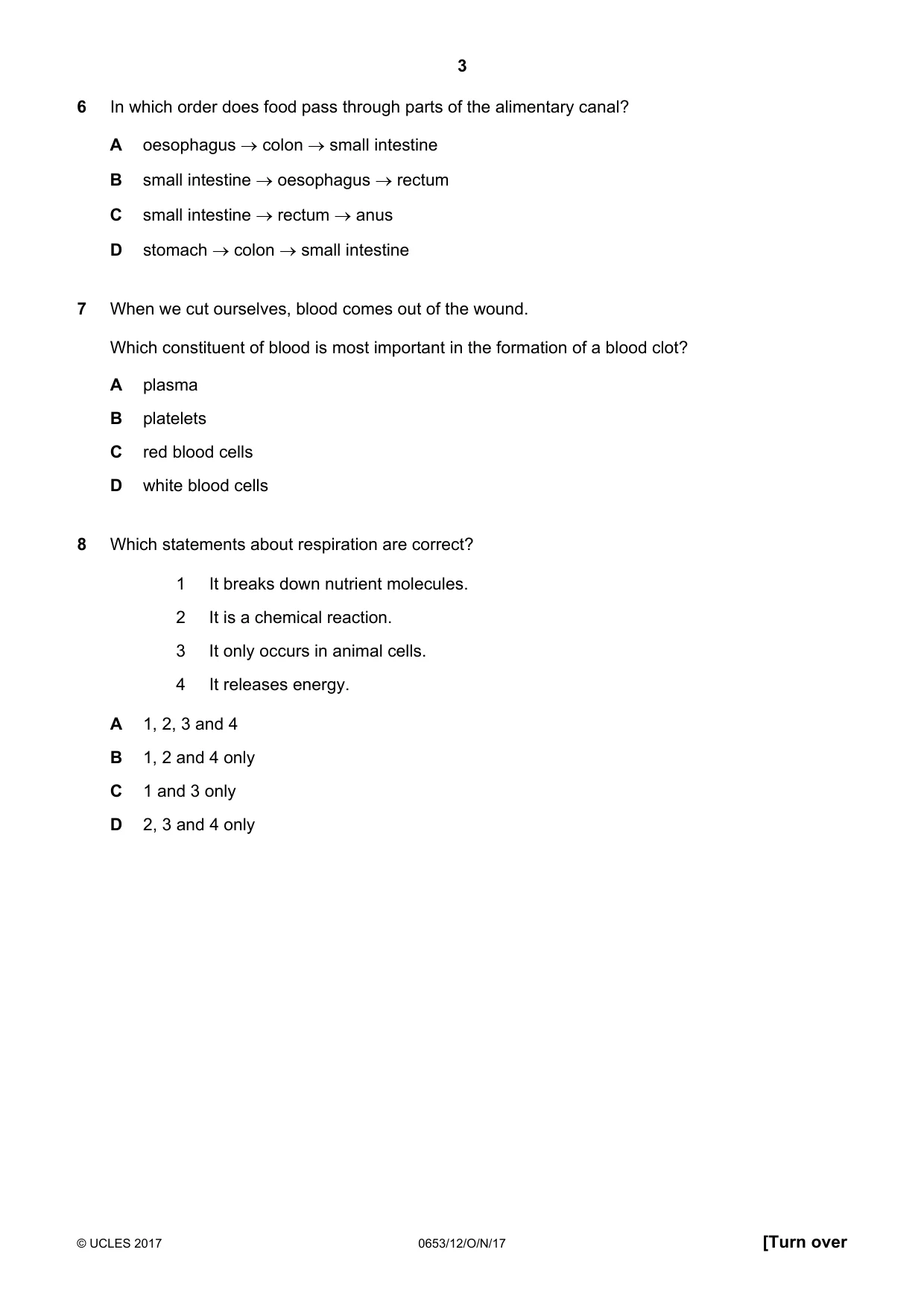
Mark scheme3 pages
Answers below. Sit the paper first if you are practising.
Questions as text
Q1 · Which characteristics help to define a living organism?
1 Which characteristics help to define a living organism? A diffusion, movement, respiration B excretion, nutrition, sensitivity C excretion, reproduction, transpiration D growth, inspiration, nutrition
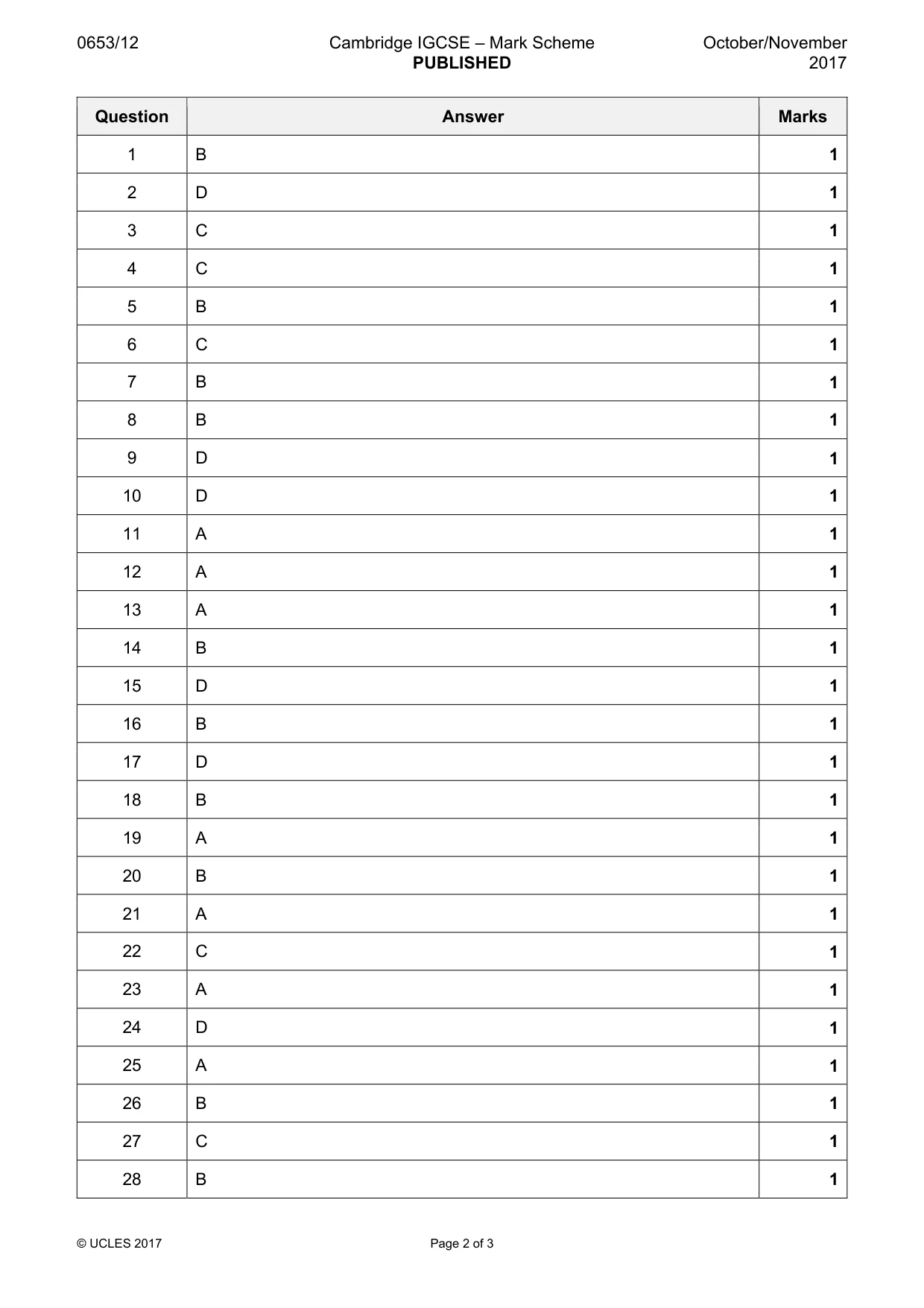
Mark scheme: B
Q2 · What is the correct description of diffusion?
2 What is the correct description of diffusion? A a controlled movement of molecules against a concentration gradient B a controlled movement of molecules down a concentration gradient C a random movement of molecules against a concentration gradient D a random movement of molecules down a concentration gradient
Mark scheme: D
Q3 · What are enzymes made from?
3 What are enzymes made from? A fat B hormones C protein D starch
Mark scheme: C
Q4 · Which substances must be present in the diet to prevent weak bones and teeth?
4 Which substances must be present in the diet to prevent weak bones and teeth? A vitamin C and calcium B vitamin C and iron C vitamin D and calcium D vitamin D and iron
Mark scheme: C
Q5 · Plants carry out a process called photosynthesis
5 Plants carry out a process called photosynthesis. What is the word equation for photosynthesis? A carbon dioxide + carbohydrates → oxygen + water B carbon dioxide + water → oxygen + carbohydrates C oxygen + carbohydrates → carbon dioxide + water D oxygen + water → carbon dioxide + carbohydrates
Mark scheme: B
Q6 · In which order does food pass through parts of the alimentary canal?
6 In which order does food pass through parts of the alimentary canal? A oesophagus → colon → small intestine B small intestine → oesophagus → rectum C small intestine → rectum → anus D stomach → colon → small intestine
Mark scheme: C
Q7 · When we cut ourselves, blood comes out of the wound
7 When we cut ourselves, blood comes out of the wound. Which constituent of blood is most important in the formation of a blood clot? A plasma B platelets C red blood cells D white blood cells
Mark scheme: B
Q8 · Which statements about respiration are correct?
8 Which statements about respiration are correct? 1 It breaks down nutrient molecules. 2 It is a chemical reaction. 3 It only occurs in animal cells. 4 It releases energy. A 1, 2, 3 and 4 B 1, 2 and 4 only C 1 and 3 only D 2, 3 and 4 only
Mark scheme: B
Q9 · The depth and rate of breathing can be measured by a spirometer, and recorded in the form…
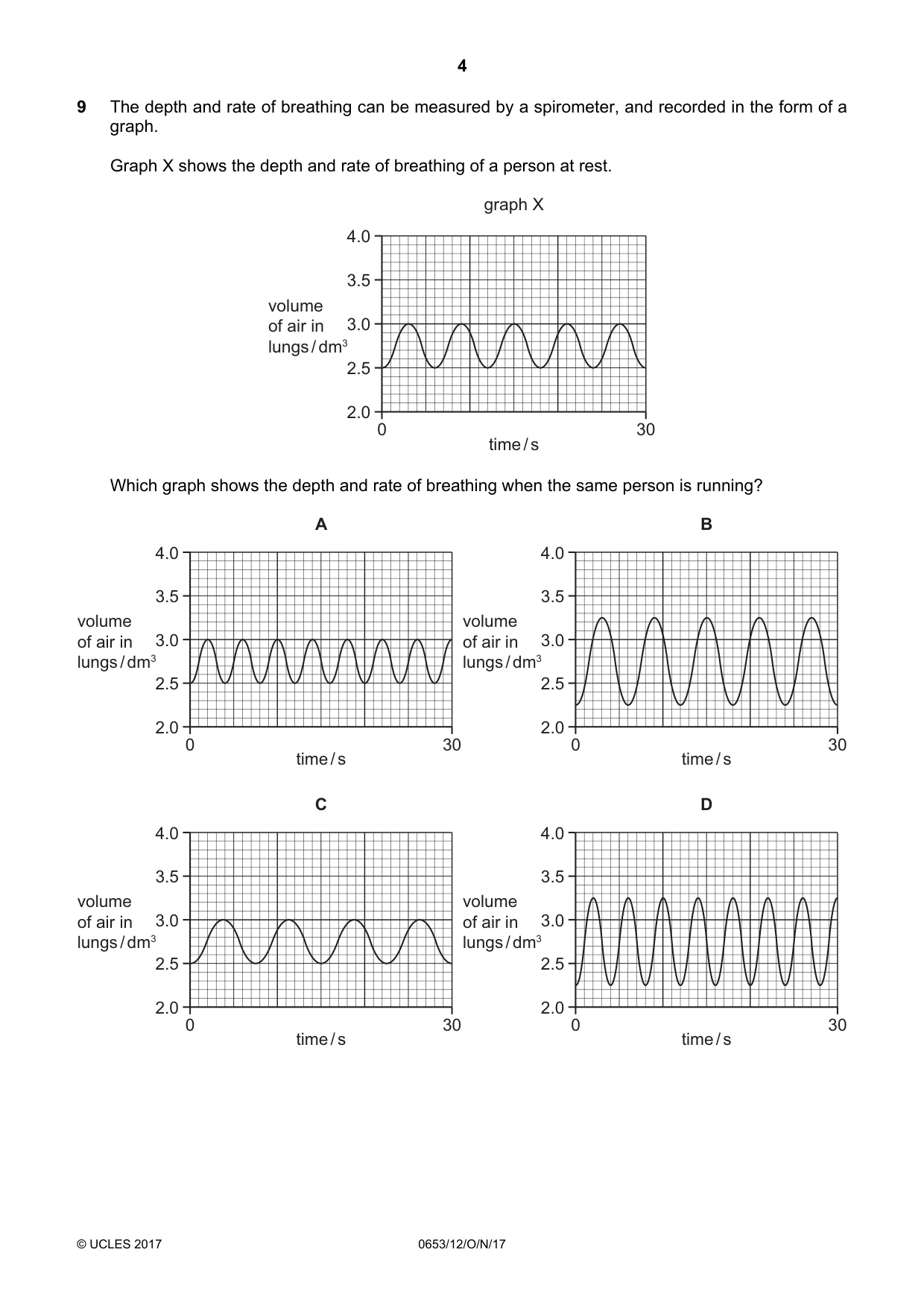
9 The depth and rate of breathing can be measured by a spirometer, and recorded in the form of a graph. Graph X shows the depth and rate of breathing of a person at rest. graph X 4.0 3.5 volume of air in 3.0 lungs / dm3 2.5 2.0 0 30 time / s Which graph shows the depth and rate of breathing when the same person is running? A B 4.0 4.0 3.5 3.5 volume volume of air in 3.0 of air in 3.0 lungs / dm3 lungs / dm3 2.5 2.5 2.0 2.0 0 30 0 30 time / s time / s C D 4.0 4.0 3.5 3.5 volume volume of air in 3.0 of air in 3.0 lungs / dm3 lungs / dm3 2.5 2.5 2.0 2.0 0 30 0 30 time / s time / s
Mark scheme: D
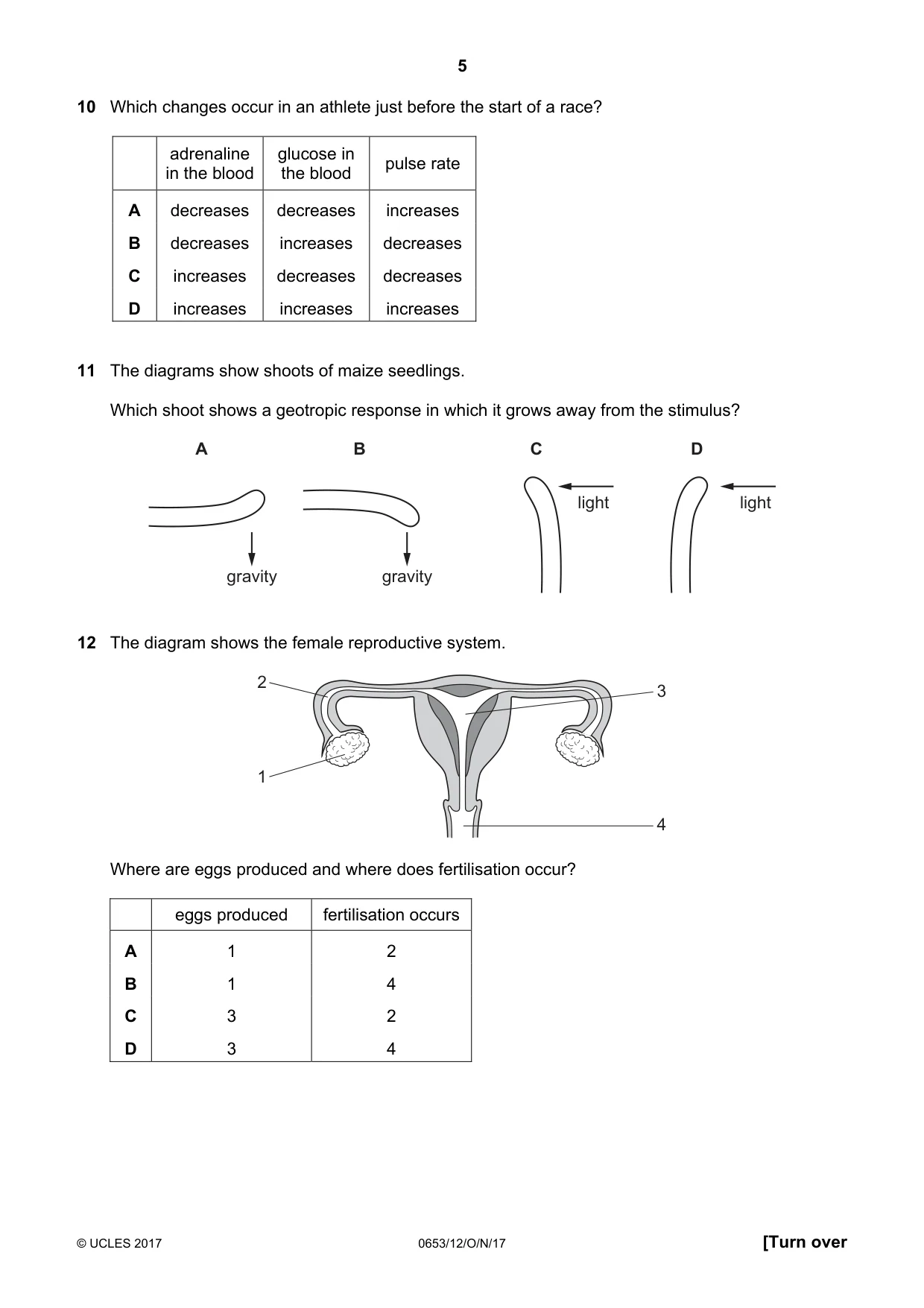
Q10 · Which changes occur in an athlete just before the start of a race?
10 Which changes occur in an athlete just before the start of a race? adrenaline glucose in pulse rate in the blood the blood A decreases decreases increases B decreases increases decreases C increases decreases decreases D increases increases increases
Mark scheme: D
Q11 · The diagrams show shoots of maize seedlings
11 The diagrams show shoots of maize seedlings. Which shoot shows a geotropic response in which it grows away from the stimulus? A B C D light light gravity gravity
Mark scheme: A
Q12 · The diagram shows the female reproductive system
12 The diagram shows the female reproductive system. 2 3 1 4 Where are eggs produced and where does fertilisation occur? eggs produced fertilisation occurs A 1 2 B 1 4 C 3 2 D 3 4
Mark scheme: A
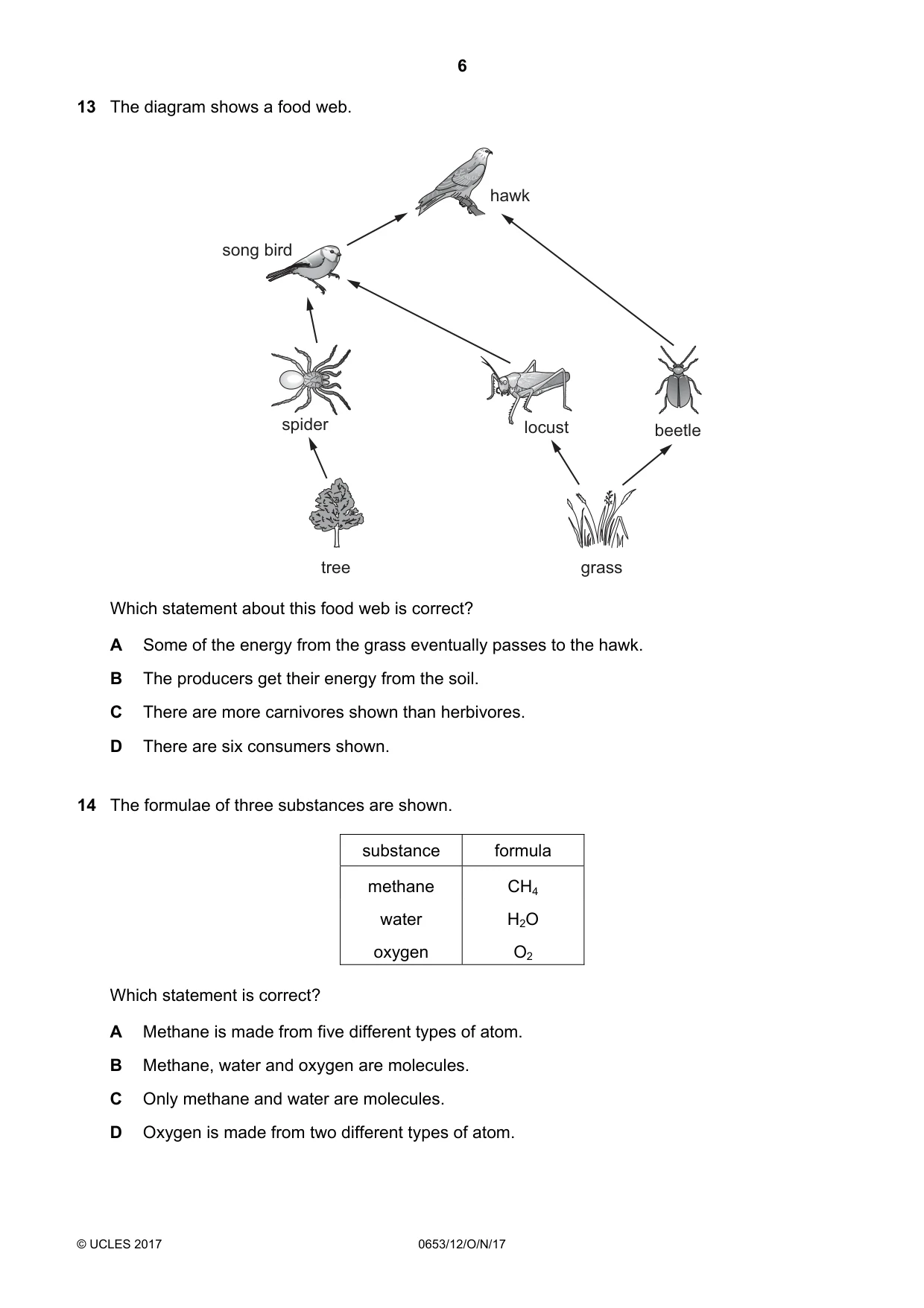
Q13 · The diagram shows a food web
13 The diagram shows a food web. hawk song bird spider locust beetle tree grass Which statement about this food web is correct? A Some of the energy from the grass eventually passes to the hawk. B The producers get their energy from the soil. C There are more carnivores shown than herbivores. D There are six consumers shown.
Mark scheme: A
Q14 · The formulae of three substances are shown
14 The formulae of three substances are shown. substance formula methane CH4 water H2O oxygen O2 Which statement is correct? A Methane is made from five different types of atom. B Methane, water and oxygen are molecules. C Only methane and water are molecules. D Oxygen is made from two different types of atom.
Mark scheme: B
Q15 · What is the correct sequence that takes place during fractional distillation?
15 What is the correct sequence that takes place during fractional distillation? A evaporate → condense → collect → heat B evaporate → condense → heat → collect C heat → condense → collect → evaporate D heat → evaporate → condense → collect
Mark scheme: D
Q16 · What is a physical change?
16 What is a physical change? A carbon dioxide turning limewater milky B the crystallisation of copper sulfate from solution C the electrolysis of molten lead(II) bromide D the thermal decomposition of calcium carbonate
Mark scheme: B
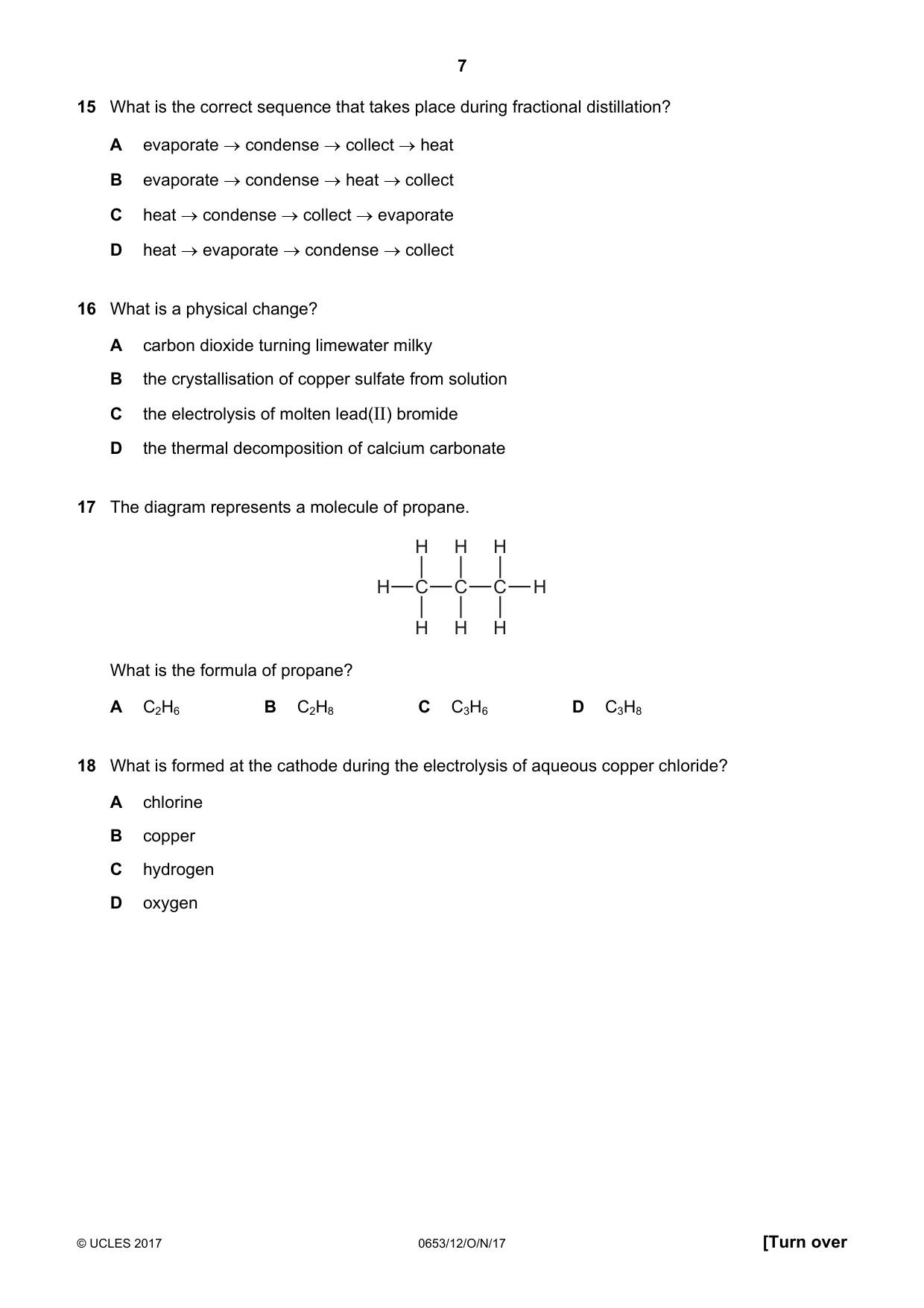
Q17 · The diagram represents a molecule of propane
17 The diagram represents a molecule of propane. H H H H C C C H H H H What is the formula of propane? A C2H6 B C2H8 C C3H6 D C3H8
Mark scheme: D
Q18 · What is formed at the cathode during the electrolysis of aqueous copper chloride?
18 What is formed at the cathode during the electrolysis of aqueous copper chloride? A chlorine B copper C hydrogen D oxygen
Mark scheme: B
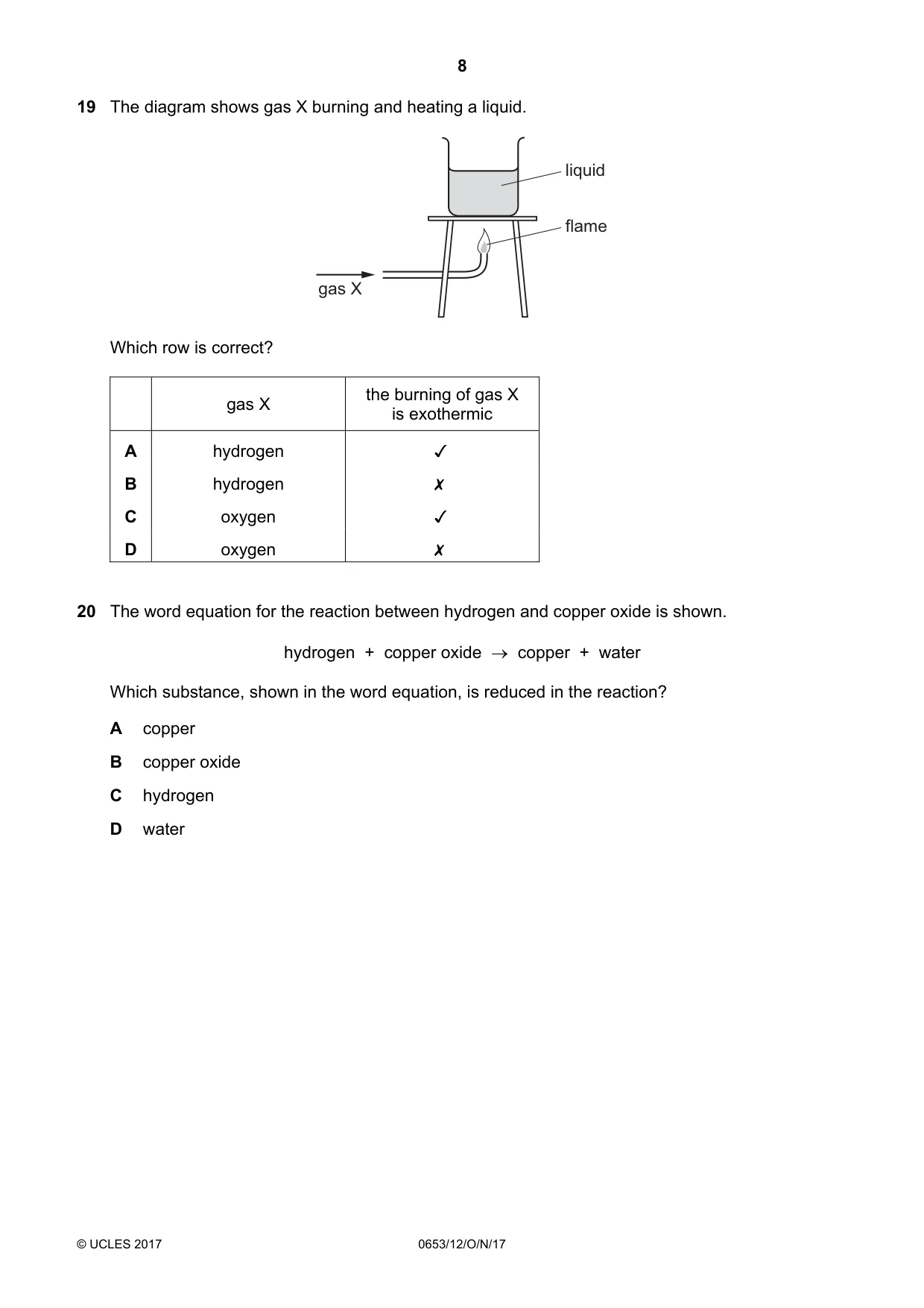
Q19 · The diagram shows gas X burning and heating a liquid
19 The diagram shows gas X burning and heating a liquid. Which row is correct? gas X 0 Oo WwW > gas X hydrogen hydrogen oxygen oxygen the burning of gas X is exothermic x < x liquid flame
Mark scheme: A
Q20 · The word equation for the reaction between hydrogen and copper oxide is shown
20 The word equation for the reaction between hydrogen and copper oxide is shown. hydrogen + copper oxide → copper + water Which substance, shown in the word equation, is reduced in the reaction? A copper B copper oxide C hydrogen D water
Mark scheme: B
Q21 · Lithium is added to water containing Universal Indicator
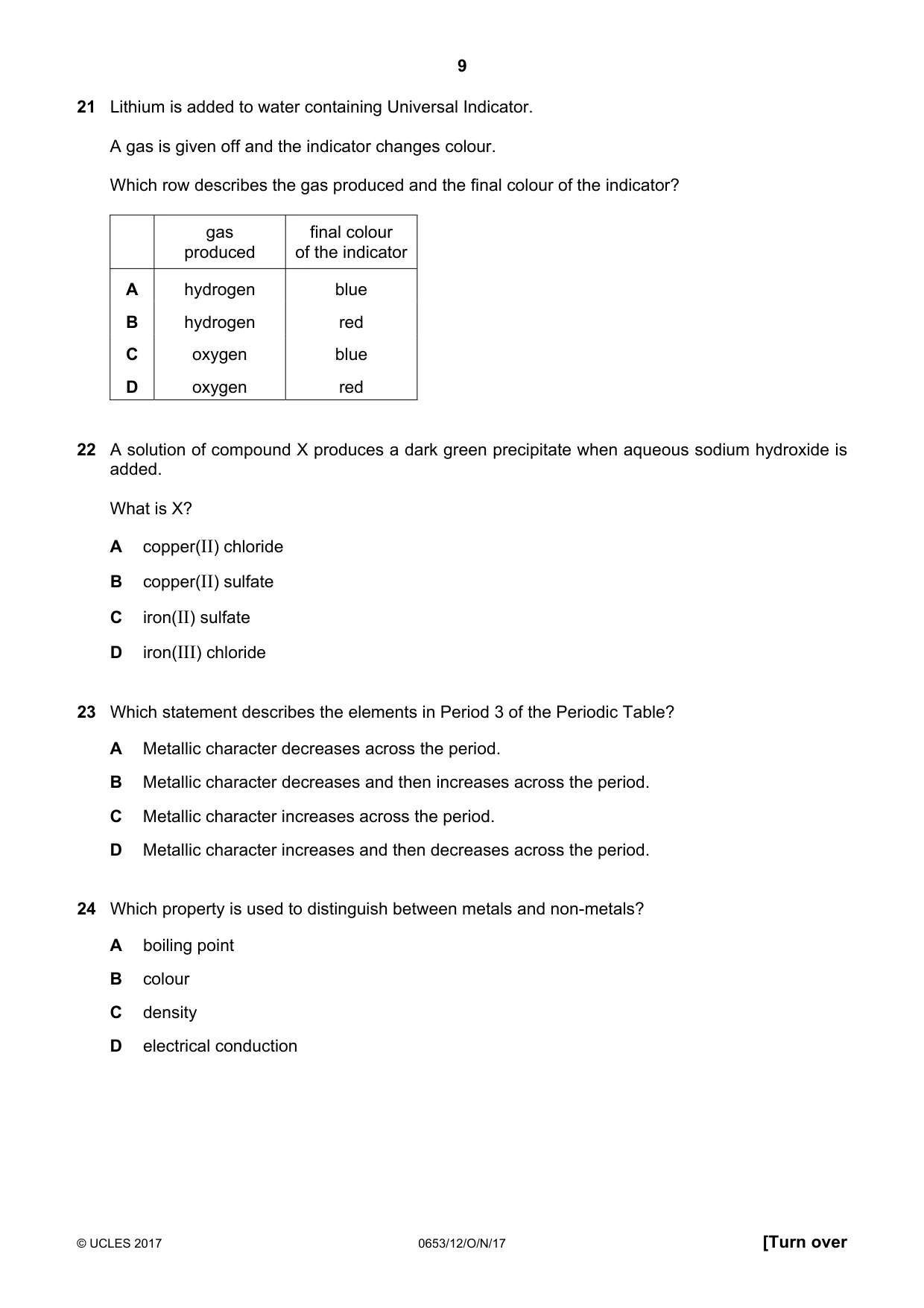
21 Lithium is added to water containing Universal Indicator. A gas is given off and the indicator changes colour. Which row describes the gas produced and the final colour of the indicator? gas final colour produced of the indicator A hydrogen blue B hydrogen red C oxygen blue D oxygen red
Mark scheme: A
Q22 · A solution of compound X produces a dark green precipitate when aqueous sodium hydroxide…
22 A solution of compound X produces a dark green precipitate when aqueous sodium hydroxide is added. What is X? A copper(II) chloride B copper(II) sulfate C iron(II) sulfate D iron(III) chloride
Mark scheme: C
Q23 · Which statement describes the elements in Period 3 of the Periodic Table?
23 Which statement describes the elements in Period 3 of the Periodic Table? A Metallic character decreases across the period. B Metallic character decreases and then increases across the period. C Metallic character increases across the period. D Metallic character increases and then decreases across the period.
Mark scheme: A
Q24 · Which property is used to distinguish between metals and non-metals?
24 Which property is used to distinguish between metals and non-metals? A boiling point B colour C density D electrical conduction
Mark scheme: D
Q25 · Platinite is made by melting and mixing iron and nickel
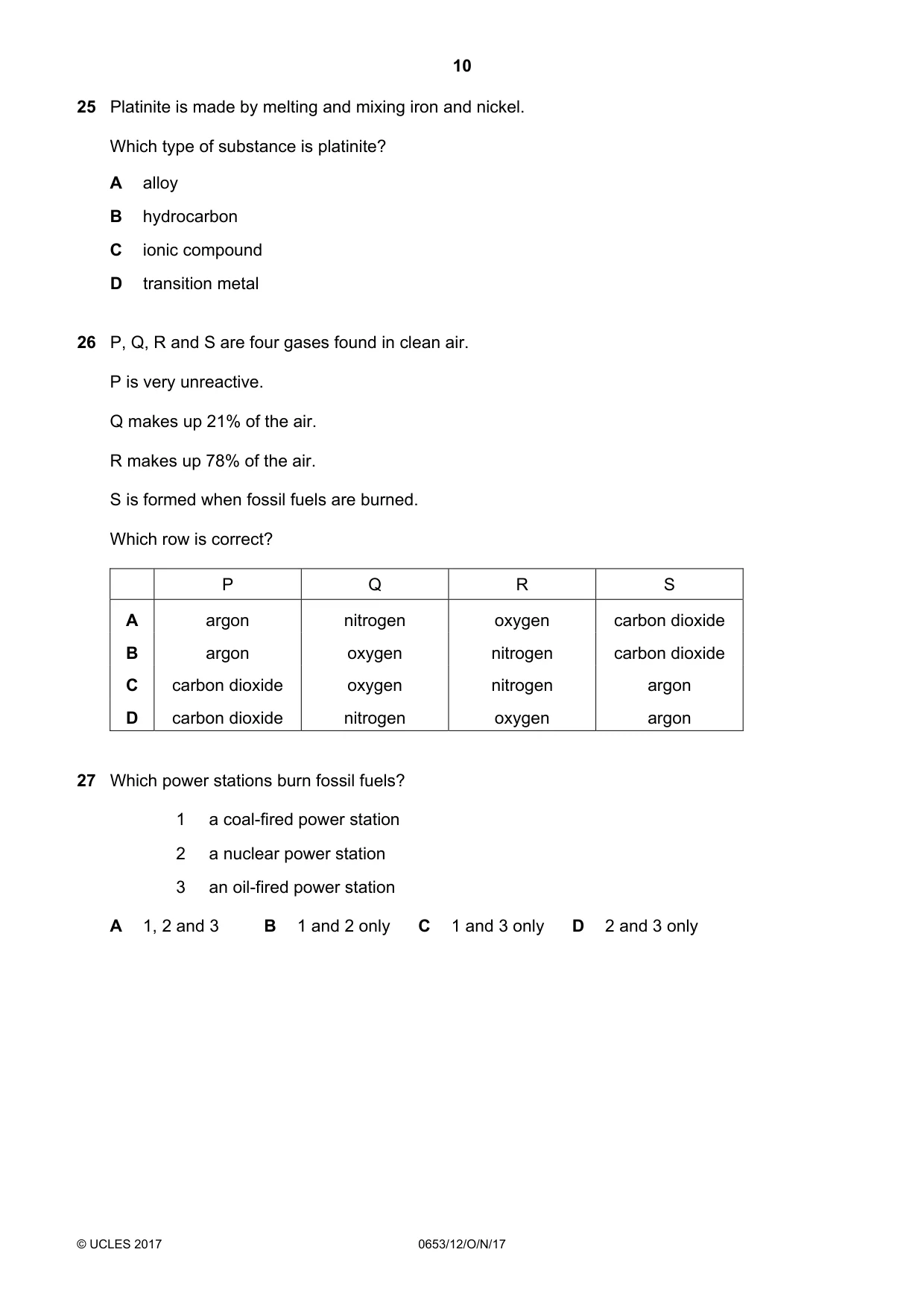
25 Platinite is made by melting and mixing iron and nickel. Which type of substance is platinite? A alloy B hydrocarbon C ionic compound D transition metal
Mark scheme: A
Q26 · P, Q, R and S are four gases found in clean air
26 P, Q, R and S are four gases found in clean air. P is very unreactive. Q makes up 21% of the air. R makes up 78% of the air. S is formed when fossil fuels are burned. Which row is correct? P Q R S A argon nitrogen oxygen carbon dioxide B argon oxygen nitrogen carbon dioxide C carbon dioxide oxygen nitrogen argon D carbon dioxide nitrogen oxygen argon
Mark scheme: B
Q27 · Which power stations burn fossil fuels?
27 Which power stations burn fossil fuels? 1 a coal-fired power station 2 a nuclear power station 3 an oil-fired power station A 1, 2 and 3 B 1 and 2 only C 1 and 3 only D 2 and 3 only
Mark scheme: C
Q28 · A car travels at various speeds during a short journey
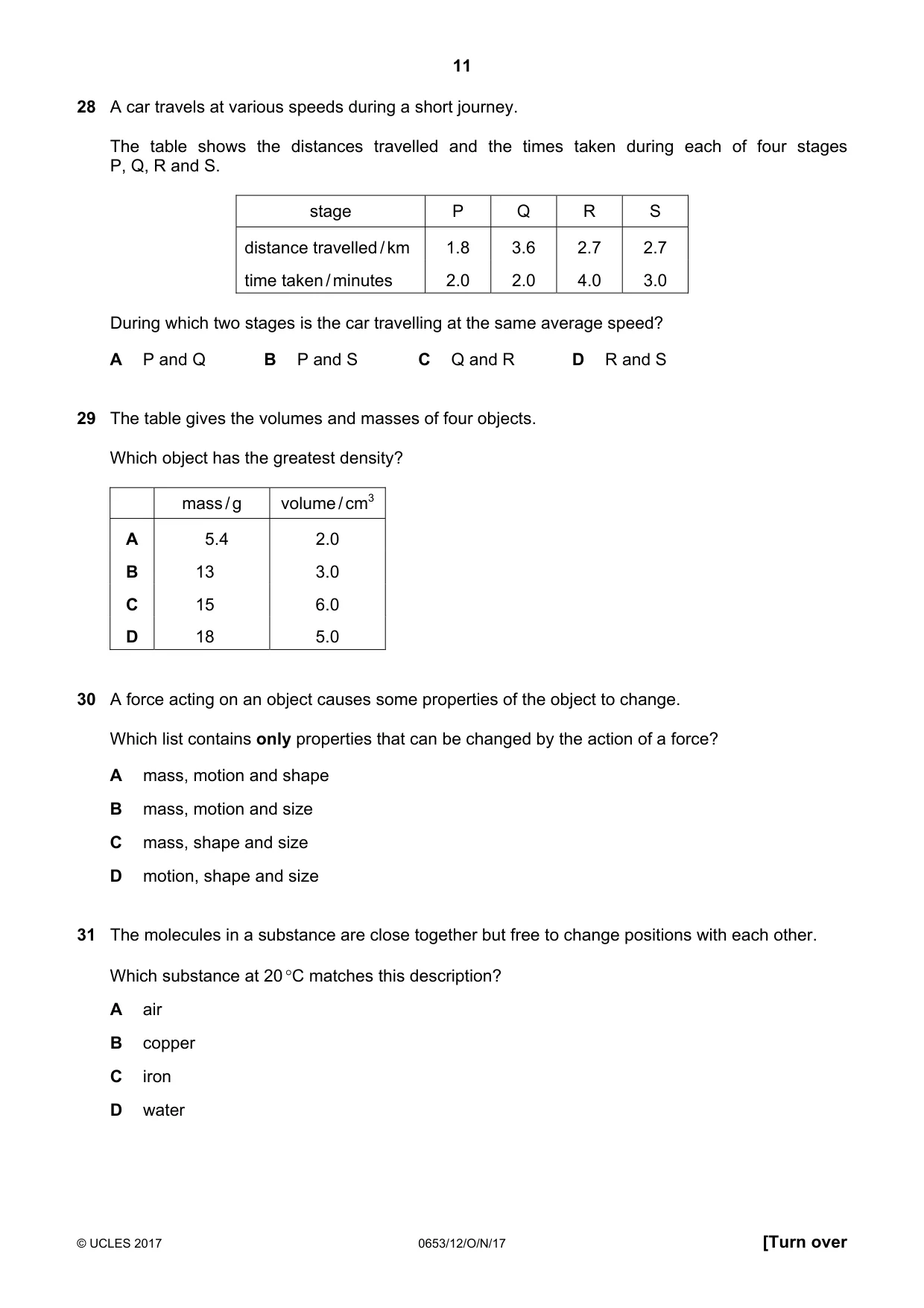
28 A car travels at various speeds during a short journey. The table shows the distances travelled and the times taken during each of four stages P, Q, R and S. stage P Q R S distance travelled / km 1.8 3.6 2.7 2.7 time taken / minutes 2.0 2.0 4.0 3.0 During which two stages is the car travelling at the same average speed? A P and Q B P and S C Q and R D R and S
Mark scheme: B
Q29 · The table gives the volumes and masses of four objects
29 The table gives the volumes and masses of four objects. Which object has the greatest density? mass / g volume / cm3 A 5.4 2.0 B 13 3.0 C 15 6.0 D 18 5.0
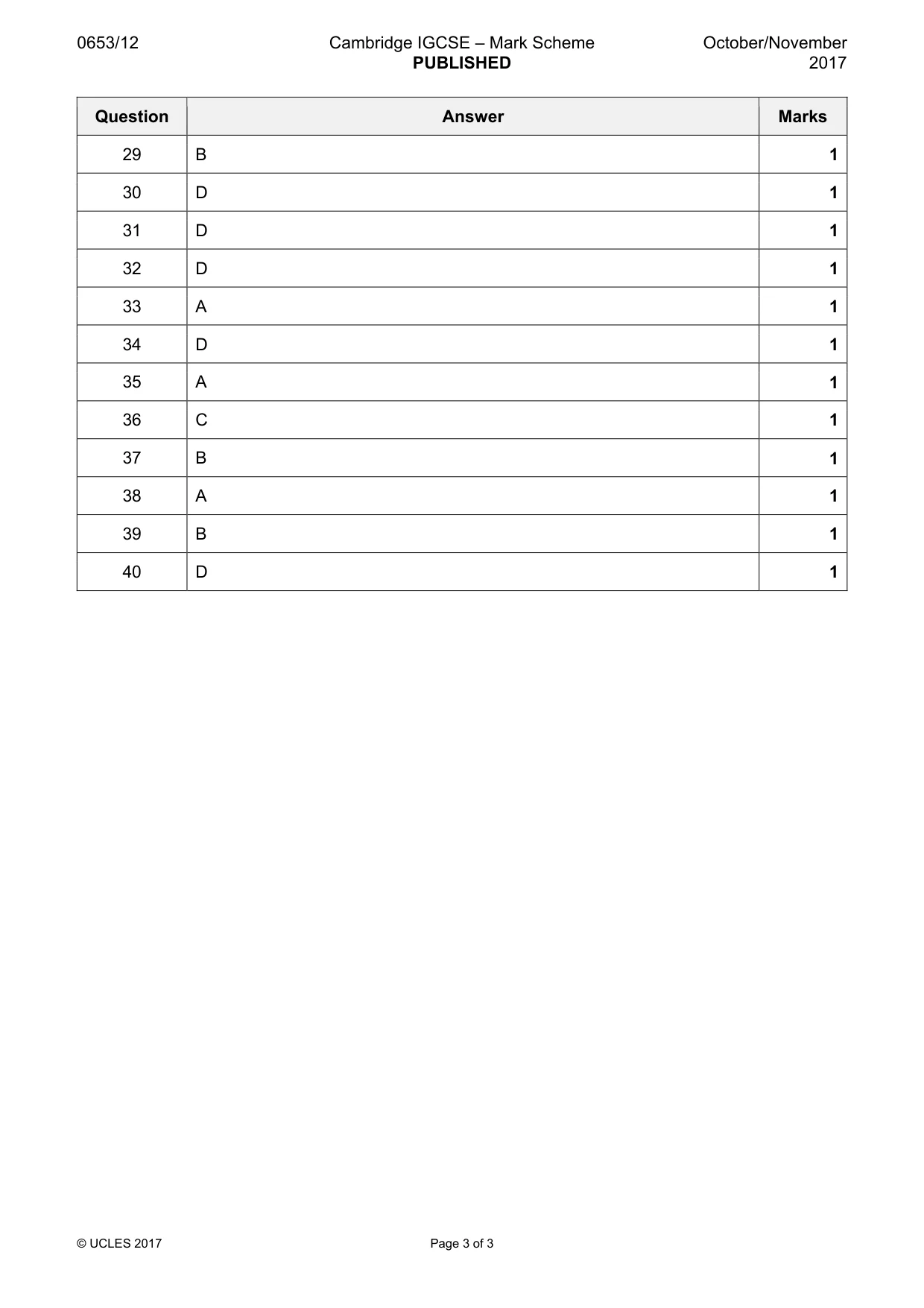
Mark scheme: B
Q30 · A force acting on an object causes some properties of the object to change
30 A force acting on an object causes some properties of the object to change. Which list contains only properties that can be changed by the action of a force? A mass, motion and shape B mass, motion and size C mass, shape and size D motion, shape and size
Mark scheme: D
Q31 · The molecules in a substance are close together but free to change positions with each…
31 The molecules in a substance are close together but free to change positions with each other. Which substance at 20 °C matches this description? A air B copper C iron D water
Mark scheme: D
Q32 · The diagram shows a glass flask with a stopper
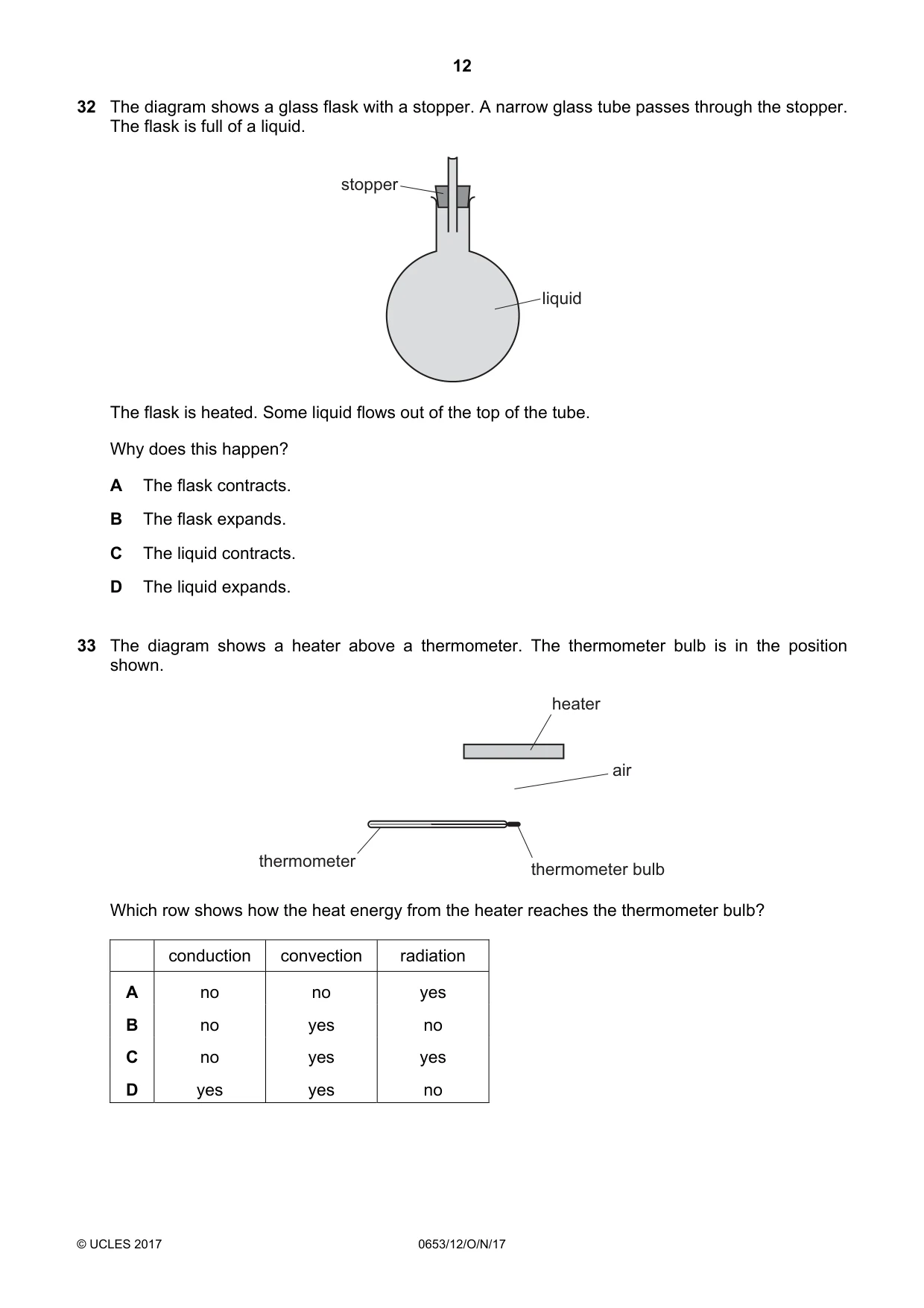
32 The diagram shows a glass flask with a stopper. A narrow glass tube passes through the stopper. The flask is full of a liquid. stopper liquid The flask is heated. Some liquid flows out of the top of the tube. Why does this happen? A The flask contracts. B The flask expands. C The liquid contracts. D The liquid expands.
Mark scheme: D
Q33 · The diagram shows a heater above a thermometer
33 The diagram shows a heater above a thermometer. The thermometer bulb is in the position shown. heater air thermometer thermometer bulb Which row shows how the heat energy from the heater reaches the thermometer bulb? conduction convection radiation A no no yes B no yes no C no yes yes D yes yes no
Mark scheme: A
Q34 · The diagram shows a section of a rope
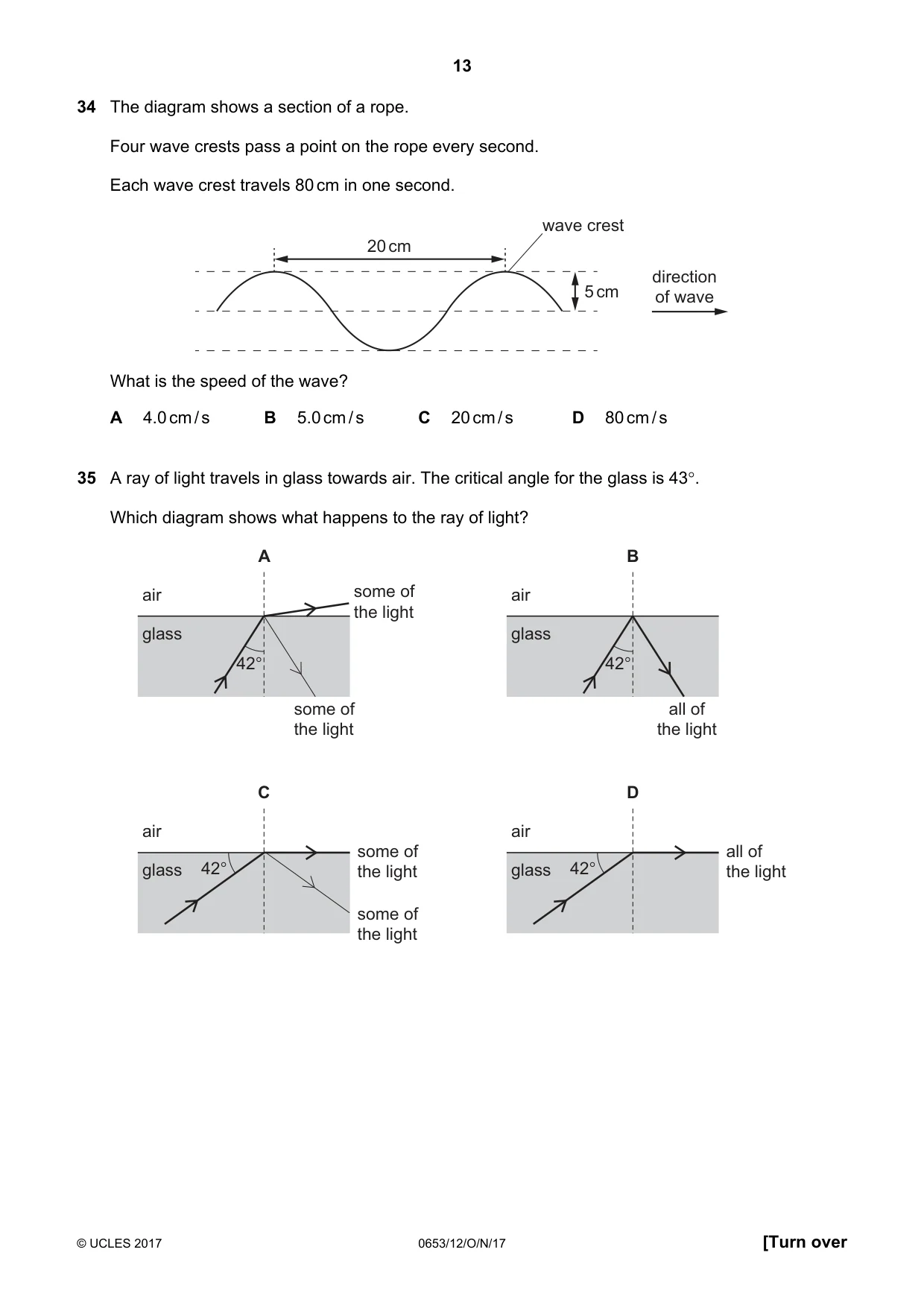
34 The diagram shows a section of a rope. Four wave crests pass a point on the rope every second. Each wave crest travels 80 cm in one second. wave crest 20 cm direction 5 cm of wave What is the speed of the wave? A 4.0 cm / s B 5.0 cm / s C 20 cm / s D 80 cm / s
Mark scheme: D
Q35 · A ray of light travels in glass towards air
35 A ray of light travels in glass towards air. The critical angle for the glass is 43°. Which diagram shows what happens to the ray of light? A B air some of air the light glass glass 42° 42° some of all of the light the light C D air air some of all of glass 42° the light glass 42° the light some of the light
Mark scheme: A
Q36 · Electromagnetic waves are used to scan passengers’ luggage before they board an aeroplane
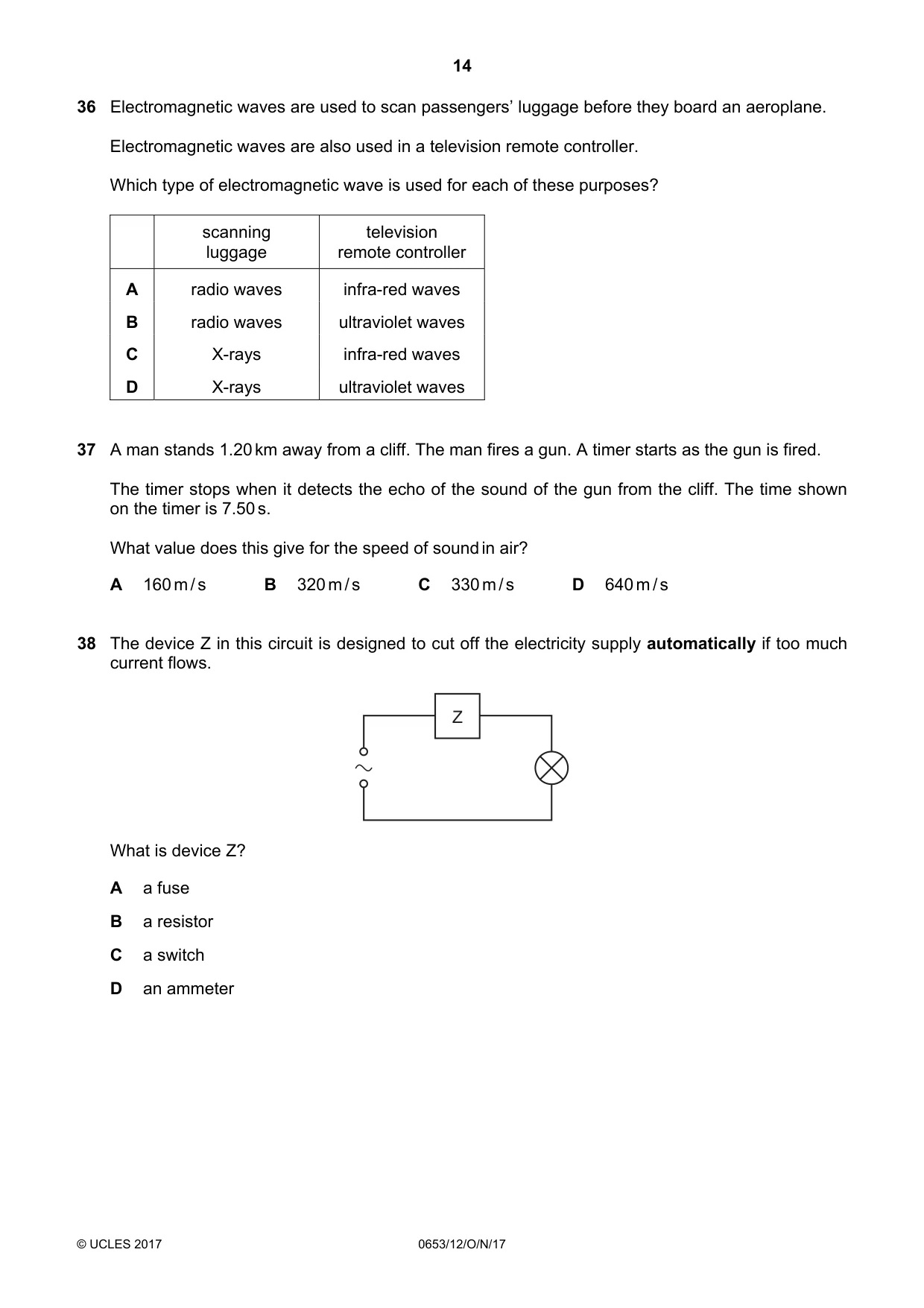
36 Electromagnetic waves are used to scan passengers’ luggage before they board an aeroplane. Electromagnetic waves are also used in a television remote controller. Which type of electromagnetic wave is used for each of these purposes? scanning television luggage remote controller A radio waves infra-red waves B radio waves ultraviolet waves C X-rays infra-red waves D X-rays ultraviolet waves
Mark scheme: C
Q37 · A man stands 1.20 km away from a cliff
37 A man stands 1.20 km away from a cliff. The man fires a gun. A timer starts as the gun is fired. The timer stops when it detects the echo of the sound of the gun from the cliff. The time shown on the timer is 7.50 s. What value does this give for the speed of sound in air? A 160 m / s B 320 m / s C 330 m / s D 640 m / s
Mark scheme: B
Q38 · The device Z in this circuit is designed to cut off the electricity supply automatically…
38 The device Z in this circuit is designed to cut off the electricity supply automatically if too much current flows. Z What is device Z? A a fuse B a resistor C a switch D an ammeter
Mark scheme: A
Q39 · The diagram shows a circuit used to find the resistance of lamp L
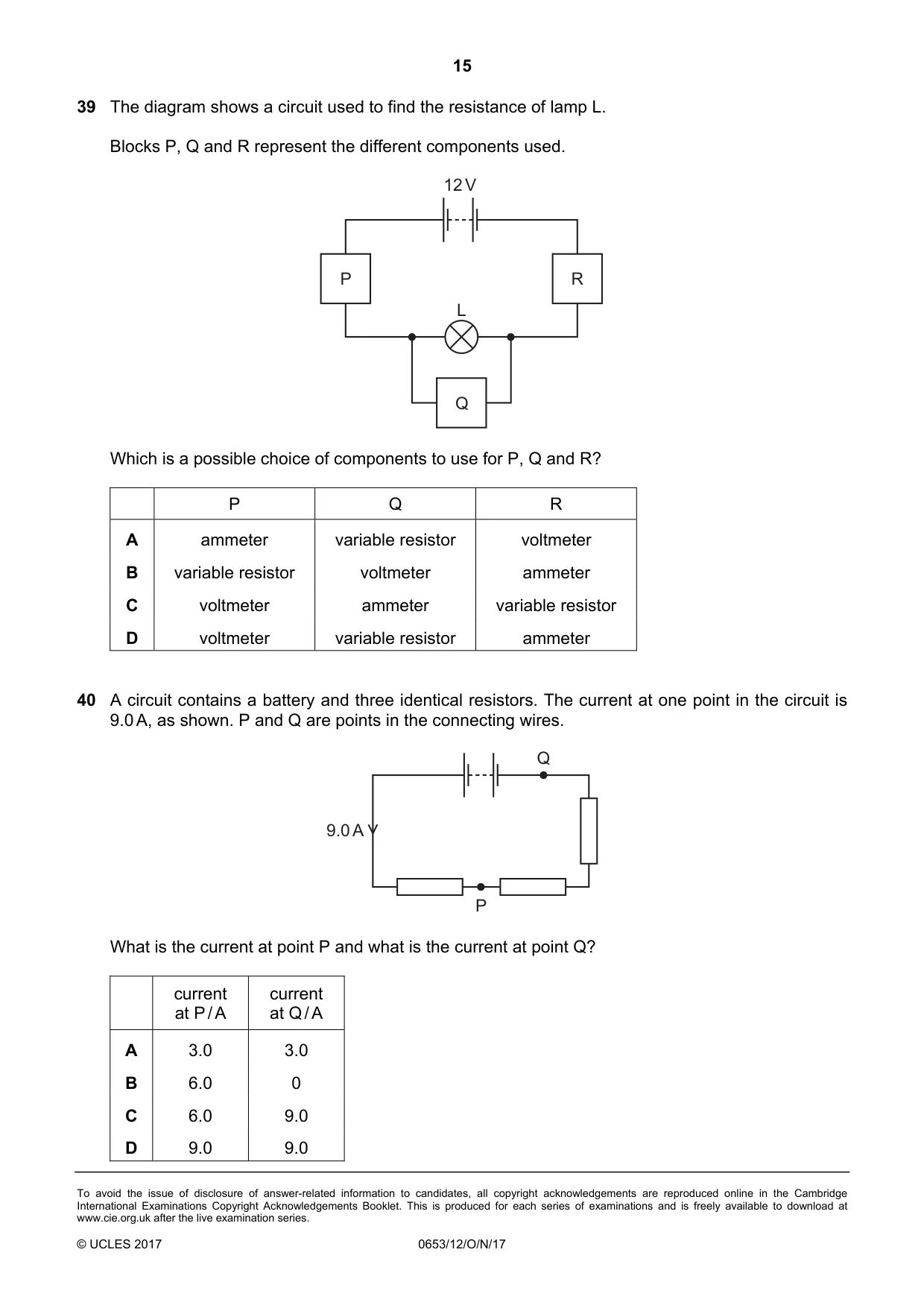
39 The diagram shows a circuit used to find the resistance of lamp L. Blocks P, Q and R represent the different components used. 12 V P R L Q Which is a possible choice of components to use for P, Q and R? P Q R A ammeter variable resistor voltmeter B variable resistor voltmeter ammeter C voltmeter ammeter variable resistor D voltmeter variable resistor ammeter
Mark scheme: B
Q40 · A circuit contains a battery and three identical resistors
40 A circuit contains a battery and three identical resistors. The current at one point in the circuit is 9.0 A, as shown. P and Q are points in the connecting wires. Q 9.0 A P What is the current at point P and what is the current at point Q? current current at P / A at Q / A A 3.0 3.0 B 6.0 0 C 6.0 9.0 D 9.0 9.0
Mark scheme: D
What was in this paper
The subtopics covered by these 40 questions, and how many questions each got. Open one in a new tab to see every Cambridge question on it.
2Characteristics of living organisms2Electrical circuits2Alloys and their properties1Arrangement of elements1Blood1Density1Diet1Diffusion1Digestive system1Drugs1Electrical safety1Electrolysis1Electromagnetic spectrum1Enzymes1Exothermic and endothermic reactions1Food chains and food webs1Forces1Gas exchange in humans1General properties of waves1Group I properties1Identification of ions and gases1Kinetic particle model of matter1Light1Motion1Photosynthesis1Physical and chemical changes1Properties of metals1Redox1Respiration1Separation and purification1Sexual reproduction in humans1Simple molecules and covalent bonds1Sound1Terminology1Thermal properties and temperature1Transfer of thermal energy1What you needed in this session
Cambridge’s own grade thresholds for 2017 Oct/Nov, Paper 1 · Variant 2. A higher threshold means an easier paper — the bar moves with how the cohort did.