Cambridge IGCSE Science - Combined 0653 — 2019 May/June Paper 1 · Variant 3
0653/13/M/J/19 · 40 questions · 40 marks · ≈45 min
The question paper and its mark scheme, free to read here and free to download. This is Cambridge’s own paper, exactly as it was sat.
Question paper16 pages

Mark scheme3 pages
Answers below. Sit the paper first if you are practising.
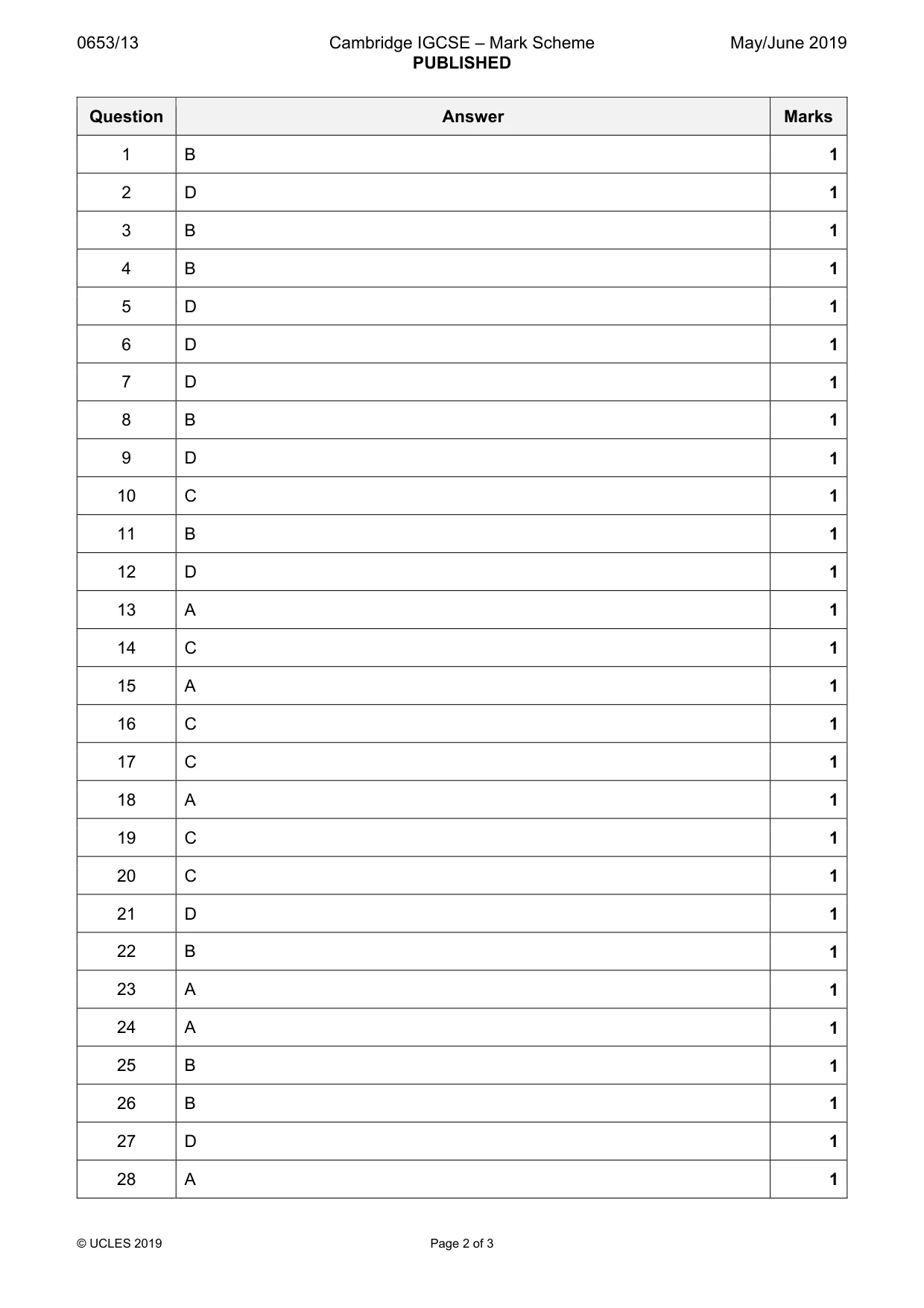
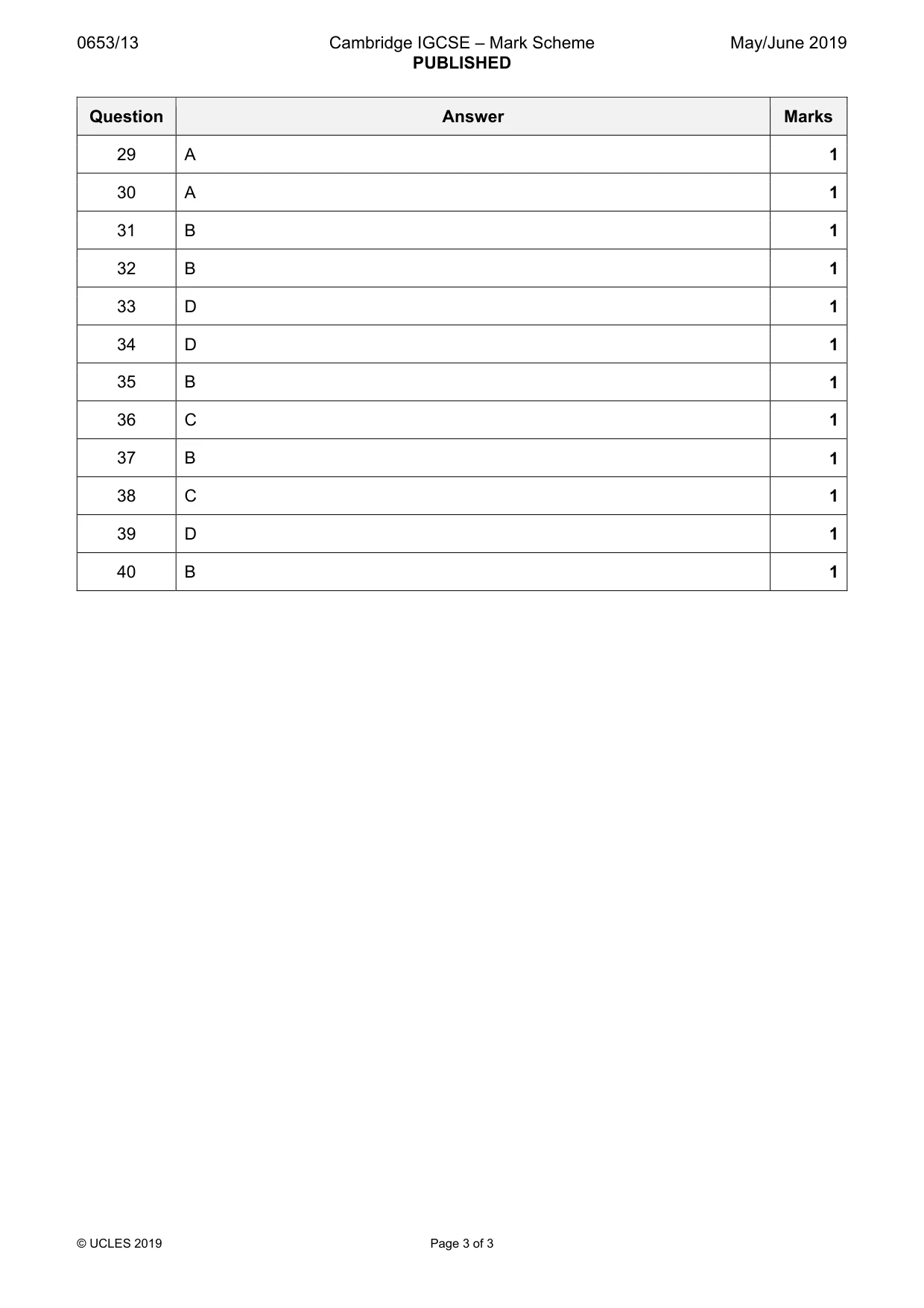
Questions as text
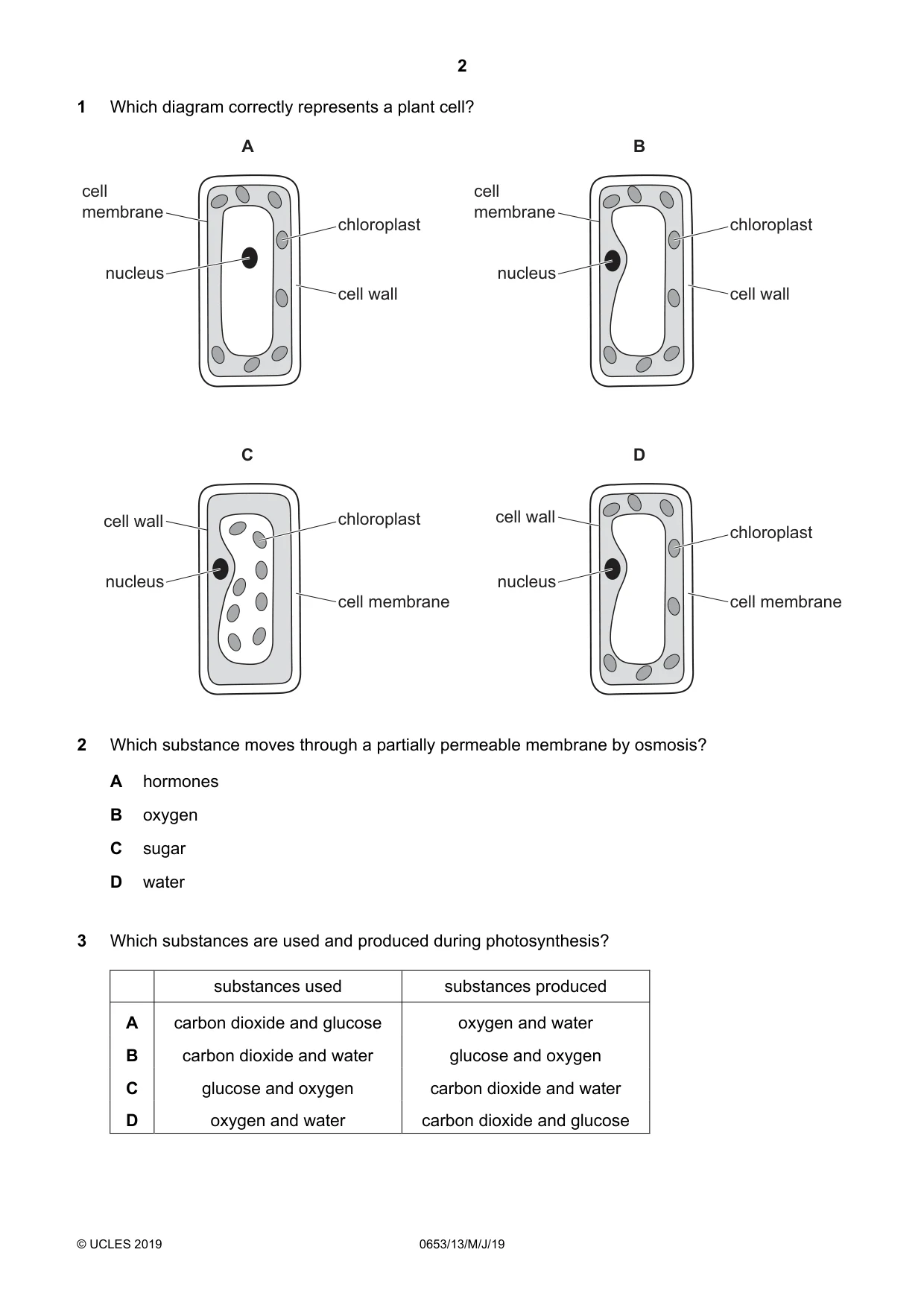
Q1 · Which diagram correctly represents a plant cell?
1 Which diagram correctly represents a plant cell? A B cell cell membrane membrane chloroplast chloroplast nucleus nucleus cell wall cell wall C D cell wall chloroplast cell wall chloroplast nucleus nucleus cell membrane cell membrane
Mark scheme: B
Q2 · Which substance moves through a partially permeable membrane by osmosis?
2 Which substance moves through a partially permeable membrane by osmosis? A hormones B oxygen C sugar D water
Mark scheme: D
Q3 · Which substances are used and produced during photosynthesis?
3 Which substances are used and produced during photosynthesis? substances used substances produced A carbon dioxide and glucose oxygen and water B carbon dioxide and water glucose and oxygen C glucose and oxygen carbon dioxide and water D oxygen and water carbon dioxide and glucose
Mark scheme: B
Q4 · What is a function of the small intestine?
4 What is a function of the small intestine? A It cuts food into small pieces. B It provides a large surface area for absorption. C It provides space for the storage of faeces. D It stores food.
Mark scheme: B
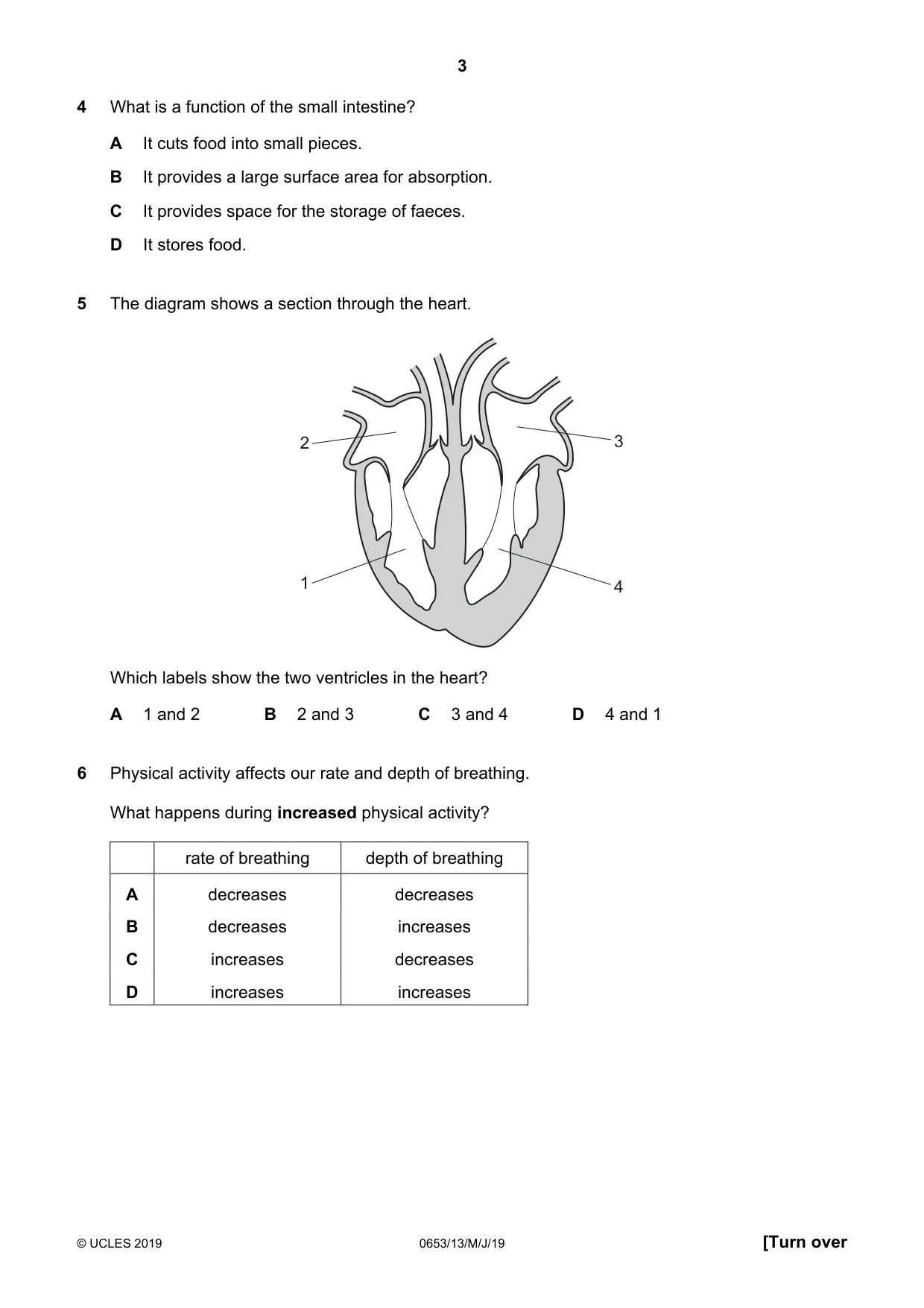
Q5 · The diagram shows a section through the heart
5 The diagram shows a section through the heart. 2 3 1 4 Which labels show the two ventricles in the heart? A 1 and 2 B 2 and 3 C 3 and 4 D 4 and 1
Mark scheme: D
Q6 · Physical activity affects our rate and depth of breathing
6 Physical activity affects our rate and depth of breathing. What happens during increased physical activity? rate of breathing depth of breathing A decreases decreases B decreases increases C increases decreases D increases increases
Mark scheme: D
Q7 · How does adrenaline affect blood glucose concentration and pulse rate?
7 How does adrenaline affect blood glucose concentration and pulse rate? blood glucose pulse rate concentration A decreases decreases B decreases increases C increases decreases D increases increases
Mark scheme: D
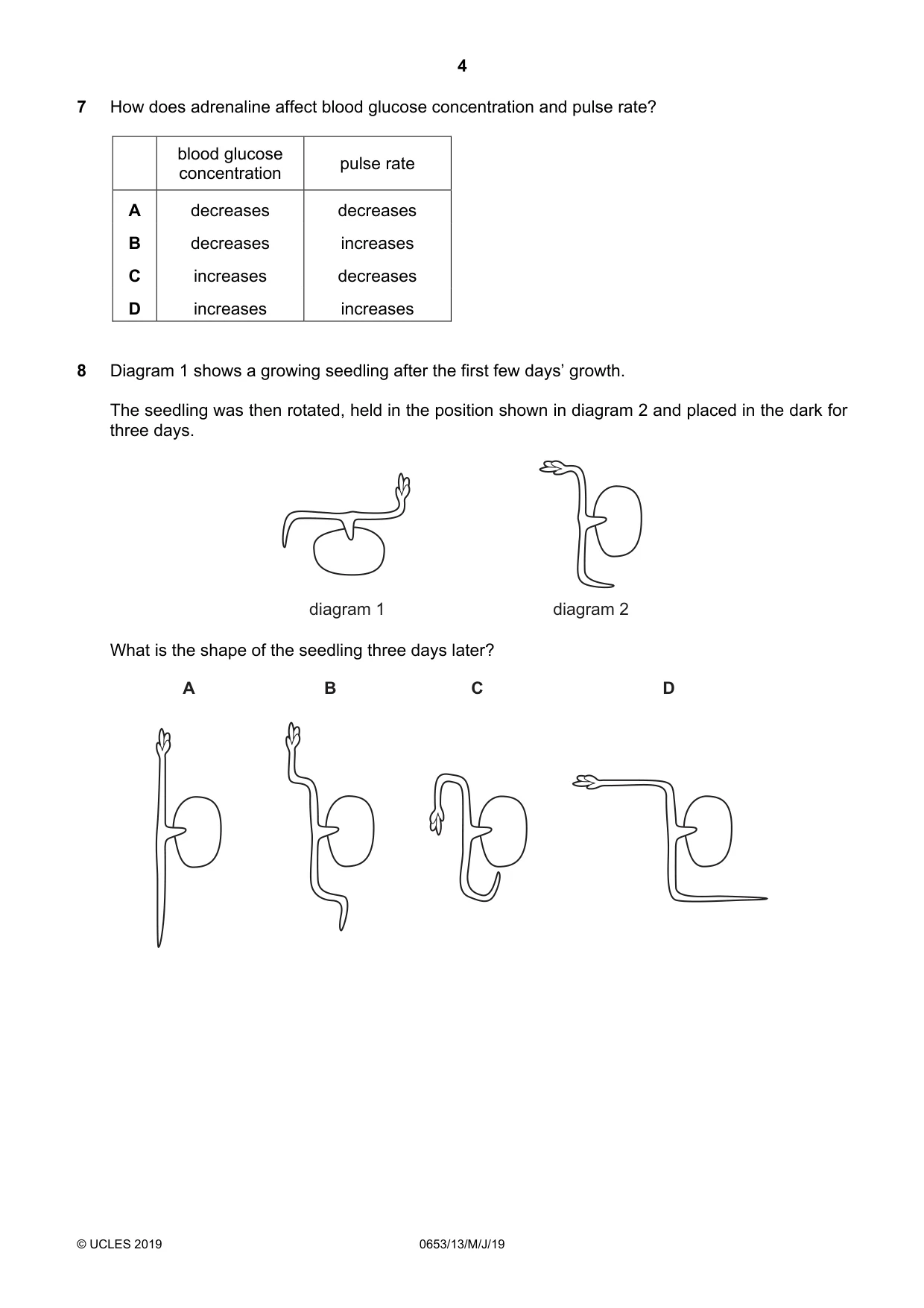
Q8 · A growing seedling after the first few days’ growth
8 Diagram 1 shows a growing seedling after the first few days’ growth. The seedling was then rotated, held in the position shown in diagram 2 and placed in the dark for three days. diagram 1 diagram 2 What is the shape of the seedling three days later? A B C D
Mark scheme: B
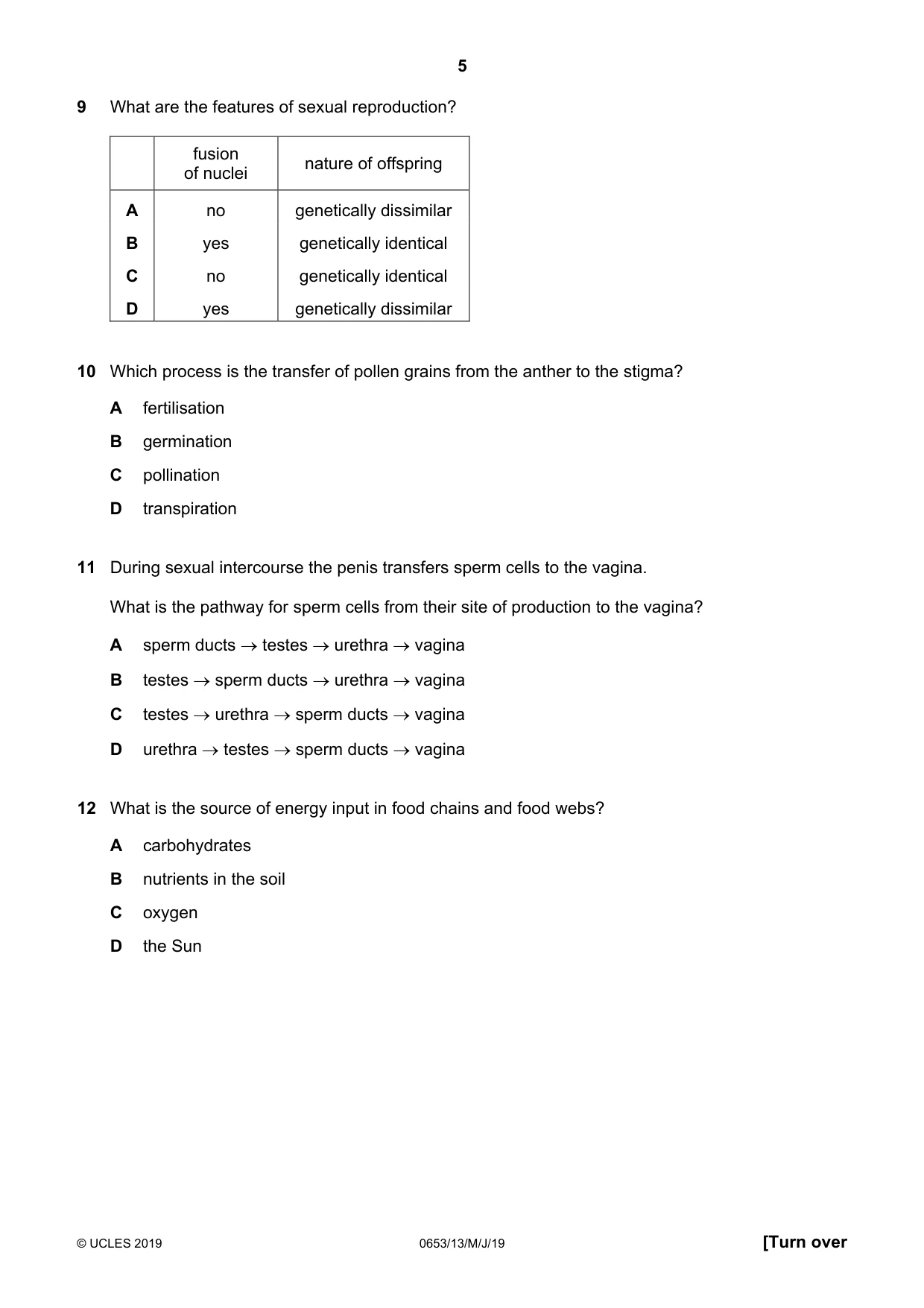
Q9 · What are the features of sexual reproduction?
9 What are the features of sexual reproduction? fusion nature of offspring of nuclei A no genetically dissimilar B yes genetically identical C no genetically identical D yes genetically dissimilar
Mark scheme: D
Q10 · Which process is the transfer of pollen grains from the anther to the stigma?
10 Which process is the transfer of pollen grains from the anther to the stigma? A fertilisation B germination C pollination D transpiration
Mark scheme: C
Q11 · During sexual intercourse the penis transfers sperm cells to the vagina
11 During sexual intercourse the penis transfers sperm cells to the vagina. What is the pathway for sperm cells from their site of production to the vagina? A sperm ducts → testes → urethra → vagina B testes → sperm ducts → urethra → vagina C testes → urethra → sperm ducts → vagina D urethra → testes → sperm ducts → vagina
Mark scheme: B
Q12 · What is the source of energy input in food chains and food webs?
12 What is the source of energy input in food chains and food webs? A carbohydrates B nutrients in the soil C oxygen D the Sun
Mark scheme: D
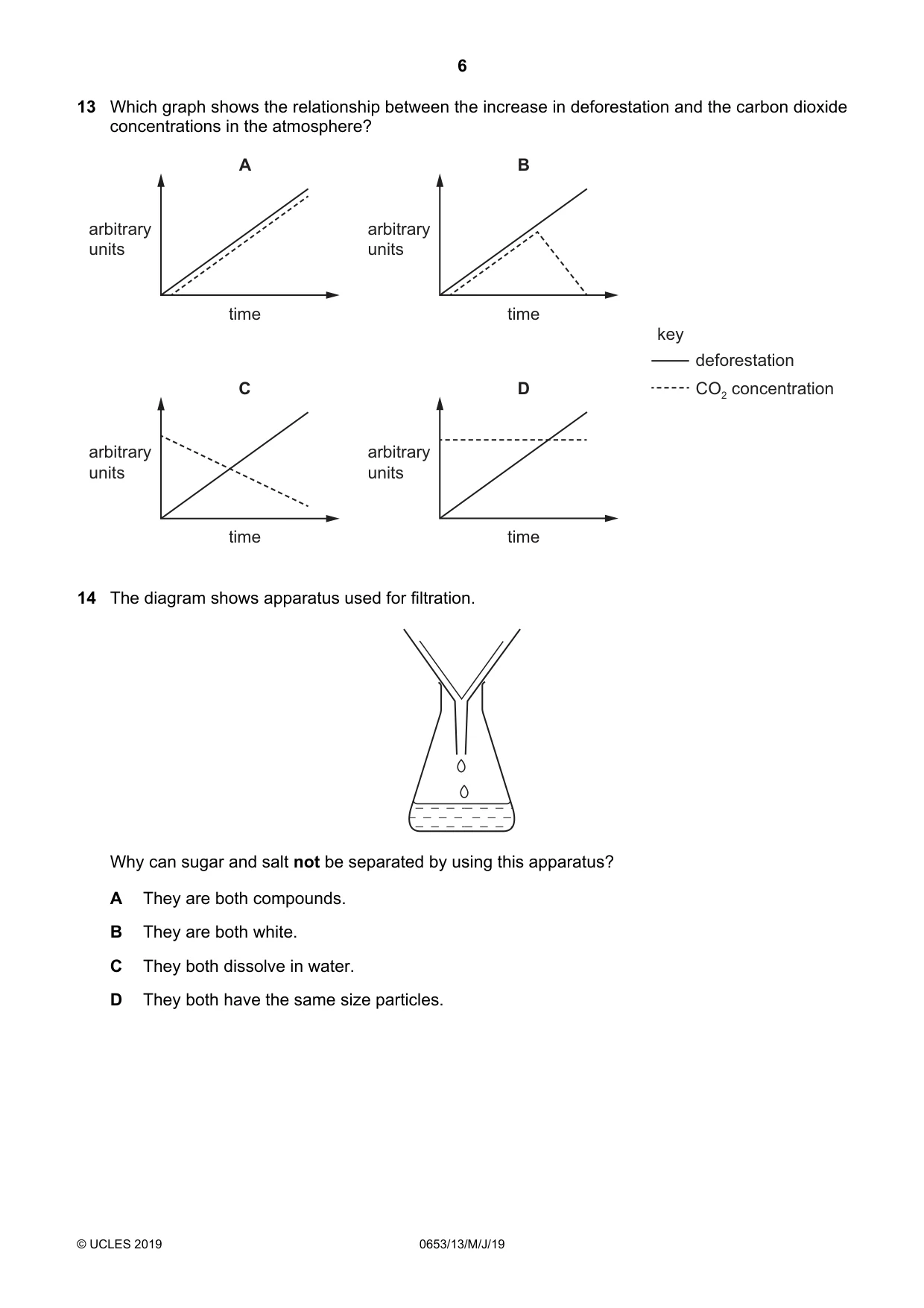
Q13 · Which graph shows the relationship between the increase in deforestation and the carbon…
13 Which graph shows the relationship between the increase in deforestation and the carbon dioxide concentrations in the atmosphere? A B arbitrary arbitrary units units time time key deforestation C D CO2 concentration arbitrary arbitrary units units time time
Mark scheme: A
Q14 · The diagram shows apparatus used for filtration
14 The diagram shows apparatus used for filtration. Why can sugar and salt not be separated by using this apparatus? A They are both compounds. B They are both white. C They both dissolve in water. D They both have the same size particles.
Mark scheme: C
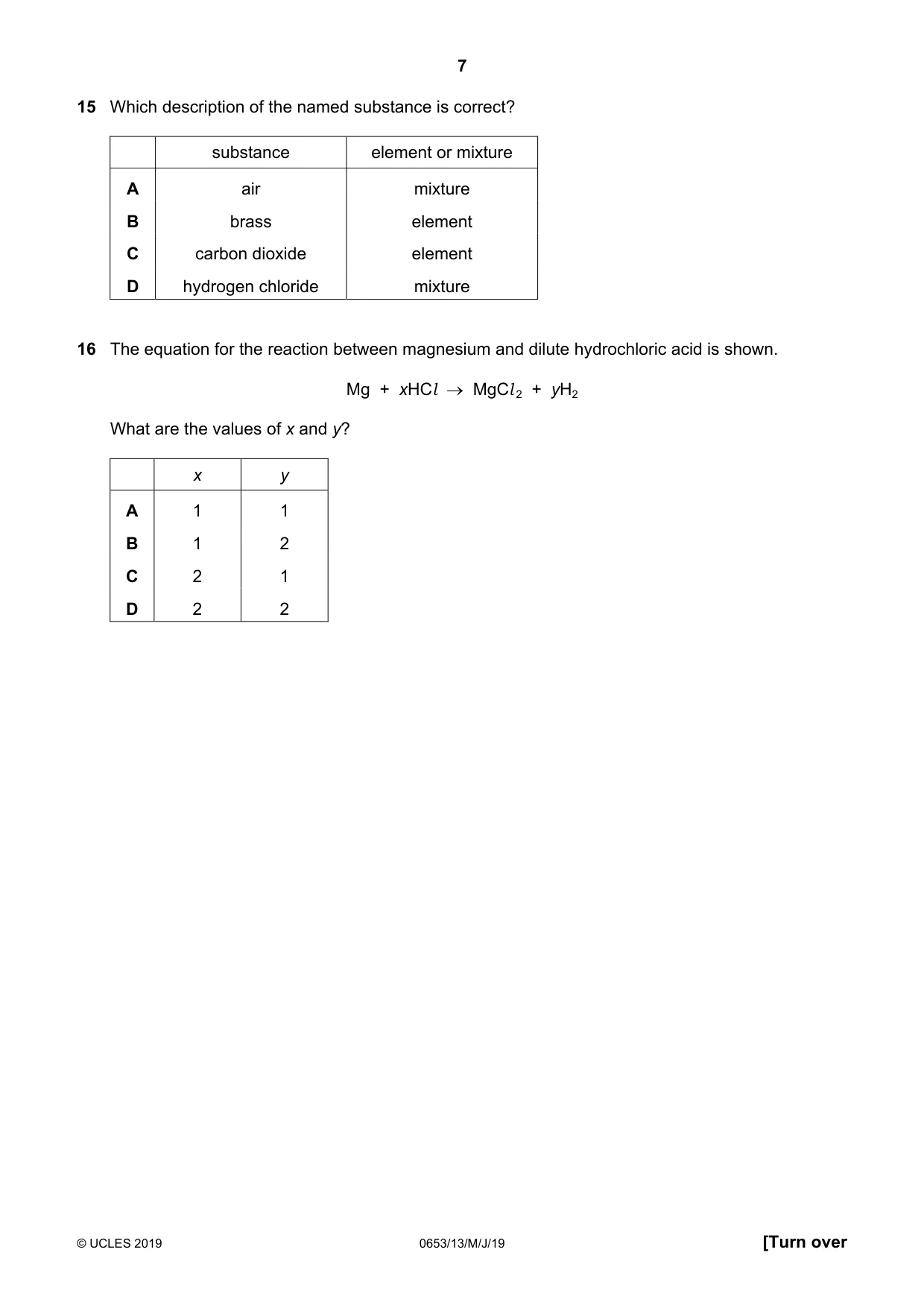
Q15 · Which description of the named substance is correct?
15 Which description of the named substance is correct? substance element or mixture A air mixture B brass element C carbon dioxide element D hydrogen chloride mixture
Mark scheme: A
Q16 · The equation for the reaction between magnesium and dilute hydrochloric acid is shown
16 The equation for the reaction between magnesium and dilute hydrochloric acid is shown. Mg + xHCl → MgCl 2 + yH2 What are the values of x and y? x y A 1 1 B 1 2 C 2 1 D 2 2
Mark scheme: C
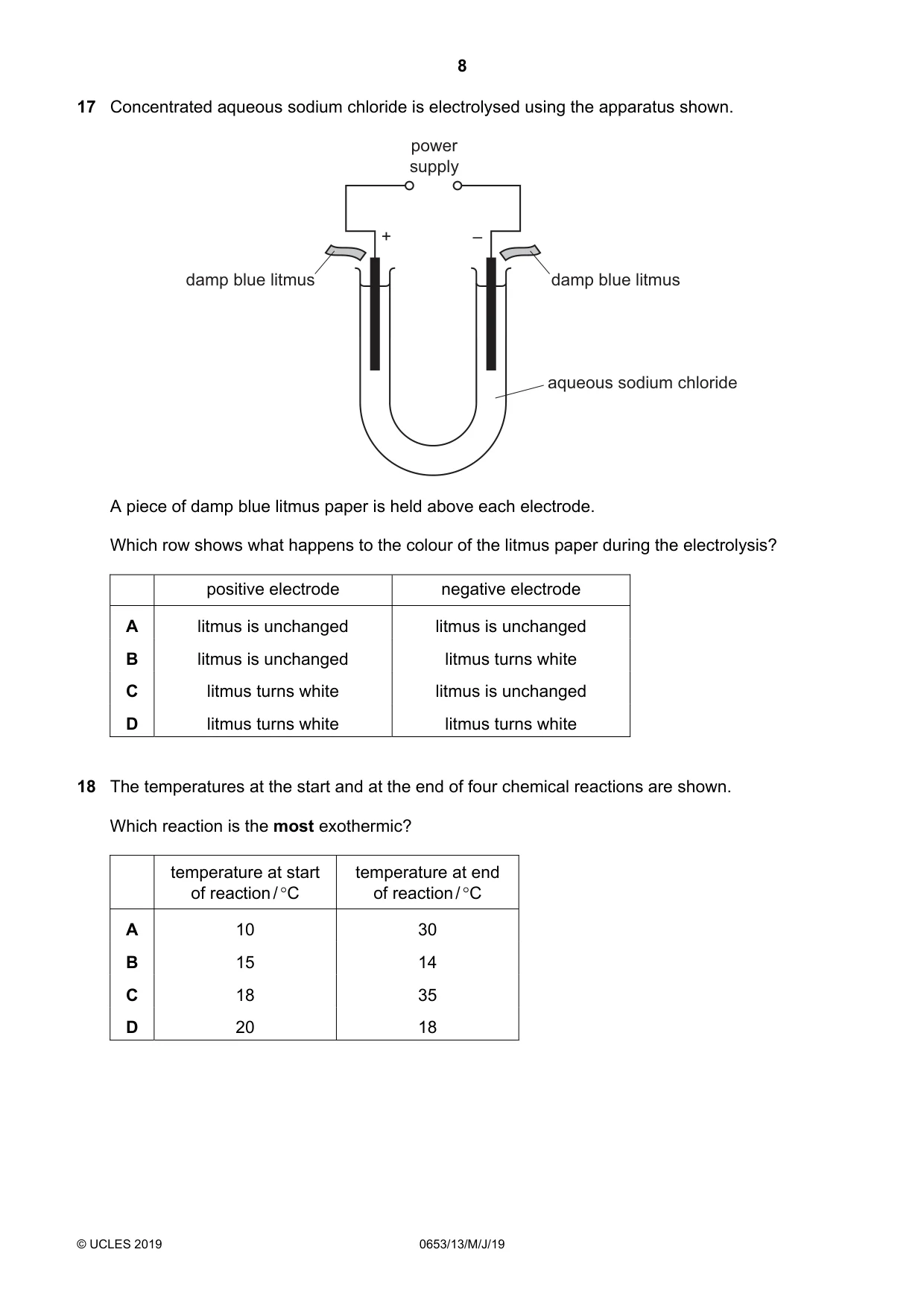
Q17 · Concentrated aqueous sodium chloride is electrolysed using the apparatus shown
17 Concentrated aqueous sodium chloride is electrolysed using the apparatus shown. power supply + – damp blue litmus damp blue litmus aqueous sodium chloride A piece of damp blue litmus paper is held above each electrode. Which row shows what happens to the colour of the litmus paper during the electrolysis? positive electrode negative electrode A litmus is unchanged litmus is unchanged B litmus is unchanged litmus turns white C litmus turns white litmus is unchanged D litmus turns white litmus turns white
Mark scheme: C
Q18 · The temperatures at the start and at the end of four chemical reactions are shown
18 The temperatures at the start and at the end of four chemical reactions are shown. Which reaction is the most exothermic? temperature at start temperature at end of reaction / °C of reaction / °C A 10 30 B 15 14 C 18 35 D 20 18
Mark scheme: A
Q19 · Zinc reacts with excess dilute sulfuric acid to form hydrogen gas
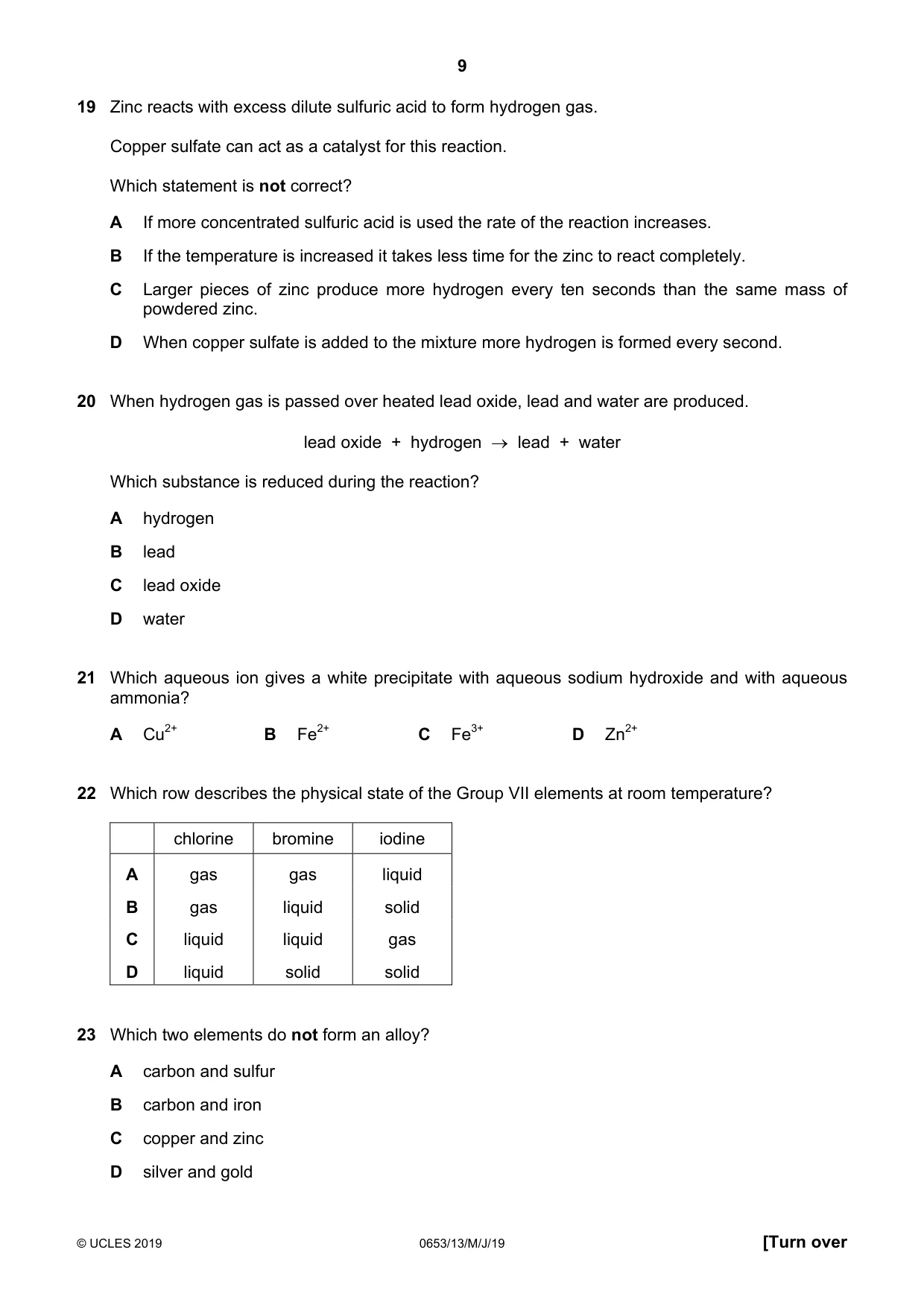
19 Zinc reacts with excess dilute sulfuric acid to form hydrogen gas. Copper sulfate can act as a catalyst for this reaction. Which statement is not correct? A If more concentrated sulfuric acid is used the rate of the reaction increases. B If the temperature is increased it takes less time for the zinc to react completely. C Larger pieces of zinc produce more hydrogen every ten seconds than the same mass of powdered zinc. D When copper sulfate is added to the mixture more hydrogen is formed every second.
Mark scheme: C
Q20 · When hydrogen gas is passed over heated lead oxide, lead and water are produced
20 When hydrogen gas is passed over heated lead oxide, lead and water are produced. lead oxide + hydrogen → lead + water Which substance is reduced during the reaction? A hydrogen B lead C lead oxide D water
Mark scheme: C
Q21 · Which aqueous ion gives a white precipitate with aqueous sodium hydroxide and with…
21 Which aqueous ion gives a white precipitate with aqueous sodium hydroxide and with aqueous ammonia? A Cu2+ B Fe2+ C Fe3+ D Zn2+
Mark scheme: D
Q22 · Which row describes the physical state of the Group VII elements at room temperature?
22 Which row describes the physical state of the Group VII elements at room temperature? chlorine bromine iodine A gas gas liquid B gas liquid solid C liquid liquid gas D liquid solid solid
Mark scheme: B
Q23 · Which two elements do not form an alloy?
23 Which two elements do not form an alloy? A carbon and sulfur B carbon and iron C copper and zinc D silver and gold
Mark scheme: A
Q24 · Which process is used to extract copper from copper oxide?
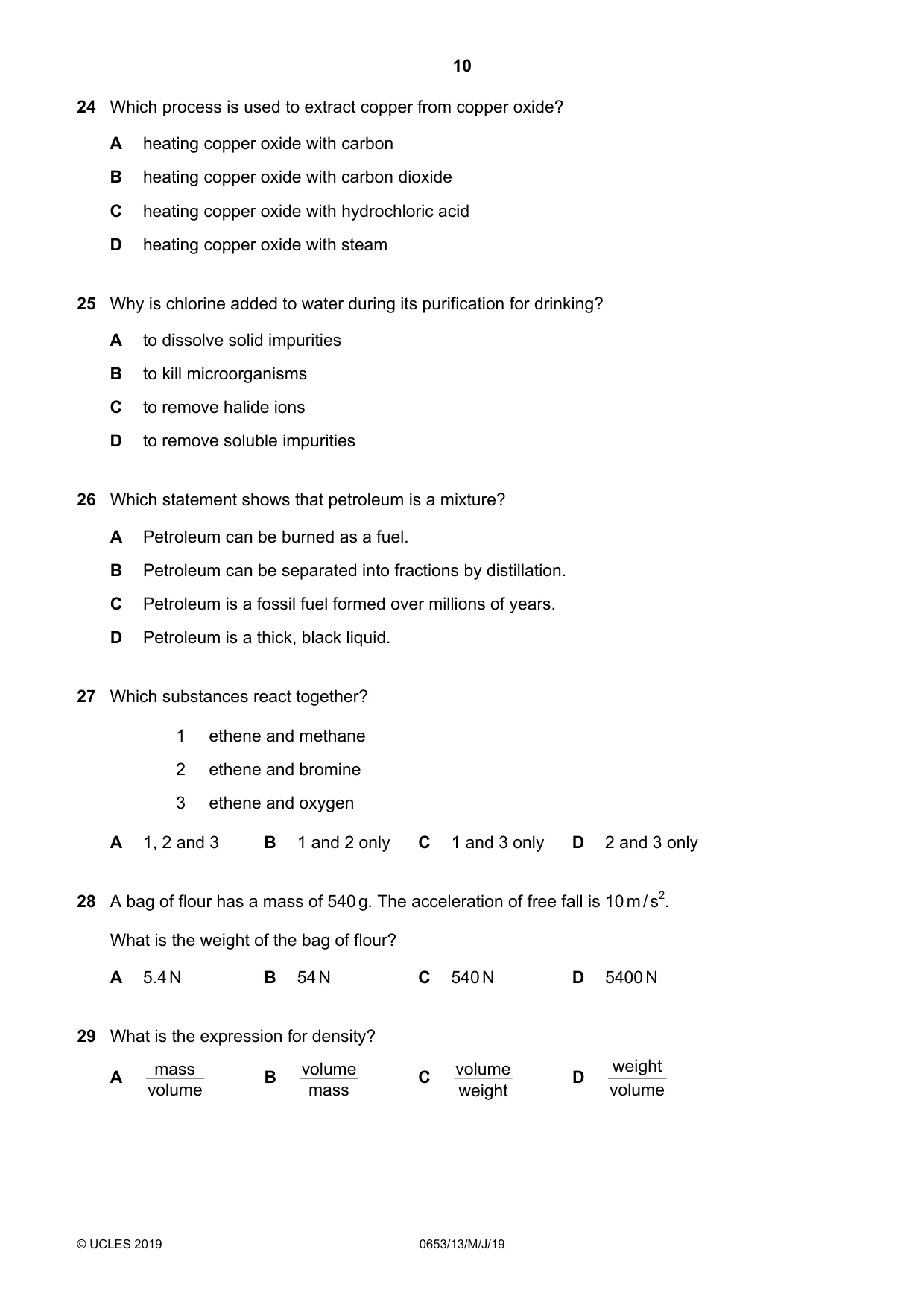
24 Which process is used to extract copper from copper oxide? A heating copper oxide with carbon B heating copper oxide with carbon dioxide C heating copper oxide with hydrochloric acid D heating copper oxide with steam
Mark scheme: A
Q25 · Why is chlorine added to water during its purification for drinking?
25 Why is chlorine added to water during its purification for drinking? A to dissolve solid impurities B to kill microorganisms C to remove halide ions D to remove soluble impurities
Mark scheme: B
Q26 · Which statement shows that petroleum is a mixture?
26 Which statement shows that petroleum is a mixture? A Petroleum can be burned as a fuel. B Petroleum can be separated into fractions by distillation. C Petroleum is a fossil fuel formed over millions of years. D Petroleum is a thick, black liquid.
Mark scheme: B
Q27 · Which substances react together?
27 Which substances react together? 1 ethene and methane 2 ethene and bromine 3 ethene and oxygen A 1, 2 and 3 B 1 and 2 only C 1 and 3 only D 2 and 3 only
Mark scheme: D
Q28 · A bag of flour has a mass of 540 g
28 A bag of flour has a mass of 540 g. The acceleration of free fall is 10 m / s2. What is the weight of the bag of flour? A 5.4 N B 54 N C 540 N D 5400 N
Mark scheme: A
Q29 · What is the expression for density?
29 What is the expression for density? mass volume volume weight A B C D volume mass weight volume
Mark scheme: A
Q30 · Which property of an object cannot be changed by a force?
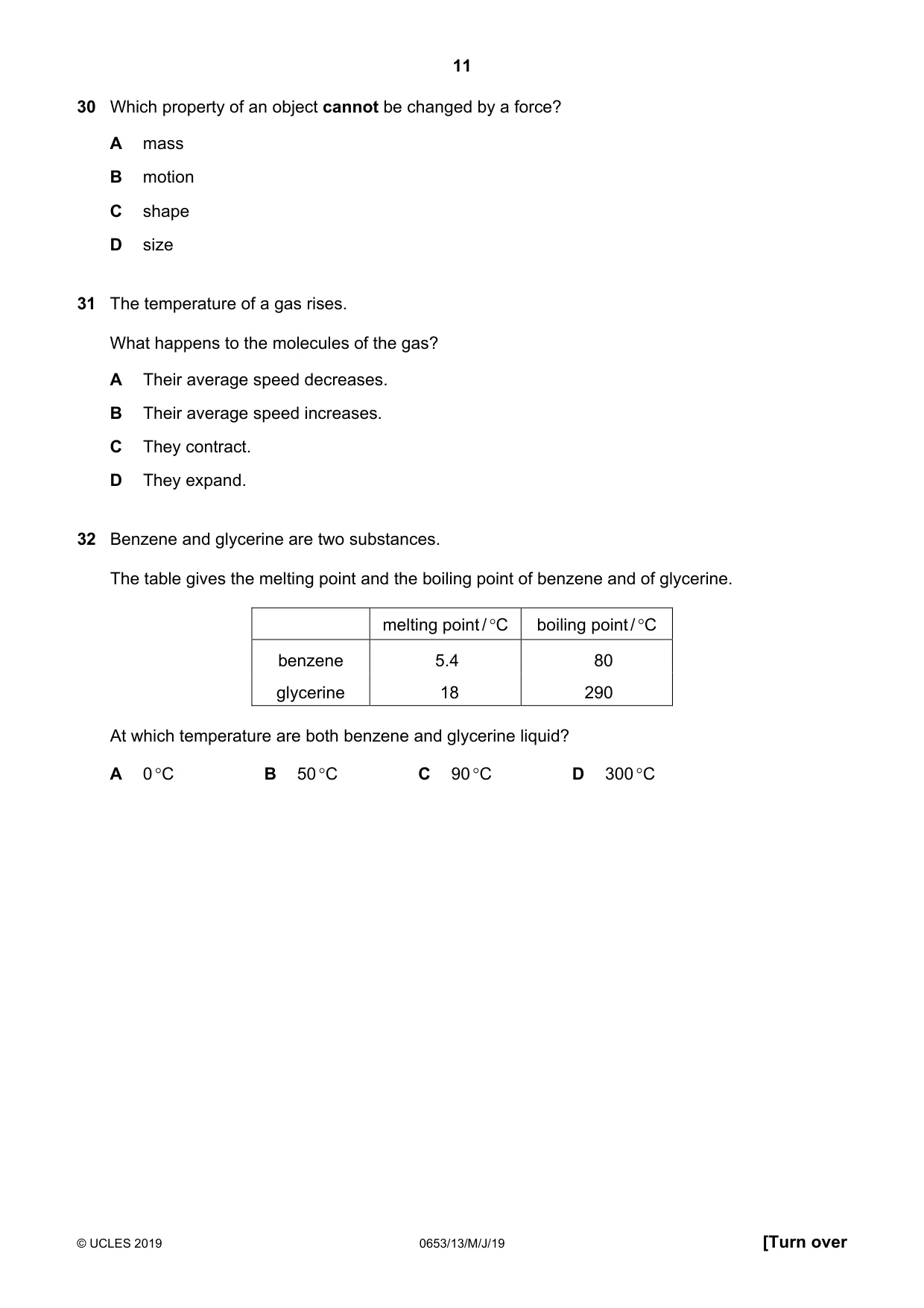
30 Which property of an object cannot be changed by a force? A mass B motion C shape D size
Mark scheme: A
Q31 · The temperature of a gas rises
31 The temperature of a gas rises. What happens to the molecules of the gas? A Their average speed decreases. B Their average speed increases. C They contract. D They expand.
Mark scheme: B
Q32 · Benzene and glycerine are two substances
32 Benzene and glycerine are two substances. The table gives the melting point and the boiling point of benzene and of glycerine. melting point / °C boiling point / °C benzene 5.4 80 glycerine 18 290 At which temperature are both benzene and glycerine liquid? A 0 °C B 50 °C C 90 °C D 300 °C
Mark scheme: B
Q33 · The diagram shows a vacuum flask containing a hot liquid in a cold room
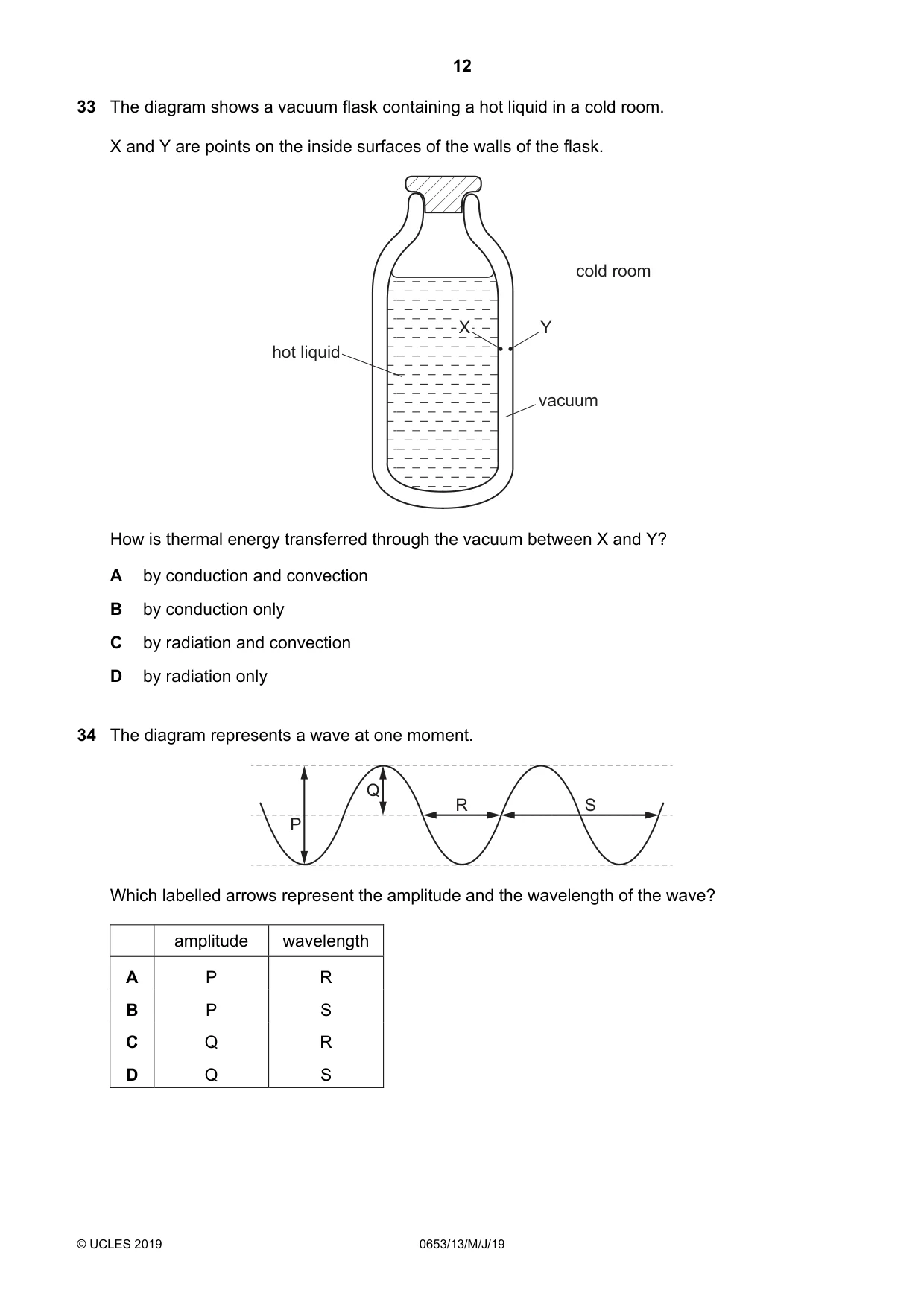
33 The diagram shows a vacuum flask containing a hot liquid in a cold room. X and Y are points on the inside surfaces of the walls of the flask. cold room X Y hot liquid vacuum How is thermal energy transferred through the vacuum between X and Y? A by conduction and convection B by conduction only C by radiation and convection D by radiation only
Mark scheme: D
Q34 · The diagram represents a wave at one moment
34 The diagram represents a wave at one moment. Q R S P Which labelled arrows represent the amplitude and the wavelength of the wave? amplitude wavelength A P R B P S C Q R D Q S
Mark scheme: D
Q35 · The diagram shows light incident on a plane mirror
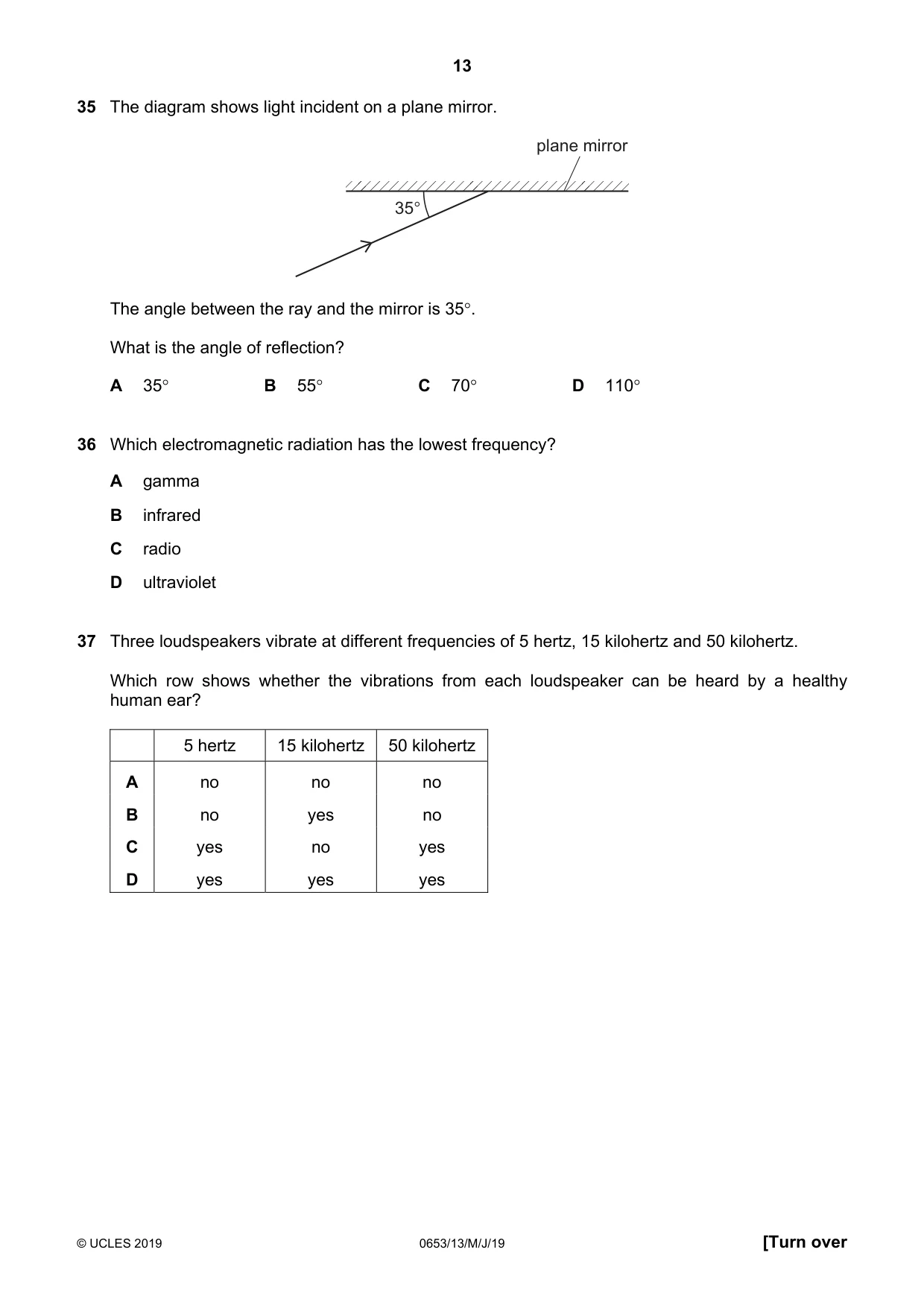
35 The diagram shows light incident on a plane mirror. plane mirror 35° The angle between the ray and the mirror is 35°. What is the angle of reflection? A 35° B 55° C 70° D 110°
Mark scheme: B
Q36 · Which electromagnetic radiation has the lowest frequency?
36 Which electromagnetic radiation has the lowest frequency? A gamma B infrared C radio D ultraviolet
Mark scheme: C
Q37 · Three loudspeakers vibrate at different frequencies of 5 hertz, 15 kilohertz and 50…
37 Three loudspeakers vibrate at different frequencies of 5 hertz, 15 kilohertz and 50 kilohertz. Which row shows whether the vibrations from each loudspeaker can be heard by a healthy human ear? 5 hertz 15 kilohertz 50 kilohertz A no no no B no yes no C yes no yes D yes yes yes
Mark scheme: B
Q38 · What is the unit for electromotive force (e.m.f.)?
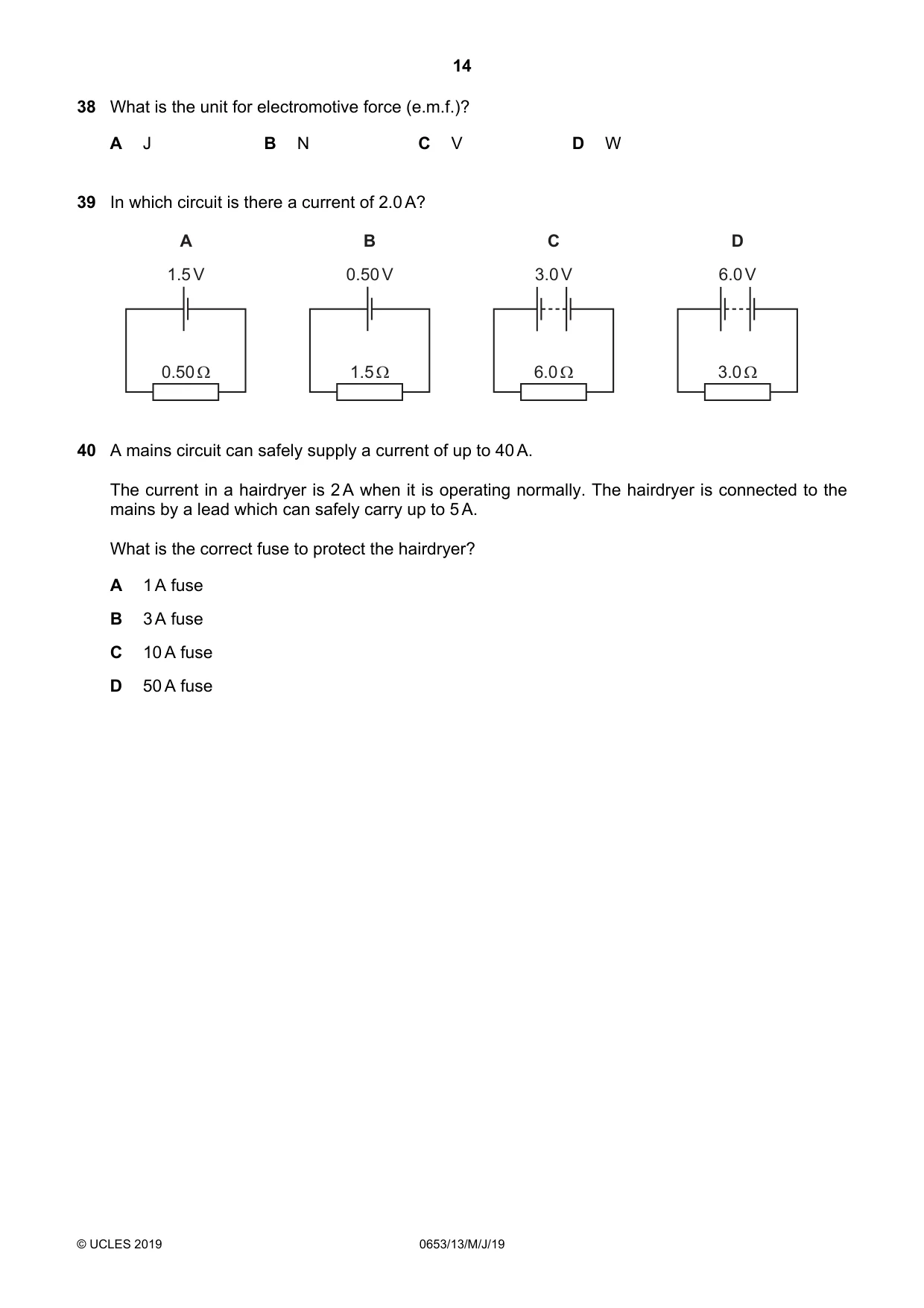
38 What is the unit for electromotive force (e.m.f.)? A J B N C V D W
Mark scheme: C
Q39 · In which circuit is there a current of 2.0 A?
39 In which circuit is there a current of 2.0 A? A B C D 1.5 V 0.50 V 3.0 V 6.0 V 0.50 Ω 1.5 Ω 6.0 Ω 3.0 Ω
Mark scheme: D
Q40 · A mains circuit can safely supply a current of up to 40 A
40 A mains circuit can safely supply a current of up to 40 A. The current in a hairdryer is 2 A when it is operating normally. The hairdryer is connected to the mains by a lead which can safely carry up to 5 A. What is the correct fuse to protect the hairdryer? A 1 A fuse B 3 A fuse C 10 A fuse D 50 A fuse
Mark scheme: B
What was in this paper
The subtopics covered by these 40 questions, and how many questions each got. Open one in a new tab to see every Cambridge question on it.
2Sexual reproduction in plants2Alkenes1Alloys and their properties1Cell structure1Density1Digestive system1Drugs1Electrical circuits1Electrical quantities1Electrical safety1Electrolysis1Electromagnetic spectrum1Elements, compounds and mixtures1Energy flow1Exothermic and endothermic reactions1Extraction of metals1Forces1Formulas1Fuels1Gas exchange in humans1General properties of waves1Group VII properties1Habitat destruction1Heart1Identification of ions and gases1Kinetic particle model of matter1Light1Mass and weight1Osmosis1Rate of reaction1Redox1Separation and purification1Sexual reproduction in humans1Sound1Thermal properties and temperature1Transfer of thermal energy1Water1What you needed in this session
Cambridge’s own grade thresholds for 2019 May/June, Paper 1 · Variant 3. A higher threshold means an easier paper — the bar moves with how the cohort did.