Cambridge IGCSE Science - Combined 0653 — 2014 Oct/Nov Paper 1 · Variant 3
0653/13/O/N/14 · 40 questions · 40 marks · ≈45 min
The question paper and its mark scheme, free to read here and free to download. This is Cambridge’s own paper, exactly as it was sat.
Question paper20 pages


Mark scheme2 pages
Answers below. Sit the paper first if you are practising.
Questions as text
Q1 · A car enters a garage, is filled with fuel and is driven away
1 A car enters a garage, is filled with fuel and is driven away. Which characteristic of living organisms is not matched by the car in this situation? A excretion B growth C movement D respiration
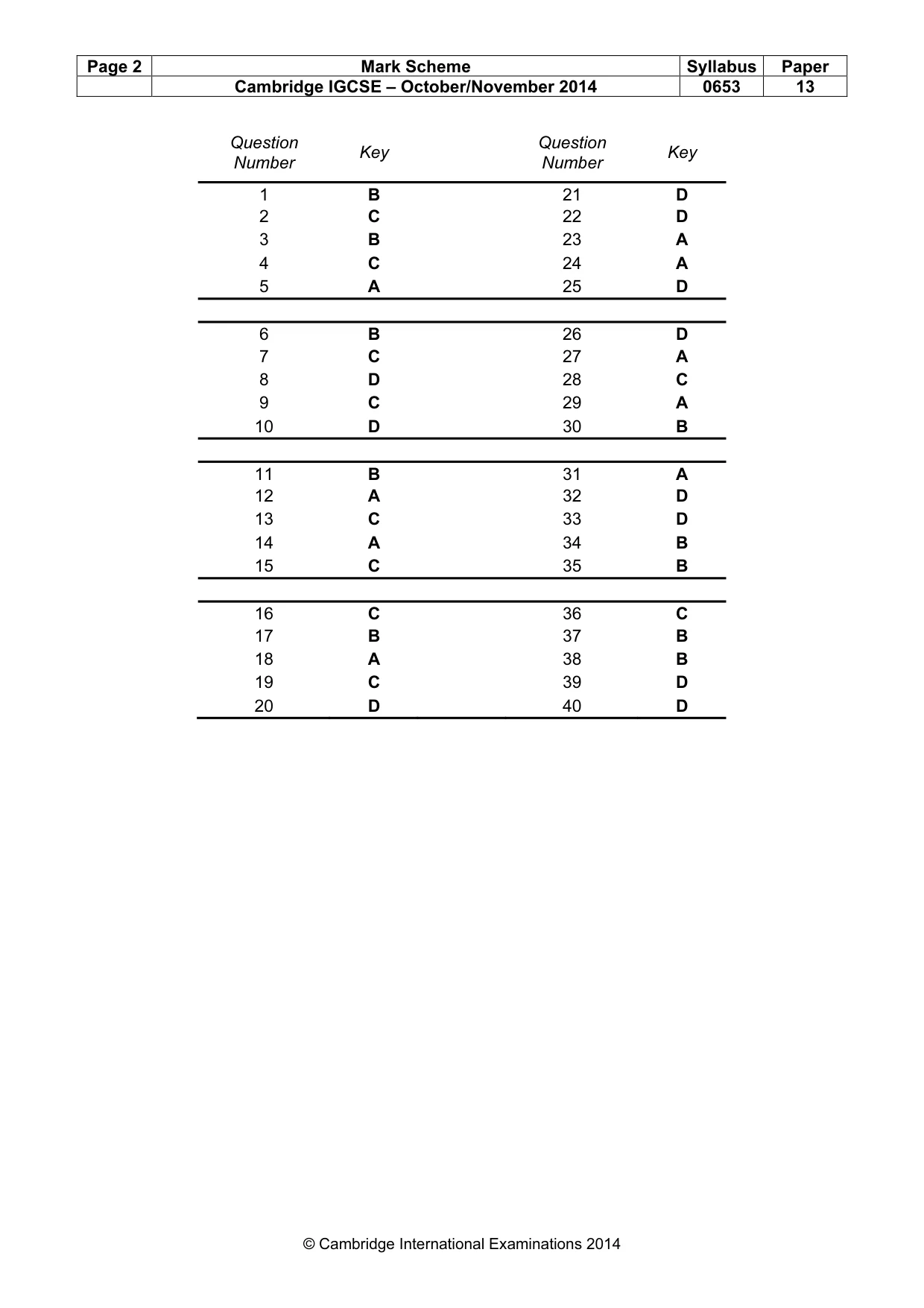
Mark scheme: B
Q2 · The diagram shows a cell from the leaf of a plant
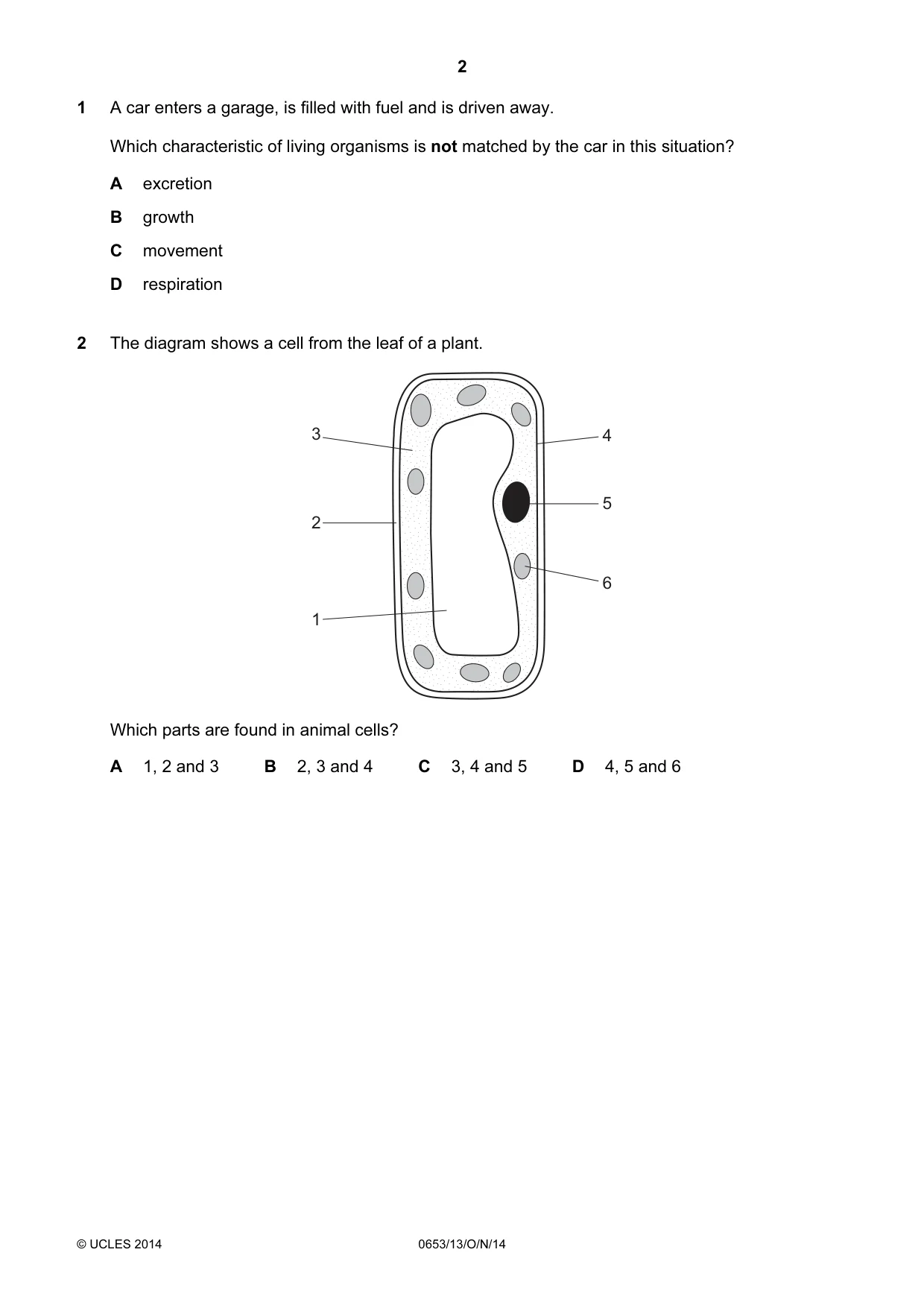
2 The diagram shows a cell from the leaf of a plant. 3 4 5 2 6 1 Which parts are found in animal cells? A 1, 2 and 3 B 2, 3 and 4 C 3, 4 and 5 D 4, 5 and 6
Mark scheme: C
Q3 · Two samples of air are placed in a sealed container, as shown
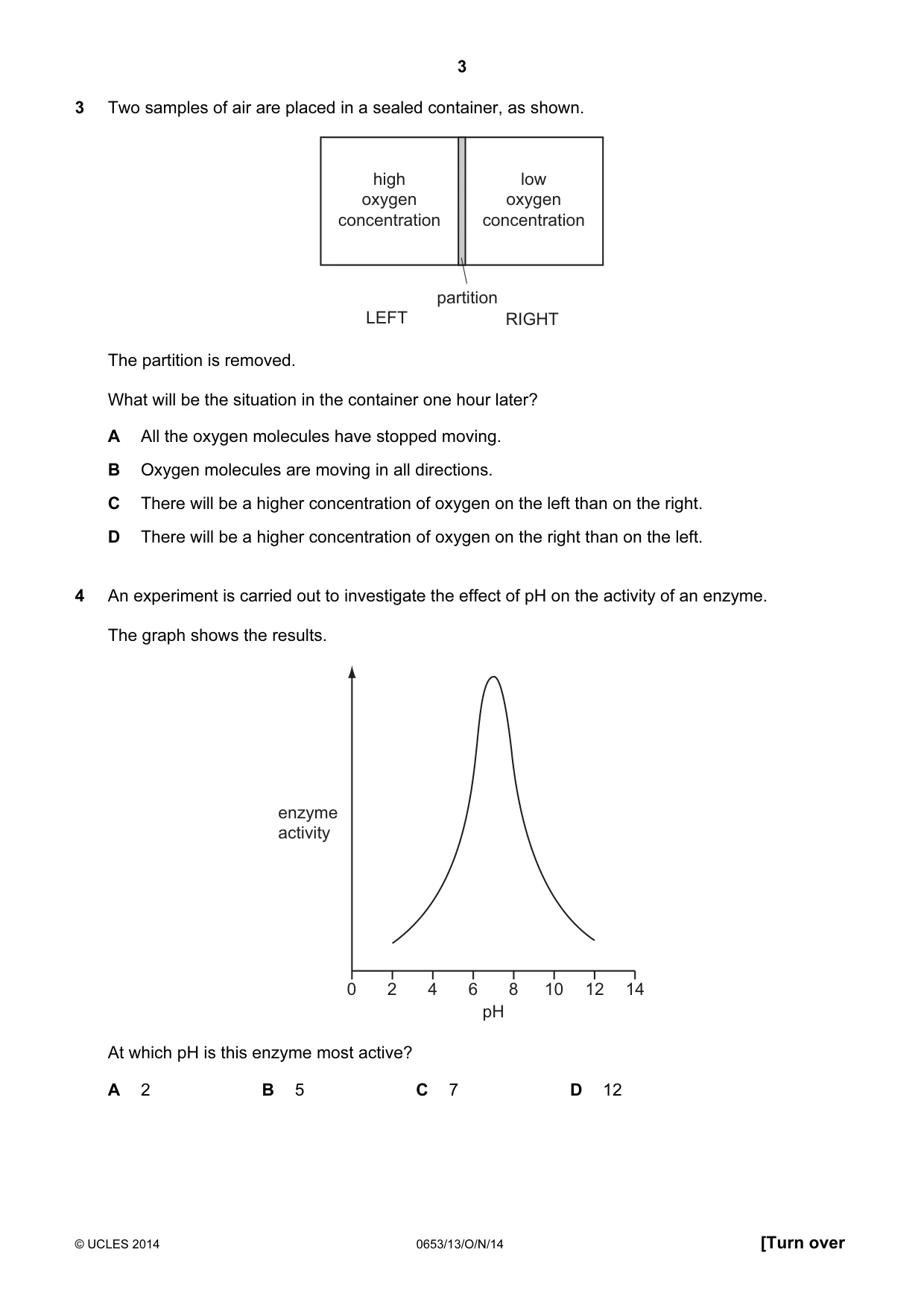
3 Two samples of air are placed in a sealed container, as shown. high low oxygen oxygen concentration concentration partition LEFT RIGHT The partition is removed. What will be the situation in the container one hour later? A All the oxygen molecules have stopped moving. B Oxygen molecules are moving in all directions. C There will be a higher concentration of oxygen on the left than on the right. D There will be a higher concentration of oxygen on the right than on the left.
Mark scheme: B
Q4 · An experiment is carried out to investigate the effect of pH on the activity of an enzyme
4 An experiment is carried out to investigate the effect of pH on the activity of an enzyme. The graph shows the results. enzyme activity 0 2 4 6 8 10 12 14 pH At which pH is this enzyme most active? A 2 B 5 C 7 D 12
Mark scheme: C
Q5 · In leaves, which type of cells surround stomata?
5 In leaves, which type of cells surround stomata? A guard cells B palisade cells C phloem D xylem
Mark scheme: A
Q6 · The diagram shows a section through a tooth
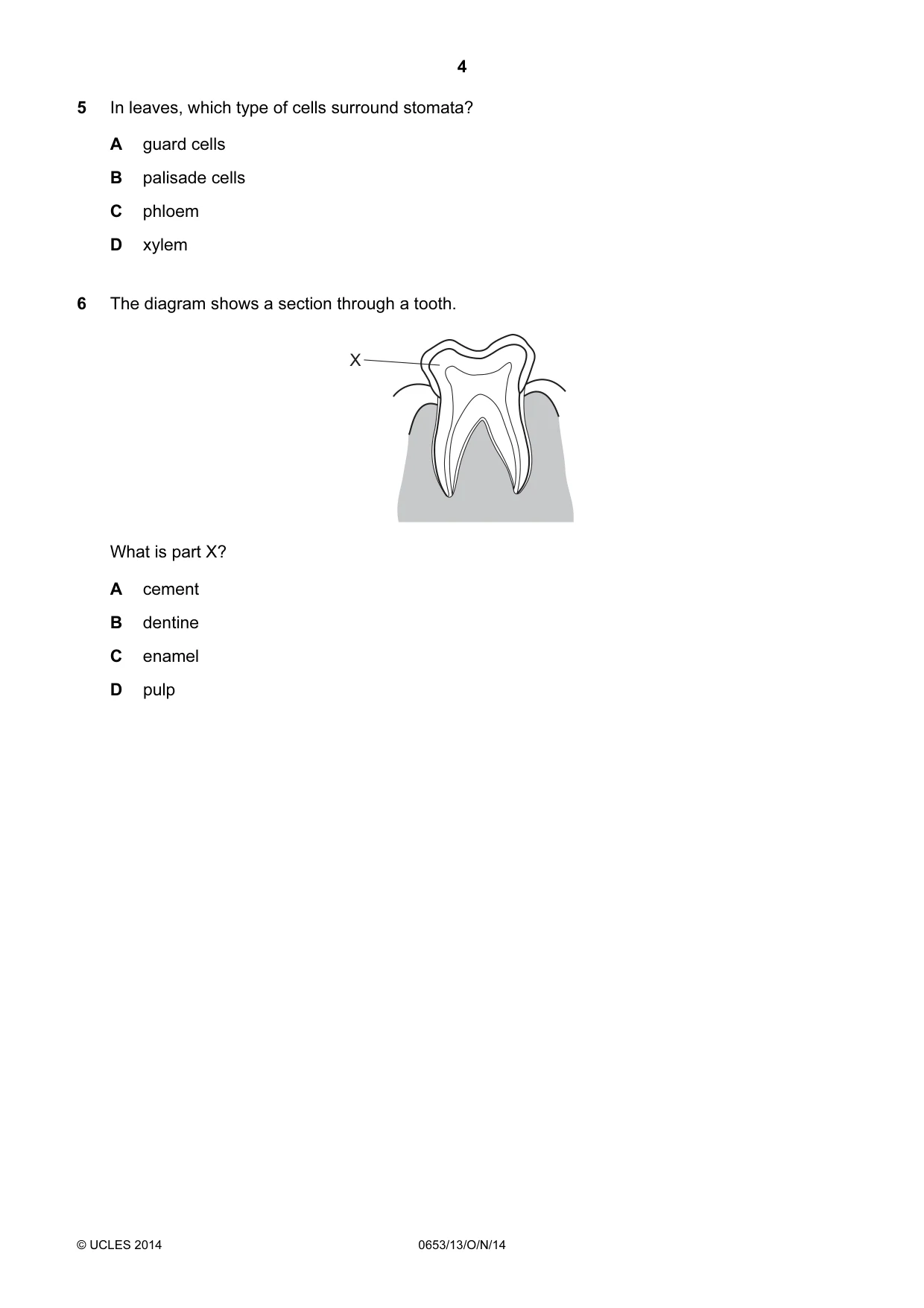
6 The diagram shows a section through a tooth. X What is part X? A cement B dentine C enamel D pulp
Mark scheme: B
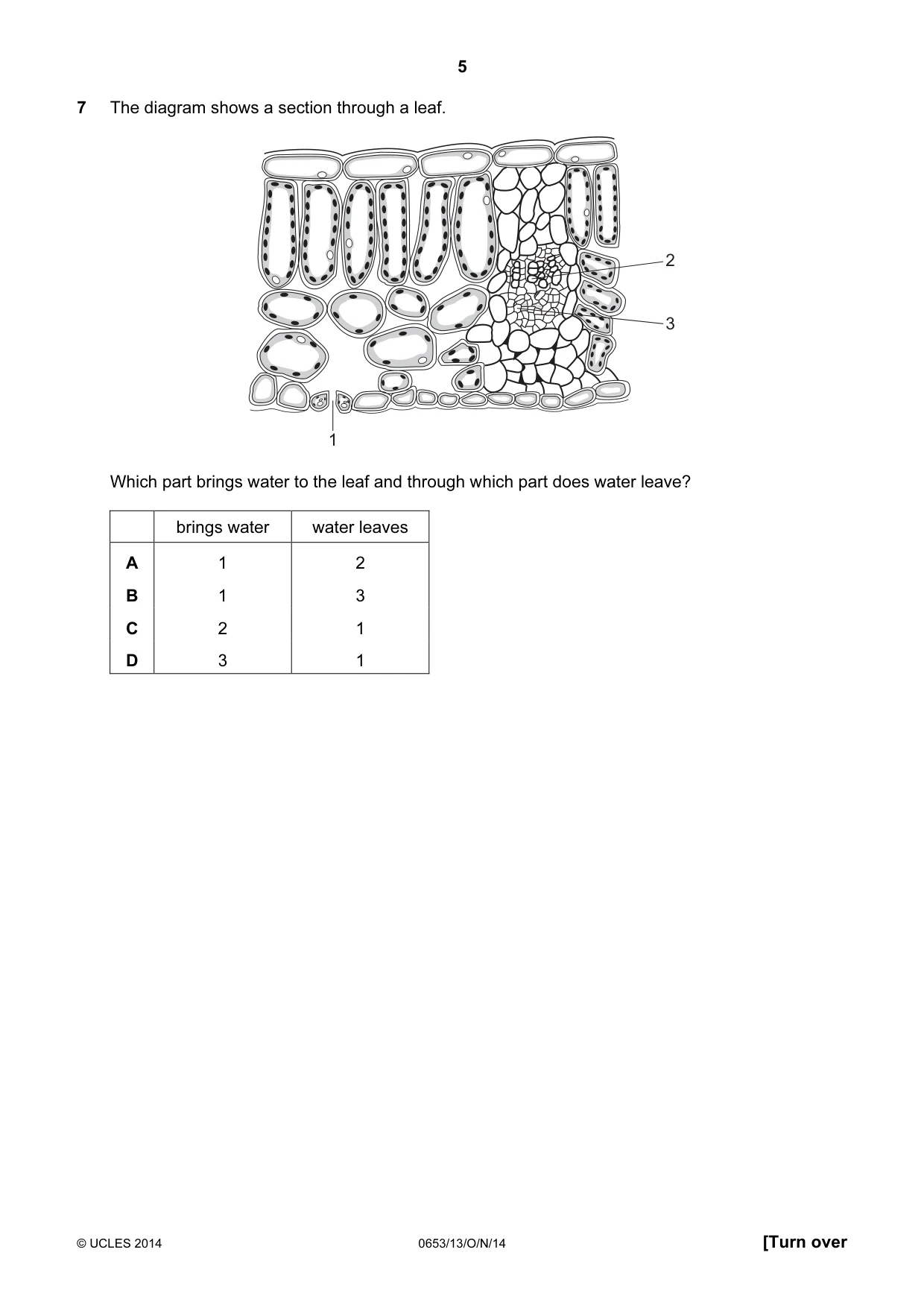
Q7 · The diagram shows a section through a leaf
7 The diagram shows a section through a leaf. 2 3 1 Which part brings water to the leaf and through which part does water leave? brings water water leaves A 1 2 B 1 3 C 2 1 D 3 1
Mark scheme: C
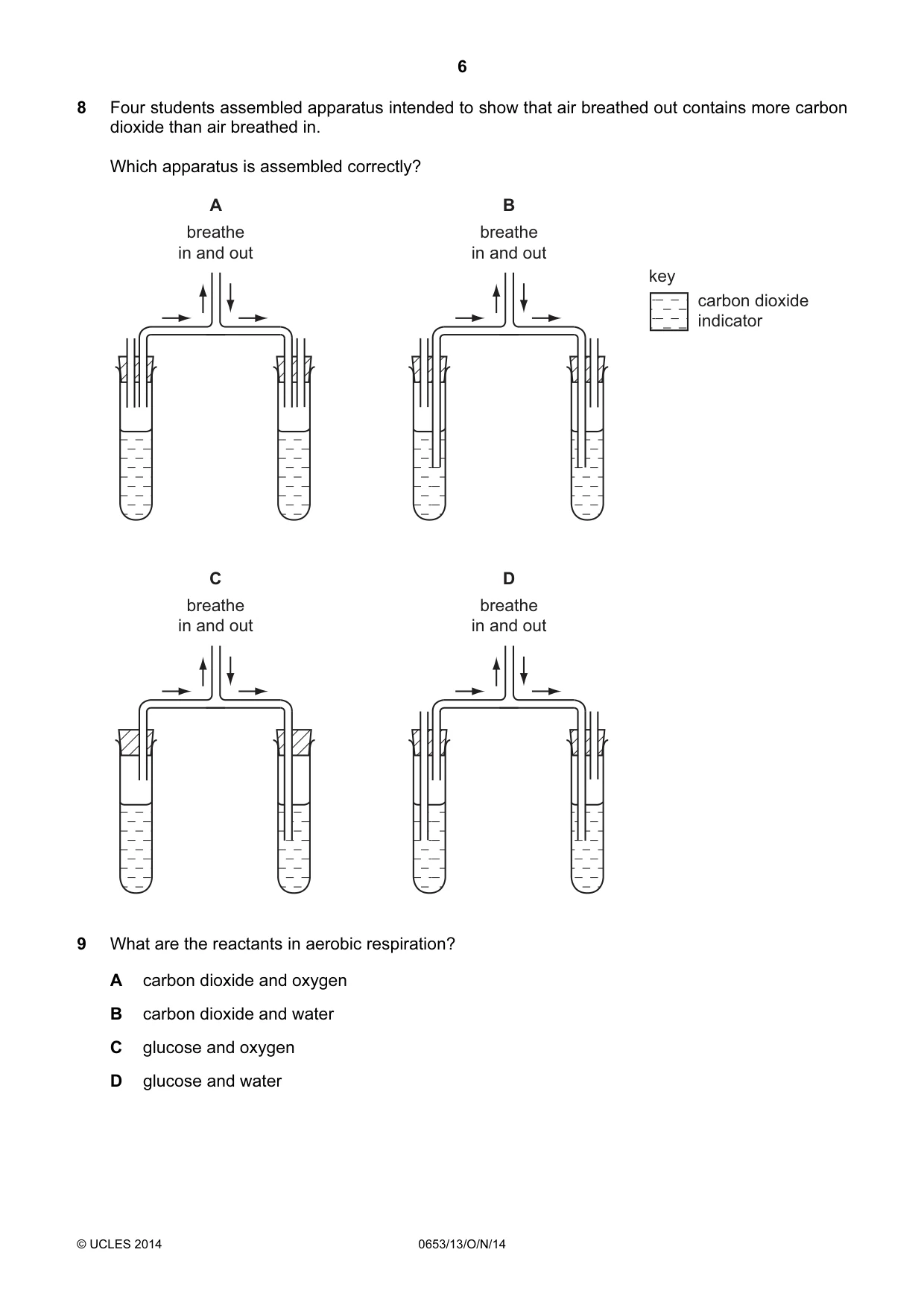
Q8 · Four students assembled apparatus intended to show that air breathed out contains more…
8 Four students assembled apparatus intended to show that air breathed out contains more carbon dioxide than air breathed in. Which apparatus is assembled correctly? A B breathe breathe in and out in and out key carbon dioxide indicator C D breathe breathe in and out in and out
Mark scheme: D
Q9 · What are the reactants in aerobic respiration?
9 What are the reactants in aerobic respiration? A carbon dioxide and oxygen B carbon dioxide and water C glucose and oxygen D glucose and water
Mark scheme: C
Q10 · Insulin is a hormone that is secreted into the blood to control blood sugar
10 Insulin is a hormone that is secreted into the blood to control blood sugar. What happens to insulin after it has done its work? A It builds up in the blood. B It is absorbed by the sugar. C It is destroyed by the pancreas. D It is removed by the liver.
Mark scheme: D
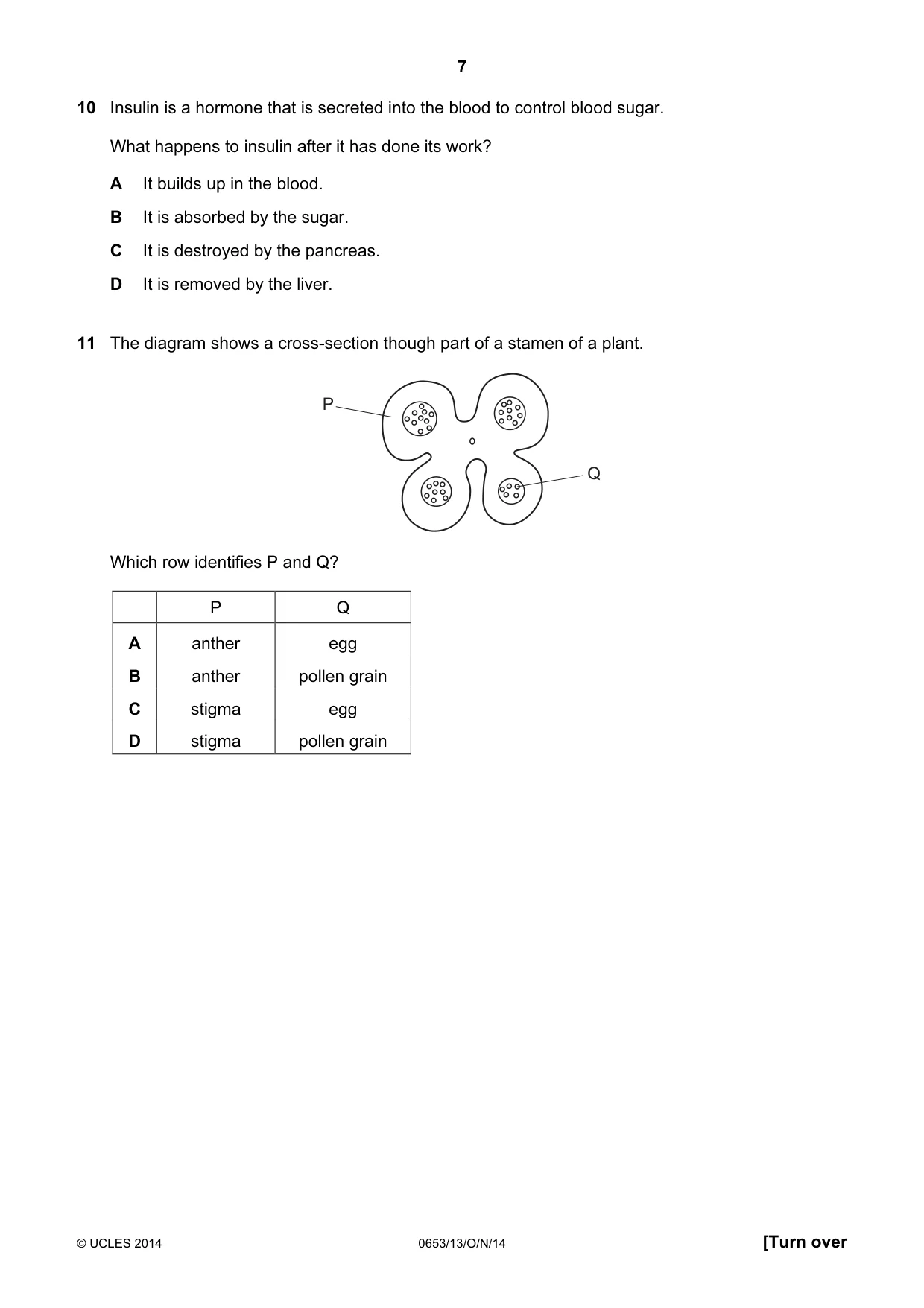
Q11 · The diagram shows a cross-section though part of a stamen of a plant
11 The diagram shows a cross-section though part of a stamen of a plant. P Q Which row identifies P and Q? P Q A anther egg B anther pollen grain C stigma egg D stigma pollen grain
Mark scheme: B
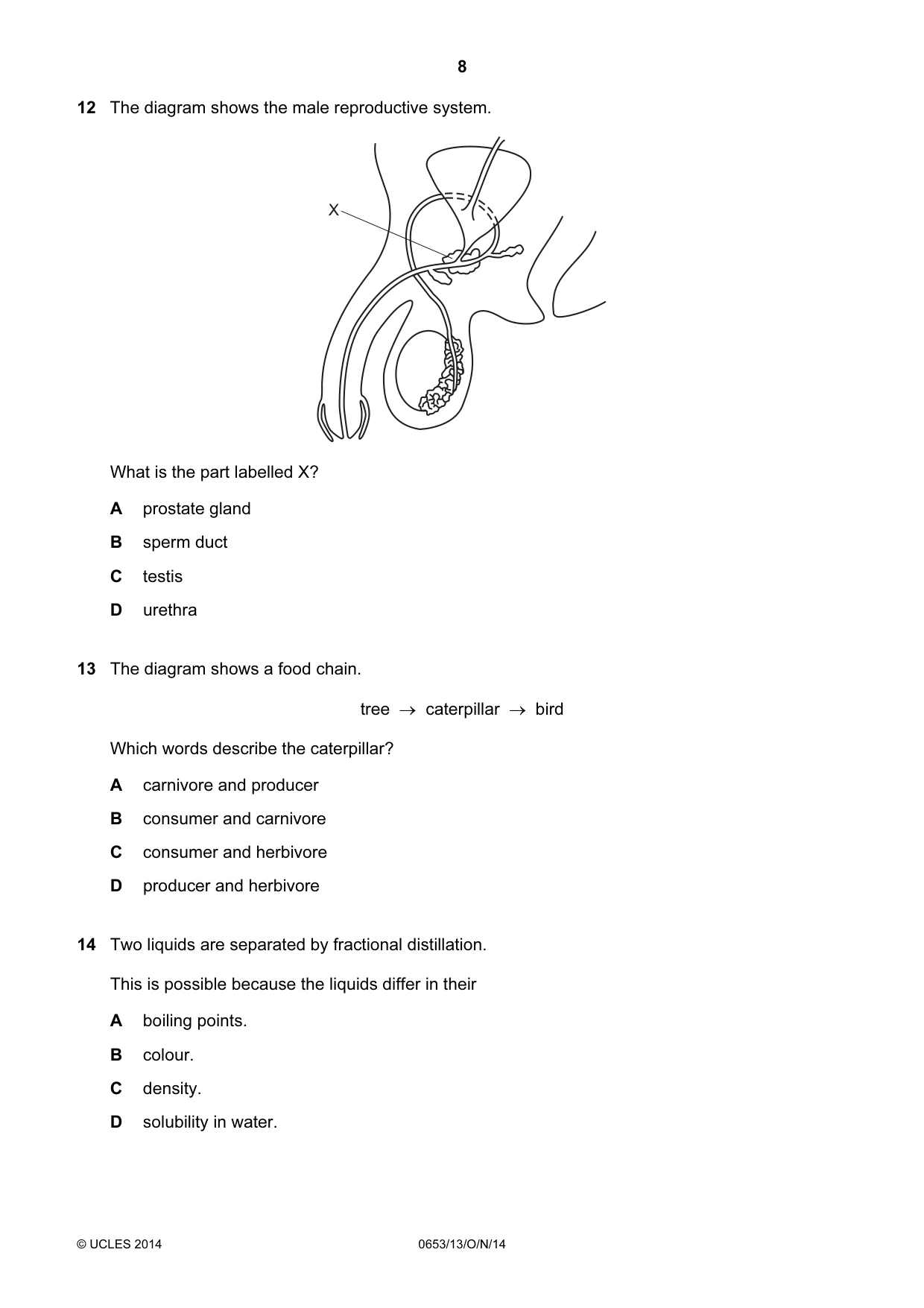
Q12 · The diagram shows the male reproductive system
12 The diagram shows the male reproductive system. X What is the part labelled X? A prostate gland B sperm duct C testis D urethra
Mark scheme: A
Q13 · The diagram shows a food chain
13 The diagram shows a food chain. tree → caterpillar → bird Which words describe the caterpillar? A carnivore and producer B consumer and carnivore C consumer and herbivore D producer and herbivore
Mark scheme: C
Q14 · Two liquids are separated by fractional distillation
14 Two liquids are separated by fractional distillation. This is possible because the liquids differ in their A boiling points. B colour. C density. D solubility in water.
Mark scheme: A
Q15 · The formulae of two minerals are given below
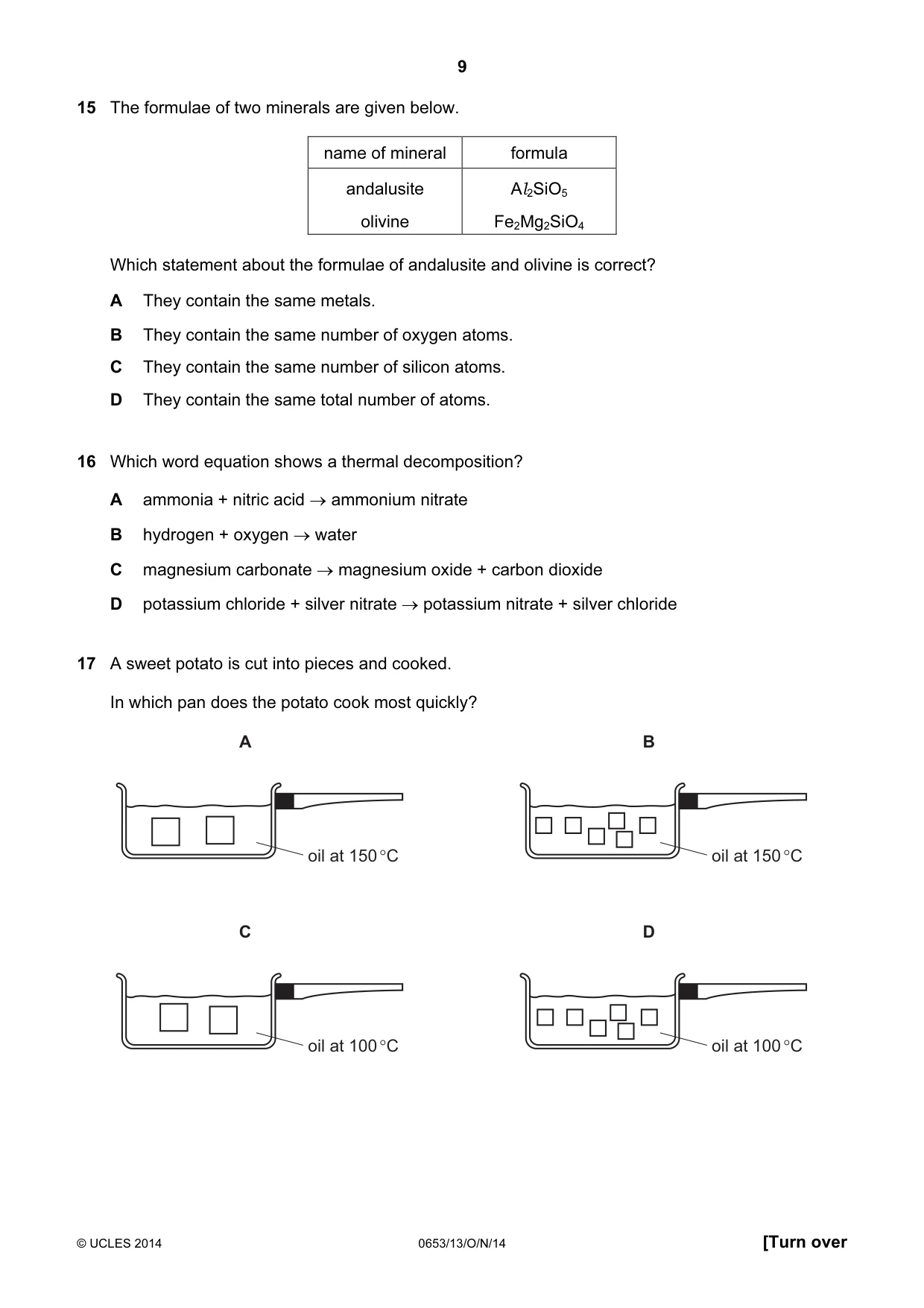
15 The formulae of two minerals are given below. name of mineral formula andalusite Al2SiO5 olivine Fe2Mg2SiO4 Which statement about the formulae of andalusite and olivine is correct? A They contain the same metals. B They contain the same number of oxygen atoms. C They contain the same number of silicon atoms. D They contain the same total number of atoms.
Mark scheme: C
Q16 · Which word equation shows a thermal decomposition?
16 Which word equation shows a thermal decomposition? A ammonia + nitric acid → ammonium nitrate B hydrogen + oxygen → water C magnesium carbonate → magnesium oxide + carbon dioxide D potassium chloride + silver nitrate → potassium nitrate + silver chloride
Mark scheme: C
Q17 · A sweet potato is cut into pieces and cooked
17 A sweet potato is cut into pieces and cooked. In which pan does the potato cook most quickly? A B oil at 150 °C oil at 150 °C C D oil at 100 °C oil at 100 °C
Mark scheme: B
Q18 · Element X forms a basic oxide
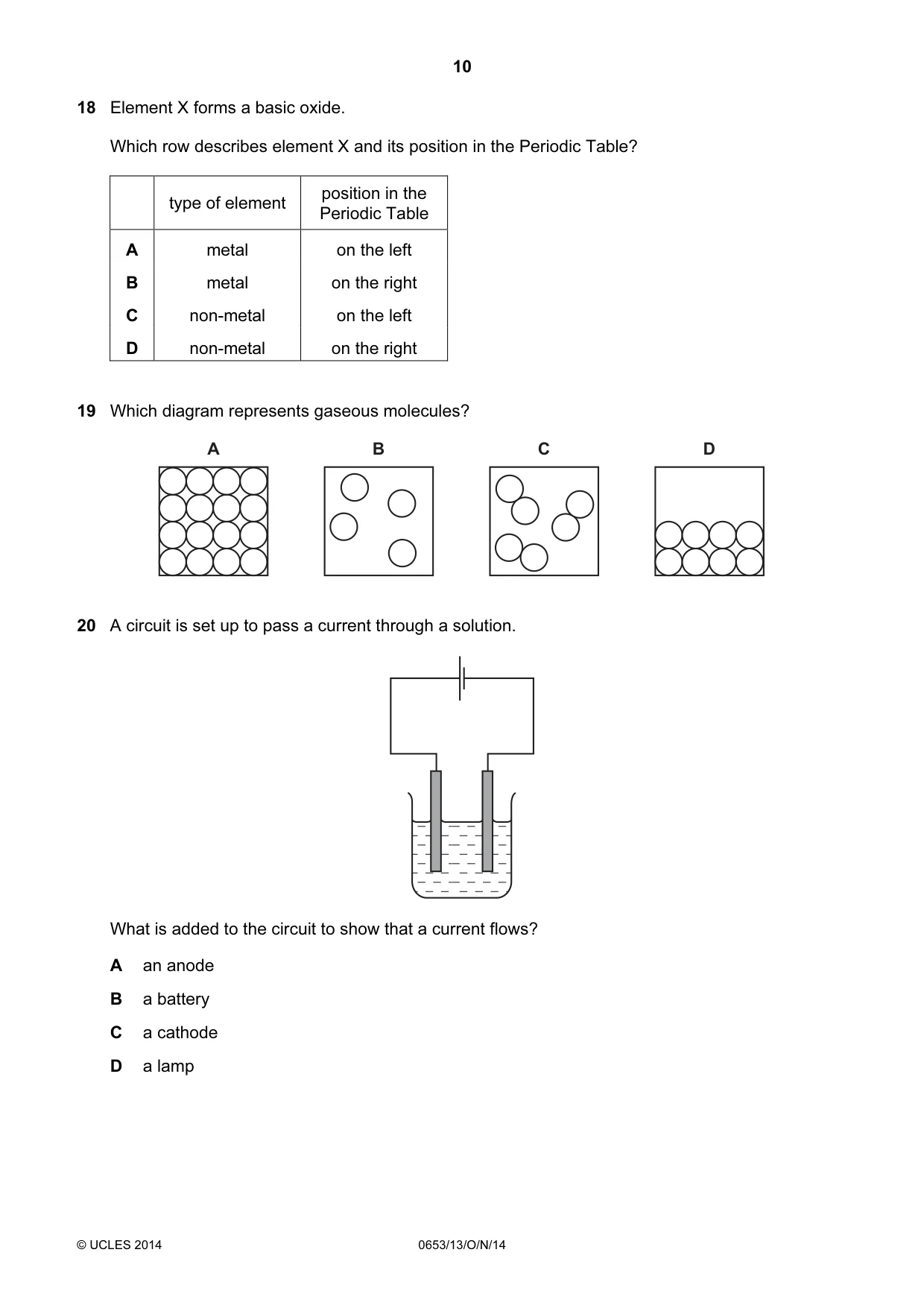
18 Element X forms a basic oxide. Which row describes element X and its position in the Periodic Table? position in the type of element Periodic Table A metal on the left B metal on the right C non-metal on the left D non-metal on the right
Mark scheme: A
Q19 · Which diagram represents gaseous molecules?
19 Which diagram represents gaseous molecules? A B C D
Mark scheme: C
Q20 · A circuit is set up to pass a current through a solution
20 A circuit is set up to pass a current through a solution. What is added to the circuit to show that a current flows? A an anode B a battery C a cathode D a lamp
Mark scheme: D
Q21 · The initial and final temperatures of two chemical reactions are shown
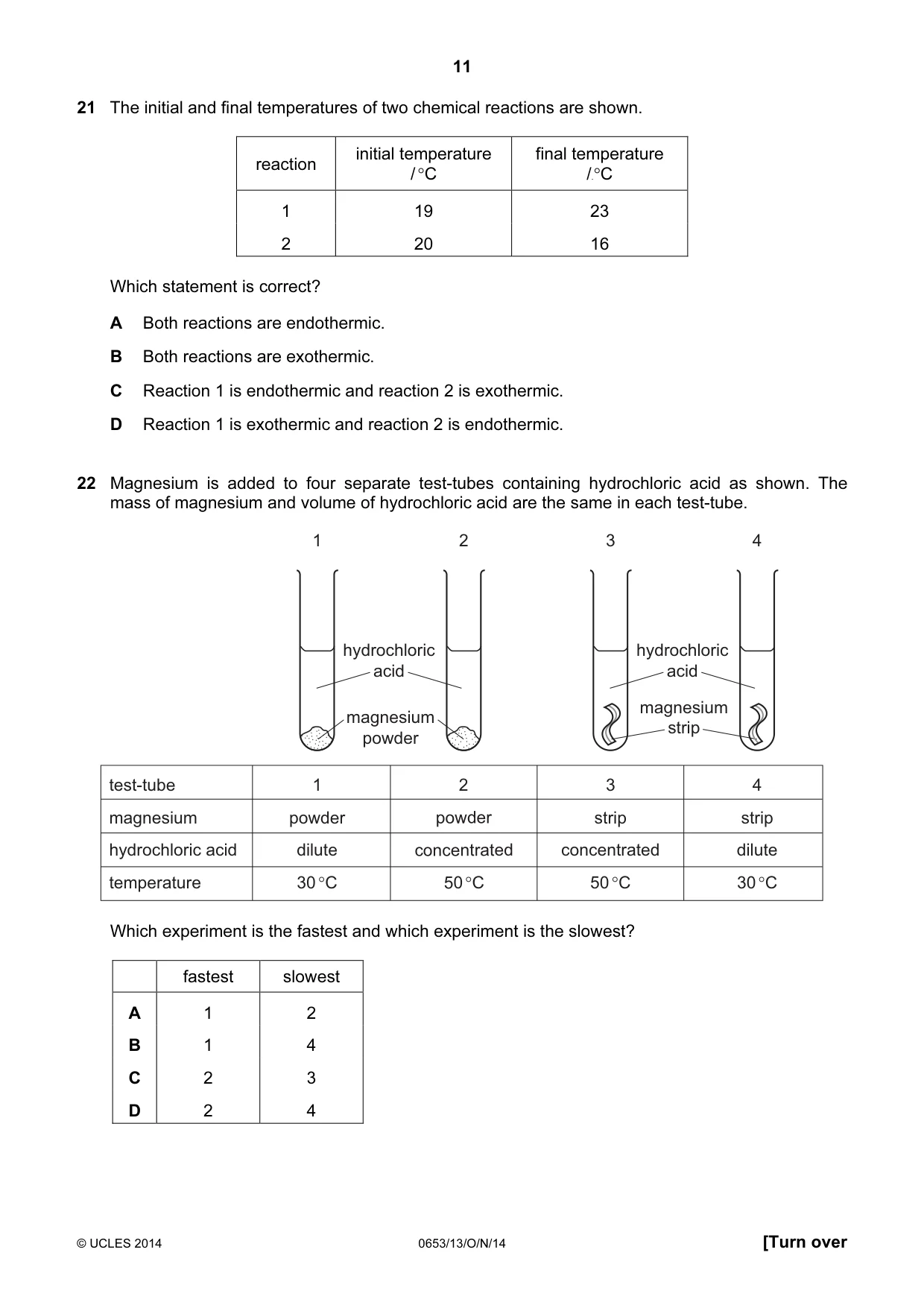
21 The initial and final temperatures of two chemical reactions are shown. initial temperature final temperature reaction / °C /.°C 1 19 23 2 20 16 Which statement is correct? A Both reactions are endothermic. B Both reactions are exothermic. C Reaction 1 is endothermic and reaction 2 is exothermic. D Reaction 1 is exothermic and reaction 2 is endothermic.
Mark scheme: D
Q22 · Magnesium is added to four separate test-tubes containing hydrochloric acid as shown
22 Magnesium is added to four separate test-tubes containing hydrochloric acid as shown. The mass of magnesium and volume of hydrochloric acid are the same in each test-tube. 1 2 3 4 hydrochloric hydrochloric acid acid magnesium magnesium strip powder test-tube 1 2 3 4 magnesium powder powder strip strip hydrochloric acid dilute concentrated concentrated dilute temperature 30 °C 50 °C 50 °C 30 °C Which experiment is the fastest and which experiment is the slowest? fastest slowest A 1 2 B 1 4 C 2 3 D 2 4
Mark scheme: D
Q23 · Gasoline is a hydrocarbon fuel obtained from crude oil
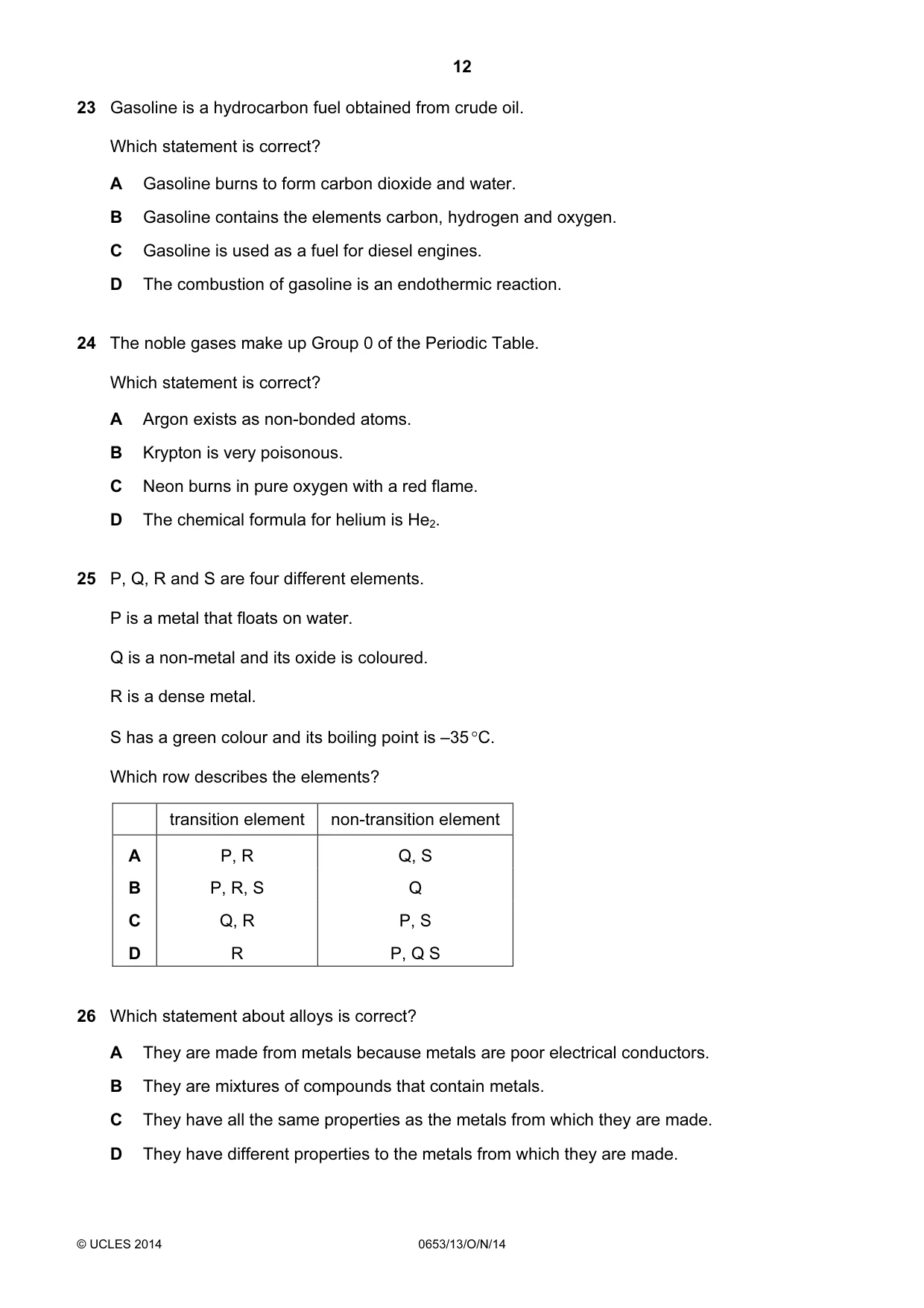
23 Gasoline is a hydrocarbon fuel obtained from crude oil. Which statement is correct? A Gasoline burns to form carbon dioxide and water. B Gasoline contains the elements carbon, hydrogen and oxygen. C Gasoline is used as a fuel for diesel engines. D The combustion of gasoline is an endothermic reaction.
Mark scheme: A
Q24 · The noble gases make up Group 0 of the Periodic Table
24 The noble gases make up Group 0 of the Periodic Table. Which statement is correct? A Argon exists as non-bonded atoms. B Krypton is very poisonous. C Neon burns in pure oxygen with a red flame. D The chemical formula for helium is He2.
Mark scheme: A
Q25 · P, Q, R and S are four different elements
25 P, Q, R and S are four different elements. P is a metal that floats on water. Q is a non-metal and its oxide is coloured. R is a dense metal. S has a green colour and its boiling point is –35 °C. Which row describes the elements? transition element non-transition element A P, R Q, S B P, R, S Q C Q, R P, S D R P, Q S
Mark scheme: D
Q26 · Which statement about alloys is correct?
26 Which statement about alloys is correct? A They are made from metals because metals are poor electrical conductors. B They are mixtures of compounds that contain metals. C They have all the same properties as the metals from which they are made. D They have different properties to the metals from which they are made.
Mark scheme: D
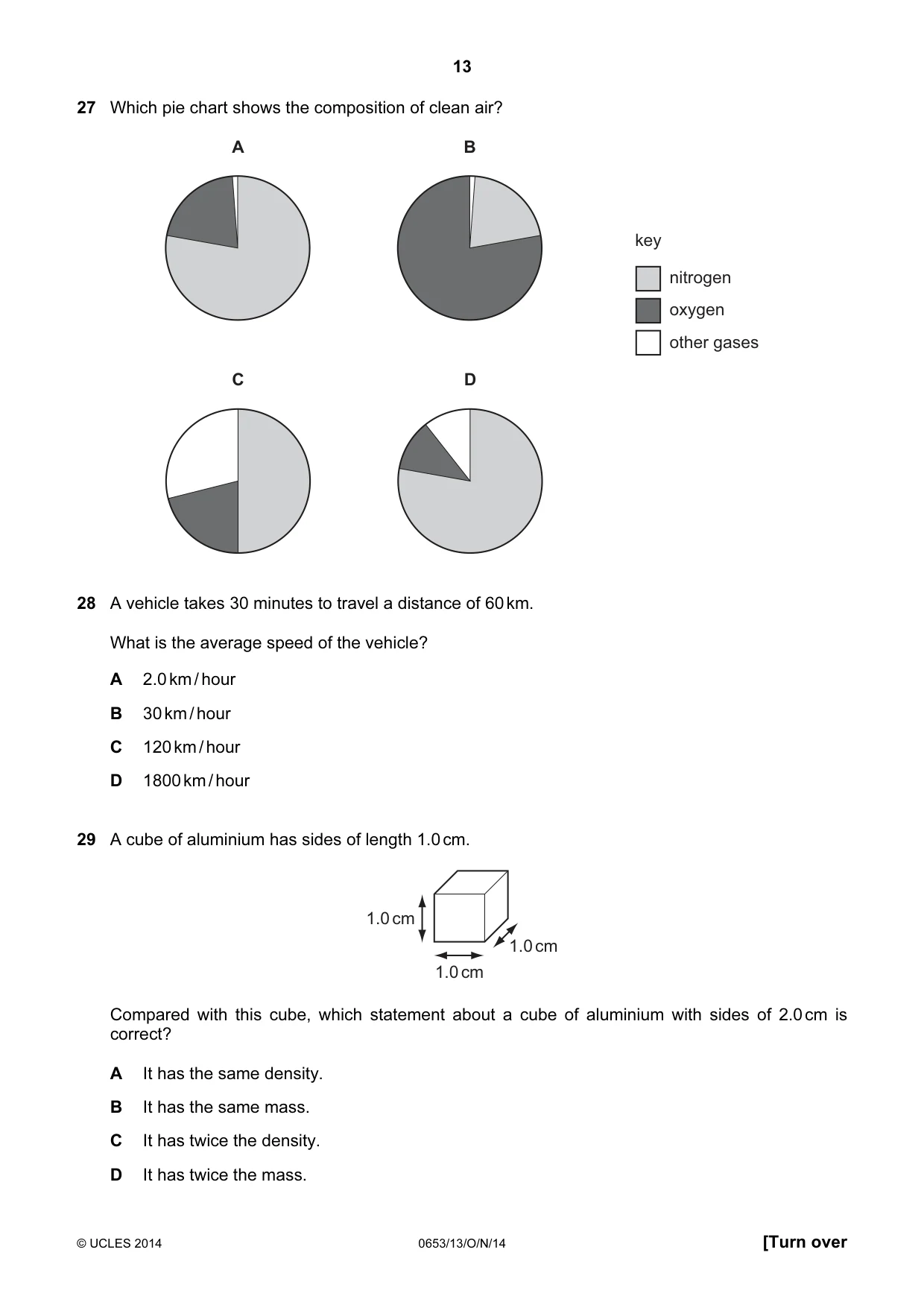
Q27 · Which pie chart shows the composition of clean air?
27 Which pie chart shows the composition of clean air? A B key nitrogen oxygen other gases C D
Mark scheme: A
Q28 · A vehicle takes 30 minutes to travel a distance of 60 km
28 A vehicle takes 30 minutes to travel a distance of 60 km. What is the average speed of the vehicle? A 2.0 km / hour B 30 km / hour C 120 km / hour D 1800 km / hour
Mark scheme: C
Q29 · A cube of aluminium has sides of length 1.0 cm
29 A cube of aluminium has sides of length 1.0 cm. 1.0 cm 1.0 cm 1.0 cm Compared with this cube, which statement about a cube of aluminium with sides of 2.0 cm is correct? A It has the same density. B It has the same mass. C It has twice the density. D It has twice the mass.
Mark scheme: A
Q30 · Which energy resource can be used to obtain electricity without any moving parts?
30 Which energy resource can be used to obtain electricity without any moving parts? A hydroelectric B solar cells C tides D wave
Mark scheme: B
Q31 · Which statement describes evaporation?
31 Which statement describes evaporation? A The most energetic molecules of a liquid escape from the surface into the air. B The most energetic molecules of a liquid return to the liquid from the air. C The least energetic molecules of a liquid escape from the surface into the air. D The least energetic molecules of a liquid return to the liquid from the air.
Mark scheme: A
Q32 · A badly designed railway line changes shape when the temperature of the air around it…
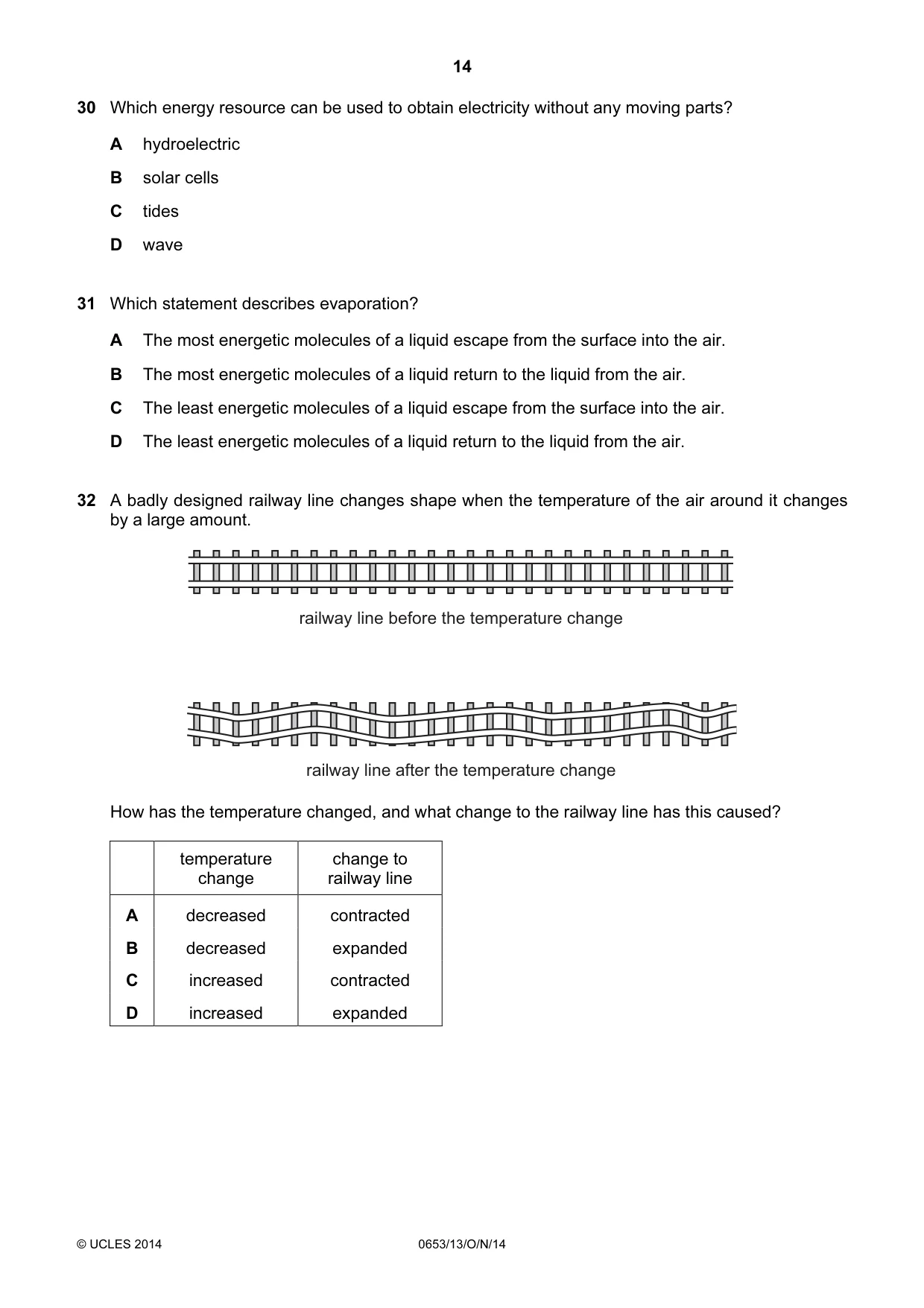
32 A badly designed railway line changes shape when the temperature of the air around it changes by a large amount. railway line before the temperature change railway line after the temperature change How has the temperature changed, and what change to the railway line has this caused? temperature change to change railway line A decreased contracted B decreased expanded C increased contracted D increased expanded
Mark scheme: D
Q33 · An electric heater is placed inside a metal box which has one side open
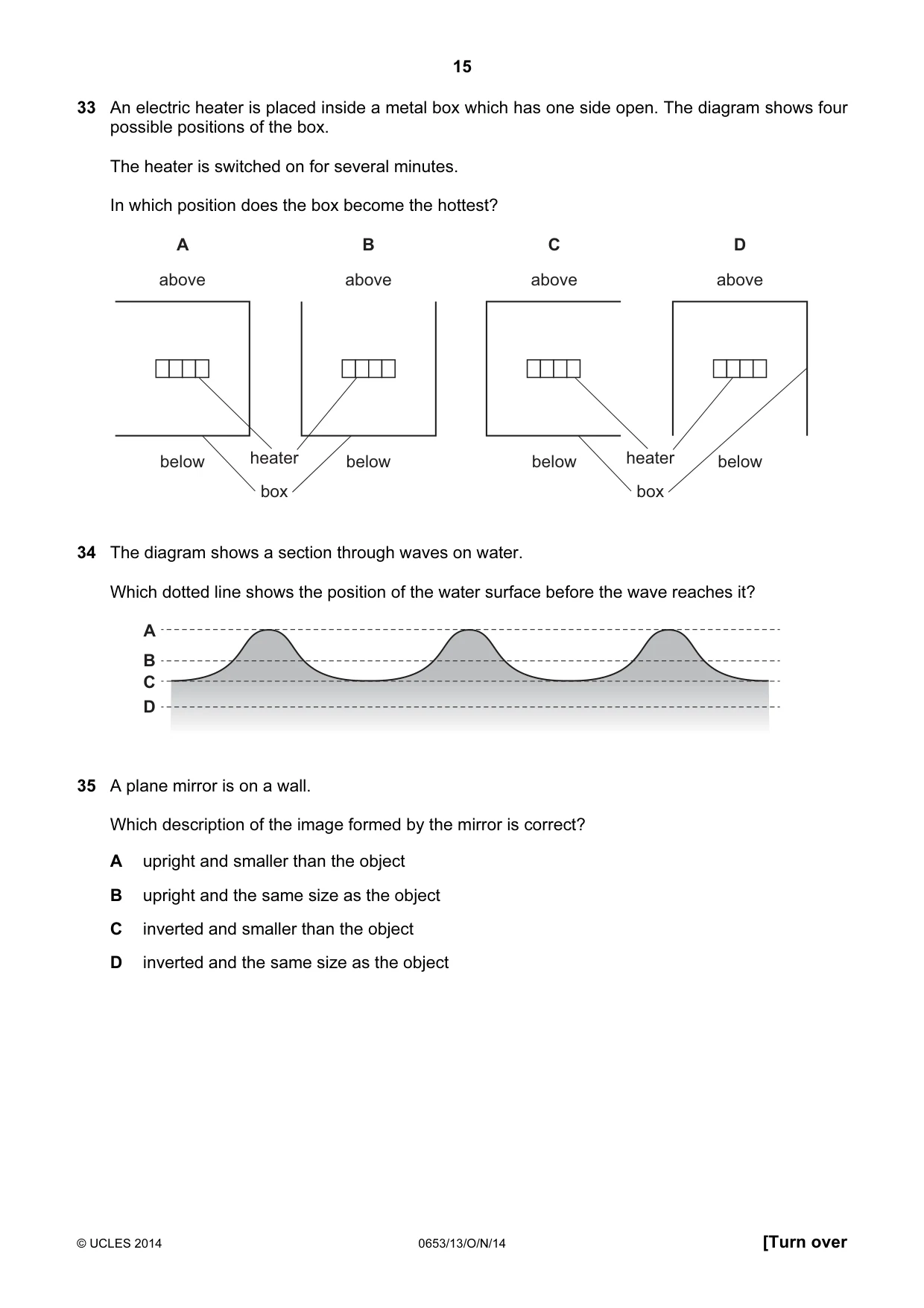
33 An electric heater is placed inside a metal box which has one side open. The diagram shows four possible positions of the box. The heater is switched on for several minutes. In which position does the box become the hottest? A B C D above above above above below heater below below heater below box box
Mark scheme: D
Q34 · The diagram shows a section through waves on water
34 The diagram shows a section through waves on water. Which dotted line shows the position of the water surface before the wave reaches it? A B C D
Mark scheme: B
Q35 · A plane mirror is on a wall
35 A plane mirror is on a wall. Which description of the image formed by the mirror is correct? A upright and smaller than the object B upright and the same size as the object C inverted and smaller than the object D inverted and the same size as the object
Mark scheme: B
Q36 · Electromagnetic waves are used to scan passengers’ luggage before they board an aeroplane
36 Electromagnetic waves are used to scan passengers’ luggage before they board an aeroplane. Electromagnetic waves are also used in a television remote controller. Which type of electromagnetic wave is used for each of these purposes? scanning television luggage remote controller A radio waves infra-red waves B radio waves ultraviolet waves C X-rays infra-red waves D X-rays ultraviolet waves
Mark scheme: C
Q37 · A woman hammers a post into the ground
37 A woman hammers a post into the ground. A boy starts a stop-watch when he sees the hammer hit the post. He stops the stop-watch when he hears the sound of the hammer hitting the post. The stop-watch reading is 0.60 seconds. The speed of sound in air is 330 m / s. What is the distance between the boy and the post? A 99 m B 198 m C 275 m D 550 m
Mark scheme: B
Q38 · The diagram shows an electric circuit
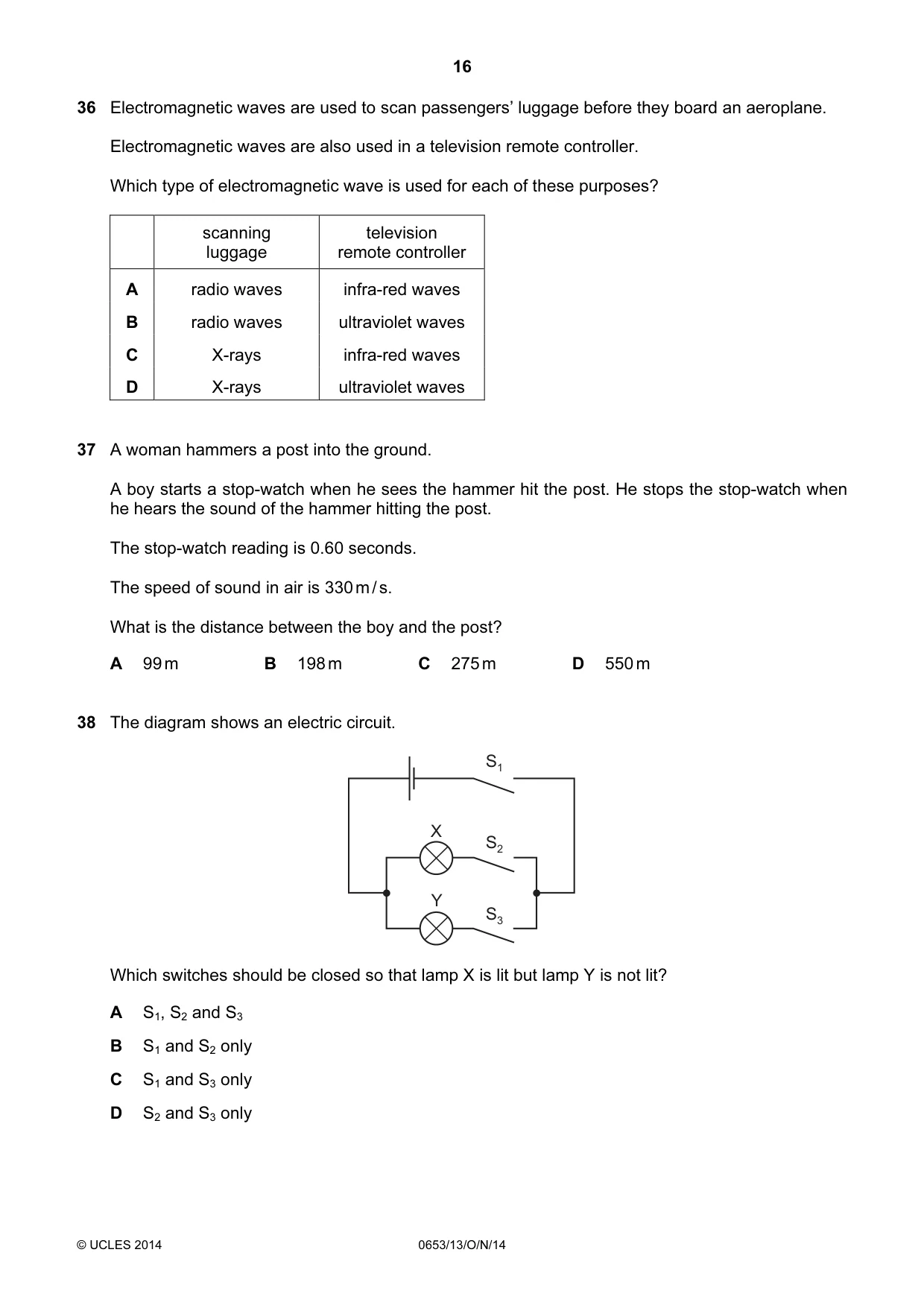
38 The diagram shows an electric circuit. S1 X S2 Y S3 Which switches should be closed so that lamp X is lit but lamp Y is not lit? A S1, S2 and S3 B S1 and S2 only C S1 and S3 only D S2 and S3 only
Mark scheme: B
Q39 · Why is a fuse used in an electric circuit in a house?
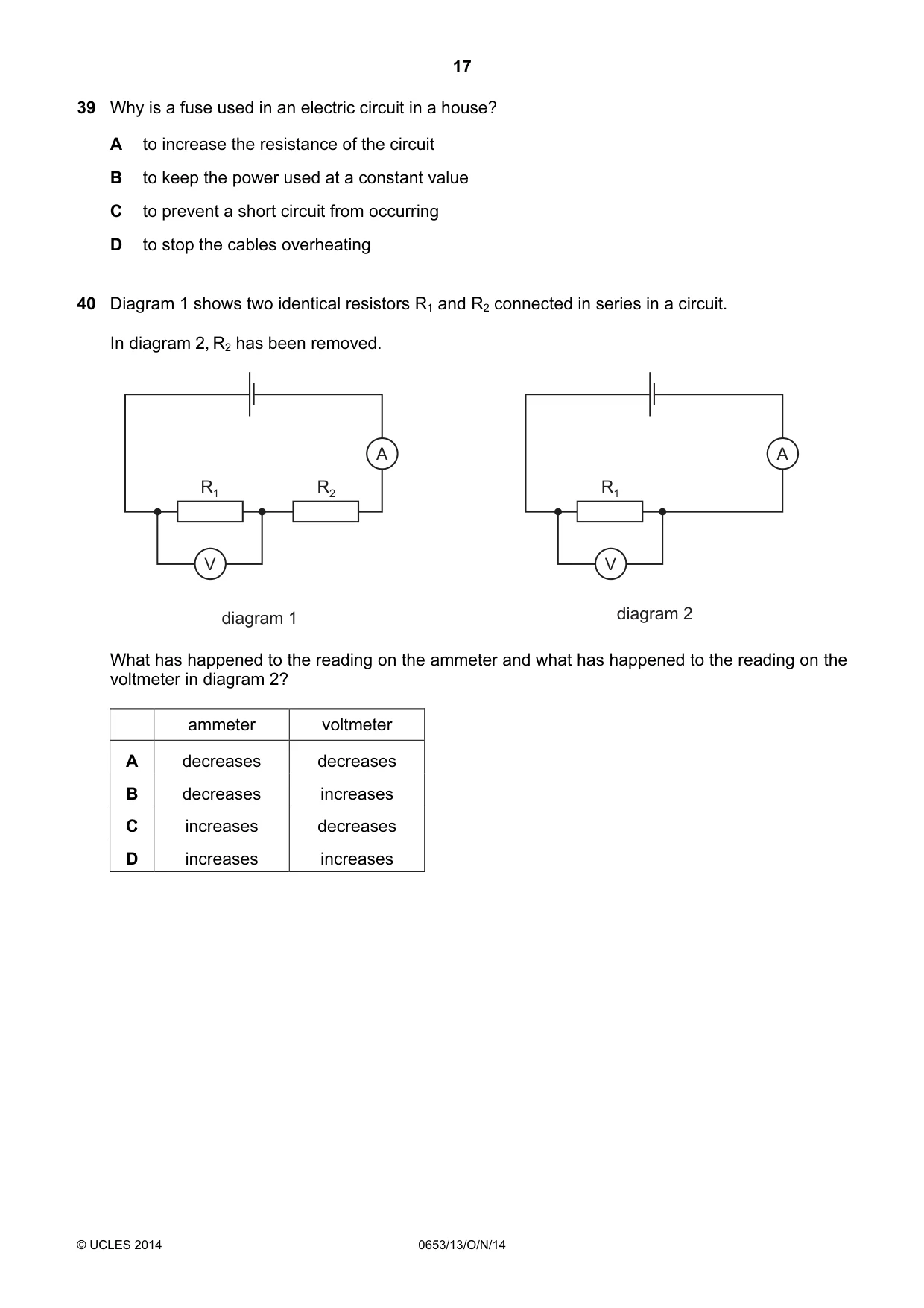
39 Why is a fuse used in an electric circuit in a house? A to increase the resistance of the circuit B to keep the power used at a constant value C to prevent a short circuit from occurring D to stop the cables overheating
Mark scheme: D
Q40 · Two identical resistors R1 and R2 connected in series in a circuit
40 Diagram 1 shows two identical resistors R1 and R2 connected in series in a circuit. In diagram 2, R2 has been removed. A A R1 R2 R1 V V diagram 1 diagram 2 What has happened to the reading on the ammeter and what has happened to the reading on the voltmeter in diagram 2? ammeter voltmeter A decreases decreases B decreases increases C increases decreases D increases increases
Mark scheme: D
What was in this paper
The subtopics covered by these 40 questions, and how many questions each got. Open one in a new tab to see every Cambridge question on it.
2Electrical circuits2Kinetic particle model of matter2Air quality and climate1Alloys and their properties1Cell structure1Cells, batteries, generators and motors1Characteristics of living organisms1Density1Drugs1Electrical safety1Electrolysis1Electromagnetic spectrum1Elements, compounds and mixtures1Enzymes1Exothermic and endothermic reactions1Food chains and food webs1Fuels1Gas exchange in humans1General properties of waves1Leaf structure1Light1Motion1Noble gases1Oxides1Physical and chemical changes1Rate of reaction1Respiration1Separation and purification1Sexual reproduction in humans1Sexual reproduction in plants1Solids, liquids and gases1Sound1Thermal properties and temperature1Transfer of thermal energy1Transition elements1Xylem and phloem1What you needed in this session
Cambridge’s own grade thresholds for 2014 Oct/Nov, Paper 1 · Variant 3. A higher threshold means an easier paper — the bar moves with how the cohort did.