Cambridge IGCSE Science - Combined 0653 — 2017 Oct/Nov Paper 1 · Variant 3
0653/13/O/N/17 · 40 questions · 40 marks · ≈45 min
The question paper and its mark scheme, free to read here and free to download. This is Cambridge’s own paper, exactly as it was sat.
Question paper16 pages
Mark scheme3 pages
Answers below. Sit the paper first if you are practising.
Questions as text
Q1 · Which characteristics help to define a living organism?
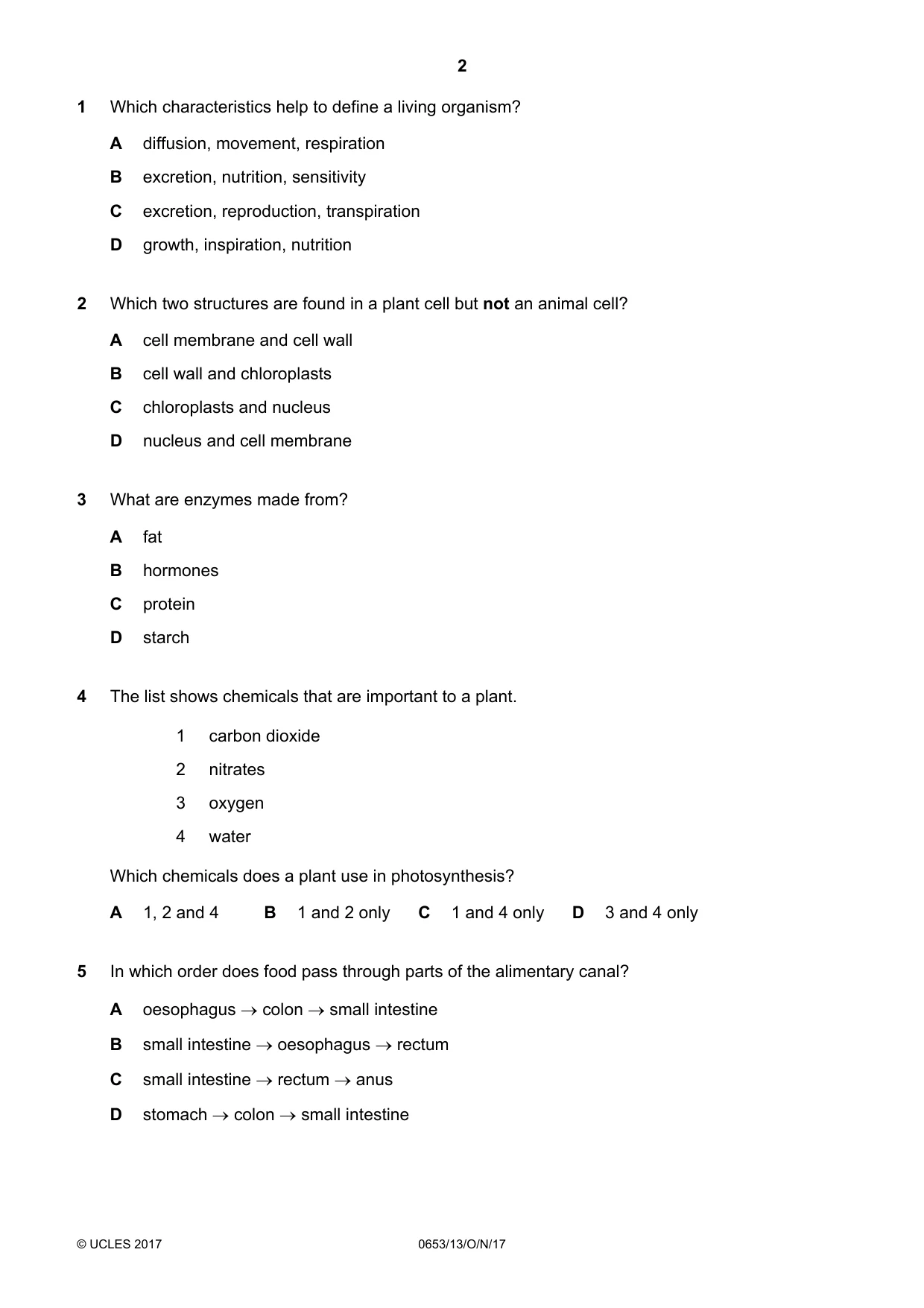
1 Which characteristics help to define a living organism? A diffusion, movement, respiration B excretion, nutrition, sensitivity C excretion, reproduction, transpiration D growth, inspiration, nutrition
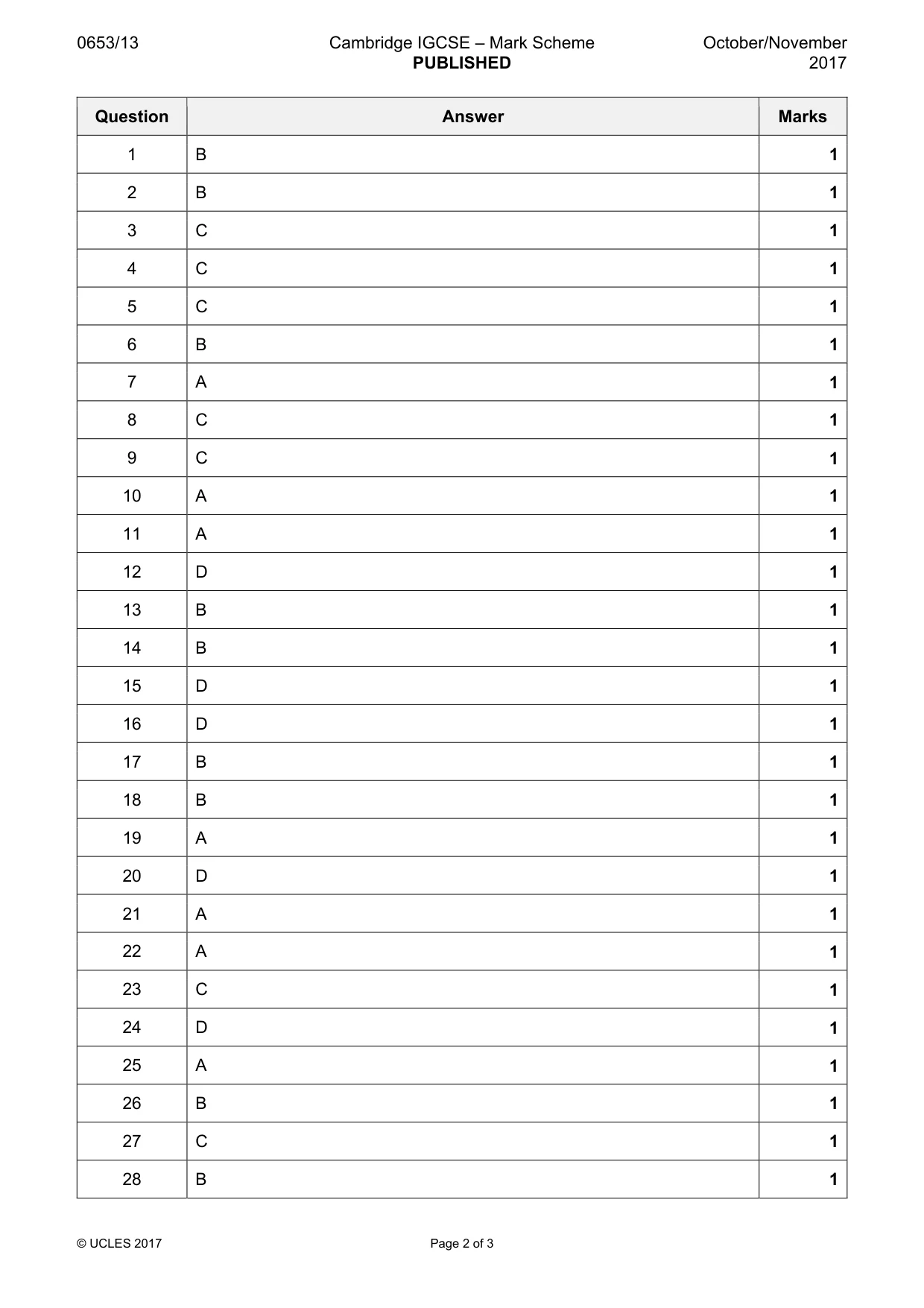
Mark scheme: B
Q2 · Which two structures are found in a plant cell but not an animal cell?
2 Which two structures are found in a plant cell but not an animal cell? A cell membrane and cell wall B cell wall and chloroplasts C chloroplasts and nucleus D nucleus and cell membrane
Mark scheme: B
Q3 · What are enzymes made from?
3 What are enzymes made from? A fat B hormones C protein D starch
Mark scheme: C
Q4 · The list shows chemicals that are important to a plant
4 The list shows chemicals that are important to a plant. 1 carbon dioxide 2 nitrates 3 oxygen 4 water Which chemicals does a plant use in photosynthesis? A 1, 2 and 4 B 1 and 2 only C 1 and 4 only D 3 and 4 only
Mark scheme: C
Q5 · In which order does food pass through parts of the alimentary canal?
5 In which order does food pass through parts of the alimentary canal? A oesophagus → colon → small intestine B small intestine → oesophagus → rectum C small intestine → rectum → anus D stomach → colon → small intestine
Mark scheme: C
Q6 · Which row shows the effects of increasing humidity, light intensity and temperature on…
6 Which row shows the effects of increasing humidity, light intensity and temperature on the rate of transpiration in a plant? increasing increasing increasing humidity light intensity temperature A rate decreases rate decreases rate decreases B rate decreases rate increases rate increases C rate increases rate decreases rate increases D rate increases rate increases rate decreases
Mark scheme: B
Q7 · The diagram shows a section through the human heart
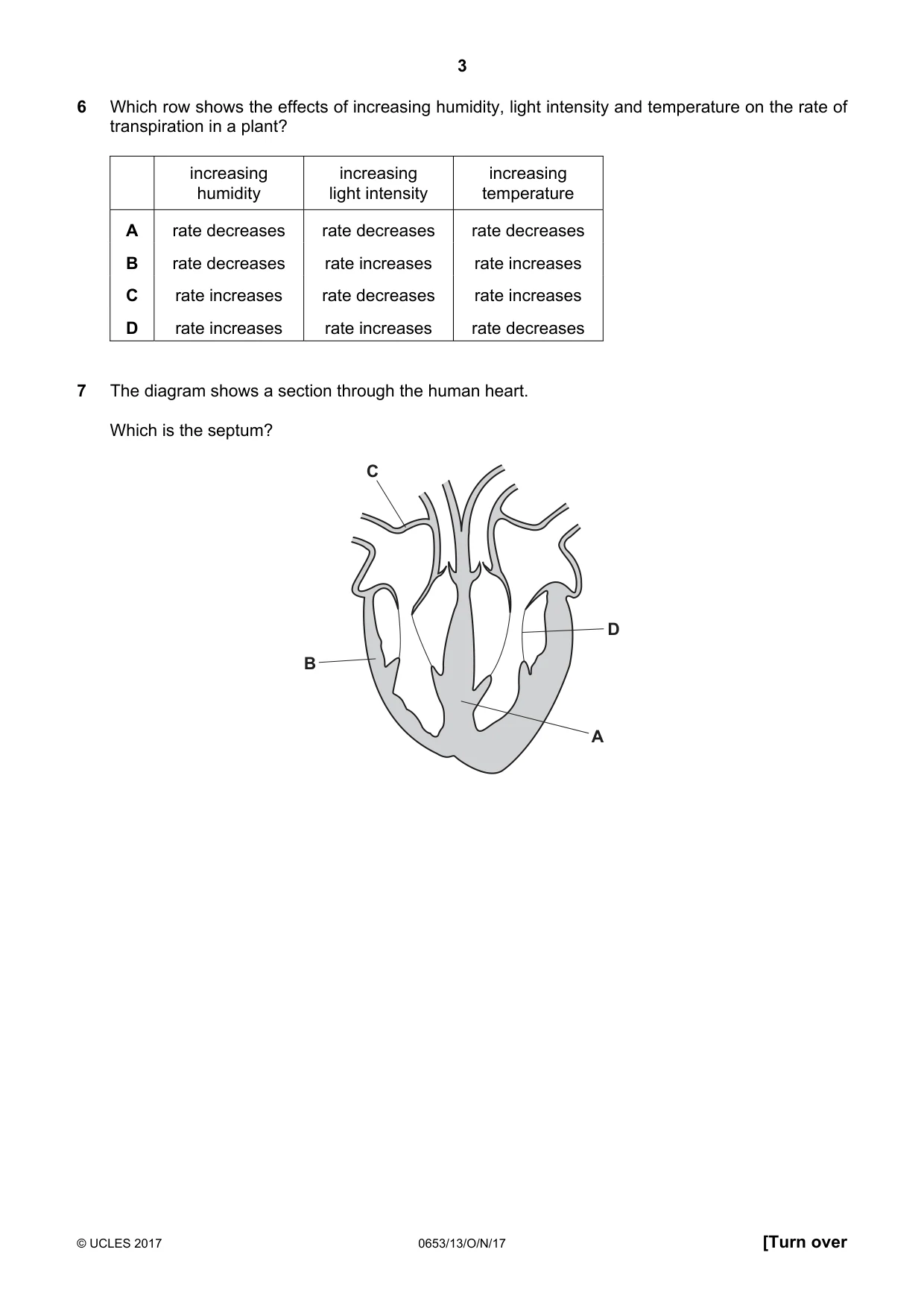
7 The diagram shows a section through the human heart. Which is the septum? C D B A
Mark scheme: A
Q8 · Which row correctly matches the cell to its function?
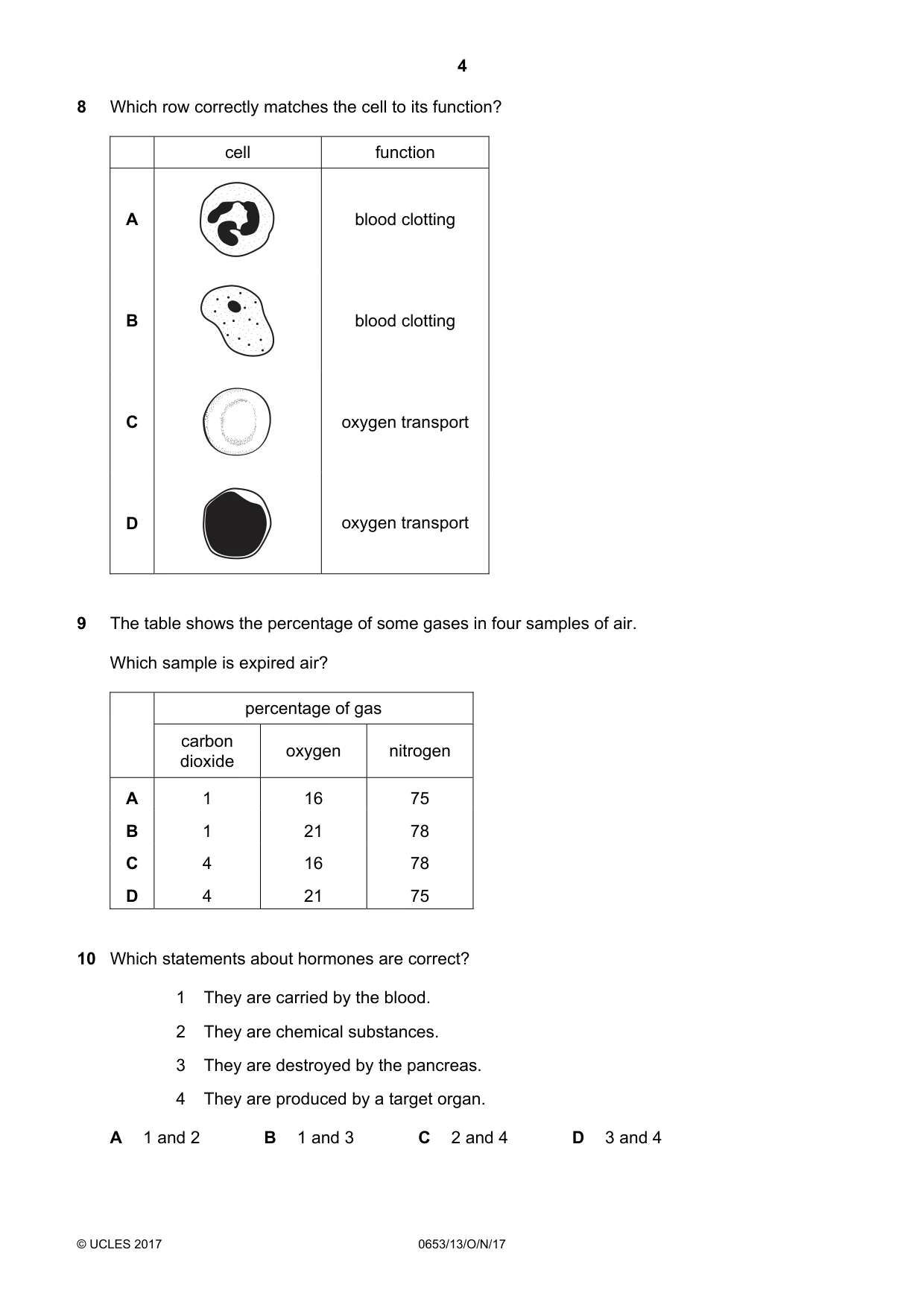
8 Which row correctly matches the cell to its function? cell function A blood clotting B blood clotting C oxygen transport D oxygen transport
Mark scheme: C
Q9 · The table shows the percentage of some gases in four samples of air
9 The table shows the percentage of some gases in four samples of air. Which sample is expired air? percentage of gas carbon oxygen nitrogen dioxide A 1 16 75 B 1 21 78 C 4 16 78 D 4 21 75
Mark scheme: C
Q10 · Which statements about hormones are correct?
10 Which statements about hormones are correct? 1 They are carried by the blood. 2 They are chemical substances. 3 They are destroyed by the pancreas. 4 They are produced by a target organ. A 1 and 2 B 1 and 3 C 2 and 4 D 3 and 4
Mark scheme: A
Q11 · The diagrams show shoots of maize seedlings
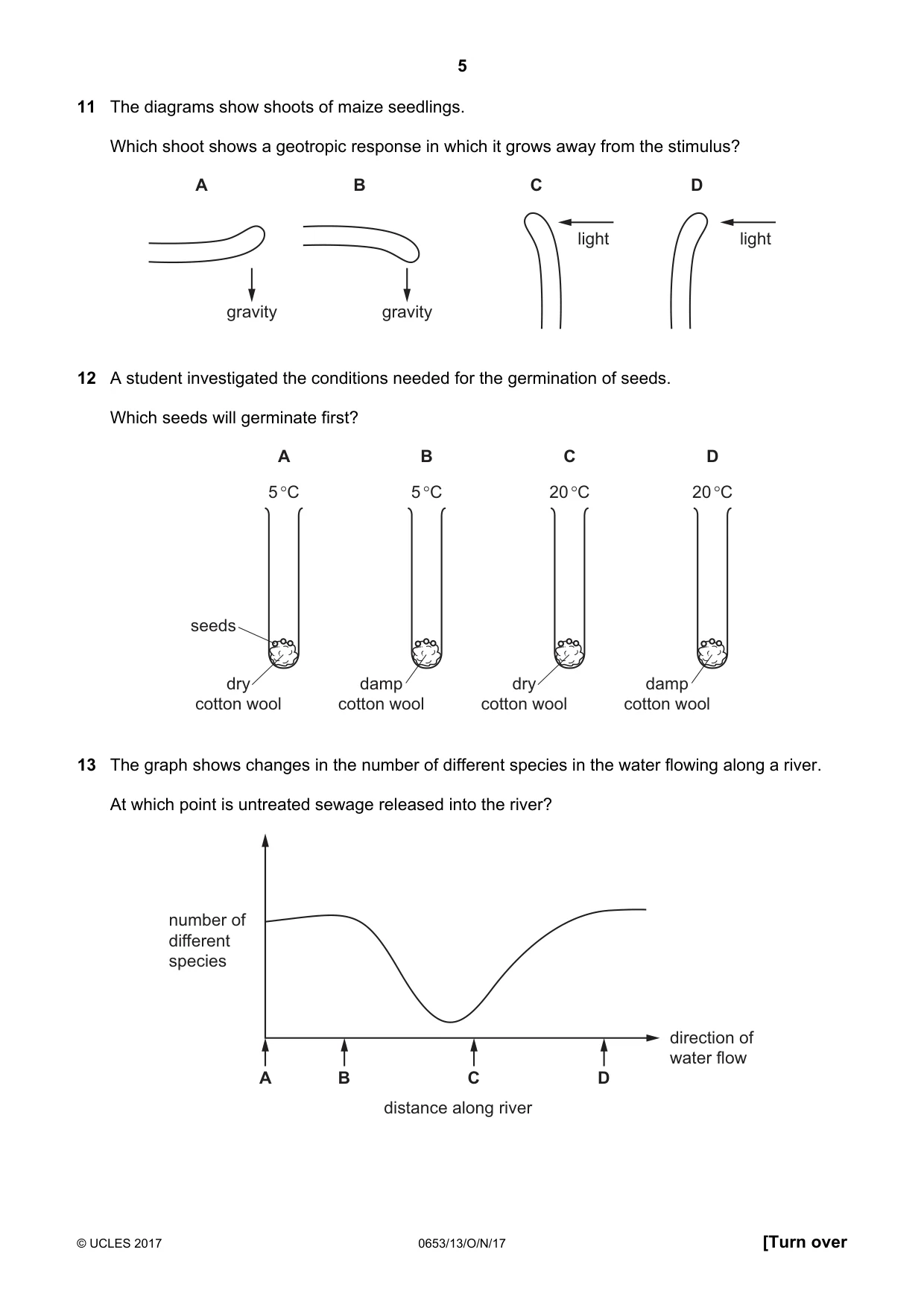
11 The diagrams show shoots of maize seedlings. Which shoot shows a geotropic response in which it grows away from the stimulus? A B C D light light gravity gravity
Mark scheme: A
Q12 · A student investigated the conditions needed for the germination of seeds
12 A student investigated the conditions needed for the germination of seeds. Which seeds will germinate first? A B C D 5 °C 5 °C 20 °C 20 °C seeds dry damp dry damp cotton wool cotton wool cotton wool cotton wool
Mark scheme: D
Q13 · The graph shows changes in the number of different species in the water flowing along a…
13 The graph shows changes in the number of different species in the water flowing along a river. At which point is untreated sewage released into the river? number of different species direction of water flow A B C D distance along river
Mark scheme: B
Q14 · The formulae of three substances are shown
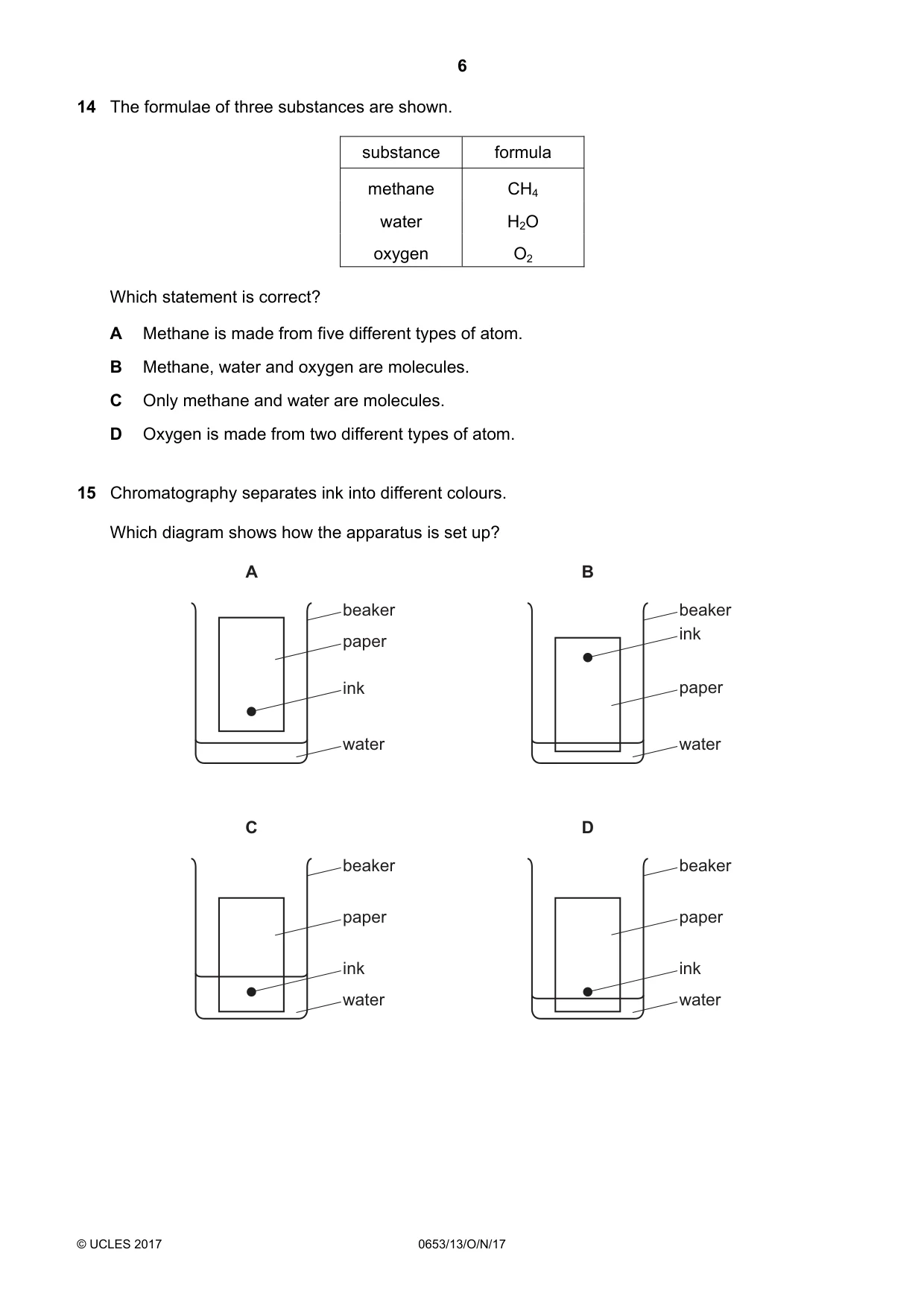
14 The formulae of three substances are shown. substance formula methane CH4 water H2O oxygen O2 Which statement is correct? A Methane is made from five different types of atom. B Methane, water and oxygen are molecules. C Only methane and water are molecules. D Oxygen is made from two different types of atom.
Mark scheme: B
Q15 · Chromatography separates ink into different colours
15 Chromatography separates ink into different colours. Which diagram shows how the apparatus is set up? A B beaker beaker paper ink ink paper water water C D beaker beaker paper paper ink ink water water
Mark scheme: D
Q16 · Which row describes the type of change for each process?
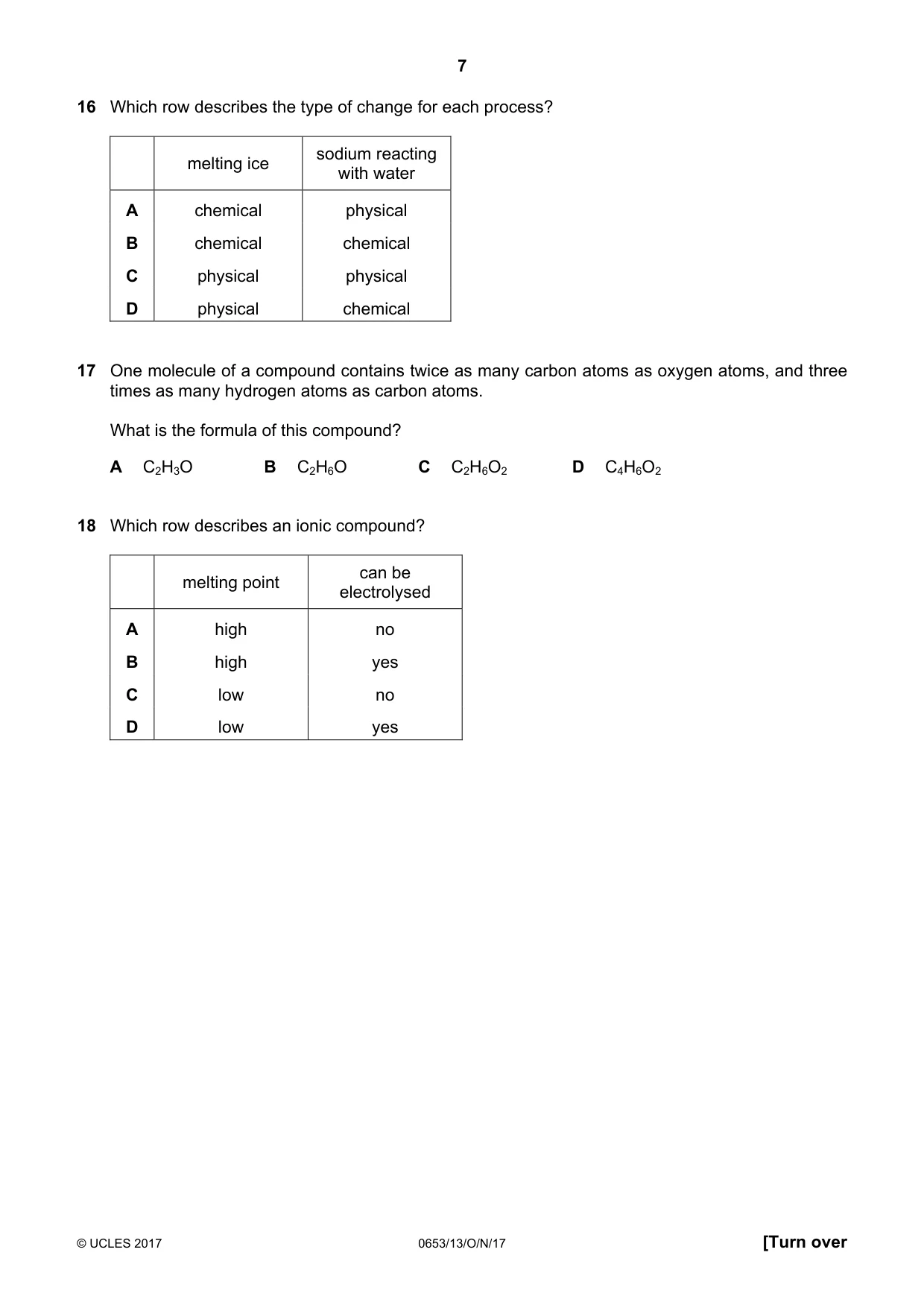
16 Which row describes the type of change for each process? sodium reacting melting ice with water A chemical physical B chemical chemical C physical physical D physical chemical
Mark scheme: D
Q17 · One molecule of a compound contains twice as many carbon atoms as oxygen atoms, and three…
17 One molecule of a compound contains twice as many carbon atoms as oxygen atoms, and three times as many hydrogen atoms as carbon atoms. What is the formula of this compound? A C2H3O B C2H6O C C2H6O2 D C4H6O2
Mark scheme: B
Q18 · Which row describes an ionic compound?
18 Which row describes an ionic compound? can be melting point electrolysed A high no B high yes C low no D low yes
Mark scheme: B
Q19 · The diagram shows gas X burning and heating a liquid
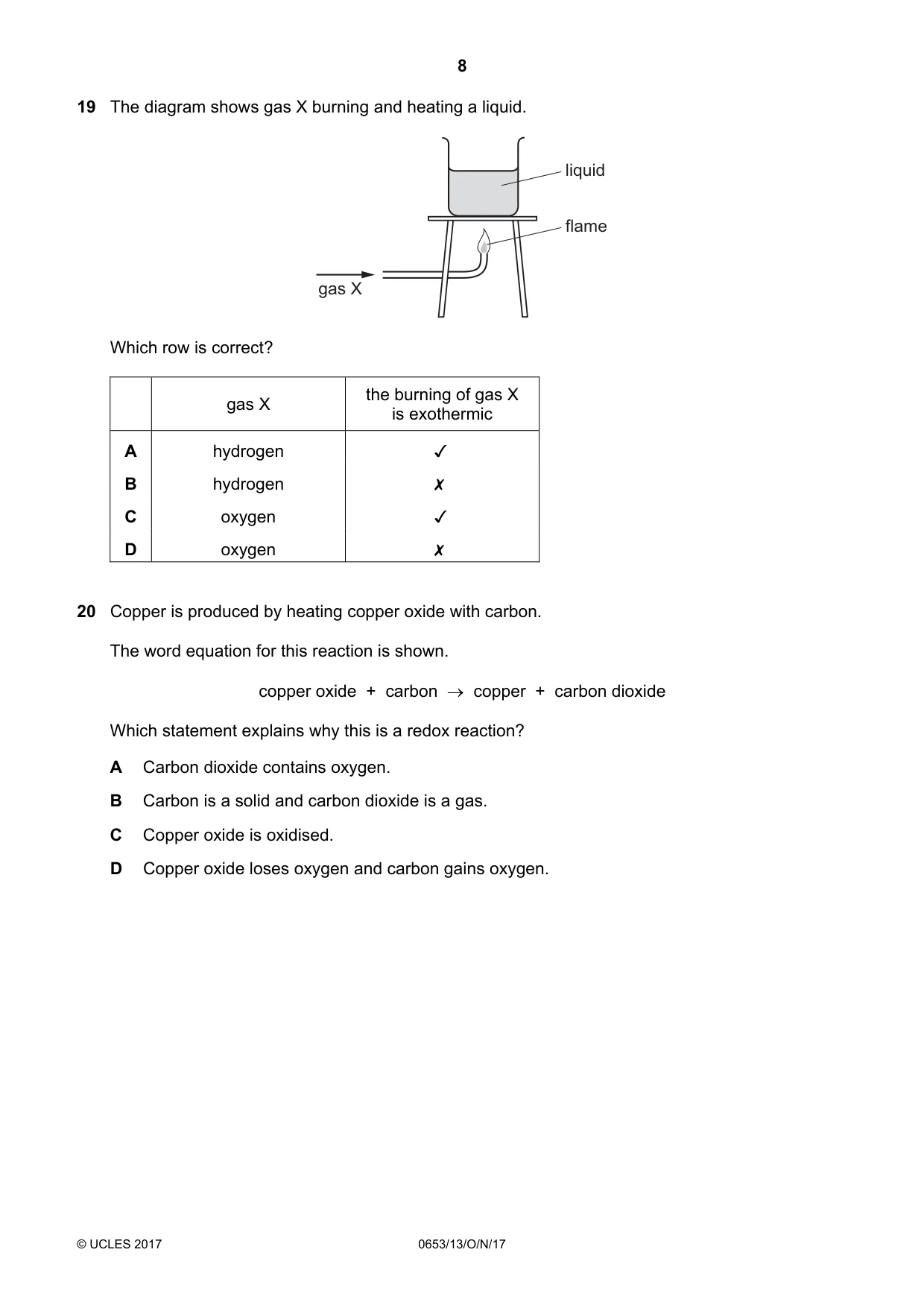
19 The diagram shows gas X burning and heating a liquid. Which row is correct? gas X 0 Oo WwW > gas X hydrogen hydrogen oxygen oxygen the burning of gas X is exothermic x < x liquid flame
Mark scheme: A
Q20 · Copper is produced by heating copper oxide with carbon
20 Copper is produced by heating copper oxide with carbon. The word equation for this reaction is shown. copper oxide + carbon → copper + carbon dioxide Which statement explains why this is a redox reaction? A Carbon dioxide contains oxygen. B Carbon is a solid and carbon dioxide is a gas. C Copper oxide is oxidised. D Copper oxide loses oxygen and carbon gains oxygen.
Mark scheme: D
Q21 · Dilute sulfuric acid is added to copper(II) oxide
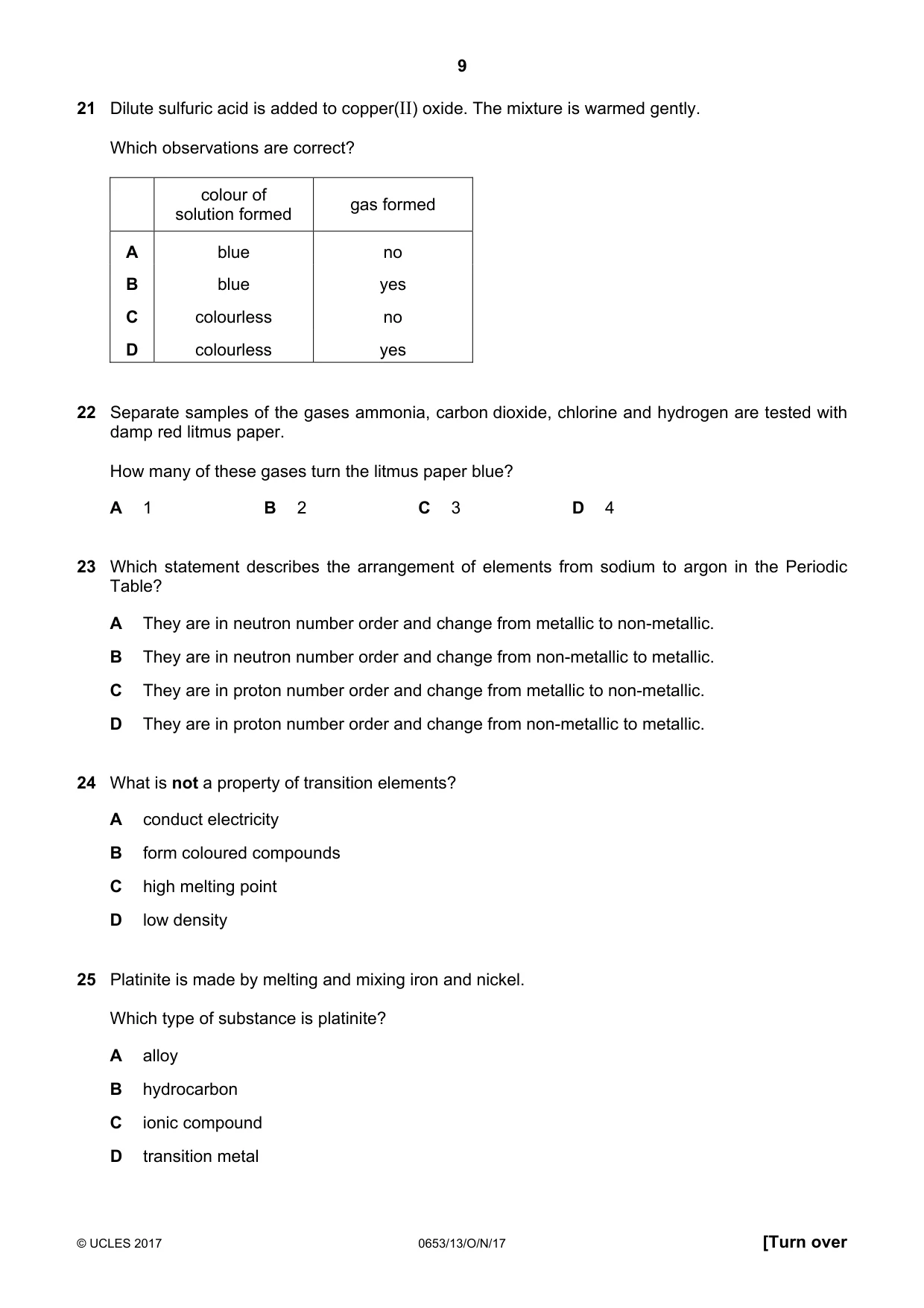
21 Dilute sulfuric acid is added to copper(II) oxide. The mixture is warmed gently. Which observations are correct? colour of gas formed solution formed A blue no B blue yes C colourless no D colourless yes
Mark scheme: A
More questions on The characteristic properties of acids and bases
Q22 · Separate samples of the gases ammonia, carbon dioxide, chlorine and hydrogen are tested…
22 Separate samples of the gases ammonia, carbon dioxide, chlorine and hydrogen are tested with damp red litmus paper. How many of these gases turn the litmus paper blue? A 1 B 2 C 3 D 4
Mark scheme: A
Q23 · Which statement describes the arrangement of elements from sodium to argon in the…
23 Which statement describes the arrangement of elements from sodium to argon in the Periodic Table? A They are in neutron number order and change from metallic to non-metallic. B They are in neutron number order and change from non-metallic to metallic. C They are in proton number order and change from metallic to non-metallic. D They are in proton number order and change from non-metallic to metallic.
Mark scheme: C
Q24 · What is not a property of transition elements?
24 What is not a property of transition elements? A conduct electricity B form coloured compounds C high melting point D low density
Mark scheme: D
Q25 · Platinite is made by melting and mixing iron and nickel
25 Platinite is made by melting and mixing iron and nickel. Which type of substance is platinite? A alloy B hydrocarbon C ionic compound D transition metal
Mark scheme: A
Q26 · P, Q, R and S are four gases found in clean air
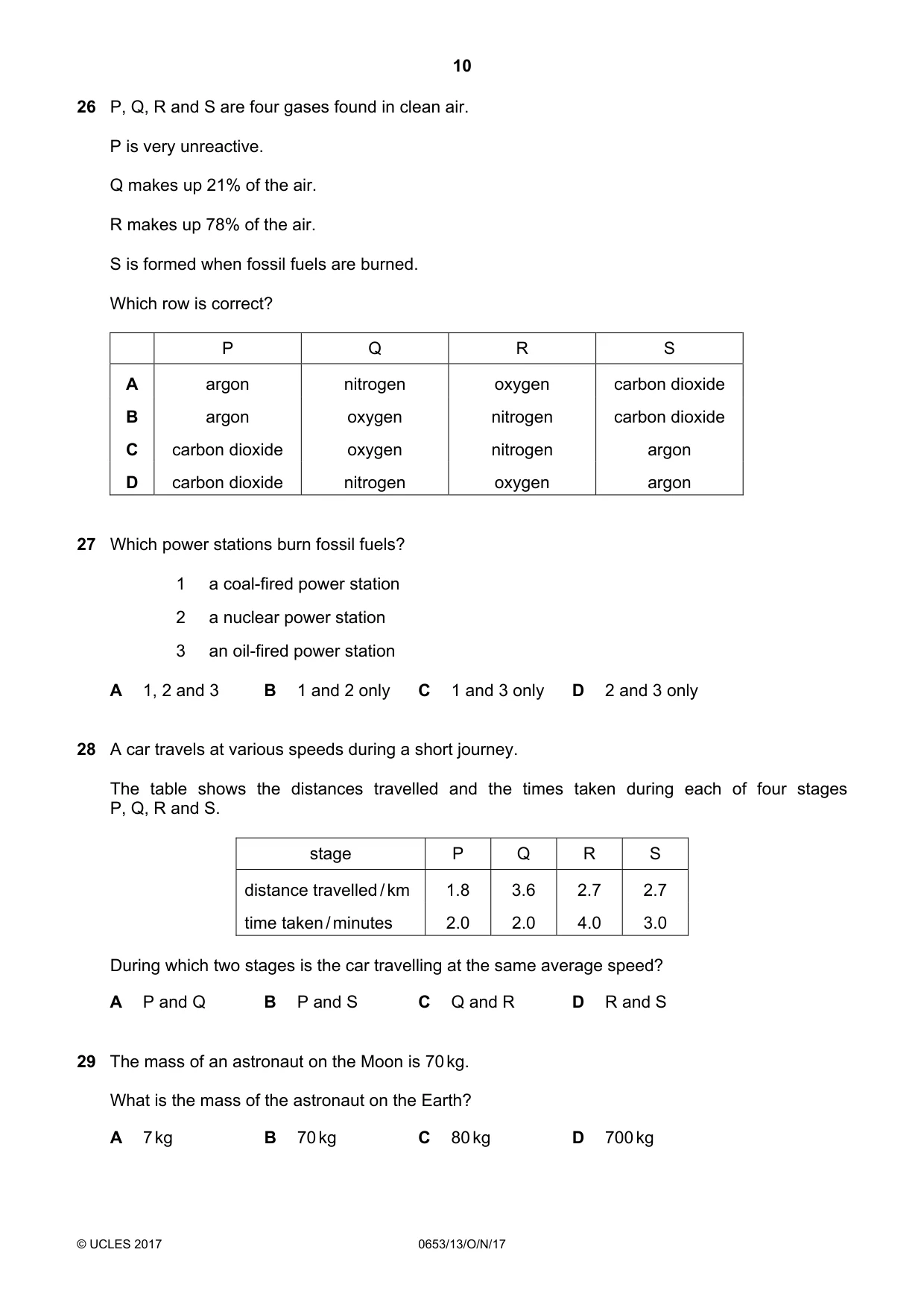
26 P, Q, R and S are four gases found in clean air. P is very unreactive. Q makes up 21% of the air. R makes up 78% of the air. S is formed when fossil fuels are burned. Which row is correct? P Q R S A argon nitrogen oxygen carbon dioxide B argon oxygen nitrogen carbon dioxide C carbon dioxide oxygen nitrogen argon D carbon dioxide nitrogen oxygen argon
Mark scheme: B
Q27 · Which power stations burn fossil fuels?
27 Which power stations burn fossil fuels? 1 a coal-fired power station 2 a nuclear power station 3 an oil-fired power station A 1, 2 and 3 B 1 and 2 only C 1 and 3 only D 2 and 3 only
Mark scheme: C
Q28 · A car travels at various speeds during a short journey
28 A car travels at various speeds during a short journey. The table shows the distances travelled and the times taken during each of four stages P, Q, R and S. stage P Q R S distance travelled / km 1.8 3.6 2.7 2.7 time taken / minutes 2.0 2.0 4.0 3.0 During which two stages is the car travelling at the same average speed? A P and Q B P and S C Q and R D R and S
Mark scheme: B
Q29 · The mass of an astronaut on the Moon is 70 kg
29 The mass of an astronaut on the Moon is 70 kg. What is the mass of the astronaut on the Earth? A 7 kg B 70 kg C 80 kg D 700 kg
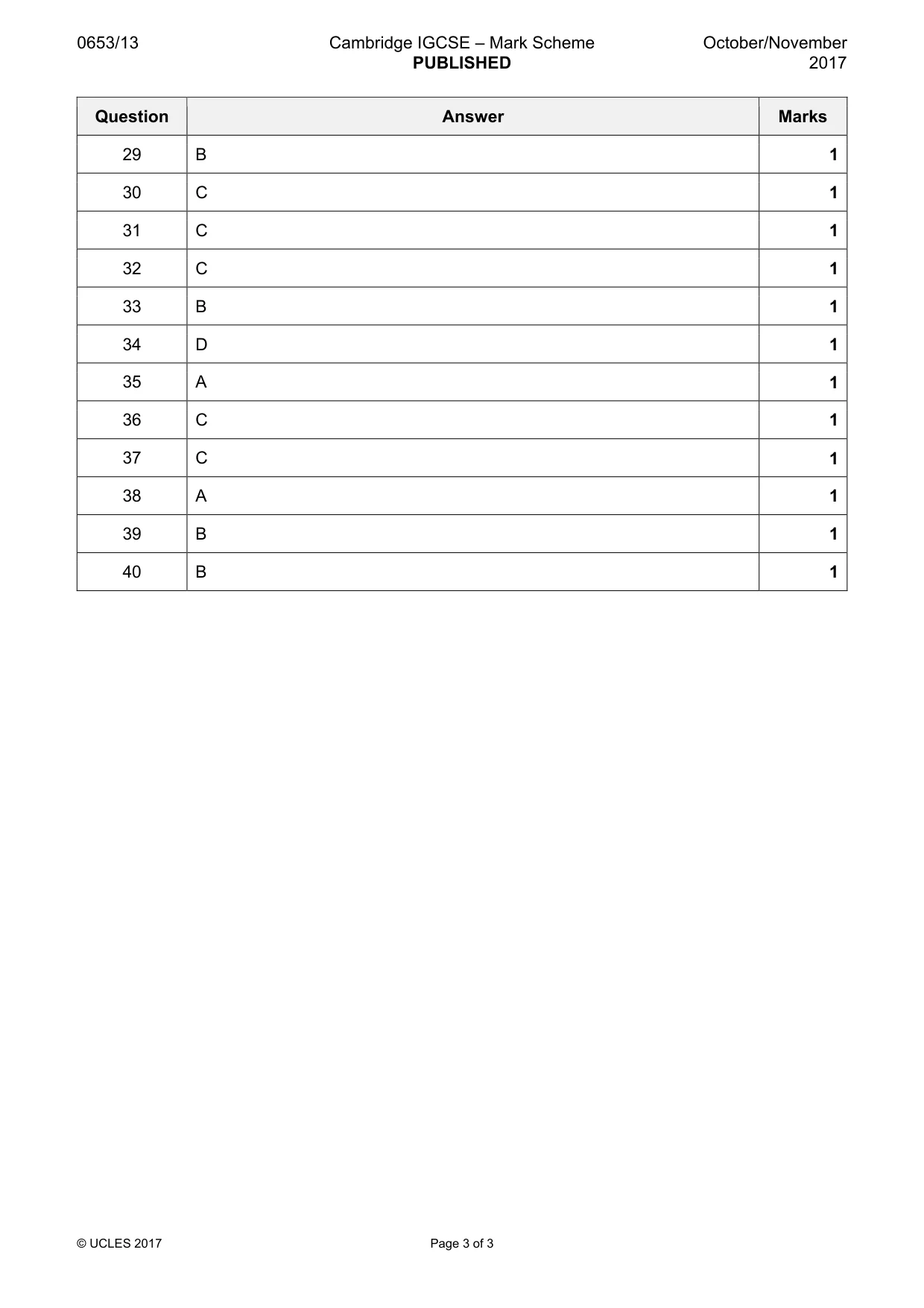
Mark scheme: B
Q30 · An empty measuring cylinder on a balance
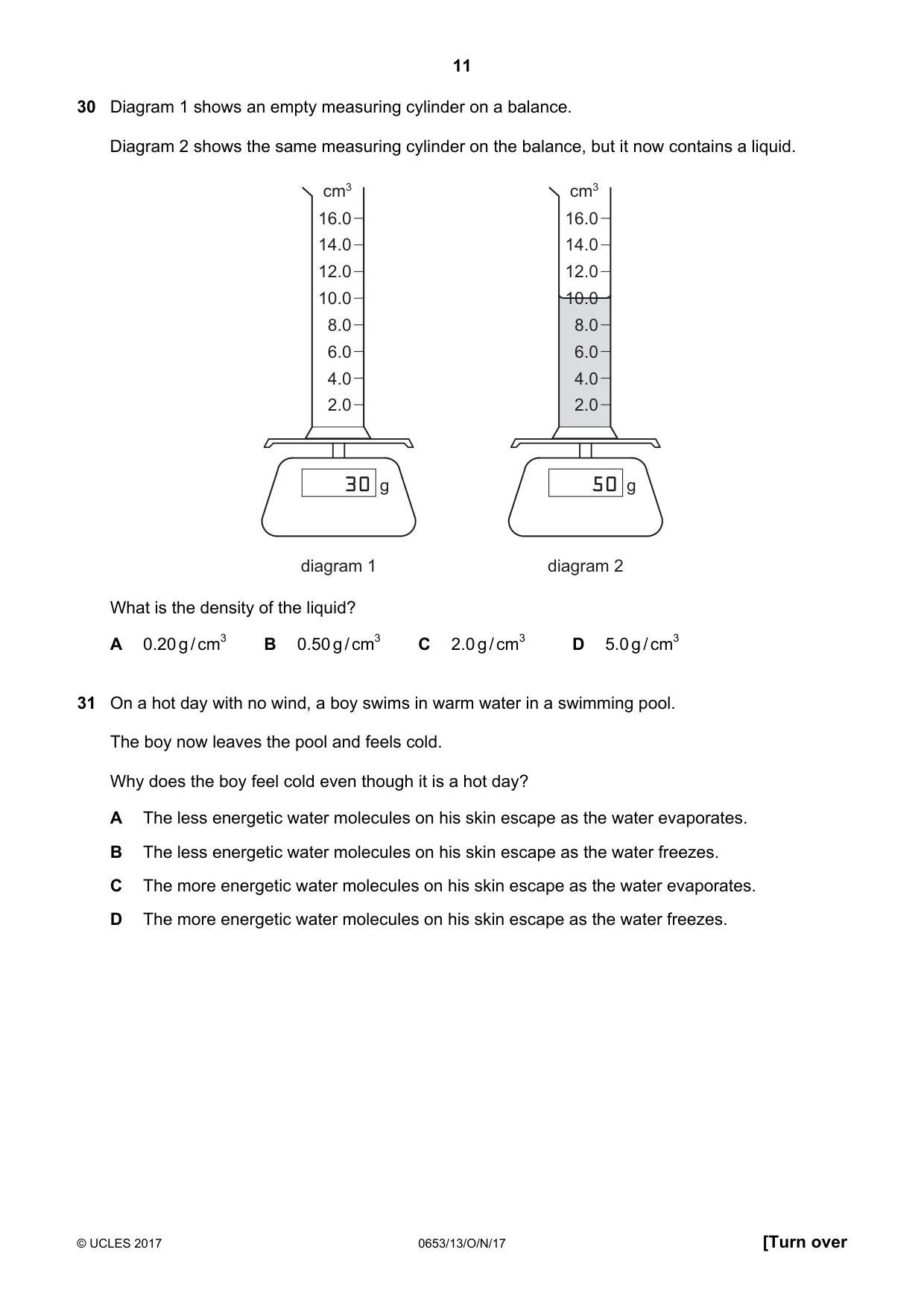
30 Diagram 1 shows an empty measuring cylinder on a balance. Diagram 2 shows the same measuring cylinder on the balance, but it now contains a liquid. cm3 cm3 16.0 16.0 14.0 14.0 12.0 12.0 10.0 10.0 8.0 8.0 6.0 6.0 4.0 4.0 2.0 2.0 g g diagram 1 diagram 2 What is the density of the liquid? A 0.20 g / cm3 B 0.50 g / cm3 C 2.0 g / cm3 D 5.0 g / cm3
Mark scheme: C
Q31 · On a hot day with no wind, a boy swims in warm water in a swimming pool
31 On a hot day with no wind, a boy swims in warm water in a swimming pool. The boy now leaves the pool and feels cold. Why does the boy feel cold even though it is a hot day? A The less energetic water molecules on his skin escape as the water evaporates. B The less energetic water molecules on his skin escape as the water freezes. C The more energetic water molecules on his skin escape as the water evaporates. D The more energetic water molecules on his skin escape as the water freezes.
Mark scheme: C
Q32 · A substance is a gas and loses energy thermally at a constant rate
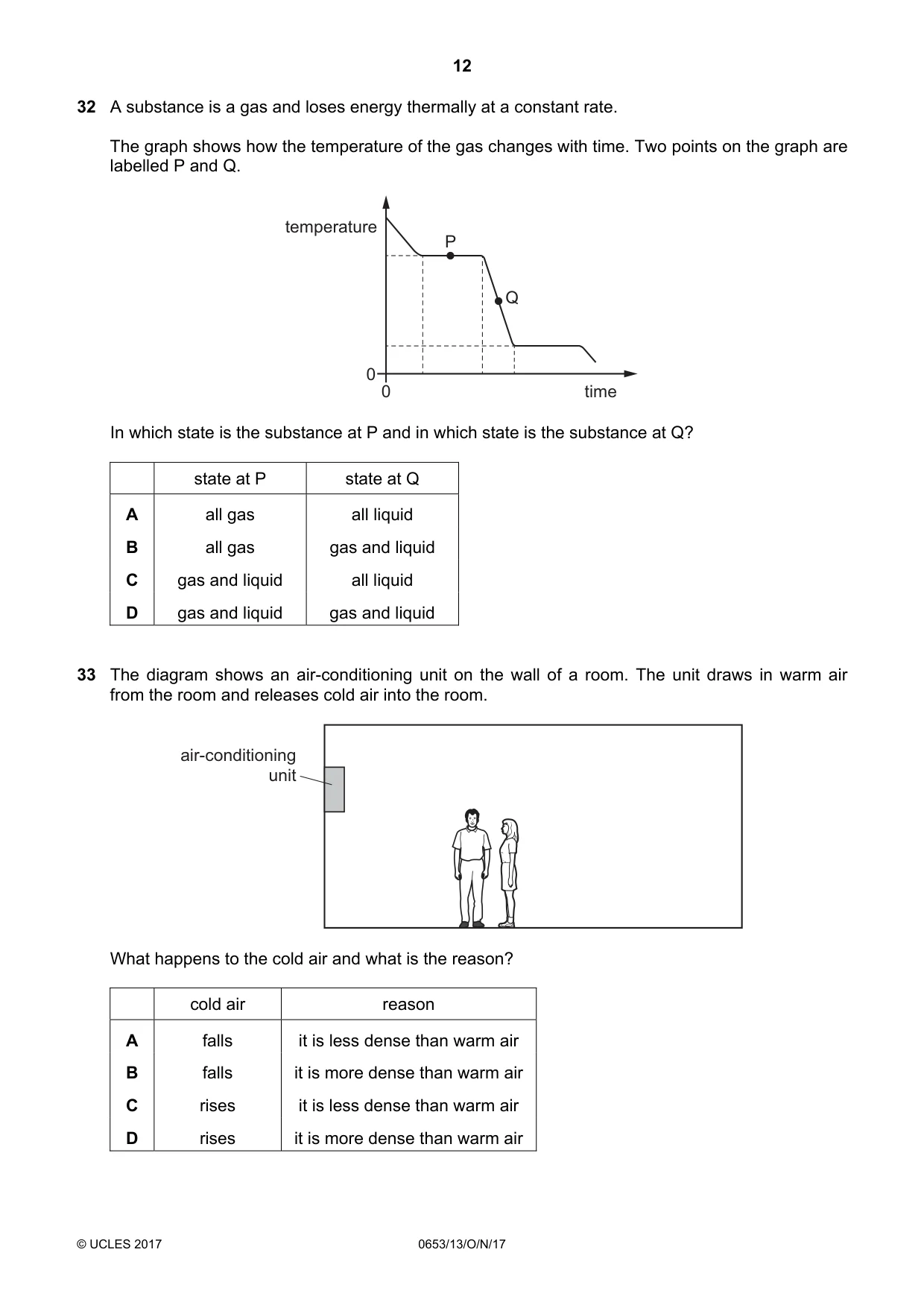
32 A substance is a gas and loses energy thermally at a constant rate. The graph shows how the temperature of the gas changes with time. Two points on the graph are labelled P and Q. temperature P Q 0 0 time In which state is the substance at P and in which state is the substance at Q? state at P state at Q A all gas all liquid B all gas gas and liquid C gas and liquid all liquid D gas and liquid gas and liquid
Mark scheme: C
Q33 · The diagram shows an air-conditioning unit on the wall of a room
33 The diagram shows an air-conditioning unit on the wall of a room. The unit draws in warm air from the room and releases cold air into the room. air-conditioning unit What happens to the cold air and what is the reason? cold air reason A falls it is less dense than warm air B falls it is more dense than warm air C rises it is less dense than warm air D rises it is more dense than warm air
Mark scheme: B
Q34 · The diagram shows a section of a rope
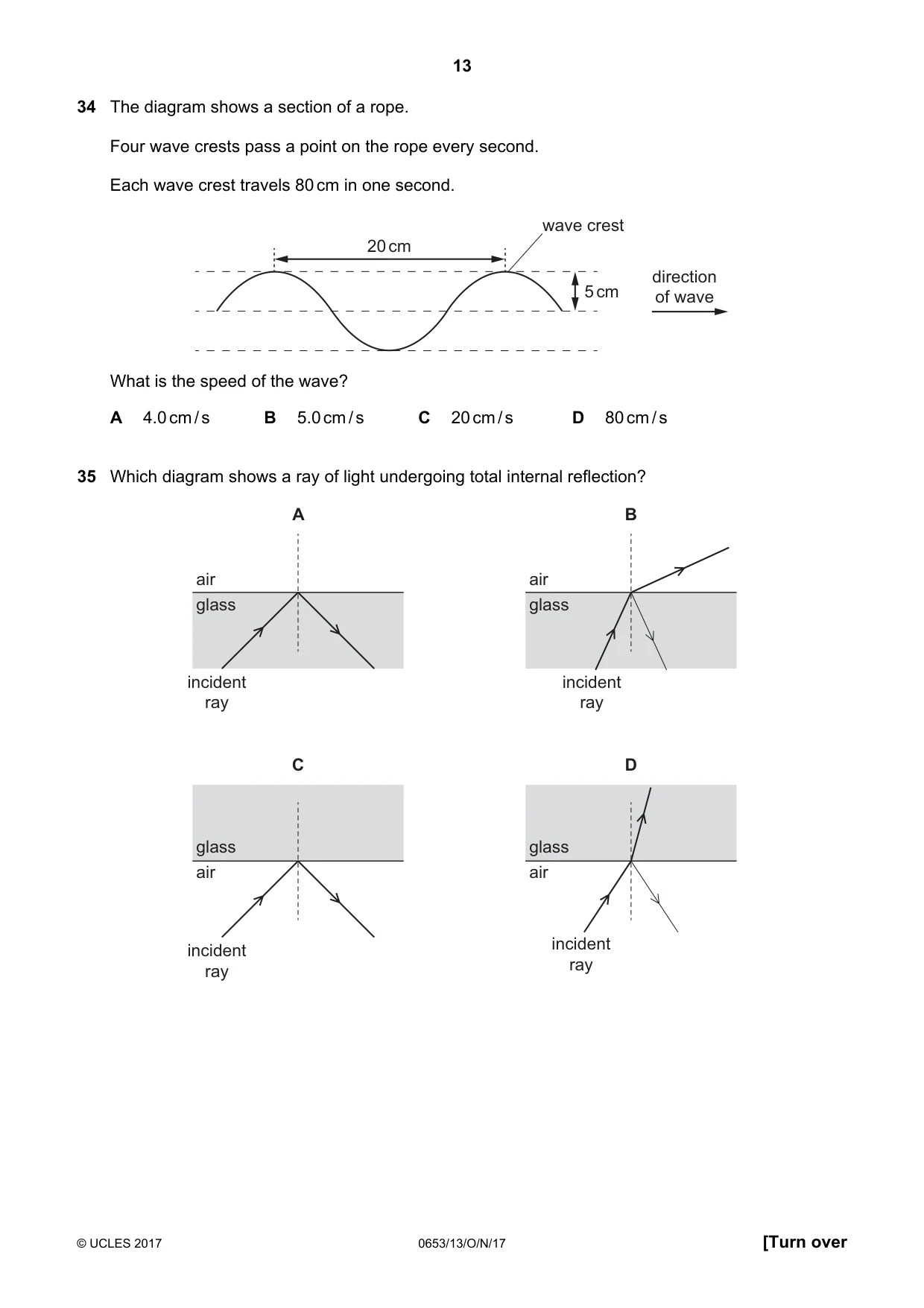
34 The diagram shows a section of a rope. Four wave crests pass a point on the rope every second. Each wave crest travels 80 cm in one second. wave crest 20 cm direction 5 cm of wave What is the speed of the wave? A 4.0 cm / s B 5.0 cm / s C 20 cm / s D 80 cm / s
Mark scheme: D
Q35 · Which diagram shows a ray of light undergoing total internal reflection?
35 Which diagram shows a ray of light undergoing total internal reflection? A B air air glass glass incident incident ray ray C D glass glass air air incident incident ray ray
Mark scheme: A
Q36 · Electromagnetic waves are used to scan passengers’ luggage before they board an aeroplane
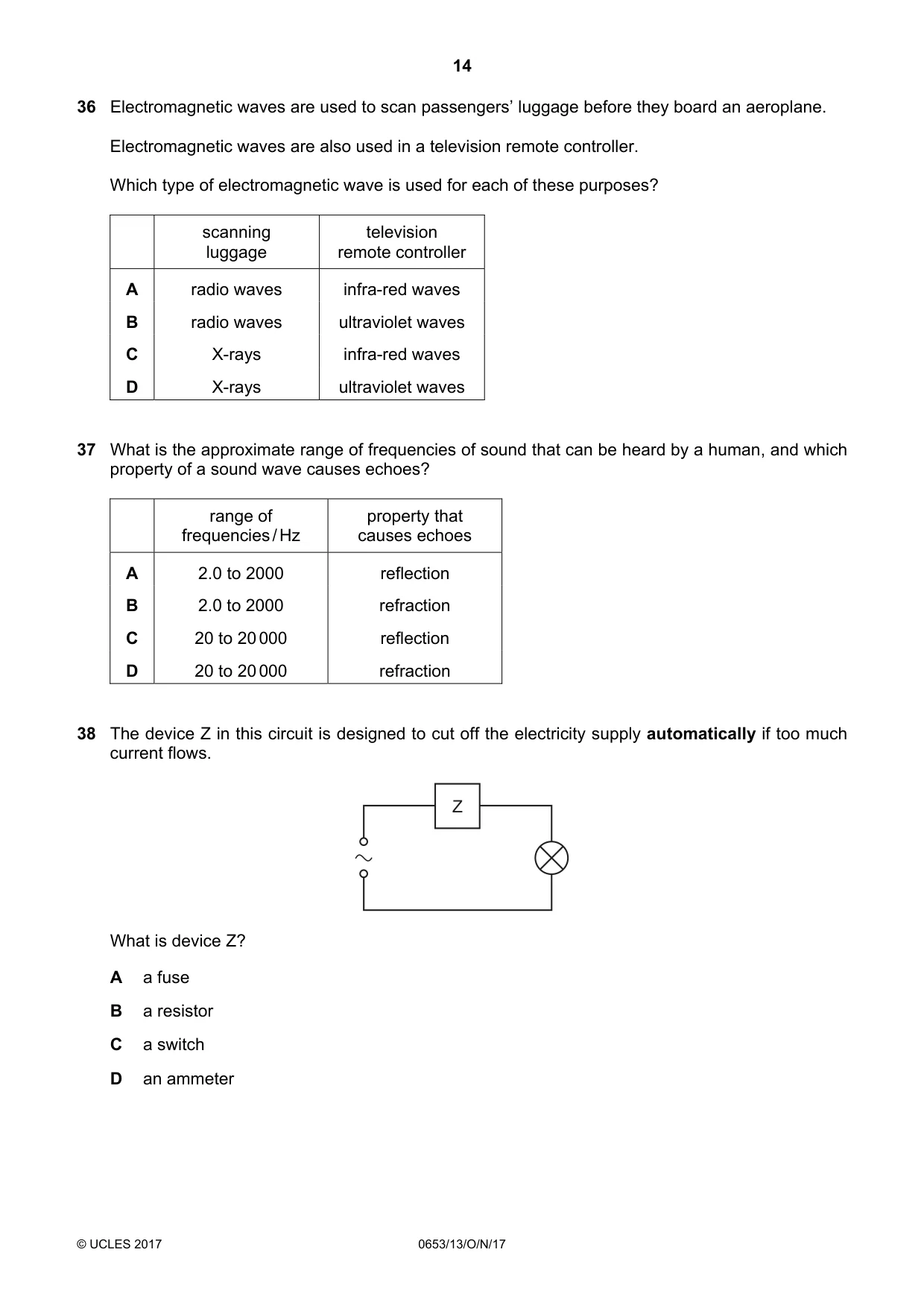
36 Electromagnetic waves are used to scan passengers’ luggage before they board an aeroplane. Electromagnetic waves are also used in a television remote controller. Which type of electromagnetic wave is used for each of these purposes? scanning television luggage remote controller A radio waves infra-red waves B radio waves ultraviolet waves C X-rays infra-red waves D X-rays ultraviolet waves
Mark scheme: C
Q37 · What is the approximate range of frequencies of sound that can be heard by a human, and…
37 What is the approximate range of frequencies of sound that can be heard by a human, and which property of a sound wave causes echoes? range of property that frequencies / Hz causes echoes A 2.0 to 2000 reflection B 2.0 to 2000 refraction C 20 to 20 000 reflection D 20 to 20 000 refraction
Mark scheme: C
Q38 · The device Z in this circuit is designed to cut off the electricity supply automatically…
38 The device Z in this circuit is designed to cut off the electricity supply automatically if too much current flows. Z What is device Z? A a fuse B a resistor C a switch D an ammeter
Mark scheme: A
Q39 · Which circuit is used to determine the resistance of the resistor R?
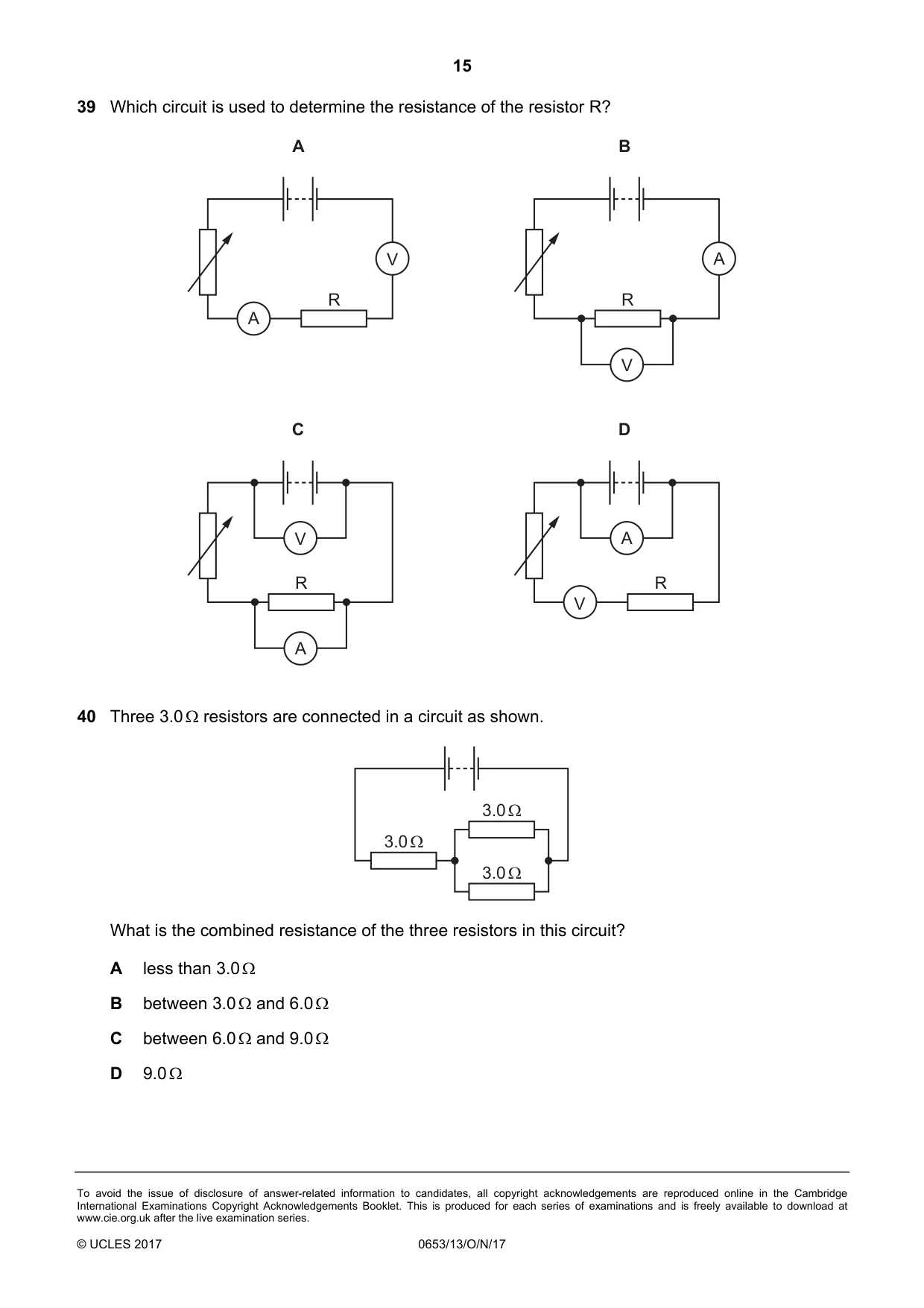
39 Which circuit is used to determine the resistance of the resistor R? A B V A R R A V C D V A R R V A
Mark scheme: B
Q40 · Three 3.0 Ω resistors are connected in a circuit as shown
40 Three 3.0 Ω resistors are connected in a circuit as shown. 3.0 Ω 3.0 Ω 3.0 Ω What is the combined resistance of the three resistors in this circuit? A less than 3.0 Ω B between 3.0 Ω and 6.0 Ω C between 6.0 Ω and 9.0 Ω D 9.0 Ω
Mark scheme: B
What was in this paper
The subtopics covered by these 40 questions, and how many questions each got. Open one in a new tab to see every Cambridge question on it.
2Characteristics of living organisms2Electrical circuits2Alloys and their properties1Arrangement of elements1Blood1Cell structure1Chromatography1Density1Digestive system1Drugs1Electrical safety1Electromagnetic spectrum1Enzymes1Exothermic and endothermic reactions1Formulas1Gas exchange in humans1General properties of waves1Habitat destruction1Heart1Identification of ions and gases1Ions and ionic bonds1Kinetic particle model of matter1Light1Mass and weight1Motion1Photosynthesis1Physical and chemical changes1Redox1Sexual reproduction in plants1Simple molecules and covalent bonds1Sound1The characteristic properties of acids and bases1Thermal properties and temperature1Transfer of thermal energy1Transition elements1Transpiration1What you needed in this session
Cambridge’s own grade thresholds for 2017 Oct/Nov, Paper 1 · Variant 3. A higher threshold means an easier paper — the bar moves with how the cohort did.