Questions as text
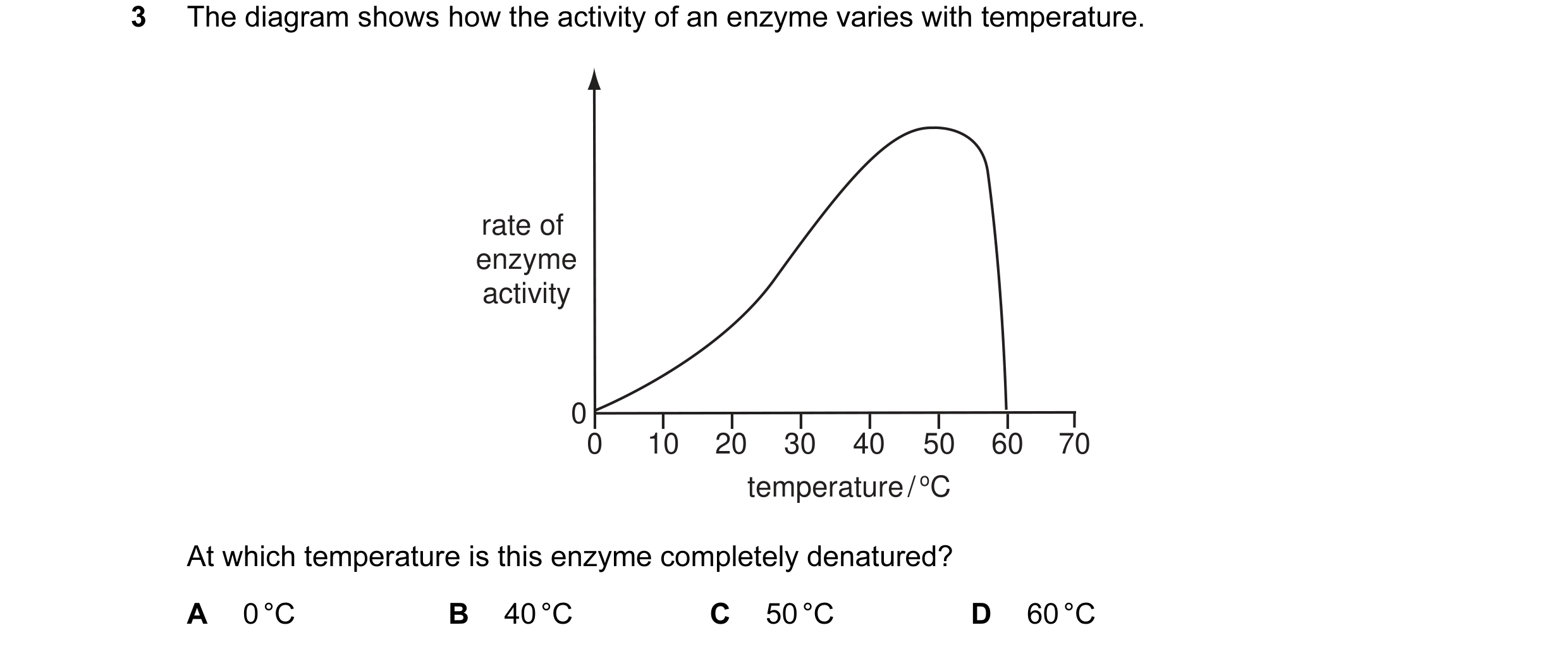
Q1 · The diagram shows how the activity of an enzyme varies with temperature 0653/11 Oct/Nov 2005
3 The diagram shows how the activity of an enzyme varies with temperature. rate of enzyme activity 0 0 10 20 30 40 50 60 70 temperature / oC At which temperature is this enzyme completely denatured? A 0 °C B 40 °C C 50 °C D 60 °C
1 marks
Answer: D
This question in 0653/11 Oct/Nov 2005
Q2 · A test-tube contains a solution of the enzyme catalase 0653/11 May/June 2006
2 A test-tube contains a solution of the enzyme catalase. Which colour is obtained when this solution is tested with biuret solution? A blue B blue-black C orange D violet-mauve
1 marks
Answer: D
This question in 0653/11 May/June 2006
Q3 · Which type of chemical is the enzyme catalase? 0653/11 Oct/Nov 2006
2 Which type of chemical is the enzyme catalase? A fat B protein C starch D sugar
1 marks
Answer: B
This question in 0653/11 Oct/Nov 2006
Q4 · The diagrams show experiments to investigate the activity of the enzyme catalase which is… 0653/11 May/June 2007
2 The diagrams show experiments to investigate the activity of the enzyme catalase which is found in potato. In which test-tube is oxygen produced fastest? A B 10 cm3 10 cm3 hydrogen hydrogen peroxide peroxide solution fresh solution boiled potato potato cube cube C D 10 cm3 10 cm3 hydrogen fresh hydrogen boiled peroxide potato peroxide potato solution cube solution cube chopped chopped up up
1 marks
Answer: C
This question in 0653/11 May/June 2007
Q5 · Which gas is given off when the enzyme catalase is added to a solution of hydrogen… 0653/11 Oct/Nov 2007
3 Which gas is given off when the enzyme catalase is added to a solution of hydrogen peroxide? A carbon dioxide B carbon monoxide C hydrogen D oxygen
1 marks
Answer: D
This question in 0653/11 Oct/Nov 2007
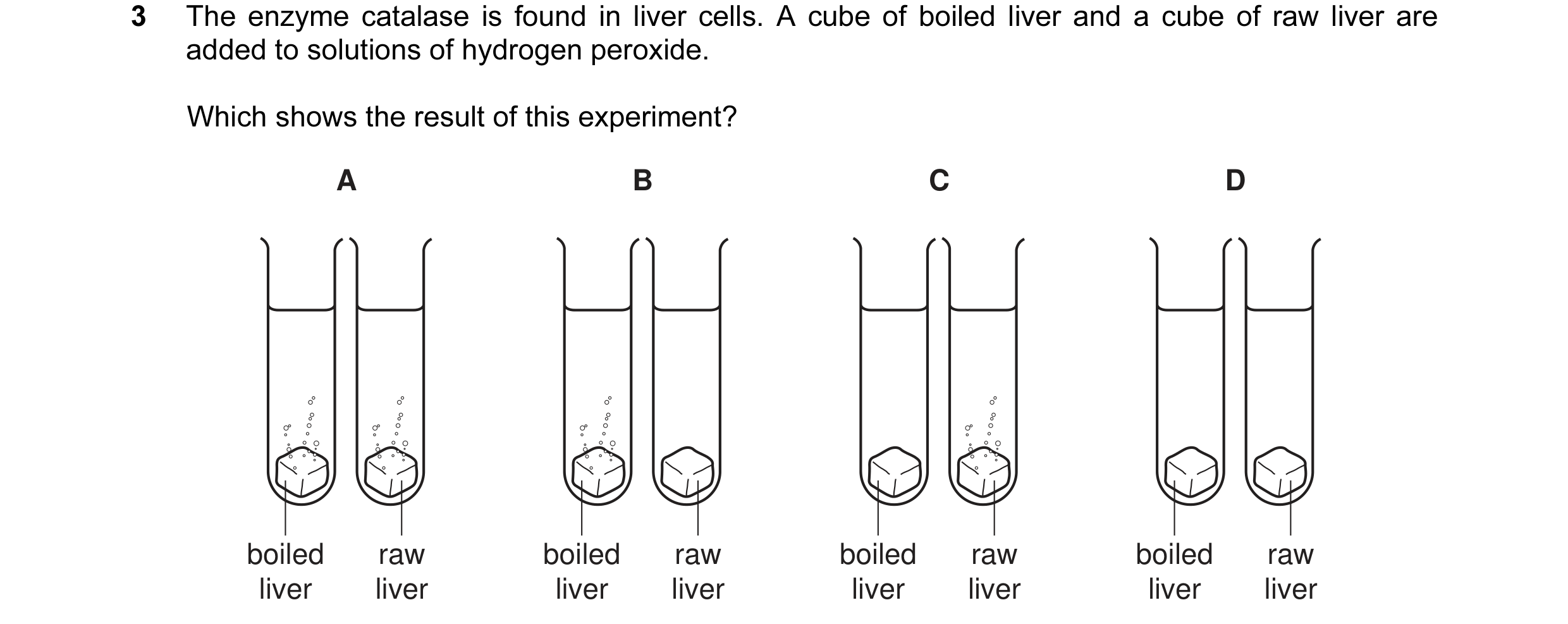
Q6 · The enzyme catalase is found in liver cells 0653/11 May/June 2008
3 The enzyme catalase is found in liver cells. A cube of boiled liver and a cube of raw liver are added to solutions of hydrogen peroxide. Which shows the result of this experiment? A B C D boiled raw boiled raw boiled raw boiled raw liver liver liver liver liver liver liver liver
1 marks
Answer: C
This question in 0653/11 May/June 2008
Q7 · The diagrams show an experiment on enzyme activity 0653/11 Oct/Nov 2008
3 The diagrams show an experiment on enzyme activity. The test-tubes contain equal volumes of solutions of catalase and hydrogen peroxide. In which test-tube does the enzyme fail to work because it has been denatured? A B C D at 4 °C at 37 °C at 37 °C at 37 °C mixture of mixture of mixture of catalase boiled catalase and catalase and boiled hydrogen and hydrogen peroxide hydrogen peroxide peroxide
1 marks
Answer: C
This question in 0653/11 Oct/Nov 2008
Q8 · The following statements are about enzymes and metabolic reactions 0653/11 May/June 2009
3 The following statements are about enzymes and metabolic reactions. 1 Different metabolic reactions are catalysed by different enzymes. 2 Enzymes are produced only inside living cells. 3 Enzymes cannot be re-used. 4 Metabolic reactions take place only inside living cells. Which two statements are correct? A 1 and 2 B 2 and 3 C 3 and 4 D 4 and 1
1 marks
Answer: A
This question in 0653/11 May/June 2009
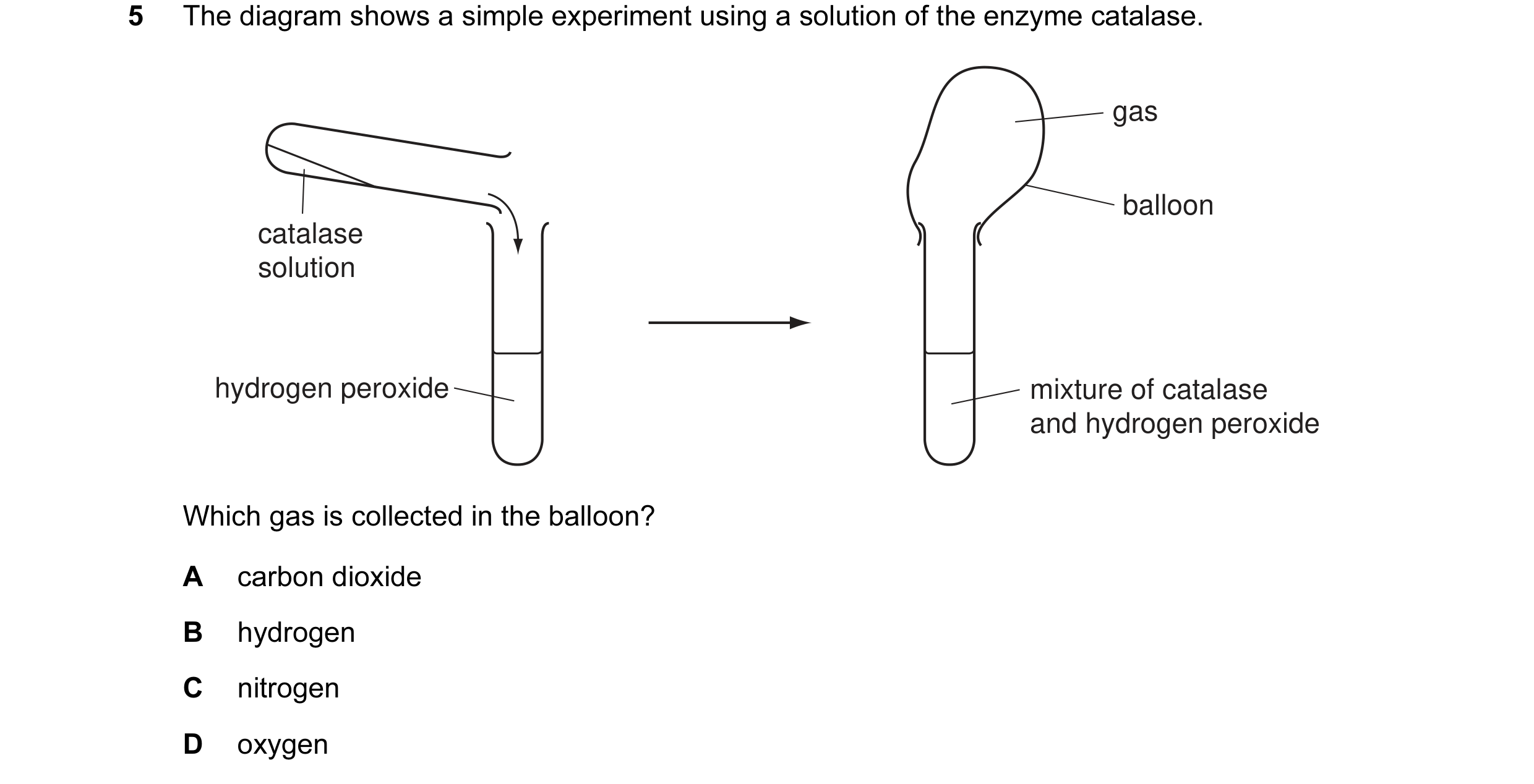
Q9 · The diagram shows a simple experiment using a solution of the enzyme catalase 0653/11 May/June 2010
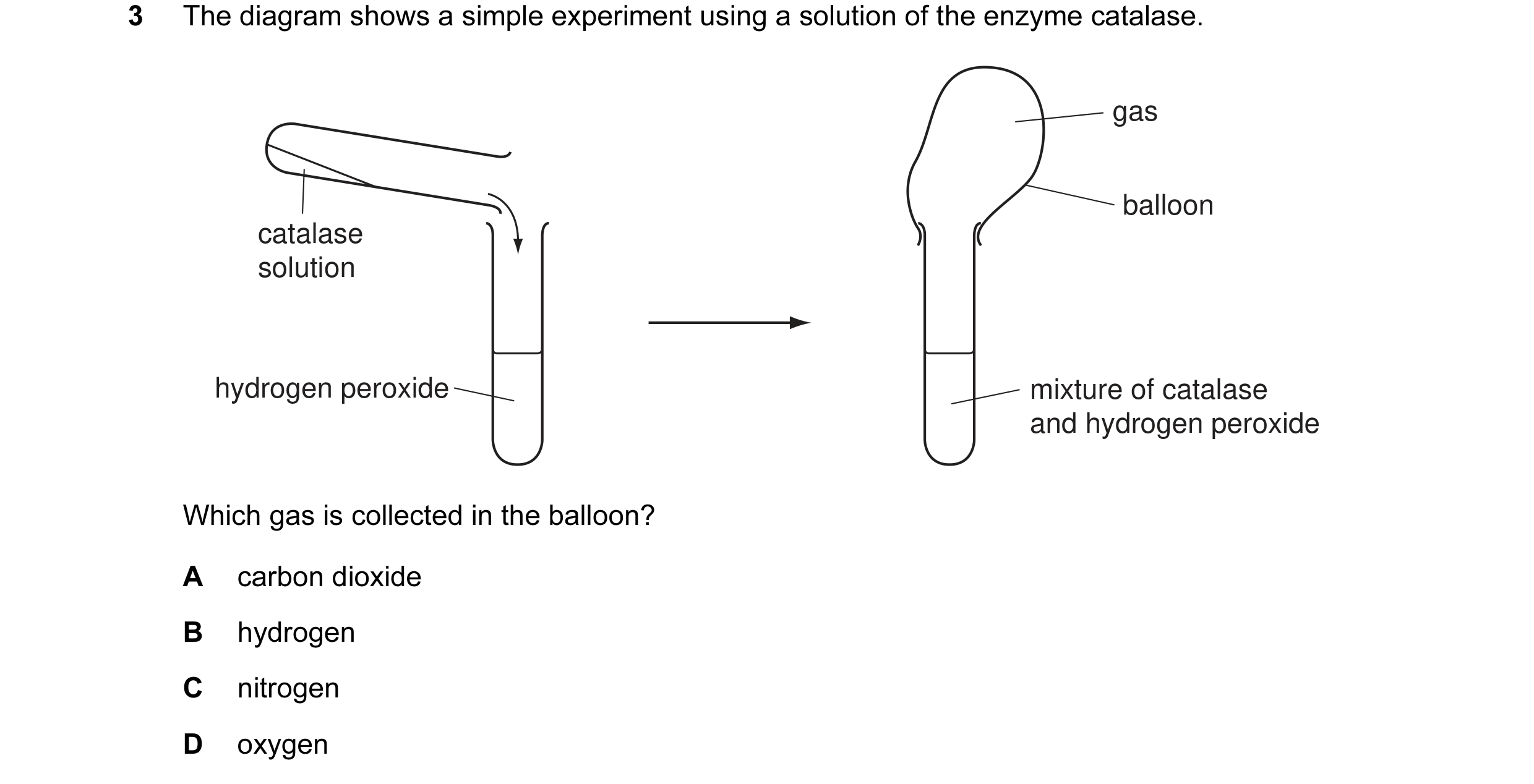
3 The diagram shows a simple experiment using a solution of the enzyme catalase. gas balloon catalase solution hydrogen peroxide mixture of catalase and hydrogen peroxide Which gas is collected in the balloon? A carbon dioxide B hydrogen C nitrogen D oxygen
1 marks
Answer: D
This question in 0653/11 May/June 2010
Q10 · The diagram shows a simple experiment using a solution of the enzyme catalase 0653/12 May/June 2010
5 The diagram shows a simple experiment using a solution of the enzyme catalase. gas balloon catalase solution hydrogen peroxide mixture of catalase and hydrogen peroxide Which gas is collected in the balloon? A carbon dioxide B hydrogen C nitrogen D oxygen
1 marks
Answer: D
This question in 0653/12 May/June 2010
Q11 · The diagram shows a simple experiment using a solution of the enzyme catalase 0653/13 May/June 2010
5 The diagram shows a simple experiment using a solution of the enzyme catalase. gas balloon catalase solution hydrogen peroxide mixture of catalase and hydrogen peroxide Which gas is collected in the balloon? A carbon dioxide B hydrogen C nitrogen D oxygen
1 marks
Answer: D
This question in 0653/13 May/June 2010
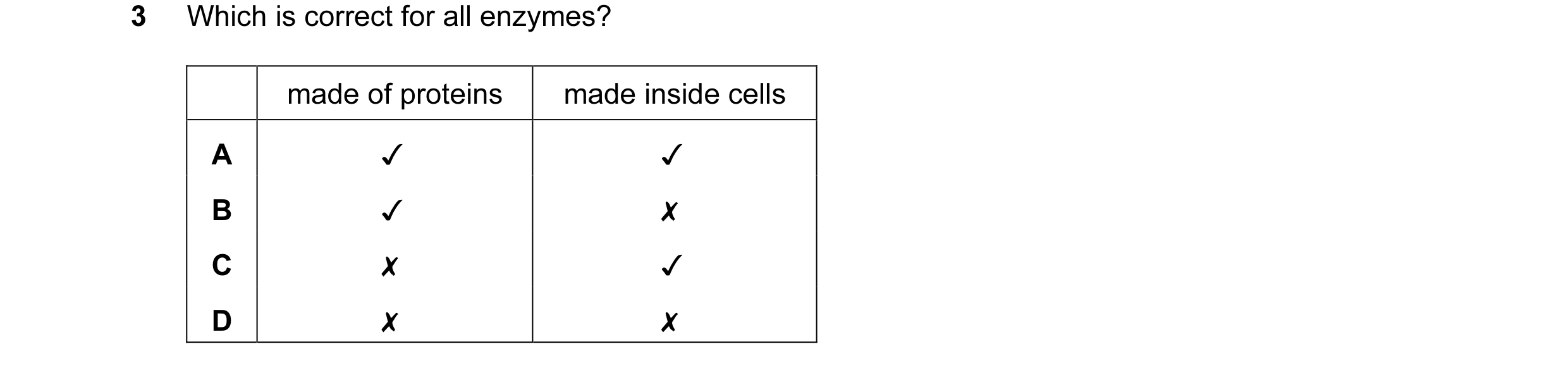
Q12 · Which is correct for all enzymes? 0653/11 Oct/Nov 2010
3. Which is correct for all enzymes?
made of proteins
made inside cells
0 0O WwW >
v
v
x
x
v
x
v
x
1 marks
Answer: A
This question in 0653/11 Oct/Nov 2010
Q13 · Which is correct for all enzymes? 0653/12 Oct/Nov 2010
4 Which is correct for all enzymes?
0 0O WD >
made of proteins
v
v
x
x
made inside cells
v
x
v
x
1 marks
Answer: A
This question in 0653/12 Oct/Nov 2010
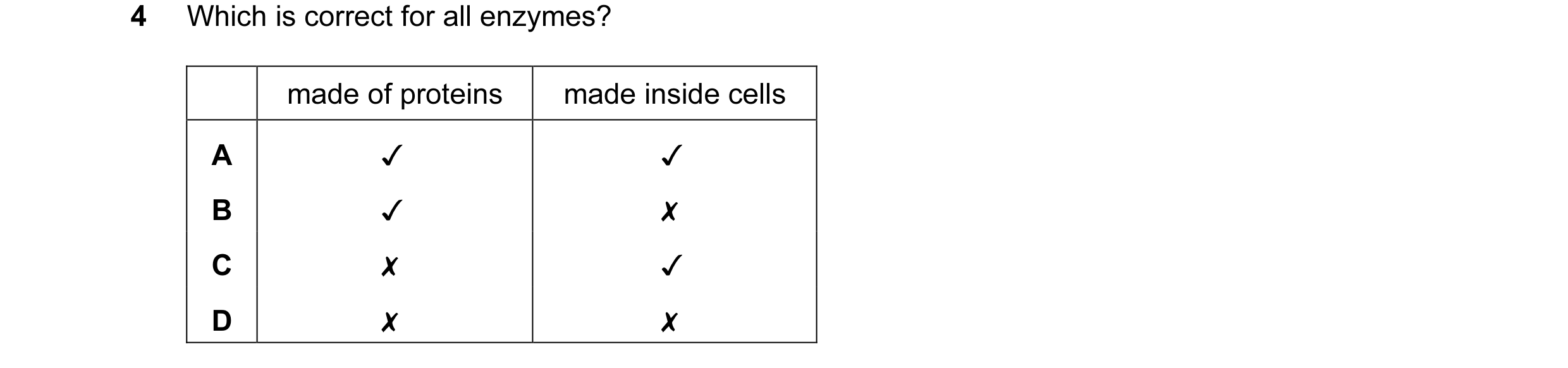
Q14 · Which is correct for all enzymes? 0653/13 Oct/Nov 2010
4 Which is correct for all enzymes?
0 0O WD >
made of proteins
v
v
x
x
made inside cells
v
x
v
x
1 marks
Answer: A
This question in 0653/13 Oct/Nov 2010
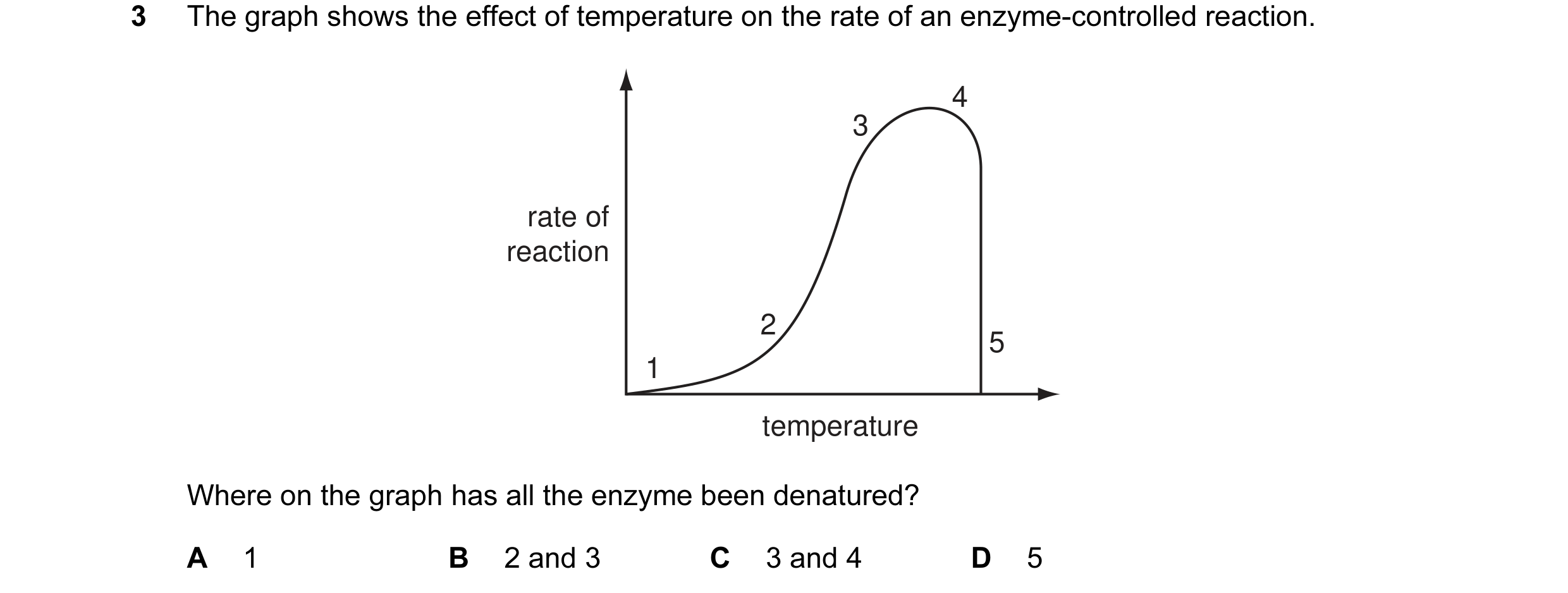
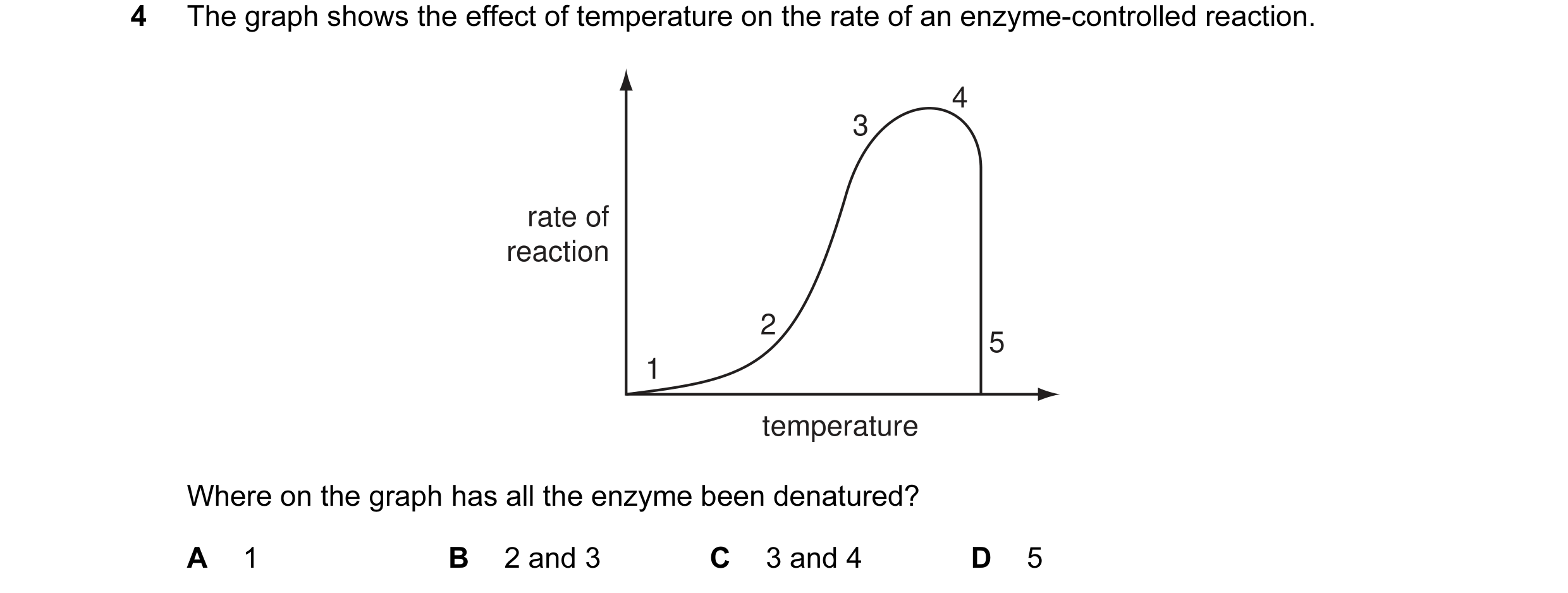
Q15 · The graph shows the effect of temperature on the rate of an enzyme-controlled reaction 0653/11 Oct/Nov 2011
3 The graph shows the effect of temperature on the rate of an enzyme-controlled reaction. 4 3 rate of reaction 2 5 1 temperature Where on the graph has all the enzyme been denatured? A 1 B 2 and 3 C 3 and 4 D 5
1 marks
Answer: D
This question in 0653/11 Oct/Nov 2011
Q16 · The graph shows the effect of temperature on the rate of an enzyme-controlled reaction 0653/12 Oct/Nov 2011
4 The graph shows the effect of temperature on the rate of an enzyme-controlled reaction. 4 3 rate of reaction 2 5 1 temperature Where on the graph has all the enzyme been denatured? A 1 B 2 and 3 C 3 and 4 D 5
1 marks
Answer: D
This question in 0653/12 Oct/Nov 2011
Q17 · The graph shows the effect of temperature on the rate of an enzyme-controlled reaction 0653/13 Oct/Nov 2011
4 The graph shows the effect of temperature on the rate of an enzyme-controlled reaction. 4 3 rate of reaction 2 5 1 temperature Where on the graph has all the enzyme been denatured? A 1 B 2 and 3 C 3 and 4 D 5
1 marks
Answer: D
This question in 0653/13 Oct/Nov 2011
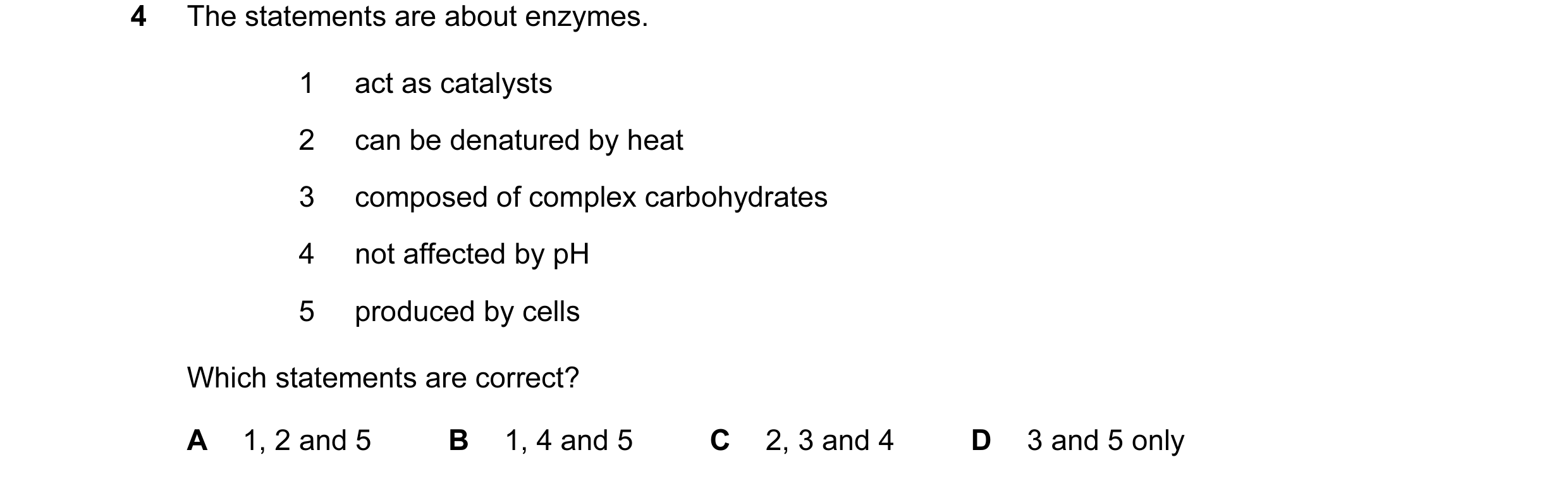
Q18 · The statements are about enzymes 0653/11 May/June 2012
3 The statements are about enzymes. 1 act as catalysts 2 can be denatured by heat 3 composed of complex carbohydrates 4 not affected by pH 5 produced by cells Which statements are correct? A 1, 2 and 5 B 1, 4 and 5 C 2, 3 and 4 D 3 and 5 only
1 marks
This question in 0653/11 May/June 2012
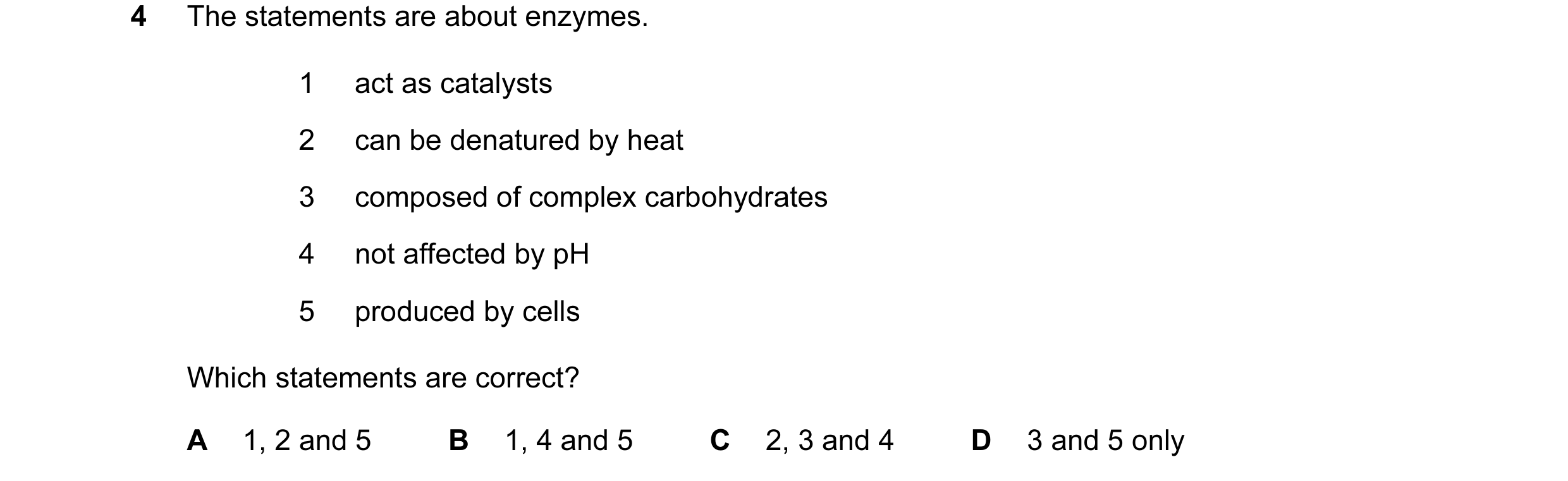
Q19 · The statements are about enzymes 0653/12 May/June 2012
4 The statements are about enzymes. 1 act as catalysts 2 can be denatured by heat 3 composed of complex carbohydrates 4 not affected by pH 5 produced by cells Which statements are correct? A 1, 2 and 5 B 1, 4 and 5 C 2, 3 and 4 D 3 and 5 only
1 marks
Answer: A
This question in 0653/12 May/June 2012
Q20 · The statements are about enzymes 0653/13 May/June 2012
4 The statements are about enzymes. 1 act as catalysts 2 can be denatured by heat 3 composed of complex carbohydrates 4 not affected by pH 5 produced by cells Which statements are correct? A 1, 2 and 5 B 1, 4 and 5 C 2, 3 and 4 D 3 and 5 only
1 marks
Answer: A
This question in 0653/13 May/June 2012
Q21 · A test-tube contains a solution of an enzyme 0653/12 May/June 2013
3 A test-tube contains a solution of an enzyme. Which colour is obtained when the biuret test is carried out on this solution? A blue B blue-black C orange D purple
1 marks
Answer: D
This question in 0653/12 May/June 2013
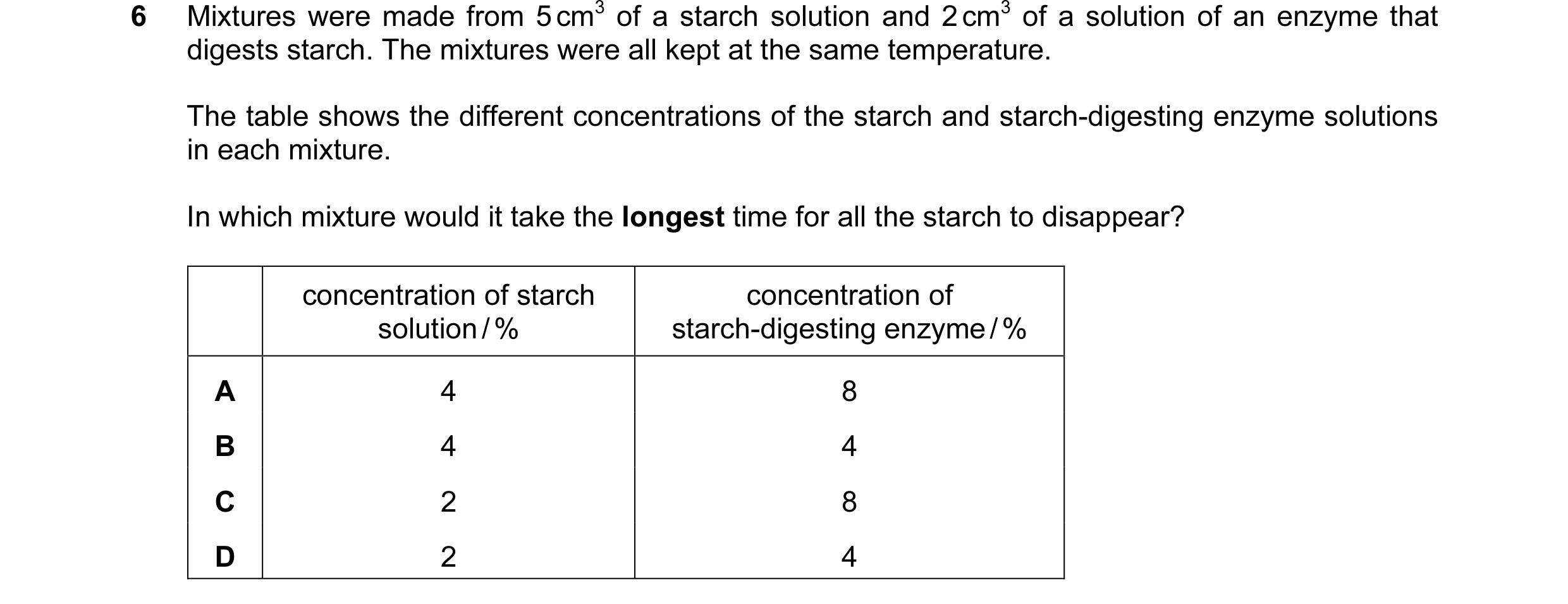
Q22 · Mixtures were made from 5 cm3 of a starch solution and 2 cm3 of a solution of an enzyme… 0653/13 May/June 2013
6 Mixtures were made from 5 cm3 of a starch solution and 2 cm3 of a solution of an enzyme that digests starch. The mixtures were all kept at the same temperature. The table shows the different concentrations of the starch and starch-digesting enzyme solutions in each mixture. In which mixture would it take the longest time for all the starch to disappear? concentration of starch concentration of solution / % starch-digesting enzyme / % A 4 8 B 4 4 C 2 8 D 2 4
1 marks
Answer: B
This question in 0653/13 May/June 2013
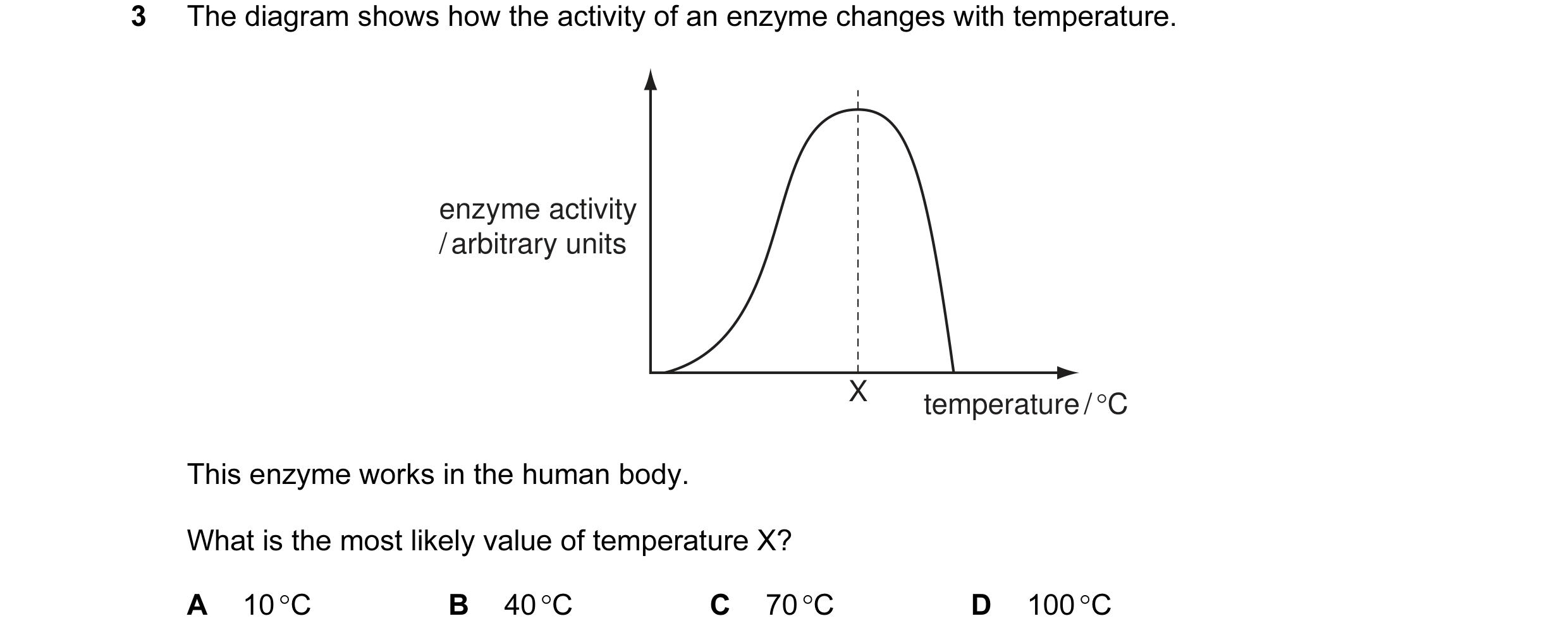
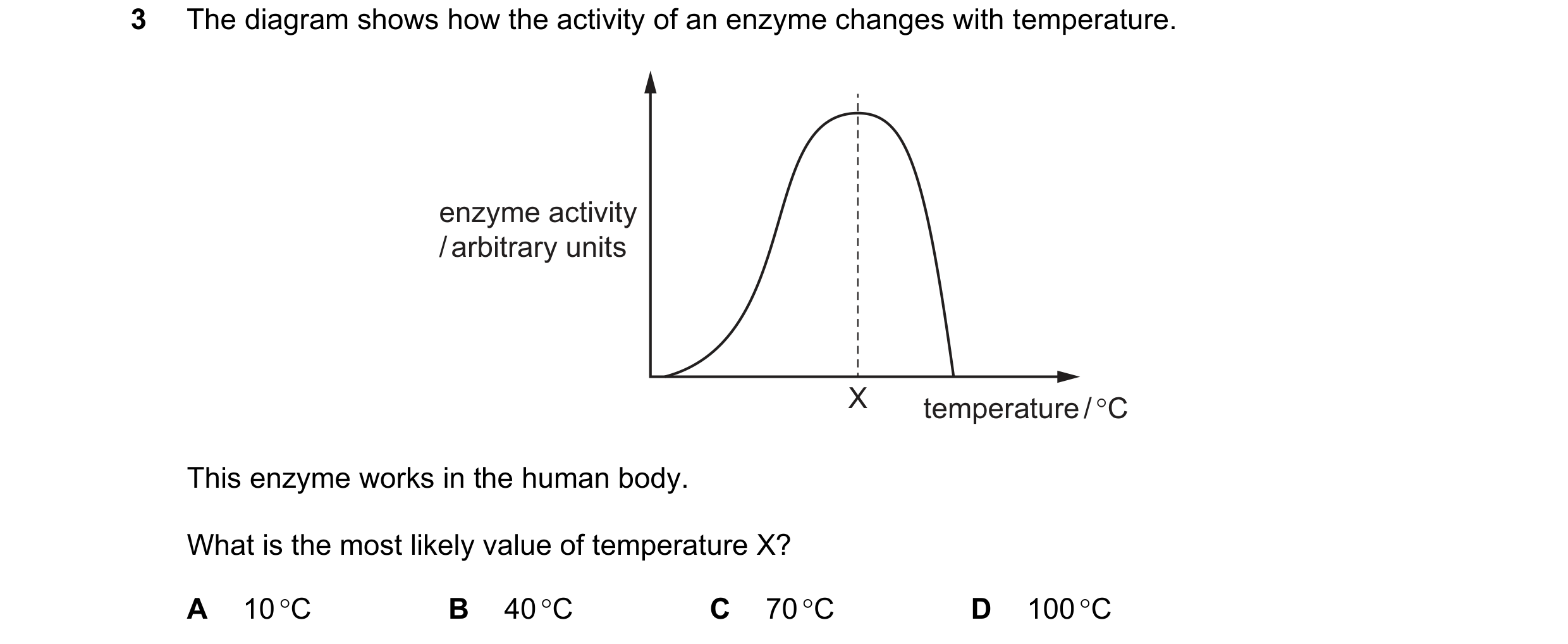
Q23 · The diagram shows how the activity of an enzyme changes with temperature 0653/11 Oct/Nov 2013
3 The diagram shows how the activity of an enzyme changes with temperature. enzyme activity / arbitrary units X temperature / °C This enzyme works in the human body. What is the most likely value of temperature X? A 10 °C B 40 °C C 70 °C D 100 °C
1 marks
Answer: B
This question in 0653/11 Oct/Nov 2013
Q24 · The diagram shows how the activity of an enzyme changes with temperature 0653/12 Oct/Nov 2013
3 The diagram shows how the activity of an enzyme changes with temperature. enzyme activity / arbitrary units X temperature / °C This enzyme works in the human body. What is the most likely value of temperature X? A 10 °C B 40 °C C 70 °C D 100 °C
1 marks
Answer: B
This question in 0653/12 Oct/Nov 2013
Q25 · Enzymes are made from A fat 0653/13 Oct/Nov 2013
3 Enzymes are made from A fat. B hormones. C proteins. D starch.
1 marks
Answer: C
This question in 0653/13 Oct/Nov 2013
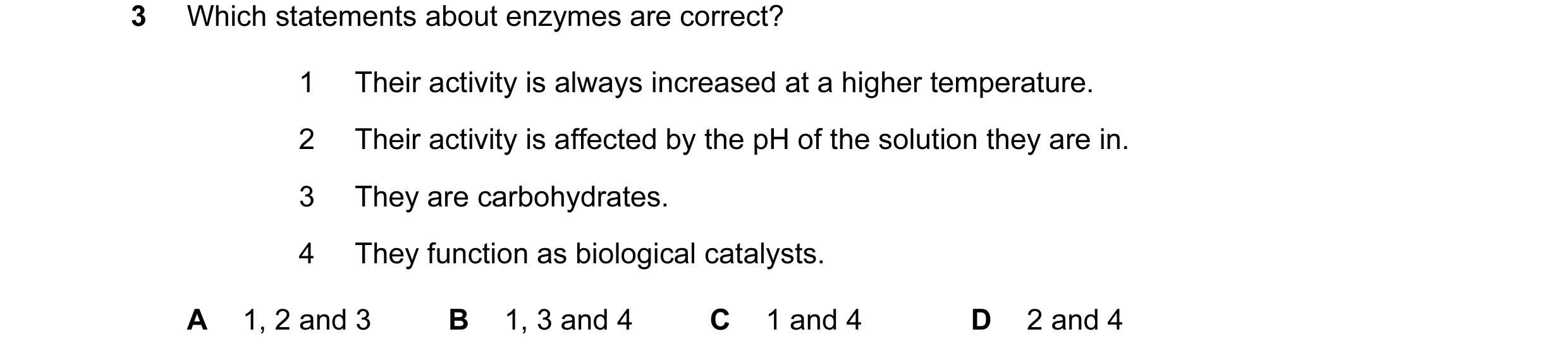
Q26 · Which statements about enzymes are correct? 0653/11 May/June 2014
3 Which statements about enzymes are correct? 1 Their activity is always increased at a higher temperature. 2 Their activity is affected by the pH of the solution they are in. 3 They are carbohydrates. 4 They function as biological catalysts. A 1, 2 and 3 B 1, 3 and 4 C 1 and 4 D 2 and 4
1 marks
Answer: D
This question in 0653/11 May/June 2014
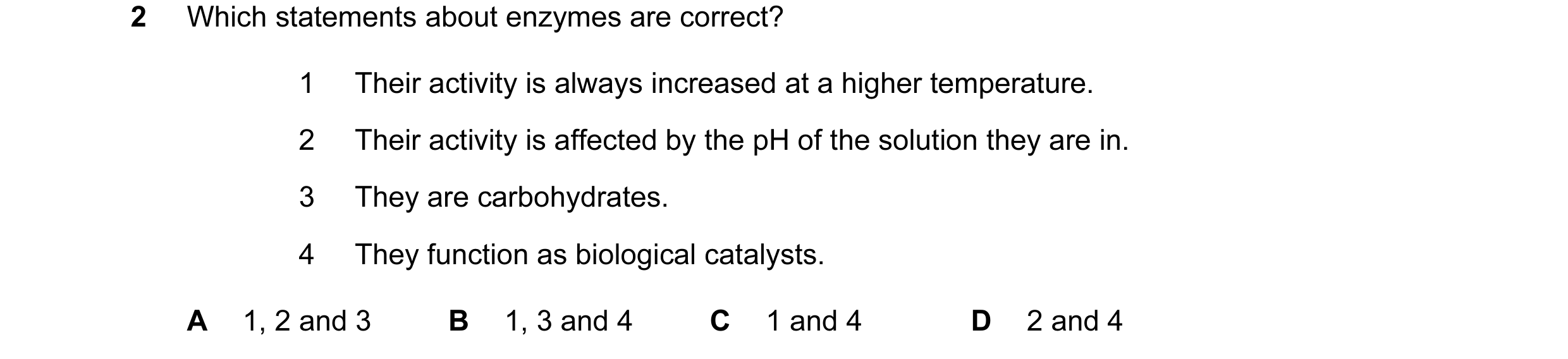
Q27 · Which statements about enzymes are correct? 0653/13 May/June 2014
2 Which statements about enzymes are correct? 1 Their activity is always increased at a higher temperature. 2 Their activity is affected by the pH of the solution they are in. 3 They are carbohydrates. 4 They function as biological catalysts. A 1, 2 and 3 B 1, 3 and 4 C 1 and 4 D 2 and 4
1 marks
Answer: D
This question in 0653/13 May/June 2014
Q28 · An experiment is carried out to investigate the effect of pH on the activity of an enzyme 0653/11 Oct/Nov 2014
4 An experiment is carried out to investigate the effect of pH on the activity of an enzyme. The graph shows the results. enzyme activity 0 2 4 6 8 10 12 14 pH At which pH is this enzyme most active? A 2 B 5 C 7 D 12
1 marks
Answer: C
This question in 0653/11 Oct/Nov 2014
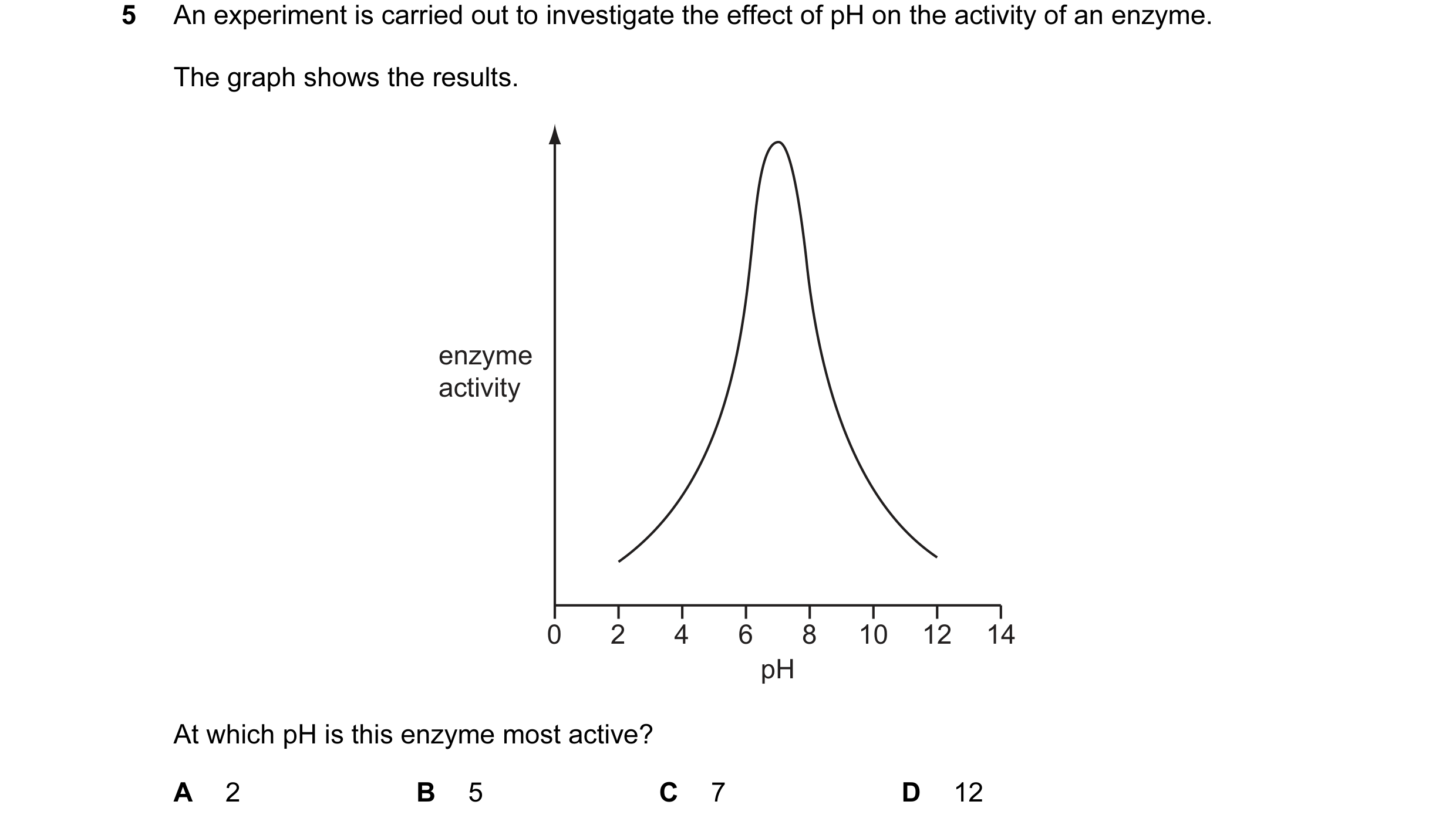
Q29 · An experiment is carried out to investigate the effect of pH on the activity of an enzyme 0653/12 Oct/Nov 2014
5 An experiment is carried out to investigate the effect of pH on the activity of an enzyme. The graph shows the results. enzyme activity 0 2 4 6 8 10 12 14 pH At which pH is this enzyme most active? A 2 B 5 C 7 D 12
1 marks
Answer: C
This question in 0653/12 Oct/Nov 2014
Q30 · An experiment is carried out to investigate the effect of pH on the activity of an enzyme 0653/13 Oct/Nov 2014
4 An experiment is carried out to investigate the effect of pH on the activity of an enzyme. The graph shows the results. enzyme activity 0 2 4 6 8 10 12 14 pH At which pH is this enzyme most active? A 2 B 5 C 7 D 12
1 marks
Answer: C
This question in 0653/13 Oct/Nov 2014
Q31 · Proteins that function as biological catalysts are called A enzymes B hormones C solvents… 0653/11 May/June 2015
4 Proteins that function as biological catalysts are called A enzymes B hormones C solvents D vitamins
1 marks
Answer: A
This question in 0653/11 May/June 2015
Q32 · The numbered statements are about enzymes 0653/12 May/June 2015
4 The numbered statements are about enzymes. 1 All enzymes are proteins. 2 Enzymes are destroyed at temperatures below 5 °C. 3 Enzymes speed up the rate of chemical reactions. 4 The higher the pH the faster the enzymes work. Which statements are correct for all enzymes? A 1 and 2 B 1 and 3 C 2 and 3 D 3 and 4
1 marks
Answer: B
This question in 0653/12 May/June 2015
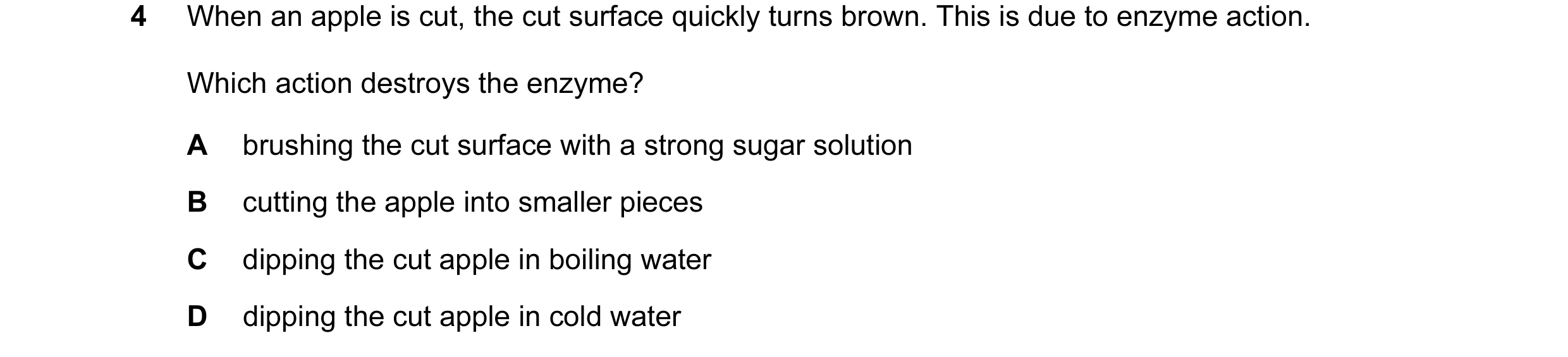
Q33 · When an apple is cut, the cut surface quickly turns brown 0653/13 May/June 2015
4 When an apple is cut, the cut surface quickly turns brown. This is due to enzyme action. Which action destroys the enzyme? A brushing the cut surface with a strong sugar solution B cutting the apple into smaller pieces C dipping the cut apple in boiling water D dipping the cut apple in cold water
1 marks
Answer: C
This question in 0653/13 May/June 2015
Q34 · The graph shows the effect of temperature on the rate of an enzyme-controlled reaction 0653/11 Oct/Nov 2015
1 The graph shows the effect of temperature on the rate of an enzyme-controlled reaction. 4 3 rate of reaction 2 5 1 temperature Where on the graph has all the enzyme been denatured? A 1 B 2 and 3 C 3 and 4 D 5
1 marks
Answer: D
This question in 0653/11 Oct/Nov 2015
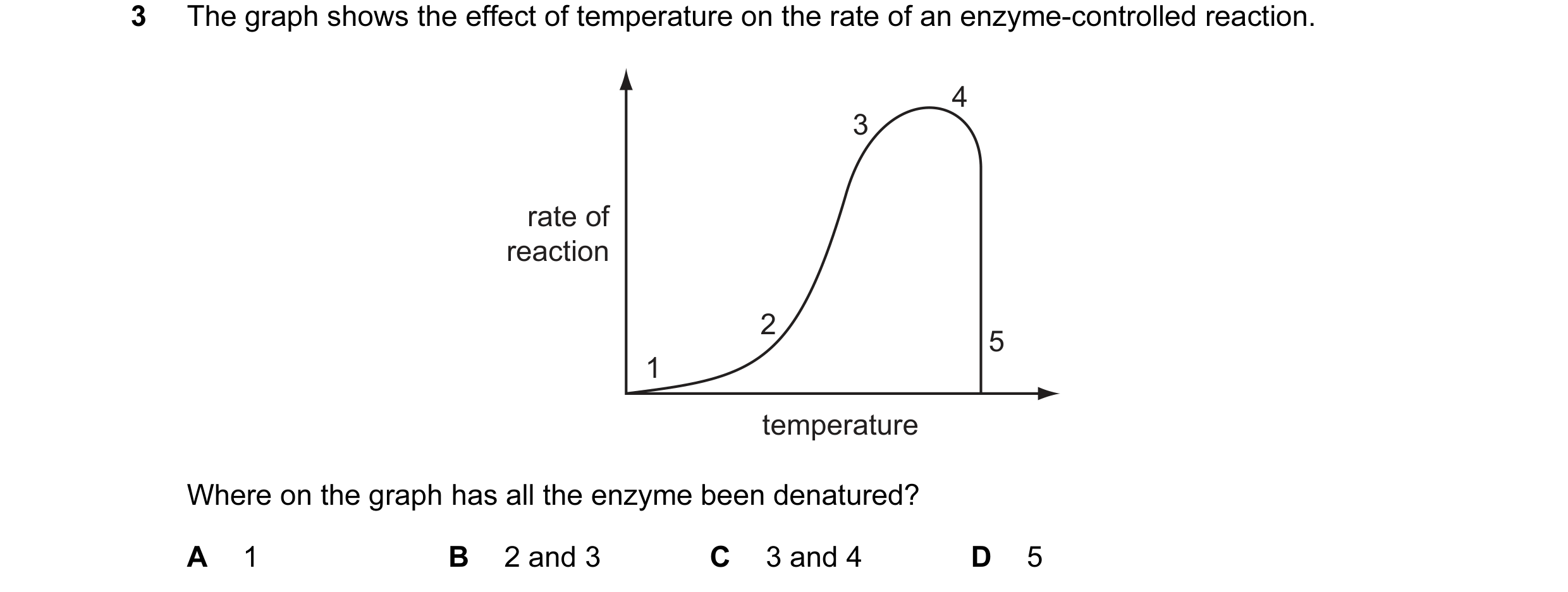
Q35 · The graph shows the effect of temperature on the rate of an enzyme-controlled reaction 0653/12 Oct/Nov 2015
3 The graph shows the effect of temperature on the rate of an enzyme-controlled reaction. 4 3 rate of reaction 2 5 1 temperature Where on the graph has all the enzyme been denatured? A 1 B 2 and 3 C 3 and 4 D 5
1 marks
Answer: D
This question in 0653/12 Oct/Nov 2015
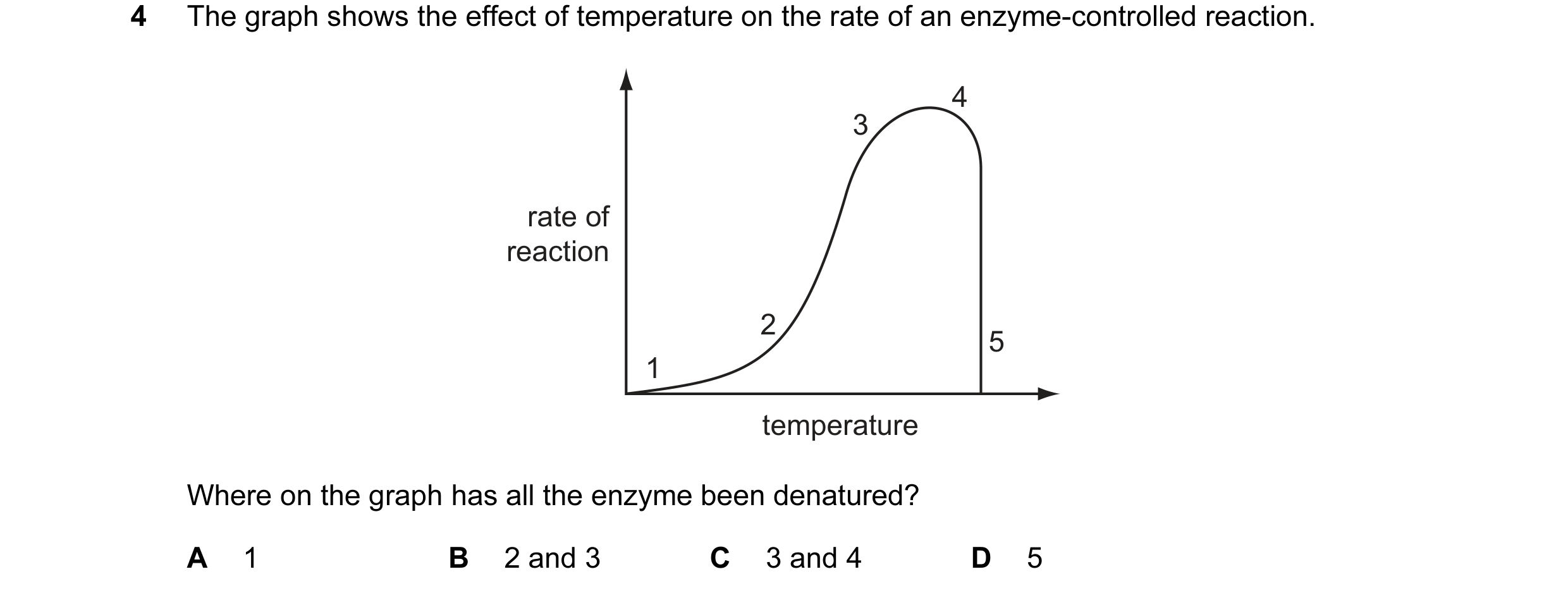
Q36 · The graph shows the effect of temperature on the rate of an enzyme-controlled reaction 0653/13 Oct/Nov 2015
4 The graph shows the effect of temperature on the rate of an enzyme-controlled reaction. 4 3 rate of reaction 2 5 1 temperature Where on the graph has all the enzyme been denatured? A 1 B 2 and 3 C 3 and 4 D 5
1 marks
Answer: D
This question in 0653/13 Oct/Nov 2015
Q37 · What describes an enzyme? 0653/11 May/June 2016
4 What describes an enzyme? A a protein that acts as a catalyst B a protein that acts as a hormone C a vitamin that acts as a catalyst D a vitamin that acts as a hormone
1 marks
Answer: A
This question in 0653/11 May/June 2016
Q38 · To which class of compound do enzymes belong? 0653/12 May/June 2016
4 To which class of compound do enzymes belong? A carbohydrates B fats C proteins D vitamins
1 marks
Answer: C
This question in 0653/12 May/June 2016
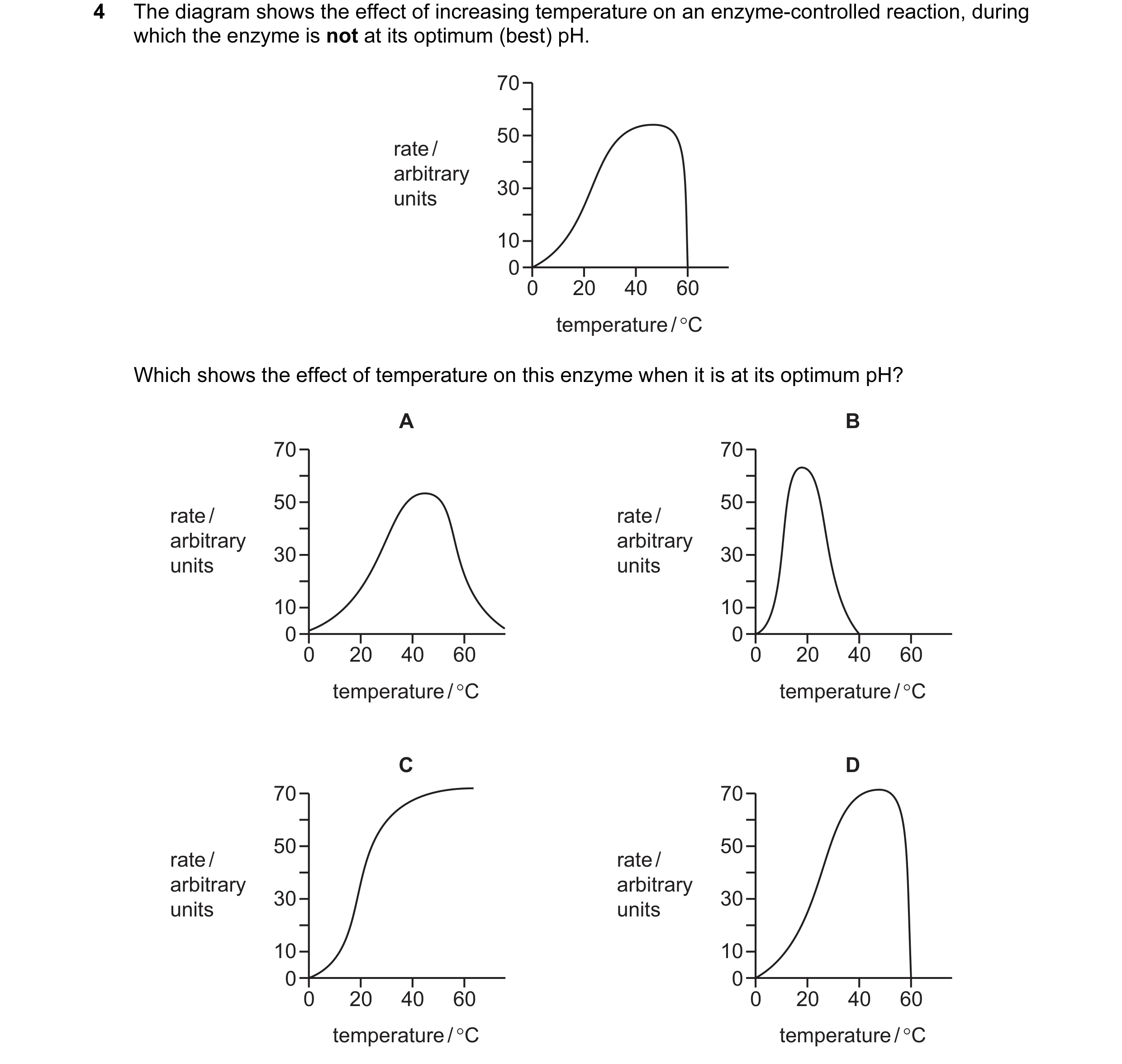
Q39 · The diagram shows the effect of increasing temperature on an enzyme-controlled reaction… 0653/13 May/June 2016
4 The diagram shows the effect of increasing temperature on an enzyme-controlled reaction, during which the enzyme is not at its optimum (best) pH. 70 50 rate / arbitrary 30 units 10 0 0 20 40 60 temperature / °C Which shows the effect of temperature on this enzyme when it is at its optimum pH? A B 70 70 50 50 rate / rate / arbitrary arbitrary 30 30 units units 10 10 0 0 0 20 40 60 0 20 40 60 temperature / °C temperature / °C C D 70 70 50 50 rate / rate / arbitrary arbitrary 30 30 units units 10 10 0 0 0 20 40 60 0 20 40 60 temperature / °C temperature / °C
1 marks
Answer: D
This question in 0653/13 May/June 2016
Q40 · A student wants to find out if a solution contains an enzyme 0653/12 Oct/Nov 2016
4 A student wants to find out if a solution contains an enzyme. Which chemical should the student use? A Benedict’s solution B biuret solution C ethanol D iodine solution
1 marks
Answer: B
This question in 0653/12 Oct/Nov 2016
Q41 · Which statements about enzymes are correct? 0653/13 Oct/Nov 2016
4 Which statements about enzymes are correct? 1 act as catalysts 2 can be denatured by heat 3 composed of complex carbohydrates 4 produced by cells A 1, 2 and 4 B 1 and 4 only C 2, 3 and 4 D 3 and 4 only
1 marks
Answer: A
This question in 0653/13 Oct/Nov 2016
Q42 · When food reaches the stomach the digestion of starch stops 0653/13 Oct/Nov 2016
5 When food reaches the stomach the digestion of starch stops. Why is this? A All the starch has been digested. B The enzyme in saliva has been used up. C The pH in the stomach is very low. D The stomach does not produce a starch-digesting enzyme.
1 marks
Answer: C
This question in 0653/13 Oct/Nov 2016
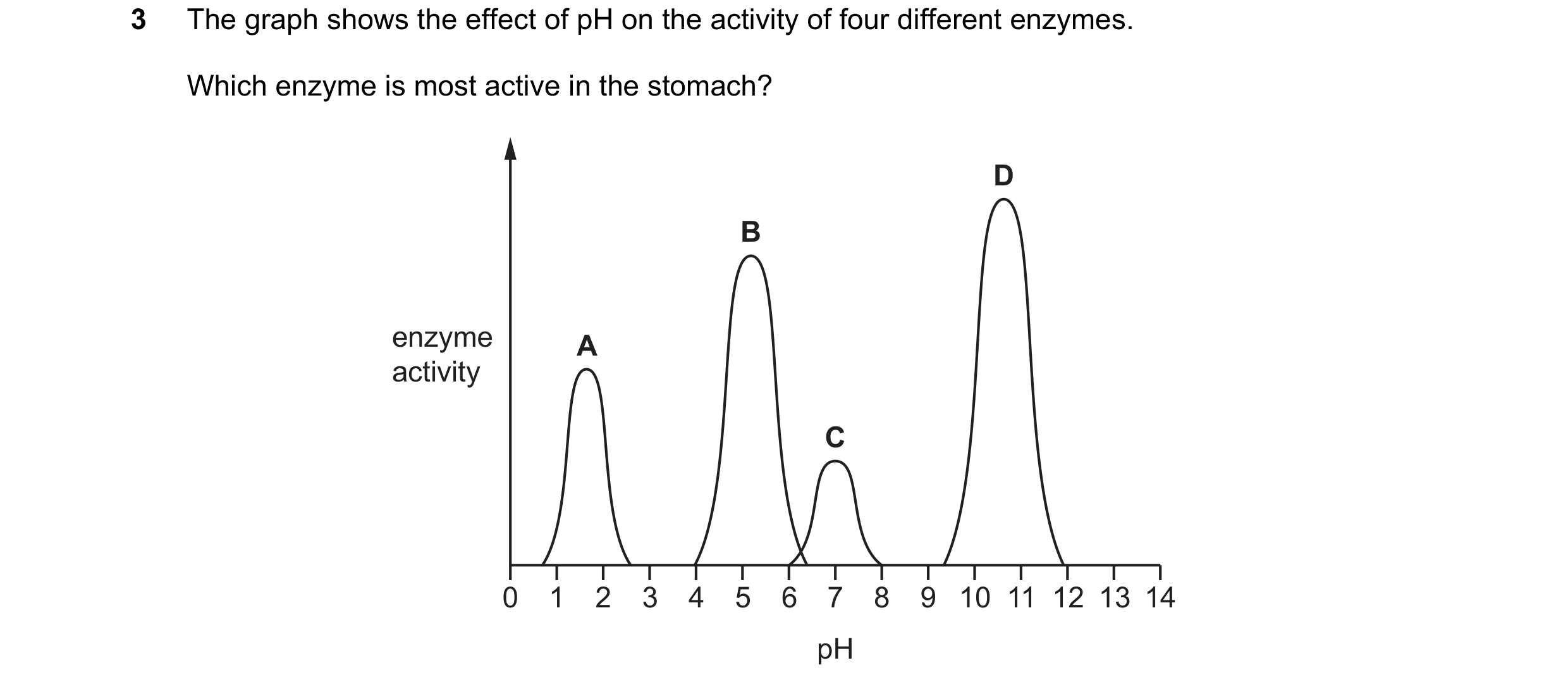
Q43 · The graph shows the effect of pH on the activity of four different enzymes 0653/12 Feb/March 2017
3 The graph shows the effect of pH on the activity of four different enzymes. Which enzyme is most active in the stomach? D B enzyme A activity C 0 1 2 3 4 5 6 7 8 9 10 11 12 13 14 pH
1 marks
Answer: A
This question in 0653/12 Feb/March 2017
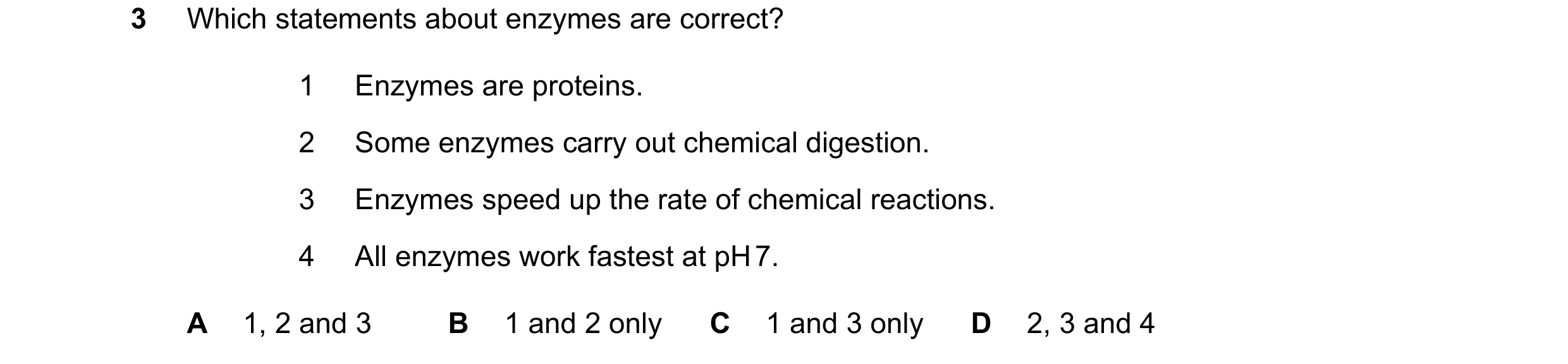
Q44 · Which statements about enzymes are correct? 0653/11 May/June 2017
3 Which statements about enzymes are correct? 1 Enzymes are proteins. 2 Some enzymes carry out chemical digestion. 3 Enzymes speed up the rate of chemical reactions. 4 All enzymes work fastest at pH 7. A 1, 2 and 3 B 1 and 2 only C 1 and 3 only D 2, 3 and 4
1 marks
Answer: A
This question in 0653/11 May/June 2017
Q45 · Which statement about enzymes is correct? 0653/12 May/June 2017
3 Which statement about enzymes is correct? A They are killed by high temperatures. B They are made from amino acids. C They are unaffected by pH. D They are used up in biological reactions.
1 marks
Answer: B
This question in 0653/12 May/June 2017
Q46 · Which statement about enzymes is correct? 0653/13 May/June 2017
3 Which statement about enzymes is correct? A They are killed by high temperatures. B They are made from amino acids. C They are unaffected by pH. D They are used up in biological reactions.
1 marks
Answer: B
This question in 0653/13 May/June 2017
Q47 · What are enzymes made from? 0653/11 Oct/Nov 2017
3 What are enzymes made from? A fat B hormones C protein D starch
1 marks
Answer: C
This question in 0653/11 Oct/Nov 2017
Q48 · What are enzymes made from? 0653/12 Oct/Nov 2017
3 What are enzymes made from? A fat B hormones C protein D starch
1 marks
Answer: C
This question in 0653/12 Oct/Nov 2017
Q49 · What are enzymes made from? 0653/13 Oct/Nov 2017
3 What are enzymes made from? A fat B hormones C protein D starch
1 marks
Answer: C
This question in 0653/13 Oct/Nov 2017
Q50 · Which statement about enzymes is correct? 0653/12 Feb/March 2018
3 Which statement about enzymes is correct? A All enzymes work best at pH 7. B All proteins are enzymes. C Enzymes are biological catalysts. D Low temperatures denature enzymes.
1 marks
Answer: C
This question in 0653/12 Feb/March 2018
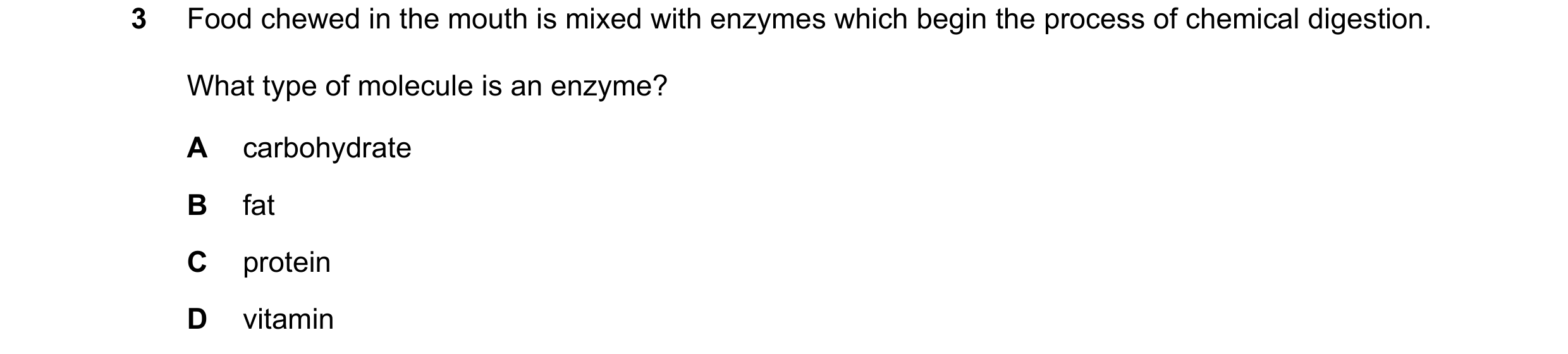
Q51 · Food chewed in the mouth is mixed with enzymes which begin the process of chemical… 0653/11 May/June 2018
3 Food chewed in the mouth is mixed with enzymes which begin the process of chemical digestion. What type of molecule is an enzyme? A carbohydrate B fat C protein D vitamin
1 marks
Answer: C
This question in 0653/11 May/June 2018
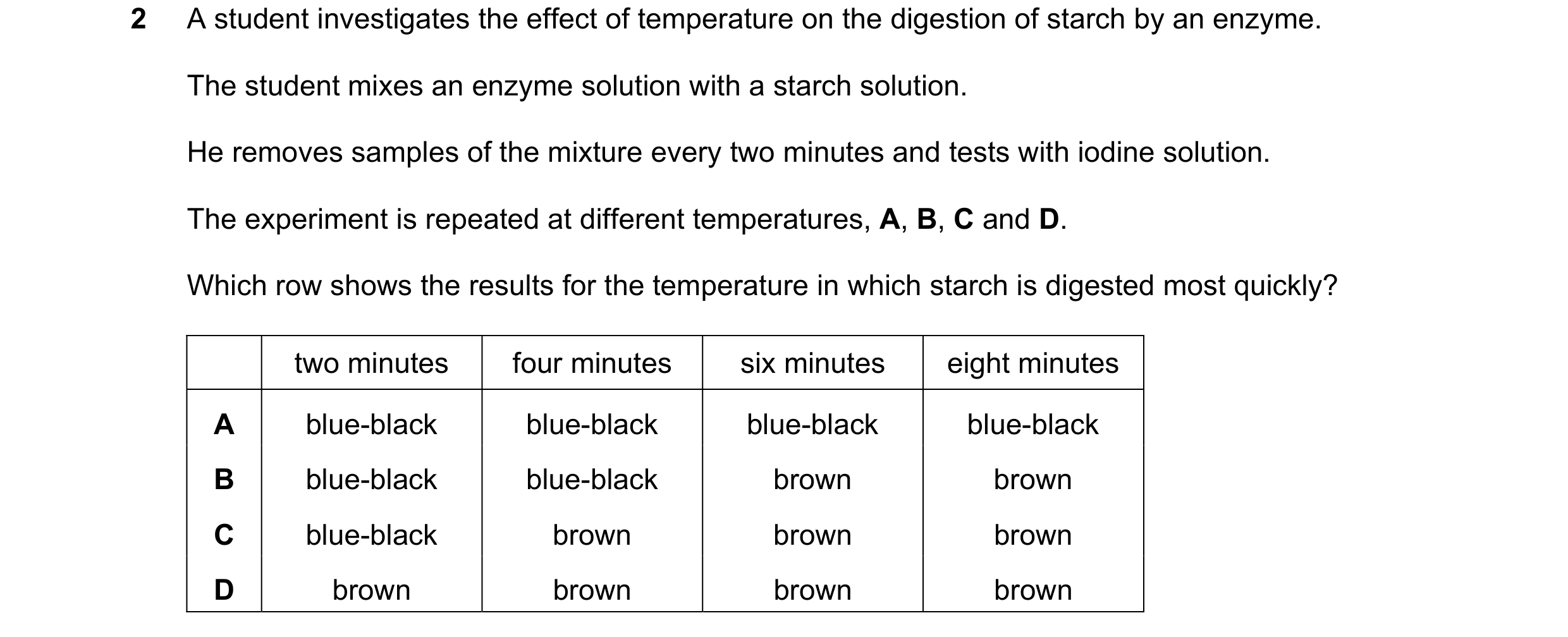
Q52 · A student investigates the effect of temperature on the digestion of starch by an enzyme 0653/12 May/June 2018
2 A student investigates the effect of temperature on the digestion of starch by an enzyme. The student mixes an enzyme solution with a starch solution. He removes samples of the mixture every two minutes and tests with iodine solution. The experiment is repeated at different temperatures, A, B, C and D. Which row shows the results for the temperature in which starch is digested most quickly? two minutes four minutes six minutes eight minutes A blue-black blue-black blue-black blue-black B blue-black blue-black brown brown C blue-black brown brown brown D brown brown brown brown
1 marks
Answer: D
This question in 0653/12 May/June 2018
Q53 · A student investigates the effect of temperature on the digestion of starch by an enzyme 0653/13 May/June 2018
2 A student investigates the effect of temperature on the digestion of starch by an enzyme. The student mixes an enzyme solution with a starch solution. He removes samples of the mixture every two minutes and tests with iodine solution. The experiment is repeated at different temperatures, A, B, C and D. Which row shows the results for the temperature in which starch is digested most quickly? two minutes four minutes six minutes eight minutes A blue-black blue-black blue-black blue-black B blue-black blue-black brown brown C blue-black brown brown brown D brown brown brown brown
1 marks
Answer: D
This question in 0653/13 May/June 2018
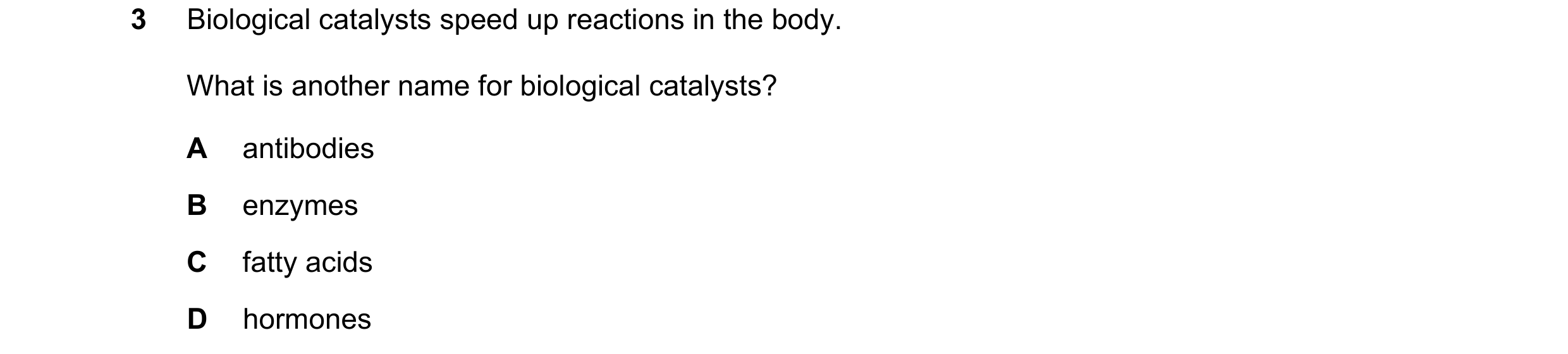
Q54 · Biological catalysts speed up reactions in the body 0653/11 Oct/Nov 2018
3 Biological catalysts speed up reactions in the body. What is another name for biological catalysts? A antibodies B enzymes C fatty acids D hormones
1 marks
Answer: B
This question in 0653/11 Oct/Nov 2018
Q55 · A human enzyme breaks down starch into simple sugars 0653/13 Oct/Nov 2018
3 A human enzyme breaks down starch into simple sugars. A solution of this human enzyme was heated to 90 °C for 30 minutes. 2 cm3 of this human enzyme solution was added to starch solution in several different test-tubes. The test-tubes were kept at different temperatures for 15 minutes. Which graph shows the amount of sugar produced in the test-tubes? A B amount amount of sugar of sugar temperature / °C temperature / °C C D amount amount of sugar of sugar temperature / °C temperature / °C
1 marks
Answer: C
This question in 0653/13 Oct/Nov 2018
Q56 · In an experiment, an enzyme from the human alimentary canal is found to work slowly at 20… 0653/12 Feb/March 2019
2 In an experiment, an enzyme from the human alimentary canal is found to work slowly at 20 °C. What is the optimum temperature for enzymes working in the human alimentary canal? A 17 °C B 27 °C C 37 °C D 77 °C
1 marks
Answer: C
This question in 0653/12 Feb/March 2019
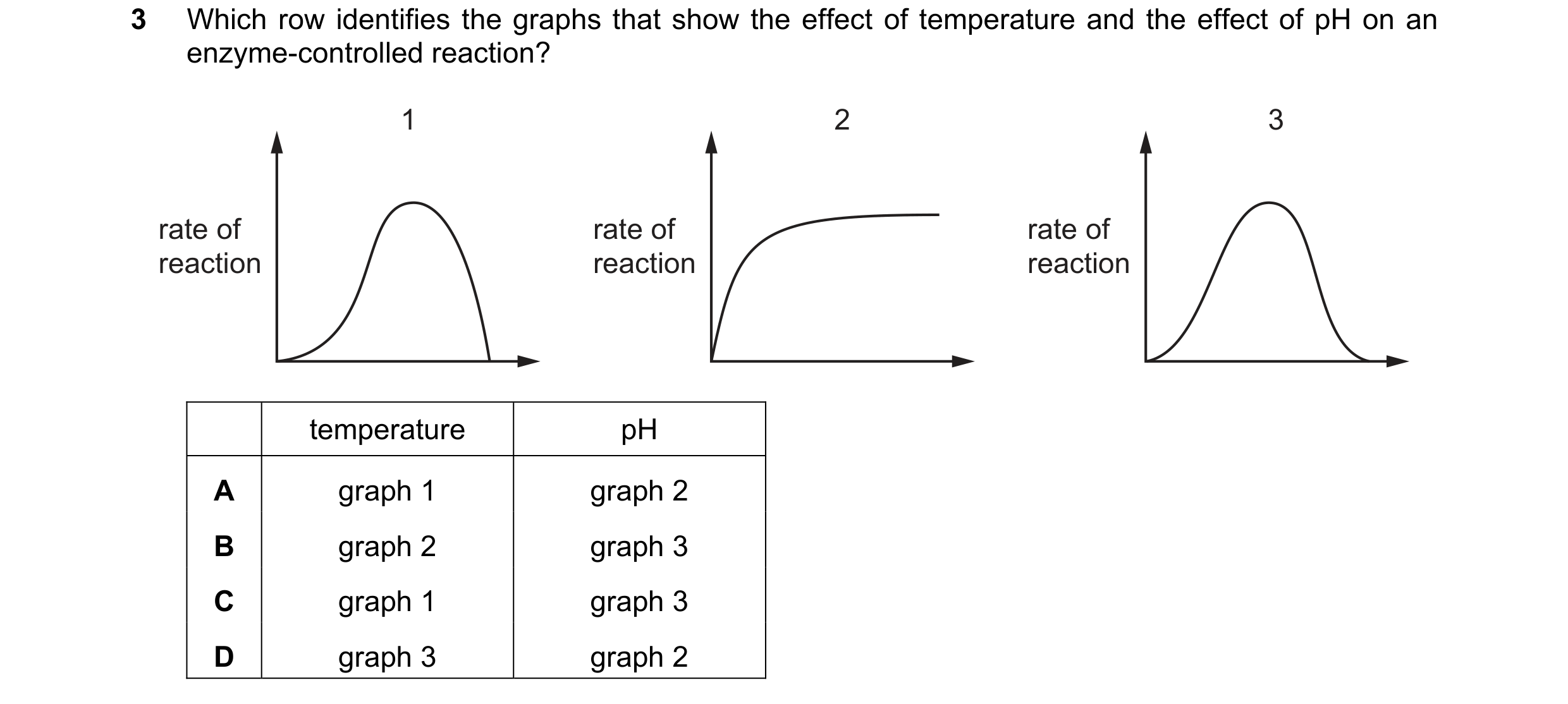
Q57 · Which row identifies the graphs that show the effect of temperature and the effect of pH… 0653/11 May/June 2019
3 Which row identifies the graphs that show the effect of temperature and the effect of pH on an enzyme-controlled reaction? 1 2 3 rate of rate of rate of reaction reaction reaction temperature pH A graph 1 graph 2 B graph 2 graph 3 C graph 1 graph 3 D graph 3 graph 2
1 marks
Answer: C
This question in 0653/11 May/June 2019
Q58 · When an apple is cut, the cut surface quickly turns brown 0653/12 Feb/March 2020
5 When an apple is cut, the cut surface quickly turns brown. This is due to enzyme action. Which action destroys the enzyme? A brushing the cut surface with a strong sugar solution B cutting the apple into smaller pieces C placing the cut apple in boiling water D placing the cut apple in cold water
1 marks
Answer: C
This question in 0653/12 Feb/March 2020
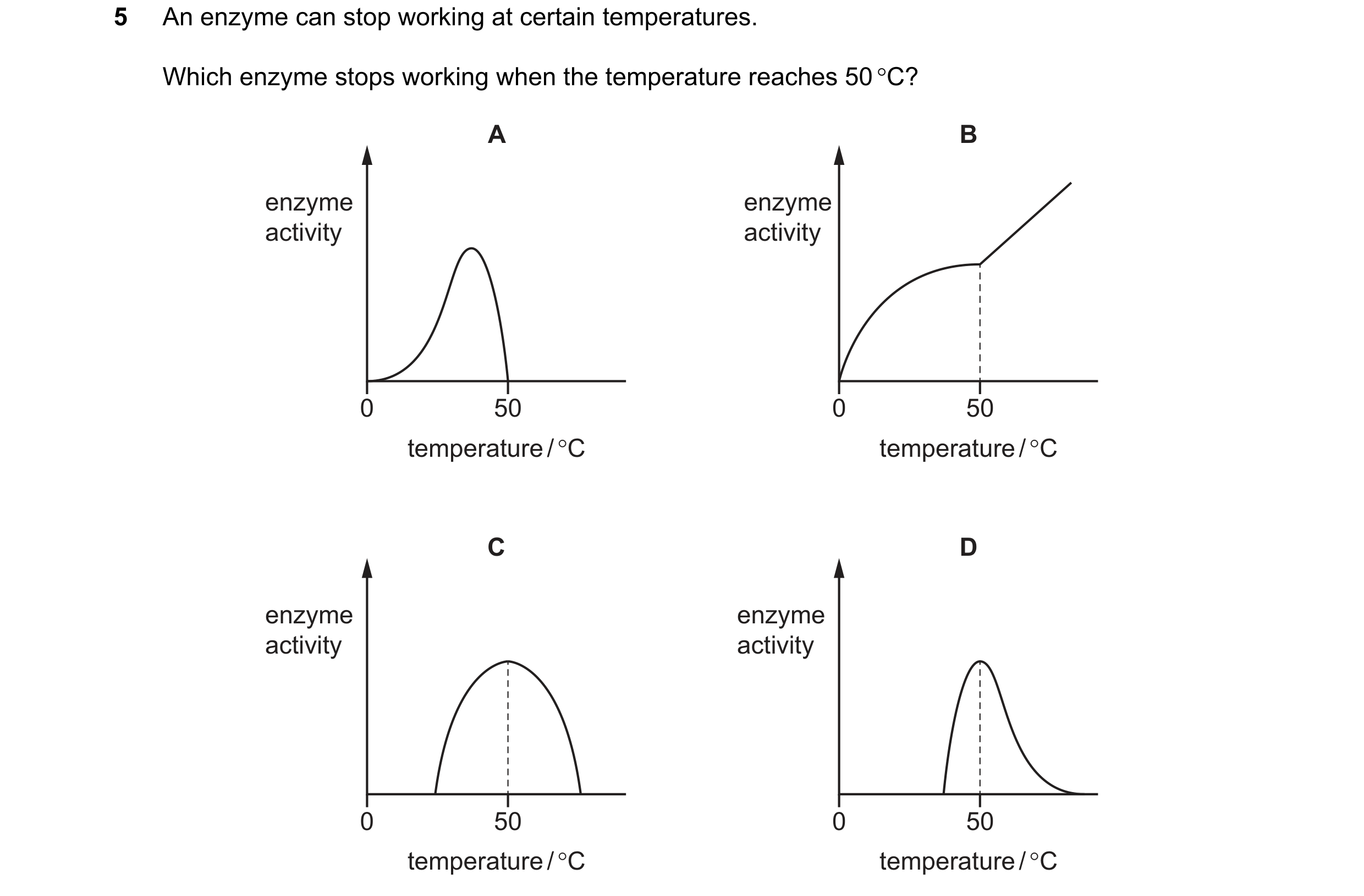
Q59 · An enzyme can stop working at certain temperatures 0653/11 May/June 2020
5 An enzyme can stop working at certain temperatures. Which enzyme stops working when the temperature reaches 50 °C? A B enzyme enzyme activity activity 0 50 0 50 temperature / °C temperature / °C C D enzyme enzyme activity activity 0 50 0 50 temperature / °C temperature / °C
1 marks
Answer: A
This question in 0653/11 May/June 2020
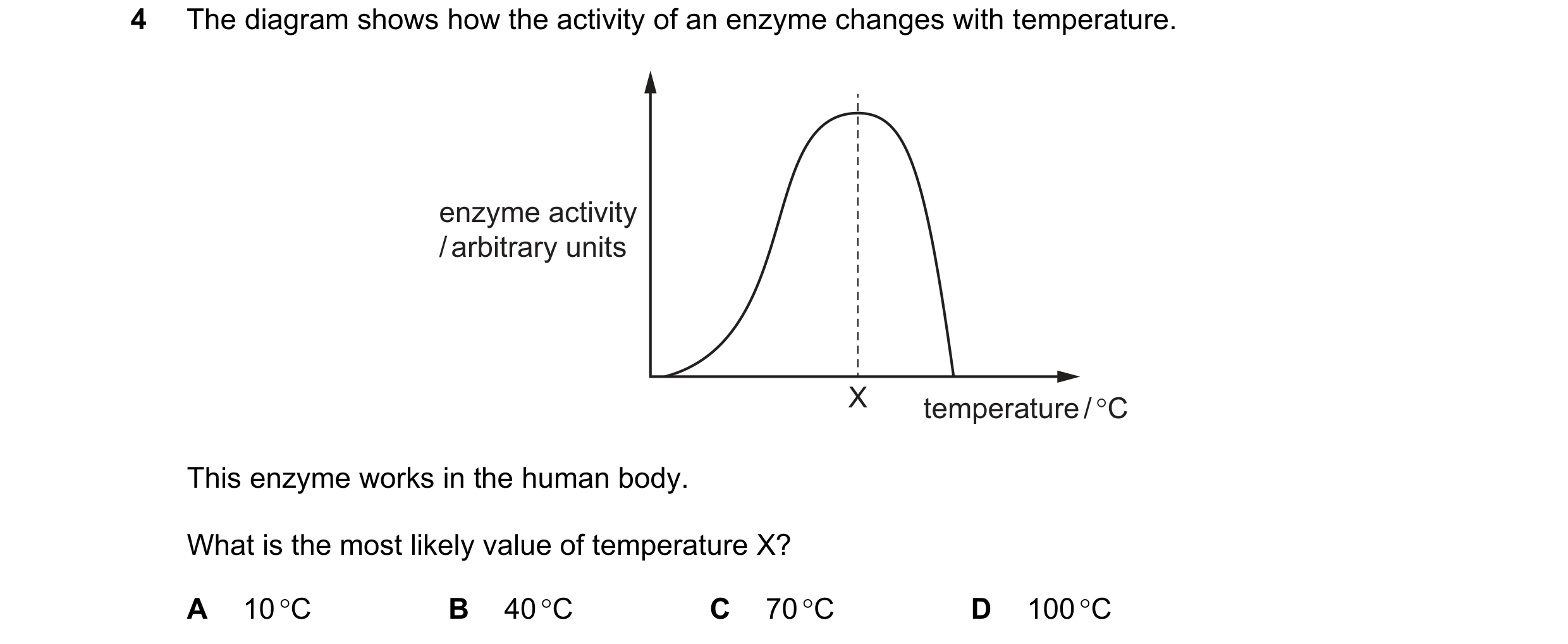
Q60 · The diagram shows how the activity of an enzyme changes with temperature 0653/11 Oct/Nov 2020
4 The diagram shows how the activity of an enzyme changes with temperature. enzyme activity / arbitrary units X temperature / °C This enzyme works in the human body. What is the most likely value of temperature X? A 10 C B 40 C C 70 C D 100 C
1 marks
Answer: B
This question in 0653/11 Oct/Nov 2020
Q61 · The diagram shows how the activity of an enzyme changes with temperature 0653/12 Oct/Nov 2020
5 The diagram shows how the activity of an enzyme changes with temperature. enzyme activity / arbitrary units X temperature / °C This enzyme works in the human body. What is the most likely value of temperature X? A 10 C B 40 C C 70 C D 100 C
1 marks
Answer: B
This question in 0653/12 Oct/Nov 2020
Q62 · The diagram shows how the activity of an enzyme changes with temperature 0653/13 Oct/Nov 2020
3 The diagram shows how the activity of an enzyme changes with temperature. enzyme activity / arbitrary units X temperature / °C This enzyme works in the human body. What is the most likely value of temperature X? A 10 C B 40 C C 70 C D 100 C
1 marks
Answer: B
This question in 0653/13 Oct/Nov 2020
Q63 · What are enzymes made from? 0653/12 Feb/March 2021
4 What are enzymes made from? A carbohydrates B fats C proteins D sugars
1 marks
Answer: C
This question in 0653/12 Feb/March 2021
Q64 · Which name is given to biological catalysts? 0653/12 May/June 2021
4 Which name is given to biological catalysts? A antibodies B enzymes C hormones D platelets
1 marks
Answer: B
This question in 0653/12 May/June 2021
Q65 · Which row describes an enzyme? 0653/13 May/June 2021
3 Which row describes an enzyme? type of molecule function A carbohydrate speeds up a reaction and is used up in the process B carbohydrate speeds up a reaction and is not used up in the process C protein speeds up a reaction and is used up in the process D protein speeds up a reaction and is not used up in the process
1 marks
Answer: D
This question in 0653/13 May/June 2021
Q66 · Which statement about enzymes is correct? 0653/11 Oct/Nov 2021
3 Which statement about enzymes is correct? A They are denatured at high temperatures. B They all have an optimum pH of 7. C They all have an optimum temperature of 10 C. D They are made of carbohydrates.
1 marks
Answer: A
This question in 0653/11 Oct/Nov 2021
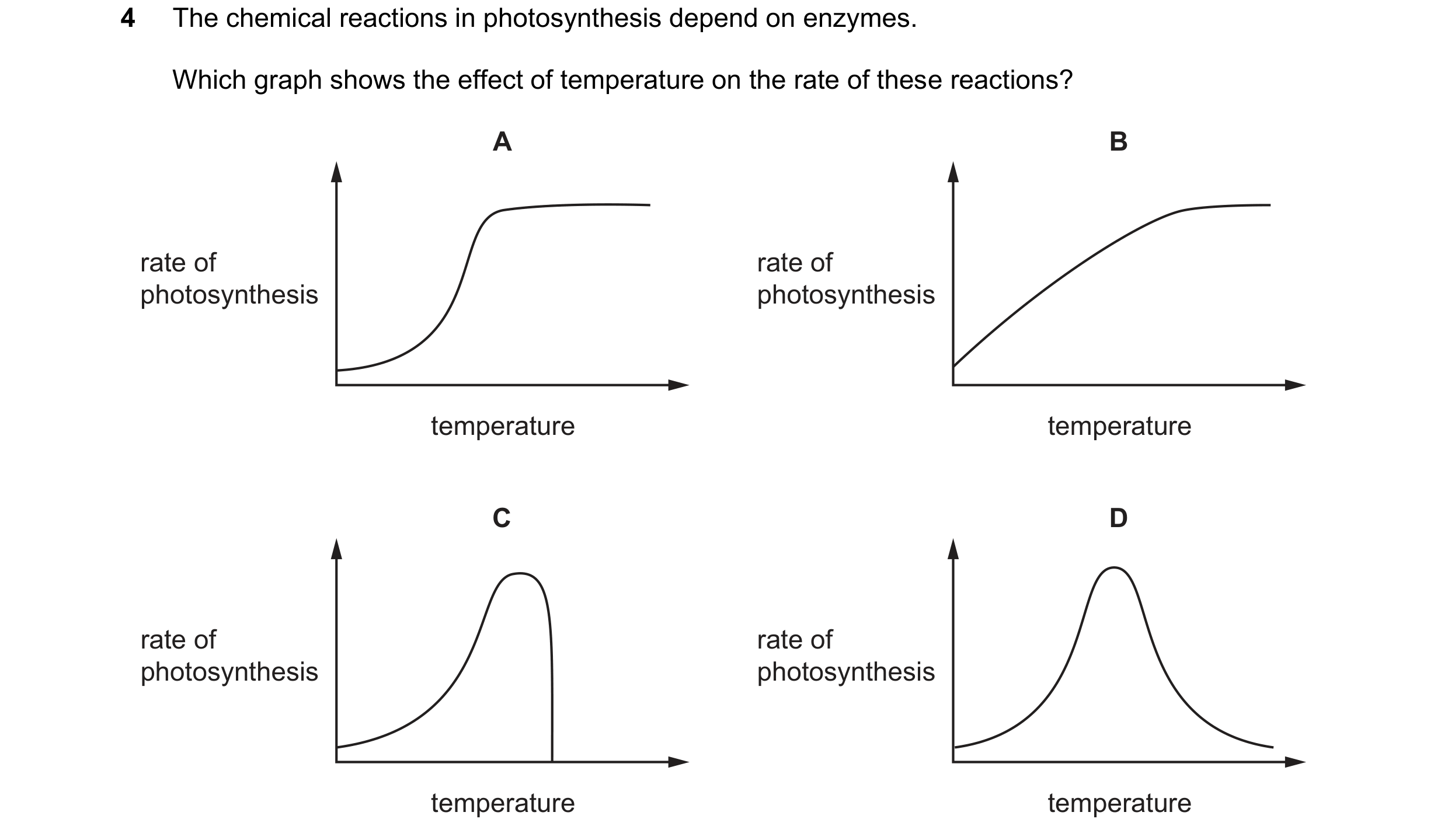
Q67 · The chemical reactions in photosynthesis depend on enzymes 0653/12 Feb/March 2022
4 The chemical reactions in photosynthesis depend on enzymes. Which graph shows the effect of temperature on the rate of these reactions? A B rate of rate of photosynthesis photosynthesis temperature temperature C D rate of rate of photosynthesis photosynthesis temperature temperature
1 marks
Answer: C
This question in 0653/12 Feb/March 2022
Q68 · Which statement about enzymes is correct? 0653/11 May/June 2022
4 Which statement about enzymes is correct? A Enzymes are biological catalysts. B Enzymes are made of glycerol. C Enzymes are not affected by changes in pH. D Enzymes are not affected by changes in temperature.
1 marks
Answer: A
This question in 0653/11 May/June 2022
Q69 · Which graph shows how the rate of an enzyme-controlled reaction varies with changes in pH? 0653/12 May/June 2022
4 Which graph shows how the rate of an enzyme-controlled reaction varies with changes in pH? A B rate of pH reaction pH rate of reaction C D rate of pH reaction rate of reaction pH
1 marks
Answer: A
This question in 0653/12 May/June 2022
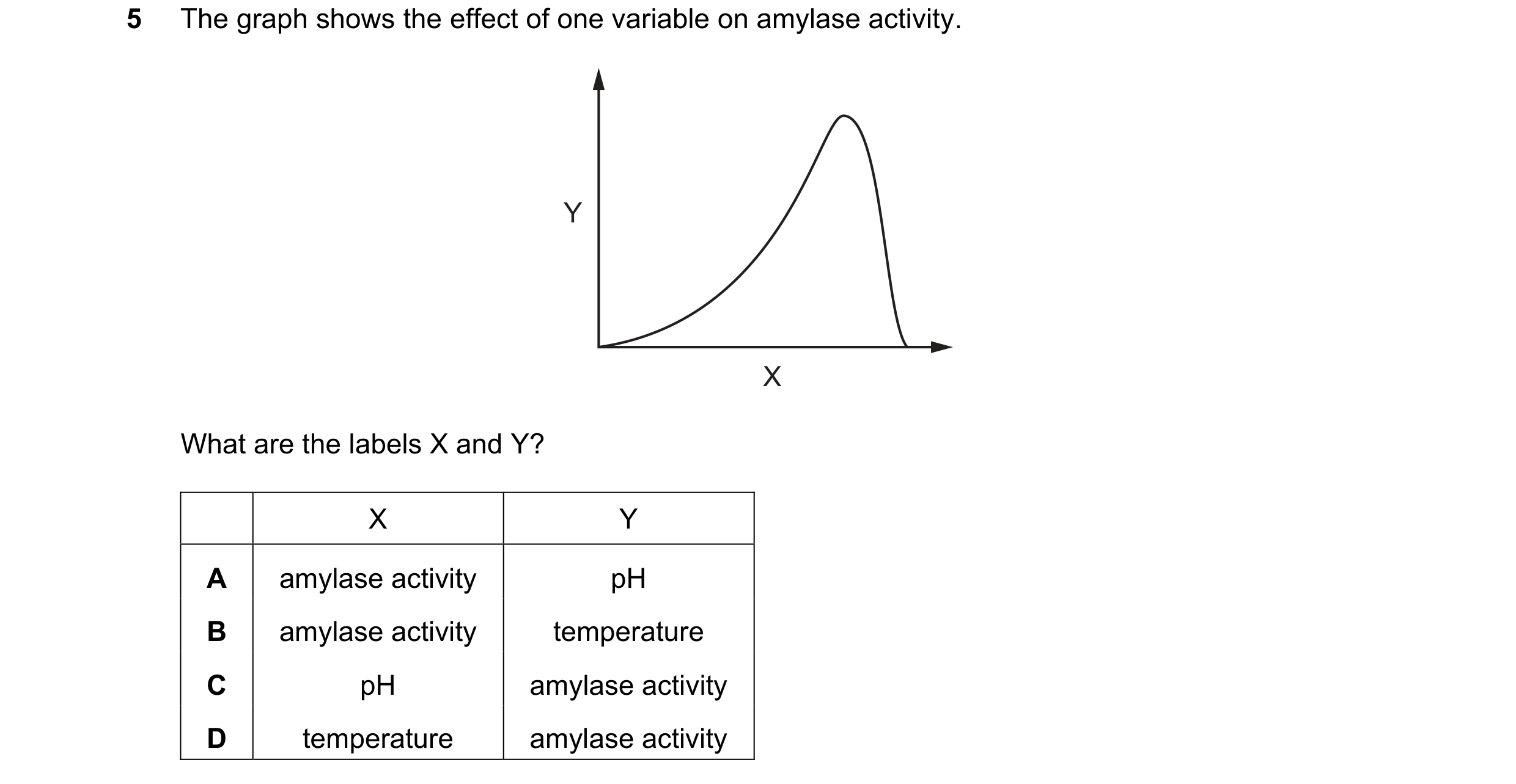
Q70 · The graph shows the effect of one variable on amylase activity 0653/11 Oct/Nov 2022
5 The graph shows the effect of one variable on amylase activity. Y X What are the labels X and Y? X Y A amylase activity pH B amylase activity temperature C pH amylase activity D temperature amylase activity
1 marks
Answer: D
This question in 0653/11 Oct/Nov 2022
Q71 · The graph shows the effect of one variable on amylase activity 0653/12 Oct/Nov 2022
4 The graph shows the effect of one variable on amylase activity. Y X What are the labels X and Y? X Y A amylase activity pH B amylase activity temperature C pH amylase activity D temperature amylase activity
1 marks
Answer: D
This question in 0653/12 Oct/Nov 2022
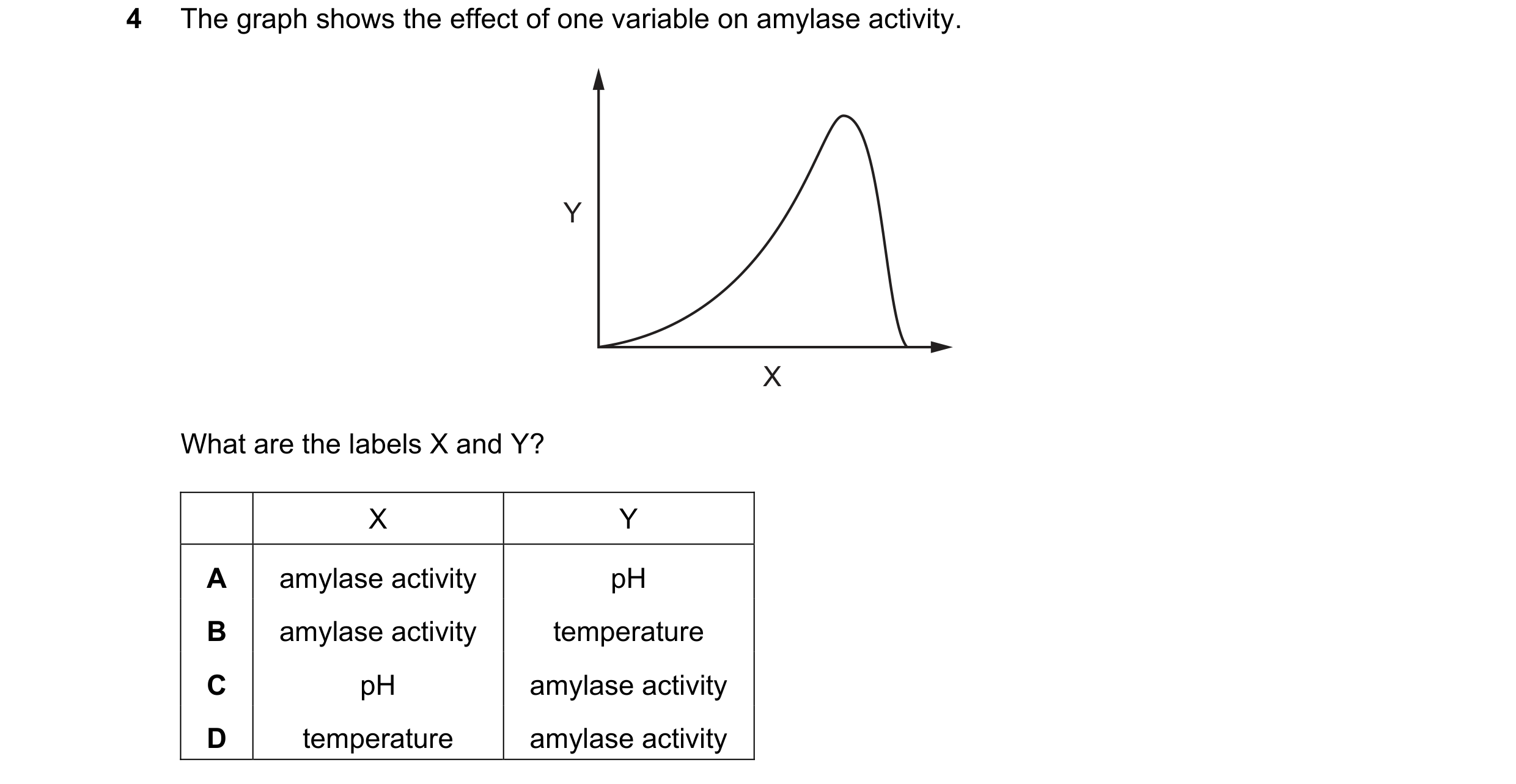
Q72 · The graph shows the effect of one variable on amylase activity 0653/13 Oct/Nov 2022
4 The graph shows the effect of one variable on amylase activity. Y X What are the labels X and Y? X Y A amylase activity pH B amylase activity temperature C pH amylase activity D temperature amylase activity
1 marks
Answer: D
This question in 0653/13 Oct/Nov 2022
Q73 · Which type of molecule is an enzyme? 0653/12 Feb/March 2023
4 Which type of molecule is an enzyme? A carbohydrate B fat C protein D vitamin
1 marks
Answer: C
This question in 0653/12 Feb/March 2023
Q74 · The table shows the time taken for an enzyme-controlled reaction to be completed at… 0653/12 May/June 2023
4 The table shows the time taken for an enzyme-controlled reaction to be completed at different pH values. pH 6 7 8 9 time taken for reaction 170 150 120 100 to be completed / s At which pH value does the enzyme work best? A pH 6 B pH 7 C pH 8 D pH 9
1 marks
Answer: D
This question in 0653/12 May/June 2023
Q75 · Chlamydomonas nivalis is a single-celled organism that lives in snow and ice 0653/11 Oct/Nov 2023
4 Chlamydomonas nivalis is a single-celled organism that lives in snow and ice. At which temperature will its enzymes work best? A 60 C B 40 C C 0 C D –20 C
1 marks
Answer: C
This question in 0653/11 Oct/Nov 2023
Q76 · What are enzymes made from? 0653/12 Oct/Nov 2023
3 What are enzymes made from? A fat B protein C starch D oil
1 marks
Answer: B
This question in 0653/12 Oct/Nov 2023
Q77 · What are enzymes made from? 0653/13 Oct/Nov 2023
3 What are enzymes made from? A fat B protein C starch D oil
1 marks
Answer: B
This question in 0653/13 Oct/Nov 2023
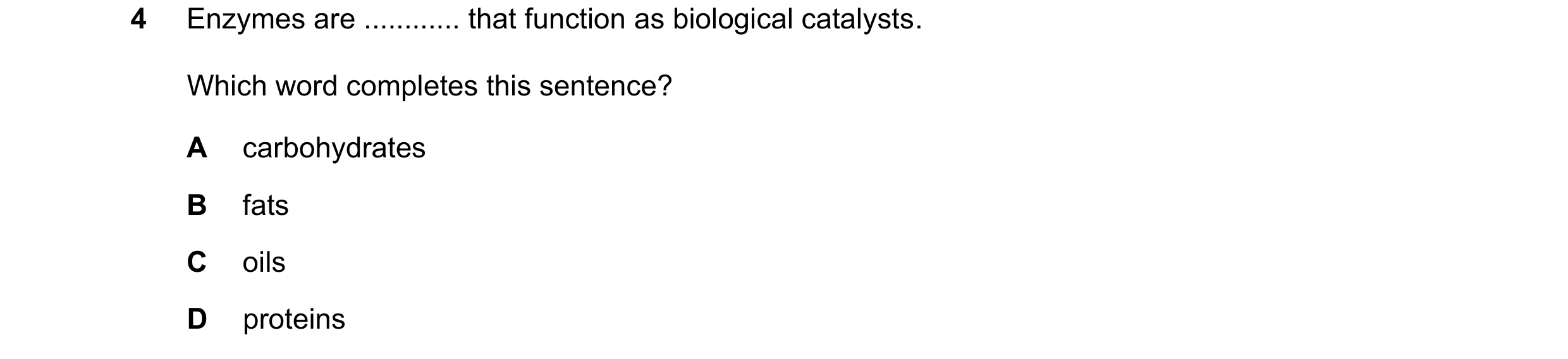
Q78 · Enzymes are … that function as biological catalysts 0653/12 Feb/March 2024
4 Enzymes are … that function as biological catalysts. Which word completes this sentence? A carbohydrates B fats C oils D proteins
1 marks
Answer: D
This question in 0653/12 Feb/March 2024
Q79 · Which statement about enzymes is correct? 0653/11 May/June 2024
4 Which statement about enzymes is correct? A Enzyme activity always continues to increase as the temperature increases. B Enzyme activity is not affected by pH. C Enzymes are biological catalysts. D Enzymes are proteins that always slow down reactions.
1 marks
Answer: C
This question in 0653/11 May/June 2024
Q80 · Which name is given to proteins that function as biological catalysts? 0653/12 May/June 2024
3 Which name is given to proteins that function as biological catalysts? A enzymes B hormones C solvents D vitamins
1 marks
Answer: A
This question in 0653/12 May/June 2024
Q81 · Which name is given to proteins that function as biological catalysts in cells? 0653/11 Oct/Nov 2024
3 Which name is given to proteins that function as biological catalysts in cells? A antibodies B enzymes C haemoglobin D hormones
1 marks
Answer: B
This question in 0653/11 Oct/Nov 2024
Q82 · Which food test gives a positive result when testing an enzyme solution? 0653/12 Feb/March 2025
4 Which food test gives a positive result when testing an enzyme solution? A Benedict’s solution B biuret C ethanol emulsion D iodine solution
1 marks
Answer: B
This question in 0653/12 Feb/March 2025
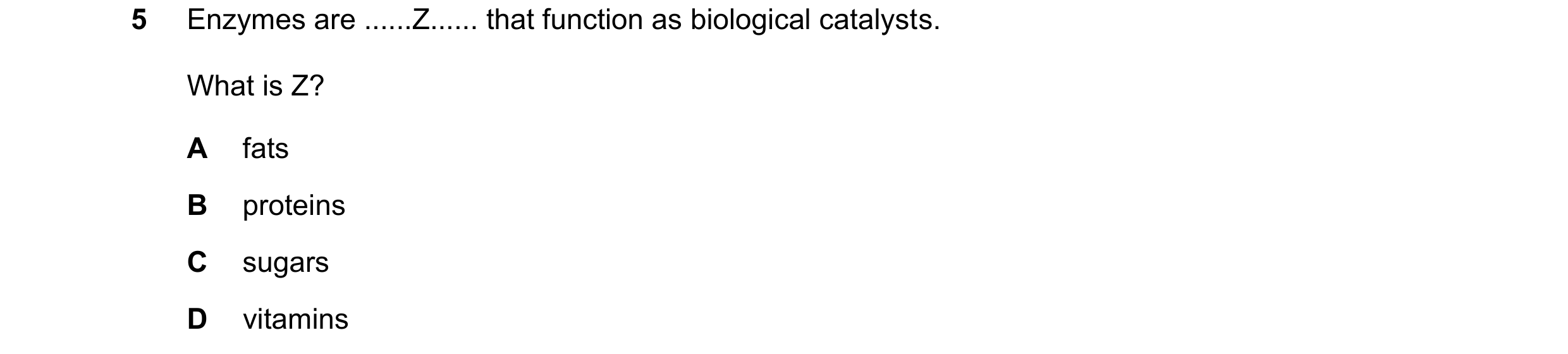
Q83 · Enzymes are … Z … that function as biological catalysts 0653/11 May/June 2025
5 Enzymes are … Z … that function as biological catalysts. What is Z? A fats B proteins C sugars D vitamins
1 marks
Answer: B
This question in 0653/11 May/June 2025
Q84 · What are the chemical elements in an enzyme? 0653/12 May/June 2025
5 What are the chemical elements in an enzyme? A carbon, oxygen, hydrogen and nitrogen B carbon, oxygen and hydrogen only C carbon and oxygen only D oxygen and nitrogen only
1 marks
Answer: A
This question in 0653/12 May/June 2025
Q85 · What function as biological catalysts? 0653/13 May/June 2025
4 What function as biological catalysts? A antibodies B enzymes C hormones D platelets
1 marks
Answer: B
This question in 0653/13 May/June 2025
Q86 · Which statement about biological catalysts is correct? 0653/11 Oct/Nov 2025
4 Which statement about biological catalysts is correct? A They are proteins that increase the rate of a reaction. B They are not affected by changes in pH. C They can only function outside animal cells. D They work fastest at very high temperatures.
1 marks
Answer: A
This question in 0653/11 Oct/Nov 2025
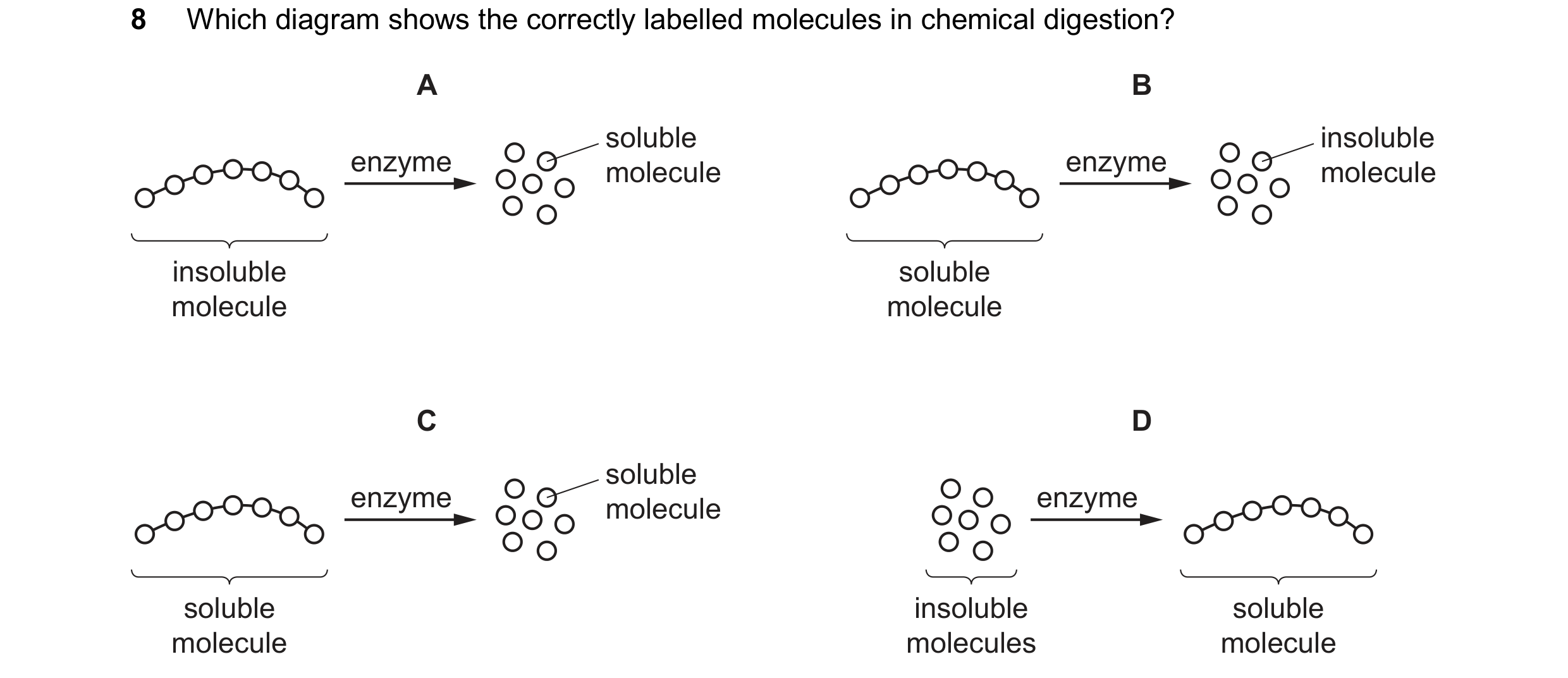
Q87 · Which diagram shows the correctly labelled molecules in chemical digestion? 0653/11 Oct/Nov 2025
8 Which diagram shows the correctly labelled molecules in chemical digestion? A B soluble insoluble enzyme molecule enzyme molecule insoluble soluble molecule molecule C D soluble enzyme molecule enzyme soluble insoluble soluble molecule molecules molecule
1 marks
Answer: A
This question in 0653/11 Oct/Nov 2025
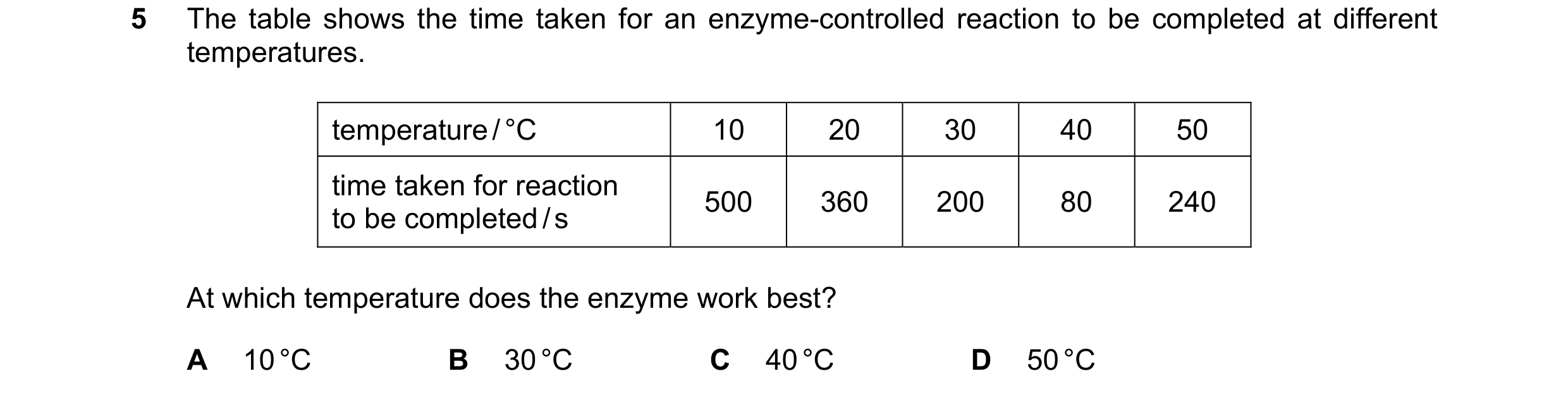
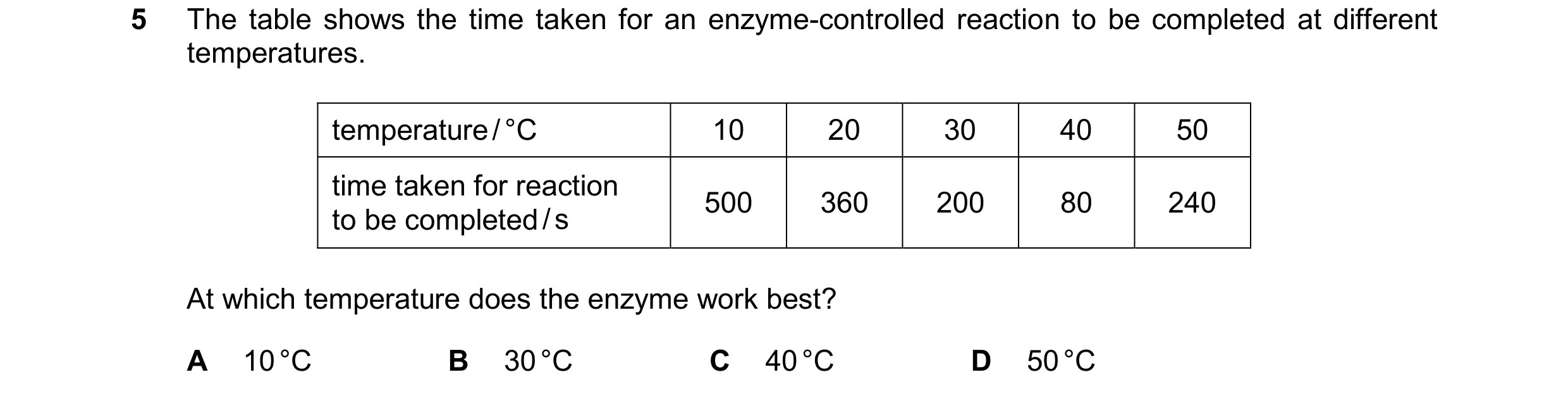
Q88 · The table shows the time taken for an enzyme-controlled reaction to be completed at… 0653/12 Oct/Nov 2025
5 The table shows the time taken for an enzyme-controlled reaction to be completed at different temperatures. temperature / °C 10 20 30 40 50 time taken for reaction 500 360 200 80 240 to be completed / s At which temperature does the enzyme work best? A 10 °C B 30 °C C 40 °C D 50 °C
1 marks
Answer: C
This question in 0653/12 Oct/Nov 2025
Q89 · The table shows the time taken for an enzyme-controlled reaction to be completed at… 0653/13 Oct/Nov 2025
5 The table shows the time taken for an enzyme-controlled reaction to be completed at different temperatures. temperature / °C 10 20 30 40 50 time taken for reaction 500 360 200 80 240 to be completed / s At which temperature does the enzyme work best? A 10 °C B 30 °C C 40 °C D 50 °C
1 marks
Answer: C
This question in 0653/13 Oct/Nov 2025
 1 / 24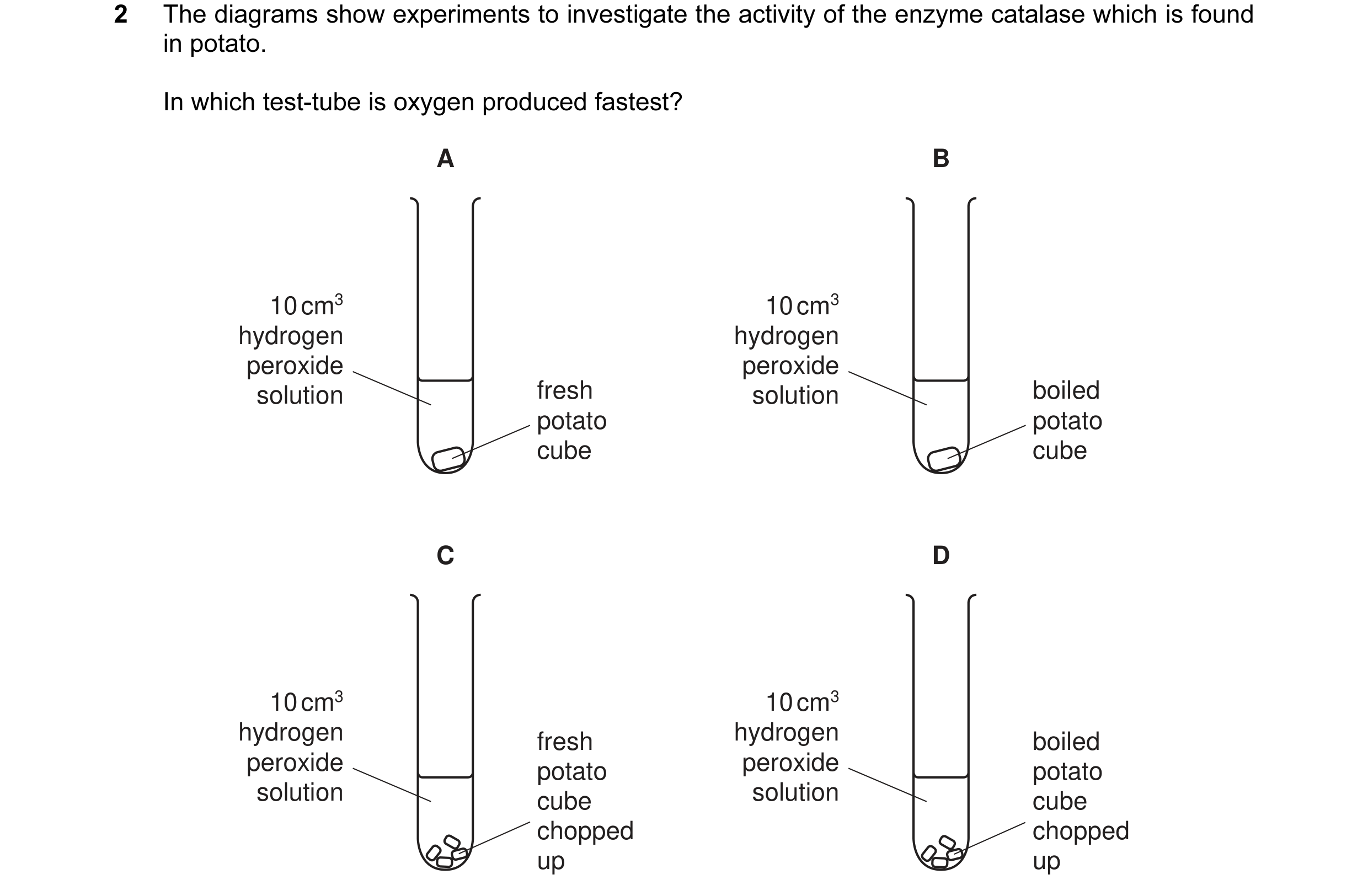

 2 / 24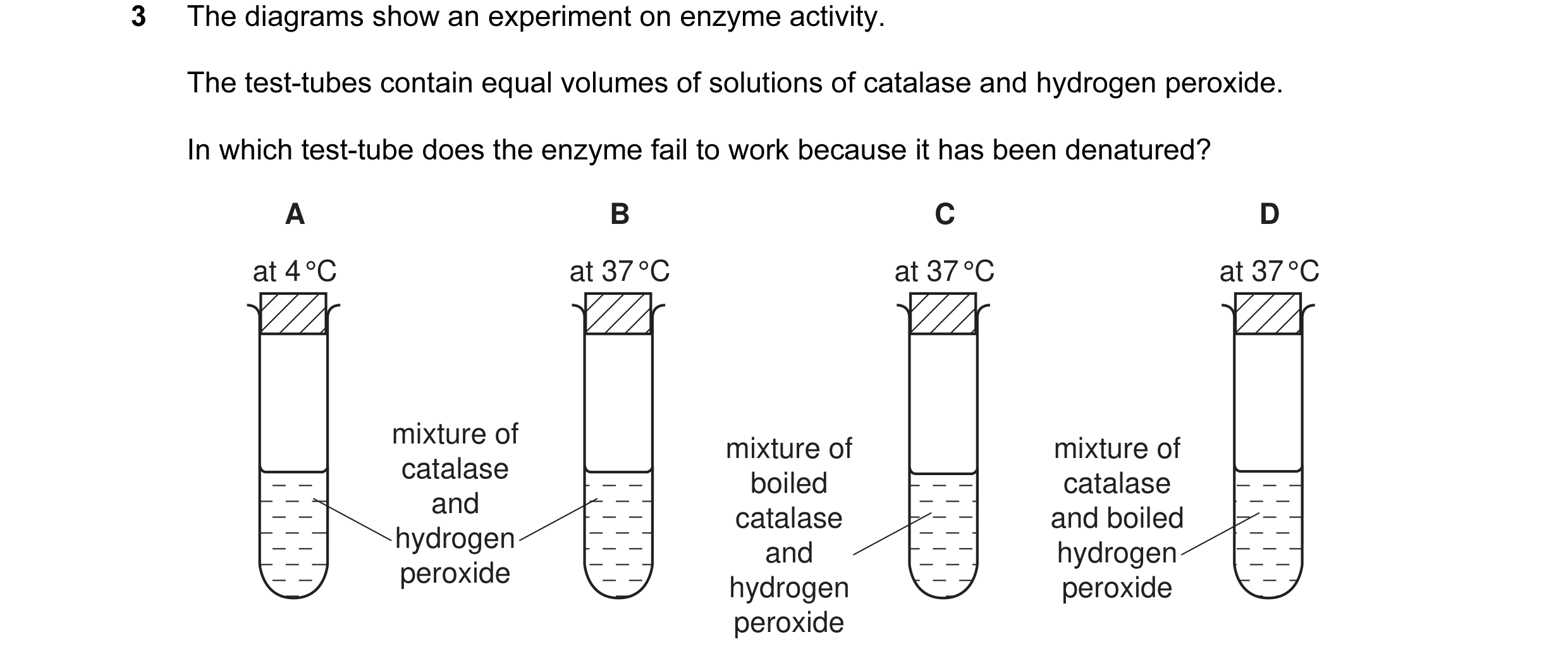
 3 / 24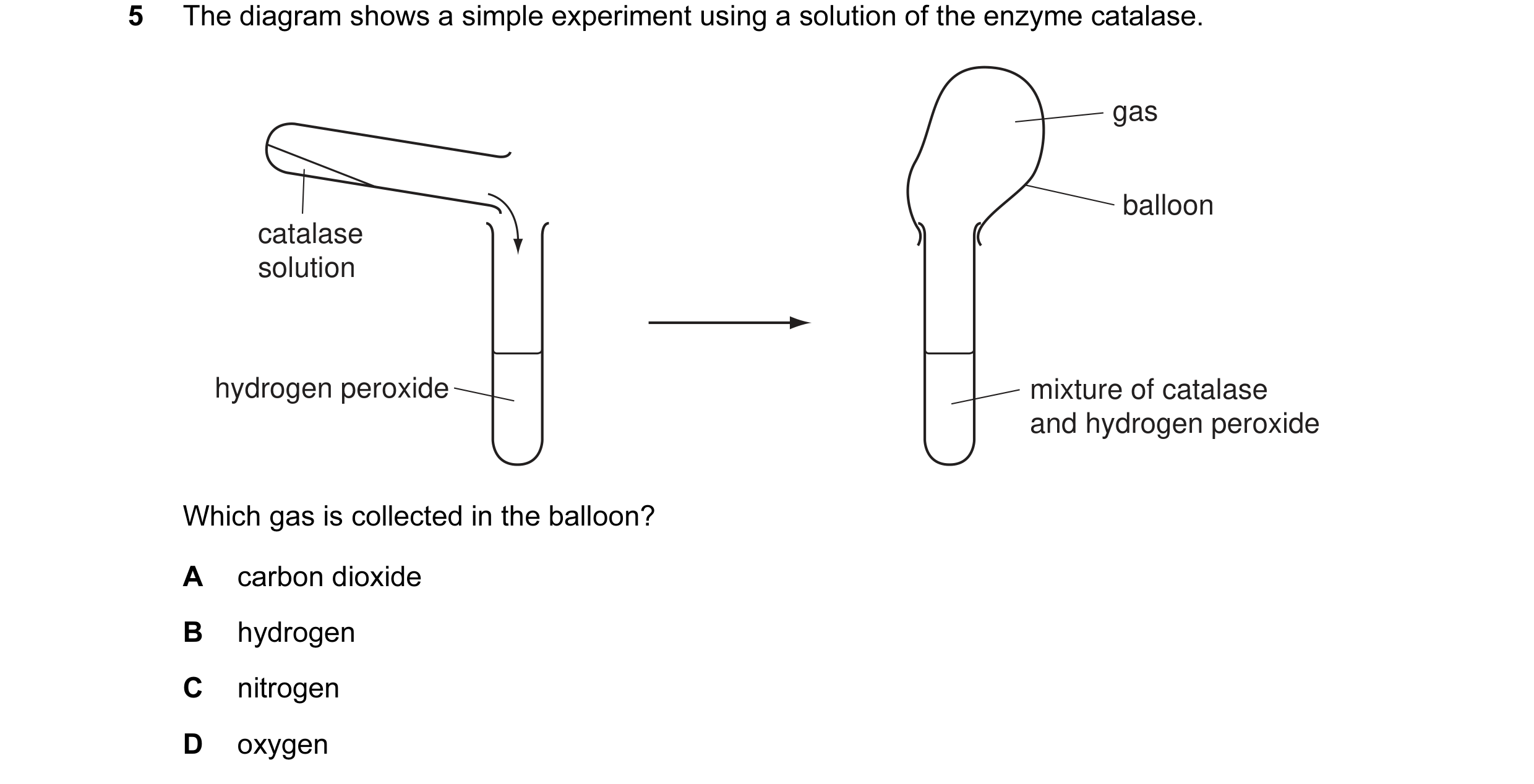
 4 / 24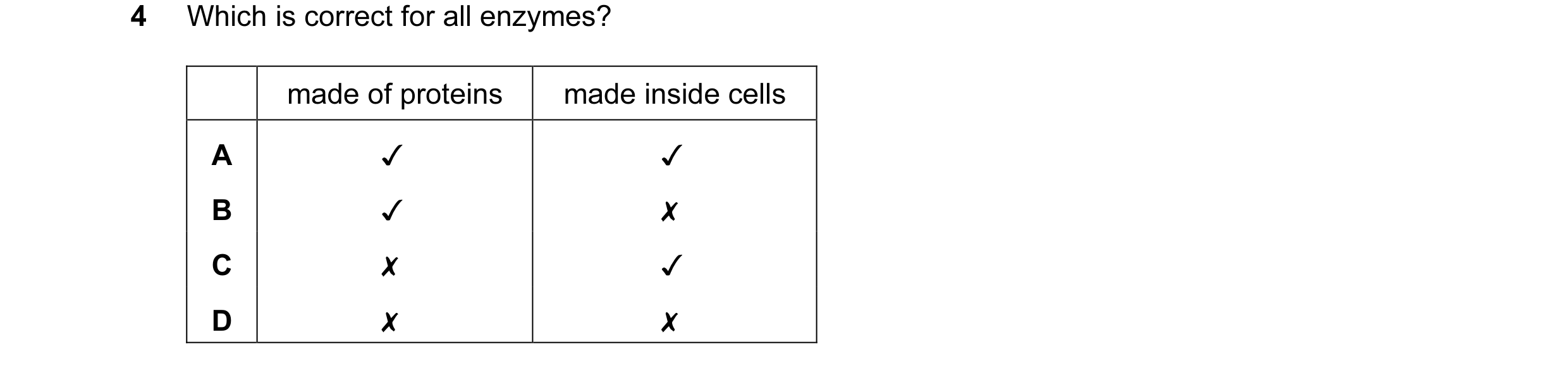
 5 / 24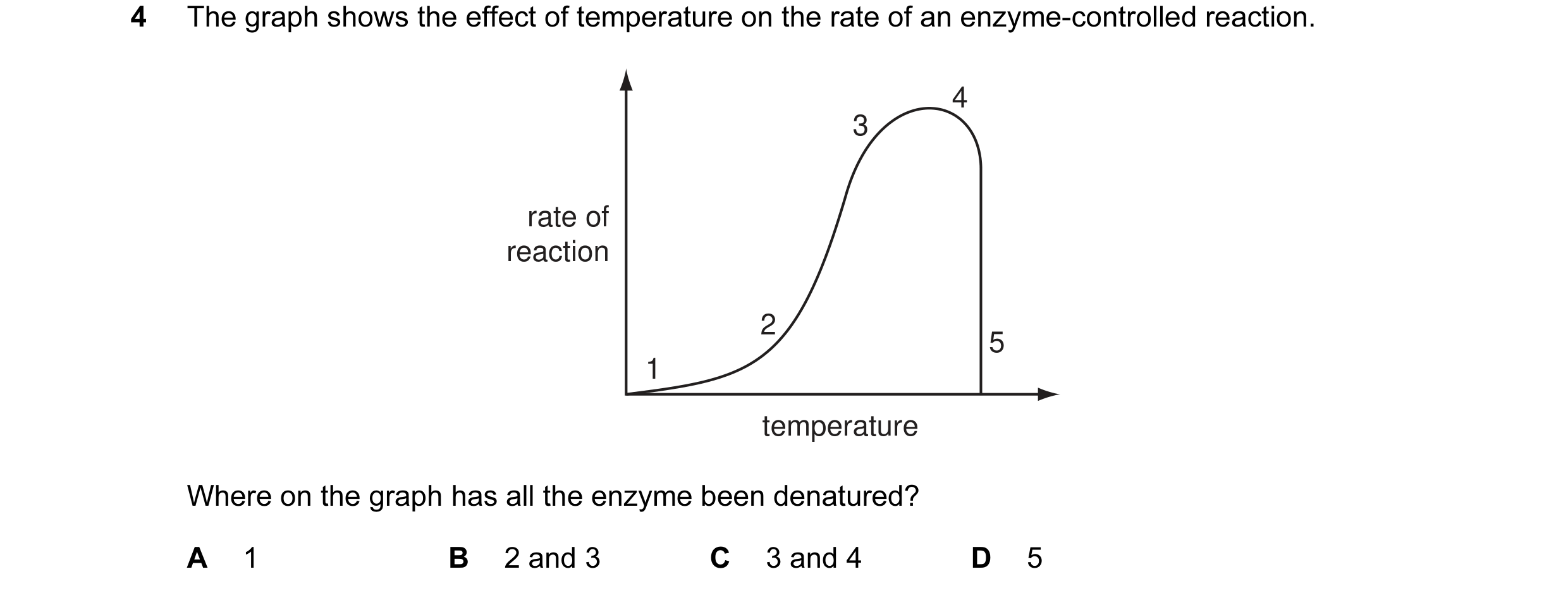
 6 / 24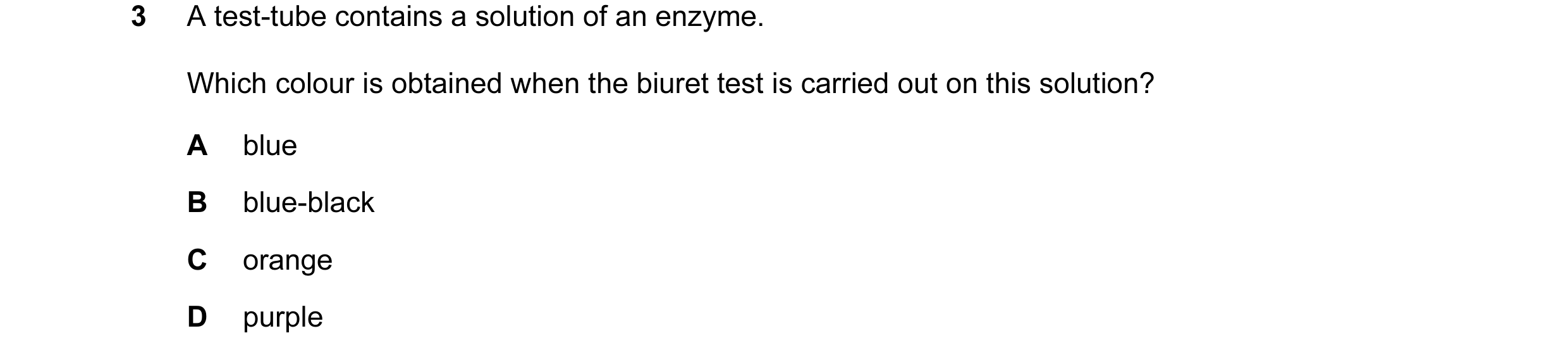
 7 / 24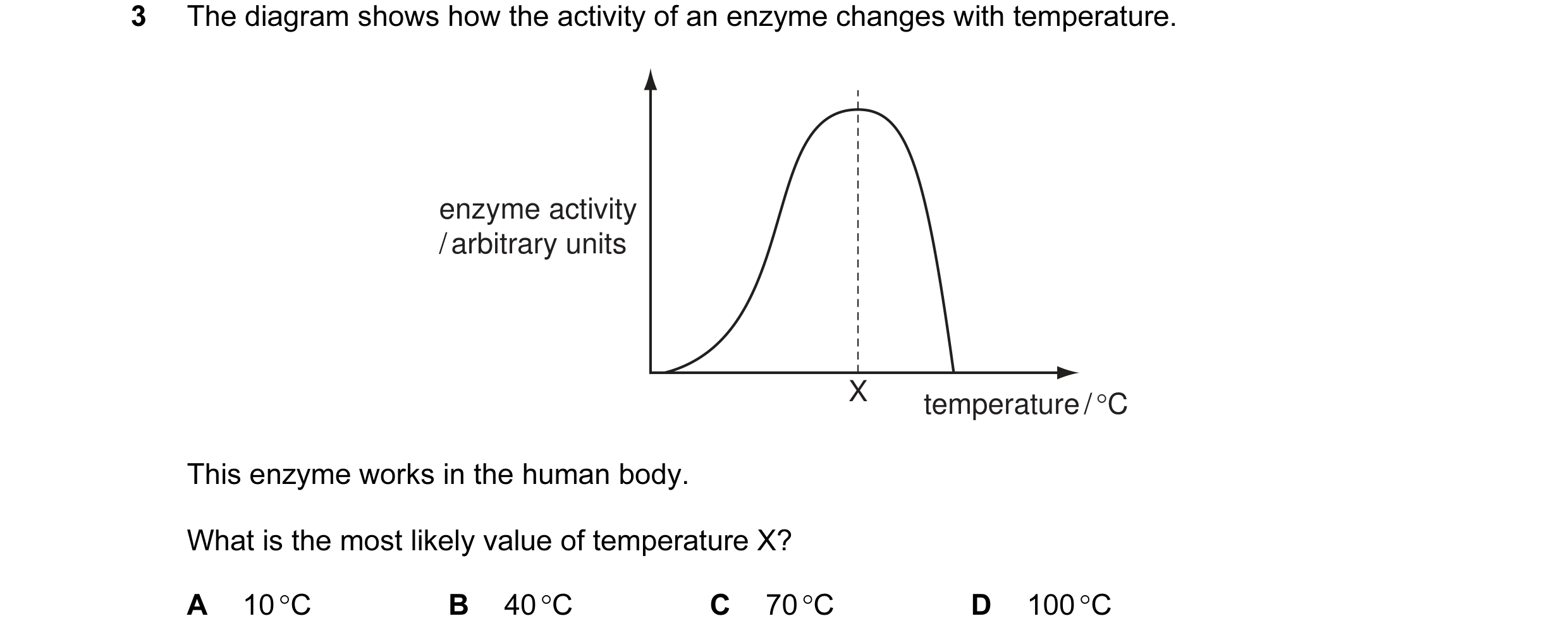

 8 / 24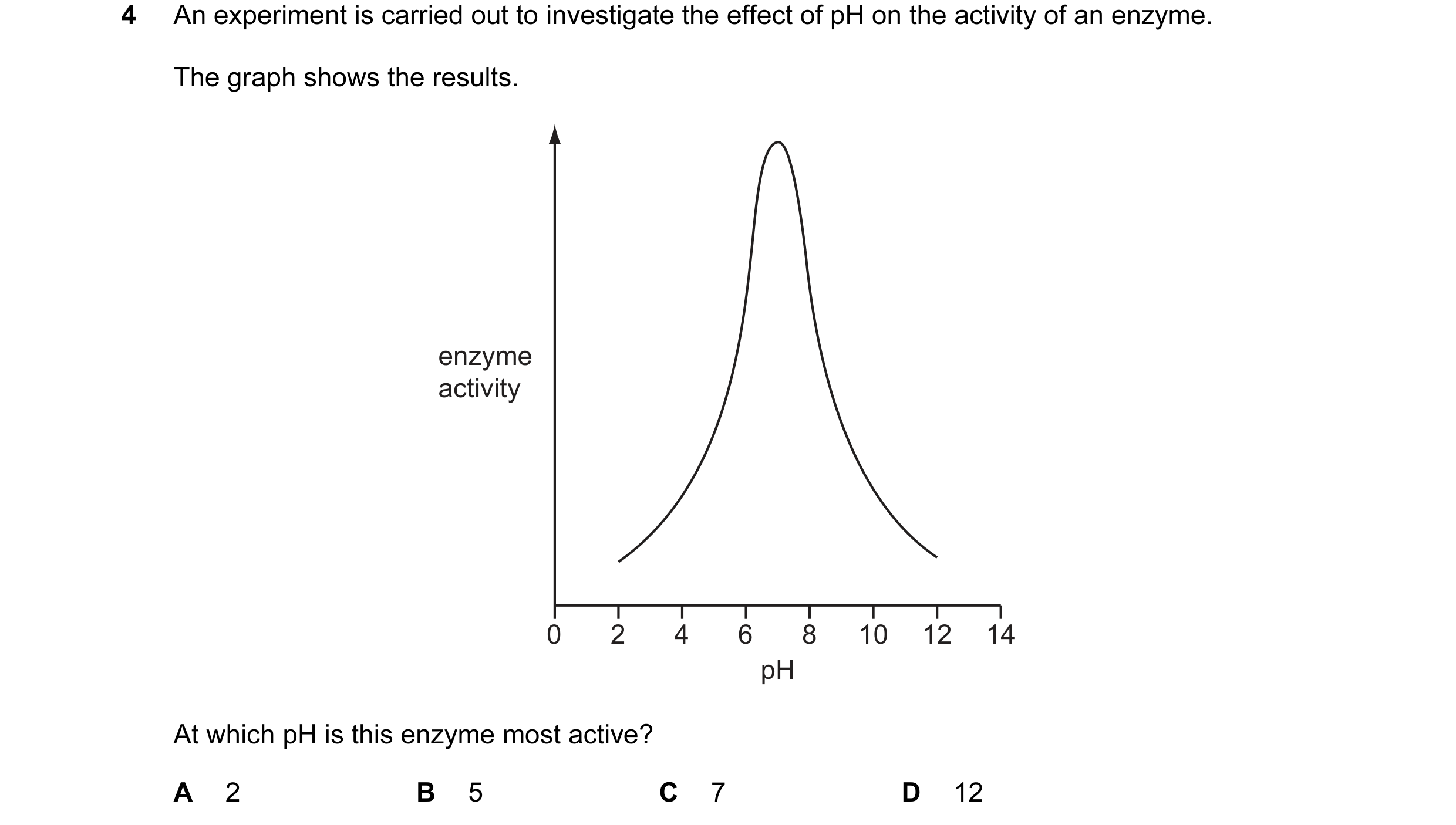
 9 / 24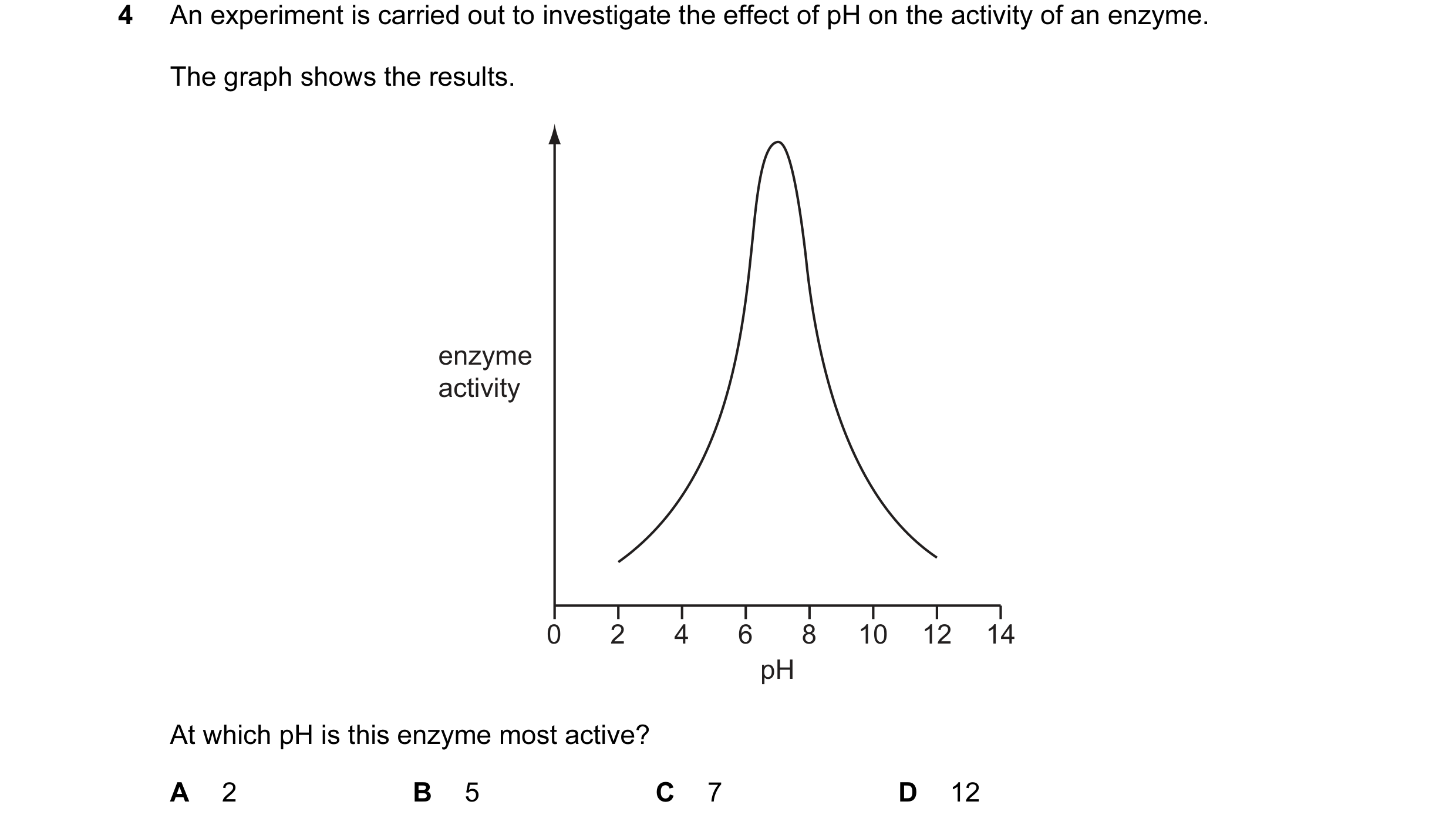

 10 / 24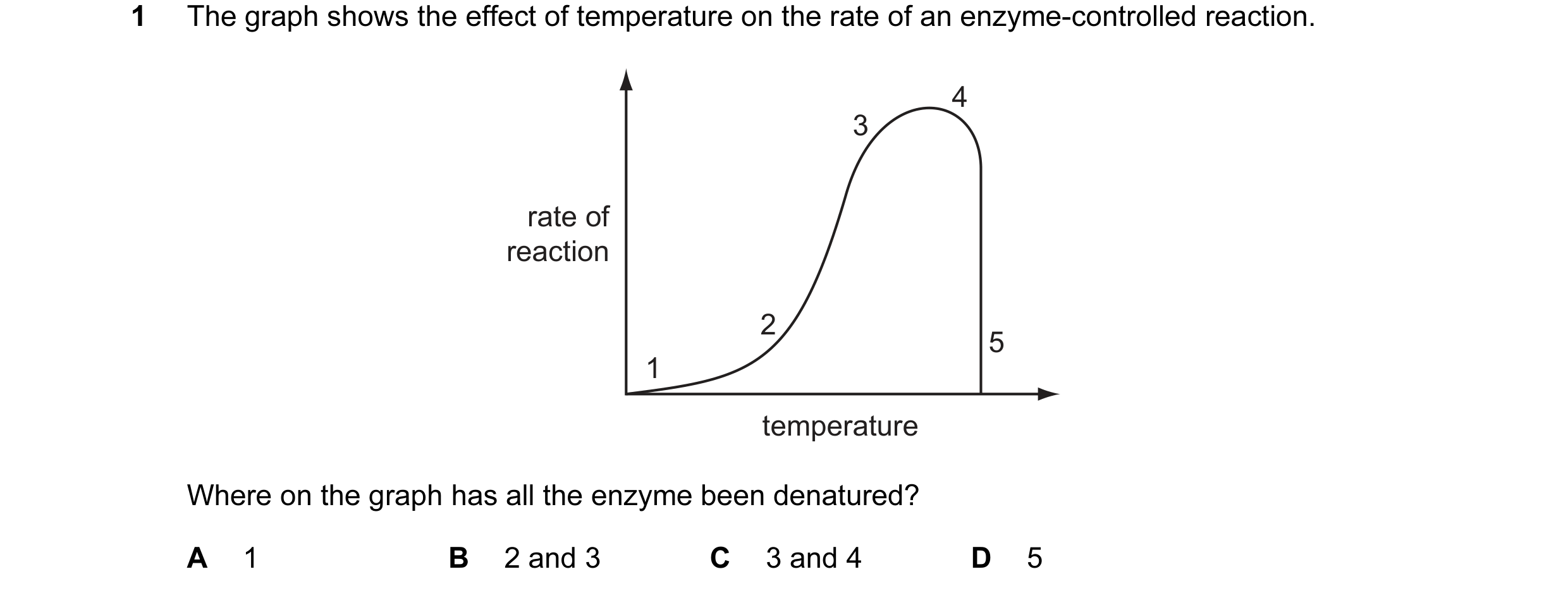
 11 / 24
 12 / 24
 13 / 24




 14 / 24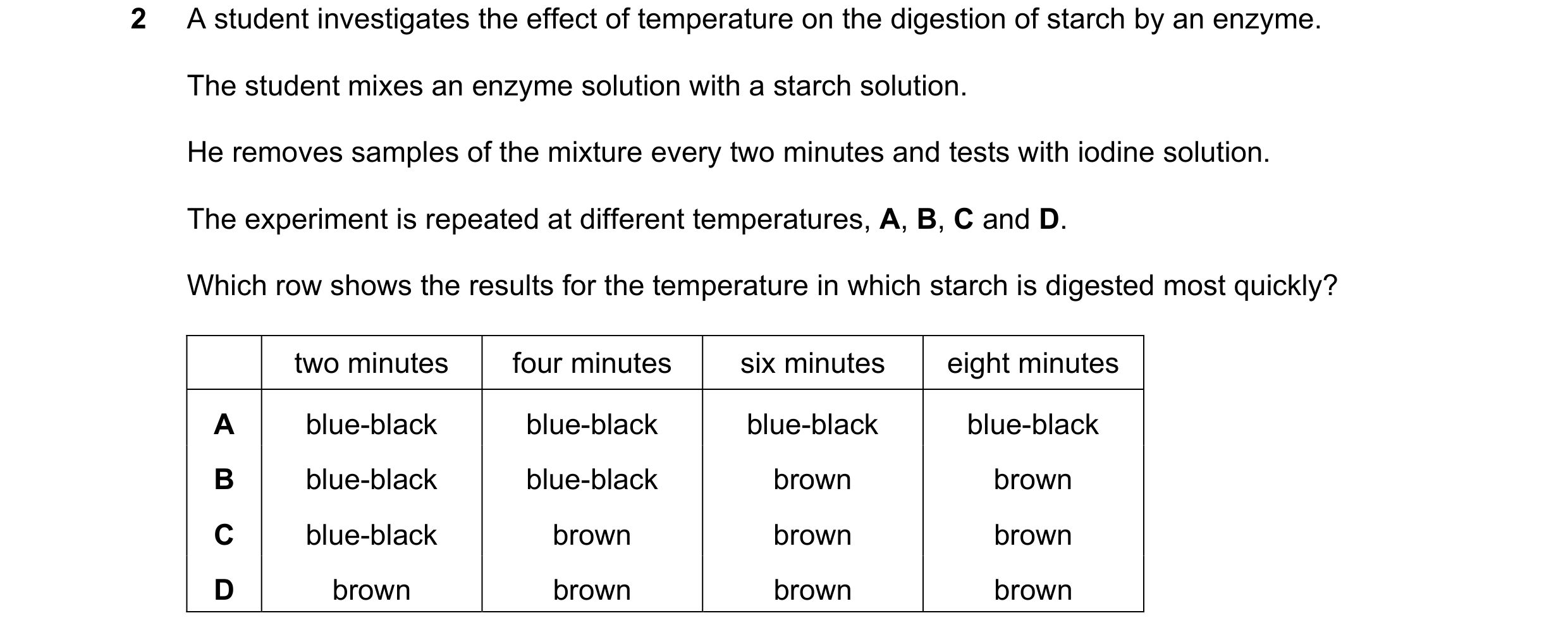
 15 / 24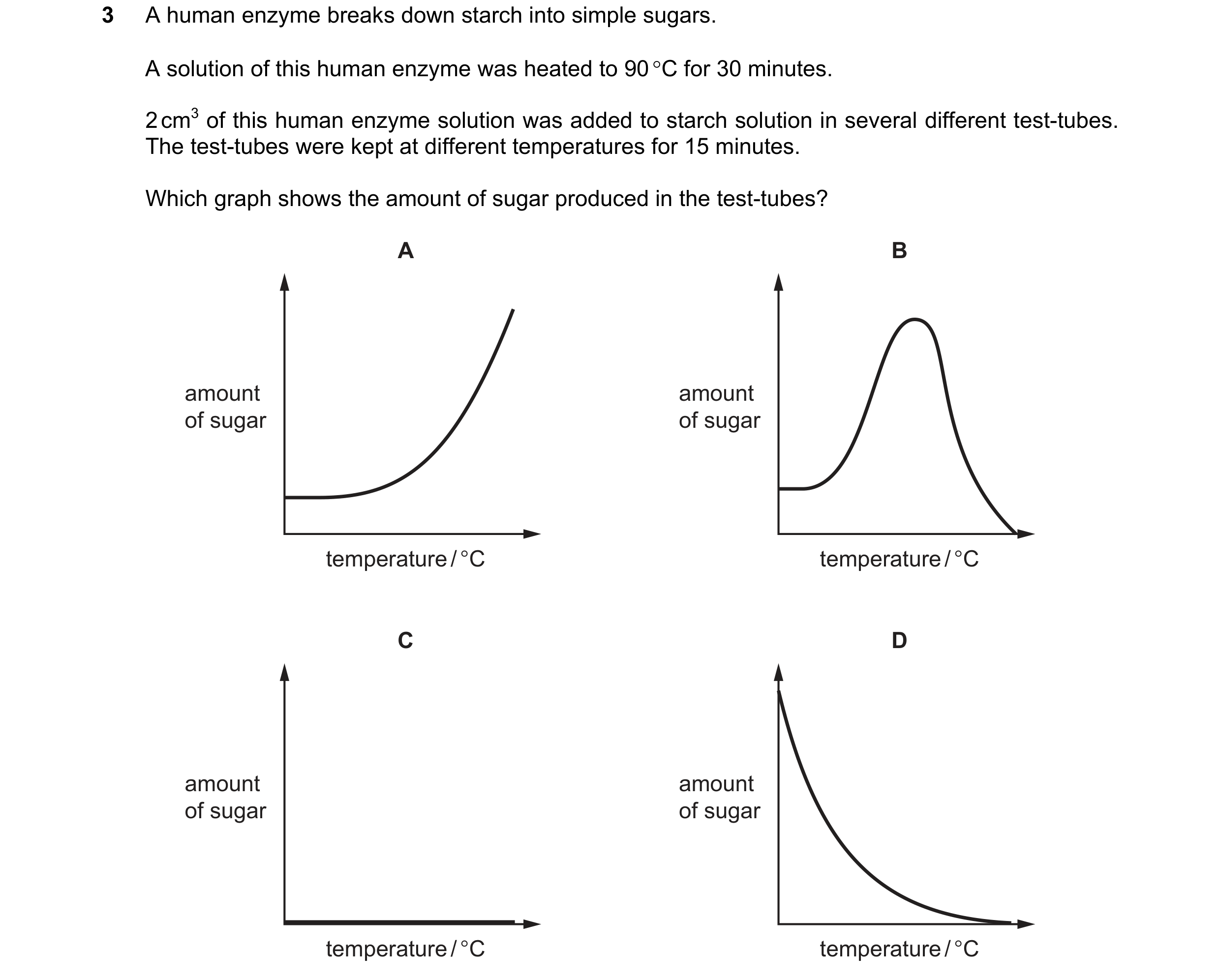

 16 / 24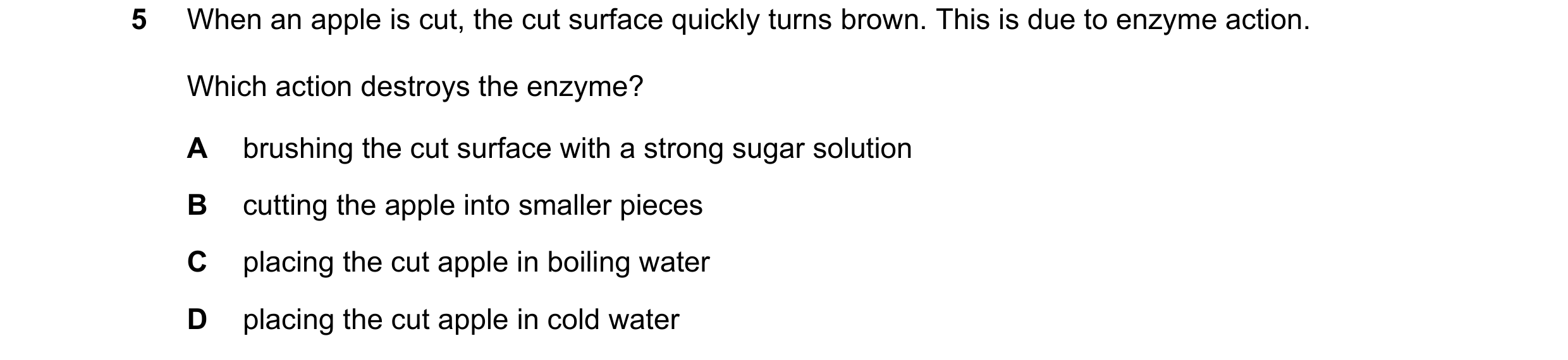
 17 / 24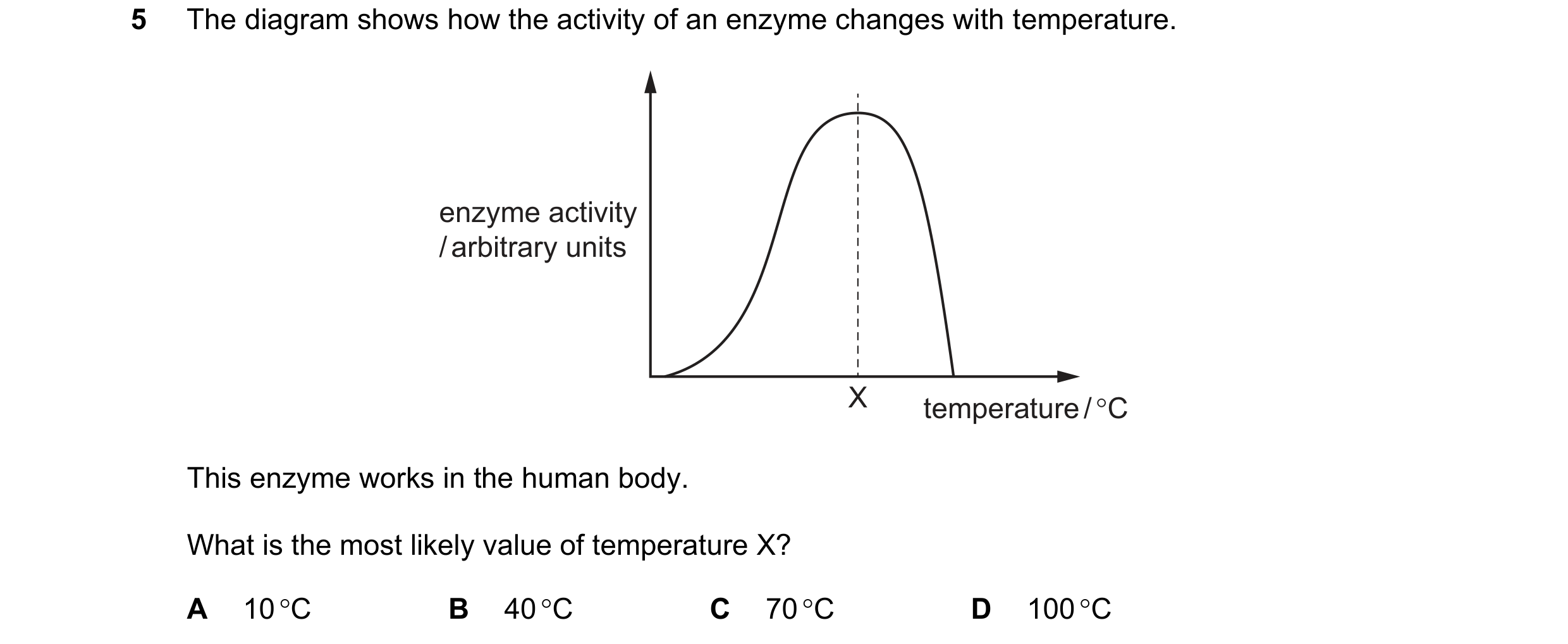

 18 / 24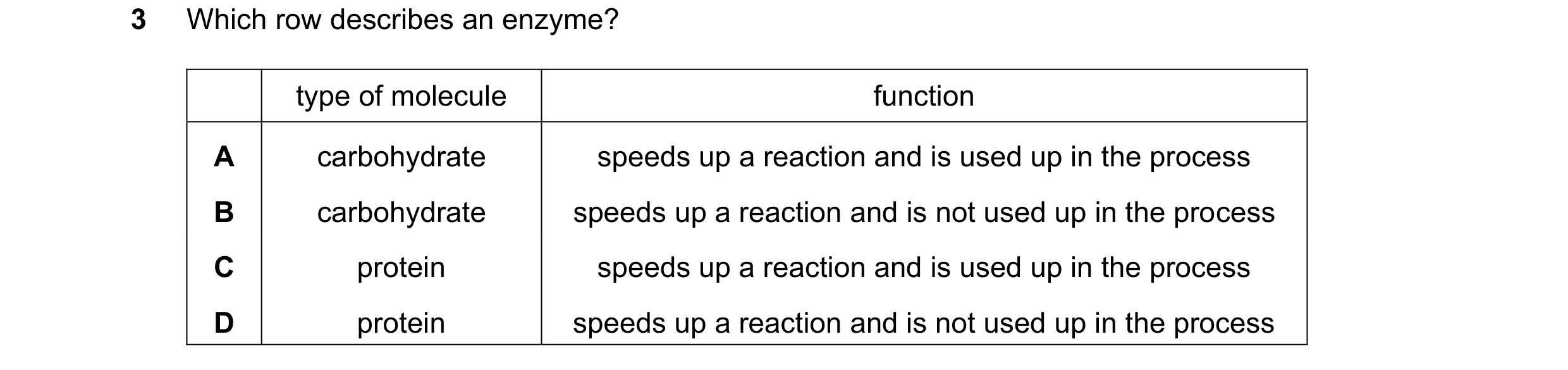

 19 / 24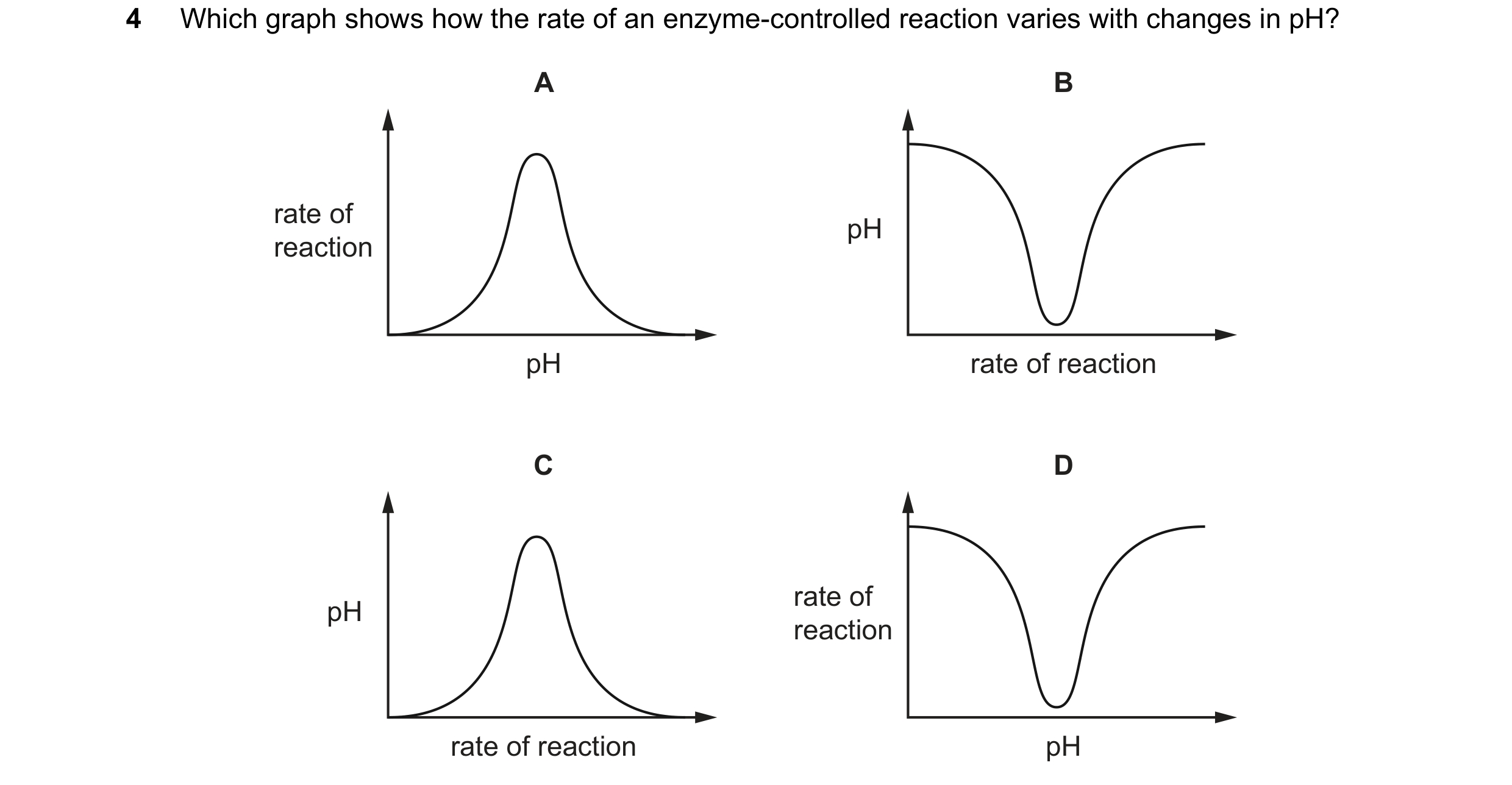
 20 / 24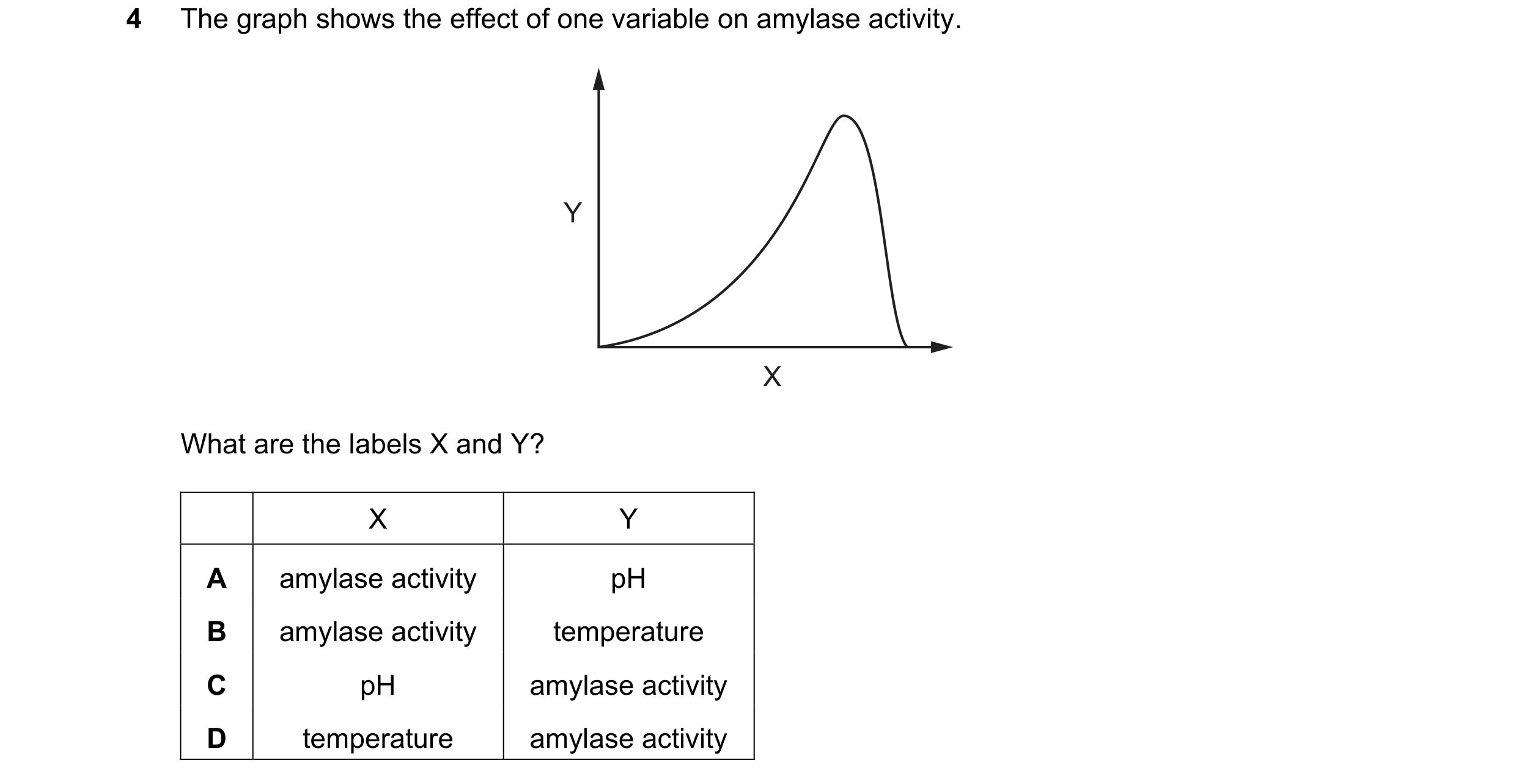
 21 / 24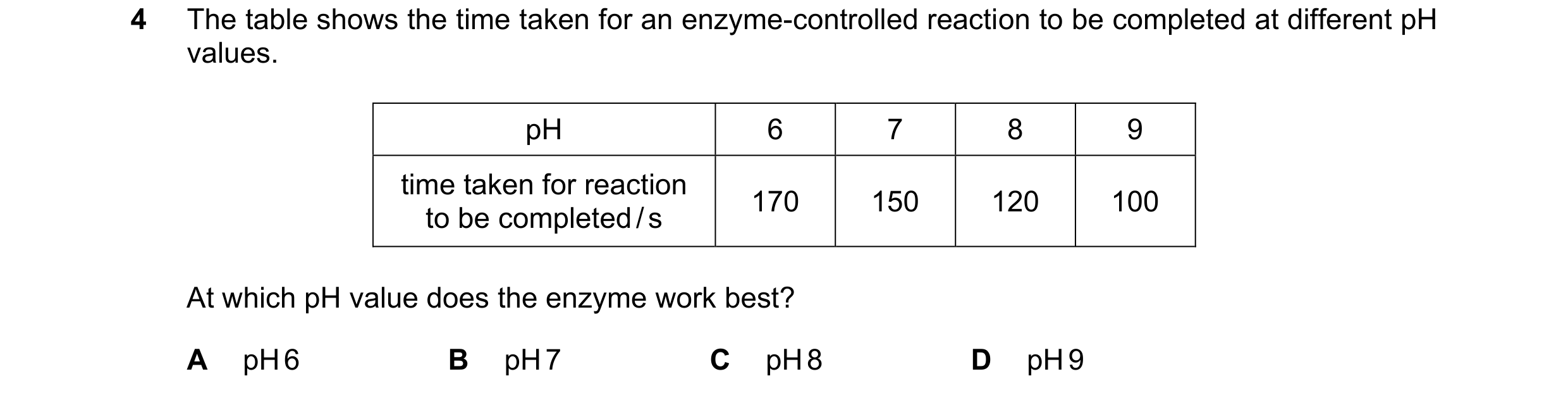



 22 / 24



 23 / 24
 24 / 24