Questions as text
Q1 · Use lines to connect the box on the left to different boxes on the right 0653/42 Feb/March 2017
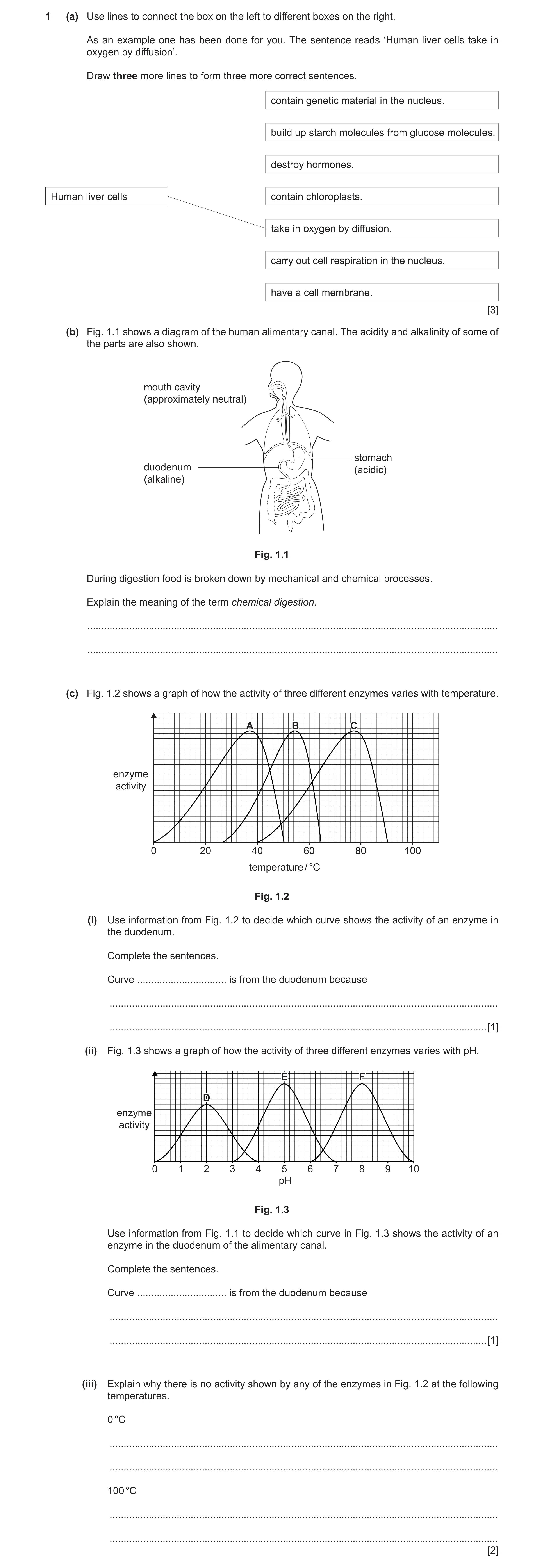
1 (a) Use lines to connect the box on the left to different boxes on the right. As an example one has been done for you. The sentence reads ‘Human liver cells take in oxygen by diffusion’. Draw three more lines to form three more correct sentences. contain genetic material in the nucleus. build up starch molecules from glucose molecules. destroy hormones. Human liver cells contain chloroplasts. take in oxygen by diffusion. carry out cell respiration in the nucleus. have a cell membrane. [3] (b) Fig. 1.1 shows a diagram of the human alimentary canal. The acidity and alkalinity of some of the parts are also shown. mouth cavity (approximately neutral) stomach duodenum (acidic) (alkaline) Fig. 1.1 During digestion food is broken down by mechanical and chemical processes. Explain the meaning of the term chemical digestion. … … (c) Fig. 1.2 shows a graph of how the activity of three different enzymes varies with temperature. AA BB CC enzyme activity 0 20 40 60 80 100 temperature / °C Fig. 1.2 (i) Use information from Fig. 1.2 to decide which curve shows the activity of an enzyme in the duodenum. Complete the sentences. Curve … is from the duodenum because … … [1] (ii) Fig. 1.3 shows a graph of how the activity of three different enzymes varies with pH. E F DD enzyme activity 0 1 2 3 4 5 6 7 8 9 10 pH Fig. 1.3 Use information from Fig. 1.1 to decide which curve in Fig. 1.3 shows the activity of an enzyme in the duodenum of the alimentary canal. Complete the sentences. Curve … is from the duodenum because … … [1] (iii) Explain why there is no activity shown by any of the enzymes in Fig. 1.2 at the following temperatures. 0 °C … … 100 °C … … [2]
9 marks
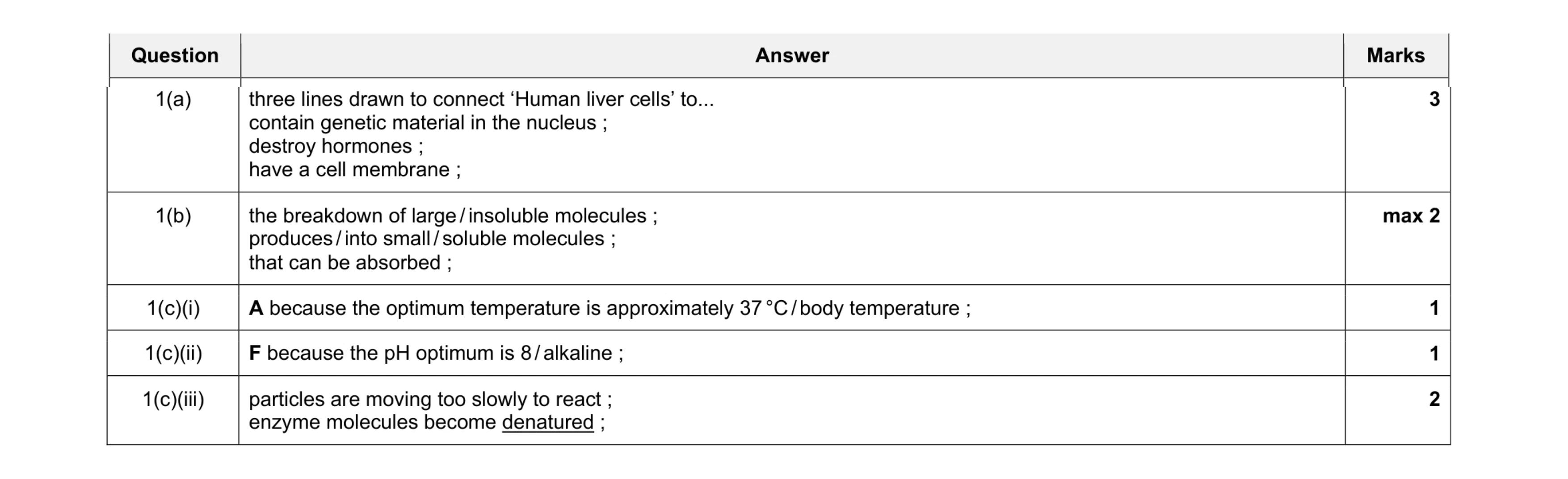
Mark scheme: 1(a) three lines drawn to connect ‘Human liver cells’ to... contain genetic material in the nucleus ; destroy hormones ; have a cell membrane ; 3 1(b) the breakdown of large / insoluble molecules ; produces / into small / soluble molecules ; that can be absorbed ; max 2 1(c)(i) A because the optimum temperature is approximately 37 °C / body temperature ; 1 1(c)(ii) F because the pH optimum is 8 / alkaline ; 1 1(c)(iii) particles are moving too slowly to react ; enzyme molecules become denatured ; 2
This question in 0653/42 Feb/March 2017
Q2 · Some bacterial cells as seen using an electron microscope 0653/41 Oct/Nov 2017
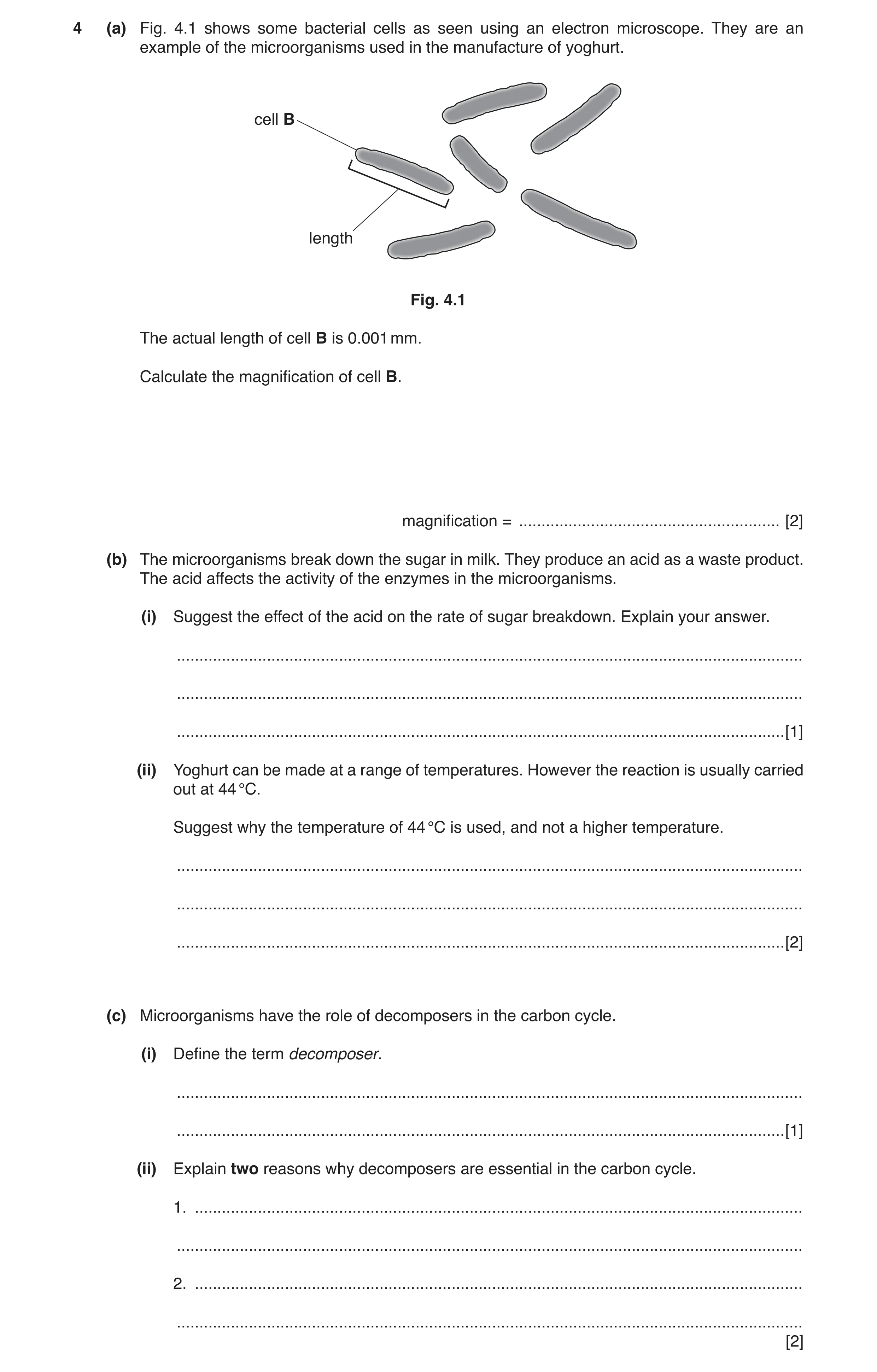
4 (a) Fig. 4.1 shows some bacterial cells as seen using an electron microscope. They are an example of the microorganisms used in the manufacture of yoghurt. cell B length Fig. 4.1 The actual length of cell B is 0.001 mm. Calculate the magnification of cell B. magnification = … [2] (b) The microorganisms break down the sugar in milk. They produce an acid as a waste product. The acid affects the activity of the enzymes in the microorganisms. (i) Suggest the effect of the acid on the rate of sugar breakdown. Explain your answer. … … … [1] (ii) Yoghurt can be made at a range of temperatures. However the reaction is usually carried out at 44 °C. Suggest why the temperature of 44 °C is used, and not a higher temperature. … … … [2] (c) Microorganisms have the role of decomposers in the carbon cycle. (i) Define the term decomposer. … … [1] (ii) Explain two reasons why decomposers are essential in the carbon cycle. 1. … … 2. … … [2]
8 marks
Mark scheme: 4(a) length of cell on diagram is 25 mm ; divided by 0.001 = 25 000 ; 2 4(b)(i) reduces rate – no mark enzymes made inactive / denatured by acid / no longer at optimum pH ; 1 4(b)(ii) 44°C is optimum temperature ; above 44°C enzymes denatured by heat ; additional detail describing denaturation ; max 2 4(c)(i) (an organism) that gets energy from / feeds on dead / waste organic matter ; 1 4(c)(ii) they decompose / break down / get rid of dead bodies / waste ; allow carbon to be recycled / release carbon dioxide (into the air) ; the idea that plants make use of carbon dioxide / carbon (during photosynthesis) ; max 2
This question in 0653/41 Oct/Nov 2017
Q3 · A student does an experiment to investigate the germination of barley seeds 0653/42 Oct/Nov 2017
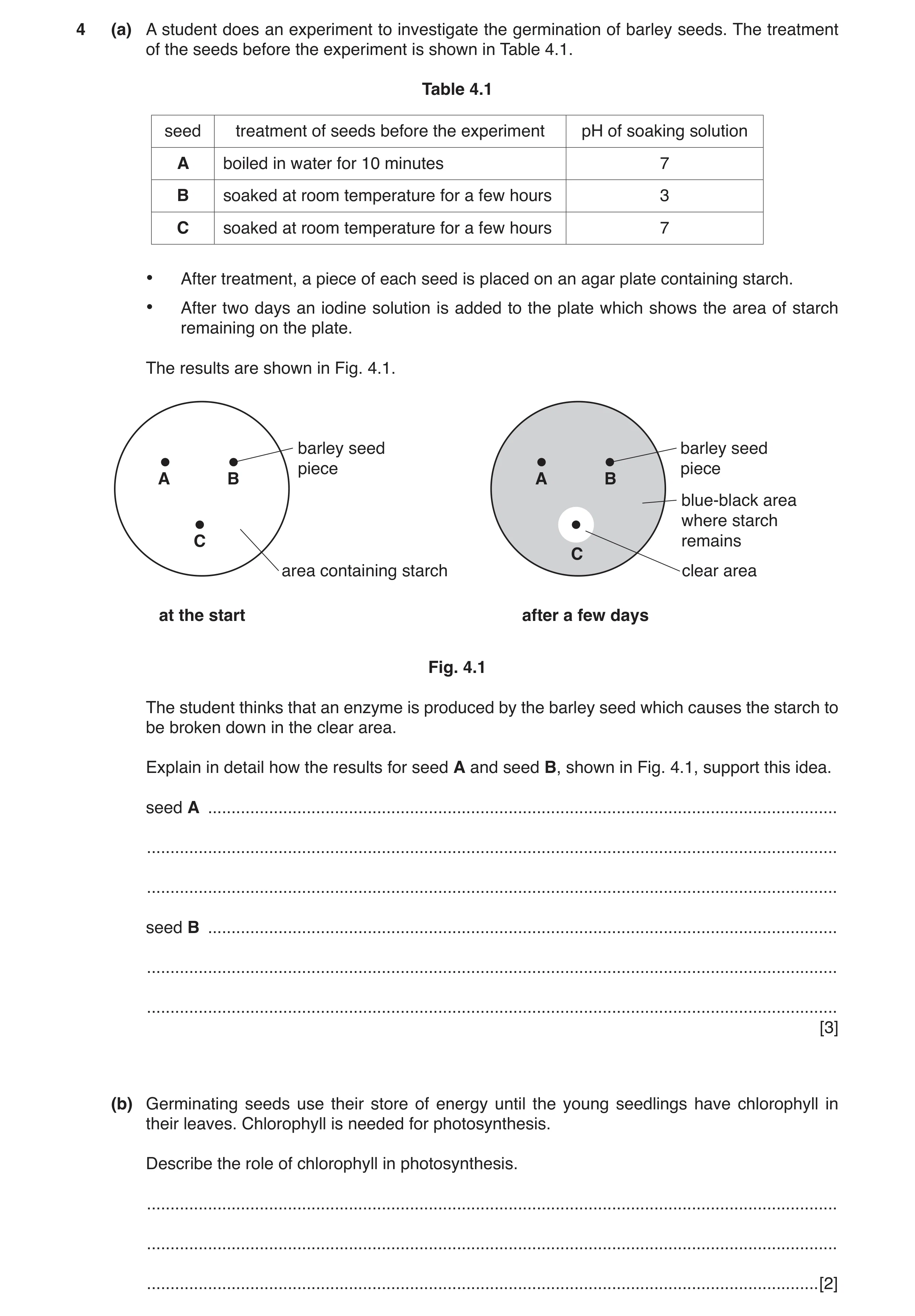
4 (a) A student does an experiment to investigate the germination of barley seeds. The treatment of the seeds before the experiment is shown in Table 4.1. Table 4.1 seed treatment of seeds before the experiment pH of soaking solution A boiled in water for 10 minutes 7 B soaked at room temperature for a few hours 3 C soaked at room temperature for a few hours 7 • After treatment, a piece of each seed is placed on an agar plate containing starch. • After two days an iodine solution is added to the plate which shows the area of starch remaining on the plate. The results are shown in Fig. 4.1. barley seed barley seed piece piece A B A B blue-black area where starch C remains C area containing starch clear area at the start after a few days Fig. 4.1 The student thinks that an enzyme is produced by the barley seed which causes the starch to be broken down in the clear area. Explain in detail how the results for seed A and seed B, shown in Fig. 4.1, support this idea. seed A … … … seed B … … … [3] (b) Germinating seeds use their store of energy until the young seedlings have chlorophyll in their leaves. Chlorophyll is needed for photosynthesis. Describe the role of chlorophyll in photosynthesis. … … … [2]
5 marks
Mark scheme: 4(a) results show starch present (around A and / or B) ; reference to inactive / denatured enzymes ; because A was boiled / heated ; because B was placed in acid / pH3 / low pH ; max 3 4(b) traps light energy ; converts it to chemical energy / enable carbohydrates / sugar to be formed ; 2
This question in 0653/42 Oct/Nov 2017
Q4 · A diagram of the alimentary canal 0653/43 Oct/Nov 2017
4 Fig. 4.1 shows a diagram of the alimentary canal. The main areas where digestion takes place are labelled. mouth cavity (approximately neutral) stomach (acidic) duodenum (alkaline) Fig. 4.1 (a) On Fig. 4.1 use a label line and the letter A to show where absorption of digested food occurs. [1] (b) A student is investigating human digestive enzymes. He has three test-tubes, 1, 2 and 3, containing protein solution at different pH values. He then adds the same enzyme to all three test-tubes and keeps them at 35 °C. The protein solution is cloudy at the start of the experiment. If the protein in the solution is broken down the solution becomes clear and colourless. The results are shown in Fig. 4.2. tube 1 tube 2 tube 3 clear colourless cloudy solution protein solution pH 2 pH 7 pH 8 Fig. 4.2 (i) Use the information in Fig. 4.1 to identify the likely source of the digestive enzyme that produces the result in tube 1 in Fig. 4.2. Explain your answer. source of enzyme … explanation … … … … [3] (ii) Explain why a temperature of 60 °C is not suitable for this experiment. … … … [2] (iii) Explain why the change that takes place in tube 1 is an example of chemical digestion. … … … [2]
8 marks
Mark scheme: 4(a) letter A label going to small intestine / ileum ; 1 4(b)(i) stomach ; stomach has acidic conditions ; enzyme only worked in tube 1 / at pH 2 / in an acidic environment ; 3 4(b)(ii) any two from enzyme will become denatured ; further detail of denaturation ; correct reference to (likely) optimum temperature ; max2 4(b)(iii) any two from large / insoluble molecules are broken down ; small / soluble molecules are produced ; by the action of an enzyme ; max 2
This question in 0653/43 Oct/Nov 2017
Q5 · Breast milk contains all the nutrients needed for a newborn baby 0653/42 Feb/March 2018
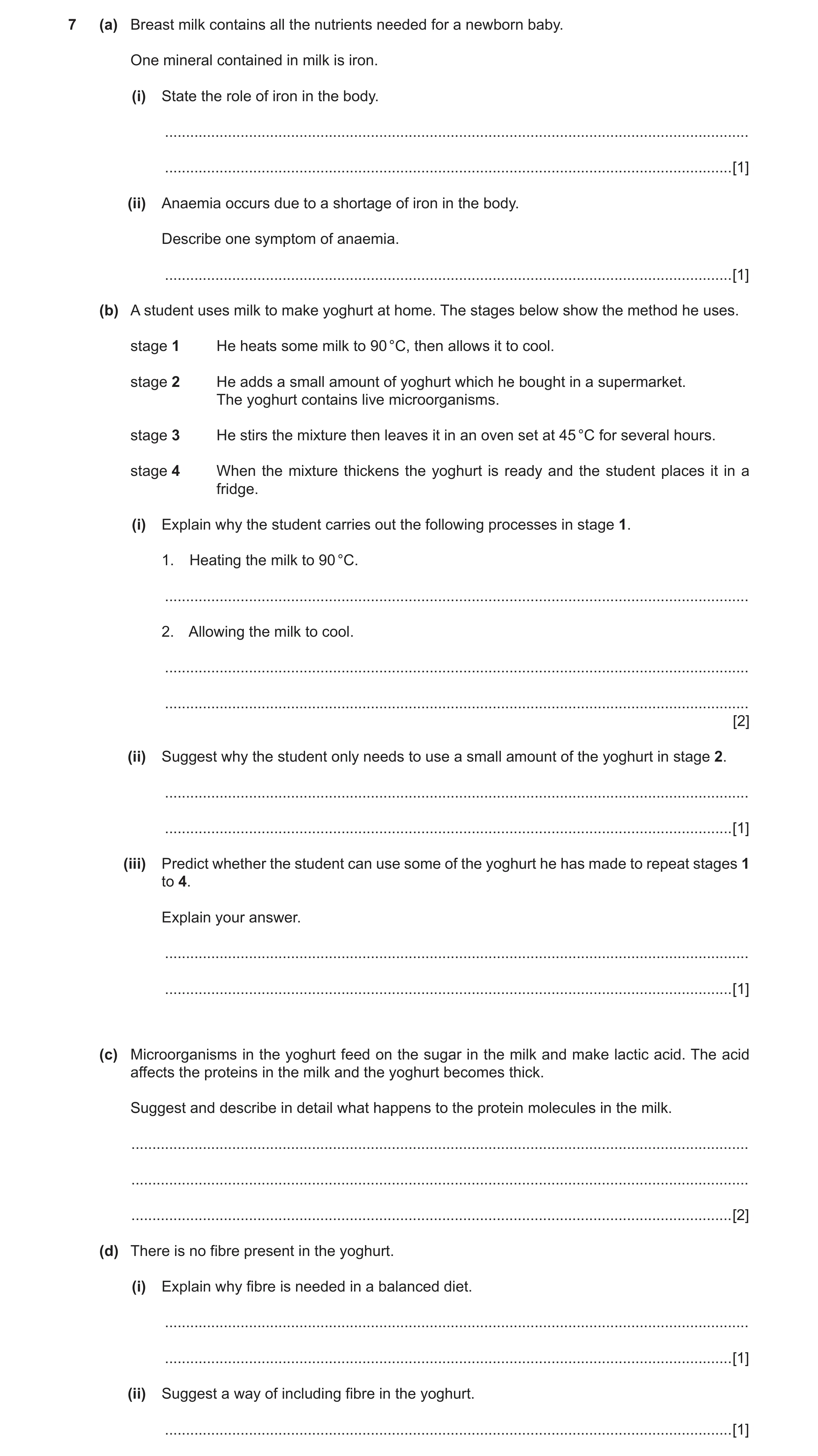
7 (a) Breast milk contains all the nutrients needed for a newborn baby. One mineral contained in milk is iron. (i) State the role of iron in the body. … … [1] (ii) Anaemia occurs due to a shortage of iron in the body. Describe one symptom of anaemia. … [1] (b) A student uses milk to make yoghurt at home. The stages below show the method he uses. stage 1 He heats some milk to 90 °C, then allows it to cool. stage 2 He adds a small amount of yoghurt which he bought in a supermarket. The yoghurt contains live microorganisms. stage 3 He stirs the mixture then leaves it in an oven set at 45 °C for several hours. stage 4 When the mixture thickens the yoghurt is ready and the student places it in a fridge. (i) Explain why the student carries out the following processes in stage 1. 1. Heating the milk to 90 °C. … 2. Allowing the milk to cool. … … [2] (ii) Suggest why the student only needs to use a small amount of the yoghurt in stage 2. … … [1] (iii) Predict whether the student can use some of the yoghurt he has made to repeat stages 1 to 4. Explain your answer. … … [1] (c) Microorganisms in the yoghurt feed on the sugar in the milk and make lactic acid. The acid affects the proteins in the milk and the yoghurt becomes thick. Suggest and describe in detail what happens to the protein molecules in the milk. … … … [2] (d) There is no fibre present in the yoghurt. (i) Explain why fibre is needed in a balanced diet. … … [1] (ii) Suggest a way of including fibre in the yoghurt. … [1]
10 marks
Mark scheme: 7(a)(i) making of / contained in haemoglobin ; 1 7(a)(ii) feel tired / dizzy / other correct symptoms ; 1 7(b)(i) 1 to pasteurise the milk / kill unwanted microbes ; 2 so that the microorganisms in the (added) yoghurt do not get killed ; 2 7(b)(ii) microorganisms will multiply in the milk ; 1 7(b)(iii) yes –no mark (student’s yoghurt) contains live organisms ; 1 7(c) the acid denatures / destroys the proteins in the milk ; the proteins lose their (3D) shape / owtte ; 2 7(d)(i) prevents constipation; 1 7(d)(ii) adding fruit ; 1
This question in 0653/42 Feb/March 2018
Q6 · When apples are cut open the exposed surface turns from white to brown 0653/42 May/June 2019
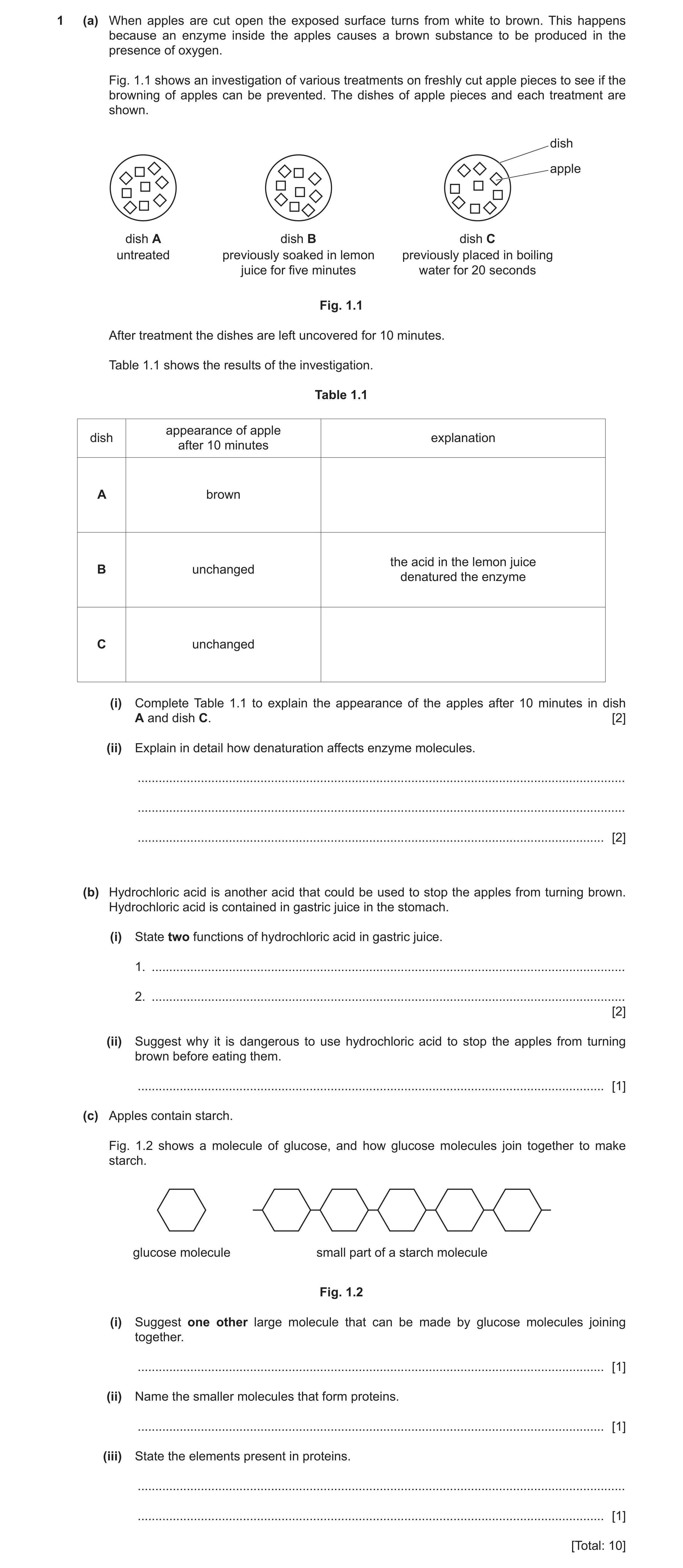
1 (a) When apples are cut open the exposed surface turns from white to brown. This happens because an enzyme inside the apples causes a brown substance to be produced in the presence of oxygen. Fig. 1.1 shows an investigation of various treatments on freshly cut apple pieces to see if the browning of apples can be prevented. The dishes of apple pieces and each treatment are shown. dish apple dish A dish B dish C untreated previously soaked in lemon previously placed in boiling juice for five minutes water for 20 seconds Fig. 1.1 After treatment the dishes are left uncovered for 10 minutes. Table 1.1 shows the results of the investigation. Table 1.1 appearance of apple dish explanation after 10 minutes A brown the acid in the lemon juice B unchanged denatured the enzyme C unchanged (i) Complete Table 1.1 to explain the appearance of the apples after 10 minutes in dish A and dish C. [2] (ii) Explain in detail how denaturation affects enzyme molecules. … … … [2] (b) Hydrochloric acid is another acid that could be used to stop the apples from turning brown. Hydrochloric acid is contained in gastric juice in the stomach. (i) State two functions of hydrochloric acid in gastric juice. 1. … 2. … [2] (ii) Suggest why it is dangerous to use hydrochloric acid to stop the apples from turning brown before eating them. … [1] (c) Apples contain starch. Fig. 1.2 shows a molecule of glucose, and how glucose molecules join together to make starch. glucose molecule small part of a starch molecule Fig. 1.2 (i) Suggest one other large molecule that can be made by glucose molecules joining together. … [1] (ii) Name the smaller molecules that form proteins. … [1] (iii) State the elements present in proteins. … … [1] [Total: 10]
10 marks
Mark scheme: 1(a)(i) A (untreated so the) enzyme caused the brown substance to be produced (in air) ; C (the boiling water) denatured the enzymes ; 2 1(a)(ii) active site / enzyme damaged / destroyed / shape changed ; substrate will no longer fit into it ; 2 1(b)(i) kills bacteria / pathogens / (harmful) microorganisms ; gives an acid pH for enzymes / owtte ; 2 1(b)(ii) hydrochloric acid is a strong acid ; hydrochloric acid can damage mouth, etc. when swallowed ; max 1 1(c)(i) glycogen ; 1 1(c)(ii) amino acids ; 1 1(c)(iii) carbon, hydrogen, oxygen, nitrogen 1
This question in 0653/42 May/June 2019
Q7 · Enzymes are proteins that function as biological catalysts 0653/43 May/June 2019
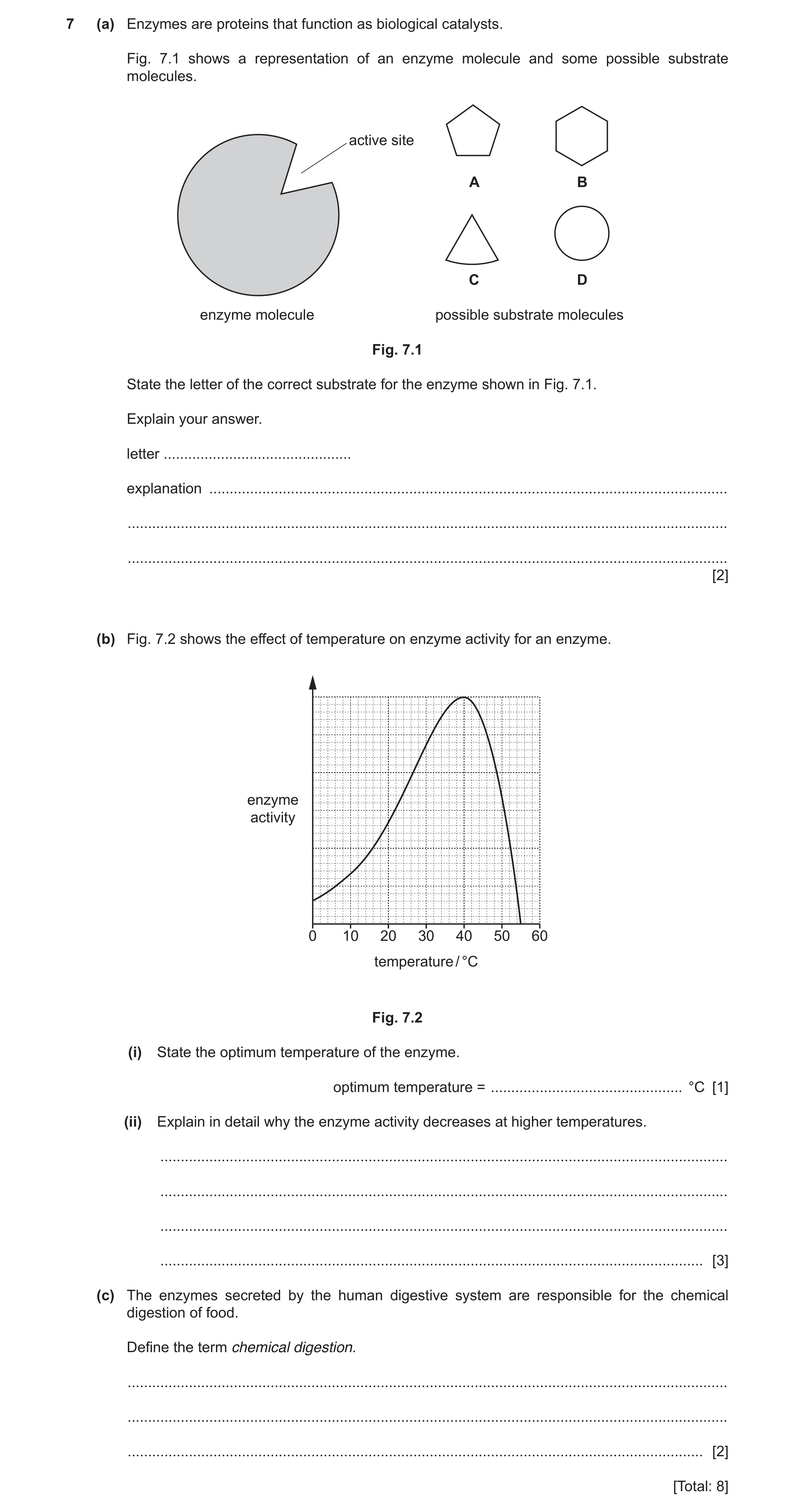
7 (a) Enzymes are proteins that function as biological catalysts. Fig. 7.1 shows a representation of an enzyme molecule and some possible substrate molecules. active site A B C D enzyme molecule possible substrate molecules Fig. 7.1 State the letter of the correct substrate for the enzyme shown in Fig. 7.1. Explain your answer. letter … explanation … … … [2] (b) Fig. 7.2 shows the effect of temperature on enzyme activity for an enzyme. enzyme activity 0 10 20 30 40 50 60 temperature / °C Fig. 7.2 (i) State the optimum temperature of the enzyme. optimum temperature = … °C [1] (ii) Explain in detail why the enzyme activity decreases at higher temperatures. … … … … [3] (c) The enzymes secreted by the human digestive system are responsible for the chemical digestion of food. Define the term chemical digestion. … … … [2] [Total: 8]
8 marks
Mark scheme: 7(a) C ; shape of C is complementary to the active site ; 2 7(b)(i) 40 °C ; 1 7(b)(ii) enzyme is denatured ; shape of active site changes ; substrate no longer fits the enzyme ; 3 7(c) the breakdown of large / insoluble molecules ; into small / soluble molecules ; 2
This question in 0653/43 May/June 2019
Q8 · A person is investigating the effect of the enzyme lipase on milk 0653/42 Oct/Nov 2019
7 (a) A person is investigating the effect of the enzyme lipase on milk. The person adds lipase to some milk in a test-tube. After 10 minutes the contents of the test-tube are tested with Universal Indicator. The results show that the contents of the test-tube have become more acidic. (i) Explain why the contents of the test-tube have become more acidic. … … … [2] (ii) Chemical digestion takes place in the test-tube. Explain what is meant by chemical digestion. … … … [2] (iii) Name one area in the body where lipase is secreted. … [1] (b) The investigation in (a) is repeated with boiled lipase. There is no change in the acidity of the contents of the test-tube. Explain in detail the effect of boiling the lipase on the action of the enzyme. … … … … [3] (c) Food is chewed in the mouth before swallowing. Explain why the chewing of food is an example of mechanical digestion. … … … [2] [Total: 10]
10 marks
Mark scheme: 7(a)(i) (lipase) breaks down fats (in the milk) ; to produce fatty acids ; 1 7(a)(ii) the breakdown of large insoluble molecules ; into small soluble molecules that can be absorbed ; 2 7(a)(iii) pancreas / small intestine ; 1 7(b) enzyme is denatured ; enzyme (molecule) has changed shape / destroyed or active site shape has changed ; substrate no longer fits active site substrate no longer fits enzyme (molecule) ; 3 7(c) food is broken down into smaller pieces ; without chemical change / without action of enzymes / it is a physical change ; 2
This question in 0653/42 Oct/Nov 2019
Q9 · Define the term enzyme 0653/43 Oct/Nov 2019
4 (a) Define the term enzyme. … … [2] (b) Enzymes are found in the digestive system where they help in the chemical digestion of food. Fig. 4.1 shows some digestive enzymes listed in the boxes on the left. enzyme substrate product amylase fats amino acids fatty acids and lipase protein glycerol protease starch simple sugars Fig. 4.1 (i) On Fig. 4.1: • draw one straight line to connect each enzyme with its substrate • draw one straight line to connect each substrate with its product. [3] (ii) State one area of the alimentary canal and its associated organs where protease is secreted. … [1] (c) Explain in detail the activity of a human digestive enzyme at 70 °C. … … … … … [3] (d) State two functions of hydrochloric acid in gastric juice. 1. … … 2. … … [2] [Total: 11]
11 marks
Mark scheme: 4(a) a protein ; (that functions as) a biological catalyst ; 2 4(b)(i) enzyme substrate product amylase fats amino acids lipase protein fatty acids and glycerol protease starch simple sugars 2 or 3 connections correct ; 4 or 5 connections correct ; 6 connections correct ; 3 4(b)(ii) stomach / pancreas / small intestine ; 1 4(c) (no enzyme activity / enzyme activity greatly reduced because) enzyme is denatured ; enzyme (molecule) has changed shape or active site has changed shape ; substrate no longer fits the active site substrate cannot bind to enzyme molecule ; 3 4(d) killing bacteria ; optimum pH for enzymes ; 2
This question in 0653/43 Oct/Nov 2019
Q10 · The substrates and products of three digestive enzymes are shown in Table 7.1 0653/41 May/June 2020
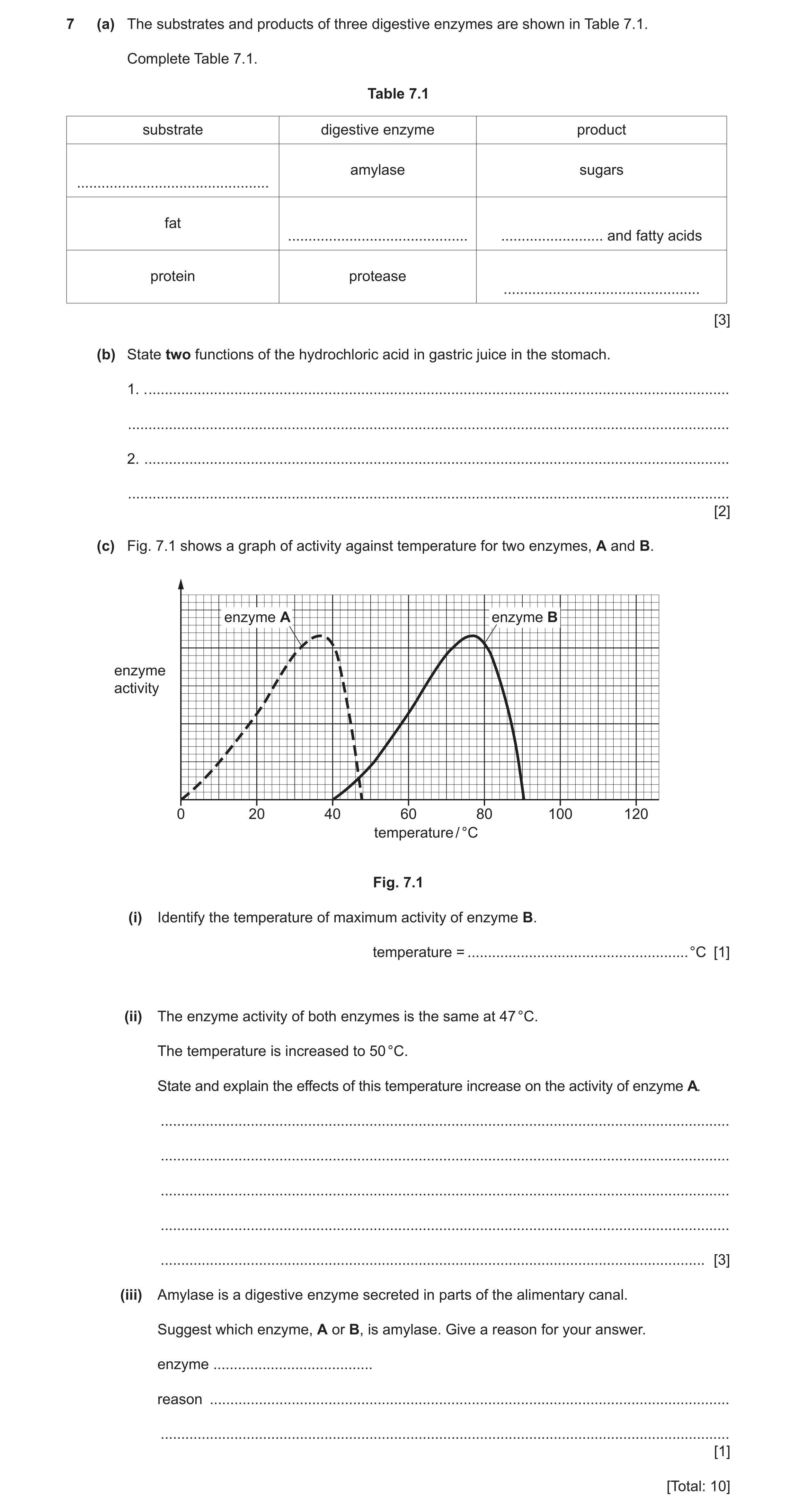
7 (a) The substrates and products of three digestive enzymes are shown in Table 7.1. Complete Table 7.1. Table 7.1 substrate digestive enzyme product amylase sugars … fat … … and fatty acids protein protease … [3] (b) State two functions of the hydrochloric acid in gastric juice in the stomach. 1. . … … 2. … … [2] (c) Fig. 7.1 shows a graph of activity against temperature for two enzymes, A and B. enzyme A enzyme B enzyme activity 0 20 40 60 80 100 120 temperature / °C Fig. 7.1 (i) Identify the temperature of maximum activity of enzyme B. temperature = … °C [1] (ii) The enzyme activity of both enzymes is the same at 47 °C. The temperature is increased to 50 °C. State and explain the effects of this temperature increase on the activity of enzyme A. … … … … … [3] (iii) Amylase is a digestive enzyme secreted in parts of the alimentary canal. Suggest which enzyme, A or B, is amylase. Give a reason for your answer. enzyme … reason … … [1] [Total: 10]
10 marks
Mark scheme: 7(a) (first line) starch ; (second line) lipase and glycerol ; (third line) amino acids ; 3 7(b) kills bacteria ; gives an acid pH for enzymes ; 2 7(c)(i) 77 (°C) ; 1 7(c)(ii) no activity / reaction rate is reduced ; enzyme denatures / loss of 3D shape ; substrate no longer fits active site ; 3 7(c)(iii) (enzyme) A and (reason) high / optimum, activity at body temperature ; 1
This question in 0653/41 May/June 2020
Q11 · A graph showing the effect of temperature on the activity of an enzyme 0653/42 May/June 2021
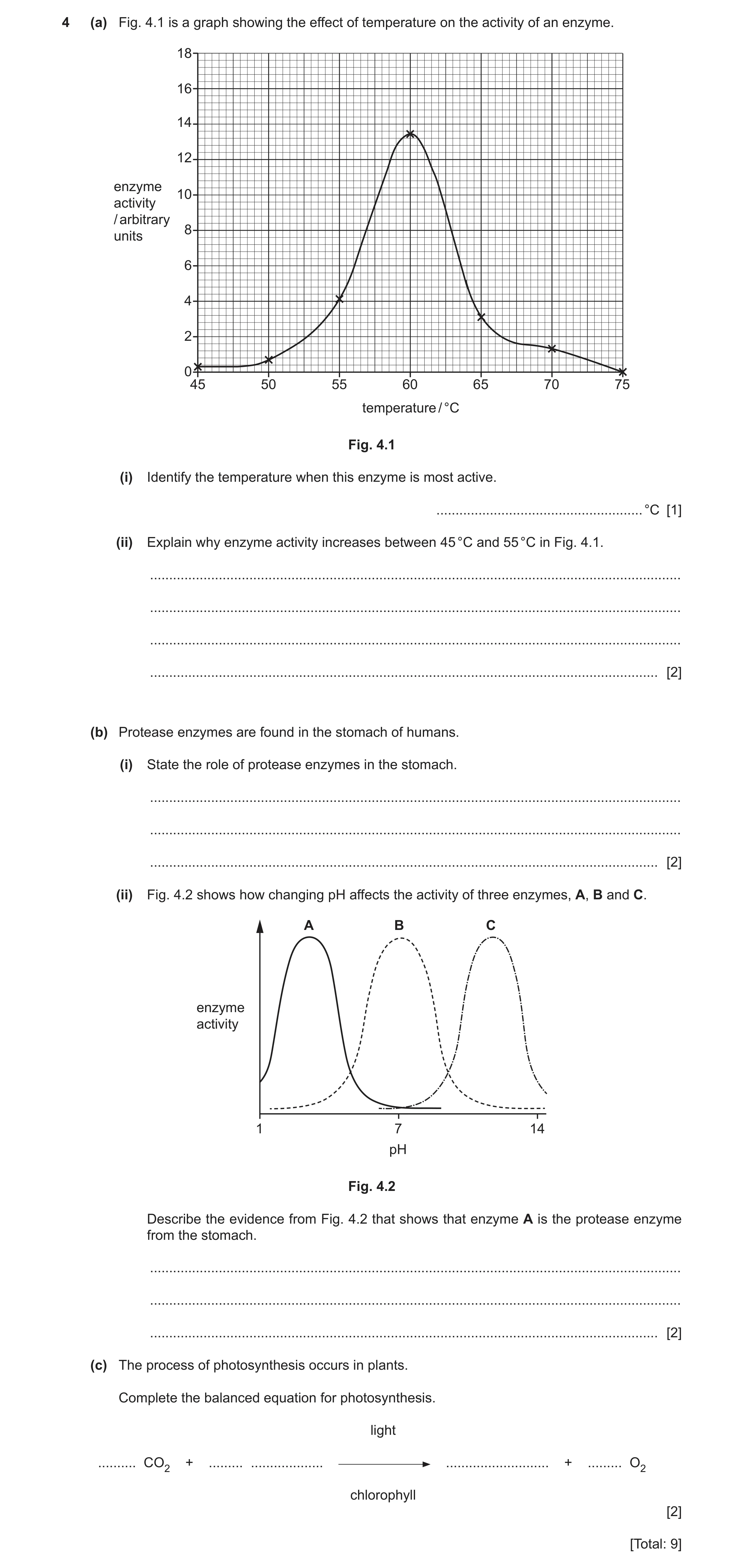
4 (a) Fig. 4.1 is a graph showing the effect of temperature on the activity of an enzyme. 18 16 14 12 enzyme 10 activity / arbitrary 8 units 6 4 2 0 45 50 55 60 65 70 75 temperature / °C Fig. 4.1 (i) Identify the temperature when this enzyme is most active. … °C [1] (ii) Explain why enzyme activity increases between 45 °C and 55 °C in Fig. 4.1. … … … … [2] (b) Protease enzymes are found in the stomach of humans. (i) State the role of protease enzymes in the stomach. … … … [2] (ii) Fig. 4.2 shows how changing pH affects the activity of three enzymes, A, B and C. A B C enzyme activity 1 7 14 pH Fig. 4.2 Describe the evidence from Fig. 4.2 that shows that enzyme A is the protease enzyme from the stomach. … … … [2] (c) The process of photosynthesis occurs in plants. Complete the balanced equation for photosynthesis. light … CO2 + … … … + … O2 chlorophyll [2] [Total: 9]
9 marks
Mark scheme: 4(a)(i) 60 (°C) ; 1 4(a)(ii) correct reference to gain of energy ; increase in frequency of collisions / more effective collisions ; 2 4(b)(i) break down proteins ; to form amino acids ; 2 4(b)(ii) stomach, is acidic / has a low pH ; only enzyme A works, in acidic conditions / at low pH ; 2 4(c) (light) 6(CO2) + 6H2O C6H12O6 + 6(O2) ;; (chlorophyll) reactants correct = 1 mark products correct = 1 mark 2
This question in 0653/42 May/June 2021
Q12 · A graph showing the effect of temperature on two different enzymes, A and B 0653/43 May/June 2021
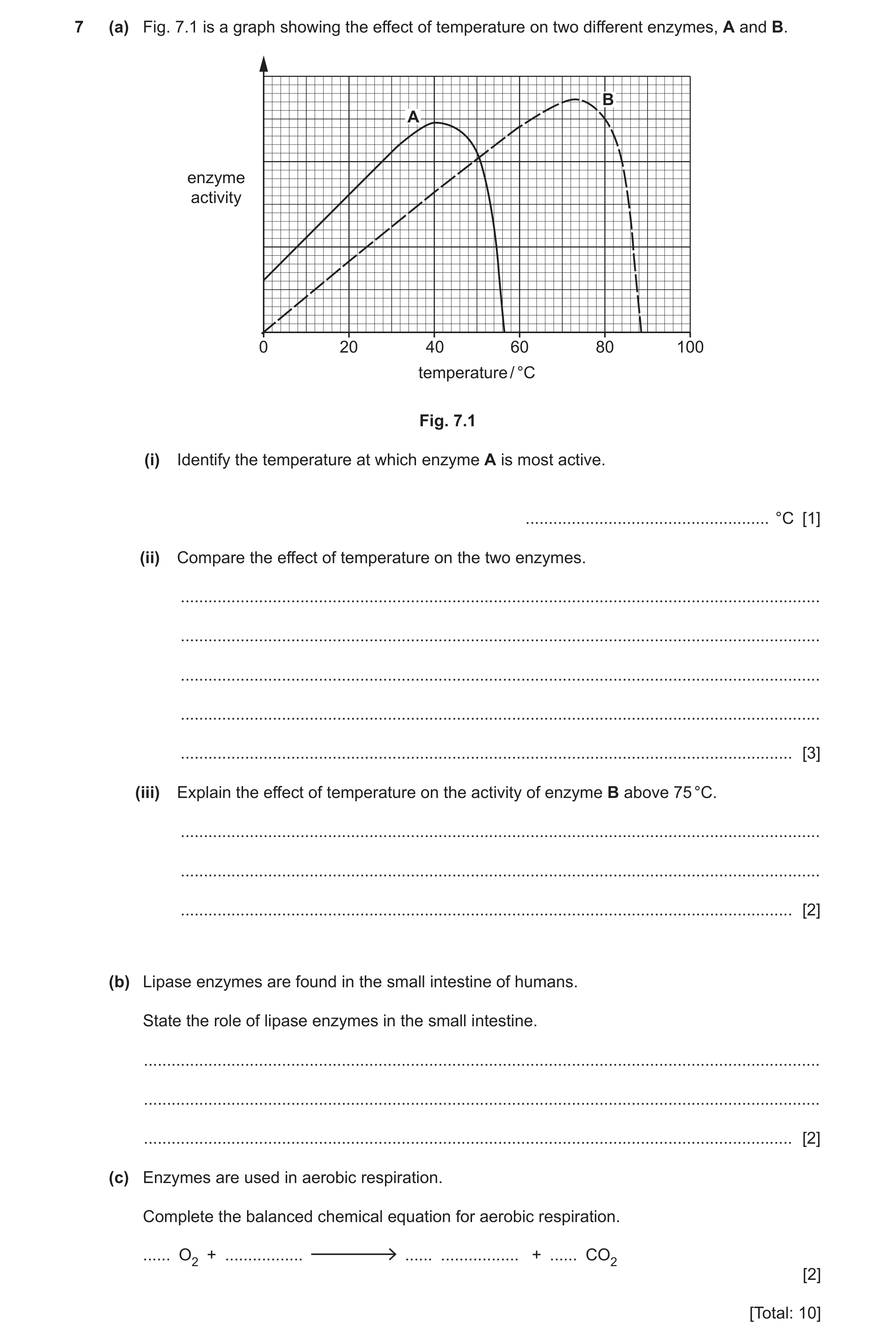
7 (a) Fig. 7.1 is a graph showing the effect of temperature on two different enzymes, A and B. B A enzyme activity 0 20 40 60 80 100 temperature / °C Fig. 7.1 (i) Identify the temperature at which enzyme A is most active. … °C [1] (ii) Compare the effect of temperature on the two enzymes. … … … … … [3] (iii) Explain the effect of temperature on the activity of enzyme B above 75 °C. … … … [2] (b) Lipase enzymes are found in the small intestine of humans. State the role of lipase enzymes in the small intestine. … … … [2] (c) Enzymes are used in aerobic respiration. Complete the balanced chemical equation for aerobic respiration. … O2 + … … … + … CO2 [2] [Total: 10]
10 marks
Mark scheme: 7(a)(i) 40 (°C) ; 1 7(a)(ii) both enzymes increase in activity with increase in temperature ; decrease in activity with increase in temperature over a certain point ; enzyme B is more active at higher temperatures ; 3 7(a)(iii) enzymes denature / shape of active site changes ; substrate no longer fits into active site ; 2 7(b) breaks down, fats / lipids / oils ; forms fatty acids and glycerol ; 2 7(c) 6 (O2) + C6H12O6 → 6 H2O + 6 (CO2) ;; all five answers = 2 marks 3 or 4 correct = 1 mark 1 or 2 correct = 0 marks 2
This question in 0653/43 May/June 2021
Q13 · A student investigates the effect of light intensity on the rate of photosynthesis of an… 0653/42 Oct/Nov 2021
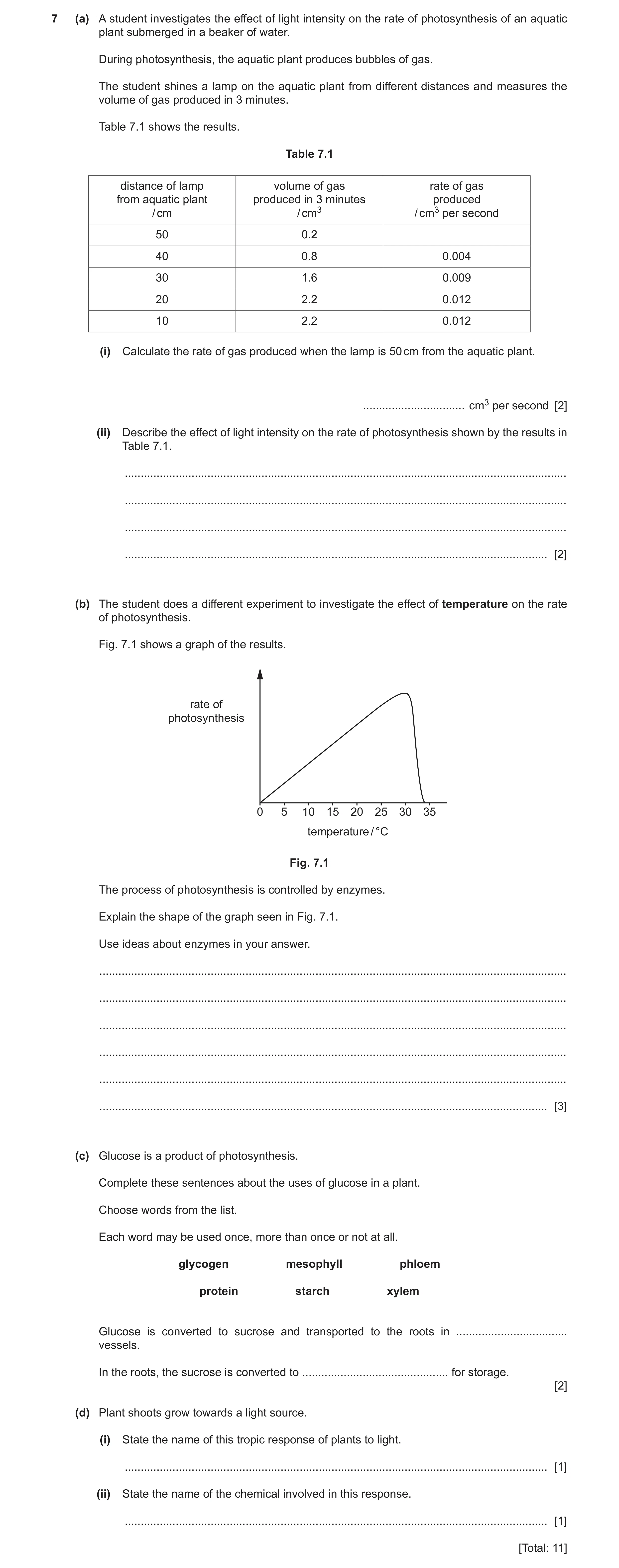
7 (a) A student investigates the effect of light intensity on the rate of photosynthesis of an aquatic plant submerged in a beaker of water. During photosynthesis, the aquatic plant produces bubbles of gas. The student shines a lamp on the aquatic plant from different distances and measures the volume of gas produced in 3 minutes. Table 7.1 shows the results. Table 7.1 distance of lamp volume of gas rate of gas from aquatic plant produced in 3 minutes produced / cm / cm3 / cm3 per second 50 0.2 40 0.8 0.004 30 1.6 0.009 20 2.2 0.012 10 2.2 0.012 (i) Calculate the rate of gas produced when the lamp is 50 cm from the aquatic plant. … cm3 per second [2] (ii) Describe the effect of light intensity on the rate of photosynthesis shown by the results in Table 7.1. … … … … [2] (b) The student does a different experiment to investigate the effect of temperature on the rate of photosynthesis. Fig. 7.1 shows a graph of the results. rate of photosynthesis 0 5 10 15 20 25 30 35 temperature / °C Fig. 7.1 The process of photosynthesis is controlled by enzymes. Explain the shape of the graph seen in Fig. 7.1. Use ideas about enzymes in your answer. … … … … … … [3] (c) Glucose is a product of photosynthesis. Complete these sentences about the uses of glucose in a plant. Choose words from the list. Each word may be used once, more than once or not at all. glycogen mesophyll phloem protein starch xylem Glucose is converted to sucrose and transported to the roots in … vessels. In the roots, the sucrose is converted to … for storage. [2] (d) Plant shoots grow towards a light source. (i) State the name of this tropic response of plants to light. … [1] (ii) State the name of the chemical involved in this response. … [1] [Total: 11]
11 marks
Mark scheme: 7(a)(i) 0.2 ÷ 180 ; 0.001 (cm / s) ; 2 7(a)(ii) as light intensity increases, the rate of photosynthesis increases ; idea that rate levels off (below 20 cm) ; 2 7(b) any three from: 0 to 30 °C rate increases as enzymes gain more kinetic energy ; 0 to 30 °C rate increases as there are more (effective) collisions ; above 30 °C enzymes denature / shape of active site changes ; above 30 °C substrate no longer fits into active site ; 3 7(c) phloem ; starch ; 2 7(d)(i) phototropism ; 1 7(d)(ii) auxin ; 1
This question in 0653/42 Oct/Nov 2021
Q14 · A diagram of the alimentary canal and associated organs in humans 0653/43 May/June 2022
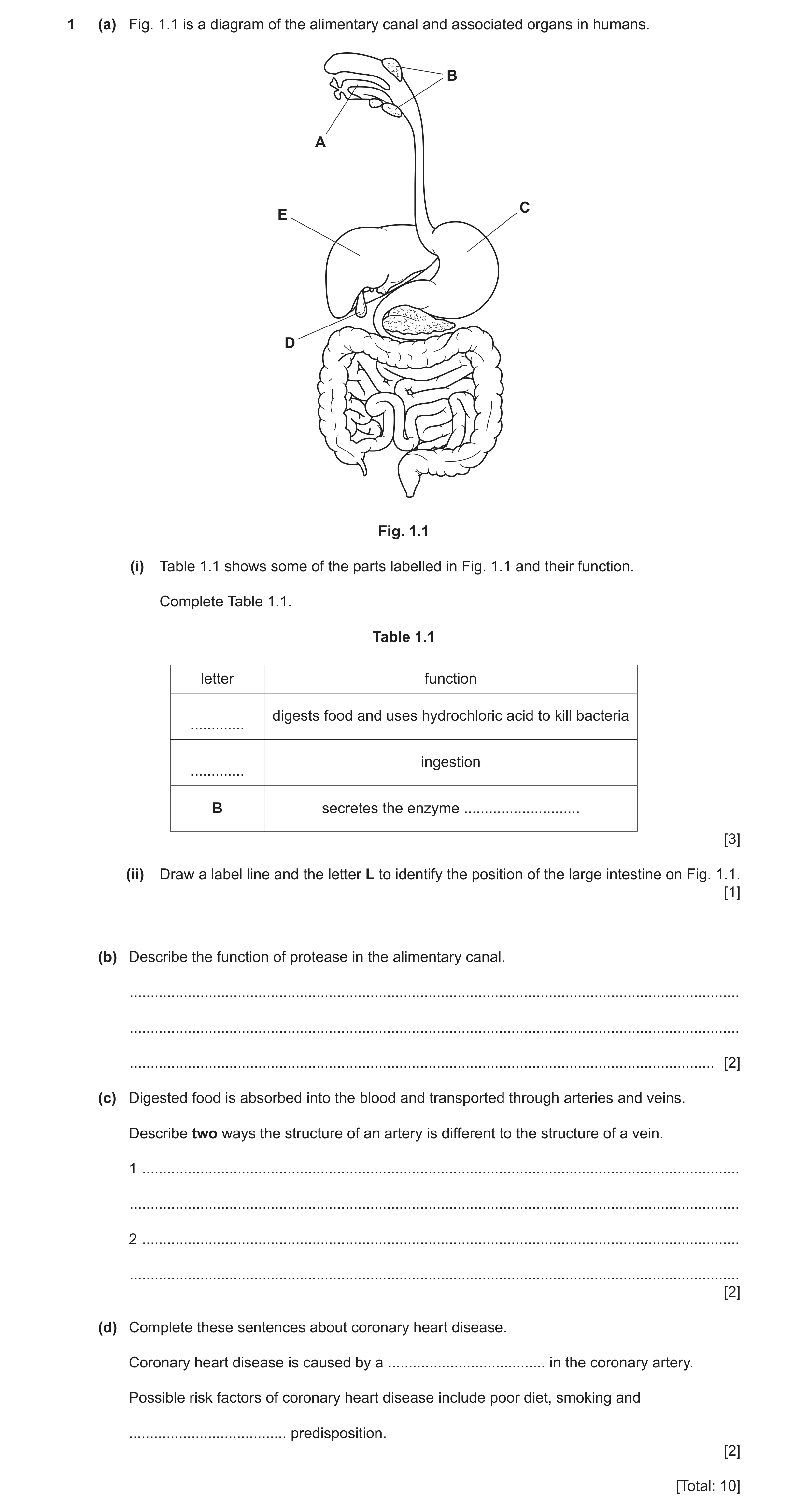
1 (a) Fig. 1.1 is a diagram of the alimentary canal and associated organs in humans. B A C E D Fig. 1.1 (i) Table 1.1 shows some of the parts labelled in Fig. 1.1 and their function. Complete Table 1.1. Table 1.1 letter function digests food and uses hydrochloric acid to kill bacteria … ingestion … B secretes the enzyme … [3] (ii) Draw a label line and the letter L to identify the position of the large intestine on Fig. 1.1. [1] (b) Describe the function of protease in the alimentary canal. … … … [2] (c) Digested food is absorbed into the blood and transported through arteries and veins. Describe two ways the structure of an artery is different to the structure of a vein. 1 … … 2 … … [2] (d) Complete these sentences about coronary heart disease. Coronary heart disease is caused by a … in the coronary artery. Possible risk factors of coronary heart disease include poor diet, smoking and … predisposition. [2] [Total: 10]
10 marks
Mark scheme: 1(a)(i) letter function C ; (digests protein and uses hydrochloric acid to kill bacteria) A ; (ingestion) (B) (secretes the enzyme) amylase ; 3 1(a)(ii) label line to large intestine labelled L ; 1 1(b) digestion of protein ; to form amino acids ; 2 1(c) any two from: arteries have a thicker (muscle) wall / ORA ; arteries have a smaller centre / ORA ; only veins have valves ; 2 1(d) blockage ; genetic ; 2
This question in 0653/43 May/June 2022
Q15 · Starch is broken down by amylase into smaller molecules 0653/41 Oct/Nov 2022
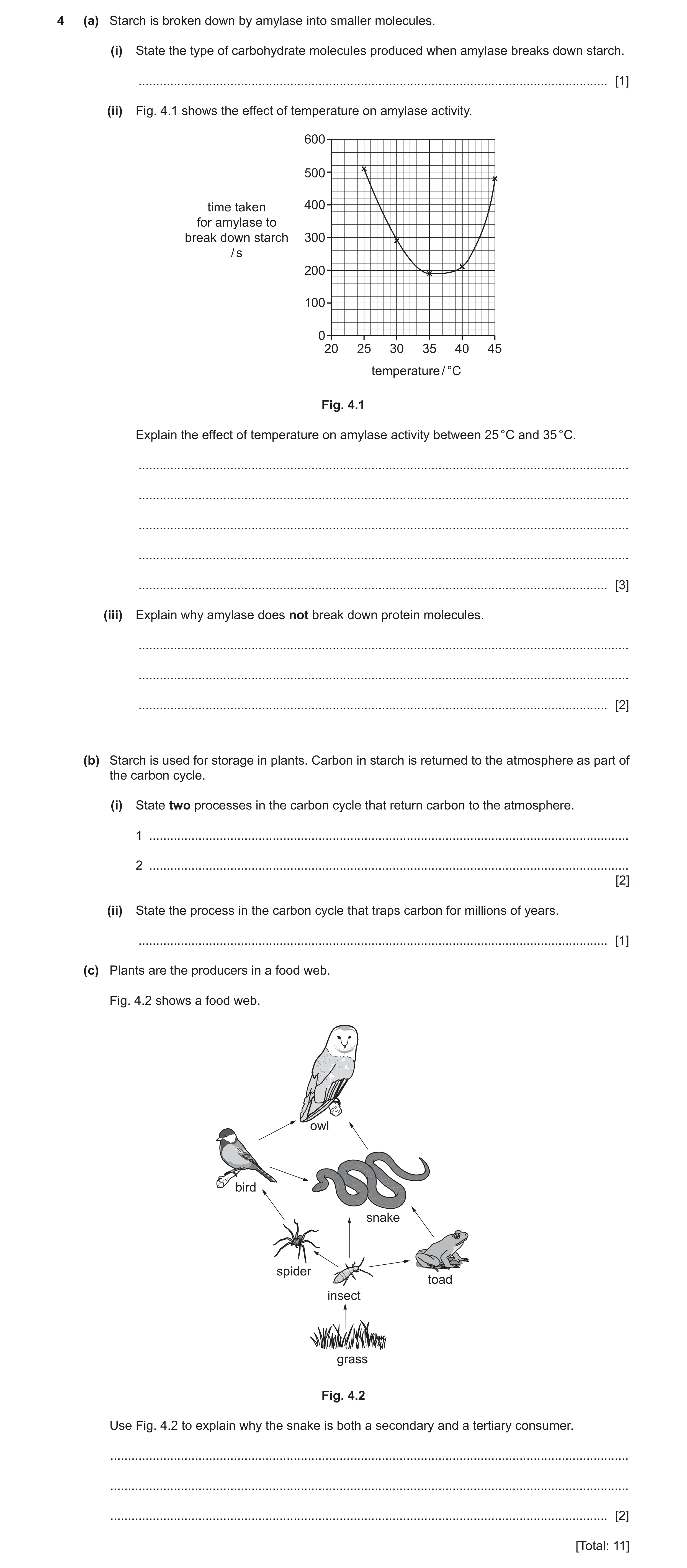
4 (a) Starch is broken down by amylase into smaller molecules. (i) State the type of carbohydrate molecules produced when amylase breaks down starch. … [1] (ii) Fig. 4.1 shows the effect of temperature on amylase activity. 600 500 time taken 400 for amylase to break down starch 300 / s 200 100 0 20 25 30 35 40 45 temperature / °C Fig. 4.1 Explain the effect of temperature on amylase activity between 25 °C and 35 °C. … … … … … [3] (iii) Explain why amylase does not break down protein molecules. … … … [2] (b) Starch is used for storage in plants. Carbon in starch is returned to the atmosphere as part of the carbon cycle. (i) State two processes in the carbon cycle that return carbon to the atmosphere. 1 … 2 … [2] (ii) State the process in the carbon cycle that traps carbon for millions of years. … [1] (c) Plants are the producers in a food web. Fig. 4.2 shows a food web. owl bird snake spider toad insect grass Fig. 4.2 Use Fig. 4.2 to explain why the snake is both a secondary and a tertiary consumer. … … … [2] [Total: 11]
11 marks
Mark scheme: 4(a)(i) (simple) sugar ; 1 4(a)(ii) starch is broken down more quickly as temperature increases / activity of amylase increases as temperature increases ; 3 increase in kinetic energy (of particles) / (particles) move faster ; increased frequency of collisions / increased number of successful collisions ; 4(a)(iii) idea that, amylase is specific (to starch) ; 2 protein molecules will not fit into active site / (shape of) active site not complementary to protein (shape) / (shape of) active site is complementary to starch (shape) ; 4(b)(i) any two from: 2 combustion ; respiration ; decomposition ; AVP ; 4(b)(ii) fossilisation ; 1 4(c) (snake is a) 2 secondary consumer when it eats the insect ; tertiary consumer when it eats the toad ;
This question in 0653/41 Oct/Nov 2022
Q16 · Chemical digestion and mechanical digestion take place in the alimentary canal 0653/42 Oct/Nov 2022
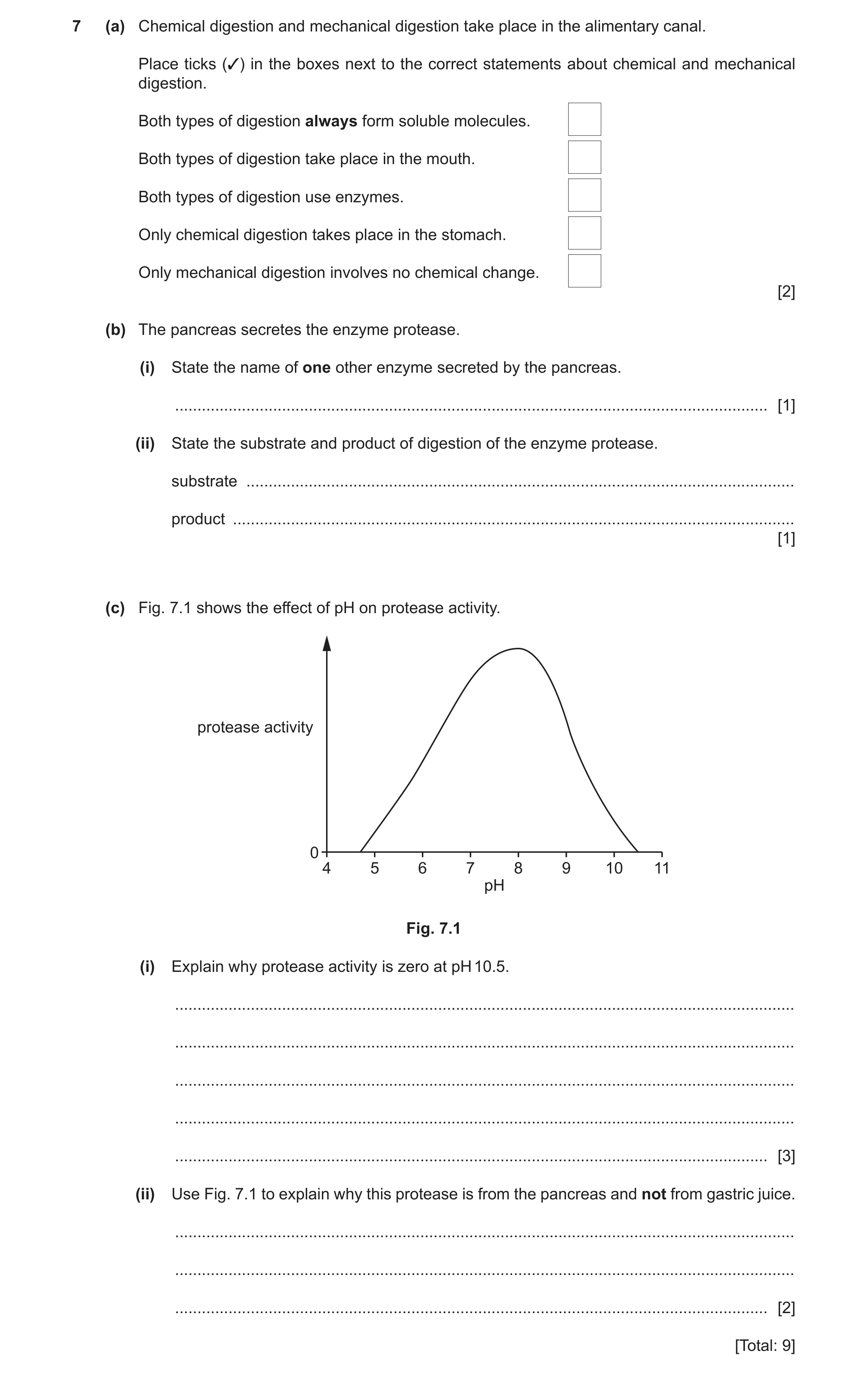
7 (a) Chemical digestion and mechanical digestion take place in the alimentary canal. Place ticks (✓) in the boxes next to the correct statements about chemical and mechanical digestion. Both types of digestion always form soluble molecules. Both types of digestion take place in the mouth. Both types of digestion use enzymes. Only chemical digestion takes place in the stomach. Only mechanical digestion involves no chemical change. [2] (b) The pancreas secretes the enzyme protease. (i) State the name of one other enzyme secreted by the pancreas. … [1] (ii) State the substrate and product of digestion of the enzyme protease. substrate … product … [1] (c) Fig. 7.1 shows the effect of pH on protease activity. protease activity 0 4 5 6 7 8 9 10 11 pH Fig. 7.1 (i) Explain why protease activity is zero at pH 10.5. … … … … … [3] (ii) Use Fig. 7.1 to explain why this protease is from the pancreas and not from gastric juice. … … … [2] [Total: 9]
9 marks
Mark scheme: 7(a) 2 Both types of digestion always form soluble molecules. Both types of digestion take place in the mouth. ✓ ; Both types of digestion use enzymes. Only chemical digestion takes place in the stomach. Only mechanical digestion involves no chemical change. ✓ ; 7(b)(i) lipase / amylase ; 1 7(b)(ii) substrate protein AND 1 product amino acid ; 7(c)(i) (protease) denatures / changes shape ; 3 reference to active site ; will not, fit / bind with substrate (into active site) ; 7(c)(ii) (protease) does not work / denatures, at low pH / in acid conditions ; 2 gastric juice, contains hydrochloric acid / has a low pH ;
This question in 0653/42 Oct/Nov 2022
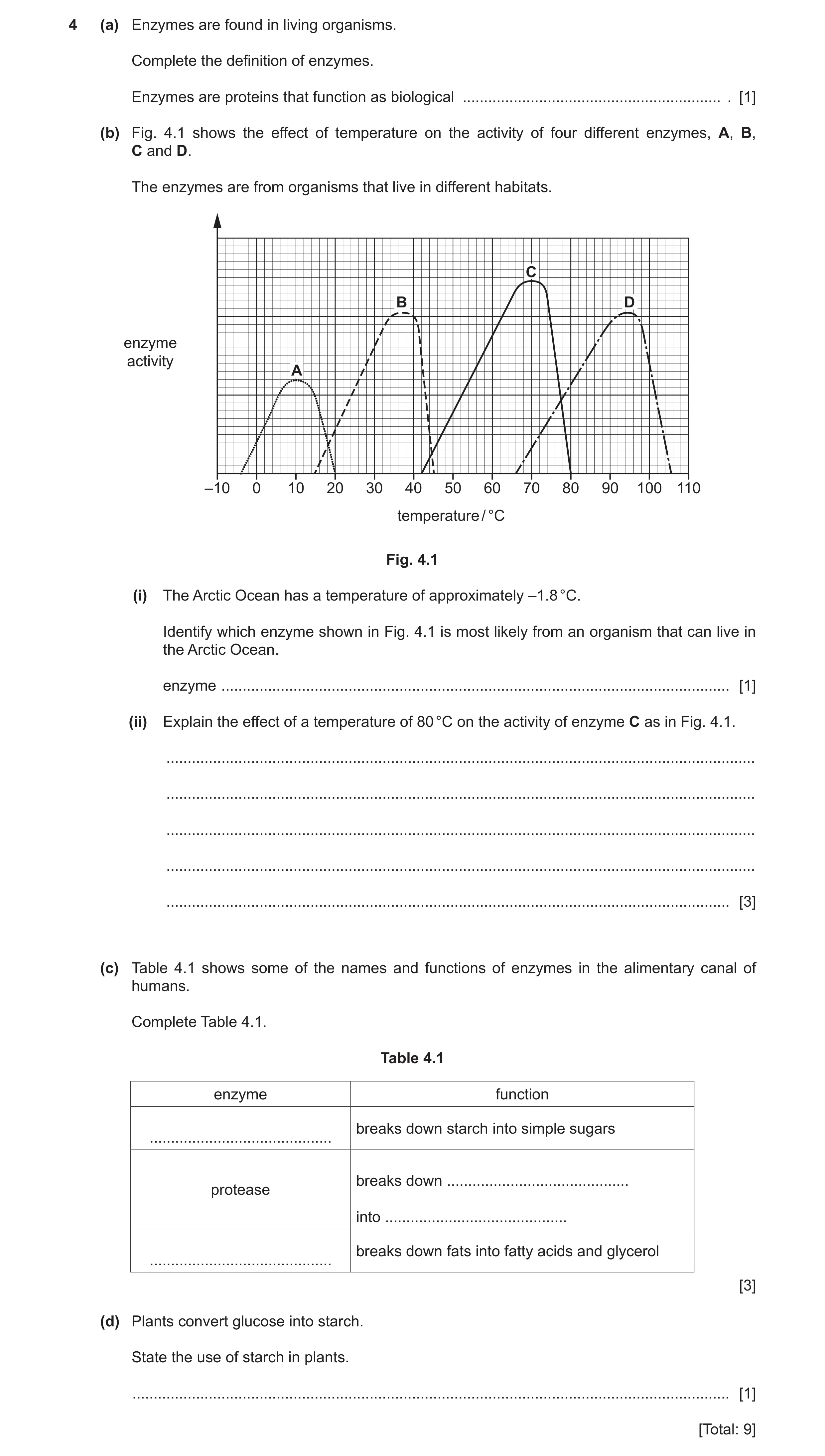
Q17 · Enzymes are found in living organisms 0653/42 Feb/March 2023
4 (a) Enzymes are found in living organisms. Complete the definition of enzymes. Enzymes are proteins that function as biological … . [1] (b) Fig. 4.1 shows the effect of temperature on the activity of four different enzymes, A, B, C and D. The enzymes are from organisms that live in different habitats. C B D enzyme activity A –10 0 10 20 30 40 50 60 70 80 90 100 110 temperature / °C Fig. 4.1 (i) The Arctic Ocean has a temperature of approximately –1.8 °C. Identify which enzyme shown in Fig. 4.1 is most likely from an organism that can live in the Arctic Ocean. enzyme … [1] (ii) Explain the effect of a temperature of 80 °C on the activity of enzyme C as in Fig. 4.1. … … … … … [3] (c) Table 4.1 shows some of the names and functions of enzymes in the alimentary canal of humans. Complete Table 4.1. Table 4.1 enzyme function breaks down starch into simple sugars … breaks down … protease into … breaks down fats into fatty acids and glycerol … [3] (d) Plants convert glucose into starch. State the use of starch in plants. … [1] [Total: 9]
9 marks
Mark scheme: 4(a) catalysts ; 1 4(b)(i) A ; 1 4(b)(ii) enzyme denatured ; 3 active site changes shape ; substrate no longer fits (into active site) ; 4(c) one mark for each correct row: 3 enzyme function amylase ; (breaks down starch into simple sugars) (protease) (breaks down) protein (into) amino acids ; lipase ; (breaks down fats into fatty acids and glycerol) 4(d) storage ; 1
This question in 0653/42 Feb/March 2023
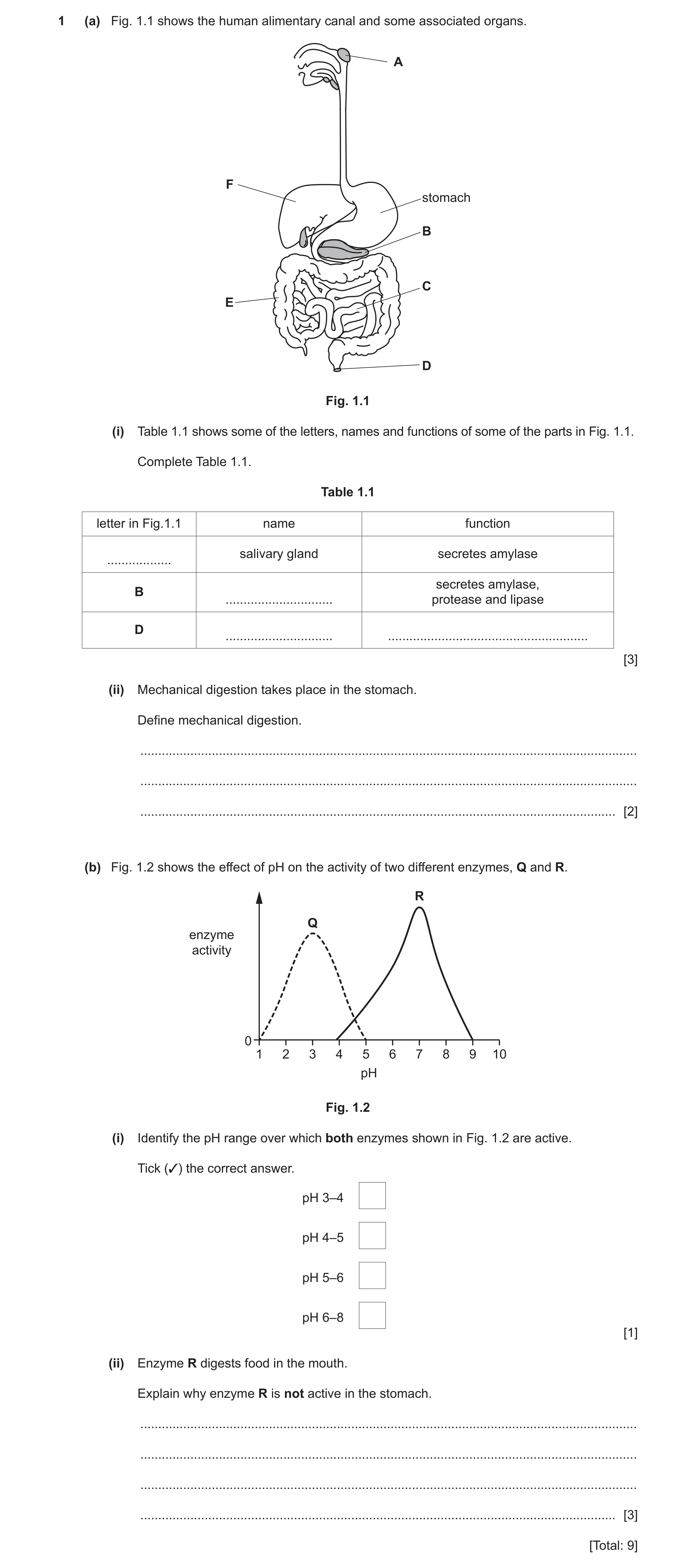
Q18 · The human alimentary canal and some associated organs 0653/41 Oct/Nov 2023
1 (a) Fig. 1.1 shows the human alimentary canal and some associated organs. A F stomach B C E D Fig. 1.1 (i) Table 1.1 shows some of the letters, names and functions of some of the parts in Fig. 1.1. Complete Table 1.1. Table 1.1 letter in Fig.1.1 name function salivary gland secretes amylase … secretes amylase, B … protease and lipase D … … [3] (ii) Mechanical digestion takes place in the stomach. Define mechanical digestion. … … … [2] (b) Fig. 1.2 shows the effect of pH on the activity of two different enzymes, Q and R. R Q enzyme activity 0 1 2 3 4 5 6 7 8 9 10 pH Fig. 1.2 (i) Identify the pH range over which both enzymes shown in Fig. 1.2 are active. Tick (✓) the correct answer. pH 3–4 pH 4–5 pH 5–6 pH 6–8 [1] (ii) Enzyme R digests food in the mouth. Explain why enzyme R is not active in the stomach. … … … … [3] [Total: 9]
9 marks
Mark scheme: Question Answer Marks 1(a)(i) one mark for each correct row 3 letter in Fig. 1.1. name function A (salivary gland) (secretes amylase) ; (B) pancreas (secretes amylase, ; protease and lipase) (D) anus egestion ; 1(a)(ii) (mechanical) breakdown of food into smaller pieces / AW ; 2 then any one from: to increase surface area ; without chemical change (to molecules) ; 1(b)(i) pH 4–5 ; 1 1(b)(ii) any three from: 3 reference to, strongly acidic / low pH conditions (in stomach) ; R is denatured ; active site changes shape ; substrate no longer fits into active site ;
This question in 0653/41 Oct/Nov 2023
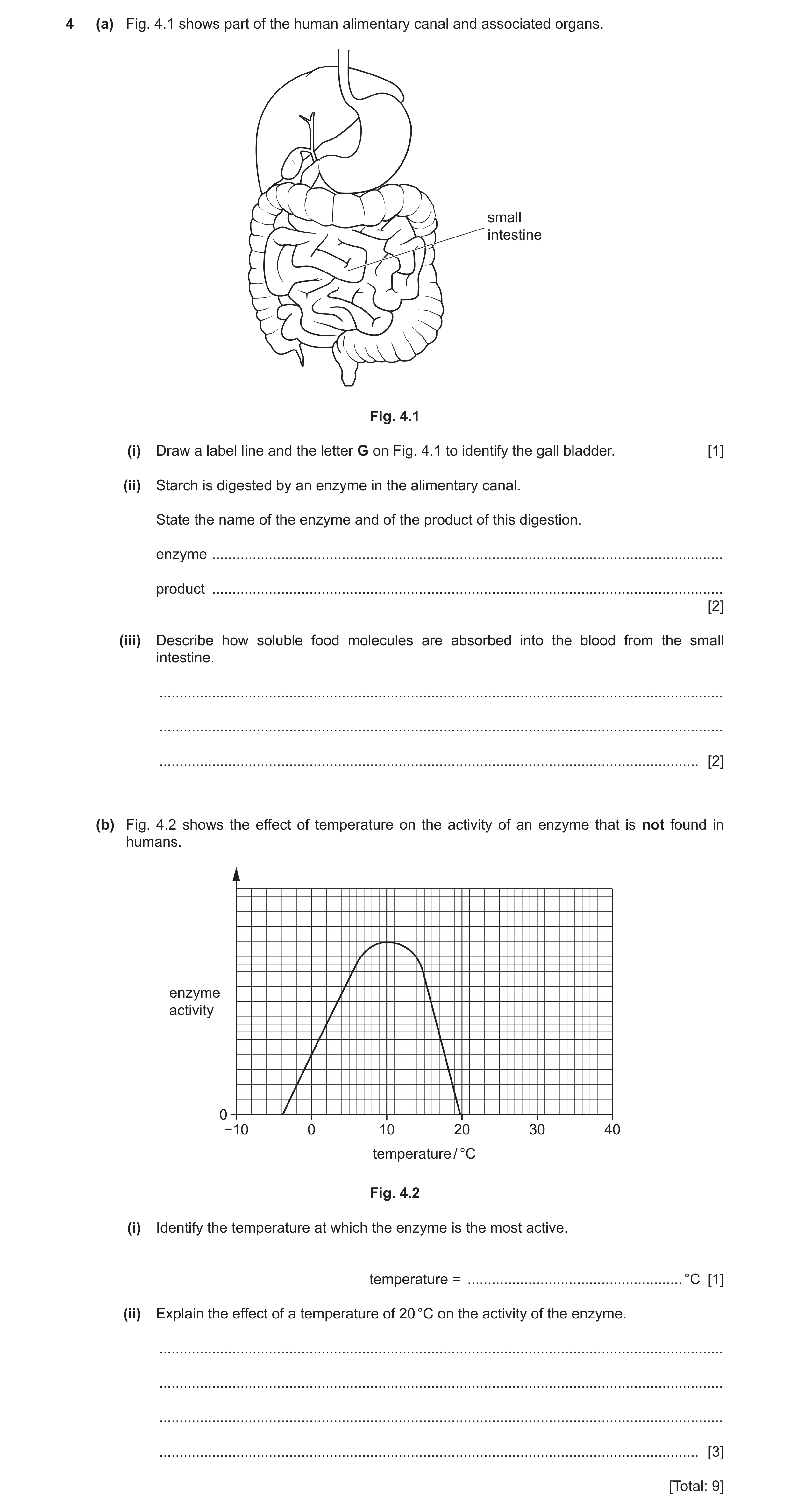
Q19 · Part of the human alimentary canal and associated organs 0653/43 Oct/Nov 2023
4 (a) Fig. 4.1 shows part of the human alimentary canal and associated organs. small intestine Fig. 4.1 (i) Draw a label line and the letter G on Fig. 4.1 to identify the gall bladder. [1] (ii) Starch is digested by an enzyme in the alimentary canal. State the name of the enzyme and of the product of this digestion. enzyme … product … [2] (iii) Describe how soluble food molecules are absorbed into the blood from the small intestine. … … … [2] (b) Fig. 4.2 shows the effect of temperature on the activity of an enzyme that is not found in humans. enzyme activity 0 −10 0 10 20 30 40 temperature / °C Fig. 4.2 (i) Identify the temperature at which the enzyme is the most active. temperature = … °C [1] (ii) Explain the effect of a temperature of 20 °C on the activity of the enzyme. … … … … [3] [Total: 9]
9 marks
Mark scheme: 4(a)(i) gall bladder labelled ; 1 4(a)(ii) amylase ; 2 (simpler) sugars ; 4(a)(iii) any two from: 2 diffuses ; through, cell membrane / capillary wall ; (dissolves) into the plasma ; 4(b)(i) 10 (°C) ; 1 4(b)(ii) enzyme is denatured ; 3 active site changes shape ; substrate no longer fits (into active site) ;
This question in 0653/43 Oct/Nov 2023
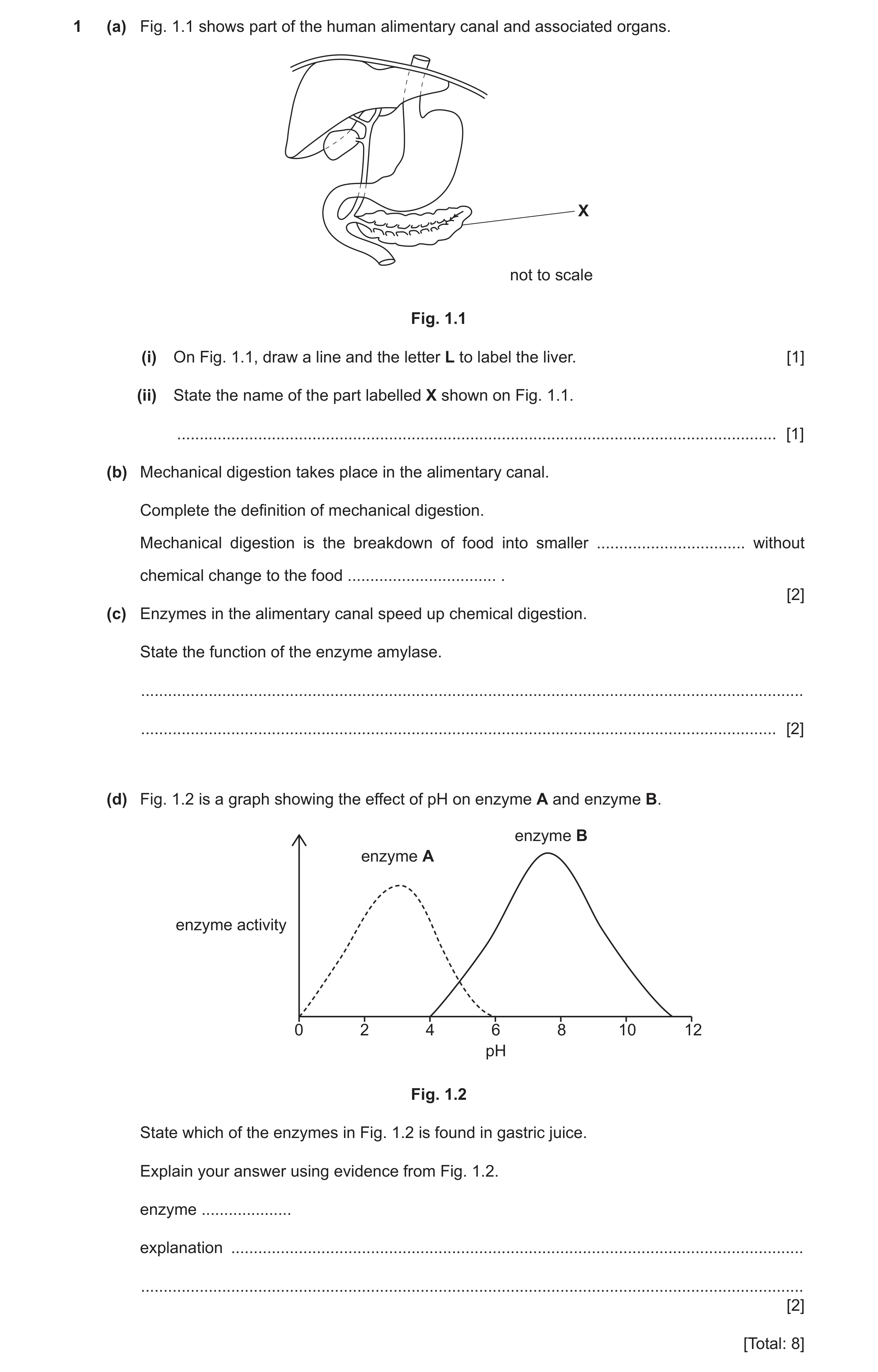
Q20 · Part of the human alimentary canal and associated organs 0653/42 Feb/March 2024
1 (a) Fig. 1.1 shows part of the human alimentary canal and associated organs. X not to scale Fig. 1.1 (i) On Fig. 1.1, draw a line and the letter L to label the liver. [1] (ii) State the name of the part labelled X shown on Fig. 1.1. … [1] (b) Mechanical digestion takes place in the alimentary canal. Complete the definition of mechanical digestion. Mechanical digestion is the breakdown of food into smaller … without chemical change to the food … . [2] (c) Enzymes in the alimentary canal speed up chemical digestion. State the function of the enzyme amylase. … … [2] (d) Fig. 1.2 is a graph showing the effect of pH on enzyme A and enzyme B. enzyme B enzyme A enzyme activity 0 2 4 6 8 10 12 pH Fig. 1.2 State which of the enzymes in Fig. 1.2 is found in gastric juice. Explain your answer using evidence from Fig. 1.2. enzyme … explanation … … [2] [Total: 8]
8 marks
Mark scheme: Question Answer Marks 1(a)(i) liver labelled ; 1 1(a)(ii) pancreas ; 1 1(b) pieces ; 2 molecules ; 1(c) digest / breakdown, starch ; 2 into (simpler) sugars ; 1(d) enzyme: A 2 AND works (best) at low pH / acidic conditions ; gastric juice, contains hydrochloric acid / is acidic ;
This question in 0653/42 Feb/March 2024
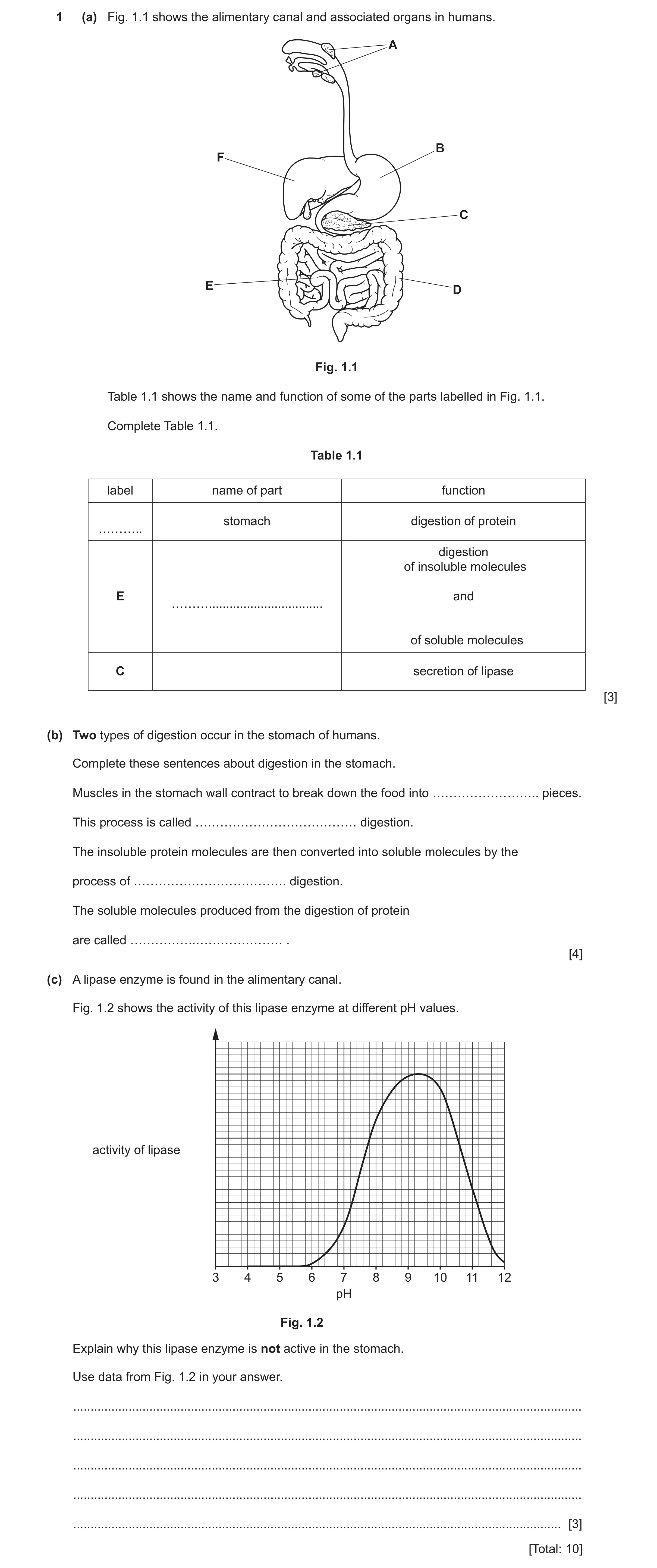
Q21 · The alimentary canal and associated organs in humans 0653/42 May/June 2024
1 (a) Fig. 1.1 shows the alimentary canal and associated organs in humans. A B F C E D Fig. 1.1 Table 1.1 shows the name and function of some of the parts labelled in Fig. 1.1. Complete Table 1.1. Table 1.1 label name of part function stomach digestion of protein ……….. digestion of insoluble molecules E and ……… … of soluble molecules C secretion of lipase [3] (b) Two types of digestion occur in the stomach of humans. Complete these sentences about digestion in the stomach. Muscles in the stomach wall contract to break down the food into …………………….. pieces. This process is called ………………………………… digestion. The insoluble protein molecules are then converted into soluble molecules by the process of ………………………………. digestion. The soluble molecules produced from the digestion of protein are called …………….………………… . [4] (c) A lipase enzyme is found in the alimentary canal. Fig. 1.2 shows the activity of this lipase enzyme at different pH values. activity of lipase 3 4 5 6 7 8 9 10 11 12 pH Fig. 1.2 Explain why this lipase enzyme is not active in the stomach. Use data from Fig. 1.2 in your answer. … … … … … [3] [Total: 10]
10 marks
Mark scheme: 1(a) label name of part function B (stomach) (digestion of protein) (E) small intestine (digestion of insoluble molecules and) absorption (of soluble molecules) (C) pancreas (secretion of lipase) ;;; one mark for each correct row 1(b) small(er) ; mechanical ; chemical ; amino acids ; 4 1(c) any three from: lipase activity between pH6–pH12 / lipase inactive below pH6 / lipase inactive in acidic conditions / stomach pH low / stomach is (very) acidic / stomach pH from 1.5 to 3.5 ; (so) lipase would denature (in stomach) ; active site, changes shape / is no longer complementary (to the substrate) ; lipase is unable to, bind to / fit, substrate ; 3
This question in 0653/42 May/June 2024
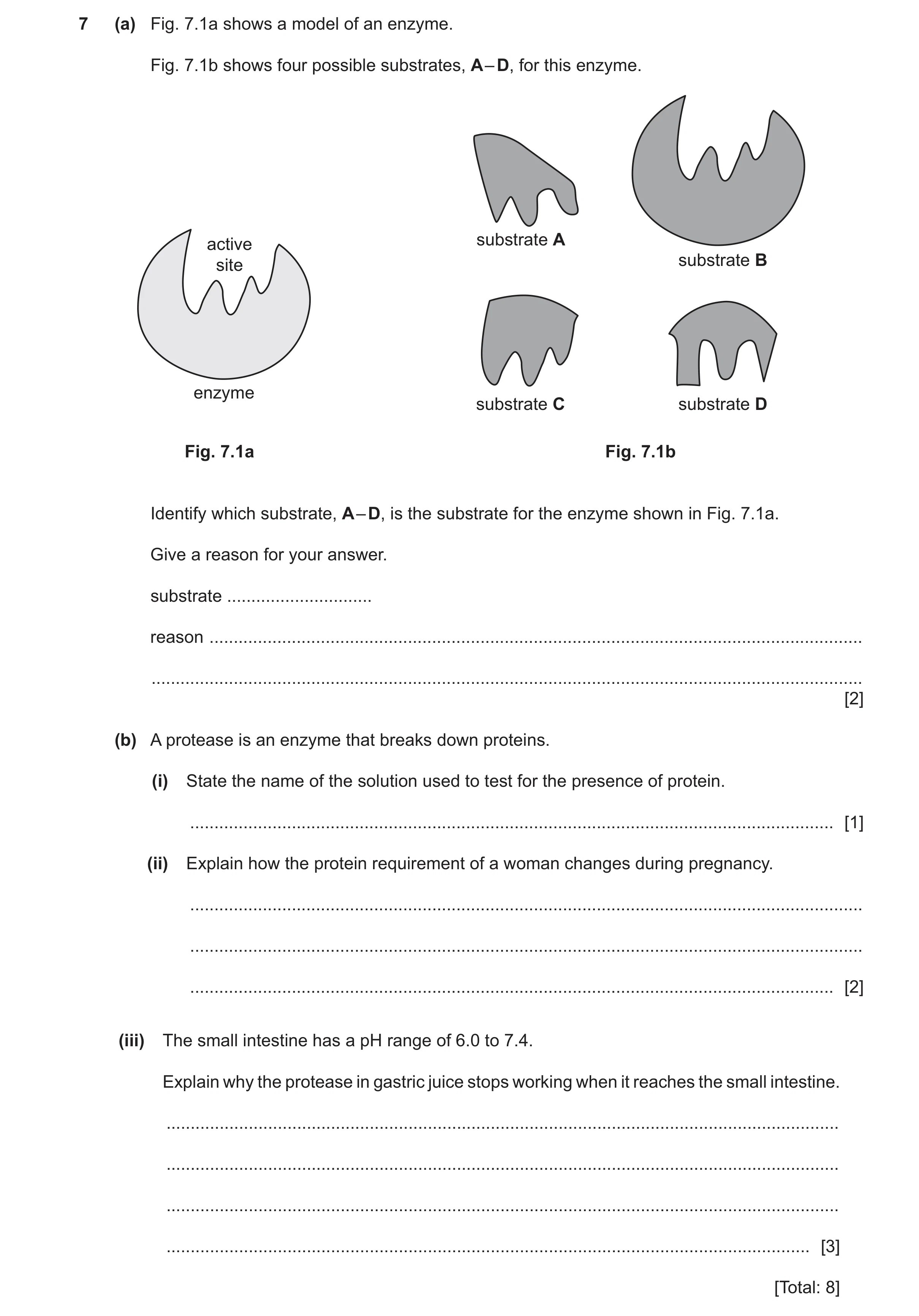
Question 22 0653/42 Oct/Nov 2024
7 (a) Fig. 7.1a shows a model of an enzyme. Fig. 7.1b shows four possible substrates, A – D, for this enzyme. substrate A active substrate B site enzyme substrate C substrate D Fig. 7.1a Fig. 7.1b Identify which substrate, A – D, is the substrate for the enzyme shown in Fig. 7.1a. Give a reason for your answer. substrate … reason … … [2] (b) A protease is an enzyme that breaks down proteins. (i) State the name of the solution used to test for the presence of protein. … [1] (ii) Explain how the protein requirement of a woman changes during pregnancy. … … … [2] (iii) The small intestine has a pH range of 6.0 to 7.4. Explain why the protease in gastric juice stops working when it reaches the small intestine. … … … … [3] [Total: 8]
8 marks
Mark scheme: 7(a) C ; 2 is complementary (in shape, to the active site of the enzyme) ; 7(b)(i) biuret (solution) ; 1 7(b)(ii) protein intake needs to increase ; 2 for the growth / development of the fetus ; 7(b)(iii) gastric juice / stomach, is a lower pH / acidic pH OR protease works (best) in, a lower pH / (more) acidic pH/conditions ; 3 protease is denatured (in small intestine) ; active site changes shape / enzyme substrate complex cannot form / substrate/protein no longer fits (active site of) protease;
This question in 0653/42 Oct/Nov 2024
Q23 · The photosynthesis reaction in plants is controlled by enzymes 0653/43 Oct/Nov 2024
4 (a) The photosynthesis reaction in plants is controlled by enzymes. (i) The rate of photosynthesis in a submerged aquatic plant is measured by counting the number of gas bubbles released by the plant in 5 minutes. Table 4.1 shows the effect of temperature on the rate of photosynthesis in an aquatic plant. Table 4.1 temperature number of gas bubbles of water released in / °C 5 minutes 10 30 20 72 30 96 40 42 50 28 60 2 Explain the result for 60 °C in Table 4.1. Use ideas about enzymes in your answer. … … … … … … [3] (ii) Describe the importance of stomata in the process of photosynthesis. … … … [2] (iii) Carbohydrates produced in photosynthesis are stored as starch in plants. State the solution used to test for the presence of starch and the observation for a positive result. solution … observation … [2] (b) Starch is part of a balanced diet for humans. Complete the sentences about starch digestion in the human alimentary canal. Starch is digested by an enzyme called … . The enzyme breaks down starch molecules into smaller carbohydrate molecules called … . The enzyme is secreted into the mouth from the … glands and into the small intestine from the … . [4] [Total: 11]
11 marks
Mark scheme: 4(a)(i) (most) enzyme denatured; 3 active site changes shape / substrate no longer fits active site ; rate of photosynthesis decreases (so fewer bubbles) ; 4(a)(ii) gas exchange takes place through stomata / carbon dioxide enters through stomata / oxygen exits through stomata ; 2 carbon dioxide is needed for photosynthesis / oxygen is produced in photosynthesis ; 4(a)(iii) iodine (solution) ; 2 colour changes (from brown) to blue-black ; 4(b) amylase ; 4 (simpler) sugars ; salivary ; pancreas ;
This question in 0653/43 Oct/Nov 2024
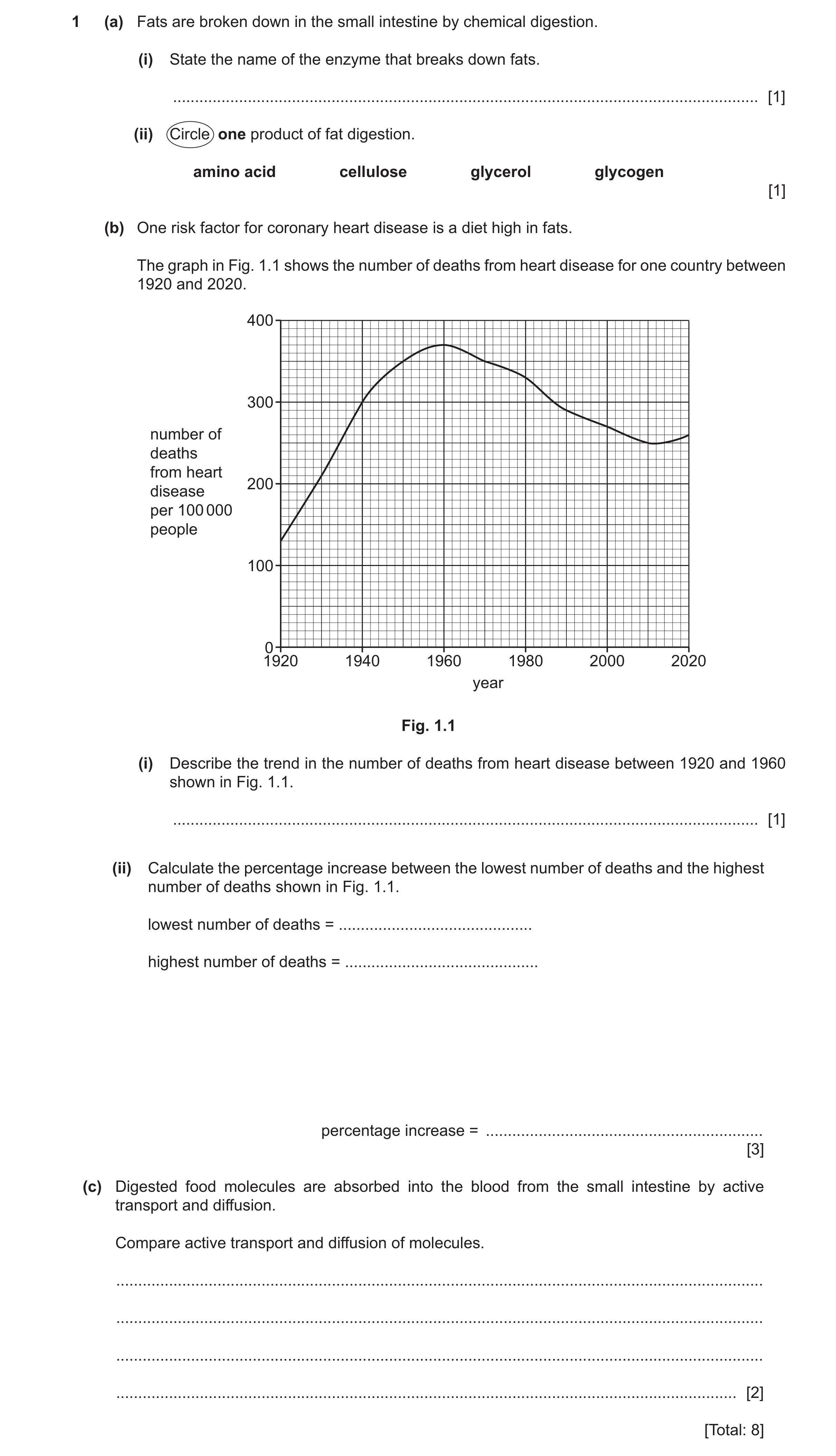
Q24 · Fats are broken down in the small intestine by chemical digestion 0653/41 May/June 2025
1 (a) Fats are broken down in the small intestine by chemical digestion. (i) State the name of the enzyme that breaks down fats. … [1] (ii) Circle one product of fat digestion. amino acid cellulose glycerol glycogen [1] (b) One risk factor for coronary heart disease is a diet high in fats. The graph in Fig. 1.1 shows the number of deaths from heart disease for one country between 1920 and 2020. 400 300 number of deaths from heart 200 disease per 100 000 people 100 0 1920 1940 1960 1980 2000 2020 year Fig. 1.1 (i) Describe the trend in the number of deaths from heart disease between 1920 and 1960 shown in Fig. 1.1. … [1] (ii) Calculate the percentage increase between the lowest number of deaths and the highest number of deaths shown in Fig. 1.1. lowest number of deaths = … highest number of deaths = … percentage increase = … [3] (c) Digested food molecules are absorbed into the blood from the small intestine by active transport and diffusion. Compare active transport and diffusion of molecules. … … … … [2] [Total: 8]
8 marks
Mark scheme: Question Answer Marks 1(a)(i) lipase ; 1 1(a)(ii) glycerol ; 1 1(b)(i) increases ; 1 1(b)(ii) 130 and 370 ; 3 240 100 OR ((370 ÷ 130) 100 ) − 100 ; 130 185 (%) ; 1(c) active transport is against a concentration gradient and diffusion is down a concentration gradient 2 OR active transport is movement from a low to high concentration and diffusion is movement from high to low concentration / AW ; then any one from: active transport requires energy / diffusion does not require energy ; both transport (food) molecules across a cell membrane ;
This question in 0653/41 May/June 2025
Q25 · A photograph of a wind‑pollinated flower 0653/41 May/June 2025
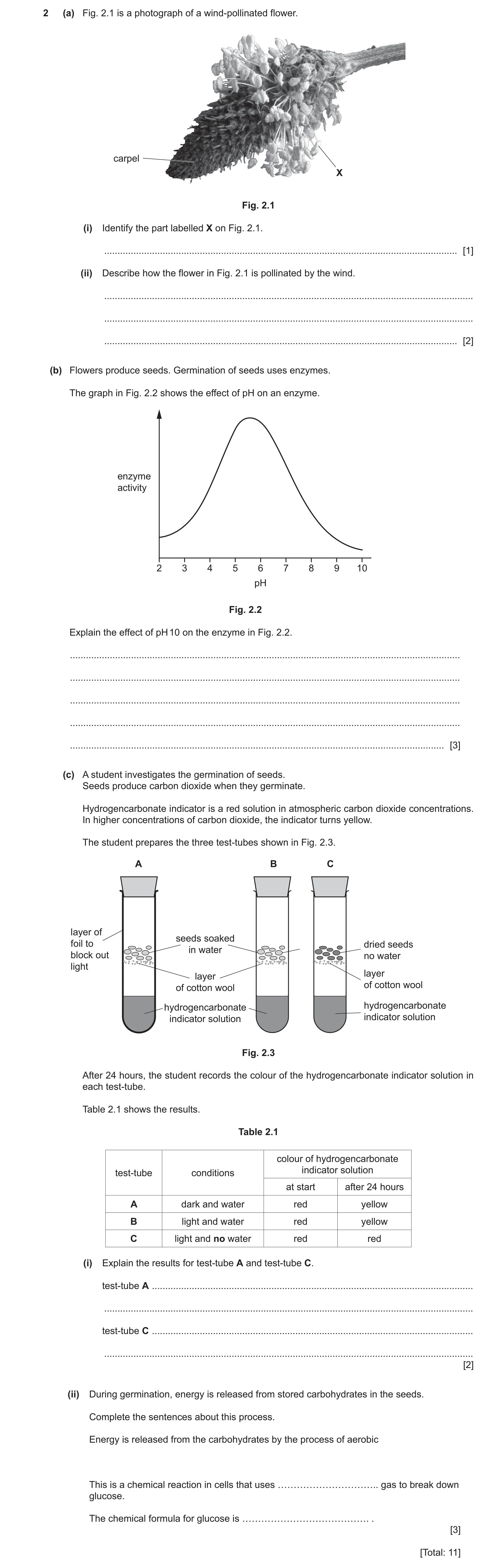
2 (a) Fig. 2.1 is a photograph of a wind‑pollinated flower. carpel X Fig. 2.1 (i) Identify the part labelled X on Fig. 2.1. … [1] (ii) Describe how the flower in Fig. 2.1 is pollinated by the wind. … … … [2] (b) Flowers produce seeds. Germination of seeds uses enzymes. The graph in Fig. 2.2 shows the effect of pH on an enzyme. enzyme activity 2 3 4 5 6 7 8 9 10 pH Fig. 2.2 Explain the effect of pH 10 on the enzyme in Fig. 2.2. … … … … … [3] (c) A student investigates the germination of seeds. Seeds produce carbon dioxide when they germinate. Hydrogencarbonate indicator is a red solution in atmospheric carbon dioxide concentrations. In higher concentrations of carbon dioxide, the indicator turns yellow. The student prepares the three test‑tubes shown in Fig. 2.3. A B C layer of seeds soaked foil to dried seeds in water block out no water light layer layer of cotton wool of cotton wool hydrogencarbonate hydrogencarbonate indicator solution indicator solution Fig. 2.3 After 24 hours, the student records the colour of the hydrogencarbonate indicator solution in each test‑tube. Table 2.1 shows the results. Table 2.1 colour of hydrogencarbonate indicator solution test‑tube conditions at start after 24 hours A dark and water red yellow B light and water red yellow C light and no water red red (i) Explain the results for test‑tube A and test‑tube C. test‑tube A … … test‑tube C … … [2] (ii) During germination, energy is released from stored carbohydrates in the seeds. Complete the sentences about this process. Energy is released from the carbohydrates by the process of aerobic This is a chemical reaction in cells that uses ………………………….. gas to break down glucose. The chemical formula for glucose is …………………………………. . [3] [Total: 11]
11 marks
Mark scheme: 2(a)(i) anther ; 1 2(a)(ii) pollen is transferred (by wind) ; 2 (pollen moves) from anther to stigma ; 2(b) enzyme denatures ; 3 active site changes shape ; active site no longer complementary to substrate / substrate no longer fits active site ; 2(c)(i) (tube A) light not needed for germination (so indicator turns yellow) ; 2 (tube C) water is required for germination (so indicator stays red) ; 2(c)(ii) respiration ; 3 oxygen ; C6H12O6 ;
This question in 0653/41 May/June 2025
Q26 · A diagram of the digestive system and associated organs 0653/42 May/June 2025
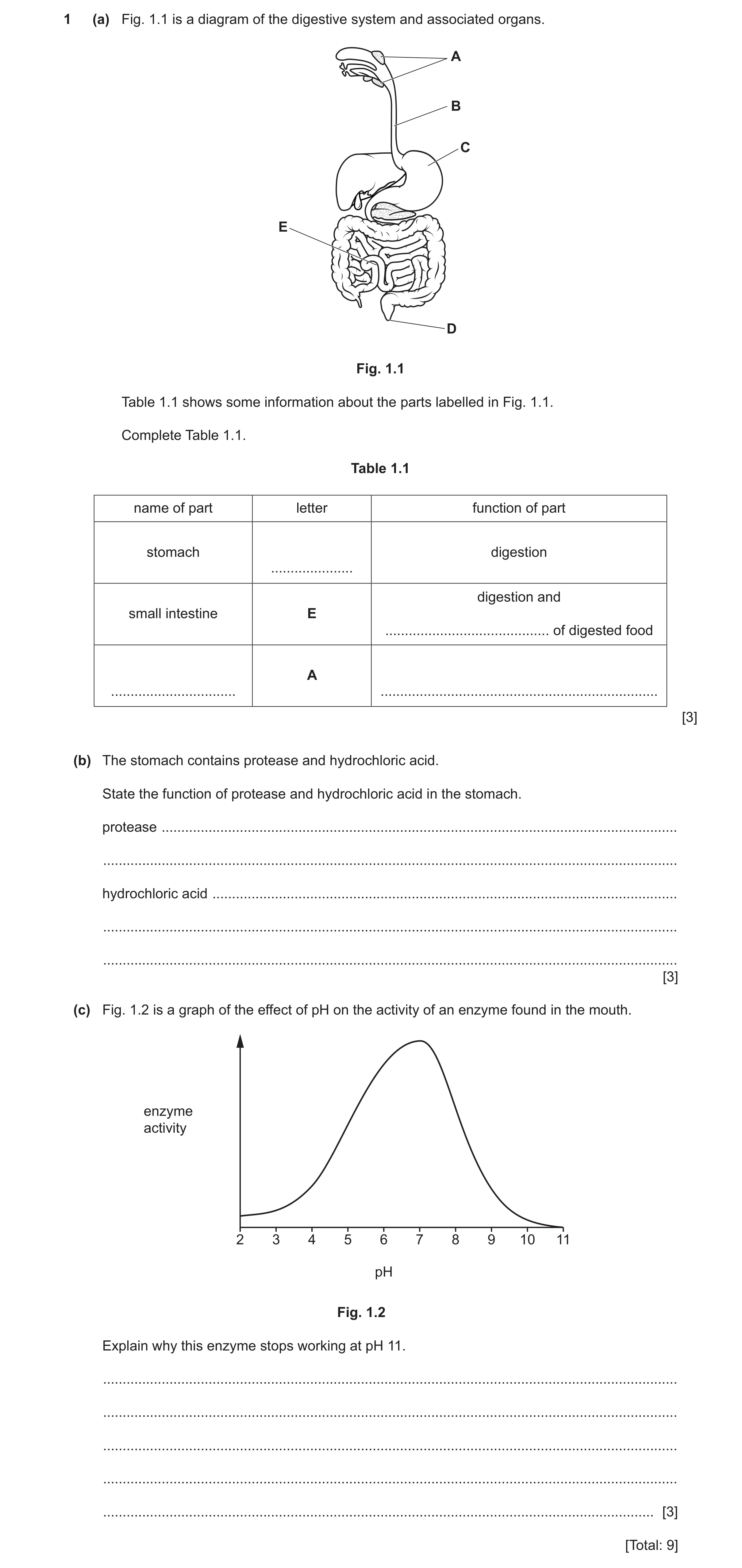
1 (a) Fig. 1.1 is a diagram of the digestive system and associated organs. A B C E D Fig. 1.1 Table 1.1 shows some information about the parts labelled in Fig. 1.1. Complete Table 1.1. Table 1.1 name of part letter function of part stomach digestion … digestion and small intestine E … of digested food A … … [3] (b) The stomach contains protease and hydrochloric acid. State the function of protease and hydrochloric acid in the stomach. protease … … hydrochloric acid … … … [3] (c) Fig. 1.2 is a graph of the effect of pH on the activity of an enzyme found in the mouth. enzyme activity 2 3 4 5 6 7 8 9 10 11 pH Fig. 1.2 Explain why this enzyme stops working at pH 11. … … … … … [3] [Total: 9]
9 marks
Mark scheme: Question Answer Marks 1(a) 3 name of part letter function of part stomach C digestion small intestine E (digestion and) absorption (of digested food) salivary gland A produce, saliva / amylase ;;; one mark for each correct row 1(b) protease: 3 digests / breaks down, proteins (into amino acids) ; hydrochloric acid: kills, (harmful) microorganisms / pathogens / bacteria ; provides optimum / acidic / low pH, for enzyme / protease ; 1(c) enzyme will denature ; 3 active site changes shape ; active site no longer complementary to substrate / substrate no longer fits active site ;
This question in 0653/42 May/June 2025
Q27 · A diagram of a cross-section through a leaf 0653/43 May/June 2025
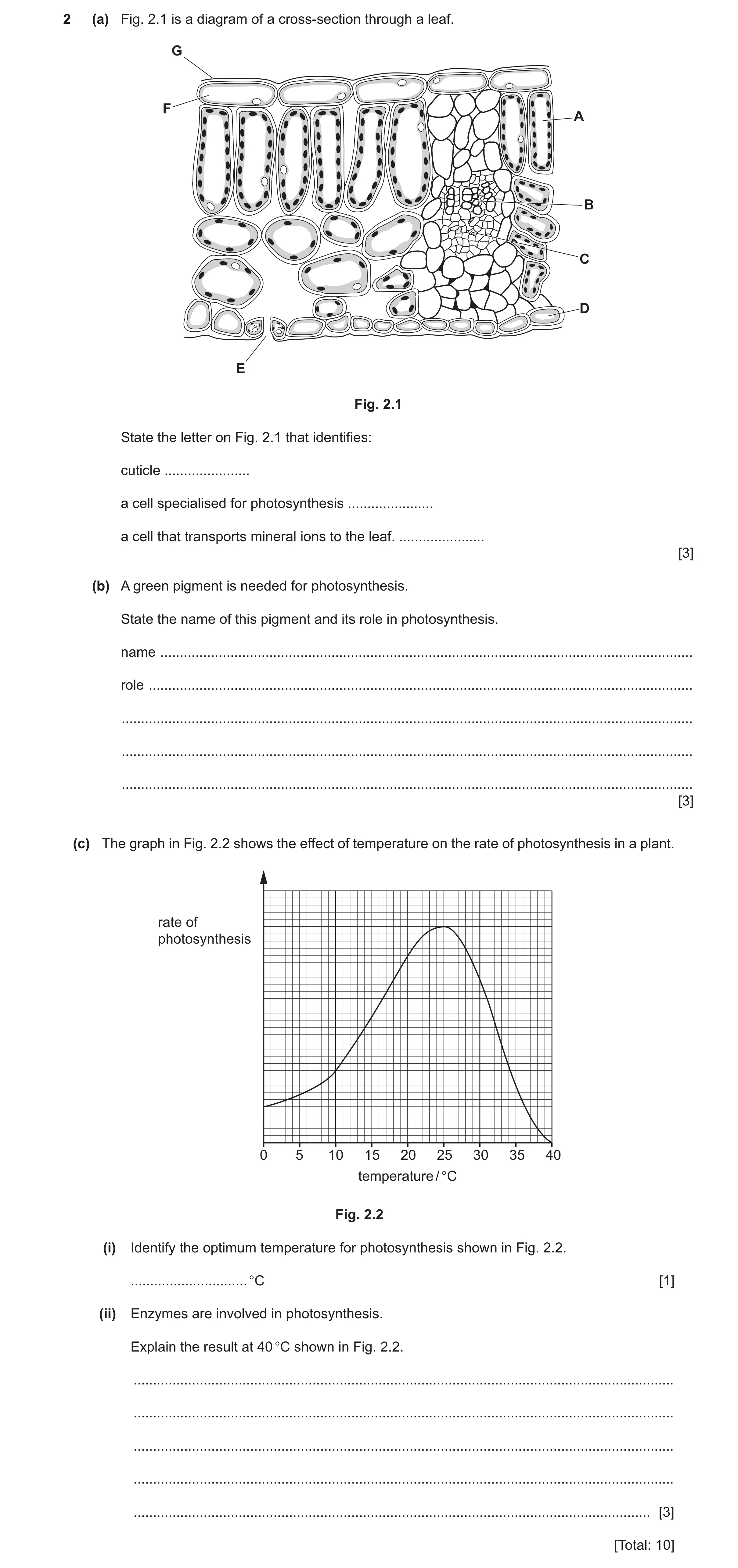
2 (a) Fig. 2.1 is a diagram of a cross-section through a leaf. G F A B C D E Fig. 2.1 State the letter on Fig. 2.1 that identifies: cuticle … a cell specialised for photosynthesis … a cell that transports mineral ions to the leaf. … [3] (b) A green pigment is needed for photosynthesis. State the name of this pigment and its role in photosynthesis. name … role … … … … [3] (c) The graph in Fig. 2.2 shows the effect of temperature on the rate of photosynthesis in a plant. rate of photosynthesis 0 5 10 15 20 25 30 35 40 temperature / °C Fig. 2.2 (i) Identify the optimum temperature for photosynthesis shown in Fig. 2.2. … °C [1] (ii) Enzymes are involved in photosynthesis. Explain the result at 40 °C shown in Fig. 2.2. … … … … … [3] [Total: 10]
10 marks
Mark scheme: 2(a) G ; 3 A ; B ; 2(b) chlorophyll ; 3 transfers light energy to chemical energy ; to synthesise / produce, carbohydrates / glucose ; 2(c)(i) 25 (°C) ; 1 2(c)(ii) enzymes denature (at high temperature) ; 3 active site changes shape ; active site no longer complementary to substrate / substrate no longer fits active site ;
This question in 0653/43 May/June 2025
Q28 · A diagram of a cross-section through a leaf 0653/42 Oct/Nov 2025
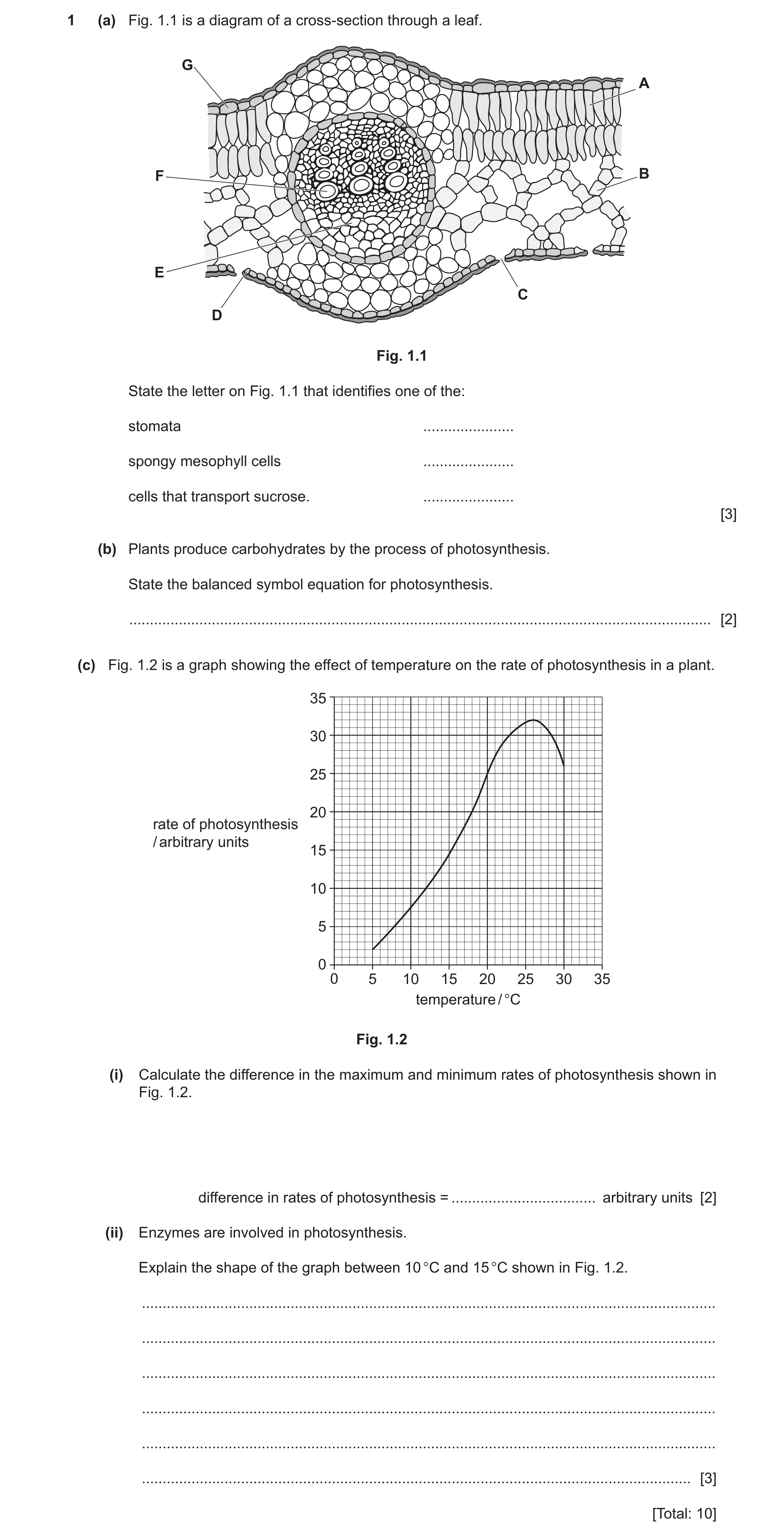
1 (a) Fig. 1.1 is a diagram of a cross-section through a leaf. G A F B E C D Fig. 1.1 State the letter on Fig. 1.1 that identifies one of the: stomata … spongy mesophyll cells … cells that transport sucrose. … [3] (b) Plants produce carbohydrates by the process of photosynthesis. State the balanced symbol equation for photosynthesis. … [2] (c) Fig. 1.2 is a graph showing the effect of temperature on the rate of photosynthesis in a plant. 35 30 25 20 rate of photosynthesis / arbitrary units 15 10 5 0 0 5 10 15 20 25 30 35 temperature / °C Fig. 1.2 (i) Calculate the difference in the maximum and minimum rates of photosynthesis shown in Fig. 1.2. difference in rates of photosynthesis = … arbitrary units [2] (ii) Enzymes are involved in photosynthesis. Explain the shape of the graph between 10 °C and 15 °C shown in Fig. 1.2. … … … … … … [3] [Total: 10]
10 marks
Mark scheme: Question Answer Marks 1(a) C ; 3 B ; E ; 1(b) 6CO2 + 6H2O ; 2 → C6H12O6 + 6O2 ; 1(c)(i) 32 – 2 or (max rate = ) 32 seen or (min rate =) 2 seen ; 2 (max difference = ) 30 (arbitrary units) ; 1(c)(ii) increasing temperature / from 10 °C to 15 °C and linked to 3 any three ;;; • increasing rate of photosynthesis • increasing enzyme activity ; • increasing kinetic energy / enzymes move faster ; • more frequency of (enzyme-substrate) collisions ; • more / faster formation of enzyme-substrate complexes ;
This question in 0653/42 Oct/Nov 2025
Q29 · Part of the human alimentary canal and associated organs 0653/43 Oct/Nov 2025
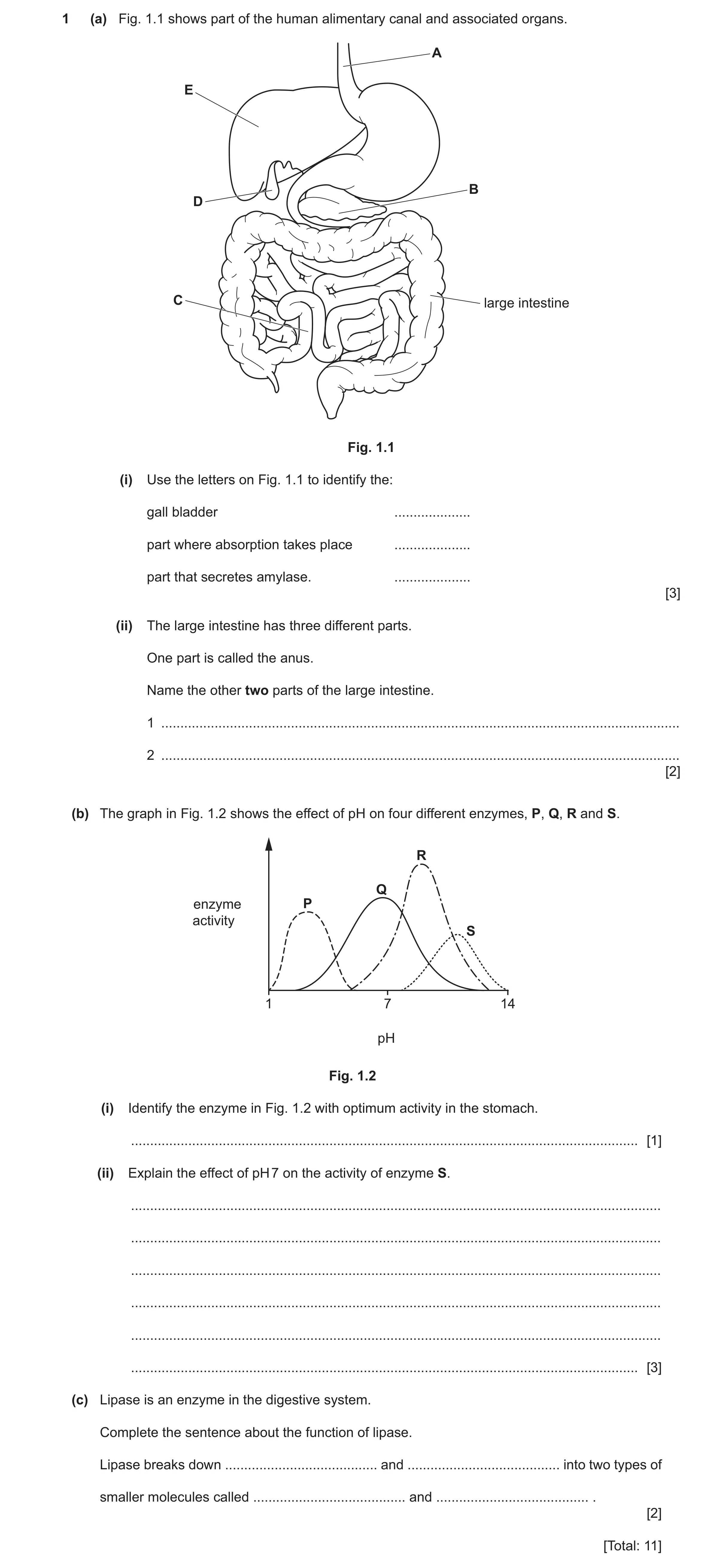
1 (a) Fig. 1.1 shows part of the human alimentary canal and associated organs. A E B D C large intestine Fig. 1.1 (i) Use the letters on Fig. 1.1 to identify the: gall bladder … part where absorption takes place … part that secretes amylase. … [3] (ii) The large intestine has three different parts. One part is called the anus. Name the other two parts of the large intestine. 1 … 2 … [2] (b) The graph in Fig. 1.2 shows the effect of pH on four different enzymes, P, Q, R and S. R Q enzyme P activity S 1 7 14 pH Fig. 1.2 (i) Identify the enzyme in Fig. 1.2 with optimum activity in the stomach. … [1] (ii) Explain the effect of pH 7 on the activity of enzyme S. … … … … … … [3] (c) Lipase is an enzyme in the digestive system. Complete the sentence about the function of lipase. Lipase breaks down … and … into two types of smaller molecules called … and … . [2] [Total: 11]
11 marks
Mark scheme: Question Answer Marks 1(a)(i) D ; 3 C ; B ; 1(a)(ii) colon ; 2 rectum ; 1(b)(i) P ; 1 1(b)(ii) enzyme will denature (at pH 7) ; 3 active site changes shape ; (active site) no longer complementary to substrate / substrate no longer fits active site / enzyme-substrate complexes cannot form ; 1(c) fats AND oils; 2 fatty acids AND glycerol ;
This question in 0653/43 Oct/Nov 2025
 5 / 44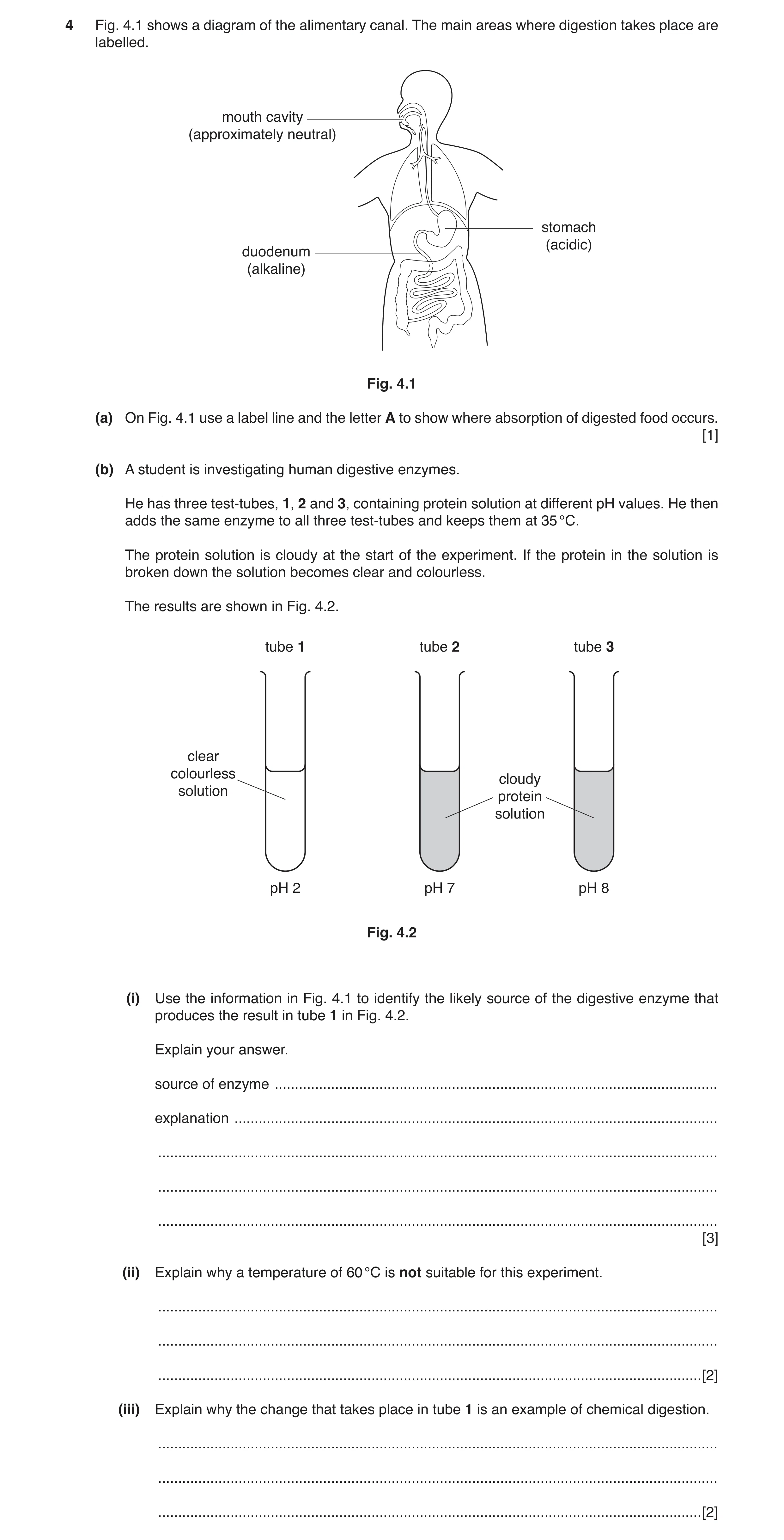
 12 / 44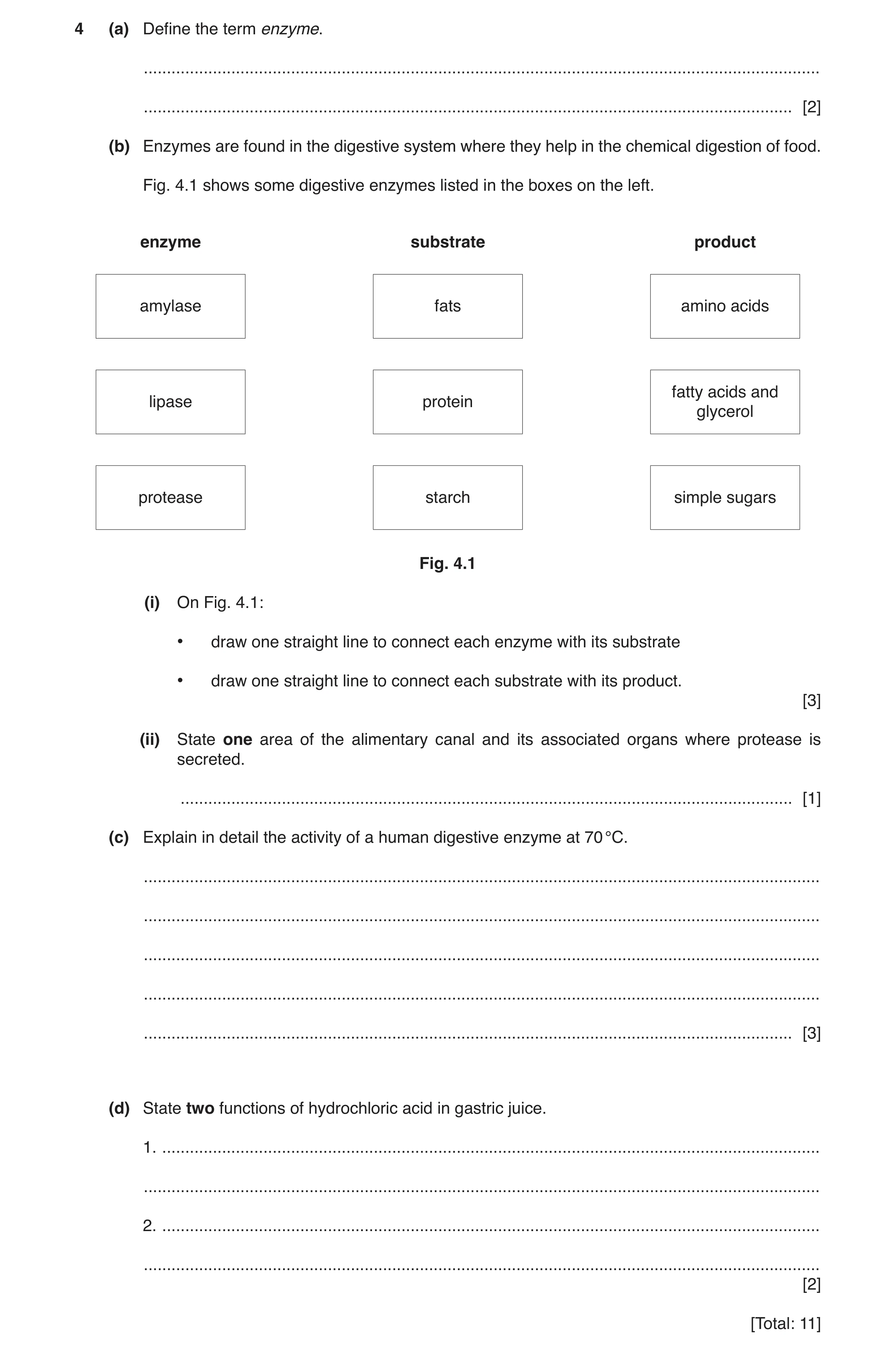
 32 / 44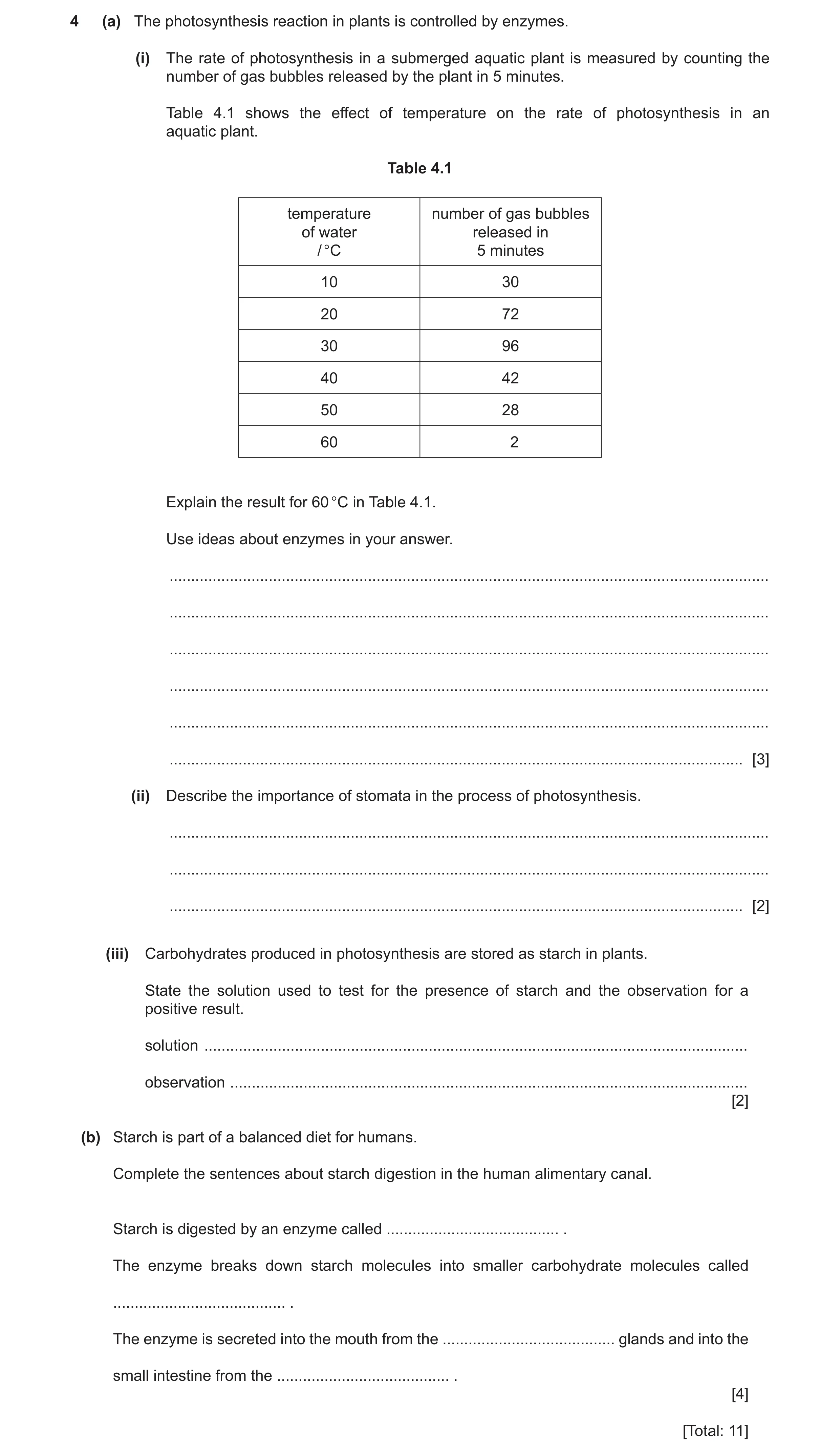
 9
9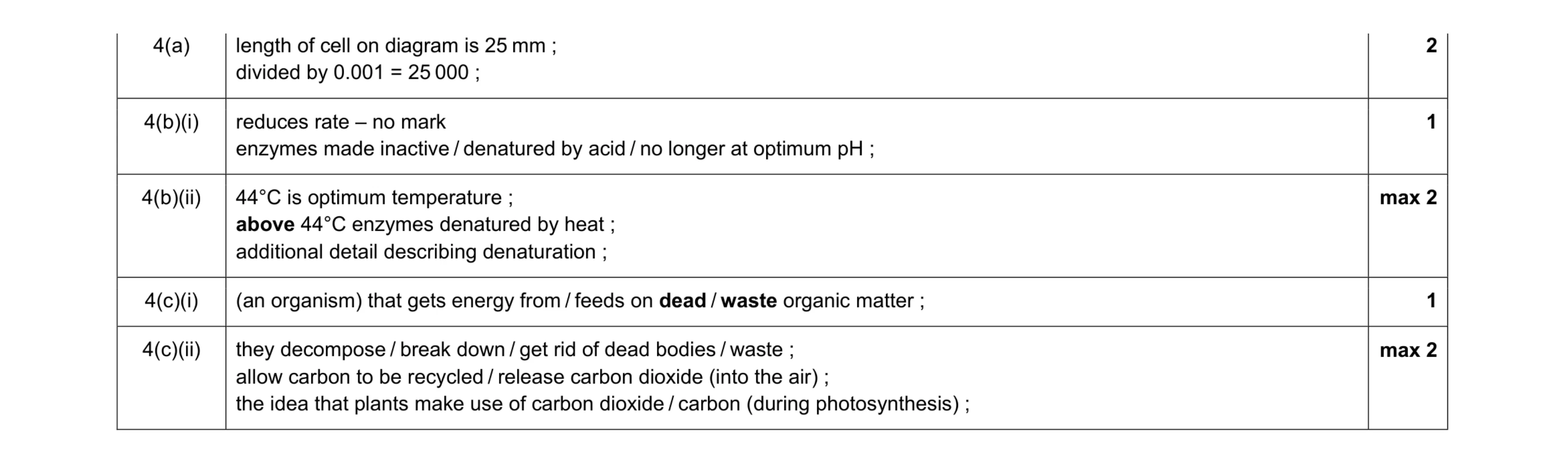 8
8 5
5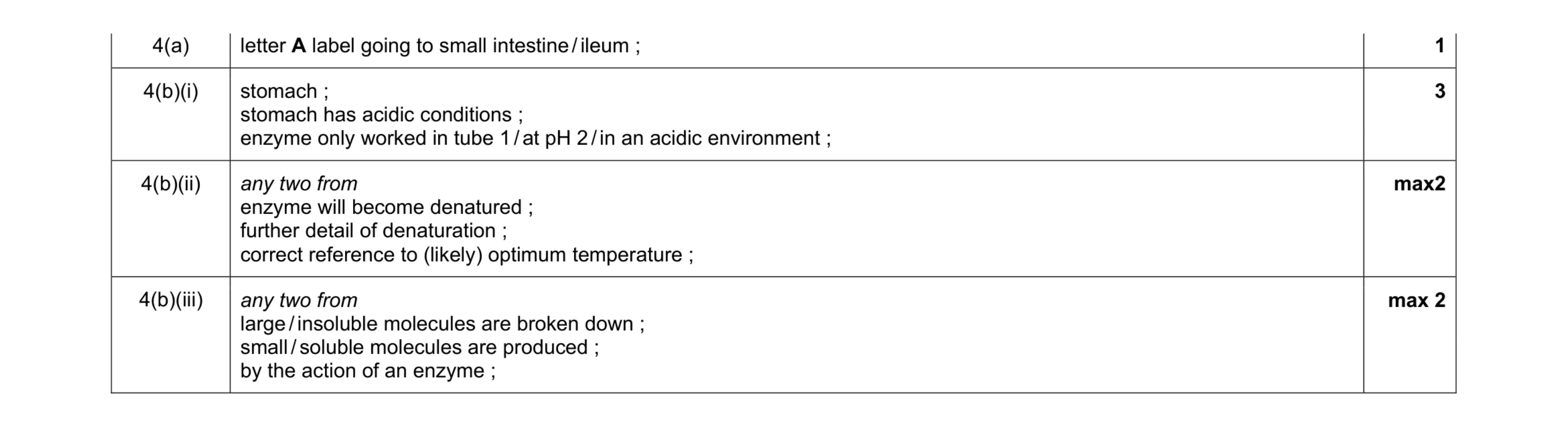 8
8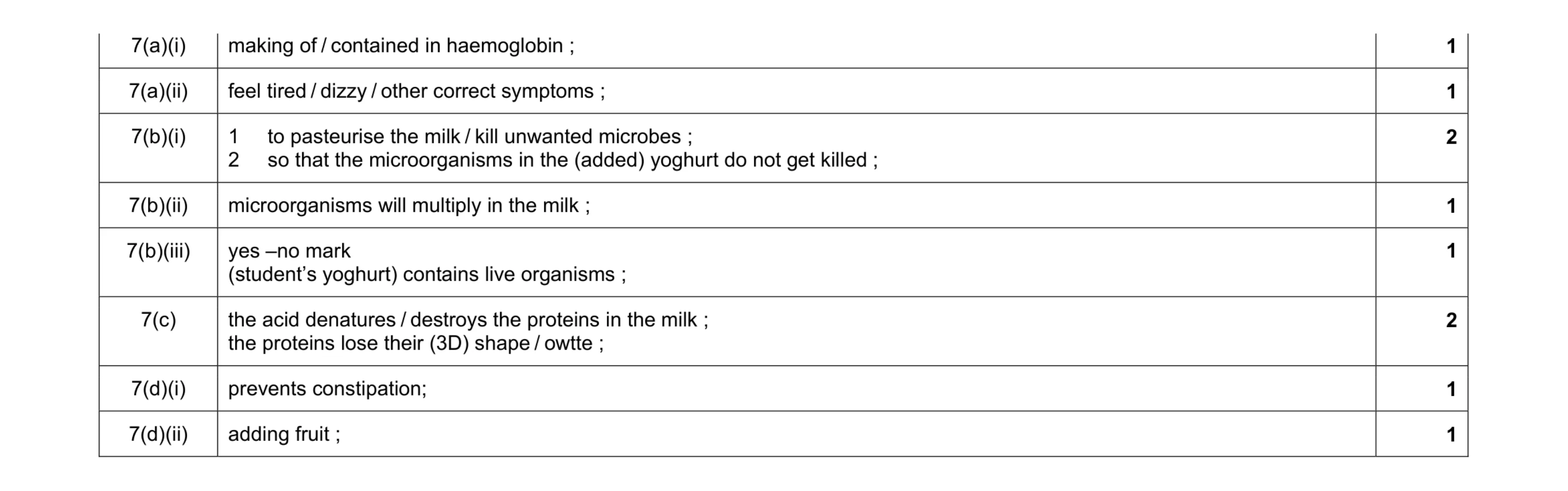 10
10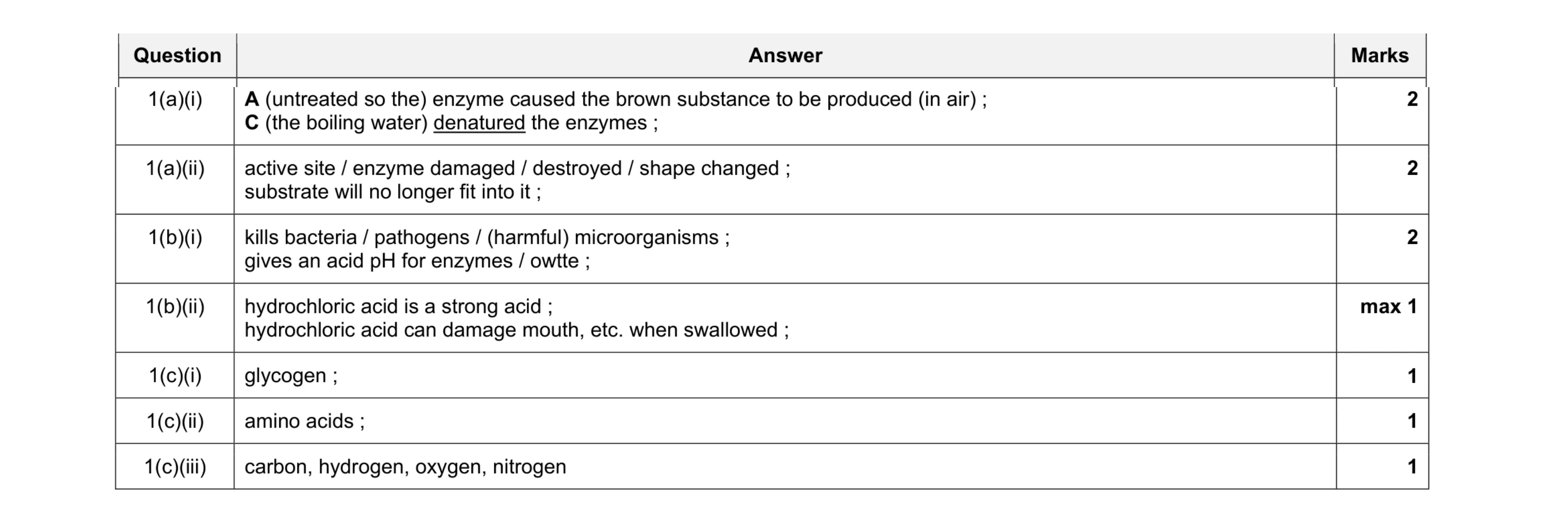 10
10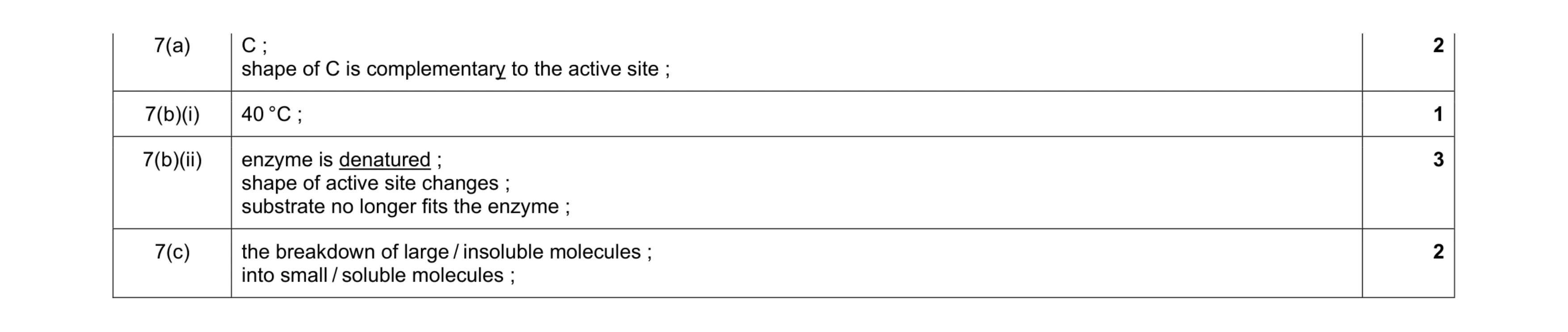 8
8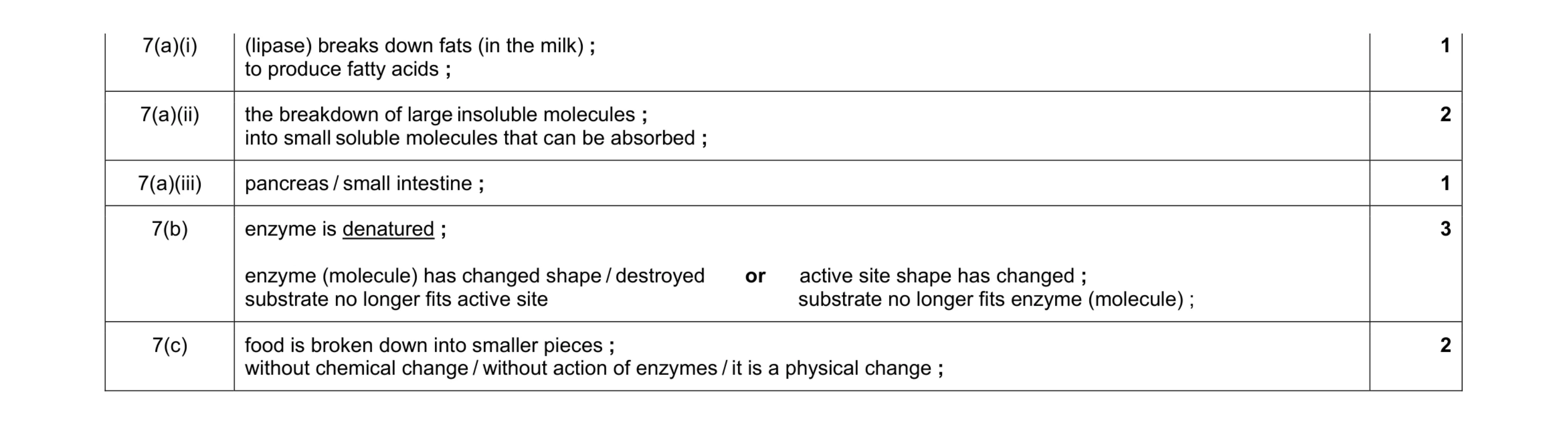 10
10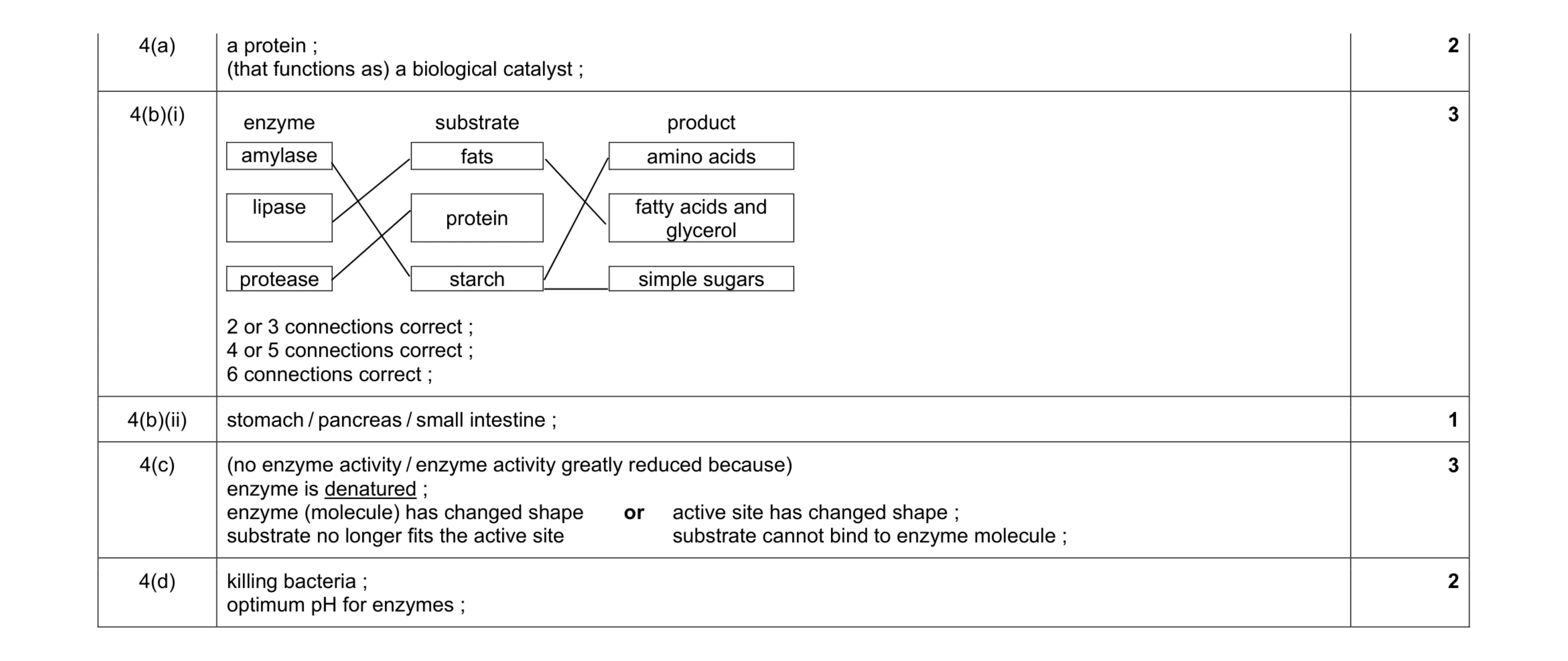 11
11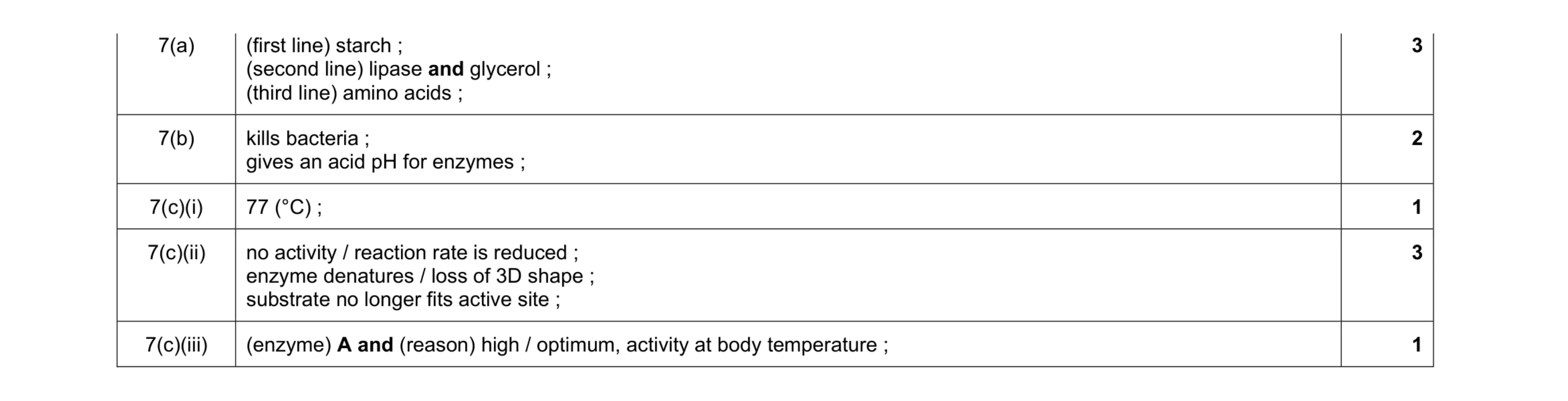 10
10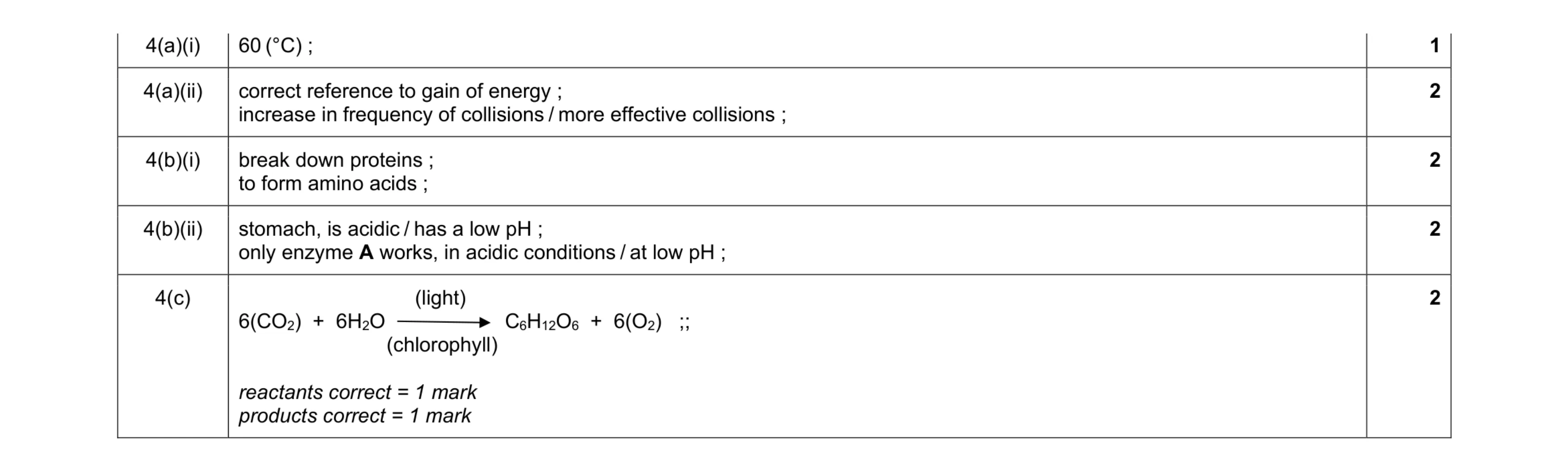 9
9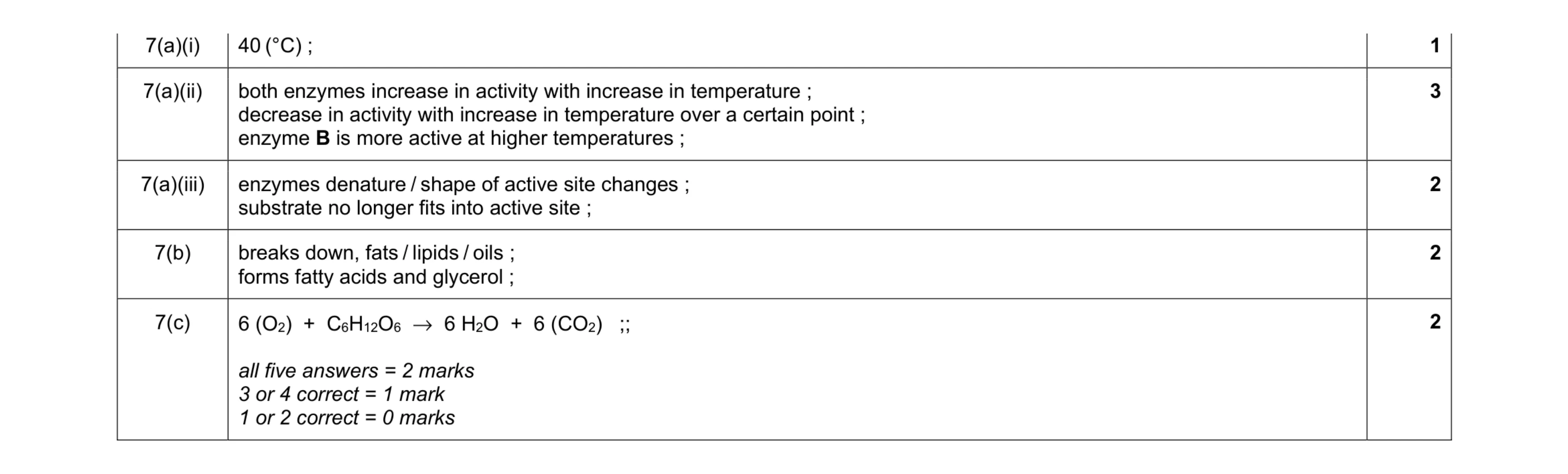 10
10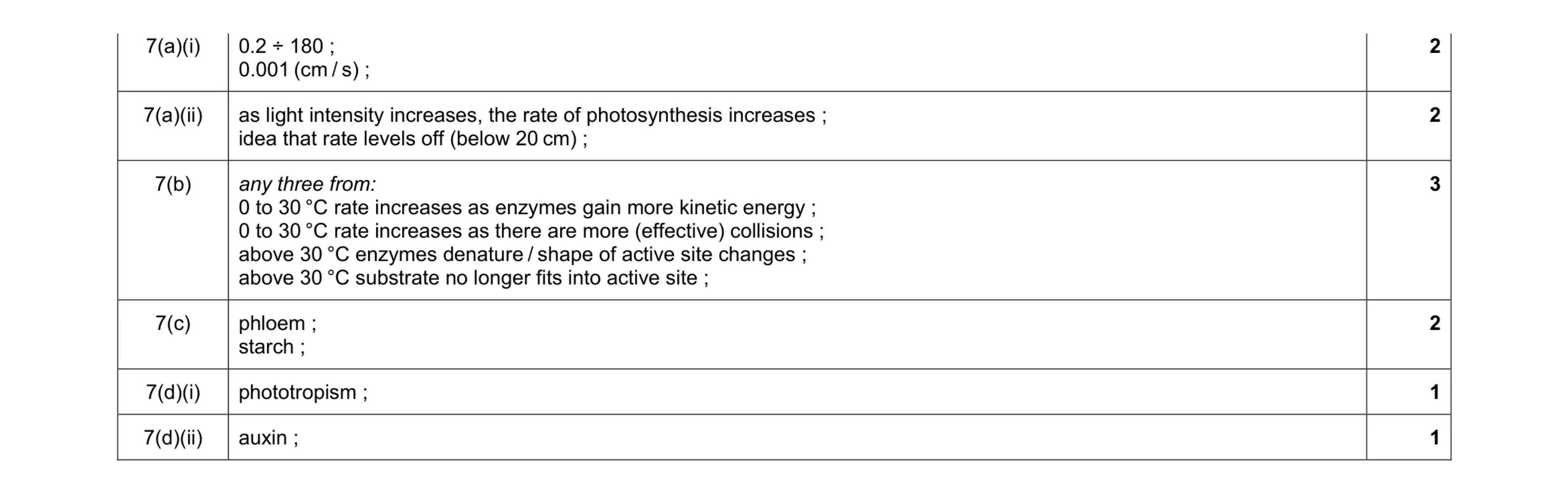 11
11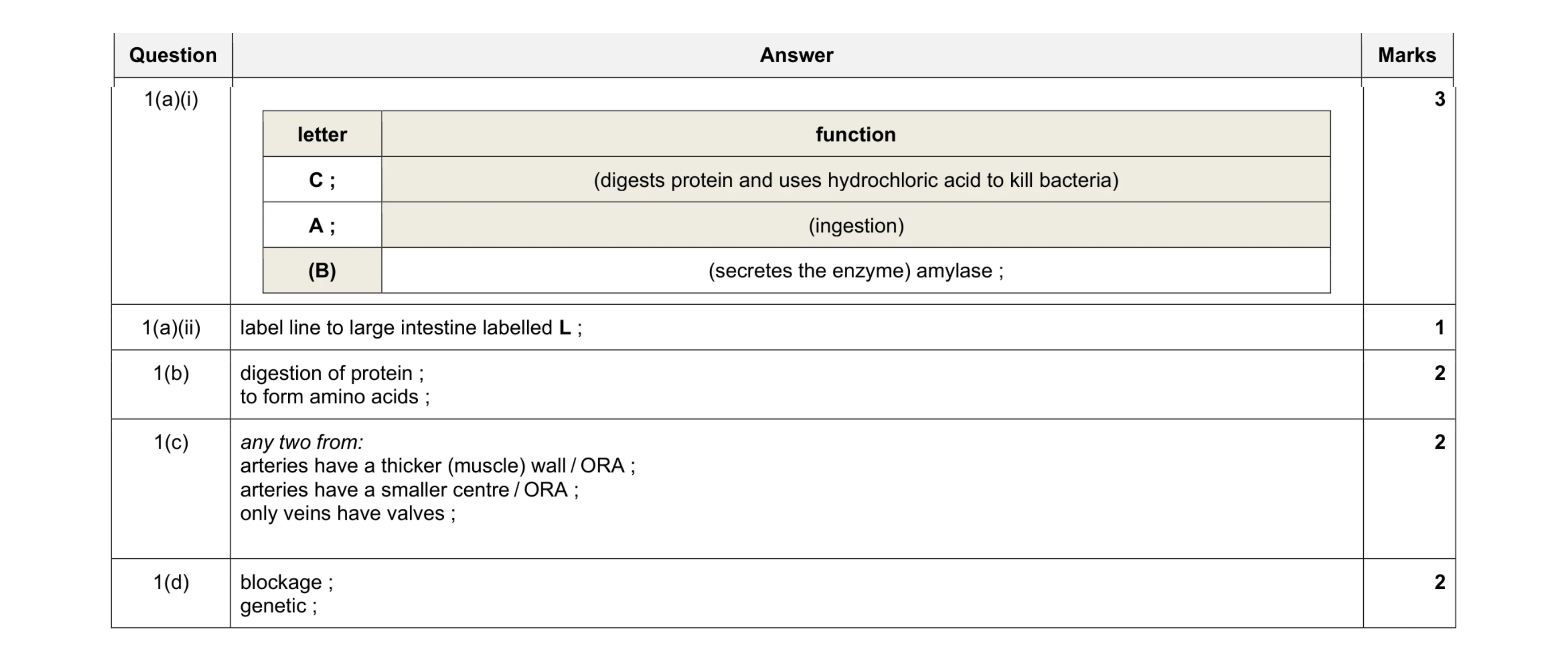 10
10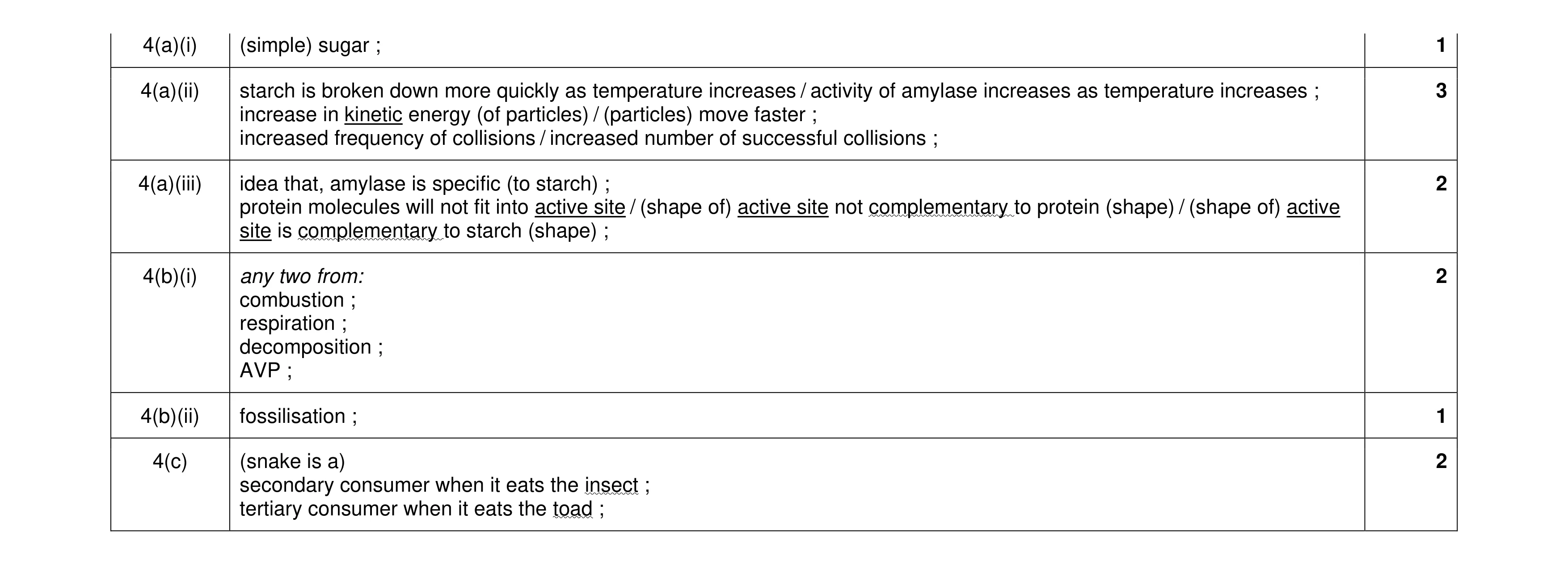 11
11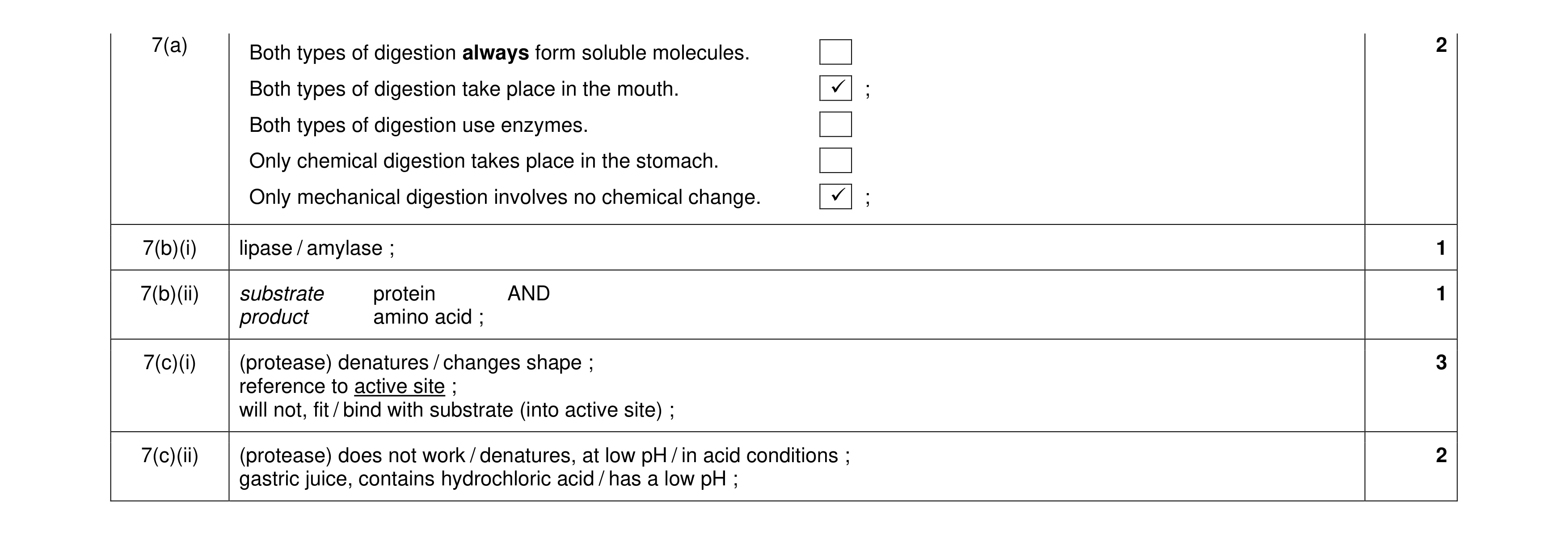 9
9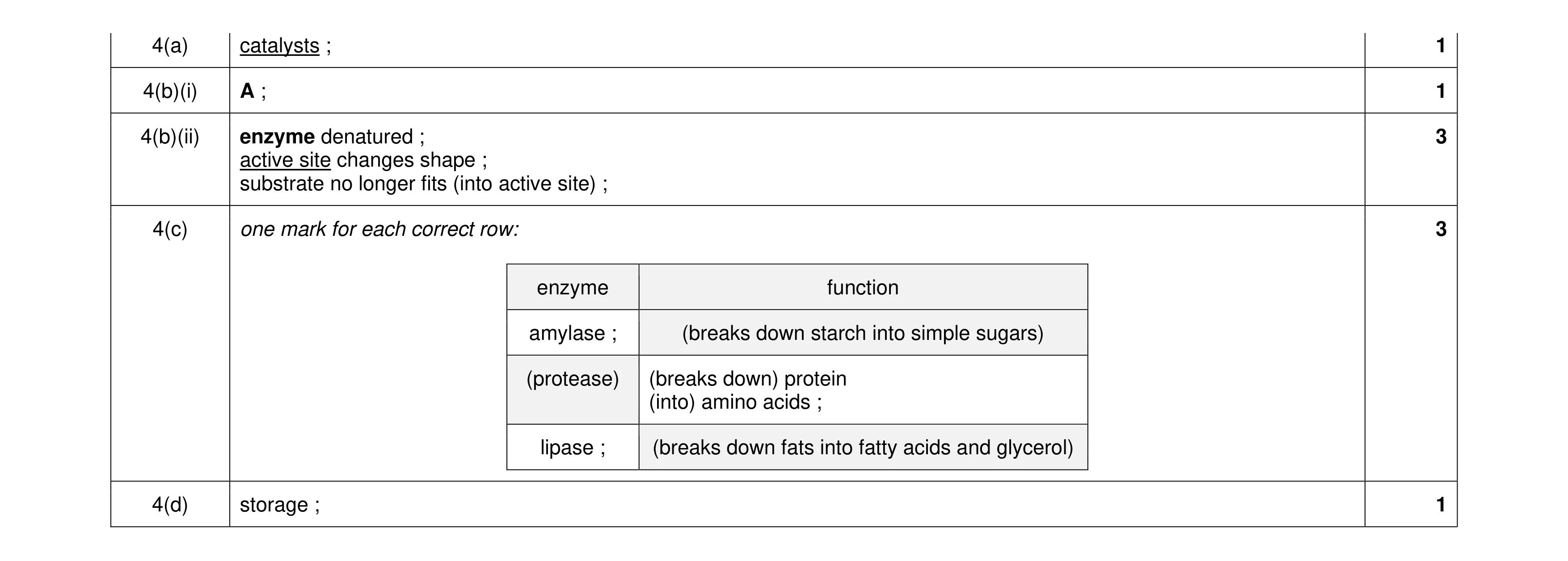 9
9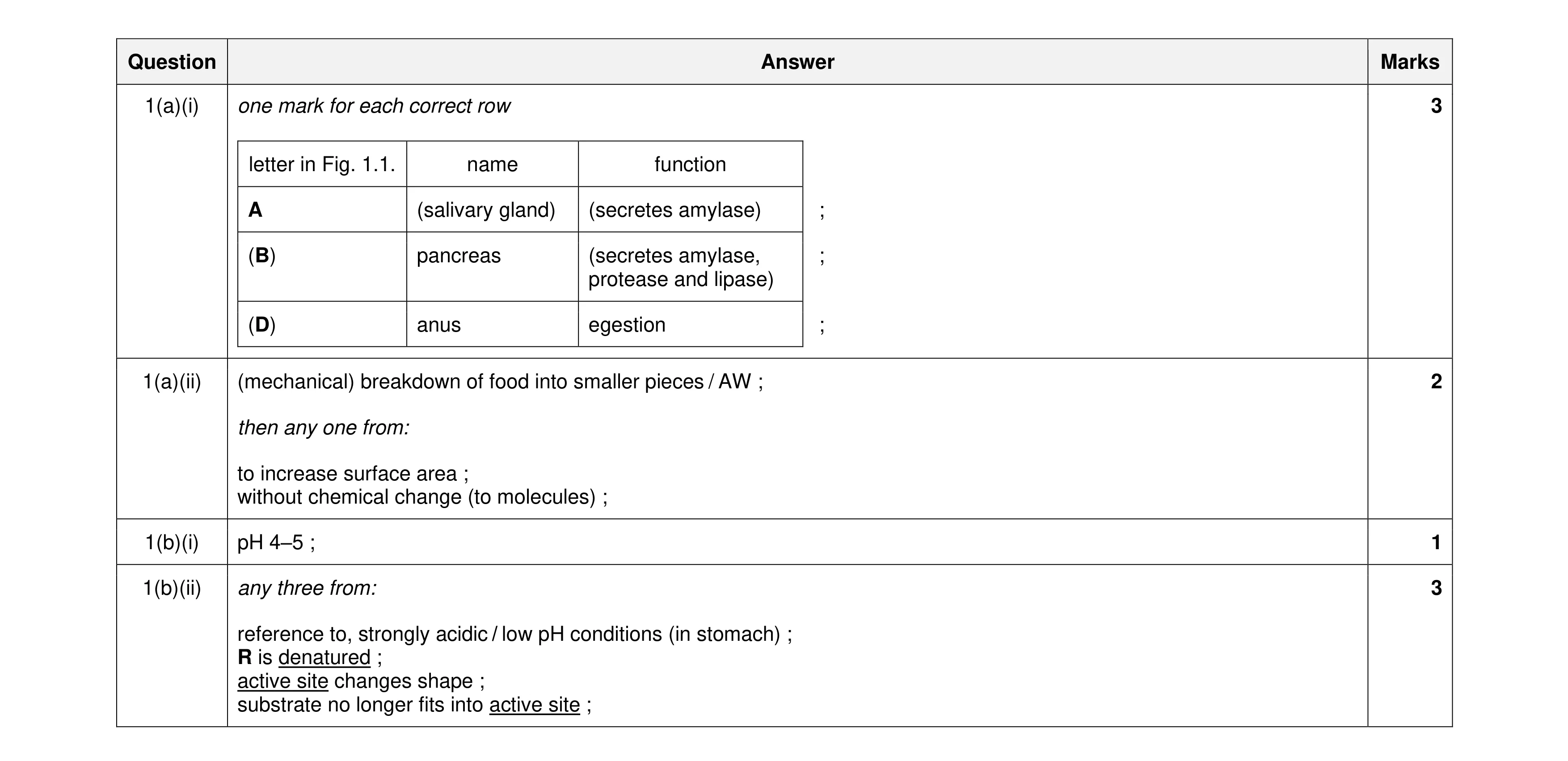 9
9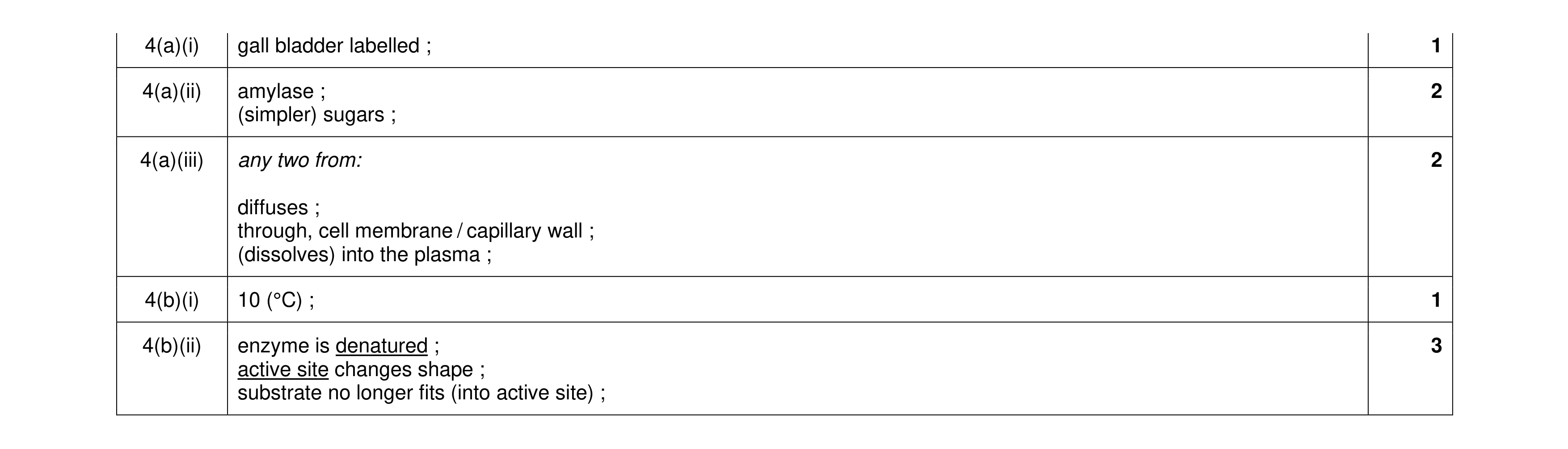 9
9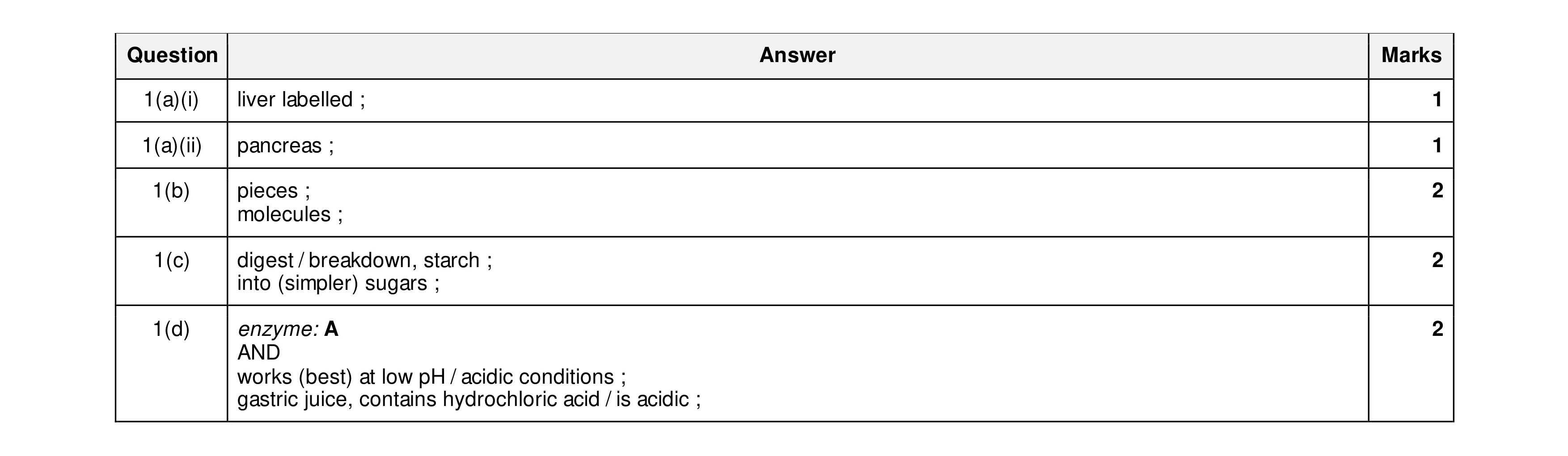 8
8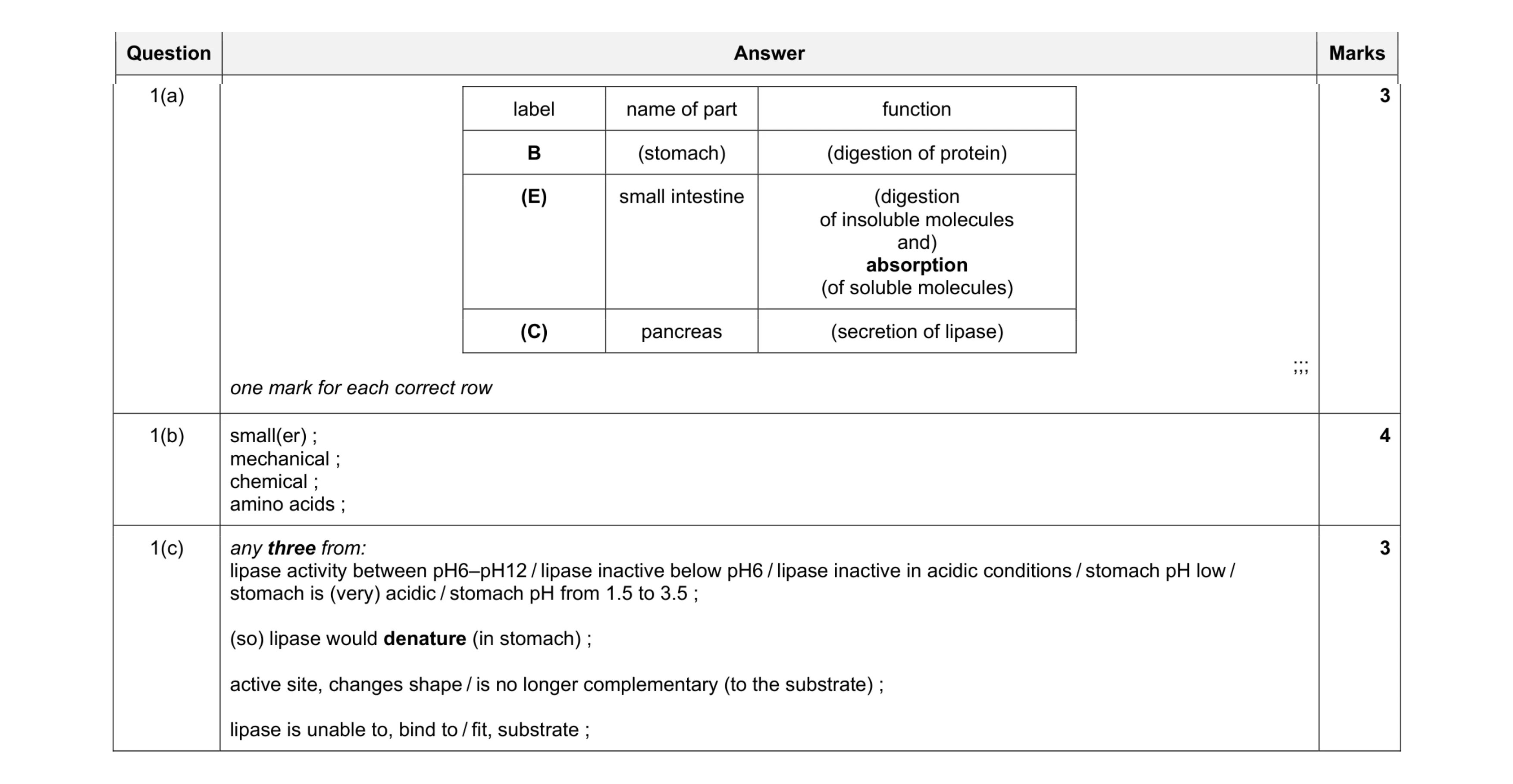 10
10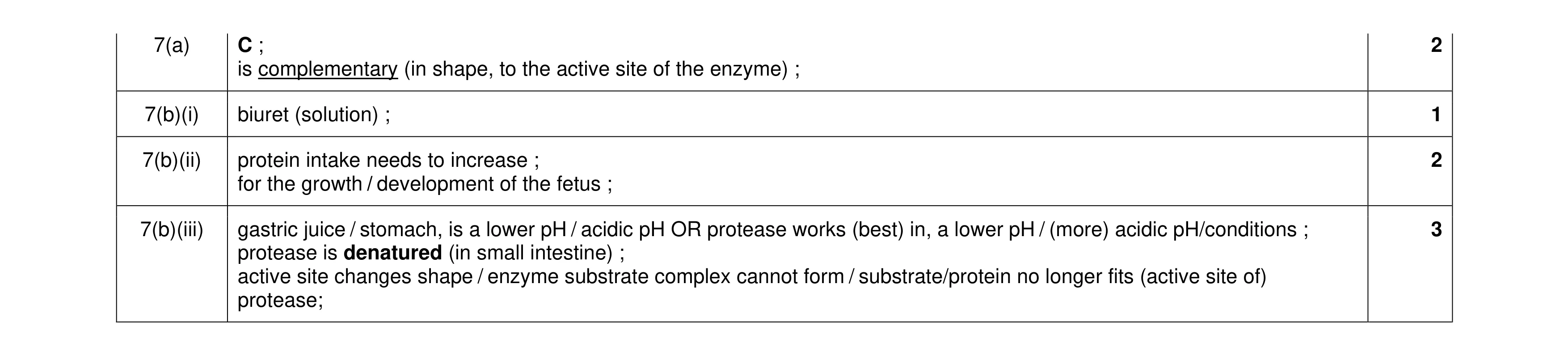 8
8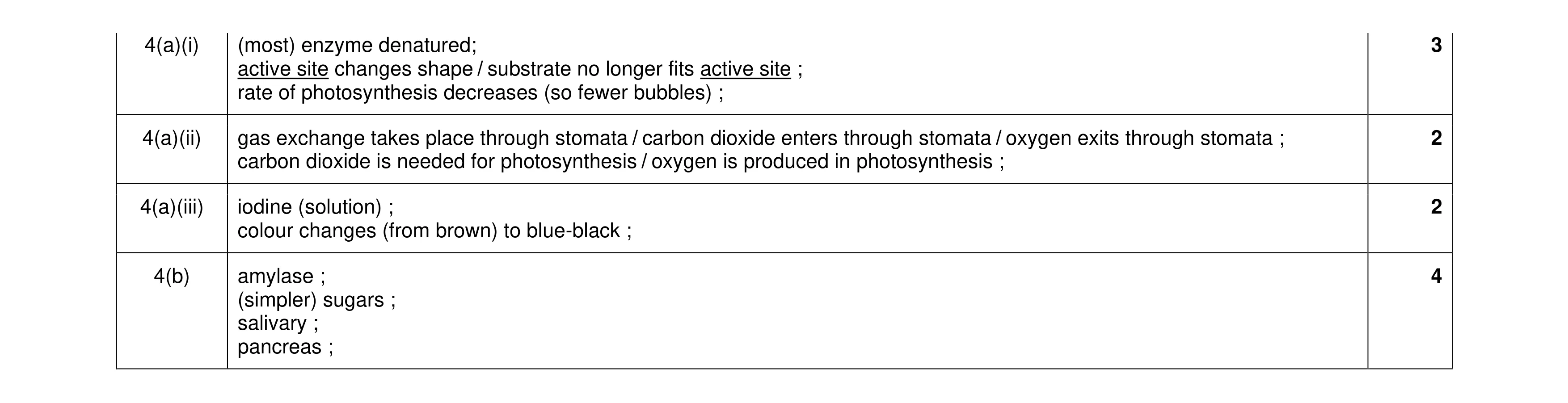 11
11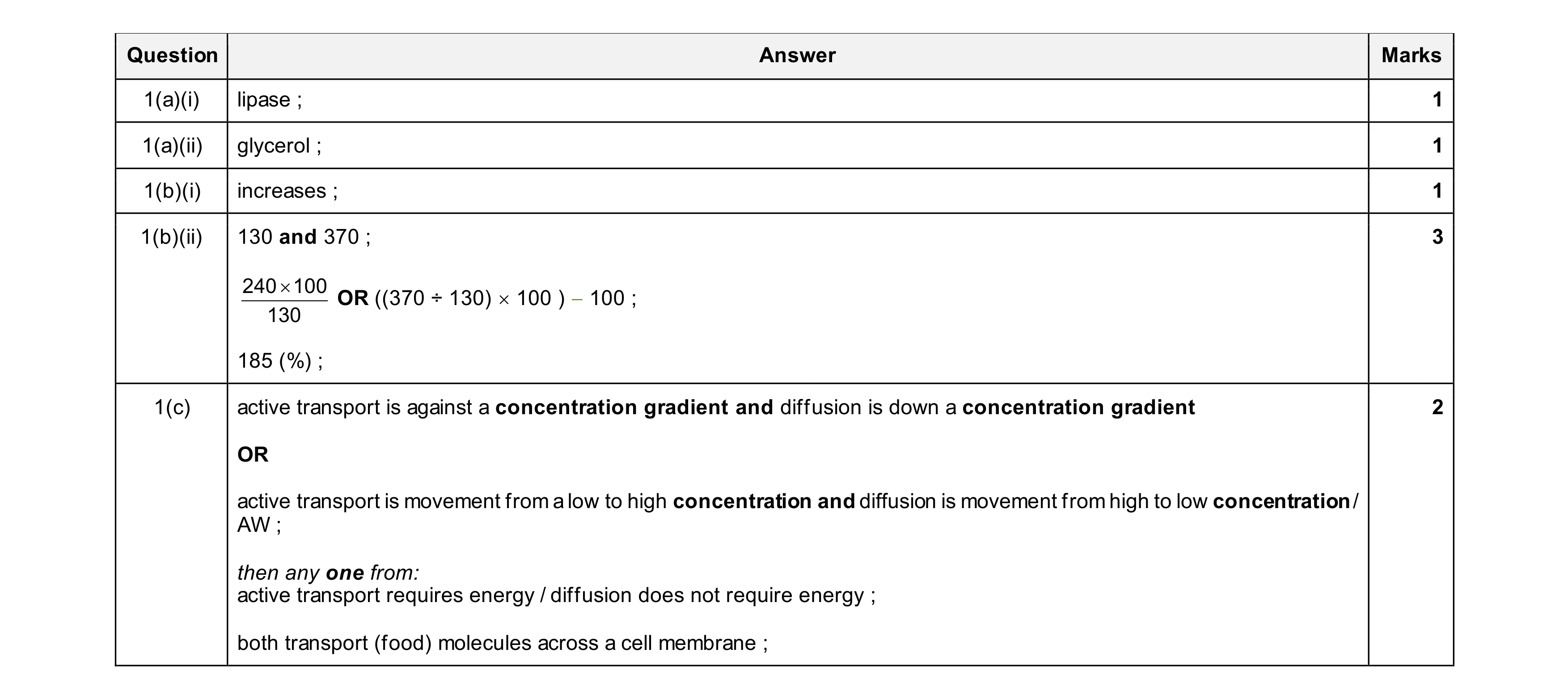 8
8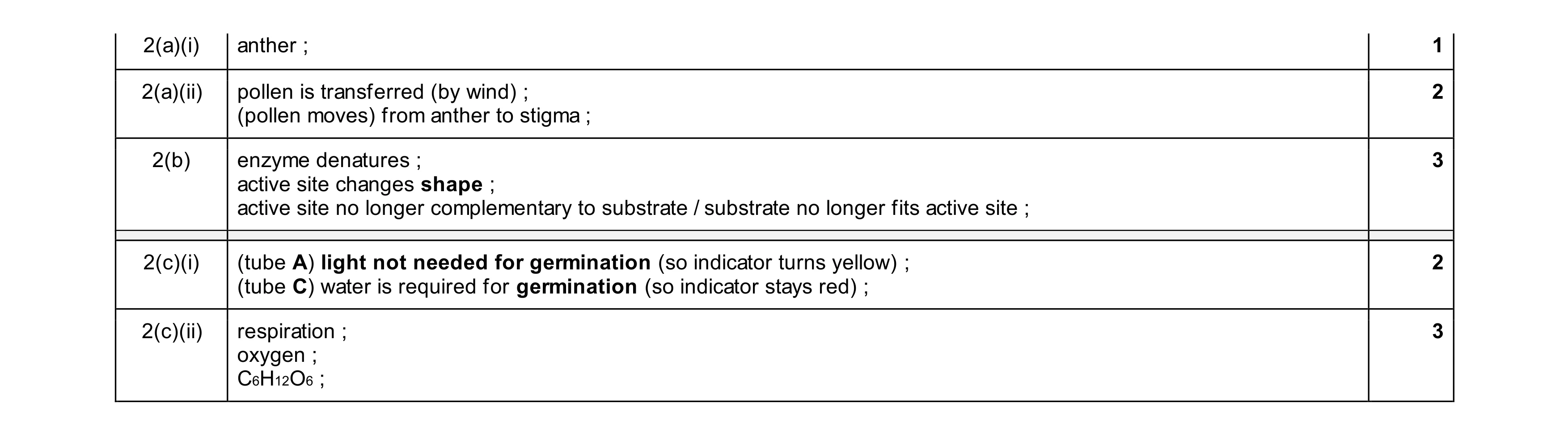 11
11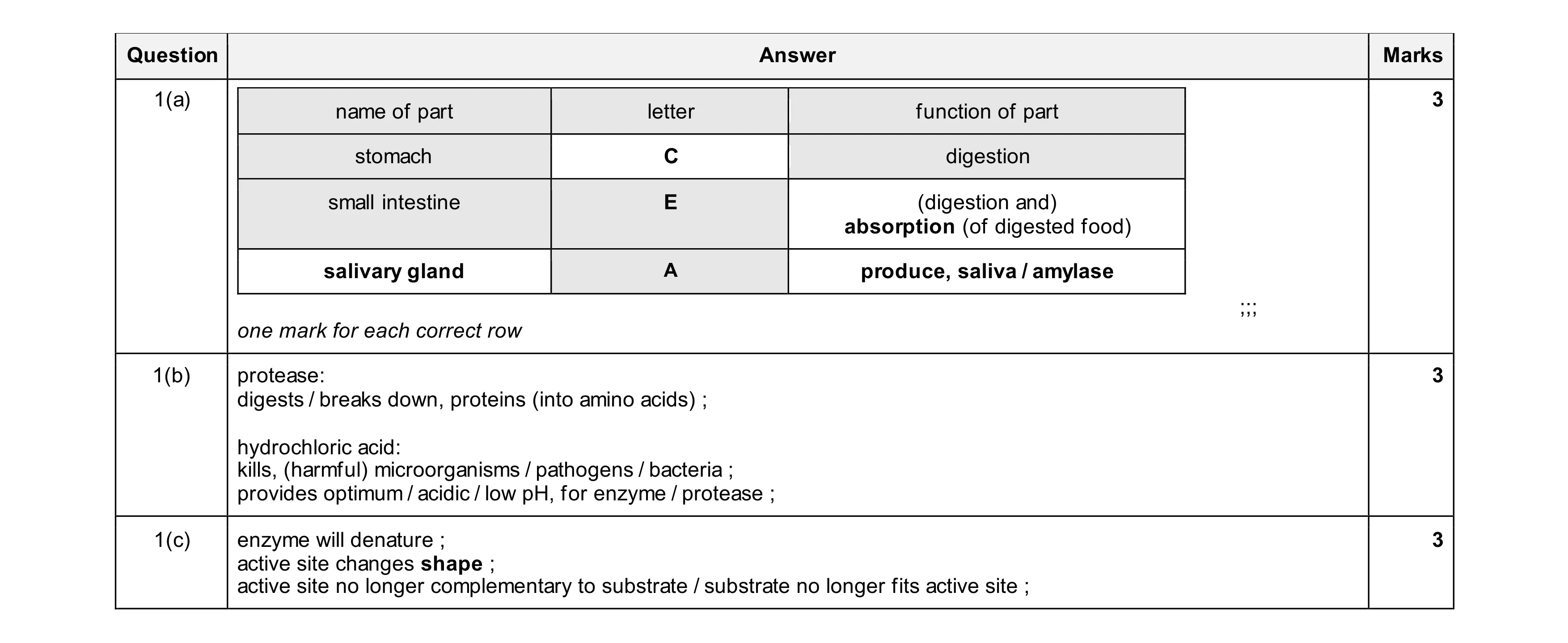 9
9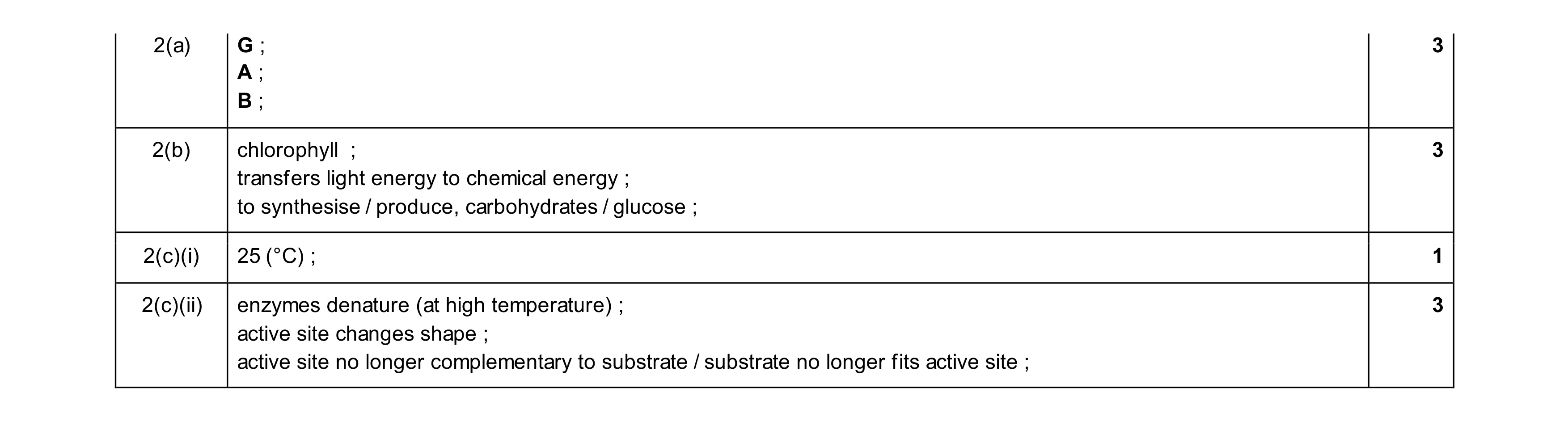 10
10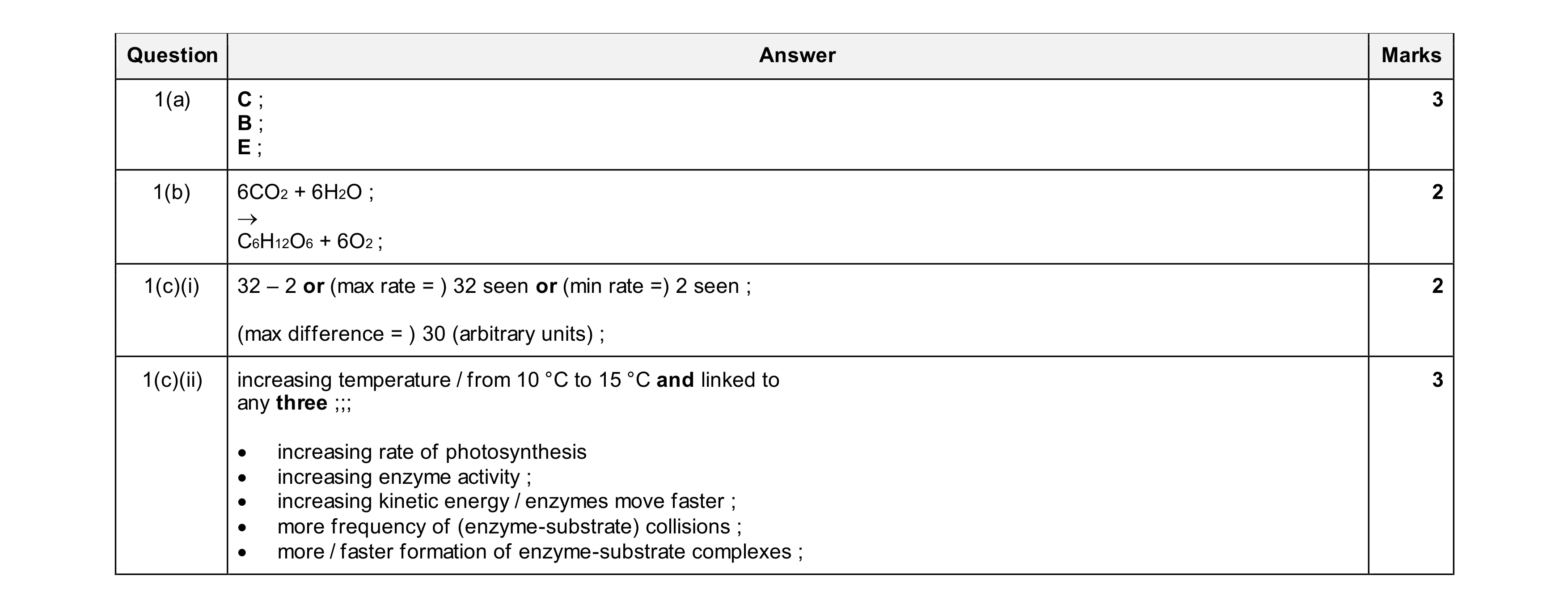 10
10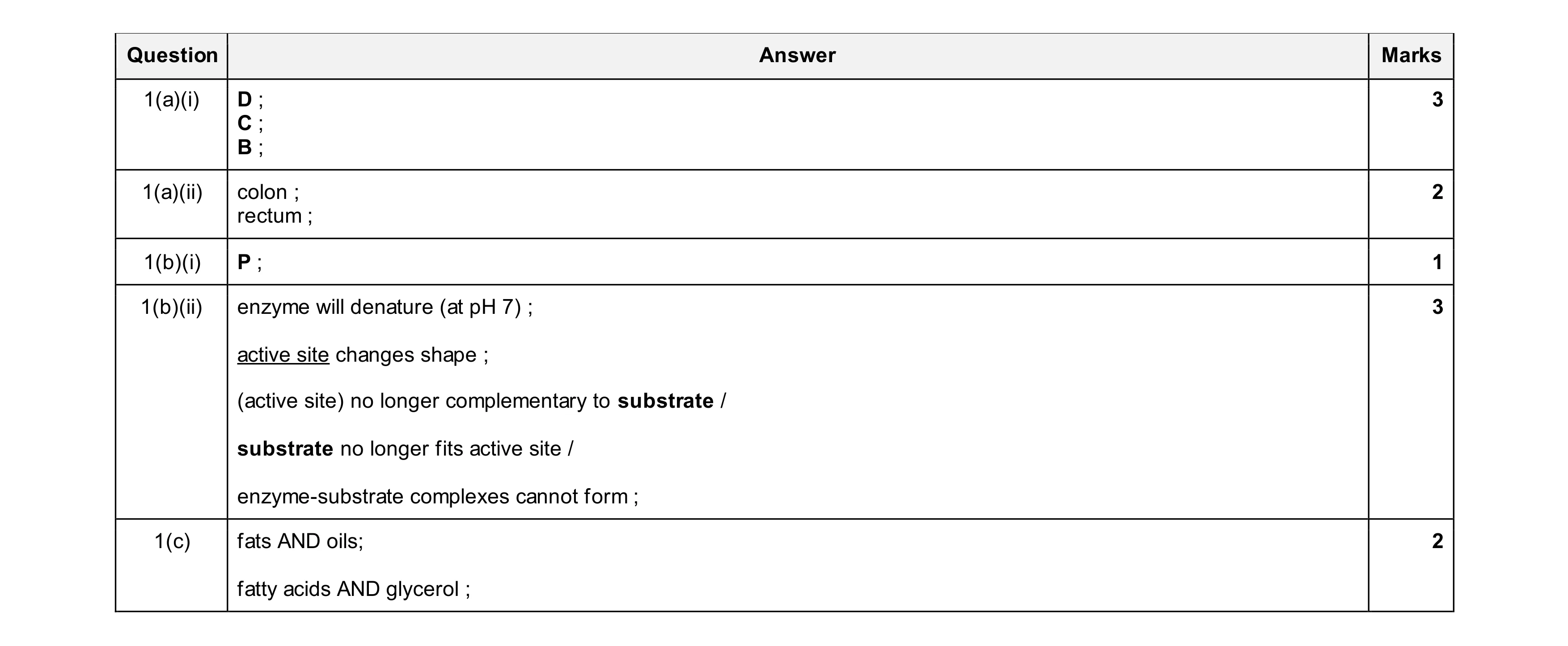 11
11