Questions as text
Q1 · Use lines to connect the box on the left to different boxes on the right to make correct… 0653/32 May/June 2017
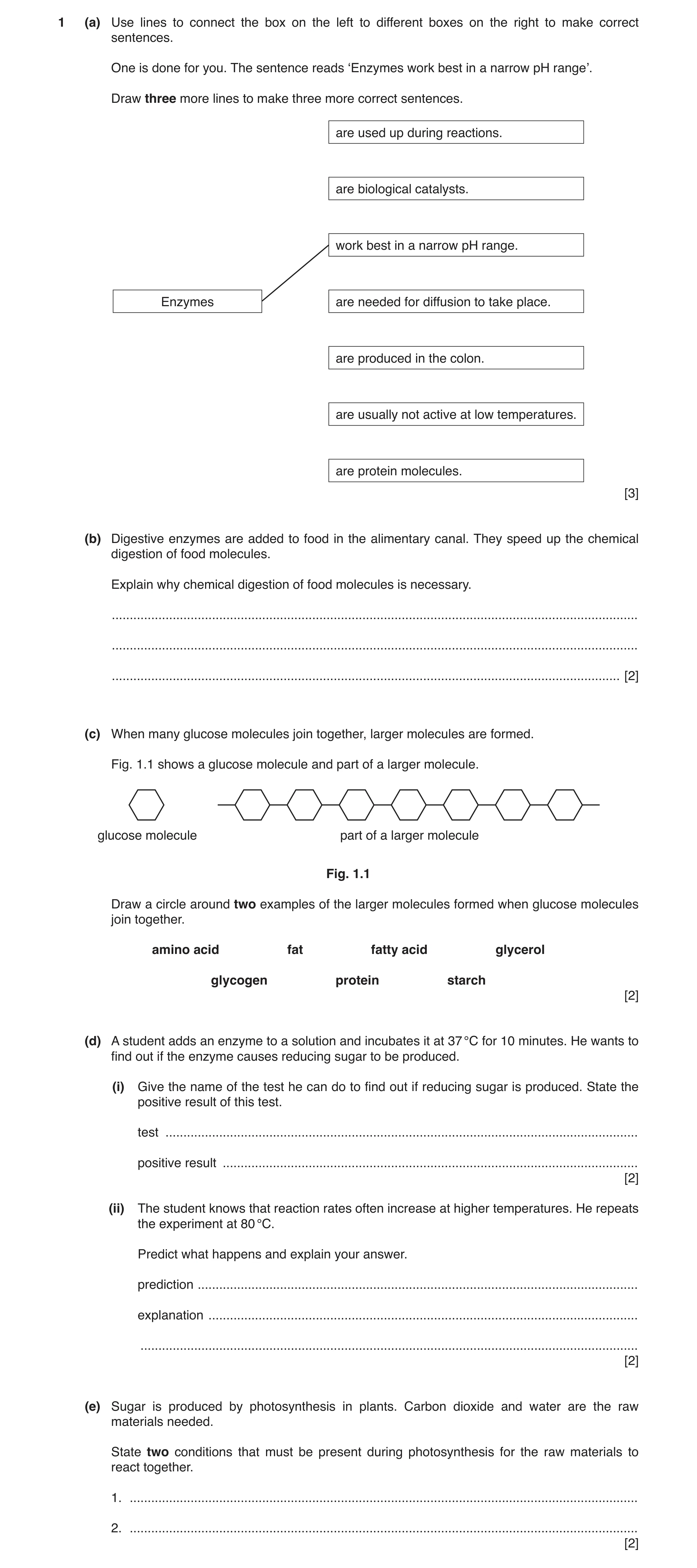
1 (a) Use lines to connect the box on the left to different boxes on the right to make correct sentences. One is done for you. The sentence reads ‘Enzymes work best in a narrow pH range’. Draw three more lines to make three more correct sentences. are used up during reactions. are biological catalysts. work best in a narrow pH range. Enzymes are needed for diffusion to take place. are produced in the colon. are usually not active at low temperatures. are protein molecules. [3] (b) Digestive enzymes are added to food in the alimentary canal. They speed up the chemical digestion of food molecules. Explain why chemical digestion of food molecules is necessary. … … … [2] (c) When many glucose molecules join together, larger molecules are formed. Fig. 1.1 shows a glucose molecule and part of a larger molecule. glucose molecule part of a larger molecule Fig. 1.1 Draw a circle around two examples of the larger molecules formed when glucose molecules join together. amino acid fat fatty acid glycerol glycogen protein starch [2] (d) A student adds an enzyme to a solution and incubates it at 37 °C for 10 minutes. He wants to find out if the enzyme causes reducing sugar to be produced. (i) Give the name of the test he can do to find out if reducing sugar is produced. State the positive result of this test. test … positive result … [2] (ii) The student knows that reaction rates often increase at higher temperatures. He repeats the experiment at 80 °C. Predict what happens and explain your answer. prediction … explanation … … [2] (e) Sugar is produced by photosynthesis in plants. Carbon dioxide and water are the raw materials needed. State two conditions that must be present during photosynthesis for the raw materials to react together. 1. … 2. … [2]
13 marks
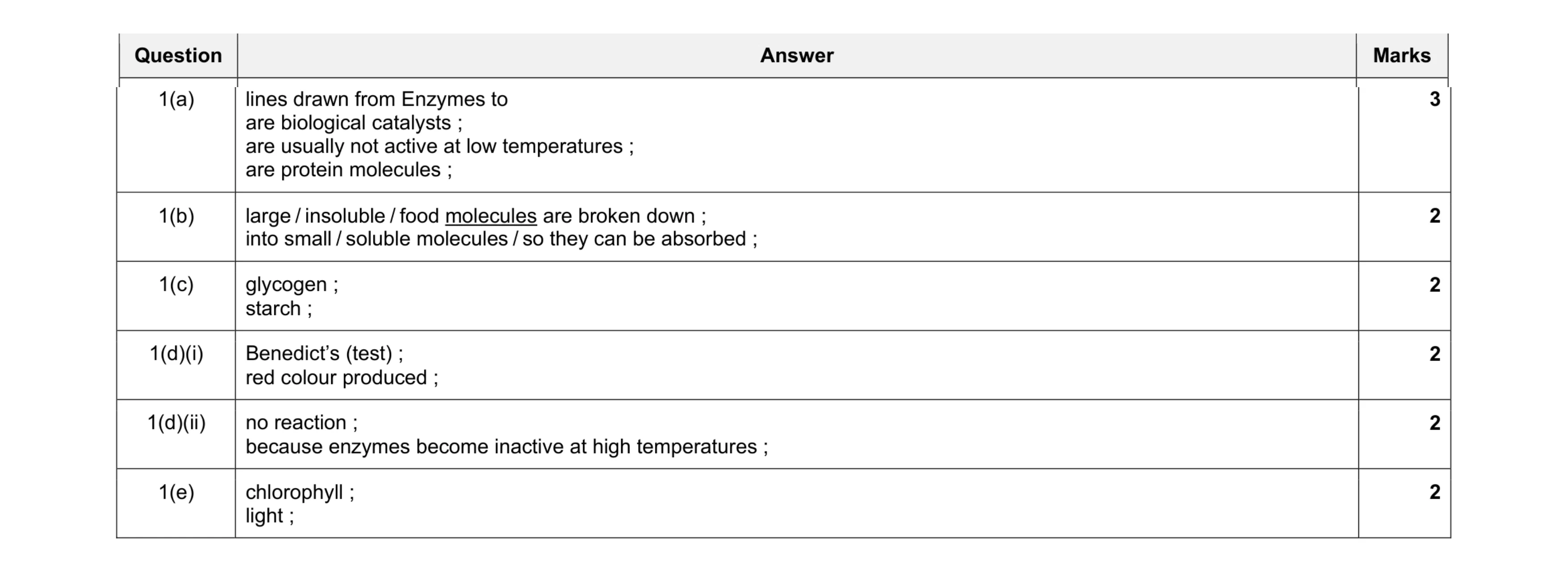
Mark scheme: 1(a) lines drawn from Enzymes to are biological catalysts ; are usually not active at low temperatures ; are protein molecules ; 3 1(b) large / insoluble / food molecules are broken down ; into small / soluble molecules / so they can be absorbed ; 2 1(c) glycogen ; starch ; 2 1(d)(i) Benedict’s (test) ; red colour produced ; 2 1(d)(ii) no reaction ; because enzymes become inactive at high temperatures ; 2 1(e) chlorophyll ; light ; 2
This question in 0653/32 May/June 2017
Q2 · Use lines to connect the box on the left to different boxes on the right to make correct… 0653/33 May/June 2017
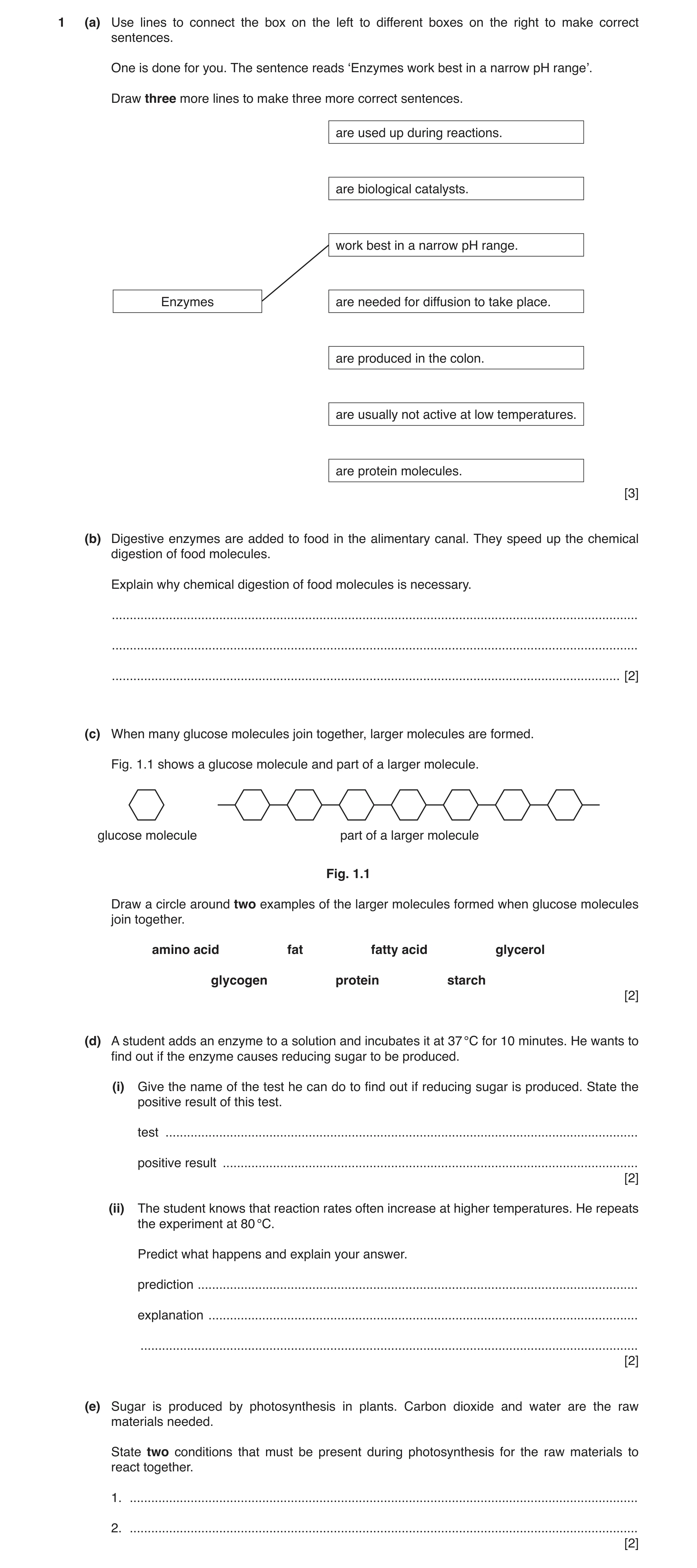
1 (a) Use lines to connect the box on the left to different boxes on the right to make correct sentences. One is done for you. The sentence reads ‘Enzymes work best in a narrow pH range’. Draw three more lines to make three more correct sentences. are used up during reactions. are biological catalysts. work best in a narrow pH range. Enzymes are needed for diffusion to take place. are produced in the colon. are usually not active at low temperatures. are protein molecules. [3] (b) Digestive enzymes are added to food in the alimentary canal. They speed up the chemical digestion of food molecules. Explain why chemical digestion of food molecules is necessary. … … … [2] (c) When many glucose molecules join together, larger molecules are formed. Fig. 1.1 shows a glucose molecule and part of a larger molecule. glucose molecule part of a larger molecule Fig. 1.1 Draw a circle around two examples of the larger molecules formed when glucose molecules join together. amino acid fat fatty acid glycerol glycogen protein starch [2] (d) A student adds an enzyme to a solution and incubates it at 37 °C for 10 minutes. He wants to find out if the enzyme causes reducing sugar to be produced. (i) Give the name of the test he can do to find out if reducing sugar is produced. State the positive result of this test. test … positive result … [2] (ii) The student knows that reaction rates often increase at higher temperatures. He repeats the experiment at 80 °C. Predict what happens and explain your answer. prediction … explanation … … [2] (e) Sugar is produced by photosynthesis in plants. Carbon dioxide and water are the raw materials needed. State two conditions that must be present during photosynthesis for the raw materials to react together. 1. … 2. … [2]
13 marks
Mark scheme: 1(a) lines drawn from Enzymes to are biological catalysts ; are usually not active at low temperatures ; are protein molecules ; 3 1(b) large / insoluble / food molecules are broken down ; into small / soluble molecules / so they can be absorbed ; 2 1(c) glycogen ; starch ; 2 1(d)(i) Benedict’s (test) ; red colour produced ; 2 1(d)(ii) no reaction ; because enzymes become inactive at high temperatures ; 2 1(e) chlorophyll ; light ; 2
This question in 0653/33 May/June 2017
Q3 · A student does an experiment to investigate the germination of barley seeds 0653/32 Oct/Nov 2017
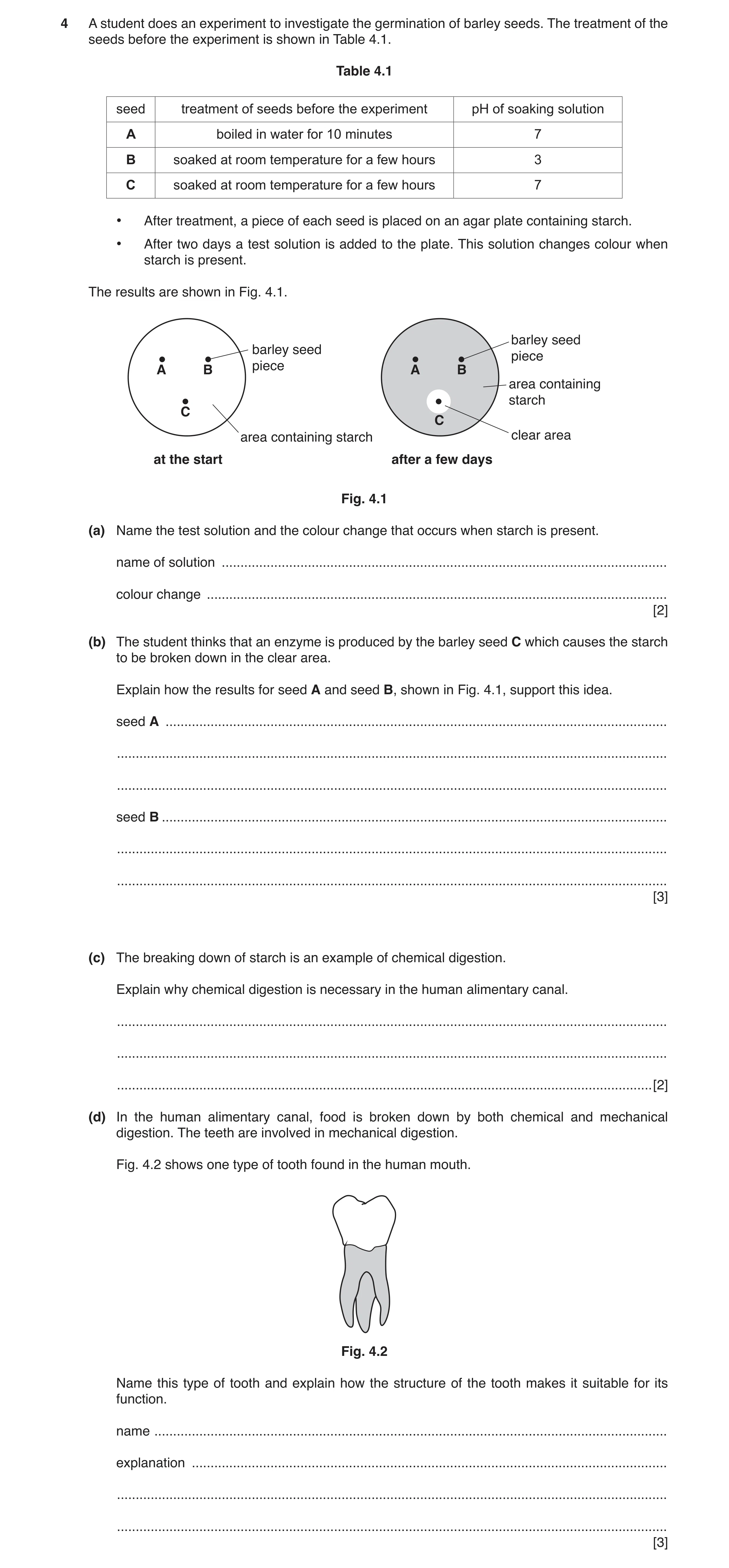
4 A student does an experiment to investigate the germination of barley seeds. The treatment of the seeds before the experiment is shown in Table 4.1. Table 4.1 seed treatment of seeds before the experiment pH of soaking solution A boiled in water for 10 minutes 7 B soaked at room temperature for a few hours 3 C soaked at room temperature for a few hours 7 • After treatment, a piece of each seed is placed on an agar plate containing starch. • After two days a test solution is added to the plate. This solution changes colour when starch is present. The results are shown in Fig. 4.1. barley seed barley seed piece piece A B A B area containing starch C C area containing starch clear area at the start after a few days Fig. 4.1 (a) Name the test solution and the colour change that occurs when starch is present. name of solution … colour change … [2] (b) The student thinks that an enzyme is produced by the barley seed C which causes the starch to be broken down in the clear area. Explain how the results for seed A and seed B, shown in Fig. 4.1, support this idea. seed A … … … seed B … … … [3] (c) The breaking down of starch is an example of chemical digestion. Explain why chemical digestion is necessary in the human alimentary canal. … … … [2] (d) In the human alimentary canal, food is broken down by both chemical and mechanical digestion. The teeth are involved in mechanical digestion. Fig. 4.2 shows one type of tooth found in the human mouth. Fig. 4.2 Name this type of tooth and explain how the structure of the tooth makes it suitable for its function. name … explanation … … … [3]
10 marks
Mark scheme: 4(a) iodine ; goes (from brown) to blue-black ; 2 4(b) Any three from results show starch present (around A and / or B) ; inactive / denatured enzyme ; because A is boiled ; because B is acidic / pH3 ; max 3 4(c) Any two from breaks down large / insoluble molecules ; into small / soluble molecules ; so that they can be absorbed ; max 2 4(d) molar ; flat / has cusps / large surface area ; for grinding food into smaller pieces ; 3
This question in 0653/32 Oct/Nov 2017
Q4 · A diagram of the alimentary canal 0653/33 Oct/Nov 2017
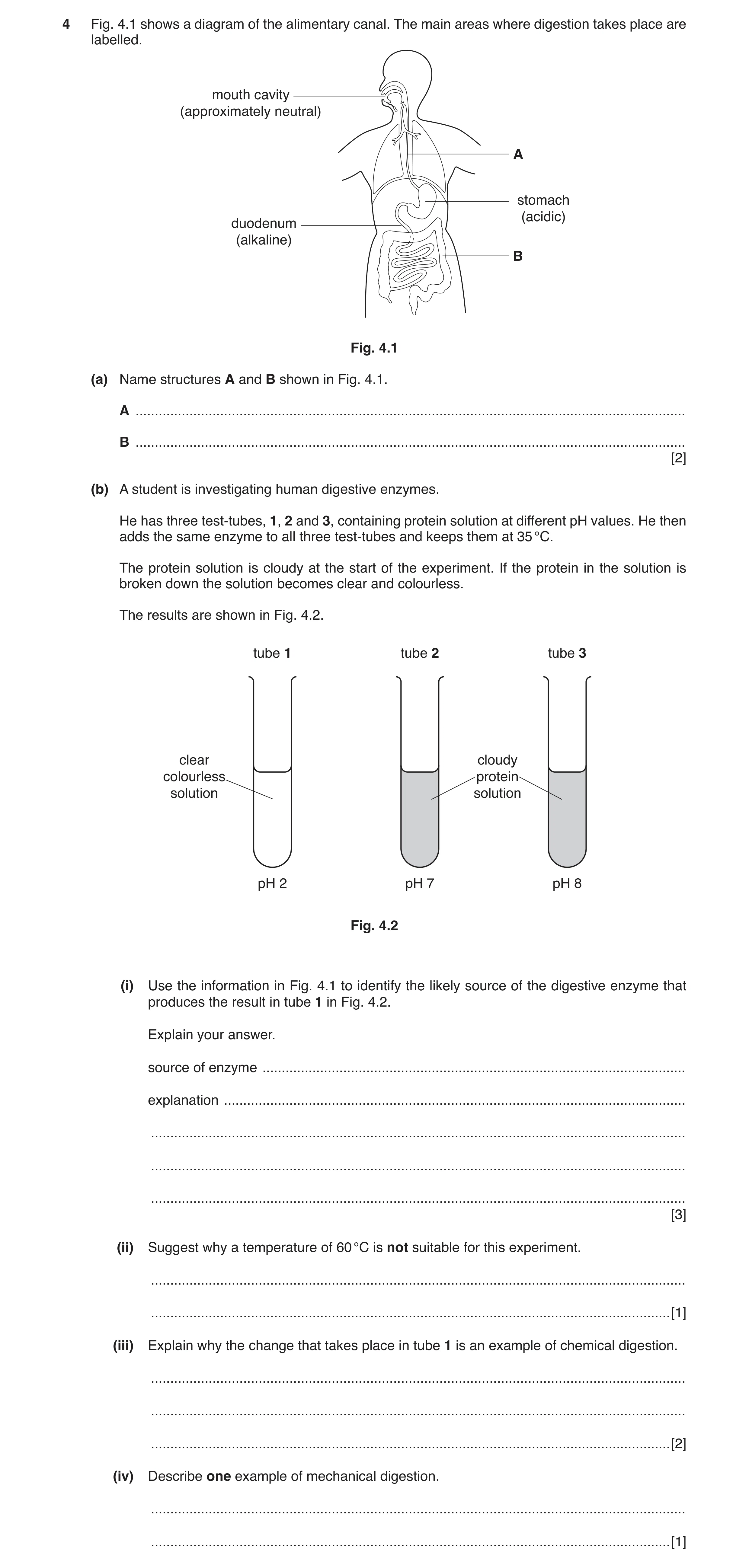
4 Fig. 4.1 shows a diagram of the alimentary canal. The main areas where digestion takes place are labelled. mouth cavity (approximately neutral) A stomach (acidic) duodenum (alkaline) B Fig. 4.1 (a) Name structures A and B shown in Fig. 4.1. A … B … [2] (b) A student is investigating human digestive enzymes. He has three test-tubes, 1, 2 and 3, containing protein solution at different pH values. He then adds the same enzyme to all three test-tubes and keeps them at 35 °C. The protein solution is cloudy at the start of the experiment. If the protein in the solution is broken down the solution becomes clear and colourless. The results are shown in Fig. 4.2. tube 1 tube 2 tube 3 clear cloudy colourless protein solution solution pH 2 pH 7 pH 8 Fig. 4.2 (i) Use the information in Fig. 4.1 to identify the likely source of the digestive enzyme that produces the result in tube 1 in Fig. 4.2. Explain your answer. source of enzyme … explanation … … … … [3] (ii) Suggest why a temperature of 60 °C is not suitable for this experiment. … … [1] (iii) Explain why the change that takes place in tube 1 is an example of chemical digestion. … … … [2] (iv) Describe one example of mechanical digestion. … … [1]
9 marks
Mark scheme: 4(a) A oesophagus ; B colon / large intestine ; 2 4(b)(i) stomach ; any two from stomach has acidic conditions ; pH 2 is acidic ; enzyme only worked in tube 1 / tube 1 was acidic / at the optimum pH ; max 3 4(b)(ii) enzyme will become inactive / destroyed at this temperature ; 1 4(b)(iii) large / protein molecules are broken down ; by the action of an enzyme / acid ; 2 4(b)(iv) chewing food (in mouth) ; 1
This question in 0653/33 Oct/Nov 2017
Q5 · Gardeners can increase the numbers of plants by splitting a parent plant in two… 0653/32 May/June 2018
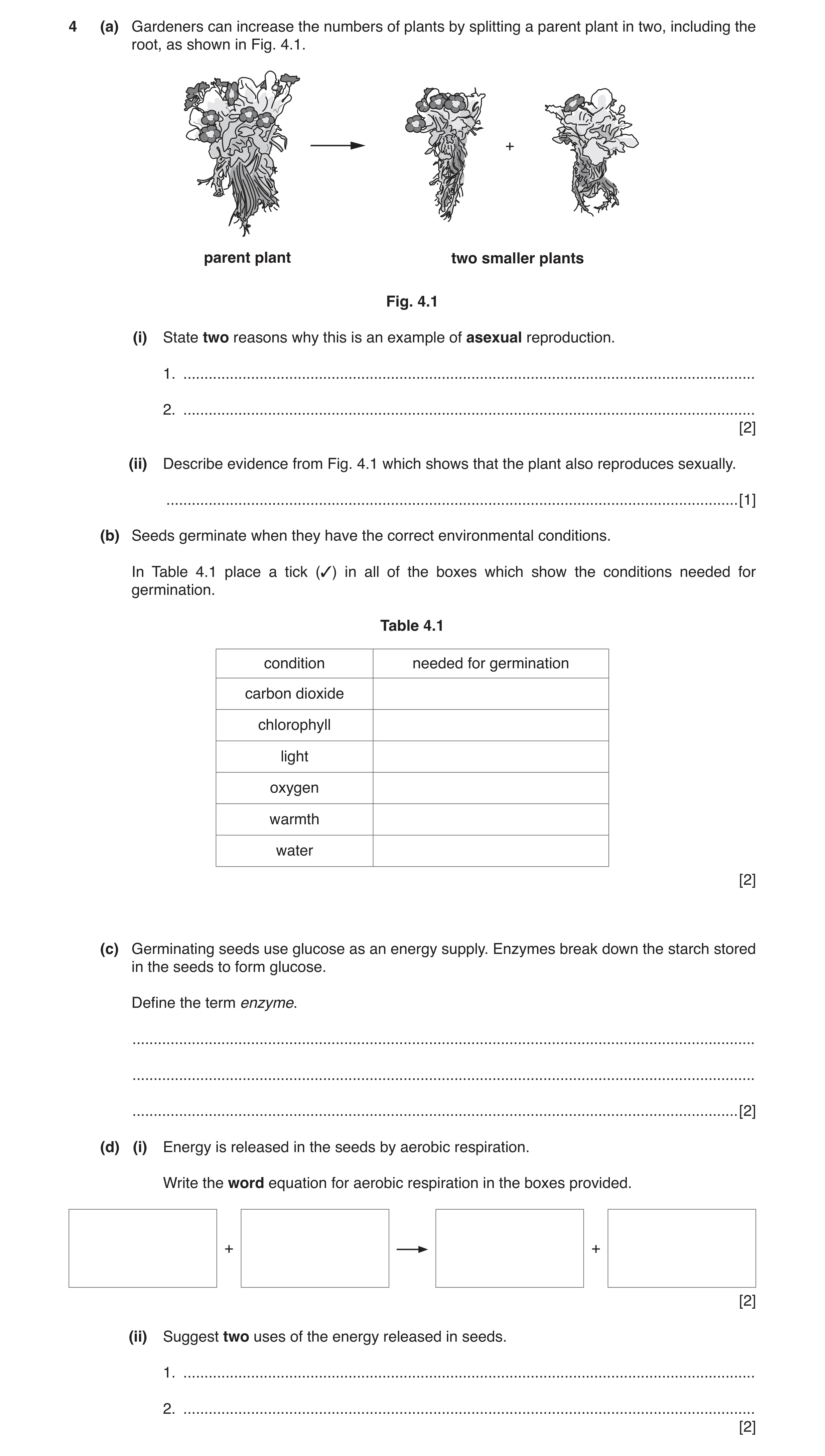
4 (a) Gardeners can increase the numbers of plants by splitting a parent plant in two, including the root, as shown in Fig. 4.1. + parent plant two smaller plants Fig. 4.1 (i) State two reasons why this is an example of asexual reproduction. 1. … 2. … [2] (ii) Describe evidence from Fig. 4.1 which shows that the plant also reproduces sexually. … [1] (b) Seeds germinate when they have the correct environmental conditions. In Table 4.1 place a tick (✓) in all of the boxes which show the conditions needed for germination. Table 4.1 condition needed for germination carbon dioxide chlorophyll light oxygen warmth water [2] (c) Germinating seeds use glucose as an energy supply. Enzymes break down the starch stored in the seeds to form glucose. Define the term enzyme. … … … [2] (d) (i) Energy is released in the seeds by aerobic respiration. Write the word equation for aerobic respiration in the boxes provided. + + [2] (ii) Suggest two uses of the energy released in seeds. 1. … 2. … [2]
11 marks
Mark scheme: 4(a)(i) only one parent involved ; offspring (genetically) identical ; 2 4(a)(ii) it has flowers ; 1 4(b) ticks in three boxes as shown ;; 2 marks all 3 correct 1 mark for 1 or 2 correct condition needed for germination () carbon dioxide chlorophyll light oxygen 9 water 9 warmth 9 2 Question Answer Marks 4(c) a protein ; (that functions as) a (biological) catalyst ; 2 4(d)(i) glucose, oxygen ; – either order carbon dioxide, water ; – either order 2 4(d)(ii) any two of protein synthesis ; cell division ; growth ; 2
This question in 0653/32 May/June 2018
Q6 · Gardeners can increase the numbers of plants by splitting a parent plant in two… 0653/33 May/June 2018
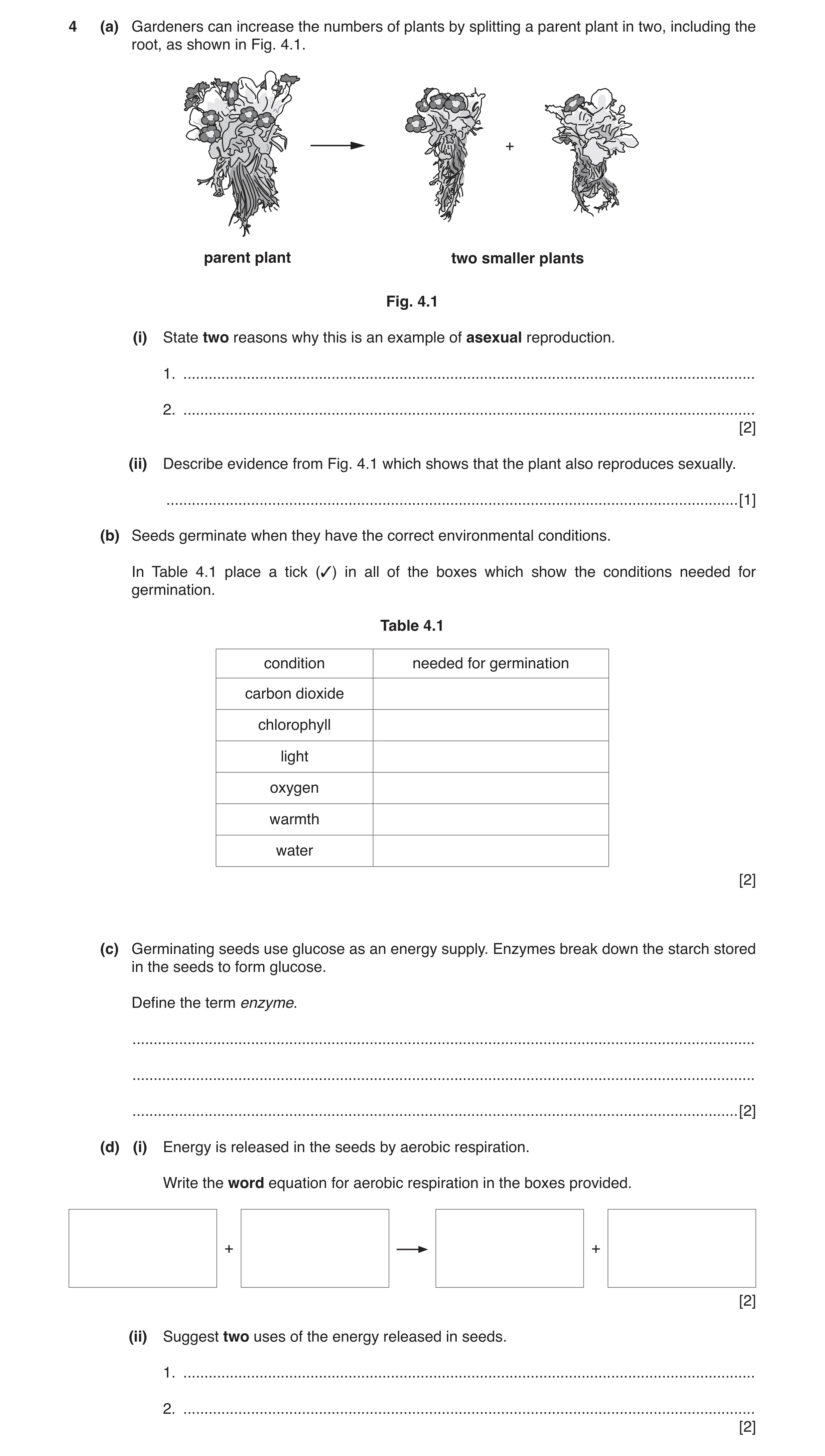
4 (a) Gardeners can increase the numbers of plants by splitting a parent plant in two, including the root, as shown in Fig. 4.1. + parent plant two smaller plants Fig. 4.1 (i) State two reasons why this is an example of asexual reproduction. 1. … 2. … [2] (ii) Describe evidence from Fig. 4.1 which shows that the plant also reproduces sexually. … [1] (b) Seeds germinate when they have the correct environmental conditions. In Table 4.1 place a tick (✓) in all of the boxes which show the conditions needed for germination. Table 4.1 condition needed for germination carbon dioxide chlorophyll light oxygen warmth water [2] (c) Germinating seeds use glucose as an energy supply. Enzymes break down the starch stored in the seeds to form glucose. Define the term enzyme. … … … [2] (d) (i) Energy is released in the seeds by aerobic respiration. Write the word equation for aerobic respiration in the boxes provided. + + [2] (ii) Suggest two uses of the energy released in seeds. 1. … 2. … [2]
11 marks
Mark scheme: 4(a)(i) only one parent involved ; offspring (genetically) identical ; 2 4(a)(ii) it has flowers ; 1 4(b) ticks in three boxes as shown ;; 2 marks all 3 correct 1 mark for 1 or 2 correct condition needed for germination () carbon dioxide chlorophyll light oxygen 9 water 9 warmth 9 2 Question Answer Marks 4(c) a protein ; (that functions as) a (biological) catalyst ; 2 4(d)(i) glucose, oxygen ; – either order carbon dioxide, water ; – either order 2 4(d)(ii) any two of protein synthesis ; cell division ; growth ; 2
This question in 0653/33 May/June 2018
Q7 · A piece of potato in a solution of hydrogen peroxide 0653/32 Oct/Nov 2018
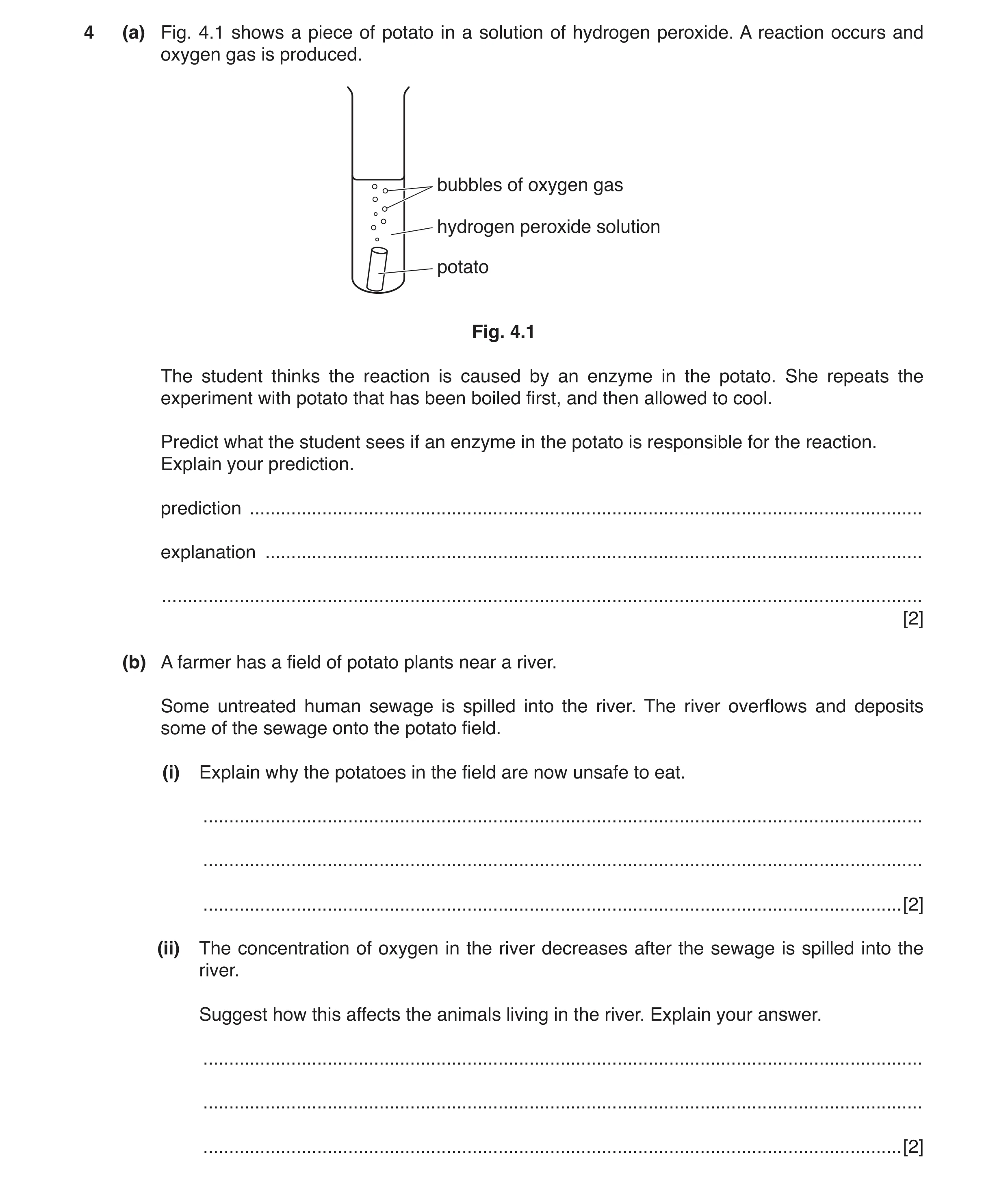
4 (a) Fig. 4.1 shows a piece of potato in a solution of hydrogen peroxide. A reaction occurs and oxygen gas is produced. bubbles of oxygen gas hydrogen peroxide solution potato Fig. 4.1 The student thinks the reaction is caused by an enzyme in the potato. She repeats the experiment with potato that has been boiled first, and then allowed to cool. Predict what the student sees if an enzyme in the potato is responsible for the reaction. Explain your prediction. prediction … explanation … … [2] (b) A farmer has a field of potato plants near a river. Some untreated human sewage is spilled into the river. The river overflows and deposits some of the sewage onto the potato field. (i) Explain why the potatoes in the field are now unsafe to eat. … … … [2] (ii) The concentration of oxygen in the river decreases after the sewage is spilled into the river. Suggest how this affects the animals living in the river. Explain your answer. … … … [2]
6 marks
Mark scheme: 4(a) no reaction ; the increased temperature / boiling has removed enzyme activity ; 2 4(b)(i) the water / river is polluted ; contains bacteria / viruses / microbes / pathogens ; that cause disease ; Max 2 2 4(b)(ii) animals / fish will die / move away ; due to suffocation / less oxygen for respiration ; 2
This question in 0653/32 Oct/Nov 2018
Q8 · A diagram of part of the alimentary canal and its associated organs 0653/33 Oct/Nov 2018
4 (a) Fig. 4.1 shows a diagram of part of the alimentary canal and its associated organs. A liver stomach gall bladder B duodenum Fig. 4.1 (i) Name structures A and B shown on Fig. 4.1. A … B … [2] (ii) During digestion food passes through the duodenum. State where the food goes to immediately after passing through the duodenum. … [1] (iii) Describe the function of the gall bladder. … [1] (b) Table 4.1 shows the approximate pH values in some areas of the alimentary canal. Table 4.1 area of alimentary canal approximate pH in area mouth cavity 7 stomach 2 duodenum 8 Enzymes in the mouth begin the digestion of starch in food. Suggest why more enzymes must be secreted into the small intestine to complete the digestion of starch. … … … [2] (c) Glucose is transported to the body cells in the blood plasma. List two other soluble substances which are transported by the plasma. 1. … 2. … [2] (d) Describe how oxygen is transported in the blood around the body. … … … [2]
10 marks
Mark scheme: 4(a)(i) A oesophagus ; B pancreas ; 2 4(a)(ii) ileum ; 1 4(a)(iii) stores bile ; 1 4(b) amylase from mouth cavity doesn’t work ; in the acidic environment of the stomach ; 2 Question Answer Marks 4(c) any two of ions / named ion, e.g. chloride ; carbon dioxide ; hormones ; any other soluble nutrient, e.g. amino acids ; Max 2 2 4(d) in red (blood) cells ; by haemoglobin ; 2
This question in 0653/33 Oct/Nov 2018
Q9 · When a banana is peeled the exposed surface turns from white to brown, as shown in Fig 0653/32 May/June 2019
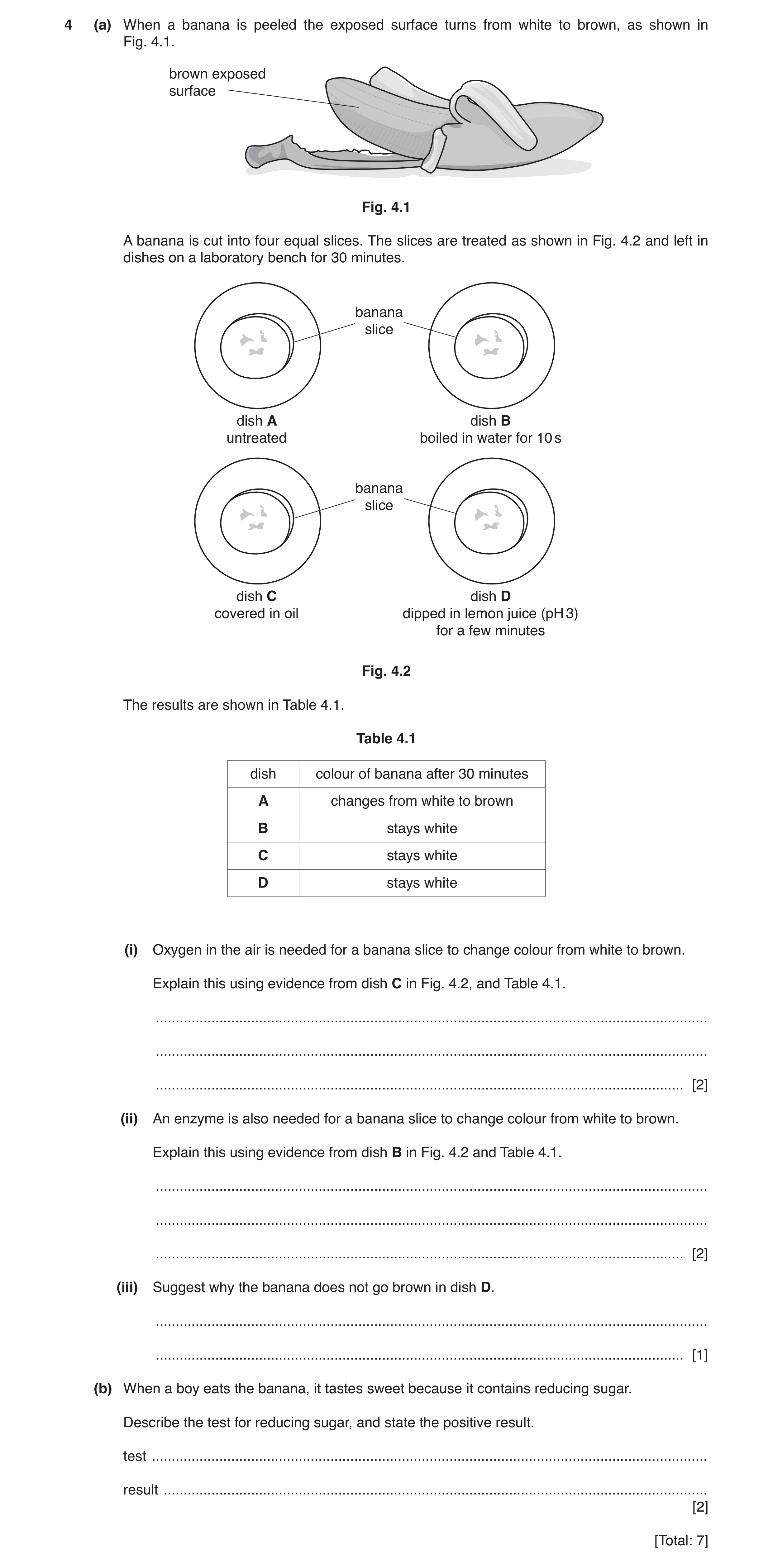
4 (a) When a banana is peeled the exposed surface turns from white to brown, as shown in Fig. 4.1. brown exposed surface Fig. 4.1 A banana is cut into four equal slices. The slices are treated as shown in Fig. 4.2 and left in dishes on a laboratory bench for 30 minutes. banana slice dish A dish B untreated boiled in water for 10 s banana slice dish C dish D covered in oil dipped in lemon juice (pH 3) for a few minutes Fig. 4.2 The results are shown in Table 4.1. Table 4.1 dish colour of banana after 30 minutes A changes from white to brown B stays white C stays white D stays white (i) Oxygen in the air is needed for a banana slice to change colour from white to brown. Explain this using evidence from dish C in Fig. 4.2, and Table 4.1. … … … [2] (ii) An enzyme is also needed for a banana slice to change colour from white to brown. Explain this using evidence from dish B in Fig. 4.2 and Table 4.1. … … … [2] (iii) Suggest why the banana does not go brown in dish D. … … [1] (b) When a boy eats the banana, it tastes sweet because it contains reducing sugar. Describe the test for reducing sugar, and state the positive result. test … result … [2] [Total: 7]
7 marks
Mark scheme: 4(a)(i) banana stay white / colour remains unchanged ; oil prevents / blocks / stops / provides a barrier to oxygen / air (from reaching the banana) ; 2 4(a)(ii) boiling / heat / high temperature affects the enzyme ; makes the enzyme inactive / destroys the enzyme / can’t speed up the reaction ; 2 4(a)(iii) acidic / acid ; 1 4(b) add Benedict’s solution (and heat); (Benedict’s solution) goes red ; 2
This question in 0653/32 May/June 2019
Q10 · Chemical digestion occurs in the alimentary canal 0653/32 Oct/Nov 2019
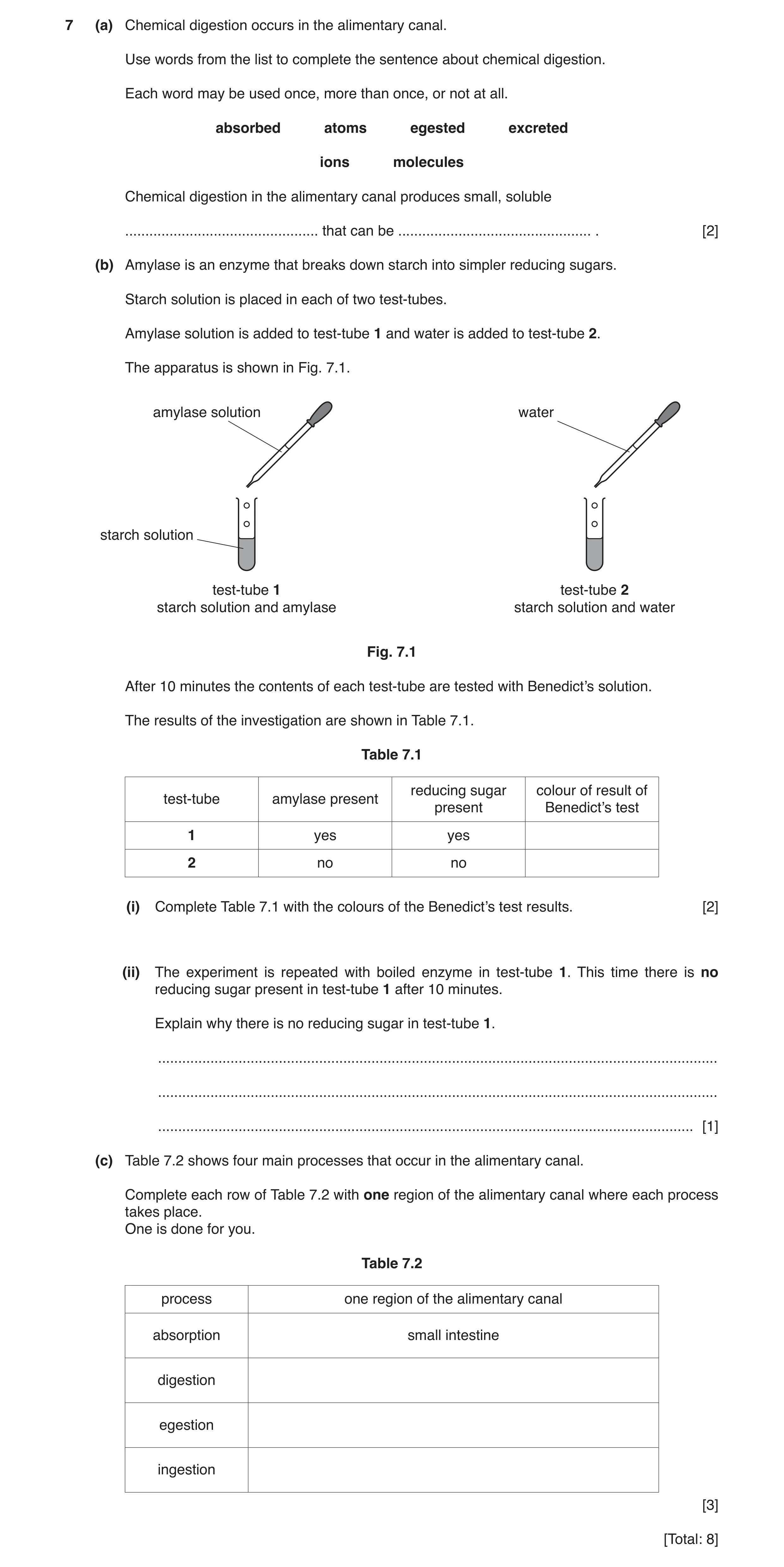
7 (a) Chemical digestion occurs in the alimentary canal. Use words from the list to complete the sentence about chemical digestion. Each word may be used once, more than once, or not at all. absorbed atoms egested excreted ions molecules Chemical digestion in the alimentary canal produces small, soluble … that can be … . [2] (b) Amylase is an enzyme that breaks down starch into simpler reducing sugars. Starch solution is placed in each of two test‑tubes. Amylase solution is added to test‑tube 1 and water is added to test‑tube 2. The apparatus is shown in Fig. 7.1. amylase solution water starch solution test-tube 1 test-tube 2 starch solution and amylase starch solution and water Fig. 7.1 After 10 minutes the contents of each test‑tube are tested with Benedict’s solution. The results of the investigation are shown in Table 7.1. Table 7.1 reducing sugar colour of result of test‑tube amylase present present Benedict’s test 1 yes yes 2 no no (i) Complete Table 7.1 with the colours of the Benedict’s test results. [2] (ii) The experiment is repeated with boiled enzyme in test‑tube 1. This time there is no reducing sugar present in test‑tube 1 after 10 minutes. Explain why there is no reducing sugar in test‑tube 1. … … … [1] (c) Table 7.2 shows four main processes that occur in the alimentary canal. Complete each row of Table 7.2 with one region of the alimentary canal where each process takes place. One is done for you. Table 7.2 process one region of the alimentary canal absorption small intestine digestion egestion ingestion [3] [Total: 8]
8 marks
Mark scheme: 7(a) molecules ; absorbed ; 2 7(b)(i) (test-tube 1) red / orange / yellow / green ; (test-tube 2) blue ; 2 7(b)(ii) boiling makes the enzyme inactive ; 1 7(c) (digestion) mouth / stomach / small intestine ; (egestion) anus ; (ingestion) mouth ; 3
This question in 0653/32 Oct/Nov 2019
Q11 · Chemical digestion occurs in the alimentary canal 0653/33 Oct/Nov 2019
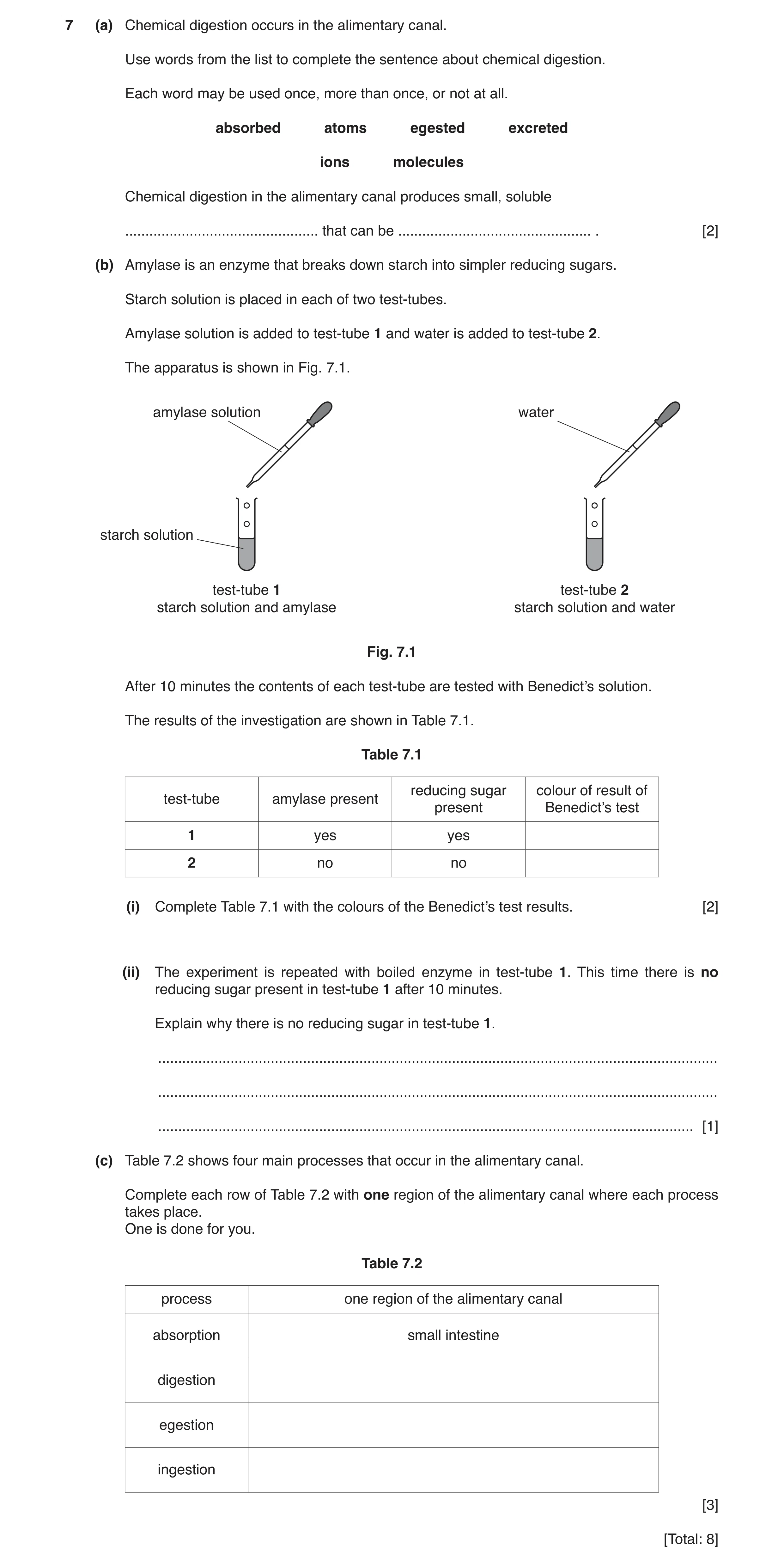
7 (a) Chemical digestion occurs in the alimentary canal. Use words from the list to complete the sentence about chemical digestion. Each word may be used once, more than once, or not at all. absorbed atoms egested excreted ions molecules Chemical digestion in the alimentary canal produces small, soluble … that can be … . [2] (b) Amylase is an enzyme that breaks down starch into simpler reducing sugars. Starch solution is placed in each of two test‑tubes. Amylase solution is added to test‑tube 1 and water is added to test‑tube 2. The apparatus is shown in Fig. 7.1. amylase solution water starch solution test-tube 1 test-tube 2 starch solution and amylase starch solution and water Fig. 7.1 After 10 minutes the contents of each test‑tube are tested with Benedict’s solution. The results of the investigation are shown in Table 7.1. Table 7.1 reducing sugar colour of result of test‑tube amylase present present Benedict’s test 1 yes yes 2 no no (i) Complete Table 7.1 with the colours of the Benedict’s test results. [2] (ii) The experiment is repeated with boiled enzyme in test‑tube 1. This time there is no reducing sugar present in test‑tube 1 after 10 minutes. Explain why there is no reducing sugar in test‑tube 1. … … … [1] (c) Table 7.2 shows four main processes that occur in the alimentary canal. Complete each row of Table 7.2 with one region of the alimentary canal where each process takes place. One is done for you. Table 7.2 process one region of the alimentary canal absorption small intestine digestion egestion ingestion [3] [Total: 8]
8 marks
Mark scheme: 7(a) molecules ; absorbed ; 2 7(b)(i) (test-tube 1) red / orange / yellow / green ; (test-tube 2) blue ; 2 7(b)(ii) boiling makes the enzyme inactive ; 1 7(c) (digestion) mouth / stomach / small intestine ; (egestion) anus ; (ingestion) mouth ; 3
This question in 0653/33 Oct/Nov 2019
Q12 · The human alimentary canal and associated organs 0653/32 May/June 2020
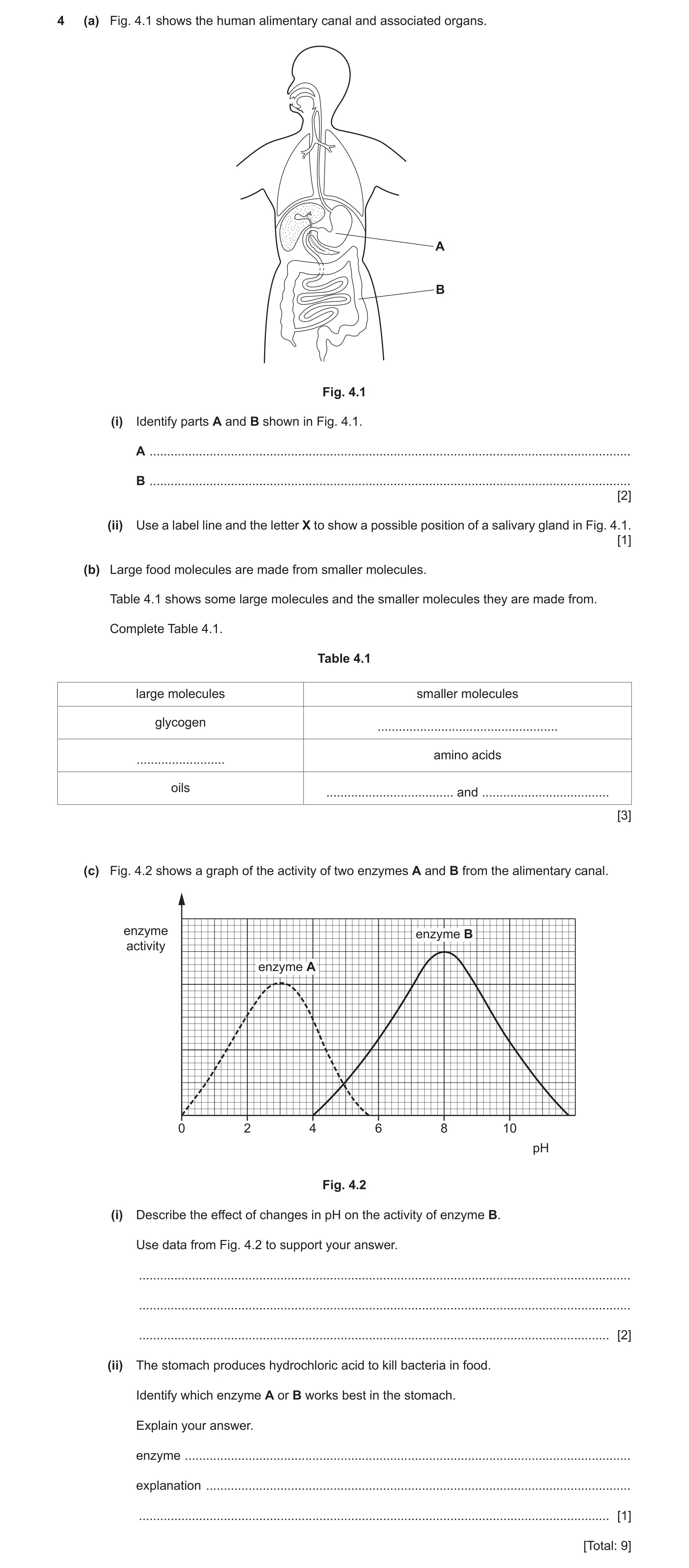
4 (a) Fig. 4.1 shows the human alimentary canal and associated organs. A B Fig. 4.1 (i) Identify parts A and B shown in Fig. 4.1. A … B … [2] (ii) Use a label line and the letter X to show a possible position of a salivary gland in Fig. 4.1. [1] (b) Large food molecules are made from smaller molecules. Table 4.1 shows some large molecules and the smaller molecules they are made from. Complete Table 4.1. Table 4.1 large molecules smaller molecules glycogen … amino acids … oils … and … [3] (c) Fig. 4.2 shows a graph of the activity of two enzymes A and B from the alimentary canal. enzyme enzyme B activity enzyme A 0 2 4 6 8 10 pH Fig. 4.2 (i) Describe the effect of changes in pH on the activity of enzyme B. Use data from Fig. 4.2 to support your answer. … … … [2] (ii) The stomach produces hydrochloric acid to kill bacteria in food. Identify which enzyme A or B works best in the stomach. Explain your answer. enzyme … explanation … … [1] [Total: 9]
9 marks
Mark scheme: 4(a)(i) A stomach ; B large intestine ; 2 4(a)(ii) label line to salivary gland area ; 1 4(b) glucose ; protein ; fatty acids and glycerol ; 3 4(c)(i) as pH increases enzyme activity increases then falls ; peaks at pH 8 ; 2 4(c)(ii) (enzyme) A (no mark) (explanation) enzyme A activity is higher, in acidic conditions / pH 2 ; 1
This question in 0653/32 May/June 2020
Q13 · Some of the organs of the human body 0653/32 Feb/March 2021
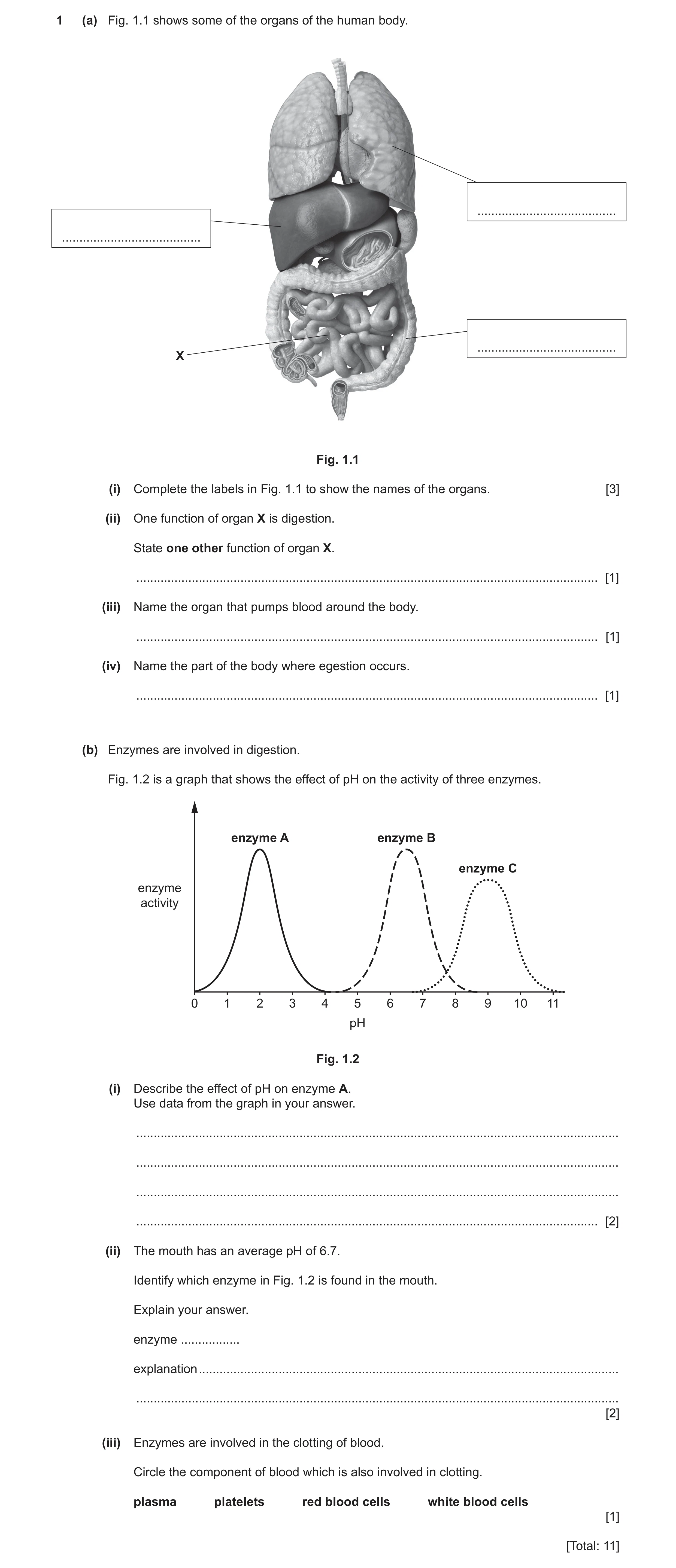
1 (a) Fig. 1.1 shows some of the organs of the human body. … … … X Fig. 1.1 (i) Complete the labels in Fig. 1.1 to show the names of the organs. [3] (ii) One function of organ X is digestion. State one other function of organ X. … [1] (iii) Name the organ that pumps blood around the body. … [1] (iv) Name the part of the body where egestion occurs. … [1] (b) Enzymes are involved in digestion. Fig. 1.2 is a graph that shows the effect of pH on the activity of three enzymes. enzyme A enzyme B enzyme C enzyme activity 0 1 2 3 4 5 6 7 8 9 10 11 pH Fig. 1.2 (i) Describe the effect of pH on enzyme A. Use data from the graph in your answer. … … … … [2] (ii) The mouth has an average pH of 6.7. Identify which enzyme in Fig. 1.2 is found in the mouth. Explain your answer. enzyme … explanation … … [2] (iii) Enzymes are involved in the clotting of blood. Circle the component of blood which is also involved in clotting. plasma platelets red blood cells white blood cells [1] [Total: 11]
11 marks
Mark scheme: 1(a)(i) lung(s) ; liver ; large intestine ; 3 1(a)(ii) absorption ; 1 1(a)(iii) heart ; 1 1(a)(iv) anus ; 1 1(b)(i) activity increases then decreases (as pH increases) ; maximum activity at pH 2 ; 2 1(b)(ii) B ; maximum activity at pH 6.5 / other enzymes do not work at pH 6.7 ; 2 1(b)(iii) platelets (circled) ; 1
This question in 0653/32 Feb/March 2021
Q14 · A student investigates the effect of temperature on enzyme activity 0653/31 May/June 2021
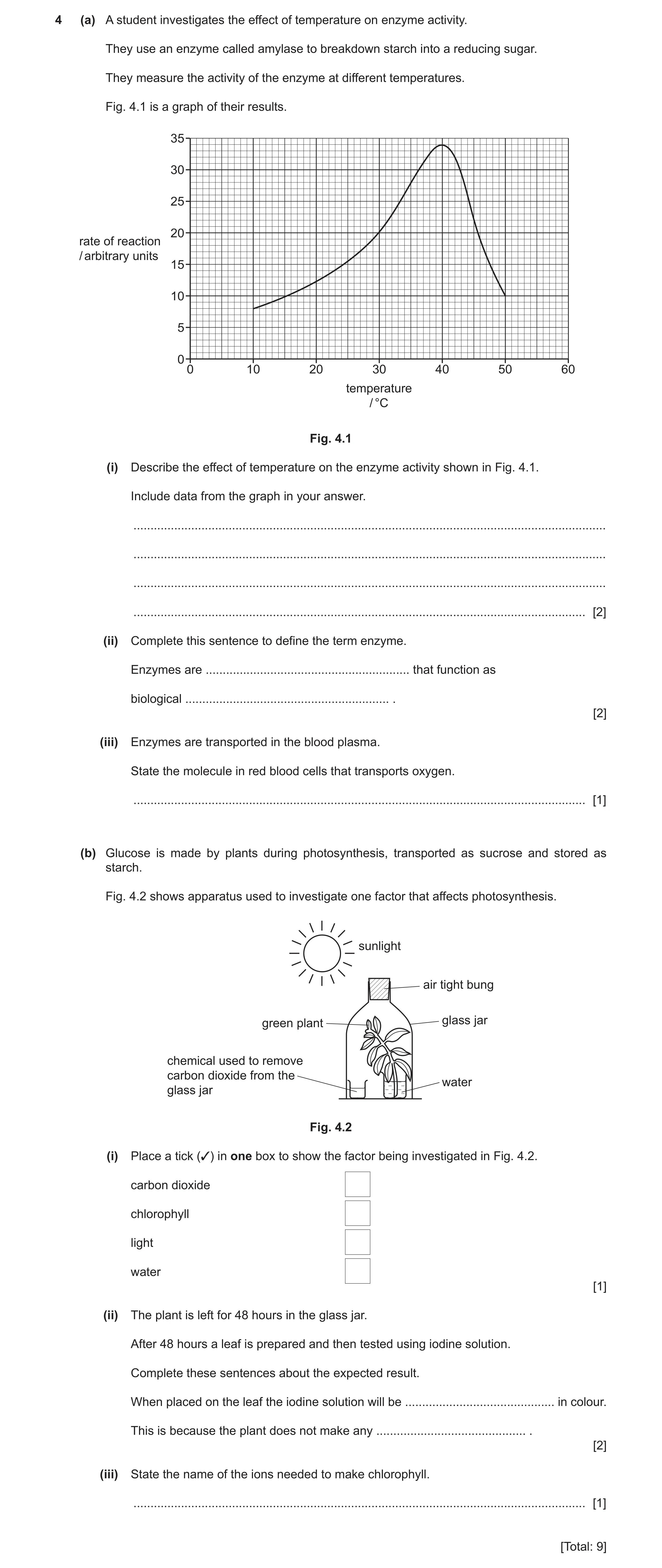
4 (a) A student investigates the effect of temperature on enzyme activity. They use an enzyme called amylase to breakdown starch into a reducing sugar. They measure the activity of the enzyme at different temperatures. Fig. 4.1 is a graph of their results. 35 30 25 20 rate of reaction / arbitrary units 15 10 5 0 0 10 20 30 40 50 60 temperature / °C Fig. 4.1 (i) Describe the effect of temperature on the enzyme activity shown in Fig. 4.1. Include data from the graph in your answer. … … … … [2] (ii) Complete this sentence to define the term enzyme. Enzymes are … that function as biological … . [2] (iii) Enzymes are transported in the blood plasma. State the molecule in red blood cells that transports oxygen. … [1] (b) Glucose is made by plants during photosynthesis, transported as sucrose and stored as starch. Fig. 4.2 shows apparatus used to investigate one factor that affects photosynthesis. sunlight air tight bung green plant glass jar chemical used to remove carbon dioxide from the water glass jar Fig. 4.2 (i) Place a tick (✓) in one box to show the factor being investigated in Fig. 4.2. carbon dioxide chlorophyll light water [1] (ii) The plant is left for 48 hours in the glass jar. After 48 hours a leaf is prepared and then tested using iodine solution. Complete these sentences about the expected result. When placed on the leaf the iodine solution will be … in colour. This is because the plant does not make any … . [2] (iii) State the name of the ions needed to make chlorophyll. … [1] [Total: 9]
9 marks
Mark scheme: 4(a)(i) as temperature increases, rate increases then falls ; peak or optimum (rate) at 40°C / maximum rate 34 (arbitrary units) ; OR activity increases, to 40°C / from a rate of 8 to 34 ; above 40°C the activity decreases / decreases from 34 ; 2 4(a)(ii) proteins ; catalysts ; 2 4(a)(iii) haemoglobin ; 1 4(b)(i) carbon dioxide chlorophyll light water ; 1 4b(ii) orange / brown ; starch ; 2 4(b)(iii) magnesium ; 1
This question in 0653/31 May/June 2021
Q15 · The nuts in Fig 0653/33 May/June 2022
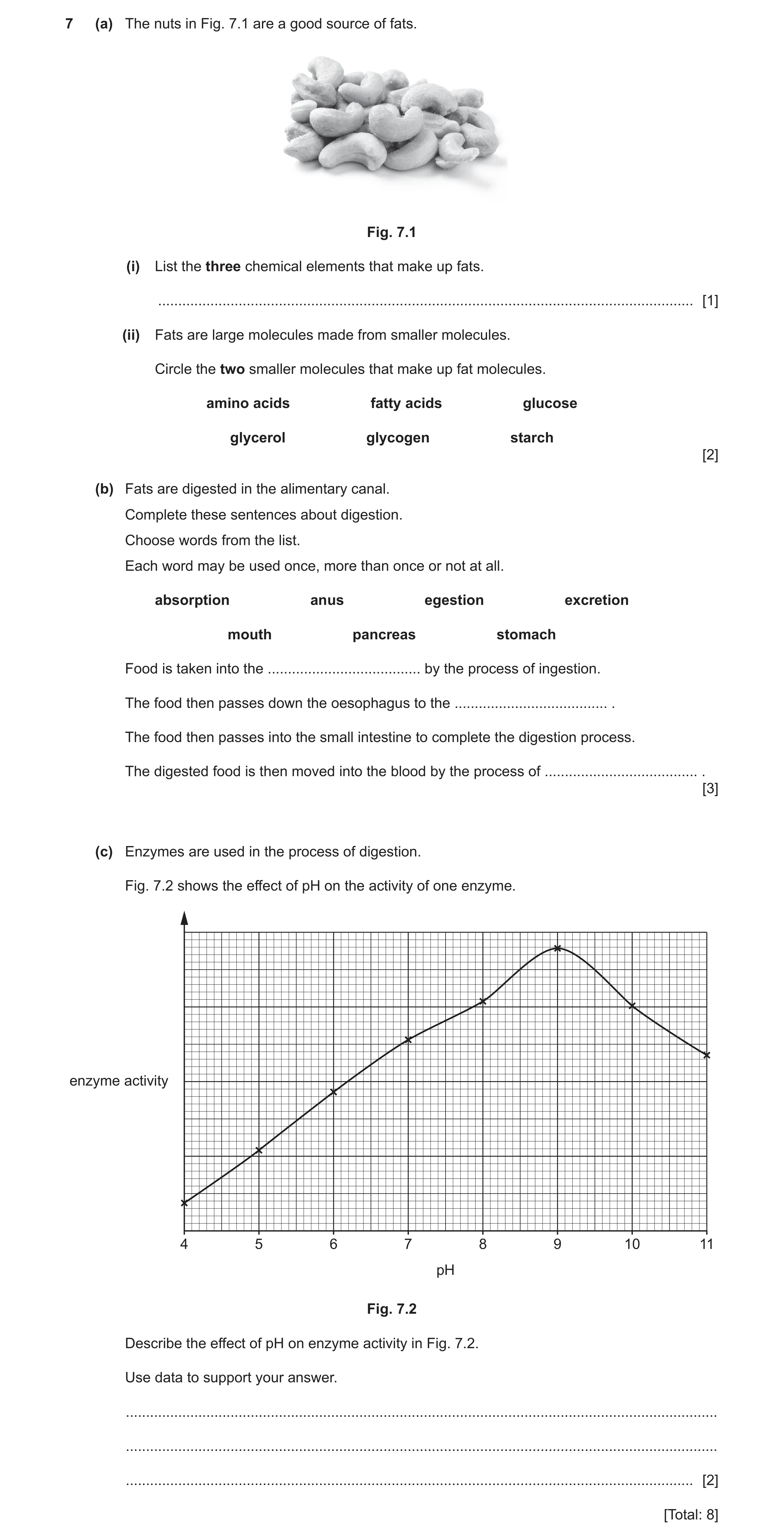
7 (a) The nuts in Fig. 7.1 are a good source of fats. Fig. 7.1 (i) List the three chemical elements that make up fats. … [1] (ii) Fats are large molecules made from smaller molecules. Circle the two smaller molecules that make up fat molecules. amino acids fatty acids glucose glycerol glycogen starch [2] (b) Fats are digested in the alimentary canal. Complete these sentences about digestion. Choose words from the list. Each word may be used once, more than once or not at all. absorption anus egestion excretion mouth pancreas stomach Food is taken into the … by the process of ingestion. The food then passes down the oesophagus to the … . The food then passes into the small intestine to complete the digestion process. The digested food is then moved into the blood by the process of … . [3] (c) Enzymes are used in the process of digestion. Fig. 7.2 shows the effect of pH on the activity of one enzyme. enzyme activity 4 5 6 7 8 9 10 11 pH Fig. 7.2 Describe the effect of pH on enzyme activity in Fig. 7.2. Use data to support your answer. … … … [2] [Total: 8]
8 marks
Mark scheme: 7(a)(i) carbon, hydrogen, oxygen ; 1 7(a)(ii) fatty acids ; glycerol ; 2 7(b) mouth ; stomach ; absorption ; 3 7(c) as pH increases enzyme activity increases then decreases ; idea of peak at pH 9 ; 2
This question in 0653/33 May/June 2022
Q16 · The alimentary canal of a human and a bear are similar 0653/32 Feb/March 2023
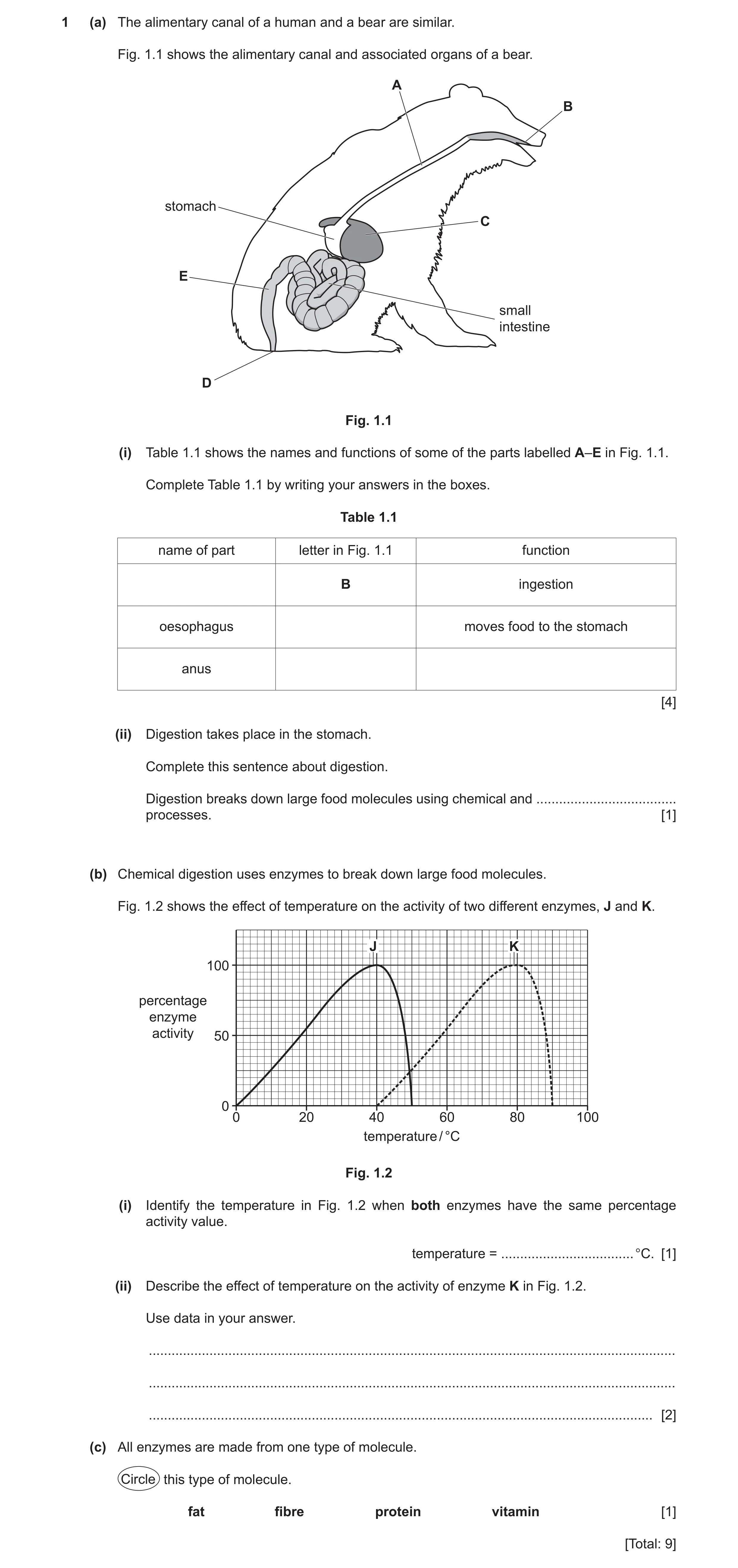
1 (a) The alimentary canal of a human and a bear are similar. Fig. 1.1 shows the alimentary canal and associated organs of a bear. A B stomach C E small intestine D Fig. 1.1 (i) Table 1.1 shows the names and functions of some of the parts labelled A–E in Fig. 1.1. Complete Table 1.1 by writing your answers in the boxes. Table 1.1 name of part letter in Fig. 1.1 function B ingestion oesophagus moves food to the stomach anus [4] (ii) Digestion takes place in the stomach. Complete this sentence about digestion. Digestion breaks down large food molecules using chemical and … processes. [1] (b) Chemical digestion uses enzymes to break down large food molecules. Fig. 1.2 shows the effect of temperature on the activity of two different enzymes, J and K. J K 100 percentage enzyme activity 50 0 0 20 40 60 80 100 temperature / °C Fig. 1.2 (i) Identify the temperature in Fig. 1.2 when both enzymes have the same percentage activity value. temperature = … °C. [1] (ii) Describe the effect of temperature on the activity of enzyme K in Fig. 1.2. Use data in your answer. … … … [2] (c) All enzymes are made from one type of molecule. Circle this type of molecule. fat fibre protein vitamin [1] [Total: 9]
9 marks
Mark scheme: Question Answer Marks 1(a)(i) 4 name of part letter in Fig. 1.1 function mouth (B) (ingestion) (oesophagus) A (moves food to the stomach) (anus) D egestion ;;;; 1(a)(ii) mechanical ; 1 1(b)(i) 49 (°C) ; 1 1(b)(ii) (as temperature increases) activity / rate, increases then decreases ; 2 reaches maximum at 80 °C ; 1(c) protein (circled) ; 1
This question in 0653/32 Feb/March 2023
Q17 · Carbohydrates are part of a balanced diet for humans 0653/32 Oct/Nov 2023
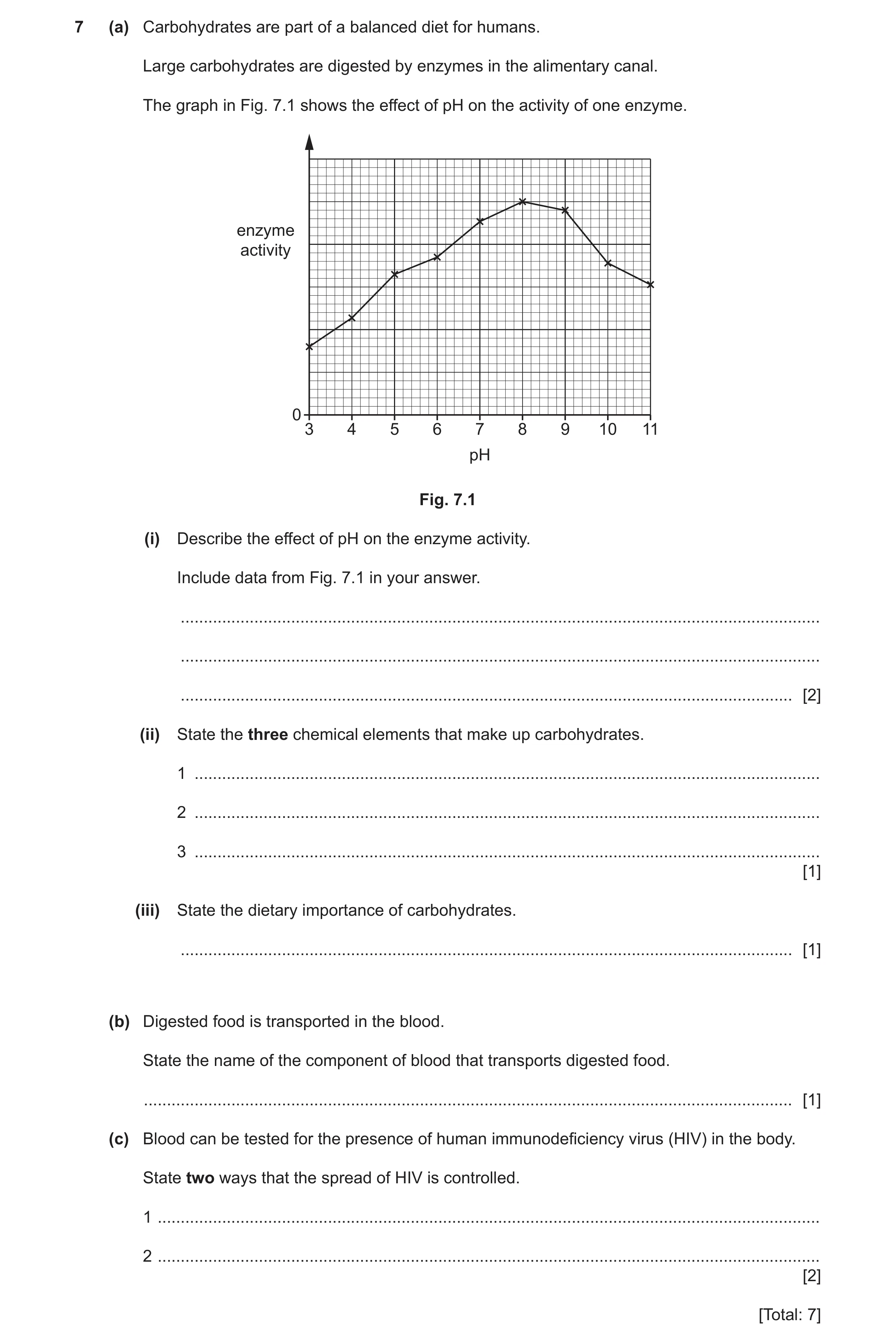
7 (a) Carbohydrates are part of a balanced diet for humans. Large carbohydrates are digested by enzymes in the alimentary canal. The graph in Fig. 7.1 shows the effect of pH on the activity of one enzyme. enzyme activity 0 3 4 5 6 7 8 9 10 11 pH Fig. 7.1 (i) Describe the effect of pH on the enzyme activity. Include data from Fig. 7.1 in your answer. … … … [2] (ii) State the three chemical elements that make up carbohydrates. 1 … 2 … 3 … [1] (iii) State the dietary importance of carbohydrates. … [1] (b) Digested food is transported in the blood. State the name of the component of blood that transports digested food. … [1] (c) Blood can be tested for the presence of human immunodeficiency virus (HIV) in the body. State two ways that the spread of HIV is controlled. 1 … 2 … [2] [Total: 7]
7 marks
Mark scheme: 7(a)(i) as pH increases, the enzyme activity first increases and then decreases ; 2 maximum at pH 8 ; 7(a)(ii) carbon AND hydrogen AND oxygen ; 1 7(a)(iii) provide energy ; 1 7(b) plasma ; 1 7(c) any two from: 2 using condoms / protected sexual intercourse ; idea of (sexual) abstinence ; not sharing needles ; using sterile surgical instruments ;
This question in 0653/32 Oct/Nov 2023
Q18 · Carbohydrates are part of a balanced diet for humans 0653/33 Oct/Nov 2023
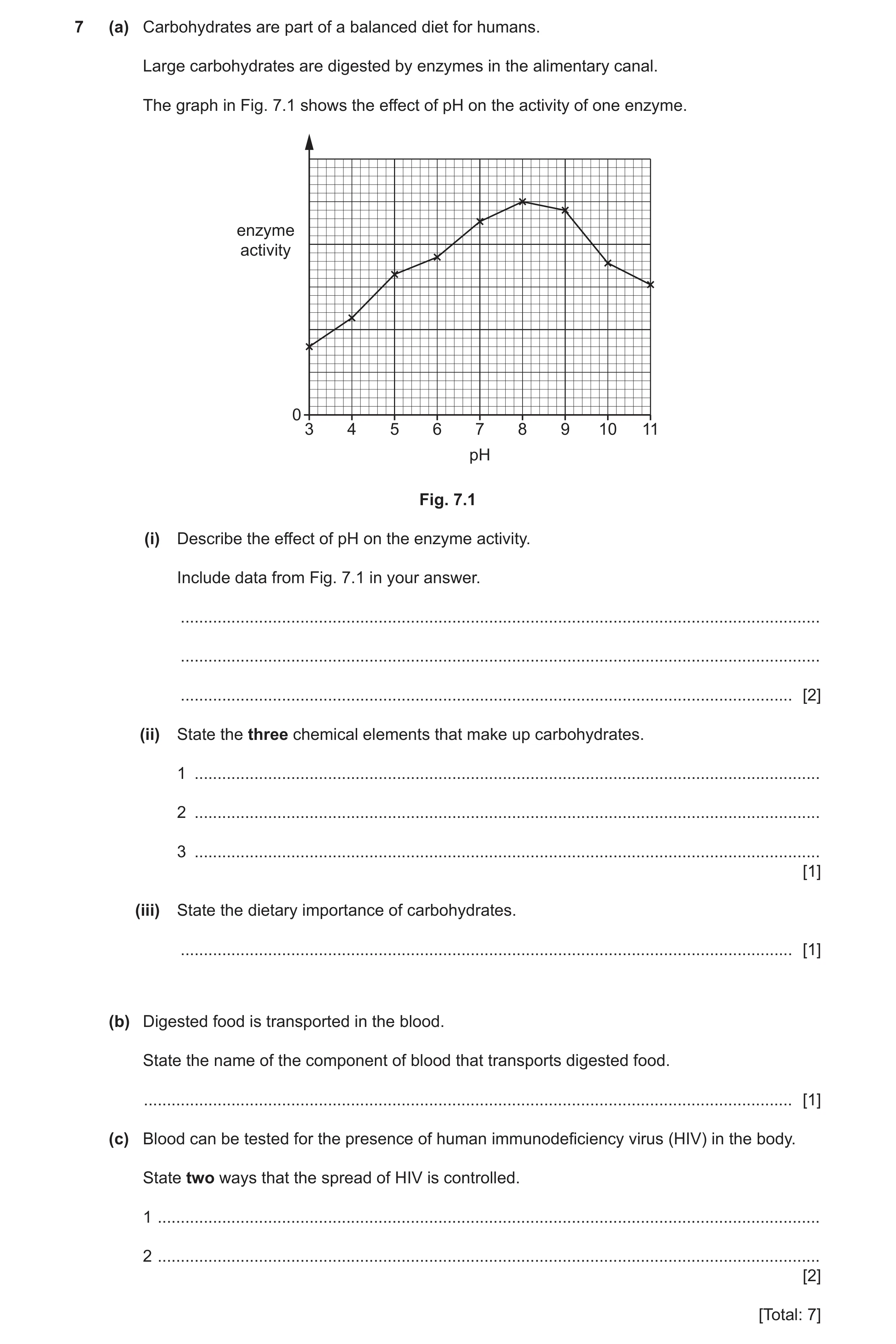
7 (a) Carbohydrates are part of a balanced diet for humans. Large carbohydrates are digested by enzymes in the alimentary canal. The graph in Fig. 7.1 shows the effect of pH on the activity of one enzyme. enzyme activity 0 3 4 5 6 7 8 9 10 11 pH Fig. 7.1 (i) Describe the effect of pH on the enzyme activity. Include data from Fig. 7.1 in your answer. … … … [2] (ii) State the three chemical elements that make up carbohydrates. 1 … 2 … 3 … [1] (iii) State the dietary importance of carbohydrates. … [1] (b) Digested food is transported in the blood. State the name of the component of blood that transports digested food. … [1] (c) Blood can be tested for the presence of human immunodeficiency virus (HIV) in the body. State two ways that the spread of HIV is controlled. 1 … 2 … [2] [Total: 7]
7 marks
Mark scheme: 7(a)(i) as pH increases, the enzyme activity first increases and then decreases ; 2 maximum at pH 8 ; 7(a)(ii) carbon AND hydrogen AND oxygen ; 1 7(a)(iii) provide energy ; 1 7(b) plasma ; 1 7(c) any two from: 2 using condoms / protected sexual intercourse ; idea of (sexual) abstinence ; not sharing needles ; using sterile surgical instruments ;
This question in 0653/33 Oct/Nov 2023
Q19 · A diagram of the alimentary canal and associated organs in humans 0653/31 May/June 2024
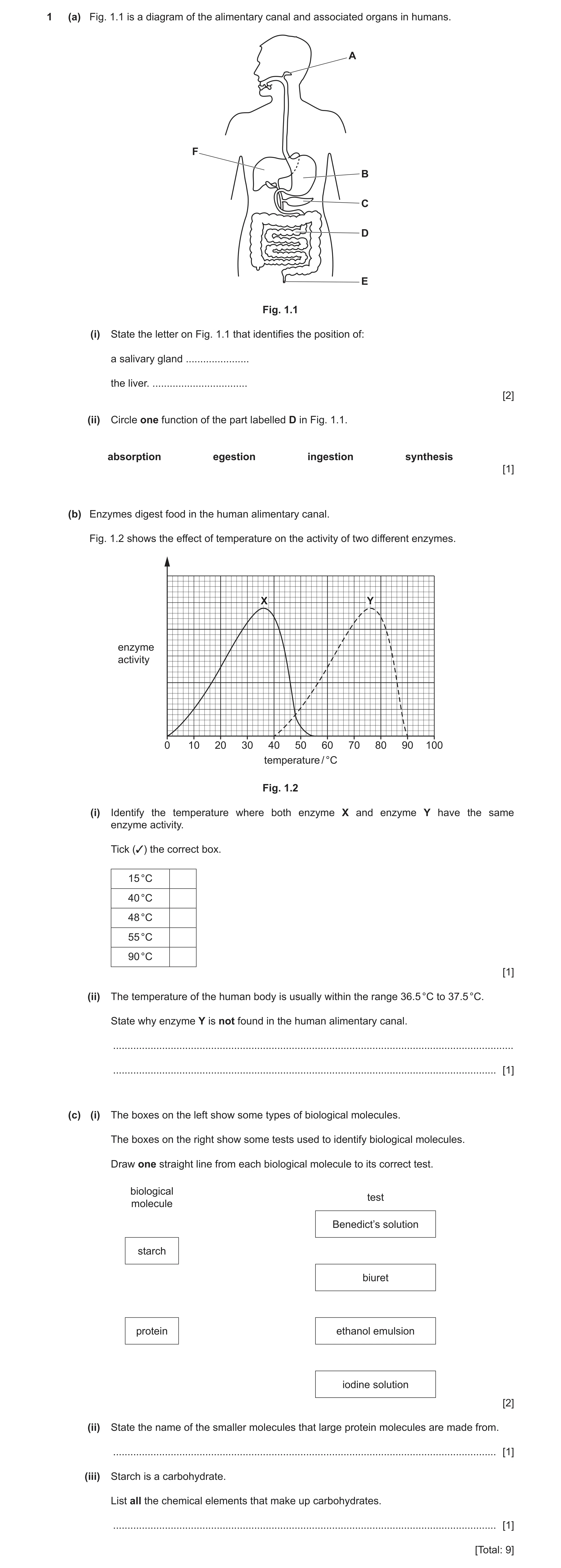
1 (a) Fig. 1.1 is a diagram of the alimentary canal and associated organs in humans. A F B C D E Fig. 1.1 (i) State the letter on Fig. 1.1 that identifies the position of: a salivary gland … the liver. … [2] (ii) Circle one function of the part labelled D in Fig. 1.1. absorption egestion ingestion synthesis [1] (b) Enzymes digest food in the human alimentary canal. Fig. 1.2 shows the effect of temperature on the activity of two different enzymes. X Y enzyme activity 0 10 20 30 40 50 60 70 80 90 100 temperature / °C Fig. 1.2 (i) Identify the temperature where both enzyme X and enzyme Y have the same enzyme activity. Tick (✓) the correct box. 15 °C 40 °C 48 °C 55 °C 90 °C [1] (ii) The temperature of the human body is usually within the range 36.5 °C to 37.5 °C. State why enzyme Y is not found in the human alimentary canal. … … [1] (c) (i) The boxes on the left show some types of biological molecules. The boxes on the right show some tests used to identify biological molecules. Draw one straight line from each biological molecule to its correct test. biological test molecule Benedict’s solution starch biuret protein ethanol emulsion iodine solution [2] (ii) State the name of the smaller molecules that large protein molecules are made from. … [1] (iii) Starch is a carbohydrate. List all the chemical elements that make up carbohydrates. … [1] [Total: 9]
9 marks
Mark scheme: 1(a)(i) A ; F ; 2 1(a)(ii) absorption (circled) ; 1 1(b)(i) 48 °C (ticked) ; 1 1(b)(ii) inactive in that temperature range (36.5–37.5 °C) / active at temperatures above body temperature ; 1 1(c)(i) Benedict’s solution starch biuret protein ethanol emulsion iodine solution one mark for each correct answer ;; 2 1(c)(ii) amino acids ; 1 1(c)(iii) carbon and hydrogen and oxygen ; 1
This question in 0653/31 May/June 2024
Q20 · The alimentary canal and associated organs of a human 0653/32 Oct/Nov 2024
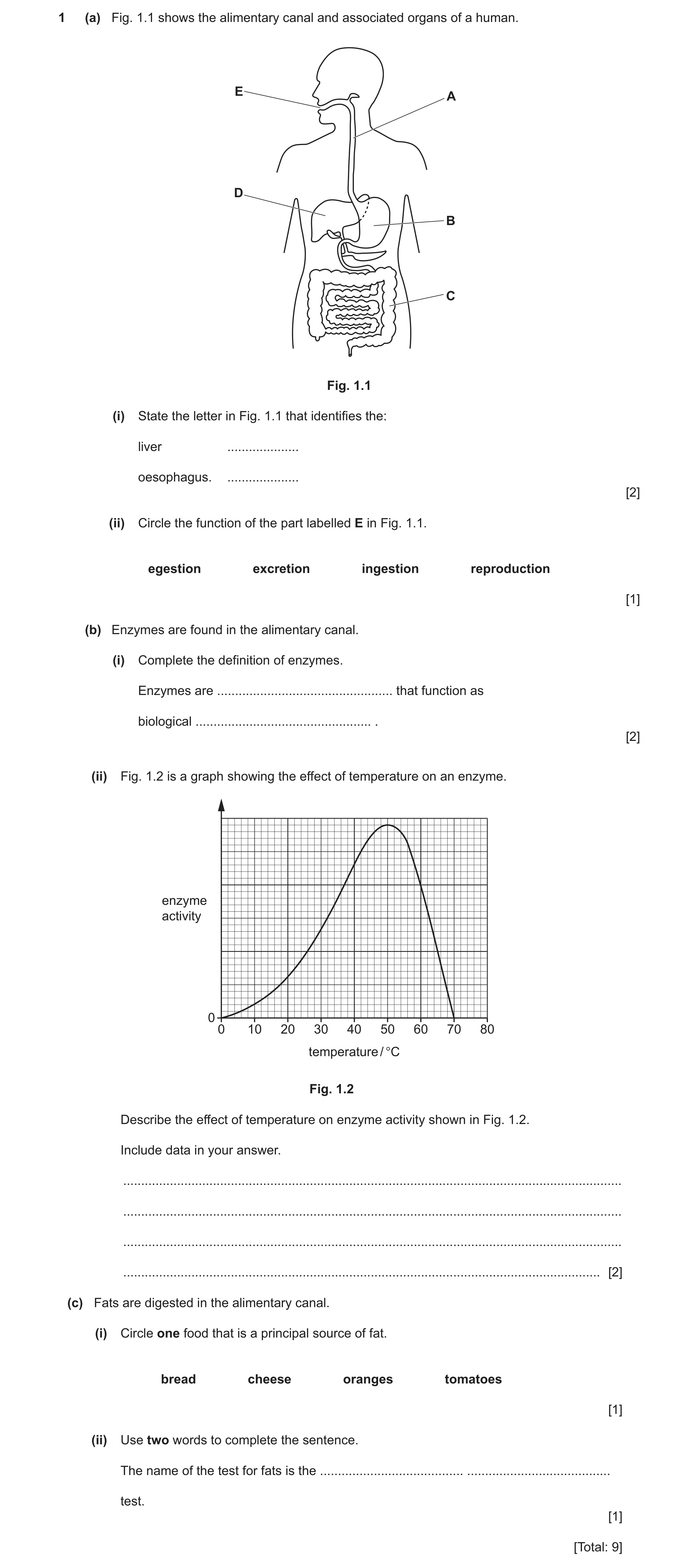
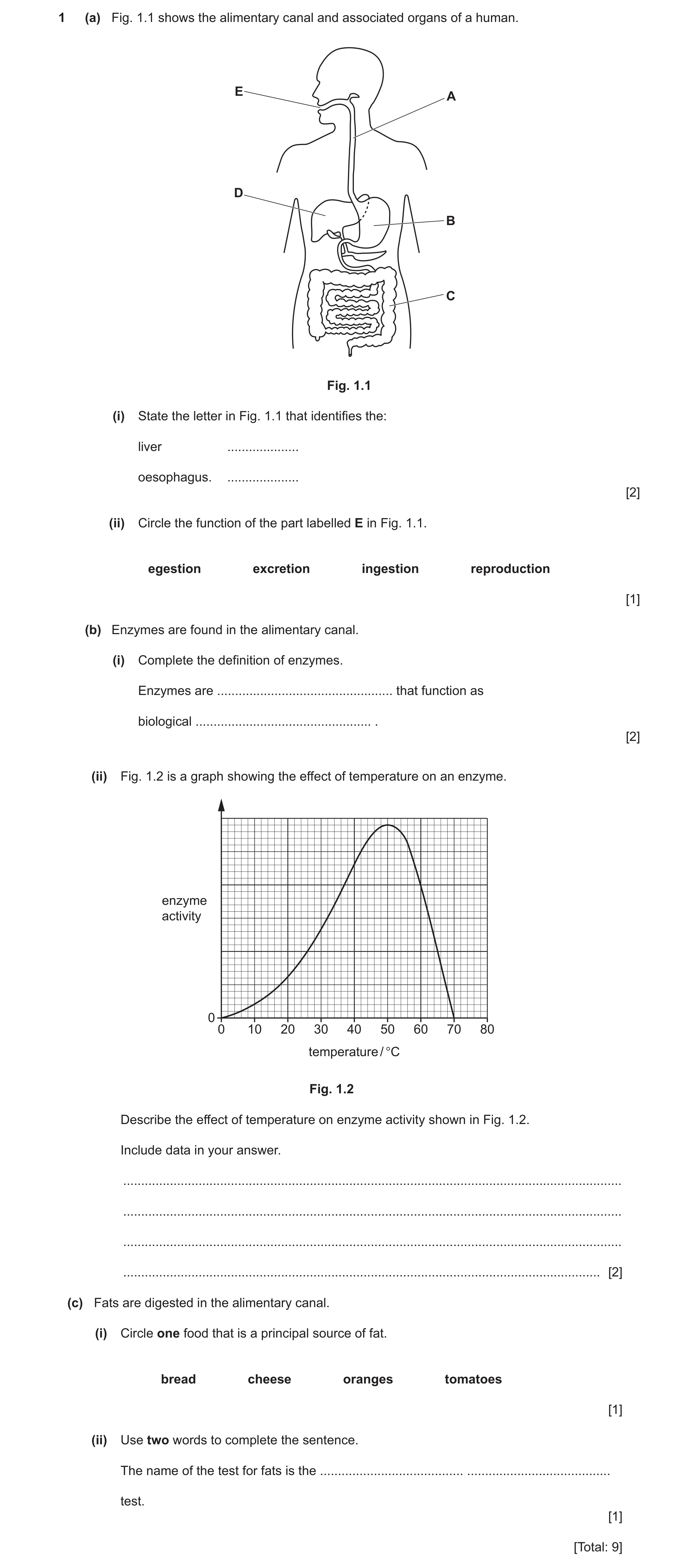
1 (a) Fig. 1.1 shows the alimentary canal and associated organs of a human. E A D B C Fig. 1.1 (i) State the letter in Fig. 1.1 that identifies the: liver … oesophagus. … [2] (ii) Circle the function of the part labelled E in Fig. 1.1. egestion excretion ingestion reproduction [1] (b) Enzymes are found in the alimentary canal. (i) Complete the definition of enzymes. Enzymes are … that function as biological … . [2] (ii) Fig. 1.2 is a graph showing the effect of temperature on an enzyme. enzyme activity 0 0 10 20 30 40 50 60 70 80 temperature / °C Fig. 1.2 Describe the effect of temperature on enzyme activity shown in Fig. 1.2. Include data in your answer. … … … … [2] (c) Fats are digested in the alimentary canal. (i) Circle one food that is a principal source of fat. bread cheese oranges tomatoes [1] (ii) Use two words to complete the sentence. The name of the test for fats is the … … test. [1] [Total: 9]
9 marks
Mark scheme: Question Answer Marks 1(a)(i) D ; 2 A ; 1(a)(ii) ingestion ; 1 1(b)(i) proteins ; 2 catalysts ; 1(b)(ii) idea that as temperature increases, enzyme activity increases then decreases ; 2 peaks at 50(C) / AW ; 1(c)(i) cheese ; 1 1(c)(ii) ethanol emulsion ; 1
This question in 0653/32 Oct/Nov 2024
Q21 · The alimentary canal and associated organs of a human 0653/33 Oct/Nov 2024
1 (a) Fig. 1.1 shows the alimentary canal and associated organs of a human. E A D B C Fig. 1.1 (i) State the letter in Fig. 1.1 that identifies the: liver … oesophagus. … [2] (ii) Circle the function of the part labelled E in Fig. 1.1. egestion excretion ingestion reproduction [1] (b) Enzymes are found in the alimentary canal. (i) Complete the definition of enzymes. Enzymes are … that function as biological … . [2] (ii) Fig. 1.2 is a graph showing the effect of temperature on an enzyme. enzyme activity 0 0 10 20 30 40 50 60 70 80 temperature / °C Fig. 1.2 Describe the effect of temperature on enzyme activity shown in Fig. 1.2. Include data in your answer. … … … … [2] (c) Fats are digested in the alimentary canal. (i) Circle one food that is a principal source of fat. bread cheese oranges tomatoes [1] (ii) Use two words to complete the sentence. The name of the test for fats is the … … test. [1] [Total: 9]
9 marks
Mark scheme: Question Answer Marks 1(a)(i) D ; 2 A ; 1(a)(ii) ingestion ; 1 1(b)(i) proteins ; 2 catalysts ; 1(b)(ii) idea that as temperature increases, enzyme activity increases then decreases ; 2 peaks at 50(C) / AW ; 1(c)(i) cheese ; 1 1(c)(ii) ethanol emulsion ; 1
This question in 0653/33 Oct/Nov 2024
Q22 · Nutrition is one of the characteristics of living organisms 0653/32 May/June 2025
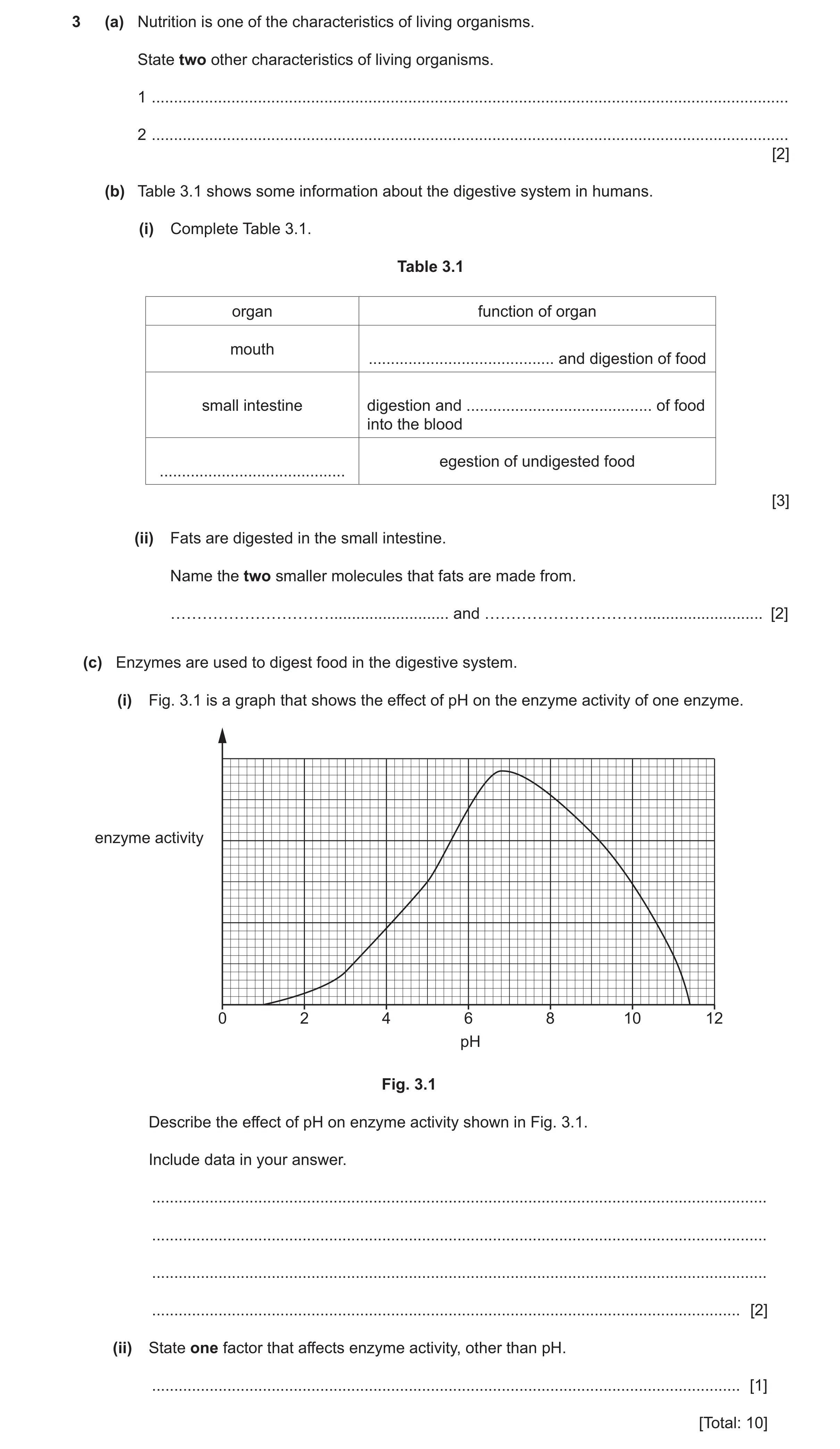
3 (a) Nutrition is one of the characteristics of living organisms. State two other characteristics of living organisms. 1 … 2 … [2] (b) Table 3.1 shows some information about the digestive system in humans. (i) Complete Table 3.1. Table 3.1 organ function of organ mouth … and digestion of food small intestine digestion and … of food into the blood egestion of undigested food … [3] (ii) Fats are digested in the small intestine. Name the two smaller molecules that fats are made from. ………………………… … and ………………………… … [2] (c) Enzymes are used to digest food in the digestive system. (i) Fig. 3.1 is a graph that shows the effect of pH on the enzyme activity of one enzyme. enzyme activity 0 2 4 6 8 10 12 pH Fig. 3.1 Describe the effect of pH on enzyme activity shown in Fig. 3.1. Include data in your answer. … … … … [2] (ii) State one factor that affects enzyme activity, other than pH. … [1] [Total: 10]
10 marks
Mark scheme: 3(a) any two from: 2 movement ; respiration ; growth ; sensitivity ; reproduction ; excretion ; 3(b)(i) 3 organ function of organ mouth ingestion (and digestion of food) (digestion and) absorption small intestine (of food into the blood) anus egestion undigested food ;;; 3(b)(ii) fatty acids ; 2 glycerol ; 3(c)(i) increasing pH increases then decreases enzyme activity ; 2 use of data, e.g. peak at pH6.8, no activity below pH1 / no activity above pH11.4, etc. ; 3(c)(ii) temperature ; 1
This question in 0653/32 May/June 2025
 11 / 36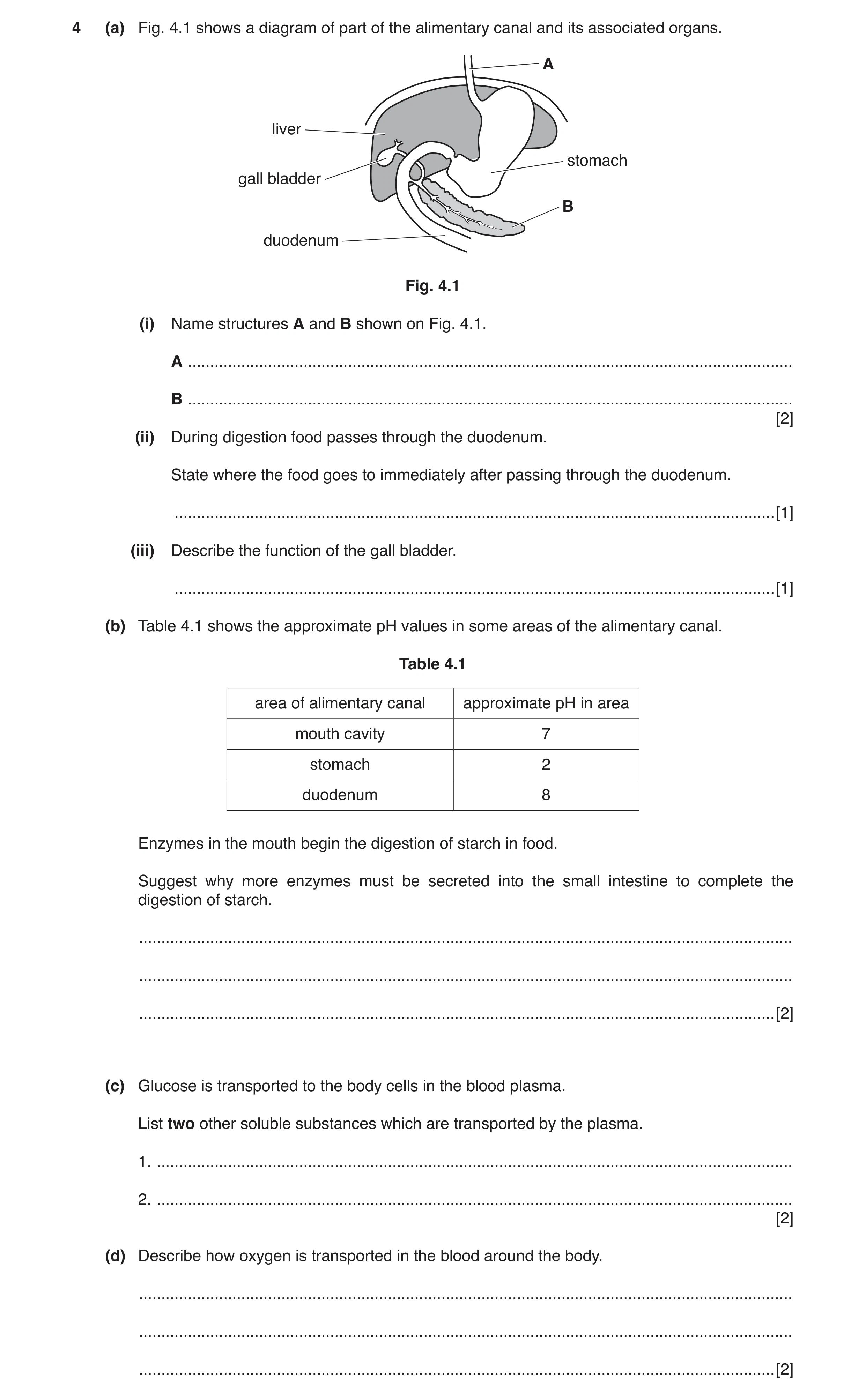
 13
13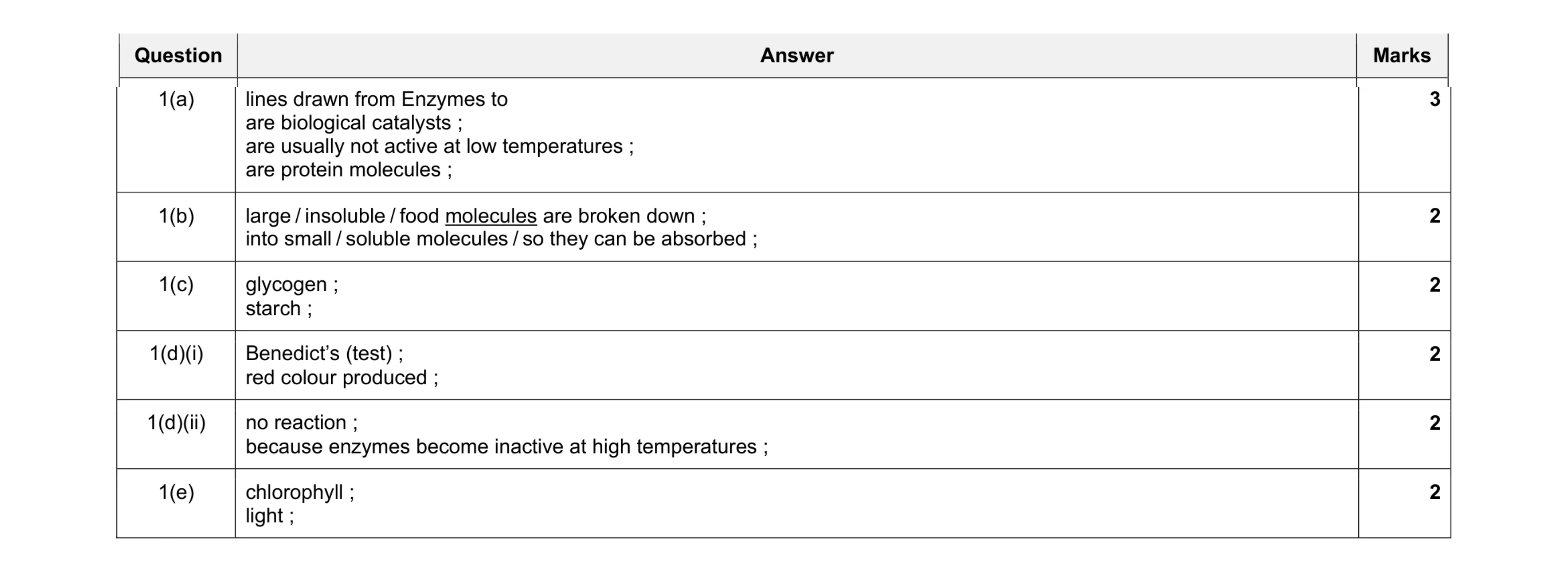 13
13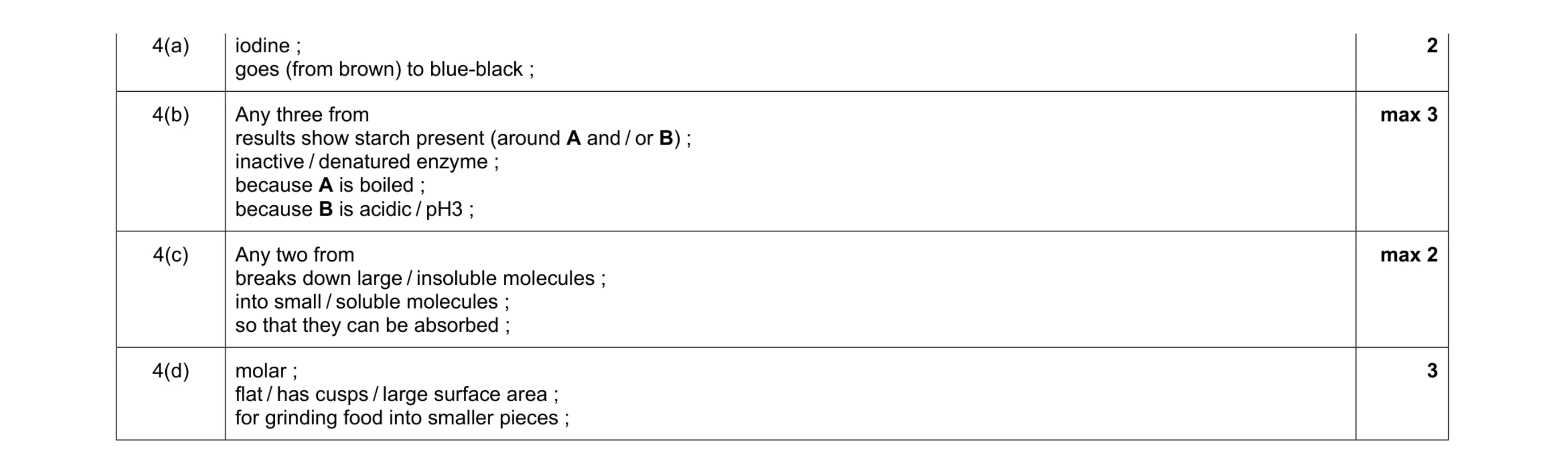 10
10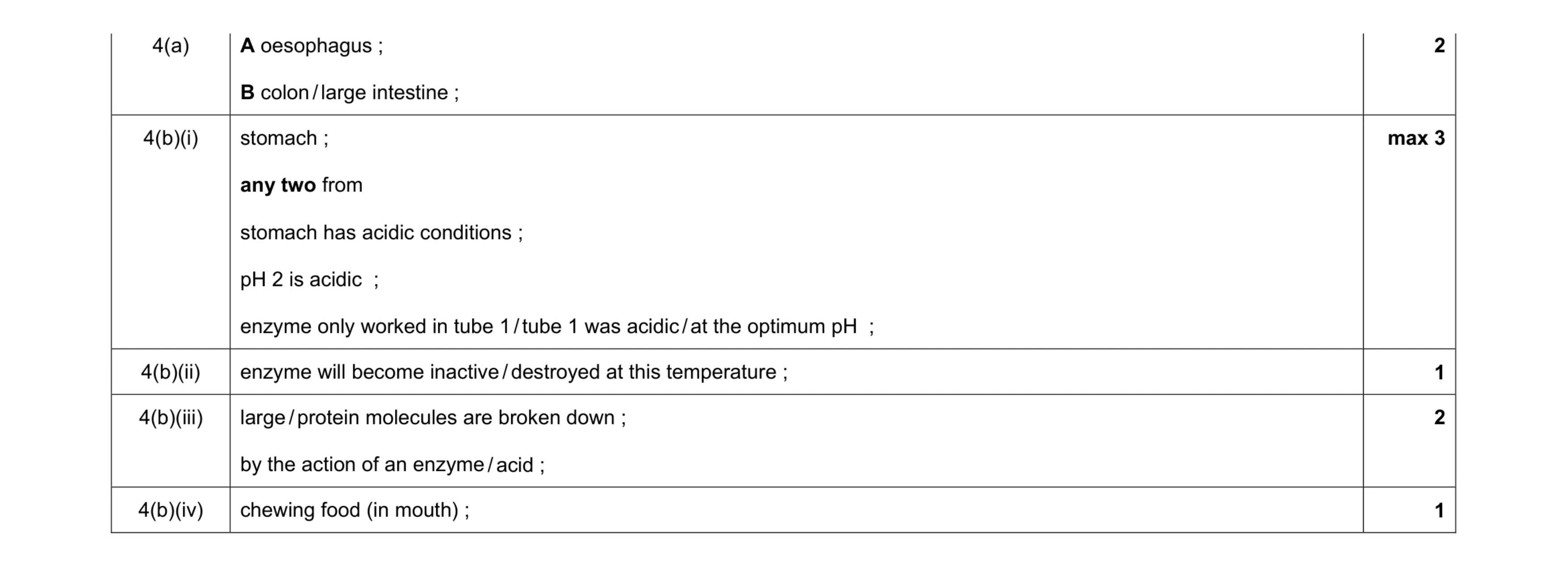 9
9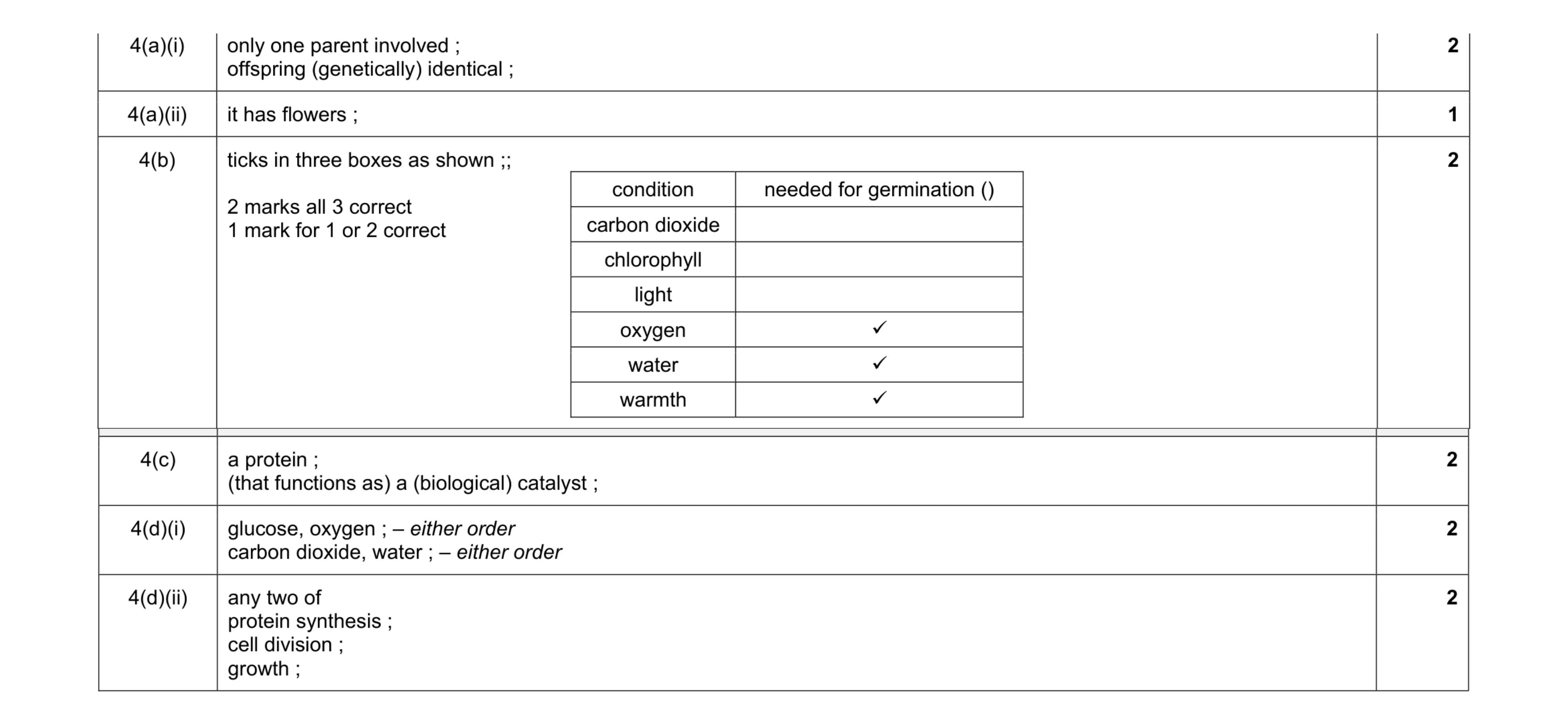 11
11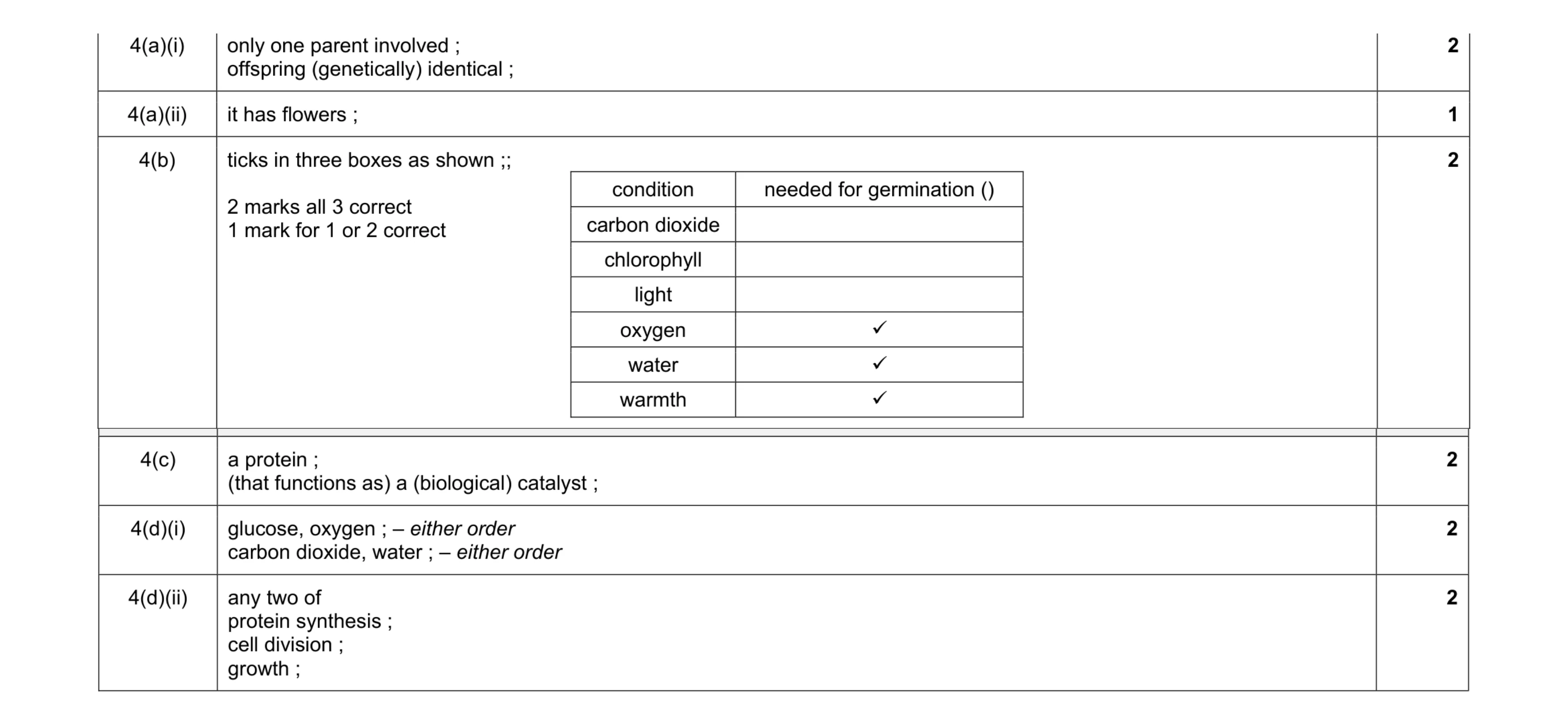 11
11 6
6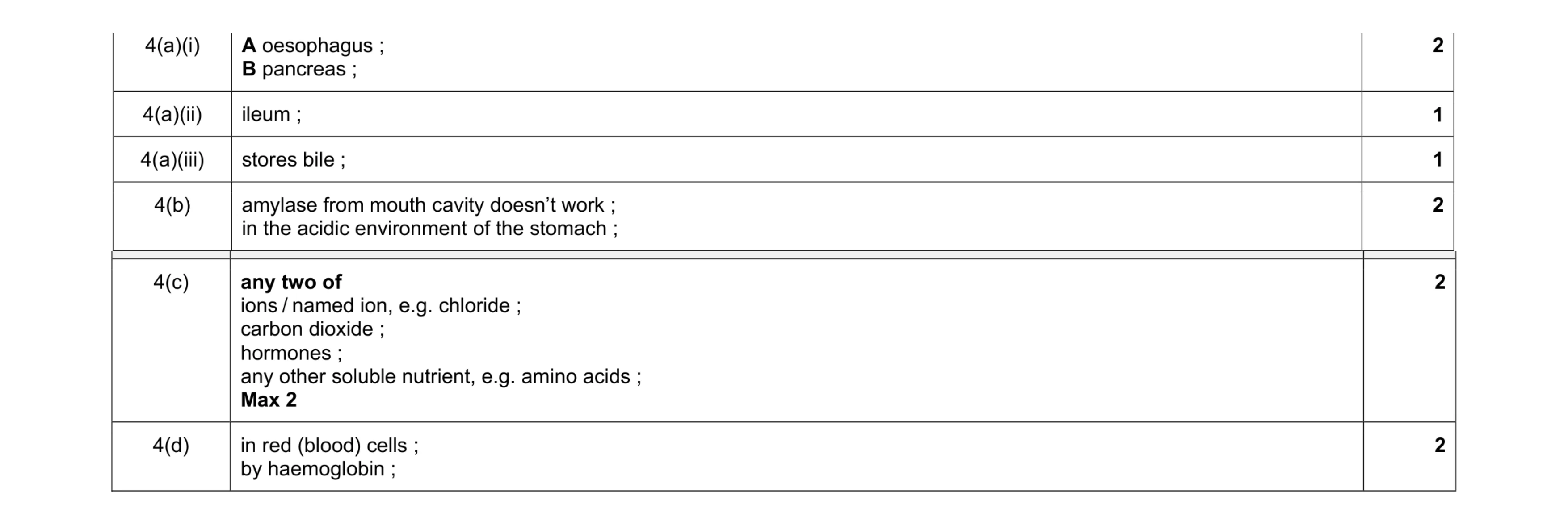 10
10 7
7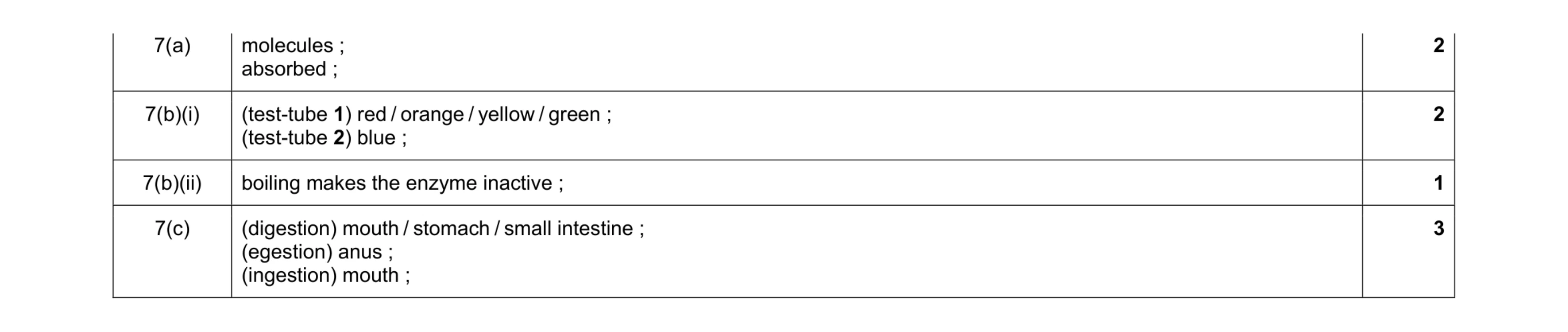 8
8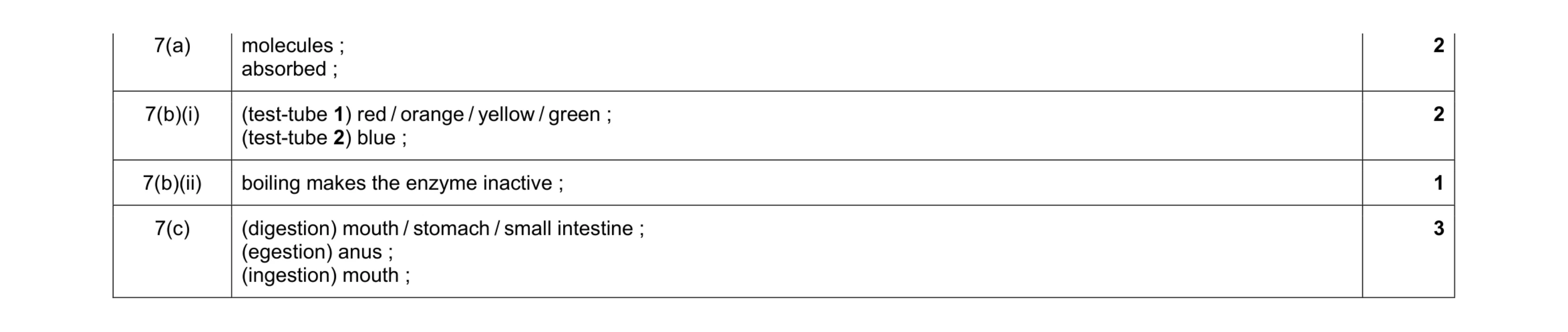 8
8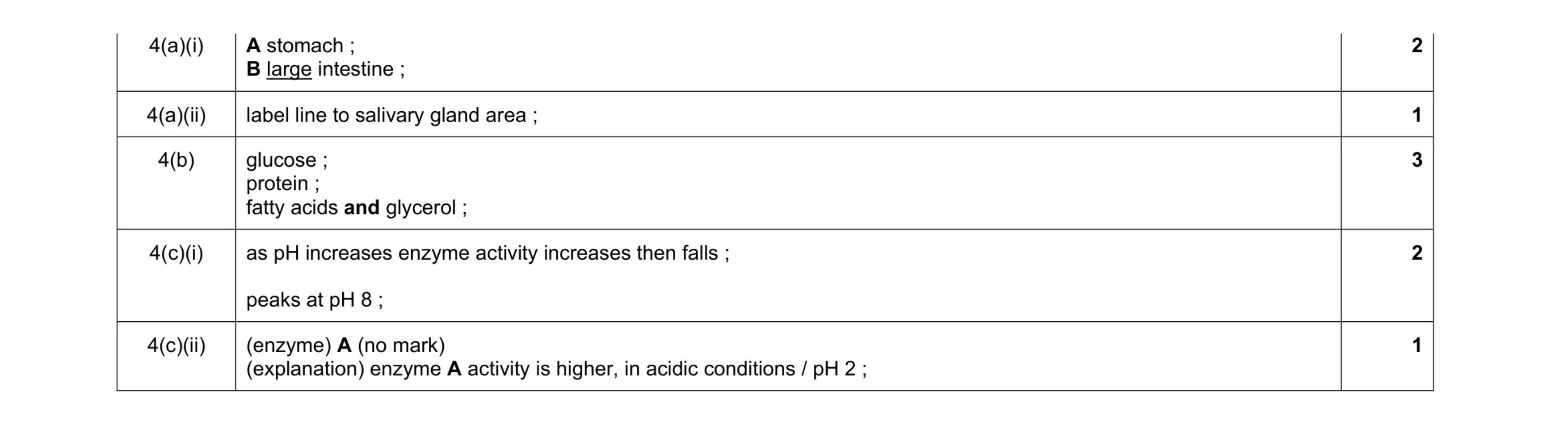 9
9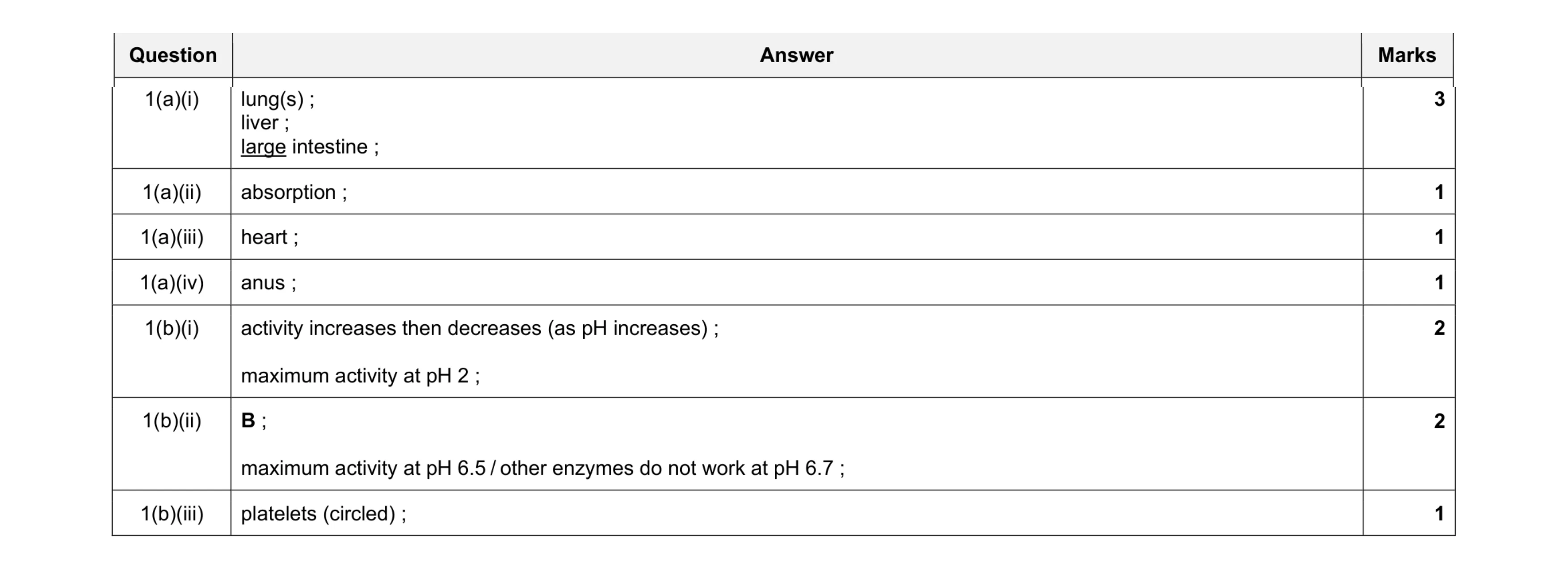 11
11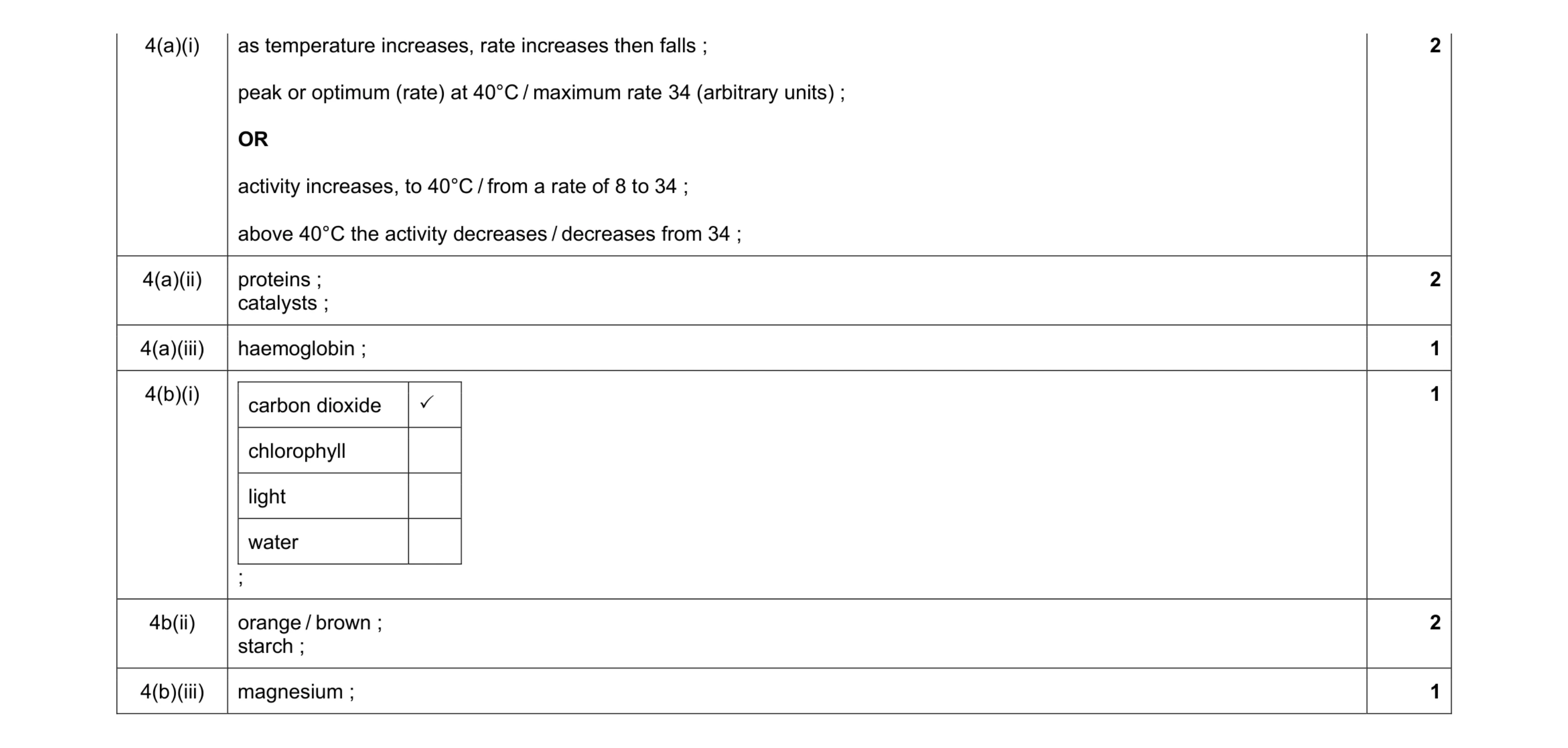 9
9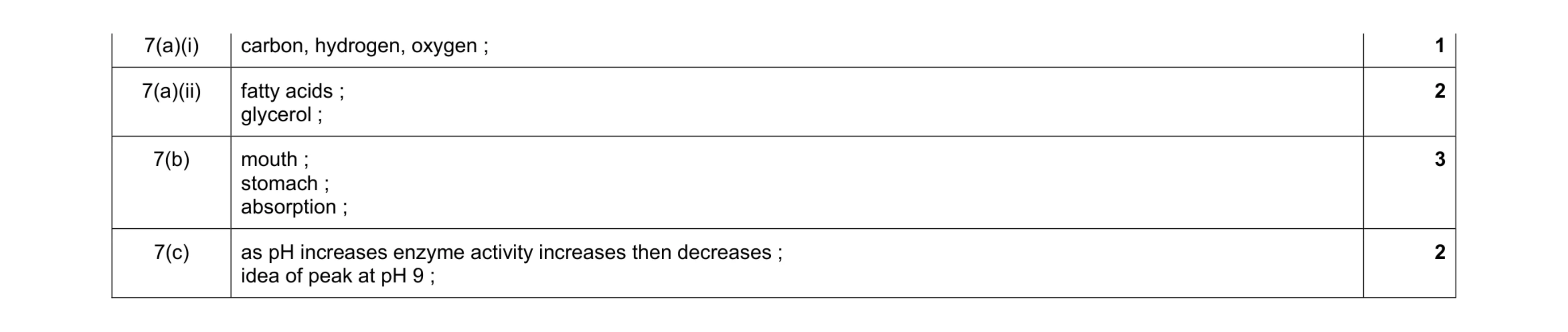 8
8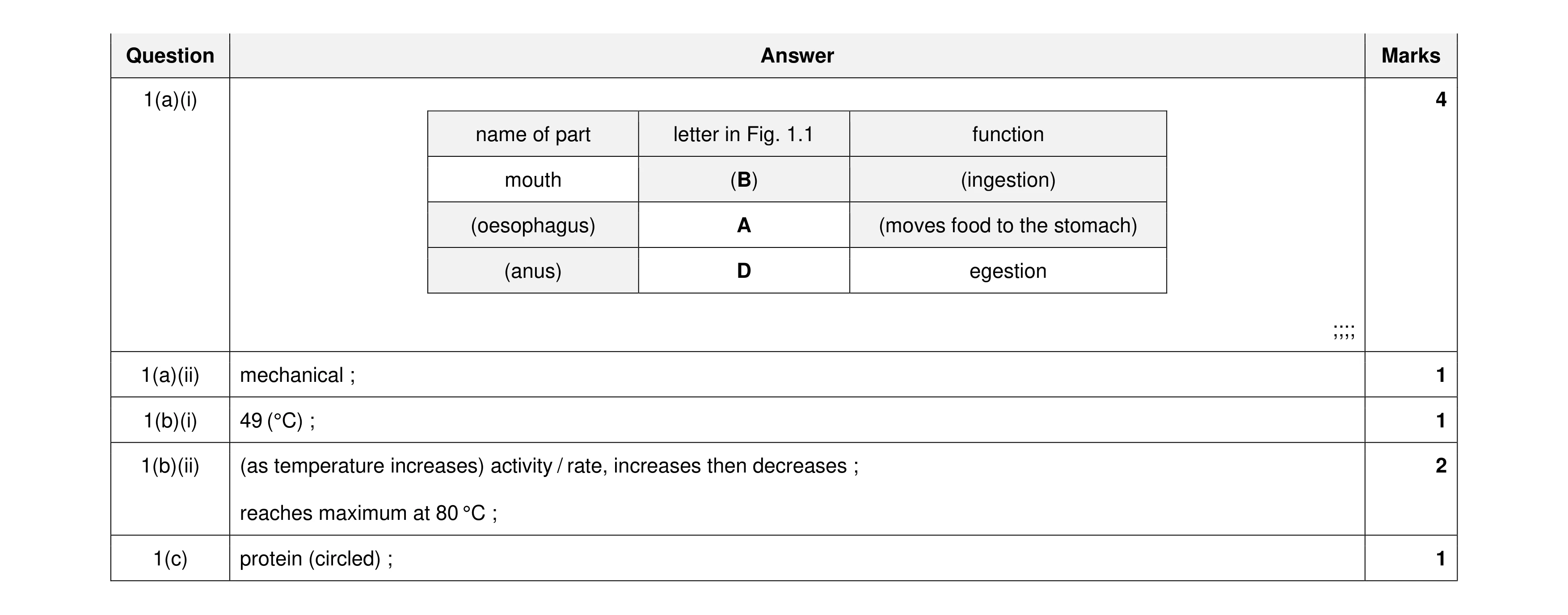 9
9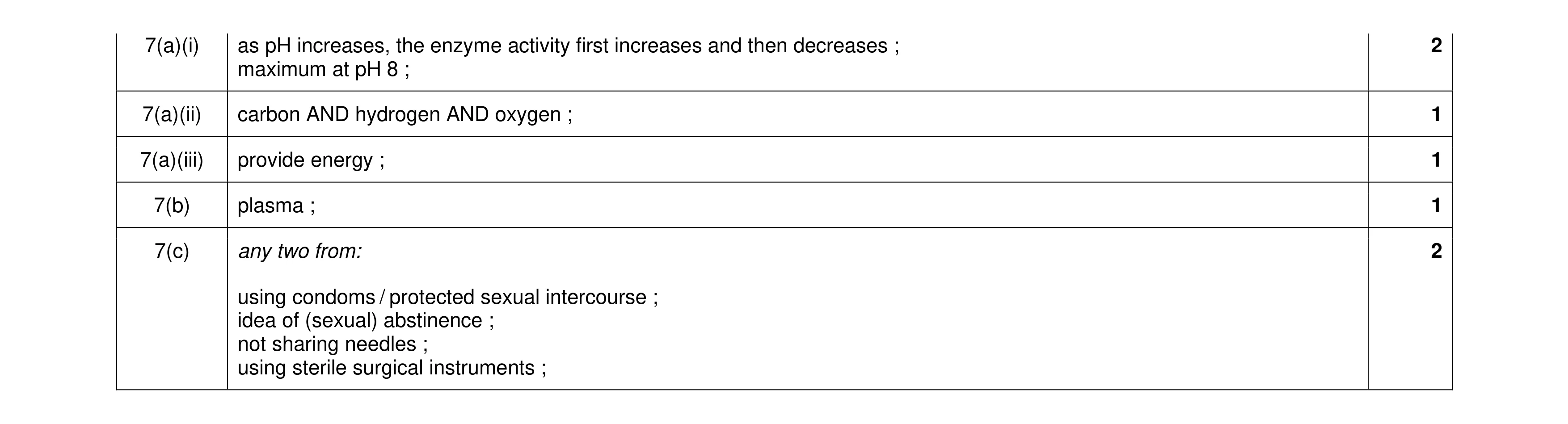 7
7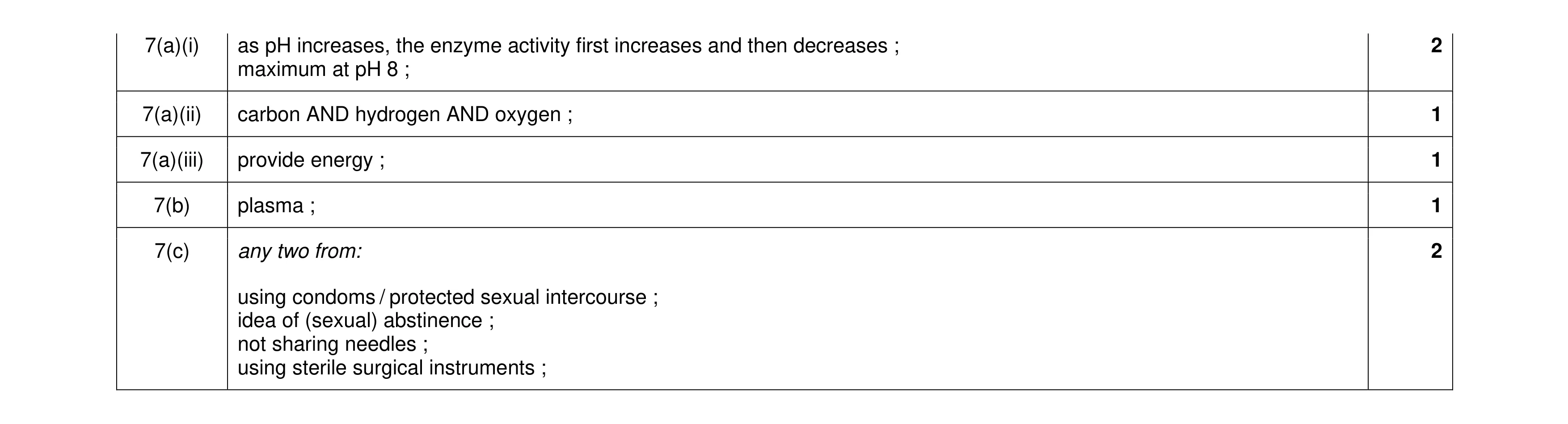 7
7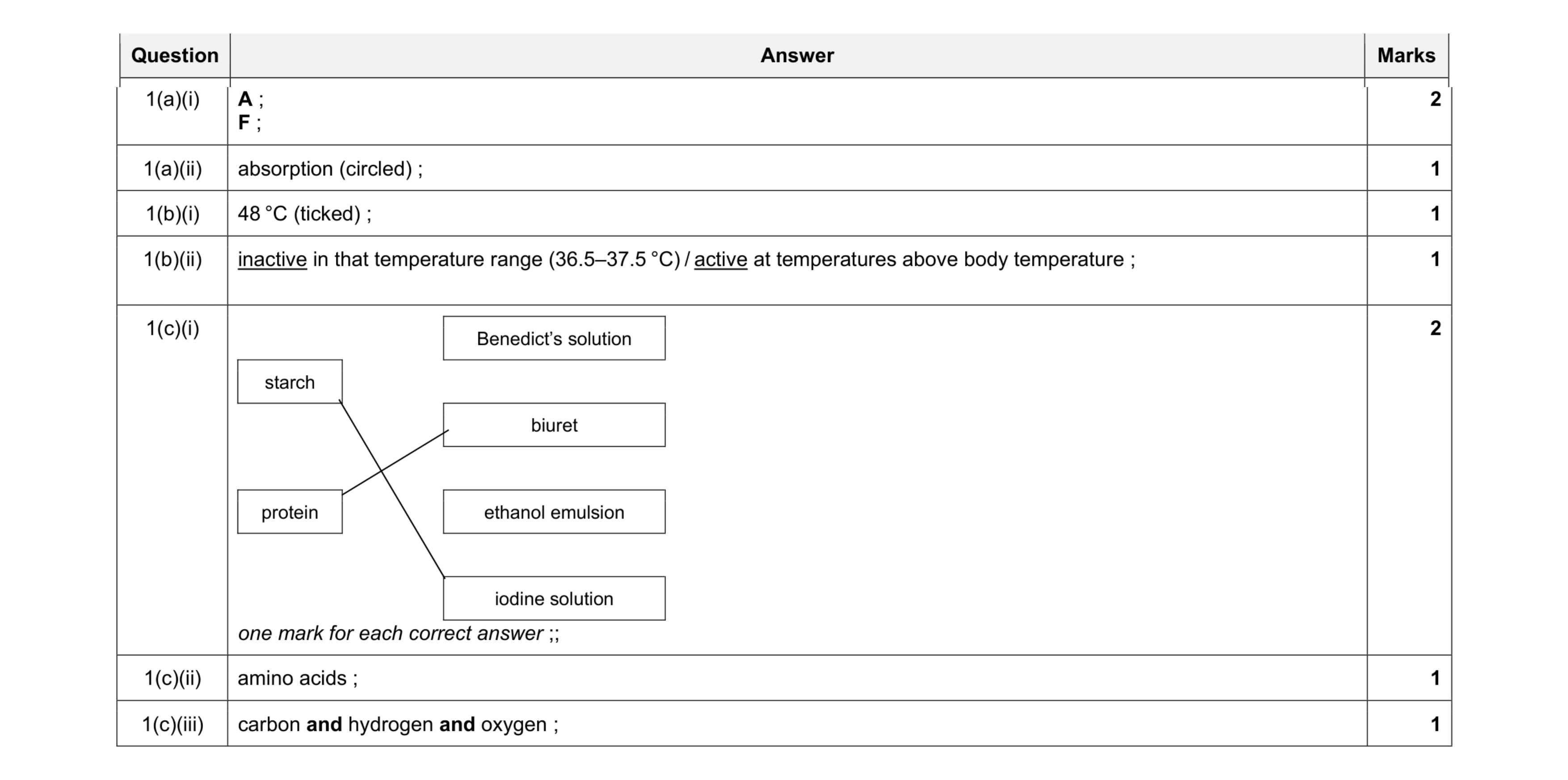 9
9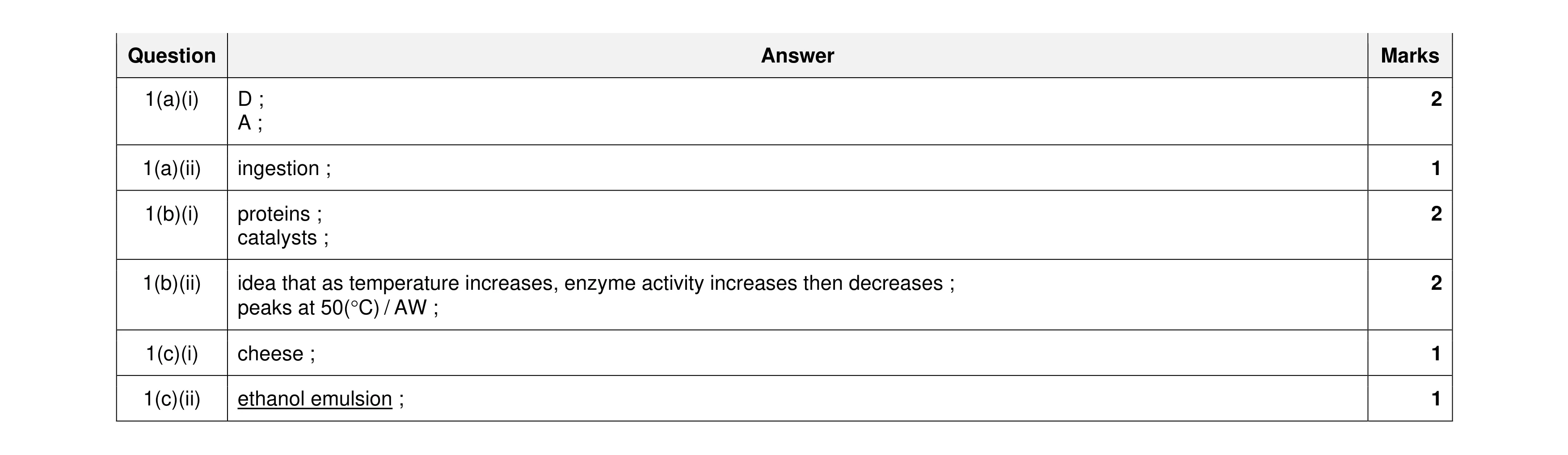 9
9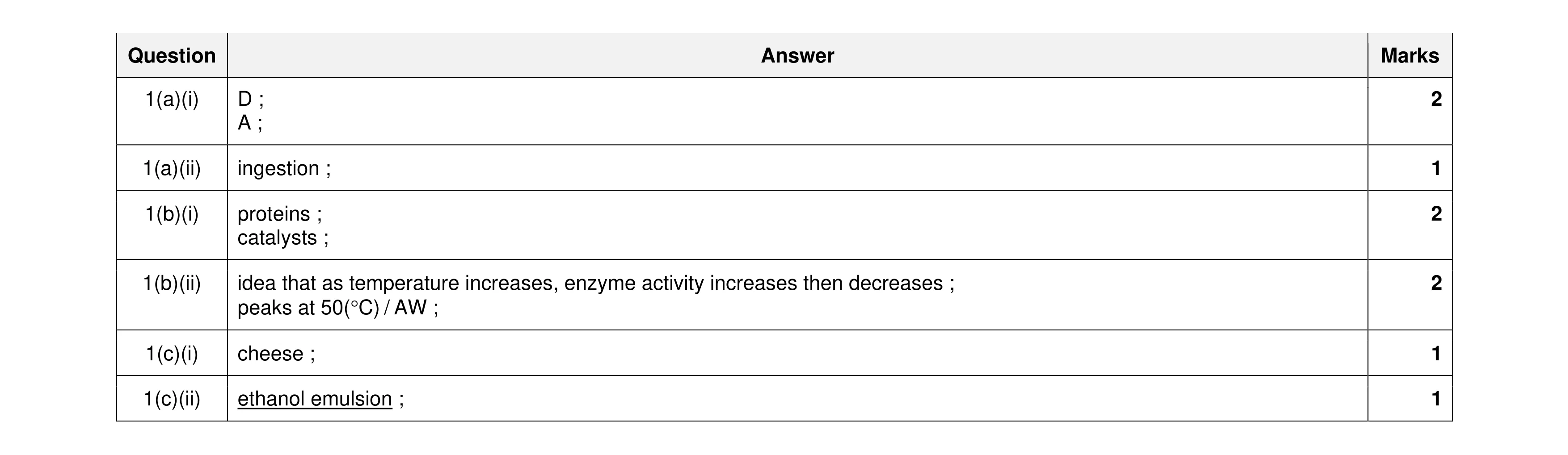 9
9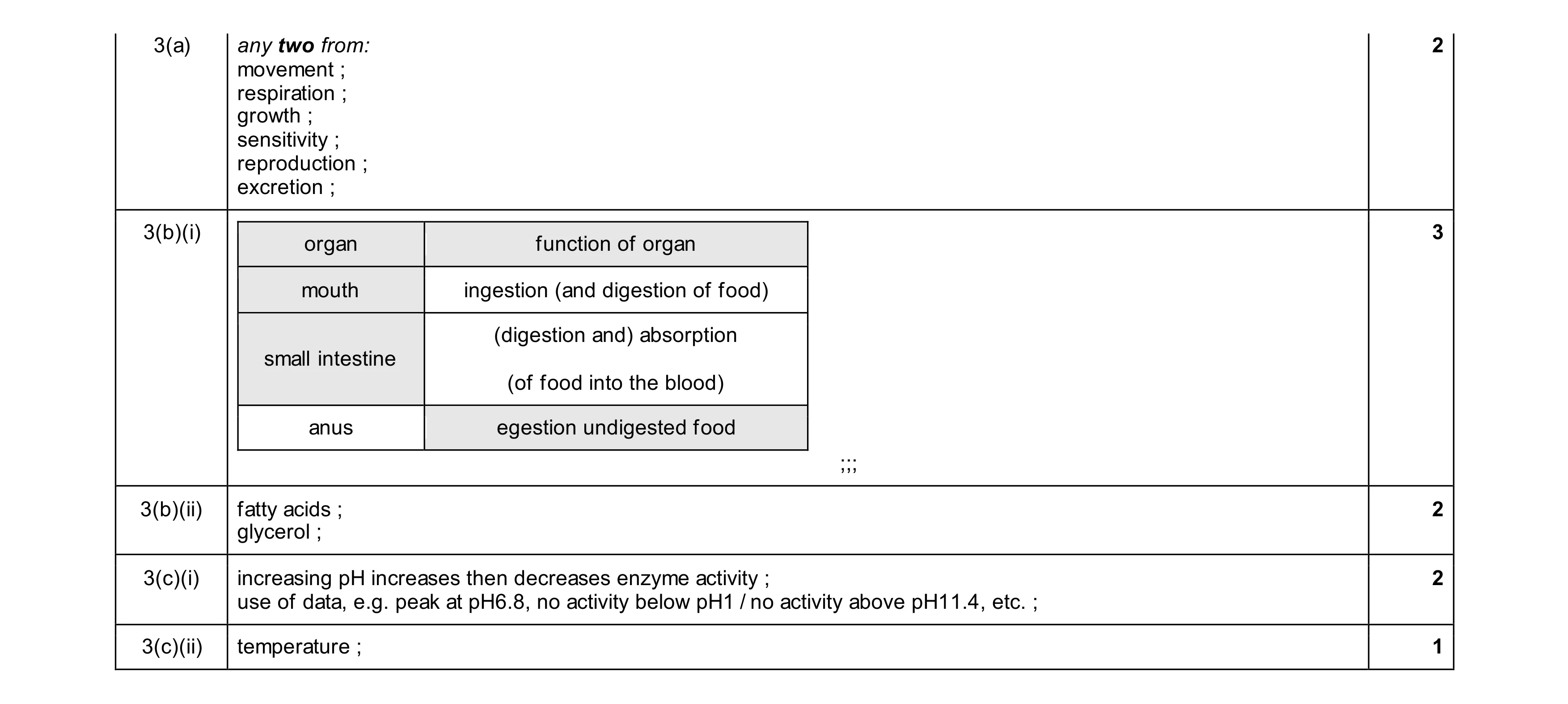 10
10