Cambridge IGCSE Science - Combined 0653 — 2007 May/June Paper 1 · Variant 1
0653/11/M/J/07 · 40 questions · 40 marks · ≈45 min
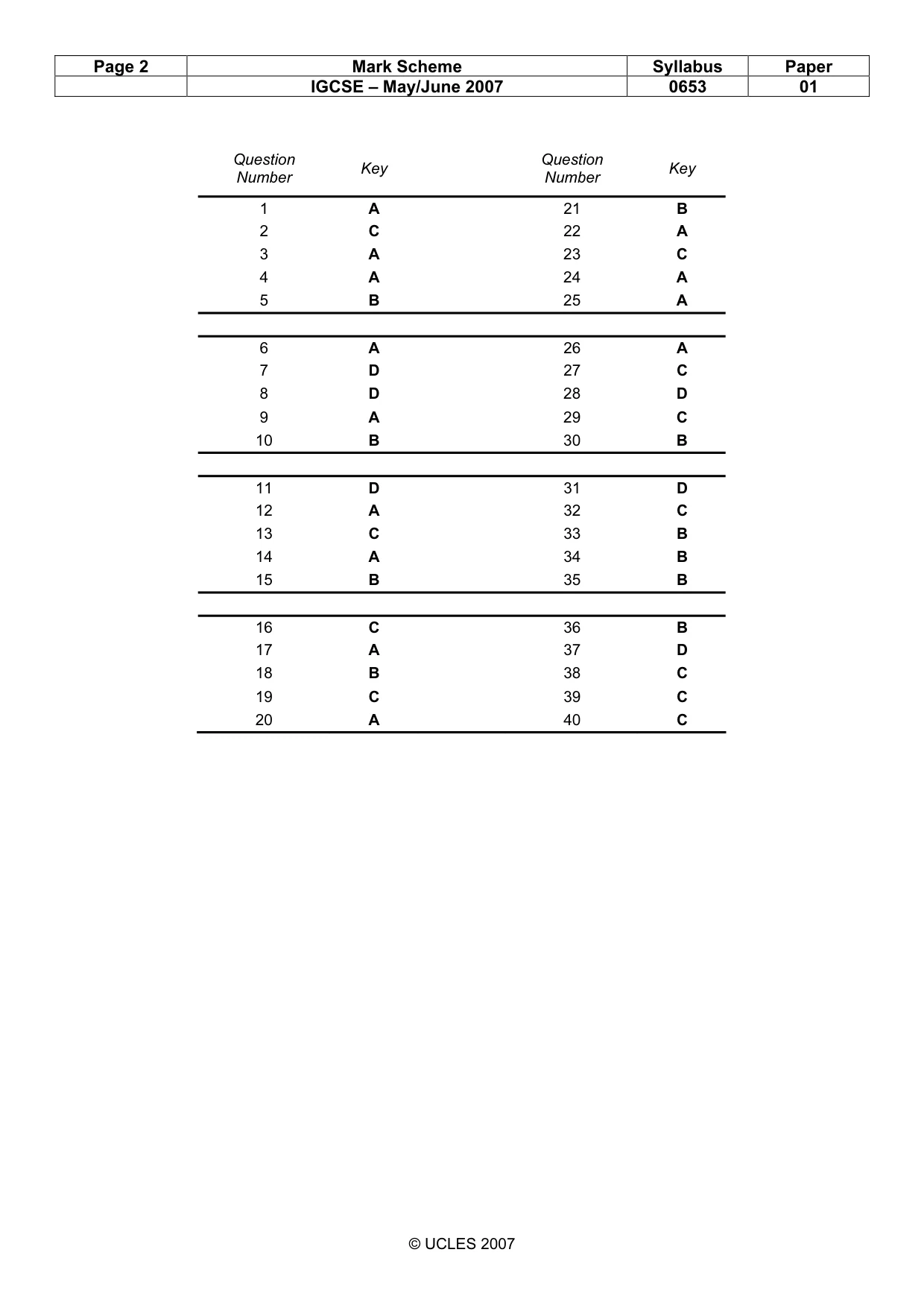
The question paper and its mark scheme, free to read here and free to download. This is Cambridge’s own paper, exactly as it was sat.
Question paper20 pages

Mark scheme2 pages
Answers below. Sit the paper first if you are practising.
Questions as text
Q1 · The table describes some parts of a plant cell
1 The table describes some parts of a plant cell. Which part is the cellulose cell wall? part feature A allows free passage of water and dissolved substances B contains DNA C is partially permeable D synthesises glucose in sunlight
Mark scheme: A
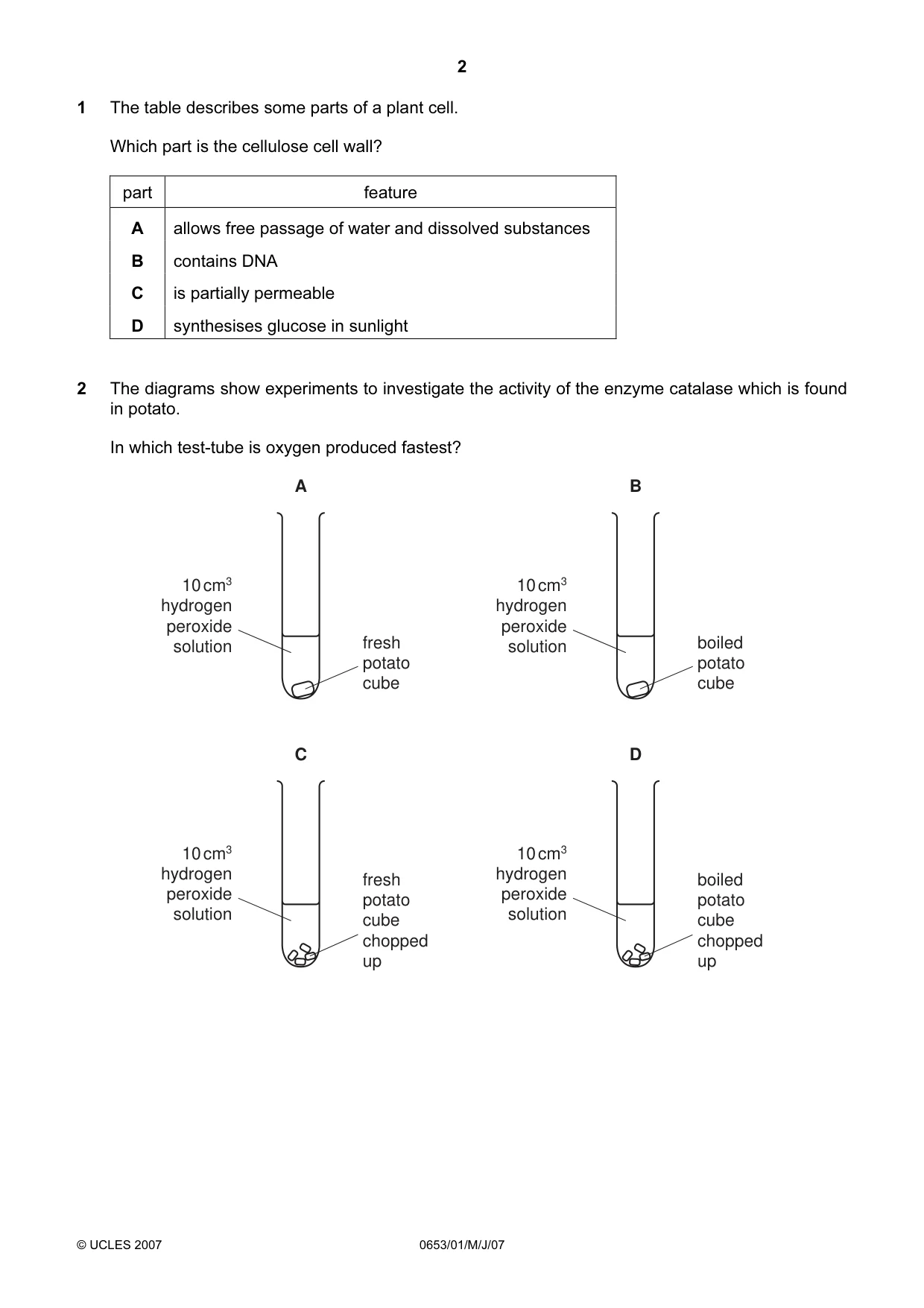
Q2 · The diagrams show experiments to investigate the activity of the enzyme catalase which is…
2 The diagrams show experiments to investigate the activity of the enzyme catalase which is found in potato. In which test-tube is oxygen produced fastest? A B 10 cm3 10 cm3 hydrogen hydrogen peroxide peroxide solution fresh solution boiled potato potato cube cube C D 10 cm3 10 cm3 hydrogen fresh hydrogen boiled peroxide potato peroxide potato solution cube solution cube chopped chopped up up
Mark scheme: C
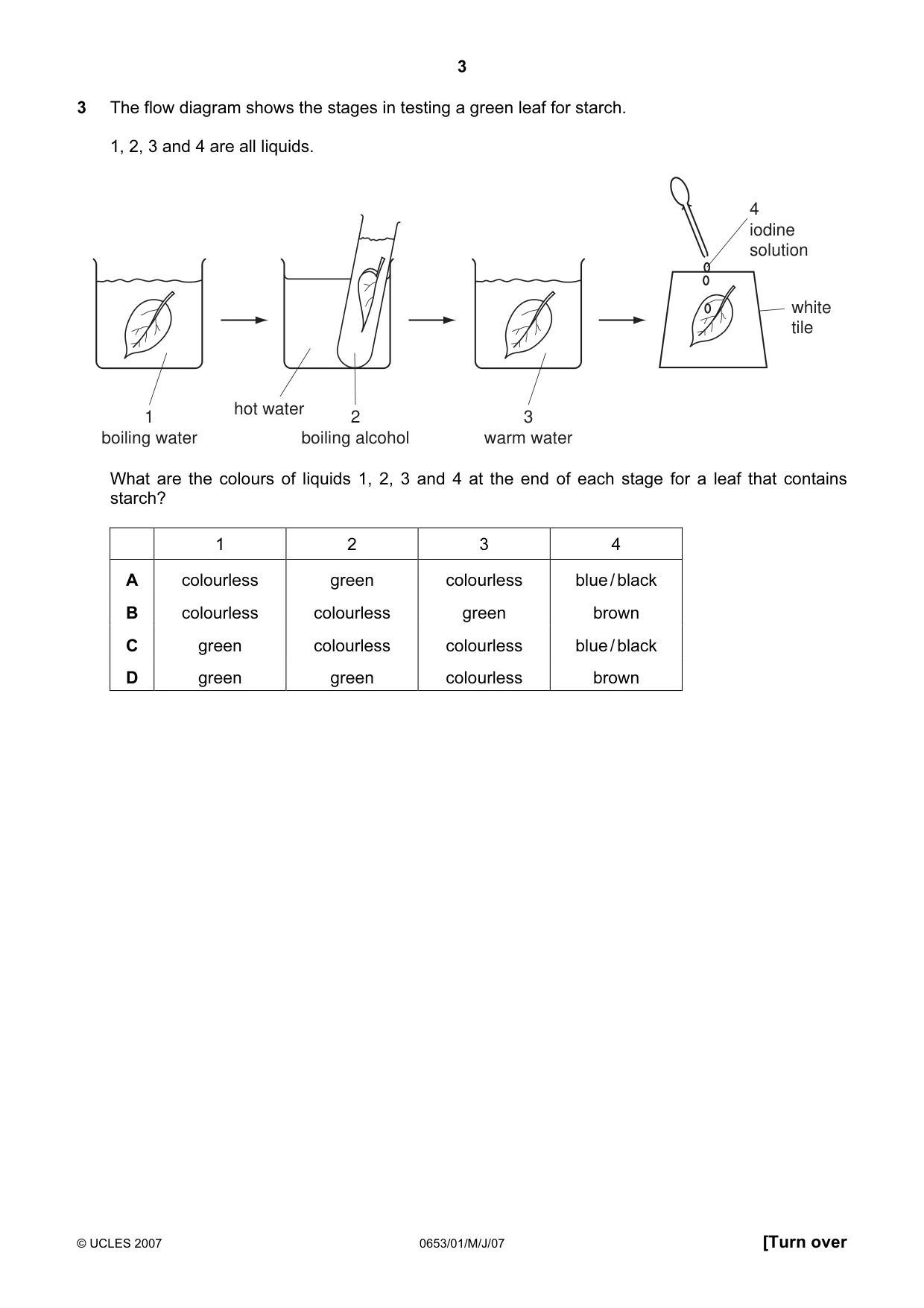
Q3 · The flow diagram shows the stages in testing a green leaf for starch
3 The flow diagram shows the stages in testing a green leaf for starch. 1, 2, 3 and 4 are all liquids. 4 iodine solution white tile hot water 1 2 3 boiling water boiling alcohol warm water What are the colours of liquids 1, 2, 3 and 4 at the end of each stage for a leaf that contains starch? 1 2 3 4 A colourless green colourless blue / black B colourless colourless green brown C green colourless colourless blue / black D green green colourless brown
Mark scheme: A
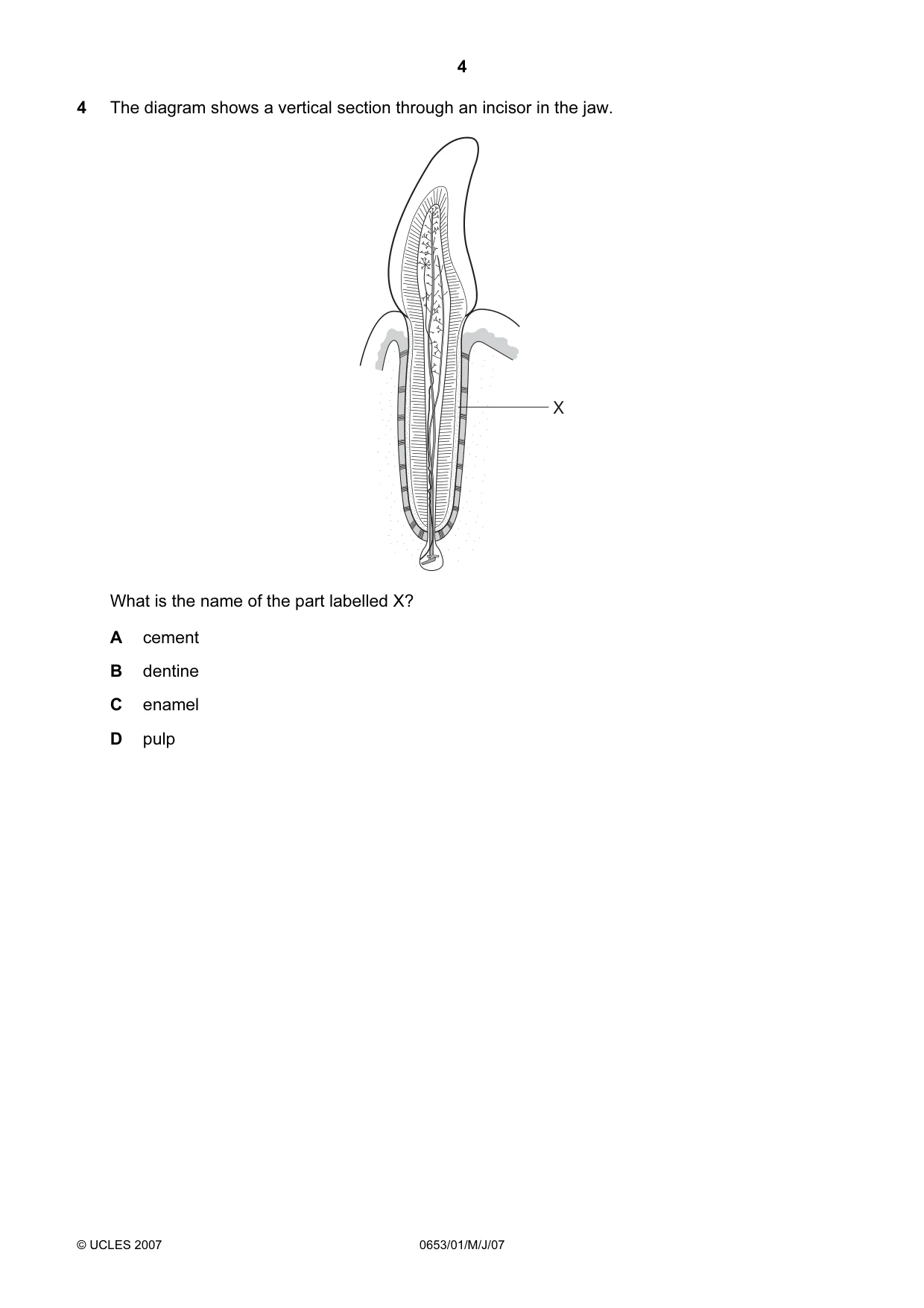
Q4 · The diagram shows a vertical section through an incisor in the jaw
4 The diagram shows a vertical section through an incisor in the jaw. X What is the name of the part labelled X? A cement B dentine C enamel D pulp
Mark scheme: A
Q5 · Four students assembled apparatus intended to show that air breathed out contains more…
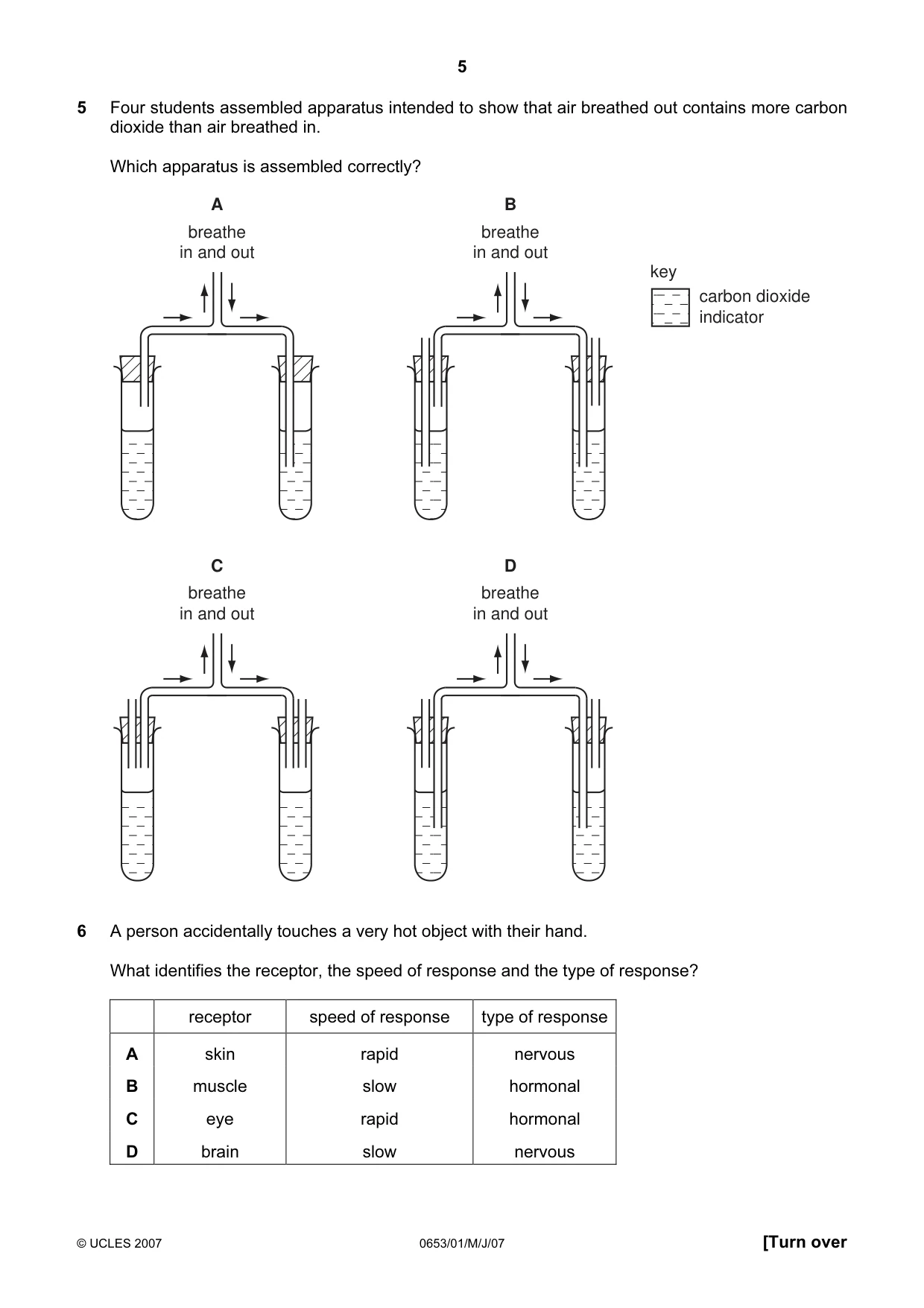
5 Four students assembled apparatus intended to show that air breathed out contains more carbon dioxide than air breathed in. Which apparatus is assembled correctly? A B breathe breathe in and out in and out key carbon dioxide indicator C D breathe breathe in and out in and out
Mark scheme: B
Q6 · A person accidentally touches a very hot object with their hand
6 A person accidentally touches a very hot object with their hand. What identifies the receptor, the speed of response and the type of response? receptor speed of response type of response A skin rapid nervous B muscle slow hormonal C eye rapid hormonal D brain slow nervous
Mark scheme: A
Q7 · The diagram shows an external view of the human heart
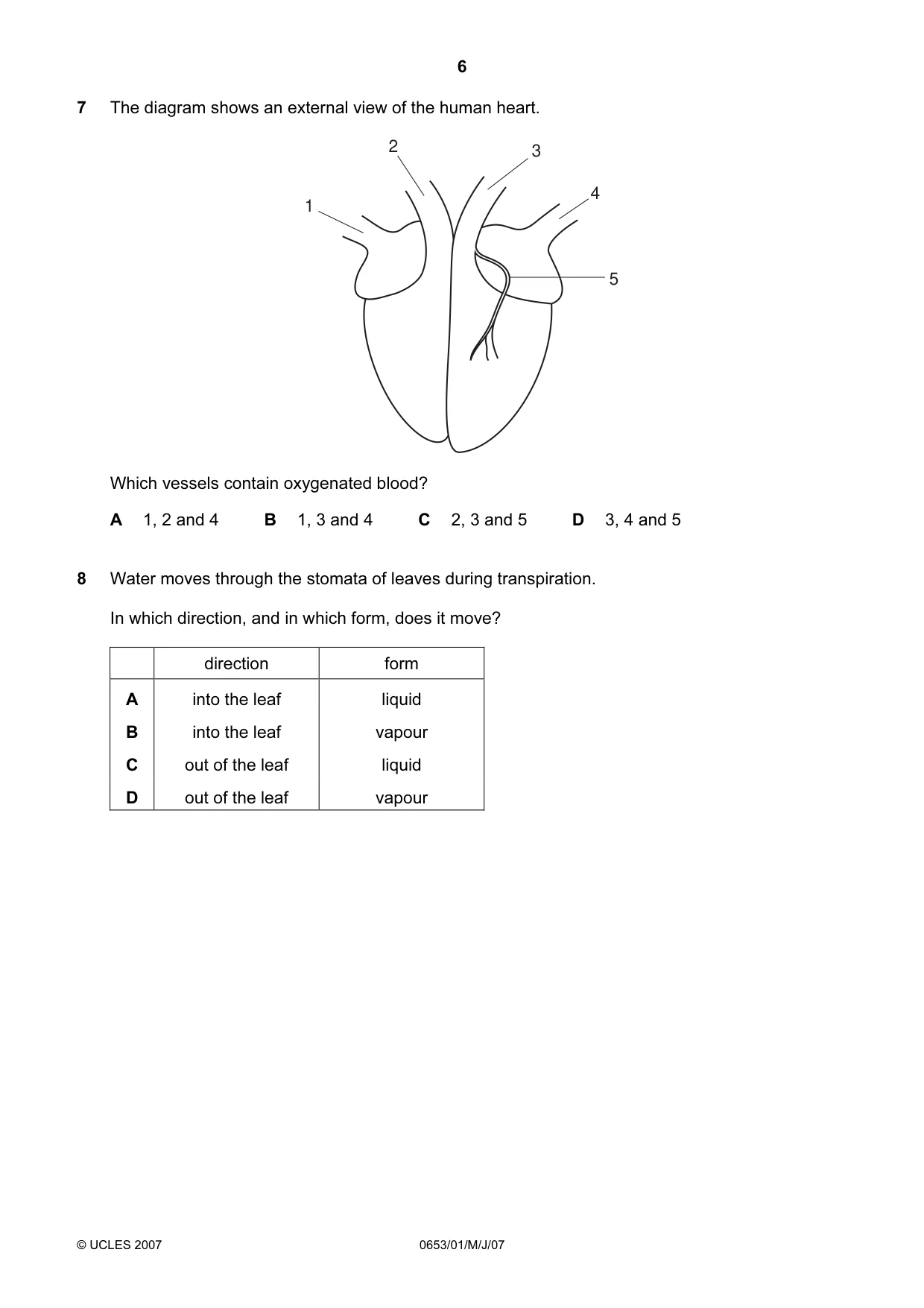
7 The diagram shows an external view of the human heart. 2 3 4 1 5 Which vessels contain oxygenated blood? A 1, 2 and 4 B 1, 3 and 4 C 2, 3 and 5 D 3, 4 and 5
Mark scheme: D
Q8 · Water moves through the stomata of leaves during transpiration
8 Water moves through the stomata of leaves during transpiration. In which direction, and in which form, does it move? direction form A into the leaf liquid B into the leaf vapour C out of the leaf liquid D out of the leaf vapour
Mark scheme: D
Q9 · The diagram shows a side view of the female reproductive system in a human
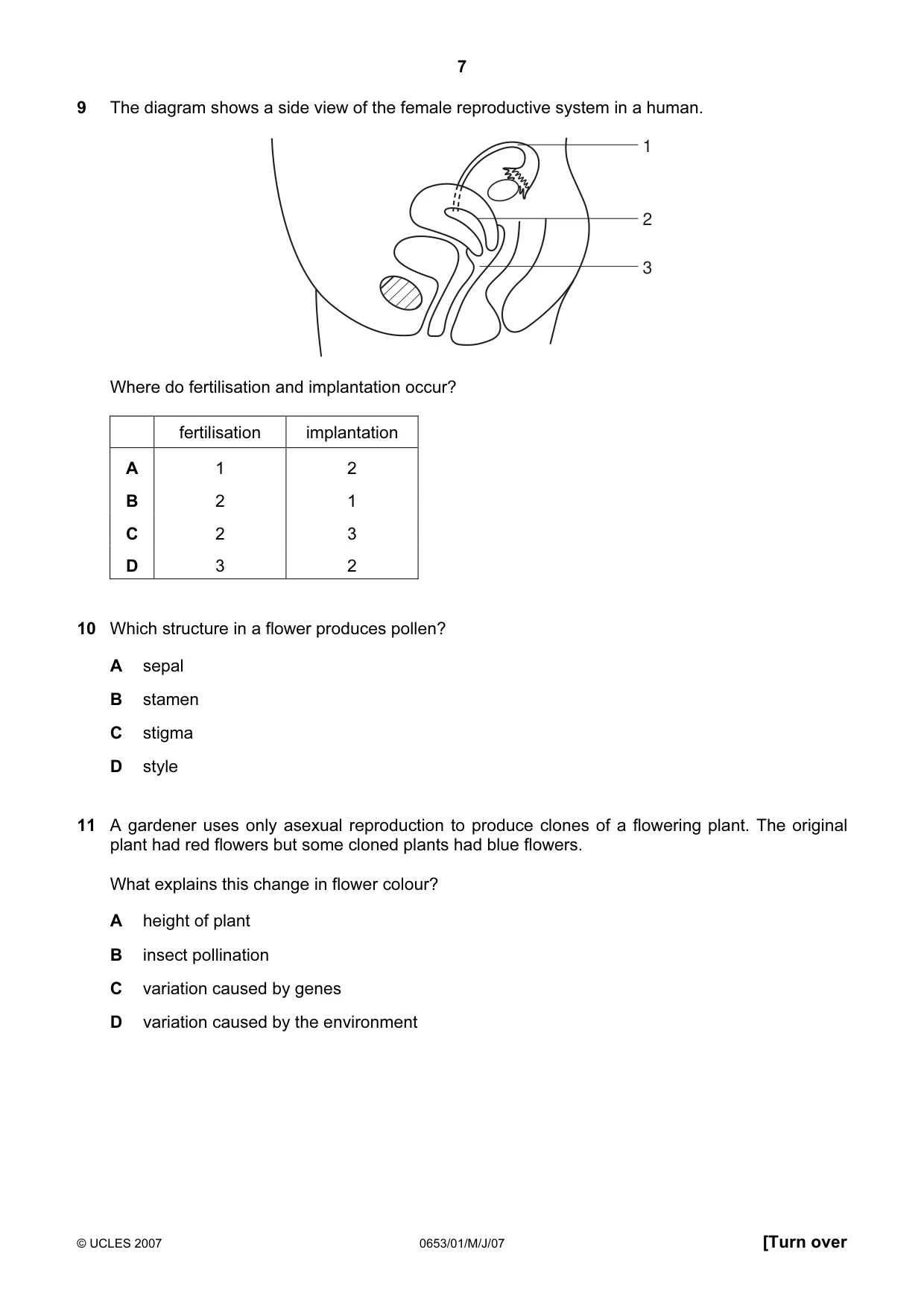
9 The diagram shows a side view of the female reproductive system in a human. 1 2 3 Where do fertilisation and implantation occur? fertilisation implantation A 1 2 B 2 1 C 2 3 D 3 2
Mark scheme: A
Q10 · Which structure in a flower produces pollen?
10 Which structure in a flower produces pollen? A sepal B stamen C stigma D style
Mark scheme: B
Q11 · A gardener uses only asexual reproduction to produce clones of a flowering plant
11 A gardener uses only asexual reproduction to produce clones of a flowering plant. The original plant had red flowers but some cloned plants had blue flowers. What explains this change in flower colour? A height of plant B insect pollination C variation caused by genes D variation caused by the environment
Mark scheme: D
Q12 · The diagram represents a feeding relationship through which energy flows
12 The diagram represents a feeding relationship through which energy flows. P Q grass cow lion decomposer What is the type of the feeding relationship and the direction in which the energy flows? type of direction of relationship energy flow A food chain P to Q B food chain Q to P C food web P to Q D food web Q to P
Mark scheme: A
Q13 · Which farming practice increases species diversity?
13 Which farming practice increases species diversity? A cutting down trees B grazing more cattle C maintaining plant cover D using tractors
Mark scheme: C
Q14 · Which diagram shows how a mixture of dyes in a food colouring can be separated?
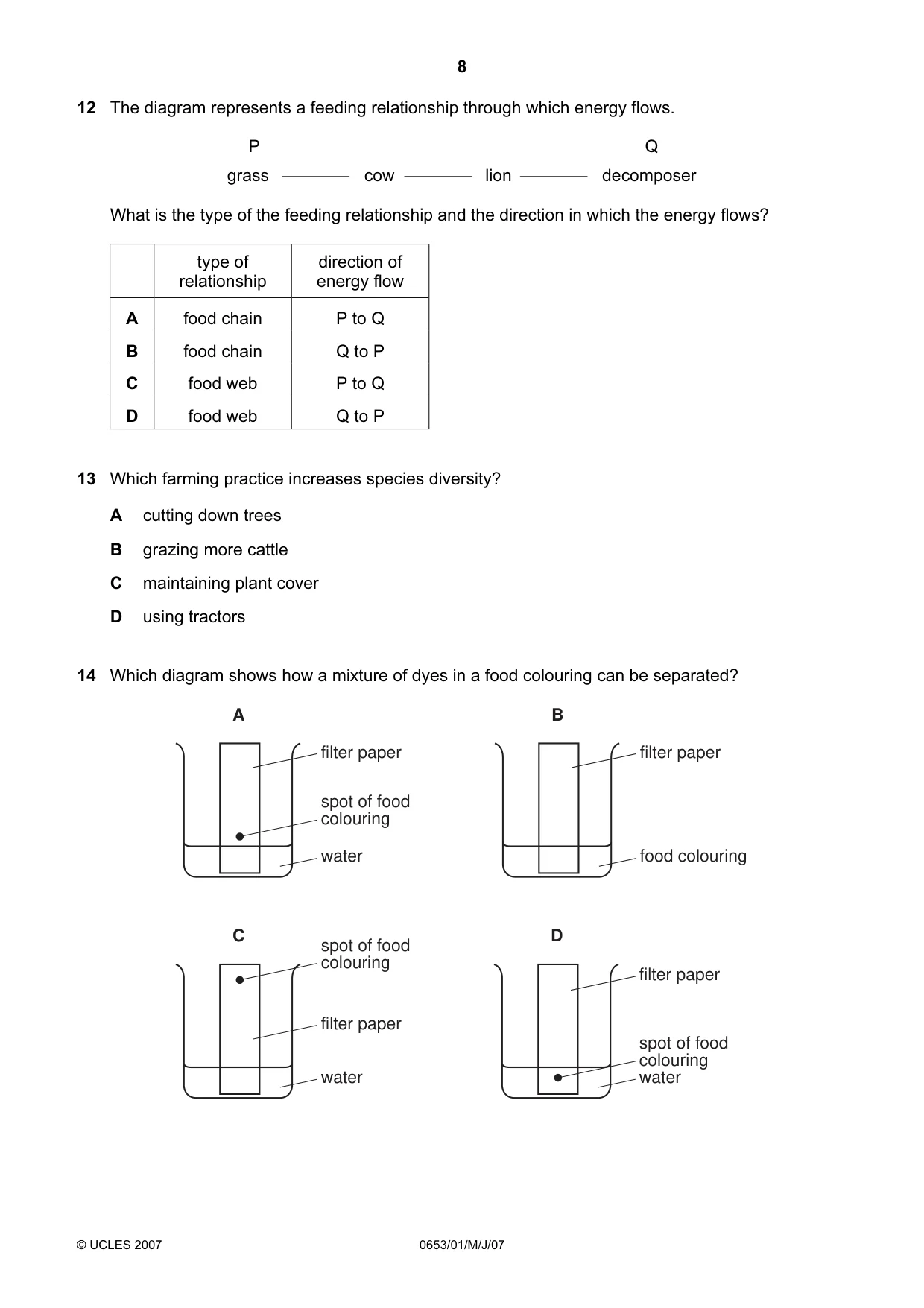
14 Which diagram shows how a mixture of dyes in a food colouring can be separated? A B filter paper filter paper spot of food colouring water food colouring C D spot of food colouring filter paper filter paper spot of food colouring water water
Mark scheme: A
Q15 · Which two elements form covalent bonds when they combine with each other?
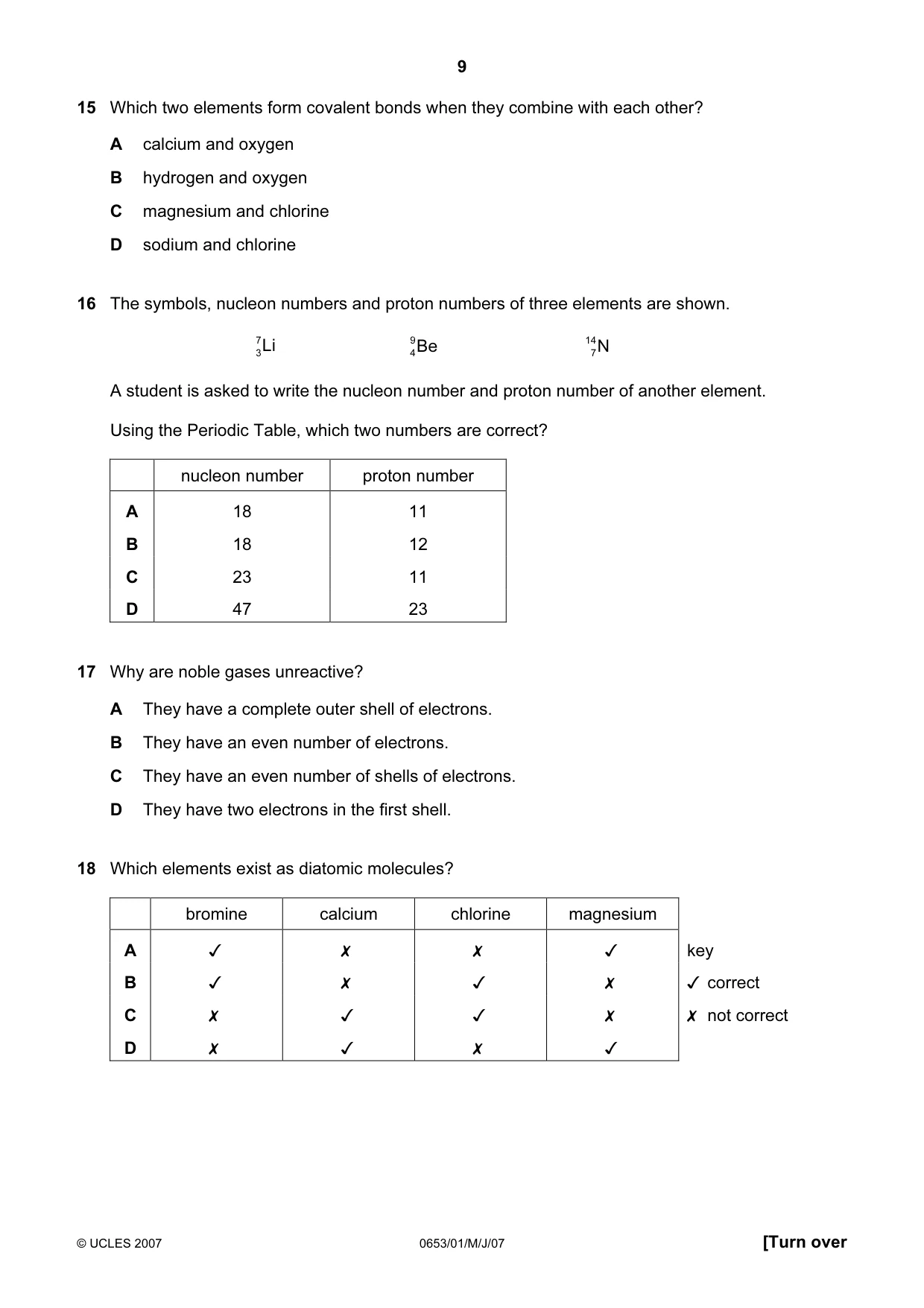
15 Which two elements form covalent bonds when they combine with each other? A calcium and oxygen B hydrogen and oxygen C magnesium and chlorine D sodium and chlorine
Mark scheme: B
Q16 · The symbols, nucleon numbers and proton numbers of three elements are shown
16 The symbols, nucleon numbers and proton numbers of three elements are shown. 7 3Li 9 4Be 14 7N A student is asked to write the nucleon number and proton number of another element. Using the Periodic Table, which two numbers are correct? nucleon number proton number A 18 11 B 18 12 C 23 11 D 47 23
Mark scheme: C
Q17 · Why are noble gases unreactive?
17 Why are noble gases unreactive? A They have a complete outer shell of electrons. B They have an even number of electrons. C They have an even number of shells of electrons. D They have two electrons in the first shell.
Mark scheme: A
Q18 · Which elements exist as diatomic molecules?
18 Which elements exist as diatomic molecules? bromine calcium chlorine magnesium A v x x v B v x v x Cc x v v x D x v x v key JY correct X not correct
Mark scheme: B
Q19 · Which method is used to obtain iron from iron(III) oxide?
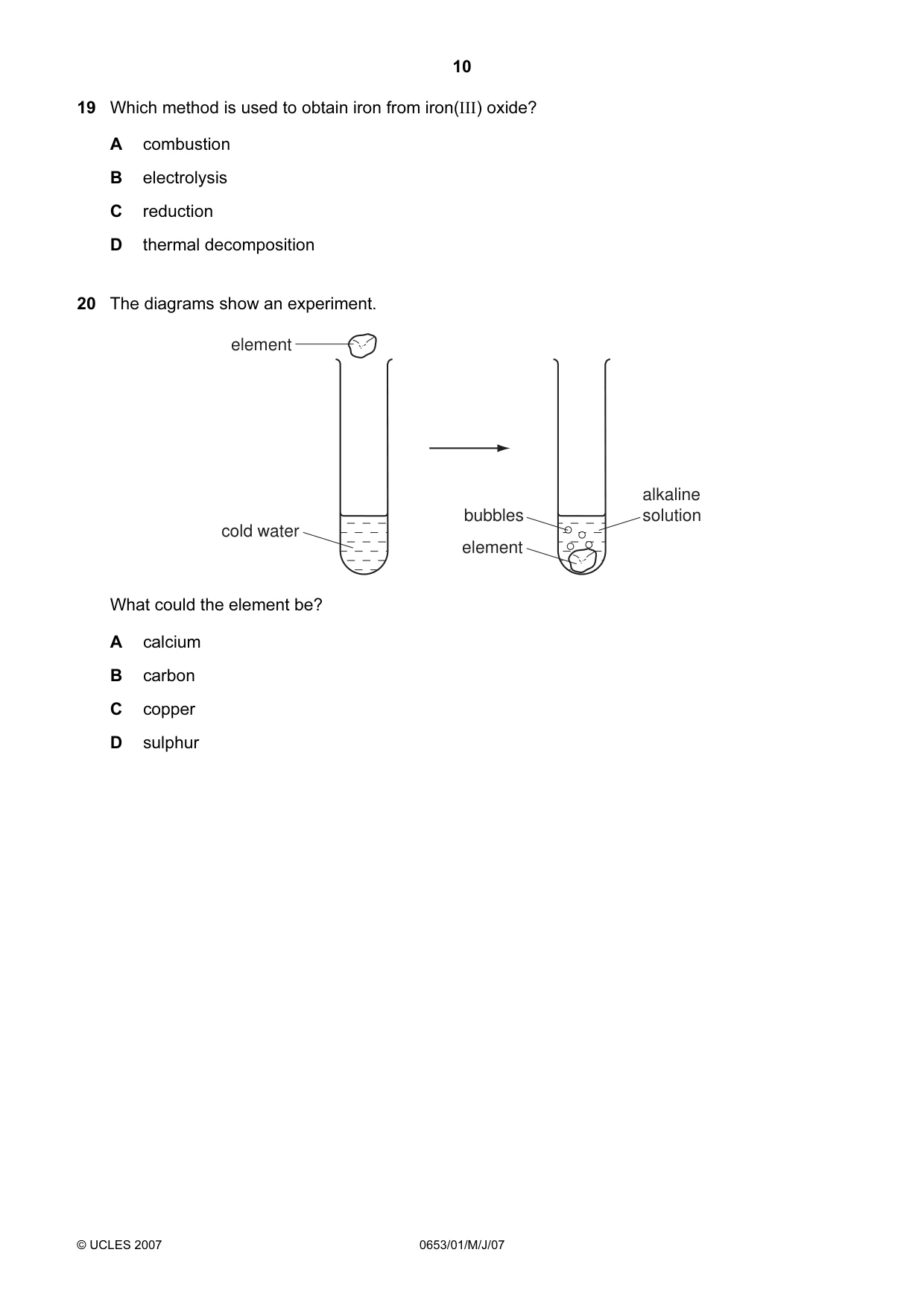
19 Which method is used to obtain iron from iron(III) oxide? A combustion B electrolysis C reduction D thermal decomposition
Mark scheme: C
Q20 · The diagrams show an experiment
20 The diagrams show an experiment. element alkaline bubbles solution cold water element What could the element be? A calcium B carbon C copper D sulphur
Mark scheme: A
Q21 · The diagram shows uses of alloys
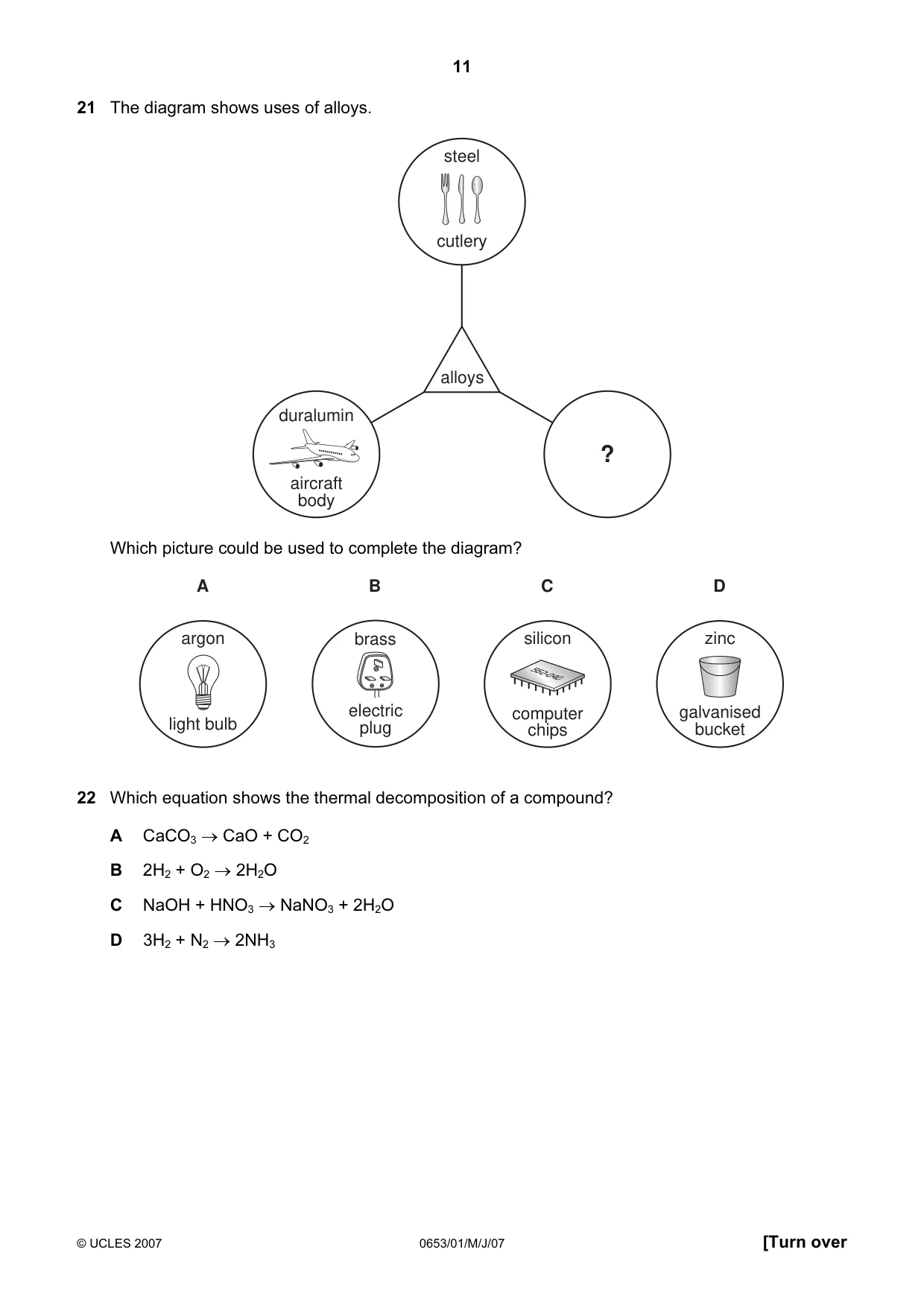
21 The diagram shows uses of alloys. steel cutlery alloys duralumin ? aircraft body Which picture could be used to complete the diagram? A B C D argon brass silicon zinc 562-04G electric computer galvanised light bulb plug chips bucket
Mark scheme: B
Q22 · Which equation shows the thermal decomposition of a compound?
22 Which equation shows the thermal decomposition of a compound? A CaCO3 → CaO + CO2 B 2H2 + O2 → 2H2O C NaOH + HNO3 → NaNO3 + 2H2O D 3H2 + N2 → 2NH3
Mark scheme: A
Q23 · Marble and chalk are two forms of calcium carbonate
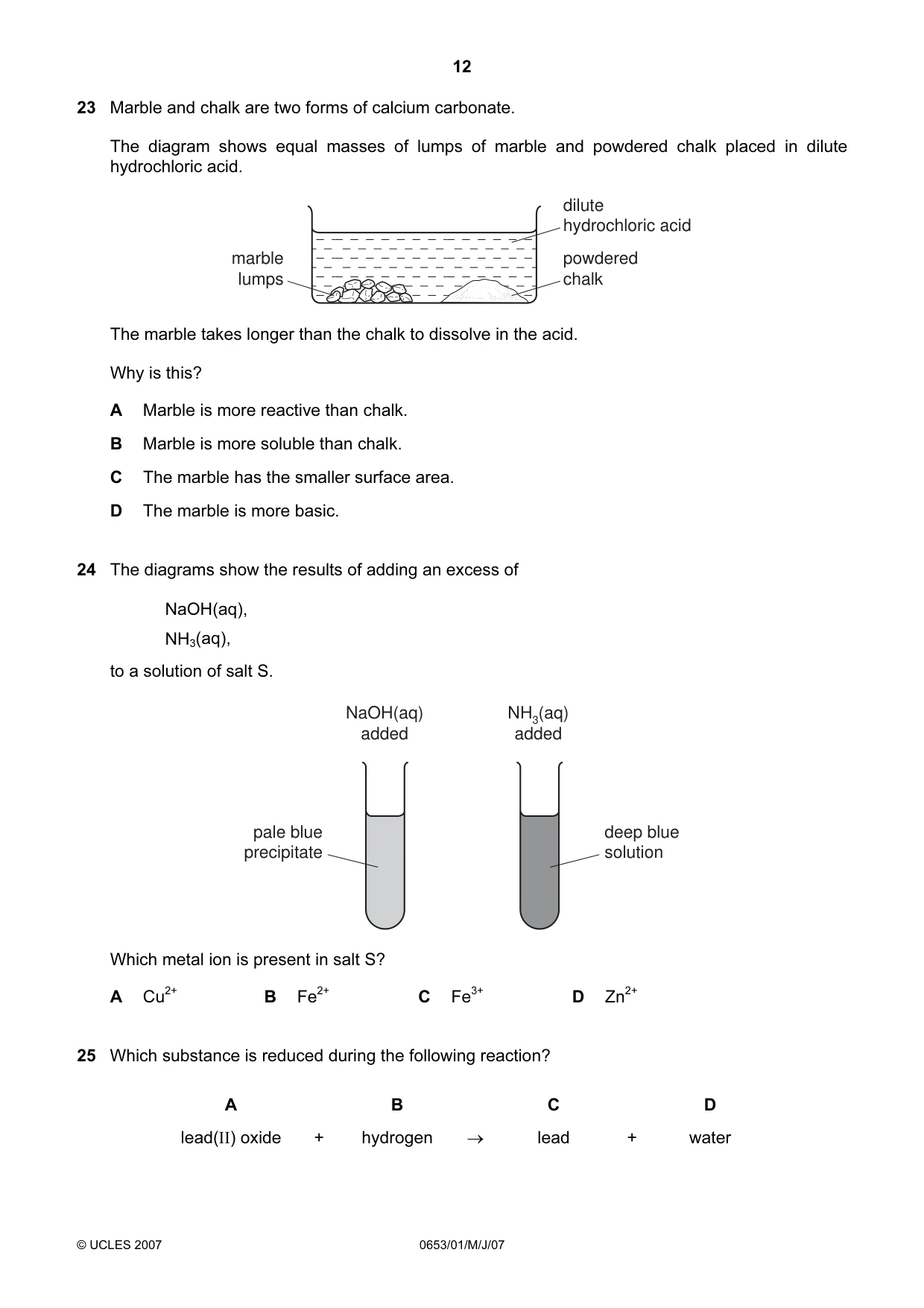
23 Marble and chalk are two forms of calcium carbonate. The diagram shows equal masses of lumps of marble and powdered chalk placed in dilute hydrochloric acid. dilute hydrochloric acid marble powdered lumps chalk The marble takes longer than the chalk to dissolve in the acid. Why is this? A Marble is more reactive than chalk. B Marble is more soluble than chalk. C The marble has the smaller surface area. D The marble is more basic.
Mark scheme: C
Q24 · The diagrams show the results of adding an excess of NaOH(aq), NH3(aq), to a solution of…
24 The diagrams show the results of adding an excess of NaOH(aq), NH3(aq), to a solution of salt S. NaOH(aq) NH3(aq) added added pale blue deep blue precipitate solution Which metal ion is present in salt S? A Cu2+ B Fe2+ C Fe3+ D Zn2+
Mark scheme: A
Q25 · Which substance is reduced during the following reaction?
25 Which substance is reduced during the following reaction? A B C D lead(II) oxide + hydrogen → lead + water
Mark scheme: A
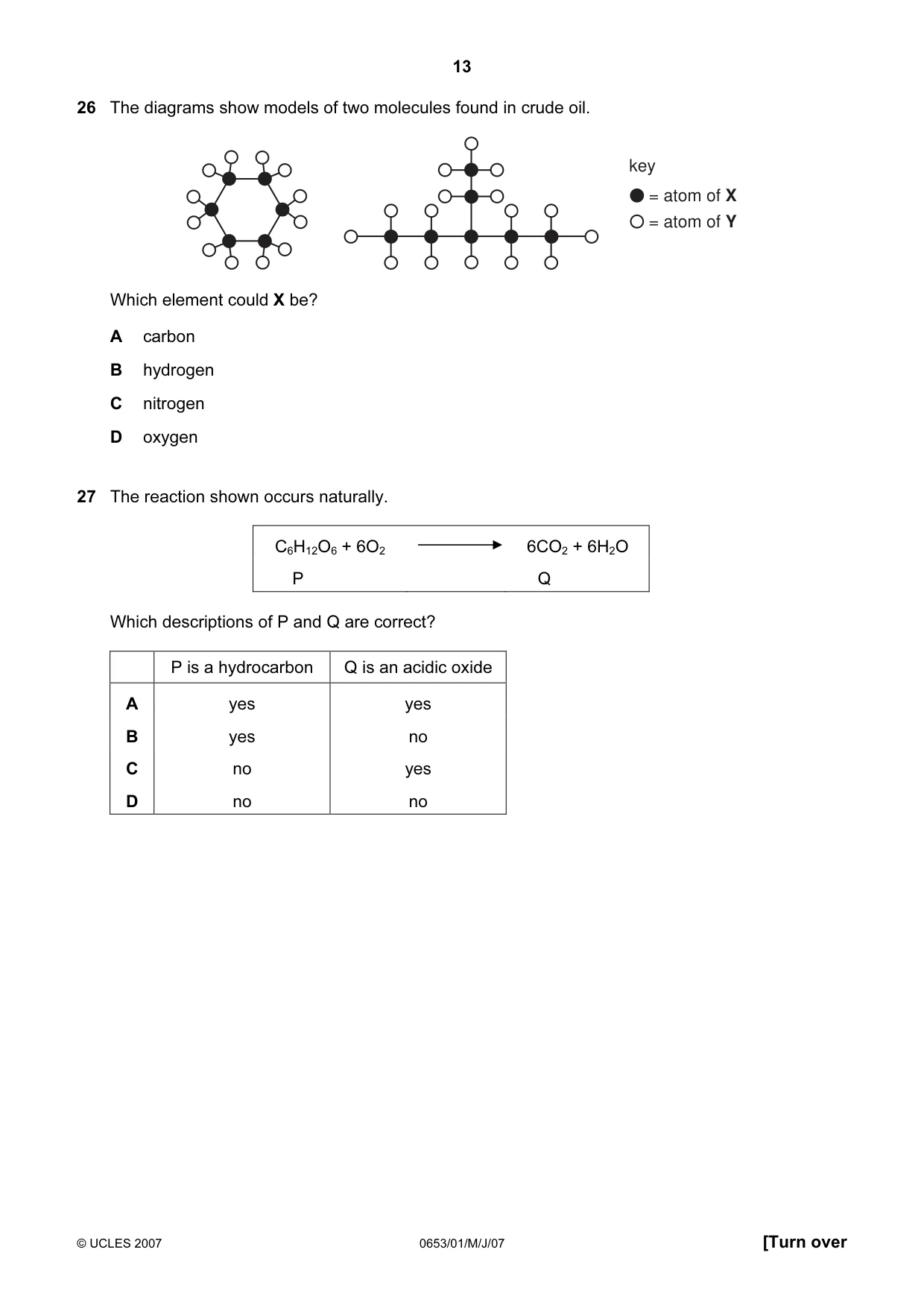
Q26 · The diagrams show models of two molecules found in crude oil
26 The diagrams show models of two molecules found in crude oil. key = atom of X = atom of Y Which element could X be? A carbon B hydrogen C nitrogen D oxygen
Mark scheme: A
Q27 · The reaction shown occurs naturally
27 The reaction shown occurs naturally. C6H12O6 + 6O2 6CO2 + 6H2O P Q Which descriptions of P and Q are correct? P is a hydrocarbon Q is an acidic oxide A yes yes B yes no C no yes D no no
Mark scheme: C
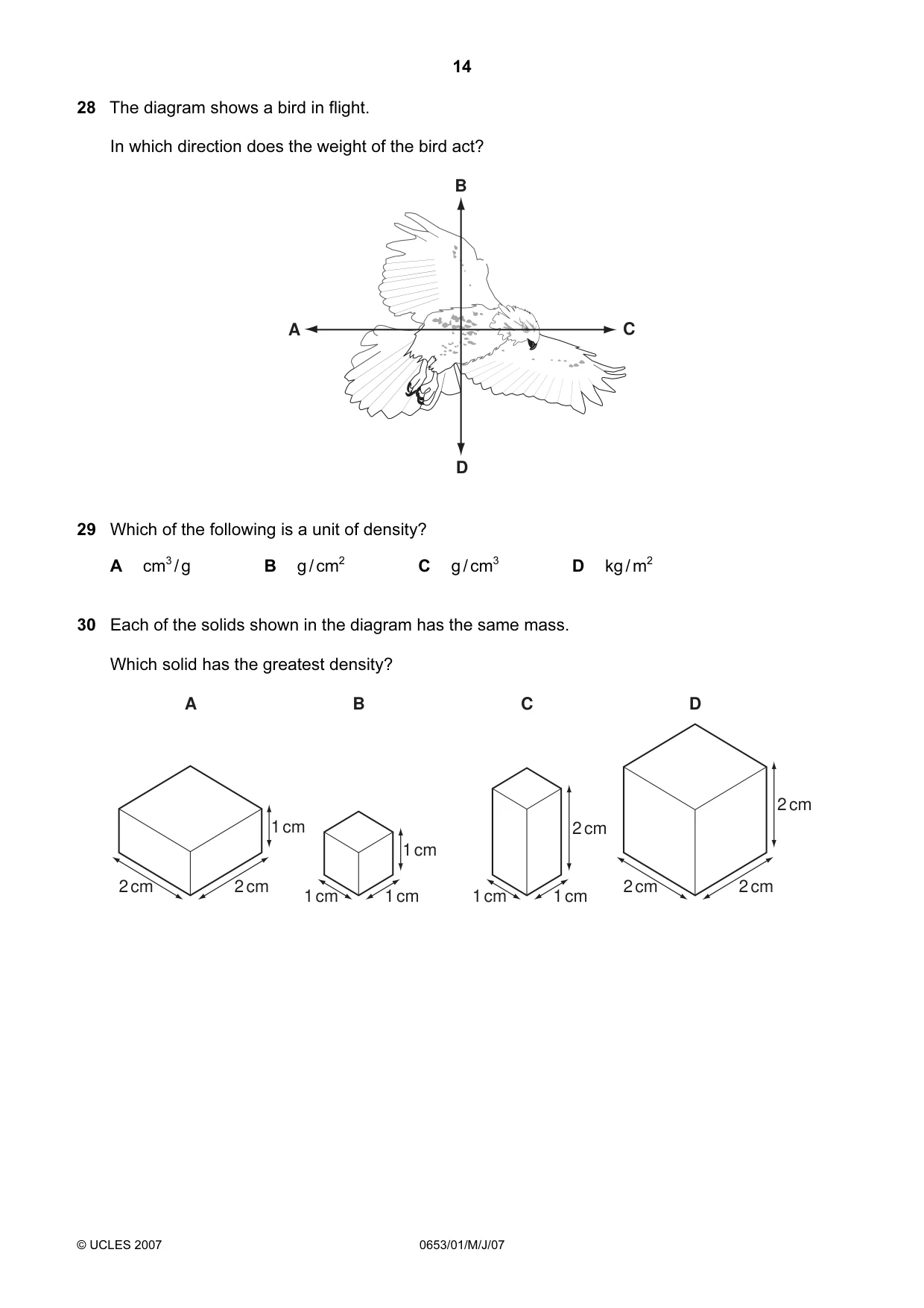
Q28 · The diagram shows a bird in flight
28 The diagram shows a bird in flight. In which direction does the weight of the bird act? B A C D
Mark scheme: D
Q29 · Which of the following is a unit of density?
29 Which of the following is a unit of density? A cm3 / g B g / cm2 C g / cm3 D kg / m2
Mark scheme: C
Q30 · Each of the solids shown in the diagram has the same mass
30 Each of the solids shown in the diagram has the same mass. Which solid has the greatest density? A B C D 2 cm 1 cm 2 cm 1 cm 2 cm 2 cm 2 cm 2 cm 1 cm 1 cm 1 cm 1 cm
Mark scheme: B
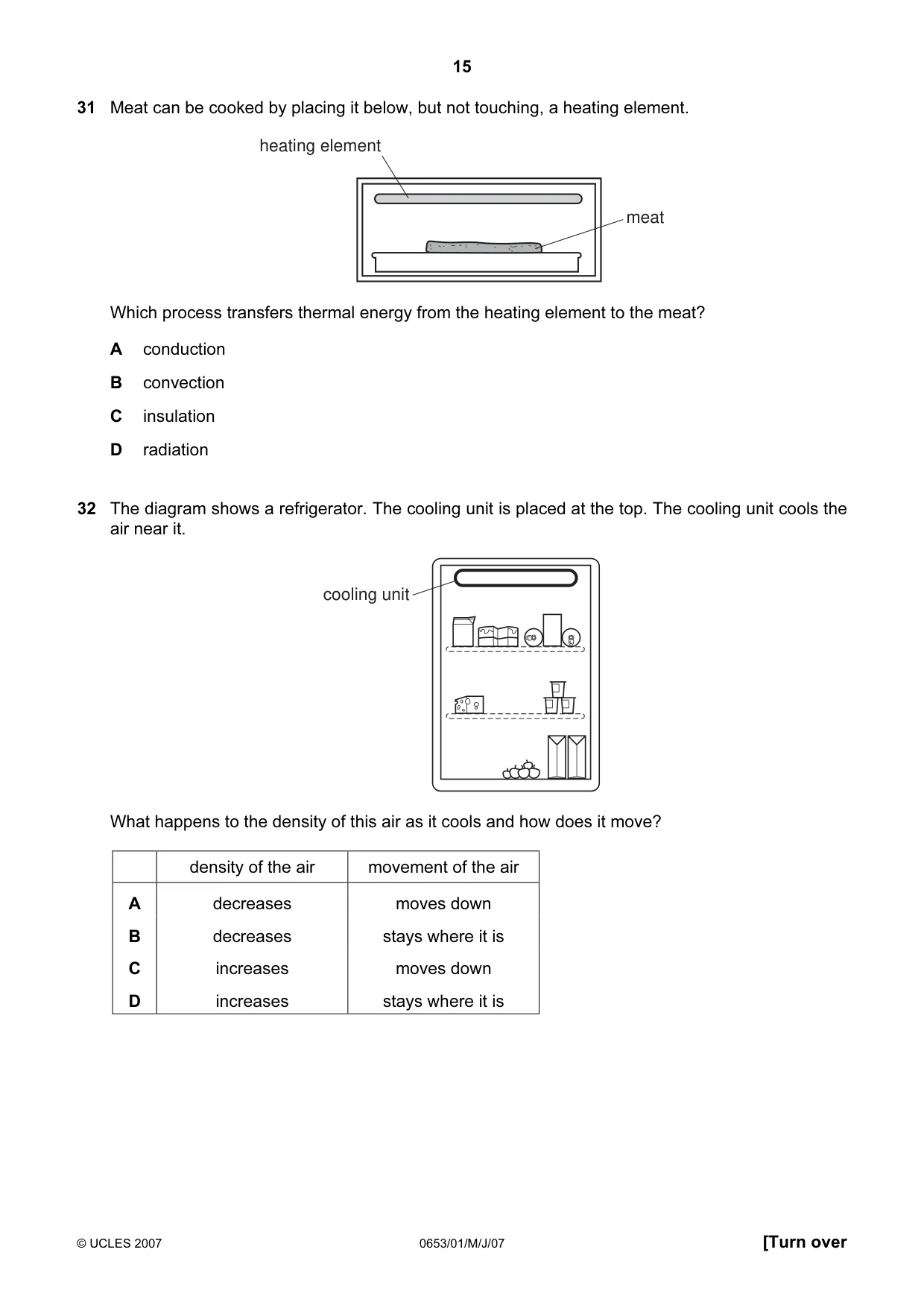
Q31 · Meat can be cooked by placing it below, but not touching, a heating element
31 Meat can be cooked by placing it below, but not touching, a heating element. heating element meat Which process transfers thermal energy from the heating element to the meat? A conduction B convection C insulation D radiation
Mark scheme: D
Q32 · The diagram shows a refrigerator
32 The diagram shows a refrigerator. The cooling unit is placed at the top. The cooling unit cools the air near it. cooling unit What happens to the density of this air as it cools and how does it move? density of the air movement of the air A decreases moves down B decreases stays where it is C increases moves down D increases stays where it is
Mark scheme: C
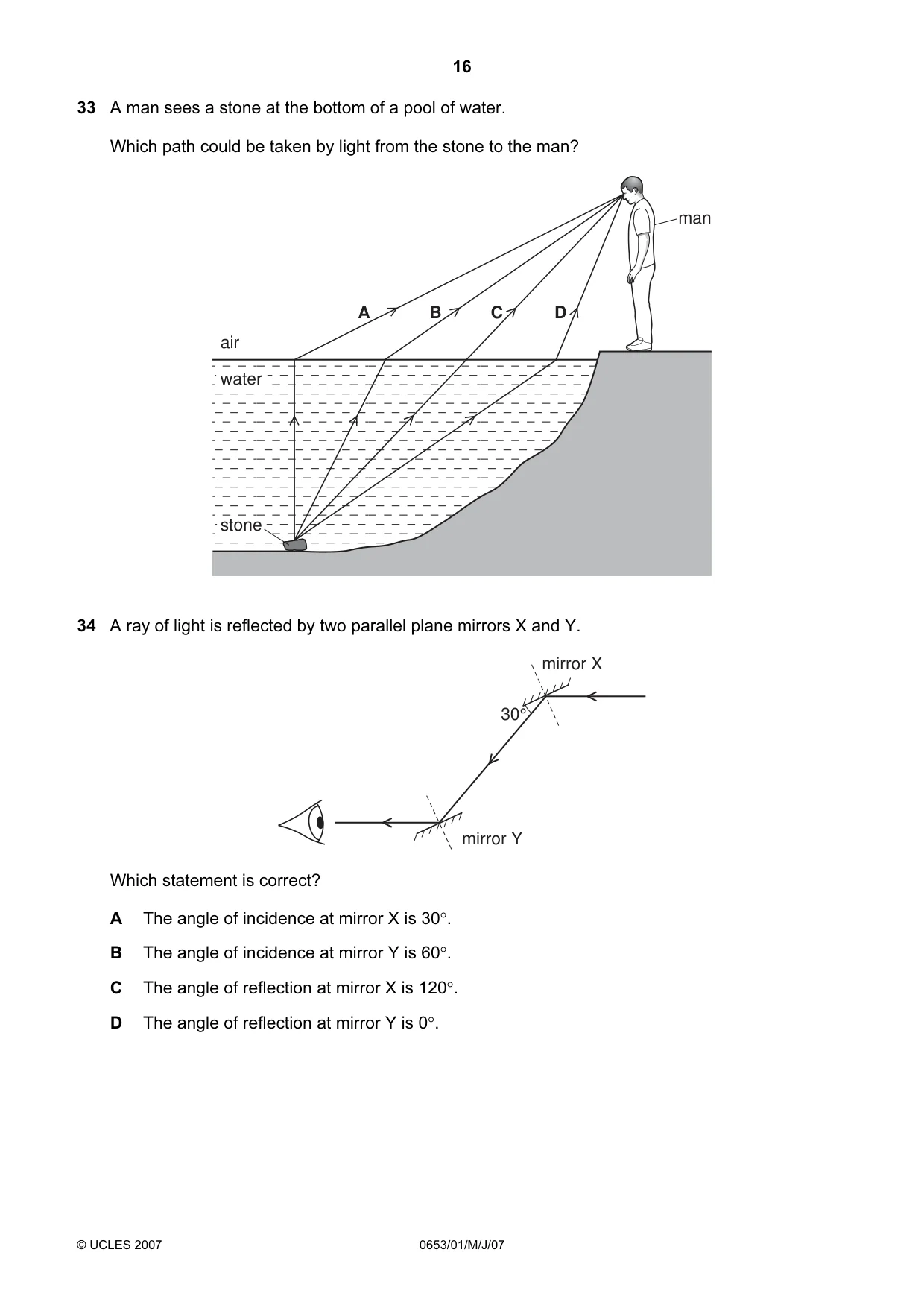
Q33 · A man sees a stone at the bottom of a pool of water
33 A man sees a stone at the bottom of a pool of water. Which path could be taken by light from the stone to the man? man A B C D air water stone
Mark scheme: B
Q34 · A ray of light is reflected by two parallel plane mirrors X and Y
34 A ray of light is reflected by two parallel plane mirrors X and Y. mirror X 30° mirror Y Which statement is correct? A The angle of incidence at mirror X is 30°. B The angle of incidence at mirror Y is 60°. C The angle of reflection at mirror X is 120°. D The angle of reflection at mirror Y is 0°.
Mark scheme: B
Q35 · A starting pistol is fired 640 m away from a spectator
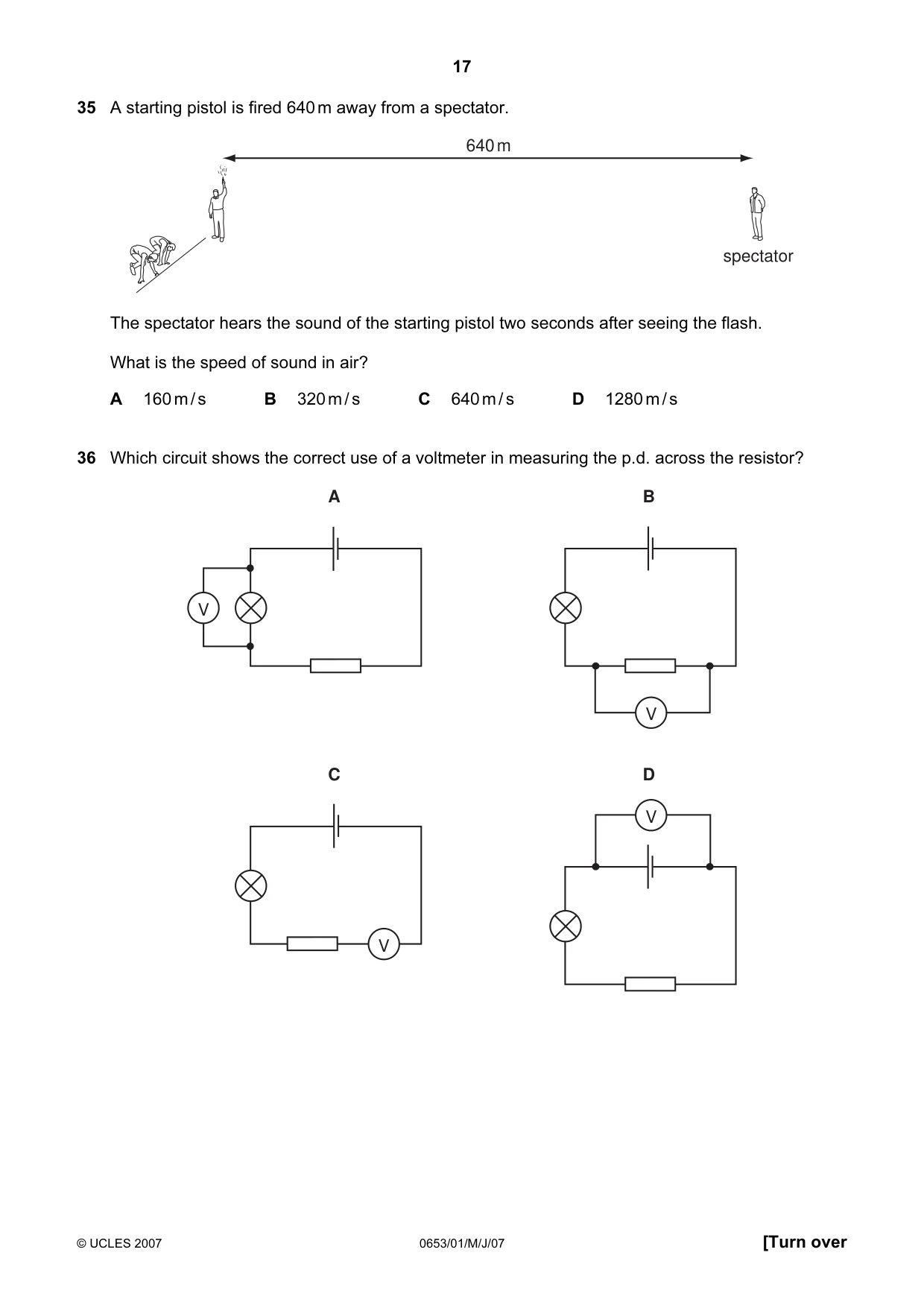
35 A starting pistol is fired 640 m away from a spectator. 640 m spectator The spectator hears the sound of the starting pistol two seconds after seeing the flash. What is the speed of sound in air? A 160 m / s B 320 m / s C 640 m / s D 1280 m / s
Mark scheme: B
Q36 · Which circuit shows the correct use of a voltmeter in measuring the p.d
36 Which circuit shows the correct use of a voltmeter in measuring the p.d. across the resistor? A B V V C D V V
Mark scheme: B
Q37 · Which diagram shows a circuit that will allow the lamps to be switched on and off…
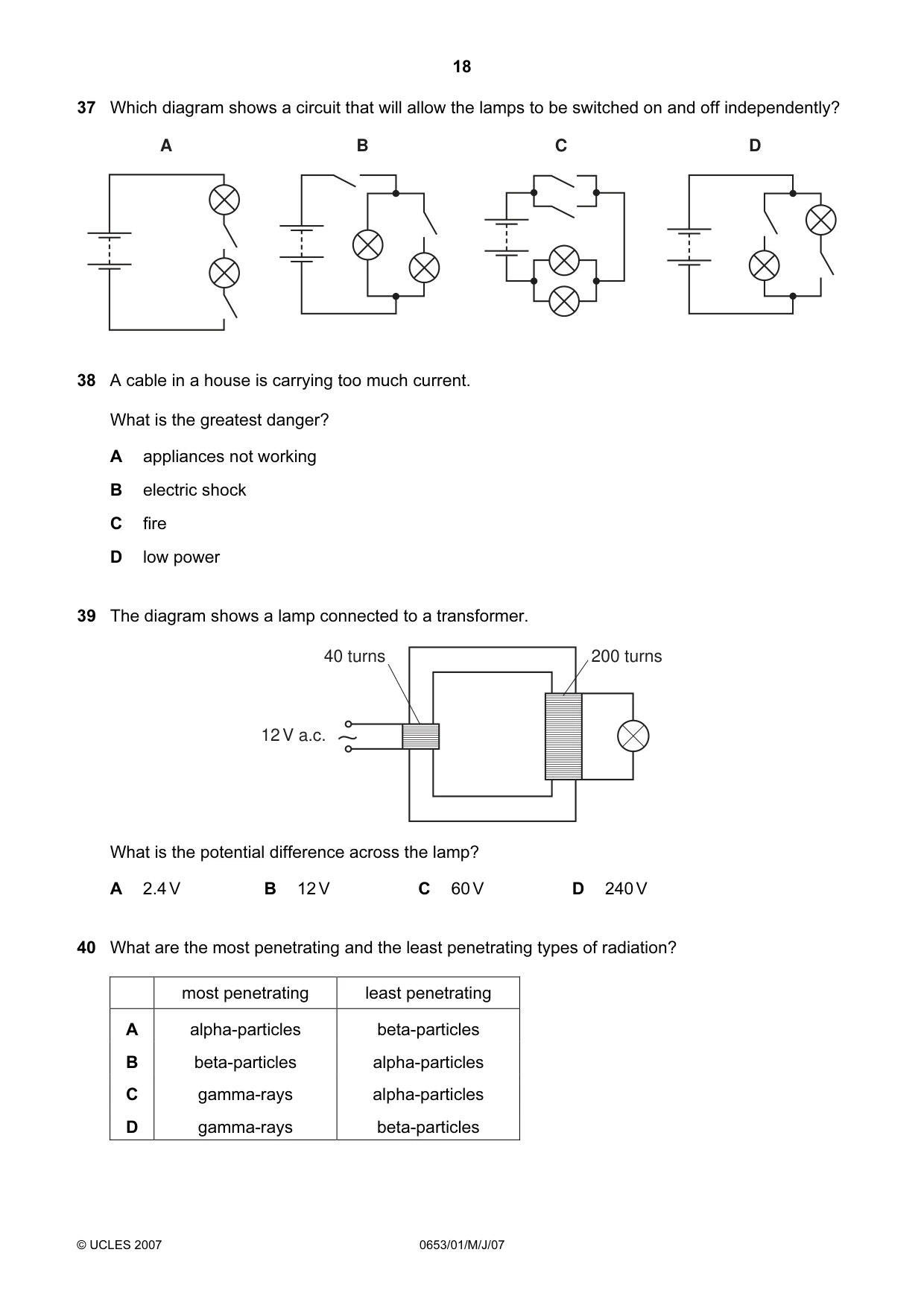
37 Which diagram shows a circuit that will allow the lamps to be switched on and off independently? A B C D
Mark scheme: D
Q38 · A cable in a house is carrying too much current
38 A cable in a house is carrying too much current. What is the greatest danger? A appliances not working B electric shock C fire D low power
Mark scheme: C
Q39 · The diagram shows a lamp connected to a transformer
39 The diagram shows a lamp connected to a transformer. 40 turns 200 turns 12 V a.c. What is the potential difference across the lamp? A 2.4 V B 12 V C 60 V D 240 V
Mark scheme: C
Q40 · What are the most penetrating and the least penetrating types of radiation?
40 What are the most penetrating and the least penetrating types of radiation? most penetrating least penetrating A alpha-particles beta-particles B beta-particles alpha-particles C gamma-rays alpha-particles D gamma-rays beta-particles
Mark scheme: C
What was in this paper
The subtopics covered by these 40 questions, and how many questions each got. Open one in a new tab to see every Cambridge question on it.
2Electrical circuits2Light2Sexual reproduction in plants2Transfer of thermal energy2Alloys and their properties1Atomic structure and the Periodic Table1Cell structure1Cells, batteries, generators and motors1Characteristics of living organisms1Chromatography1Conservation1Digestive system1Electrical safety1Electromagnetic spectrum1Enzymes1Extraction of metals1Food chains and food webs1Fuels1Gas exchange in humans1Group VII properties1Heart1Identification of ions and gases1Mass and weight1Noble gases1Oxides1Photosynthesis1Physical and chemical changes1Rate of reaction1Reactivity series1Redox1Sexual reproduction in humans1Simple molecules and covalent bonds1Sound1Transpiration1What you needed in this session
Cambridge’s own grade thresholds for 2007 May/June, Paper 1 · Variant 1. A higher threshold means an easier paper — the bar moves with how the cohort did.