Questions as text
Q1 · The graph shows the effect of pH on the activity of four different enzymes 0653/22 Feb/March 2017
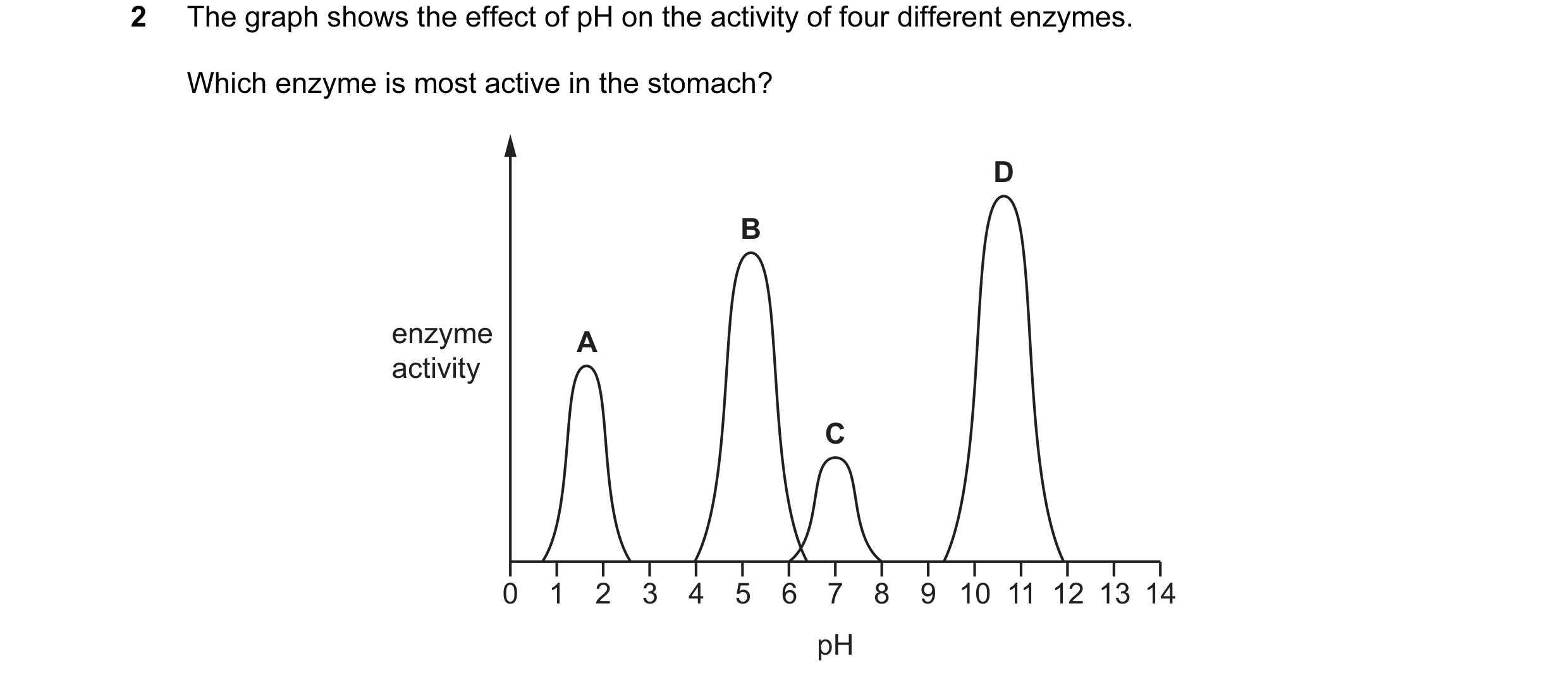
2 The graph shows the effect of pH on the activity of four different enzymes. Which enzyme is most active in the stomach? D B enzyme A activity C 0 1 2 3 4 5 6 7 8 9 10 11 12 13 14 pH
1 marks
Answer: A
This question in 0653/22 Feb/March 2017
Q2 · Which statements about enzymes are correct? 0653/21 May/June 2017
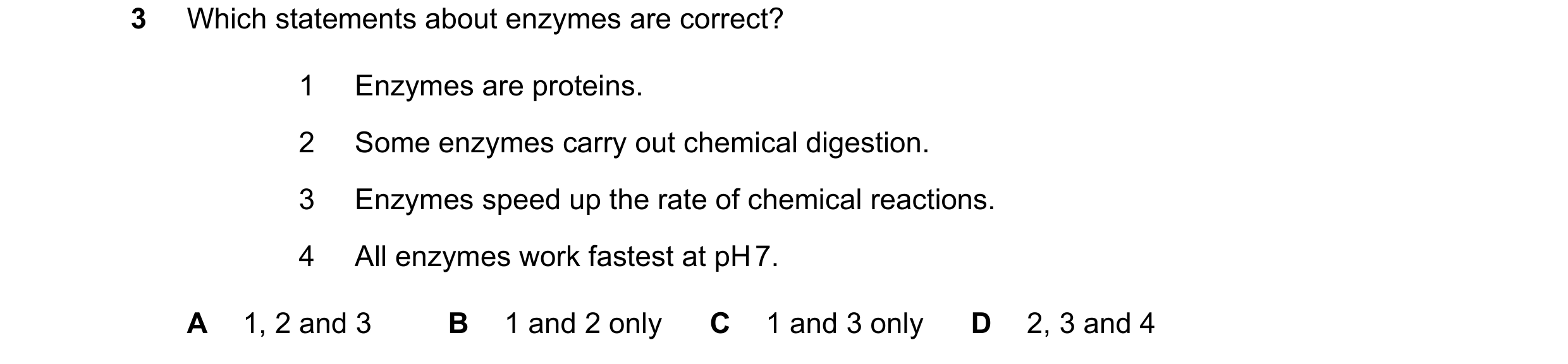
3 Which statements about enzymes are correct? 1 Enzymes are proteins. 2 Some enzymes carry out chemical digestion. 3 Enzymes speed up the rate of chemical reactions. 4 All enzymes work fastest at pH 7. A 1, 2 and 3 B 1 and 2 only C 1 and 3 only D 2, 3 and 4
1 marks
Answer: A
This question in 0653/21 May/June 2017
Q3 · Which statement about enzymes is correct? 0653/22 May/June 2017
4 Which statement about enzymes is correct? A They are killed by high temperatures. B They are made from amino acids. C They are unaffected by pH. D They are used up in biological reactions.
1 marks
Answer: B
This question in 0653/22 May/June 2017
Q4 · The graph shows the effect of one variable on amylase activity 0653/23 May/June 2017
3 The graph shows the effect of one variable on amylase activity. Y X What are the labels X and Y? X Y A amylase activity pH B amylase activity temperature C pH amylase activity D temperature amylase activity
1 marks
Answer: D
This question in 0653/23 May/June 2017
Q5 · Why does the rate of enzyme activity change when the temperature rises above the optimum… 0653/21 Oct/Nov 2017
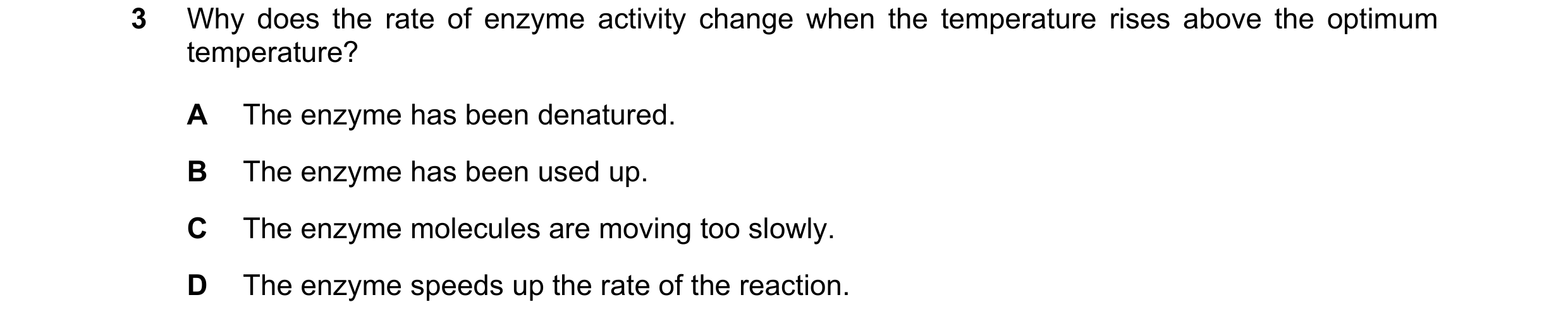
3 Why does the rate of enzyme activity change when the temperature rises above the optimum temperature? A The enzyme has been denatured. B The enzyme has been used up. C The enzyme molecules are moving too slowly. D The enzyme speeds up the rate of the reaction.
1 marks
Answer: A
This question in 0653/21 Oct/Nov 2017
Q6 · The statements explain the activity of a human enzyme as the temperature increases from… 0653/22 Feb/March 2018
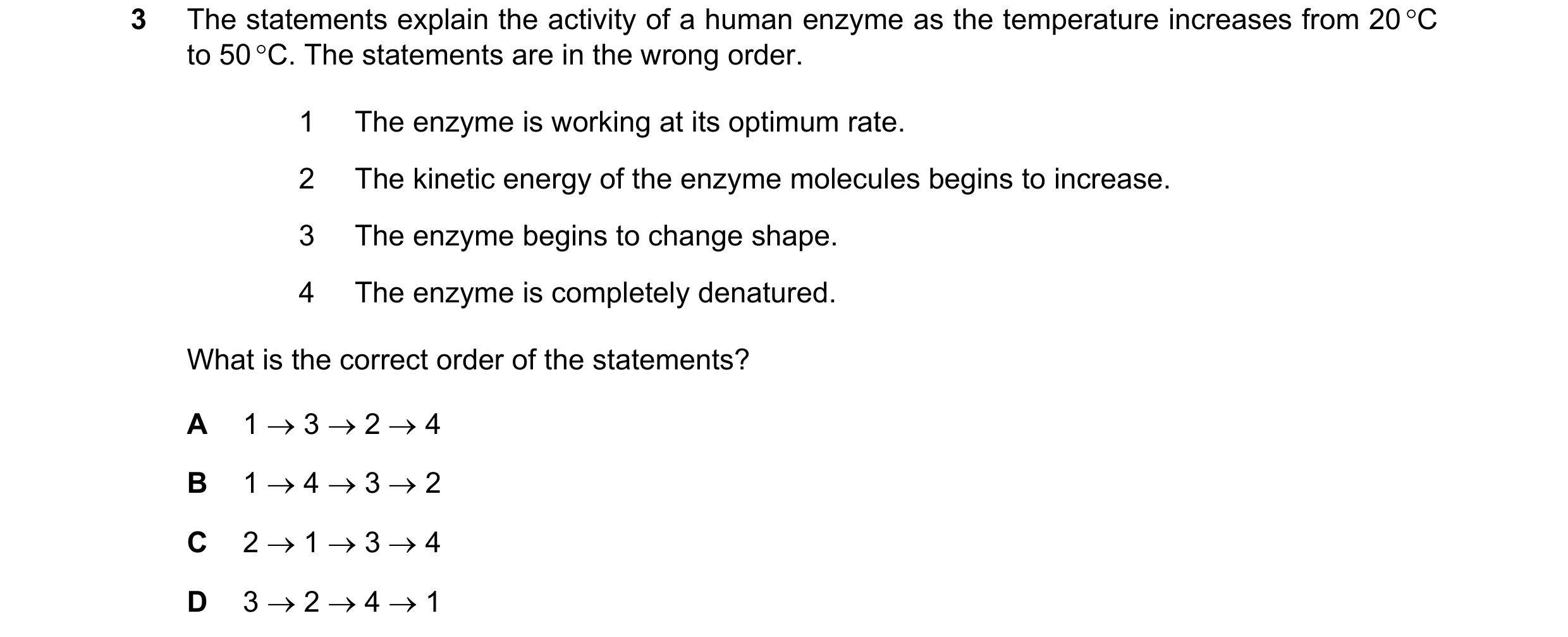
3 The statements explain the activity of a human enzyme as the temperature increases from 20 °C to 50 °C. The statements are in the wrong order. 1 The enzyme is working at its optimum rate. 2 The kinetic energy of the enzyme molecules begins to increase. 3 The enzyme begins to change shape. 4 The enzyme is completely denatured. What is the correct order of the statements? A 1 → 3 → 2 → 4 B 1 → 4 → 3 → 2 C 2 → 1 → 3 → 4 D 3 → 2 → 4 → 1
1 marks
Answer: C
This question in 0653/22 Feb/March 2018
Q7 · Amylase is an enzyme that digests starch 0653/21 May/June 2018
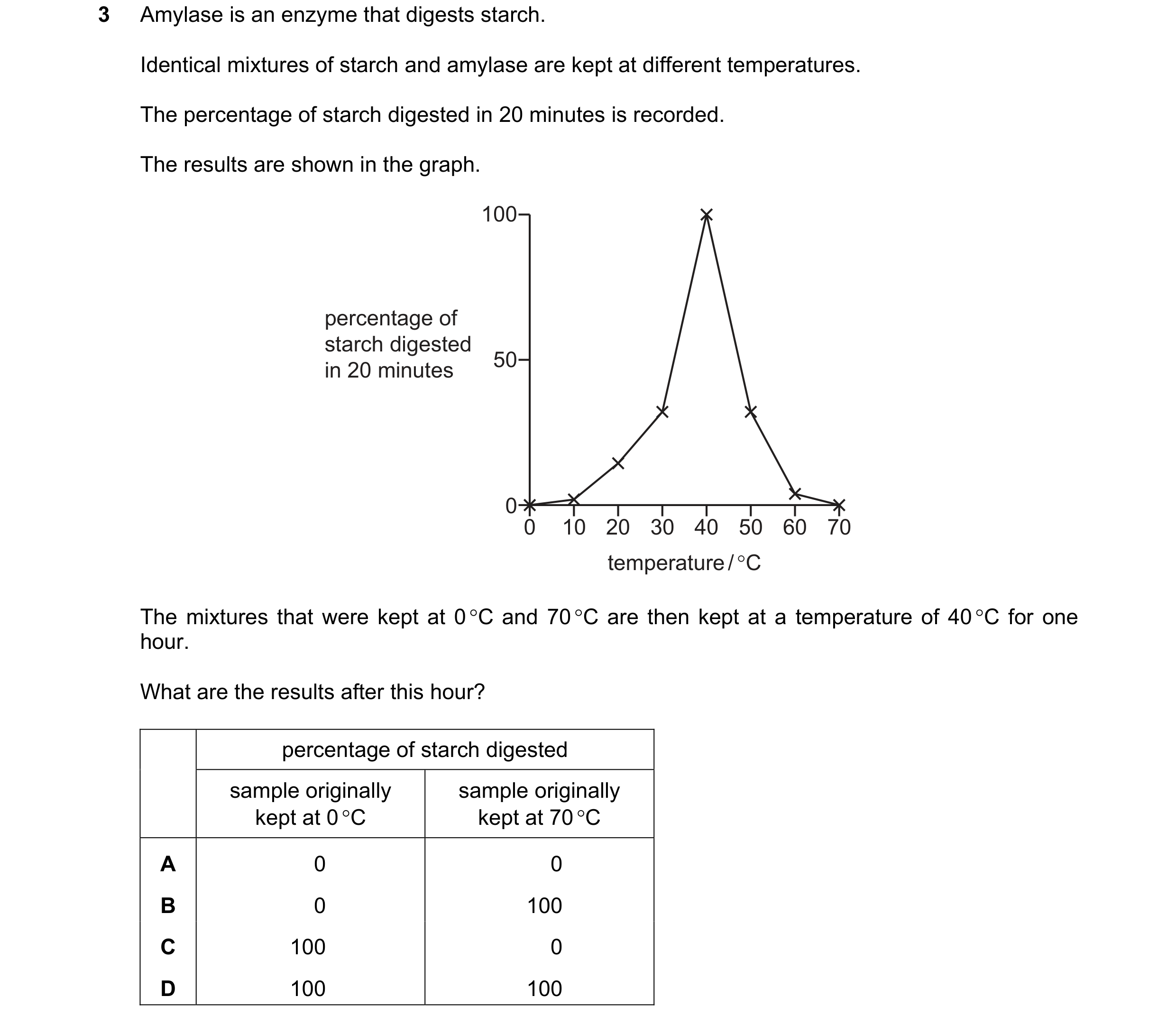
3 Amylase is an enzyme that digests starch. Identical mixtures of starch and amylase are kept at different temperatures. The percentage of starch digested in 20 minutes is recorded. The results are shown in the graph. 100 percentage of starch digested 50 in 20 minutes 0 0 10 20 30 40 50 60 70 temperature / °C The mixtures that were kept at 0 °C and 70 °C are then kept at a temperature of 40 °C for one hour. What are the results after this hour? percentage of starch digested sample originally sample originally kept at 0 °C kept at 70 °C A 0 0 B 0 100 C 100 0 D 100 100
1 marks
Answer: C
This question in 0653/21 May/June 2018
Q8 · Amylase is an enzyme that digests starch 0653/22 May/June 2018
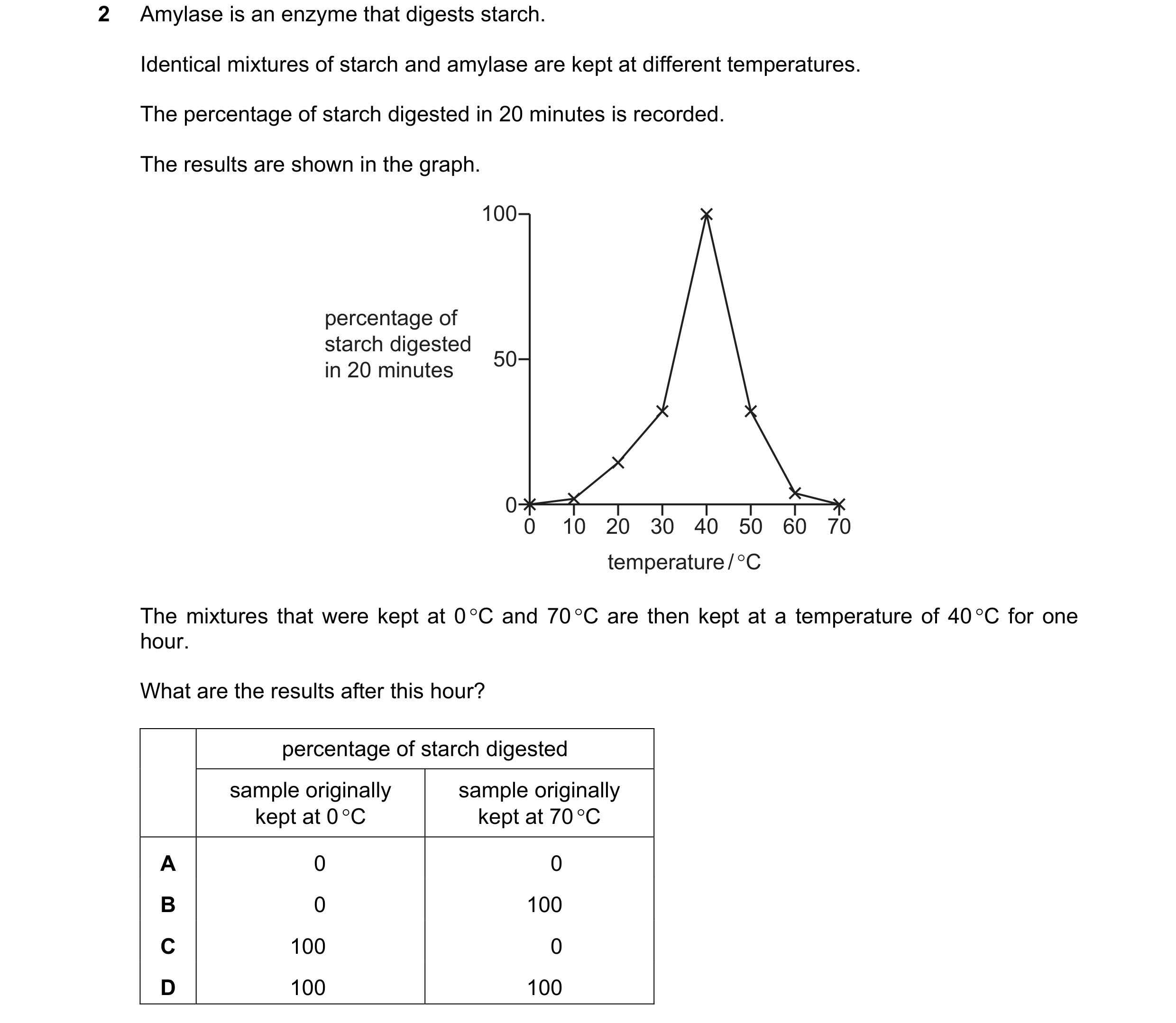
2 Amylase is an enzyme that digests starch. Identical mixtures of starch and amylase are kept at different temperatures. The percentage of starch digested in 20 minutes is recorded. The results are shown in the graph. 100 percentage of starch digested 50 in 20 minutes 0 0 10 20 30 40 50 60 70 temperature / °C The mixtures that were kept at 0 °C and 70 °C are then kept at a temperature of 40 °C for one hour. What are the results after this hour? percentage of starch digested sample originally sample originally kept at 0 °C kept at 70 °C A 0 0 B 0 100 C 100 0 D 100 100
1 marks
Answer: C
This question in 0653/22 May/June 2018
Q9 · Amylase is an enzyme that digests starch 0653/23 May/June 2018
2 Amylase is an enzyme that digests starch. Identical mixtures of starch and amylase are kept at different temperatures. The percentage of starch digested in 20 minutes is recorded. The results are shown in the graph. 100 percentage of starch digested 50 in 20 minutes 0 0 10 20 30 40 50 60 70 temperature / °C The mixtures that were kept at 0 °C and 70 °C are then kept at a temperature of 40 °C for one hour. What are the results after this hour? percentage of starch digested sample originally sample originally kept at 0 °C kept at 70 °C A 0 0 B 0 100 C 100 0 D 100 100
1 marks
Answer: C
This question in 0653/23 May/June 2018
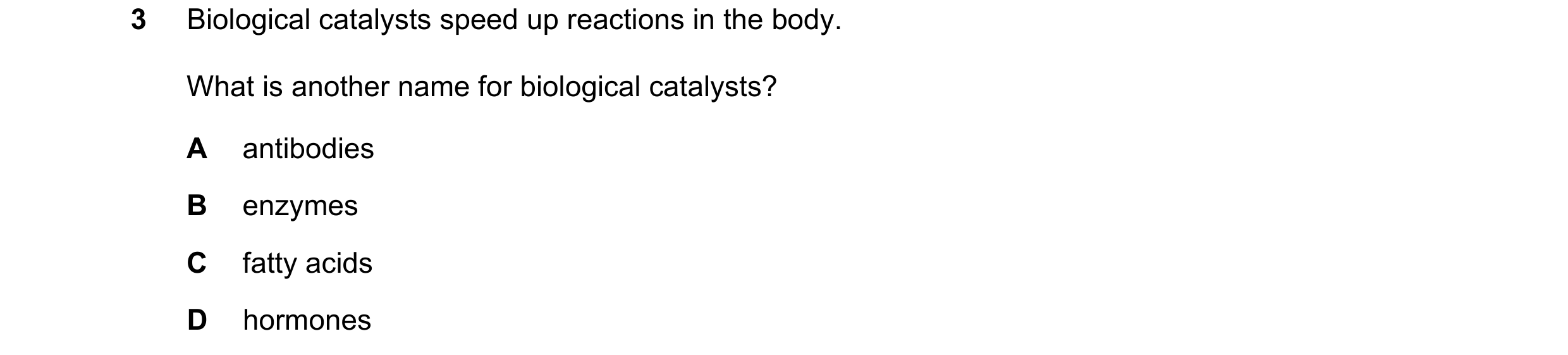
Q10 · Biological catalysts speed up reactions in the body 0653/21 Oct/Nov 2018
3 Biological catalysts speed up reactions in the body. What is another name for biological catalysts? A antibodies B enzymes C fatty acids D hormones
1 marks
Answer: B
This question in 0653/21 Oct/Nov 2018
Q11 · A human enzyme breaks down starch into simple sugars 0653/23 Oct/Nov 2018
3 A human enzyme breaks down starch into simple sugars. A solution of this human enzyme was heated to 90 °C for 30 minutes. 2 cm3 of this human enzyme solution was added to starch solution in several different test-tubes. The test-tubes were kept at different temperatures for 15 minutes. Which graph shows the amount of sugar produced in the test-tubes? A B amount amount of sugar of sugar temperature / °C temperature / °C C D amount amount of sugar of sugar temperature / °C temperature / °C
1 marks
Answer: C
This question in 0653/23 Oct/Nov 2018
Q12 · In an experiment, an enzyme from the human alimentary canal is found to work slowly at 20… 0653/22 Feb/March 2019
2 In an experiment, an enzyme from the human alimentary canal is found to work slowly at 20 °C. What is the optimum temperature for enzymes working in the human alimentary canal? A 17 °C B 27 °C C 37 °C D 77 °C
1 marks
Answer: C
This question in 0653/22 Feb/March 2019
Q13 · The graph shows how the activity of an enzyme varies 0653/21 May/June 2019
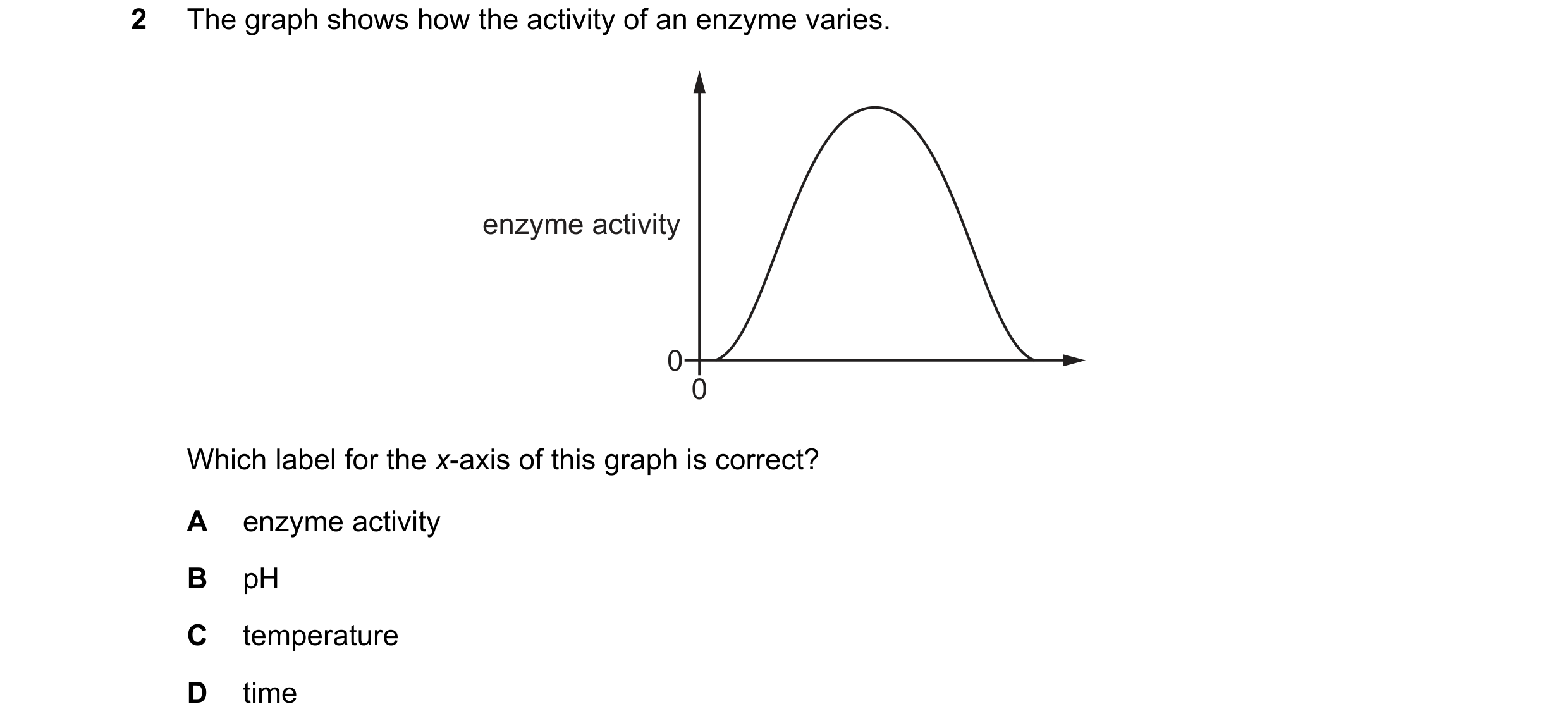
2 The graph shows how the activity of an enzyme varies. enzyme activity 0 0 Which label for the x-axis of this graph is correct? A enzyme activity B pH C temperature D time
1 marks
Answer: B
This question in 0653/21 May/June 2019
Q14 · The diagram shows an experiment at the start and one hour later 0653/21 May/June 2019
4 The diagram shows an experiment at the start and one hour later. beaker water water and partially permeable simple sugars membrane starch solution plus Q start of experiment one hour later What is Q? A amylase B lipase C protease D water
1 marks
Answer: A
This question in 0653/21 May/June 2019
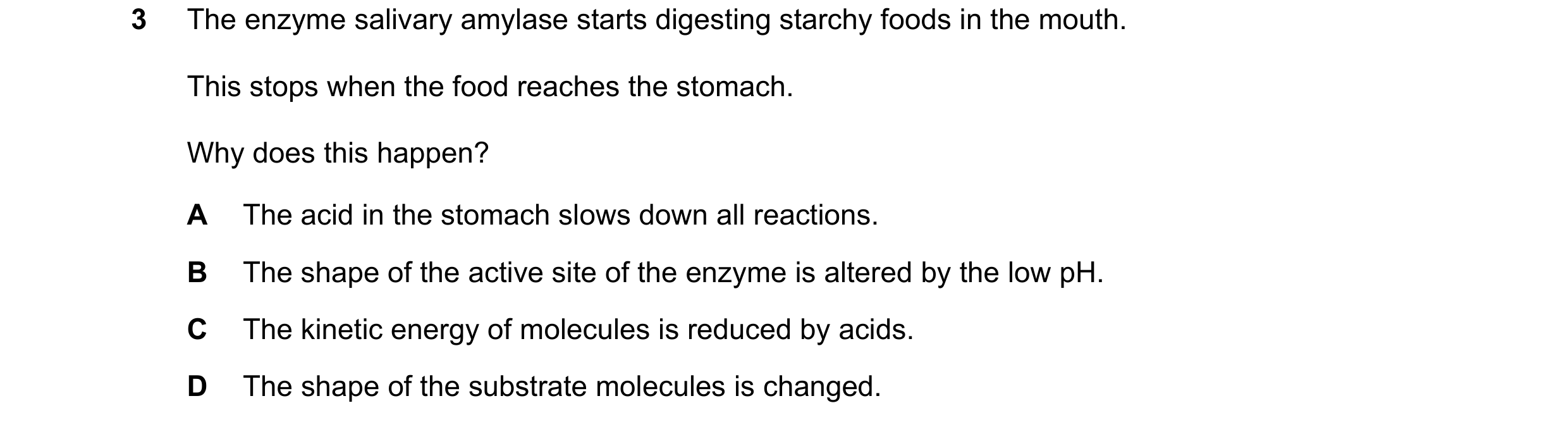
Q15 · The enzyme salivary amylase starts digesting starchy foods in the mouth 0653/23 May/June 2019
3 The enzyme salivary amylase starts digesting starchy foods in the mouth. This stops when the food reaches the stomach. Why does this happen? A The acid in the stomach slows down all reactions. B The shape of the active site of the enzyme is altered by the low pH. C The kinetic energy of molecules is reduced by acids. D The shape of the substrate molecules is changed.
1 marks
Answer: B
This question in 0653/23 May/June 2019
Q16 · 1 cm³ of substance X is added to 10 cm³ starch suspension and mixed 0653/21 Oct/Nov 2019
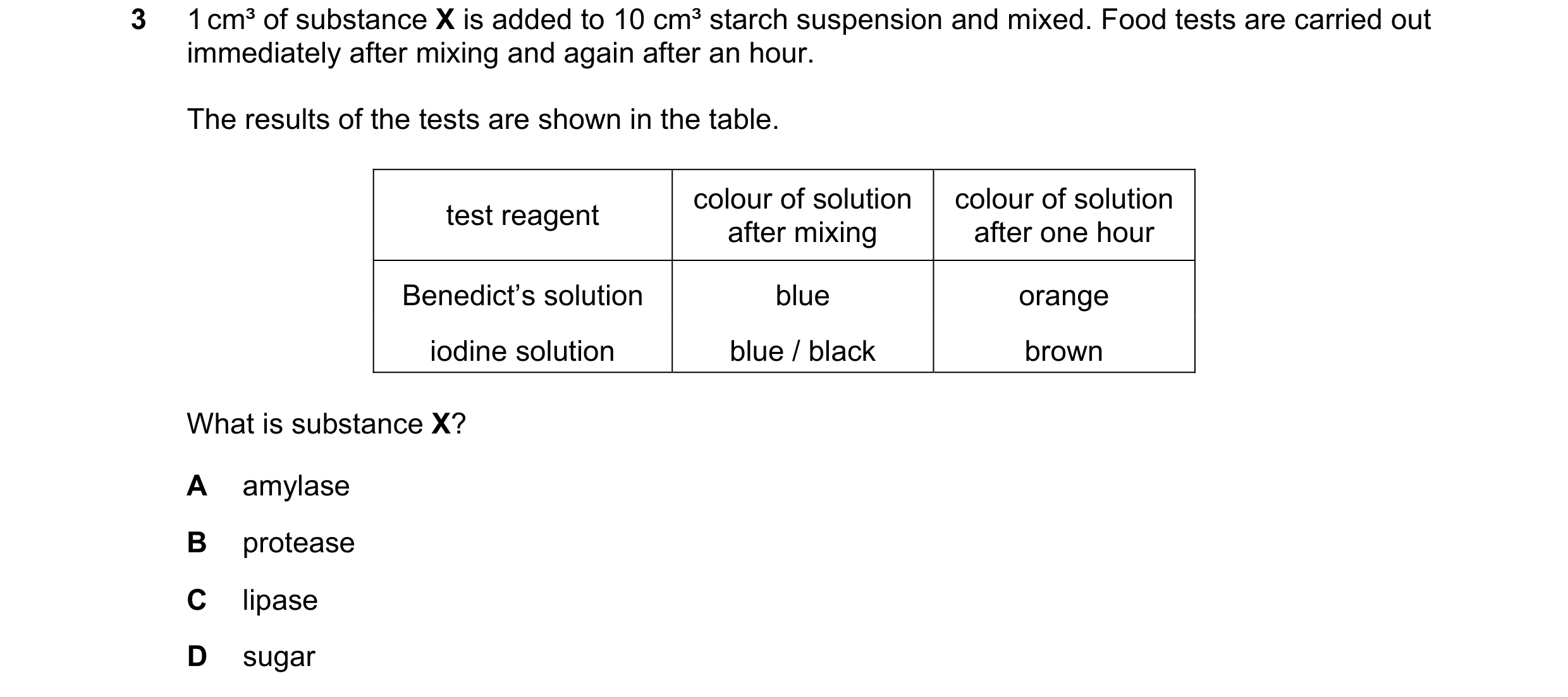
3 1 cm³ of substance X is added to 10 cm³ starch suspension and mixed. Food tests are carried out immediately after mixing and again after an hour. The results of the tests are shown in the table. colour of solution colour of solution test reagent after mixing after one hour Benedict’s solution blue orange iodine solution blue / black brown What is substance X? A amylase B protease C lipase D sugar
1 marks
Answer: A
This question in 0653/21 Oct/Nov 2019
Q17 · 1 cm³ of substance X is added to 10 cm³ starch suspension and mixed 0653/22 Oct/Nov 2019
4 1 cm³ of substance X is added to 10 cm³ starch suspension and mixed. Food tests are carried out immediately after mixing and again after an hour. The results of the tests are shown in the table. colour of solution colour of solution test reagent after mixing after one hour Benedict’s solution blue orange iodine solution blue / black brown What is substance X? A amylase B protease C lipase D sugar
1 marks
Answer: A
This question in 0653/22 Oct/Nov 2019
Q18 · 1 cm³ of substance X is added to 10 cm³ starch suspension and mixed 0653/23 Oct/Nov 2019
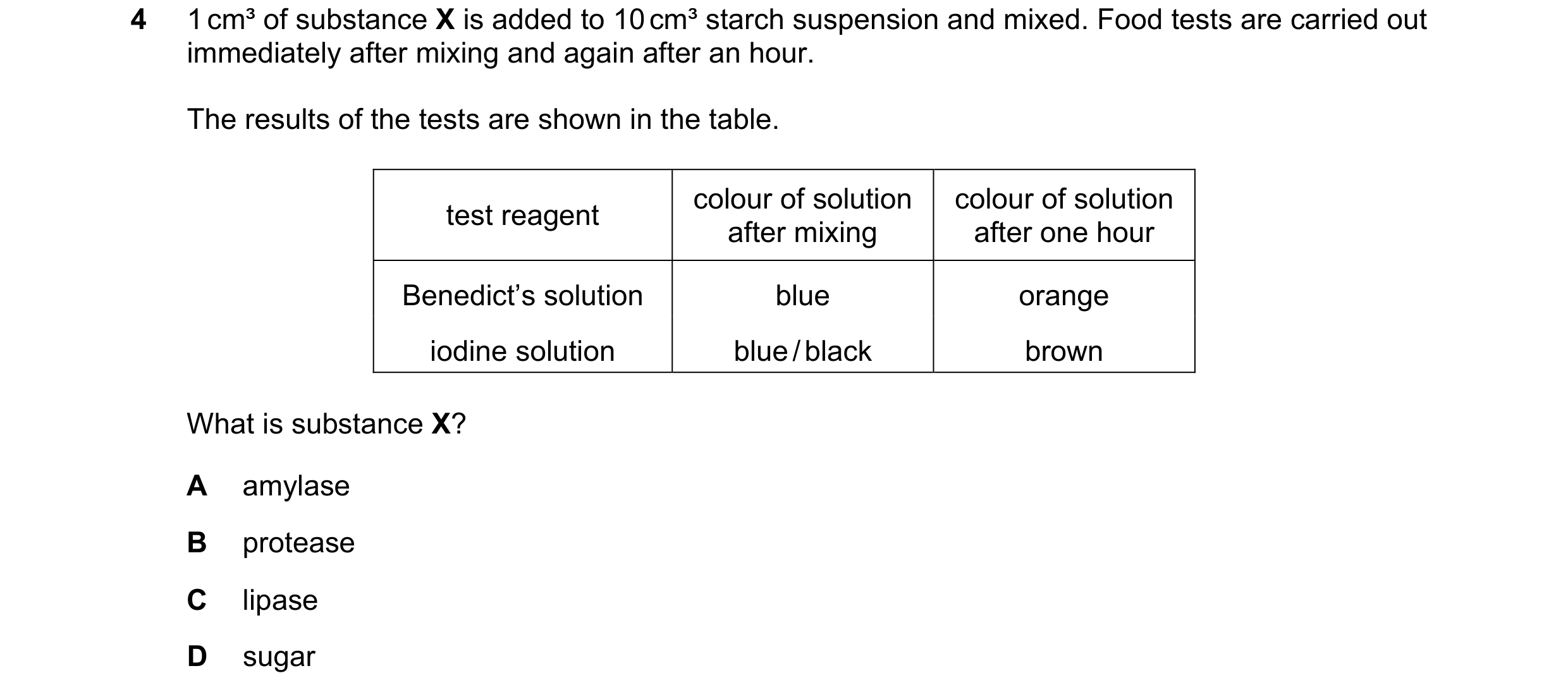
4 1 cm³ of substance X is added to 10 cm³ starch suspension and mixed. Food tests are carried out immediately after mixing and again after an hour. The results of the tests are shown in the table. colour of solution colour of solution test reagent after mixing after one hour Benedict’s solution blue orange iodine solution blue / black brown What is substance X? A amylase B protease C lipase D sugar
1 marks
Answer: A
This question in 0653/23 Oct/Nov 2019
Q19 · When an apple is cut, the cut surface quickly turns brown 0653/22 Feb/March 2020
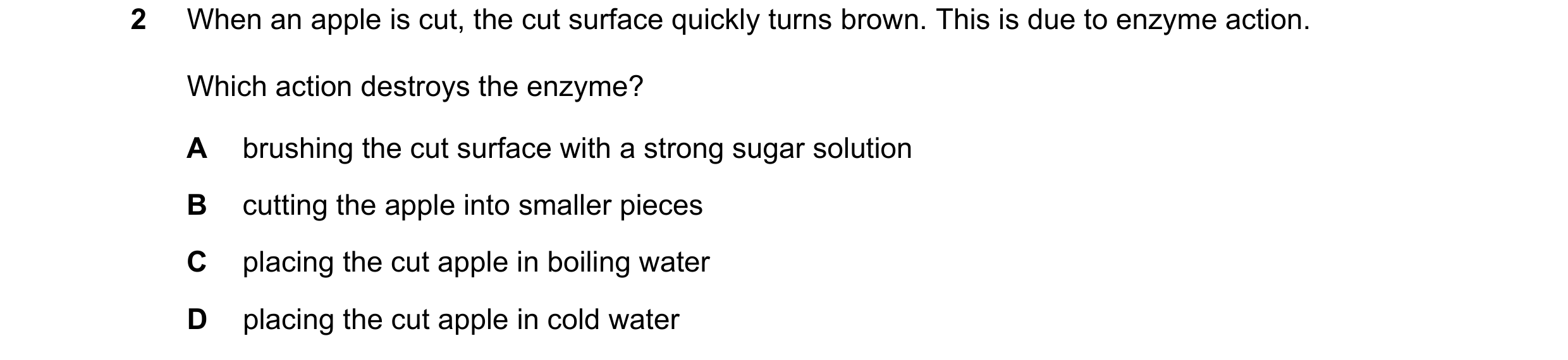
2 When an apple is cut, the cut surface quickly turns brown. This is due to enzyme action. Which action destroys the enzyme? A brushing the cut surface with a strong sugar solution B cutting the apple into smaller pieces C placing the cut apple in boiling water D placing the cut apple in cold water
1 marks
Answer: C
This question in 0653/22 Feb/March 2020
Q20 · Which row correctly matches the enzyme to the products? 0653/21 May/June 2020
4 Which row correctly matches the enzyme to the products? enzyme products A lipase amino acids only B lipase glycerol and fatty acids C protease fatty acids only D protease glycerol and amino acids
1 marks
Answer: B
This question in 0653/21 May/June 2020
Q21 · The graph shows the activity of an enzyme as temperature increases 0653/22 May/June 2020
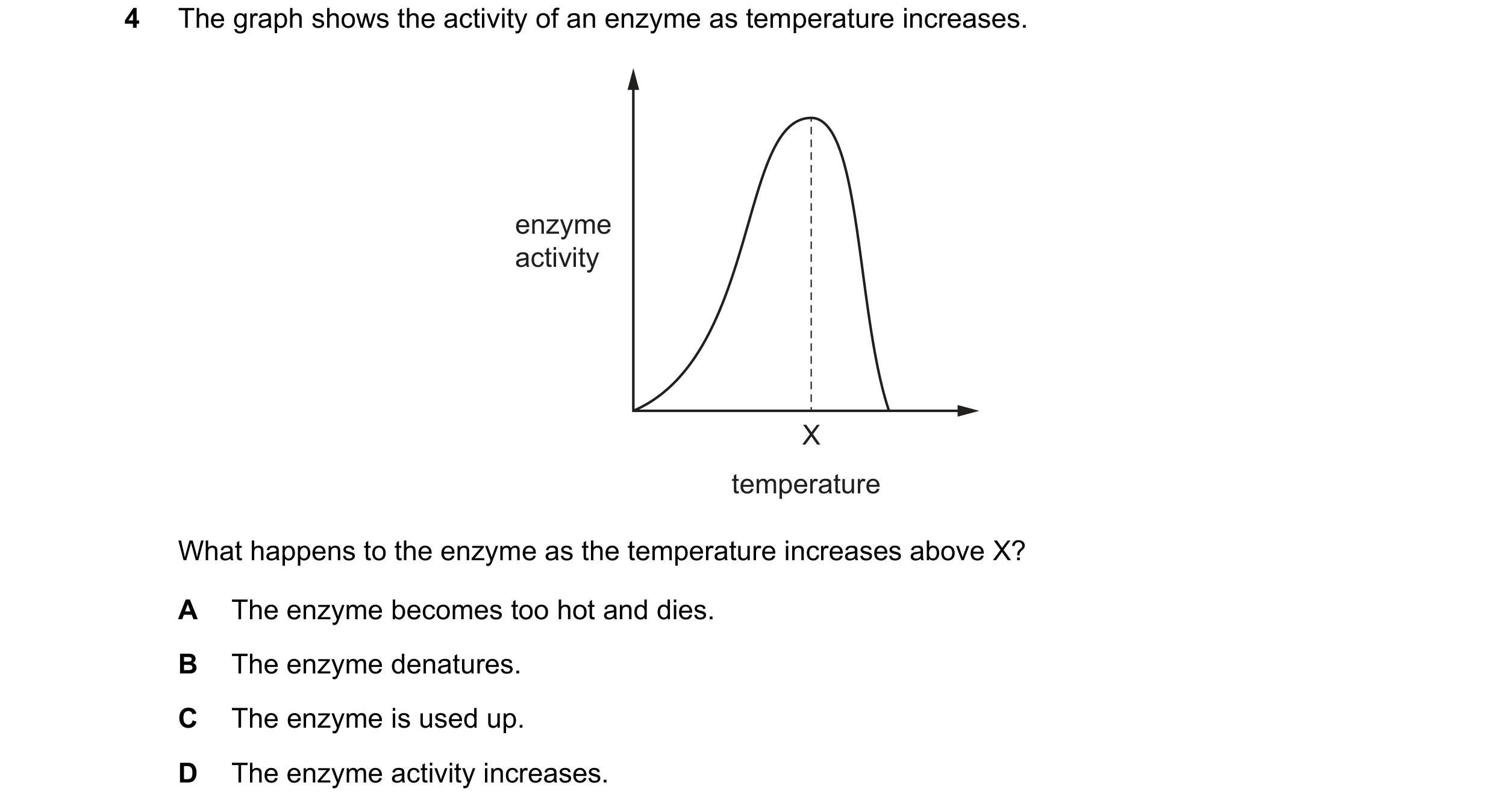
4 The graph shows the activity of an enzyme as temperature increases. enzyme activity X temperature What happens to the enzyme as the temperature increases above X? A The enzyme becomes too hot and dies. B The enzyme denatures. C The enzyme is used up. D The enzyme activity increases.
1 marks
Answer: B
This question in 0653/22 May/June 2020
Q22 · What are the correct substrate and products for lipase? 0653/22 May/June 2020
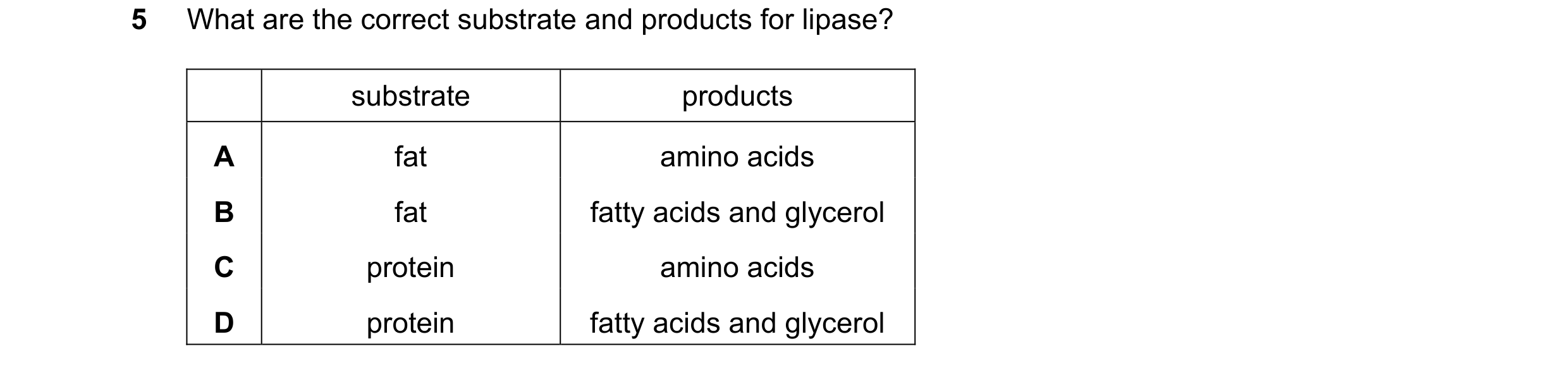
5 What are the correct substrate and products for lipase? substrate products A fat amino acids B fat fatty acids and glycerol C protein amino acids D protein fatty acids and glycerol
1 marks
Answer: B
This question in 0653/22 May/June 2020
Q23 · The diagram shows how the activity of an enzyme changes with temperature 0653/21 Oct/Nov 2020
3 The diagram shows how the activity of an enzyme changes with temperature. enzyme activity / arbitrary units X temperature / °C This enzyme works in the human body. What is the most likely value of temperature X? A 10 C B 40 C C 70 C D 100 C
1 marks
Answer: B
This question in 0653/21 Oct/Nov 2020
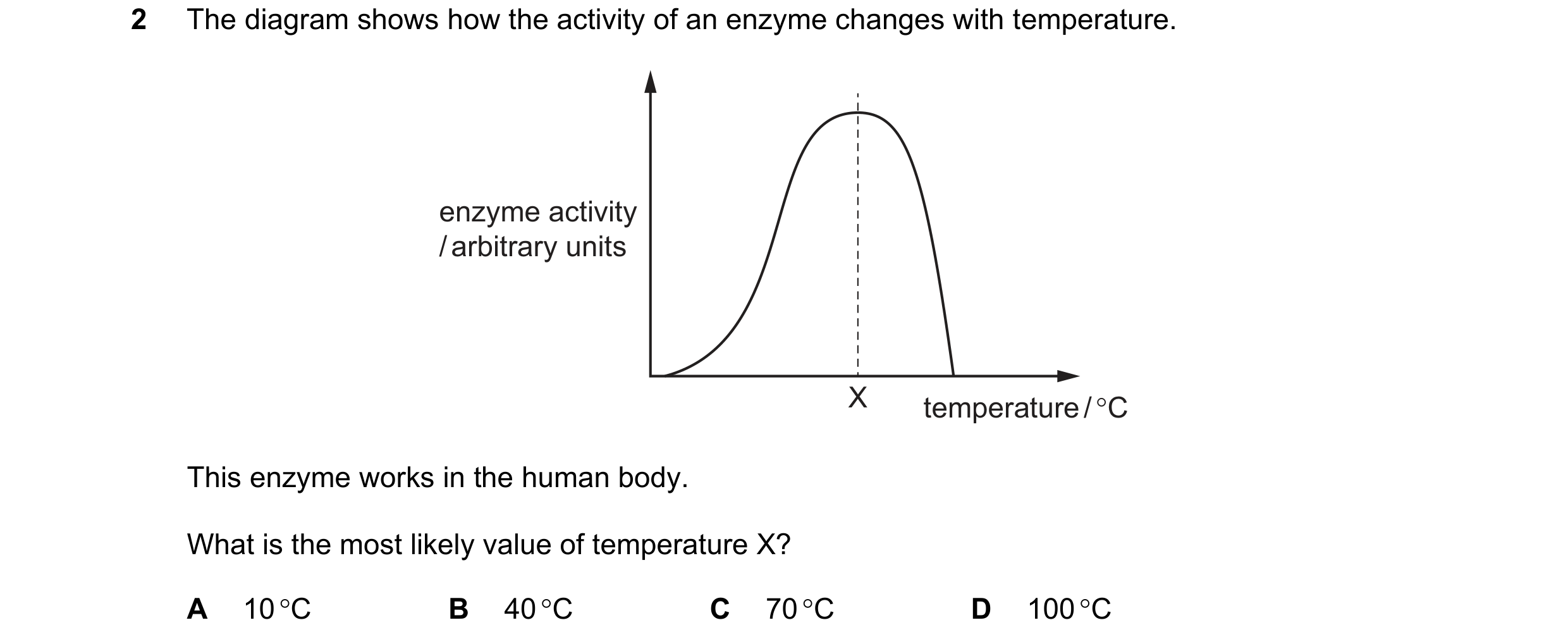
Q24 · The diagram shows how the activity of an enzyme changes with temperature 0653/22 Oct/Nov 2020
2 The diagram shows how the activity of an enzyme changes with temperature. enzyme activity / arbitrary units X temperature / °C This enzyme works in the human body. What is the most likely value of temperature X? A 10 C B 40 C C 70 C D 100 C
1 marks
Answer: B
This question in 0653/22 Oct/Nov 2020
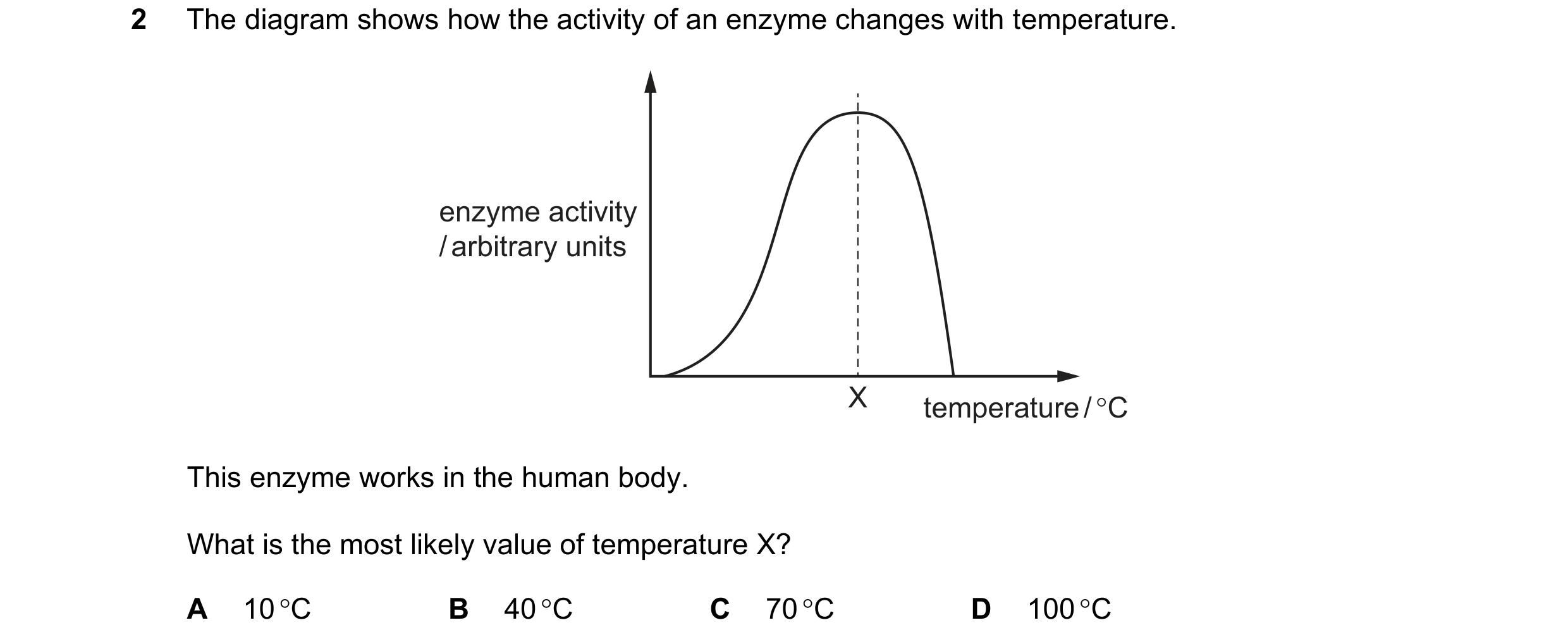
Q25 · The diagram shows how the activity of an enzyme changes with temperature 0653/23 Oct/Nov 2020
2 The diagram shows how the activity of an enzyme changes with temperature. enzyme activity / arbitrary units X temperature / °C This enzyme works in the human body. What is the most likely value of temperature X? A 10 C B 40 C C 70 C D 100 C
1 marks
Answer: B
This question in 0653/23 Oct/Nov 2020
Q26 · Which graph shows the effects of pH on the activity of an enzyme? 0653/22 Feb/March 2021
4 Which graph shows the effects of pH on the activity of an enzyme? A B enzyme enzyme activity activity pH pH C D enzyme enzyme activity activity pH pH
1 marks
Answer: D
This question in 0653/22 Feb/March 2021
Q27 · Which name is given to biological catalysts? 0653/22 May/June 2021
3 Which name is given to biological catalysts? A antibodies B enzymes C hormones D platelets
1 marks
Answer: B
This question in 0653/22 May/June 2021
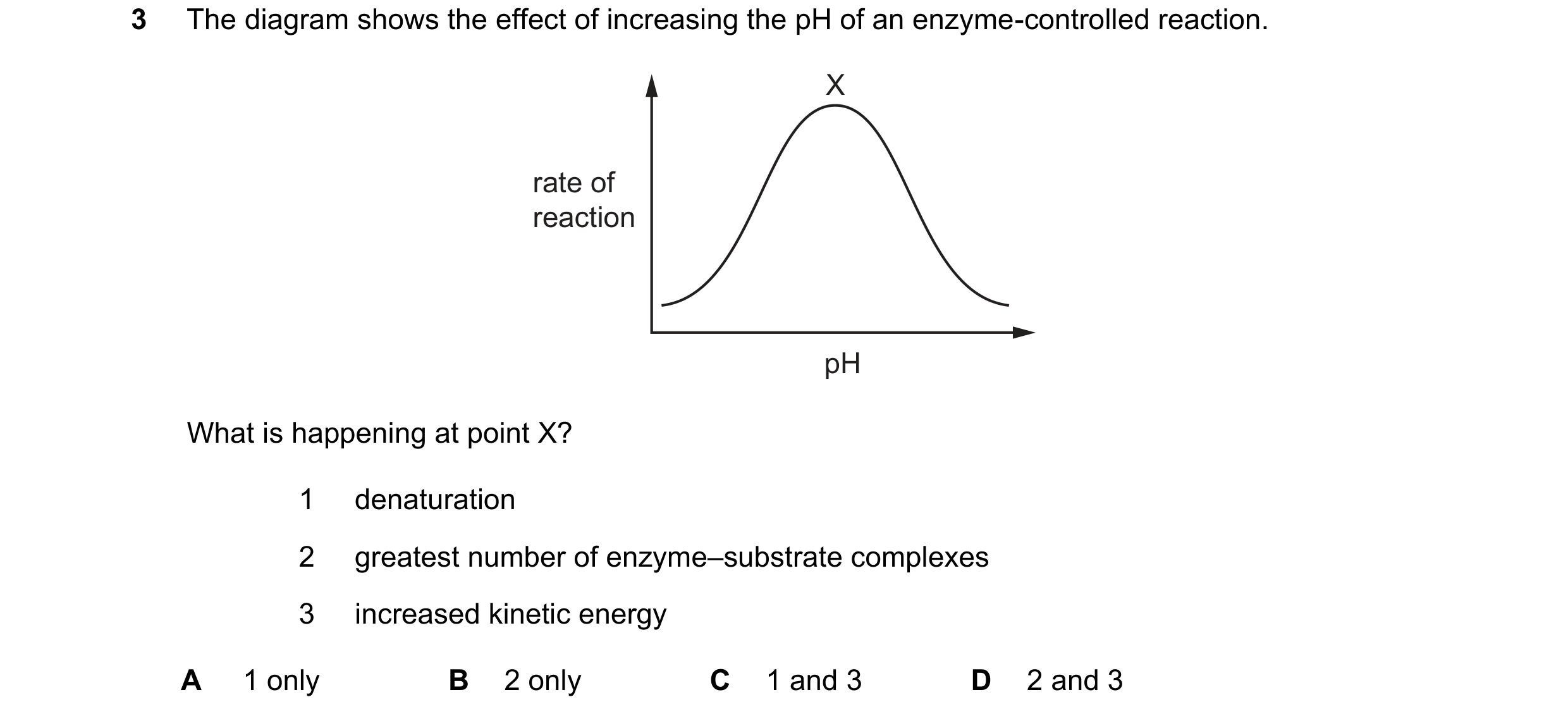
Q28 · The diagram shows the effect of increasing the pH of an enzyme-controlled reaction 0653/23 May/June 2021
3 The diagram shows the effect of increasing the pH of an enzyme-controlled reaction. X rate of reaction pH What is happening at point X? 1 denaturation 2 greatest number of enzyme–substrate complexes 3 increased kinetic energy A 1 only B 2 only C 1 and 3 D 2 and 3
1 marks
Answer: B
This question in 0653/23 May/June 2021
Q29 · Which statement about enzymes is correct? 0653/21 Oct/Nov 2021
3 Which statement about enzymes is correct? A They are denatured at high temperatures. B They all have an optimum pH of 7. C They all have an optimum temperature of 10 C. D They are made of carbohydrates.
1 marks
Answer: A
This question in 0653/21 Oct/Nov 2021
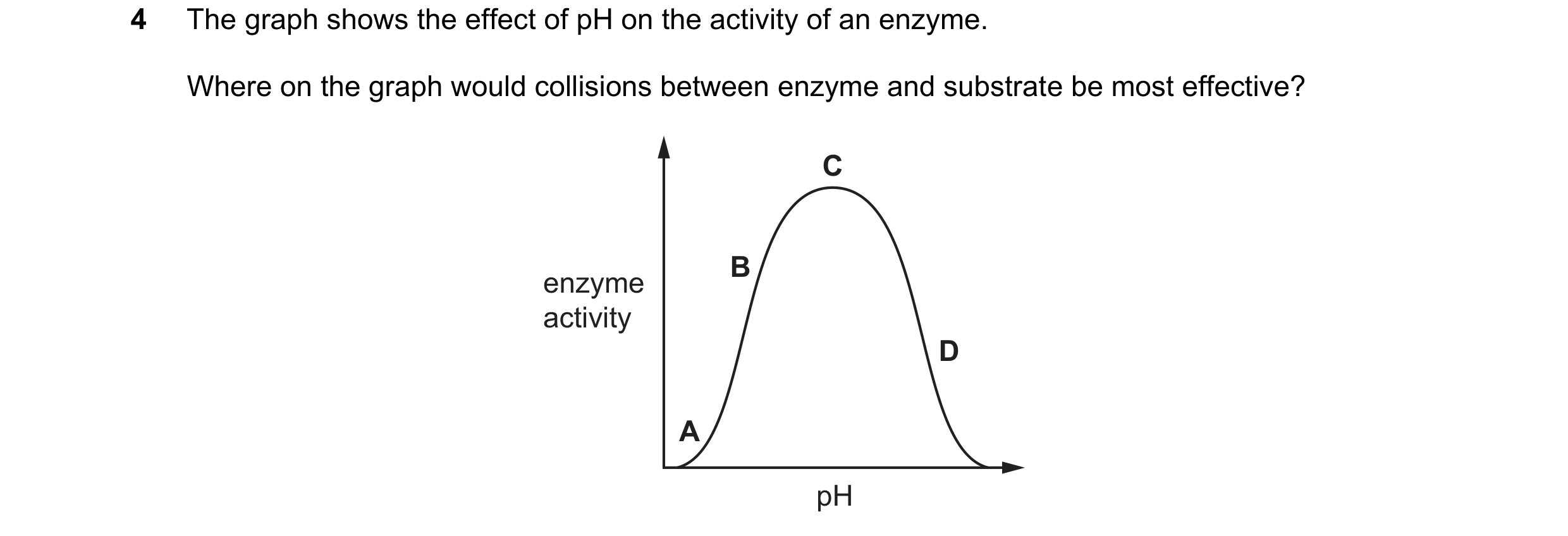
Q30 · The graph shows the effect of pH on the activity of an enzyme 0653/22 Oct/Nov 2021
4 The graph shows the effect of pH on the activity of an enzyme. Where on the graph would collisions between enzyme and substrate be most effective? C B enzyme activity D A pH
1 marks
Answer: C
This question in 0653/22 Oct/Nov 2021
Q31 · What is a suitable range for investigating the effect of temperature on the activity of… 0653/23 Oct/Nov 2021
4 What is a suitable range for investigating the effect of temperature on the activity of an enzyme from a human body? A 0 C to 30 C B 20 C to 60 C C 40 C to 60 C D 50 C to 100 C
1 marks
Answer: B
This question in 0653/23 Oct/Nov 2021
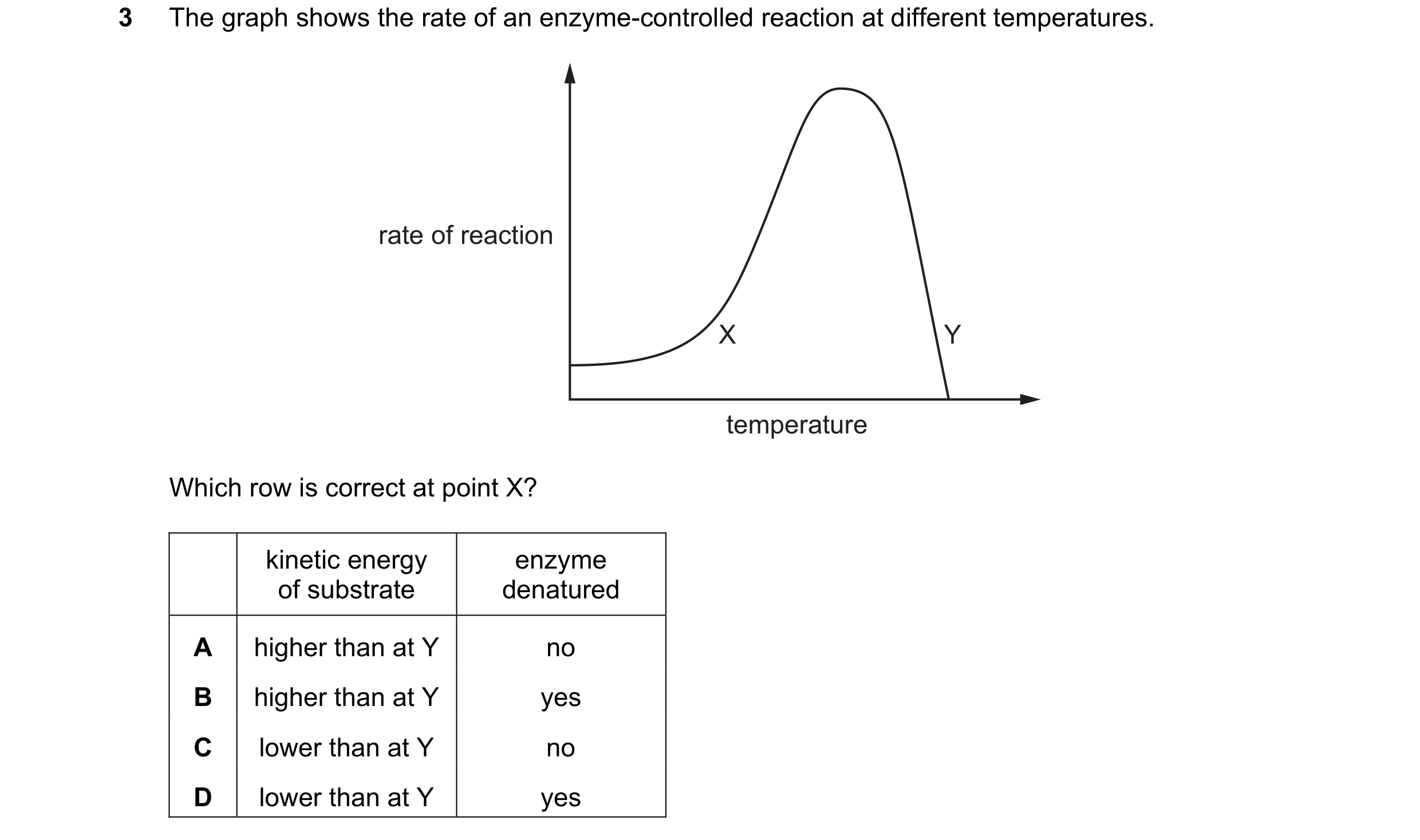
Q32 · The graph shows the rate of an enzyme-controlled reaction at different temperatures 0653/22 Feb/March 2022
3 The graph shows the rate of an enzyme-controlled reaction at different temperatures. rate of reaction X Y temperature Which row is correct at point X? kinetic energy enzyme of substrate denatured A higher than at Y no B higher than at Y yes C lower than at Y no D lower than at Y yes
1 marks
Answer: C
This question in 0653/22 Feb/March 2022
Q33 · The enzyme salivary amylase starts digesting starchy foods in the mouth 0653/21 May/June 2022
3 The enzyme salivary amylase starts digesting starchy foods in the mouth. This stops when the food reaches the stomach. Why does this happen? A The acid in the stomach slows down all reactions. B The shape of the active site of the enzyme is altered by the low pH. C The kinetic energy of molecules is reduced by acids. D The shape of the substrate molecules is changed.
1 marks
Answer: B
This question in 0653/21 May/June 2022
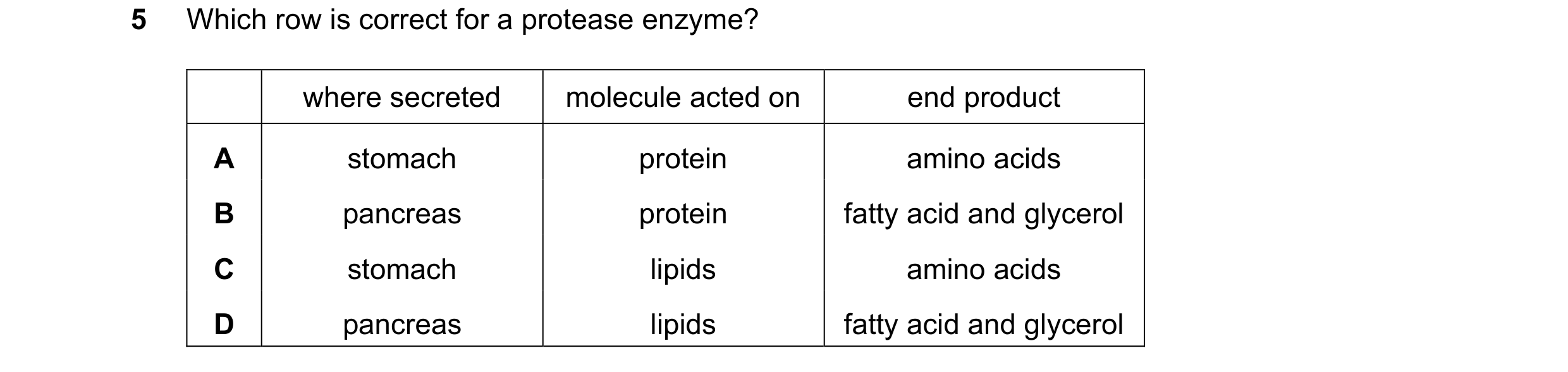
Q34 · Which row is correct for a protease enzyme? 0653/21 May/June 2022
5 Which row is correct for a protease enzyme? where secreted molecule acted on end product A stomach protein amino acids B pancreas protein fatty acid and glycerol C stomach lipids amino acids D pancreas lipids fatty acid and glycerol
1 marks
Answer: A
This question in 0653/21 May/June 2022
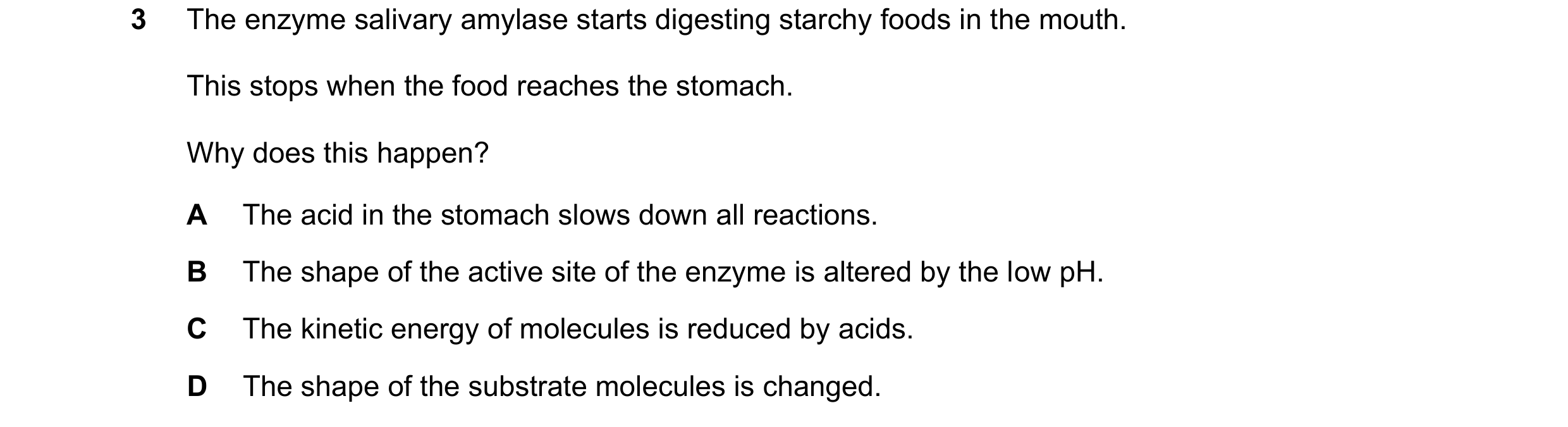
Q35 · The enzyme salivary amylase starts digesting starchy foods in the mouth 0653/22 May/June 2022
3 The enzyme salivary amylase starts digesting starchy foods in the mouth. This stops when the food reaches the stomach. Why does this happen? A The acid in the stomach slows down all reactions. B The shape of the active site of the enzyme is altered by the low pH. C The kinetic energy of molecules is reduced by acids. D The shape of the substrate molecules is changed.
1 marks
Answer: B
This question in 0653/22 May/June 2022
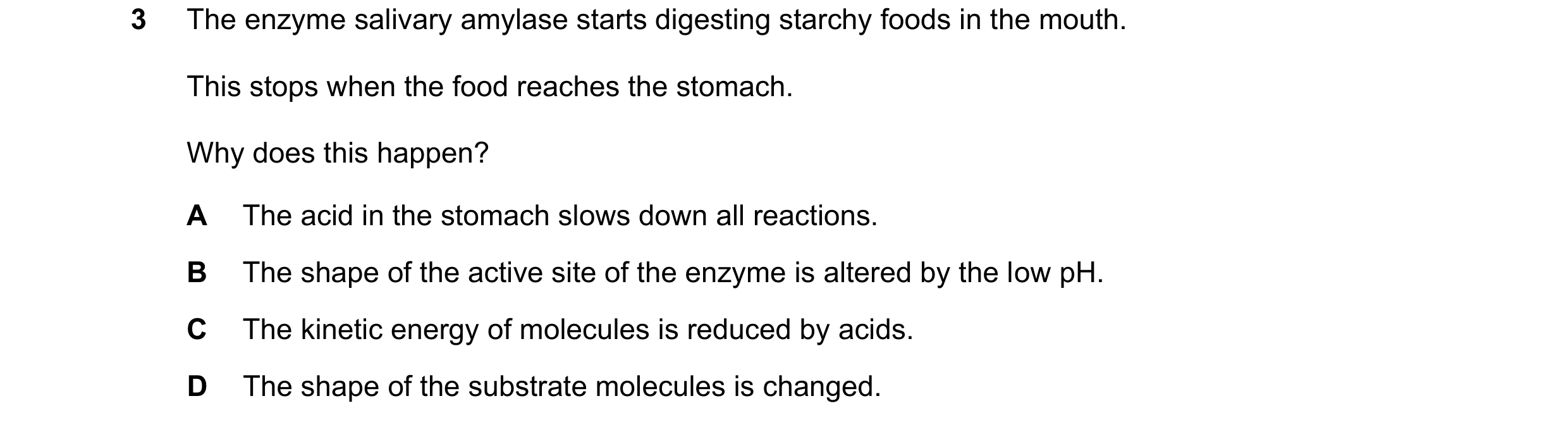
Q36 · The enzyme salivary amylase starts digesting starchy foods in the mouth 0653/23 May/June 2022
3 The enzyme salivary amylase starts digesting starchy foods in the mouth. This stops when the food reaches the stomach. Why does this happen? A The acid in the stomach slows down all reactions. B The shape of the active site of the enzyme is altered by the low pH. C The kinetic energy of molecules is reduced by acids. D The shape of the substrate molecules is changed.
1 marks
Answer: B
This question in 0653/23 May/June 2022
Q37 · Under which conditions is an enzyme described as being denatured? 0653/22 Feb/March 2023
2 Under which conditions is an enzyme described as being denatured? A when it is cooled to a low temperature B when it is turned into a dry powder for storage C when it is used to catalyse a different reaction D when the shape of the active site is permanently changed
1 marks
Answer: D
This question in 0653/22 Feb/March 2023
Q38 · Which combination of pH and temperature does not denature a protease enzyme from the… 0653/21 May/June 2023
4 Which combination of pH and temperature does not denature a protease enzyme from the stomach? temperature pH / °C A 3 37 B 3 60 C 10 37 D 10 60
1 marks
Answer: A
This question in 0653/21 May/June 2023
Q39 · The activity of an enzyme-catalysed reaction is altered by changes in temperature 0653/22 May/June 2023
3 The activity of an enzyme-catalysed reaction is altered by changes in temperature. What occurs when the temperature rises above the temperature at which the enzyme works best? A The shape of the substrate molecule no longer fits the active site of the enzyme molecule. B The increasing temperature causes the substrate molecules to break down. C The concentration of the substrate increases and that of the product decreases. D The kinetic energy of the substrate particles decreases.
1 marks
Answer: A
This question in 0653/22 May/June 2023
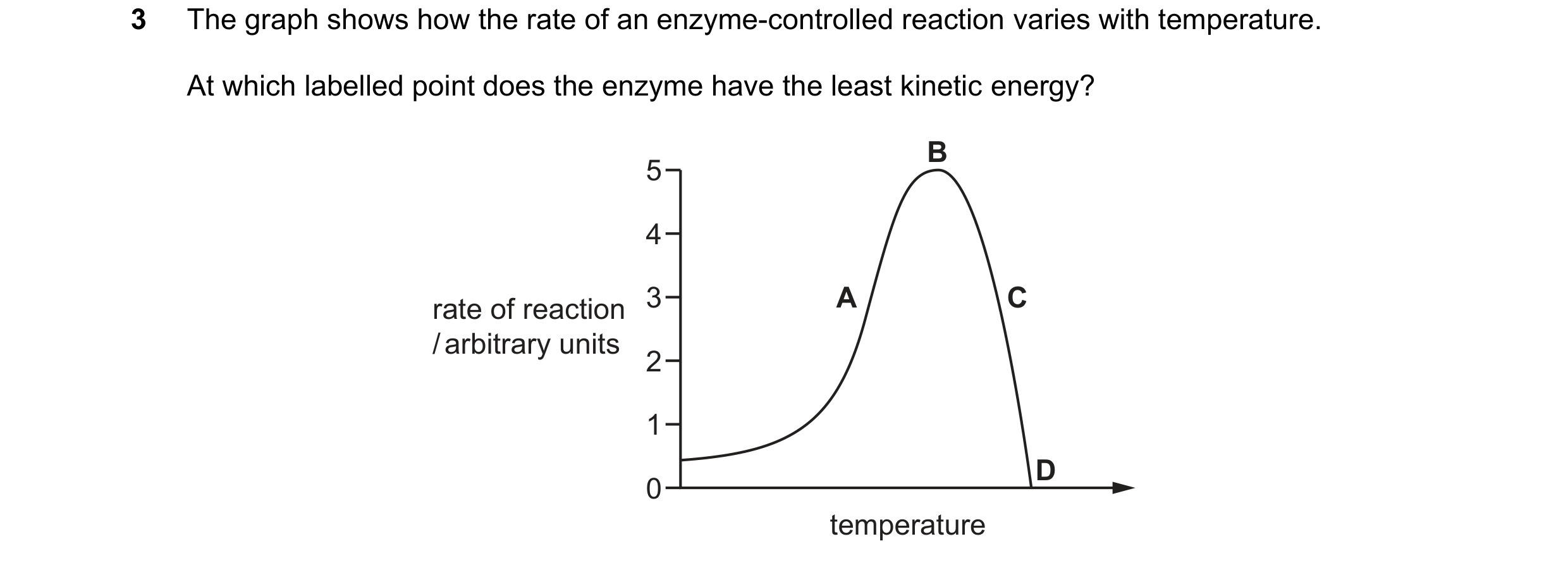
Q40 · The graph shows how the rate of an enzyme-controlled reaction varies with temperature 0653/23 May/June 2023
3 The graph shows how the rate of an enzyme-controlled reaction varies with temperature. At which labelled point does the enzyme have the least kinetic energy? B 5 4 3 A C rate of reaction / arbitrary units 2 1 D 0 temperature
1 marks
Answer: A
This question in 0653/23 May/June 2023
Q41 · Which graph shows the effect of increasing pH on enzyme activity? 0653/21 Oct/Nov 2023
4 Which graph shows the effect of increasing pH on enzyme activity? A B rate of rate of reaction reaction pH pH C D rate of rate of reaction reaction pH pH
1 marks
Answer: A
This question in 0653/21 Oct/Nov 2023
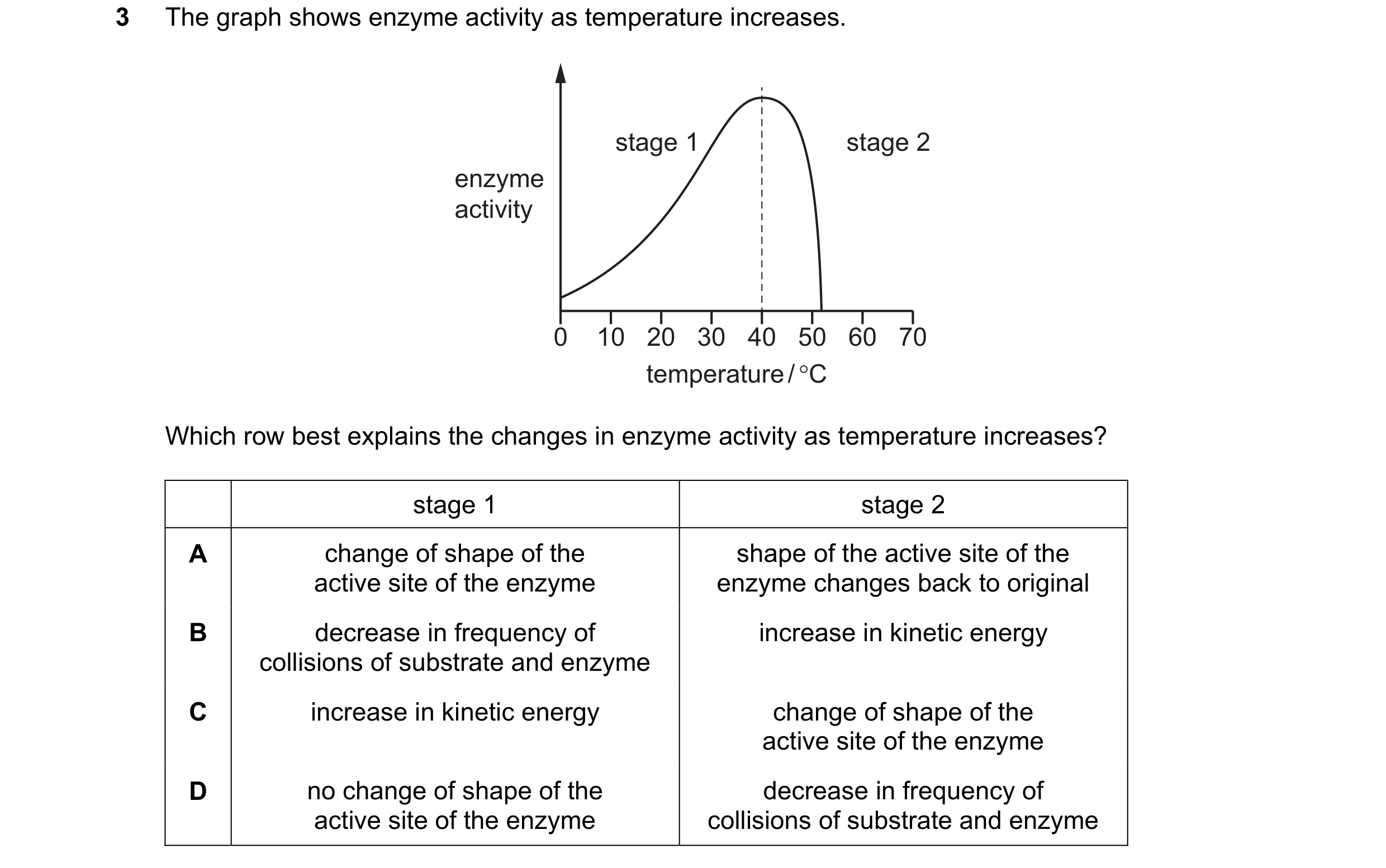
Q42 · The graph shows enzyme activity as temperature increases 0653/22 Oct/Nov 2023
3. The graph shows enzyme activity as temperature increases.
stage 1 stage 2
enzyme
activity
0 10 20 30 40 50 60 70
temperature /°C
Which row best explains the changes in enzyme activity as temperature increases?
stage 1 stage 2
change of shape of the shape of the active site of the
active site of the enzyme enzyme changes back to original
decrease in frequency of increase in kinetic energy
collisions of substrate and enzyme
increase in kinetic energy change of shape of the
active site of the enzyme
no change of shape of the decrease in frequency of
active site of the enzyme collisions of substrate and enzyme
1 marks
Answer: C
This question in 0653/22 Oct/Nov 2023
Q43 · The diagram shows starch being digested by amylase 0653/22 Oct/Nov 2023
5 The diagram shows starch being digested by amylase.
starch
amylase
Which row shows the digestion taking place?
chemical mechanical
A x x
B x v
Cc v x
D Jv v
é
%
00
*e
$
é
“
&
;
1 marks
Answer: C
This question in 0653/22 Oct/Nov 2023
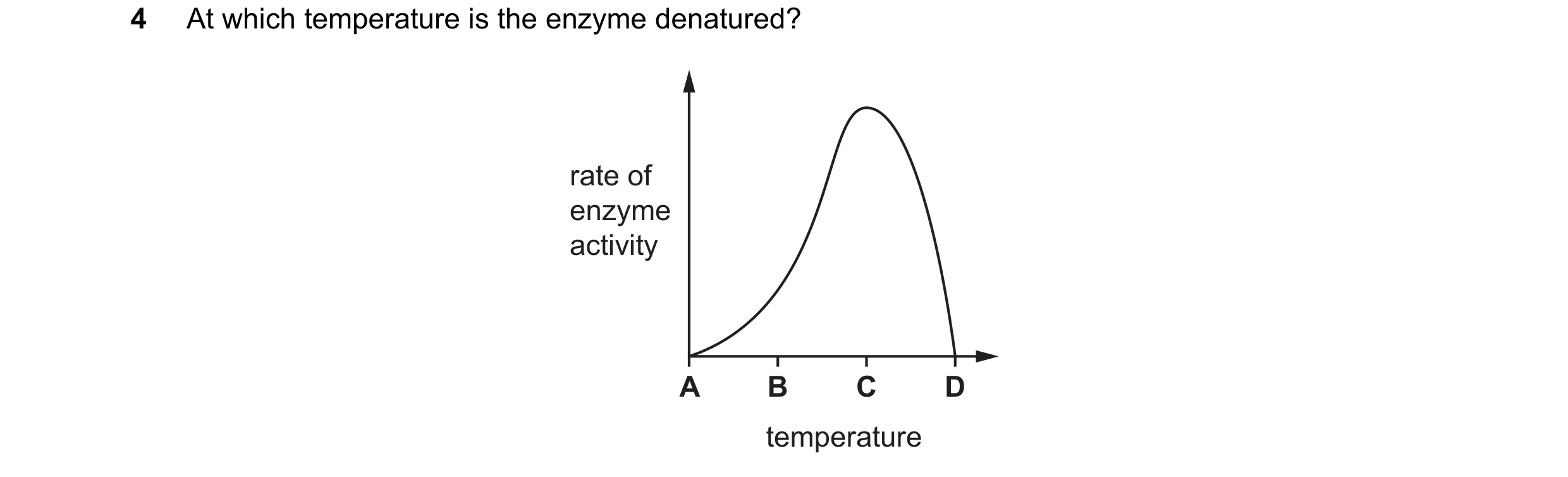
Q44 · At which temperature is the enzyme denatured? 0653/23 Oct/Nov 2023
4 At which temperature is the enzyme denatured? rate of enzyme activity A B C D temperature
1 marks
Answer: D
This question in 0653/23 Oct/Nov 2023
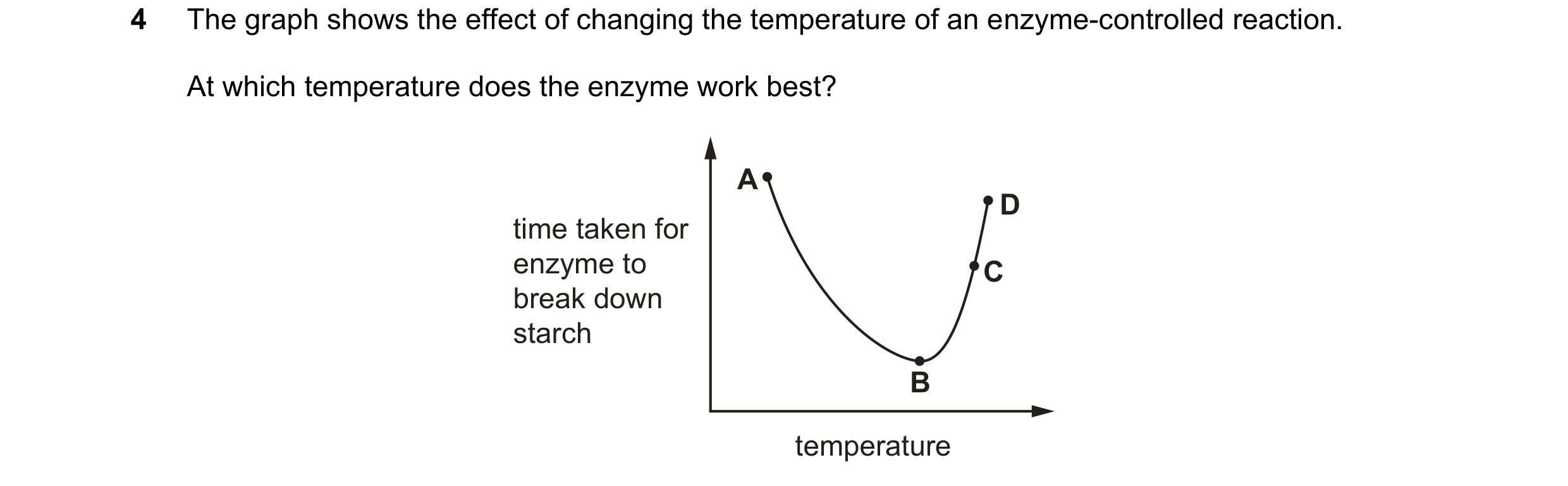
Q45 · The graph shows the effect of changing the temperature of an enzyme-controlled reaction 0653/22 Feb/March 2024
4 The graph shows the effect of changing the temperature of an enzyme-controlled reaction. At which temperature does the enzyme work best? A D time taken for enzyme to C break down starch B temperature
1 marks
Answer: B
This question in 0653/22 Feb/March 2024
Q46 · The diagram represents the enzyme amylase and the products of digestion by amylase 0653/21 May/June 2024
2 The diagram represents the enzyme amylase and the products of digestion by amylase. amylase X Y What are products X and Y? X Y A amino acid amino acid B fatty acid glycerol C glycerol fatty acid D simple sugar simple sugar
1 marks
Answer: D
This question in 0653/21 May/June 2024
Q47 · Biological catalysts speed up reactions 0653/22 May/June 2024
3 Biological catalysts speed up reactions. What is another name for biological catalysts? A antibodies B enzymes C fatty acids D hormones
1 marks
Answer: B
This question in 0653/22 May/June 2024
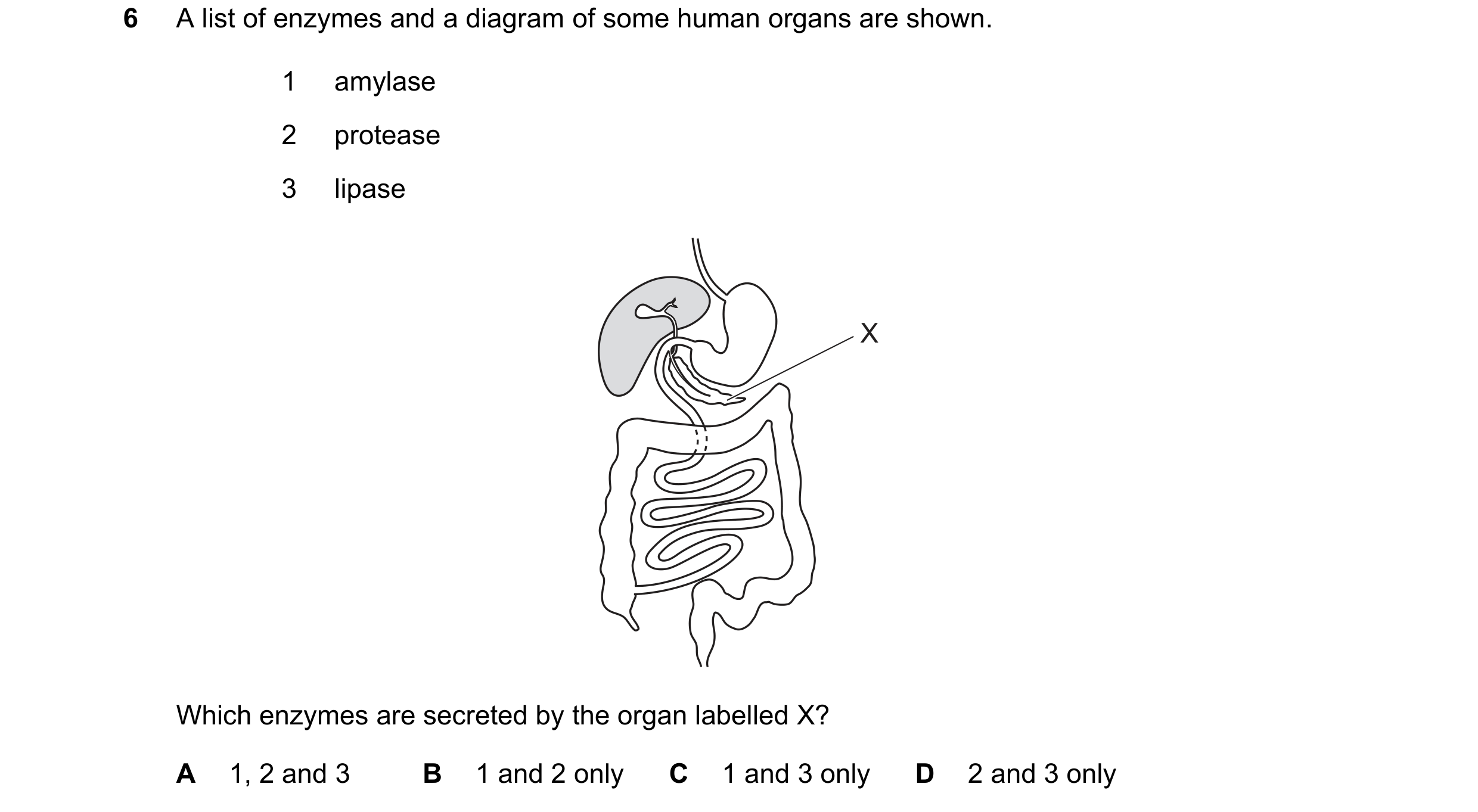
Q48 · A list of enzymes and a diagram of some human organs are shown 0653/21 Oct/Nov 2024
6 A list of enzymes and a diagram of some human organs are shown. 1 amylase 2 protease 3 lipase X Which enzymes are secreted by the organ labelled X? A 1, 2 and 3 B 1 and 2 only C 1 and 3 only D 2 and 3 only
1 marks
Answer: A
This question in 0653/21 Oct/Nov 2024
Q49 · Which row describes an enzyme? 0653/23 Oct/Nov 2024
3 Which row describes an enzyme? molecule function A carbohydrate biological catalyst B carbohydrate hormone C protein biological catalyst D protein hormone
1 marks
Answer: C
This question in 0653/23 Oct/Nov 2024
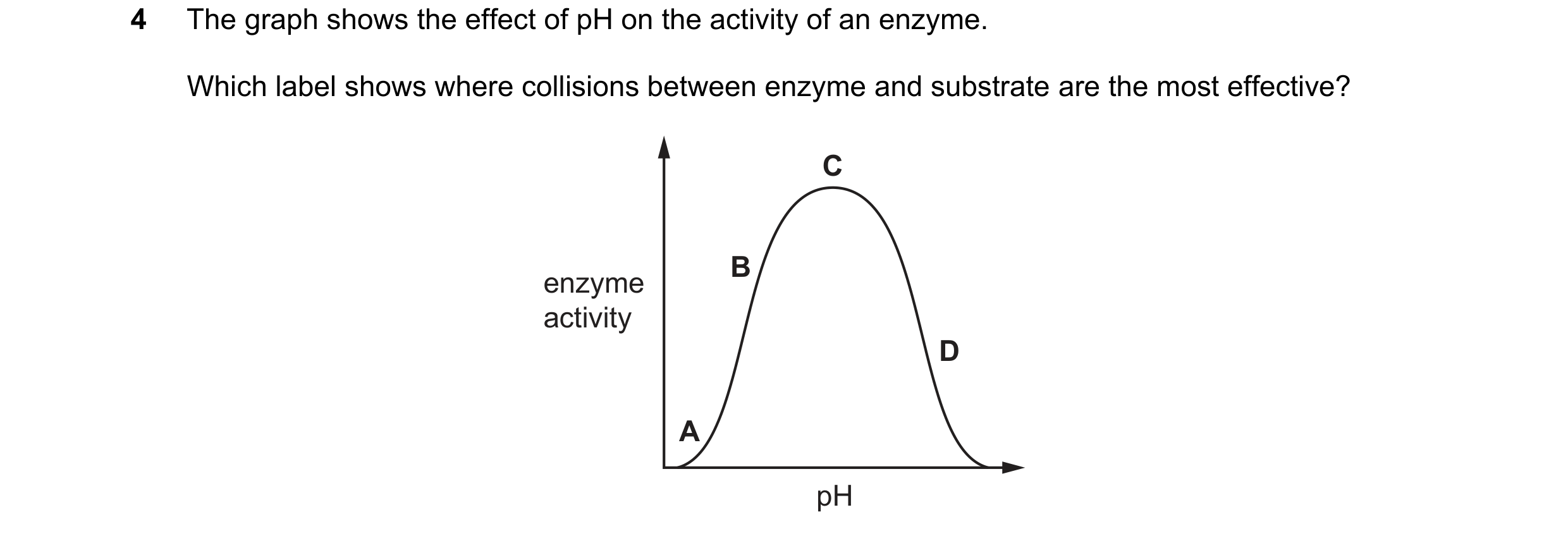
Q50 · The graph shows the effect of pH on the activity of an enzyme 0653/22 Feb/March 2025
4 The graph shows the effect of pH on the activity of an enzyme. Which label shows where collisions between enzyme and substrate are the most effective? C B enzyme activity D A pH
1 marks
Answer: C
This question in 0653/22 Feb/March 2025
Q51 · Which statement explains how an increase in pH affects enzyme activity? 0653/21 May/June 2025
3 Which statement explains how an increase in pH affects enzyme activity? A The active site changes shape. B The substrate is denatured. C There is an increase in the kinetic energy. D The number of collisions increases.
1 marks
Answer: A
This question in 0653/21 May/June 2025
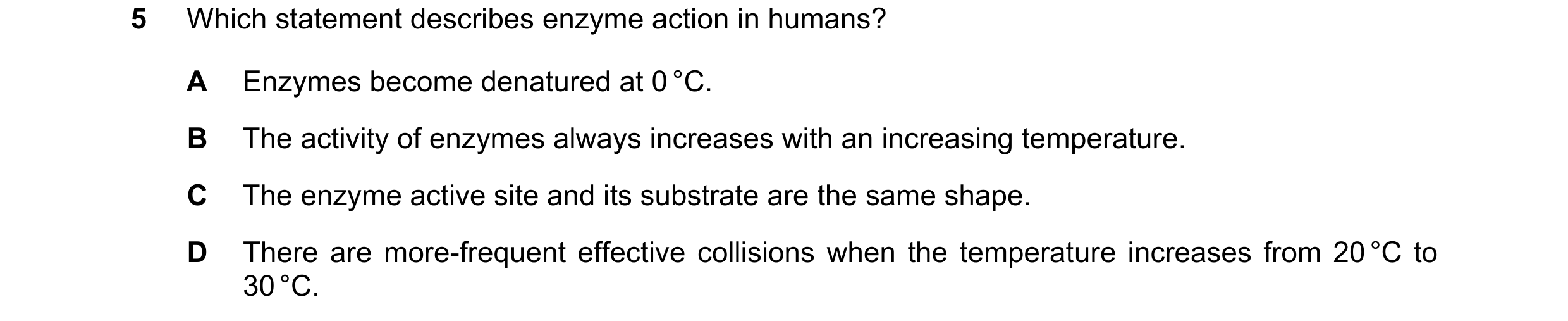
Q52 · Which statement describes enzyme action in humans? 0653/22 May/June 2025
5 Which statement describes enzyme action in humans? A Enzymes become denatured at 0 °C. B The activity of enzymes always increases with an increasing temperature. C The enzyme active site and its substrate are the same shape. D There are more-frequent effective collisions when the temperature increases from 20 °C to 30 °C.
1 marks
Answer: D
This question in 0653/22 May/June 2025
Q53 · The graph shows the activity of an enzyme at different temperatures 0653/23 May/June 2025
5 The graph shows the activity of an enzyme at different temperatures. Y enzyme activity X Z W 0 20 40 60 temperature / °C Which statement about the effect of temperature on the activity of this enzyme is correct? A At X and Z, the activity of the enzyme is the same because the kinetic energy of the enzymes is the same. B At W, the enzyme activity is lower than at X because there are less-frequent effective collisions between the enzyme and the substrate. C At Y, the enzyme is working at its optimum rate because it has the most kinetic energy. D At Z, the enzyme is completely denatured.
1 marks
Answer: B
This question in 0653/23 May/June 2025
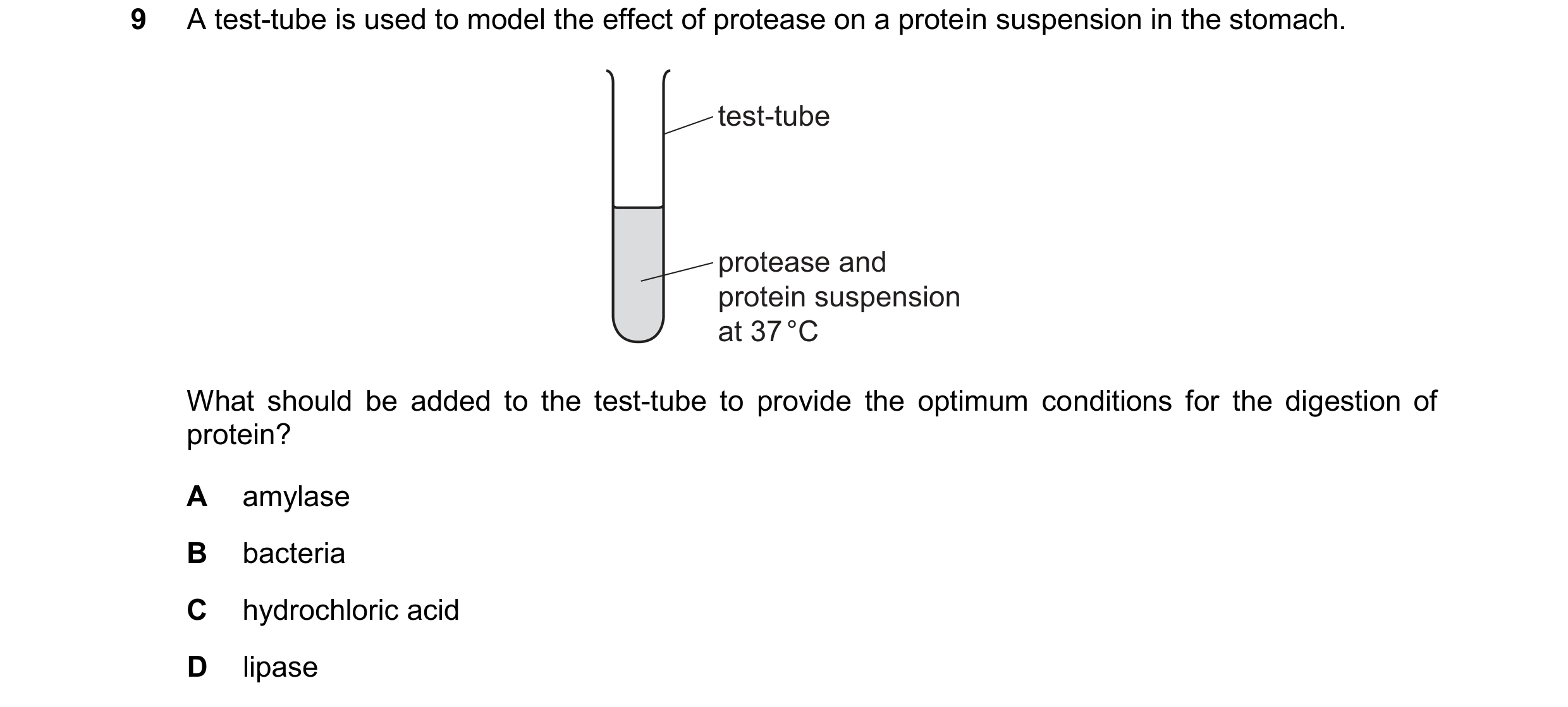
Q54 · A test-tube is used to model the effect of protease on a protein suspension in the stomach 0653/23 May/June 2025
9 A test-tube is used to model the effect of protease on a protein suspension in the stomach. test-tube protease and protein suspension at 37 °C What should be added to the test-tube to provide the optimum conditions for the digestion of protein? A amylase B bacteria C hydrochloric acid D lipase
1 marks
Answer: C
This question in 0653/23 May/June 2025
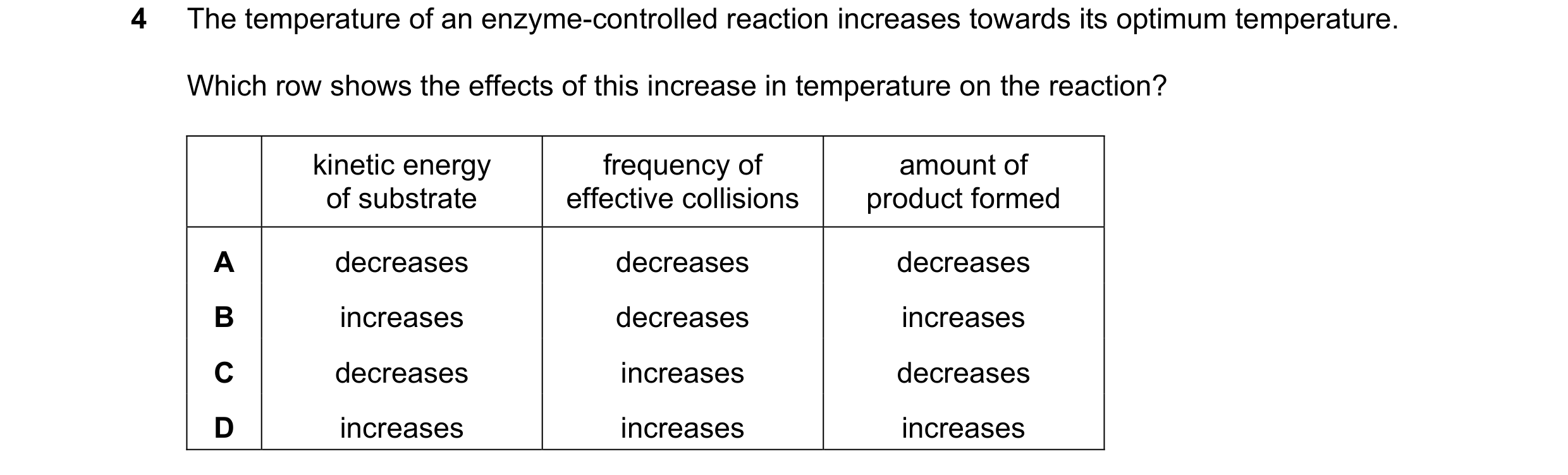
Q55 · The temperature of an enzyme-controlled reaction increases towards its optimum temperature 0653/21 Oct/Nov 2025
4 The temperature of an enzyme-controlled reaction increases towards its optimum temperature. Which row shows the effects of this increase in temperature on the reaction? kinetic energy frequency of amount of of substrate effective collisions product formed A decreases decreases decreases B increases decreases increases C decreases increases decreases D increases increases increases
1 marks
Answer: D
This question in 0653/21 Oct/Nov 2025
Q56 · The graph shows how the activity of an enzyme varies 0653/22 Oct/Nov 2025
4 The graph shows how the activity of an enzyme varies. enzyme activity 0 0 x-axis What is the x-axis label for this graph? A enzyme activity B pH C temperature D time
1 marks
Answer: B
This question in 0653/22 Oct/Nov 2025
Q57 · Which statement about enzymes is correct for temperatures up to the optimum temperature? 0653/23 Oct/Nov 2025
3 Which statement about enzymes is correct for temperatures up to the optimum temperature? A As temperature increases, substrates react with the active sites more slowly. B As temperature increases, enzymes have more kinetic energy. C As temperature decreases, enzymes denature. D As temperature decreases, the number of effective collisions increases.
1 marks
Answer: B
This question in 0653/23 Oct/Nov 2025
 1 / 20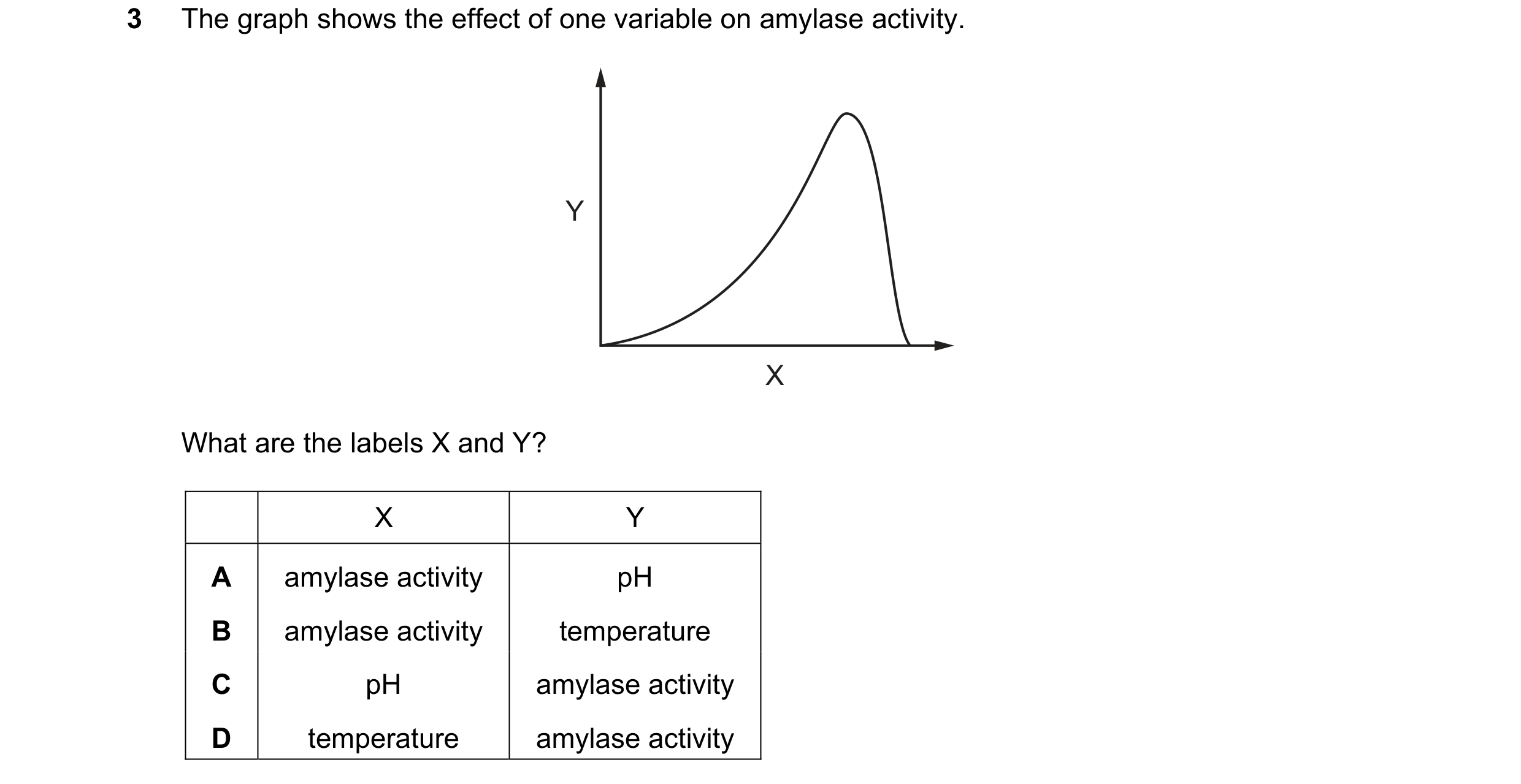
 2 / 20
 3 / 20
 4 / 20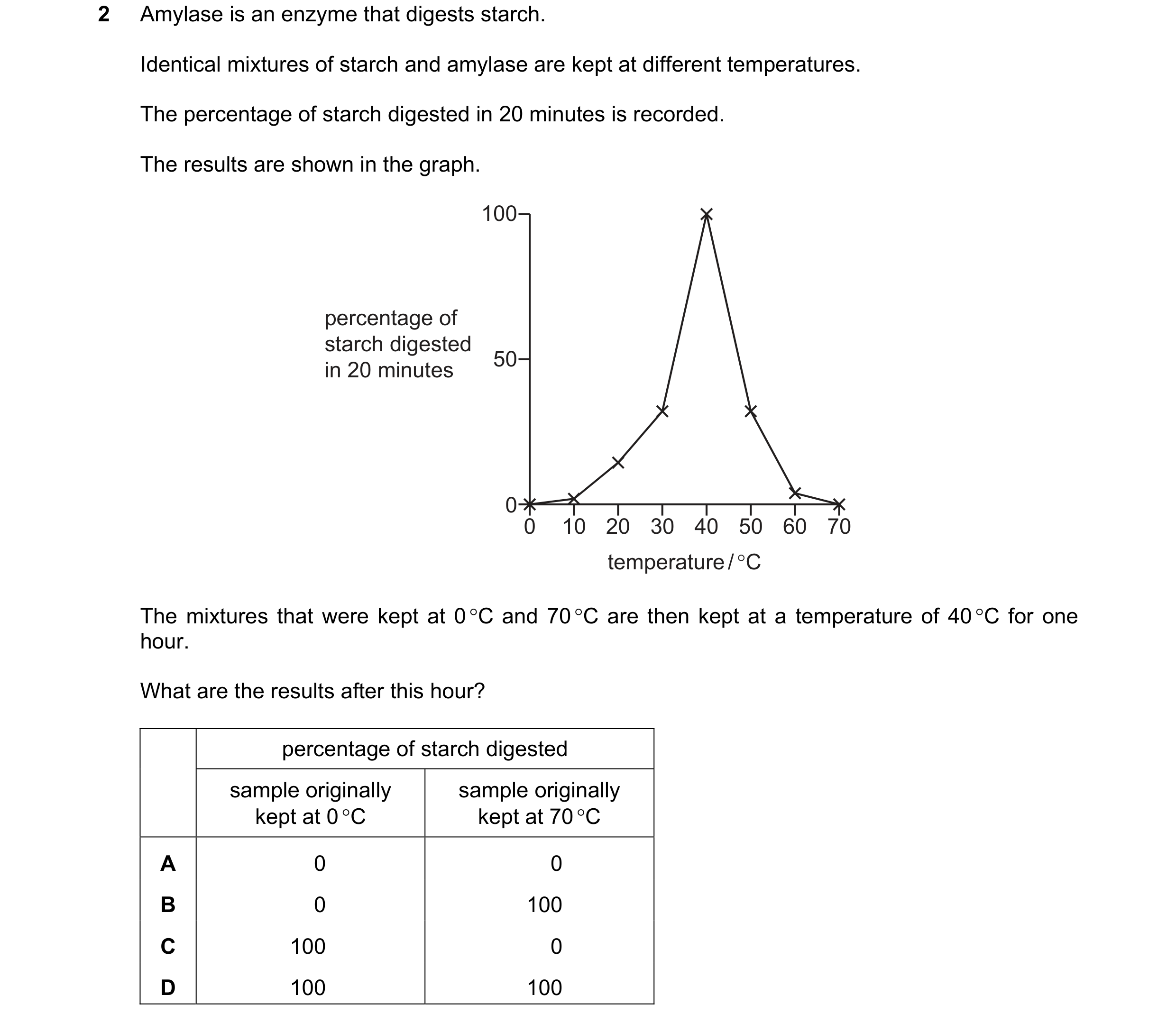
 5 / 20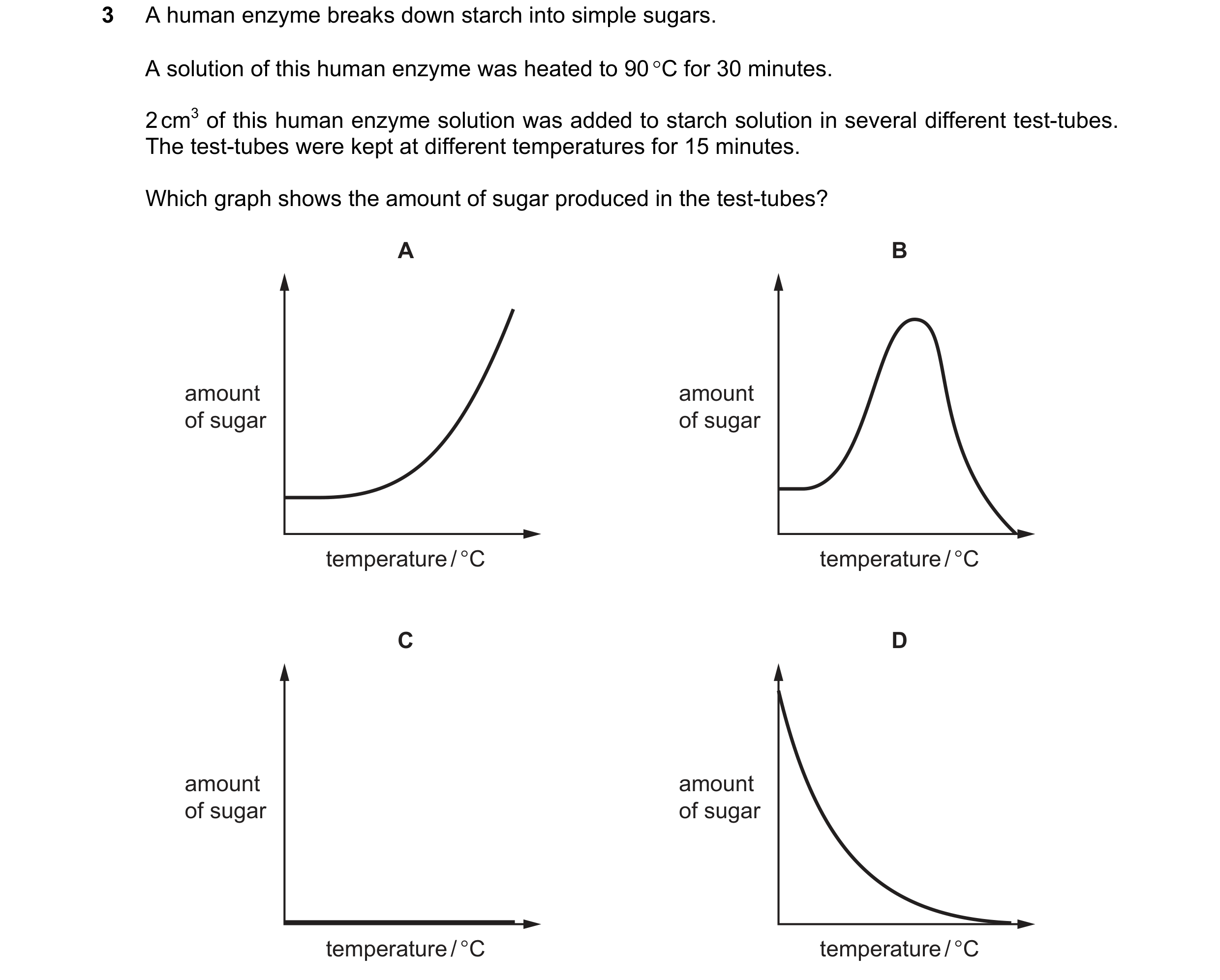

 6 / 20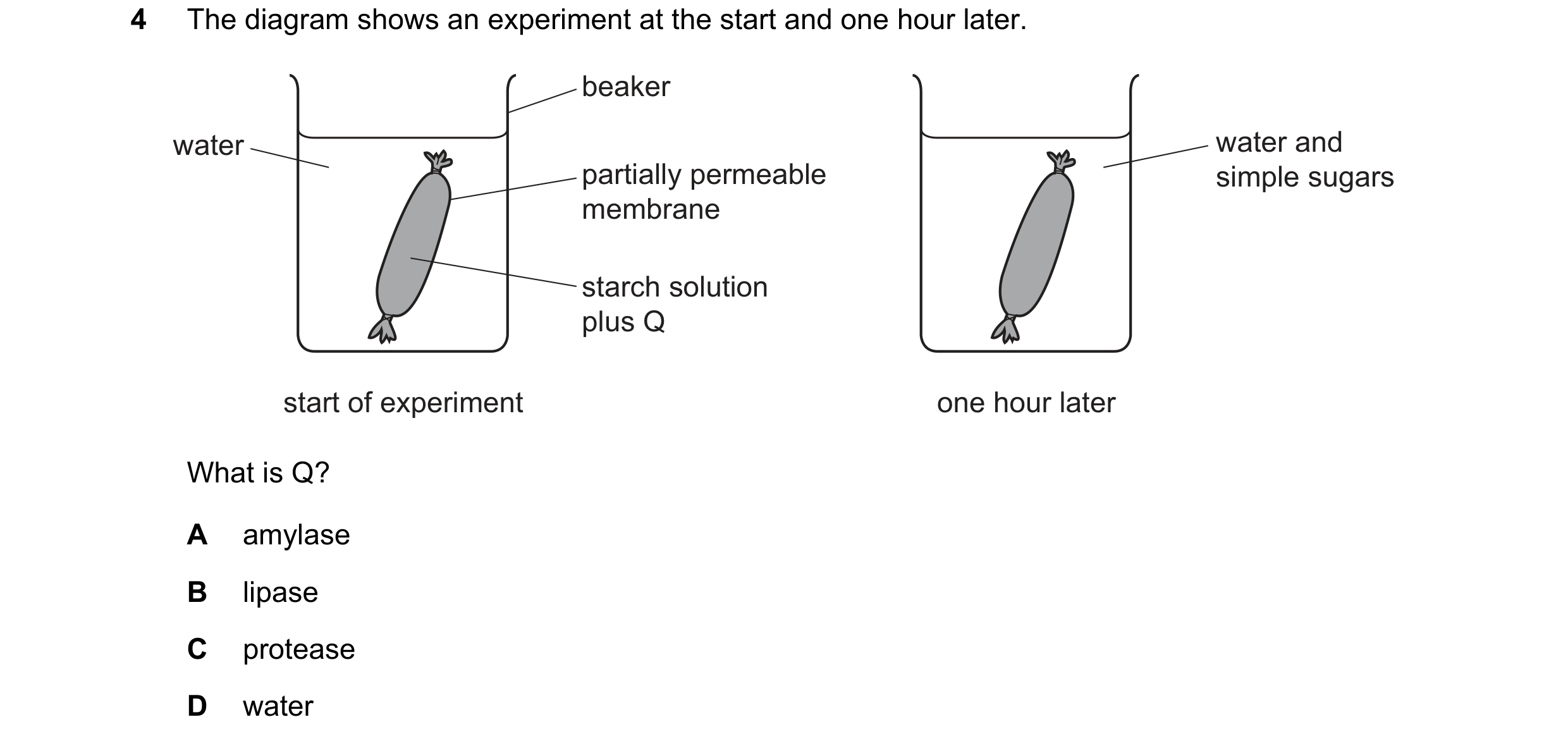
 7 / 20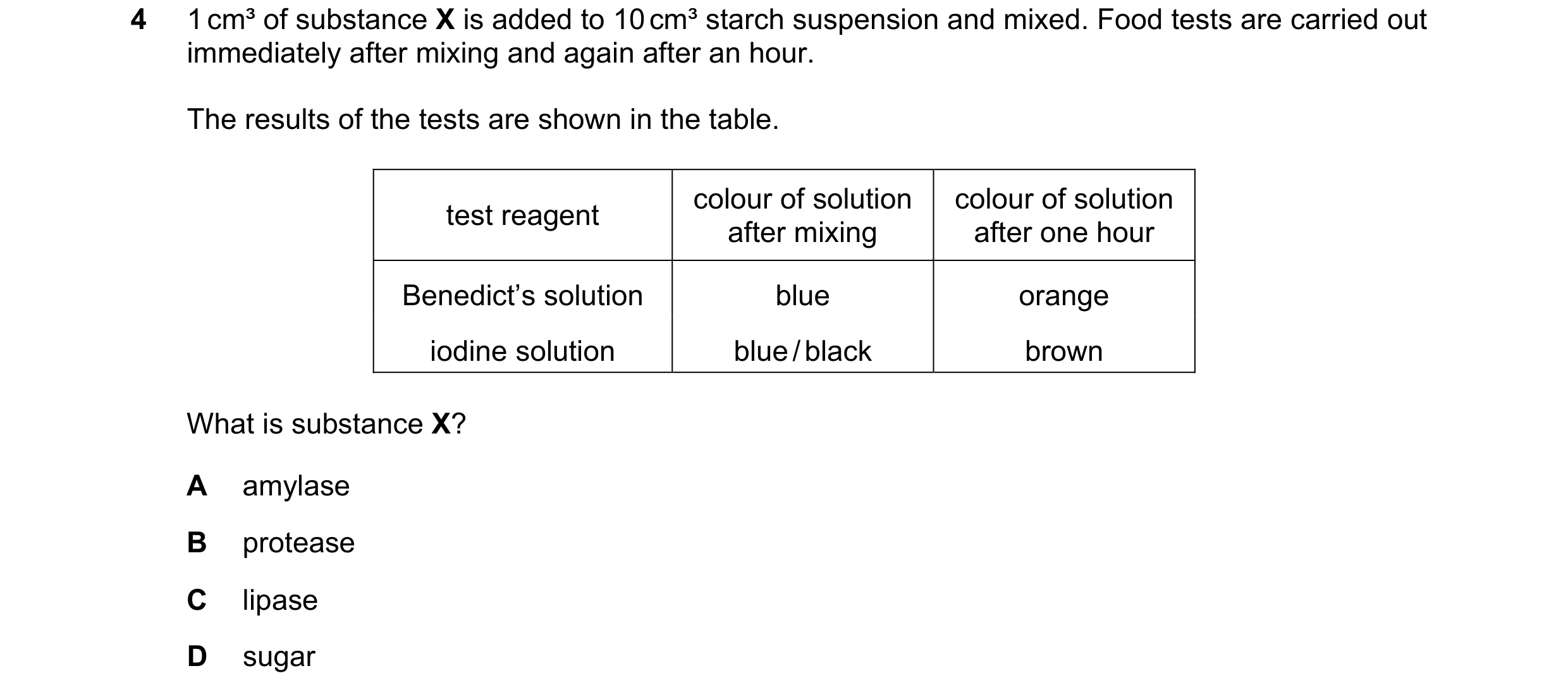
 8 / 20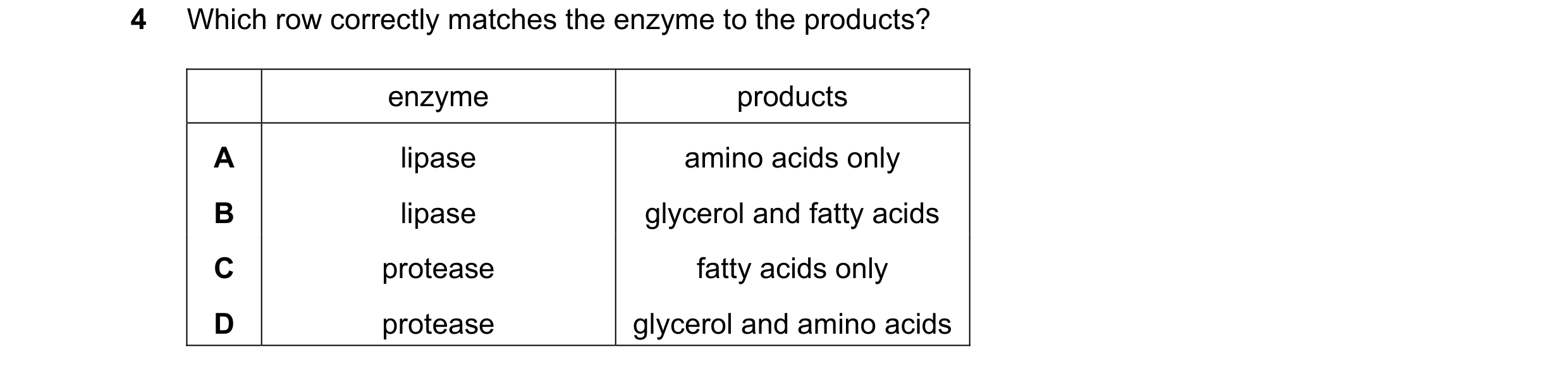
 9 / 20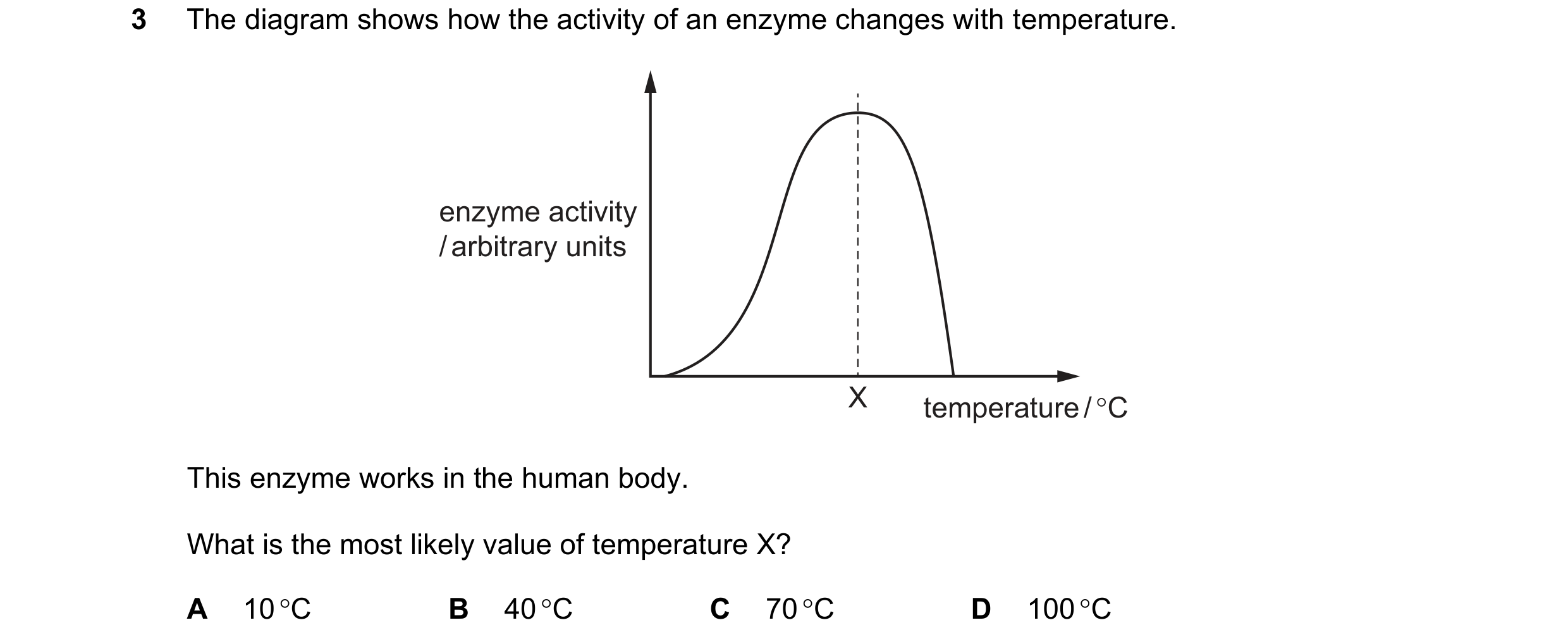
 10 / 20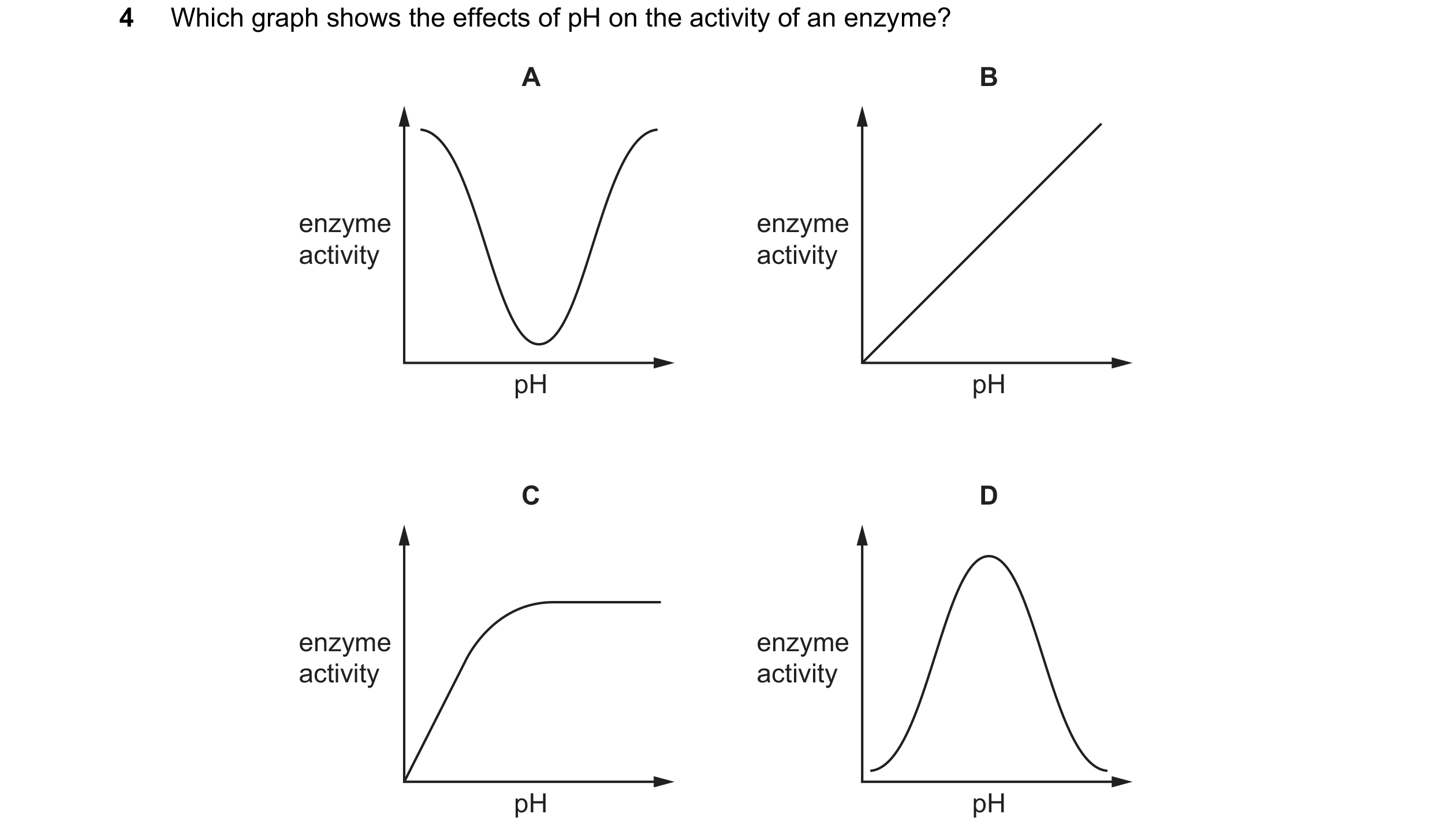

 11 / 20
 12 / 20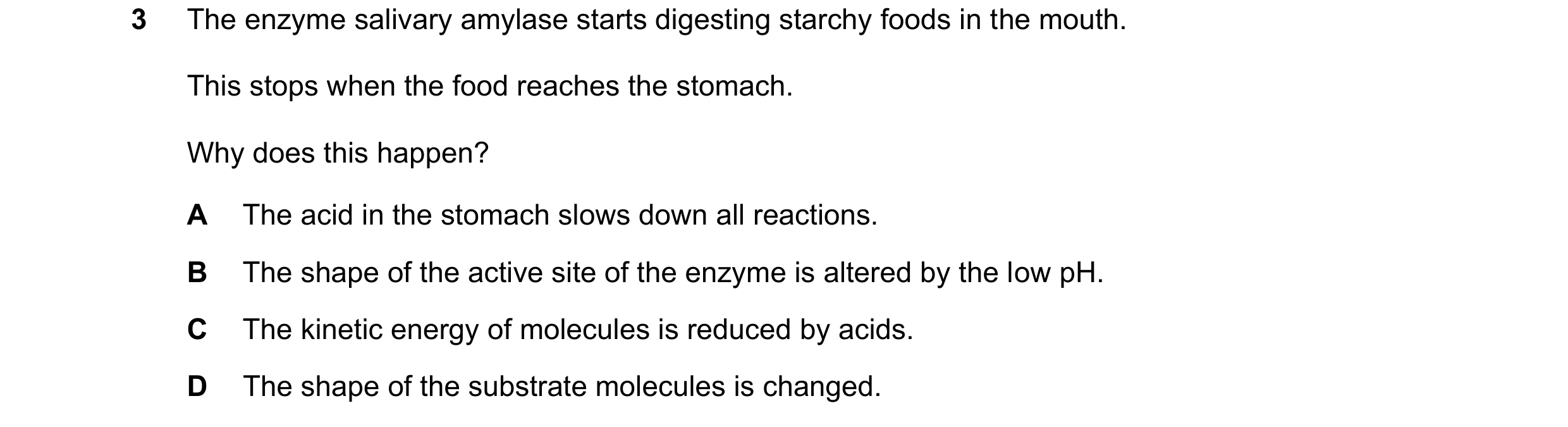
 13 / 20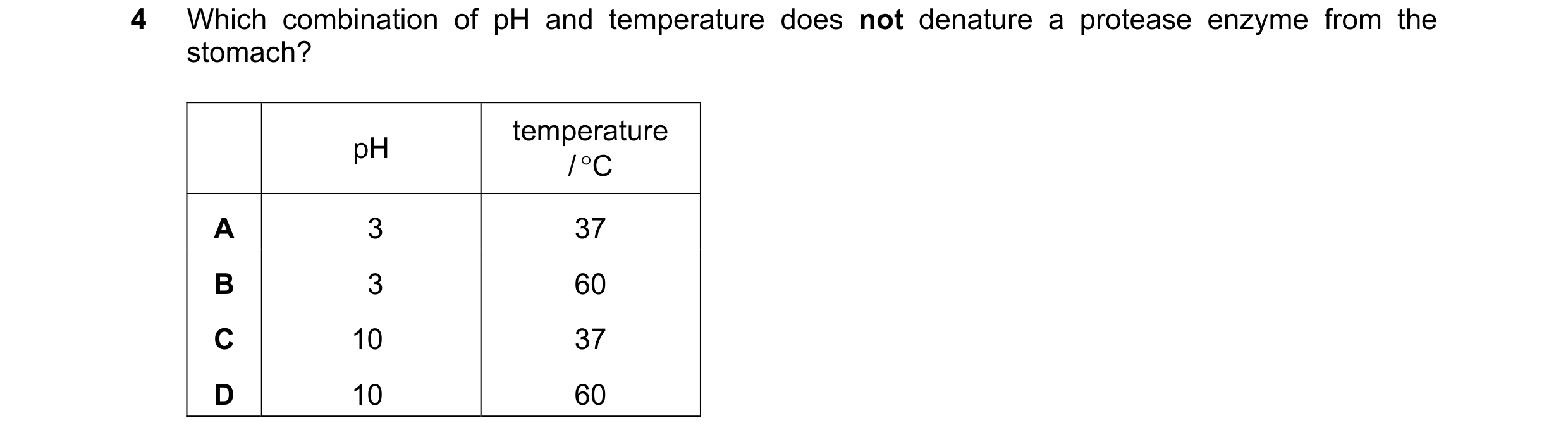
 14 / 20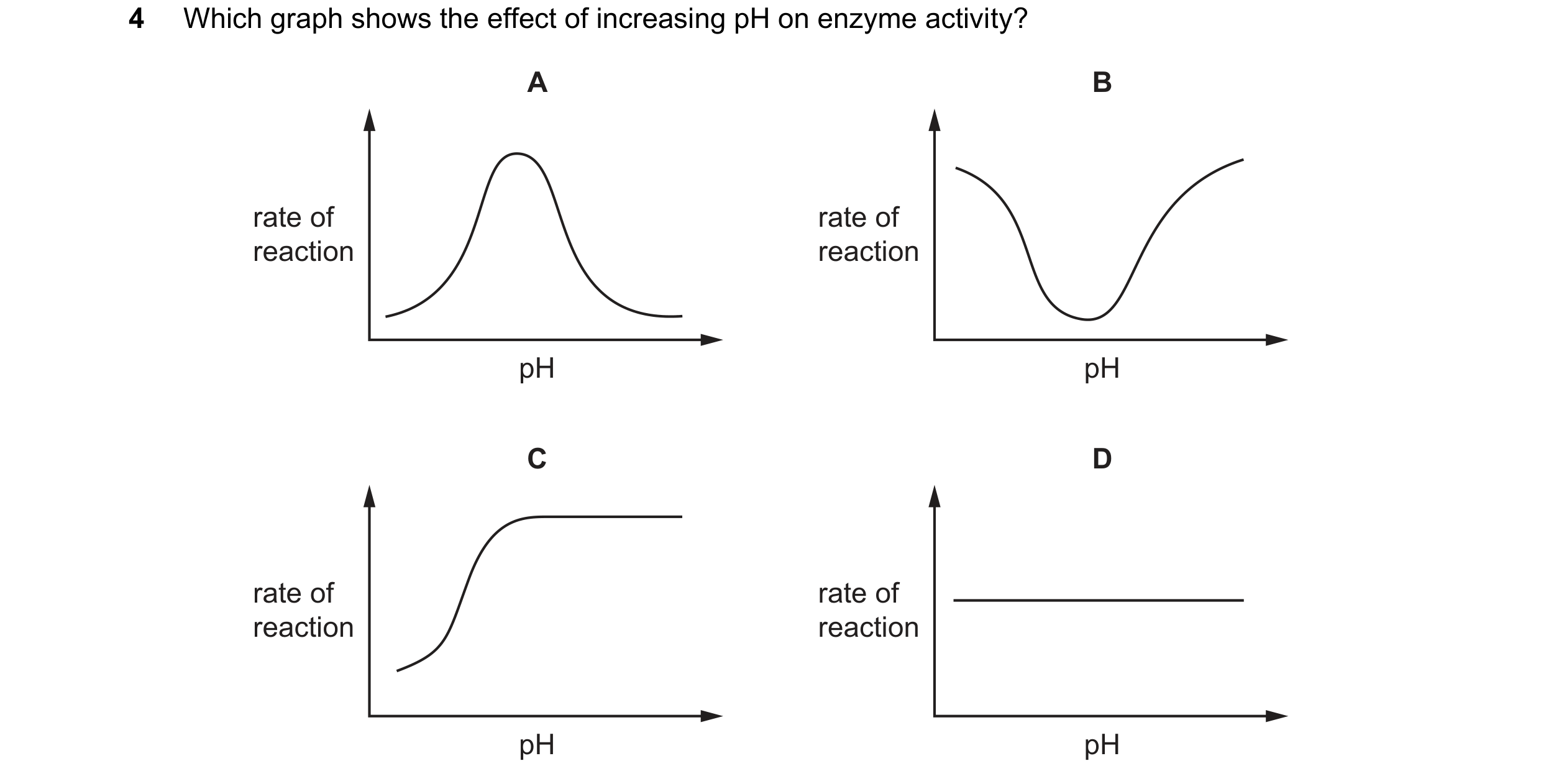
 15 / 20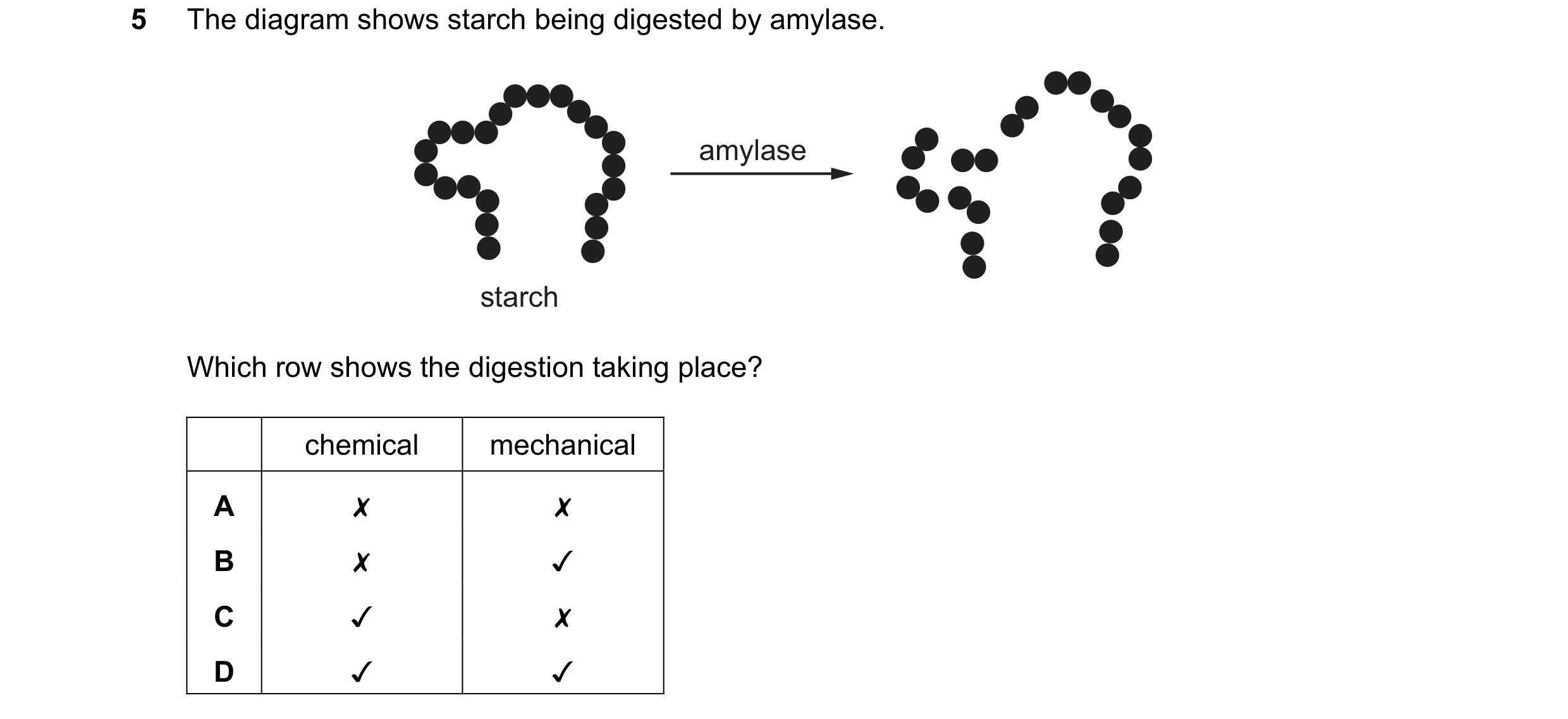
 16 / 20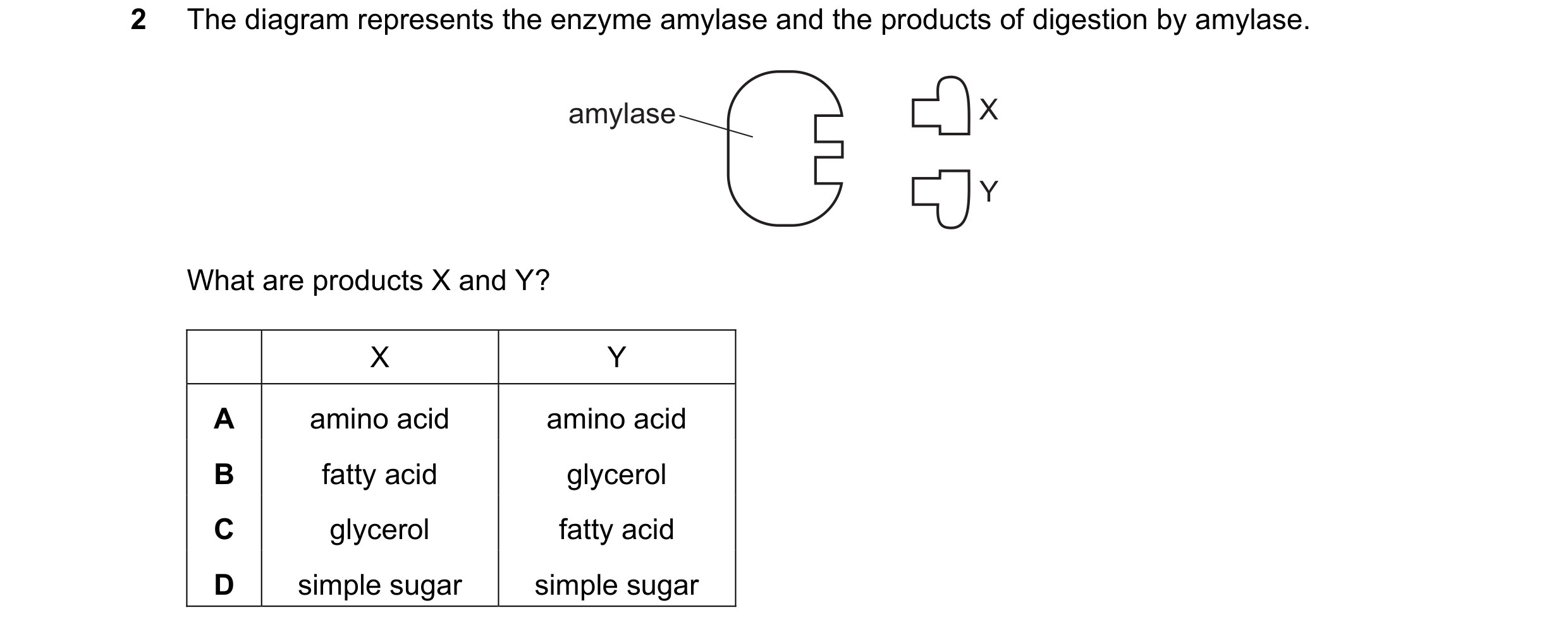
 17 / 20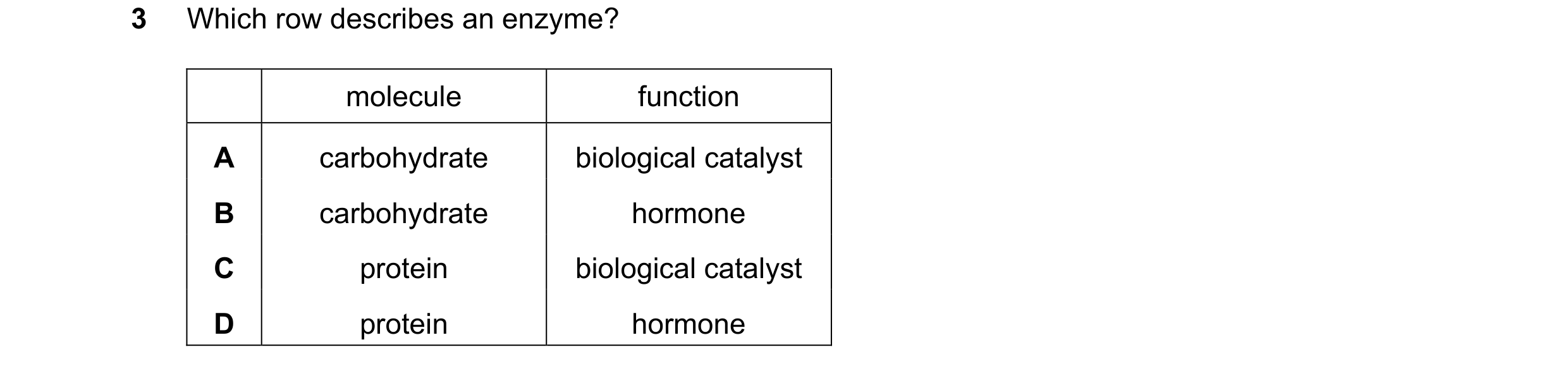

 18 / 20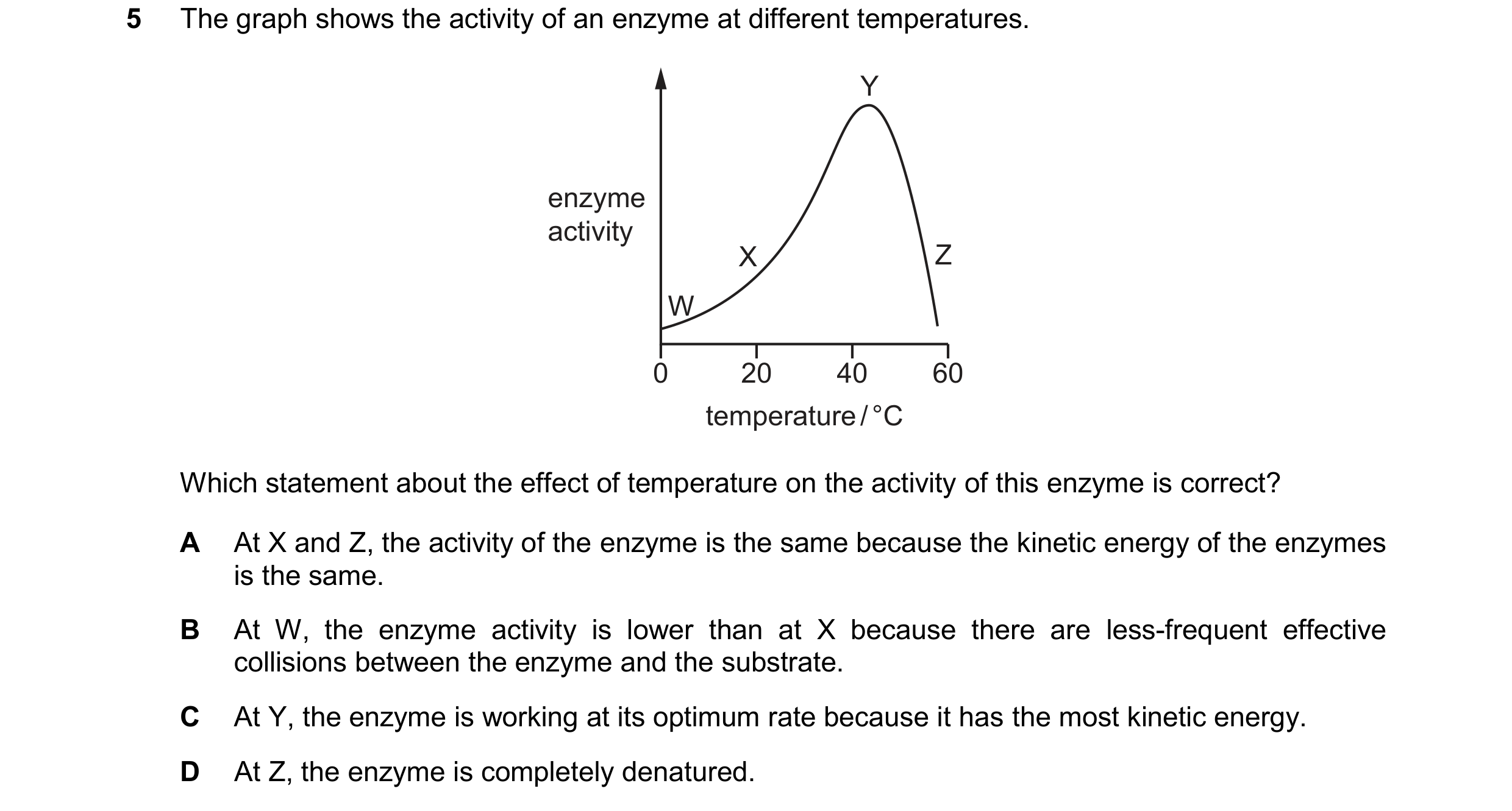
 19 / 20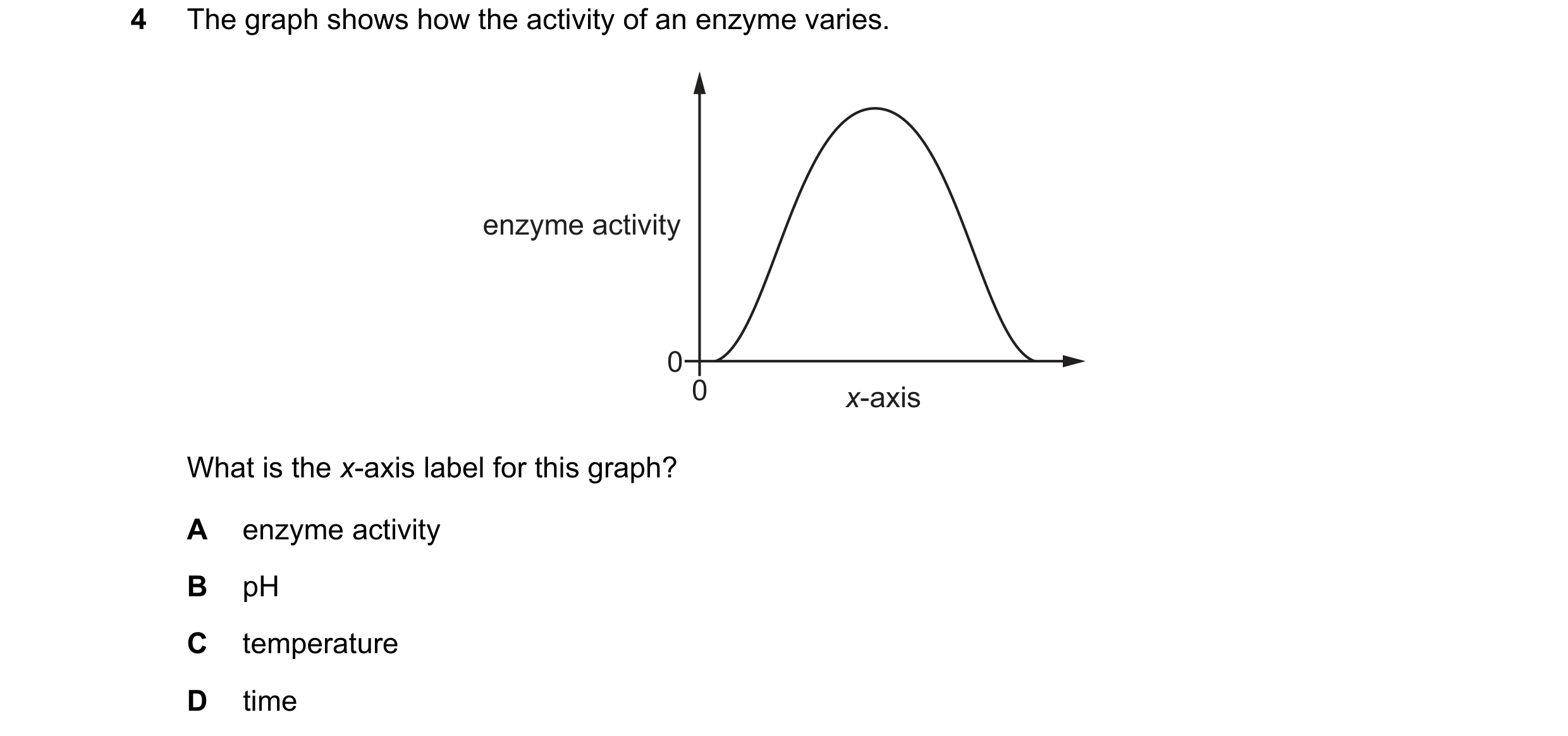
 20 / 20