Cambridge IGCSE Science - Combined 0653 — 2025 Oct/Nov Paper 1 · Variant 1
0653/11/O/N/25 · 40 questions · 40 marks · 45 min
The question paper and its mark scheme, free to read here and free to download. This is Cambridge’s own paper, exactly as it was sat.
Question paper16 pages

Mark scheme3 pages
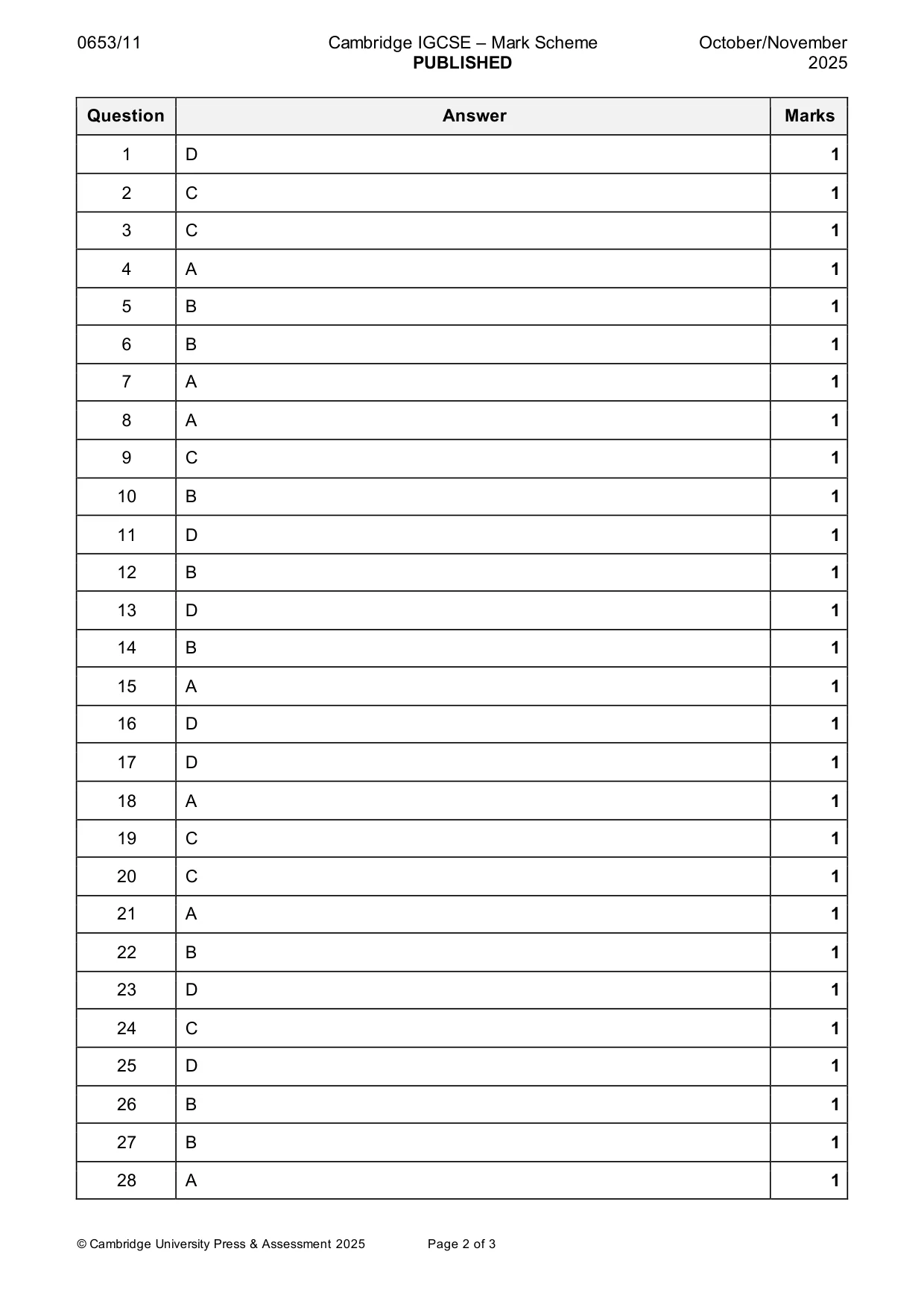
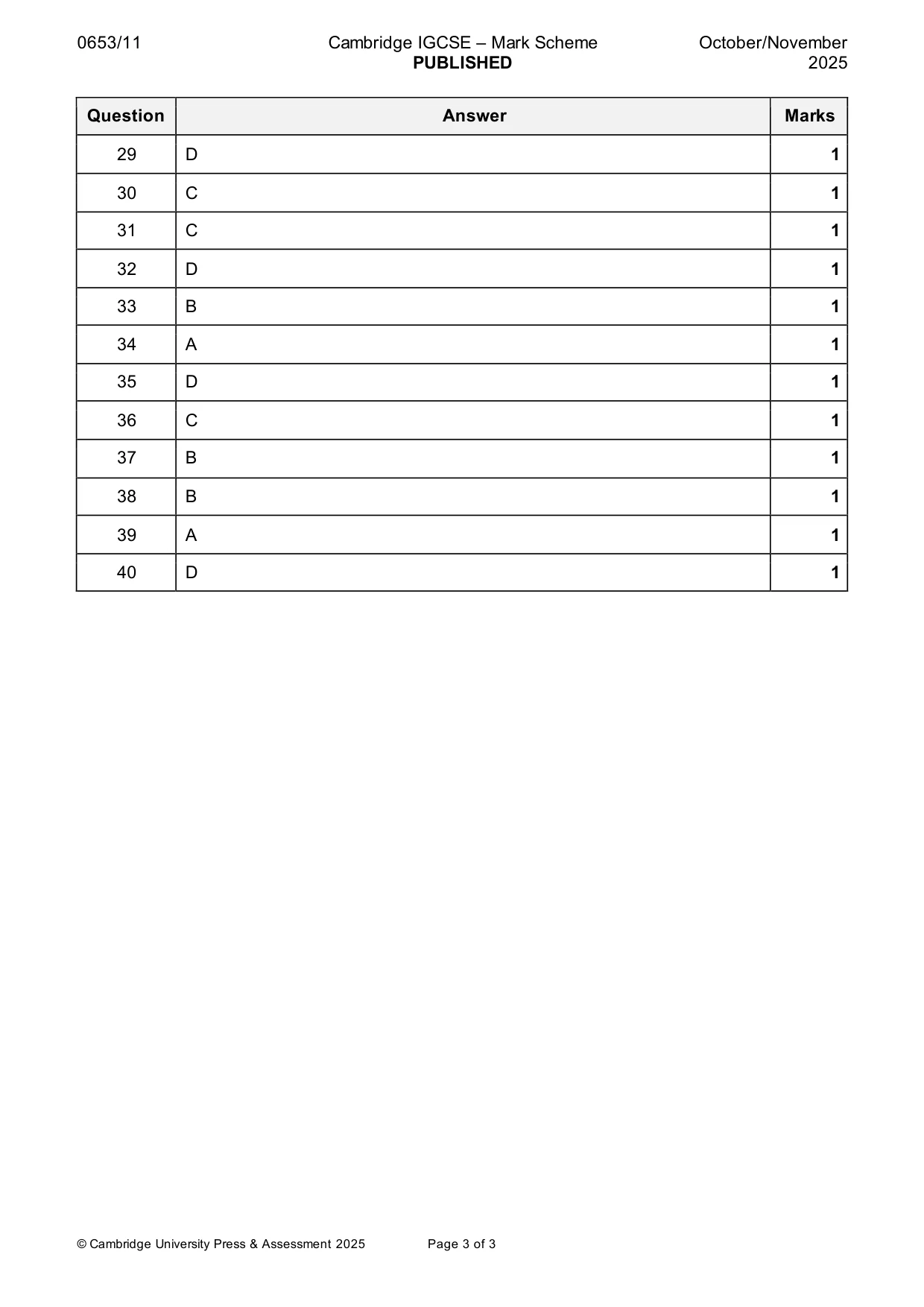
Answers below. Sit the paper first if you are practising.
Questions as text
Q1 · One characteristic of living organisms is to detect and respond to changes in the…
1 One characteristic of living organisms is to detect and respond to changes in the environment. What is this characteristic? A growth B movement C reproduction D sensitivity
Mark scheme: D
Q2 · Which structure stops the cell from bursting when the cell is placed in distilled water?
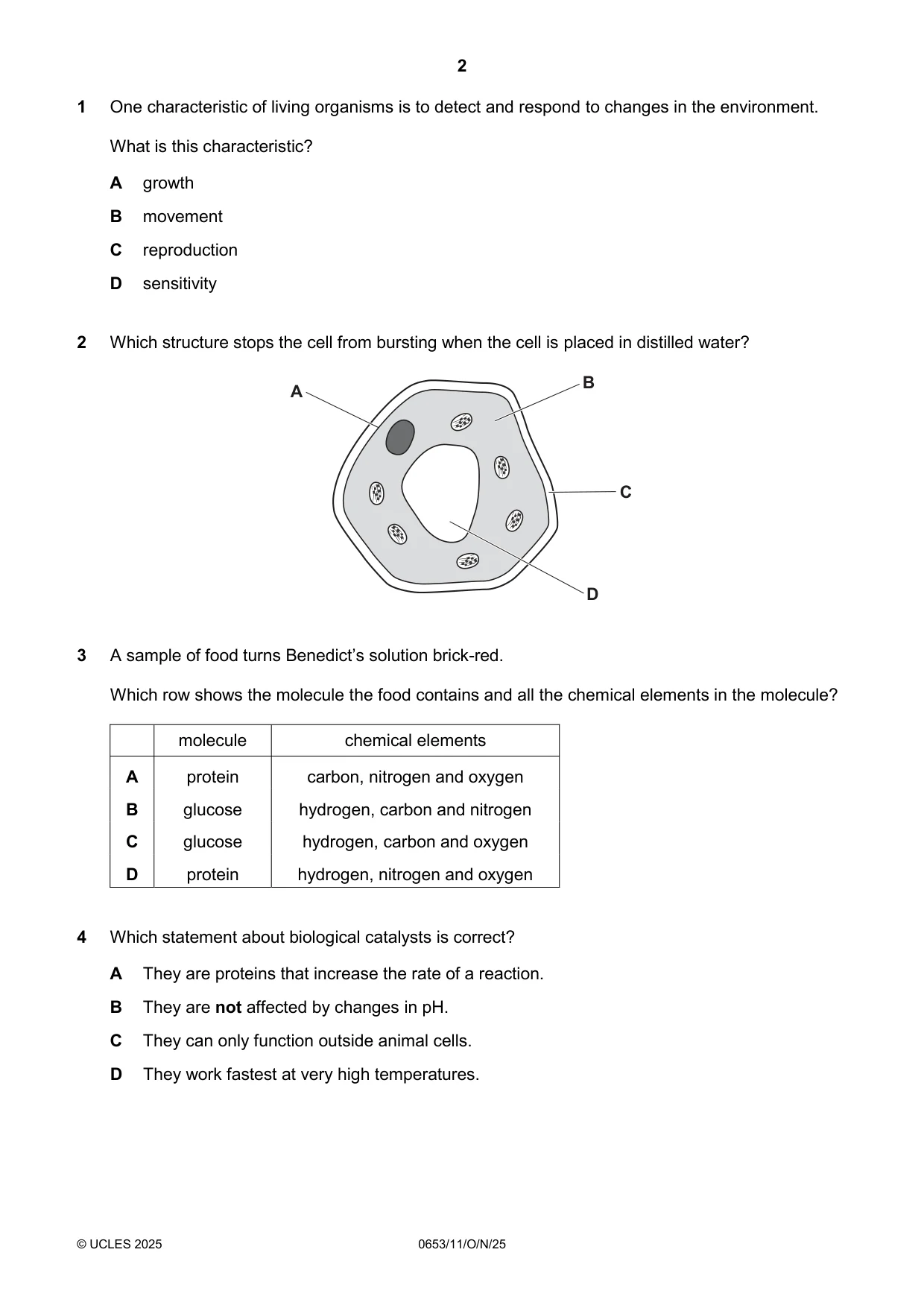
2 Which structure stops the cell from bursting when the cell is placed in distilled water? B A C D
Mark scheme: C
Q3 · A sample of food turns Benedict’s solution brick-red
3 A sample of food turns Benedict’s solution brick-red. Which row shows the molecule the food contains and all the chemical elements in the molecule? molecule chemical elements A protein carbon, nitrogen and oxygen B glucose hydrogen, carbon and nitrogen C glucose hydrogen, carbon and oxygen D protein hydrogen, nitrogen and oxygen
Mark scheme: C
Q4 · Which statement about biological catalysts is correct?
4 Which statement about biological catalysts is correct? A They are proteins that increase the rate of a reaction. B They are not affected by changes in pH. C They can only function outside animal cells. D They work fastest at very high temperatures.
Mark scheme: A
Q5 · Which process do plants use to manufacture carbohydrates using light energy?
5 Which process do plants use to manufacture carbohydrates using light energy? A absorption B photosynthesis C respiration D transpiration
Mark scheme: B
Q6 · Which row matches the type of nutrient with its food source and use in the body?
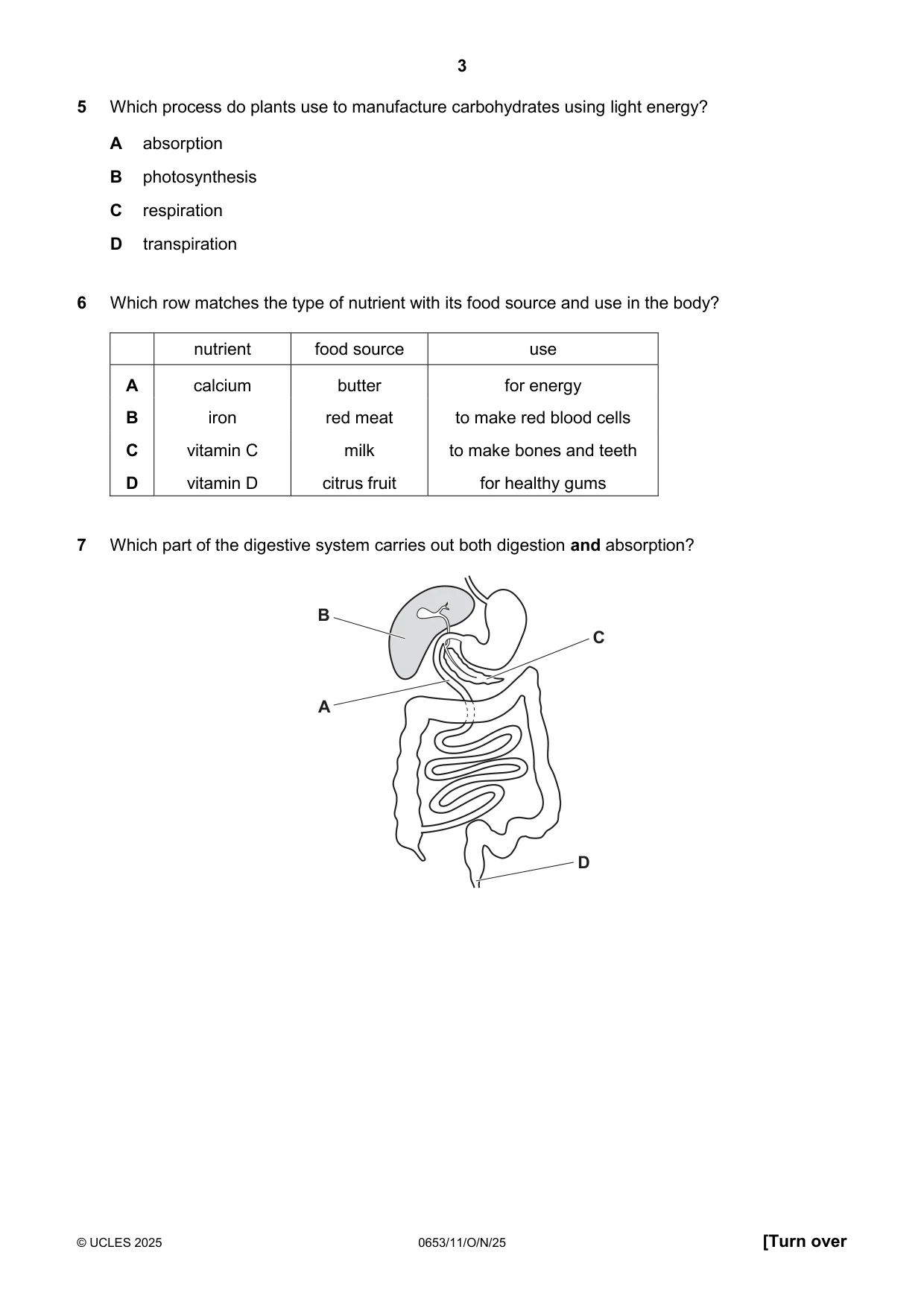
6 Which row matches the type of nutrient with its food source and use in the body? nutrient food source use A calcium butter for energy B iron red meat to make red blood cells C vitamin C milk to make bones and teeth D vitamin D citrus fruit for healthy gums
Mark scheme: B
Q7 · Which part of the digestive system carries out both digestion and absorption?
7 Which part of the digestive system carries out both digestion and absorption? B C A D
Mark scheme: A
Q8 · Which diagram shows the correctly labelled molecules in chemical digestion?
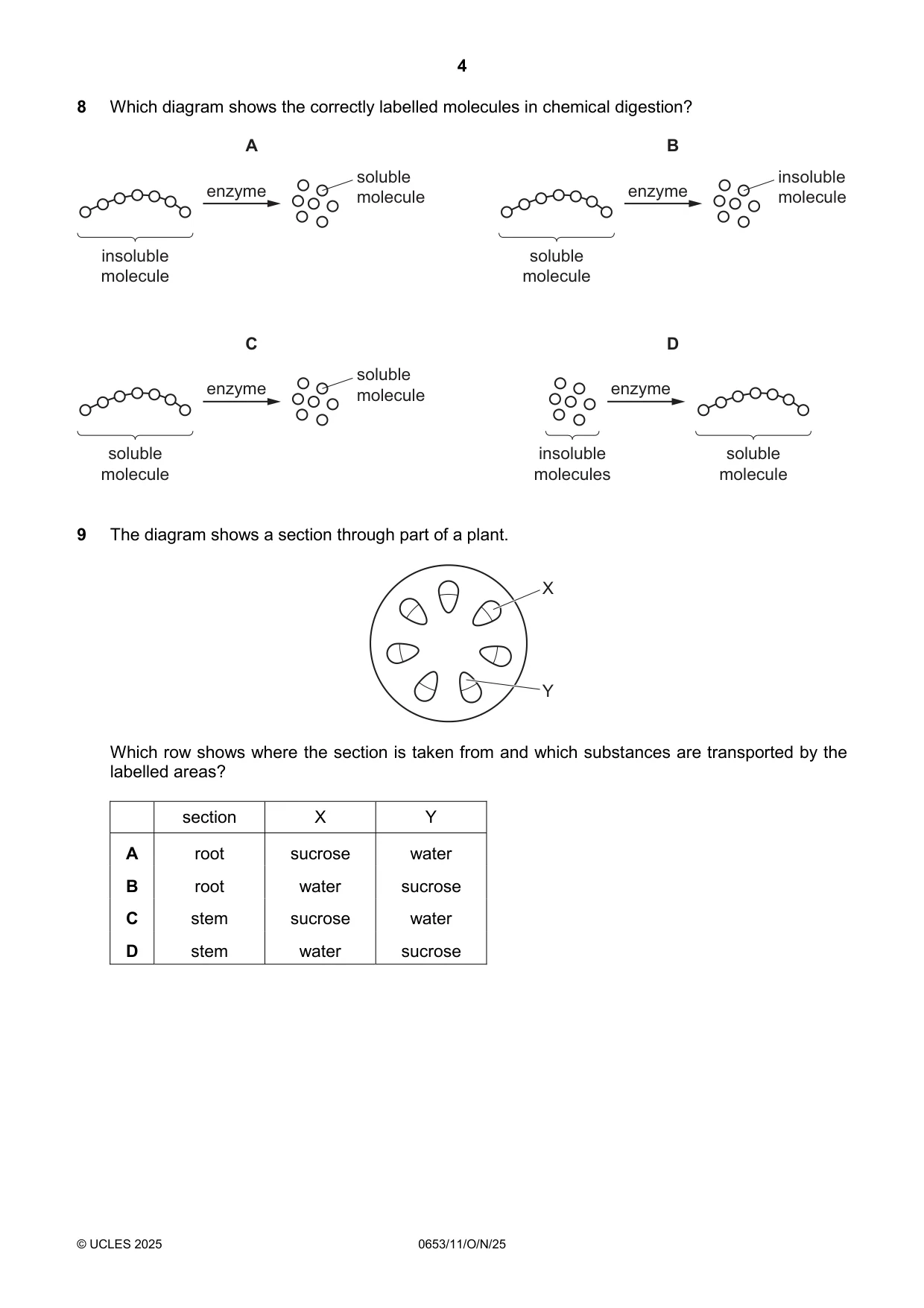
8 Which diagram shows the correctly labelled molecules in chemical digestion? A B soluble insoluble enzyme molecule enzyme molecule insoluble soluble molecule molecule C D soluble enzyme molecule enzyme soluble insoluble soluble molecule molecules molecule
Mark scheme: A
Q9 · The diagram shows a section through part of a plant
9 The diagram shows a section through part of a plant. X Y Which row shows where the section is taken from and which substances are transported by the labelled areas? section X Y A root sucrose water B root water sucrose C stem sucrose water D stem water sucrose
Mark scheme: C
Q10 · The equation represents aerobic respiration
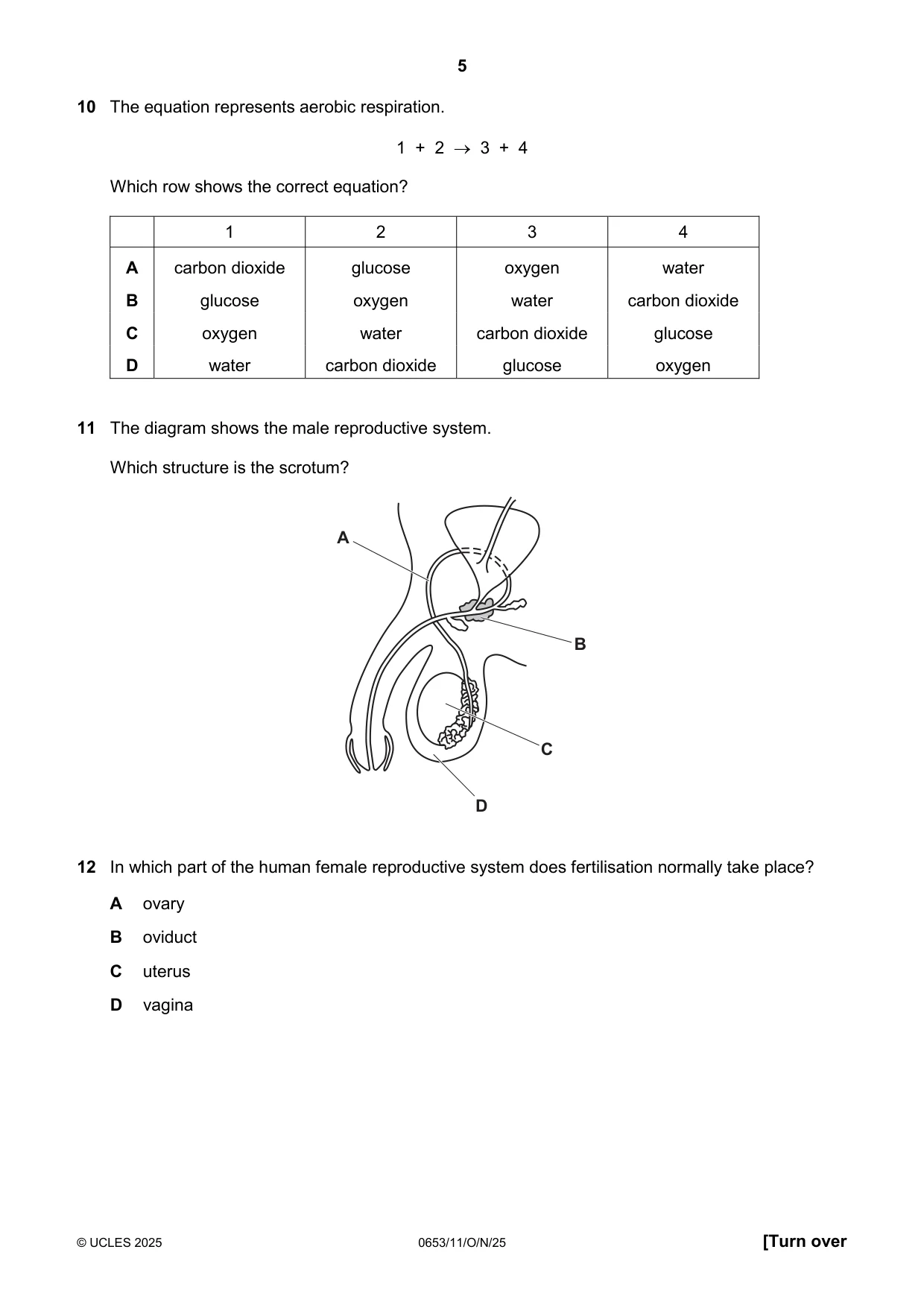
10 The equation represents aerobic respiration. 1 + 2 3 + 4 Which row shows the correct equation? 1 2 3 4 A carbon dioxide glucose oxygen water B glucose oxygen water carbon dioxide C oxygen water carbon dioxide glucose D water carbon dioxide glucose oxygen
Mark scheme: B
Q11 · The diagram shows the male reproductive system
11 The diagram shows the male reproductive system. Which structure is the scrotum? A B C D
Mark scheme: D
Q12 · In which part of the human female reproductive system does fertilisation normally take…
12 In which part of the human female reproductive system does fertilisation normally take place? A ovary B oviduct C uterus D vagina
Mark scheme: B
Q13 · The diagram shows a food web
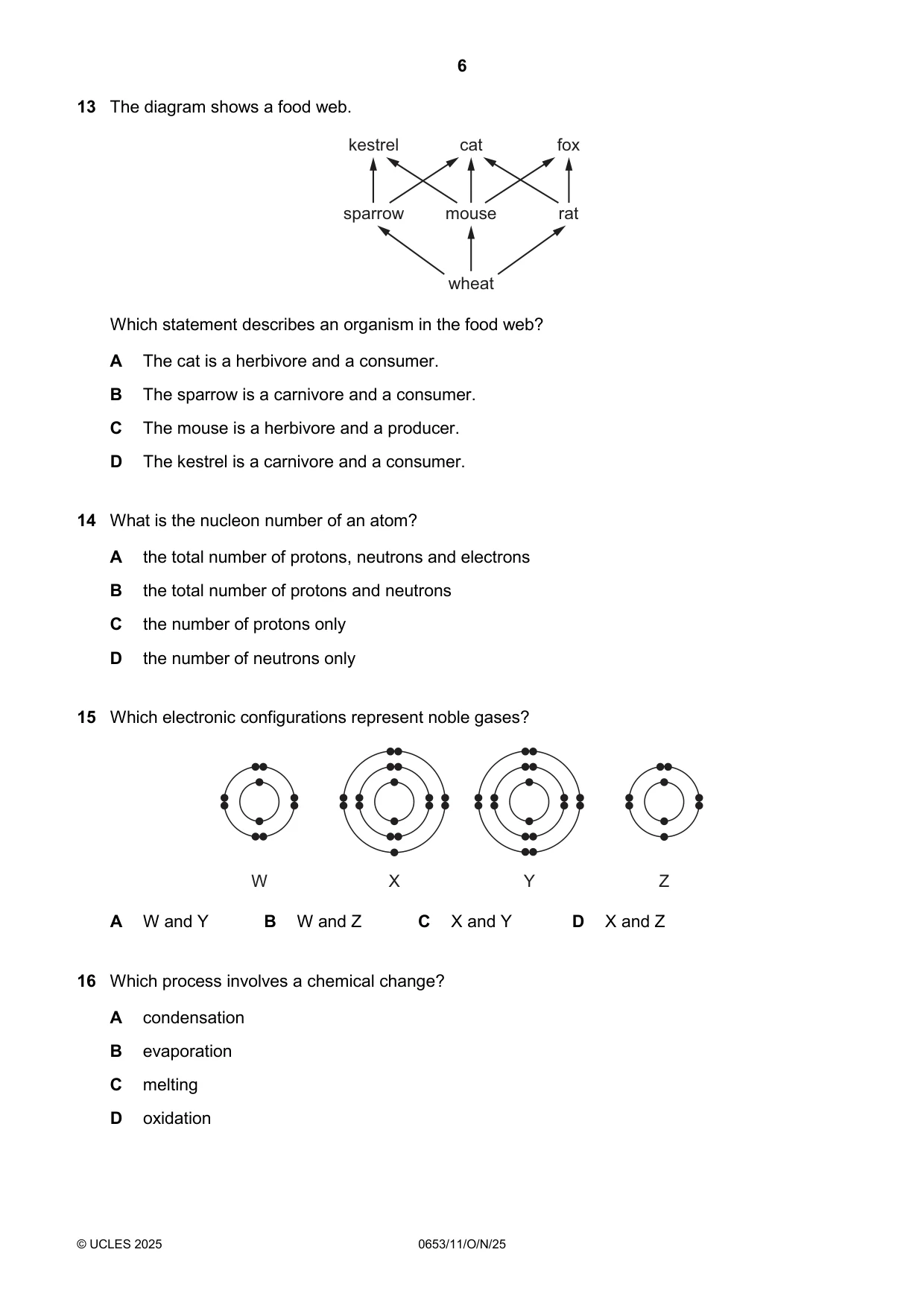
13 The diagram shows a food web. kestrel cat fox sparrow mouse rat wheat Which statement describes an organism in the food web? A The cat is a herbivore and a consumer. B The sparrow is a carnivore and a consumer. C The mouse is a herbivore and a producer. D The kestrel is a carnivore and a consumer.
Mark scheme: D
Q14 · What is the nucleon number of an atom?
14 What is the nucleon number of an atom? A the total number of protons, neutrons and electrons B the total number of protons and neutrons C the number of protons only D the number of neutrons only
Mark scheme: B
Q15 · Which electronic configurations represent noble gases?
15 Which electronic configurations represent noble gases? W X Y Z A W and Y B W and Z C X and Y D X and Z
Mark scheme: A
Q16 · Which process involves a chemical change?
16 Which process involves a chemical change? A condensation B evaporation C melting D oxidation
Mark scheme: D
Q17 · The diagram shows part of the Periodic Table
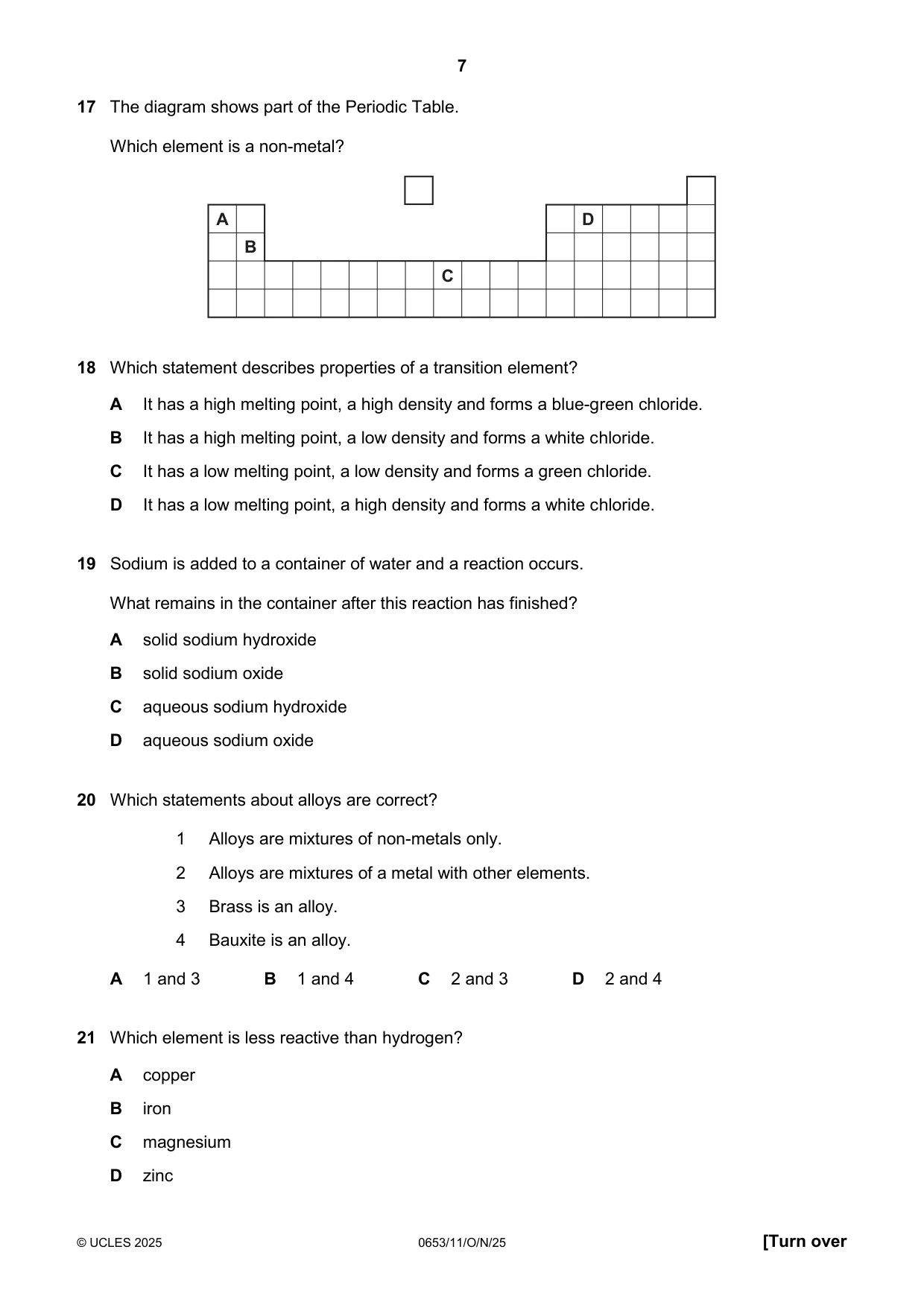
17 The diagram shows part of the Periodic Table. Which element is a non-metal? A D B C
Mark scheme: D
Q18 · Which statement describes properties of a transition element?
18 Which statement describes properties of a transition element? A It has a high melting point, a high density and forms a blue-green chloride. B It has a high melting point, a low density and forms a white chloride. C It has a low melting point, a low density and forms a green chloride. D It has a low melting point, a high density and forms a white chloride.
Mark scheme: A
Q19 · Sodium is added to a container of water and a reaction occurs
19 Sodium is added to a container of water and a reaction occurs. What remains in the container after this reaction has finished? A solid sodium hydroxide B solid sodium oxide C aqueous sodium hydroxide D aqueous sodium oxide
Mark scheme: C
Q20 · Which statements about alloys are correct?
20 Which statements about alloys are correct? 1 Alloys are mixtures of non-metals only. 2 Alloys are mixtures of a metal with other elements. 3 Brass is an alloy. 4 Bauxite is an alloy. A 1 and 3 B 1 and 4 C 2 and 3 D 2 and 4
Mark scheme: C
Q21 · Which element is less reactive than hydrogen?
21 Which element is less reactive than hydrogen? A copper B iron C magnesium D zinc
Mark scheme: A
Q22 · The diagram shows two open containers, X and Y, inside a glass tube
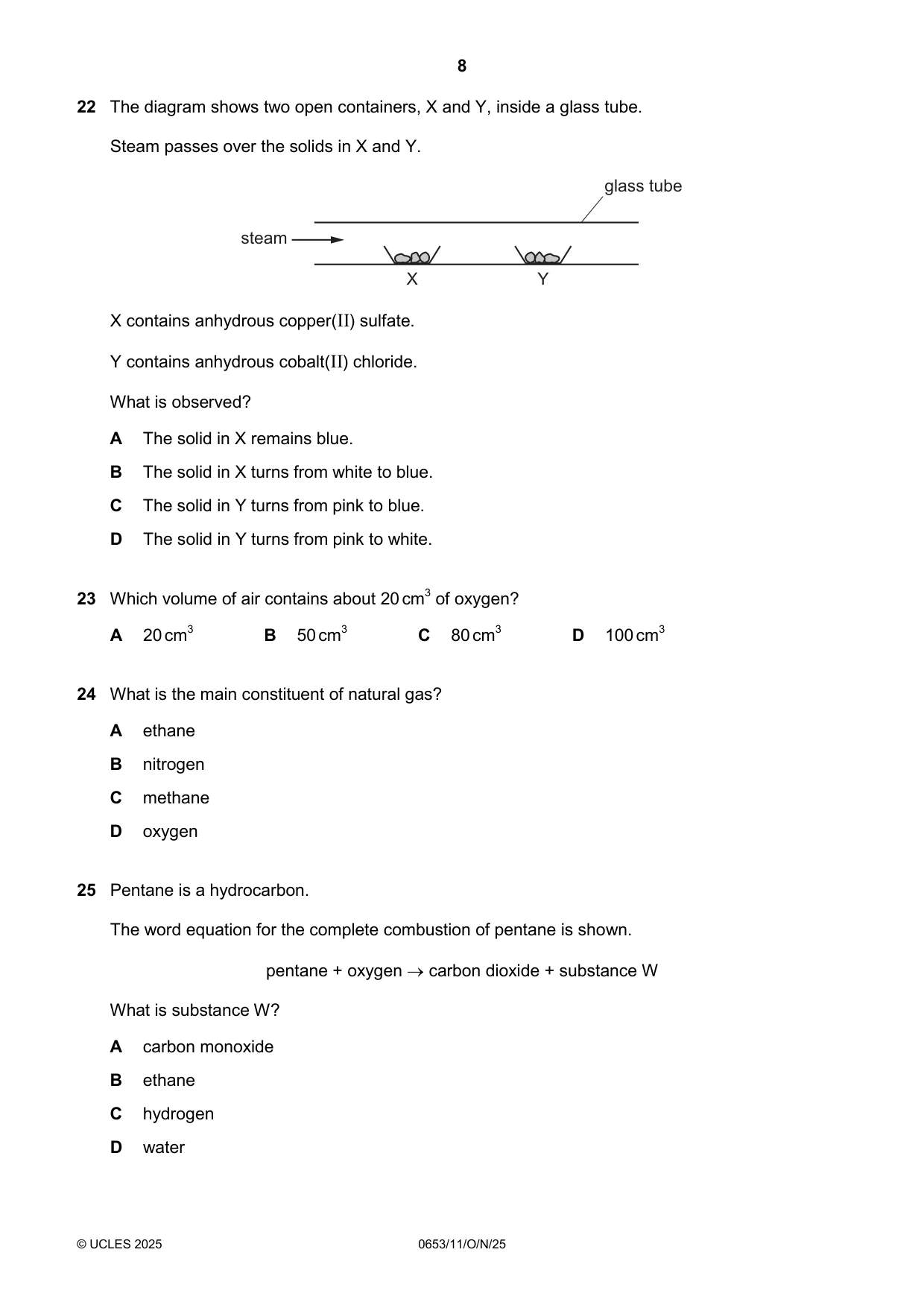
22 The diagram shows two open containers, X and Y, inside a glass tube. Steam passes over the solids in X and Y. glass tube steam X Y X contains anhydrous copper(II) sulfate. Y contains anhydrous cobalt(II) chloride. What is observed? A The solid in X remains blue. B The solid in X turns from white to blue. C The solid in Y turns from pink to blue. D The solid in Y turns from pink to white.
Mark scheme: B
Q23 · Which volume of air contains about 20 cm3 of oxygen?
23 Which volume of air contains about 20 cm3 of oxygen? A 20 cm3 B 50 cm3 C 80 cm3 D 100 cm3
Mark scheme: D
Q24 · What is the main constituent of natural gas?
24 What is the main constituent of natural gas? A ethane B nitrogen C methane D oxygen
Mark scheme: C
Q25 · Pentane is a hydrocarbon
25 Pentane is a hydrocarbon. The word equation for the complete combustion of pentane is shown. pentane + oxygen carbon dioxide + substance W What is substance W? A carbon monoxide B ethane C hydrogen D water
Mark scheme: D
Q26 · Which statement about alkenes is correct?
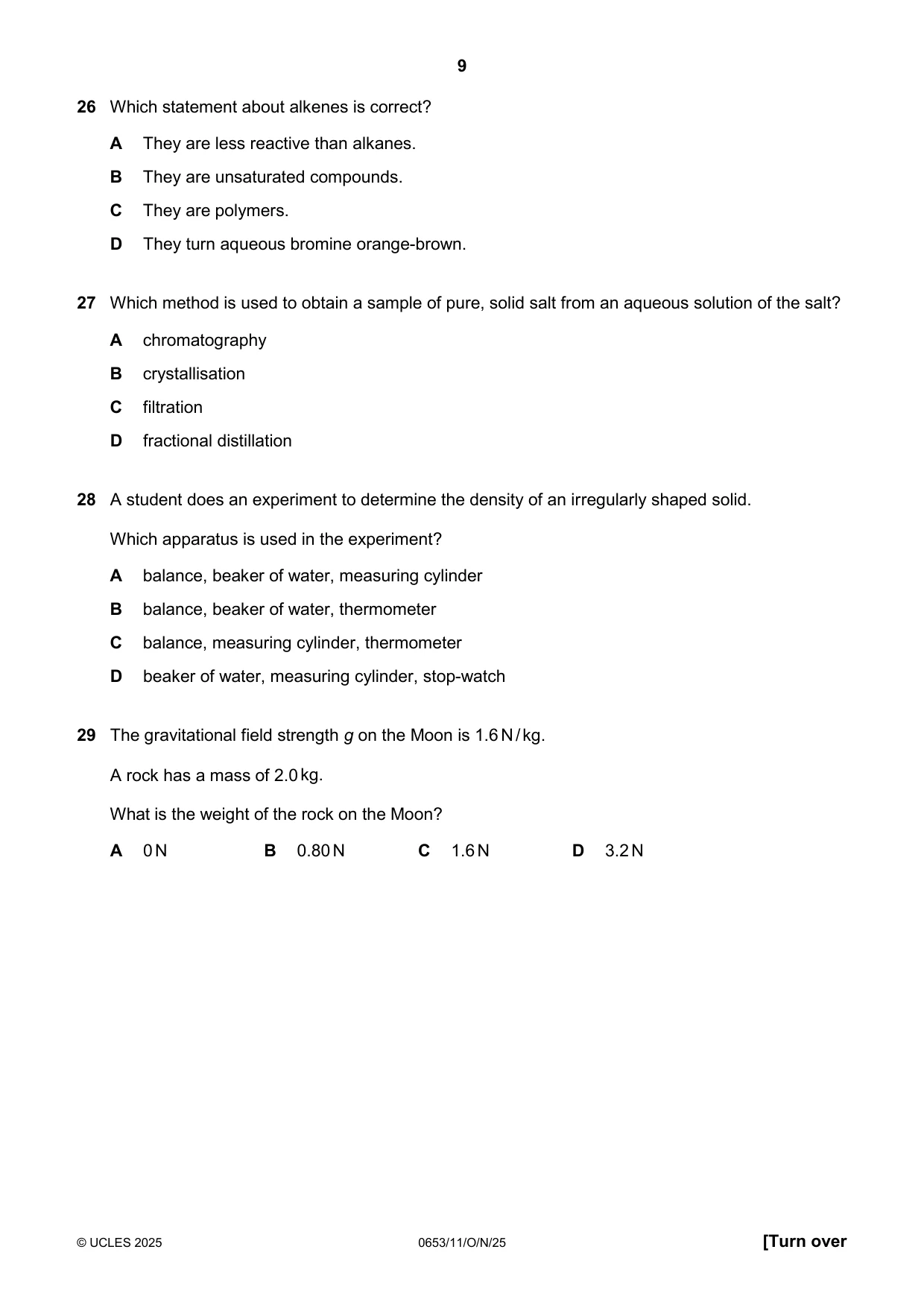
26 Which statement about alkenes is correct? A They are less reactive than alkanes. B They are unsaturated compounds. C They are polymers. D They turn aqueous bromine orange-brown.
Mark scheme: B
Q27 · Which method is used to obtain a sample of pure, solid salt from an aqueous solution of…
27 Which method is used to obtain a sample of pure, solid salt from an aqueous solution of the salt? A chromatography B crystallisation C filtration D fractional distillation
Mark scheme: B
Q28 · A student does an experiment to determine the density of an irregularly shaped solid
28 A student does an experiment to determine the density of an irregularly shaped solid. Which apparatus is used in the experiment? A balance, beaker of water, measuring cylinder B balance, beaker of water, thermometer C balance, measuring cylinder, thermometer D beaker of water, measuring cylinder, stop-watch
Mark scheme: A
Q29 · The gravitational field strength g on the Moon is 1.6 N / kg
29 The gravitational field strength g on the Moon is 1.6 N / kg. A rock has a mass of 2.0 kg. What is the weight of the rock on the Moon? A 0 N B 0.80 N C 1.6 N D 3.2 N
Mark scheme: D
Q30 · The diagram shows a drawing pin (thumb tack) with the head and the point labelled
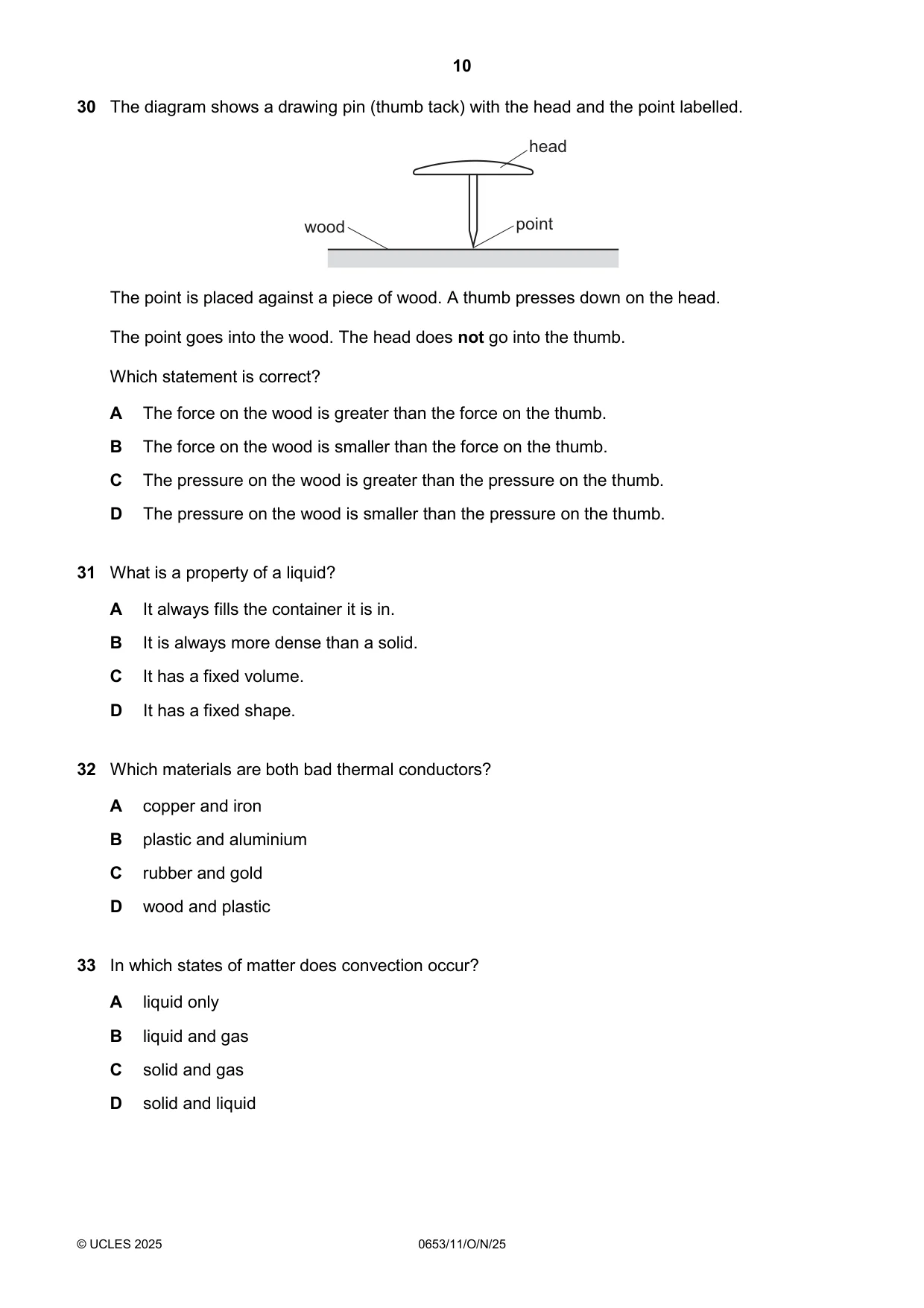
30 The diagram shows a drawing pin (thumb tack) with the head and the point labelled. head wood point The point is placed against a piece of wood. A thumb presses down on the head. The point goes into the wood. The head does not go into the thumb. Which statement is correct? A The force on the wood is greater than the force on the thumb. B The force on the wood is smaller than the force on the thumb. C The pressure on the wood is greater than the pressure on the thumb. D The pressure on the wood is smaller than the pressure on the thumb.
Mark scheme: C
Q31 · What is a property of a liquid?
31 What is a property of a liquid? A It always fills the container it is in. B It is always more dense than a solid. C It has a fixed volume. D It has a fixed shape.
Mark scheme: C
Q32 · Which materials are both bad thermal conductors?
32 Which materials are both bad thermal conductors? A copper and iron B plastic and aluminium C rubber and gold D wood and plastic
Mark scheme: D
Q33 · In which states of matter does convection occur?
33 In which states of matter does convection occur? A liquid only B liquid and gas C solid and gas D solid and liquid
Mark scheme: B
Q34 · A cork moves up and down on a wave in a tank of water
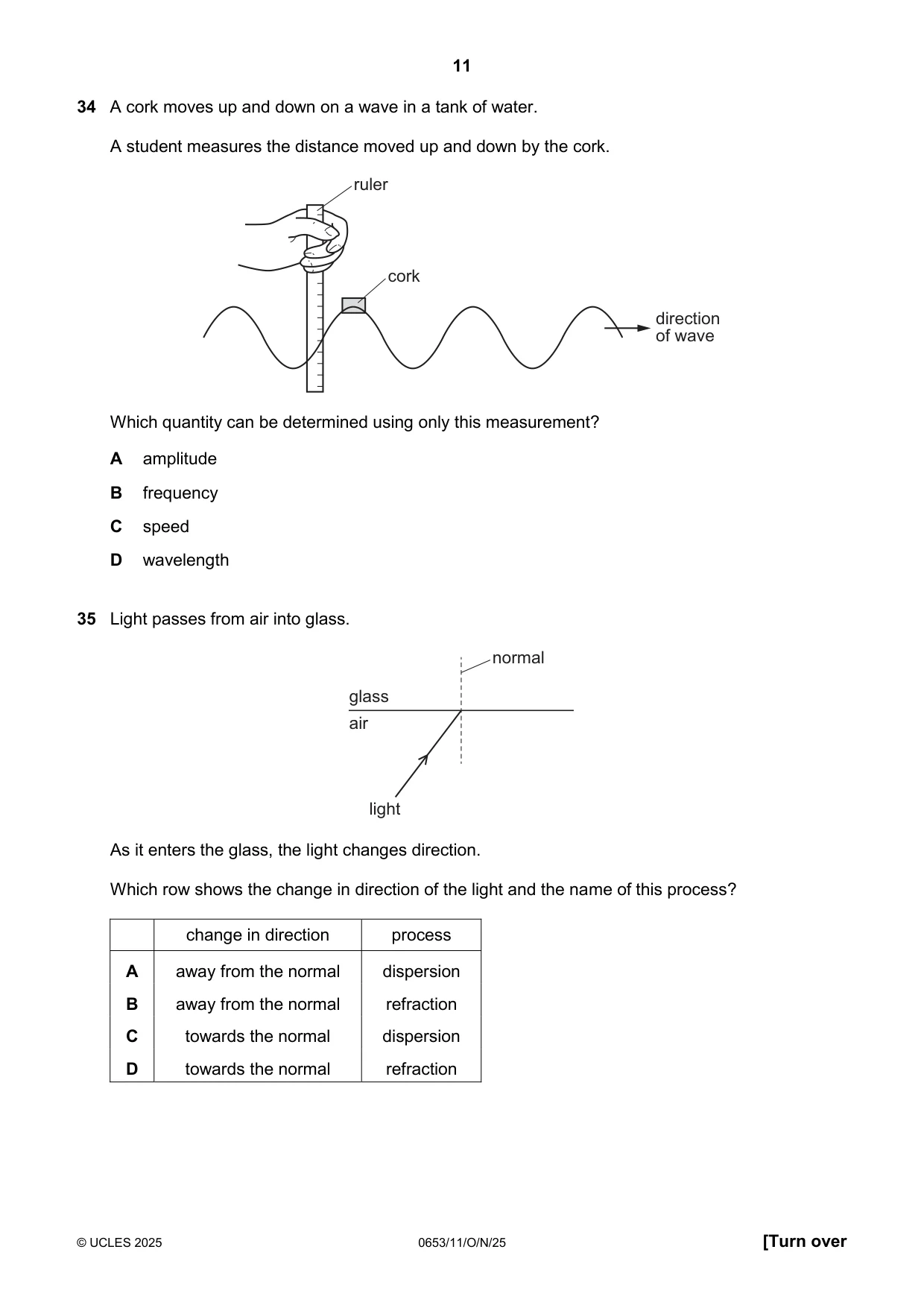
34 A cork moves up and down on a wave in a tank of water. A student measures the distance moved up and down by the cork. ruler cork direction of wave Which quantity can be determined using only this measurement? A amplitude B frequency C speed D wavelength
Mark scheme: A
Q35 · Light passes from air into glass
35 Light passes from air into glass. normal glass air light As it enters the glass, the light changes direction. Which row shows the change in direction of the light and the name of this process? change in direction process A away from the normal dispersion B away from the normal refraction C towards the normal dispersion D towards the normal refraction
Mark scheme: D
Q36 · Which row shows the region of the electromagnetic spectrum with the smallest wavelength…
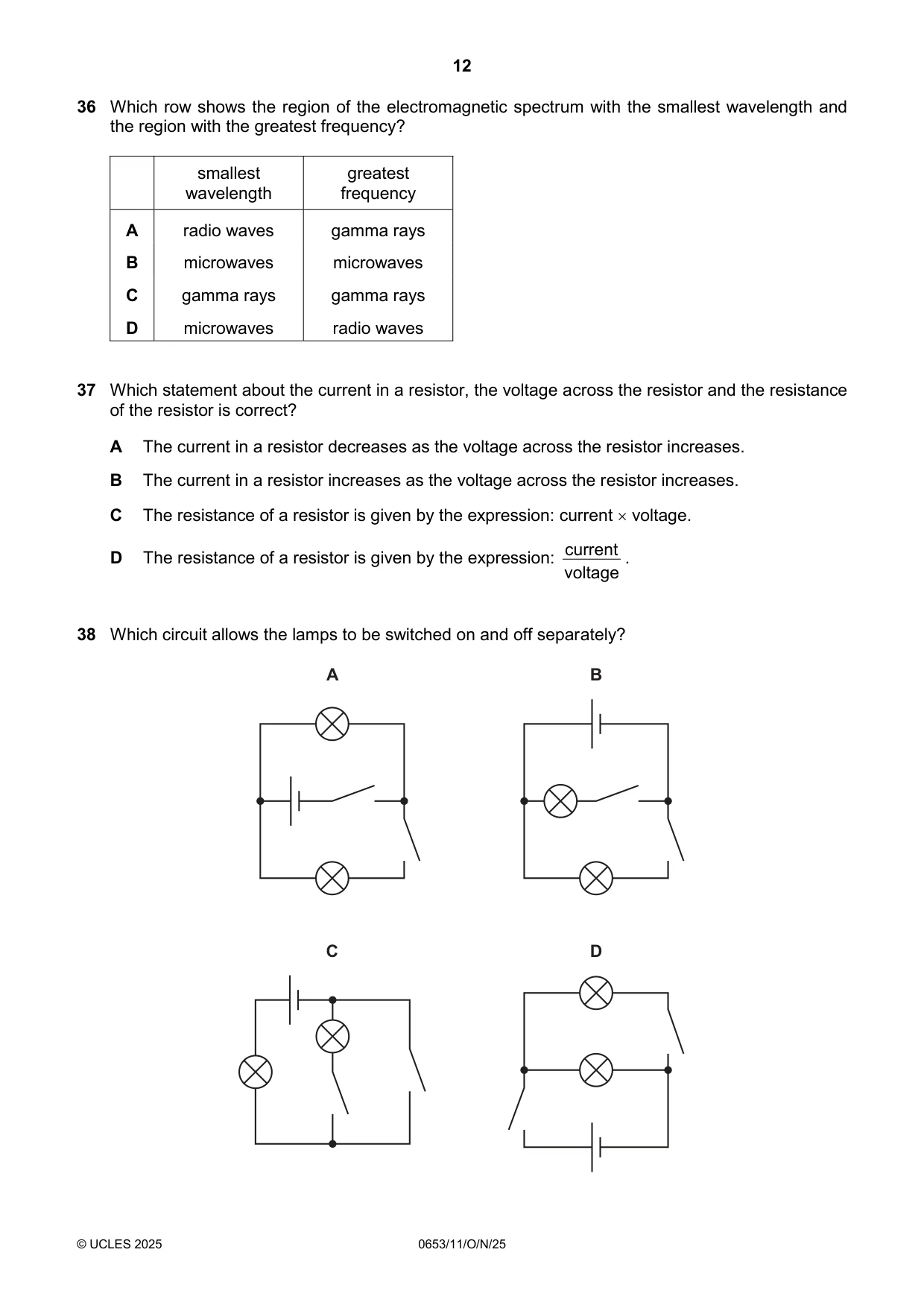
36 Which row shows the region of the electromagnetic spectrum with the smallest wavelength and the region with the greatest frequency? smallest greatest wavelength frequency A radio waves gamma rays B microwaves microwaves C gamma rays gamma rays D microwaves radio waves
Mark scheme: C
Q37 · Which statement about the current in a resistor, the voltage across the resistor and the…
37 Which statement about the current in a resistor, the voltage across the resistor and the resistance of the resistor is correct? A The current in a resistor decreases as the voltage across the resistor increases. B The current in a resistor increases as the voltage across the resistor increases. C The resistance of a resistor is given by the expression: current voltage. current . D The resistance of a resistor is given by the expression: voltage
Mark scheme: B
Q38 · Which circuit allows the lamps to be switched on and off separately?
38 Which circuit allows the lamps to be switched on and off separately? A B C D
Mark scheme: B
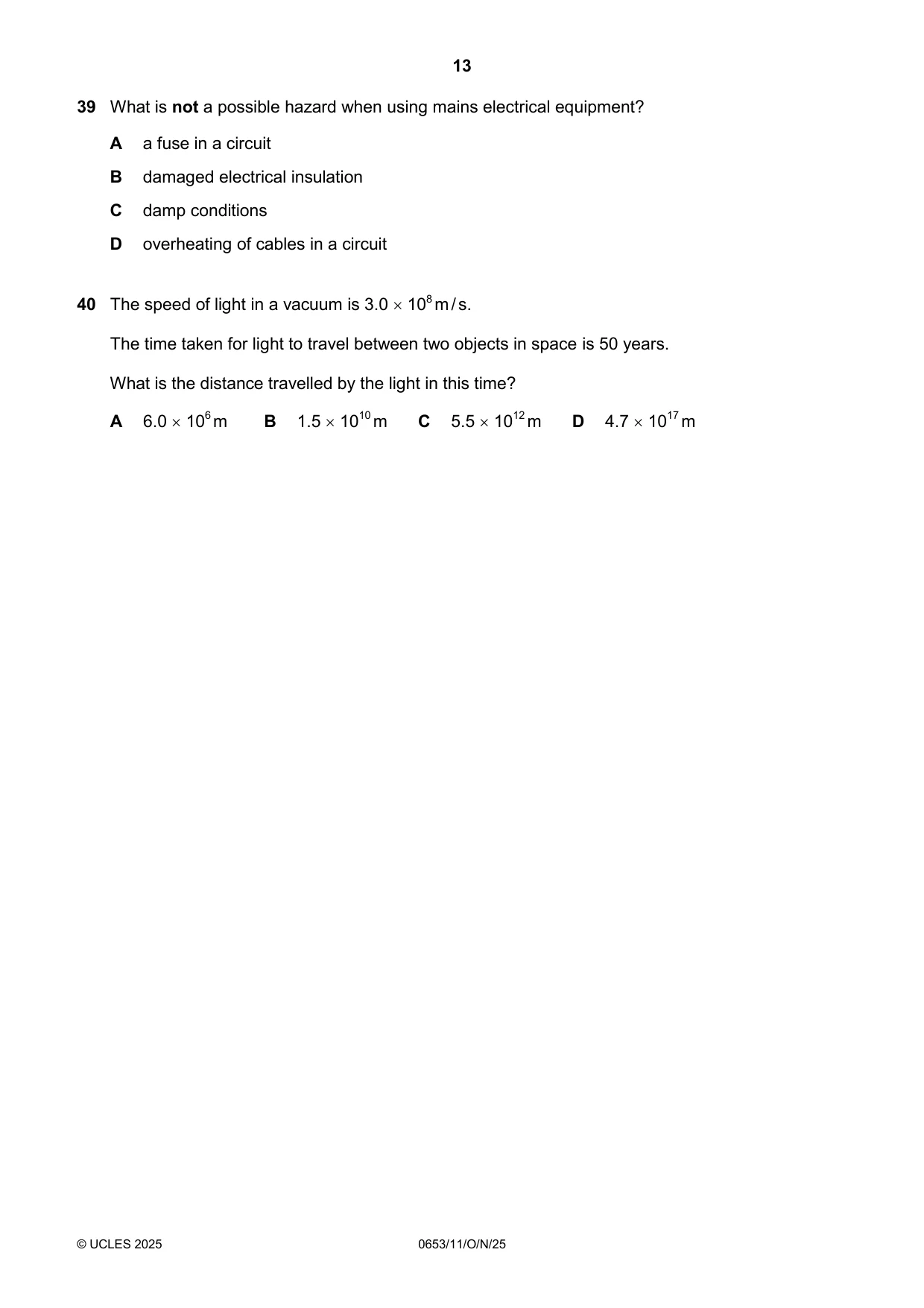
Q39 · What is not a possible hazard when using mains electrical equipment?
39 What is not a possible hazard when using mains electrical equipment? A a fuse in a circuit B damaged electrical insulation C damp conditions D overheating of cables in a circuit
Mark scheme: A
Q40 · The speed of light in a vacuum is 3.0 108 m / s
40 The speed of light in a vacuum is 3.0 108 m / s. The time taken for light to travel between two objects in space is 50 years. What is the distance travelled by the light in this time? A 6.0 106 m B 1.5 1010 m C 5.5 1012 m D 4.7 1017 m
Mark scheme: D
What was in this paper
The subtopics covered by these 40 questions, and how many questions each got. Open one in a new tab to see every Cambridge question on it.
2Transfer of thermal energy2Air quality and climate1Alkanes1Alkenes1Alloys and their properties1Arrangement of elements1Atomic structure and the Periodic Table1Biological molecules1Cell structure1Characteristics of living organisms1Density1Diet1Digestion1Digestive system1Electrical circuits1Electrical quantities1Electrical safety1Electromagnetic spectrum1Enzymes1Food chains and food webs1Fuels1General properties of waves1Group I properties1Light1Mass and weight1Noble gases1Photosynthesis1Physical and chemical changes1Pressure1Reactivity series1Respiration1Separation and purification1Solids, liquids and gases1Stars and the Universe1Transition elements1Water1Xylem and phloem1What you needed in this session
Cambridge’s own grade thresholds for 2025 Oct/Nov, Paper 1 · Variant 1. A higher threshold means an easier paper — the bar moves with how the cohort did.