Questions as text
Q1 · Which compound has a boiling point that is influenced by hydrogen bonding? 9701/11 Oct/Nov 2005
4 Which compound has a boiling point that is influenced by hydrogen bonding? A CH3CHO B CH3OCH3 C HCO2H D HCO2CH3
1 marks
Answer: C
This question in 9701/11 Oct/Nov 2005
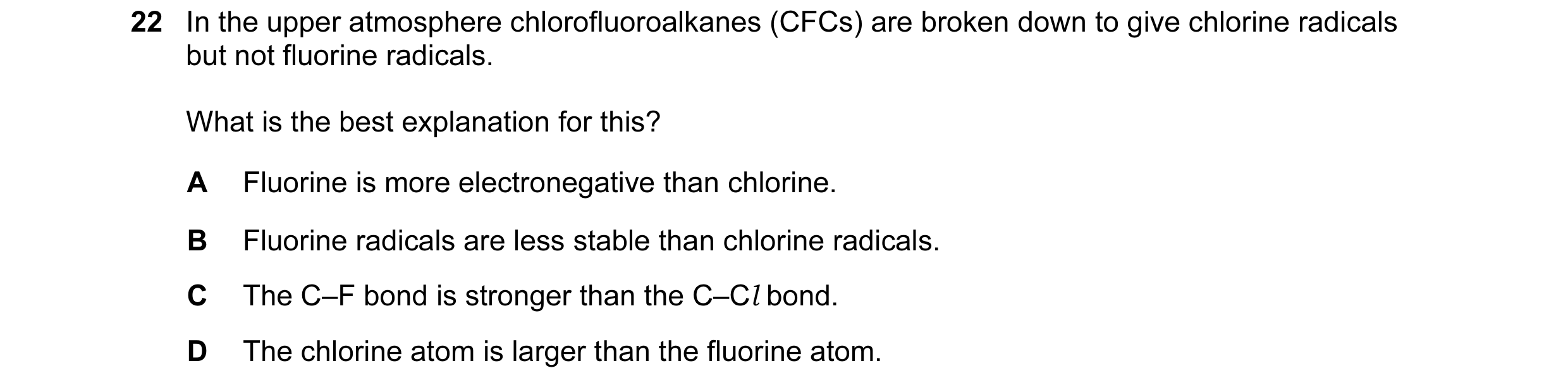
Q2 · In the upper atmosphere chlorofluoroalkanes (CFCs) are broken down to give chlorine… 9701/11 Oct/Nov 2005
22 In the upper atmosphere chlorofluoroalkanes (CFCs) are broken down to give chlorine radicals but not fluorine radicals. What is the best explanation for this? A Fluorine is more electronegative than chlorine. B Fluorine radicals are less stable than chlorine radicals. C The C–F bond is stronger than the C–Cl bond. D The chlorine atom is larger than the fluorine atom.
1 marks
Answer: C
This question in 9701/11 Oct/Nov 2005
Q3 · In which process are hydrogen bonds broken? 9701/11 May/June 2006
5 In which process are hydrogen bonds broken? A H2(l) → H2(g) B NH3(l) → NH3(g) C 2HI(g) → H2(g) + I2(g) D CH4(g) → C(g) + 4H(g)
1 marks
Answer: B
This question in 9701/11 May/June 2006
Q4 · Which of the following least resembles an ideal gas? 9701/11 May/June 2006
6 Which of the following least resembles an ideal gas? A ammonia B helium C hydrogen D trichloromethane
1 marks
Answer: A
This question in 9701/11 May/June 2006
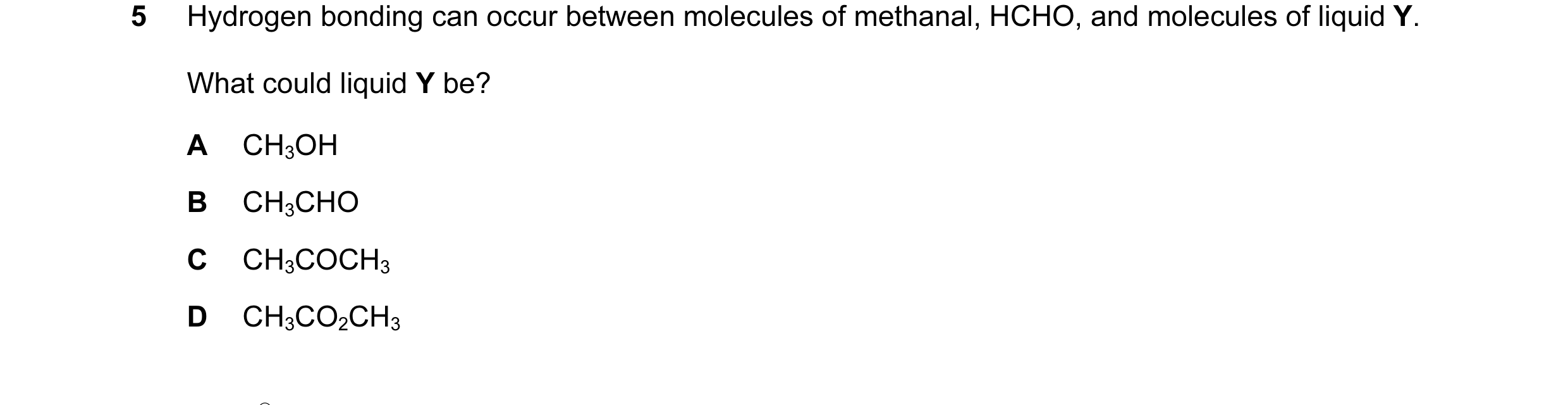
Q5 · Hydrogen bonding can occur between molecules of methanal, HCHO, and molecules of liquid Y 9701/11 Oct/Nov 2007
5 Hydrogen bonding can occur between molecules of methanal, HCHO, and molecules of liquid Y. What could liquid Y be? A CH3OH B CH3CHO C CH3COCH3 D CH3CO2CH3
1 marks
Answer: A
This question in 9701/11 Oct/Nov 2007
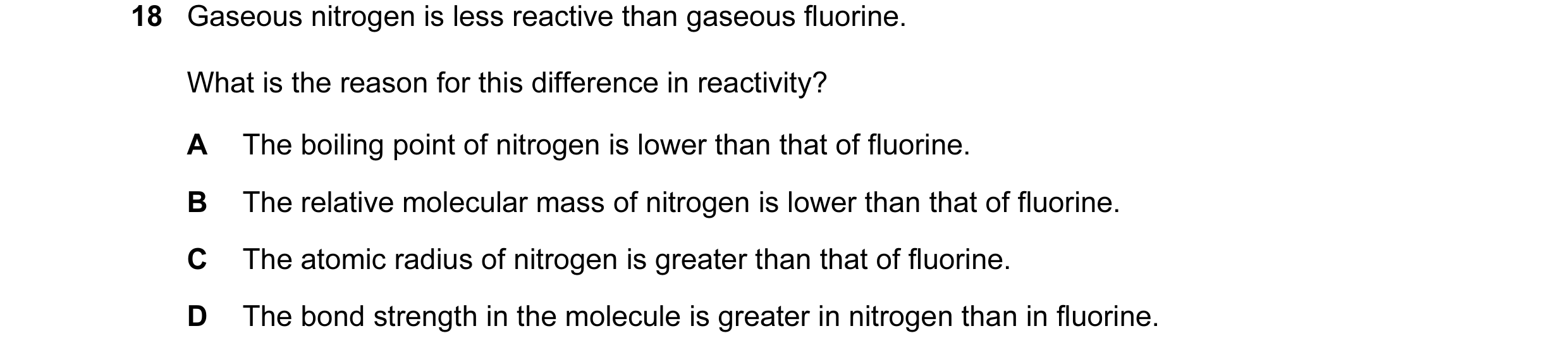
Q6 · Gaseous nitrogen is less reactive than gaseous fluorine 9701/11 Oct/Nov 2007
18 Gaseous nitrogen is less reactive than gaseous fluorine. What is the reason for this difference in reactivity? A The boiling point of nitrogen is lower than that of fluorine. B The relative molecular mass of nitrogen is lower than that of fluorine. C The atomic radius of nitrogen is greater than that of fluorine. D The bond strength in the molecule is greater in nitrogen than in fluorine.
1 marks
Answer: D
This question in 9701/11 Oct/Nov 2007
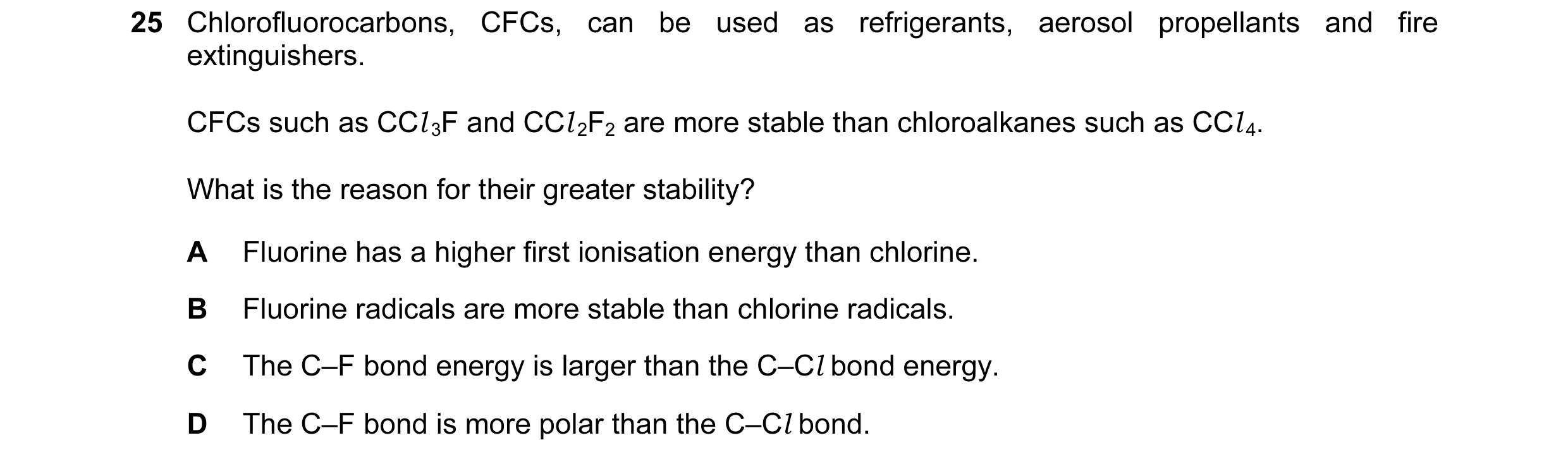
Q7 · Chlorofluoroalkanes, CFCs, can be used as refrigerants, aerosol propellants and fire… 9701/11 Oct/Nov 2007
25 Chlorofluoroalkanes, CFCs, can be used as refrigerants, aerosol propellants and fire extinguishers. CFCs such as CCl3F and CCl2F2 are more stable than chloroalkanes such as CCl4. What is the reason for their greater stability? A Fluorine has a higher first ionisation energy than chlorine. B Fluorine radicals are more stable than chlorine radicals. C The C–F bond energy is larger than the C–Cl bond energy. D The C–F bond is more polar than the C–Cl bond.
1 marks
Answer: C
This question in 9701/11 Oct/Nov 2007
Q8 · What are assumptions of the kinetic theory of gases and hence of the ideal gas equation… 9701/11 Oct/Nov 2007
31 What are assumptions of the kinetic theory of gases and hence of the ideal gas equation, PV = nRT ? 1 Molecules move without interacting with one another except for collisions. 2 Intermolecular forces are negligible. 3 Intermolecular distances are much greater than the molecular size.
1 marks
Answer: A
This question in 9701/11 Oct/Nov 2007
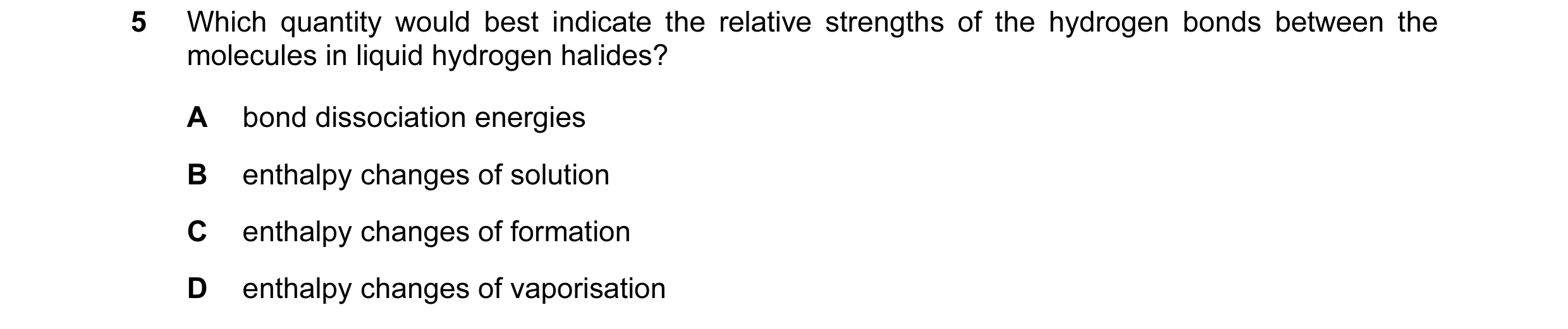
Q9 · Which quantity would best indicate the relative strengths of the hydrogen bonds between… 9701/11 Oct/Nov 2008
5 Which quantity would best indicate the relative strengths of the hydrogen bonds between the molecules in liquid hydrogen halides? A bond dissociation energies B enthalpy changes of solution C enthalpy changes of formation D enthalpy changes of vaporisation
1 marks
Answer: D
This question in 9701/11 Oct/Nov 2008
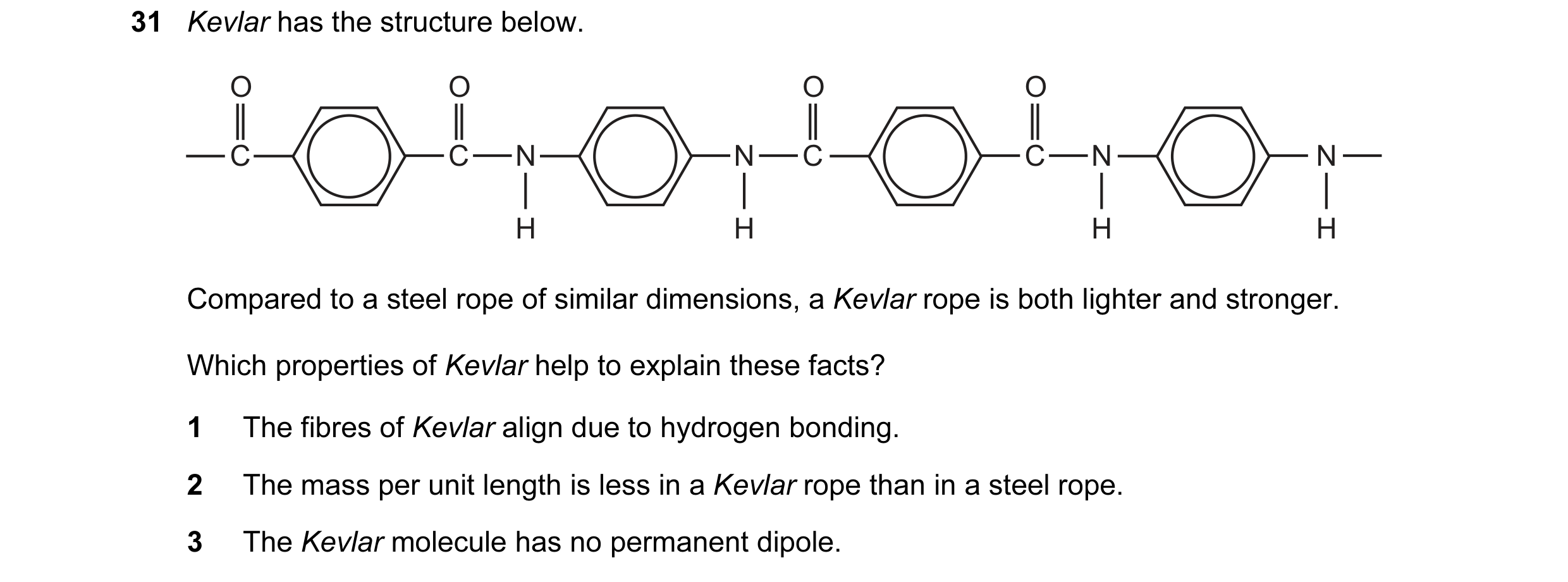
Q10 · Kevlar has the structure below 9701/11 Oct/Nov 2008
31 Kevlar has the structure below. O O O O C C N N C C N N H H H H Compared to a steel rope of similar dimensions, a Kevlar rope is both lighter and stronger. Which properties of Kevlar help to explain these facts? 1 The fibres of Kevlar align due to hydrogen bonding. 2 The mass per unit length is less in a Kevlar rope than in a steel rope. 3 The Kevlar molecule has no permanent dipole.
1 marks
Answer: B
This question in 9701/11 Oct/Nov 2008
Q11 · Chlorine is a greenish-yellow gas, bromine is a dark red liquid and iodine is a dark grey… 9701/11 Oct/Nov 2008
35 Chlorine is a greenish-yellow gas, bromine is a dark red liquid and iodine is a dark grey solid. What causes these differences in volatility? 1 the halogen-halogen bond energy 2 the magnitude of the van der Waals’ forces between the molecules 3 the number of electrons in the halogen molecule
1 marks
Answer: C
This question in 9701/11 Oct/Nov 2008
Q12 · Which statement explains why the boiling point of methane is higher than that of neon? 9701/11 May/June 2009
5 Which statement explains why the boiling point of methane is higher than that of neon? [Ar: H, 1; C, 12; Ne, 20] A A molecule of methane has a greater mass than a molecule of neon. B Molecules of methane form hydrogen bonds, but those of neon do not. C Molecules of methane have stronger intermolecular forces than those of neon. D The molecule of methane is polar, but that of neon is not.
1 marks
Answer: C
This question in 9701/11 May/June 2009
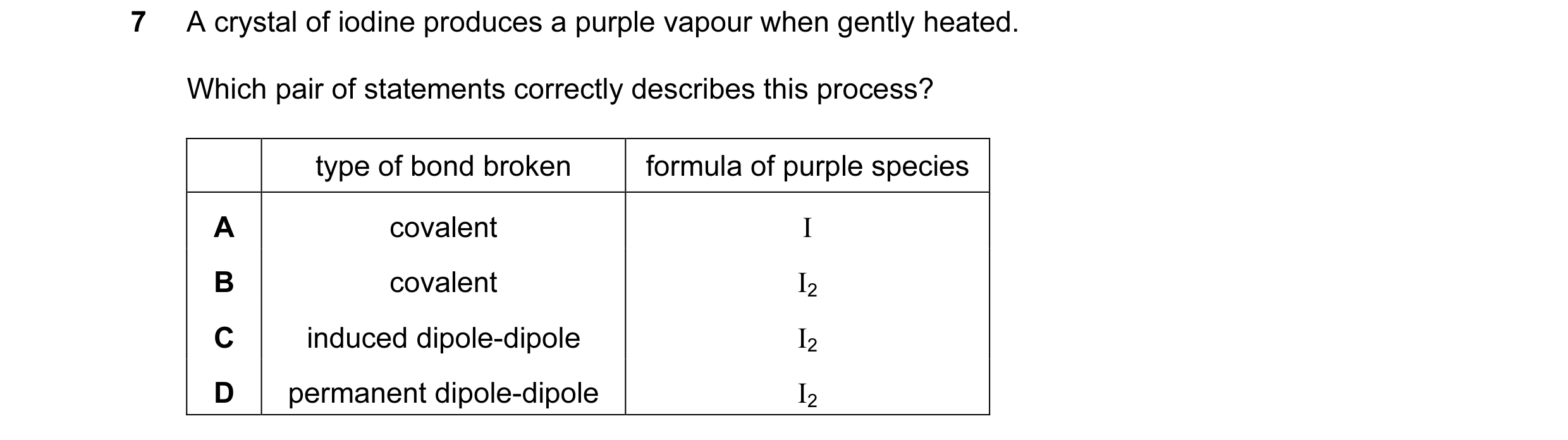
Q13 · A crystal of iodine produces a purple vapour when gently heated 9701/11 May/June 2009
7 A crystal of iodine produces a purple vapour when gently heated. Which pair of statements correctly describes this process? type of bond broken formula of purple species A covalent I B covalent I2 C induced dipole-dipole I2 D permanent dipole-dipole I2
1 marks
Answer: C
This question in 9701/11 May/June 2009
Q14 · Which molecule has the largest overall dipole? 9701/11 Oct/Nov 2009
5 Which molecule has the largest overall dipole? A B C D Cl Cl H Cl C C O C O C O C O Cl Cl H Cl
1 marks
Answer: B
This question in 9701/11 Oct/Nov 2009
Q15 · Which physical properties are due to hydrogen bonding between water molecules? 9701/11 Oct/Nov 2009
32 Which physical properties are due to hydrogen bonding between water molecules? 1 Water has a higher boiling point than H2S. 2 Ice floats on water. 3 The H−O−H bond angle in water is approximately 104°.
1 marks
Answer: B
This question in 9701/11 Oct/Nov 2009
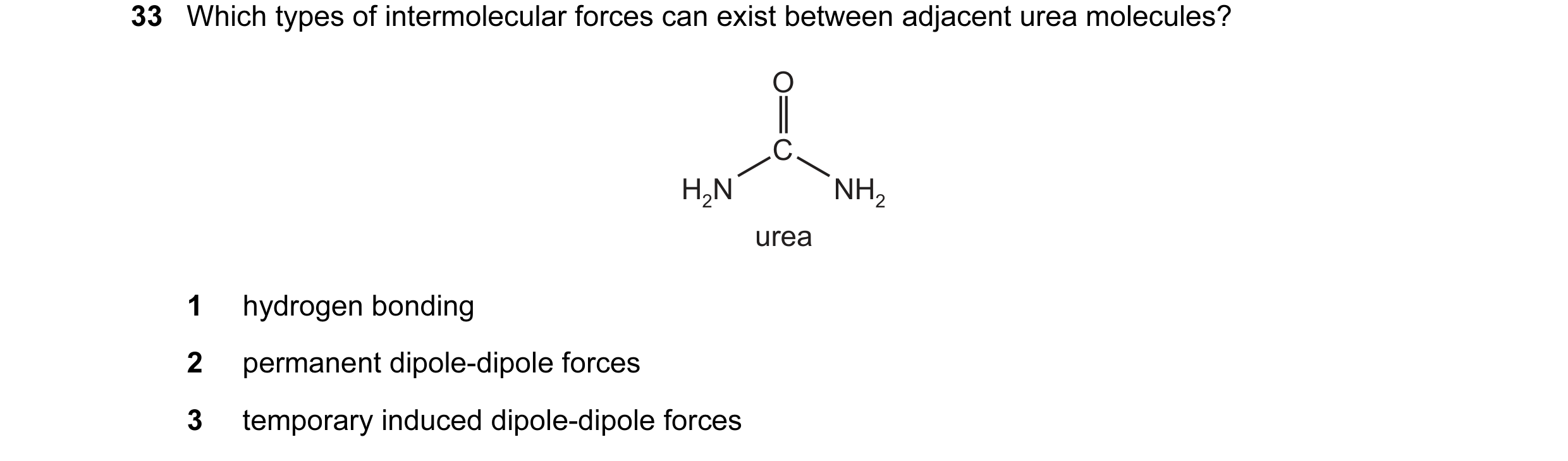
Q16 · Which types of intermolecular forces can exist between adjacent urea molecules? 9701/11 Oct/Nov 2010
33 Which types of intermolecular forces can exist between adjacent urea molecules? O C H2N NH2 urea 1 hydrogen bonding 2 permanent dipole-dipole forces 3 temporary induced dipole-dipole forces
1 marks
Answer: A
This question in 9701/11 Oct/Nov 2010
Q17 · Which types of intermolecular forces can exist between adjacent urea molecules? 9701/13 Oct/Nov 2010
31 Which types of intermolecular forces can exist between adjacent urea molecules? O C H2N NH2 urea 1 hydrogen bonding 2 permanent dipole-dipole forces 3 temporary induced dipole-dipole forces
1 marks
Answer: A
This question in 9701/13 Oct/Nov 2010
Q18 · In which change would only van der Waals’ forces have to be overcome? 9701/11 May/June 2011
11 In which change would only van der Waals’ forces have to be overcome? A evaporation of ethanol C2H5OH(l) → C2H5OH(g) B melting of ice H2O(s) → H2O(l) C melting of solid carbon dioxide CO2(s) → CO2(l) D solidification of butane C4H10(l) → C4H10(s)
1 marks
Answer: C
This question in 9701/11 May/June 2011
Q19 · What is involved when a hydrogen bond is formed between two molecules? 9701/12 May/June 2011
34 What is involved when a hydrogen bond is formed between two molecules? 1 a hydrogen atom bonded to an atom less electronegative than itself 2 a lone pair of electrons 3 an electrostatic attraction between opposite charges
1 marks
Answer: C
This question in 9701/12 May/June 2011
Q20 · In which change would only van der Waals’ forces have to be overcome? 9701/13 May/June 2011
10 In which change would only van der Waals’ forces have to be overcome? A evaporation of ethanol C2H5OH(l) → C2H5OH(g) B melting of ice H2O(s) → H2O(l) C melting of solid carbon dioxide CO2(s) → CO2(l) D solidification of butane C4H10(l) → C4H10(s)
1 marks
Answer: C
This question in 9701/13 May/June 2011
Q21 · Why do the halogens become less volatile as Group VII is descended? 9701/11 Oct/Nov 2011
17 Why do the halogens become less volatile as Group VII is descended? A The halogen-halogen bond energy decreases. B The halogen-halogen bond length increases. C The number of electrons in each molecule increases. D The van der Waals’ forces between molecules become weaker.
1 marks
Answer: C
This question in 9701/11 Oct/Nov 2011
Q22 · The three statements that follow are all true 9701/11 Oct/Nov 2011
33 The three statements that follow are all true. Which of these can be explained, at least in part, by reference to hydrogen bonding? 1 At 0 °C ice floats on water. 2 The boiling point of propan-2-ol is 82 °C. The boiling point of propanone is 56 °C. 3 At 20 °C propanone and propanal mix completely.
1 marks
Answer: B
This question in 9701/11 Oct/Nov 2011
Q23 · The presence of dipoles helps to explain why the element Br2 and the compound CHCl 3… 9701/12 Oct/Nov 2011
5 The presence of dipoles helps to explain why the element Br2 and the compound CHCl 3 exist as liquids at room temperature. Which types of dipole are involved? Br2 CHCl 3 induced dipoles and permanent induced dipoles and permanent A dipoles dipoles induced dipoles and permanent B induced dipoles only dipoles induced dipoles and permanent C induced dipoles only dipoles D induced dipoles only induced dipoles only
1 marks
This question in 9701/12 Oct/Nov 2011
Q24 · Use of the Data Booklet is relevant to this question 9701/12 Oct/Nov 2011
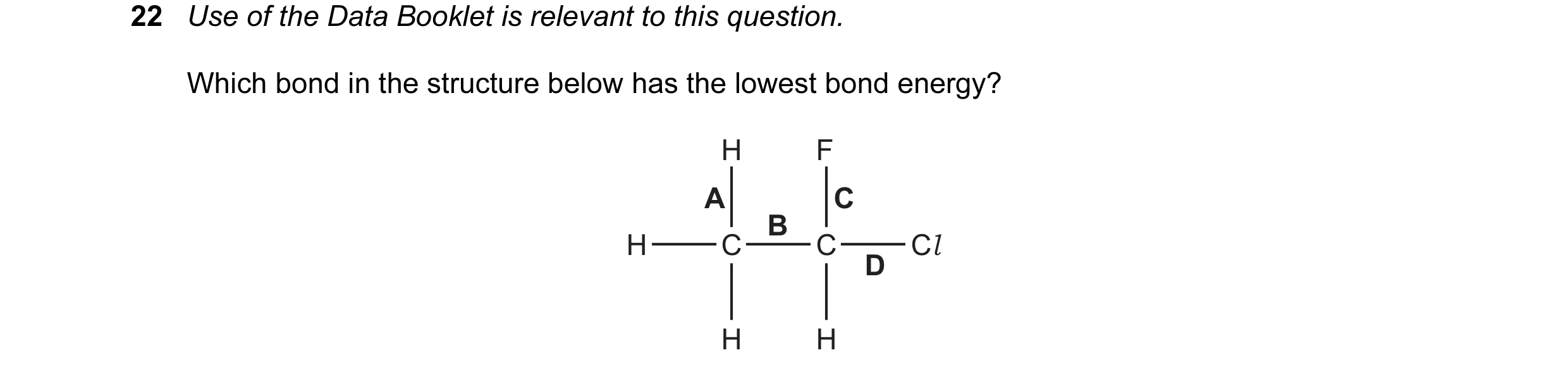
22 Use of the Data Booklet is relevant to this question. Which bond in the structure below has the lowest bond energy? H F A C B H C C Cl D H H
1 marks
This question in 9701/12 Oct/Nov 2011
Q25 · Why do the halogens become less volatile as Group VII is descended? 9701/13 Oct/Nov 2011
16 Why do the halogens become less volatile as Group VII is descended? A The halogen-halogen bond energy decreases. B The halogen-halogen bond length increases. C The number of electrons in each molecule increases. D The van der Waals’ forces between molecules become weaker.
1 marks
Answer: C
This question in 9701/13 Oct/Nov 2011
Q26 · The three statements that follow are all true 9701/13 Oct/Nov 2011
32 The three statements that follow are all true. Which of these can be explained, at least in part, by reference to hydrogen bonding? 1 At 0 °C ice floats on water. 2 The boiling point of propan-2-ol is 82 °C. The boiling point of propanone is 56 °C. 3 At 20 °C propanone and propanal mix completely.
1 marks
Answer: B
This question in 9701/13 Oct/Nov 2011
Q27 · Which molecule has the largest overall dipole? 9701/12 May/June 2012
10 Which molecule has the largest overall dipole? A B C D H CH3 CH3 Cl H3C Cl C C O C O C C C H CH3 CH3 Cl Cl CH3
1 marks
Answer: B
This question in 9701/12 May/June 2012
Q28 · Compared with the HCl molecule, the bond ……X…… of the HBr molecule is ……Y…… Which pairs… 9701/12 May/June 2012
35 Compared with the HCl molecule, the bond ……X…… of the HBr molecule is ……Y…… Which pairs of words correctly complete the above sentence? X Y 1 energy less 2 polarity less 3 length greater
1 marks
Answer: A
This question in 9701/12 May/June 2012
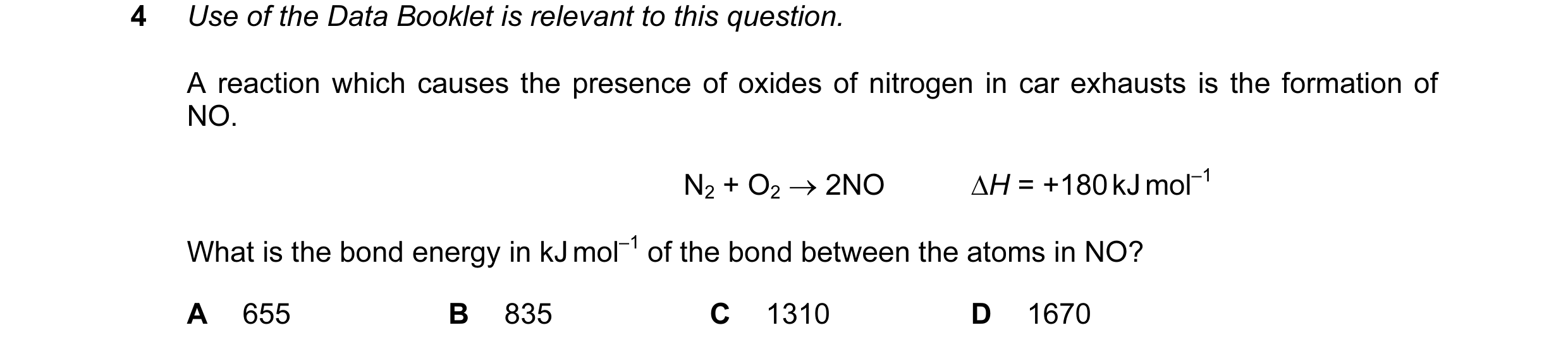
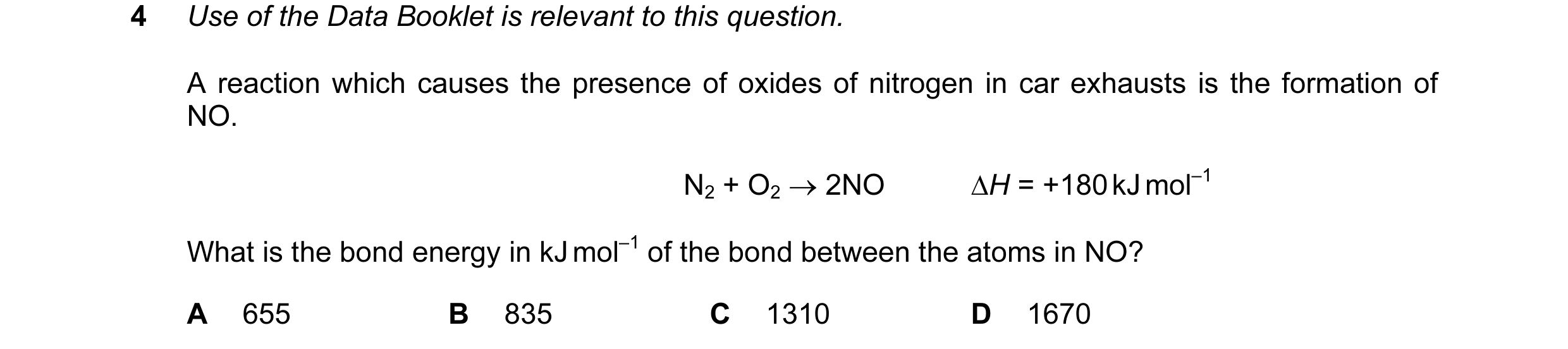
Q29 · Use of the Data Booklet is relevant to this question 9701/11 Oct/Nov 2012
4 Use of the Data Booklet is relevant to this question. A reaction which causes the presence of oxides of nitrogen in car exhausts is the formation of NO. N2 + O2 → 2NO ∆H = +180 kJ mol–1 What is the bond energy in kJ mol–1 of the bond between the atoms in NO? A 655 B 835 C 1310 D 1670
1 marks
Answer: A
This question in 9701/11 Oct/Nov 2012
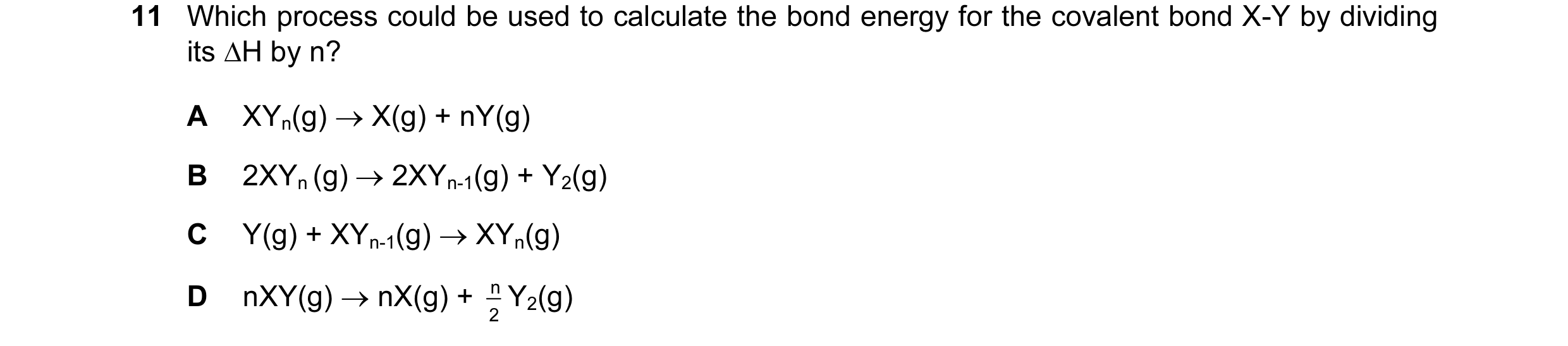
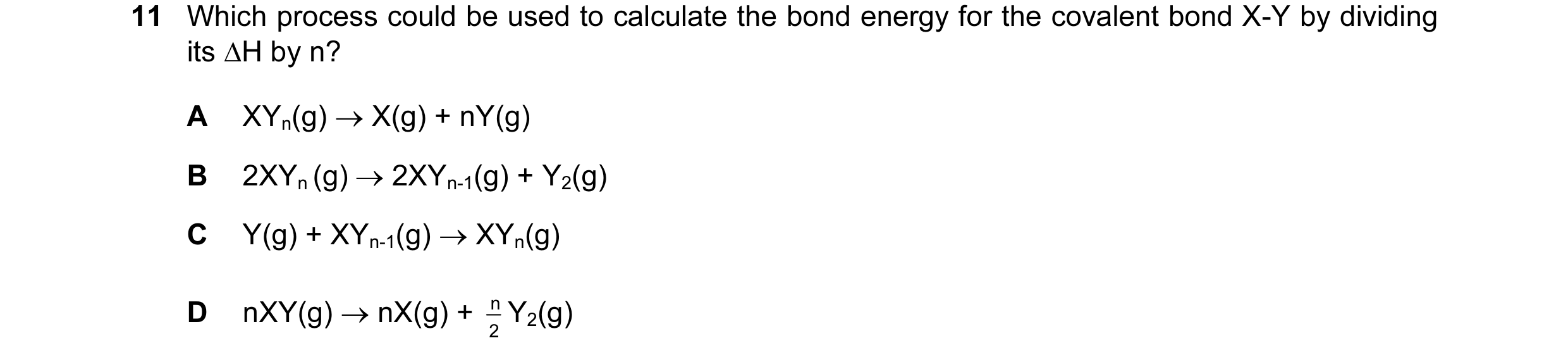
Q30 · Which process could be used to calculate the bond energy for the covalent bond X-Y by… 9701/11 Oct/Nov 2012
11 Which process could be used to calculate the bond energy for the covalent bond X-Y by dividing its ∆H by n? A XYn(g) → X(g) + nY(g) B 2XYn (g) → 2XYn-1(g) + Y2(g) C Y(g) + XYn-1(g) → XYn(g) D nXY(g) → nX(g) + n Y2(g) 2
1 marks
Answer: A
This question in 9701/11 Oct/Nov 2012
Q31 · Use of the Data Booklet is relevant to this question 9701/12 Oct/Nov 2012
4 Use of the Data Booklet is relevant to this question. A reaction which causes the presence of oxides of nitrogen in car exhausts is the formation of NO. N2 + O2 → 2NO ∆H = +180 kJ mol–1 What is the bond energy in kJ mol–1 of the bond between the atoms in NO? A 655 B 835 C 1310 D 1670
1 marks
Answer: A
This question in 9701/12 Oct/Nov 2012
Q32 · Which process could be used to calculate the bond energy for the covalent bond X-Y by… 9701/12 Oct/Nov 2012
11 Which process could be used to calculate the bond energy for the covalent bond X-Y by dividing its ∆H by n? A XYn(g) → X(g) + nY(g) B 2XYn (g) → 2XYn-1(g) + Y2(g) C Y(g) + XYn-1(g) → XYn(g) D nXY(g) → nX(g) + n Y2(g) 2
1 marks
Answer: A
This question in 9701/12 Oct/Nov 2012
Q33 · Which statement can be explained by intermolecular hydrogen bonding? 9701/13 Oct/Nov 2012
2 Which statement can be explained by intermolecular hydrogen bonding? A Butane has a higher boiling point than propane. B Hydrogen bromide forms an acidic solution when dissolved in water. C SiH4 has a higher boiling point than CH4. D Water has a higher boiling point than CH4.
1 marks
Answer: D
This question in 9701/13 Oct/Nov 2012
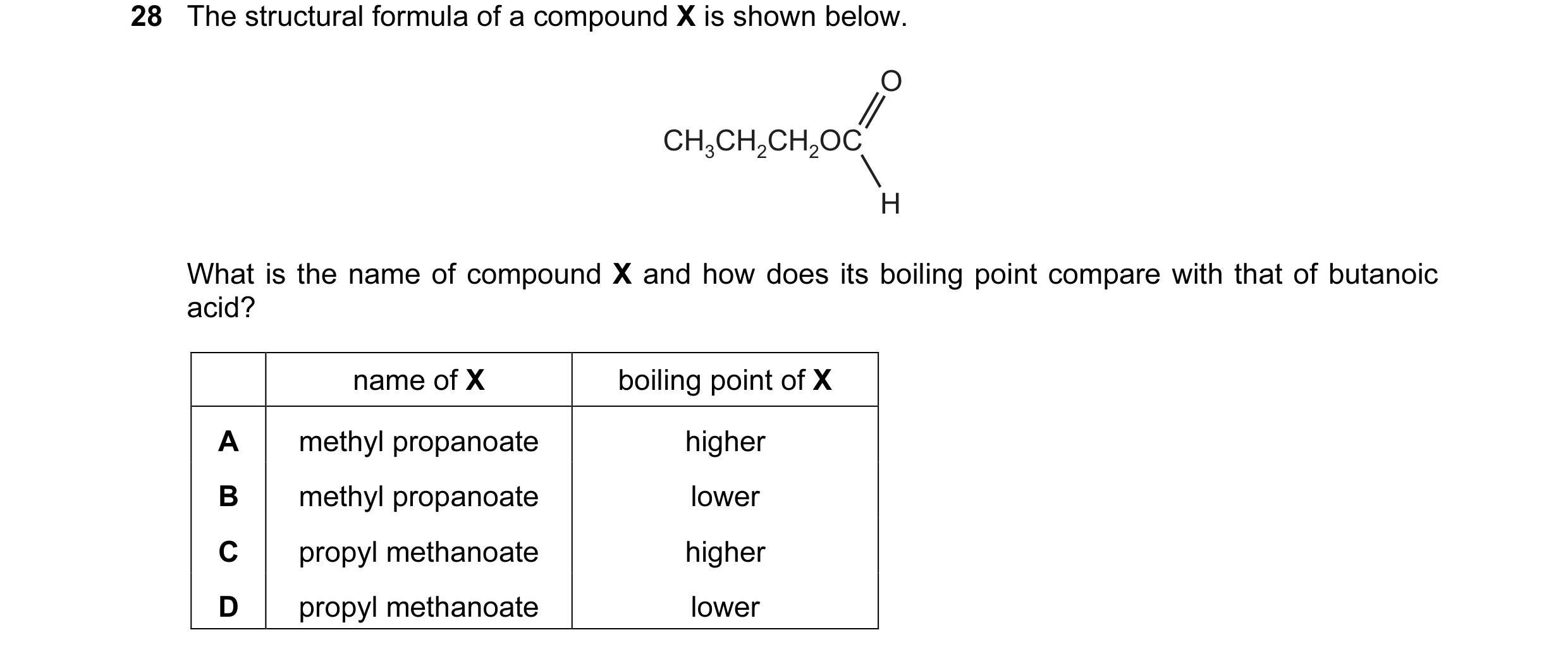
Q34 · The structural formula of a compound X is shown below 9701/11 May/June 2013
28 The structural formula of a compound X is shown below. O CH3CH2CH2OC H What is the name of compound X and how does its boiling point compare with that of butanoic acid? name of X boiling point of X A methyl propanoate higher B methyl propanoate lower C propyl methanoate higher D propyl methanoate lower
1 marks
Answer: D
This question in 9701/11 May/June 2013
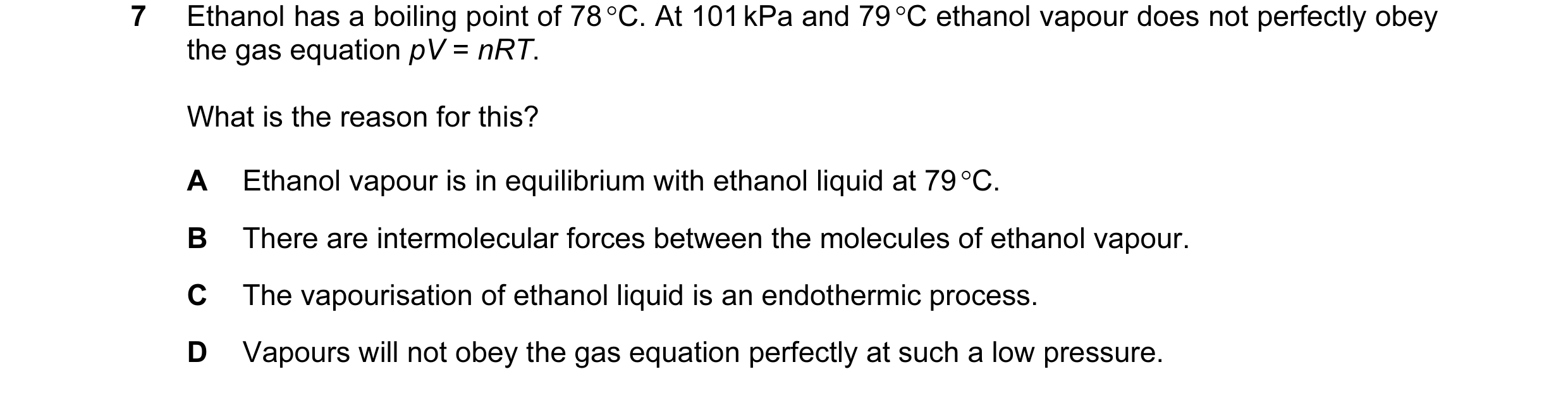
Q35 · Ethanol has a boiling point of 78 °C 9701/12 May/June 2013
7 Ethanol has a boiling point of 78 °C. At 101 kPa and 79 °C ethanol vapour does not perfectly obey the gas equation pV = nRT. What is the reason for this? A Ethanol vapour is in equilibrium with ethanol liquid at 79 °C. B There are intermolecular forces between the molecules of ethanol vapour. C The vapourisation of ethanol liquid is an endothermic process. D Vapours will not obey the gas equation perfectly at such a low pressure.
1 marks
Answer: B
This question in 9701/12 May/June 2013
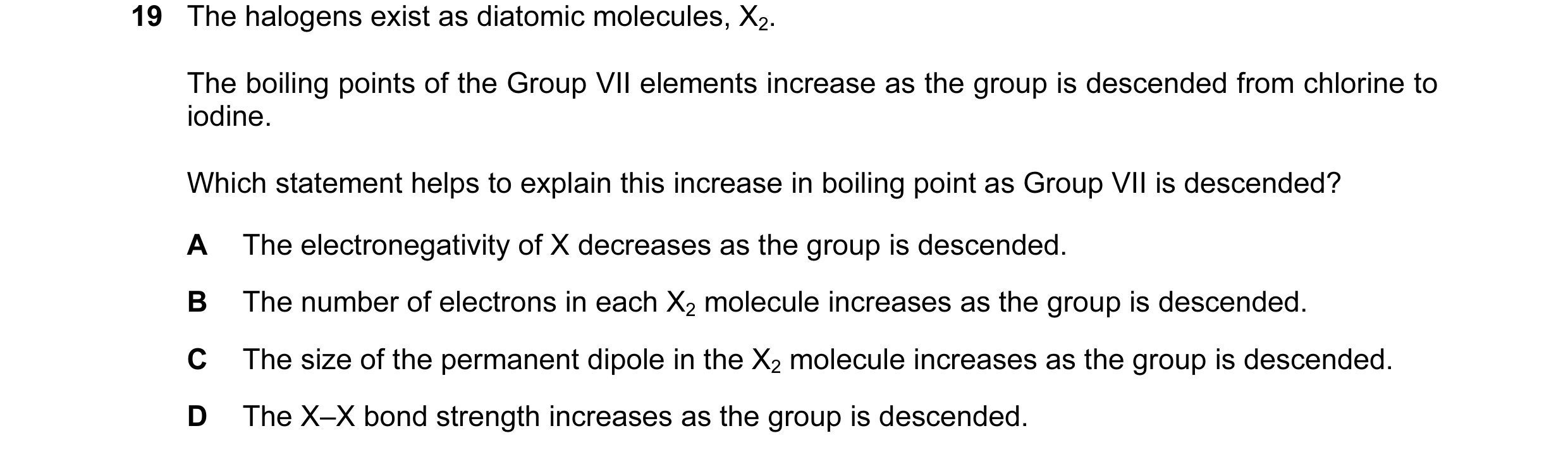
Q36 · The halogens exist as diatomic molecules, X2 9701/12 May/June 2013
19 The halogens exist as diatomic molecules, X2. The boiling points of the Group VII elements increase as the group is descended from chlorine to iodine. Which statement helps to explain this increase in boiling point as Group VII is descended? A The electronegativity of X decreases as the group is descended. B The number of electrons in each X2 molecule increases as the group is descended. C The size of the permanent dipole in the X2 molecule increases as the group is descended. D The X–X bond strength increases as the group is descended.
1 marks
Answer: B
This question in 9701/12 May/June 2013
Q37 · Which compound is the only gas at room temperature and pressure? 9701/13 May/June 2013
8 Which compound is the only gas at room temperature and pressure? A CH3CH2CH2NH2 Mr = 59.0 B CH3CH2CH2OH Mr = 60.0 C CH2OHCH2OH Mr = 62.0 D CH3CH2Cl Mr = 64.5
1 marks
Answer: D
This question in 9701/13 May/June 2013
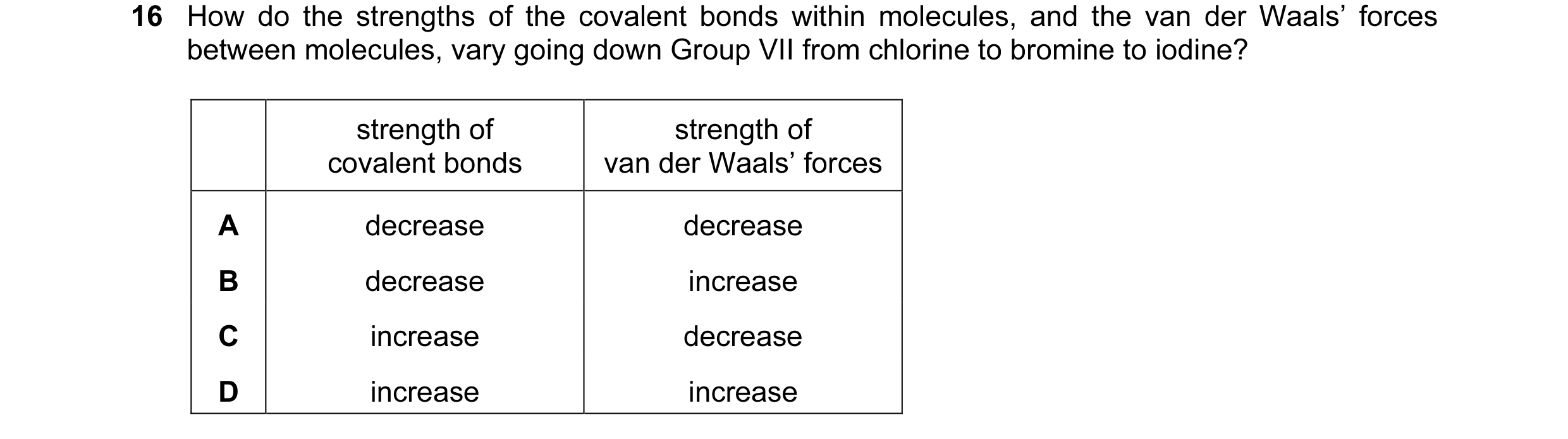
Q38 · How do the strengths of the covalent bonds within molecules, and the van der Waals’… 9701/13 May/June 2013
16 How do the strengths of the covalent bonds within molecules, and the van der Waals’ forces between molecules, vary going down Group VII from chlorine to bromine to iodine? strength of strength of covalent bonds van der Waals’ forces A decrease decrease B decrease increase C increase decrease D increase increase
1 marks
Answer: B
This question in 9701/13 May/June 2013
Q39 · Chlorofluorocarbons, CFCs, can be used as refrigerants, aerosol propellants and fire… 9701/13 Oct/Nov 2013
25 Chlorofluorocarbons, CFCs, can be used as refrigerants, aerosol propellants and fire extinguishers. CFCs such as CCl 3F and CCl 2F2 are more stable than chloroalkanes such as CCl 4. What is the reason for their greater stability? A Fluorine has a higher first ionisation energy than chlorine. B Fluorine radicals are more stable than chlorine radicals. C The C–F bond energy is larger than the C–Cl bond energy. D The C–F bond is more polar than the C–Cl bond.
1 marks
Answer: C
This question in 9701/13 Oct/Nov 2013
Q40 · Which molecular structure will have the smallest overall dipole? 9701/11 May/June 2014
9 Which molecular structure will have the smallest overall dipole? A B C D H3C Cl H3C Cl Cl Cl Cl CH3 C C C C C C C C Cl H2C H H3C Cl H3C CH3 H3C Cl
1 marks
Answer: D
This question in 9701/11 May/June 2014
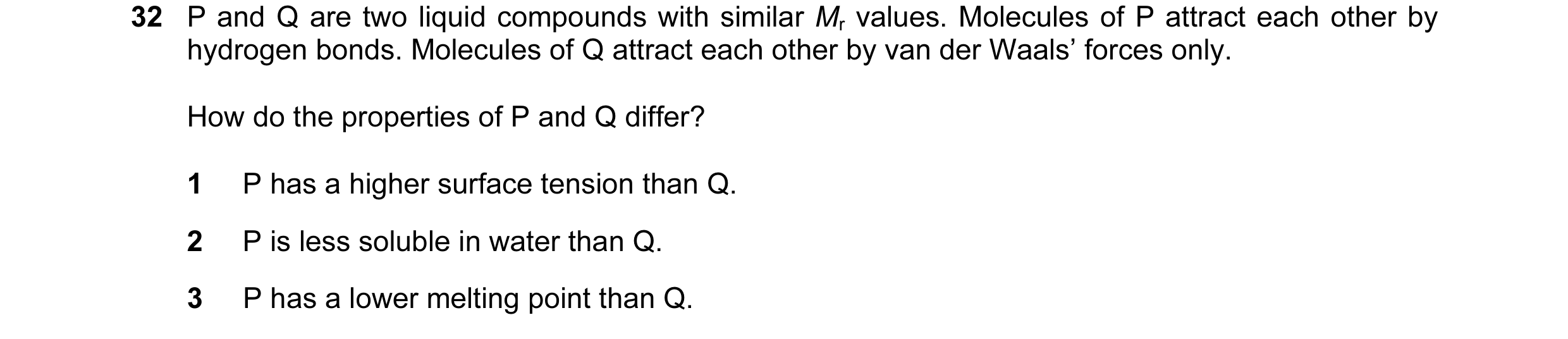
Q41 · P and Q are two liquid compounds with similar Mr values 9701/11 May/June 2014
32 P and Q are two liquid compounds with similar Mr values. Molecules of P attract each other by hydrogen bonds. Molecules of Q attract each other by van der Waals’ forces only. How do the properties of P and Q differ? 1 P has a higher surface tension than Q. 2 P is less soluble in water than Q. 3 P has a lower melting point than Q.
1 marks
Answer: D
This question in 9701/11 May/June 2014
Q42 · Ethene reacts with aqueous bromine to give two products, CH2BrCH2Br and CH2BrCH2OH 9701/12 May/June 2014
24 Ethene reacts with aqueous bromine to give two products, CH2BrCH2Br and CH2BrCH2OH. Which statement about these products is correct? A Both products are obtained in this reaction by electrophilic substitution. B Both products are obtained in this reaction by nucleophilic addition. C Both products can be hydrolysed to form the same organic compound. D Both products can form hydrogen bonds with water.
1 marks
Answer: C
This question in 9701/12 May/June 2014
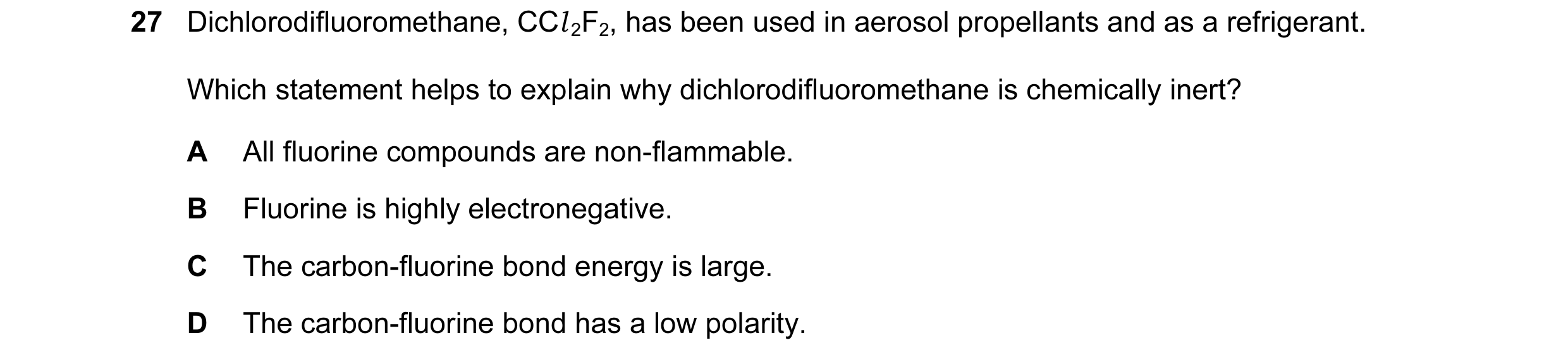
Q43 · Dichlorodifluoromethane, CCl 2F2, has been used in aerosol propellants and as a… 9701/12 May/June 2014
27 Dichlorodifluoromethane, CCl 2F2, has been used in aerosol propellants and as a refrigerant. Which statement helps to explain why dichlorodifluoromethane is chemically inert? A All fluorine compounds are non-flammable. B Fluorine is highly electronegative. C The carbon-fluorine bond energy is large. D The carbon-fluorine bond has a low polarity.
1 marks
Answer: C
This question in 9701/12 May/June 2014
Q44 · P and Q are two compounds with similar Mr values 9701/12 May/June 2014
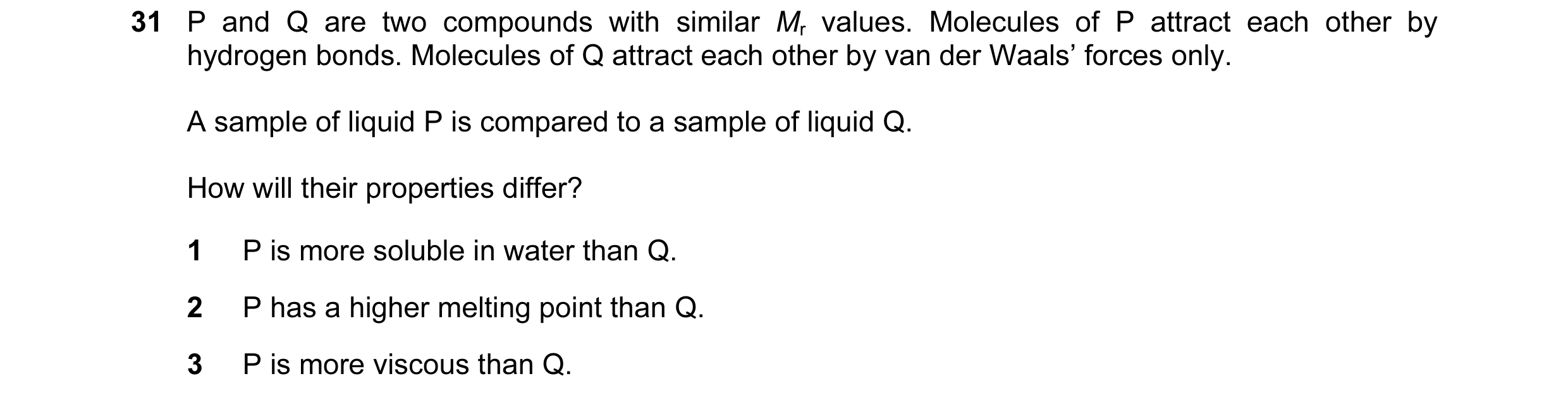
31 P and Q are two compounds with similar Mr values. Molecules of P attract each other by hydrogen bonds. Molecules of Q attract each other by van der Waals’ forces only. A sample of liquid P is compared to a sample of liquid Q. How will their properties differ? 1 P is more soluble in water than Q. 2 P has a higher melting point than Q. 3 P is more viscous than Q.
1 marks
Answer: A
This question in 9701/12 May/June 2014
Q45 · P and Q are two liquid compounds with similar Mr values 9701/13 May/June 2014
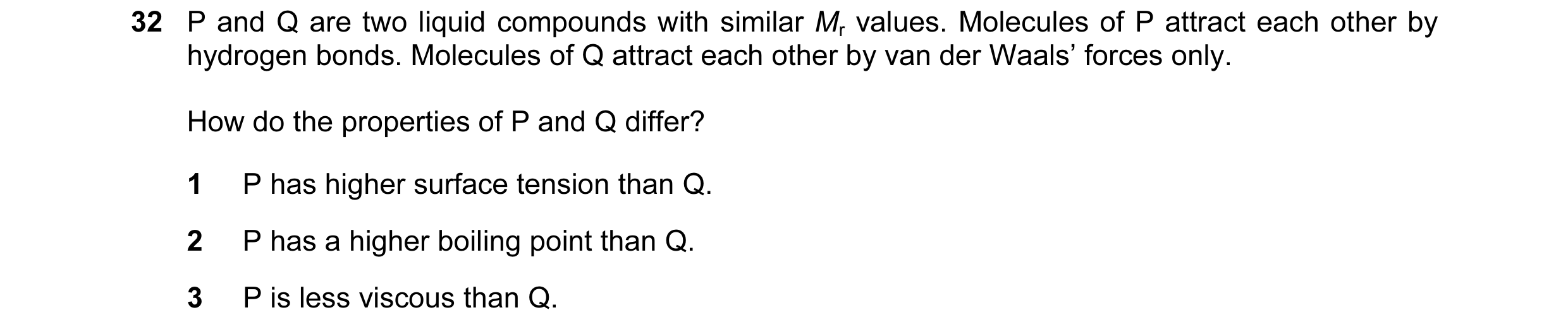
32 P and Q are two liquid compounds with similar Mr values. Molecules of P attract each other by hydrogen bonds. Molecules of Q attract each other by van der Waals’ forces only. How do the properties of P and Q differ? 1 P has higher surface tension than Q. 2 P has a higher boiling point than Q. 3 P is less viscous than Q.
1 marks
Answer: B
This question in 9701/13 May/June 2014
Q46 · The intermolecular forces between iodine molecules are instantaneous dipole-induced… 9701/13 May/June 2014
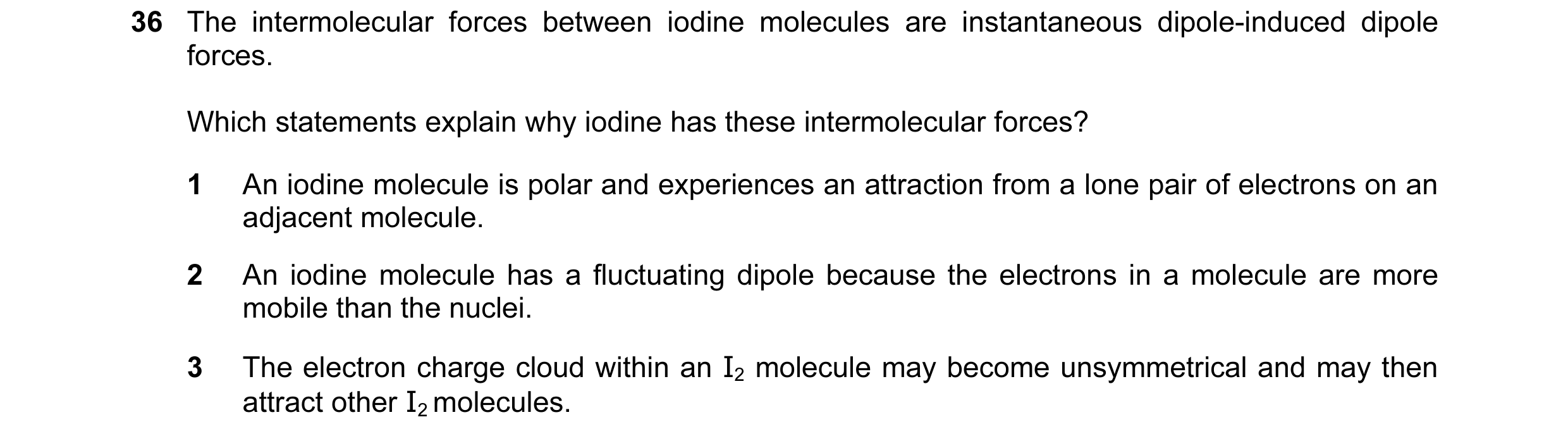
36 The intermolecular forces between iodine molecules are instantaneous dipole-induced dipole forces. Which statements explain why iodine has these intermolecular forces? 1 An iodine molecule is polar and experiences an attraction from a lone pair of electrons on an adjacent molecule. 2 An iodine molecule has a fluctuating dipole because the electrons in a molecule are more mobile than the nuclei. 3 The electron charge cloud within an I2 molecule may become unsymmetrical and may then attract other I2 molecules.
1 marks
Answer: C
This question in 9701/13 May/June 2014
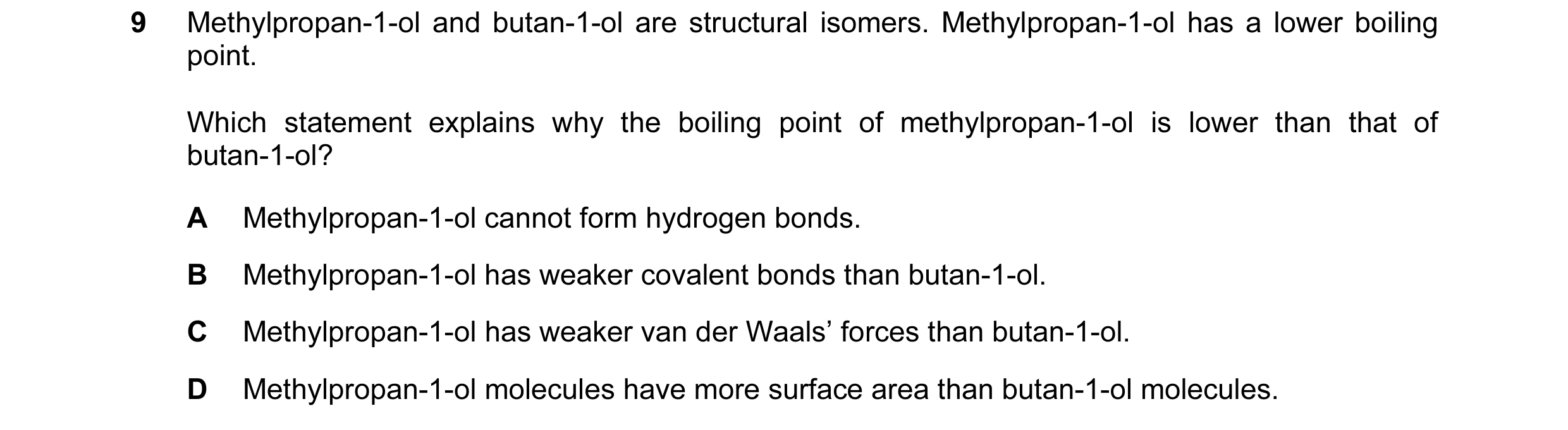
Q47 · Methylpropan-1-ol and butan-1-ol are structural isomers 9701/11 Oct/Nov 2014
9 Methylpropan-1-ol and butan-1-ol are structural isomers. Methylpropan-1-ol has a lower boiling point. Which statement explains why the boiling point of methylpropan-1-ol is lower than that of butan-1-ol? A Methylpropan-1-ol cannot form hydrogen bonds. B Methylpropan-1-ol has weaker covalent bonds than butan-1-ol. C Methylpropan-1-ol has weaker van der Waals’ forces than butan-1-ol. D Methylpropan-1-ol molecules have more surface area than butan-1-ol molecules.
1 marks
Answer: C
This question in 9701/11 Oct/Nov 2014
Q48 · Methylpropan-1-ol and butan-1-ol are structural isomers 9701/12 Oct/Nov 2014
9 Methylpropan-1-ol and butan-1-ol are structural isomers. Methylpropan-1-ol has a lower boiling point. Which statement explains why the boiling point of methylpropan-1-ol is lower than that of butan-1-ol? A Methylpropan-1-ol cannot form hydrogen bonds. B Methylpropan-1-ol has weaker covalent bonds than butan-1-ol. C Methylpropan-1-ol has weaker van der Waals’ forces than butan-1-ol. D Methylpropan-1-ol molecules have more surface area than butan-1-ol molecules.
1 marks
Answer: C
This question in 9701/12 Oct/Nov 2014
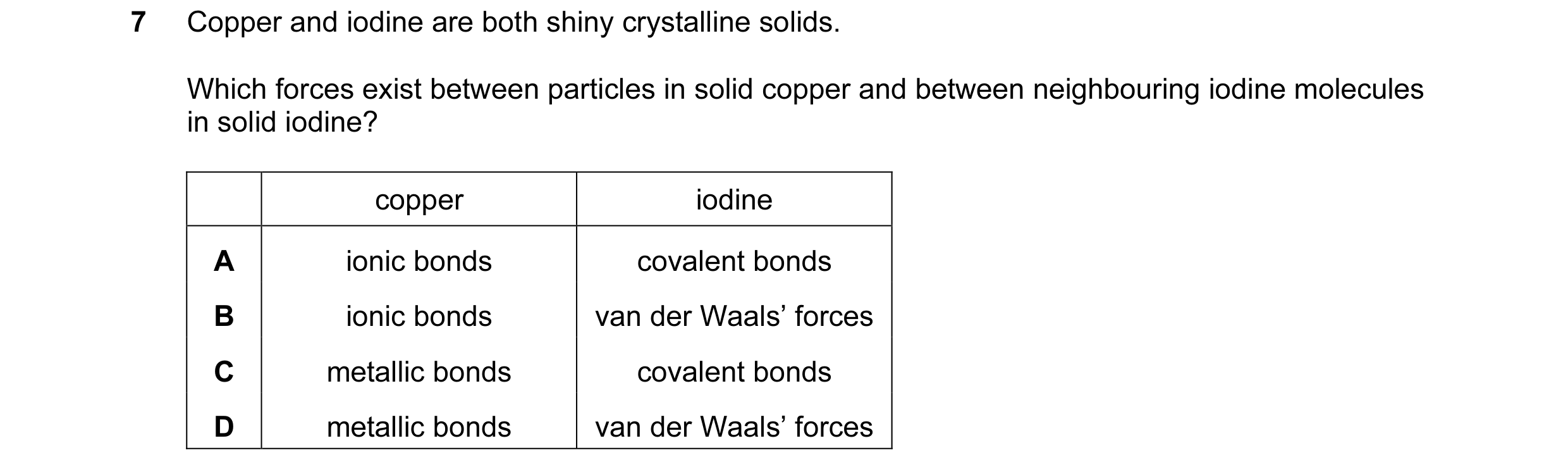
Q49 · Copper and iodine are both shiny crystalline solids 9701/13 Oct/Nov 2014
7 Copper and iodine are both shiny crystalline solids. Which forces exist between particles in solid copper and between neighbouring iodine molecules in solid iodine? copper iodine A ionic bonds covalent bonds B ionic bonds van der Waals’ forces C metallic bonds covalent bonds D metallic bonds van der Waals’ forces
1 marks
Answer: D
This question in 9701/13 Oct/Nov 2014
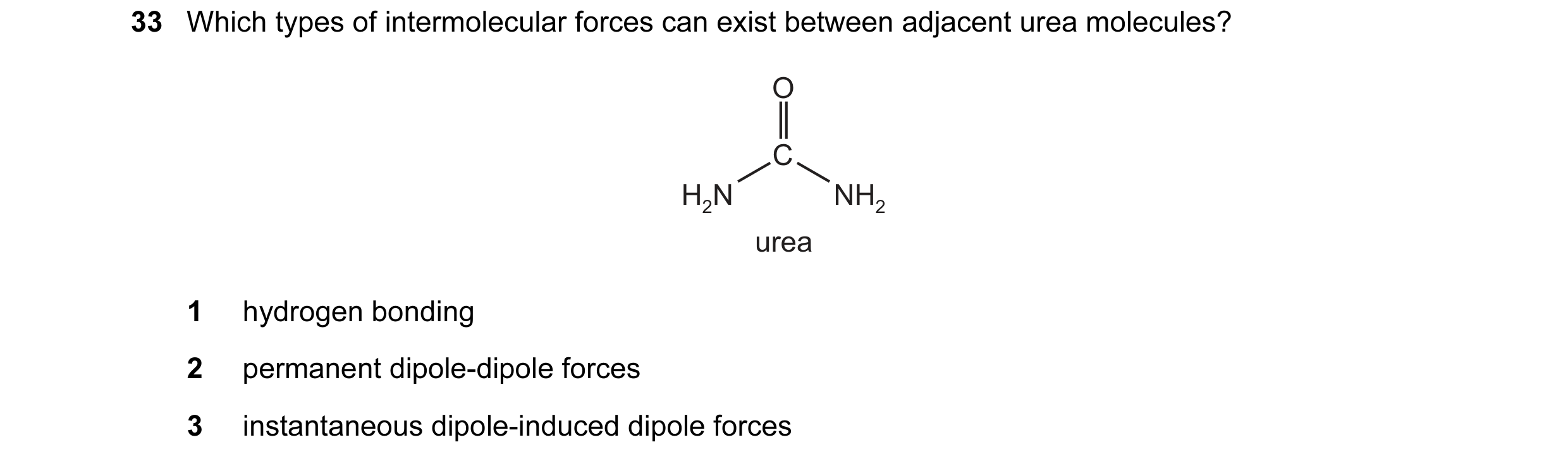
Q50 · Which types of intermolecular forces can exist between adjacent urea molecules? 9701/13 Oct/Nov 2014
33 Which types of intermolecular forces can exist between adjacent urea molecules? O C H2N NH2 urea 1 hydrogen bonding 2 permanent dipole-dipole forces 3 instantaneous dipole-induced dipole forces
1 marks
Answer: A
This question in 9701/13 Oct/Nov 2014
Q51 · Compared with the HI molecule, the bond ……P…… of the HBr molecule is ……Q…… Which pairs of… 9701/13 Oct/Nov 2014
35 Compared with the HI molecule, the bond ……P…… of the HBr molecule is ……Q…… Which pairs of words correctly complete the above sentence? P Q 1 energy greater 2 length less 3 polarity greater
1 marks
Answer: A
This question in 9701/13 Oct/Nov 2014
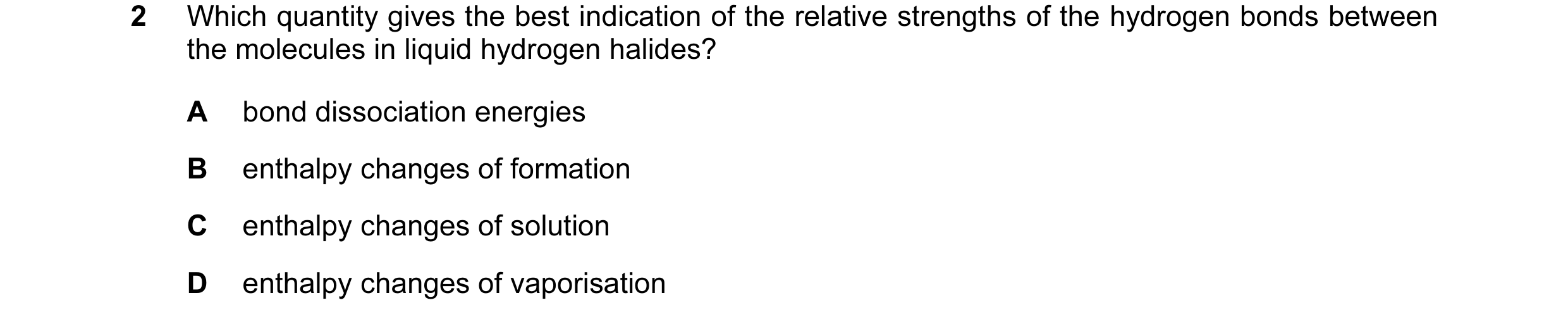
Q52 · Which quantity gives the best indication of the relative strengths of the hydrogen bonds… 9701/11 May/June 2015
2 Which quantity gives the best indication of the relative strengths of the hydrogen bonds between the molecules in liquid hydrogen halides? A bond dissociation energies B enthalpy changes of formation C enthalpy changes of solution D enthalpy changes of vaporisation
1 marks
Answer: D
This question in 9701/11 May/June 2015
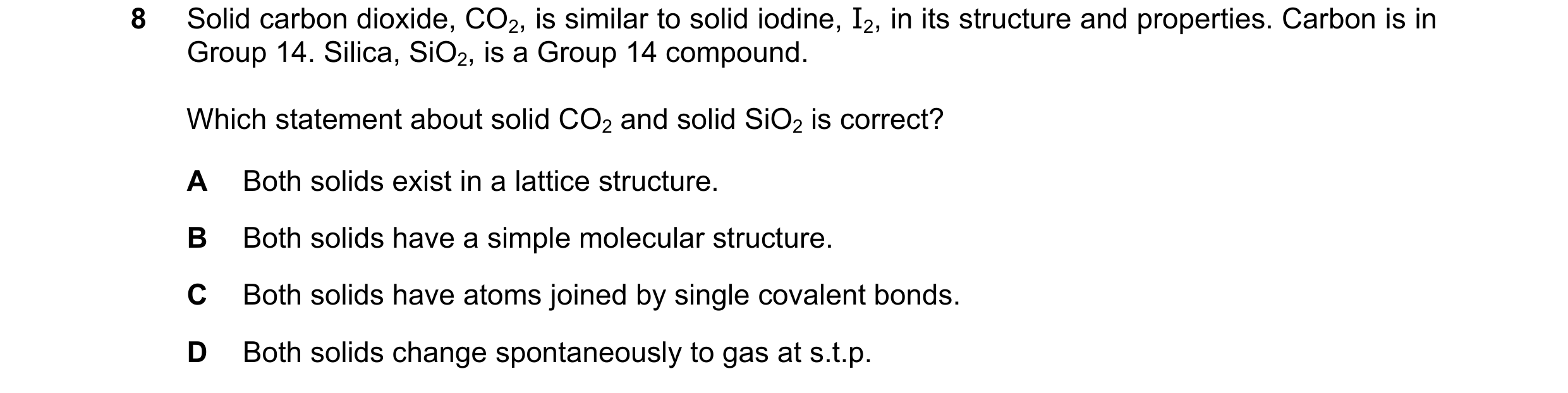
Q53 · Solid carbon dioxide, CO2, is similar to solid iodine, I2, in its structure and properties 9701/12 Feb/March 2016
8 Solid carbon dioxide, CO2, is similar to solid iodine, I2, in its structure and properties. Carbon is in Group 14. Silica, SiO2, is a Group 14 compound. Which statement about solid CO2 and solid SiO2 is correct? A Both solids exist in a lattice structure. B Both solids have a simple molecular structure. C Both solids have atoms joined by single covalent bonds. D Both solids change spontaneously to gas at s.t.p.
1 marks
Answer: A
This question in 9701/12 Feb/March 2016
Q54 · Which molecules have an overall dipole moment? 9701/12 Feb/March 2016
31 Which molecules have an overall dipole moment? 1 carbon monoxide, CO 2 phosphine, PH3 3 carbon dioxide, CO2
1 marks
Answer: B
This question in 9701/12 Feb/March 2016
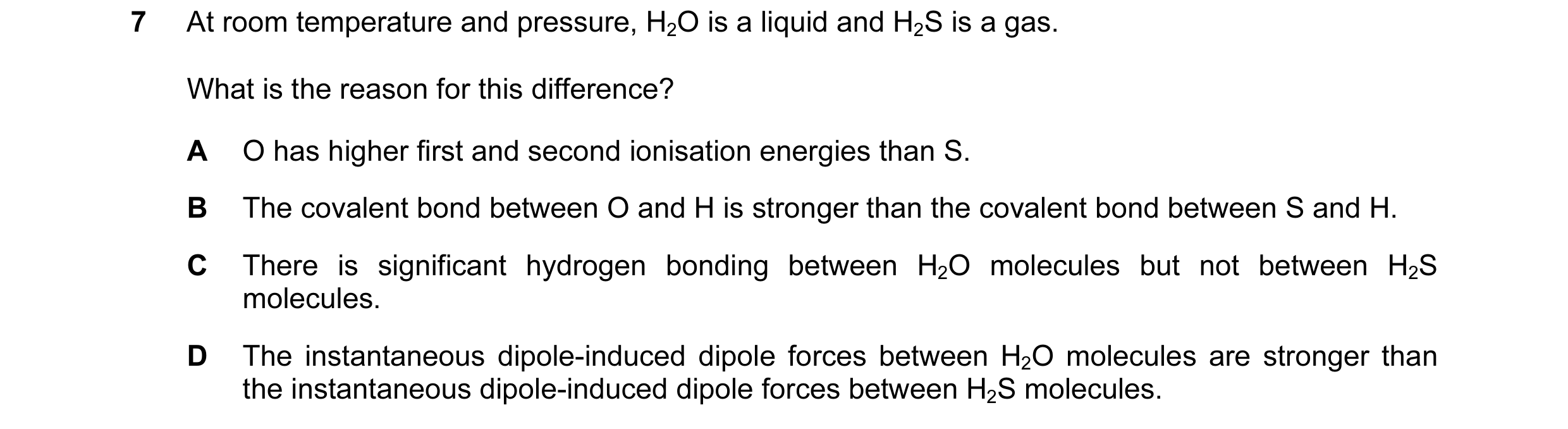
Q55 · At room temperature and pressure, H2O is a liquid and H2S is a gas 9701/11 May/June 2016
7 At room temperature and pressure, H2O is a liquid and H2S is a gas. What is the reason for this difference? A O has higher first and second ionisation energies than S. B The covalent bond between O and H is stronger than the covalent bond between S and H. C There is significant hydrogen bonding between H2O molecules but not between H2S molecules. D The instantaneous dipole-induced dipole forces between H2O molecules are stronger than the instantaneous dipole-induced dipole forces between H2S molecules.
1 marks
Answer: C
This question in 9701/11 May/June 2016
Q56 · Fluorine and iodine are Group 17 elements 9701/12 May/June 2016
19 Fluorine and iodine are Group 17 elements. Their melting points are different due to differing strengths of van der Waals’ forces between molecules. Which row is correct? strength of van der Waals’ melting point forces between molecules A F2 > I2 F2 > I2 B F2 > I2 F2 < I2 C F2 < I2 F2 < I2 D F2 < I2 F2 > I2
1 marks
Answer: C
This question in 9701/12 May/June 2016
Q57 · Water has some unusual physical properties compared to other hydrides of Group 16 elements 9701/13 May/June 2016
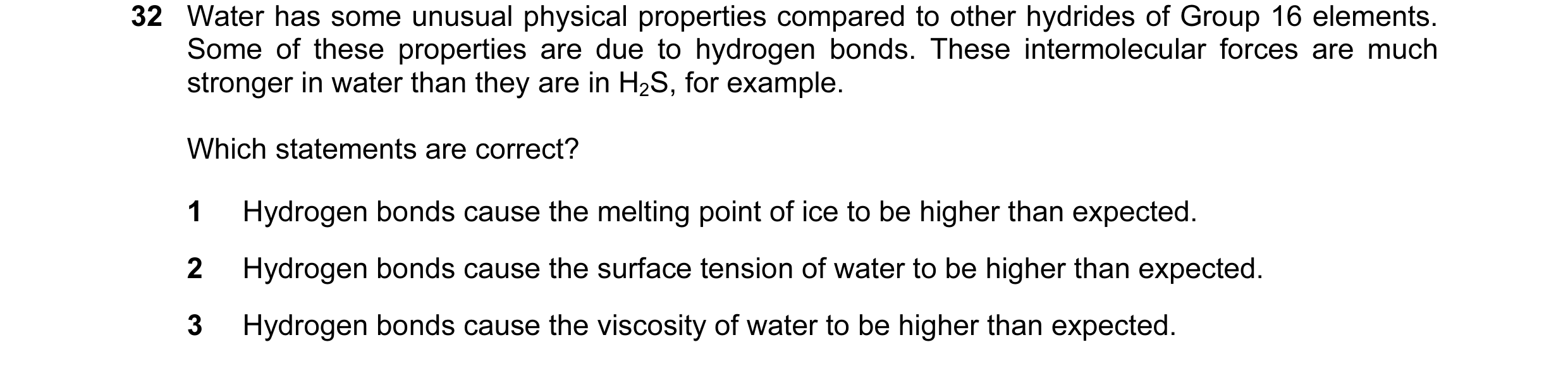
32 Water has some unusual physical properties compared to other hydrides of Group 16 elements. Some of these properties are due to hydrogen bonds. These intermolecular forces are much stronger in water than they are in H2S, for example. Which statements are correct? 1 Hydrogen bonds cause the melting point of ice to be higher than expected. 2 Hydrogen bonds cause the surface tension of water to be higher than expected. 3 Hydrogen bonds cause the viscosity of water to be higher than expected.
1 marks
Answer: A
This question in 9701/13 May/June 2016
Q58 · Halogenoalkanes show trends in their physical and chemical properties 9701/13 May/June 2016
37 Halogenoalkanes show trends in their physical and chemical properties. Which properties steadily increase from C2H5Cl to C2H5Br to C2H5I ? 1 the polarity of the carbon-halogen bond 2 the boiling point of the halogenoalkane 3 the rate of reaction of the halogenoalkane with nucleophiles
1 marks
Answer: C
This question in 9701/13 May/June 2016
Q59 · The properties of chlorine, bromine and their compounds are compared 9701/13 Oct/Nov 2016
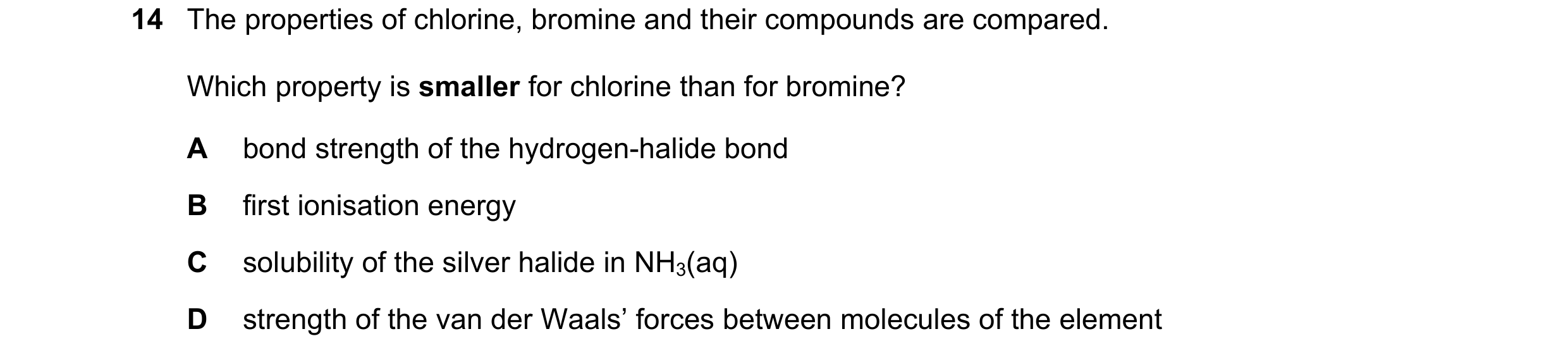
14 The properties of chlorine, bromine and their compounds are compared. Which property is smaller for chlorine than for bromine? A bond strength of the hydrogen-halide bond B first ionisation energy C solubility of the silver halide in NH3(aq) D strength of the van der Waals’ forces between molecules of the element
1 marks
Answer: D
This question in 9701/13 Oct/Nov 2016
Q60 · Which organic compound has the highest boiling point? 9701/12 May/June 2017
4 Which organic compound has the highest boiling point? A C(CH3)4 B CH3CH2CH2CH2CH3 C CH3COCH2CH3 D CH3CH(OH)CH2CH3
1 marks
Answer: D
This question in 9701/12 May/June 2017
Q61 · Ammonia exists as simple covalent molecules, NH3 9701/13 May/June 2017
18 Ammonia exists as simple covalent molecules, NH3. Ammonia can react with suitable reagents to form products containing ammonium ions, NH4 +. Ammonia can also react with suitable reagents to form products containing amide ions, NH2 –. Which of these nitrogen-containing species are present in an aqueous solution of ammonia? A ammonia molecules and amide ions only B ammonia molecules and ammonium ions only C ammonia molecules only D ammonium ions only
1 marks
Answer: B
This question in 9701/13 May/June 2017
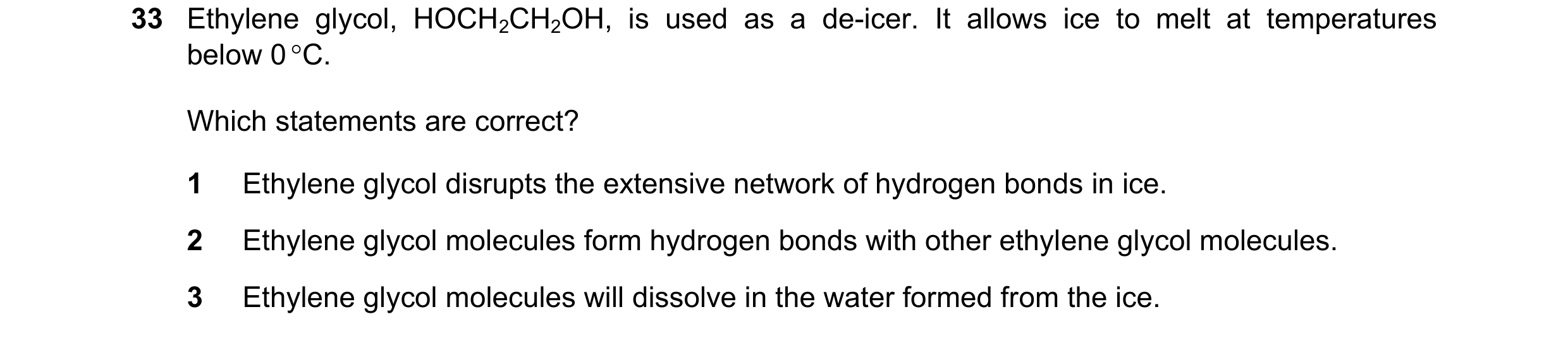
Q62 · Ethylene glycol, HOCH2CH2OH, is used as a de-icer 9701/13 May/June 2017
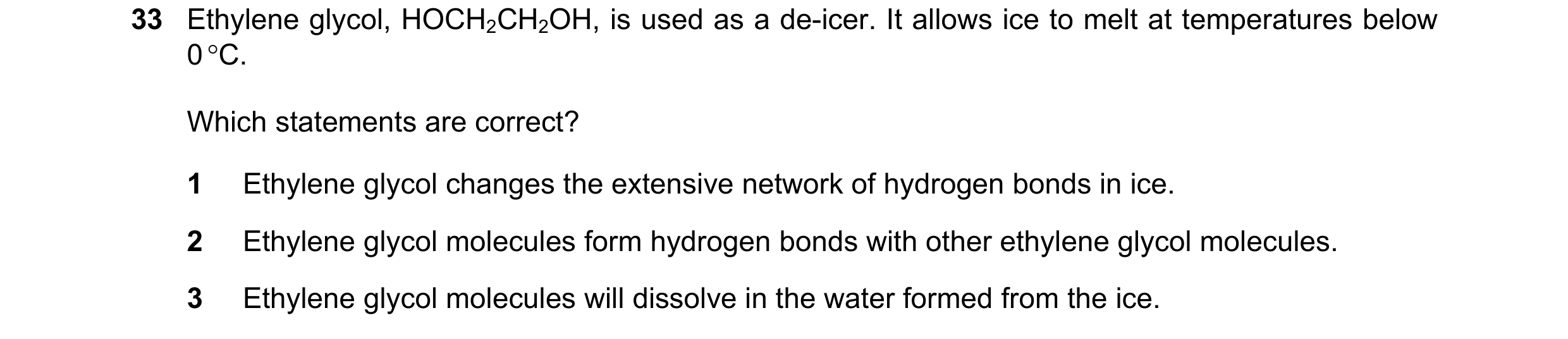
33 Ethylene glycol, HOCH2CH2OH, is used as a de-icer. It allows ice to melt at temperatures below 0 °C. Which statements are correct? 1 Ethylene glycol changes the extensive network of hydrogen bonds in ice. 2 Ethylene glycol molecules form hydrogen bonds with other ethylene glycol molecules. 3 Ethylene glycol molecules will dissolve in the water formed from the ice.
1 marks
Answer: A
This question in 9701/13 May/June 2017
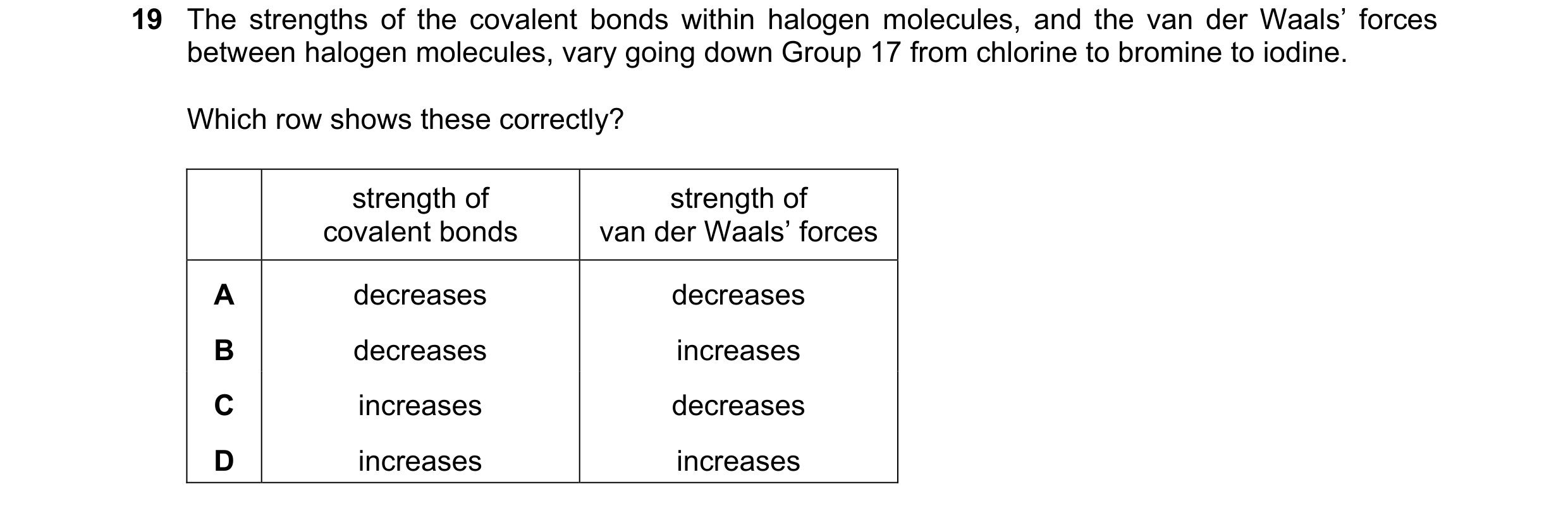
Q63 · The strengths of the covalent bonds within halogen molecules, and the van der Waals’… 9701/11 Oct/Nov 2017
19 The strengths of the covalent bonds within halogen molecules, and the van der Waals’ forces between halogen molecules, vary going down Group 17 from chlorine to bromine to iodine. Which row shows these correctly? strength of strength of covalent bonds van der Waals’ forces A decreases decreases B decreases increases C increases decreases D increases increases
1 marks
Answer: B
This question in 9701/11 Oct/Nov 2017
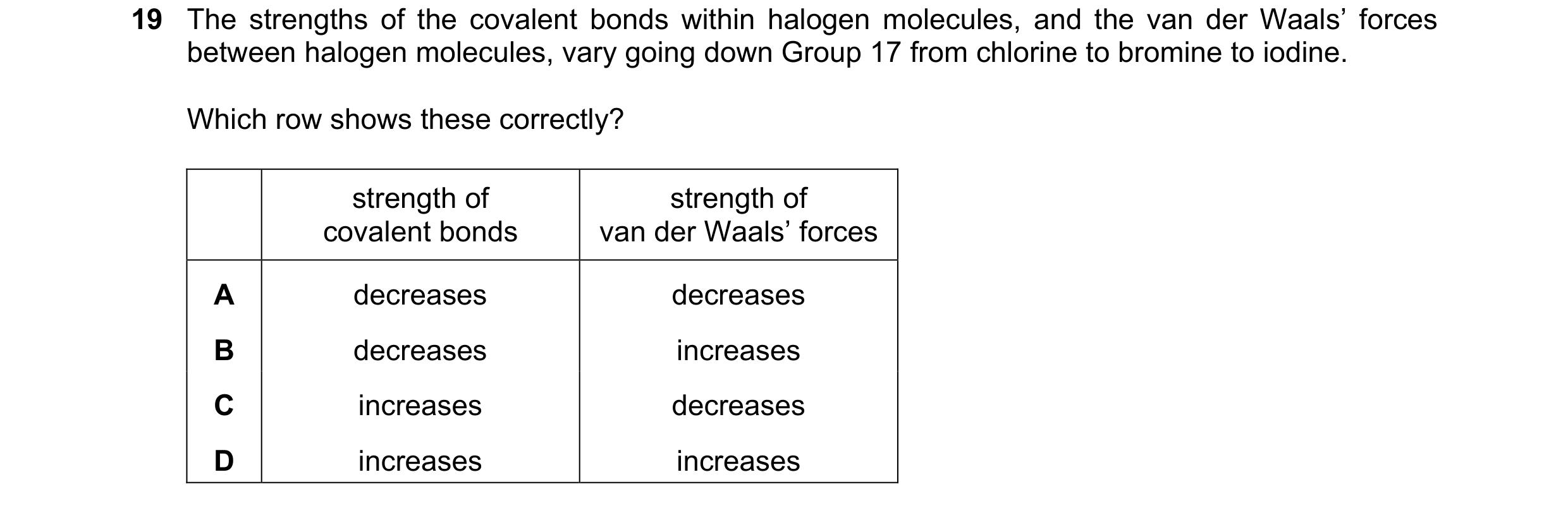
Q64 · The strengths of the covalent bonds within halogen molecules, and the van der Waals’… 9701/13 Oct/Nov 2017
19 The strengths of the covalent bonds within halogen molecules, and the van der Waals’ forces between halogen molecules, vary going down Group 17 from chlorine to bromine to iodine. Which row shows these correctly? strength of strength of covalent bonds van der Waals’ forces A decreases decreases B decreases increases C increases decreases D increases increases
1 marks
Answer: B
This question in 9701/13 Oct/Nov 2017
Q65 · The volatility of the Group 17 elements, chlorine, bromine and iodine, decreases down the… 9701/12 Feb/March 2018
16 The volatility of the Group 17 elements, chlorine, bromine and iodine, decreases down the group. What is responsible for this? A bond length in the halogen molecule B bond strength in the halogen molecule C electronegativity of the halogen D number of electrons in the halogen molecule
1 marks
Answer: D
This question in 9701/12 Feb/March 2018
Q66 · A container is partially filled with hot water, sealed and left to cool 9701/12 Feb/March 2018
32 A container is partially filled with hot water, sealed and left to cool. Which statements are correct? 1 As the temperature decreases, water molecules lose kinetic energy. 2 As the temperature decreases, more water molecules move from vapour to liquid. 3 As the temperature decreases, the vapour pressure of the water decreases.
1 marks
Answer: A
This question in 9701/12 Feb/March 2018
Q67 · Which compound has a boiling point that is influenced by hydrogen bonding? 9701/11 May/June 2018
2 Which compound has a boiling point that is influenced by hydrogen bonding? A CH3CHO B CH3OCH3 C HCO2CH3 D HCO2H
1 marks
Answer: D
This question in 9701/11 May/June 2018
Q68 · Which statements are correct? 9701/11 May/June 2018
32 Which statements are correct? 1 The hydrogen bonds in ice are more regularly arranged than in water. 2 The solidification of water to form ice is exothermic. 3 Pure water is less dense than ice.
1 marks
Answer: B
This question in 9701/11 May/June 2018
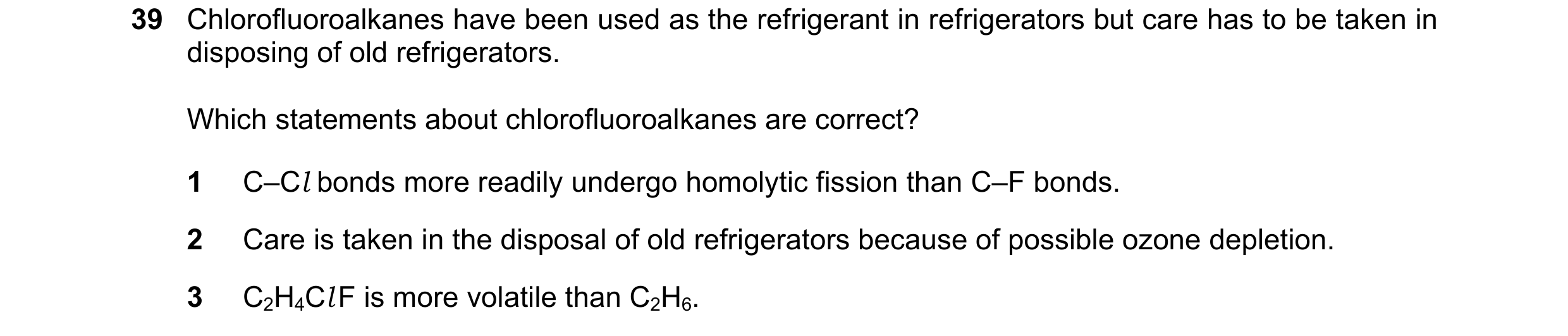
Q69 · Chlorofluoroalkanes have been used as the refrigerant in refrigerators but care has to be… 9701/11 May/June 2018
39 Chlorofluoroalkanes have been used as the refrigerant in refrigerators but care has to be taken in disposing of old refrigerators. Which statements about chlorofluoroalkanes are correct? 1 C–Cl bonds more readily undergo homolytic fission than C–F bonds. 2 Care is taken in the disposal of old refrigerators because of possible ozone depletion. 3 C2H4Cl F is more volatile than C2H6.
1 marks
Answer: B
This question in 9701/11 May/June 2018
Q70 · In which pair does the second substance have a lower boiling point than the first… 9701/12 May/June 2018
3 In which pair does the second substance have a lower boiling point than the first substance? A C2H6 and C2H5Cl B CH3OCH3 and C2H5OH C Ne and Ar D CH3NH2 and C2H6
1 marks
Answer: D
This question in 9701/12 May/June 2018
Q71 · In this question, X represents an atom of chlorine, bromine or iodine 9701/12 May/June 2018
14 In this question, X represents an atom of chlorine, bromine or iodine. Which explanation for the variation in volatility down Group 17 is correct? A Instantaneous dipole-induced dipole forces between molecules become stronger. B Permanent dipole-permanent dipole forces between molecules become stronger. C The bond energy of the X2 molecules decreases. D The first ionisation energy X(g) → X+(g) + e– decreases.
1 marks
Answer: A
This question in 9701/12 May/June 2018
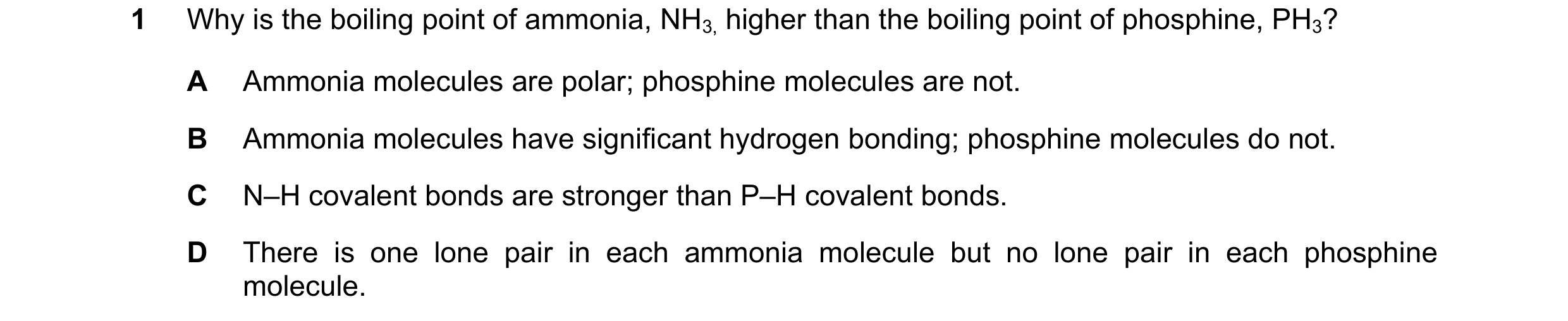
Q72 · Why is the boiling point of ammonia, NH3, higher than the boiling point of phosphine, PH3? 9701/13 May/June 2018
1 Why is the boiling point of ammonia, NH3, higher than the boiling point of phosphine, PH3? A Ammonia molecules are polar; phosphine molecules are not. B Ammonia molecules have significant hydrogen bonding; phosphine molecules do not. C N–H covalent bonds are stronger than P–H covalent bonds. D There is one lone pair in each ammonia molecule but no lone pair in each phosphine molecule.
1 marks
Answer: B
This question in 9701/13 May/June 2018
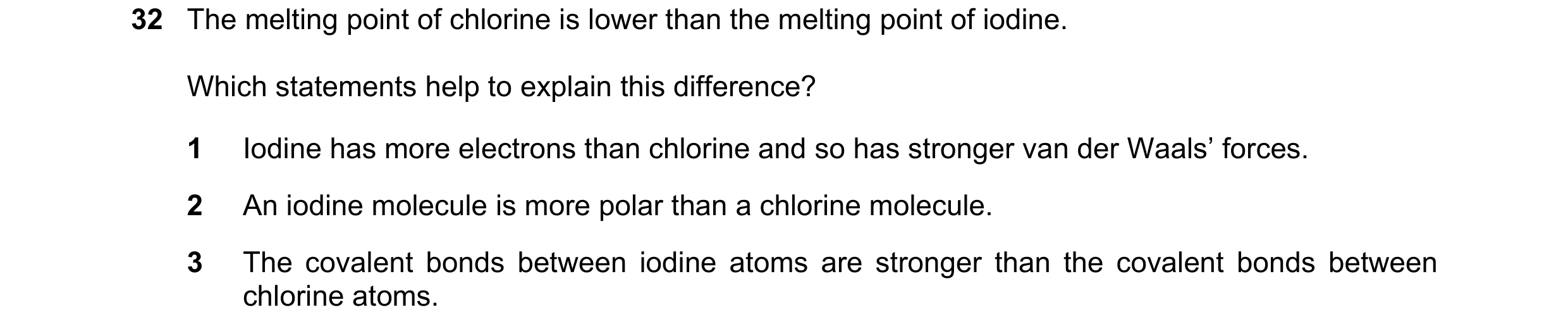
Q73 · The melting point of chlorine is lower than the melting point of iodine 9701/12 Oct/Nov 2018
32 The melting point of chlorine is lower than the melting point of iodine. Which statements help to explain this difference? 1 Iodine has more electrons than chlorine and so has stronger van der Waals’ forces. 2 An iodine molecule is more polar than a chlorine molecule. 3 The covalent bonds between iodine atoms are stronger than the covalent bonds between chlorine atoms.
1 marks
Answer: D
This question in 9701/12 Oct/Nov 2018
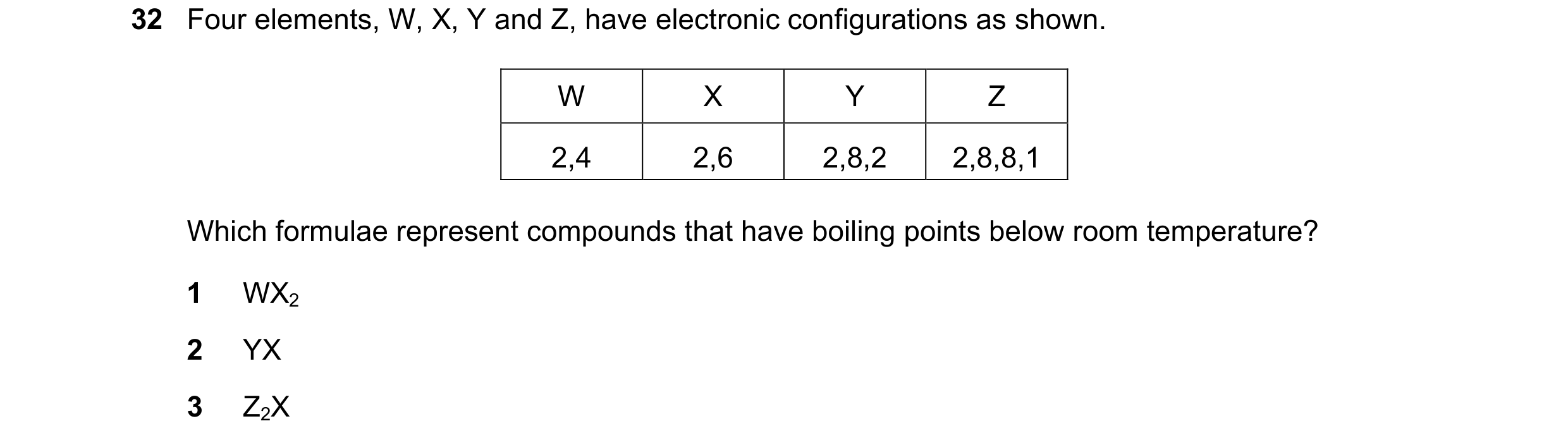
Q74 · Four elements, W, X, Y and Z, have electronic configurations as shown 9701/11 May/June 2019
32 Four elements, W, X, Y and Z, have electronic configurations as shown. W X Y Z 2,4 2,6 2,8,2 2,8,8,1 Which formulae represent compounds that have boiling points below room temperature? 1 WX2 2 YX 3 Z2X
1 marks
Answer: D
This question in 9701/11 May/June 2019
Q75 · Which pair of substances are both simple molecular? 9701/12 May/June 2019
7 Which pair of substances are both simple molecular? A C60 and graphene B C60 and iodine C graphene and graphite D graphite and iodine
1 marks
Answer: B
This question in 9701/12 May/June 2019
Q76 · One molecule of compound R is shown 9701/12 May/June 2019
29 One molecule of compound R is shown. compound R H H H O H C C C O C H H H H What is the name of compound R and how does its boiling point compare with that of butanoic acid? name of R boiling point of R A methyl propanoate higher than butanoic acid B methyl propanoate lower than butanoic acid C propyl methanoate higher than butanoic acid D propyl methanoate lower than butanoic acid
1 marks
Answer: D
This question in 9701/12 May/June 2019
Q77 · Ethane, CH3CH3, and fluoromethane, CH3F, have the same number of electrons in their… 9701/13 May/June 2019
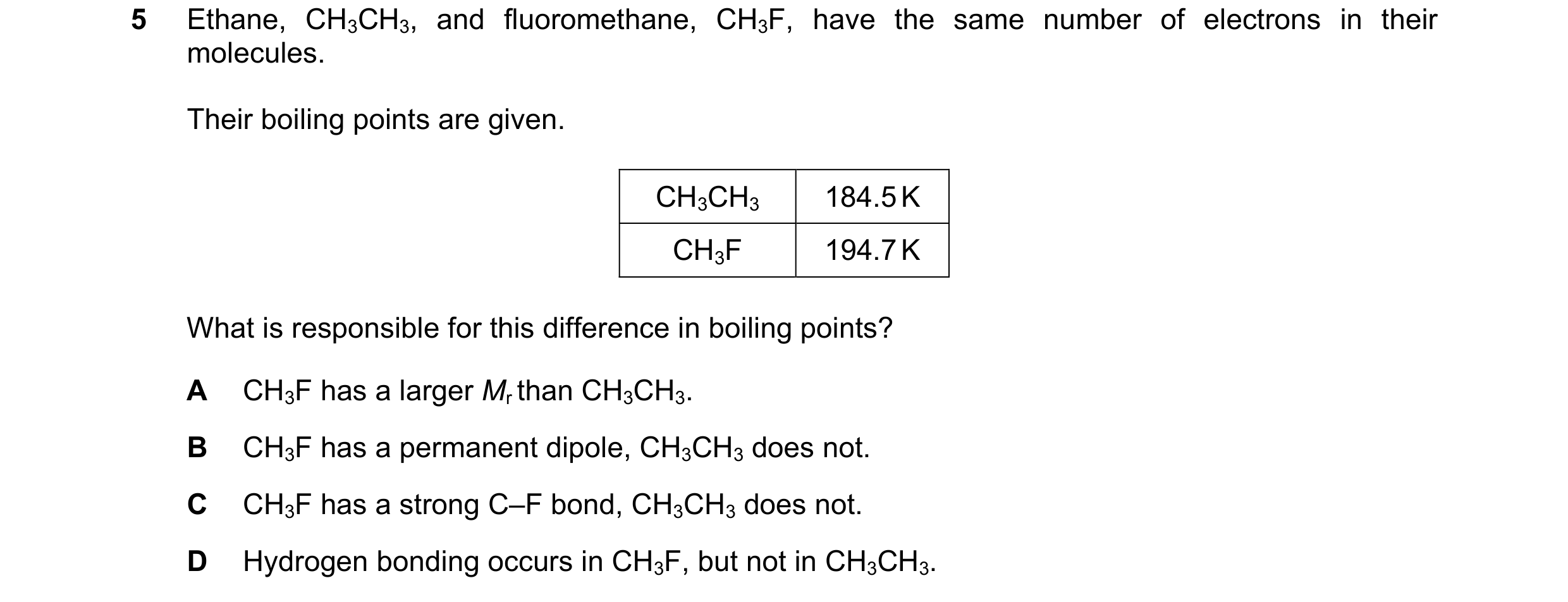
5 Ethane, CH3CH3, and fluoromethane, CH3F, have the same number of electrons in their molecules. Their boiling points are given. CH3CH3 184.5 K CH3F 194.7 K What is responsible for this difference in boiling points? A CH3F has a larger Mr than CH3CH3. B CH3F has a permanent dipole, CH3CH3 does not. C CH3F has a strong C–F bond, CH3CH3 does not. D Hydrogen bonding occurs in CH3F, but not in CH3CH3.
1 marks
Answer: B
This question in 9701/13 May/June 2019
Q78 · What changes in conditions or molecular properties make it more likely that gases… 9701/13 May/June 2019
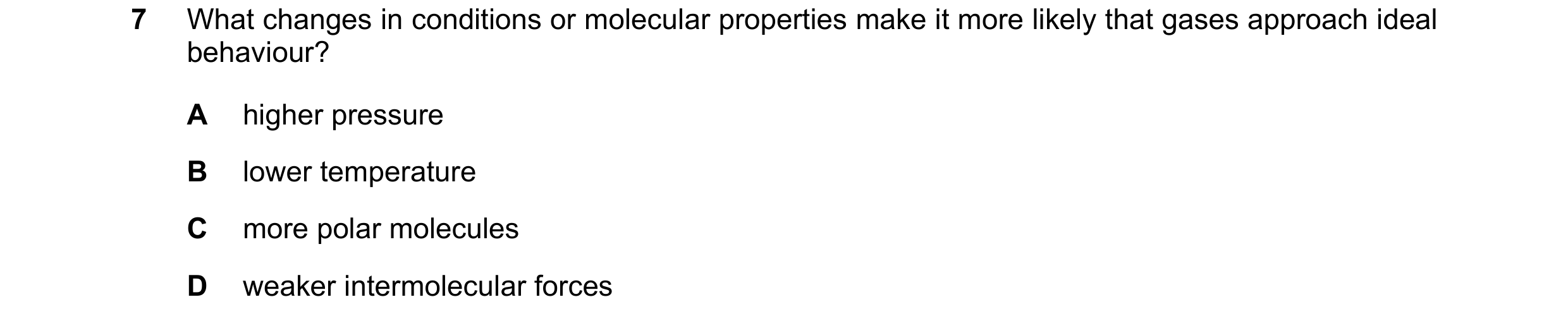
7 What changes in conditions or molecular properties make it more likely that gases approach ideal behaviour? A higher pressure B lower temperature C more polar molecules D weaker intermolecular forces
1 marks
Answer: D
This question in 9701/13 May/June 2019
Q79 · Ethanal, CH3CHO, ethanol, C2H5OH, and methoxymethane, CH3OCH3, are three organic compounds 9701/11 Oct/Nov 2019
5 Ethanal, CH3CHO, ethanol, C2H5OH, and methoxymethane, CH3OCH3, are three organic compounds. Which compound has the highest boiling point and what is the interaction that causes this boiling point to be the highest? highest boiling point interaction A methoxymethane permanent dipole-dipole forces B ethanal hydrogen bonds C ethanol hydrogen bonds D ethanal permanent dipole-dipole forces
1 marks
Answer: C
This question in 9701/11 Oct/Nov 2019
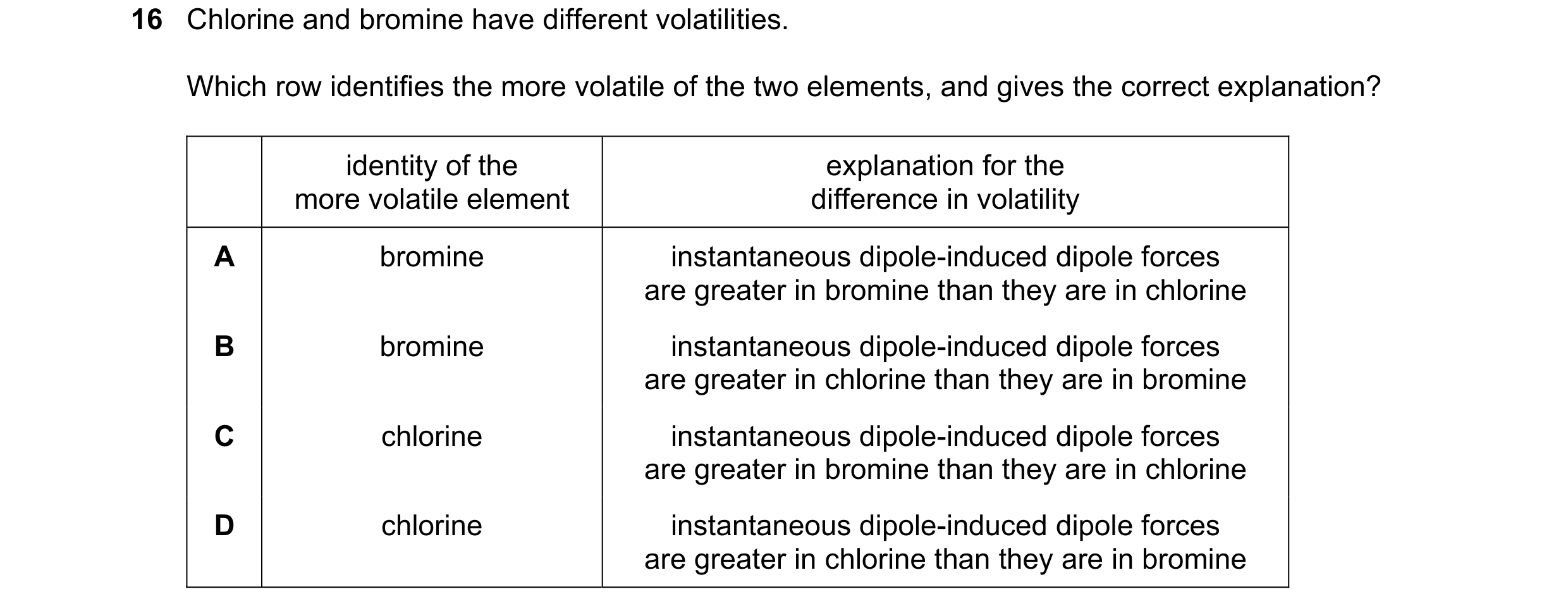
Q80 · Chlorine and bromine have different volatilities 9701/11 Oct/Nov 2019
16 Chlorine and bromine have different volatilities. Which row identifies the more volatile of the two elements, and gives the correct explanation? identity of the explanation for the more volatile element difference in volatility A bromine instantaneous dipole-induced dipole forces are greater in bromine than they are in chlorine B bromine instantaneous dipole-induced dipole forces are greater in chlorine than they are in bromine C chlorine instantaneous dipole-induced dipole forces are greater in bromine than they are in chlorine D chlorine instantaneous dipole-induced dipole forces are greater in chlorine than they are in bromine
1 marks
Answer: C
This question in 9701/11 Oct/Nov 2019
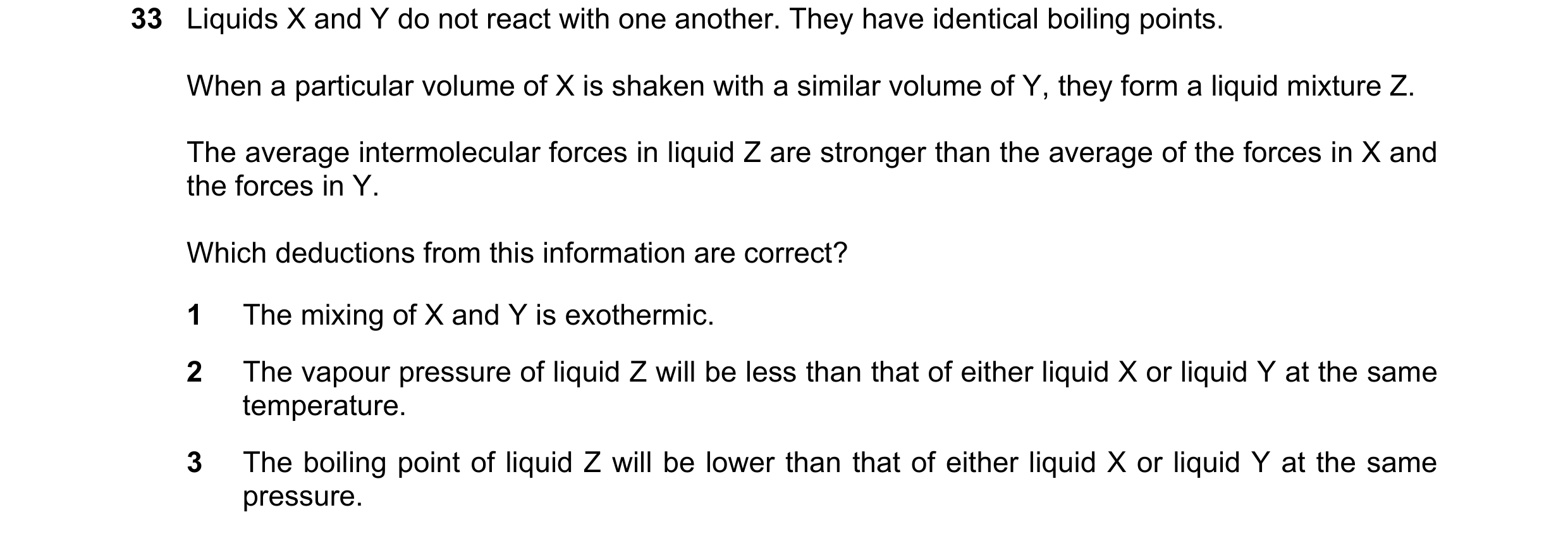
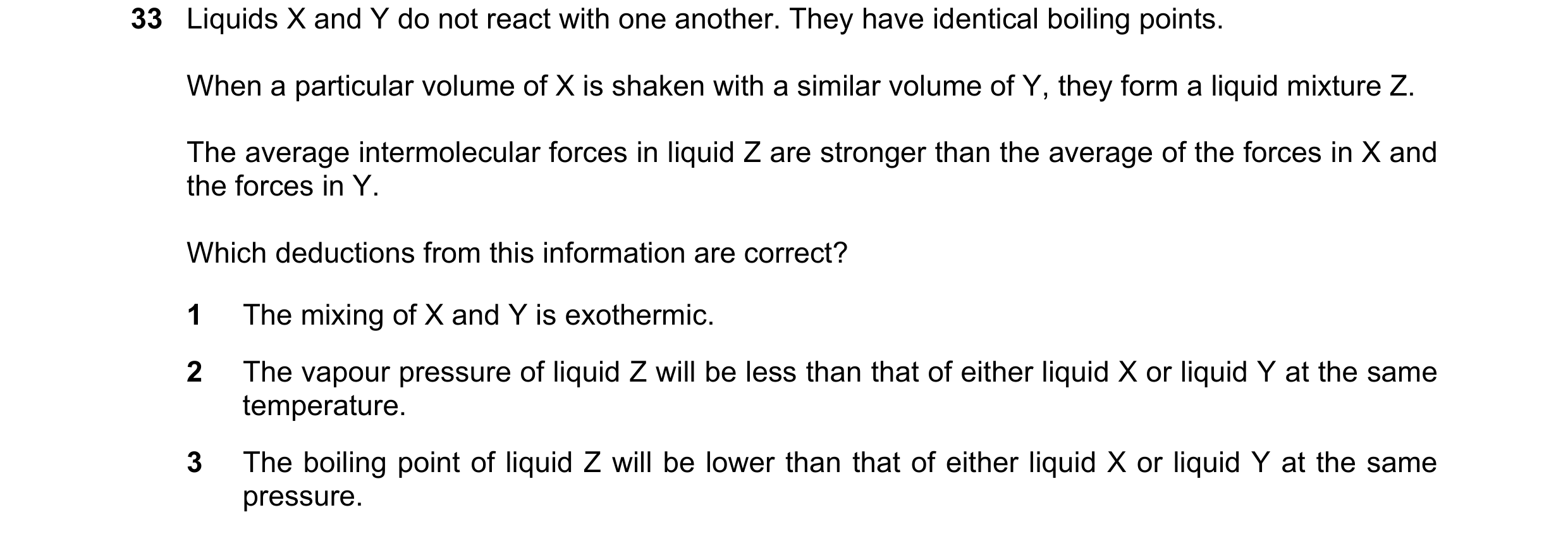
Q81 · Liquids X and Y do not react with one another 9701/11 Oct/Nov 2019
33 Liquids X and Y do not react with one another. They have identical boiling points. When a particular volume of X is shaken with a similar volume of Y, they form a liquid mixture Z. The average intermolecular forces in liquid Z are stronger than the average of the forces in X and the forces in Y. Which deductions from this information are correct? 1 The mixing of X and Y is exothermic. 2 The vapour pressure of liquid Z will be less than that of either liquid X or liquid Y at the same temperature. 3 The boiling point of liquid Z will be lower than that of either liquid X or liquid Y at the same pressure.
1 marks
Answer: B
This question in 9701/11 Oct/Nov 2019
Q82 · Which gaseous molecules are polar? 9701/12 Oct/Nov 2019
31 Which gaseous molecules are polar? 1 ammonia 2 hydrogen sulfide 3 boron trifluoride
1 marks
Answer: B
This question in 9701/12 Oct/Nov 2019
Q83 · Ethanal, CH3CHO, ethanol, C2H5OH, and methoxymethane, CH3OCH3, are three organic compounds 9701/13 Oct/Nov 2019
5 Ethanal, CH3CHO, ethanol, C2H5OH, and methoxymethane, CH3OCH3, are three organic compounds. Which compound has the highest boiling point and what is the interaction that causes this boiling point to be the highest? highest boiling point interaction A methoxymethane permanent dipole-dipole forces B ethanal hydrogen bonds C ethanol hydrogen bonds D ethanal permanent dipole-dipole forces
1 marks
Answer: C
This question in 9701/13 Oct/Nov 2019
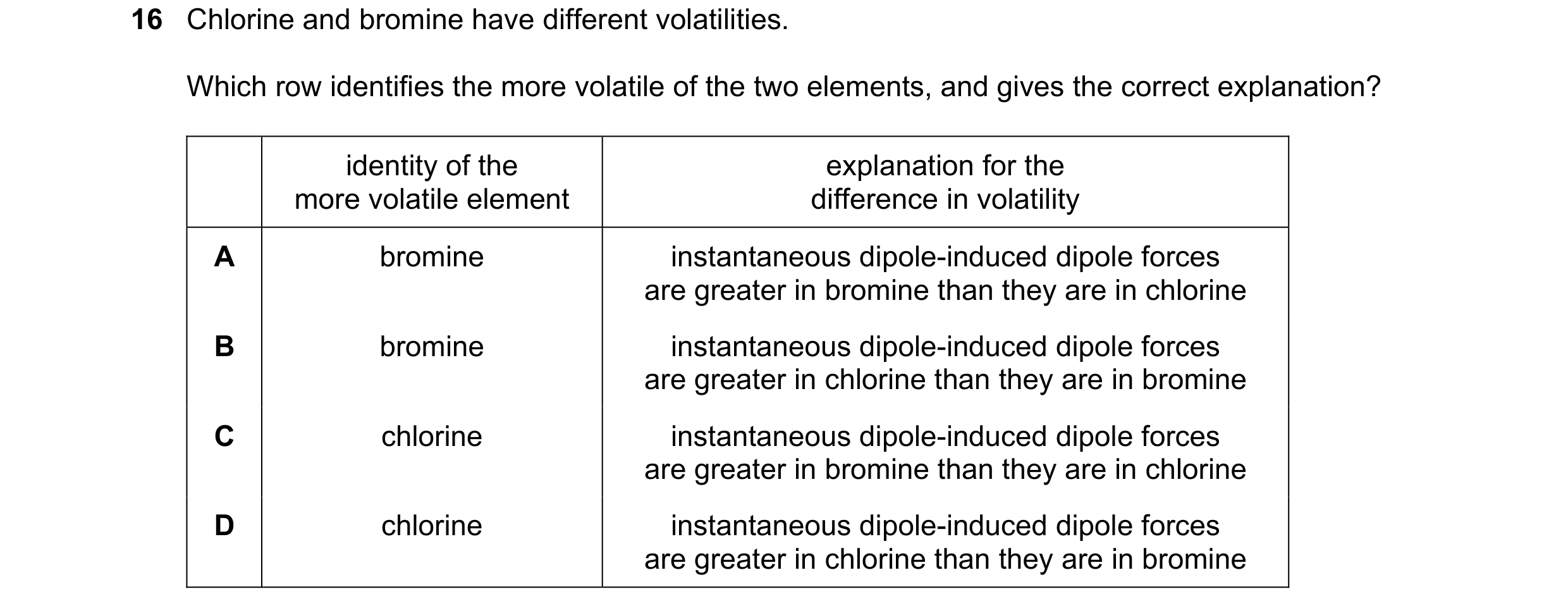
Q84 · Chlorine and bromine have different volatilities 9701/13 Oct/Nov 2019
16 Chlorine and bromine have different volatilities. Which row identifies the more volatile of the two elements, and gives the correct explanation? identity of the explanation for the more volatile element difference in volatility A bromine instantaneous dipole-induced dipole forces are greater in bromine than they are in chlorine B bromine instantaneous dipole-induced dipole forces are greater in chlorine than they are in bromine C chlorine instantaneous dipole-induced dipole forces are greater in bromine than they are in chlorine D chlorine instantaneous dipole-induced dipole forces are greater in chlorine than they are in bromine
1 marks
Answer: C
This question in 9701/13 Oct/Nov 2019
Q85 · Liquids X and Y do not react with one another 9701/13 Oct/Nov 2019
33 Liquids X and Y do not react with one another. They have identical boiling points. When a particular volume of X is shaken with a similar volume of Y, they form a liquid mixture Z. The average intermolecular forces in liquid Z are stronger than the average of the forces in X and the forces in Y. Which deductions from this information are correct? 1 The mixing of X and Y is exothermic. 2 The vapour pressure of liquid Z will be less than that of either liquid X or liquid Y at the same temperature. 3 The boiling point of liquid Z will be lower than that of either liquid X or liquid Y at the same pressure.
1 marks
Answer: B
This question in 9701/13 Oct/Nov 2019
Q86 · The strong hydrogen bonding present in liquid water causes an increase in which… 9701/12 Feb/March 2020
32 The strong hydrogen bonding present in liquid water causes an increase in which properties? 1 viscosity 2 boiling point 3 surface tension
1 marks
Answer: A
This question in 9701/12 Feb/March 2020
Q87 · Which statements apply to tetrafluoromethane? 9701/12 Feb/March 2020
39 Which statements apply to tetrafluoromethane? 1 It is rapidly decomposed by ultraviolet radiation. 2 It is less harmful to the ozone layer than dichlorodifluoromethane. 3 It is a non-polar molecule.
1 marks
Answer: C
This question in 9701/12 Feb/March 2020
Q88 · Which molecules have no overall dipole moment? 9701/11 May/June 2020
32 Which molecules have no overall dipole moment? 1 boron trifluoride 2 methane 3 phosphorus pentafluoride
1 marks
Answer: A
This question in 9701/11 May/June 2020
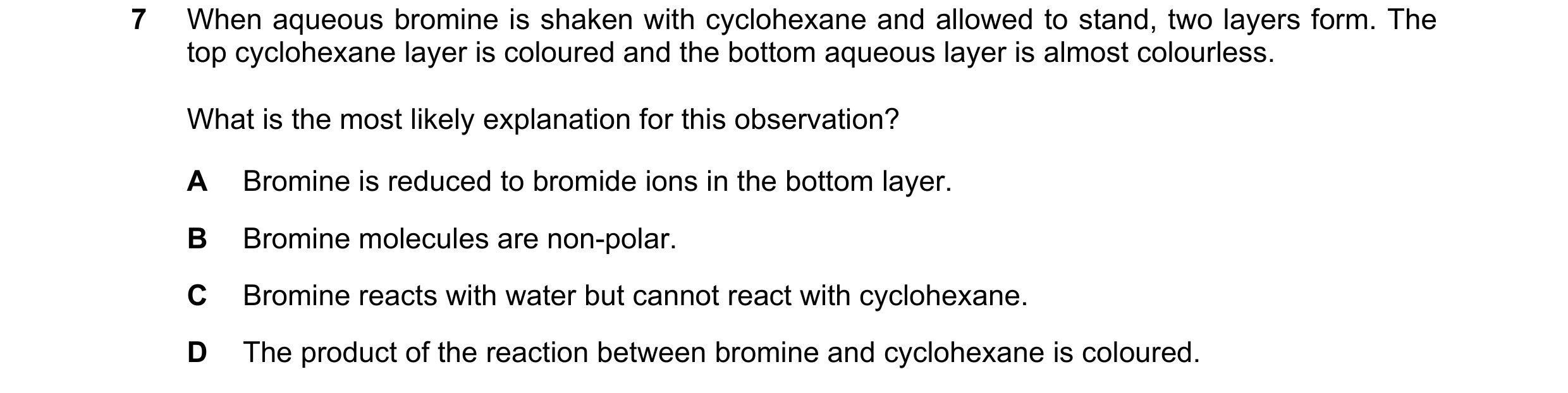
Q89 · When aqueous bromine is shaken with cyclohexane and allowed to stand, two layers form 9701/12 May/June 2020
7 When aqueous bromine is shaken with cyclohexane and allowed to stand, two layers form. The top cyclohexane layer is coloured and the bottom aqueous layer is almost colourless. What is the most likely explanation for this observation? A Bromine is reduced to bromide ions in the bottom layer. B Bromine molecules are non-polar. C Bromine reacts with water but cannot react with cyclohexane. D The product of the reaction between bromine and cyclohexane is coloured.
1 marks
Answer: B
This question in 9701/12 May/June 2020
Q90 · In which change are only temporary dipole-induced dipole forces overcome? 9701/12 May/June 2020
8 In which change are only temporary dipole-induced dipole forces overcome? A C2H5OH(l) → C2H5OH(g) B H2O(s) → H2O(l) C O2(s) → O2(l) D C4H10(l) → C4H10(s)
1 marks
Answer: C
This question in 9701/12 May/June 2020
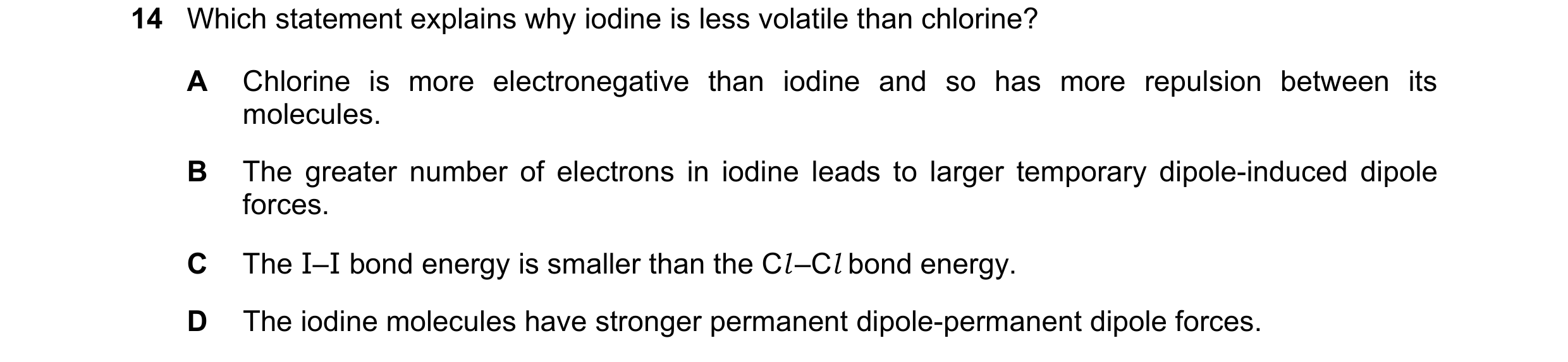
Q91 · Which statement explains why iodine is less volatile than chlorine? 9701/12 May/June 2020
14 Which statement explains why iodine is less volatile than chlorine? A Chlorine is more electronegative than iodine and so has more repulsion between its molecules. B The greater number of electrons in iodine leads to larger temporary dipole-induced dipole forces. C The I–I bond energy is smaller than the Cl –Cl bond energy. D The iodine molecules have stronger permanent dipole-permanent dipole forces.
1 marks
Answer: B
This question in 9701/12 May/June 2020
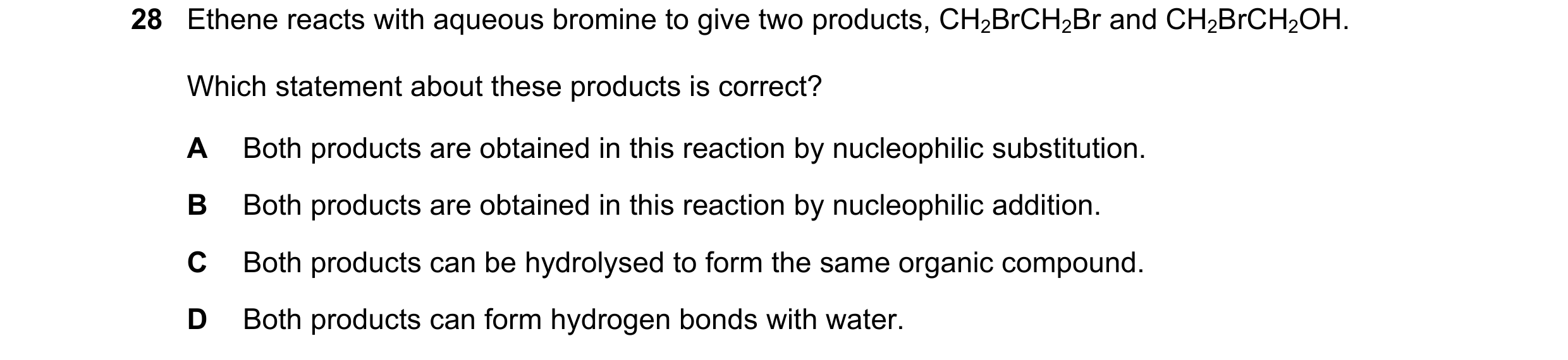
Q92 · Ethene reacts with aqueous bromine to give two products, CH2BrCH2Br and CH2BrCH2OH 9701/12 May/June 2020
28 Ethene reacts with aqueous bromine to give two products, CH2BrCH2Br and CH2BrCH2OH. Which statement about these products is correct? A Both products are obtained in this reaction by nucleophilic substitution. B Both products are obtained in this reaction by nucleophilic addition. C Both products can be hydrolysed to form the same organic compound. D Both products can form hydrogen bonds with water.
1 marks
Answer: C
This question in 9701/12 May/June 2020
Q93 · PVC is used as a packaging material 9701/12 May/June 2020
29 PVC is used as a packaging material. What holds the different polymer strands together in a piece of solid PVC? A covalent bonds B hydrogen bonds C ionic bonds D van der Waals’ forces
1 marks
Answer: D
This question in 9701/12 May/June 2020
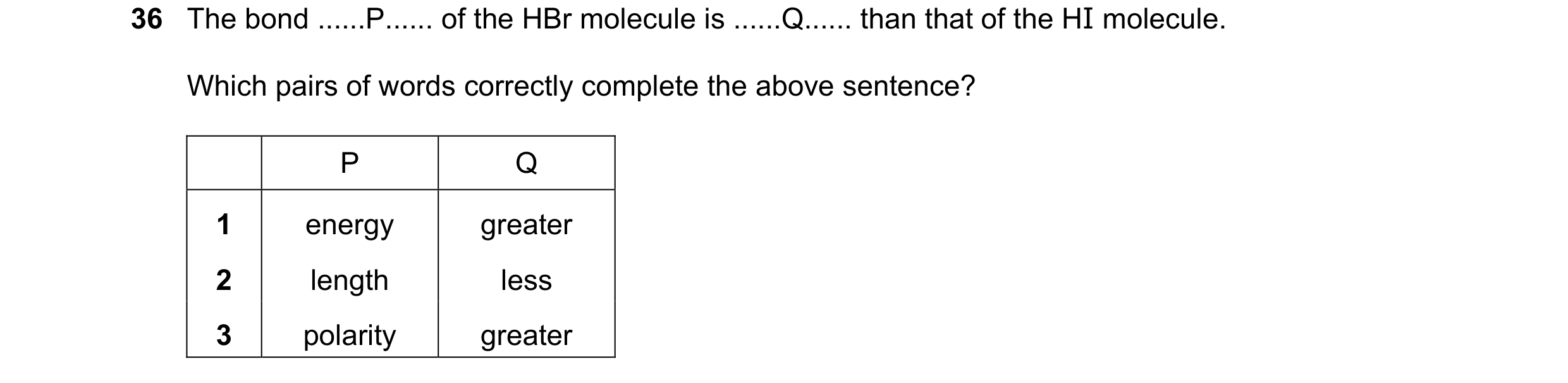
Q94 · The bond … P … of the HBr molecule is … Q … than that of the HI molecule 9701/12 May/June 2020
36 The bond … P … of the HBr molecule is … Q … than that of the HI molecule. Which pairs of words correctly complete the above sentence? P Q 1 energy greater 2 length less 3 polarity greater
1 marks
Answer: A
This question in 9701/12 May/June 2020
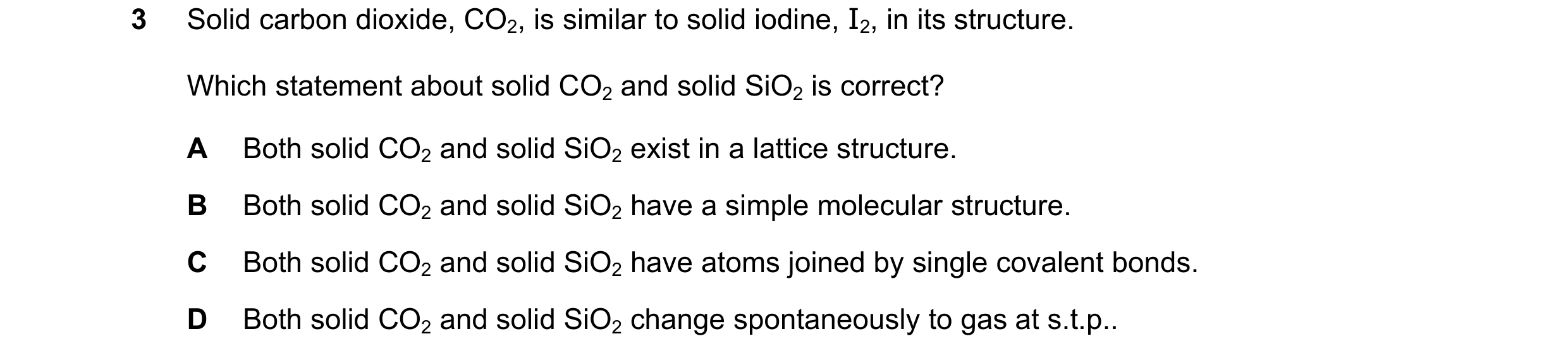
Q95 · Solid carbon dioxide, CO2, is similar to solid iodine, I2, in its structure 9701/13 May/June 2020
3 Solid carbon dioxide, CO2, is similar to solid iodine, I2, in its structure. Which statement about solid CO2 and solid SiO2 is correct? A Both solid CO2 and solid SiO2 exist in a lattice structure. B Both solid CO2 and solid SiO2 have a simple molecular structure. C Both solid CO2 and solid SiO2 have atoms joined by single covalent bonds. D Both solid CO2 and solid SiO2 change spontaneously to gas at s.t.p..
1 marks
Answer: A
This question in 9701/13 May/June 2020
Q96 · Which property explains the trend in volatility of the elements going down Group 17? 9701/13 May/June 2020
13 Which property explains the trend in volatility of the elements going down Group 17? A decreasing covalent bond strength B decreasing van der Waals’ forces C increasing covalent bond strength D increasing van der Waals’ forces
1 marks
Answer: D
This question in 9701/13 May/June 2020
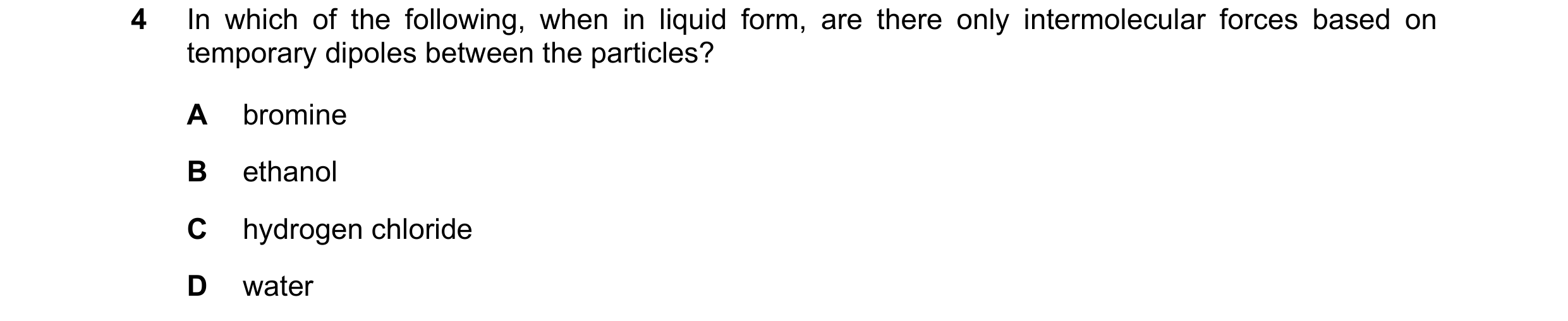
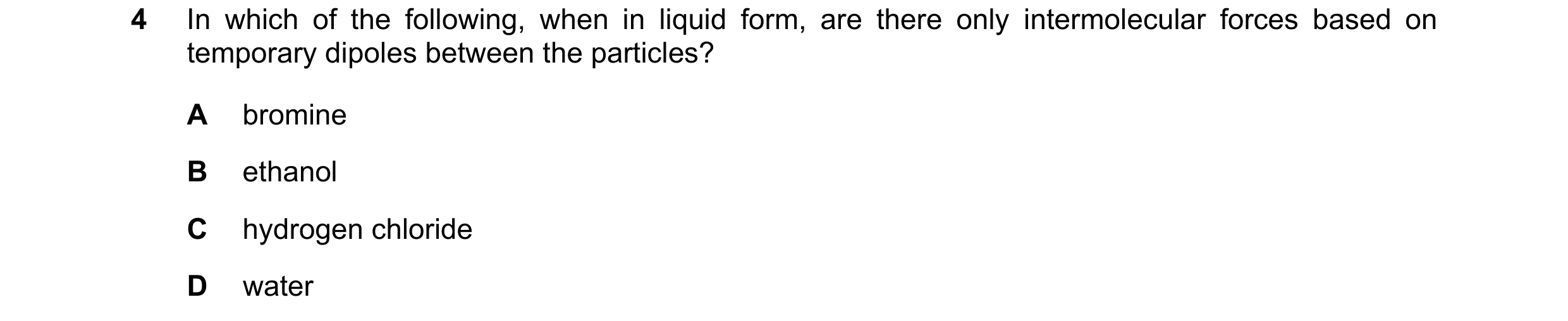
Q97 · In which of the following, when in liquid form, are there only intermolecular forces… 9701/11 Oct/Nov 2020
4 In which of the following, when in liquid form, are there only intermolecular forces based on temporary dipoles between the particles? A bromine B ethanol C hydrogen chloride D water
1 marks
Answer: A
This question in 9701/11 Oct/Nov 2020
Q98 · The repeat unit of a polymer is shown 9701/12 Oct/Nov 2020
32 The repeat unit of a polymer is shown. H CN C C H CO2C2H5 n Which types of intermolecular forces exist in the solid polymer? 1 temporary dipole – induced dipole interactions 2 permanent dipole – permanent dipole interactions 3 hydrogen bonds
1 marks
Answer: B
This question in 9701/12 Oct/Nov 2020
Q99 · In which of the following, when in liquid form, are there only intermolecular forces… 9701/13 Oct/Nov 2020
4 In which of the following, when in liquid form, are there only intermolecular forces based on temporary dipoles between the particles? A bromine B ethanol C hydrogen chloride D water
1 marks
Answer: A
This question in 9701/13 Oct/Nov 2020
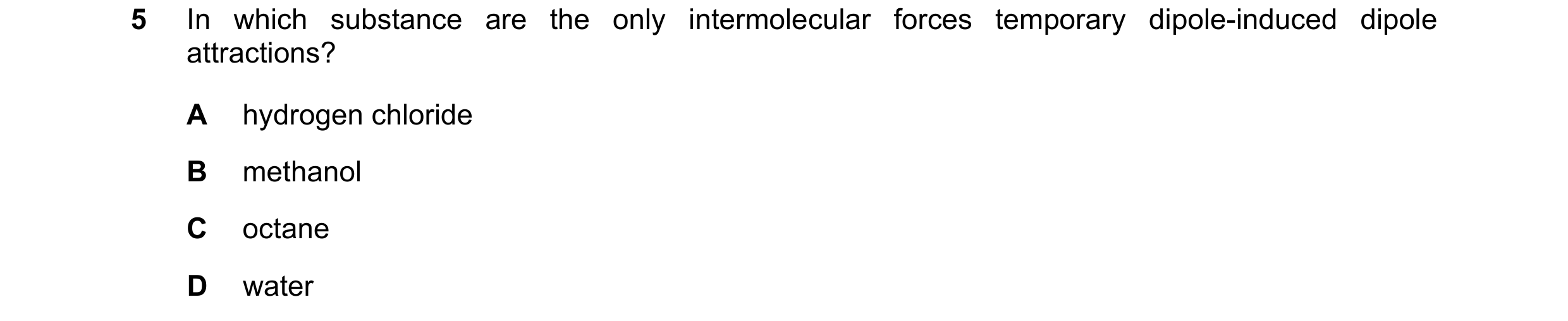
Q100 · In which substance are the only intermolecular forces temporary dipole-induced dipole… 9701/12 Feb/March 2021
5 In which substance are the only intermolecular forces temporary dipole-induced dipole attractions? A hydrogen chloride B methanol C octane D water
1 marks
Answer: C
This question in 9701/12 Feb/March 2021
Q101 · Many gases do not obey the general gas equation at high pressures 9701/12 Feb/March 2021
33 Many gases do not obey the general gas equation at high pressures. Why is this? 1 At higher pressures the molecules have more energy. 2 At higher pressures the volume of the molecules is a larger proportion of the total volume. 3 At higher pressures the molecules experience greater intermolecular forces.
1 marks
Answer: C
This question in 9701/12 Feb/March 2021
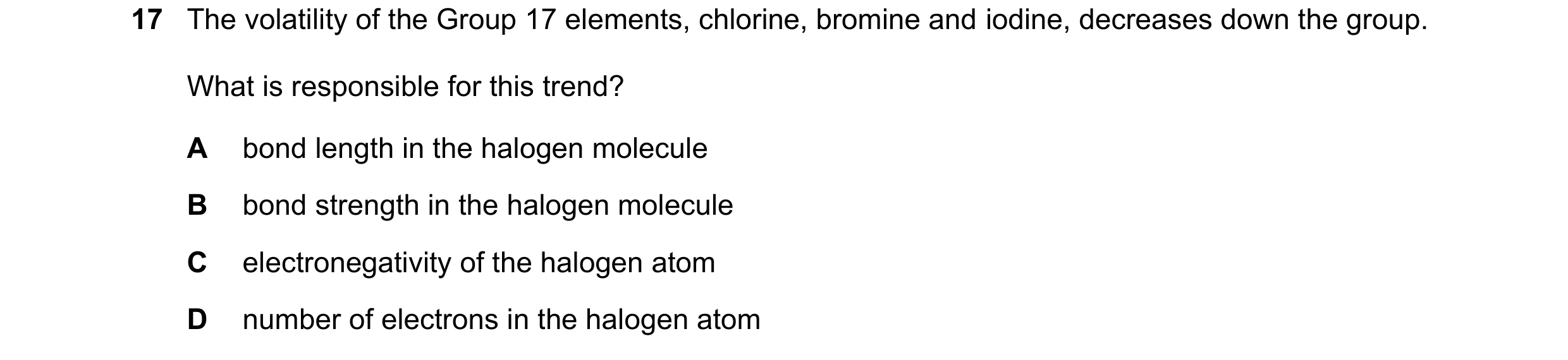
Q102 · The volatility of the Group 17 elements, chlorine, bromine and iodine, decreases down the… 9701/11 May/June 2021
17 The volatility of the Group 17 elements, chlorine, bromine and iodine, decreases down the group. What is responsible for this trend? A bond length in the halogen molecule B bond strength in the halogen molecule C electronegativity of the halogen atom D number of electrons in the halogen atom
1 marks
Answer: D
This question in 9701/11 May/June 2021
Q103 · The structures represent three compounds, each with four carbon atoms per molecule 9701/12 May/June 2021
3 The structures represent three compounds, each with four carbon atoms per molecule. X Y Z O O O OH O O–Na+ Which row is correct? lowest highest boiling point boiling point A X Y Z B Y X Z C Z X Y D Z Y X
1 marks
Answer: B
This question in 9701/12 May/June 2021
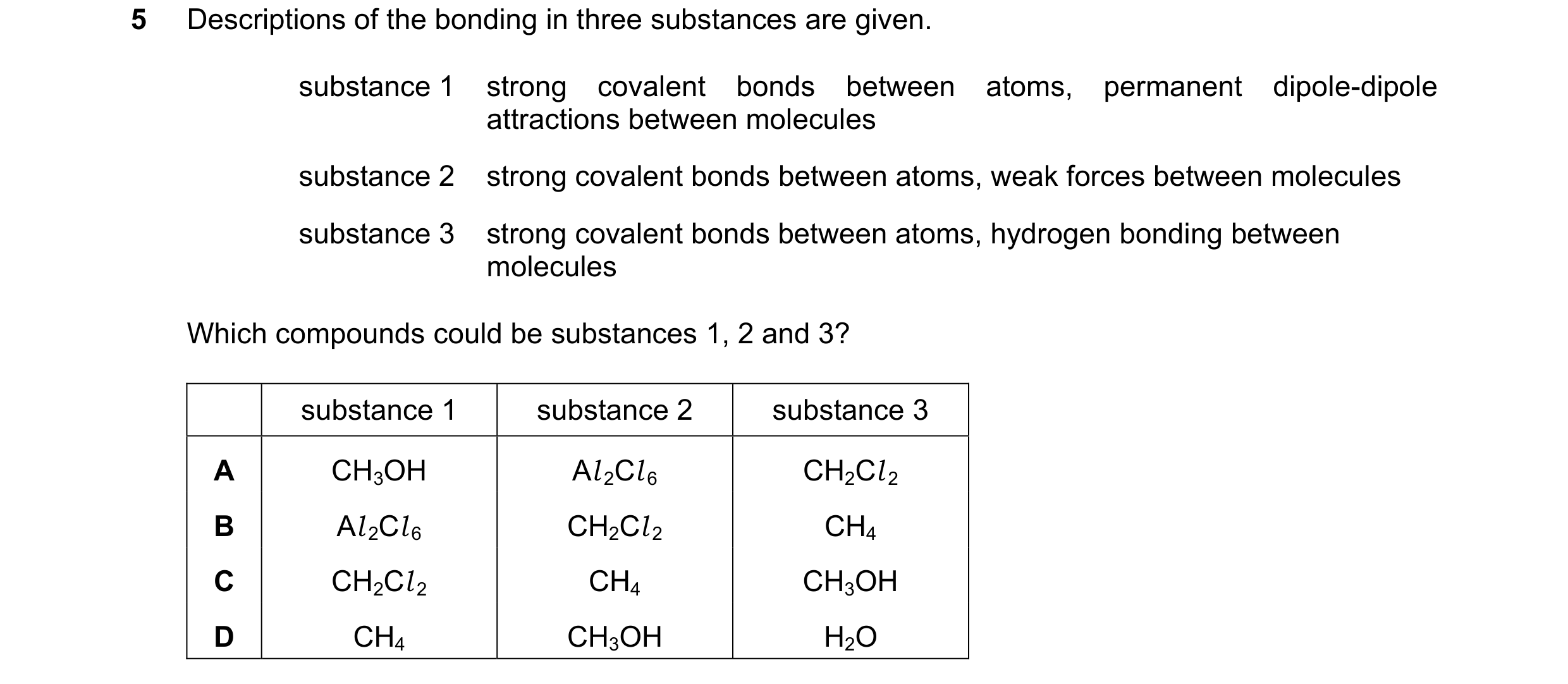
Q104 · Descriptions of the bonding in three substances are given 9701/13 May/June 2021
5 Descriptions of the bonding in three substances are given. substance 1 strong covalent bonds between atoms, permanent dipole-dipole attractions between molecules substance 2 strong covalent bonds between atoms, weak forces between molecules substance 3 strong covalent bonds between atoms, hydrogen bonding between molecules Which compounds could be substances 1, 2 and 3? substance 1 substance 2 substance 3 A CH3OH Al 2Cl 6 CH2Cl 2 B Al 2Cl 6 CH2Cl 2 CH4 C CH2Cl 2 CH4 CH3OH D CH4 CH3OH H2O
1 marks
Answer: C
This question in 9701/13 May/June 2021
Q105 · Which type of interaction exists between water molecules and metal cations in aqueous… 9701/11 Oct/Nov 2021
5 Which type of interaction exists between water molecules and metal cations in aqueous solution? A dipole-dipole interactions B hydrogen bonds C ion-dipole interactions D ionic bonds
1 marks
Answer: C
This question in 9701/11 Oct/Nov 2021
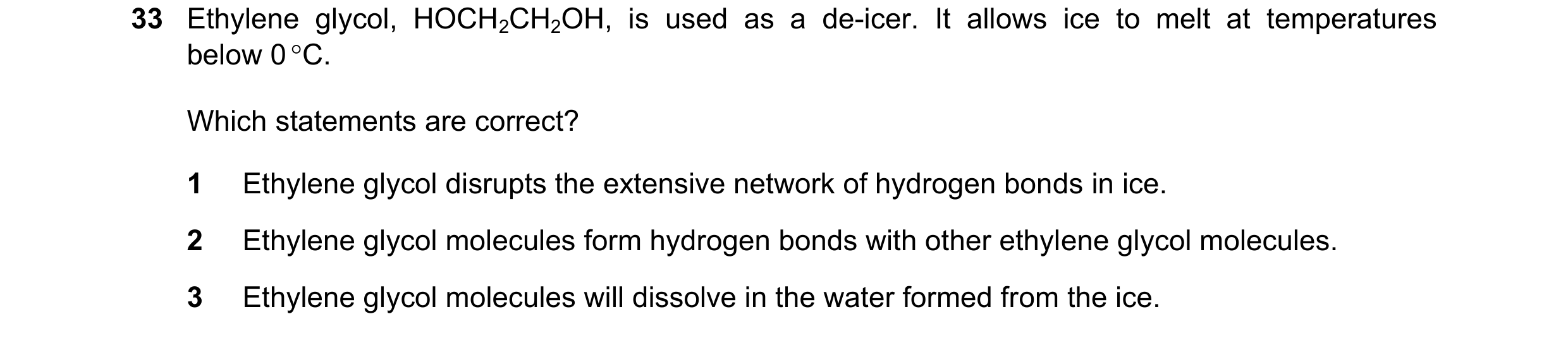
Q106 · Ethylene glycol, HOCH2CH2OH, is used as a de-icer 9701/11 Oct/Nov 2021
33 Ethylene glycol, HOCH2CH2OH, is used as a de-icer. It allows ice to melt at temperatures below 0 C. Which statements are correct? 1 Ethylene glycol disrupts the extensive network of hydrogen bonds in ice. 2 Ethylene glycol molecules form hydrogen bonds with other ethylene glycol molecules. 3 Ethylene glycol molecules will dissolve in the water formed from the ice.
1 marks
Answer: A
This question in 9701/11 Oct/Nov 2021
Q107 · Which molecule has the largest overall dipole? 9701/12 Oct/Nov 2021
6 Which molecule has the largest overall dipole? A B C D Cl Cl H Cl C C O C O C O C O Cl Cl H Cl
1 marks
Answer: B
This question in 9701/12 Oct/Nov 2021
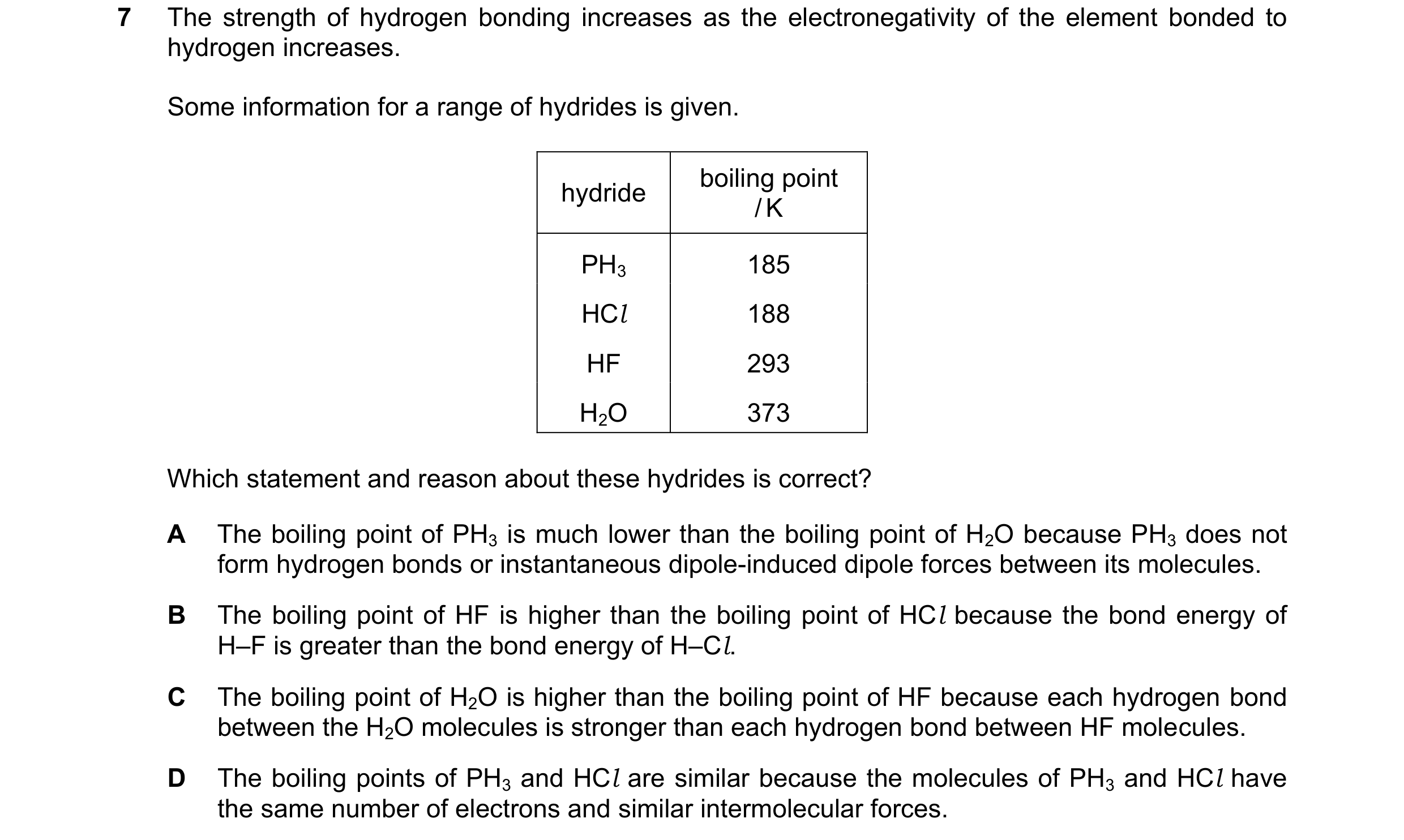
Q108 · The strength of hydrogen bonding increases as the electronegativity of the element bonded… 9701/12 Oct/Nov 2021
7 The strength of hydrogen bonding increases as the electronegativity of the element bonded to hydrogen increases. Some information for a range of hydrides is given. boiling point hydride / K PH3 185 HCl 188 HF 293 H2O 373 Which statement and reason about these hydrides is correct? A The boiling point of PH3 is much lower than the boiling point of H2O because PH3 does not form hydrogen bonds or instantaneous dipole-induced dipole forces between its molecules. B The boiling point of HF is higher than the boiling point of HCl because the bond energy of H–F is greater than the bond energy of H–Cl. C The boiling point of H2O is higher than the boiling point of HF because each hydrogen bond between the H2O molecules is stronger than each hydrogen bond between HF molecules. D The boiling points of PH3 and HCl are similar because the molecules of PH3 and HCl have the same number of electrons and similar intermolecular forces.
1 marks
Answer: D
This question in 9701/12 Oct/Nov 2021
Q109 · Which type of interaction exists between water molecules and metal cations in aqueous… 9701/13 Oct/Nov 2021
5 Which type of interaction exists between water molecules and metal cations in aqueous solution? A dipole-dipole interactions B hydrogen bonds C ion-dipole interactions D ionic bonds
1 marks
Answer: C
This question in 9701/13 Oct/Nov 2021
Q110 · Ethylene glycol, HOCH2CH2OH, is used as a de-icer 9701/13 Oct/Nov 2021
33 Ethylene glycol, HOCH2CH2OH, is used as a de-icer. It allows ice to melt at temperatures below 0 C. Which statements are correct? 1 Ethylene glycol disrupts the extensive network of hydrogen bonds in ice. 2 Ethylene glycol molecules form hydrogen bonds with other ethylene glycol molecules. 3 Ethylene glycol molecules will dissolve in the water formed from the ice.
1 marks
Answer: A
This question in 9701/13 Oct/Nov 2021
Q111 · For which pair is the boiling point of the first compound higher than the boiling point… 9701/11 May/June 2022
8 For which pair is the boiling point of the first compound higher than the boiling point of the second compound? A CH3CH2OH and CH3CH2SH B CH3CO2CH3 and CH3CH2CO2H C CH3OCH3 and CH3CH2OH D CH3CH2CHO and CH3CH2CO2H
1 marks
Answer: A
This question in 9701/11 May/June 2022
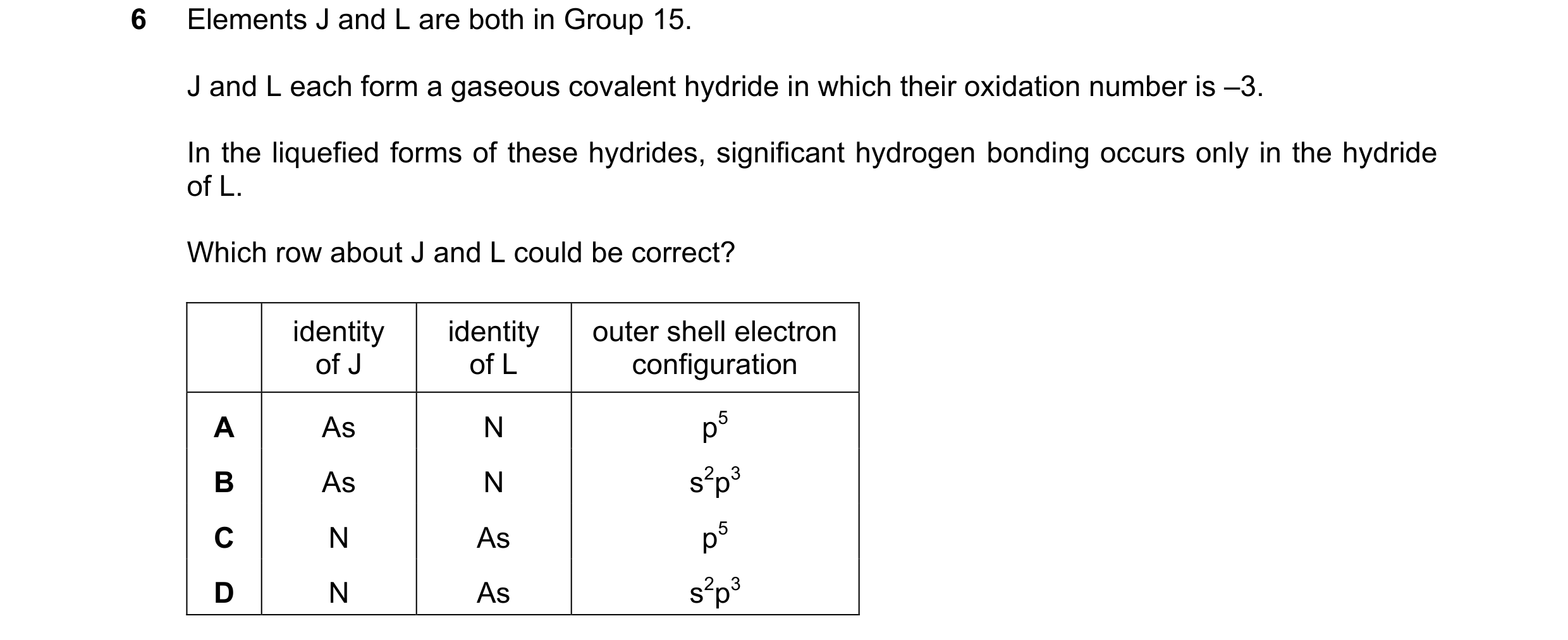
Q112 · Elements J and L are both in Group 15 9701/12 May/June 2022
6 Elements J and L are both in Group 15. J and L each form a gaseous covalent hydride in which their oxidation number is –3. In the liquefied forms of these hydrides, significant hydrogen bonding occurs only in the hydride of L. Which row about J and L could be correct? identity identity outer shell electron of J of L configuration A As N p5 B As N s2p3 C N As p5 D N As s2p3
1 marks
Answer: B
This question in 9701/12 May/June 2022
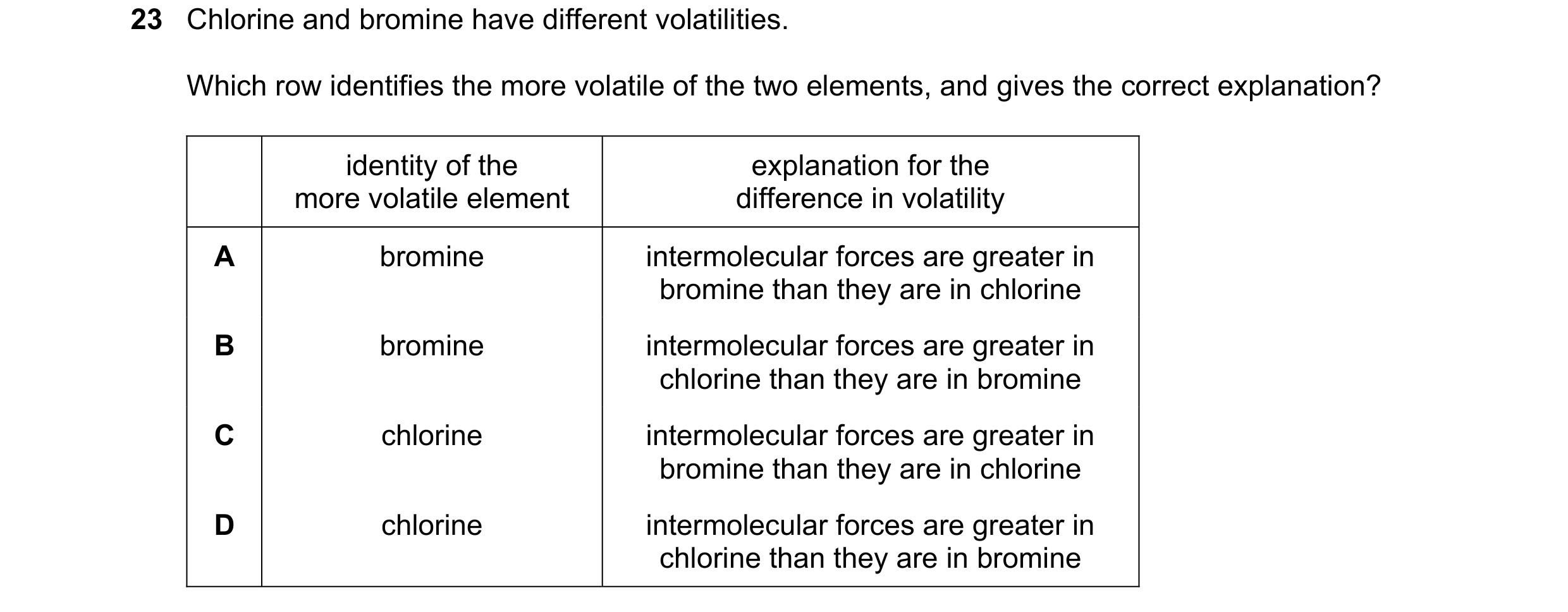
Q113 · Chlorine and bromine have different volatilities 9701/13 May/June 2022
23 Chlorine and bromine have different volatilities. Which row identifies the more volatile of the two elements, and gives the correct explanation? identity of the explanation for the more volatile element difference in volatility A bromine intermolecular forces are greater in bromine than they are in chlorine B bromine intermolecular forces are greater in chlorine than they are in bromine C chlorine intermolecular forces are greater in bromine than they are in chlorine D chlorine intermolecular forces are greater in chlorine than they are in bromine
1 marks
Answer: C
This question in 9701/13 May/June 2022
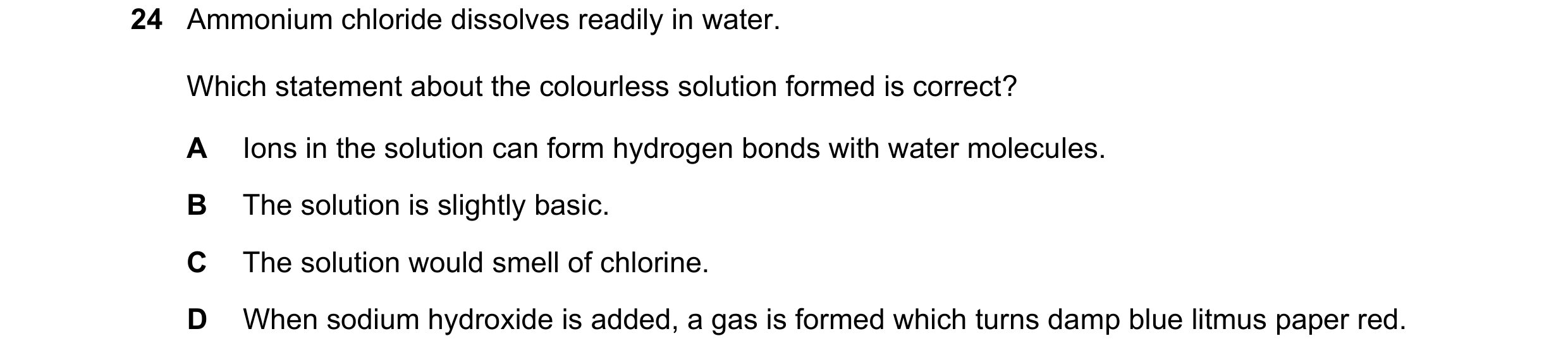
Q114 · Ammonium chloride dissolves readily in water 9701/13 May/June 2022
24 Ammonium chloride dissolves readily in water. Which statement about the colourless solution formed is correct? A Ions in the solution can form hydrogen bonds with water molecules. B The solution is slightly basic. C The solution would smell of chlorine. D When sodium hydroxide is added, a gas is formed which turns damp blue litmus paper red.
1 marks
Answer: A
This question in 9701/13 May/June 2022
Q115 · In a sample of pure water, what is the maximum number of hydrogen bonds that one molecule… 9701/12 Feb/March 2023
14 In a sample of pure water, what is the maximum number of hydrogen bonds that one molecule of water can be involved in? A 1 B 2 C 3 D 4
1 marks
Answer: D
This question in 9701/12 Feb/March 2023
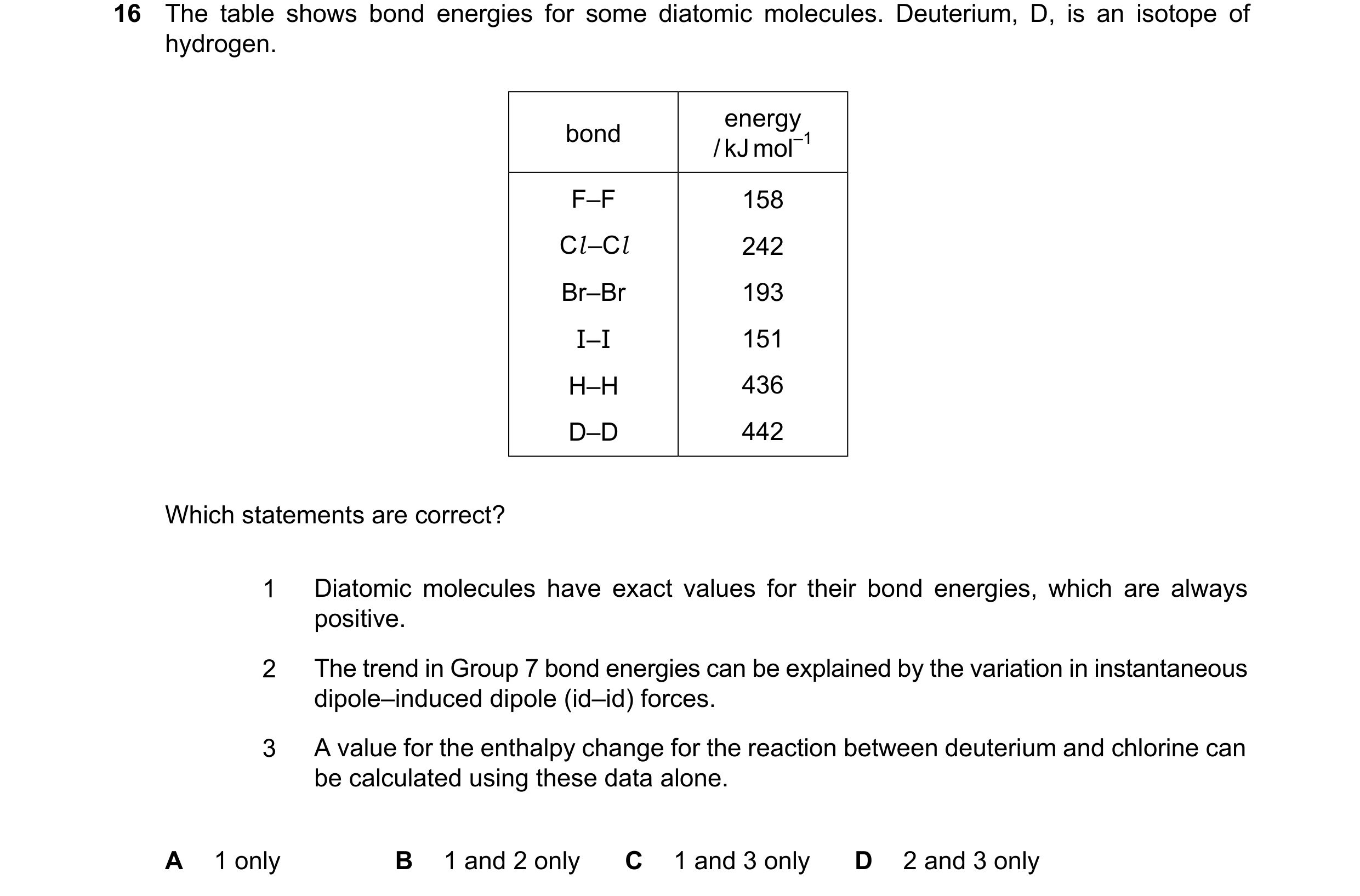
Q116 · The table shows bond energies for some diatomic molecules 9701/12 Feb/March 2023
16 The table shows bond energies for some diatomic molecules. Deuterium, D, is an isotope of hydrogen. energy bond /kJmol–1 F–F 158 Cl–Cl 242 Br–Br 193 I–I 151 H–H 436 D–D 442 Which statements are correct? 1 Diatomic molecules have exact values for their bond energies, which are always positive. 2 The trend in Group 7 bond energies can be explained by the variation in instantaneous dipole–induced dipole (id–id) forces. 3 A value for the enthalpy change for the reaction between deuterium and chlorine can be calculated using these data alone. A 1 only B 1 and 2 only C 1 and 3 only D 2 and 3 only
1 marks
Answer: A
This question in 9701/12 Feb/March 2023
Q117 · Which statement explains why buckminsterfullerene has a lower melting point than graphite? 9701/13 May/June 2023
9 Which statement explains why buckminsterfullerene has a lower melting point than graphite? A Buckminsterfullerene exists as discrete molecules with weak intermolecular bonding. B Graphite is partly ionic as its structure contains mobile electrons and it conducts electricity. C The carbon–carbon bonds in buckminsterfullerene are shorter and more strained. D The mobile electrons in graphite mean it has a metallic structure.
1 marks
Answer: A
This question in 9701/13 May/June 2023
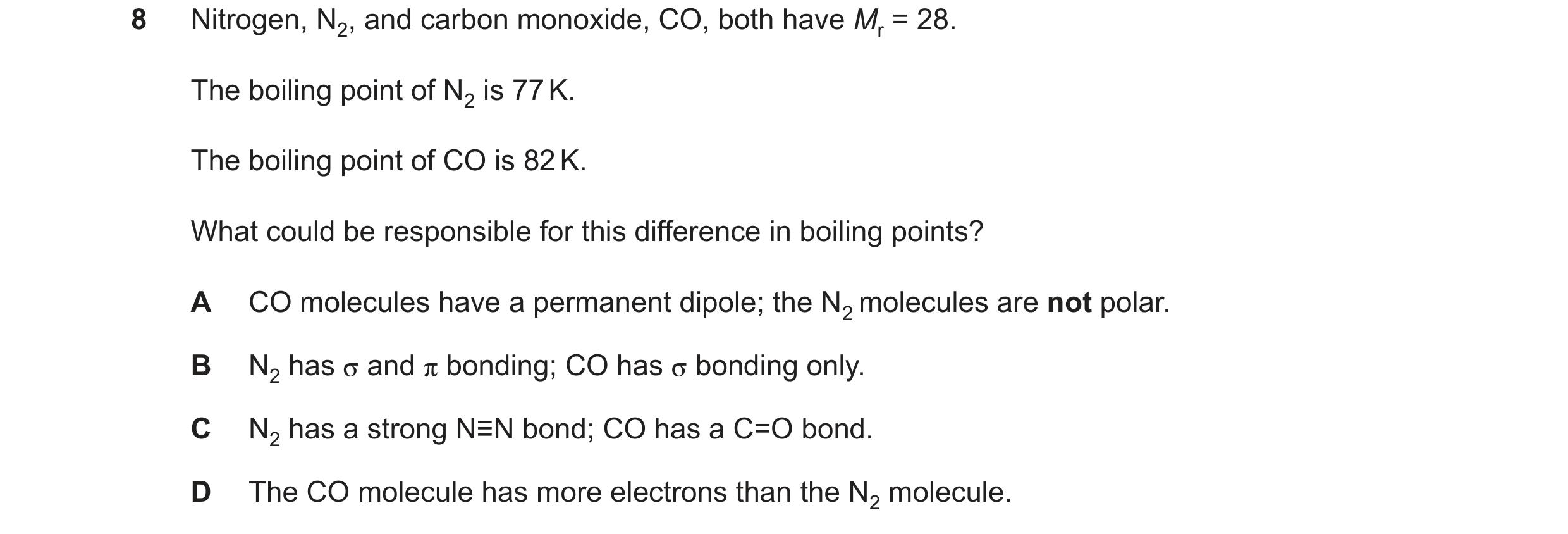
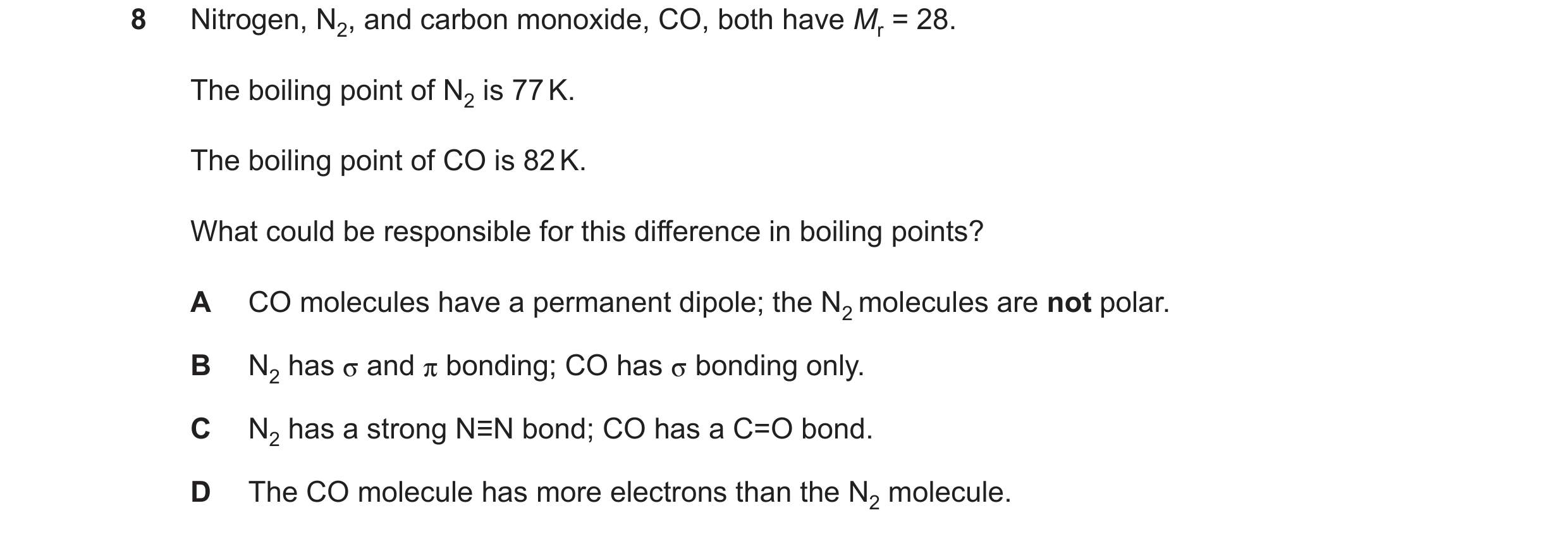
Q118 · Nitrogen, N2, and carbon monoxide, CO, both have Mr = 28 9701/11 Oct/Nov 2023
8 Nitrogen, N2, and carbon monoxide, CO, both have Mr = 28. The boiling point of N2 is 77K. The boiling point of CO is 82K. What could be responsible for this difference in boiling points? A CO molecules have a permanent dipole; the N2 molecules are not polar. B N2 has and bonding; CO has bonding only. C N2 has a strong NŁN bond; CO has a C=O bond. D The CO molecule has more electrons than the N2 molecule.
1 marks
Answer: A
This question in 9701/11 Oct/Nov 2023
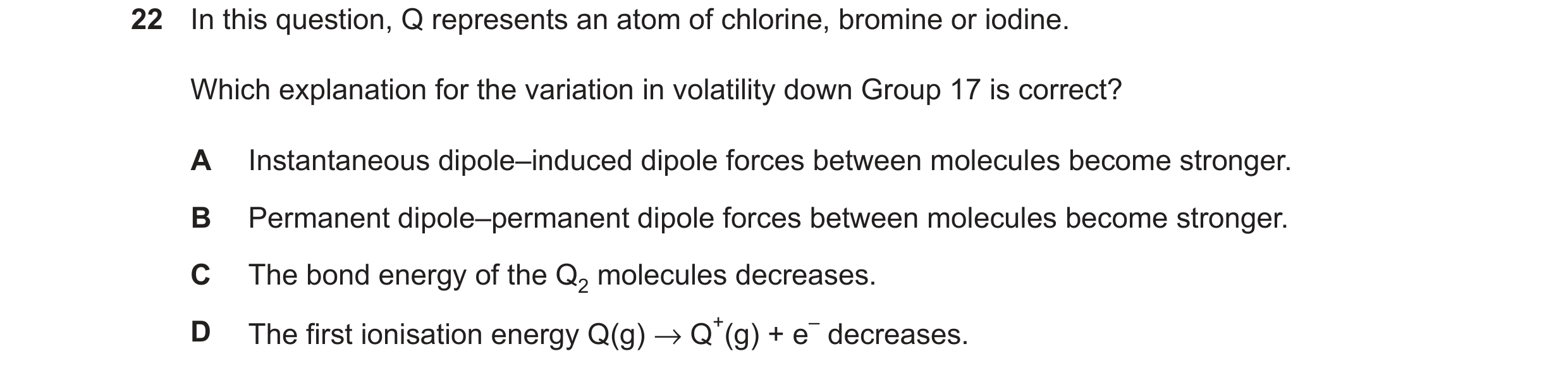
Q119 · In this question, Q represents an atom of chlorine, bromine or iodine 9701/11 Oct/Nov 2023
22 In this question, Q represents an atom of chlorine, bromine or iodine. Which explanation for the variation in volatility down Group 17 is correct? A Instantaneous dipole–induced dipole forces between molecules become stronger. B Permanent dipole–permanent dipole forces between molecules become stronger. C The bond energy of the Q2 molecules decreases. D The first ionisation energy Q(g) →Q+(g) + e– decreases.
1 marks
Answer: A
This question in 9701/11 Oct/Nov 2023
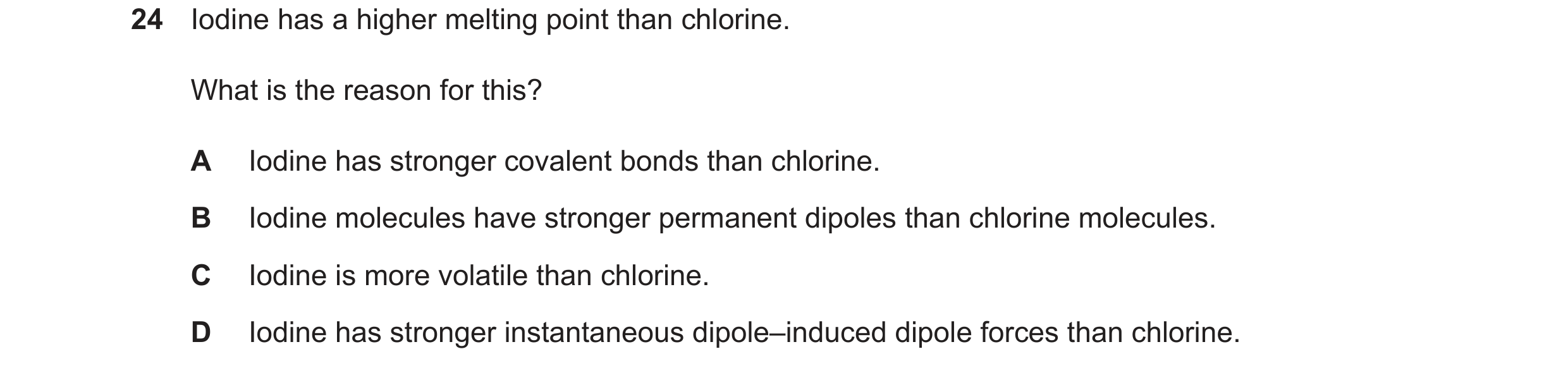
Q120 · Iodine has a higher melting point than chlorine 9701/12 Oct/Nov 2023
24 Iodine has a higher melting point than chlorine. What is the reason for this? A Iodine has stronger covalent bonds than chlorine. B Iodine molecules have stronger permanent dipoles than chlorine molecules. C Iodine is more volatile than chlorine. D Iodine has stronger instantaneous dipole–induced dipole forces than chlorine.
1 marks
Answer: D
This question in 9701/12 Oct/Nov 2023
Q121 · Nitrogen, N2, and carbon monoxide, CO, both have Mr = 28 9701/13 Oct/Nov 2023
8 Nitrogen, N2, and carbon monoxide, CO, both have Mr = 28. The boiling point of N2 is 77K. The boiling point of CO is 82K. What could be responsible for this difference in boiling points? A CO molecules have a permanent dipole; the N2 molecules are not polar. B N2 has and bonding; CO has bonding only. C N2 has a strong N≡N bond; CO has a C=O bond. D The CO molecule has more electrons than the N2 molecule.
1 marks
Answer: A
This question in 9701/13 Oct/Nov 2023
Q122 · In this question, Q represents an atom of chlorine, bromine or iodine 9701/13 Oct/Nov 2023
22 In this question, Q represents an atom of chlorine, bromine or iodine. Which explanation for the variation in volatility down Group 17 is correct? A Instantaneous dipole–induced dipole forces between molecules become stronger. B Permanent dipole–permanent dipole forces between molecules become stronger. C The bond energy of the Q2 molecules decreases. D The first ionisation energy Q(g) →Q+(g) + e– decreases.
1 marks
Answer: A
This question in 9701/13 Oct/Nov 2023
Q123 · At room temperature and pressure, H2O is a liquid and H2S is a gas 9701/12 Feb/March 2024
8 At room temperature and pressure, H2O is a liquid and H2S is a gas. What is the reason for this difference of state? A O has higher first and second ionisation energies than S. B The covalent bond between O and H is stronger than the covalent bond between S and H. C There is significant hydrogen bonding between H2O molecules but not between H2S molecules. D The instantaneous dipole-induced dipole forces between H2O molecules are stronger than the instantaneous dipole-induced dipole forces between H2S molecules.
1 marks
Answer: C
This question in 9701/12 Feb/March 2024
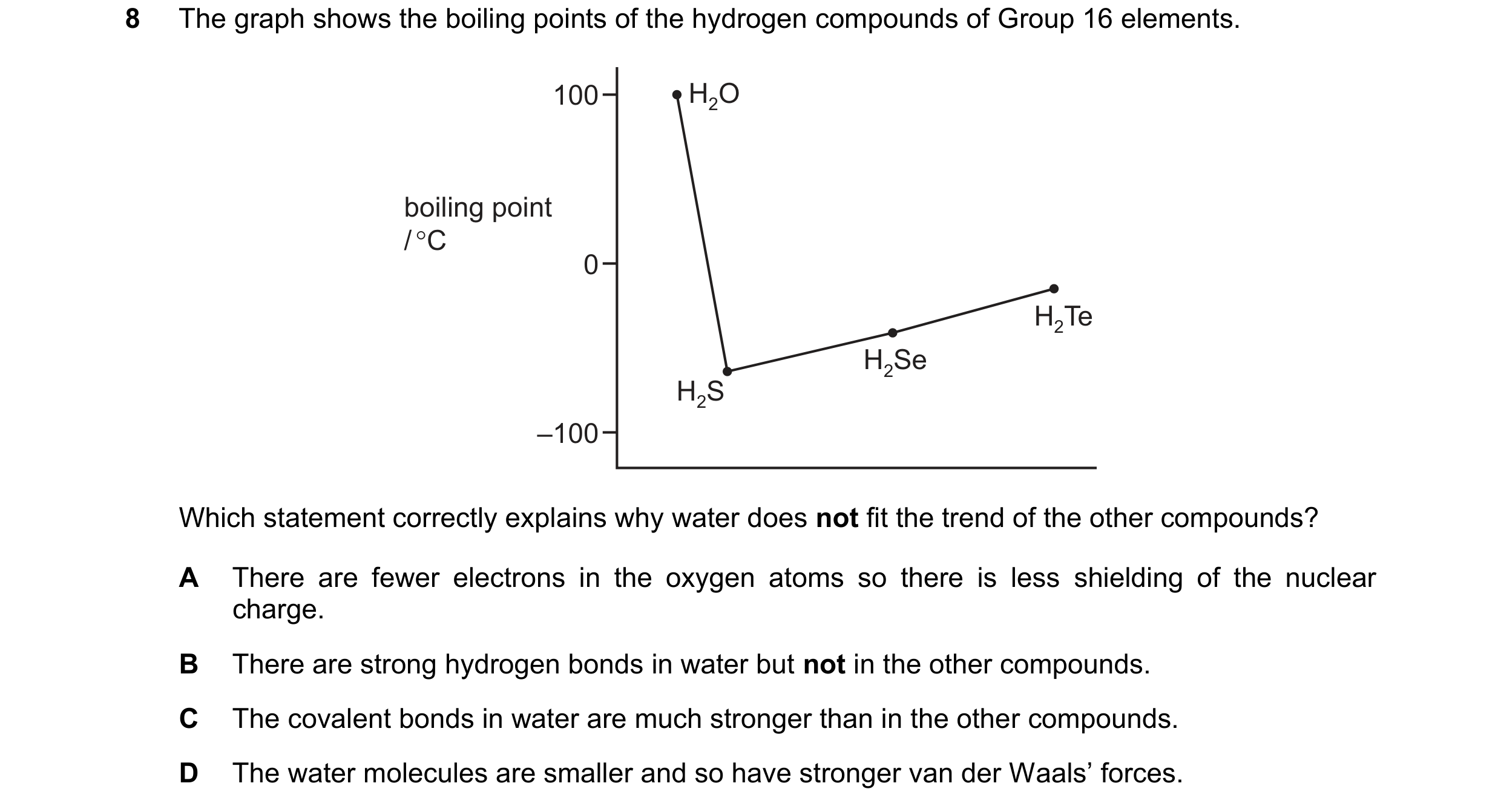
Q124 · The graph shows the boiling points of the hydrogen compounds of Group 16 elements 9701/11 May/June 2024
8 The graph shows the boiling points of the hydrogen compounds of Group 16 elements.
100
boiling point
°C
—100
Which statement correctly explains why water does not fit the trend of the other compounds?
A_ There are fewer electrons in the oxygen atoms so there is less shielding of the nuclear
charge.
There are strong hydrogen bonds in water but not in the other compounds.
The covalent bonds in water are much stronger than in the other compounds.
The water molecules are smaller and so have stronger van der Waals’ forces.
1 marks
Answer: B
This question in 9701/11 May/June 2024
Q125 · Consider the following four compounds 9701/12 May/June 2024
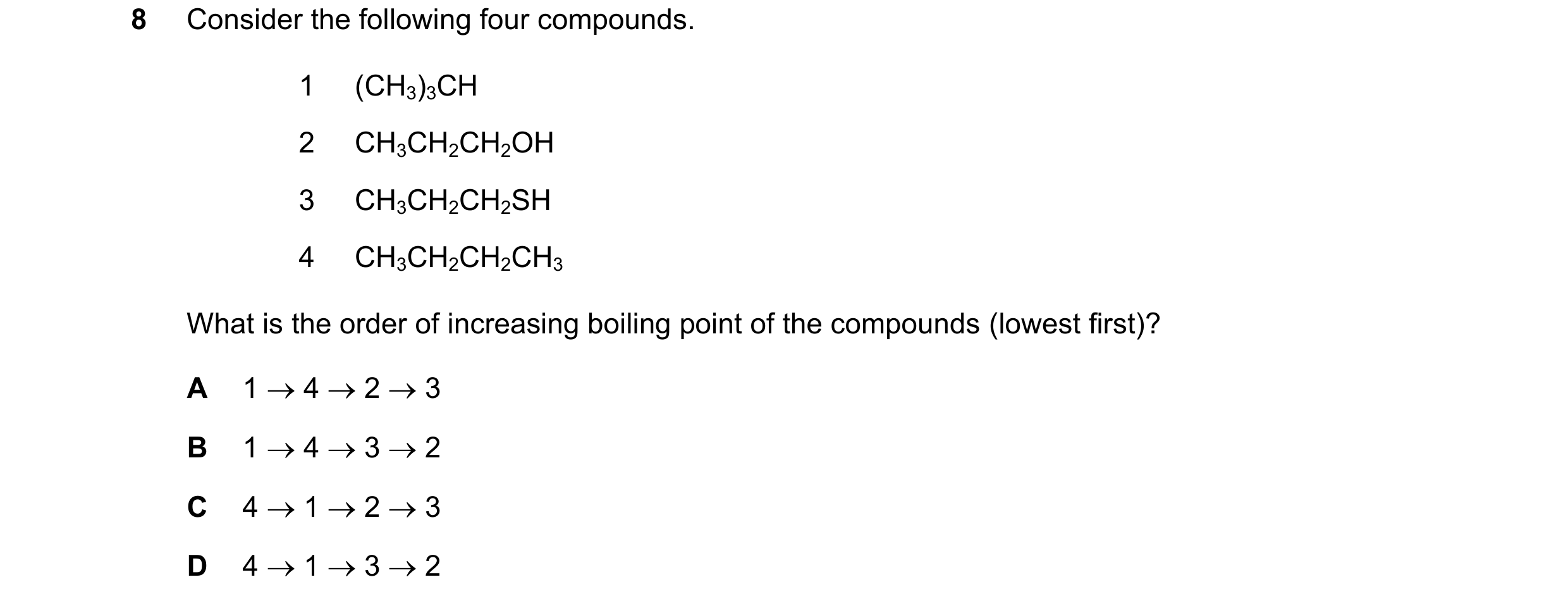
8 Consider the following four compounds. 1 (CH3)3CH 2 CH3CH2CH2OH 3 CH3CH2CH2SH 4 CH3CH2CH2CH3 What is the order of increasing boiling point of the compounds (lowest first)? A 1 4 2 3 B 1 4 3 2 C 4 1 2 3 D 4 1 3 2
1 marks
Answer: B
This question in 9701/12 May/June 2024
Q126 · Which solid has a simple molecular lattice? 9701/11 Oct/Nov 2024
8 Which solid has a simple molecular lattice? A calcium fluoride B nickel C silicon(IV) oxide D sulfur
1 marks
Answer: D
This question in 9701/11 Oct/Nov 2024
Q127 · Why does ICl have a higher boiling point than Br2? 9701/12 Oct/Nov 2024
6 Why does ICl have a higher boiling point than Br2? A because of the difference in the bond energies of the covalent bonds within ICl and Br2 B because of the difference in the polar nature of ICl and Br2 C because of the difference in the number of electrons contained within ICl and Br2 D because of the difference in the relative molecular mass of ICl and Br2
1 marks
Answer: B
This question in 9701/12 Oct/Nov 2024
Q128 · Three statements about the halogens, chlorine, bromine and iodine and their compounds are… 9701/11 May/June 2025
18 Three statements about the halogens, chlorine, bromine and iodine and their compounds are listed. 1 The halogen with the highest boiling point has atoms which form the strongest bond to hydrogen. 2 The halogen with the strongest instantaneous dipole (id–id) attractions forms the most thermally stable hydrogen halide. 3 The most volatile element most rapidly oxidises hydrogen. Which statements are correct? A 1 and 2 B 1 only C 2 and 3 D 3 only
1 marks
Answer: D
This question in 9701/11 May/June 2025
Q129 · Consider the following statements 9701/12 May/June 2025
1 Consider the following statements. 1 Silicon dioxide has a higher melting point than sulfur dioxide. 2 Ammonia has a higher boiling point than phosphine, PH3. Which statements are correct? A both statement 1 and statement 2 B statement 1 only C statement 2 only D neither statement 1 nor statement 2
1 marks
Mark scheme: Question Answer Marks 1 A 1
This question in 9701/12 May/June 2025
Q130 · The average intermolecular forces in water are much stronger than the average… 9701/12 May/June 2025
10 The average intermolecular forces in water are much stronger than the average intermolecular forces in steam. The average intermolecular forces in ice are slightly stronger than the average intermolecular forces in water. Enthalpy changes are associated with the equilibrium processes shown. H2O(l) H2O(g) Hb H2O(s) H2O(l) Hm Which statements are correct? 1 Hb and Hm are both negative. 2 Hb is greater than Hm. 3 The intermolecular forces in ice and water are of the same type. A 1, 2 and 3 B 1 and 2 only C 1 and 3 only D 2 and 3 only
1 marks
Answer: D
This question in 9701/12 May/June 2025
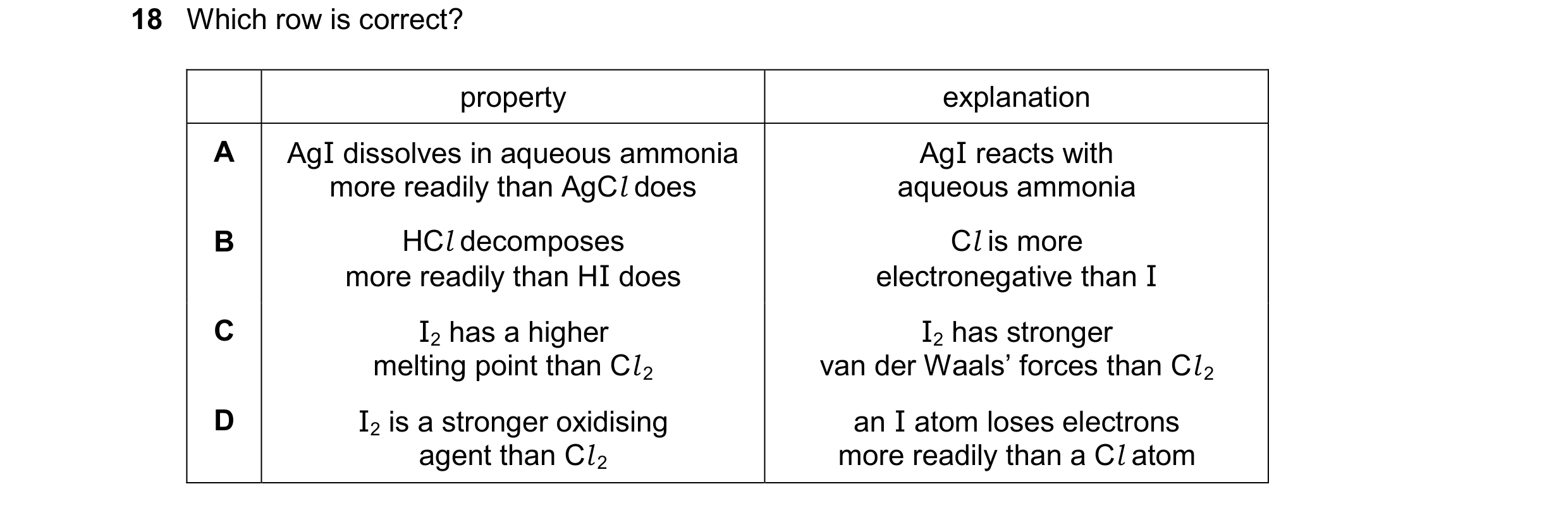
Q131 · Which row is correct? 9701/14 May/June 2025
18 Which row is correct? property explanation A AgI dissolves in aqueous ammonia AgI reacts with more readily than AgCl does aqueous ammonia B HCl decomposes Cl is more more readily than HI does electronegative than I C I2 has a higher I2 has stronger melting point than Cl 2 van der Waals’ forces than Cl 2 D I2 is a stronger oxidising an I atom loses electrons agent than Cl 2 more readily than a Cl atom
1 marks
Answer: C
This question in 9701/14 May/June 2025
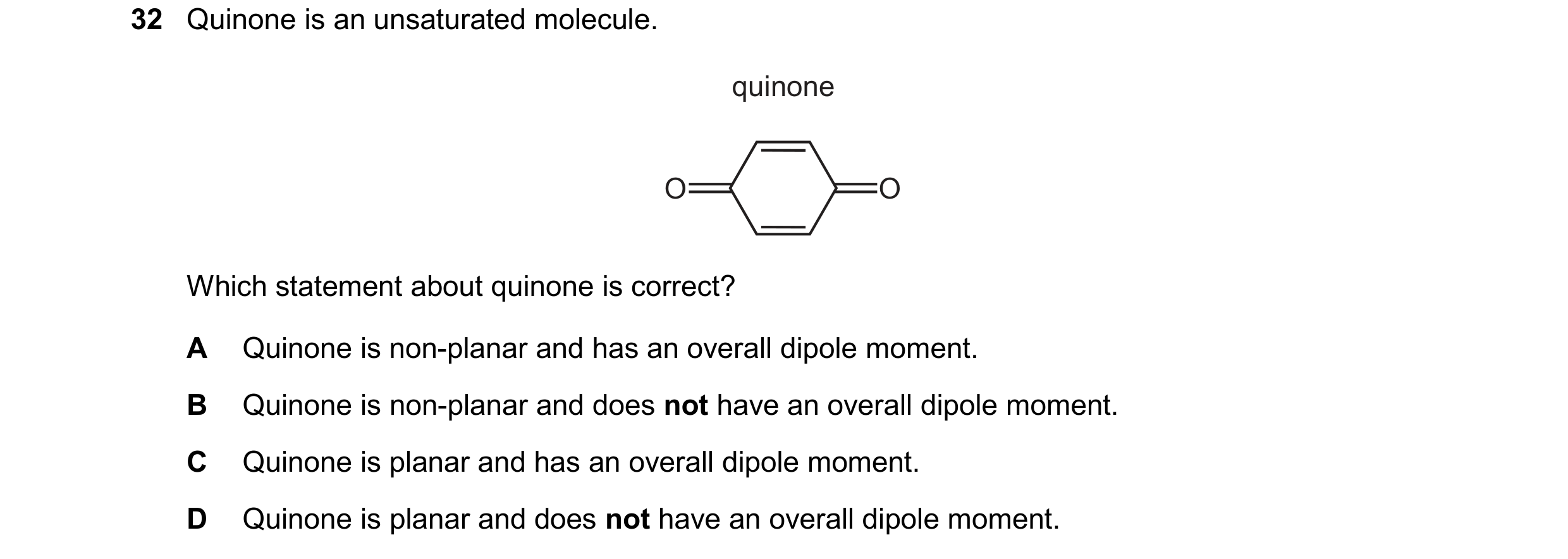
Q132 · Quinone is an unsaturated molecule 9701/14 May/June 2025
32 Quinone is an unsaturated molecule. quinone O O Which statement about quinone is correct? A Quinone is non-planar and has an overall dipole moment. B Quinone is non-planar and does not have an overall dipole moment. C Quinone is planar and has an overall dipole moment. D Quinone is planar and does not have an overall dipole moment.
1 marks
Answer: D
This question in 9701/14 May/June 2025
Q133 · Which statement explains why sodium and potassium have different melting points? 9701/11 Oct/Nov 2025
5 Which statement explains why sodium and potassium have different melting points? A The attraction between cations and delocalised electrons is stronger in sodium. B The attraction between cations and anions is stronger in sodium. C The attraction between atoms is stronger in sodium. D The attraction between nuclei and shared electron pairs is stronger in sodium.
1 marks
Answer: A
This question in 9701/11 Oct/Nov 2025



 1 / 29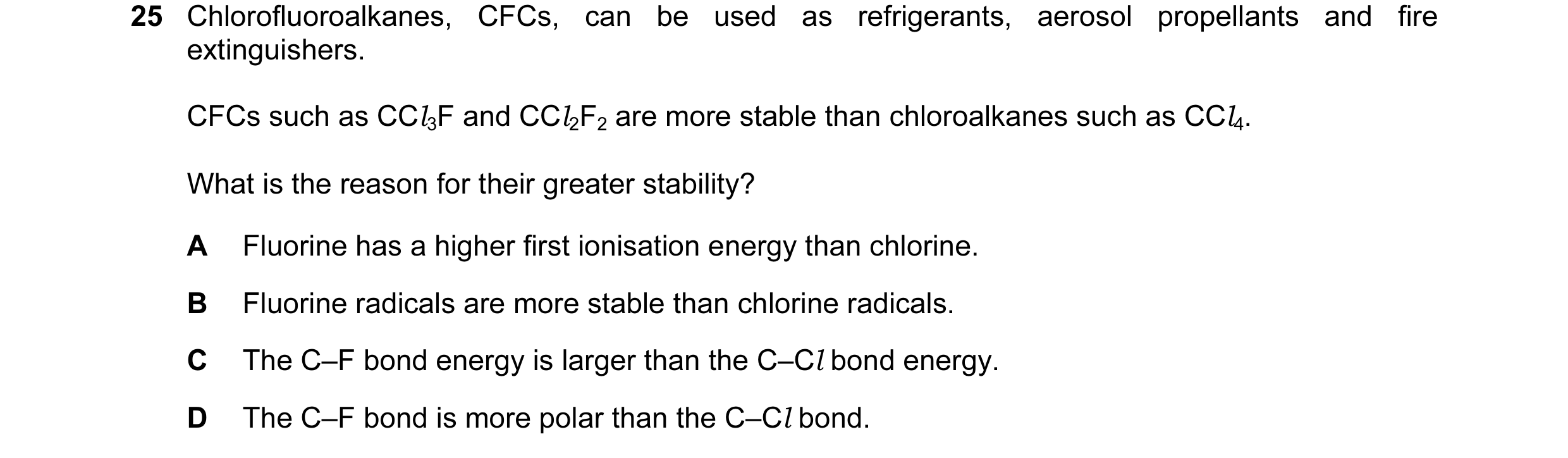

 2 / 29
![Question 12: Which statement explains why the boiling point of methane is higher than that of neon? [Ar: H, 1; C, 12; Ne, 20] A A molecule of methane ha…](https://img.pastlit.com/crops/f49b26eb-2498-4b89-b10f-8c725d4e68de/q5.png)


 3 / 29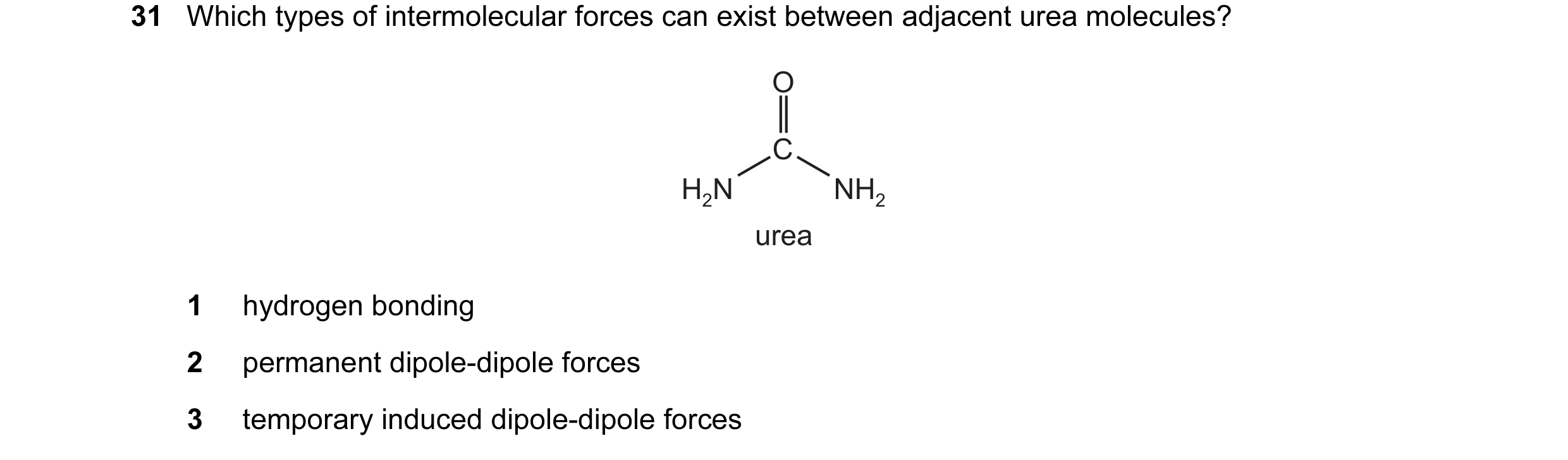




 4 / 29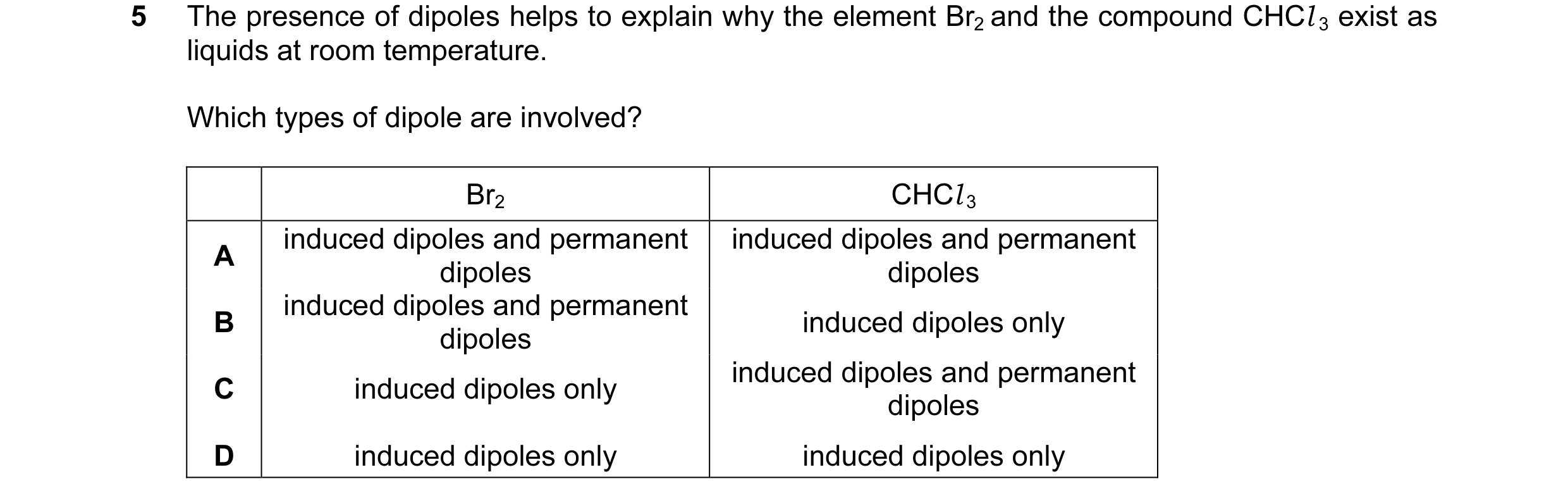


 5 / 29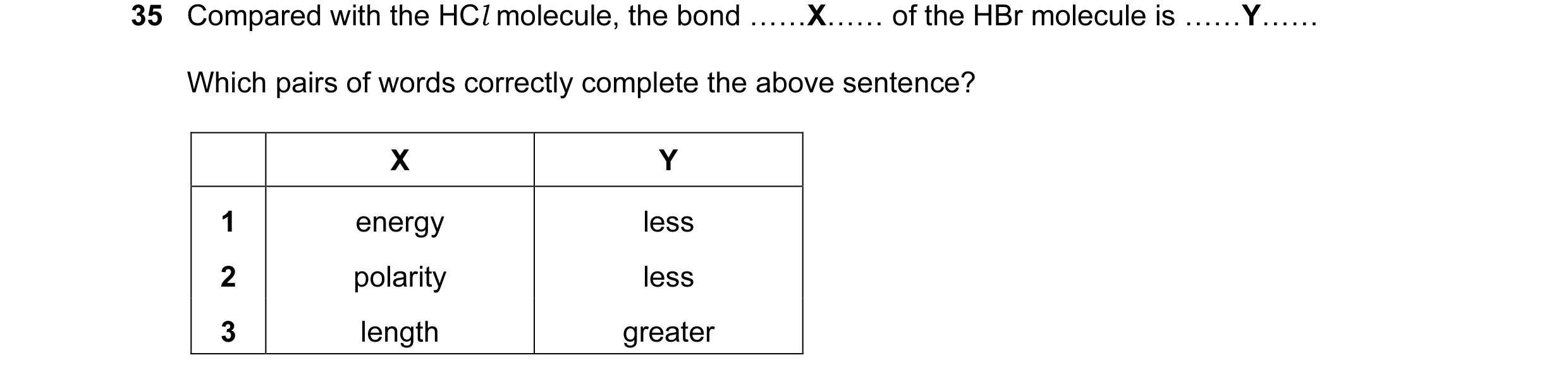
 6 / 29
 7 / 29

 8 / 29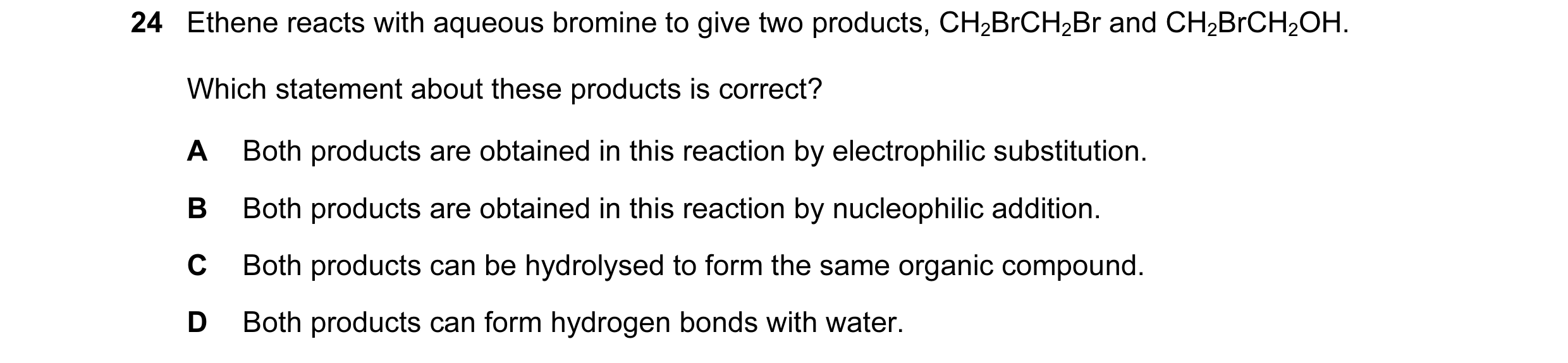
 9 / 29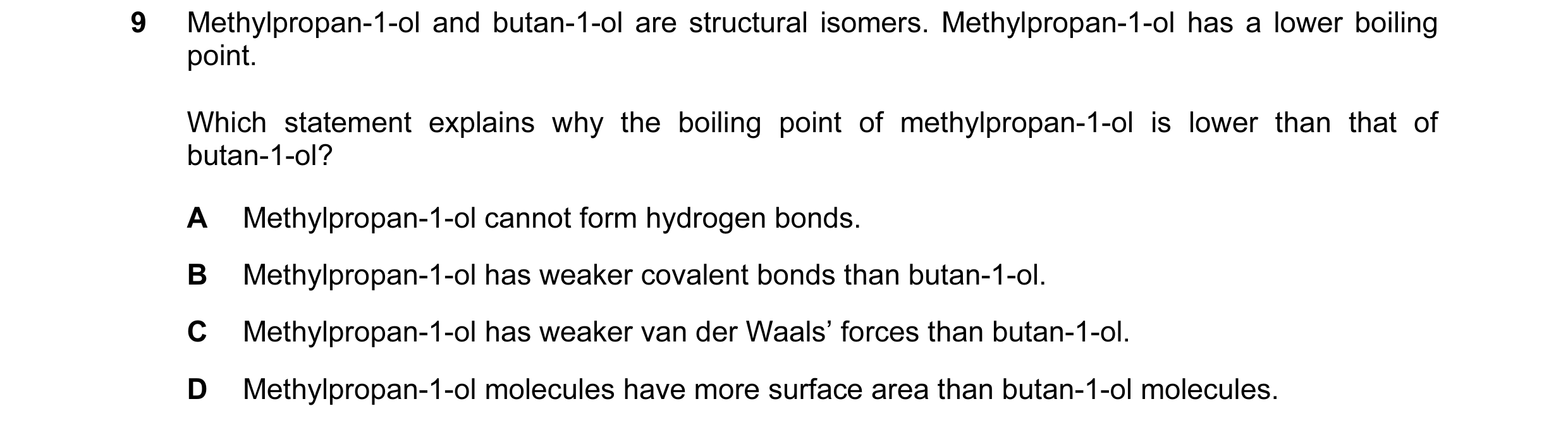
 10 / 29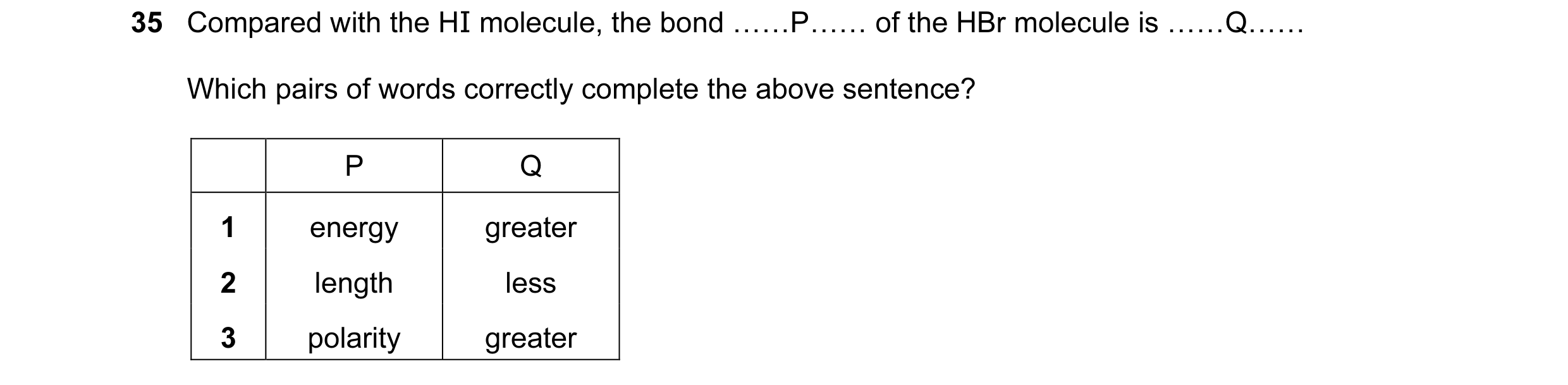

 11 / 29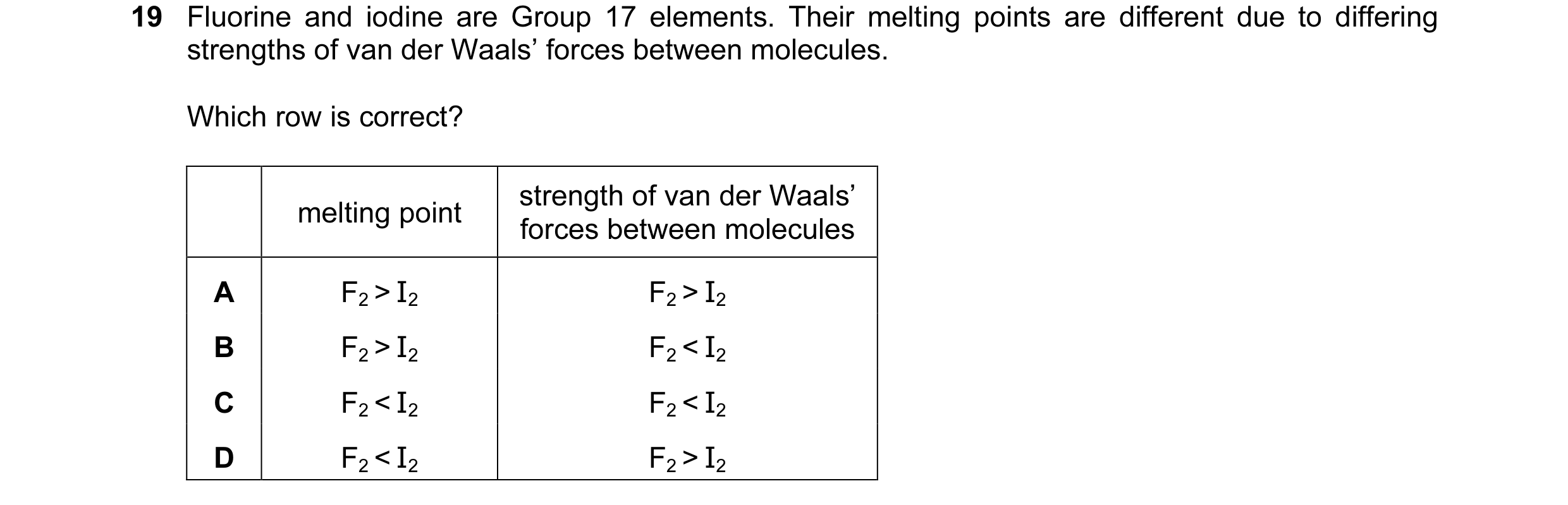

 12 / 29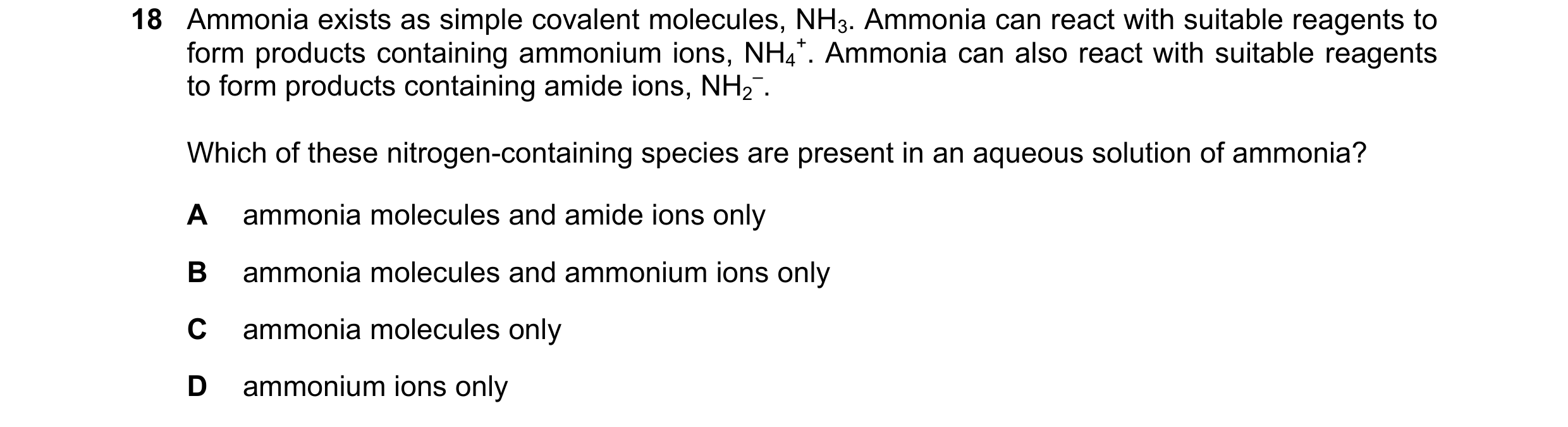
 13 / 29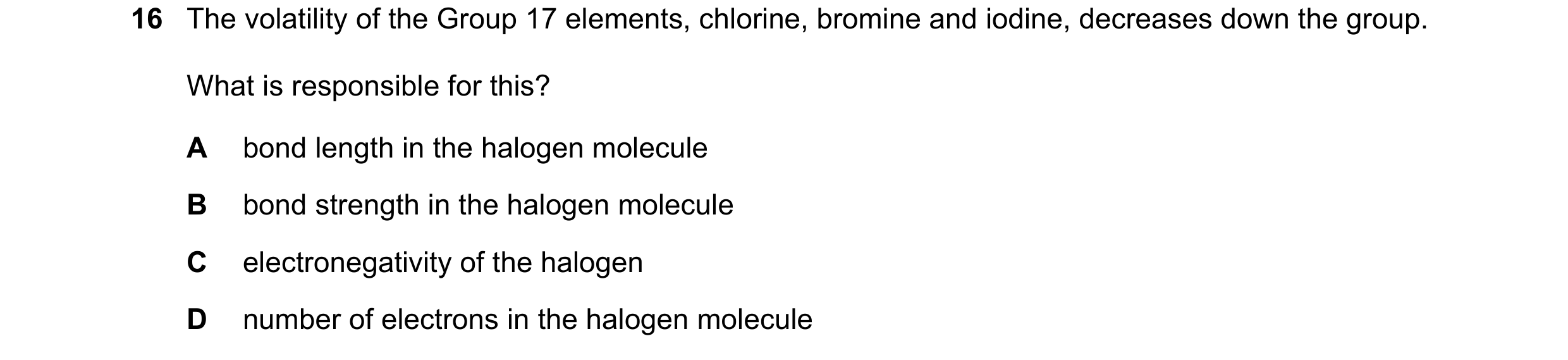



 14 / 29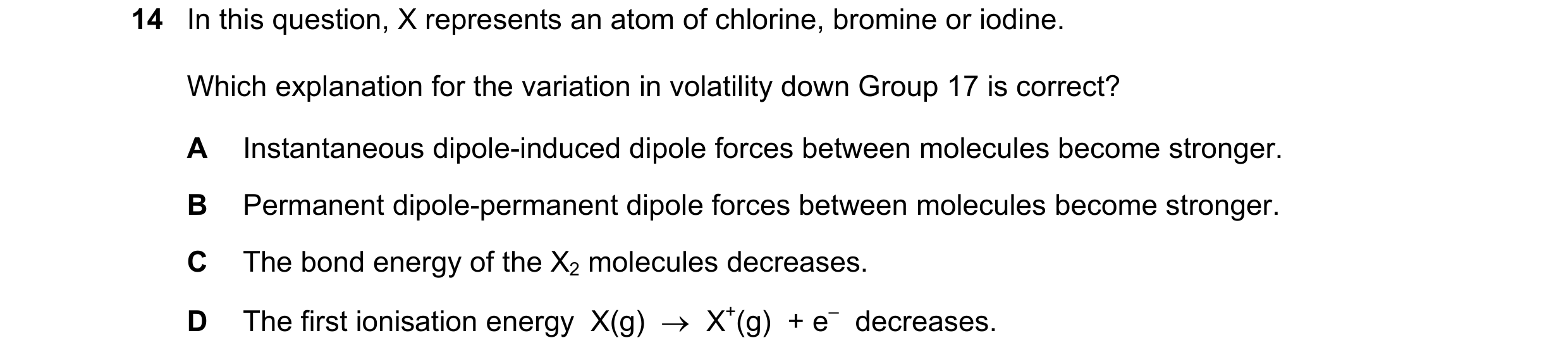
 15 / 29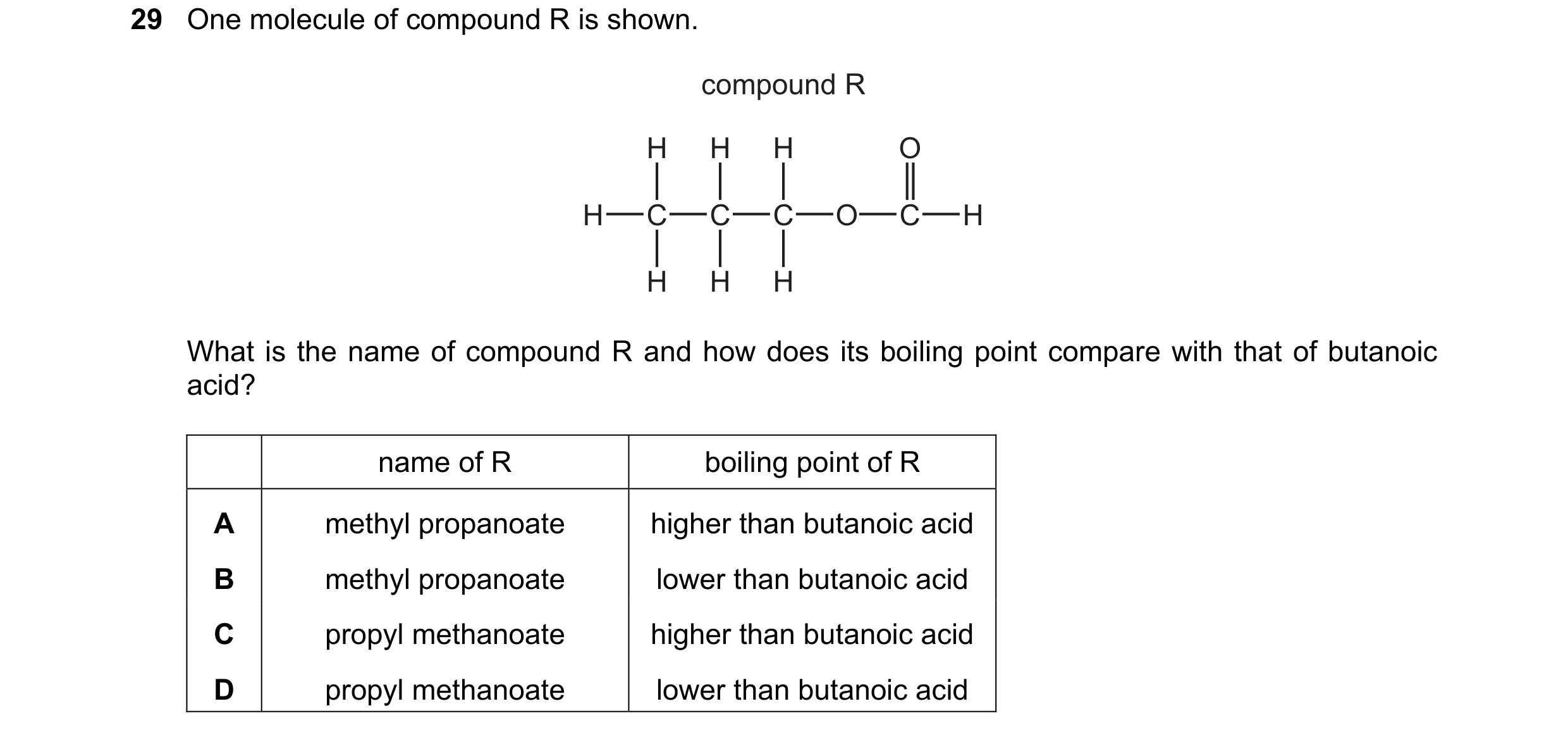
 16 / 29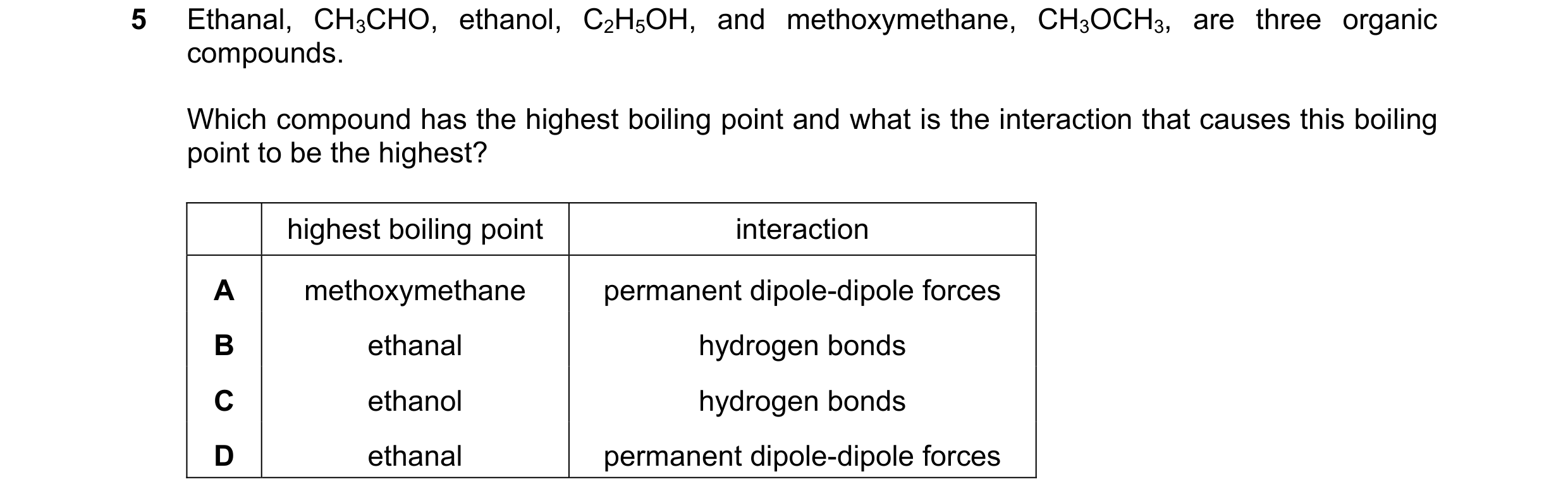
 17 / 29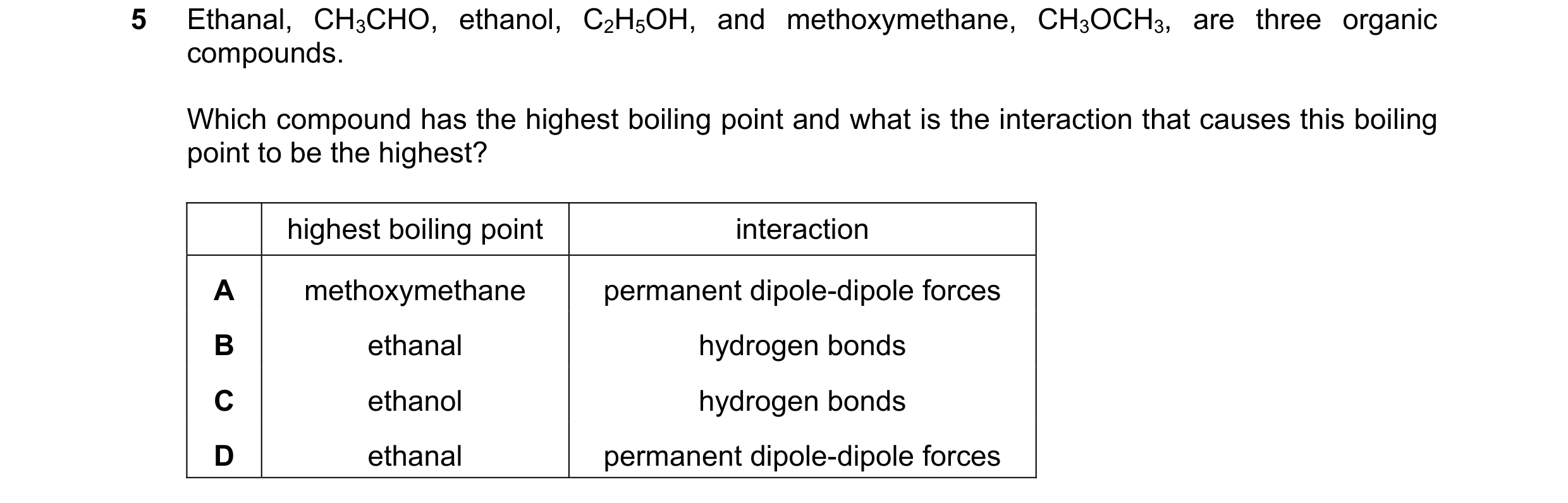
 18 / 29


 19 / 29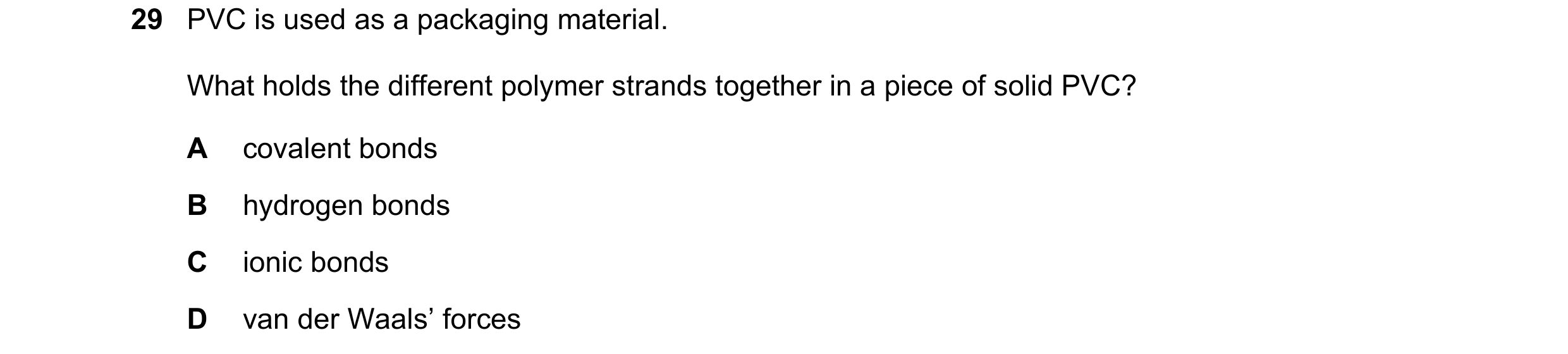

 20 / 29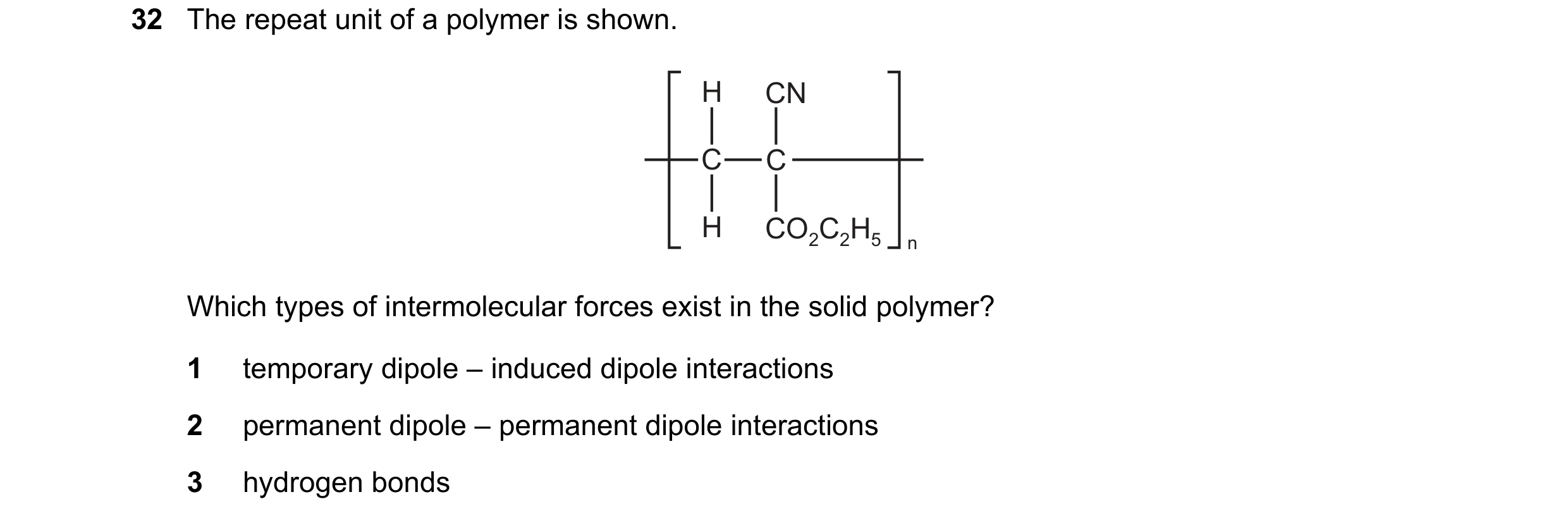

 21 / 29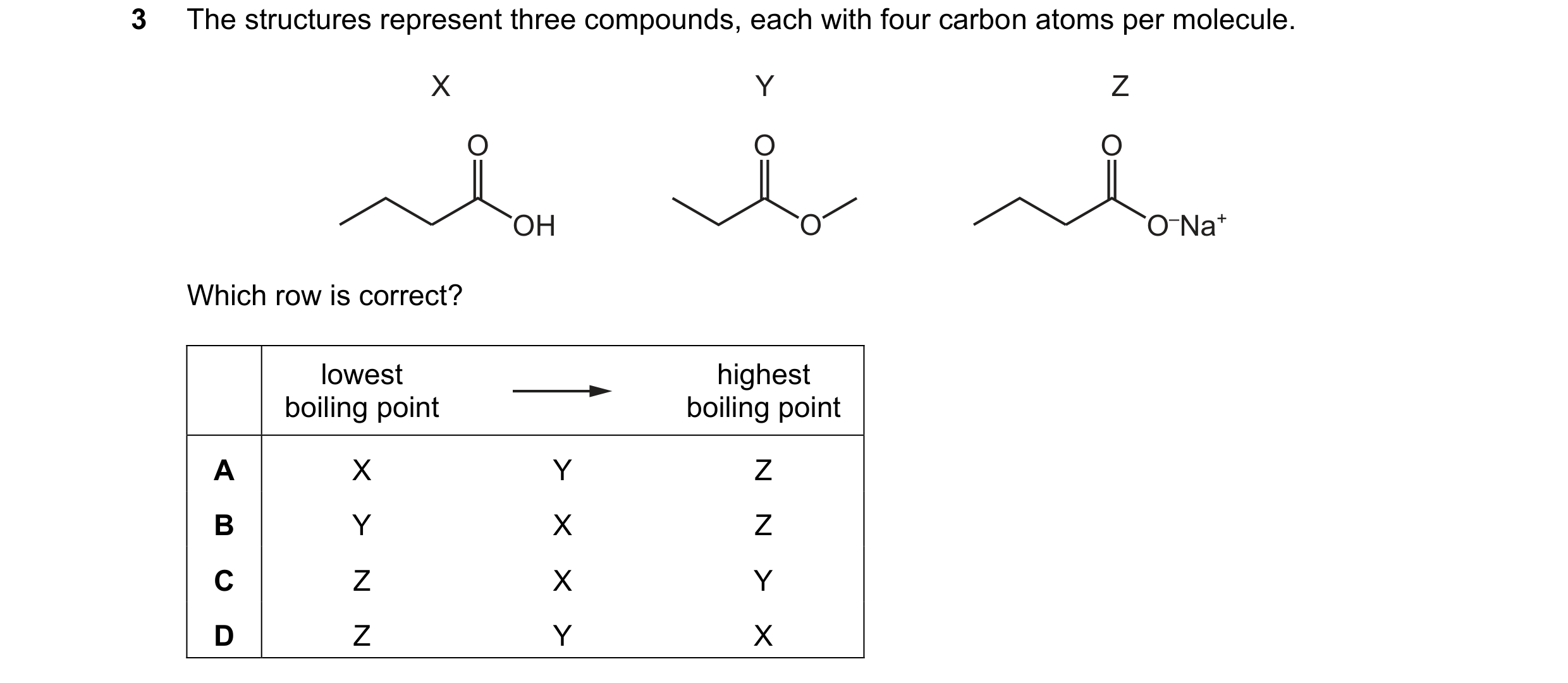

 22 / 29

 23 / 29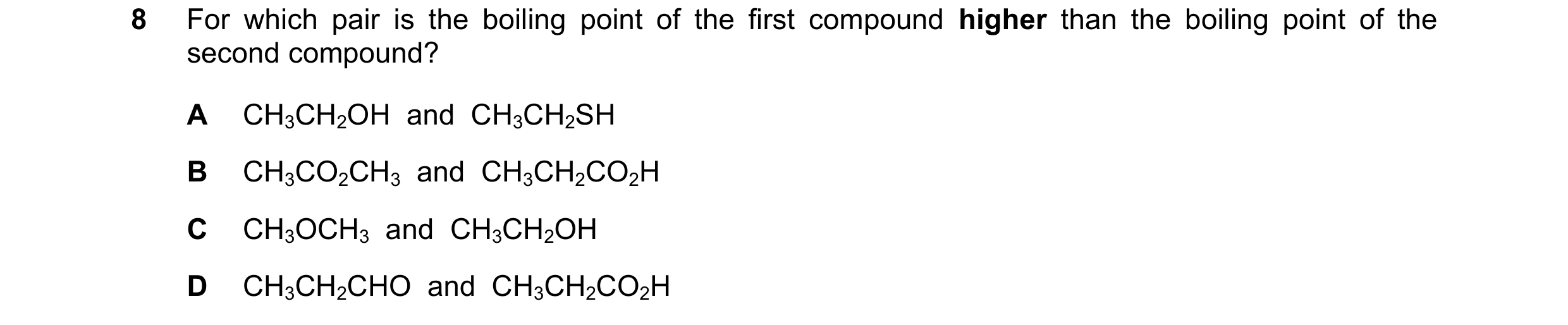
 24 / 29

 25 / 29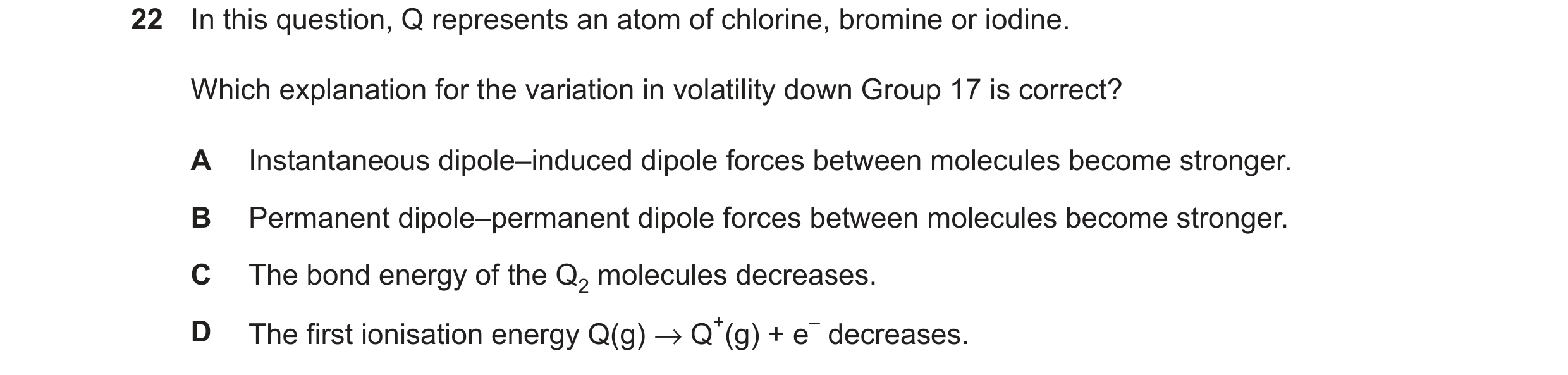
 26 / 29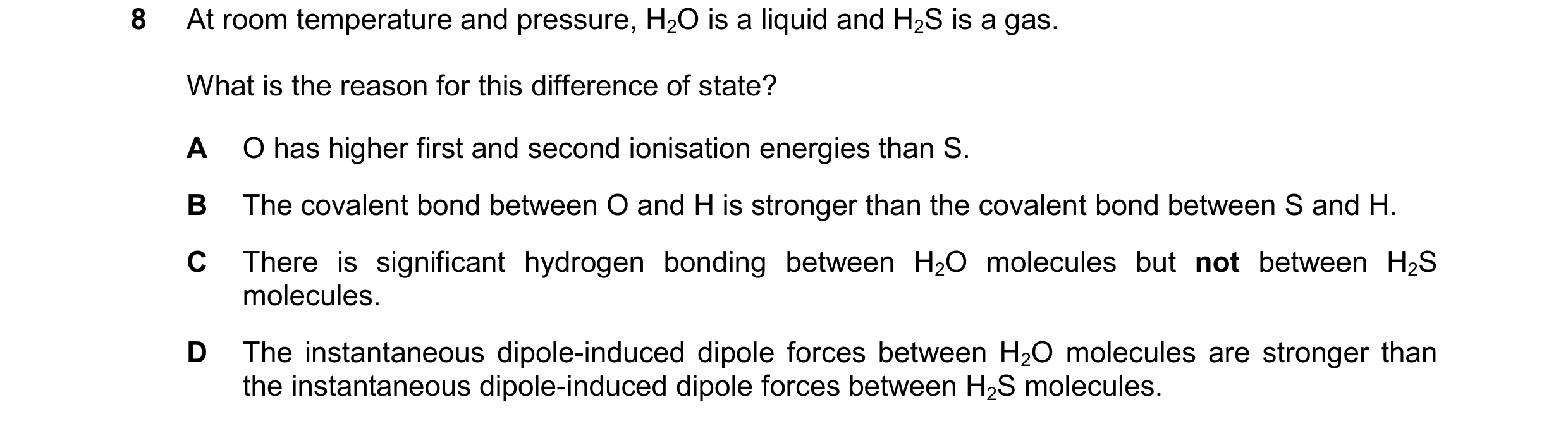
 27 / 29

 28 / 29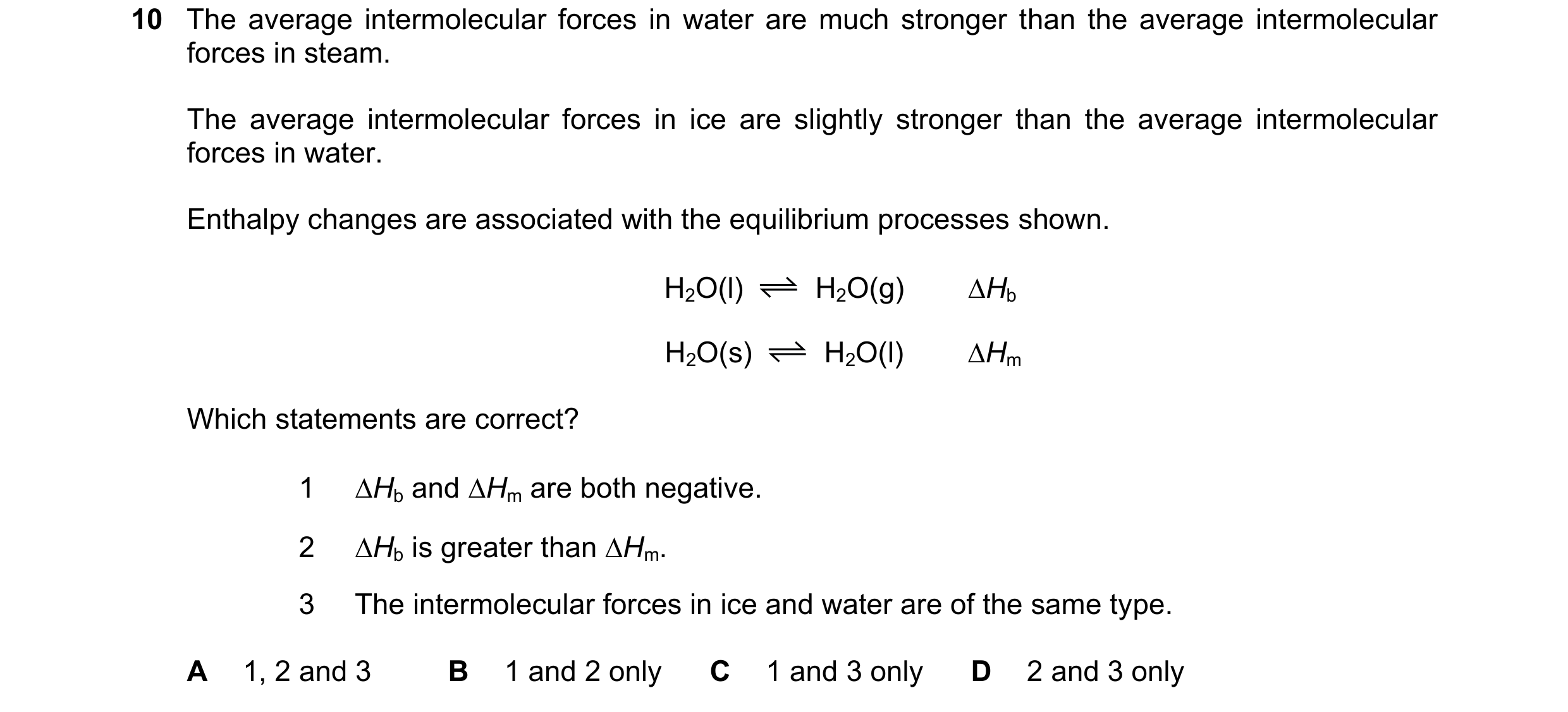
 29 / 29