Questions as text
Q1 · Lime, CaO, is used to reduce the acidity of soil, and ammonium sulphate is a nitrogenous… 9701/11 Oct/Nov 2005
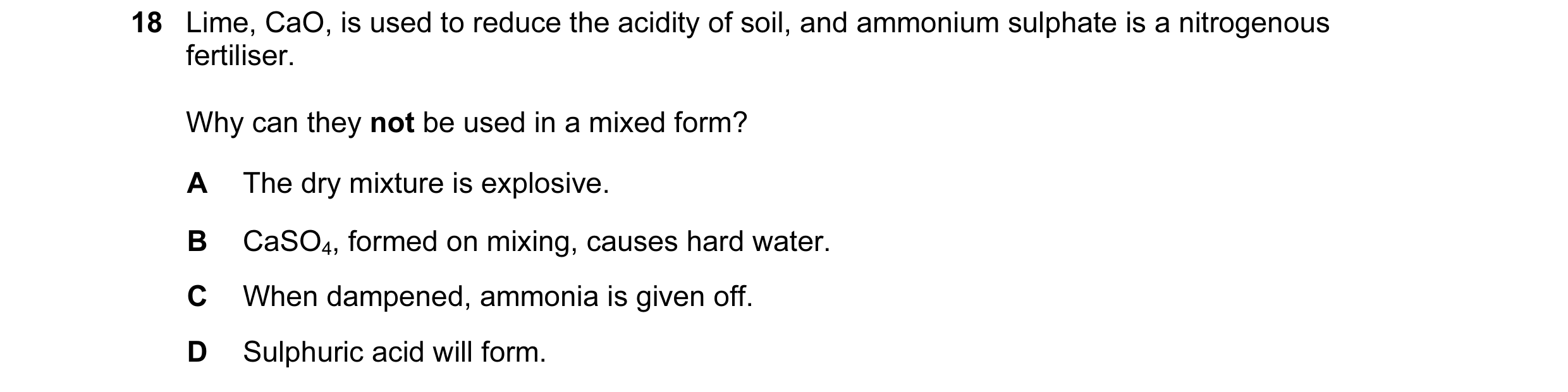
18 Lime, CaO, is used to reduce the acidity of soil, and ammonium sulphate is a nitrogenous fertiliser. Why can they not be used in a mixed form? A The dry mixture is explosive. B CaSO4, formed on mixing, causes hard water. C When dampened, ammonia is given off. D Sulphuric acid will form.
1 marks
Answer: C
This question in 9701/11 Oct/Nov 2005
Q2 · Which equations represent stages in the Contact process for manufacturing sulphuric acid? 9701/11 Oct/Nov 2005
37 Which equations represent stages in the Contact process for manufacturing sulphuric acid? 1 S + O2 → SO2 2 H2O + SO2 → H2SO3 3 H2SO3 + O2 → H2SO4 1 2
1 marks
Answer: D
This question in 9701/11 Oct/Nov 2005
Q3 · The emissions from a power station contain about 14 tonnes of SO2 per hour from the… 9701/11 May/June 2006
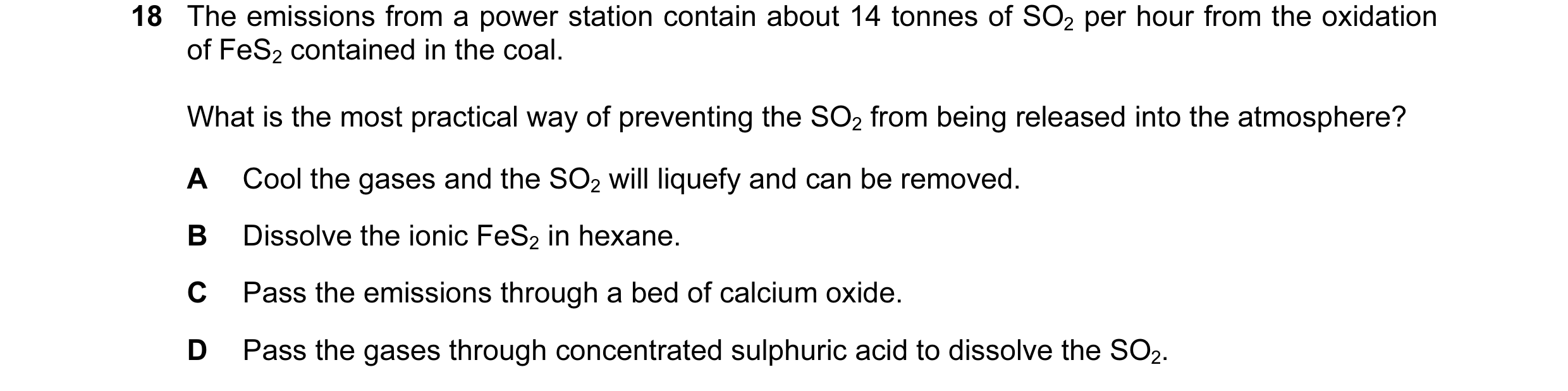
18 The emissions from a power station contain about 14 tonnes of SO2 per hour from the oxidation of FeS2 contained in the coal. What is the most practical way of preventing the SO2 from being released into the atmosphere? A Cool the gases and the SO2 will liquefy and can be removed. B Dissolve the ionic FeS2 in hexane. C Pass the emissions through a bed of calcium oxide. D Pass the gases through concentrated sulphuric acid to dissolve the SO2.
1 marks
Answer: C
This question in 9701/11 May/June 2006
Q4 · Sulphur dioxide is an important food preservative 9701/11 Oct/Nov 2006
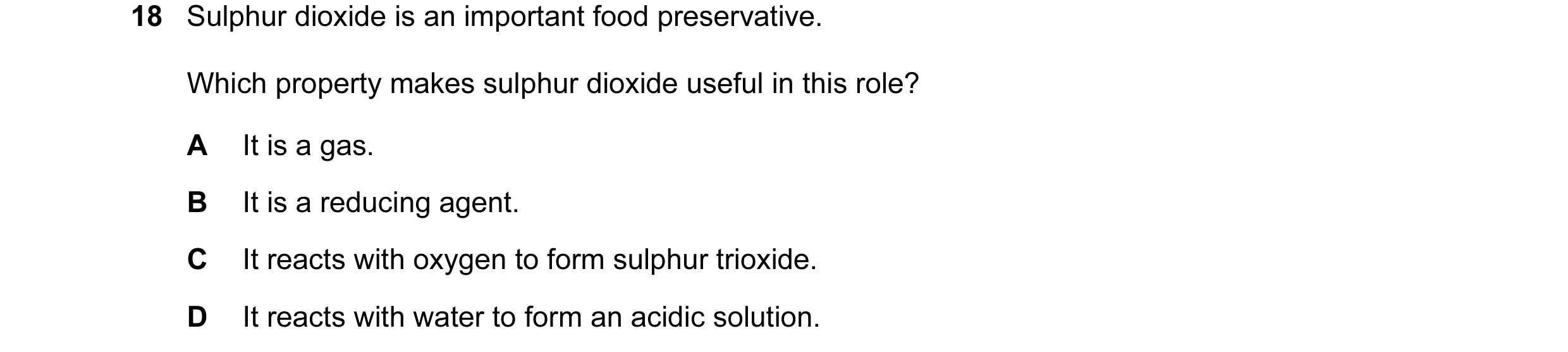
18 Sulphur dioxide is an important food preservative. Which property makes sulphur dioxide useful in this role? A It is a gas. B It is a reducing agent. C It reacts with oxygen to form sulphur trioxide. D It reacts with water to form an acidic solution.
1 marks
Answer: B
This question in 9701/11 Oct/Nov 2006
Q5 · Which fertilisers, when washed out of soil by rain, cause excessive growth of river… 9701/11 Oct/Nov 2006
36 Which fertilisers, when washed out of soil by rain, cause excessive growth of river plants and algae with the result that fish in the river die? 1 K2SO4 2 NH4NO3 3 NaNO3
1 marks
Answer: C
This question in 9701/11 Oct/Nov 2006
Q6 · There are three stages in the Contact process for the production of sulphuric acid 9701/11 Oct/Nov 2007
17 There are three stages in the Contact process for the production of sulphuric acid. 1 S + O2 → SO2 2 SO2 + 1 2 O2 → SO3 3 SO3 + H2O → H2SO4 Which statement about this process is correct? A In the first stage a large excess of air under high pressure is used to improve the yield. B Two of the three stages are equilibria. C All three stages are exothermic. D In the final stage SO3 is absorbed by water droplets.
1 marks
Answer: C
This question in 9701/11 Oct/Nov 2007
Q7 · Why is the addition of concentrated sulphuric acid to solid potassium iodide unsuitable… 9701/11 Oct/Nov 2007
36 Why is the addition of concentrated sulphuric acid to solid potassium iodide unsuitable for the preparation of hydrogen iodide? 1 Hydrogen iodide is not displaced by sulphuric acid. 2 Iodide ions are oxidised to iodine. 3 The product is contaminated by sulphur compounds.
1 marks
Answer: C
This question in 9701/11 Oct/Nov 2007
Q8 · Total elimination of the pollutant sulphur dioxide, SO2, is difficult, both for economic… 9701/11 May/June 2008
19 Total elimination of the pollutant sulphur dioxide, SO2, is difficult, both for economic and technical reasons. Its emission can be reduced in furnace chimneys using desulphurisation plants, where the gases are scrubbed (washed) with calcium hydroxide to remove the SO2. What is the main product formed initially? A CaO B Ca(OH)2 C CaSO3 D CaSO4
1 marks
Answer: C
This question in 9701/11 May/June 2008
Q9 · When gaseous chemicals are transported by road or by rail they are classified as follows 9701/11 Oct/Nov 2008
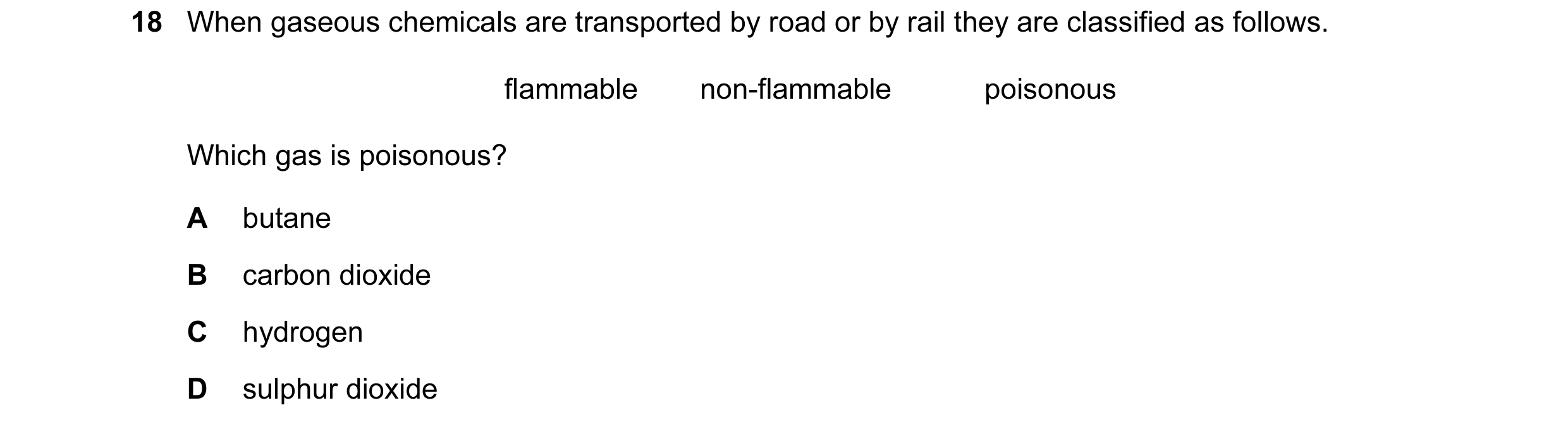
18 When gaseous chemicals are transported by road or by rail they are classified as follows. flammable non-flammable poisonous Which gas is poisonous? A butane B carbon dioxide C hydrogen D sulphur dioxide
1 marks
Answer: D
This question in 9701/11 Oct/Nov 2008
Q10 · Mohr’s salt is a pale green crystalline solid which is soluble in water 9701/11 May/June 2009
18 Mohr’s salt is a pale green crystalline solid which is soluble in water. It is a ‘double sulfate’ which contains two cations, one of which is Fe2+. The identity of the second cation was determined by heating solid Mohr’s salt with solid sodium hydroxide and a colourless gas was evolved. The gas readily dissolved in water giving an alkaline solution. A grey-green solid residue was also formed which was insoluble in water. What are the identities of the gas and the solid residue? gas residue A H2 FeSO4 B NH3 Na2SO4 C NH3 Fe(OH)2 D SO2 Fe(OH)2
1 marks
Answer: C
This question in 9701/11 May/June 2009
Q11 · When sulfur trioxide is manufactured from sulfur dioxide and oxygen, using the Contact… 9701/11 Oct/Nov 2009
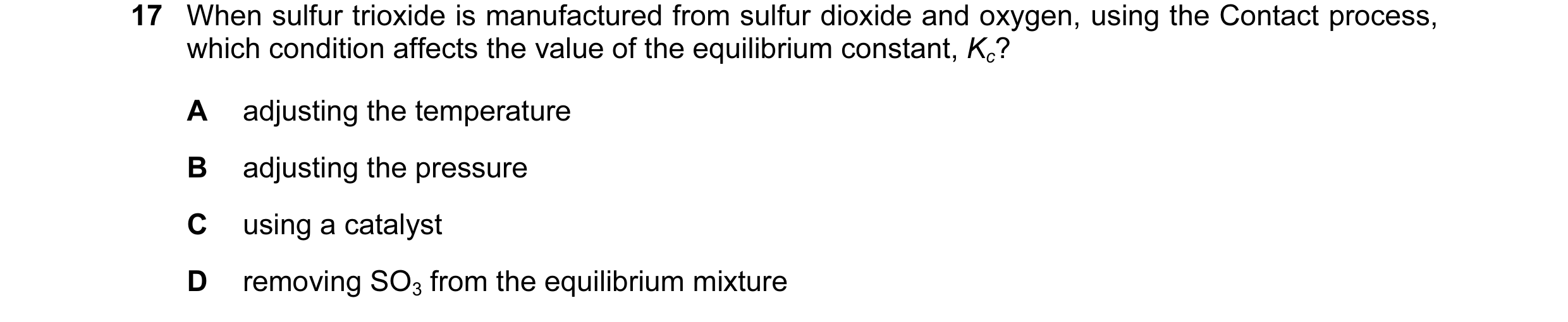
17 When sulfur trioxide is manufactured from sulfur dioxide and oxygen, using the Contact process, which condition affects the value of the equilibrium constant, Kc? A adjusting the temperature B adjusting the pressure C using a catalyst D removing SO3 from the equilibrium mixture
1 marks
Answer: A
This question in 9701/11 Oct/Nov 2009
Q12 · Most modern cars are fitted with three-way catalytic converters in the exhaust system 9701/11 Oct/Nov 2009
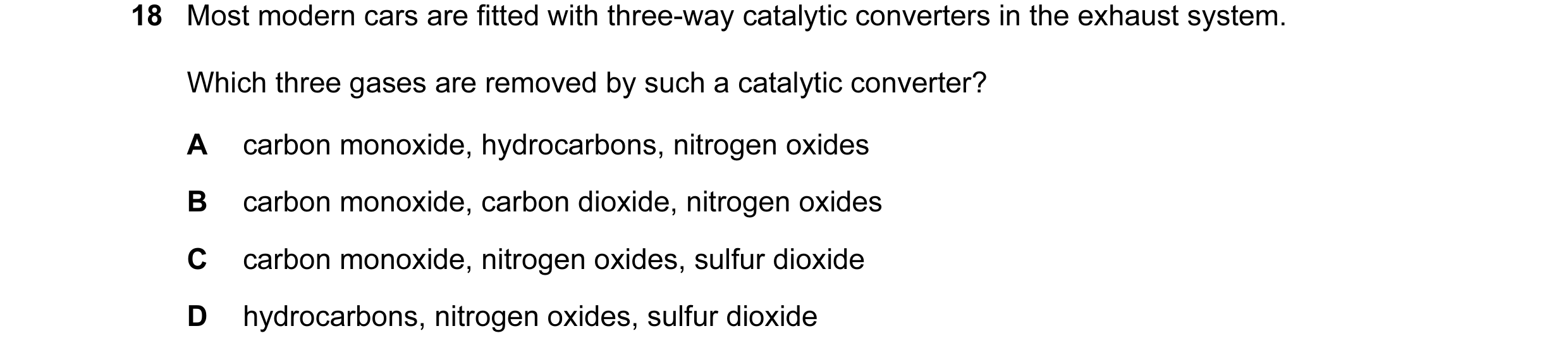
18 Most modern cars are fitted with three-way catalytic converters in the exhaust system. Which three gases are removed by such a catalytic converter? A carbon monoxide, hydrocarbons, nitrogen oxides B carbon monoxide, carbon dioxide, nitrogen oxides C carbon monoxide, nitrogen oxides, sulfur dioxide D hydrocarbons, nitrogen oxides, sulfur dioxide
1 marks
Answer: A
This question in 9701/11 Oct/Nov 2009
Q13 · In a car engine, non-metallic element X forms a pollutant oxide Y 9701/11 May/June 2010
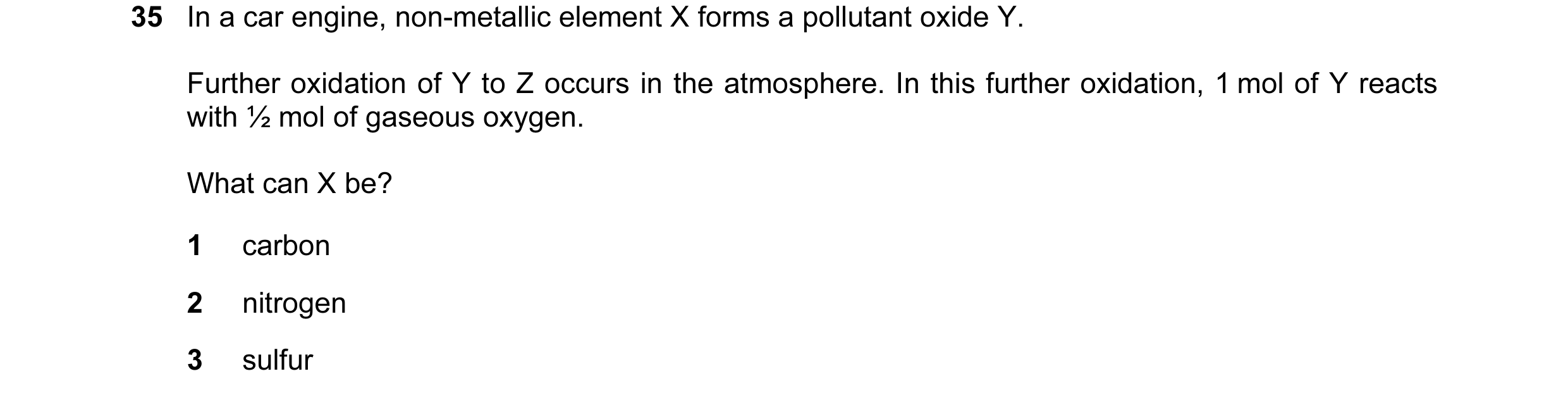
35 In a car engine, non-metallic element X forms a pollutant oxide Y. Further oxidation of Y to Z occurs in the atmosphere. In this further oxidation, 1 mol of Y reacts with ½ mol of gaseous oxygen. What can X be? 1 carbon 2 nitrogen 3 sulfur
1 marks
Answer: C
This question in 9701/11 May/June 2010
Q14 · Sulfur dioxide and sulfites are used in food preservation 9701/11 May/June 2010
36 Sulfur dioxide and sulfites are used in food preservation. Why are they used for this purpose? 1 They are reducing agents so retard the oxidation of food. 2 They inhibit the growth of aerobic bacteria. 3 They react with NO2(g) converting it to NO(g).
1 marks
Answer: B
This question in 9701/11 May/June 2010
Q15 · In a car engine, non-metallic element X forms a pollutant oxide Y 9701/12 May/June 2010
35 In a car engine, non-metallic element X forms a pollutant oxide Y. Further oxidation of Y to Z occurs in the atmosphere. In this further oxidation, 1 mol of Y reacts with ½ mol of gaseous oxygen. What can X be? 1 carbon 2 nitrogen 3 sulfur
1 marks
Answer: C
This question in 9701/12 May/June 2010
Q16 · Sulfur dioxide and sulfites are used in food preservation 9701/12 May/June 2010
36 Sulfur dioxide and sulfites are used in food preservation. Why are they used for this purpose? 1 They are reducing agents so retard the oxidation of food. 2 They inhibit the growth of aerobic bacteria. 3 They react with NO2(g) converting it to NO(g).
1 marks
Answer: B
This question in 9701/12 May/June 2010
Q17 · In a car engine, non-metallic element X forms a pollutant oxide Y 9701/13 May/June 2010
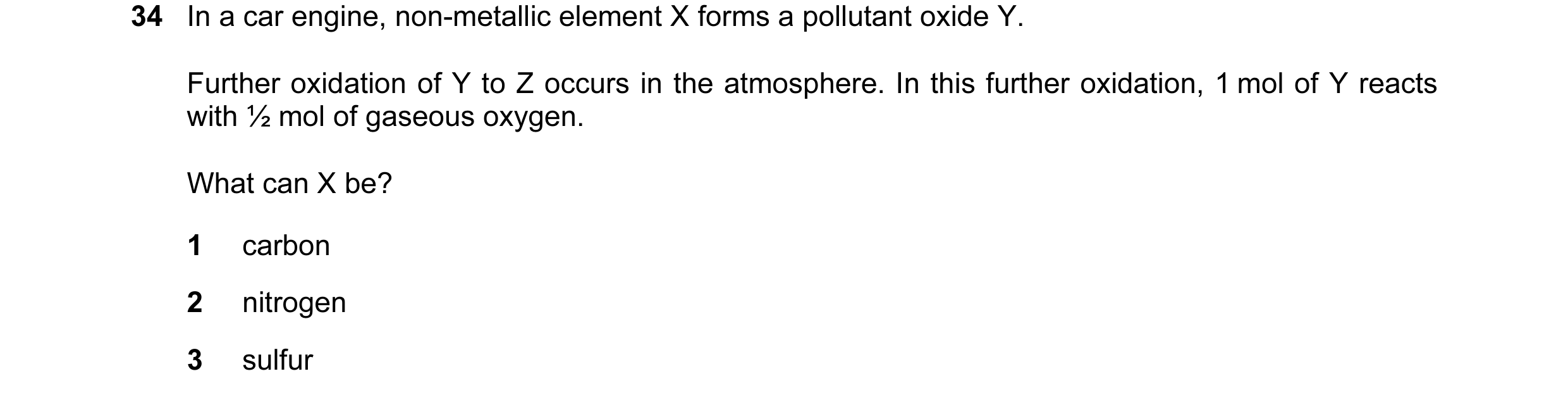
34 In a car engine, non-metallic element X forms a pollutant oxide Y. Further oxidation of Y to Z occurs in the atmosphere. In this further oxidation, 1 mol of Y reacts with ½ mol of gaseous oxygen. What can X be? 1 carbon 2 nitrogen 3 sulfur
1 marks
Answer: C
This question in 9701/13 May/June 2010
Q18 · Sulfur dioxide and sulfites are used in food preservation 9701/13 May/June 2010
36 Sulfur dioxide and sulfites are used in food preservation. Why are they used for this purpose? 1 They are reducing agents so retard the oxidation of food. 2 They inhibit the growth of aerobic bacteria. 3 They react with NO2(g) converting it to NO(g).
1 marks
Answer: B
This question in 9701/13 May/June 2010
Q19 · Sulfur dioxide, SO2, is added to wines to prevent oxidation of ethanol by air 9701/11 Oct/Nov 2010
4 Sulfur dioxide, SO2, is added to wines to prevent oxidation of ethanol by air. To determine the amount of SO2, a sample of wine is titrated with iodine, I2. In this reaction, one mole of SO2 is oxidised by one mole of I2. What is the change in oxidation number of sulfur in this reaction? A +2 to +4 B +2 to +6 C +4 to +5 D +4 to +6
1 marks
Answer: D
This question in 9701/11 Oct/Nov 2010
Q20 · When magnesium nitrate, Mg(NO3)2.7H2O, is heated, which three gases are given off? 9701/11 Oct/Nov 2010
14 When magnesium nitrate, Mg(NO3)2.7H2O, is heated, which three gases are given off? A dinitrogen oxide, oxygen, water vapour B hydrogen, nitrogen, oxygen C hydrogen, nitrogen dioxide, oxygen D nitrogen dioxide, oxygen, water vapour
1 marks
Answer: D
This question in 9701/11 Oct/Nov 2010
Q21 · Sulfur dioxide is used to bleach wood pulp in the production of paper 9701/11 Oct/Nov 2010
18 Sulfur dioxide is used to bleach wood pulp in the production of paper. It is also used as an additive in the production of jam and marmalade, often in the form of sulfite compounds. When it is present in quantities greater than 10 mg / kg it is required to be listed as an ingredient of the jam. Why is sulfur dioxide added to jam? A It is a bleaching agent and removes the undesirable colours from the fruit used in the jam. B It is a preservative that destroys unwanted bacteria and enzymes. C It is a reducing agent and removes the acids that give the jam a sharp taste. D It is an acidic gas and maintains the pH of the jam at a suitable value to give it a sharp taste.
1 marks
Answer: B
This question in 9701/11 Oct/Nov 2010
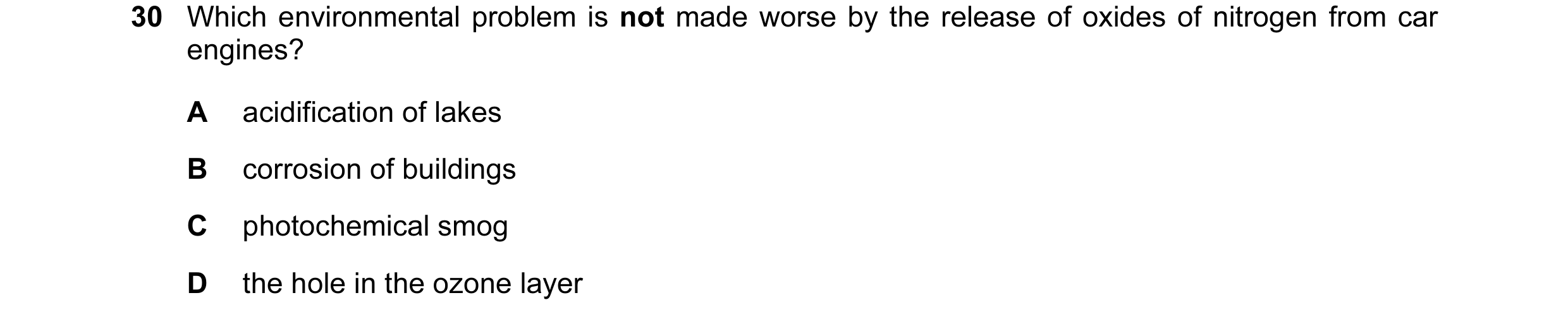
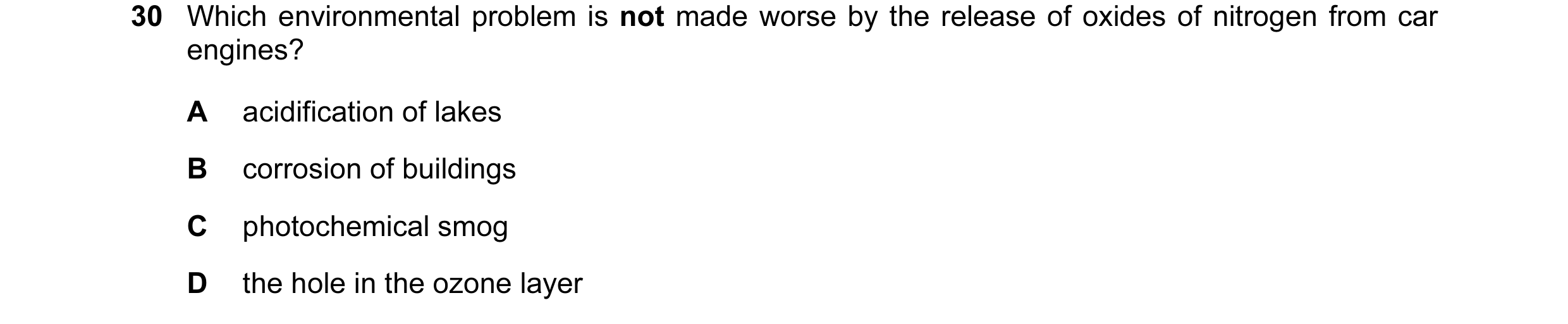
Q22 · Which environmental problem is not made worse by the release of oxides of nitrogen from… 9701/11 Oct/Nov 2010
30 Which environmental problem is not made worse by the release of oxides of nitrogen from car engines? A acidification of lakes B corrosion of buildings C photochemical smog D the hole in the ozone layer
1 marks
Answer: D
This question in 9701/11 Oct/Nov 2010
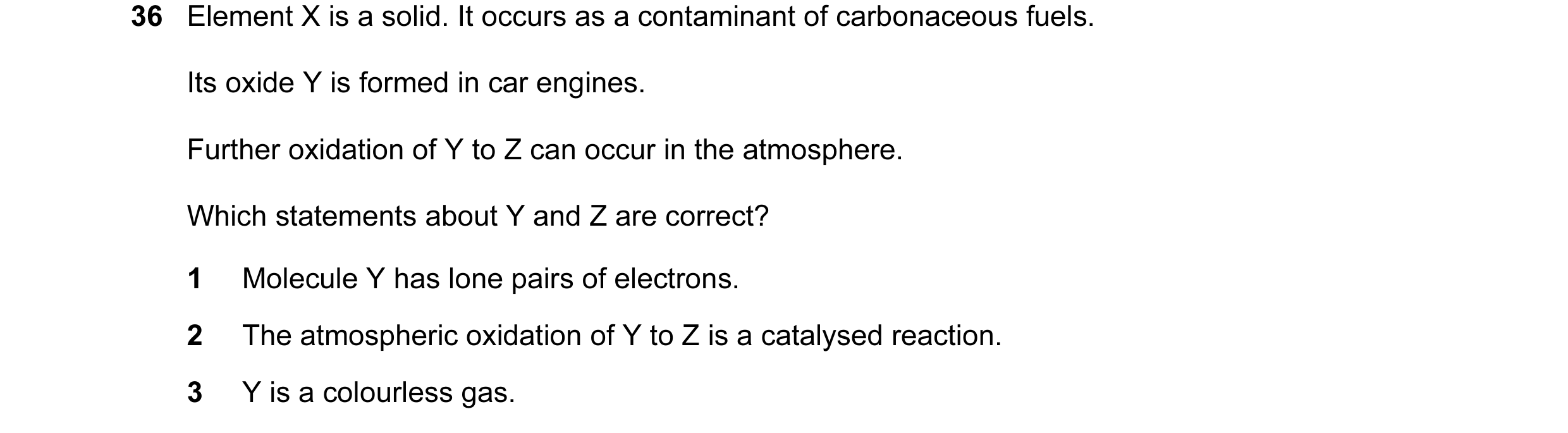
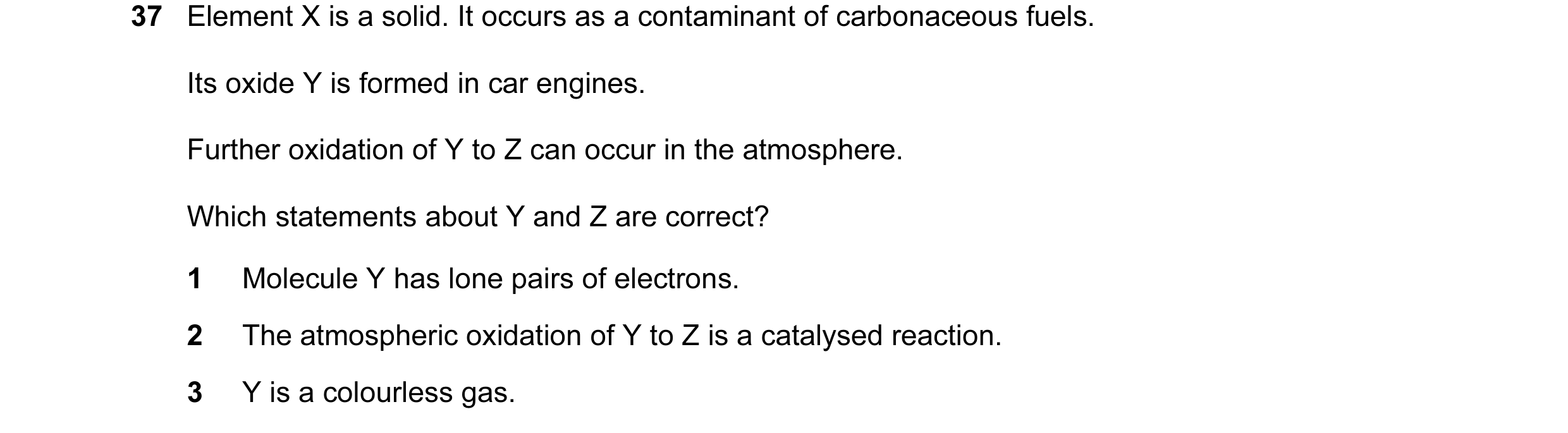
Q23 · Element X is a solid 9701/11 Oct/Nov 2010
36 Element X is a solid. It occurs as a contaminant of carbonaceous fuels. Its oxide Y is formed in car engines. Further oxidation of Y to Z can occur in the atmosphere. Which statements about Y and Z are correct? 1 Molecule Y has lone pairs of electrons. 2 The atmospheric oxidation of Y to Z is a catalysed reaction. 3 Y is a colourless gas.
1 marks
Answer: A
This question in 9701/11 Oct/Nov 2010
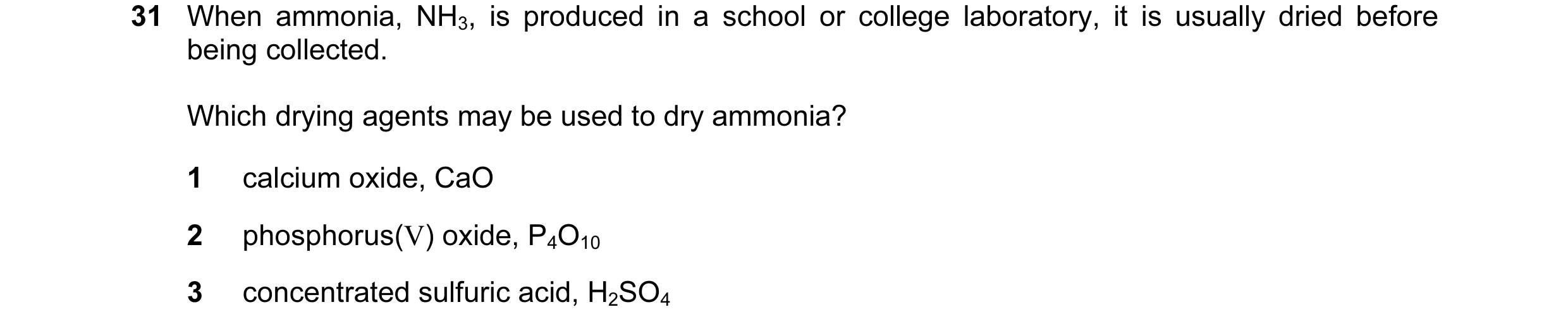
Q24 · When ammonia, NH3, is produced in a school or college laboratory, it is usually dried… 9701/12 Oct/Nov 2010
31 When ammonia, NH3, is produced in a school or college laboratory, it is usually dried before being collected. Which drying agents may be used to dry ammonia? 1 calcium oxide, CaO 2 phosphorus(V) oxide, P4O10 3 concentrated sulfuric acid, H2SO4
1 marks
Answer: D
This question in 9701/12 Oct/Nov 2010
Q25 · Sulfur dioxide, SO2, is added to wines to prevent oxidation of ethanol by air 9701/13 Oct/Nov 2010
4 Sulfur dioxide, SO2, is added to wines to prevent oxidation of ethanol by air. To determine the amount of SO2, a sample of wine is titrated with iodine, I2. In this reaction, one mole of SO2 is oxidised by one mole of I2. What is the change in oxidation number of sulfur in this reaction? A +2 to +4 B +2 to +6 C +4 to +5 D +4 to +6
1 marks
Answer: D
This question in 9701/13 Oct/Nov 2010
Q26 · Sulfur dioxide is used to bleach wood pulp in the production of paper 9701/13 Oct/Nov 2010
18 Sulfur dioxide is used to bleach wood pulp in the production of paper. It is also used as an additive in the production of jam and marmalade, often in the form of sulfite compounds. When it is present in quantities greater than 10 mg / kg it is required to be listed as an ingredient of the jam. Why is sulfur dioxide added to jam? A It is a bleaching agent and removes the undesirable colours from the fruit used in the jam. B It is a preservative that destroys unwanted bacteria and enzymes. C It is a reducing agent and removes the acids that give the jam a sharp taste. D It is an acidic gas and maintains the pH of the jam at a suitable value to give it a sharp taste.
1 marks
Answer: B
This question in 9701/13 Oct/Nov 2010
Q27 · Which environmental problem is not made worse by the release of oxides of nitrogen from… 9701/13 Oct/Nov 2010
30 Which environmental problem is not made worse by the release of oxides of nitrogen from car engines? A acidification of lakes B corrosion of buildings C photochemical smog D the hole in the ozone layer
1 marks
Answer: D
This question in 9701/13 Oct/Nov 2010
Q28 · Element X is a solid 9701/13 Oct/Nov 2010
37 Element X is a solid. It occurs as a contaminant of carbonaceous fuels. Its oxide Y is formed in car engines. Further oxidation of Y to Z can occur in the atmosphere. Which statements about Y and Z are correct? 1 Molecule Y has lone pairs of electrons. 2 The atmospheric oxidation of Y to Z is a catalysed reaction. 3 Y is a colourless gas.
1 marks
Answer: A
This question in 9701/13 Oct/Nov 2010
Q29 · In flooded soils, like those used for rice cultivation, the oxygen content is low 9701/11 May/June 2011
2 In flooded soils, like those used for rice cultivation, the oxygen content is low. In such soils, anaerobic bacteria cause the loss of nitrogen from the soil as shown in the following sequence. In which step is the change in oxidation number (oxidation state) of nitrogen different to the changes in the other steps? A B C D NO3 –(aq) NO2 –(aq) NO(g) N2O(g) N2(g)
1 marks
Answer: A
This question in 9701/11 May/June 2011
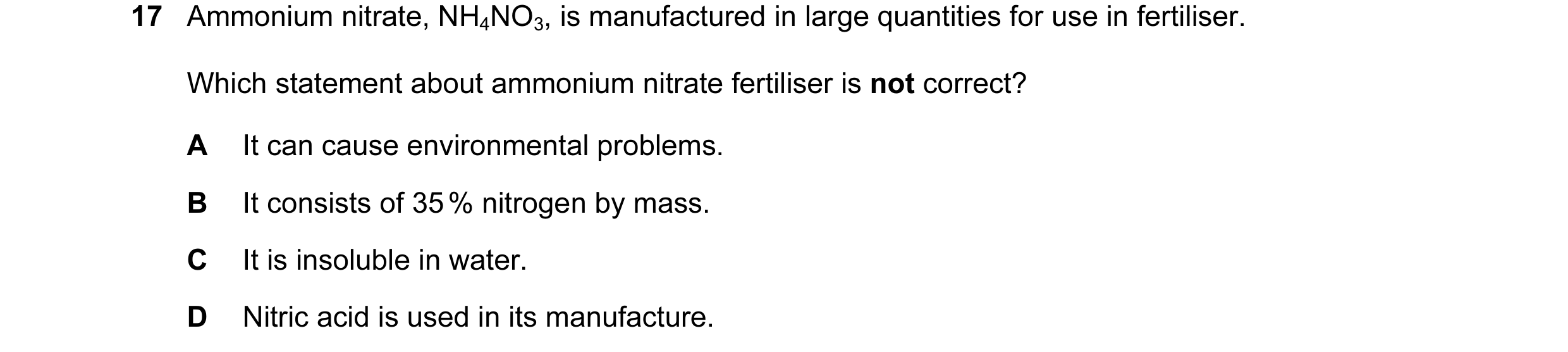
Q30 · Ammonium nitrate, NH4NO3, is manufactured in large quantities for use in fertiliser 9701/11 May/June 2011
17 Ammonium nitrate, NH4NO3, is manufactured in large quantities for use in fertiliser. Which statement about ammonium nitrate fertiliser is not correct? A It can cause environmental problems. B It consists of 35 % nitrogen by mass. C It is insoluble in water. D Nitric acid is used in its manufacture.
1 marks
Answer: C
This question in 9701/11 May/June 2011
Q31 · Nitrogen monoxide, NO, is a primary pollutant produced by petrol engines and is found in… 9701/11 May/June 2011
18 Nitrogen monoxide, NO, is a primary pollutant produced by petrol engines and is found in their exhaust gases. Which reaction occurs in a catalytic converter and decreases the emission of nitrogen monoxide? A NO(g) + CO(g) → NO2(g) + C(s) B NO(g) + CO2(g) → NO2(g) + CO(g) C 2NO(g) + 2CO(g) → N2(g) + 2CO2(g) D 2NO(g) + CO2(g) → 2NO2(g) + C(s)
1 marks
Answer: C
This question in 9701/11 May/June 2011
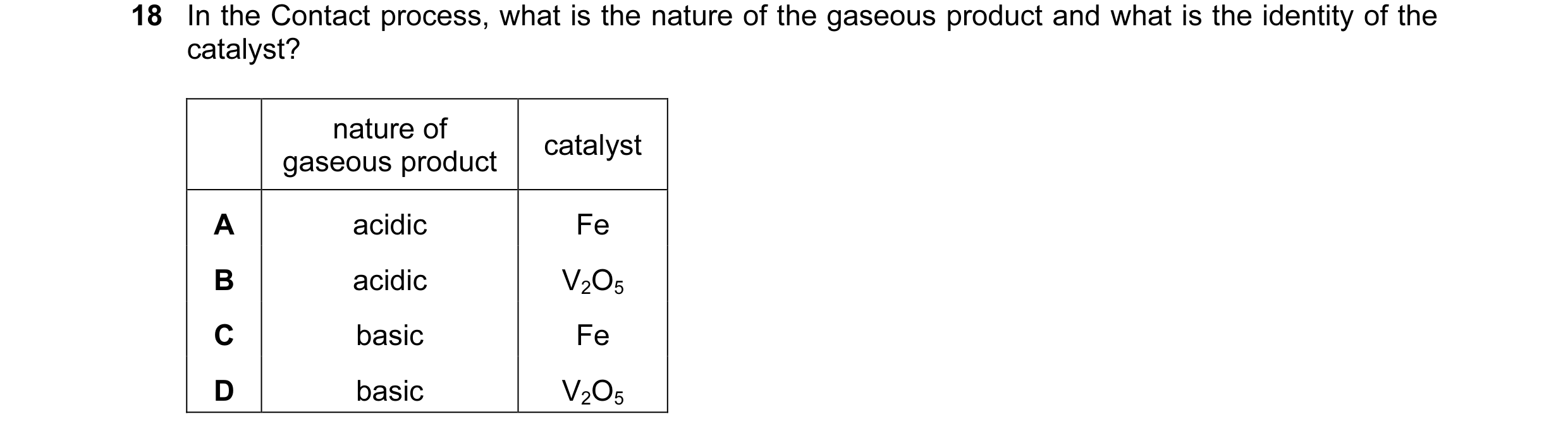
Q32 · In the Contact process, what is the nature of the gaseous product and what is the… 9701/12 May/June 2011
18 In the Contact process, what is the nature of the gaseous product and what is the identity of the catalyst? nature of catalyst gaseous product A acidic Fe B acidic V2O5 C basic Fe D basic V2O5
1 marks
Answer: B
This question in 9701/12 May/June 2011
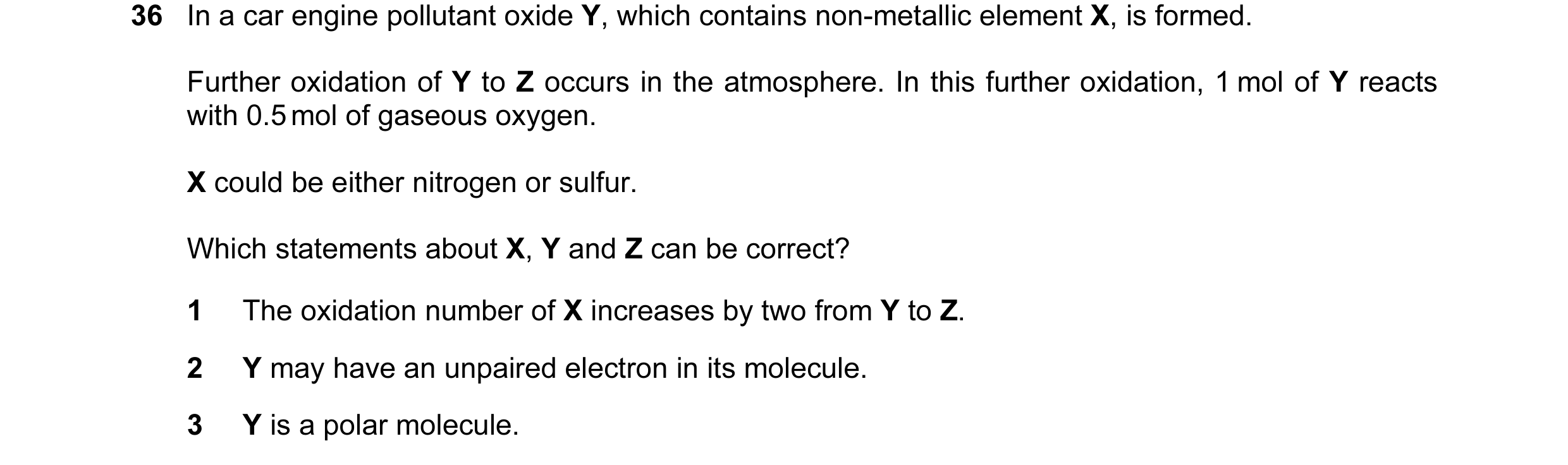
Q33 · In a car engine pollutant oxide Y, which contains non-metallic element X, is formed 9701/12 May/June 2011
36 In a car engine pollutant oxide Y, which contains non-metallic element X, is formed. Further oxidation of Y to Z occurs in the atmosphere. In this further oxidation, 1 mol of Y reacts with 0.5 mol of gaseous oxygen. X could be either nitrogen or sulfur. Which statements about X, Y and Z can be correct? 1 The oxidation number of X increases by two from Y to Z. 2 Y may have an unpaired electron in its molecule. 3 Y is a polar molecule.
1 marks
Answer: A
This question in 9701/12 May/June 2011
Q34 · In flooded soils, like those used for rice cultivation, the oxygen content is low 9701/13 May/June 2011
4 In flooded soils, like those used for rice cultivation, the oxygen content is low. In such soils, anaerobic bacteria cause the loss of nitrogen from the soil as shown in the following sequence. In which step is the change in oxidation number (oxidation state) of nitrogen different to the changes in the other steps? A B C D NO3 –(aq) NO2 –(aq) NO(g) N2O(g) N2(g)
1 marks
Answer: A
This question in 9701/13 May/June 2011
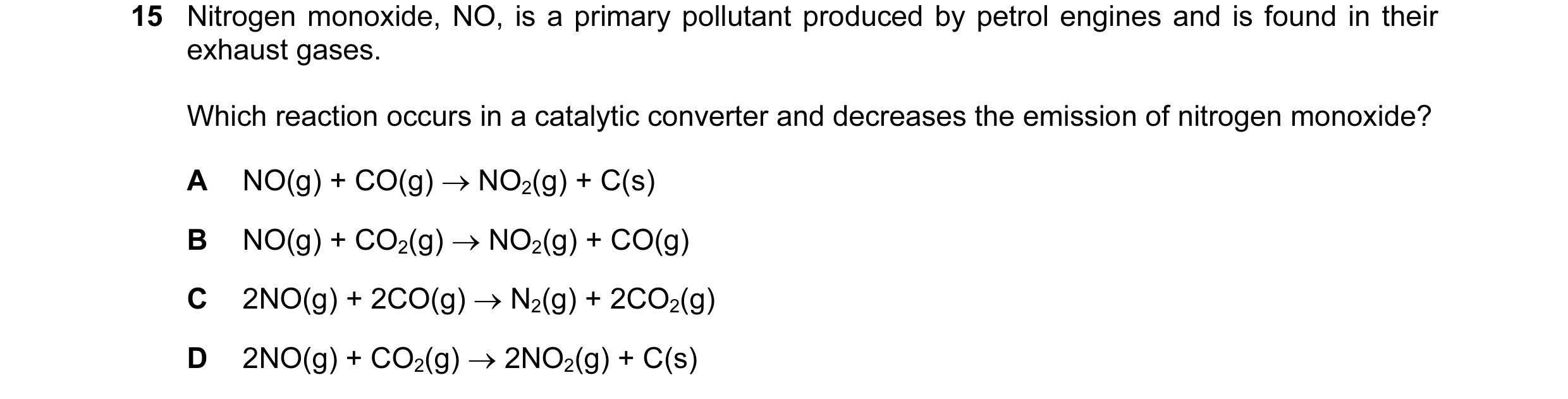
Q35 · Nitrogen monoxide, NO, is a primary pollutant produced by petrol engines and is found in… 9701/13 May/June 2011
15 Nitrogen monoxide, NO, is a primary pollutant produced by petrol engines and is found in their exhaust gases. Which reaction occurs in a catalytic converter and decreases the emission of nitrogen monoxide? A NO(g) + CO(g) → NO2(g) + C(s) B NO(g) + CO2(g) → NO2(g) + CO(g) C 2NO(g) + 2CO(g) → N2(g) + 2CO2(g) D 2NO(g) + CO2(g) → 2NO2(g) + C(s)
1 marks
Answer: C
This question in 9701/13 May/June 2011
Q36 · Ammonium nitrate, NH4NO3, is manufactured in large quantities for use in fertiliser 9701/13 May/June 2011
18 Ammonium nitrate, NH4NO3, is manufactured in large quantities for use in fertiliser. Which statement about ammonium nitrate fertiliser is not correct? A It can cause environmental problems. B It consists of 35 % nitrogen by mass. C It is insoluble in water. D Nitric acid is used in its manufacture.
1 marks
Answer: C
This question in 9701/13 May/June 2011
Q37 · Total removal of the pollutant sulfur dioxide, SO2, is difficult, both for economic and… 9701/11 Oct/Nov 2011
18 Total removal of the pollutant sulfur dioxide, SO2, is difficult, both for economic and technical reasons. The quantities emitted from furnace chimneys can be lowered by using desulfurisation plants. The gases are scrubbed (washed) with calcium hydroxide to remove the SO2. What is the main product formed initially? A Ca(HSO4)2 B CaS C CaSO3 D CaSO4
1 marks
Answer: C
This question in 9701/11 Oct/Nov 2011
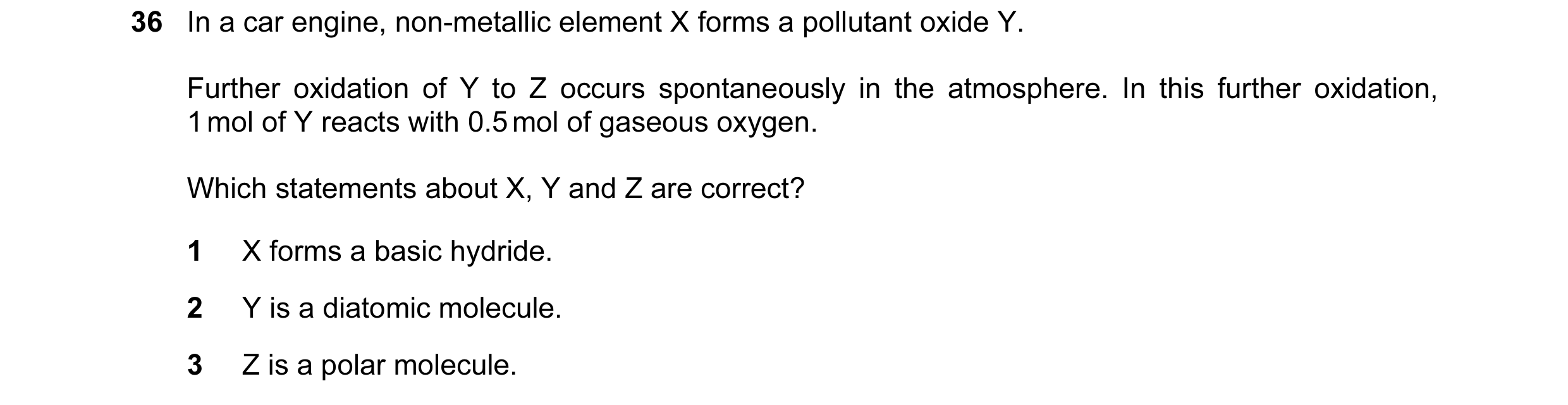
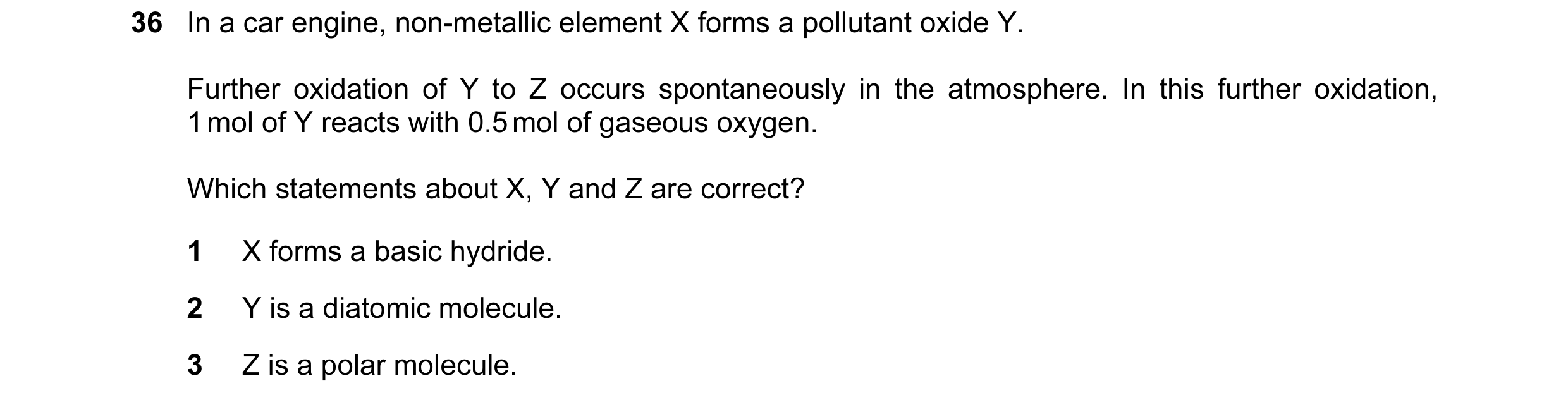
Q38 · In a car engine, non-metallic element X forms a pollutant oxide Y 9701/11 Oct/Nov 2011
36 In a car engine, non-metallic element X forms a pollutant oxide Y. Further oxidation of Y to Z occurs spontaneously in the atmosphere. In this further oxidation, 1 mol of Y reacts with 0.5 mol of gaseous oxygen. Which statements about X, Y and Z are correct? 1 X forms a basic hydride. 2 Y is a diatomic molecule. 3 Z is a polar molecule.
1 marks
Answer: A
This question in 9701/11 Oct/Nov 2011
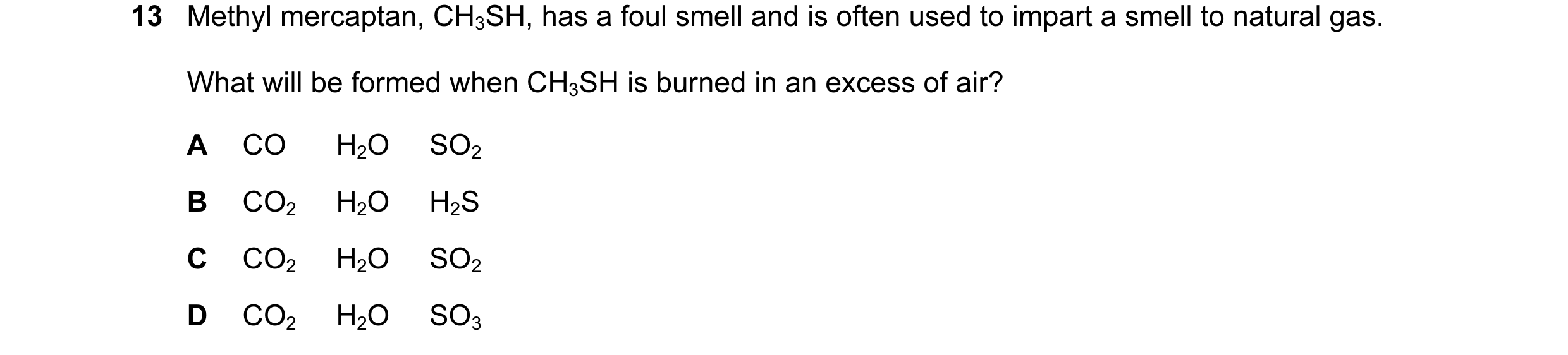
Q39 · Methyl mercaptan, CH3SH, has a foul smell and is often used to impart a smell to natural… 9701/12 Oct/Nov 2011
13 Methyl mercaptan, CH3SH, has a foul smell and is often used to impart a smell to natural gas. What will be formed when CH3SH is burned in an excess of air? A CO H2O SO2 B CO2 H2O H2S C CO2 H2O SO2 D CO2 H2O SO3
1 marks
This question in 9701/12 Oct/Nov 2011
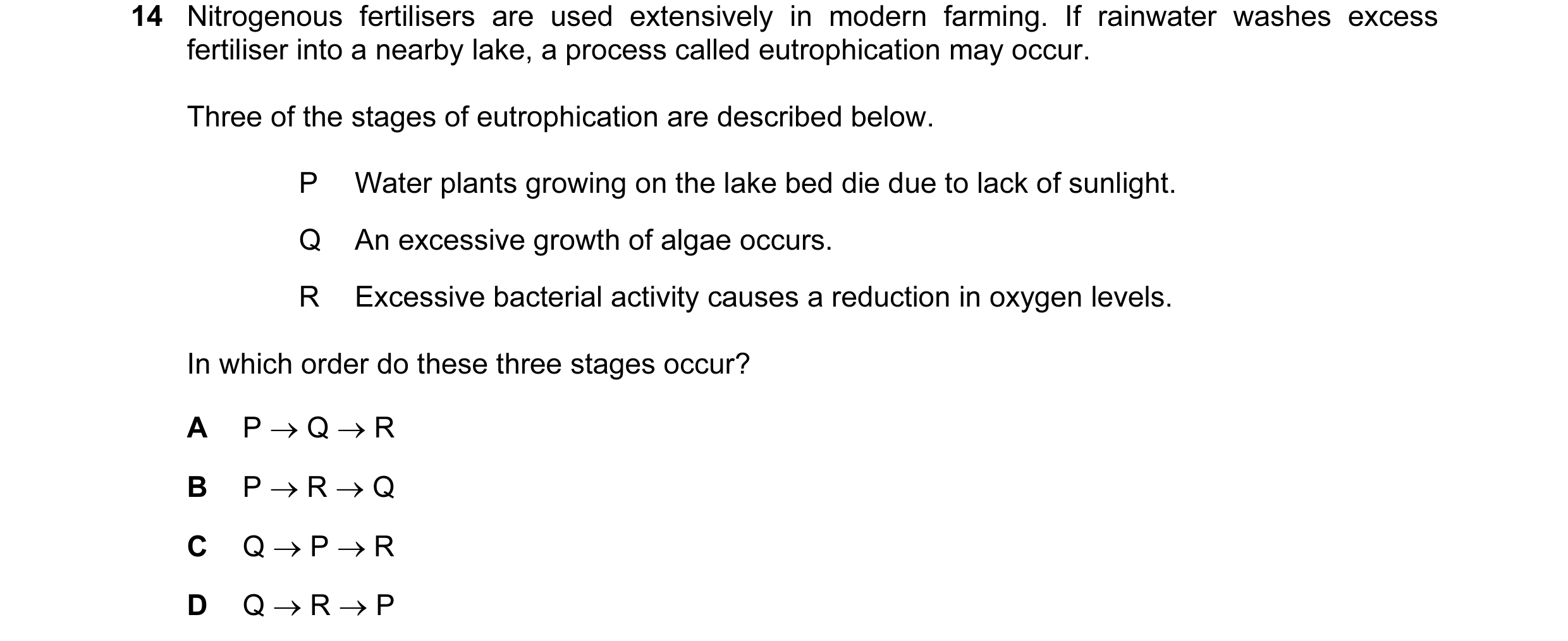
Q40 · Nitrogenous fertilisers are used extensively in modern farming 9701/12 Oct/Nov 2011
14 Nitrogenous fertilisers are used extensively in modern farming. If rainwater washes excess fertiliser into a nearby lake, a process called eutrophication may occur. Three of the stages of eutrophication are described below. P Water plants growing on the lake bed die due to lack of sunlight. Q An excessive growth of algae occurs. R Excessive bacterial activity causes a reduction in oxygen levels. In which order do these three stages occur? A P → Q → R B P → R → Q C Q → P → R D Q → R → P
1 marks
This question in 9701/12 Oct/Nov 2011
Q41 · In a car engine, non-metallic element X forms a pollutant oxide Y 9701/12 Oct/Nov 2011
36 In a car engine, non-metallic element X forms a pollutant oxide Y. Further oxidation of Y to Z occurs spontaneously in the atmosphere. In this further oxidation, 1 mol of Y reacts with 0.5 mol of gaseous oxygen. Which statements about X, Y and Z are correct? 1 The oxidation number of X increases by 2 from Y to Z. 2 The molecule of Y has no unpaired electrons. 3 The molecule of Z contains three oxygen atoms.
1 marks
This question in 9701/12 Oct/Nov 2011
Q42 · Total removal of the pollutant sulfur dioxide, SO2, is difficult, both for economic and… 9701/13 Oct/Nov 2011
20 Total removal of the pollutant sulfur dioxide, SO2, is difficult, both for economic and technical reasons. The quantities emitted from furnace chimneys can be lowered by using desulfurisation plants. The gases are scrubbed (washed) with calcium hydroxide to remove the SO2. What is the main product formed initially? A Ca(HSO4)2 B CaS C CaSO3 D CaSO4
1 marks
Answer: C
This question in 9701/13 Oct/Nov 2011
Q43 · In a car engine, non-metallic element X forms a pollutant oxide Y 9701/13 Oct/Nov 2011
36 In a car engine, non-metallic element X forms a pollutant oxide Y. Further oxidation of Y to Z occurs spontaneously in the atmosphere. In this further oxidation, 1 mol of Y reacts with 0.5 mol of gaseous oxygen. Which statements about X, Y and Z are correct? 1 X forms a basic hydride. 2 Y is a diatomic molecule. 3 Z is a polar molecule.
1 marks
Answer: A
This question in 9701/13 Oct/Nov 2011
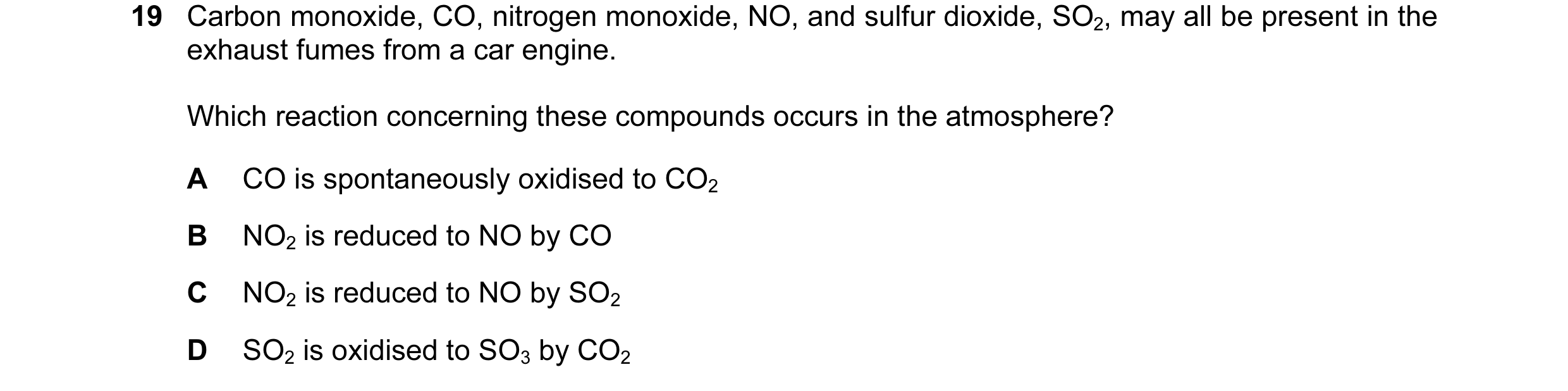
Q44 · Carbon monoxide, CO, nitrogen monoxide, NO, and sulfur dioxide, SO2, may all be present… 9701/11 May/June 2012
19 Carbon monoxide, CO, nitrogen monoxide, NO, and sulfur dioxide, SO2, may all be present in the exhaust fumes from a car engine. Which reaction concerning these compounds occurs in the atmosphere? A CO is spontaneously oxidised to CO2 B NO2 is reduced to NO by CO C NO2 is reduced to NO by SO2 D SO2 is oxidised to SO3 by CO2
1 marks
Answer: C
This question in 9701/11 May/June 2012
Q45 · In which substance does nitrogen exhibit the highest oxidation state? 9701/12 May/June 2012
11 In which substance does nitrogen exhibit the highest oxidation state? A NO B N2O C N2O4 D NaNO2
1 marks
Answer: C
This question in 9701/12 May/June 2012
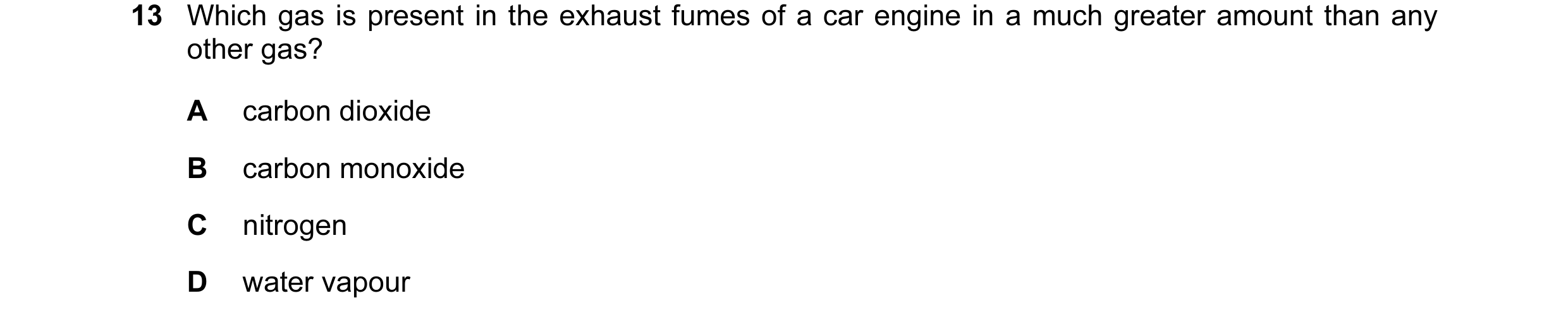
Q46 · Which gas is present in the exhaust fumes of a car engine in a much greater amount than… 9701/12 May/June 2012
13 Which gas is present in the exhaust fumes of a car engine in a much greater amount than any other gas? A carbon dioxide B carbon monoxide C nitrogen D water vapour
1 marks
Answer: C
This question in 9701/12 May/June 2012
Q47 · Which substance does not produce a poisonous gas, when burnt in a limited amount of air? 9701/12 May/June 2012
19 Which substance does not produce a poisonous gas, when burnt in a limited amount of air? A hydrogen B methane C propene D sulfur
1 marks
Answer: A
This question in 9701/12 May/June 2012
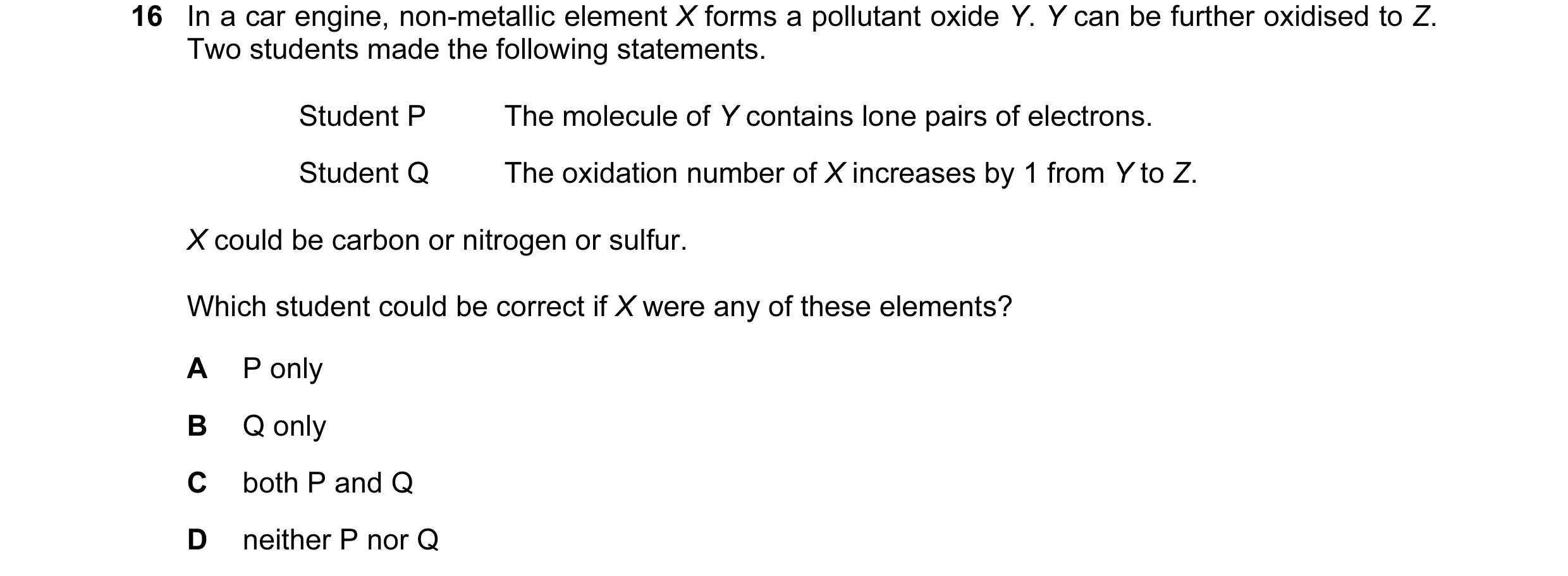
Q48 · In a car engine, non-metallic element X forms a pollutant oxide Y 9701/11 Oct/Nov 2012
16 In a car engine, non-metallic element X forms a pollutant oxide Y. Y can be further oxidised to Z. Two students made the following statements. Student P The molecule of Y contains lone pairs of electrons. Student Q The oxidation number of X increases by 1 from Y to Z. X could be carbon or nitrogen or sulfur. Which student could be correct if X were any of these elements? A P only B Q only C both P and Q D neither P nor Q
1 marks
Answer: A
This question in 9701/11 Oct/Nov 2012
Q49 · Which equations represent stages in the Contact process for manufacturing sulfuric acid? 9701/11 Oct/Nov 2012
35 Which equations represent stages in the Contact process for manufacturing sulfuric acid? 1 O2 → SO3 1 SO2 + 2 2 SO2 + H2O → H2SO3 1 O2 → H2SO4 3 H2SO3 + 2
1 marks
Answer: D
This question in 9701/11 Oct/Nov 2012
Q50 · Which equations represent stages in the Contact process for manufacturing sulfuric acid? 9701/12 Oct/Nov 2012
35 Which equations represent stages in the Contact process for manufacturing sulfuric acid? 1 O2 → SO3 1 SO2 + 2 2 SO2 + H2O → H2SO3 1 O2 → H2SO4 3 H2SO3 + 2
1 marks
Answer: D
This question in 9701/12 Oct/Nov 2012
Q51 · Element J is a solid 9701/13 May/June 2013
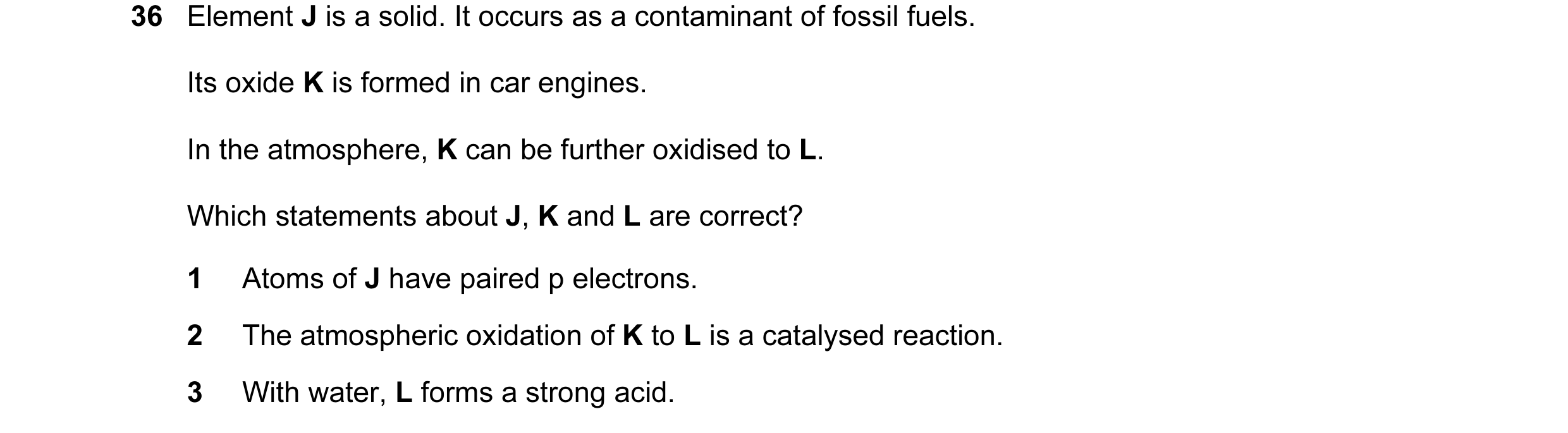
36 Element J is a solid. It occurs as a contaminant of fossil fuels. Its oxide K is formed in car engines. In the atmosphere, K can be further oxidised to L. Which statements about J, K and L are correct? 1 Atoms of J have paired p electrons. 2 The atmospheric oxidation of K to L is a catalysed reaction. 3 With water, L forms a strong acid.
1 marks
Answer: A
This question in 9701/13 May/June 2013
Q52 · Sulfur dioxide and sulfites are used in food preservation 9701/11 Oct/Nov 2013
36 Sulfur dioxide and sulfites are used in food preservation. Why are they used for this purpose? 1 They are reducing agents which slow down the oxidation of food. 2 They inhibit the growth of aerobic bacteria. 3 They react with NO2(g) converting it to NO(g).
1 marks
Answer: B
This question in 9701/11 Oct/Nov 2013
Q53 · Sulfur dioxide and sulfites are used in food preservation 9701/12 Oct/Nov 2013
36 Sulfur dioxide and sulfites are used in food preservation. Why are they used for this purpose? 1 They are reducing agents which slow down the oxidation of food. 2 They inhibit the growth of aerobic bacteria. 3 They react with NO2(g) converting it to NO(g).
1 marks
Answer: B
This question in 9701/12 Oct/Nov 2013
Q54 · Carbon, nitrogen and sulfur are non-metals 9701/13 Oct/Nov 2013
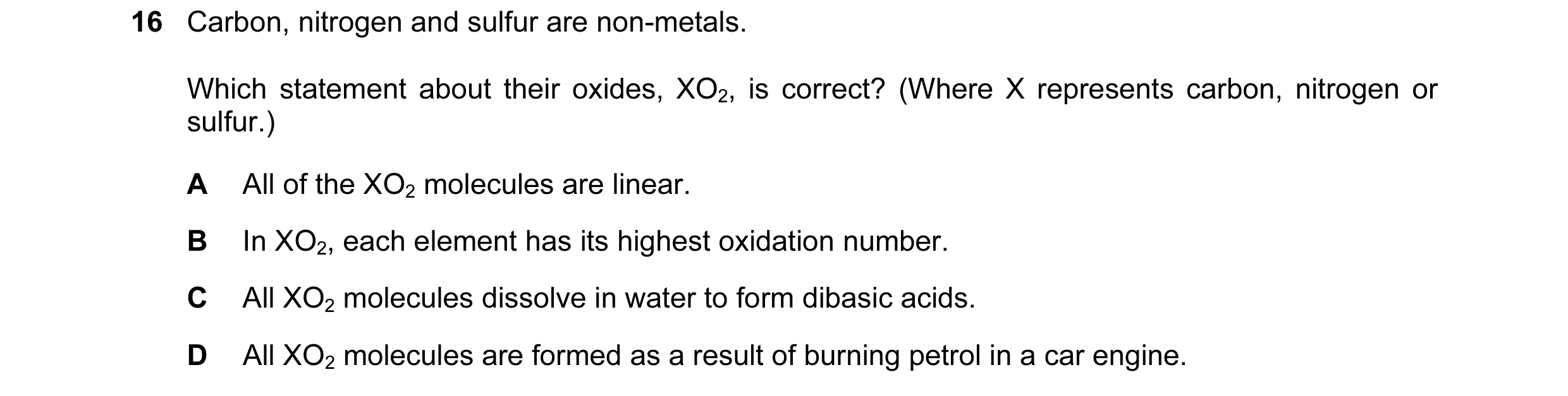
16 Carbon, nitrogen and sulfur are non-metals. Which statement about their oxides, XO2, is correct? (Where X represents carbon, nitrogen or sulfur.) A All of the XO2 molecules are linear. B In XO2, each element has its highest oxidation number. C All XO2 molecules dissolve in water to form dibasic acids. D All XO2 molecules are formed as a result of burning petrol in a car engine.
1 marks
Answer: D
This question in 9701/13 Oct/Nov 2013
Q55 · Which processes involve the conversion of sulfur dioxide into sulfur trioxide? 9701/13 Oct/Nov 2013
35 Which processes involve the conversion of sulfur dioxide into sulfur trioxide? 1 the combustion of sulfur contaminated fossil fuels 2 the Contact process for manufacturing sulfuric acid 3 the catalytic oxidation of sulfur dioxide by oxides of nitrogen
1 marks
Answer: C
This question in 9701/13 Oct/Nov 2013
Q56 · Pollutant oxide Y, which contains non-metallic element X, is formed in a car engine 9701/11 May/June 2014
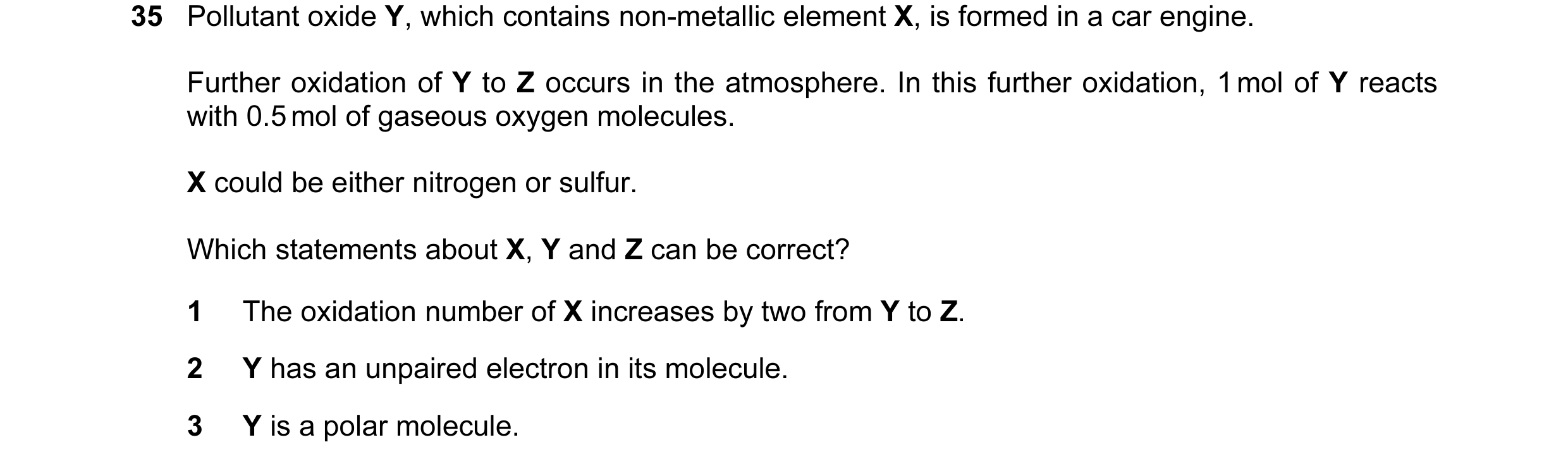
35 Pollutant oxide Y, which contains non-metallic element X, is formed in a car engine. Further oxidation of Y to Z occurs in the atmosphere. In this further oxidation, 1 mol of Y reacts with 0.5 mol of gaseous oxygen molecules. X could be either nitrogen or sulfur. Which statements about X, Y and Z can be correct? 1 The oxidation number of X increases by two from Y to Z. 2 Y has an unpaired electron in its molecule. 3 Y is a polar molecule.
1 marks
Answer: A
This question in 9701/11 May/June 2014
Q57 · Many crude oils contain H2S 9701/13 May/June 2014
33 Many crude oils contain H2S. During refining, by the Claus process, the H2S is converted into solid sulfur, which is then removed. reaction I 2H2S(g) + 3O2(g) → 2H2O(l) + 2SO2(g) reaction II 2H2S(g) + SO2(g) → 2H2O(l) + 3S(s) Which statements about the Claus process are correct? 1 H2S is oxidised in reaction I. 2 SO2 oxidises H2S in reaction II. 3 Hydrogen is oxidised in reaction II.
1 marks
Answer: B
This question in 9701/13 May/June 2014
Q58 · Which statements explain why sulfur dioxide is used as a food preservative? 9701/13 May/June 2014
35 Which statements explain why sulfur dioxide is used as a food preservative? 1 It is a reducing agent and therefore an anti-oxidant. 2 It prevents alcohols in foods forming sour-tasting acids. 3 It does not smell and therefore can be used in large quantities.
1 marks
Answer: B
This question in 9701/13 May/June 2014
Q59 · Total removal of the pollutant sulfur dioxide, SO2, is difficult 9701/11 Oct/Nov 2014
18 Total removal of the pollutant sulfur dioxide, SO2, is difficult. The quantities emitted from furnace chimneys can be lowered by using desulfurisation plants. The gases are reacted with calcium hydroxide to remove the SO2. What is the main product formed initially? A Ca(HSO4)2 B CaS C CaSO3 D CaSO4
1 marks
Answer: C
This question in 9701/11 Oct/Nov 2014
Q60 · Total removal of the pollutant sulfur dioxide, SO2, is difficult 9701/12 Oct/Nov 2014
18 Total removal of the pollutant sulfur dioxide, SO2, is difficult. The quantities emitted from furnace chimneys can be lowered by using desulfurisation plants. The gases are reacted with calcium hydroxide to remove the SO2. What is the main product formed initially? A Ca(HSO4)2 B CaS C CaSO3 D CaSO4
1 marks
Answer: C
This question in 9701/12 Oct/Nov 2014
Q61 · Element X is a solid 9701/13 Oct/Nov 2014
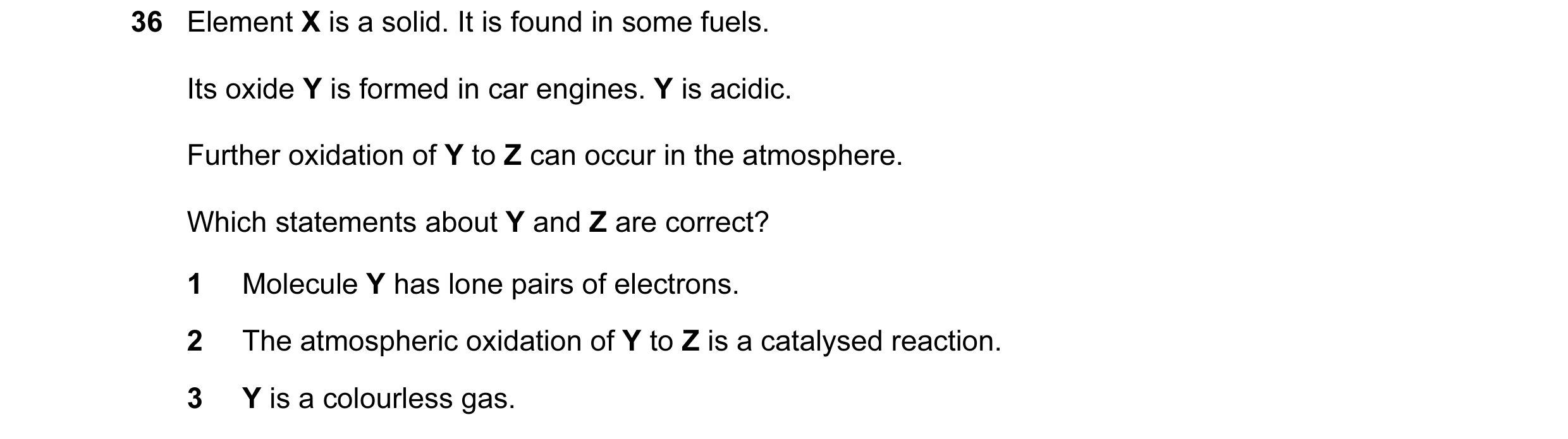
36 Element X is a solid. It is found in some fuels. Its oxide Y is formed in car engines. Y is acidic. Further oxidation of Y to Z can occur in the atmosphere. Which statements about Y and Z are correct? 1 Molecule Y has lone pairs of electrons. 2 The atmospheric oxidation of Y to Z is a catalysed reaction. 3 Y is a colourless gas.
1 marks
Answer: A
This question in 9701/13 Oct/Nov 2014
Q62 · Which statements about the industrial manufacture of sulfuric acid are correct? 9701/11 May/June 2015
35 Which statements about the industrial manufacture of sulfuric acid are correct? 1 Sulfur is burned to form sulfur dioxide. 2 The stage that forms sulfur trioxide involves a V2O5 catalyst. 3 The stage that forms sulfur trioxide is non-reversible.
1 marks
Answer: B
This question in 9701/11 May/June 2015
Q63 · Carbon monoxide, CO, nitrogen dioxide, NO2, and sulfur dioxide, SO2, are all atmospheric… 9701/12 May/June 2015
18 Carbon monoxide, CO, nitrogen dioxide, NO2, and sulfur dioxide, SO2, are all atmospheric pollutants. Which reaction concerning these compounds occurs in the atmosphere? A CO is spontaneously oxidised to CO2 B NO2 is reduced to NO by CO C NO2 is reduced to NO by SO2 D SO2 is oxidised to SO3 by CO2
1 marks
Answer: C
This question in 9701/12 May/June 2015
Q64 · In some rice-growing parts of the world, farmers use a combination of paddy fields and a… 9701/12 Feb/March 2016
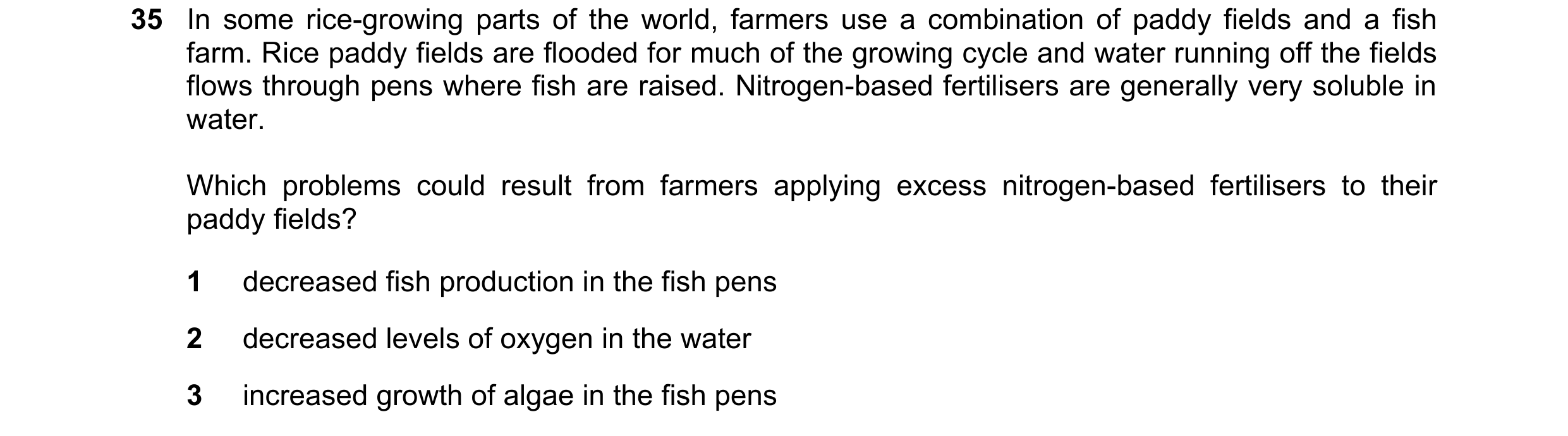
35 In some rice-growing parts of the world, farmers use a combination of paddy fields and a fish farm. Rice paddy fields are flooded for much of the growing cycle and water running off the fields flows through pens where fish are raised. Nitrogen-based fertilisers are generally very soluble in water. Which problems could result from farmers applying excess nitrogen-based fertilisers to their paddy fields? 1 decreased fish production in the fish pens 2 decreased levels of oxygen in the water 3 increased growth of algae in the fish pens
1 marks
Answer: A
This question in 9701/12 Feb/March 2016
Q65 · Which reaction does not contribute to the problem of acid rain? 9701/11 May/June 2016
19 Which reaction does not contribute to the problem of acid rain? A the combustion of fossil fuels B the oxidation of sulfur dioxide to sulfur trioxide catalysed by nitrogen dioxide C the reaction between nitrogen monoxide and carbon monoxide in a catalytic converter D the reaction of sulfur trioxide with water
1 marks
Answer: C
This question in 9701/11 May/June 2016
Q66 · Which statement does not describe an effect of acid rain on the environment? 9701/13 May/June 2016
19 Which statement does not describe an effect of acid rain on the environment? A Acid rain causes erosion of stone buildings. B Acid rain causes ozone depletion. C Acid rain increases the corrosion of some metals. D Acid rain increases the leaching away of essential nutrients and minerals from soils.
1 marks
Answer: B
This question in 9701/13 May/June 2016
Q67 · Acid rain continues to be a problem 9701/12 May/June 2017
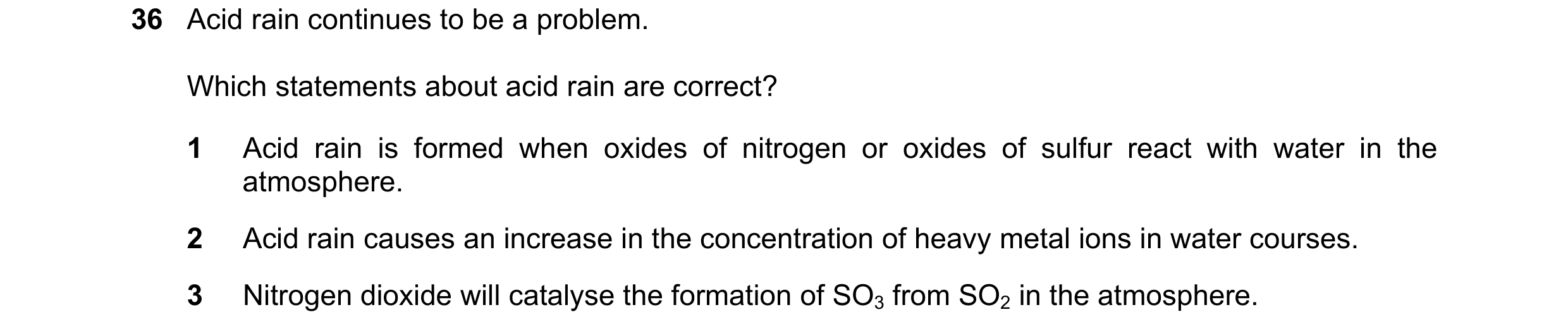
36 Acid rain continues to be a problem. Which statements about acid rain are correct? 1 Acid rain is formed when oxides of nitrogen or oxides of sulfur react with water in the atmosphere. 2 Acid rain causes an increase in the concentration of heavy metal ions in water courses. 3 Nitrogen dioxide will catalyse the formation of SO3 from SO2 in the atmosphere.
1 marks
Answer: A
This question in 9701/12 May/June 2017
Q68 · What would be produced when 60 g of nitrogen monoxide react with an excess of carbon… 9701/13 May/June 2017
19 What would be produced when 60 g of nitrogen monoxide react with an excess of carbon monoxide in a catalytic converter? A 12 g of carbon and 92 g of nitrogen dioxide B 24 g of carbon and 92 g of nitrogen dioxide C 88 g of carbon dioxide and 28 g of nitrogen D 88 g of carbon dioxide and 56 g of nitrogen
1 marks
Answer: C
This question in 9701/13 May/June 2017
Q69 · Sulfur dioxide is an atmospheric pollutant 9701/13 May/June 2017
36 Sulfur dioxide is an atmospheric pollutant. What might result from the release of sulfur dioxide gas into the atmosphere? 1 reduction of NO2 to NO 2 depletion of aquatic life 3 corrosion of limestone statues
1 marks
Answer: A
This question in 9701/13 May/June 2017
Q70 · Which statements explain why nitrogen gas is unreactive? 9701/11 Oct/Nov 2017
36 Which statements explain why nitrogen gas is unreactive? 1 Nitrogen atoms are highly electronegative. 2 Nitrogen molecules are non-polar. 3 The triple bond between nitrogen atoms is very strong.
1 marks
Answer: C
This question in 9701/11 Oct/Nov 2017
Q71 · The reaction of nitrogen and oxygen to produce oxides of nitrogen happens at high… 9701/12 Oct/Nov 2017
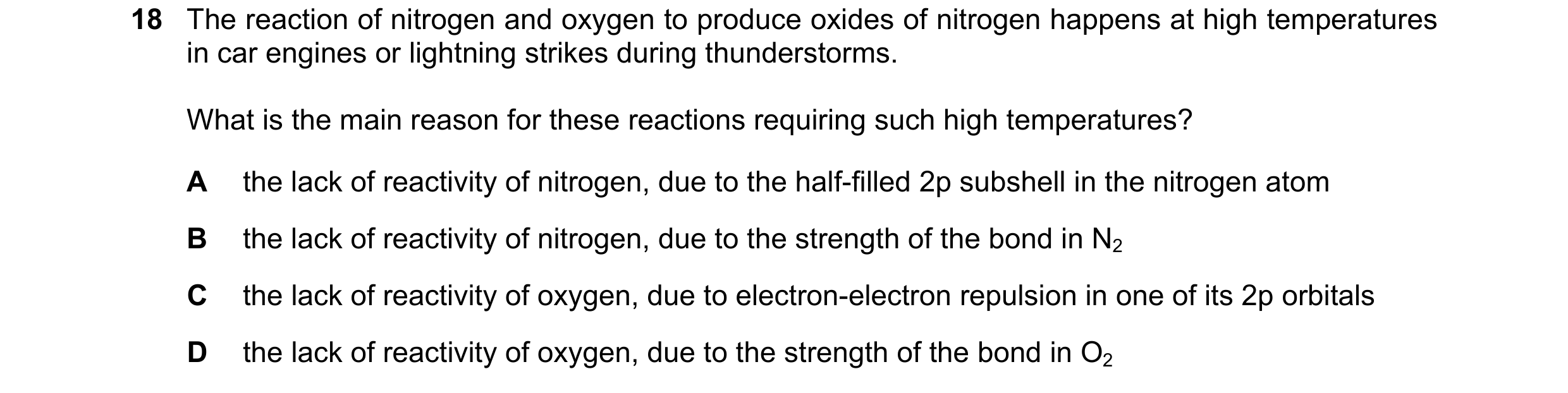
18 The reaction of nitrogen and oxygen to produce oxides of nitrogen happens at high temperatures in car engines or lightning strikes during thunderstorms. What is the main reason for these reactions requiring such high temperatures? A the lack of reactivity of nitrogen, due to the half-filled 2p subshell in the nitrogen atom B the lack of reactivity of nitrogen, due to the strength of the bond in N2 C the lack of reactivity of oxygen, due to electron-electron repulsion in one of its 2p orbitals D the lack of reactivity of oxygen, due to the strength of the bond in O2
1 marks
Answer: B
This question in 9701/12 Oct/Nov 2017
Q72 · Which statements explain why nitrogen gas is unreactive? 9701/13 Oct/Nov 2017
36 Which statements explain why nitrogen gas is unreactive? 1 Nitrogen atoms are highly electronegative. 2 Nitrogen molecules are non-polar. 3 The triple bond between nitrogen atoms is very strong.
1 marks
Answer: C
This question in 9701/13 Oct/Nov 2017
Q73 · When burned, sulfur forms a gaseous product X which can be oxidised to produce a gas Y 9701/12 Feb/March 2018
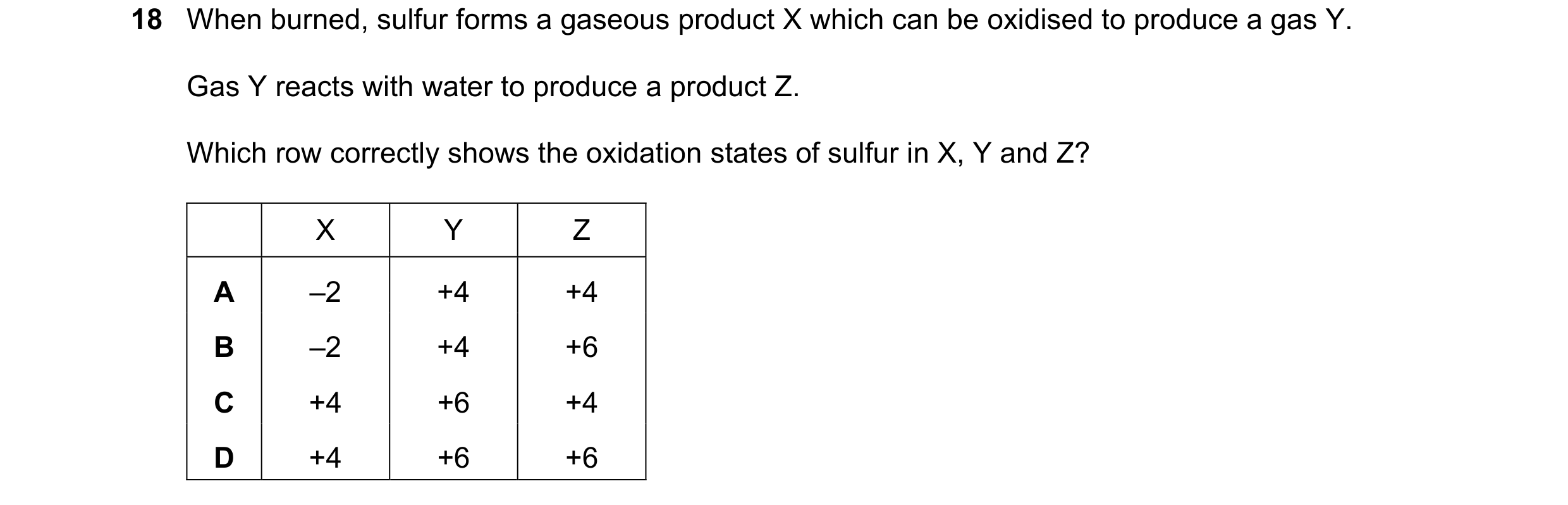
18 When burned, sulfur forms a gaseous product X which can be oxidised to produce a gas Y. Gas Y reacts with water to produce a product Z. Which row correctly shows the oxidation states of sulfur in X, Y and Z? X Y Z A –2 +4 +4 B –2 +4 +6 C +4 +6 +4 D +4 +6 +6
1 marks
Answer: D
This question in 9701/12 Feb/March 2018
Q74 · In which different forms does nitrogen exist in compounds? 9701/12 Feb/March 2018
36 In which different forms does nitrogen exist in compounds? 1 bonded by a triple covalent bond 2 as part of a cation 3 in an oxidation state of +5
1 marks
Answer: A
This question in 9701/12 Feb/March 2018
Q75 · Oxides of nitrogen are present in the environment due to natural and man-made sources 9701/11 May/June 2018
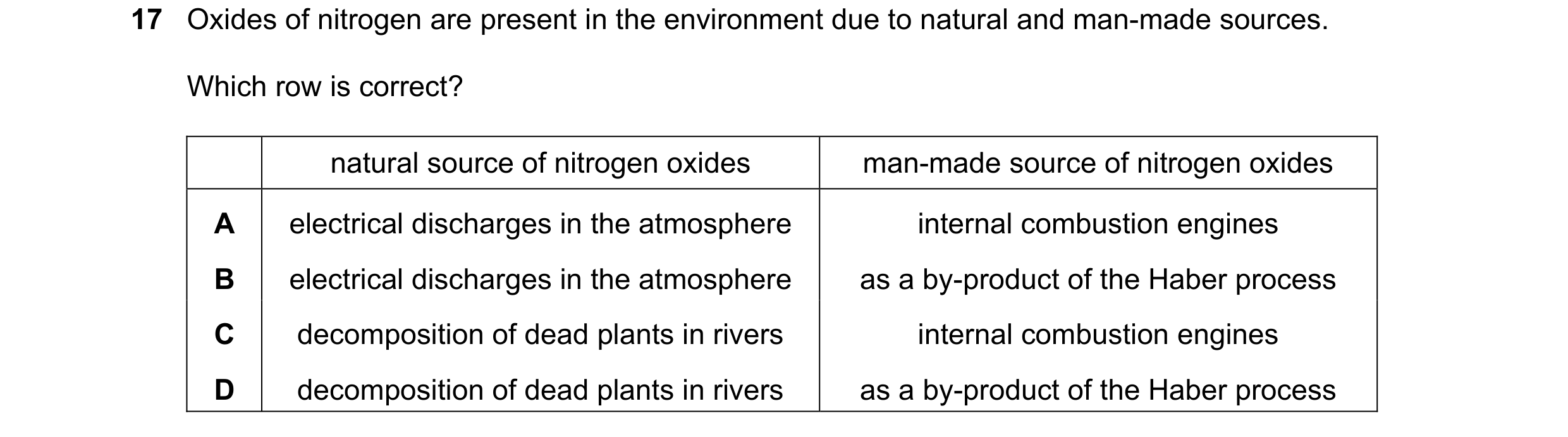
17 Oxides of nitrogen are present in the environment due to natural and man-made sources. Which row is correct? natural source of nitrogen oxides man-made source of nitrogen oxides A electrical discharges in the atmosphere internal combustion engines B electrical discharges in the atmosphere as a by-product of the Haber process C decomposition of dead plants in rivers internal combustion engines D decomposition of dead plants in rivers as a by-product of the Haber process
1 marks
Answer: A
This question in 9701/11 May/June 2018
Q76 · Which statements correctly describe an oxide of nitrogen acting as an atmospheric… 9701/11 May/June 2018
36 Which statements correctly describe an oxide of nitrogen acting as an atmospheric pollutant? 1 Nitrogen monoxide, NO, reacts with oxygen to form nitrogen dioxide which contributes to acid rain. 2 Nitrogen dioxide reacts with sulfur dioxide to form sulfur trioxide which reacts with water to form sulfuric acid. 3 Nitrogen oxides react with unburnt hydrocarbons in sunlight to form other pollutants.
1 marks
Answer: A
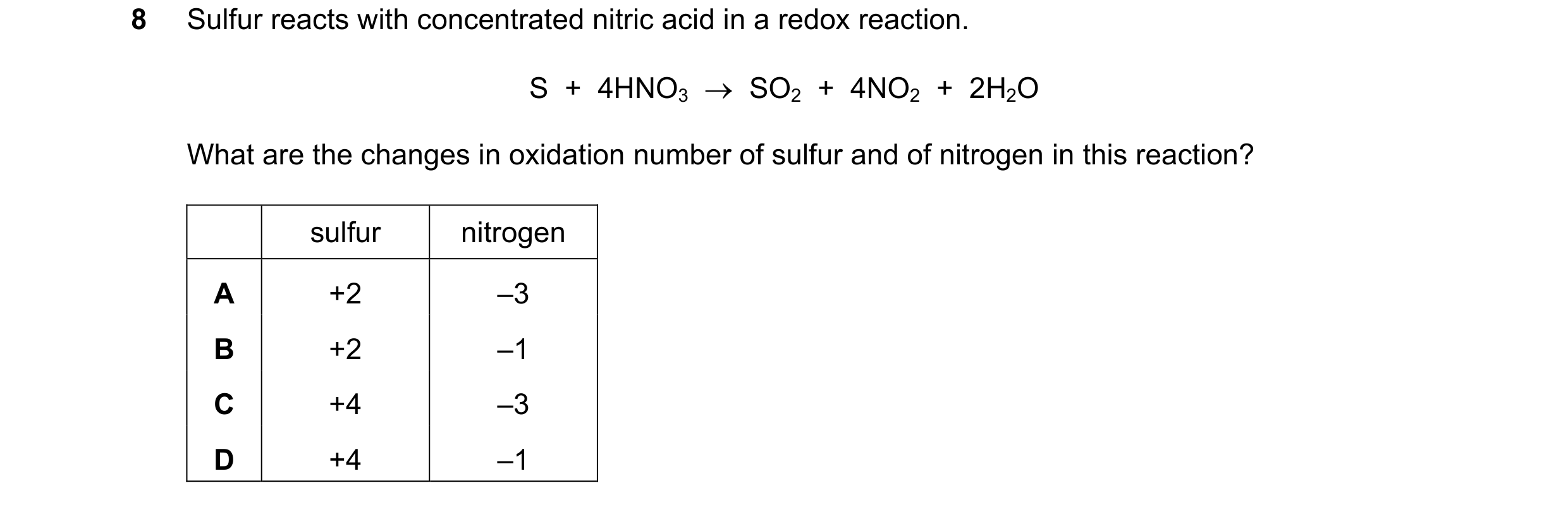
This question in 9701/11 May/June 2018
Q77 · Sulfur reacts with concentrated nitric acid in a redox reaction 9701/12 May/June 2018
8 Sulfur reacts with concentrated nitric acid in a redox reaction. S + 4HNO3 → SO2 + 4NO2 + 2H2O What are the changes in oxidation number of sulfur and of nitrogen in this reaction? sulfur nitrogen A +2 –3 B +2 –1 C +4 –3 D +4 –1
1 marks
Answer: D
This question in 9701/12 May/June 2018
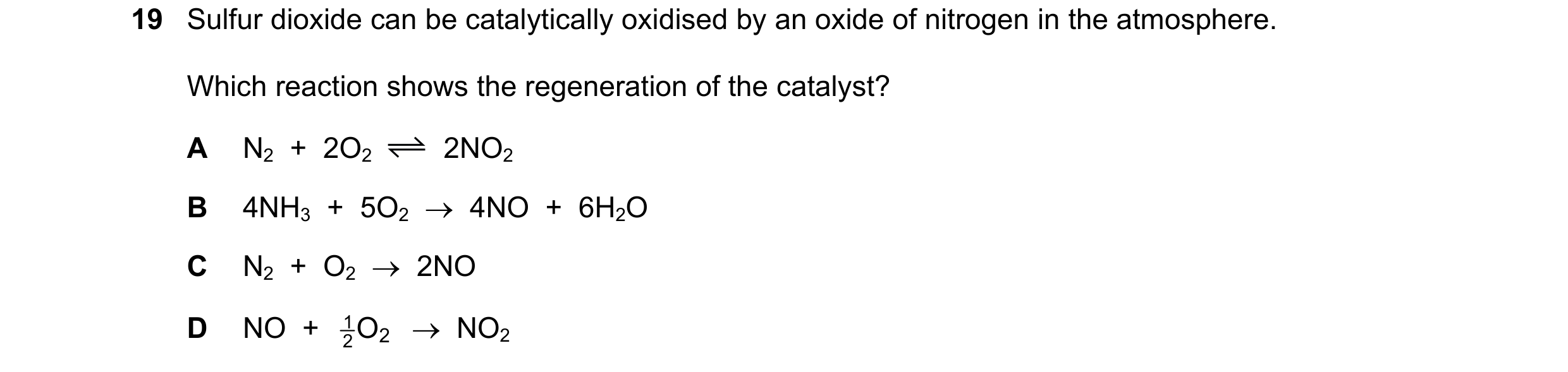
Q78 · Sulfur dioxide can be catalytically oxidised by an oxide of nitrogen in the atmosphere 9701/12 May/June 2018
19 Sulfur dioxide can be catalytically oxidised by an oxide of nitrogen in the atmosphere. Which reaction shows the regeneration of the catalyst? A N2 + 2O2 2NO2 B 4NH3 + 5O2 → 4NO + 6H2O C N2 + O2 → 2NO D NO + 1 O → NO2 2 2
1 marks
Answer: D
This question in 9701/12 May/June 2018
Q79 · The gaseous products of heating a mixture of Ca(OH)2 and NH4Cl are passed through solid… 9701/13 May/June 2018
19 The gaseous products of heating a mixture of Ca(OH)2 and NH4Cl are passed through solid CaO. This absorbs water vapour and a gas, W, is collected. A sample of W is oxidised by Cl 2(g) to produce two gases, X and Y. X is an element. Y is acidic. Y reacts with W to produce Z. What are X and Z? X Z A N2 CaCl 2 B N2 NH4Cl C O2 CaCl 2 D O2 NH4Cl
1 marks
Answer: B
This question in 9701/13 May/June 2018
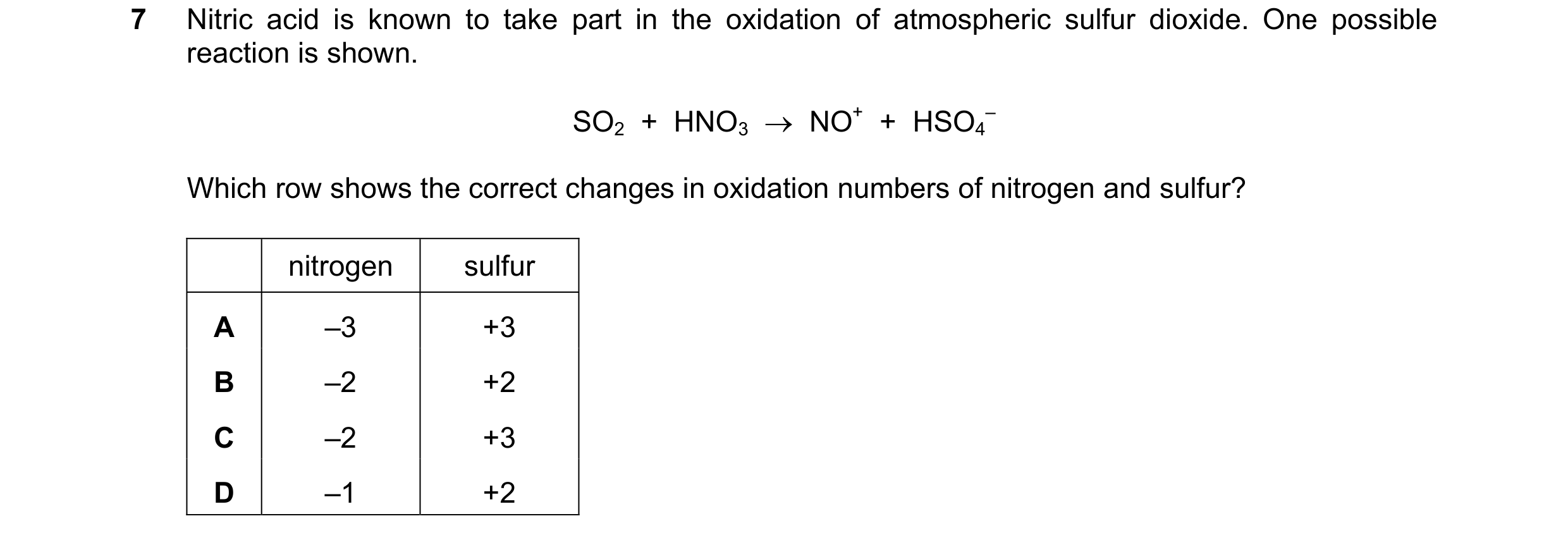
Q80 · Nitric acid is known to take part in the oxidation of atmospheric sulfur dioxide 9701/11 Oct/Nov 2018
7 Nitric acid is known to take part in the oxidation of atmospheric sulfur dioxide. One possible reaction is shown. SO2 + HNO3 → NO+ + HSO4 – Which row shows the correct changes in oxidation numbers of nitrogen and sulfur? nitrogen sulfur A –3 +3 B –2 +2 C –2 +3 D –1 +2
1 marks
Answer: B
This question in 9701/11 Oct/Nov 2018
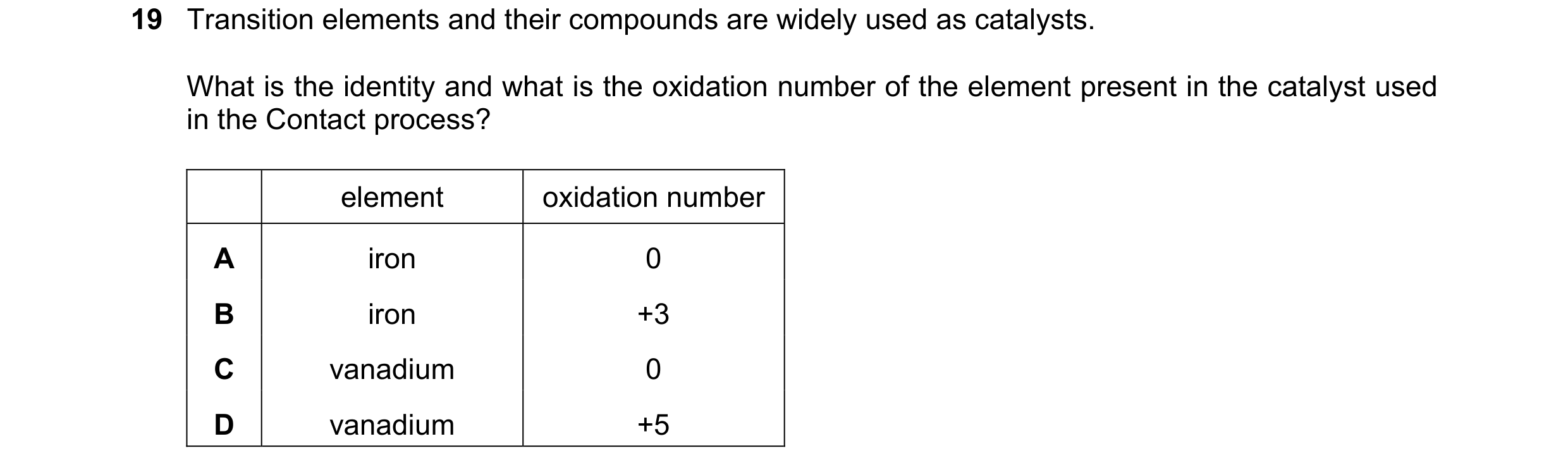
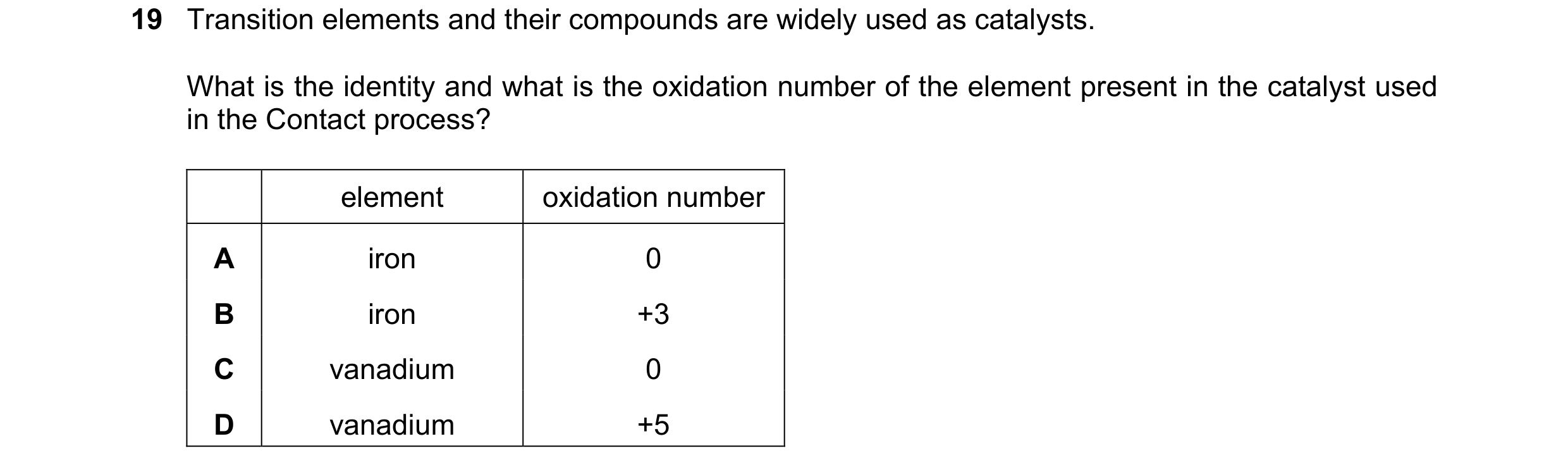
Q81 · Transition elements and their compounds are widely used as catalysts 9701/11 Oct/Nov 2018
19 Transition elements and their compounds are widely used as catalysts. What is the identity and what is the oxidation number of the element present in the catalyst used in the Contact process? element oxidation number A iron 0 B iron +3 C vanadium 0 D vanadium +5
1 marks
Answer: D
This question in 9701/11 Oct/Nov 2018
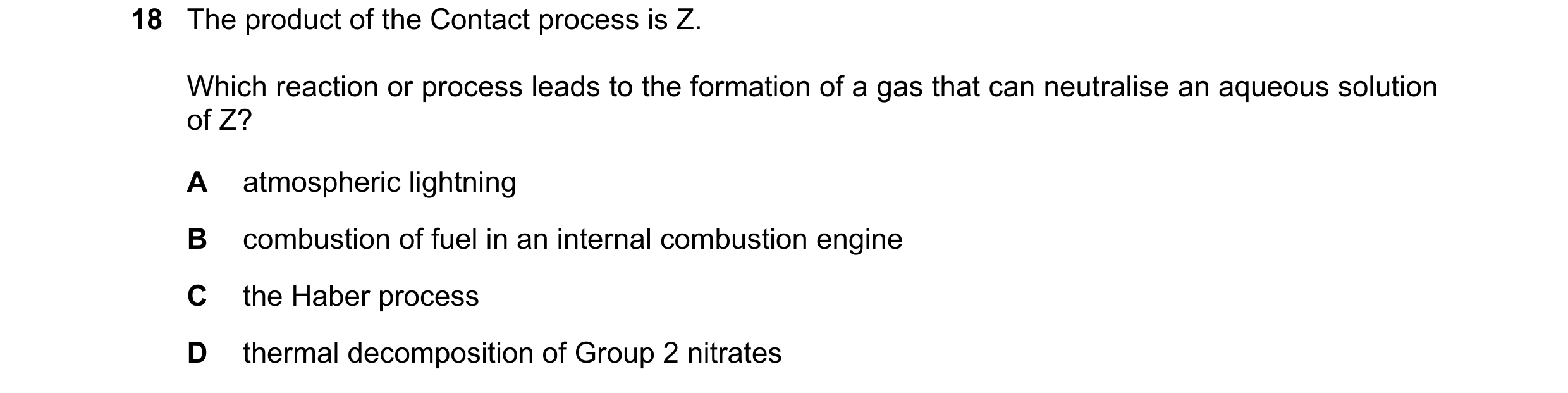
Q82 · The product of the Contact process is Z 9701/12 Oct/Nov 2018
18 The product of the Contact process is Z. Which reaction or process leads to the formation of a gas that can neutralise an aqueous solution of Z? A atmospheric lightning B combustion of fuel in an internal combustion engine C the Haber process D thermal decomposition of Group 2 nitrates
1 marks
Answer: C
This question in 9701/12 Oct/Nov 2018
Q83 · Nitric acid is known to take part in the oxidation of atmospheric sulfur dioxide 9701/13 Oct/Nov 2018
7 Nitric acid is known to take part in the oxidation of atmospheric sulfur dioxide. One possible reaction is shown. SO2 + HNO3 → NO+ + HSO4 – Which row shows the correct changes in oxidation numbers of nitrogen and sulfur? nitrogen sulfur A –3 +3 B –2 +2 C –2 +3 D –1 +2
1 marks
Answer: B
This question in 9701/13 Oct/Nov 2018
Q84 · Transition elements and their compounds are widely used as catalysts 9701/13 Oct/Nov 2018
19 Transition elements and their compounds are widely used as catalysts. What is the identity and what is the oxidation number of the element present in the catalyst used in the Contact process? element oxidation number A iron 0 B iron +3 C vanadium 0 D vanadium +5
1 marks
Answer: D
This question in 9701/13 Oct/Nov 2018
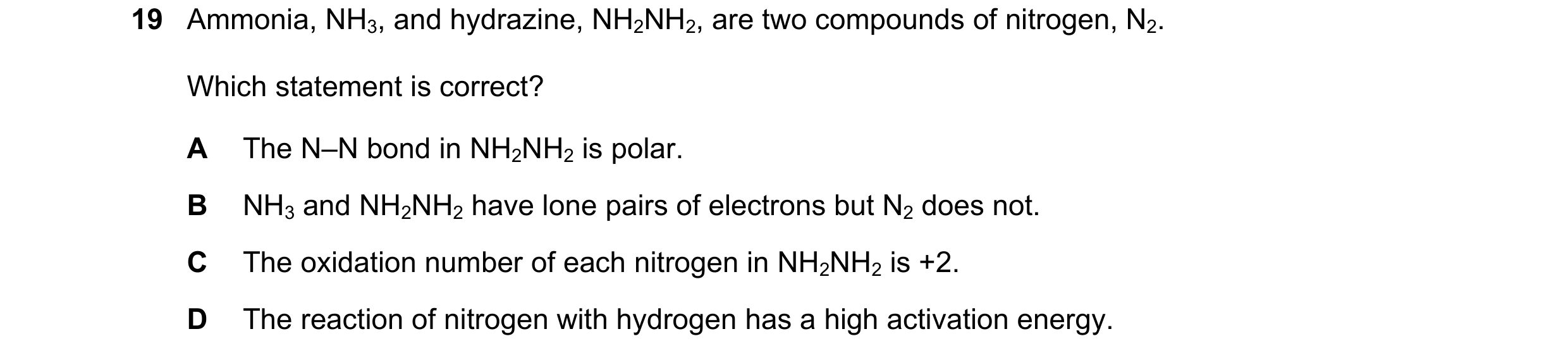
Q85 · Ammonia, NH3, and hydrazine, NH2NH2, are two compounds of nitrogen, N2 9701/12 Feb/March 2019
19 Ammonia, NH3, and hydrazine, NH2NH2, are two compounds of nitrogen, N2. Which statement is correct? A The N–N bond in NH2NH2 is polar. B NH3 and NH2NH2 have lone pairs of electrons but N2 does not. C The oxidation number of each nitrogen in NH2NH2 is +2. D The reaction of nitrogen with hydrogen has a high activation energy.
1 marks
Answer: D
This question in 9701/12 Feb/March 2019
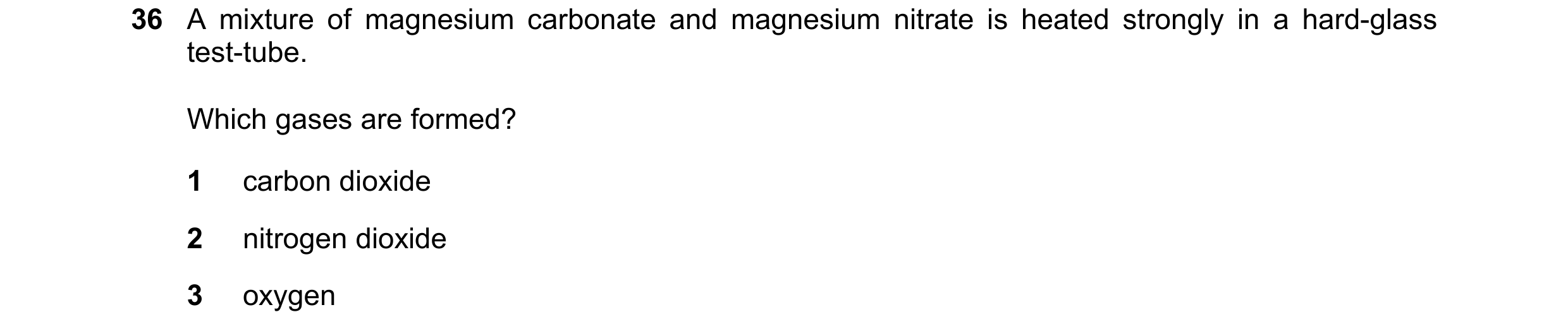
Q86 · A mixture of magnesium carbonate and magnesium nitrate is heated strongly in a hard-glass… 9701/11 May/June 2019
36 A mixture of magnesium carbonate and magnesium nitrate is heated strongly in a hard-glass test-tube. Which gases are formed? 1 carbon dioxide 2 nitrogen dioxide 3 oxygen
1 marks
Answer: A
This question in 9701/11 May/June 2019
Q87 · Which reaction gives a product that is an atmospheric pollutant causing acid rain? 9701/12 May/June 2019
19 Which reaction gives a product that is an atmospheric pollutant causing acid rain? A 3Mg(s) + SO2(g) → MgS(s) + 2MgO(s) B (NH4)2SO4(s) + Ca(OH)2(s) → 2NH3(g) + CaSO4(s) + 2H2O(l) C 2MnO4 –(aq) + 5SO2(g) + 2H2O(l) → 2Mn2+(aq) + 4H+(aq) + 5SO4 2–(aq) D 2FeSO4(s) → Fe2O3(s) + SO2(g) + SO3(g)
1 marks
Answer: D
This question in 9701/12 May/June 2019
Q88 · In which reactions are nitrogen atoms reduced? 9701/12 May/June 2019
33 In which reactions are nitrogen atoms reduced? 1 2NO2 → N2 + 2O2 2 4NO2 → 2N2O + 3O2 3 4NO2 + 6H2O → 4NH3 + 7O2
1 marks
Answer: A
This question in 9701/12 May/June 2019
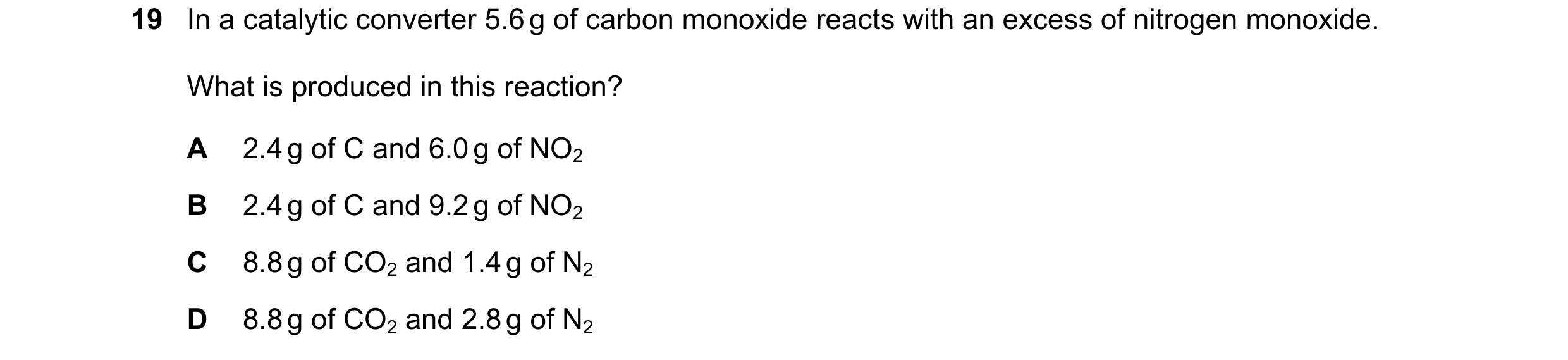
Q89 · In a catalytic converter 5.6 g of carbon monoxide reacts with an excess of nitrogen… 9701/13 May/June 2019
19 In a catalytic converter 5.6 g of carbon monoxide reacts with an excess of nitrogen monoxide. What is produced in this reaction? A 2.4 g of C and 6.0 g of NO2 B 2.4 g of C and 9.2 g of NO2 C 8.8 g of CO2 and 1.4 g of N2 D 8.8 g of CO2 and 2.8 g of N2
1 marks
Answer: D
This question in 9701/13 May/June 2019
Q90 · Which gases will dissolve in water causing a lowering of the pH? 9701/13 May/June 2019
36 Which gases will dissolve in water causing a lowering of the pH? 1 ammonia 2 sulfur dioxide 3 nitrogen dioxide
1 marks
Answer: C
This question in 9701/13 May/June 2019
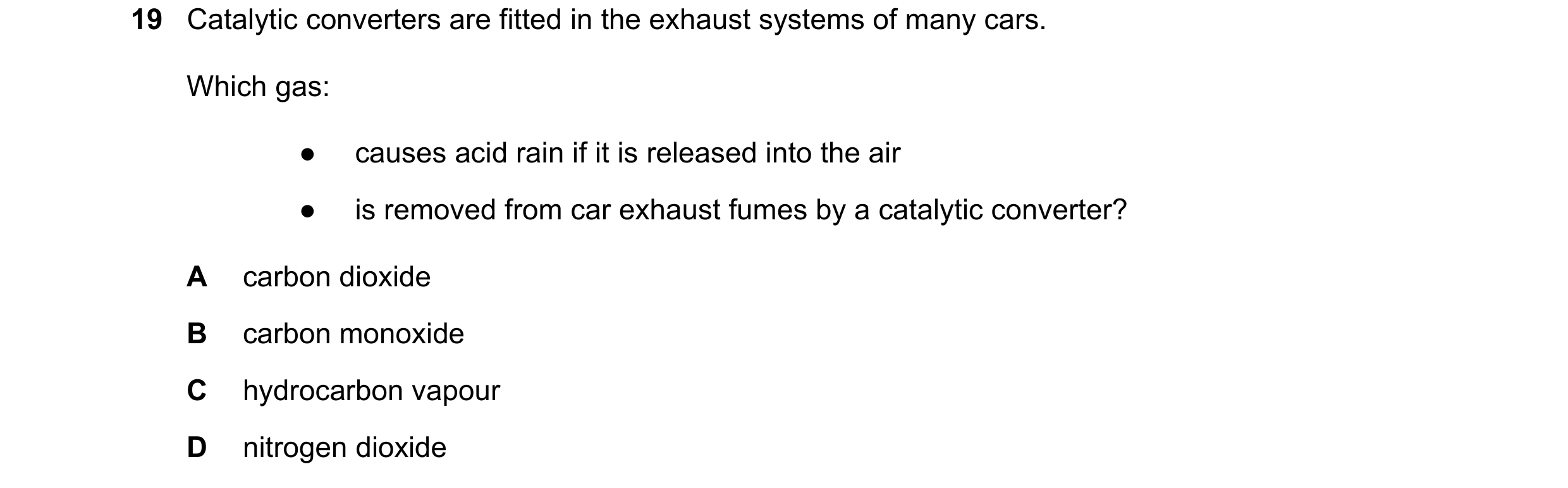
Q91 · Catalytic converters are fitted in the exhaust systems of many cars 9701/11 Oct/Nov 2019
19 Catalytic converters are fitted in the exhaust systems of many cars. Which gas: ● causes acid rain if it is released into the air ● is removed from car exhaust fumes by a catalytic converter? A carbon dioxide B carbon monoxide C hydrocarbon vapour D nitrogen dioxide
1 marks
Answer: D
This question in 9701/11 Oct/Nov 2019
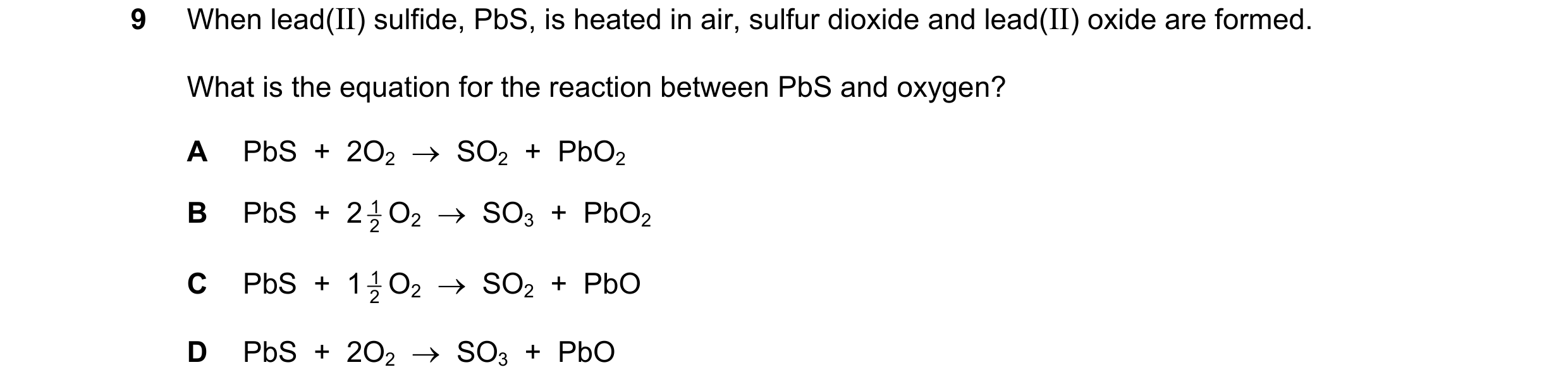
Q92 · When lead(II) sulfide, PbS, is heated in air, sulfur dioxide and lead(II) oxide are formed 9701/12 Oct/Nov 2019
9 When lead(II) sulfide, PbS, is heated in air, sulfur dioxide and lead(II) oxide are formed. What is the equation for the reaction between PbS and oxygen? A PbS + 2O2 → SO2 + PbO2 B PbS + 2 2 1 O2 → SO3 + PbO2 C PbS + 1 2 1 O2 → SO2 + PbO D PbS + 2O2 → SO3 + PbO
1 marks
Answer: C
This question in 9701/12 Oct/Nov 2019
Q93 · Which emission from an internal combustion engine contributes to the erosion of marble… 9701/12 Oct/Nov 2019
18 Which emission from an internal combustion engine contributes to the erosion of marble statues? A carbon monoxide B nitrogen C nitrogen dioxide D unburnt hydrocarbons
1 marks
Answer: C
This question in 9701/12 Oct/Nov 2019
Q94 · Catalytic converters are fitted in the exhaust systems of many cars 9701/13 Oct/Nov 2019
19 Catalytic converters are fitted in the exhaust systems of many cars. Which gas: ● causes acid rain if it is released into the air ● is removed from car exhaust fumes by a catalytic converter? A carbon dioxide B carbon monoxide C hydrocarbon vapour D nitrogen dioxide
1 marks
Answer: D
This question in 9701/13 Oct/Nov 2019
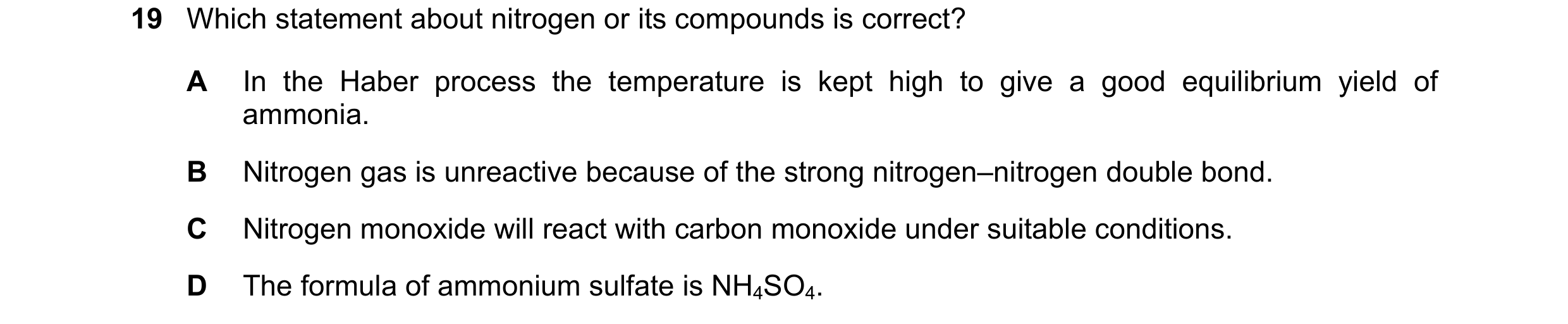
Q95 · Which statement about nitrogen or its compounds is correct? 9701/12 Feb/March 2020
19 Which statement about nitrogen or its compounds is correct? A In the Haber process the temperature is kept high to give a good equilibrium yield of ammonia. B Nitrogen gas is unreactive because of the strong nitrogen–nitrogen double bond. C Nitrogen monoxide will react with carbon monoxide under suitable conditions. D The formula of ammonium sulfate is NH4SO4.
1 marks
Answer: C
This question in 9701/12 Feb/March 2020
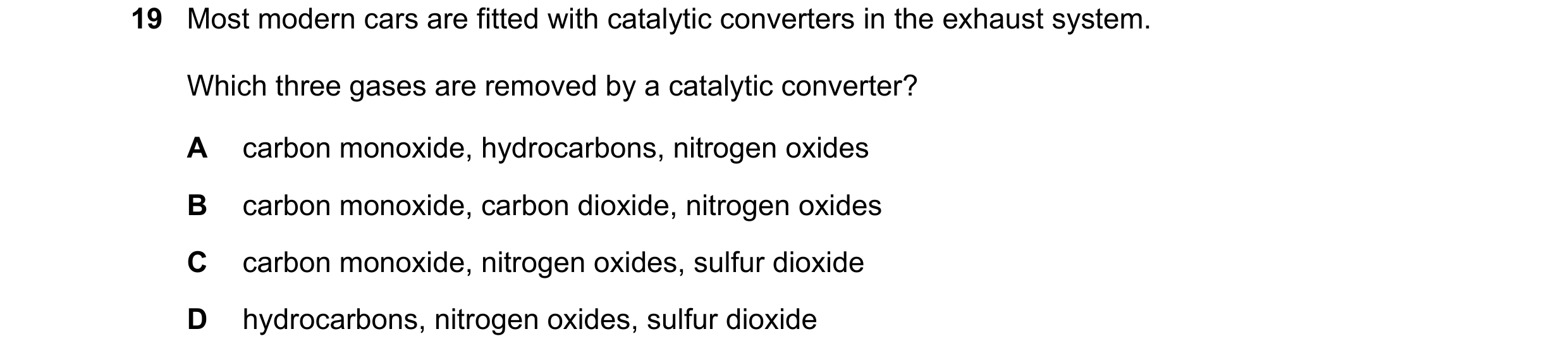
Q96 · Most modern cars are fitted with catalytic converters in the exhaust system 9701/12 May/June 2020
19 Most modern cars are fitted with catalytic converters in the exhaust system. Which three gases are removed by a catalytic converter? A carbon monoxide, hydrocarbons, nitrogen oxides B carbon monoxide, carbon dioxide, nitrogen oxides C carbon monoxide, nitrogen oxides, sulfur dioxide D hydrocarbons, nitrogen oxides, sulfur dioxide
1 marks
Answer: A
This question in 9701/12 May/June 2020
Q97 · In the atmosphere, which transformations can involve sulfur dioxide as either a reagent… 9701/12 May/June 2020
35 In the atmosphere, which transformations can involve sulfur dioxide as either a reagent or a catalyst? 1 NO2 to NO 2 NO to NO2 3 CO to CO2
1 marks
Answer: D
This question in 9701/12 May/June 2020
Q98 · Nitrogen reacts with oxygen to form nitrogen monoxide, NO, and nitrogen dioxide, NO2 9701/13 May/June 2020
5 Nitrogen reacts with oxygen to form nitrogen monoxide, NO, and nitrogen dioxide, NO2. Nitrogen dioxide reacts with water and with hydroxide ions. N2(g) + O2(g) → 2NO(g) 2NO(g) + O2(g) → 2NO2(g) 2NO2(g) + H2O(l) → HNO2(aq) + H+(aq) + NO3 –(aq) 2NO2(g) + 2OH–(aq) → NO2 –(aq) + NO3 –(aq) + H2O(l) What can be deduced using only the information from these equations? A HNO2 is a strong acid. B HNO3 is a weak acid. C NO2 is a neutral gas. D NO is a reducing agent.
1 marks
Answer: D
This question in 9701/13 May/June 2020
Q99 · Sulfur dioxide, SO2, reacts with calcium hydroxide in aqueous solution 9701/11 Oct/Nov 2020
19 Sulfur dioxide, SO2, reacts with calcium hydroxide in aqueous solution. What is the main product that is first formed? A Ca(HSO4)2 B CaS C CaSO3 D CaSO4
1 marks
Answer: C
This question in 9701/11 Oct/Nov 2020
Q100 · Sulfur dioxide, SO2, reacts with calcium hydroxide in aqueous solution 9701/13 Oct/Nov 2020
19 Sulfur dioxide, SO2, reacts with calcium hydroxide in aqueous solution. What is the main product that is first formed? A Ca(HSO4)2 B CaS C CaSO3 D CaSO4
1 marks
Answer: C
This question in 9701/13 Oct/Nov 2020
Q101 · Which statement is correct when referring to the complete combustion of PVC? 9701/13 Oct/Nov 2020
22 Which statement is correct when referring to the complete combustion of PVC? A A gas is made which contributes to global warming. B Carbon dioxide and water are the only products. C If water is used to clean the exhaust gases, the water becomes alkaline. D There is no need to treat the exhaust gases as the products are non-hazardous.
1 marks
Answer: A
This question in 9701/13 Oct/Nov 2020
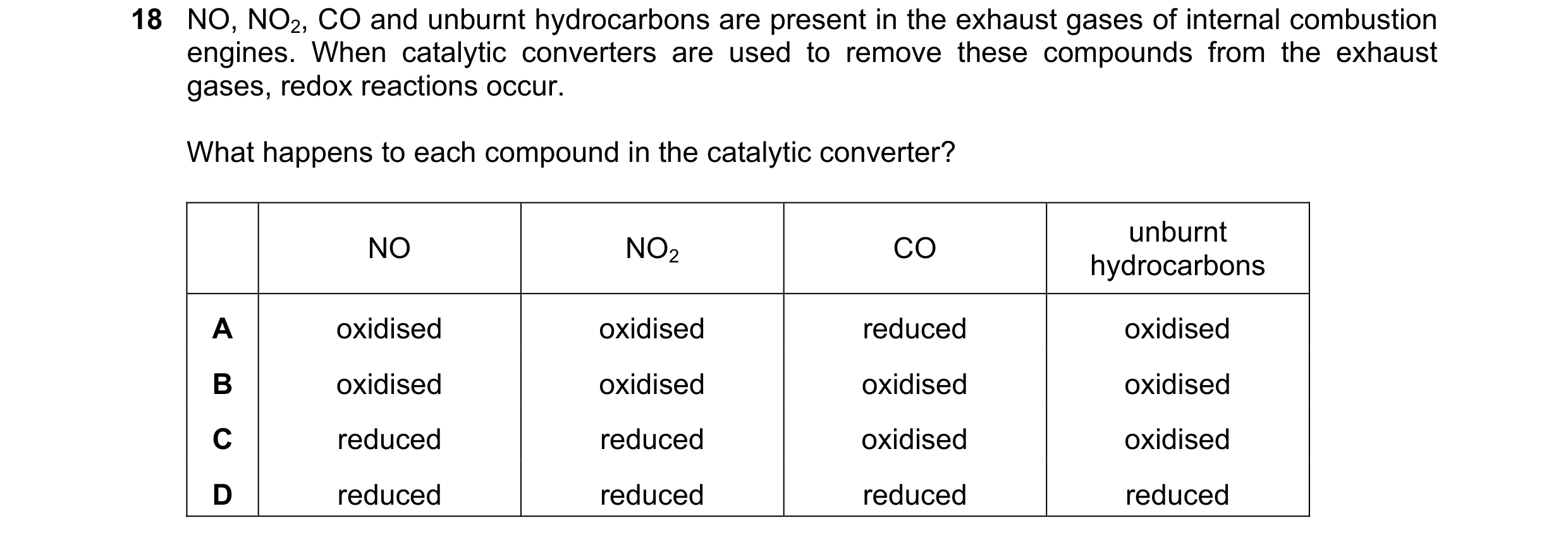
Q102 · NO, NO2, CO and unburnt hydrocarbons are present in the exhaust gases of internal… 9701/12 Feb/March 2021
18 NO, NO2, CO and unburnt hydrocarbons are present in the exhaust gases of internal combustion engines. When catalytic converters are used to remove these compounds from the exhaust gases, redox reactions occur. What happens to each compound in the catalytic converter? unburnt NO NO2 CO hydrocarbons A oxidised oxidised reduced oxidised B oxidised oxidised oxidised oxidised C reduced reduced oxidised oxidised D reduced reduced reduced reduced
1 marks
Answer: C
This question in 9701/12 Feb/March 2021
Q103 · Nitrogen dioxide gas is produced when petrol is burned in car engines 9701/12 Feb/March 2021
36 Nitrogen dioxide gas is produced when petrol is burned in car engines. Which acids are made in the atmosphere as a result of this release of nitrogen dioxide into the air? 1 H2SO3 2 H2SO4 3 HNO3
1 marks
Answer: C
This question in 9701/12 Feb/March 2021
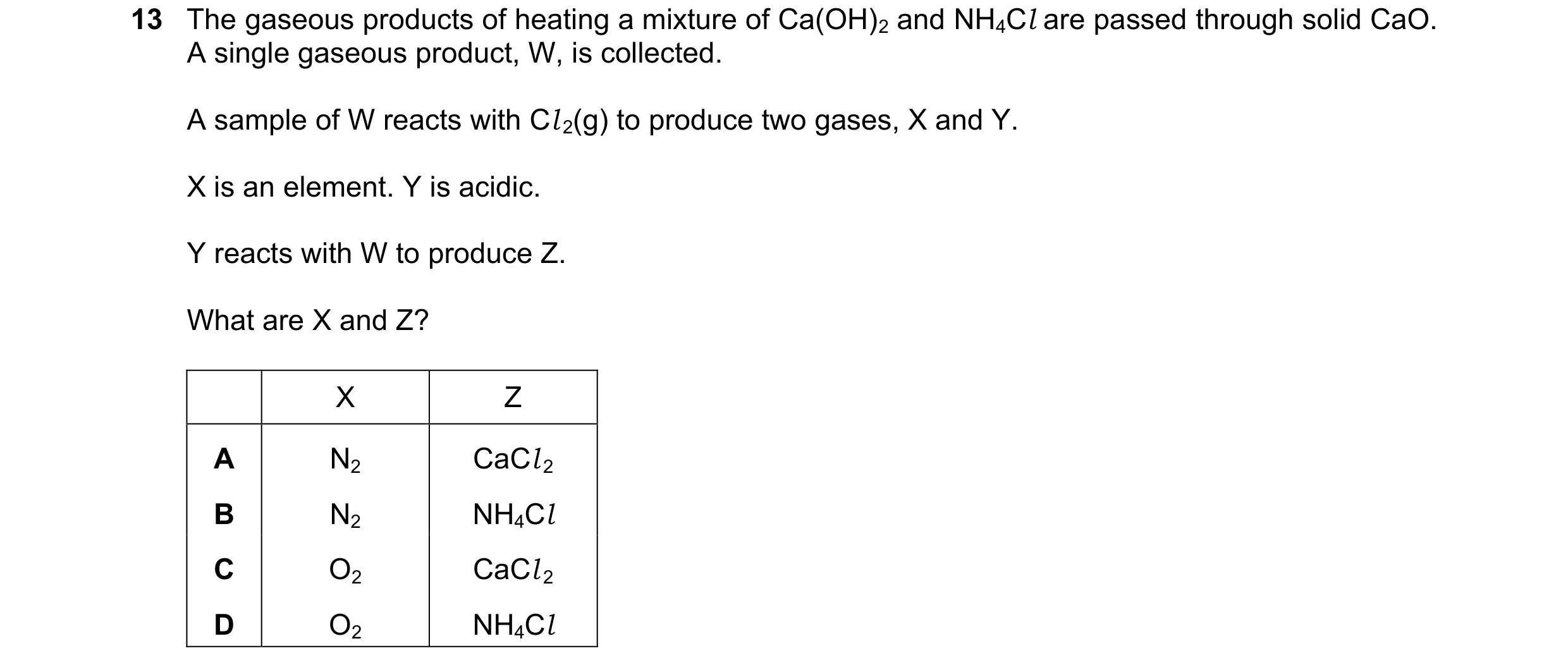
Q104 · The gaseous products of heating a mixture of Ca(OH)2 and NH4Cl are passed through solid… 9701/11 May/June 2021
13 The gaseous products of heating a mixture of Ca(OH)2 and NH4Cl are passed through solid CaO. A single gaseous product, W, is collected. A sample of W reacts with Cl 2(g) to produce two gases, X and Y. X is an element. Y is acidic. Y reacts with W to produce Z. What are X and Z? X Z A N2 CaCl 2 B N2 NH4Cl C O2 CaCl 2 D O2 NH4Cl
1 marks
Answer: B
This question in 9701/11 May/June 2021
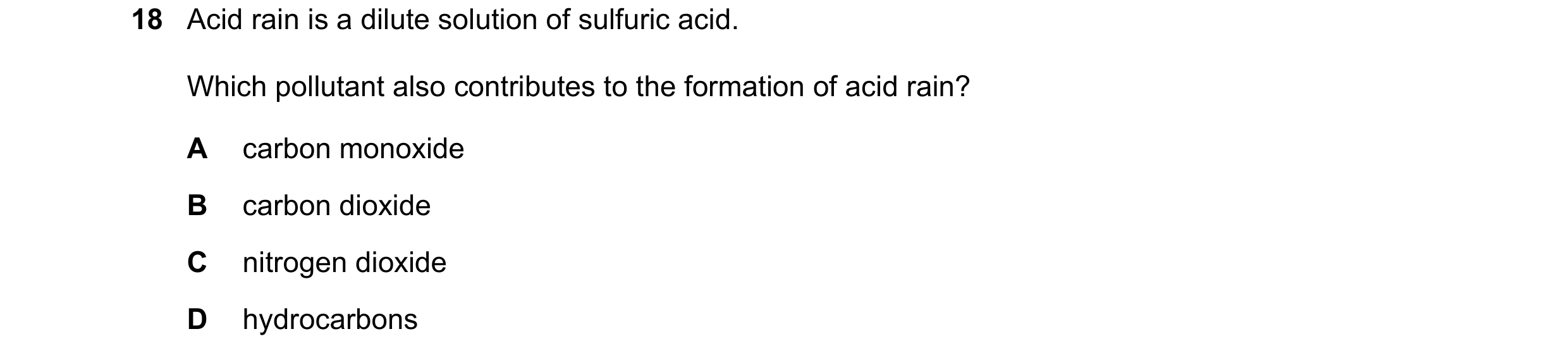
Q105 · Acid rain is a dilute solution of sulfuric acid 9701/11 May/June 2021
18 Acid rain is a dilute solution of sulfuric acid. Which pollutant also contributes to the formation of acid rain? A carbon monoxide B carbon dioxide C nitrogen dioxide D hydrocarbons
1 marks
Answer: C
This question in 9701/11 May/June 2021
Q106 · What is an environmental consequence of the uncontrolled use of nitrate fertilisers? 9701/12 May/June 2021
18 What is an environmental consequence of the uncontrolled use of nitrate fertilisers? A acid rain B low oxygen levels in streams C ozone depletion D the greenhouse effect
1 marks
Answer: B
This question in 9701/12 May/June 2021
Q107 · Ammonia gas, NH3, and hydrogen sulfide gas, H2S, react together to form the salt ammonium… 9701/12 May/June 2021
19 Ammonia gas, NH3, and hydrogen sulfide gas, H2S, react together to form the salt ammonium sulfide, (NH4)2S. Ammonium sulfide dissolves in water to produce an orange alkaline solution. (NH4)2S(aq) NH3(aq) + NH4SH(aq) The addition of NaOH(aq) to this solution produces a gas, X. The addition of HCl (aq) to a separate portion of this solution produces a gas, Y. X and Y could represent different gases or identical gases. What are the identities of X and Y? X Y A H2S H2S B H2S NH3 C NH3 H2S D NH3 NH3
1 marks
Answer: C
This question in 9701/12 May/June 2021
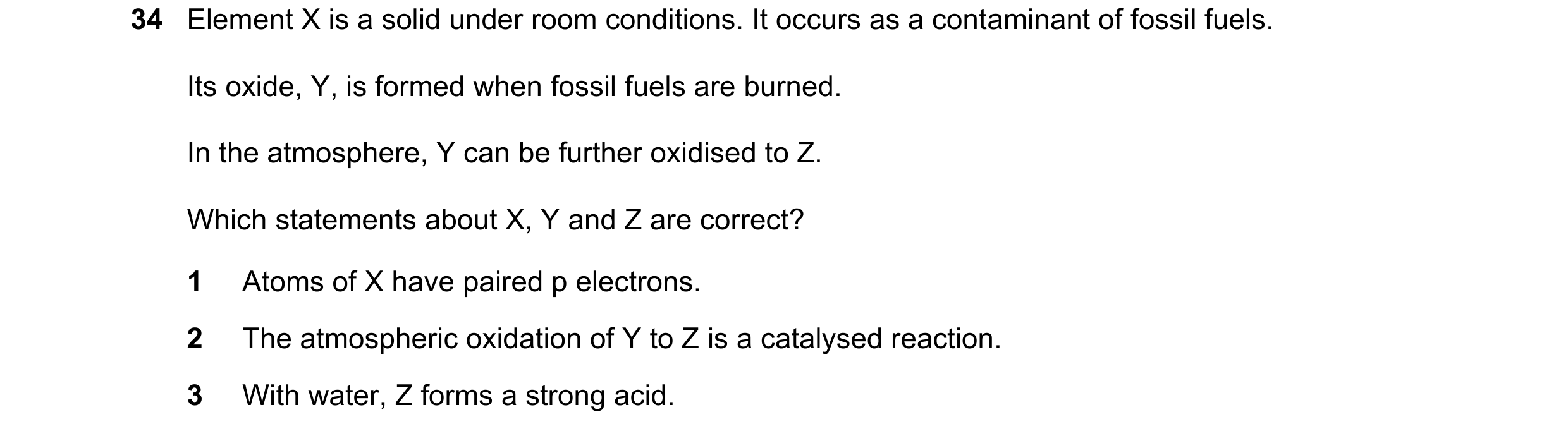
Q108 · Element X is a solid under room conditions 9701/13 May/June 2021
34 Element X is a solid under room conditions. It occurs as a contaminant of fossil fuels. Its oxide, Y, is formed when fossil fuels are burned. In the atmosphere, Y can be further oxidised to Z. Which statements about X, Y and Z are correct? 1 Atoms of X have paired p electrons. 2 The atmospheric oxidation of Y to Z is a catalysed reaction. 3 With water, Z forms a strong acid.
1 marks
Answer: A
This question in 9701/13 May/June 2021
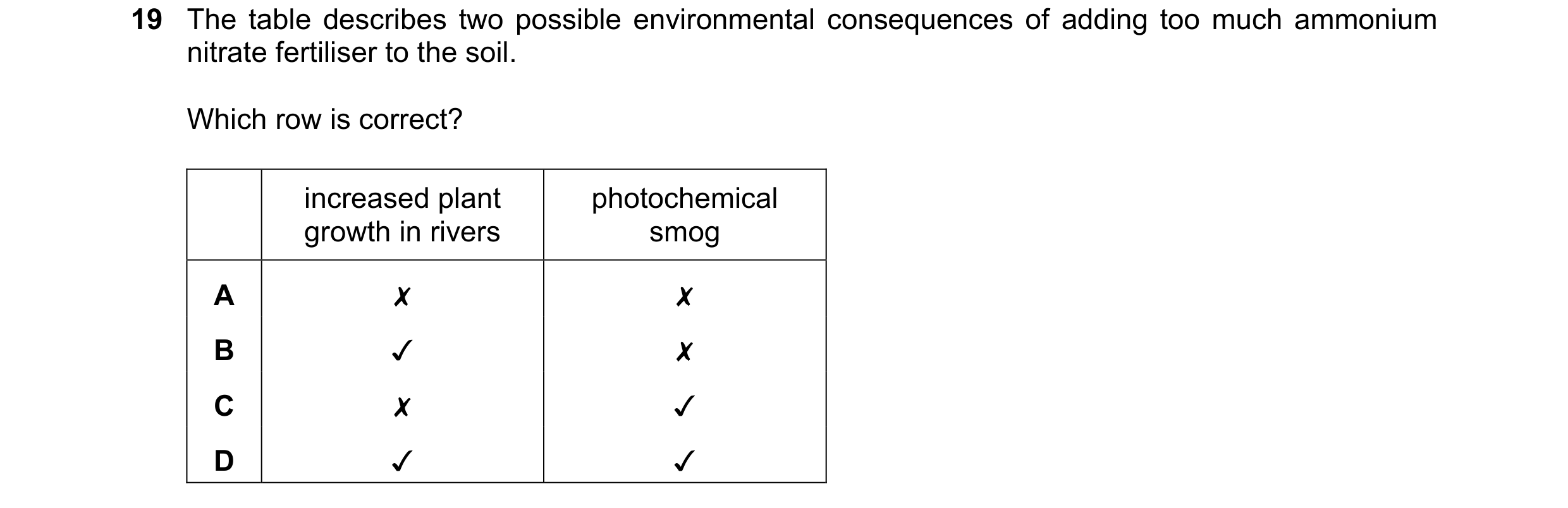
Q109 · The table describes two possible environmental consequences of adding too much ammonium… 9701/11 Oct/Nov 2021
19 The table describes two possible environmental consequences of adding too much ammonium
nitrate fertiliser to the soil.
Which row is correct?
increased plant photochemical
growth in rivers smog
0 OD >
\ « \ x
\ \ x x
1 marks
Answer: B
This question in 9701/11 Oct/Nov 2021
Q110 · Which molecules contain at least one unpaired electron? 9701/11 Oct/Nov 2021
34 Which molecules contain at least one unpaired electron? 1 NO 2 NO2 3 NH3
1 marks
Answer: B
This question in 9701/11 Oct/Nov 2021
Q111 · NO and NO2 are both present in the lower atmosphere as pollutants 9701/12 Oct/Nov 2021
11 NO and NO2 are both present in the lower atmosphere as pollutants. The reaction sequence shows the production of ozone from oxygen in the lower atmosphere. This sequence repeats many times. NO2(g) NO(g) + O(g) NO(g) + 1 2 O2(g) NO2(g) O2(g) + O(g) O3(g) Which statement about this reaction sequence is correct? A NO is acting as a catalyst, but NO2 is not acting as a catalyst. B NO2 is acting as a catalyst, but NO is not acting as a catalyst. C Neither NO nor NO2 are acting as catalysts. D Both NO and NO2 are acting as catalysts.
1 marks
Answer: D
This question in 9701/12 Oct/Nov 2021
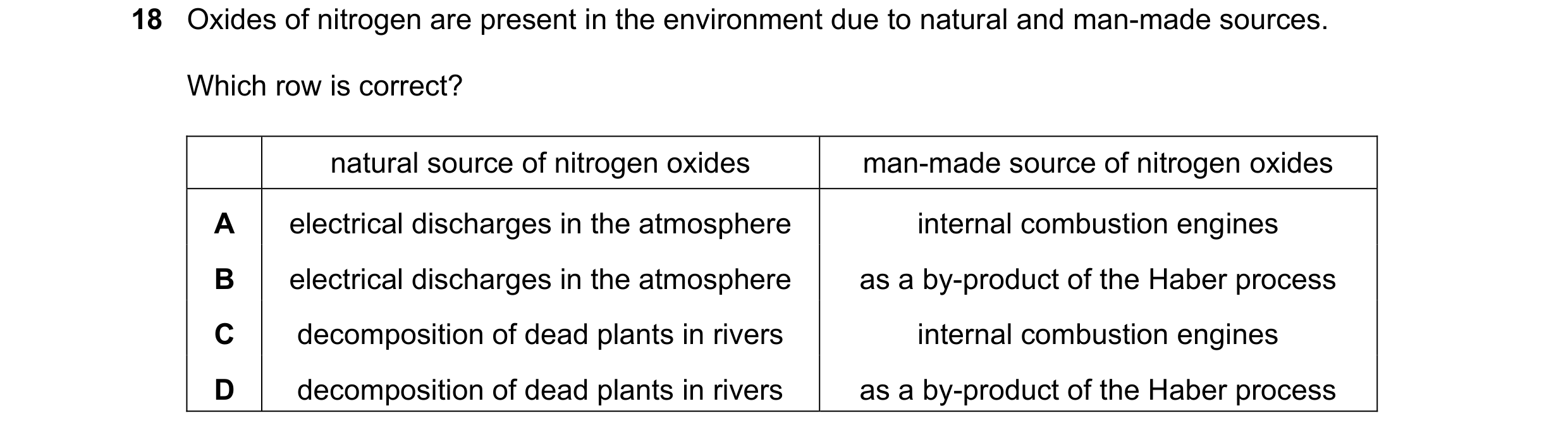
Q112 · Oxides of nitrogen are present in the environment due to natural and man-made sources 9701/12 Oct/Nov 2021
18 Oxides of nitrogen are present in the environment due to natural and man-made sources. Which row is correct? natural source of nitrogen oxides man-made source of nitrogen oxides A electrical discharges in the atmosphere internal combustion engines B electrical discharges in the atmosphere as a by-product of the Haber process C decomposition of dead plants in rivers internal combustion engines D decomposition of dead plants in rivers as a by-product of the Haber process
1 marks
Answer: A
This question in 9701/12 Oct/Nov 2021
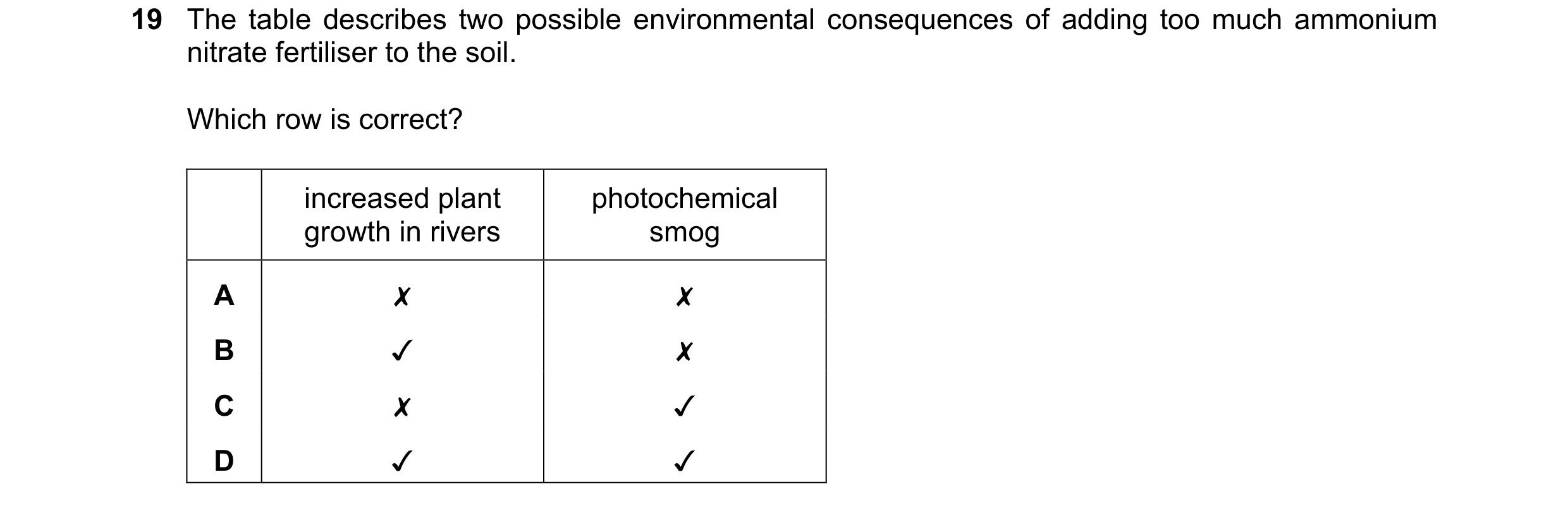
Q113 · The table describes two possible environmental consequences of adding too much ammonium… 9701/13 Oct/Nov 2021
19 The table describes two possible environmental consequences of adding too much ammonium
nitrate fertiliser to the soil.
Which row is correct?
increased plant photochemical
growth in rivers smog
0 OD >
\ « \ x
\ \ x x
1 marks
Answer: B
This question in 9701/13 Oct/Nov 2021
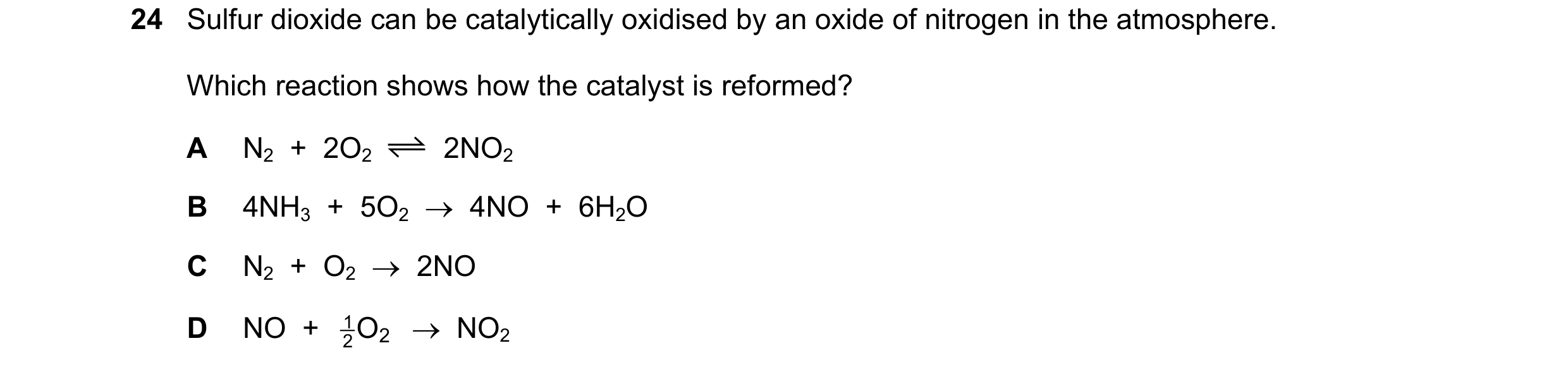
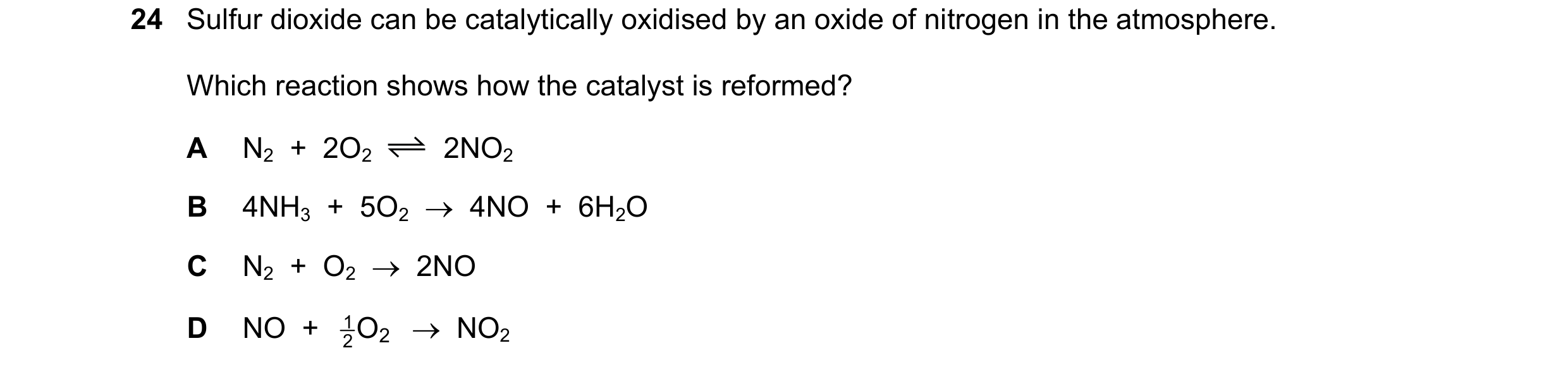
Q114 · Sulfur dioxide can be catalytically oxidised by an oxide of nitrogen in the atmosphere 9701/11 Oct/Nov 2022
24 Sulfur dioxide can be catalytically oxidised by an oxide of nitrogen in the atmosphere. Which reaction shows how the catalyst is reformed? A N2 + 2O2 2NO2 B 4NH3 + 5O2 → 4NO + 6H2O C N2 + O2 → 2NO D NO + 1 O → NO2 2 2
1 marks
Answer: D
This question in 9701/11 Oct/Nov 2022
Q115 · Photochemical smog is a type of air pollution produced in urban areas by the effect of… 9701/12 Oct/Nov 2022
24 Photochemical smog is a type of air pollution produced in urban areas by the effect of sunlight on substances released from vehicle exhausts. Which mixture of primary pollutants leads to the formation of photochemical smog? A carbon dioxide and water vapour B carbon monoxide and unburnt hydrocarbons C nitrogen oxide and unburnt hydrocarbons D sulfur dioxide and water vapour
1 marks
Answer: C
This question in 9701/12 Oct/Nov 2022
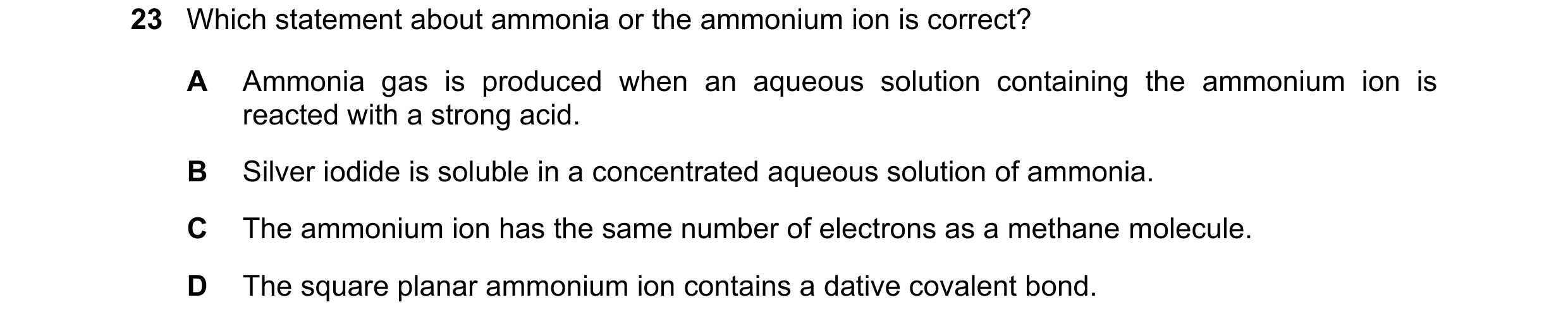
Q116 · Which statement about ammonia or the ammonium ion is correct? 9701/13 Oct/Nov 2022
23 Which statement about ammonia or the ammonium ion is correct? A Ammonia gas is produced when an aqueous solution containing the ammonium ion is reacted with a strong acid. B Silver iodide is soluble in a concentrated aqueous solution of ammonia. C The ammonium ion has the same number of electrons as a methane molecule. D The square planar ammonium ion contains a dative covalent bond.
1 marks
Answer: C
This question in 9701/13 Oct/Nov 2022
Q117 · Sulfur dioxide can be catalytically oxidised by an oxide of nitrogen in the atmosphere 9701/13 Oct/Nov 2022
24 Sulfur dioxide can be catalytically oxidised by an oxide of nitrogen in the atmosphere. Which reaction shows how the catalyst is reformed? A N2 + 2O2 2NO2 B 4NH3 + 5O2 4NO + 6H2O C N2 + O2 2NO D NO + 1 O NO2 2 2
1 marks
Answer: D
This question in 9701/13 Oct/Nov 2022
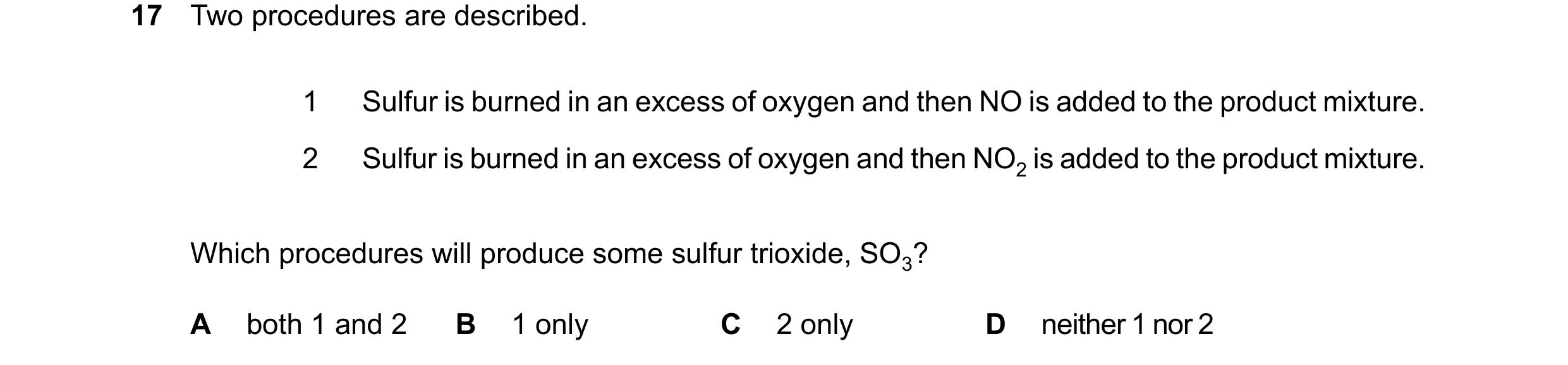
Q118 · Two procedures are described 9701/12 Feb/March 2023
17 Two procedures are described. 1 Sulfur is burned in an excess of oxygen and then NO is added to the product mixture. 2 Sulfur is burned in an excess of oxygen and then NO2 is added to the product mixture. Which procedures will produce some sulfur trioxide, SO3? A both 1 and 2 B 1 only C 2 only D neither 1 nor 2
1 marks
Answer: A
This question in 9701/12 Feb/March 2023
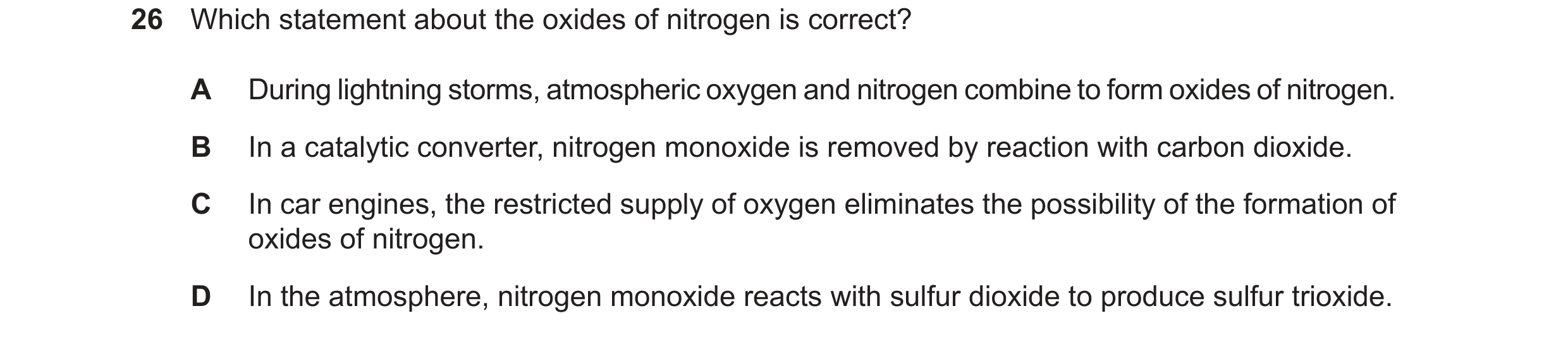
Q119 · Which statement about the oxides of nitrogen is correct? 9701/13 May/June 2023
26 Which statement about the oxides of nitrogen is correct? A During lightning storms, atmospheric oxygen and nitrogen combine to form oxides of nitrogen. B In a catalytic converter, nitrogen monoxide is removed by reaction with carbon dioxide. C In car engines, the restricted supply of oxygen eliminates the possibility of the formation of oxides of nitrogen. D In the atmosphere, nitrogen monoxide reacts with sulfur dioxide to produce sulfur trioxide.
1 marks
Answer: A
This question in 9701/13 May/June 2023
Q120 · Nitrogen monoxide, NO, is a primary pollutant produced by petrol engines and is found in… 9701/12 Feb/March 2024
24 Nitrogen monoxide, NO, is a primary pollutant produced by petrol engines and is found in their exhaust gases. Which reaction occurs in a catalytic converter and decreases the emission of nitrogen monoxide? A NO(g) + CO(g) NO2(g) + C(s) B NO(g) + CO2(g) NO2(g) + CO(g) C 2NO(g) + 2CO(g) N2(g) + 2CO2(g) D 2NO(g) + CO2(g) 2NO2(g) + C(s)
1 marks
Answer: C
This question in 9701/12 Feb/March 2024
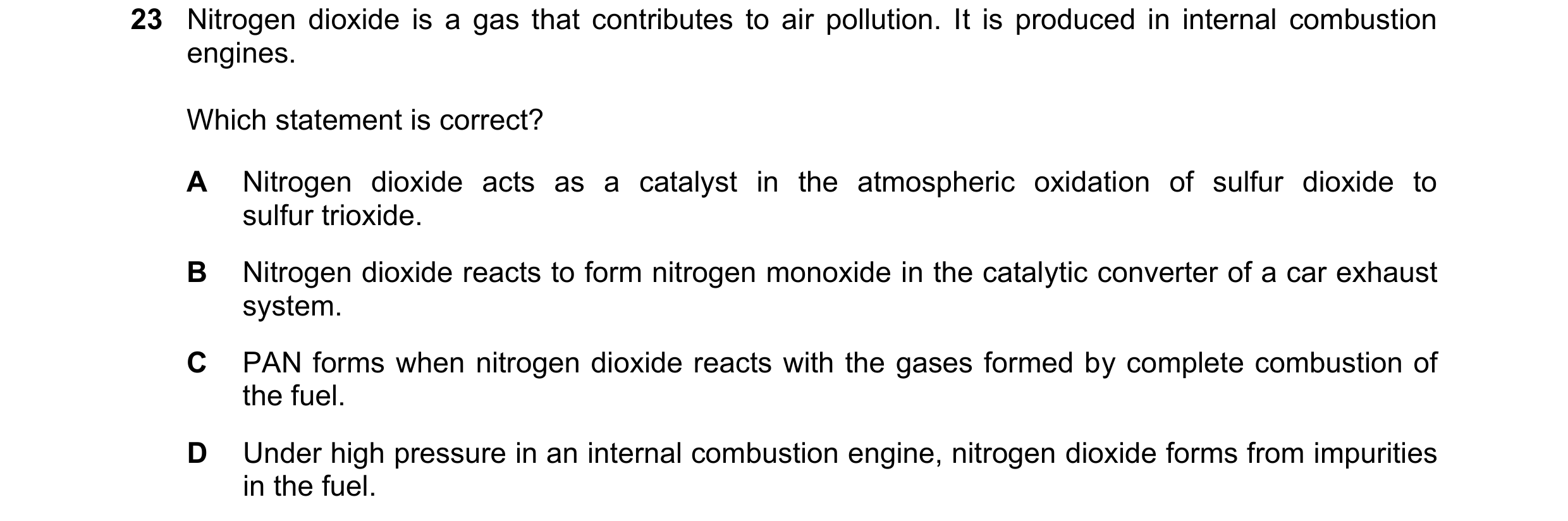
Q121 · Nitrogen dioxide is a gas that contributes to air pollution 9701/11 May/June 2024
23 Nitrogen dioxide is a gas that contributes to air pollution. It is produced in internal combustion engines. Which statement is correct? A Nitrogen dioxide acts as a catalyst in the atmospheric oxidation of sulfur dioxide to sulfur trioxide. B Nitrogen dioxide reacts to form nitrogen monoxide in the catalytic converter of a car exhaust system. C PAN forms when nitrogen dioxide reacts with the gases formed by complete combustion of the fuel. D Under high pressure in an internal combustion engine, nitrogen dioxide forms from impurities in the fuel.
1 marks
Answer: A
This question in 9701/11 May/June 2024
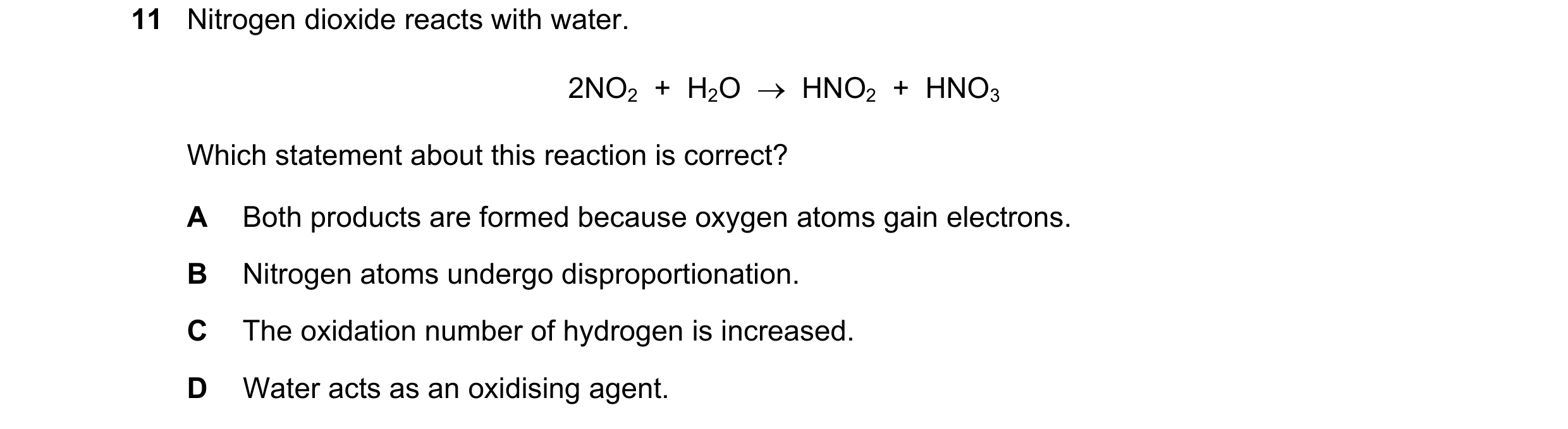
Q122 · Nitrogen dioxide reacts with water 9701/12 May/June 2024
11 Nitrogen dioxide reacts with water. 2NO2 + H2O HNO2 + HNO3 Which statement about this reaction is correct? A Both products are formed because oxygen atoms gain electrons. B Nitrogen atoms undergo disproportionation. C The oxidation number of hydrogen is increased. D Water acts as an oxidising agent.
1 marks
Answer: B
This question in 9701/12 May/June 2024
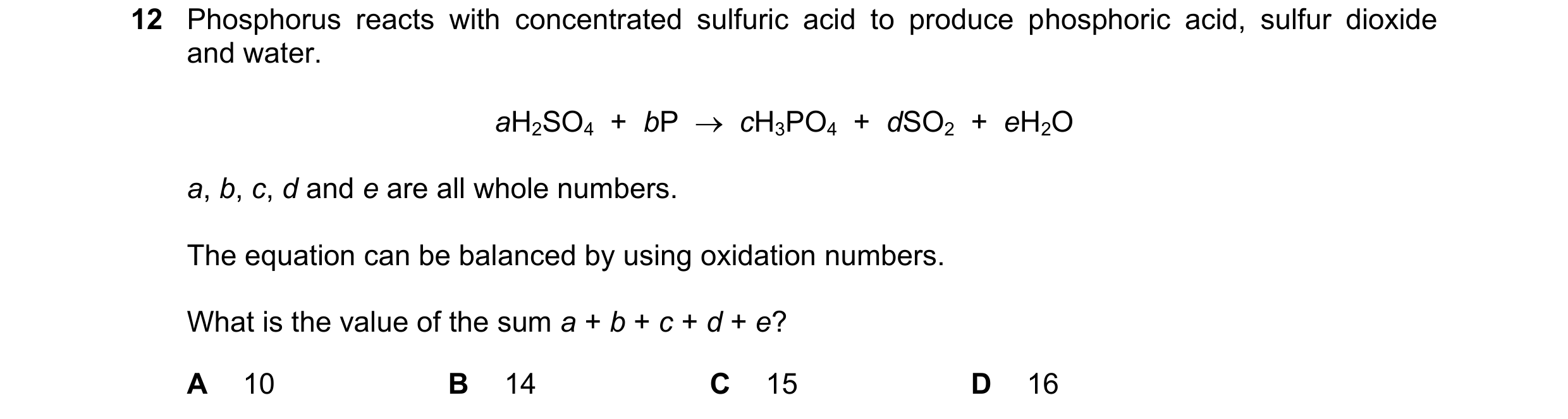
Q123 · Phosphorus reacts with concentrated sulfuric acid to produce phosphoric acid, sulfur… 9701/12 May/June 2024
12 Phosphorus reacts with concentrated sulfuric acid to produce phosphoric acid, sulfur dioxide and water. aH2SO4 + bP cH3PO4 + dSO2 + eH2O a, b, c, d and e are all whole numbers. The equation can be balanced by using oxidation numbers. What is the value of the sum a + b + c + d + e? A 10 B 14 C 15 D 16
1 marks
Answer: D
This question in 9701/12 May/June 2024
Q124 · Catalytic converters are fitted in the exhaust systems of many cars 9701/12 May/June 2024
23 Catalytic converters are fitted in the exhaust systems of many cars. Gas X: ● causes acid rain if it is released into the air ● is removed from car exhaust fumes by a catalytic converter. What is gas X? A carbon dioxide B carbon monoxide C hydrocarbon vapour D nitrogen dioxide
1 marks
Answer: D
This question in 9701/12 May/June 2024
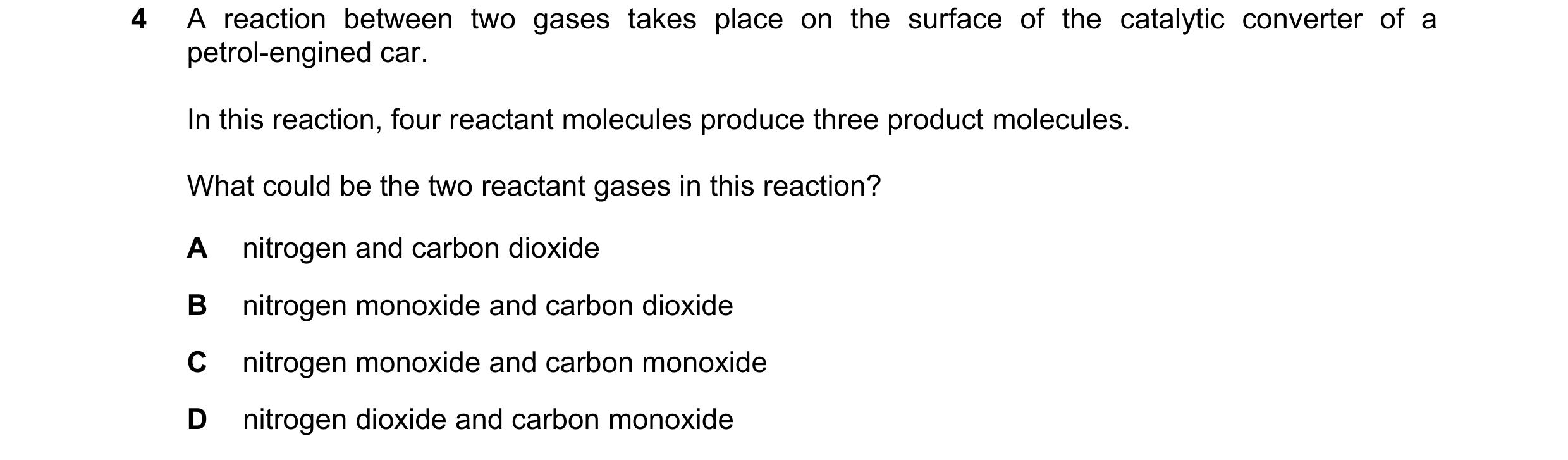
Q125 · A reaction between two gases takes place on the surface of the catalytic converter of a… 9701/12 Oct/Nov 2024
4 A reaction between two gases takes place on the surface of the catalytic converter of a petrol-engined car. In this reaction, four reactant molecules produce three product molecules. What could be the two reactant gases in this reaction? A nitrogen and carbon dioxide B nitrogen monoxide and carbon dioxide C nitrogen monoxide and carbon monoxide D nitrogen dioxide and carbon monoxide
1 marks
Answer: C
This question in 9701/12 Oct/Nov 2024
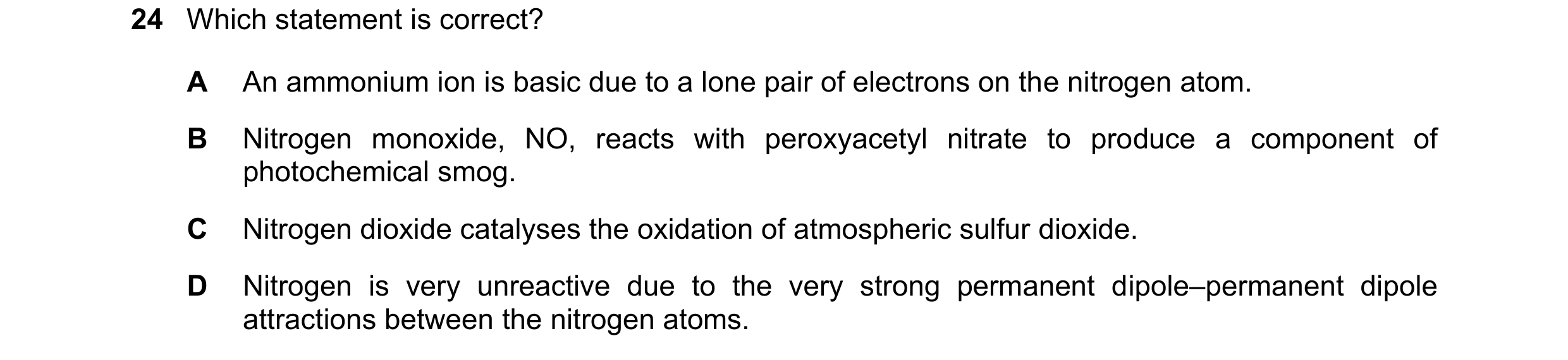
Q126 · Which statement is correct? 9701/12 Oct/Nov 2024
24 Which statement is correct? A An ammonium ion is basic due to a lone pair of electrons on the nitrogen atom. B Nitrogen monoxide, NO, reacts with peroxyacetyl nitrate to produce a component of photochemical smog. C Nitrogen dioxide catalyses the oxidation of atmospheric sulfur dioxide. D Nitrogen is very unreactive due to the very strong permanent dipole–permanent dipole attractions between the nitrogen atoms.
1 marks
Answer: C
This question in 9701/12 Oct/Nov 2024
Q127 · Four atmospheric pollutants are listed 9701/12 Feb/March 2025
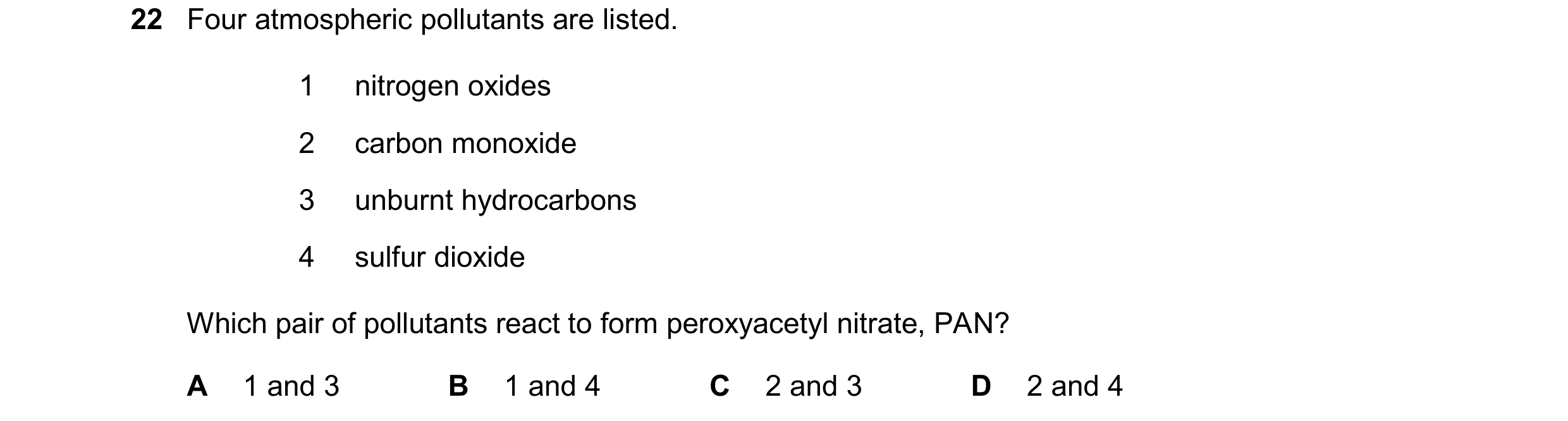
22 Four atmospheric pollutants are listed. 1 nitrogen oxides 2 carbon monoxide 3 unburnt hydrocarbons 4 sulfur dioxide Which pair of pollutants react to form peroxyacetyl nitrate, PAN? A 1 and 3 B 1 and 4 C 2 and 3 D 2 and 4
1 marks
Answer: A
This question in 9701/12 Feb/March 2025
Q128 · The flow chart shows some reactions of nitrogen compounds 9701/13 May/June 2025
16 The flow chart shows some reactions of nitrogen compounds. gas 1 acid salt 1 salt 2 + other products alkali Which row identifies gas 1 and salt 2? gas 1 salt 2 A ammonia ammonium nitrate B ammonia sodium nitrate C nitrogen dioxide ammonium nitrate D nitrogen dioxide sodium nitrate
1 marks
Answer: B
This question in 9701/13 May/June 2025
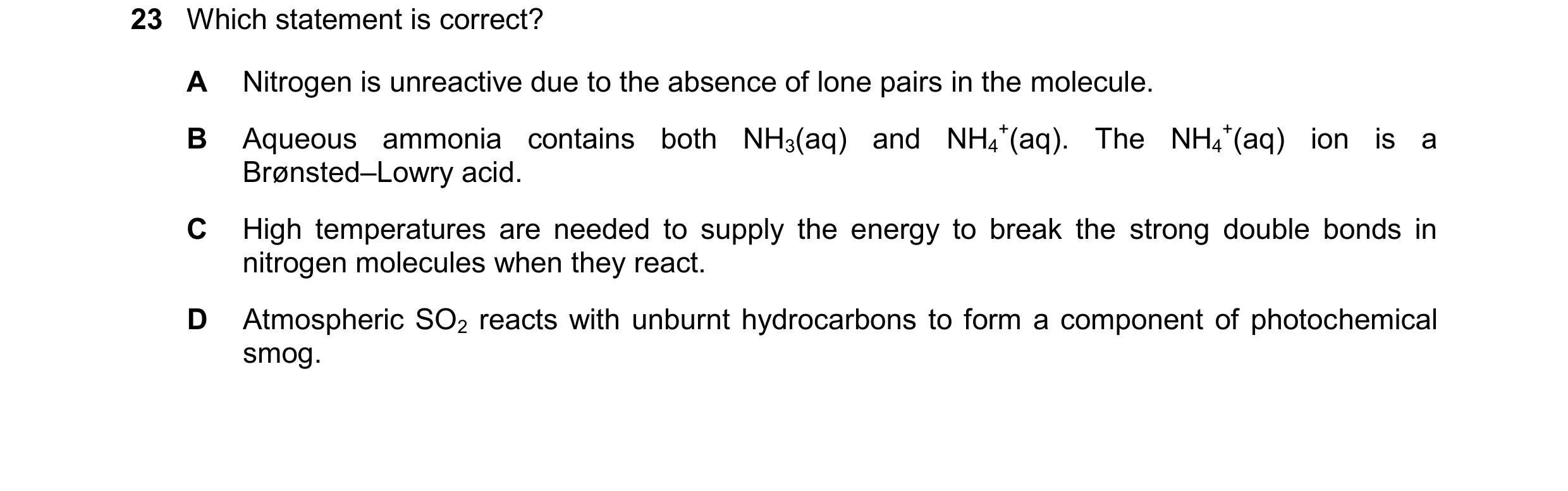
Q129 · Which statement is correct? 9701/11 Oct/Nov 2025
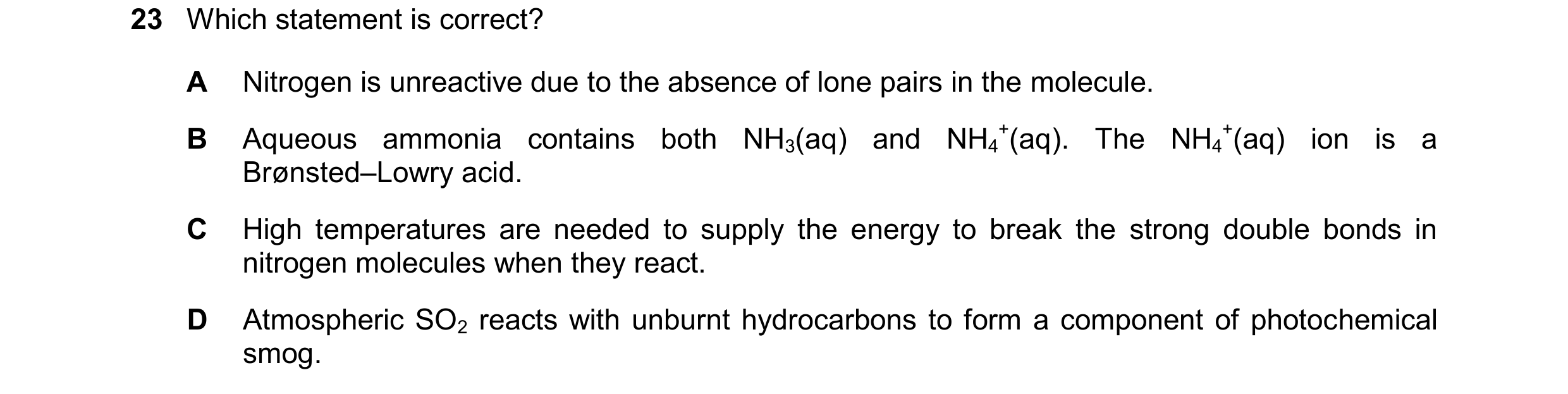
23 Which statement is correct? A Nitrogen is unreactive due to the absence of lone pairs in the molecule. B Aqueous ammonia contains both NH3(aq) and NH4 +(aq). The NH4 +(aq) ion is a Brønsted–Lowry acid. C High temperatures are needed to supply the energy to break the strong double bonds in nitrogen molecules when they react. D Atmospheric SO2 reacts with unburnt hydrocarbons to form a component of photochemical smog.
1 marks
Answer: B
This question in 9701/11 Oct/Nov 2025
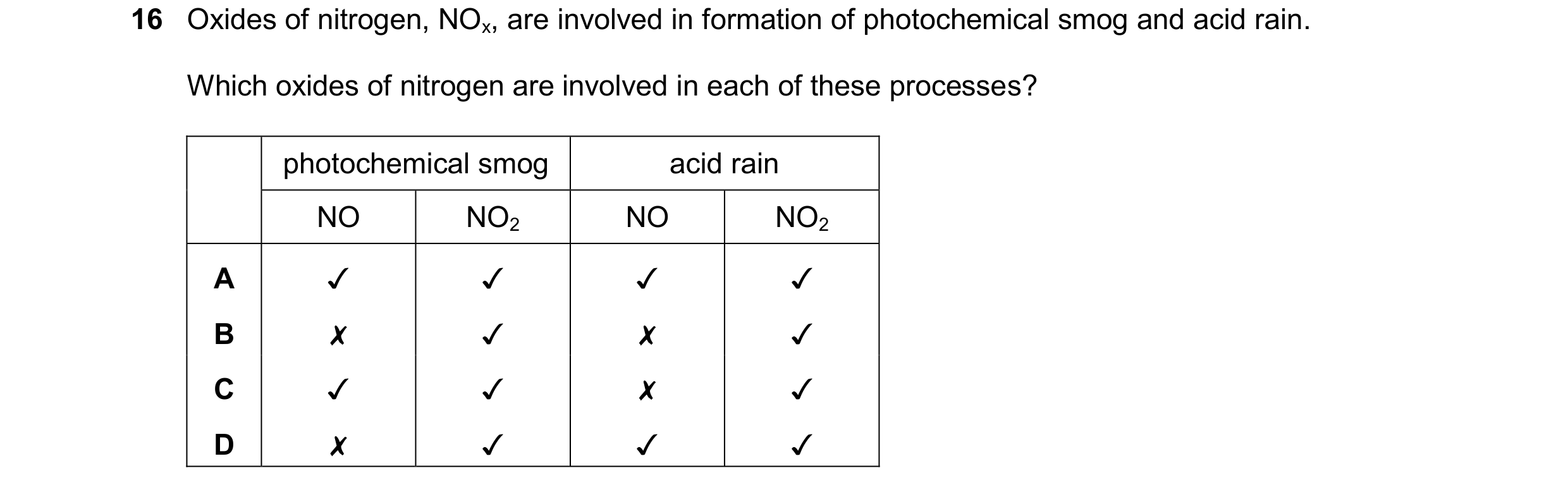
Q130 · Oxides of nitrogen, NO,, are involved in formation of photochemical smog and acid rain 9701/12 Oct/Nov 2025
16 Oxides of nitrogen, NO,, are involved in formation of photochemical smog and acid rain.
Which oxides of nitrogen are involved in each of these processes?
photochemical smog acid rain
1 marks
Answer: A
This question in 9701/12 Oct/Nov 2025
Q131 · Which statement is correct? 9701/13 Oct/Nov 2025
23 Which statement is correct? A Nitrogen is unreactive due to the absence of lone pairs in the molecule. B Aqueous ammonia contains both NH3(aq) and NH4 +(aq). The NH4 +(aq) ion is a Brønsted–Lowry acid. C High temperatures are needed to supply the energy to break the strong double bonds in nitrogen molecules when they react. D Atmospheric SO2 reacts with unburnt hydrocarbons to form a component of photochemical smog.
1 marks
Answer: B
This question in 9701/13 Oct/Nov 2025

 1 / 27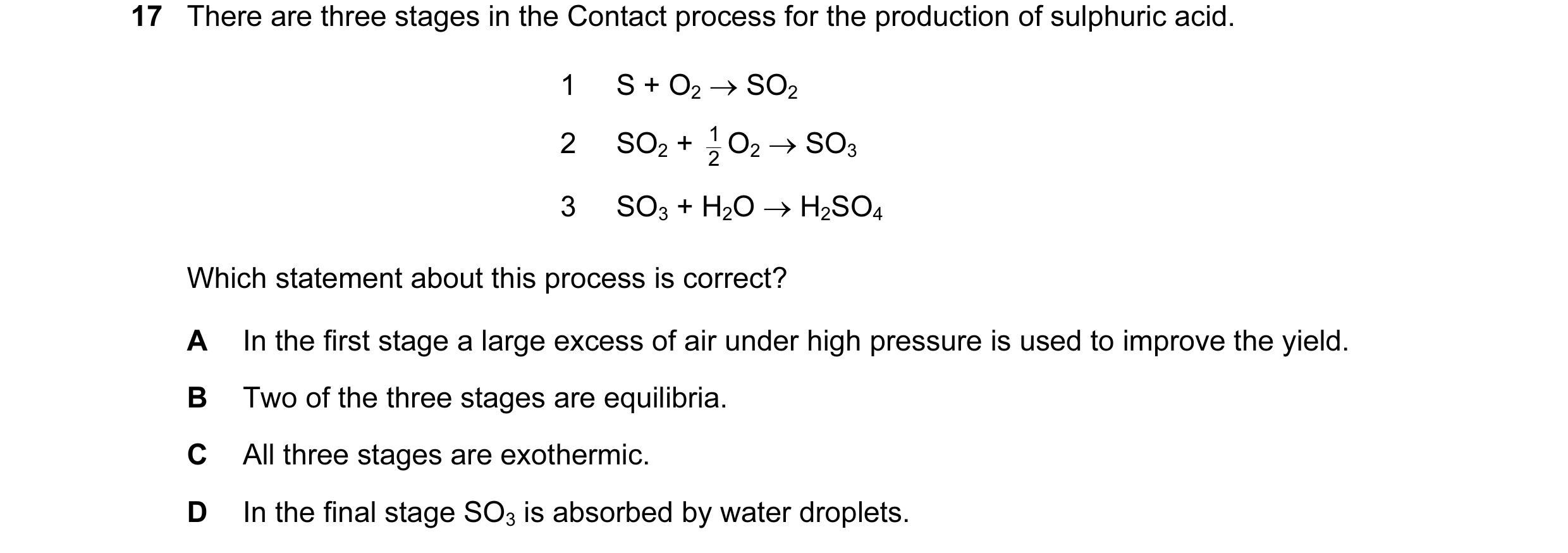


 2 / 27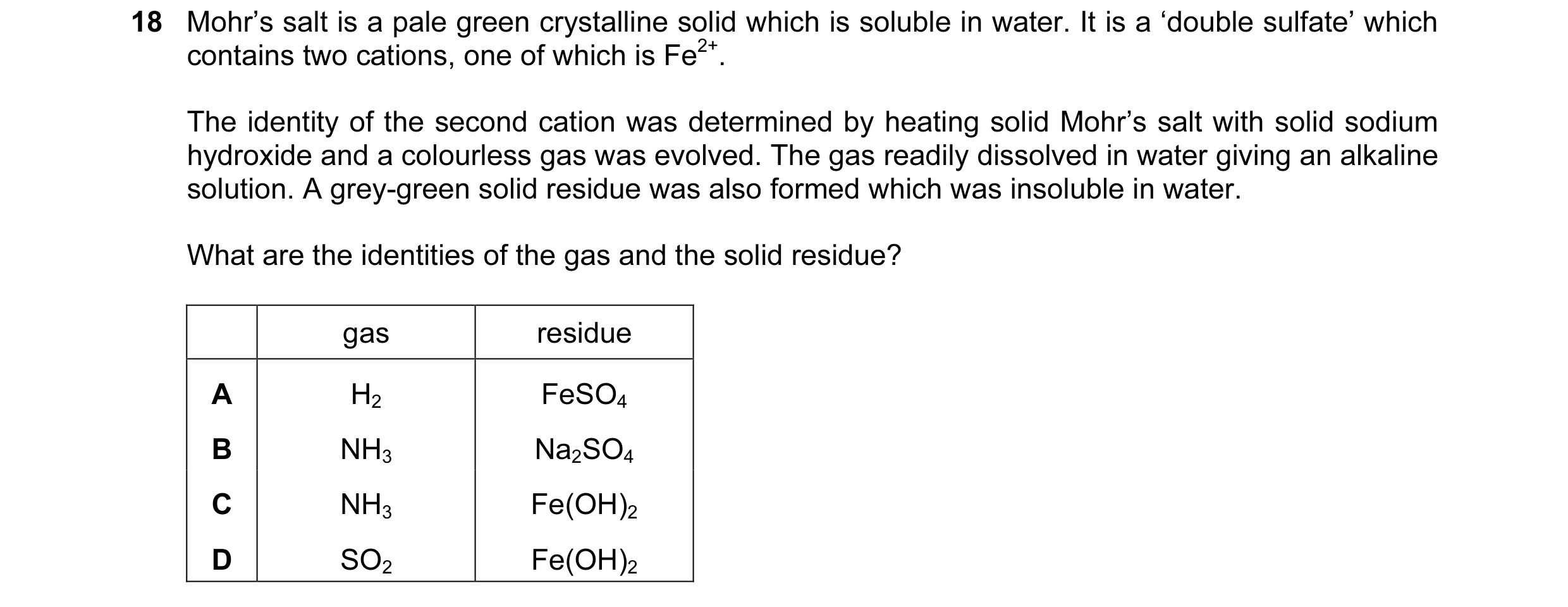
 3 / 27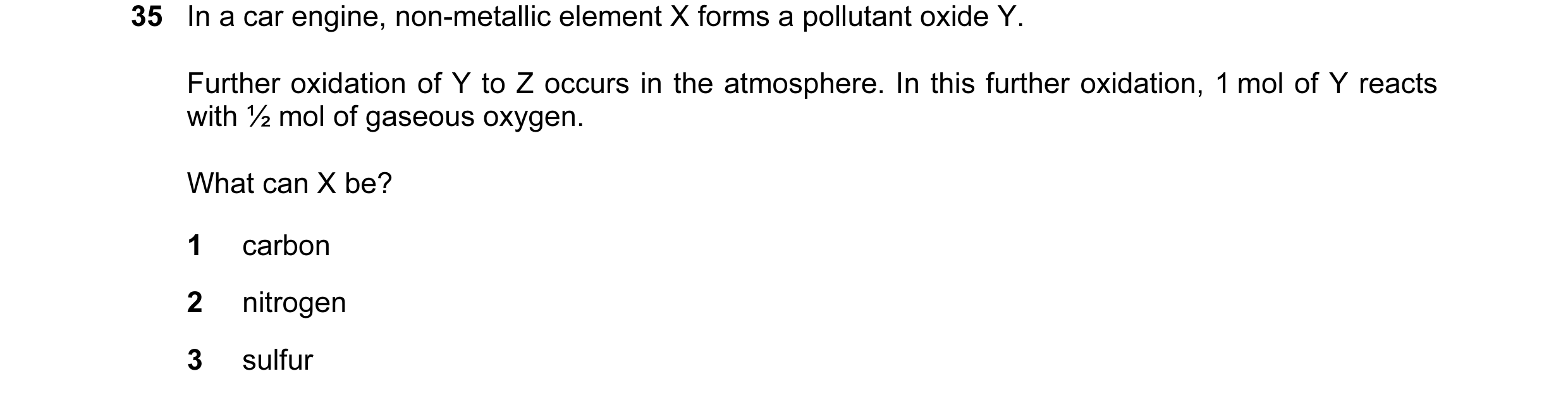



 4 / 27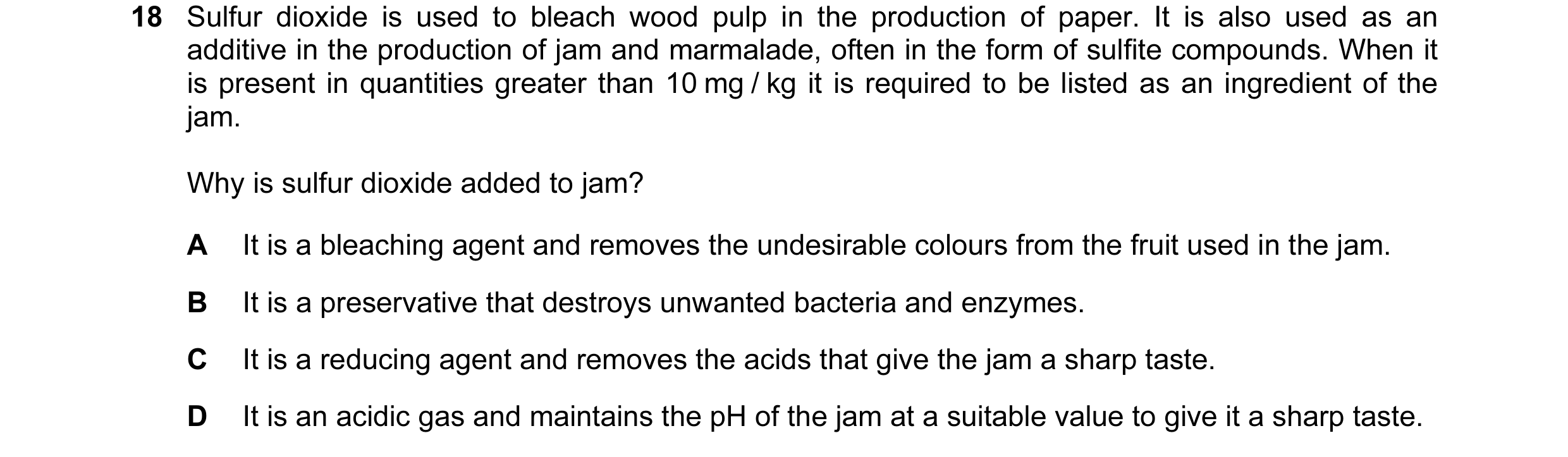
 5 / 27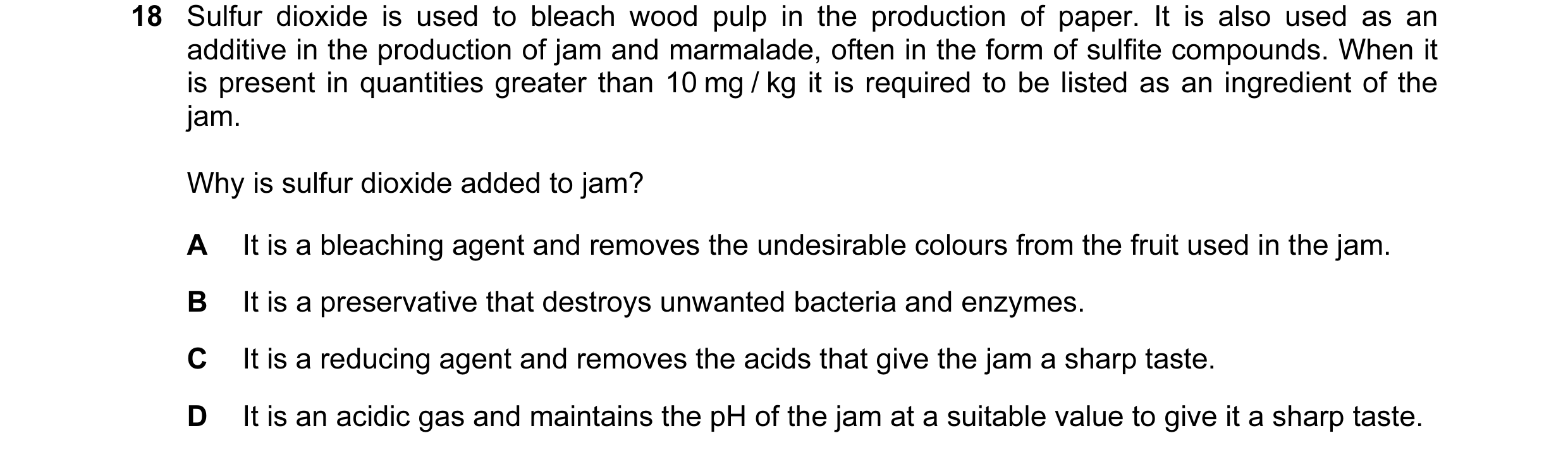

 6 / 27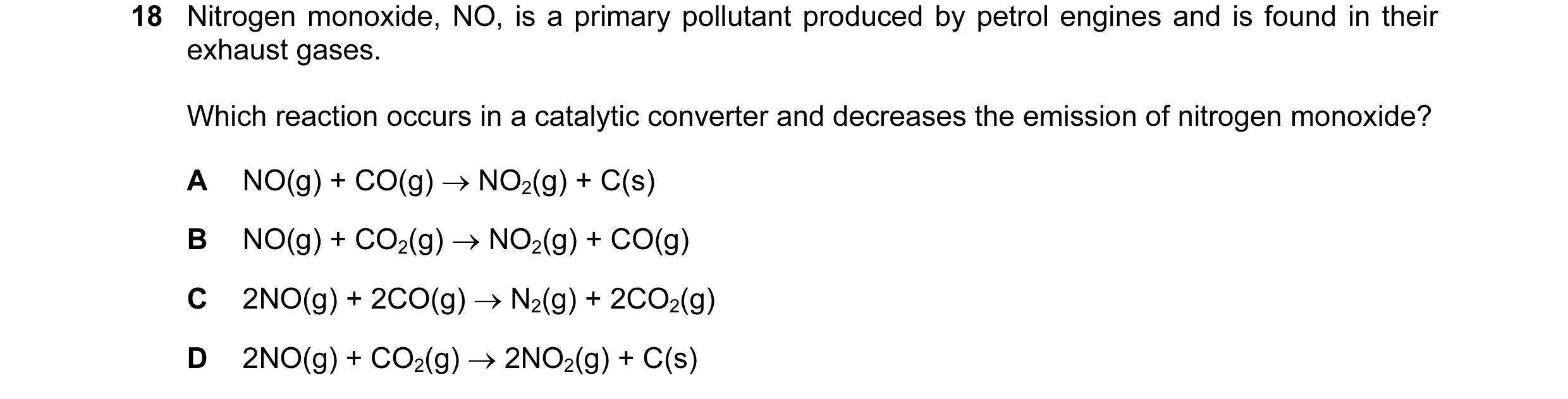

 7 / 27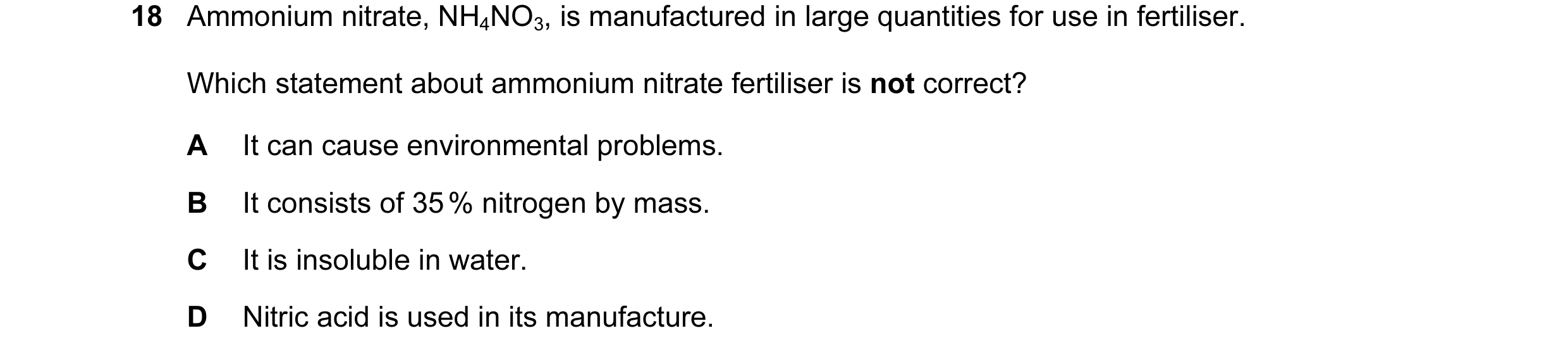

 8 / 27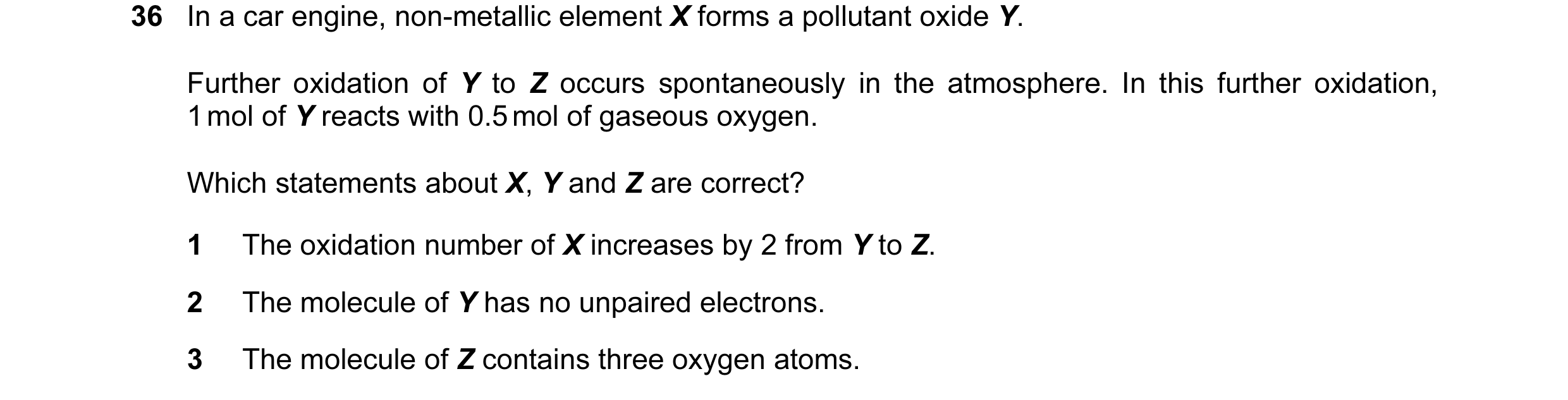


 9 / 27


 10 / 27


 11 / 27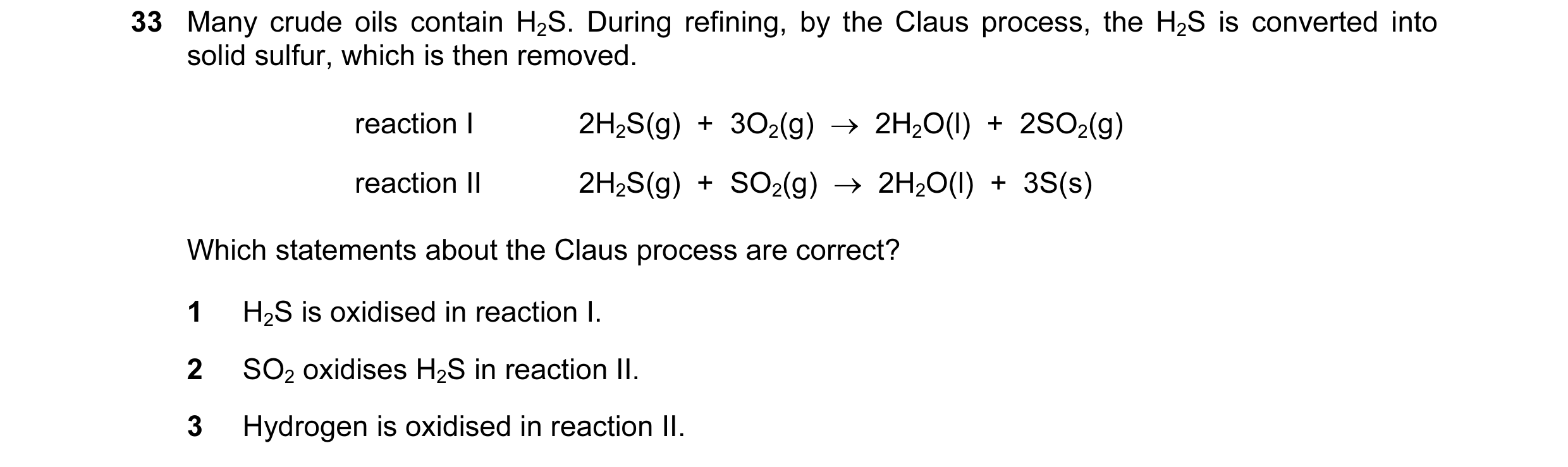



 12 / 27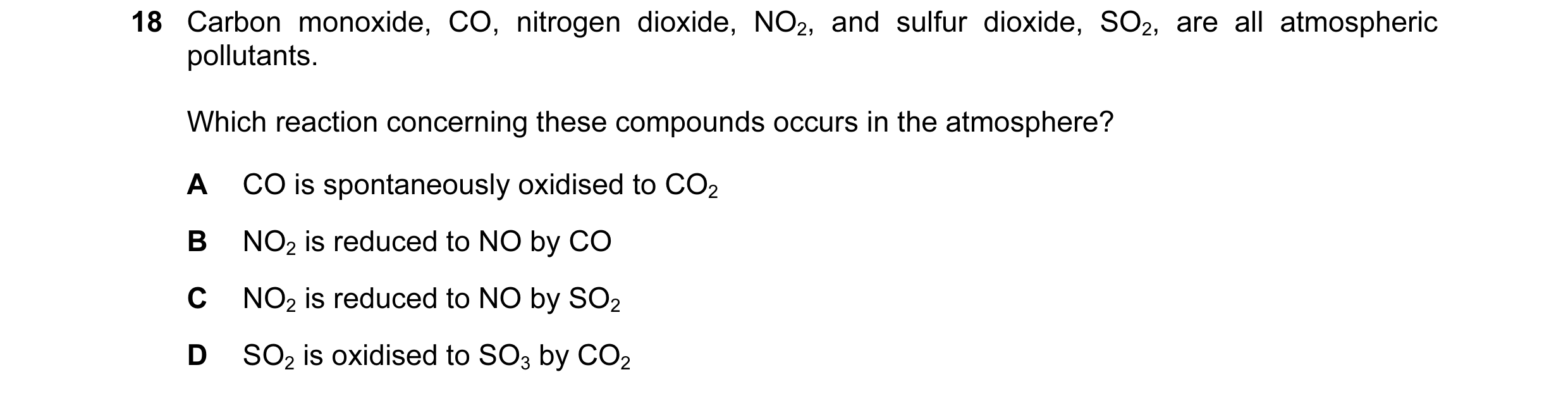


 13 / 27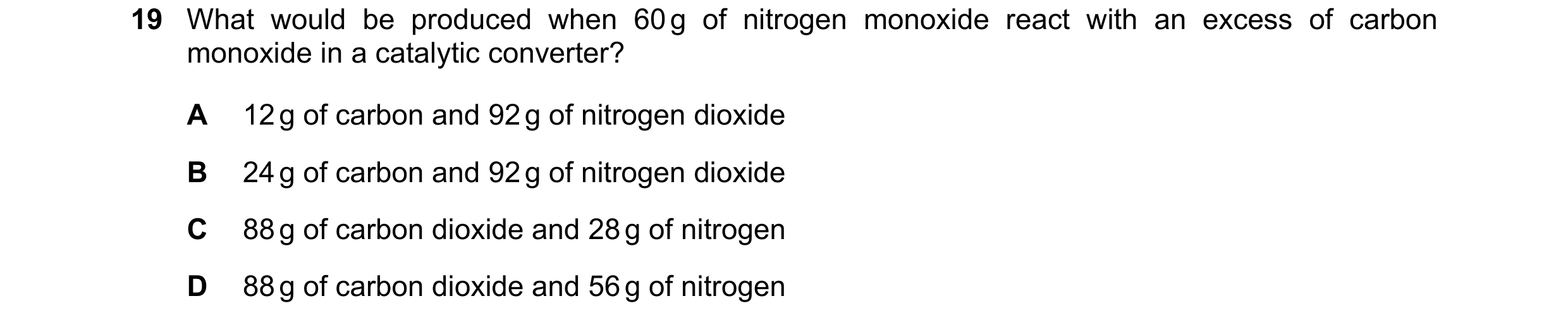



 14 / 27

 15 / 27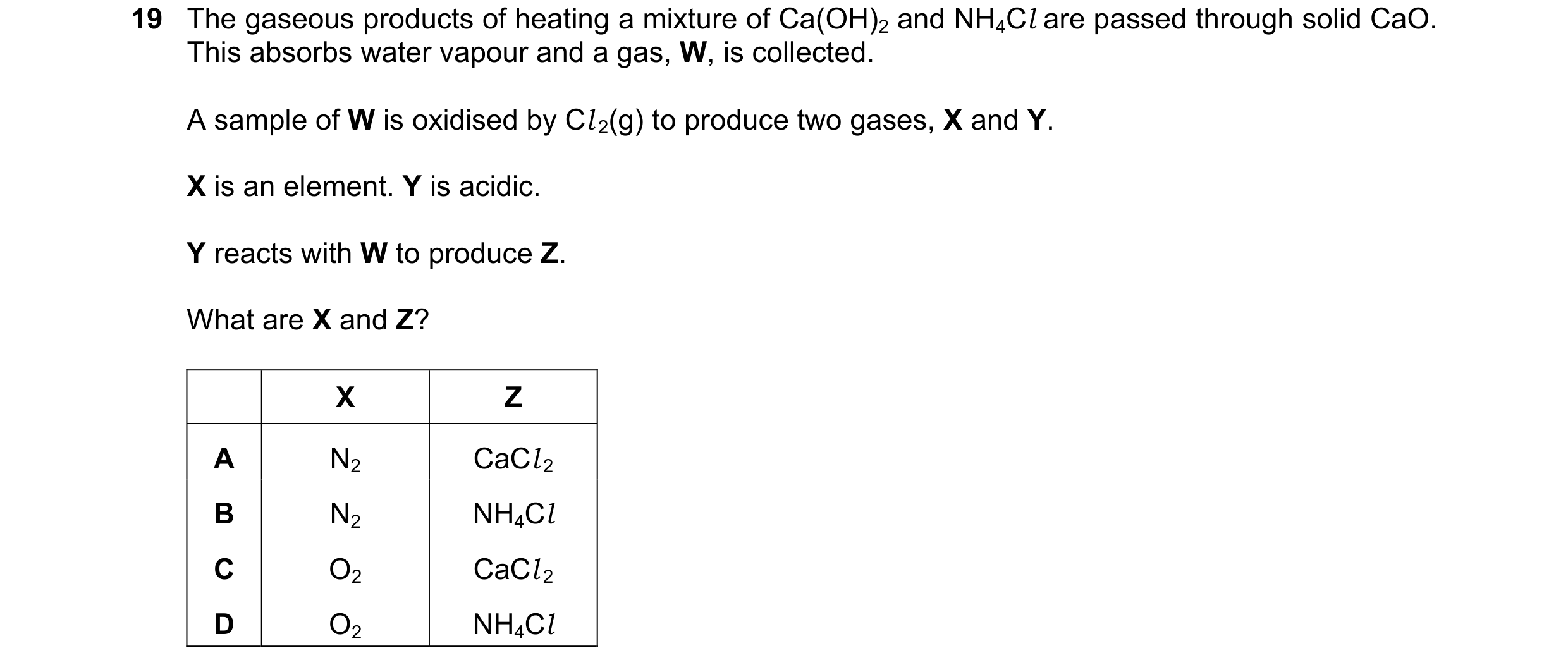
 16 / 27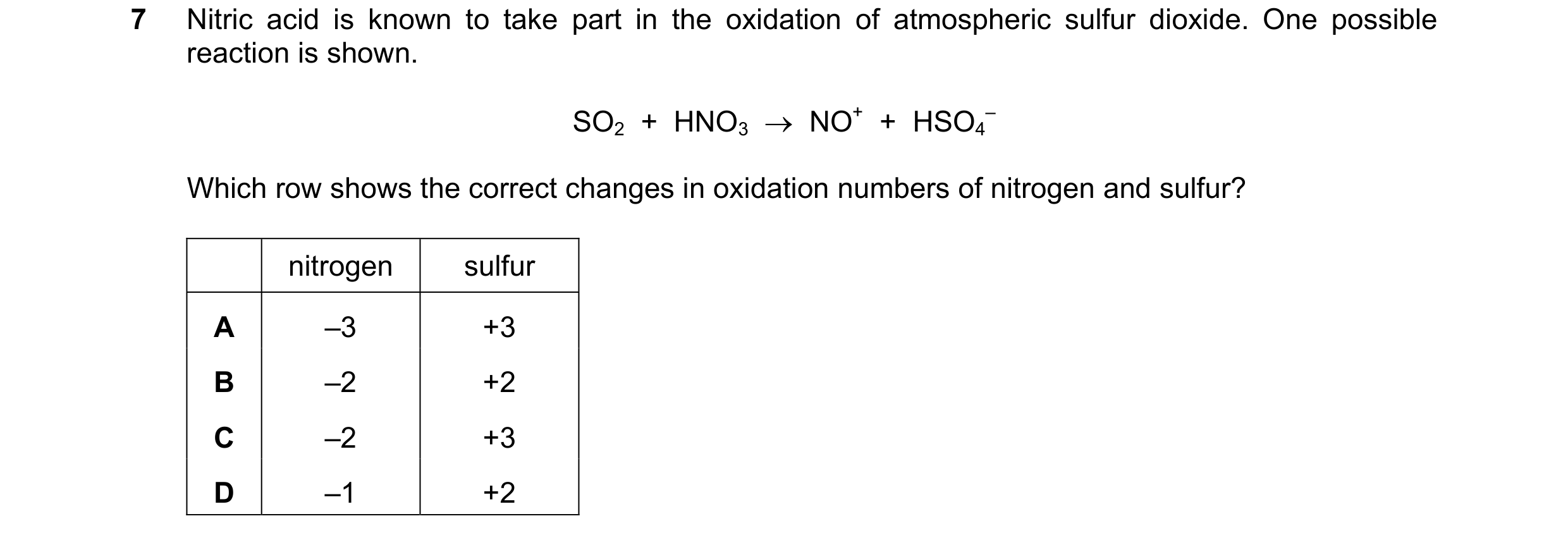
 17 / 27

 18 / 27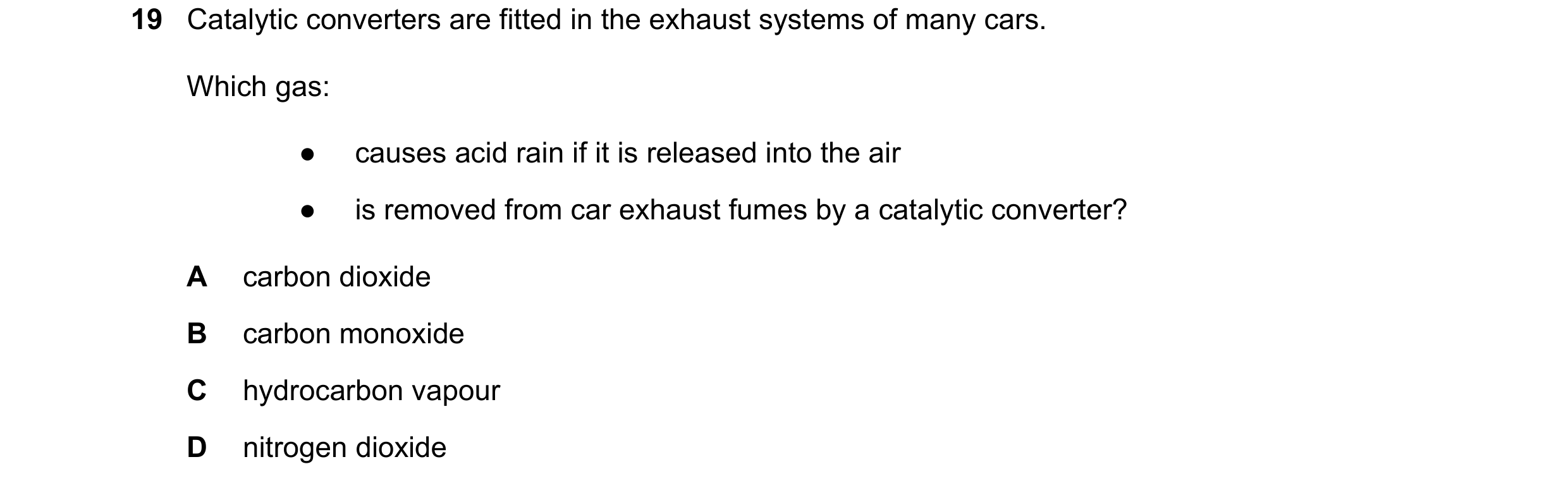
 19 / 27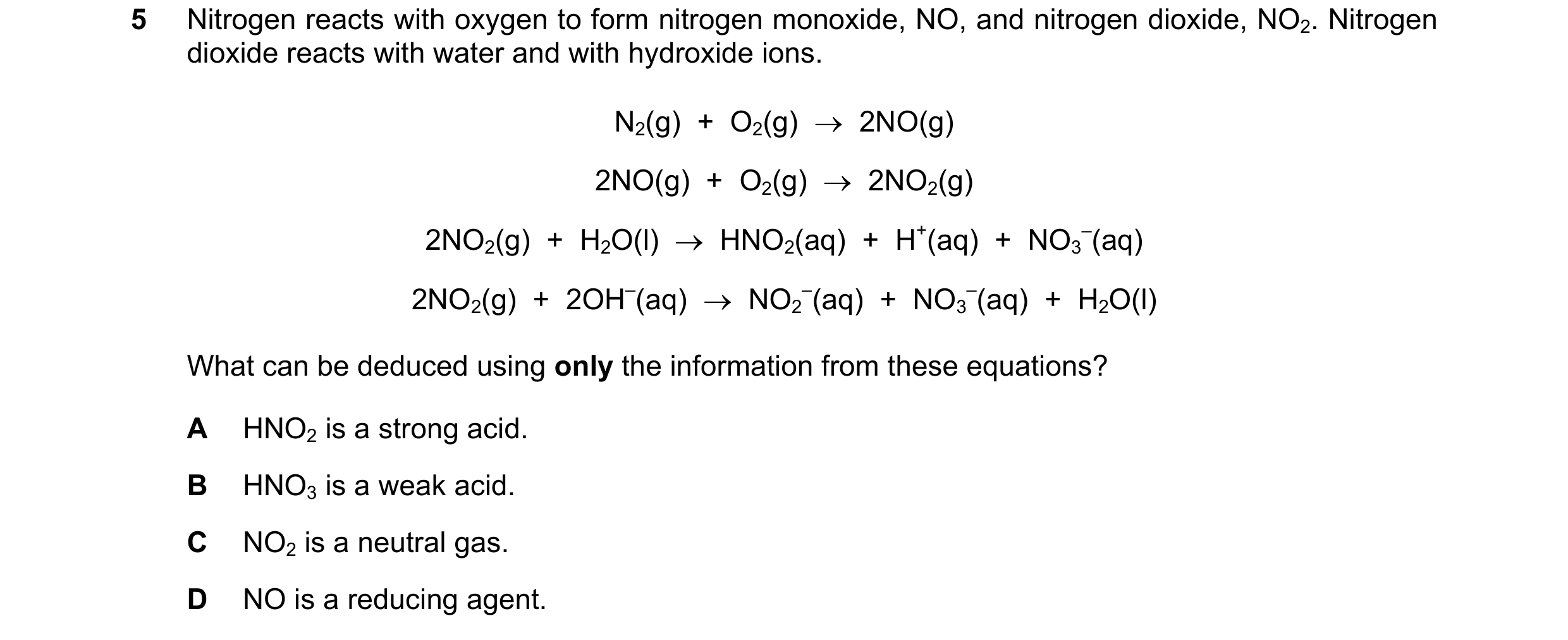



 20 / 27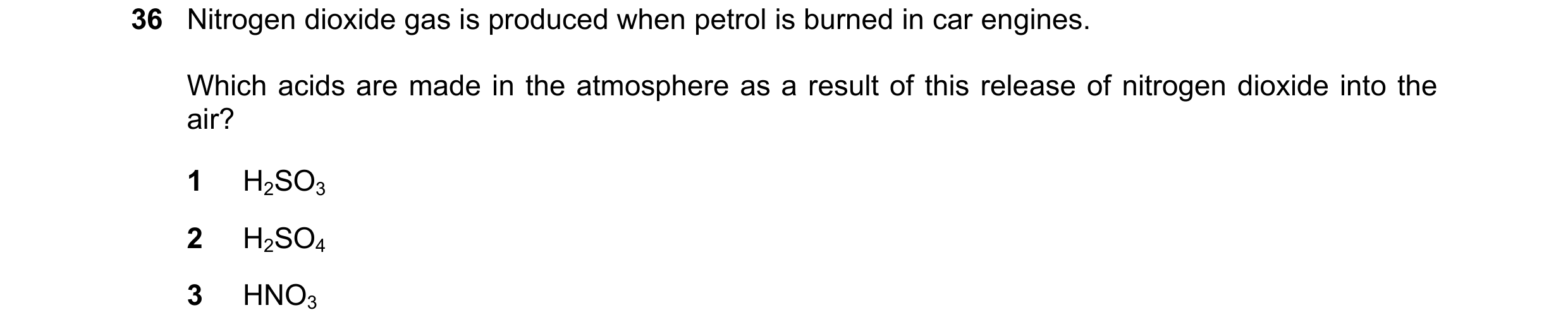
 21 / 27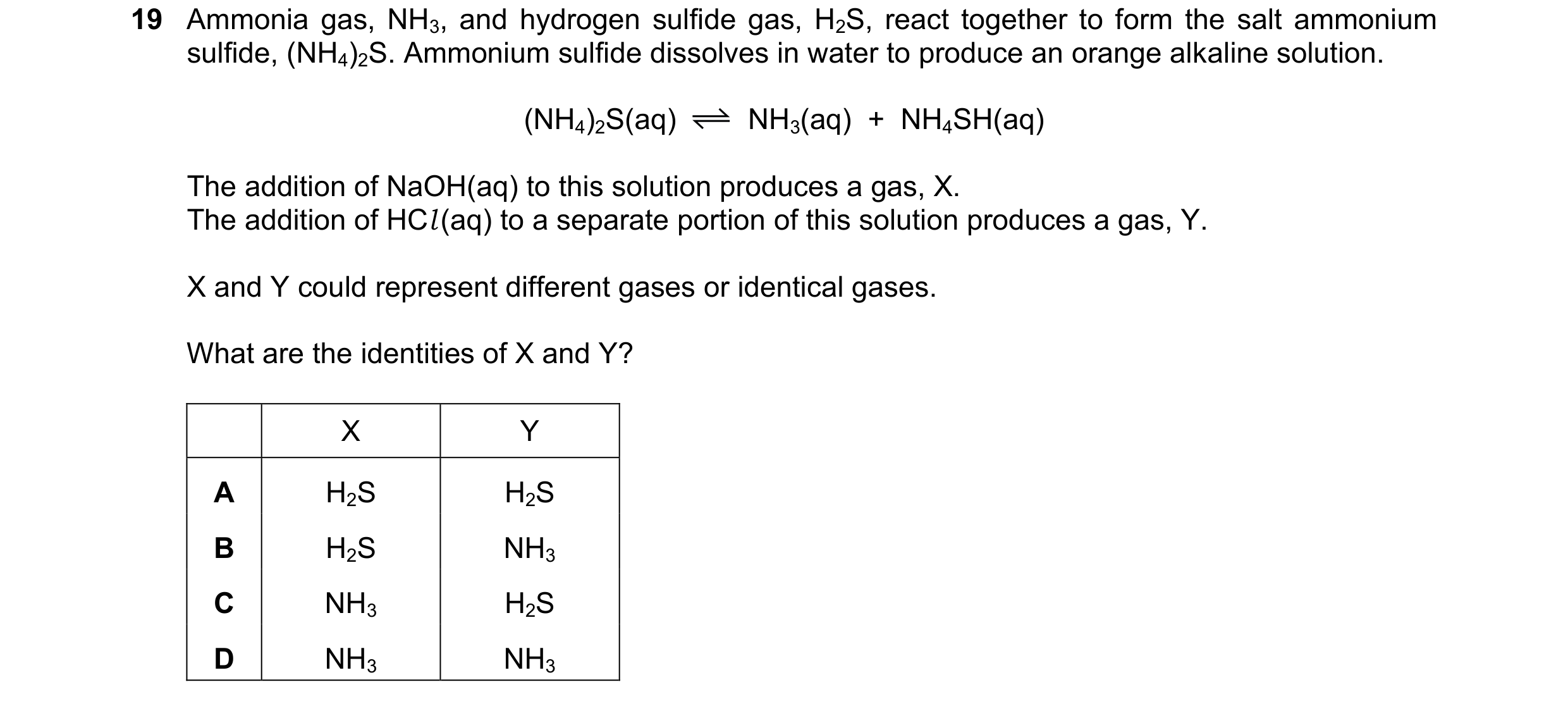
 22 / 27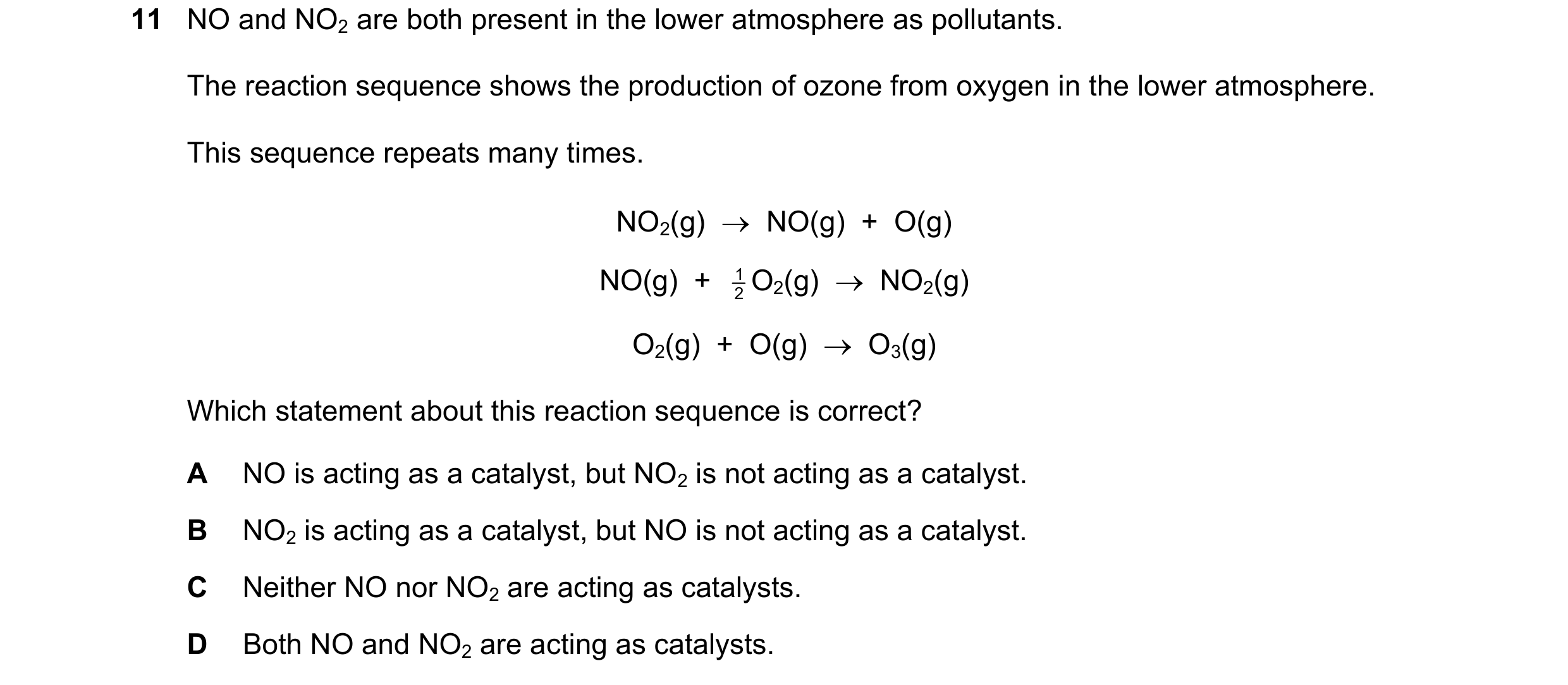
 23 / 27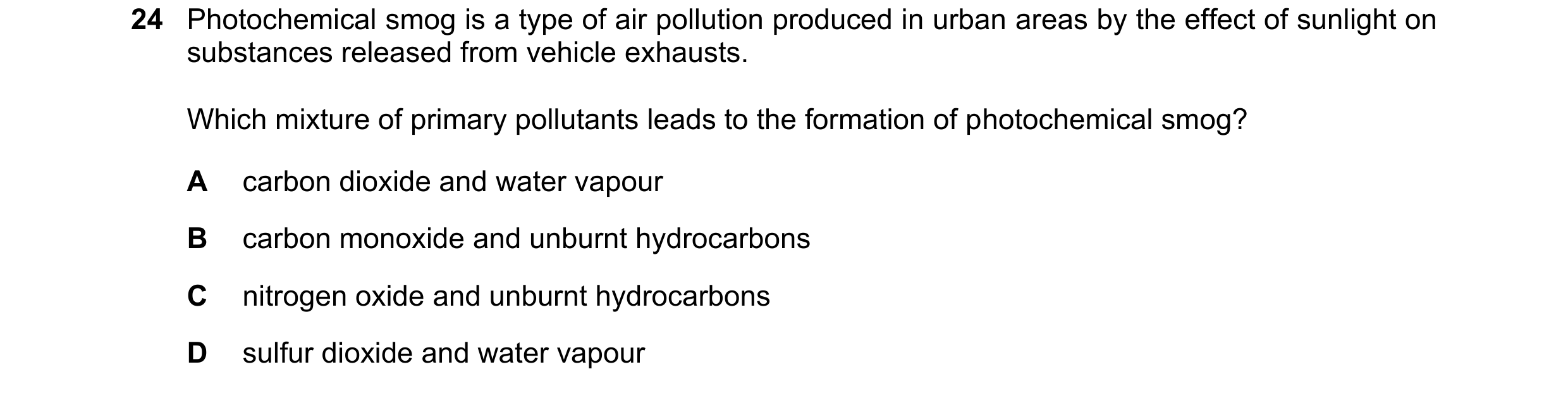
 24 / 27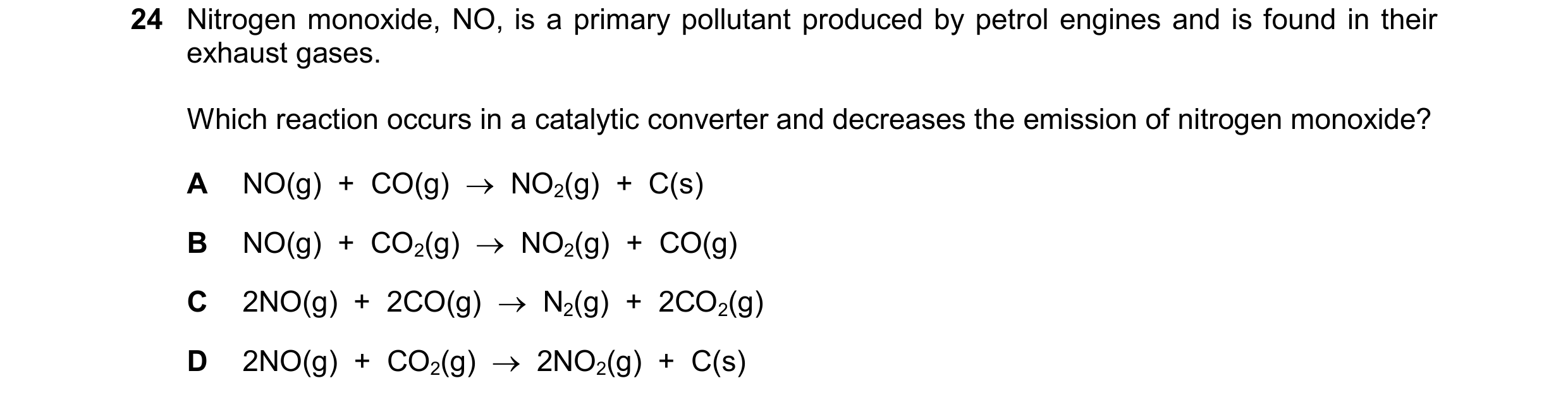
 25 / 27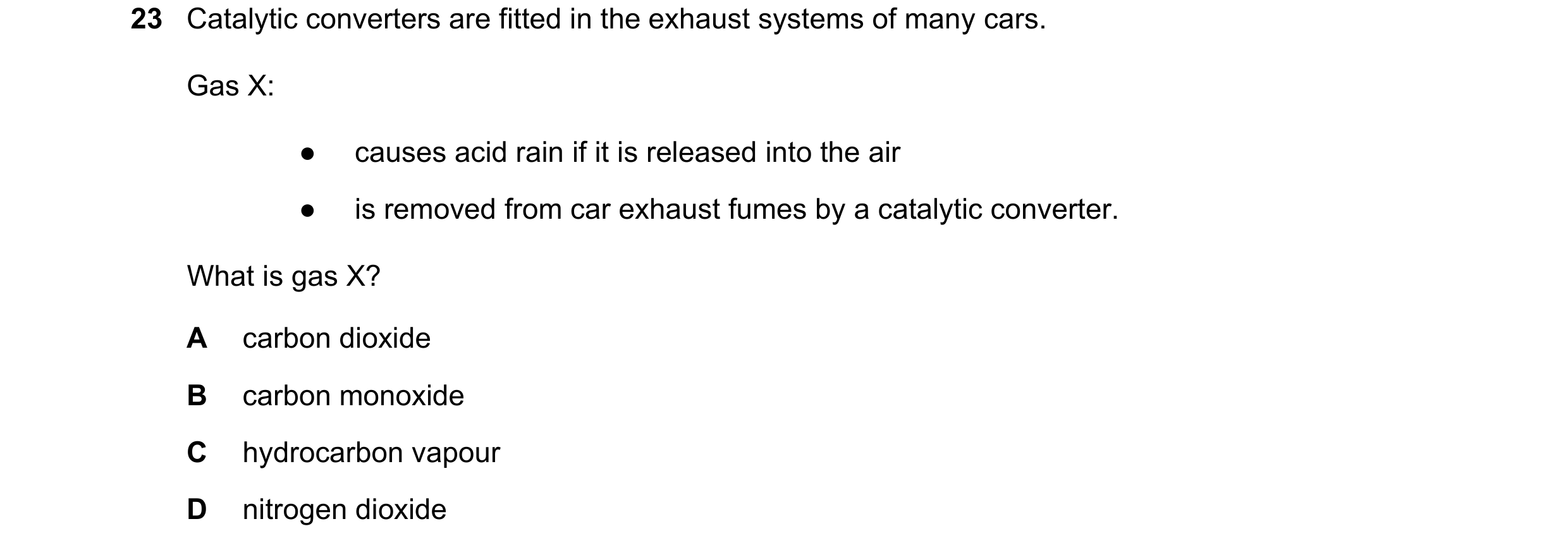
 26 / 27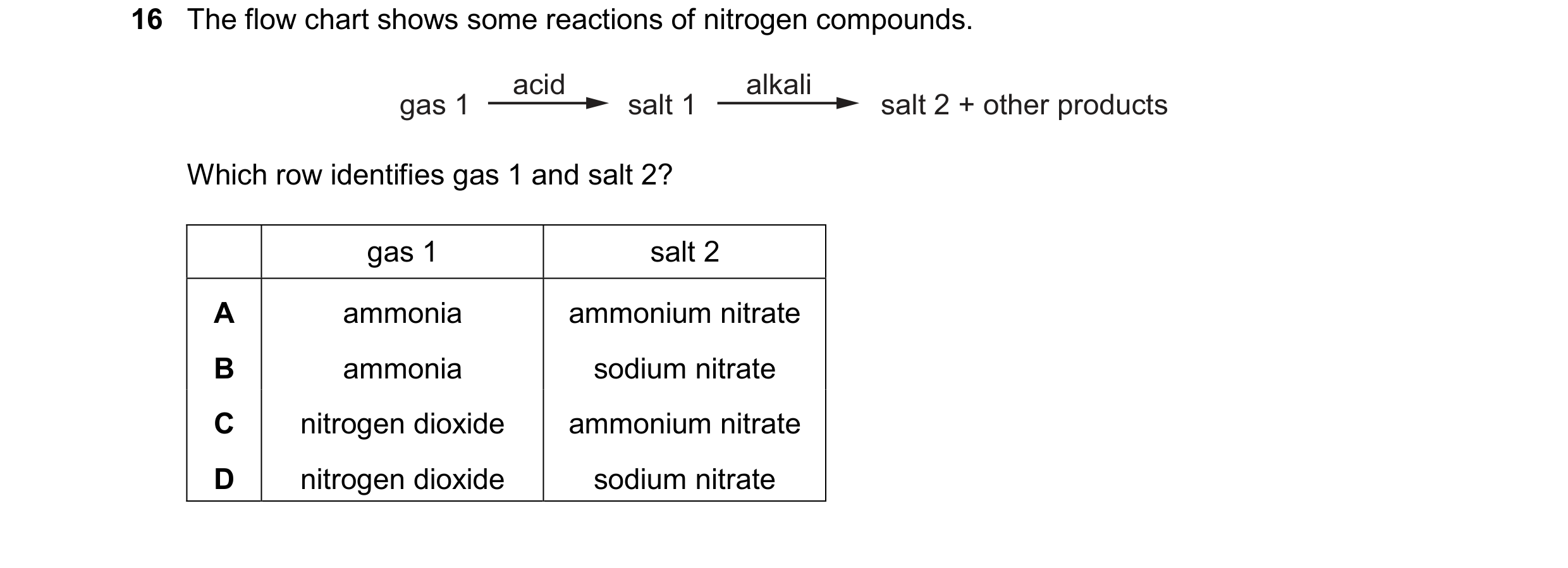
 27 / 27