Questions as text
Q1 · Two properties of a white solid are shown 0653/11 May/June 2006
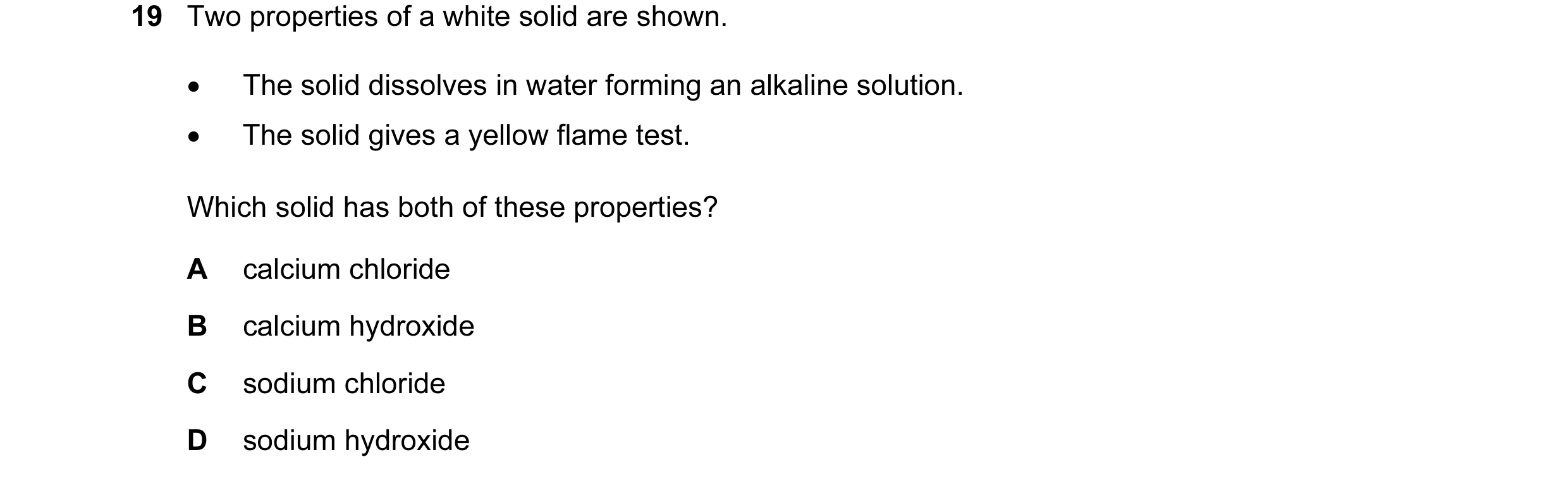
19 Two properties of a white solid are shown. • The solid dissolves in water forming an alkaline solution. • The solid gives a yellow flame test. Which solid has both of these properties? A calcium chloride B calcium hydroxide C sodium chloride D sodium hydroxide
1 marks
Answer: D
This question in 0653/11 May/June 2006
Q2 · A substance, X, is dissolved in water and electrolysed as shown 0653/11 Oct/Nov 2006
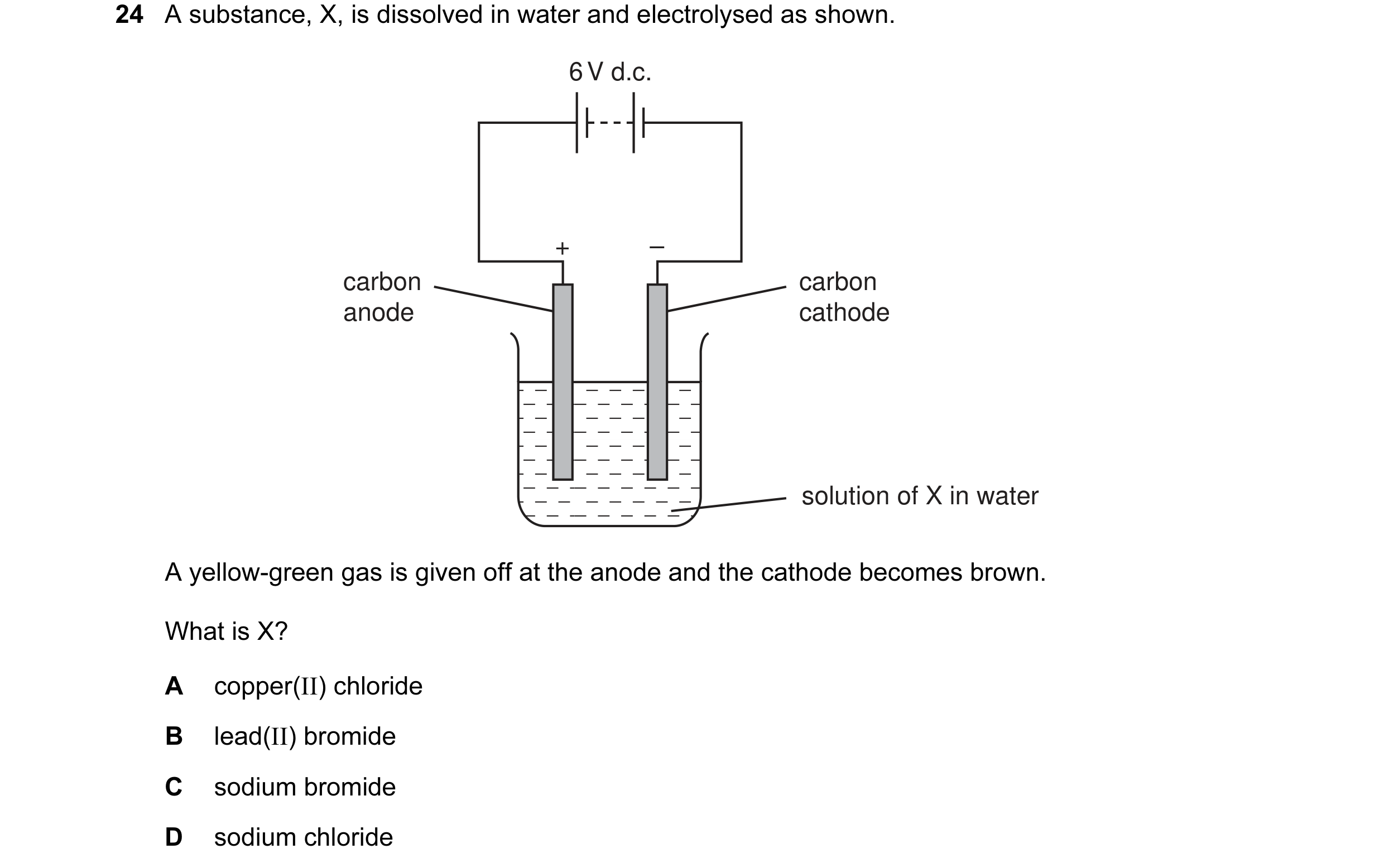
24 A substance, X, is dissolved in water and electrolysed as shown. 6 V d.c. + – carbon carbon anode cathode solution of X in water A yellow-green gas is given off at the anode and the cathode becomes brown. What is X? A copper(II) chloride B lead(II) bromide C sodium bromide D sodium chloride
1 marks
Answer: A
This question in 0653/11 Oct/Nov 2006
Q3 · The diagrams show the results of adding an excess of NaOH(aq), NH3(aq), to a solution of… 0653/11 May/June 2007
24 The diagrams show the results of adding an excess of NaOH(aq), NH3(aq), to a solution of salt S. NaOH(aq) NH3(aq) added added pale blue deep blue precipitate solution Which metal ion is present in salt S? A Cu2+ B Fe2+ C Fe3+ D Zn2+
1 marks
Answer: A
This question in 0653/11 May/June 2007
Q4 · Which aqueous reagents give a white precipitate when added to aqueous zinc chloride? 0653/11 May/June 2008
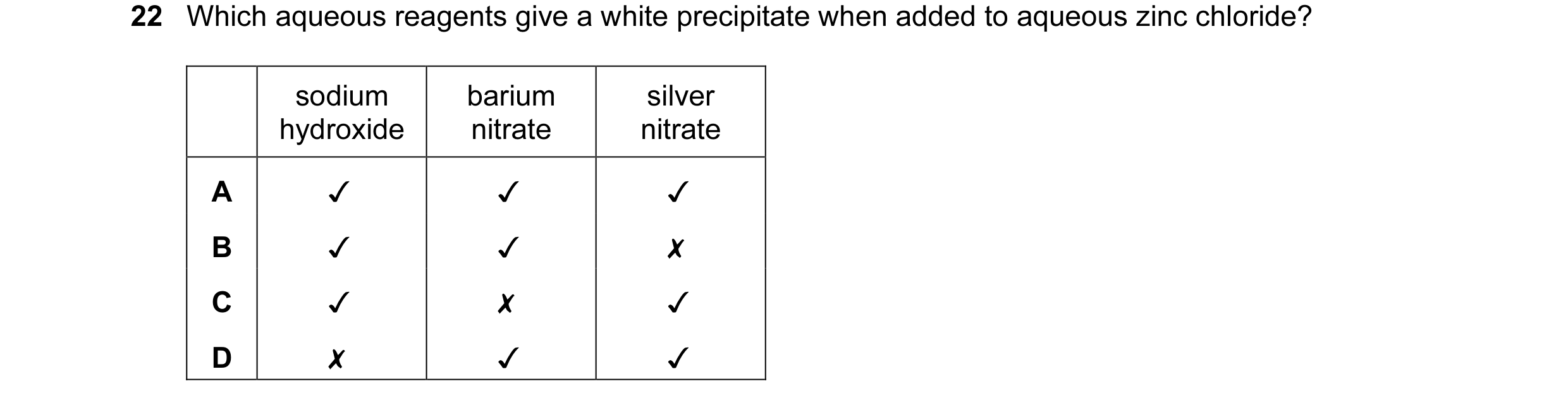
22 Which aqueous reagents give a white precipitate when added to aqueous zinc chloride?
sodium barium silver
hydroxide nitrate nitrate
v v v
0 0O WwW >
v v x
v x v
x v v
1 marks
Answer: C
This question in 0653/11 May/June 2008
Q5 · A firework gives a bright flame in which yellow and red colours are seen 0653/11 May/June 2009
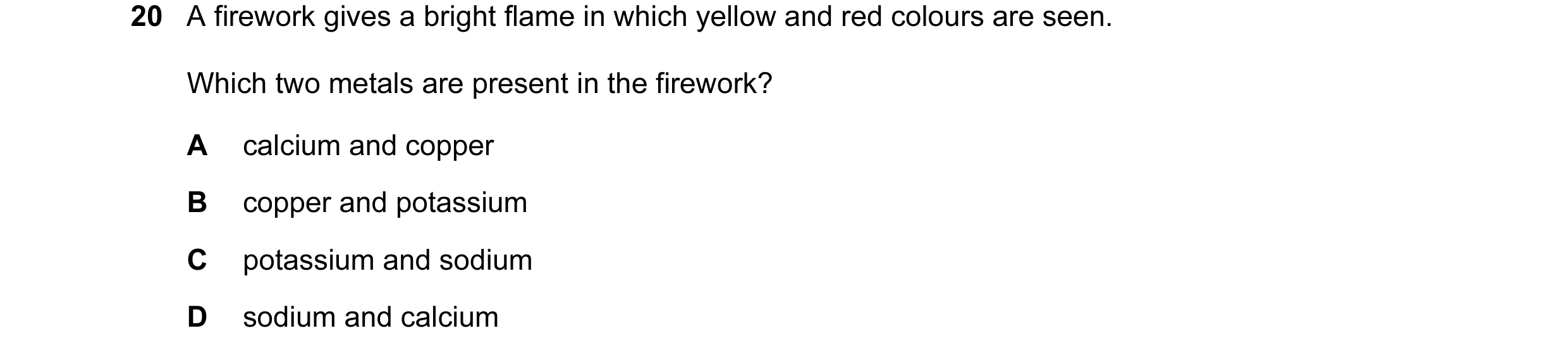
20 A firework gives a bright flame in which yellow and red colours are seen. Which two metals are present in the firework? A calcium and copper B copper and potassium C potassium and sodium D sodium and calcium
1 marks
Answer: D
This question in 0653/11 May/June 2009
Q6 · Testing for the gases chlorine, hydrogen and oxygen requires different methods 0653/11 May/June 2009
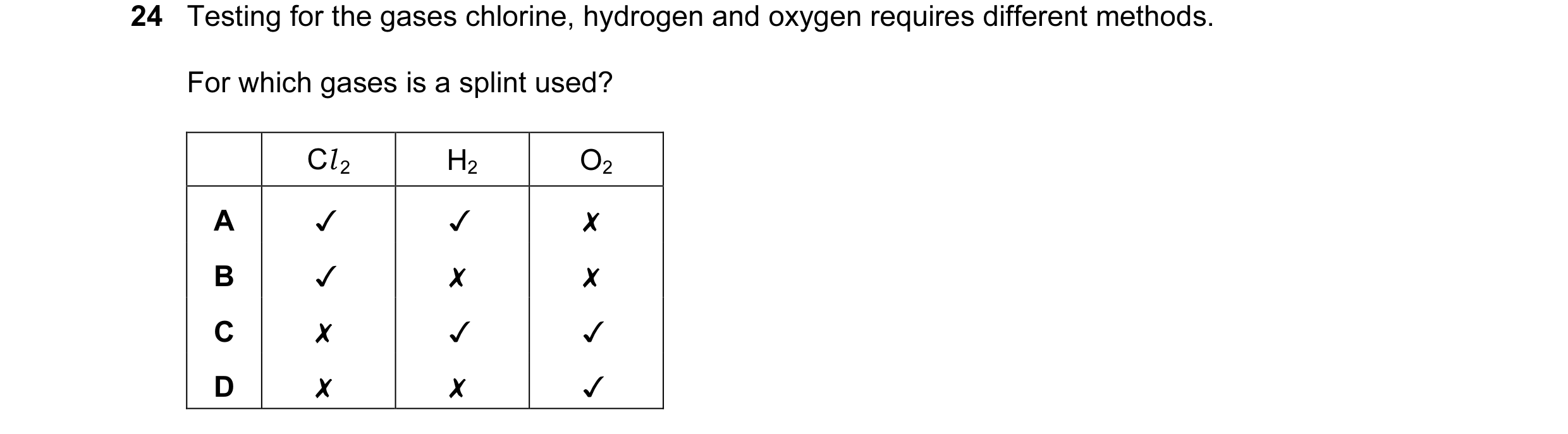
24 Testing for the gases chlorine, hydrogen and oxygen requires different methods.
For which gases is a splint used?
Cl, H2 Oz
A v v x
B v x x
Cc x v v
D x x v
1 marks
Answer: C
This question in 0653/11 May/June 2009
Q7 · A hydrocarbon is burned in excess oxygen 0653/11 May/June 2010
26 A hydrocarbon is burned in excess oxygen. The combustion products are passed through the apparatus shown. combustion suction products ice limewater X What collects at X and what happens to the limewater? collects at X limewater turns A soot cloudy B soot red C water cloudy D water red
1 marks
Answer: C
This question in 0653/11 May/June 2010
Q8 · A hydrocarbon is burned in excess oxygen 0653/12 May/June 2010
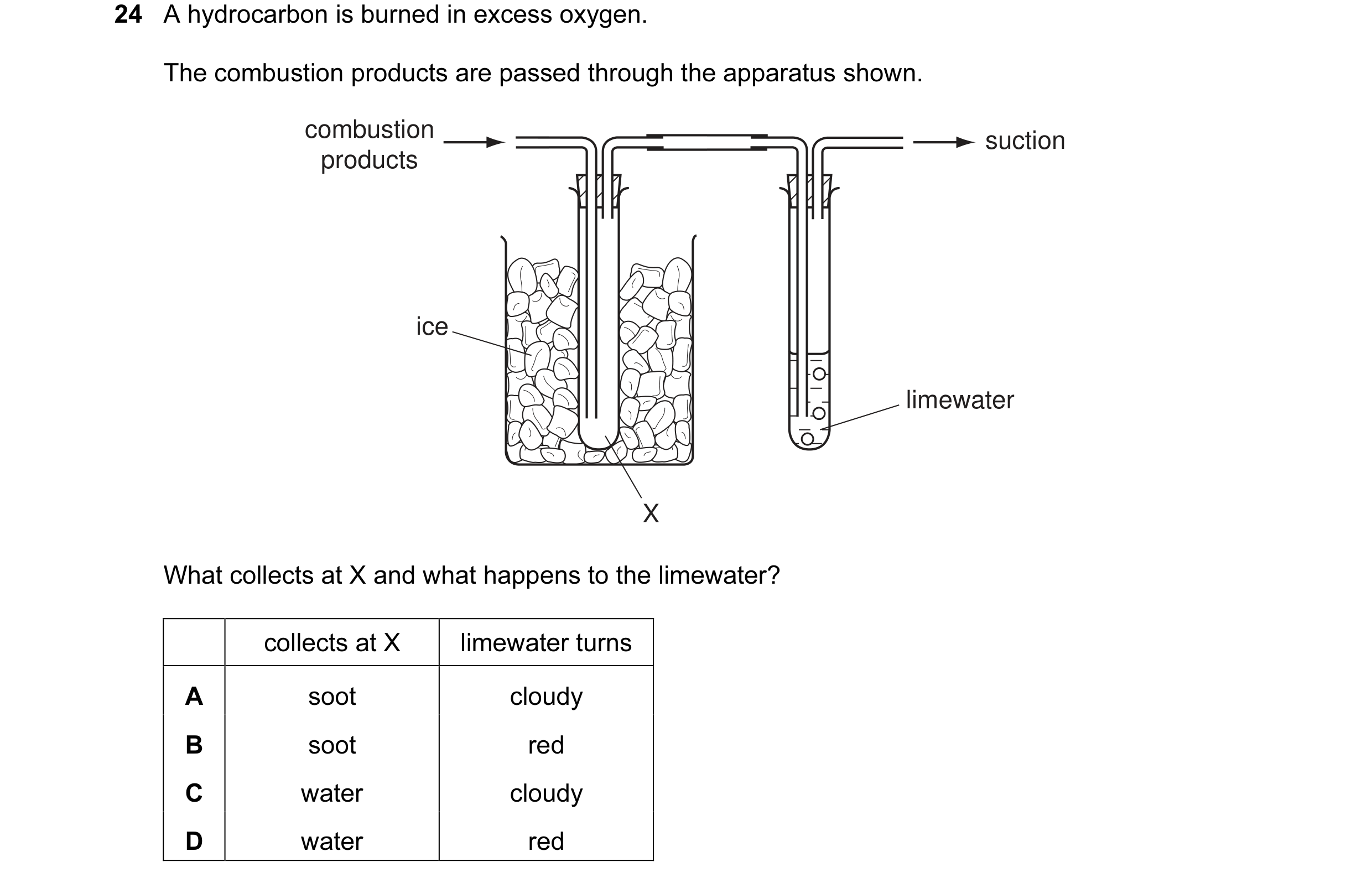
24 A hydrocarbon is burned in excess oxygen. The combustion products are passed through the apparatus shown. combustion suction products ice limewater X What collects at X and what happens to the limewater? collects at X limewater turns A soot cloudy B soot red C water cloudy D water red
1 marks
Answer: C
This question in 0653/12 May/June 2010
Q9 · A hydrocarbon is burned in excess oxygen 0653/13 May/June 2010
24 A hydrocarbon is burned in excess oxygen. The combustion products are passed through the apparatus shown. combustion suction products ice limewater X What collects at X and what happens to the limewater? collects at X limewater turns A soot cloudy B soot red C water cloudy D water red
1 marks
Answer: C
This question in 0653/13 May/June 2010
Q10 · Metal X reacts vigorously with dilute hydrochloric acid 0653/11 May/June 2011
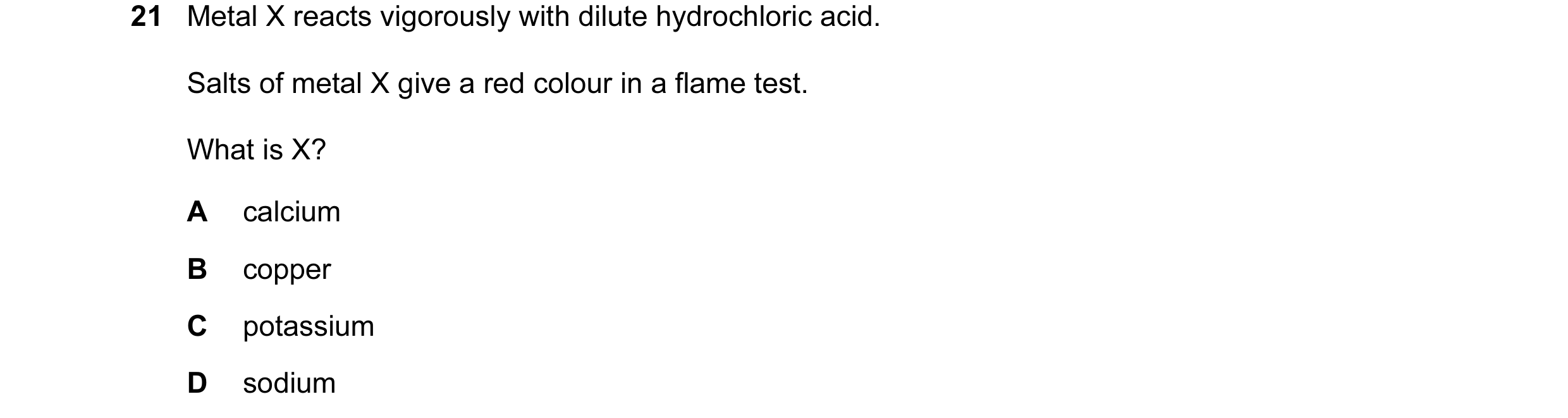
21 Metal X reacts vigorously with dilute hydrochloric acid. Salts of metal X give a red colour in a flame test. What is X? A calcium B copper C potassium D sodium
1 marks
Answer: A
This question in 0653/11 May/June 2011
Q11 · Metal X reacts vigorously with dilute hydrochloric acid 0653/12 May/June 2011
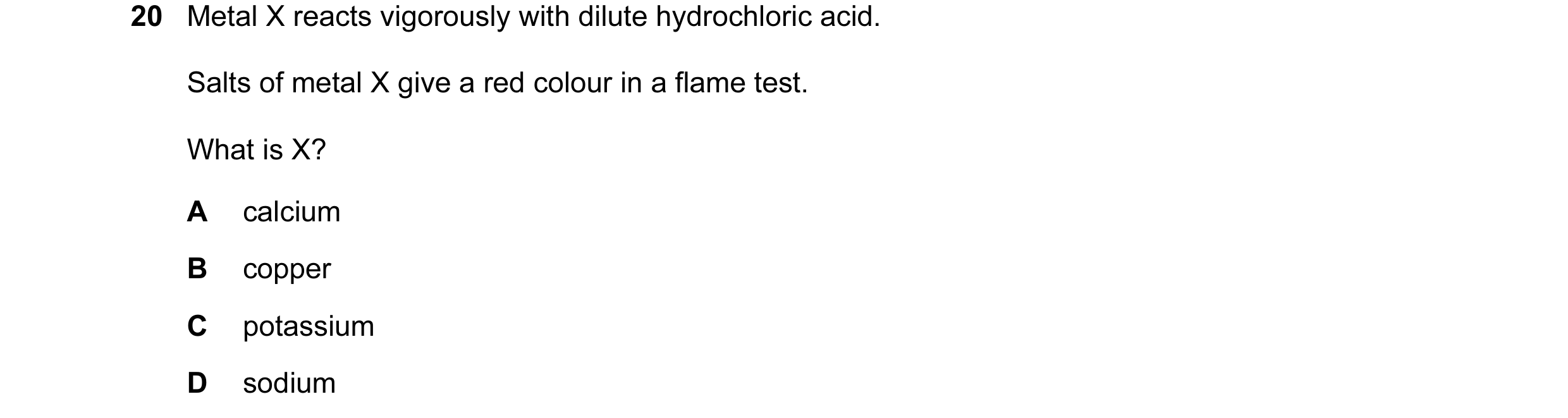
20 Metal X reacts vigorously with dilute hydrochloric acid. Salts of metal X give a red colour in a flame test. What is X? A calcium B copper C potassium D sodium
1 marks
Answer: A
This question in 0653/12 May/June 2011
Q12 · In an experiment the elements calcium, copper, potassium and sodium were separately… 0653/11 Oct/Nov 2011
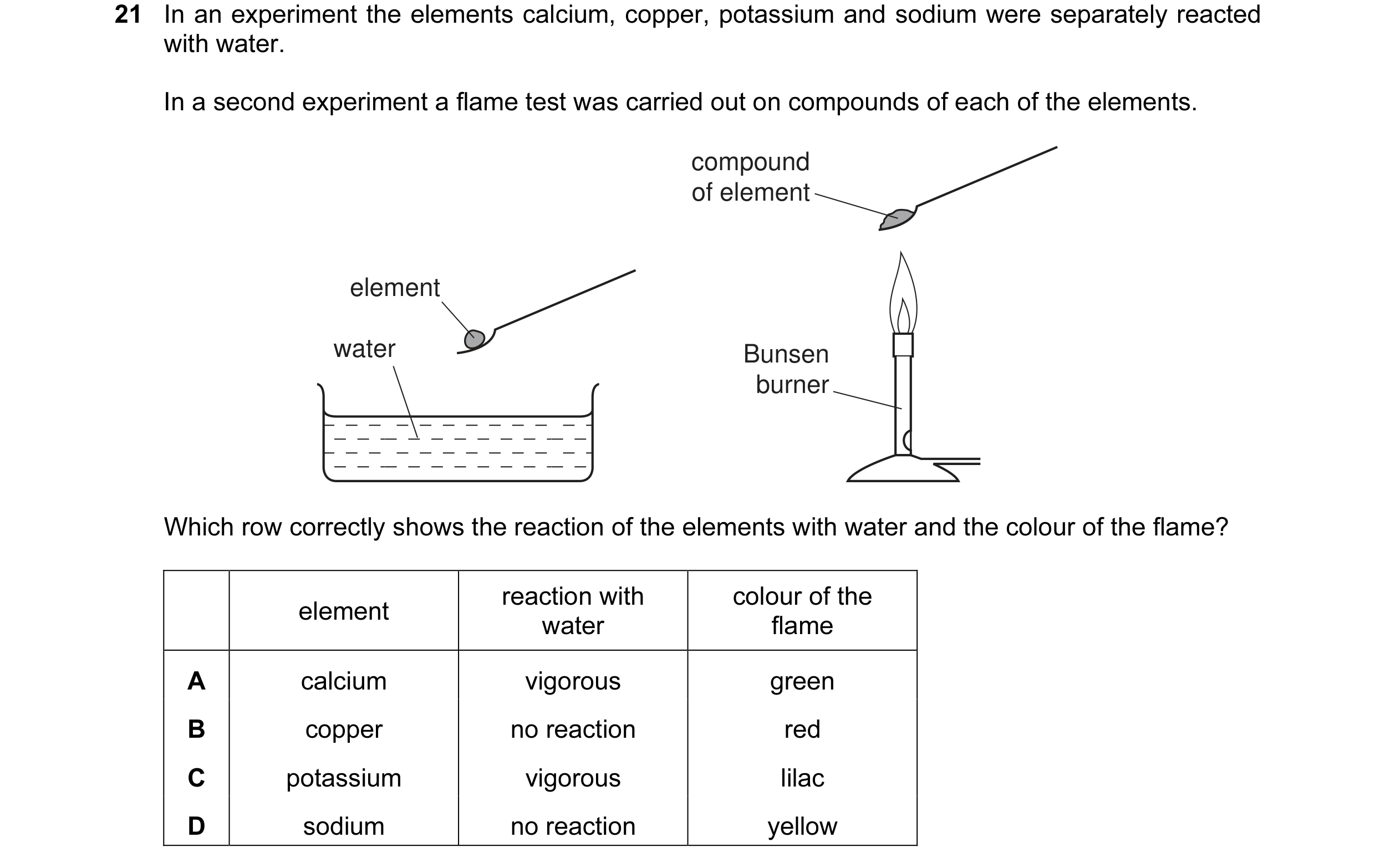
21 In an experiment the elements calcium, copper, potassium and sodium were separately reacted with water. In a second experiment a flame test was carried out on compounds of each of the elements. compound of element element water Bunsen burner Which row correctly shows the reaction of the elements with water and the colour of the flame? reaction with colour of the element water flame A calcium vigorous green B copper no reaction red C potassium vigorous lilac D sodium no reaction yellow
1 marks
Answer: C
This question in 0653/11 Oct/Nov 2011
Q13 · In an experiment the elements calcium, copper, potassium and sodium were separately… 0653/12 Oct/Nov 2011
21 In an experiment the elements calcium, copper, potassium and sodium were separately reacted with water. In a second experiment a flame test was carried out on compounds of each of the elements. compound of element element water Bunsen burner Which row correctly shows the reaction of the elements with water and the colour of the flame? reaction with colour of the element water flame A calcium vigorous green B copper no reaction red C potassium vigorous lilac D sodium no reaction yellow
1 marks
Answer: C
This question in 0653/12 Oct/Nov 2011
Q14 · In an experiment the elements calcium, copper, potassium and sodium were separately… 0653/13 Oct/Nov 2011
16 In an experiment the elements calcium, copper, potassium and sodium were separately reacted with water. In a second experiment a flame test was carried out on compounds of each of the elements. compound of element element water Bunsen burner Which row correctly shows the reaction of the elements with water and the colour of the flame? reaction with colour of the element water flame A calcium vigorous green B copper no reaction red C potassium vigorous lilac D sodium no reaction yellow
1 marks
Answer: C
This question in 0653/13 Oct/Nov 2011
Q15 · Aqueous sodium hydroxide and aqueous ammonia are added separately to aqueous solutions X… 0653/11 May/June 2012
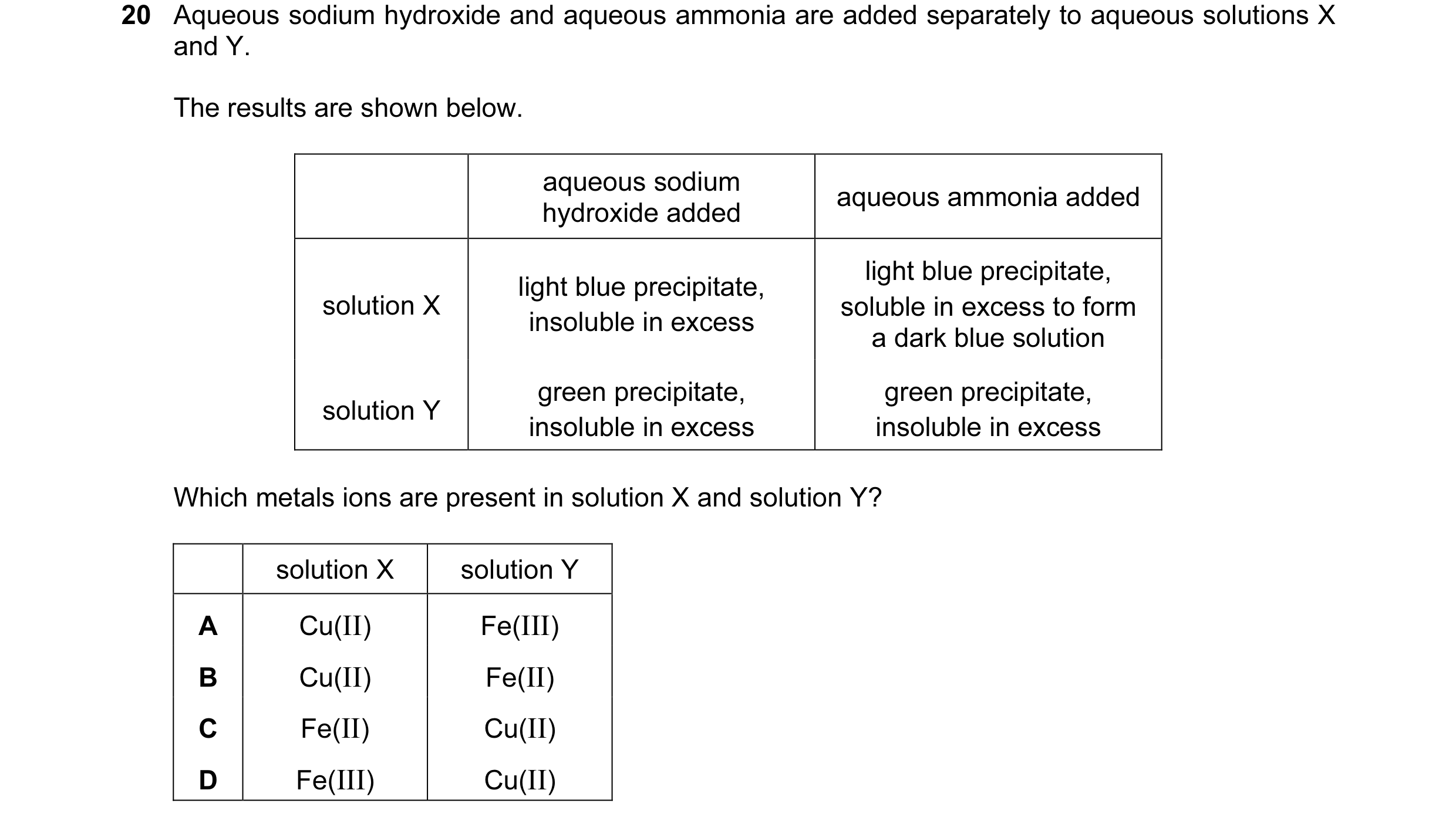
20 Aqueous sodium hydroxide and aqueous ammonia are added separately to aqueous solutions X and Y. The results are shown below. aqueous sodium aqueous ammonia added hydroxide added light blue precipitate, light blue precipitate, solution X soluble in excess to form insoluble in excess a dark blue solution green precipitate, green precipitate, solution Y insoluble in excess insoluble in excess Which metals ions are present in solution X and solution Y? solution X solution Y A Cu(II) Fe(III) B Cu(II) Fe(II) C Fe(II) Cu(II) D Fe(III) Cu(II)
1 marks
This question in 0653/11 May/June 2012
Q16 · Copper(II) oxide is mixed with a solid Q 0653/11 May/June 2012
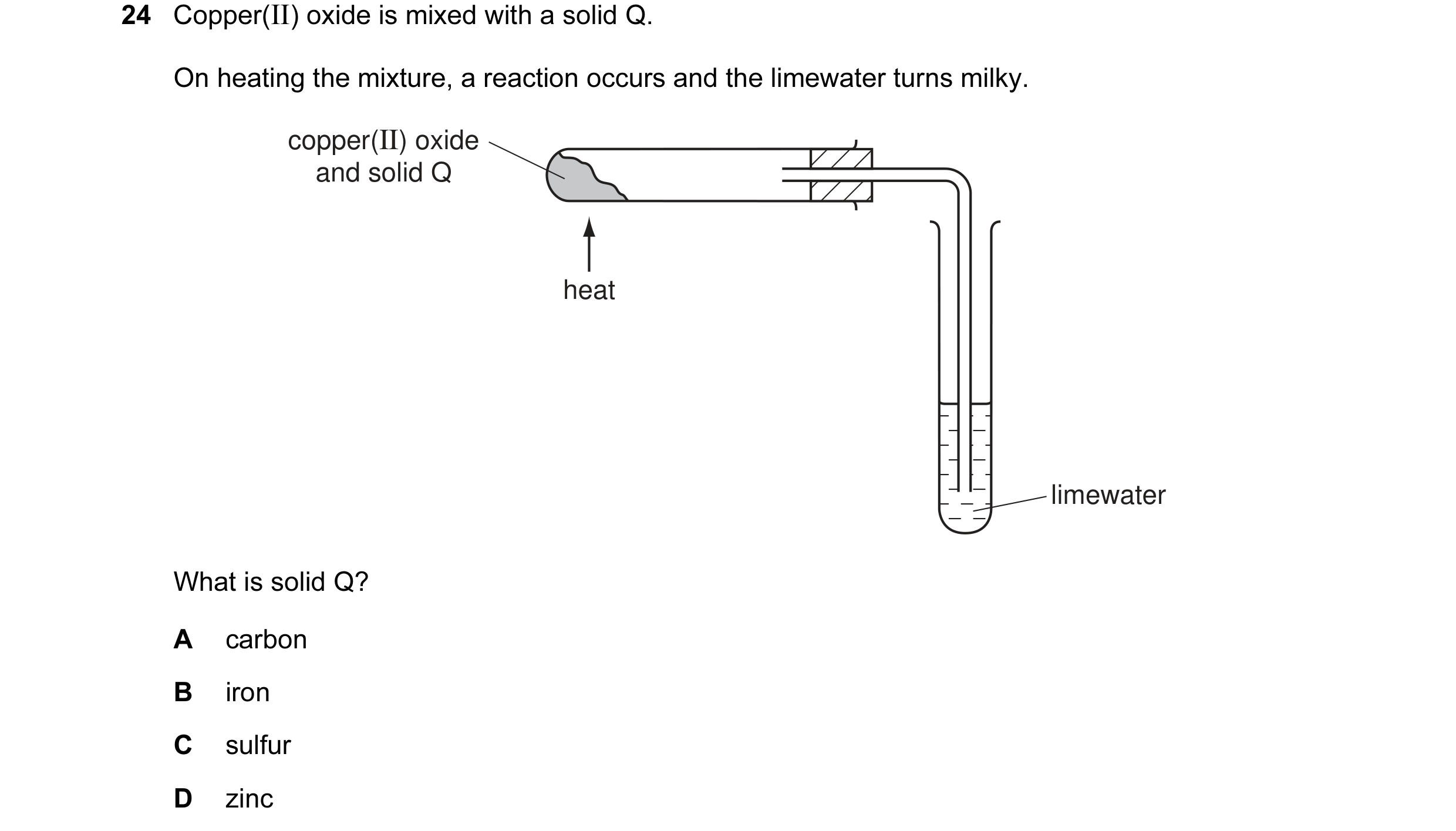
24 Copper(II) oxide is mixed with a solid Q. On heating the mixture, a reaction occurs and the limewater turns milky. copper(II) oxide and solid Q heat limewater What is solid Q? A carbon B iron C sulfur D zinc
1 marks
This question in 0653/11 May/June 2012
Q17 · Acid X reacts with metal Y 0653/12 May/June 2012
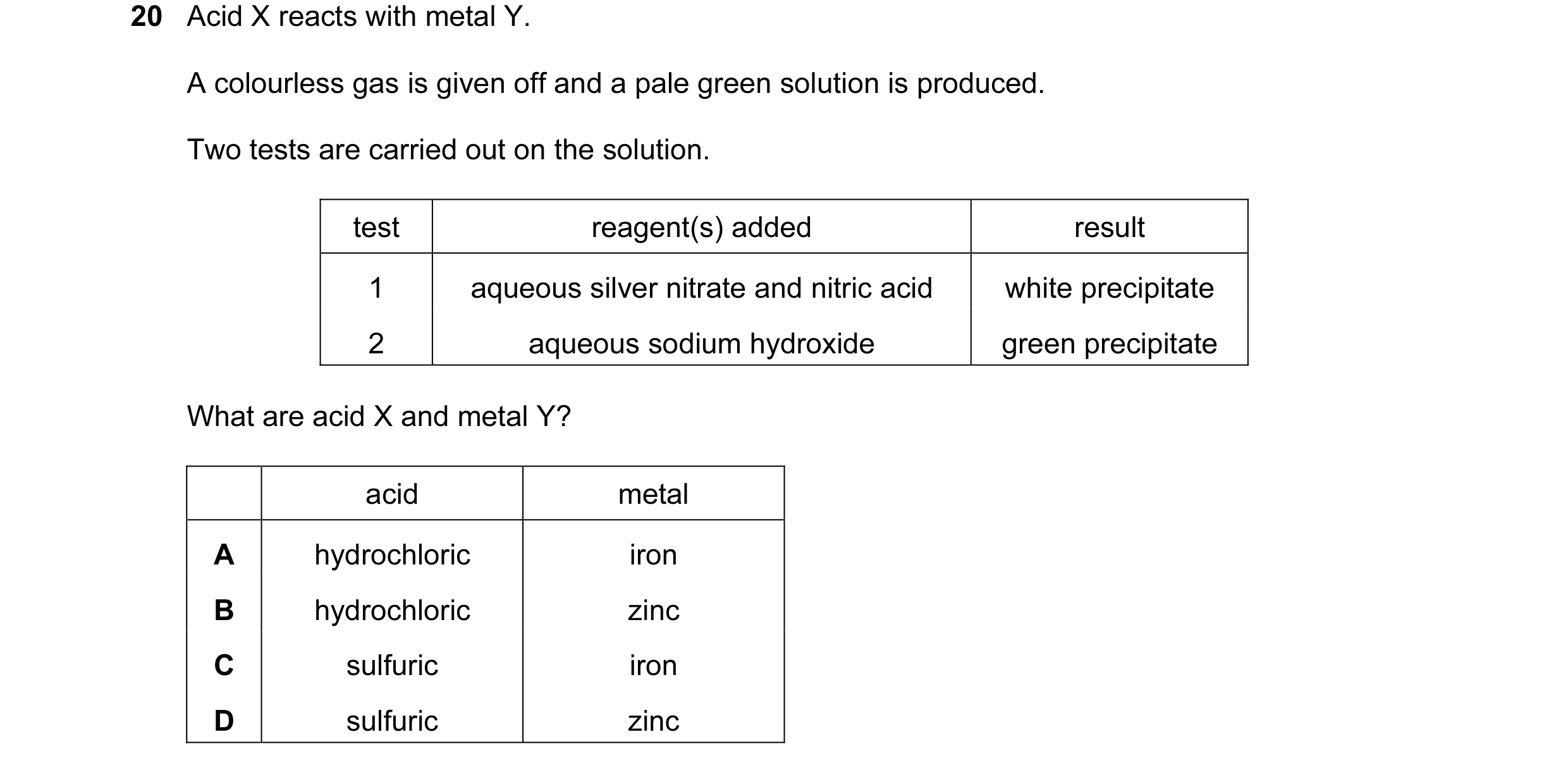
20 Acid X reacts with metal Y. A colourless gas is given off and a pale green solution is produced. Two tests are carried out on the solution. test reagent(s) added result 1 aqueous silver nitrate and nitric acid white precipitate 2 aqueous sodium hydroxide green precipitate What are acid X and metal Y? acid metal A hydrochloric iron B hydrochloric zinc C sulfuric iron D sulfuric zinc
1 marks
Answer: A
This question in 0653/12 May/June 2012
Q18 · Acid X reacts with metal Y 0653/13 May/June 2012
20 Acid X reacts with metal Y. A colourless gas is given off and a pale green solution is produced. Two tests are carried out on the solution. test reagent(s) added result 1 aqueous silver nitrate and nitric acid white precipitate 2 aqueous sodium hydroxide green precipitate What are acid X and metal Y? acid metal A hydrochloric iron B hydrochloric zinc C sulfuric iron D sulfuric zinc
1 marks
Answer: A
This question in 0653/13 May/June 2012
Q19 · Copper(II) oxide is mixed with a solid Q 0653/13 May/June 2012
24 Copper(II) oxide is mixed with a solid Q. On heating the mixture, a reaction occurs and the limewater turns milky. copper(II) oxide and solid Q heat limewater What is solid Q? A carbon B iron C sulfur D zinc
1 marks
Answer: A
This question in 0653/13 May/June 2012
Q20 · Which chemical test shows the presence of water? 0653/12 May/June 2013
25 Which chemical test shows the presence of water? A Water has a boiling point of 100 °C. B Water has a freezing point of 0 °C. C Water turns anhydrous cobalt chloride from blue to pink. D Water turns anhydrous copper sulfate from blue to white.
1 marks
Answer: C
This question in 0653/12 May/June 2013
Q21 · Which pair of gases can be identified using limewater and damp litmus paper? 0653/13 May/June 2013
25 Which pair of gases can be identified using limewater and damp litmus paper? A carbon dioxide and chlorine B carbon dioxide and hydrogen C chlorine and oxygen D hydrogen and chlorine
1 marks
Answer: A
This question in 0653/13 May/June 2013
Q22 · Steam is passed over a heated metal 0653/13 Oct/Nov 2013
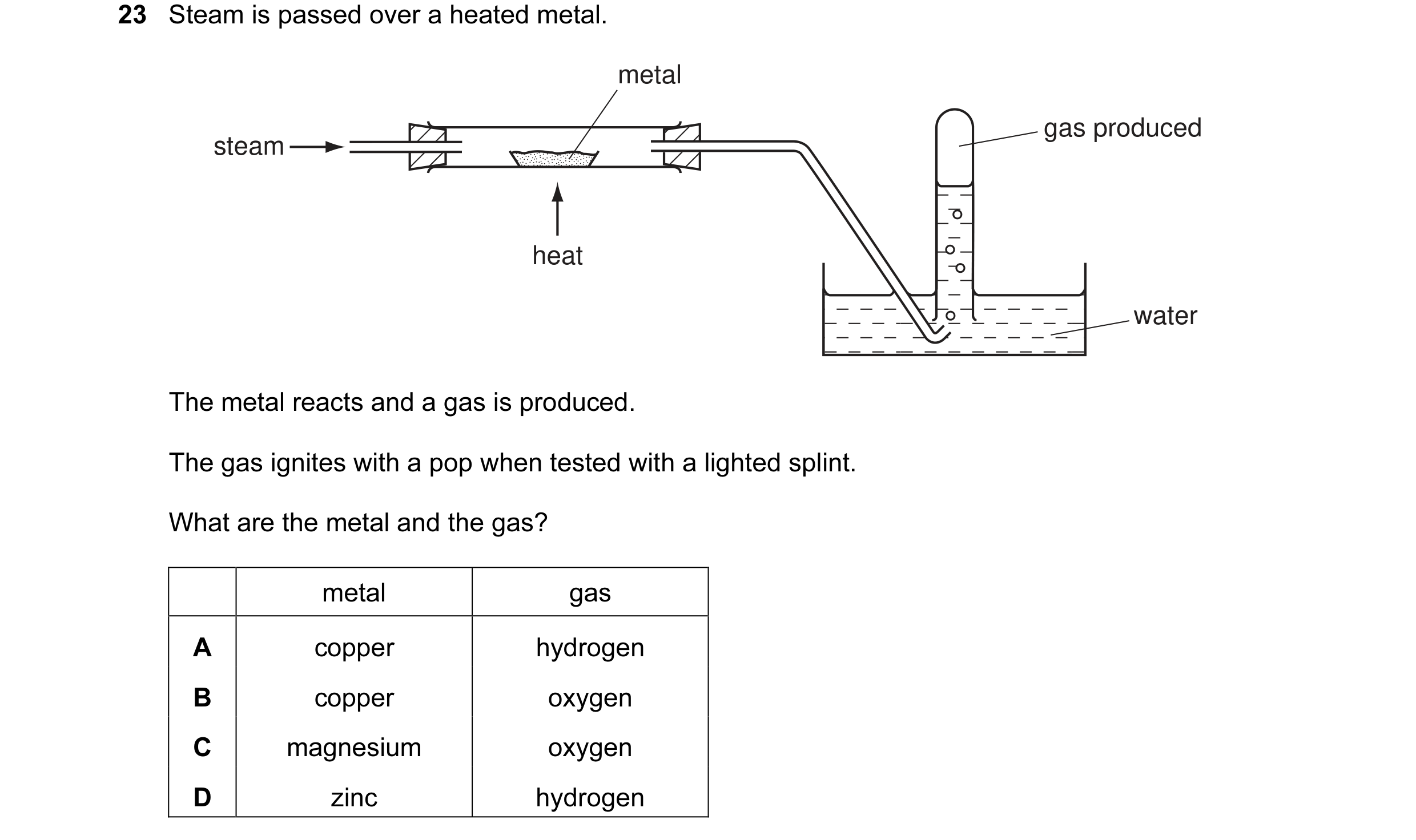
23 Steam is passed over a heated metal. metal gas produced steam heat water The metal reacts and a gas is produced. The gas ignites with a pop when tested with a lighted splint. What are the metal and the gas? metal gas A copper hydrogen B copper oxygen C magnesium oxygen D zinc hydrogen
1 marks
Answer: D
This question in 0653/13 Oct/Nov 2013
Q23 · Which two reagents form a white precipitate when they are mixed? 0653/12 May/June 2014
23 Which two reagents form a white precipitate when they are mixed? A barium chloride and hydrochloric acid B barium chloride and nitric acid C silver nitrate and hydrochloric acid D silver nitrate and nitric acid
1 marks
Answer: C
This question in 0653/12 May/June 2014
Q24 · The table shows the results of tests on an aqueous solution of X 0653/11 May/June 2015
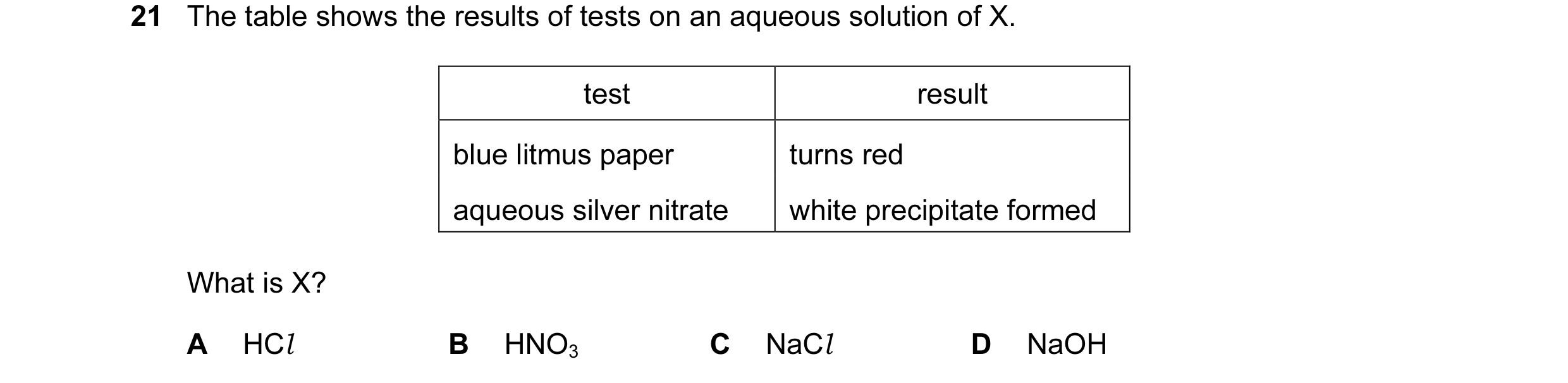
21 The table shows the results of tests on an aqueous solution of X. test result blue litmus paper turns red aqueous silver nitrate white precipitate formed What is X? A HCl B HNO3 C NaCl D NaOH
1 marks
Answer: A
This question in 0653/11 May/June 2015
Q25 · The table shows the results of tests on an aqueous solution of X 0653/12 May/June 2015
22 The table shows the results of tests on an aqueous solution of X. test result blue litmus paper turns red aqueous silver nitrate white precipitate formed What is X? A HCl B HNO3 C NaCl D NaOH
1 marks
Answer: A
This question in 0653/12 May/June 2015
Q26 · The table shows the results of tests on an aqueous solution of X 0653/13 May/June 2015
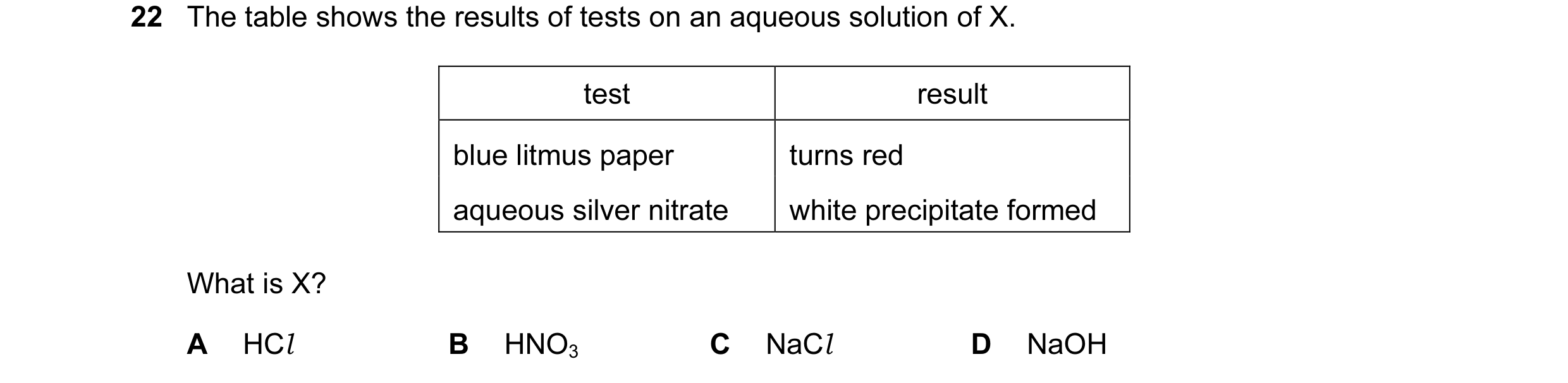
22 The table shows the results of tests on an aqueous solution of X. test result blue litmus paper turns red aqueous silver nitrate white precipitate formed What is X? A HCl B HNO3 C NaCl D NaOH
1 marks
Answer: A
This question in 0653/13 May/June 2015
Q27 · Compound X reacts with dilute nitric acid to give a colourless gas which turns limewater… 0653/11 Oct/Nov 2015
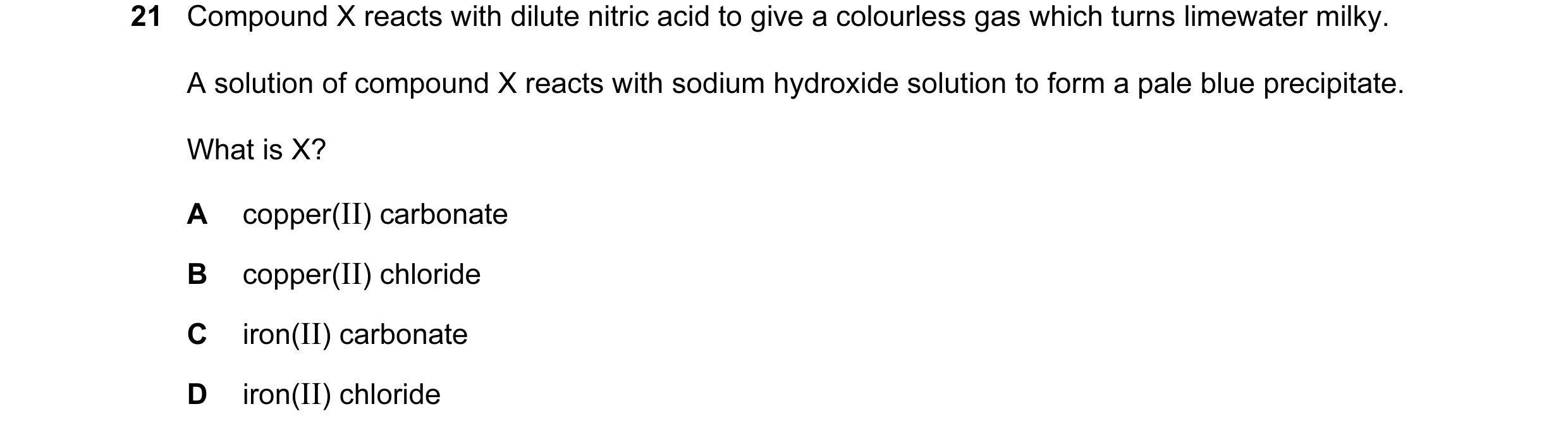
21 Compound X reacts with dilute nitric acid to give a colourless gas which turns limewater milky. A solution of compound X reacts with sodium hydroxide solution to form a pale blue precipitate. What is X? A copper(II) carbonate B copper(II) chloride C iron(II) carbonate D iron(II) chloride
1 marks
Answer: A
This question in 0653/11 Oct/Nov 2015
Q28 · A substance reacts with dilute acid, producing a gas 0653/11 Oct/Nov 2015
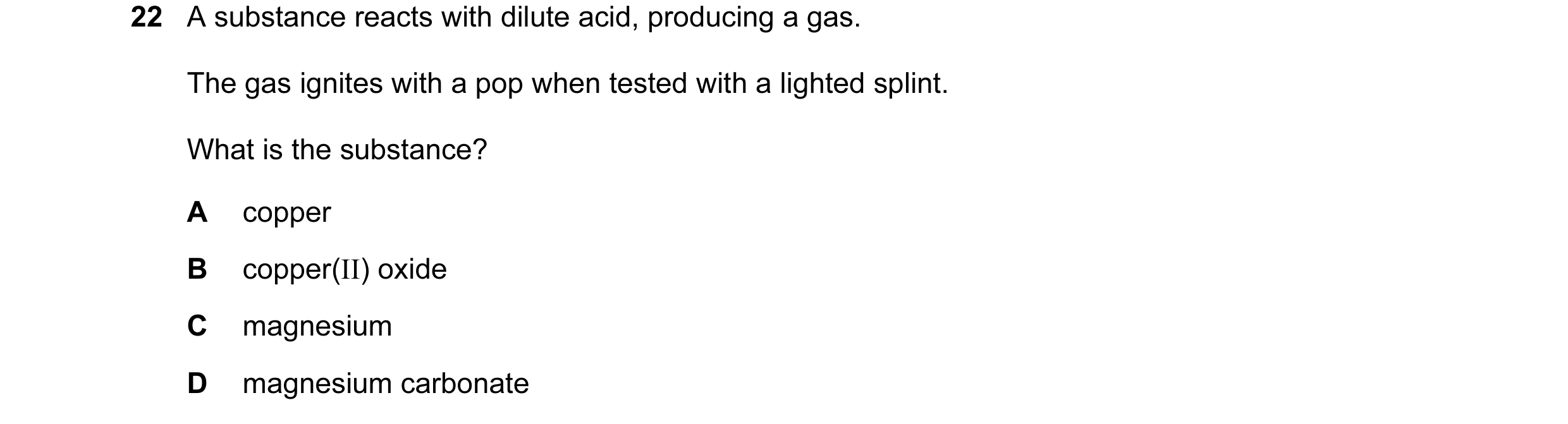
22 A substance reacts with dilute acid, producing a gas. The gas ignites with a pop when tested with a lighted splint. What is the substance? A copper B copper(II) oxide C magnesium D magnesium carbonate
1 marks
Answer: C
This question in 0653/11 Oct/Nov 2015
Q29 · A substance reacts with dilute acid, producing a gas 0653/12 Oct/Nov 2015
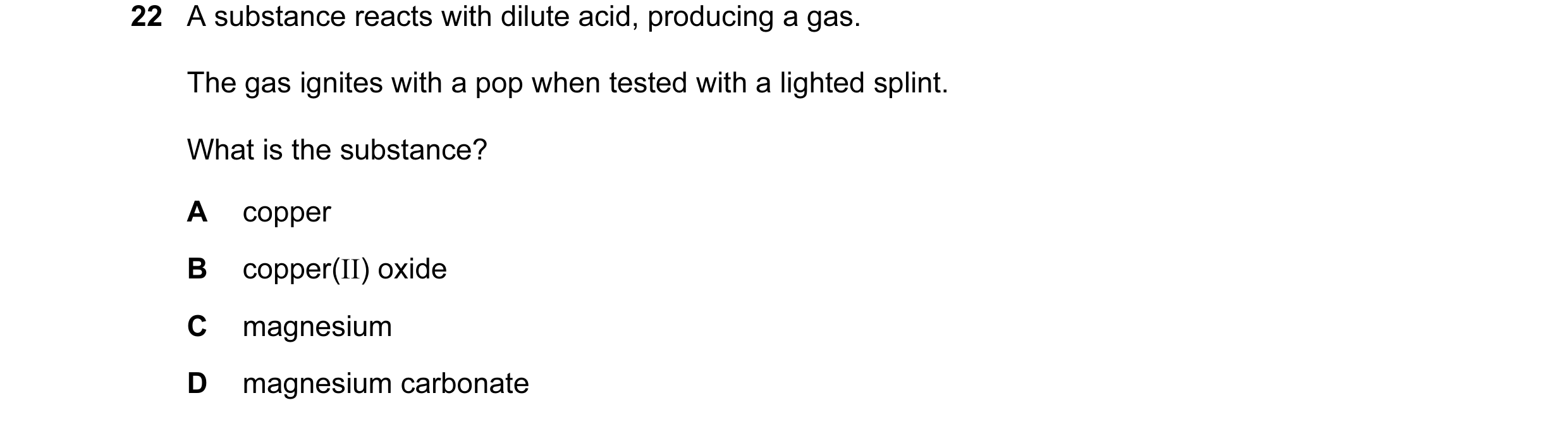
22 A substance reacts with dilute acid, producing a gas. The gas ignites with a pop when tested with a lighted splint. What is the substance? A copper B copper(II) oxide C magnesium D magnesium carbonate
1 marks
Answer: C
This question in 0653/12 Oct/Nov 2015
Q30 · Carbon dioxide turns limewater milky (cloudy) 0653/13 Oct/Nov 2015
8 Carbon dioxide turns limewater milky (cloudy). Which diagram shows apparatus being used to demonstrate that expired air contains more carbon dioxide than inspired air? A B breathe in and out breathe in and out slowly through slowly through air this tube air air this tube air limewater limewater milky clear milky clear C D breathe in and out breathe in and out slowly through slowly through air this tube air air this tube air limewater limewater clear milky clear milky
1 marks
Answer: D
This question in 0653/13 Oct/Nov 2015
Q31 · A substance reacts with dilute acid, producing a gas 0653/13 Oct/Nov 2015
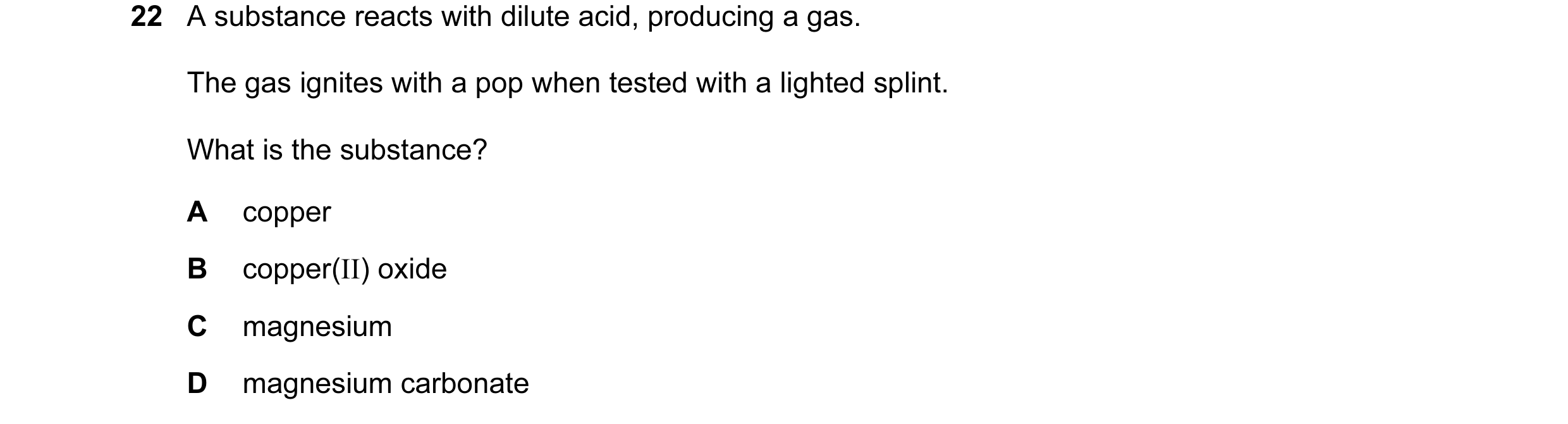
22 A substance reacts with dilute acid, producing a gas. The gas ignites with a pop when tested with a lighted splint. What is the substance? A copper B copper(II) oxide C magnesium D magnesium carbonate
1 marks
Answer: C
This question in 0653/13 Oct/Nov 2015
Q32 · What is a chemical test for water? 0653/13 Oct/Nov 2015
26 What is a chemical test for water? A Blue cobalt chloride paper turns pink. B Measure its boiling point which is 100 °C. C Measure its melting point which is 0 °C. D Pink cobalt chloride paper turns blue.
1 marks
Answer: A
This question in 0653/13 Oct/Nov 2015
Q33 · Dilute hydrochloric acid is added to solid X 0653/11 May/June 2016
20 Dilute hydrochloric acid is added to solid X. Hydrogen gas is produced. dilute hydrochloric acid solid X What is X? A zinc B zinc carbonate C zinc hydroxide D zinc oxide
1 marks
Answer: A
This question in 0653/11 May/June 2016
Q34 · Which test is used to identify ammonia? 0653/11 May/June 2016
21 Which test is used to identify ammonia? A A glowing splint relights. B Damp blue litmus paper is bleached. C Damp red litmus paper turns blue. D Limewater turns milky.
1 marks
Answer: C
This question in 0653/11 May/June 2016
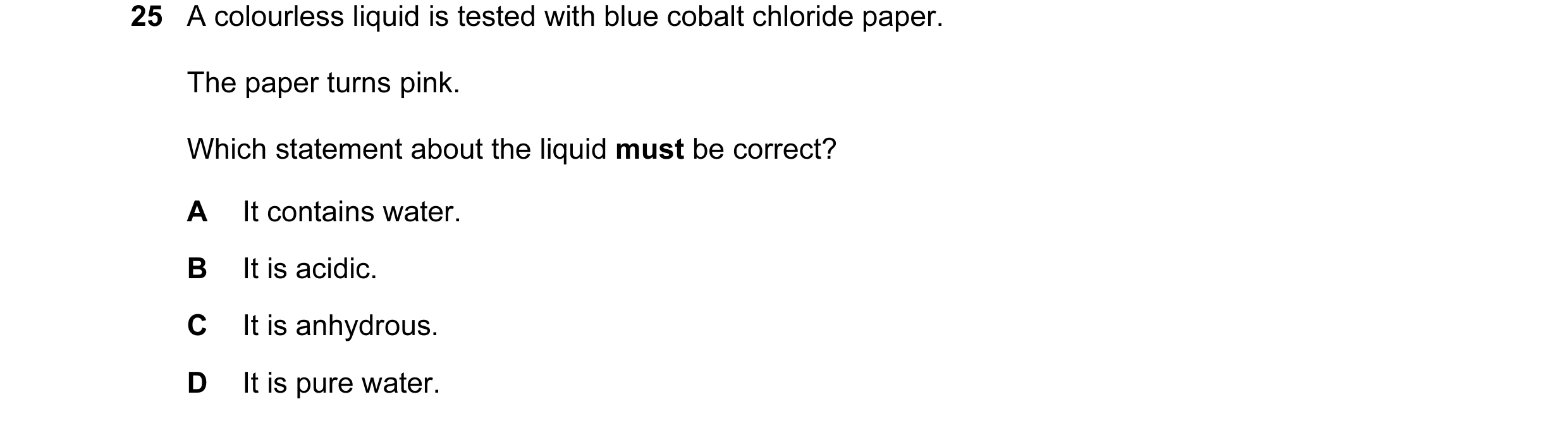
Q35 · A colourless liquid is tested with blue cobalt chloride paper 0653/11 May/June 2016
25 A colourless liquid is tested with blue cobalt chloride paper. The paper turns pink. Which statement about the liquid must be correct? A It contains water. B It is acidic. C It is anhydrous. D It is pure water.
1 marks
Answer: A
This question in 0653/11 May/June 2016
Q36 · The results of two tests on substance Q are shown 0653/12 May/June 2016
21 The results of two tests on substance Q are shown. tests results add dilute hydrochloric bubbles of colourless gas, R, acid to solid Q which turns limewater milky add aqueous sodium green precipitate hydroxide to a solution of Q Which cation is present in Q and what is gas R? cation present in Q gas R A iron(II) carbon dioxide B iron(II) chlorine C iron(III) carbon dioxide D iron(III) chlorine
1 marks
Answer: A
This question in 0653/12 May/June 2016
Q37 · What is a chemical test for water? 0653/12 May/June 2016
25 What is a chemical test for water? A It boils at 100 °C. B It turns blue cobalt chloride paper pink. C It turns blue copper sulfate crystals white. D It turns pink litmus paper blue.
1 marks
Answer: B
This question in 0653/12 May/June 2016
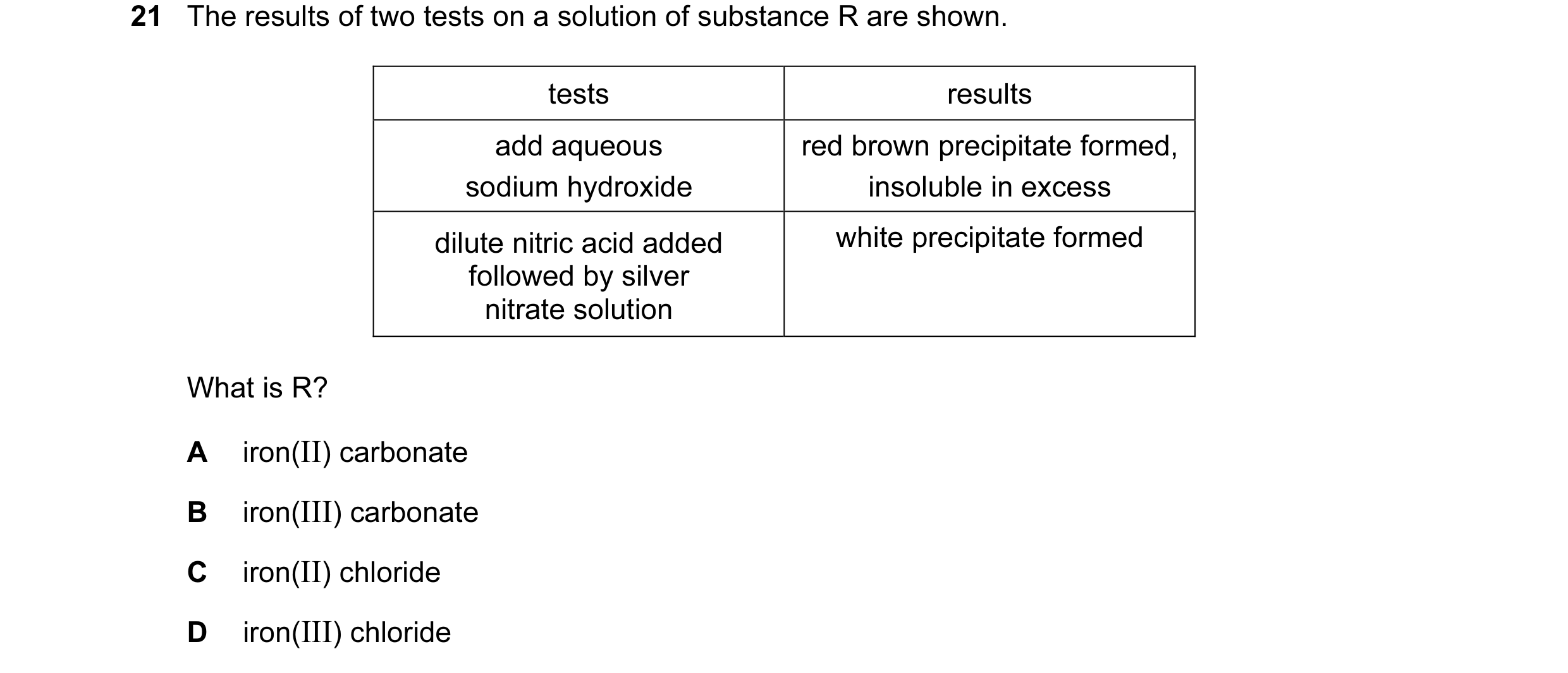
Q38 · The results of two tests on a solution of substance R are shown 0653/13 May/June 2016
21 The results of two tests on a solution of substance R are shown. tests results add aqueous red brown precipitate formed, sodium hydroxide insoluble in excess dilute nitric acid added white precipitate formed followed by silver nitrate solution What is R? A iron(II) carbonate B iron(III) carbonate C iron(II) chloride D iron(III) chloride
1 marks
Answer: D
This question in 0653/13 May/June 2016
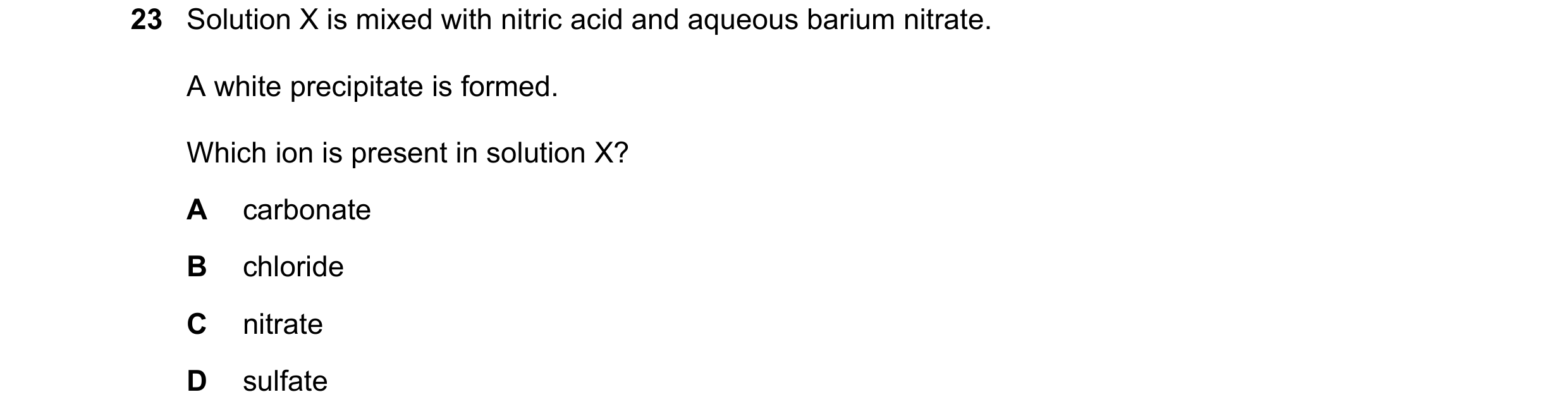
Q39 · Solution X is mixed with nitric acid and aqueous barium nitrate 0653/11 Oct/Nov 2016
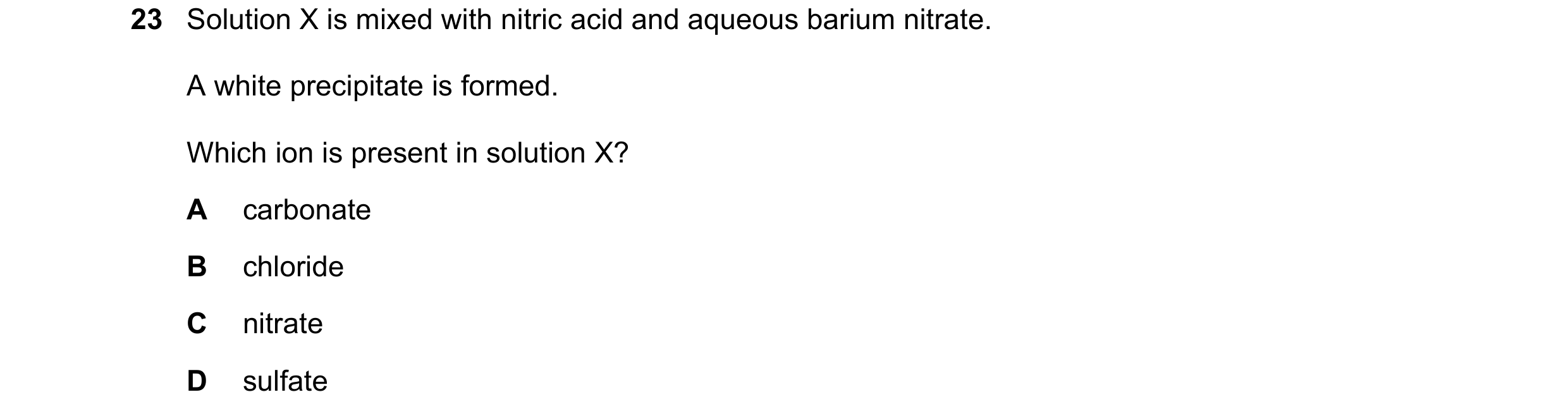
23 Solution X is mixed with nitric acid and aqueous barium nitrate. A white precipitate is formed. Which ion is present in solution X? A carbonate B chloride C nitrate D sulfate
1 marks
Answer: D
This question in 0653/11 Oct/Nov 2016
Q40 · A mixture of ammonium carbonate and ammonium chloride is heated with aqueous sodium… 0653/12 Oct/Nov 2016
23 A mixture of ammonium carbonate and ammonium chloride is heated with aqueous sodium hydroxide. Which gas is produced? A ammonia B carbon dioxide C chlorine D hydrogen chloride
1 marks
Answer: A
This question in 0653/12 Oct/Nov 2016
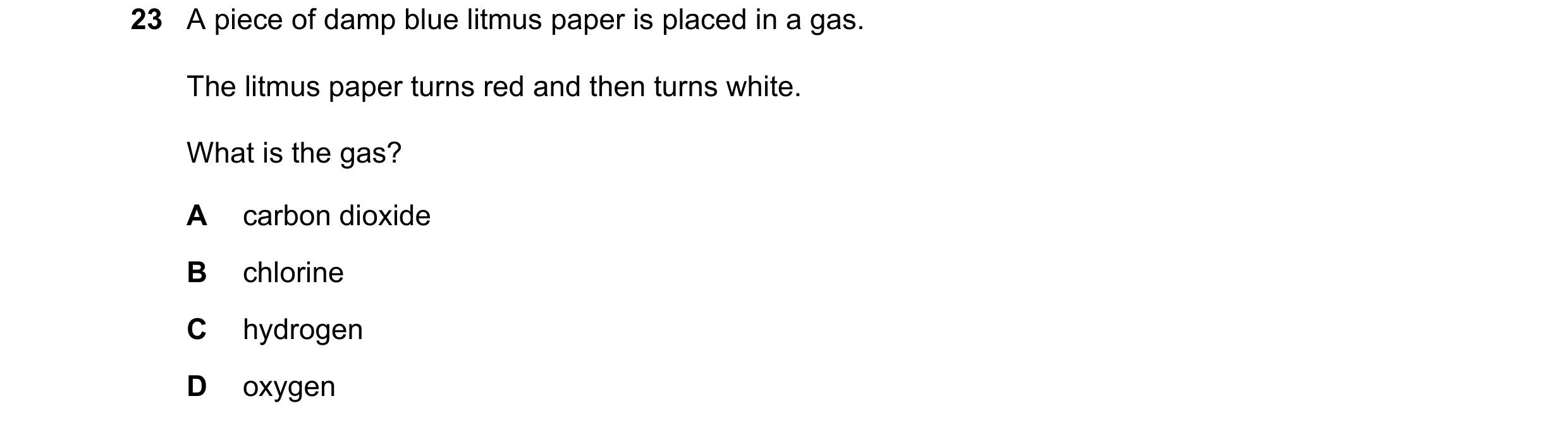
Q41 · A piece of damp blue litmus paper is placed in a gas 0653/13 Oct/Nov 2016
23 A piece of damp blue litmus paper is placed in a gas. The litmus paper turns red and then turns white. What is the gas? A carbon dioxide B chlorine C hydrogen D oxygen
1 marks
Answer: B
This question in 0653/13 Oct/Nov 2016
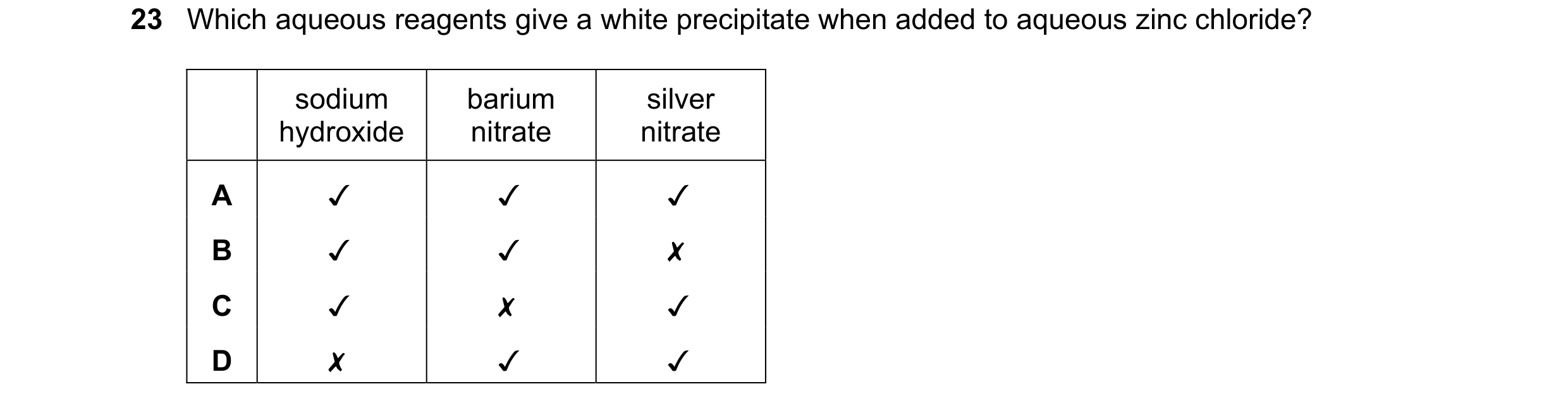
Q42 · Which aqueous reagents give a white precipitate when added to aqueous zinc chloride? 0653/12 Feb/March 2017
23 Which aqueous reagents give a white precipitate when added to aqueous zinc chloride?
sodium barium silver
hydroxide nitrate nitrate
v v v
0 Oo WwW >
v v x
v x v
x v v
1 marks
Answer: C
This question in 0653/12 Feb/March 2017
Q43 · Which chemical test shows the presence of water? 0653/12 Feb/March 2017
26 Which chemical test shows the presence of water? A Water has a boiling point of 100 °C. B Water has a freezing point of 0 °C. C Water turns anhydrous cobalt chloride from blue to pink. D Water turns anhydrous copper sulfate from blue to white.
1 marks
Answer: C
This question in 0653/12 Feb/March 2017
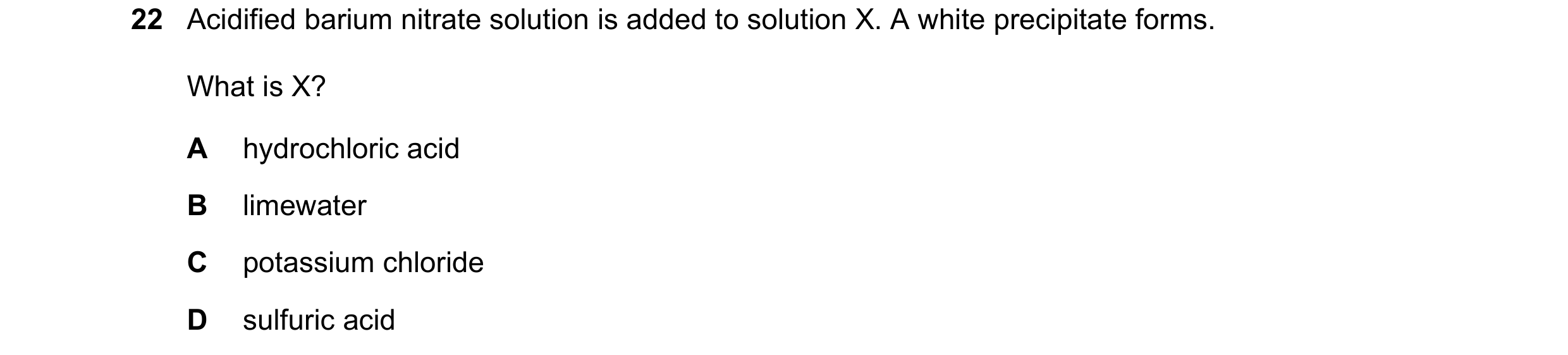
Q44 · Acidified barium nitrate solution is added to solution X 0653/11 May/June 2017
22 Acidified barium nitrate solution is added to solution X. A white precipitate forms. What is X? A hydrochloric acid B limewater C potassium chloride D sulfuric acid
1 marks
Answer: D
This question in 0653/11 May/June 2017
Q45 · A molten compound X is electrolysed as shown 0653/12 May/June 2017
17 A molten compound X is electrolysed as shown. lamp anode + – cathode X heat A brown gas is produced at the anode and a grey metal is produced at the cathode. What is X? A aluminium oxide B copper chloride C lead(II) bromide D sodium chloride
1 marks
Answer: C
This question in 0653/12 May/June 2017
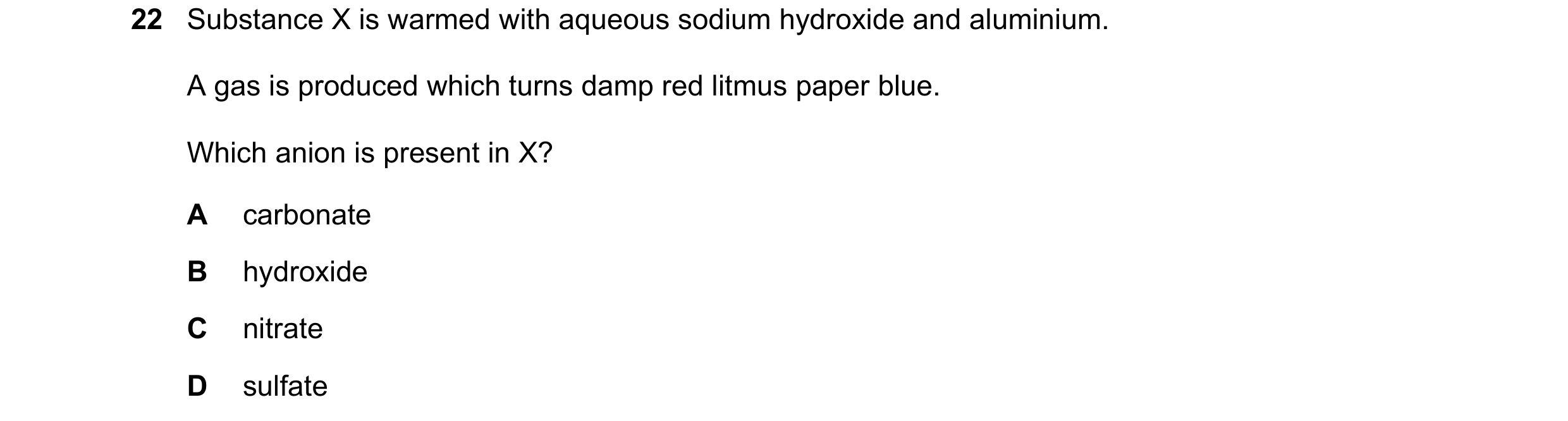
Q46 · Substance X is warmed with aqueous sodium hydroxide and aluminium 0653/12 May/June 2017
22 Substance X is warmed with aqueous sodium hydroxide and aluminium. A gas is produced which turns damp red litmus paper blue. Which anion is present in X? A carbonate B hydroxide C nitrate D sulfate
1 marks
Answer: C
This question in 0653/12 May/June 2017
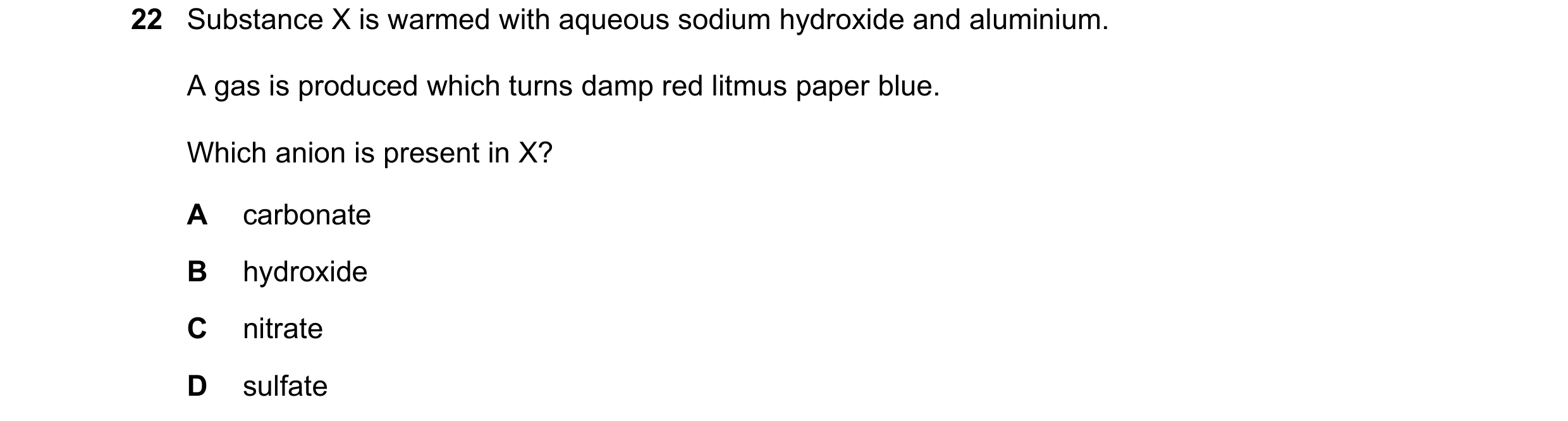
Q47 · Substance X is warmed with aqueous sodium hydroxide and aluminium 0653/13 May/June 2017
22 Substance X is warmed with aqueous sodium hydroxide and aluminium. A gas is produced which turns damp red litmus paper blue. Which anion is present in X? A carbonate B hydroxide C nitrate D sulfate
1 marks
Answer: C
This question in 0653/13 May/June 2017
Q48 · Excess magnesium is added to dilute hydrochloric acid containing Universal Indicator 0653/11 Oct/Nov 2017
22 Excess magnesium is added to dilute hydrochloric acid containing Universal Indicator. The indicator changes colour and a gas is given off. The gas is tested with limewater. Which row describes the colour change and the result of the limewater test? colour change result of the limewater test A blue to green limewater becomes cloudy B blue to green no change C red to green limewater becomes cloudy D red to green no change
1 marks
Answer: D
This question in 0653/11 Oct/Nov 2017
Q49 · A solution of compound X produces a dark green precipitate when aqueous sodium hydroxide… 0653/12 Oct/Nov 2017
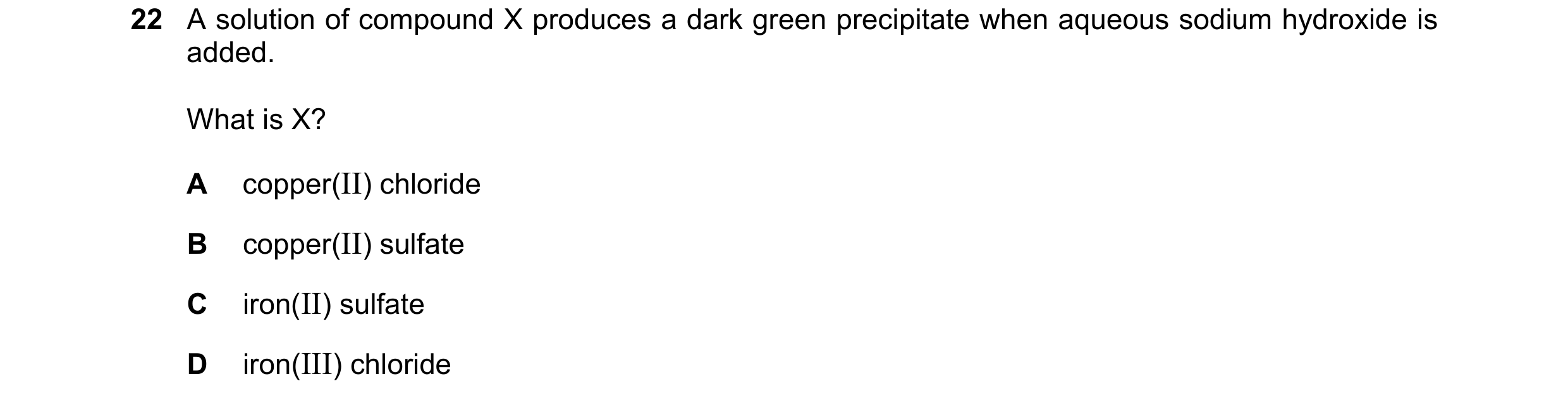
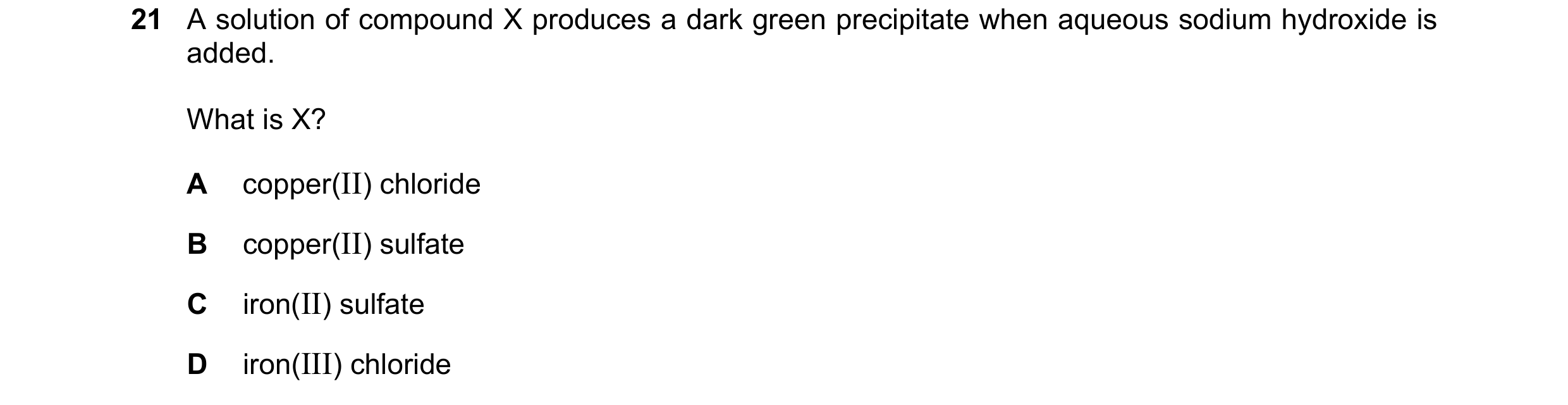
22 A solution of compound X produces a dark green precipitate when aqueous sodium hydroxide is added. What is X? A copper(II) chloride B copper(II) sulfate C iron(II) sulfate D iron(III) chloride
1 marks
Answer: C
This question in 0653/12 Oct/Nov 2017
Q50 · Separate samples of the gases ammonia, carbon dioxide, chlorine and hydrogen are tested… 0653/13 Oct/Nov 2017
22 Separate samples of the gases ammonia, carbon dioxide, chlorine and hydrogen are tested with damp red litmus paper. How many of these gases turn the litmus paper blue? A 1 B 2 C 3 D 4
1 marks
Answer: A
This question in 0653/13 Oct/Nov 2017
Q51 · Aqueous ammonia is added to a solution containing a salt 0653/11 May/June 2018
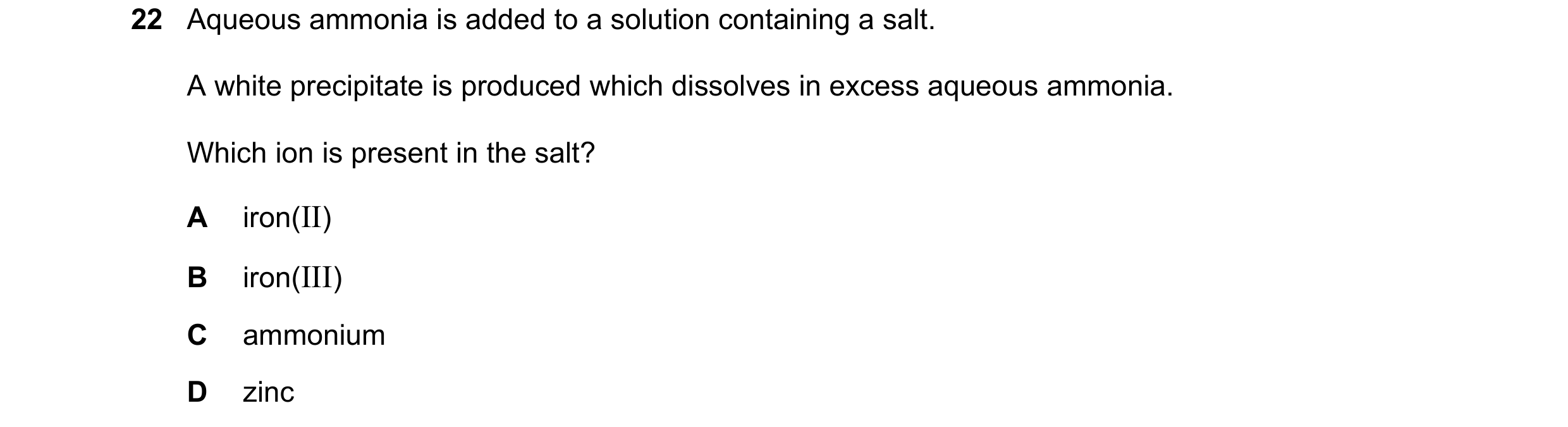
22 Aqueous ammonia is added to a solution containing a salt. A white precipitate is produced which dissolves in excess aqueous ammonia. Which ion is present in the salt? A iron(II) B iron(III) C ammonium D zinc
1 marks
Answer: D
This question in 0653/11 May/June 2018
Q52 · Which chemicals are used in the test for nitrate ions? 0653/12 May/June 2018
22 Which chemicals are used in the test for nitrate ions? A aqueous barium nitrate and dilute nitric acid B aqueous silver nitrate and dilute nitric acid C dilute acid and limewater D aqueous sodium hydroxide and aluminium
1 marks
Answer: D
This question in 0653/12 May/June 2018
Q53 · Which chemicals are used in the test for nitrate ions? 0653/13 May/June 2018
22 Which chemicals are used in the test for nitrate ions? A aqueous barium nitrate and dilute nitric acid B aqueous silver nitrate and dilute nitric acid C dilute acid and limewater D aqueous sodium hydroxide and aluminium
1 marks
Answer: D
This question in 0653/13 May/June 2018
Q54 · The results of two tests on solid P are shown 0653/11 Oct/Nov 2018
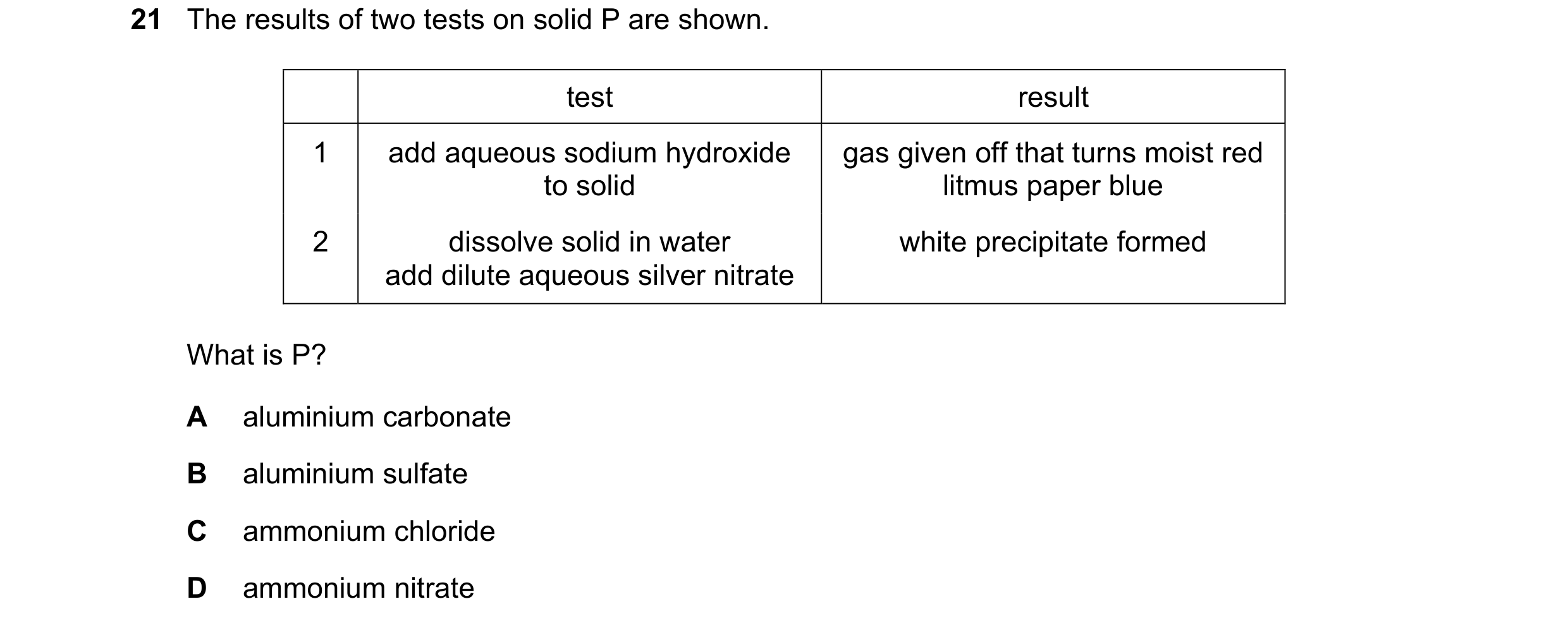
21 The results of two tests on solid P are shown. test result 1 add aqueous sodium hydroxide gas given off that turns moist red to solid litmus paper blue 2 dissolve solid in water white precipitate formed add dilute aqueous silver nitrate What is P? A aluminium carbonate B aluminium sulfate C ammonium chloride D ammonium nitrate
1 marks
Answer: C
This question in 0653/11 Oct/Nov 2018
Q55 · What is a chemical test for water? 0653/12 Oct/Nov 2018
26 What is a chemical test for water? A Add blue cobalt chloride paper. B Add blue copper sulfate crystals. C Measure the density. D Measure the melting point.
1 marks
Answer: A
This question in 0653/12 Oct/Nov 2018
Q56 · The results of two tests on a white solid are shown 0653/13 Oct/Nov 2018
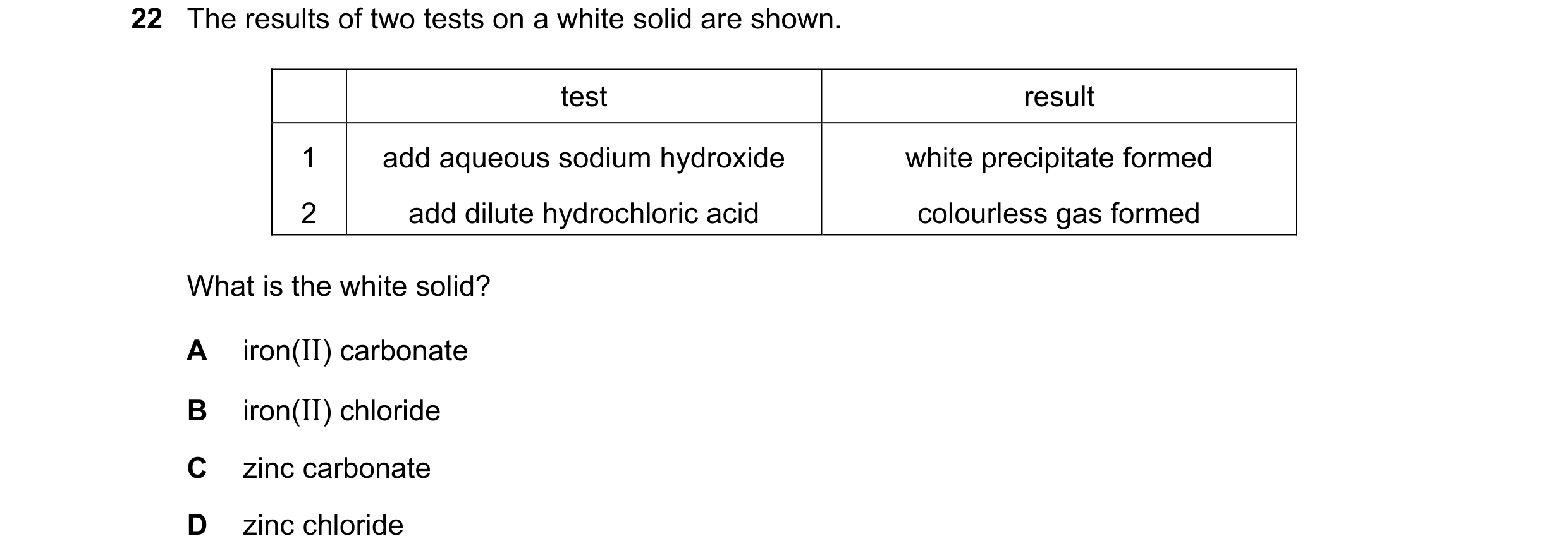
22 The results of two tests on a white solid are shown. test result 1 add aqueous sodium hydroxide white precipitate formed 2 add dilute hydrochloric acid colourless gas formed What is the white solid? A iron(II) carbonate B iron(II) chloride C zinc carbonate D zinc chloride
1 marks
Answer: C
This question in 0653/13 Oct/Nov 2018
Q57 · A solution is tested for the presence of cations 0653/12 Feb/March 2019
21 A solution is tested for the presence of cations. test result add excess aqueous ammonia green precipitate Which cation is present? A Cu2+ B Fe2+ C Fe3+ D Zn2+
1 marks
Answer: B
This question in 0653/12 Feb/March 2019
Q58 · Which aqueous ion gives a white precipitate with aqueous sodium hydroxide and with… 0653/11 May/June 2019
21 Which aqueous ion gives a white precipitate with aqueous sodium hydroxide and with aqueous ammonia? A Cu2+ B Fe2+ C Fe3+ D Zn2+
1 marks
Answer: D
This question in 0653/11 May/June 2019
Q59 · Which aqueous ion gives a white precipitate with aqueous sodium hydroxide and with… 0653/12 May/June 2019
21 Which aqueous ion gives a white precipitate with aqueous sodium hydroxide and with aqueous ammonia? A Cu2+ B Fe2+ C Fe3+ D Zn2+
1 marks
Answer: D
This question in 0653/12 May/June 2019
Q60 · Concentrated aqueous sodium chloride is electrolysed using the apparatus shown 0653/13 May/June 2019
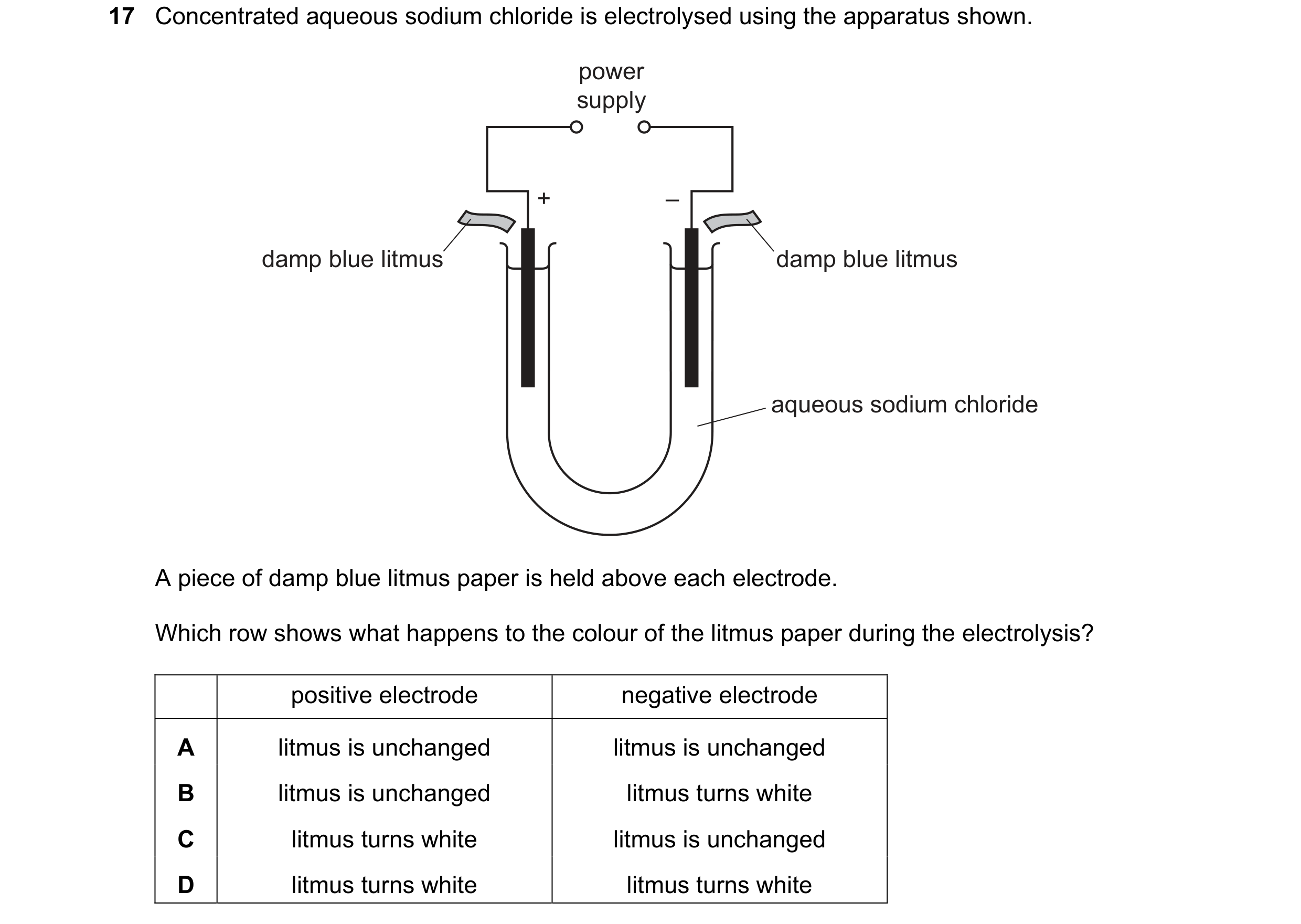
17 Concentrated aqueous sodium chloride is electrolysed using the apparatus shown. power supply + – damp blue litmus damp blue litmus aqueous sodium chloride A piece of damp blue litmus paper is held above each electrode. Which row shows what happens to the colour of the litmus paper during the electrolysis? positive electrode negative electrode A litmus is unchanged litmus is unchanged B litmus is unchanged litmus turns white C litmus turns white litmus is unchanged D litmus turns white litmus turns white
1 marks
Answer: C
This question in 0653/13 May/June 2019
Q61 · Which aqueous ion gives a white precipitate with aqueous sodium hydroxide and with… 0653/13 May/June 2019
21 Which aqueous ion gives a white precipitate with aqueous sodium hydroxide and with aqueous ammonia? A Cu2+ B Fe2+ C Fe3+ D Zn2+
1 marks
Answer: D
This question in 0653/13 May/June 2019
Q62 · Which chemical can be identified using limewater? 0653/12 Feb/March 2020
7 Which chemical can be identified using limewater? A carbon dioxide B glucose C oxygen D water
1 marks
Answer: A
This question in 0653/12 Feb/March 2020
Q63 · A solution of compound X produces a dark green precipitate when aqueous sodium hydroxide… 0653/12 Feb/March 2020
21 A solution of compound X produces a dark green precipitate when aqueous sodium hydroxide is added. What is X? A copper(II) chloride B copper(II) sulfate C iron(II) sulfate D iron(III) chloride
1 marks
Answer: C
This question in 0653/12 Feb/March 2020
Q64 · Solution X is mixed with nitric acid and aqueous barium nitrate 0653/11 May/June 2020
23 Solution X is mixed with nitric acid and aqueous barium nitrate. A white precipitate is formed. Which ion is present in solution X? A carbonate B chloride C nitrate D sulfate
1 marks
Answer: D
This question in 0653/11 May/June 2020
Q65 · Acid X reacts with metal Y 0653/11 Oct/Nov 2020
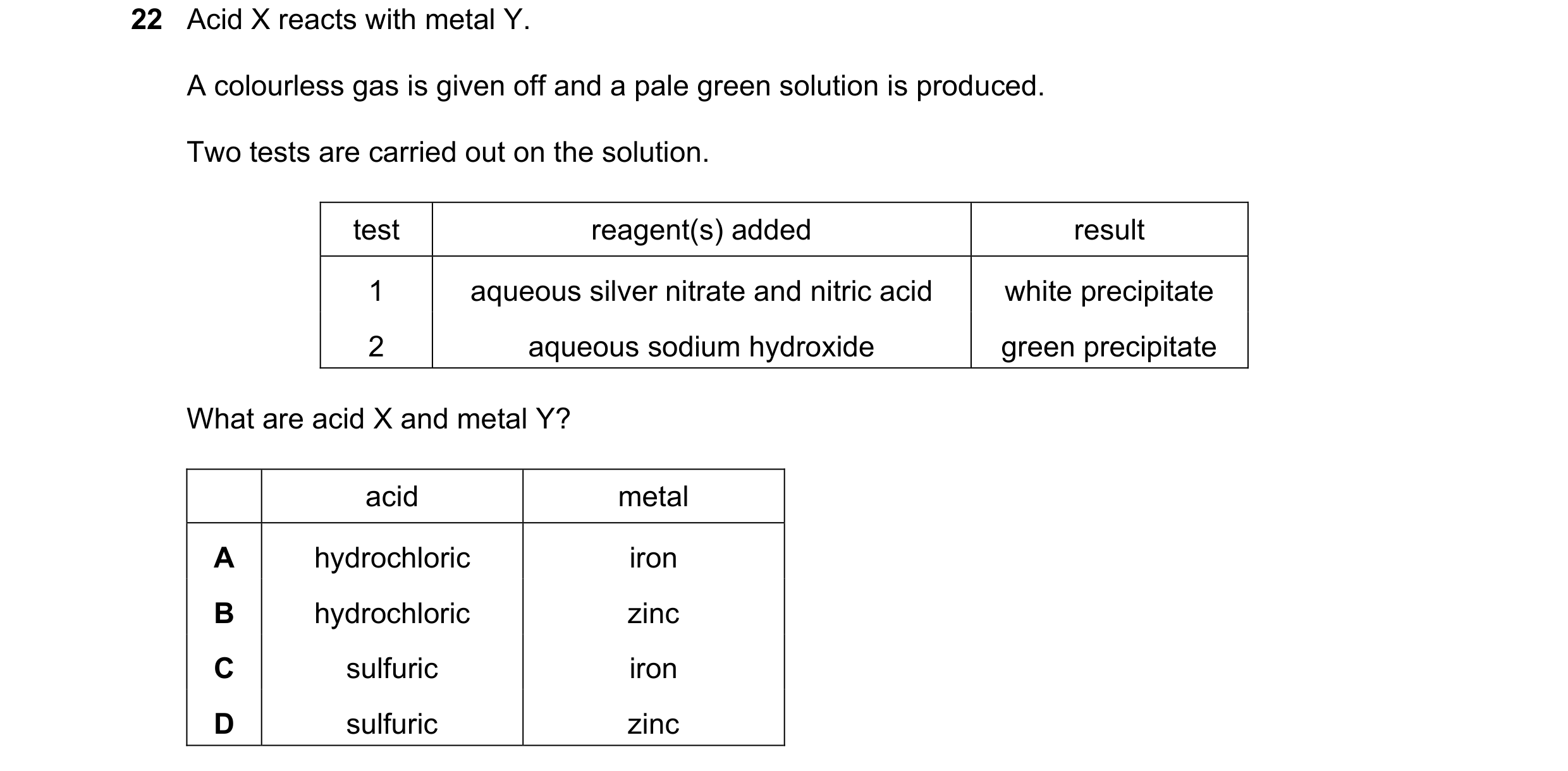
22 Acid X reacts with metal Y. A colourless gas is given off and a pale green solution is produced. Two tests are carried out on the solution. test reagent(s) added result 1 aqueous silver nitrate and nitric acid white precipitate 2 aqueous sodium hydroxide green precipitate What are acid X and metal Y? acid metal A hydrochloric iron B hydrochloric zinc C sulfuric iron D sulfuric zinc
1 marks
Answer: A
This question in 0653/11 Oct/Nov 2020
Q66 · Acid X reacts with metal Y 0653/12 Oct/Nov 2020
22 Acid X reacts with metal Y. A colourless gas is given off and a pale green solution is produced. Two tests are carried out on the solution. test reagent(s) added result 1 aqueous silver nitrate and nitric acid white precipitate 2 aqueous sodium hydroxide green precipitate What are acid X and metal Y? acid metal A hydrochloric iron B hydrochloric zinc C sulfuric iron D sulfuric zinc
1 marks
Answer: A
This question in 0653/12 Oct/Nov 2020
Q67 · Acid X reacts with metal Y 0653/13 Oct/Nov 2020
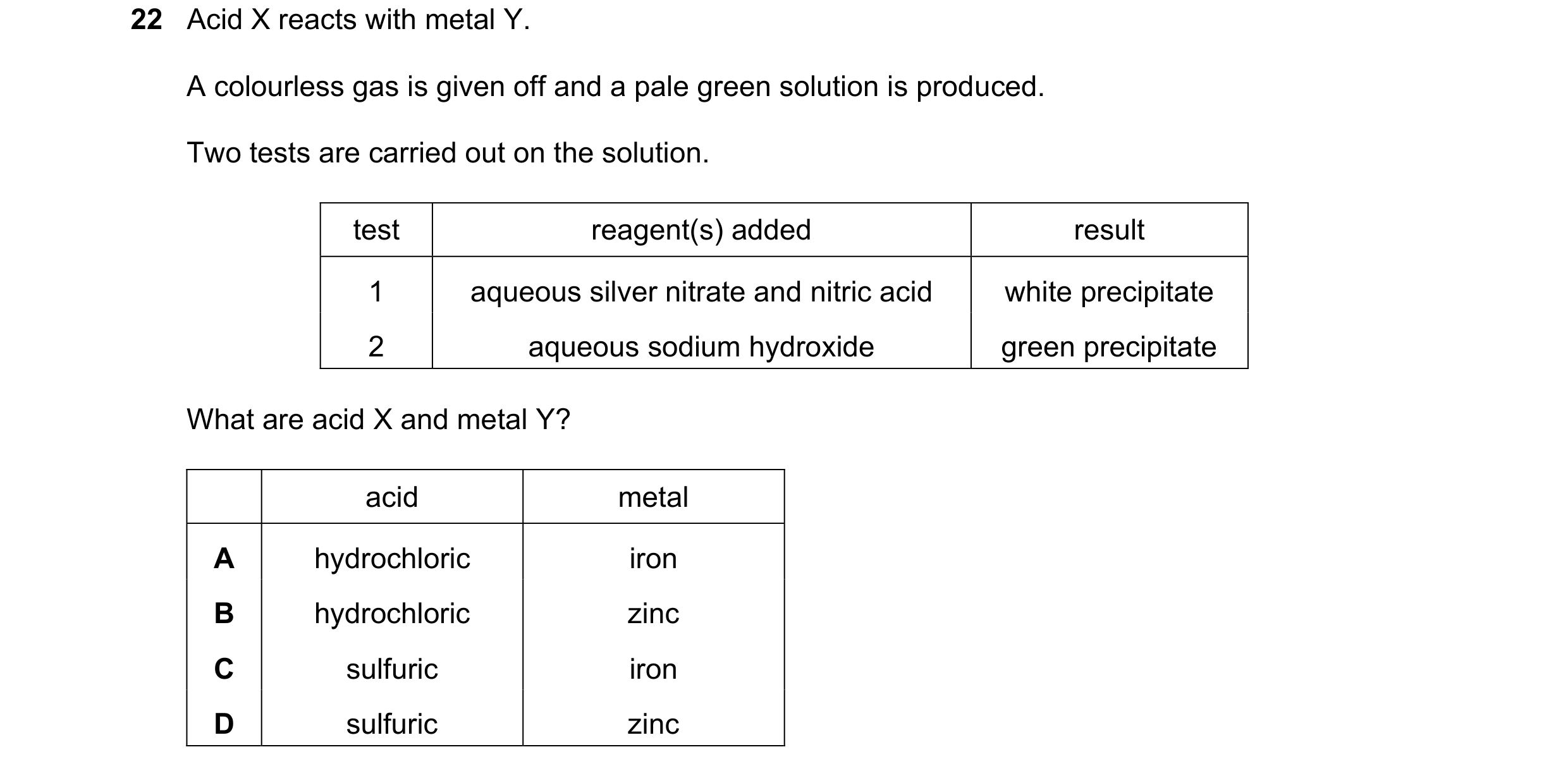
22 Acid X reacts with metal Y. A colourless gas is given off and a pale green solution is produced. Two tests are carried out on the solution. test reagent(s) added result 1 aqueous silver nitrate and nitric acid white precipitate 2 aqueous sodium hydroxide green precipitate What are acid X and metal Y? acid metal A hydrochloric iron B hydrochloric zinc C sulfuric iron D sulfuric zinc
1 marks
Answer: A
This question in 0653/13 Oct/Nov 2020
Q68 · A mixture of ammonium carbonate and ammonium chloride is heated with aqueous sodium… 0653/12 Feb/March 2021
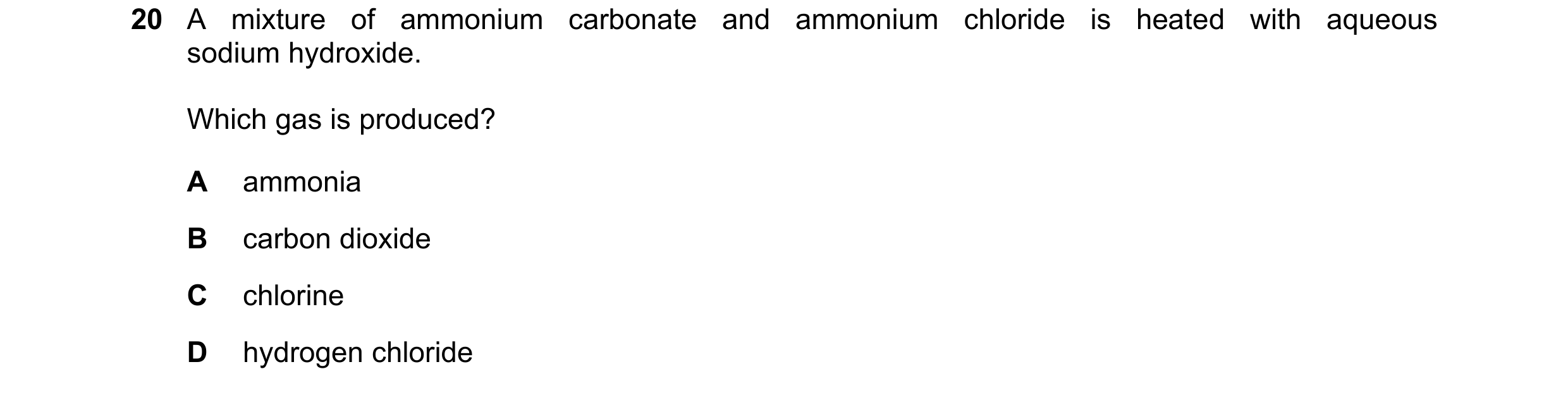
20 A mixture of ammonium carbonate and ammonium chloride is heated with aqueous sodium hydroxide. Which gas is produced? A ammonia B carbon dioxide C chlorine D hydrogen chloride
1 marks
Answer: A
This question in 0653/12 Feb/March 2021
Q69 · The diagram shows what happens when damp red litmus paper is placed into two different… 0653/12 Feb/March 2021
21 The diagram shows what happens when damp red litmus paper is placed into two different gases, X and Y. gas gas X Y red litmus paper red litmus paper turns blue turns white What are gases X and Y? X Y A ammonia carbon dioxide B ammonia chlorine C chlorine ammonia D chlorine carbon dioxide
1 marks
Answer: B
This question in 0653/12 Feb/March 2021
Q70 · Which two substances form a white precipitate when they are mixed? 0653/11 May/June 2021
20 Which two substances form a white precipitate when they are mixed? A barium chloride and hydrochloric acid B barium chloride and nitric acid C silver nitrate and hydrochloric acid D silver nitrate and nitric acid
1 marks
Answer: C
This question in 0653/11 May/June 2021
Q71 · What can be used to test for the presence of carbon dioxide? 0653/12 May/June 2021
8 What can be used to test for the presence of carbon dioxide? A Benedict’s solution B ethanol C iodine solution D limewater
1 marks
Answer: D
This question in 0653/12 May/June 2021
Q72 · Which two substances form a white precipitate when they are mixed? 0653/12 May/June 2021
20 Which two substances form a white precipitate when they are mixed? A barium chloride and hydrochloric acid B barium chloride and nitric acid C silver nitrate and hydrochloric acid D silver nitrate and nitric acid
1 marks
Answer: C
This question in 0653/12 May/June 2021
Q73 · Which two substances form a white precipitate when they are mixed? 0653/13 May/June 2021
20 Which two substances form a white precipitate when they are mixed? A barium chloride and hydrochloric acid B barium chloride and nitric acid C silver nitrate and hydrochloric acid D silver nitrate and nitric acid
1 marks
Answer: C
This question in 0653/13 May/June 2021
Q74 · A piece of damp blue litmus paper is placed in a gas 0653/11 Oct/Nov 2021
23 A piece of damp blue litmus paper is placed in a gas. The litmus paper turns red and then turns white. What is the gas? A carbon dioxide B chlorine C hydrogen D oxygen
1 marks
Answer: B
This question in 0653/11 Oct/Nov 2021
Q75 · What is used to identify chlorine? 0653/12 Feb/March 2022
23 What is used to identify chlorine? A a glowing splint B a lighted splint C damp litmus paper D limewater
1 marks
Answer: C
This question in 0653/12 Feb/March 2022
Q76 · The results of two tests on substance Q are shown 0653/11 May/June 2022
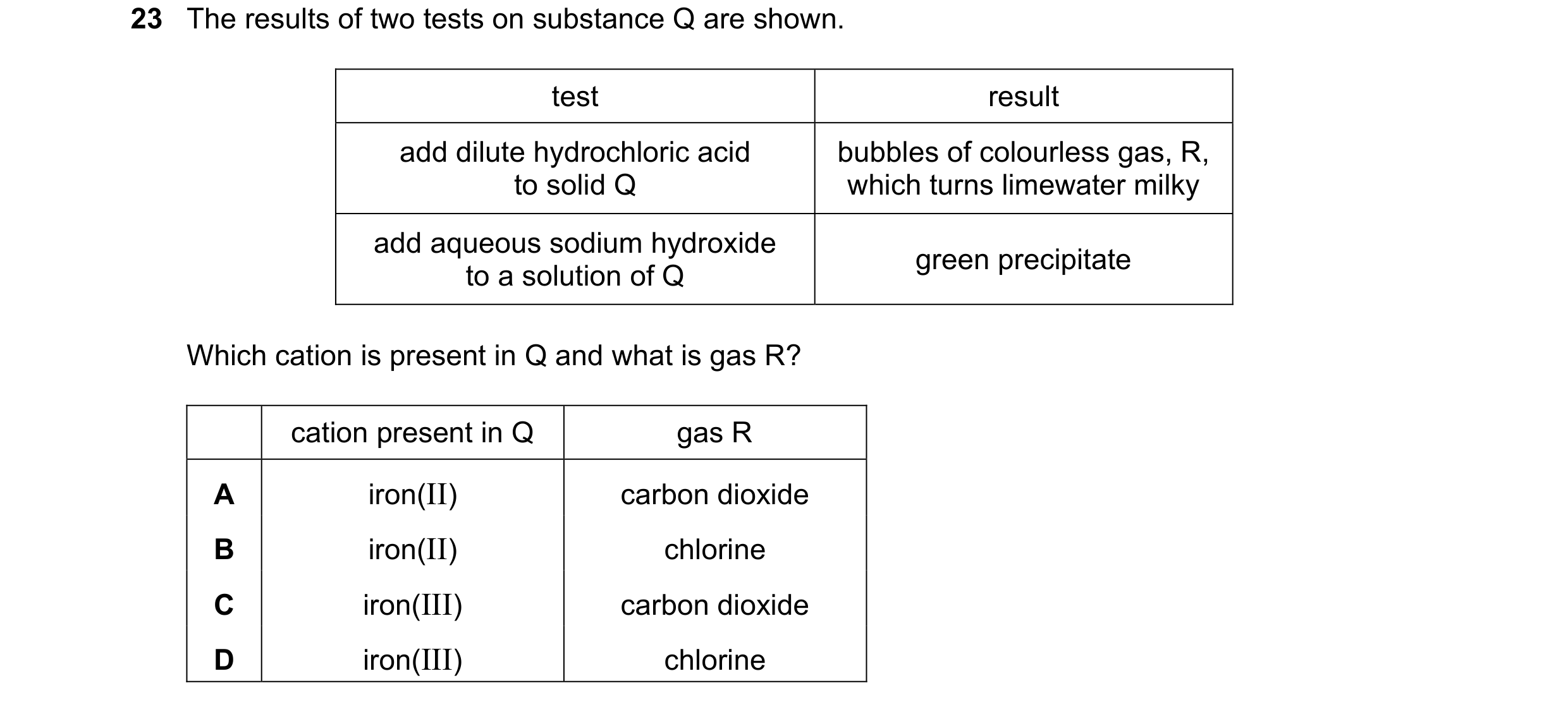
23 The results of two tests on substance Q are shown. test result add dilute hydrochloric acid bubbles of colourless gas, R, to solid Q which turns limewater milky add aqueous sodium hydroxide green precipitate to a solution of Q Which cation is present in Q and what is gas R? cation present in Q gas R A iron(II) carbon dioxide B iron(II) chlorine C iron(III) carbon dioxide D iron(III) chlorine
1 marks
Answer: A
This question in 0653/11 May/June 2022
Q77 · The results of two tests on substance Q are shown 0653/12 May/June 2022
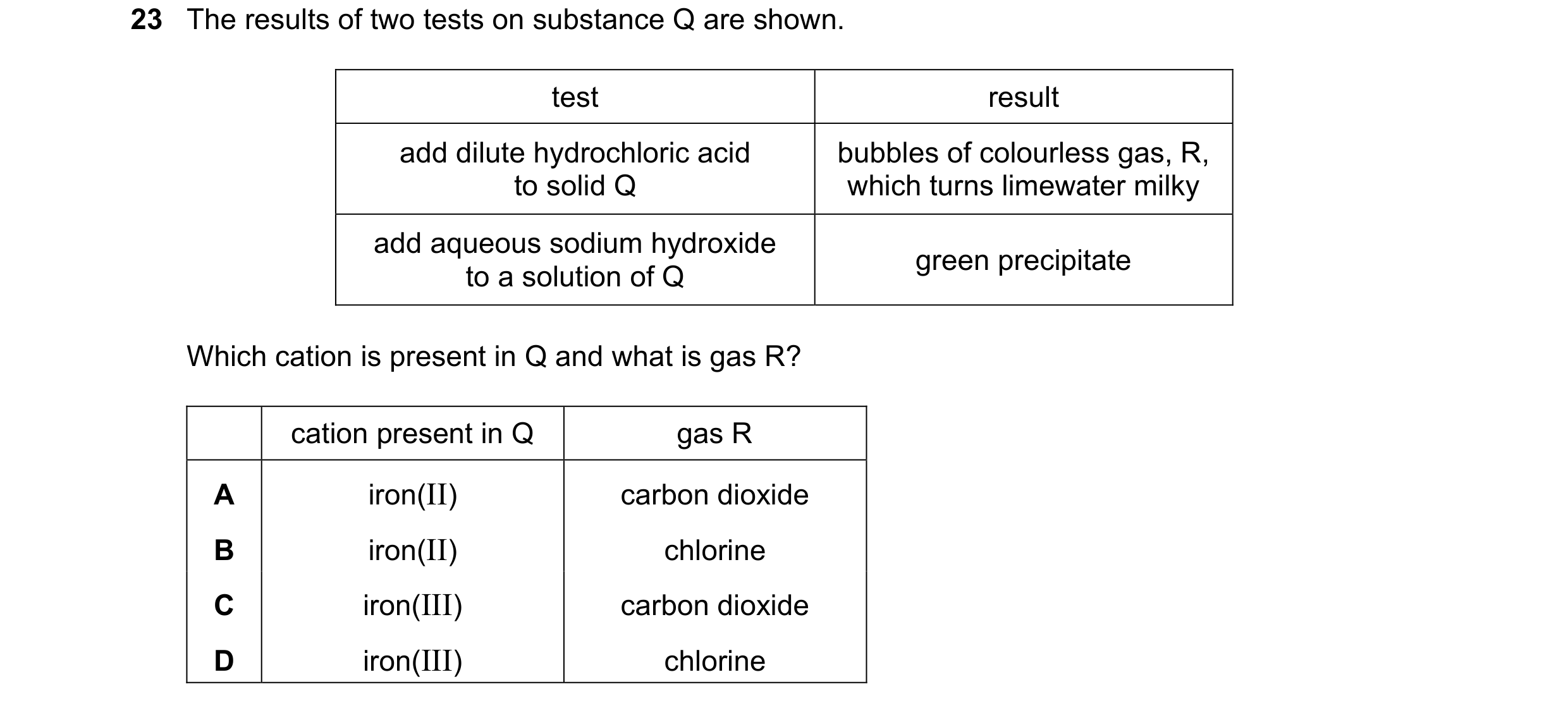
23 The results of two tests on substance Q are shown. test result add dilute hydrochloric acid bubbles of colourless gas, R, to solid Q which turns limewater milky add aqueous sodium hydroxide green precipitate to a solution of Q Which cation is present in Q and what is gas R? cation present in Q gas R A iron(II) carbon dioxide B iron(II) chlorine C iron(III) carbon dioxide D iron(III) chlorine
1 marks
Answer: A
This question in 0653/12 May/June 2022
Q78 · The results of two tests on substance Q are shown 0653/13 May/June 2022
23 The results of two tests on substance Q are shown. test result add dilute hydrochloric acid bubbles of colourless gas, R, to solid Q which turns limewater milky add aqueous sodium hydroxide green precipitate to a solution of Q Which cation is present in Q and what is gas R? cation present in Q gas R A iron(II) carbon dioxide B iron(II) chlorine C iron(III) carbon dioxide D iron(III) chlorine
1 marks
Answer: A
This question in 0653/13 May/June 2022
Q79 · Which pair of gases can be identified using damp litmus paper and limewater? 0653/11 Oct/Nov 2022
21 Which pair of gases can be identified using damp litmus paper and limewater? A carbon dioxide and hydrogen B chlorine and carbon dioxide C chlorine and oxygen D hydrogen and chlorine
1 marks
Answer: B
This question in 0653/11 Oct/Nov 2022
Q80 · Which pair of gases can be identified using damp litmus paper and limewater? 0653/12 Oct/Nov 2022
21 Which pair of gases can be identified using damp litmus paper and limewater? A carbon dioxide and hydrogen B chlorine and carbon dioxide C chlorine and oxygen D hydrogen and chlorine
1 marks
Answer: B
This question in 0653/12 Oct/Nov 2022
Q81 · Which pair of gases can be identified using damp litmus paper and limewater? 0653/13 Oct/Nov 2022
21 Which pair of gases can be identified using damp litmus paper and limewater? A carbon dioxide and hydrogen B chlorine and carbon dioxide C chlorine and oxygen D hydrogen and chlorine
1 marks
Answer: B
This question in 0653/13 Oct/Nov 2022
Q82 · Which solid reacts with sulfuric acid to produce a gas? 0653/12 Feb/March 2023
19 Which solid reacts with sulfuric acid to produce a gas? A copper B copper carbonate C copper oxide D copper sulfate
1 marks
Answer: B
This question in 0653/12 Feb/March 2023
Q83 · Which colour change is seen when water is added to anhydrous cobalt(II) chloride? 0653/12 Feb/March 2023
24 Which colour change is seen when water is added to anhydrous cobalt(II) chloride? A white to blue B pink to blue C blue to white D blue to pink
1 marks
Answer: D
This question in 0653/12 Feb/March 2023
Q84 · The results of two tests on a solution of substance R are shown 0653/11 May/June 2023
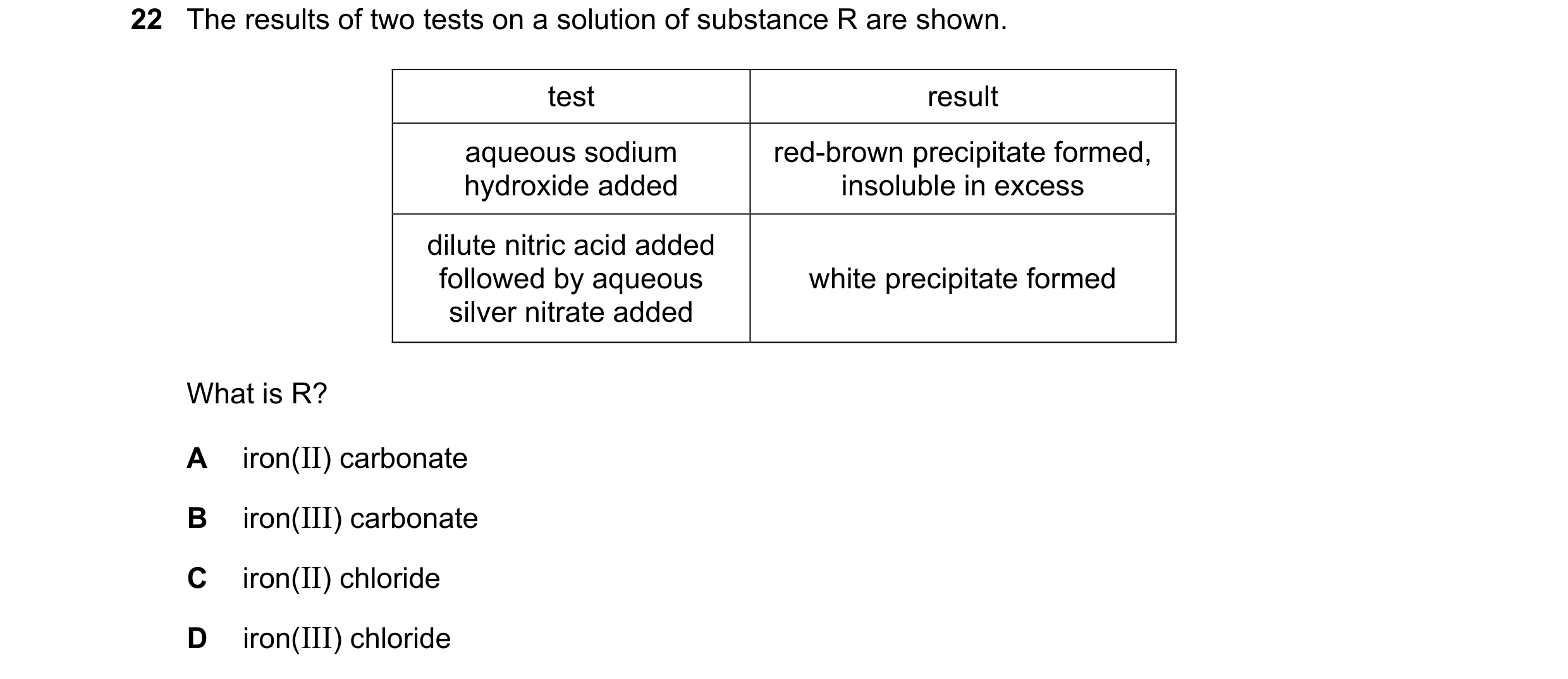
22 The results of two tests on a solution of substance R are shown. test result aqueous sodium red-brown precipitate formed, hydroxide added insoluble in excess dilute nitric acid added followed by aqueous white precipitate formed silver nitrate added What is R? A iron(II) carbonate B iron(III) carbonate C iron(II) chloride D iron(III) chloride
1 marks
Answer: D
This question in 0653/11 May/June 2023
Q85 · The results of two tests on solid P are shown 0653/12 May/June 2023
22 The results of two tests on solid P are shown. test result 1 add aqueous gas given off that turns sodium hydroxide to solid moist red litmus paper blue 2 dissolve solid in water, white precipitate formed add dilute aqueous silver nitrate What is P? A aluminium carbonate B aluminium sulfate C ammonium chloride D ammonium nitrate
1 marks
Answer: C
This question in 0653/12 May/June 2023
Q86 · Four substances are listed 0653/12 May/June 2023
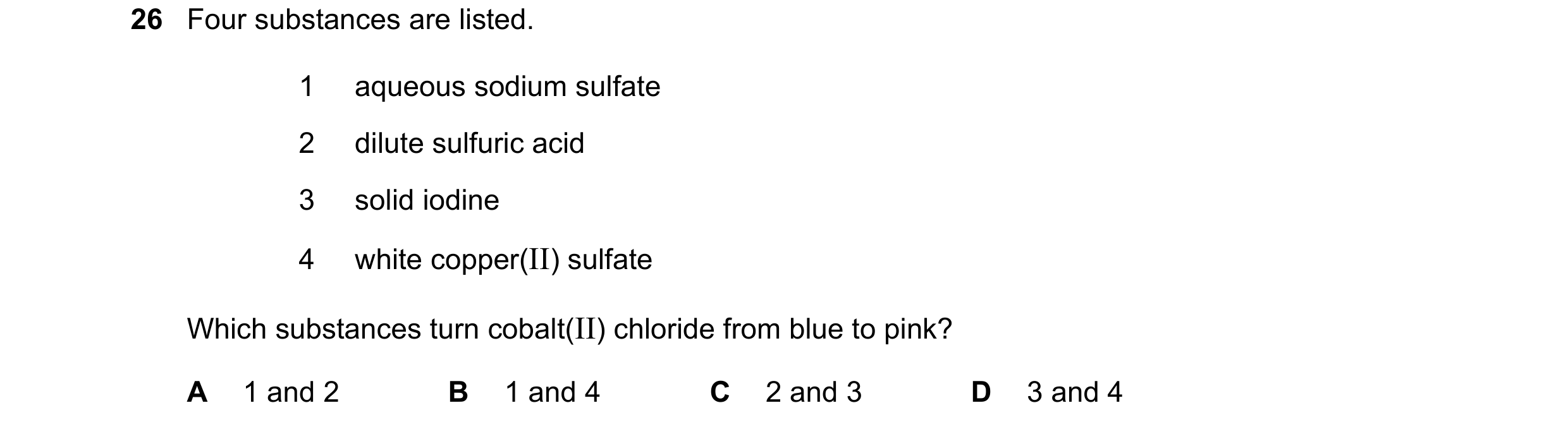
26 Four substances are listed. 1 aqueous sodium sulfate 2 dilute sulfuric acid 3 solid iodine 4 white copper(II) sulfate Which substances turn cobalt(II) chloride from blue to pink? A 1 and 2 B 1 and 4 C 2 and 3 D 3 and 4
1 marks
Answer: A
This question in 0653/12 May/June 2023
Q87 · The results of two tests on a white solid are shown 0653/13 May/June 2023
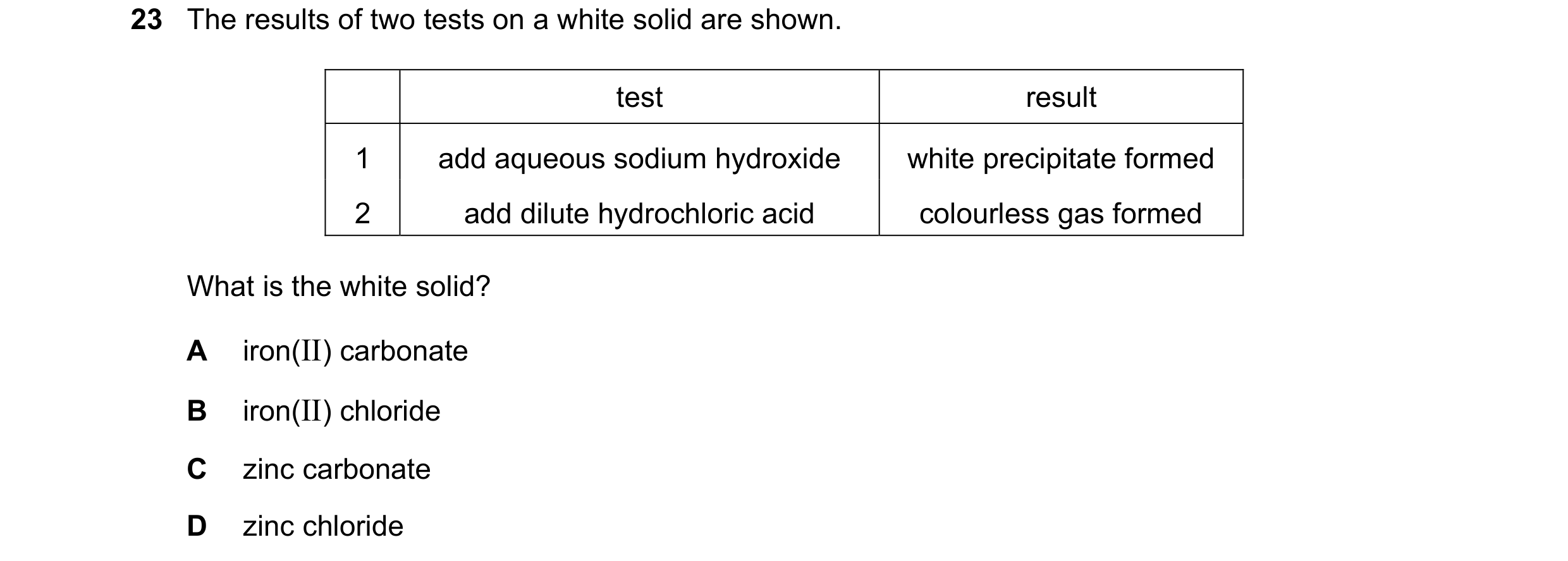
23 The results of two tests on a white solid are shown. test result 1 add aqueous sodium hydroxide white precipitate formed 2 add dilute hydrochloric acid colourless gas formed What is the white solid? A iron(II) carbonate B iron(II) chloride C zinc carbonate D zinc chloride
1 marks
Answer: C
This question in 0653/13 May/June 2023
Q88 · Which chemical is used to test for carbon dioxide in expired air? 0653/11 Oct/Nov 2023
8 Which chemical is used to test for carbon dioxide in expired air? A Benedict’s solution B distilled water C iodine solution D limewater
1 marks
Answer: D
This question in 0653/11 Oct/Nov 2023
Q89 · Acid X reacts with metal Y 0653/11 Oct/Nov 2023
21 Acid X reacts with metal Y. A colourless gas is given off and a pale green solution is produced. Two tests are carried out on the solution. test reagents added result 1 aqueous silver nitrate and dilute nitric acid white precipitate 2 aqueous sodium hydroxide green precipitate What are acid X and metal Y? acid X metal Y A hydrochloric iron B hydrochloric zinc C sulfuric iron D sulfuric zinc
1 marks
Answer: A
This question in 0653/11 Oct/Nov 2023
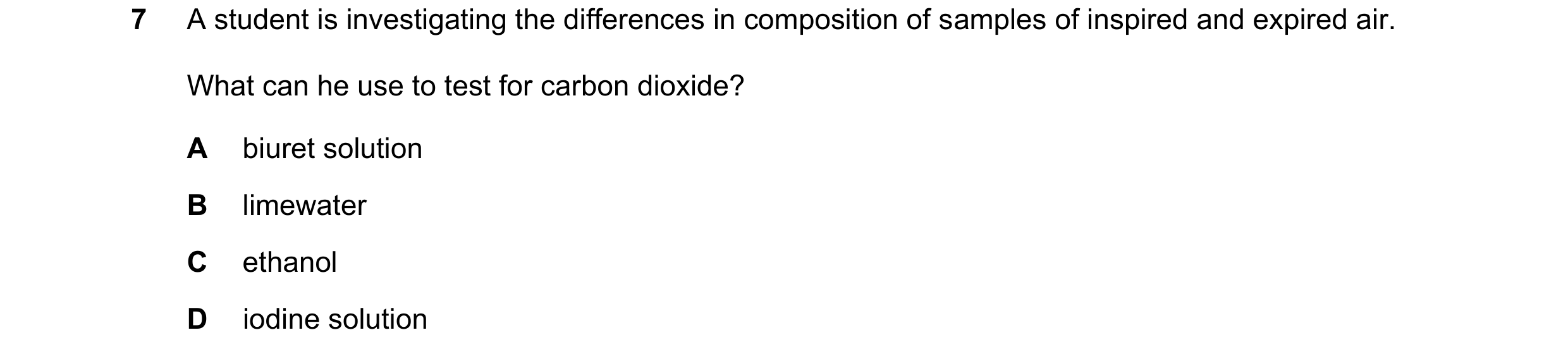
Q90 · A student is investigating the differences in composition of samples of inspired and… 0653/12 Oct/Nov 2023
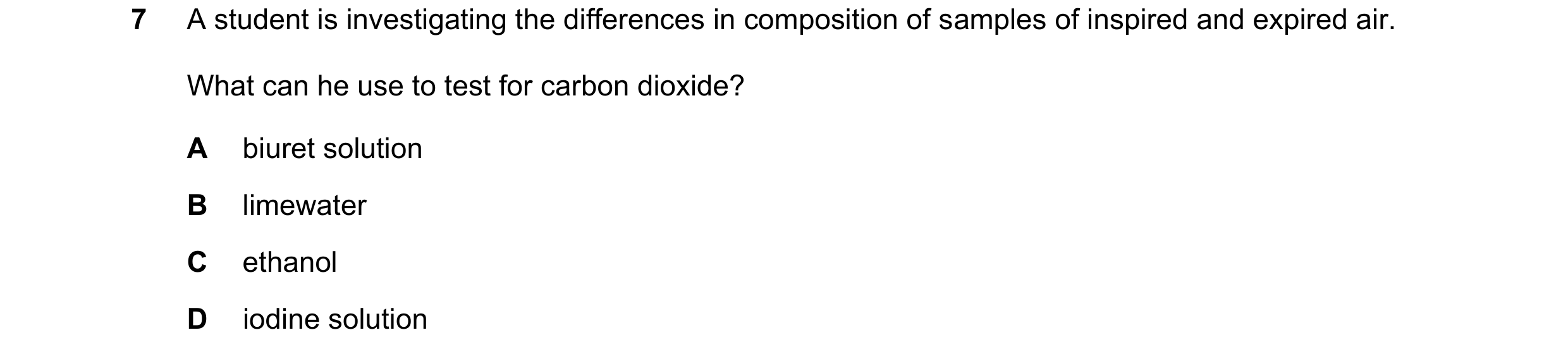
7 A student is investigating the differences in composition of samples of inspired and expired air. What can he use to test for carbon dioxide? A biuret solution B limewater C ethanol D iodine solution
1 marks
Answer: B
This question in 0653/12 Oct/Nov 2023
Q91 · Which test is used to identify ammonia? 0653/12 Oct/Nov 2023
21 Which test is used to identify ammonia? A A glowing splint relights. B Damp blue litmus paper is bleached. C Damp red litmus paper turns blue. D Limewater turns milky.
1 marks
Answer: C
This question in 0653/12 Oct/Nov 2023
Q92 · A student is investigating the differences in composition of samples of inspired and… 0653/13 Oct/Nov 2023
7 A student is investigating the differences in composition of samples of inspired and expired air. What can he use to test for carbon dioxide? A biuret solution B limewater C ethanol D iodine solution
1 marks
Answer: B
This question in 0653/13 Oct/Nov 2023
Q93 · Which test is used to identify ammonia? 0653/13 Oct/Nov 2023
21 Which test is used to identify ammonia? A A glowing splint relights. B Damp blue litmus paper is bleached. C Damp red litmus paper turns blue. D Limewater turns milky.
1 marks
Answer: C
This question in 0653/13 Oct/Nov 2023
Q94 · When solid Q is added to dilute hydrochloric acid, a gas is collected 0653/12 Feb/March 2024
20 When solid Q is added to dilute hydrochloric acid, a gas is collected. This gas ‘pops’ when tested with a lighted splint. gas gas syringe Q dilute hydrochloric acid What is Q? A magnesium B magnesium carbonate C magnesium chloride D magnesium oxide
1 marks
Answer: A
This question in 0653/12 Feb/March 2024
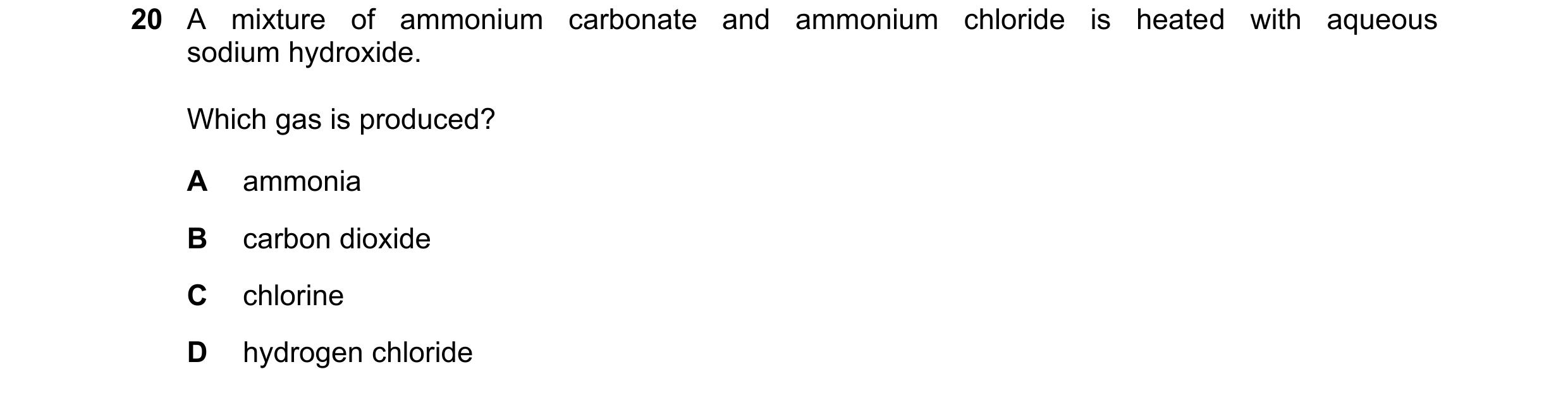
Q95 · A mixture of ammonium carbonate and ammonium chloride is heated with aqueous sodium… 0653/11 May/June 2024
20 A mixture of ammonium carbonate and ammonium chloride is heated with aqueous sodium hydroxide. Which gas is produced? A ammonia B carbon dioxide C chlorine D hydrogen chloride
1 marks
Answer: A
This question in 0653/11 May/June 2024
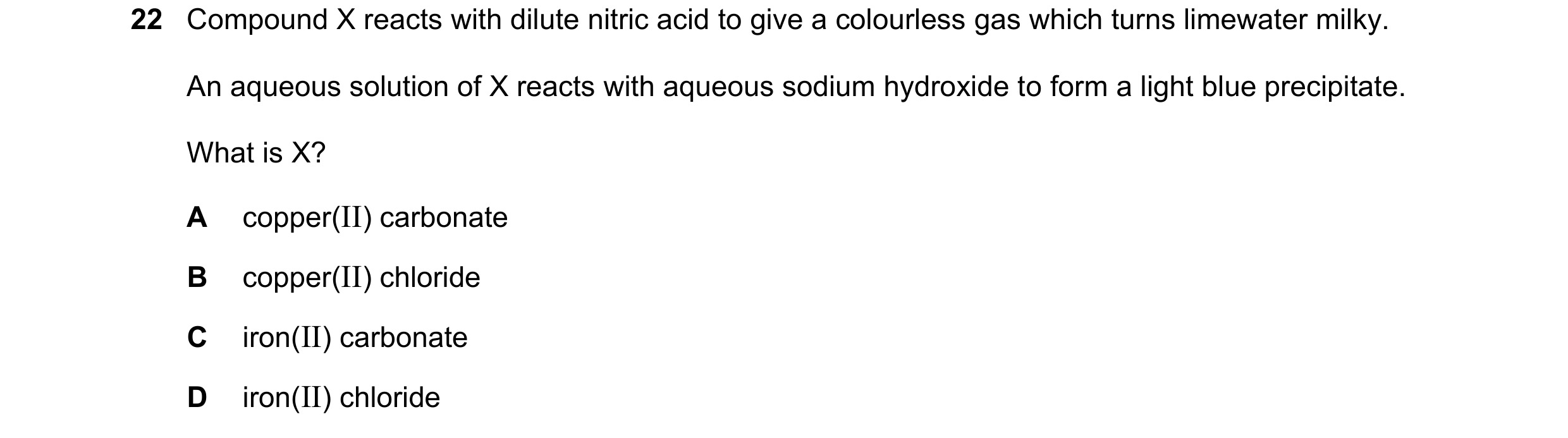
Q96 · Compound X reacts with dilute nitric acid to give a colourless gas which turns limewater… 0653/12 May/June 2024
22 Compound X reacts with dilute nitric acid to give a colourless gas which turns limewater milky. An aqueous solution of X reacts with aqueous sodium hydroxide to form a light blue precipitate. What is X? A copper(II) carbonate B copper(II) chloride C iron(II) carbonate D iron(II) chloride
1 marks
Answer: A
This question in 0653/12 May/June 2024
Q97 · Which row identifies the correct test and test result for the named gases? 0653/13 May/June 2024
23 Which row identifies the correct test and test result for the named gases? chlorine ammonia oxygen A turns damp turns damp ‘pops’ with litmus paper blue litmus paper red a lighted splint B turns damp turns damp ‘pops’ with litmus paper red litmus paper blue a lighted splint C bleaches damp turns damp relights a litmus paper litmus paper blue glowing splint D bleaches damp turns damp relights a litmus paper litmus paper red glowing splint
1 marks
Answer: C
This question in 0653/13 May/June 2024
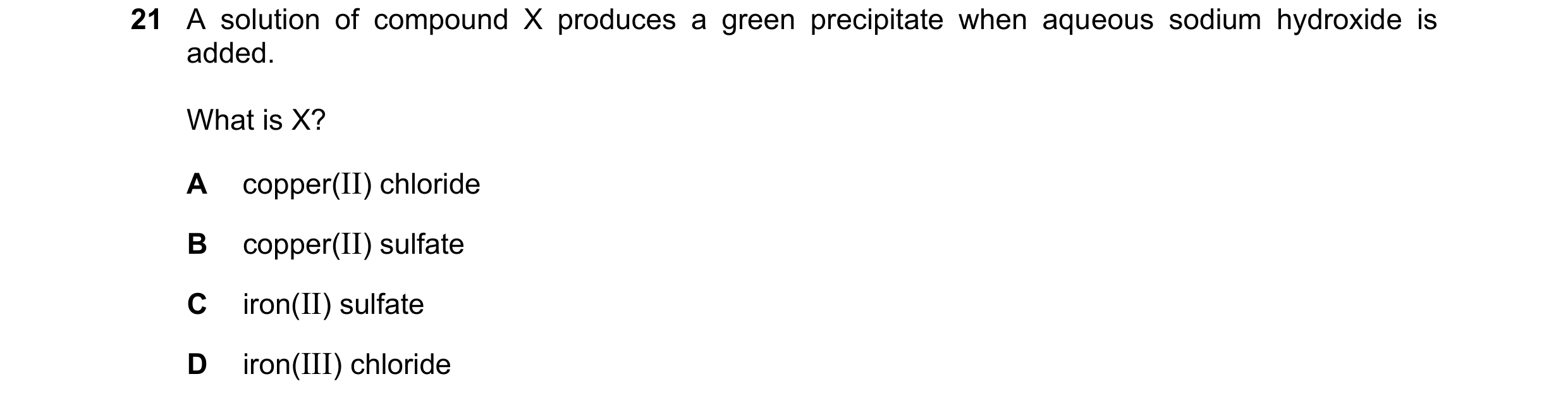
Q98 · A solution of compound X produces a green precipitate when aqueous sodium hydroxide is… 0653/11 Oct/Nov 2024
21 A solution of compound X produces a green precipitate when aqueous sodium hydroxide is added. What is X? A copper(II) chloride B copper(II) sulfate C iron(II) sulfate D iron(III) chloride
1 marks
Answer: C
This question in 0653/11 Oct/Nov 2024
Q99 · What is a chemical test for water? 0653/11 Oct/Nov 2024
24 What is a chemical test for water? A Blue cobalt(II) chloride paper turns pink. B Measure its boiling point which is 100 C. C Measure its melting point which is 0 C. D Pink cobalt(II) chloride paper turns blue.
1 marks
Answer: A
This question in 0653/11 Oct/Nov 2024
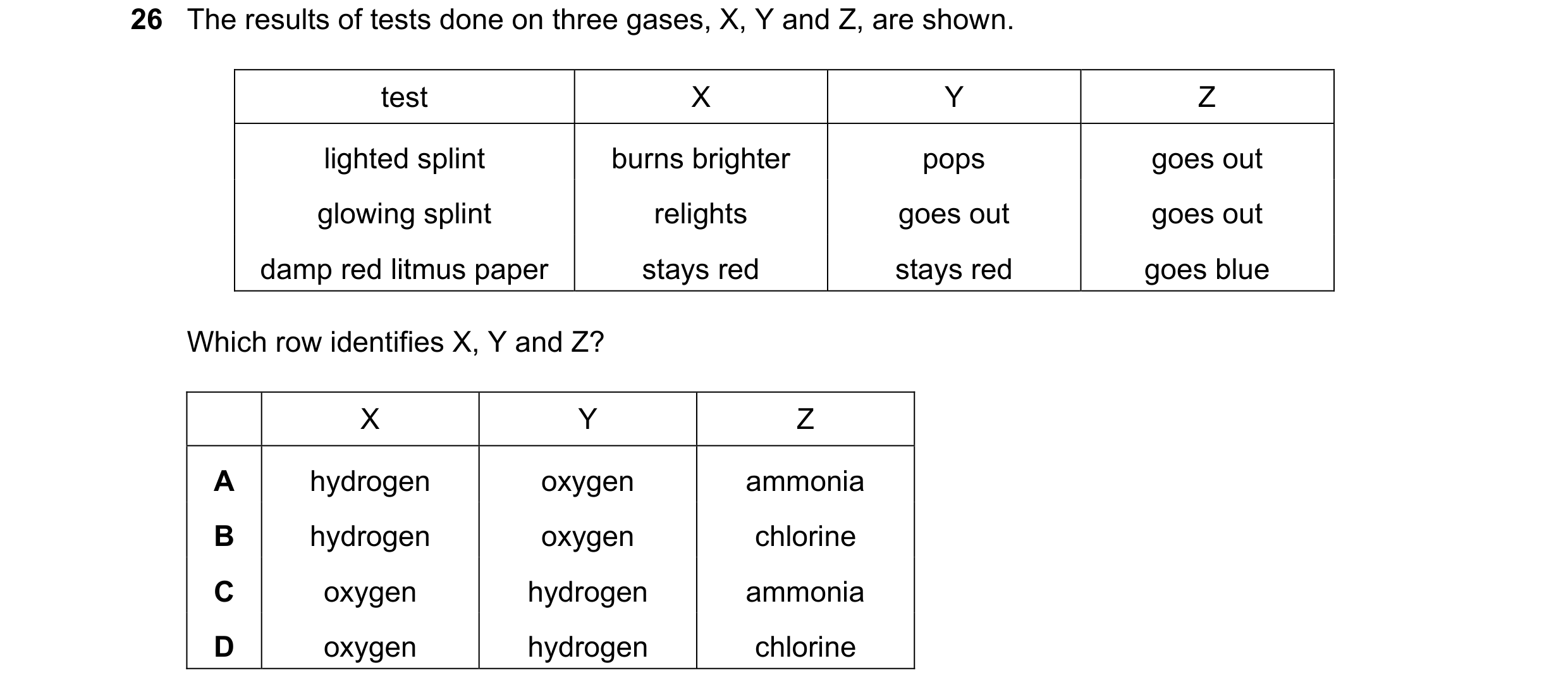
Q100 · The results of tests done on three gases, X, Y and Z, are shown 0653/12 Feb/March 2025
26 The results of tests done on three gases, X, Y and Z, are shown. test X Y Z lighted splint burns brighter pops goes out glowing splint relights goes out goes out damp red litmus paper stays red stays red goes blue Which row identifies X, Y and Z? X Y Z A hydrogen oxygen ammonia B hydrogen oxygen chlorine C oxygen hydrogen ammonia D oxygen hydrogen chlorine
1 marks
Answer: C
This question in 0653/12 Feb/March 2025
Q101 · Which observation shows the presence of iron(III) ions? 0653/12 Feb/March 2025
27 Which observation shows the presence of iron(III) ions? A A blue solution is formed with excess aqueous ammonia. B A green precipitate is formed with aqueous sodium hydroxide. C A red-brown precipitate is formed with aqueous sodium hydroxide. D A white precipitate is formed with aqueous ammonia.
1 marks
Answer: C
This question in 0653/12 Feb/March 2025
Q102 · Separate samples of the gases ammonia, chlorine, hydrogen and oxygen are tested with damp… 0653/13 May/June 2025
27 Separate samples of the gases ammonia, chlorine, hydrogen and oxygen are tested with damp blue litmus paper. How many of these gases change the colour of the litmus paper? A 0 B 1 C 2 D 3
1 marks
Answer: B
This question in 0653/13 May/June 2025
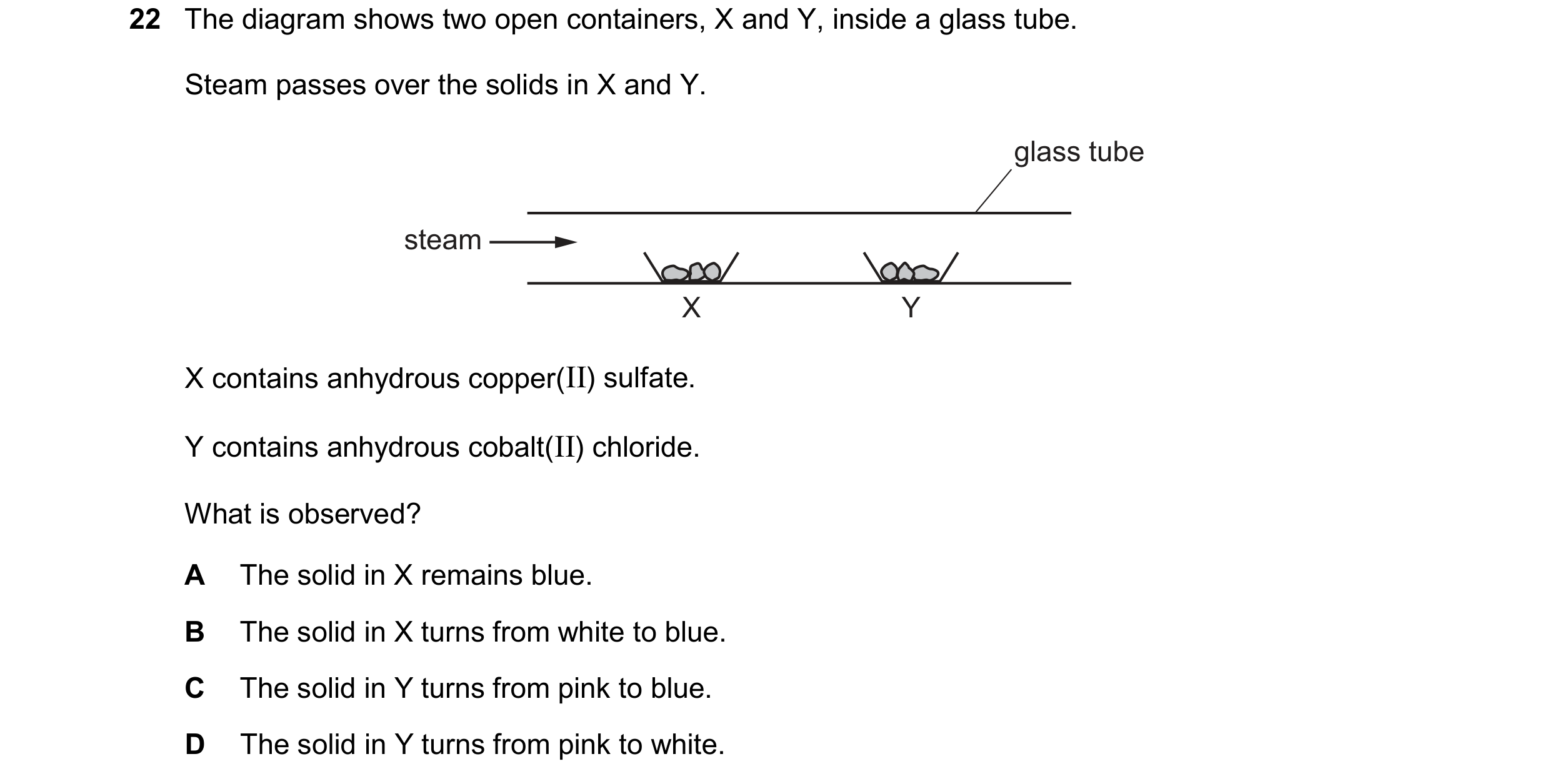
Q103 · The diagram shows two open containers, X and Y, inside a glass tube 0653/11 Oct/Nov 2025
22 The diagram shows two open containers, X and Y, inside a glass tube. Steam passes over the solids in X and Y. glass tube steam X Y X contains anhydrous copper(II) sulfate. Y contains anhydrous cobalt(II) chloride. What is observed? A The solid in X remains blue. B The solid in X turns from white to blue. C The solid in Y turns from pink to blue. D The solid in Y turns from pink to white.
1 marks
Answer: B
This question in 0653/11 Oct/Nov 2025
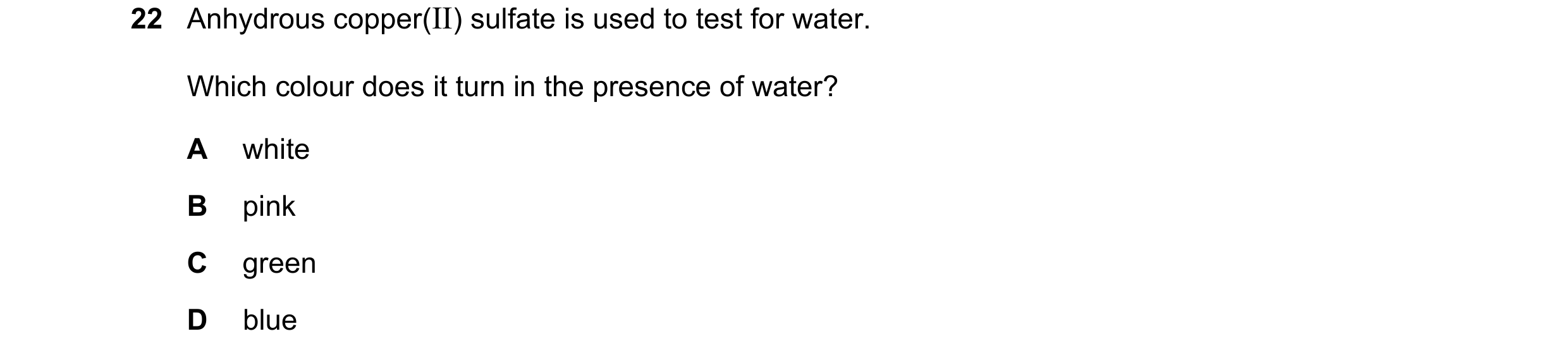
Q104 · Anhydrous copper(II) sulfate is used to test for water 0653/12 Oct/Nov 2025
22 Anhydrous copper(II) sulfate is used to test for water. Which colour does it turn in the presence of water? A white B pink C green D blue
1 marks
Answer: D
This question in 0653/12 Oct/Nov 2025
Q105 · Aqueous ammonia is added to a solution containing a salt 0653/12 Oct/Nov 2025
27 Aqueous ammonia is added to a solution containing a salt. A white precipitate is produced which dissolves in excess aqueous ammonia. Which ion is present in the salt? A ammonium B iron(II) C iron(III) D zinc
1 marks
Answer: D
This question in 0653/12 Oct/Nov 2025
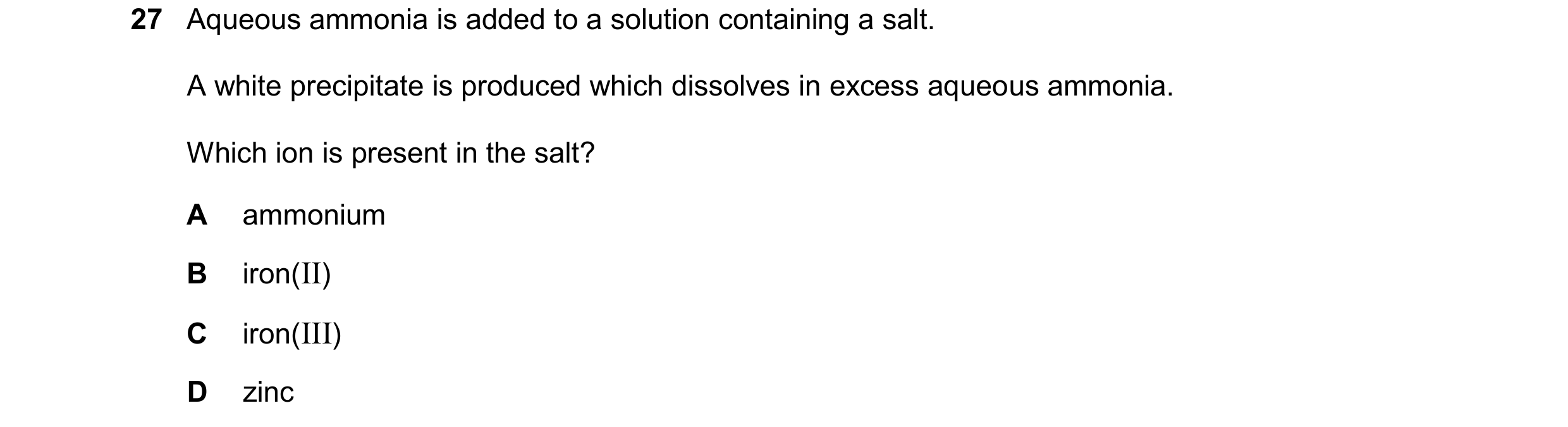
Q106 · Aqueous ammonia is added to a solution containing a salt 0653/13 Oct/Nov 2025
27 Aqueous ammonia is added to a solution containing a salt. A white precipitate is produced which dissolves in excess aqueous ammonia. Which ion is present in the salt? A ammonium B iron(II) C iron(III) D zinc
1 marks
Answer: D
This question in 0653/13 Oct/Nov 2025
 1 / 30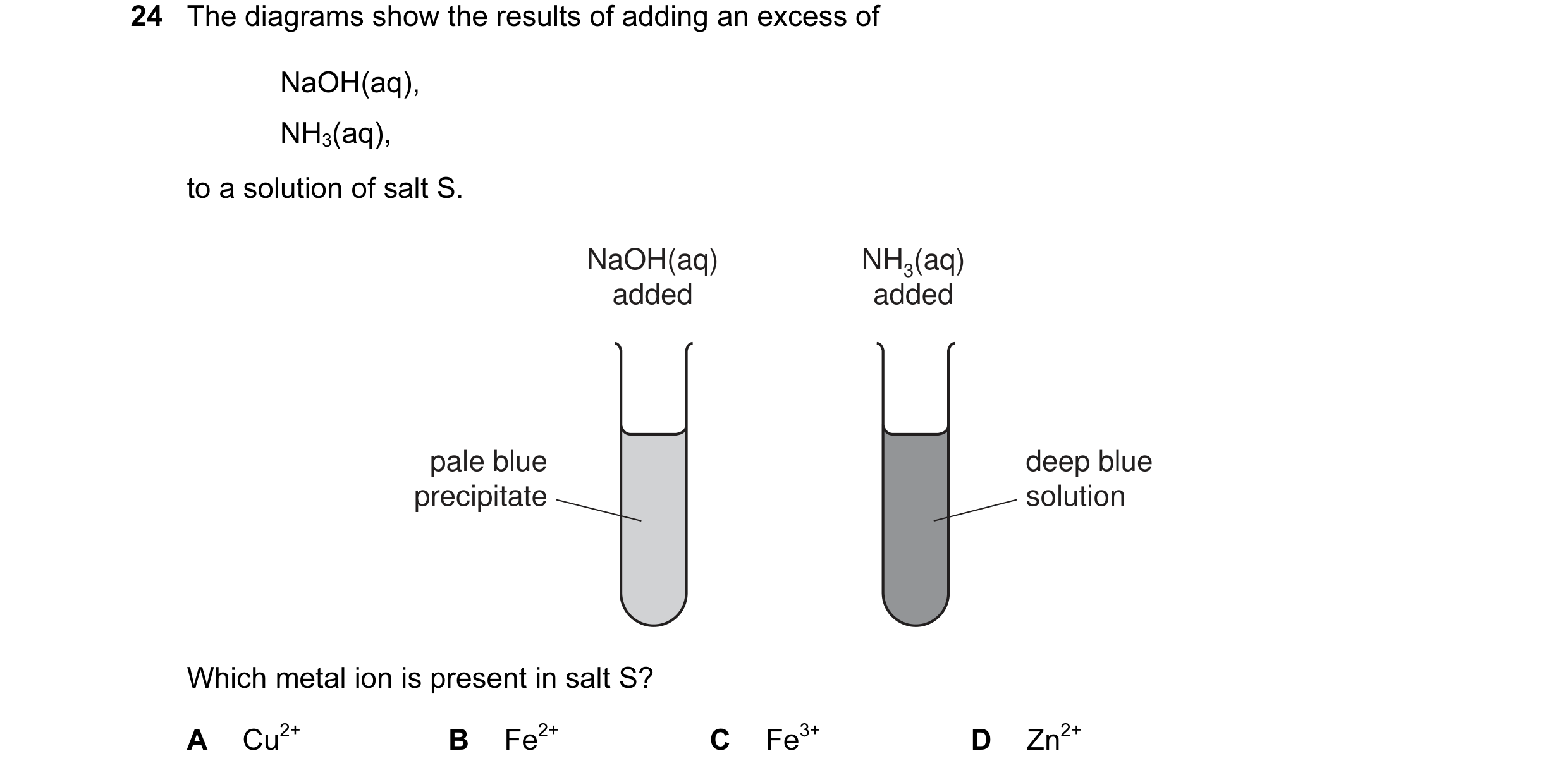
 2 / 30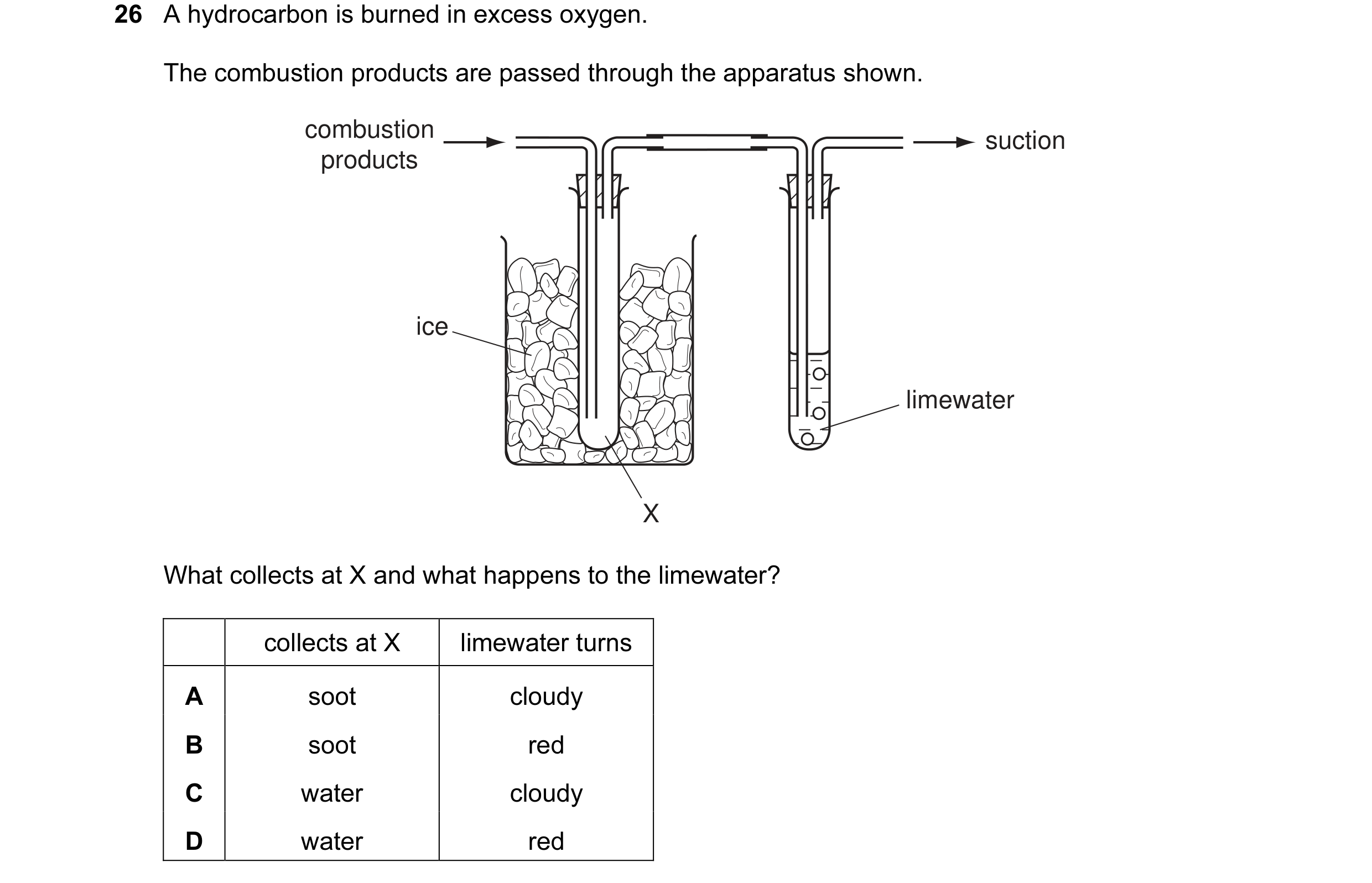
 3 / 30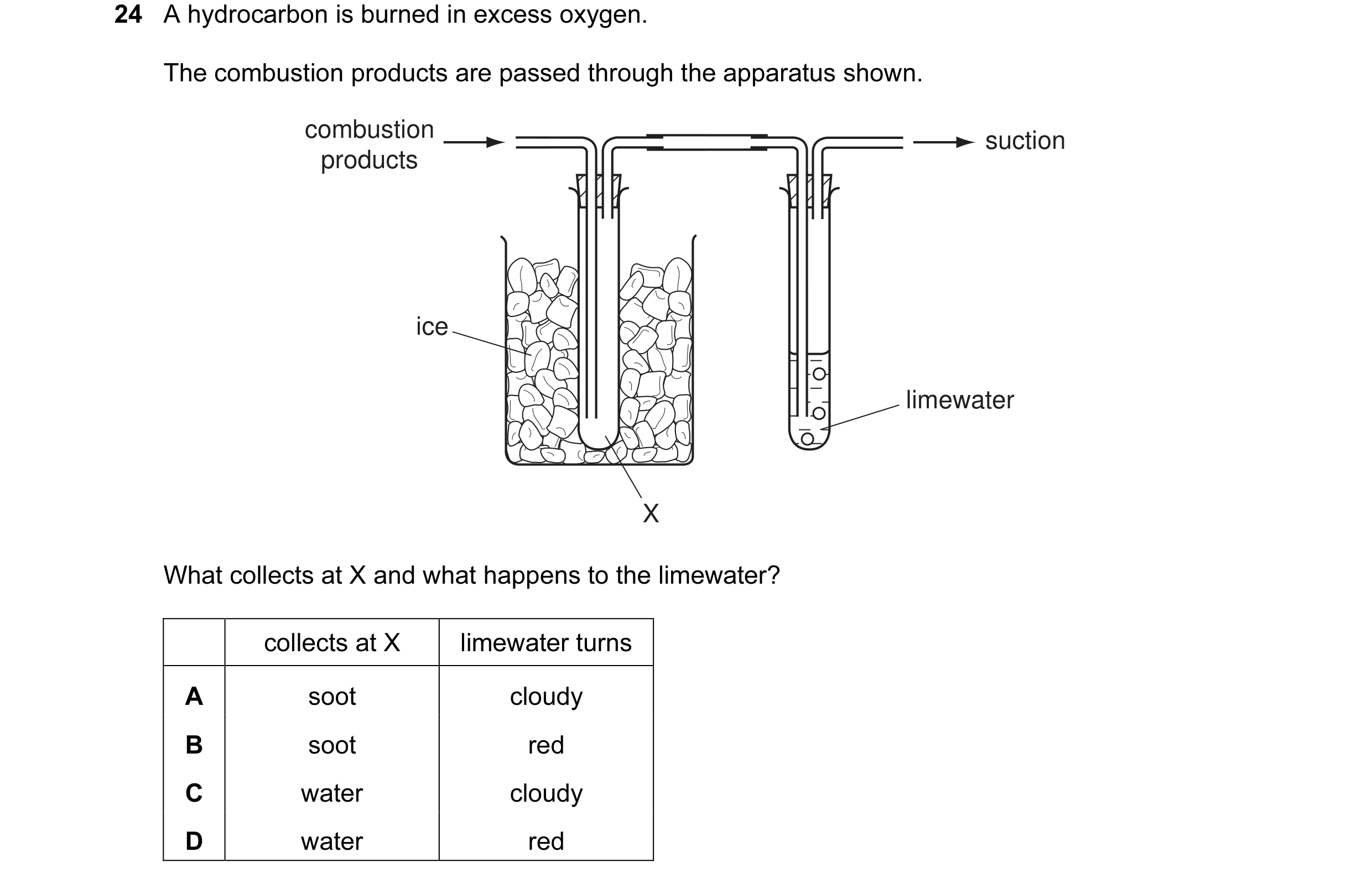
 4 / 30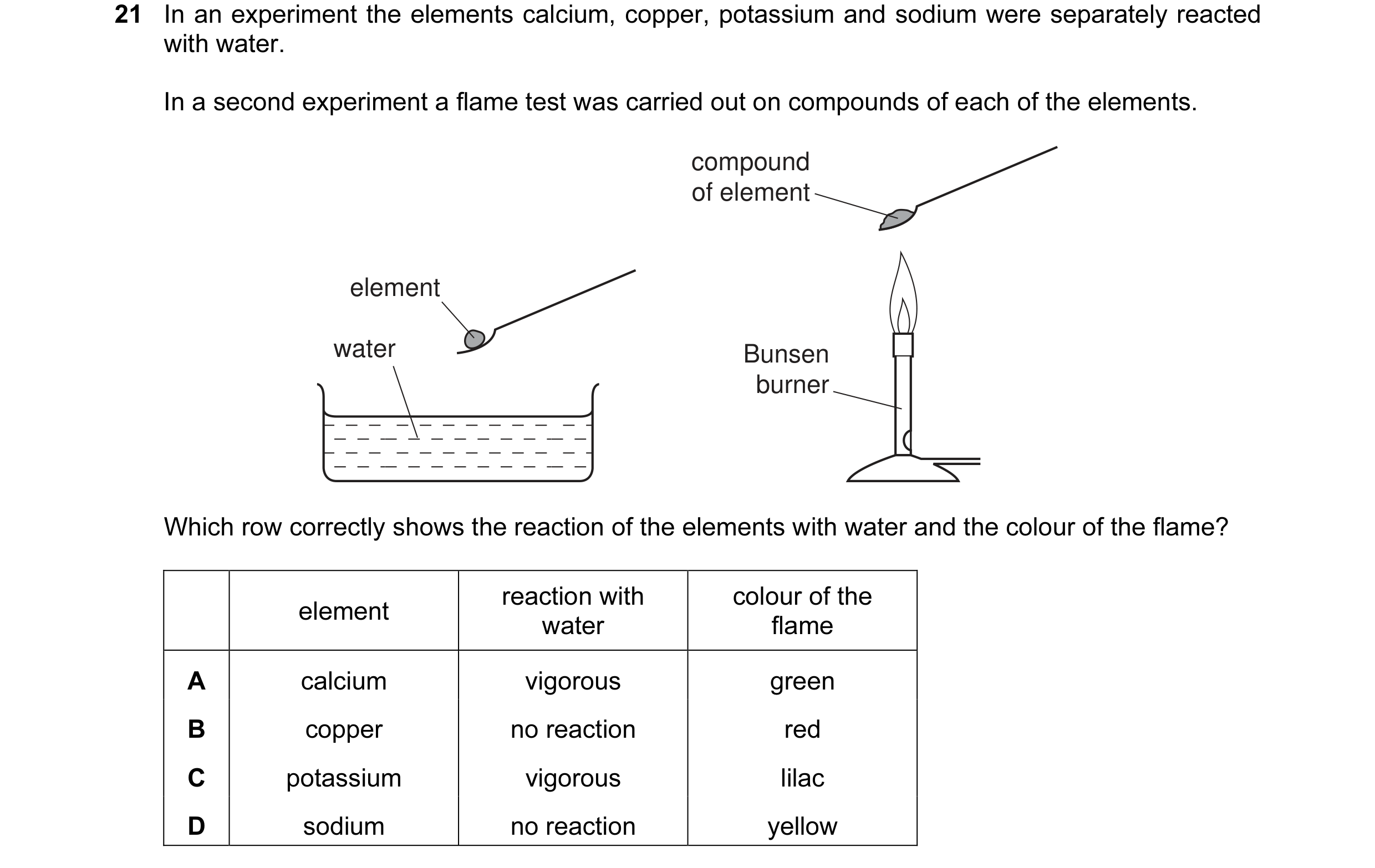
 5 / 30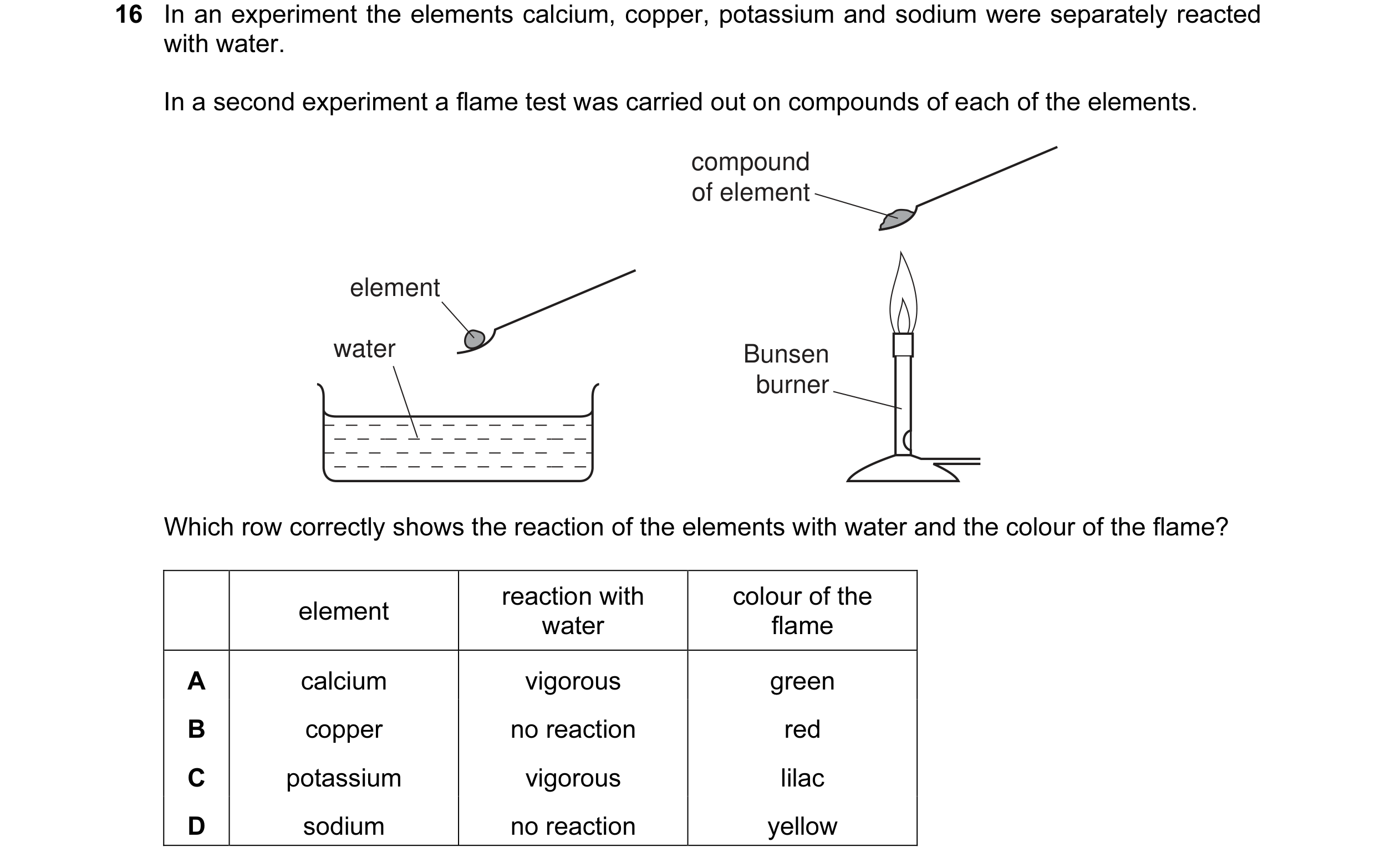
 6 / 30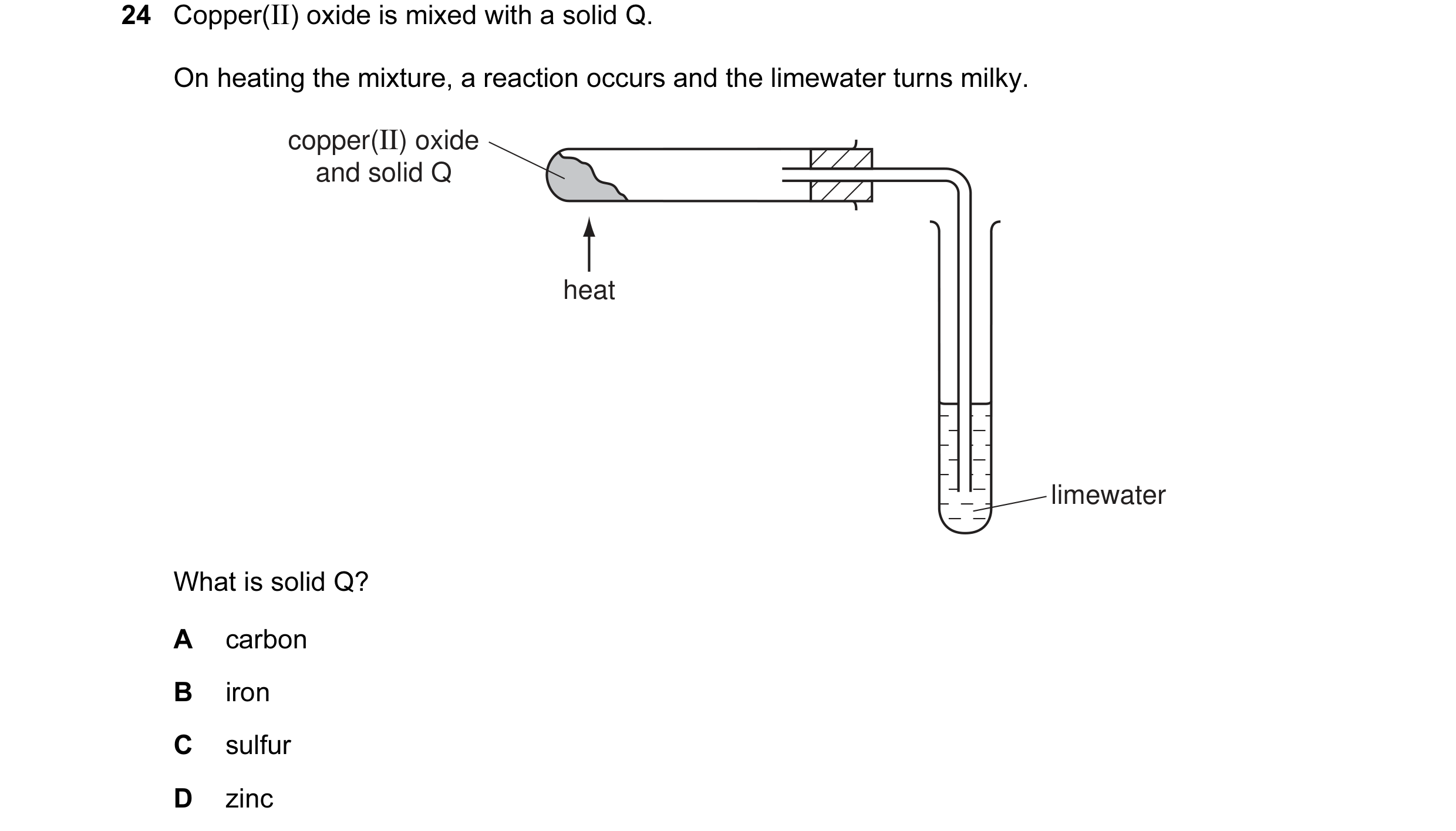
 7 / 30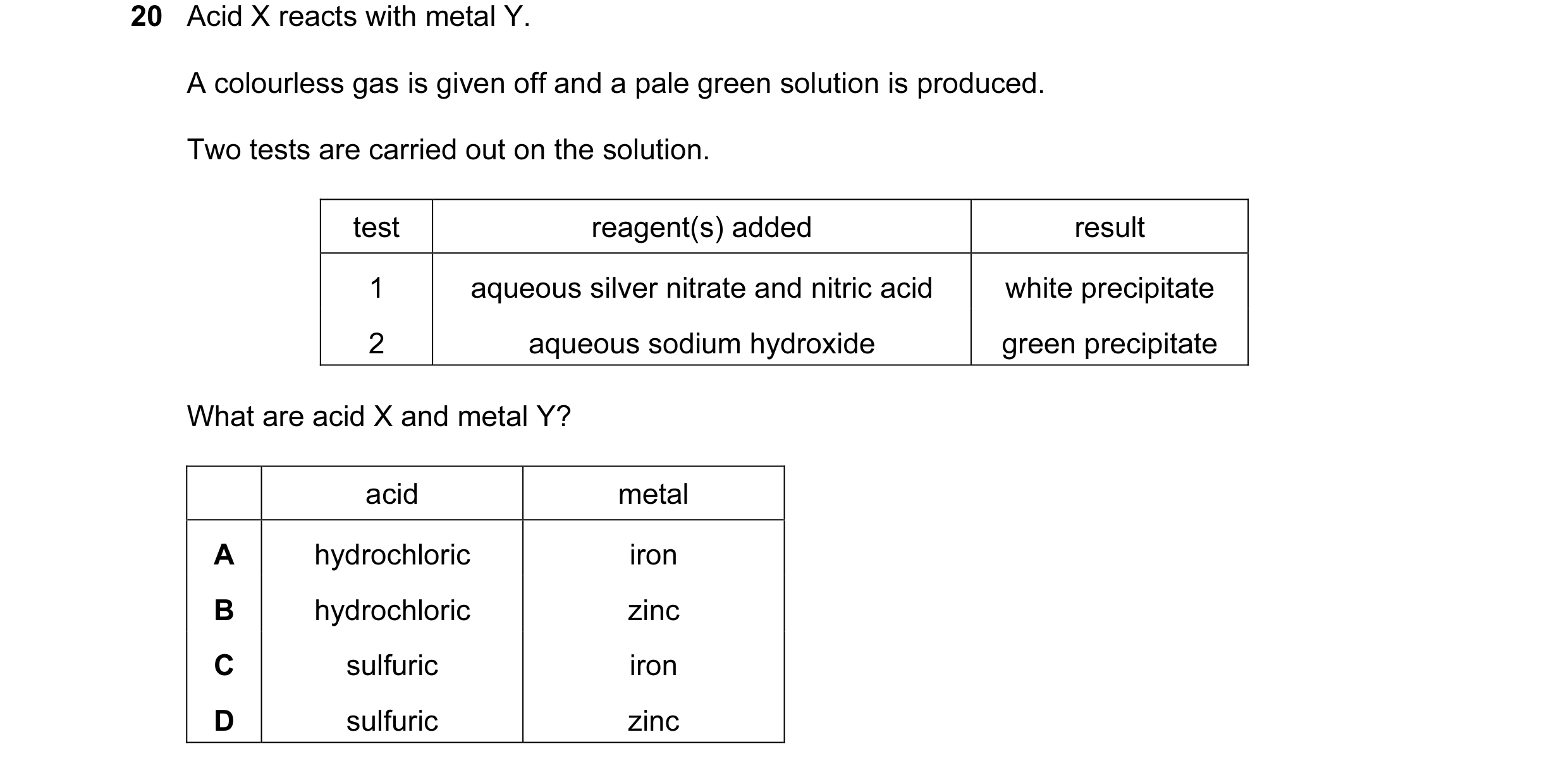
 8 / 30

 9 / 30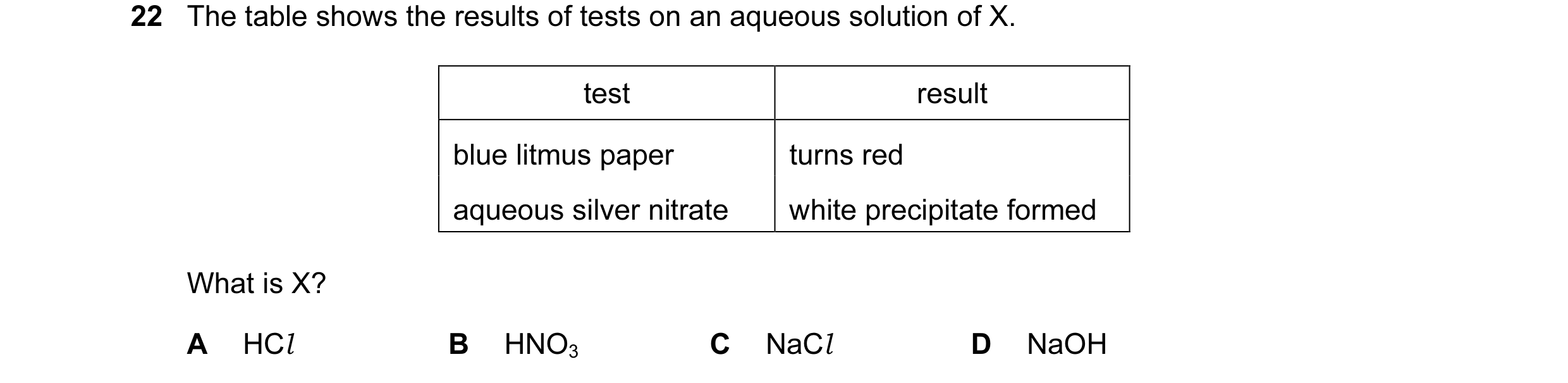
 10 / 30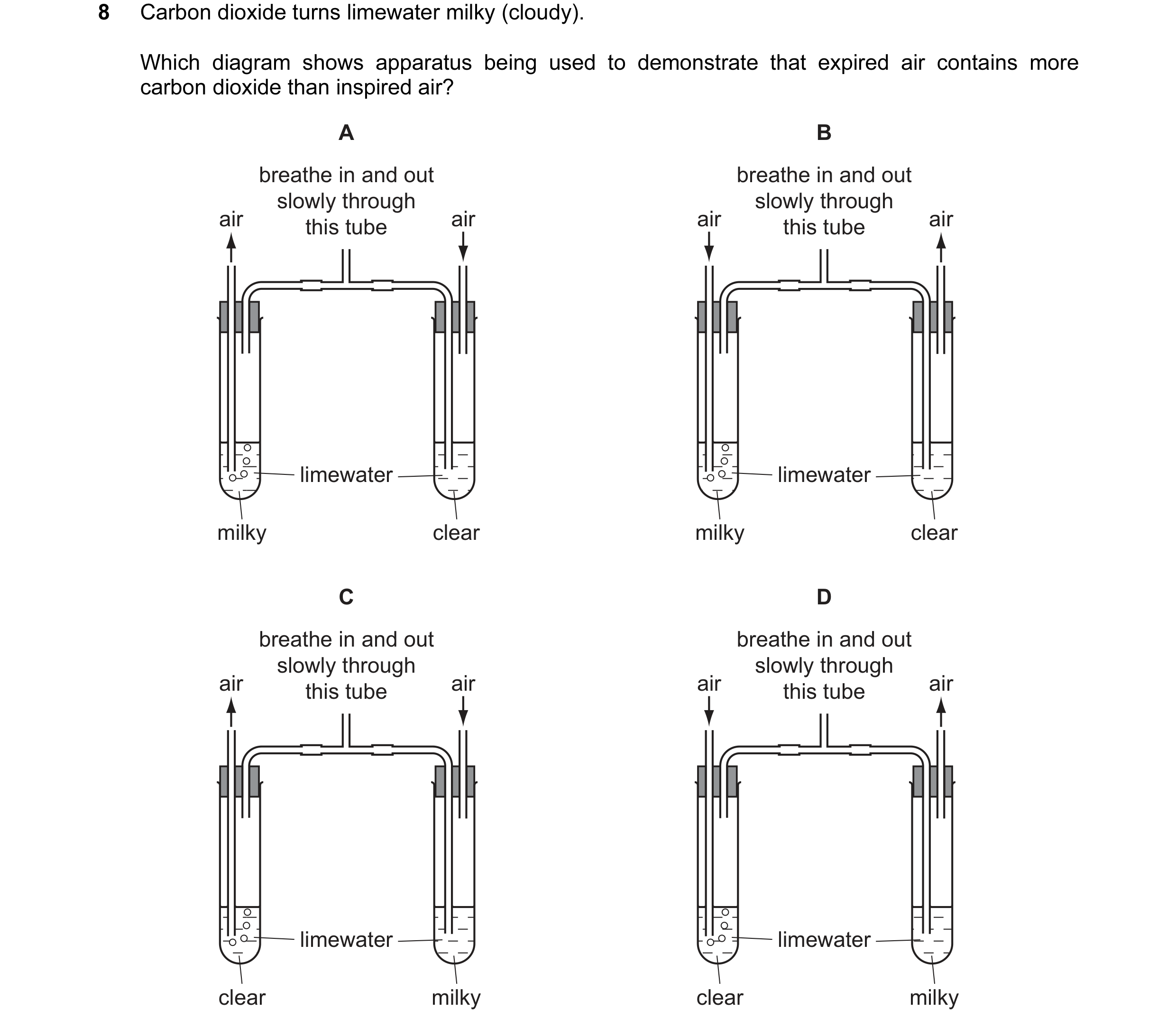
 11 / 30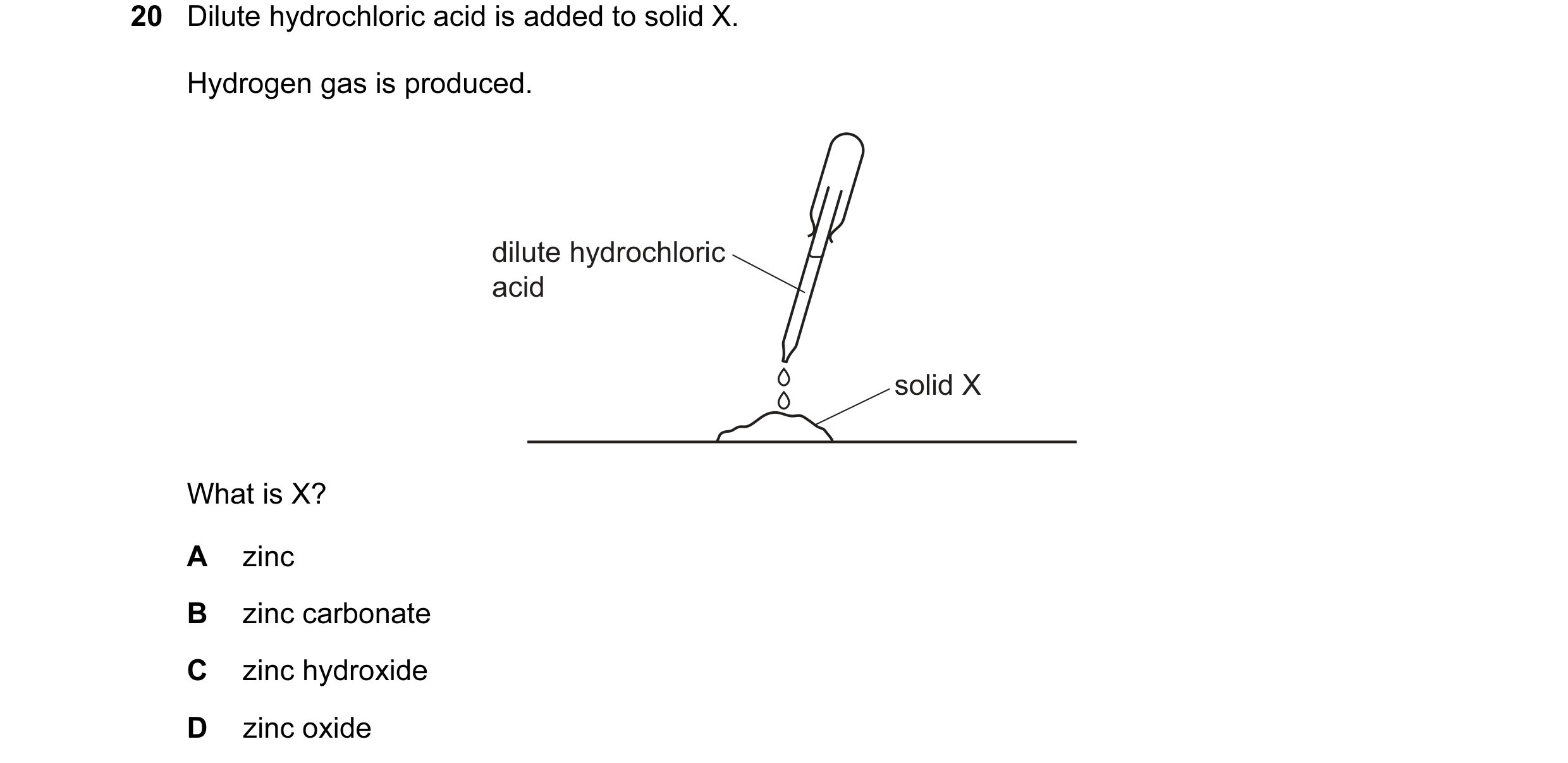

 12 / 30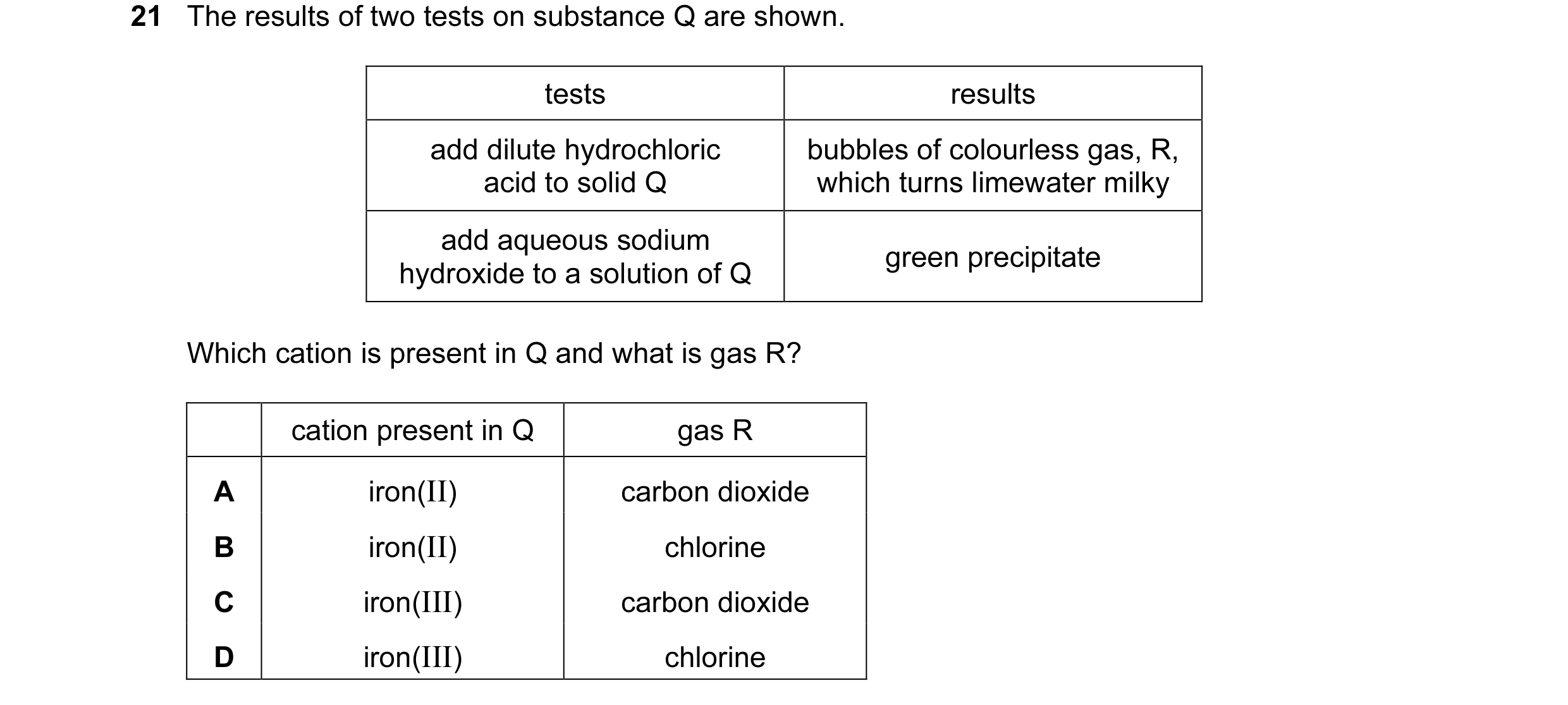

 13 / 30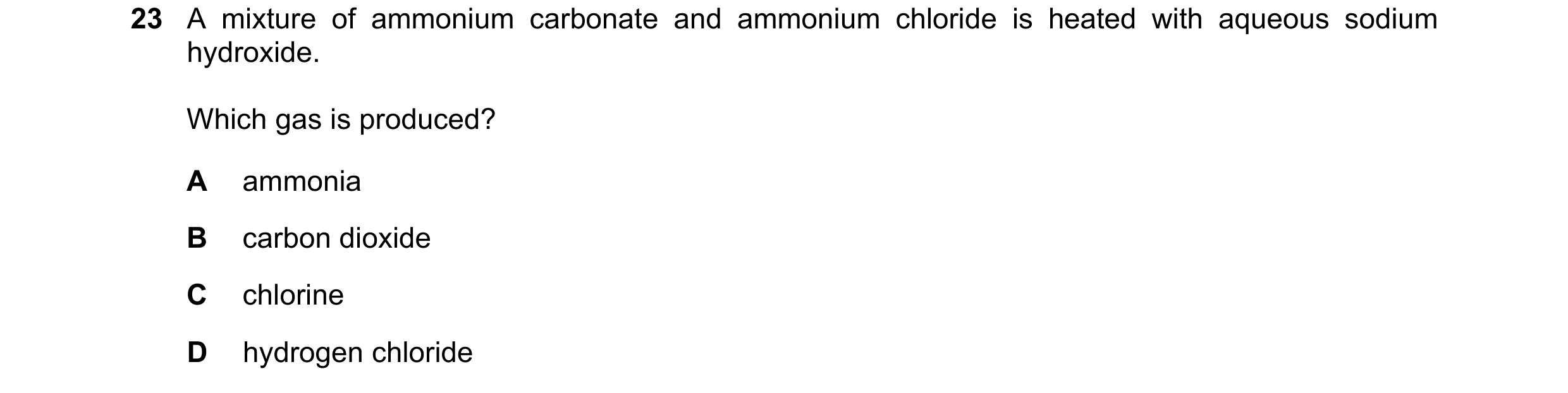

 14 / 30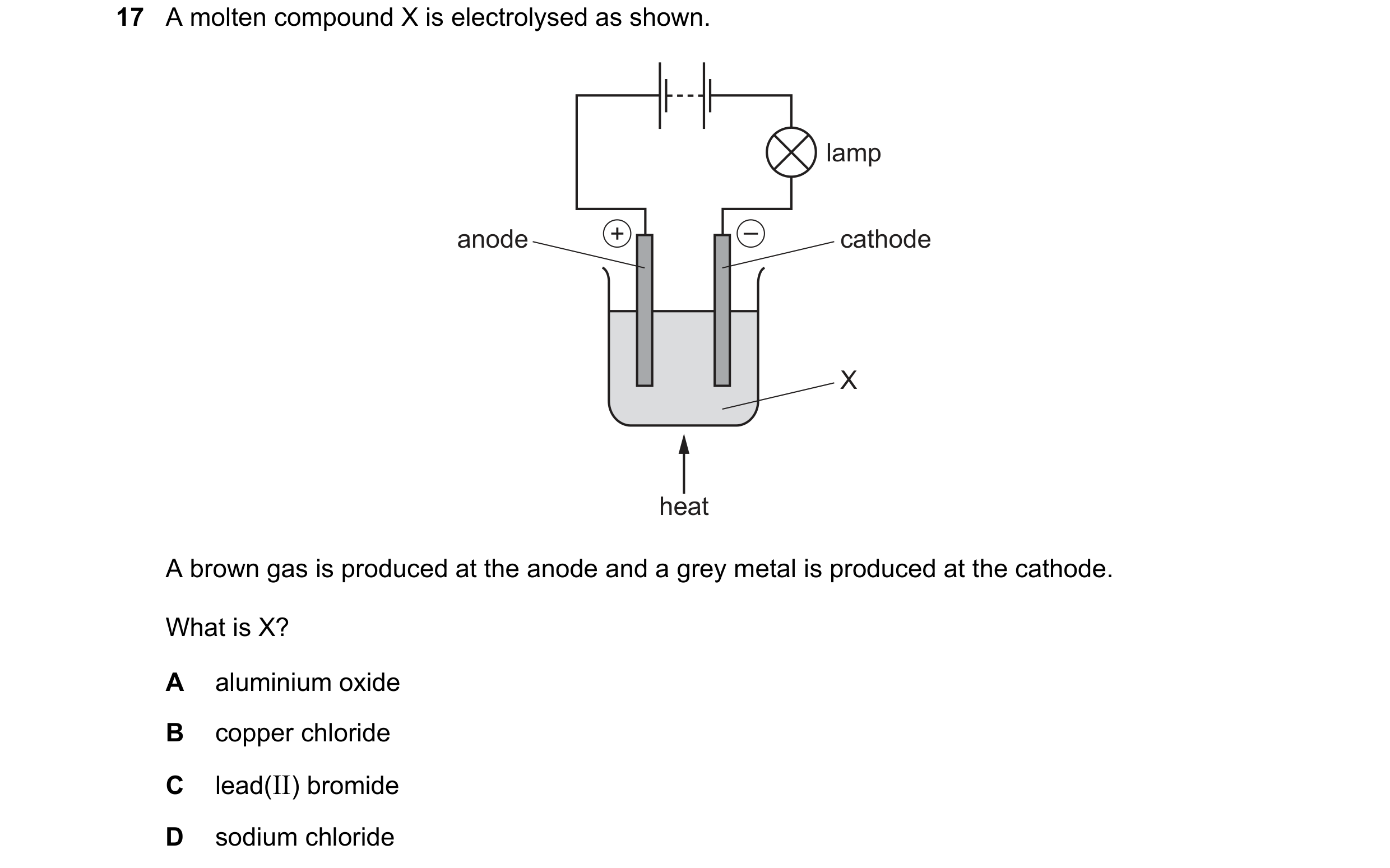
 15 / 30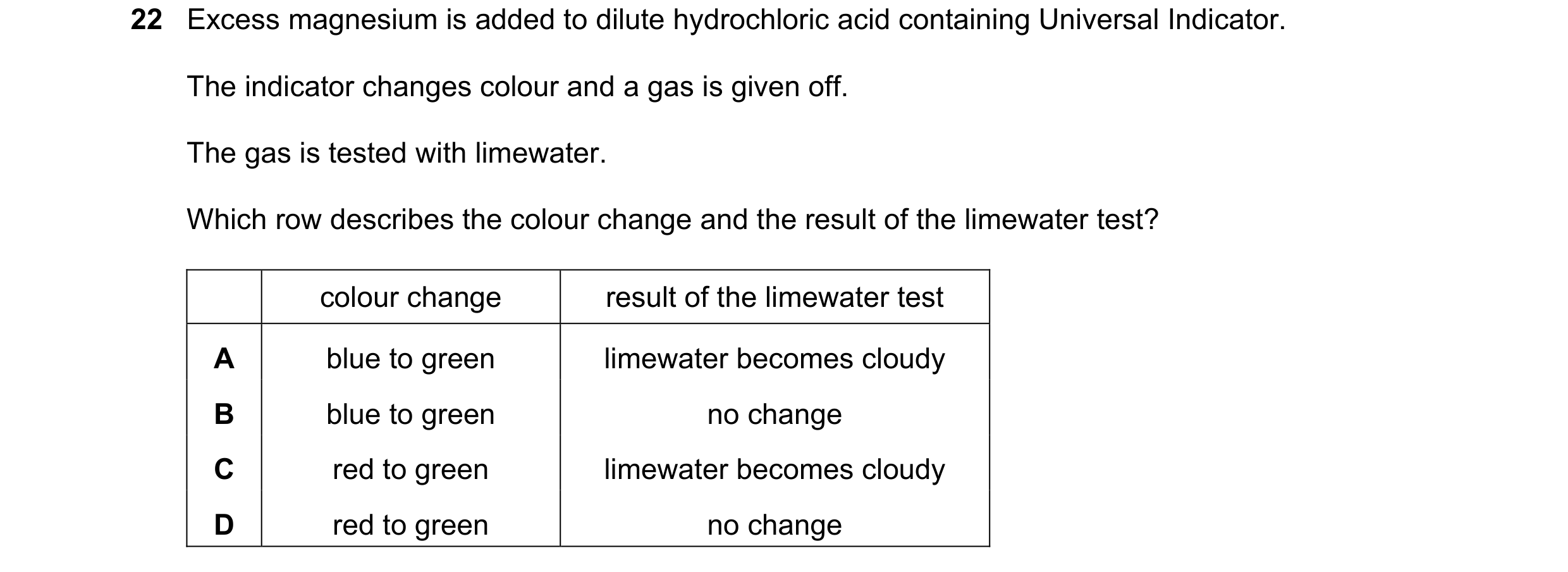

 16 / 30

 17 / 30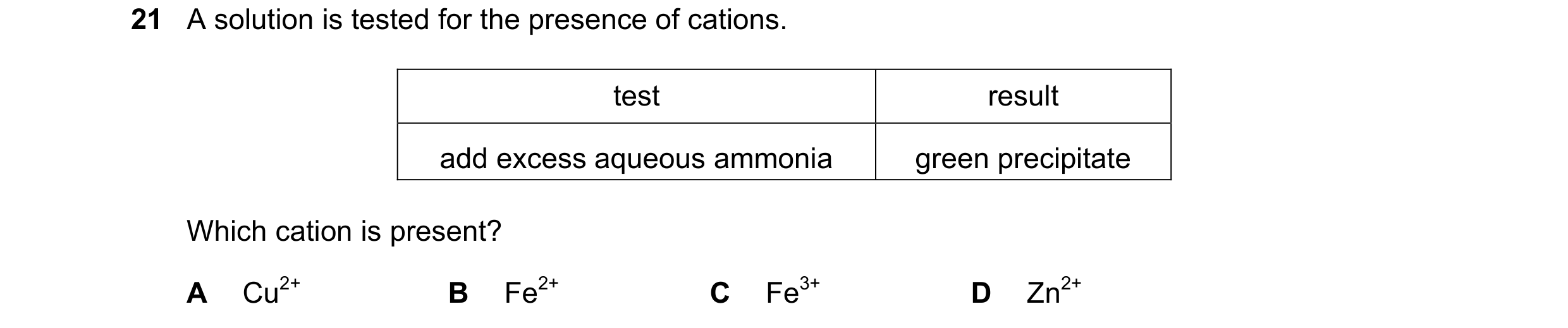


 18 / 30
 19 / 30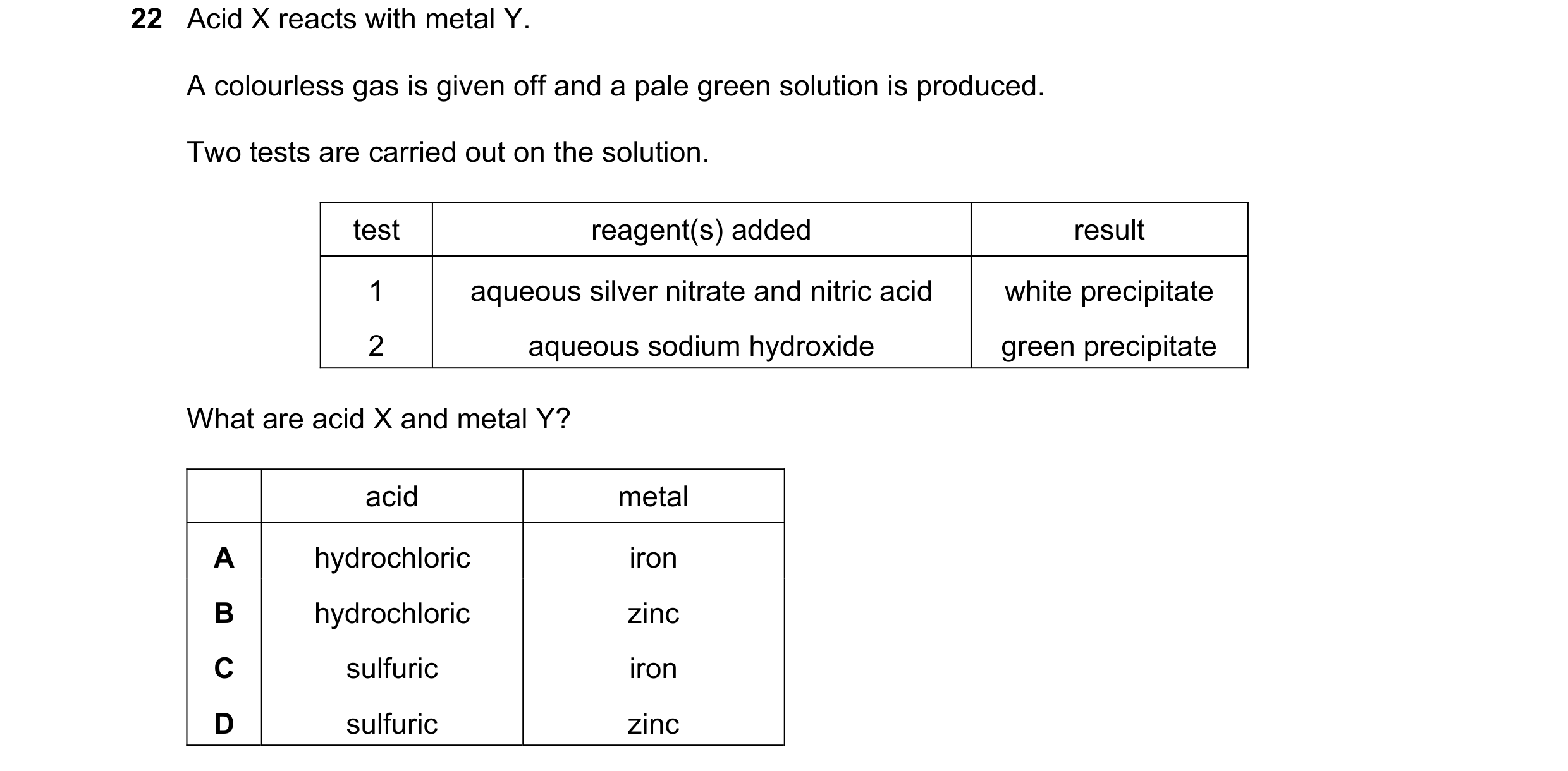
 20 / 30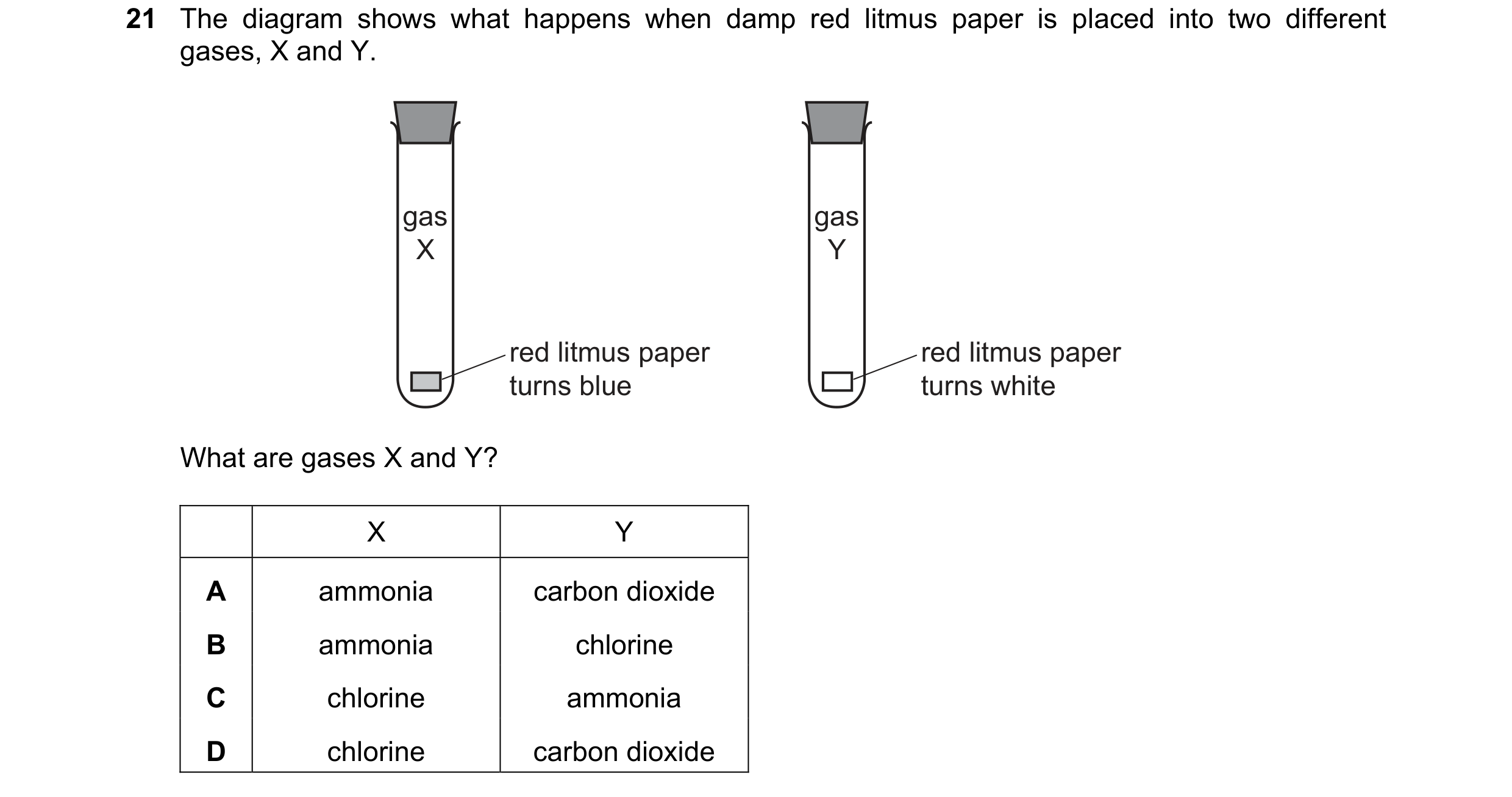



 21 / 30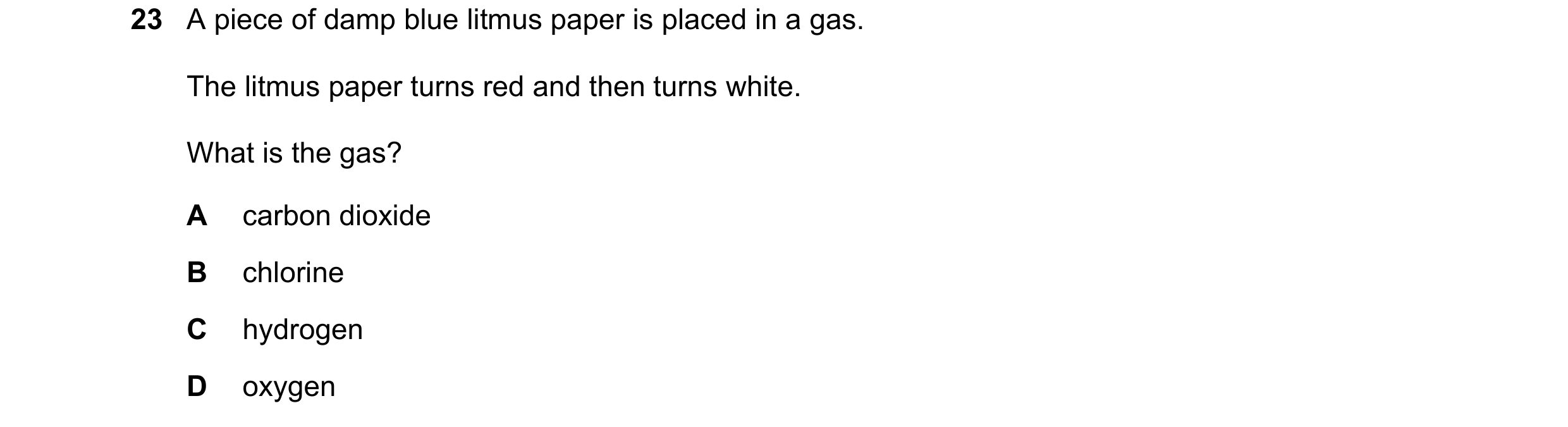

 22 / 30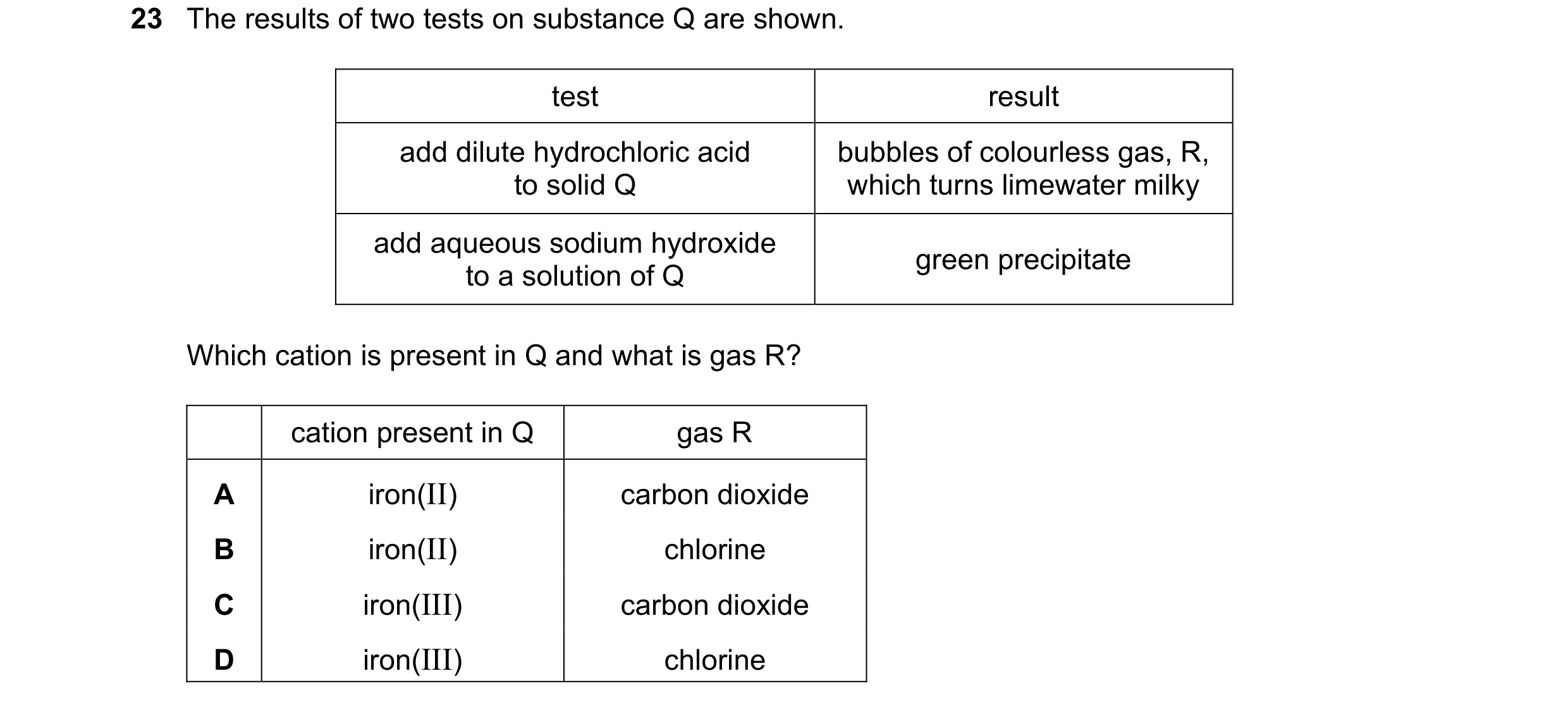

 23 / 30


 24 / 30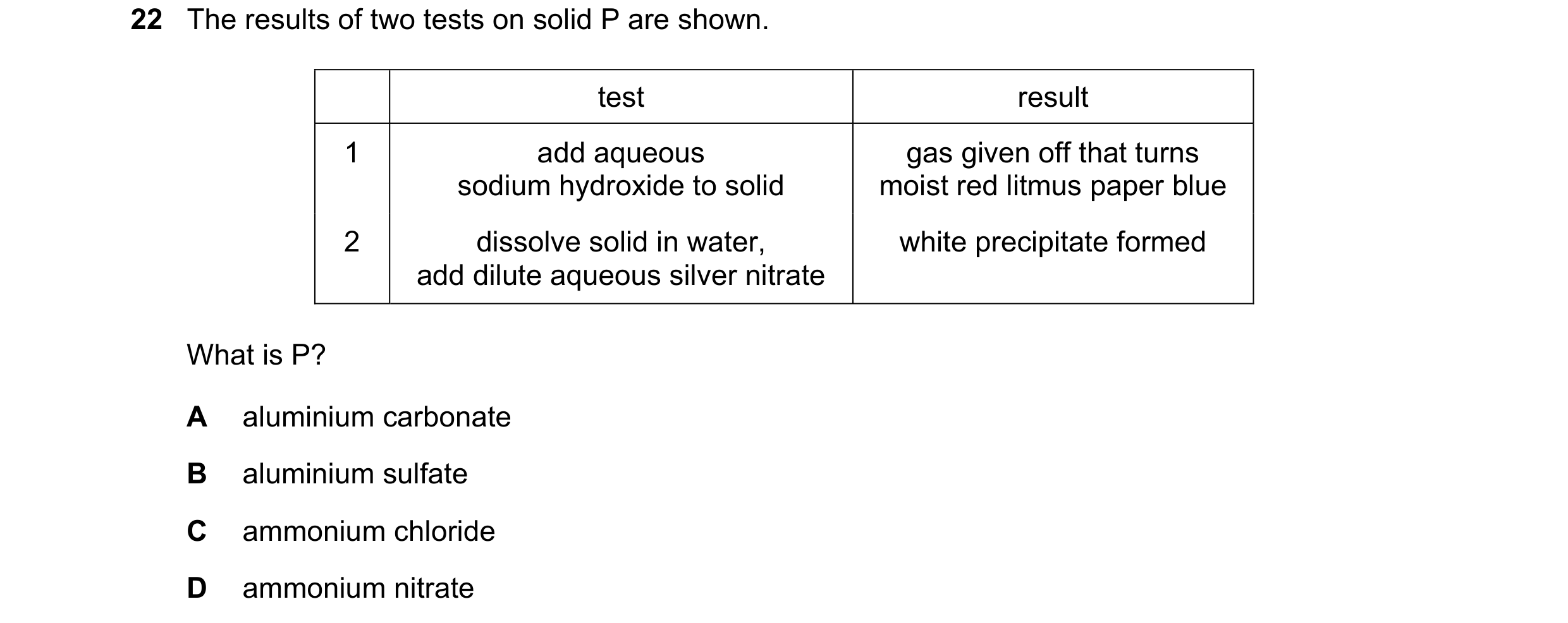
 25 / 30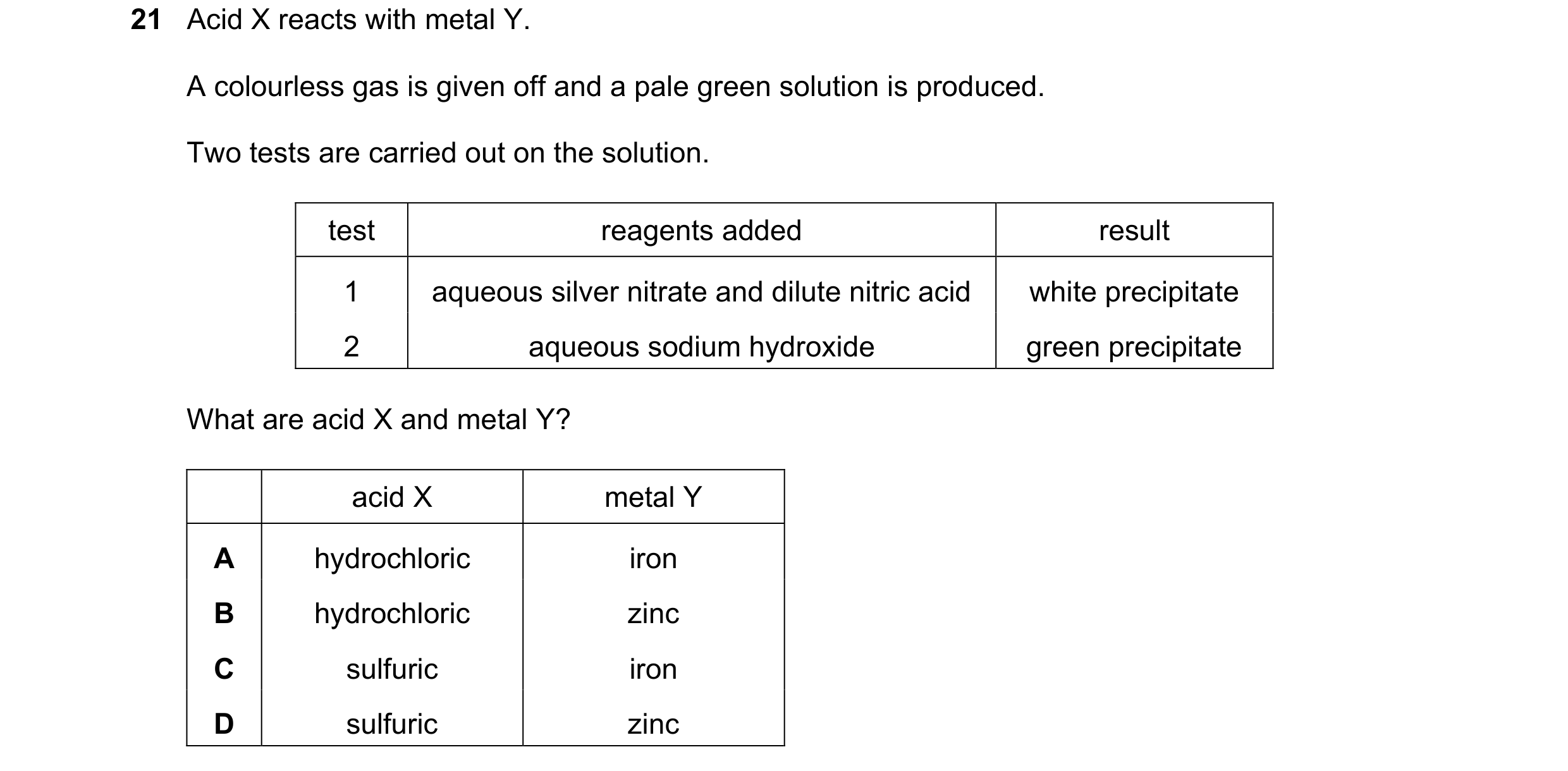

 26 / 30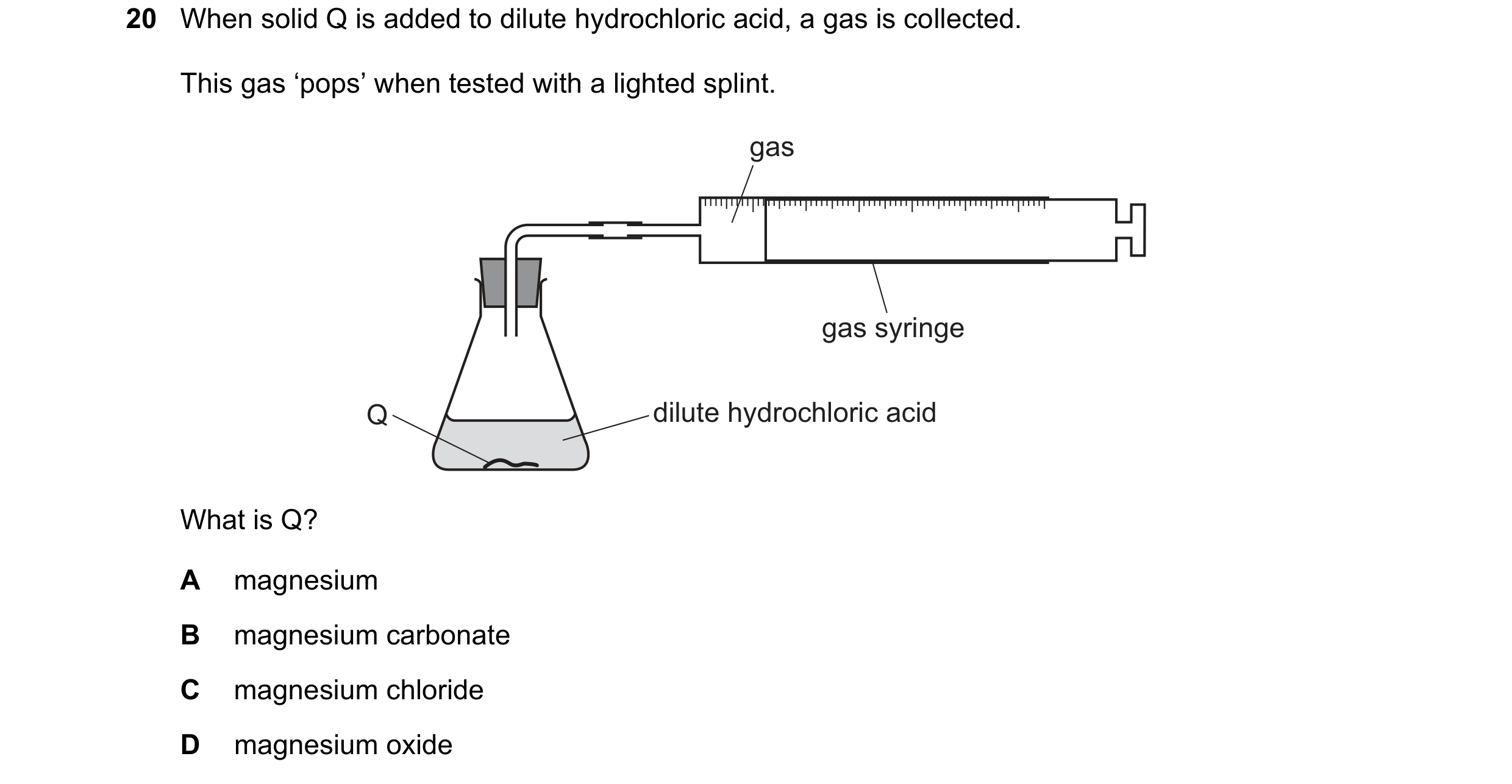
 27 / 30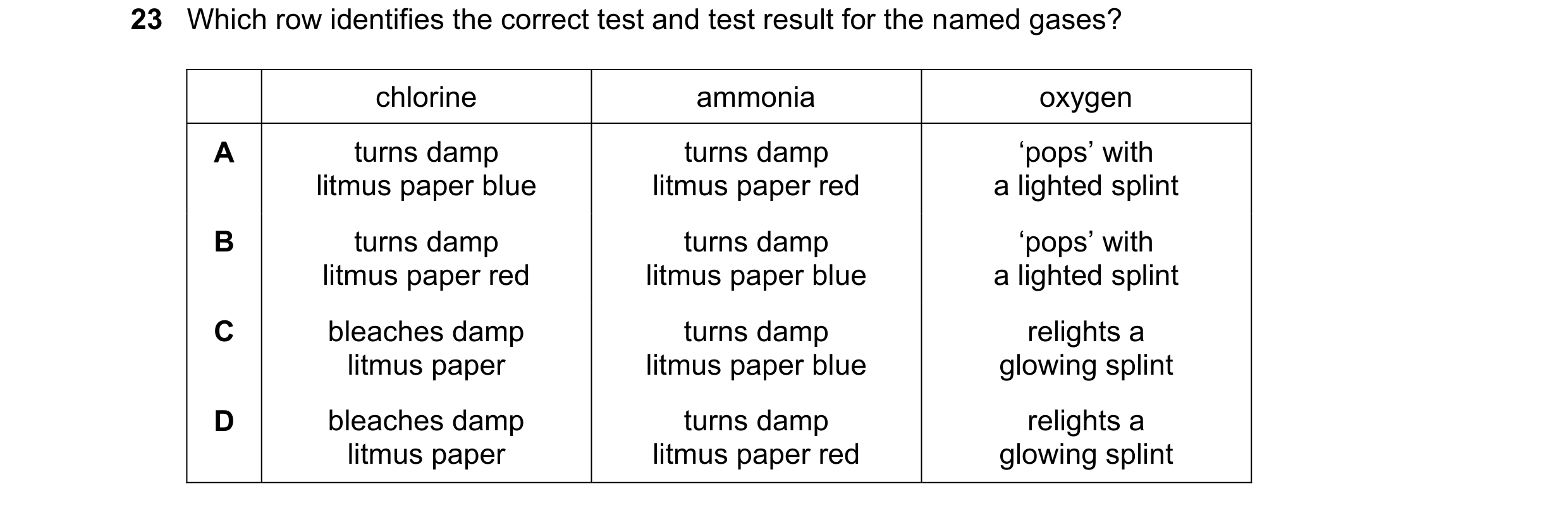

 28 / 30

 29 / 30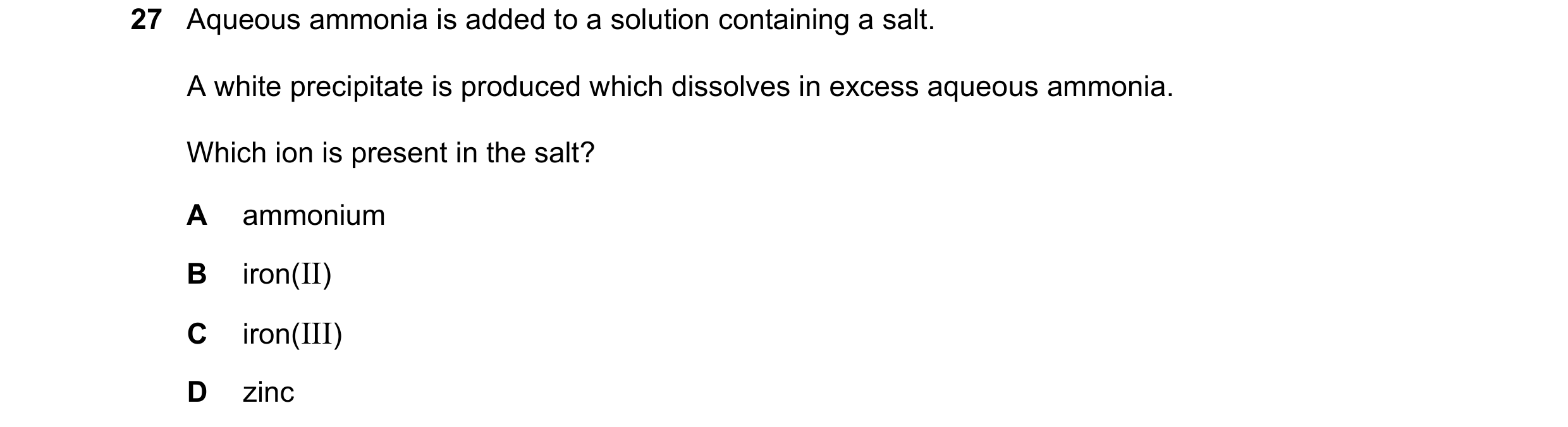
 30 / 30