Questions as text
Q1 · A student investigates the rate of reaction between calcium carbonate and dilute… 0653/42 Feb/March 2017
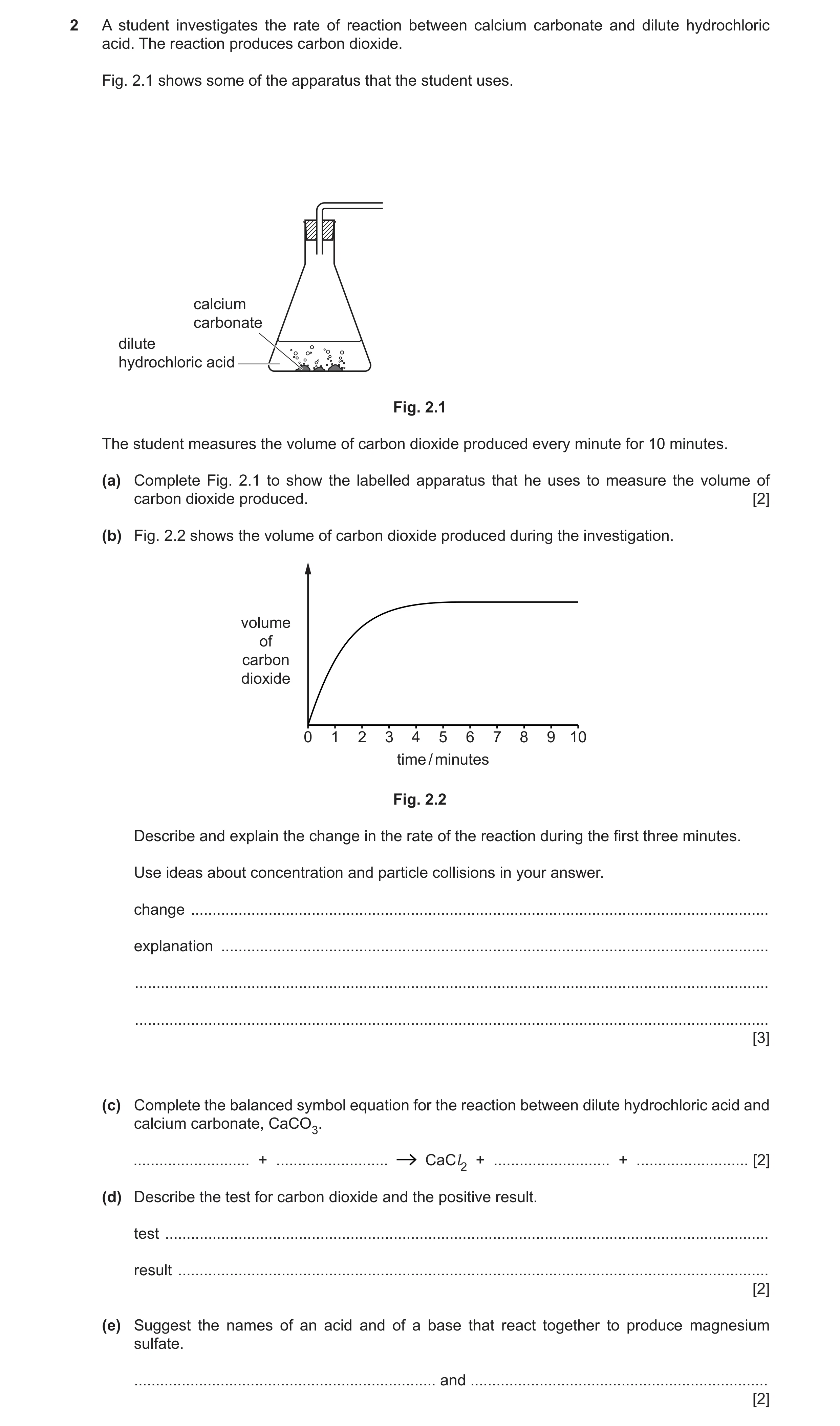
2 A student investigates the rate of reaction between calcium carbonate and dilute hydrochloric acid. The reaction produces carbon dioxide. Fig. 2.1 shows some of the apparatus that the student uses. calcium carbonate dilute hydrochloric acid Fig. 2.1 The student measures the volume of carbon dioxide produced every minute for 10 minutes. (a) Complete Fig. 2.1 to show the labelled apparatus that he uses to measure the volume of carbon dioxide produced. [2] (b) Fig. 2.2 shows the volume of carbon dioxide produced during the investigation. volume of carbon dioxide 0 1 2 3 4 5 6 7 8 9 10 time / minutes Fig. 2.2 Describe and explain the change in the rate of the reaction during the first three minutes. Use ideas about concentration and particle collisions in your answer. change … explanation … … … [3] (c) Complete the balanced symbol equation for the reaction between dilute hydrochloric acid and calcium carbonate, CaCO3. … + … CaCl2 + … + … [2] (d) Describe the test for carbon dioxide and the positive result. test … result … [2] (e) Suggest the names of an acid and of a base that react together to produce magnesium sulfate. … and … [2]
11 marks
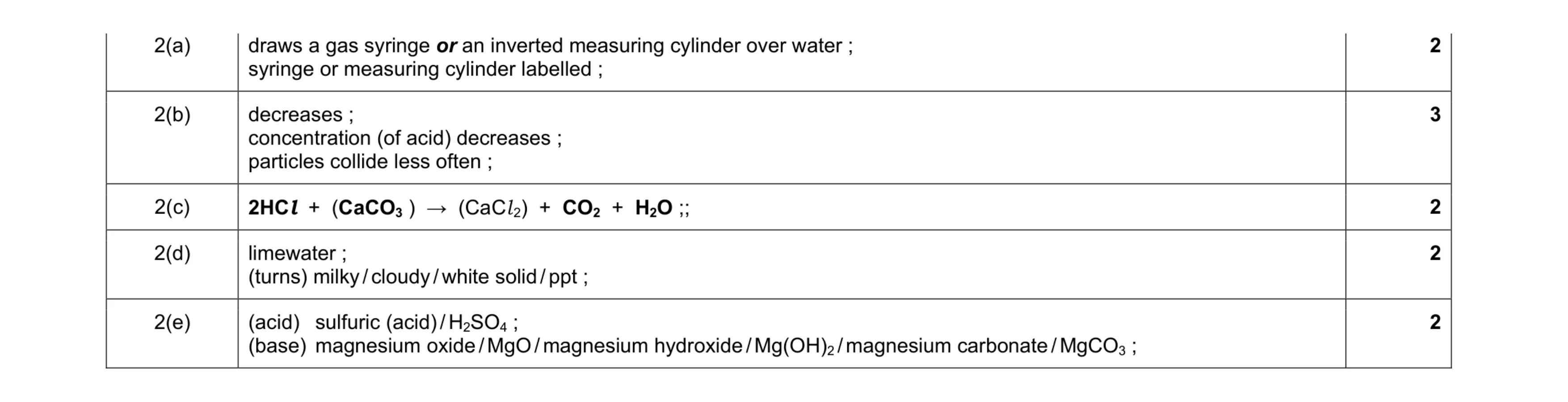
Mark scheme: 2(a) draws a gas syringe or an inverted measuring cylinder over water ; syringe or measuring cylinder labelled ; 2 2(b) decreases ; concentration (of acid) decreases ; particles collide less often ; 3 2(c) 2HCl + (CaCO3 ) → (CaCl 2) + CO2 + H2O ;; 2 2(d) limewater ; (turns) milky / cloudy / white solid / ppt ; 2 2(e) (acid) sulfuric (acid) / H2SO4 ; (base) magnesium oxide / MgO / magnesium hydroxide / Mg(OH)2 / magnesium carbonate / MgCO3 ; 2
This question in 0653/42 Feb/March 2017
Q2 · Petroleum is separated into useful products by process W shown in Fig 0653/41 Oct/Nov 2017
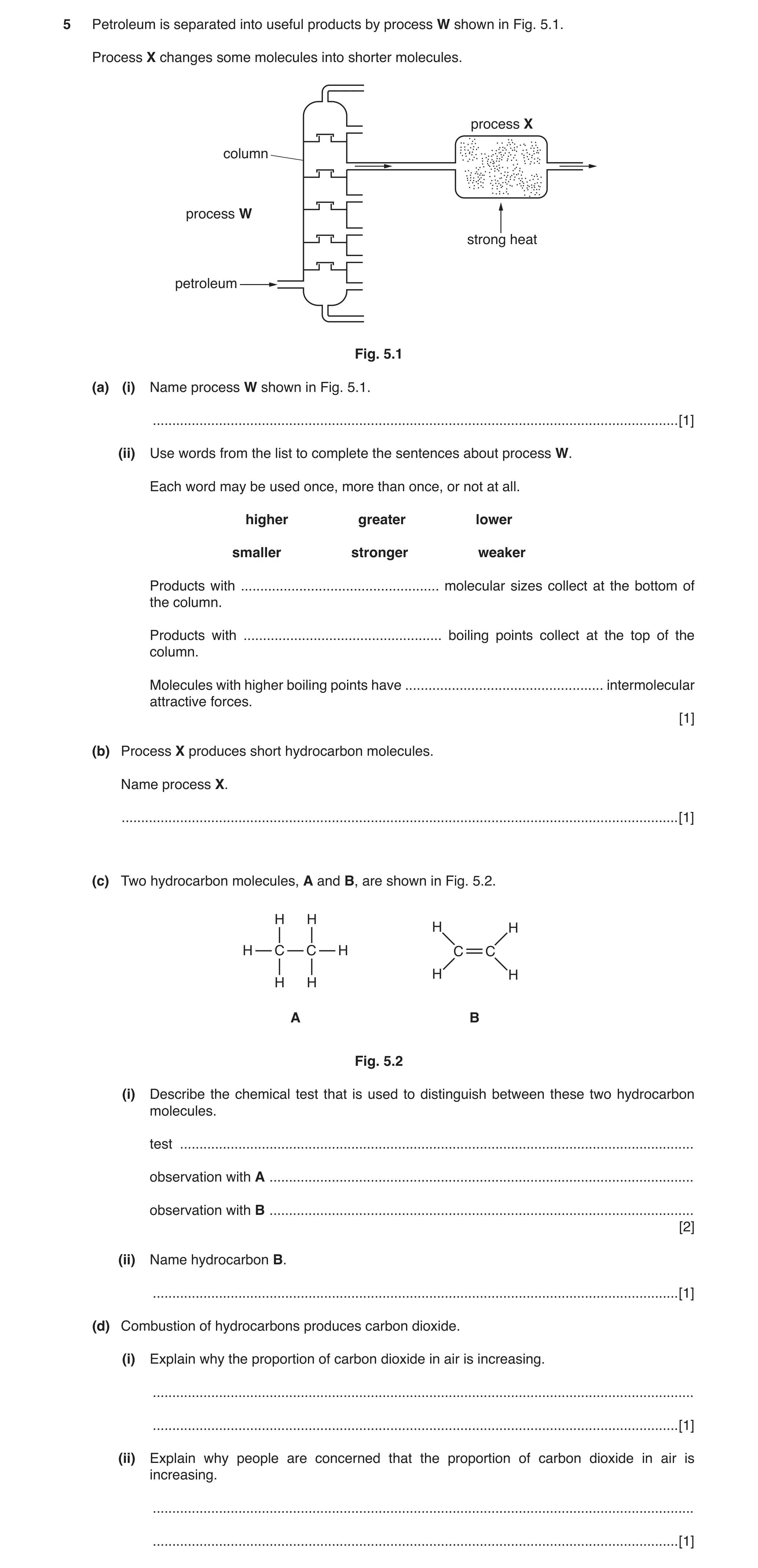
5 Petroleum is separated into useful products by process W shown in Fig. 5.1. Process X changes some molecules into shorter molecules. process X column process W strong heat petroleum Fig. 5.1 (a) (i) Name process W shown in Fig. 5.1. … [1] (ii) Use words from the list to complete the sentences about process W. Each word may be used once, more than once, or not at all. higher greater lower smaller stronger weaker Products with … molecular sizes collect at the bottom of the column. Products with … boiling points collect at the top of the column. Molecules with higher boiling points have … intermolecular attractive forces. [1] (b) Process X produces short hydrocarbon molecules. Name process X. … [1] (c) Two hydrocarbon molecules, A and B, are shown in Fig. 5.2. H H H H H C C H C C H H H H A B Fig. 5.2 (i) Describe the chemical test that is used to distinguish between these two hydrocarbon molecules. test … observation with A … observation with B … [2] (ii) Name hydrocarbon B. … [1] (d) Combustion of hydrocarbons produces carbon dioxide. (i) Explain why the proportion of carbon dioxide in air is increasing. … … [1] (ii) Explain why people are concerned that the proportion of carbon dioxide in air is increasing. … … [1]
8 marks
Mark scheme: 5(a)(i) fractional distillation ; 1 5(a)(ii) greater lower greater ; 1 5(b) cracking ; 1 Question Answer Marks 5(c)(i) (test) bromine (water) ; (observation A) no change and (observation B) decolourises / turns (brown to) colourless ; 2 5(c)(ii) ethene ; 1 5(d)(i) reference to use of (fossil) fuel / named fuel / industrialisation / deforestation ; 1 5(d)(ii) global warming / consequences of global warming ; 1
This question in 0653/41 Oct/Nov 2017
Q3 · A student investigates the combustion of a hydrocarbon, as shown in Fig 0653/42 May/June 2018
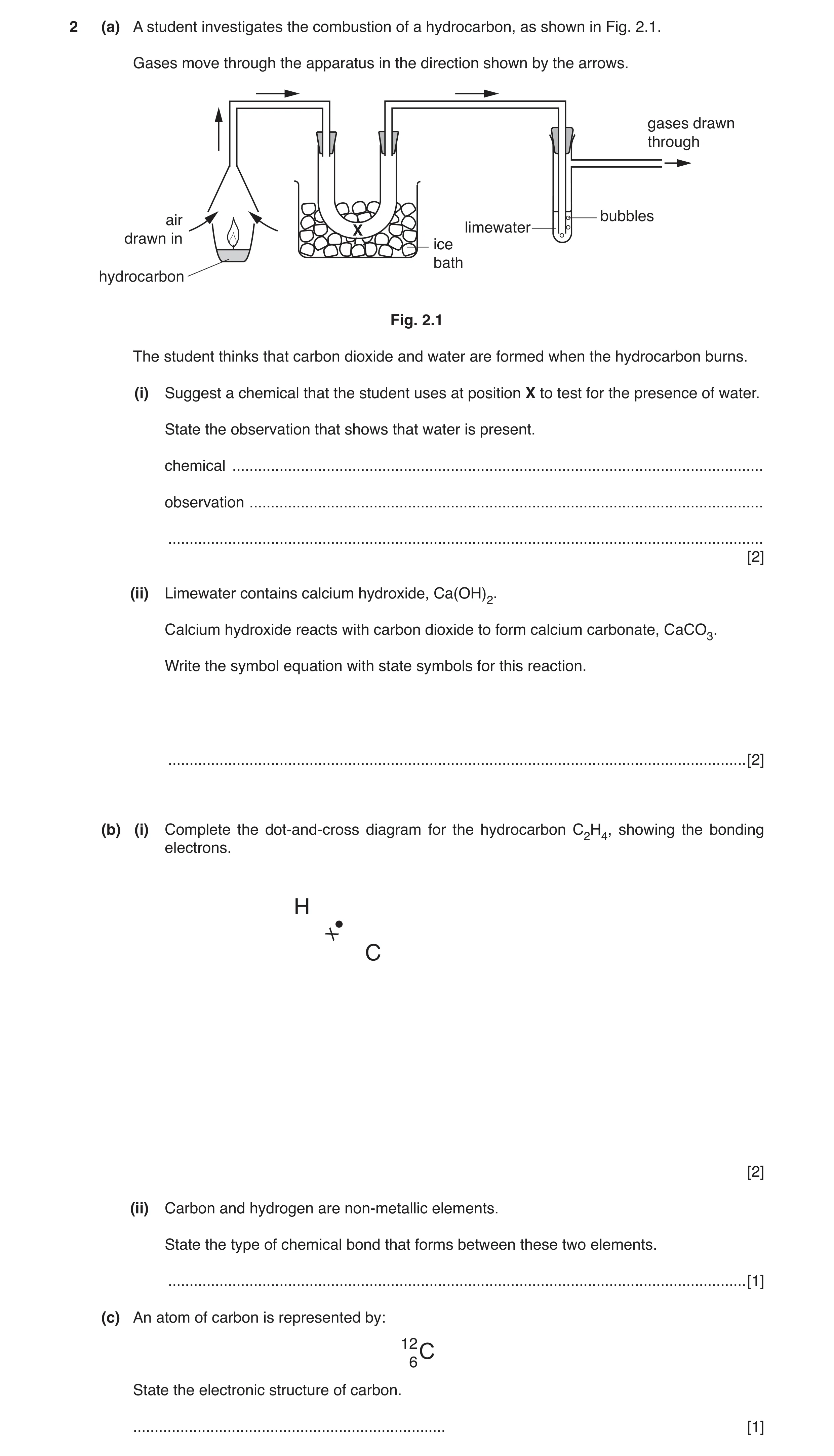
2 (a) A student investigates the combustion of a hydrocarbon, as shown in Fig. 2.1. Gases move through the apparatus in the direction shown by the arrows. gases drawn through X air bubbles X limewater drawn in ice bath hydrocarbon Fig. 2.1 The student thinks that carbon dioxide and water are formed when the hydrocarbon burns. (i) Suggest a chemical that the student uses at position X to test for the presence of water. State the observation that shows that water is present. chemical … observation … … [2] (ii) Limewater contains calcium hydroxide, Ca(OH)2. Calcium hydroxide reacts with carbon dioxide to form calcium carbonate, CaCO3. Write the symbol equation with state symbols for this reaction. … [2] (b) (i) Complete the dot-and-cross diagram for the hydrocarbon C2H4, showing the bonding electrons. H X C [2] (ii) Carbon and hydrogen are non-metallic elements. State the type of chemical bond that forms between these two elements. … [1] (c) An atom of carbon is represented by: 126C State the electronic structure of carbon. … [1]
8 marks
Mark scheme: 2(a)(i) anhydrous / blue cobalt chloride ; turns (blue to ) pink ; OR anhydrous / white copper sulfate ; turns (white to ) blue ; 2 2(a)(ii) Ca(OH)2(aq) + CO2(g) → CaCO3(g) + H2O(l) correct species both sides ; 3 or 4 correct states ; 2 Question Answer Marks 2(b)(i) (circles not essential) 4 electrons between two C atoms ; 2 electrons between each of 4 pairs of C and H atoms ; 2 2(b)(ii) covalent ; 1 2(c) 2, 4 ; 1
This question in 0653/42 May/June 2018
Q4 · The electronic structure of an atom of element E is shown in Fig 0653/43 May/June 2018
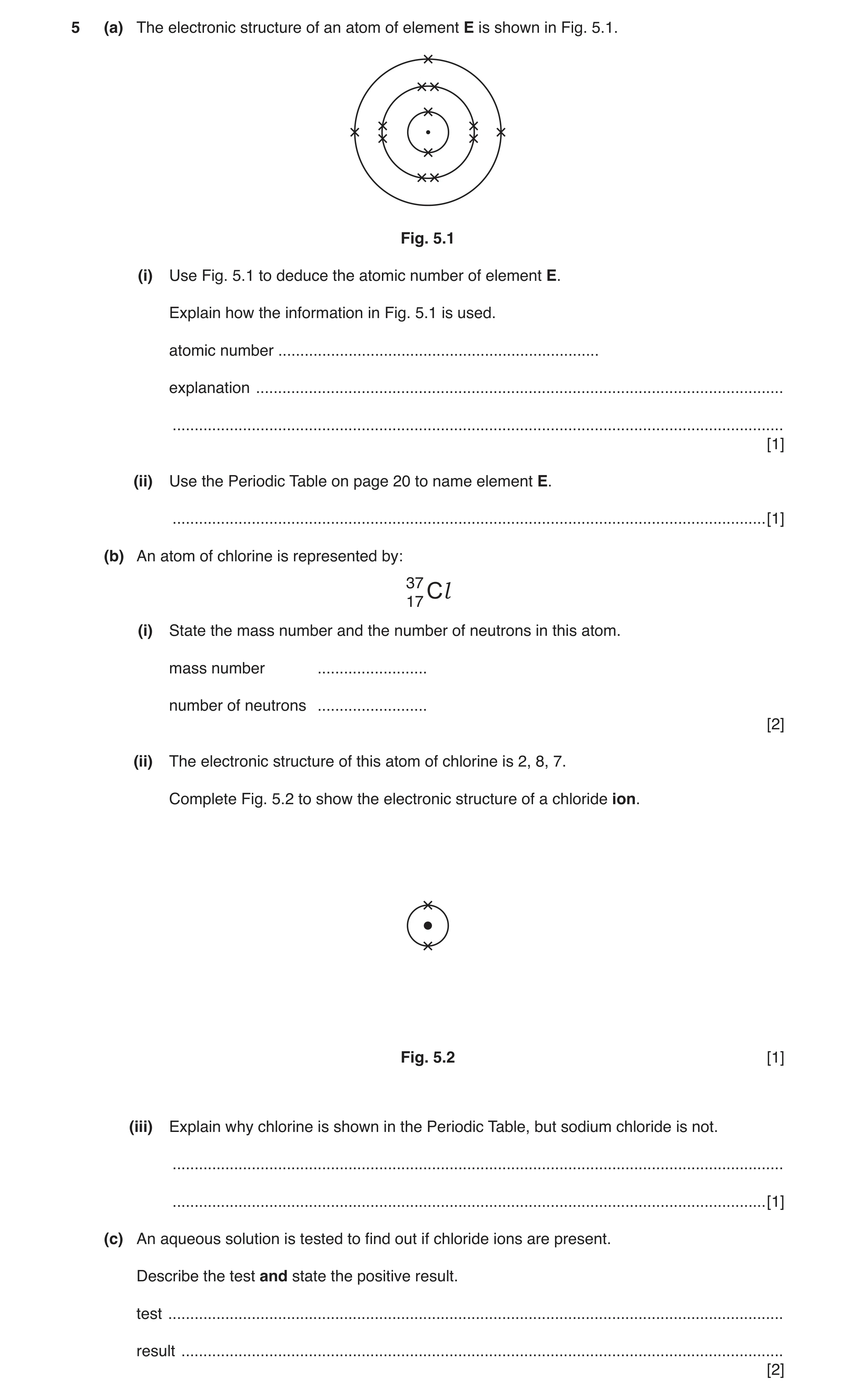
5 (a) The electronic structure of an atom of element E is shown in Fig. 5.1. Fig. 5.1 (i) Use Fig. 5.1 to deduce the atomic number of element E. Explain how the information in Fig. 5.1 is used. atomic number … explanation … … [1] (ii) Use the Periodic Table on page 20 to name element E. … [1] (b) An atom of chlorine is represented by: 3717Cl (i) State the mass number and the number of neutrons in this atom. mass number … number of neutrons … [2] (ii) The electronic structure of this atom of chlorine is 2, 8, 7. Complete Fig. 5.2 to show the electronic structure of a chloride ion. Fig. 5.2 [1] (iii) Explain why chlorine is shown in the Periodic Table, but sodium chloride is not. … … [1] (c) An aqueous solution is tested to find out if chloride ions are present. Describe the test and state the positive result. test … result … [2]
8 marks
Mark scheme: 5(a)(i) (13) 13 electrons so 13 protons / same no. electrons and protons ; 1 5(a)(ii) aluminium ; 1 5(b)(i) (mass no.) 37 ; (neutron no.) 20 ; 2 5(b)(ii) 2, 8, 8 shown on a diagram with concentric shells ; 1 5(b)(iii) (chlorine is an element but) sodium chloride is a compound / not an element ; 1 5(c) (test) silver nitrate / aqueous/solution (acidic conditions) ; (result) white precipitate ; 2
This question in 0653/43 May/June 2018
Q5 · Magnesium chloride is a soluble salt 0653/42 Oct/Nov 2018
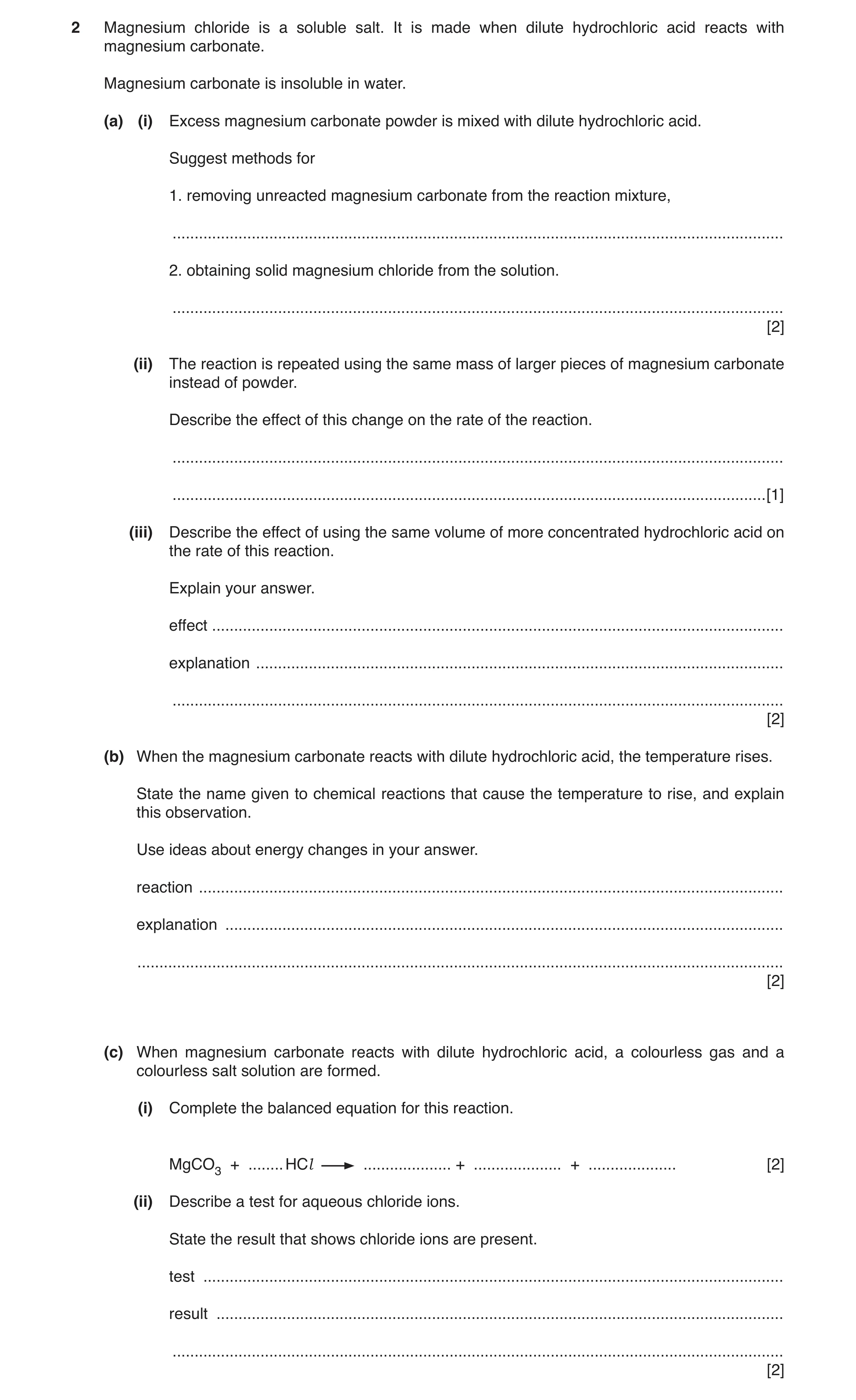
2 Magnesium chloride is a soluble salt. It is made when dilute hydrochloric acid reacts with magnesium carbonate. Magnesium carbonate is insoluble in water. (a) (i) Excess magnesium carbonate powder is mixed with dilute hydrochloric acid. Suggest methods for 1. removing unreacted magnesium carbonate from the reaction mixture, … 2. obtaining solid magnesium chloride from the solution. … [2] (ii) The reaction is repeated using the same mass of larger pieces of magnesium carbonate instead of powder. Describe the effect of this change on the rate of the reaction. … … [1] (iii) Describe the effect of using the same volume of more concentrated hydrochloric acid on the rate of this reaction. Explain your answer. effect … explanation … … [2] (b) When the magnesium carbonate reacts with dilute hydrochloric acid, the temperature rises. State the name given to chemical reactions that cause the temperature to rise, and explain this observation. Use ideas about energy changes in your answer. reaction … explanation … … [2] (c) When magnesium carbonate reacts with dilute hydrochloric acid, a colourless gas and a colourless salt solution are formed. (i) Complete the balanced equation for this reaction. MgCO3 + … HCl … + … + … [2] (ii) Describe a test for aqueous chloride ions. State the result that shows chloride ions are present. test … result … … [2]
11 marks
Mark scheme: 2(a)(i) (remove MgCO3) filtration / filtering / filter ; (obtain solid salt) evaporation / crystallisation ; 2 2(a)(ii) decreases ; 1 2(a)(iii) (effect) increases ; (explanation) particles collide more frequently / more chance of collisions ; 2 2(b) exothermic ; chemical (energy changes) to heat / thermal (energy) ; 2 Question Answer Marks 2(c)(i) (MgCO3) + 2(HCl) → MgCl2 + CO2 + H2O ; formula of magnesium chloride ; all else correct ; 2 2(c)(ii) (test) (dil. nitric acid and) aqueous silver nitrate / AgNO3 ; (result) white precipitate / solid; 2
This question in 0653/42 Oct/Nov 2018
Q6 · The structures of three hydrocarbon molecules, A, B, and C 0653/43 Oct/Nov 2018
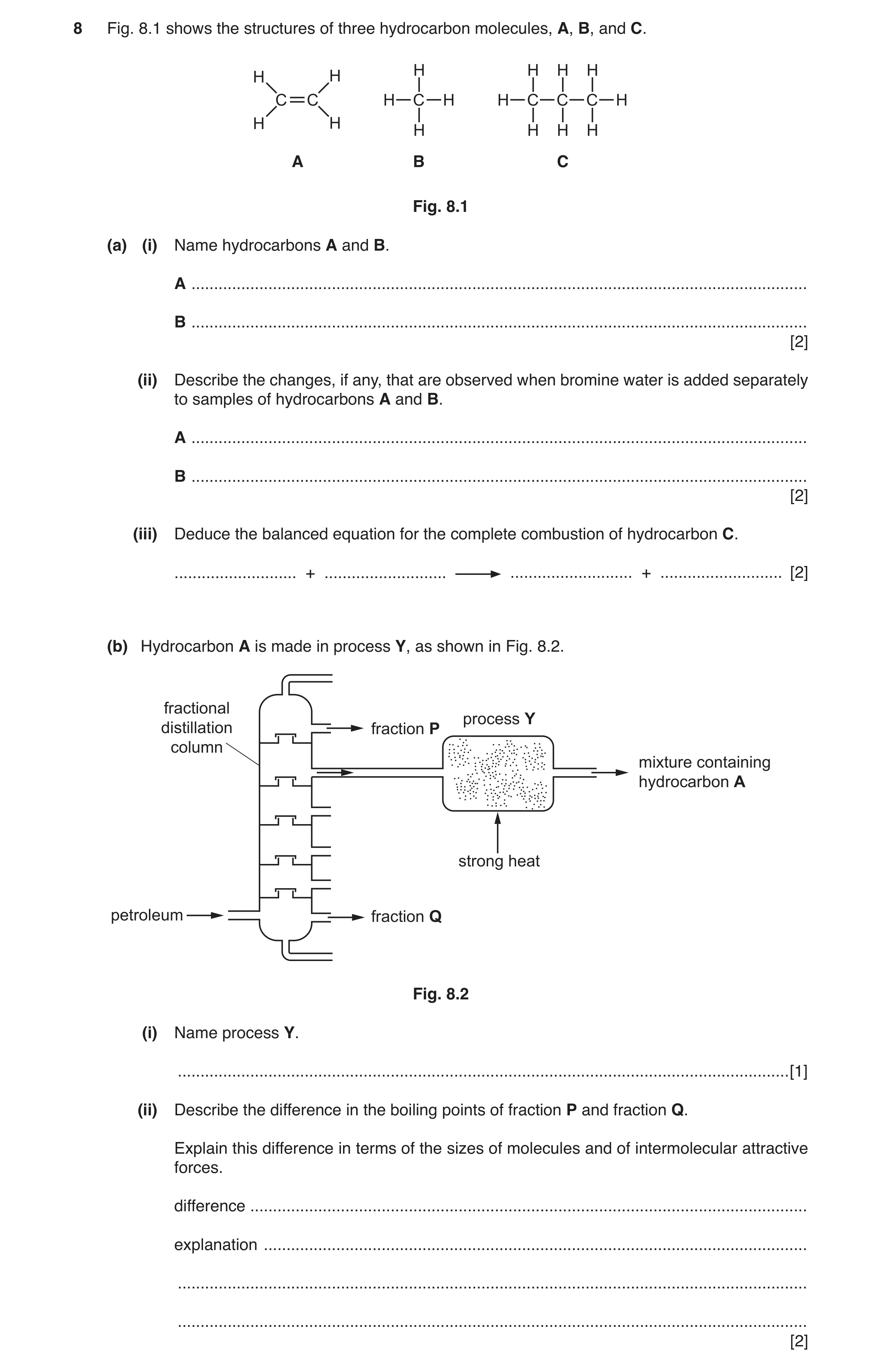
8 Fig. 8.1 shows the structures of three hydrocarbon molecules, A, B, and C. H H H H H H C C H C H H C C C H H H H H H H A B C Fig. 8.1 (a) (i) Name hydrocarbons A and B. A … B … [2] (ii) Describe the changes, if any, that are observed when bromine water is added separately to samples of hydrocarbons A and B. A … B … [2] (iii) Deduce the balanced equation for the complete combustion of hydrocarbon C. … + … … + … [2] (b) Hydrocarbon A is made in process Y, as shown in Fig. 8.2. fractional process Y distillation fraction P column mixture containing hydrocarbon A strong heat petroleum fraction Q Fig. 8.2 (i) Name process Y. … [1] (ii) Describe the difference in the boiling points of fraction P and fraction Q. Explain this difference in terms of the sizes of molecules and of intermolecular attractive forces. difference … explanation … … … [2]
9 marks
Mark scheme: 8(a)(i) (A) ethene ; (B) methane ; 2 8(a)(ii) (A) decolourises ; (B) no (visible) change ; 2 8(a)(iii) C3H8 + 5O2 → 3CO2 + 4H2O species ; balanced ; 2 8(b)(i) cracking ; 1 8(b)(ii) (difference) [(b.pt of) Q is greater] NOTE: no mark for difference, but must be correct for explanation marks to be awarded (explanation) Q has larger / heavier molecules ; molecules of Q have greater intermolecular attractive forces ; 2
This question in 0653/43 Oct/Nov 2018
Q7 · Aluminium is a Group III metal 0653/41 Oct/Nov 2019
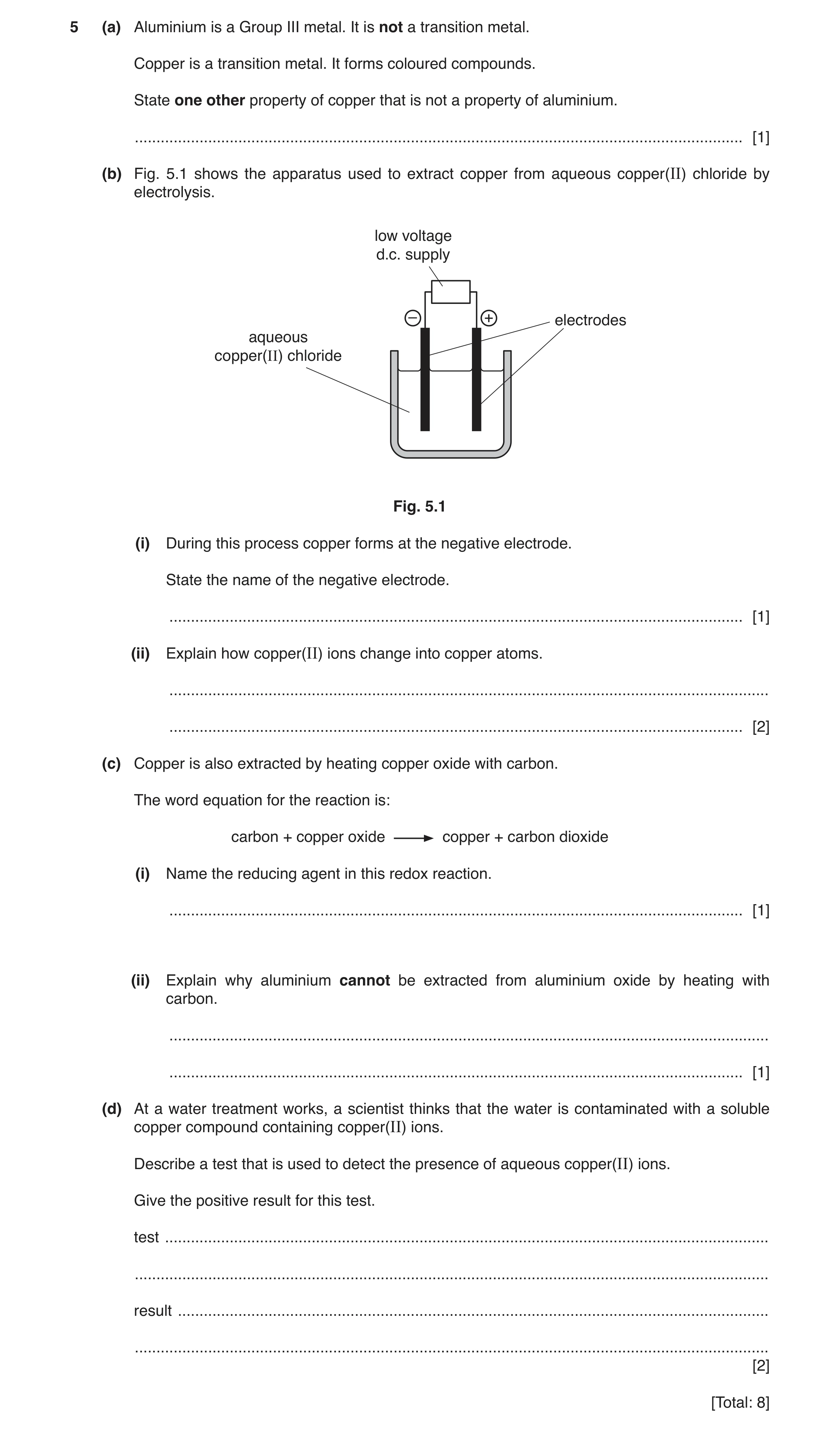
5 (a) Aluminium is a Group III metal. It is not a transition metal. Copper is a transition metal. It forms coloured compounds. State one other property of copper that is not a property of aluminium. … [1] (b) Fig. 5.1 shows the apparatus used to extract copper from aqueous copper(II) chloride by electrolysis. low voltage d.c. supply – + electrodes aqueous copper(II) chloride Fig. 5.1 (i) During this process copper forms at the negative electrode. State the name of the negative electrode. … [1] (ii) Explain how copper(II) ions change into copper atoms. … … [2] (c) Copper is also extracted by heating copper oxide with carbon. The word equation for the reaction is: carbon + copper oxide copper + carbon dioxide (i) Name the reducing agent in this redox reaction. … [1] (ii) Explain why aluminium cannot be extracted from aluminium oxide by heating with carbon. … … [1] (d) At a water treatment works, a scientist thinks that the water is contaminated with a soluble copper compound containing copper(II) ions. Describe a test that is used to detect the presence of aqueous copper(II) ions. Give the positive result for this test. test … … result … … [2] [Total: 8]
8 marks
Mark scheme: 5(a) high density / high melting point / acts as catalyst ; 1 5(b)(i) cathode ; 1 5(b)(ii) gains electrons ; two electrons ; 2 5(c)(i) carbon ; 1 5(c)(ii) aluminium is too reactive / aluminium more reactive than carbon ; 1 5(d) (aqueous) sodium hydroxide ; (pale) blue ppt ; or flame test ; blue–green / turquoise colour ; 2
This question in 0653/41 Oct/Nov 2019
Q8 · The elements in the Periodic Table, shown on page 20, are arranged in groups and periods 0653/43 Oct/Nov 2019
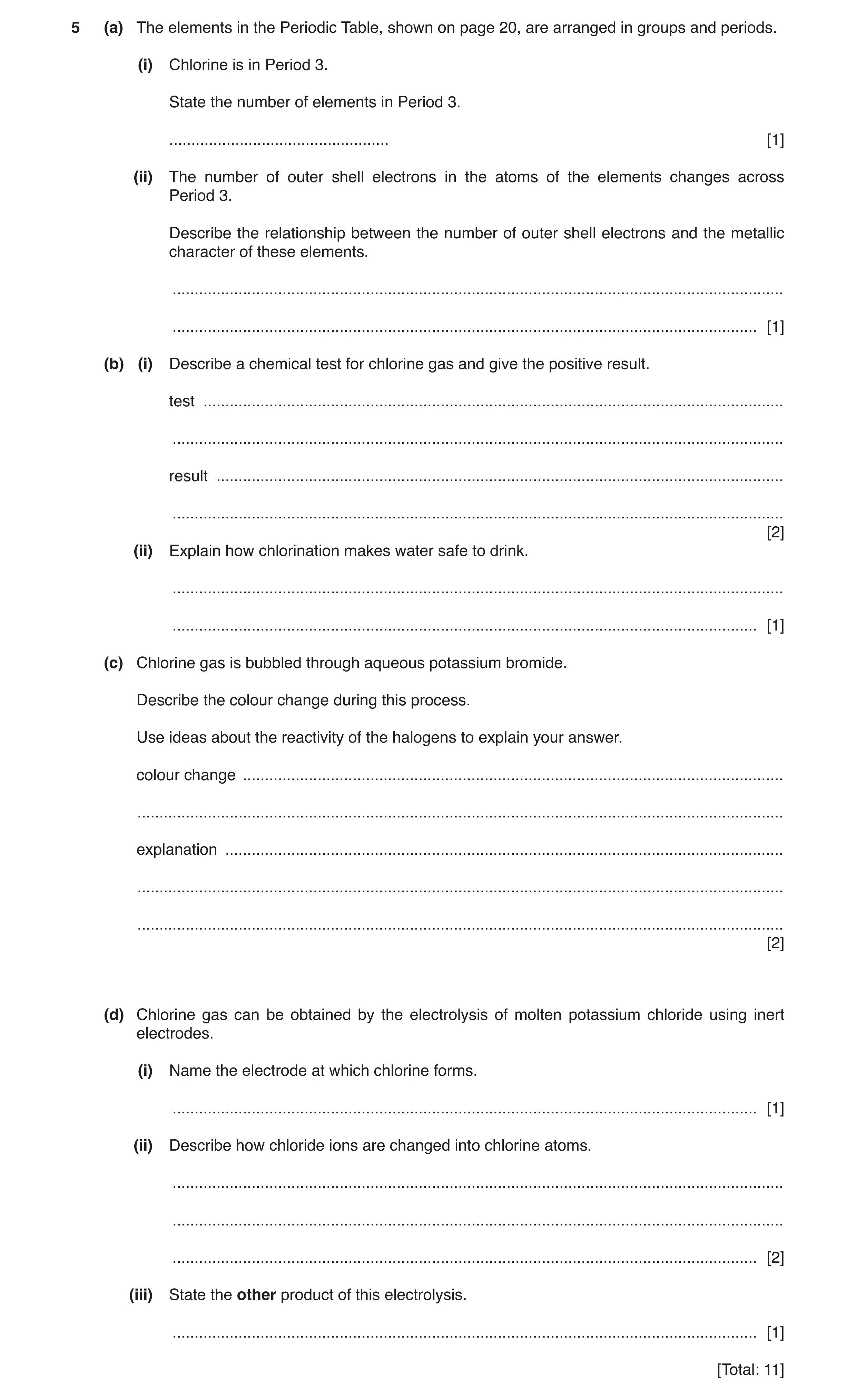
5 (a) The elements in the Periodic Table, shown on page 20, are arranged in groups and periods. (i) Chlorine is in Period 3. State the number of elements in Period 3. … [1] (ii) The number of outer shell electrons in the atoms of the elements changes across Period 3. Describe the relationship between the number of outer shell electrons and the metallic character of these elements. … … [1] (b) (i) Describe a chemical test for chlorine gas and give the positive result. test … … result … … [2] (ii) Explain how chlorination makes water safe to drink. … … [1] (c) Chlorine gas is bubbled through aqueous potassium bromide. Describe the colour change during this process. Use ideas about the reactivity of the halogens to explain your answer. colour change … … explanation … … … [2] (d) Chlorine gas can be obtained by the electrolysis of molten potassium chloride using inert electrodes. (i) Name the electrode at which chlorine forms. … [1] (ii) Describe how chloride ions are changed into chlorine atoms. … … … [2] (iii) State the other product of this electrolysis. … [1] [Total: 11]
11 marks
Mark scheme: 5(a)(i) 8 ; 1 5(a)(ii) the greater the number of outer shell electrons, the less metallic the elements become ; 1 5(b)(i) damp litmus paper ; bleaches ; 2 5(b)(ii) sterilises water / kills harmful microorganisms ; 1 5(c) yellow / orange colouration ; chlorine displaces bromine / chlorine is more reactive than bromine / chlorine oxidises bromide ions ; 2 5(d)(i) anode ; 5(d)(ii) chloride ion loses electrons ; one electron (per ion) ; 2 5(d)(iii) potassium ; 1
This question in 0653/43 Oct/Nov 2019
Q9 · Copper chloride is made when copper oxide reacts with dilute hydrochloric acid 0653/43 Oct/Nov 2020
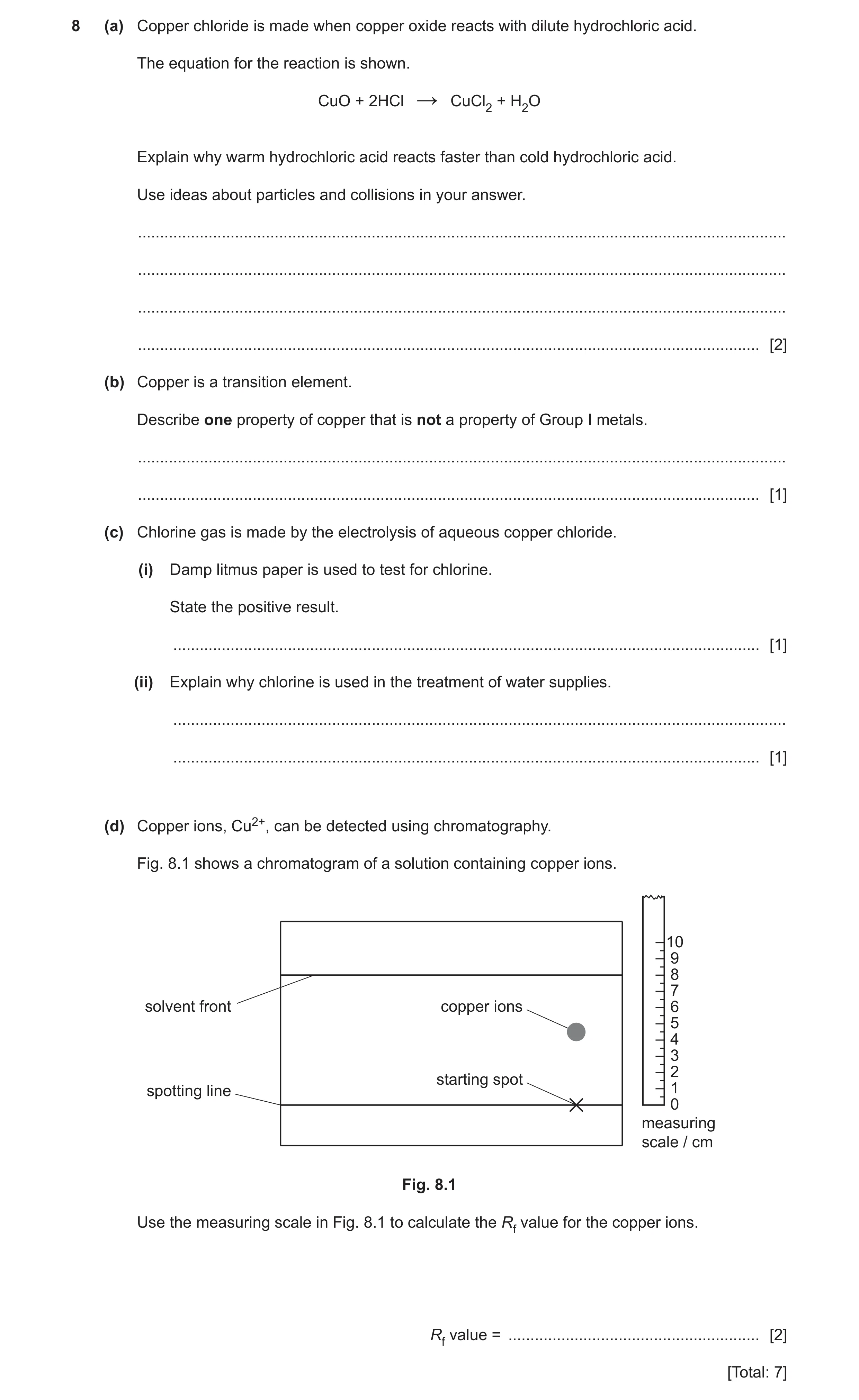
8 (a) Copper chloride is made when copper oxide reacts with dilute hydrochloric acid. The equation for the reaction is shown. CuO + 2HCl CuCl2 + H2O → Explain why warm hydrochloric acid reacts faster than cold hydrochloric acid. Use ideas about particles and collisions in your answer. … … … … [2] (b) Copper is a transition element. Describe one property of copper that is not a property of Group I metals. … … [1] (c) Chlorine gas is made by the electrolysis of aqueous copper chloride. (i) Damp litmus paper is used to test for chlorine. State the positive result. … [1] (ii) Explain why chlorine is used in the treatment of water supplies. … … [1] (d) Copper ions, Cu2+, can be detected using chromatography. Fig. 8.1 shows a chromatogram of a solution containing copper ions. 10 9 8 7 solvent front copper ions 6 5 4 3 2 starting spot spotting line 1 0 measuring scale / cm Fig. 8.1 Use the measuring scale in Fig. 8.1 to calculate the Rf value for the copper ions. Rf value = … [2] [Total: 7]
7 marks
Mark scheme: 8(a) warm hydrochloric acid particles have more kinetic energy ; more successful collisions / more frequent collisions ; 2 8(b) hard / dense / high melting point / acts as a catalyst / forms coloured compounds ; 1 8(c)(i) bleaches (damp litmus paper) ; 1 8(c)(ii) sterilises water / kills microbes / kills bacteria ; 1 8(d) copper ions = 4.5 (cm) AND solvent front = 8 (cm) (from diagram) ; (4.5 ÷ 8.0 =) 0.56 ; 2
This question in 0653/43 Oct/Nov 2020
Q10 · Hydrogen and oxygen are made when dilute sulfuric acid is electrolysed using inert… 0653/42 Feb/March 2022
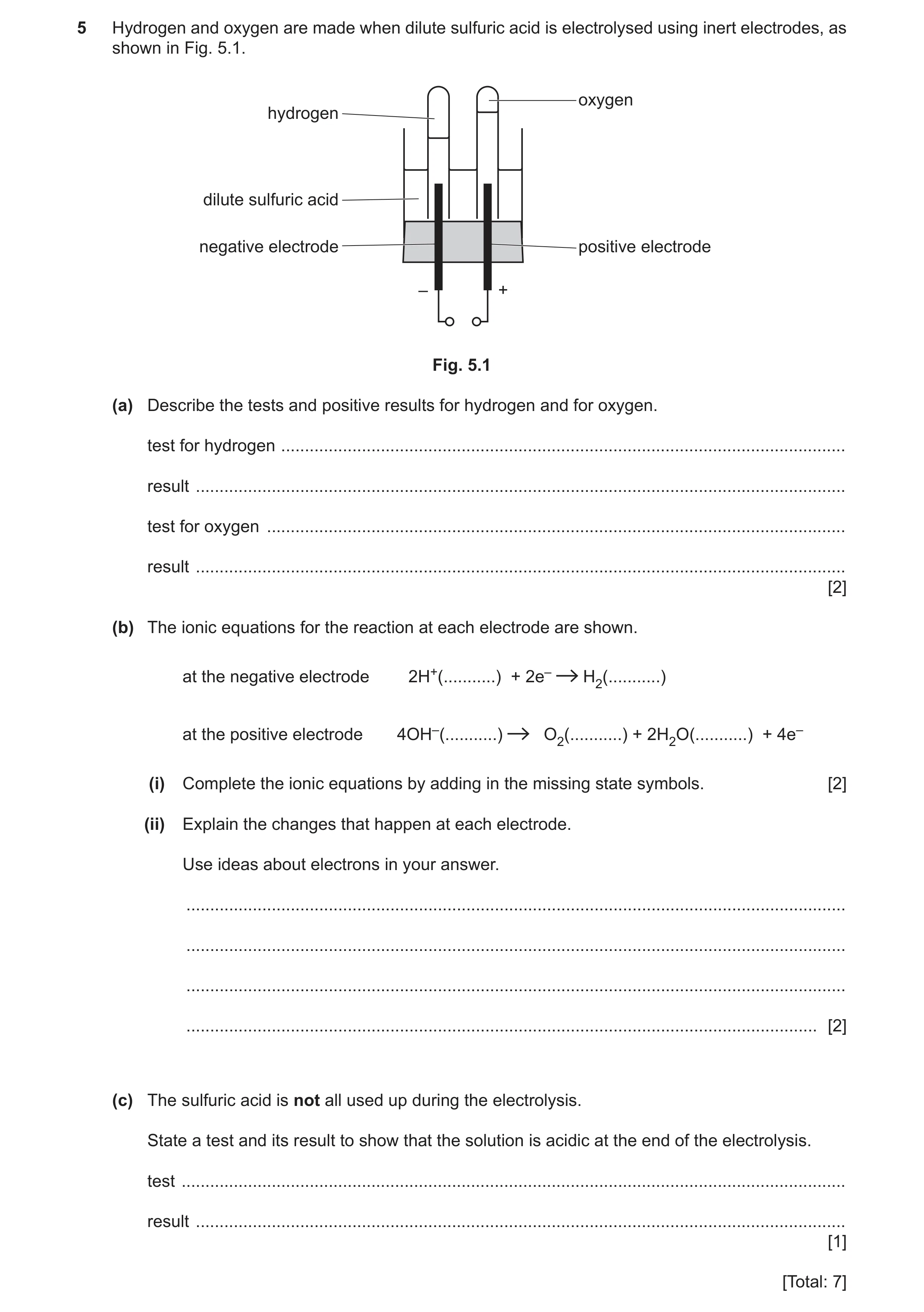
5 Hydrogen and oxygen are made when dilute sulfuric acid is electrolysed using inert electrodes, as shown in Fig. 5.1. oxygen hydrogen dilute sulfuric acid negative electrode positive electrode – + Fig. 5.1 (a) Describe the tests and positive results for hydrogen and for oxygen. test for hydrogen … result … test for oxygen … result … [2] (b) The ionic equations for the reaction at each electrode are shown. at the negative electrode 2H+( … ) + 2e– H2( … ) at the positive electrode 4OH–( … ) O2( … ) + 2H2O( … ) + 4e– (i) Complete the ionic equations by adding in the missing state symbols. [2] (ii) Explain the changes that happen at each electrode. Use ideas about electrons in your answer. … … … … [2] (c) The sulfuric acid is not all used up during the electrolysis. State a test and its result to show that the solution is acidic at the end of the electrolysis. test … result … [1] [Total: 7]
7 marks
Mark scheme: 5(a) hydrogen: lighted splint and pops / gives a squeaky pop ; oxygen: glowing splint and relights ; 2 5(b)(i) 2H+(aq) + 2 e– → H2(g) 4OH-(aq) → O2(g) + 2H2O(l) + 4e– (g) shown for hydrogen and oxygen ; (aq) for H + and OH – and (l) for water ; 2 5(b)(ii) (at the negative electrode / cathode) hydrogen ions gain electrons (to form hydrogen atoms / hydrogen molecules) ; (at the positive electrode / anode) hydroxide ions lose electrons (to form water molecules and oxygen molecules) ; 2 5(c) universal indicator / (blue) litmus AND turns red ; 1
This question in 0653/42 Feb/March 2022
Q11 · The structure of a molecule of ethene is shown in Fig 0653/43 May/June 2022
5 The structure of a molecule of ethene is shown in Fig. 5.1. H H C C H H Fig. 5.1 (a) State how Fig. 5.1 shows that ethene is an alkene. … [1] (b) Ethene is made from naphtha in an industrial process. Name this process. … [1] (c) Ethene undergoes a polymerisation reaction. (i) State the name of the polymer formed. … [1] (ii) State the type of polymerisation reaction that happens when ethene forms a polymer. … [1] (d) A student investigates the combustion of ethene. A cold surface is held near burning ethene. Drops of colourless liquid collect on the cold surface, as shown in Fig. 5.2. cold surface drops of colourless liquid burning ethene not to scale Fig. 5.2 (i) The student does a test which shows that the colourless liquid contains water. Describe a chemical test for water. State the colour change observed. test … colour change from … to … [2] (ii) During combustion, water forms as a gas. State the change that occurs when the gas collects as a liquid on the cold surface in Fig. 5.2. … … [1] (iii) State the name of the other product formed during the complete combustion of ethene. … [1] [Total: 8]
8 marks
Mark scheme: 5(a) (carbon-carbon) double bond ; 1 5(b) cracking ; 1 5(c)(i) poly(ethene) / polyethene ; 1 5(c)(ii) addition ; 1 Question Answer Marks 5(d)(i) (anhydrous) cobalt(II) chloride ; from blue to pink ; OR (anhydrous) copper(II) sulfate ; from white to blue ; 2 5(d)(ii) condensation / condenses ; 1 5(d)(iii) carbon dioxide ; 1
This question in 0653/43 May/June 2022
Q12 · Calcium carbonate reacts with dilute hydrochloric acid to produce a gas 0653/43 May/June 2022
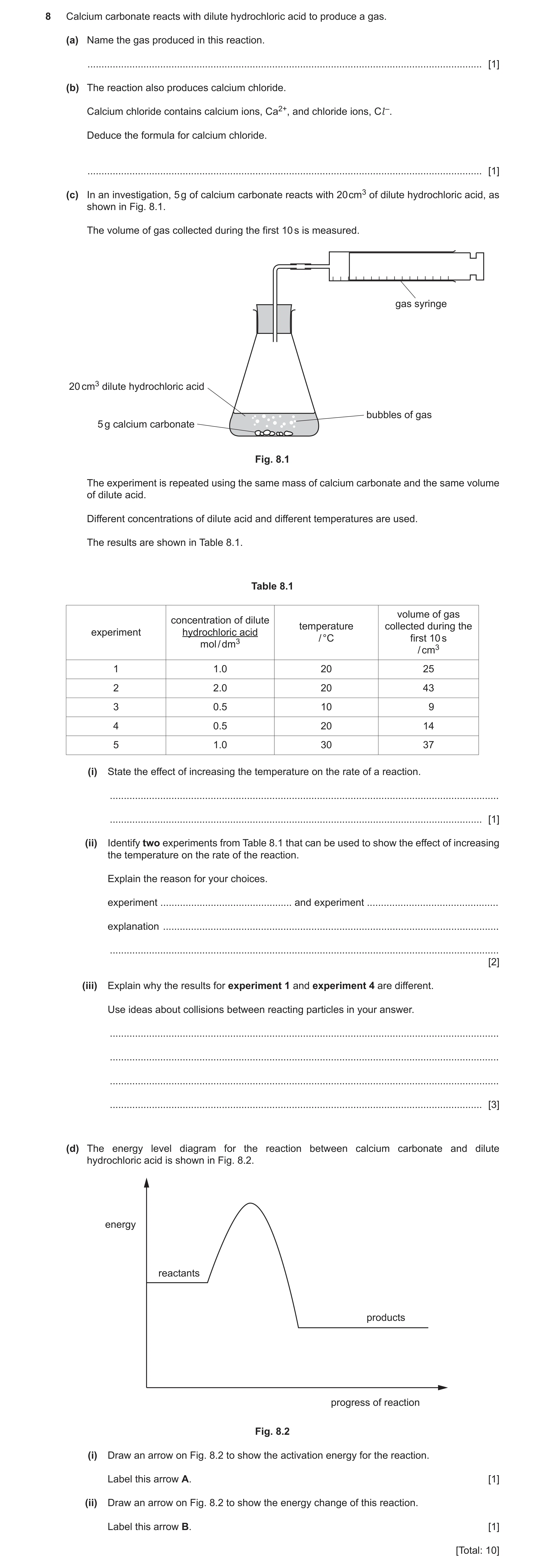
8 Calcium carbonate reacts with dilute hydrochloric acid to produce a gas. (a) Name the gas produced in this reaction. … [1] (b) The reaction also produces calcium chloride. Calcium chloride contains calcium ions, Ca2+, and chloride ions, Cl –. Deduce the formula for calcium chloride. … [1] (c) In an investigation, 5 g of calcium carbonate reacts with 20 cm3 of dilute hydrochloric acid, as shown in Fig. 8.1. The volume of gas collected during the first 10 s is measured. gas syringe 20 cm3 dilute hydrochloric acid bubbles of gas 5 g calcium carbonate Fig. 8.1 The experiment is repeated using the same mass of calcium carbonate and the same volume of dilute acid. Different concentrations of dilute acid and different temperatures are used. The results are shown in Table 8.1. Table 8.1 volume of gas concentration of dilute temperature collected during the experiment hydrochloric acid / °C first 10 s mol / dm3 / cm3 1 1.0 20 25 2 2.0 20 43 3 0.5 10 9 4 0.5 20 14 5 1.0 30 37 (i) State the effect of increasing the temperature on the rate of a reaction. … … [1] (ii) Identify two experiments from Table 8.1 that can be used to show the effect of increasing the temperature on the rate of the reaction. Explain the reason for your choices. experiment … and experiment … explanation … … [2] (iii) Explain why the results for experiment 1 and experiment 4 are different. Use ideas about collisions between reacting particles in your answer. … … … … [3] (d) The energy level diagram for the reaction between calcium carbonate and dilute hydrochloric acid is shown in Fig. 8.2. energy reactants products progress of reaction Fig. 8.2 (i) Draw an arrow on Fig. 8.2 to show the activation energy for the reaction. Label this arrow A. [1] (ii) Draw an arrow on Fig. 8.2 to show the energy change of this reaction. Label this arrow B. [1] [Total: 10]
10 marks
Mark scheme: 8(a) carbon dioxide ; 1 8(b) CaCl2 ; 1 8(c)(i) increases rate / higher rate / faster ; 1 8(c)(ii) 3 and 4 OR 1 and 5 ; need to keep concentration same / 3 and 4 both have concentration of 0.5 / 1 and 5 both have concentration of 1.0 ; 2 Question Answer Marks 8(c)(iii) 4 has a lower concentration than 1 / lower concentration has a lower rate ORA ; particles are further apart in 4 / fewer particles per unit volume ORA ; collisions less frequent in 4 / fewer successful collisions in 4 ORA ; 3 8(d)(i) arrow A starts and ends in the correct place ; e.g. 1 8(d)(ii) arrow B starts and ends in the correct place ; 1
This question in 0653/43 May/June 2022
Q13 · Concentrated aqueous sodium chloride is electrolysed using inert electrodes, as shown in… 0653/41 Oct/Nov 2022
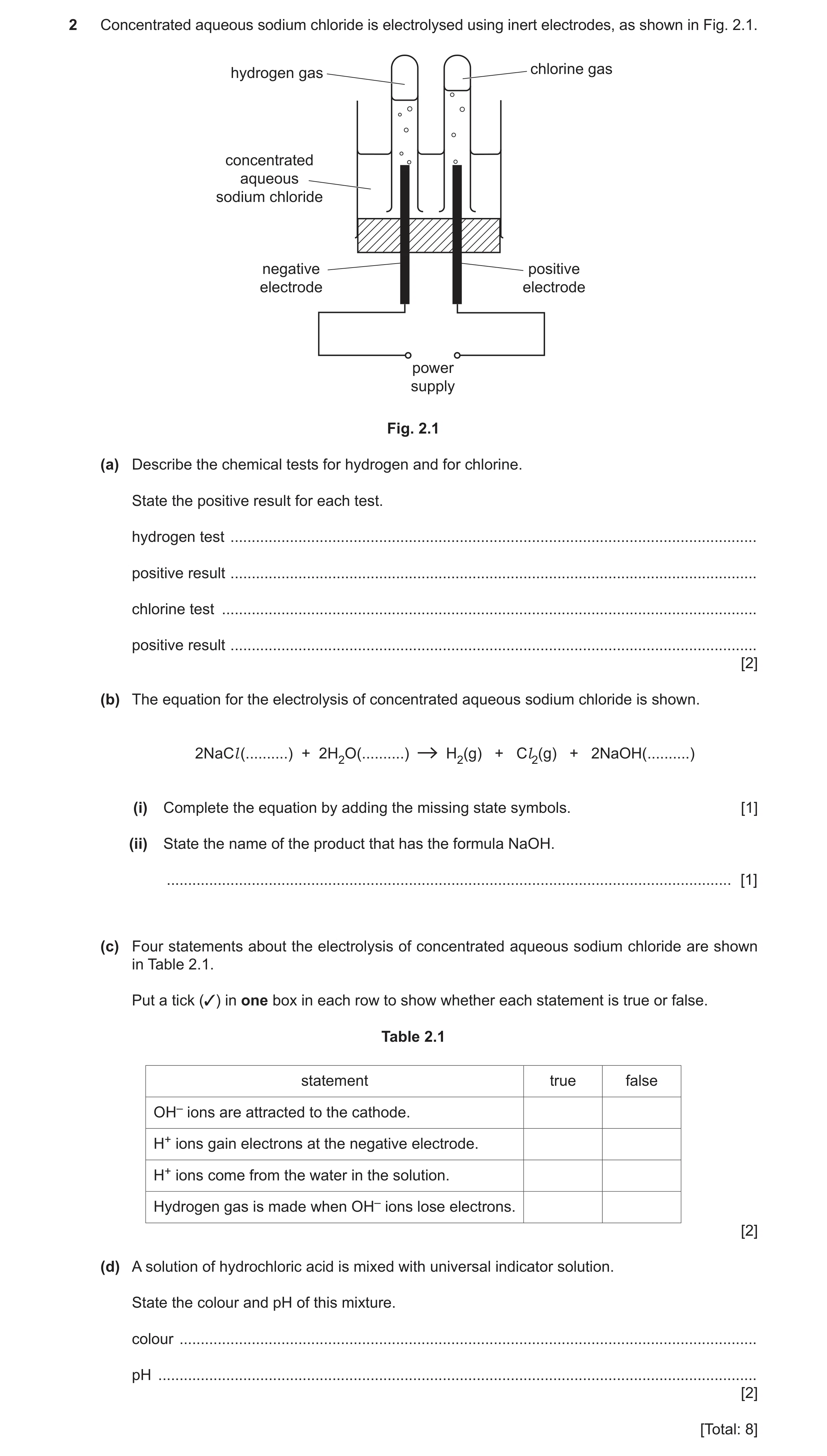
2 Concentrated aqueous sodium chloride is electrolysed using inert electrodes, as shown in Fig. 2.1. chlorine gas hydrogen gas concentrated aqueous sodium chloride negative positive electrode electrode power supply Fig. 2.1 (a) Describe the chemical tests for hydrogen and for chlorine. State the positive result for each test. hydrogen test … positive result … chlorine test … positive result … [2] (b) The equation for the electrolysis of concentrated aqueous sodium chloride is shown. 2NaCl ( … ) + 2H2O( … ) H2(g) + Cl2(g) + 2NaOH( … ) (i) Complete the equation by adding the missing state symbols. [1] (ii) State the name of the product that has the formula NaOH. … [1] (c) Four statements about the electrolysis of concentrated aqueous sodium chloride are shown in Table 2.1. Put a tick (3) in one box in each row to show whether each statement is true or false. Table 2.1 statement true false OH– ions are attracted to the cathode. H+ ions gain electrons at the negative electrode. H+ ions come from the water in the solution. Hydrogen gas is made when OH– ions lose electrons. [2] (d) A solution of hydrochloric acid is mixed with universal indicator solution. State the colour and pH of this mixture. colour … pH … [2] [Total: 8]
8 marks
Mark scheme: 2(a) hydrogen test lighted splint AND positive result pops ; 2 chlorine test (damp) litmus paper AND positive result bleaches ; 2(b)(i) 2NaCl (aq) AND 2H2O (l ) AND 2NaOH (aq) ; 1 2(b)(ii) sodium hydroxide ; 1 2(c) 2 statement true false OH- ions are attracted to the cathode. ✓ H+ ions gain electrons at the negative electrode. ✓ H+ ions come from the water in the solution. ✓ Hydrogen gas is made when OH– ions lose electrons. ✓ two or three correct ; all four correct ; 2(d) colour red ; 2 pH answer in range 1–3 ;
This question in 0653/41 Oct/Nov 2022
Q14 · The structures of ethane and ethene are shown in Fig 0653/42 Oct/Nov 2022
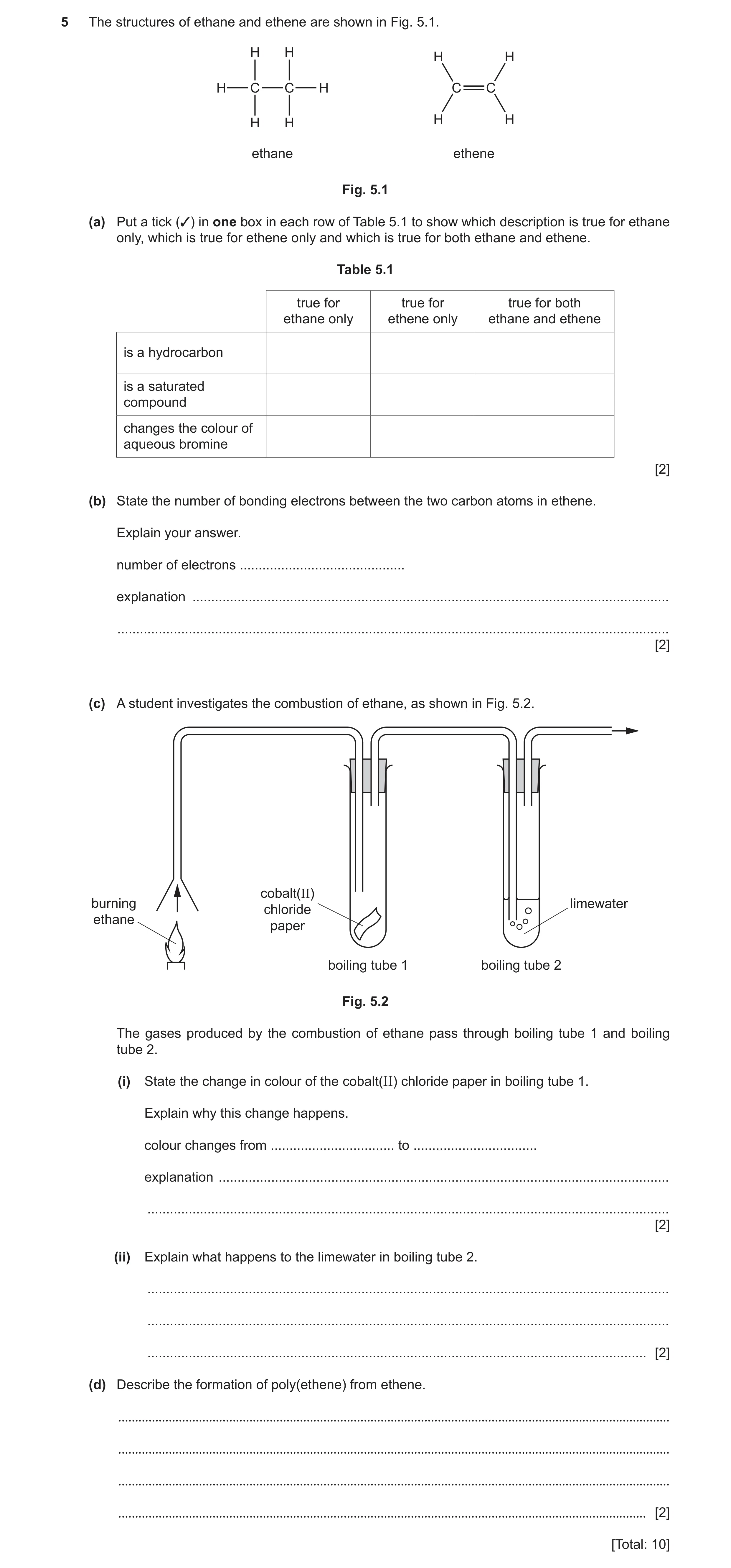
5 The structures of ethane and ethene are shown in Fig. 5.1. H H H H H C C H C C H H H H ethane ethene Fig. 5.1 (a) Put a tick (✓) in one box in each row of Table 5.1 to show which description is true for ethane only, which is true for ethene only and which is true for both ethane and ethene. Table 5.1 true for true for true for both ethane only ethene only ethane and ethene is a hydrocarbon is a saturated compound changes the colour of aqueous bromine [2] (b) State the number of bonding electrons between the two carbon atoms in ethene. Explain your answer. number of electrons … explanation … … [2] (c) A student investigates the combustion of ethane, as shown in Fig. 5.2. cobalt(II) burning limewater chloride ethane paper boiling tube 1 boiling tube 2 Fig. 5.2 The gases produced by the combustion of ethane pass through boiling tube 1 and boiling tube 2. (i) State the change in colour of the cobalt(II) chloride paper in boiling tube 1. Explain why this change happens. colour changes from … to … explanation … … [2] (ii) Explain what happens to the limewater in boiling tube 2. … … … [2] (d) Describe the formation of poly(ethene) from ethene. … … … … [2] [Total: 10]
10 marks
Mark scheme: 5(a) 2 true for true for true for both ethane only ethene only ethane and ethene is a hydrocarbon ✓ is a saturated ✓ compound changes the colour of ✓ aqueous bromine one correct ; all three correct ; 5(b) 4 ; 2 double bond / two bonds each, containing two electrons ; 5(c)(i) blue (to) pink ; 2 water (vapour) is made ; 5(c)(ii) limewater turns milky ; 2 because carbon dioxide is made ; 5(d) idea that, many (ethene) molecules join ; 2 correct reference to, monomer / (addition) polymerisation ;
This question in 0653/42 Oct/Nov 2022
Q15 · An electric current is passed through concentrated aqueous sodium chloride using inert… 0653/41 May/June 2023
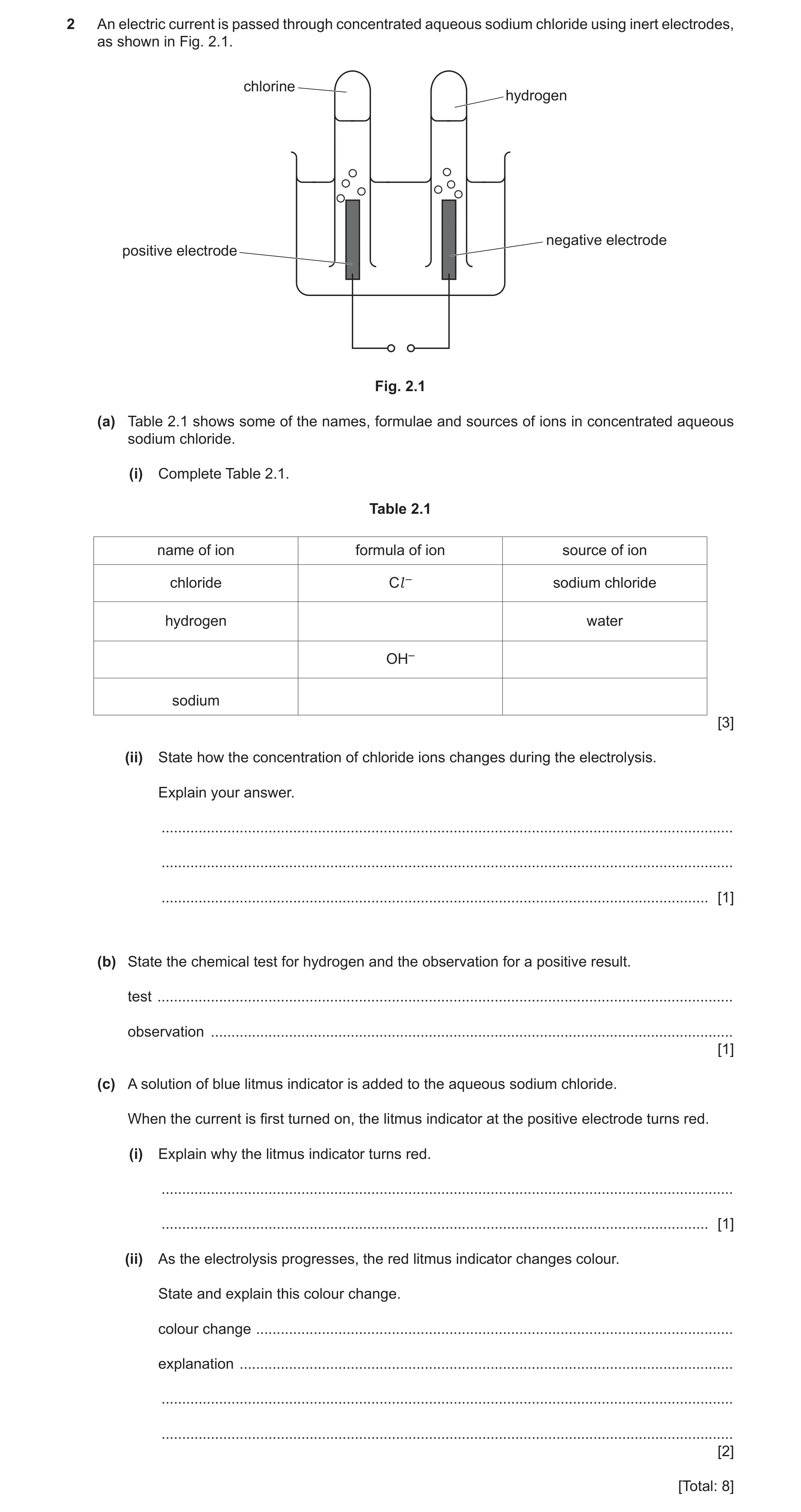
2 An electric current is passed through concentrated aqueous sodium chloride using inert electrodes, as shown in Fig. 2.1. chlorine hydrogen negative electrode positive electrode Fig. 2.1 (a) Table 2.1 shows some of the names, formulae and sources of ions in concentrated aqueous sodium chloride. (i) Complete Table 2.1. Table 2.1 name of ion formula of ion source of ion chloride Cl – sodium chloride hydrogen water OH– sodium [3] (ii) State how the concentration of chloride ions changes during the electrolysis. Explain your answer. … … … [1] (b) State the chemical test for hydrogen and the observation for a positive result. test … observation … [1] (c) A solution of blue litmus indicator is added to the aqueous sodium chloride. When the current is first turned on, the litmus indicator at the positive electrode turns red. (i) Explain why the litmus indicator turns red. … … [1] (ii) As the electrolysis progresses, the red litmus indicator changes colour. State and explain this colour change. colour change … explanation … … … [2] [Total: 8]
8 marks
Mark scheme: 2(a)(i) H+ ; hydroxide and water ; Na+ and sodium chloride ; 2(a)(ii) decreases, because used up / forms chlorine ; 1 Question Answer Marks 2(b) (test) lighted splint AND (observation) pops ; 1 2(c)(i) shows an acid (produced) ; 1 2(c)(ii) (red to) colourless ; (because litmus is) bleached by chlorine (formed) ; 2
This question in 0653/41 May/June 2023
 13 / 21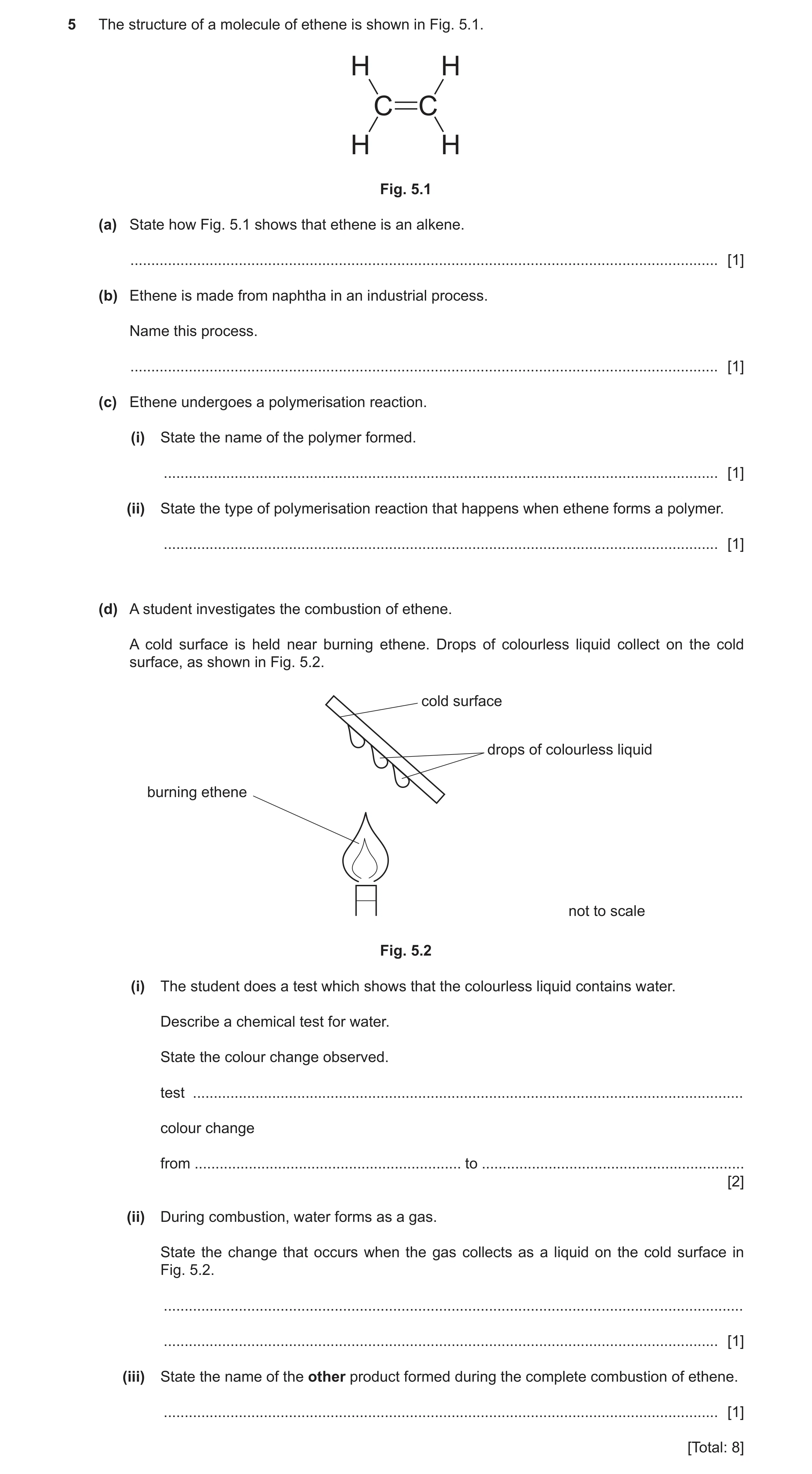
 11
11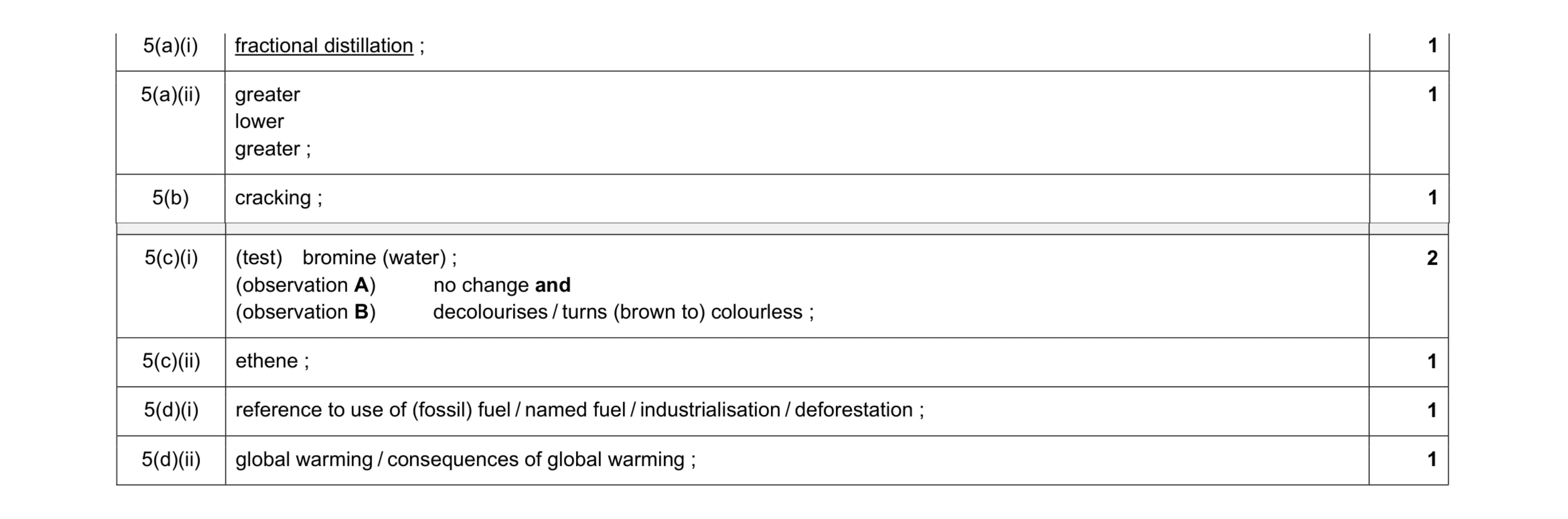 8
8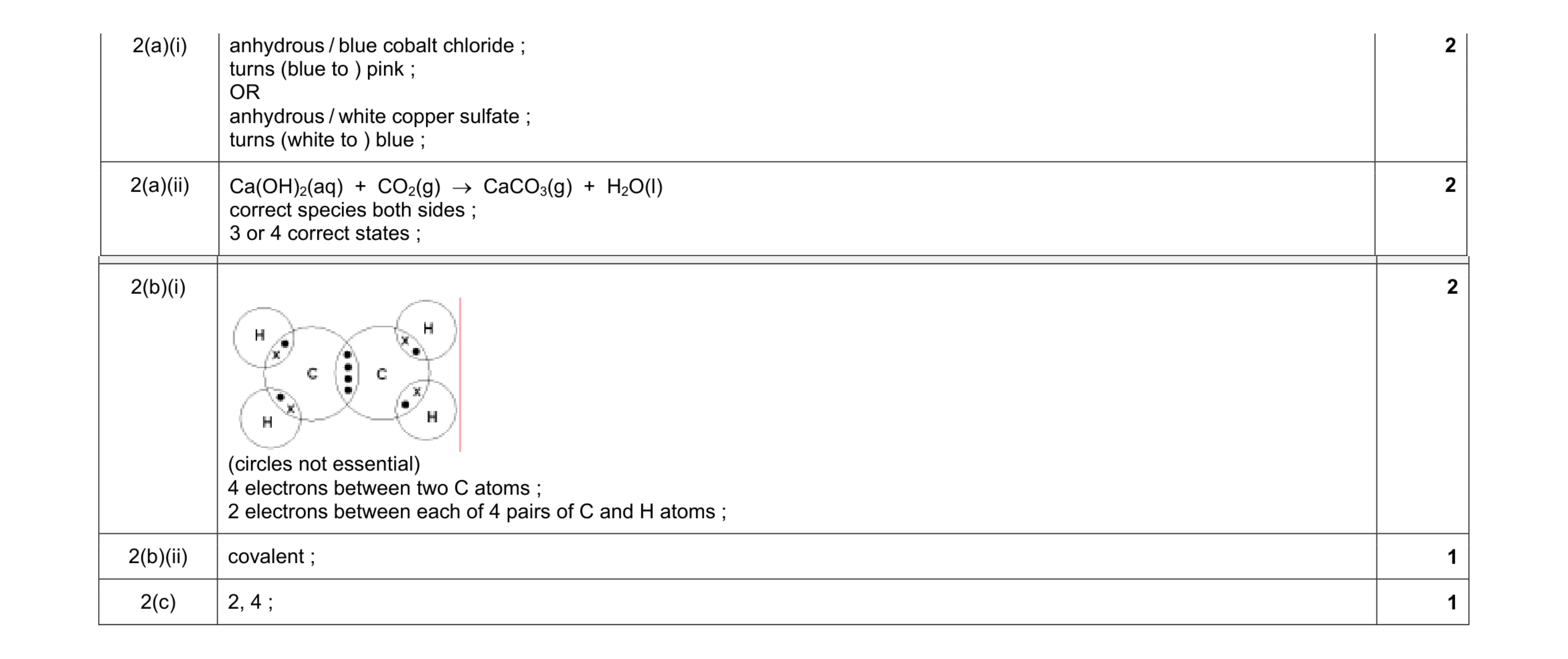 8
8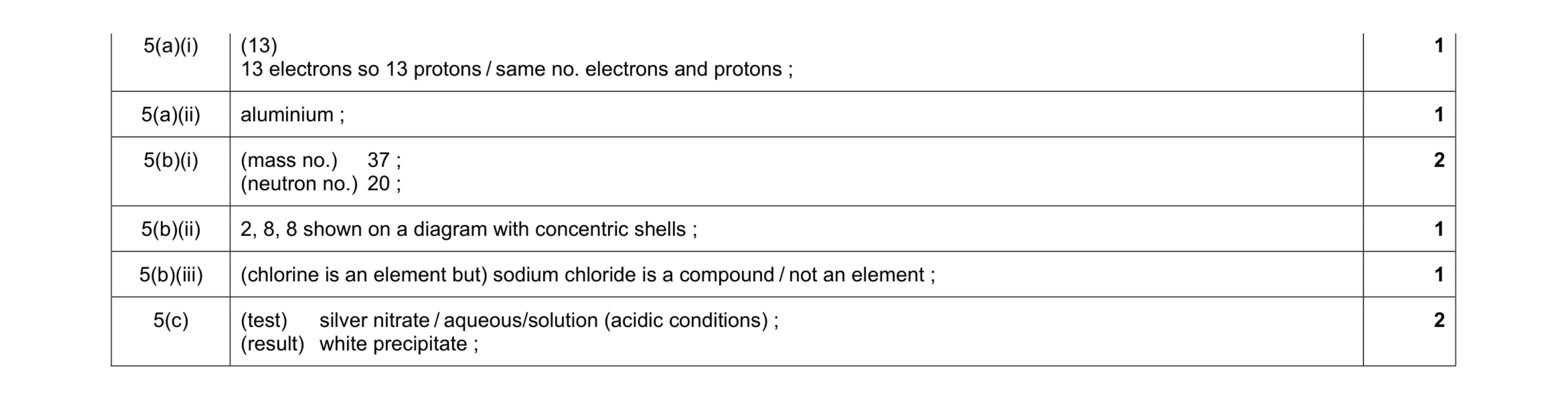 8
8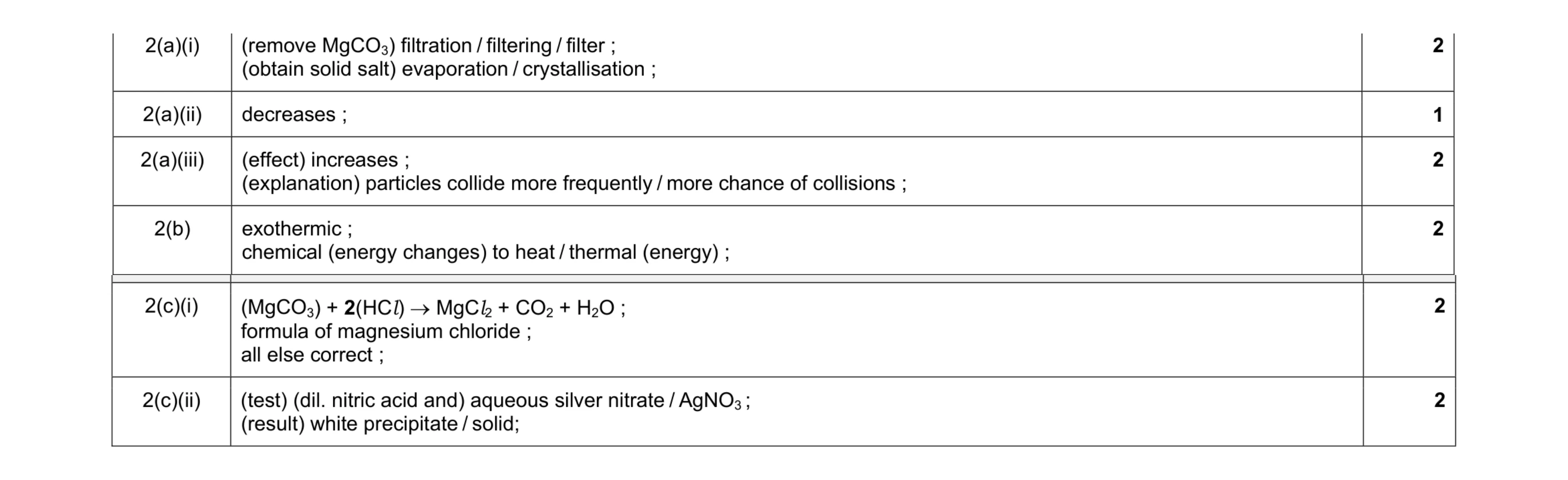 11
11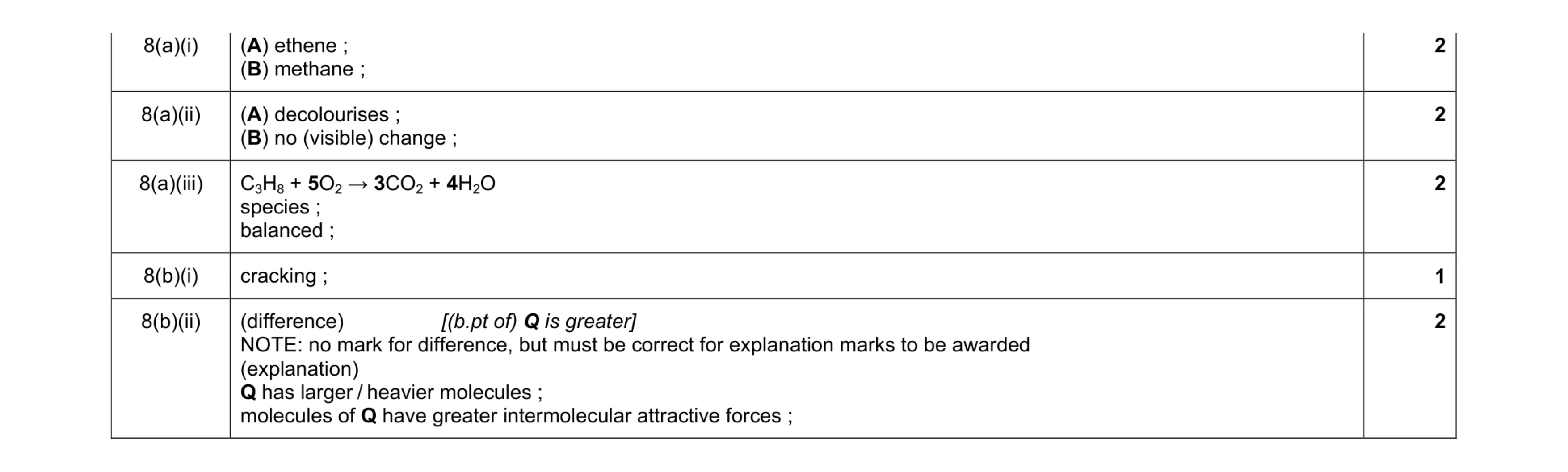 9
9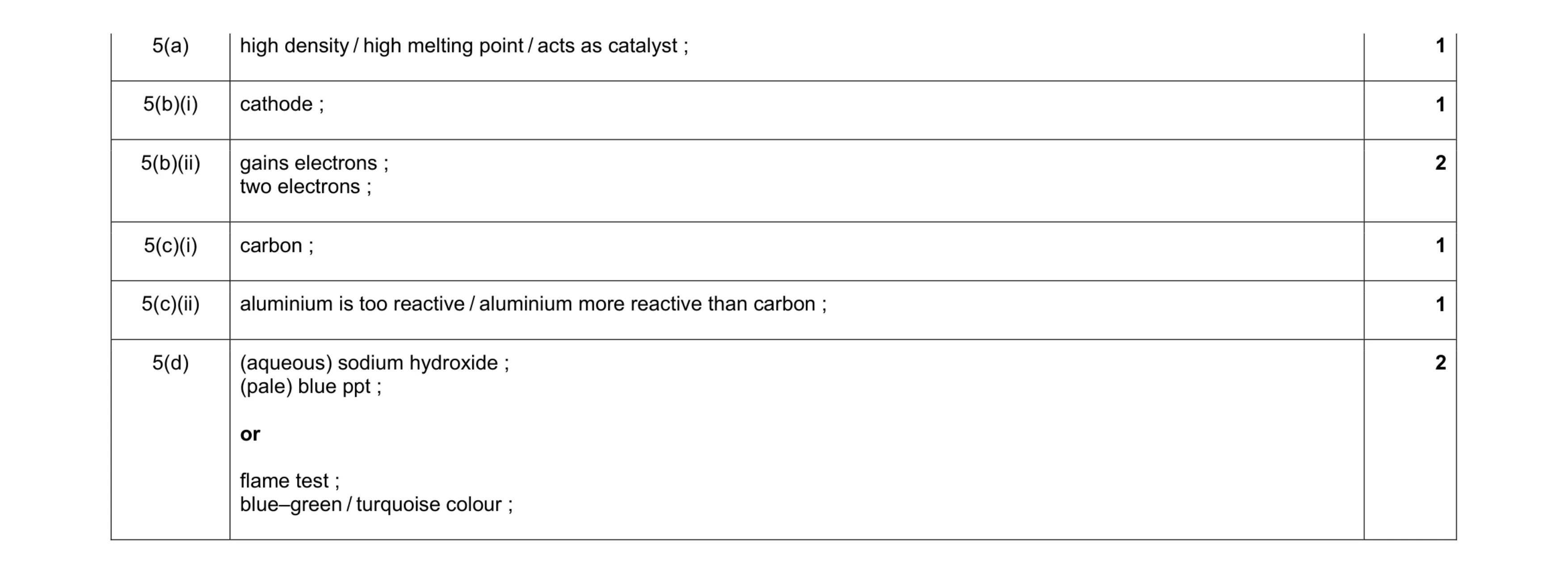 8
8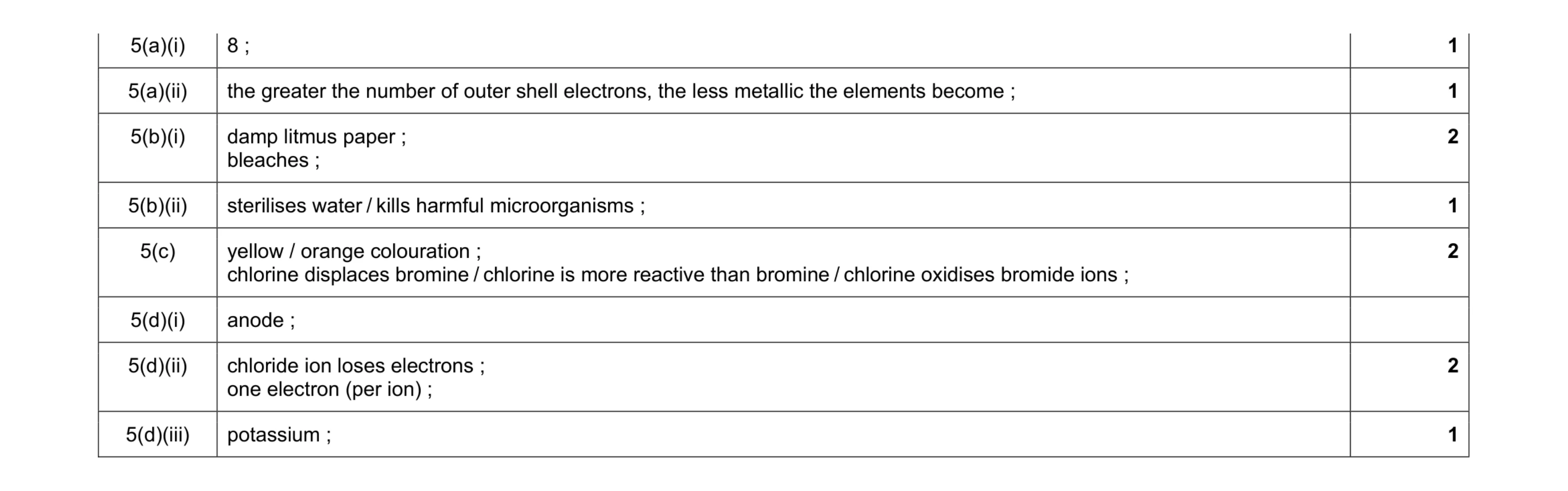 11
11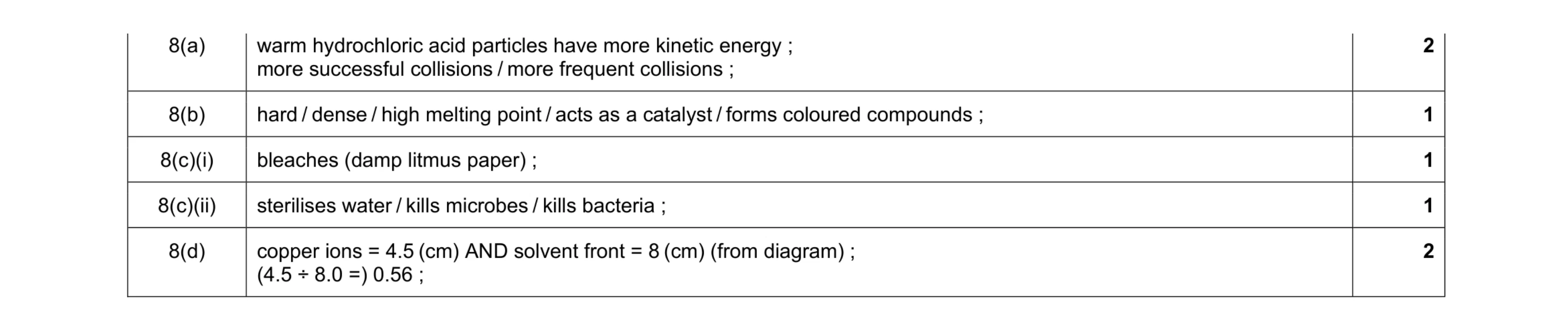 7
7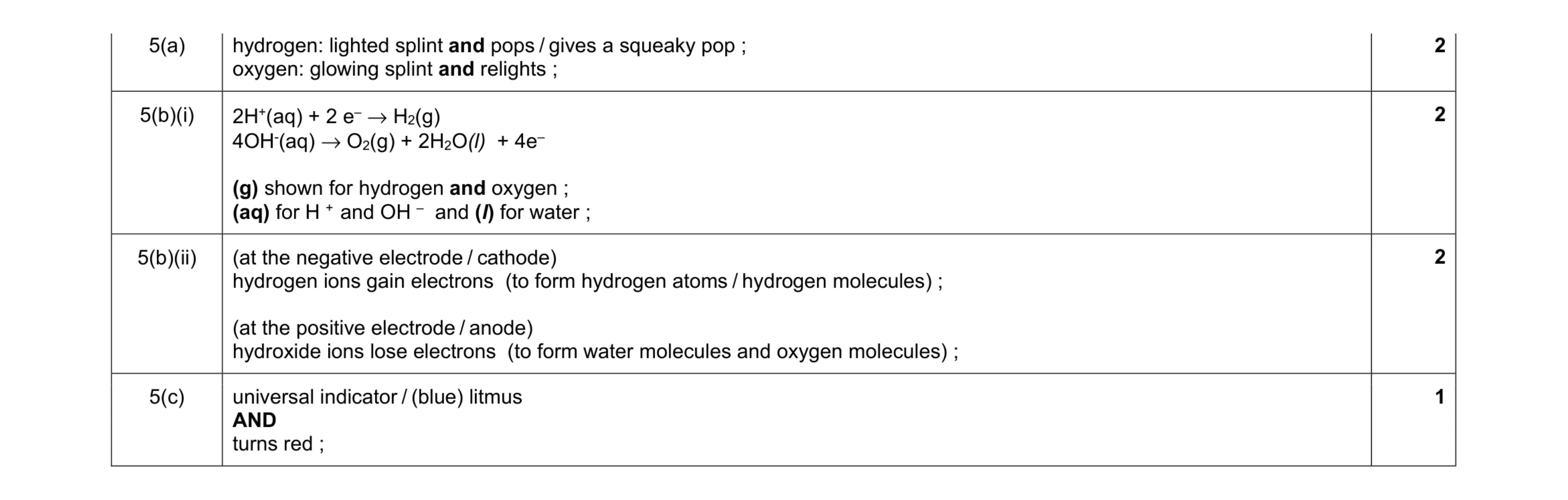 7
7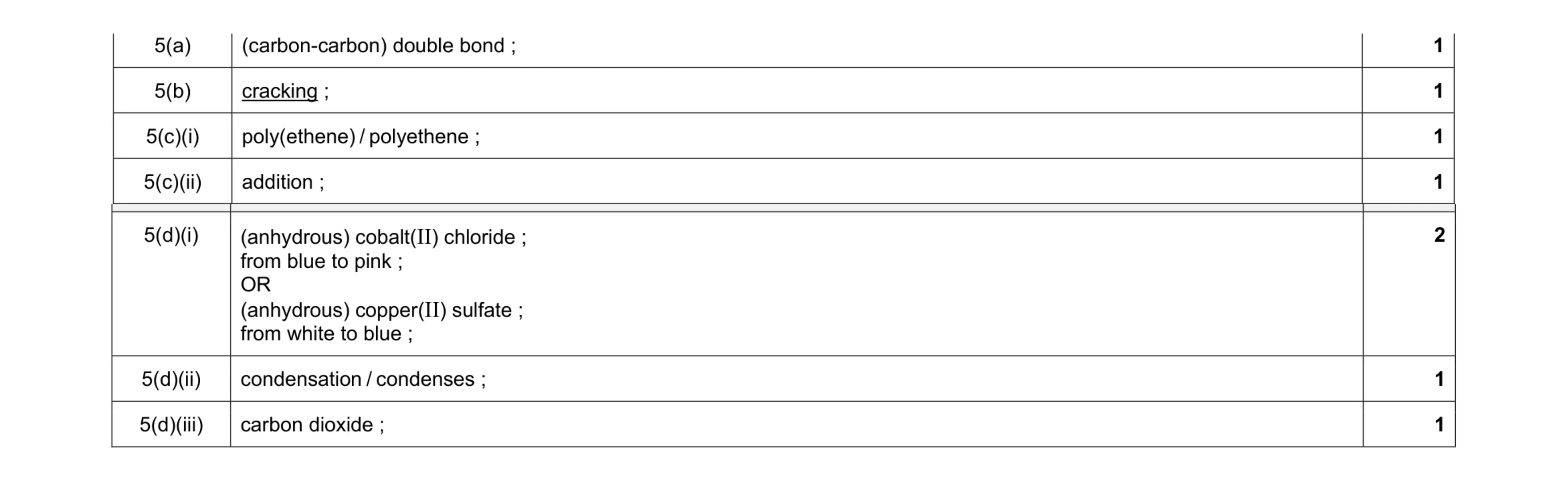 8
8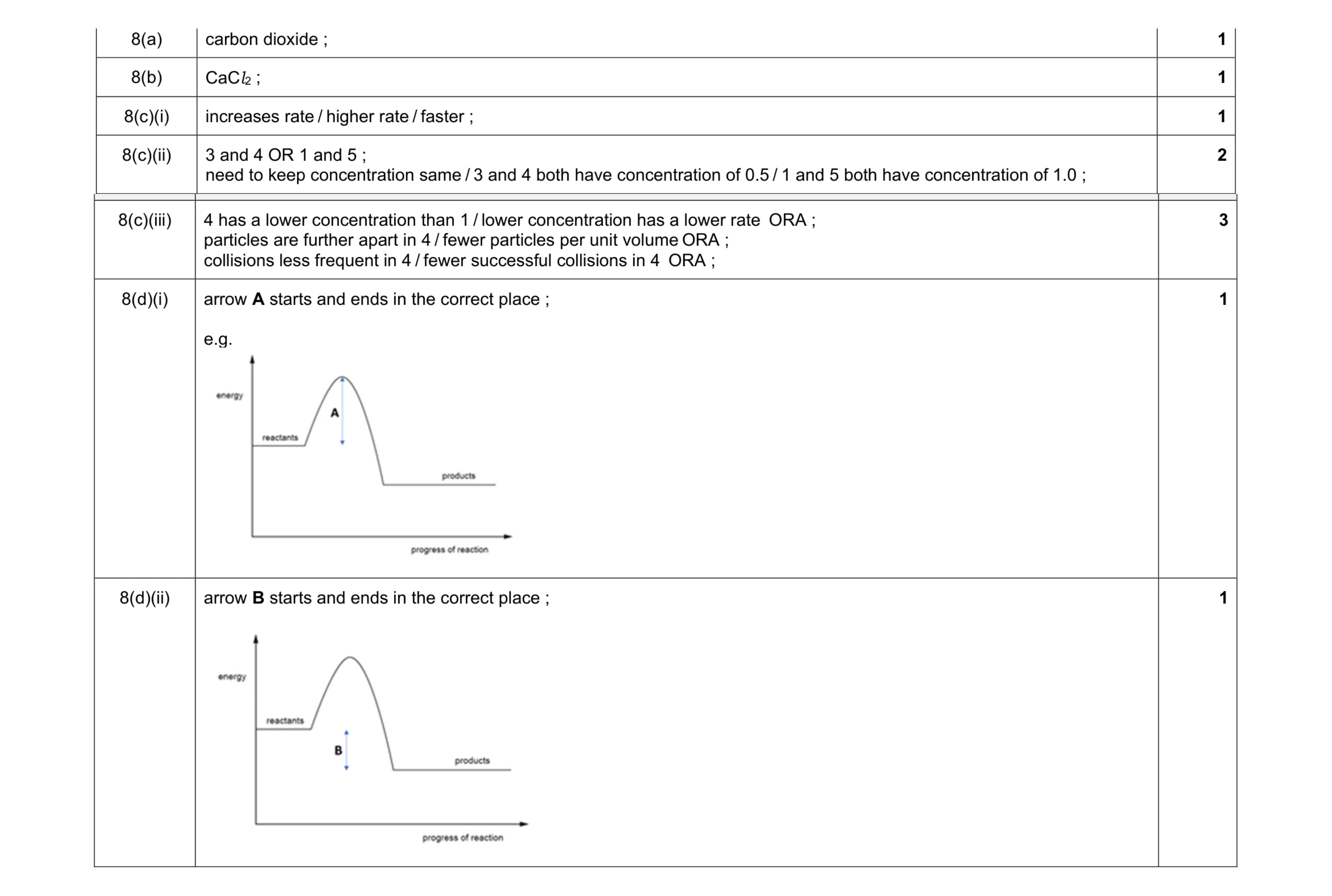 10
10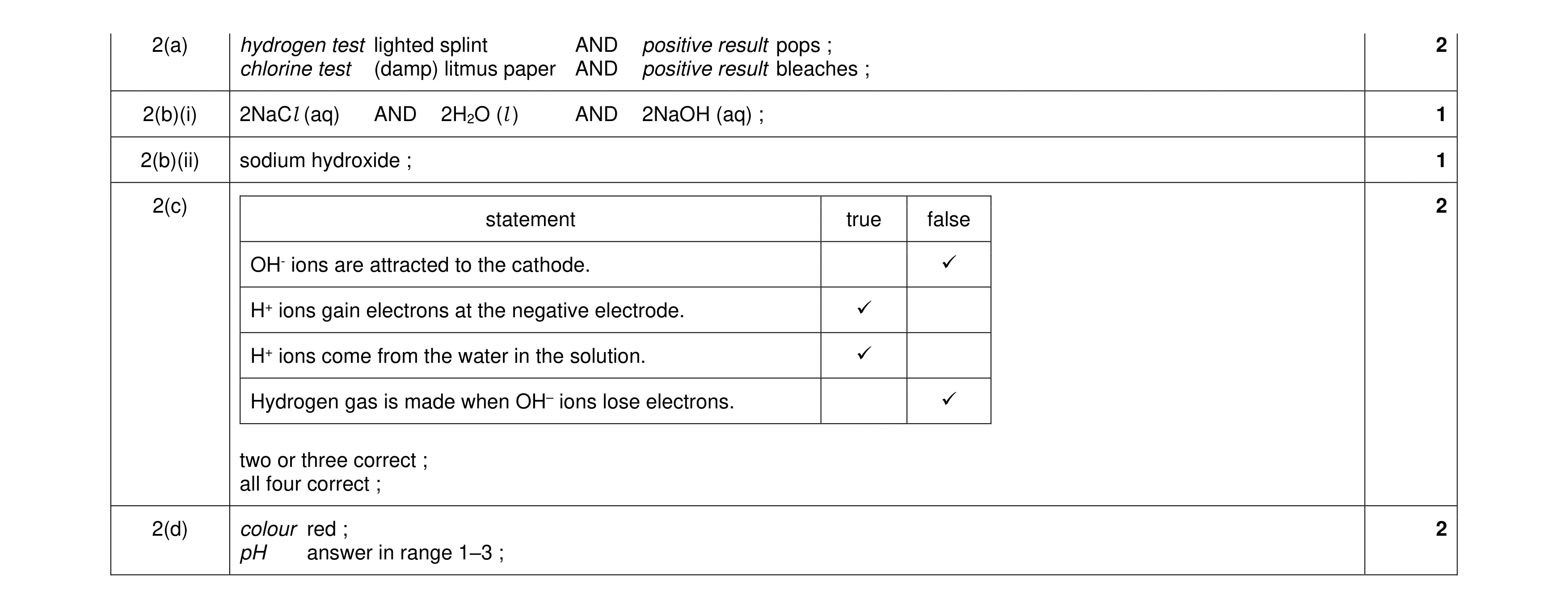 8
8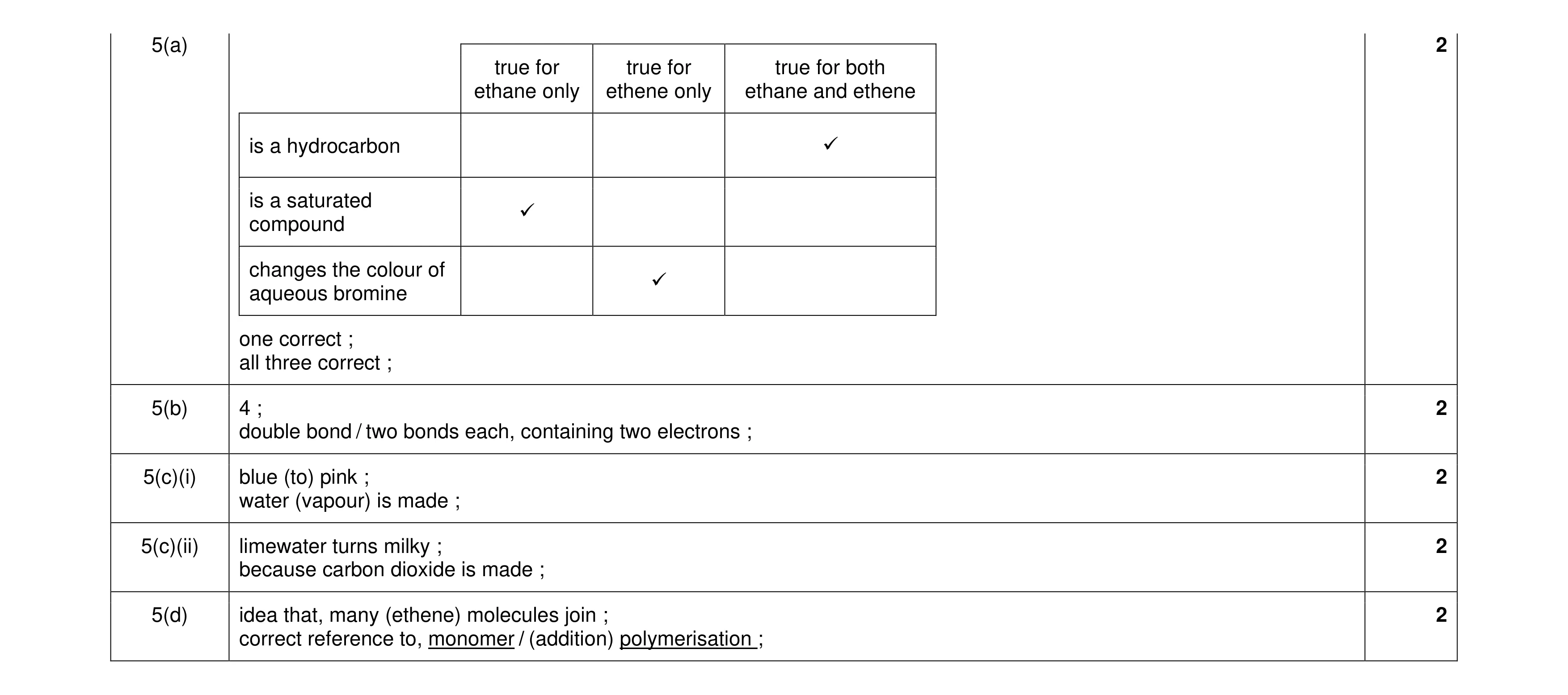 10
10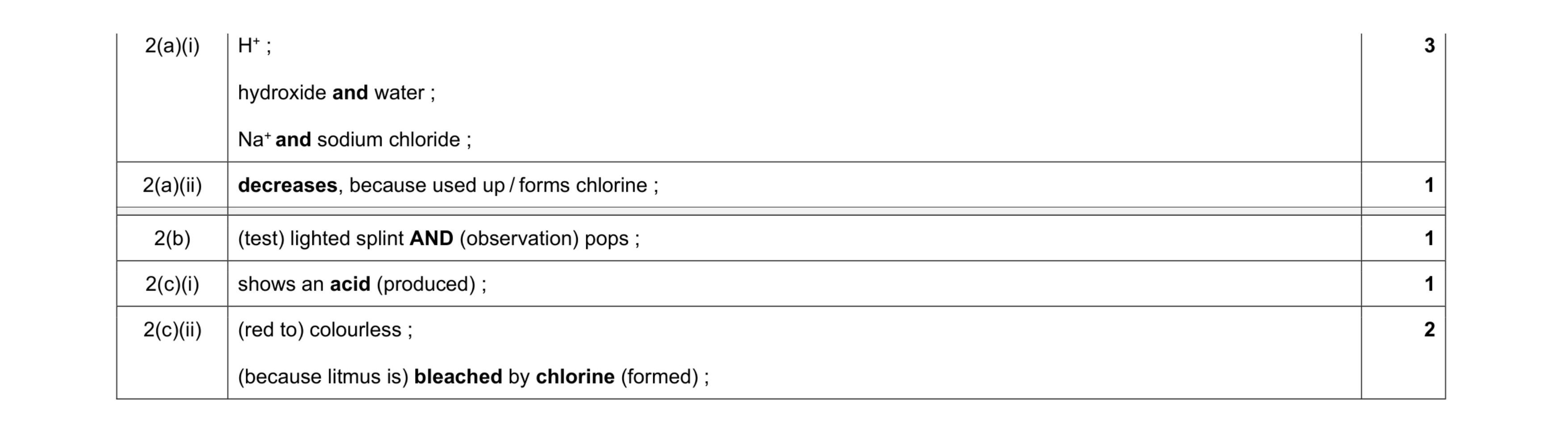 8
8