Questions as text
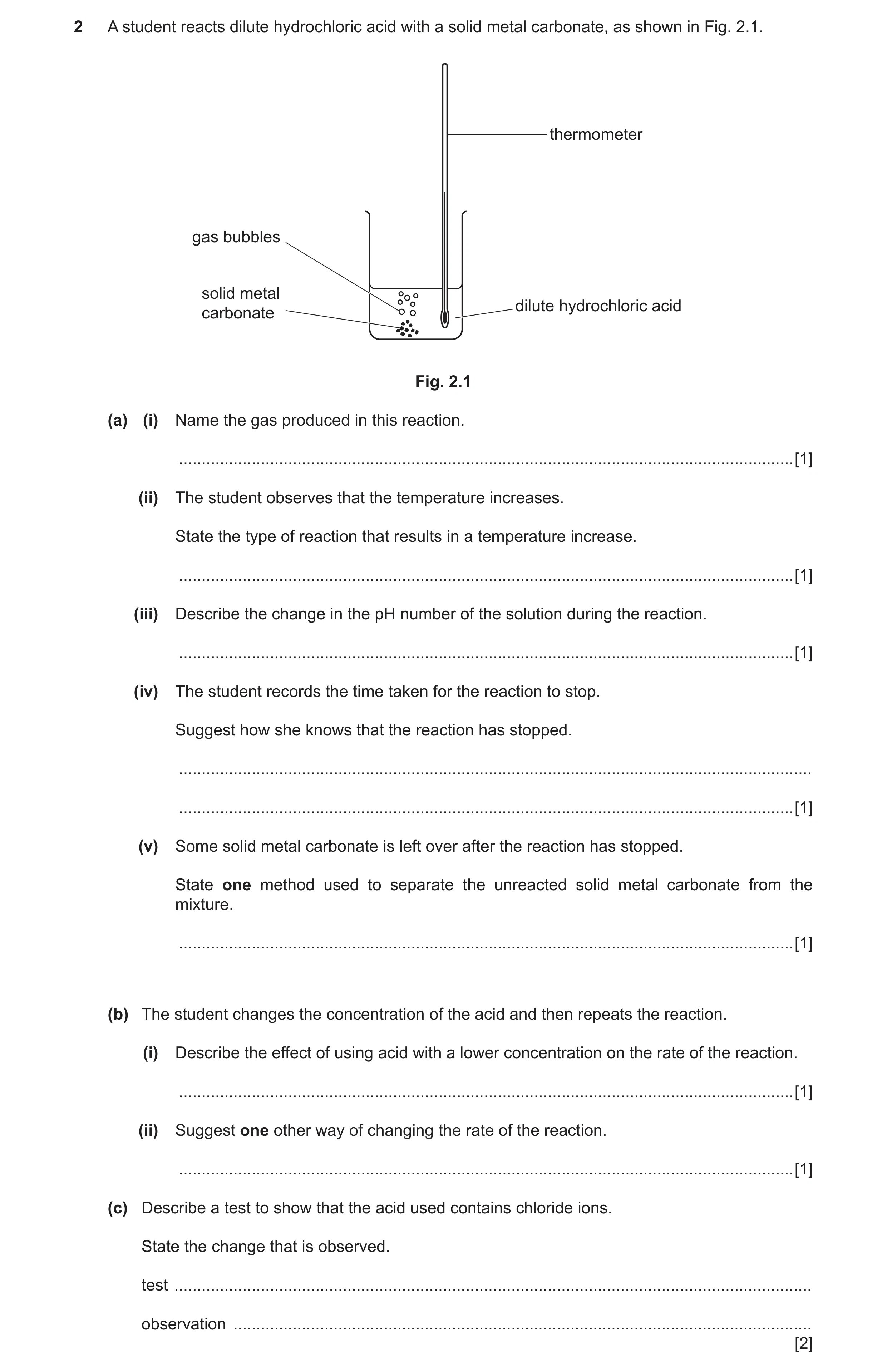
Q1 · A student reacts dilute hydrochloric acid with a solid metal carbonate, as shown in Fig 0653/32 Feb/March 2017
2 A student reacts dilute hydrochloric acid with a solid metal carbonate, as shown in Fig. 2.1. thermometer gas bubbles solid metal dilute hydrochloric acid carbonate Fig. 2.1 (a) (i) Name the gas produced in this reaction. … [1] (ii) The student observes that the temperature increases. State the type of reaction that results in a temperature increase. … [1] (iii) Describe the change in the pH number of the solution during the reaction. … [1] (iv) The student records the time taken for the reaction to stop. Suggest how she knows that the reaction has stopped. … … [1] (v) Some solid metal carbonate is left over after the reaction has stopped. State one method used to separate the unreacted solid metal carbonate from the mixture. … [1] (b) The student changes the concentration of the acid and then repeats the reaction. (i) Describe the effect of using acid with a lower concentration on the rate of the reaction. … [1] (ii) Suggest one other way of changing the rate of the reaction. … [1] (c) Describe a test to show that the acid used contains chloride ions. State the change that is observed. test … observation … [2]
9 marks
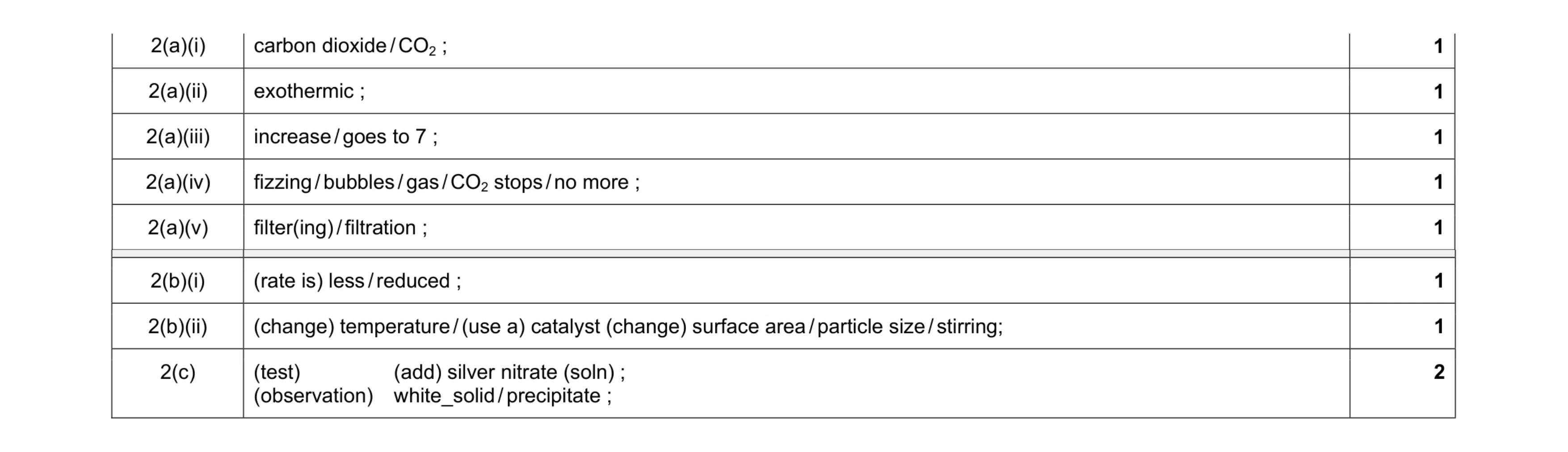
Mark scheme: 2(a)(i) carbon dioxide / CO2 ; 1 2(a)(ii) exothermic ; 1 2(a)(iii) increase / goes to 7 ; 1 2(a)(iv) fizzing / bubbles / gas / CO2 stops / no more ; 1 2(a)(v) filter(ing) / filtration ; 1 Question Answer Marks 2(b)(i) (rate is) less / reduced ; 1 2(b)(ii) (change) temperature / (use a) catalyst (change) surface area / particle size / stirring; 1 2(c) (test) (add) silver nitrate (soln) ; (observation) white_solid / precipitate ; 2
This question in 0653/32 Feb/March 2017
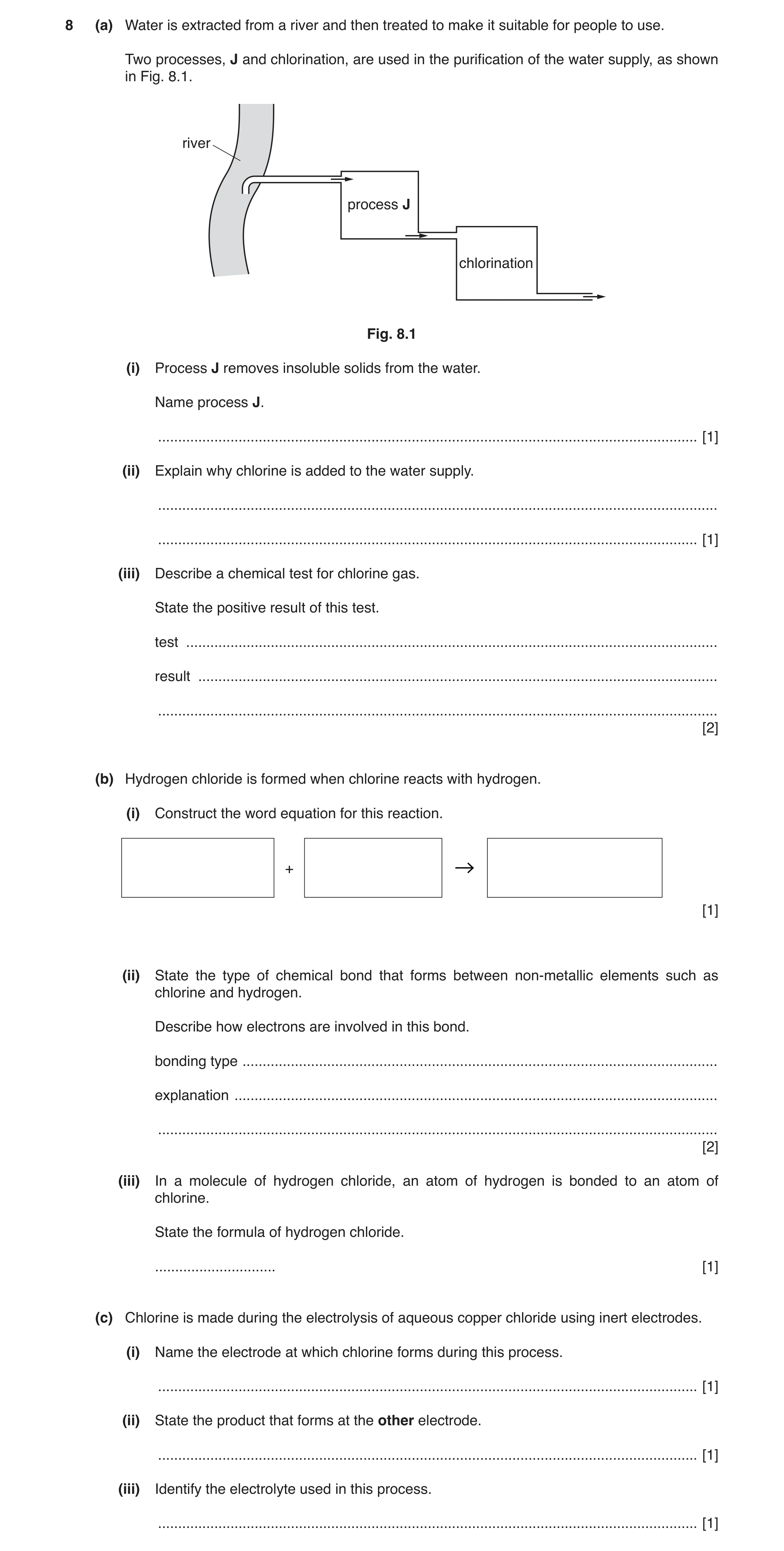
Q2 · Water is extracted from a river and then treated to make it suitable for people to use 0653/33 May/June 2017
8 (a) Water is extracted from a river and then treated to make it suitable for people to use. Two processes, J and chlorination, are used in the purification of the water supply, as shown in Fig. 8.1. river process J chlorination Fig. 8.1 (i) Process J removes insoluble solids from the water. Name process J. … [1] (ii) Explain why chlorine is added to the water supply. … … [1] (iii) Describe a chemical test for chlorine gas. State the positive result of this test. test … result … … [2] (b) Hydrogen chloride is formed when chlorine reacts with hydrogen. (i) Construct the word equation for this reaction. + [1] (ii) State the type of chemical bond that forms between non-metallic elements such as chlorine and hydrogen. Describe how electrons are involved in this bond. bonding type … explanation … … [2] (iii) In a molecule of hydrogen chloride, an atom of hydrogen is bonded to an atom of chlorine. State the formula of hydrogen chloride. … [1] (c) Chlorine is made during the electrolysis of aqueous copper chloride using inert electrodes. (i) Name the electrode at which chlorine forms during this process. … [1] (ii) State the product that forms at the other electrode. … [1] (iii) Identify the electrolyte used in this process. … [1]
11 marks
Mark scheme: 8(a)(i) filtration ; 1 8(a)(ii) kill microbes / sterilise (water) ; 1 8(a)(iii) (damp) litmus (paper) ; turns white / bleached ; 2 8(b)(i) ; LHS either order chlorine + hydrogen Æ hydrogen chloride 1 8(b)(ii) covalent ; share (pair of) electrons ; 2 8(b)(iii) HCl ; 1 8(c)(i) anode ; 1 8(c)(ii) copper ; 1 8(c)(iii) copper chloride solution / aqueous copper chloride ; 1
This question in 0653/33 May/June 2017
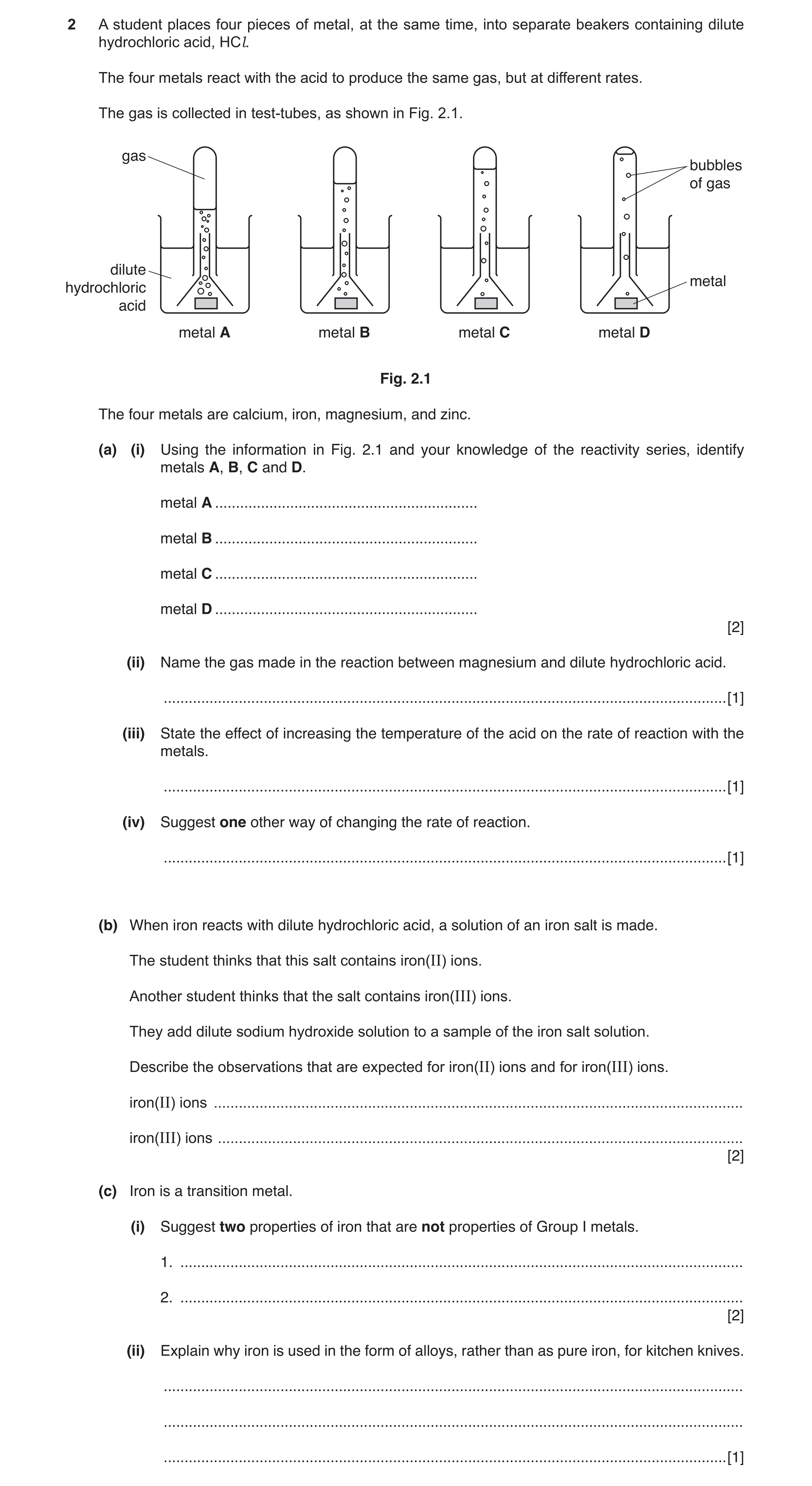
Q3 · A student places four pieces of metal, at the same time, into separate beakers containing… 0653/32 Oct/Nov 2017
2 A student places four pieces of metal, at the same time, into separate beakers containing dilute hydrochloric acid, HCl. The four metals react with the acid to produce the same gas, but at different rates. The gas is collected in test-tubes, as shown in Fig. 2.1. gas bubbles of gas dilute metalhydrochloric acid metal A metal B metal C metal D Fig. 2.1 The four metals are calcium, iron, magnesium, and zinc. (a) (i) Using the information in Fig. 2.1 and your knowledge of the reactivity series, identify metals A, B, C and D. metal A … metal B … metal C … metal D … [2] (ii) Name the gas made in the reaction between magnesium and dilute hydrochloric acid. … [1] (iii) State the effect of increasing the temperature of the acid on the rate of reaction with the metals. … [1] (iv) Suggest one other way of changing the rate of reaction. … [1] (b) When iron reacts with dilute hydrochloric acid, a solution of an iron salt is made. The student thinks that this salt contains iron(II) ions. Another student thinks that the salt contains iron(III) ions. They add dilute sodium hydroxide solution to a sample of the iron salt solution. Describe the observations that are expected for iron(II) ions and for iron(III) ions. iron(II) ions … iron(III) ions … [2] (c) Iron is a transition metal. (i) Suggest two properties of iron that are not properties of Group I metals. 1. … 2. … [2] (ii) Explain why iron is used in the form of alloys, rather than as pure iron, for kitchen knives. … … … [1]
10 marks
Mark scheme: 2(a)(i) (metal A) calcium / Ca (metal B) magnesium / Mg (metal C) zinc / Zn (metal D) iron / Fe ;; 2 2(a)(ii) hydrogen ; 1 2(a)(iii) increases (rate) ; 1 2(a)(iv) any one from change / increase / decrease concentration / surface area / (solid) particle size ; use / add a catalyst ; max 1 2(b) (iron(II) ions) green ppt / solid ; (iron(III) ions) brown ppt / solid ; 2 2(c)(i) Any two from high_density ; high_melting point ; (form) coloured compounds ; catalysts ; 2 Question Answer Marks 2(c)(ii) (alloys are) harder / more resistant to wear / more resistant to corrosion ; 1
This question in 0653/32 Oct/Nov 2017
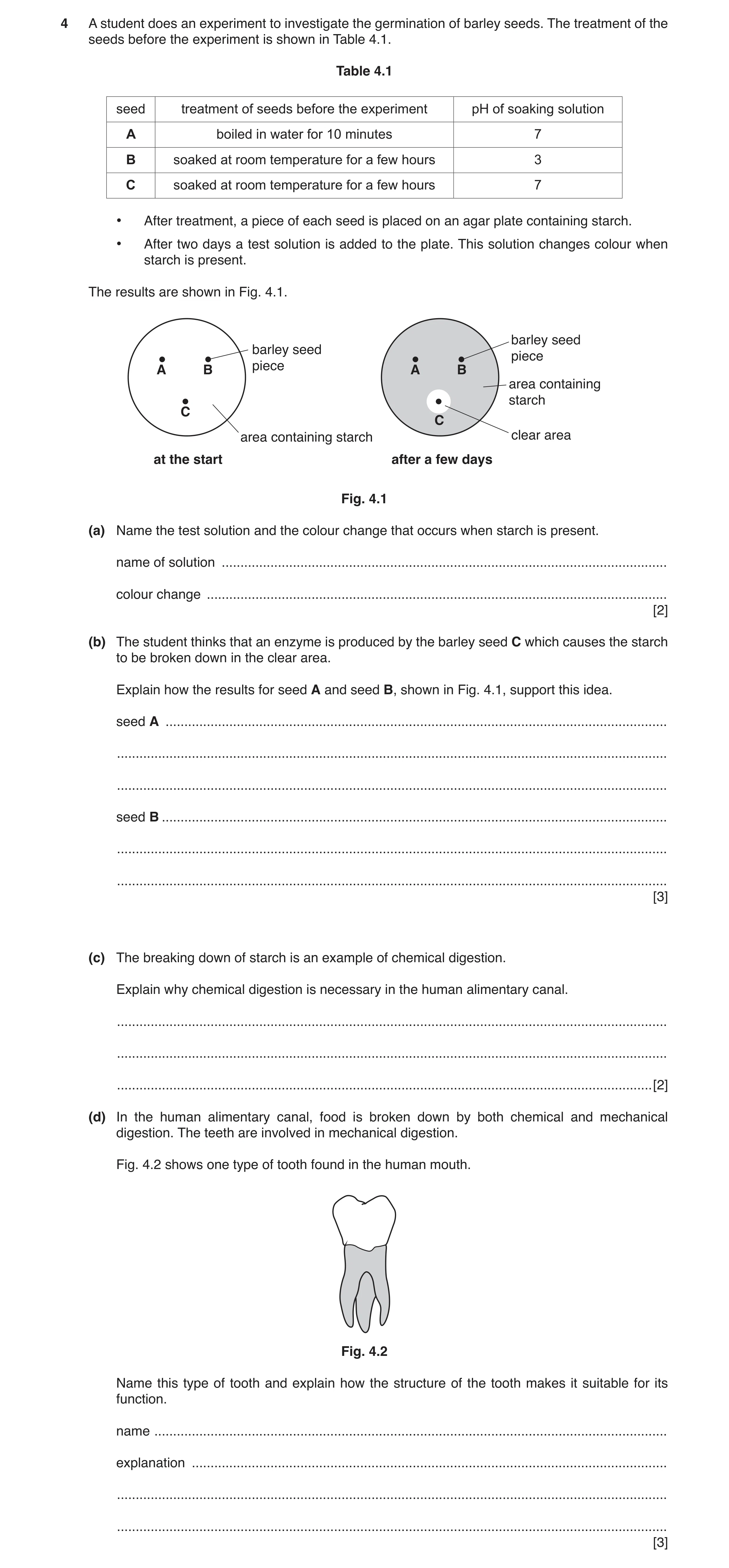
Q4 · A student does an experiment to investigate the germination of barley seeds 0653/32 Oct/Nov 2017
4 A student does an experiment to investigate the germination of barley seeds. The treatment of the seeds before the experiment is shown in Table 4.1. Table 4.1 seed treatment of seeds before the experiment pH of soaking solution A boiled in water for 10 minutes 7 B soaked at room temperature for a few hours 3 C soaked at room temperature for a few hours 7 • After treatment, a piece of each seed is placed on an agar plate containing starch. • After two days a test solution is added to the plate. This solution changes colour when starch is present. The results are shown in Fig. 4.1. barley seed barley seed piece piece A B A B area containing starch C C area containing starch clear area at the start after a few days Fig. 4.1 (a) Name the test solution and the colour change that occurs when starch is present. name of solution … colour change … [2] (b) The student thinks that an enzyme is produced by the barley seed C which causes the starch to be broken down in the clear area. Explain how the results for seed A and seed B, shown in Fig. 4.1, support this idea. seed A … … … seed B … … … [3] (c) The breaking down of starch is an example of chemical digestion. Explain why chemical digestion is necessary in the human alimentary canal. … … … [2] (d) In the human alimentary canal, food is broken down by both chemical and mechanical digestion. The teeth are involved in mechanical digestion. Fig. 4.2 shows one type of tooth found in the human mouth. Fig. 4.2 Name this type of tooth and explain how the structure of the tooth makes it suitable for its function. name … explanation … … … [3]
10 marks
Mark scheme: 4(a) iodine ; goes (from brown) to blue-black ; 2 4(b) Any three from results show starch present (around A and / or B) ; inactive / denatured enzyme ; because A is boiled ; because B is acidic / pH3 ; max 3 4(c) Any two from breaks down large / insoluble molecules ; into small / soluble molecules ; so that they can be absorbed ; max 2 4(d) molar ; flat / has cusps / large surface area ; for grinding food into smaller pieces ; 3
This question in 0653/32 Oct/Nov 2017
Q5 · A student investigates the combustion of a hydrocarbon, as shown in Fig 0653/32 May/June 2018
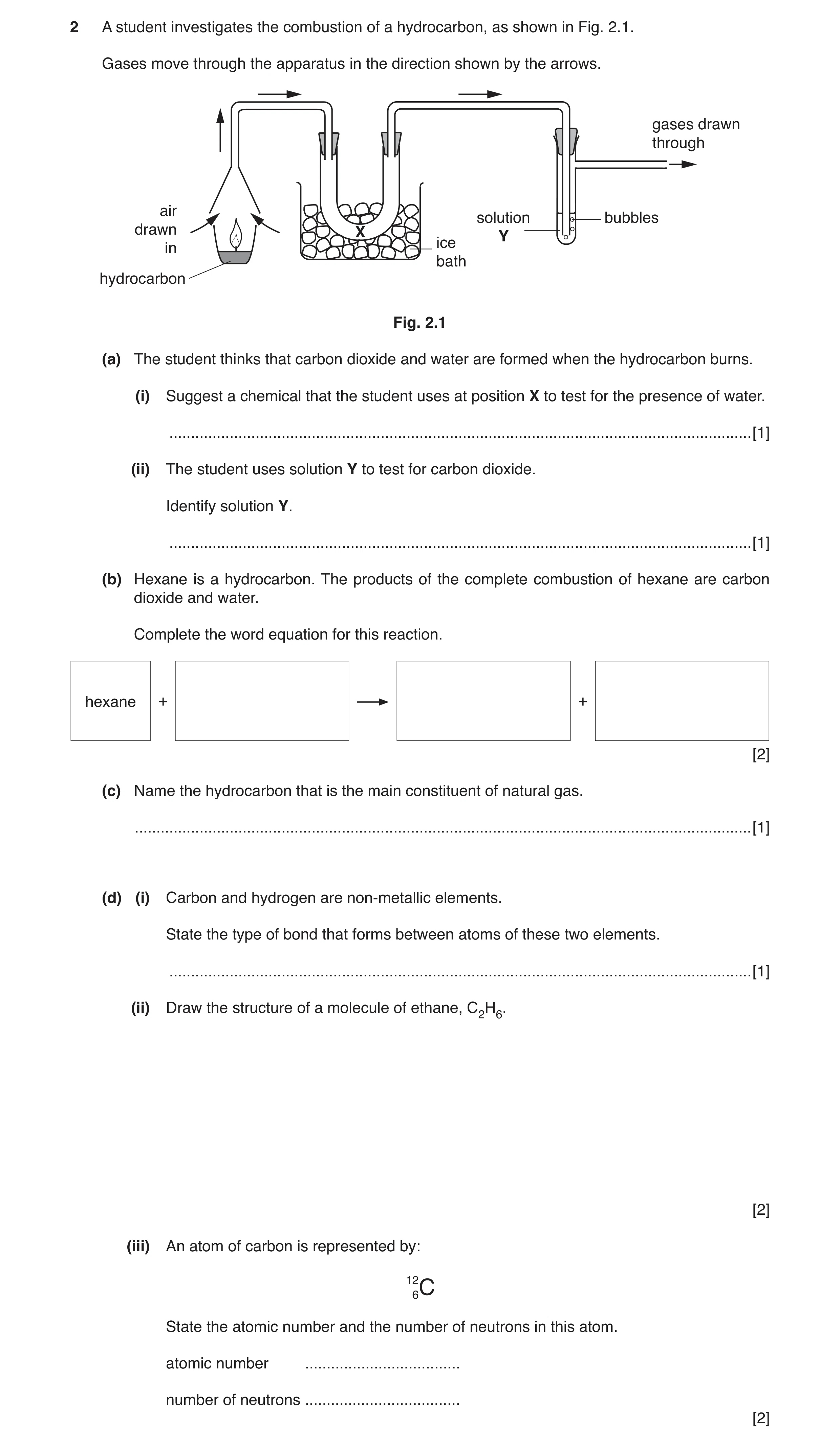
2 A student investigates the combustion of a hydrocarbon, as shown in Fig. 2.1. Gases move through the apparatus in the direction shown by the arrows. gases drawn through X air solution bubbles drawn X Y ice in bath hydrocarbon Fig. 2.1 (a) The student thinks that carbon dioxide and water are formed when the hydrocarbon burns. (i) Suggest a chemical that the student uses at position X to test for the presence of water. … [1] (ii) The student uses solution Y to test for carbon dioxide. Identify solution Y. … [1] (b) Hexane is a hydrocarbon. The products of the complete combustion of hexane are carbon dioxide and water. Complete the word equation for this reaction. hexane + + [2] (c) Name the hydrocarbon that is the main constituent of natural gas. … [1] (d) (i) Carbon and hydrogen are non‑metallic elements. State the type of bond that forms between atoms of these two elements. … [1] (ii) Draw the structure of a molecule of ethane, C2H6. [2] (iii) An atom of carbon is represented by: 126C State the atomic number and the number of neutrons in this atom. atomic number … number of neutrons … [2]
10 marks
Mark scheme: 2 2( 2 2 2 2( 2( (a)(i) white / (a)(ii) limewa 2(b) LHS ; RHS ( 2(c) metha (d)(i) covale (d)(ii) C – C Six C – (d)(iii) (atomi (numb / anhydrous copp ater ; either order) ; ne ; ent ; bond ; – H bonds ; c number) ber of neutrons) per sulphate or a (hexan 6 ; 6 ; anhydrous / blue ne) + oxy e cobalt chloride ygen Î c d ; carbon dioxide + water 1 1 2 1 1 2 2
This question in 0653/32 May/June 2018
Q6 · A student investigates the combustion of a hydrocarbon, as shown in Fig 0653/33 May/June 2018
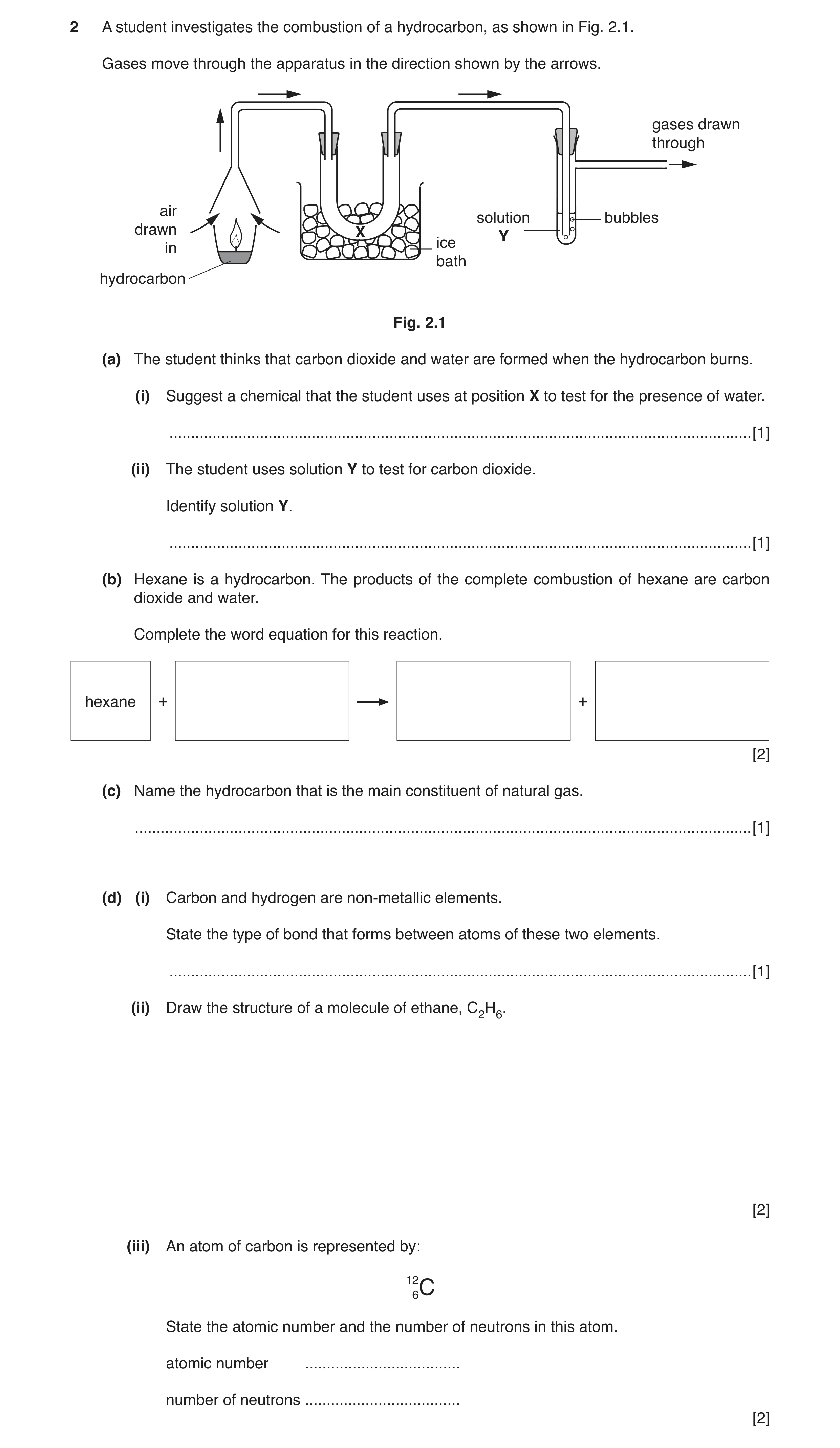
2 A student investigates the combustion of a hydrocarbon, as shown in Fig. 2.1. Gases move through the apparatus in the direction shown by the arrows. gases drawn through X air solution bubbles drawn X Y ice in bath hydrocarbon Fig. 2.1 (a) The student thinks that carbon dioxide and water are formed when the hydrocarbon burns. (i) Suggest a chemical that the student uses at position X to test for the presence of water. … [1] (ii) The student uses solution Y to test for carbon dioxide. Identify solution Y. … [1] (b) Hexane is a hydrocarbon. The products of the complete combustion of hexane are carbon dioxide and water. Complete the word equation for this reaction. hexane + + [2] (c) Name the hydrocarbon that is the main constituent of natural gas. … [1] (d) (i) Carbon and hydrogen are non‑metallic elements. State the type of bond that forms between atoms of these two elements. … [1] (ii) Draw the structure of a molecule of ethane, C2H6. [2] (iii) An atom of carbon is represented by: 126C State the atomic number and the number of neutrons in this atom. atomic number … number of neutrons … [2]
10 marks
Mark scheme: 2 2( 2 2 2 2( 2( (a)(i) white / (a)(ii) limewa 2(b) LHS ; RHS ( 2(c) metha (d)(i) covale (d)(ii) C – C Six C – (d)(iii) (atomi (numb / anhydrous copp ater ; either order) ; ne ; ent ; bond ; – H bonds ; c number) ber of neutrons) per sulphate or a (hexan 6 ; 6 ; anhydrous / blue ne) + oxy e cobalt chloride ygen Î c d ; carbon dioxide + water 1 1 2 1 1 2 2
This question in 0653/33 May/June 2018
Q7 · A student investigates the reactivities of four metals, calcium, magnesium, tin and zinc 0653/31 May/June 2019
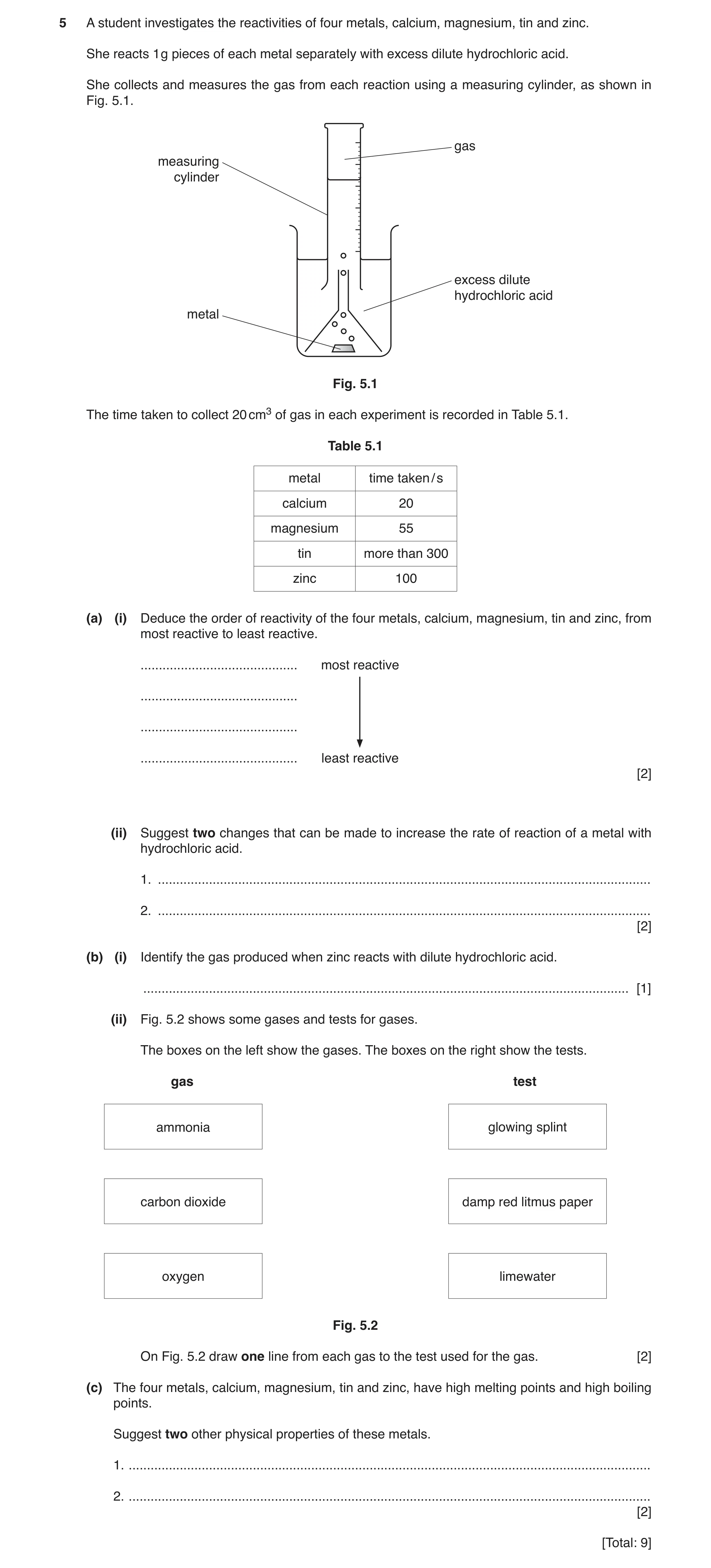
5 A student investigates the reactivities of four metals, calcium, magnesium, tin and zinc. She reacts 1 g pieces of each metal separately with excess dilute hydrochloric acid. She collects and measures the gas from each reaction using a measuring cylinder, as shown in Fig. 5.1. gas measuring cylinder excess dilute hydrochloric acid metal Fig. 5.1 The time taken to collect 20 cm3 of gas in each experiment is recorded in Table 5.1. Table 5.1 metal time taken / s calcium 20 magnesium 55 tin more than 300 zinc 100 (a) (i) Deduce the order of reactivity of the four metals, calcium, magnesium, tin and zinc, from most reactive to least reactive. … most reactive … … … least reactive [2] (ii) Suggest two changes that can be made to increase the rate of reaction of a metal with hydrochloric acid. 1. … 2. … [2] (b) (i) Identify the gas produced when zinc reacts with dilute hydrochloric acid. … [1] (ii) Fig. 5.2 shows some gases and tests for gases. The boxes on the left show the gases. The boxes on the right show the tests. gas test ammonia glowing splint carbon dioxide damp red litmus paper oxygen limewater Fig. 5.2 On Fig. 5.2 draw one line from each gas to the test used for the gas. [2] (c) The four metals, calcium, magnesium, tin and zinc, have high melting points and high boiling points. Suggest two other physical properties of these metals. 1. … 2. … [2] [Total: 9]
9 marks
Mark scheme: 5(a)(i) (most) calcium magnesium zinc (least) tin Ca most reactive & Sn least reactive ; Mg & Zn in the middle in the correct order ; 2 5(a)(ii) any two from increase temperature ; increase concentration (of acid) ; reduce particle size / use a powder / increase the surface area (of the metal) ; 2 5(b)(i) hydrogen / H2 ; 1 5(b)(ii) three correct ;; two or one correct ; 2 5(c) any two from: malleable ; (good) heat conductor ; (good) electrical conductor ; 2
This question in 0653/31 May/June 2019
Q8 · Aluminium reacts with iron oxide to form iron in an exothermic reaction 0653/32 May/June 2019
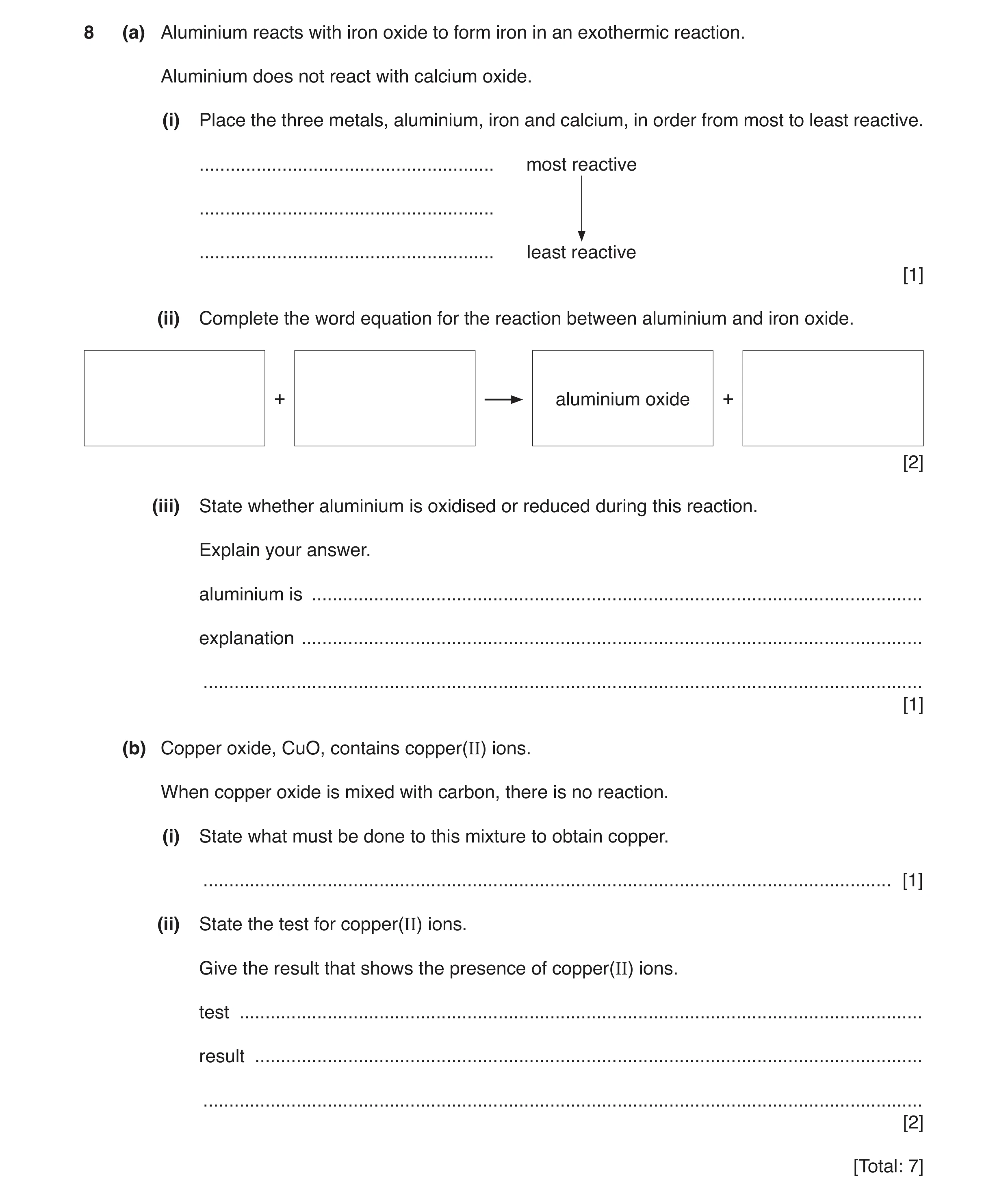
8 (a) Aluminium reacts with iron oxide to form iron in an exothermic reaction. Aluminium does not react with calcium oxide. (i) Place the three metals, aluminium, iron and calcium, in order from most to least reactive. … most reactive … … least reactive [1] (ii) Complete the word equation for the reaction between aluminium and iron oxide. + aluminium oxide + [2] (iii) State whether aluminium is oxidised or reduced during this reaction. Explain your answer. aluminium is … explanation … … [1] (b) Copper oxide, CuO, contains copper(II) ions. When copper oxide is mixed with carbon, there is no reaction. (i) State what must be done to this mixture to obtain copper. … [1] (ii) State the test for copper(II) ions. Give the result that shows the presence of copper(II) ions. test … result … … [2] [Total: 7]
7 marks
Mark scheme: 8(a)(i) (most reactive) calcium / Ca aluminium / Al (least reactive) iron / Fe 1 8(a)(ii) LHS ; RHS ; aluminium + iron oxide Î (aluminium oxide) + iron 2 8(a)(iii) (aluminium is) oxidised and (explanation) it gains oxygen / reacts with oxygen 1 8(b)(i) heat / increase temperature ; 1 Question Answer Marks 8(b)(ii) (test) (aqueous) sodium hydroxide / (aqueous) ammonia ; (result from correct reagent) blue ppt ; 2
This question in 0653/32 May/June 2019
Q9 · Some of the apparatus a student uses to investigate the rate of reaction between a piece… 0653/31 Oct/Nov 2019
5 (a) Some of the apparatus a student uses to investigate the rate of reaction between a piece of zinc and dilute hydrochloric acid is shown in Fig. 5.1. thermometer beaker dilute hydrochloric acid piece of zinc Fig. 5.1 (i) Identify the gas formed in the reaction between zinc and dilute hydrochloric acid. … [1] (ii) Suggest the change in the pH of the mixture in the beaker during this reaction. … [1] (iii) Describe the effect of increasing the temperature on the rate of this reaction. … [1] (iv) The experiment is repeated using the same mass of zinc powder instead of the piece of zinc. Describe how this change affects the rate of the reaction. … [1] (b) Zinc oxide is heated with carbon. Reduction occurs during the reaction. The reaction is endothermic. (i) State what is meant by reduction. … … [1] (ii) State what is meant by endothermic. … … [1] (c) Complete Fig. 5.2 by drawing one straight line from each gas to the test for that gas. gas test use damp red ammonia litmus paper carbon dioxide use a glowing splint oxygen use limewater Fig. 5.2 [2] [Total: 8]
8 marks
Mark scheme: 5(a)(i) hydrogen / H2 ; 1 5(a)(ii) increases ; 1 5(a)(iii) increases ; 1 5(a)(iv) increases ; 1 5(b)(i) loses oxygen ; 1 5(b)(ii) thermal (heat) energy absorbed/taken in ; 1 5(c) three correct lines = 2 marks one or two lines correct = 1 mark 2
This question in 0653/31 Oct/Nov 2019
Q10 · Period 4 of the Periodic Table is shown in Fig 0653/31 May/June 2020
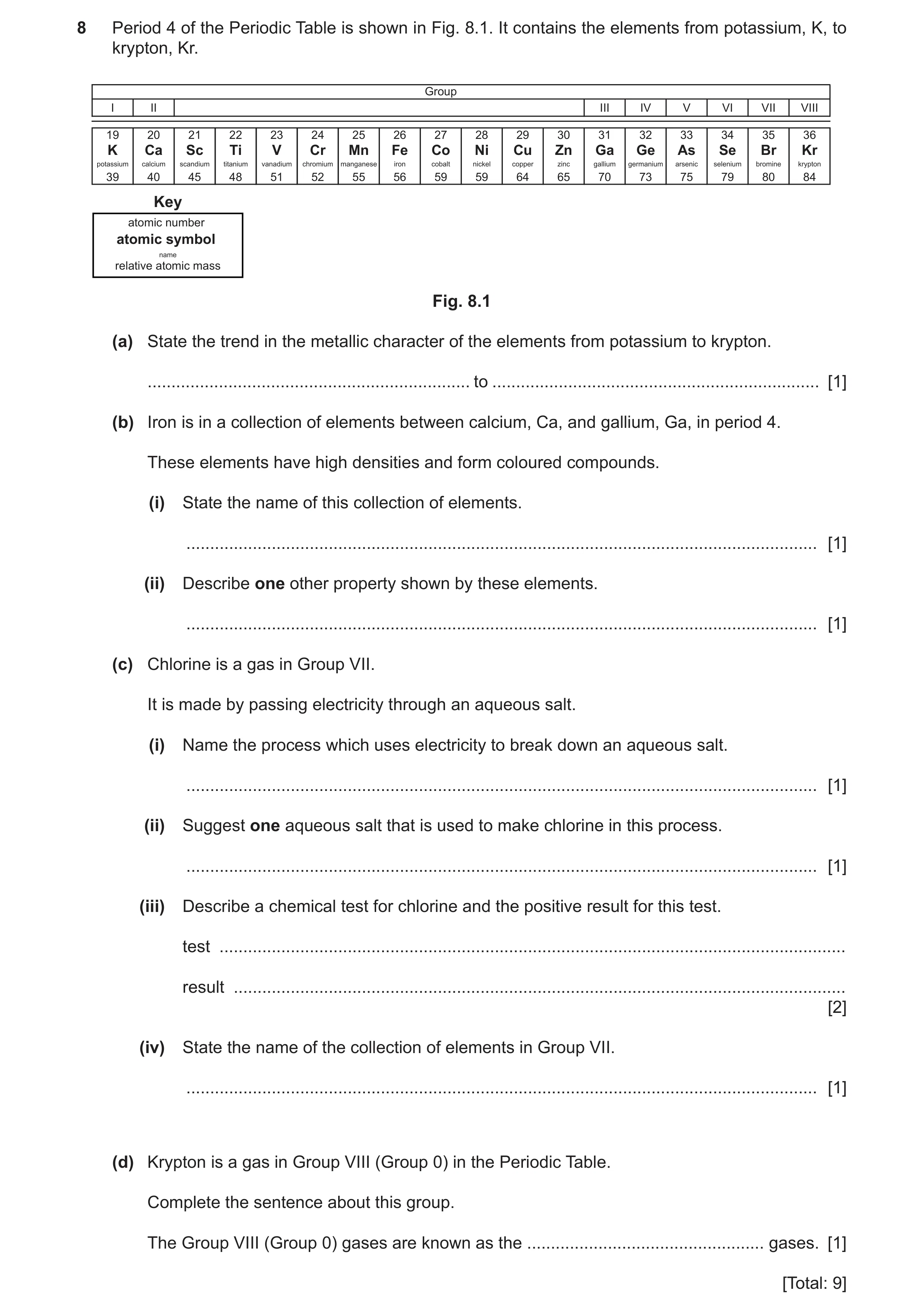
8 Period 4 of the Periodic Table is shown in Fig. 8.1. It contains the elements from potassium, K, to krypton, Kr. Group I II III IV V VI VII VIII 19 20 21 22 23 24 25 26 27 28 29 30 31 32 33 34 35 36 K Ca Sc Ti V Cr Mn Fe Co Ni Cu Zn Ga Ge As Se Br Kr 39 40 45 48 51 52 55 56 59 59 64 65 70 73 75 79 80 84 Key atomic number atomic symbol relative atomic mass Fig. 8.1 (a) State the trend in the metallic character of the elements from potassium to krypton. … to … [1] (b) Iron is in a collection of elements between calcium, Ca, and gallium, Ga, in period 4. These elements have high densities and form coloured compounds. (i) State the name of this collection of elements. … [1] (ii) Describe one other property shown by these elements. … [1] (c) Chlorine is a gas in Group VII. It is made by passing electricity through an aqueous salt. (i) Name the process which uses electricity to break down an aqueous salt. … [1] (ii) Suggest one aqueous salt that is used to make chlorine in this process. … [1] (iii) Describe a chemical test for chlorine and the positive result for this test. test … result … [2] (iv) State the name of the collection of elements in Group VII. … [1] (d) Krypton is a gas in Group VIII (Group 0) in the Periodic Table. Complete the sentence about this group. The Group VIII (Group 0) gases are known as the … gases. [1] [Total: 9]
9 marks
Mark scheme: 8(a) metal(lic) (to) non-metal(lic) ; 1 8(b)(i) transition (elements / metals) ; 1 8(b)(ii) high melting points OR (act as) catalyst (as element or compound) ; 1 8(c)(i) electrolysis ; 1 8(c)(ii) (concentrated) sodium chloride ; 1 8(c)(iii) (test) damp (blue) litmus paper ; (result) (turns) red / bleaches ; 2 8(c)(iv) halogens ; 1 Question Answer Marks 8(d) noble ; 1
This question in 0653/31 May/June 2020
Q11 · A student investigates the rate of reaction between a piece of magnesium and excess… 0653/33 Oct/Nov 2020
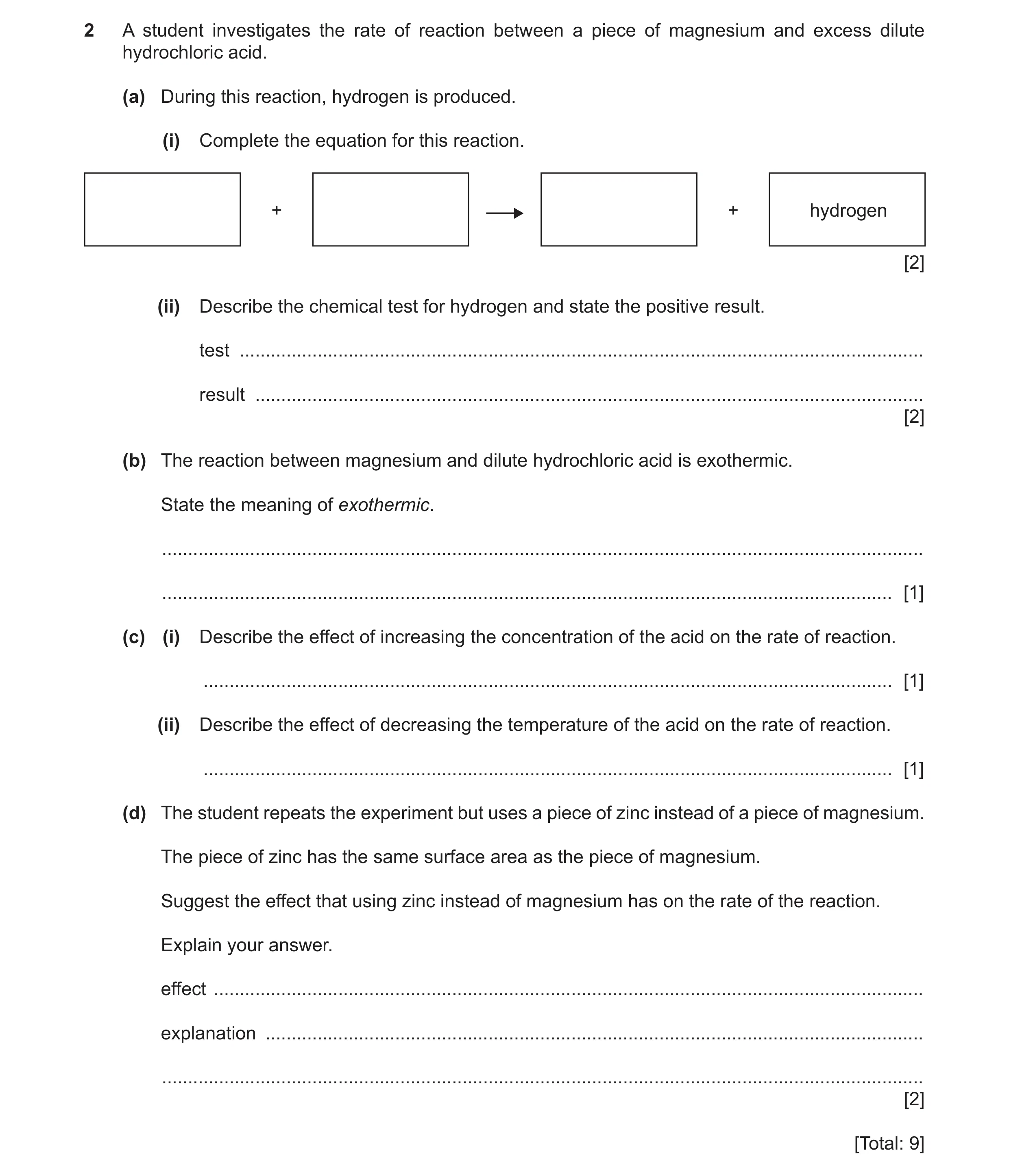
2 A student investigates the rate of reaction between a piece of magnesium and excess dilute hydrochloric acid. (a) During this reaction, hydrogen is produced. (i) Complete the equation for this reaction. + + hydrogen [2] (ii) Describe the chemical test for hydrogen and state the positive result. test … result … [2] (b) The reaction between magnesium and dilute hydrochloric acid is exothermic. State the meaning of exothermic. … … [1] (c) (i) Describe the effect of increasing the concentration of the acid on the rate of reaction. … [1] (ii) Describe the effect of decreasing the temperature of the acid on the rate of reaction. … [1] (d) The student repeats the experiment but uses a piece of zinc instead of a piece of magnesium. The piece of zinc has the same surface area as the piece of magnesium. Suggest the effect that using zinc instead of magnesium has on the rate of the reaction. Explain your answer. effect … explanation … … [2] [Total: 9]
9 marks
Mark scheme: 2(a)(i) magnesium + hydrochloric acid → magnesium chloride + (hydrogen) reactants ; magnesium chloride ; 2(a)(ii) (test) lighted splint ; (result) burns with a squeaky ‘pop’ ; 2 2(b) (thermal) energy / heat, is, released / given out ; 1 2(c)(i) rate increases ; 1 2(c)(ii) rate decreases ; 1 2(d) (effect) rate, decreases / reduces ; (explanation) zinc is less reactive (than magnesium) ; 2
This question in 0653/33 Oct/Nov 2020
Q12 · A student has two samples of pure water in test-tubes A and B, and two samples of impure… 0653/32 Feb/March 2022
2 (a) A student has two samples of pure water in test-tubes A and B, and two samples of impure water in test-tubes C and D. A different substance is added to each test-tube as shown in Fig. 2.1. aqueous white solid aqueous barium ions in copper(II) sulfate cobalt(II) chloride sodium hydroxide acidic solution pure impure water water A B C D Fig. 2.1 (i) State the colours of the solutions formed in test-tubes A and B. A … B … [2] (ii) When aqueous sodium hydroxide is added to impure water in test-tube C, a brown precipitate is formed. Identify the ion in the impure water that causes this change. … [1] (iii) When aqueous barium ions in acidic solution are added to test-tube D, a white precipitate is formed. Identify the ion in the impure water that causes this change. … [1] (b) A teacher adds a small piece of sodium to some water in a beaker, as shown in Fig. 2.2. thermometer piece of sodium water Fig. 2.2 Sodium reacts with the water in an exothermic reaction. An alkaline solution and a colourless gas are made. (i) Describe what happens to the reading on the thermometer. … [1] (ii) Complete the word equation for this reaction. sodium + water + [2] (c) Water molecules contain atoms of two non-metallic elements. (i) State the type of chemical bond in a molecule of water. … [1] (ii) Complete the dot-and-cross diagram in Fig. 2.3 to show all of the outer shell electrons in a molecule of water. H O H Fig. 2.3 [2] [Total: 10]
10 marks
Mark scheme: 2(a)(i) A (turns) blue ; B (turns) pink ; 2 2(a)(ii) iron(III) / Fe3+ ; 1 2(a)(iii) sulfate / SO42– ; 1 2(b)(i) increases / rises ; 1 Question Answer Marks 2(b)(ii) ; IN EITHER ORDER: sodium hydroxide ; hydrogen ; 2 2(c)(i) covalent ; 1 2(c)(ii) two correct O — H electron pairs ; all else correct ; 2
This question in 0653/32 Feb/March 2022
Q13 · A model of the human gas exchange system 0653/31 May/June 2023
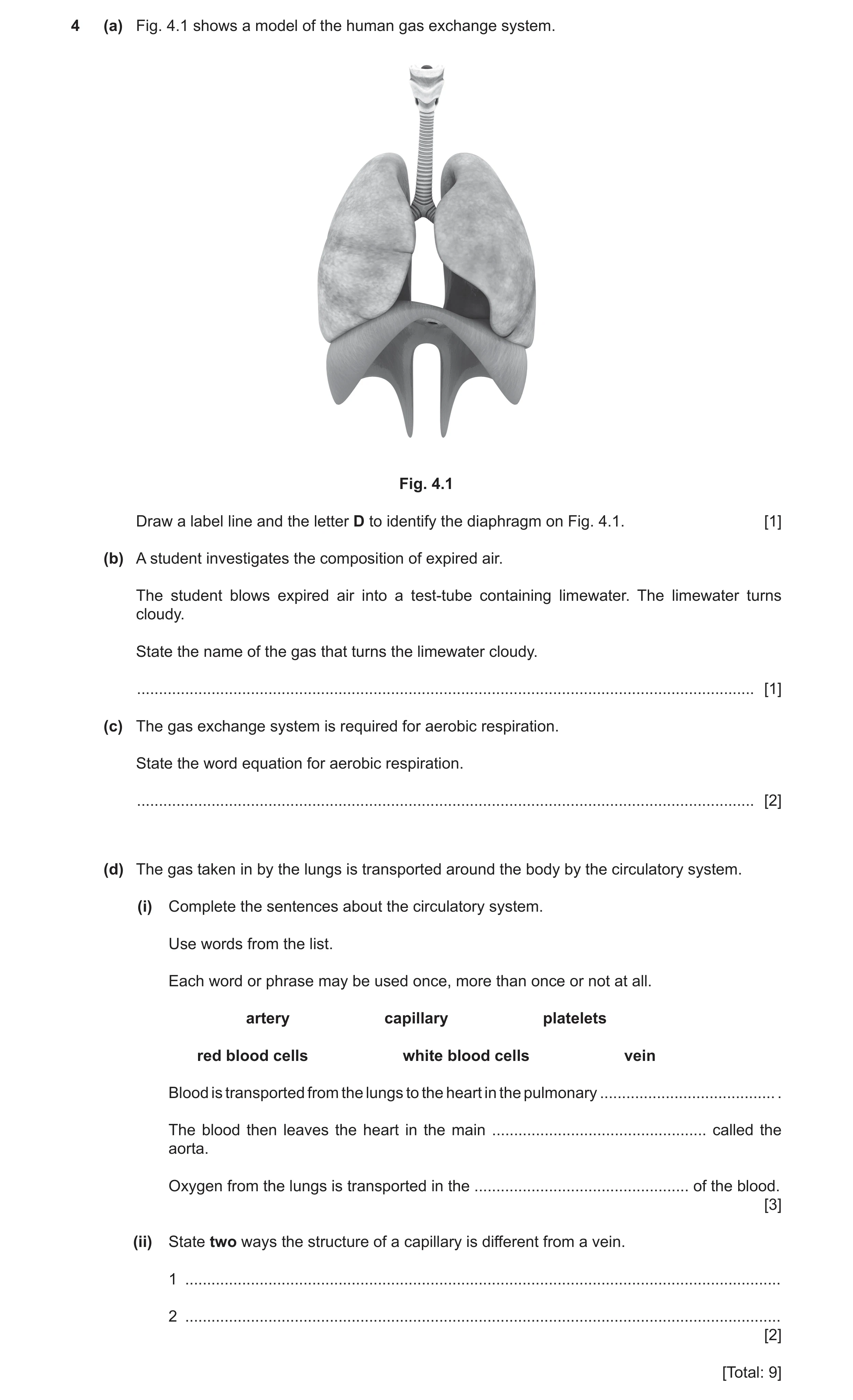
4 (a) Fig. 4.1 shows a model of the human gas exchange system. Fig. 4.1 Draw a label line and the letter D to identify the diaphragm on Fig. 4.1. [1] (b) A student investigates the composition of expired air. The student blows expired air into a test-tube containing limewater. The limewater turns cloudy. State the name of the gas that turns the limewater cloudy. … [1] (c) The gas exchange system is required for aerobic respiration. State the word equation for aerobic respiration. … [2] (d) The gas taken in by the lungs is transported around the body by the circulatory system. (i) Complete the sentences about the circulatory system. Use words from the list. Each word or phrase may be used once, more than once or not at all. artery capillary platelets red blood cells white blood cells vein Blood is transported from the lungs to the heart in the pulmonary … . The blood then leaves the heart in the main … called the aorta. Oxygen from the lungs is transported in the … of the blood. [3] (ii) State two ways the structure of a capillary is different from a vein. 1 … 2 … [2] [Total: 9]
9 marks
Mark scheme: 4(a) diaphragm labelled D ; 1 4(b) carbon dioxide ; 1 4(c) glucose + oxygen carbon dioxide + water ;; reactants (1) products (1) 2 4(d)(i) vein ; artery ; red blood cells ; 3 4(d)(ii) any two from: idea of small(er) internal cross-sectional area ; thinner wall / wall one cell thick ; no, muscles / elastic tissue in wall ; no valves ; 2
This question in 0653/31 May/June 2023
Q14 · Copper(II) sulfate, CuSO4, can be made by reacting copper(II) oxide, CuO, with a dilute… 0653/31 May/June 2023
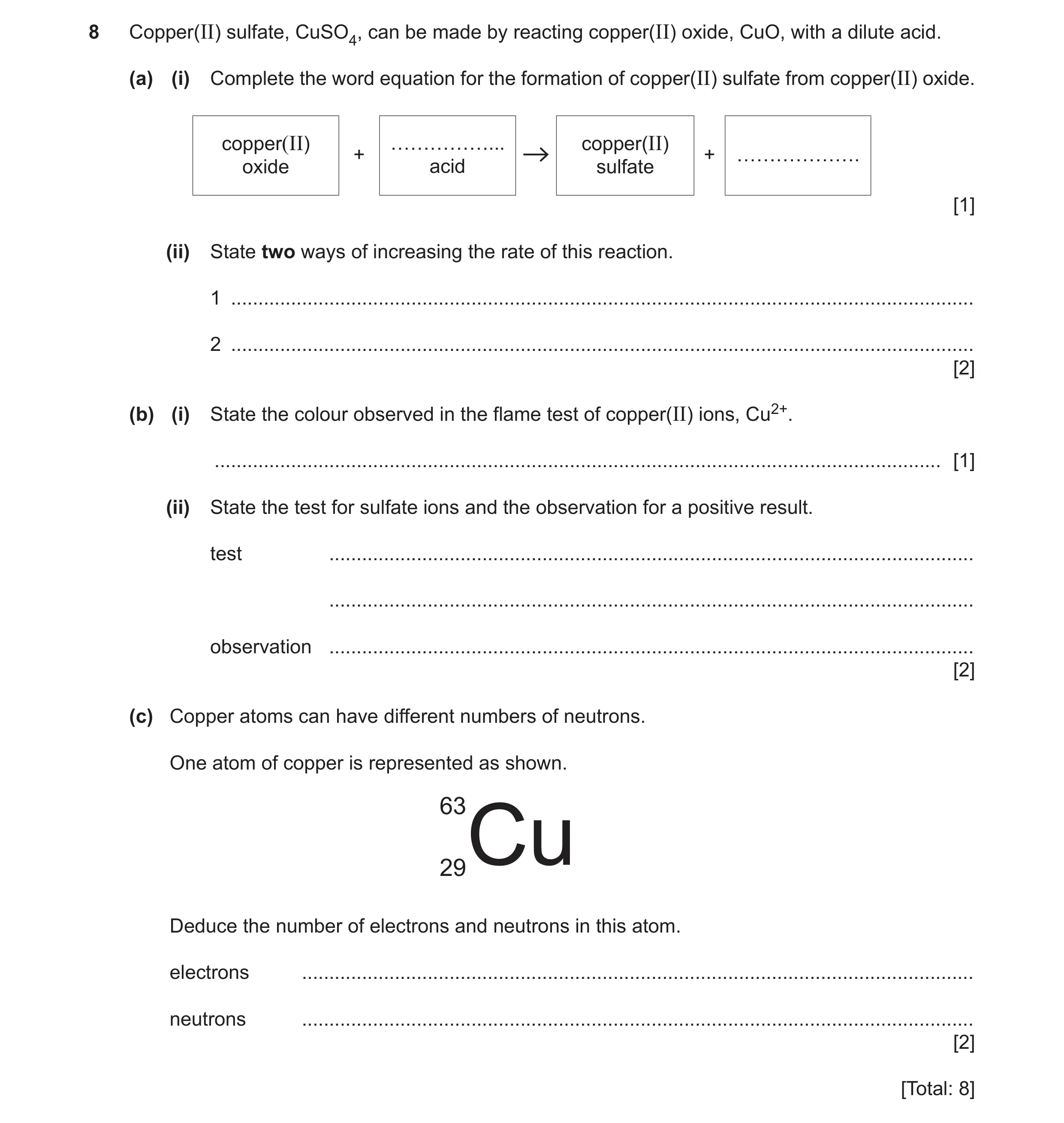
8 Copper(II) sulfate, CuSO4, can be made by reacting copper(II) oxide, CuO, with a dilute acid. (a) (i) Complete the word equation for the formation of copper(II) sulfate from copper(II) oxide. copper(II) ……………... copper(II) + + ………………. oxide acid sulfate [1] (ii) State two ways of increasing the rate of this reaction. 1 … 2 … [2] (b) (i) State the colour observed in the flame test of copper(II) ions, Cu2+. … [1] (ii) State the test for sulfate ions and the observation for a positive result. test … … observation … [2] (c) Copper atoms can have different numbers of neutrons. One atom of copper is represented as shown. 63 29Cu Deduce the number of electrons and neutrons in this atom. electrons … neutrons … [2] [Total: 8]
8 marks
Mark scheme: 8(a)(i) sulfuric (acid) AND water ; 1 Question Answer Marks 8(a)(ii) any two from: increase temperature ; increase surface area (of solid / CuO) ; increase concentration (of acid) ; 2 8(b)(i) blue-green ; 1 8(b)(ii) (test) aqueous barium nitrate ; (observation) white, precipitate / solid ; 2 8(c) (electrons) 29 ; (neutrons) 34 ; 2
This question in 0653/31 May/June 2023
Q15 · A student investigates sodium chloride, NaCl 0653/32 May/June 2023
2 A student investigates sodium chloride, NaCl. (a) The student uses solid sodium chloride to make a concentrated aqueous solution of sodium chloride. The student then uses the apparatus shown in Fig. 2.1 to electrolyse this solution. low voltage d.c. supply negative positive electrode electrode Fig. 2.1 (i) State what is meant by concentrated and aqueous. concentrated … … aqueous … … [2] (ii) State the name of the product formed at the positive electrode. … [1] (iii) State the name of the type of chemical bonding found in compounds that can be electrolysed. … [1] (b) The student adds aqueous silver nitrate to aqueous sodium chloride under acidic conditions. State the observation when these two solutions are mixed. … [1] (c) Aqueous sodium chloride is made when dilute hydrochloric acid is neutralised by aqueous solution X, as shown in Fig. 2.2. The reading on the thermometer increases during the reaction. aqueous solution thermometer X is added dilute hydrochloric acid Fig. 2.2 (i) Suggest the identity of X. … [1] (ii) State what happens to the pH of the mixture when X is added. … [1] (iii) State the type of chemical reaction that causes the reading on the thermometer to increase. … [1] (d) An atom of sodium is represented as shown. 2311Na Deduce the number of electrons and neutrons in this atom. number of electrons = … number of neutrons = … [2] [Total: 10]
10 marks
Mark scheme: 2(a)(i) (concentrated) high ratio of, solute / sodium chloride / ions, to solvent / water OR large (relative) amount of, solute / sodium chloride / ions ; (aqueous) (dissolved) in water / the solvent is water ; 2(a)(ii) chlorine (gas) ; 1 2(a)(iii) ionic ; 1 2(b) white, precipitate / solid ; 1 Question Answer Marks 2(c)(i) sodium hydroxide / NaOH / sodium carbonate / Na2CO3 / sodium hydrogen carbonate / NaHCO3 ; 1 2(c)(ii) increases / rises / goes up to 7 ; 1 2(c)(iii) exothermic ; 1 2(d) (electrons) 11 ; (neutrons) 12 ; 2
This question in 0653/32 May/June 2023
Q16 · A student investigates the reaction of magnesium with excess dilute hydrochloric acid… 0653/32 May/June 2024
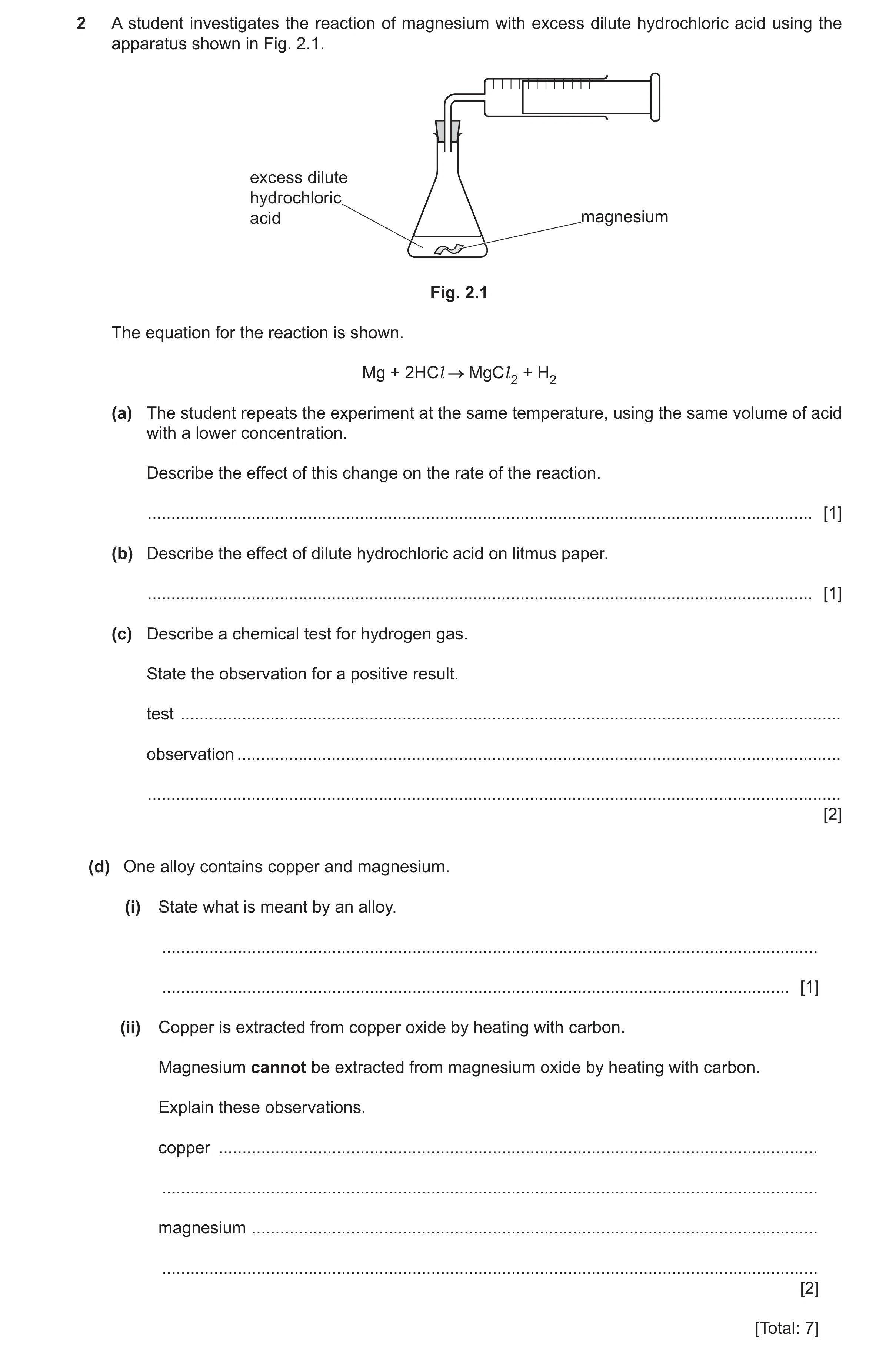
2 A student investigates the reaction of magnesium with excess dilute hydrochloric acid using the apparatus shown in Fig. 2.1. excess dilute hydrochloric acid magnesium Fig. 2.1 The equation for the reaction is shown. Mg + 2HCl MgCl2 + H2 (a) The student repeats the experiment at the same temperature, using the same volume of acid with a lower concentration. Describe the effect of this change on the rate of the reaction. … [1] (b) Describe the effect of dilute hydrochloric acid on litmus paper. … [1] (c) Describe a chemical test for hydrogen gas. State the observation for a positive result. test … observation … … [2] (d) One alloy contains copper and magnesium. (i) State what is meant by an alloy. … … [1] (ii) Copper is extracted from copper oxide by heating with carbon. Magnesium cannot be extracted from magnesium oxide by heating with carbon. Explain these observations. copper … … magnesium … … [2] [Total: 7]
7 marks
Mark scheme: 2(a) (rate of reaction) decreases / slows down ; 1 2(b) (turns blue litmus paper) red ; 1 2(c) (test) lighted splint ; (observation) ‘pops’ ; 2 2(d)(i) a mixture of a metal with another element(s) ; 1 2(d)(ii) (copper) is less reactive than carbon ORA ; (magnesium) is more reactive than carbon ORA ; 2
This question in 0653/32 May/June 2024
Q17 · A student investigates the rate of reaction between pieces of calcium metal and dilute… 0653/32 Oct/Nov 2024
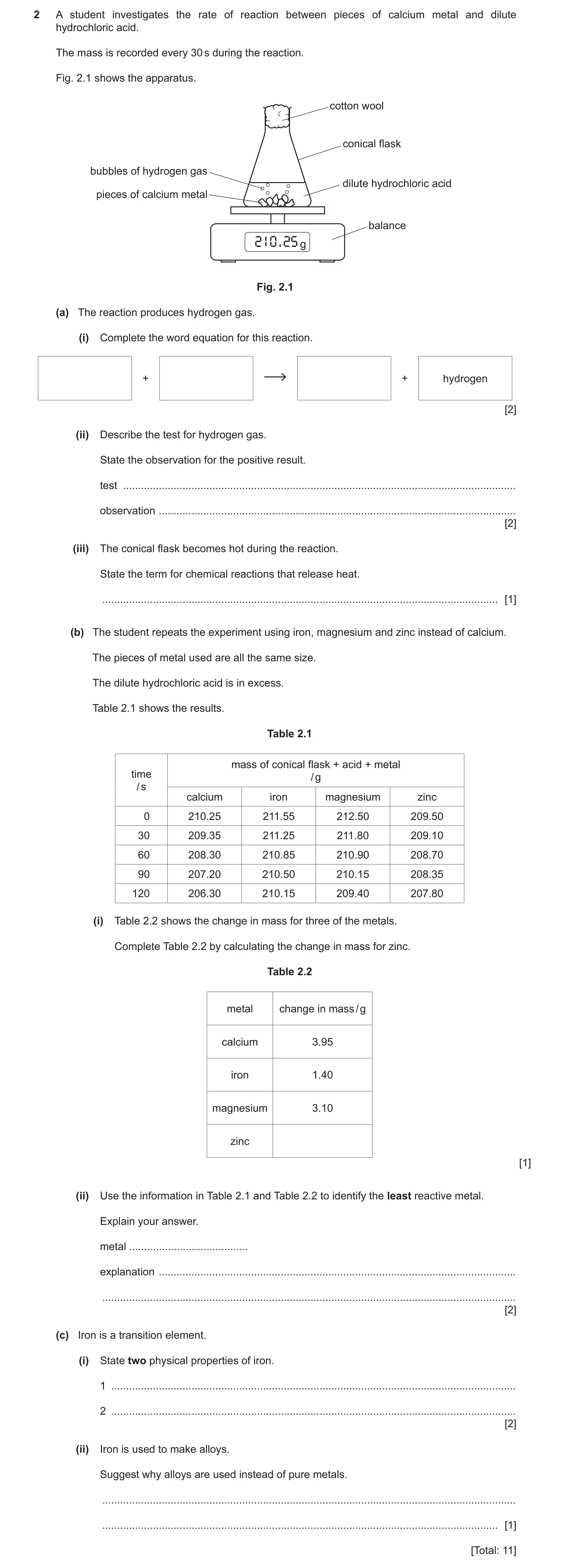
2 A student investigates the rate of reaction between pieces of calcium metal and dilute hydrochloric acid. The mass is recorded every 30 s during the reaction. Fig. 2.1 shows the apparatus. cotton wool conical flask bubbles of hydrogen gas dilute hydrochloric acid pieces of calcium metal balance 210 . 25 g Fig. 2.1 (a) The reaction produces hydrogen gas. (i) Complete the word equation for this reaction. + + hydrogen [2] (ii) Describe the test for hydrogen gas. State the observation for the positive result. test … observation … [2] (iii) The conical flask becomes hot during the reaction. State the term for chemical reactions that release heat. … [1] (b) The student repeats the experiment using iron, magnesium and zinc instead of calcium. The pieces of metal used are all the same size. The dilute hydrochloric acid is in excess. Table 2.1 shows the results. Table 2.1 mass of conical flask + acid + metal time / g / s calcium iron magnesium zinc 0 210.25 211.55 212.50 209.50 30 209.35 211.25 211.80 209.10 60 208.30 210.85 210.90 208.70 90 207.20 210.50 210.15 208.35 120 206.30 210.15 209.40 207.80 (i) Table 2.2 shows the change in mass for three of the metals. Complete Table 2.2 by calculating the change in mass for zinc. Table 2.2 metal change in mass / g calcium 3.95 iron 1.40 magnesium 3.10 zinc [1] (ii) Use the information in Table 2.1 and Table 2.2 to identify the least reactive metal. Explain your answer. metal … explanation … … [2] (c) Iron is a transition element. (i) State two physical properties of iron. 1 … 2 … [2] (ii) Iron is used to make alloys. Suggest why alloys are used instead of pure metals. … … [1] [Total: 11]
11 marks
Mark scheme: 2(a)(i) calcium AND hydrochloric acid ; 2 calcium chloride ; 2(a)(ii) lighted splint ; 2 pop(s) ; 2(a)(iii) exothermic ; 1 2(b)(i) 1.70 (g) ; 1 2(b)(ii) iron ; 2 smallest change in mass ; 2(c)(i) any two from: 2 high melting point ; malleable ; good conductor of heat ; good conductor of electricity ; 2(c)(ii) general statement that alloys have, better / different / desired, properties OR 1 named property, e.g. harder, greater resistance to corrosion, stronger ;
This question in 0653/32 Oct/Nov 2024
Q18 · A student investigates the rate of reaction between pieces of calcium metal and dilute… 0653/33 Oct/Nov 2024
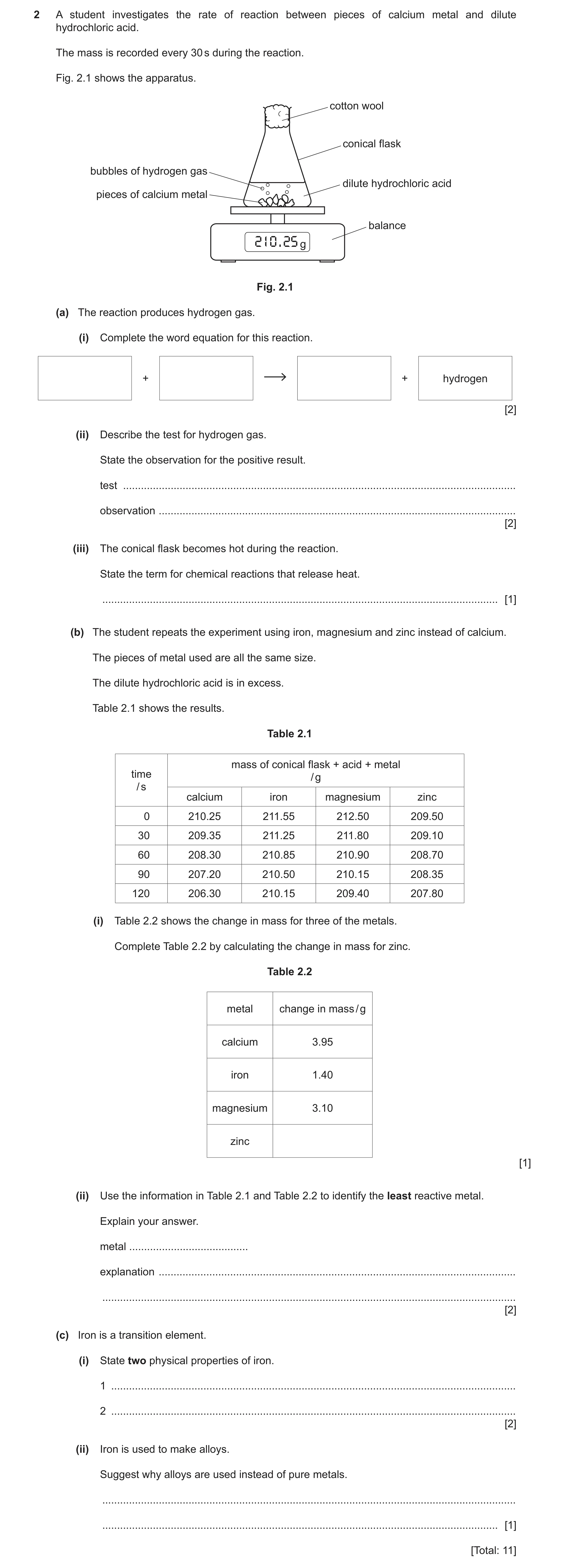
2 A student investigates the rate of reaction between pieces of calcium metal and dilute hydrochloric acid. The mass is recorded every 30 s during the reaction. Fig. 2.1 shows the apparatus. cotton wool conical flask bubbles of hydrogen gas dilute hydrochloric acid pieces of calcium metal balance 210 . 25 g Fig. 2.1 (a) The reaction produces hydrogen gas. (i) Complete the word equation for this reaction. + + hydrogen [2] (ii) Describe the test for hydrogen gas. State the observation for the positive result. test … observation … [2] (iii) The conical flask becomes hot during the reaction. State the term for chemical reactions that release heat. … [1] (b) The student repeats the experiment using iron, magnesium and zinc instead of calcium. The pieces of metal used are all the same size. The dilute hydrochloric acid is in excess. Table 2.1 shows the results. Table 2.1 mass of conical flask + acid + metal time / g / s calcium iron magnesium zinc 0 210.25 211.55 212.50 209.50 30 209.35 211.25 211.80 209.10 60 208.30 210.85 210.90 208.70 90 207.20 210.50 210.15 208.35 120 206.30 210.15 209.40 207.80 (i) Table 2.2 shows the change in mass for three of the metals. Complete Table 2.2 by calculating the change in mass for zinc. Table 2.2 metal change in mass / g calcium 3.95 iron 1.40 magnesium 3.10 zinc [1] (ii) Use the information in Table 2.1 and Table 2.2 to identify the least reactive metal. Explain your answer. metal … explanation … … [2] (c) Iron is a transition element. (i) State two physical properties of iron. 1 … 2 … [2] (ii) Iron is used to make alloys. Suggest why alloys are used instead of pure metals. … … [1] [Total: 11]
11 marks
Mark scheme: 2(a)(i) calcium AND hydrochloric acid ; 2 calcium chloride ; 2(a)(ii) lighted splint ; 2 pop(s) ; 2(a)(iii) exothermic ; 1 2(b)(i) 1.70 (g) ; 1 2(b)(ii) iron ; 2 smallest change in mass ; 2(c)(i) any two from: 2 high melting point ; malleable ; good conductor of heat ; good conductor of electricity ; 2(c)(ii) general statement that alloys have, better / different / desired, properties OR 1 named property, e.g. harder, greater resistance to corrosion, stronger ;
This question in 0653/33 Oct/Nov 2024
Q19 · Potassium and magnesium are metals 0653/31 May/June 2025
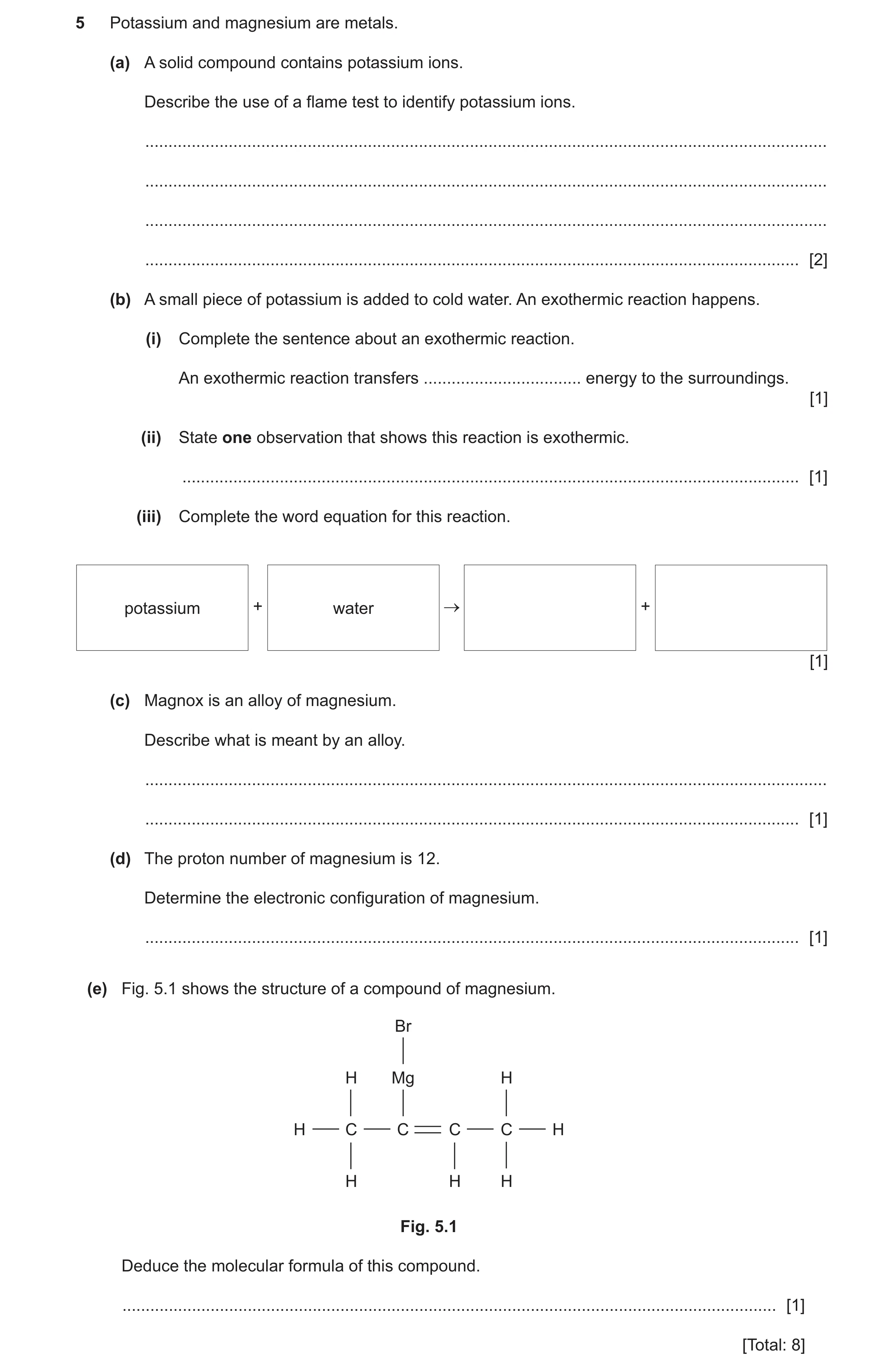
5 Potassium and magnesium are metals. (a) A solid compound contains potassium ions. Describe the use of a flame test to identify potassium ions. … … … … [2] (b) A small piece of potassium is added to cold water. An exothermic reaction happens. (i) Complete the sentence about an exothermic reaction. An exothermic reaction transfers … energy to the surroundings. [1] (ii) State one observation that shows this reaction is exothermic. … [1] (iii) Complete the word equation for this reaction. potassium + water + [1] (c) Magnox is an alloy of magnesium. Describe what is meant by an alloy. … … [1] (d) The proton number of magnesium is 12. Determine the electronic configuration of magnesium. … [1] (e) Fig. 5.1 shows the structure of a compound of magnesium. Br H Mg H H C C C C H H H H Fig. 5.1 Deduce the molecular formula of this compound. … [1] [Total: 8]
8 marks
Mark scheme: 5(a) any two from: 2 dip (nichrome) wire or splint in potassium compound ; at (edge of) a blue Bunsen flame ; lilac flame observed ; 5(b)(i) thermal ; 1 5(b)(ii) a flame (is observed) ; 1 5(b)(iii) potassium hydroxide and hydrogen ; 1 5(c) mixture of a metal and other element(s) ; 1 5(d) 2,8,2 ; 1 5(e) C4H7MgBr ; 1
This question in 0653/31 May/June 2025
Q20 · Hydrogen peroxide, H2O2, decomposes into water and oxygen when a catalyst is added 0653/32 May/June 2025
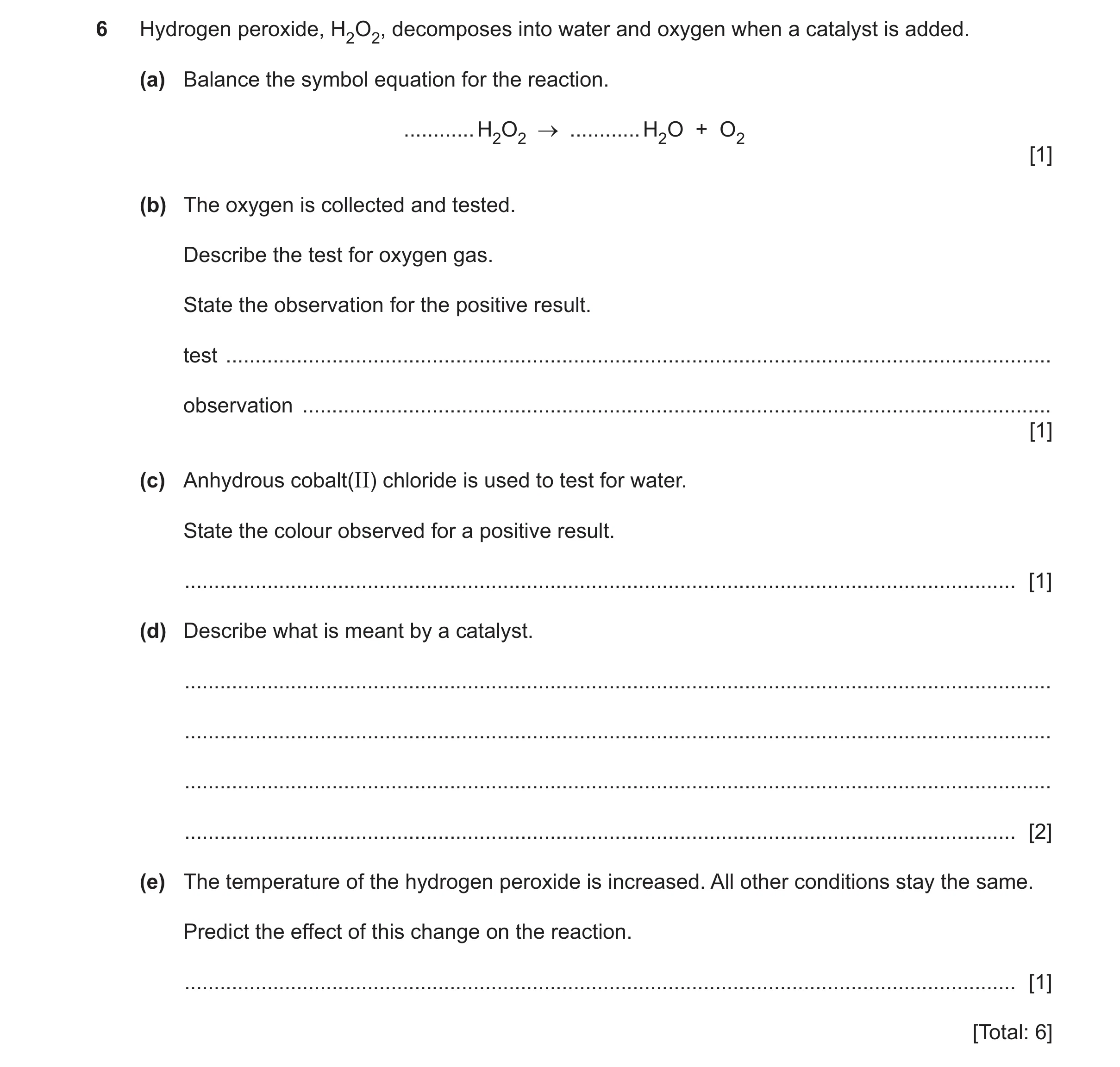
6 Hydrogen peroxide, H2O2, decomposes into water and oxygen when a catalyst is added. (a) Balance the symbol equation for the reaction. … H2O2 … H2O + O2 [1] (b) The oxygen is collected and tested. Describe the test for oxygen gas. State the observation for the positive result. test … observation … [1] (c) Anhydrous cobalt(II) chloride is used to test for water. State the colour observed for a positive result. … [1] (d) Describe what is meant by a catalyst. … … … … [2] (e) The temperature of the hydrogen peroxide is increased. All other conditions stay the same. Predict the effect of this change on the reaction. … [1] [Total: 6]
6 marks
Mark scheme: 6(a) 2 and 2 ; 1 6(b) glowing splint and relights ; 1 6(c) pink ; 1 6(d) (a substance that) increases rate of reaction ; 2 is unchanged at end of a reaction ; 6(e) increases the rate (of reaction) ; 1
This question in 0653/32 May/June 2025
 11 / 28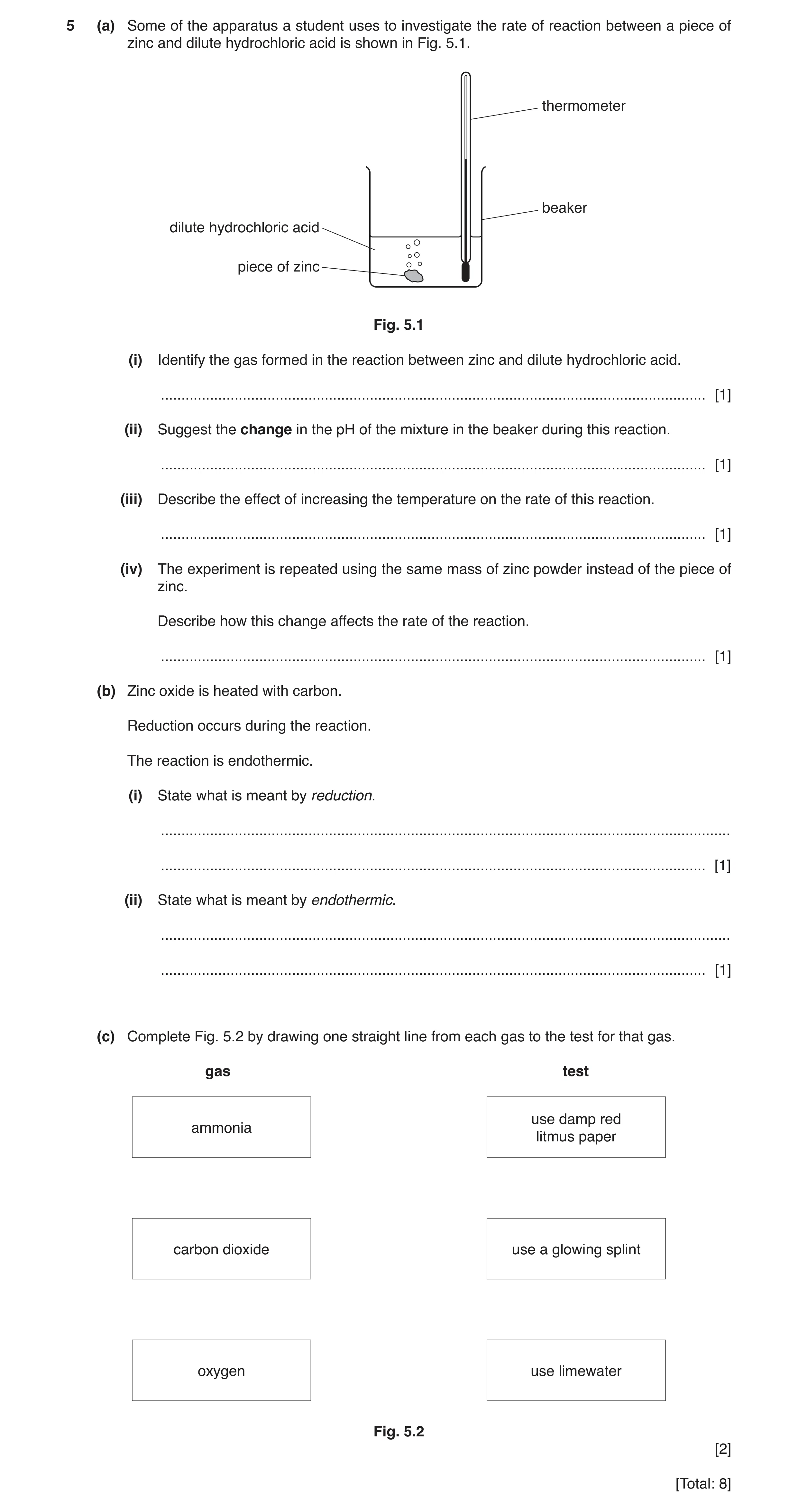
 14 / 28
 15 / 28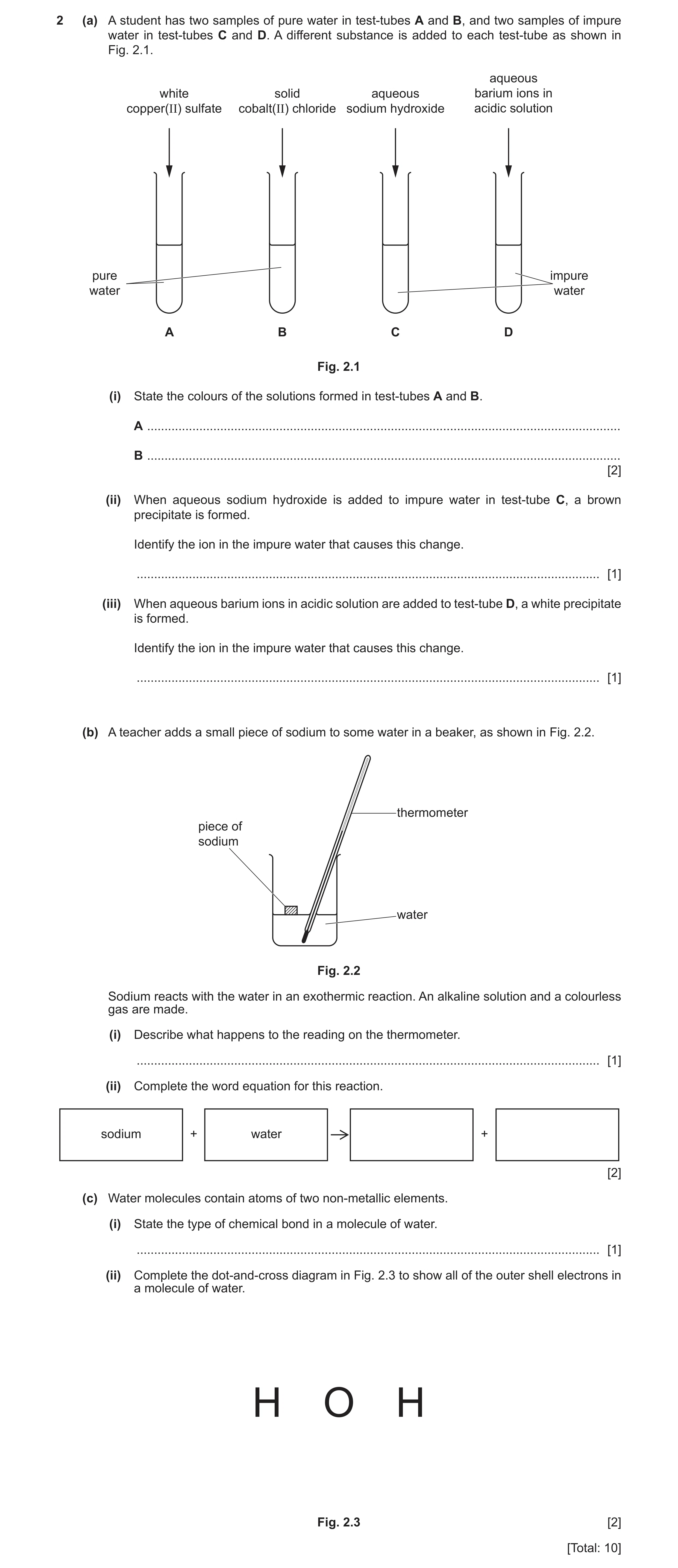
 19 / 28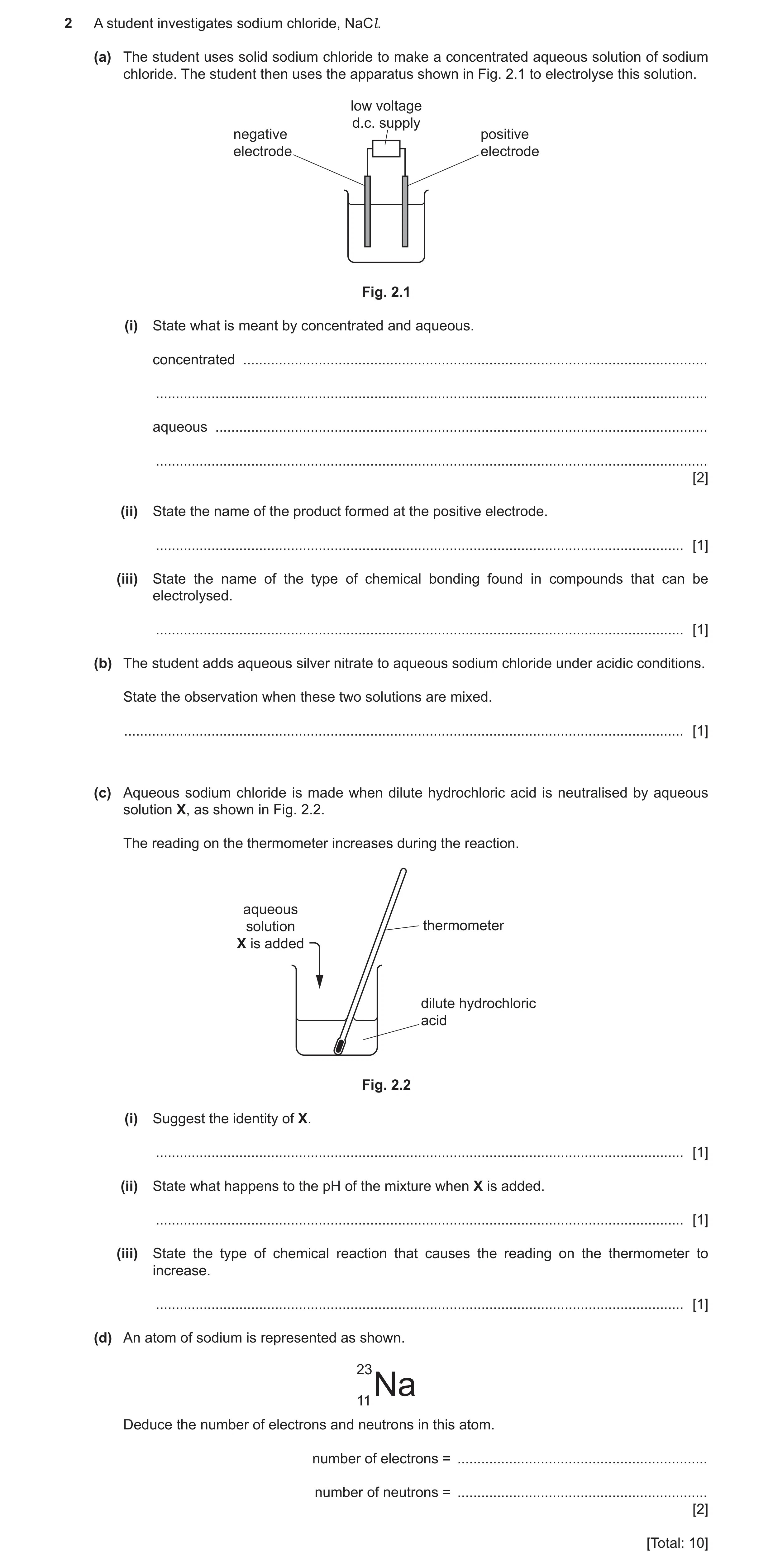
 28 / 28
 9
9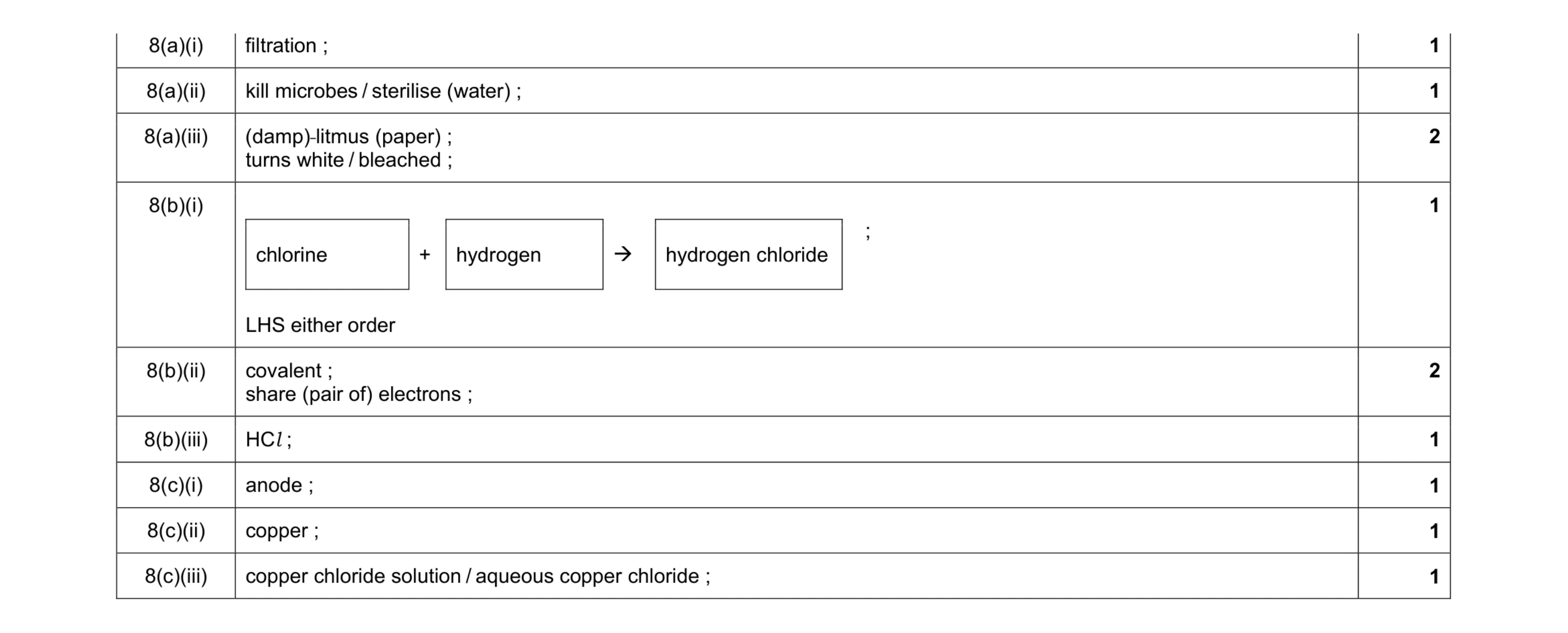 11
11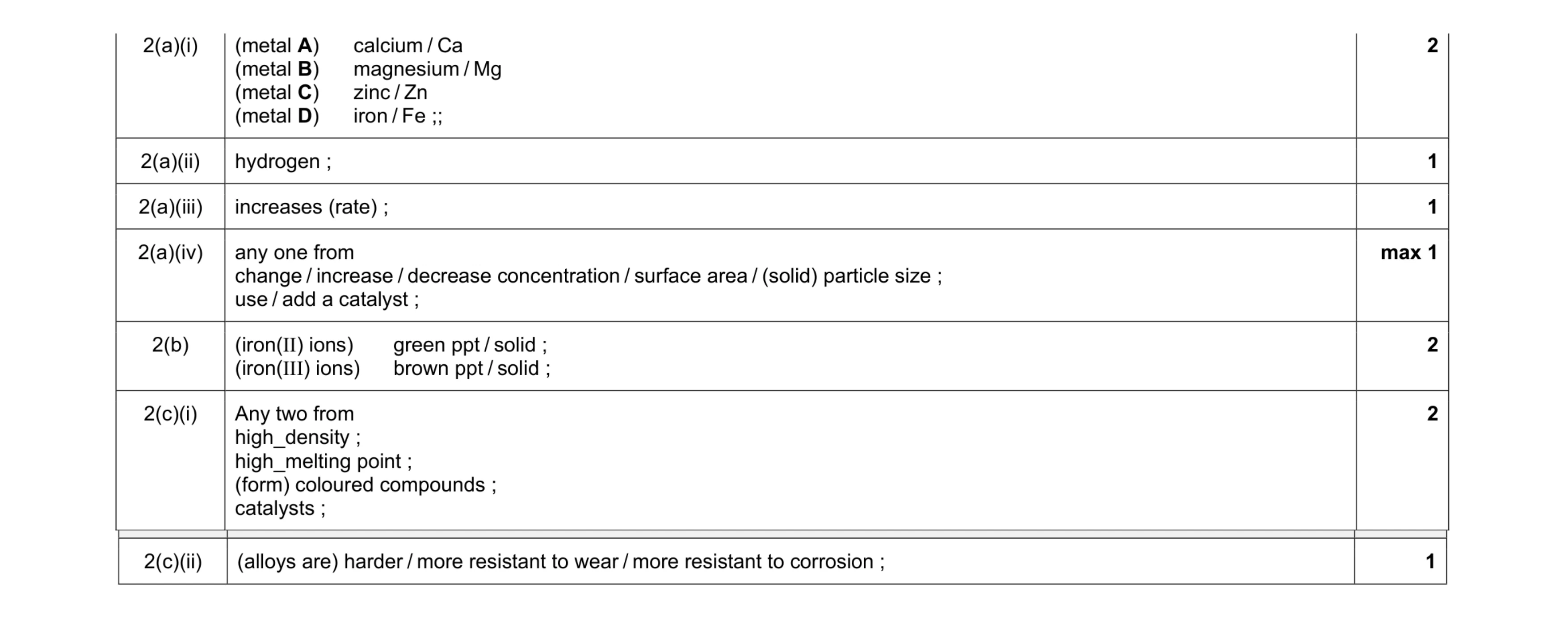 10
10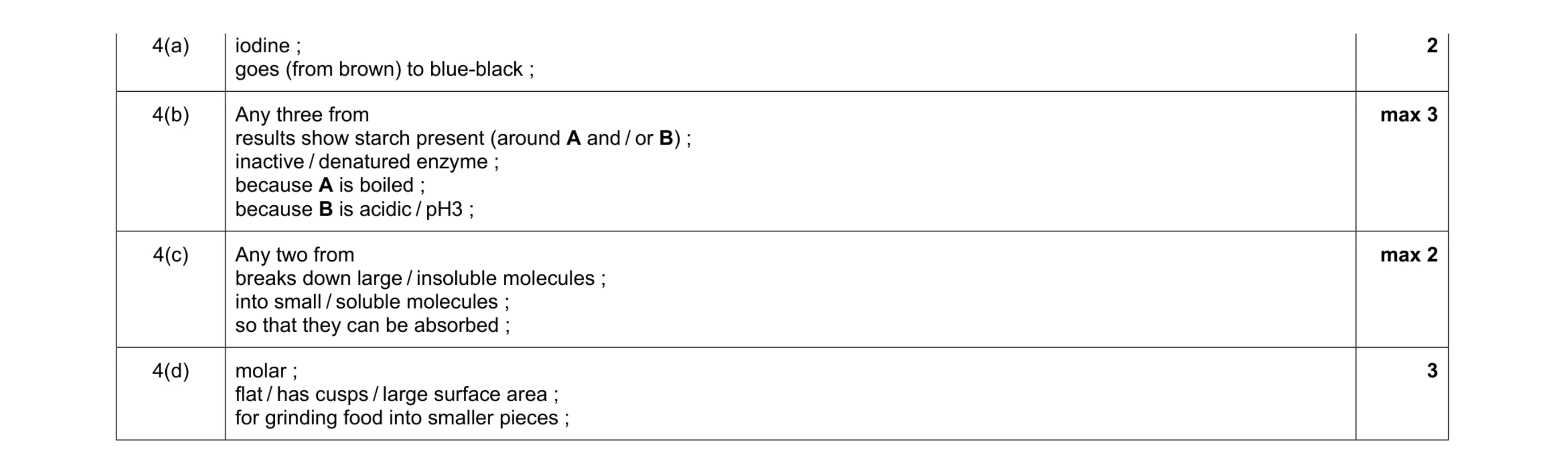 10
10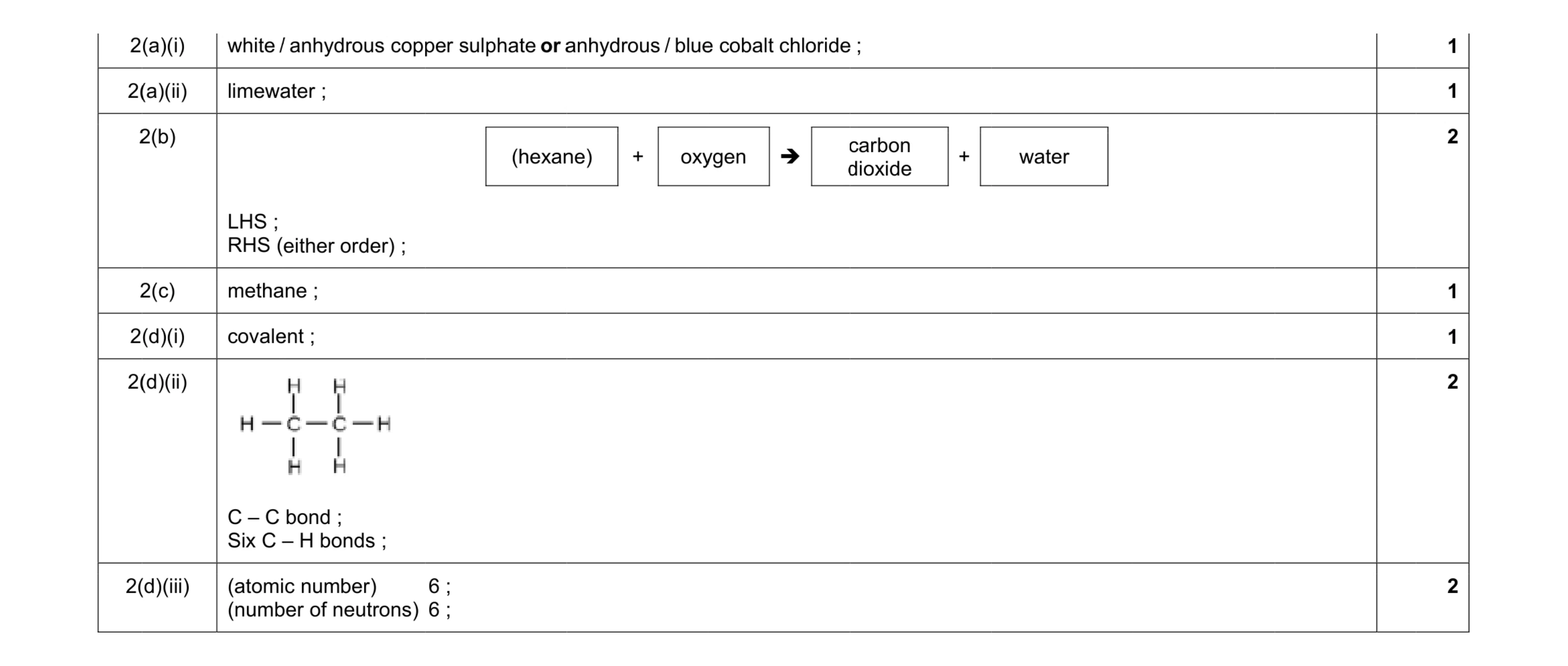 10
10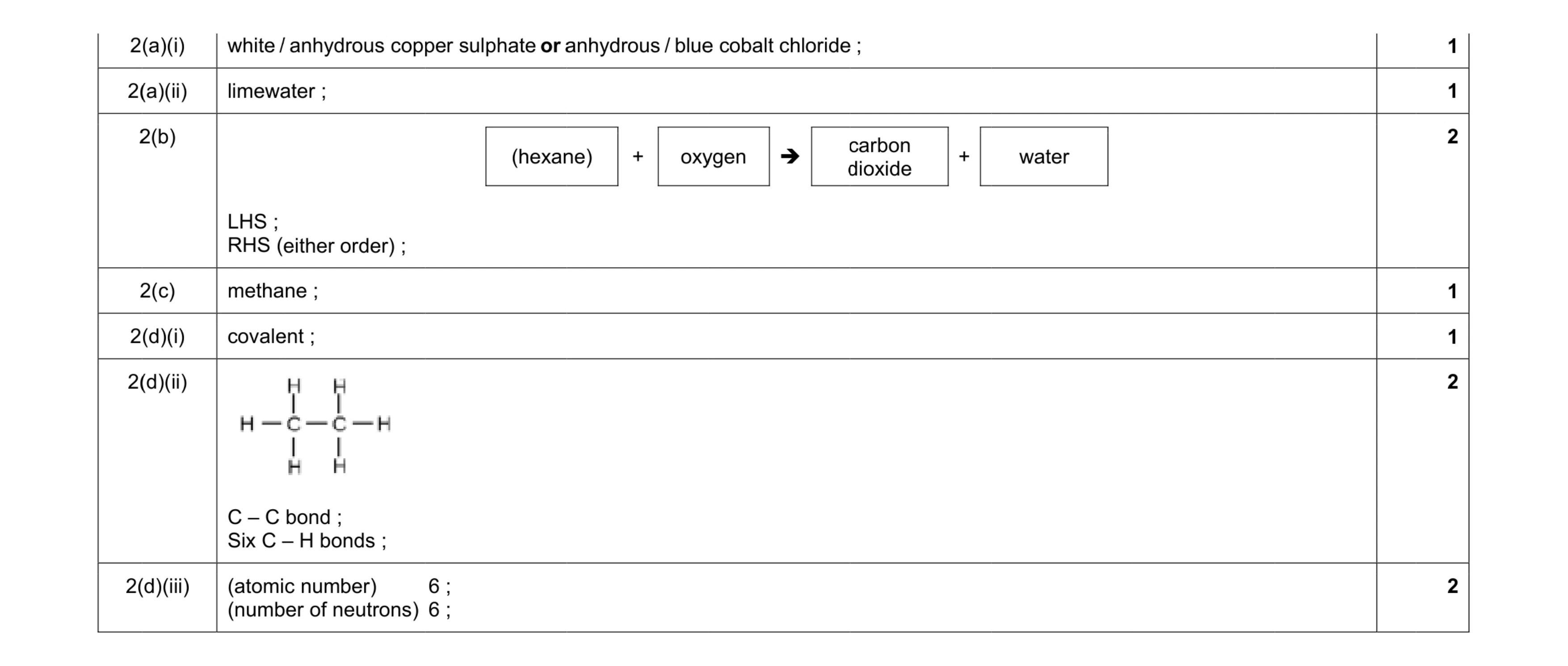 10
10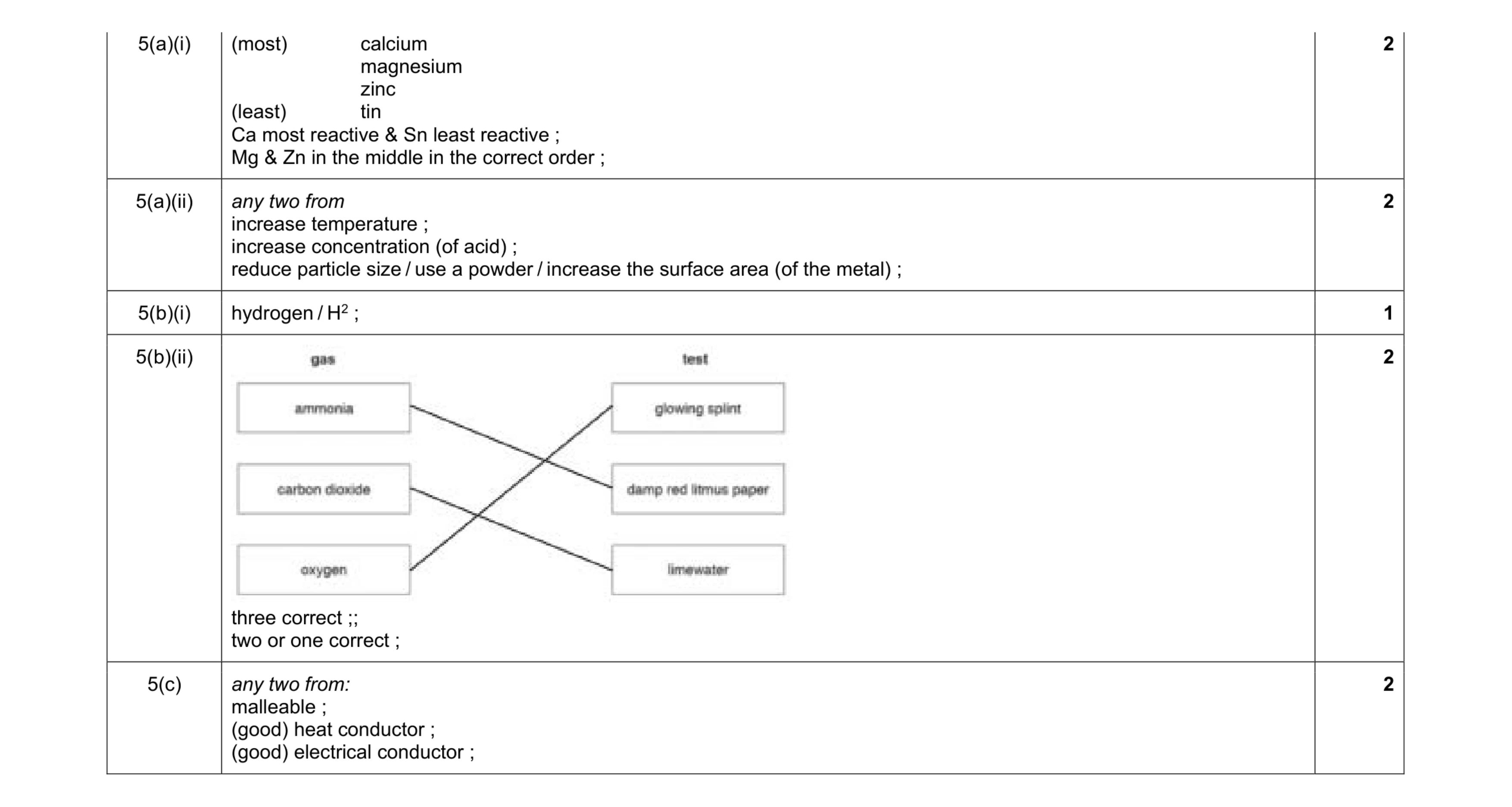 9
9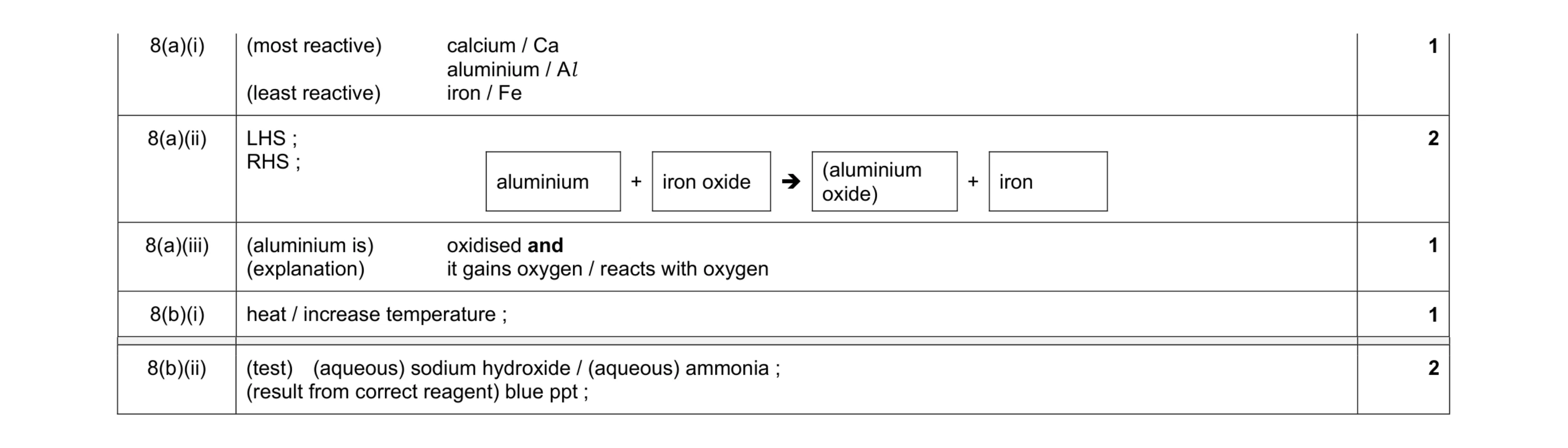 7
7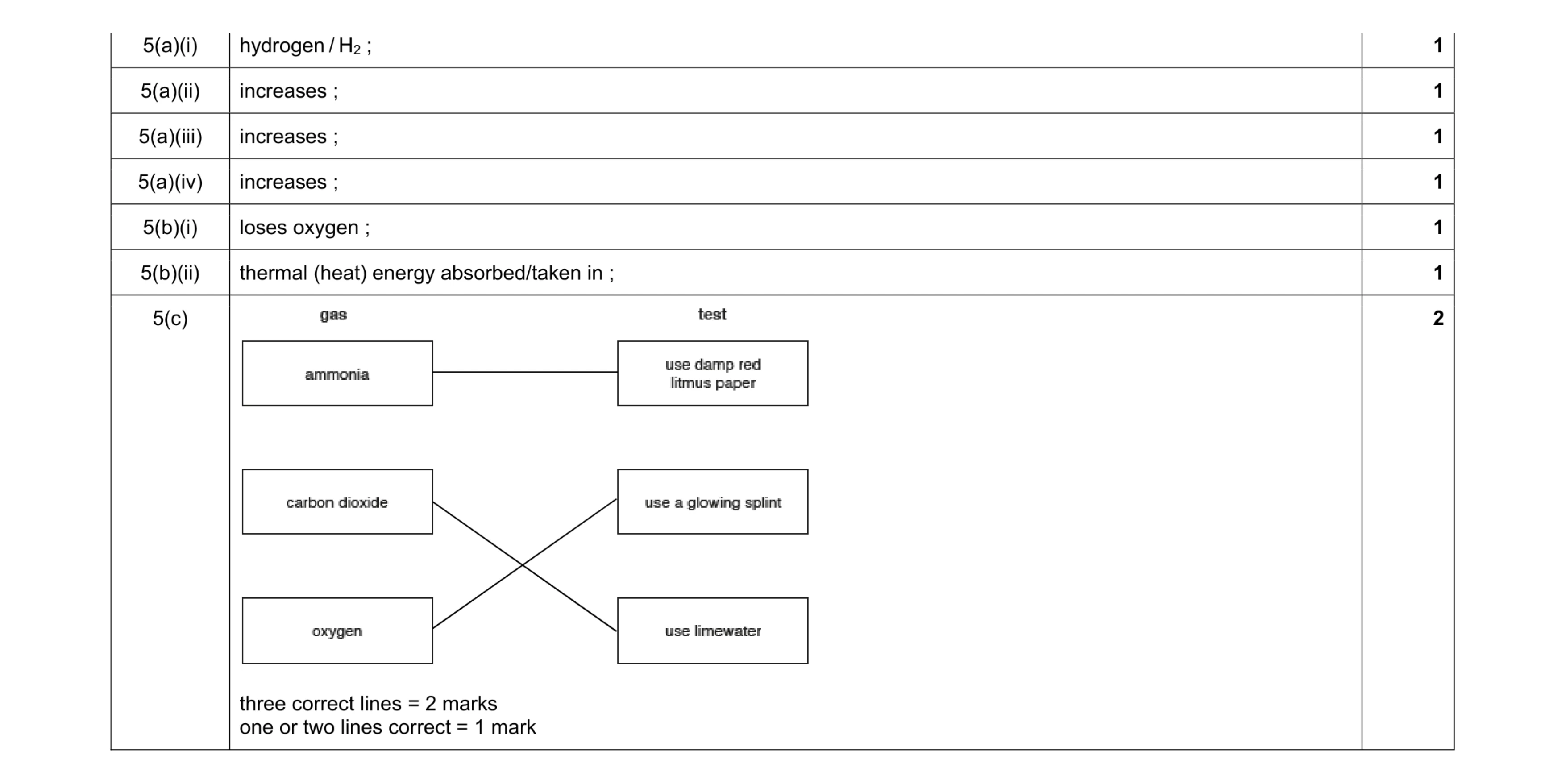 8
8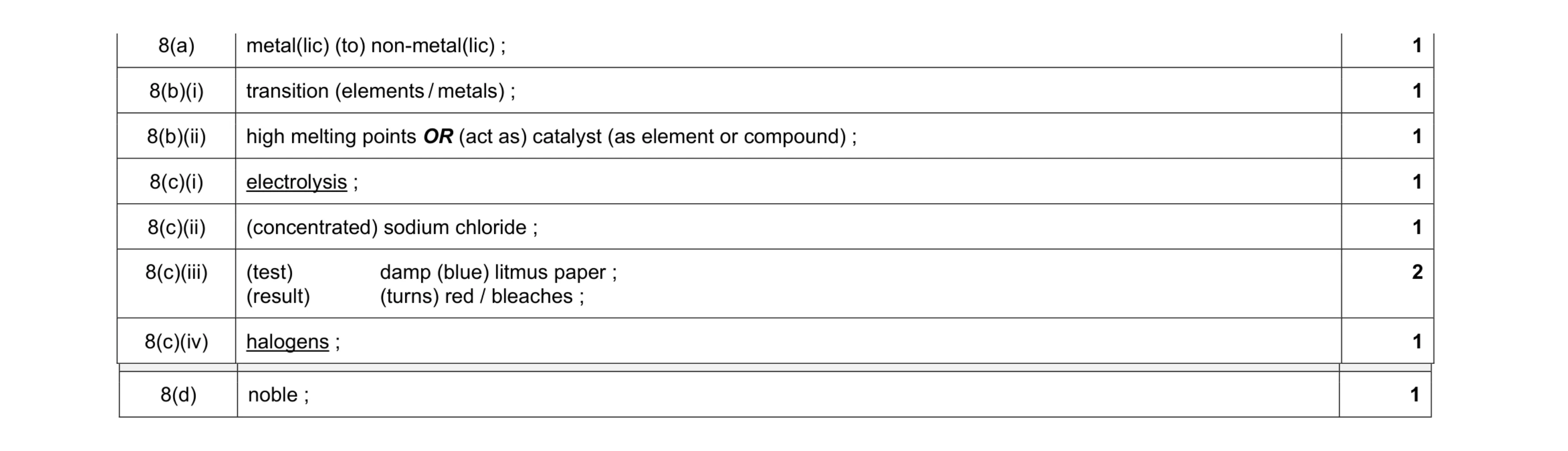 9
9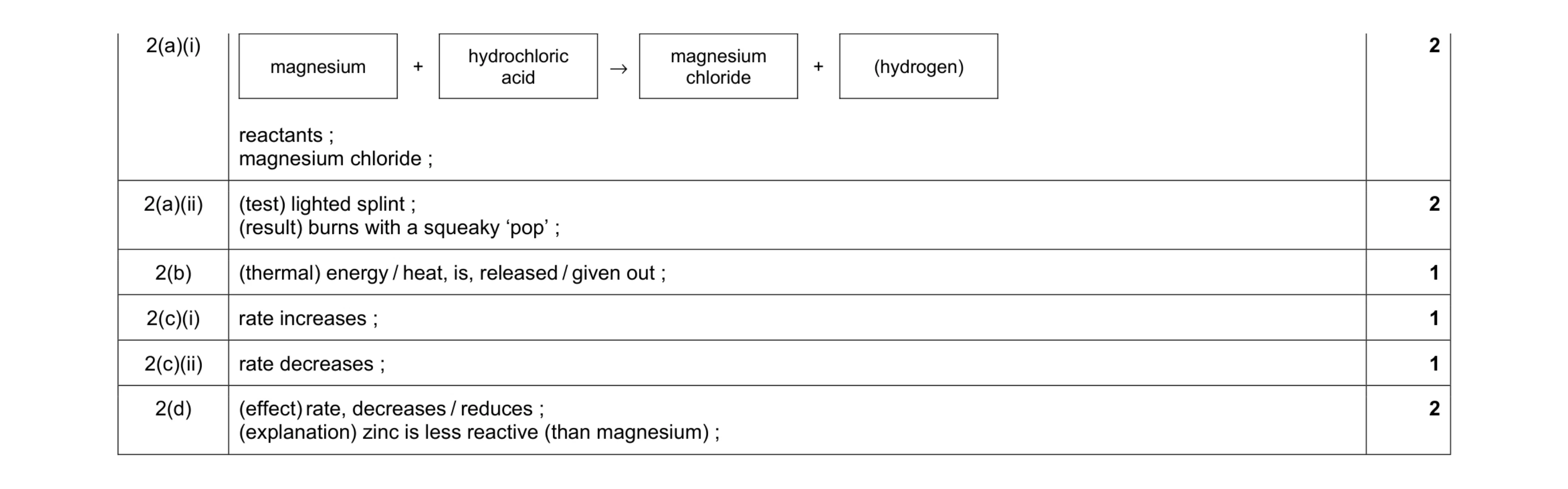 9
9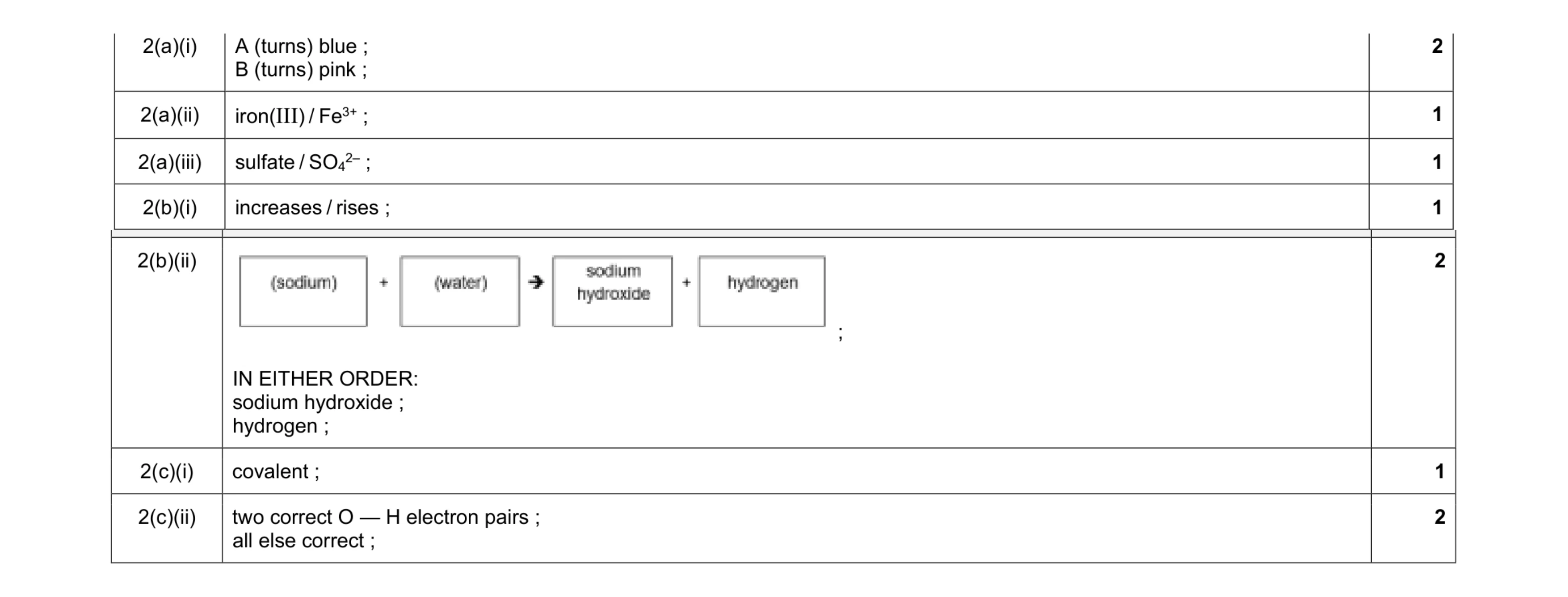 10
10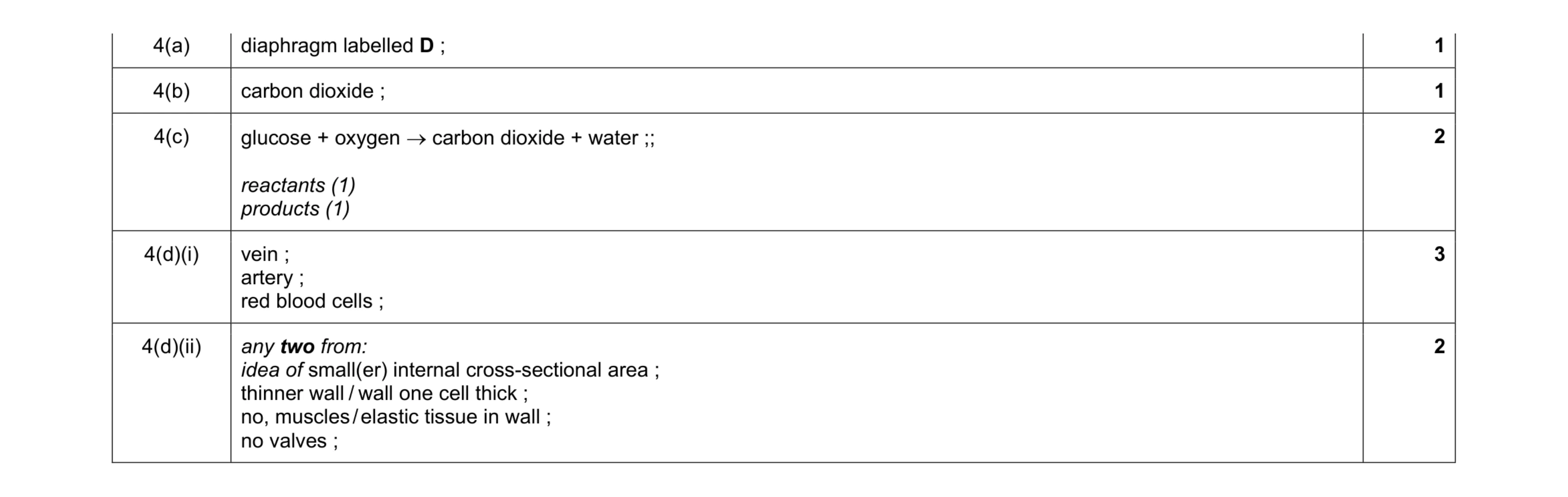 9
9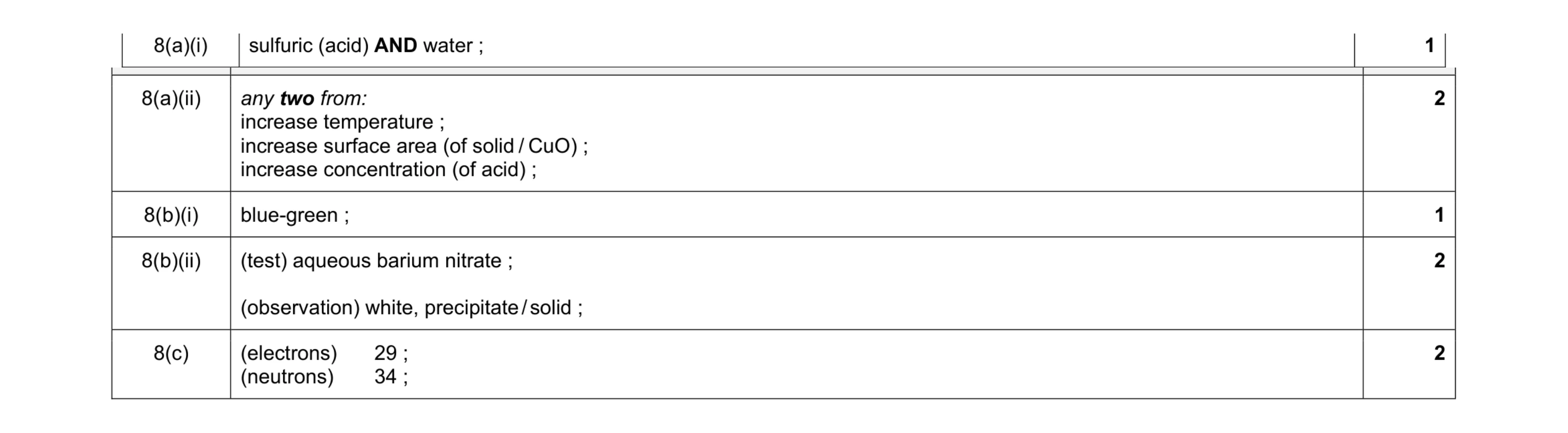 8
8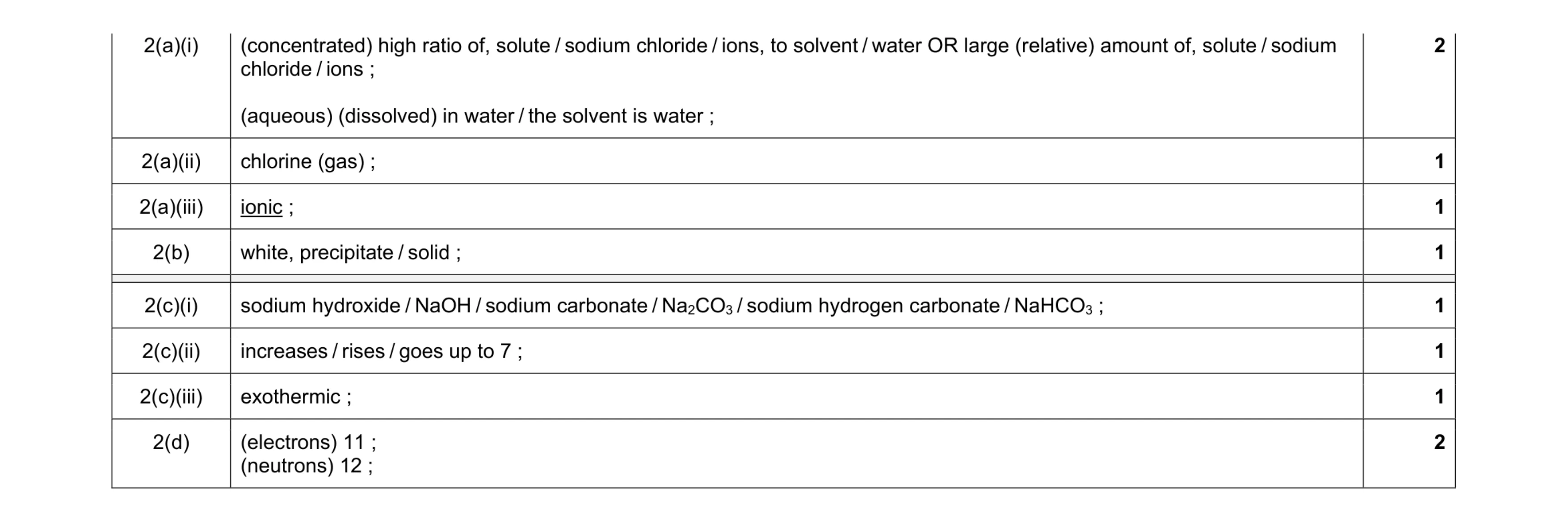 10
10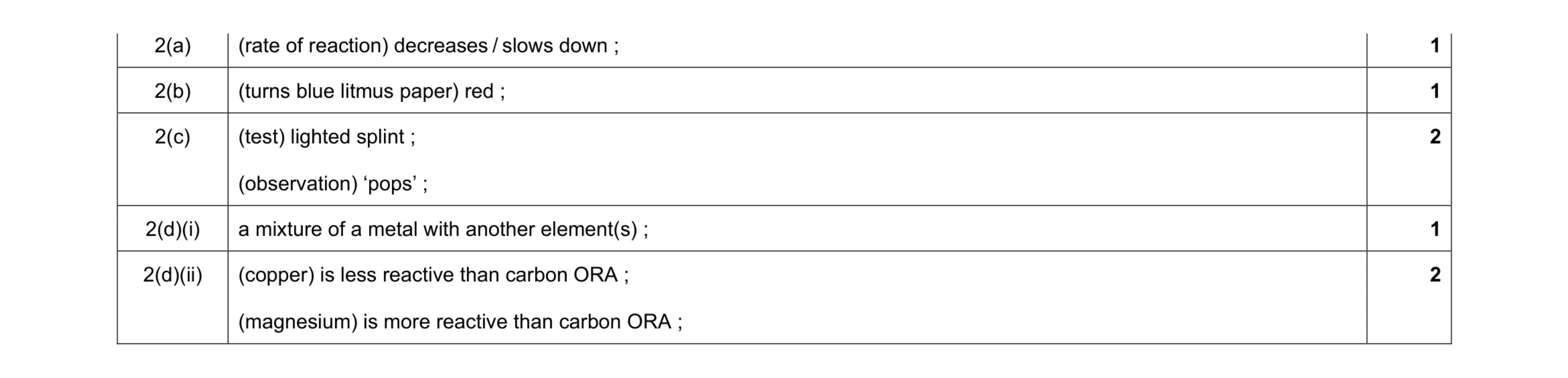 7
7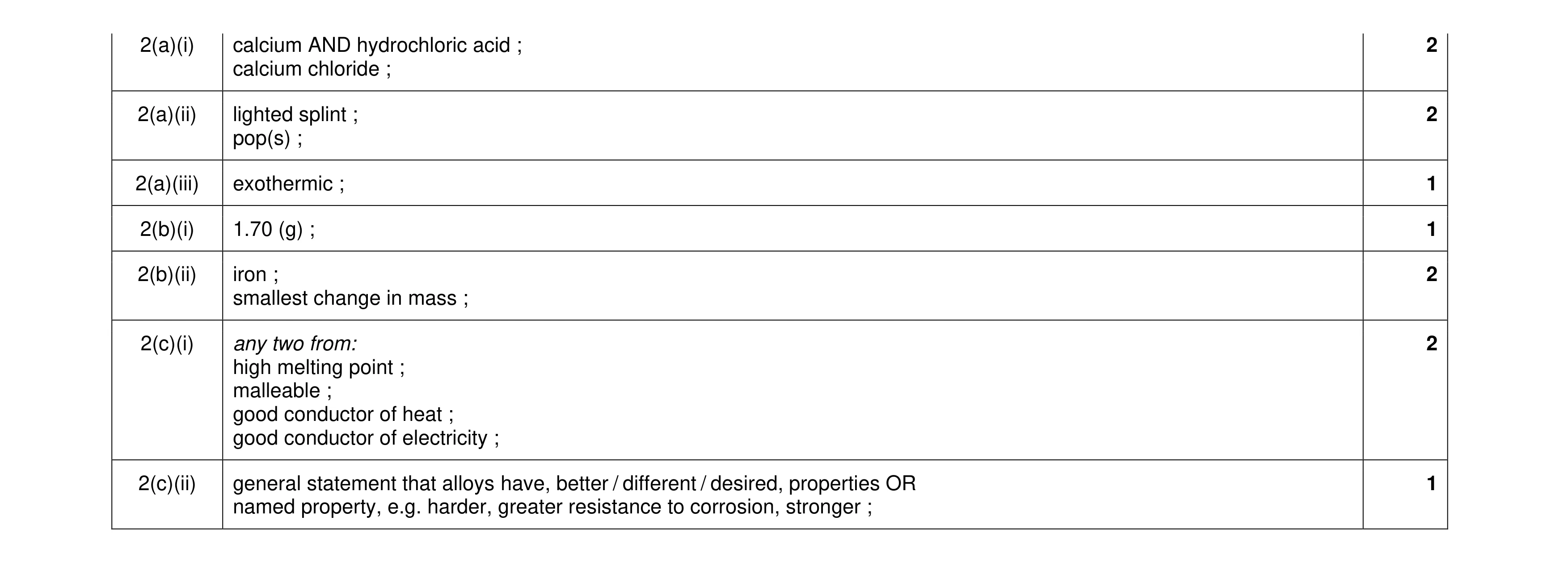 11
11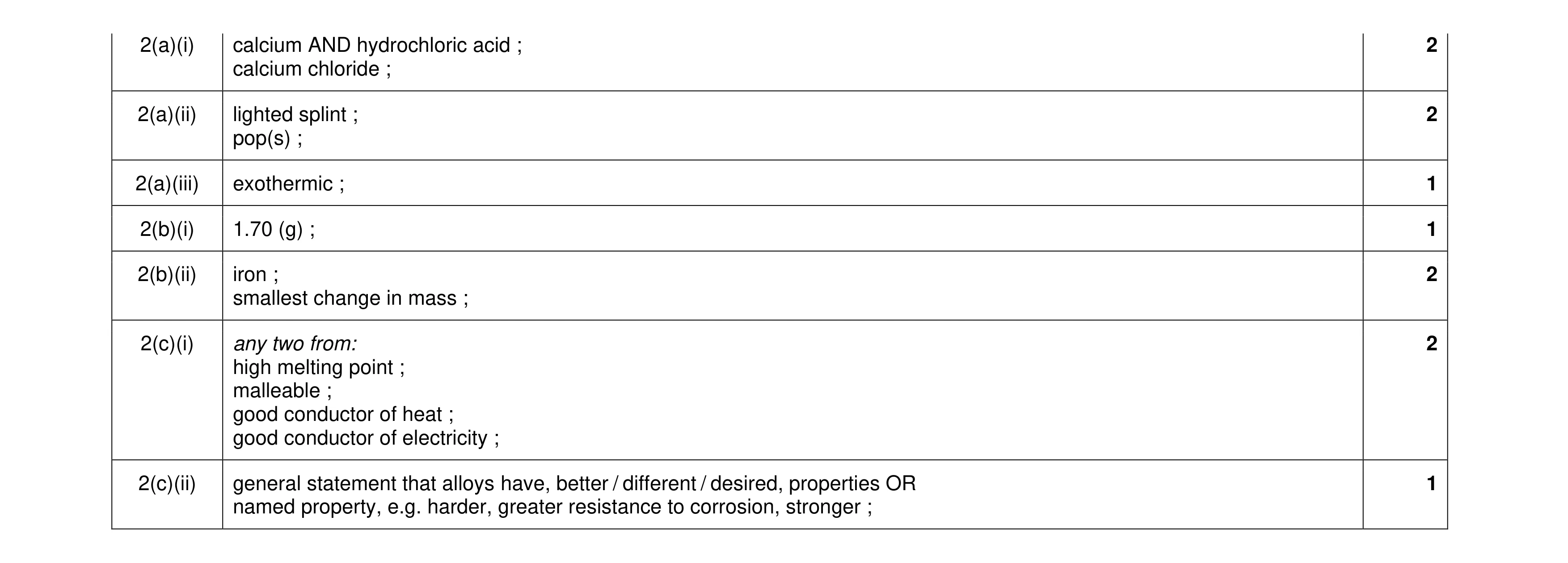 11
11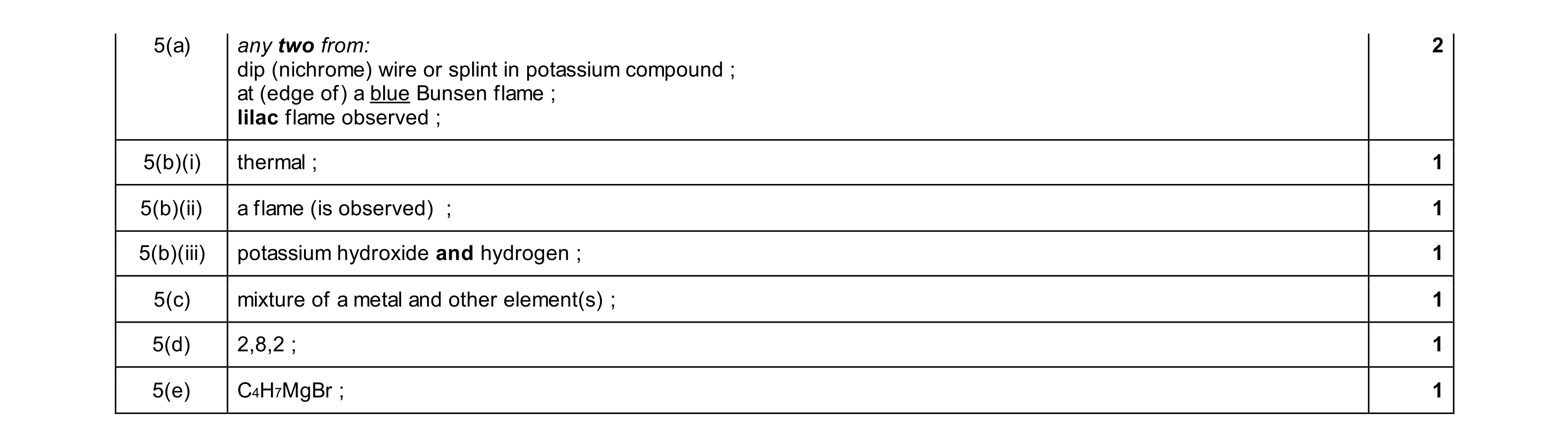 8
8 6
6