Questions as text
Q1 · What is the electronic configuration of an element with a second ionisation energy higher… 9701/11 Oct/Nov 2005
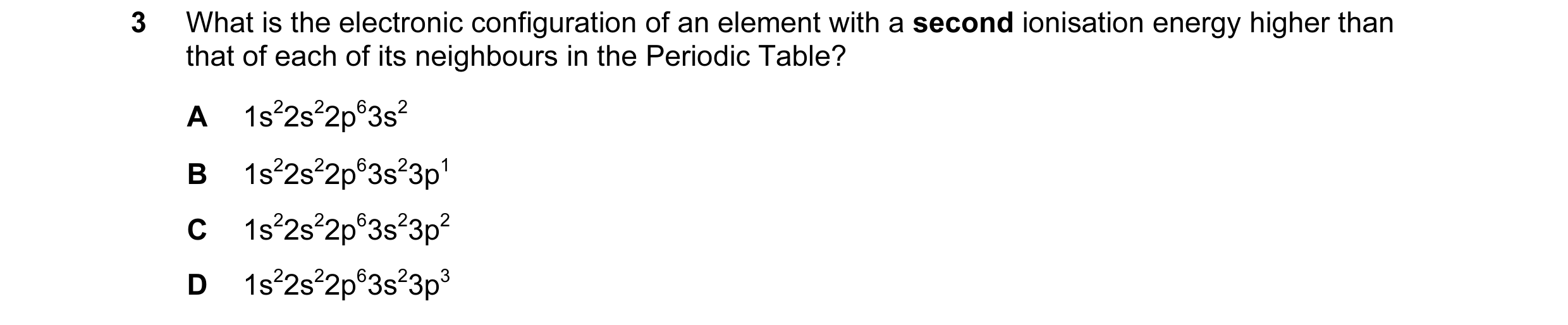
3 What is the electronic configuration of an element with a second ionisation energy higher than that of each of its neighbours in the Periodic Table? A 1s22s22p63s2 B 1s22s22p63s23p1 C 1s22s22p63s23p2 D 1s22s22p63s23p3
1 marks
Answer: B
This question in 9701/11 Oct/Nov 2005
Q2 · Sodium ions can be formed from sodium atoms 9701/11 May/June 2006
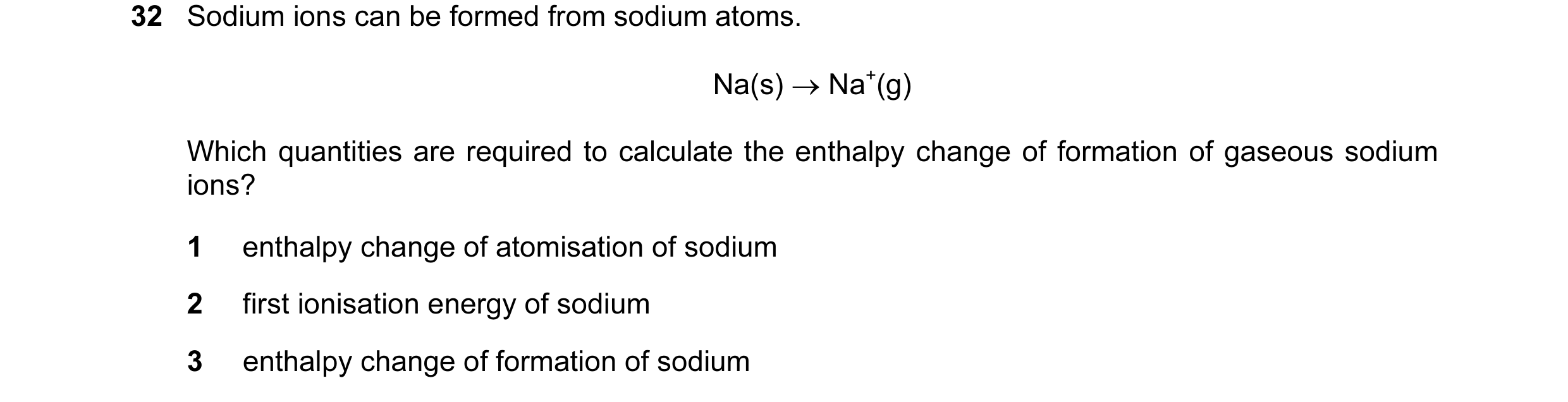
32 Sodium ions can be formed from sodium atoms. Na(s) → Na+(g) Which quantities are required to calculate the enthalpy change of formation of gaseous sodium ions? 1 enthalpy change of atomisation of sodium 2 first ionisation energy of sodium 3 enthalpy change of formation of sodium
1 marks
Answer: B
This question in 9701/11 May/June 2006
Q3 · Three successive elements in the Periodic Table have first ionisation energies which have… 9701/11 Oct/Nov 2006
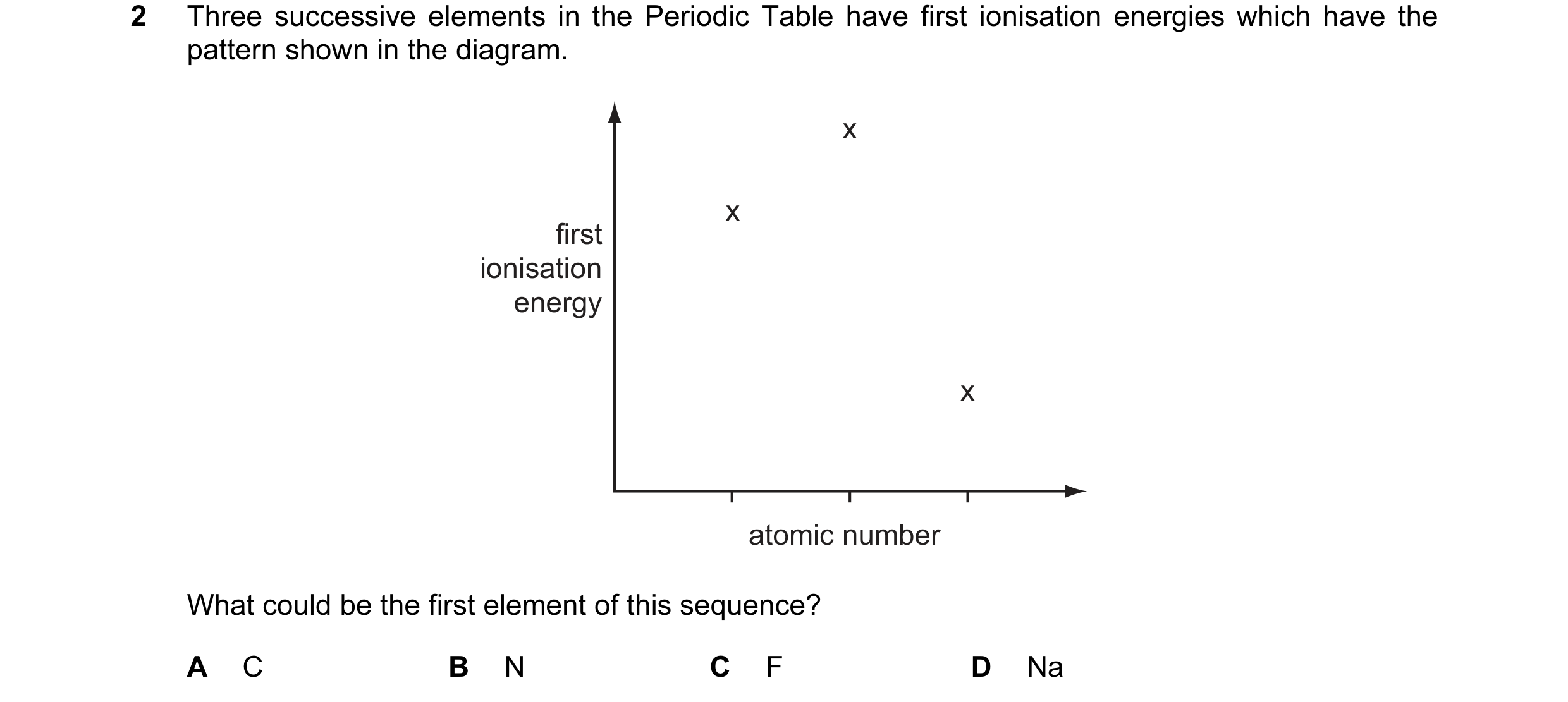
2 Three successive elements in the Periodic Table have first ionisation energies which have the pattern shown in the diagram. x x first ionisation energy x atomic number What could be the first element of this sequence? A C B N C F D Na
1 marks
Answer: C
This question in 9701/11 Oct/Nov 2006
Q4 · The graph shows the first thirteen ionisation energies for element X 9701/11 Oct/Nov 2007
4 The graph shows the first thirteen ionisation energies for element X. ionisation energy number of electrons removed What can be deduced about element X from the graph? A It is in the second period (Li to Ne) of the Periodic Table. B It is a d-block element. C It is in Group II of the Periodic Table. D It is in Group III of the Periodic Table.
1 marks
Answer: C
This question in 9701/11 Oct/Nov 2007
Q5 · Use of the Data Booklet is relevant to this question 9701/11 Oct/Nov 2007
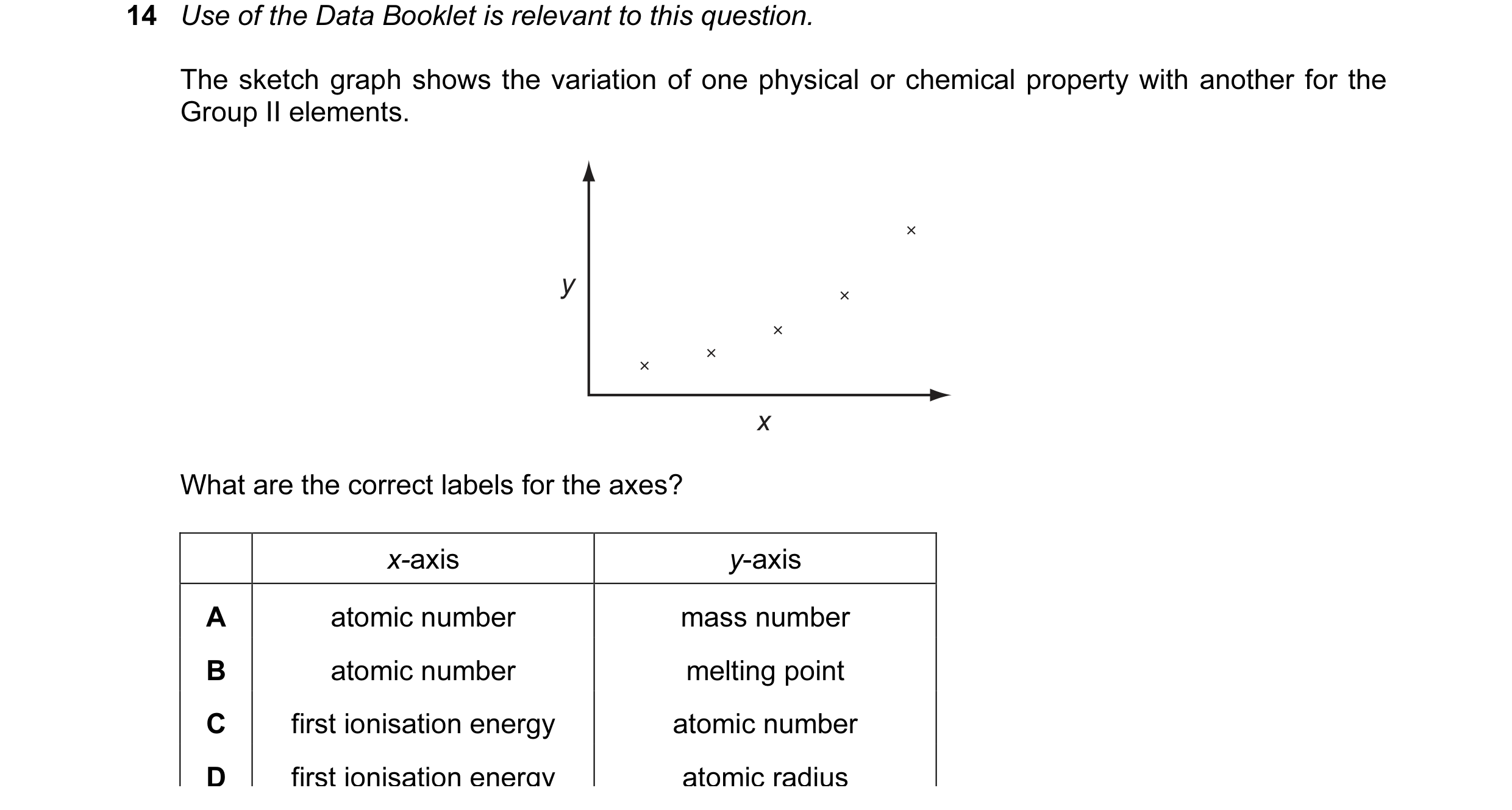
14 Use of the Data Booklet is relevant to this question. The sketch graph shows the variation of one physical or chemical property with another for the Group II elements. y x What are the correct labels for the axes? x-axis y-axis A atomic number mass number B atomic number melting point C first ionisation energy atomic number D first ionisation energy atomic radius
1 marks
Answer: A
This question in 9701/11 Oct/Nov 2007
Q6 · The electronic structure of the outer shell of the element radium is 7s2 9701/11 May/June 2008
35 The electronic structure of the outer shell of the element radium is 7s2. Which statements will be correct for radium within its group? 1 The element will decompose water, liberating hydrogen. 2 The element will show an oxidation number of +2 in all its compounds. 3 Radium has the highest first ionisation energy.
1 marks
Answer: B
This question in 9701/11 May/June 2008
Q7 · The first seven ionisation energies of an element between lithium and neon in the… 9701/11 May/June 2009
3 The first seven ionisation energies of an element between lithium and neon in the Periodic Table are as follows. 1310 3390 5320 7450 11 000 13 300 71 000 kJ mol–1 What is the outer electronic configuration of the element? A 2s2 B 2s22p1 C 2s22p4 D 2s22p6
1 marks
Answer: C
This question in 9701/11 May/June 2009
Q8 · Use of the Data Booklet is relevant to this question 9701/11 May/June 2010
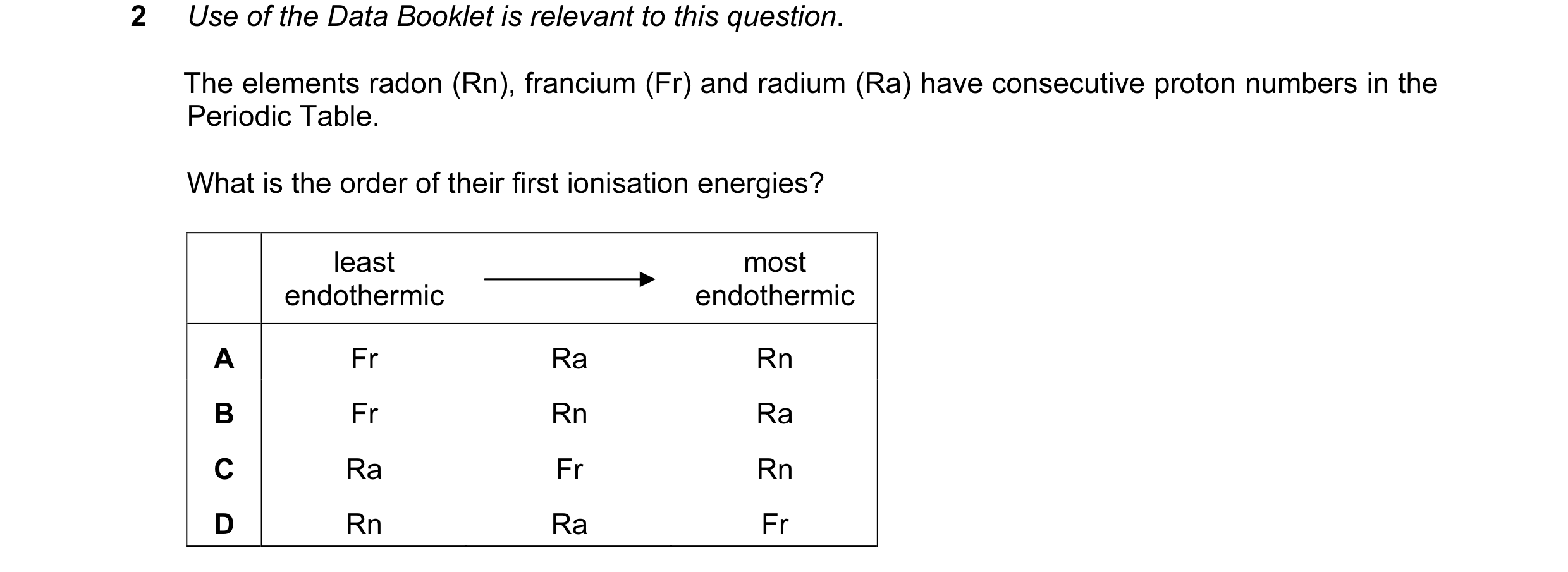
2 Use of the Data Booklet is relevant to this question. The elements radon (Rn), francium (Fr) and radium (Ra) have consecutive proton numbers in the Periodic Table. What is the order of their first ionisation energies? least most endothermic endothermic A Fr Ra Rn B Fr Rn Ra C Ra Fr Rn D Rn Ra Fr
1 marks
Answer: A
This question in 9701/11 May/June 2010
Q9 · Consecutive elements X, Y, Z are in the third period of the Periodic Table 9701/11 May/June 2010
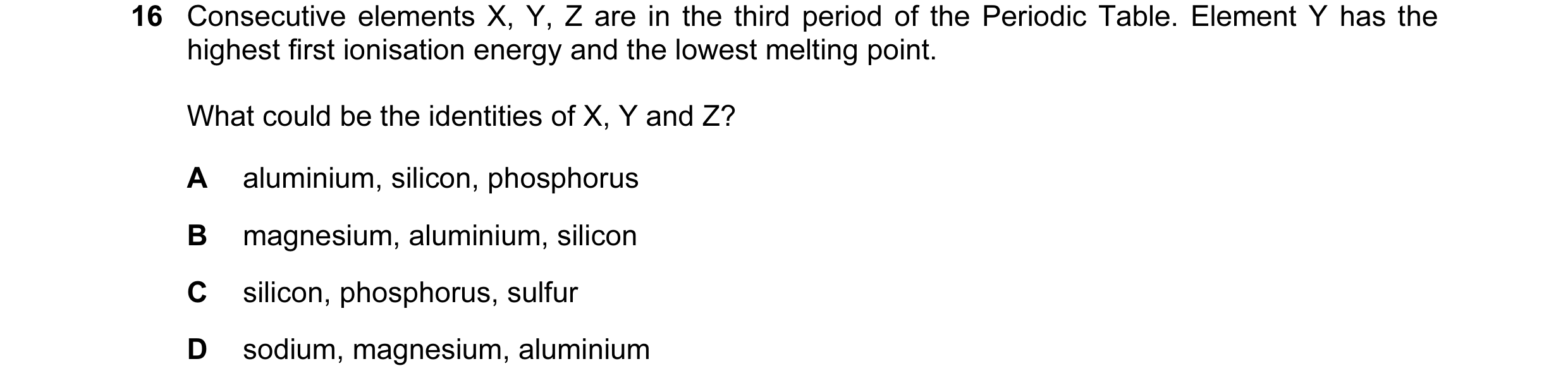
16 Consecutive elements X, Y, Z are in the third period of the Periodic Table. Element Y has the highest first ionisation energy and the lowest melting point. What could be the identities of X, Y and Z? A aluminium, silicon, phosphorus B magnesium, aluminium, silicon C silicon, phosphorus, sulfur D sodium, magnesium, aluminium
1 marks
Answer: C
This question in 9701/11 May/June 2010
Q10 · Use of the Data Booklet is relevant to this question 9701/12 May/June 2010
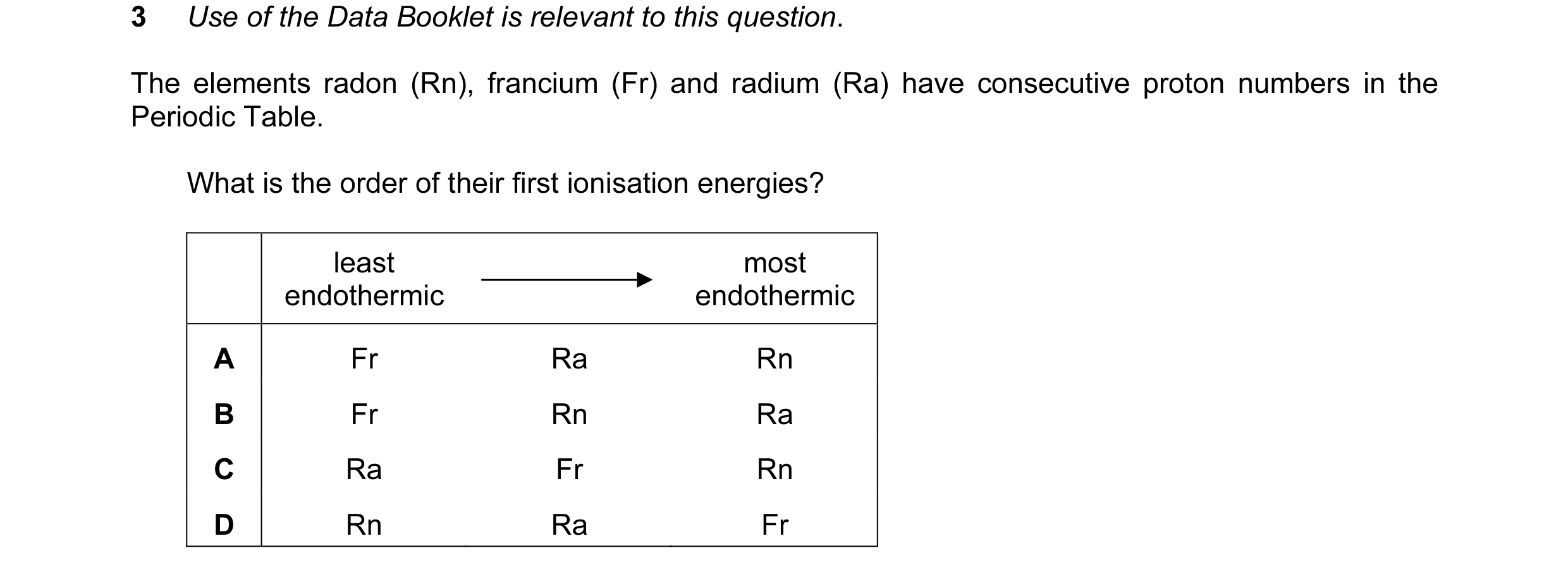
3 Use of the Data Booklet is relevant to this question. The elements radon (Rn), francium (Fr) and radium (Ra) have consecutive proton numbers in the Periodic Table. What is the order of their first ionisation energies? least most endothermic endothermic A Fr Ra Rn B Fr Rn Ra C Ra Fr Rn D Rn Ra Fr
1 marks
Answer: A
This question in 9701/12 May/June 2010
Q11 · Consecutive elements X, Y, Z are in the third period of the Periodic Table 9701/12 May/June 2010
18 Consecutive elements X, Y, Z are in the third period of the Periodic Table. Element Y has the highest first ionisation energy and the lowest melting point. What could be the identities of X, Y and Z? A aluminium, silicon, phosphorus B magnesium, aluminium, silicon C silicon, phosphorus, sulfur D sodium, magnesium, aluminium
1 marks
Answer: C
This question in 9701/12 May/June 2010
Q12 · Use of the Data Booklet is relevant to this question 9701/13 May/June 2010
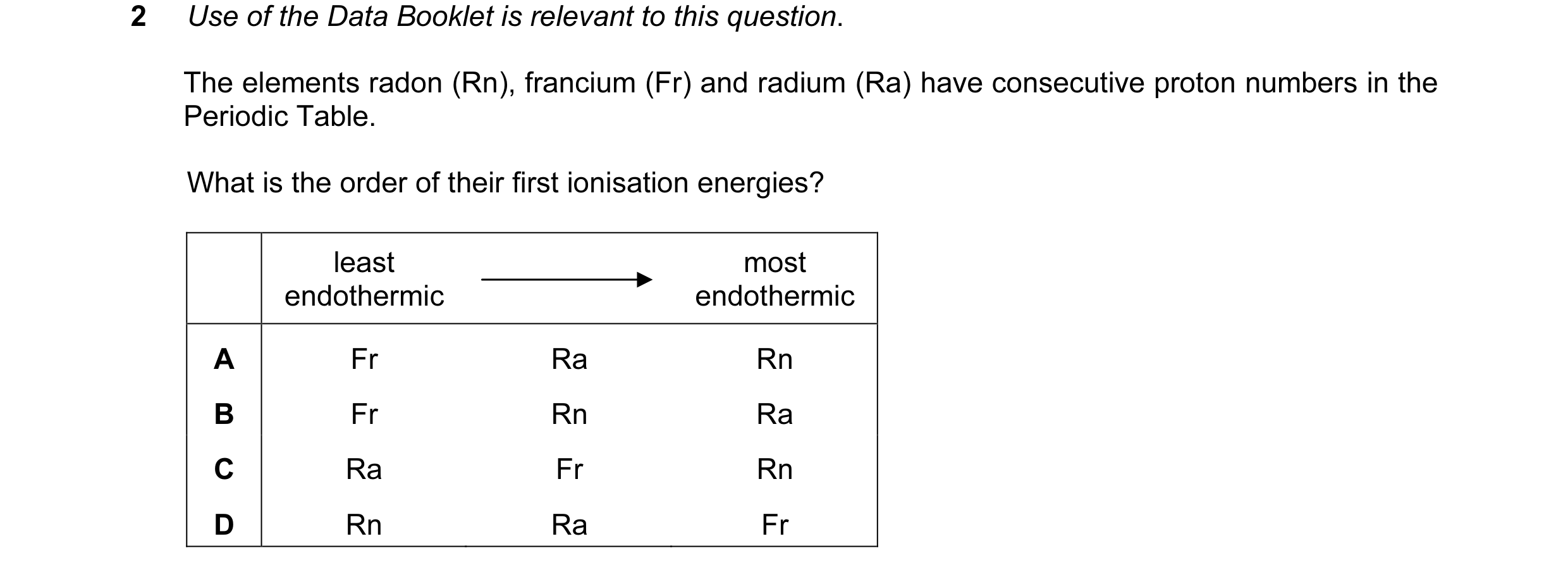
2 Use of the Data Booklet is relevant to this question. The elements radon (Rn), francium (Fr) and radium (Ra) have consecutive proton numbers in the Periodic Table. What is the order of their first ionisation energies? least most endothermic endothermic A Fr Ra Rn B Fr Rn Ra C Ra Fr Rn D Rn Ra Fr
1 marks
Answer: A
This question in 9701/13 May/June 2010
Q13 · Consecutive elements X, Y, Z are in the third period of the Periodic Table 9701/13 May/June 2010
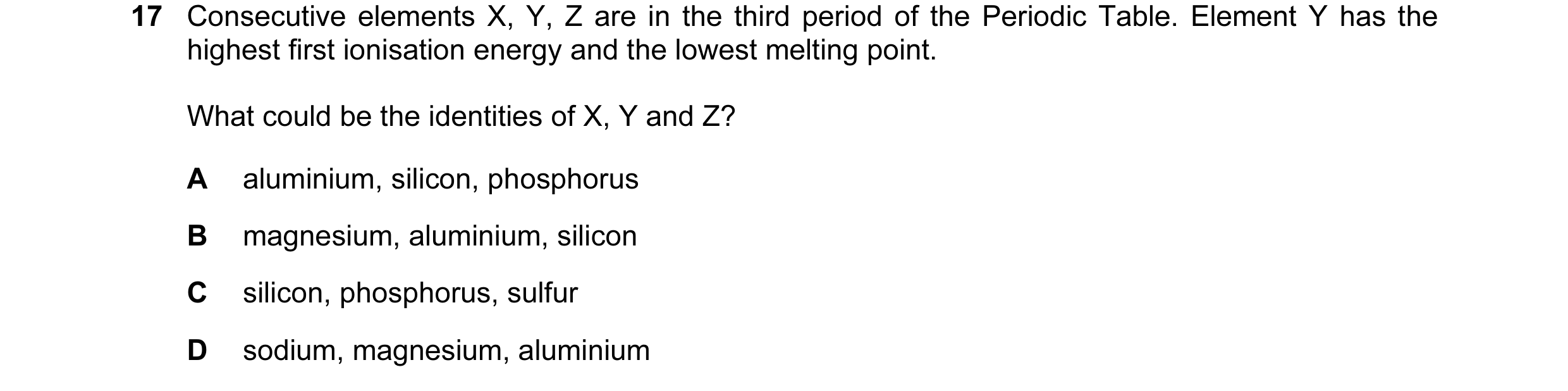
17 Consecutive elements X, Y, Z are in the third period of the Periodic Table. Element Y has the highest first ionisation energy and the lowest melting point. What could be the identities of X, Y and Z? A aluminium, silicon, phosphorus B magnesium, aluminium, silicon C silicon, phosphorus, sulfur D sodium, magnesium, aluminium
1 marks
Answer: C
This question in 9701/13 May/June 2010
Q14 · Equations involving four enthalpy changes are shown 9701/11 Oct/Nov 2010
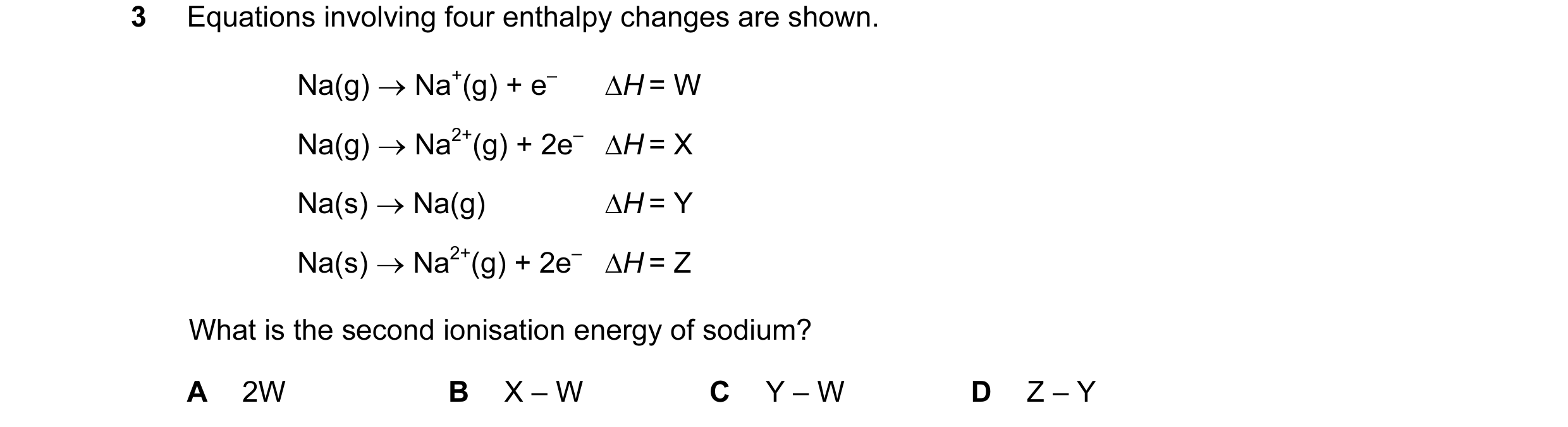
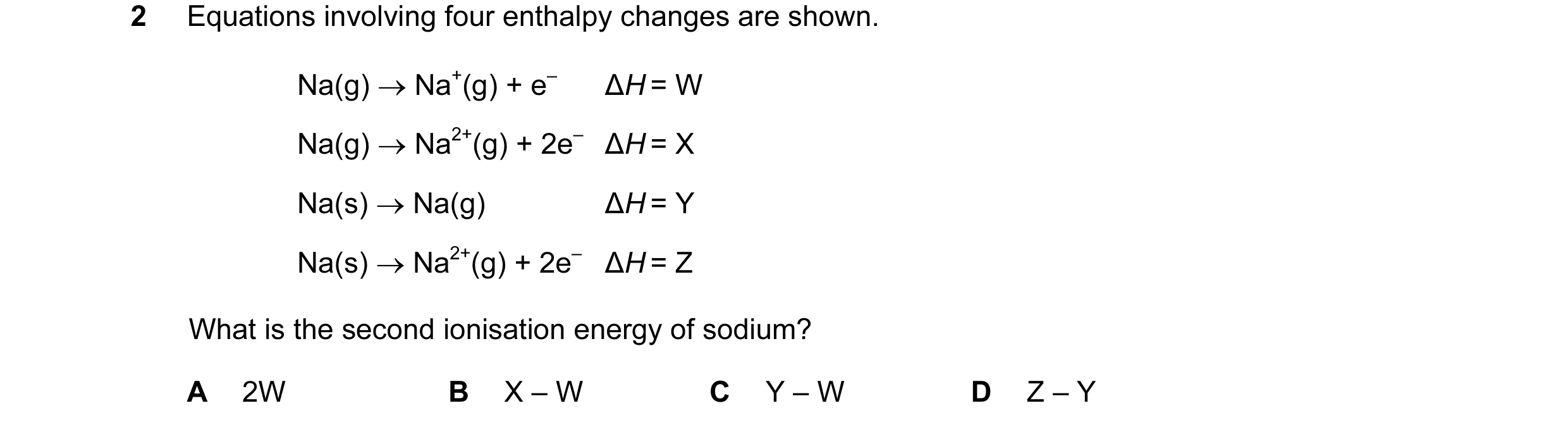
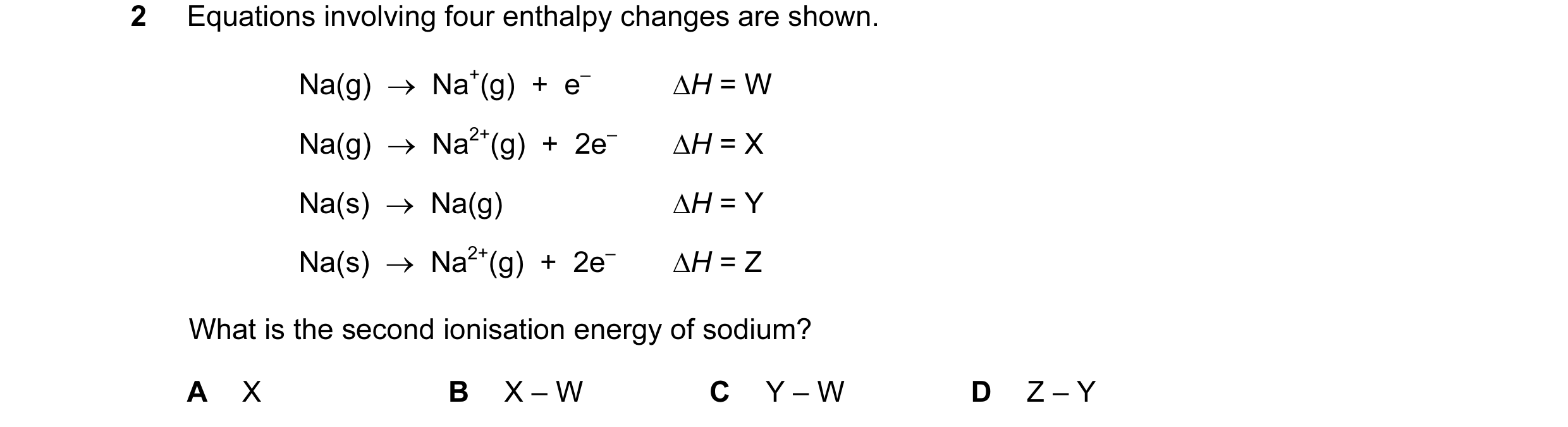
3 Equations involving four enthalpy changes are shown. Na(g) → Na+(g) + e– ∆H = W Na(g) → Na2+(g) + 2e– ∆H = X Na(s) → Na(g) ∆H = Y Na(s) → Na2+(g) + 2e– ∆H = Z What is the second ionisation energy of sodium? A 2W B X – W C Y – W D Z – Y
1 marks
Answer: B
This question in 9701/11 Oct/Nov 2010
Q15 · Why is the first ionisation energy of phosphorus greater than the first ionisation energy… 9701/11 Oct/Nov 2010
13 Why is the first ionisation energy of phosphorus greater than the first ionisation energy of silicon? A A phosphorus atom has one more proton in its nucleus. B The atomic radius of a phosphorus atom is greater. C The outer electron in a phosphorus atom is more shielded. D The outer electron in a phosphorus atom is paired.
1 marks
Answer: A
This question in 9701/11 Oct/Nov 2010
Q16 · Which statement describes the halogens chlorine, bromine and iodine? 9701/11 Oct/Nov 2010
17 Which statement describes the halogens chlorine, bromine and iodine? A Their bond energies decrease with increasing proton number. B Their first ionisation energies increase with increasing proton number. C They are all coloured gases at room temperature. D They are all good reducing agents.
1 marks
Answer: A
This question in 9701/11 Oct/Nov 2010
Q17 · Equations involving four enthalpy changes are shown 9701/13 Oct/Nov 2010
2 Equations involving four enthalpy changes are shown. Na(g) → Na+(g) + e– ∆H = W Na(g) → Na2+(g) + 2e– ∆H = X Na(s) → Na(g) ∆H = Y Na(s) → Na2+(g) + 2e– ∆H = Z What is the second ionisation energy of sodium? A 2W B X – W C Y – W D Z – Y
1 marks
Answer: B
This question in 9701/13 Oct/Nov 2010
Q18 · Which statement describes the halogens chlorine, bromine and iodine? 9701/13 Oct/Nov 2010
8 Which statement describes the halogens chlorine, bromine and iodine? A Their bond energies decrease with increasing proton number. B Their first ionisation energies increase with increasing proton number. C They are all coloured gases at room temperature. D They are all good reducing agents.
1 marks
Answer: A
This question in 9701/13 Oct/Nov 2010
Q19 · Why is the first ionisation energy of phosphorus greater than the first ionisation energy… 9701/13 Oct/Nov 2010
16 Why is the first ionisation energy of phosphorus greater than the first ionisation energy of silicon? A A phosphorus atom has one more proton in its nucleus. B The atomic radius of a phosphorus atom is greater. C The outer electron in a phosphorus atom is more shielded. D The outer electron in a phosphorus atom is paired.
1 marks
Answer: A
This question in 9701/13 Oct/Nov 2010
Q20 · Which equation represents the second ionisation energy of an element X? 9701/11 May/June 2011
1 Which equation represents the second ionisation energy of an element X? A X(g) → X2+(g) + 2e– B X+(g) → X2+(g) + e– C X(g) + 2e– → X2–(g) D X–(g) + e– → X2–(g)
1 marks
Answer: B
This question in 9701/11 May/June 2011
Q21 · Which factor helps to explain why the first ionisation energies of the Group I elements… 9701/11 May/June 2011
5 Which factor helps to explain why the first ionisation energies of the Group I elements decrease from lithium to sodium to potassium to rubidium? A The nuclear charge of the elements increases. B The outer electron is in an ‘s’ subshell. C The repulsion between spin-paired electrons increases. D The shielding effect of the inner shells increases.
1 marks
Answer: D
This question in 9701/11 May/June 2011
Q22 · The diagram shows the first ionisation energies of 11 consecutive elements 9701/12 May/June 2011
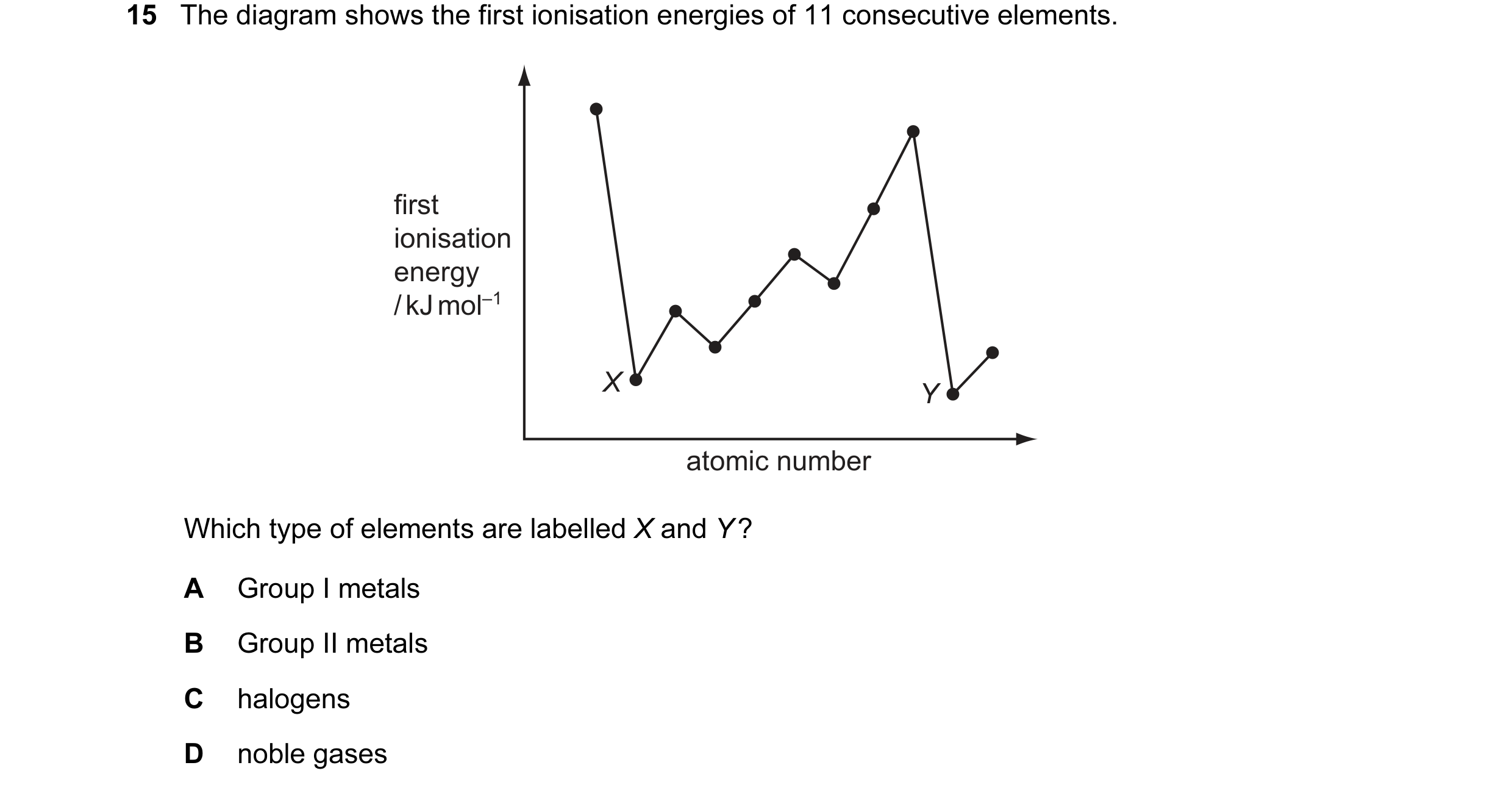
15 The diagram shows the first ionisation energies of 11 consecutive elements. first ionisation energy / kJ mol–1 X Y atomic number Which type of elements are labelled X and Y ? A Group I metals B Group II metals C halogens D noble gases
1 marks
Answer: A
This question in 9701/12 May/June 2011
Q23 · Which equation represents the second ionisation energy of an element X? 9701/13 May/June 2011
1 Which equation represents the second ionisation energy of an element X? A X(g) → X2+(g) + 2e– B X+(g) → X2+(g) + e– C X(g) + 2e– → X2–(g) D X–(g) + e– → X2–(g)
1 marks
Answer: B
This question in 9701/13 May/June 2011
Q24 · Which factor helps to explain why the first ionisation energies of the Group I elements… 9701/13 May/June 2011
2 Which factor helps to explain why the first ionisation energies of the Group I elements decrease from lithium to sodium to potassium to rubidium? A The nuclear charge of the elements increases. B The outer electron is in an ‘s’ subshell. C The repulsion between spin-paired electrons increases. D The shielding effect of the inner shells increases.
1 marks
Answer: D
This question in 9701/13 May/June 2011
Q25 · The definitions of many chemical terms can be illustrated by chemical equations 9701/11 Oct/Nov 2011
31 The definitions of many chemical terms can be illustrated by chemical equations. Which terms can be illustrated by an equation that shows the formation of a positive ion? 1 first ionisation energy 2 heterolytic fission 3 enthalpy change of atomisation
1 marks
Answer: B
This question in 9701/11 Oct/Nov 2011
Q26 · Use of the Data Booklet is relevant to this question 9701/12 Oct/Nov 2011
3 Use of the Data Booklet is relevant to this question. From which particle is the removal of an electron the most difficult? A Cl –(g) B F–(g) C K+(g) D Na+(g)
1 marks
This question in 9701/12 Oct/Nov 2011
Q27 · The definitions of many chemical terms can be illustrated by chemical equations 9701/13 Oct/Nov 2011
31 The definitions of many chemical terms can be illustrated by chemical equations. Which terms can be illustrated by an equation that shows the formation of a positive ion? 1 first ionisation energy 2 heterolytic fission 3 enthalpy change of atomisation
1 marks
Answer: B
This question in 9701/13 Oct/Nov 2011
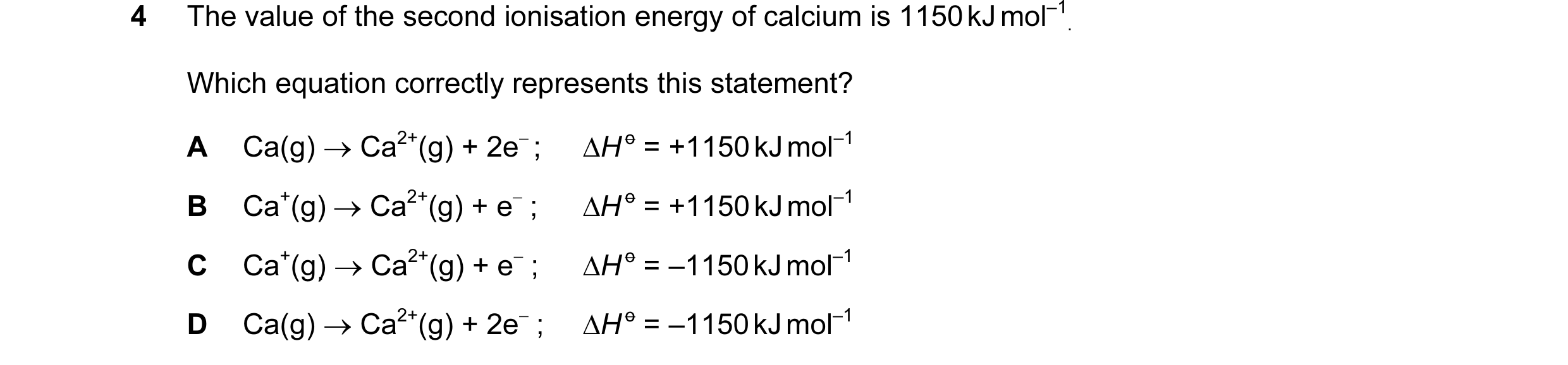
Q28 · The value of the second ionisation energy of calcium is 1150 kJ mol–1 9701/11 May/June 2012
4 The value of the second ionisation energy of calcium is 1150 kJ mol–1 . Which equation correctly represents this statement? A Ca(g) → Ca2+(g) + 2e− ; ∆H o = +1150 kJ mol–1 B Ca+(g) → Ca2+(g) + e− ; ∆H o = +1150 kJ mol–1 C Ca+(g) → Ca2+(g) + e− ; ∆H o = –1150 kJ mol–1 D Ca(g) → Ca2+(g) + 2e− ; ∆H o = –1150 kJ mol–1
1 marks
Answer: B
This question in 9701/11 May/June 2012
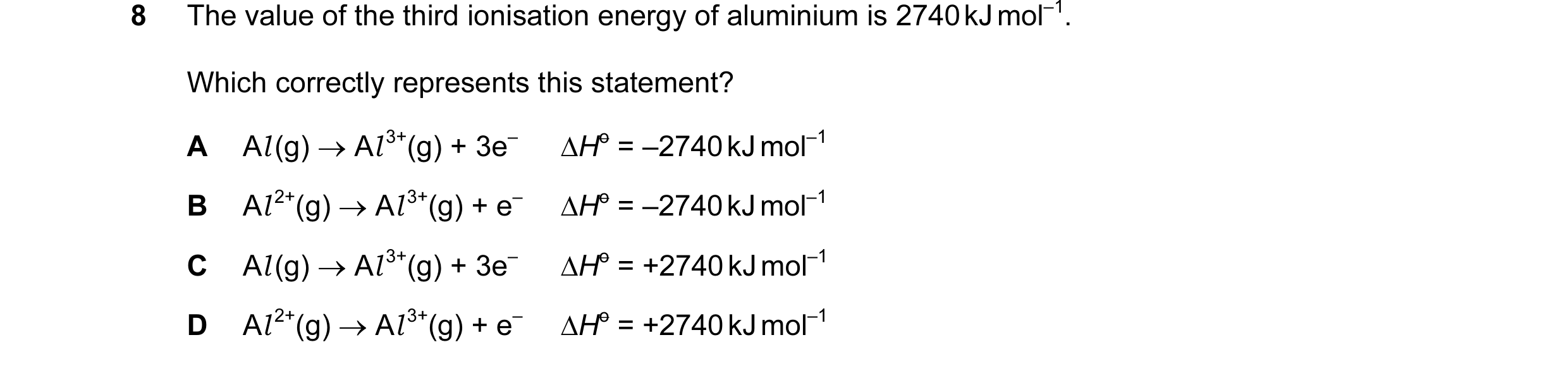
Q29 · The value of the third ionisation energy of aluminium is 2740 kJ mol–1 9701/12 May/June 2012
8 The value of the third ionisation energy of aluminium is 2740 kJ mol–1. Which correctly represents this statement? A Al (g) → Al 3+(g) + 3e– ∆Ho = –2740 kJ mol–1 B Al 2+(g) → Al 3+(g) + e– ∆Ho = –2740 kJ mol–1 C Al (g) → Al 3+(g) + 3e– ∆Ho = +2740 kJ mol–1 D Al 2+(g) → Al 3+(g) + e– ∆Ho = +2740 kJ mol–1
1 marks
Answer: D
This question in 9701/12 May/June 2012
Q30 · The value of the second ionisation energy of calcium is 1150 kJ mol–1 9701/13 May/June 2012
3 The value of the second ionisation energy of calcium is 1150 kJ mol–1 . Which equation correctly represents this statement? A Ca(g) → Ca2+(g) + 2e− ; ∆H o = +1150 kJ mol–1 B Ca+(g) → Ca2+(g) + e− ; ∆H o = +1150 kJ mol–1 C Ca+(g) → Ca2+(g) + e− ; ∆H o = –1150 kJ mol–1 D Ca(g) → Ca2+(g) + 2e− ; ∆H o = –1150 kJ mol–1
1 marks
Answer: B
This question in 9701/13 May/June 2012
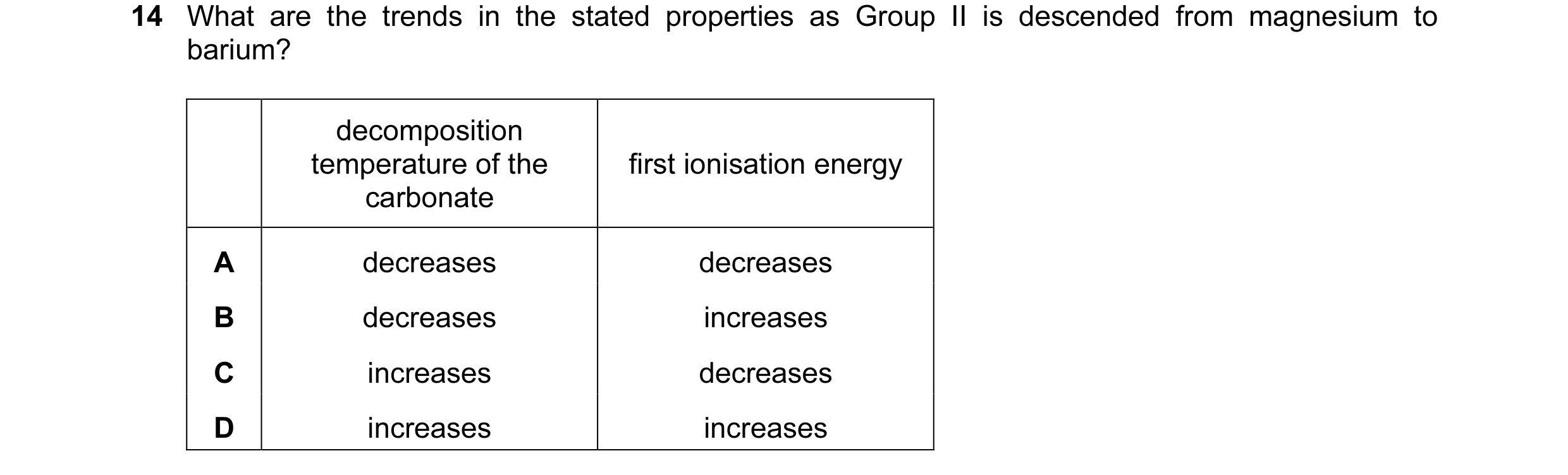
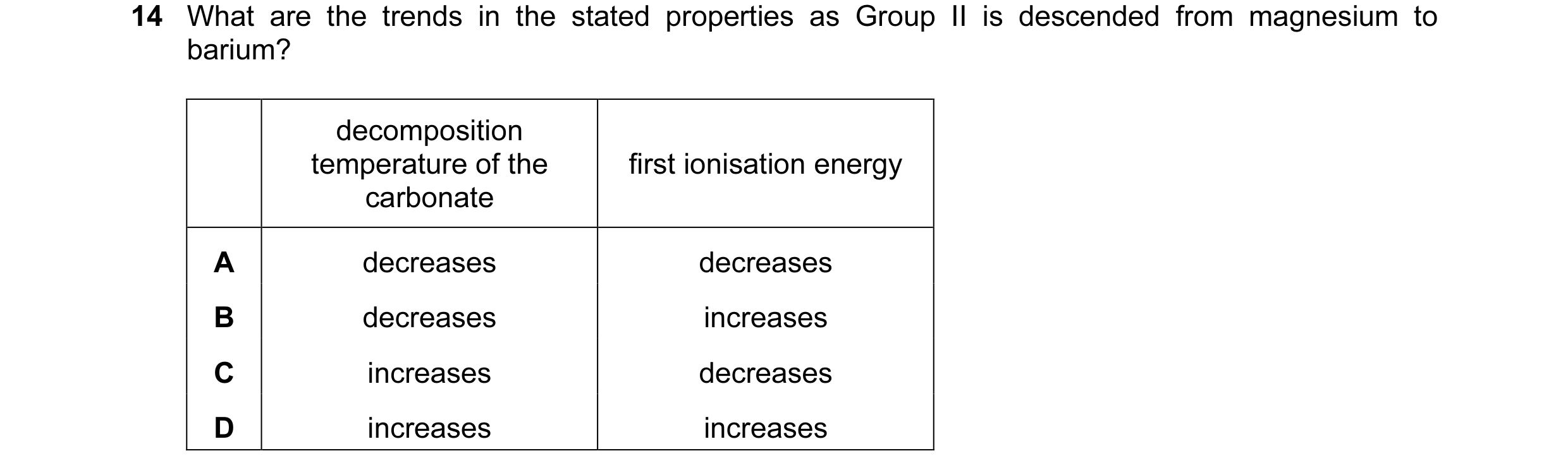
Q31 · What are the trends in the stated properties as Group II is descended from magnesium to… 9701/11 Oct/Nov 2012
14 What are the trends in the stated properties as Group II is descended from magnesium to barium? decomposition temperature of the first ionisation energy carbonate A decreases decreases B decreases increases C increases decreases D increases increases
1 marks
Answer: C
This question in 9701/11 Oct/Nov 2012
Q32 · What are the trends in the stated properties as Group II is descended from magnesium to… 9701/12 Oct/Nov 2012
14 What are the trends in the stated properties as Group II is descended from magnesium to barium? decomposition temperature of the first ionisation energy carbonate A decreases decreases B decreases increases C increases decreases D increases increases
1 marks
Answer: C
This question in 9701/12 Oct/Nov 2012
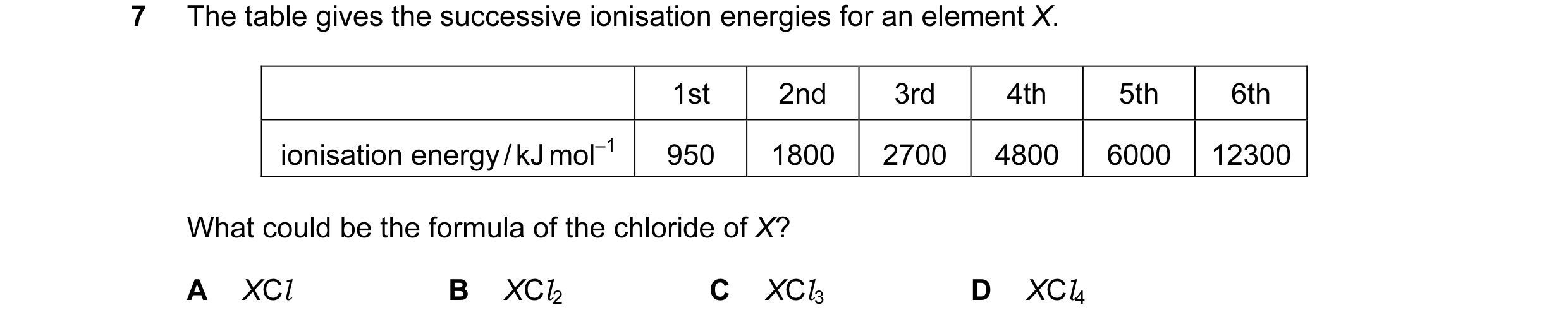
Q33 · The table gives the successive ionisation energies for an element X 9701/13 Oct/Nov 2012
7 The table gives the successive ionisation energies for an element X. 1st 2nd 3rd 4th 5th 6th ionisation energy / kJ mol–1 950 1800 2700 4800 6000 12300 What could be the formula of the chloride of X? A XCl B XCl2 C XCl3 D XCl4
1 marks
Answer: C
This question in 9701/13 Oct/Nov 2012
Q34 · The table describes some of the chemistry and thermodynamic properties of the halogens 9701/13 Oct/Nov 2012
36 The table describes some of the chemistry and thermodynamic properties of the halogens. name and process symbol of quantity 2HX(g) → H2(g) + X2(g) enthalpy change of reaction, H2(g) + X2(g) 2HX(g) equilibrium constant, Kp X(g) → X+(g) + e– ionisation energy, Which statements about the relative values of these quantities are correct? 1 for HCl > for HBr 2 Kp for HBr > Kp for HI 3 for I > for Cl
1 marks
Answer: B
This question in 9701/13 Oct/Nov 2012
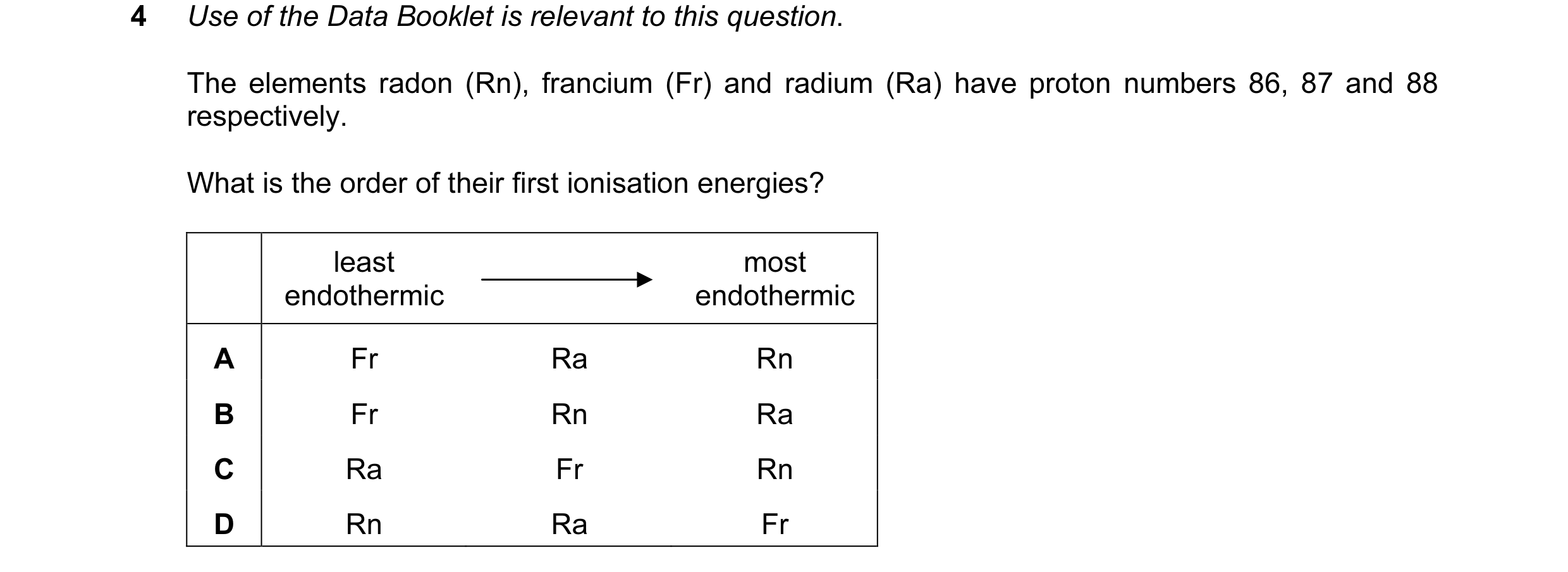
Q35 · Use of the Data Booklet is relevant to this question 9701/11 May/June 2013
4 Use of the Data Booklet is relevant to this question. The elements radon (Rn), francium (Fr) and radium (Ra) have proton numbers 86, 87 and 88 respectively. What is the order of their first ionisation energies? least most endothermic endothermic A Fr Ra Rn B Fr Rn Ra C Ra Fr Rn D Rn Ra Fr
1 marks
Answer: A
This question in 9701/11 May/June 2013
Q36 · Equations involving four enthalpy changes are shown 9701/12 May/June 2013
2 Equations involving four enthalpy changes are shown. Na(g) → Na+(g) + e– ∆H = W Na(g) → Na2+(g) + 2e– ∆H = X Na(s) → Na(g) ∆H = Y Na(s) → Na2+(g) + 2e– ∆H = Z What is the second ionisation energy of sodium? A X B X – W C Y – W D Z – Y
1 marks
Answer: B
This question in 9701/12 May/June 2013
Q37 · The first six ionisation energies of four elements are given 9701/13 May/June 2013
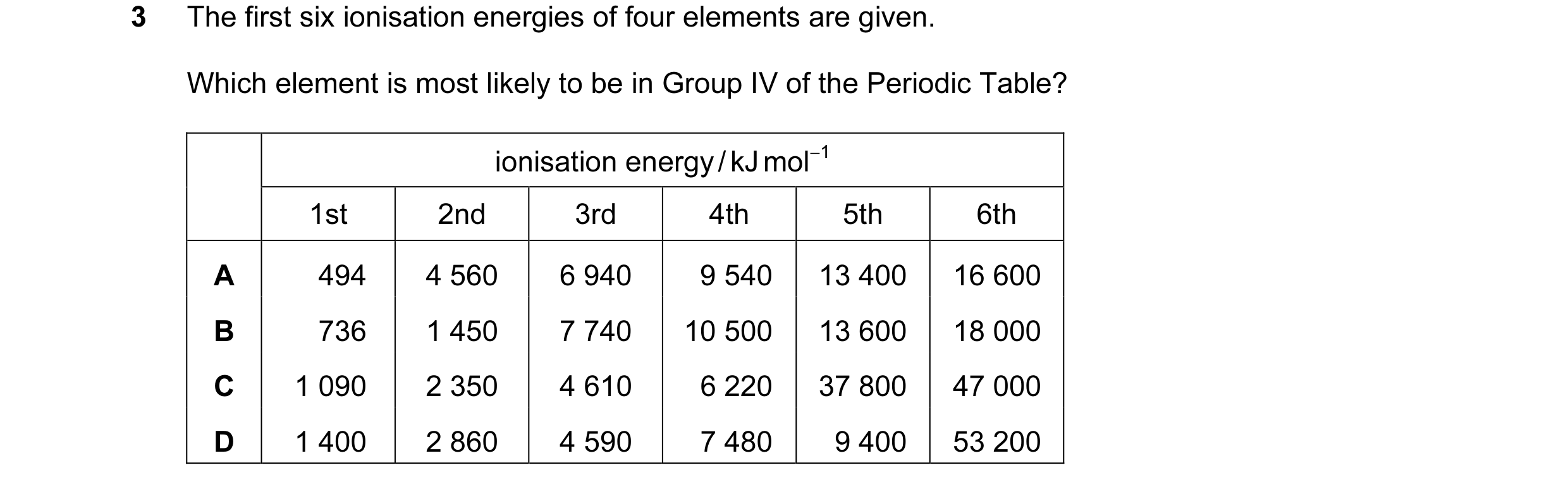
3 The first six ionisation energies of four elements are given. Which element is most likely to be in Group IV of the Periodic Table? ionisation energy / kJ mol−1 1st 2nd 3rd 4th 5th 6th A 494 4 560 6 940 9 540 13 400 16 600 B 736 1 450 7 740 10 500 13 600 18 000 C 1 090 2 350 4 610 6 220 37 800 47 000 D 1 400 2 860 4 590 7 480 9 400 53 200
1 marks
Answer: C
This question in 9701/13 May/June 2013
Q38 · In which row of the table are all statements comparing magnesium and barium correct? 9701/13 May/June 2013
13 In which row of the table are all statements comparing magnesium and barium correct? fourth ionisation reaction of fourth ionisation reaction of barium energy of magnesium with energy of barium with cold water magnesium cold water A higher lower faster slower B higher lower slower faster C lower higher faster slower D lower higher slower faster
1 marks
Answer: B
This question in 9701/13 May/June 2013
Q39 · Consecutive elements X, Y and Z are in the third period of the Periodic Table 9701/11 Oct/Nov 2013
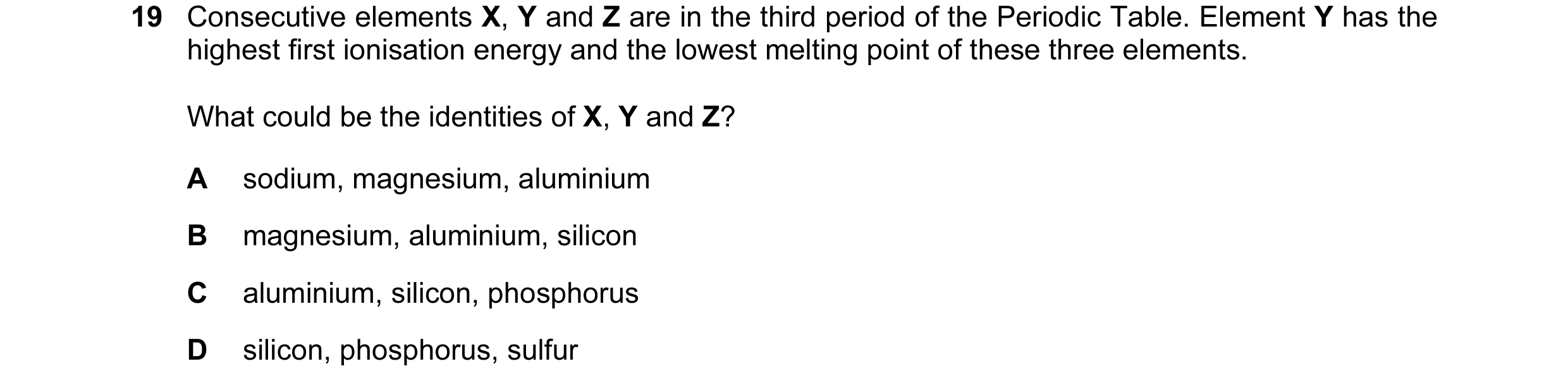
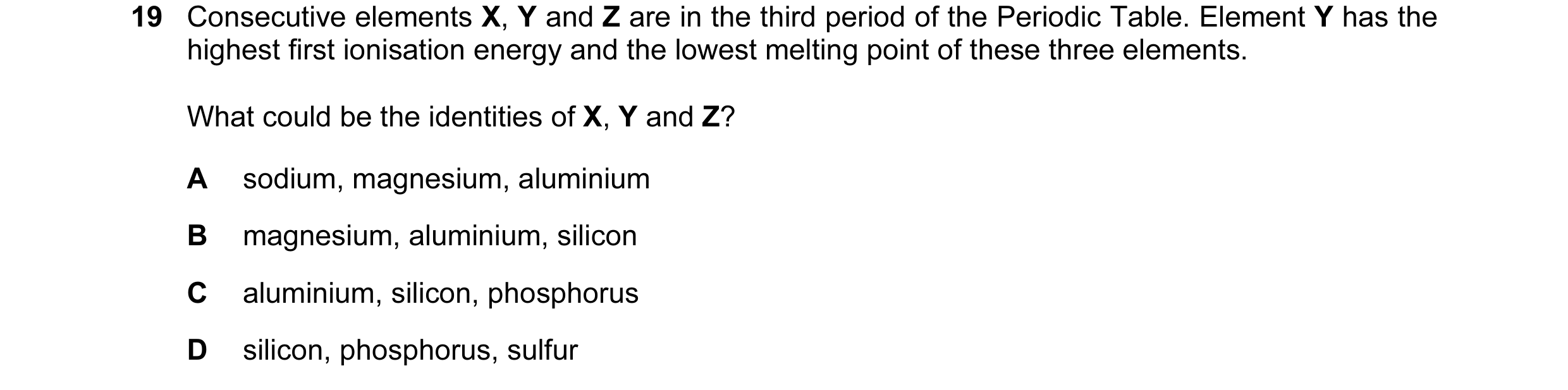
19 Consecutive elements X, Y and Z are in the third period of the Periodic Table. Element Y has the highest first ionisation energy and the lowest melting point of these three elements. What could be the identities of X, Y and Z? A sodium, magnesium, aluminium B magnesium, aluminium, silicon C aluminium, silicon, phosphorus D silicon, phosphorus, sulfur
1 marks
Answer: D
This question in 9701/11 Oct/Nov 2013
Q40 · Consecutive elements X, Y and Z are in the third period of the Periodic Table 9701/12 Oct/Nov 2013
19 Consecutive elements X, Y and Z are in the third period of the Periodic Table. Element Y has the highest first ionisation energy and the lowest melting point of these three elements. What could be the identities of X, Y and Z? A sodium, magnesium, aluminium B magnesium, aluminium, silicon C aluminium, silicon, phosphorus D silicon, phosphorus, sulfur
1 marks
Answer: D
This question in 9701/12 Oct/Nov 2013
Q41 · Use of the Data Booklet is relevant to this question 9701/13 Oct/Nov 2013
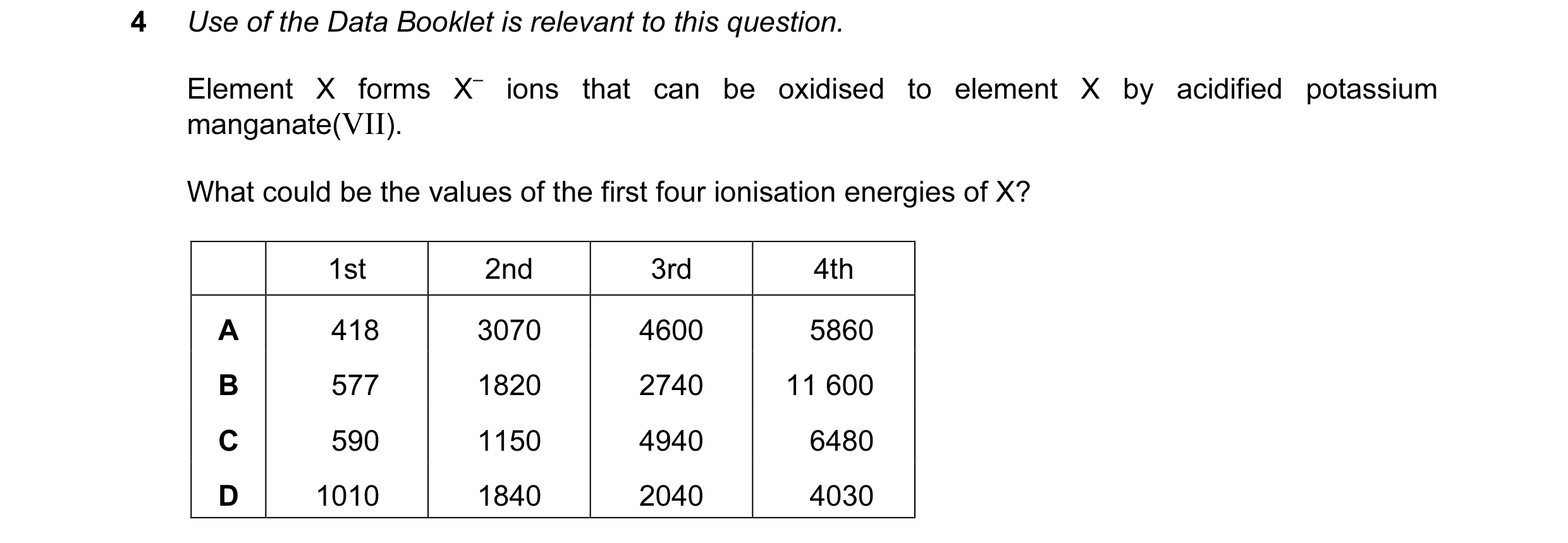
4 Use of the Data Booklet is relevant to this question. Element X forms X– ions that can be oxidised to element X by acidified potassium manganate(VII). What could be the values of the first four ionisation energies of X? 1st 2nd 3rd 4th A 418 3070 4600 5860 B 577 1820 2740 11 600 C 590 1150 4940 6480 D 1010 1840 2040 4030
1 marks
Answer: D
This question in 9701/13 Oct/Nov 2013
Q42 · The graph below shows the variation of the first ionisation energy with the number of… 9701/13 Oct/Nov 2013
18 The graph below shows the variation of the first ionisation energy with the number of protons for some elements. Q Y first ionisation X energy / kJ mol–1 V W S U T R proton number Which statement is correct? A Elements Q and Y are in the same period in the Periodic Table. B The general increase from elements R to Y is due to increasing atomic radius. C The small decrease between elements S and T is due to decreased shielding. D The small decrease between elements V and W is due to repulsion between paired electrons.
1 marks
Answer: D
This question in 9701/13 Oct/Nov 2013
Q43 · Shown on the graph are the relative values of the first ionisation energies of four… 9701/12 May/June 2014
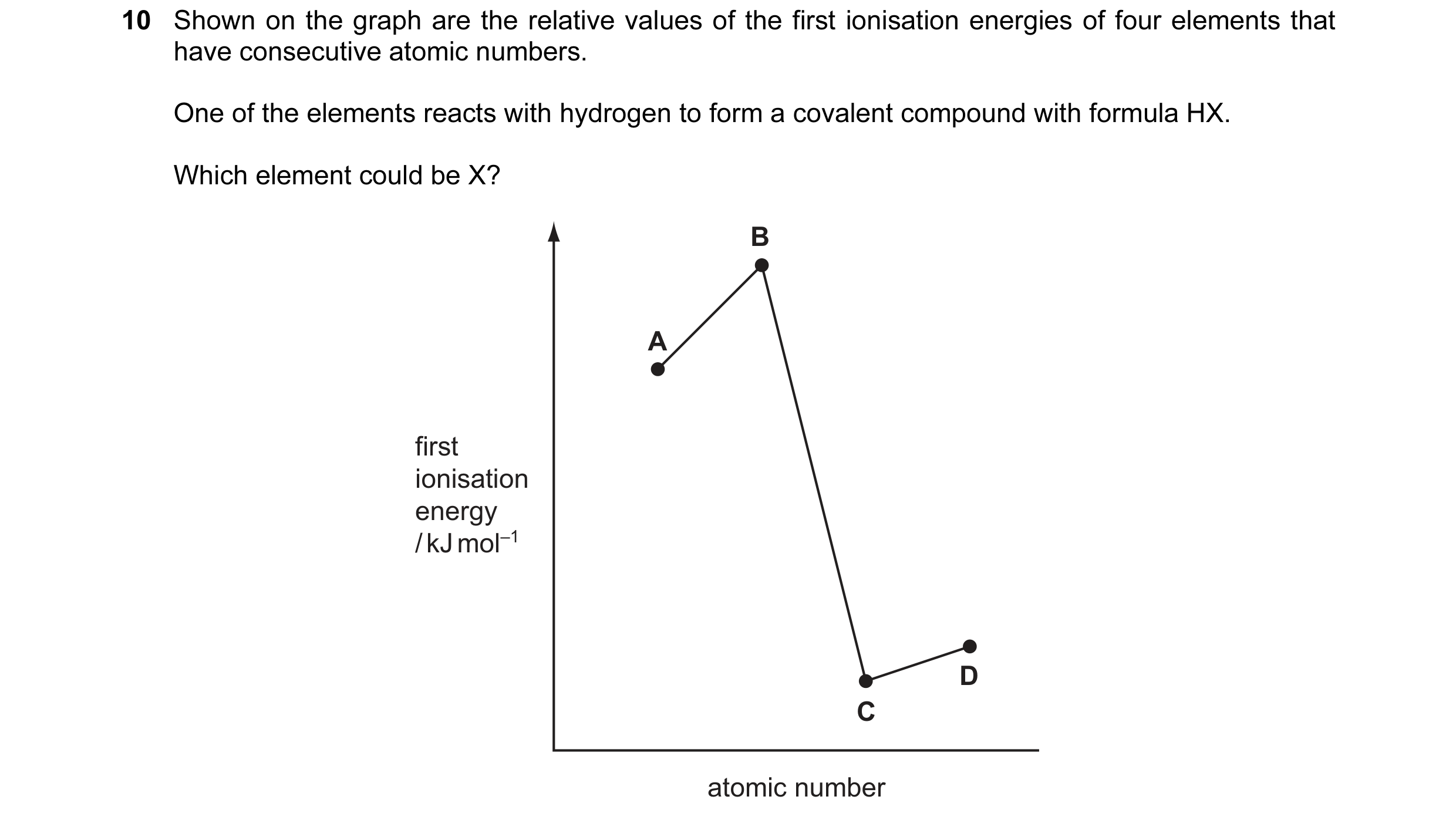
10 Shown on the graph are the relative values of the first ionisation energies of four elements that have consecutive atomic numbers. One of the elements reacts with hydrogen to form a covalent compound with formula HX. Which element could be X? B A first ionisation energy / kJ mol–1 D C atomic number
1 marks
Answer: A
This question in 9701/12 May/June 2014
Q44 · Use of the Data Booklet is relevant to this question 9701/13 May/June 2014
14 Use of the Data Booklet is relevant to this question. Which graph correctly shows the melting points of the elements Mg, Al, Si and P plotted against their first ionisation energies? A B Si Al Si melting point Mg Al melting point Mg P P first ionisation energy first ionisation energy C D Si Si Al Al Mg Mg melting point melting point P P first ionisation energy first ionisation energy
1 marks
Answer: C
This question in 9701/13 May/June 2014
Q45 · Use of the Data Booklet is relevant to this question 9701/11 Oct/Nov 2014
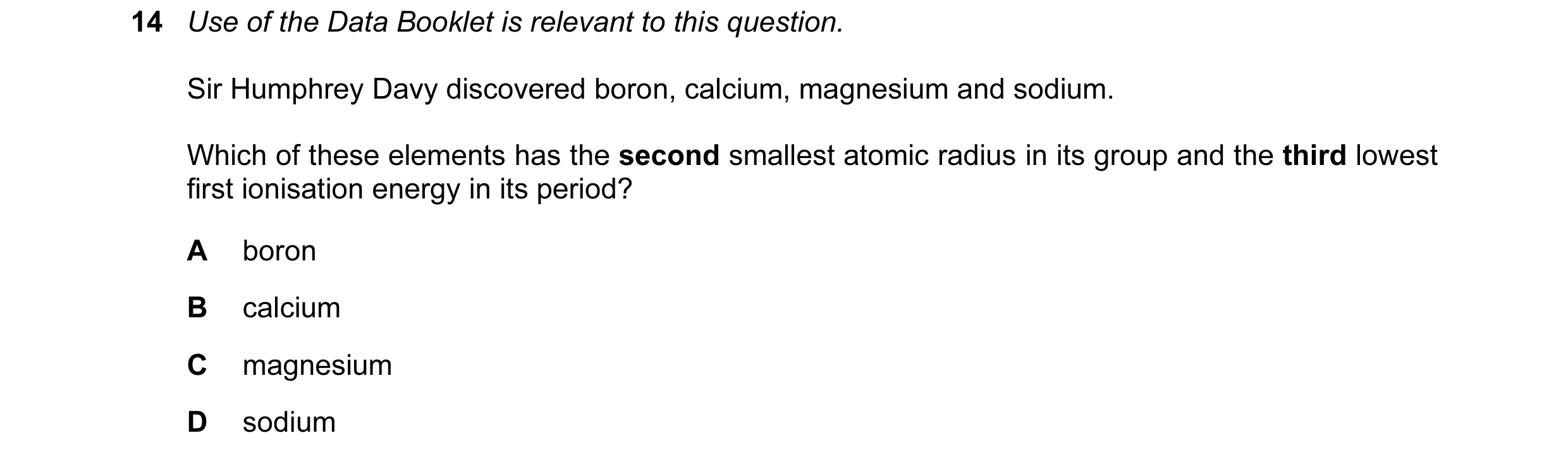
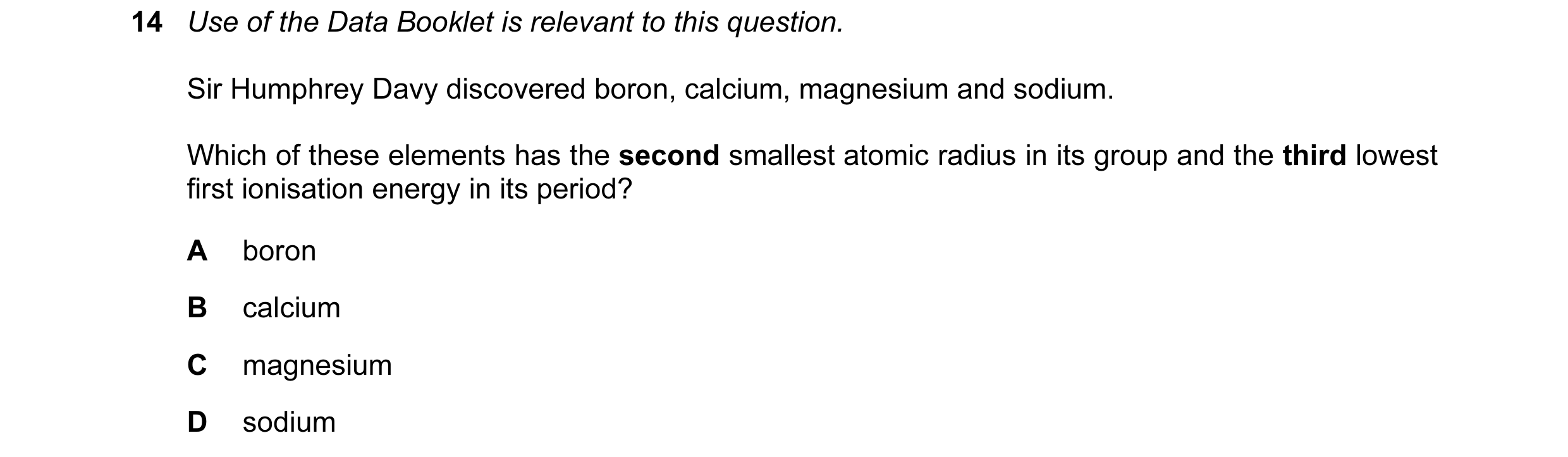
14 Use of the Data Booklet is relevant to this question. Sir Humphrey Davy discovered boron, calcium, magnesium and sodium. Which of these elements has the second smallest atomic radius in its group and the third lowest first ionisation energy in its period? A boron B calcium C magnesium D sodium
1 marks
Answer: C
This question in 9701/11 Oct/Nov 2014
Q46 · Use of the Data Booklet is relevant to this question 9701/12 Oct/Nov 2014
14 Use of the Data Booklet is relevant to this question. Sir Humphrey Davy discovered boron, calcium, magnesium and sodium. Which of these elements has the second smallest atomic radius in its group and the third lowest first ionisation energy in its period? A boron B calcium C magnesium D sodium
1 marks
Answer: C
This question in 9701/12 Oct/Nov 2014
Q47 · Use of the Data Booklet is relevant to this question 9701/12 May/June 2015
15 Use of the Data Booklet is relevant to this question. Which diagram correctly shows the electronegativity of the elements Na, Mg, Al and Si plotted against their first ionisation energies? A B Si Si Al Al electronegativity electronegativity Mg Mg Na Na first ionisation energy first ionisation energy C D Na Na Al Mg electronegativity electronegativity Mg Al Si Si first ionisation energy first ionisation energy
1 marks
Answer: B
This question in 9701/12 May/June 2015
Q48 · Use of the Data Booklet is relevant to this question 9701/12 Oct/Nov 2015
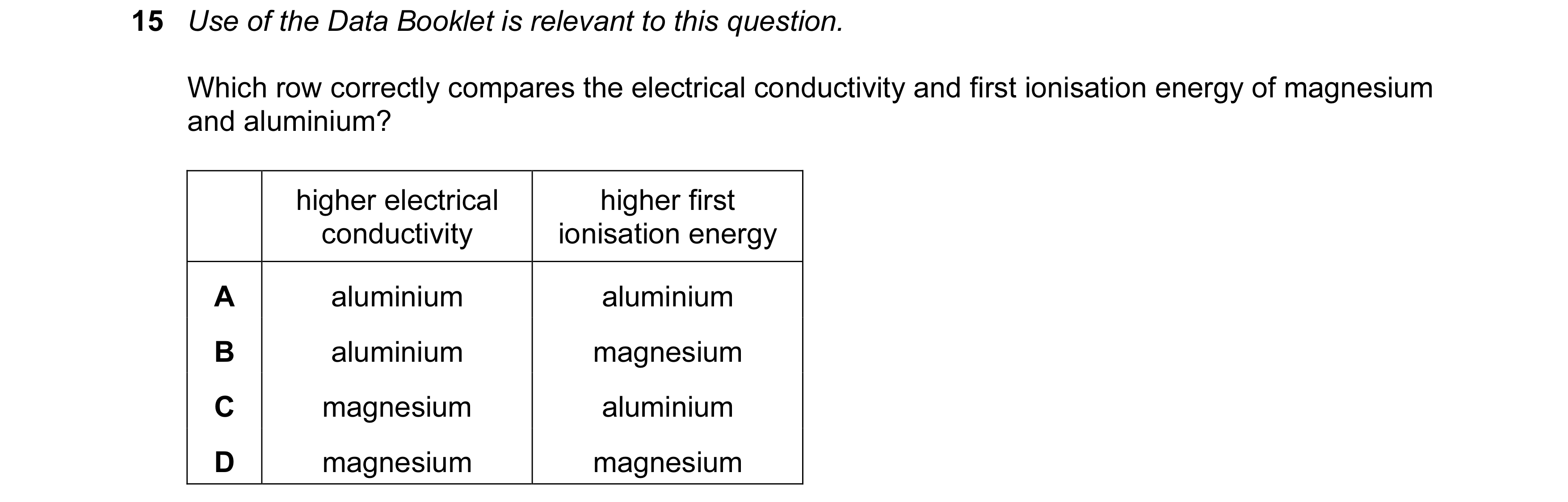
15 Use of the Data Booklet is relevant to this question. Which row correctly compares the electrical conductivity and first ionisation energy of magnesium and aluminium? higher electrical higher first conductivity ionisation energy A aluminium aluminium B aluminium magnesium C magnesium aluminium D magnesium magnesium
1 marks
This question in 9701/12 Oct/Nov 2015
Q49 · Which of the following influence the size of the ionisation energy of an atom? 9701/12 Oct/Nov 2015
32 Which of the following influence the size of the ionisation energy of an atom? 1 the amount of shielding by the inner electrons 2 the charge on the nucleus 3 the distance between the outer electrons and the nucleus
1 marks
This question in 9701/12 Oct/Nov 2015
Q50 · For the element sulfur, which pair of ionisation energies has the largest difference… 9701/12 Feb/March 2016
2 For the element sulfur, which pair of ionisation energies has the largest difference between them? A third and fourth ionisation energies B fourth and fifth ionisation energies C fifth and sixth ionisation energies D sixth and seventh ionisation energies
1 marks
Answer: D
This question in 9701/12 Feb/March 2016
Q51 · Elements X and Y are in the same group of the Periodic Table 9701/12 May/June 2016
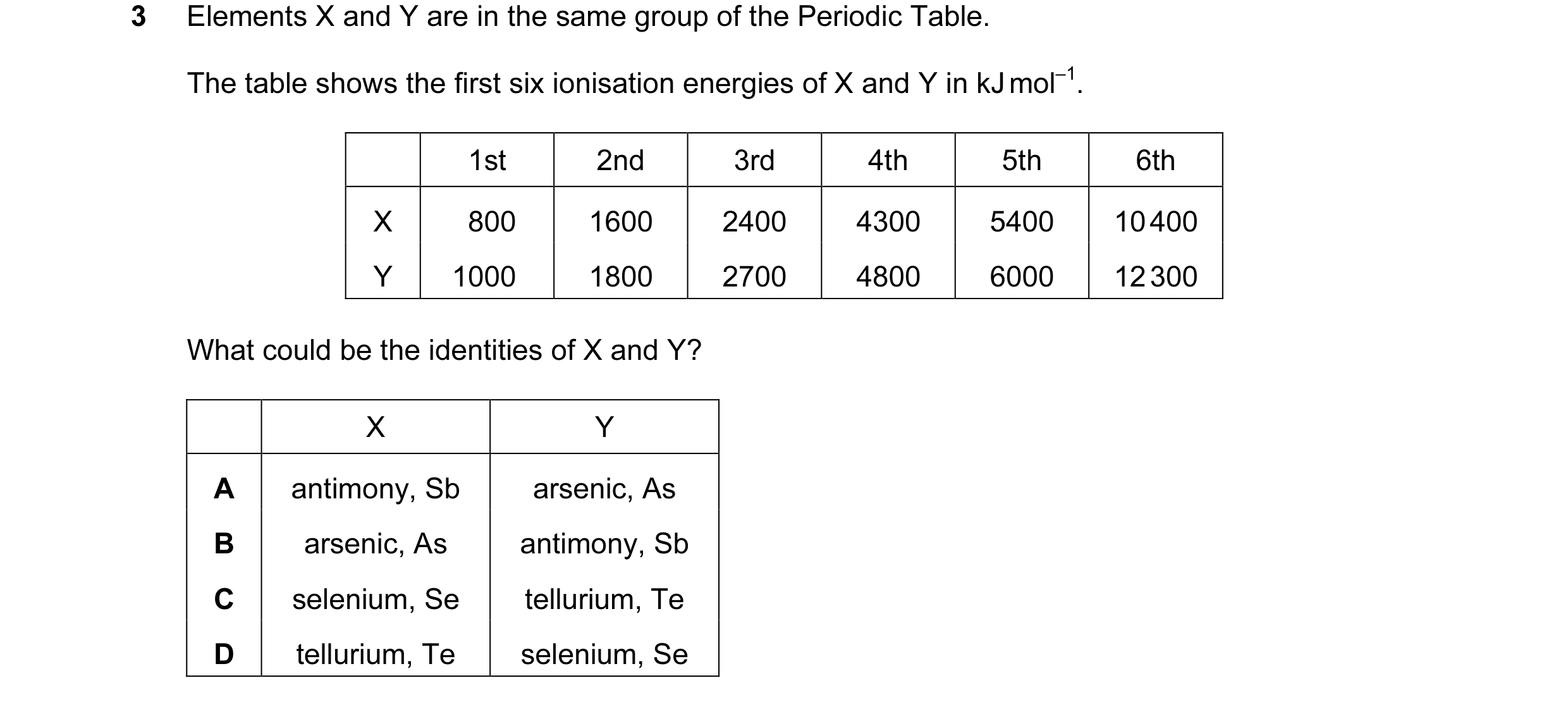
3 Elements X and Y are in the same group of the Periodic Table. The table shows the first six ionisation energies of X and Y in kJ mol–1. 1st 2nd 3rd 4th 5th 6th X 800 1600 2400 4300 5400 10 400 Y 1000 1800 2700 4800 6000 12 300 What could be the identities of X and Y? X Y A antimony, Sb arsenic, As B arsenic, As antimony, Sb C selenium, Se tellurium, Te D tellurium, Te selenium, Se
1 marks
Answer: A
This question in 9701/12 May/June 2016
Q52 · The first ionisation energies of twenty successive elements in the Periodic Table are… 9701/12 May/June 2016
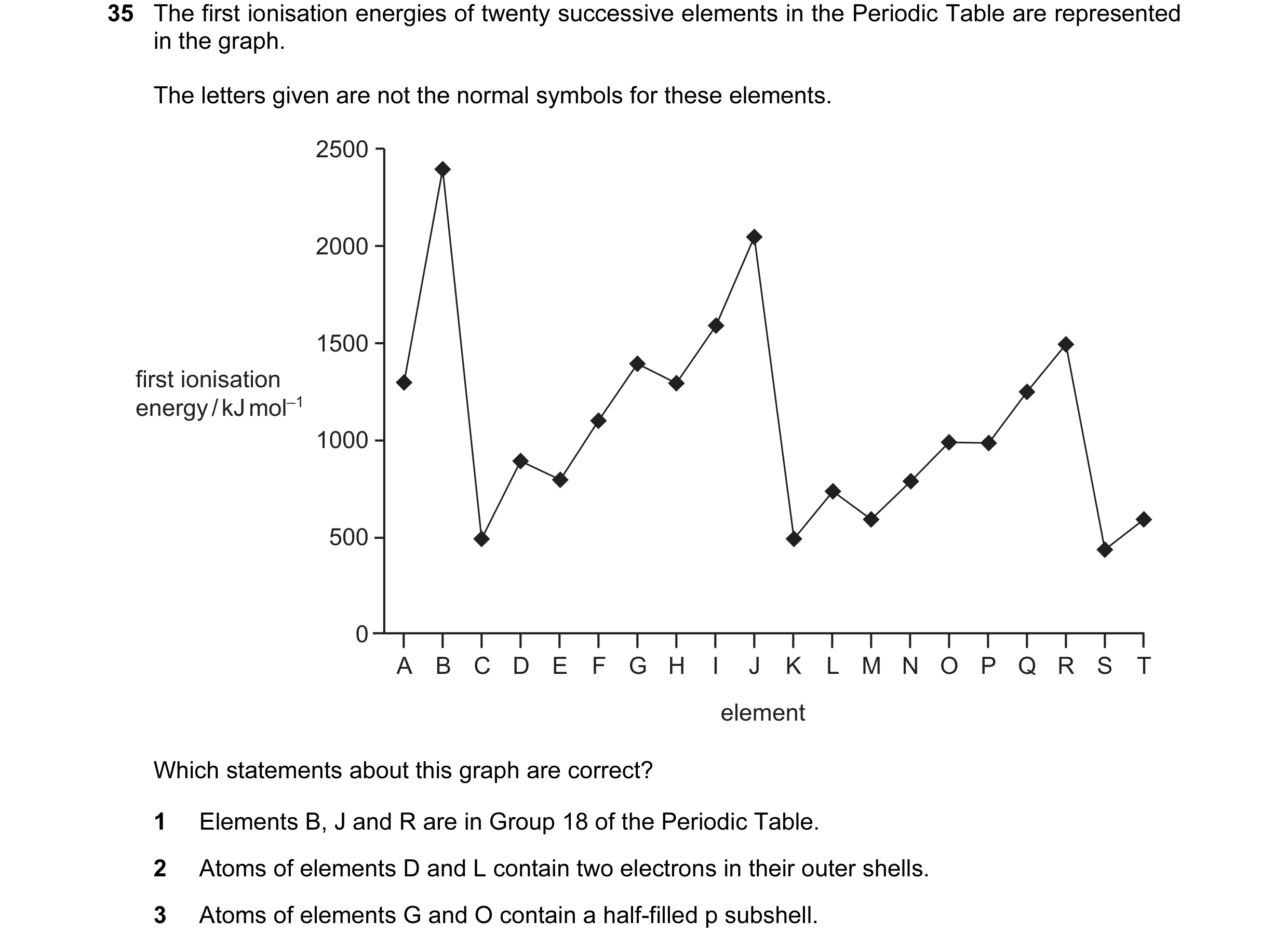
35 The first ionisation energies of twenty successive elements in the Periodic Table are represented in the graph. The letters given are not the normal symbols for these elements. 2500 2000 1500 first ionisation energy / kJ mol _1 1000 500 0 A B C D E F G H I J K L M N O P Q R S T element Which statements about this graph are correct? 1 Elements B, J and R are in Group 18 of the Periodic Table. 2 Atoms of elements D and L contain two electrons in their outer shells. 3 Atoms of elements G and O contain a half-filled p subshell.
1 marks
Answer: A
This question in 9701/12 May/June 2016
Q53 · Compound X is made from two elements 9701/13 May/June 2016
31 Compound X is made from two elements. One element has the second highest value of first ionisation energy in its group and the other element has the third highest value of first ionisation energy in its group. Which compounds could be compound X? 1 calcium chloride 2 magnesium bromide 3 potassium sulfide
1 marks
Answer: A
This question in 9701/13 May/June 2016
Q54 · Why is the first ionisation energy of aluminium less than that of magnesium? 9701/13 May/June 2016
35 Why is the first ionisation energy of aluminium less than that of magnesium? 1 The outer electron in the aluminium atom is more shielded from the nuclear charge. 2 The outer electron in the aluminium atom is in a higher energy orbital. 3 The outer electron in the aluminium atom is further from the nucleus.
1 marks
Answer: A
This question in 9701/13 May/June 2016
Q55 · Which graph correctly shows the relative melting points of the elements Mg, Al, Si and P… 9701/13 May/June 2017
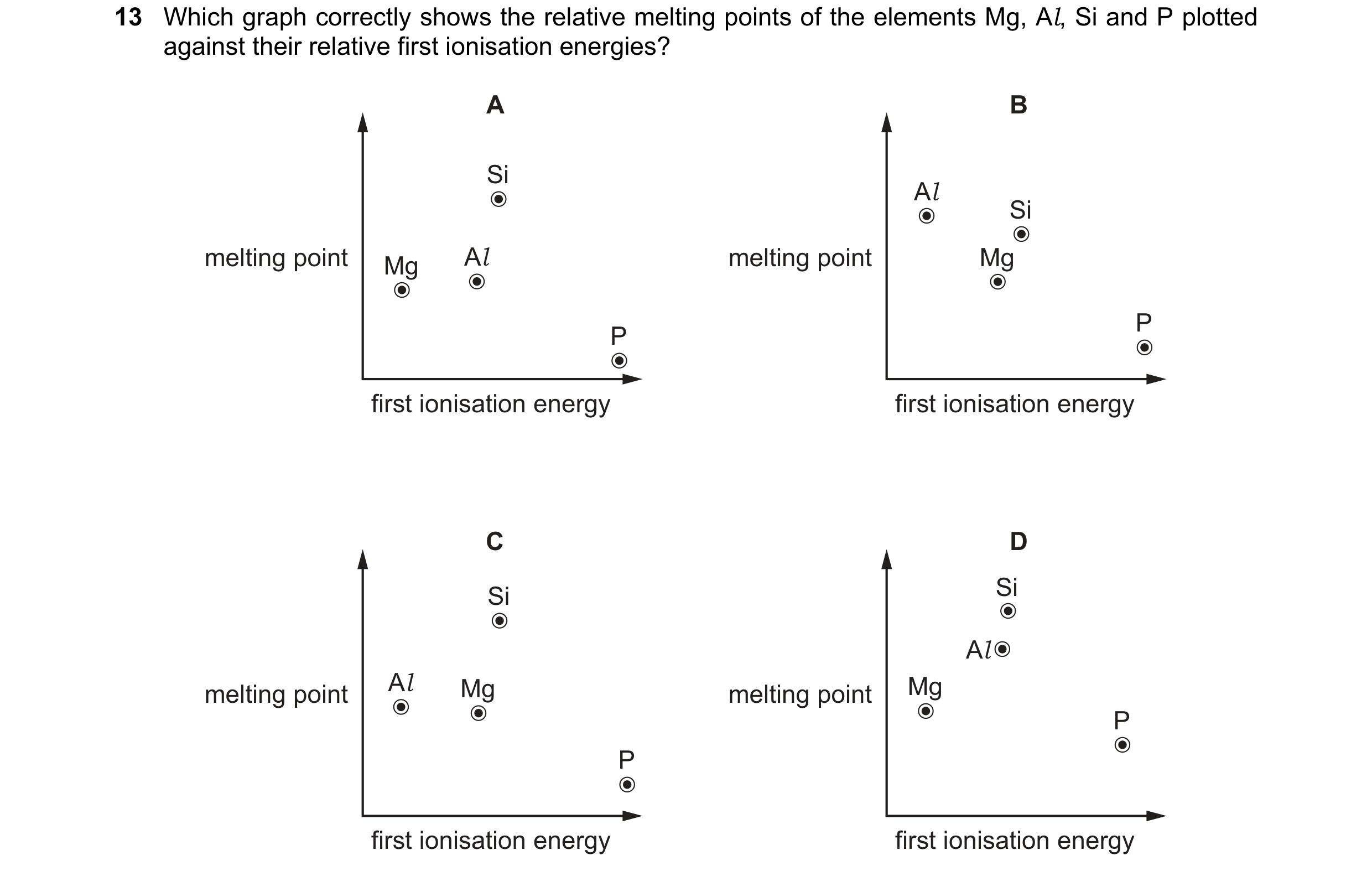
13 Which graph correctly shows the relative melting points of the elements Mg, Al, Si and P plotted against their relative first ionisation energies? A B Si Al Si melting point Mg Al melting point Mg P P first ionisation energy first ionisation energy C D Si Si Al Al Mg Mg melting point melting point P P first ionisation energy first ionisation energy
1 marks
Answer: C
This question in 9701/13 May/June 2017
Q56 · The relative first ionisation energies of four elements with consecutive atomic numbers… 9701/11 Oct/Nov 2017
2 The relative first ionisation energies of four elements with consecutive atomic numbers below 20 are shown on the graph. One of the elements reacts with hydrogen to form a covalent compound with formula HX. Which element could be X? B A first ionisation energy / kJ mol–1 D C atomic number
1 marks
Answer: A
This question in 9701/11 Oct/Nov 2017
Q57 · The definitions of many chemical terms can be illustrated by chemical equations 9701/11 Oct/Nov 2017
31 The definitions of many chemical terms can be illustrated by chemical equations. Which terms can be illustrated by an equation that includes the formation of a positive ion? 1 first ionisation energy 2 heterolytic fission of a covalent bond 3 enthalpy change of atomisation
1 marks
Answer: B
This question in 9701/11 Oct/Nov 2017
Q58 · The relative magnitude of the property X of five elements is shown 9701/12 Oct/Nov 2017
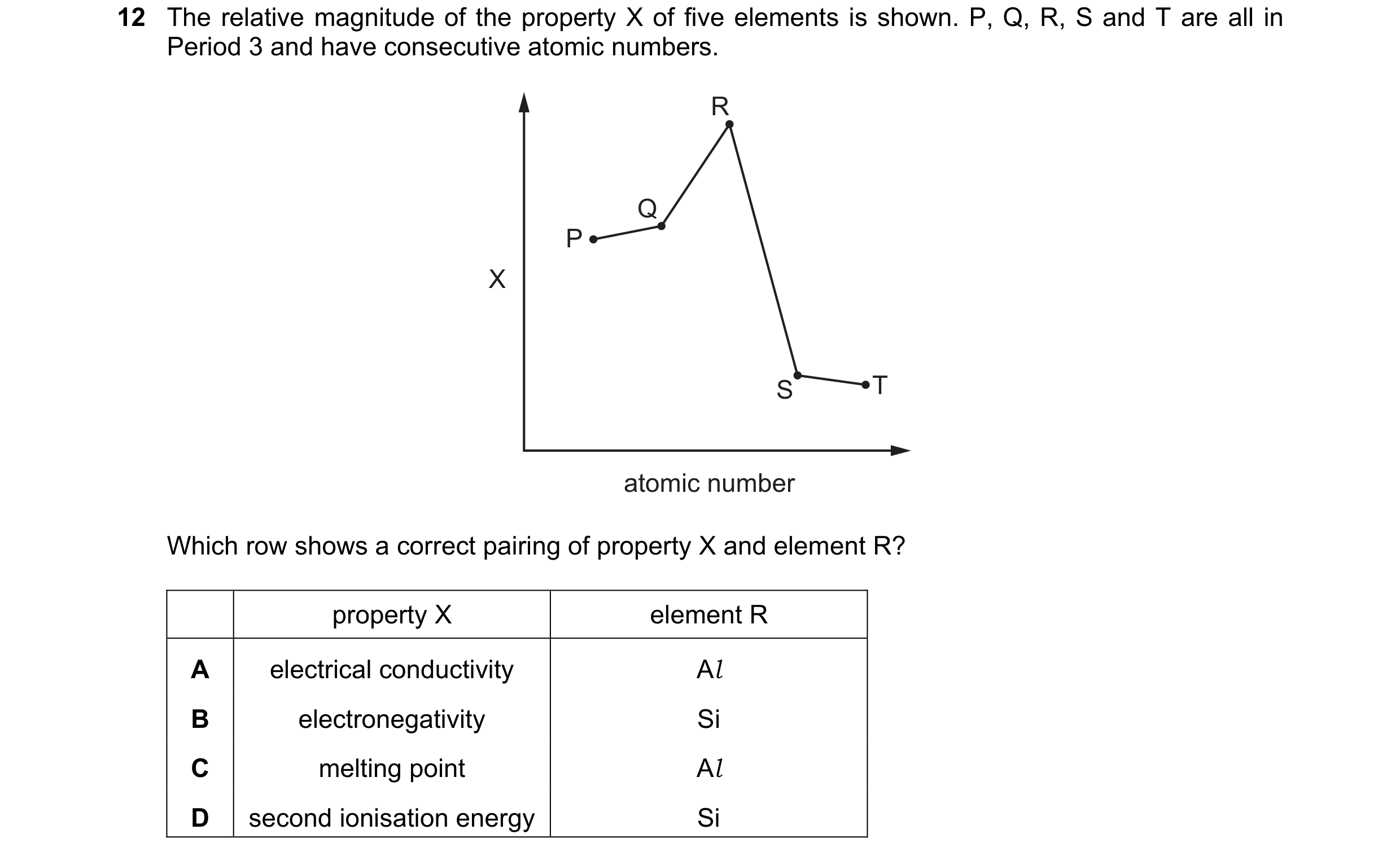
12 The relative magnitude of the property X of five elements is shown. P, Q, R, S and T are all in Period 3 and have consecutive atomic numbers. R Q P X S T atomic number Which row shows a correct pairing of property X and element R? property X element R A electrical conductivity Al B electronegativity Si C melting point Al D second ionisation energy Si
1 marks
Answer: A
This question in 9701/12 Oct/Nov 2017
Q59 · Which statements correctly describe a trend on going down Group 2? 9701/12 Oct/Nov 2017
35 Which statements correctly describe a trend on going down Group 2? 1 Reactivity of the elements increases. 2 First ionisation energy of the elements decreases. 3 The hydroxides become more soluble in water.
1 marks
Answer: A
This question in 9701/12 Oct/Nov 2017
Q60 · The relative first ionisation energies of four elements with consecutive atomic numbers… 9701/13 Oct/Nov 2017
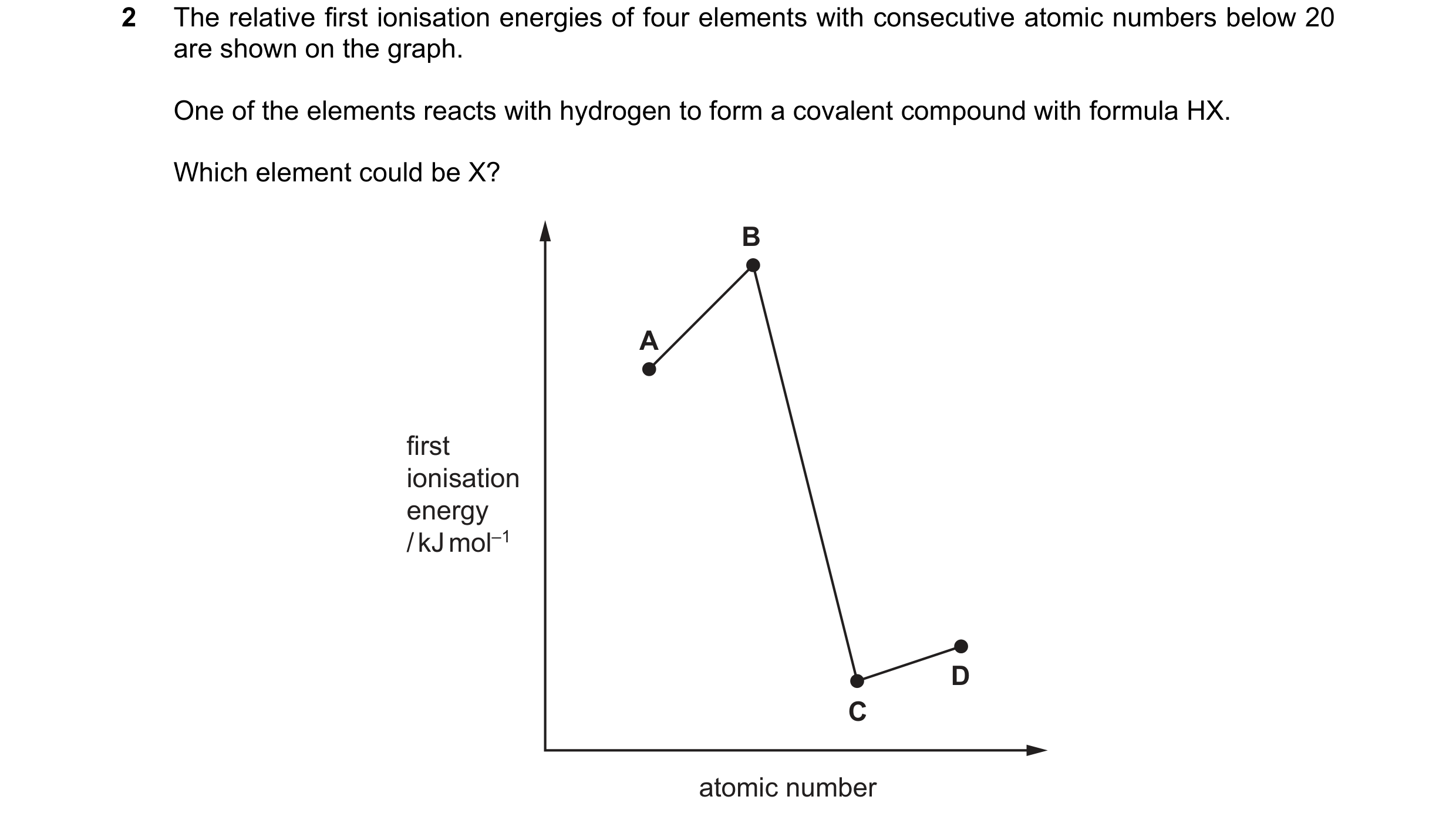
2 The relative first ionisation energies of four elements with consecutive atomic numbers below 20 are shown on the graph. One of the elements reacts with hydrogen to form a covalent compound with formula HX. Which element could be X? B A first ionisation energy / kJ mol–1 D C atomic number
1 marks
Answer: A
This question in 9701/13 Oct/Nov 2017
Q61 · The definitions of many chemical terms can be illustrated by chemical equations 9701/13 Oct/Nov 2017
31 The definitions of many chemical terms can be illustrated by chemical equations. Which terms can be illustrated by an equation that includes the formation of a positive ion? 1 first ionisation energy 2 heterolytic fission of a covalent bond 3 enthalpy change of atomisation
1 marks
Answer: B
This question in 9701/13 Oct/Nov 2017
Q62 · Element X has a higher first ionisation energy than element Y 9701/11 May/June 2018
10 Element X has a higher first ionisation energy than element Y. Two students state what they believe is one factor that helps to explain this. student 1 “X has a higher first ionisation energy than Y because an atom of X has more protons in its nucleus than an atom of Y.” student 2 “X has a higher first ionisation energy than Y because X has a smaller atomic radius than Y.” Only one of the two students is correct. What could X and Y be? X Y A carbon boron B magnesium aluminium C oxygen nitrogen D oxygen sulfur
1 marks
Answer: D
This question in 9701/11 May/June 2018
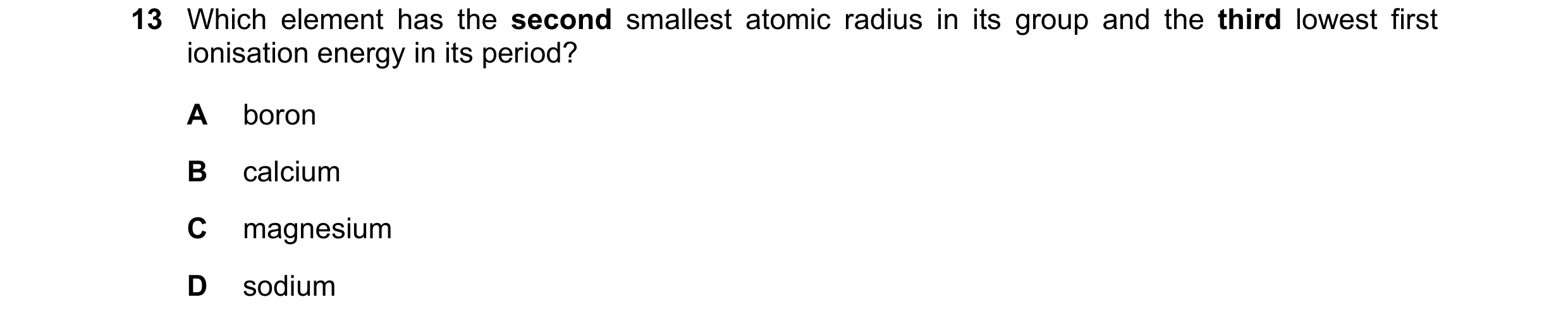
Q63 · Which element has the second smallest atomic radius in its group and the third lowest… 9701/11 May/June 2018
13 Which element has the second smallest atomic radius in its group and the third lowest first ionisation energy in its period? A boron B calcium C magnesium D sodium
1 marks
Answer: C
This question in 9701/11 May/June 2018
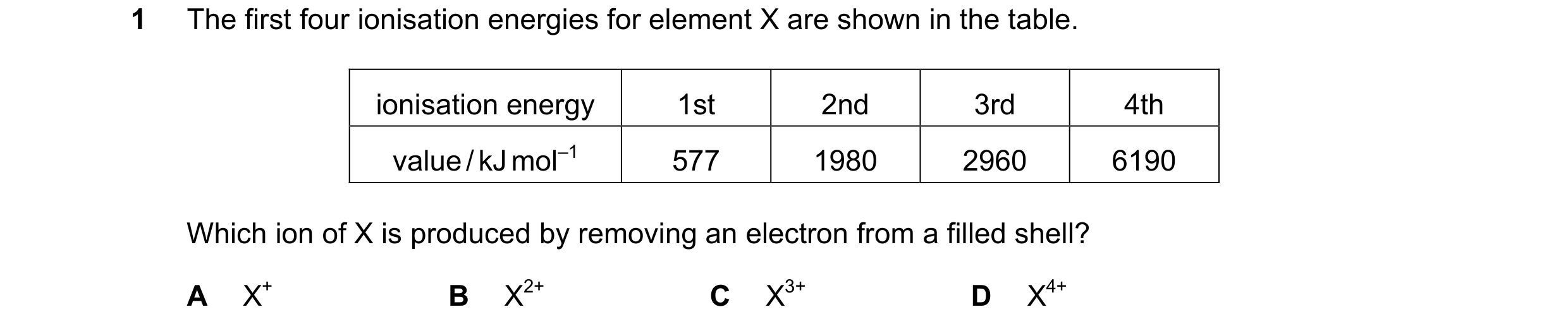
Q64 · The first four ionisation energies for element X are shown in the table 9701/11 Oct/Nov 2018
1 The first four ionisation energies for element X are shown in the table. ionisation energy 1st 2nd 3rd 4th value / kJ mol–1 577 1980 2960 6190 Which ion of X is produced by removing an electron from a filled shell? A X+ B X2+ C X3+ D X4+
1 marks
Answer: D
This question in 9701/11 Oct/Nov 2018
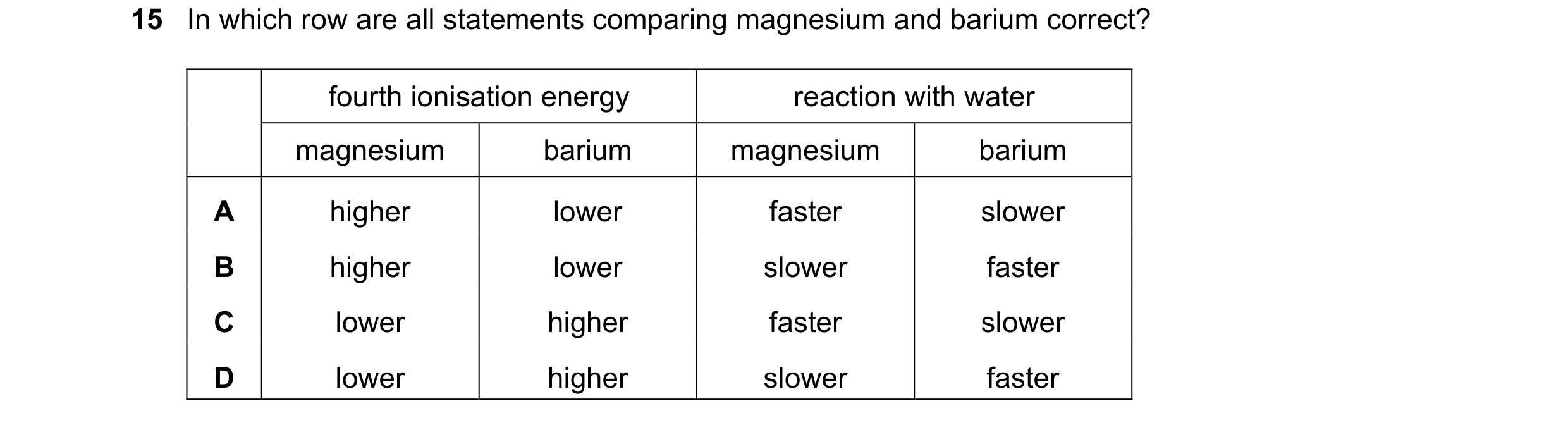
Q65 · In which row are all statements comparing magnesium and barium correct? 9701/12 Oct/Nov 2018
15 In which row are all statements comparing magnesium and barium correct? fourth ionisation energy reaction with water magnesium barium magnesium barium A higher lower faster slower B higher lower slower faster C lower higher faster slower D lower higher slower faster
1 marks
Answer: B
This question in 9701/12 Oct/Nov 2018
Q66 · The first four ionisation energies for element X are shown in the table 9701/13 Oct/Nov 2018
1 The first four ionisation energies for element X are shown in the table. ionisation energy 1st 2nd 3rd 4th value / kJ mol–1 577 1980 2960 6190 Which ion of X is produced by removing an electron from a filled shell? A X+ B X2+ C X3+ D X4+
1 marks
Answer: D
This question in 9701/13 Oct/Nov 2018
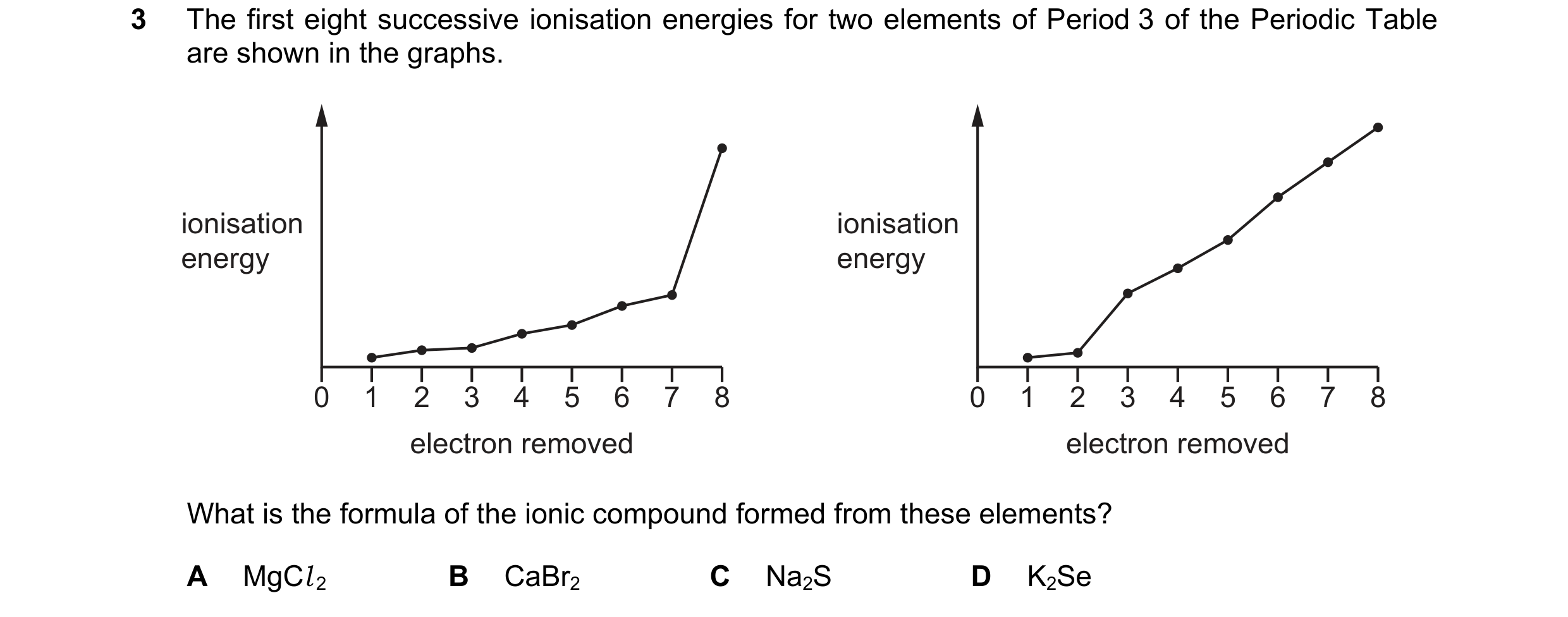
Q67 · The first eight successive ionisation energies for two elements of Period 3 of the… 9701/12 May/June 2019
3 The first eight successive ionisation energies for two elements of Period 3 of the Periodic Table are shown in the graphs. ionisation ionisation energy energy 0 1 2 3 4 5 6 7 8 0 1 2 3 4 5 6 7 8 electron removed electron removed What is the formula of the ionic compound formed from these elements? A MgCl 2 B CaBr2 C Na2S D K2Se
1 marks
Answer: A
This question in 9701/12 May/June 2019
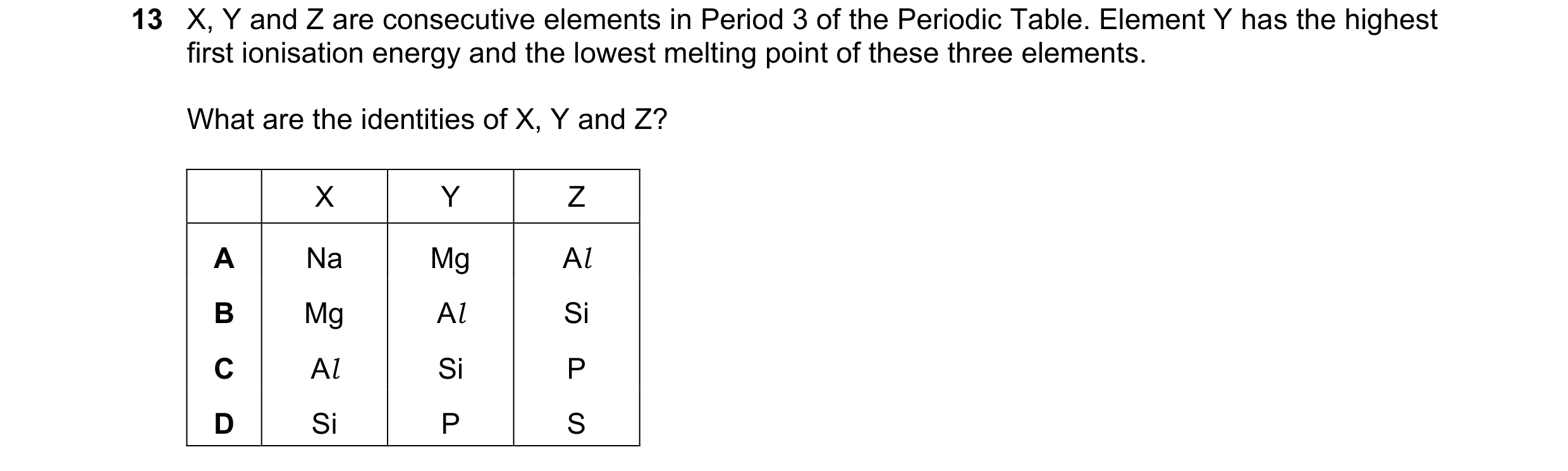
Q68 · X, Y and Z are consecutive elements in Period 3 of the Periodic Table 9701/11 Oct/Nov 2019
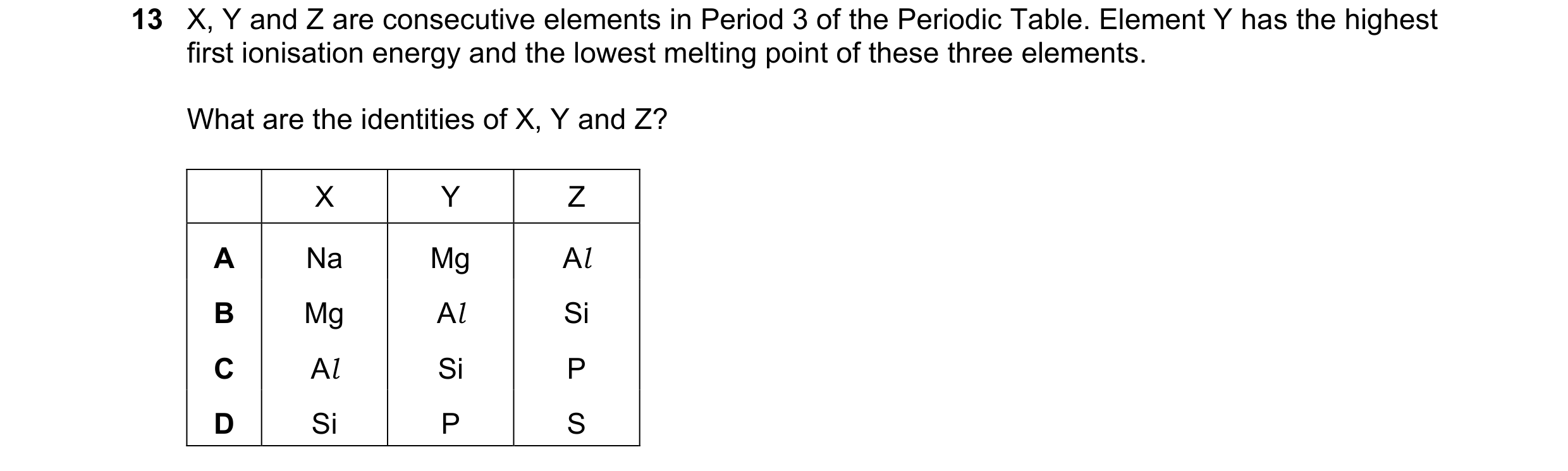
13 X, Y and Z are consecutive elements in Period 3 of the Periodic Table. Element Y has the highest first ionisation energy and the lowest melting point of these three elements. What are the identities of X, Y and Z? X Y Z A Na Mg Al B Mg Al Si C Al Si P D Si P S
1 marks
Answer: D
This question in 9701/11 Oct/Nov 2019
Q69 · The first ionisation energy of chlorine is greater than that of sulfur 9701/11 Oct/Nov 2019
32 The first ionisation energy of chlorine is greater than that of sulfur. Which factors contribute to this? 1 Chlorine has more protons in its nucleus than sulfur does. 2 Chlorine has greater electron shielding than sulfur does. 3 The covalent bonds in chlorine molecules are stronger than those in sulfur molecules.
1 marks
Answer: D
This question in 9701/11 Oct/Nov 2019
Q70 · The graph shows the successive ionisation energies of element X and element Y 9701/12 Oct/Nov 2019
3 The graph shows the successive ionisation energies of element X and element Y. Both elements are in Period 3. key element X element Y energy 0 1 2 3 4 5 6 7 8 9 10 successive ionisation energies Which statement is correct? A An atom of element X needs one extra electron for a full outer shell; an atom of element Y needs three extra electrons for a full outer shell. B An atom of element Y has five electrons in the 3p subshell. C Element X has an oxidation number of +7 in most of its compounds. D When element X combines with element Y, the bonding is ionic.
1 marks
Answer: A
This question in 9701/12 Oct/Nov 2019
Q71 · X, Y and Z are consecutive elements in Period 3 of the Periodic Table 9701/13 Oct/Nov 2019
13 X, Y and Z are consecutive elements in Period 3 of the Periodic Table. Element Y has the highest first ionisation energy and the lowest melting point of these three elements. What are the identities of X, Y and Z? X Y Z A Na Mg Al B Mg Al Si C Al Si P D Si P S
1 marks
Answer: D
This question in 9701/13 Oct/Nov 2019
Q72 · The first ionisation energy of chlorine is greater than that of sulfur 9701/13 Oct/Nov 2019
32 The first ionisation energy of chlorine is greater than that of sulfur. Which factors contribute to this? 1 Chlorine has more protons in its nucleus than sulfur does. 2 Chlorine has greater electron shielding than sulfur does. 3 The covalent bonds in chlorine molecules are stronger than those in sulfur molecules.
1 marks
Answer: D
This question in 9701/13 Oct/Nov 2019
Q73 · The definitions of many chemical terms can be illustrated by chemical equations 9701/11 May/June 2020
31 The definitions of many chemical terms can be illustrated by chemical equations. Which terms can be illustrated by an equation that includes the formation of a positive ion? 1 first ionisation energy 2 heterolytic fission of a covalent bond 3 enthalpy change of atomisation
1 marks
Answer: B
This question in 9701/11 May/June 2020
Q74 · The fifth to eighth ionisation energies of four elements in Period 3 of the Periodic… 9701/12 May/June 2020
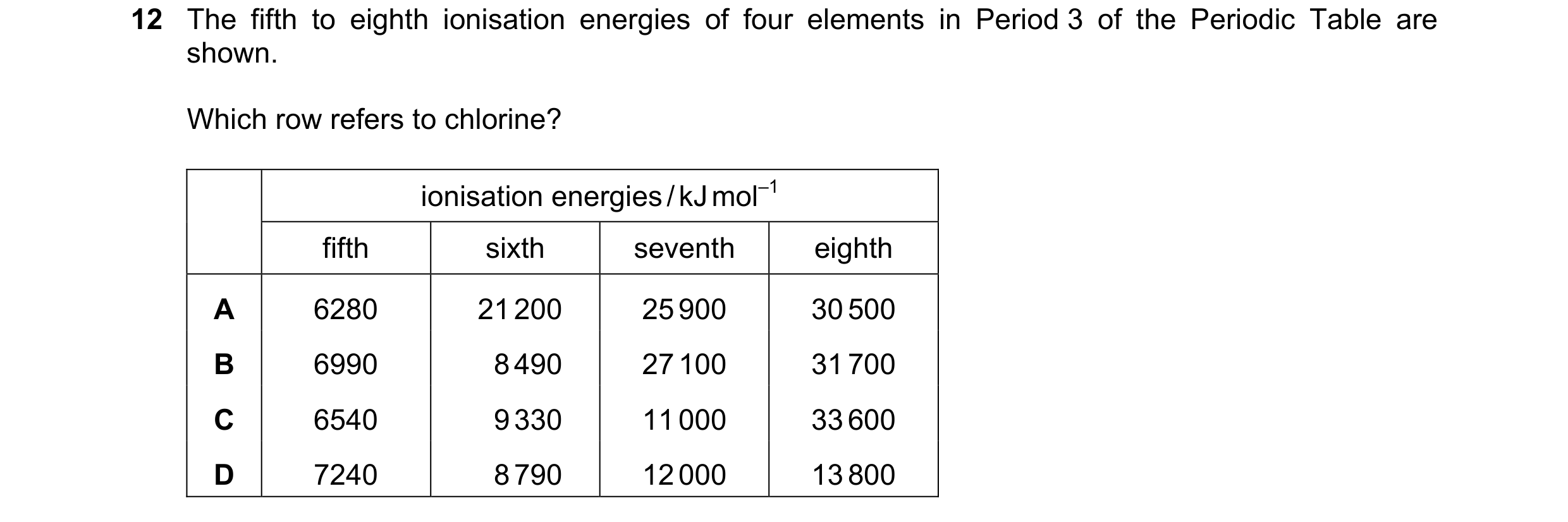
12 The fifth to eighth ionisation energies of four elements in Period 3 of the Periodic Table are shown. Which row refers to chlorine? ionisation energies / kJ mol–1 fifth sixth seventh eighth A 6280 21 200 25 900 30 500 B 6990 8 490 27 100 31 700 C 6540 9 330 11 000 33 600 D 7240 8 790 12 000 13 800
1 marks
Answer: C
This question in 9701/12 May/June 2020
Q75 · Scientists are trying to synthesise a new element with proton number 119 9701/12 May/June 2020
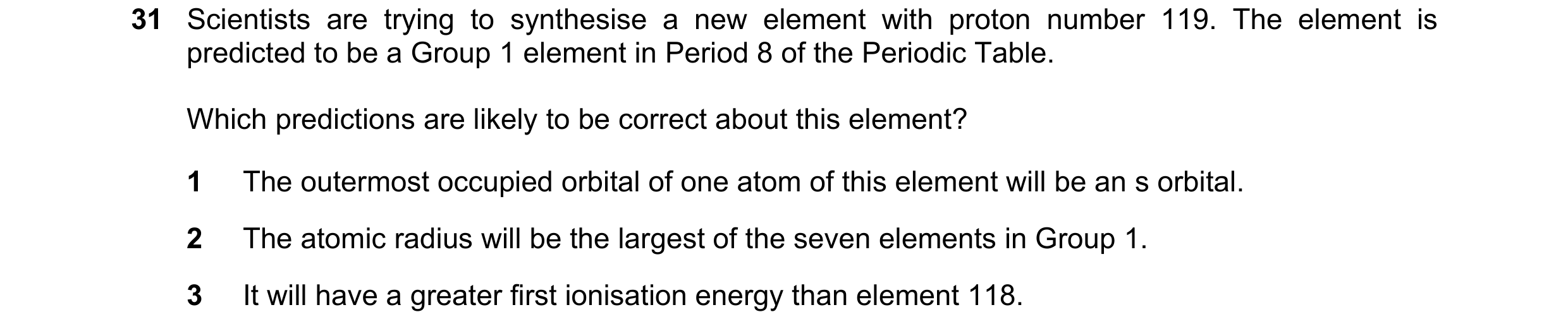
31 Scientists are trying to synthesise a new element with proton number 119. The element is predicted to be a Group 1 element in Period 8 of the Periodic Table. Which predictions are likely to be correct about this element? 1 The outermost occupied orbital of one atom of this element will be an s orbital. 2 The atomic radius will be the largest of the seven elements in Group 1. 3 It will have a greater first ionisation energy than element 118.
1 marks
Answer: B
This question in 9701/12 May/June 2020
Q76 · The statements apply to the elements in Group 2 9701/13 May/June 2020
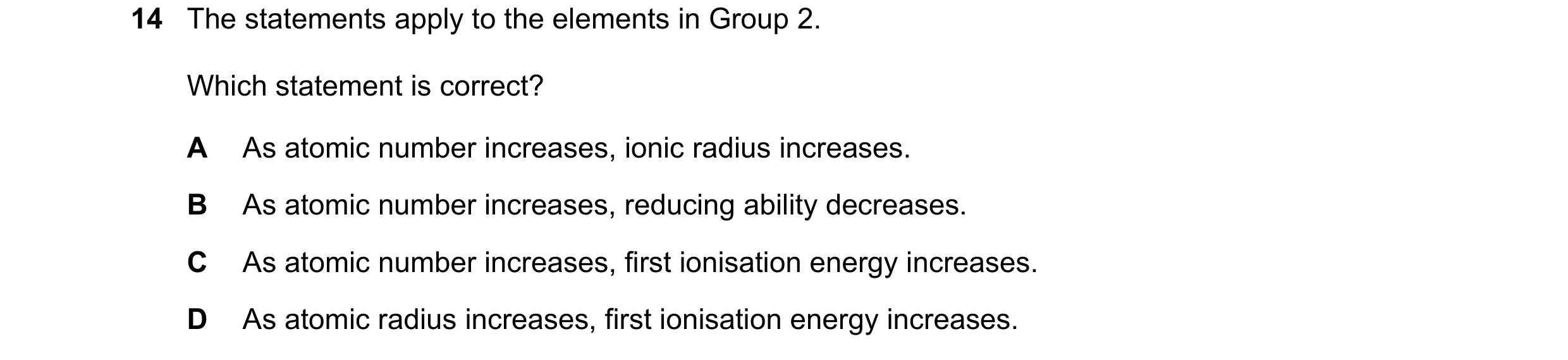
14 The statements apply to the elements in Group 2. Which statement is correct? A As atomic number increases, ionic radius increases. B As atomic number increases, reducing ability decreases. C As atomic number increases, first ionisation energy increases. D As atomic radius increases, first ionisation energy increases.
1 marks
Answer: A
This question in 9701/13 May/June 2020
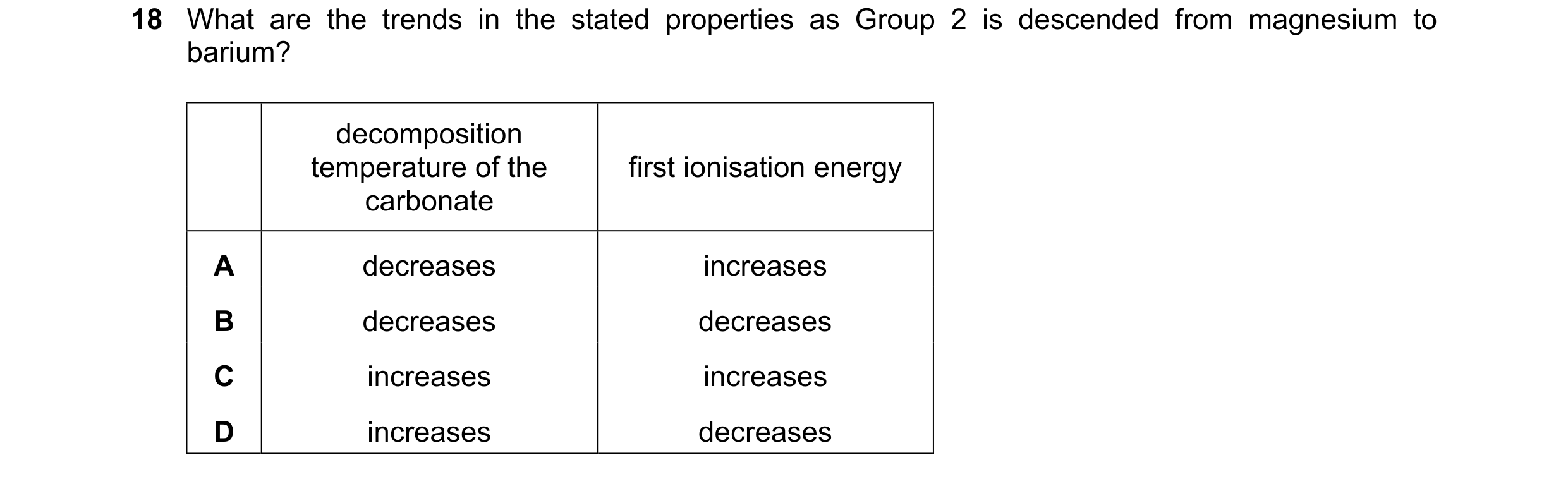
Q77 · What are the trends in the stated properties as Group 2 is descended from magnesium to… 9701/11 Oct/Nov 2020
18 What are the trends in the stated properties as Group 2 is descended from magnesium to barium? decomposition temperature of the first ionisation energy carbonate A decreases increases B decreases decreases C increases increases D increases decreases
1 marks
Answer: D
This question in 9701/11 Oct/Nov 2020
Q78 · What are the trends in the stated properties as Group 2 is descended from magnesium to… 9701/13 Oct/Nov 2020
18 What are the trends in the stated properties as Group 2 is descended from magnesium to barium? decomposition temperature of the first ionisation energy carbonate A decreases increases B decreases decreases C increases increases D increases decreases
1 marks
Answer: D
This question in 9701/13 Oct/Nov 2020
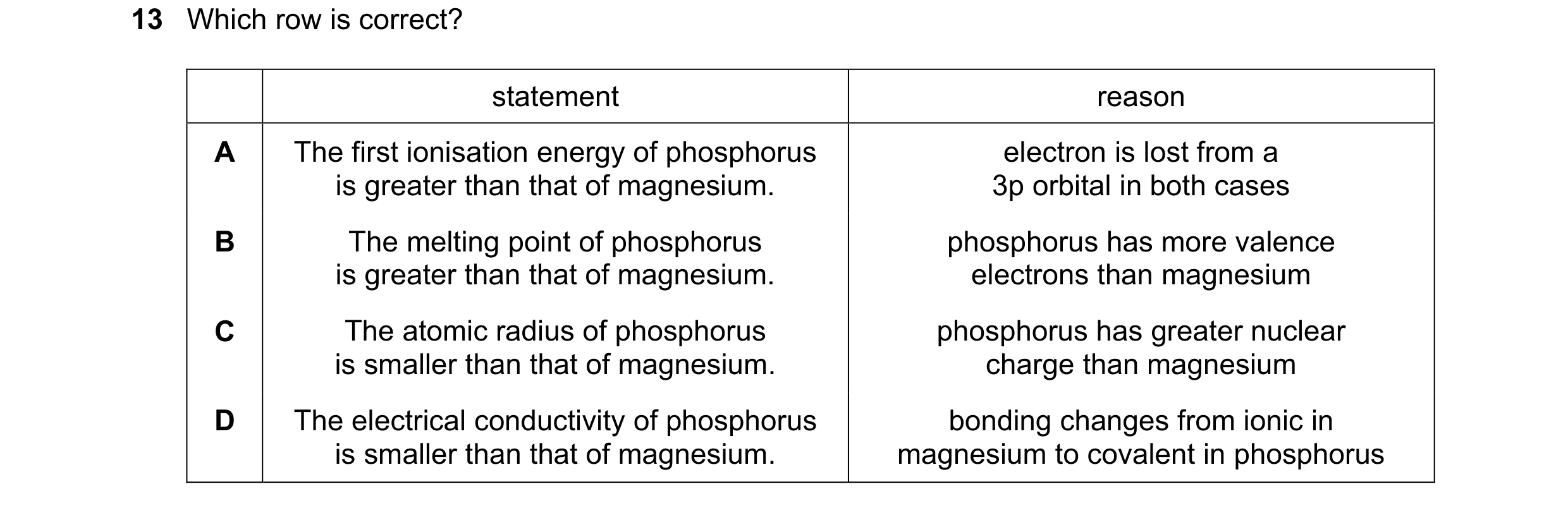
Q79 · Which row is correct? 9701/12 Feb/March 2021
13 Which row is correct? statement reason A The first ionisation energy of phosphorus electron is lost from a is greater than that of magnesium. 3p orbital in both cases B The melting point of phosphorus phosphorus has more valence is greater than that of magnesium. electrons than magnesium C The atomic radius of phosphorus phosphorus has greater nuclear is smaller than that of magnesium. charge than magnesium D The electrical conductivity of phosphorus bonding changes from ionic in is smaller than that of magnesium. magnesium to covalent in phosphorus
1 marks
Answer: C
This question in 9701/12 Feb/March 2021
Q80 · Why is the first ionisation energy of oxygen less than that of nitrogen? 9701/11 May/June 2021
7 Why is the first ionisation energy of oxygen less than that of nitrogen? A The nitrogen atom has its outer electron in a different subshell. B The nuclear charge on the oxygen atom is greater than that on the nitrogen atom. C The oxygen atom has a pair of electrons in one p orbital that repel one another. D There is more shielding in an oxygen atom.
1 marks
Answer: C
This question in 9701/11 May/June 2021
Q81 · Which equation represents the first ionisation energy of iodine? 9701/12 May/June 2021
2 Which equation represents the first ionisation energy of iodine? A 2 I2(g) + e– I–(g) 1 B I(g) + e– I–(g) C 2 I2(g) I+(g) + e– 1 D I(g) I+(g) + e–
1 marks
Answer: D
This question in 9701/12 May/June 2021
Q82 · Which statements about first ionisation energies are correct? 9701/13 May/June 2021
31 Which statements about first ionisation energies are correct? 1 They are always endothermic. 2 They decrease down Group 2. 3 They decrease across Period 3.
1 marks
Answer: B
This question in 9701/13 May/June 2021
Q83 · Which of these elements has the highest fifth ionisation energy? 9701/11 Oct/Nov 2021
3 Which of these elements has the highest fifth ionisation energy? A C B N C P D Si
1 marks
Answer: A
This question in 9701/11 Oct/Nov 2021
Q84 · Which of these elements has the highest fifth ionisation energy? 9701/13 Oct/Nov 2021
3 Which of these elements has the highest fifth ionisation energy? A C B N C P D Si
1 marks
Answer: A
This question in 9701/13 Oct/Nov 2021
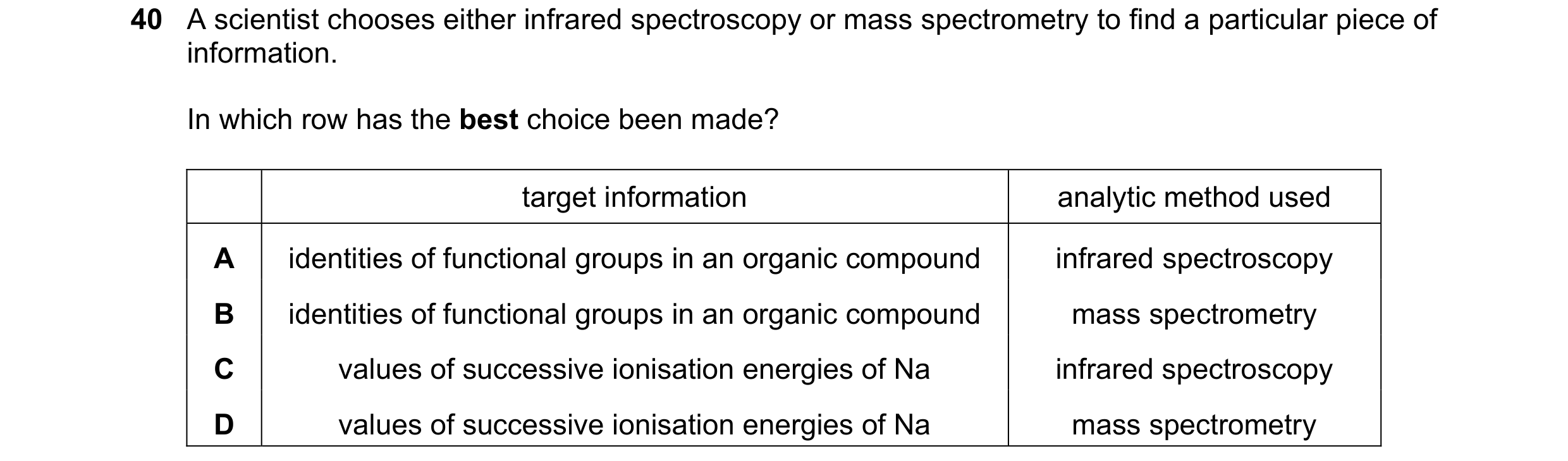
Q85 · A scientist chooses either infrared spectroscopy or mass spectrometry to find a… 9701/11 May/June 2022
40 A scientist chooses either infrared spectroscopy or mass spectrometry to find a particular piece of information. In which row has the best choice been made? target information analytic method used A identities of functional groups in an organic compound infrared spectroscopy B identities of functional groups in an organic compound mass spectrometry C values of successive ionisation energies of Na infrared spectroscopy D values of successive ionisation energies of Na mass spectrometry
1 marks
Answer: A
This question in 9701/11 May/June 2022
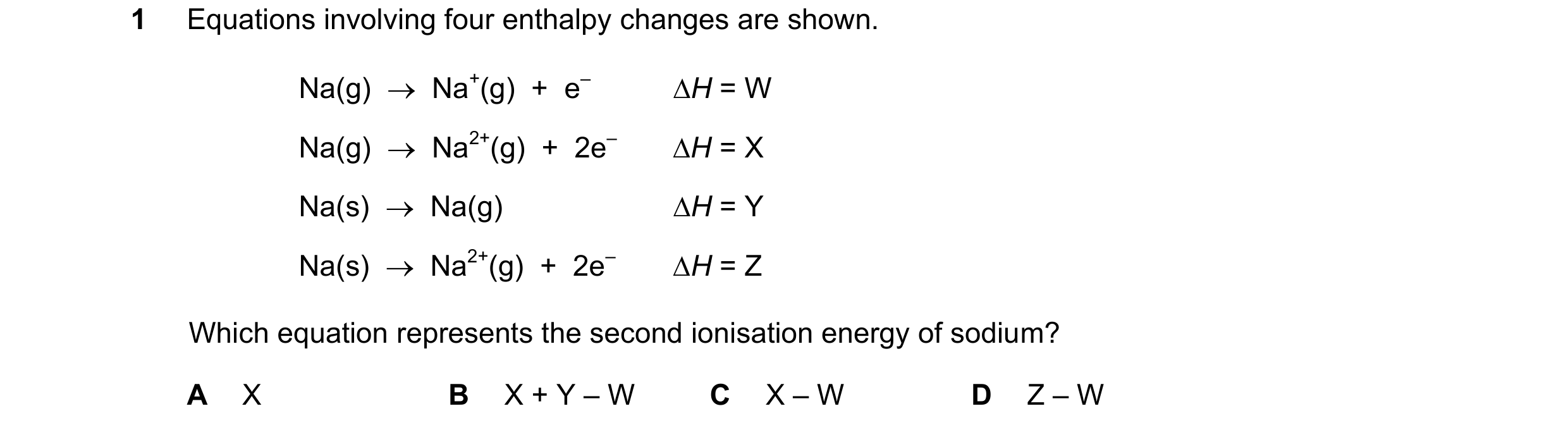
Q86 · Equations involving four enthalpy changes are shown 9701/12 May/June 2022
1 Equations involving four enthalpy changes are shown. Na(g) Na+(g) + e– H = W Na(g) Na2+(g) + 2e– H = X Na(s) Na(g) H = Y Na(s) Na2+(g) + 2e– H = Z Which equation represents the second ionisation energy of sodium? A X B X + Y – W C X – W D Z – W
1 marks
Answer: C
This question in 9701/12 May/June 2022
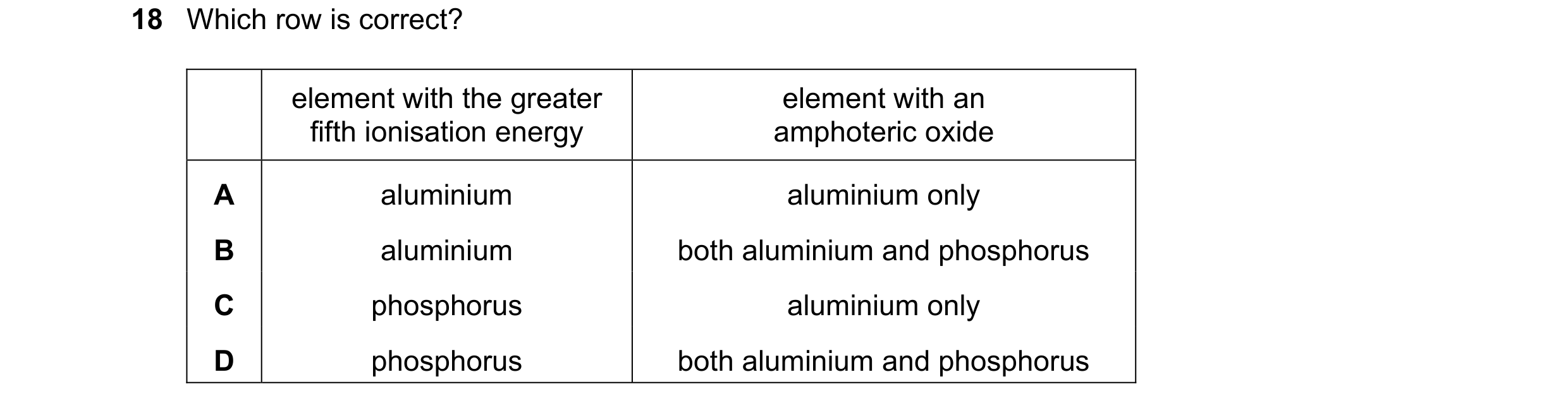
Q87 · Which row is correct? 9701/13 May/June 2022
18 Which row is correct? element with the greater element with an fifth ionisation energy amphoteric oxide A aluminium aluminium only B aluminium both aluminium and phosphorus C phosphorus aluminium only D phosphorus both aluminium and phosphorus
1 marks
Answer: A
This question in 9701/13 May/June 2022
Q88 · For the element sulfur, which pair of ionisation energies has the largest difference… 9701/11 Oct/Nov 2022
4 For the element sulfur, which pair of ionisation energies has the largest difference between them? A third and fourth ionisation energies B fourth and fifth ionisation energies C fifth and sixth ionisation energies D sixth and seventh ionisation energies
1 marks
Answer: D
This question in 9701/11 Oct/Nov 2022
Q89 · Why is the first ionisation energy of phosphorus greater than the first ionisation energy… 9701/12 Oct/Nov 2022
1 Why is the first ionisation energy of phosphorus greater than the first ionisation energy of silicon? A A phosphorus atom has one more proton in its nucleus. B The atomic radius of a phosphorus atom is greater. C The outer electron in a phosphorus atom is more shielded. D The outer electron in a phosphorus atom is paired.
1 marks
Answer: A
This question in 9701/12 Oct/Nov 2022
Q90 · T is an element in Period 3 9701/12 Oct/Nov 2022
25 T is an element in Period 3. The first ionisation energy of T is lower than that of the element with one less proton. The oxide of T does not react with water. What is the identity of T? A aluminium B silicon C sodium D sulfur
1 marks
Answer: A
This question in 9701/12 Oct/Nov 2022
Q91 · For the element sulfur, which pair of ionisation energies has the largest difference… 9701/13 Oct/Nov 2022
4 For the element sulfur, which pair of ionisation energies has the largest difference between them? A third and fourth ionisation energies B fourth and fifth ionisation energies C fifth and sixth ionisation energies D sixth and seventh ionisation energies
1 marks
Answer: D
This question in 9701/13 Oct/Nov 2022
Q92 · Which statement about the first ionisation energies of magnesium and neon is correct? 9701/12 Feb/March 2023
13 Which statement about the first ionisation energies of magnesium and neon is correct? A Magnesium has the greater numerical value and both are endothermic. B Magnesium has the greater numerical value and both are exothermic. C Neon has the greater numerical value and both are endothermic. D Neon has the greater numerical value and both are exothermic.
1 marks
Answer: C
This question in 9701/12 Feb/March 2023
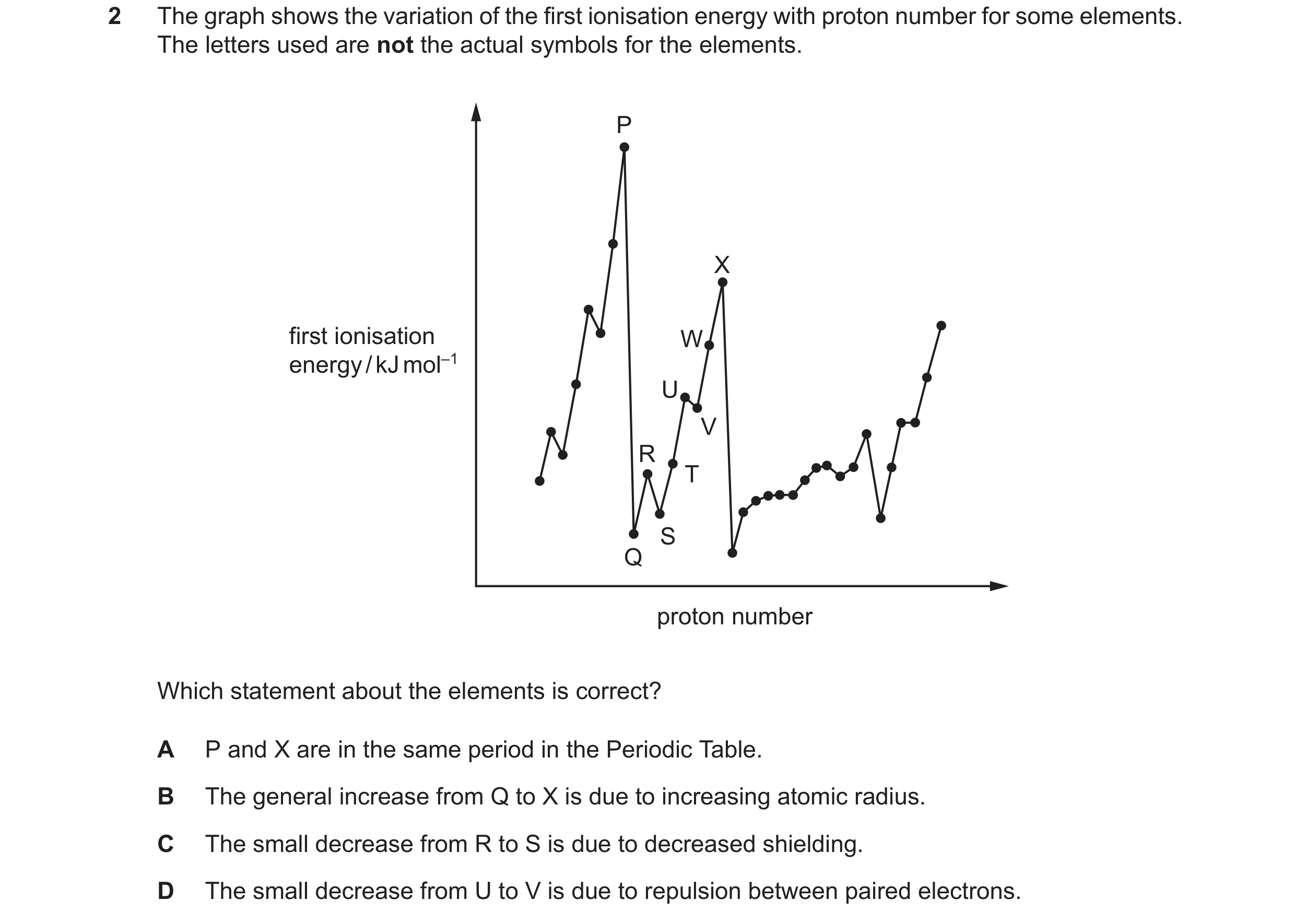
Q93 · The graph shows the variation of the first ionisation energy with proton number for some… 9701/11 Oct/Nov 2023
2 The graph shows the variation of the first ionisation energy with proton number for some elements. The letters used are not the actual symbols for the elements. P X first ionisation W energy / kJ mol–1 U V R T S Q proton number Which statement about the elements is correct? A P and X are in the same period in the Periodic Table. B The general increase from Q to X is due to increasing atomic radius. C The small decrease from R to S is due to decreased shielding. D The small decrease from U to V is due to repulsion between paired electrons.
1 marks
Answer: D
This question in 9701/11 Oct/Nov 2023
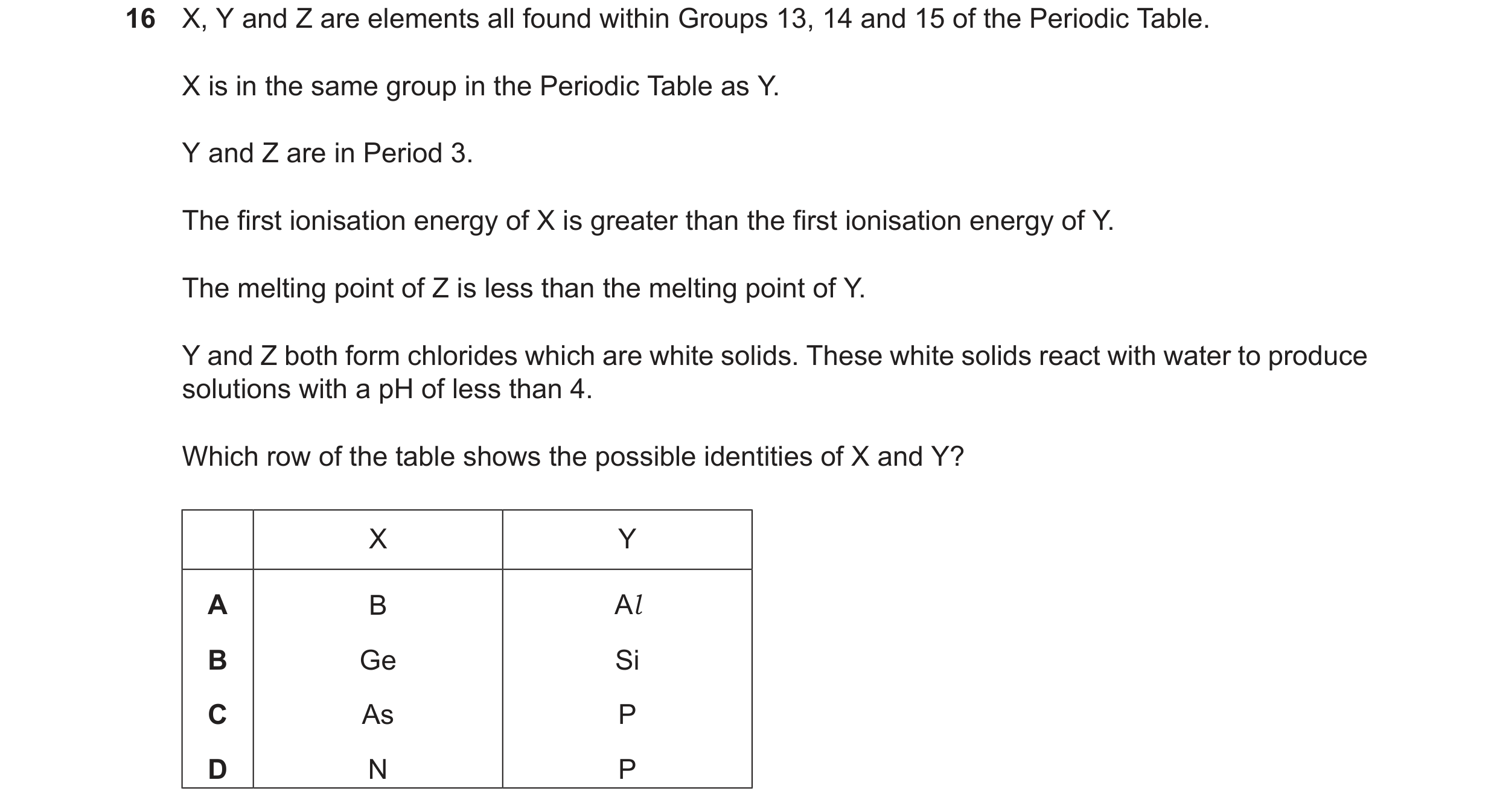
Q94 · X, Y and Z are elements all found within Groups 13, 14 and 15 of the Periodic Table 9701/11 Oct/Nov 2023
16 X, Y and Z are elements all found within Groups 13, 14 and 15 of the Periodic Table. X is in the same group in the Periodic Table as Y. Y and Z are in Period 3. The first ionisation energy of X is greater than the first ionisation energy of Y. The melting point of Z is less than the melting point of Y. Y and Z both form chlorides which are white solids. These white solids react with water to produce solutions with a pH of less than 4. Which row of the table shows the possible identities of X and Y? X Y A B Al B Ge Si C As P D N P
1 marks
Answer: A
This question in 9701/11 Oct/Nov 2023
Q95 · The second ionisation energy of oxygen is greater than the second ionisation energy of… 9701/12 Oct/Nov 2023
2 The second ionisation energy of oxygen is greater than the second ionisation energy of fluorine. Which factor explains this difference? A The atomic radius of an oxygen atom is smaller than that of fluorine. B The covalent bond in a fluorine molecule is weaker than the bond in an oxygen molecule. C A spin-paired electron is removed from fluorine but not from oxygen. D Fluorine has more electrons in total than oxygen. This causes a greater shielding of the nuclear attraction in fluorine.
1 marks
Answer: C
This question in 9701/12 Oct/Nov 2023
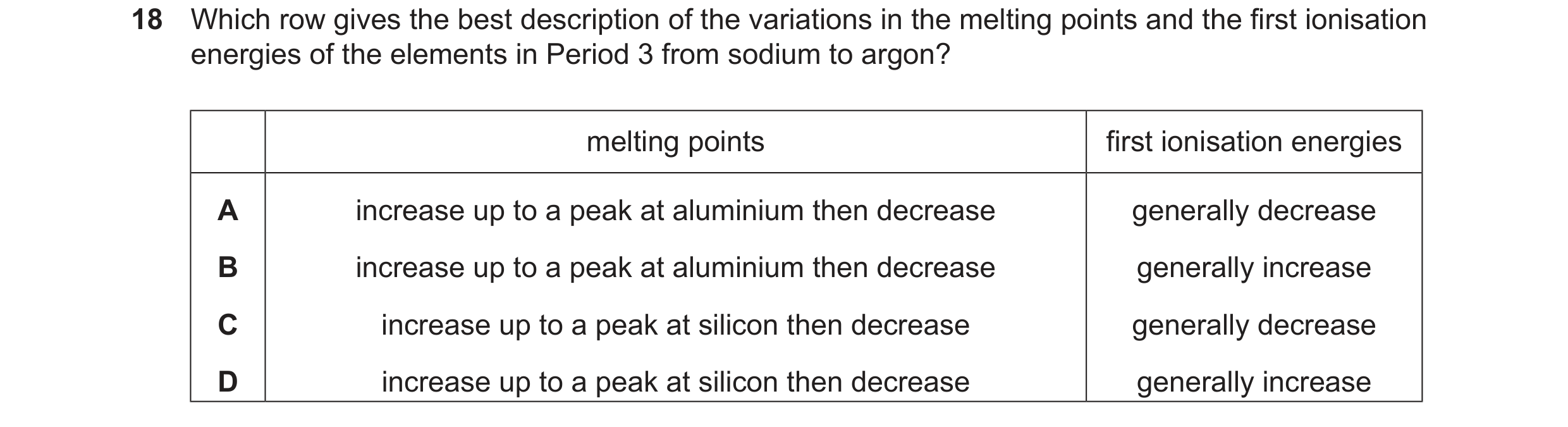
Q96 · Which row gives the best description of the variations in the melting points and the… 9701/12 Oct/Nov 2023
18 Which row gives the best description of the variations in the melting points and the first ionisation energies of the elements in Period 3 from sodium to argon? melting points first ionisation energies A increase up to a peak at aluminium then decrease generally decrease B increase up to a peak at aluminium then decrease generally increase C increase up to a peak at silicon then decrease generally decrease D increase up to a peak at silicon then decrease generally increase
1 marks
Answer: D
This question in 9701/12 Oct/Nov 2023
Q97 · The graph shows the variation of the first ionisation energy with proton number for some… 9701/13 Oct/Nov 2023
2 The graph shows the variation of the first ionisation energy with proton number for some elements. The letters used are not the actual symbols for the elements. P X first ionisation W energy / kJ mol–1 U V R T S Q proton number Which statement about the elements is correct? A P and X are in the same period in the Periodic Table. B The general increase from Q to X is due to increasing atomic radius. C The small decrease from R to S is due to decreased shielding. D The small decrease from U to V is due to repulsion between paired electrons.
1 marks
Answer: D
This question in 9701/13 Oct/Nov 2023
Q98 · X, Y and Z are elements all found within Groups 13, 14 and 15 of the Periodic Table 9701/13 Oct/Nov 2023
16 X, Y and Z are elements all found within Groups 13, 14 and 15 of the Periodic Table. X is in the same group in the Periodic Table as Y. Y and Z are in Period 3. The first ionisation energy of X is greater than the first ionisation energy of Y. The melting point of Z is less than the melting point of Y. Y and Z both form chlorides which are white solids. These white solids react with water to produce solutions with a pH of less than 4. Which row of the table shows the possible identities of X and Y? X Y A B Al B Ge Si C As P D N P
1 marks
Answer: A
This question in 9701/13 Oct/Nov 2023
Q99 · Which process has the largest enthalpy change per mole? 9701/12 Feb/March 2024
2 Which process has the largest enthalpy change per mole? A Al 3+(g) Al 4+(g) + e– B P5+(g) P6+(g) + e– C S6+(g) S7+(g) + e– D Si4+(g) Si5+(g) + e–
1 marks
Answer: C
This question in 9701/12 Feb/March 2024
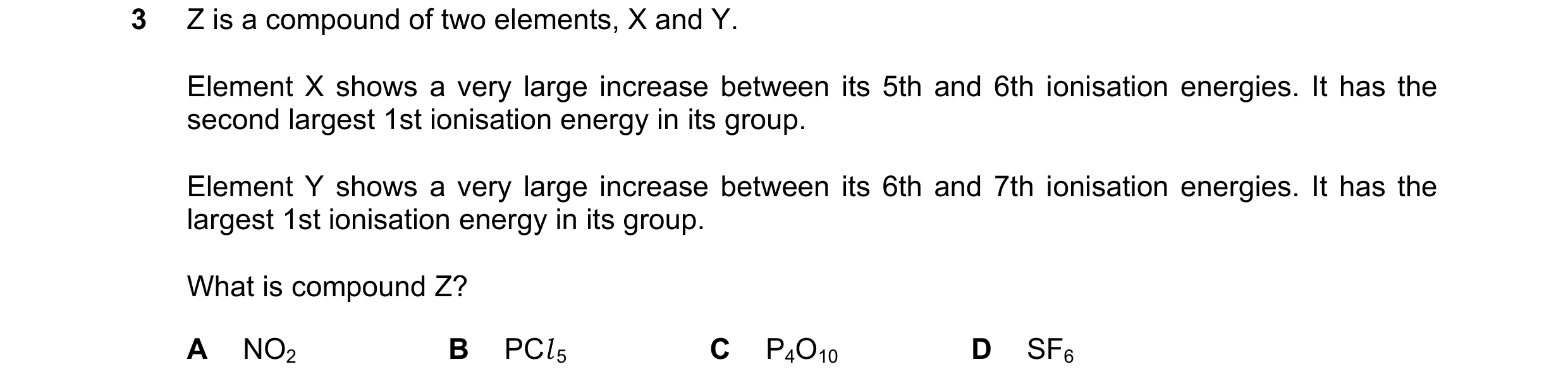
Q100 · Z is a compound of two elements, X and Y 9701/11 May/June 2024
3 Z is a compound of two elements, X and Y. Element X shows a very large increase between its 5th and 6th ionisation energies. It has the second largest 1st ionisation energy in its group. Element Y shows a very large increase between its 6th and 7th ionisation energies. It has the largest 1st ionisation energy in its group. What is compound Z? A NO2 B PCl 5 C P4O10 D SF6
1 marks
Answer: C
This question in 9701/11 May/June 2024
Q101 · The first eight successive ionisation energies for two elements of Period 3 of the… 9701/12 May/June 2024
3 The first eight successive ionisation energies for two elements of Period 3 of the Periodic Table are shown in the graphs. ionisation ionisation energy energy 0 1 2 3 4 5 6 7 8 0 1 2 3 4 5 6 7 8 electron removed electron removed What is the formula of the ionic compound formed from these elements? A MgCl 2 B CaBr2 C Na2S D K2Se
1 marks
Answer: A
This question in 9701/12 May/June 2024
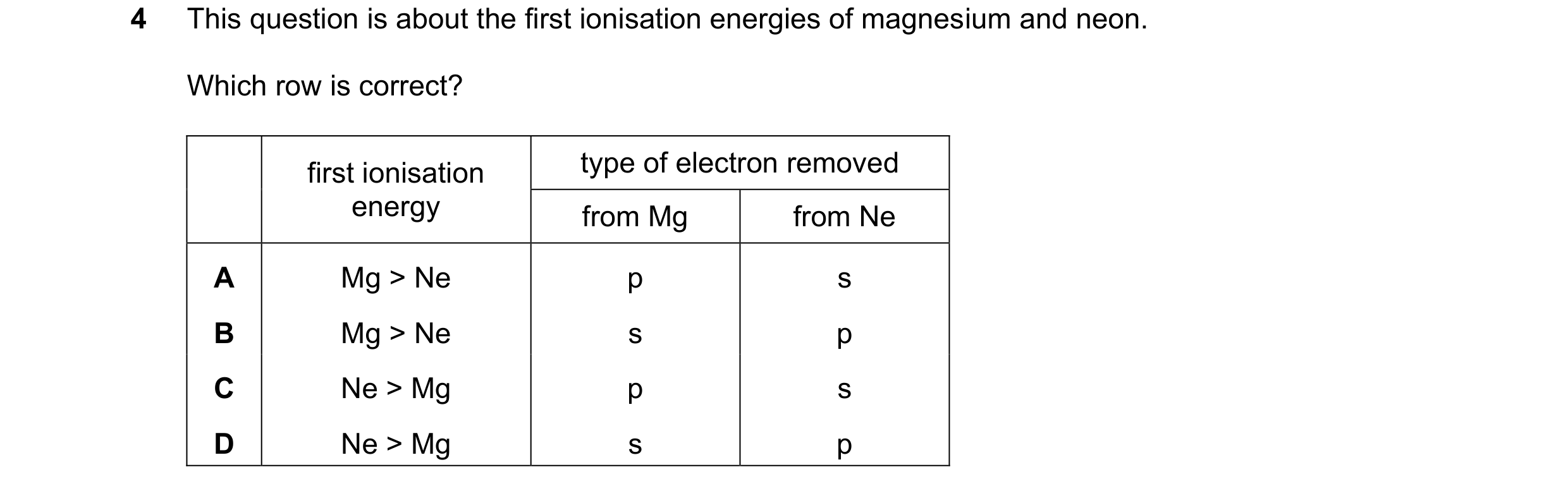
Q102 · This question is about the first ionisation energies of magnesium and neon 9701/13 May/June 2024
4 This question is about the first ionisation energies of magnesium and neon. Which row is correct? first ionisation type of electron removed energy from Mg from Ne A Mg > Ne p s B Mg > Ne s p C Ne > Mg p s D Ne > Mg s p
1 marks
Answer: D
This question in 9701/13 May/June 2024
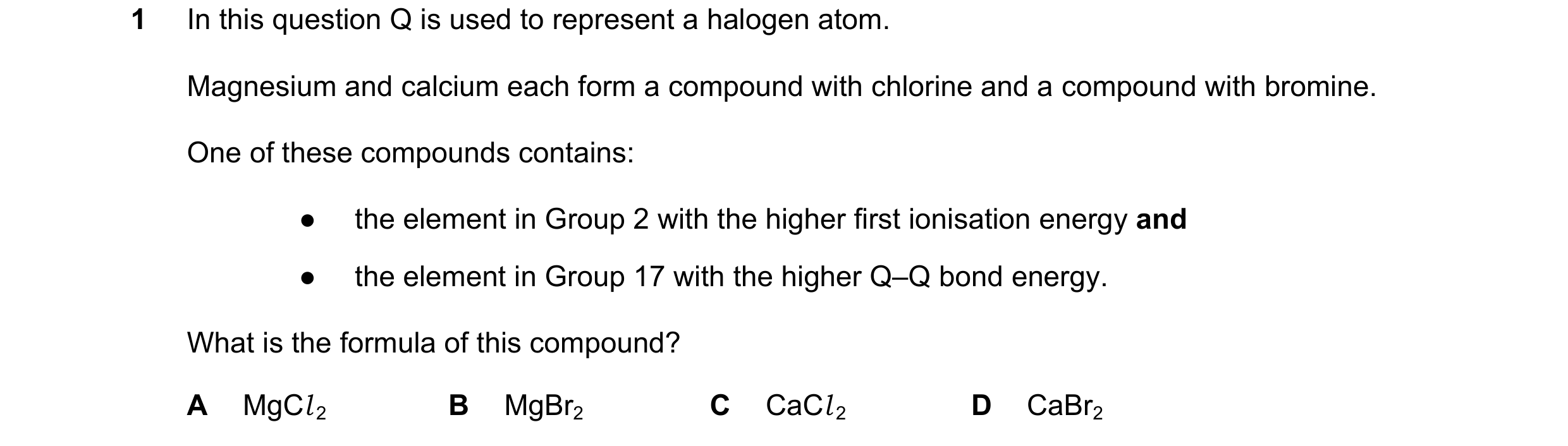
Q103 · In this question Q is used to represent a halogen atom 9701/11 Oct/Nov 2024
1 In this question Q is used to represent a halogen atom. Magnesium and calcium each form a compound with chlorine and a compound with bromine. One of these compounds contains: ● the element in Group 2 with the higher first ionisation energy and ● the element in Group 17 with the higher Q–Q bond energy. What is the formula of this compound? A MgCl 2 B MgBr2 C CaCl 2 D CaBr2
1 marks
Answer: A
This question in 9701/11 Oct/Nov 2024
Q104 · Which factor causes helium to have a higher first ionisation energy than hydrogen? 9701/12 Oct/Nov 2024
2 Which factor causes helium to have a higher first ionisation energy than hydrogen? A In the 1s orbital in helium, electrons are paired. B The lowest energy level in helium is filled. C The nuclear charge in helium is higher than in hydrogen. D There is less shielding of the outer shell in helium.
1 marks
Answer: C
This question in 9701/12 Oct/Nov 2024
Q105 · In this question Q is used to represent a halogen atom 9701/13 Oct/Nov 2024
1 In this question Q is used to represent a halogen atom. Magnesium and calcium each form a compound with chlorine and a compound with bromine. One of these compounds contains: ● the element in Group 2 with the higher first ionisation energy and ● the element in Group 17 with the higher Q–Q bond energy. What is the formula of this compound? A MgCl 2 B MgBr2 C CaCl 2 D CaBr2
1 marks
Answer: A
This question in 9701/13 Oct/Nov 2024
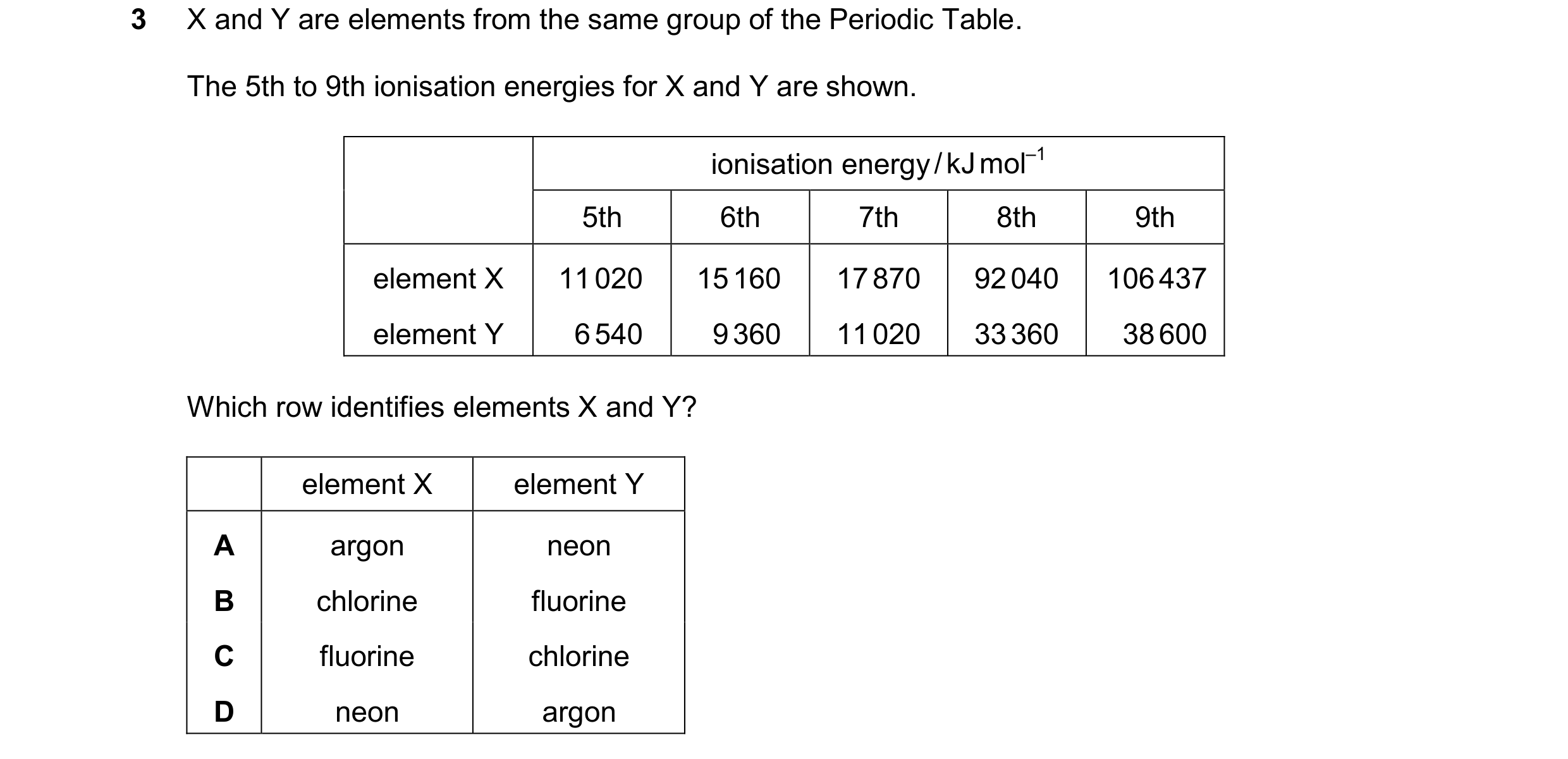
Q106 · X and Y are elements from the same group of the Periodic Table 9701/12 Feb/March 2025
3 X and Y are elements from the same group of the Periodic Table. The 5th to 9th ionisation energies for X and Y are shown. ionisation energy / kJ mol–1 5th 6th 7th 8th 9th element X 11 020 15 160 17 870 92 040 106 437 element Y 6 540 9 360 11 020 33 360 38 600 Which row identifies elements X and Y? element X element Y A argon neon B chlorine fluorine C fluorine chlorine D neon argon
1 marks
Answer: C
This question in 9701/12 Feb/March 2025
Q107 · The first seven ionisation energies of an element between lithium and neon in the… 9701/11 May/June 2025
4 The first seven ionisation energies of an element between lithium and neon in the Periodic Table are shown. 1310 3390 5320 7450 11000 13300 71000 kJmol–1 What is the outer electronic configuration of the element? A 2s2 B 2s22p1 C 2s22p4 D 2s22p6
1 marks
Answer: C
This question in 9701/11 May/June 2025
Q108 · Which diagram shows the electronegativity of the elements Na, Mg, Al and Si plotted… 9701/11 May/June 2025
20 Which diagram shows the electronegativity of the elements Na, Mg, Al and Si plotted against their first ionisation energies? first ionisation energy electronegativity Si Na Al Mg A first ionisation energy electronegativity Si Na Al Mg B first ionisation energy electronegativity Si Na Al Mg C first ionisation energy electronegativity Si Na Al Mg D
1 marks
Answer: B
This question in 9701/11 May/June 2025
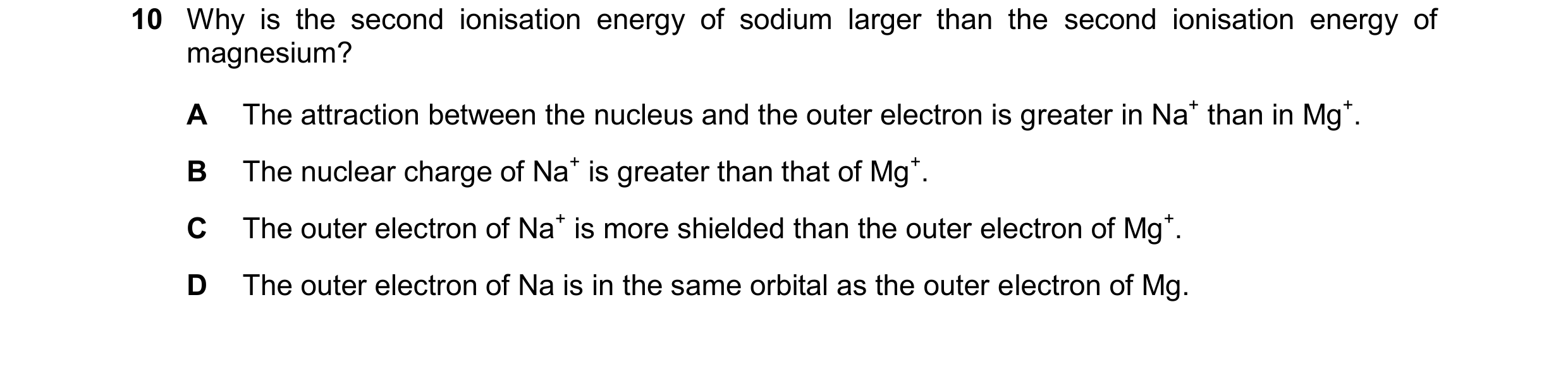
Q109 · Why is the second ionisation energy of sodium larger than the second ionisation energy of… 9701/13 May/June 2025
10 Why is the second ionisation energy of sodium larger than the second ionisation energy of magnesium? A The attraction between the nucleus and the outer electron is greater in Na+ than in Mg+. B The nuclear charge of Na+ is greater than that of Mg+. C The outer electron of Na+ is more shielded than the outer electron of Mg+. D The outer electron of Na is in the same orbital as the outer electron of Mg.
1 marks
Answer: A
This question in 9701/13 May/June 2025
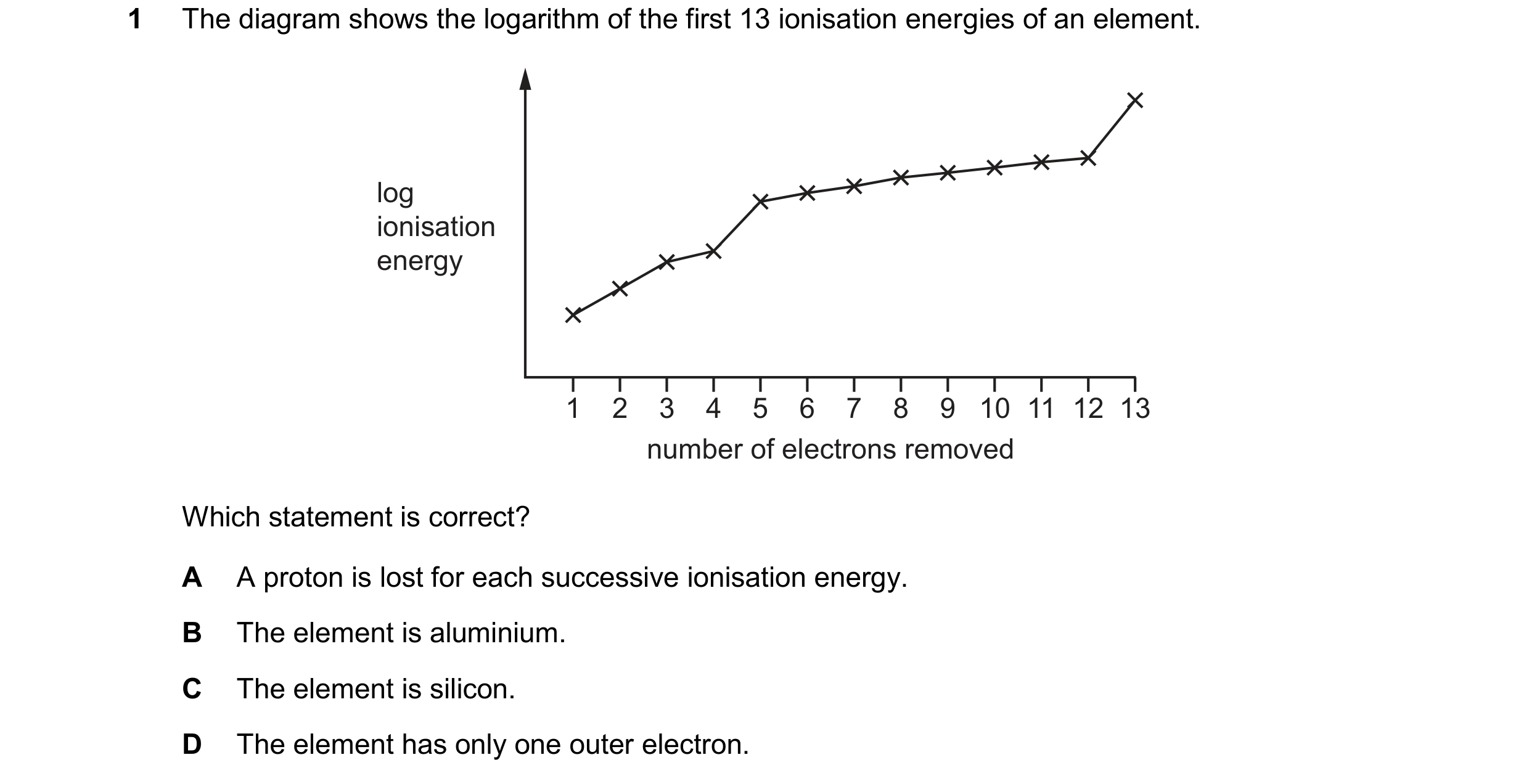
Q110 · The diagram shows the logarithm of the first 13 ionisation energies of an element 9701/14 May/June 2025
1 The diagram shows the logarithm of the first 13 ionisation energies of an element. log ionisation energy 1 2 3 4 5 6 7 8 9 10 11 12 13 number of electrons removed Which statement is correct? A A proton is lost for each successive ionisation energy. B The element is aluminium. C The element is silicon. D The element has only one outer electron.
1 marks
Answer: C
This question in 9701/14 May/June 2025
Q111 · The data in the table gives the 5th to the 10th ionisation energies of three elements… 9701/11 Oct/Nov 2025
2 The data in the table gives the 5th to the 10th ionisation energies of three elements from Period 3 of the Periodic Table. element ionisation energy/kJmol–1 5th 6th 7th 8th 9th 10th X 6274 21269 25398 29855 35868 40960 Y 7012 8496 27107 31671 36579 43140 Z 6542 9362 11018 33606 38601 43963 What are the correct identities of these three elements? element X element Y element Z A Na Mg Al B Mg Al Si C P S Cl D S Cl Ar
1 marks
Answer: C
This question in 9701/11 Oct/Nov 2025
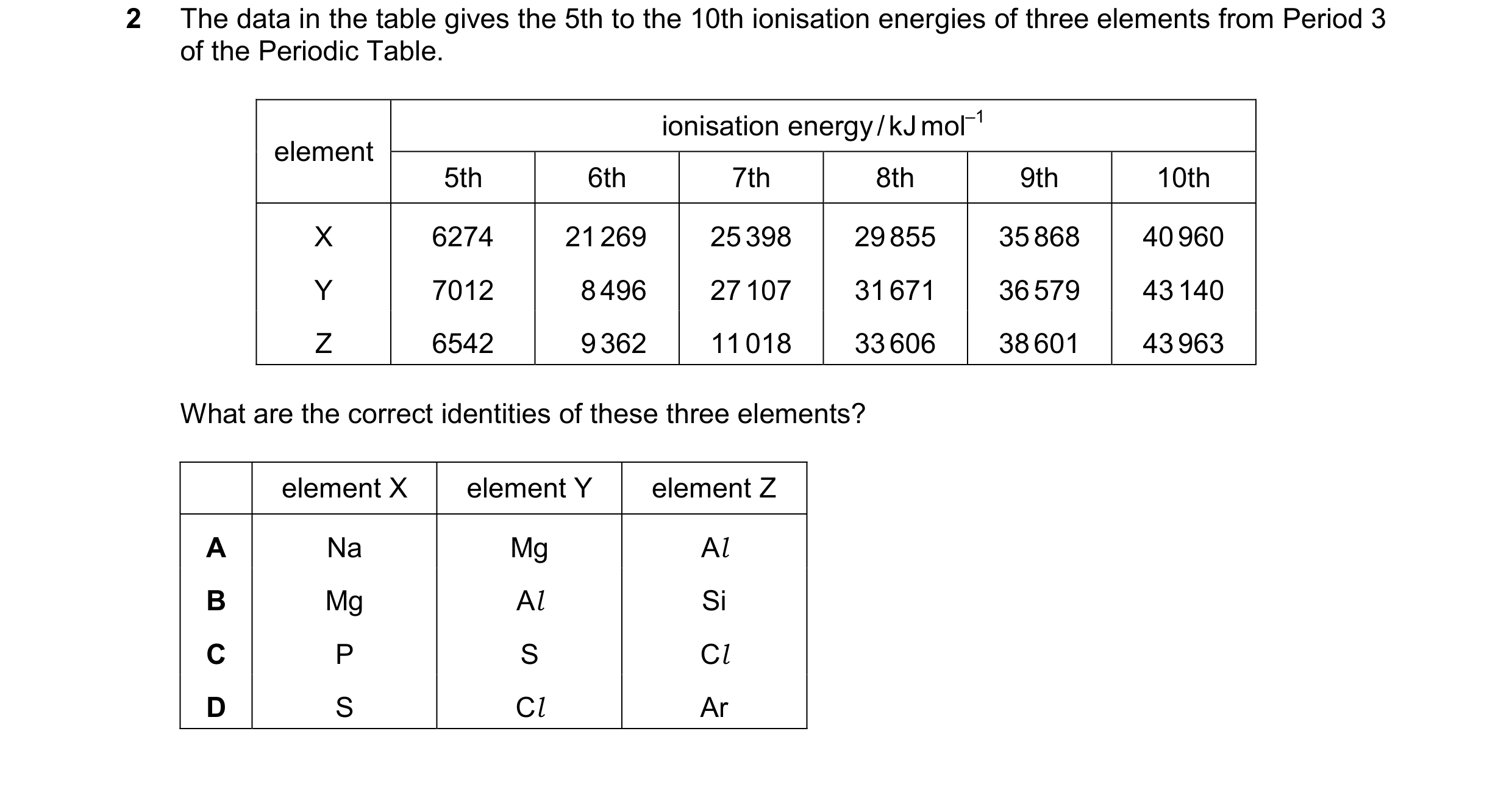
Q112 · The data in the table gives the 5th to the 10th ionisation energies of three elements… 9701/13 Oct/Nov 2025
2 The data in the table gives the 5th to the 10th ionisation energies of three elements from Period 3 of the Periodic Table. element ionisation energy/kJmol–1 5th 6th 7th 8th 9th 10th X 6274 21269 25398 29855 35868 40960 Y 7012 8496 27107 31671 36579 43140 Z 6542 9362 11018 33606 38601 43963 What are the correct identities of these three elements? element X element Y element Z A Na Mg Al B Mg Al Si C P S Cl D S Cl Ar
1 marks
Answer: C
This question in 9701/13 Oct/Nov 2025
 1 / 31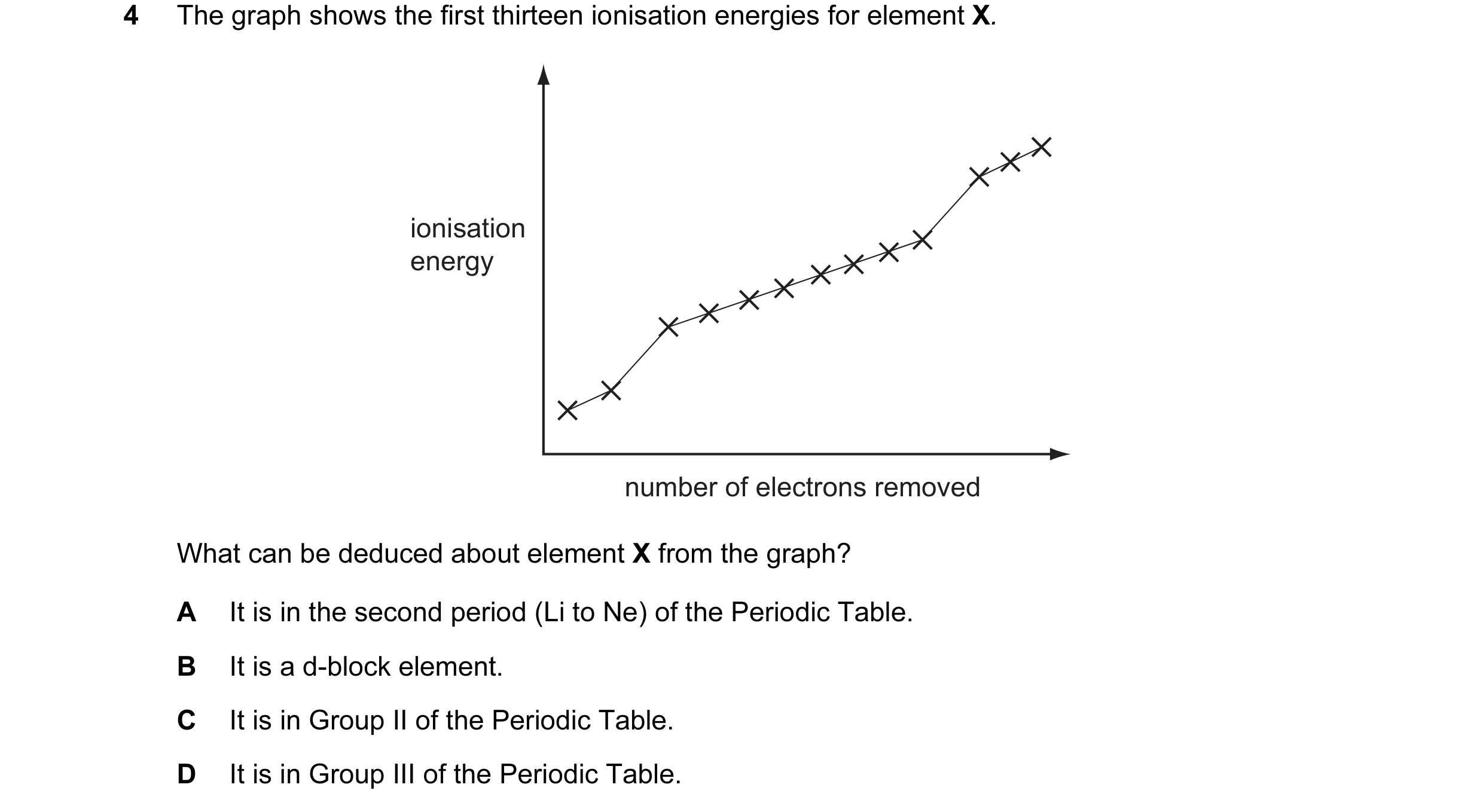
 2 / 31
 3 / 31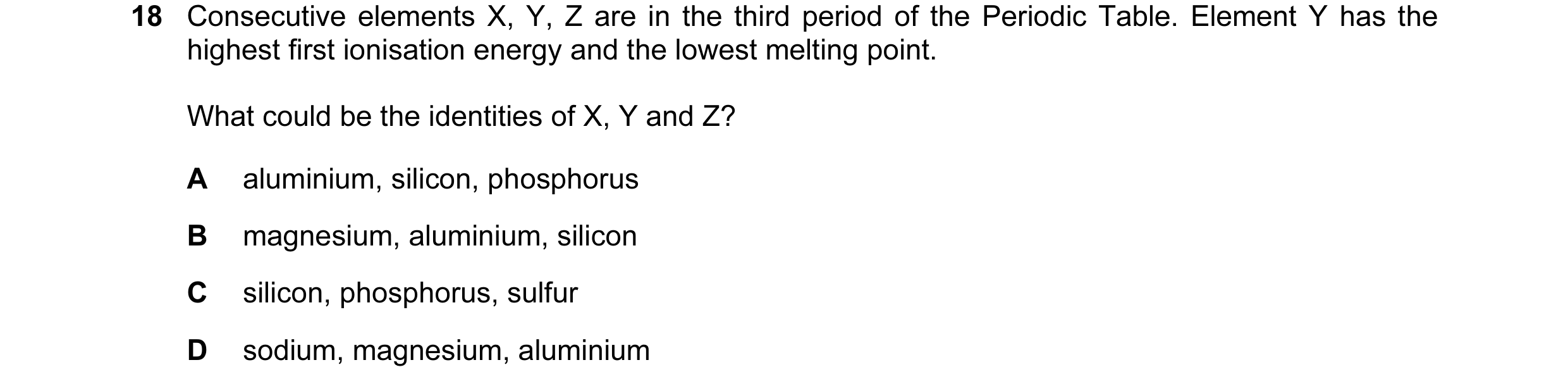
 4 / 31


 5 / 31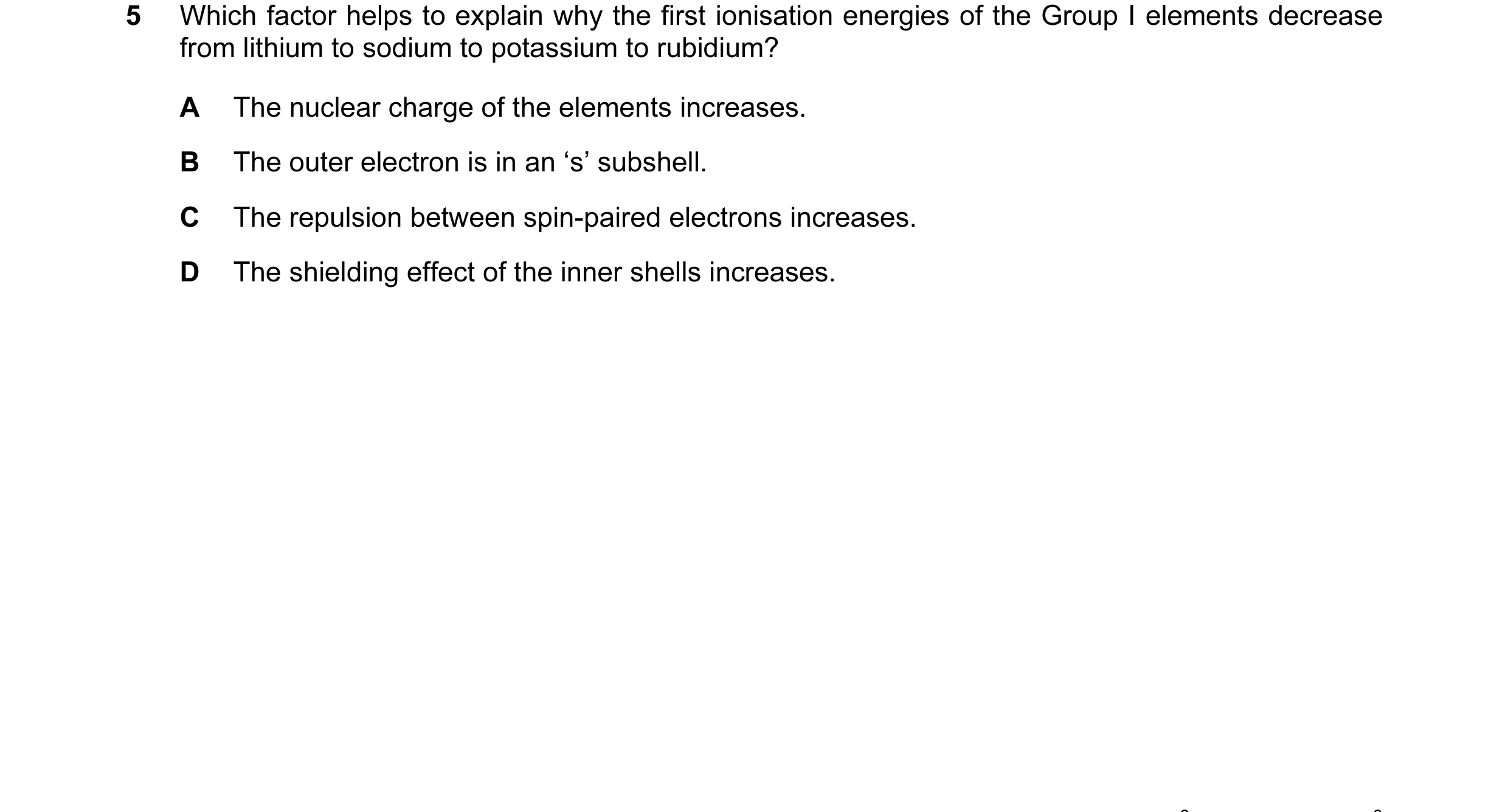
 6 / 31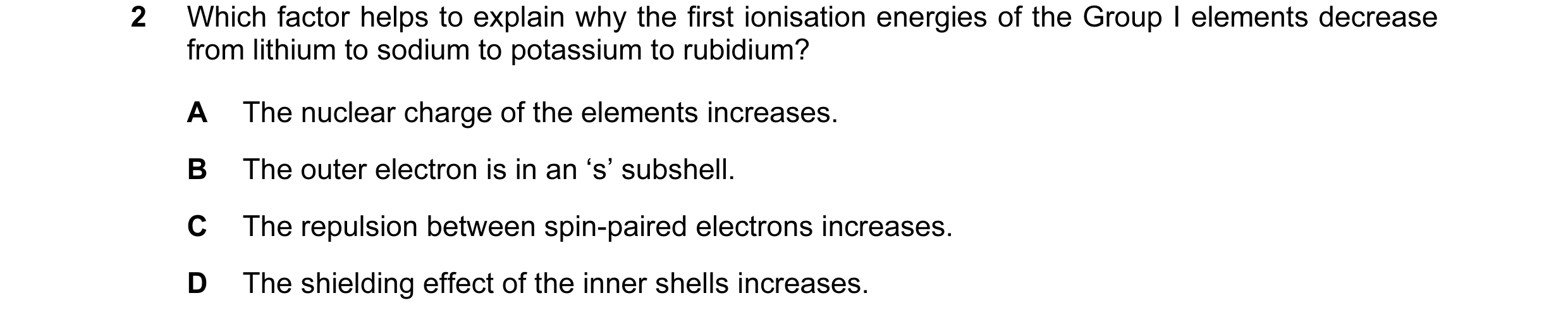



 7 / 31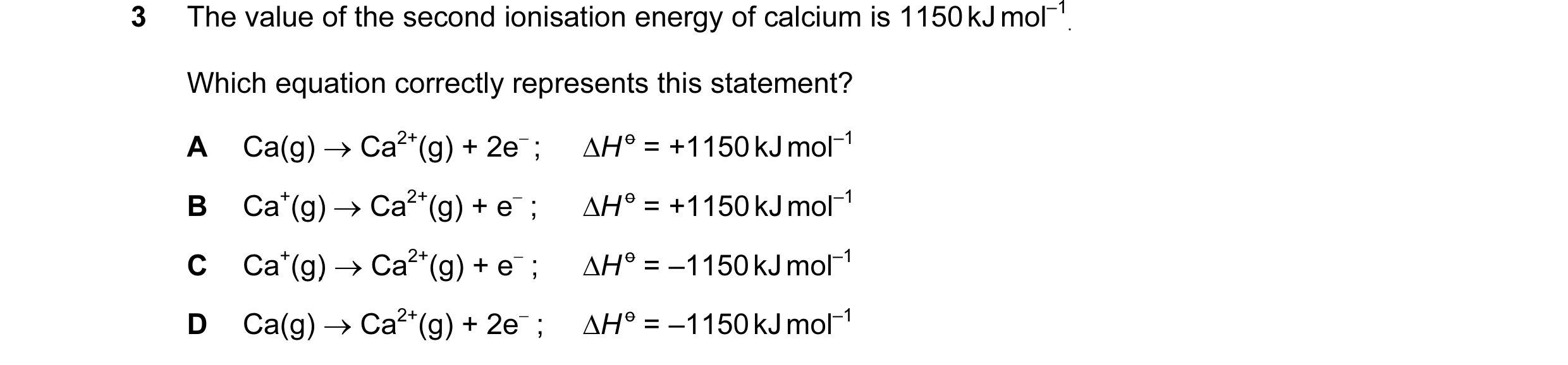
 8 / 31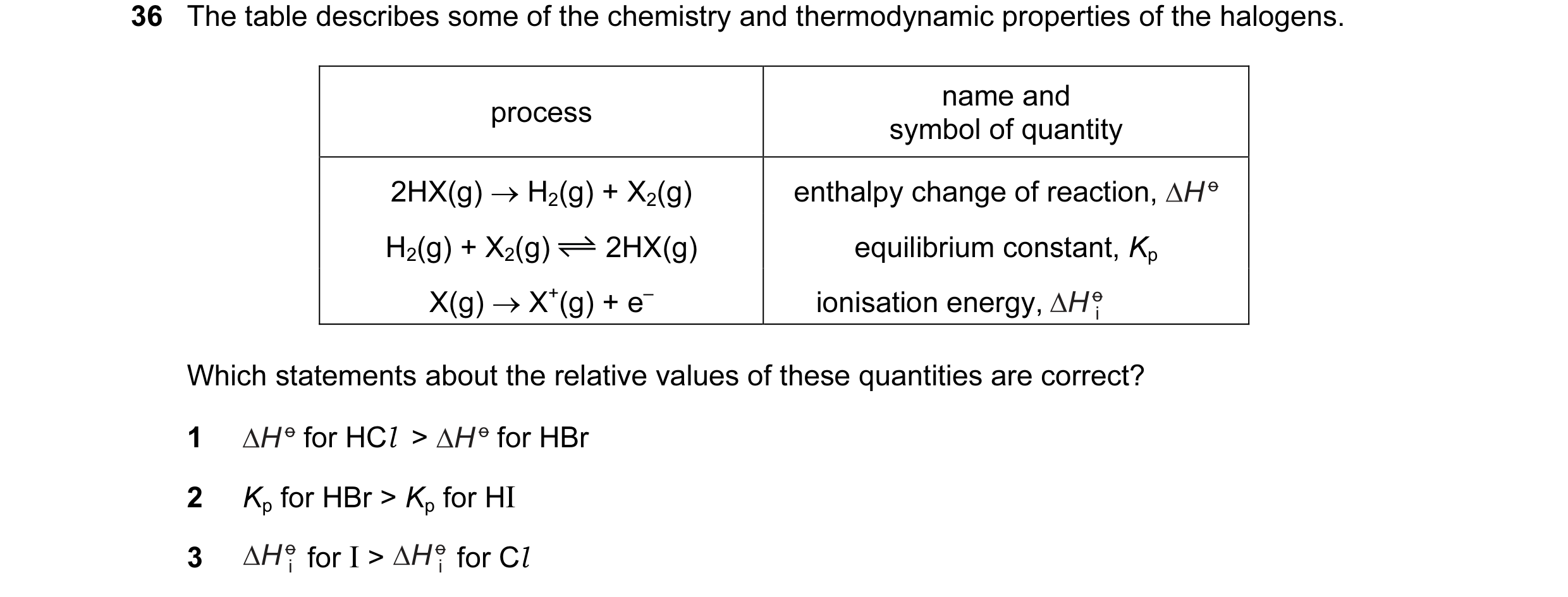
 9 / 31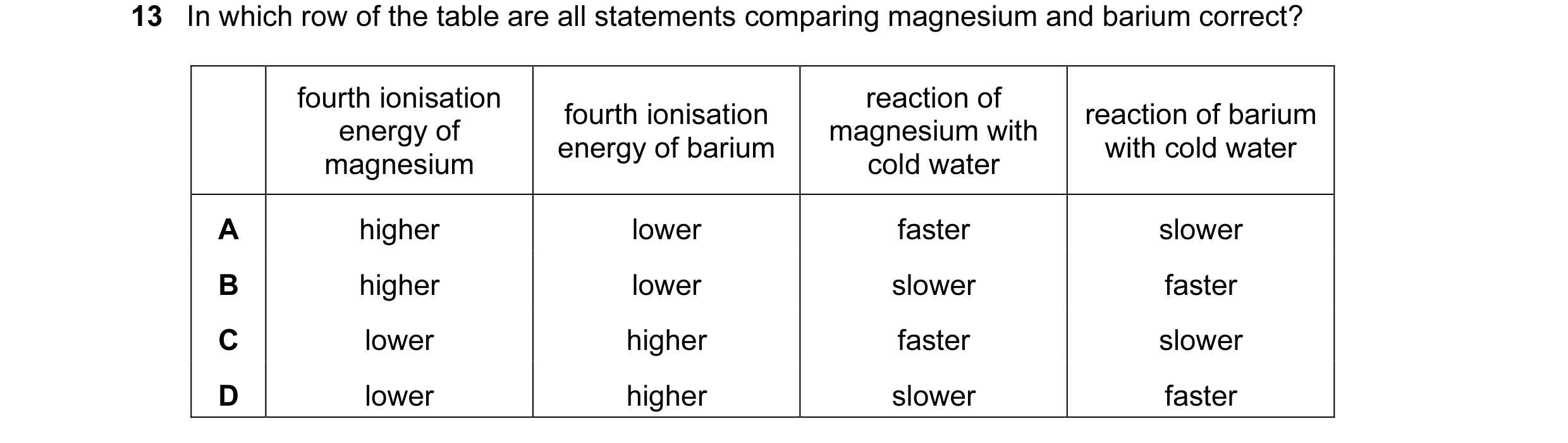
 10 / 31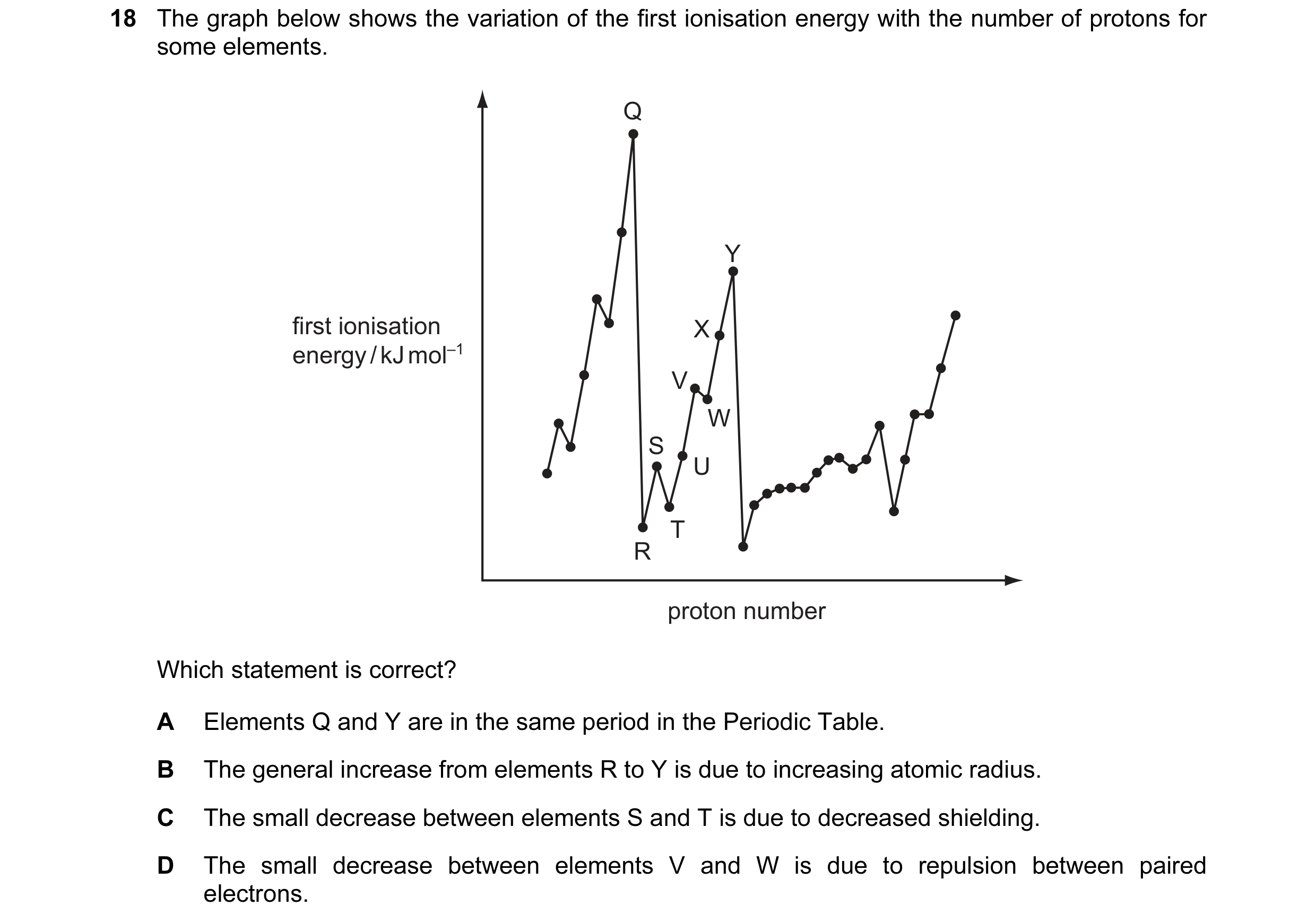
 11 / 31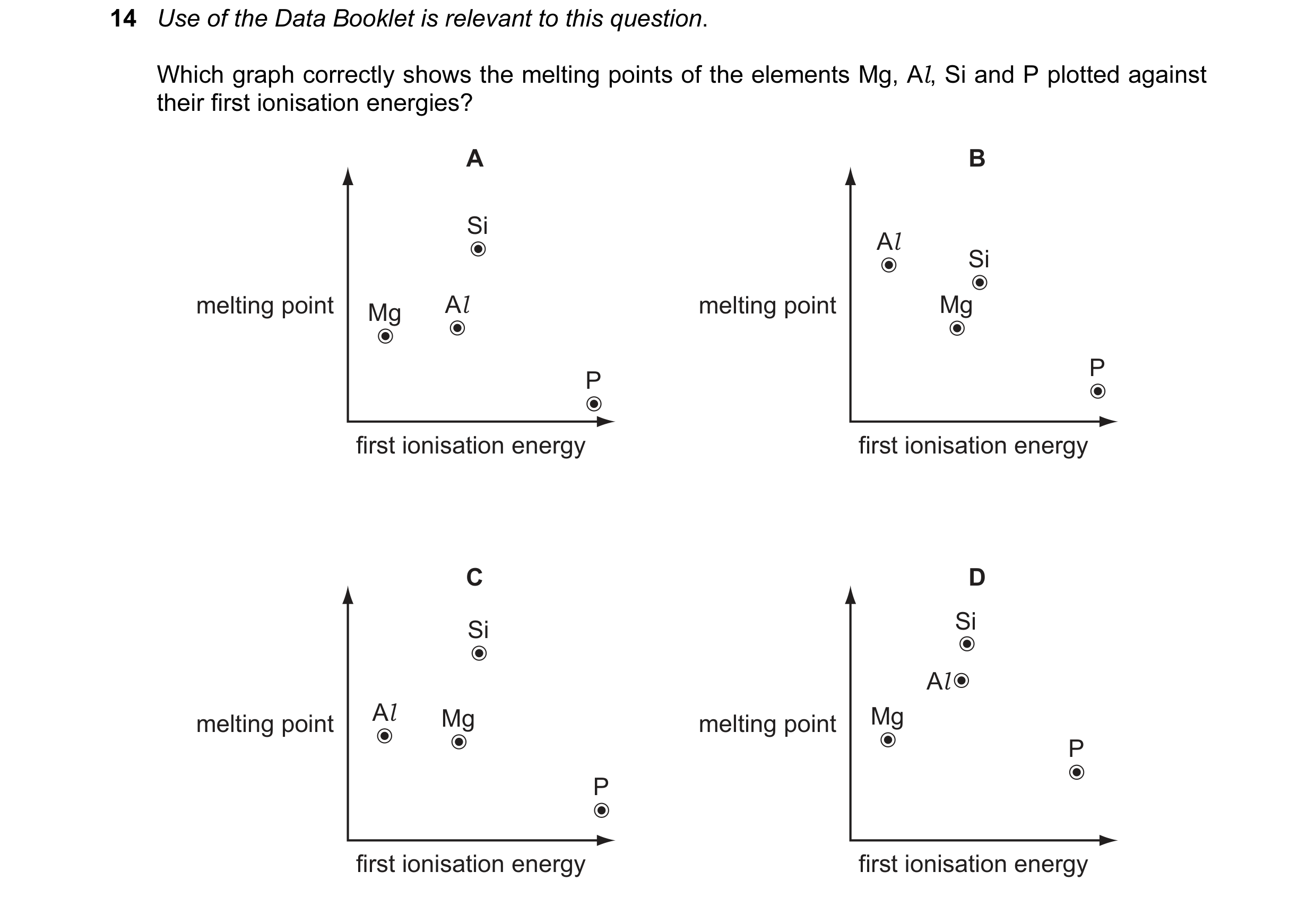
 12 / 31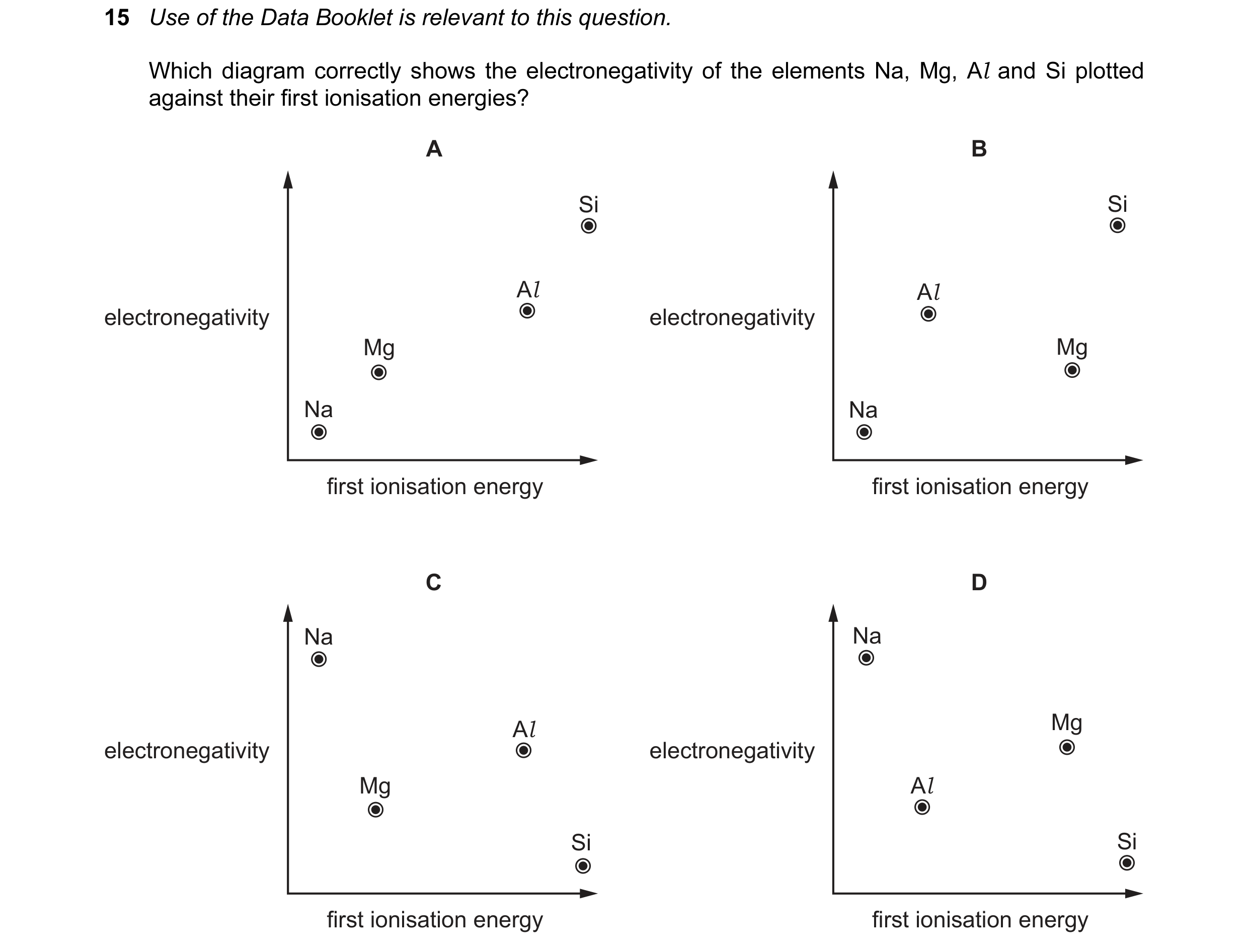
 13 / 31
 14 / 31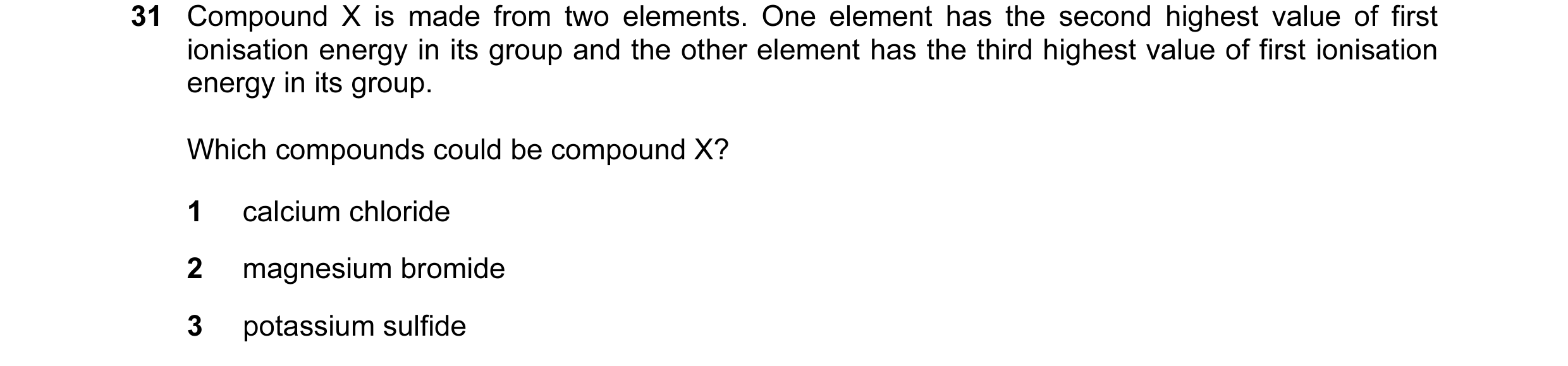

 15 / 31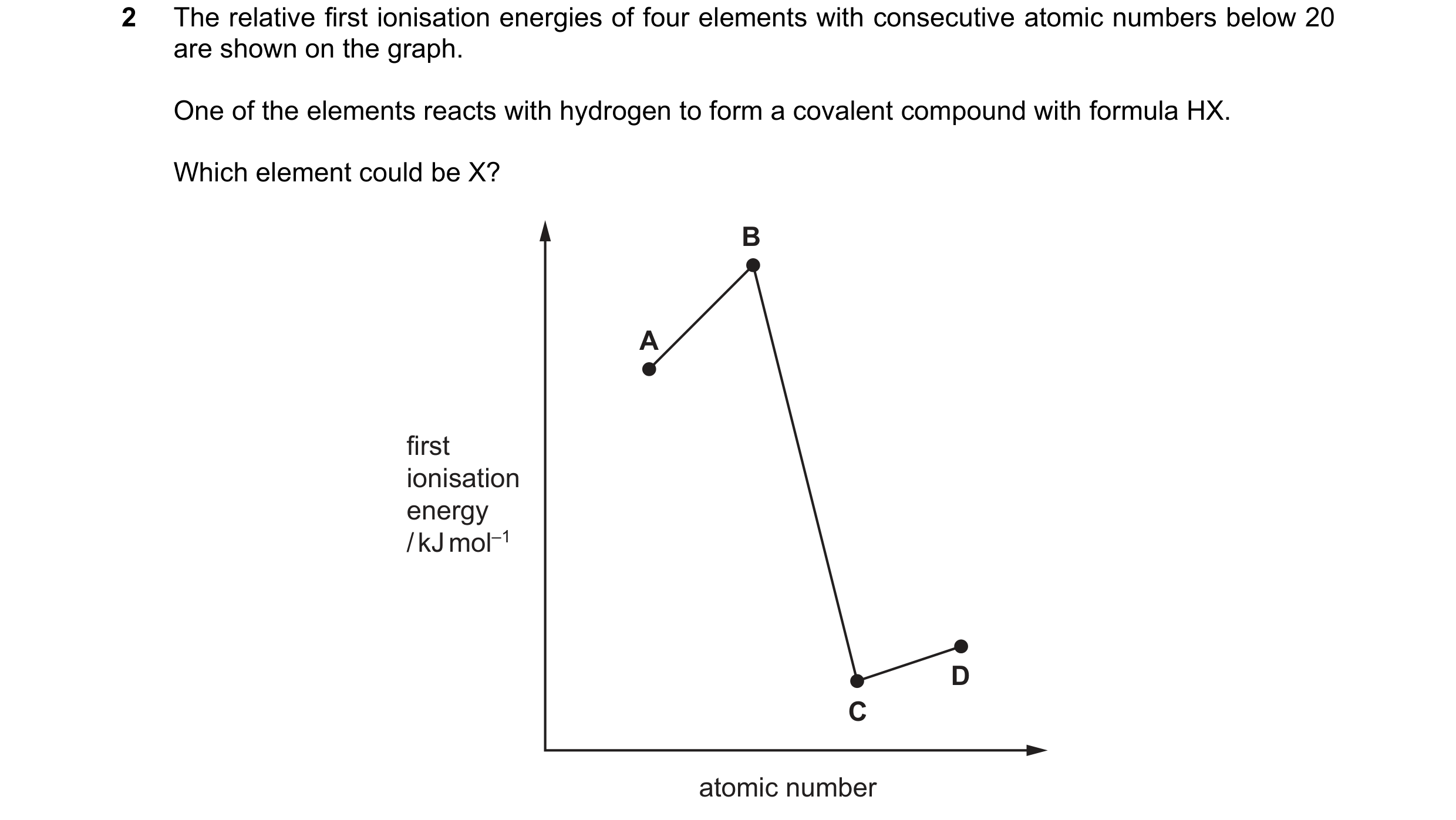

 16 / 31
 17 / 31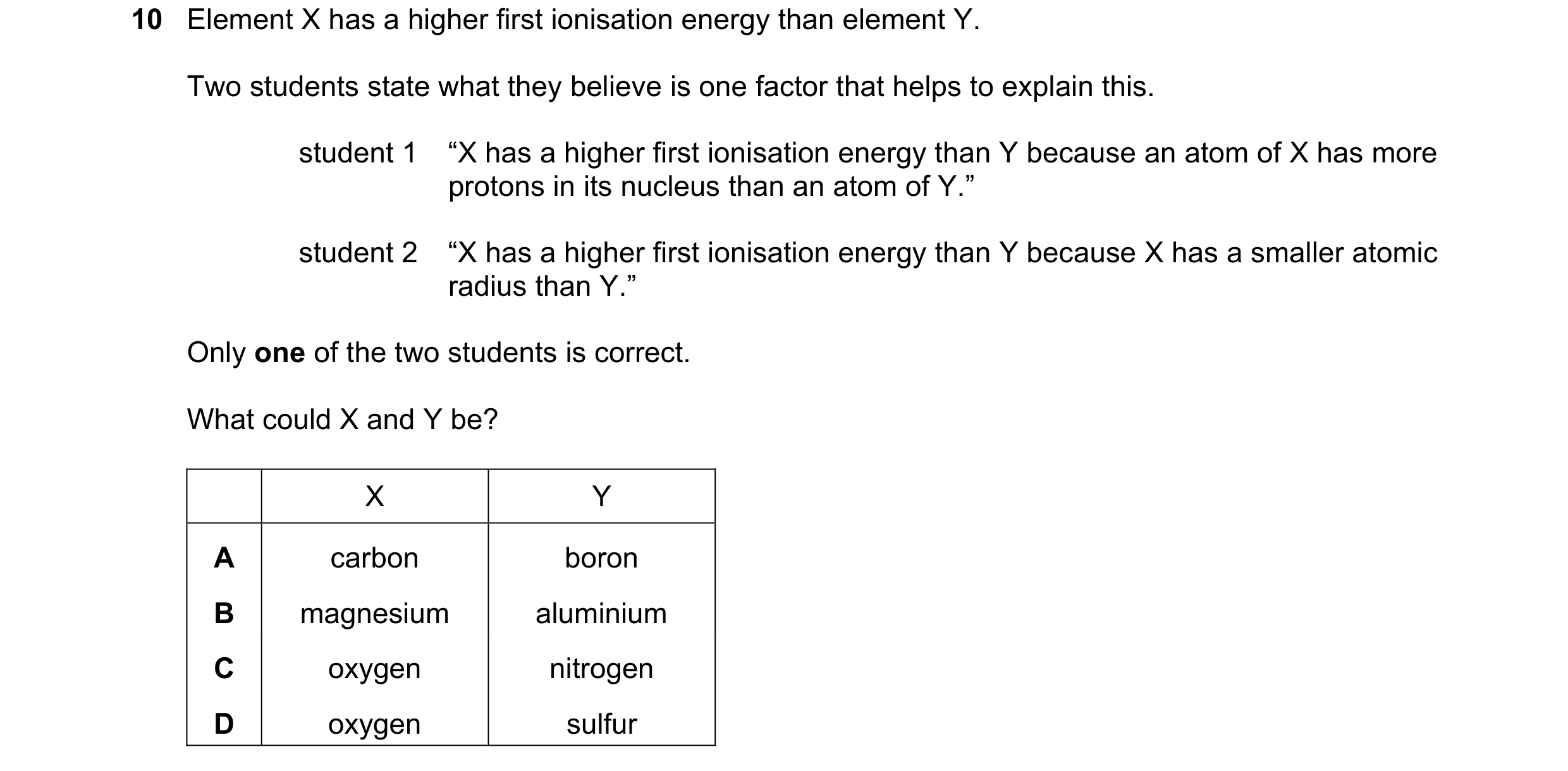
 18 / 31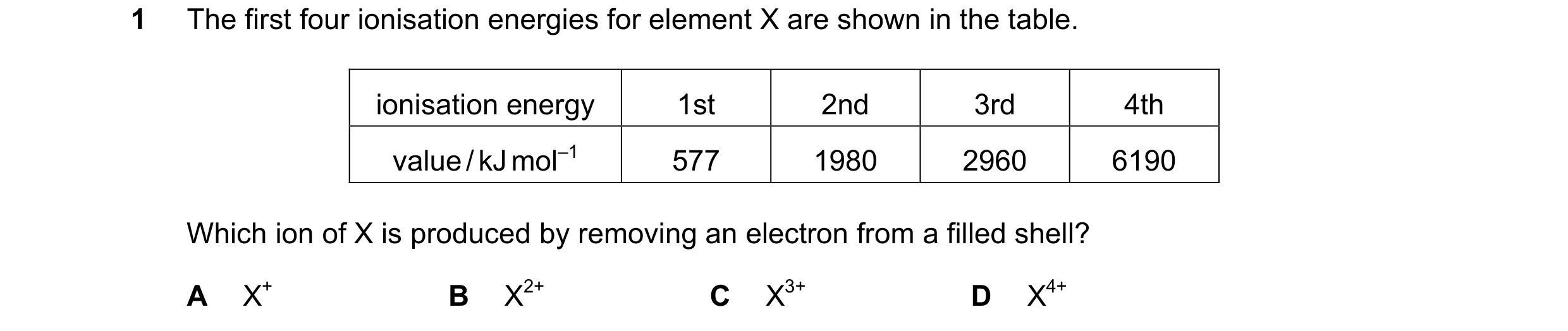
 19 / 31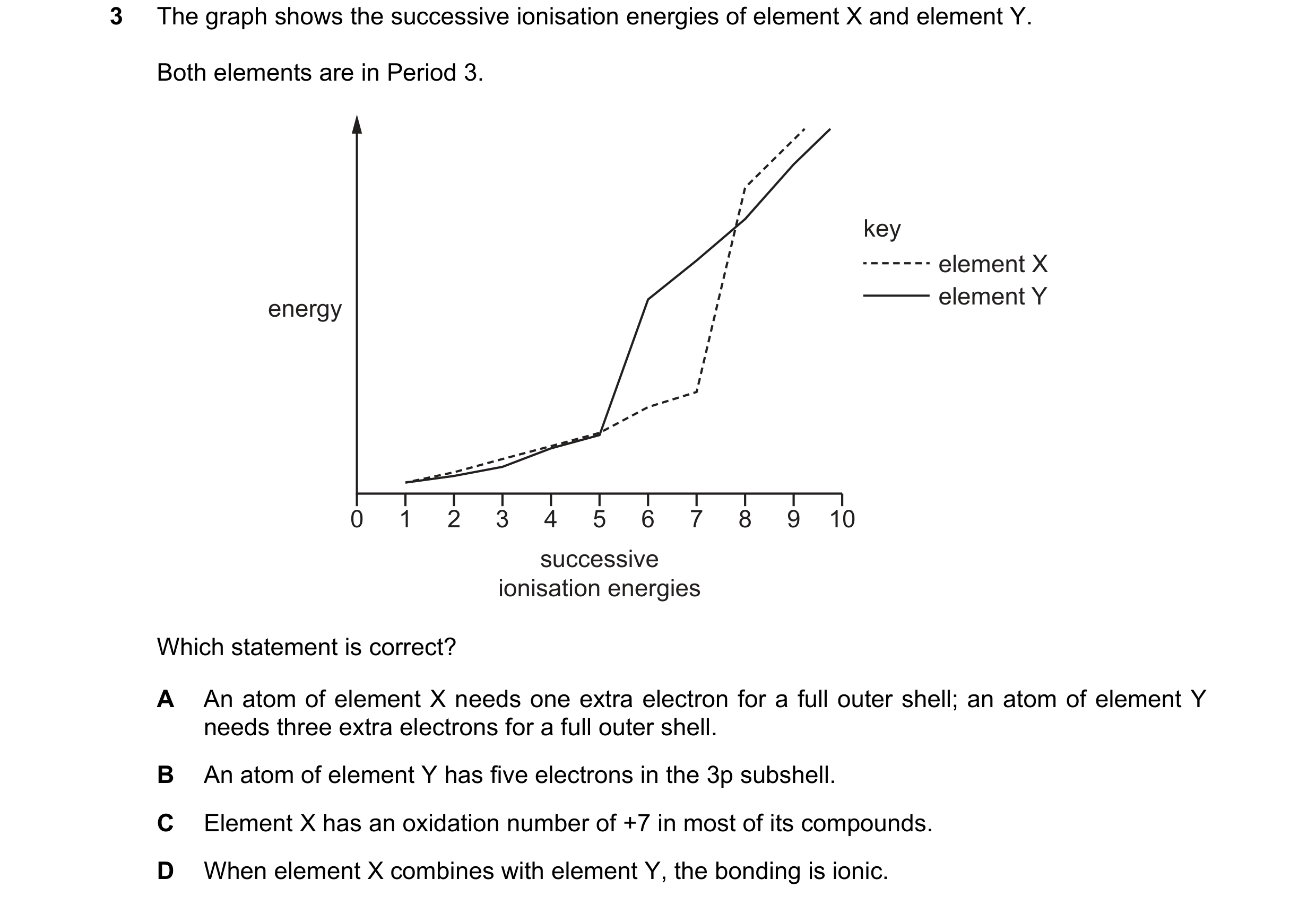
 20 / 31
 21 / 31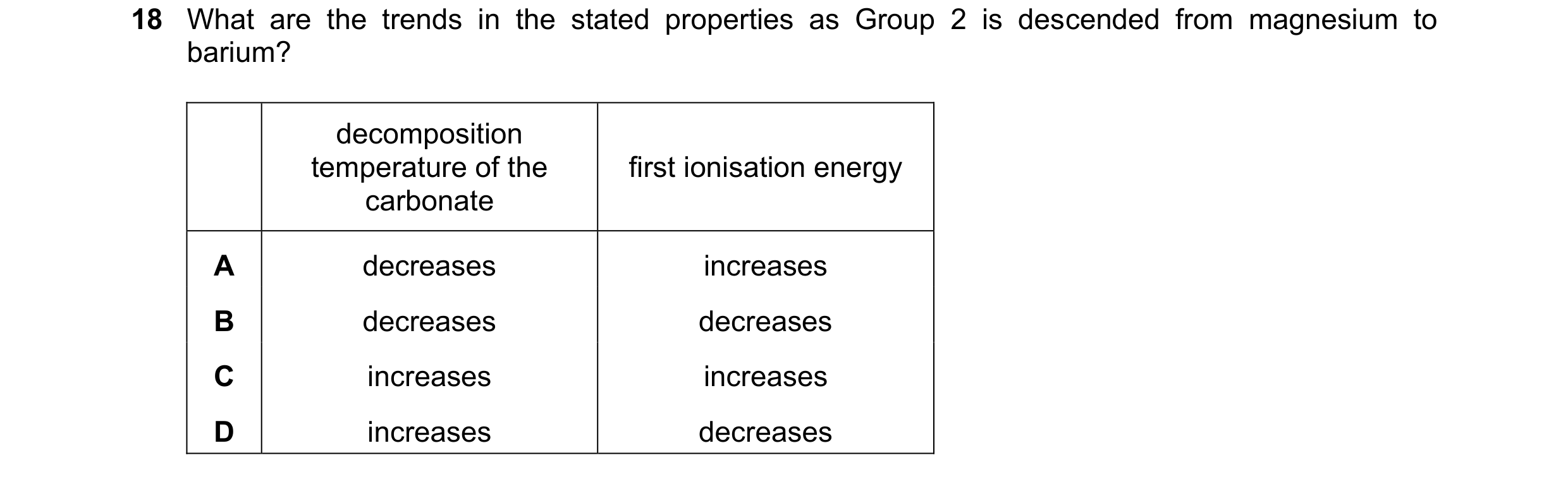



 22 / 31

 23 / 31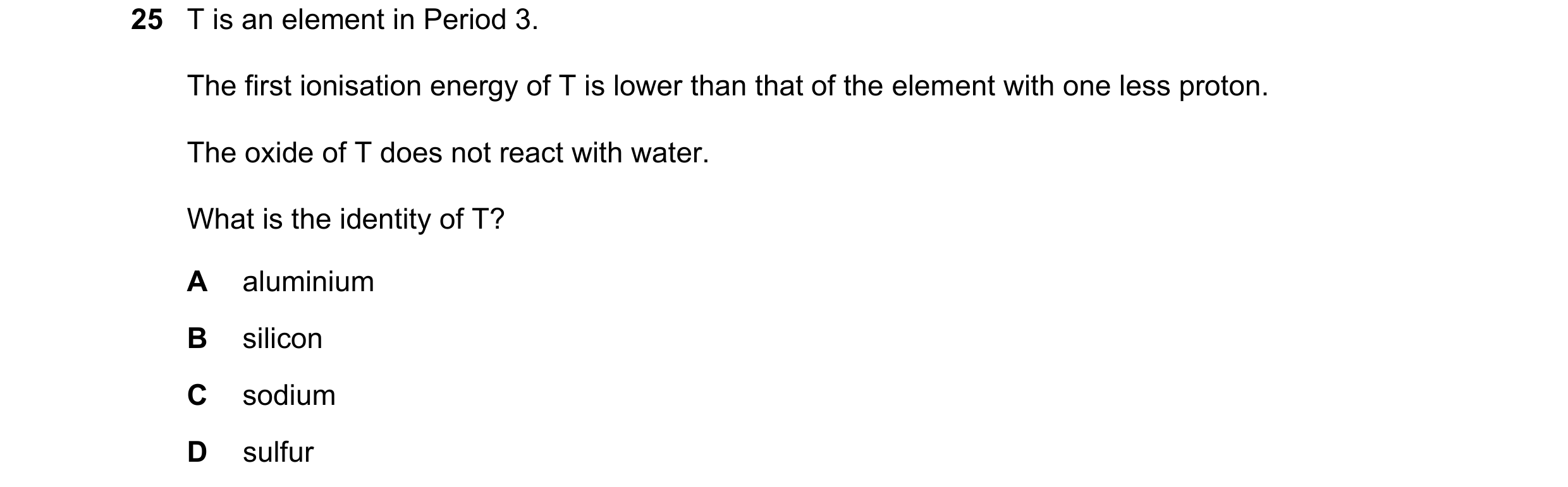

 24 / 31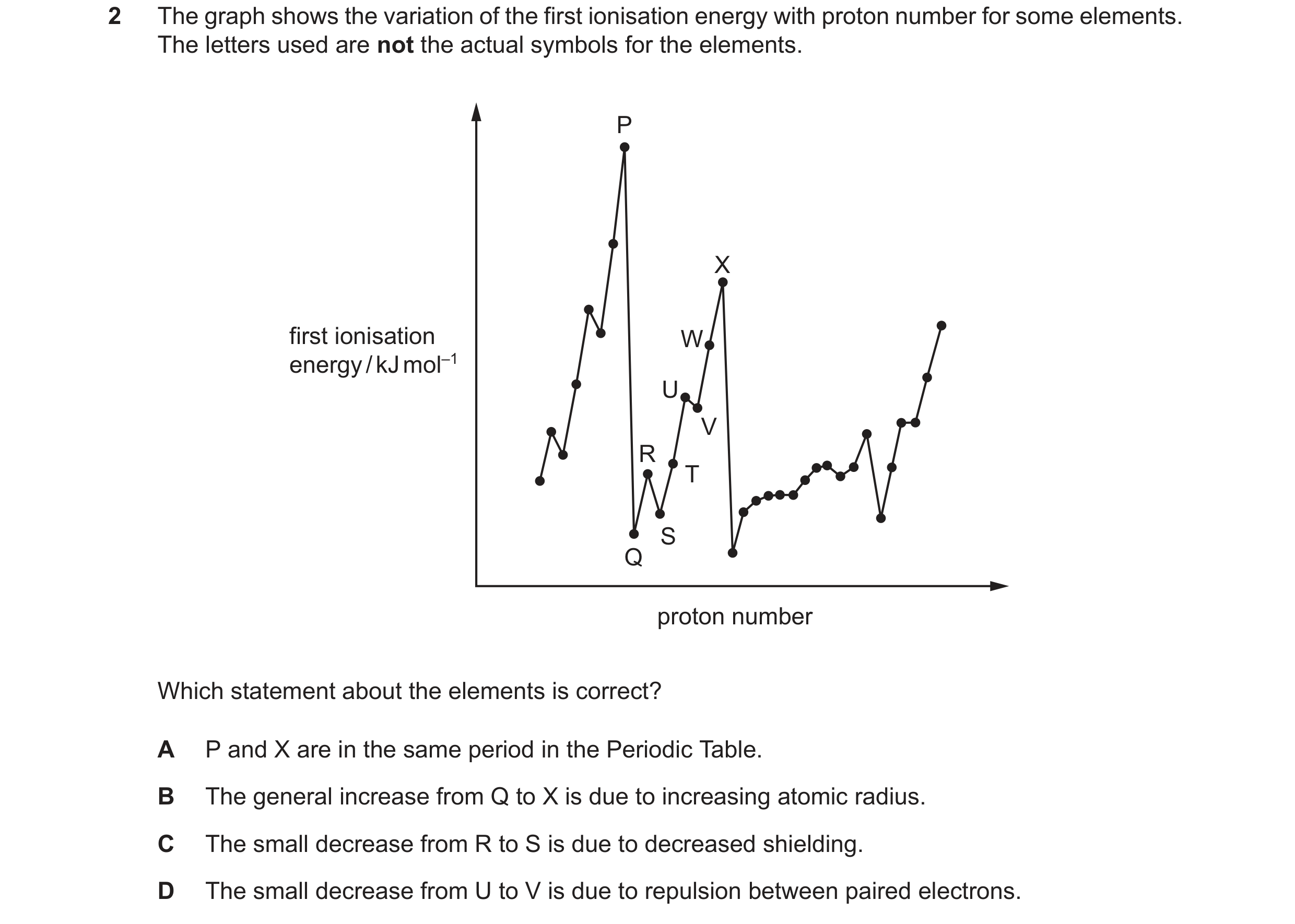
 25 / 31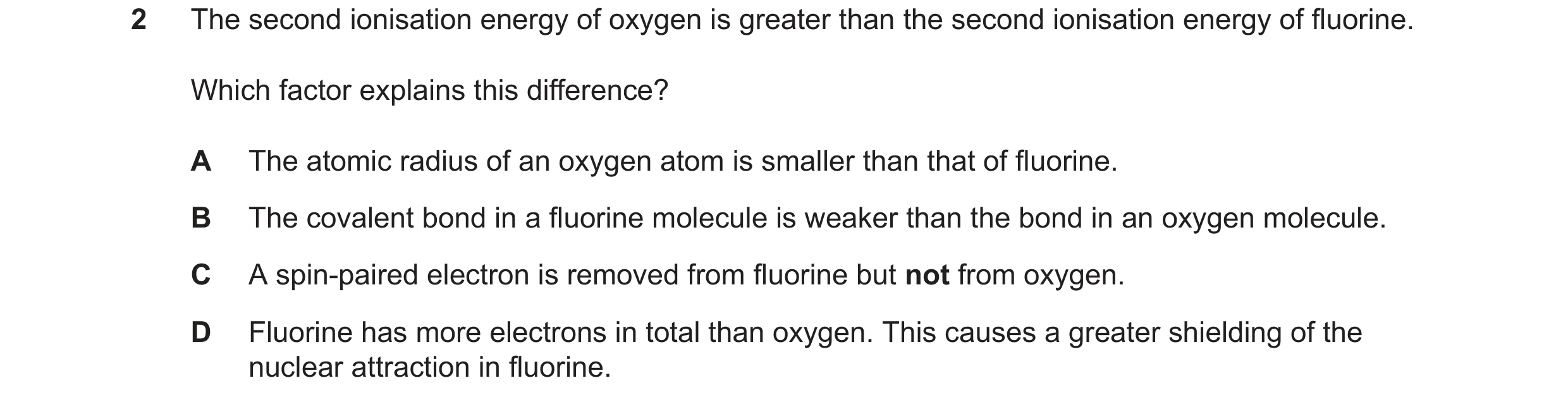
 26 / 31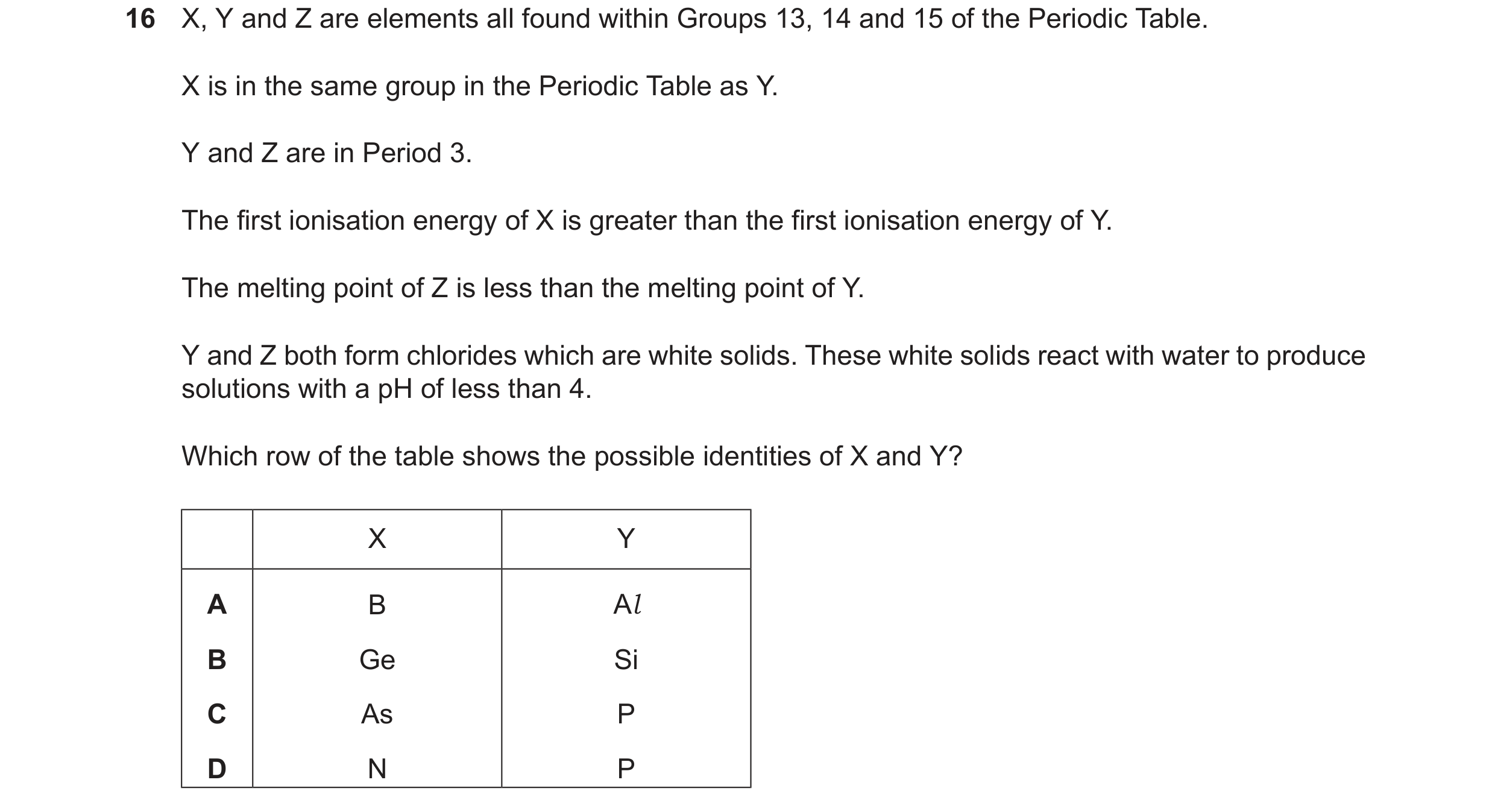

 27 / 31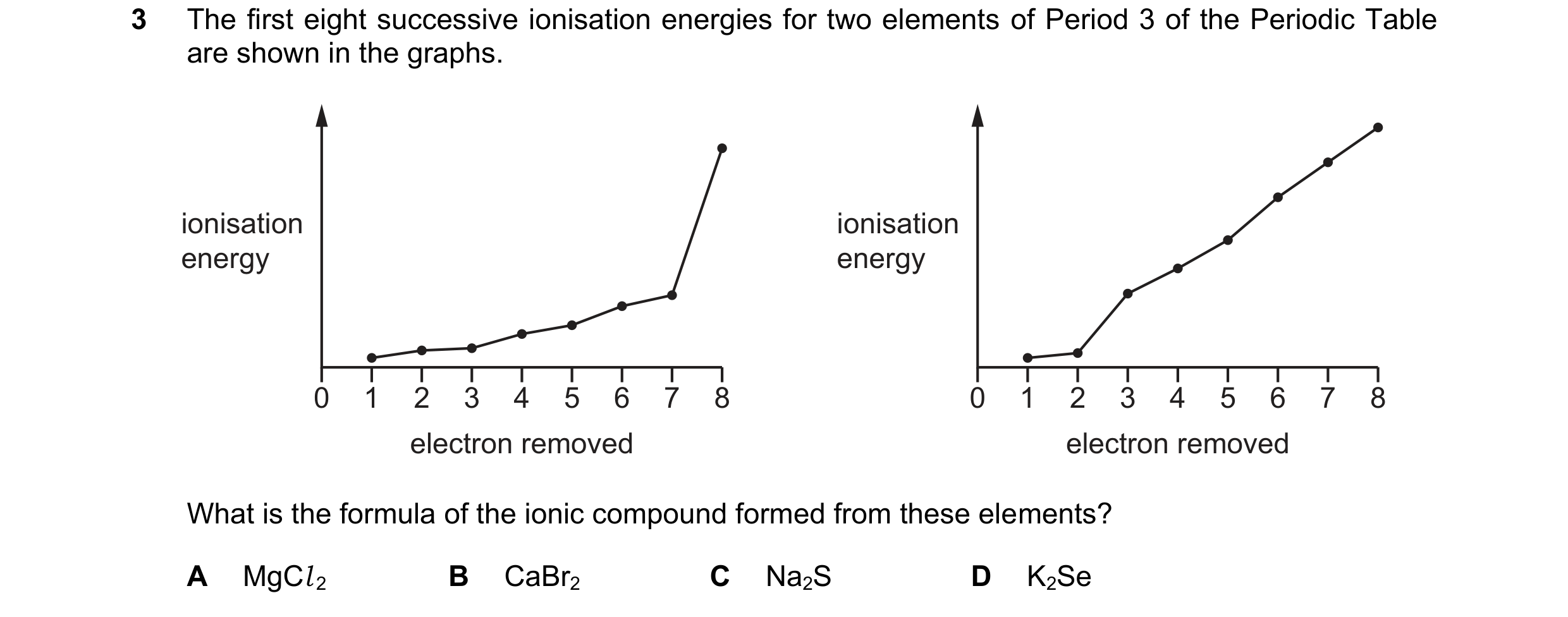
 28 / 31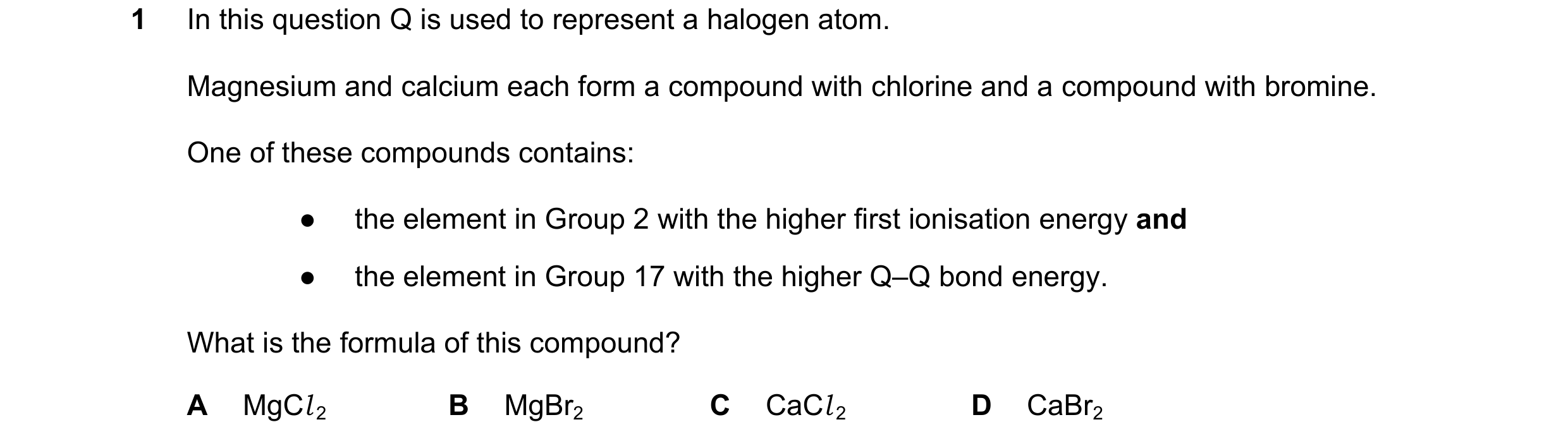
 29 / 31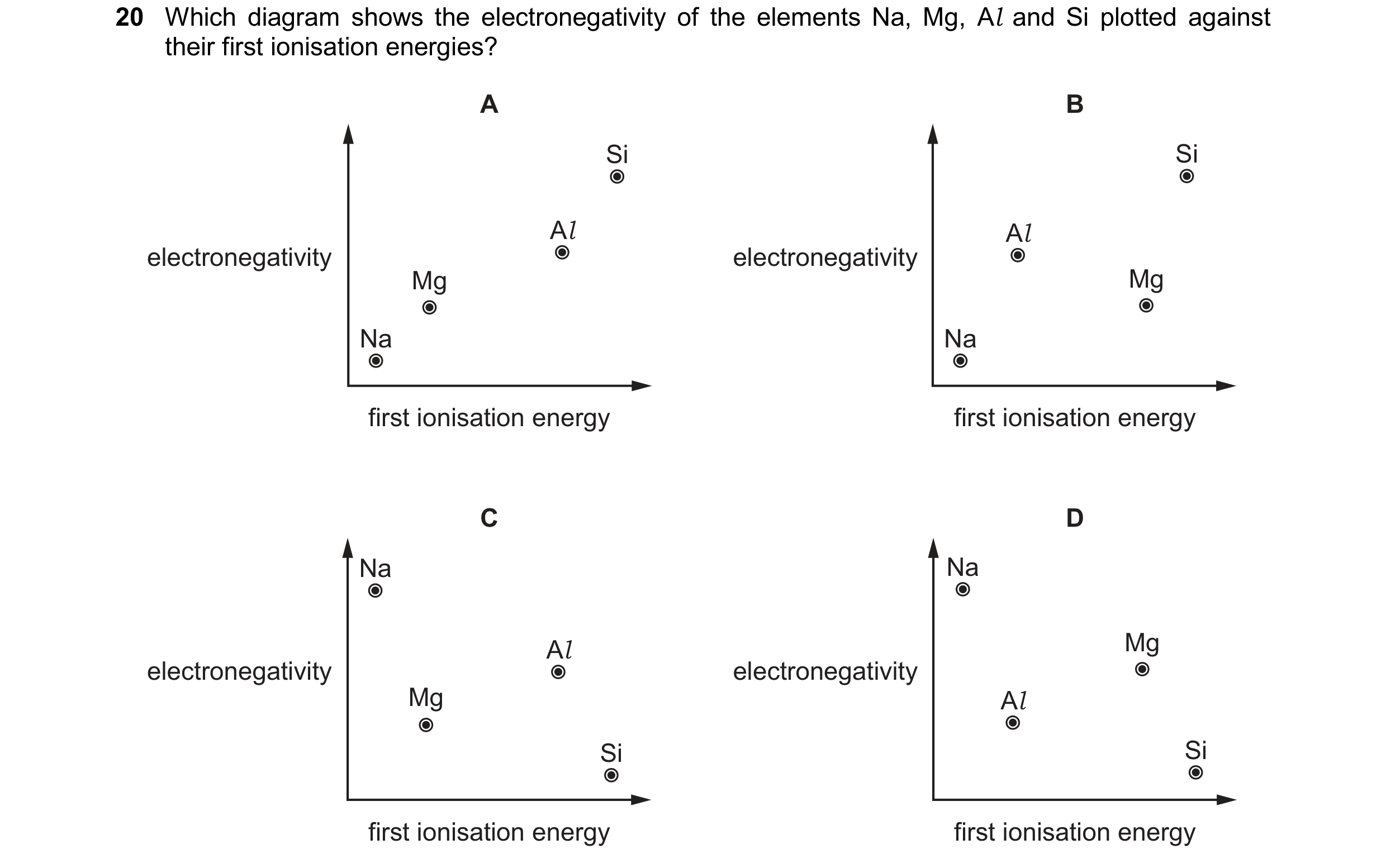
 30 / 31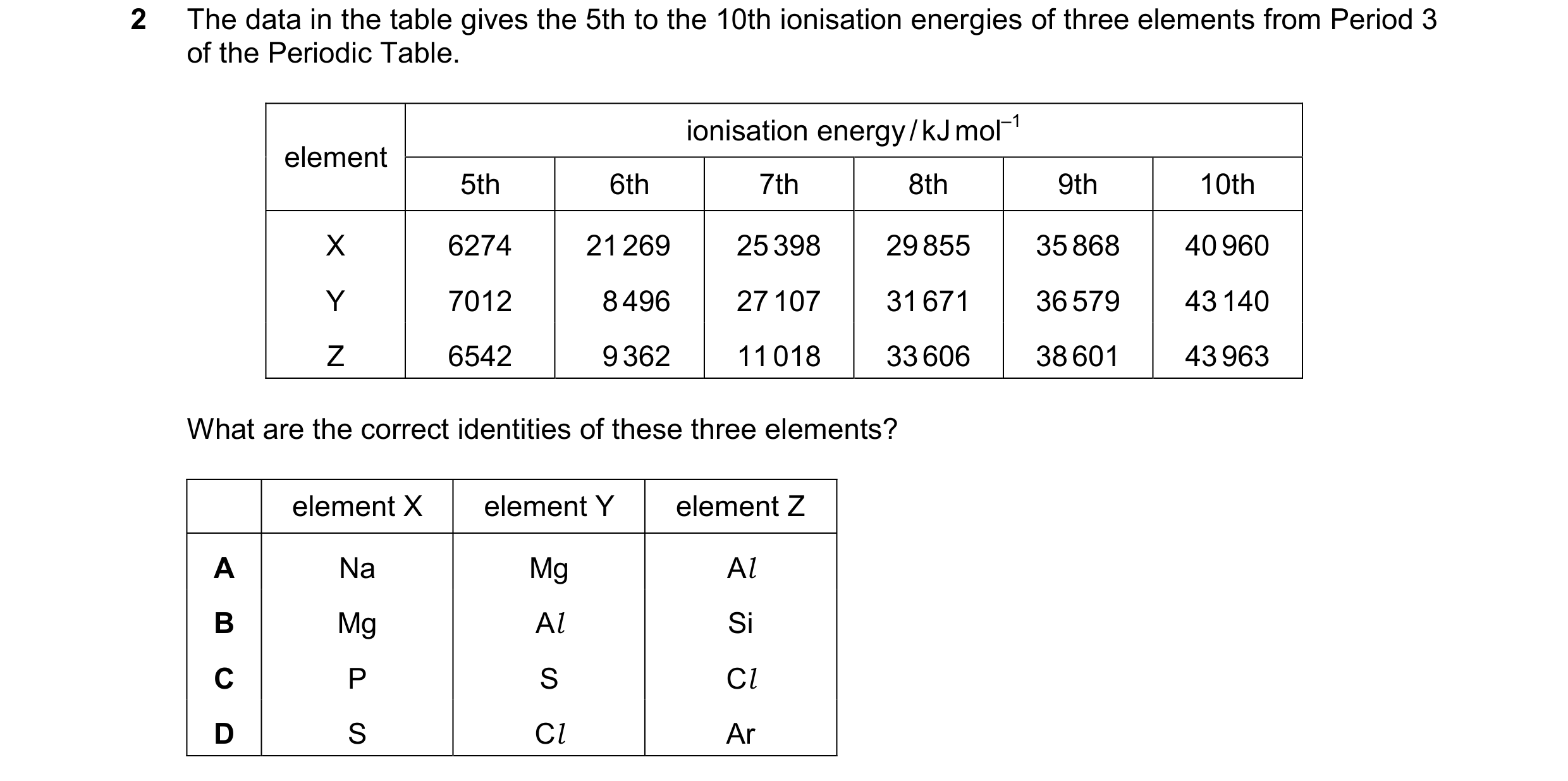
 31 / 31