Questions as text
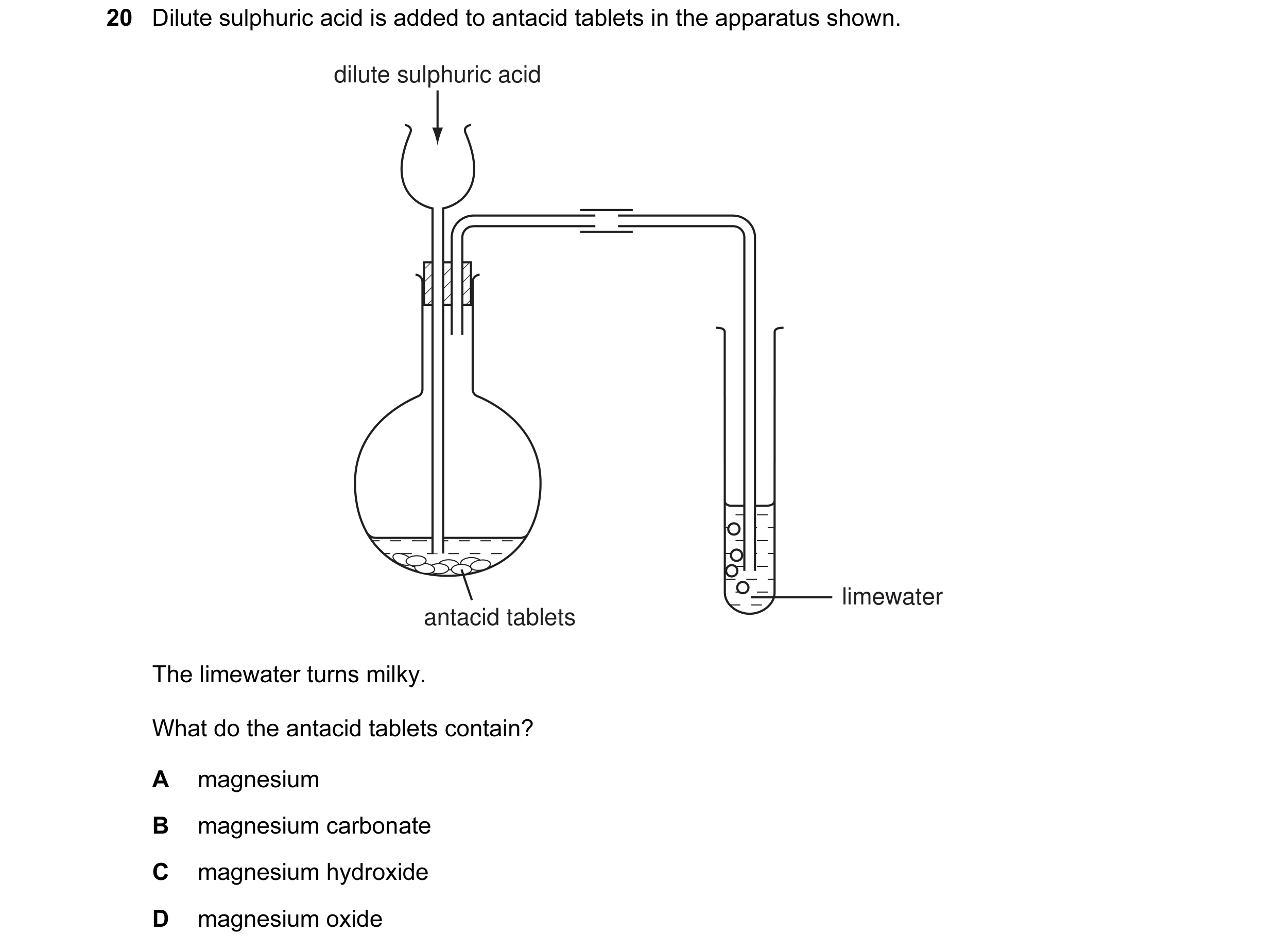
Q1 · Dilute sulphuric acid is added to antacid tablets in the apparatus shown 0654/11 May/June 2005
20 Dilute sulphuric acid is added to antacid tablets in the apparatus shown. dilute sulphuric acid limewater antacid tablets The limewater turns milky. What do the antacid tablets contain? A magnesium B magnesium carbonate C magnesium hydroxide D magnesium oxide
1 marks
Answer: B
This question in 0654/11 May/June 2005
Q2 · Which ion gives a white precipitate both with aqueous sodium hydroxide and with aqueous… 0654/11 May/June 2005
27 Which ion gives a white precipitate both with aqueous sodium hydroxide and with aqueous ammonia? A Cu2+(aq) B Fe2+(aq) C Fe3+(aq) D Zn2+(aq)
1 marks
Answer: D
This question in 0654/11 May/June 2005
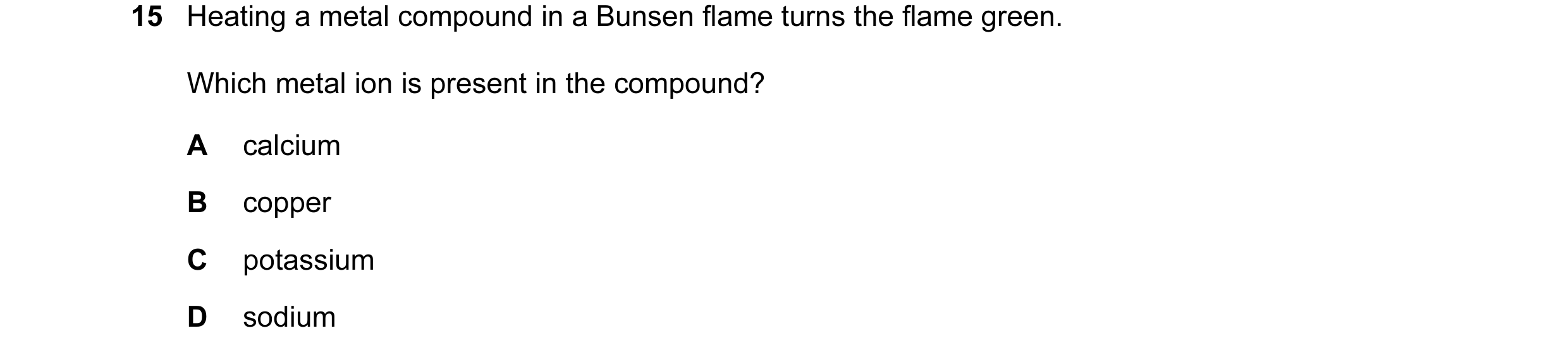
Q3 · Heating a metal compound in a Bunsen flame turns the flame green 0654/11 May/June 2006
15 Heating a metal compound in a Bunsen flame turns the flame green. Which metal ion is present in the compound? A calcium B copper C potassium D sodium
1 marks
Answer: B
This question in 0654/11 May/June 2006
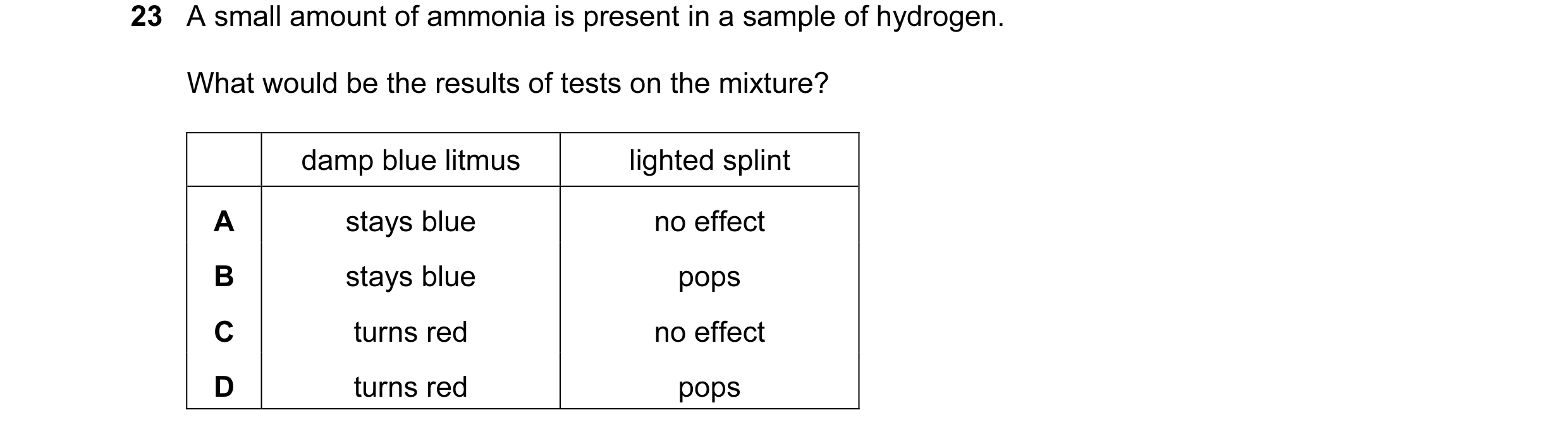
Q4 · A small amount of ammonia is present in a sample of hydrogen 0654/11 Oct/Nov 2006
23 A small amount of ammonia is present in a sample of hydrogen. What would be the results of tests on the mixture? damp blue litmus lighted splint A stays blue no effect B stays blue pops C turns red no effect D turns red pops
1 marks
Answer: B
This question in 0654/11 Oct/Nov 2006
Q5 · Glucose gives a red precipitate when tested with reagent X 0654/11 Oct/Nov 2007
20 Glucose gives a red precipitate when tested with reagent X.
Cellulose, a protein and starch are broken down into their monomers.
Which of these monomers also give a red precipitate when tested with reagent X?
cellulose protein starch
0 OO DW >
~*~ KOM
Kk 4
\ 4 x
1 marks
Answer: C
This question in 0654/11 Oct/Nov 2007
Q6 · A reagent in solution is added to a solid sample of a fertiliser 0654/11 Oct/Nov 2007
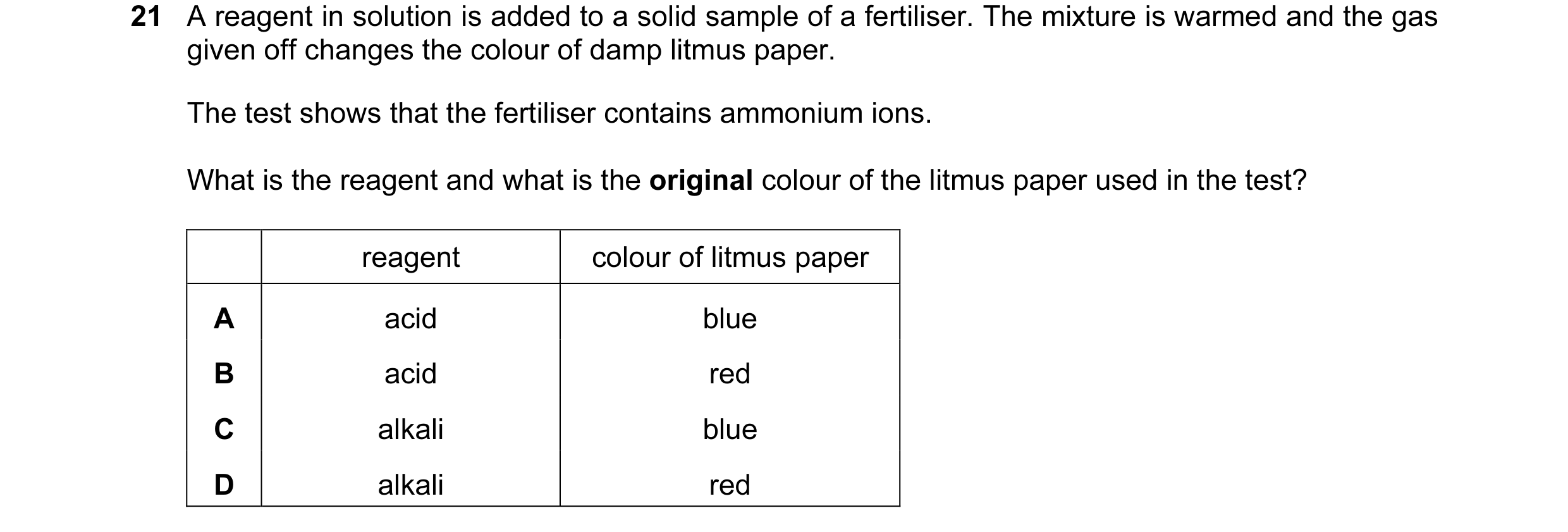
21 A reagent in solution is added to a solid sample of a fertiliser. The mixture is warmed and the gas given off changes the colour of damp litmus paper. The test shows that the fertiliser contains ammonium ions. What is the reagent and what is the original colour of the litmus paper used in the test? reagent colour of litmus paper A acid blue B acid red C alkali blue D alkali red
1 marks
Answer: D
This question in 0654/11 Oct/Nov 2007
Q7 · In separate experiments, an inert wire is dipped into two solutions, P and Q 0654/11 Oct/Nov 2007
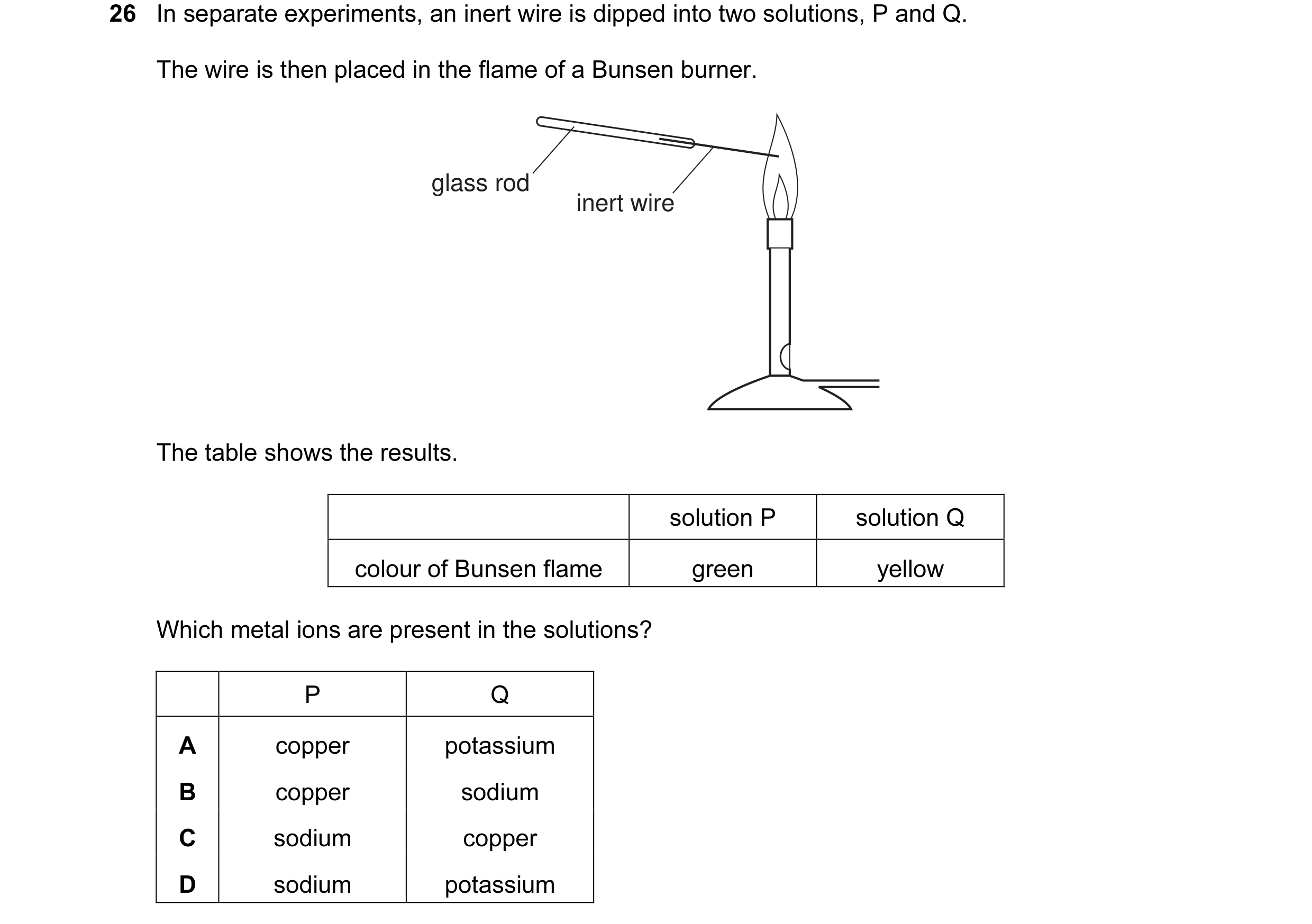
26 In separate experiments, an inert wire is dipped into two solutions, P and Q. The wire is then placed in the flame of a Bunsen burner. glass rod inert wire The table shows the results. solution P solution Q colour of Bunsen flame green yellow Which metal ions are present in the solutions? P Q A copper potassium B copper sodium C sodium copper D sodium potassium
1 marks
Answer: B
This question in 0654/11 Oct/Nov 2007
Q8 · A student tests two solutions 0654/11 May/June 2008
27 A student tests two solutions. One solution is an aqueous copper salt. The other is an aqueous sodium salt. How can the colours of the solutions and of flame tests show which solution is which? colour of solution colour of flame copper sodium copper sodium A blue colourless blue colourless B blue colourless green yellow C green yellow blue colourless D green yellow green yellow
1 marks
Answer: B
This question in 0654/11 May/June 2008
Q9 · A chemical from a plant is tested 0654/11 Oct/Nov 2008
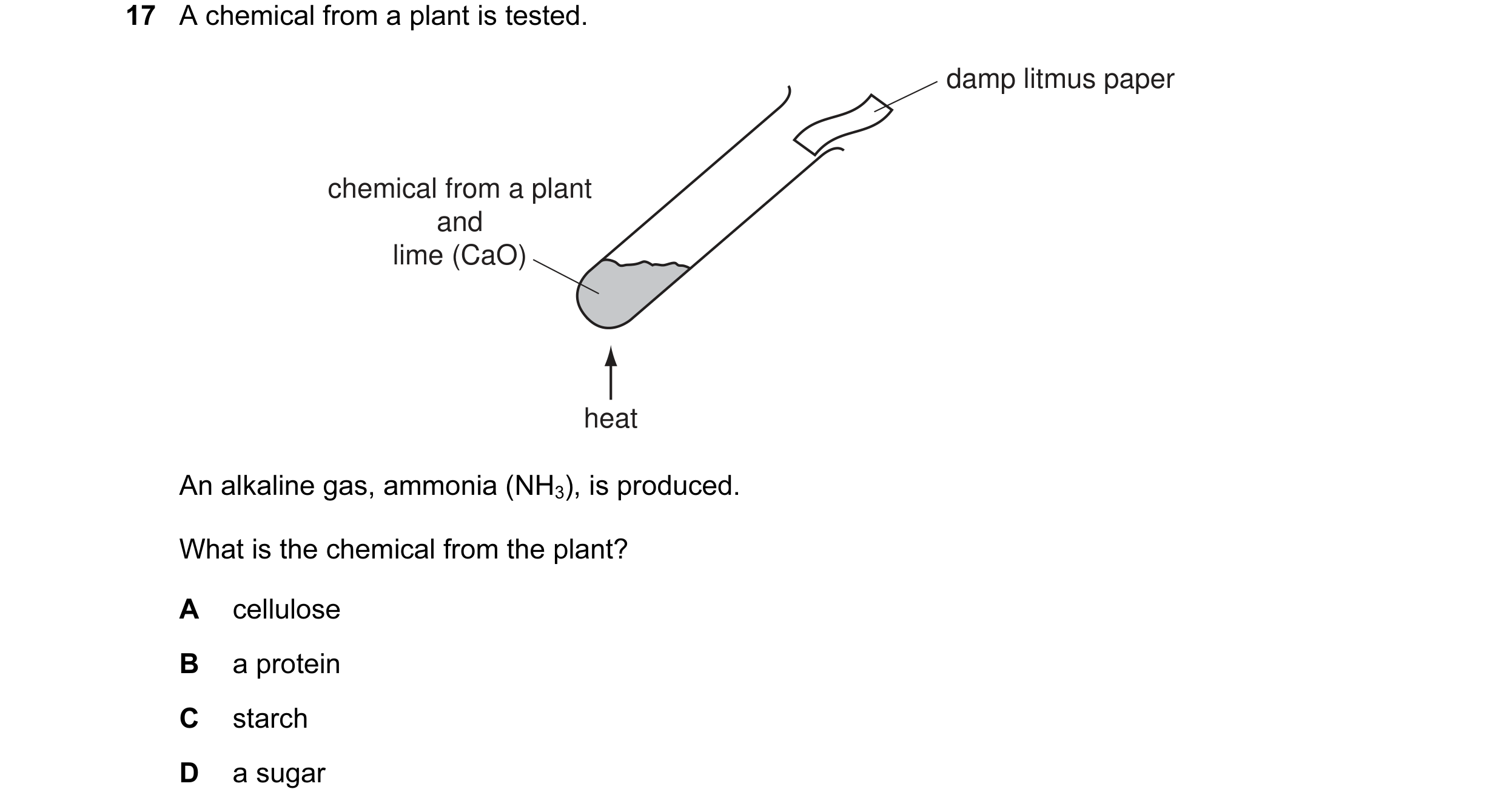
17 A chemical from a plant is tested. damp litmus paper chemical from a plant and lime (CaO) heat An alkaline gas, ammonia (NH3), is produced. What is the chemical from the plant? A cellulose B a protein C starch D a sugar
1 marks
Answer: B
This question in 0654/11 Oct/Nov 2008
Q10 · Testing for which ion in solution involves reduction of the ion? 0654/11 Oct/Nov 2008
24 Testing for which ion in solution involves reduction of the ion? A ammonium B chloride C nitrate D sulphate
1 marks
Answer: C
This question in 0654/11 Oct/Nov 2008
Q11 · Which metal is used with aqueous sodium hydroxide to test for nitrate ions in solution? 0654/11 May/June 2009
23 Which metal is used with aqueous sodium hydroxide to test for nitrate ions in solution? A aluminium B copper C magnesium D tin
1 marks
Answer: A
This question in 0654/11 May/June 2009
Q12 · A liquid fuel is burned using the following apparatus 0654/11 May/June 2009
26 A liquid fuel is burned using the following apparatus. suction pump flame liquid fuel liquid limewater cooling mixture What is being tested for in the gases produced by the burning fuel? A carbon monoxide and carbon dioxide B carbon monoxide and water C carbon dioxide and water D carbon dioxide and sulfur dioxide
1 marks
Answer: C
This question in 0654/11 May/June 2009
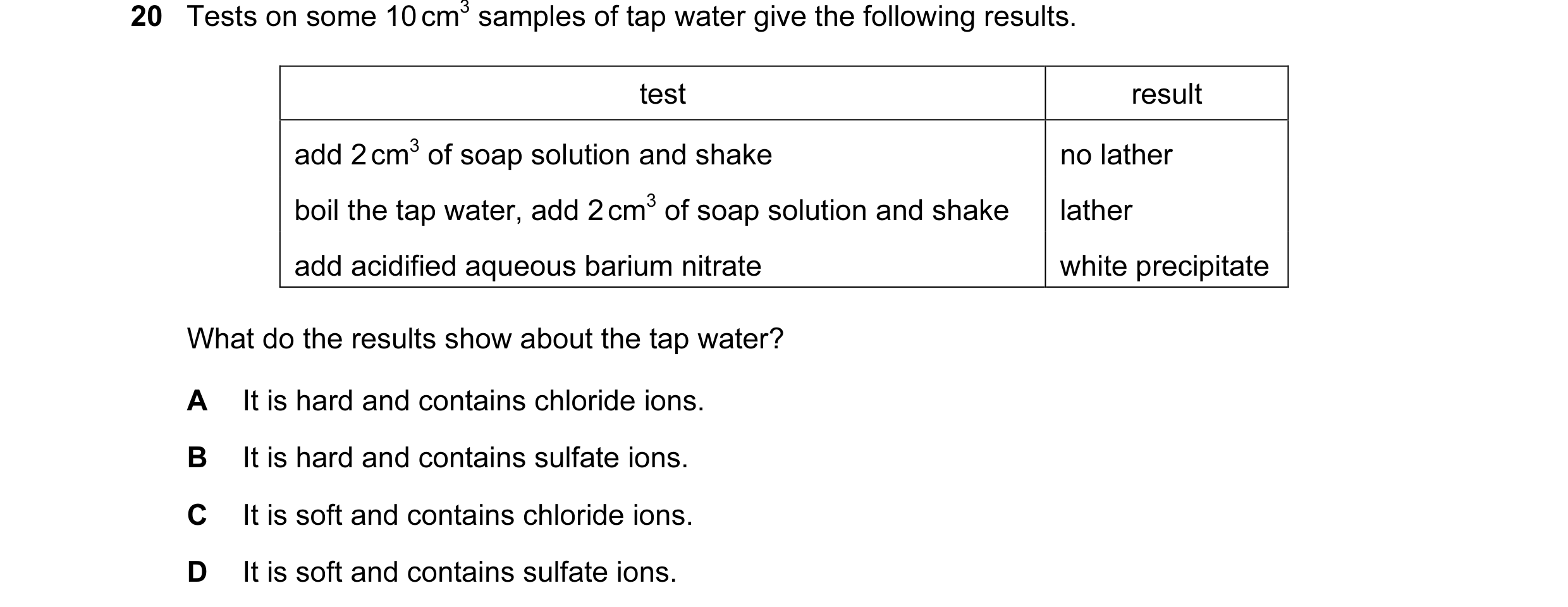
Q13 · Tests on some 10 cm3 samples of tap water give the following results 0654/11 Oct/Nov 2009
20 Tests on some 10 cm3 samples of tap water give the following results. test result add 2 cm3 of soap solution and shake no lather boil the tap water, add 2 cm3 of soap solution and shake lather add acidified aqueous barium nitrate white precipitate What do the results show about the tap water? A It is hard and contains chloride ions. B It is hard and contains sulfate ions. C It is soft and contains chloride ions. D It is soft and contains sulfate ions.
1 marks
Answer: B
This question in 0654/11 Oct/Nov 2009
Q14 · What is used to test for ammonia gas? 0654/11 Oct/Nov 2009
23 What is used to test for ammonia gas? A a lighted splint B aqueous sodium hydroxide C damp red litmus paper D limewater
1 marks
Answer: C
This question in 0654/11 Oct/Nov 2009
Q15 · When concentrated salt solution is electrolysed, two gases X and Y are formed 0654/11 May/June 2010
19 When concentrated salt solution is electrolysed, two gases X and Y are formed. X Y salt solution – + – + 6 V d.c. One of the gases explodes when tested with a burning splint and the other turns moist Universal Indicator paper red then white. What are X and Y? X Y A chlorine hydrogen B hydrogen chlorine C hydrogen oxygen D oxygen chlorine
1 marks
Answer: B
This question in 0654/11 May/June 2010
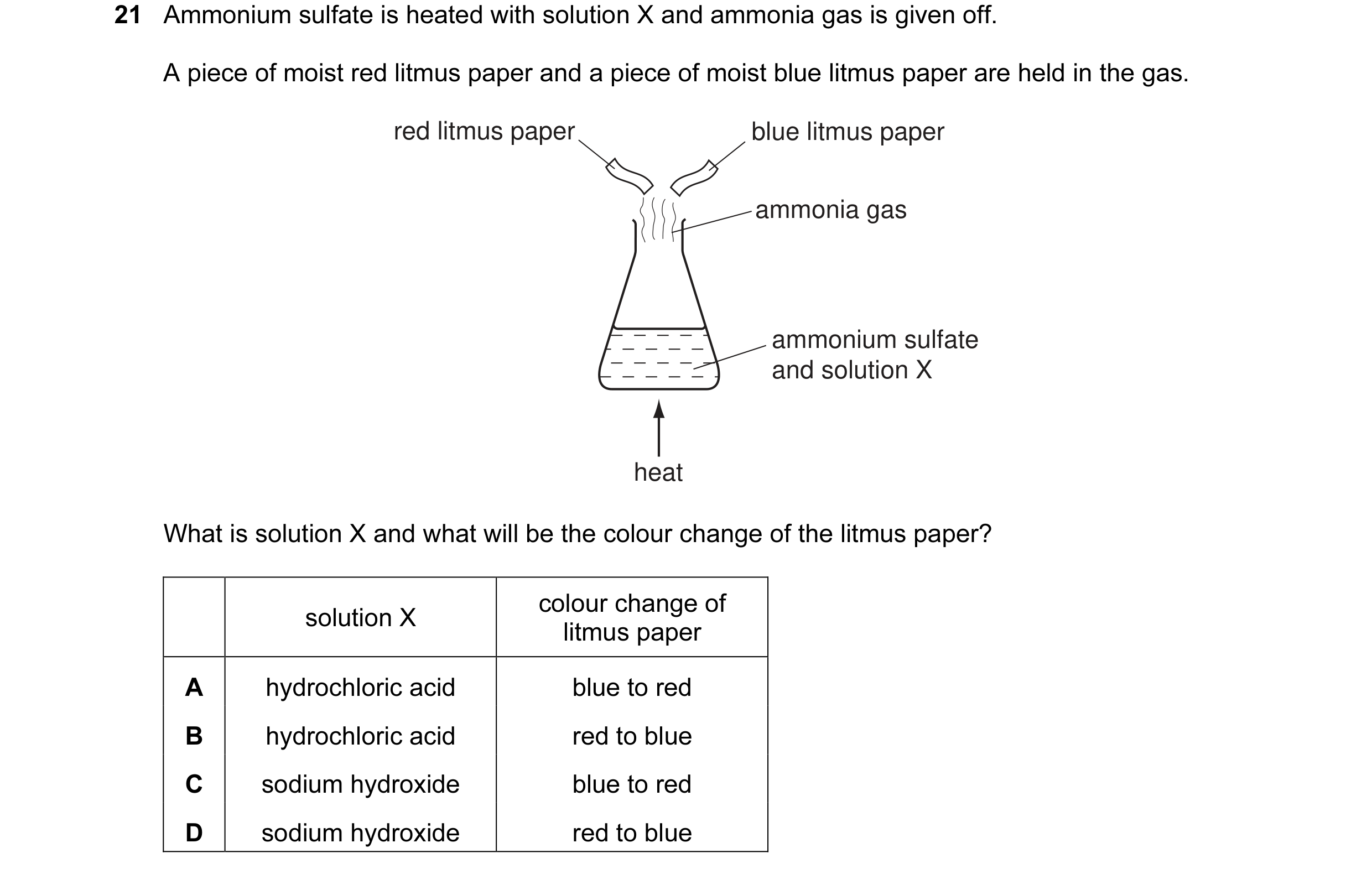
Q16 · Ammonium sulfate is heated with solution X and ammonia gas is given off 0654/11 May/June 2010
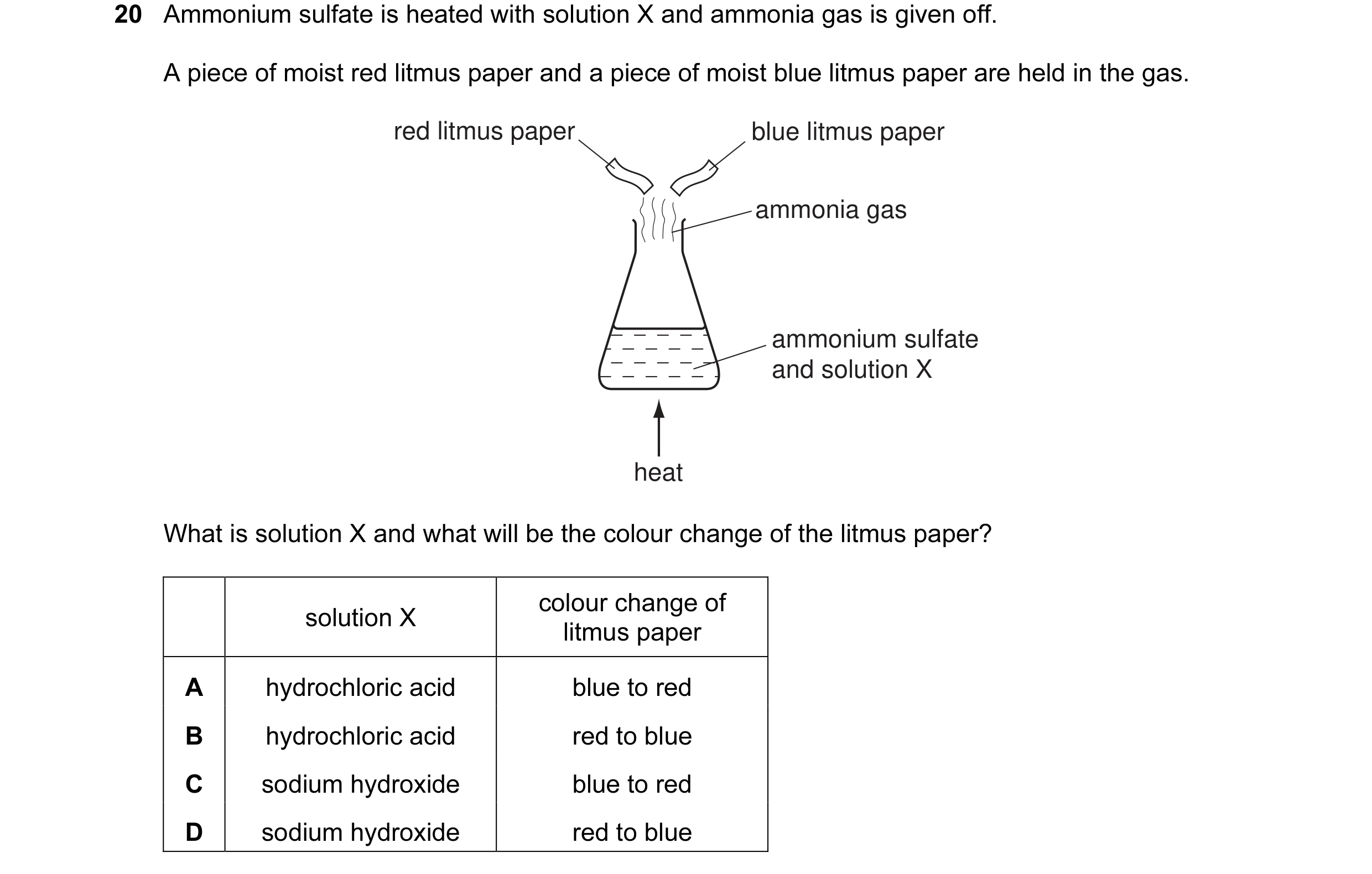
21 Ammonium sulfate is heated with solution X and ammonia gas is given off. A piece of moist red litmus paper and a piece of moist blue litmus paper are held in the gas. red litmus paper blue litmus paper ammonia gas ammonium sulfate and solution X heat What is solution X and what will be the colour change of the litmus paper? colour change of solution X litmus paper A hydrochloric acid blue to red B hydrochloric acid red to blue C sodium hydroxide blue to red D sodium hydroxide red to blue
1 marks
Answer: D
This question in 0654/11 May/June 2010
Q17 · An aqueous solution of a compound of metal M is tested 0654/11 May/June 2010
26 An aqueous solution of a compound of metal M is tested. • It does not give a characteristic flame colour. • It forms a precipitate with aqueous ammonia; the precipitate is soluble in excess ammonia. What is metal M? A copper B iron C potassium D zinc
1 marks
Answer: D
This question in 0654/11 May/June 2010
Q18 · An aqueous solution of a compound of metal M is tested 0654/12 May/June 2010
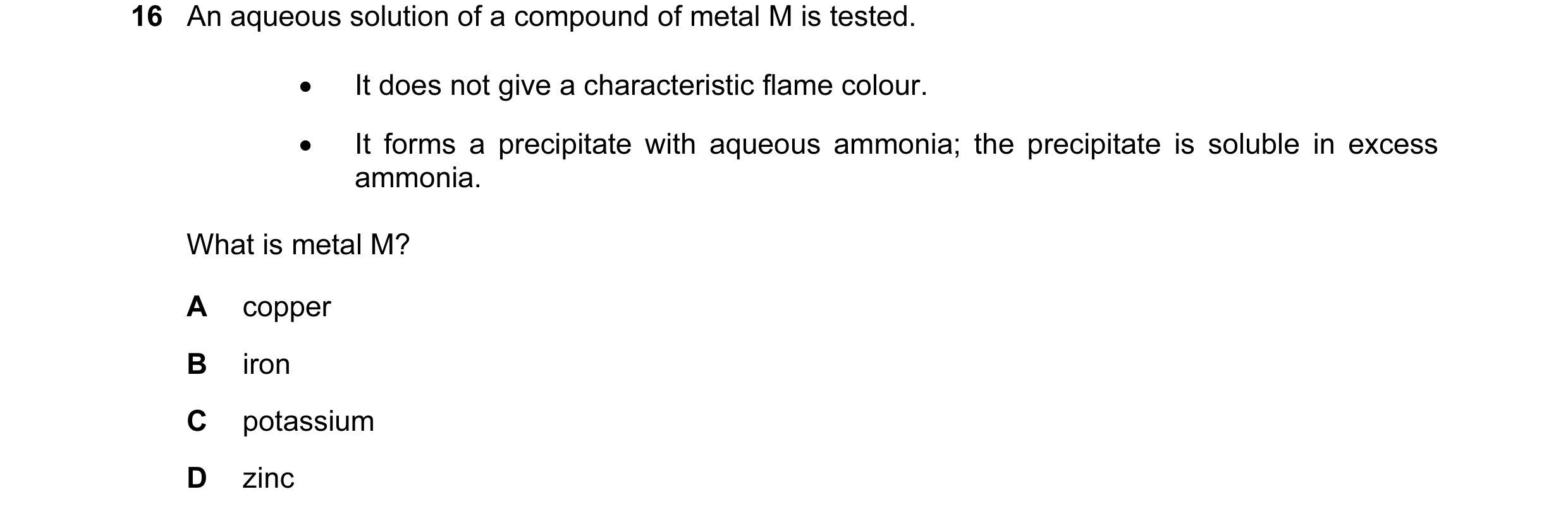
16 An aqueous solution of a compound of metal M is tested. • It does not give a characteristic flame colour. • It forms a precipitate with aqueous ammonia; the precipitate is soluble in excess ammonia. What is metal M? A copper B iron C potassium D zinc
1 marks
Answer: D
This question in 0654/12 May/June 2010
Q19 · Ammonium sulfate is heated with solution X and ammonia gas is given off 0654/12 May/June 2010
20 Ammonium sulfate is heated with solution X and ammonia gas is given off. A piece of moist red litmus paper and a piece of moist blue litmus paper are held in the gas. red litmus paper blue litmus paper ammonia gas ammonium sulfate and solution X heat What is solution X and what will be the colour change of the litmus paper? colour change of solution X litmus paper A hydrochloric acid blue to red B hydrochloric acid red to blue C sodium hydroxide blue to red D sodium hydroxide red to blue
1 marks
Answer: D
This question in 0654/12 May/June 2010
Q20 · When concentrated salt solution is electrolysed, two gases X and Y are formed 0654/12 May/June 2010
21 When concentrated salt solution is electrolysed, two gases X and Y are formed. X Y salt solution – + – + 6 V d.c. One of the gases explodes when tested with a burning splint and the other turns moist Universal Indicator paper red then white. What are X and Y? X Y A chlorine hydrogen B hydrogen chlorine C hydrogen oxygen D oxygen chlorine
1 marks
Answer: B
This question in 0654/12 May/June 2010
Q21 · Sodium chloride solution is electrolysed and a gas is collected at each electrode 0654/11 Oct/Nov 2010
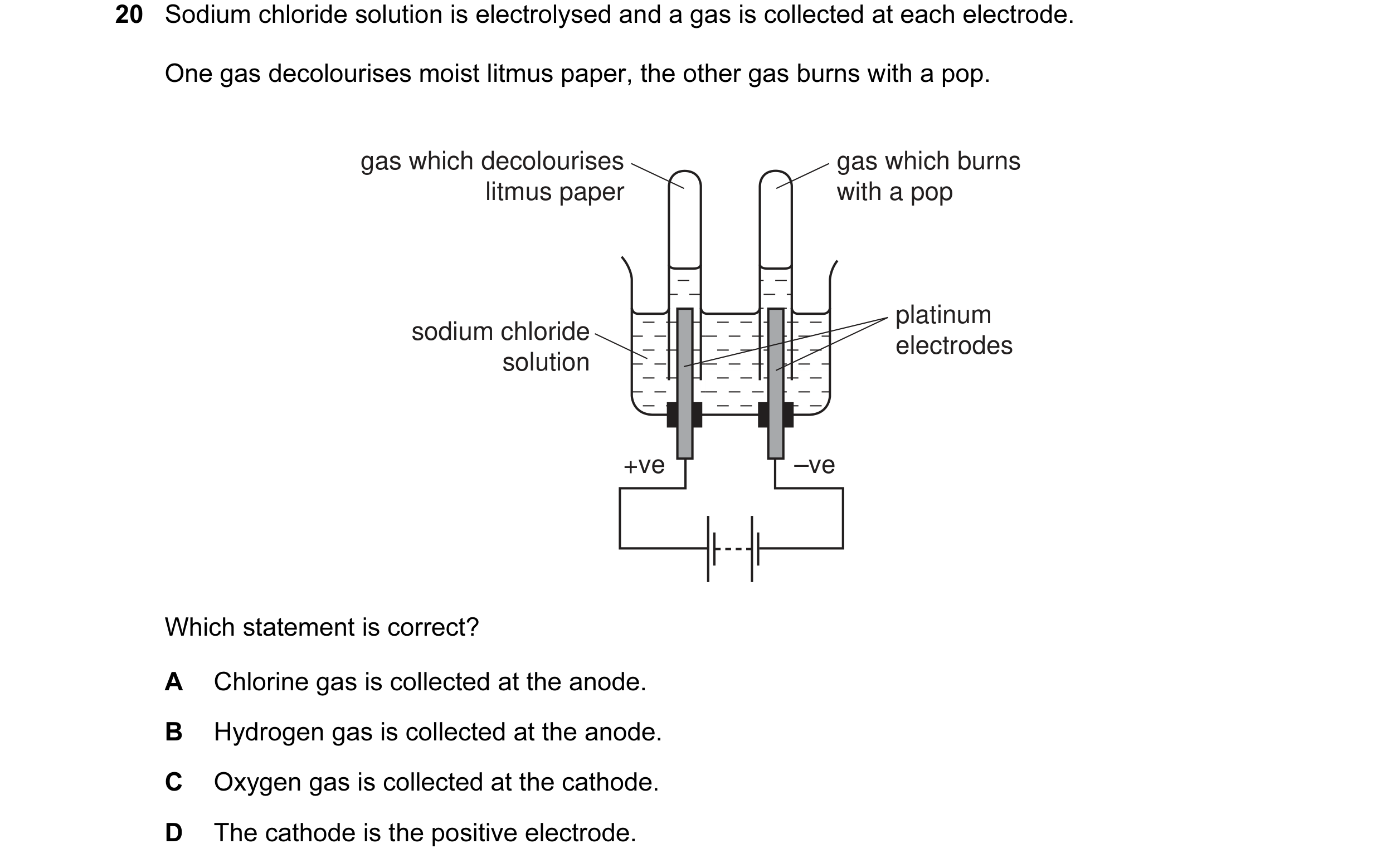
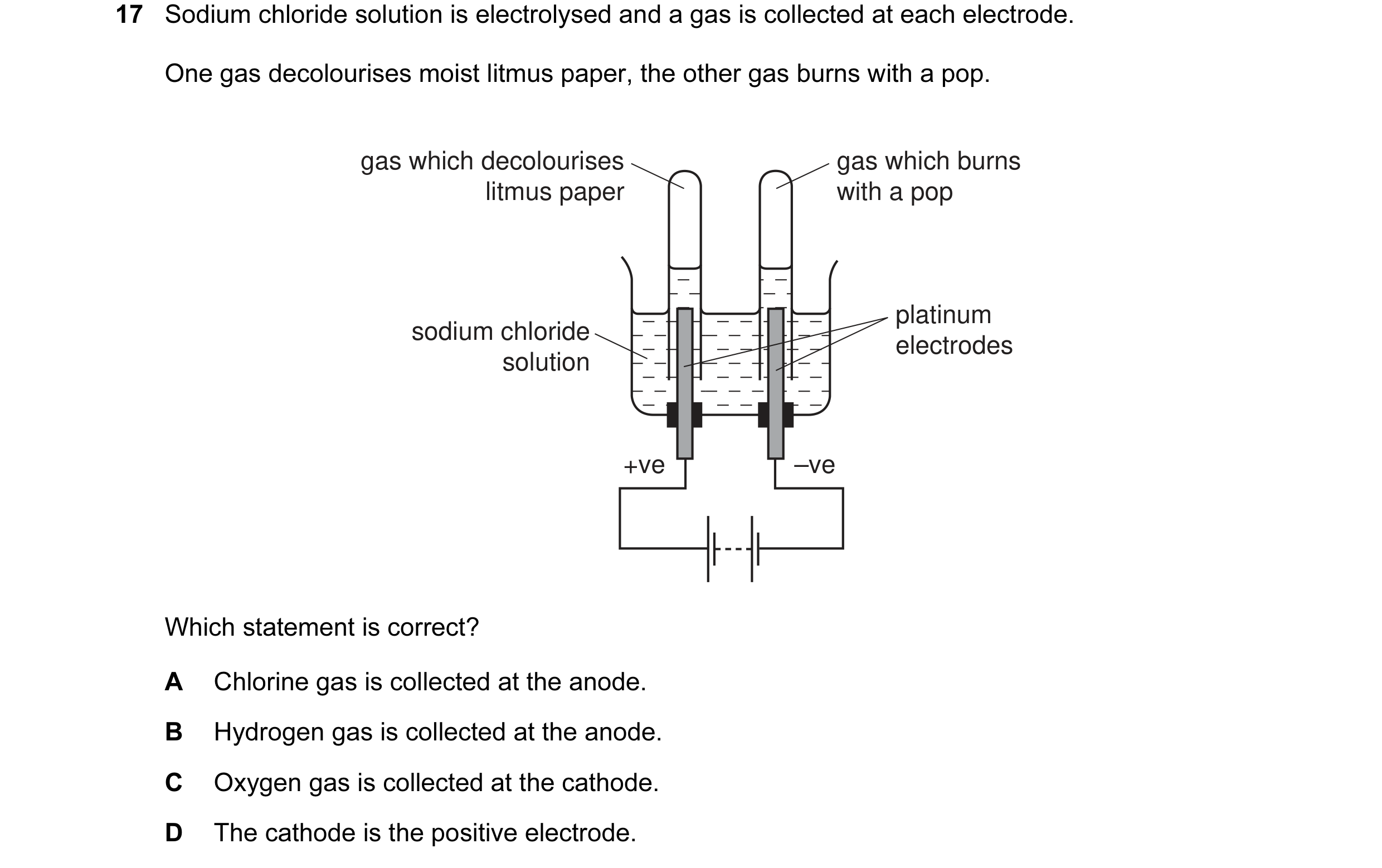
20 Sodium chloride solution is electrolysed and a gas is collected at each electrode. One gas decolourises moist litmus paper, the other gas burns with a pop. gas which decolourises gas which burns litmus paper with a pop platinum sodium chloride electrodes solution +ve –ve Which statement is correct? A Chlorine gas is collected at the anode. B Hydrogen gas is collected at the anode. C Oxygen gas is collected at the cathode. D The cathode is the positive electrode.
1 marks
Answer: A
This question in 0654/11 Oct/Nov 2010
Q22 · Compound X is heated gently with aluminium powder and sodium hydroxide solution 0654/11 Oct/Nov 2010
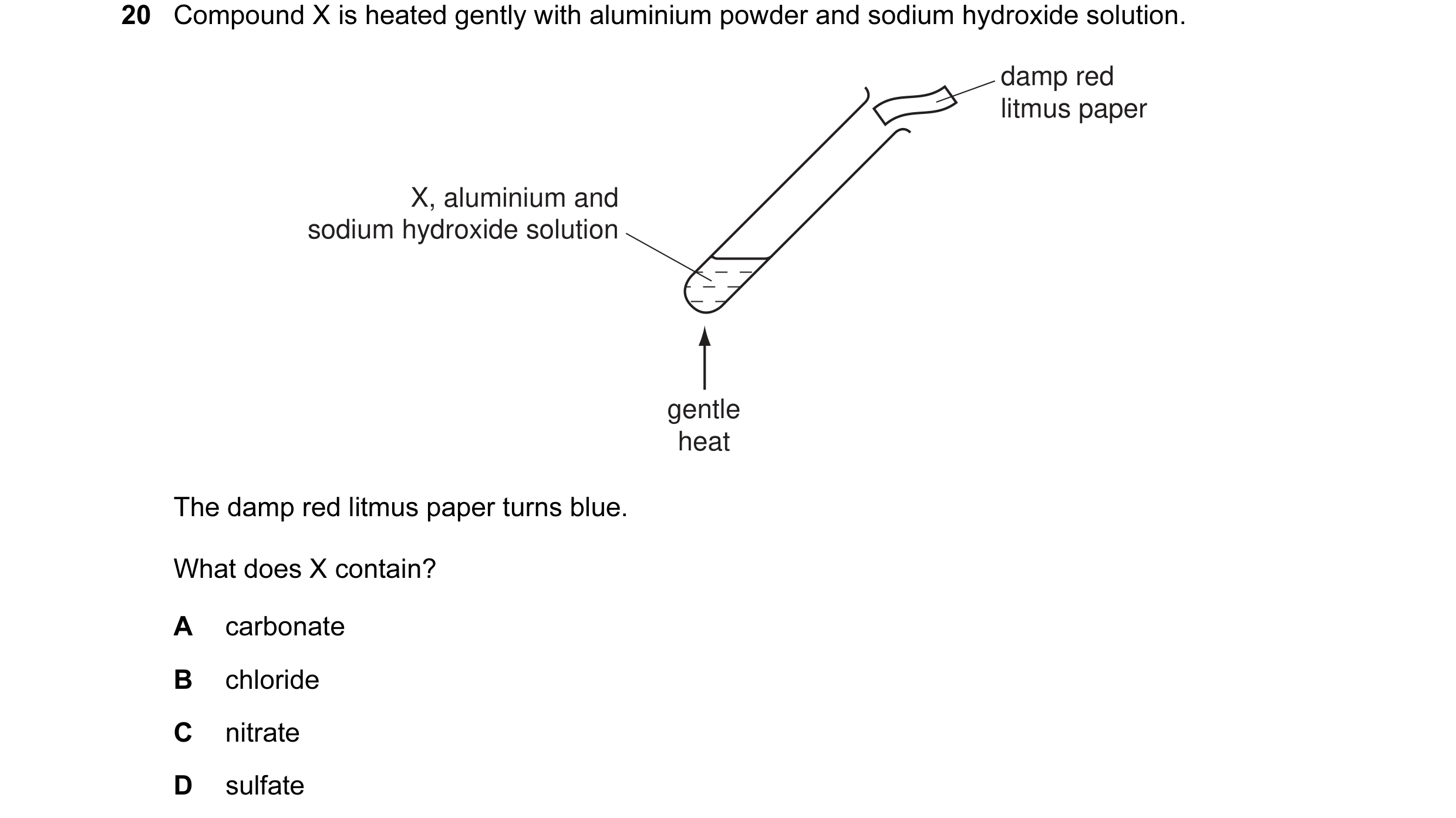
22 Compound X is heated gently with aluminium powder and sodium hydroxide solution. damp red litmus paper X, aluminium and sodium hydroxide solution gentle heat The damp red litmus paper turns blue. What does X contain? A carbonate B chloride C nitrate D sulfate
1 marks
Answer: C
This question in 0654/11 Oct/Nov 2010
Q23 · In separate experiments, an inert wire is dipped into two solutions, P and Q 0654/11 Oct/Nov 2010
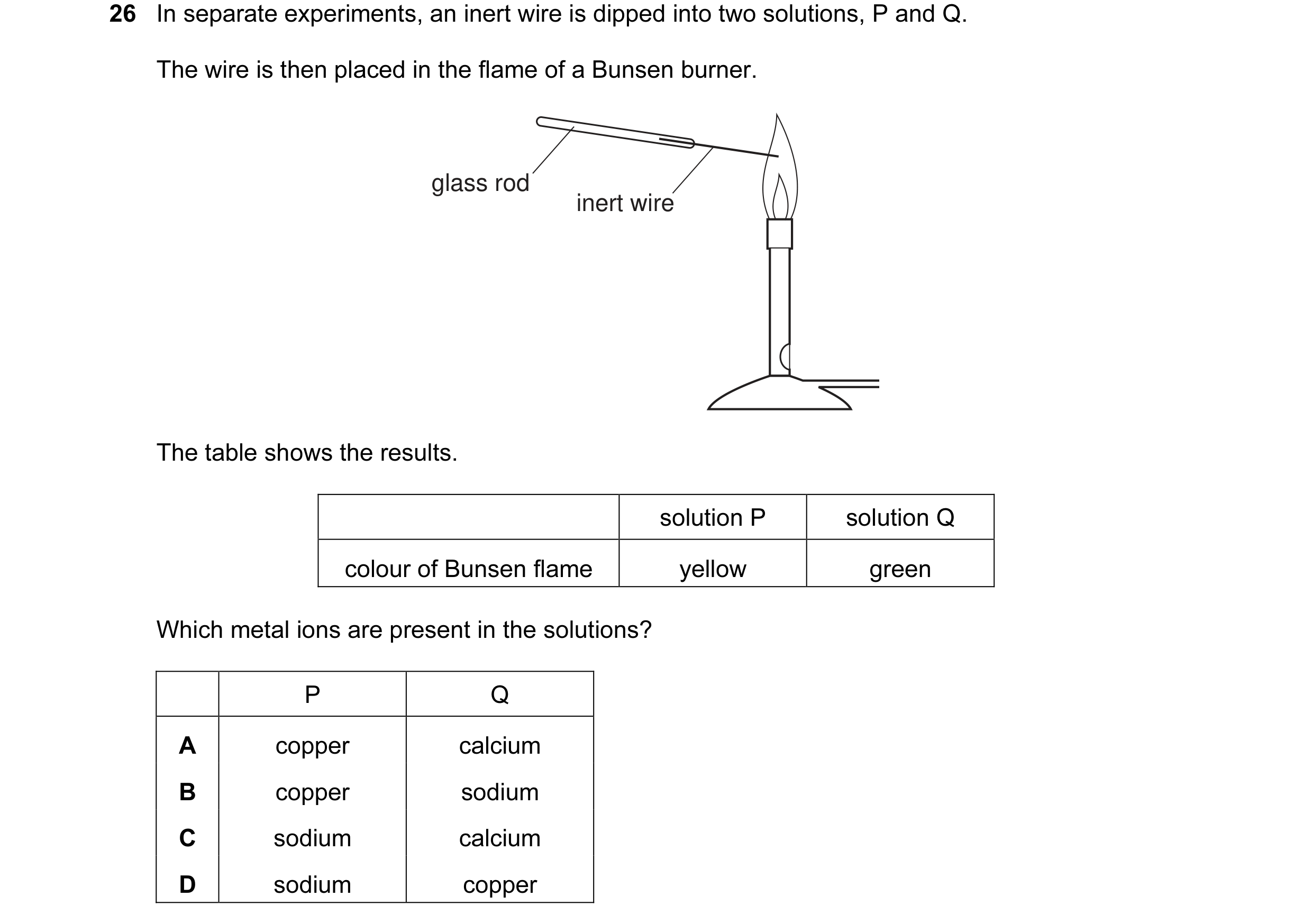
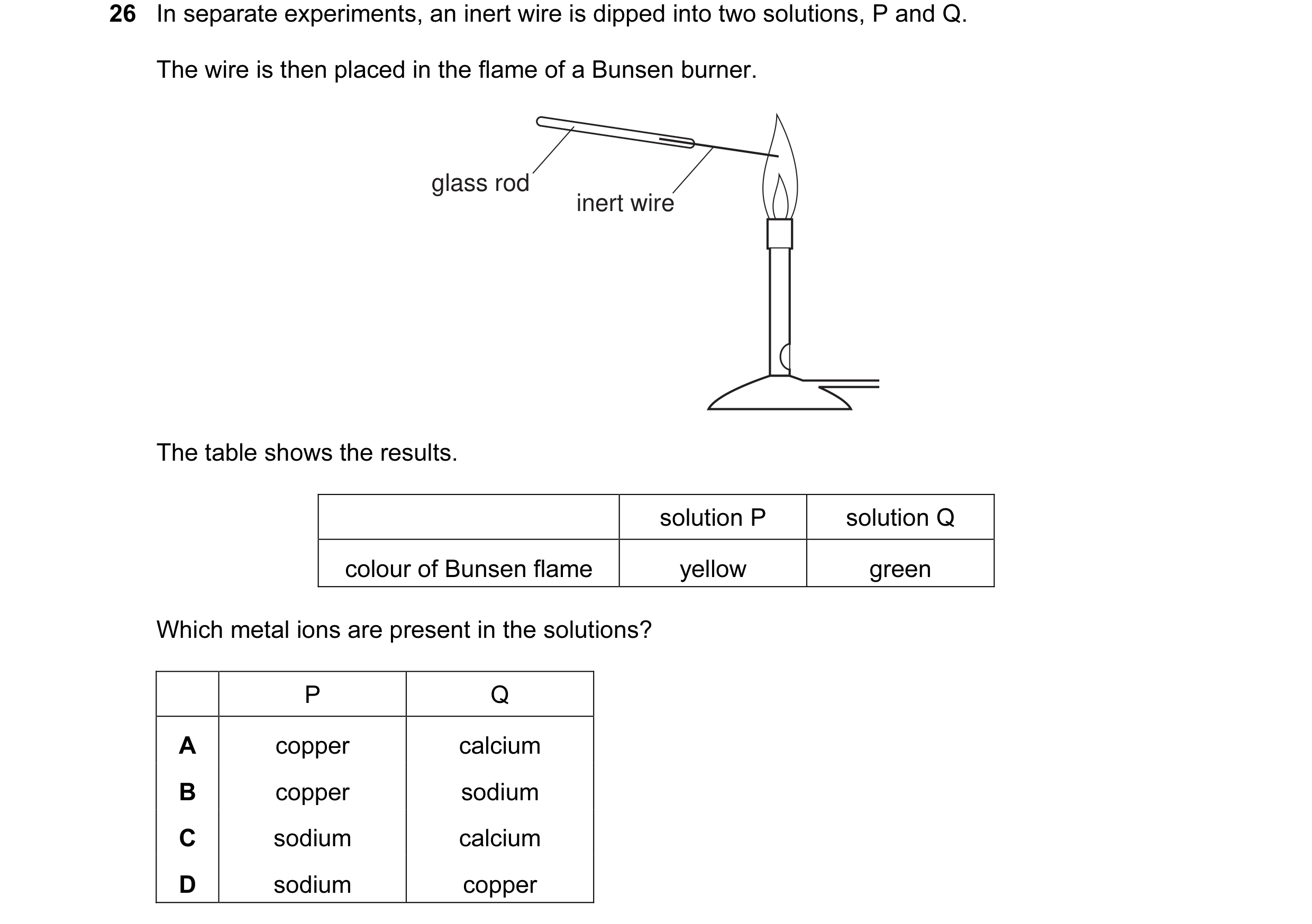
26 In separate experiments, an inert wire is dipped into two solutions, P and Q. The wire is then placed in the flame of a Bunsen burner. glass rod inert wire The table shows the results. solution P solution Q colour of Bunsen flame yellow green Which metal ions are present in the solutions? P Q A copper calcium B copper sodium C sodium calcium D sodium copper
1 marks
Answer: D
This question in 0654/11 Oct/Nov 2010
Q24 · Sodium chloride solution is electrolysed and a gas is collected at each electrode 0654/12 Oct/Nov 2010
19 Sodium chloride solution is electrolysed and a gas is collected at each electrode. One gas decolourises moist litmus paper, the other gas burns with a pop. gas which decolourises gas which burns litmus paper with a pop platinum sodium chloride electrodes solution +ve –ve Which statement is correct? A Chlorine gas is collected at the anode. B Hydrogen gas is collected at the anode. C Oxygen gas is collected at the cathode. D The cathode is the positive electrode.
1 marks
Answer: A
This question in 0654/12 Oct/Nov 2010
Q25 · Compound X is heated gently with aluminium powder and sodium hydroxide solution 0654/12 Oct/Nov 2010
20 Compound X is heated gently with aluminium powder and sodium hydroxide solution. damp red litmus paper X, aluminium and sodium hydroxide solution gentle heat The damp red litmus paper turns blue. What does X contain? A carbonate B chloride C nitrate D sulfate
1 marks
Answer: C
This question in 0654/12 Oct/Nov 2010
Q26 · In separate experiments, an inert wire is dipped into two solutions, P and Q 0654/12 Oct/Nov 2010
27 In separate experiments, an inert wire is dipped into two solutions, P and Q. The wire is then placed in the flame of a Bunsen burner. glass rod inert wire The table shows the results. solution P solution Q colour of Bunsen flame yellow green Which metal ions are present in the solutions? P Q A copper calcium B copper sodium C sodium calcium D sodium copper
1 marks
Answer: D
This question in 0654/12 Oct/Nov 2010
Q27 · Sodium chloride solution is electrolysed and a gas is collected at each electrode 0654/13 Oct/Nov 2010
17 Sodium chloride solution is electrolysed and a gas is collected at each electrode. One gas decolourises moist litmus paper, the other gas burns with a pop. gas which decolourises gas which burns litmus paper with a pop platinum sodium chloride electrodes solution +ve –ve Which statement is correct? A Chlorine gas is collected at the anode. B Hydrogen gas is collected at the anode. C Oxygen gas is collected at the cathode. D The cathode is the positive electrode.
1 marks
Answer: A
This question in 0654/13 Oct/Nov 2010
Q28 · Compound X is heated gently with aluminium powder and sodium hydroxide solution 0654/13 Oct/Nov 2010
18 Compound X is heated gently with aluminium powder and sodium hydroxide solution. damp red litmus paper X, aluminium and sodium hydroxide solution gentle heat The damp red litmus paper turns blue. What does X contain? A carbonate B chloride C nitrate D sulfate
1 marks
Answer: C
This question in 0654/13 Oct/Nov 2010
Q29 · In separate experiments, an inert wire is dipped into two solutions, P and Q 0654/13 Oct/Nov 2010
26 In separate experiments, an inert wire is dipped into two solutions, P and Q. The wire is then placed in the flame of a Bunsen burner. glass rod inert wire The table shows the results. solution P solution Q colour of Bunsen flame yellow green Which metal ions are present in the solutions? P Q A copper calcium B copper sodium C sodium calcium D sodium copper
1 marks
Answer: D
This question in 0654/13 Oct/Nov 2010
Q30 · A solution is tested by adding acidified silver nitrate solution 0654/11 May/June 2011
21 A solution is tested by adding acidified silver nitrate solution. Which ion causes the white precipitate to form? A chloride ions, Cl − B copper ions, Cu2+ C hydroxide ions, OH− D sodium ions, Na+
1 marks
Answer: A
This question in 0654/11 May/June 2011
Q31 · Which statements about a positive test for a nitrate ion are correct? 0654/11 May/June 2011
23 Which statements about a positive test for a nitrate ion are correct? 1 Aluminium is used. 2 The nitrate ion is reduced to ammonia. 3 Ammonia turns damp litmus paper red. A 1, 2 and 3 B 1 and 2 only C 1 and 3 only D 2 and 3 only
1 marks
Answer: B
This question in 0654/11 May/June 2011
Q32 · Which statements about a positive test for a nitrate ion are correct? 0654/12 May/June 2011
22 Which statements about a positive test for a nitrate ion are correct? 1 Aluminium is used. 2 The nitrate ion is reduced to ammonia. 3 Ammonia turns damp litmus paper red. A 1, 2 and 3 B 1 and 2 only C 1 and 3 only D 2 and 3 only
1 marks
Answer: B
This question in 0654/12 May/June 2011
Q33 · A solution is tested by adding acidified silver nitrate solution 0654/12 May/June 2011
23 A solution is tested by adding acidified silver nitrate solution. Which ion causes the white precipitate to form? A chloride ions, Cl − B copper ions, Cu2+ C hydroxide ions, OH− D sodium ions, Na+
1 marks
Answer: A
This question in 0654/12 May/June 2011
Q34 · Which statements about a positive test for a nitrate ion are correct? 0654/13 May/June 2011
22 Which statements about a positive test for a nitrate ion are correct? 1 Aluminium is used. 2 The nitrate ion is reduced to ammonia. 3 Ammonia turns damp litmus paper red. A 1, 2 and 3 B 1 and 2 only C 1 and 3 only D 2 and 3 only
1 marks
Answer: B
This question in 0654/13 May/June 2011
Q35 · A solution is tested by adding acidified silver nitrate solution 0654/13 May/June 2011
23 A solution is tested by adding acidified silver nitrate solution. Which ion causes the white precipitate to form? A chloride ions, Cl − B copper ions, Cu2+ C hydroxide ions, OH− D sodium ions, Na+
1 marks
Answer: A
This question in 0654/13 May/June 2011
Q36 · Using solution X, a student successfully tested for the presence of chloride ions 0654/11 Oct/Nov 2011
21 Using solution X, a student successfully tested for the presence of chloride ions. teat pipette solution X solution What is solution X and the result of the test? solution X result A dilute sulfuric acid yellow precipitate B dilute sulfuric acid white precipitate C silver nitrate solution yellow precipitate D silver nitrate solution white precipitate
1 marks
Answer: D
This question in 0654/11 Oct/Nov 2011
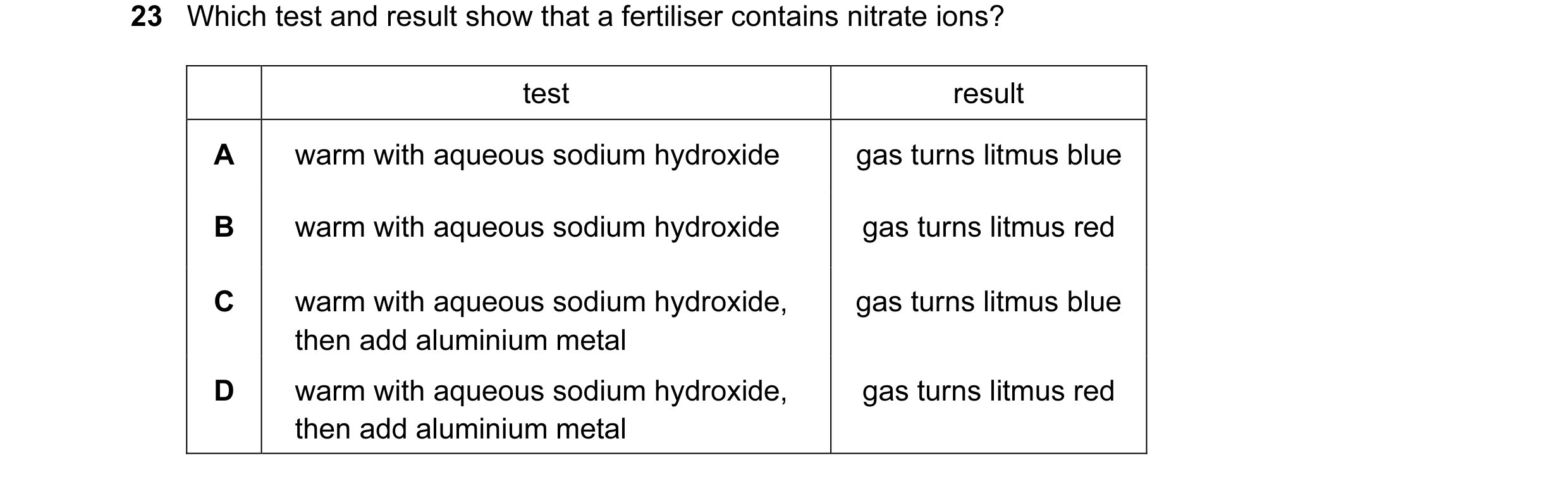
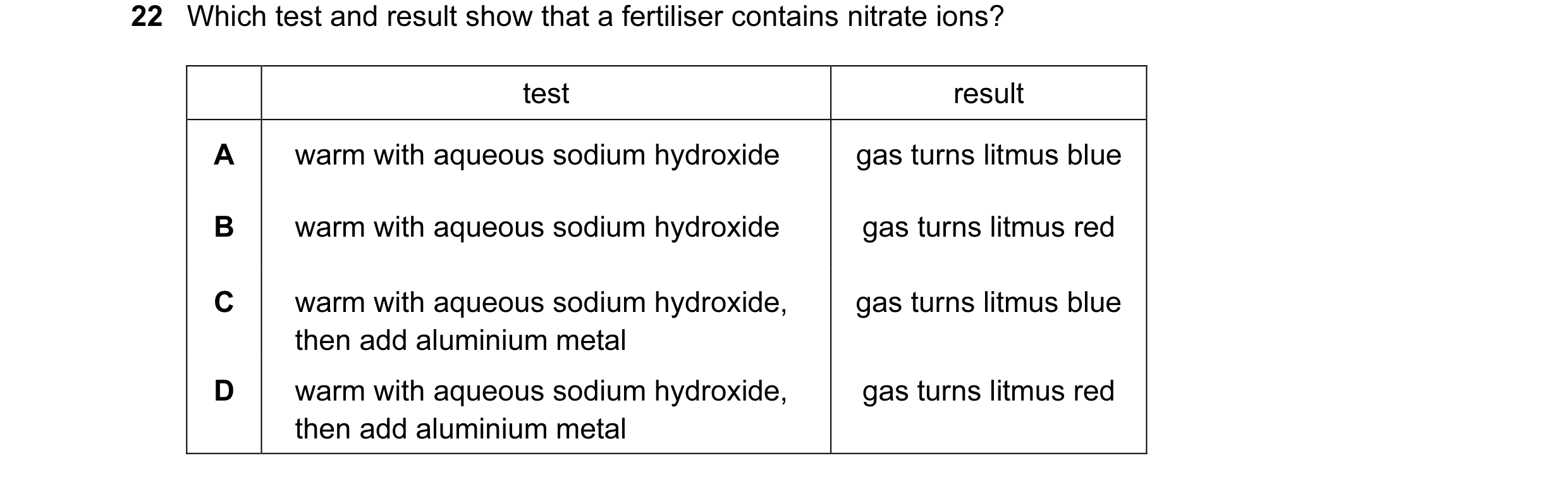
Q37 · Which test and result show that a fertiliser contains nitrate ions? 0654/11 Oct/Nov 2011
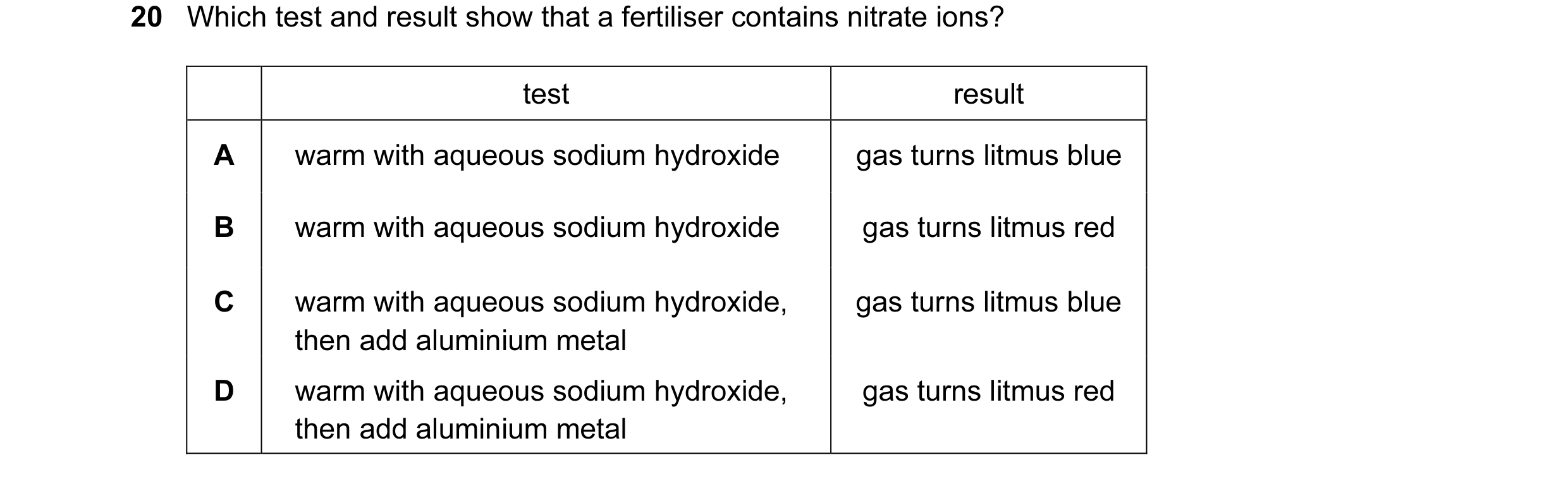
23 Which test and result show that a fertiliser contains nitrate ions? test result A warm with aqueous sodium hydroxide gas turns litmus blue B warm with aqueous sodium hydroxide gas turns litmus red C warm with aqueous sodium hydroxide, gas turns litmus blue then add aluminium metal D warm with aqueous sodium hydroxide, gas turns litmus red then add aluminium metal
1 marks
Answer: C
This question in 0654/11 Oct/Nov 2011
Q38 · Using solution X, a student successfully tested for the presence of chloride ions 0654/12 Oct/Nov 2011
20 Using solution X, a student successfully tested for the presence of chloride ions. teat pipette solution X solution What is solution X and the result of the test? solution X result A dilute sulfuric acid yellow precipitate B dilute sulfuric acid white precipitate C silver nitrate solution yellow precipitate D silver nitrate solution white precipitate
1 marks
Answer: D
This question in 0654/12 Oct/Nov 2011
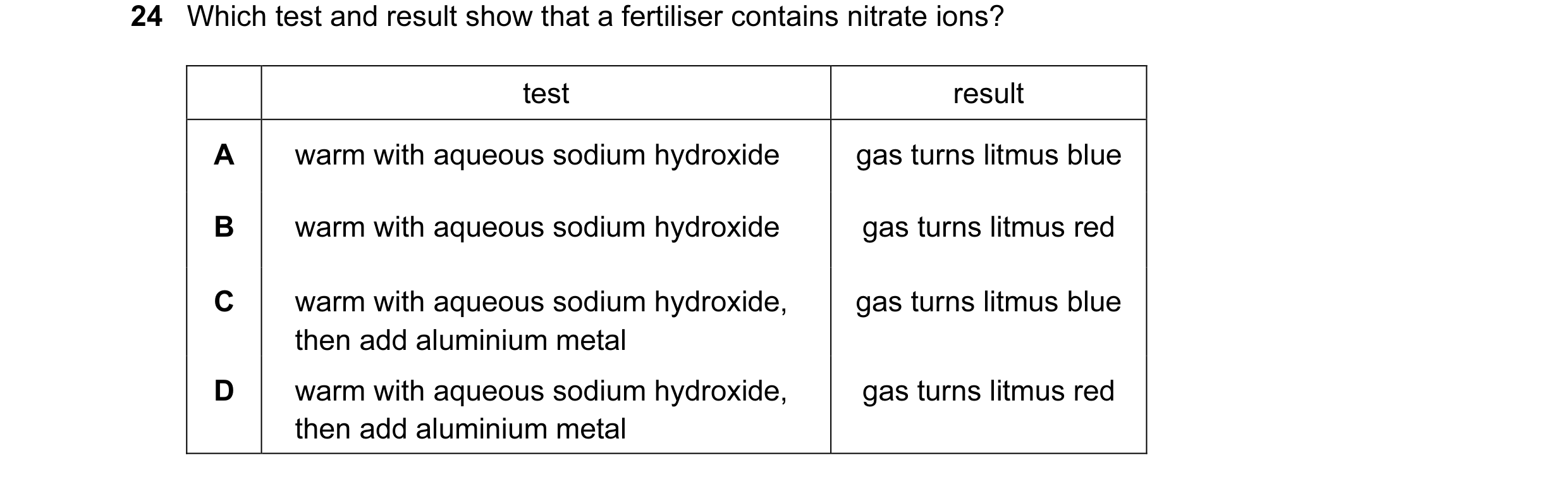
Q39 · Which test and result show that a fertiliser contains nitrate ions? 0654/12 Oct/Nov 2011
24 Which test and result show that a fertiliser contains nitrate ions? test result A warm with aqueous sodium hydroxide gas turns litmus blue B warm with aqueous sodium hydroxide gas turns litmus red C warm with aqueous sodium hydroxide, gas turns litmus blue then add aluminium metal D warm with aqueous sodium hydroxide, gas turns litmus red then add aluminium metal
1 marks
Answer: C
This question in 0654/12 Oct/Nov 2011
Q40 · Using solution X, a student successfully tested for the presence of chloride ions 0654/13 Oct/Nov 2011
18 Using solution X, a student successfully tested for the presence of chloride ions. teat pipette solution X solution What is solution X and the result of the test? solution X result A dilute sulfuric acid yellow precipitate B dilute sulfuric acid white precipitate C silver nitrate solution yellow precipitate D silver nitrate solution white precipitate
1 marks
Answer: D
This question in 0654/13 Oct/Nov 2011
Q41 · Which test and result show that a fertiliser contains nitrate ions? 0654/13 Oct/Nov 2011
22 Which test and result show that a fertiliser contains nitrate ions? test result A warm with aqueous sodium hydroxide gas turns litmus blue B warm with aqueous sodium hydroxide gas turns litmus red C warm with aqueous sodium hydroxide, gas turns litmus blue then add aluminium metal D warm with aqueous sodium hydroxide, gas turns litmus red then add aluminium metal
1 marks
Answer: C
This question in 0654/13 Oct/Nov 2011
Q42 · The diagram shows litmus paper testing the gas that is given off from the contents of the… 0654/11 May/June 2012
19 The diagram shows litmus paper testing the gas that is given off from the contents of the test tube. piece of damp litmus paper sodium nitrate, aluminium and aqueous sodium hydroxide heat The damp litmus paper A turns blue. B turns colourless. C turns red. D turns red then colourless.
1 marks
Answer: B
This question in 0654/11 May/June 2012
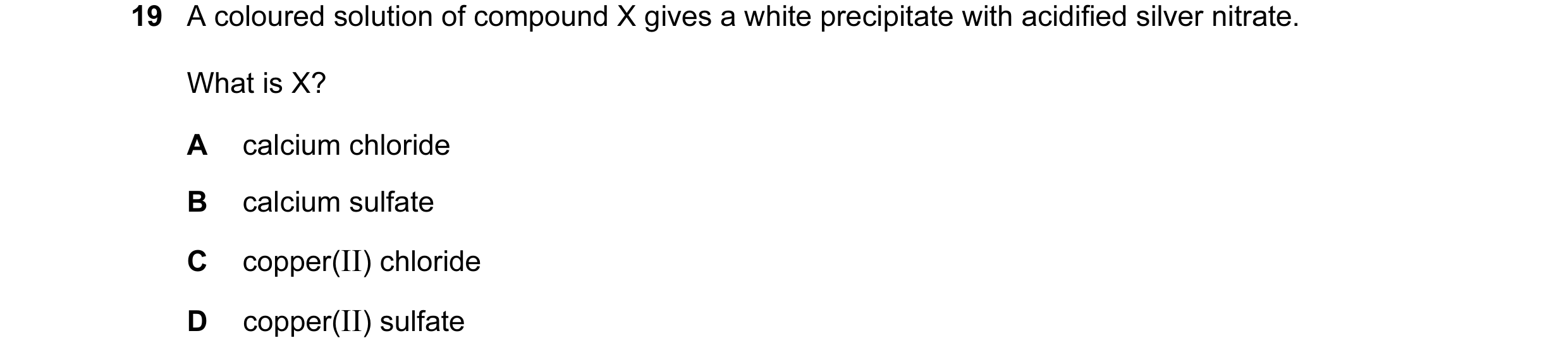
Q43 · A coloured solution of compound X gives a white precipitate with acidified silver nitrate 0654/12 May/June 2012
19 A coloured solution of compound X gives a white precipitate with acidified silver nitrate. What is X? A calcium chloride B calcium sulfate C copper(II) chloride D copper(II) sulfate
1 marks
Answer: C
This question in 0654/12 May/June 2012
Q44 · A coloured solution of compound X gives a white precipitate with acidified silver nitrate 0654/13 May/June 2012
19 A coloured solution of compound X gives a white precipitate with acidified silver nitrate. What is X? A calcium chloride B calcium sulfate C copper(II) chloride D copper(II) sulfate
1 marks
Answer: C
This question in 0654/13 May/June 2012
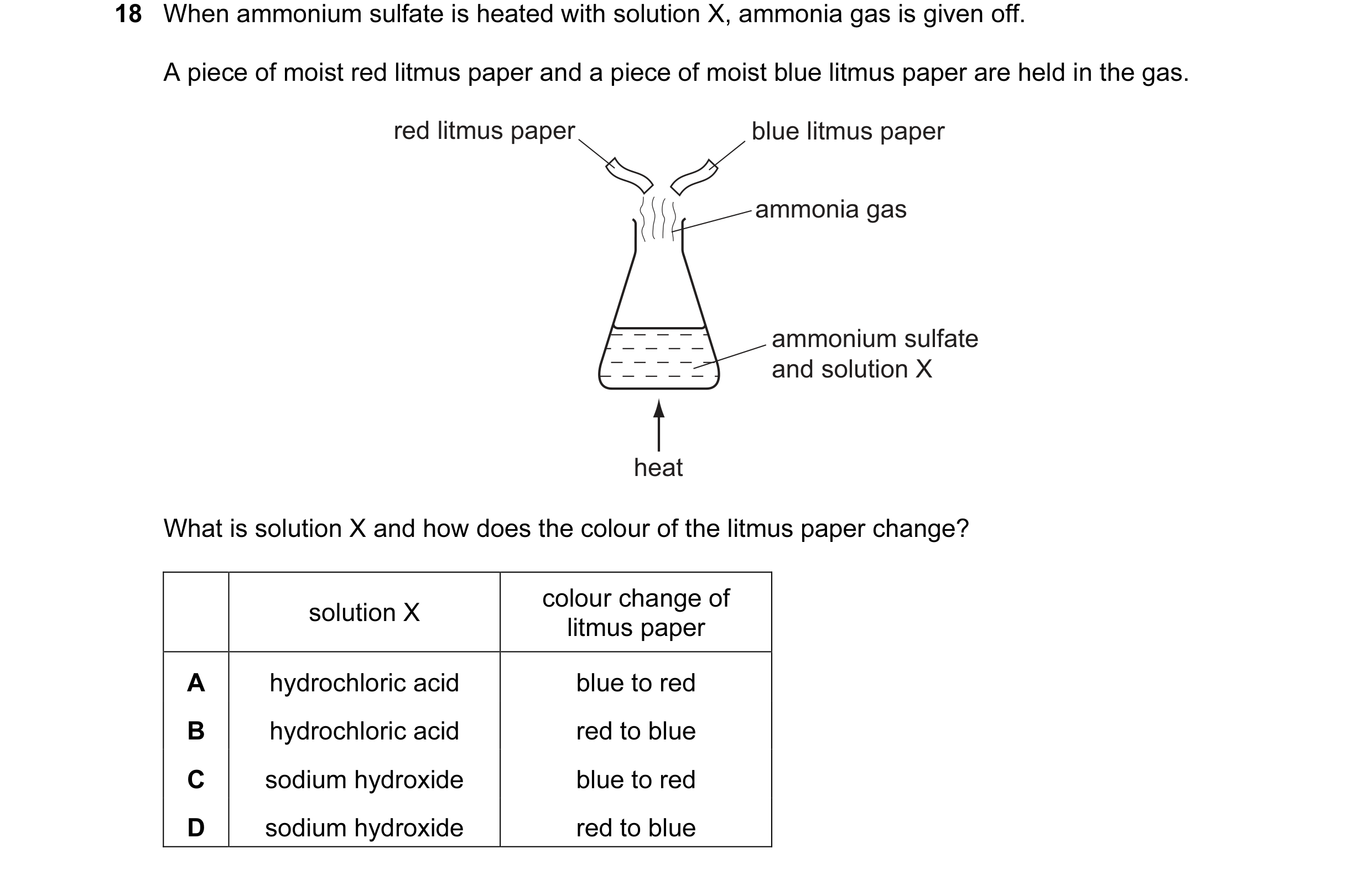
Q45 · When ammonium sulfate is heated with solution X, ammonia gas is given off 0654/11 May/June 2013
18 When ammonium sulfate is heated with solution X, ammonia gas is given off. A piece of moist red litmus paper and a piece of moist blue litmus paper are held in the gas. red litmus paper blue litmus paper ammonia gas ammonium sulfate and solution X heat What is solution X and how does the colour of the litmus paper change? colour change of solution X litmus paper A hydrochloric acid blue to red B hydrochloric acid red to blue C sodium hydroxide blue to red D sodium hydroxide red to blue
1 marks
Answer: D
This question in 0654/11 May/June 2013
Q46 · When ammonium sulfate is heated with solution X, ammonia gas is given off 0654/12 May/June 2013
18 When ammonium sulfate is heated with solution X, ammonia gas is given off. A piece of moist red litmus paper and a piece of moist blue litmus paper are held in the gas. red litmus paper blue litmus paper ammonia gas ammonium sulfate and solution X heat What is solution X and how does the colour of the litmus paper change? colour change of solution X litmus paper A hydrochloric acid blue to red B hydrochloric acid red to blue C sodium hydroxide blue to red D sodium hydroxide red to blue
1 marks
Answer: D
This question in 0654/12 May/June 2013
Q47 · The diagram shows the electrolysis of a compound 0654/12 May/June 2013
21 The diagram shows the electrolysis of a compound. d.c. power source switch +ve –ve P Q concentrated potassium halide solution When the switch is closed, the solution near electrode P turns brown because a halogen is formed. The positive electrode P is called the ……1……, and the halogen is ……2…… . 1 2 A anode bromine B anode chlorine C cathode bromine D cathode chlorine
1 marks
Answer: A
This question in 0654/12 May/June 2013
Q48 · Sodium chloride solution is electrolysed and a gas is collected at each electrode 0654/12 May/June 2013
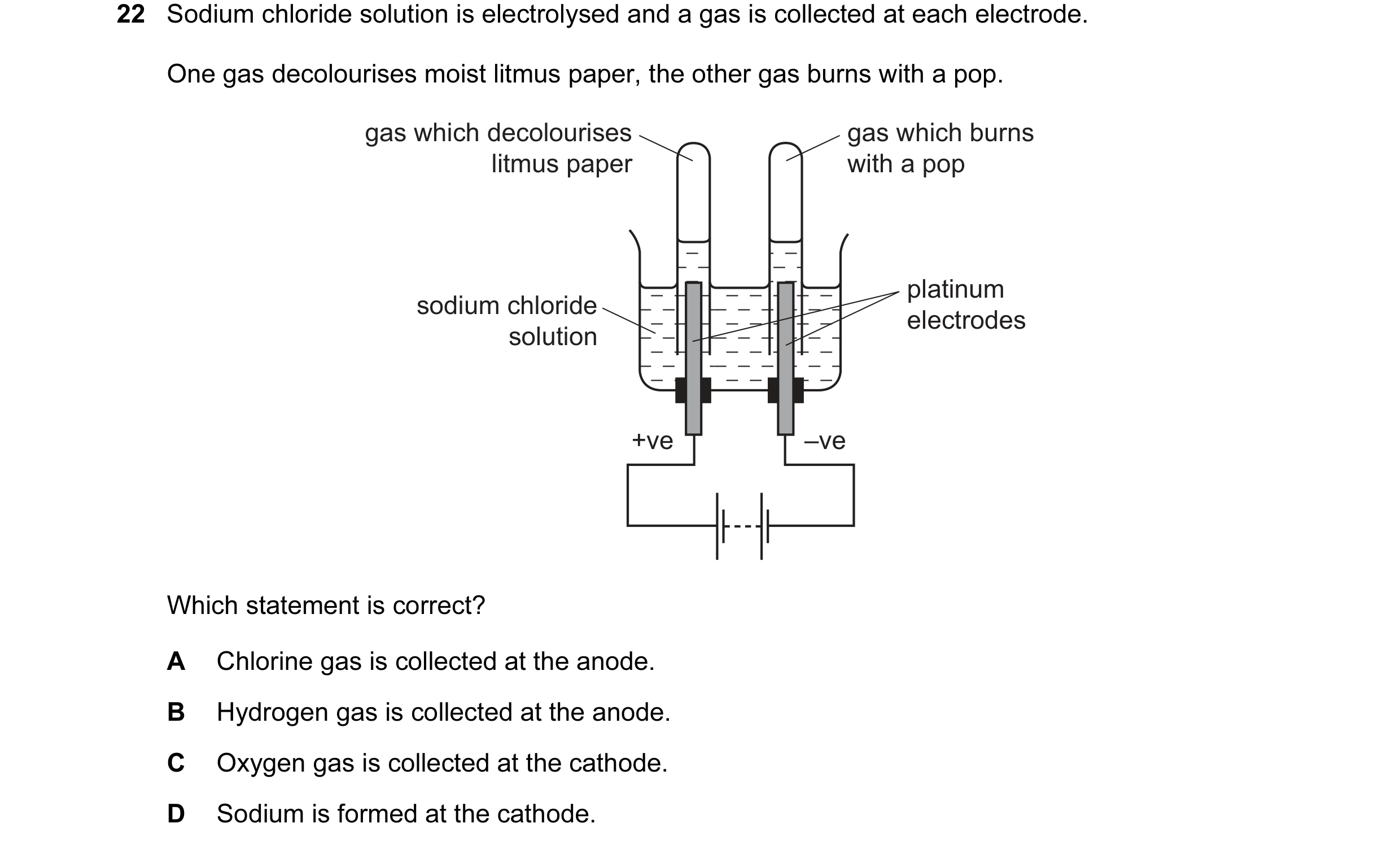
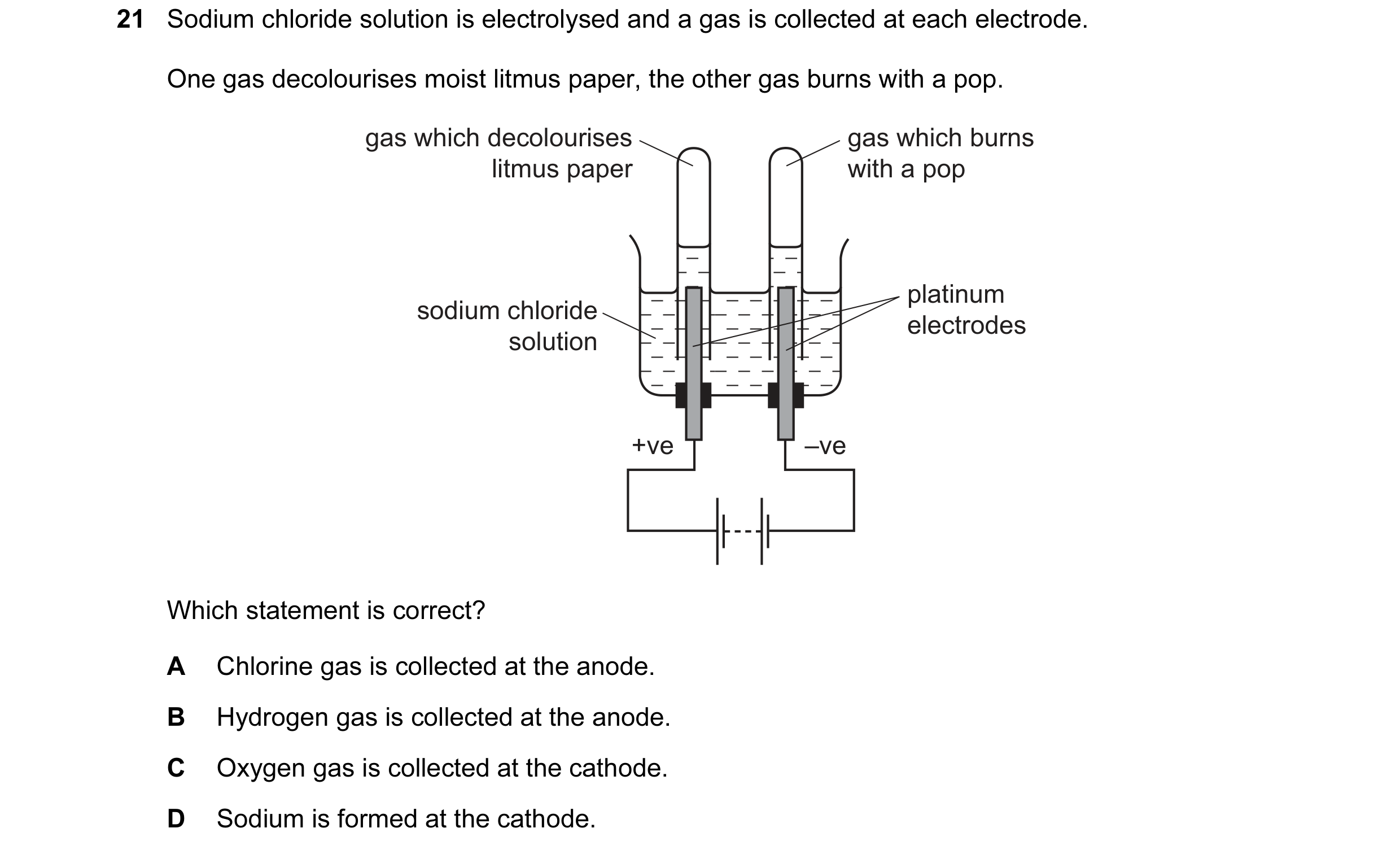
22 Sodium chloride solution is electrolysed and a gas is collected at each electrode. One gas decolourises moist litmus paper, the other gas burns with a pop. gas which decolourises gas which burns litmus paper with a pop platinum sodium chloride electrodes solution +ve –ve Which statement is correct? A Chlorine gas is collected at the anode. B Hydrogen gas is collected at the anode. C Oxygen gas is collected at the cathode. D Sodium is formed at the cathode.
1 marks
Answer: A
This question in 0654/12 May/June 2013
Q49 · When ammonium sulfate is heated with solution X, ammonia gas is given off 0654/13 May/June 2013
19 When ammonium sulfate is heated with solution X, ammonia gas is given off. A piece of moist red litmus paper and a piece of moist blue litmus paper are held in the gas. red litmus paper blue litmus paper ammonia gas ammonium sulfate and solution X heat What is solution X and how does the colour of the litmus paper change? colour change of solution X litmus paper A hydrochloric acid blue to red B hydrochloric acid red to blue C sodium hydroxide blue to red D sodium hydroxide red to blue
1 marks
Answer: D
This question in 0654/13 May/June 2013
Q50 · Sodium chloride solution is electrolysed and a gas is collected at each electrode 0654/13 May/June 2013
21 Sodium chloride solution is electrolysed and a gas is collected at each electrode. One gas decolourises moist litmus paper, the other gas burns with a pop. gas which decolourises gas which burns litmus paper with a pop platinum sodium chloride electrodes solution +ve –ve Which statement is correct? A Chlorine gas is collected at the anode. B Hydrogen gas is collected at the anode. C Oxygen gas is collected at the cathode. D Sodium is formed at the cathode.
1 marks
Answer: A
This question in 0654/13 May/June 2013
Q51 · An iron nail dissolves in an acid to form a salt solution 0654/13 Oct/Nov 2013
23 An iron nail dissolves in an acid to form a salt solution. acid iron nail The salt solution forms a green precipitate with sodium hydroxide solution. The salt solution also forms a white precipitate with barium chloride solution. What is the salt solution? A iron(II) chloride B iron(III) chloride C iron(II) sulfate D iron(III) sulfate
1 marks
Answer: C
This question in 0654/13 Oct/Nov 2013
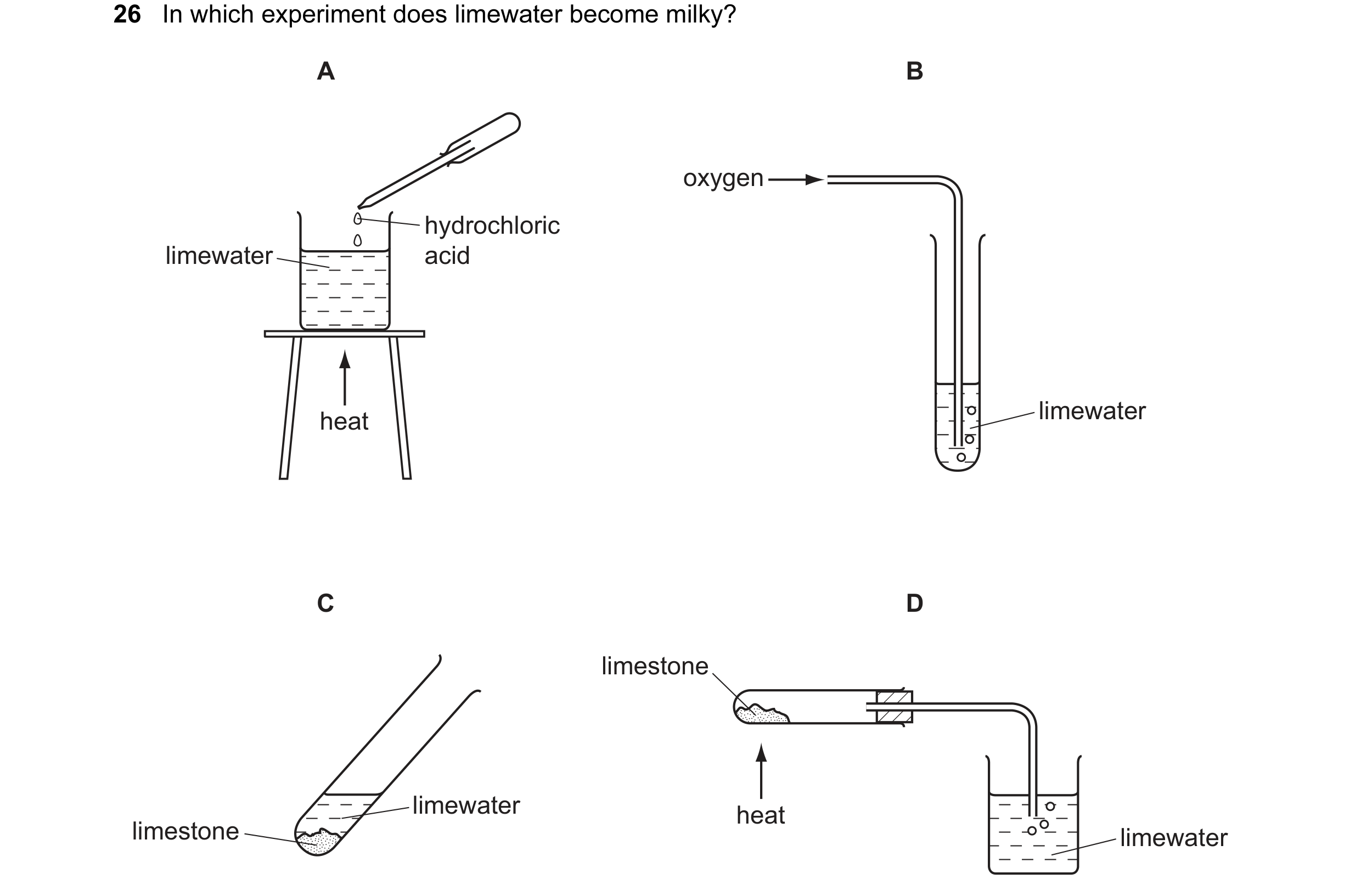
Q52 · In which experiment does limewater become milky? 0654/13 Oct/Nov 2013
26 In which experiment does limewater become milky? A B oxygen hydrochloric limewater acid heat limewater C D limestone limewater heat limestone limewater
1 marks
Answer: D
This question in 0654/13 Oct/Nov 2013
Q53 · When dilute sulfuric acid is electrolysed each electrode gives off a different gas 0654/11 May/June 2014
17 When dilute sulfuric acid is electrolysed each electrode gives off a different gas. + _ positive negative electrode electrode dilute sulfuric acid Which test identifies the gas given off at the positive electrode? A Damp red litmus is bleached. B Damp red litmus turns blue. C A glowing splint relights. D A lighted splint burns with a squeaky pop.
1 marks
Answer: C
This question in 0654/11 May/June 2014
Q54 · Hydrochloric acid is added to calcium carbonate 0654/11 May/June 2014
22 Hydrochloric acid is added to calcium carbonate. Gas X, which turns limewater milky, is given off. What is X? A carbon dioxide B chlorine C hydrogen D oxygen
1 marks
Answer: A
This question in 0654/11 May/June 2014
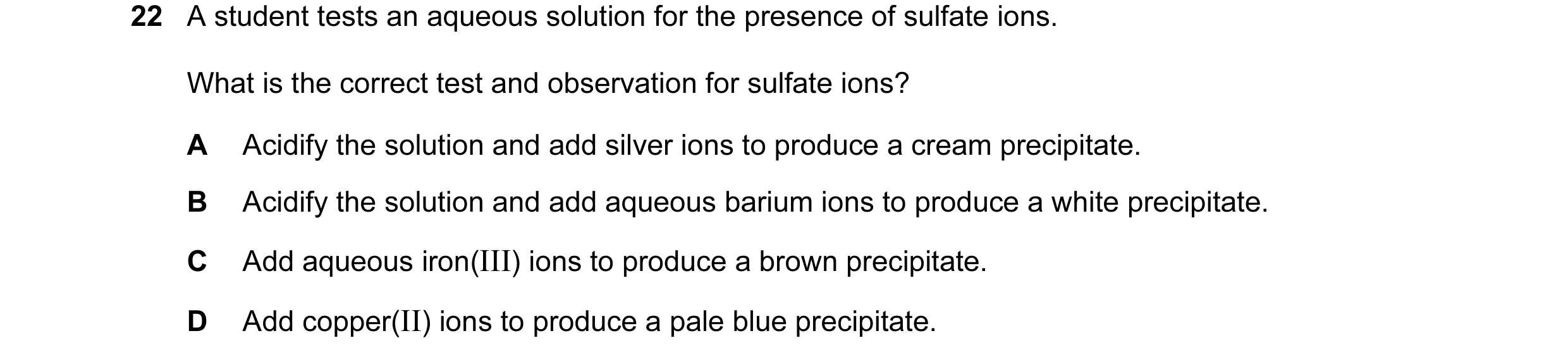
Q55 · A student tests an aqueous solution for the presence of sulfate ions 0654/12 May/June 2014
22 A student tests an aqueous solution for the presence of sulfate ions. What is the correct test and observation for sulfate ions? A Acidify the solution and add silver ions to produce a cream precipitate. B Acidify the solution and add aqueous barium ions to produce a white precipitate. C Add aqueous iron(III) ions to produce a brown precipitate. D Add copper(II) ions to produce a pale blue precipitate.
1 marks
Answer: B
This question in 0654/12 May/June 2014
Q56 · When dilute sulfuric acid is electrolysed each electrode gives off a different gas 0654/13 May/June 2014
16 When dilute sulfuric acid is electrolysed each electrode gives off a different gas. + _ positive negative electrode electrode dilute sulfuric acid Which test identifies the gas given off at the positive electrode? A Damp red litmus is bleached. B Damp red litmus turns blue. C A glowing splint relights. D A lighted splint burns with a squeaky pop.
1 marks
Answer: C
This question in 0654/13 May/June 2014
Q57 · Hydrochloric acid is added to calcium carbonate 0654/13 May/June 2014
21 Hydrochloric acid is added to calcium carbonate. Gas X, which turns limewater milky, is given off. What is X? A carbon dioxide B chlorine C hydrogen D oxygen
1 marks
Answer: A
This question in 0654/13 May/June 2014
Q58 · The diagram shows a chemical reaction that produces a gas 0654/11 May/June 2015
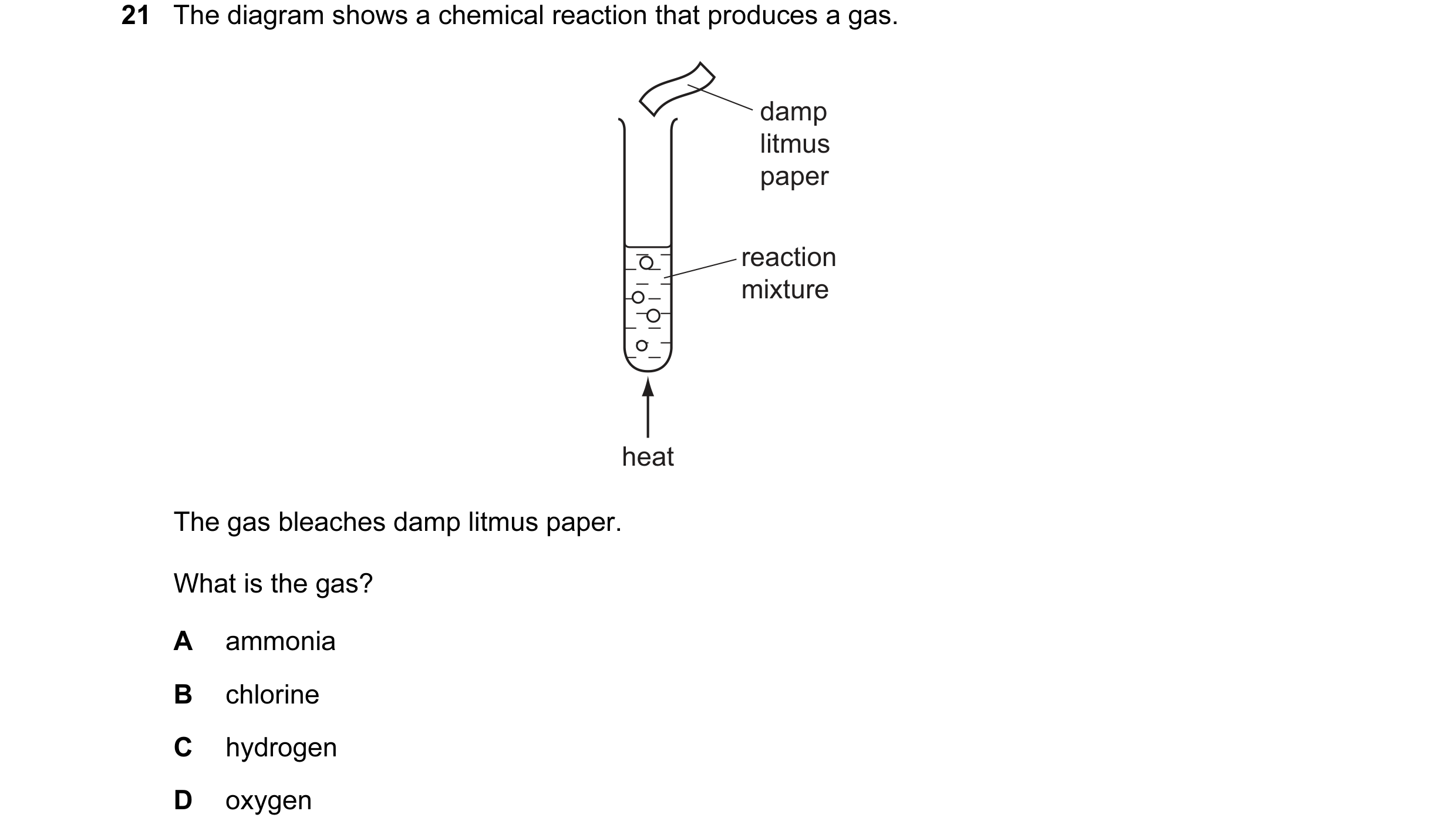
21 The diagram shows a chemical reaction that produces a gas. damp litmus paper reaction mixture heat The gas bleaches damp litmus paper. What is the gas? A ammonia B chlorine C hydrogen D oxygen
1 marks
Answer: B
This question in 0654/11 May/June 2015
Q59 · What is observed when aqueous barium ions are added to sulfuric acid? 0654/12 May/June 2015
21 What is observed when aqueous barium ions are added to sulfuric acid? A blue precipitate B brown gas C colourless gas D white precipitate
1 marks
Answer: D
This question in 0654/12 May/June 2015
Q60 · Sodium hydroxide solution and aluminium powder are added to a salt solution and warmed 0654/13 May/June 2015
21 Sodium hydroxide solution and aluminium powder are added to a salt solution and warmed. A gas is produced that turns moist red litmus paper blue. Which anion is present in the salt? A carbonate B chloride C nitrate D sulfate
1 marks
Answer: C
This question in 0654/13 May/June 2015
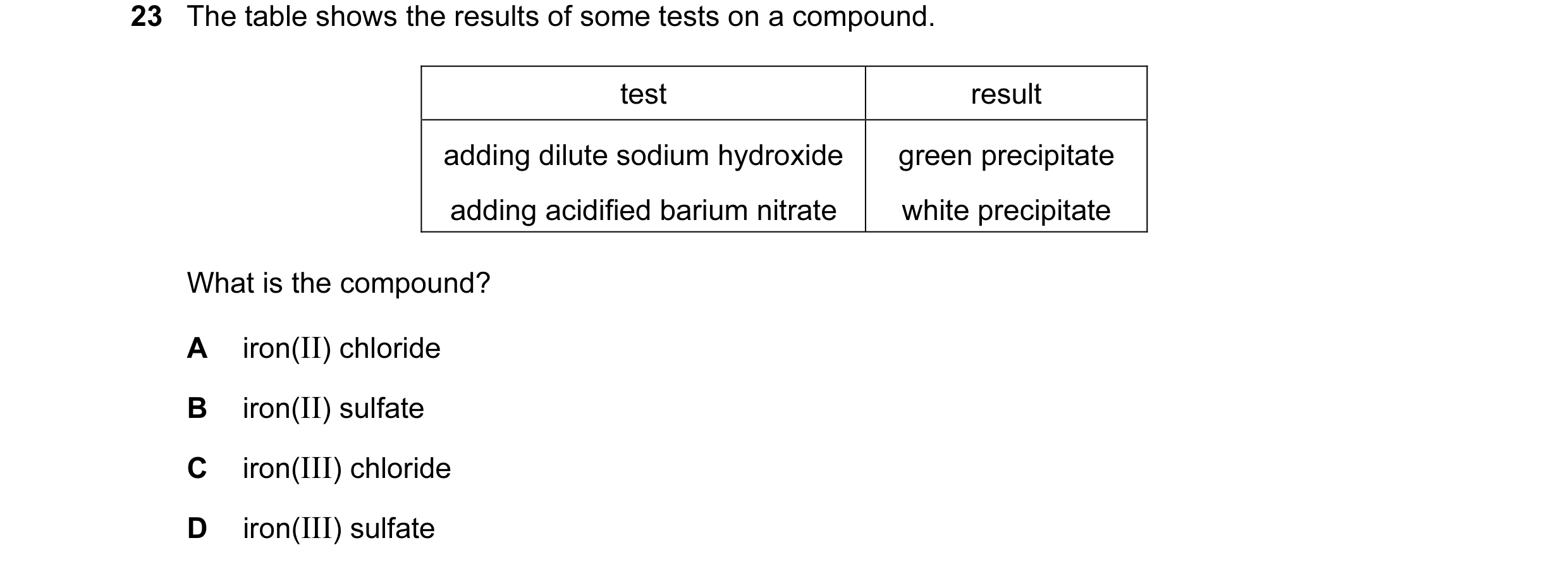
Q61 · The table shows the results of some tests on a compound 0654/11 Oct/Nov 2015
23 The table shows the results of some tests on a compound. test result adding dilute sodium hydroxide green precipitate adding acidified barium nitrate white precipitate What is the compound? A iron(II) chloride B iron(II) sulfate C iron(III) chloride D iron(III) sulfate
1 marks
Answer: B
This question in 0654/11 Oct/Nov 2015
Q62 · Sulfuric acid and sodium carbonate react and release a colourless gas 0654/12 Oct/Nov 2015
22 Sulfuric acid and sodium carbonate react and release a colourless gas. sulfuric acid colourless gas gas jar sodium carbonate trough of water What is the gas? A carbon dioxide B hydrogen C hydrogen sulfide D sulfur dioxide
1 marks
Answer: A
This question in 0654/12 Oct/Nov 2015
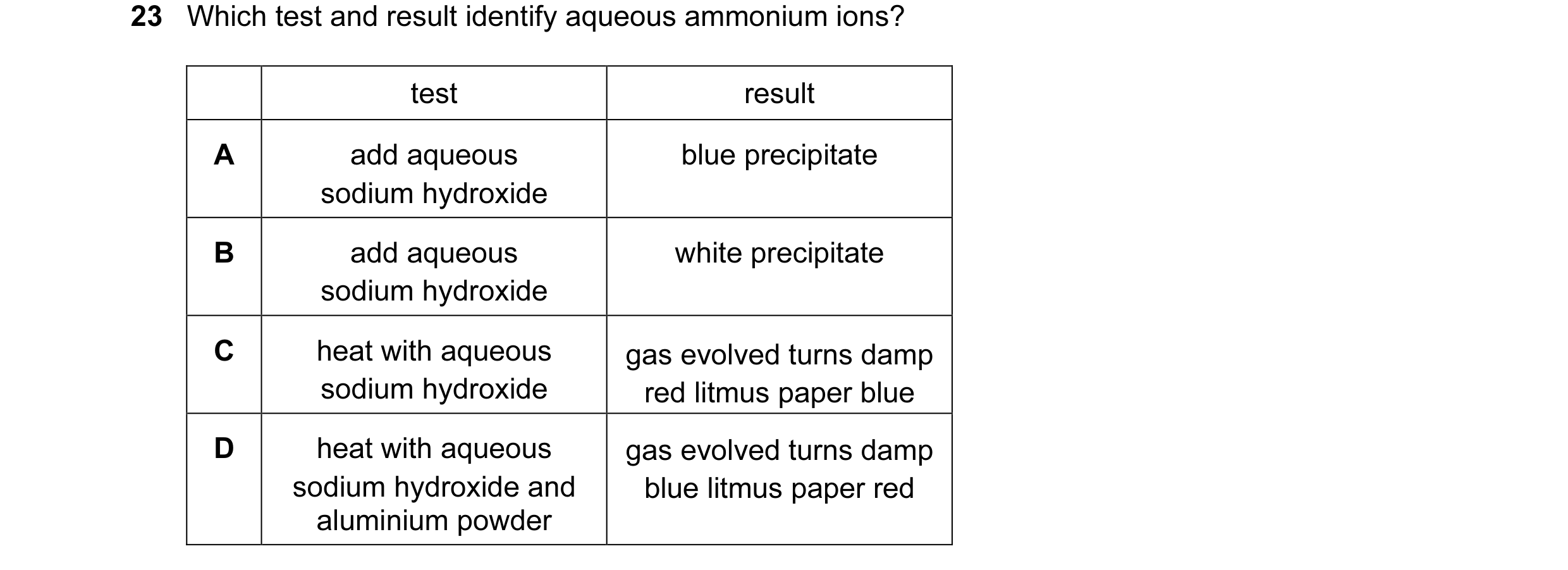
Q63 · Which test and result identify aqueous ammonium ions? 0654/12 Oct/Nov 2015
23 Which test and result identify aqueous ammonium ions? test result A add aqueous blue precipitate sodium hydroxide B add aqueous white precipitate sodium hydroxide C heat with aqueous gas evolved turns damp sodium hydroxide red litmus paper blue D heat with aqueous gas evolved turns damp sodium hydroxide and blue litmus paper red aluminium powder
1 marks
Answer: C
This question in 0654/12 Oct/Nov 2015
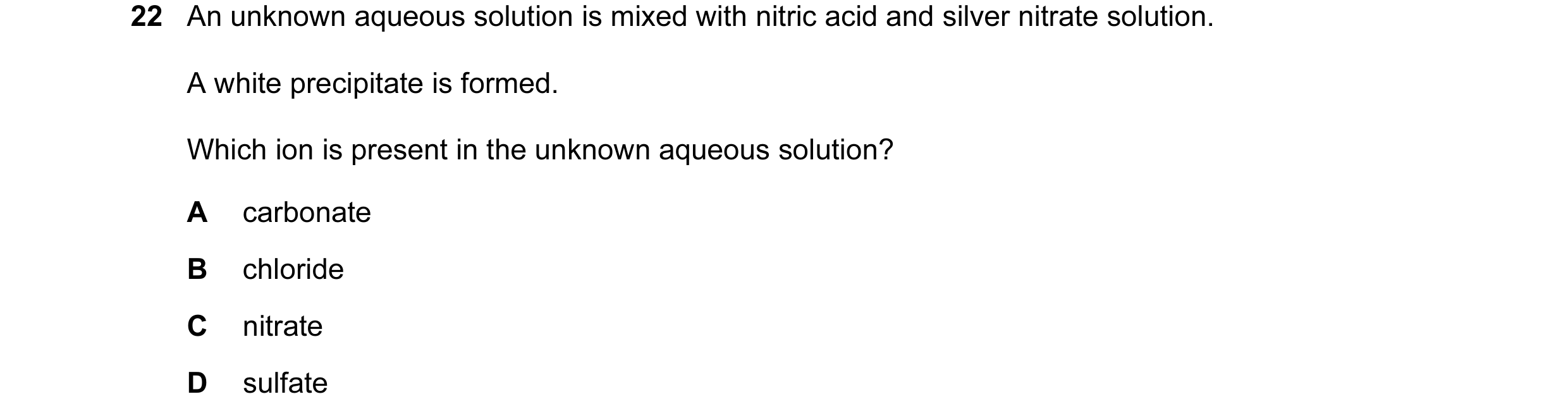
Q64 · An unknown aqueous solution is mixed with nitric acid and silver nitrate solution 0654/13 Oct/Nov 2015
22 An unknown aqueous solution is mixed with nitric acid and silver nitrate solution. A white precipitate is formed. Which ion is present in the unknown aqueous solution? A carbonate B chloride C nitrate D sulfate
1 marks
Answer: B
This question in 0654/13 Oct/Nov 2015
Q65 · Which test and result show that a fertiliser contains nitrate ions? 0654/11 May/June 2016
20 Which test and result show that a fertiliser contains nitrate ions? test result A warm with aqueous sodium hydroxide gas turns litmus blue B warm with aqueous sodium hydroxide gas turns litmus red C warm with aqueous sodium hydroxide, gas turns litmus blue then add aluminium metal D warm with aqueous sodium hydroxide, gas turns litmus red then add aluminium metal
1 marks
Answer: C
This question in 0654/11 May/June 2016
Q66 · Dilute hydrochloric acid is added to each of the test-tubes shown 0654/12 May/June 2016
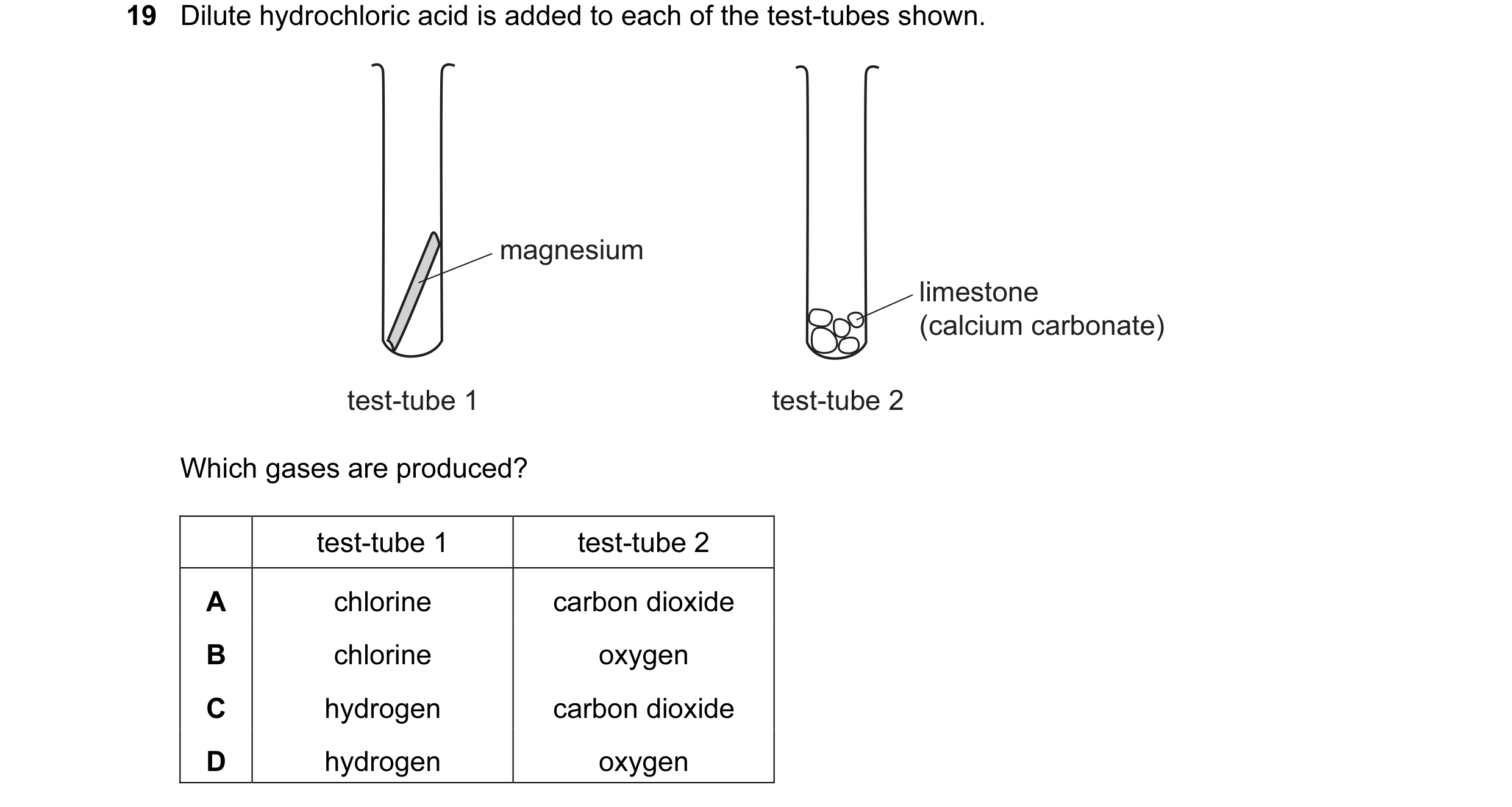
19 Dilute hydrochloric acid is added to each of the test-tubes shown. magnesium limestone (calcium carbonate) test-tube 1 test-tube 2 Which gases are produced? test-tube 1 test-tube 2 A chlorine carbon dioxide B chlorine oxygen C hydrogen carbon dioxide D hydrogen oxygen
1 marks
Answer: C
This question in 0654/12 May/June 2016
Q67 · Which test and result show that a fertiliser contains nitrate ions? 0654/12 May/June 2016
20 Which test and result show that a fertiliser contains nitrate ions? test result A warm with aqueous sodium hydroxide gas turns litmus blue B warm with aqueous sodium hydroxide gas turns litmus red C warm with aqueous sodium hydroxide, gas turns litmus blue then add aluminium metal D warm with aqueous sodium hydroxide, gas turns litmus red then add aluminium metal
1 marks
Answer: C
This question in 0654/12 May/June 2016
Q68 · Which test and result show that a fertiliser contains nitrate ions? 0654/13 May/June 2016
20 Which test and result show that a fertiliser contains nitrate ions? test result A warm with aqueous sodium hydroxide gas turns litmus blue B warm with aqueous sodium hydroxide gas turns litmus red C warm with aqueous sodium hydroxide, gas turns litmus blue then add aluminium metal D warm with aqueous sodium hydroxide, gas turns litmus red then add aluminium metal
1 marks
Answer: C
This question in 0654/13 May/June 2016
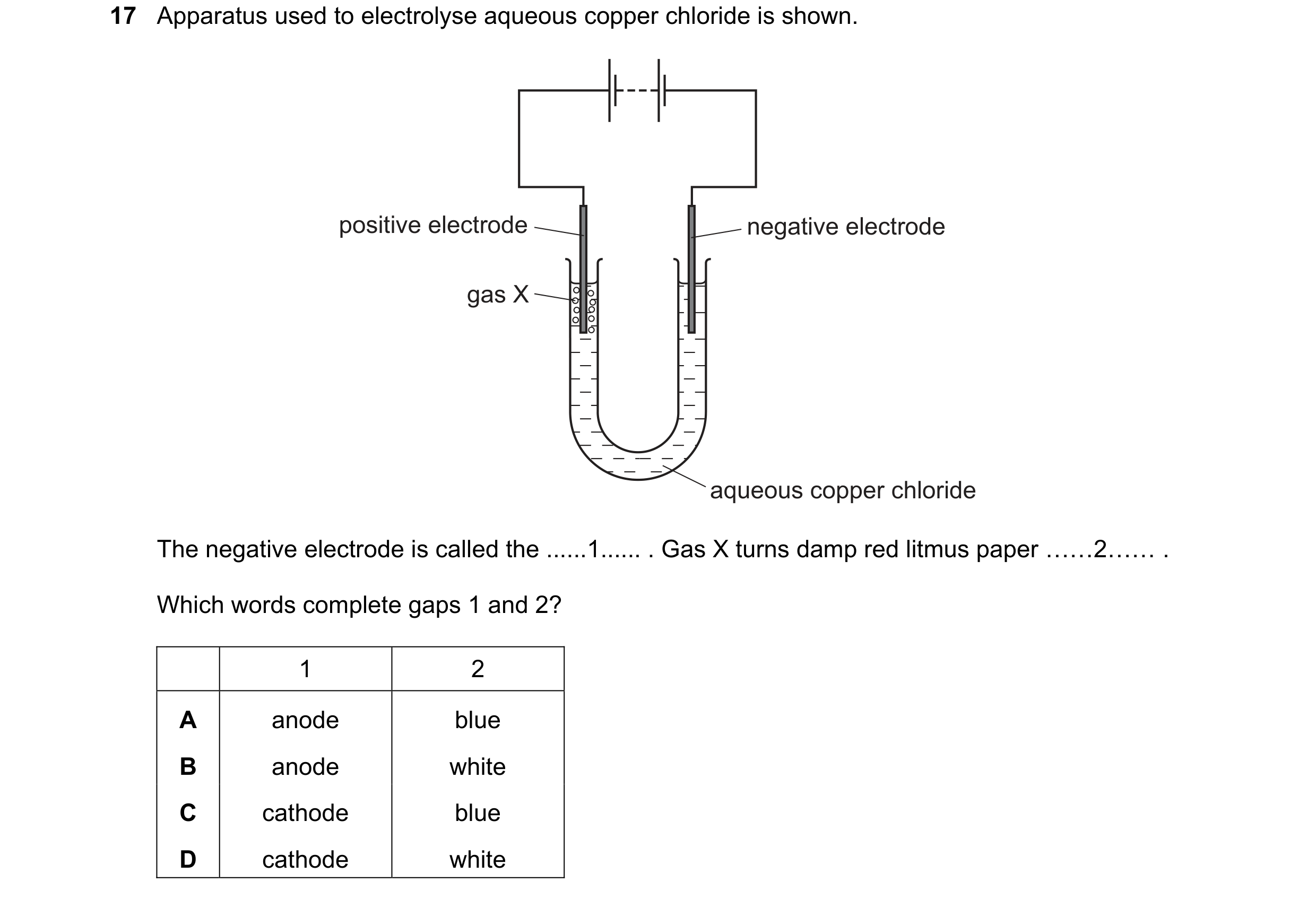
Q69 · Apparatus used to electrolyse aqueous copper chloride is shown 0654/11 Oct/Nov 2016
17 Apparatus used to electrolyse aqueous copper chloride is shown. positive electrode negative electrode gas X aqueous copper chloride The negative electrode is called the … 1 … . Gas X turns damp red litmus paper ««2«« . Which words complete gaps 1 and 2? 1 2 A anode blue B anode white C cathode blue D cathode white
1 marks
Answer: D
This question in 0654/11 Oct/Nov 2016
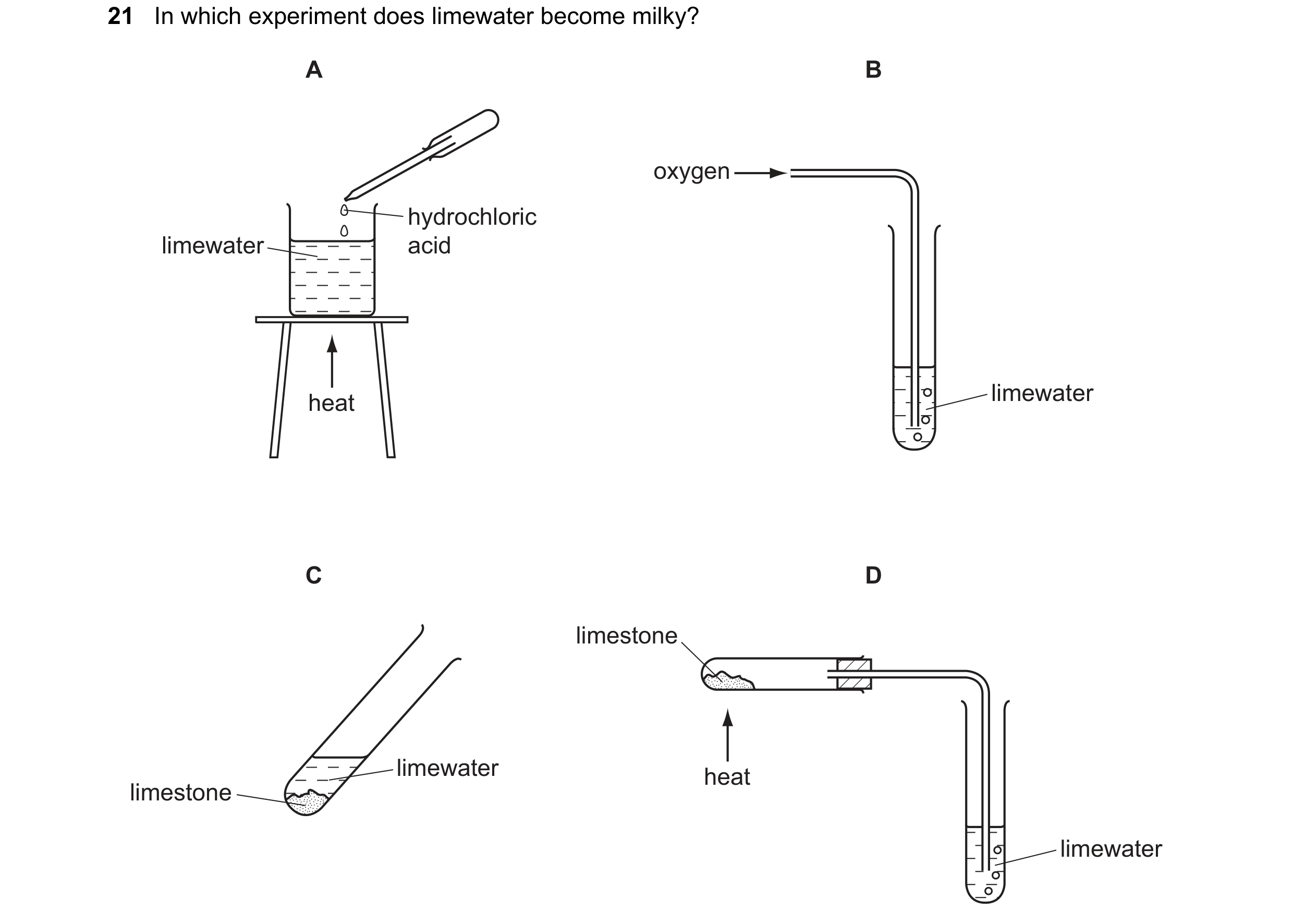
Q70 · In which experiment does limewater become milky? 0654/11 Oct/Nov 2016
21 In which experiment does limewater become milky? A B oxygen hydrochloric limewater acid heat limewater C D limestone limewater heat limestone limewater
1 marks
Answer: D
This question in 0654/11 Oct/Nov 2016
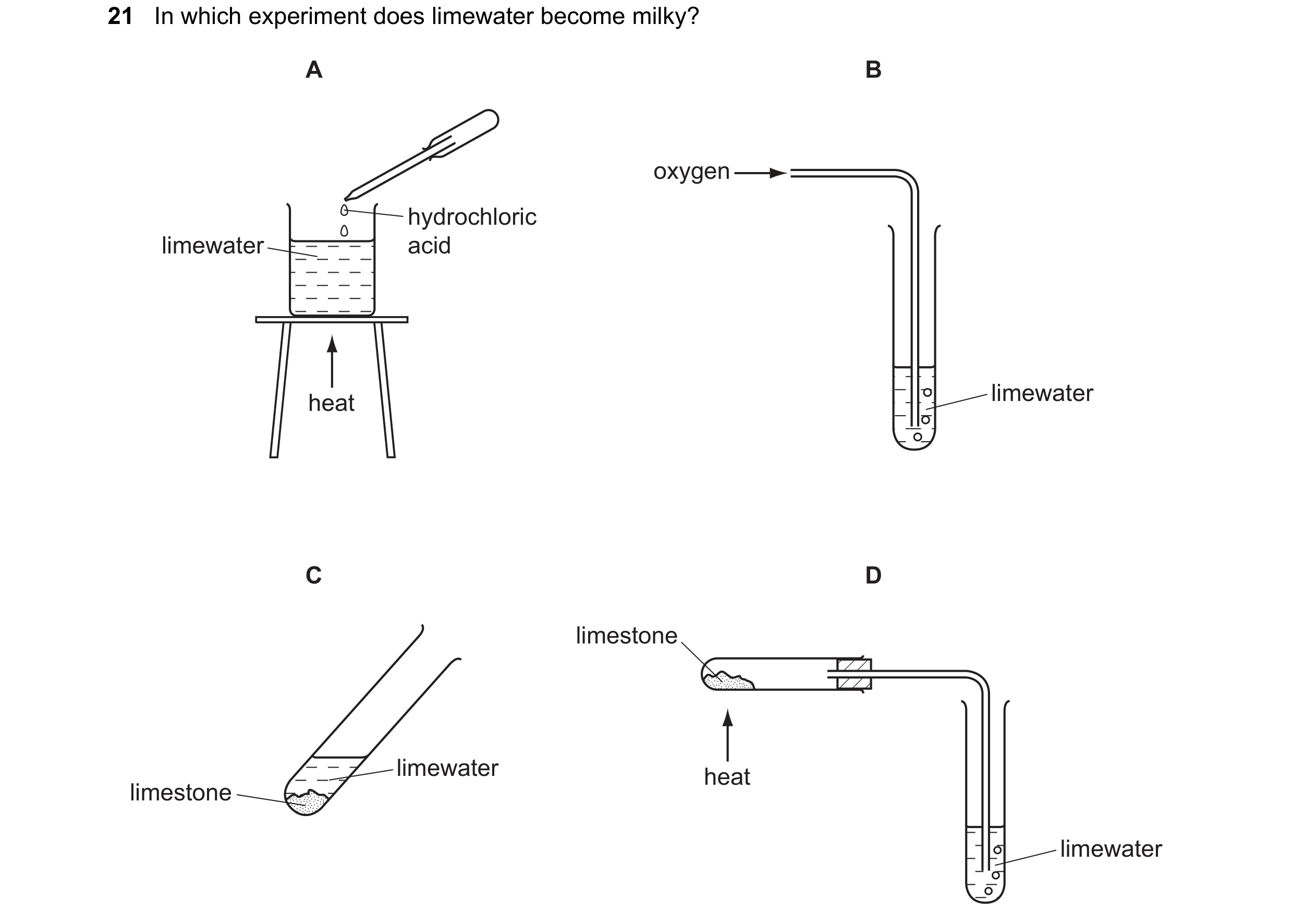
Q71 · In which experiment does limewater become milky? 0654/12 Oct/Nov 2016
21 In which experiment does limewater become milky? A B oxygen hydrochloric limewater acid heat limewater C D limestone limewater heat limestone limewater
1 marks
Answer: D
This question in 0654/12 Oct/Nov 2016
Q72 · In which experiment does limewater become milky? 0654/13 Oct/Nov 2016
21 In which experiment does limewater become milky? A B oxygen hydrochloric limewater acid heat limewater C D limestone limewater heat limestone limewater
1 marks
Answer: D
This question in 0654/13 Oct/Nov 2016
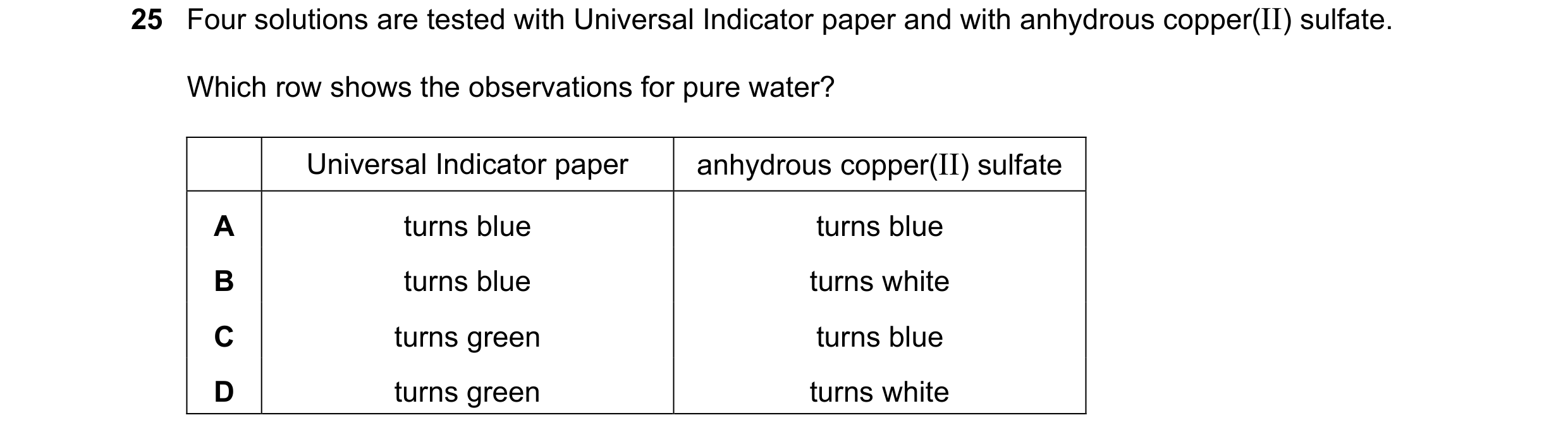
Q73 · Four solutions are tested with Universal Indicator paper and with anhydrous copper(II)… 0654/11 May/June 2017
25 Four solutions are tested with Universal Indicator paper and with anhydrous copper(II) sulfate. Which row shows the observations for pure water? Universal Indicator paper anhydrous copper(II) sulfate A turns blue turns blue B turns blue turns white C turns green turns blue D turns green turns white
1 marks
Answer: C
This question in 0654/11 May/June 2017
Q74 · Two aqueous salt solutions X and Y are tested in three separate tests 0654/12 May/June 2017
21 Two aqueous salt solutions X and Y are tested in three separate tests. The results are shown. result test X Y add aqueous light blue precipitate green precipitate sodium hydroxide add dilute nitric acid and white precipitate no change aqueous silver nitrate add dilute nitric acid and no change white precipitate aqueous barium nitrate What are X and Y? X Y A copper chloride iron(II) sulfate B copper chloride iron(III) sulfate C copper sulfate iron(II) chloride D copper sulfate iron(III) chloride
1 marks
Answer: A
This question in 0654/12 May/June 2017
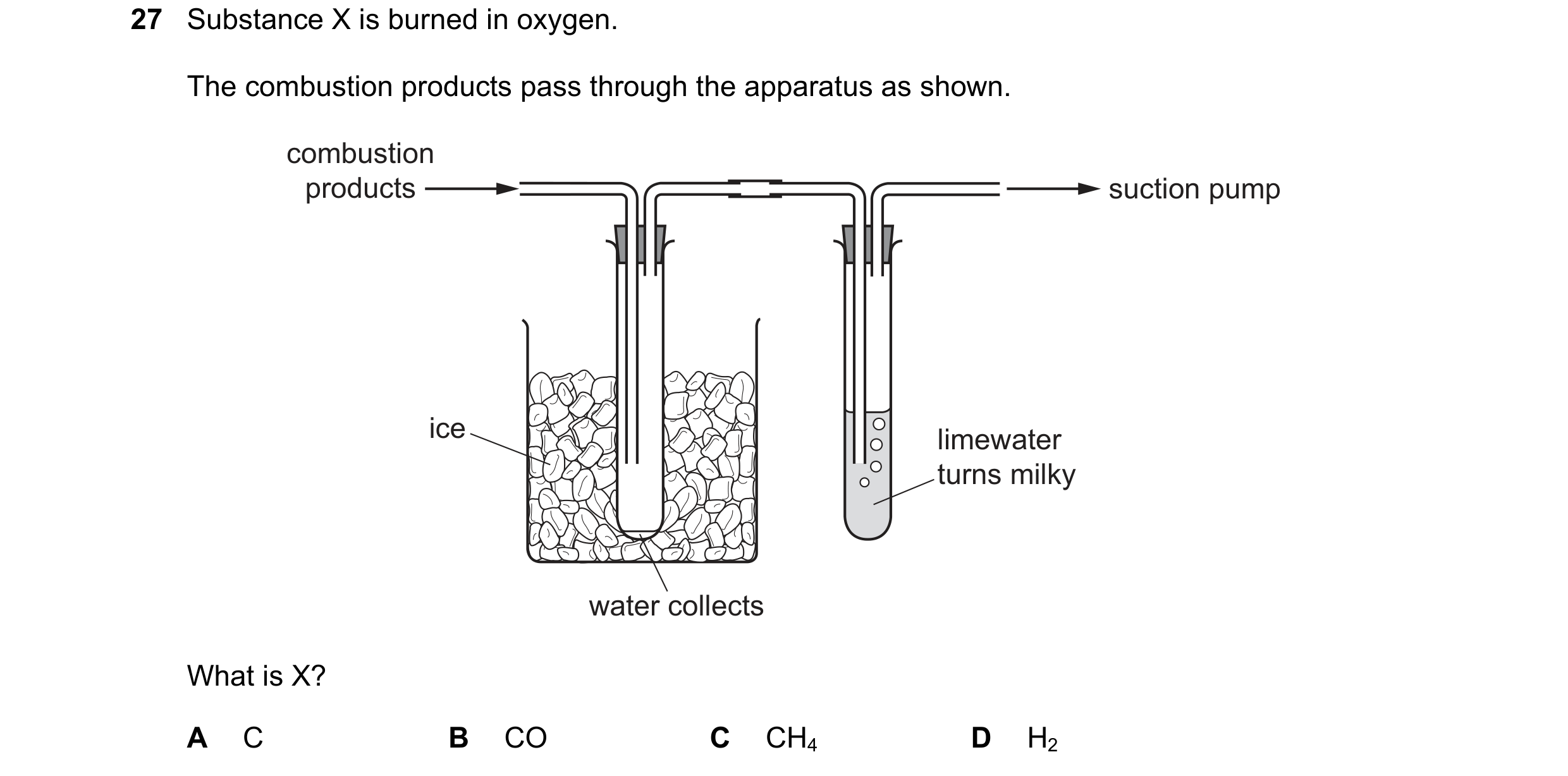
Q75 · Substance X is burned in oxygen 0654/12 May/June 2017
27 Substance X is burned in oxygen. The combustion products pass through the apparatus as shown. combustion products suction pump ice limewater turns milky water collects What is X? A C B CO C CH4 D H2
1 marks
Answer: C
This question in 0654/12 May/June 2017
Q76 · Aqueous iron(II) chloride is added to aqueous sodium hydroxide and to aqueous silver… 0654/13 May/June 2017
21 Aqueous iron(II) chloride is added to aqueous sodium hydroxide and to aqueous silver nitrate in separate tests. Which row describes the observations? aqueous aqueous sodium hydroxide silver nitrate A green precipitate white precipitate B green precipitate yellow precipitate C red-brown precipitate white precipitate D red-brown precipitate yellow precipitate
1 marks
Answer: A
This question in 0654/13 May/June 2017
Q77 · Compound X is heated with a mixture of aqueous sodium hydroxide and aluminium powder 0654/11 Oct/Nov 2017
23 Compound X is heated with a mixture of aqueous sodium hydroxide and aluminium powder. A gas is made which turns damp red litmus blue. Which compound cannot be X? A ammonium hydroxide B ammonium nitrate C potassium hydroxide D potassium nitrate
1 marks
Answer: C
This question in 0654/11 Oct/Nov 2017
Q78 · Substance X is tested using aqueous barium ions under acidic conditions 0654/12 Oct/Nov 2017
23 Substance X is tested using aqueous barium ions under acidic conditions. A white precipitate forms. Which anion is present in X? A ammonium B carbonate C nitrate D sulfate
1 marks
Answer: D
This question in 0654/12 Oct/Nov 2017
Q79 · Which gas is formed when ammonium nitrate is warmed with aqueous sodium hydroxide? 0654/12 Oct/Nov 2017
25 Which gas is formed when ammonium nitrate is warmed with aqueous sodium hydroxide? A ammonia B ammonium C nitrogen D nitrogen dioxide
1 marks
Answer: A
This question in 0654/12 Oct/Nov 2017
Q80 · The diagram shows apparatus that could be used to show the presence of carbon dioxide in… 0654/13 Oct/Nov 2017
7 The diagram shows apparatus that could be used to show the presence of carbon dioxide in exhaled air. Which liquid would be used in the test-tube? A amylase solution B limewater C sugar solution D water
1 marks
Answer: B
This question in 0654/13 Oct/Nov 2017
Q81 · What is warmed with a salt to test for ammonium ions? 0654/13 Oct/Nov 2017
25 What is warmed with a salt to test for ammonium ions? A aqueous barium chloride B aqueous litmus C aqueous silver nitrate D aqueous sodium hydroxide
1 marks
Answer: D
This question in 0654/13 Oct/Nov 2017
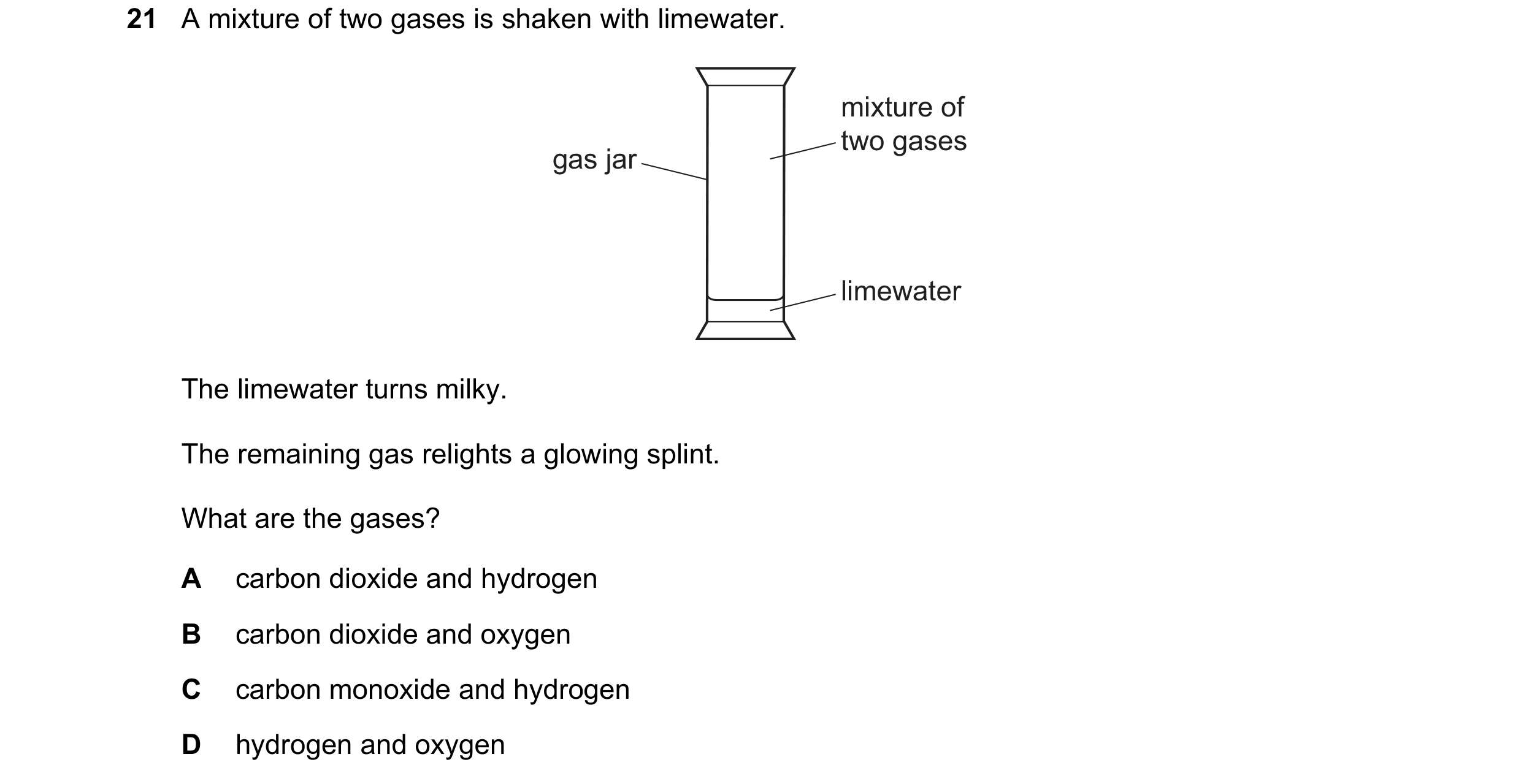
Q82 · A mixture of two gases is shaken with limewater 0654/11 Oct/Nov 2018
21 A mixture of two gases is shaken with limewater. mixture of two gases gas jar limewater The limewater turns milky. The remaining gas relights a glowing splint. What are the gases? A carbon dioxide and hydrogen B carbon dioxide and oxygen C carbon monoxide and hydrogen D hydrogen and oxygen
1 marks
Answer: B
This question in 0654/11 Oct/Nov 2018
Q83 · Which row describes the colour changes when water is added to anhydrous copper(II)… 0654/11 May/June 2019
23 Which row describes the colour changes when water is added to anhydrous copper(II) sulfate and to cobalt(II) chloride? copper(II) sulfate cobalt(II) chloride A blue → white blue → pink B blue → white pink → blue C white → blue blue → pink D white → blue pink → blue
1 marks
Answer: C
This question in 0654/11 May/June 2019
Q84 · Limewater can be used to test for differences in composition between inspired and expired… 0654/12 May/June 2019
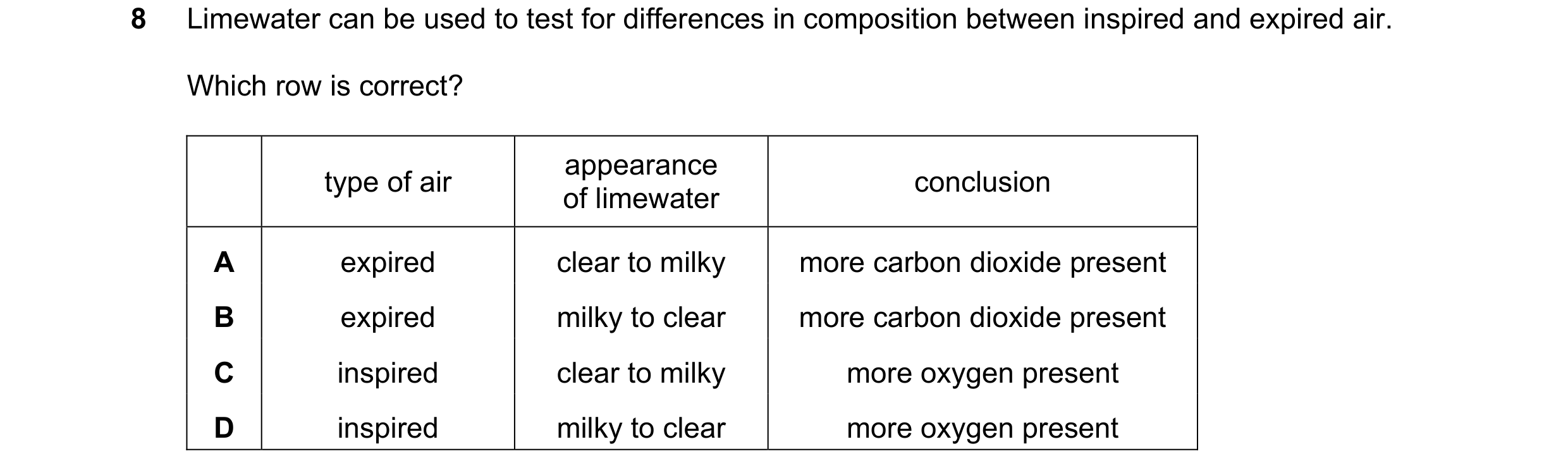
8 Limewater can be used to test for differences in composition between inspired and expired air. Which row is correct? appearance type of air conclusion of limewater A expired clear to milky more carbon dioxide present B expired milky to clear more carbon dioxide present C inspired clear to milky more oxygen present D inspired milky to clear more oxygen present
1 marks
Answer: A
This question in 0654/12 May/June 2019
Q85 · Limewater can be used to test for differences in composition between inspired and expired… 0654/13 May/June 2019
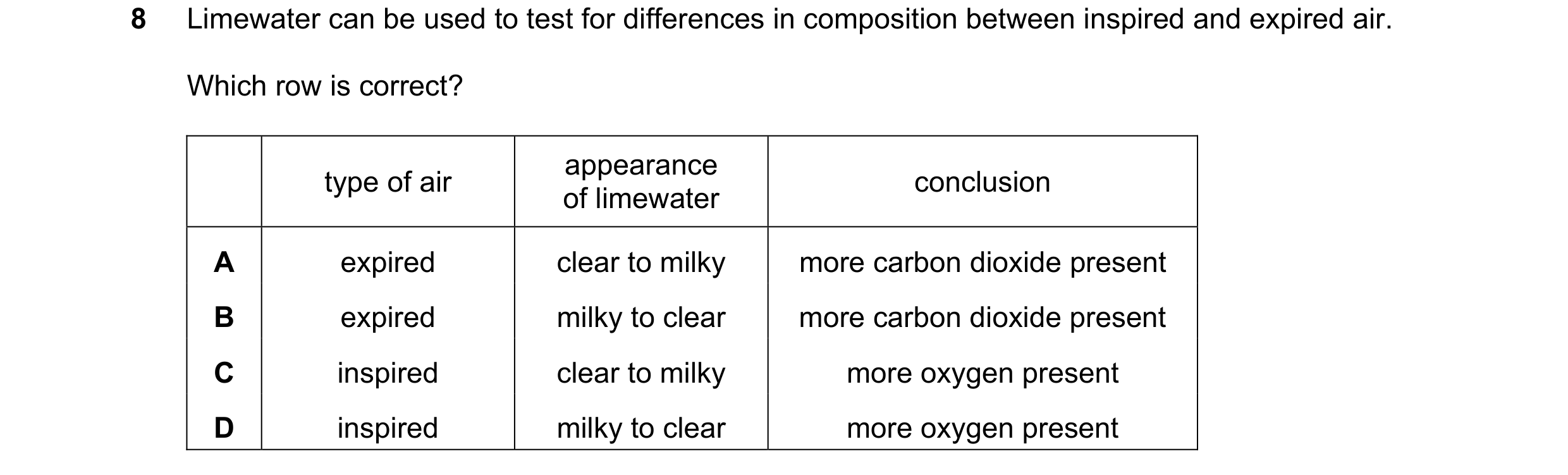
8 Limewater can be used to test for differences in composition between inspired and expired air. Which row is correct? appearance type of air conclusion of limewater A expired clear to milky more carbon dioxide present B expired milky to clear more carbon dioxide present C inspired clear to milky more oxygen present D inspired milky to clear more oxygen present
1 marks
Answer: A
This question in 0654/13 May/June 2019
Q86 · When substance X is added to blue cobalt(II) chloride paper, the paper turns pink 0654/13 Oct/Nov 2019
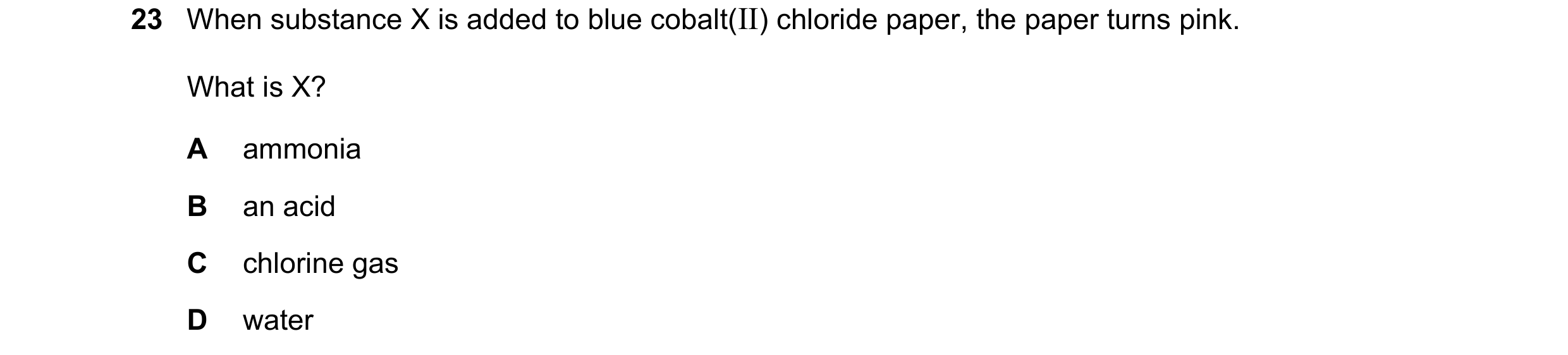
23 When substance X is added to blue cobalt(II) chloride paper, the paper turns pink. What is X? A ammonia B an acid C chlorine gas D water
1 marks
Answer: D
This question in 0654/13 Oct/Nov 2019
Q87 · Which gas turns damp red litmus paper blue? 0654/11 May/June 2020
21 Which gas turns damp red litmus paper blue? A ammonia B carbon dioxide C chlorine D hydrogen
1 marks
Answer: A
This question in 0654/11 May/June 2020
Q88 · Which test is used to identify sulfate ions? 0654/12 May/June 2020
21 Which test is used to identify sulfate ions? A aqueous barium ions under acidic conditions B aqueous silver nitrate under acidic conditions C dilute acid and then limewater D reduction with aluminium
1 marks
Answer: A
This question in 0654/12 May/June 2020
Q89 · What test is used to test for chlorine? 0654/13 May/June 2020
19 What test is used to test for chlorine? A damp litmus paper B glowing splint C lighted splint D limewater
1 marks
Answer: A
This question in 0654/13 May/June 2020
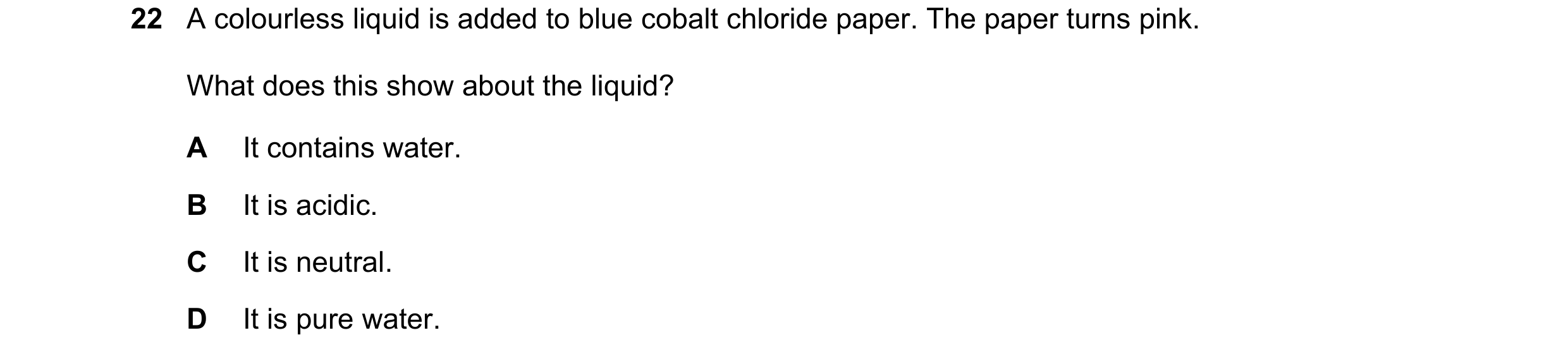
Q90 · A colourless liquid is added to blue cobalt chloride paper 0654/13 May/June 2020
22 A colourless liquid is added to blue cobalt chloride paper. The paper turns pink. What does this show about the liquid? A It contains water. B It is acidic. C It is neutral. D It is pure water.
1 marks
Answer: A
This question in 0654/13 May/June 2020
Q91 · Which chemical test does not produce a precipitate? 0654/11 Oct/Nov 2020
20 Which chemical test does not produce a precipitate? A carbon dioxide and limewater B carbonate ions and dilute hydrochloric acid C chloride ions and aqueous silver nitrate D copper(II) ions and aqueous sodium hydroxide
1 marks
Answer: B
This question in 0654/11 Oct/Nov 2020
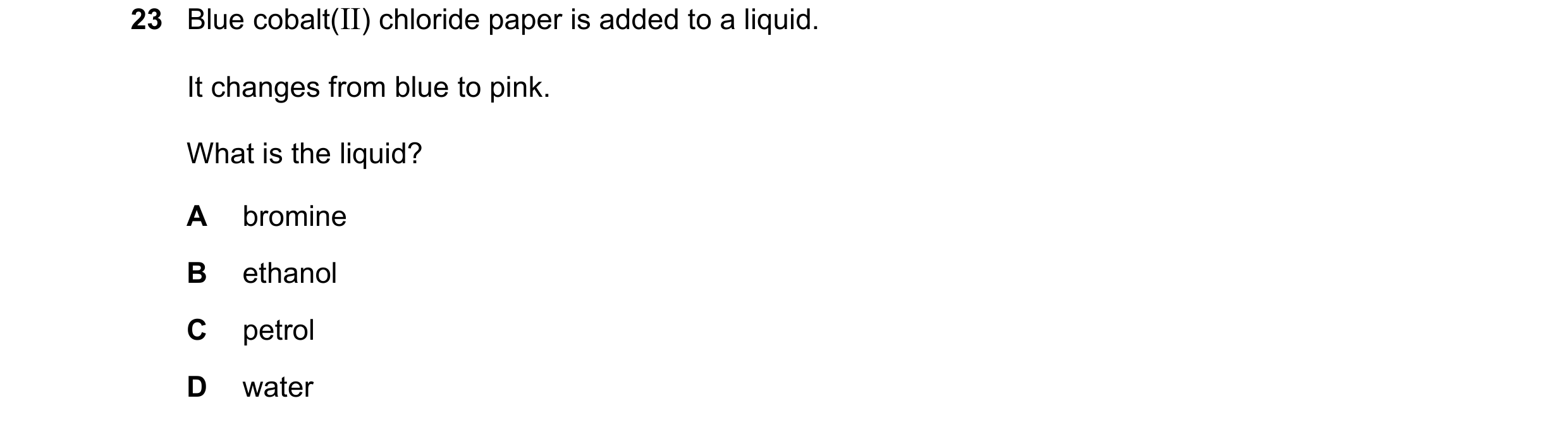
Q92 · Blue cobalt(II) chloride paper is added to a liquid 0654/12 Oct/Nov 2020
23 Blue cobalt(II) chloride paper is added to a liquid. It changes from blue to pink. What is the liquid? A bromine B ethanol C petrol D water
1 marks
Answer: D
This question in 0654/12 Oct/Nov 2020
Q93 · Substance X is insoluble in water 0654/12 Feb/March 2021
21 Substance X is insoluble in water. It reacts with dilute nitric acid to produce solution Y and a gas which turns limewater milky. A white precipitate is formed when aqueous sodium hydroxide is added to solution Y. This precipitate remains when excess sodium hydroxide is added. What is substance X? A calcium carbonate B calcium chloride C zinc carbonate D zinc chloride
1 marks
Answer: A
This question in 0654/12 Feb/March 2021
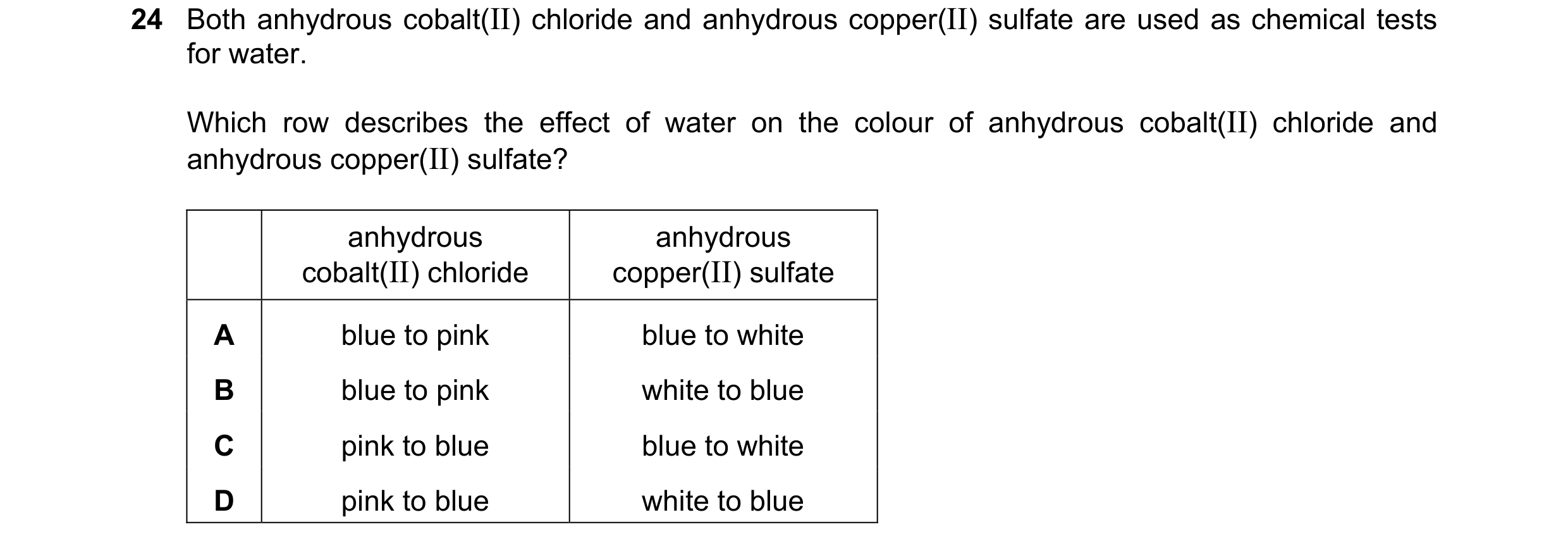
Q94 · Both anhydrous cobalt(II) chloride and anhydrous copper(II) sulfate are used as chemical… 0654/12 Feb/March 2021
24 Both anhydrous cobalt(II) chloride and anhydrous copper(II) sulfate are used as chemical tests for water. Which row describes the effect of water on the colour of anhydrous cobalt(II) chloride and anhydrous copper(II) sulfate? anhydrous anhydrous cobalt(II) chloride copper(II) sulfate A blue to pink blue to white B blue to pink white to blue C pink to blue blue to white D pink to blue white to blue
1 marks
Answer: B
This question in 0654/12 Feb/March 2021
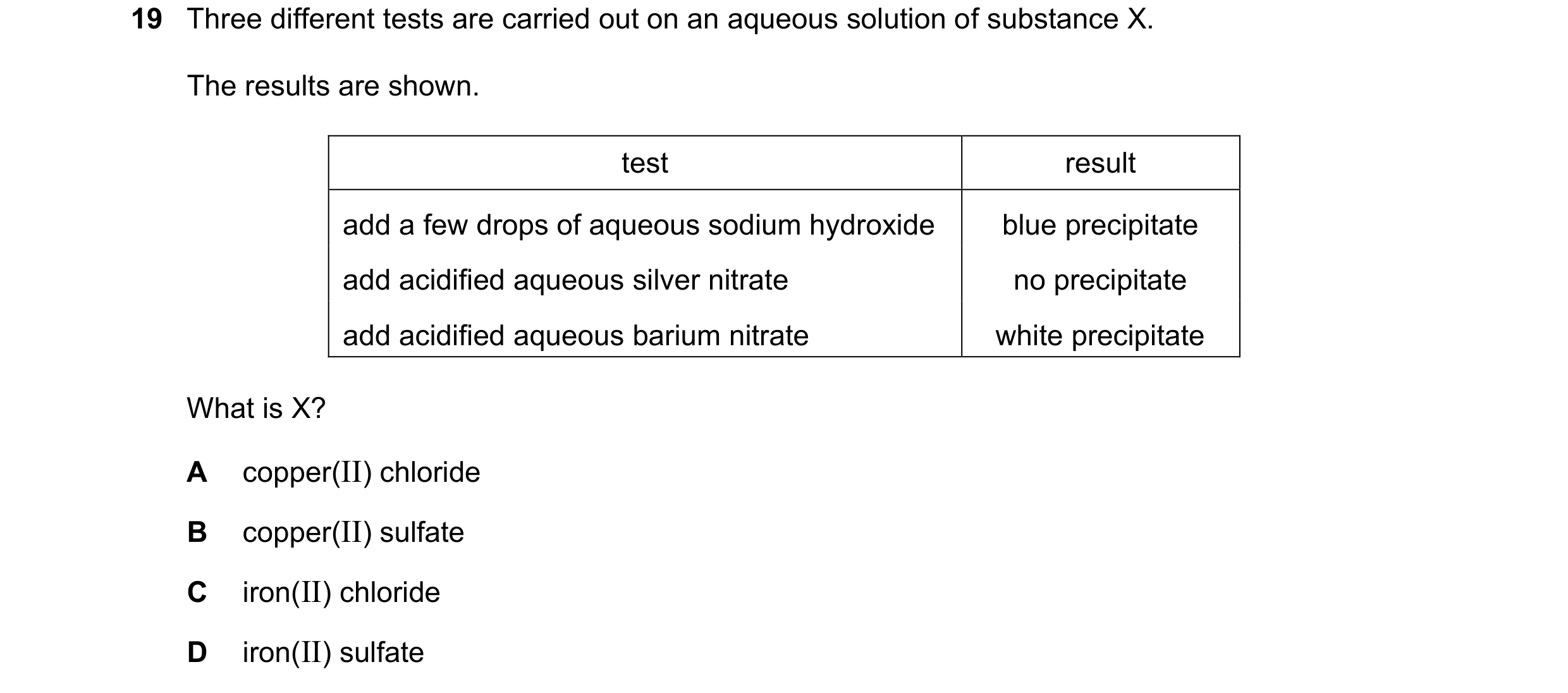
Q95 · Three different tests are carried out on an aqueous solution of substance X 0654/11 May/June 2021
19 Three different tests are carried out on an aqueous solution of substance X. The results are shown. test result add a few drops of aqueous sodium hydroxide blue precipitate add acidified aqueous silver nitrate no precipitate add acidified aqueous barium nitrate white precipitate What is X? A copper(II) chloride B copper(II) sulfate C iron(II) chloride D iron(II) sulfate
1 marks
Answer: B
This question in 0654/11 May/June 2021
Q96 · The apparatus used to investigate the combustion of ethanol is shown 0654/11 May/June 2021
23 The apparatus used to investigate the combustion of ethanol is shown. The products of combustion are passed over anhydrous cobalt(II) chloride. to suction pump anhydrous cobalt(II) chloride spirit burner ethanol How does the colour of the cobalt(II) chloride change during the investigation? A blue to pink B blue to white C pink to blue D white to blue
1 marks
Answer: A
This question in 0654/11 May/June 2021
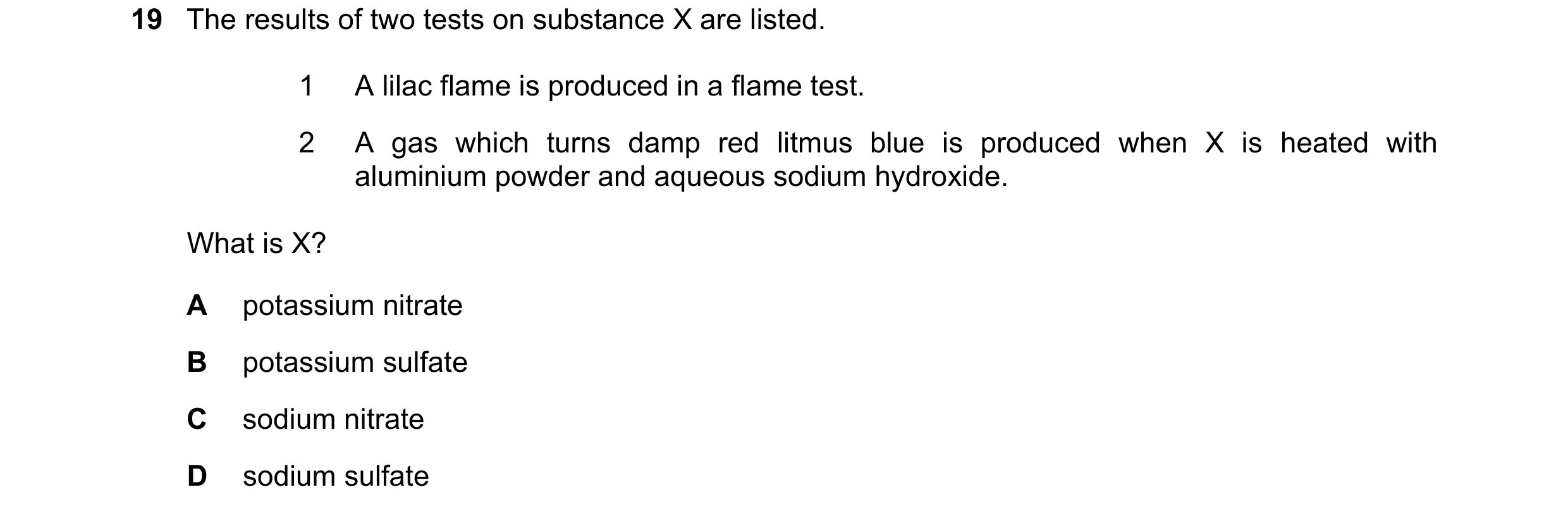
Q97 · The results of two tests on substance X are listed 0654/12 May/June 2021
19 The results of two tests on substance X are listed. 1 A lilac flame is produced in a flame test. 2 A gas which turns damp red litmus blue is produced when X is heated with aluminium powder and aqueous sodium hydroxide. What is X? A potassium nitrate B potassium sulfate C sodium nitrate D sodium sulfate
1 marks
Answer: A
This question in 0654/12 May/June 2021
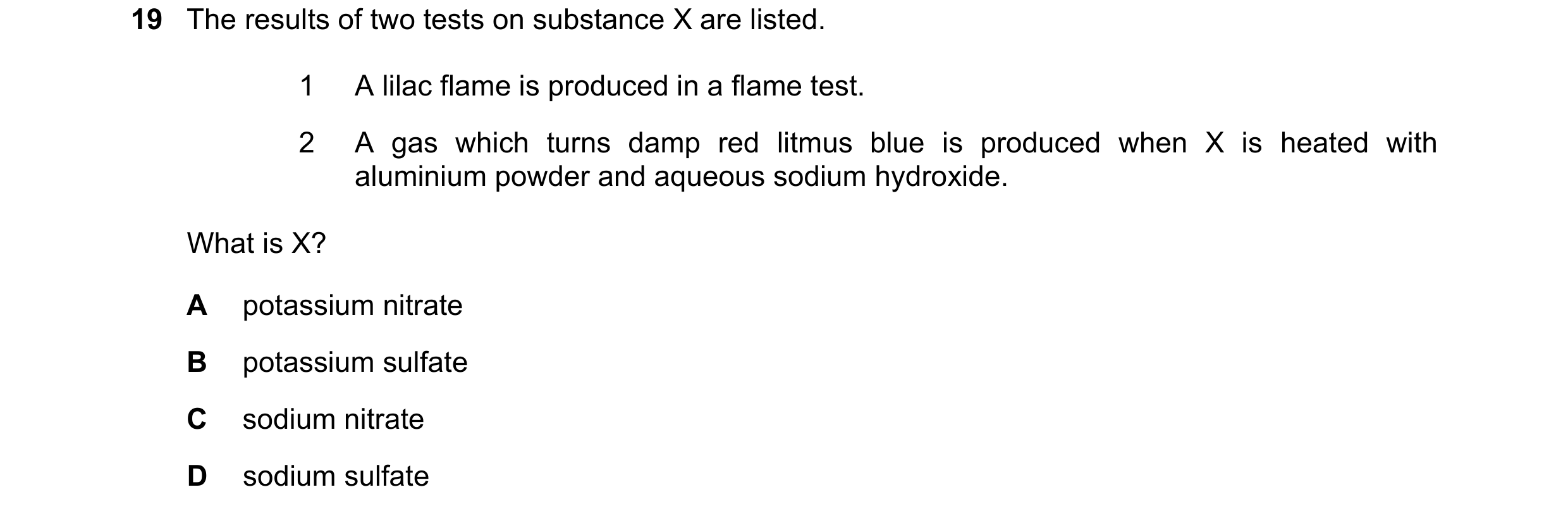
Q98 · The results of two tests on substance X are listed 0654/13 May/June 2021
19 The results of two tests on substance X are listed. 1 A lilac flame is produced in a flame test. 2 A gas which turns damp red litmus blue is produced when X is heated with aluminium powder and aqueous sodium hydroxide. What is X? A potassium nitrate B potassium sulfate C sodium nitrate D sodium sulfate
1 marks
Answer: A
This question in 0654/13 May/June 2021
Q99 · The diagram shows the electrolysis of a compound 0654/12 Oct/Nov 2021
17 The diagram shows the electrolysis of a compound. switch + – P Q electrolyte When the switch is closed, the solution around electrode P turns orange because a halogen is formed. The positive electrode P is called the ……1……, and the halogen is ……2…… . Which words complete gaps 1 and 2? 1 2 A anode bromine B anode chlorine C cathode bromine D cathode chlorine
1 marks
Answer: A
This question in 0654/12 Oct/Nov 2021
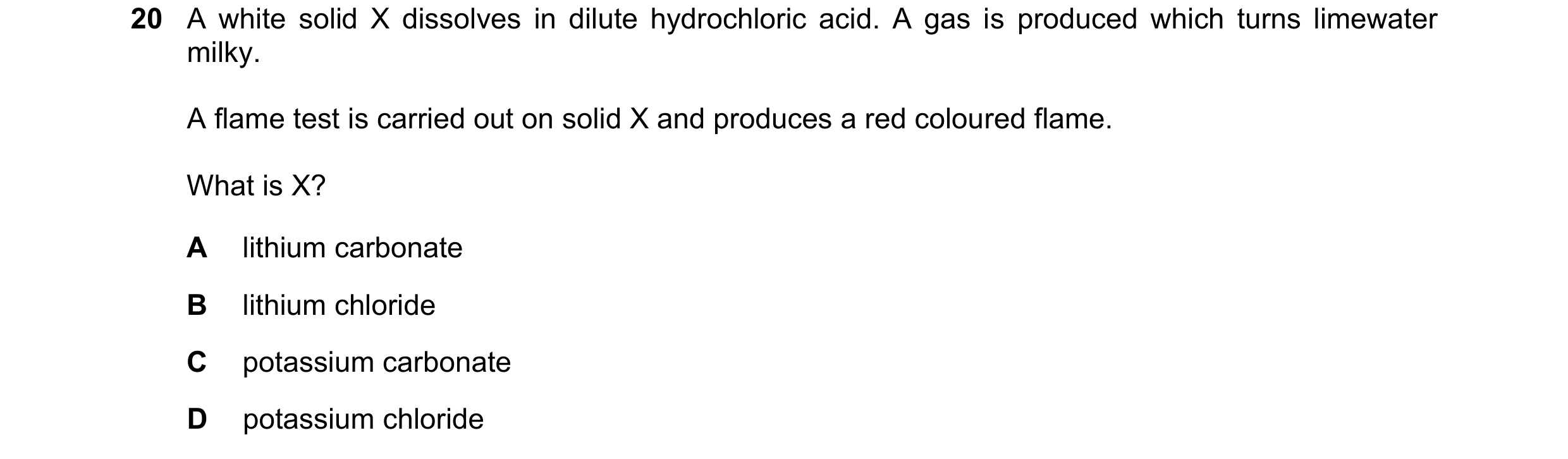
Q100 · A white solid X dissolves in dilute hydrochloric acid 0654/12 Oct/Nov 2021
20 A white solid X dissolves in dilute hydrochloric acid. A gas is produced which turns limewater milky. A flame test is carried out on solid X and produces a red coloured flame. What is X? A lithium carbonate B lithium chloride C potassium carbonate D potassium chloride
1 marks
Answer: A
This question in 0654/12 Oct/Nov 2021
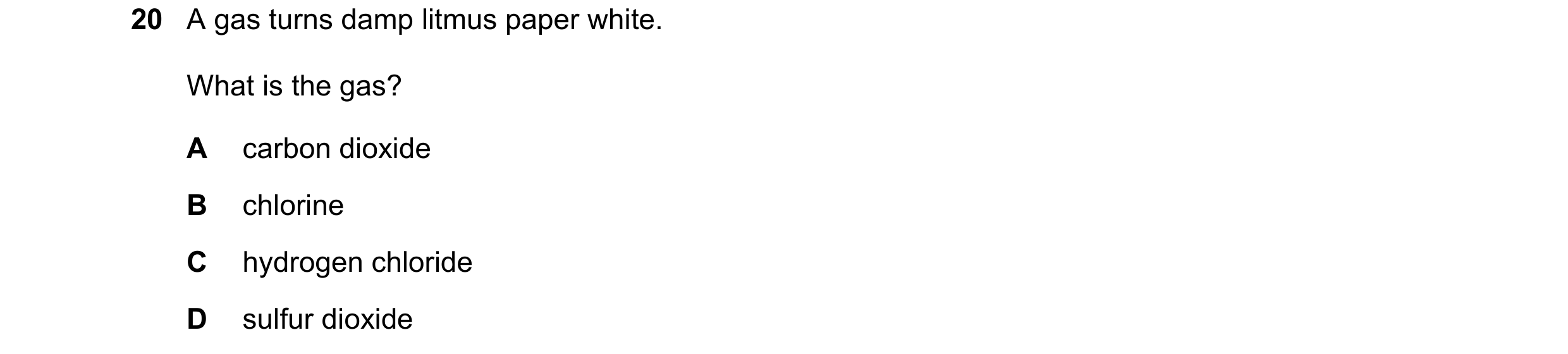
Q101 · A gas turns damp litmus paper white 0654/13 Oct/Nov 2021
20 A gas turns damp litmus paper white. What is the gas? A carbon dioxide B chlorine C hydrogen chloride D sulfur dioxide
1 marks
Answer: B
This question in 0654/13 Oct/Nov 2021
Q102 · Which test and its result identifies aqueous bromide ions? 0654/12 Feb/March 2022
19 Which test and its result identifies aqueous bromide ions? A adding acidified aqueous silver nitrate forming a cream precipitate B adding acidified aqueous silver nitrate forming a white precipitate C adding aluminium foil and heating with sodium hydroxide forming a gas that turns red litmus paper blue D adding dilute acid forming a gas that produces a white precipitate when bubbled through limewater
1 marks
Answer: A
This question in 0654/12 Feb/March 2022
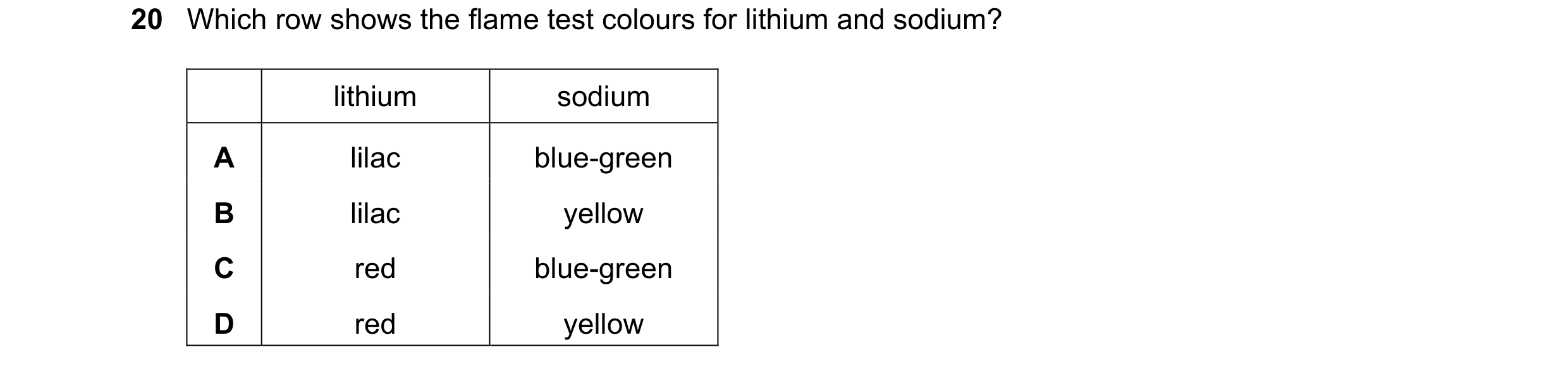
Q103 · Which row shows the flame test colours for lithium and sodium? 0654/11 May/June 2022
20 Which row shows the flame test colours for lithium and sodium? lithium sodium A lilac blue-green B lilac yellow C red blue-green D red yellow
1 marks
Answer: D
This question in 0654/11 May/June 2022
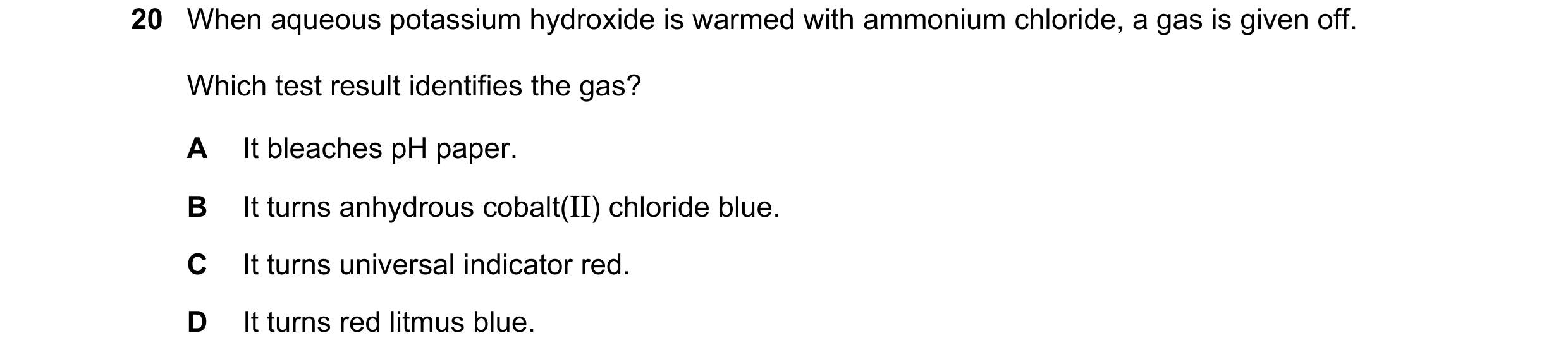
Q104 · When aqueous potassium hydroxide is warmed with ammonium chloride, a gas is given off 0654/12 May/June 2022
20 When aqueous potassium hydroxide is warmed with ammonium chloride, a gas is given off. Which test result identifies the gas? A It bleaches pH paper. B It turns anhydrous cobalt(II) chloride blue. C It turns universal indicator red. D It turns red litmus blue.
1 marks
Answer: D
This question in 0654/12 May/June 2022
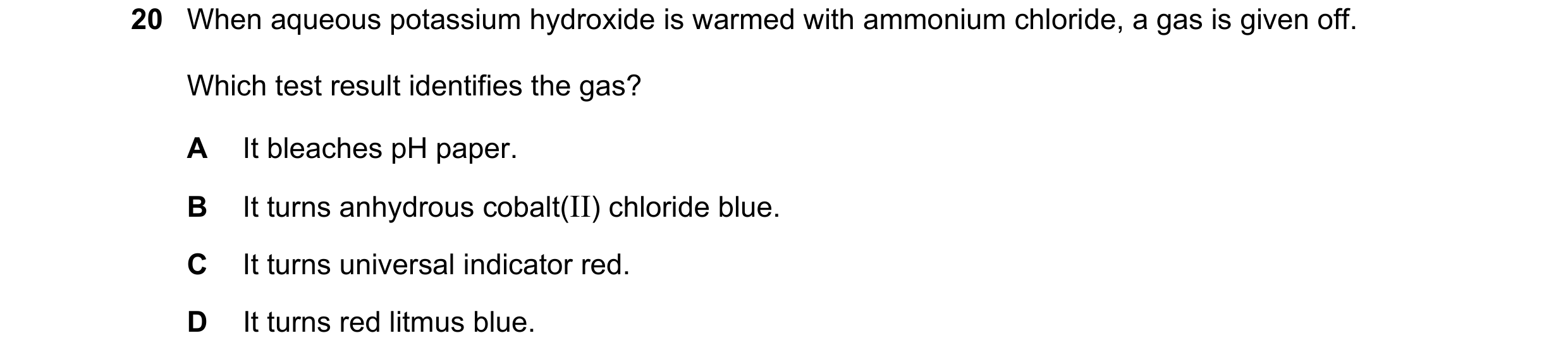
Q105 · When aqueous potassium hydroxide is warmed with ammonium chloride, a gas is given off 0654/13 May/June 2022
20 When aqueous potassium hydroxide is warmed with ammonium chloride, a gas is given off. Which test result identifies the gas? A It bleaches pH paper. B It turns anhydrous cobalt(II) chloride blue. C It turns universal indicator red. D It turns red litmus blue.
1 marks
Answer: D
This question in 0654/13 May/June 2022
Q106 · Which colour change is observed when water is tested using copper(II) sulfate? 0654/13 May/June 2022
25 Which colour change is observed when water is tested using copper(II) sulfate? A blue pink B blue white C white blue D white pink
1 marks
Answer: C
This question in 0654/13 May/June 2022
Q107 · Copper carbonate is reacted with dilute hydrochloric acid 0654/11 Oct/Nov 2022
20 Copper carbonate is reacted with dilute hydrochloric acid. Which gas is given off? A carbon dioxide B hydrogen C nitrogen D sulfur dioxide
1 marks
Answer: A
This question in 0654/11 Oct/Nov 2022
Q108 · Water is tested with white copper(II) sulfate powder and with blue cobalt(II) chloride… 0654/11 Oct/Nov 2022
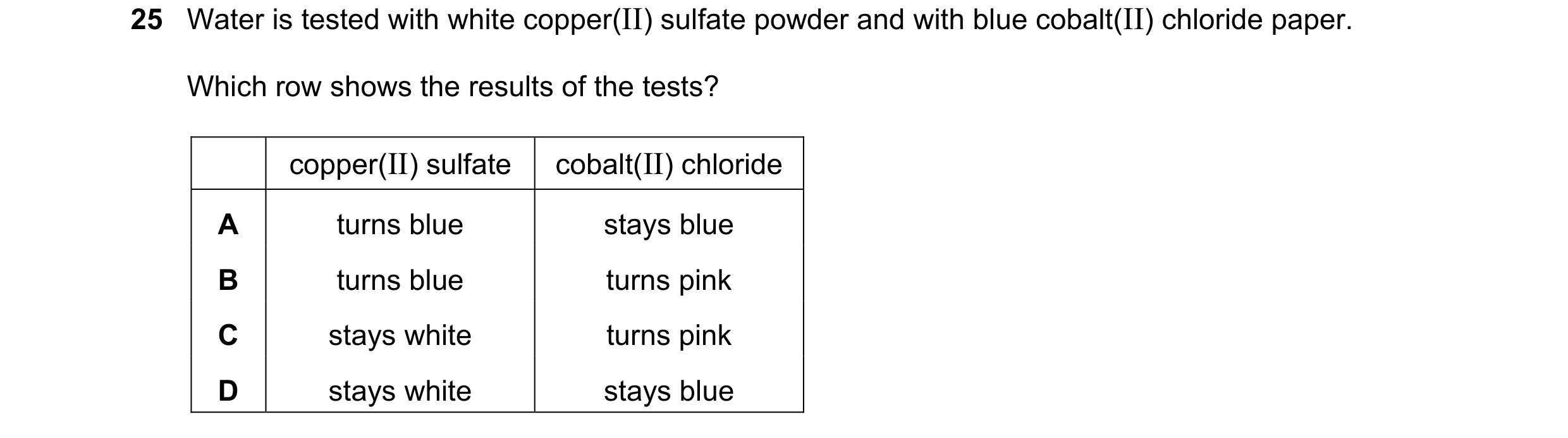
25 Water is tested with white copper(II) sulfate powder and with blue cobalt(II) chloride paper. Which row shows the results of the tests? copper(II) sulfate cobalt(II) chloride A turns blue stays blue B turns blue turns pink C stays white turns pink D stays white stays blue
1 marks
Answer: B
This question in 0654/11 Oct/Nov 2022
Q109 · Which substance turns blue when it is added to pure water? 0654/13 Oct/Nov 2022
25 Which substance turns blue when it is added to pure water? A anhydrous copper(II) sulfate B anhydrous cobalt(II) chloride C red litmus D universal indicator
1 marks
Answer: A
This question in 0654/13 Oct/Nov 2022
Q110 · Substance X is mixed with aqueous sodium hydroxide 0654/11 Oct/Nov 2023
21 Substance X is mixed with aqueous sodium hydroxide. A green precipitate is produced. Which metal ion is present in X? A Cu2+ B Fe2+ C Fe3+ D Zn2+
1 marks
Answer: B
This question in 0654/11 Oct/Nov 2023
Q111 · A colourless liquid gives the test results shown 0654/12 Oct/Nov 2023
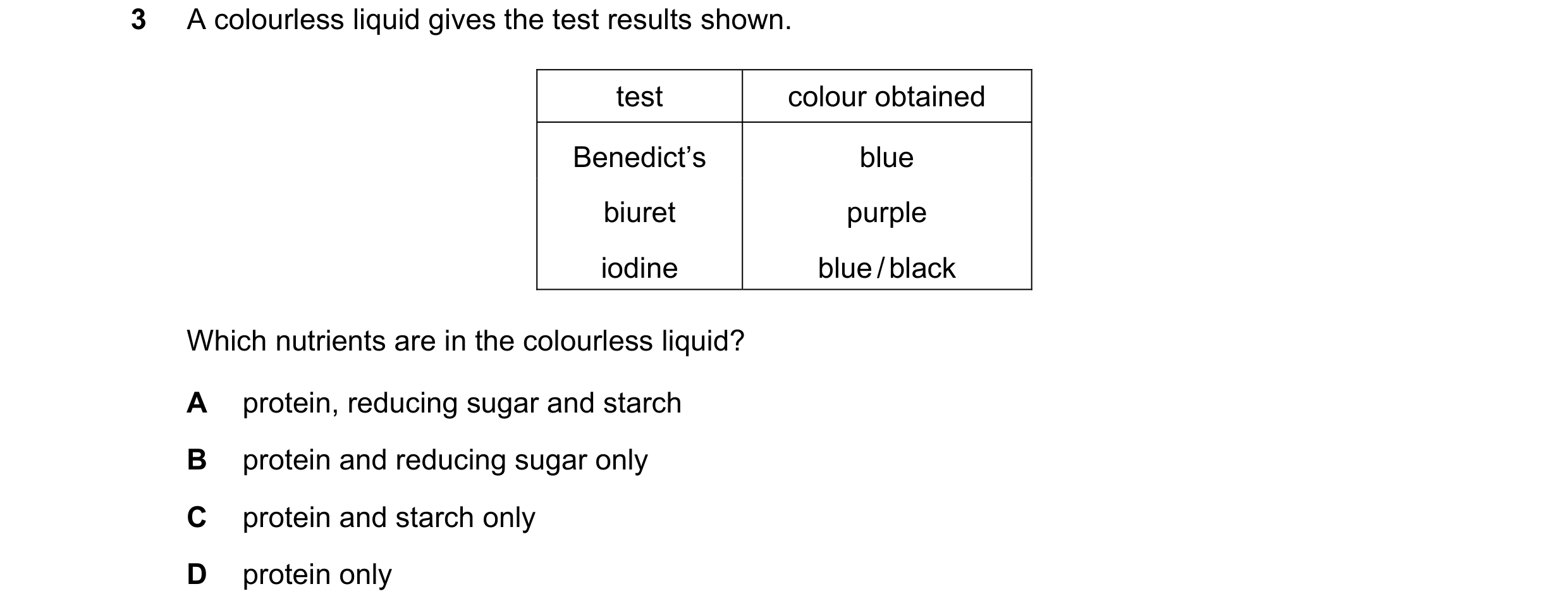
3 A colourless liquid gives the test results shown. test colour obtained Benedict’s blue biuret purple iodine blue / black Which nutrients are in the colourless liquid? A protein, reducing sugar and starch B protein and reducing sugar only C protein and starch only D protein only
1 marks
Answer: C
This question in 0654/12 Oct/Nov 2023
Q112 · A piece of damp blue litmus paper is put in a test-tube of a gas 0654/13 Oct/Nov 2023
20 A piece of damp blue litmus paper is put in a test-tube of a gas. The litmus paper turns red and then changes to white. What is the gas? A ammonia B carbon dioxide C chlorine D oxygen
1 marks
Answer: C
This question in 0654/13 Oct/Nov 2023
Q113 · What is used to test for the presence of carbon dioxide? 0654/12 Feb/March 2024
8 What is used to test for the presence of carbon dioxide? A Benedict’s solution B ethanol C iodine solution D limewater
1 marks
Answer: D
This question in 0654/12 Feb/March 2024
Q114 · Concentrated aqueous sodium chloride is electrolysed using inert electrodes 0654/12 Feb/March 2024
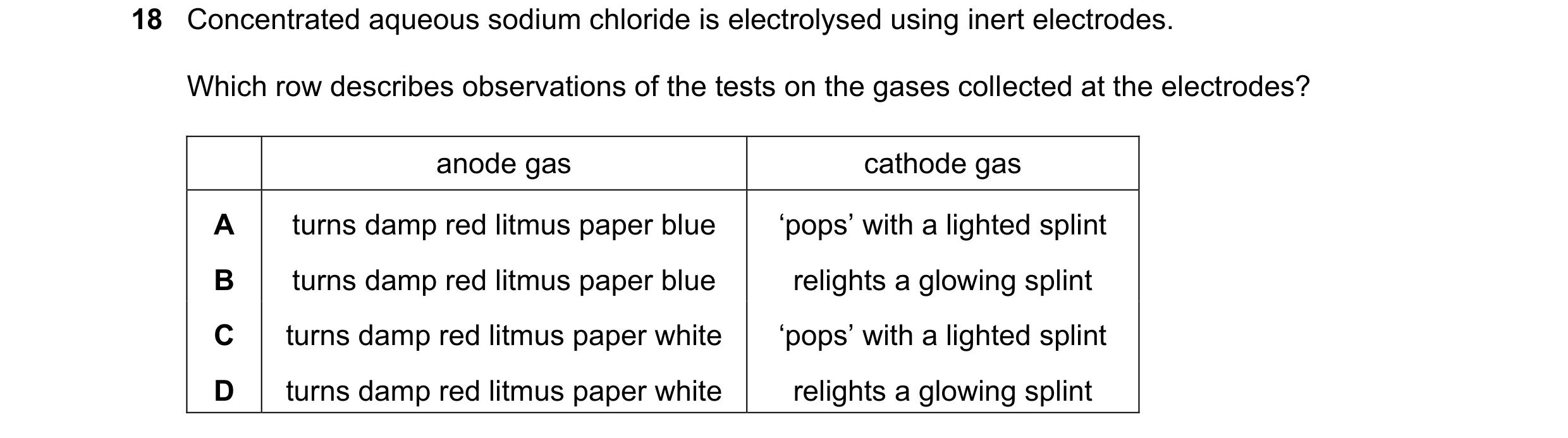
18 Concentrated aqueous sodium chloride is electrolysed using inert electrodes. Which row describes observations of the tests on the gases collected at the electrodes? anode gas cathode gas A turns damp red litmus paper blue ‘pops’ with a lighted splint B turns damp red litmus paper blue relights a glowing splint C turns damp red litmus paper white ‘pops’ with a lighted splint D turns damp red litmus paper white relights a glowing splint
1 marks
Answer: C
This question in 0654/12 Feb/March 2024
Q115 · White solid X reacts with dilute hydrochloric acid 0654/12 May/June 2024
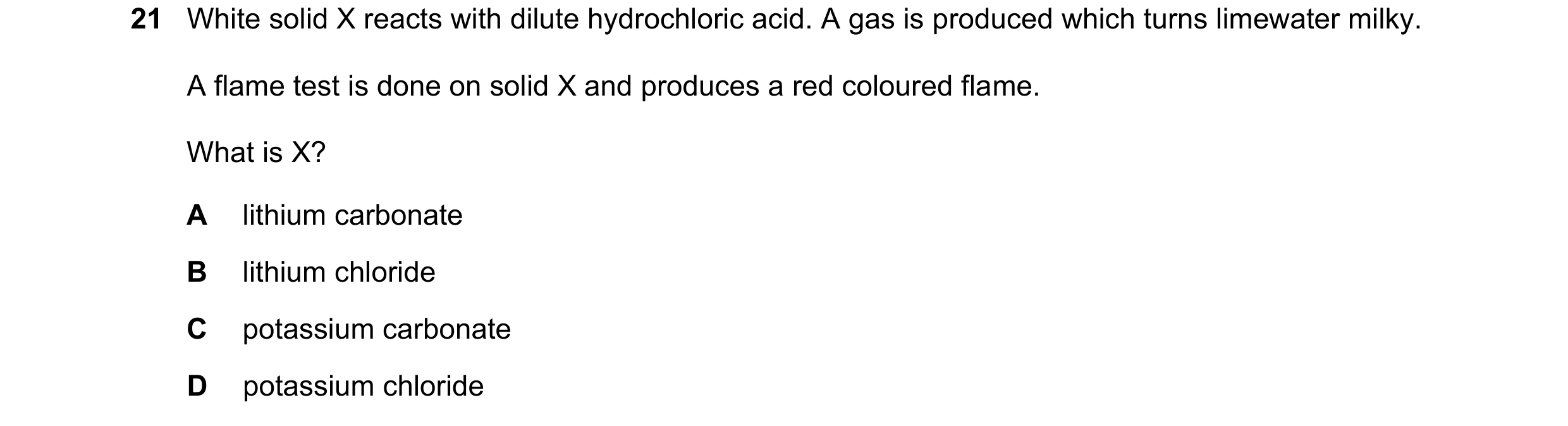
21 White solid X reacts with dilute hydrochloric acid. A gas is produced which turns limewater milky. A flame test is done on solid X and produces a red coloured flame. What is X? A lithium carbonate B lithium chloride C potassium carbonate D potassium chloride
1 marks
Answer: A
This question in 0654/12 May/June 2024
Q116 · White solid X reacts with dilute hydrochloric acid 0654/13 May/June 2024
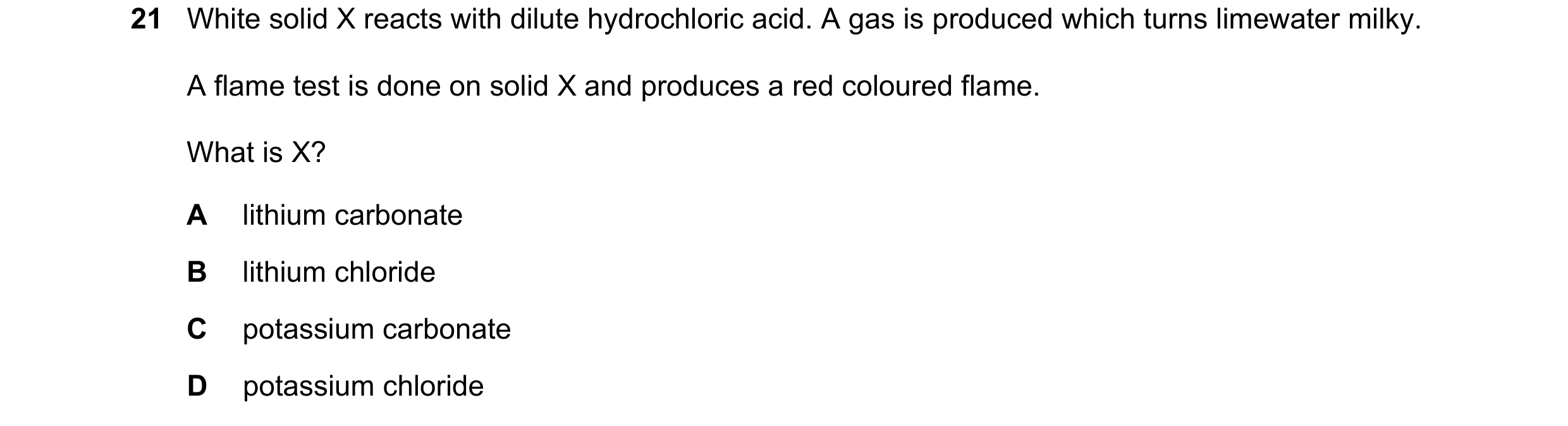
21 White solid X reacts with dilute hydrochloric acid. A gas is produced which turns limewater milky. A flame test is done on solid X and produces a red coloured flame. What is X? A lithium carbonate B lithium chloride C potassium carbonate D potassium chloride
1 marks
Answer: A
This question in 0654/13 May/June 2024
Q117 · The results of two tests on compound P are shown 0654/11 Oct/Nov 2024
23 The results of two tests on compound P are shown. test observation flame test red flame addition of acidified silver nitrate white precipitate What is P? A lithium bromide B lithium chloride C sodium bromide D sodium chloride
1 marks
Answer: B
This question in 0654/11 Oct/Nov 2024
Q118 · Which chemical test does not produce a precipitate? 0654/12 Oct/Nov 2024
21 Which chemical test does not produce a precipitate? A carbon dioxide and limewater B carbonate ions and dilute hydrochloric acid C chloride ions and aqueous silver nitrate D copper(II) ions and aqueous sodium hydroxide
1 marks
Answer: B
This question in 0654/12 Oct/Nov 2024
Q119 · Which chemical test does not produce a precipitate? 0654/13 Oct/Nov 2024
21 Which chemical test does not produce a precipitate? A carbon dioxide and limewater B carbonate ions and dilute hydrochloric acid C chloride ions and aqueous silver nitrate D copper(II) ions and aqueous sodium hydroxide
1 marks
Answer: B
This question in 0654/13 Oct/Nov 2024
Q120 · Which gas turns damp red litmus paper blue? 0654/12 Feb/March 2025
27 Which gas turns damp red litmus paper blue? A ammonia B carbon dioxide C chlorine D hydrogen
1 marks
Answer: A
This question in 0654/12 Feb/March 2025
Q121 · Four liquids are tested with universal indicator and with anhydrous copper(II) sulfate 0654/11 May/June 2025
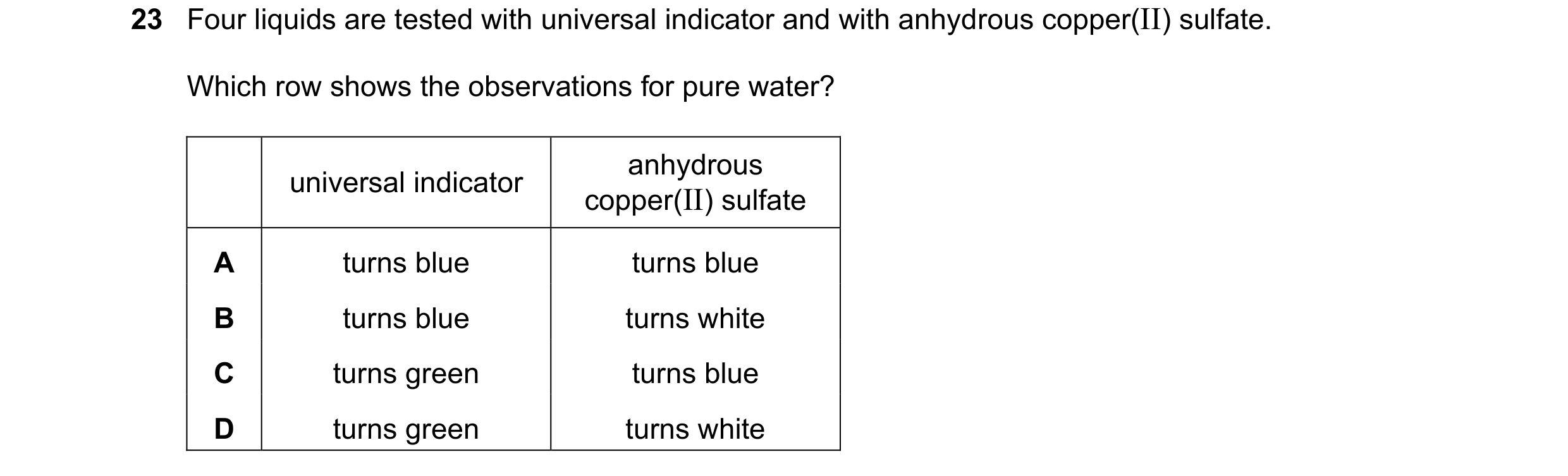
23 Four liquids are tested with universal indicator and with anhydrous copper(II) sulfate. Which row shows the observations for pure water? anhydrous universal indicator copper(II) sulfate A turns blue turns blue B turns blue turns white C turns green turns blue D turns green turns white
1 marks
Answer: C
This question in 0654/11 May/June 2025
Q122 · Aqueous ammonia is separately added dropwise and then in excess to four different aqueous… 0654/11 May/June 2025
27 Aqueous ammonia is separately added dropwise and then in excess to four different aqueous cations. Which cations give a precipitate that then dissolves? 1 Ca2+ 2 Cu2+ 3 Fe2+ 4 Zn2+ A 1 and 3 B 1 and 4 C 2 and 3 D 2 and 4
1 marks
Answer: D
This question in 0654/11 May/June 2025
Q123 · Which row shows the colour of copper(II) sulfate and of cobalt(II) chloride when they are… 0654/12 May/June 2025
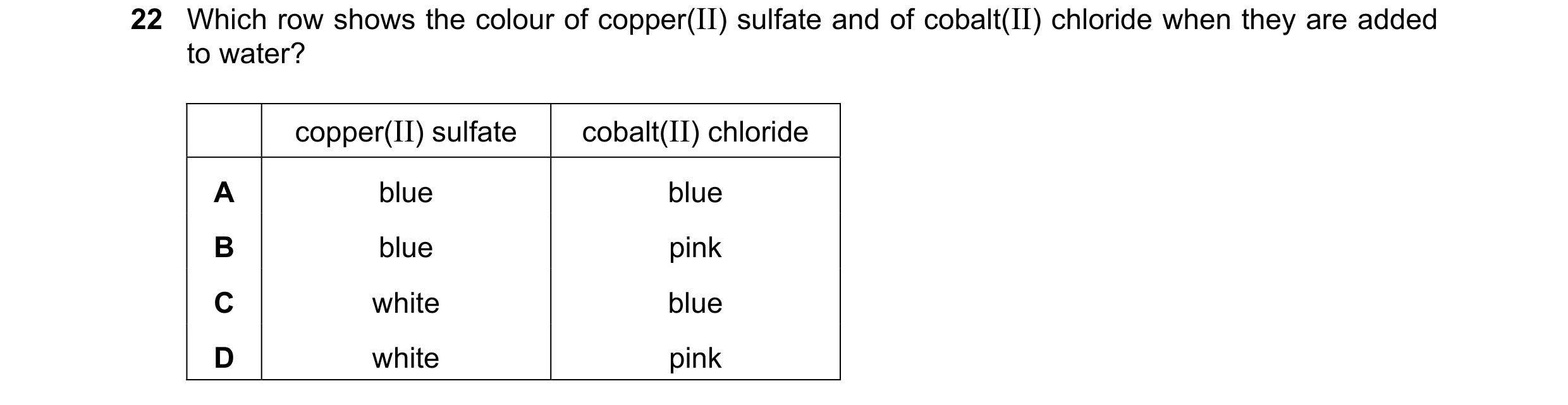
22 Which row shows the colour of copper(II) sulfate and of cobalt(II) chloride when they are added to water? copper(II) sulfate cobalt(II) chloride A blue blue B blue pink C white blue D white pink
1 marks
Answer: B
This question in 0654/12 May/June 2025
Q124 · Which row shows the colour of copper(II) sulfate and of cobalt(II) chloride when they are… 0654/13 May/June 2025
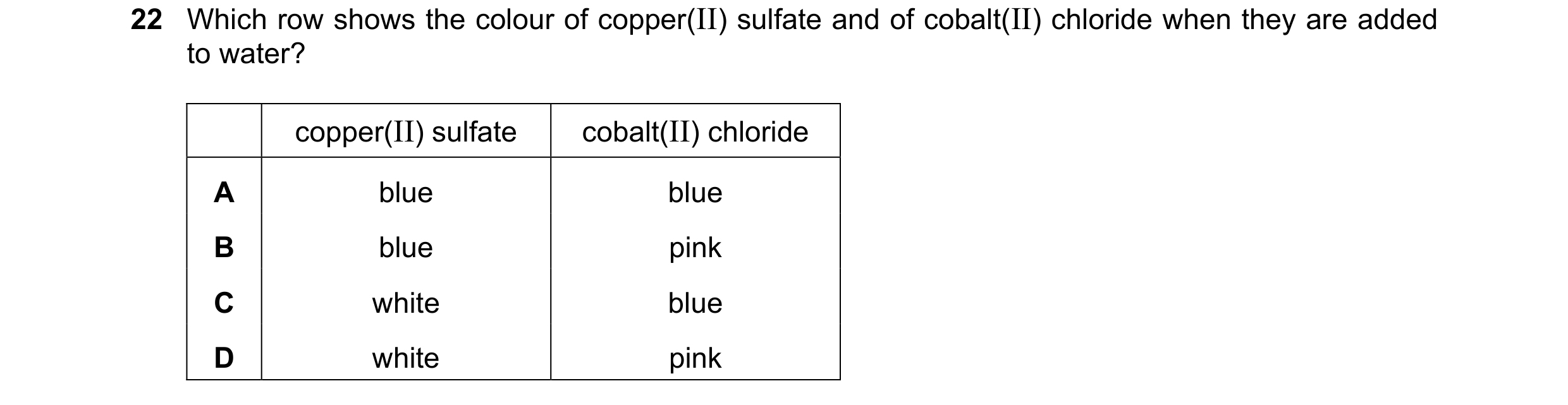
22 Which row shows the colour of copper(II) sulfate and of cobalt(II) chloride when they are added to water? copper(II) sulfate cobalt(II) chloride A blue blue B blue pink C white blue D white pink
1 marks
Answer: B
This question in 0654/13 May/June 2025
Q125 · What is the colour of the flame produced by sodium in the flame test? 0654/11 Oct/Nov 2025
27 What is the colour of the flame produced by sodium in the flame test? A blue-green B red C lilac D yellow
1 marks
Answer: D
This question in 0654/11 Oct/Nov 2025
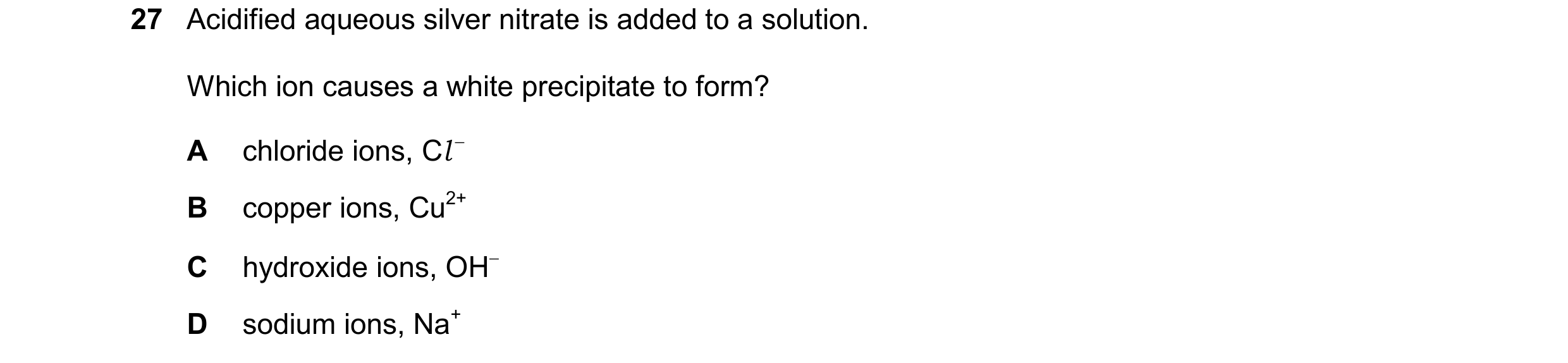
Q126 · Acidified aqueous silver nitrate is added to a solution 0654/12 Oct/Nov 2025
27 Acidified aqueous silver nitrate is added to a solution. Which ion causes a white precipitate to form? A chloride ions, Cl B copper ions, Cu2+ C hydroxide ions, OH D sodium ions, Na+
1 marks
Answer: A
This question in 0654/12 Oct/Nov 2025
Q127 · Acidified aqueous silver nitrate is added to a solution 0654/13 Oct/Nov 2025
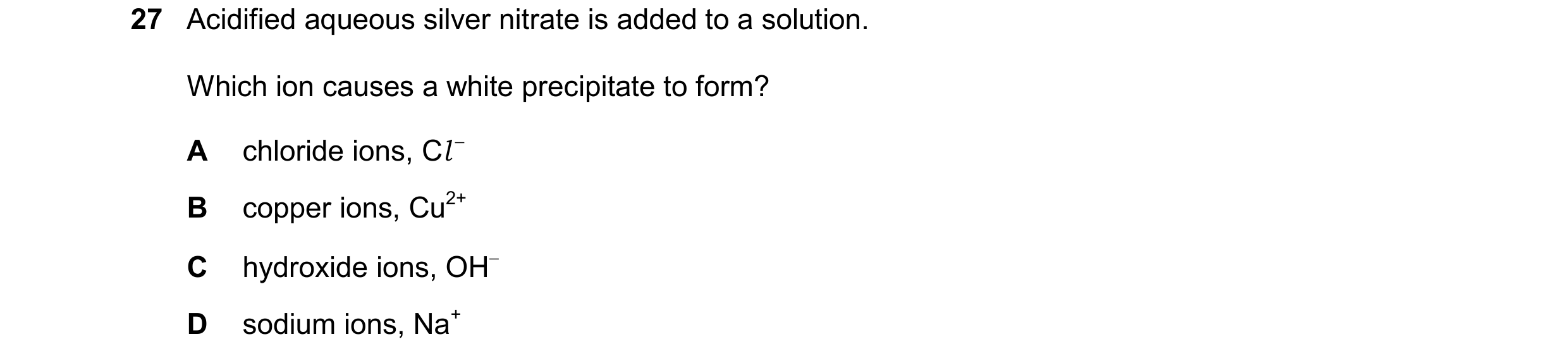
27 Acidified aqueous silver nitrate is added to a solution. Which ion causes a white precipitate to form? A chloride ions, Cl B copper ions, Cu2+ C hydroxide ions, OH D sodium ions, Na+
1 marks
Answer: A
This question in 0654/13 Oct/Nov 2025

 1 / 43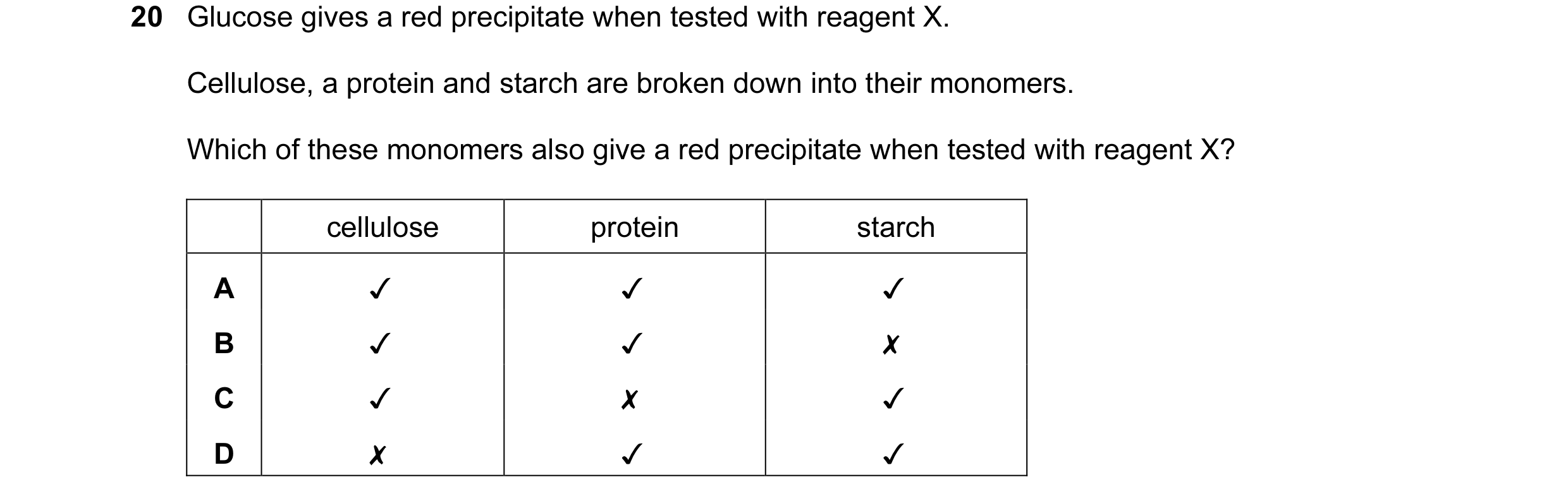
 2 / 43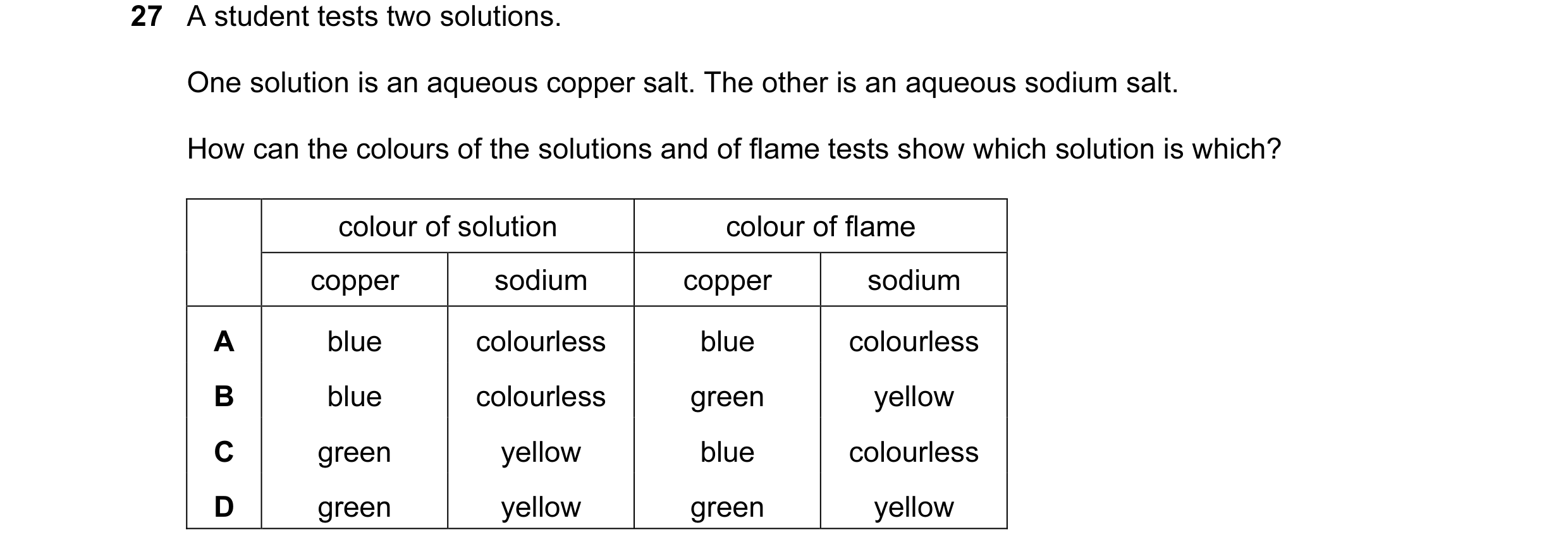

 3 / 43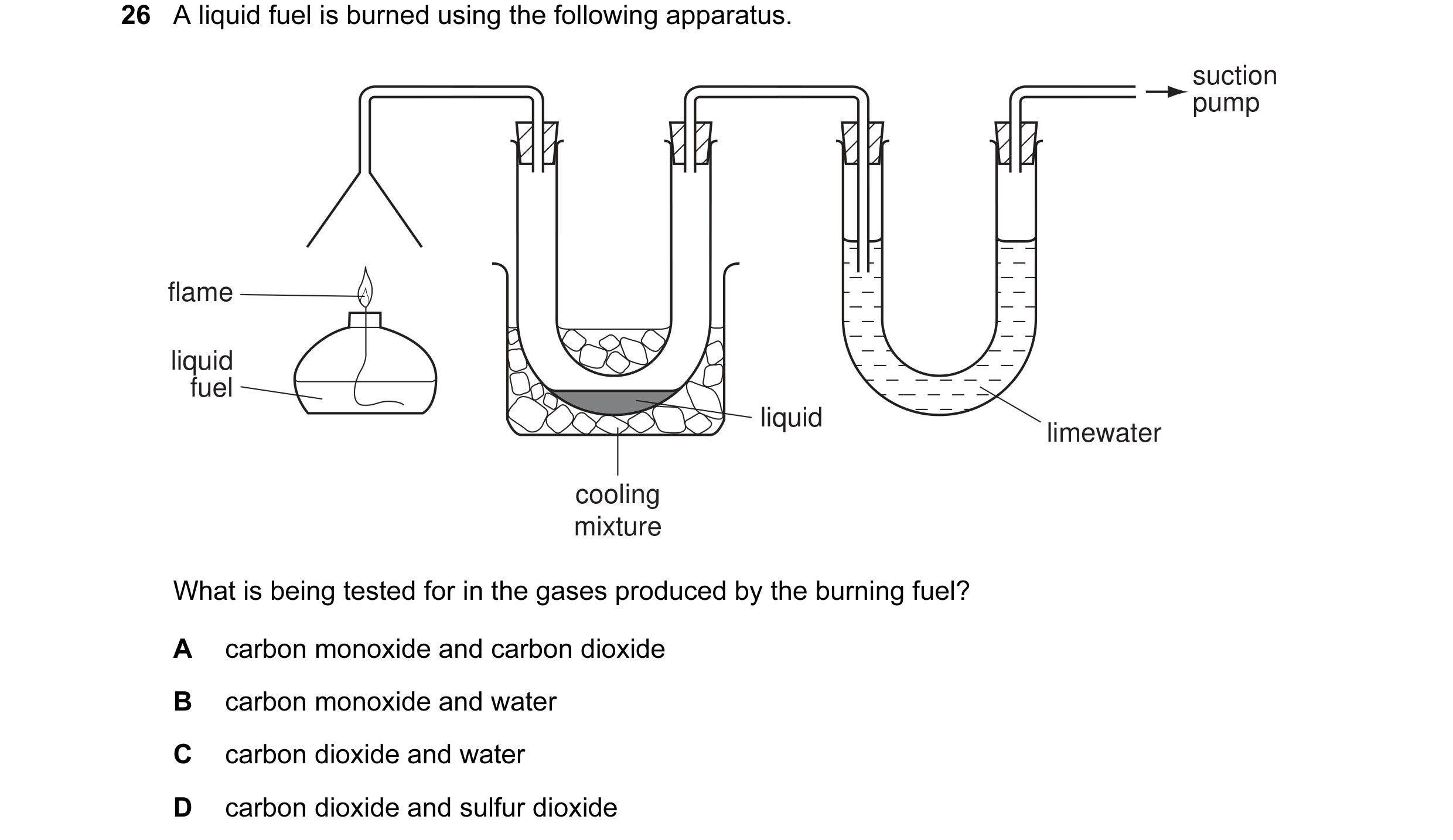
 4 / 43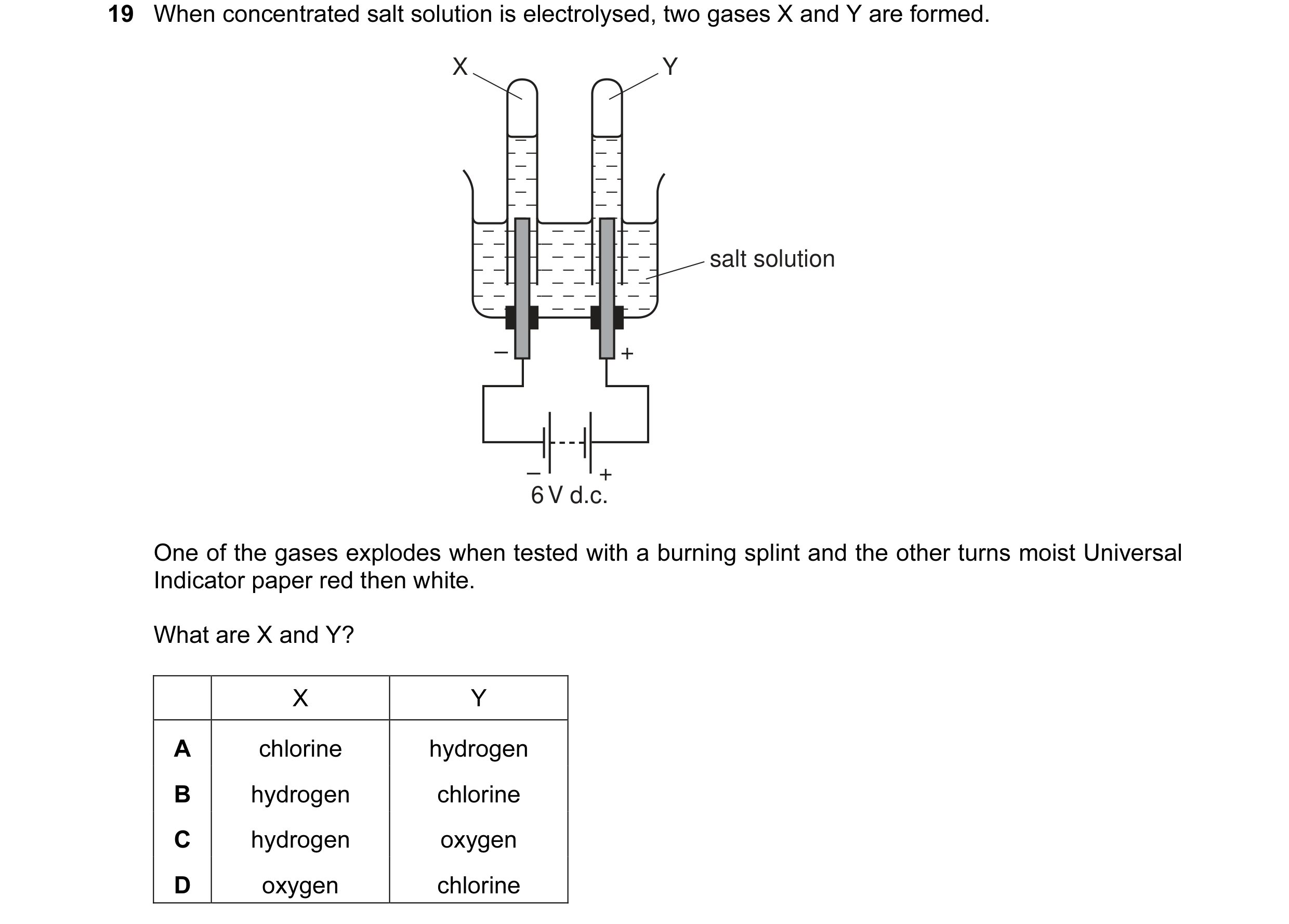
 5 / 43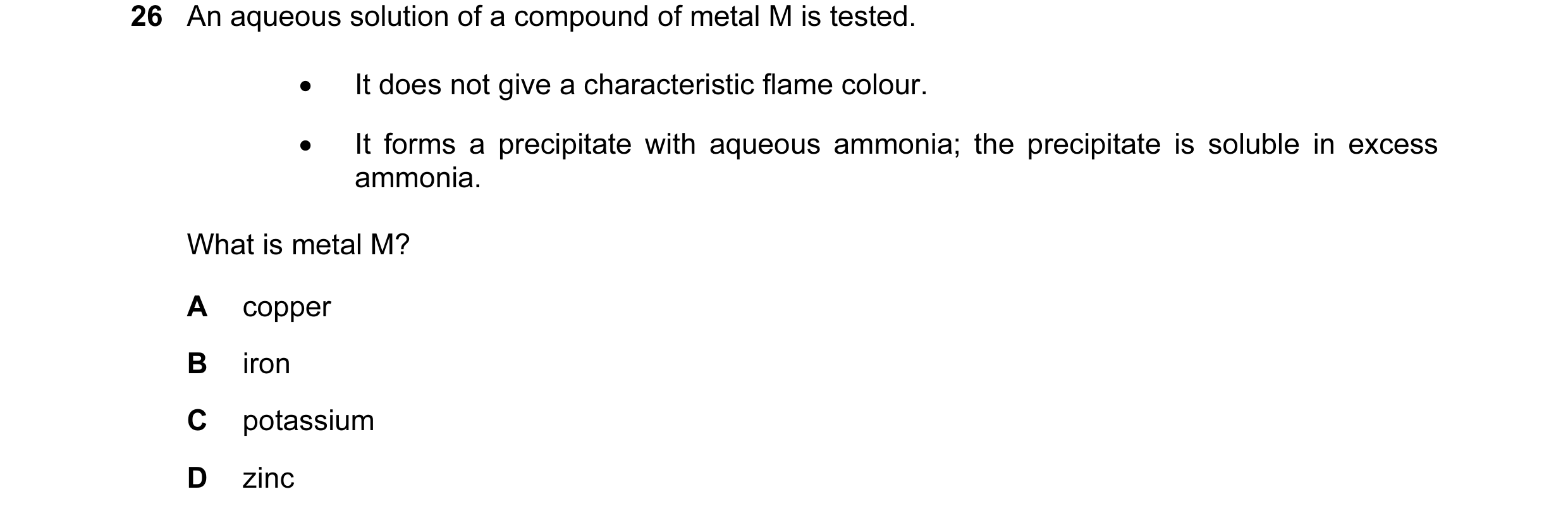
 6 / 43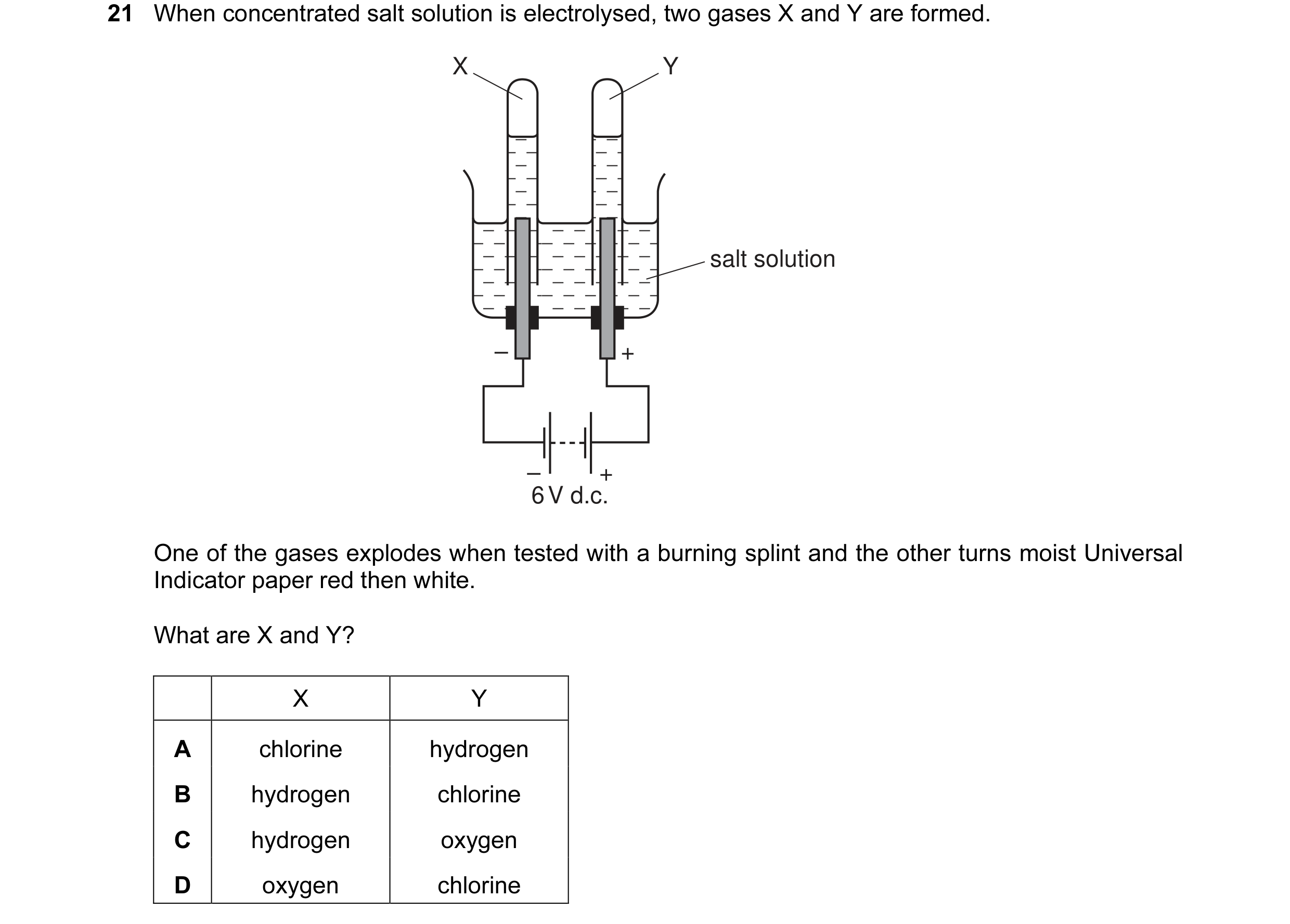
 7 / 43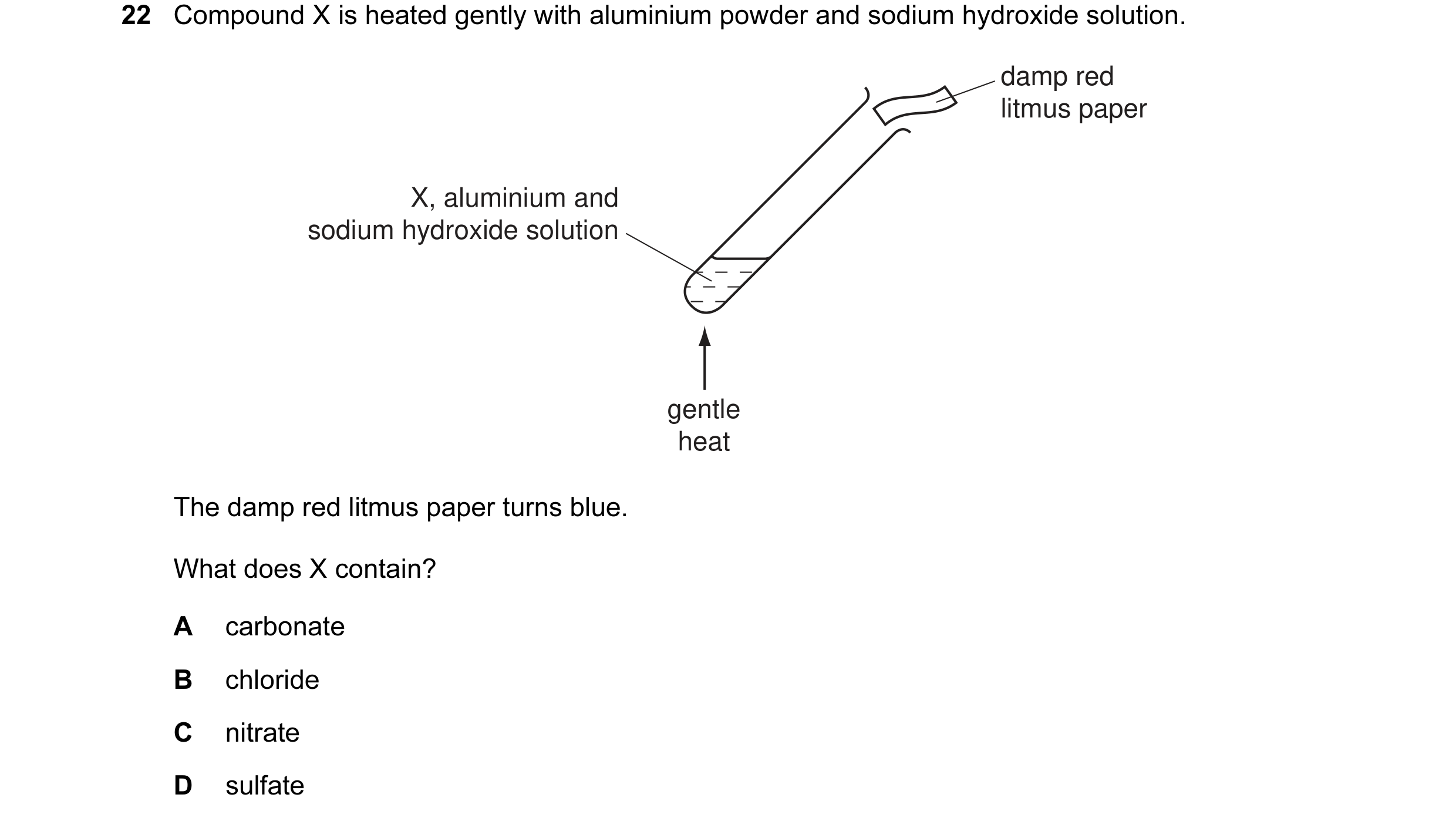
 8 / 43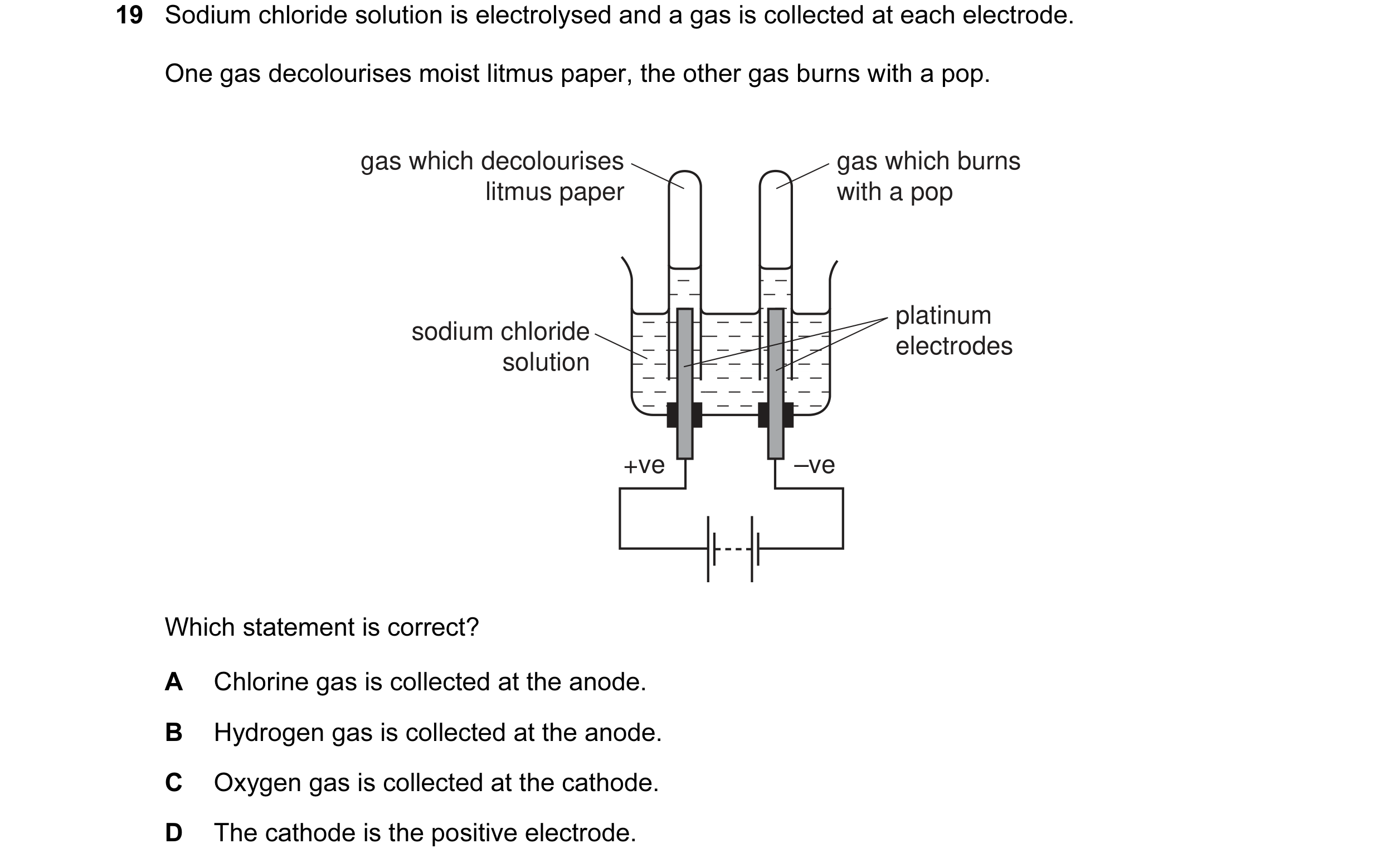
 9 / 43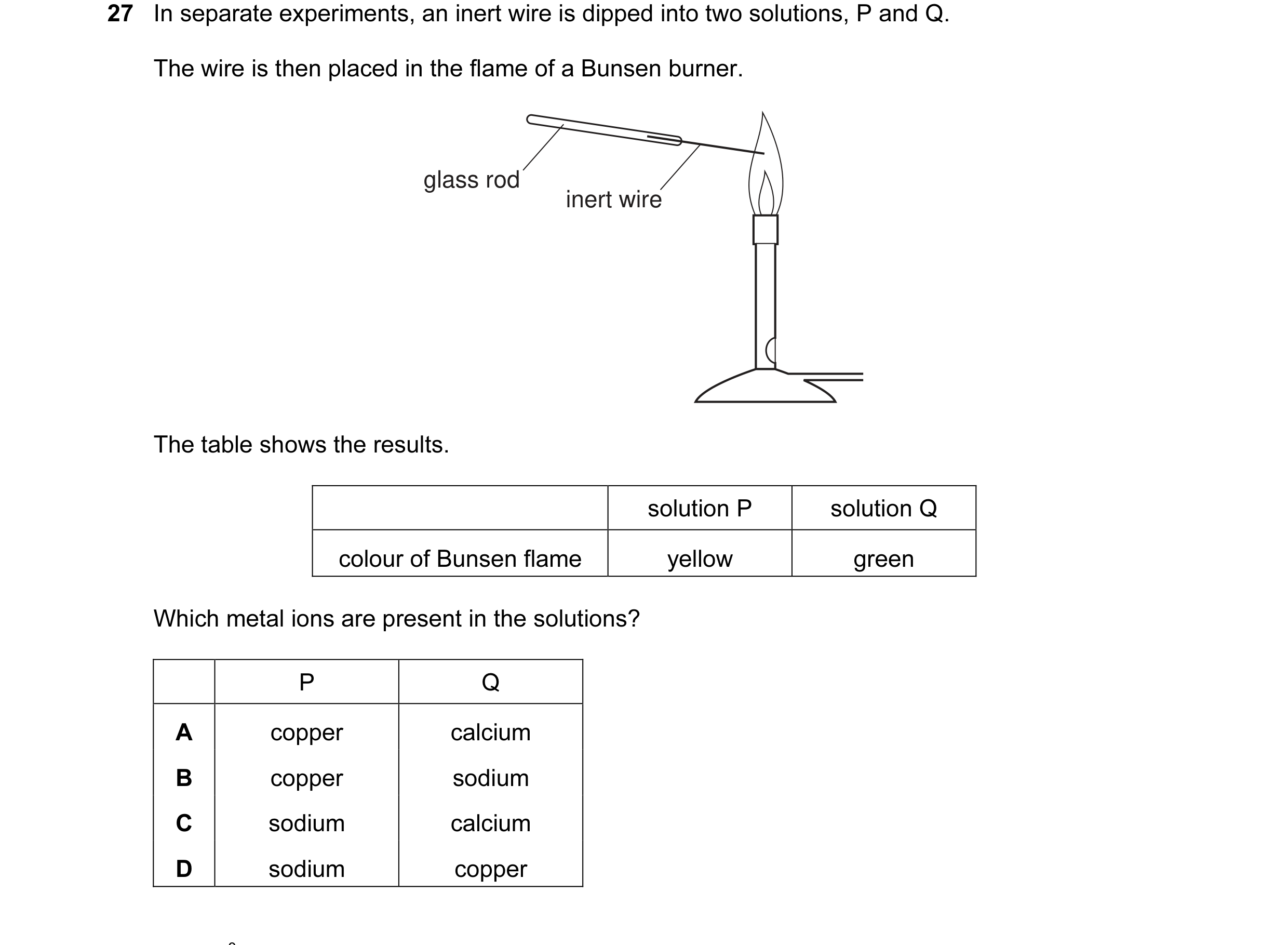
 10 / 43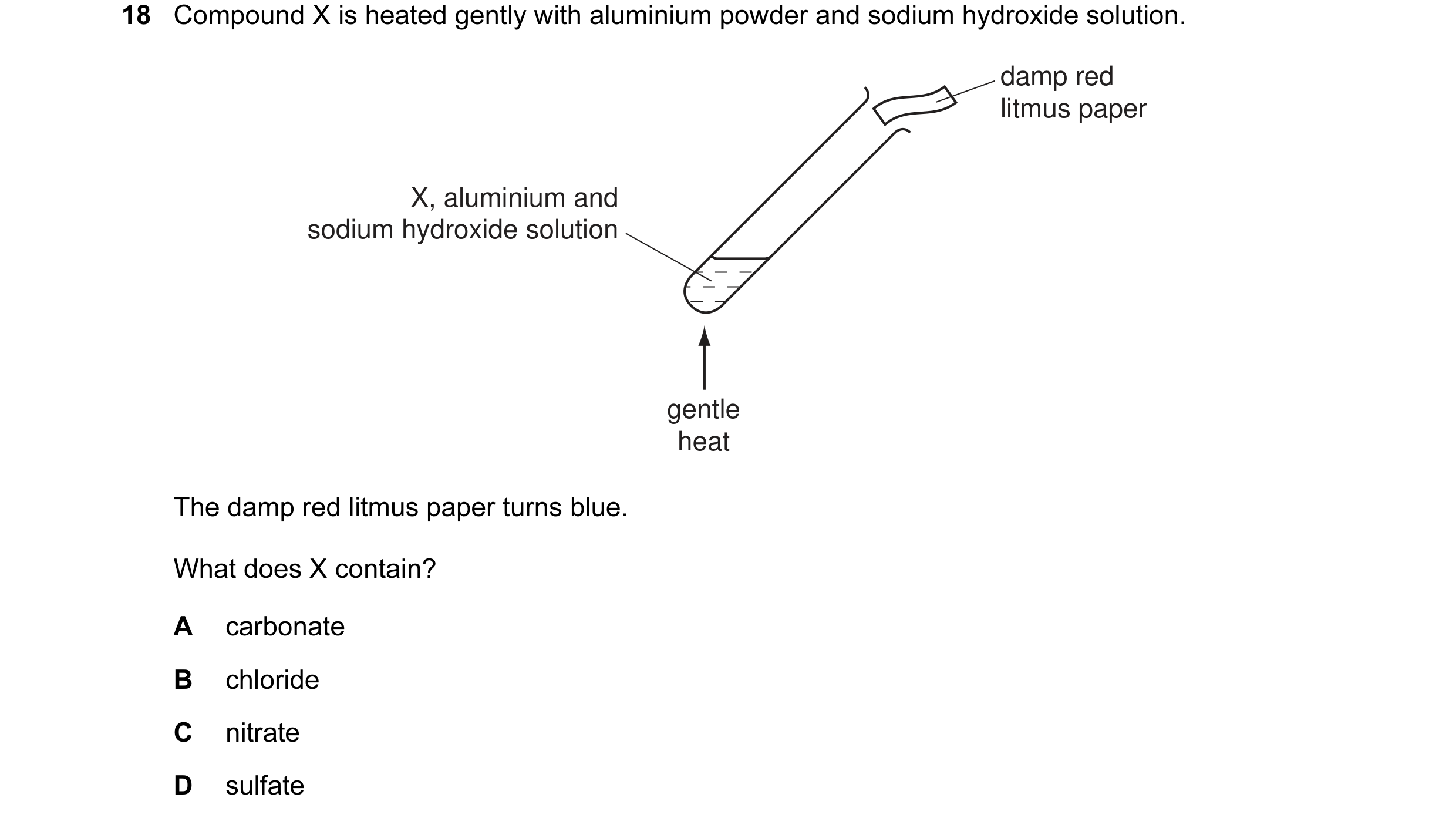
 11 / 43



 12 / 43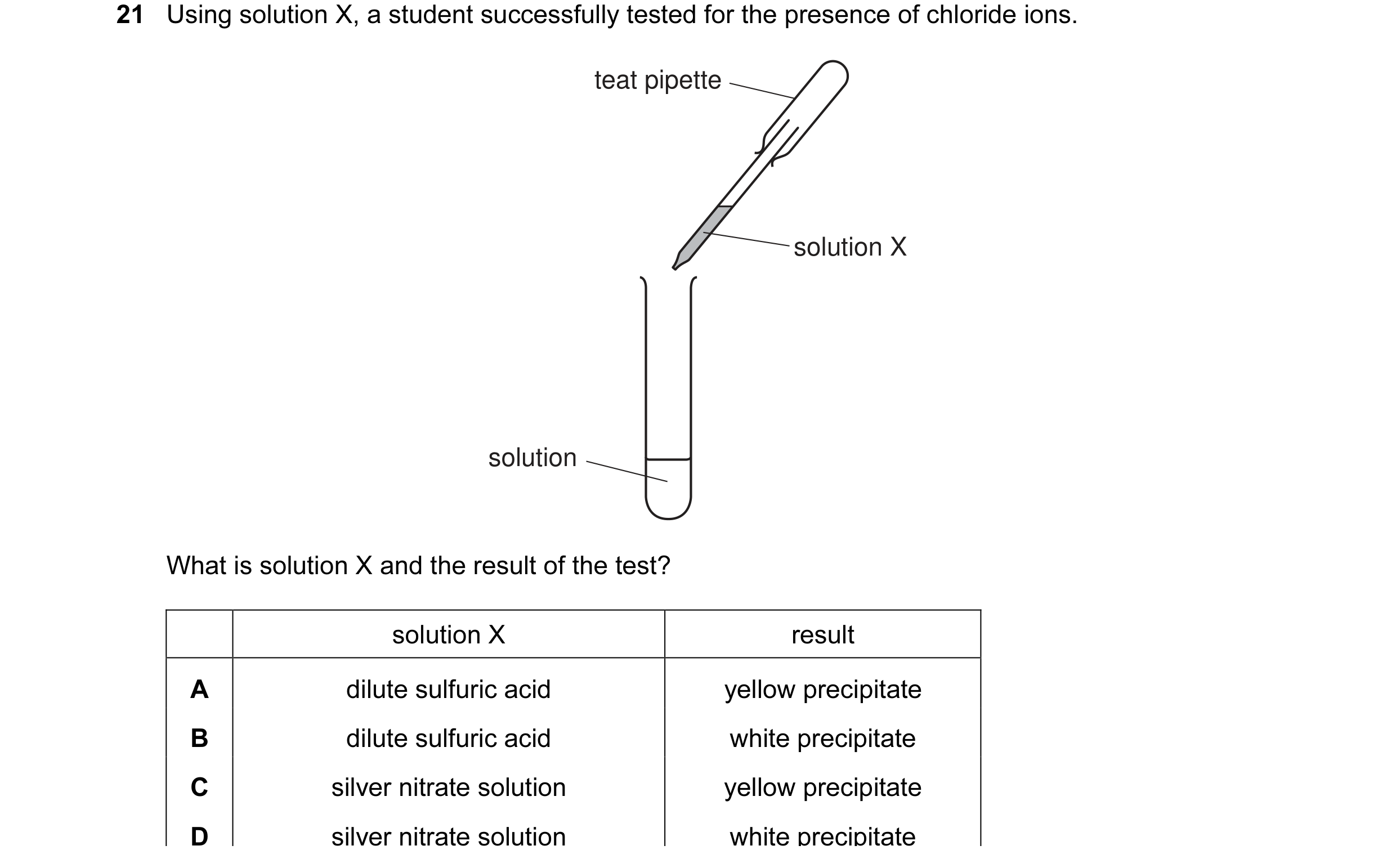
 13 / 43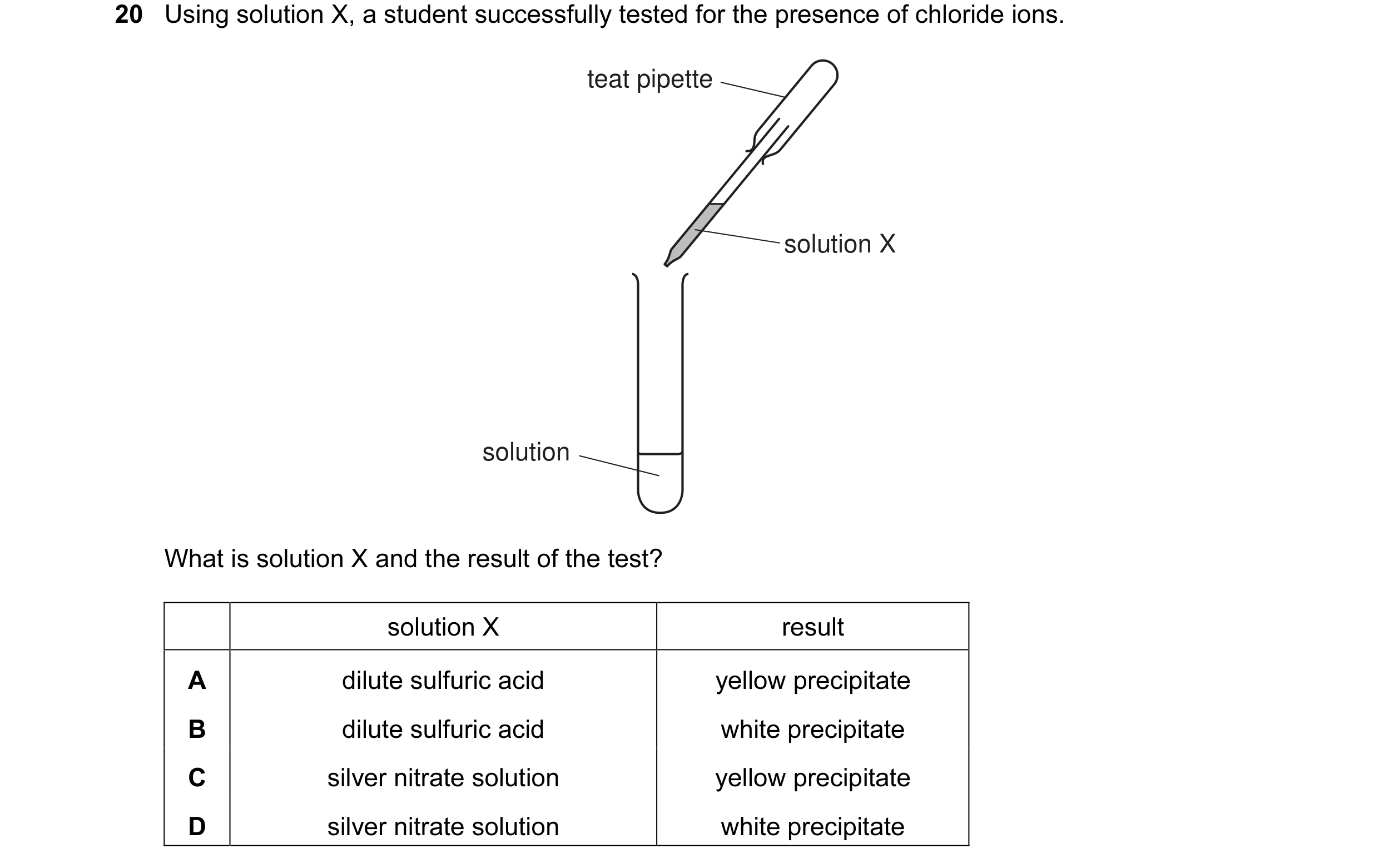
 14 / 43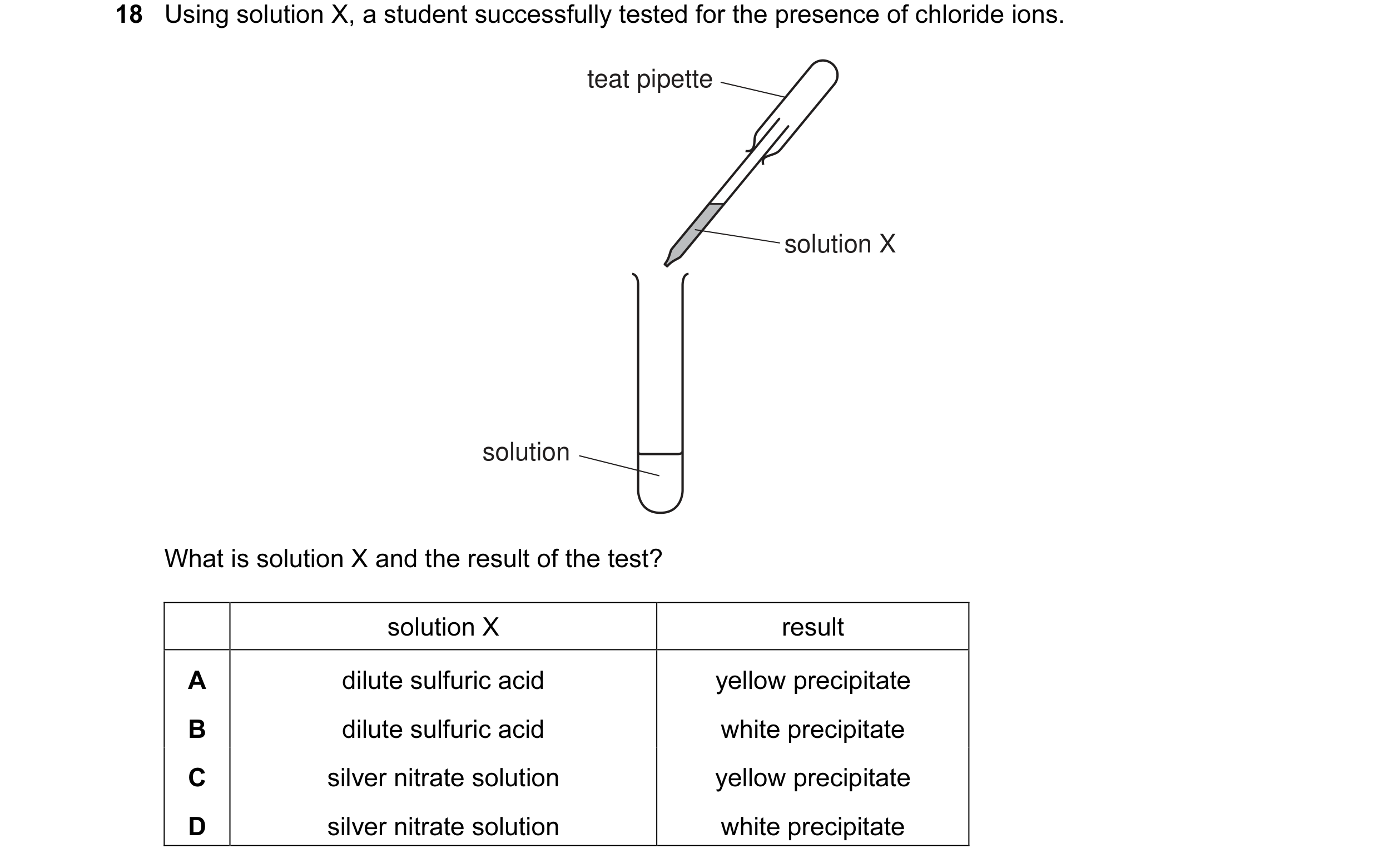
 15 / 43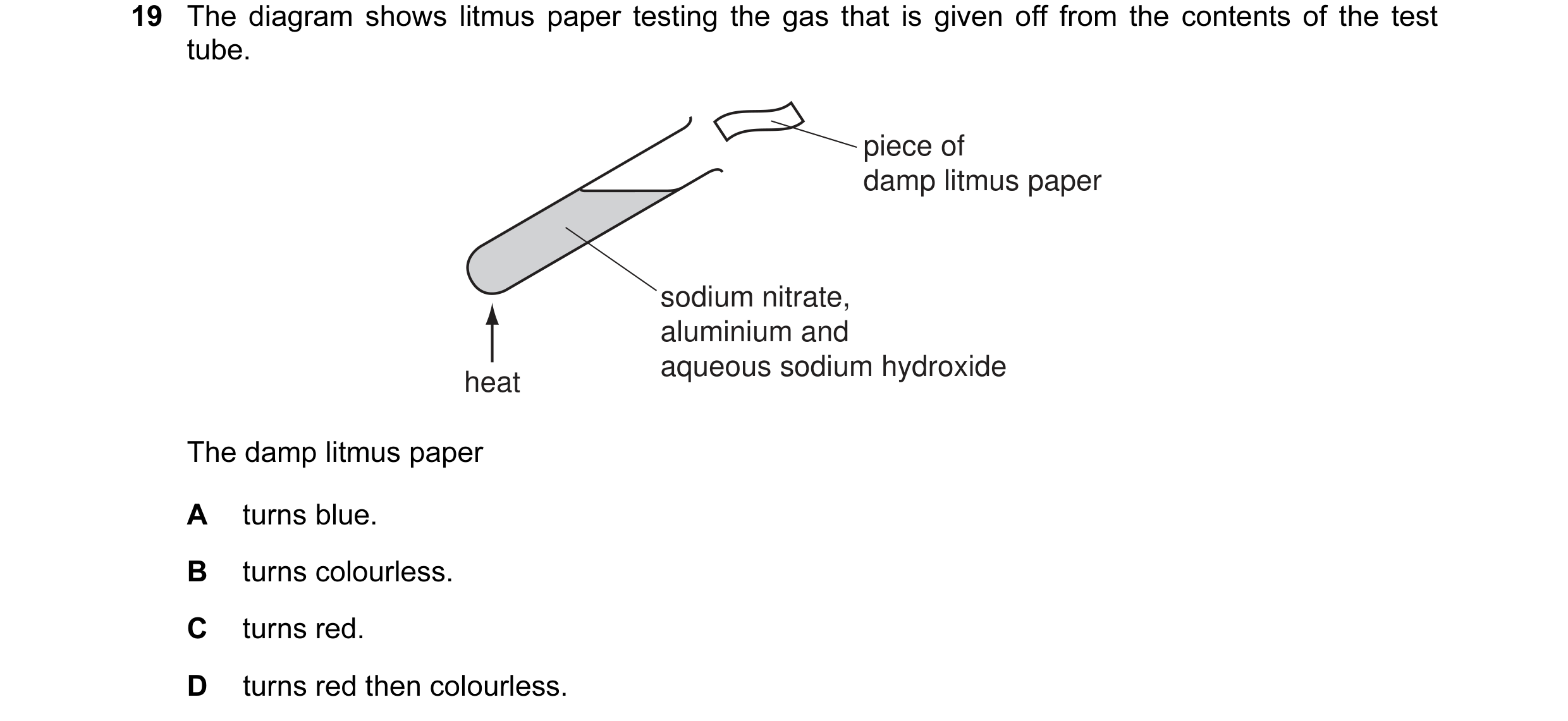
 16 / 43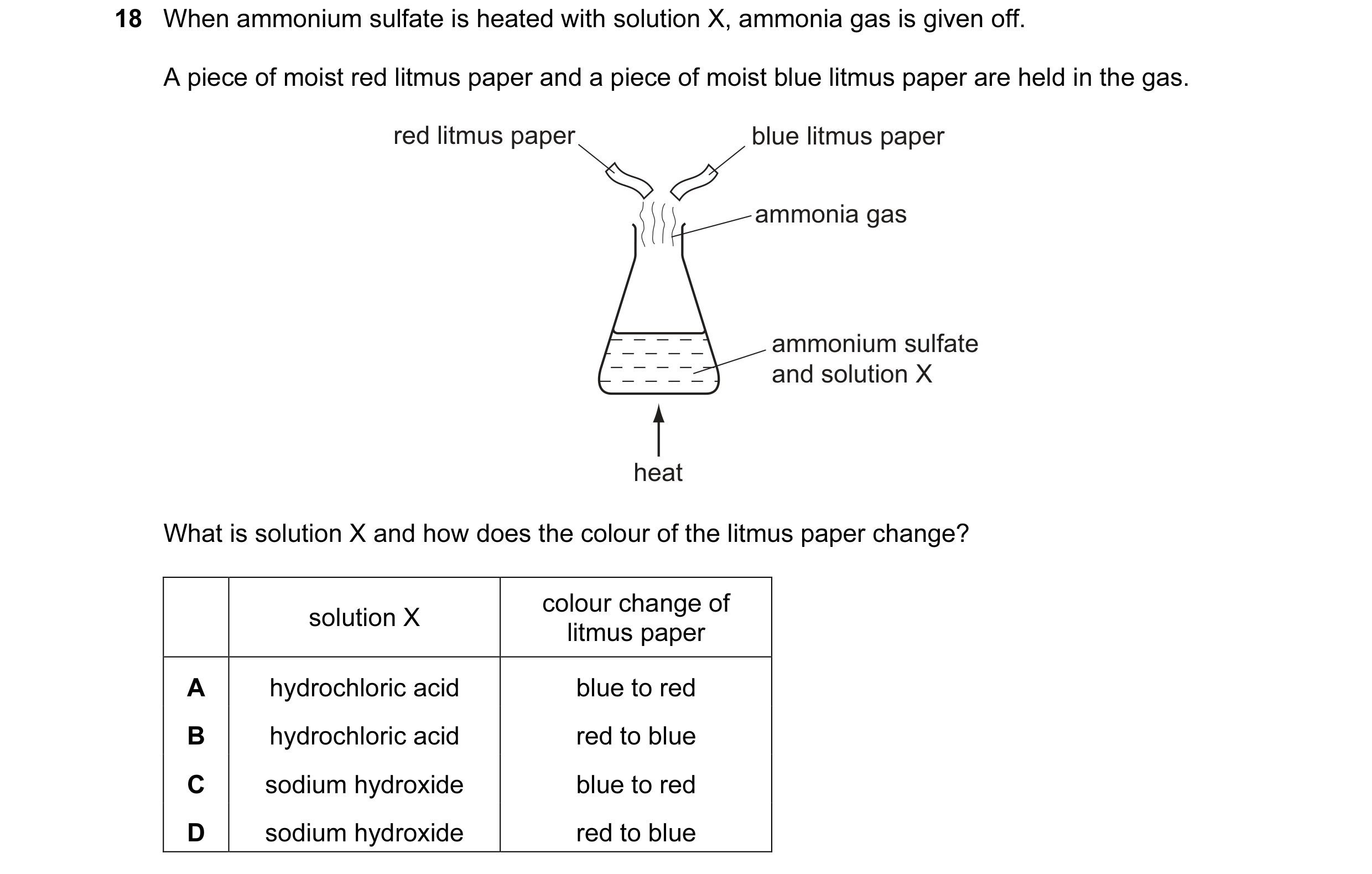
 17 / 43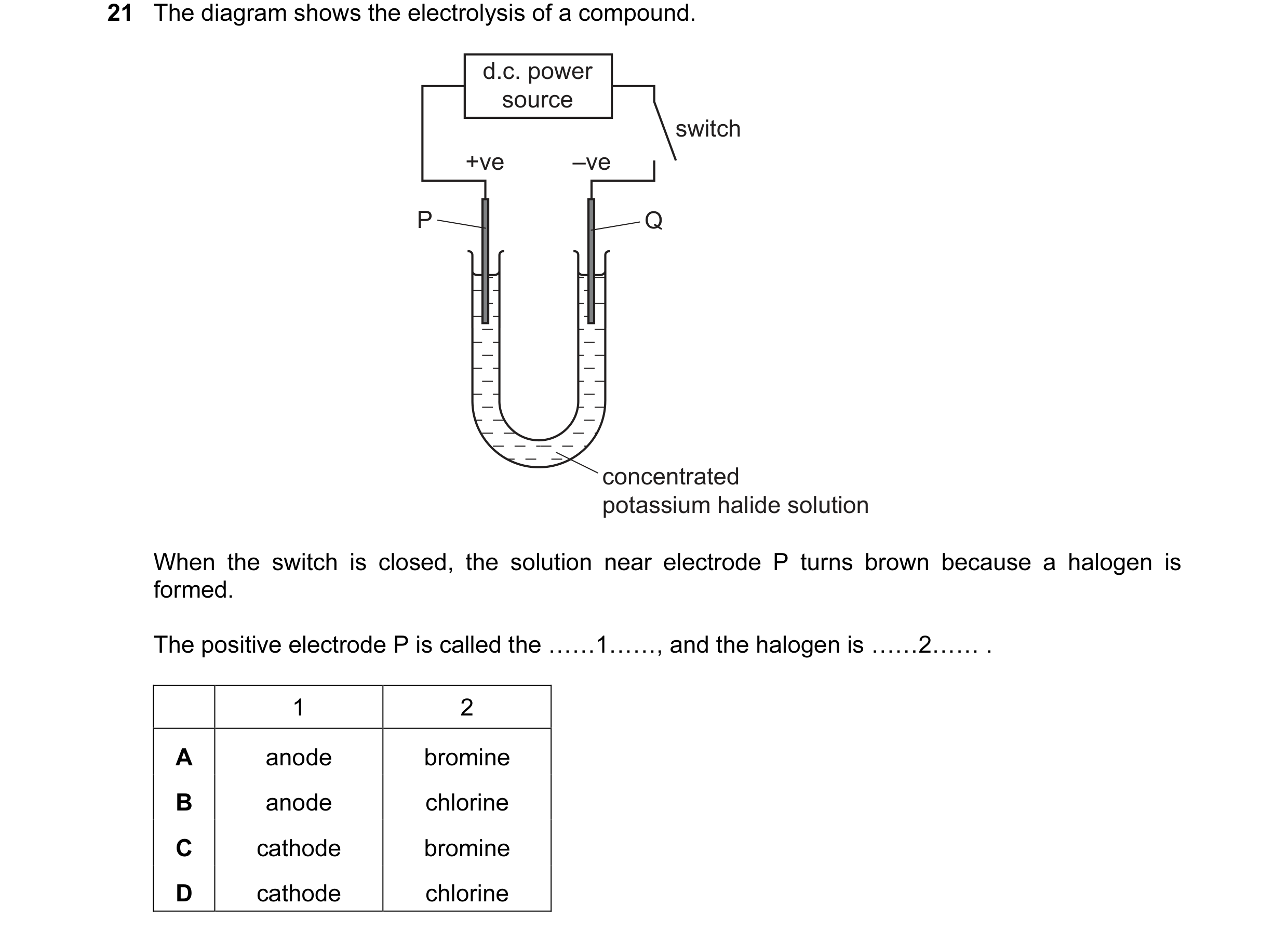
 18 / 43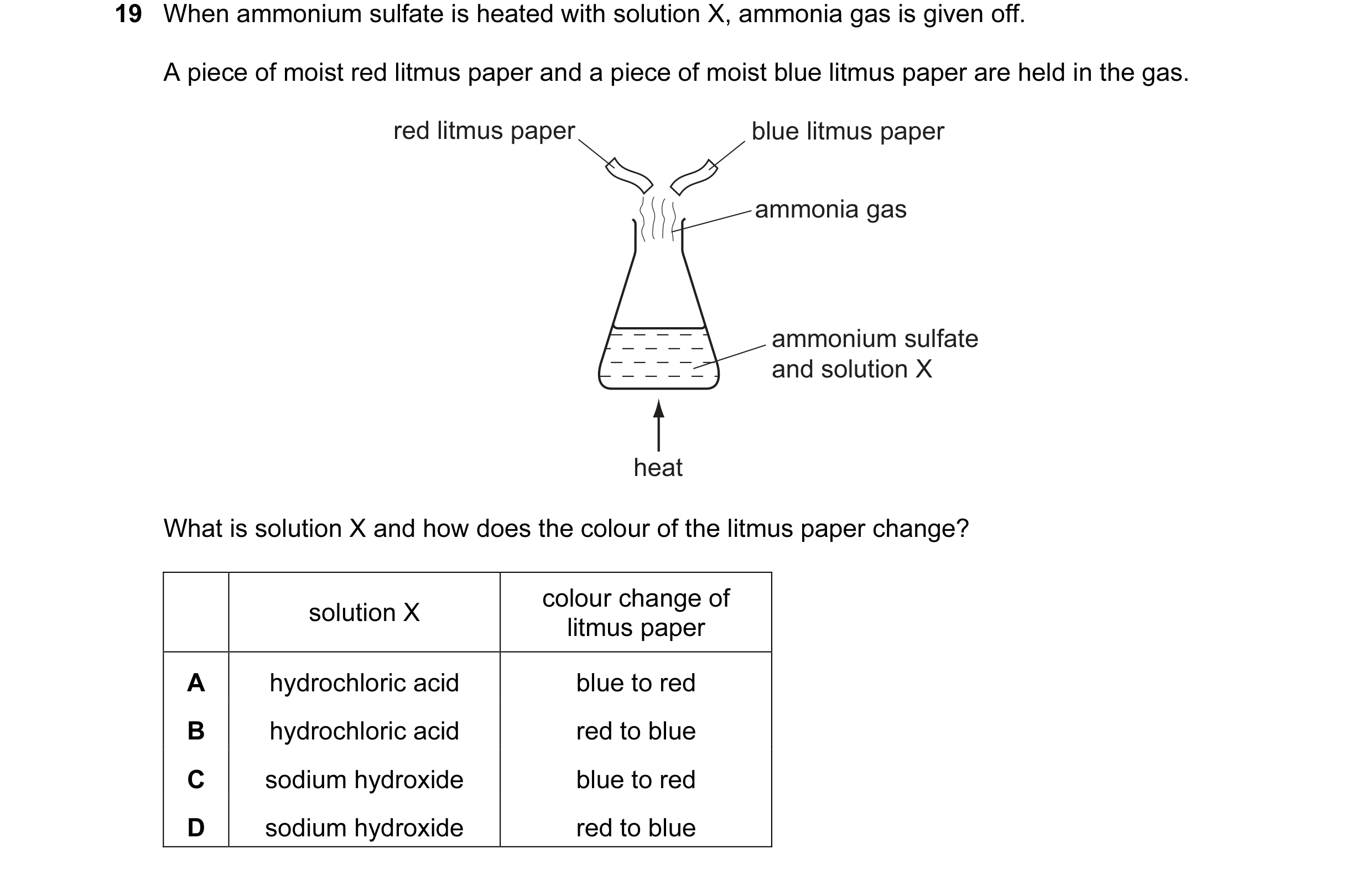
 19 / 43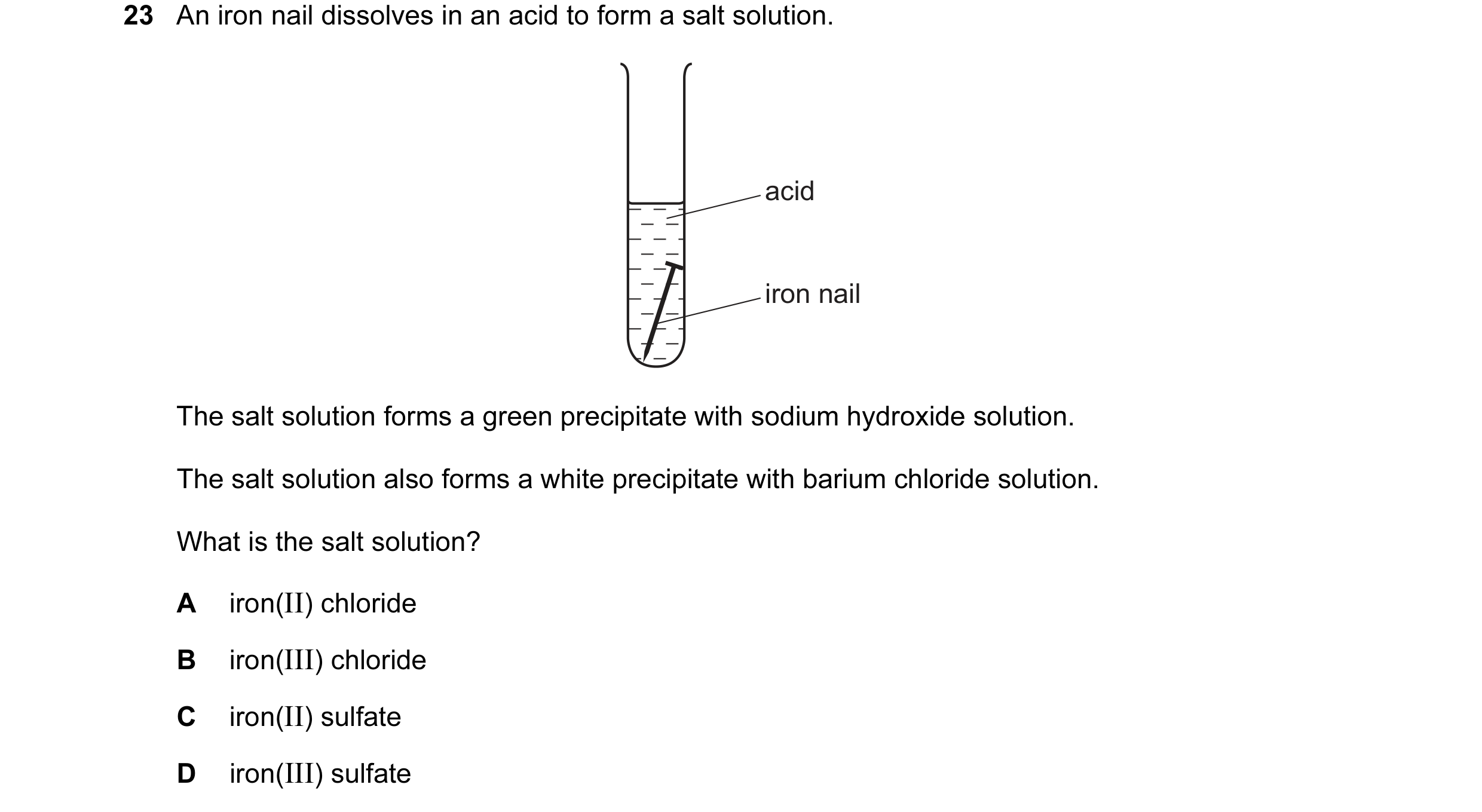
 20 / 43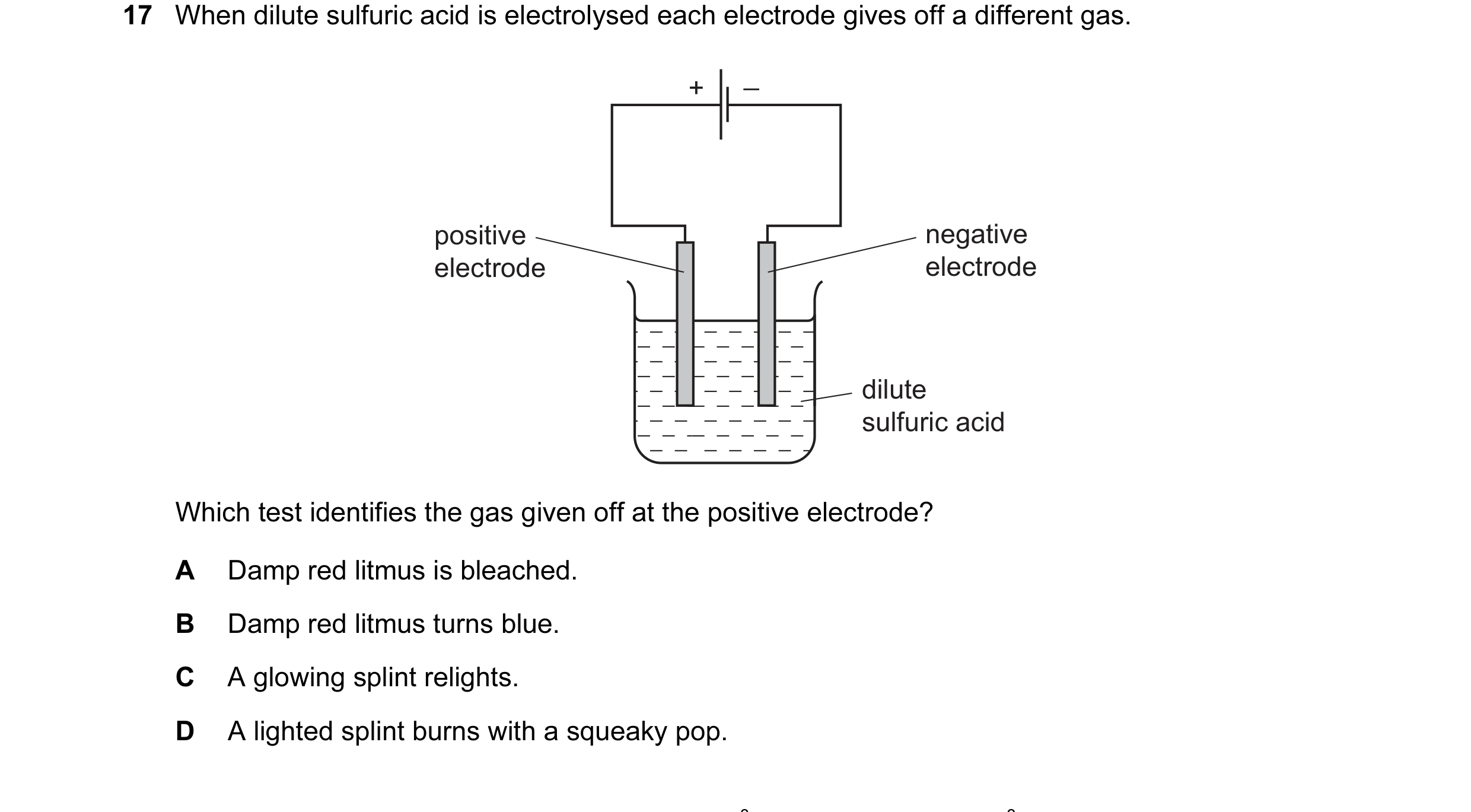
 21 / 43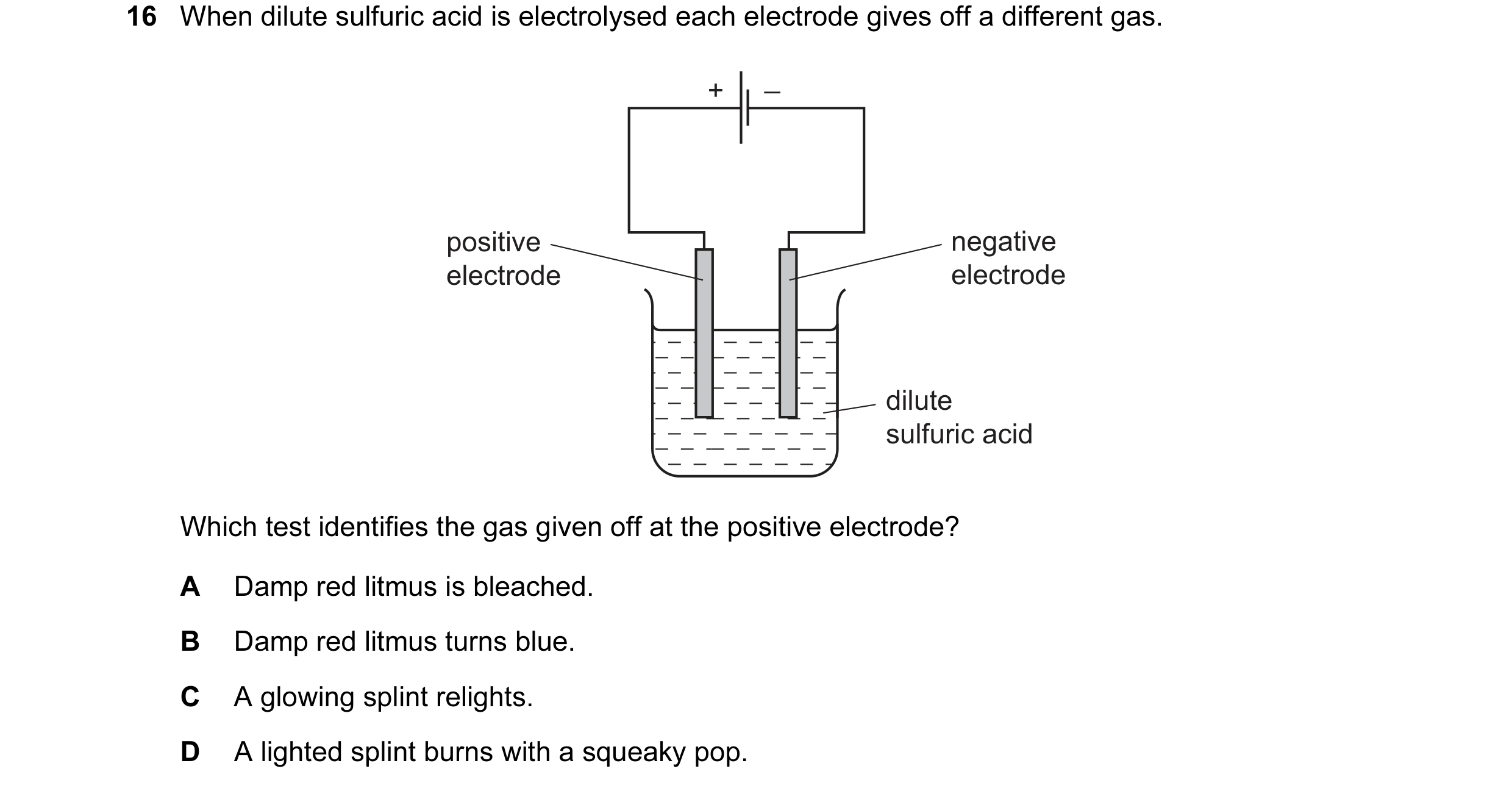
 22 / 43
 23 / 43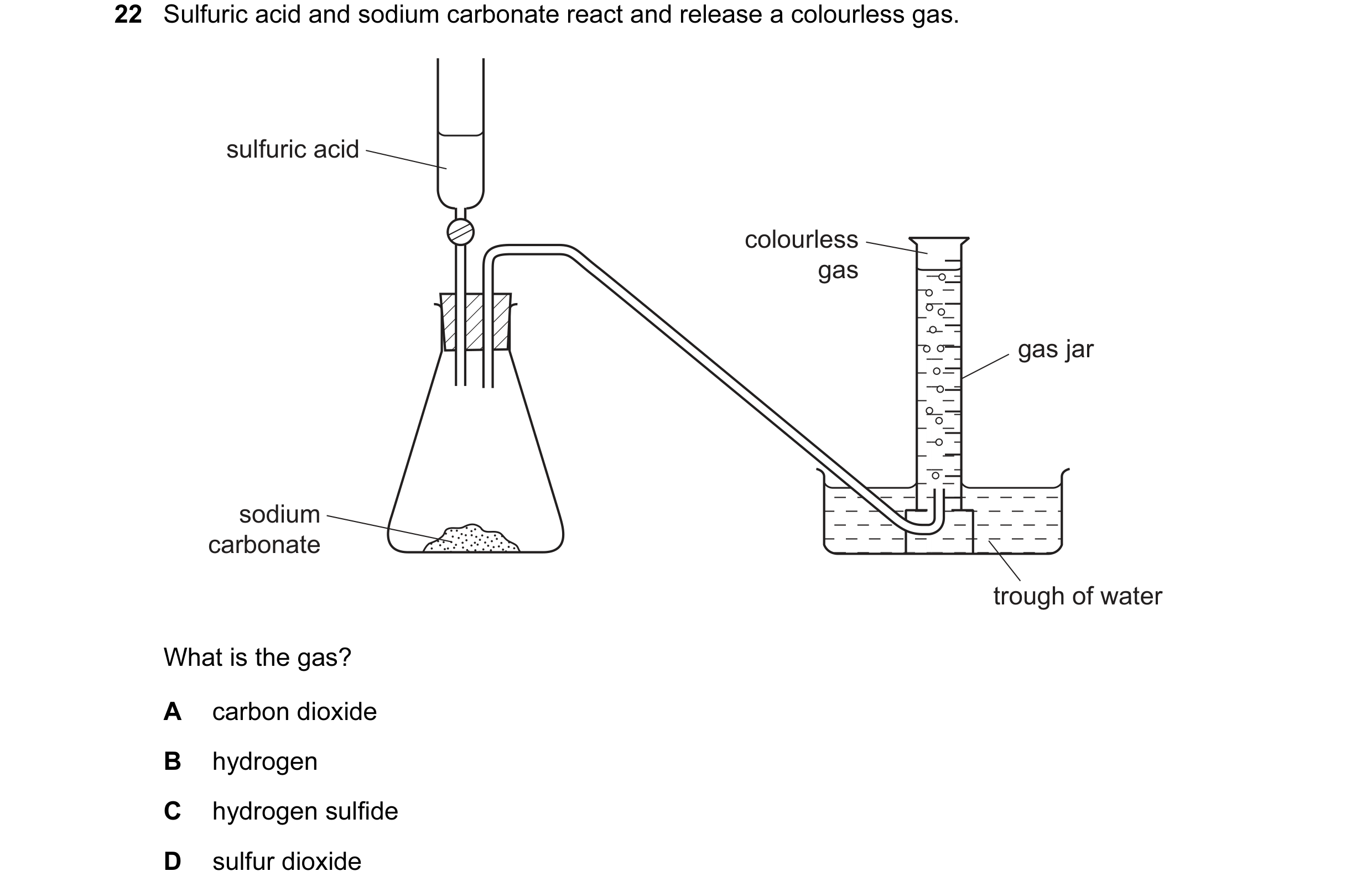
 24 / 43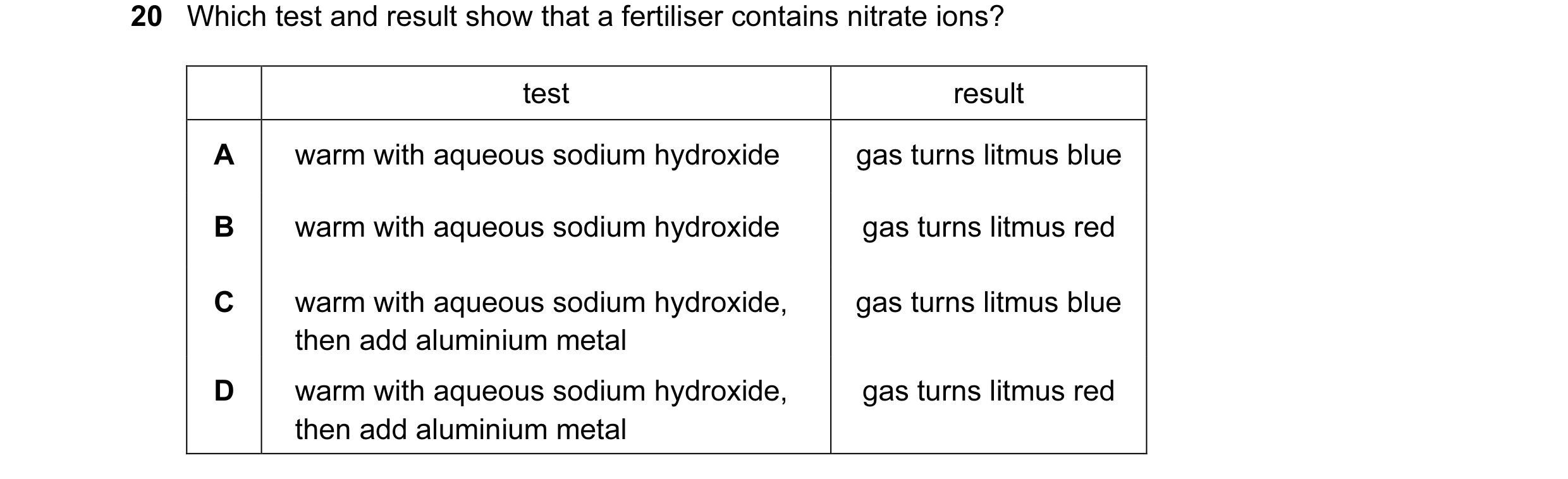
 25 / 43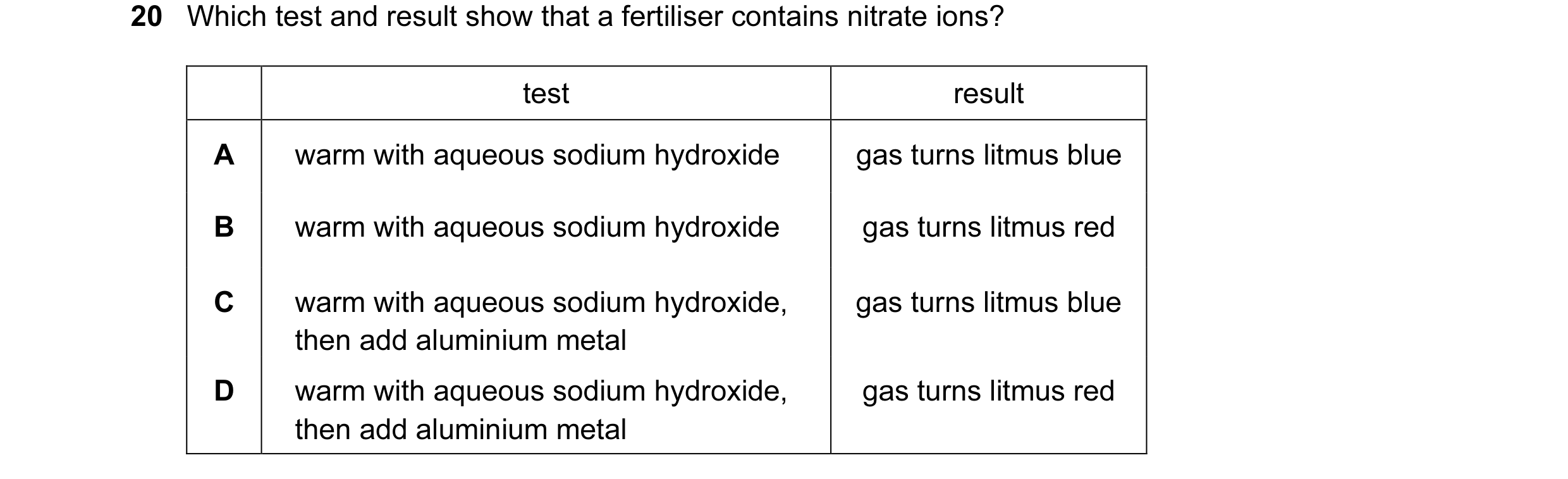
 26 / 43
 27 / 43
 28 / 43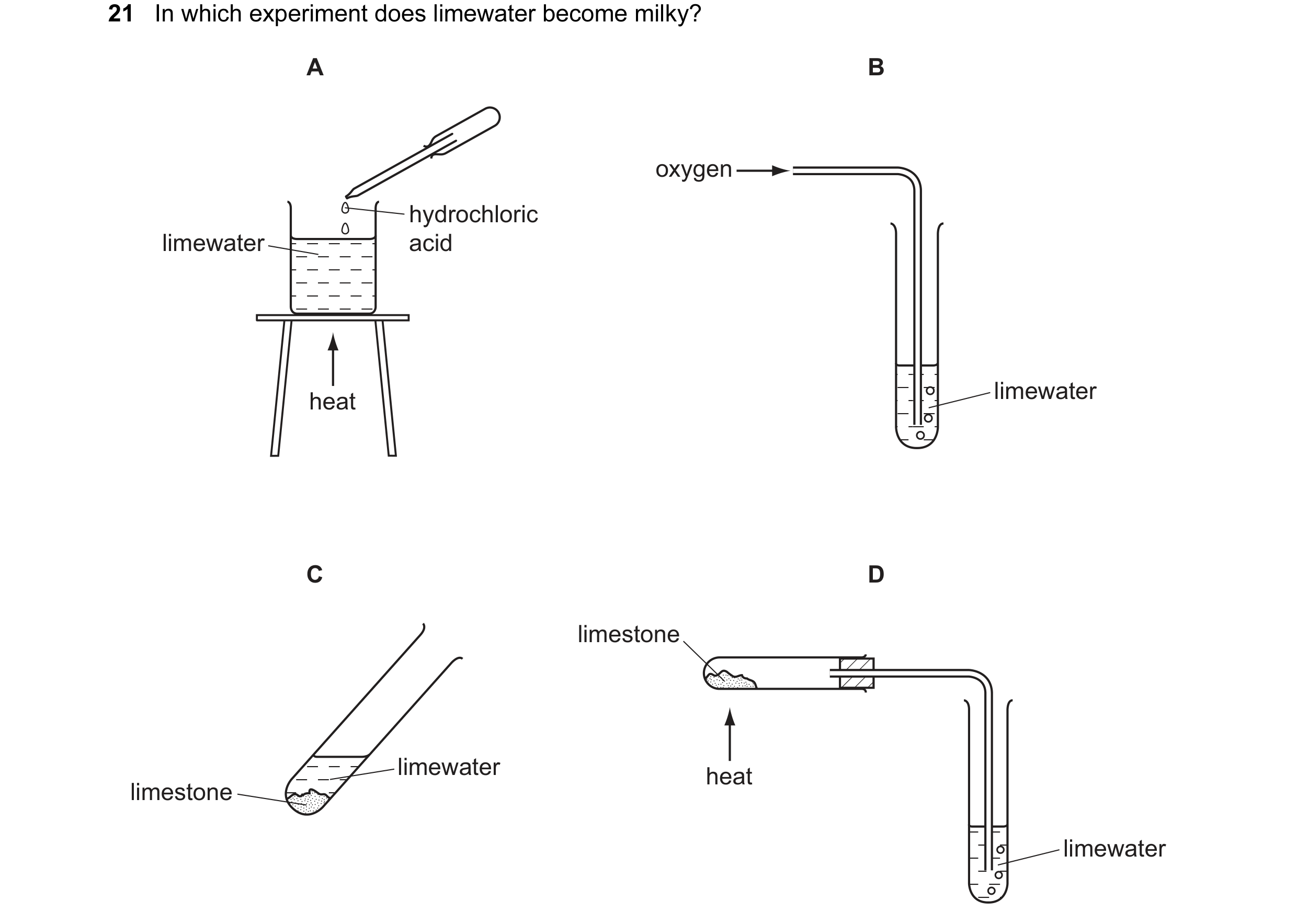
 29 / 43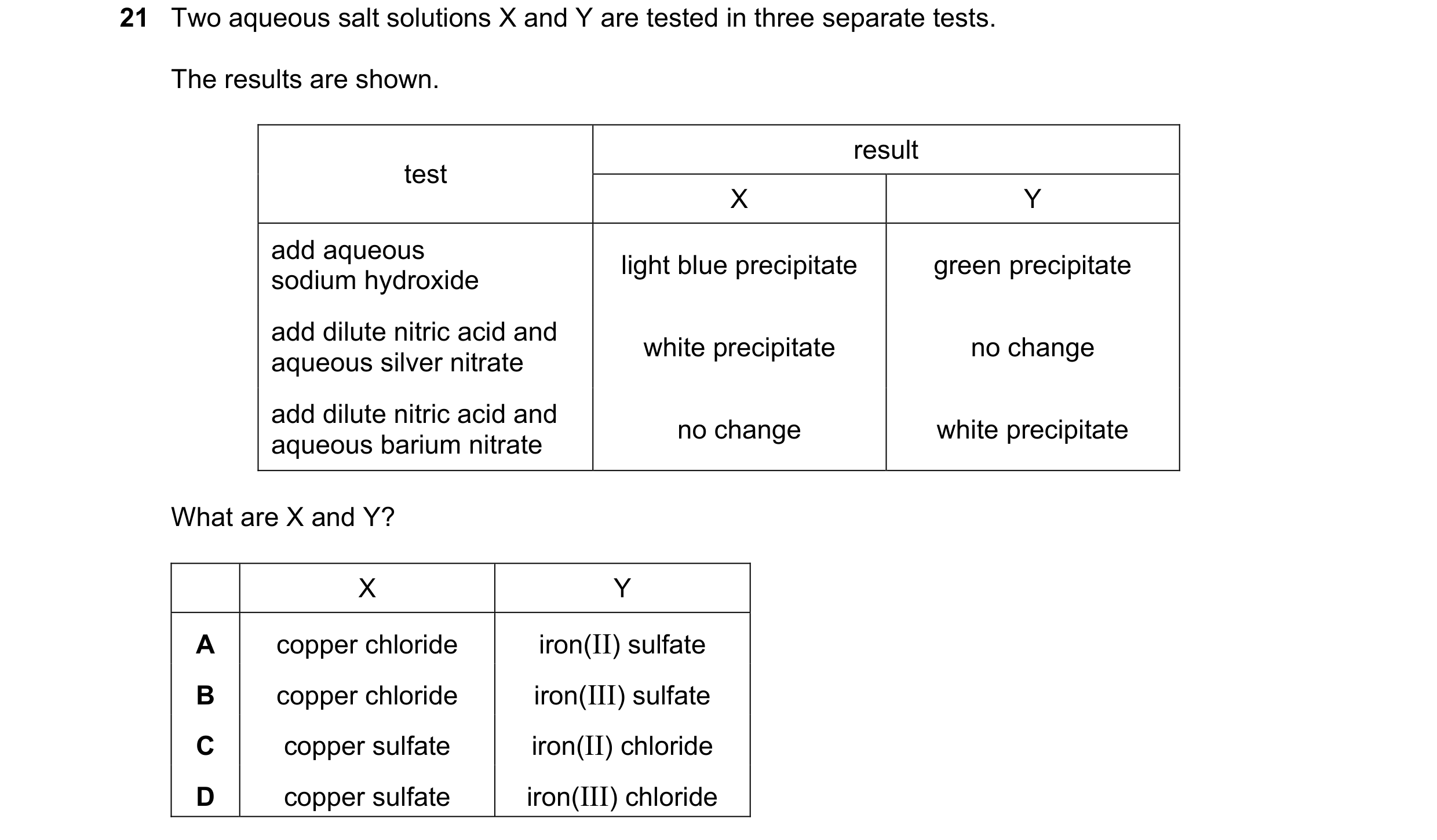
 30 / 43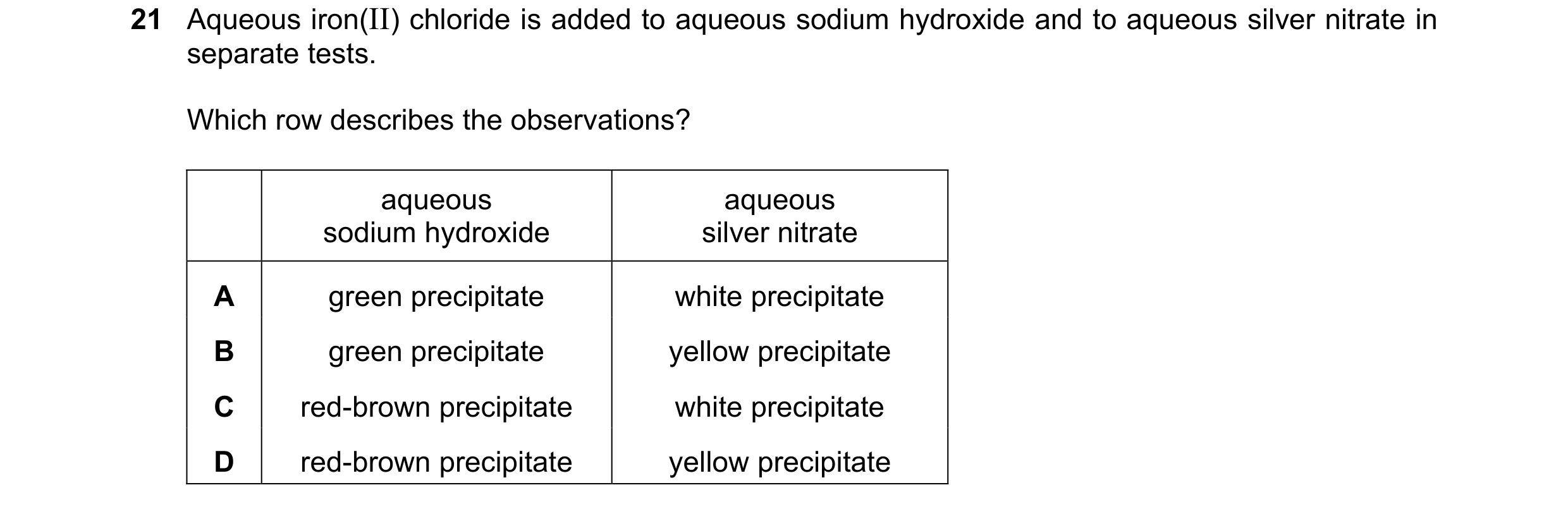
 31 / 43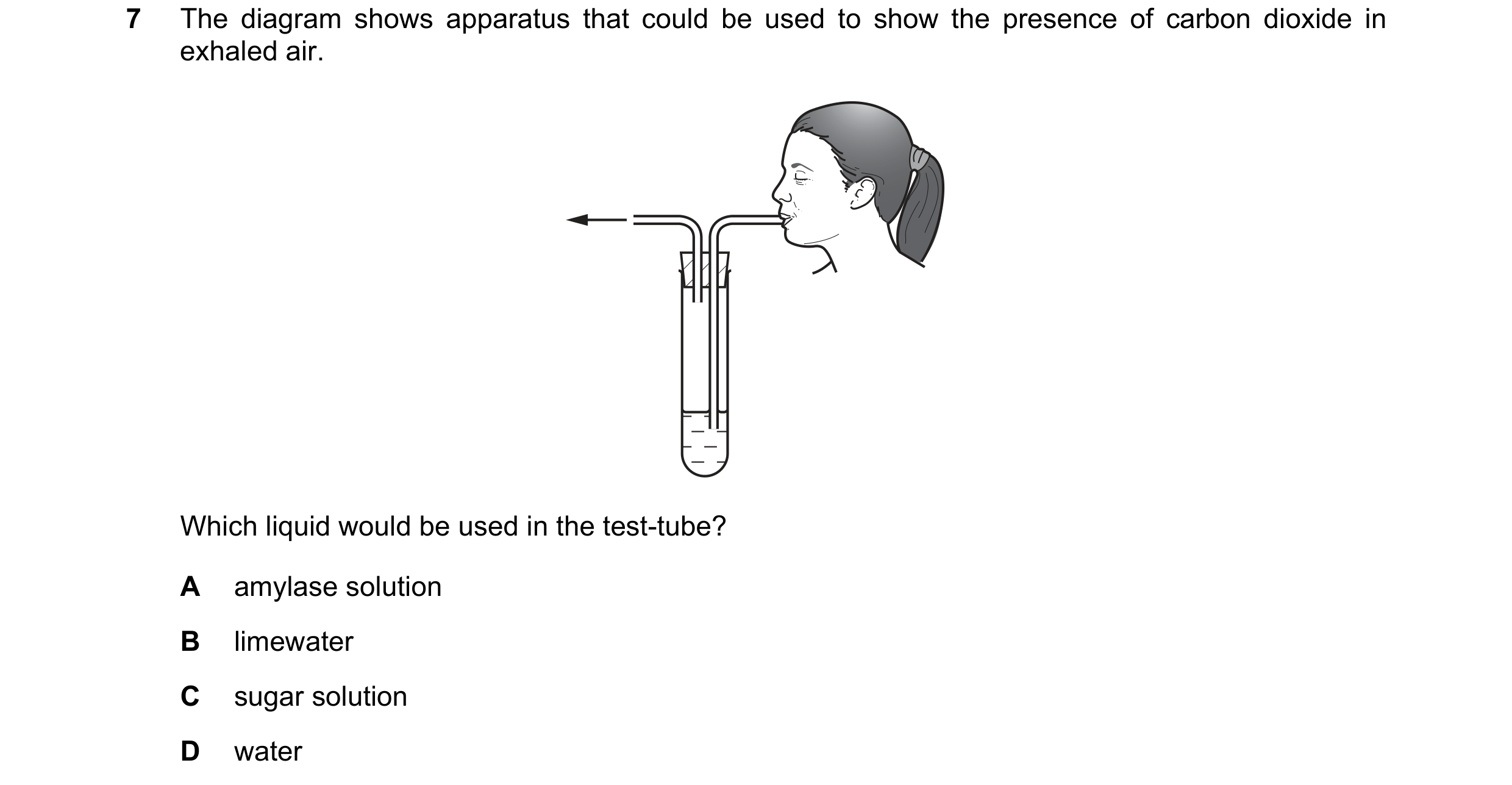

 32 / 43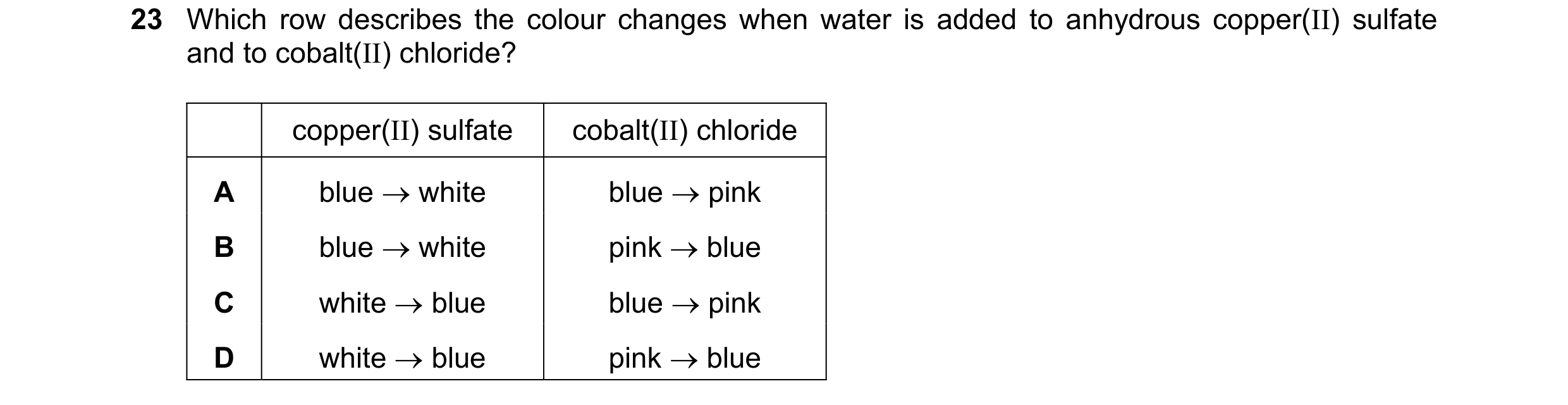
 33 / 43


 34 / 43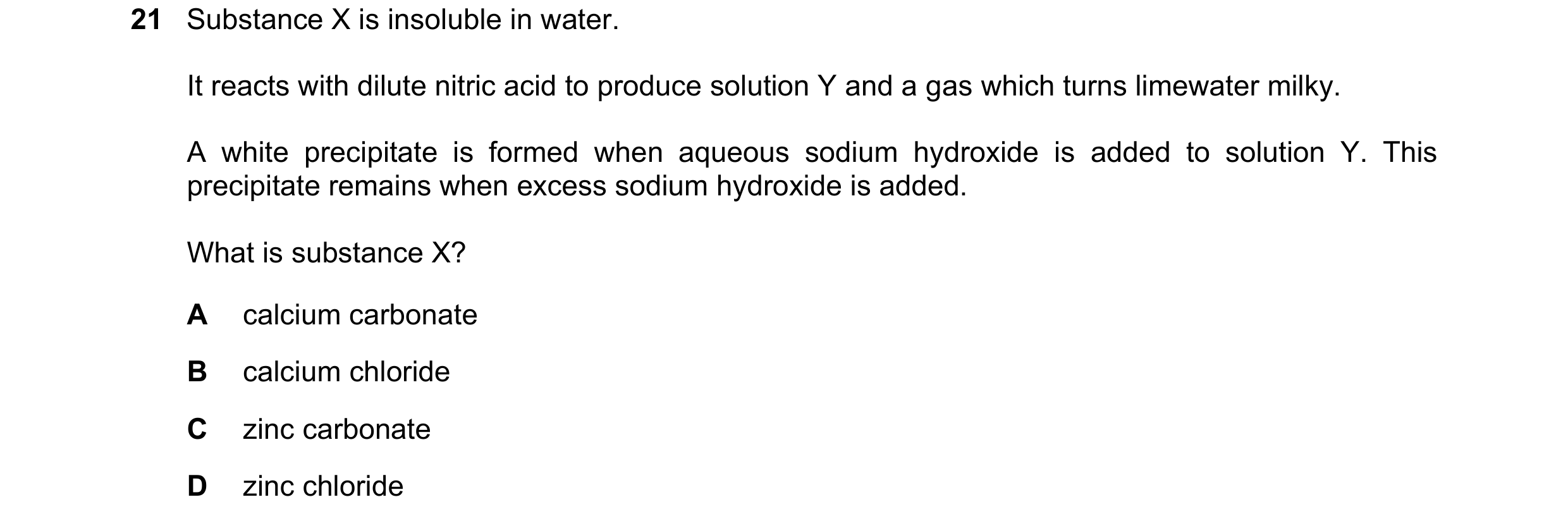
 35 / 43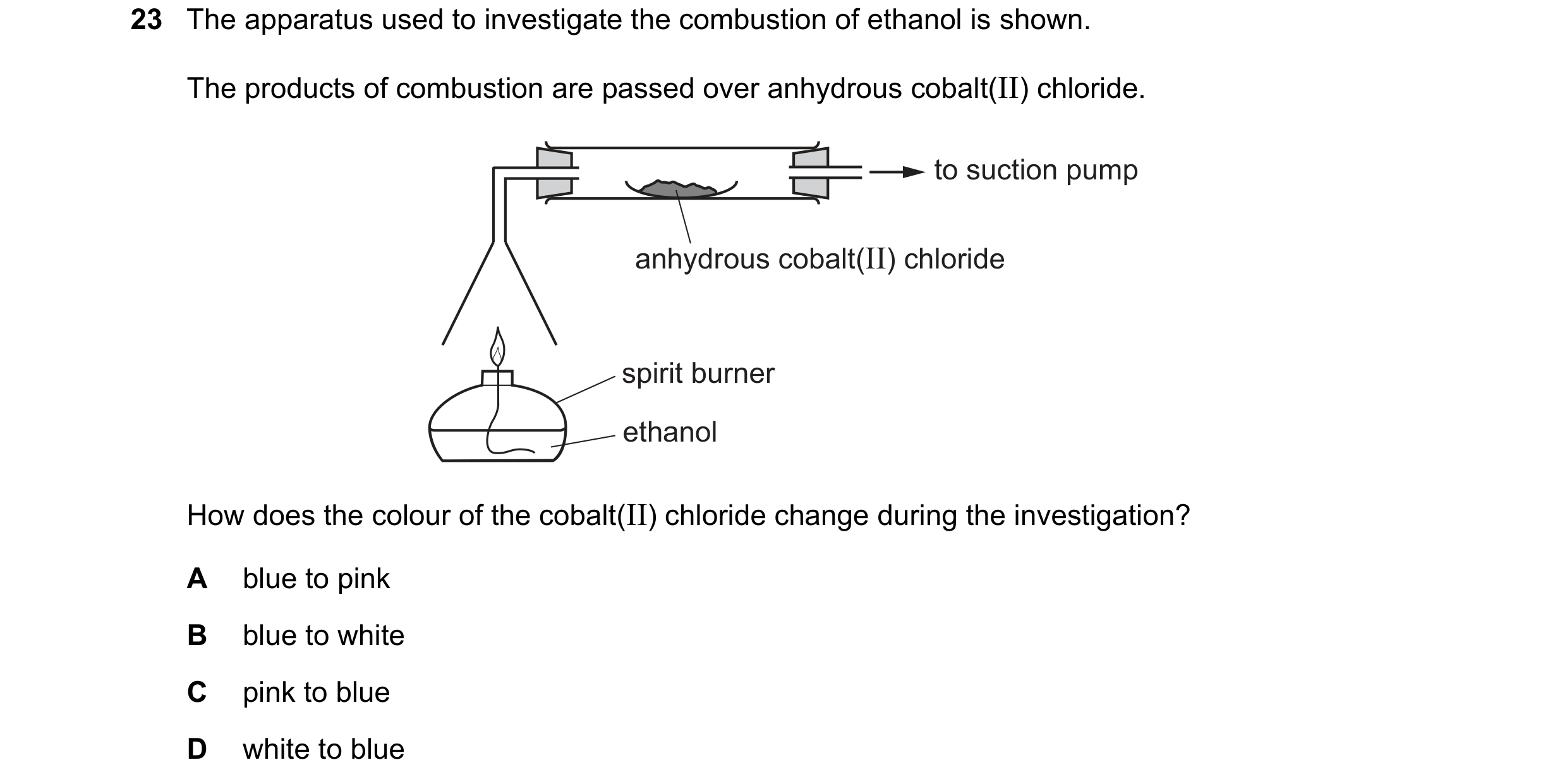
 36 / 43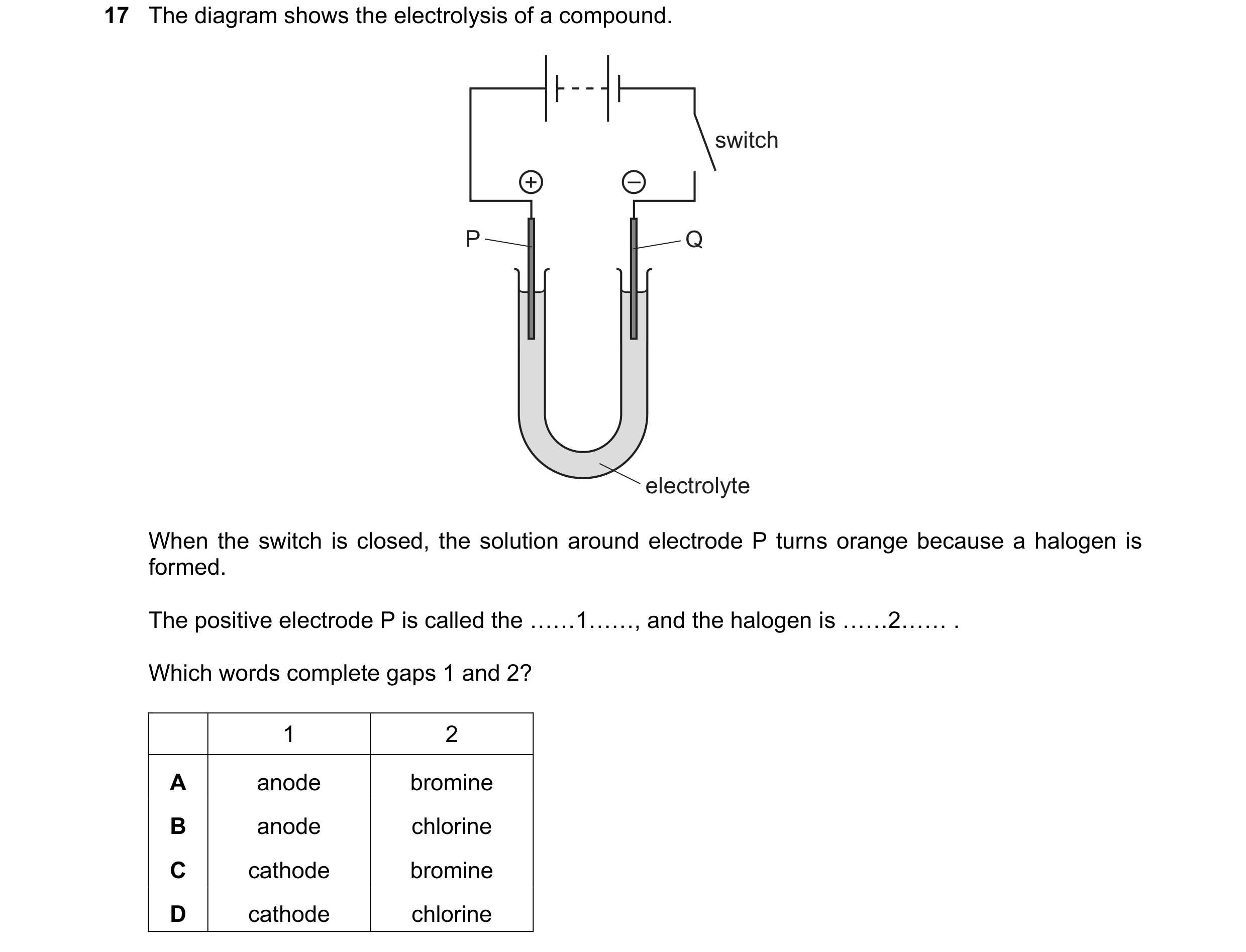
 37 / 43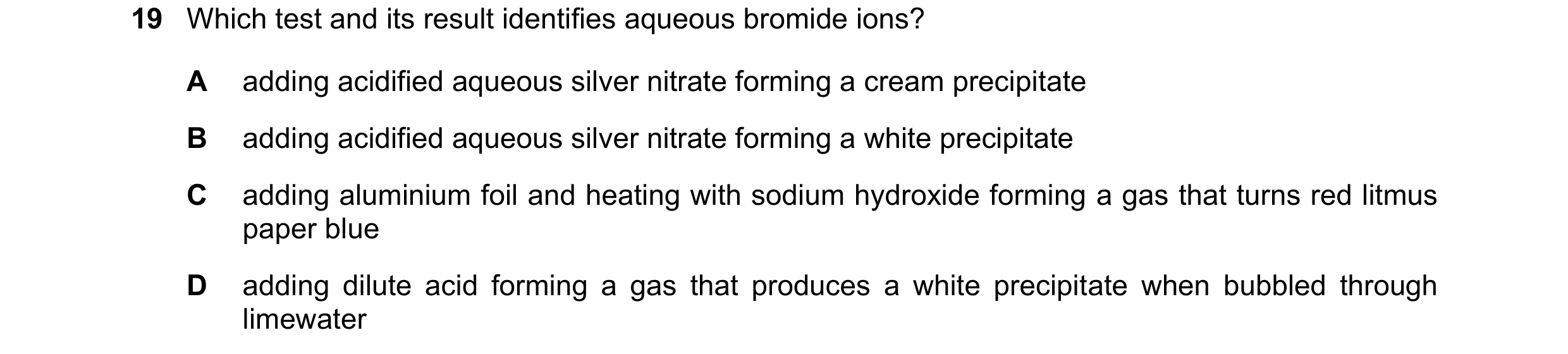
 38 / 43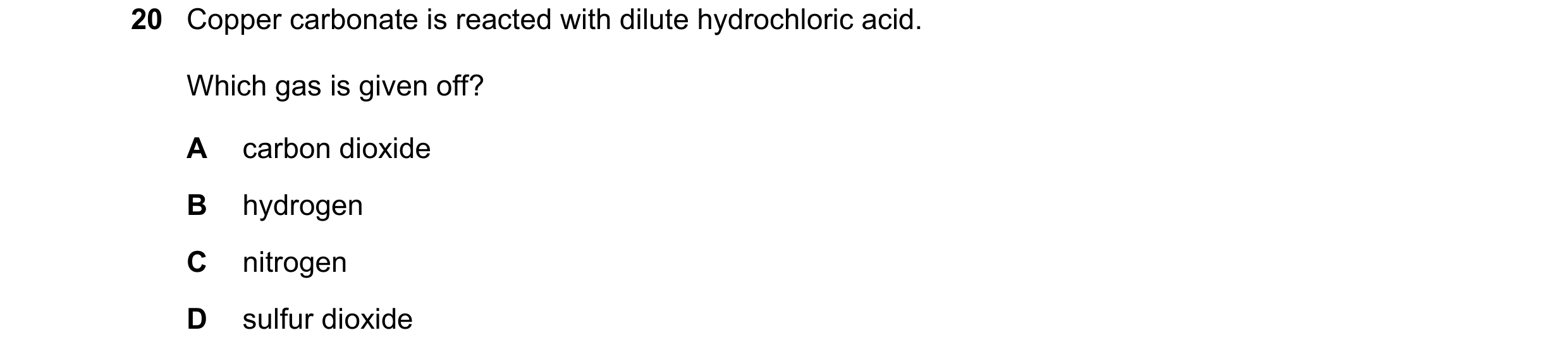


 39 / 43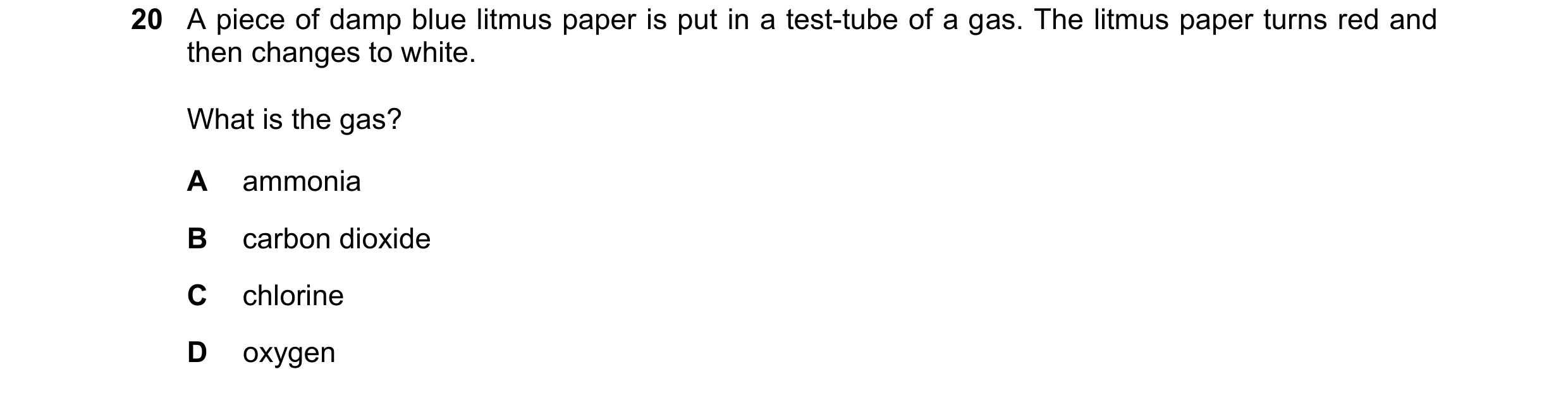

 40 / 43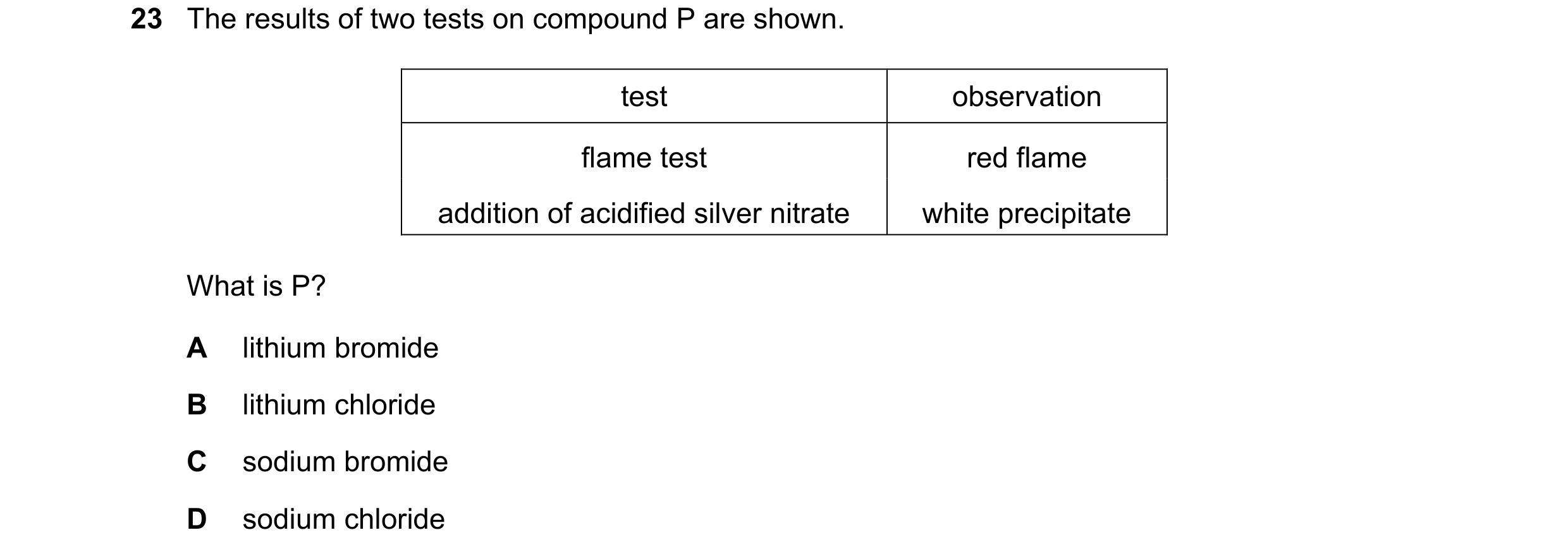



 41 / 43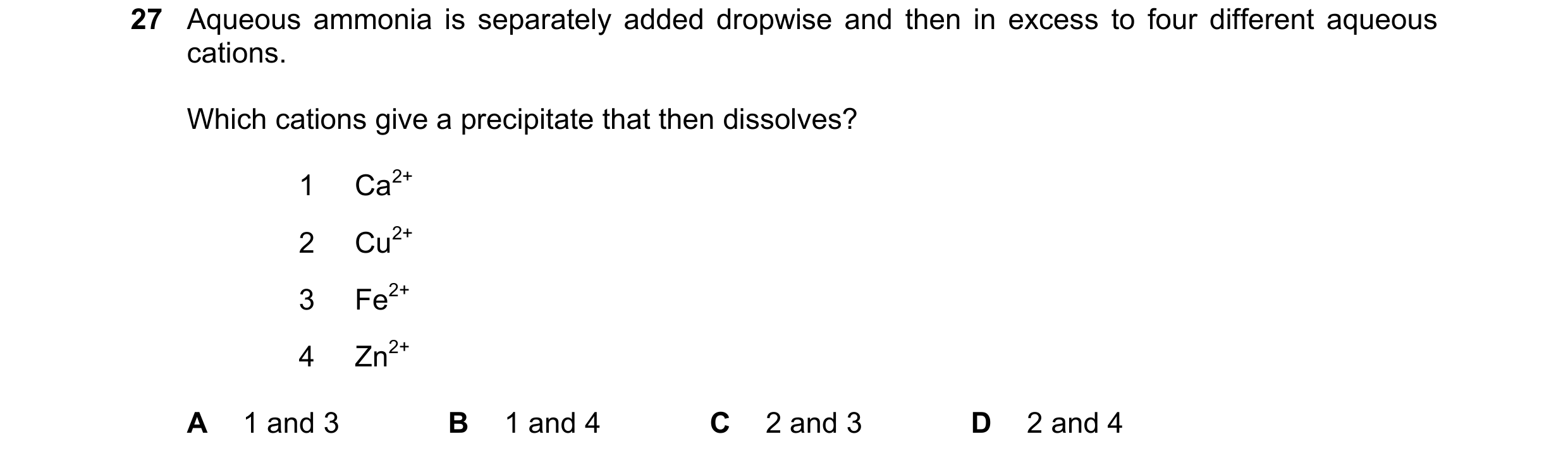

 42 / 43
 43 / 43