Cambridge IGCSE Sciences - Co-ordinated (Double) 0654 — 2012 May/June Paper 1 · Variant 2
0654/12/M/J/12 · 40 questions · 40 marks · ≈45 min
The question paper and its mark scheme, free to read here and free to download. This is Cambridge’s own paper, exactly as it was sat.
Question paper20 pages
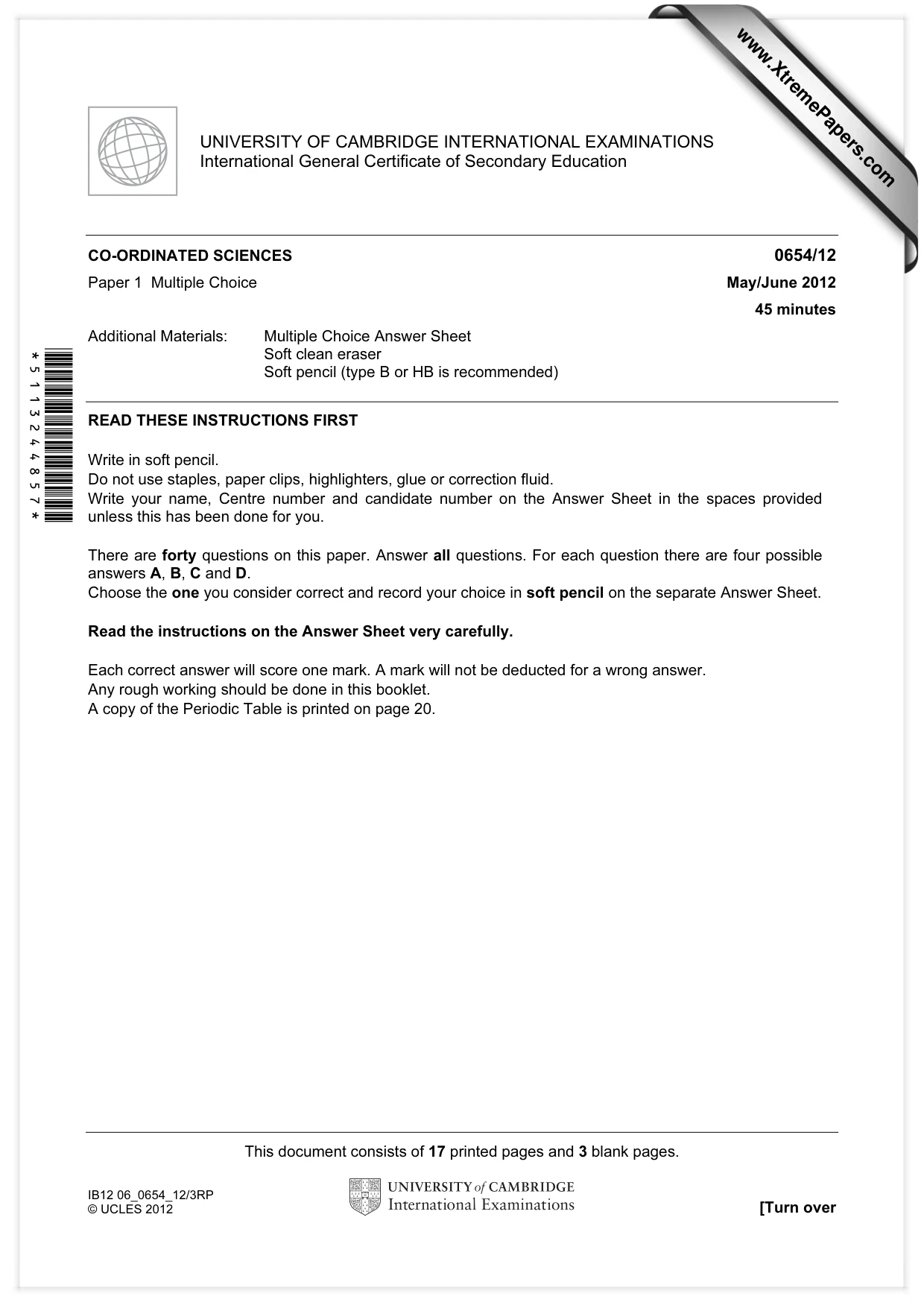
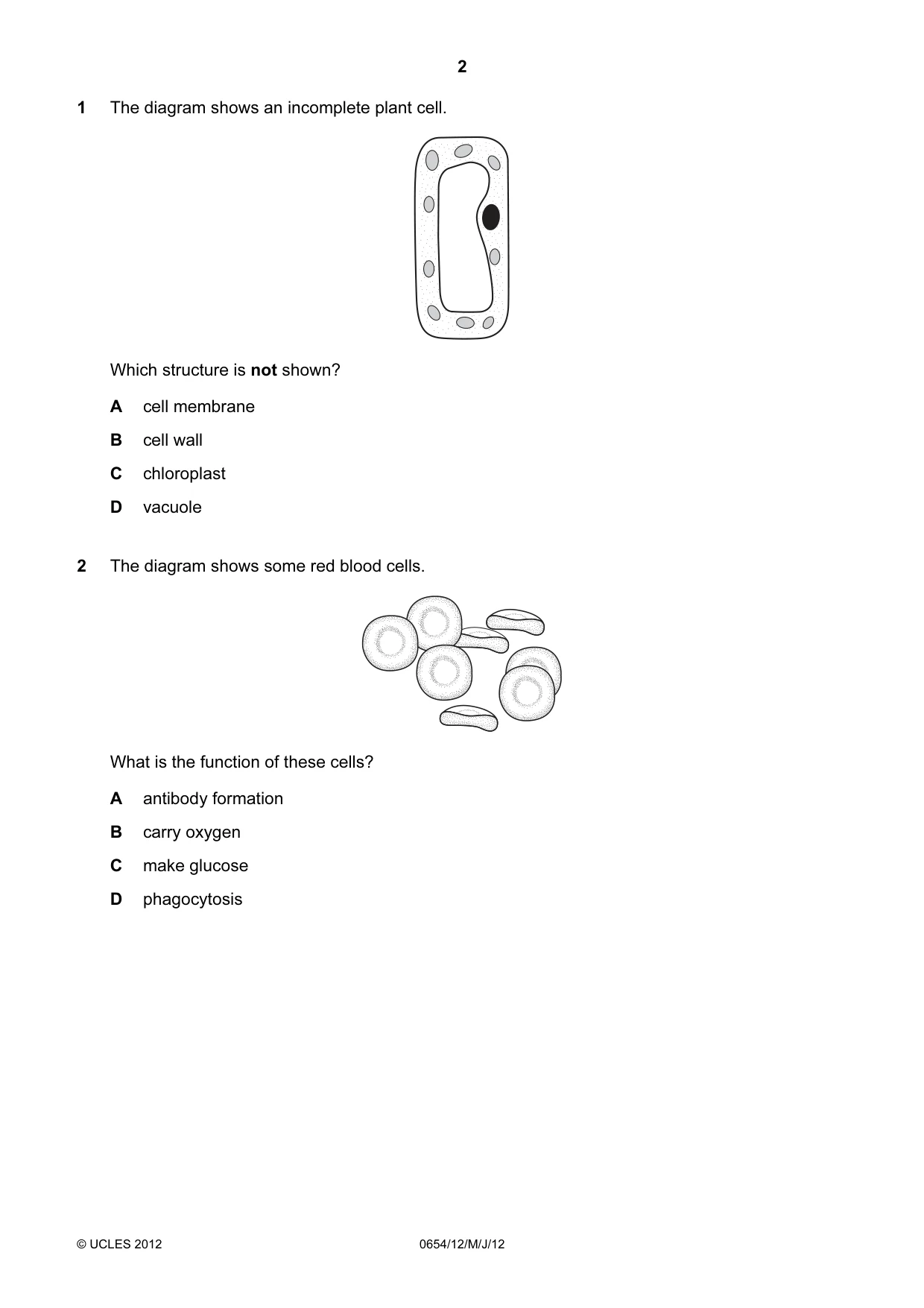
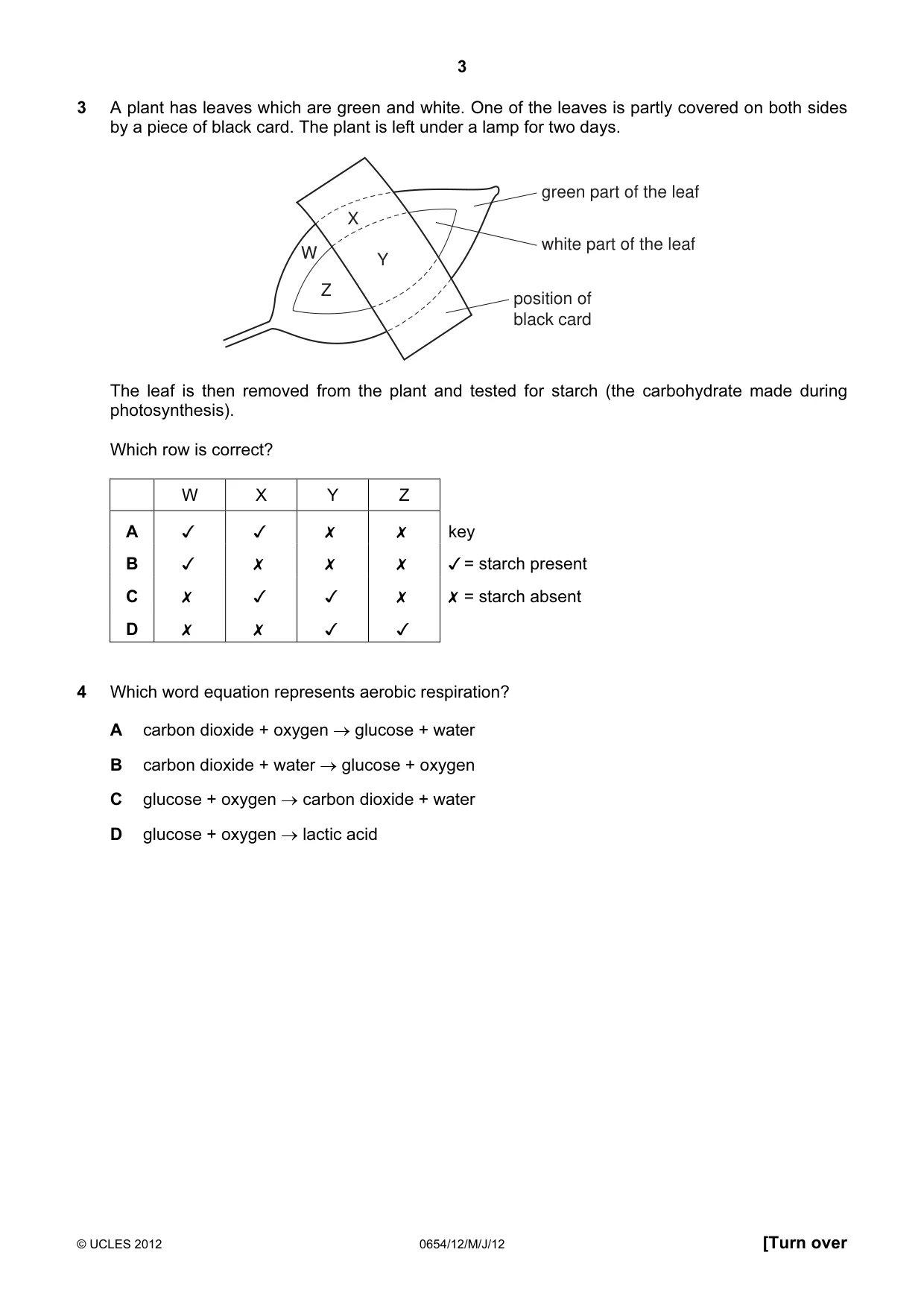
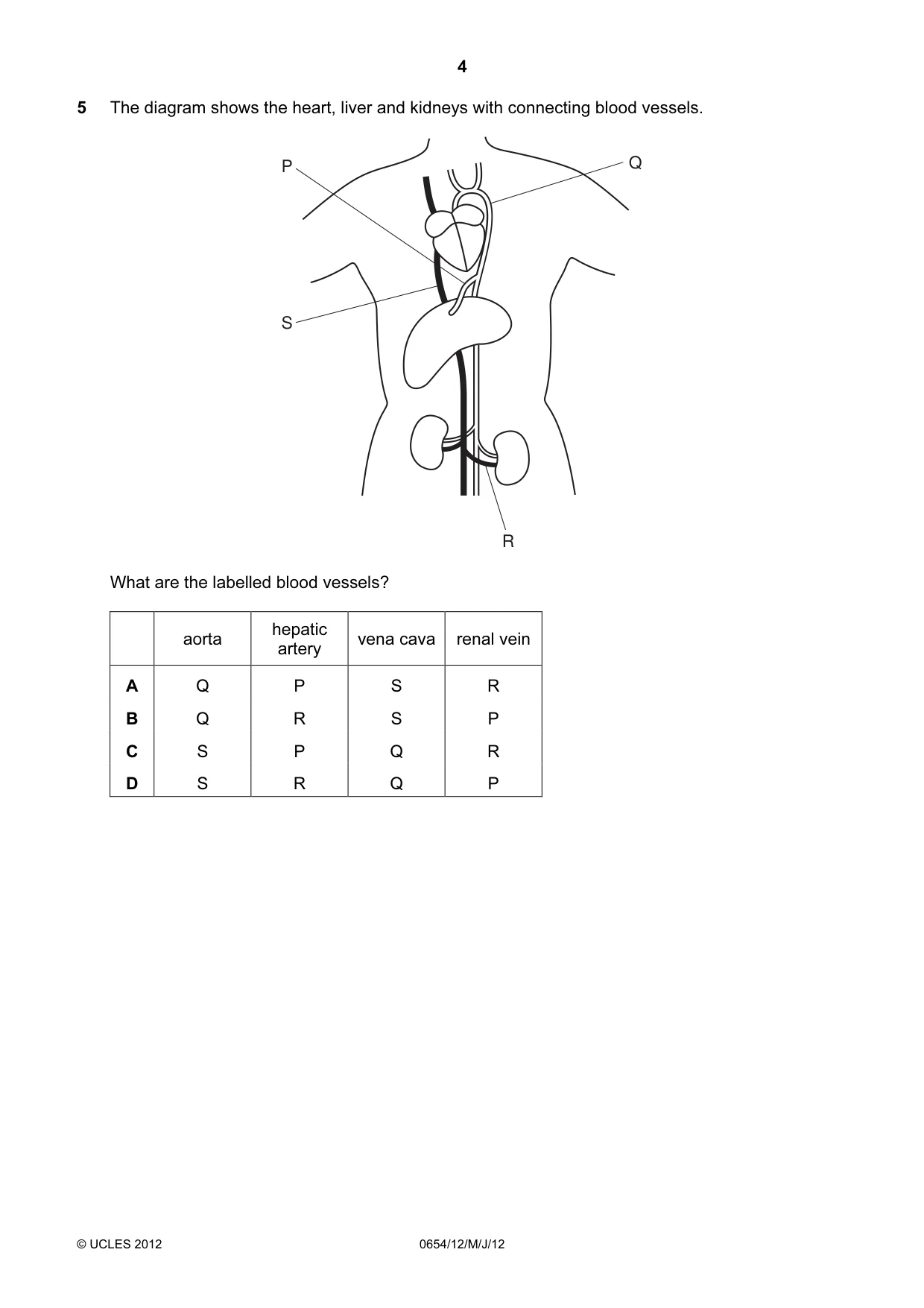



Mark scheme2 pages
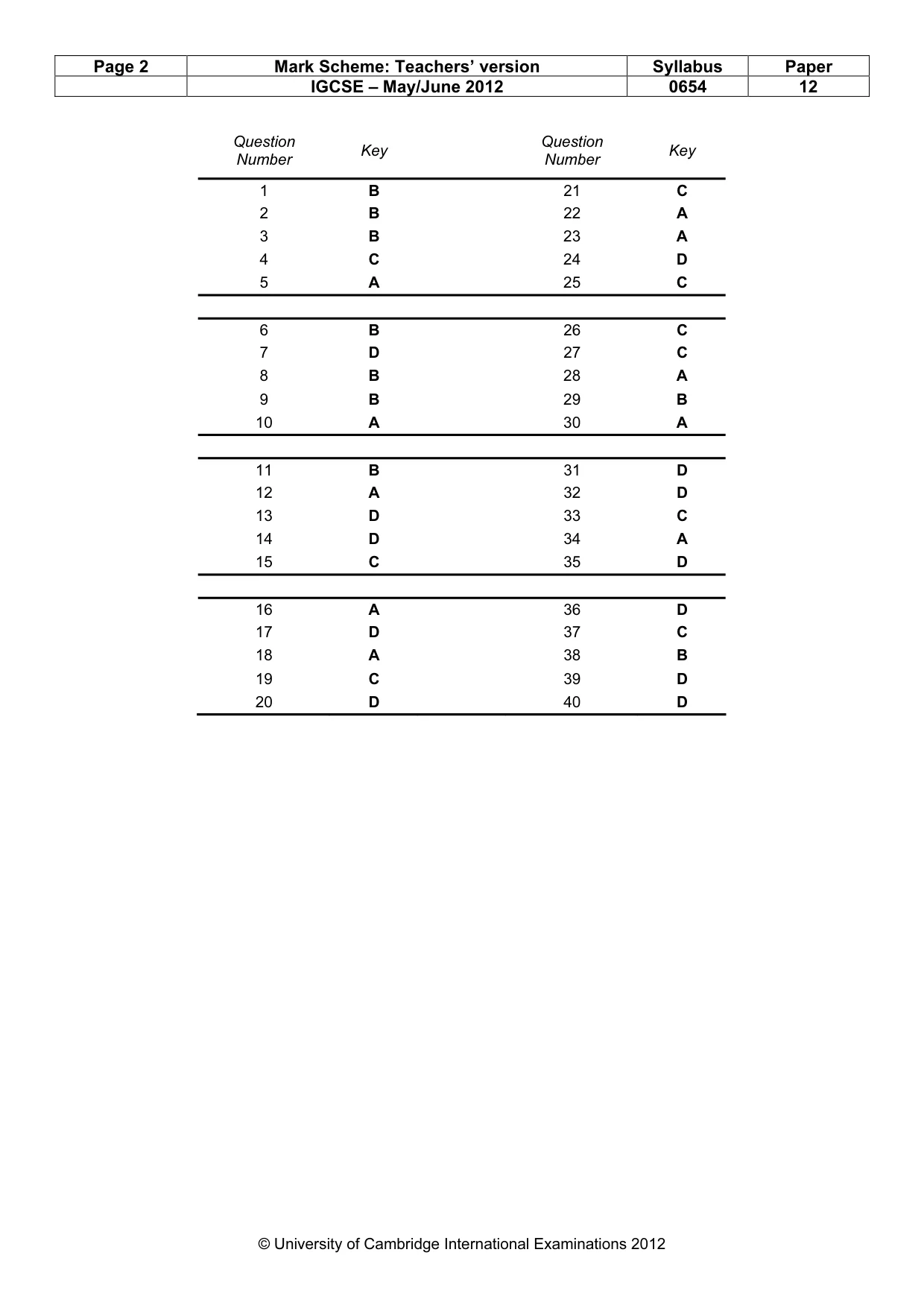
Answers below. Sit the paper first if you are practising.
Questions as text
Q1 · The diagram shows an incomplete plant cell
1 The diagram shows an incomplete plant cell. Which structure is not shown? A cell membrane B cell wall C chloroplast D vacuole
Mark scheme: B
Q2 · The diagram shows some red blood cells
2 The diagram shows some red blood cells. What is the function of these cells? A antibody formation B carry oxygen C make glucose D phagocytosis
Mark scheme: B
Q3 · A plant has leaves which are green and white
3. A plant has leaves which are green and white. One of the leaves is partly covered on both sides by a piece of black card. The plant is left under a lamp for two days. 5 7 green part of the leaf 7 white part of the leaf position of black card The leaf is then removed from the plant and tested for starch (the carbohydrate made during photosynthesis). Which row is correct? WwW key / = starch present X = starch absent K « «& x TN x << & </lx i ES 0 Oo WwW PY x «KS
Mark scheme: B
Q4 · Which word equation represents aerobic respiration?
4 Which word equation represents aerobic respiration? A carbon dioxide + oxygen → glucose + water B carbon dioxide + water → glucose + oxygen C glucose + oxygen → carbon dioxide + water D glucose + oxygen → lactic acid
Mark scheme: C
Q5 · The diagram shows the heart, liver and kidneys with connecting blood vessels
5 The diagram shows the heart, liver and kidneys with connecting blood vessels. P Q S R What are the labelled blood vessels? hepatic aorta vena cava renal vein artery A Q P S R B Q R S P C S P Q R D S R Q P
Mark scheme: A
Q6 · The diagram shows a tooth with a cavity caused by decay
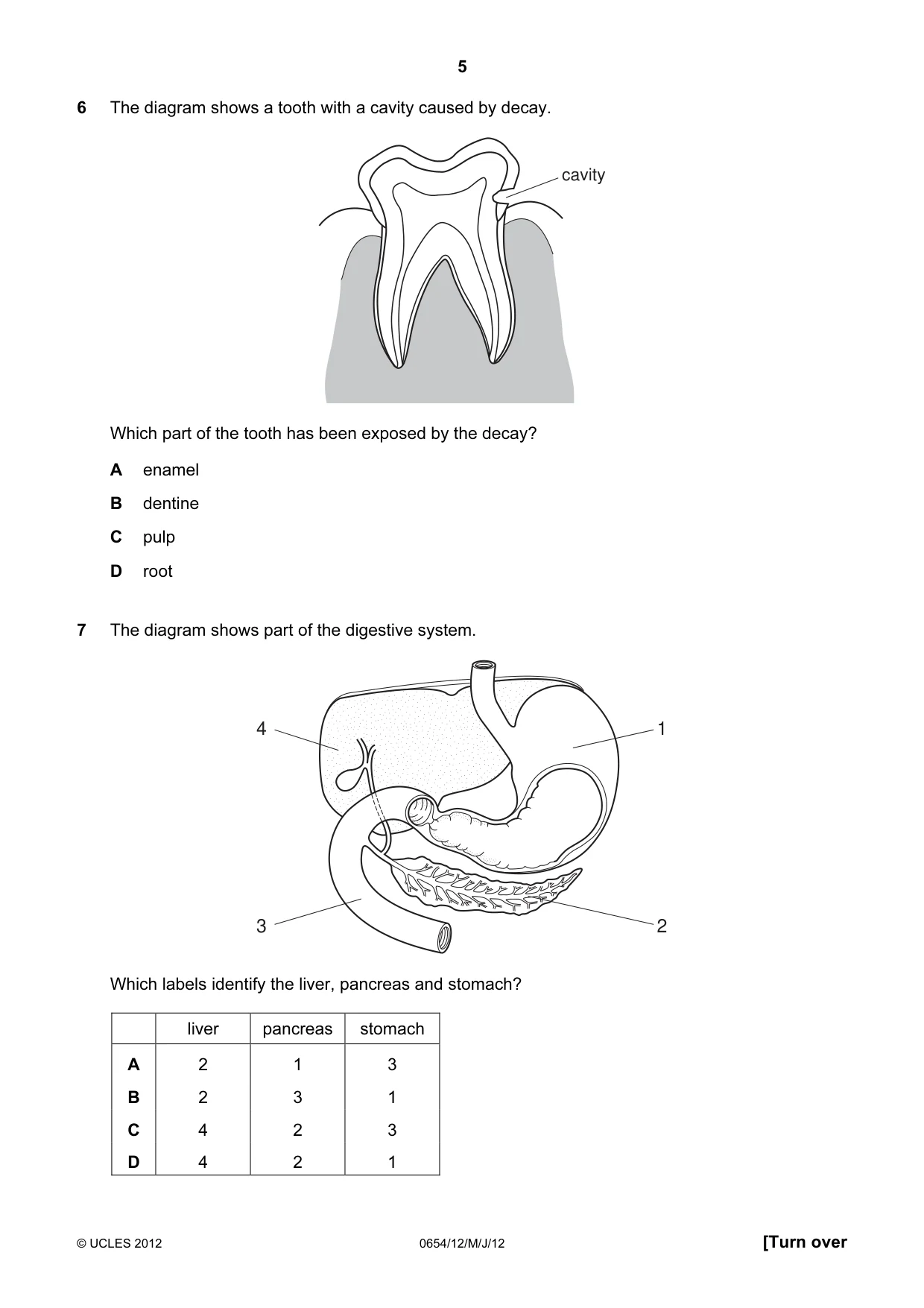
6 The diagram shows a tooth with a cavity caused by decay. cavity Which part of the tooth has been exposed by the decay? A enamel B dentine C pulp D root
Mark scheme: B
Q7 · The diagram shows part of the digestive system
7 The diagram shows part of the digestive system. 4 1 3 2 Which labels identify the liver, pancreas and stomach? liver pancreas stomach A 2 1 3 B 2 3 1 C 4 2 3 D 4 2 1
Mark scheme: D
Q8 · A person touches a hot object which triggers a reflex action
8 A person touches a hot object which triggers a reflex action. In which order does the signal travel in the reflex arc? A relay neurone → spinal cord → sensory neurone B sensory neurone → spinal cord → motor neurone C spinal cord → sensory neurone → stimulus D stimulus → motor neurone → spinal cord
Mark scheme: B
Q9 · Which organ in the body makes urea and how is urea removed from that organ?
9 Which organ in the body makes urea and how is urea removed from that organ? where made how removed A kidneys in urine B liver in blood C liver in bile D pancreas in pancreatic juice
Mark scheme: B
Q10 · Which structure produces seminal fluid?
10 Which structure produces seminal fluid? A prostate gland B sperm duct C testis D urethra
Mark scheme: A
Q11 · In plants, the allele for red flowers is dominant to the allele for white flowers
11 In plants, the allele for red flowers is dominant to the allele for white flowers. A heterozygous red-flowered plant is crossed with a white-flowered plant. What percentage of the offspring will have red flowers? A 25 % B 50 % C 75 % D 100 %
Mark scheme: B
Q12 · The diagram shows a food chain
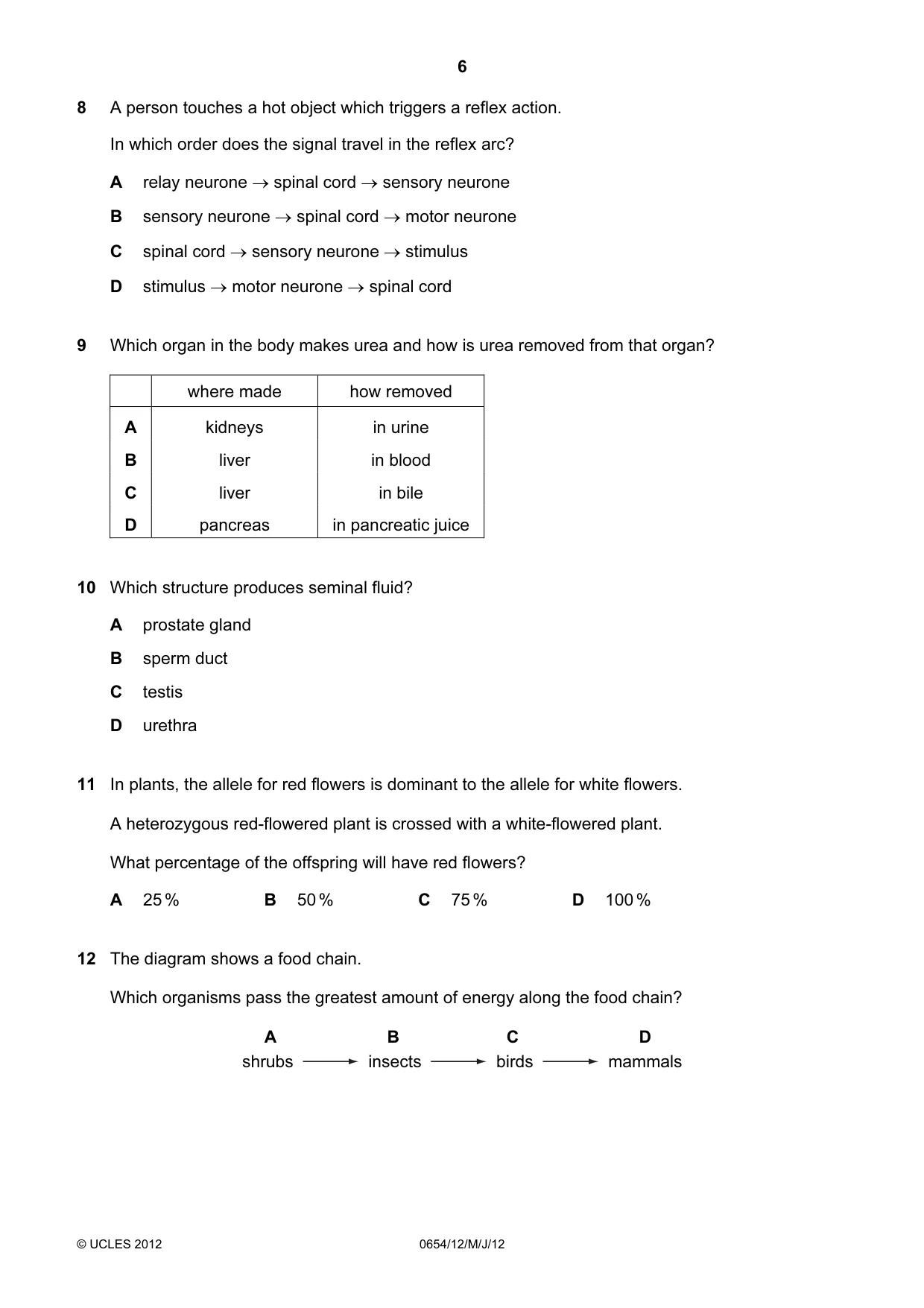
12 The diagram shows a food chain. Which organisms pass the greatest amount of energy along the food chain? A B C D shrubs insects birds mammals
Mark scheme: A
Q13 · The diagram shows part of the carbon cycle
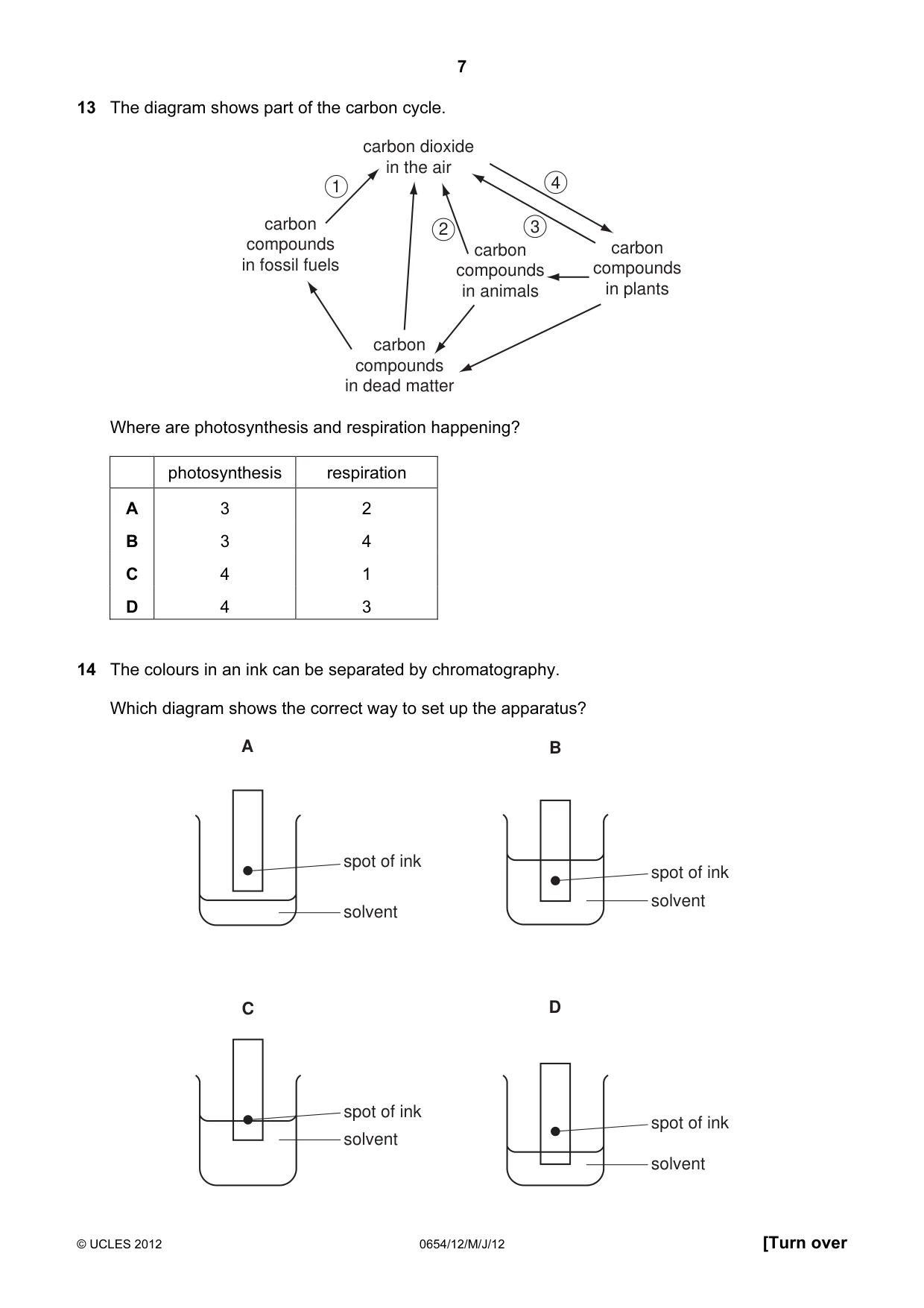
13 The diagram shows part of the carbon cycle. carbon dioxide in the air 1 4 carbon 2 3 compounds carbon carbon in fossil fuels compounds compounds in animals in plants carbon compounds in dead matter Where are photosynthesis and respiration happening? photosynthesis respiration A 3 2 B 3 4 C 4 1 D 4 3
Mark scheme: D
Q14 · The colours in an ink can be separated by chromatography
14 The colours in an ink can be separated by chromatography. Which diagram shows the correct way to set up the apparatus? A B spot of ink spot of ink solvent solvent C D spot of ink spot of ink solvent solvent
Mark scheme: D
Q15 · The symbol for an atom of neon is 20 Ne
15 The symbol for an atom of neon is 20 Ne. 10 Which statement about the atom is correct? A It contains half as many neutrons as protons. B It contains twice as many neutrons as protons. C The number of neutrons equals the number of protons. D The total number of neutrons and protons is thirty.
Mark scheme: C
Q16 · Which formula contains the most elements?
16 Which formula contains the most elements? A NaOH B Rb2S C SiCl 4 D SnO2
Mark scheme: A
Q17 · The apparatus shown is used to investigate the speed of reaction between hydrochloric…
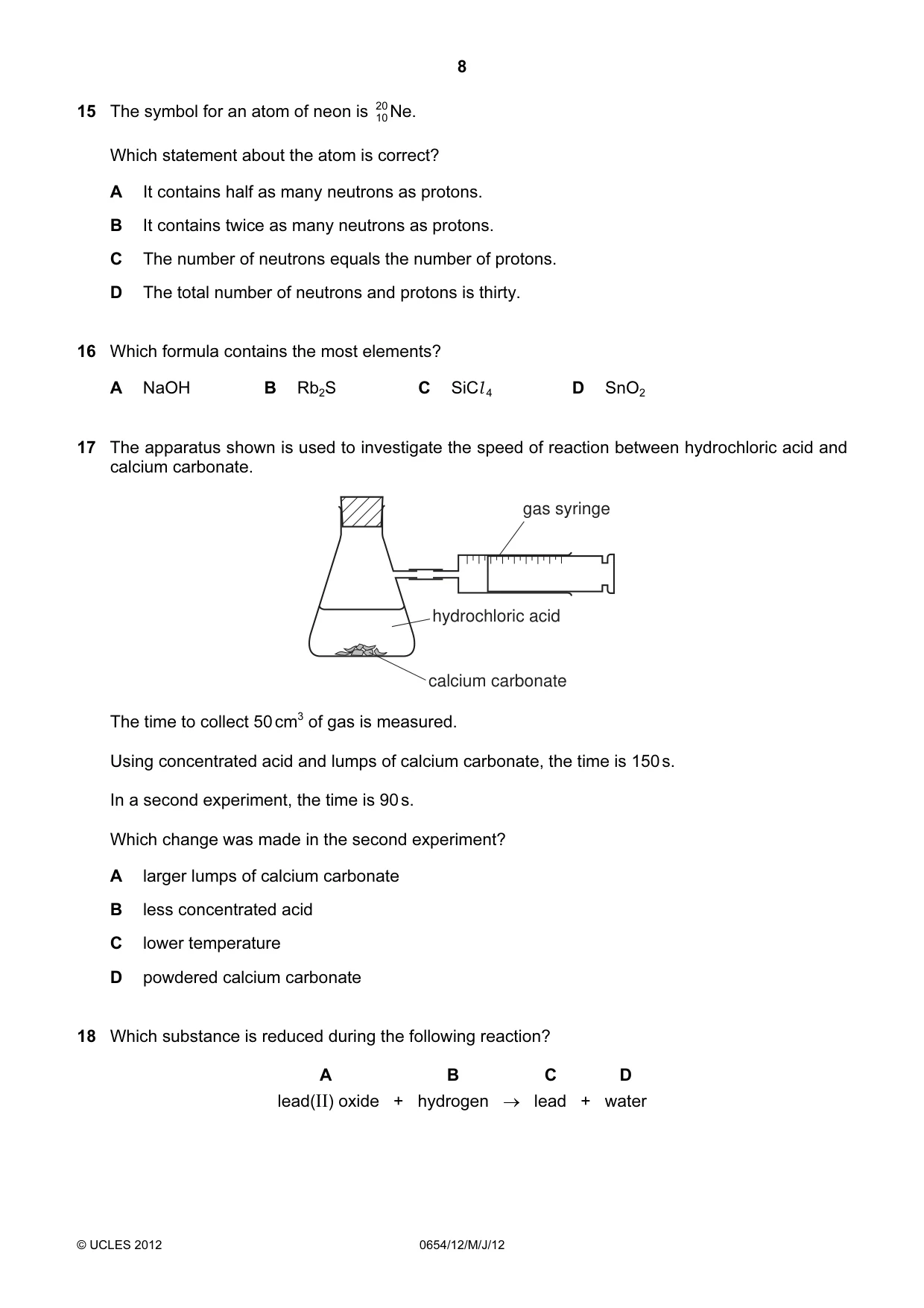
17 The apparatus shown is used to investigate the speed of reaction between hydrochloric acid and calcium carbonate. gas syringe hydrochloric acid calcium carbonate The time to collect 50 cm3 of gas is measured. Using concentrated acid and lumps of calcium carbonate, the time is 150 s. In a second experiment, the time is 90 s. Which change was made in the second experiment? A larger lumps of calcium carbonate B less concentrated acid C lower temperature D powdered calcium carbonate
Mark scheme: D
Q18 · Which substance is reduced during the following reaction?
18 Which substance is reduced during the following reaction? A B C D lead(II) oxide + hydrogen → lead + water
Mark scheme: A
Q19 · A coloured solution of compound X gives a white precipitate with acidified silver nitrate
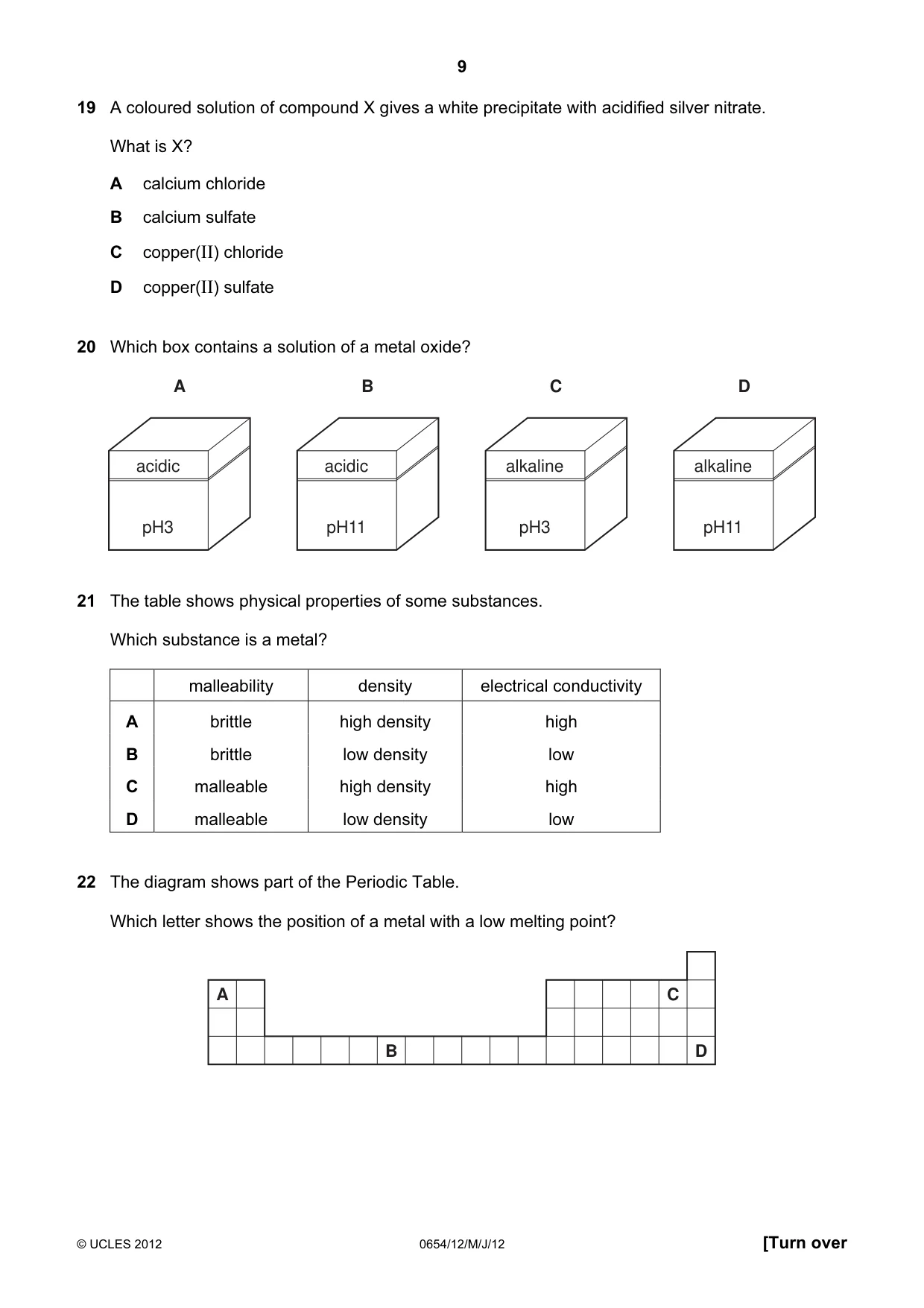
19 A coloured solution of compound X gives a white precipitate with acidified silver nitrate. What is X? A calcium chloride B calcium sulfate C copper(II) chloride D copper(II) sulfate
Mark scheme: C
Q20 · Which box contains a solution of a metal oxide?
20 Which box contains a solution of a metal oxide? A B C D acidic acidic alkaline alkaline pH3 pH11 pH3 pH11
Mark scheme: D
More questions on The characteristic properties of acids and bases
Q21 · The table shows physical properties of some substances
21 The table shows physical properties of some substances. Which substance is a metal? malleability density electrical conductivity A brittle high density high B brittle low density low C malleable high density high D malleable low density low
Mark scheme: C
Q22 · The diagram shows part of the Periodic Table
22 The diagram shows part of the Periodic Table. Which letter shows the position of a metal with a low melting point? A C B D
Mark scheme: A
Q23 · Copper(II) oxide is mixed with a solid Q
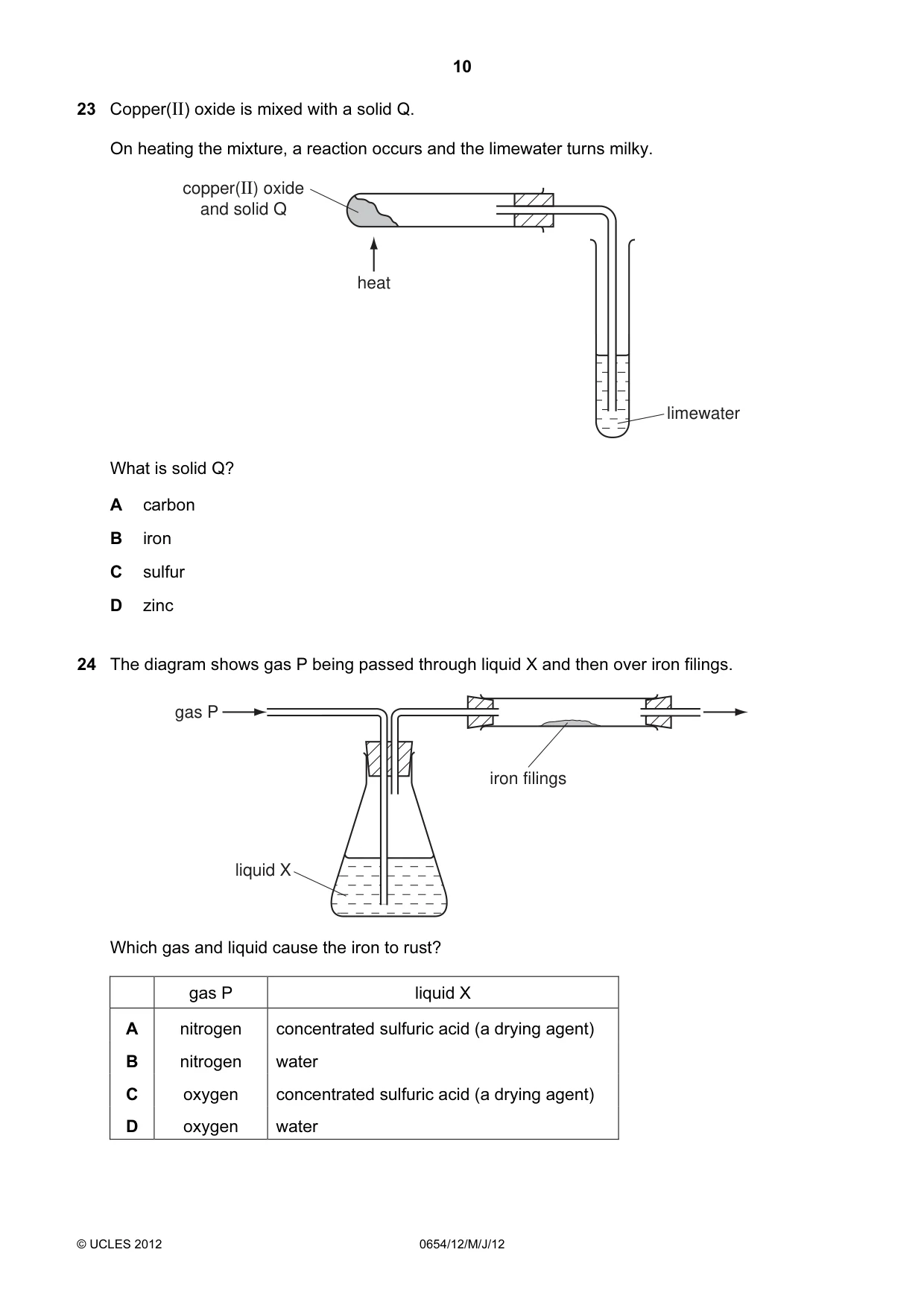
23 Copper(II) oxide is mixed with a solid Q. On heating the mixture, a reaction occurs and the limewater turns milky. copper(II) oxide and solid Q heat limewater What is solid Q? A carbon B iron C sulfur D zinc
Mark scheme: A
Q24 · The diagram shows gas P being passed through liquid X and then over iron filings
24 The diagram shows gas P being passed through liquid X and then over iron filings. gas P iron filings liquid X Which gas and liquid cause the iron to rust? gas P liquid X A nitrogen concentrated sulfuric acid (a drying agent) B nitrogen water C oxygen concentrated sulfuric acid (a drying agent) D oxygen water
Mark scheme: D
Q25 · Fertilisers are used to supply the essential elements needed for plant growth
25 Fertilisers are used to supply the essential elements needed for plant growth. Which compound supplies two of these essential elements? A Ca(H2PO4)2 B Ca(NO3)2 C KNO3 D (NH4)2SO4
Mark scheme: C
Q26 · The burning of a fuel is investigated using the apparatus shown
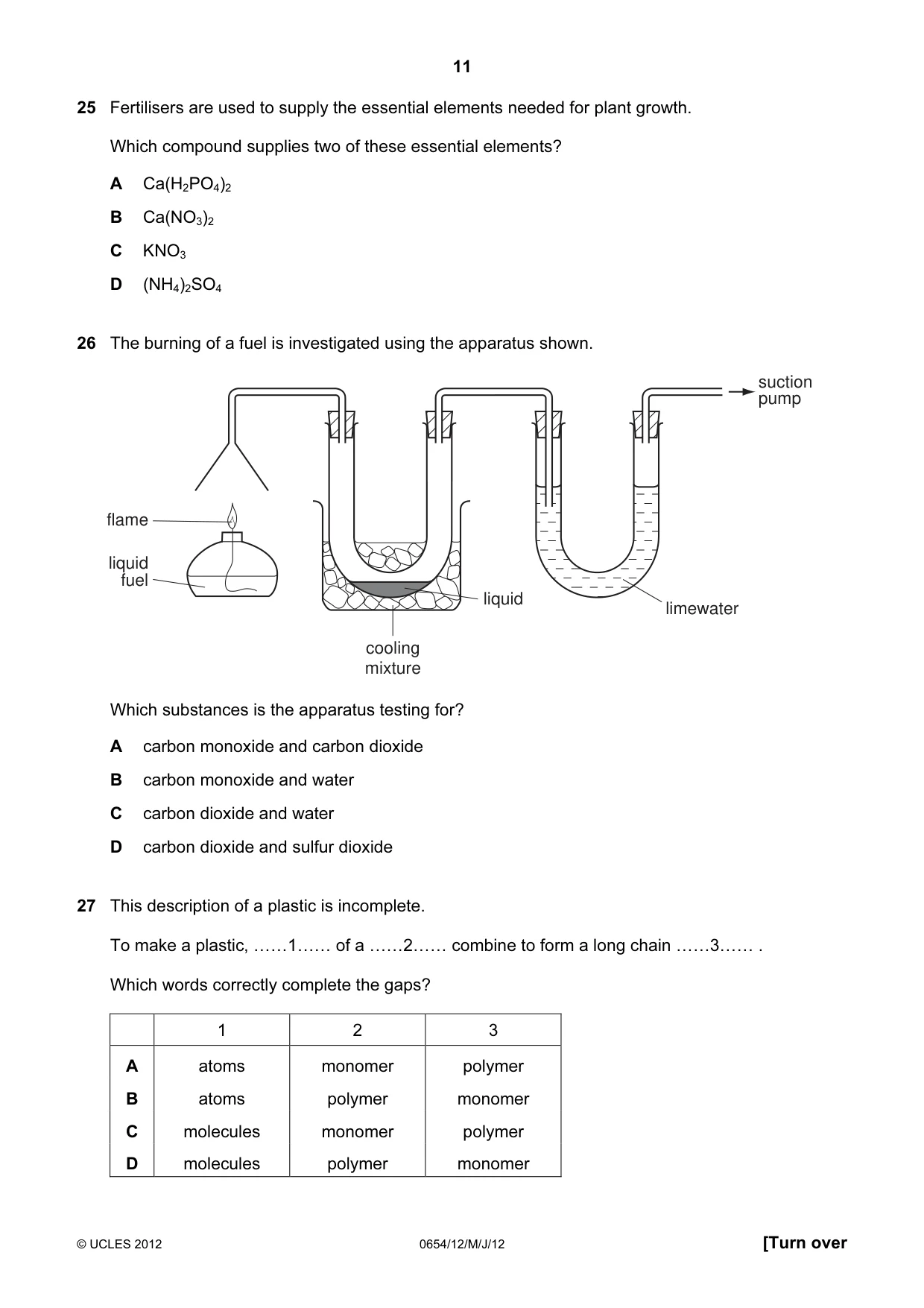
26 The burning of a fuel is investigated using the apparatus shown. suction pump flame liquid fuel liquid limewater cooling mixture Which substances is the apparatus testing for? A carbon monoxide and carbon dioxide B carbon monoxide and water C carbon dioxide and water D carbon dioxide and sulfur dioxide
Mark scheme: C
Q27 · This description of a plastic is incomplete
27 This description of a plastic is incomplete. To make a plastic, ……1…… of a ……2…… combine to form a long chain ……3…… . Which words correctly complete the gaps? 1 2 3 A atoms monomer polymer B atoms polymer monomer C molecules monomer polymer D molecules polymer monomer
Mark scheme: C
Q28 · The graph shows how the distance of an object changes with time
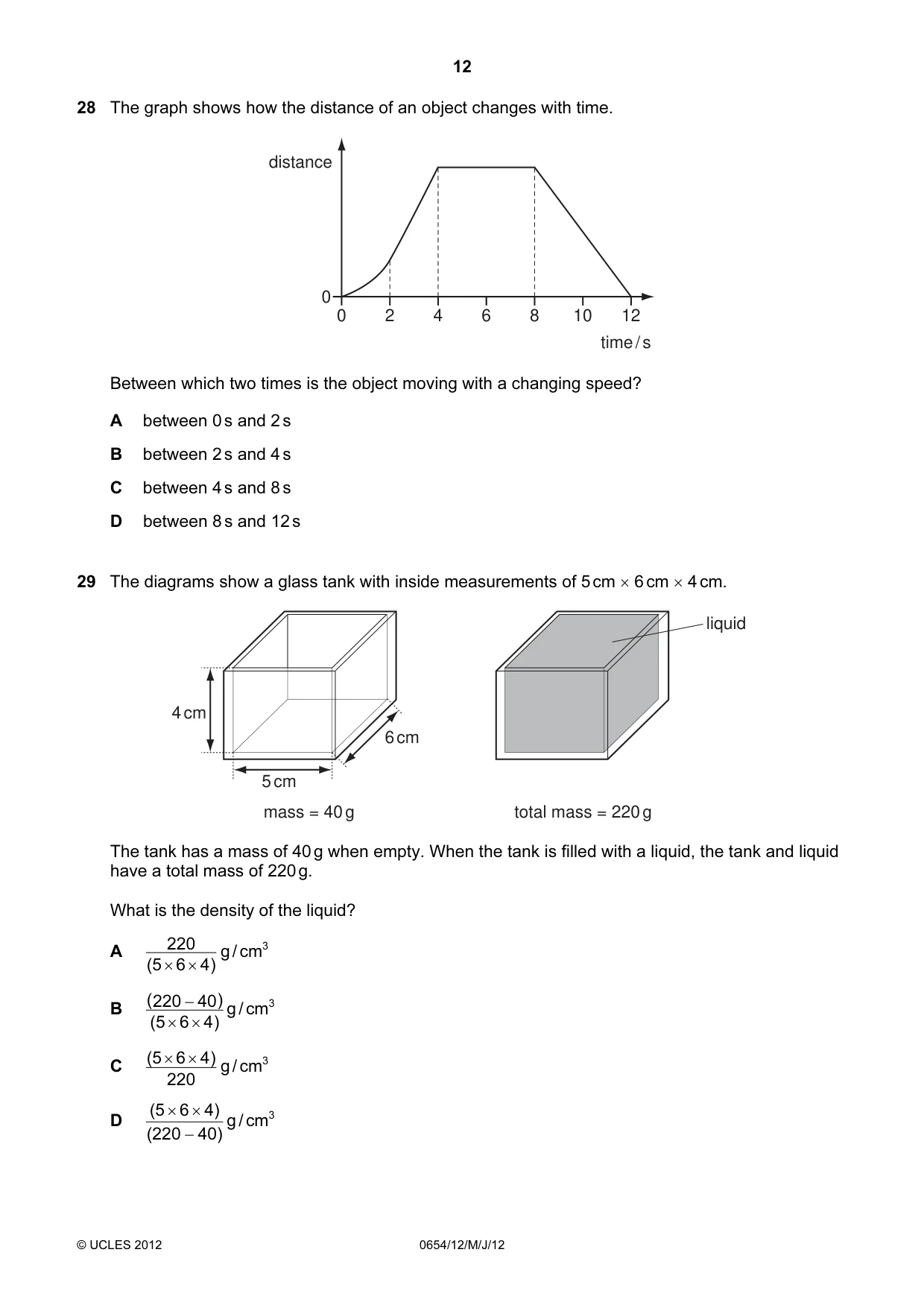
28 The graph shows how the distance of an object changes with time. distance 0 0 2 4 6 8 10 12 time / s Between which two times is the object moving with a changing speed? A between 0 s and 2 s B between 2 s and 4 s C between 4 s and 8 s D between 8 s and 12 s
Mark scheme: A
Q29 · The diagrams show a glass tank with inside measurements of 5 cm × 6 cm × 4 cm
29 The diagrams show a glass tank with inside measurements of 5 cm × 6 cm × 4 cm. liquid 4 cm 6 cm 5 cm mass = 40 g total mass = 220 g The tank has a mass of 40 g when empty. When the tank is filled with a liquid, the tank and liquid have a total mass of 220 g. What is the density of the liquid? A 220 g / cm3 (5 × 6 × 4 ) ( 220 − 40 ) g / cm3 B (5 × 6 × 4 ) (5 × 6 × 4 ) g / cm3 C 220 (5 × 6 × 4) D g / cm3 (220 − 40)
Mark scheme: B
Q30 · Which energy resource did not receive its energy from the Sun?
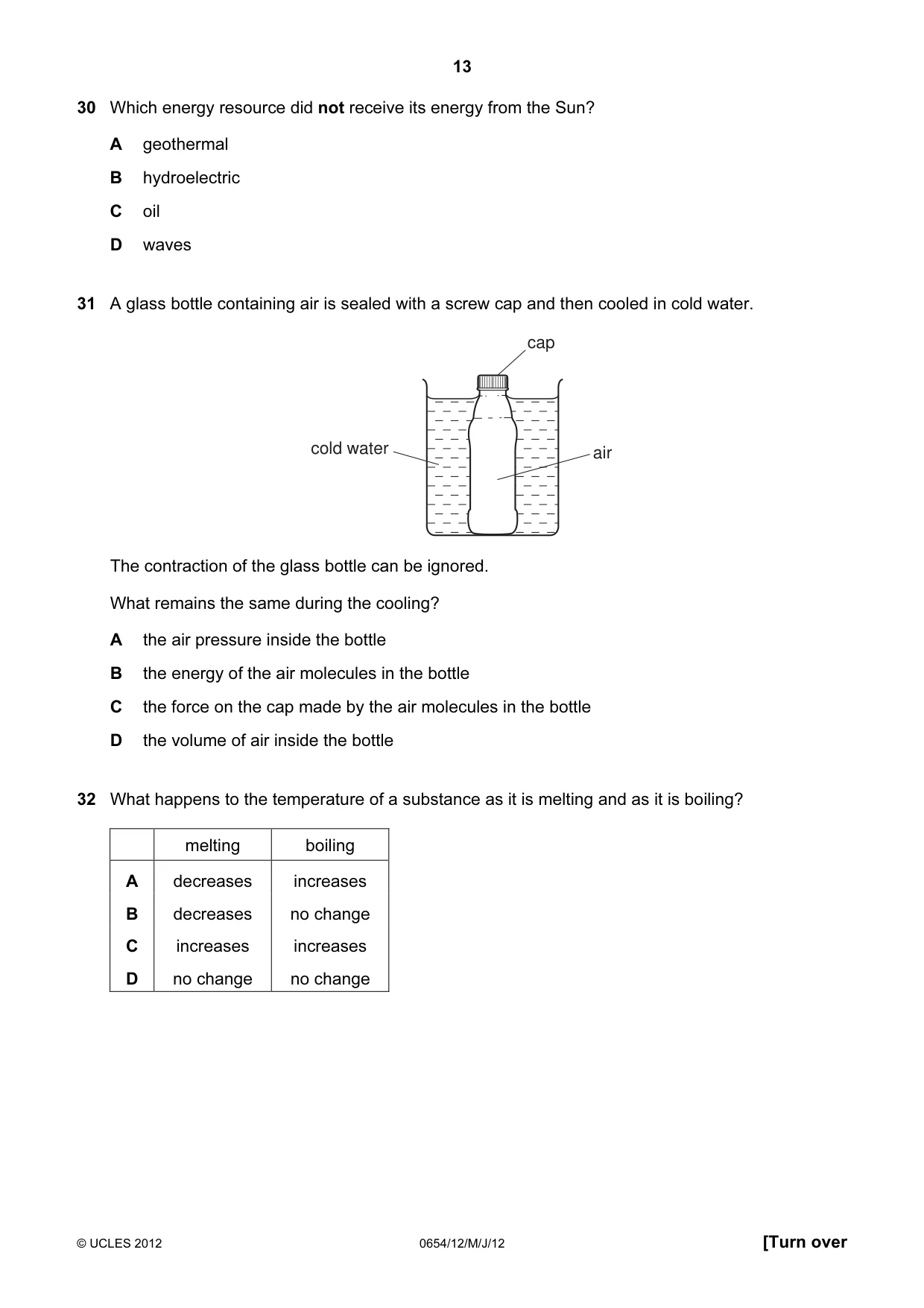
30 Which energy resource did not receive its energy from the Sun? A geothermal B hydroelectric C oil D waves
Mark scheme: A
Q31 · A glass bottle containing air is sealed with a screw cap and then cooled in cold water
31 A glass bottle containing air is sealed with a screw cap and then cooled in cold water. cap cold water air The contraction of the glass bottle can be ignored. What remains the same during the cooling? A the air pressure inside the bottle B the energy of the air molecules in the bottle C the force on the cap made by the air molecules in the bottle D the volume of air inside the bottle
Mark scheme: D
Q32 · What happens to the temperature of a substance as it is melting and as it is boiling?
32 What happens to the temperature of a substance as it is melting and as it is boiling? melting boiling A decreases increases B decreases no change C increases increases D no change no change
Mark scheme: D
Q33 · A hot metal ball is placed in a small hollow in a piece of wood
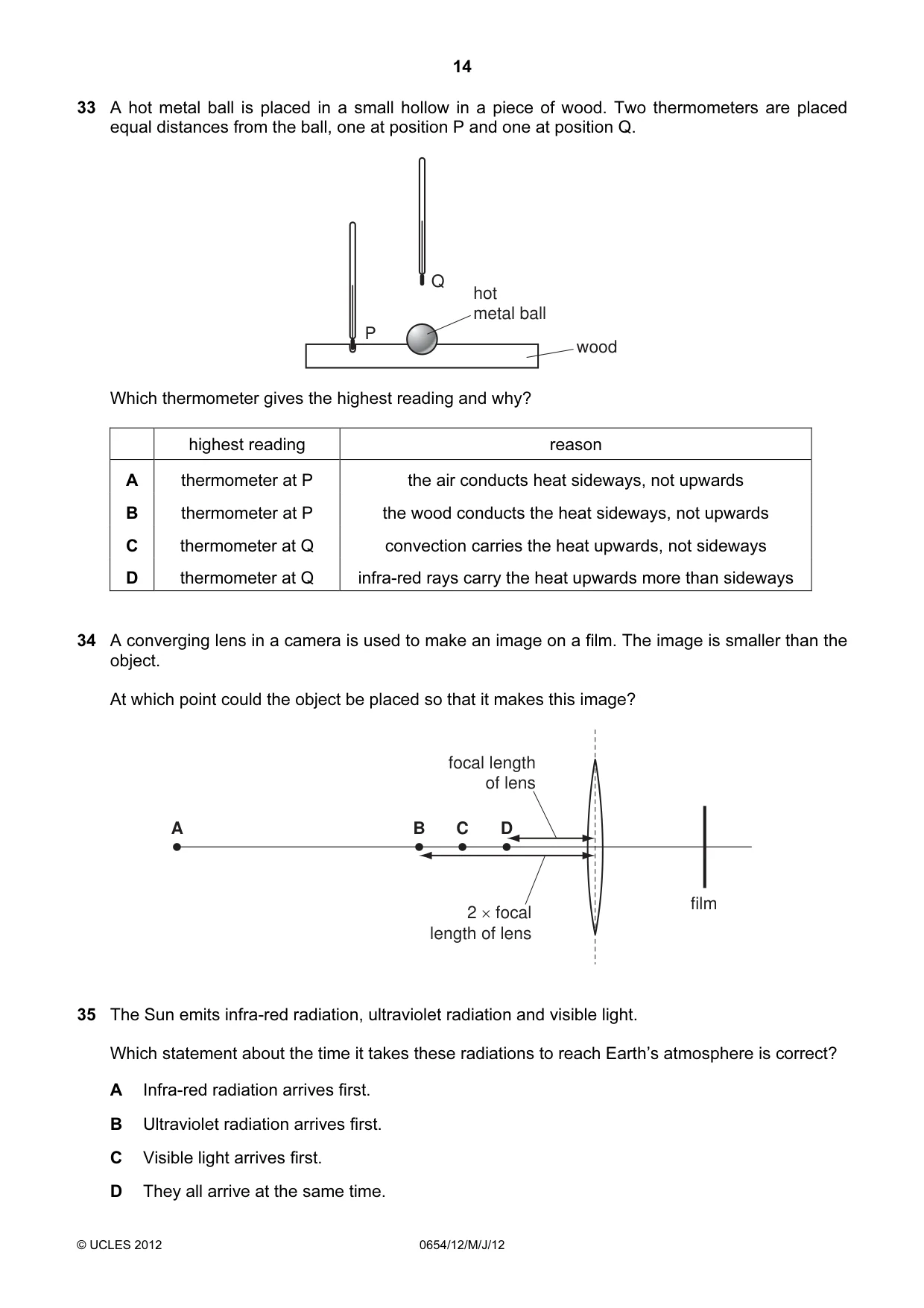
33 A hot metal ball is placed in a small hollow in a piece of wood. Two thermometers are placed equal distances from the ball, one at position P and one at position Q. Q hot metal ball P wood Which thermometer gives the highest reading and why? highest reading reason A thermometer at P the air conducts heat sideways, not upwards B thermometer at P the wood conducts the heat sideways, not upwards C thermometer at Q convection carries the heat upwards, not sideways D thermometer at Q infra-red rays carry the heat upwards more than sideways
Mark scheme: C
Q34 · A converging lens in a camera is used to make an image on a film
34 A converging lens in a camera is used to make an image on a film. The image is smaller than the object. At which point could the object be placed so that it makes this image? focal length of lens A B C D film 2 × focal length of lens
Mark scheme: A
Q35 · The Sun emits infra-red radiation, ultraviolet radiation and visible light
35 The Sun emits infra-red radiation, ultraviolet radiation and visible light. Which statement about the time it takes these radiations to reach Earth’s atmosphere is correct? A Infra-red radiation arrives first. B Ultraviolet radiation arrives first. C Visible light arrives first. D They all arrive at the same time.
Mark scheme: D
Q36 · Astronaut 1 uses a hammer to mend a satellite in space
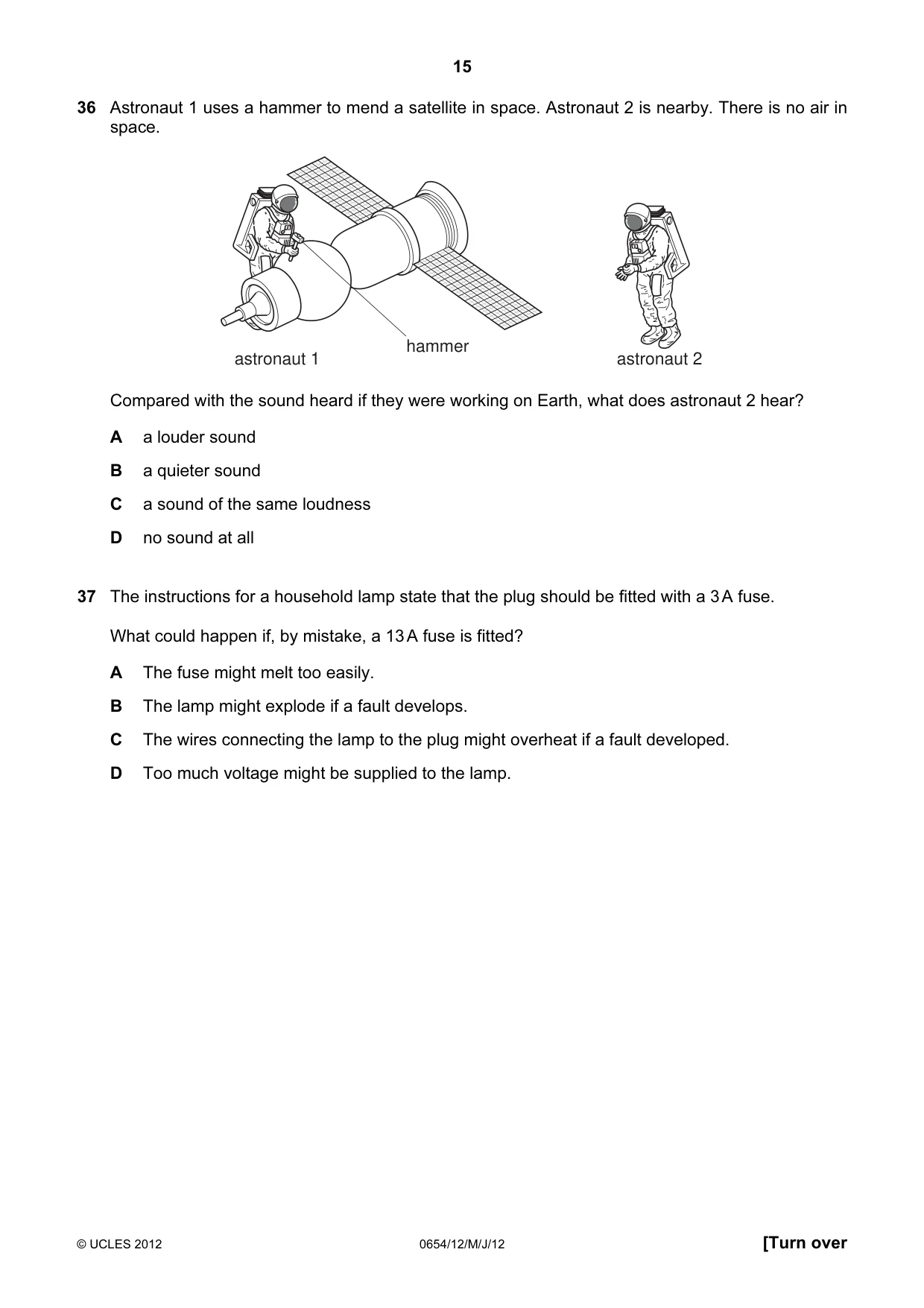
36 Astronaut 1 uses a hammer to mend a satellite in space. Astronaut 2 is nearby. There is no air in space. hammer astronaut 1 astronaut 2 Compared with the sound heard if they were working on Earth, what does astronaut 2 hear? A a louder sound B a quieter sound C a sound of the same loudness D no sound at all
Mark scheme: D
Q37 · The instructions for a household lamp state that the plug should be fitted with a 3 A fuse
37 The instructions for a household lamp state that the plug should be fitted with a 3 A fuse. What could happen if, by mistake, a 13 A fuse is fitted? A The fuse might melt too easily. B The lamp might explode if a fault develops. C The wires connecting the lamp to the plug might overheat if a fault developed. D Too much voltage might be supplied to the lamp.
Mark scheme: C
Q38 · An electric current flows along a wire
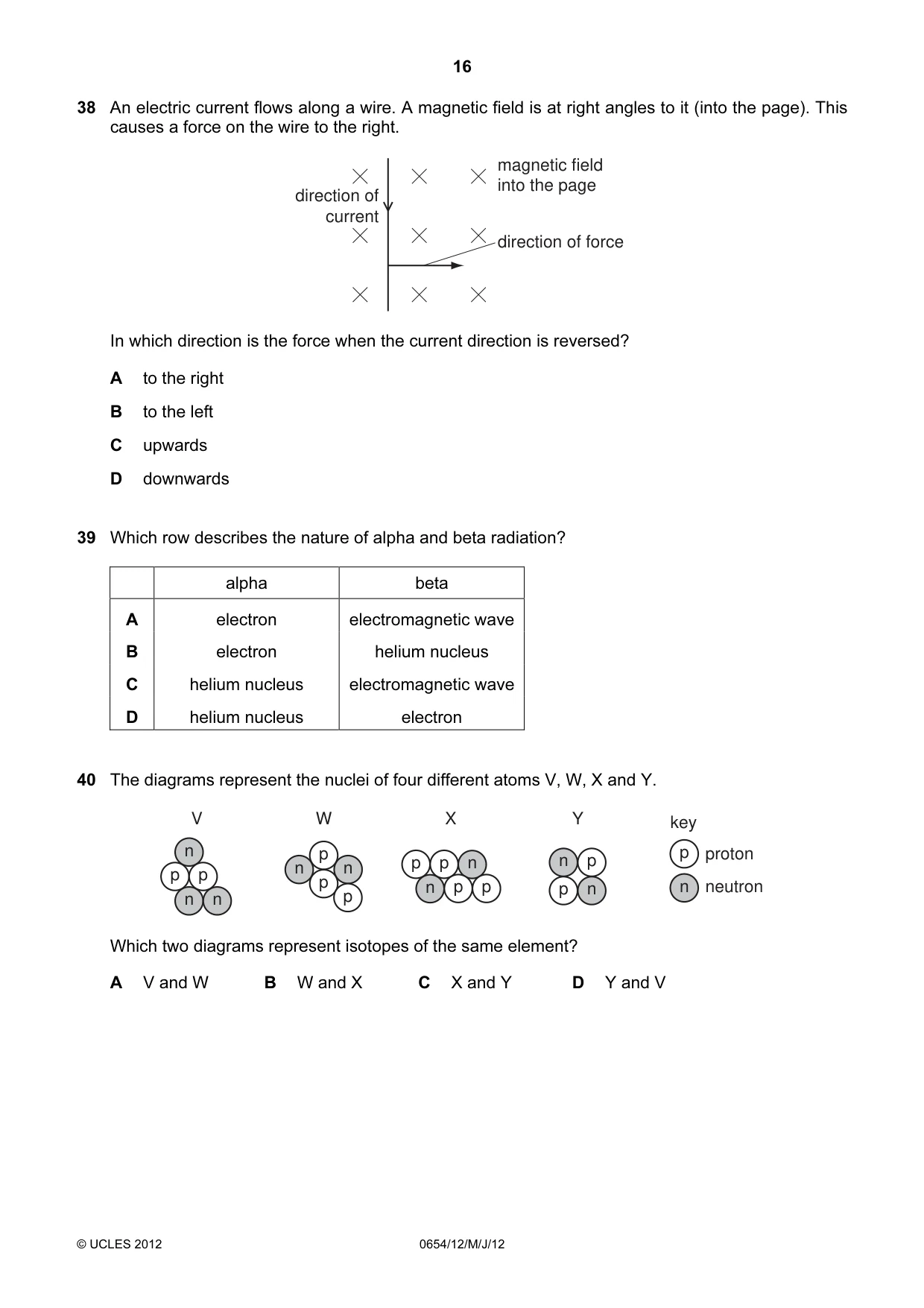
38 An electric current flows along a wire. A magnetic field is at right angles to it (into the page). This causes a force on the wire to the right. magnetic field into the page direction of current direction of force In which direction is the force when the current direction is reversed? A to the right B to the left C upwards D downwards
Mark scheme: B
Q39 · Which row describes the nature of alpha and beta radiation?
39 Which row describes the nature of alpha and beta radiation? alpha beta A electron electromagnetic wave B electron helium nucleus C helium nucleus electromagnetic wave D helium nucleus electron
Mark scheme: D
Q40 · The diagrams represent the nuclei of four different atoms V, W, X and Y
40 The diagrams represent the nuclei of four different atoms V, W, X and Y. V W X Y key n p p proton n n p p n n p p p p n p p p n n neutron n n p Which two diagrams represent isotopes of the same element? A V and W B W and X C X and Y D Y and V
Mark scheme: D
What was in this paper
The subtopics covered by these 40 questions, and how many questions each got. Open one in a new tab to see every Cambridge question on it.
1Arrangement of elements1Atomic structure and the Periodic Table1Blood1Carbon cycle1Cell structure1Chromatography1Circulatory systems1Coordination and response1Corrosion of metals1Density1Digestion1Digestive system1Electrical safety1Electromagnetic effects1Electromagnetic spectrum1Energy, work and power1Food chains and food webs1Formulas and terminology1Homeostasis1Identification of ions and gases1Isotopes1Kinetic particle model of matter1Light1Monohybrid inheritance1Motion1Photosynthesis1Polymers1Properties of metals1Radioactivity1Rate of reaction1Reactivity series1Redox1Respiration1Sexual reproduction in humans1Sound1The characteristic properties of acids and bases1Thermal properties and temperature1Transfer of thermal energy1Water1What you needed in this session
Cambridge’s own grade thresholds for 2012 May/June, Paper 1 · Variant 2. A higher threshold means an easier paper — the bar moves with how the cohort did.