Cambridge IGCSE Sciences - Co-ordinated (Double) 0654 — 2019 Oct/Nov Paper 1 · Variant 3
0654/13/O/N/19 · 40 questions · 40 marks · ≈45 min
The question paper and its mark scheme, free to read here and free to download. This is Cambridge’s own paper, exactly as it was sat.
Question paper20 pages


Mark scheme3 pages
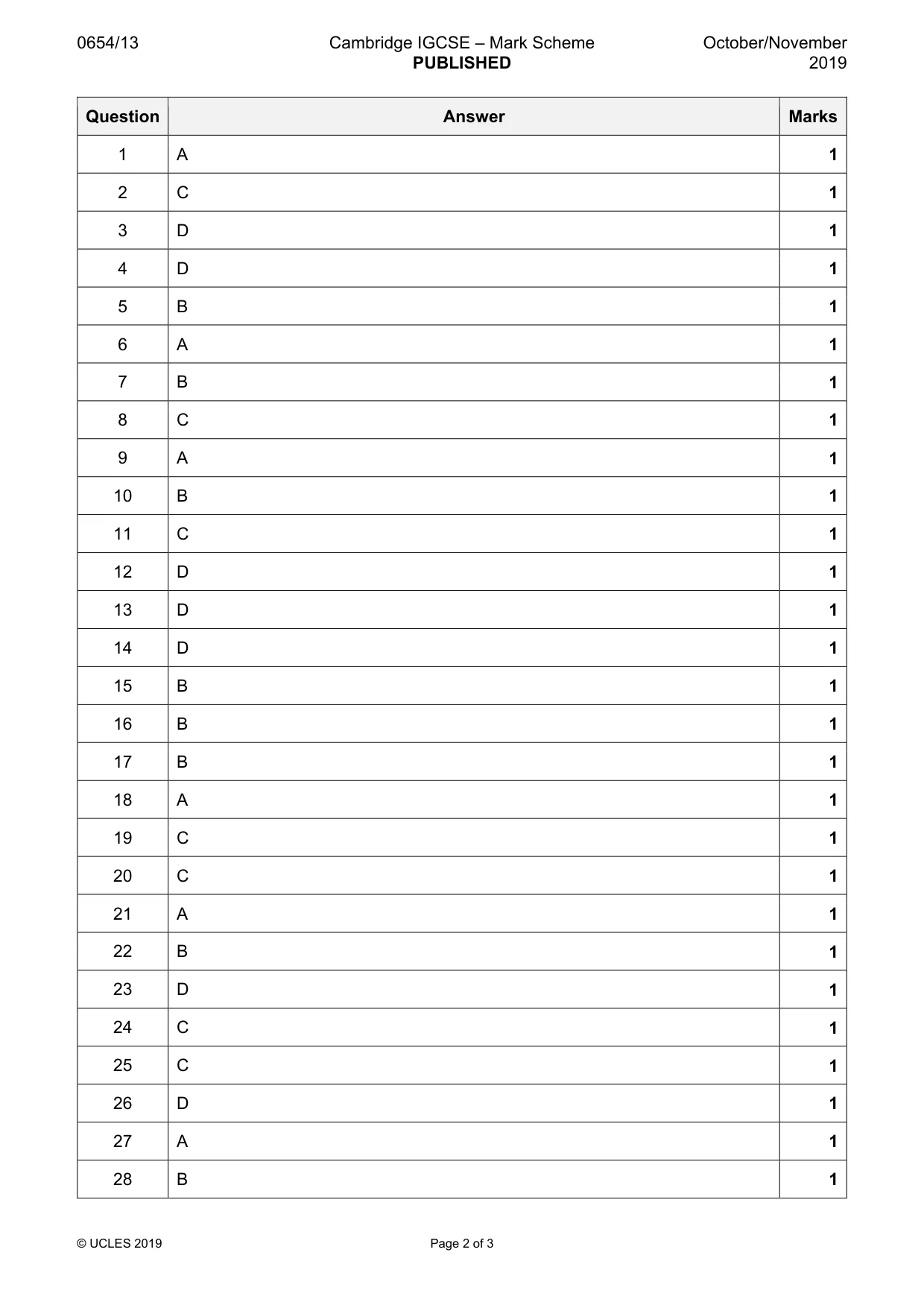
Answers below. Sit the paper first if you are practising.
Questions as text
Q1 · The diagram shows a germinating seed in the soil
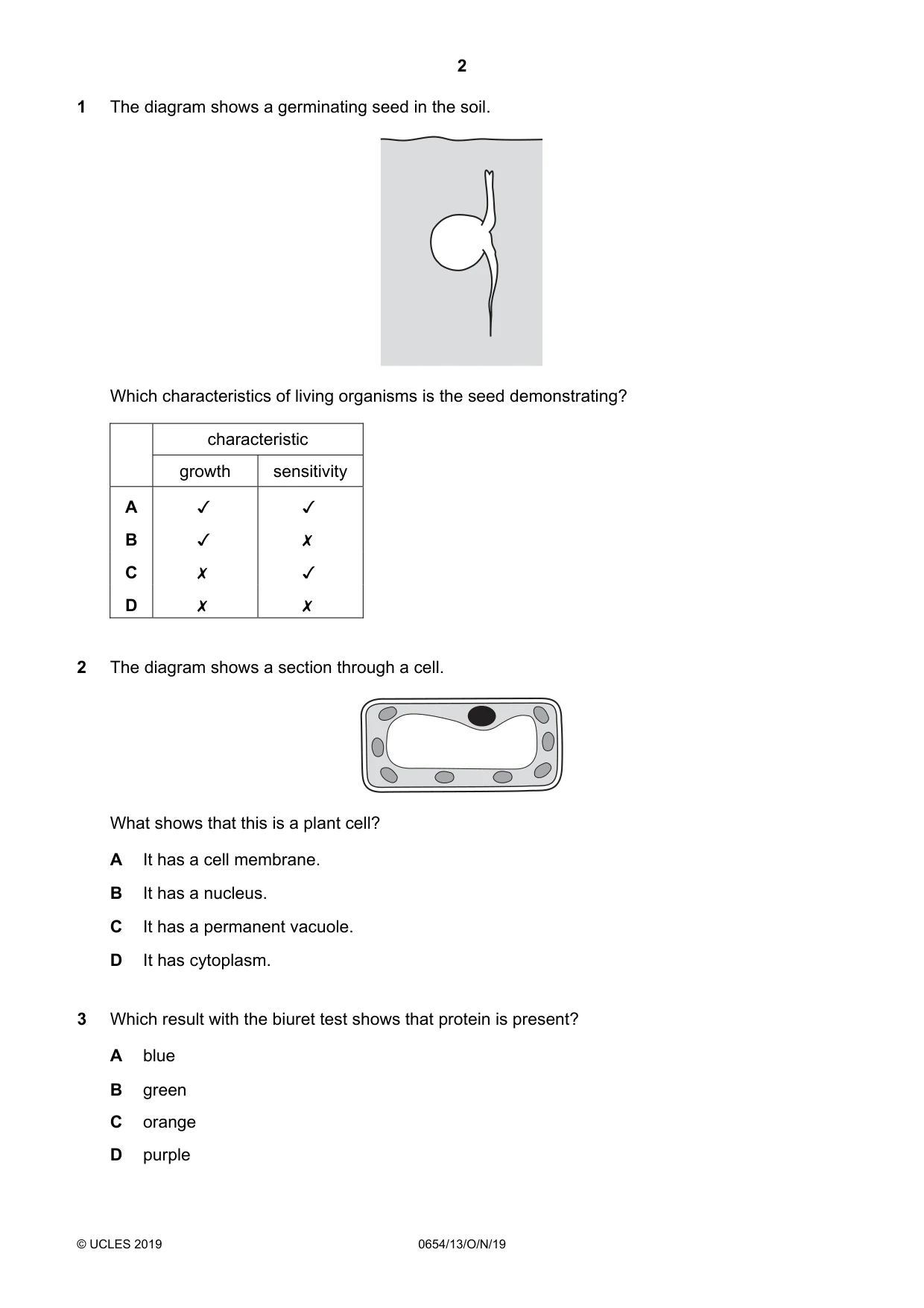
1 The diagram shows a germinating seed in the soil. a Which characteristics of living organisms is the seed demonstrating? characteristic growth sensitivity v v 0 0O WwW > v x x v x x
Mark scheme: A
Q2 · The diagram shows a section through a cell
2 The diagram shows a section through a cell. What shows that this is a plant cell? A It has a cell membrane. B It has a nucleus. C It has a permanent vacuole. D It has cytoplasm.
Mark scheme: C
Q3 · Which result with the biuret test shows that protein is present?
3 Which result with the biuret test shows that protein is present? A blue B green C orange D purple
Mark scheme: D
Q4 · Which graph shows how enzyme activity is affected by temperature?
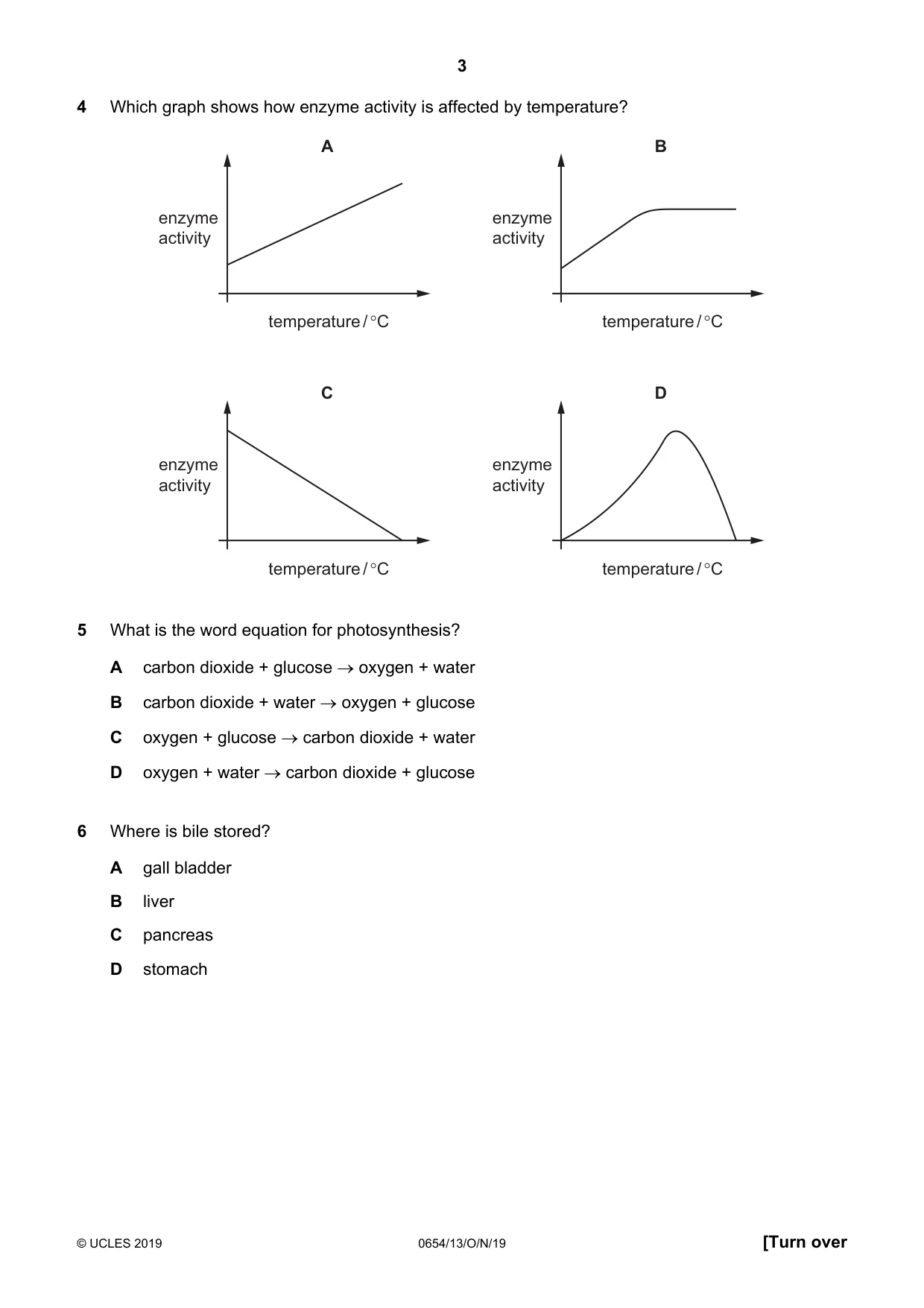
4 Which graph shows how enzyme activity is affected by temperature? A B enzyme enzyme activity activity temperature / °C temperature / °C C D enzyme enzyme activity activity temperature / °C temperature / °C
Mark scheme: D
Q5 · What is the word equation for photosynthesis?
5 What is the word equation for photosynthesis? A carbon dioxide + glucose → oxygen + water B carbon dioxide + water → oxygen + glucose C oxygen + glucose → carbon dioxide + water D oxygen + water → carbon dioxide + glucose
Mark scheme: B
Q6 · Where is bile stored?
6 Where is bile stored? A gall bladder B liver C pancreas D stomach
Mark scheme: A
Q7 · The diagrams show sections through a stem and a root
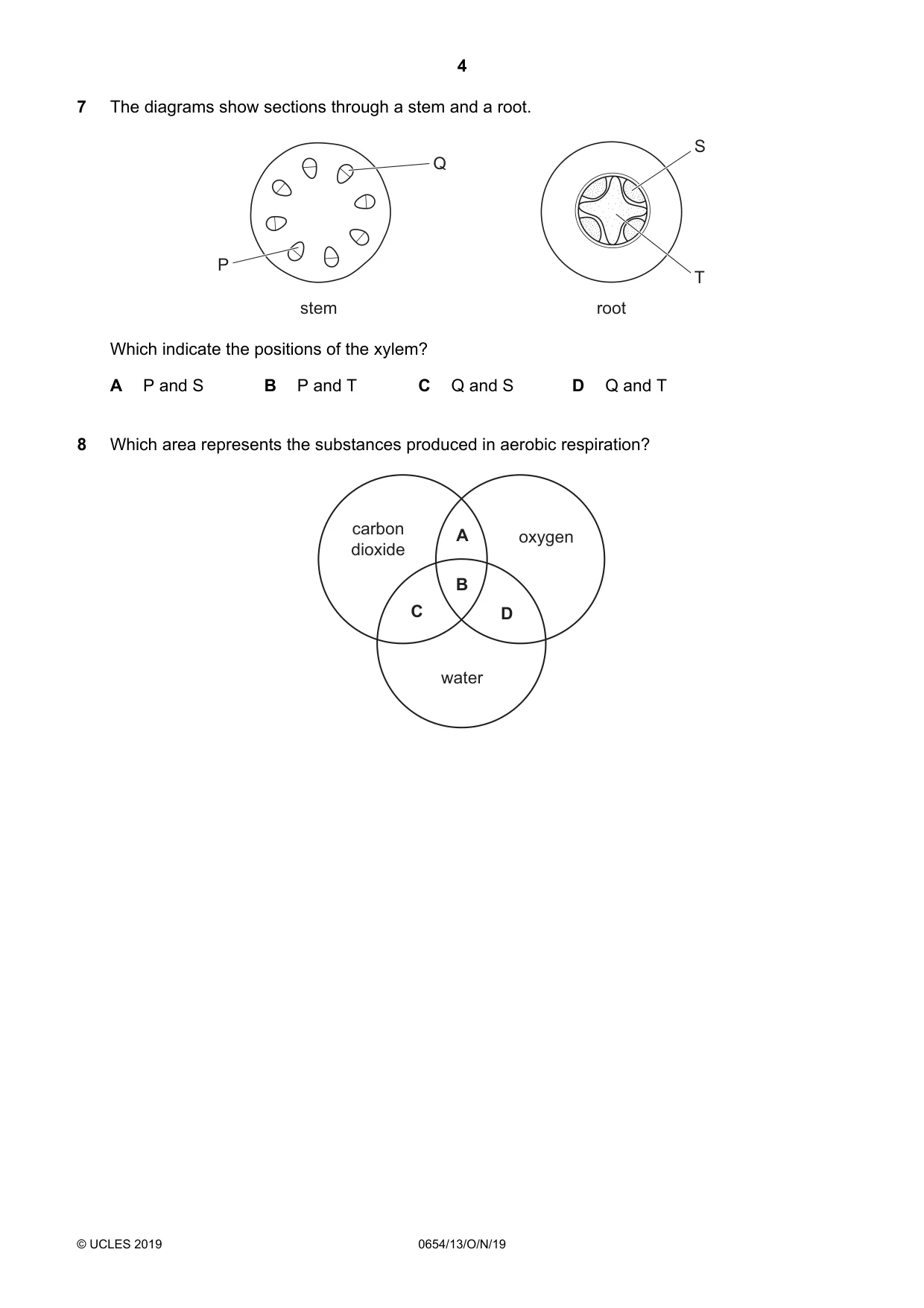
7 The diagrams show sections through a stem and a root. S Q P T stem root Which indicate the positions of the xylem? A P and S B P and T C Q and S D Q and T
Mark scheme: B
Q8 · Which area represents the substances produced in aerobic respiration?
8 Which area represents the substances produced in aerobic respiration? carbon A oxygen dioxide B C D water
Mark scheme: C
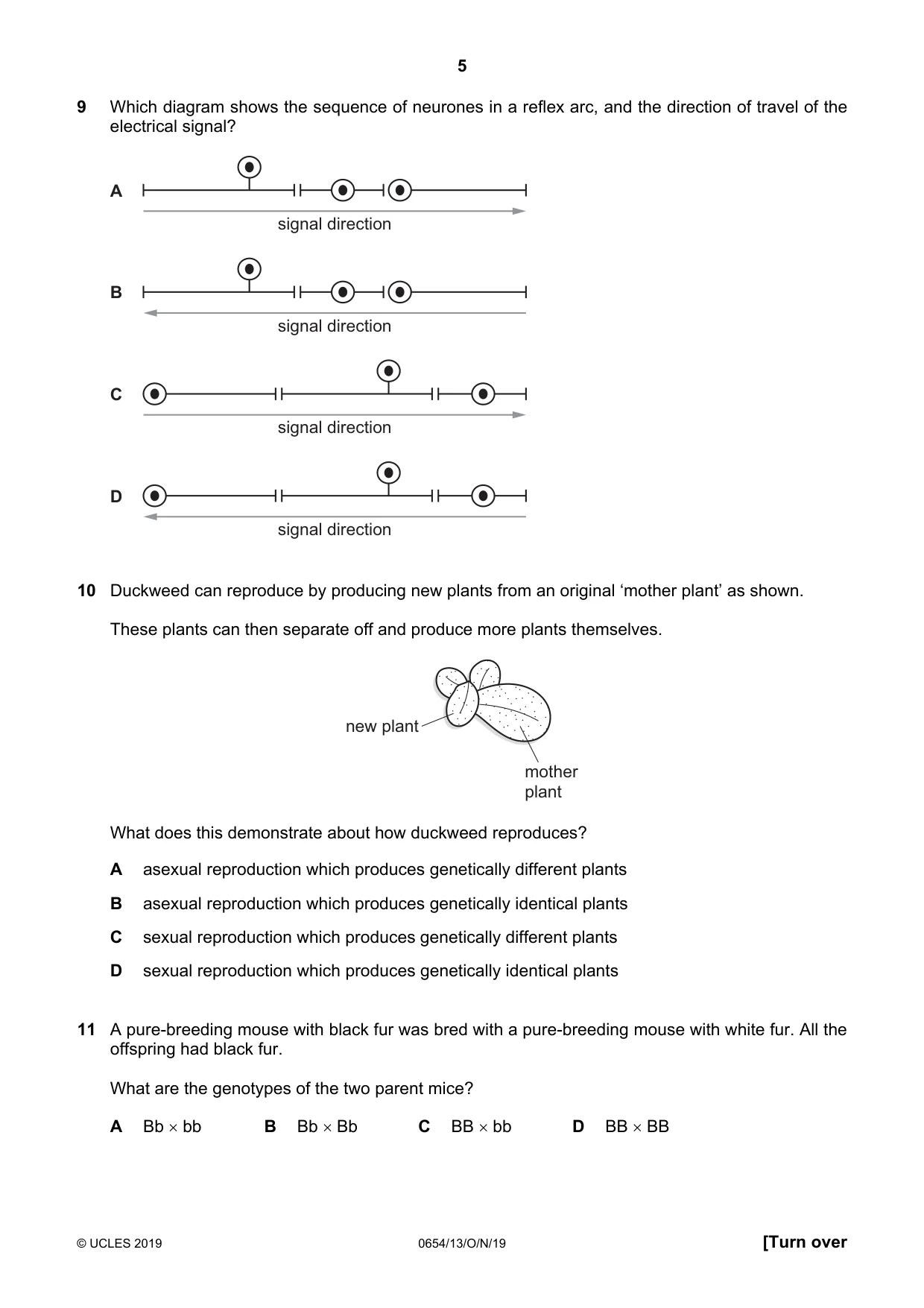
Q9 · Which diagram shows the sequence of neurones in a reflex arc, and the direction of travel…
9 Which diagram shows the sequence of neurones in a reflex arc, and the direction of travel of the electrical signal? A signal direction B signal direction C signal direction D signal direction
Mark scheme: A
Q10 · Duckweed can reproduce by producing new plants from an original ‘mother plant’ as shown
10 Duckweed can reproduce by producing new plants from an original ‘mother plant’ as shown. These plants can then separate off and produce more plants themselves. new plant mother plant What does this demonstrate about how duckweed reproduces? A asexual reproduction which produces genetically different plants B asexual reproduction which produces genetically identical plants C sexual reproduction which produces genetically different plants D sexual reproduction which produces genetically identical plants
Mark scheme: B
Q11 · A pure-breeding mouse with black fur was bred with a pure-breeding mouse with white fur
11 A pure-breeding mouse with black fur was bred with a pure-breeding mouse with white fur. All the offspring had black fur. What are the genotypes of the two parent mice? A Bb × bb B Bb × Bb C BB × bb D BB × BB
Mark scheme: C
Q12 · What is the principal source of energy input into a biological system?
12 What is the principal source of energy input into a biological system? A consumer B decomposer C producer D Sun
Mark scheme: D
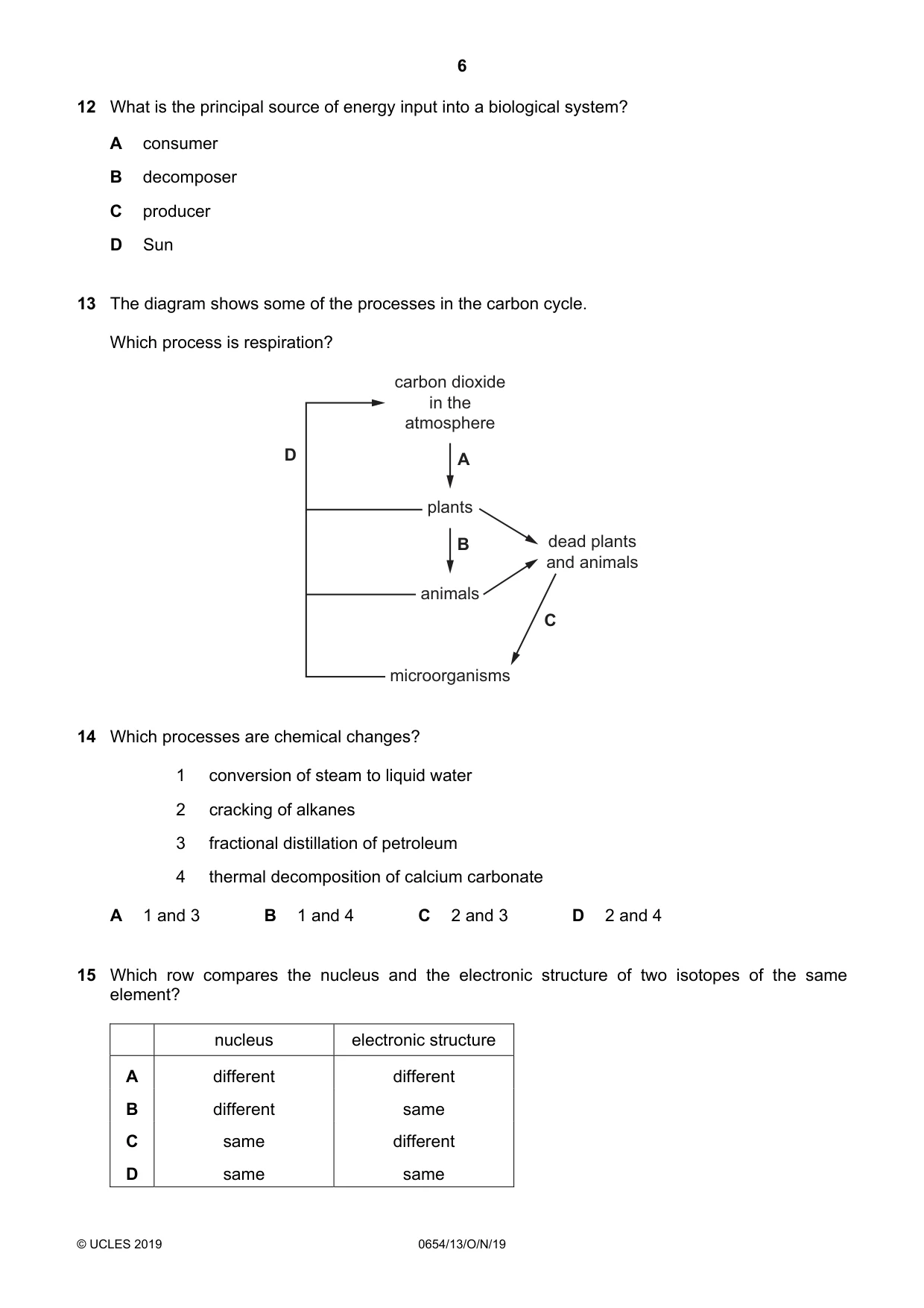
Q13 · The diagram shows some of the processes in the carbon cycle
13 The diagram shows some of the processes in the carbon cycle. Which process is respiration? carbon dioxide in the atmosphere D A plants B dead plants and animals animals C microorganisms
Mark scheme: D
Q14 · Which processes are chemical changes?
14 Which processes are chemical changes? 1 conversion of steam to liquid water 2 cracking of alkanes 3 fractional distillation of petroleum 4 thermal decomposition of calcium carbonate A 1 and 3 B 1 and 4 C 2 and 3 D 2 and 4
Mark scheme: D
Q15 · Which row compares the nucleus and the electronic structure of two isotopes of the same…
15 Which row compares the nucleus and the electronic structure of two isotopes of the same element? nucleus electronic structure A different different B different same C same different D same same
Mark scheme: B
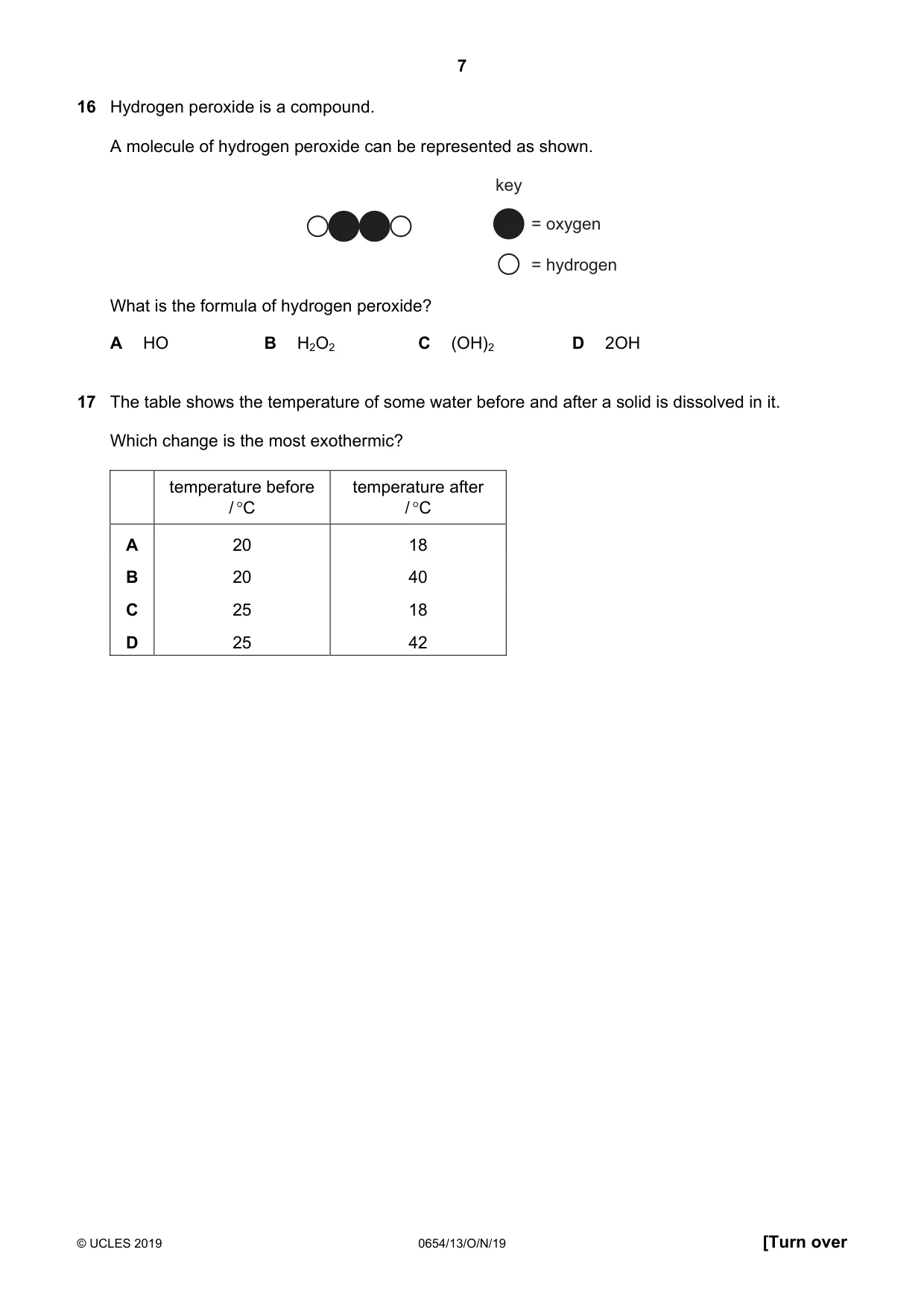
Q16 · Hydrogen peroxide is a compound
16 Hydrogen peroxide is a compound. A molecule of hydrogen peroxide can be represented as shown. key = oxygen = hydrogen What is the formula of hydrogen peroxide? A HO B H2O2 C (OH)2 D 2OH
Mark scheme: B
Q17 · The table shows the temperature of some water before and after a solid is dissolved in it
17 The table shows the temperature of some water before and after a solid is dissolved in it. Which change is the most exothermic? temperature before temperature after / °C / °C A 20 18 B 20 40 C 25 18 D 25 42
Mark scheme: B
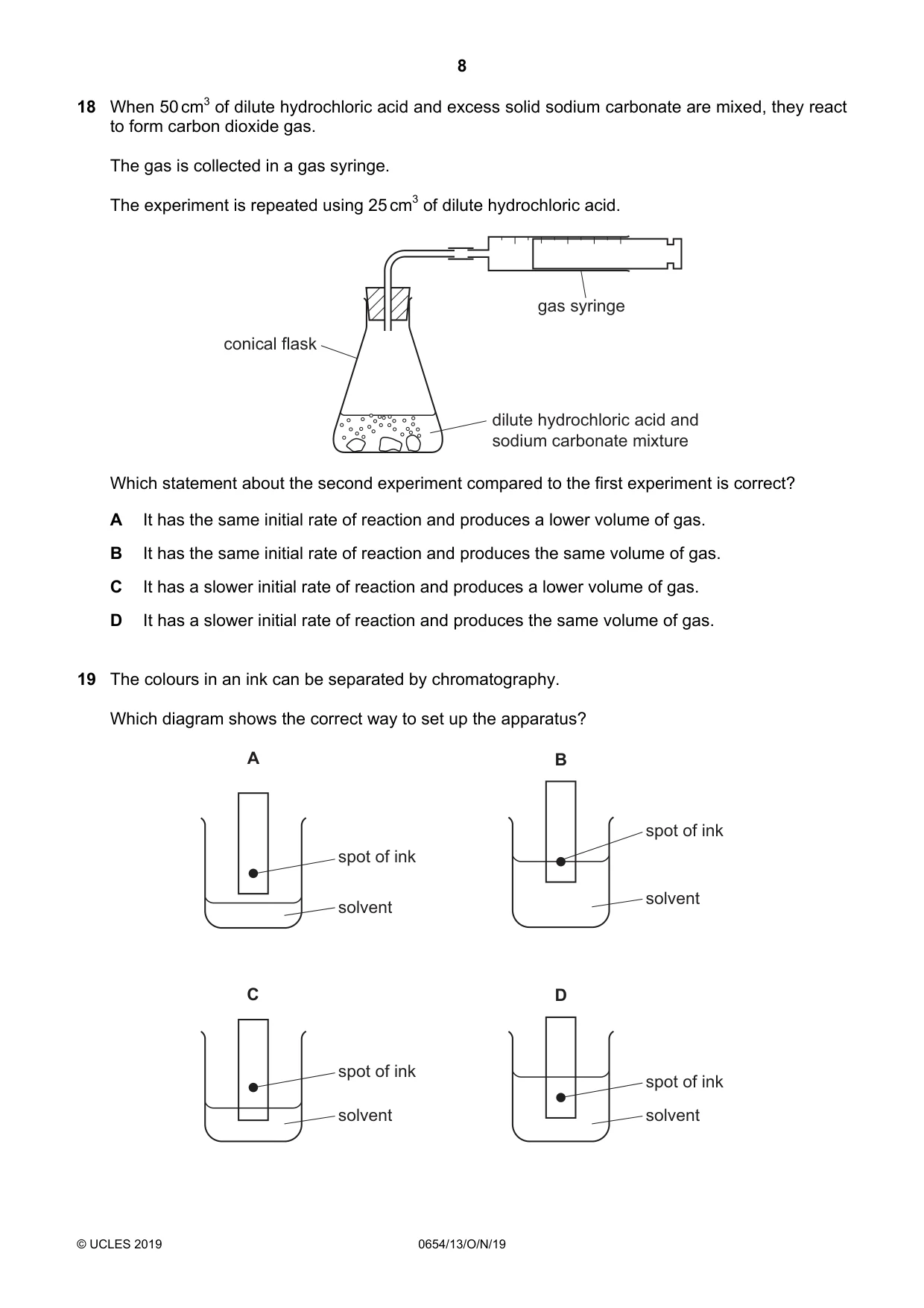
Q18 · When 50 cm3 of dilute hydrochloric acid and excess solid sodium carbonate are mixed, they…
18 When 50 cm3 of dilute hydrochloric acid and excess solid sodium carbonate are mixed, they react to form carbon dioxide gas. The gas is collected in a gas syringe. The experiment is repeated using 25 cm3 of dilute hydrochloric acid. gas syringe conical flask dilute hydrochloric acid and sodium carbonate mixture Which statement about the second experiment compared to the first experiment is correct? A It has the same initial rate of reaction and produces a lower volume of gas. B It has the same initial rate of reaction and produces the same volume of gas. C It has a slower initial rate of reaction and produces a lower volume of gas. D It has a slower initial rate of reaction and produces the same volume of gas.
Mark scheme: A
Q19 · The colours in an ink can be separated by chromatography
19 The colours in an ink can be separated by chromatography. Which diagram shows the correct way to set up the apparatus? A B spot of ink spot of ink solvent solvent C D spot of ink spot of ink solvent solvent
Mark scheme: C
Q20 · Which statement about the Periodic Table is correct?
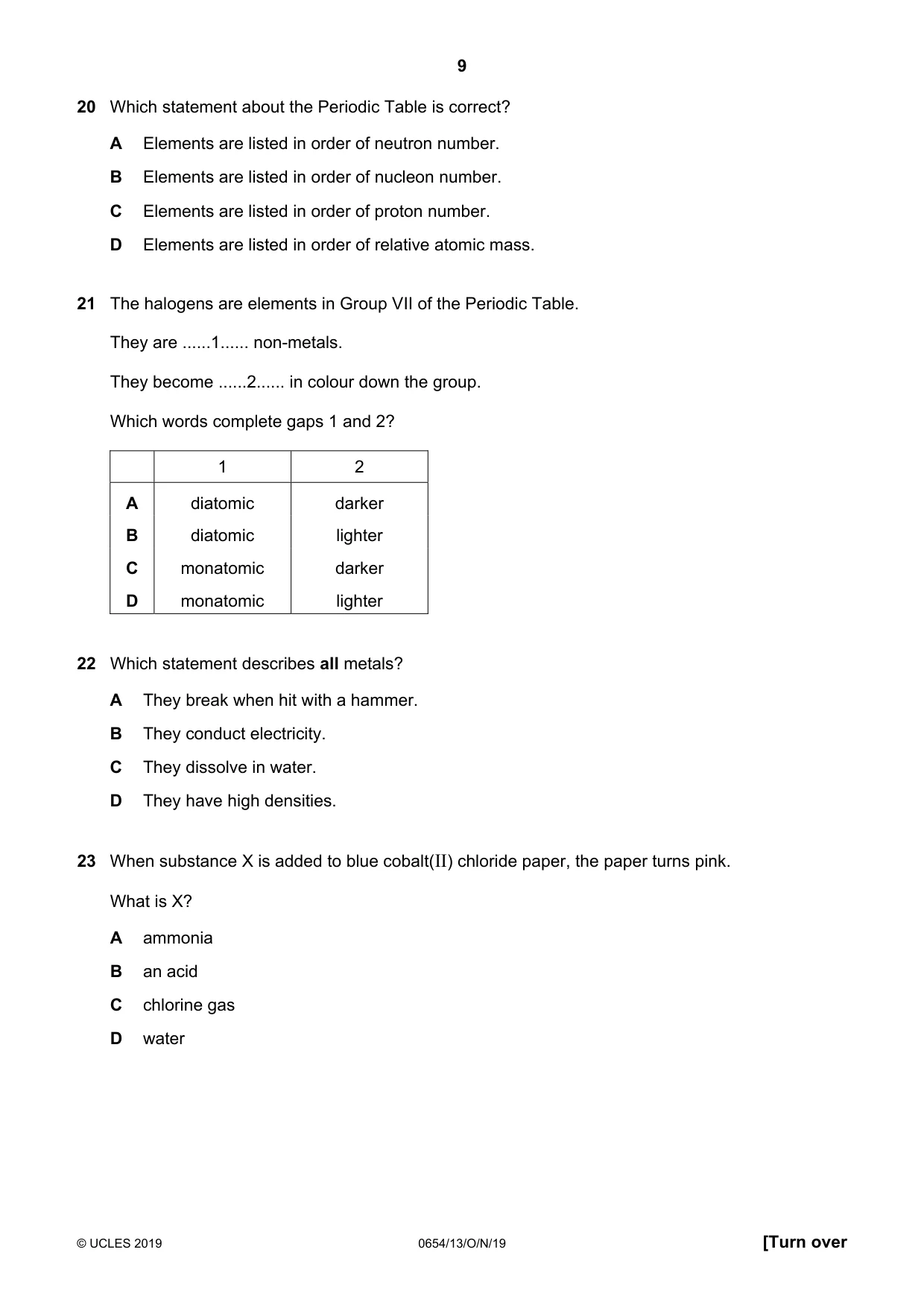
20 Which statement about the Periodic Table is correct? A Elements are listed in order of neutron number. B Elements are listed in order of nucleon number. C Elements are listed in order of proton number. D Elements are listed in order of relative atomic mass.
Mark scheme: C
Q21 · The halogens are elements in Group VII of the Periodic Table
21 The halogens are elements in Group VII of the Periodic Table. They are ......1...... non-metals. They become ......2...... in colour down the group. Which words complete gaps 1 and 2? 1 2 A diatomic darker B diatomic lighter C monatomic darker D monatomic lighter
Mark scheme: A
Q22 · Which statement describes all metals?
22 Which statement describes all metals? A They break when hit with a hammer. B They conduct electricity. C They dissolve in water. D They have high densities.
Mark scheme: B
Q23 · When substance X is added to blue cobalt(II) chloride paper, the paper turns pink
23 When substance X is added to blue cobalt(II) chloride paper, the paper turns pink. What is X? A ammonia B an acid C chlorine gas D water
Mark scheme: D
Q24 · Which processes produce carbon dioxide?
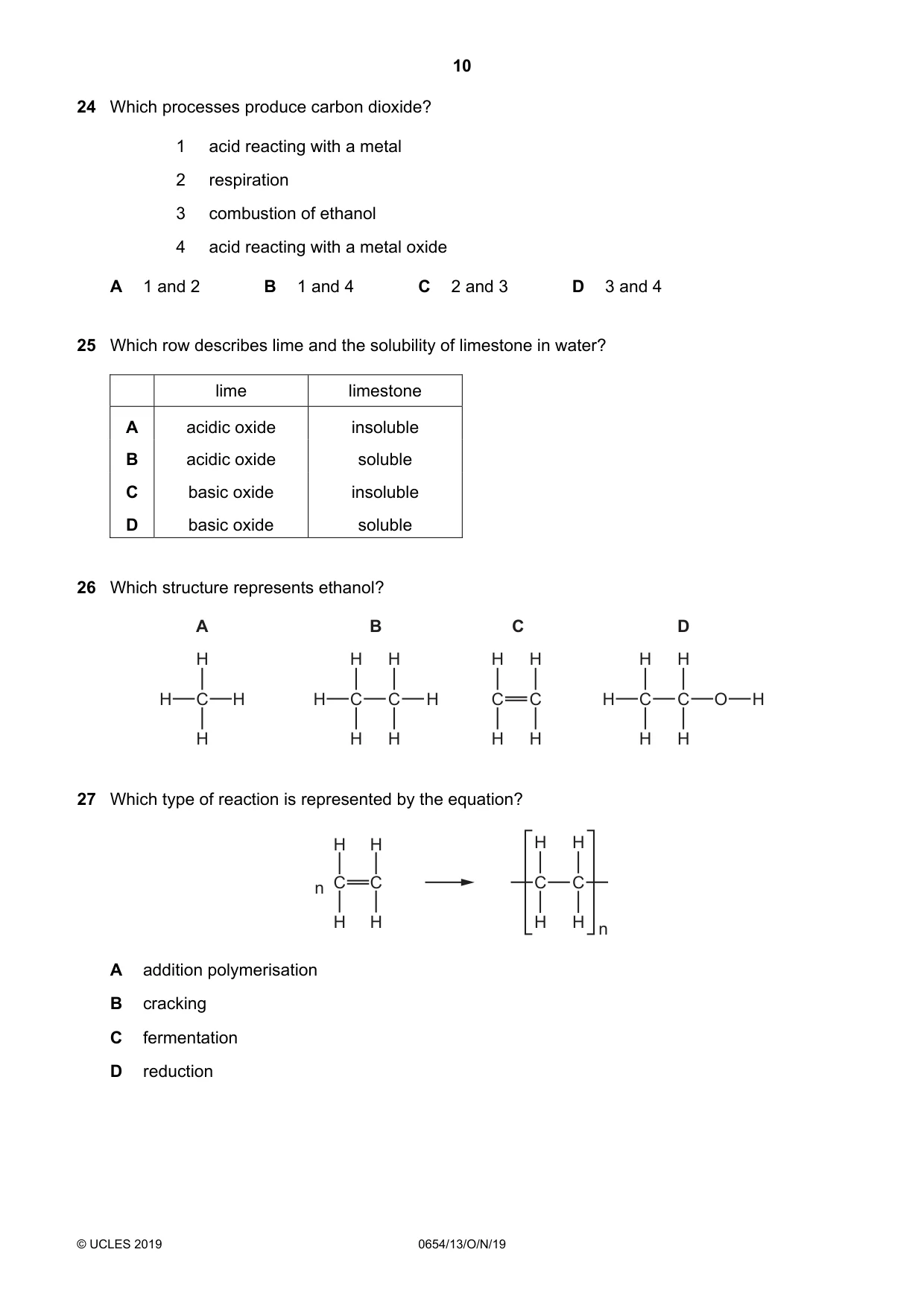
24 Which processes produce carbon dioxide? 1 acid reacting with a metal 2 respiration 3 combustion of ethanol 4 acid reacting with a metal oxide A 1 and 2 B 1 and 4 C 2 and 3 D 3 and 4
Mark scheme: C
Q25 · Which row describes lime and the solubility of limestone in water?
25 Which row describes lime and the solubility of limestone in water? lime limestone A acidic oxide insoluble B acidic oxide soluble C basic oxide insoluble D basic oxide soluble
Mark scheme: C
Q26 · Which structure represents ethanol?
26 Which structure represents ethanol? A B C D H H H H H H H H C H H C C H C C H C C O H H H H H H H H
Mark scheme: D
Q27 · Which type of reaction is represented by the equation?
27 Which type of reaction is represented by the equation? H H H H n C C C C H H H H n A addition polymerisation B cracking C fermentation D reduction
Mark scheme: A
Q28 · A stone is lowered into a measuring cylinder containing water
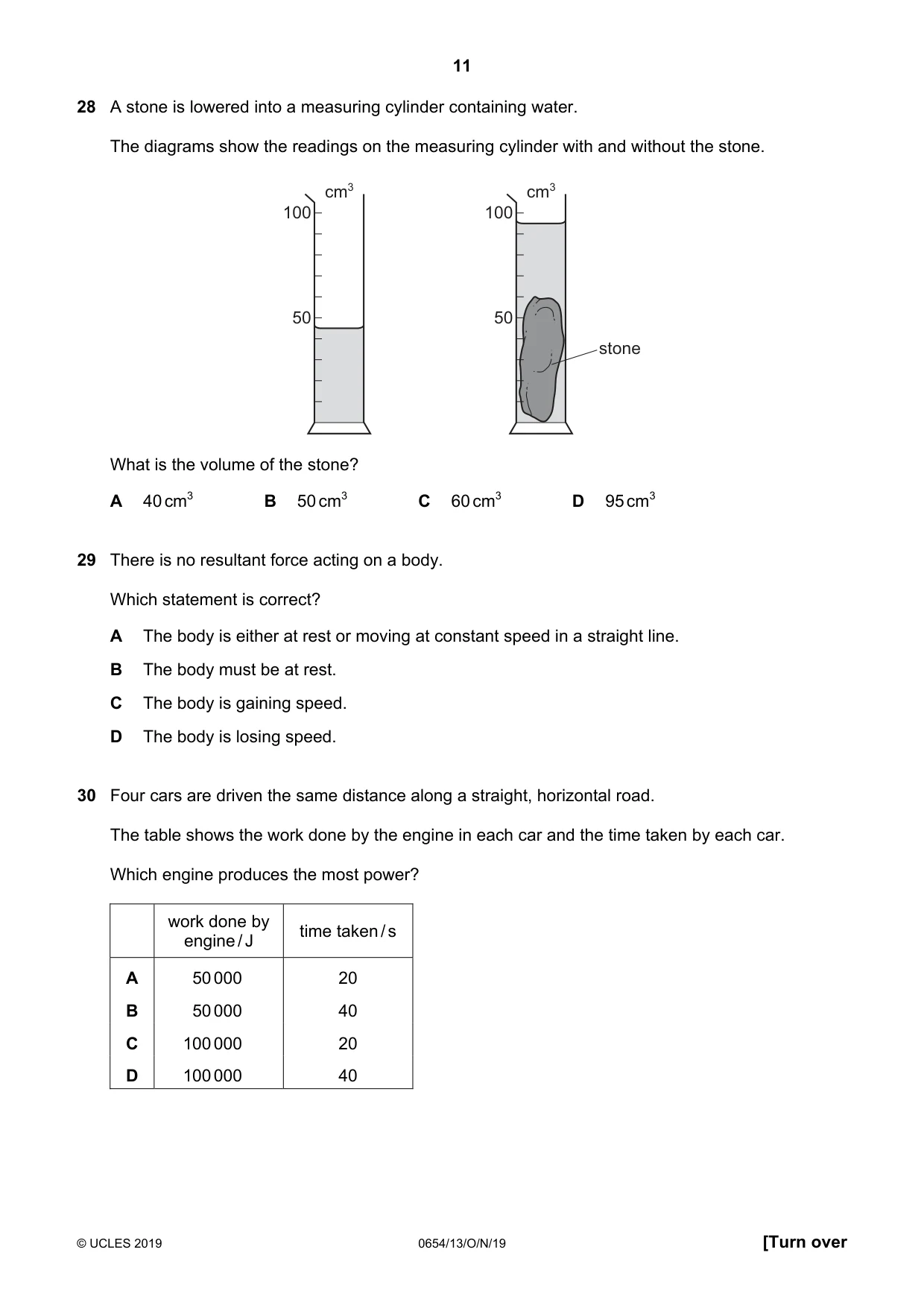
28 A stone is lowered into a measuring cylinder containing water. The diagrams show the readings on the measuring cylinder with and without the stone. cm3 cm3 100 100 50 50 stone What is the volume of the stone? A 40 cm3 B 50 cm3 C 60 cm3 D 95 cm3
Mark scheme: B
More questions on Physical quantities and measurement techniques
Q29 · There is no resultant force acting on a body
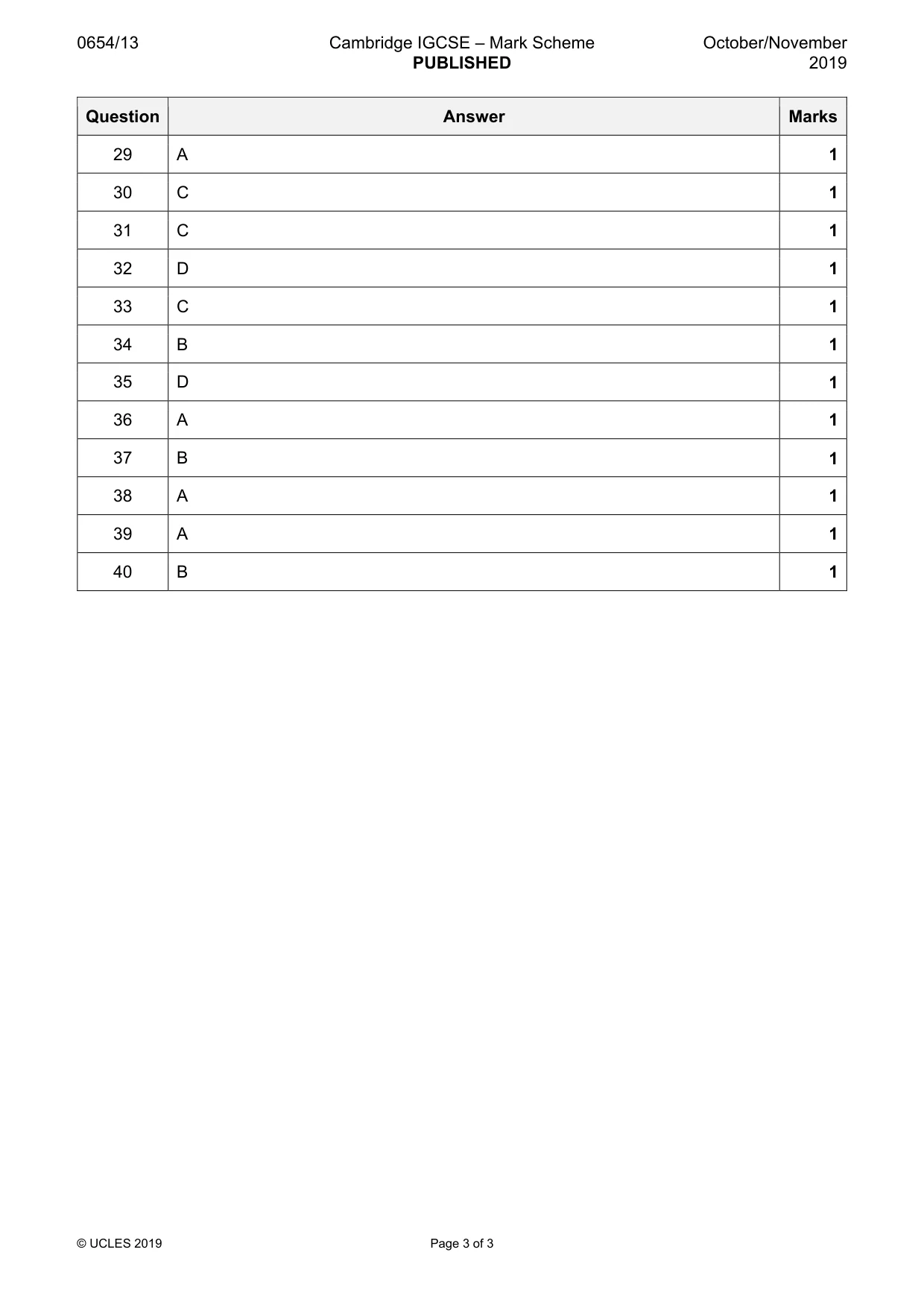
29 There is no resultant force acting on a body. Which statement is correct? A The body is either at rest or moving at constant speed in a straight line. B The body must be at rest. C The body is gaining speed. D The body is losing speed.
Mark scheme: A
Q30 · Four cars are driven the same distance along a straight, horizontal road
30 Four cars are driven the same distance along a straight, horizontal road. The table shows the work done by the engine in each car and the time taken by each car. Which engine produces the most power? work done by time taken / s engine / J A 50 000 20 B 50 000 40 C 100 000 20 D 100 000 40
Mark scheme: C
Q31 · The diagram shows a shaped glass tube filled with water
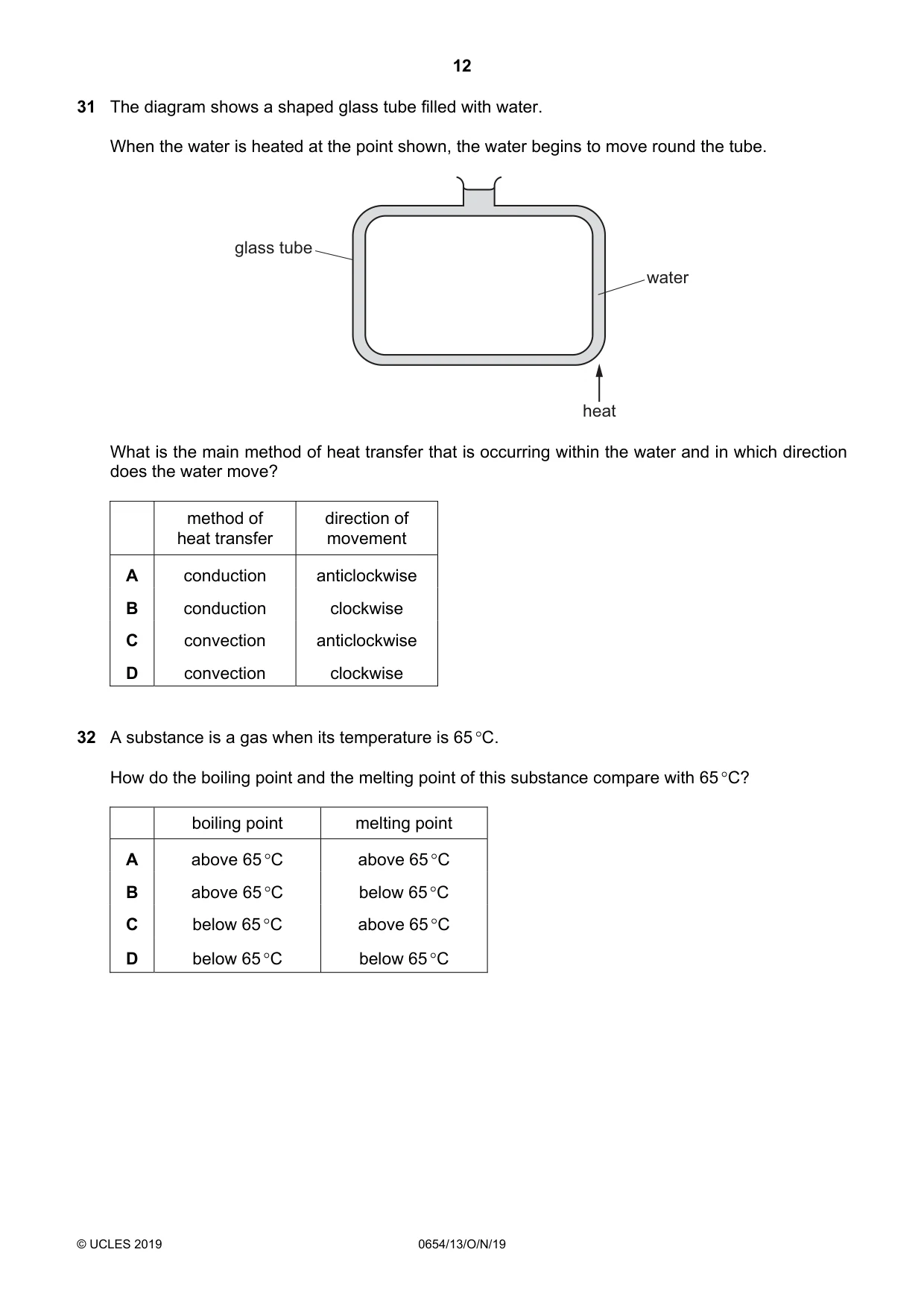
31 The diagram shows a shaped glass tube filled with water. When the water is heated at the point shown, the water begins to move round the tube. glass tube water heat What is the main method of heat transfer that is occurring within the water and in which direction does the water move? method of direction of heat transfer movement A conduction anticlockwise B conduction clockwise C convection anticlockwise D convection clockwise
Mark scheme: C
Q32 · A substance is a gas when its temperature is 65 °C
32 A substance is a gas when its temperature is 65 °C. How do the boiling point and the melting point of this substance compare with 65 °C? boiling point melting point A above 65 °C above 65 °C B above 65 °C below 65 °C C below 65 °C above 65 °C D below 65 °C below 65 °C
Mark scheme: D
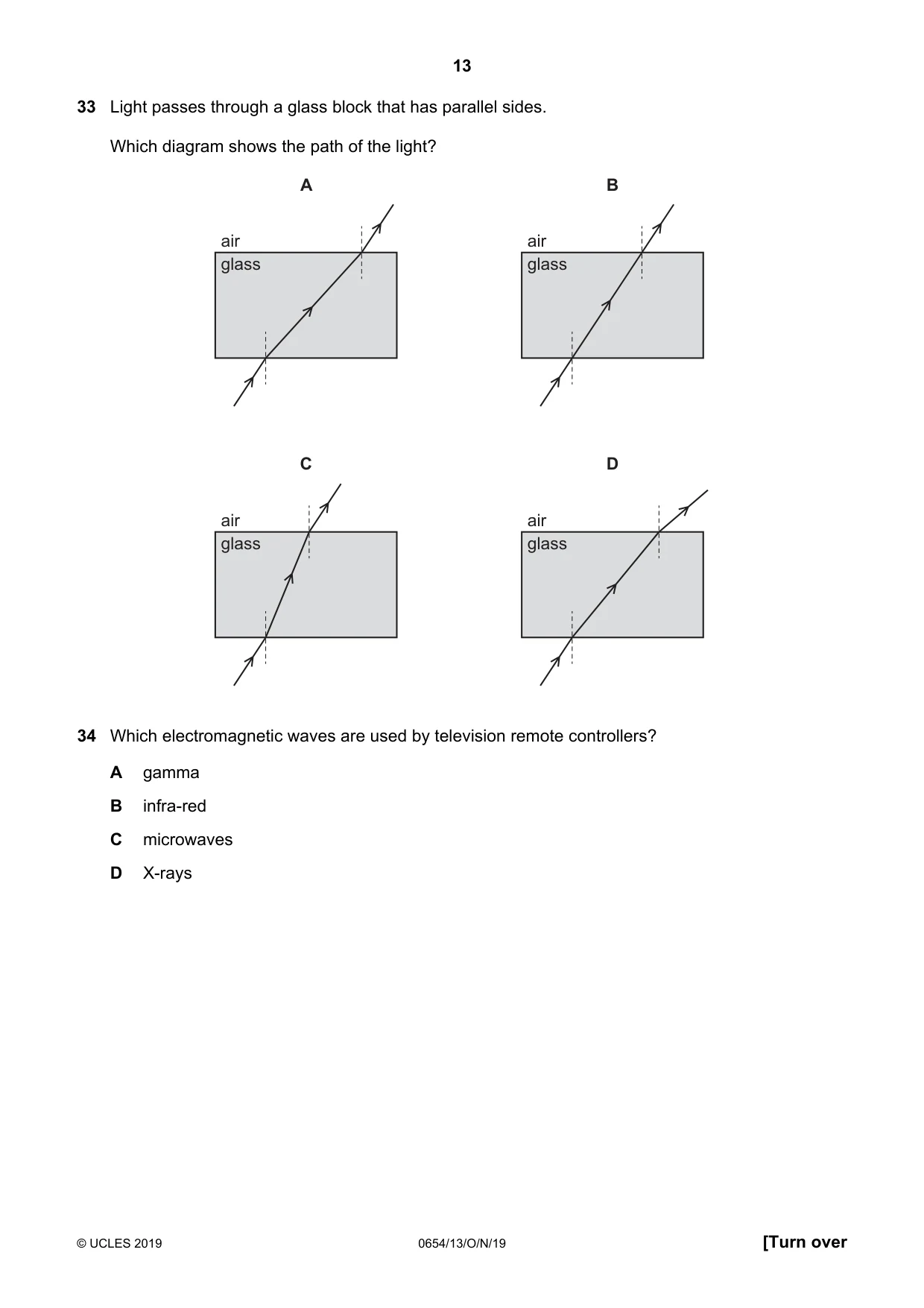
Q33 · Light passes through a glass block that has parallel sides
33 Light passes through a glass block that has parallel sides. Which diagram shows the path of the light? A B air air glass glass C D air air glass glass
Mark scheme: C
Q34 · Which electromagnetic waves are used by television remote controllers?
34 Which electromagnetic waves are used by television remote controllers? A gamma B infra-red C microwaves D X-rays
Mark scheme: B
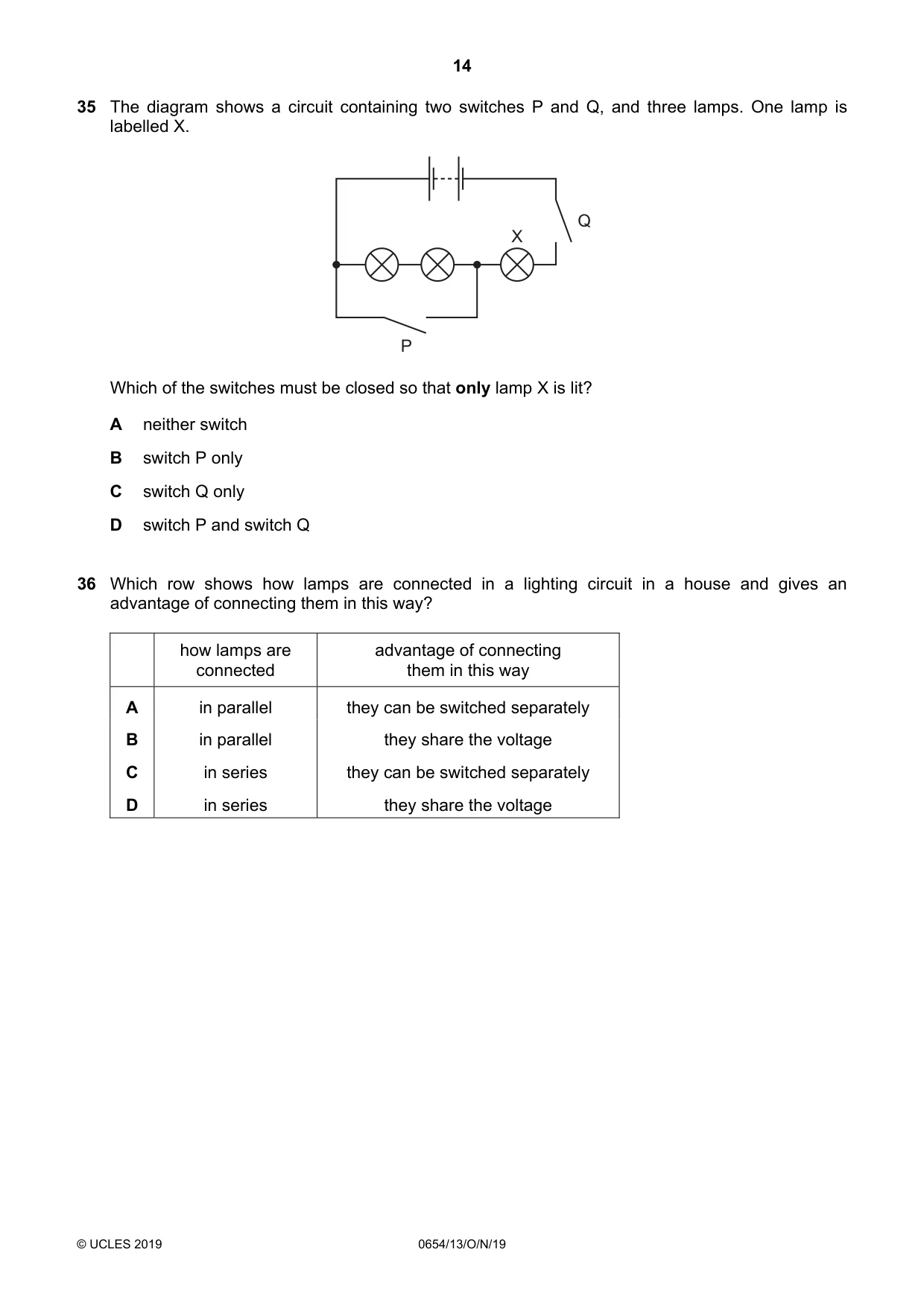
Q35 · The diagram shows a circuit containing two switches P and Q, and three lamps
35 The diagram shows a circuit containing two switches P and Q, and three lamps. One lamp is labelled X. Q X P Which of the switches must be closed so that only lamp X is lit? A neither switch B switch P only C switch Q only D switch P and switch Q
Mark scheme: D
Q36 · Which row shows how lamps are connected in a lighting circuit in a house and gives an…
36 Which row shows how lamps are connected in a lighting circuit in a house and gives an advantage of connecting them in this way? how lamps are advantage of connecting connected them in this way A in parallel they can be switched separately B in parallel they share the voltage C in series they can be switched separately D in series they share the voltage
Mark scheme: A
Q37 · An electrical extension block has four sockets, a cable which can safely take a current…
37 An electrical extension block has four sockets, a cable which can safely take a current of 6 A and a plug. It is protected by a fuse rated at 5 A. The extension block is used with four appliances and the 5 A fuse blows. The owner replaces the 5 A fuse with a 13 A fuse. Why is the extension block now dangerous? A The appliances may overheat before the fuse blows. B The cable may overheat before the fuse blows. C The sockets may burn out before the fuse blows. D The 13 A fuse may blow too soon.
Mark scheme: B
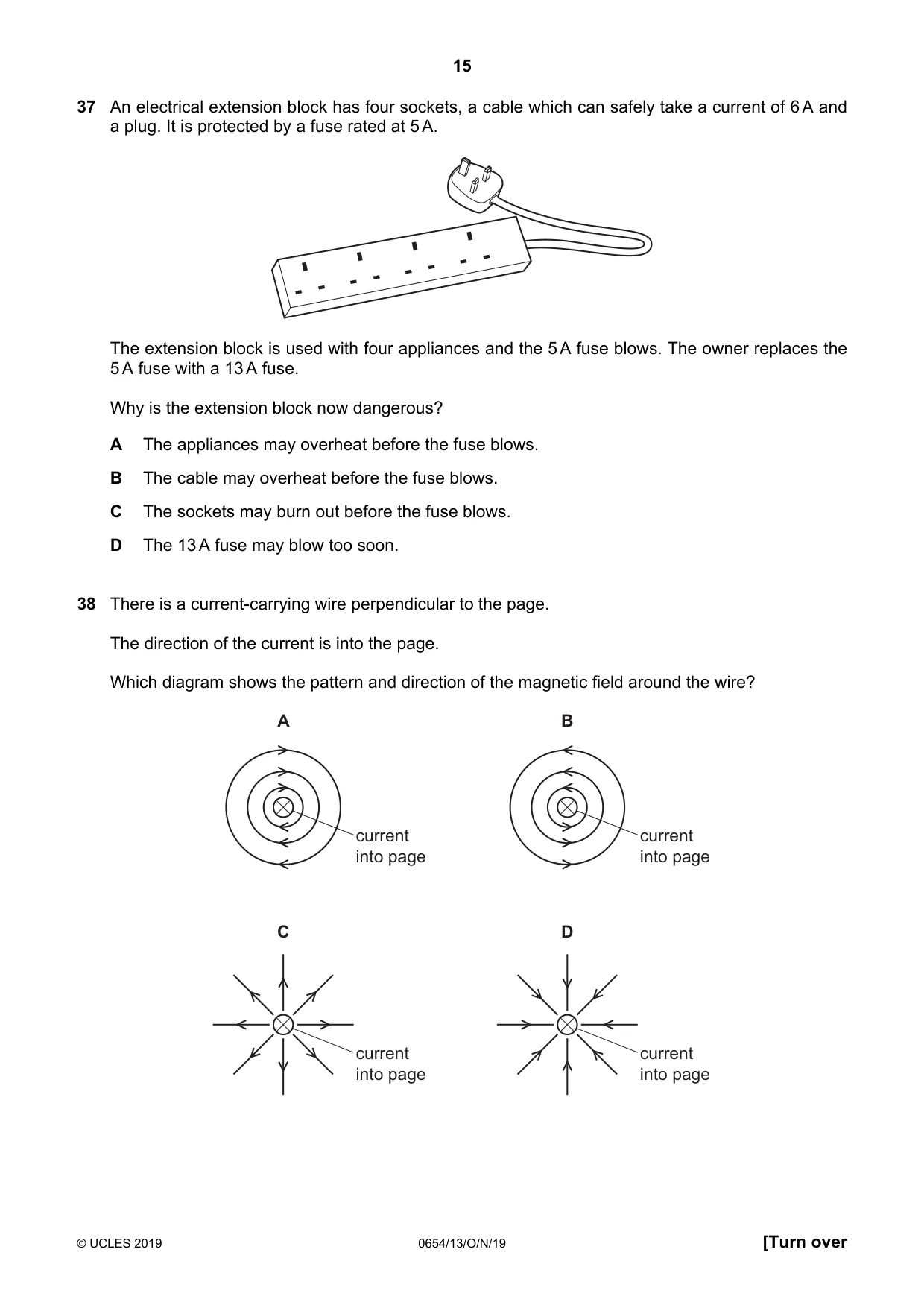
Q38 · There is a current-carrying wire perpendicular to the page
38 There is a current-carrying wire perpendicular to the page. The direction of the current is into the page. Which diagram shows the pattern and direction of the magnetic field around the wire? A B current current into page into page C D current current into page into page
Mark scheme: A
Q39 · What is the proton number (atomic number) of the nuclide 14 C ?
39 What is the proton number (atomic number) of the nuclide 14 C ? 6 A 6 B 8 C 14 D 20
Mark scheme: A
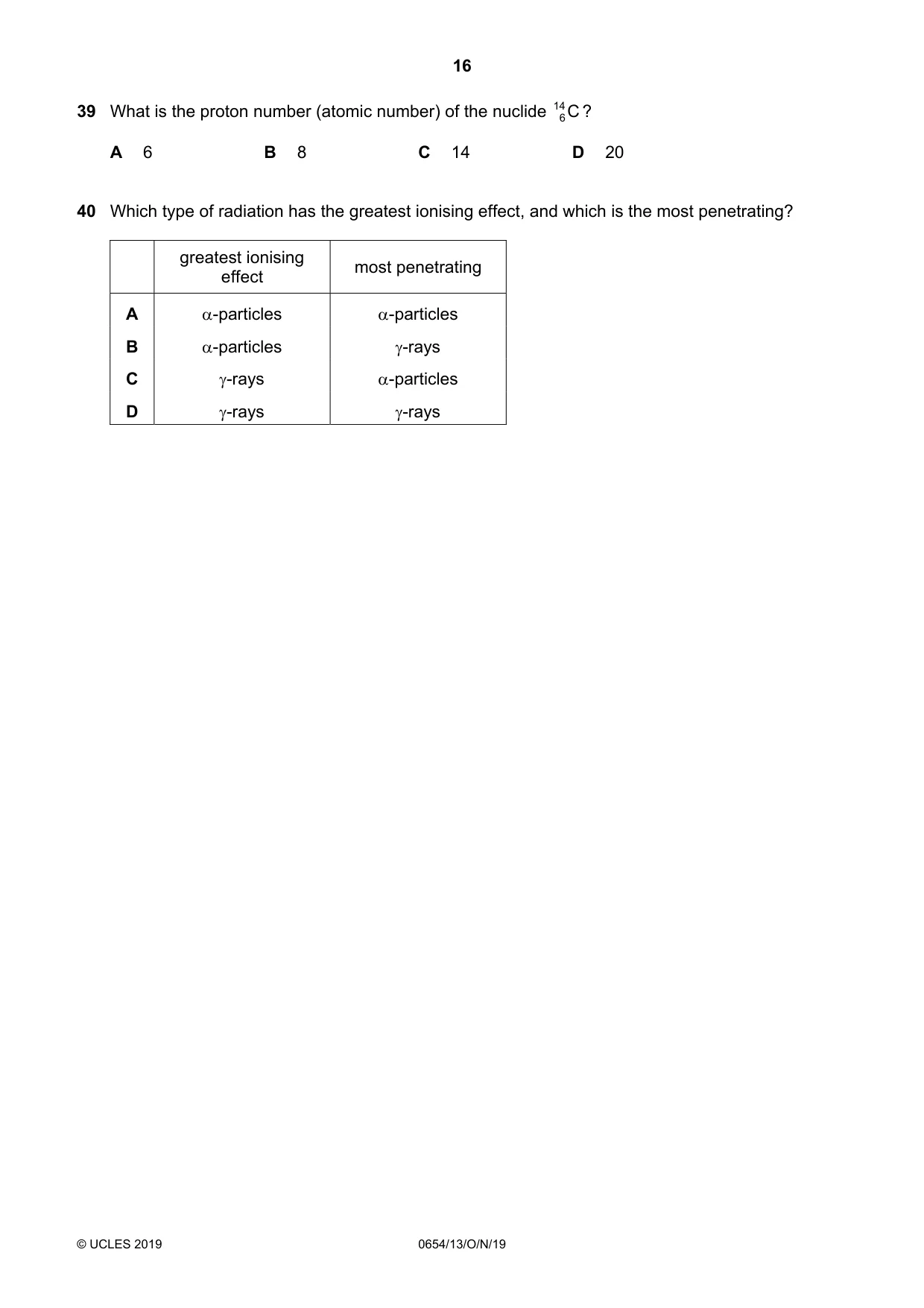
Q40 · Which type of radiation has the greatest ionising effect, and which is the most…
40 Which type of radiation has the greatest ionising effect, and which is the most penetrating? greatest ionising most penetrating effect A α-particles α-particles B α-particles γ-rays C γ-rays α-particles D γ-rays γ-rays
Mark scheme: B
What was in this paper
The subtopics covered by these 40 questions, and how many questions each got. Open one in a new tab to see every Cambridge question on it.
2Alcohols1Arrangement of elements1Asexual reproduction1Biological molecules1Carbon cycle1Cell structure1Characteristics of living organisms1Chromatography1Coordination and response1Digestive system1Electrical safety1Electromagnetic spectrum1Energy flow1Energy, work and power1Enzymes1Exothermic and endothermic reactions1Forces1Formulas1Group VII properties1Identification of ions and gases1Isotopes1Kinetic particle model of matter1Light1Monohybrid inheritance1Oxides1Photosynthesis1Physical and chemical changes1Physical quantities and measurement techniques1Polymers1Preparation of salts1Properties of metals1Radioactivity1Rate of reaction1Respiration1Simple phenomena of magnetism1The nucleus1Transfer of thermal energy1Xylem and phloem1What you needed in this session
Cambridge’s own grade thresholds for 2019 Oct/Nov, Paper 1 · Variant 3. A higher threshold means an easier paper — the bar moves with how the cohort did.