Questions as text
Q1 · When lithium reacts with water, hydrogen and lithium hydroxide are produced 0654/43 Oct/Nov 2017
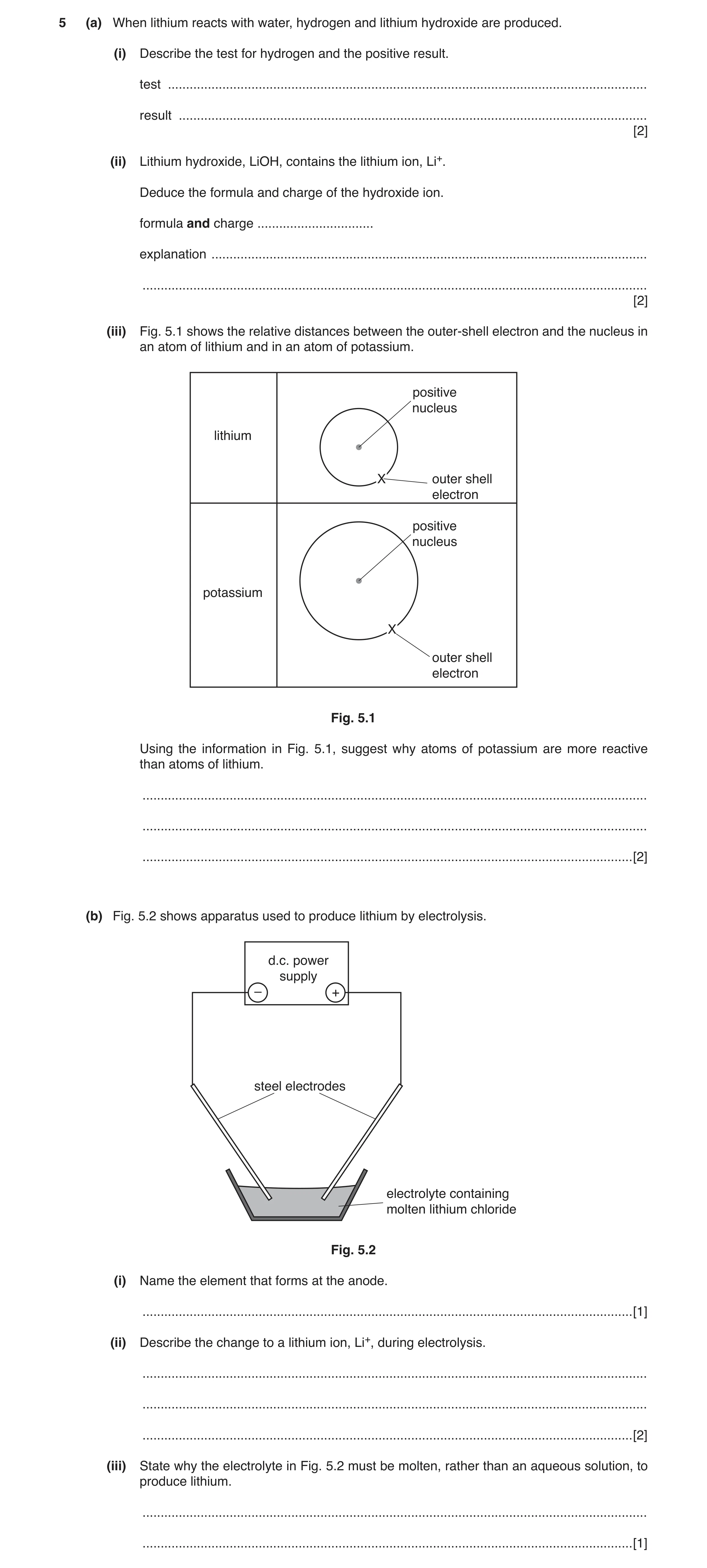
5 (a) When lithium reacts with water, hydrogen and lithium hydroxide are produced. (i) Describe the test for hydrogen and the positive result. test … result … [2] (ii) Lithium hydroxide, LiOH, contains the lithium ion, Li+. Deduce the formula and charge of the hydroxide ion. formula and charge … explanation … … [2] (iii) Fig. 5.1 shows the relative distances between the outer-shell electron and the nucleus in an atom of lithium and in an atom of potassium. positive nucleus lithium X outer shell electron positive nucleus potassium X outer shell electron Fig. 5.1 Using the information in Fig. 5.1, suggest why atoms of potassium are more reactive than atoms of lithium. … … … [2] (b) Fig. 5.2 shows apparatus used to produce lithium by electrolysis. d.c. power supply – + steel electrodes electrolyte containing molten lithium chloride Fig. 5.2 (i) Name the element that forms at the anode. … [1] (ii) Describe the change to a lithium ion, Li+, during electrolysis. … … … [2] (iii) State why the electrolyte in Fig. 5.2 must be molten, rather than an aqueous solution, to produce lithium. … … [1]
10 marks
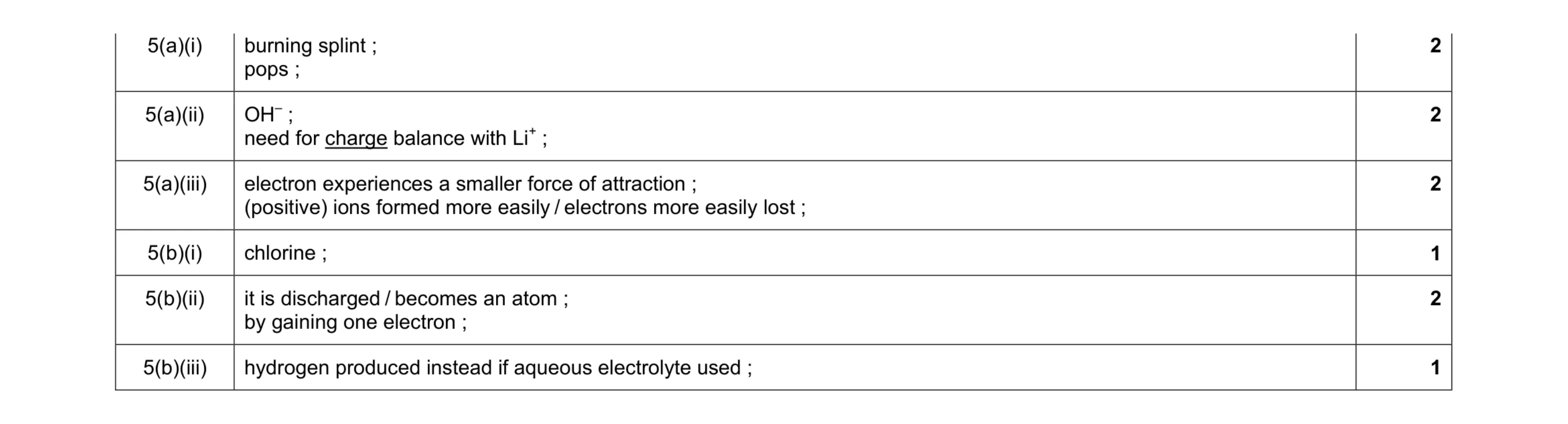
Mark scheme: 5(a)(i) burning splint ; pops ; 2 5(a)(ii) OH– ; need for charge balance with Li+ ; 2 5(a)(iii) electron experiences a smaller force of attraction ; (positive) ions formed more easily / electrons more easily lost ; 2 5(b)(i) chlorine ; 1 5(b)(ii) it is discharged / becomes an atom ; by gaining one electron ; 2 5(b)(iii) hydrogen produced instead if aqueous electrolyte used ; 1
This question in 0654/43 Oct/Nov 2017
Q2 · Copper is a transition metal 0654/42 Oct/Nov 2020
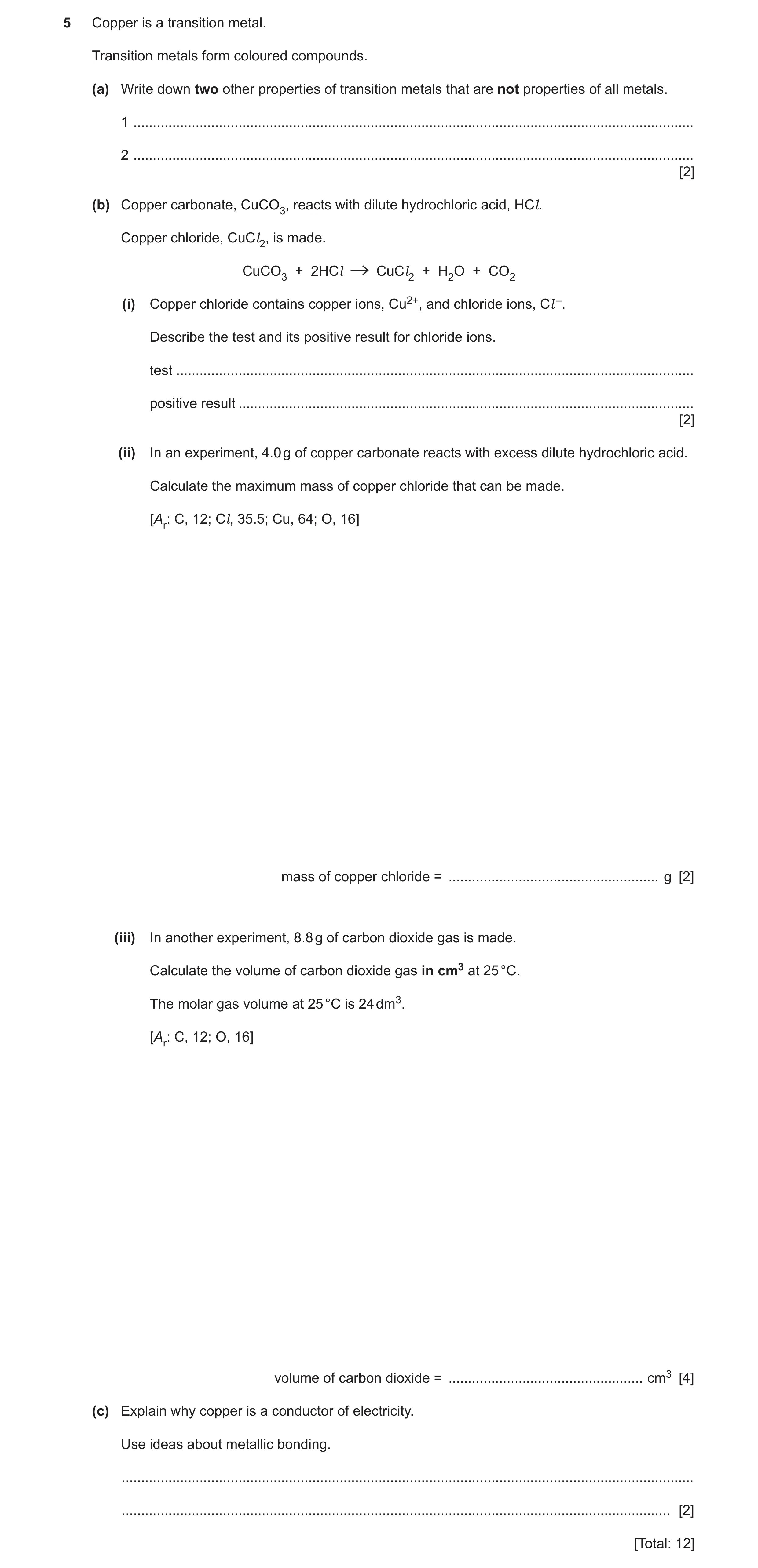
5 Copper is a transition metal. Transition metals form coloured compounds. (a) Write down two other properties of transition metals that are not properties of all metals. 1 … 2 … [2] (b) Copper carbonate, CuCO3, reacts with dilute hydrochloric acid, HCl. Copper chloride, CuCl2, is made. CuCO3 + 2HCl CuCl2 + H2O + CO2 (i) Copper chloride contains copper ions, Cu2+, and chloride ions, Cl –. Describe the test and its positive result for chloride ions. test … positive result … [2] (ii) In an experiment, 4.0 g of copper carbonate reacts with excess dilute hydrochloric acid. Calculate the maximum mass of copper chloride that can be made. [Ar: C, 12; Cl, 35.5; Cu, 64; O, 16] mass of copper chloride = … g [2] (iii) In another experiment, 8.8 g of carbon dioxide gas is made. Calculate the volume of carbon dioxide gas in cm3 at 25 °C. The molar gas volume at 25 °C is 24 dm3. [Ar: C, 12; O, 16] volume of carbon dioxide = … cm3 [4] (c) Explain why copper is a conductor of electricity. Use ideas about metallic bonding. … … [2] [Total: 12]
12 marks
Mark scheme: 5(a) any two from: high density ; high melting point ; often act as catalysts ; 2 5(b)(i) add a few drops of nitric acid followed by a few drops of silver nitrate ; (observe a) white precipitate ; 2 5(b)(ii) relative molecular mass of CuCO3 = 124 and of CuCl2 = 135 ; × 4.0 135 124 = 4.4 ; 2 5(b)(iii) Mr of CO2 = 44 ; moles of CO2 = mass ÷ Mr or 8.8 ÷ 44 / 0.2 ; volume of CO2 = moles × 24 or 0.2 × 24 / 4.8 dm³ ; conversion to cm³ = 4800 cm³ ; 4 5(c) has sea of electrons ; which can move (through the metal) ; 2
This question in 0654/42 Oct/Nov 2020
Q3 · A scientist investigates the reaction between marble chips (calcium carbonate) and dilute… 0654/42 Feb/March 2021
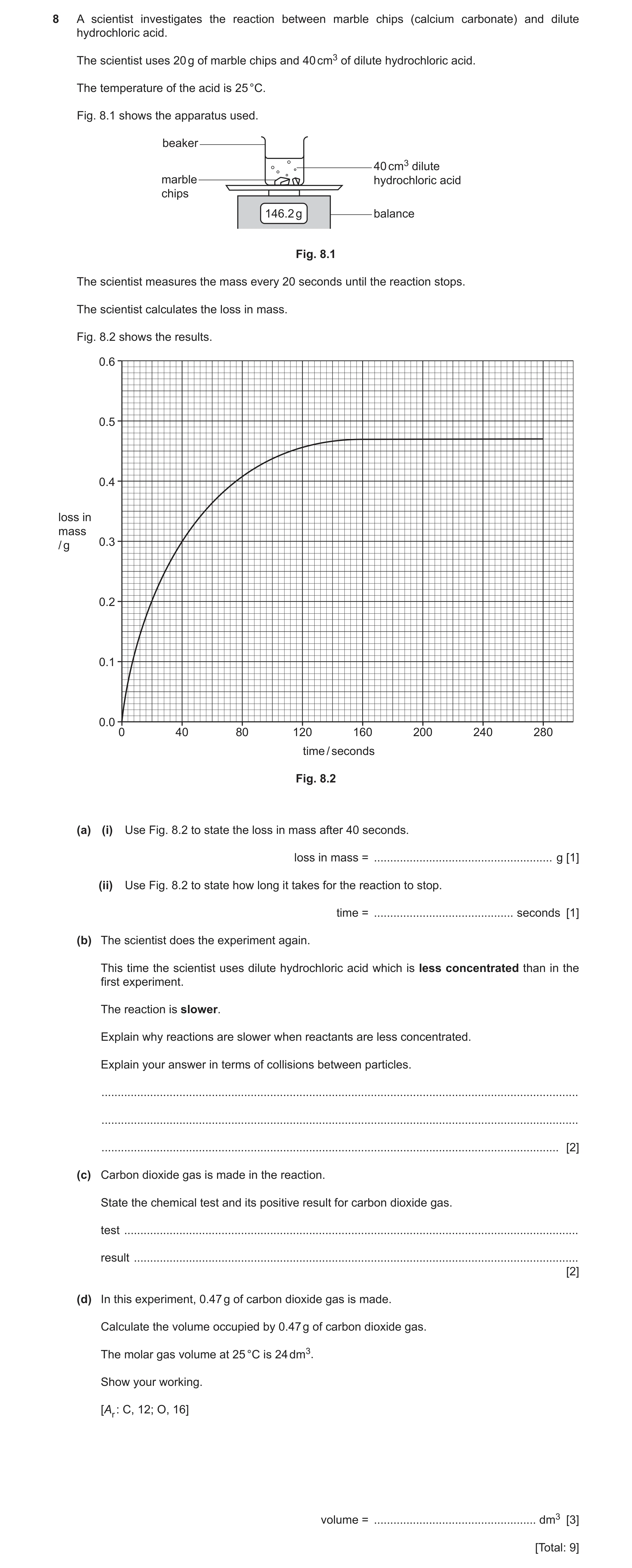
8 A scientist investigates the reaction between marble chips (calcium carbonate) and dilute hydrochloric acid. The scientist uses 20 g of marble chips and 40 cm3 of dilute hydrochloric acid. The temperature of the acid is 25 °C. Fig. 8.1 shows the apparatus used. beaker 40 cm3 dilute marble hydrochloric acid chips 146.2 g balance Fig. 8.1 The scientist measures the mass every 20 seconds until the reaction stops. The scientist calculates the loss in mass. Fig. 8.2 shows the results. 0.6 0.5 0.4 loss in mass 0.3 / g 0.2 0.1 0.0 0 40 80 120 160 200 240 280 time / seconds Fig. 8.2 (a) (i) Use Fig. 8.2 to state the loss in mass after 40 seconds. loss in mass = … g [1] (ii) Use Fig. 8.2 to state how long it takes for the reaction to stop. time = … seconds [1] (b) The scientist does the experiment again. This time the scientist uses dilute hydrochloric acid which is less concentrated than in the first experiment. The reaction is slower. Explain why reactions are slower when reactants are less concentrated. Explain your answer in terms of collisions between particles. … … … [2] (c) Carbon dioxide gas is made in the reaction. State the chemical test and its positive result for carbon dioxide gas. test … result … [2] (d) In this experiment, 0.47 g of carbon dioxide gas is made. Calculate the volume occupied by 0.47 g of carbon dioxide gas. The molar gas volume at 25 °C is 24 dm3. Show your working. [Ar : C, 12; O, 16] volume = … dm3 [3] [Total: 9]
9 marks
Mark scheme: 8(a)(i) 0.3 (g) ; 1 8(a)(ii) 156 (seconds) ; 1 8(b) less particles per unit volume / less particles per cm3 / less particle density ; less frequent collisions / less collisions per second ; 2 8(c) limewater ; turns, milky / cloudy ; 2 8(d) Mr of CO2 = 44 ; moles of CO2 = 0.47 ÷ 44 = 0.0107 ; volume of CO2 = 0.0107 × 24 = 0.26 (dm³) OR volume of CO2 = 0.0107 × 24 = 0.26 (dm³) ; 3
This question in 0654/42 Feb/March 2021
Q4 · A scientist investigates the electrolysis of lead(II) bromide 0654/42 Oct/Nov 2021
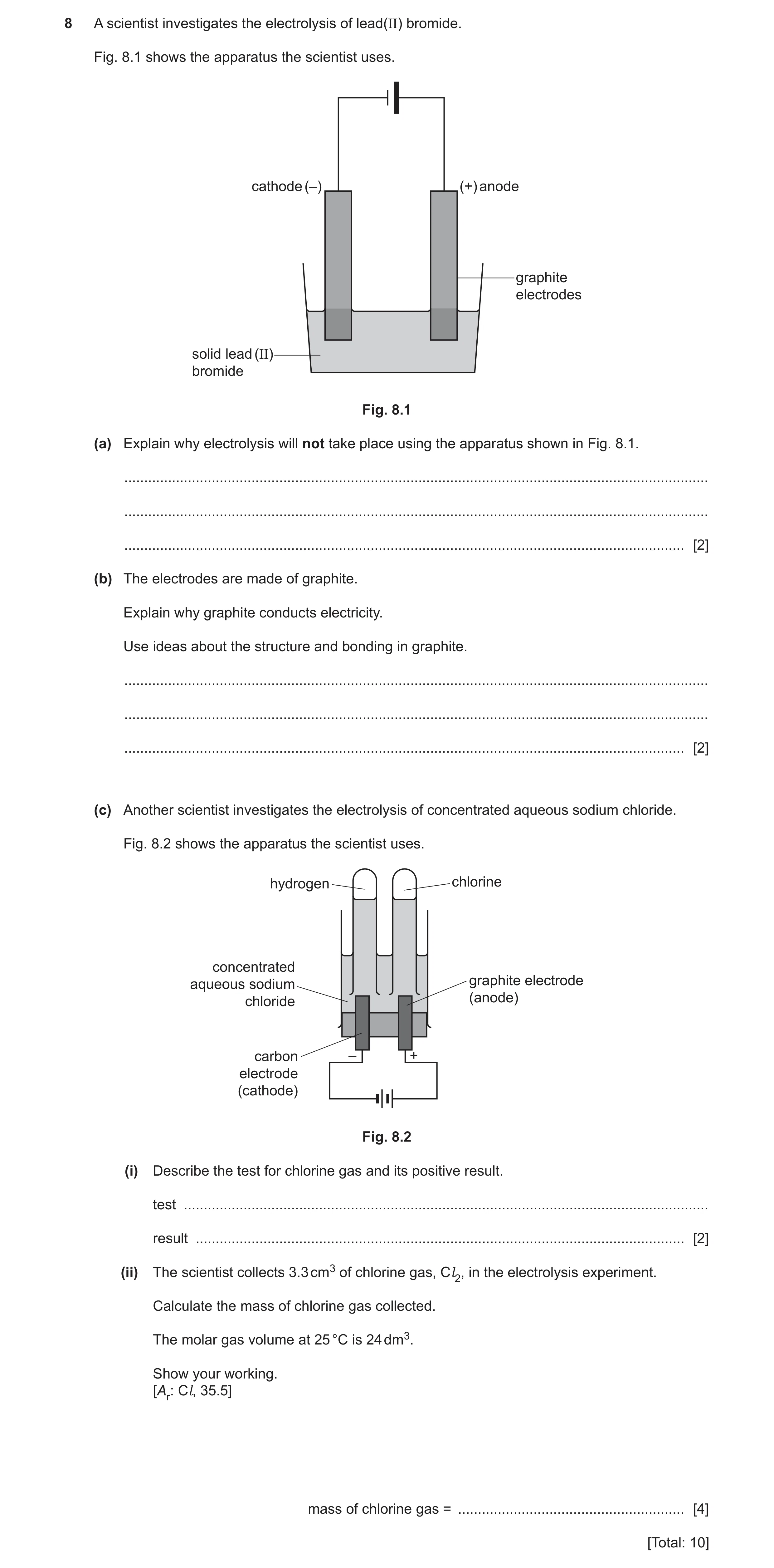
8 A scientist investigates the electrolysis of lead(II) bromide. Fig. 8.1 shows the apparatus the scientist uses. cathode (–) (+) anode graphite electrodes solid lead (II) bromide Fig. 8.1 (a) Explain why electrolysis will not take place using the apparatus shown in Fig. 8.1. … … … [2] (b) The electrodes are made of graphite. Explain why graphite conducts electricity. Use ideas about the structure and bonding in graphite. … … … [2] (c) Another scientist investigates the electrolysis of concentrated aqueous sodium chloride. Fig. 8.2 shows the apparatus the scientist uses. hydrogen chlorine concentrated aqueous sodium graphite electrode chloride (anode) carbon – + electrode (cathode) Fig. 8.2 (i) Describe the test for chlorine gas and its positive result. test … result … [2] (ii) The scientist collects 3.3 cm3 of chlorine gas, Cl2, in the electrolysis experiment. Calculate the mass of chlorine gas collected. The molar gas volume at 25 °C is 24 dm3. Show your working. [Ar: Cl, 35.5] mass of chlorine gas = … [4] [Total: 10]
10 marks
Mark scheme: 8(a) lead(II) bromide is solid / needs to be in solution or molten ; because ions cannot move in the solid / because ions can only move in liquid or in solution ; 2 8(b) graphite’s structure contains layers of carbon atoms / is giant / is (giant) covalent / is a macromolecule ; graphite contains delocalised electrons / description of delocalised electrons / electrons that are free to move ; 2 8(c)(i) damp litmus paper ; (is) bleached ; 2 8(c)(ii) conversion of 3.3 cm³ to 0.0033 dm³ or use of 24 000 dm³ ; moles of Cl2 = 3.3 ÷ 24 000 or 0.0033 ÷ 24 = 0.0001375 ; Mr Cl2 = 71 ; mass of Cl2 = 0.0001375 × 71 = 0.01 ; 4
This question in 0654/42 Oct/Nov 2021
Q5 · Potassium is in Group I of the Periodic Table 0654/42 Feb/March 2022
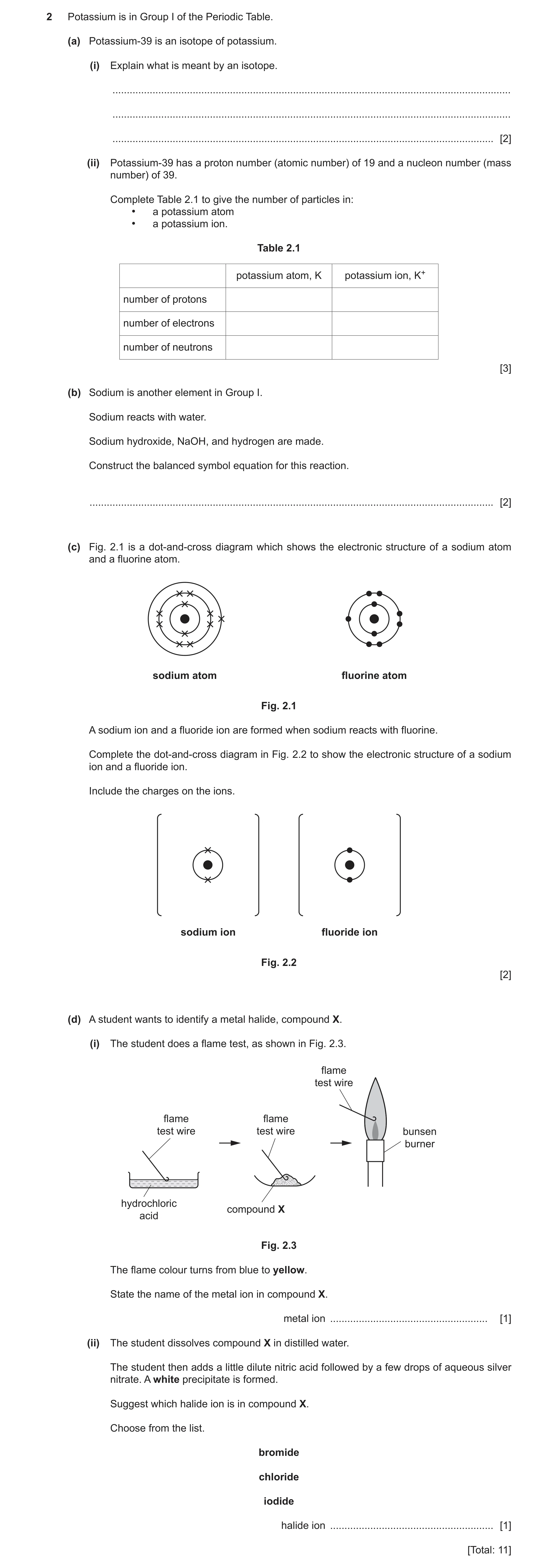
2 Potassium is in Group I of the Periodic Table. (a) Potassium-39 is an isotope of potassium. (i) Explain what is meant by an isotope. … … … [2] (ii) Potassium-39 has a proton number (atomic number) of 19 and a nucleon number (mass number) of 39. Complete Table 2.1 to give the number of particles in: • a potassium atom • a potassium ion. Table 2.1 potassium atom, K potassium ion, K+ number of protons number of electrons number of neutrons [3] (b) Sodium is another element in Group I. Sodium reacts with water. Sodium hydroxide, NaOH, and hydrogen are made. Construct the balanced symbol equation for this reaction. … [2] (c) Fig. 2.1 is a dot-and-cross diagram which shows the electronic structure of a sodium atom and a fluorine atom. sodium atom fluorine atom Fig. 2.1 A sodium ion and a fluoride ion are formed when sodium reacts with fluorine. Complete the dot-and-cross diagram in Fig. 2.2 to show the electronic structure of a sodium ion and a fluoride ion. Include the charges on the ions. sodium ion fluoride ion Fig. 2.2 [2] (d) A student wants to identify a metal halide, compound X. (i) The student does a flame test, as shown in Fig. 2.3. flame test wire flame flame test wire test wire bunsen burner hydrochloric compound X acid Fig. 2.3 The flame colour turns from blue to yellow. State the name of the metal ion in compound X. metal ion … [1] (ii) The student dissolves compound X in distilled water. The student then adds a little dilute nitric acid followed by a few drops of aqueous silver nitrate. A white precipitate is formed. Suggest which halide ion is in compound X. Choose from the list. bromide chloride iodide halide ion … [1] [Total: 11]
11 marks
Mark scheme: 2(a)(i) atoms with the same, proton or atomic number / number of protons ; (but) different, nucleon / mass number / number of neutrons ; 2 2(a)(ii) potassium atom, K potassium ion, K+ number of protons 19 19 number of electrons 19 18 number of neutrons 20 20 ;;; 3 2(b) 2Na + 2H2O → 2NaOH + H2 ;; 2 Question Answer Marks 2(c) ;; 2 2(d)(i) sodium ; 1 2(d)(ii) chloride ; 1
This question in 0654/42 Feb/March 2022
Q6 · Plants need three essential elements: nitrogen, phosphorus and potassium 0654/42 May/June 2022
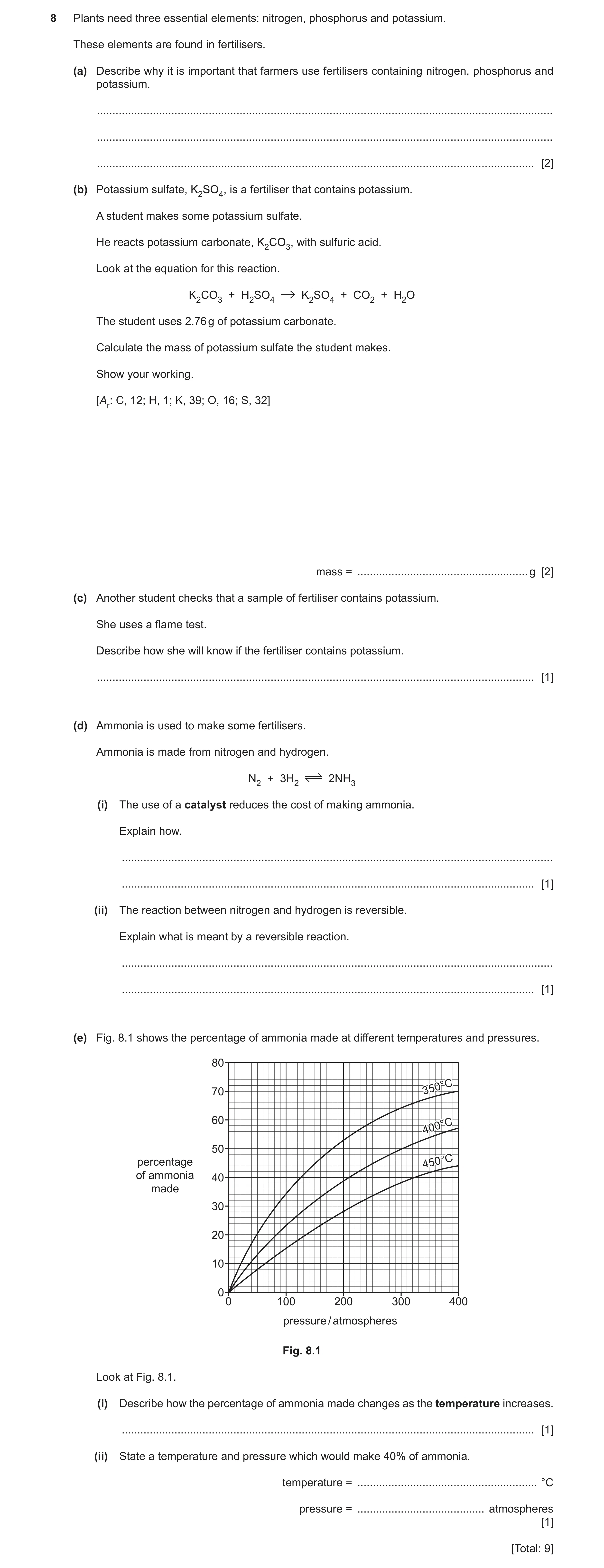
8 Plants need three essential elements: nitrogen, phosphorus and potassium. These elements are found in fertilisers. (a) Describe why it is important that farmers use fertilisers containing nitrogen, phosphorus and potassium. … … … [2] (b) Potassium sulfate, K2SO4, is a fertiliser that contains potassium. A student makes some potassium sulfate. He reacts potassium carbonate, K2CO3, with sulfuric acid. Look at the equation for this reaction. K2CO3 + H2SO4 K2SO4 + CO2 + H2O The student uses 2.76 g of potassium carbonate. Calculate the mass of potassium sulfate the student makes. Show your working. [Ar: C, 12; H, 1; K, 39; O, 16; S, 32] mass = … g [2] (c) Another student checks that a sample of fertiliser contains potassium. She uses a flame test. Describe how she will know if the fertiliser contains potassium. … [1] (d) Ammonia is used to make some fertilisers. Ammonia is made from nitrogen and hydrogen. N2 + 3H2 2NH3 (i) The use of a catalyst reduces the cost of making ammonia. Explain how. … … [1] (ii) The reaction between nitrogen and hydrogen is reversible. Explain what is meant by a reversible reaction. … … [1] (e) Fig. 8.1 shows the percentage of ammonia made at different temperatures and pressures. 80 70 350°C350°C 60 400°C400°C 50 percentage 450°C450°C of ammonia 40 made 30 20 10 0 0 100 200 300 400 pressure / atmospheres Fig. 8.1 Look at Fig. 8.1. (i) Describe how the percentage of ammonia made changes as the temperature increases. … [1] (ii) State a temperature and pressure which would make 40% of ammonia. temperature = … °C pressure = … atmospheres [1] [Total: 9]
9 marks
Mark scheme: 8(a) to, improve quality / increase yield / for growth, (of crop / plant) ; prevents discolouration of leaves / synthesis of (named) proteins or amino acids / replaces (named) minerals or ions in soil ; 2 8(b) relative formula mass of K2CO3 =138 and of K2SO4 = 174 ; 174 2.76 138 = 3.48 g ; 2 8(c) (flame test gives) a lilac / purple (flame) ; 1 Question Answer Marks 8(d)(i) (catalyst) increases rate of reaction ; 1 8(d)(ii) idea that reaction can go both ways / can go in both directions ; 1 8(e)(i) decreases / owtte ; 1 8(e)(ii) 350 °C and 125 atm OR 400 °C and 210 atm OR 450 °C and 325 atm ; 1
This question in 0654/42 May/June 2022
Q7 · This question is about metals 0654/43 Oct/Nov 2022
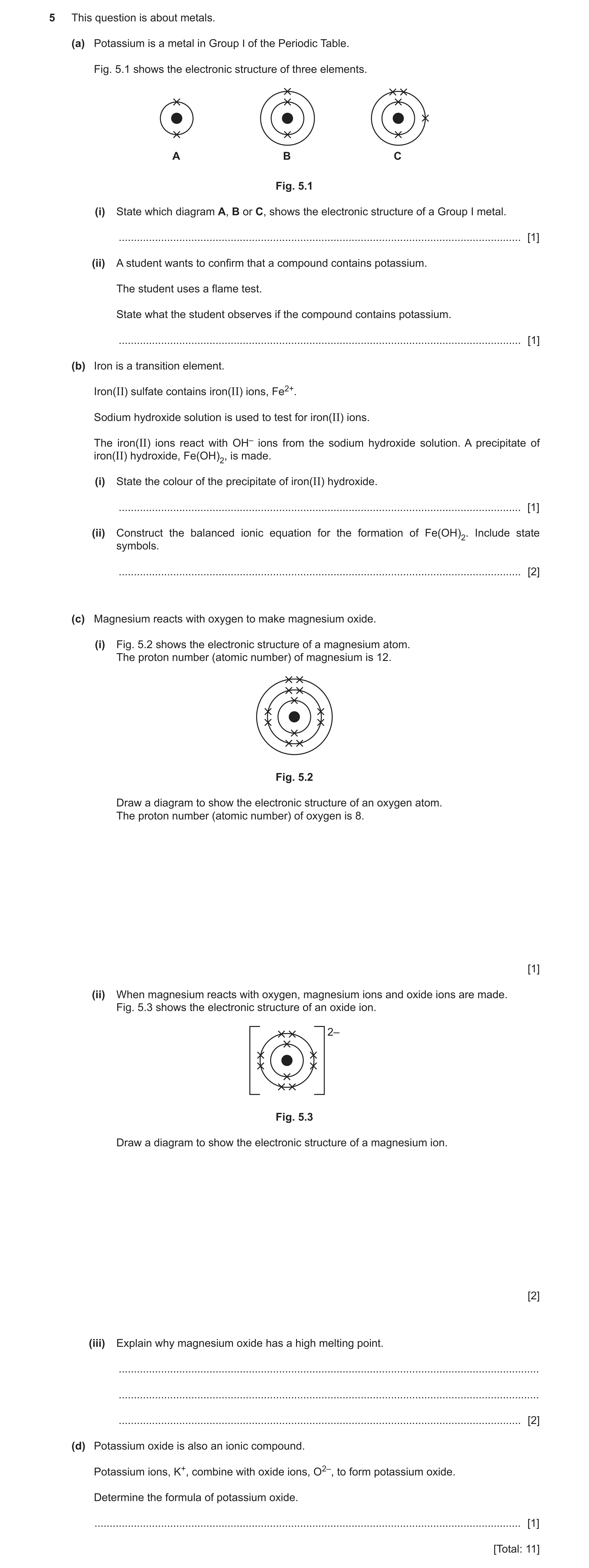
5 This question is about metals. (a) Potassium is a metal in Group I of the Periodic Table. Fig. 5.1 shows the electronic structure of three elements. A B C Fig. 5.1 (i) State which diagram A, B or C, shows the electronic structure of a Group I metal. … [1] (ii) A student wants to confirm that a compound contains potassium. The student uses a flame test. State what the student observes if the compound contains potassium. … [1] (b) Iron is a transition element. Iron(II) sulfate contains iron(II) ions, Fe2+. Sodium hydroxide solution is used to test for iron(II) ions. The iron(II) ions react with OH– ions from the sodium hydroxide solution. A precipitate of iron(II) hydroxide, Fe(OH)2, is made. (i) State the colour of the precipitate of iron(II) hydroxide. … [1] (ii) Construct the balanced ionic equation for the formation of Fe(OH)2. Include state symbols. … [2] (c) Magnesium reacts with oxygen to make magnesium oxide. (i) Fig. 5.2 shows the electronic structure of a magnesium atom. The proton number (atomic number) of magnesium is 12. Fig. 5.2 Draw a diagram to show the electronic structure of an oxygen atom. The proton number (atomic number) of oxygen is 8. [1] (ii) When magnesium reacts with oxygen, magnesium ions and oxide ions are made. Fig. 5.3 shows the electronic structure of an oxide ion. 2– Fig. 5.3 Draw a diagram to show the electronic structure of a magnesium ion. [2] (iii) Explain why magnesium oxide has a high melting point. … … … [2] (d) Potassium oxide is also an ionic compound. Potassium ions, K+, combine with oxide ions, O2–, to form potassium oxide. Determine the formula of potassium oxide. … [1] [Total: 11]
11 marks
Mark scheme: 5(a)(i) B ; 1 5(a)(ii) lilac / purple, (flame) ; 1 5(b)(i) green ; 1 5(b)(ii) Fe2+(aq) + 2OH– (aq) → Fe(OH)2 (s) ;; 2 5(c)(i) 1 ; 5(c)(ii) 2 ;; 5(c)(iii) strong attraction between (positive and negative) ions / strong electrostatic attraction / strong ionic bond ; 2 so large amount of energy needed to overcome the attraction / owtte ; 5(d) K2O ; 1
This question in 0654/43 Oct/Nov 2022
Q8 · Water must be treated so that it is safe to drink 0654/43 Oct/Nov 2022
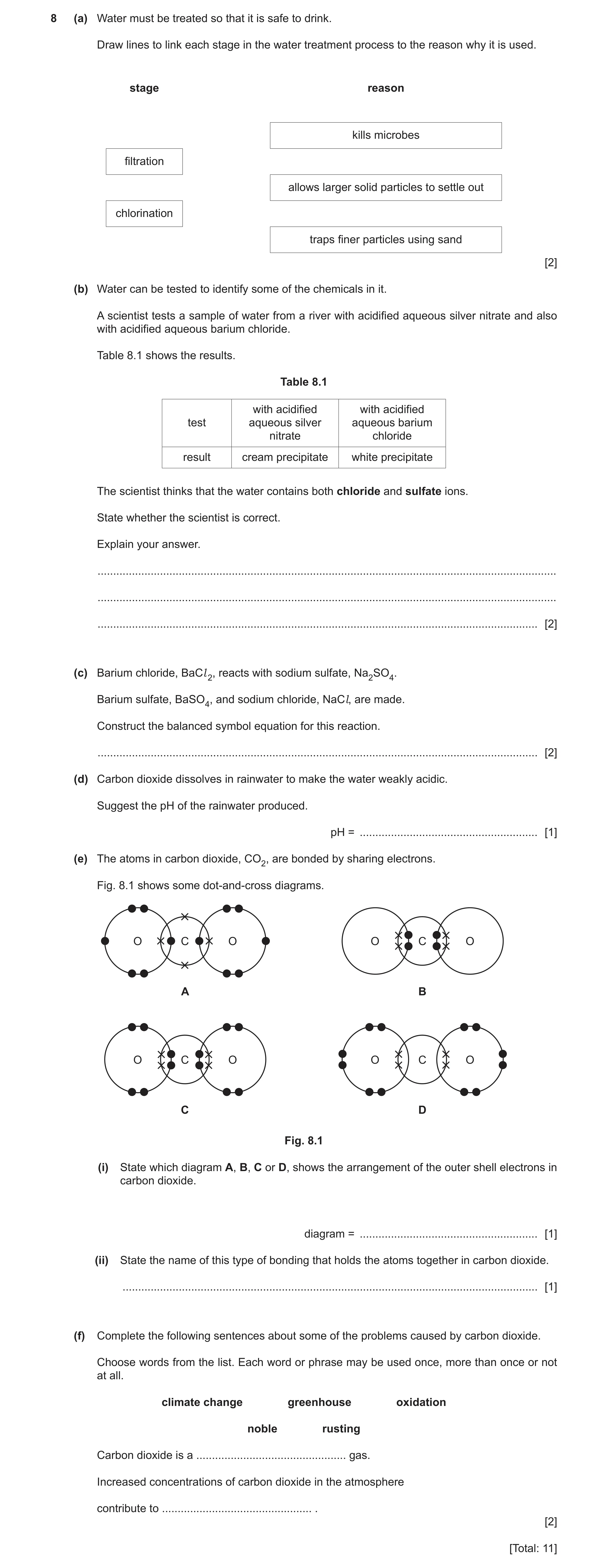
8 (a) Water must be treated so that it is safe to drink. Draw lines to link each stage in the water treatment process to the reason why it is used. stage reason kills microbes filtration allows larger solid particles to settle out chlorination traps finer particles using sand [2] (b) Water can be tested to identify some of the chemicals in it. A scientist tests a sample of water from a river with acidified aqueous silver nitrate and also with acidified aqueous barium chloride. Table 8.1 shows the results. Table 8.1 with acidified with acidified test aqueous silver aqueous barium nitrate chloride result cream precipitate white precipitate The scientist thinks that the water contains both chloride and sulfate ions. State whether the scientist is correct. Explain your answer. … … … [2] (c) Barium chloride, BaCl 2, reacts with sodium sulfate, Na2SO4. Barium sulfate, BaSO4, and sodium chloride, NaCl, are made. Construct the balanced symbol equation for this reaction. … [2] (d) Carbon dioxide dissolves in rainwater to make the water weakly acidic. Suggest the pH of the rainwater produced. pH = … [1] (e) The atoms in carbon dioxide, CO2, are bonded by sharing electrons. Fig. 8.1 shows some dot-and-cross diagrams. O C O O C O A B O C O O C O C D Fig. 8.1 (i) State which diagram A, B, C or D, shows the arrangement of the outer shell electrons in carbon dioxide. diagram = … [1] (ii) State the name of this type of bonding that holds the atoms together in carbon dioxide. … [1] (f) Complete the following sentences about some of the problems caused by carbon dioxide. Choose words from the list. Each word or phrase may be used once, more than once or not at all. climate change greenhouse oxidation noble rusting Carbon dioxide is a … gas. Increased concentrations of carbon dioxide in the atmosphere contribute to … . [2] [Total: 11]
11 marks
Mark scheme: 8(a) filtration – traps finer particles using sand ; 2 chlorination – kills microbes ; 8(b) (no because) 2 bromide ions give a cream precipitate with silver nitrate solution / chloride ions give a white precipitate with silver nitrate solution ; idea that sample does contain sulfate ions as there is a white precipitate with barium chloride solution ; 8(c) BaCl2 + Na2SO4 → BaSO4 + 2NaCl ;; 2 8(d) any pH above 3 and less than 7 ; 1 8(e)(i) C ; 1 8(e)(ii) covalent ; 1 8(f) greenhouse ; 2 climate change ;
This question in 0654/43 Oct/Nov 2022
Q9 · A student investigates the reaction between calcium carbonate, CaCO3, and dilute… 0654/43 May/June 2023
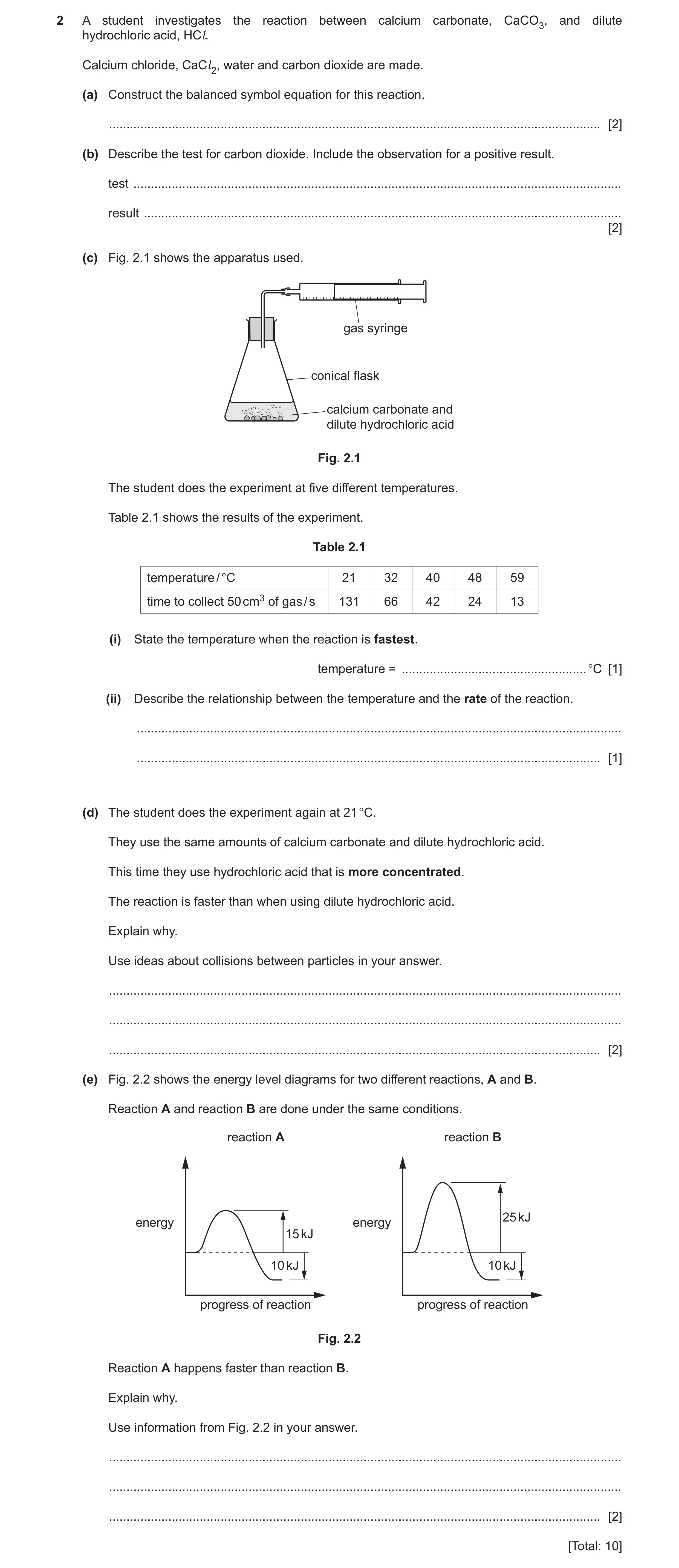
2 A student investigates the reaction between calcium carbonate, CaCO3, and dilute hydrochloric acid, HCl. Calcium chloride, CaCl 2, water and carbon dioxide are made. (a) Construct the balanced symbol equation for this reaction. … [2] (b) Describe the test for carbon dioxide. Include the observation for a positive result. test … result … [2] (c) Fig. 2.1 shows the apparatus used. gas syringe conical flask calcium carbonate and dilute hydrochloric acid Fig. 2.1 The student does the experiment at five different temperatures. Table 2.1 shows the results of the experiment. Table 2.1 temperature / °C 21 32 40 48 59 time to collect 50 cm3 of gas / s 131 66 42 24 13 (i) State the temperature when the reaction is fastest. temperature = … °C [1] (ii) Describe the relationship between the temperature and the rate of the reaction. … … [1] (d) The student does the experiment again at 21 °C. They use the same amounts of calcium carbonate and dilute hydrochloric acid. This time they use hydrochloric acid that is more concentrated. The reaction is faster than when using dilute hydrochloric acid. Explain why. Use ideas about collisions between particles in your answer. … … … [2] (e) Fig. 2.2 shows the energy level diagrams for two different reactions, A and B. Reaction A and reaction B are done under the same conditions. reaction A reaction B 25 kJ energy energy 15 kJ 10 kJ 10 kJ progress of reaction progress of reaction Fig. 2.2 Reaction A happens faster than reaction B. Explain why. Use information from Fig. 2.2 in your answer. … … … [2] [Total: 10]
10 marks
Mark scheme: 2(a) correct formulae ; correct balancing ; 2 2(b) test – limewater ; result – turns milky / cloudy ; 2 2(c)(i) 59 (°C) ; 1 2(c)(ii) as the temperature increases the rate of reaction increases / owtte ; 1 2(d) particles are more crowded / more particles per cm³ / owtte ; more frequent collisions / more collisions per second / owtte ; 2 2(e) activation energy for reaction A is lower than for reaction B ; idea that more / higher proportion of reactant particles can react on collision in reaction A ; 2
This question in 0654/43 May/June 2023
Q10 · The element carbon exists as 3 naturally occurring isotopes 0654/42 Oct/Nov 2023
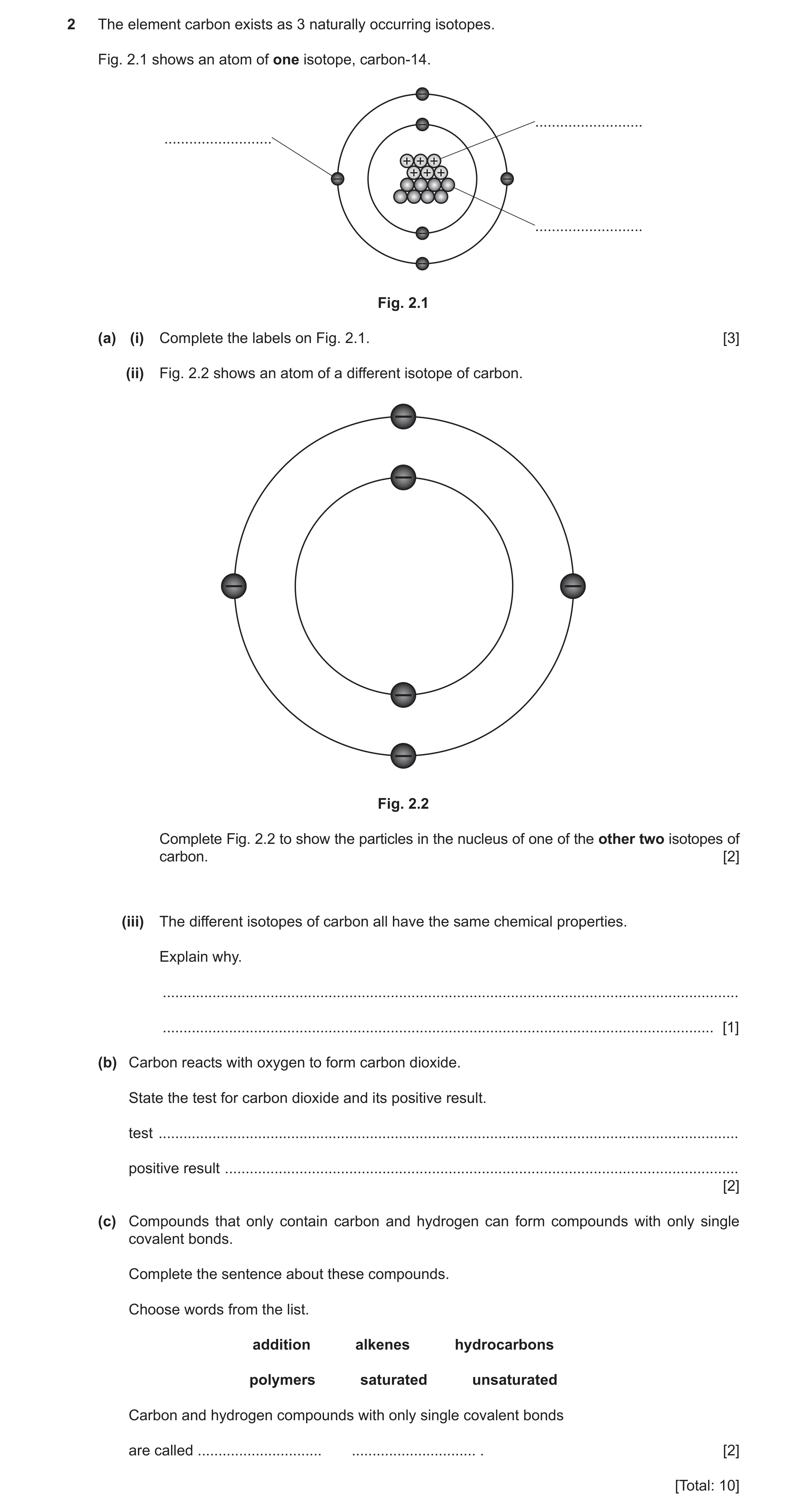
2 The element carbon exists as 3 naturally occurring isotopes. Fig. 2.1 shows an atom of one isotope, carbon-14. – – … … + + + + + + – – … – – Fig. 2.1 (a) (i) Complete the labels on Fig. 2.1. [3] (ii) Fig. 2.2 shows an atom of a different isotope of carbon. – – – – – – Fig. 2.2 Complete Fig. 2.2 to show the particles in the nucleus of one of the other two isotopes of carbon. [2] (iii) The different isotopes of carbon all have the same chemical properties. Explain why. … … [1] (b) Carbon reacts with oxygen to form carbon dioxide. State the test for carbon dioxide and its positive result. test … positive result … [2] (c) Compounds that only contain carbon and hydrogen can form compounds with only single covalent bonds. Complete the sentence about these compounds. Choose words from the list. addition alkenes hydrocarbons polymers saturated unsaturated Carbon and hydrogen compounds with only single covalent bonds are called … … . [2] [Total: 10]
10 marks
Mark scheme: 2(a)(i) 3 proton ; electron ; neutron ; 2(a)(ii) 6 protons ; 2 6 or 7 neutrons ; 2(a)(iii) same number of electrons in the outer shell ; 1 2(b) test: limewater ; 2 observation: milky / cloudy / white precipitate ; 2(c) saturated ; 2 hydrocarbons ;
This question in 0654/42 Oct/Nov 2023
Q11 · A student investigates the reaction between calcium carbonate and dilute hydrochloric acid 0654/43 Oct/Nov 2024
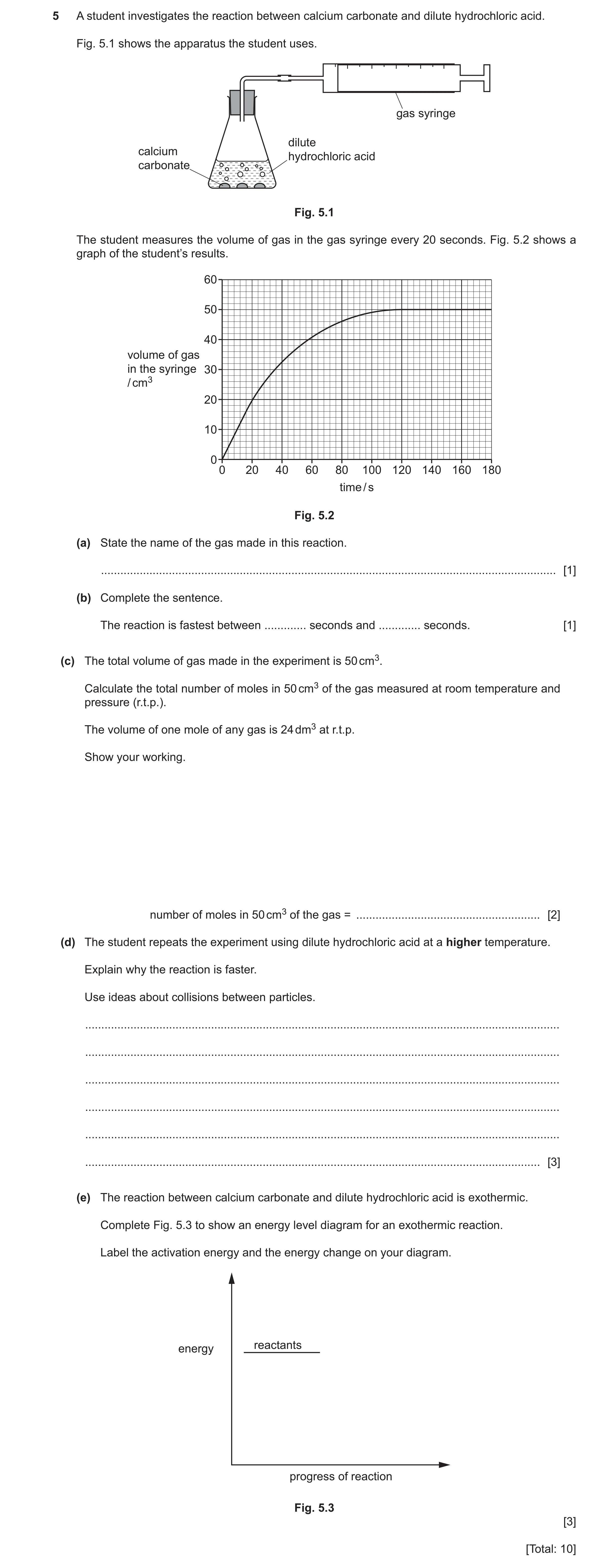
5 A student investigates the reaction between calcium carbonate and dilute hydrochloric acid. Fig. 5.1 shows the apparatus the student uses. gas syringe dilute calcium hydrochloric acid carbonate Fig. 5.1 The student measures the volume of gas in the gas syringe every 20 seconds. Fig. 5.2 shows a graph of the student’s results. 60 50 40 volume of gas in the syringe 30 / cm3 20 10 0 0 20 40 60 80 100 120 140 160 180 time / s Fig. 5.2 (a) State the name of the gas made in this reaction. … [1] (b) Complete the sentence. The reaction is fastest between … seconds and … seconds. [1] (c) The total volume of gas made in the experiment is 50 cm3. Calculate the total number of moles in 50 cm3 of the gas measured at room temperature and pressure (r.t.p.). The volume of one mole of any gas is 24 dm3 at r.t.p. Show your working. number of moles in 50 cm3 of the gas = … [2] (d) The student repeats the experiment using dilute hydrochloric acid at a higher temperature. Explain why the reaction is faster. Use ideas about collisions between particles. … … … … … … [3] (e) The reaction between calcium carbonate and dilute hydrochloric acid is exothermic. Complete Fig. 5.3 to show an energy level diagram for an exothermic reaction. Label the activation energy and the energy change on your diagram. reactants energy progress of reaction Fig. 5.3 [3] [Total: 10]
10 marks
Mark scheme: 5(a) carbon dioxide ; 1 5(b) the reaction is fastest between 0 seconds and 16 seconds ; 1 5(c) (50 cm3 =) 0.050 dm3 ; 2 (moles = 0.050 ÷ 24) = 0.0021 ; OR (24 dm3 =) 24 000 cm3 ; moles = (50 / 24000 =) 0.0021 ; 5(d) molecules have higher (average) energy / 3 molecules are moving faster ; more molecules with activation energy ; frequency of collision (of molecules) is higher / more collisions per second / more successful collisions ; 5(e) 3 products shown below reactants ; energy change or H correctly clearly indicated and labelled ; activation energy clearly indicated and labelled ;
This question in 0654/43 Oct/Nov 2024
Q12 · A student tests three different solutions to identify the ion in each solution 0654/41 Oct/Nov 2025
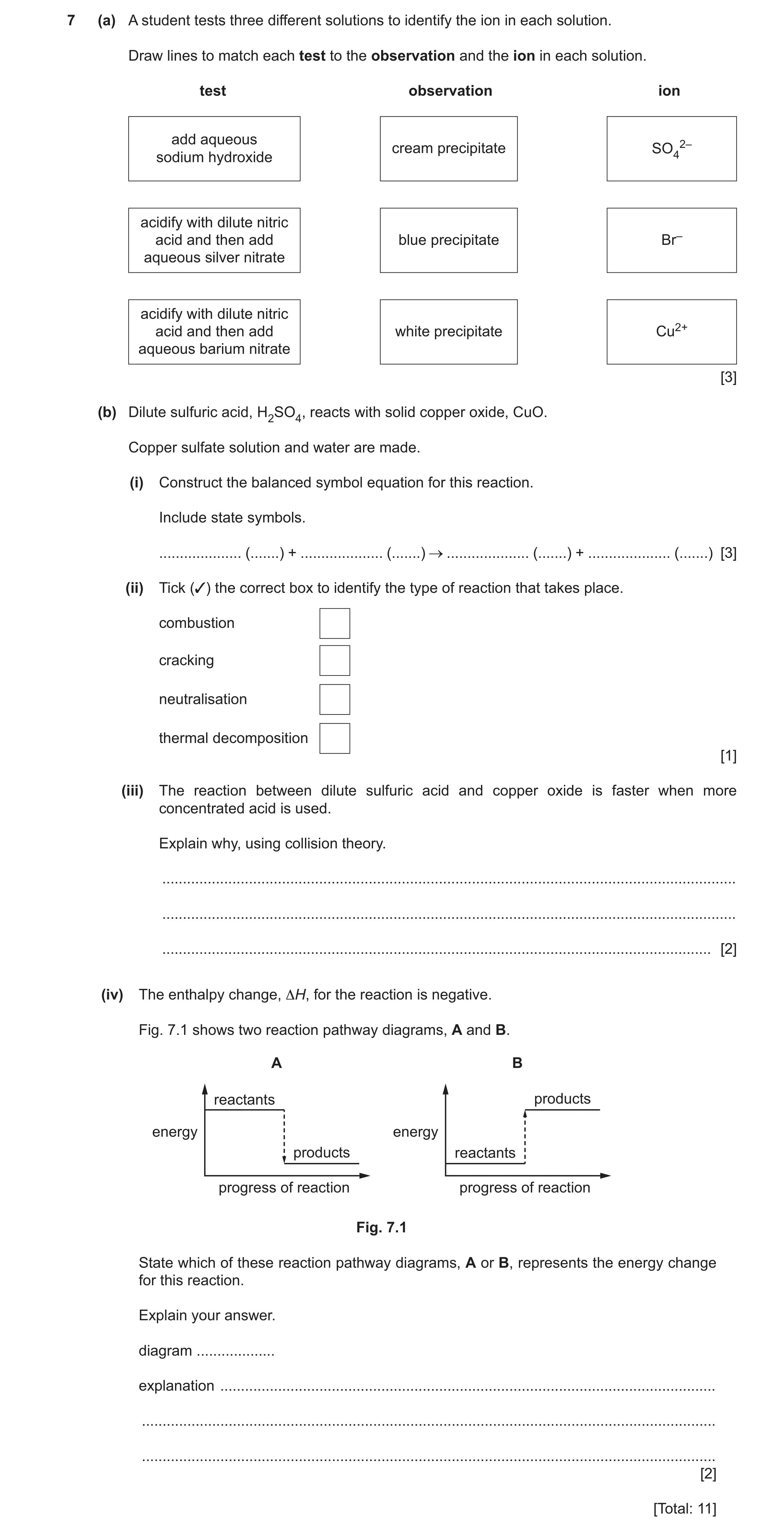
7 (a) A student tests three different solutions to identify the ion in each solution. Draw lines to match each test to the observation and the ion in each solution. test observation ion add aqueous 2– cream precipitate SO4 sodium hydroxide acidify with dilute nitric acid and then add blue precipitate Br– aqueous silver nitrate acidify with dilute nitric acid and then add white precipitate Cu2+ aqueous barium nitrate [3] (b) Dilute sulfuric acid, H2SO4, reacts with solid copper oxide, CuO. Copper sulfate solution and water are made. (i) Construct the balanced symbol equation for this reaction. Include state symbols. … ( … ) + … ( … ) … ( … ) + … ( … ) [3] (ii) Tick (✓) the correct box to identify the type of reaction that takes place. combustion cracking neutralisation thermal decomposition [1] (iii) The reaction between dilute sulfuric acid and copper oxide is faster when more concentrated acid is used. Explain why, using collision theory. … … … [2] (iv) The enthalpy change, ΔH, for the reaction is negative. Fig. 7.1 shows two reaction pathway diagrams, A and B. A B reactants products energy energy products reactants progress of reaction progress of reaction Fig. 7.1 State which of these reaction pathway diagrams, A or B, represents the energy change for this reaction. Explain your answer. diagram … explanation … … … [2] [Total: 11]
11 marks
Mark scheme: 7(a) 3 6 correct = 3 marks 4 or 5 correct = 2 marks 2 or 3 correct = 1 mark 7(b)(i) H2SO4 (aq) + CuO (s) → CuSO4 (aq) + H2O (l) 3 1 mark for formula of CuSO4 1 mark for rest of equation 1 mark for all state symbols correct 7(b)(ii) neutralisation ; 1 7(b)(iii) more particles per unit volume ; 2 frequency of collision (of particles) is higher ; 7(b)(iv) (diagram A) 2 any two from: • exothermic ; • products have lower energy than reactants / reactants have higher energy than products / ORA ; • energy is released to the surroundings ;
This question in 0654/41 Oct/Nov 2025
Q13 · A student investigates the decomposition of hydrogen peroxide, H2O2 0654/43 Oct/Nov 2025
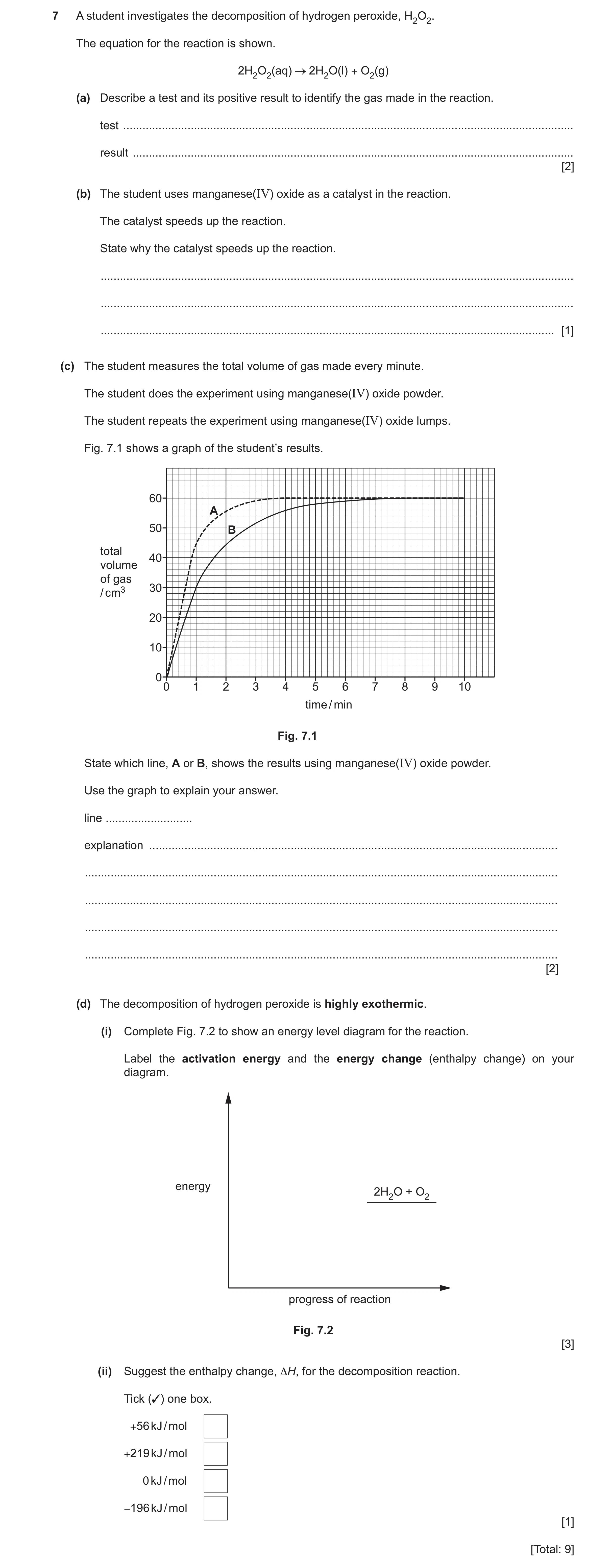
7 A student investigates the decomposition of hydrogen peroxide, H2O2. The equation for the reaction is shown. 2H2O2(aq) 2H2O(l) + O2(g) (a) Describe a test and its positive result to identify the gas made in the reaction. test … result … [2] (b) The student uses manganese(IV) oxide as a catalyst in the reaction. The catalyst speeds up the reaction. State why the catalyst speeds up the reaction. … … … [1] (c) The student measures the total volume of gas made every minute. The student does the experiment using manganese(IV) oxide powder. The student repeats the experiment using manganese(IV) oxide lumps. Fig. 7.1 shows a graph of the student’s results. 60 A 50 B total 40 volume of gas / cm3 30 20 10 0 0 1 2 3 4 5 6 7 8 9 10 time / min Fig. 7.1 State which line, A or B, shows the results using manganese(IV) oxide powder. Use the graph to explain your answer. line … explanation … … … … … [2] (d) The decomposition of hydrogen peroxide is highly exothermic. (i) Complete Fig. 7.2 to show an energy level diagram for the reaction. Label the activation energy and the energy change (enthalpy change) on your diagram. energy 2H2O + O2 progress of reaction Fig. 7.2 [3] (ii) Suggest the enthalpy change, ΔH, for the decomposition reaction. Tick (3) one box. +56 kJ / mol +219 kJ / mol 0 kJ / mol −196 kJ / mol [1] [Total: 9]
9 marks
Mark scheme: 7(a) test: glowing splint ; 2 result: relights ; 7(b) (catalyst) decrease the activation energy (of the reaction) / (catalyst) decrease the Ea (of the reaction) ; 1 7(c) (line A) 2 the line is steeper / line has larger gradient ; higher rate of reaction / reaction is faster / the reaction finishes first / volume of gas increases faster ; 7(d)(i) 3 reactants line drawn above products line ; arrow correctly labelled activation energy ; arrow correctly labelled energy change ; 7(d)(ii) 1 +56 kJ / mol +219 kJ / mol 0 kJ / mol –196 kJ / mol ✓
This question in 0654/43 Oct/Nov 2025
 10
10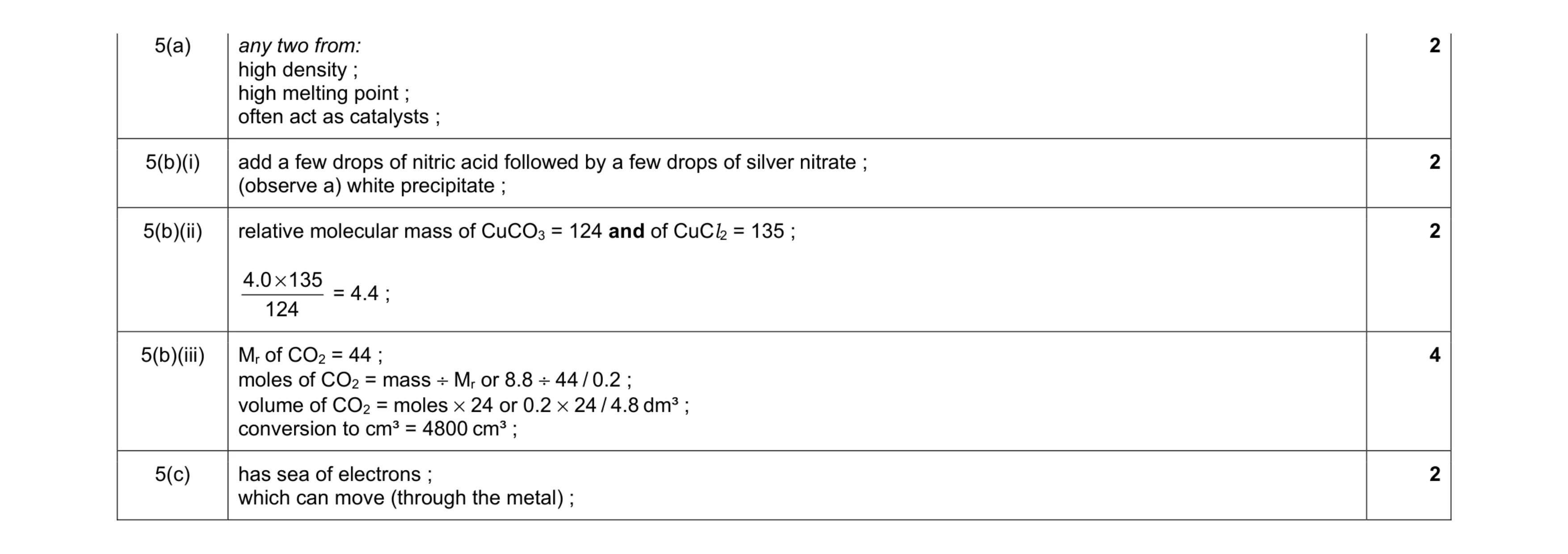 12
12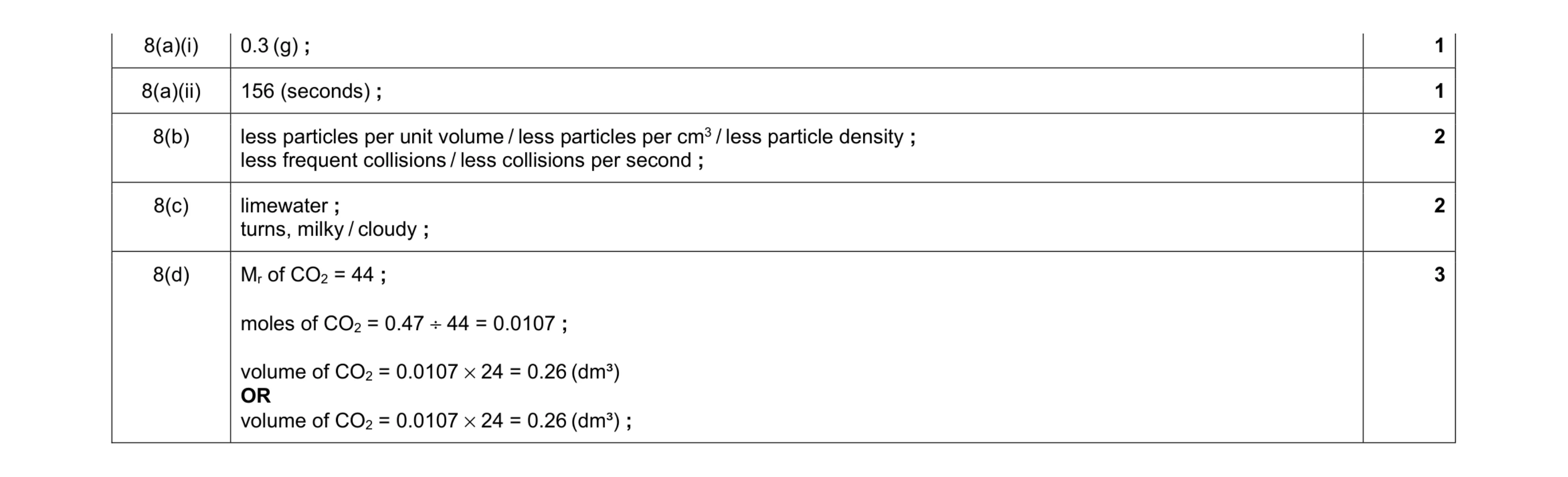 9
9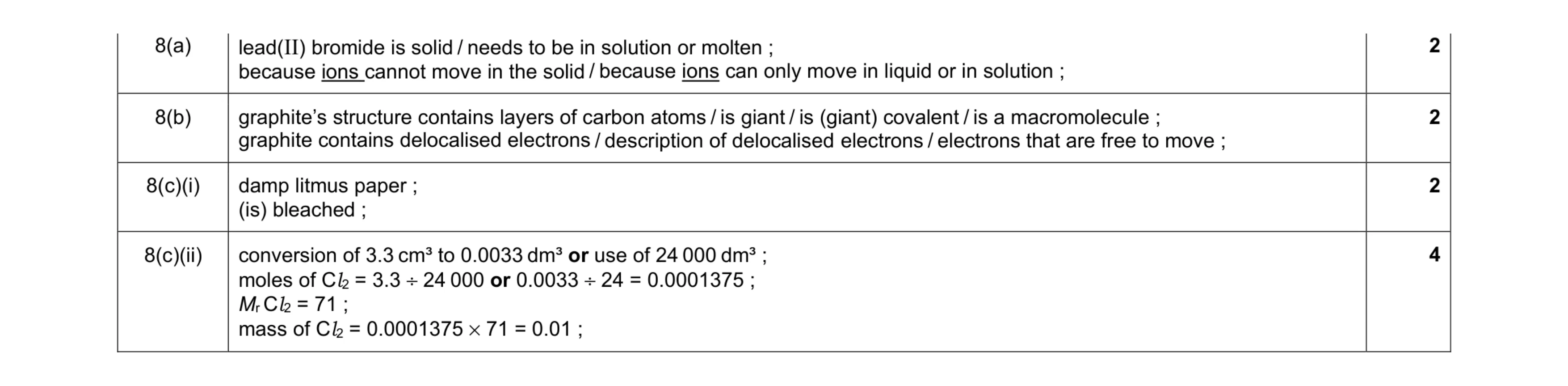 10
10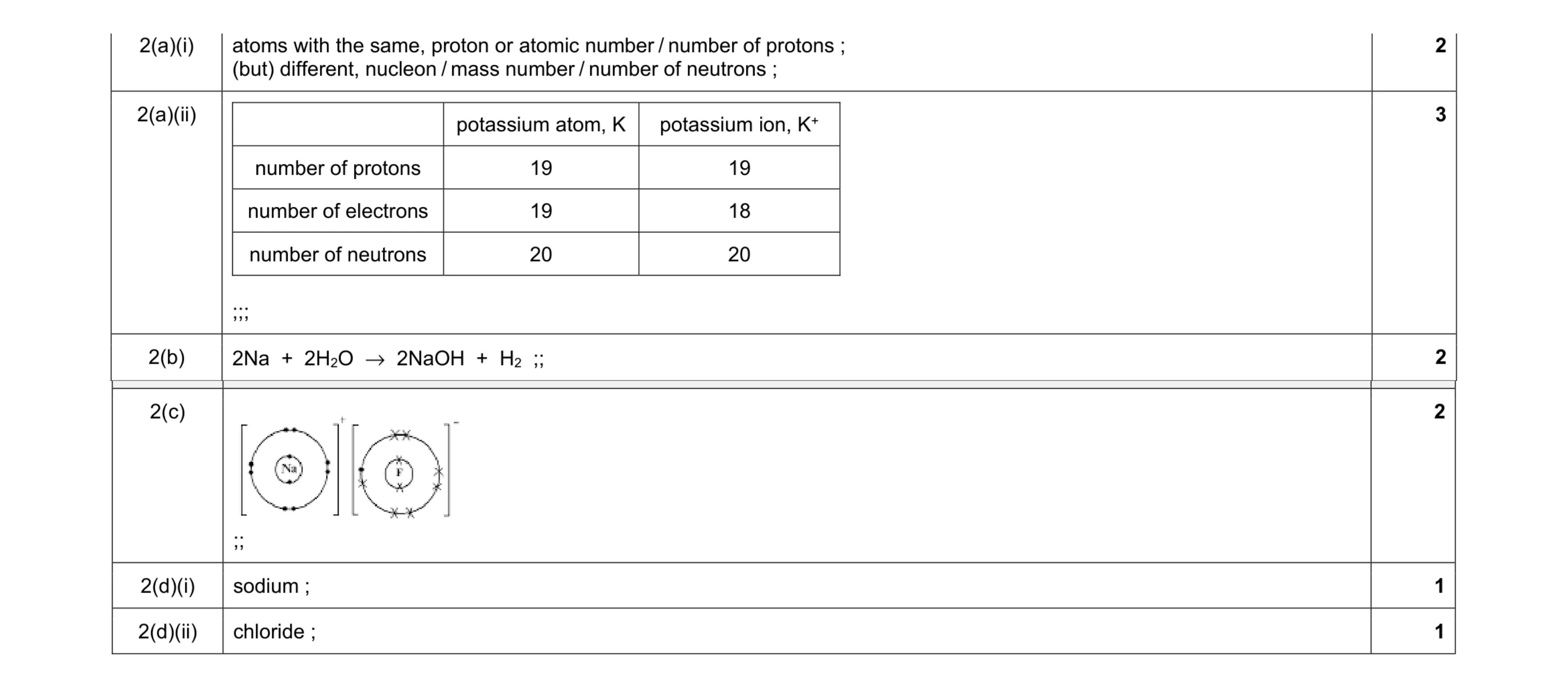 11
11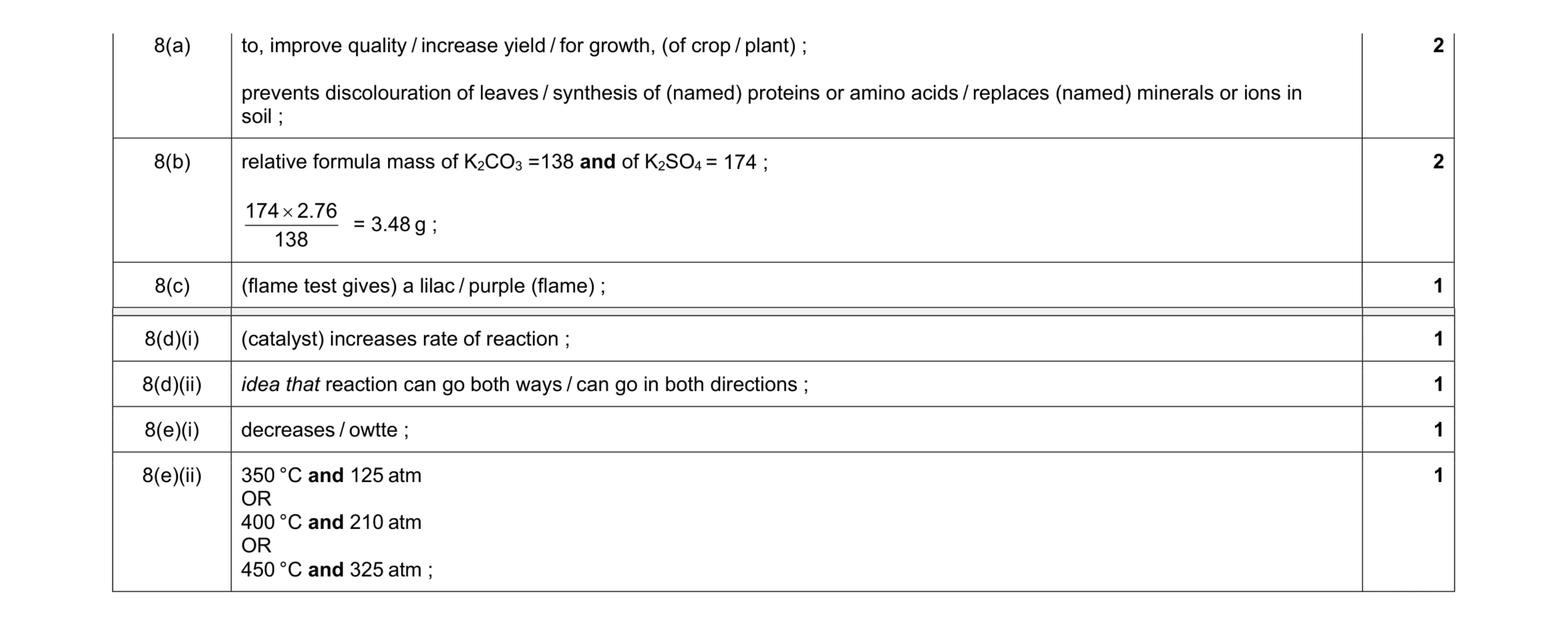 9
9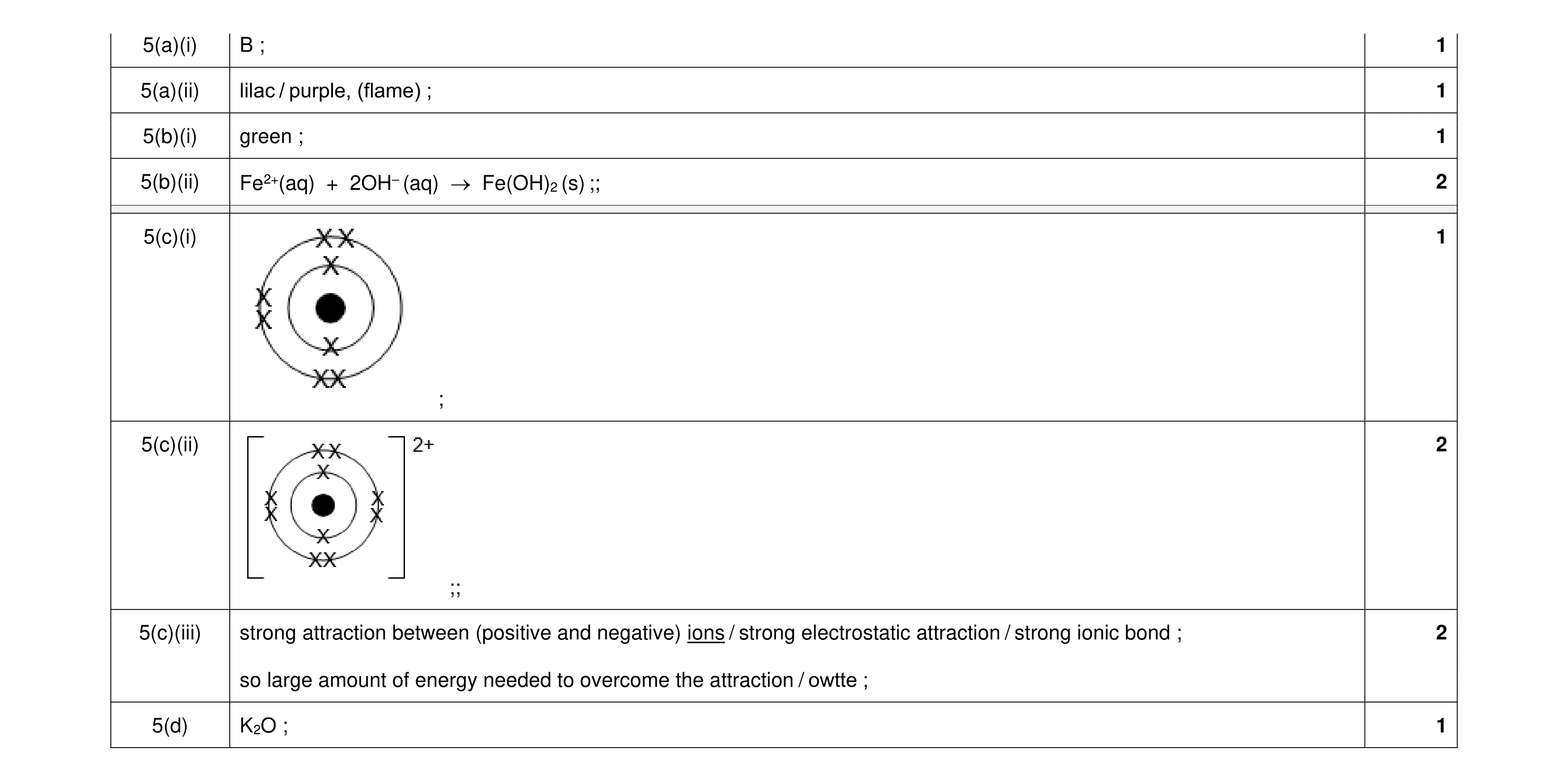 11
11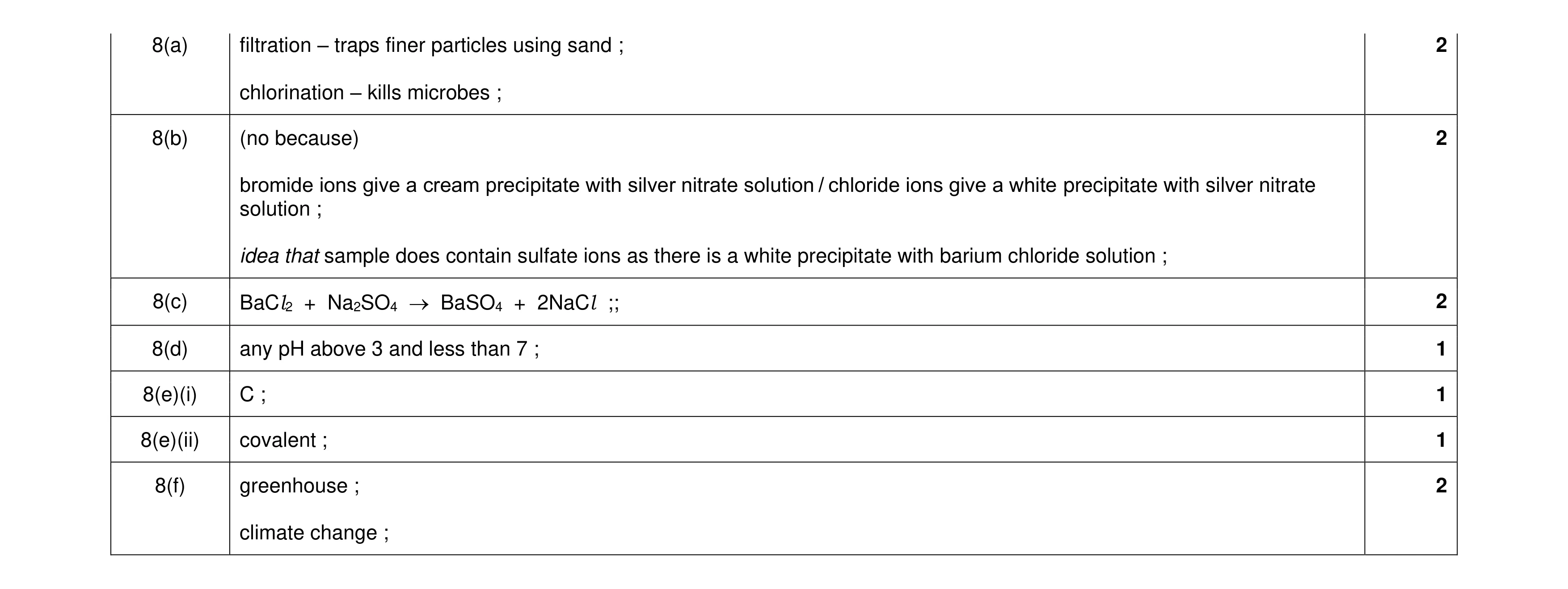 11
11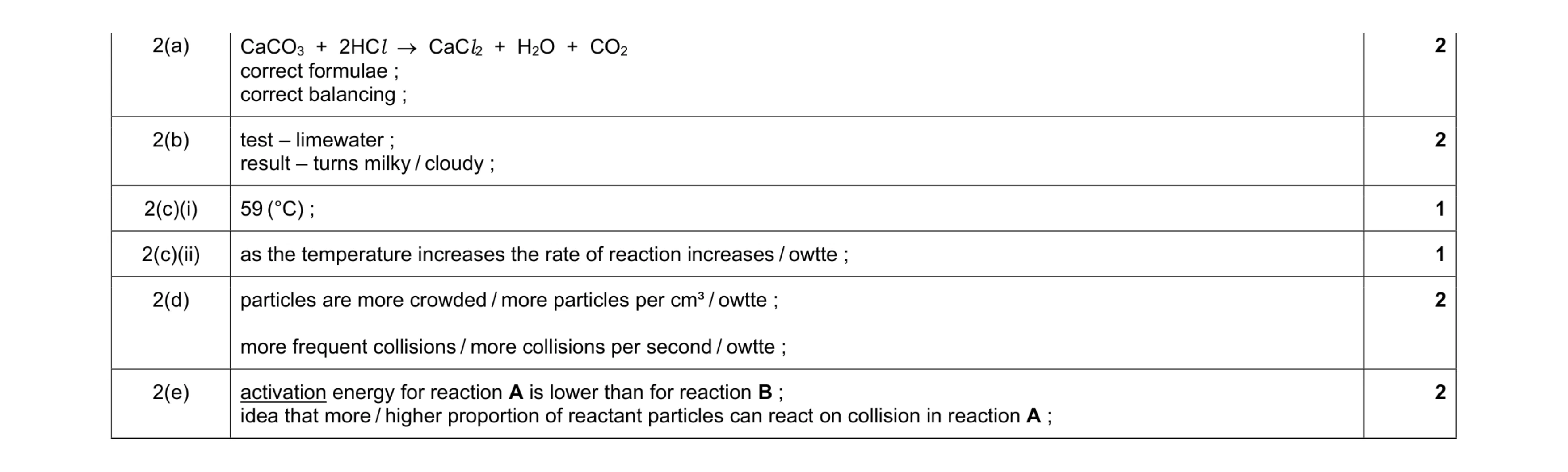 10
10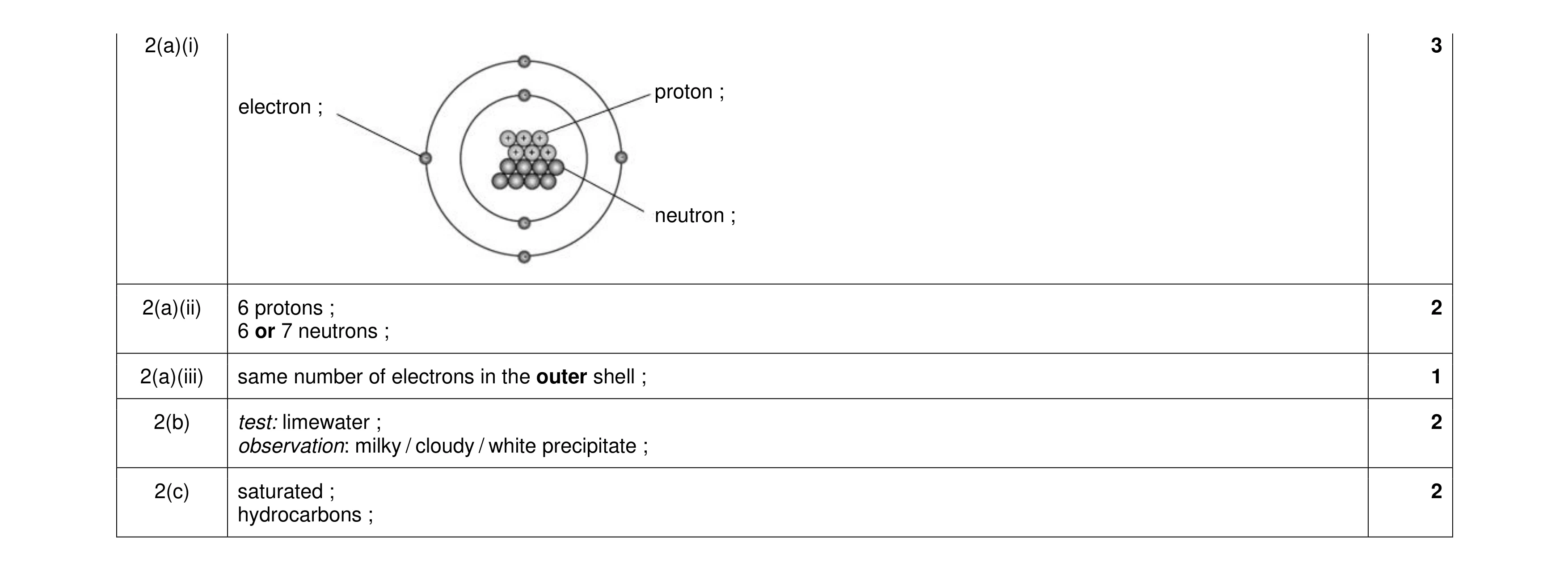 10
10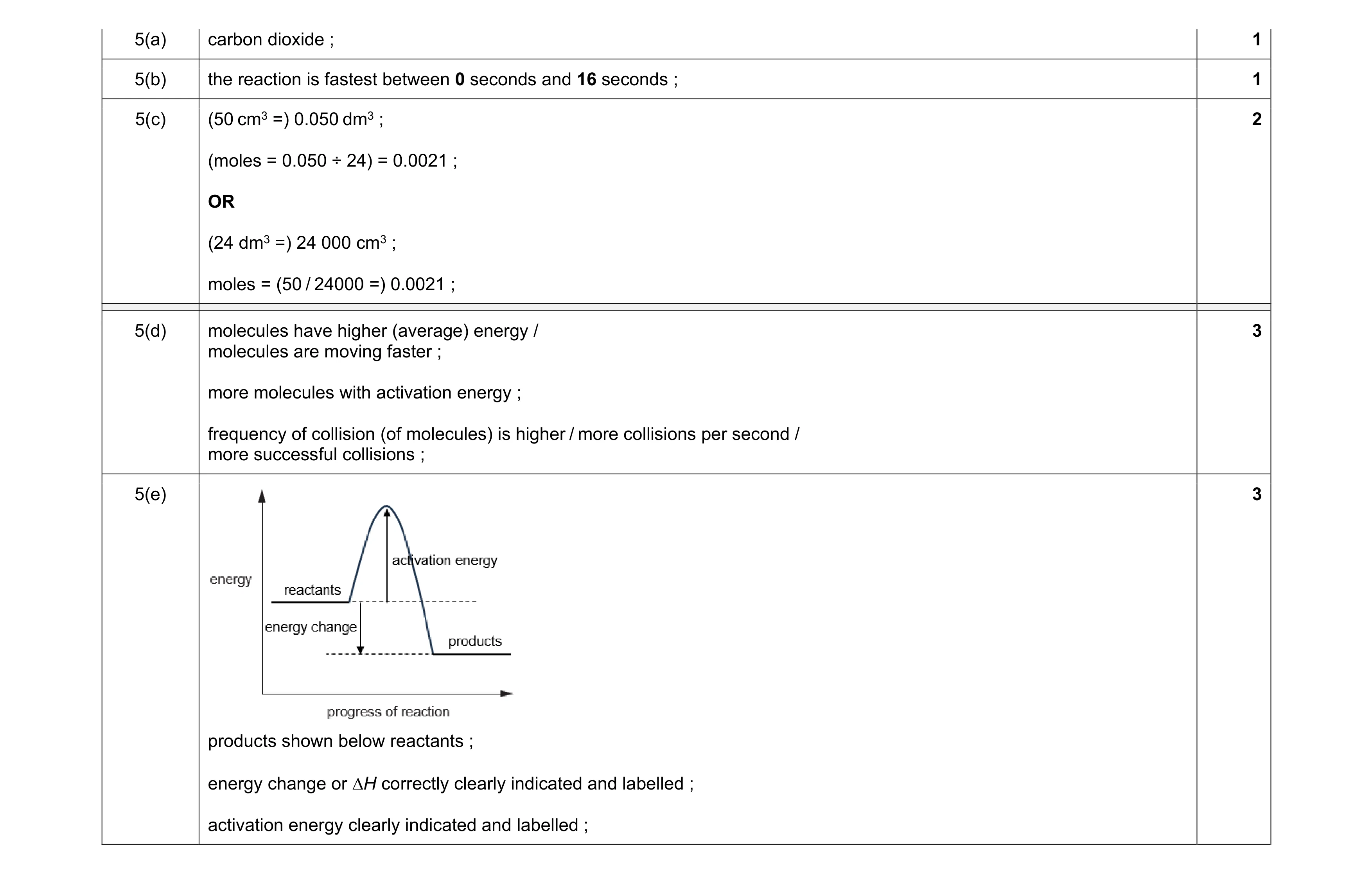 10
10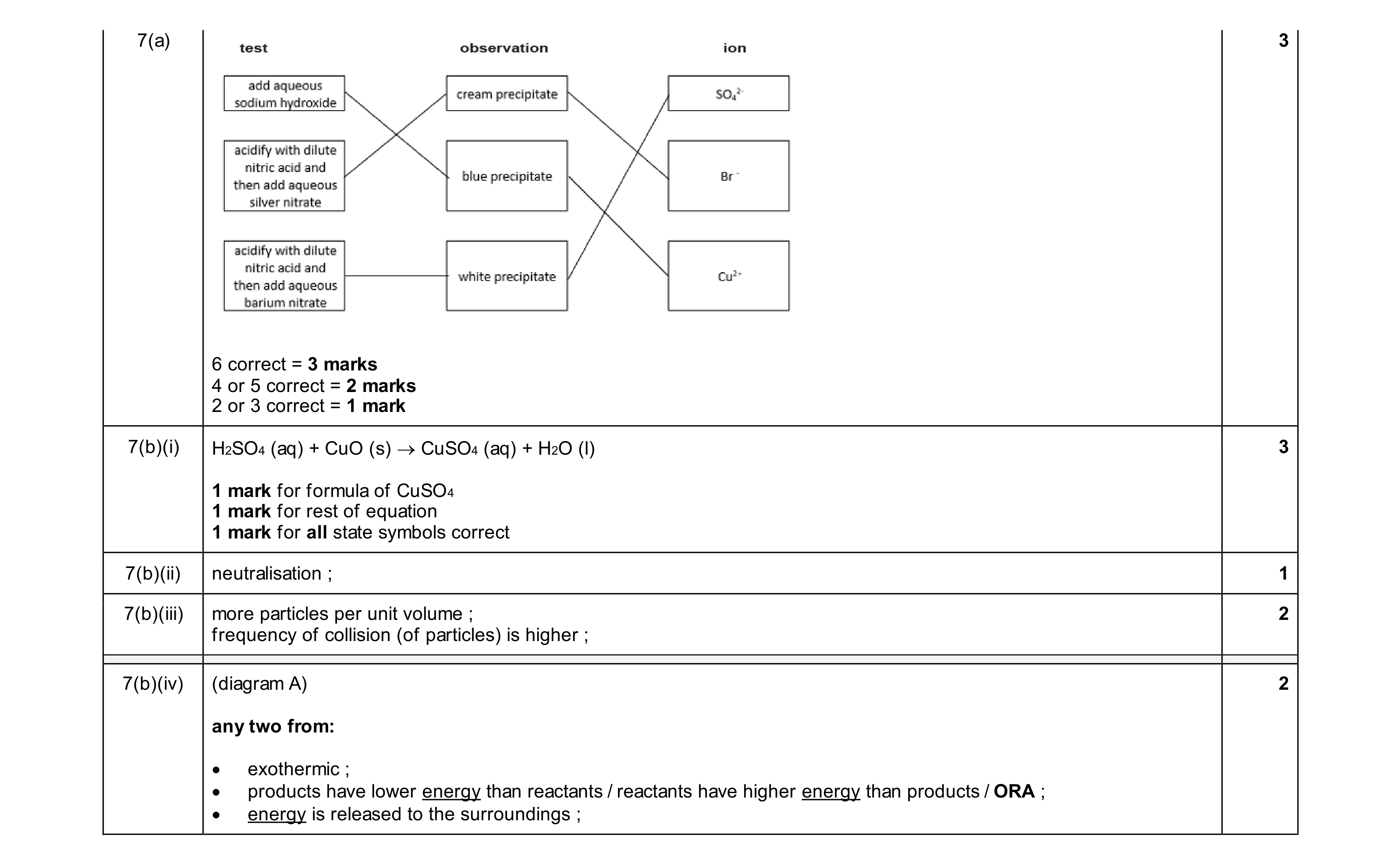 11
11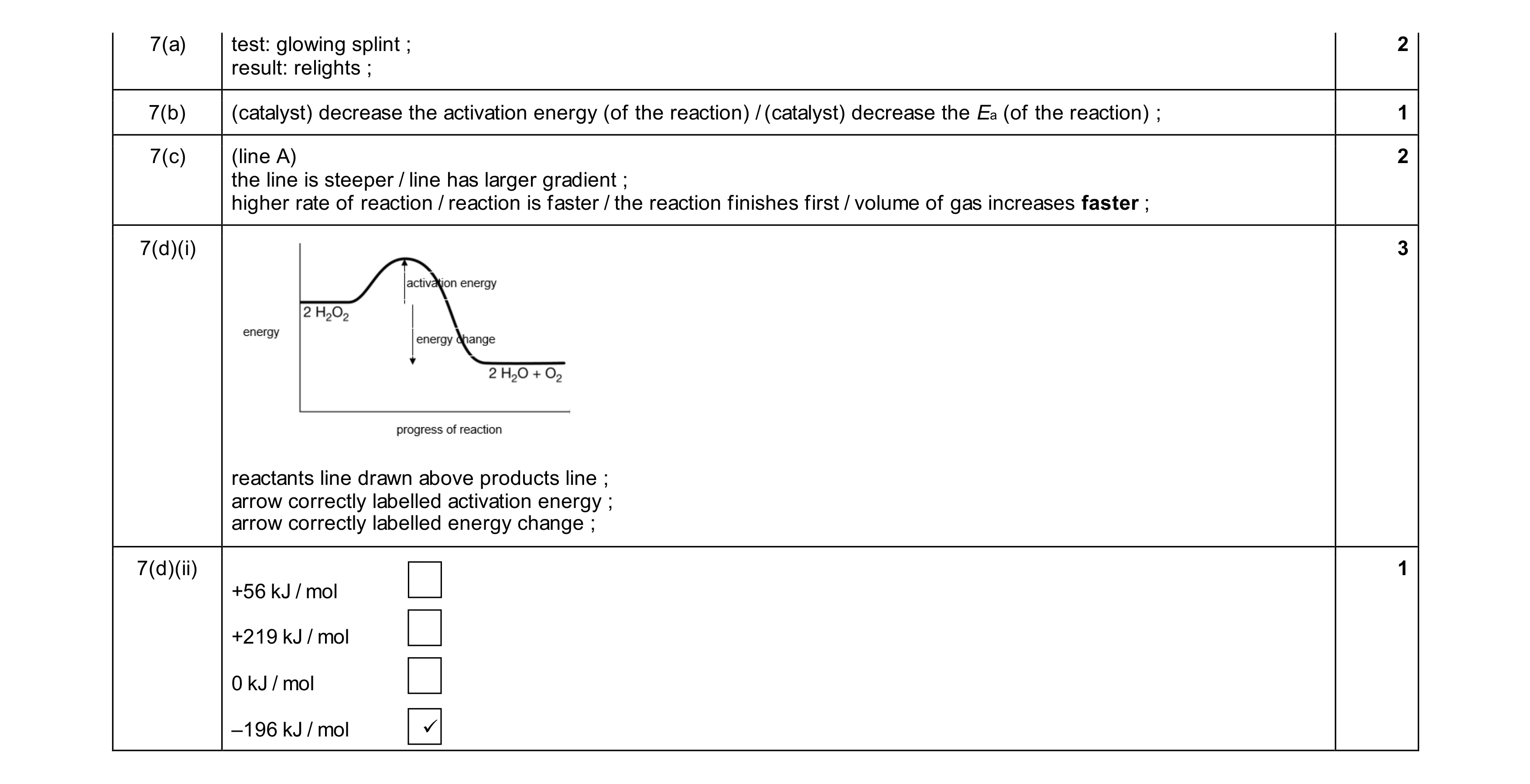 9
9