Cambridge IGCSE Sciences - Co-ordinated (Double) 0654 — 2007 Oct/Nov Paper 1 · Variant 1
0654/11/O/N/07 · 40 questions · 40 marks · ≈45 min
The question paper and its mark scheme, free to read here and free to download. This is Cambridge’s own paper, exactly as it was sat.
Question paper20 pages


Mark scheme2 pages
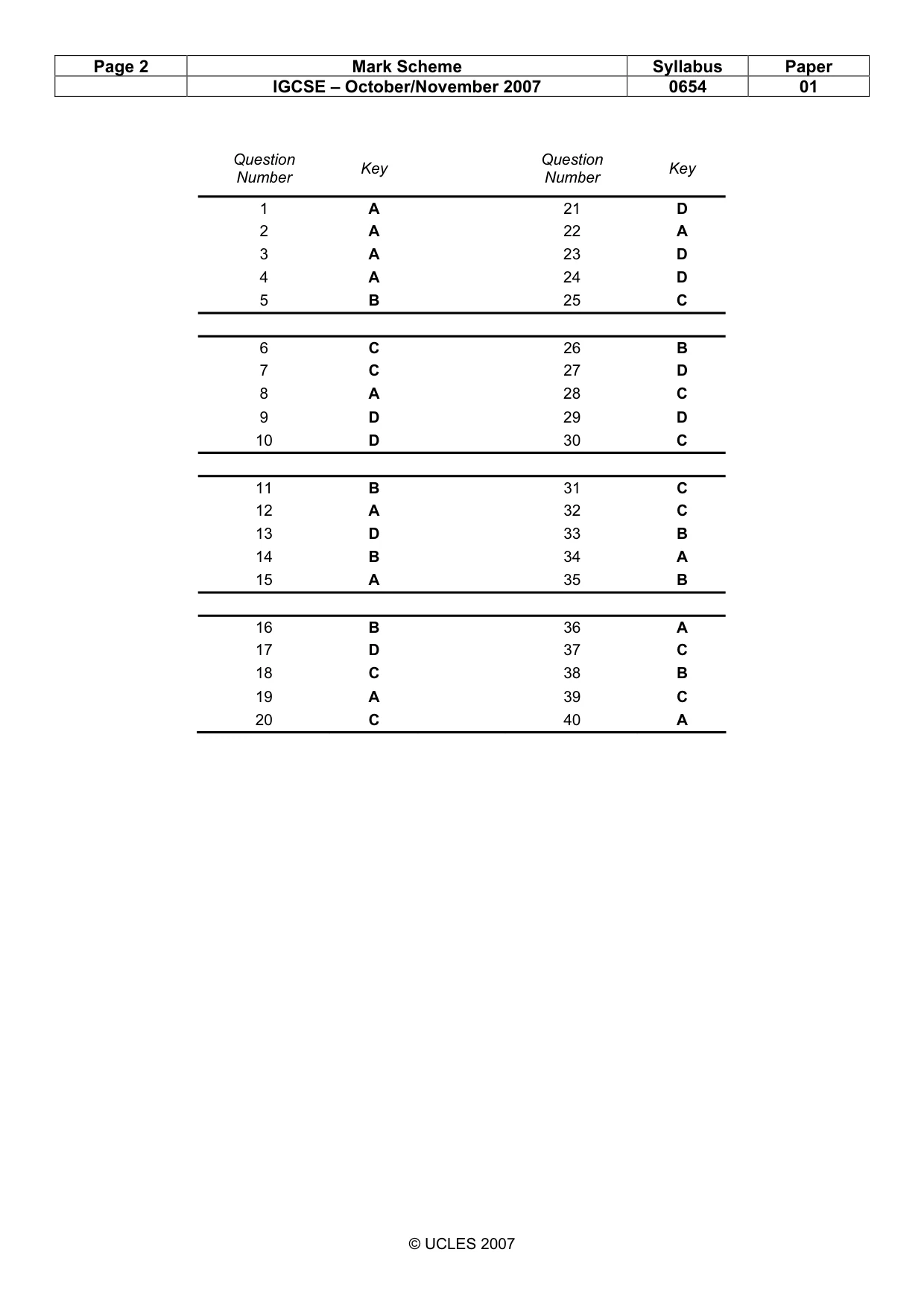
Answers below. Sit the paper first if you are practising.
Questions as text
Q1 · Which feature is characteristic only of birds?
1 Which feature is characteristic only of birds? A feathers and scales B fins and hard-shelled eggs C hair and scales D skin and soft-shelled eggs
Mark scheme: A
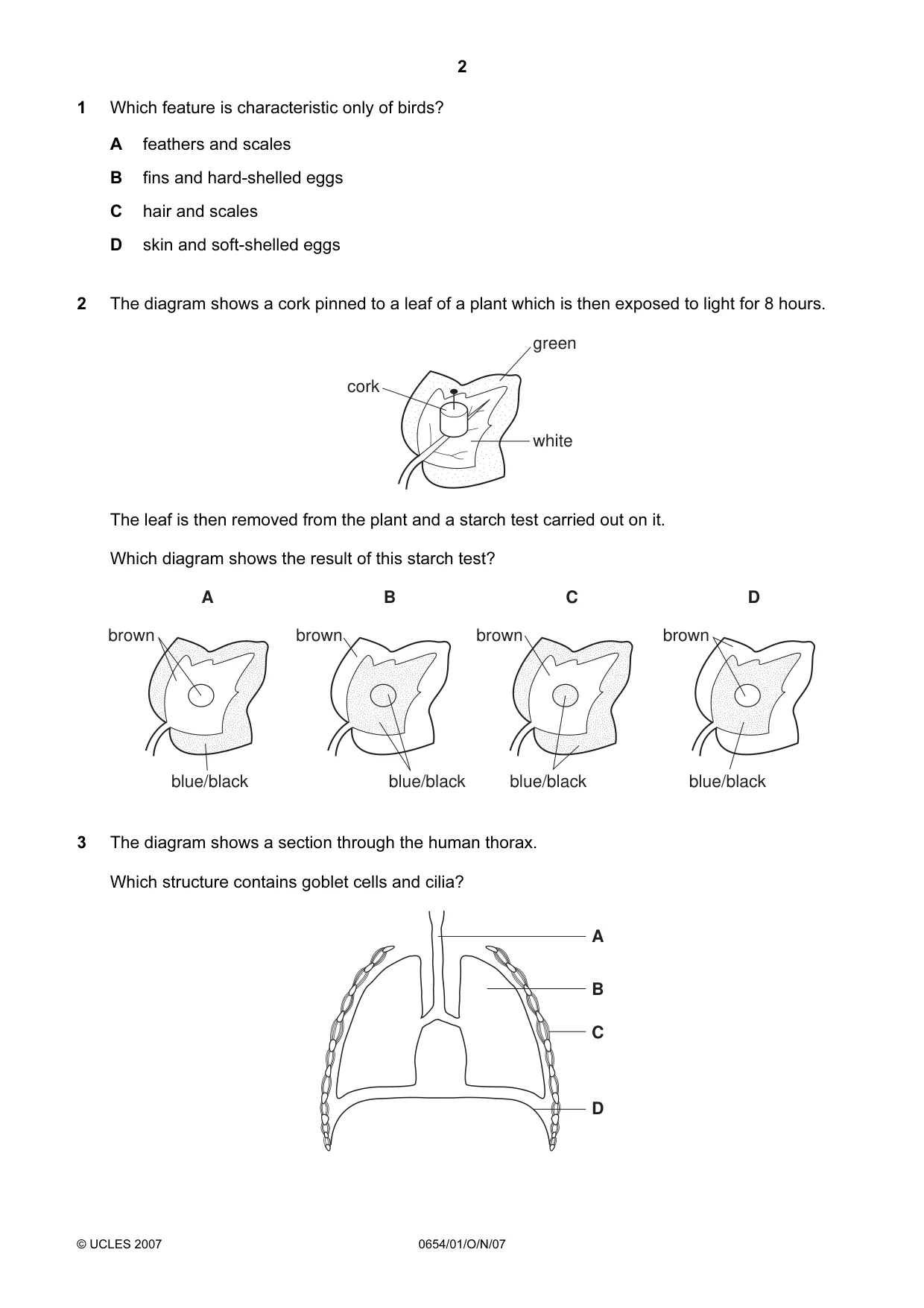
Q2 · The diagram shows a cork pinned to a leaf of a plant which is then exposed to light for 8…
2 The diagram shows a cork pinned to a leaf of a plant which is then exposed to light for 8 hours. green cork white The leaf is then removed from the plant and a starch test carried out on it. Which diagram shows the result of this starch test? A B C D brown brown brown brown blue/black blue/black blue/black blue/black
Mark scheme: A
Q3 · The diagram shows a section through the human thorax
3 The diagram shows a section through the human thorax. Which structure contains goblet cells and cilia? A B C D
Mark scheme: A
Q4 · Which structures make up the nervous system?
4 Which structures make up the nervous system? A brain, nerves, spinal cord B effectors, impulses, spinal cord C impulses, muscles, nerves D effectors, receptors, stimuli
Mark scheme: A
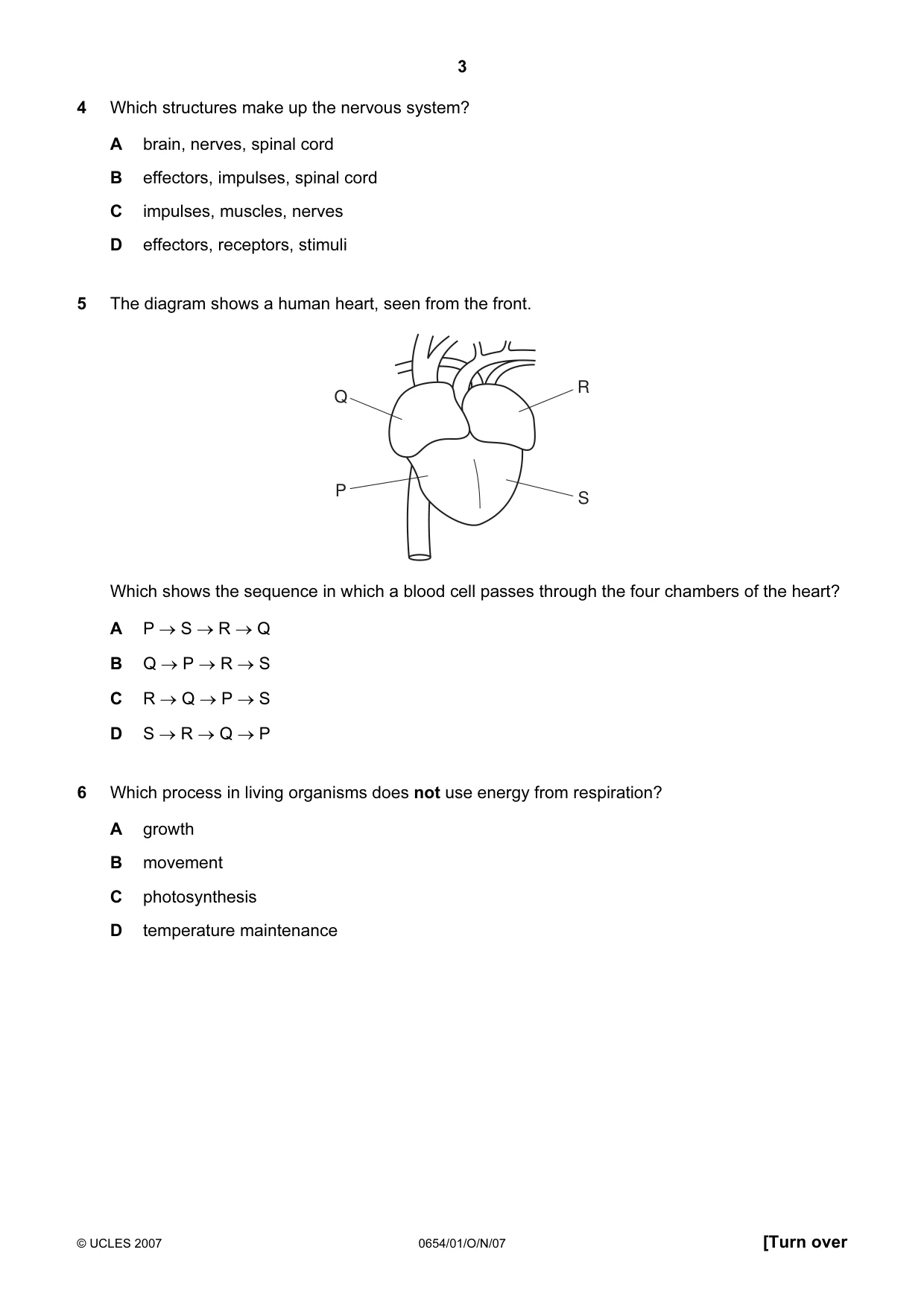
Q5 · The diagram shows a human heart, seen from the front
5 The diagram shows a human heart, seen from the front. R Q P S Which shows the sequence in which a blood cell passes through the four chambers of the heart? A P → S → R → Q B Q → P → R → S C R → Q → P → S D S → R → Q → P
Mark scheme: B
Q6 · Which process in living organisms does not use energy from respiration?
6 Which process in living organisms does not use energy from respiration? A growth B movement C photosynthesis D temperature maintenance
Mark scheme: C
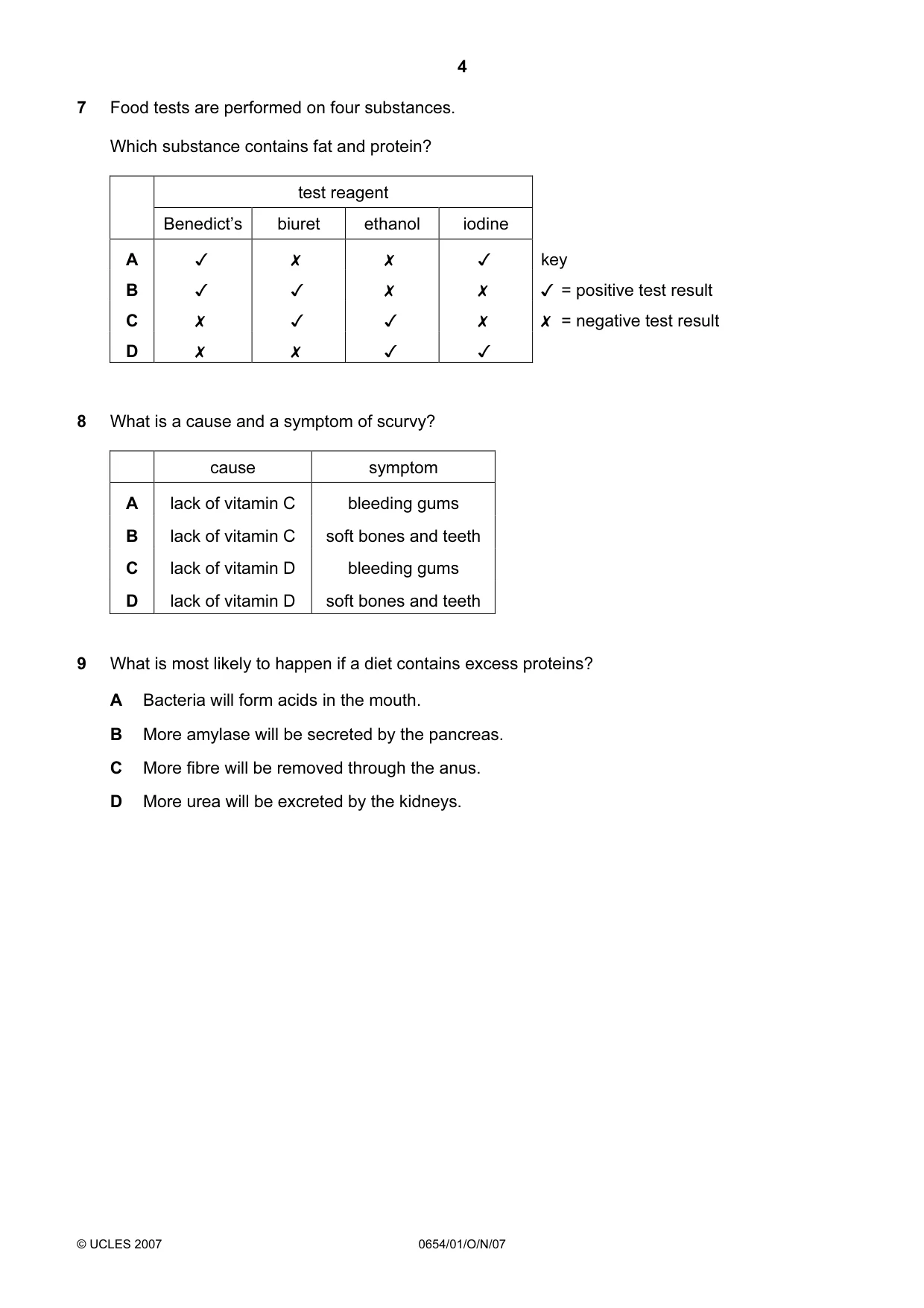
Q7 · Food tests are performed on four substances
7 Food tests are performed on four substances. Which substance contains fat and protein? test reagent Benedict's biuret ethanol iodine A v x x v B v v x x Cc x v v x D x x v v key ¥ = positive test result X = negative test result
Mark scheme: C
Q8 · What is a cause and a symptom of scurvy?
8 What is a cause and a symptom of scurvy? cause symptom A lack of vitamin C bleeding gums B lack of vitamin C soft bones and teeth C lack of vitamin D bleeding gums D lack of vitamin D soft bones and teeth
Mark scheme: A
Q9 · What is most likely to happen if a diet contains excess proteins?
9 What is most likely to happen if a diet contains excess proteins? A Bacteria will form acids in the mouth. B More amylase will be secreted by the pancreas. C More fibre will be removed through the anus. D More urea will be excreted by the kidneys.
Mark scheme: D
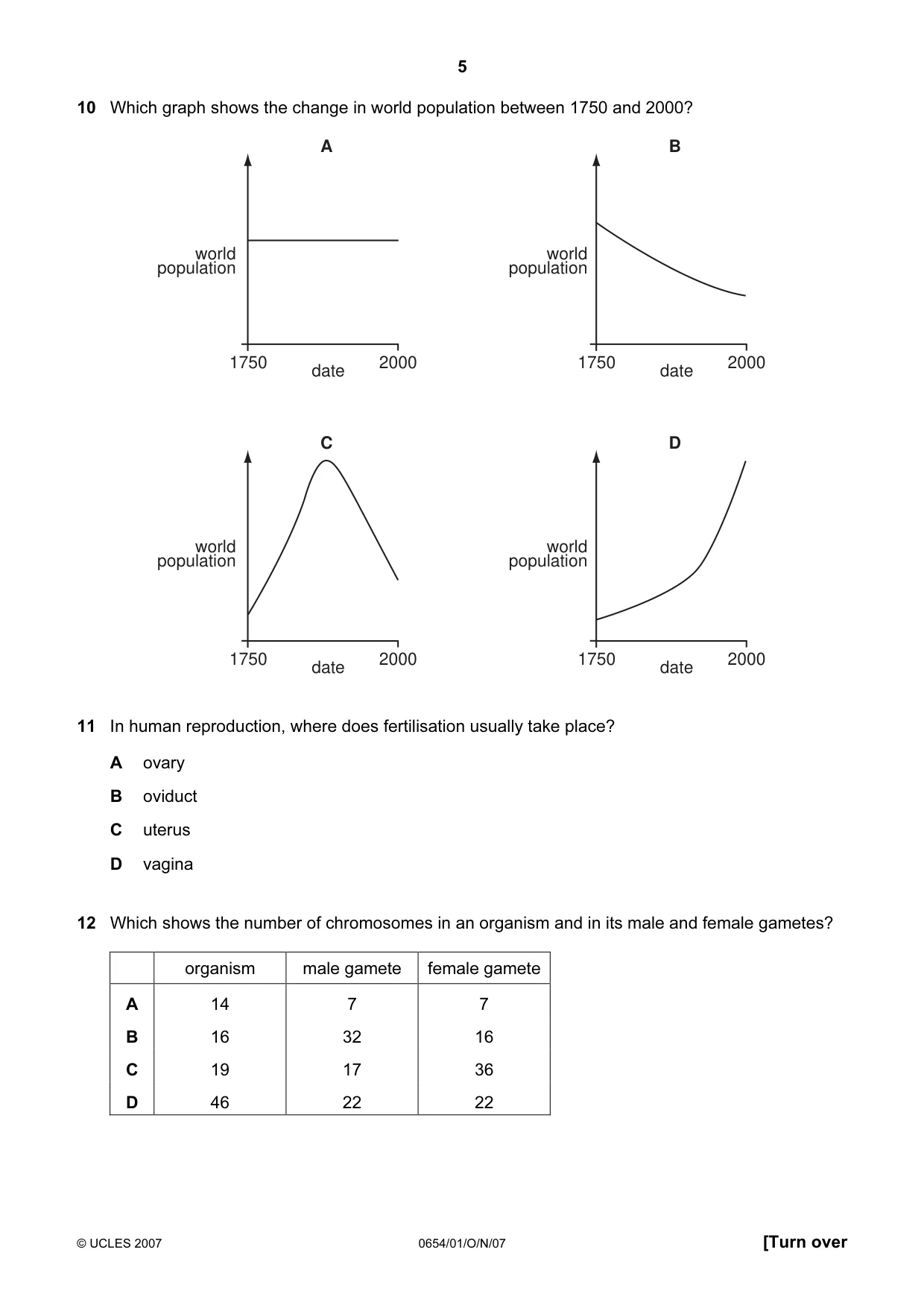
Q10 · Which graph shows the change in world population between 1750 and 2000?
10 Which graph shows the change in world population between 1750 and 2000? A B world world population population 1750 2000 1750 2000 date date C D world world population population 1750 2000 1750 2000 date date
Mark scheme: D
Q11 · In human reproduction, where does fertilisation usually take place?
11 In human reproduction, where does fertilisation usually take place? A ovary B oviduct C uterus D vagina
Mark scheme: B
Q12 · Which shows the number of chromosomes in an organism and in its male and female gametes?
12 Which shows the number of chromosomes in an organism and in its male and female gametes? organism male gamete female gamete A 14 7 7 B 16 32 16 C 19 17 36 D 46 22 22
Mark scheme: A
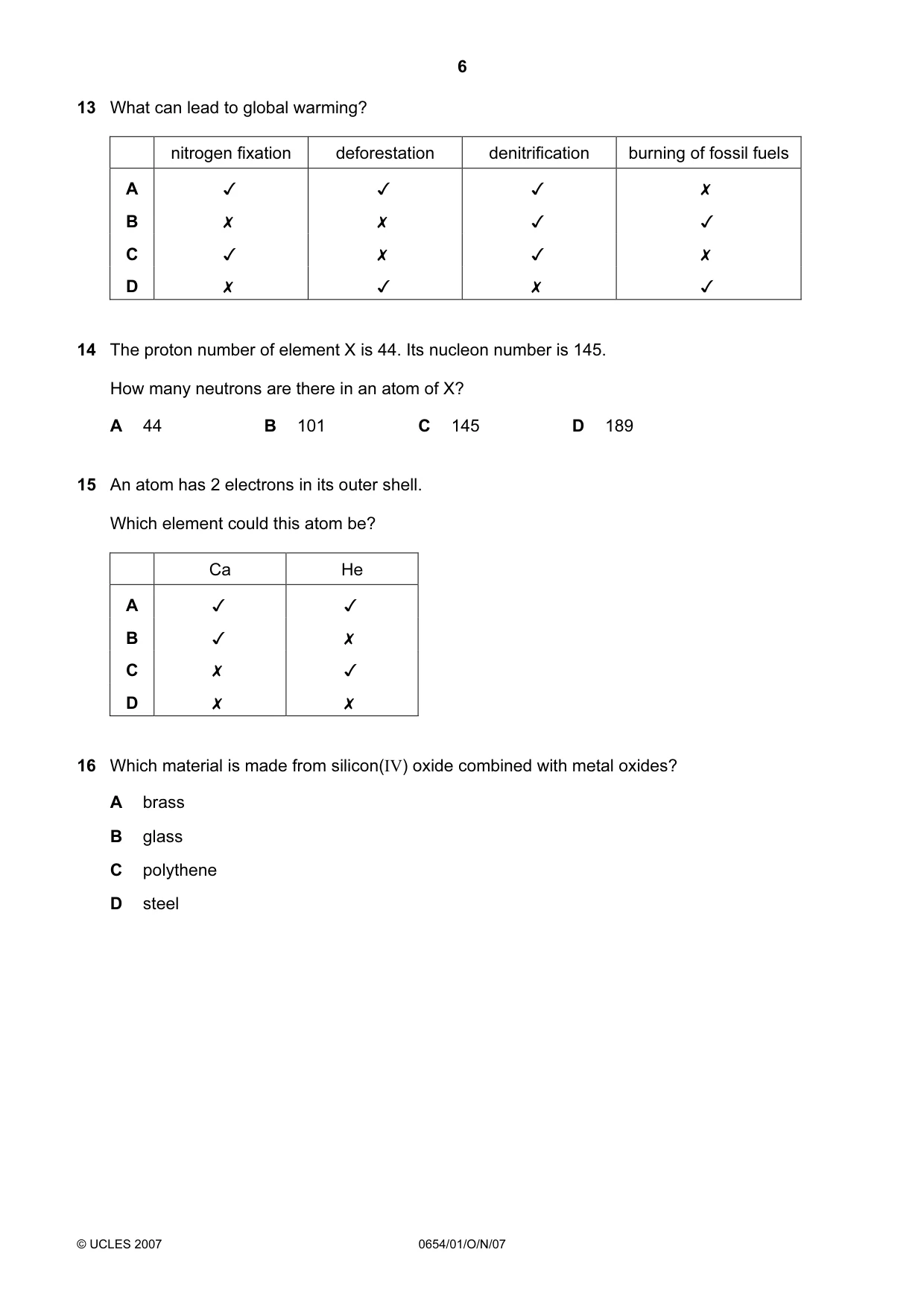
Q13 · What can lead to global warming?
13 What can lead to global warming? 0 0O WwW > nitrogen fixation x < x deforestation \ x x denitrification ~*~ KOM burning of fossil fuels KS
Mark scheme: D
Q14 · The proton number of element X is 44
14 The proton number of element X is 44. Its nucleon number is 145. How many neutrons are there in an atom of X? A 44 B 101 C 145 D 189
Mark scheme: B
Q15 · Anatom has 2 electrons in its outer shell
15 Anatom has 2 electrons in its outer shell. Which element could this atom be? Ca He 00o DM > ~~ KKM ~*~ K &® OK
Mark scheme: A
Q16 · Which material is made from silicon(IV) oxide combined with metal oxides?
16 Which material is made from silicon(IV) oxide combined with metal oxides? A brass B glass C polythene D steel
Mark scheme: B
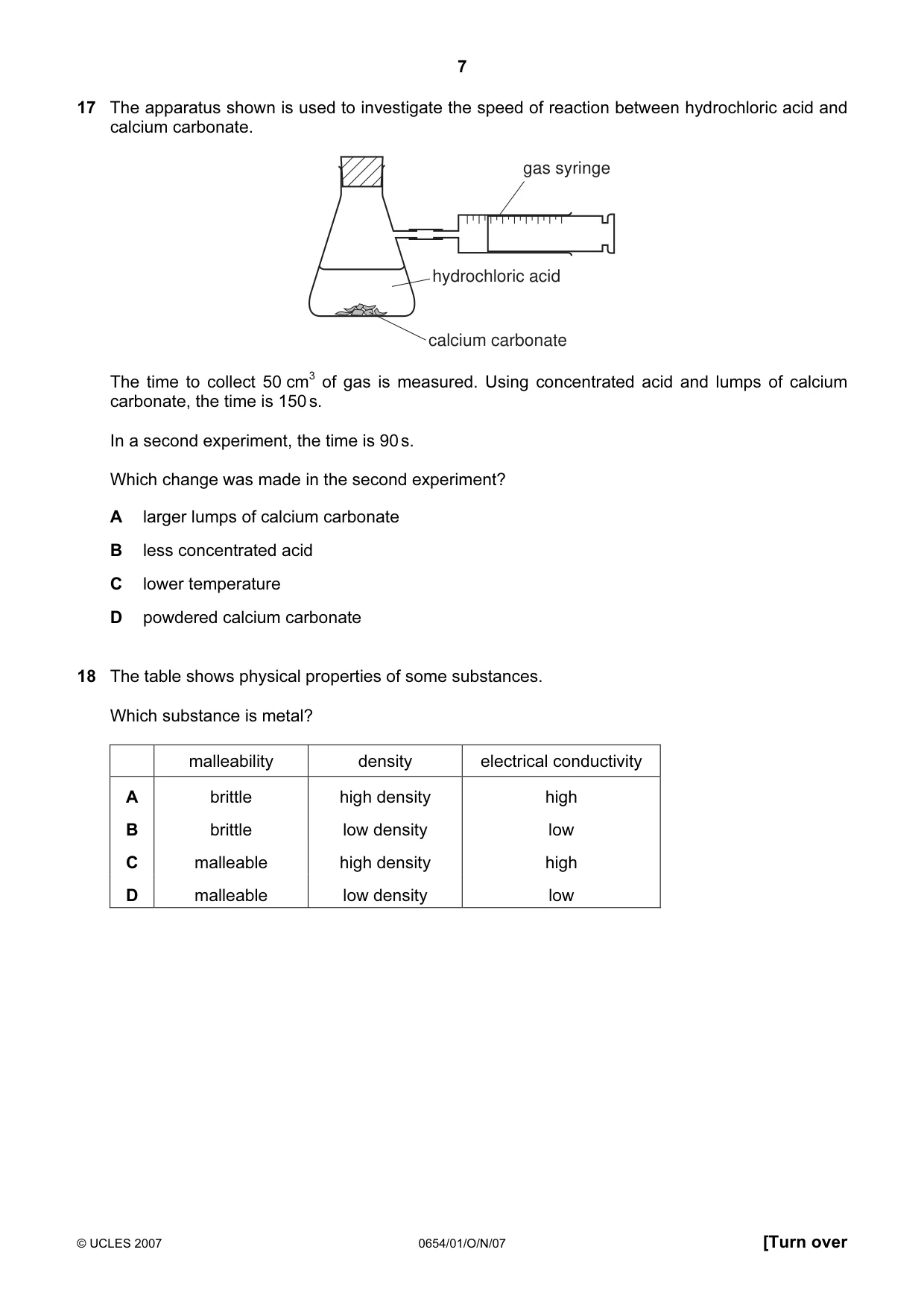
Q17 · The apparatus shown is used to investigate the speed of reaction between hydrochloric…
17 The apparatus shown is used to investigate the speed of reaction between hydrochloric acid and calcium carbonate. gas syringe hydrochloric acid calcium carbonate The time to collect 50 cm3 of gas is measured. Using concentrated acid and lumps of calcium carbonate, the time is 150 s. In a second experiment, the time is 90 s. Which change was made in the second experiment? A larger lumps of calcium carbonate B less concentrated acid C lower temperature D powdered calcium carbonate
Mark scheme: D
Q18 · The table shows physical properties of some substances
18 The table shows physical properties of some substances. Which substance is metal? malleability density electrical conductivity A brittle high density high B brittle low density low C malleable high density high D malleable low density low
Mark scheme: C
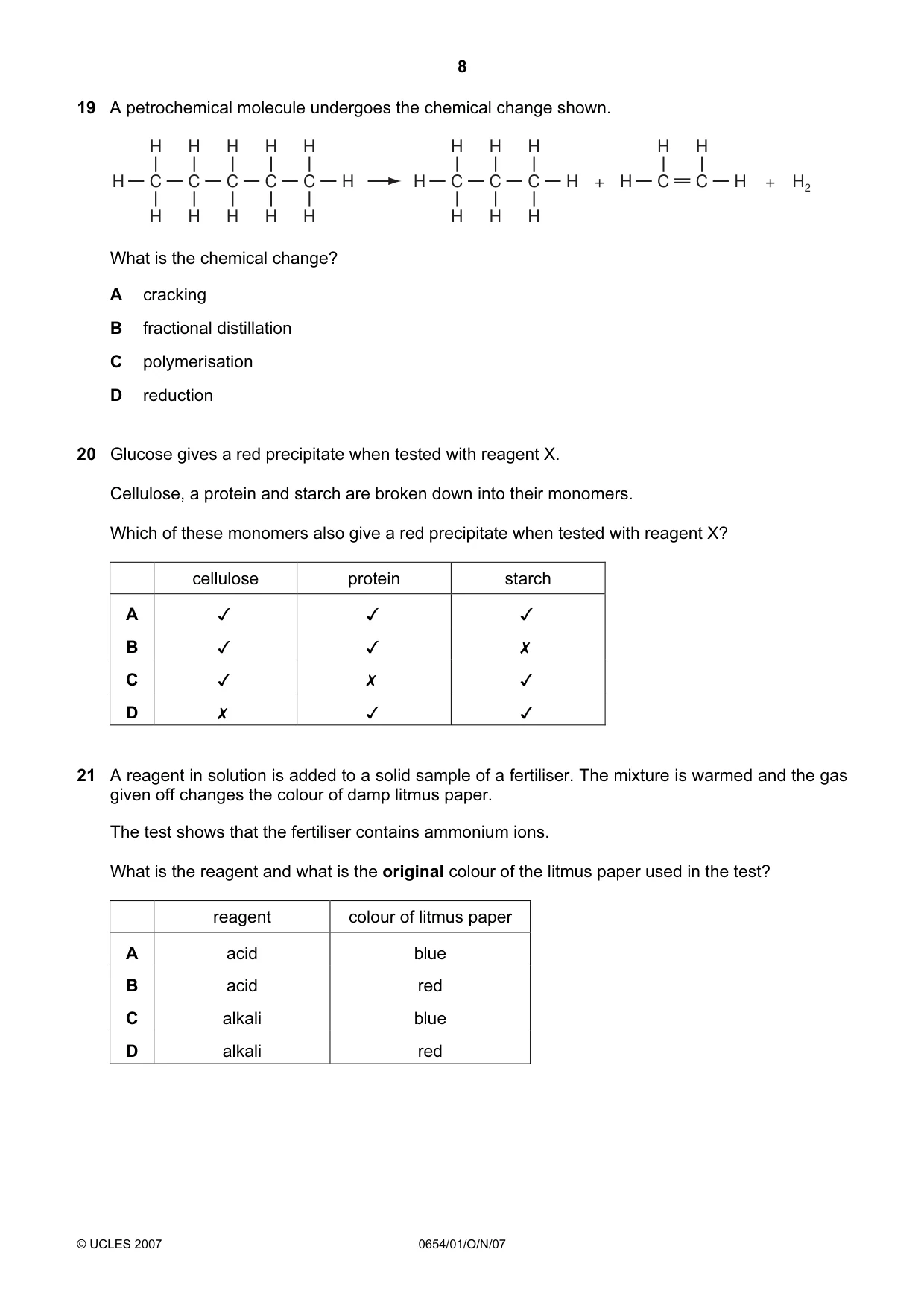
Q19 · A petrochemical molecule undergoes the chemical change shown
19 A petrochemical molecule undergoes the chemical change shown. H H H H H H H H H H H C C C C C H H C C C H + H C C H + H2 H H H H H H H H What is the chemical change? A cracking B fractional distillation C polymerisation D reduction
Mark scheme: A
Q20 · Glucose gives a red precipitate when tested with reagent X
20 Glucose gives a red precipitate when tested with reagent X. Cellulose, a protein and starch are broken down into their monomers. Which of these monomers also give a red precipitate when tested with reagent X? cellulose protein starch 0 OO DW > ~*~ KOM Kk 4 \ 4 x
Mark scheme: C
Q21 · A reagent in solution is added to a solid sample of a fertiliser
21 A reagent in solution is added to a solid sample of a fertiliser. The mixture is warmed and the gas given off changes the colour of damp litmus paper. The test shows that the fertiliser contains ammonium ions. What is the reagent and what is the original colour of the litmus paper used in the test? reagent colour of litmus paper A acid blue B acid red C alkali blue D alkali red
Mark scheme: D
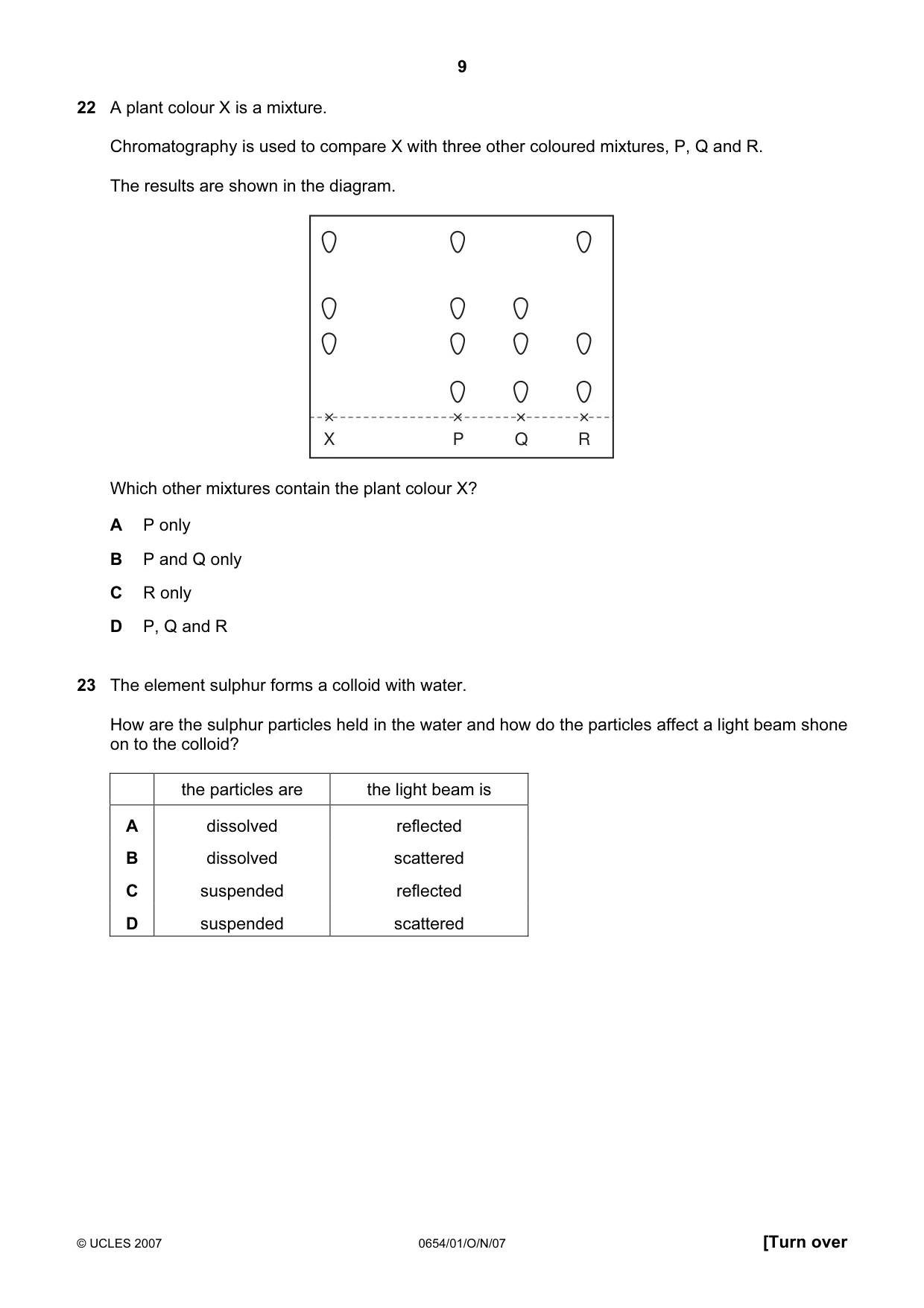
Q22 · A plant colour X is a mixture
22 A plant colour X is a mixture. Chromatography is used to compare X with three other coloured mixtures, P, Q and R. The results are shown in the diagram. X P Q R Which other mixtures contain the plant colour X? A P only B P and Q only C R only D P, Q and R
Mark scheme: A
Q23 · The element sulphur forms a colloid with water
23 The element sulphur forms a colloid with water. How are the sulphur particles held in the water and how do the particles affect a light beam shone on to the colloid? the particles are the light beam is A dissolved reflected B dissolved scattered C suspended reflected D suspended scattered
Mark scheme: D
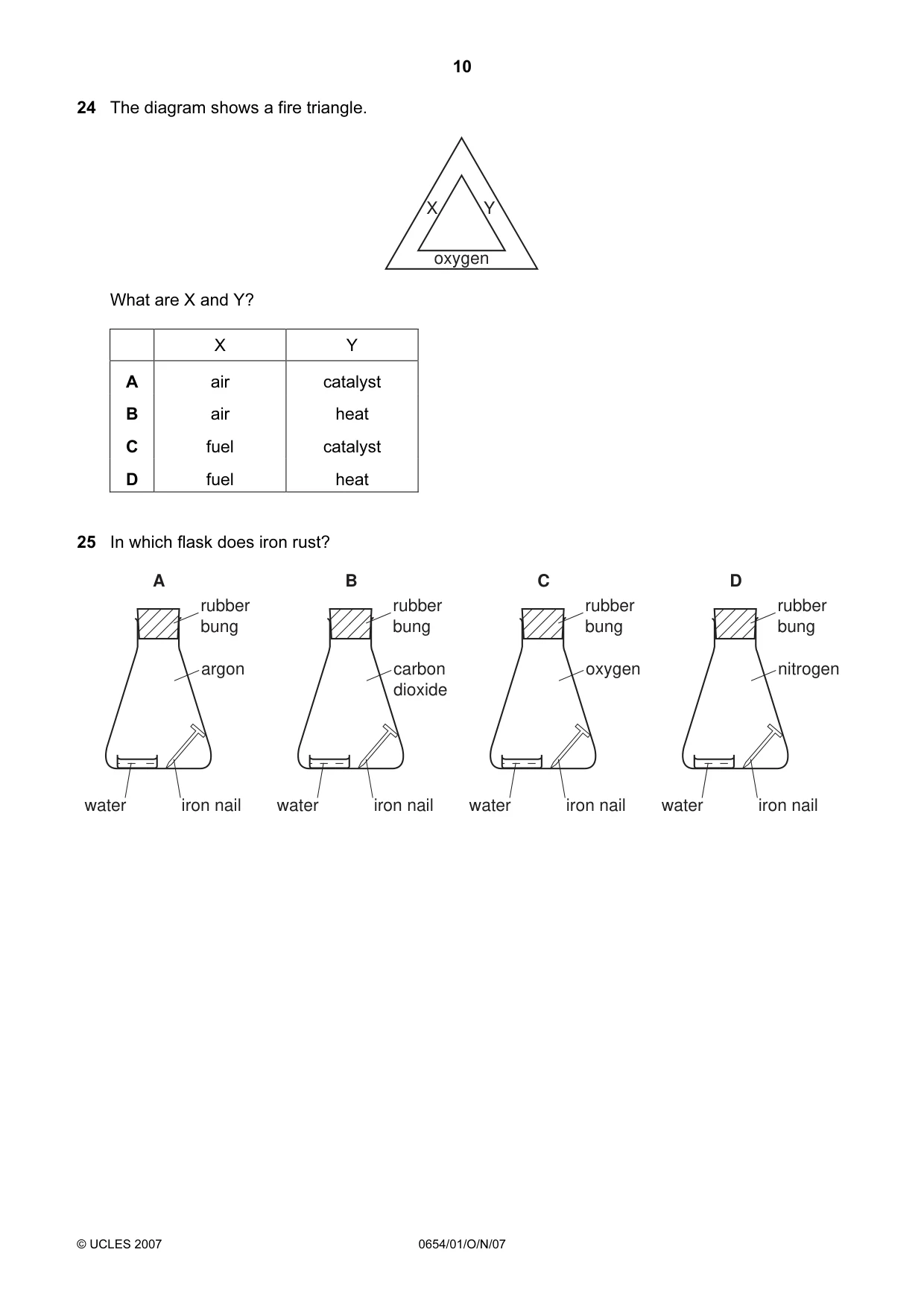
Q24 · The diagram shows a fire triangle
24 The diagram shows a fire triangle. X Y oxygen What are X and Y? X Y A air catalyst B air heat C fuel catalyst D fuel heat
Mark scheme: D
Q25 · In which flask does iron rust?
25 In which flask does iron rust? A B C D rubber rubber rubber rubber bung bung bung bung argon carbon oxygen nitrogen dioxide water iron nail water iron nail water iron nail water iron nail
Mark scheme: C
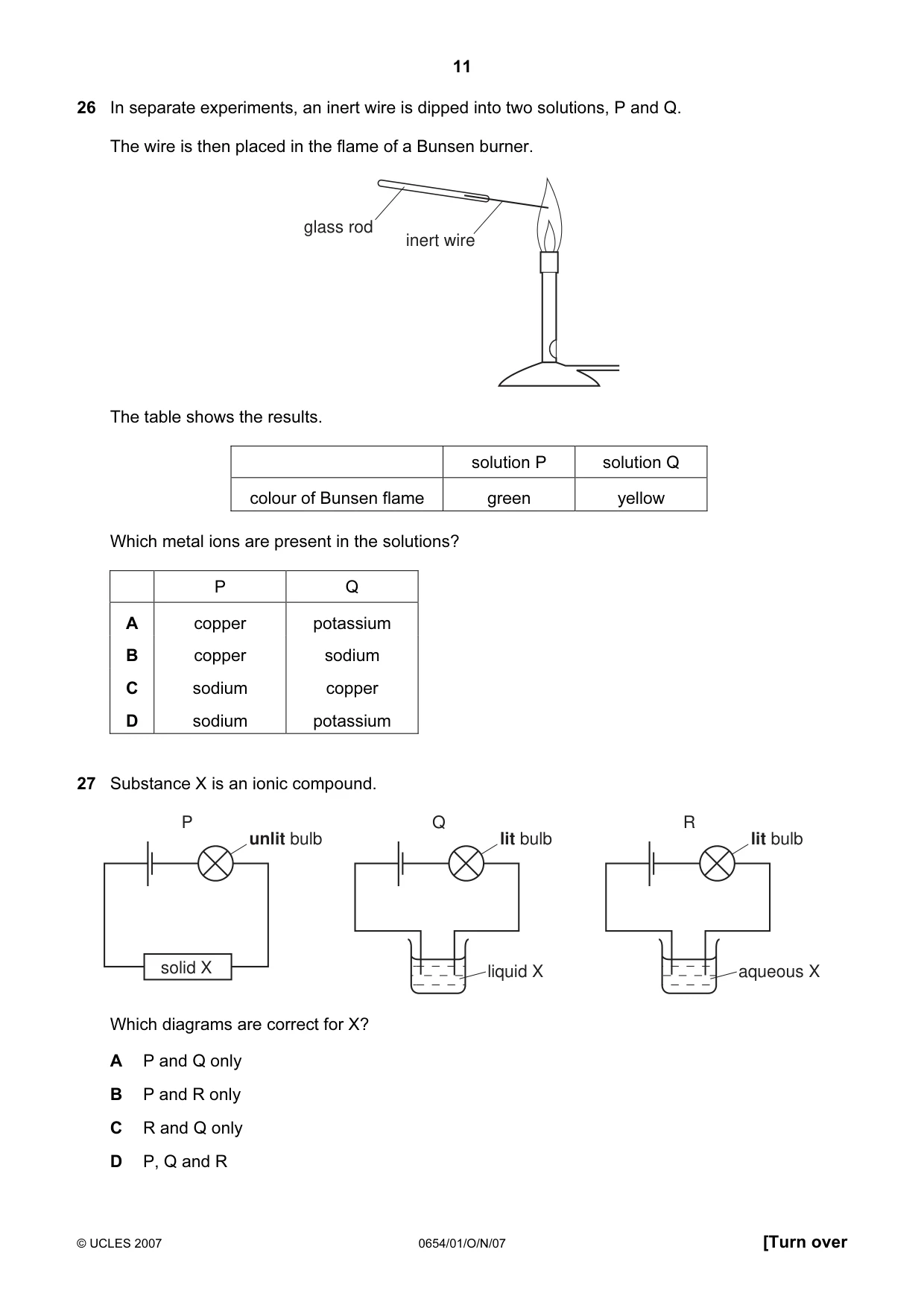
Q26 · In separate experiments, an inert wire is dipped into two solutions, P and Q
26 In separate experiments, an inert wire is dipped into two solutions, P and Q. The wire is then placed in the flame of a Bunsen burner. glass rod inert wire The table shows the results. solution P solution Q colour of Bunsen flame green yellow Which metal ions are present in the solutions? P Q A copper potassium B copper sodium C sodium copper D sodium potassium
Mark scheme: B
Q27 · Substance X is an ionic compound
27 Substance X is an ionic compound. P Q R unlit bulb lit bulb lit bulb solid X liquid X aqueous X Which diagrams are correct for X? A P and Q only B P and R only C R and Q only D P, Q and R
Mark scheme: D
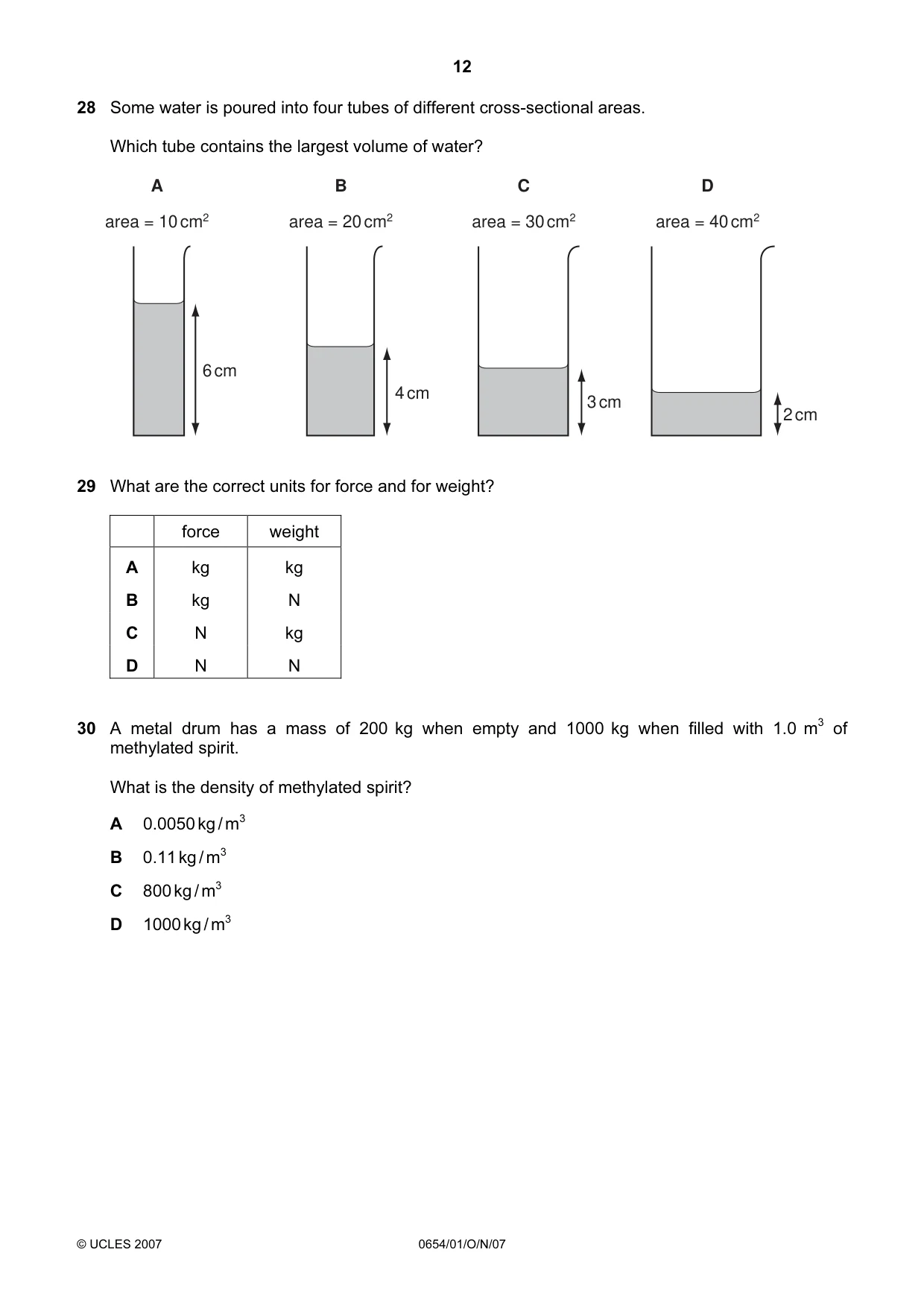
Q28 · Some water is poured into four tubes of different cross-sectional areas
28 Some water is poured into four tubes of different cross-sectional areas. Which tube contains the largest volume of water? A B C D area = 10 cm2 area = 20 cm2 area = 30 cm2 area = 40 cm2 6 cm 4 cm 3 cm 2 cm
Mark scheme: C
More questions on Physical quantities and measurement techniques
Q29 · What are the correct units for force and for weight?
29 What are the correct units for force and for weight? force weight A kg kg B kg N C N kg D N N
Mark scheme: D
Q30 · A metal drum has a mass of 200 kg when empty and 1000 kg when filled with 1.0 m3 of…
30 A metal drum has a mass of 200 kg when empty and 1000 kg when filled with 1.0 m3 of methylated spirit. What is the density of methylated spirit? A 0.0050 kg / m3 B 0.11 kg / m3 C 800 kg / m3 D 1000 kg / m3
Mark scheme: C
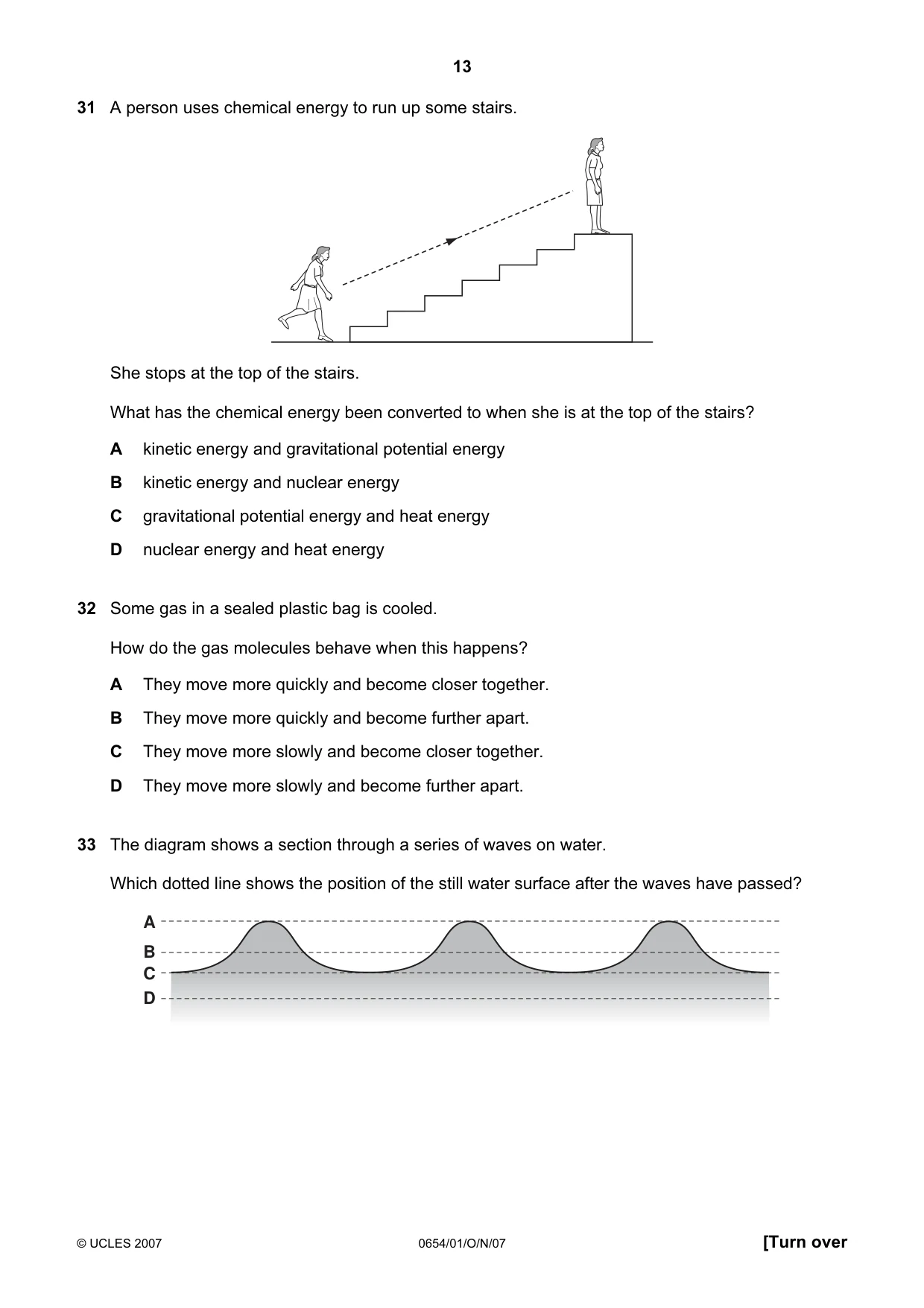
Q31 · A person uses chemical energy to run up some stairs
31 A person uses chemical energy to run up some stairs. She stops at the top of the stairs. What has the chemical energy been converted to when she is at the top of the stairs? A kinetic energy and gravitational potential energy B kinetic energy and nuclear energy C gravitational potential energy and heat energy D nuclear energy and heat energy
Mark scheme: C
Q32 · Some gas in a sealed plastic bag is cooled
32 Some gas in a sealed plastic bag is cooled. How do the gas molecules behave when this happens? A They move more quickly and become closer together. B They move more quickly and become further apart. C They move more slowly and become closer together. D They move more slowly and become further apart.
Mark scheme: C
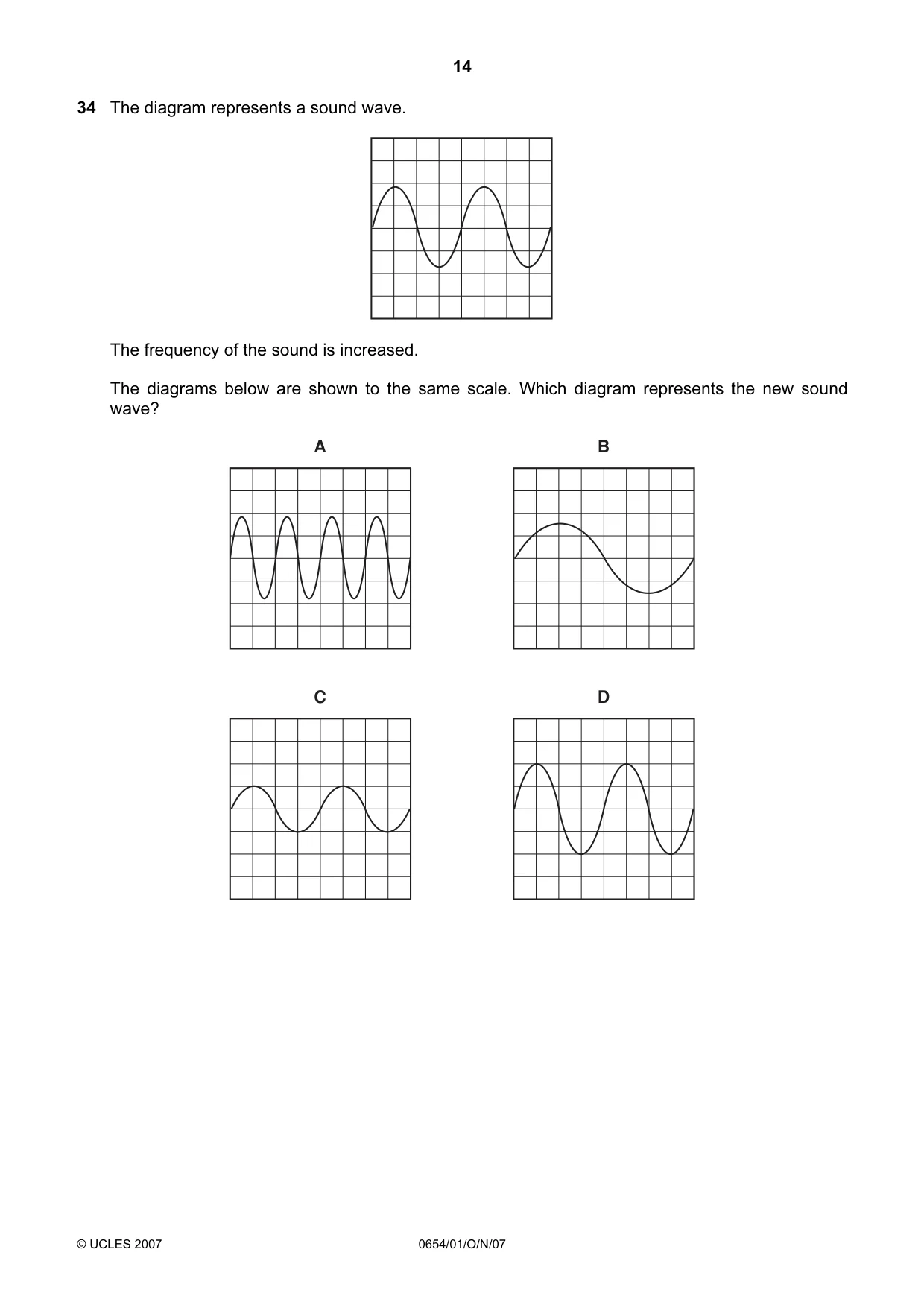
Q33 · The diagram shows a section through a series of waves on water
33 The diagram shows a section through a series of waves on water. Which dotted line shows the position of the still water surface after the waves have passed? A B C D
Mark scheme: B
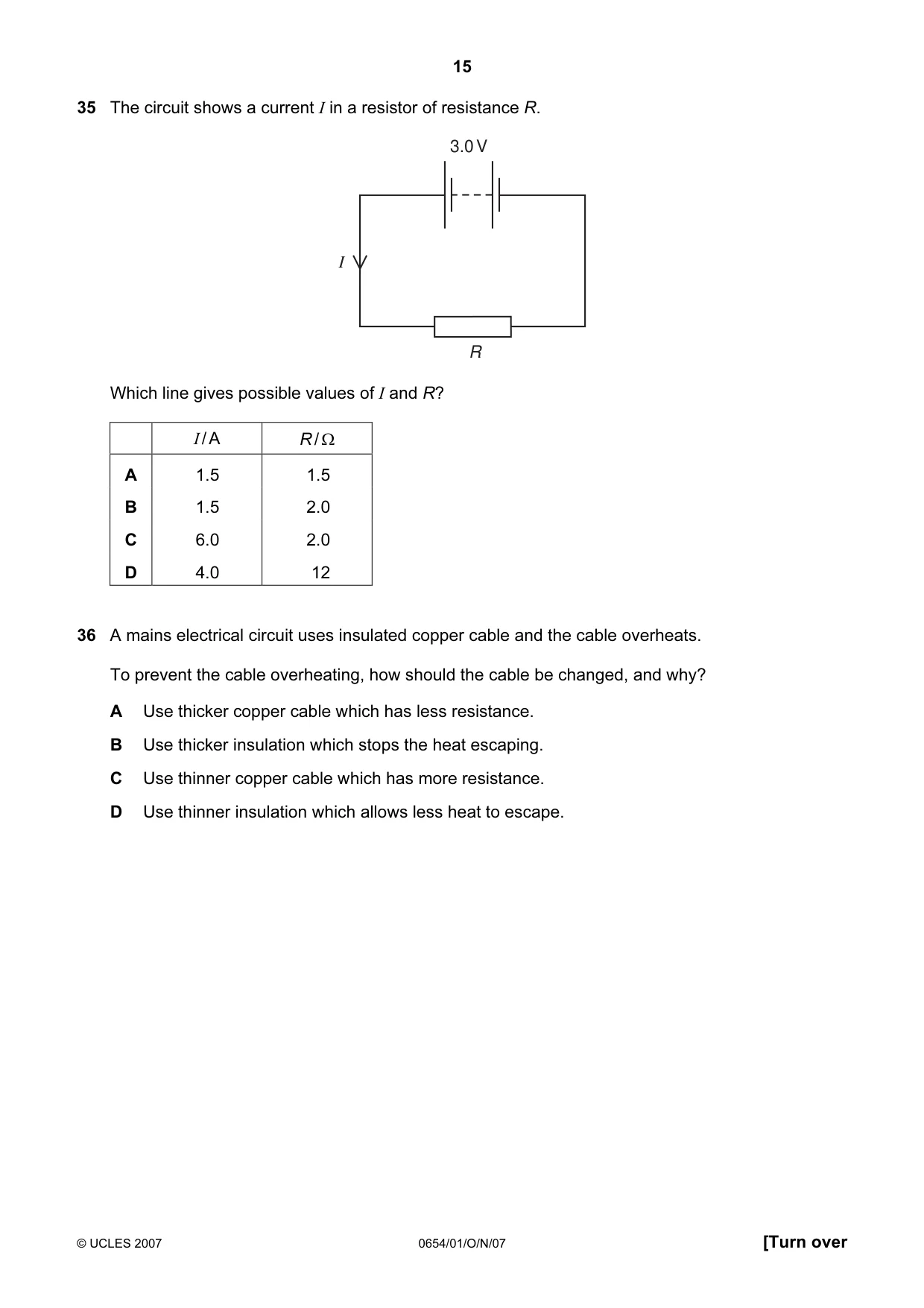
Q34 · The diagram represents a sound wave
34 The diagram represents a sound wave. The frequency of the sound is increased. The diagrams below are shown to the same scale. Which diagram represents the new sound wave? A B C D
Mark scheme: A
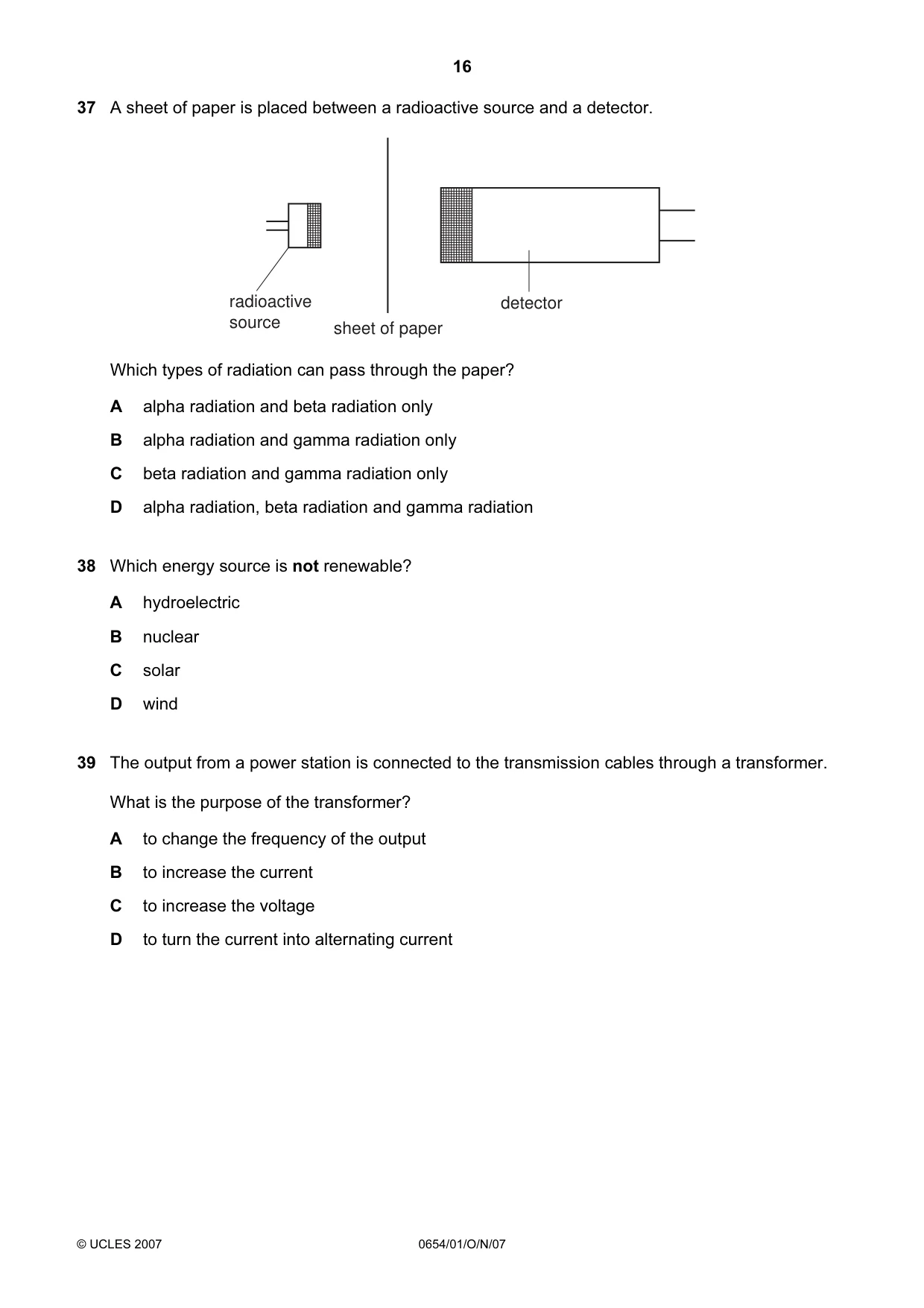
Q35 · The circuit shows a current I in a resistor of resistance R
35 The circuit shows a current I in a resistor of resistance R. 3.0 V I R Which line gives possible values of I and R? I / A R / Ω A 1.5 1.5 B 1.5 2.0 C 6.0 2.0 D 4.0 12
Mark scheme: B
Q36 · A mains electrical circuit uses insulated copper cable and the cable overheats
36 A mains electrical circuit uses insulated copper cable and the cable overheats. To prevent the cable overheating, how should the cable be changed, and why? A Use thicker copper cable which has less resistance. B Use thicker insulation which stops the heat escaping. C Use thinner copper cable which has more resistance. D Use thinner insulation which allows less heat to escape.
Mark scheme: A
Q37 · A sheet of paper is placed between a radioactive source and a detector
37 A sheet of paper is placed between a radioactive source and a detector. radioactive detector source sheet of paper Which types of radiation can pass through the paper? A alpha radiation and beta radiation only B alpha radiation and gamma radiation only C beta radiation and gamma radiation only D alpha radiation, beta radiation and gamma radiation
Mark scheme: C
Q38 · Which energy source is not renewable?
38 Which energy source is not renewable? A hydroelectric B nuclear C solar D wind
Mark scheme: B
Q39 · The output from a power station is connected to the transmission cables through a…
39 The output from a power station is connected to the transmission cables through a transformer. What is the purpose of the transformer? A to change the frequency of the output B to increase the current C to increase the voltage D to turn the current into alternating current
Mark scheme: C
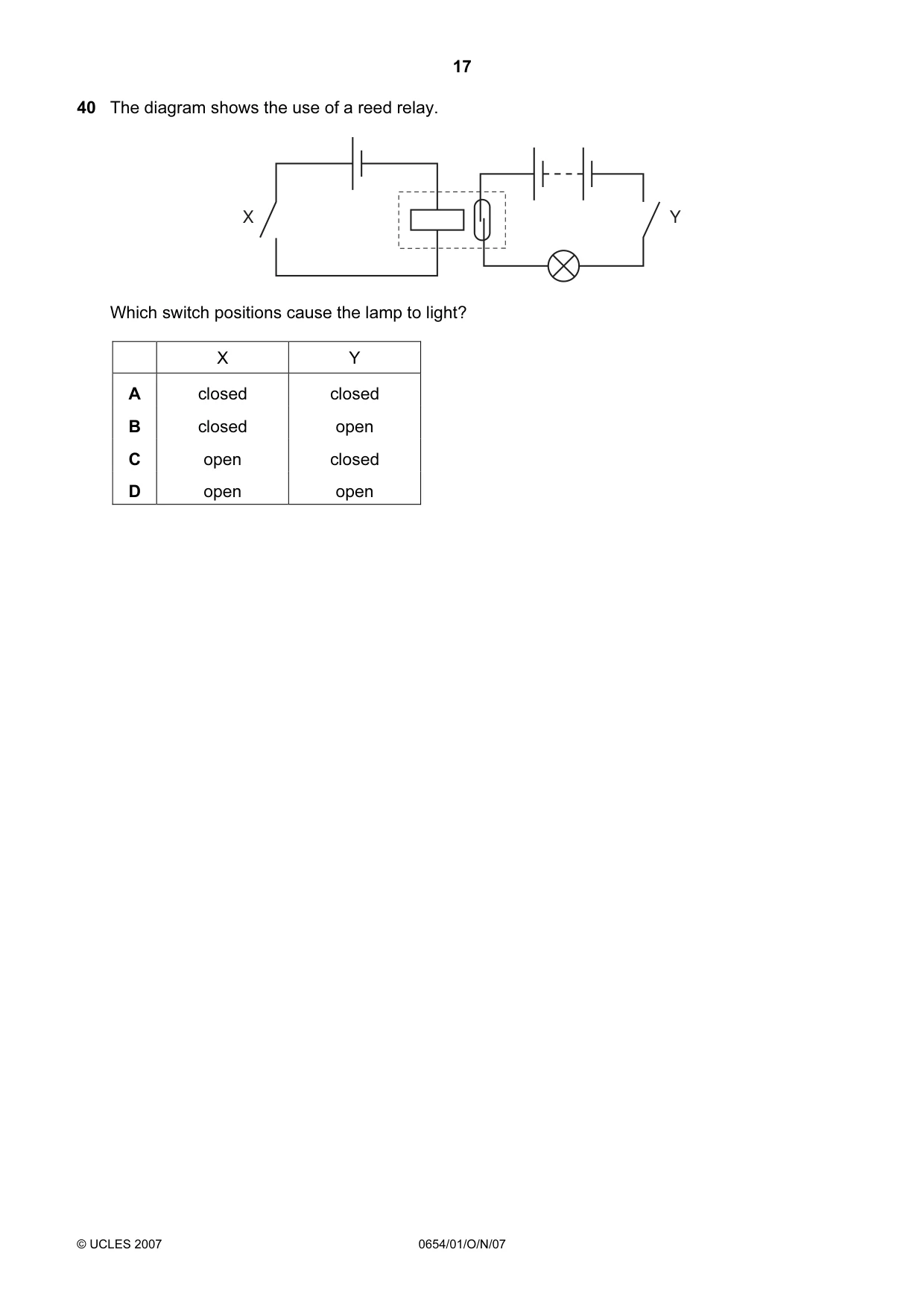
Q40 · The diagram shows the use of a reed relay
40 The diagram shows the use of a reed relay. X Y Which switch positions cause the lamp to light? X Y A closed closed B closed open C open closed D open open
Mark scheme: A
What was in this paper
The subtopics covered by these 40 questions, and how many questions each got. Open one in a new tab to see every Cambridge question on it.
3Atomic structure and the Periodic Table2Energy, work and power2Air quality and climate1Biological molecules1Carbon cycle1Cell division1Characteristics of living organisms1Chromatography1Coordination and response1Corrosion of metals1Density1Diet1Digestive system1Electrical quantities1Electrical safety1Electromagnetic effects1Elements, compounds and mixtures1Fuels1Gas exchange in humans1General properties of waves1Giant covalent structures1Habitat destruction1Heart1Ions and ionic bonds1Kinetic particle model of matter1Mass and weight1Photosynthesis1Physical quantities and measurement techniques1Properties of metals1Radioactivity1Rate of reaction1Respiration1Sexual reproduction in humans1Simple phenomena of magnetism1Sound1What you needed in this session
Cambridge’s own grade thresholds for 2007 Oct/Nov, Paper 1 · Variant 1. A higher threshold means an easier paper — the bar moves with how the cohort did.