Cambridge IGCSE Sciences - Co-ordinated (Double) 0654 — 2005 May/June Paper 1 · Variant 1
0654/11/M/J/05 · 40 questions · 40 marks · ≈45 min
The question paper and its mark scheme, free to read here and free to download. This is Cambridge’s own paper, exactly as it was sat.
Question paper20 pages



Mark scheme4 pages
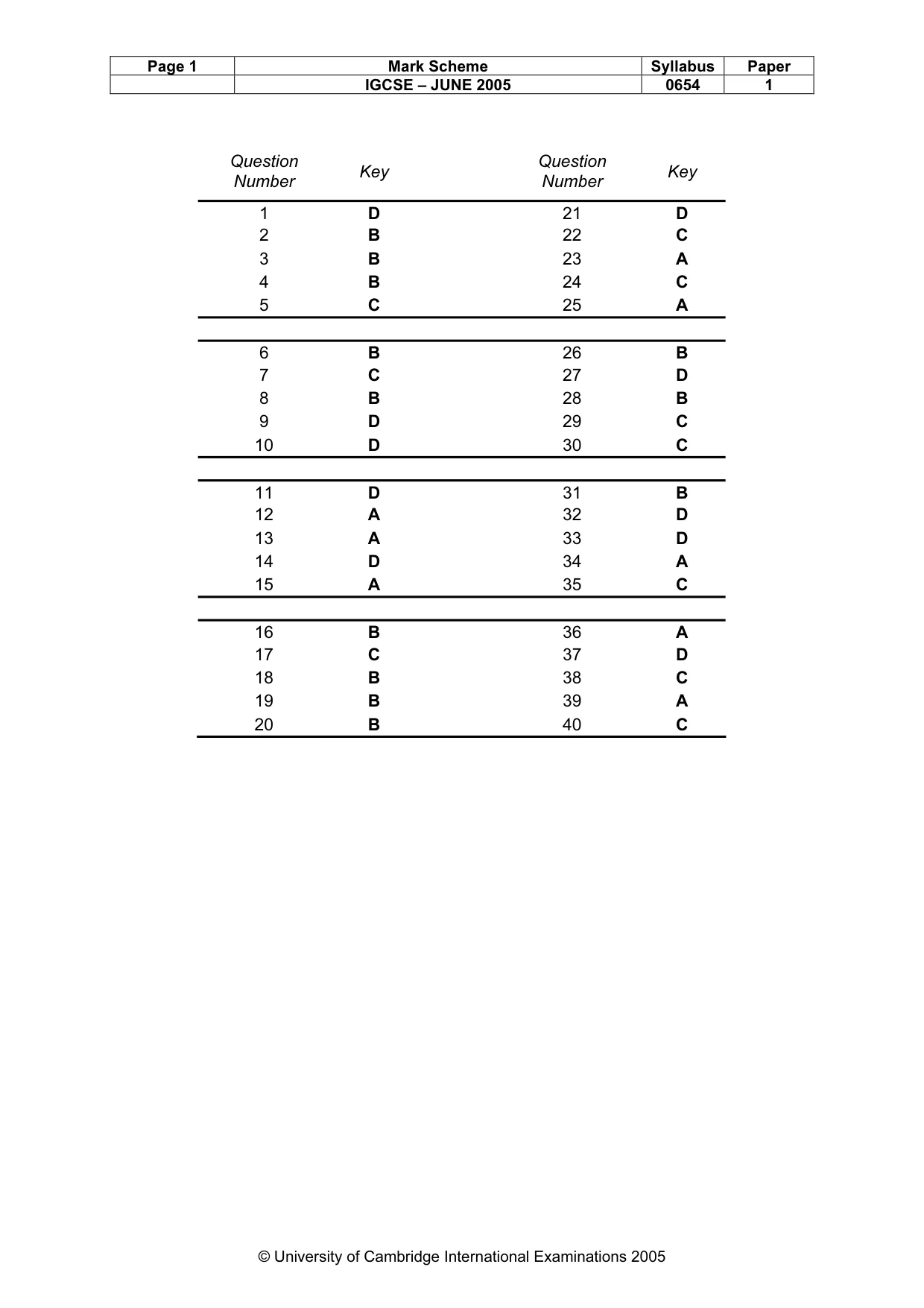
Answers below. Sit the paper first if you are practising.
Questions as text
Q1 · An animal is observed swimming in a river
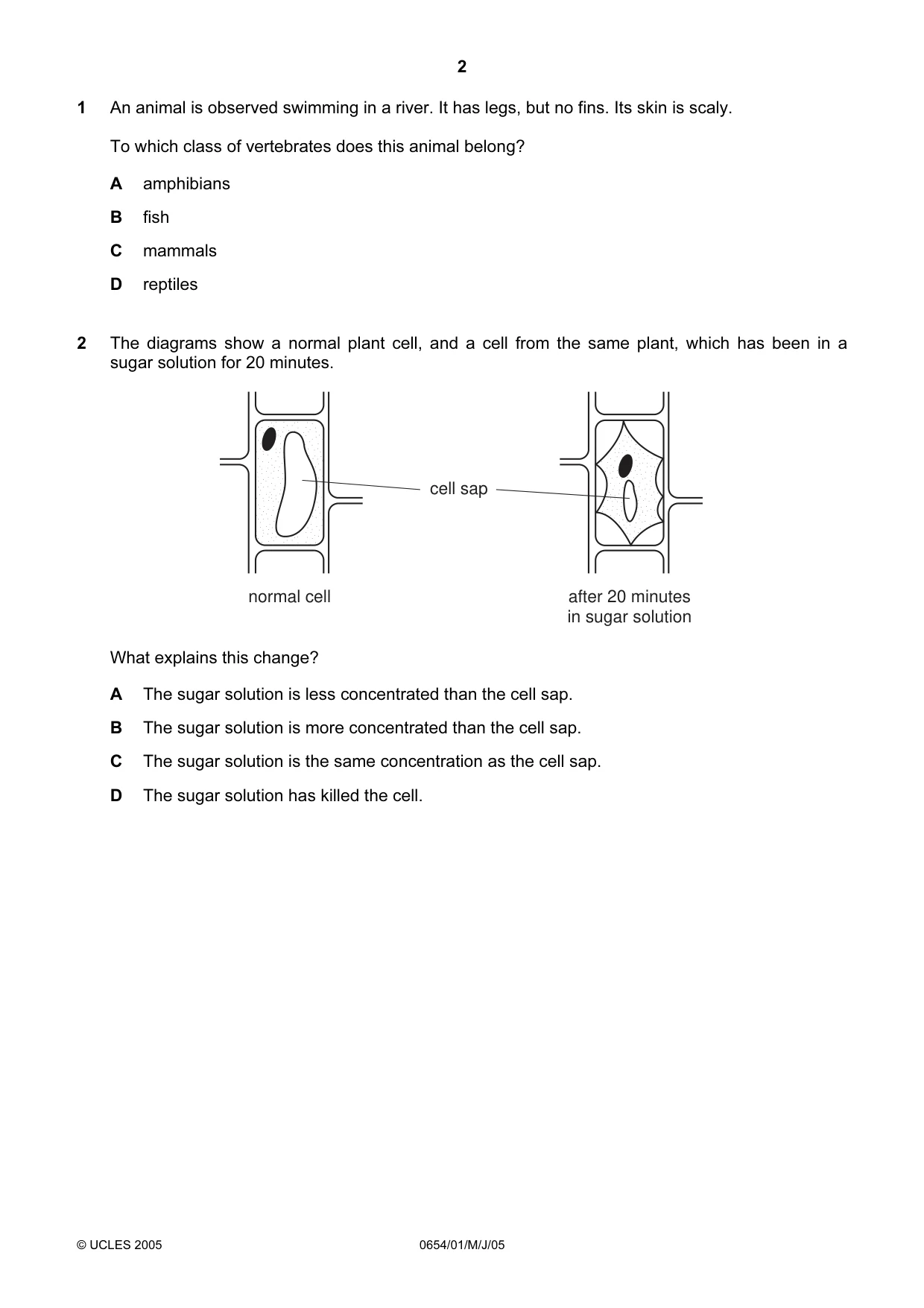
1 An animal is observed swimming in a river. It has legs, but no fins. Its skin is scaly. To which class of vertebrates does this animal belong? A amphibians B fish C mammals D reptiles
Mark scheme: D
Q2 · The diagrams show a normal plant cell, and a cell from the same plant, which has been in…
2 The diagrams show a normal plant cell, and a cell from the same plant, which has been in a sugar solution for 20 minutes. cell sap normal cell after 20 minutes in sugar solution What explains this change? A The sugar solution is less concentrated than the cell sap. B The sugar solution is more concentrated than the cell sap. C The sugar solution is the same concentration as the cell sap. D The sugar solution has killed the cell.
Mark scheme: B
Q3 · The diagram represents part of the human nervous system
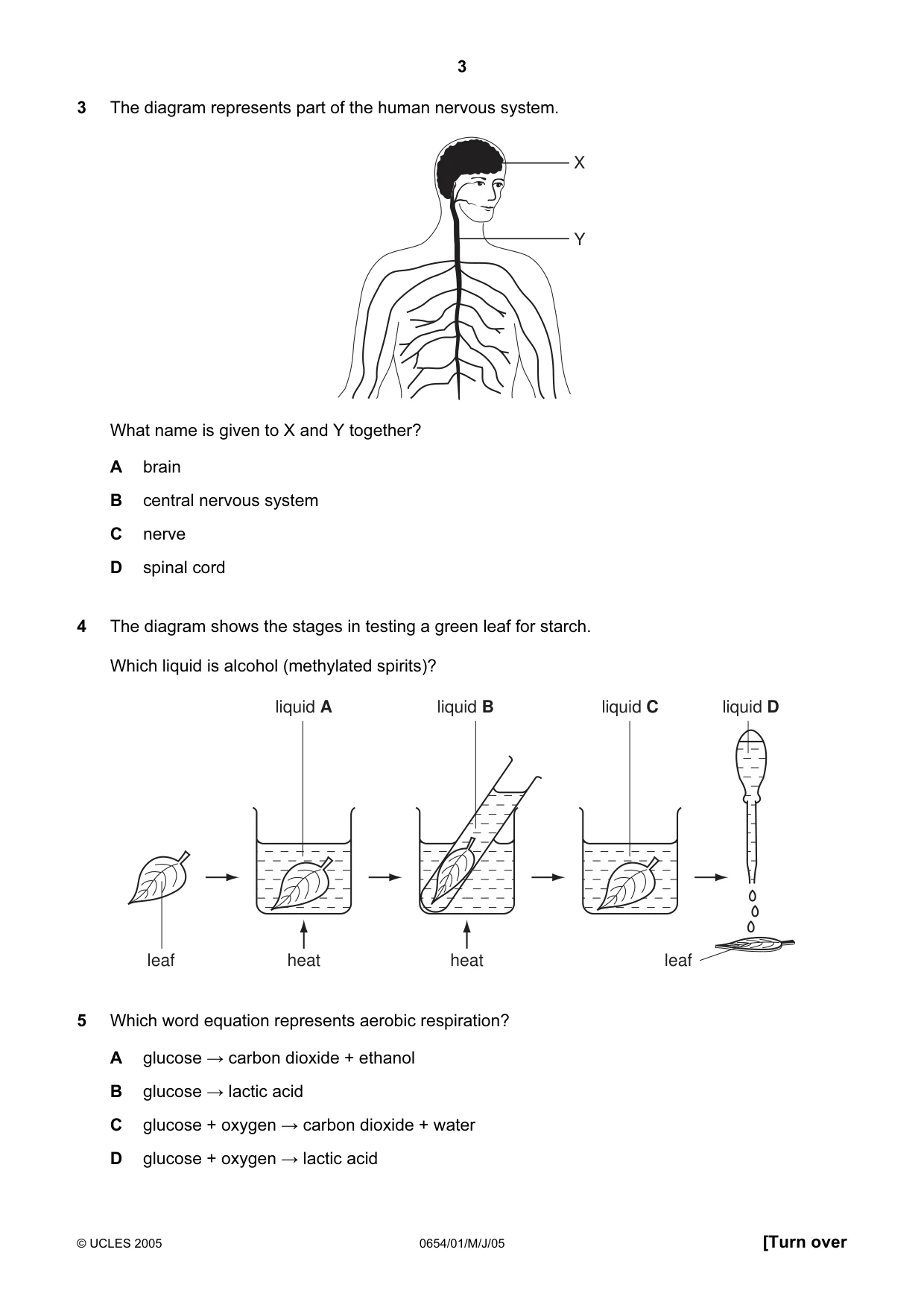
3 The diagram represents part of the human nervous system. X Y What name is given to X and Y together? A brain B central nervous system C nerve D spinal cord
Mark scheme: B
Q4 · The diagram shows the stages in testing a green leaf for starch
4 The diagram shows the stages in testing a green leaf for starch. Which liquid is alcohol (methylated spirits)? liquid A liquid B liquid C liquid D leaf heat heat leaf
Mark scheme: B
Q5 · Which word equation represents aerobic respiration?
5 Which word equation represents aerobic respiration? A glucose → carbon dioxide + ethanol B glucose → lactic acid C glucose + oxygen → carbon dioxide + water D glucose + oxygen → lactic acid
Mark scheme: C
Q6 · The diagram shows a section through the heart
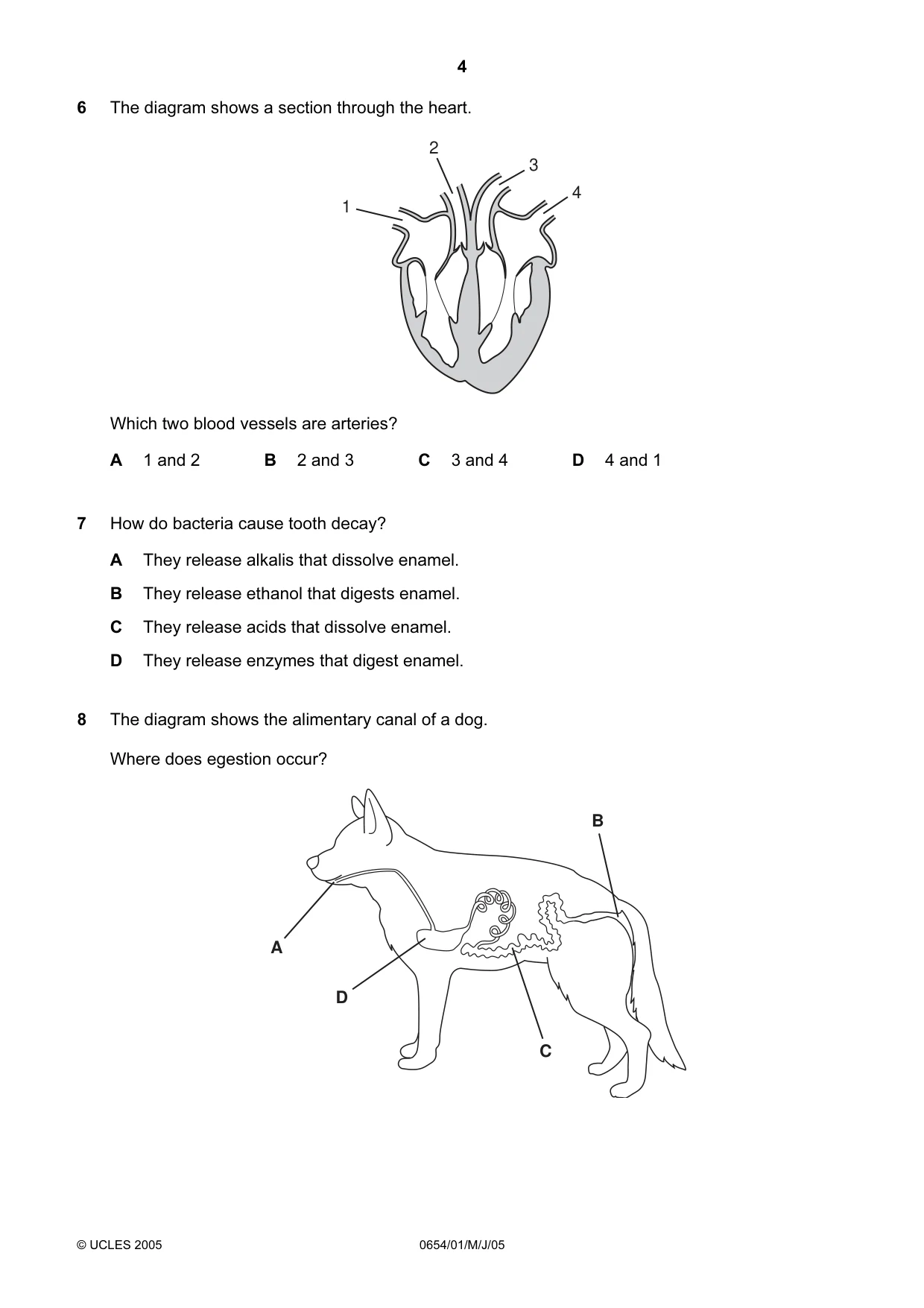
6 The diagram shows a section through the heart. 2 3 4 1 Which two blood vessels are arteries? A 1 and 2 B 2 and 3 C 3 and 4 D 4 and 1
Mark scheme: B
Q7 · How do bacteria cause tooth decay?
7 How do bacteria cause tooth decay? A They release alkalis that dissolve enamel. B They release ethanol that digests enamel. C They release acids that dissolve enamel. D They release enzymes that digest enamel.
Mark scheme: C
Q8 · The diagram shows the alimentary canal of a dog
8 The diagram shows the alimentary canal of a dog. Where does egestion occur? B A D C
Mark scheme: B
Q9 · Which shows the sequence that occurs when a person becomes aware of light?
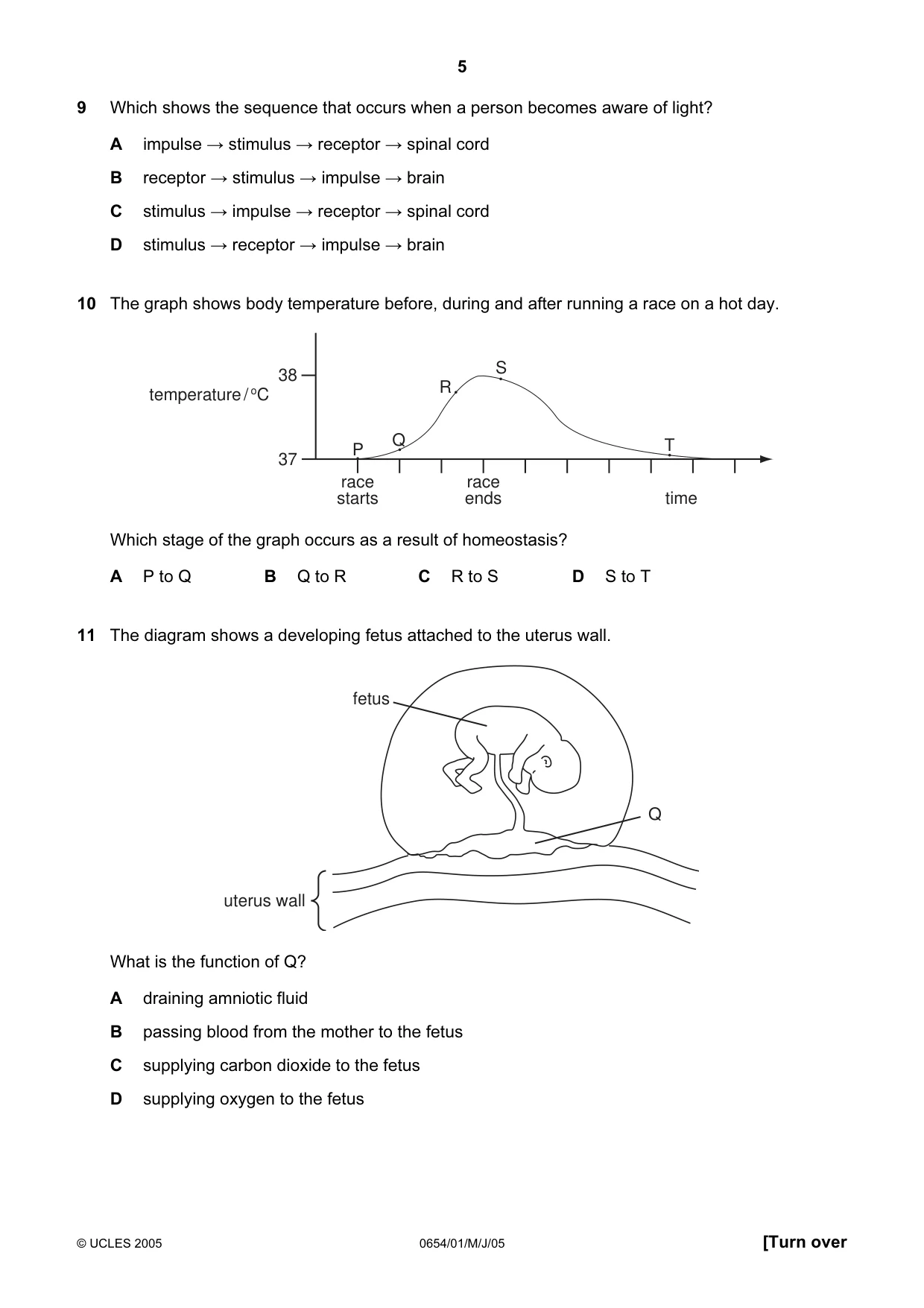
9 Which shows the sequence that occurs when a person becomes aware of light? A impulse → stimulus → receptor → spinal cord B receptor → stimulus → impulse → brain C stimulus → impulse → receptor → spinal cord D stimulus → receptor → impulse → brain
Mark scheme: D
Q10 · The graph shows body temperature before, during and after running a race on a hot day
10 The graph shows body temperature before, during and after running a race on a hot day. 38 S temperature / oC R Q T P 37 race race starts ends time Which stage of the graph occurs as a result of homeostasis? A P to Q B Q to R C R to S D S to T
Mark scheme: D
Q11 · The diagram shows a developing fetus attached to the uterus wall
11 The diagram shows a developing fetus attached to the uterus wall. fetus Q uterus wall What is the function of Q? A draining amniotic fluid B passing blood from the mother to the fetus C supplying carbon dioxide to the fetus D supplying oxygen to the fetus
Mark scheme: D
Q12 · Cystic fibrosis is an inherited disease
12 Cystic fibrosis is an inherited disease. Only people who are homozygous recessive, ff, suffer from this disease. Which cross could not give rise to a child suffering from cystic fibrosis? A FF x ff B Ff x Ff C Ff x ff D ff x ff
Mark scheme: A
Q13 · What is an ecosystem?
13 What is an ecosystem? A a community and its habitat B a group of organisms and their predators C all organisms in a food chain D where an organism lives and breeds
Mark scheme: A
Q14 · What do the chemical symbols N2 and Ni represent?
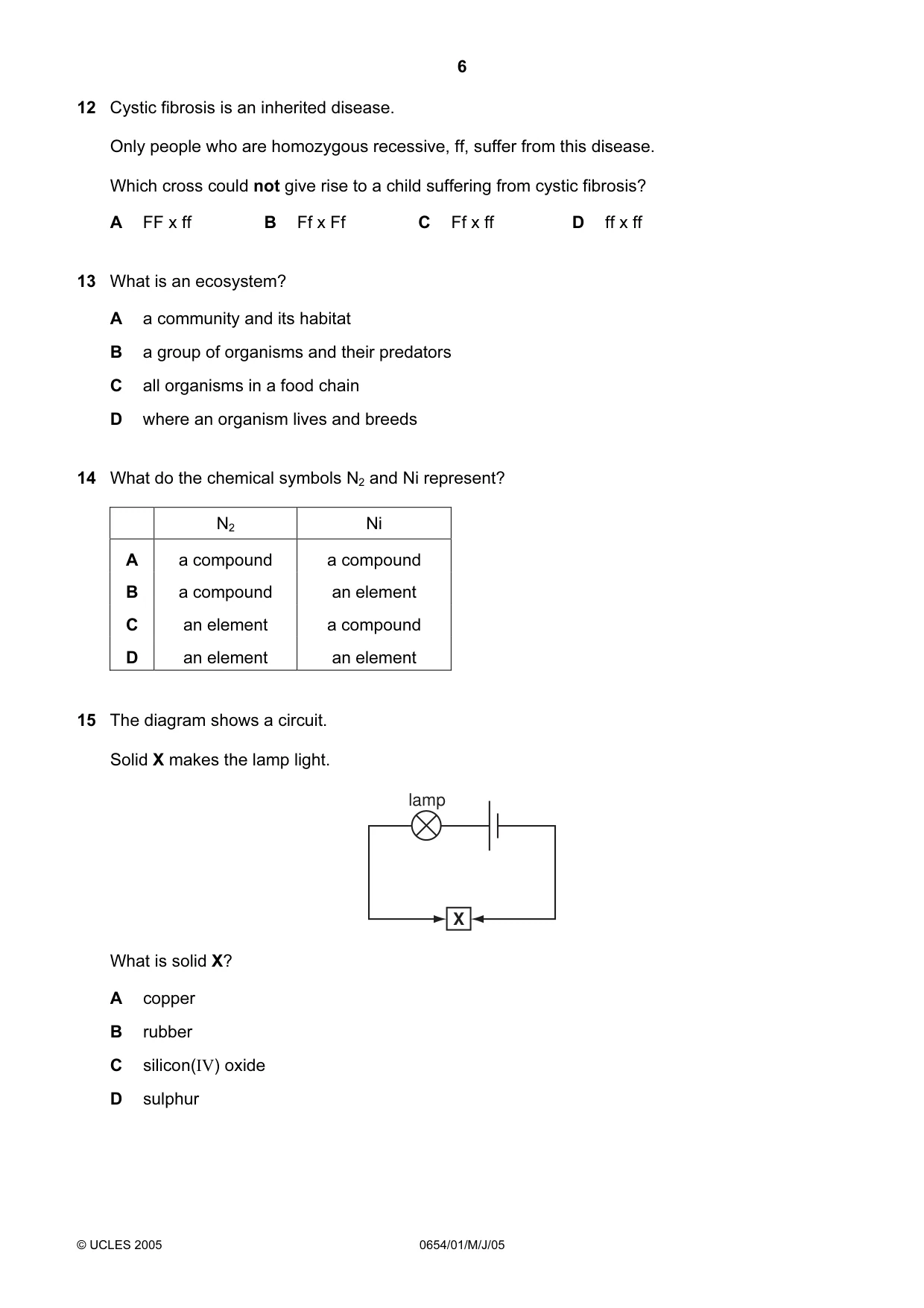
14 What do the chemical symbols N2 and Ni represent? N2 Ni A a compound a compound B a compound an element C an element a compound D an element an element
Mark scheme: D
Q15 · The diagram shows a circuit
15 The diagram shows a circuit. Solid X makes the lamp light. lamp X What is solid X? A copper B rubber C silicon(IV) oxide D sulphur
Mark scheme: A
Q16 · Large hydrocarbons can be .….X….
16 Large hydrocarbons can be .….X….. to make smaller, more useful molecules. Small molecules can be …..Y….. to make long molecules. What are X and Y? X Y A cracked distilled B cracked polymerised C distilled polymerised D distilled cracked
Mark scheme: B
Q17 · A concentrated solution of a sugar is separated from a dilute solution of this sugar by a…
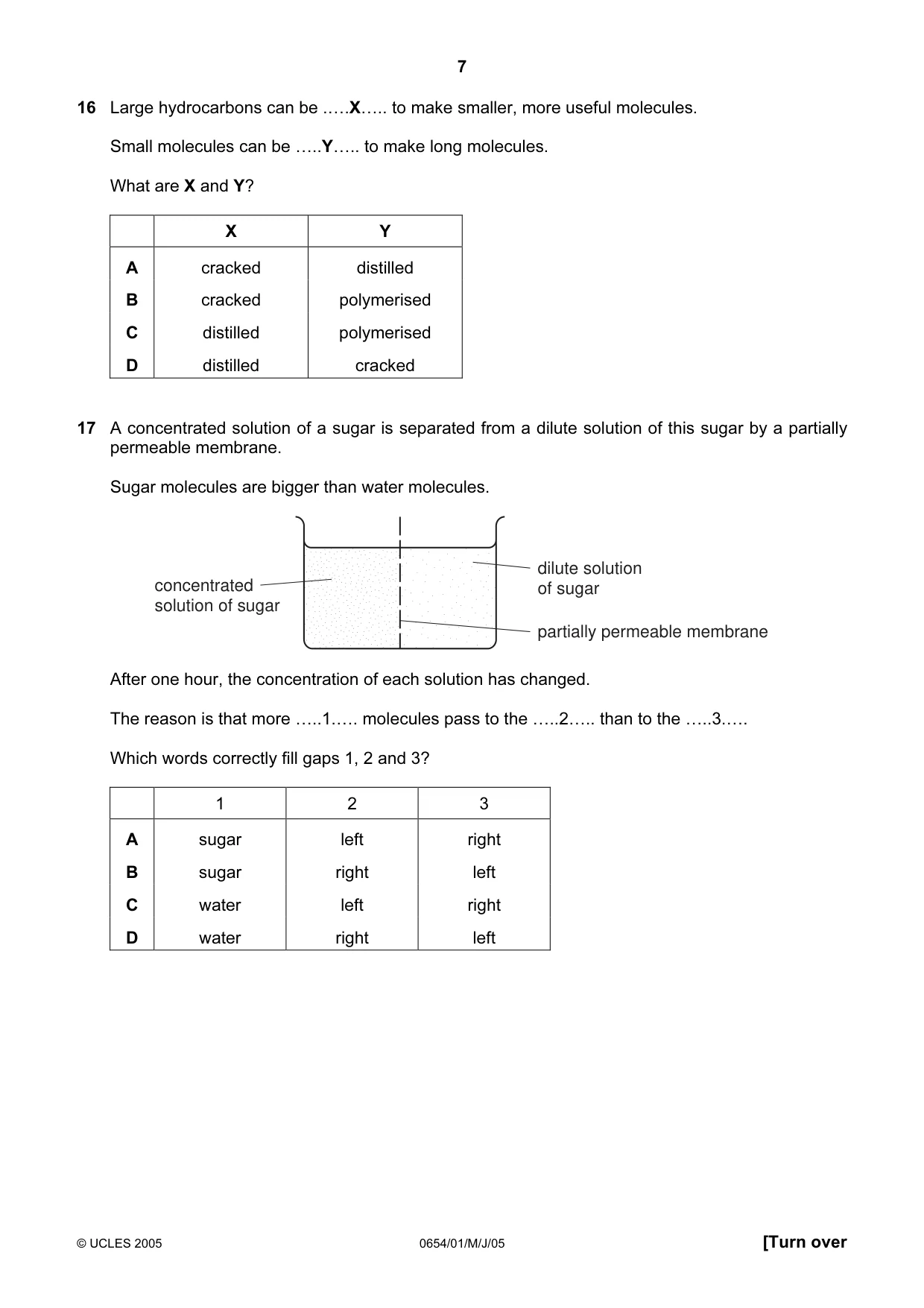
17 A concentrated solution of a sugar is separated from a dilute solution of this sugar by a partially permeable membrane. Sugar molecules are bigger than water molecules. dilute solution concentrated of sugar solution of sugar partially permeable membrane After one hour, the concentration of each solution has changed. The reason is that more …..1.…. molecules pass to the …..2….. than to the …..3.…. Which words correctly fill gaps 1, 2 and 3? 1 2 3 A sugar left right B sugar right left C water left right D water right left
Mark scheme: C
Q18 · Carbon is used in the extraction of some metals from their ores because 1 carbon forms…
18 Carbon is used in the extraction of some metals from their ores because 1 carbon forms strong alloys with metals, 2 carbon reacts with oxygen in the ore. Which of these statements are correct? A 1 only B 2 only C both 1 and 2 D neither 1 or 2
Mark scheme: B
Q19 · Soap solution is gradually added to separate samples of water P, Q, R and S until a…
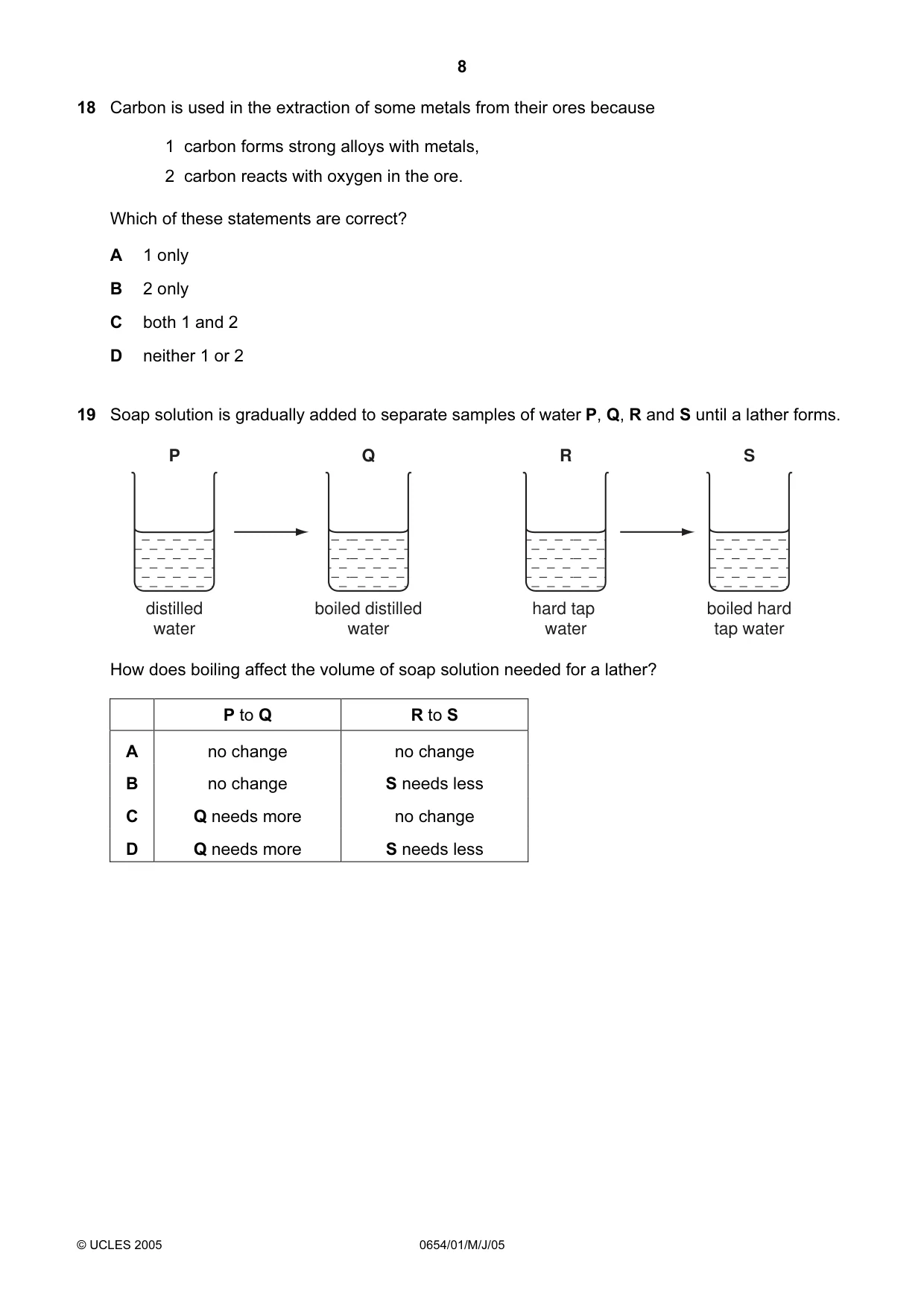
19 Soap solution is gradually added to separate samples of water P, Q, R and S until a lather forms. P Q R S distilled boiled distilled hard tap boiled hard water water water tap water How does boiling affect the volume of soap solution needed for a lather? P to Q R to S A no change no change B no change S needs less C Q needs more no change D Q needs more S needs less
Mark scheme: B
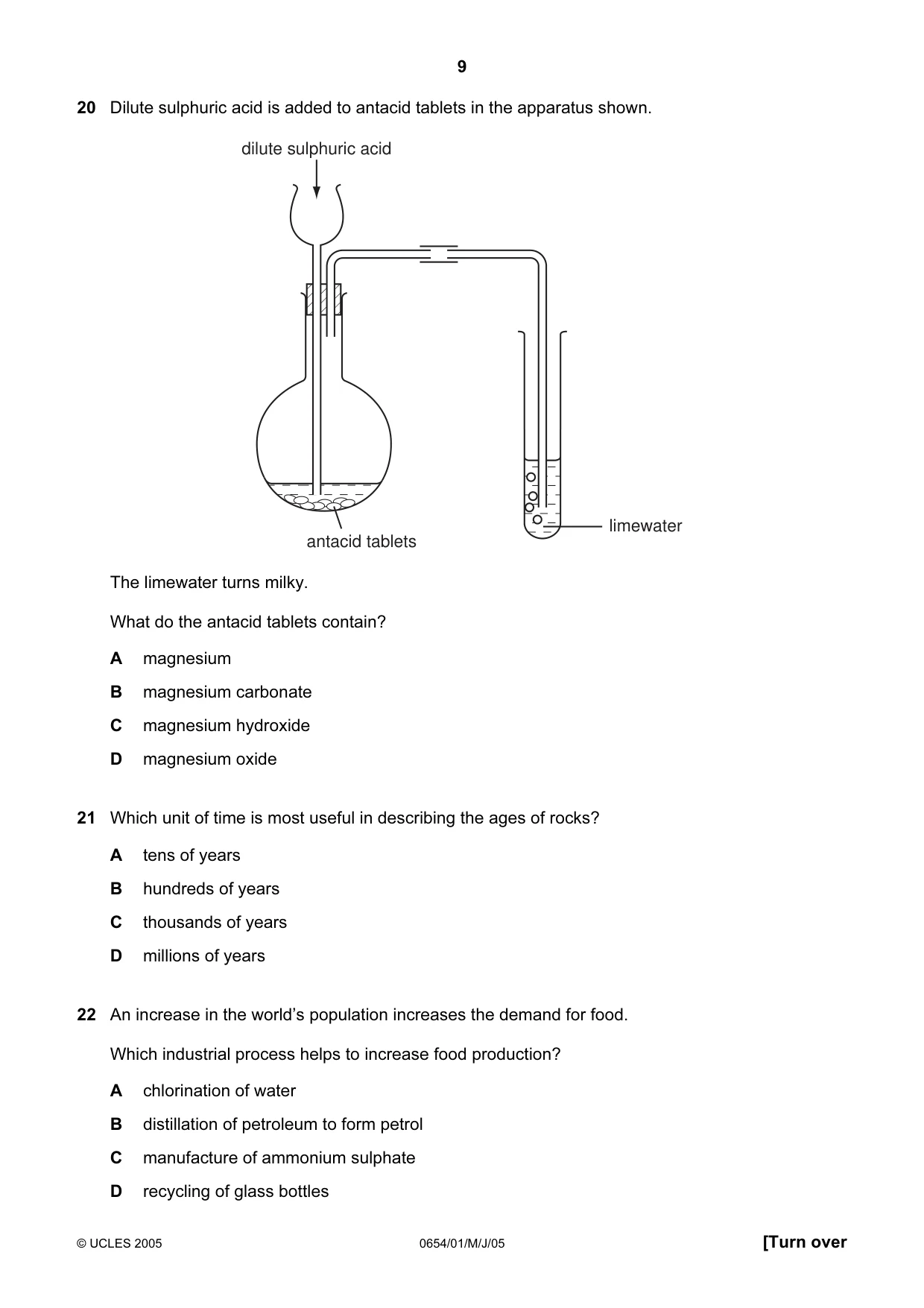
Q20 · Dilute sulphuric acid is added to antacid tablets in the apparatus shown
20 Dilute sulphuric acid is added to antacid tablets in the apparatus shown. dilute sulphuric acid limewater antacid tablets The limewater turns milky. What do the antacid tablets contain? A magnesium B magnesium carbonate C magnesium hydroxide D magnesium oxide
Mark scheme: B
More questions on The characteristic properties of acids and bases
Q21 · Which unit of time is most useful in describing the ages of rocks?
21 Which unit of time is most useful in describing the ages of rocks? A tens of years B hundreds of years C thousands of years D millions of years
Mark scheme: D
More questions on Physical quantities and measurement techniques
Q22 · An increase in the world’s population increases the demand for food
22 An increase in the world’s population increases the demand for food. Which industrial process helps to increase food production? A chlorination of water B distillation of petroleum to form petrol C manufacture of ammonium sulphate D recycling of glass bottles
Mark scheme: C
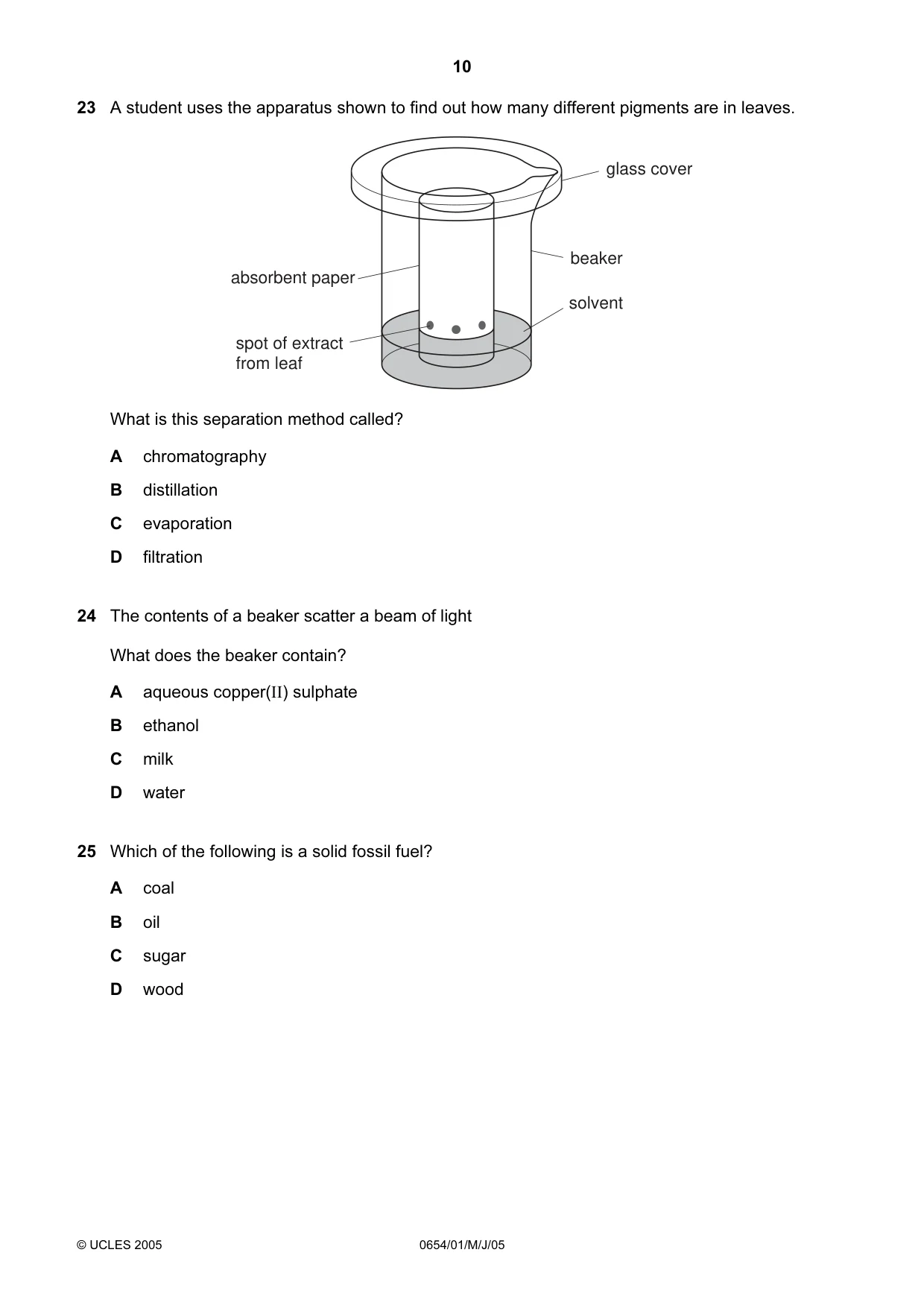
Q23 · A student uses the apparatus shown to find out how many different pigments are in leaves
23 A student uses the apparatus shown to find out how many different pigments are in leaves. glass cover beaker absorbent paper solvent spot of extract from leaf What is this separation method called? A chromatography B distillation C evaporation D filtration
Mark scheme: A
Q24 · The contents of a beaker scatter a beam of light What does the beaker contain?
24 The contents of a beaker scatter a beam of light What does the beaker contain? A aqueous copper(II) sulphate B ethanol C milk D water
Mark scheme: C
Q25 · Which of the following is a solid fossil fuel?
25 Which of the following is a solid fossil fuel? A coal B oil C sugar D wood
Mark scheme: A
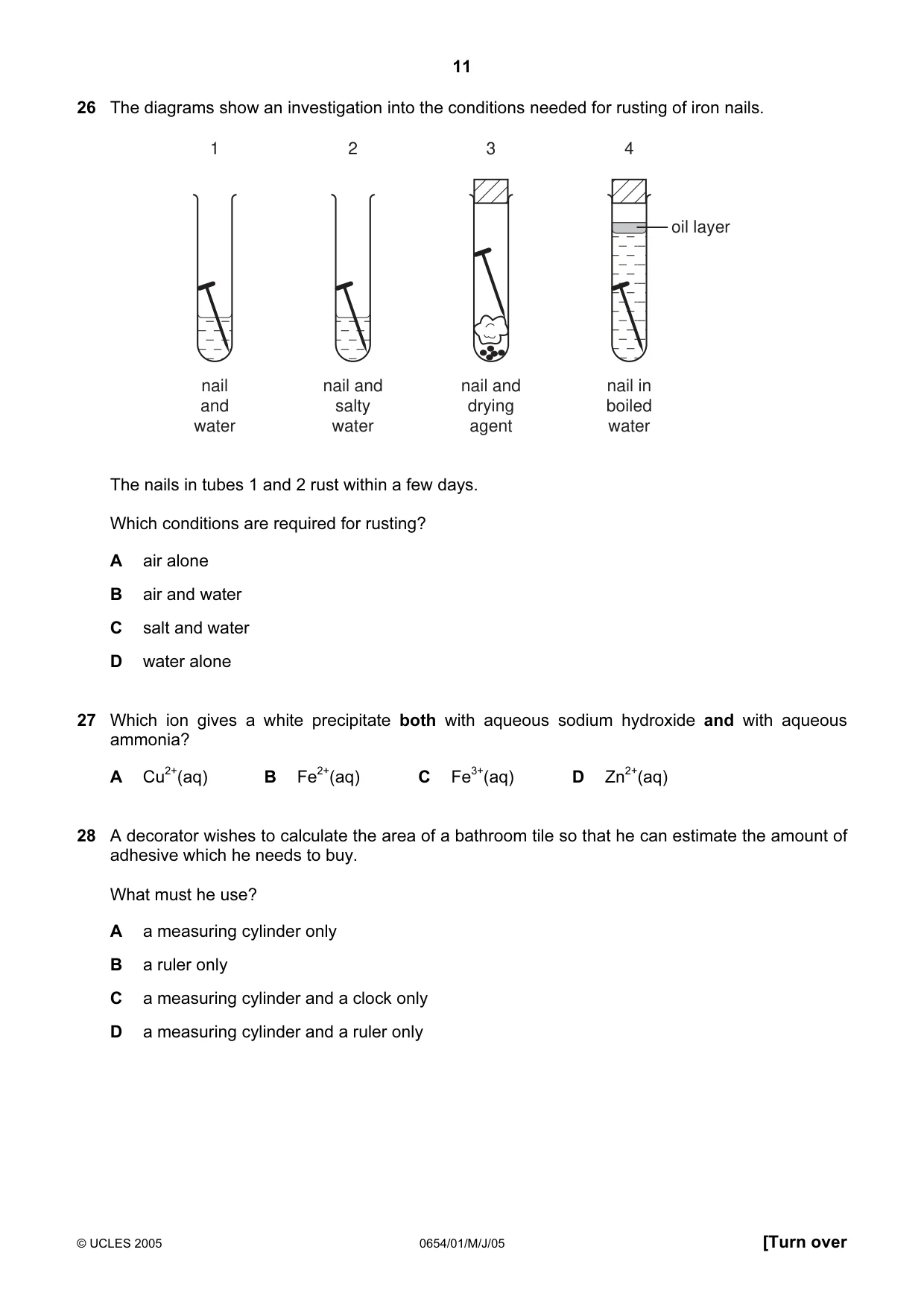
Q26 · The diagrams show an investigation into the conditions needed for rusting of iron nails
26 The diagrams show an investigation into the conditions needed for rusting of iron nails. 1 2 3 4 oil layer nail nail and nail and nail in and salty drying boiled water water agent water The nails in tubes 1 and 2 rust within a few days. Which conditions are required for rusting? A air alone B air and water C salt and water D water alone
Mark scheme: B
Q27 · Which ion gives a white precipitate both with aqueous sodium hydroxide and with aqueous…
27 Which ion gives a white precipitate both with aqueous sodium hydroxide and with aqueous ammonia? A Cu2+(aq) B Fe2+(aq) C Fe3+(aq) D Zn2+(aq)
Mark scheme: D
Q28 · A decorator wishes to calculate the area of a bathroom tile so that he can estimate the…
28 A decorator wishes to calculate the area of a bathroom tile so that he can estimate the amount of adhesive which he needs to buy. What must he use? A a measuring cylinder only B a ruler only C a measuring cylinder and a clock only D a measuring cylinder and a ruler only
Mark scheme: B
More questions on Physical quantities and measurement techniques
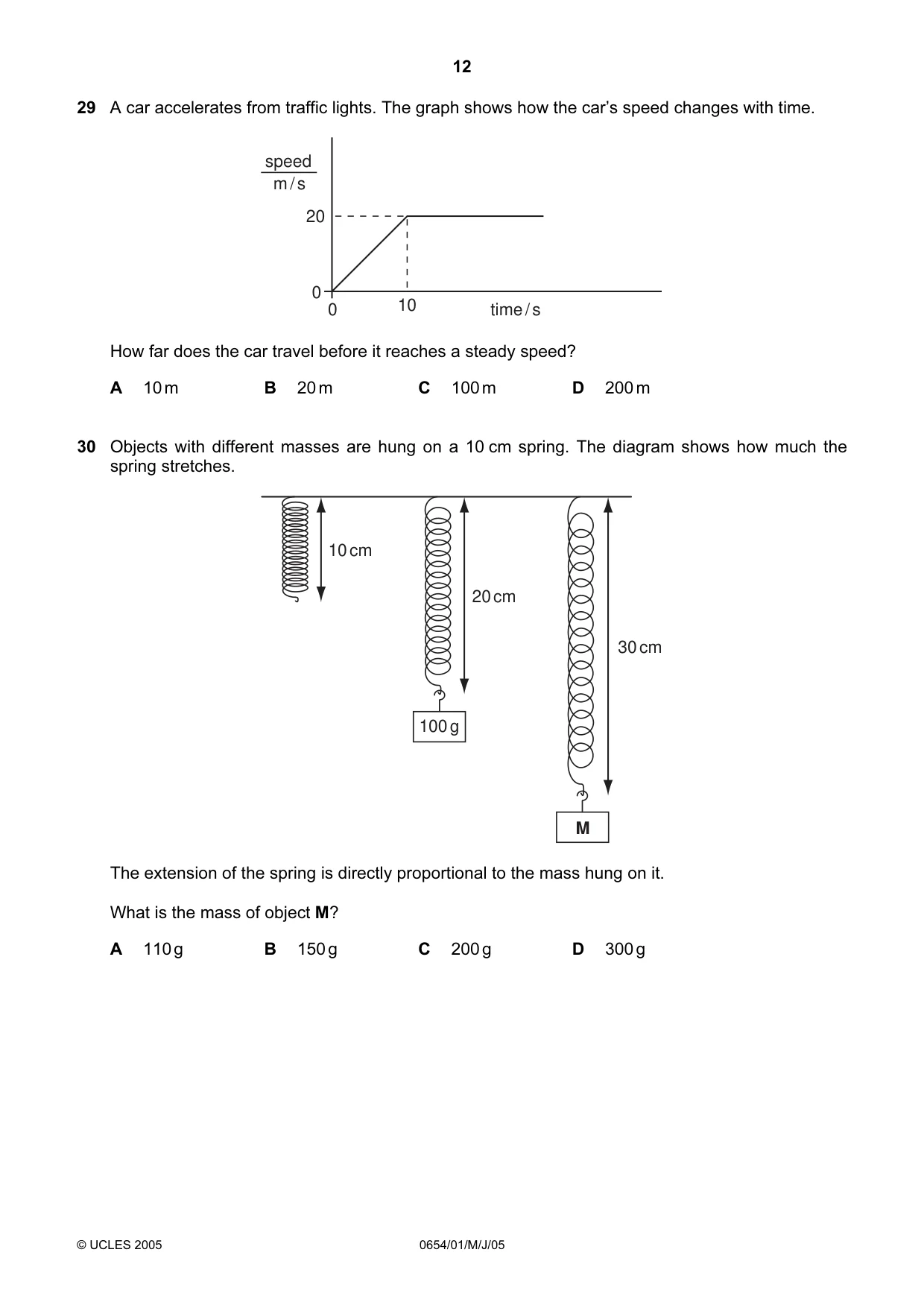
Q29 · A car accelerates from traffic lights
29 A car accelerates from traffic lights. The graph shows how the car’s speed changes with time. speed m / s 20 0 0 10 time / s How far does the car travel before it reaches a steady speed? A 10 m B 20 m C 100 m D 200 m
Mark scheme: C
Q30 · Objects with different masses are hung on a 10 cm spring
30 Objects with different masses are hung on a 10 cm spring. The diagram shows how much the spring stretches. 10 cm 20 cm 30 cm 100 g M The extension of the spring is directly proportional to the mass hung on it. What is the mass of object M? A 110 g B 150 g C 200 g D 300 g
Mark scheme: C
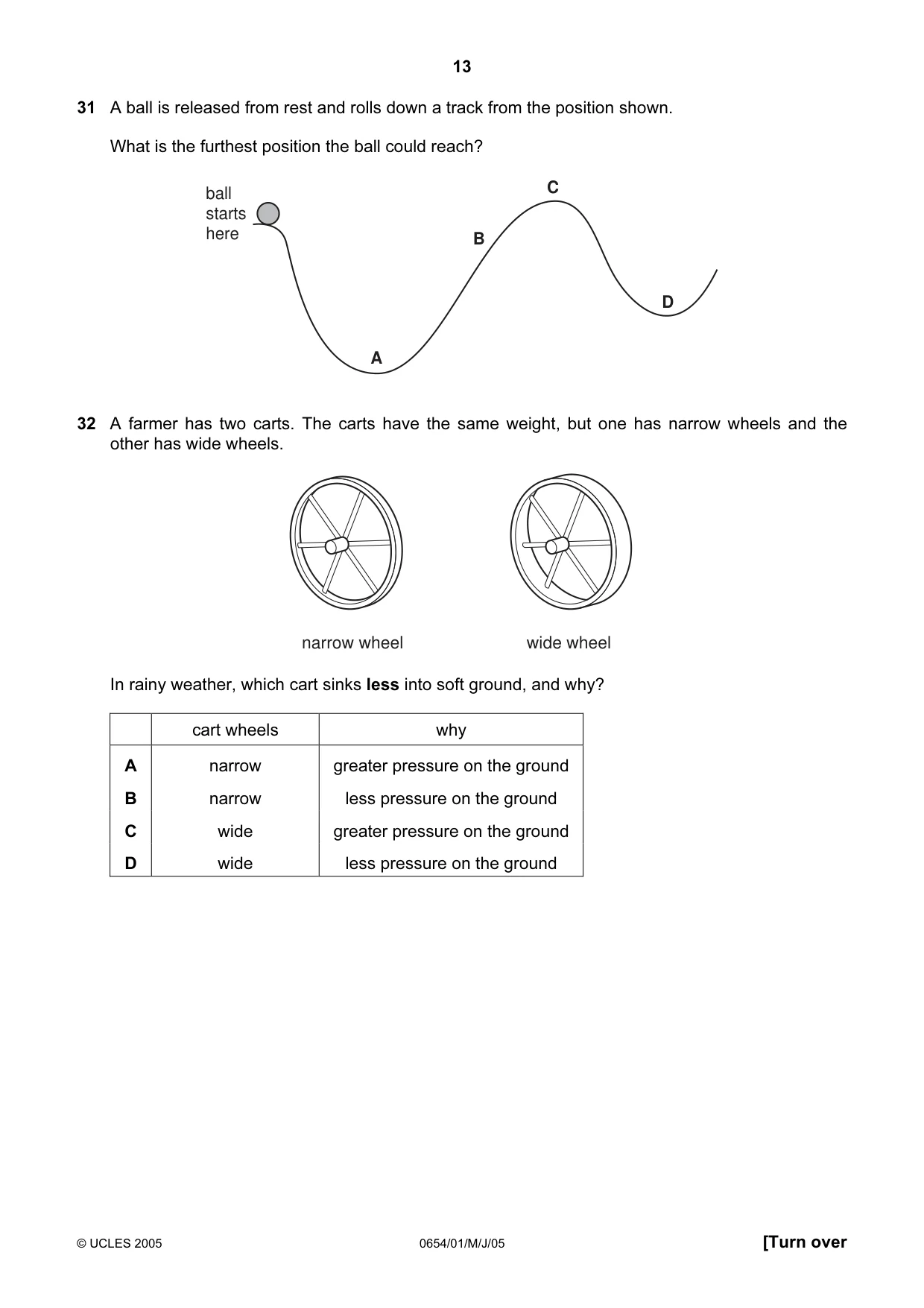
Q31 · A ball is released from rest and rolls down a track from the position shown
31 A ball is released from rest and rolls down a track from the position shown. What is the furthest position the ball could reach? ball C starts here B D A
Mark scheme: B
Q32 · A farmer has two carts
32 A farmer has two carts. The carts have the same weight, but one has narrow wheels and the other has wide wheels. narrow wheel wide wheel In rainy weather, which cart sinks less into soft ground, and why? cart wheels why A narrow greater pressure on the ground B narrow less pressure on the ground C wide greater pressure on the ground D wide less pressure on the ground
Mark scheme: D
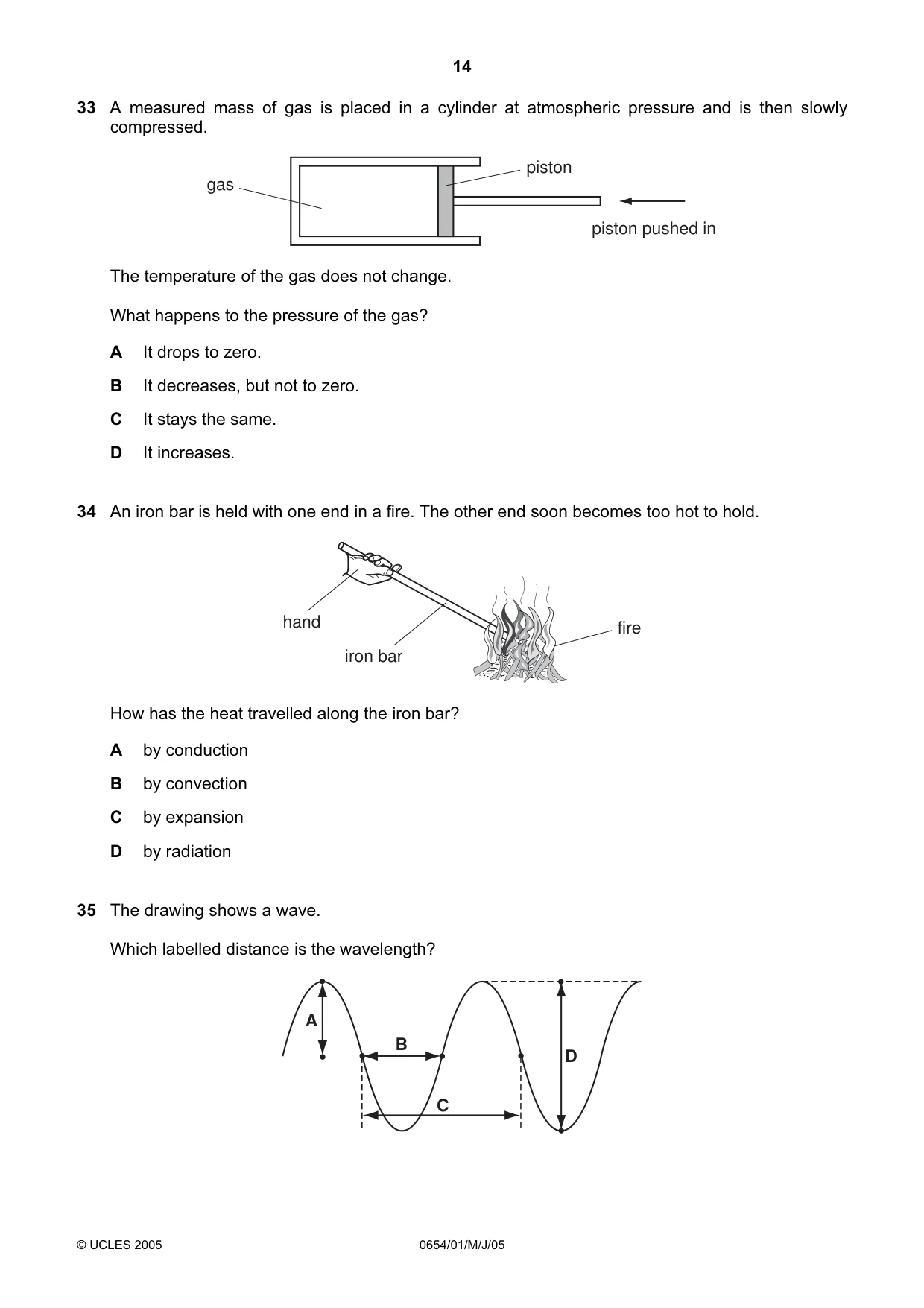
Q33 · A measured mass of gas is placed in a cylinder at atmospheric pressure and is then slowly…
33 A measured mass of gas is placed in a cylinder at atmospheric pressure and is then slowly compressed. piston gas piston pushed in The temperature of the gas does not change. What happens to the pressure of the gas? A It drops to zero. B It decreases, but not to zero. C It stays the same. D It increases.
Mark scheme: D
Q34 · An iron bar is held with one end in a fire
34 An iron bar is held with one end in a fire. The other end soon becomes too hot to hold. hand fire iron bar How has the heat travelled along the iron bar? A by conduction B by convection C by expansion D by radiation
Mark scheme: A
Q35 · The drawing shows a wave
35 The drawing shows a wave. Which labelled distance is the wavelength? A B D C
Mark scheme: C
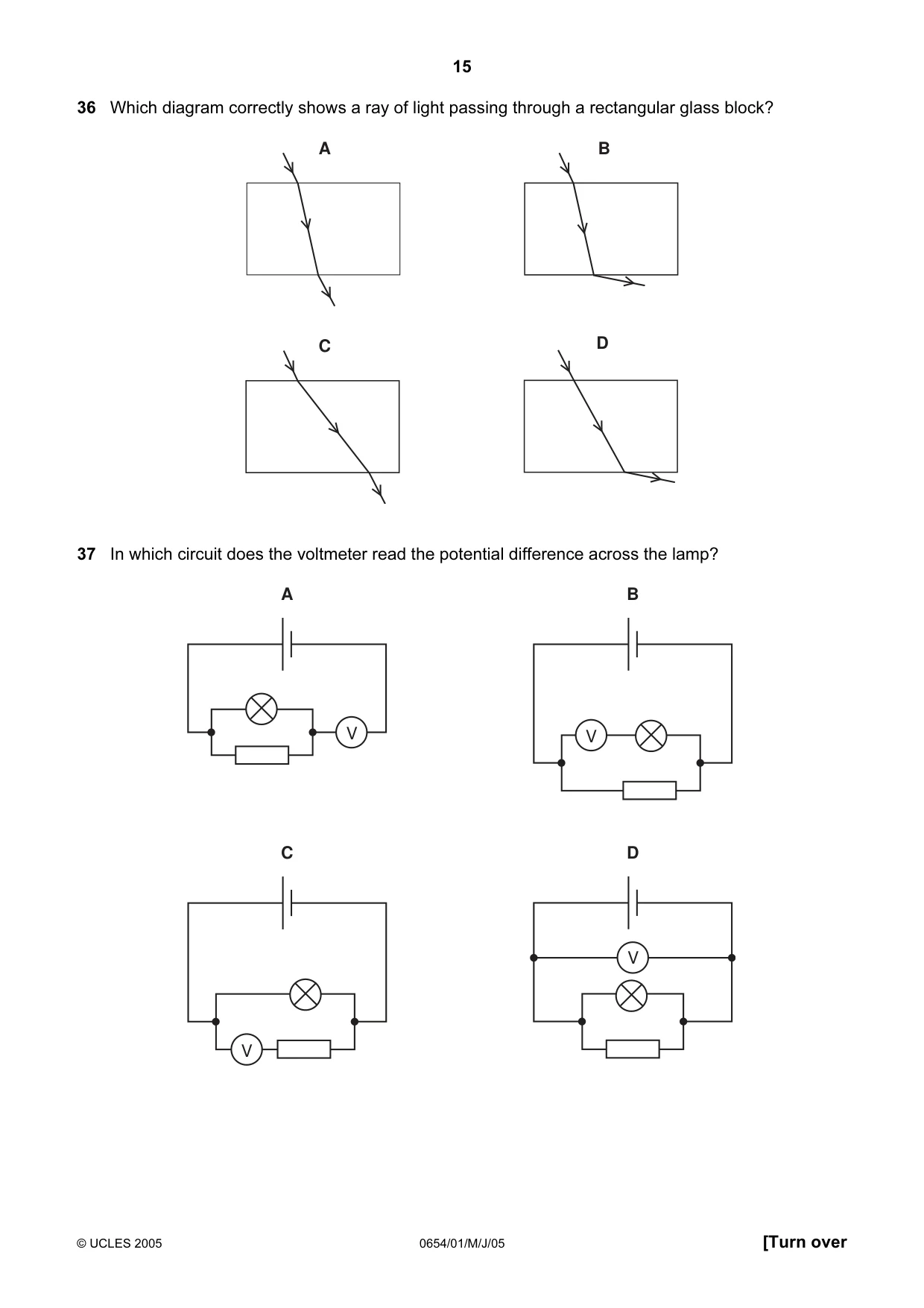
Q36 · Which diagram correctly shows a ray of light passing through a rectangular glass block?
36 Which diagram correctly shows a ray of light passing through a rectangular glass block? A B C D
Mark scheme: A
Q37 · In which circuit does the voltmeter read the potential difference across the lamp?
37 In which circuit does the voltmeter read the potential difference across the lamp? A B V V C D V V
Mark scheme: D
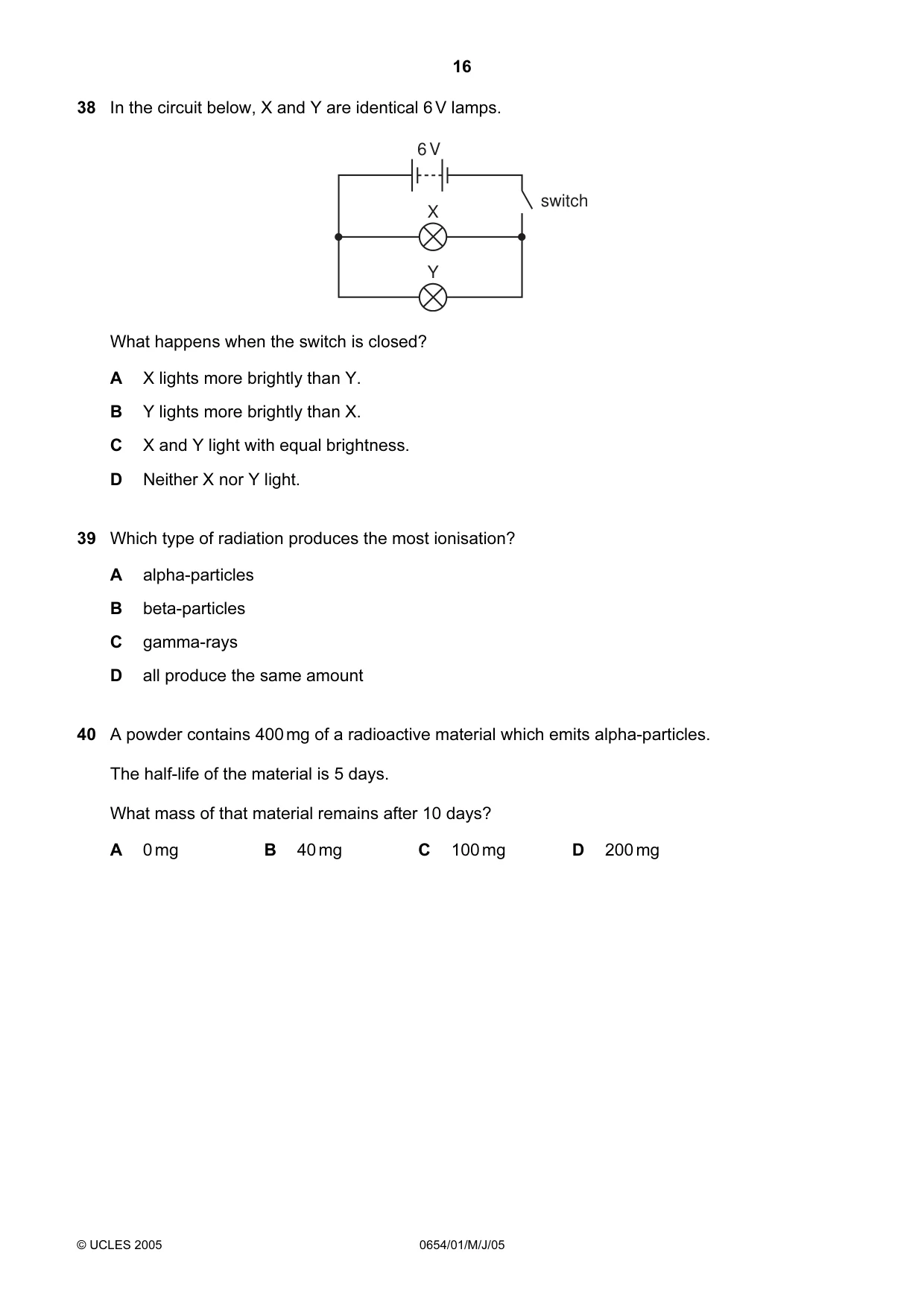
Q38 · In the circuit below, X and Y are identical 6 V lamps
38 In the circuit below, X and Y are identical 6 V lamps. 6 V switch X Y What happens when the switch is closed? A X lights more brightly than Y. B Y lights more brightly than X. C X and Y light with equal brightness. D Neither X nor Y light.
Mark scheme: C
Q39 · Which type of radiation produces the most ionisation?
39 Which type of radiation produces the most ionisation? A alpha-particles B beta-particles C gamma-rays D all produce the same amount
Mark scheme: A
Q40 · A powder contains 400 mg of a radioactive material which emits alpha-particles
40 A powder contains 400 mg of a radioactive material which emits alpha-particles. The half-life of the material is 5 days. What mass of that material remains after 10 days? A 0 mg B 40 mg C 100 mg D 200 mg
Mark scheme: C
What was in this paper
The subtopics covered by these 40 questions, and how many questions each got. Open one in a new tab to see every Cambridge question on it.
3Coordination and response2Electrical circuits2Elements, compounds and mixtures2Osmosis2Physical quantities and measurement techniques2Radioactivity2Characteristics of living organisms1Chromatography1Corrosion of metals1Digestion1Digestive system1Energy flow1Energy, work and power1Extraction of metals1Forces1General properties of waves1Heart1Homeostasis1Identification of ions and gases1Kinetic particle model of matter1Light1Monohybrid inheritance1Motion1Pressure1Properties of metals1Respiration1Separation and purification1Sexual reproduction in humans1The characteristic properties of acids and bases1Transfer of thermal energy1Water1