Questions as text
Q1 · Four solutions are tested with Universal Indicator paper and with anhydrous copper(II)… 0654/21 May/June 2017
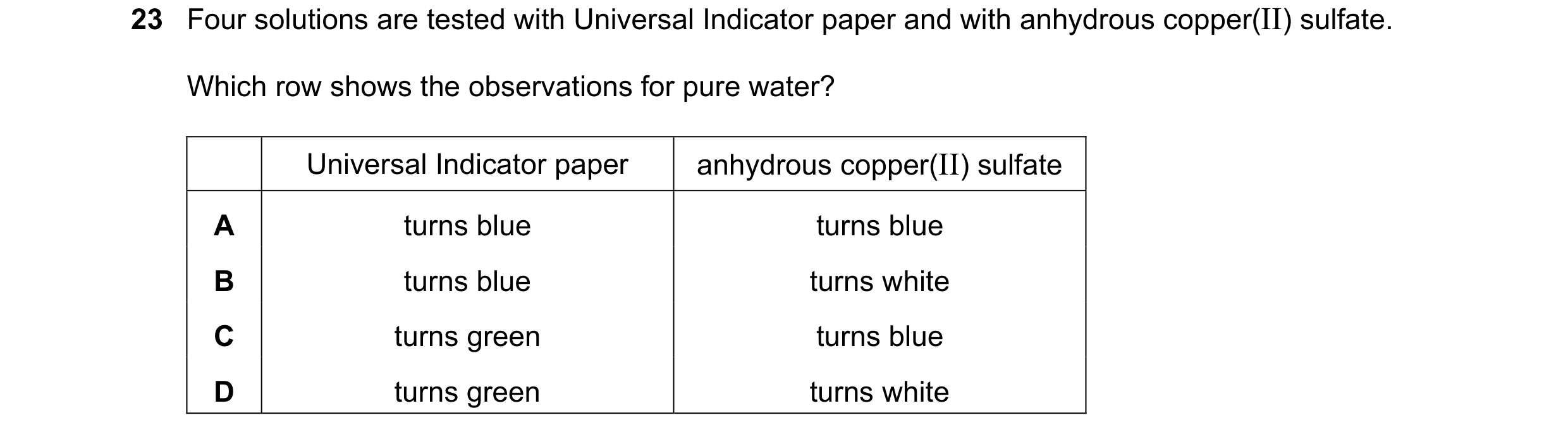
23 Four solutions are tested with Universal Indicator paper and with anhydrous copper(II) sulfate. Which row shows the observations for pure water? Universal Indicator paper anhydrous copper(II) sulfate A turns blue turns blue B turns blue turns white C turns green turns blue D turns green turns white
1 marks
Answer: C
This question in 0654/21 May/June 2017
Q2 · Some properties of gas Y are listed 0654/22 May/June 2017
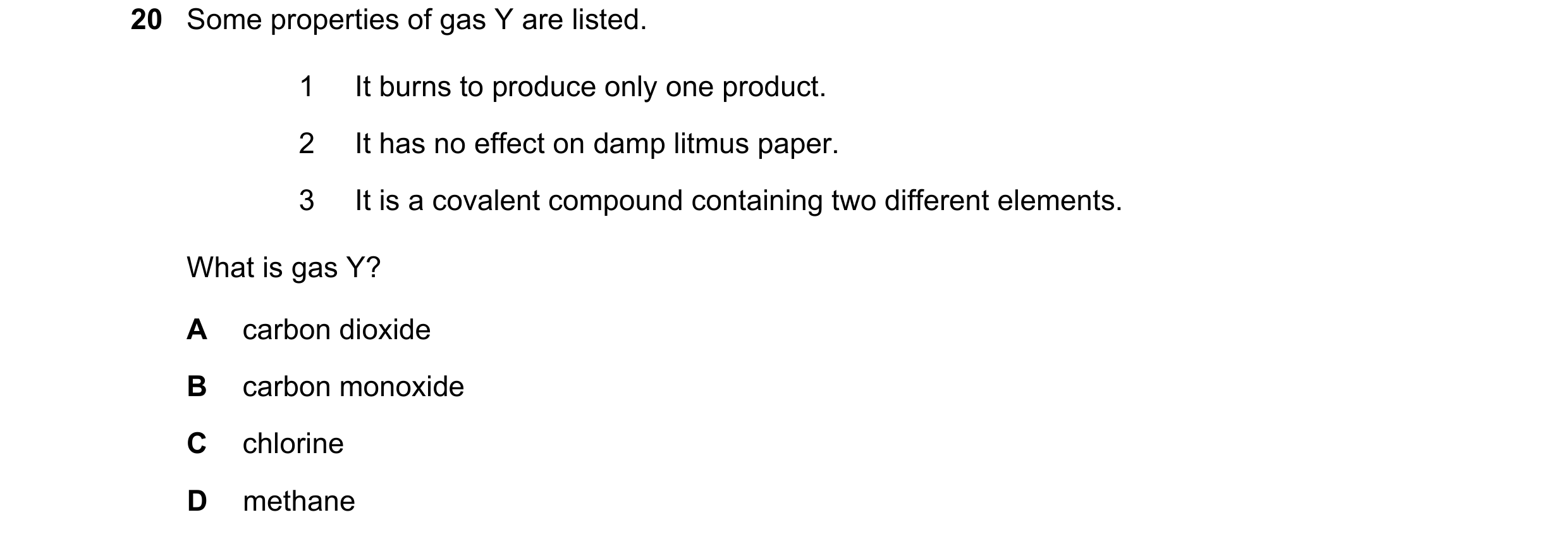
20 Some properties of gas Y are listed. 1 It burns to produce only one product. 2 It has no effect on damp litmus paper. 3 It is a covalent compound containing two different elements. What is gas Y? A carbon dioxide B carbon monoxide C chlorine D methane
1 marks
Answer: B
This question in 0654/22 May/June 2017
Q3 · The electrolysis of concentrated aqueous sodium chloride is an important industrial… 0654/23 May/June 2017
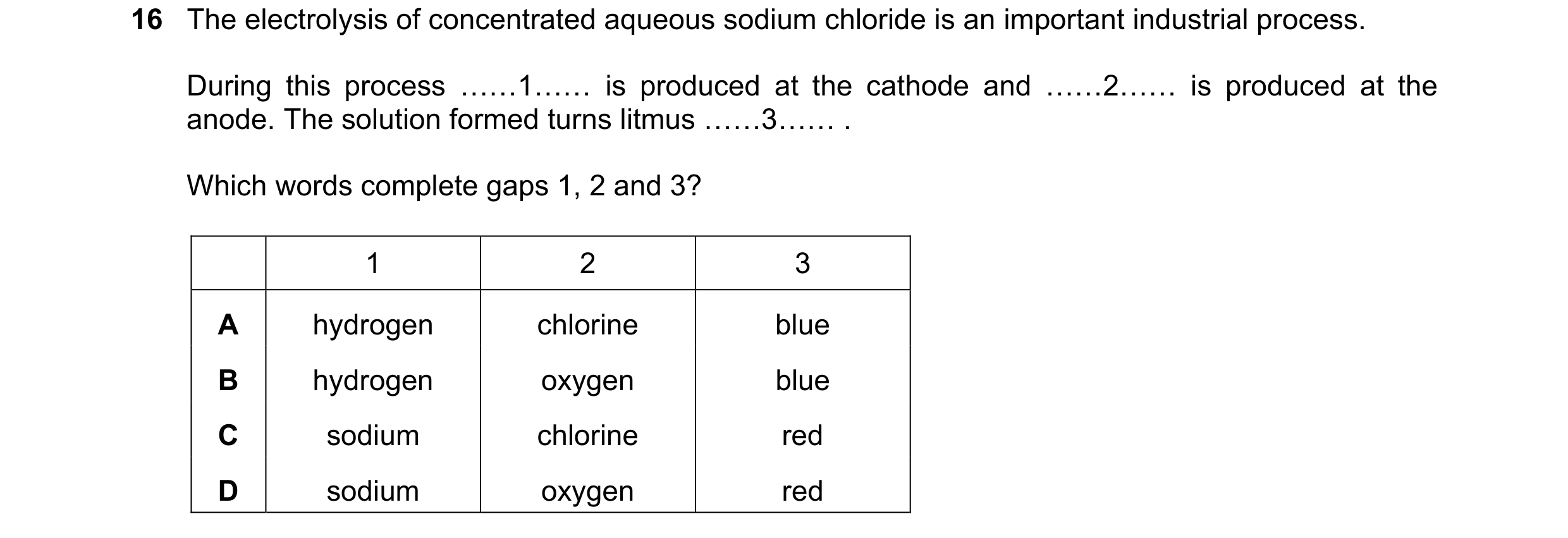
16 The electrolysis of concentrated aqueous sodium chloride is an important industrial process. During this process ««1«« is produced at the cathode and ««2«« is produced at the anode. The solution formed turns litmus ««3«« . Which words complete gaps 1, 2 and 3? 1 2 3 A hydrogen chlorine blue B hydrogen oxygen blue C sodium chlorine red D sodium oxygen red
1 marks
Answer: A
This question in 0654/23 May/June 2017
Q4 · Which row shows a chemical test for the presence of water? 0654/23 May/June 2017
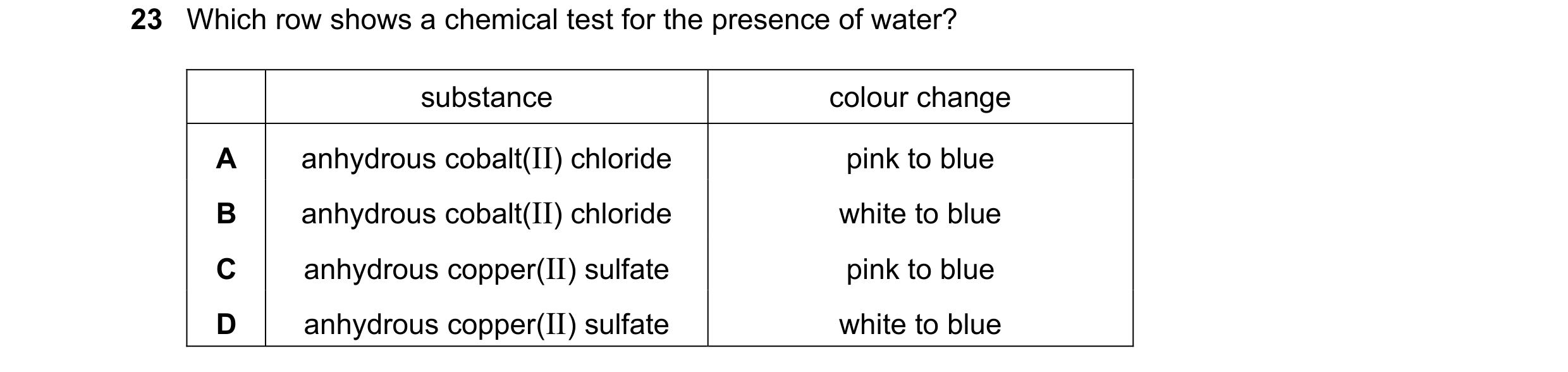
23 Which row shows a chemical test for the presence of water? substance colour change A anhydrous cobalt(II) chloride pink to blue B anhydrous cobalt(II) chloride white to blue C anhydrous copper(II) sulfate pink to blue D anhydrous copper(II) sulfate white to blue
1 marks
Answer: D
This question in 0654/23 May/June 2017
Q5 · When dilute sulfuric acid is added to a metal carbonate, gas M is produced 0654/23 May/June 2019
26 When dilute sulfuric acid is added to a metal carbonate, gas M is produced. What is M? A ammonia B carbon dioxide C hydrogen D sulfur dioxide
1 marks
Answer: B
This question in 0654/23 May/June 2019
Q6 · Which observation shows that a substance is pure water? 0654/22 Oct/Nov 2019
14 Which observation shows that a substance is pure water? A It boils between 100 °C and 102 °C. B It melts at 0 °C and boils at 100 °C. C It turns copper(II) sulfate from white to blue. D It turns cobalt(II) chloride from pink to blue.
1 marks
Answer: B
This question in 0654/22 Oct/Nov 2019
Q7 · A food contains reducing sugar, but no starch 0654/21 May/June 2020
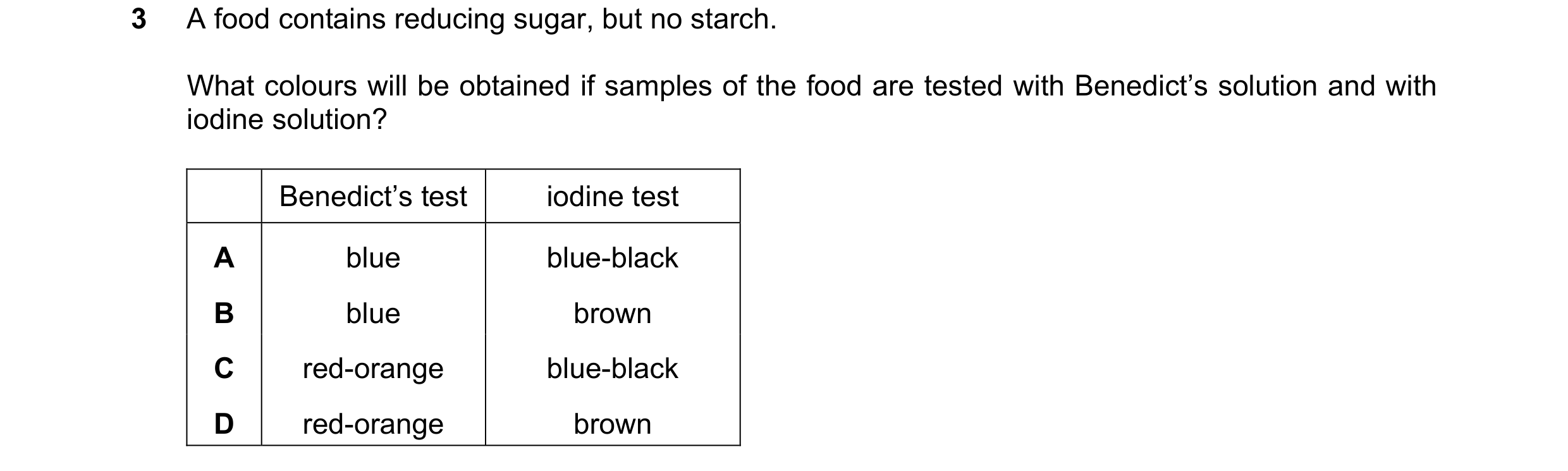
3 A food contains reducing sugar, but no starch. What colours will be obtained if samples of the food are tested with Benedict’s solution and with iodine solution? Benedict’s test iodine test A blue blue-black B blue brown C red-orange blue-black D red-orange brown
1 marks
Answer: D
This question in 0654/21 May/June 2020
Q8 · An experiment using germinating seeds is set up as shown, and left at room temperature… 0654/21 May/June 2020
10 An experiment using germinating seeds is set up as shown, and left at room temperature for 12 hours. to pump solution P solution Q germinating damp peas cotton wool The pump is then switched on and air is drawn through the apparatus for 2 minutes. Which row identifies solutions P and Q and the results obtained? solution P solution P results solution Q solution Q results A ethanol remains colourless ethanol turns milky B ethanol turns milky limewater remains colourless C limewater remains colourless limewater turns milky D limewater turns milky ethanol remains colourless
1 marks
Answer: C
This question in 0654/21 May/June 2020
Q9 · Which chemical test does not produce a precipitate? 0654/21 Oct/Nov 2020
20 Which chemical test does not produce a precipitate? A carbon dioxide and limewater B carbonate ions and dilute hydrochloric acid C chloride ions and aqueous silver nitrate D copper(II) ions and aqueous sodium hydroxide
1 marks
Answer: B
This question in 0654/21 Oct/Nov 2020
Q10 · Substance X is insoluble in water 0654/22 Feb/March 2021
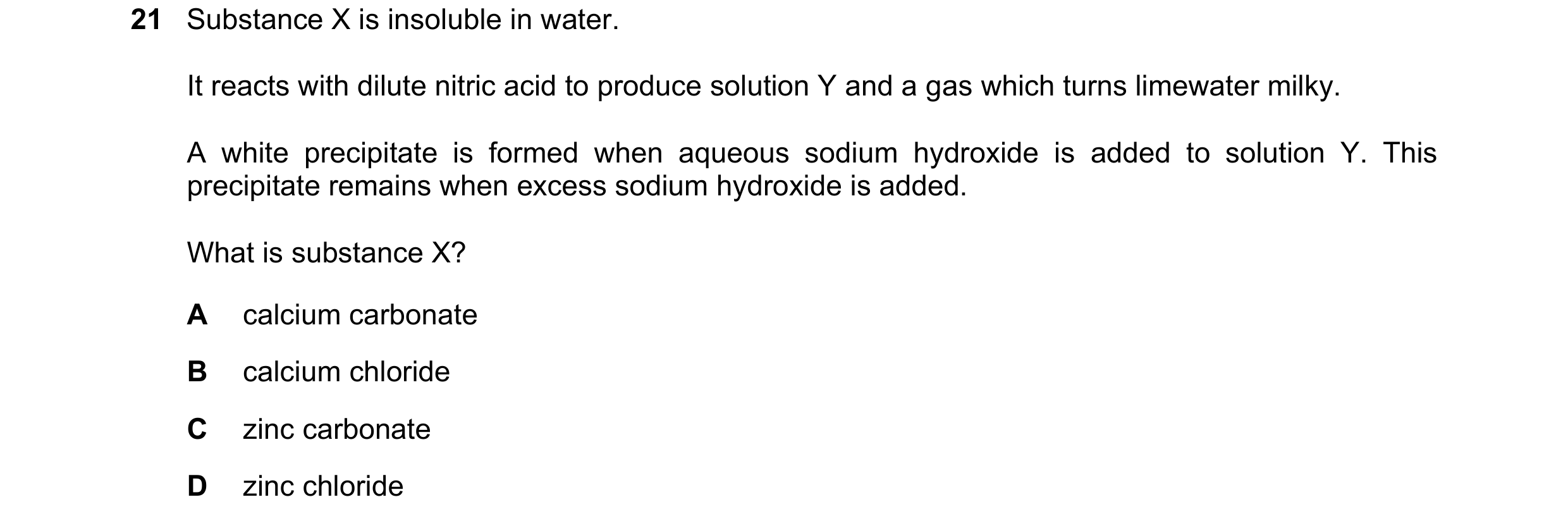
21 Substance X is insoluble in water. It reacts with dilute nitric acid to produce solution Y and a gas which turns limewater milky. A white precipitate is formed when aqueous sodium hydroxide is added to solution Y. This precipitate remains when excess sodium hydroxide is added. What is substance X? A calcium carbonate B calcium chloride C zinc carbonate D zinc chloride
1 marks
Answer: A
This question in 0654/22 Feb/March 2021
Q11 · What is the test for the presence of protein in a food sample? 0654/23 May/June 2021
3 What is the test for the presence of protein in a food sample? A Benedict’s solution B biuret reagent C ethanol emulsion D iodine solution
1 marks
Answer: B
This question in 0654/23 May/June 2021
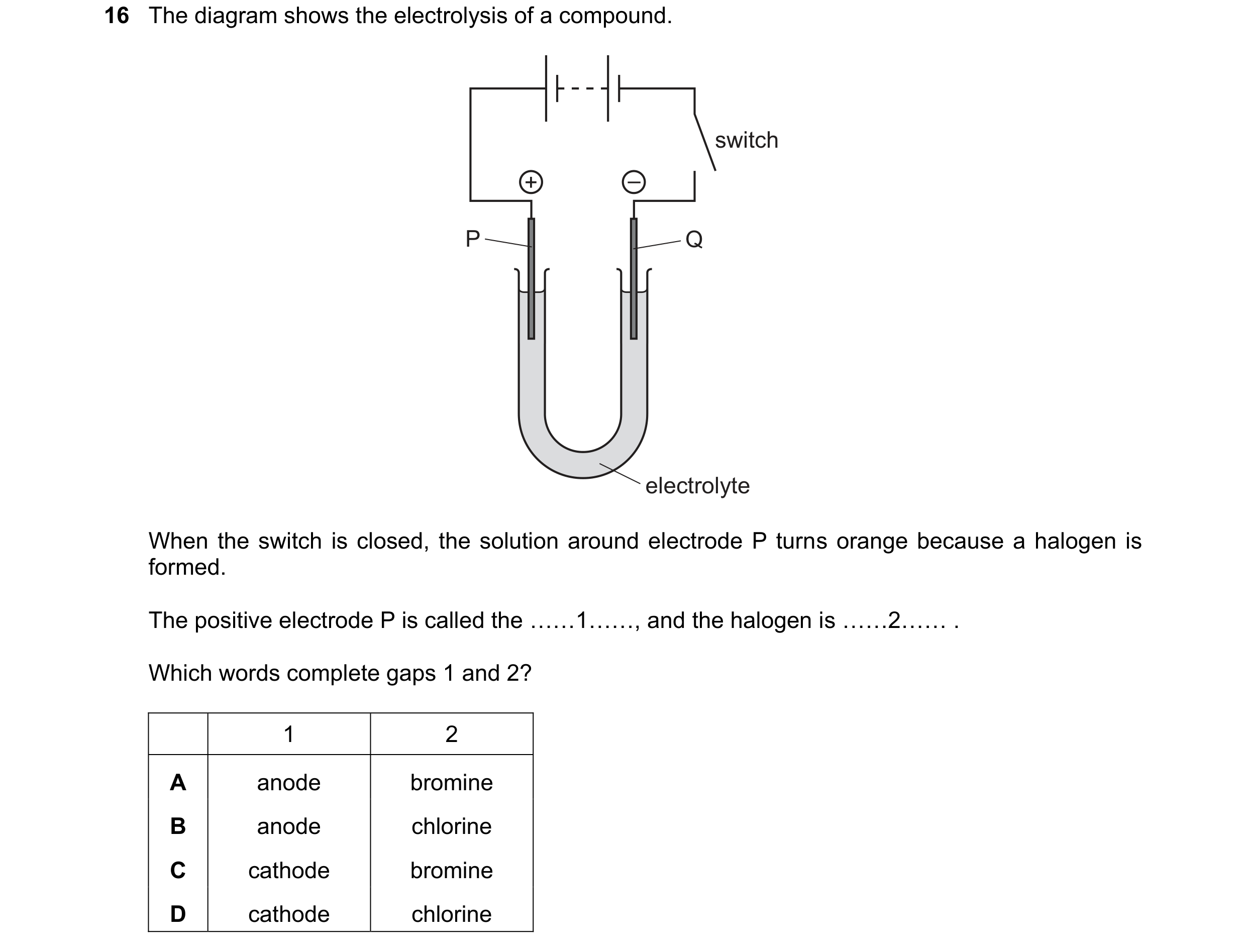
Q12 · The diagram shows the electrolysis of a compound 0654/21 Oct/Nov 2021
16 The diagram shows the electrolysis of a compound. switch + – P Q electrolyte When the switch is closed, the solution around electrode P turns orange because a halogen is formed. The positive electrode P is called the ……1……, and the halogen is ……2…… . Which words complete gaps 1 and 2? 1 2 A anode bromine B anode chlorine C cathode bromine D cathode chlorine
1 marks
Answer: A
This question in 0654/21 Oct/Nov 2021
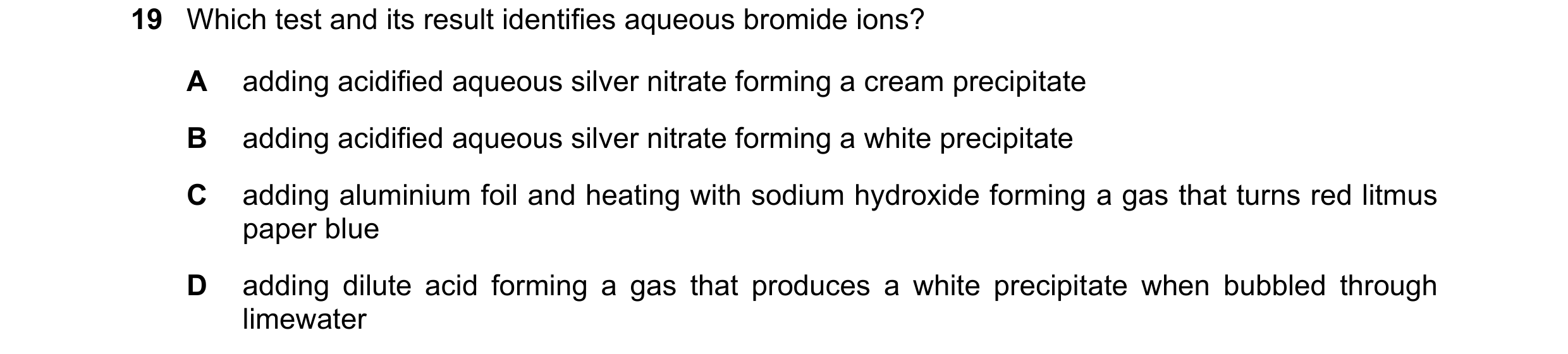
Q13 · Which test and its result identifies aqueous bromide ions? 0654/22 Feb/March 2022
19 Which test and its result identifies aqueous bromide ions? A adding acidified aqueous silver nitrate forming a cream precipitate B adding acidified aqueous silver nitrate forming a white precipitate C adding aluminium foil and heating with sodium hydroxide forming a gas that turns red litmus paper blue D adding dilute acid forming a gas that produces a white precipitate when bubbled through limewater
1 marks
Answer: A
This question in 0654/22 Feb/March 2022
Q14 · Which row shows the flame test colours for lithium and sodium? 0654/21 May/June 2022
19 Which row shows the flame test colours for lithium and sodium? lithium sodium A lilac blue-green B lilac yellow C red blue-green D red yellow
1 marks
Answer: D
This question in 0654/21 May/June 2022
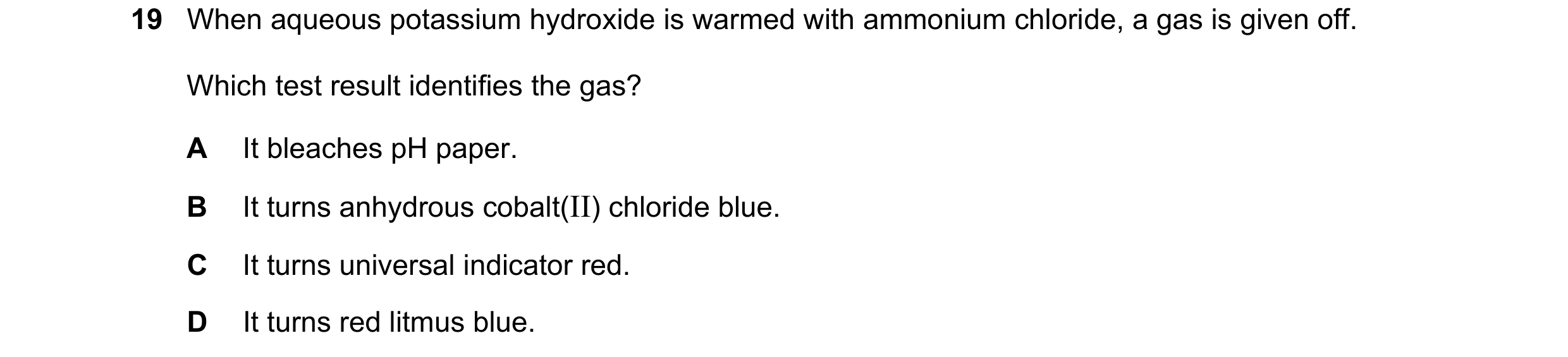
Q15 · When aqueous potassium hydroxide is warmed with ammonium chloride, a gas is given off 0654/22 May/June 2022
19 When aqueous potassium hydroxide is warmed with ammonium chloride, a gas is given off. Which test result identifies the gas? A It bleaches pH paper. B It turns anhydrous cobalt(II) chloride blue. C It turns universal indicator red. D It turns red litmus blue.
1 marks
Answer: D
This question in 0654/22 May/June 2022
Q16 · Four watch-glasses contain solid salts as shown 0654/22 Feb/March 2023
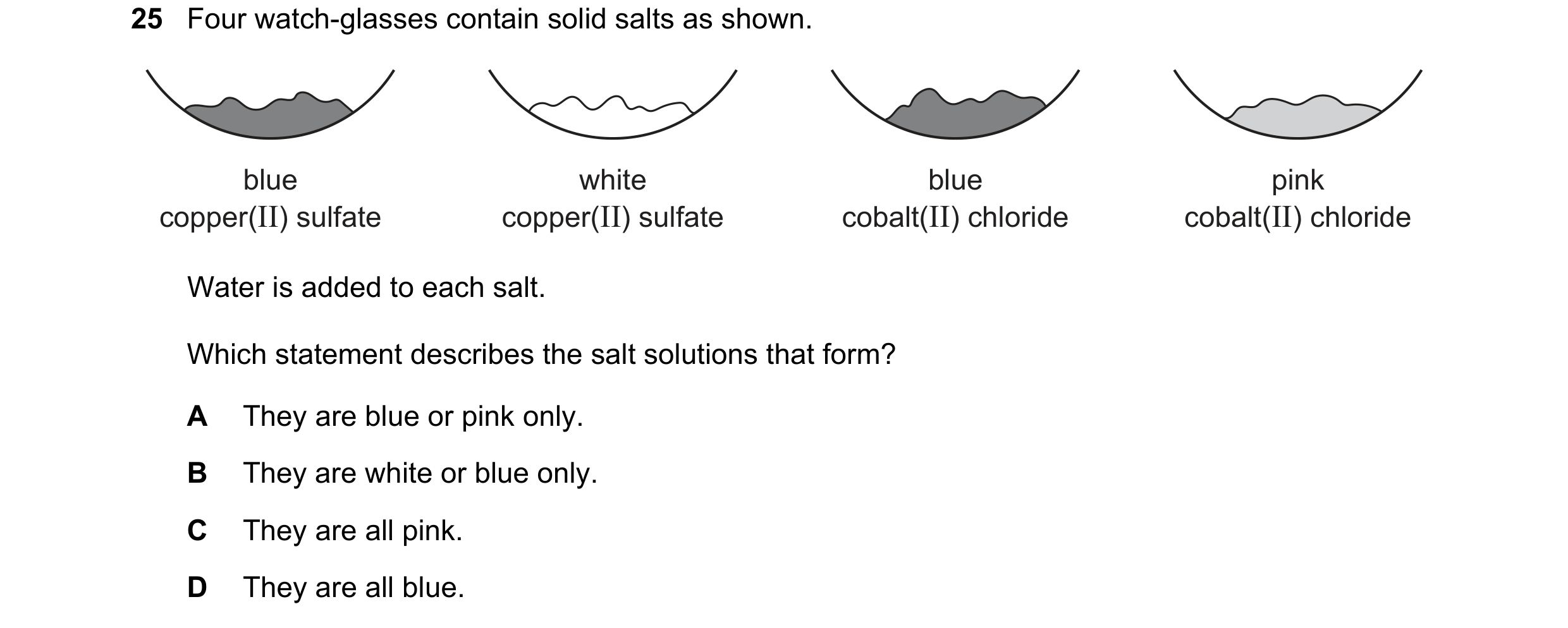
25 Four watch-glasses contain solid salts as shown. blue white blue pink copper(II) sulfate copper(II) sulfate cobalt(II) chloride cobalt(II) chloride Water is added to each salt. Which statement describes the salt solutions that form? A They are blue or pink only. B They are white or blue only. C They are all pink. D They are all blue.
1 marks
Answer: A
This question in 0654/22 Feb/March 2023
Q17 · During fermentation, an organic liquid and a colourless gas are produced 0654/22 Feb/March 2023
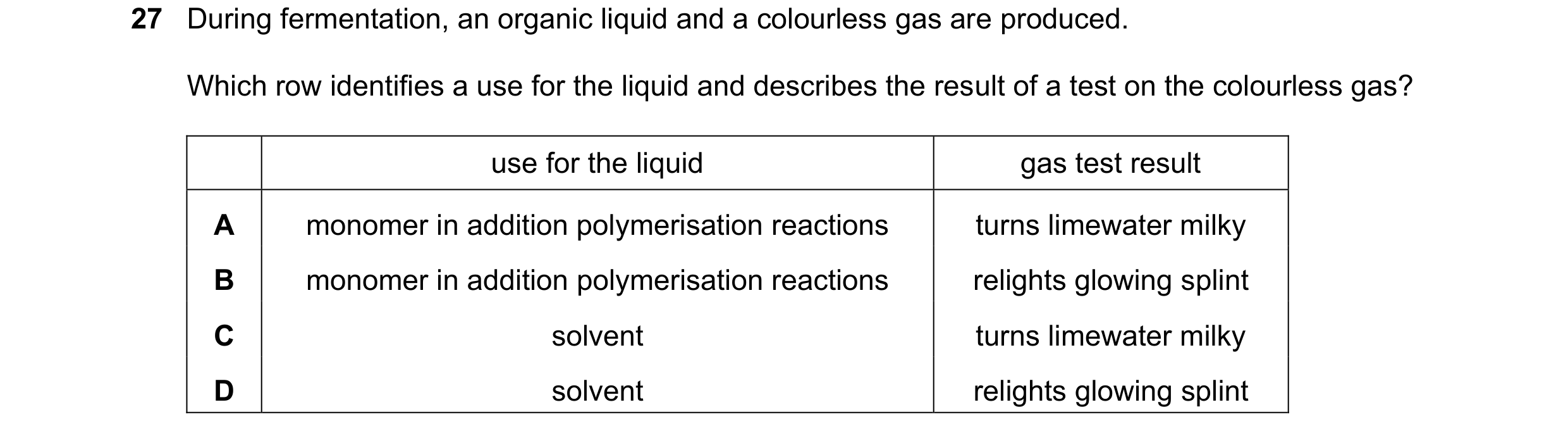
27 During fermentation, an organic liquid and a colourless gas are produced. Which row identifies a use for the liquid and describes the result of a test on the colourless gas? use for the liquid gas test result A monomer in addition polymerisation reactions turns limewater milky B monomer in addition polymerisation reactions relights glowing splint C solvent turns limewater milky D solvent relights glowing splint
1 marks
Answer: C
This question in 0654/22 Feb/March 2023
Q18 · Aqueous potassium bromide reacts with aqueous silver nitrate to produce a cream… 0654/22 May/June 2023
17 Aqueous potassium bromide reacts with aqueous silver nitrate to produce a cream precipitate. What is the ionic equation for this reaction? A Ag+(aq) + Br–(aq) AgBr(s) B Ag2+(aq) + 2Br–(aq) AgBr2(s) C K+(aq) + NO3 –(aq) KNO3(s) D 2K+(aq) + NO3 2–(aq) K2NO3(s)
1 marks
This question in 0654/22 May/June 2023
Q19 · Substance X is mixed with aqueous sodium hydroxide 0654/21 Oct/Nov 2023
21 Substance X is mixed with aqueous sodium hydroxide. A green precipitate is produced. Which metal ion is present in X? A Cu2+ B Fe2+ C Fe3+ D Zn2+
1 marks
Answer: B
This question in 0654/21 Oct/Nov 2023
Q20 · Which food test requires heating? 0654/23 Oct/Nov 2023
3 Which food test requires heating? A fat B protein C reducing sugar D starch
1 marks
Answer: C
This question in 0654/23 Oct/Nov 2023
Q21 · A piece of damp blue litmus paper is put in a test-tube of a gas 0654/23 Oct/Nov 2023
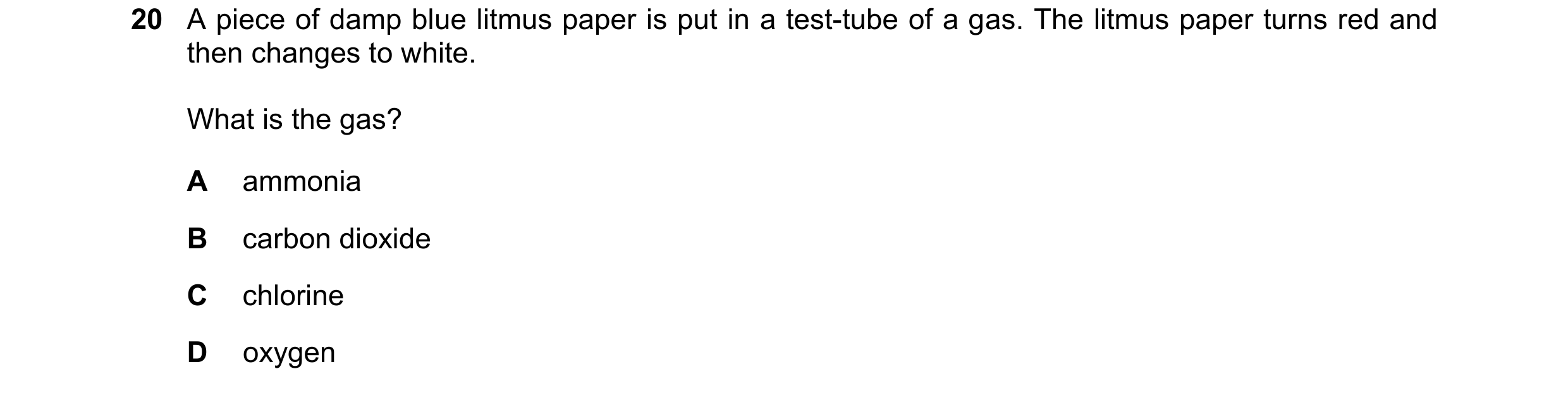
20 A piece of damp blue litmus paper is put in a test-tube of a gas. The litmus paper turns red and then changes to white. What is the gas? A ammonia B carbon dioxide C chlorine D oxygen
1 marks
Answer: C
This question in 0654/23 Oct/Nov 2023
Q22 · What is used to test for ammonia gas? 0654/22 Feb/March 2024
21 What is used to test for ammonia gas? A a lighted splint B aqueous sodium hydroxide C damp red litmus paper D limewater
1 marks
Answer: C
This question in 0654/22 Feb/March 2024
Q23 · Which metal is used in the test for nitrate ions? 0654/21 May/June 2024
22 Which metal is used in the test for nitrate ions? A aluminium B copper C magnesium D tin
1 marks
Answer: A
This question in 0654/21 May/June 2024
Q24 · Ammonia is displaced from its salts by reaction with substance Z 0654/22 May/June 2024
23 Ammonia is displaced from its salts by reaction with substance Z. Which row identifies substance Z and the test for ammonia? substance Z test for ammonia A hydrochloric acid turns red litmus blue B hydrochloric acid turns blue litmus red C sodium hydroxide turns red litmus blue D sodium hydroxide turns blue litmus red
1 marks
Answer: C
This question in 0654/22 May/June 2024
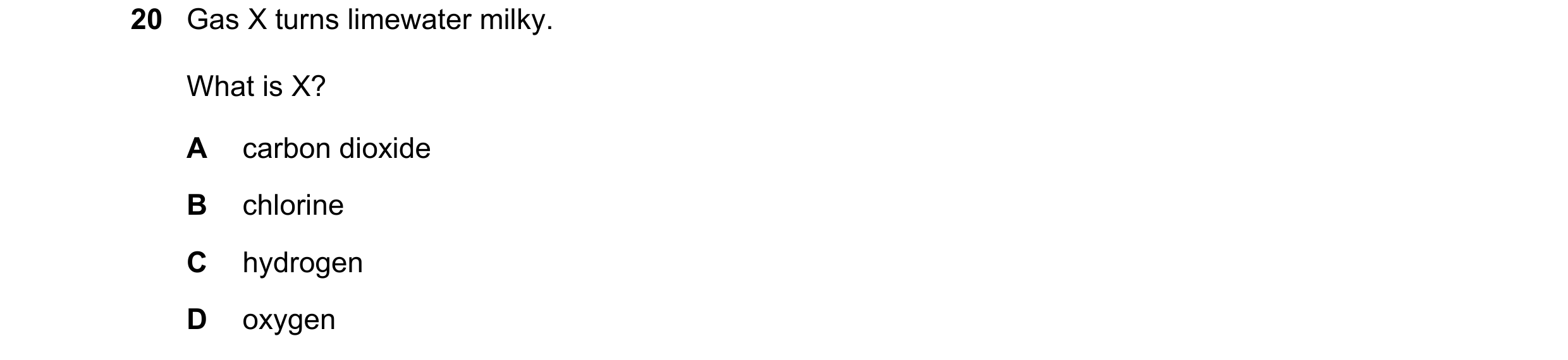
Q25 · Gas X turns limewater milky 0654/23 May/June 2024
20 Gas X turns limewater milky. What is X? A carbon dioxide B chlorine C hydrogen D oxygen
1 marks
Answer: A
This question in 0654/23 May/June 2024
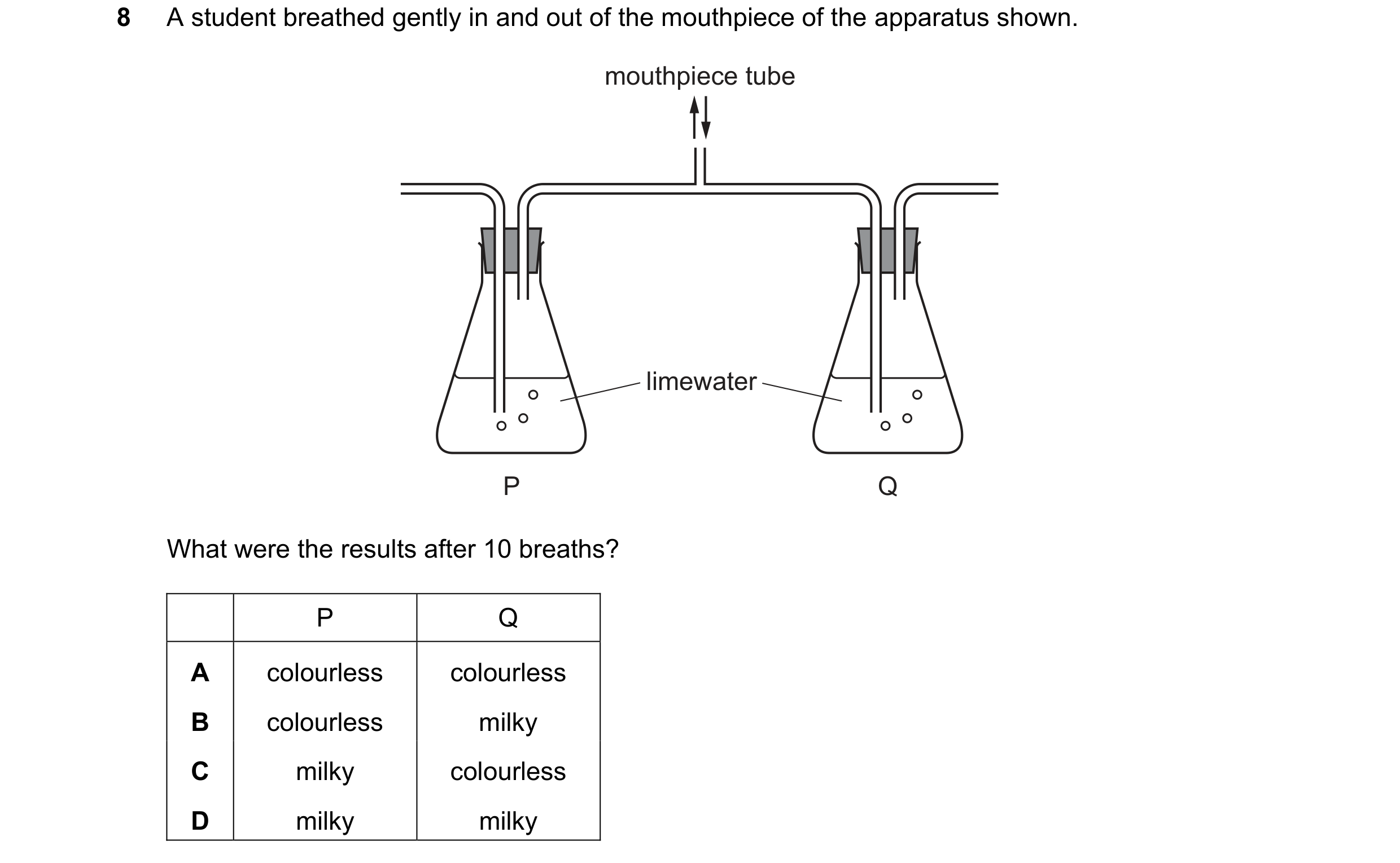
Q26 · A student breathed gently in and out of the mouthpiece of the apparatus shown 0654/21 Oct/Nov 2024
8 A student breathed gently in and out of the mouthpiece of the apparatus shown. mouthpiece tube limewater P Q What were the results after 10 breaths? P Q A colourless colourless B colourless milky C milky colourless D milky milky
1 marks
Answer: B
This question in 0654/21 Oct/Nov 2024
Q27 · In a test for water, water turns anhydrous copper(II) … 1 … from … 2 … to … 3 … 0654/21 Oct/Nov 2024
25 In a test for water, water turns anhydrous copper(II) … 1 … from … 2 … to … 3 … . Which words complete gaps 1, 2 and 3? 1 2 3 A chloride blue white B chloride white blue C sulfate blue white D sulfate white blue
1 marks
Answer: D
This question in 0654/21 Oct/Nov 2024
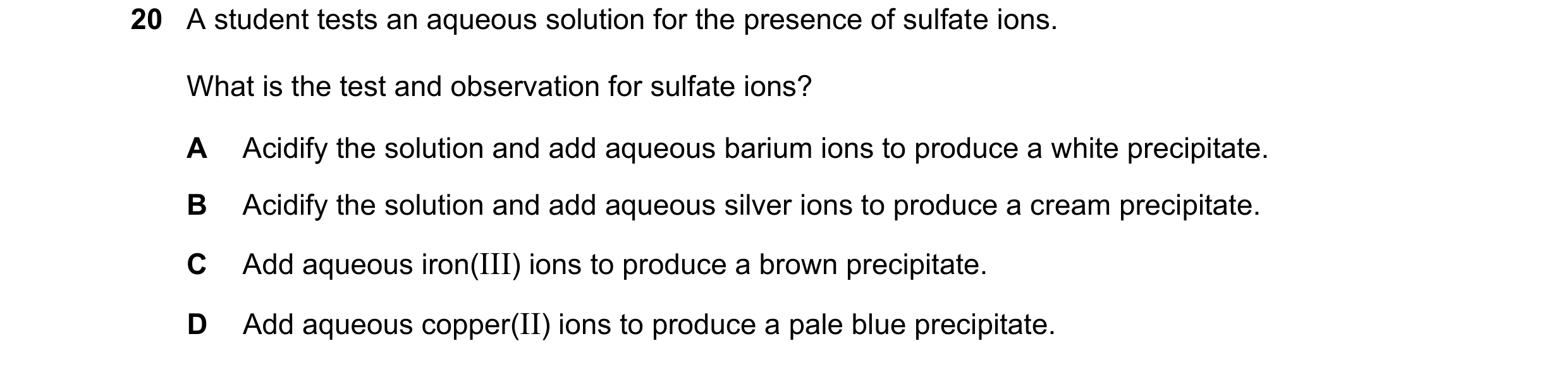
Q28 · A student tests an aqueous solution for the presence of sulfate ions 0654/22 Oct/Nov 2024
20 A student tests an aqueous solution for the presence of sulfate ions. What is the test and observation for sulfate ions? A Acidify the solution and add aqueous barium ions to produce a white precipitate. B Acidify the solution and add aqueous silver ions to produce a cream precipitate. C Add aqueous iron(III) ions to produce a brown precipitate. D Add aqueous copper(II) ions to produce a pale blue precipitate.
1 marks
Answer: A
This question in 0654/22 Oct/Nov 2024
Q29 · What is warmed with a salt to test for ammonium ions? 0654/23 Oct/Nov 2024
21 What is warmed with a salt to test for ammonium ions? A aqueous barium chloride B aqueous litmus C aqueous silver nitrate D aqueous sodium hydroxide
1 marks
Answer: D
This question in 0654/23 Oct/Nov 2024
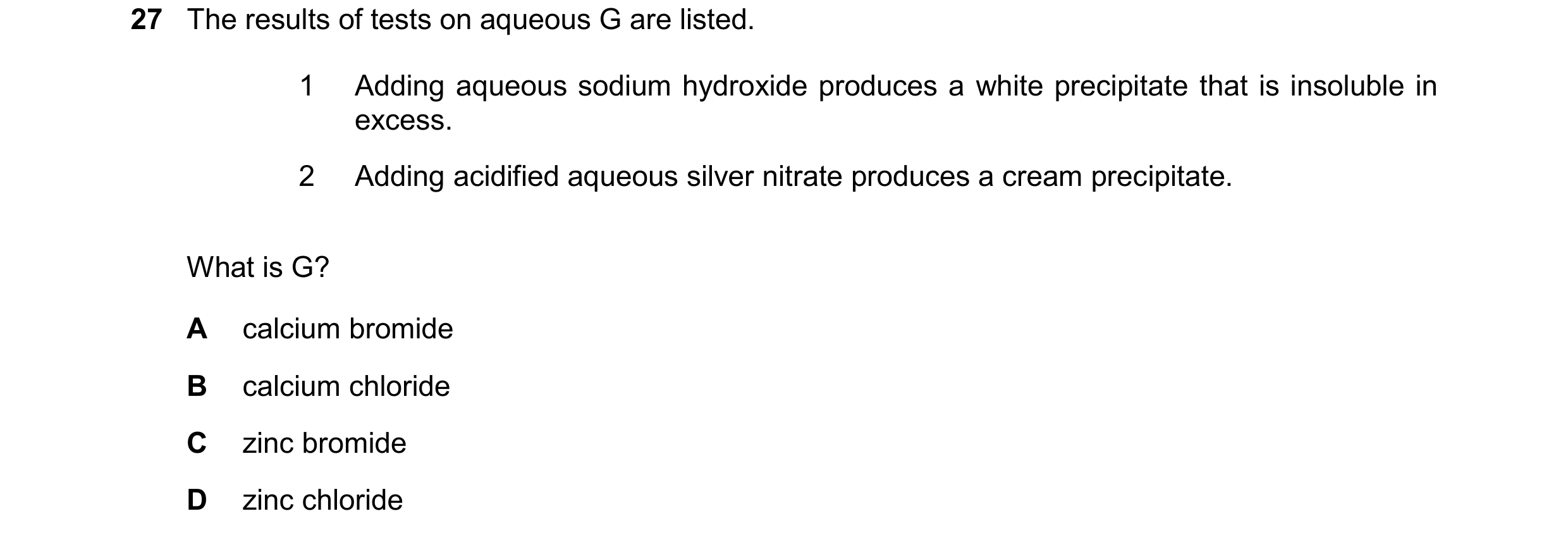
Q30 · The results of tests on aqueous G are listed 0654/21 Oct/Nov 2025
27 The results of tests on aqueous G are listed. 1 Adding aqueous sodium hydroxide produces a white precipitate that is insoluble in excess. 2 Adding acidified aqueous silver nitrate produces a cream precipitate. What is G? A calcium bromide B calcium chloride C zinc bromide D zinc chloride
1 marks
Answer: A
This question in 0654/21 Oct/Nov 2025
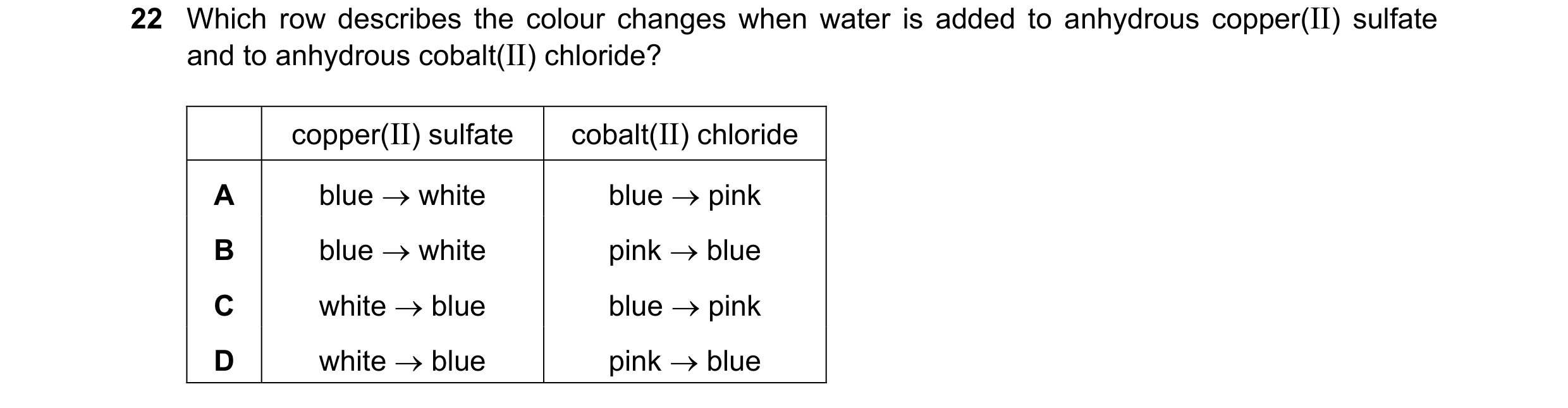
Q31 · Which row describes the colour changes when water is added to anhydrous copper(II)… 0654/23 Oct/Nov 2025
22 Which row describes the colour changes when water is added to anhydrous copper(II) sulfate and to anhydrous cobalt(II) chloride? copper(II) sulfate cobalt(II) chloride A blue white blue pink B blue white pink blue C white blue blue pink D white blue pink blue
1 marks
Answer: C
This question in 0654/23 Oct/Nov 2025
 1 / 8
1 / 8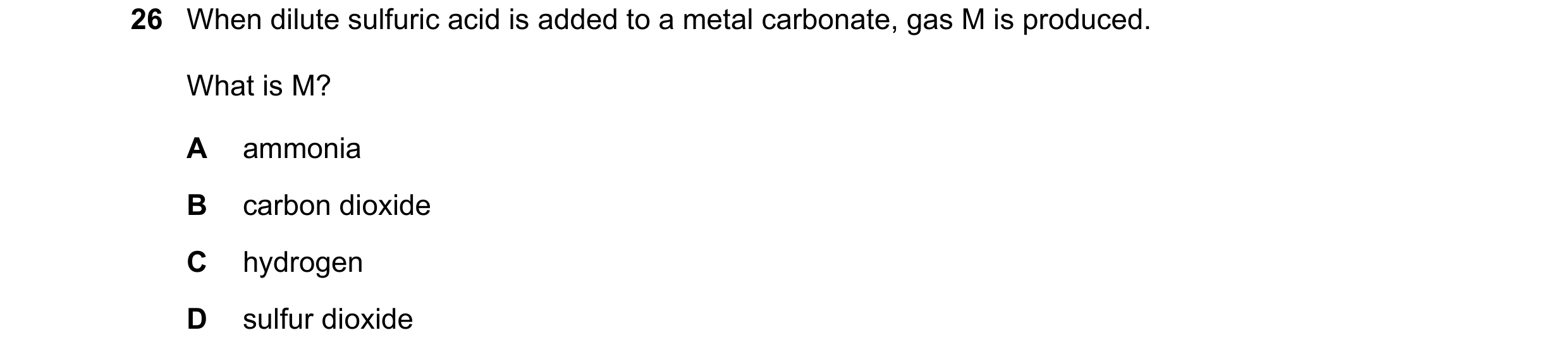

 2 / 8
2 / 8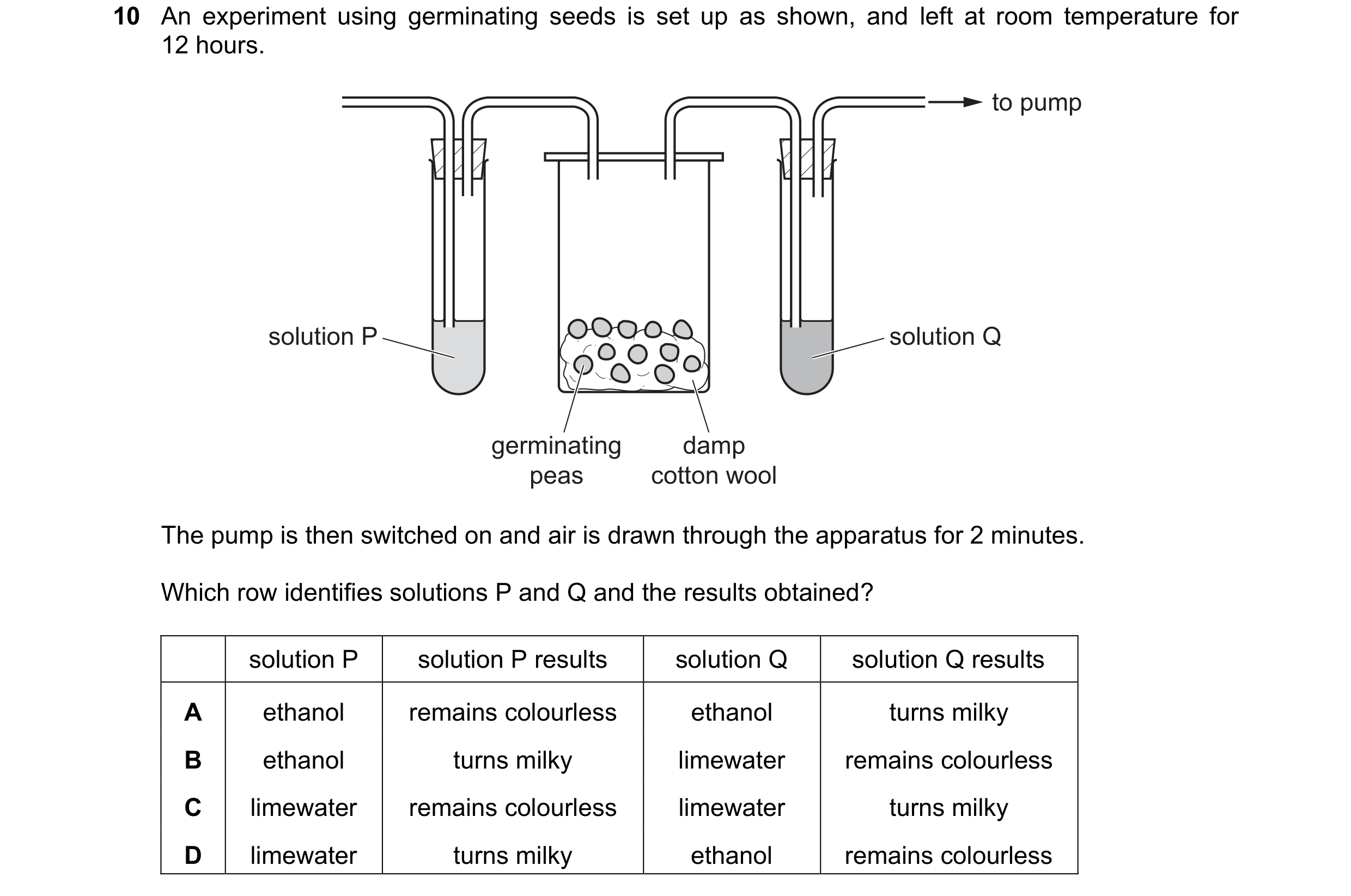

 3 / 8
3 / 8
 4 / 8
4 / 8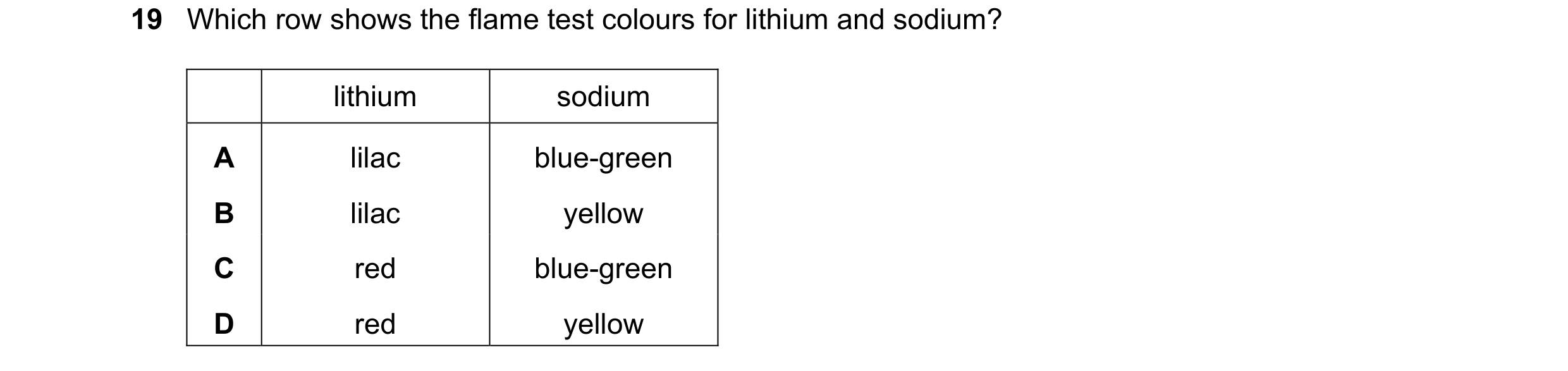
 5 / 8
5 / 8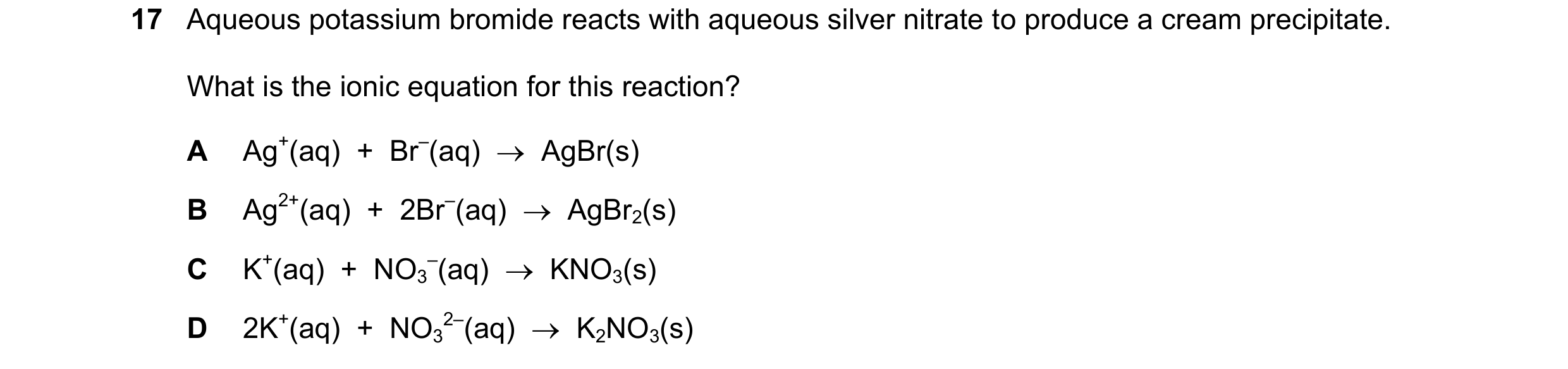



 6 / 8
6 / 8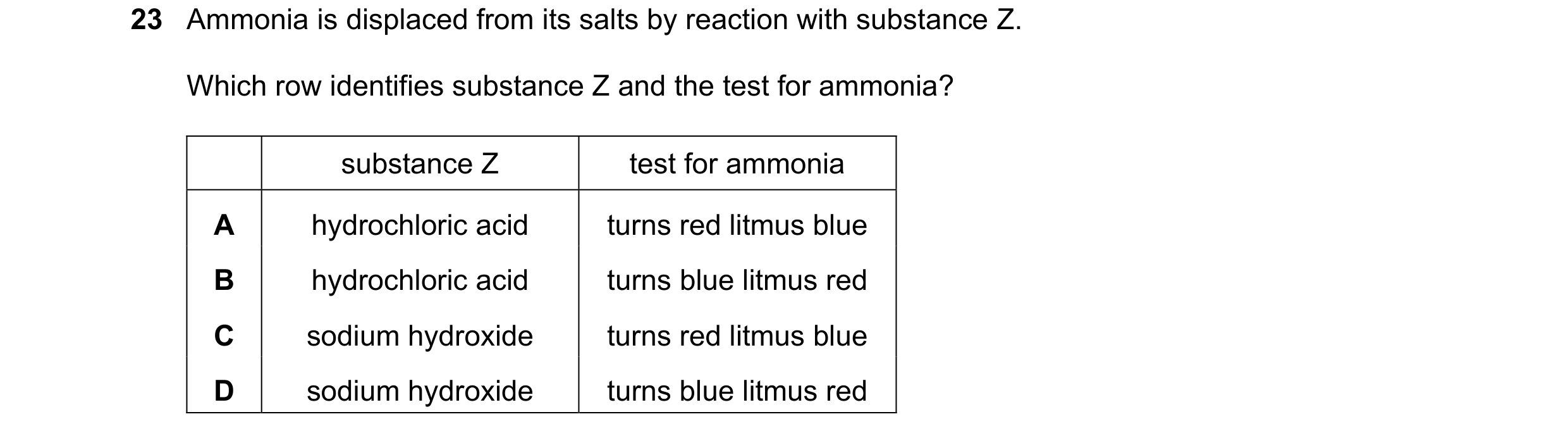
 7 / 8
7 / 8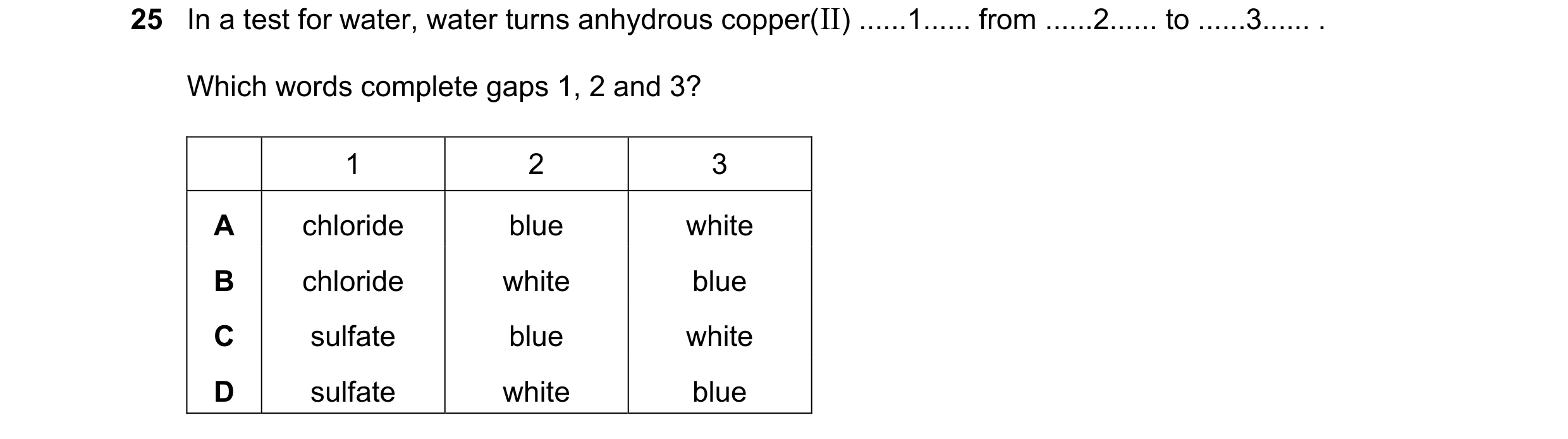

 8 / 8
8 / 8