Questions as text
Q1 · Black ink in marker pens is a mixture of several dyes (coloured compounds) 0654/33 May/June 2017
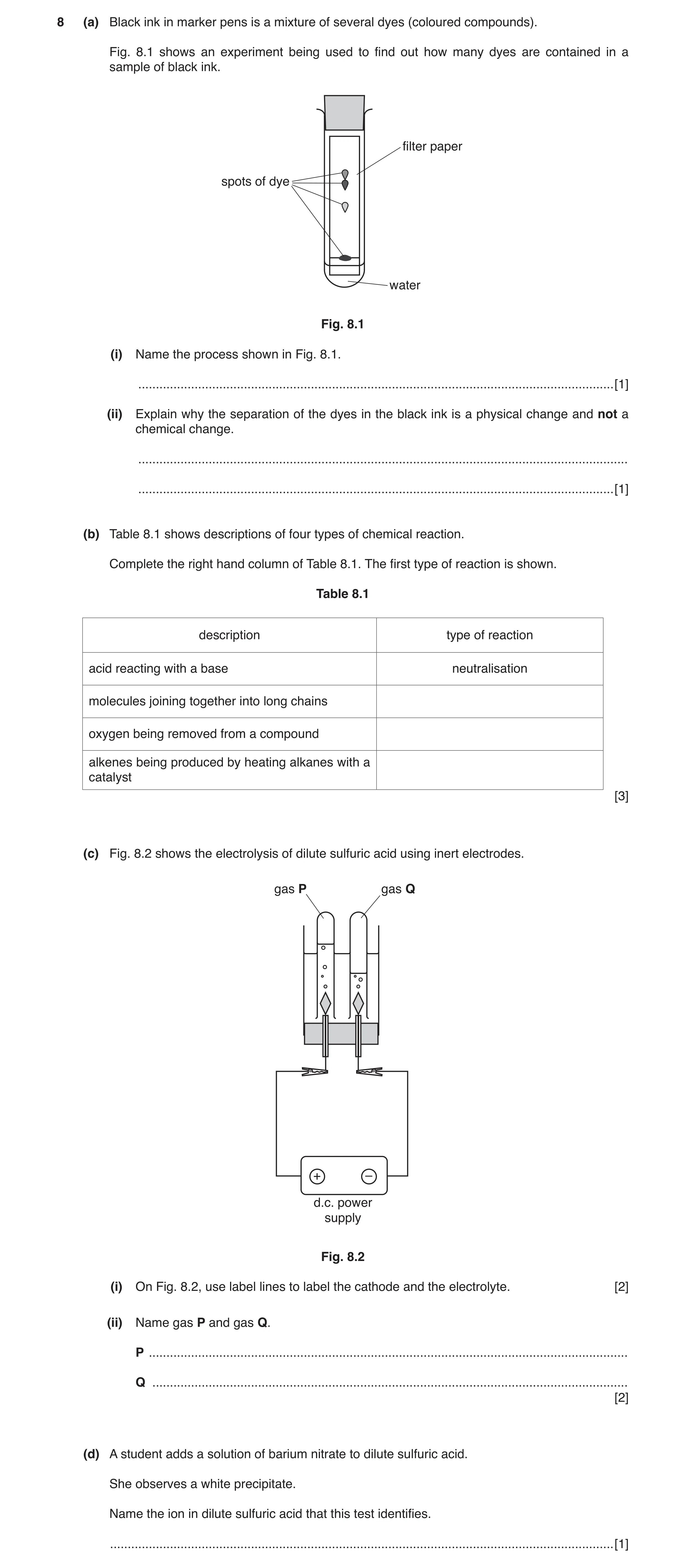
8 (a) Black ink in marker pens is a mixture of several dyes (coloured compounds). Fig. 8.1 shows an experiment being used to find out how many dyes are contained in a sample of black ink. filter paper spots of dye water Fig. 8.1 (i) Name the process shown in Fig. 8.1. … [1] (ii) Explain why the separation of the dyes in the black ink is a physical change and not a chemical change. … … [1] (b) Table 8.1 shows descriptions of four types of chemical reaction. Complete the right hand column of Table 8.1. The first type of reaction is shown. Table 8.1 description type of reaction acid reacting with a base neutralisation molecules joining together into long chains oxygen being removed from a compound alkenes being produced by heating alkanes with a catalyst [3] (c) Fig. 8.2 shows the electrolysis of dilute sulfuric acid using inert electrodes. gas P gas Q + – d.c. power supply Fig. 8.2 (i) On Fig. 8.2, use label lines to label the cathode and the electrolyte. [2] (ii) Name gas P and gas Q. P … Q … [2] (d) A student adds a solution of barium nitrate to dilute sulfuric acid. She observes a white precipitate. Name the ion in dilute sulfuric acid that this test identifies. … [1]
10 marks
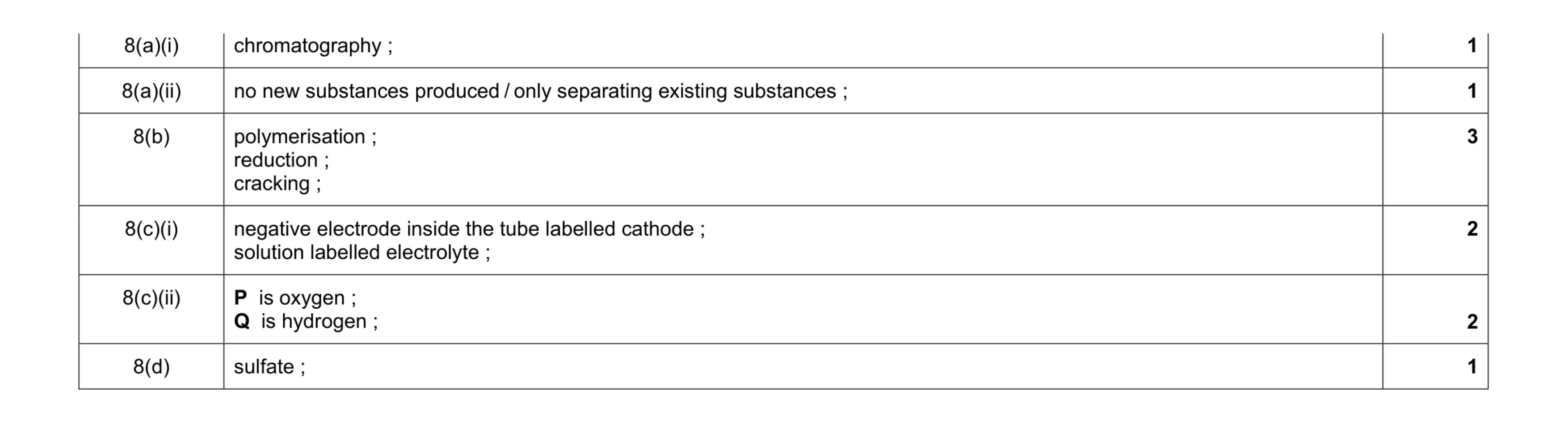
Mark scheme: 8(a)(i) chromatography ; 1 8(a)(ii) no new substances produced / only separating existing substances ; 1 8(b) polymerisation ; reduction ; cracking ; 3 8(c)(i) negative electrode inside the tube labelled cathode ; solution labelled electrolyte ; 2 8(c)(ii) P is oxygen ; Q is hydrogen ; 2 8(d) sulfate ; 1
This question in 0654/33 May/June 2017
Q2 · Apparatus a student uses to collect the gas that is made when a solid reacts with a liquid 0654/31 Oct/Nov 2017
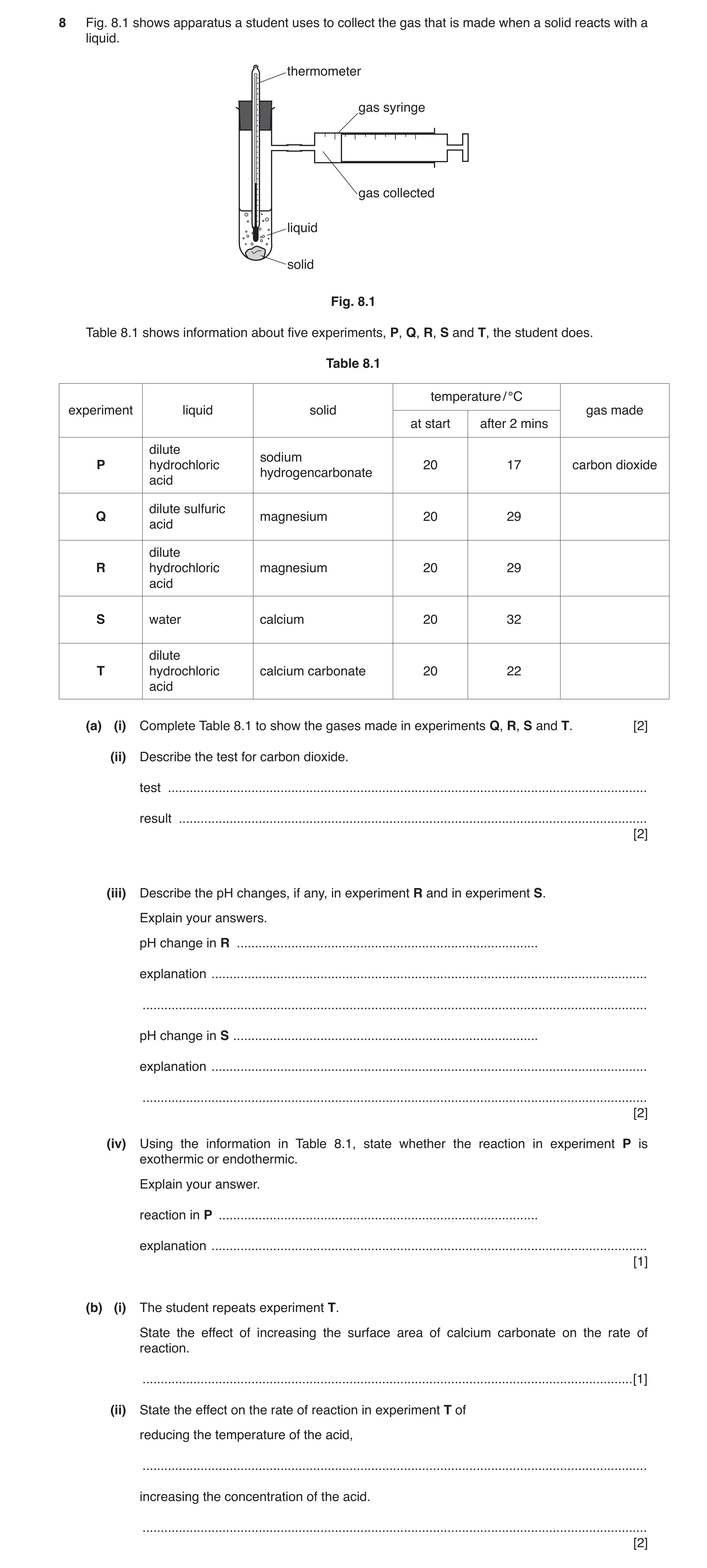
8 Fig. 8.1 shows apparatus a student uses to collect the gas that is made when a solid reacts with a liquid. thermometer gas syringe gas collected liquid solid Fig. 8.1 Table 8.1 shows information about five experiments, P, Q, R, S and T, the student does. Table 8.1 temperature / °C experiment liquid solid gas made at start after 2 mins dilute sodium P hydrochloric 20 17 carbon dioxide hydrogencarbonate acid dilute sulfuric Q magnesium 20 29 acid dilute R hydrochloric magnesium 20 29 acid S water calcium 20 32 dilute T hydrochloric calcium carbonate 20 22 acid (a) (i) Complete Table 8.1 to show the gases made in experiments Q, R, S and T. [2] (ii) Describe the test for carbon dioxide. test … result … [2] (iii) Describe the pH changes, if any, in experiment R and in experiment S. Explain your answers. pH change in R … explanation … … pH change in S … explanation … … [2] (iv) Using the information in Table 8.1, state whether the reaction in experiment P is exothermic or endothermic. Explain your answer. reaction in P … explanation … [1] (b) (i) The student repeats experiment T. State the effect of increasing the surface area of calcium carbonate on the rate of reaction. … [1] (ii) State the effect on the rate of reaction in experiment T of reducing the temperature of the acid, … increasing the concentration of the acid. … [2]
10 marks
Mark scheme: 8(a)(i) Q hydrogen R hydrogen S hydrogen T carbon dioxide 2 or 3 correct ; 4 correct ; 2 8(a)(ii) limewater ; goes milky ; 2 8(a)(iii) R increases AND acid is being used up / acid concentration is decreasing ; S increases AND reaction produces an alkaline product / calcium hydroxide concentration increases ; 2 Question Answer Marks 8(a)(iv) endothermic (because) temperature decreases / thermal energy taken in ; 1 8(b)(i) increases ; 1 8(b)(ii) rate decreases ; rate increases ; 2
This question in 0654/31 Oct/Nov 2017
Q3 · Information about some of the elements in Group VII of the Periodic Table 0654/33 Oct/Nov 2018
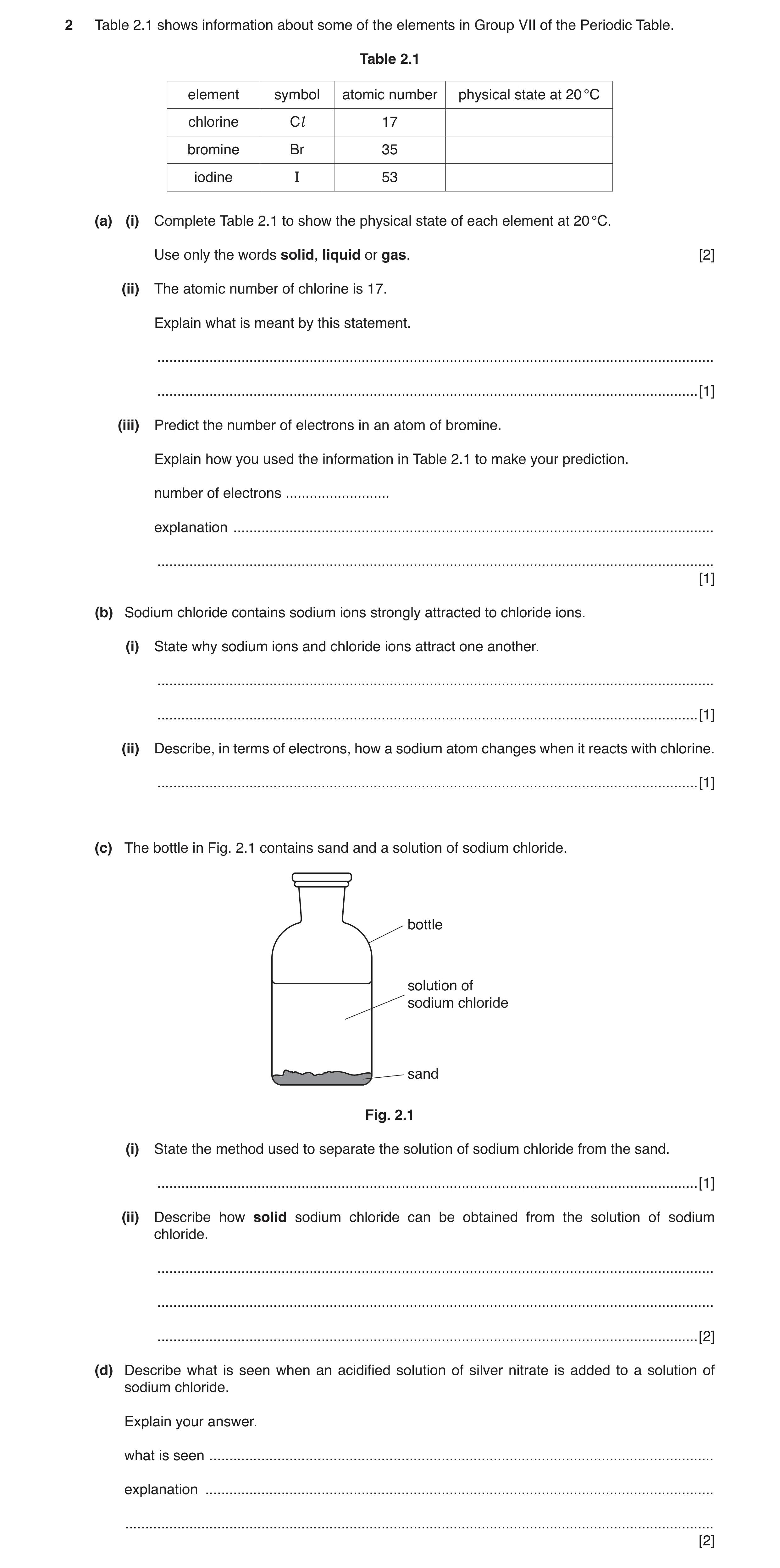
2 Table 2.1 shows information about some of the elements in Group VII of the Periodic Table. Table 2.1 element symbol atomic number physical state at 20 °C chlorine Cl 17 bromine Br 35 iodine I 53 (a) (i) Complete Table 2.1 to show the physical state of each element at 20 °C. Use only the words solid, liquid or gas. [2] (ii) The atomic number of chlorine is 17. Explain what is meant by this statement. … … [1] (iii) Predict the number of electrons in an atom of bromine. Explain how you used the information in Table 2.1 to make your prediction. number of electrons … explanation … … [1] (b) Sodium chloride contains sodium ions strongly attracted to chloride ions. (i) State why sodium ions and chloride ions attract one another. … … [1] (ii) Describe, in terms of electrons, how a sodium atom changes when it reacts with chlorine. … [1] (c) The bottle in Fig. 2.1 contains sand and a solution of sodium chloride. bottle solution of sodium chloride sand Fig. 2.1 (i) State the method used to separate the solution of sodium chloride from the sand. … [1] (ii) Describe how solid sodium chloride can be obtained from the solution of sodium chloride. … … … [2] (d) Describe what is seen when an acidified solution of silver nitrate is added to a solution of sodium chloride. Explain your answer. what is seen … explanation … … [2]
11 marks
Mark scheme: 2(a)(i) gas liquid solid 1 or 2 correct ; 3 correct ; 2 2(a)(ii) chlorine atoms contain 17 protons ; 1 2(a)(iii) (35) number of electrons equal to number of protons / atomic number ; 1 2(b)(i) they have opposite electrical charges / opposite charges attract ; 1 2(b)(ii) outer electron is lost (from sodium) / it is transferred to the chlorine atom ; 1 2(c)(i) filtration / decantation ; 1 2(c)(ii) heat (solution) ; so all water evaporates / leave to evaporate ; 2 2(d) white precipitate / goes cloudy ; solution contains chloride (anions) / this is the chloride ion test / silver chloride is insoluble ; 2
This question in 0654/33 Oct/Nov 2018
Q4 · A student adds dilute sulfuric acid to four different solids in test-tubes H, I, J and K… 0654/31 Oct/Nov 2019
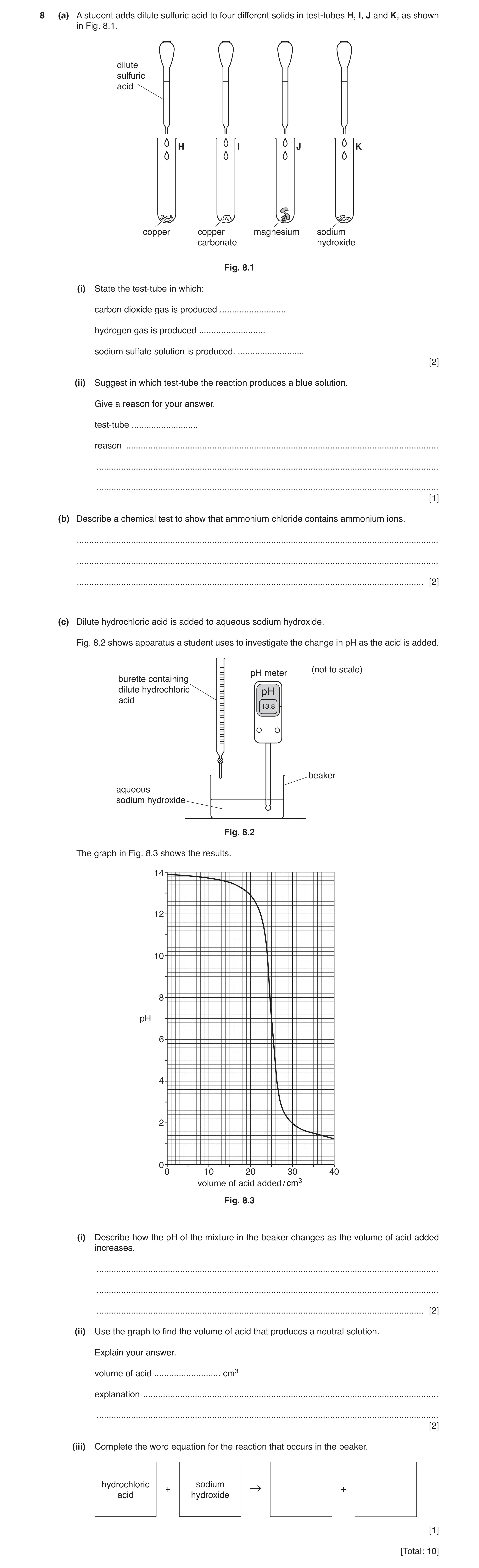
8 (a) A student adds dilute sulfuric acid to four different solids in test-tubes H, I, J and K, as shown in Fig. 8.1. dilute sulfuric acid H I J K copper copper magnesium sodium carbonate hydroxide Fig. 8.1 (i) State the test-tube in which: carbon dioxide gas is produced … hydrogen gas is produced … sodium sulfate solution is produced. … [2] (ii) Suggest in which test-tube the reaction produces a blue solution. Give a reason for your answer. test-tube … reason … … … [1] (b) Describe a chemical test to show that ammonium chloride contains ammonium ions. … … … [2] (c) Dilute hydrochloric acid is added to aqueous sodium hydroxide. Fig. 8.2 shows apparatus a student uses to investigate the change in pH as the acid is added. (not to scale) pH meter burette containing dilute hydrochloric pH acid 13.8 beaker aqueous sodium hydroxide Fig. 8.2 The graph in Fig. 8.3 shows the results. 14 12 10 8 pH 6 4 2 00 10 20 30 40 volume of acid added / cm3 Fig. 8.3 (i) Describe how the pH of the mixture in the beaker changes as the volume of acid added increases. … … … [2] (ii) Use the graph to find the volume of acid that produces a neutral solution. Explain your answer. volume of acid … cm3 explanation … … [2] (iii) Complete the word equation for the reaction that occurs in the beaker. hydrochloric sodium + + acid hydroxide [1] [Total: 10]
10 marks
Mark scheme: 8(a)(i) I J K ;; 2 8(a)(ii) (I) copper sulfate produced which is blue / a compound of a transition metal is produced which is coloured ; 1 8(b) add sodium hydroxide solution and warm ; ammonia released / gas turning (damp) red litmus to blue released ; 2 8(c)(i) pH decreases ; description of shape / use of data; 2 8(c)(ii) 25 (cm3) ; this volume produces mixture with pH 7 / working shown on graph ; 2 8(c)(iii) sodium chloride and water ; 1
This question in 0654/31 Oct/Nov 2019
Q5 · Carbon occurs as a free element in the Earth’s crust 0654/31 Oct/Nov 2020
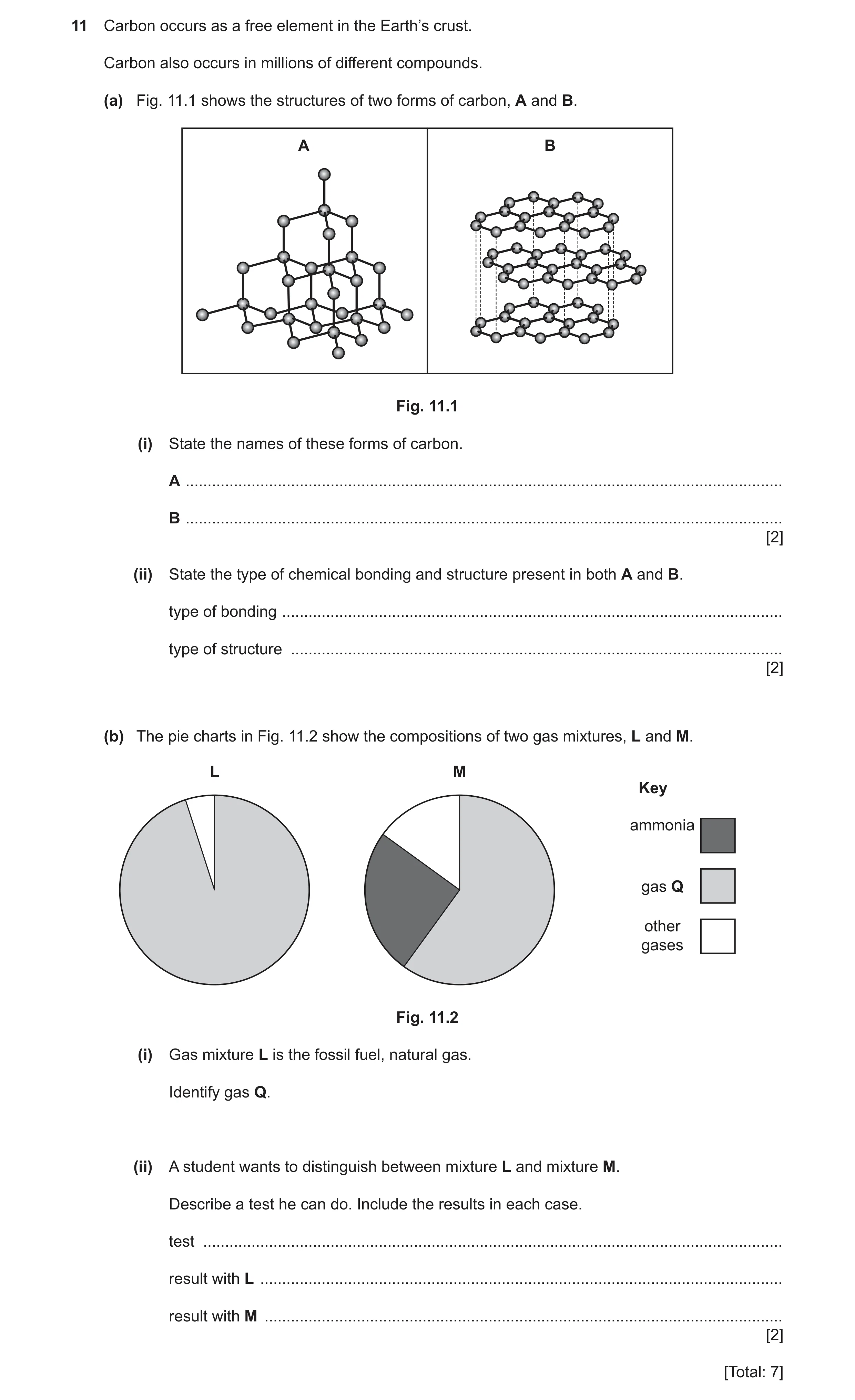
11 Carbon occurs as a free element in the Earth’s crust. Carbon also occurs in millions of different compounds. (a) Fig. 11.1 shows the structures of two forms of carbon, A and B. A B Fig. 11.1 (i) State the names of these forms of carbon. A ���������������������������������������������������������������������������������������������������������������������������������������� B ���������������������������������������������������������������������������������������������������������������������������������������� [2] (ii) State the type of chemical bonding and structure present in both A and B. type of bonding ������������������������������������������������������������������������������������������������������������������ type of structure ���������������������������������������������������������������������������������������������������������������� [2] (b) The pie charts in Fig. 11.2 show the compositions of two gas mixtures, L and M. L M Key ammonia gas Q other gases Fig. 11.2 (i) Gas mixture L is the fossil fuel, natural gas. Identify gas Q. (ii) A student wants to distinguish between mixture L and mixture M. Describe a test he can do. Include the results in each case. test ������������������������������������������������������������������������������������������������������������������������������������ result with L ����������������������������������������������������������������������������������������������������������������������� result with M ���������������������������������������������������������������������������������������������������������������������� [2] [Total: 7]
7 marks
Mark scheme: 11(a)(i) A is diamond ; B is graphite ; 2 11(a)(ii) covalent (bonding) ; giant (structure) / macromolecule ; 2 11(b)(i) methane / CH4 ; 1 11(b)(ii) damp, red litmus paper ; no reaction with L and turns blue with M ; 2
This question in 0654/31 Oct/Nov 2020
Q6 · The halogens chlorine, bromine and iodine are in Group VII of the Periodic Table 0654/32 Oct/Nov 2020
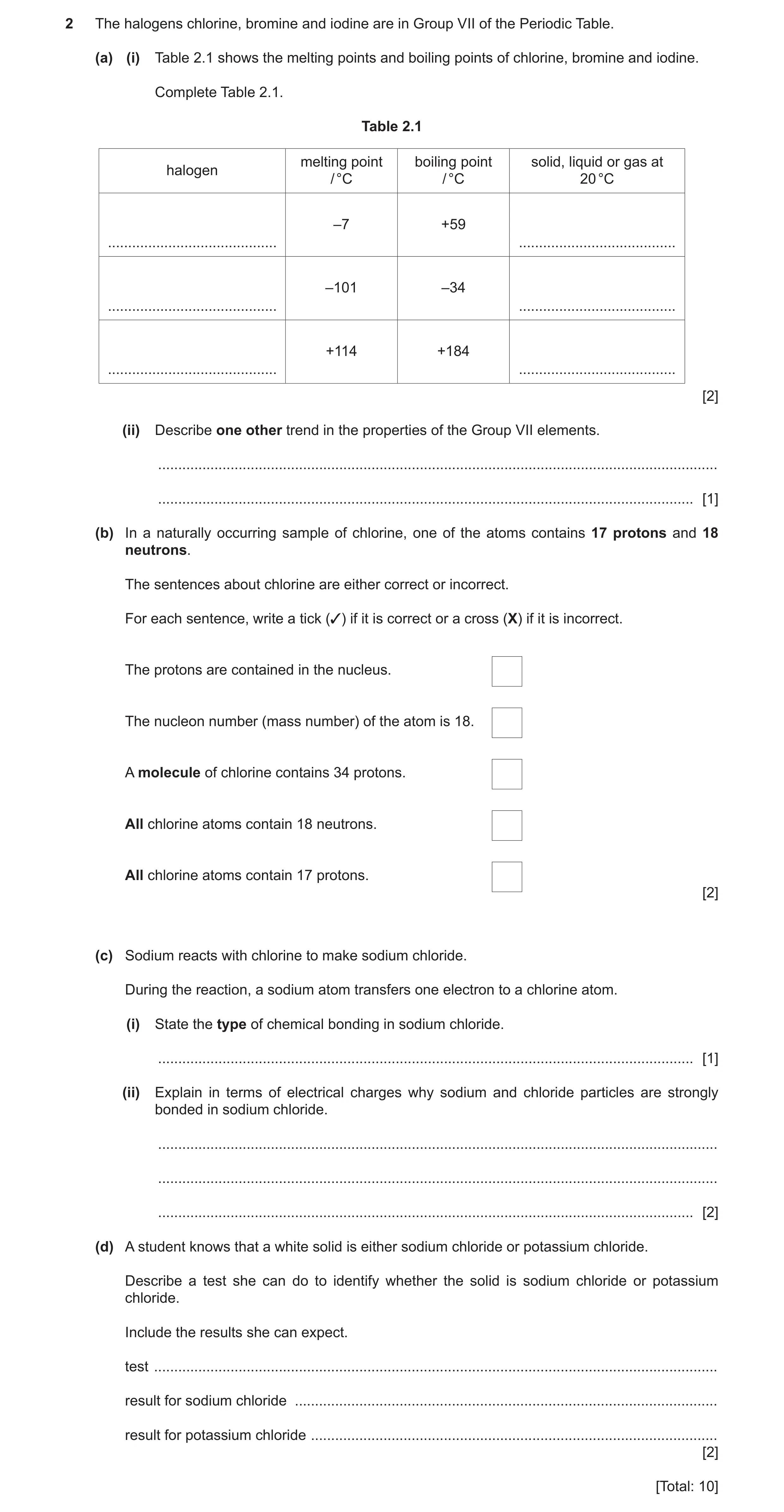
2 The halogens chlorine, bromine and iodine are in Group VII of the Periodic Table. (a) (i) Table 2.1 shows the melting points and boiling points of chlorine, bromine and iodine. Complete Table 2.1. Table 2.1 melting point boiling point solid, liquid or gas at halogen / °C / °C 20 °C –7 +59 … … –101 –34 … … +114 +184 … … [2] (ii) Describe one other trend in the properties of the Group VII elements. … … [1] (b) In a naturally occurring sample of chlorine, one of the atoms contains 17 protons and 18 neutrons. The sentences about chlorine are either correct or incorrect. For each sentence, write a tick (3) if it is correct or a cross (X) if it is incorrect. The protons are contained in the nucleus. The nucleon number (mass number) of the atom is 18. A molecule of chlorine contains 34 protons. All chlorine atoms contain 18 neutrons. All chlorine atoms contain 17 protons. [2] (c) Sodium reacts with chlorine to make sodium chloride. During the reaction, a sodium atom transfers one electron to a chlorine atom. (i) State the type of chemical bonding in sodium chloride. … [1] (ii) Explain in terms of electrical charges why sodium and chloride particles are strongly bonded in sodium chloride. … … … [2] (d) A student knows that a white solid is either sodium chloride or potassium chloride. Describe a test she can do to identify whether the solid is sodium chloride or potassium chloride. Include the results she can expect. test … result for sodium chloride … result for potassium chloride … [2] [Total: 10]
10 marks
Mark scheme: 2(a)(i) bromine and liquid chlorine and gas iodine and solid ;; 2 2(a)(ii) colour becomes darker down the group / owtte ; 1 2(b) ;; 2 2(c)(i) ionic; 1 2(c)(ii) the idea that the ions / particles of both elements have opposite electrical charges ; opposite electrical charges attract ; 2 2(d) ref to flame (test); sodium gives yellow flame / potassium gives lilac flame ;
This question in 0654/32 Oct/Nov 2020
Q7 · Carbon occurs as a free element in the Earth’s crust 0654/33 Oct/Nov 2020
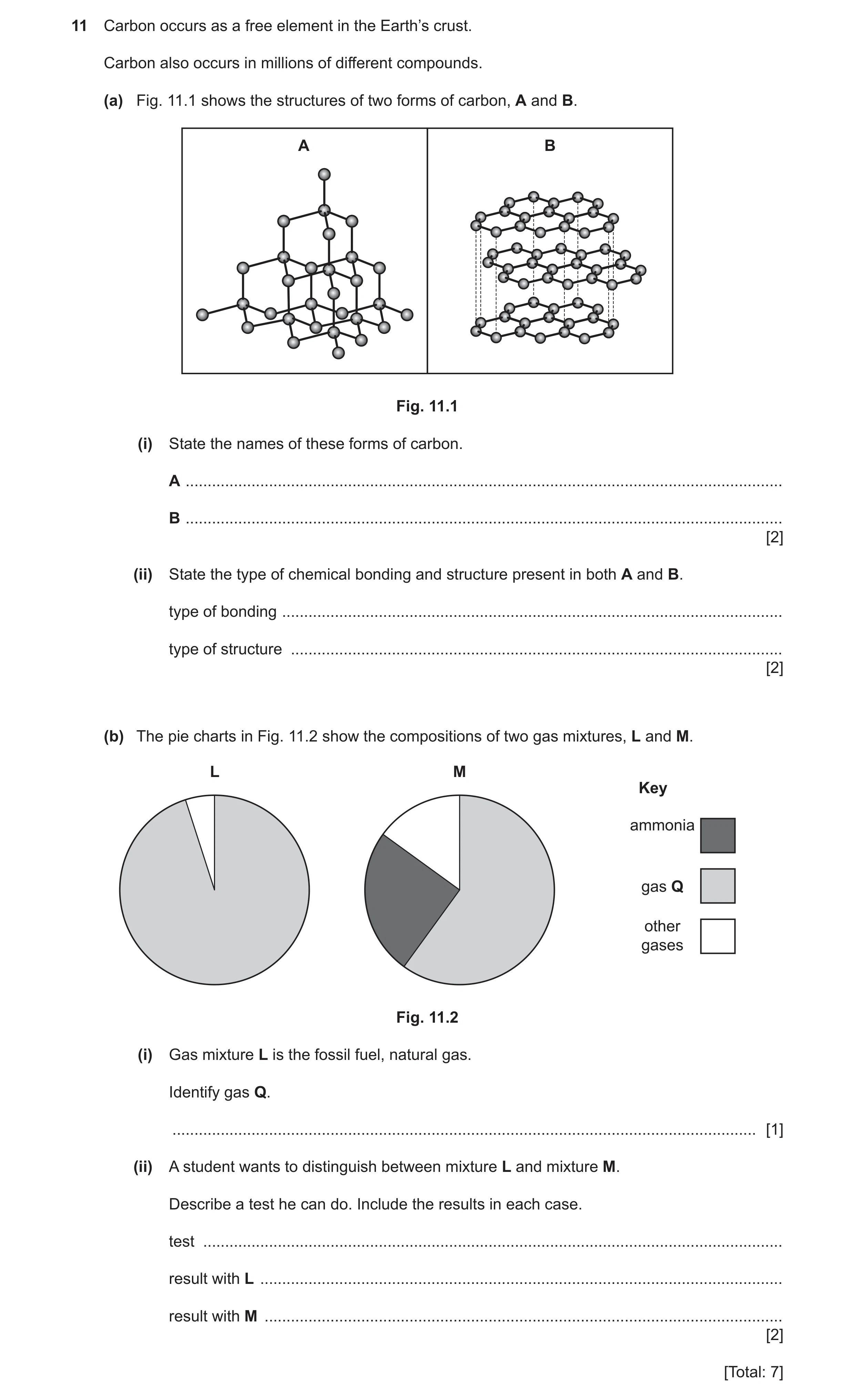
11 Carbon occurs as a free element in the Earth’s crust. Carbon also occurs in millions of different compounds. (a) Fig. 11.1 shows the structures of two forms of carbon, A and B. A B Fig. 11.1 (i) State the names of these forms of carbon. A … B … [2] (ii) State the type of chemical bonding and structure present in both A and B. type of bonding … type of structure … [2] (b) The pie charts in Fig. 11.2 show the compositions of two gas mixtures, L and M. L M Key ammonia gas Q other gases Fig. 11.2 (i) Gas mixture L is the fossil fuel, natural gas. Identify gas Q. … [1] (ii) A student wants to distinguish between mixture L and mixture M. Describe a test he can do. Include the results in each case. test … result with L … result with M … [2] [Total: 7]
7 marks
Mark scheme: 11(a)(i) A is diamond ; B is graphite ; 2 11(a)(ii) covalent (bonding) ; giant (structure) / macromolecule ; 2 11(b)(i) methane / CH4 ; 1 11(b)(ii) damp, red litmus paper ; no reaction with L and turns blue with M ; 2
This question in 0654/33 Oct/Nov 2020
Q8 · Information about three Group VII elements 0654/31 May/June 2021
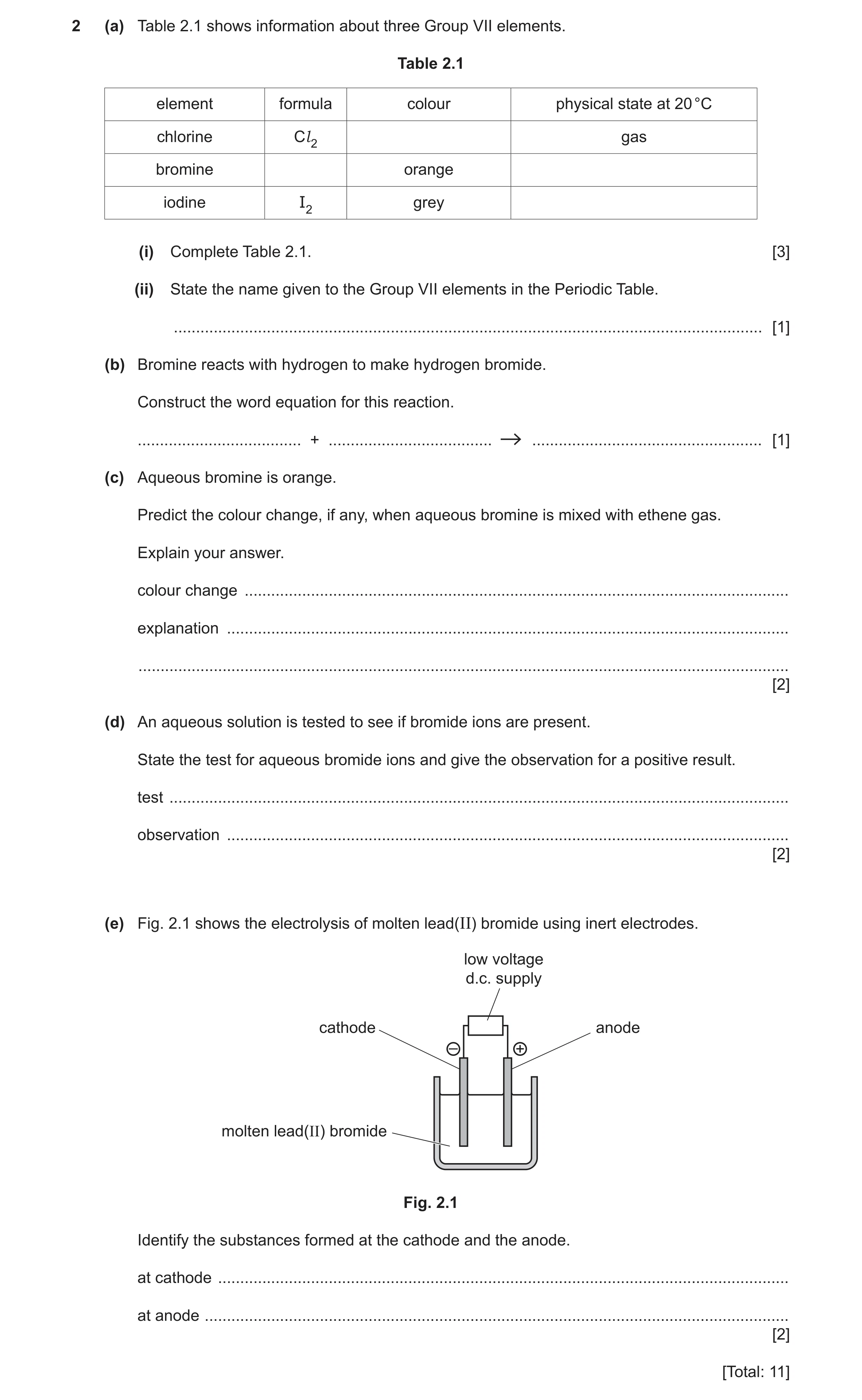
2 (a) Table 2.1 shows information about three Group VII elements. Table 2.1 element formula colour physical state at 20 °C chlorine Cl 2 gas bromine orange iodine I2 grey (i) Complete Table 2.1. [3] (ii) State the name given to the Group VII elements in the Periodic Table. … [1] (b) Bromine reacts with hydrogen to make hydrogen bromide. Construct the word equation for this reaction. … + … … [1] (c) Aqueous bromine is orange. Predict the colour change, if any, when aqueous bromine is mixed with ethene gas. Explain your answer. colour change … explanation … … [2] (d) An aqueous solution is tested to see if bromide ions are present. State the test for aqueous bromide ions and give the observation for a positive result. test … observation … [2] (e) Fig. 2.1 shows the electrolysis of molten lead(II) bromide using inert electrodes. low voltage d.c. supply cathode anode – + molten lead(II) bromide Fig. 2.1 Identify the substances formed at the cathode and the anode. at cathode … at anode … [2] [Total: 11]
11 marks
Mark scheme: 2(a)(i) formula Br2; colour (pale) green for Cl2 ; physical state liquid for Br2 and solid for I2 ; 3 2(a)(ii) halogens ; 1 2(b) hydrogen + bromine → hydrogen bromide ; 1 2(c) (orange to) colourless; ethene is unsaturated / has a double bond ; 2 Question Answer Marks 2(d) (aqueous) silver nitrate ; cream coloured precipitate ; 2 2(e) cathode – lead ; anode – bromine ; 2
This question in 0654/31 May/June 2021
Q9 · An atom of iron has a proton number of 26 and a nucleon number of 56 0654/32 Feb/March 2022
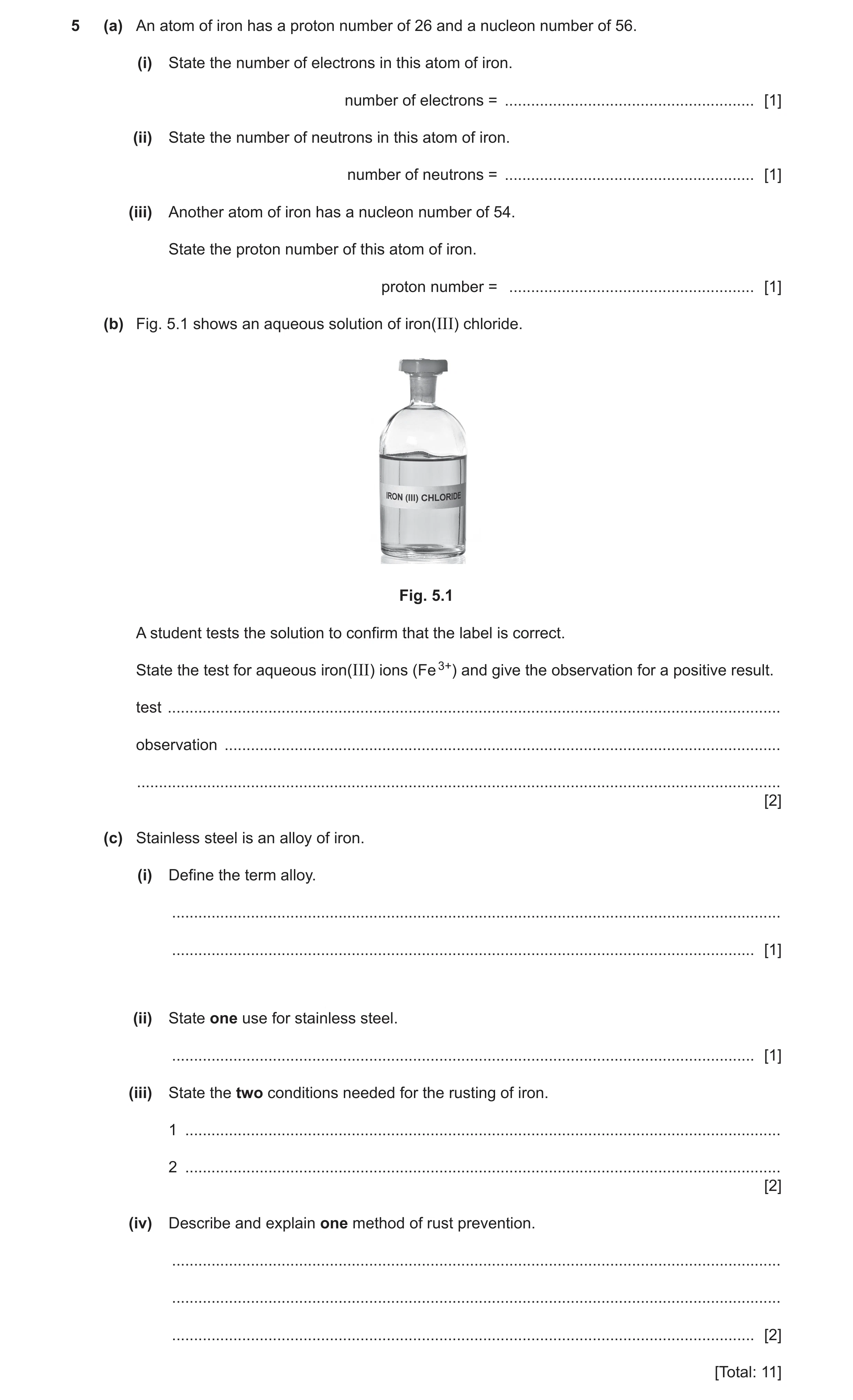
5 (a) An atom of iron has a proton number of 26 and a nucleon number of 56. (i) State the number of electrons in this atom of iron. number of electrons = … [1] (ii) State the number of neutrons in this atom of iron. number of neutrons = … [1] (iii) Another atom of iron has a nucleon number of 54. State the proton number of this atom of iron. proton number = … [1] (b) Fig. 5.1 shows an aqueous solution of iron(III) chloride. Fig. 5.1 A student tests the solution to confirm that the label is correct. State the test for aqueous iron(III) ions (Fe 3+) and give the observation for a positive result. test … observation … … [2] (c) Stainless steel is an alloy of iron. (i) Define the term alloy. … … [1] (ii) State one use for stainless steel. … [1] (iii) State the two conditions needed for the rusting of iron. 1 … 2 … [2] (iv) Describe and explain one method of rust prevention. … … … [2] [Total: 11]
11 marks
Mark scheme: 5(a)(i) 26; 1 5(a)(ii) 30; 1 5(a)(iii) 26; 1 5(b) sodium hydroxide solution; orange / brown ppt; 2 5(c)(i) mixture of metals / mixture of a metal and another element; 1 5(c)(ii) cutlery / chemical plant; 1 5(c)(iii) (presence of) oxygen; (presence of) water; 2 Question Answer Marks 5(c)(iv) painting / galvanising / plating / greasing; relevant explanation for method chosen (e.g. stops water / oxygen); 2
This question in 0654/32 Feb/March 2022
Q10 · The list below shows some chemical processes 0654/31 Oct/Nov 2022
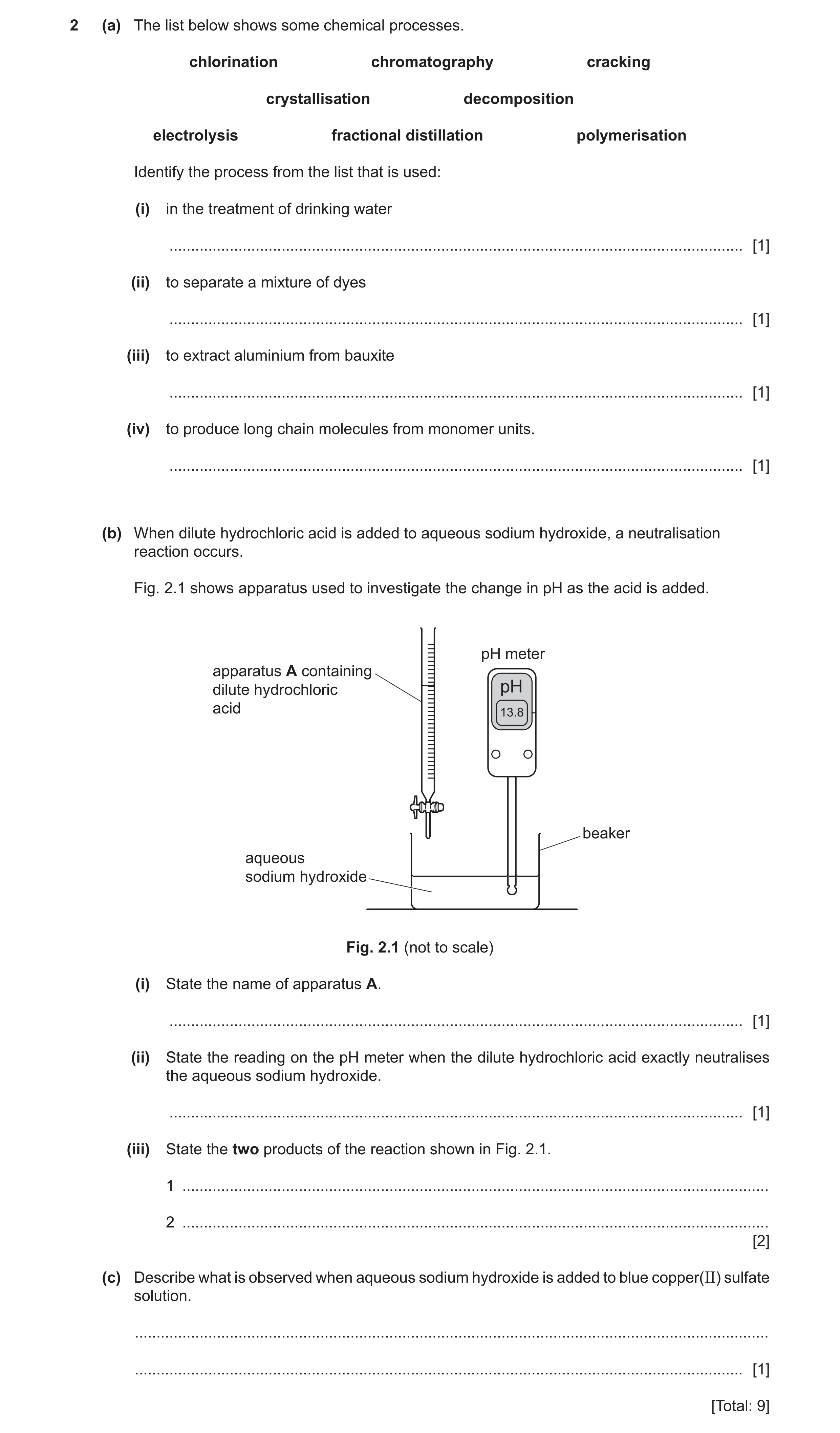
2 (a) The list below shows some chemical processes. chlorination chromatography cracking crystallisation decomposition electrolysis fractional distillation polymerisation Identify the process from the list that is used: (i) in the treatment of drinking water … [1] (ii) to separate a mixture of dyes … [1] (iii) to extract aluminium from bauxite … [1] (iv) to produce long chain molecules from monomer units. … [1] (b) When dilute hydrochloric acid is added to aqueous sodium hydroxide, a neutralisation reaction occurs. Fig. 2.1 shows apparatus used to investigate the change in pH as the acid is added. pH meter apparatus A containing dilute hydrochloric pH acid 13.8 beaker aqueous sodium hydroxide Fig. 2.1 (not to scale) (i) State the name of apparatus A. … [1] (ii) State the reading on the pH meter when the dilute hydrochloric acid exactly neutralises the aqueous sodium hydroxide. … [1] (iii) State the two products of the reaction shown in Fig. 2.1. 1 … 2 … [2] (c) Describe what is observed when aqueous sodium hydroxide is added to blue copper(II) sulfate solution. … … [1] [Total: 9]
9 marks
Mark scheme: 2(a)(i) chlorination ; 1 2(a)(ii) chromatography ; 1 2(a)(iii) electrolysis ; 1 2(a)(iv) polymerisation ; 1 2(b)(i) burette ; 1 2(b)(ii) 7 ; 1 2(b)(iii) sodium chloride ; 2 water ; 2(c) pale blue precipitate ; 1
This question in 0654/31 Oct/Nov 2022
Q11 · Sodium and chlorine are elements 0654/31 Oct/Nov 2022
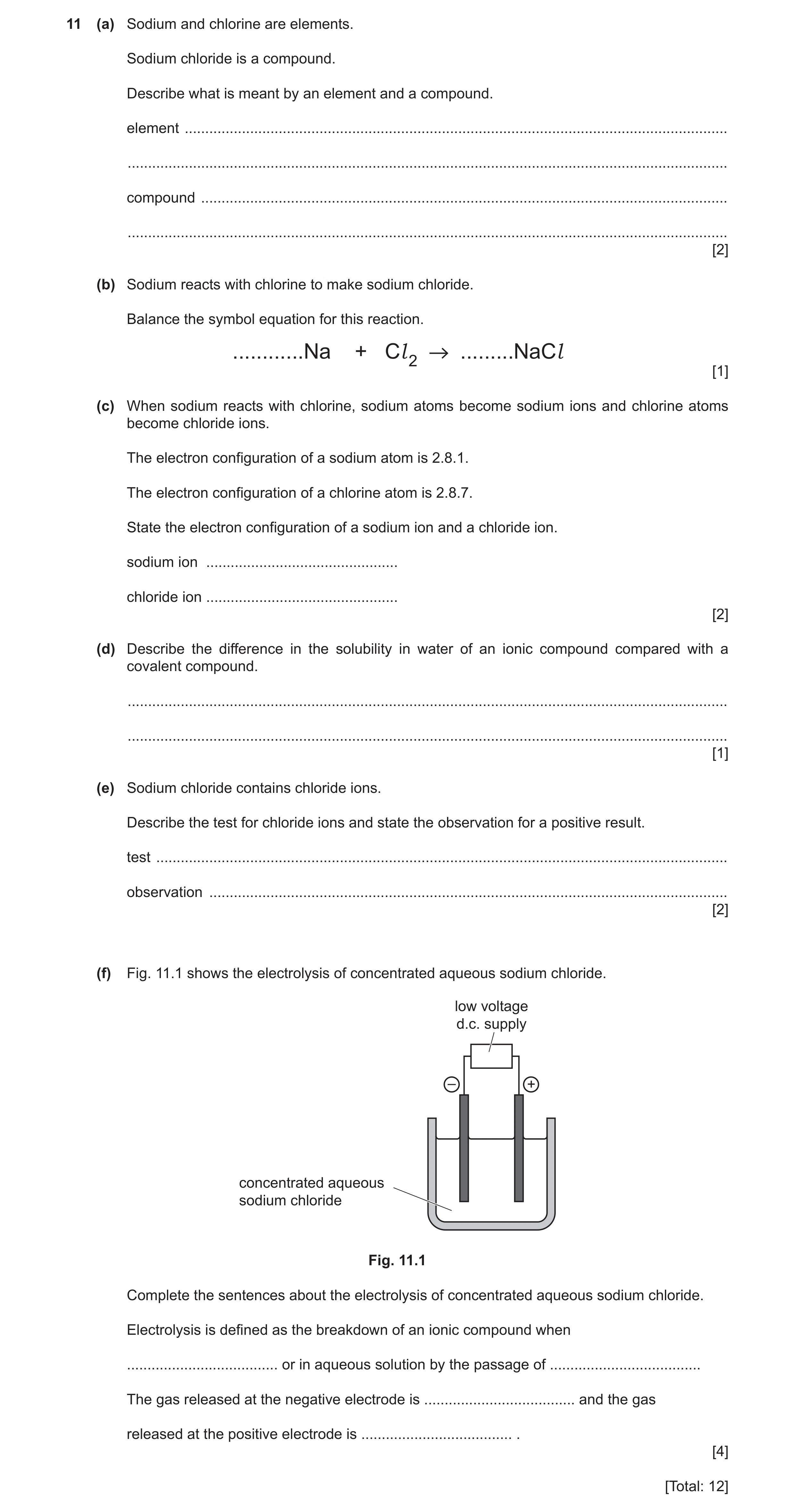
11 (a) Sodium and chlorine are elements. Sodium chloride is a compound. Describe what is meant by an element and a compound. element … … compound … … [2] (b) Sodium reacts with chlorine to make sodium chloride. Balance the symbol equation for this reaction. … Na + Cl2 … NaCl [1] (c) When sodium reacts with chlorine, sodium atoms become sodium ions and chlorine atoms become chloride ions. The electron configuration of a sodium atom is 2.8.1. The electron configuration of a chlorine atom is 2.8.7. State the electron configuration of a sodium ion and a chloride ion. sodium ion … chloride ion … [2] (d) Describe the difference in the solubility in water of an ionic compound compared with a covalent compound. … … [1] (e) Sodium chloride contains chloride ions. Describe the test for chloride ions and state the observation for a positive result. test … observation … [2] (f) Fig. 11.1 shows the electrolysis of concentrated aqueous sodium chloride. low voltage d.c. supply – + concentrated aqueous sodium chloride Fig. 11.1 Complete the sentences about the electrolysis of concentrated aqueous sodium chloride. Electrolysis is defined as the breakdown of an ionic compound when … or in aqueous solution by the passage of … The gas released at the negative electrode is … and the gas released at the positive electrode is … . [4] [Total: 12]
12 marks
Mark scheme: 11(a) element – contains only one type of atom ; 2 compound – contains two or more elements (chemically combined) ; 11(b) 2Na + Cl2 → 2NaCl ; 1 11(c) sodium ion 2.8 ; 2 chloride ion 2.8.8 ; 11(d) solubility of ionic compound is greater ; 1 11(e) add acidified aqueous silver nitrate ; 2 white precipitate ; 11(f) molten ; 4 electricity ; hydrogen ; chlorine ;
This question in 0654/31 Oct/Nov 2022
Q12 · State the name given to mixtures made from a metal with other elements 0654/32 Feb/March 2023
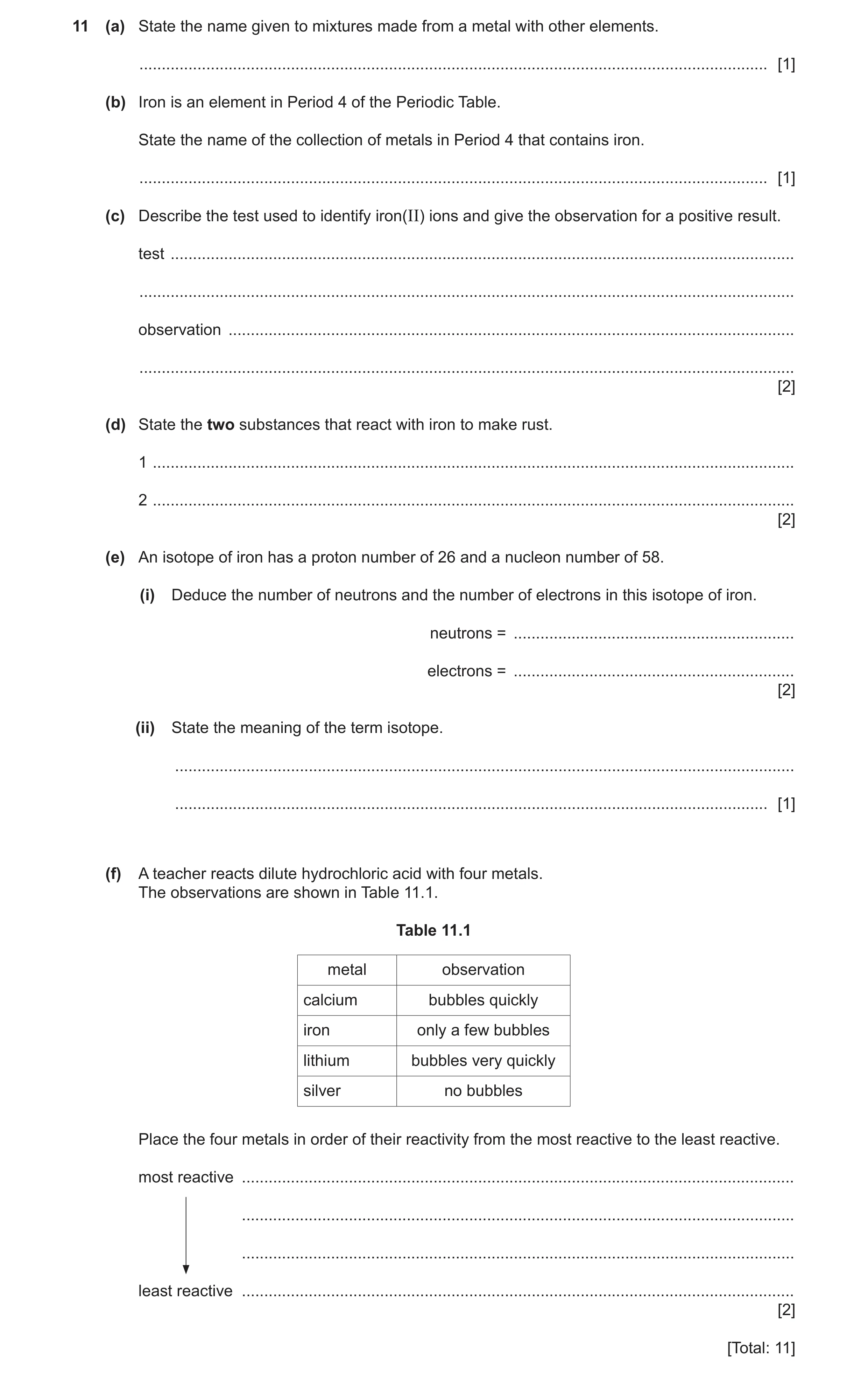
11 (a) State the name given to mixtures made from a metal with other elements. … [1] (b) Iron is an element in Period 4 of the Periodic Table. State the name of the collection of metals in Period 4 that contains iron. … [1] (c) Describe the test used to identify iron(II) ions and give the observation for a positive result. test … … observation … … [2] (d) State the two substances that react with iron to make rust. 1 … 2 … [2] (e) An isotope of iron has a proton number of 26 and a nucleon number of 58. (i) Deduce the number of neutrons and the number of electrons in this isotope of iron. neutrons = … electrons = … [2] (ii) State the meaning of the term isotope. … … [1] (f) A teacher reacts dilute hydrochloric acid with four metals. The observations are shown in Table 11.1. Table 11.1 metal observation calcium bubbles quickly iron only a few bubbles lithium bubbles very quickly silver no bubbles Place the four metals in order of their reactivity from the most reactive to the least reactive. most reactive … … … least reactive … [2] [Total: 11]
11 marks
Mark scheme: 11(a) alloy ; 1 11(b) transition elements / metals ; 1 11(c) aqueous sodium hydroxide ; 2 green precipitate ; 11(d) oxygen ; 2 water ; 11(e)(i) neutrons = 32 ; 2 electrons = 26 ; 11(e)(ii) atoms of the same element that have different numbers of neutrons ; 1 11(f) lithium 2 calcium iron silver lithium and / or silver correct ; all else correct ;
This question in 0654/32 Feb/March 2023
Q13 · Some information about three Group VII elements 0654/33 Oct/Nov 2023
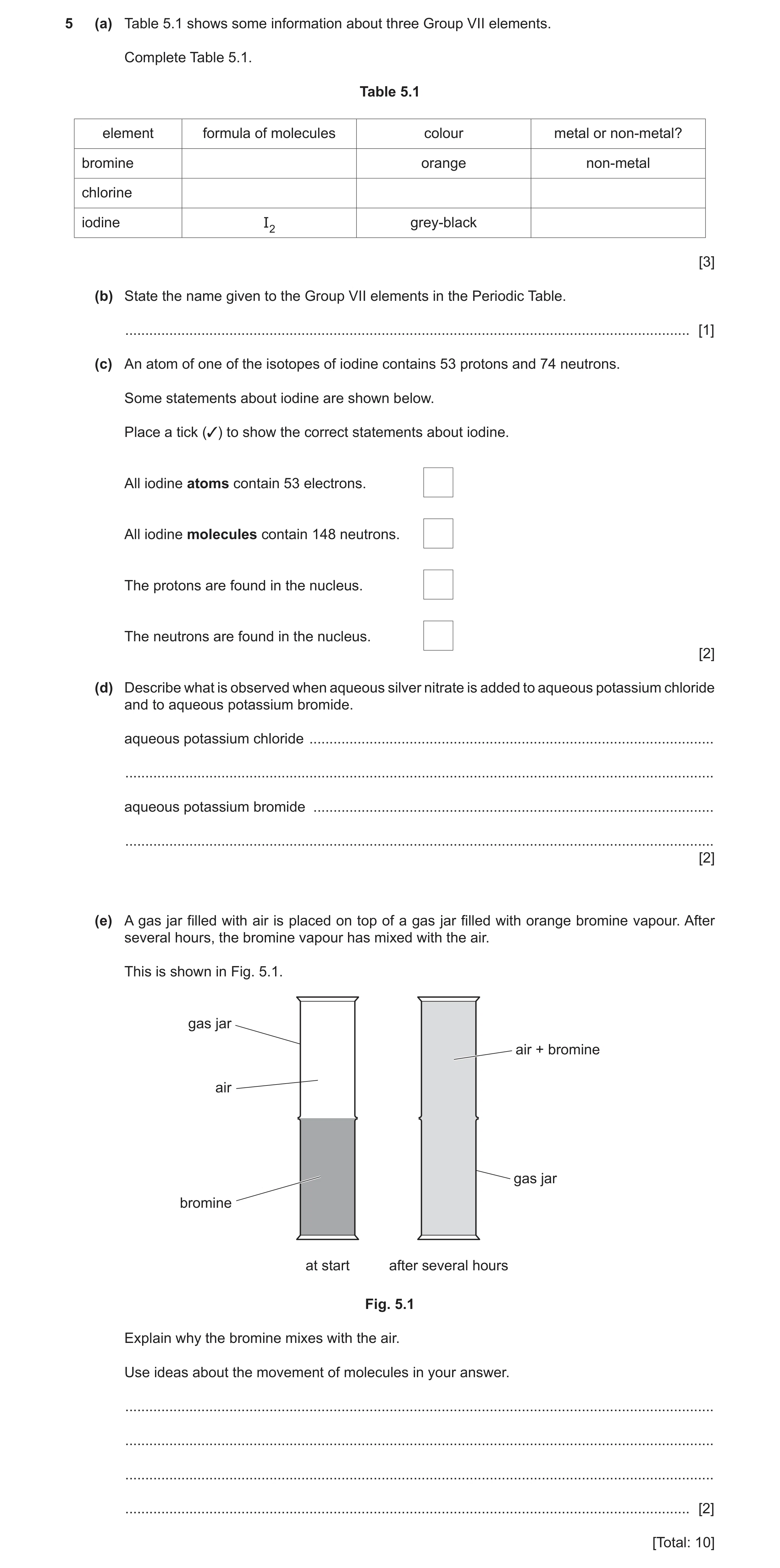
5 (a) Table 5.1 shows some information about three Group VII elements. Complete Table 5.1. Table 5.1 element formula of molecules colour metal or non-metal? bromine orange non-metal chlorine iodine I2 grey-black [3] (b) State the name given to the Group VII elements in the Periodic Table. … [1] (c) An atom of one of the isotopes of iodine contains 53 protons and 74 neutrons. Some statements about iodine are shown below. Place a tick (3) to show the correct statements about iodine. All iodine atoms contain 53 electrons. All iodine molecules contain 148 neutrons. The protons are found in the nucleus. The neutrons are found in the nucleus. [2] (d) Describe what is observed when aqueous silver nitrate is added to aqueous potassium chloride and to aqueous potassium bromide. aqueous potassium chloride … … aqueous potassium bromide … … [2] (e) A gas jar filled with air is placed on top of a gas jar filled with orange bromine vapour. After several hours, the bromine vapour has mixed with the air. This is shown in Fig. 5.1. gas jar air + bromine air gas jar bromine at start after several hours Fig. 5.1 Explain why the bromine mixes with the air. Use ideas about the movement of molecules in your answer. … … … … [2] [Total: 10]
10 marks
Mark scheme: 5(a) 3 formula of metal or non- element colour molecules metal? bromine Br2 orange non-metal chlorine Cl2 (pale) green non-metal iodine I2 grey-black non-metal one mark for each column ;;; 5(b) halogens ; 1 5(c) 2 no tick / 3 ticks and 3 correct = 2 marks 4 ticks and 3 correct = 1 mark 3 ticks and 2 correct = 1 mark 2 ticks and 2 correct = 1 mark ;; 5(d) potassium chloride – white precipitate ; 2 potassium bromide – cream/off white precipitate ; 5(e) diffusion ; 2 molecules move randomly from place to place / spread out / from high to low concentration ;
This question in 0654/33 Oct/Nov 2023
Q14 · Three metals are placed in three different test-tubes of dilute sulfuric acid as shown in… 0654/32 Feb/March 2024
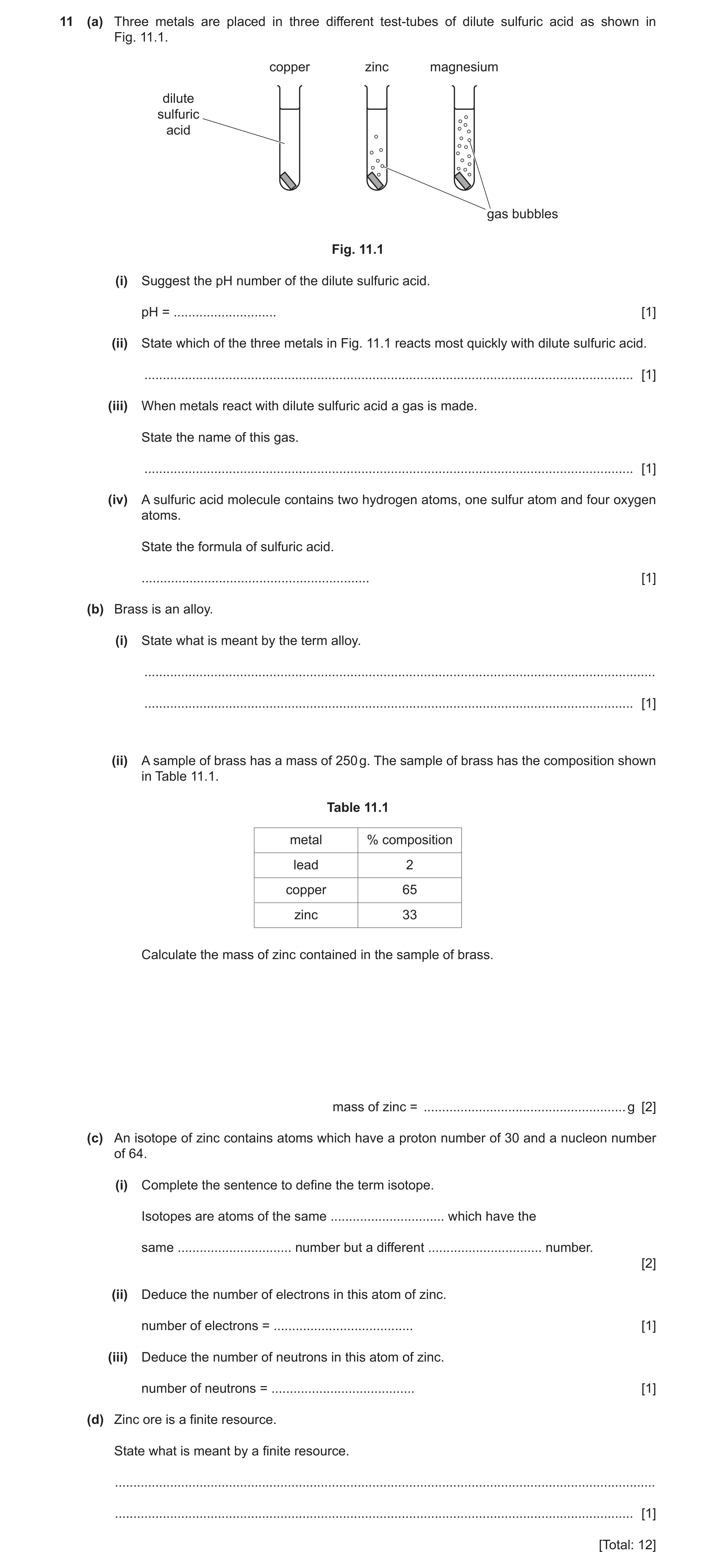
11 (a) Three metals are placed in three different test-tubes of dilute sulfuric acid as shown in Fig. 11.1. copper zinc magnesium dilute sulfuric acid gas bubbles Fig. 11.1 (i) Suggest the pH number of the dilute sulfuric acid. pH = … [1] (ii) State which of the three metals in Fig. 11.1 reacts most quickly with dilute sulfuric acid. … [1] (iii) When metals react with dilute sulfuric acid a gas is made. State the name of this gas. … [1] (iv) A sulfuric acid molecule contains two hydrogen atoms, one sulfur atom and four oxygen atoms. State the formula of sulfuric acid. … [1] (b) Brass is an alloy. (i) State what is meant by the term alloy. … … [1] (ii) A sample of brass has a mass of 250 g. The sample of brass has the composition shown in Table 11.1. Table 11.1 metal % composition lead 2 copper 65 zinc 33 Calculate the mass of zinc contained in the sample of brass. mass of zinc = … g [2] (c) An isotope of zinc contains atoms which have a proton number of 30 and a nucleon number of 64. (i) Complete the sentence to define the term isotope. Isotopes are atoms of the same … which have the same … number but a different … number. [2] (ii) Deduce the number of electrons in this atom of zinc. number of electrons = … [1] (iii) Deduce the number of neutrons in this atom of zinc. number of neutrons = … [1] (d) Zinc ore is a finite resource. State what is meant by a finite resource. … … [1] [Total: 12]
12 marks
Mark scheme: 11(a)(i) in the range from 1 to 6 ; 1 11(a)(ii) magnesium ; 1 11(a)(iii) hydrogen ; 1 11(a)(iv) H2SO4 ; 1 11(b)(i) a mixture of a metals and other elements; 1 11(b)(ii) 33 250 / 100 ; 2 83 ; 11(c)(i) element; 2 proton and nucleon; 11(c)(ii) 30 ; 1 11(c)(iii) 34 ; 1 11(d) (A finite resource is something useful that is) non-renewable / will eventually run out ; 1
This question in 0654/32 Feb/March 2024
Q15 · Choose from the following substances to answer the questions 0654/32 Oct/Nov 2024
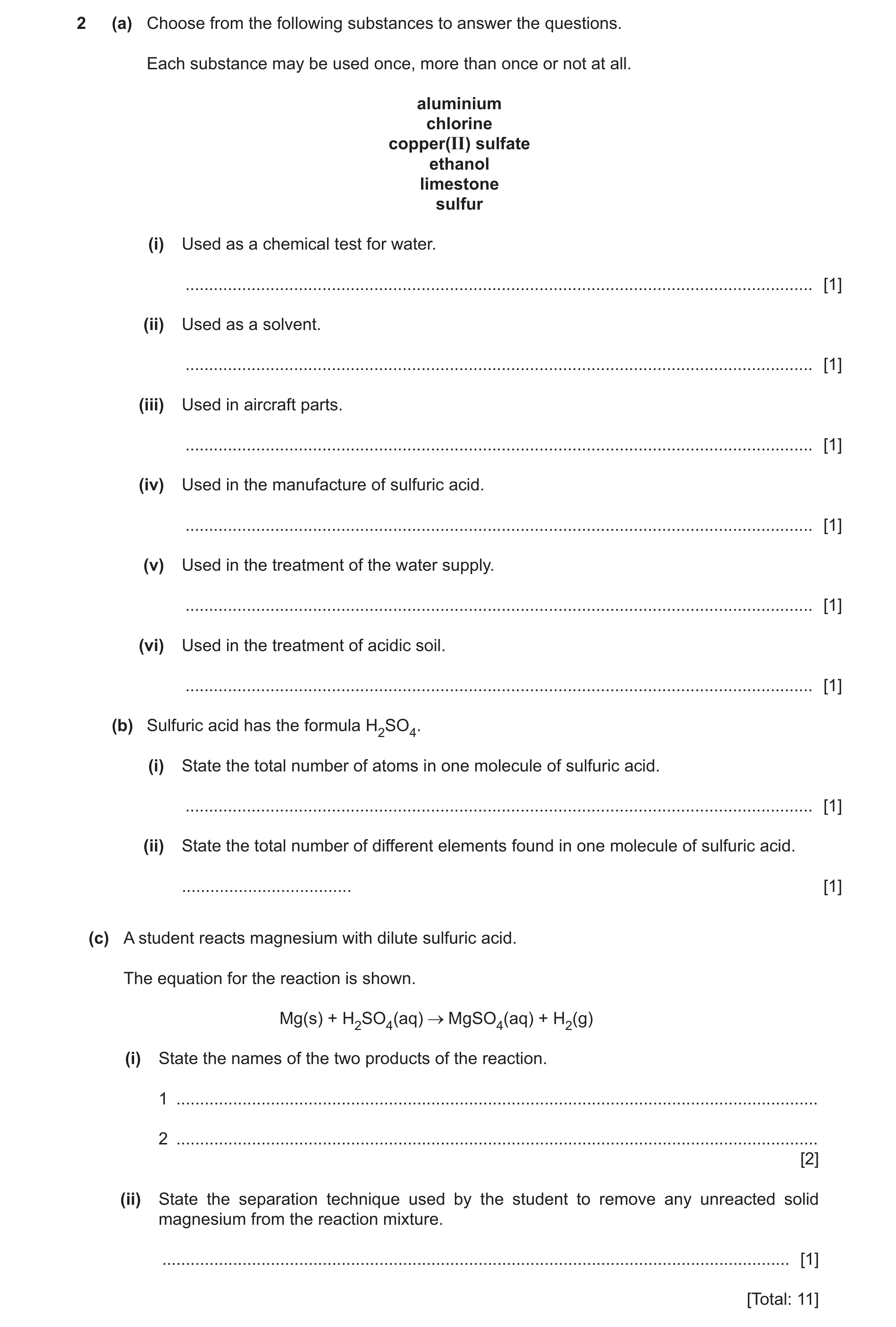
2 (a) Choose from the following substances to answer the questions. Each substance may be used once, more than once or not at all. aluminium chlorine copper(II) sulfate ethanol limestone sulfur (i) Used as a chemical test for water. … [1] (ii) Used as a solvent. … [1] (iii) Used in aircraft parts. … [1] (iv) Used in the manufacture of sulfuric acid. … [1] (v) Used in the treatment of the water supply. … [1] (vi) Used in the treatment of acidic soil. … [1] (b) Sulfuric acid has the formula H2SO4. (i) State the total number of atoms in one molecule of sulfuric acid. … [1] (ii) State the total number of different elements found in one molecule of sulfuric acid. … [1] (c) A student reacts magnesium with dilute sulfuric acid. The equation for the reaction is shown. Mg(s) + H2SO4(aq) MgSO4(aq) + H2(g) (i) State the names of the two products of the reaction. 1 … 2 … [2] (ii) State the separation technique used by the student to remove any unreacted solid magnesium from the reaction mixture. … [1] [Total: 11]
11 marks
Mark scheme: 2(a)(i) copper sulfate ; 1 2(a)(ii) ethanol ; 1 2(a)(iii) aluminium ; 1 2(a)(iv) sulfur ; 1 2(a)(v) chlorine ; 1 2(a)(vi) limestone ; 1 2(b)(i) 7 ; 1 2(b)(ii) 3 ; 1 2(c)(i) magnesium sulfate ; 2 hydrogen ; 2(c)(ii) filtration ; 1
This question in 0654/32 Oct/Nov 2024
Q16 · Table 5.1 contains information about 6 atoms or ions A, B, C, D, E and F 0654/31 May/June 2025
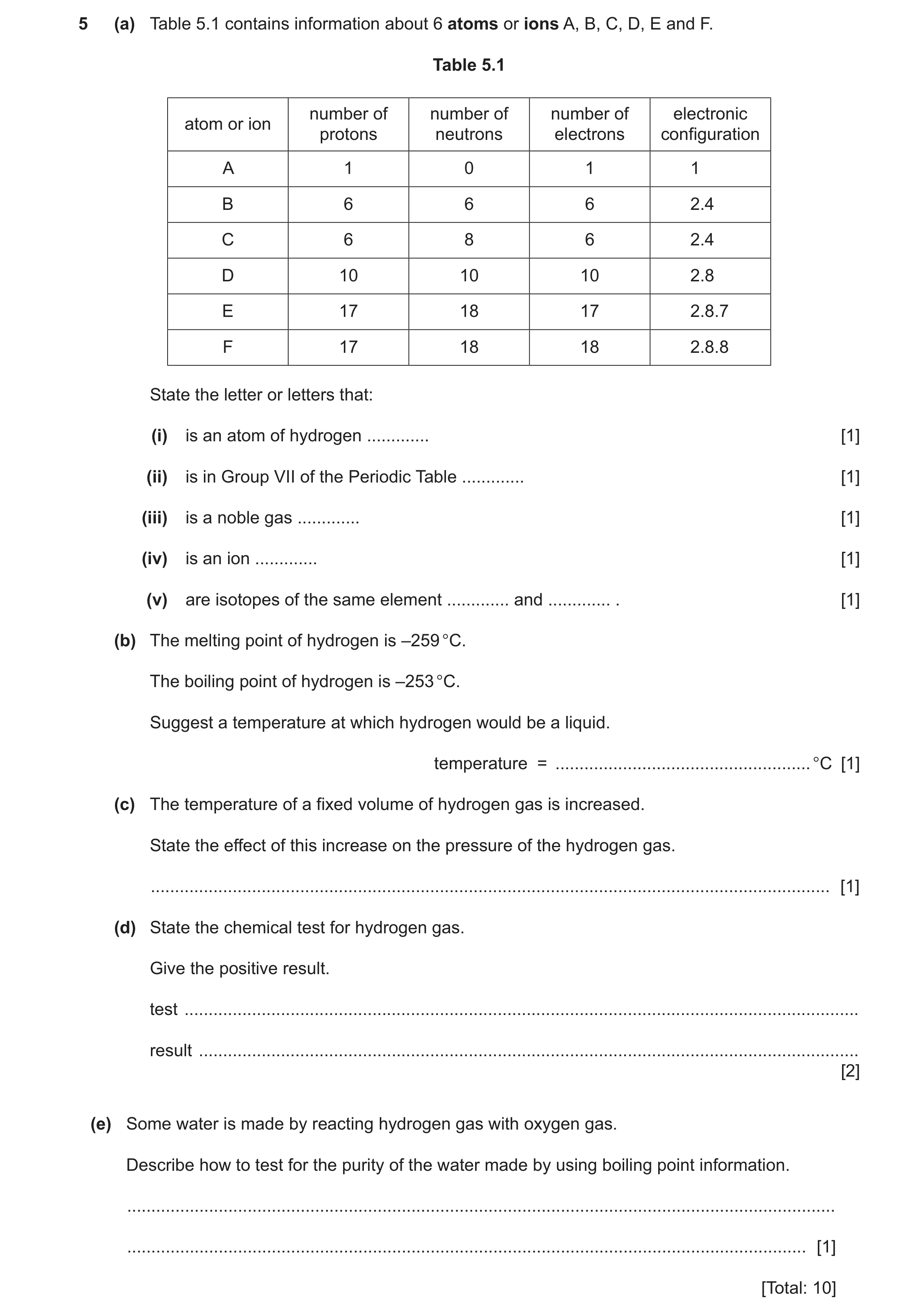
5 (a) Table 5.1 contains information about 6 atoms or ions A, B, C, D, E and F. Table 5.1 number of number of number of electronic atom or ion protons neutrons electrons configuration A 1 0 1 1 B 6 6 6 2.4 C 6 8 6 2.4 D 10 10 10 2.8 E 17 18 17 2.8.7 F 17 18 18 2.8.8 State the letter or letters that: (i) is an atom of hydrogen … [1] (ii) is in Group VII of the Periodic Table … [1] (iii) is a noble gas … [1] (iv) is an ion … [1] (v) are isotopes of the same element … and … . [1] (b) The melting point of hydrogen is –259 °C. The boiling point of hydrogen is –253 °C. Suggest a temperature at which hydrogen would be a liquid. temperature = … °C [1] (c) The temperature of a fixed volume of hydrogen gas is increased. State the effect of this increase on the pressure of the hydrogen gas. … [1] (d) State the chemical test for hydrogen gas. Give the positive result. test … result … [2] (e) Some water is made by reacting hydrogen gas with oxygen gas. Describe how to test for the purity of the water made by using boiling point information. … … [1] [Total: 10]
10 marks
Mark scheme: 5(a)(i) A ; 1 5(a)(ii) E ; 1 5(a)(iii) D ; 1 5(a)(iv) F ; 1 5(a)(v) B and C ; 1 5(b) between – 254 and – 258 °C ; 1 5(c) (pressure) increases ; 1 5(d) lighted splint ; 2 goes pop ; 5(e) pure water will boil at 100°C / ora ; 1
This question in 0654/31 May/June 2025
Q17 · Lead is extracted from lead oxide by reaction with carbon 0654/31 Oct/Nov 2025
7 (a) Lead is extracted from lead oxide by reaction with carbon. The reaction is endothermic. The word equation for the reaction is shown. lead oxide + carbon lead + carbon dioxide (i) Explain why this reaction shows both oxidation and reduction. … … … … [2] (ii) Explain what is meant by an endothermic reaction. … … [1] (b) Lead is also extracted from molten lead bromide by electrolysis. Fig. 7.1 shows the apparatus used. low voltage d.c. supply – + electrode J electrode K molten lead(II) bromide Fig. 7.1 (i) Graphite is used as the inert electrodes. Graphite is a giant covalent structure made of carbon atoms. State the name of one other giant covalent structure made of carbon atoms. … [1] (ii) State the name of each electrode. negative electrode J … positive electrode K … [1] (iii) Identify the products at each electrode. electrode J product … electrode K product … [1] (iv) The molten lead bromide cools and turns solid. Suggest why the electrolysis stops. … … [1] (c) Lead is a very soft, ductile metal. Lead is often used in alloys. (i) State the meaning of the term alloy. … … [1] (ii) Solder is an alloy of lead. The composition of solder is shown in Table 7.1. Table 7.1 metal percentage lead 37% tin 63% Calculate the mass of lead found in 4 kg of solder. mass of lead = … kg [1] (d) Lead reacts slowly with dilute hydrochloric acid. Hydrogen gas and a compound of lead are made. (i) Suggest the name of this compound of lead. … [1] (ii) Describe the chemical test for hydrogen and state the observation for a positive result. test … observation … … [2] [Total: 12] Question 8 starts on the next page.
12 marks
Mark scheme: 7(a)(i) oxidation is gain of oxygen and reduction is loss of oxygen ; 2 carbon gains oxygen / lead ions lose oxygen ; 7(a)(ii) takes in (thermal) energy (from the surroundings) ; 1 7(b)(i) diamond ; 1 7(b)(ii) (J electrode) cathode and (K electrode) anode ; 1 7(b)(iii) (J product) lead and (K product) bromine ; 1 7(b)(iv) ions need to be mobile / AW 1 OR solids are not good conductors / solids are poor conductors / ORA 7(c)(i) mixture of a metal and another element ; 1 7(c)(ii) 1.5 (kg) ; 1 7(d)(i) lead(II) chloride ; 1 7(d)(ii) lighted splint ; 2 goes pop / AW ;
This question in 0654/31 Oct/Nov 2025
 23 / 26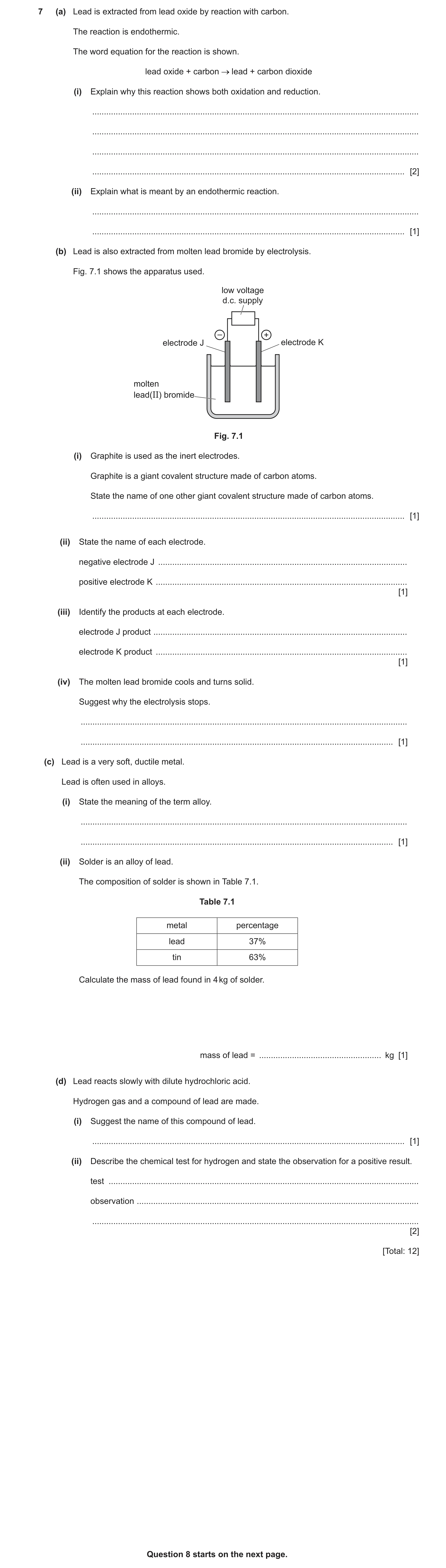
 10
10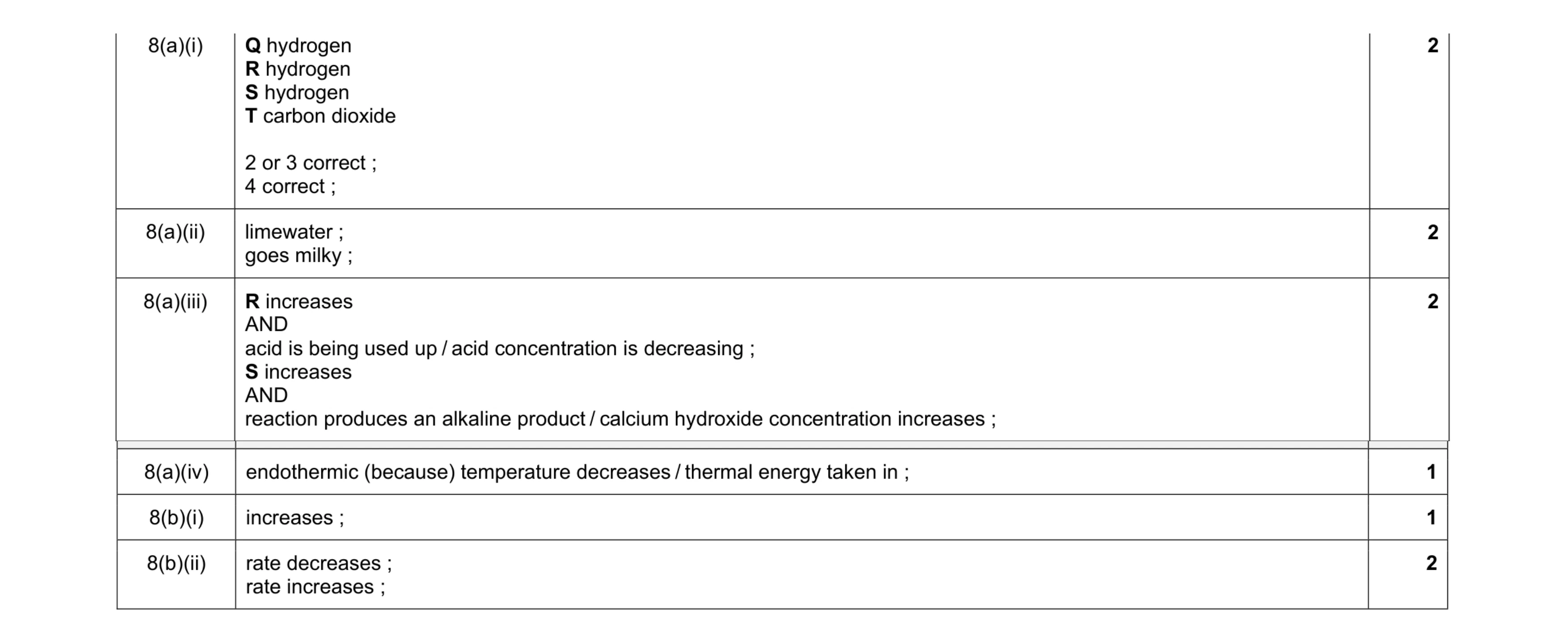 10
10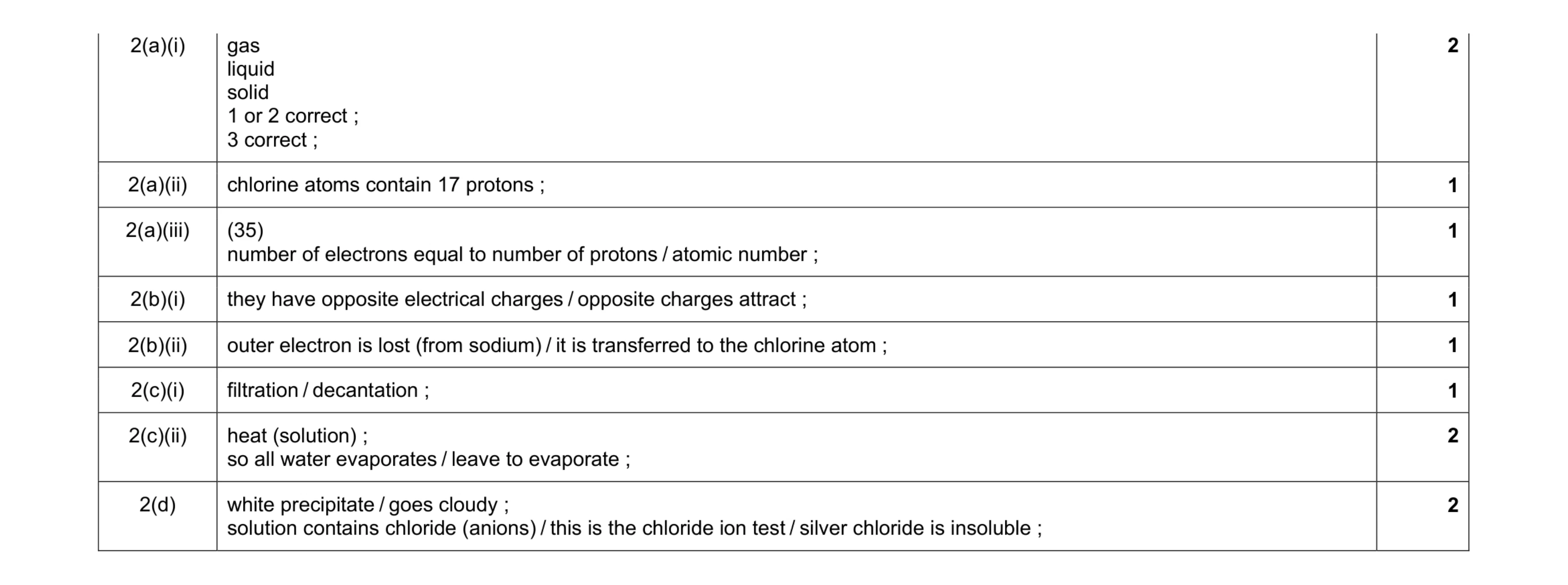 11
11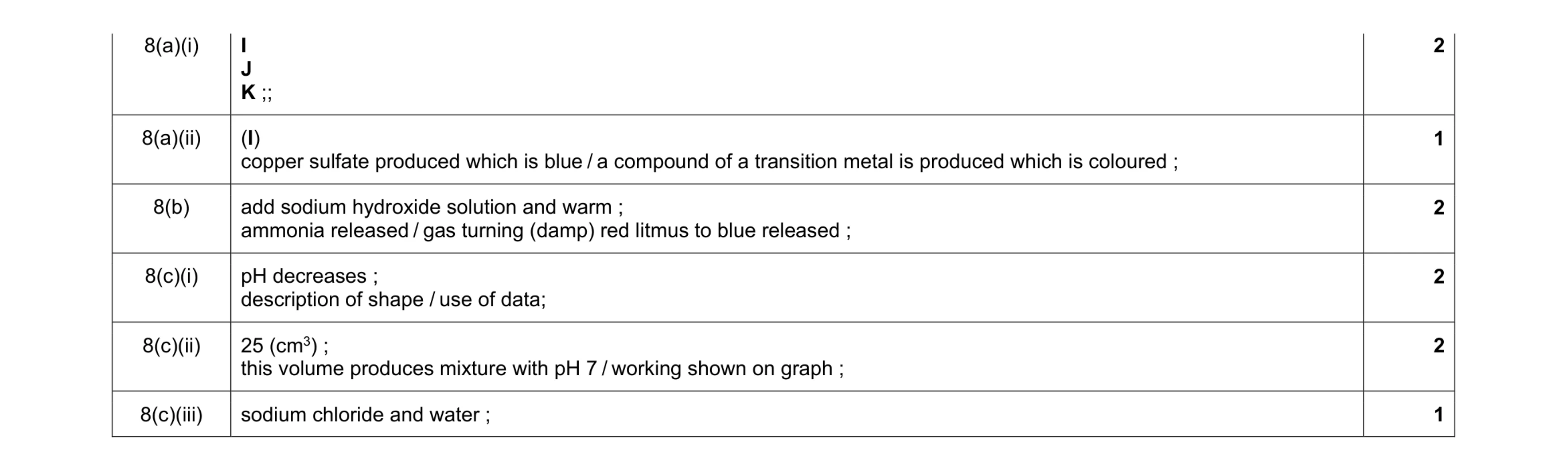 10
10 7
7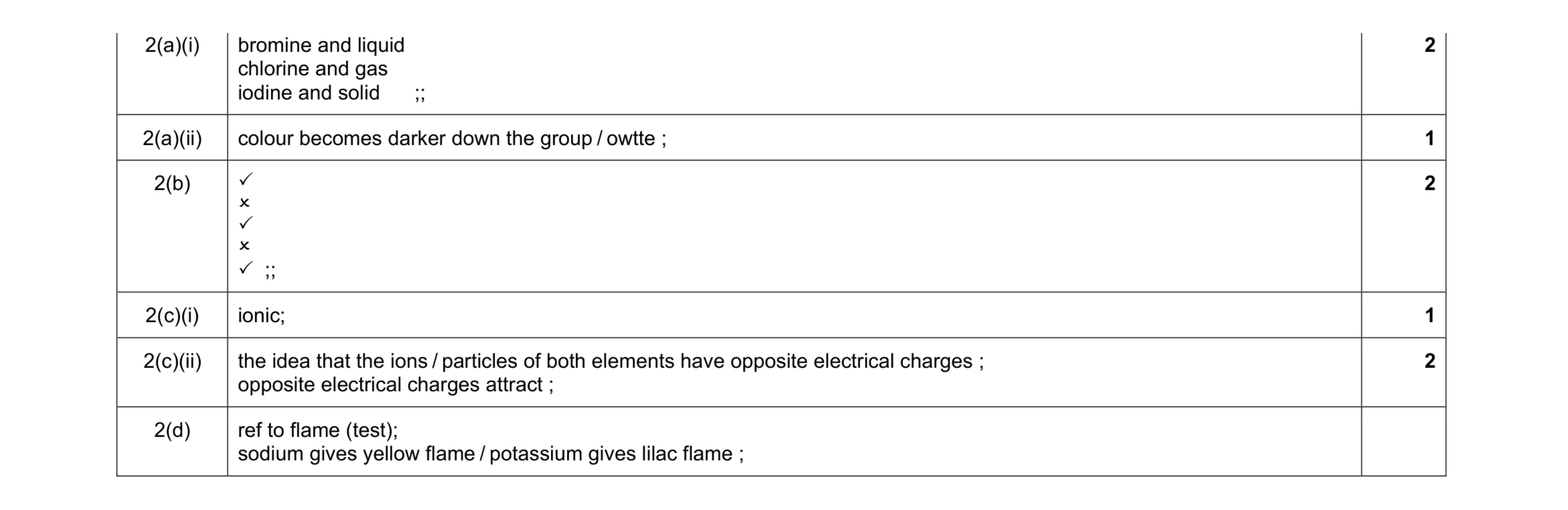 10
10 7
7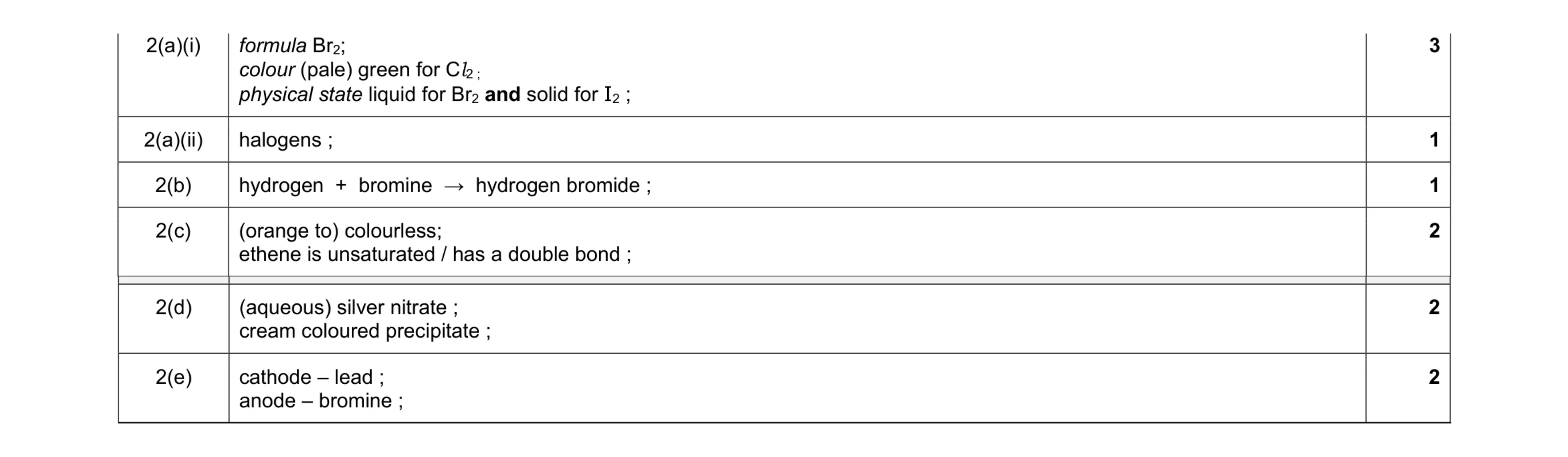 11
11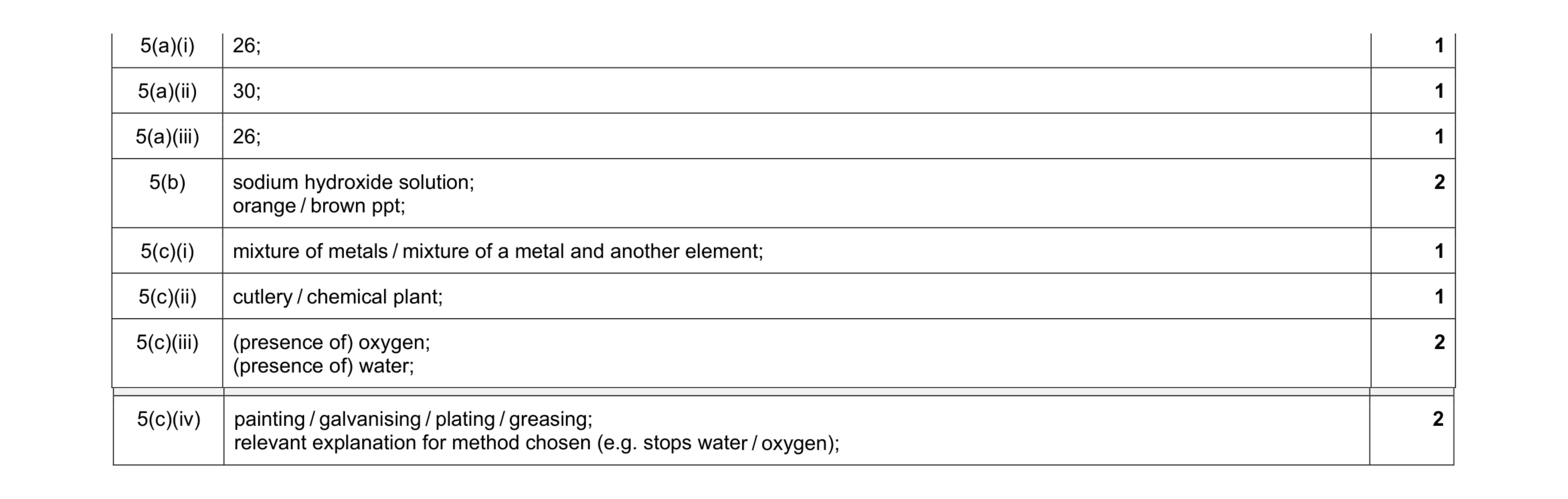 11
11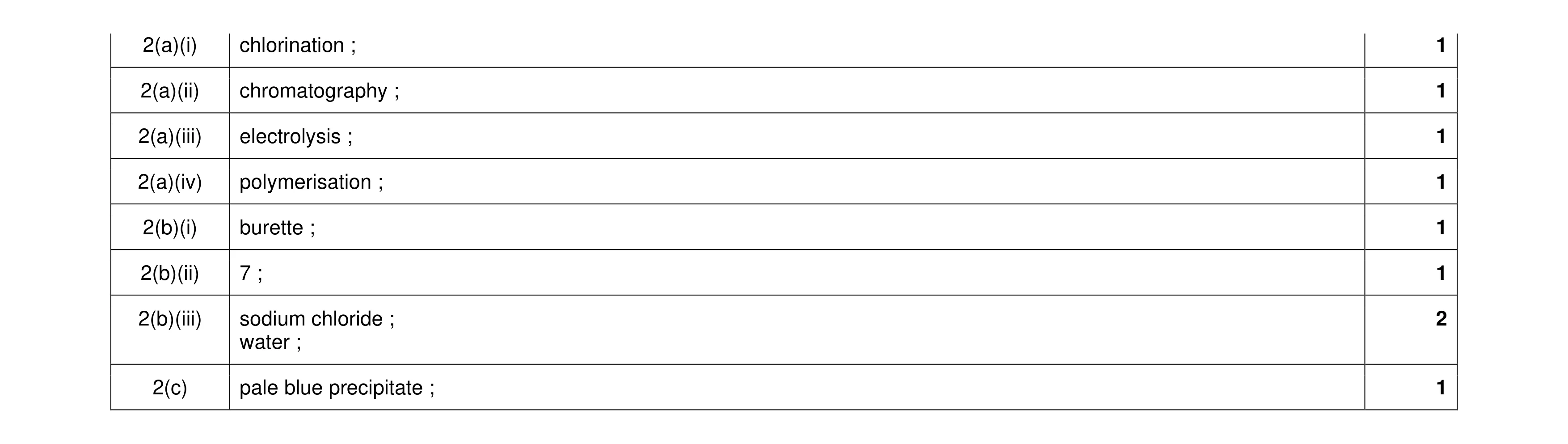 9
9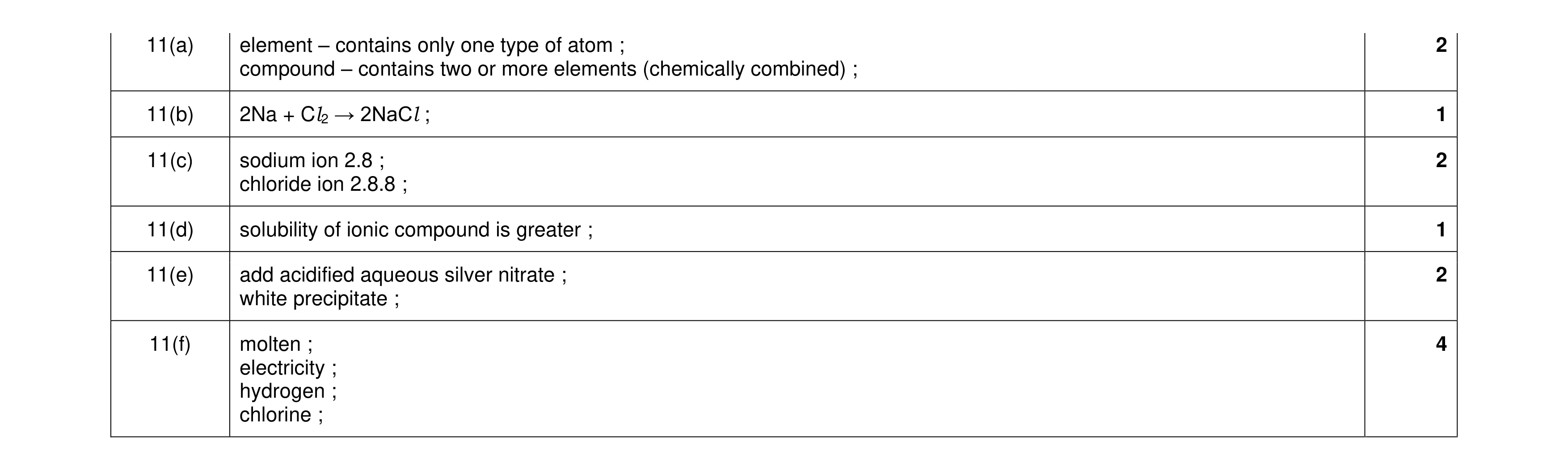 12
12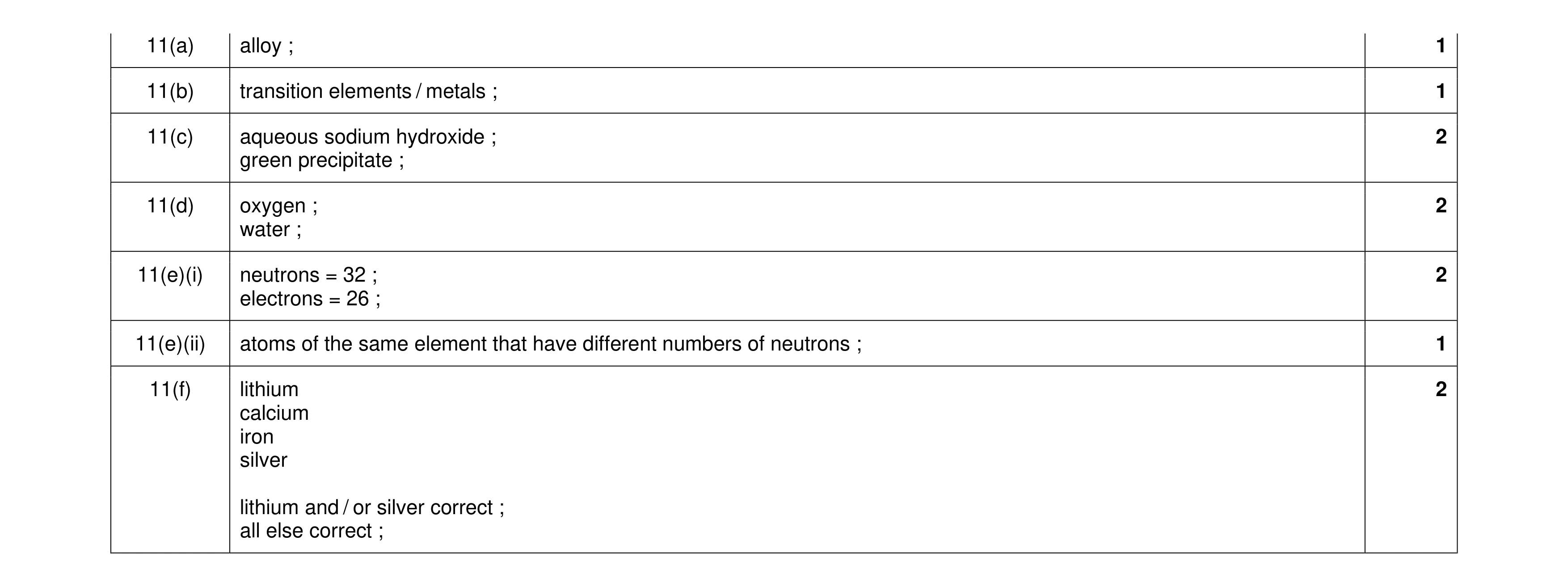 11
11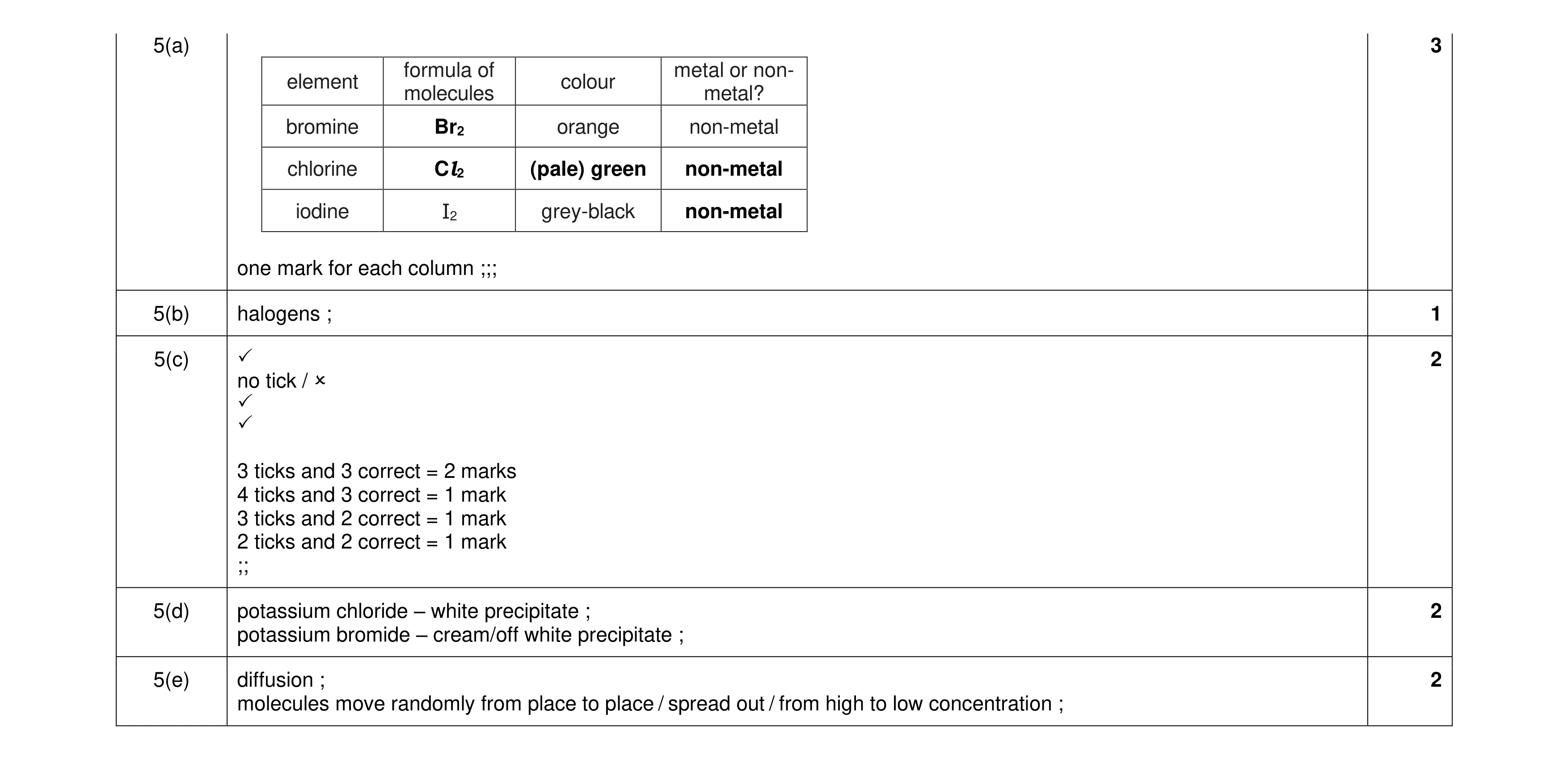 10
10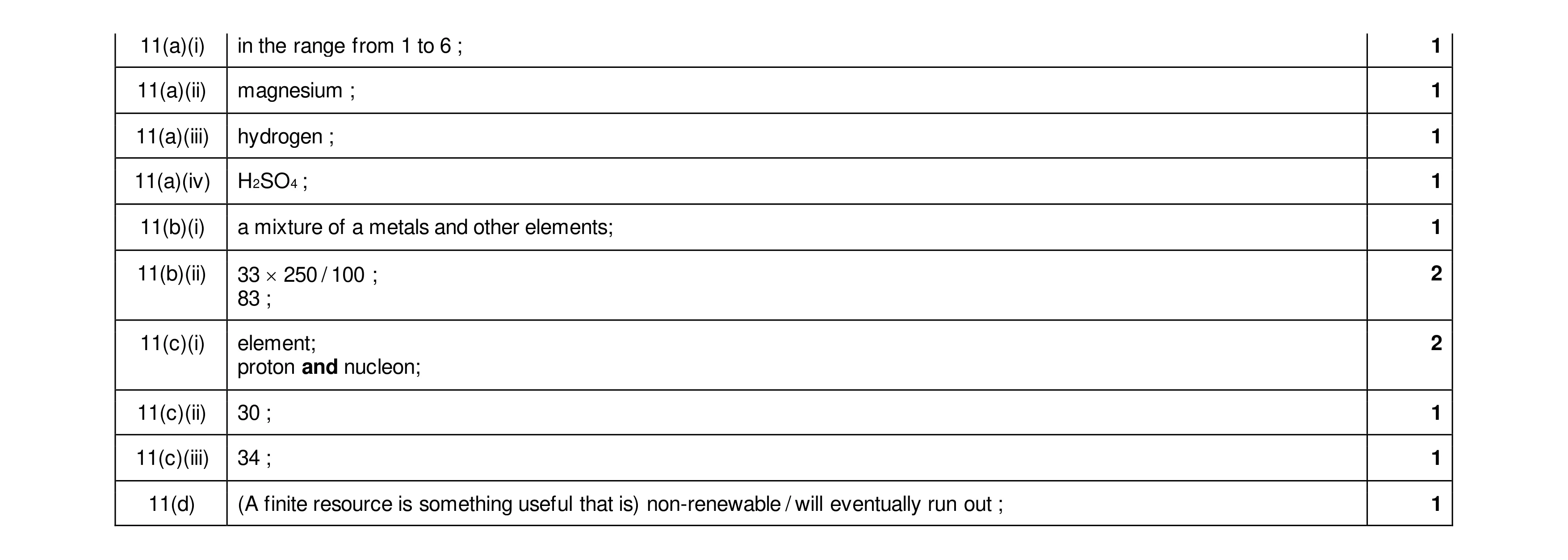 12
12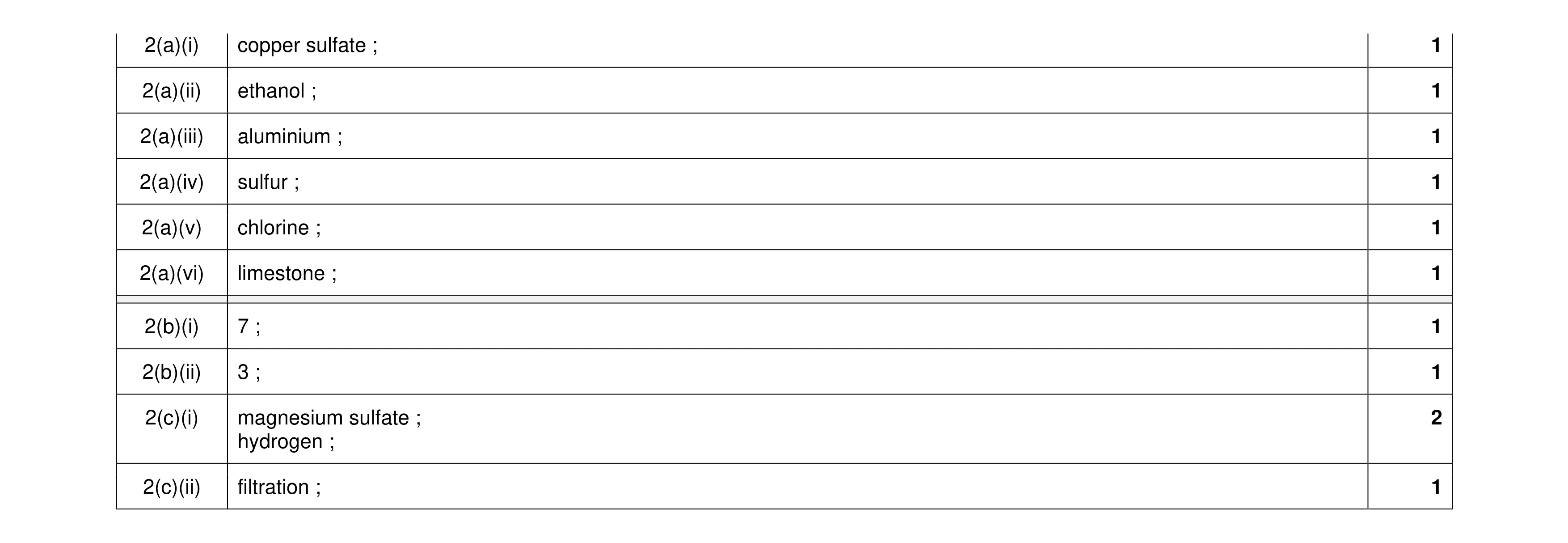 11
11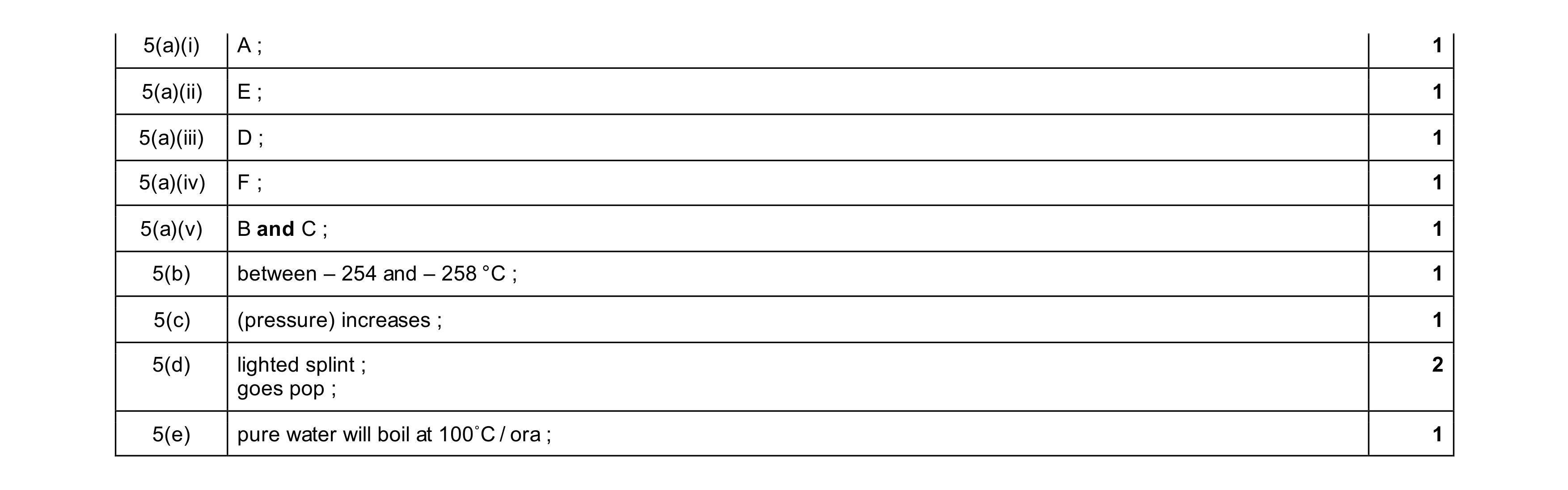 10
10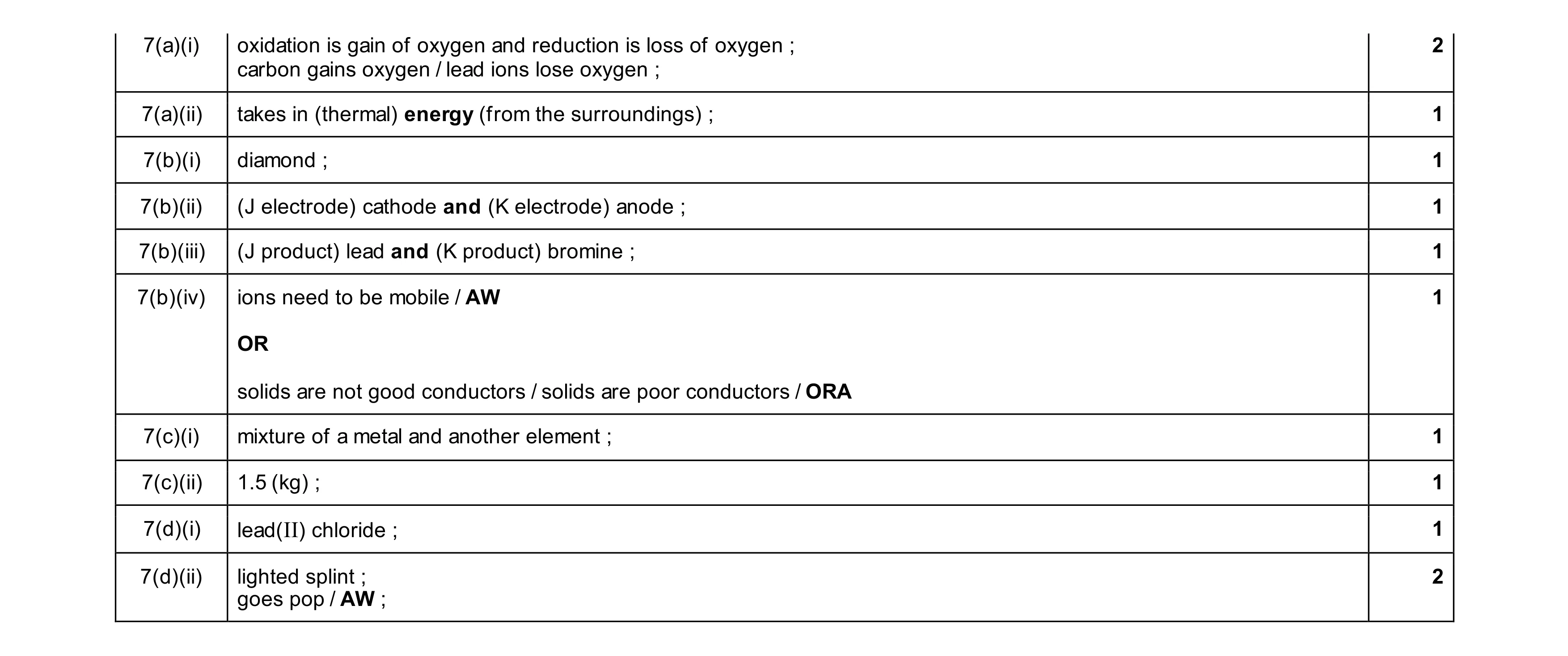 12
12