Cambridge IGCSE Sciences - Co-ordinated (Double) 0654 — 2012 May/June Paper 1 · Variant 1
0654/11/M/J/12 · 40 questions · 40 marks · ≈45 min
The question paper and its mark scheme, free to read here and free to download. This is Cambridge’s own paper, exactly as it was sat.
Question paper20 pages



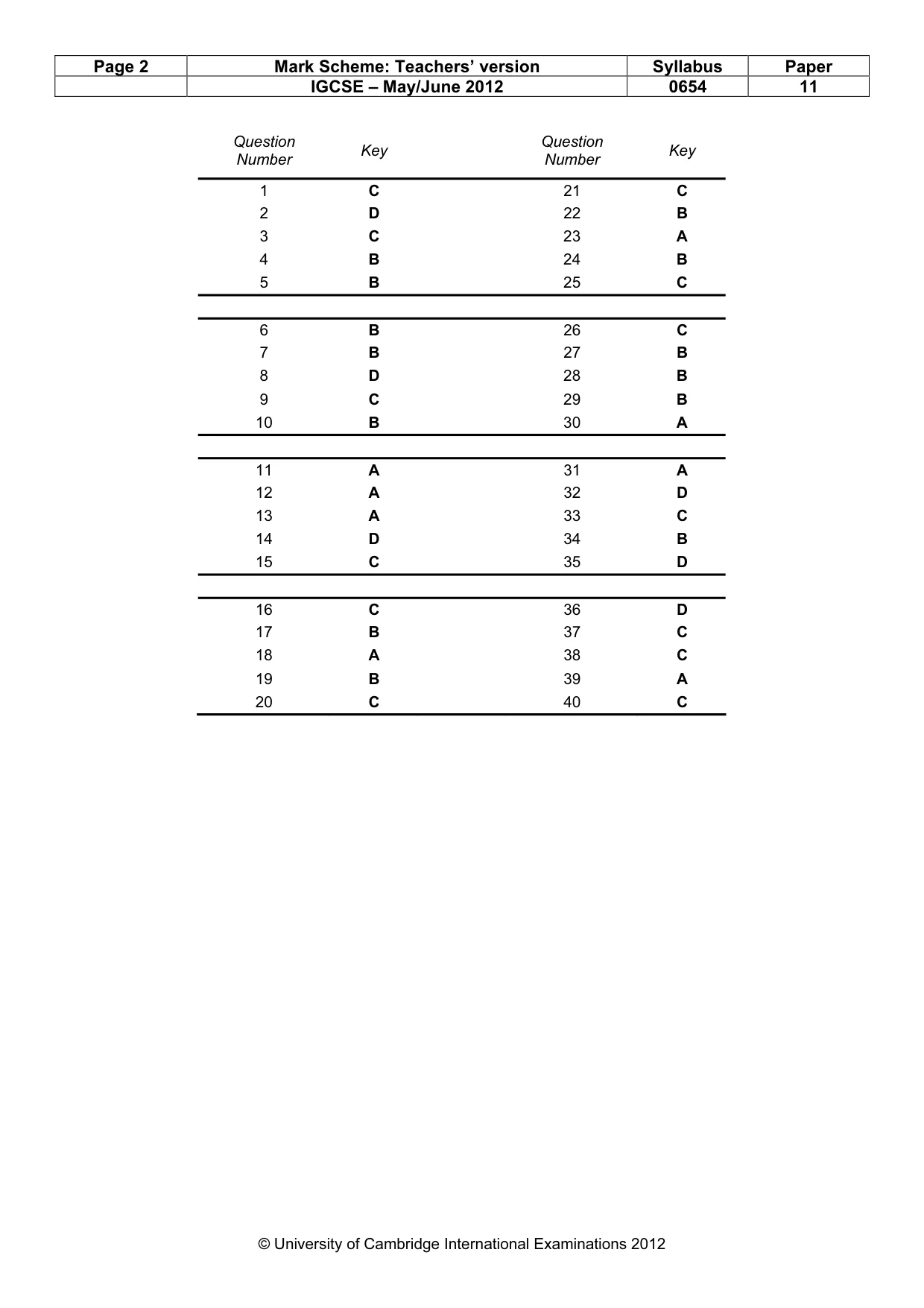
Mark scheme2 pages
Answers below. Sit the paper first if you are practising.
Questions as text
Q1 · The diagram shows a section through a cell from a leaf
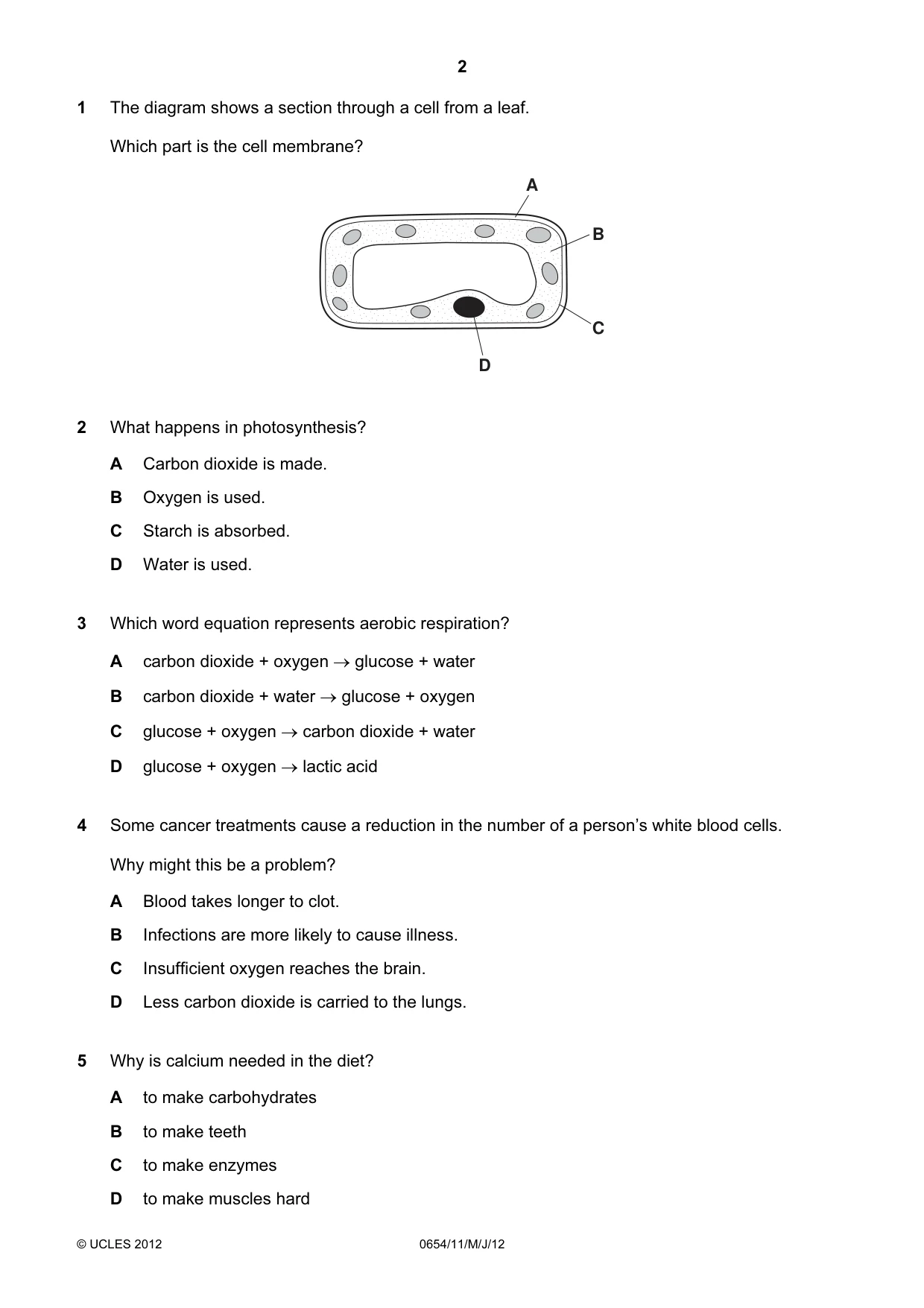
1 The diagram shows a section through a cell from a leaf. Which part is the cell membrane? A B C D
Mark scheme: C
Q2 · What happens in photosynthesis?
2 What happens in photosynthesis? A Carbon dioxide is made. B Oxygen is used. C Starch is absorbed. D Water is used.
Mark scheme: D
Q3 · Which word equation represents aerobic respiration?
3 Which word equation represents aerobic respiration? A carbon dioxide + oxygen → glucose + water B carbon dioxide + water → glucose + oxygen C glucose + oxygen → carbon dioxide + water D glucose + oxygen → lactic acid
Mark scheme: C
Q4 · Some cancer treatments cause a reduction in the number of a person’s white blood cells
4 Some cancer treatments cause a reduction in the number of a person’s white blood cells. Why might this be a problem? A Blood takes longer to clot. B Infections are more likely to cause illness. C Insufficient oxygen reaches the brain. D Less carbon dioxide is carried to the lungs.
Mark scheme: B
Q5 · Why is calcium needed in the diet?
5 Why is calcium needed in the diet? A to make carbohydrates B to make teeth C to make enzymes D to make muscles hard
Mark scheme: B
Q6 · The diagram shows part of the alimentary canal
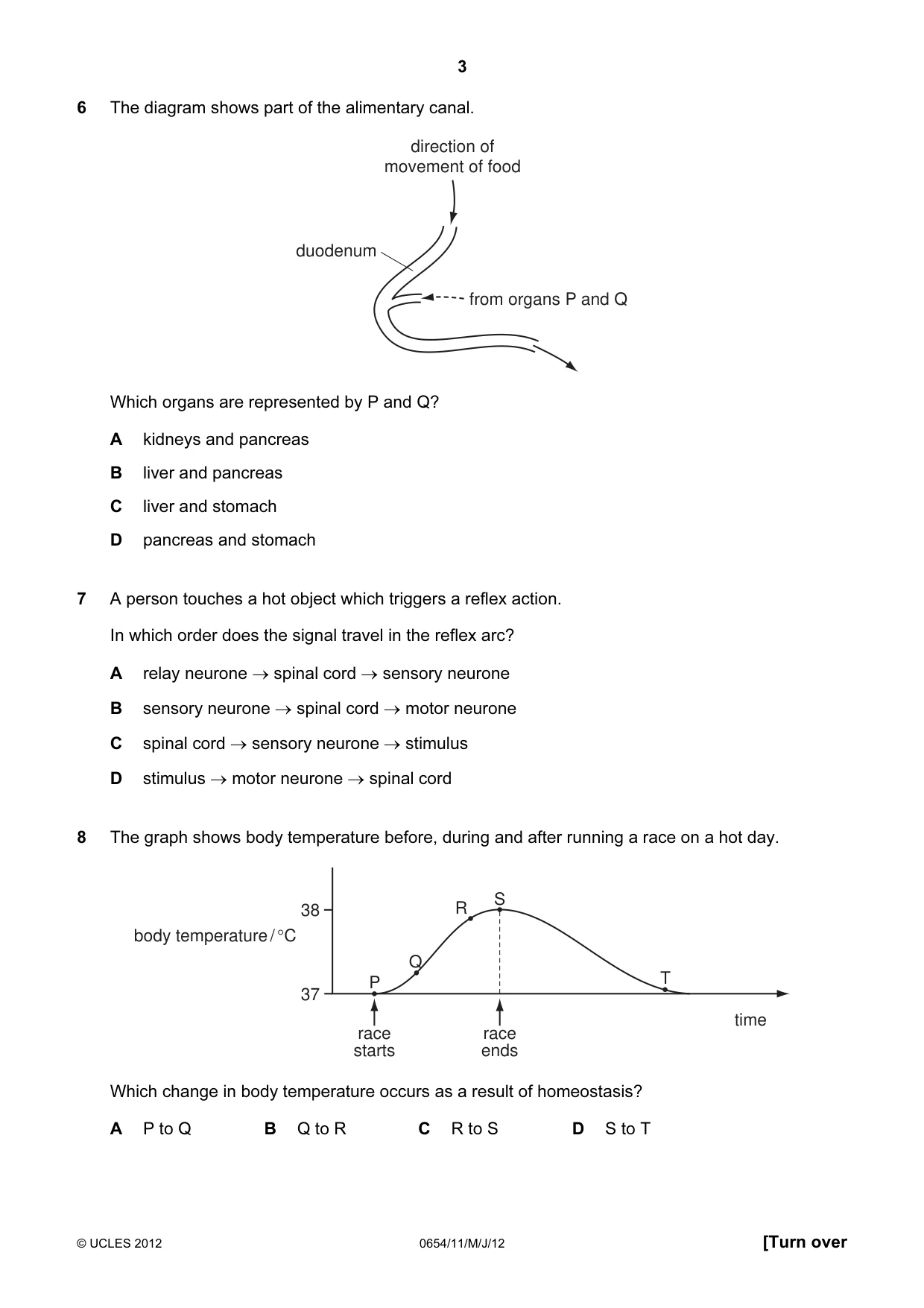
6 The diagram shows part of the alimentary canal. direction of movement of food duodenum from organs P and Q Which organs are represented by P and Q? A kidneys and pancreas B liver and pancreas C liver and stomach D pancreas and stomach
Mark scheme: B
Q7 · A person touches a hot object which triggers a reflex action
7 A person touches a hot object which triggers a reflex action. In which order does the signal travel in the reflex arc? A relay neurone → spinal cord → sensory neurone B sensory neurone → spinal cord → motor neurone C spinal cord → sensory neurone → stimulus D stimulus → motor neurone → spinal cord
Mark scheme: B
Q8 · The graph shows body temperature before, during and after running a race on a hot day
8 The graph shows body temperature before, during and after running a race on a hot day. S 38 R body temperature / °C Q P T 37 time race race starts ends Which change in body temperature occurs as a result of homeostasis? A P to Q B Q to R C R to S D S to T
Mark scheme: D
Q9 · Which structure contracts to expel the baby during birth?
9 Which structure contracts to expel the baby during birth? A cervix B oviduct C uterus wall D vagina
Mark scheme: C
Q10 · In a flowering plant, which structure contains the female gamete?
10 In a flowering plant, which structure contains the female gamete? A anther B ovule C pollen grain D stigma
Mark scheme: B
Q11 · The diagram shows the results of a breeding experiment using black and white mice
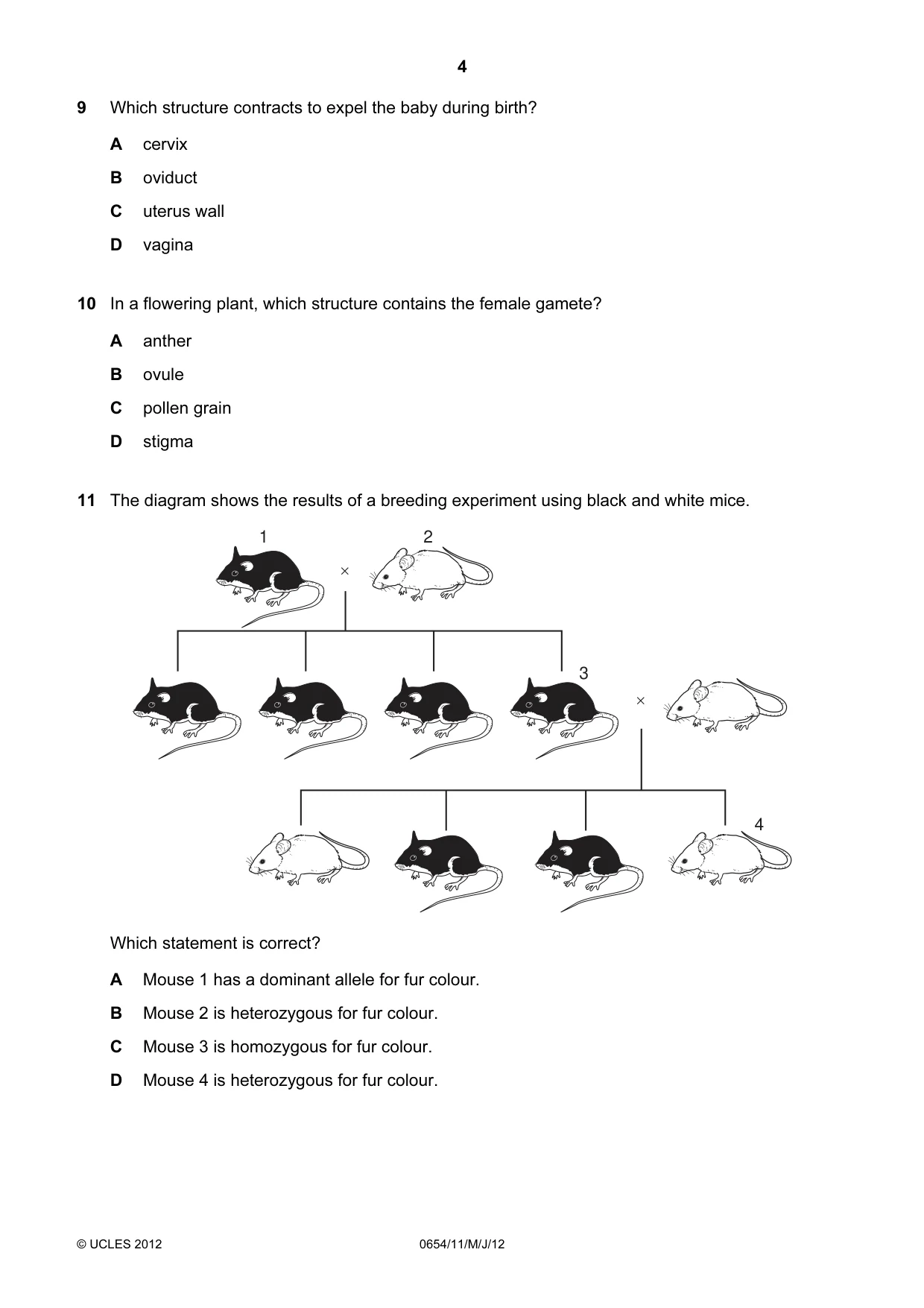
11 The diagram shows the results of a breeding experiment using black and white mice. 1 2 × 3 × 4 Which statement is correct? A Mouse 1 has a dominant allele for fur colour. B Mouse 2 is heterozygous for fur colour. C Mouse 3 is homozygous for fur colour. D Mouse 4 is heterozygous for fur colour.
Mark scheme: A
Q12 · The diagram shows a food chain
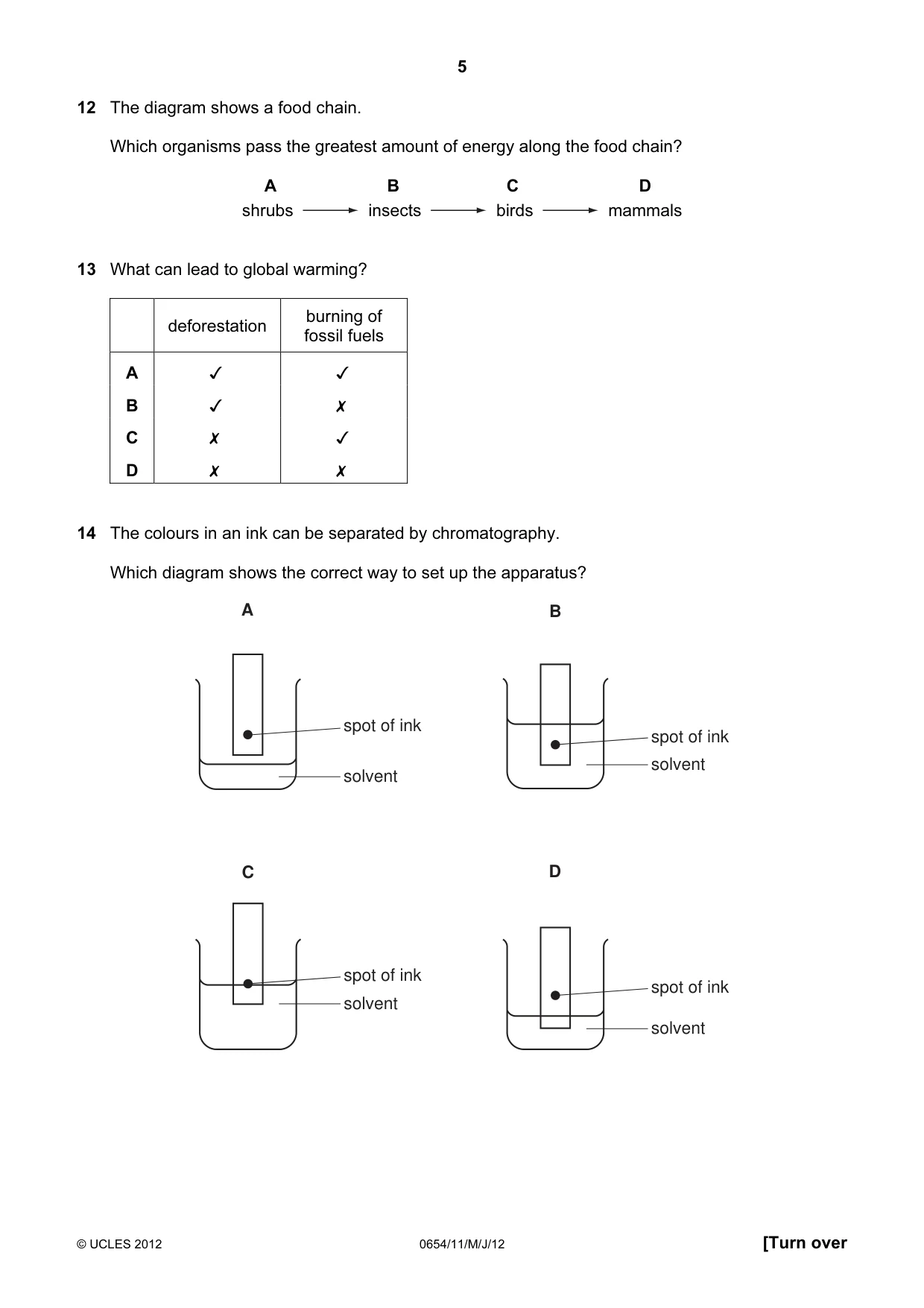
12 The diagram shows a food chain. Which organisms pass the greatest amount of energy along the food chain? A B C D shrubs insects birds mammals
Mark scheme: A
Q13 · What can lead to global warming?
13 What can lead to global warming? deforestation ° un "9 of A v v B v x Cc x v D x x
Mark scheme: A
Q14 · The colours in an ink can be separated by chromatography
14 The colours in an ink can be separated by chromatography. Which diagram shows the correct way to set up the apparatus? A B spot of ink spot of ink solvent solvent C D spot of ink spot of ink solvent solvent
Mark scheme: D
Q15 · The diagram shows a helium atom
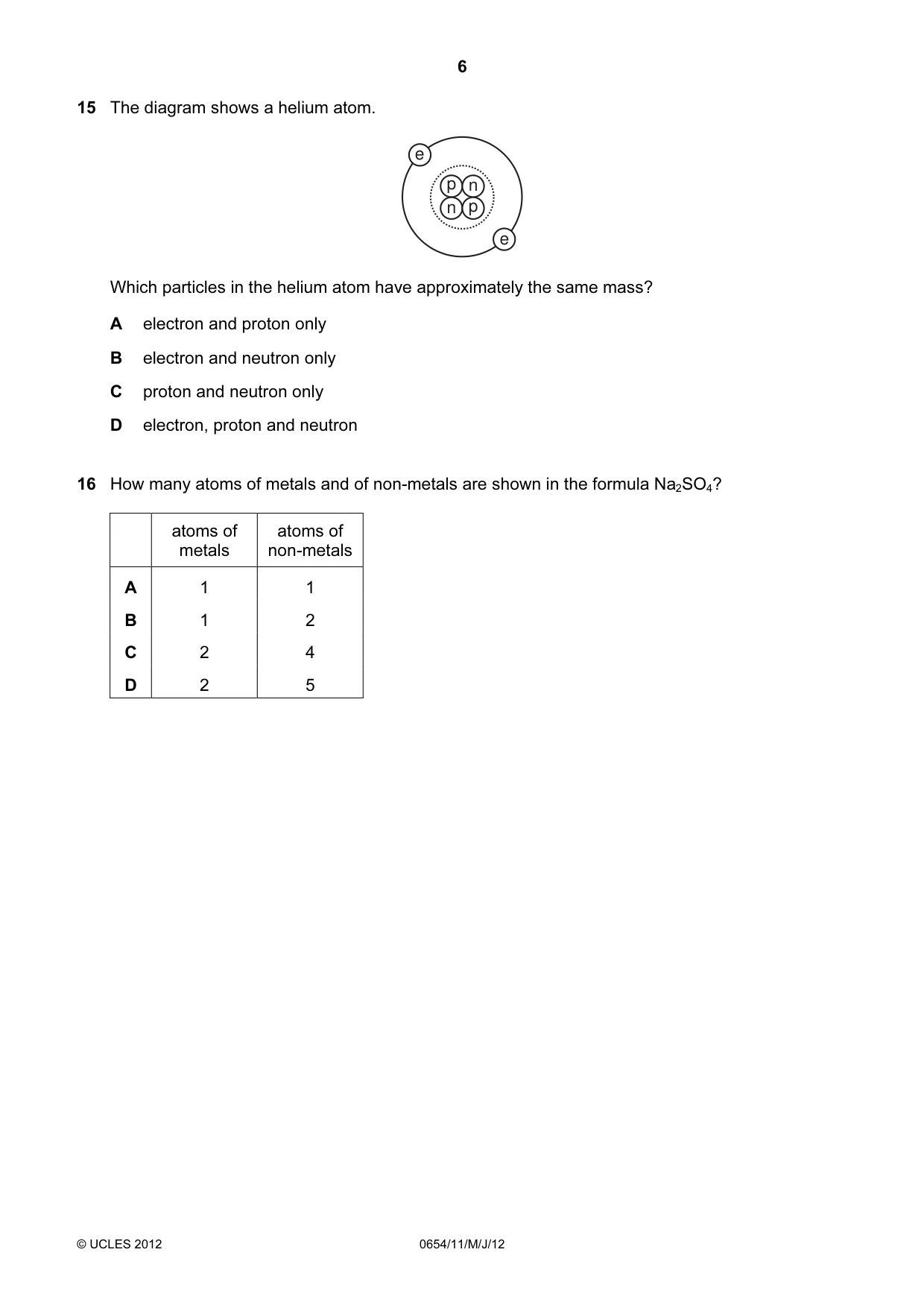
15 The diagram shows a helium atom. e p n n p e Which particles in the helium atom have approximately the same mass? A electron and proton only B electron and neutron only C proton and neutron only D electron, proton and neutron
Mark scheme: C
Q16 · How many atoms of metals and of non-metals are shown in the formula Na2SO4?
16 How many atoms of metals and of non-metals are shown in the formula Na2SO4? atoms of atoms of metals non-metals A 1 1 B 1 2 C 2 4 D 2 5
Mark scheme: C
Q17 · The apparatus shown is used to investigate the speed of reaction between hydrochloric…
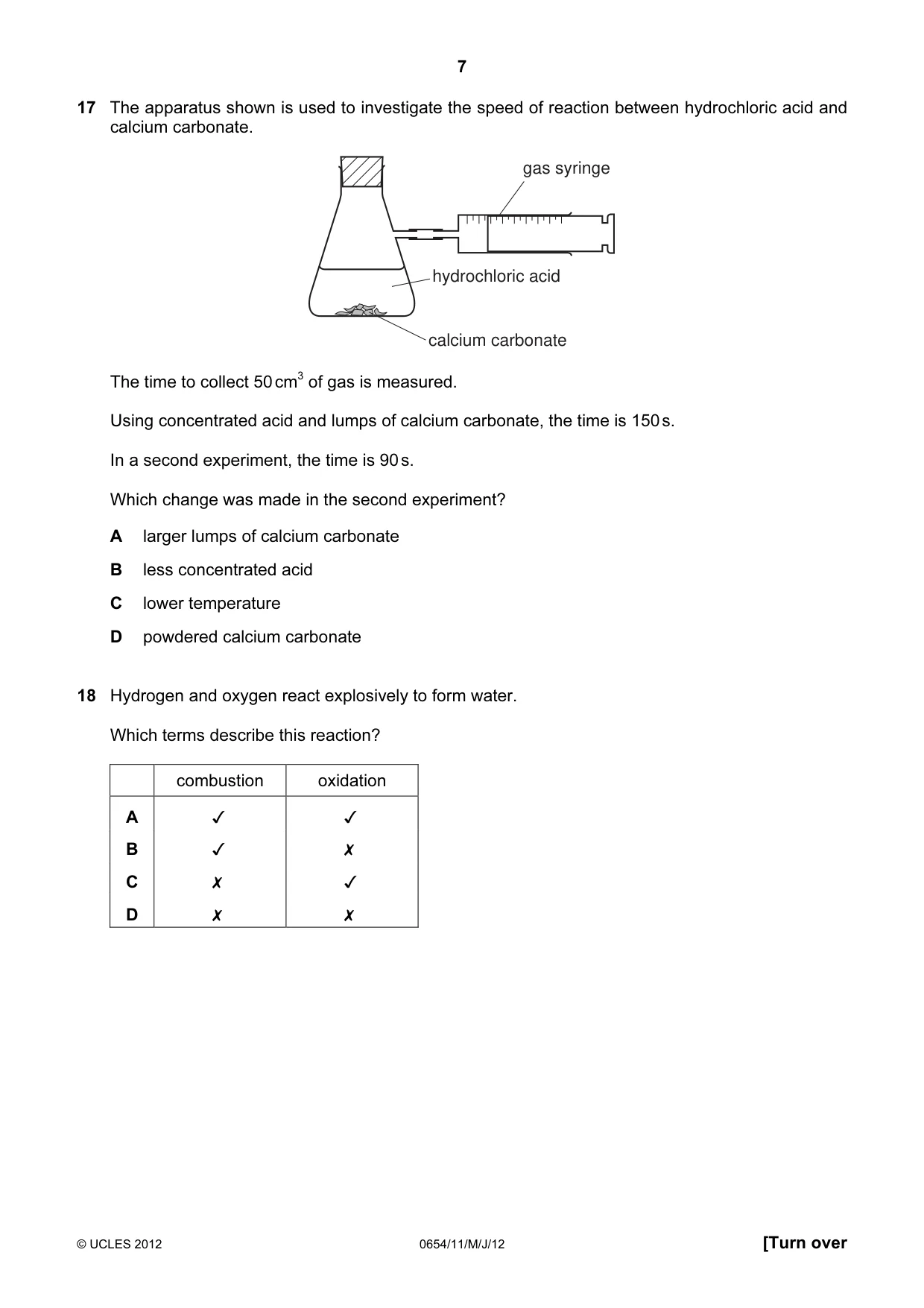
17 The apparatus shown is used to investigate the speed of reaction between hydrochloric acid and calcium carbonate. gas syringe hydrochloric acid calcium carbonate The time to collect 50 cm3 of gas is measured. Using concentrated acid and lumps of calcium carbonate, the time is 150 s. In a second experiment, the time is 90 s. Which change was made in the second experiment? A larger lumps of calcium carbonate B less concentrated acid C lower temperature D powdered calcium carbonate
Mark scheme: B
Q18 · Hydrogen and oxygen react explosively to form water
18 Hydrogen and oxygen react explosively to form water. Which terms describe this reaction? combustion oxidation A v v B v x Cc x v D x x
Mark scheme: A
Q19 · The diagram shows litmus paper testing the gas that is given off from the contents of the…
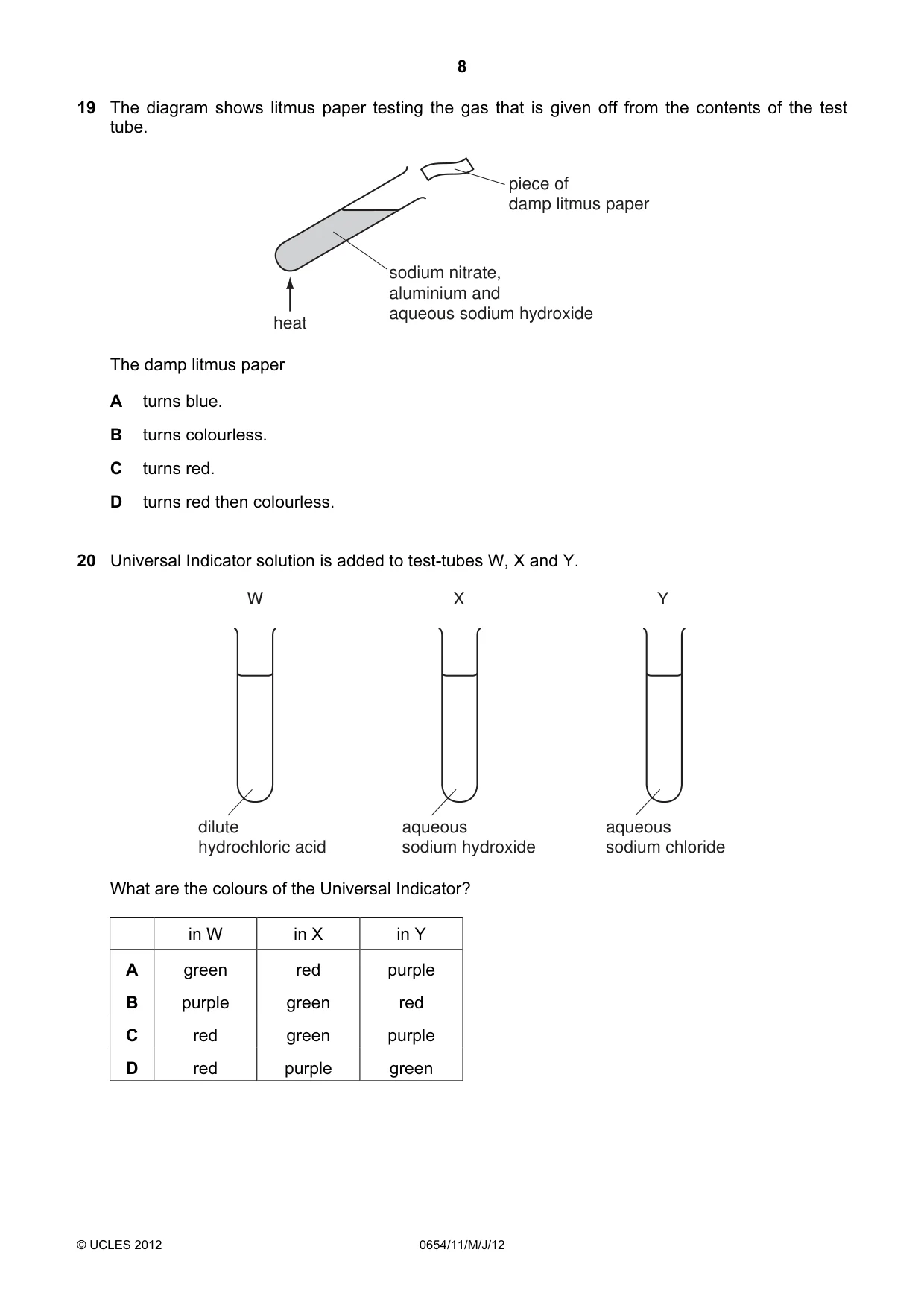
19 The diagram shows litmus paper testing the gas that is given off from the contents of the test tube. piece of damp litmus paper sodium nitrate, aluminium and aqueous sodium hydroxide heat The damp litmus paper A turns blue. B turns colourless. C turns red. D turns red then colourless.
Mark scheme: B
Q20 · Universal Indicator solution is added to test-tubes W, X and Y
20 Universal Indicator solution is added to test-tubes W, X and Y. W X Y dilute aqueous aqueous hydrochloric acid sodium hydroxide sodium chloride What are the colours of the Universal Indicator? in W in X in Y A green red purple B purple green red C red green purple D red purple green
Mark scheme: C
More questions on The characteristic properties of acids and bases
Q21 · The table shows physical properties of some substances
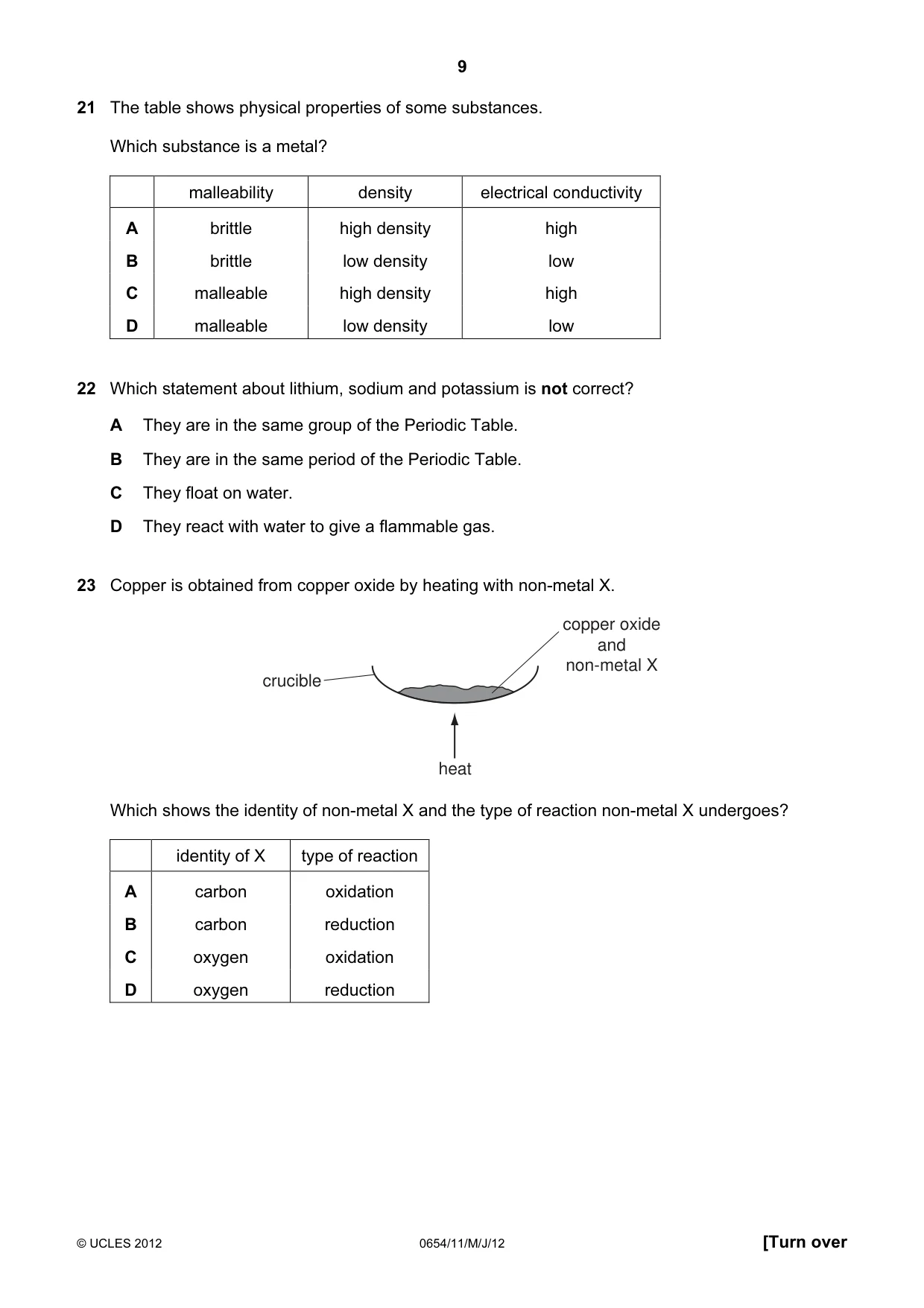
21 The table shows physical properties of some substances. Which substance is a metal? malleability density electrical conductivity A brittle high density high B brittle low density low C malleable high density high D malleable low density low
Mark scheme: C
Q22 · Which statement about lithium, sodium and potassium is not correct?
22 Which statement about lithium, sodium and potassium is not correct? A They are in the same group of the Periodic Table. B They are in the same period of the Periodic Table. C They float on water. D They react with water to give a flammable gas.
Mark scheme: B
Q23 · Copper is obtained from copper oxide by heating with non-metal X
23 Copper is obtained from copper oxide by heating with non-metal X. copper oxide and non-metal X crucible heat Which shows the identity of non-metal X and the type of reaction non-metal X undergoes? identity of X type of reaction A carbon oxidation B carbon reduction C oxygen oxidation D oxygen reduction
Mark scheme: A
Q24 · In which tube does the iron nail rust in the shortest time?
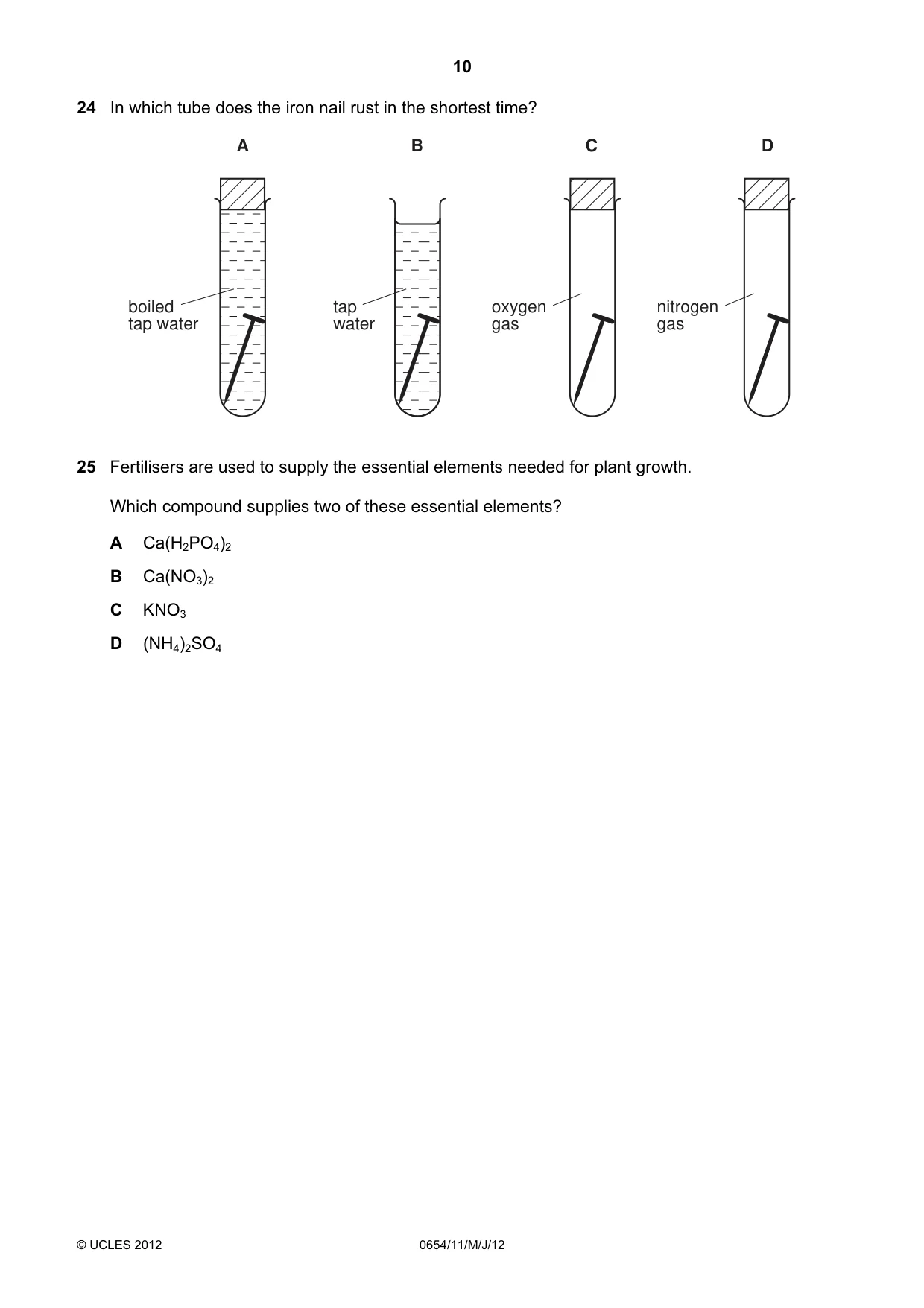
24 In which tube does the iron nail rust in the shortest time? A B C D boiled tap oxygen nitrogen tap water water gas gas
Mark scheme: B
Q25 · Fertilisers are used to supply the essential elements needed for plant growth
25 Fertilisers are used to supply the essential elements needed for plant growth. Which compound supplies two of these essential elements? A Ca(H2PO4)2 B Ca(NO3)2 C KNO3 D (NH4)2SO4
Mark scheme: C
Q26 · The burning of a fuel is investigated using the apparatus shown
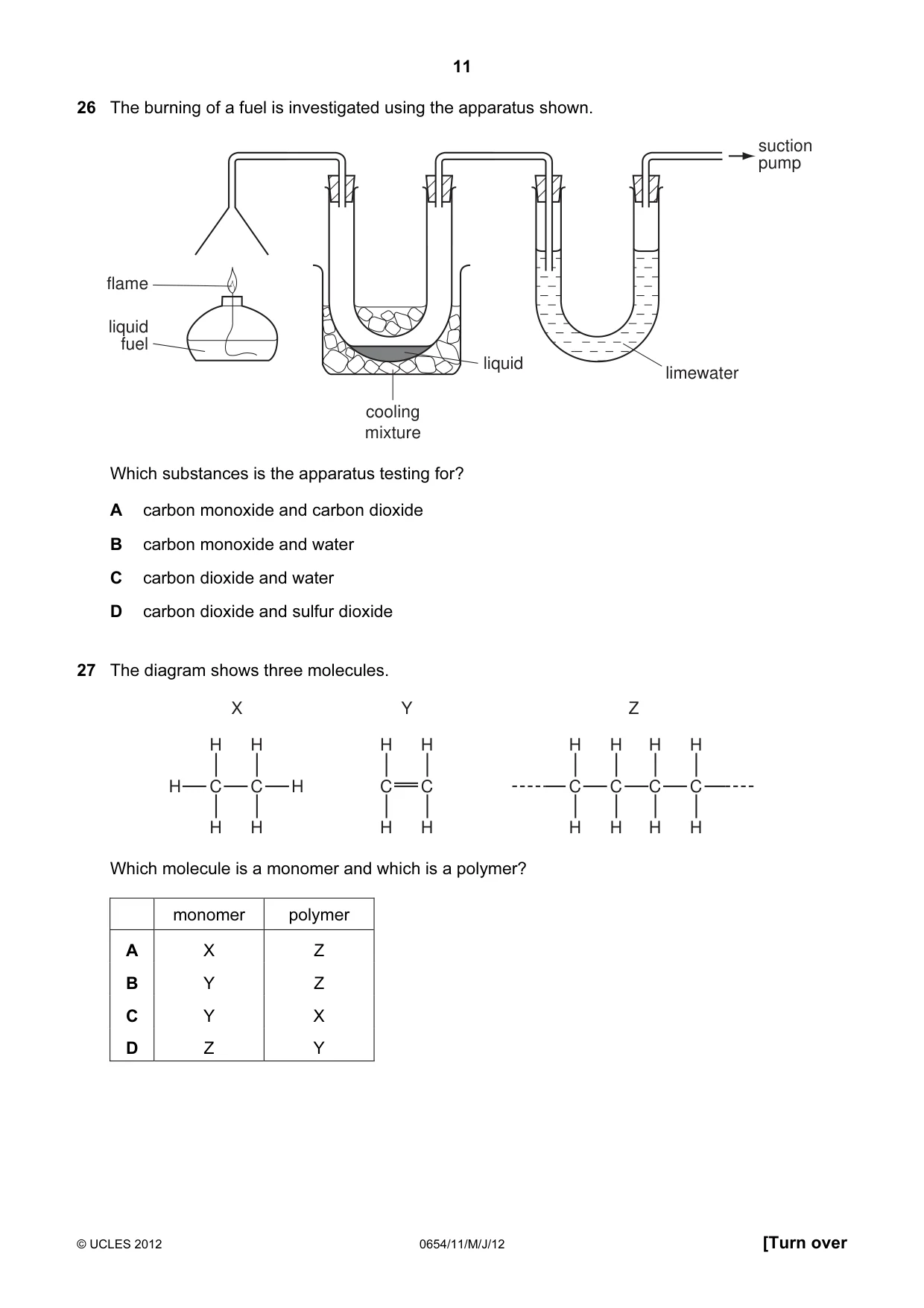
26 The burning of a fuel is investigated using the apparatus shown. suction pump flame liquid fuel liquid limewater cooling mixture Which substances is the apparatus testing for? A carbon monoxide and carbon dioxide B carbon monoxide and water C carbon dioxide and water D carbon dioxide and sulfur dioxide
Mark scheme: C
Q27 · The diagram shows three molecules
27 The diagram shows three molecules. X Y Z H H H H H H H H H C C H C C C C C C H H H H H H H H Which molecule is a monomer and which is a polymer? monomer polymer A X Z B Y Z C Y X D Z Y
Mark scheme: B
Q28 · A motorist starts out on a 210 km journey at 8 am
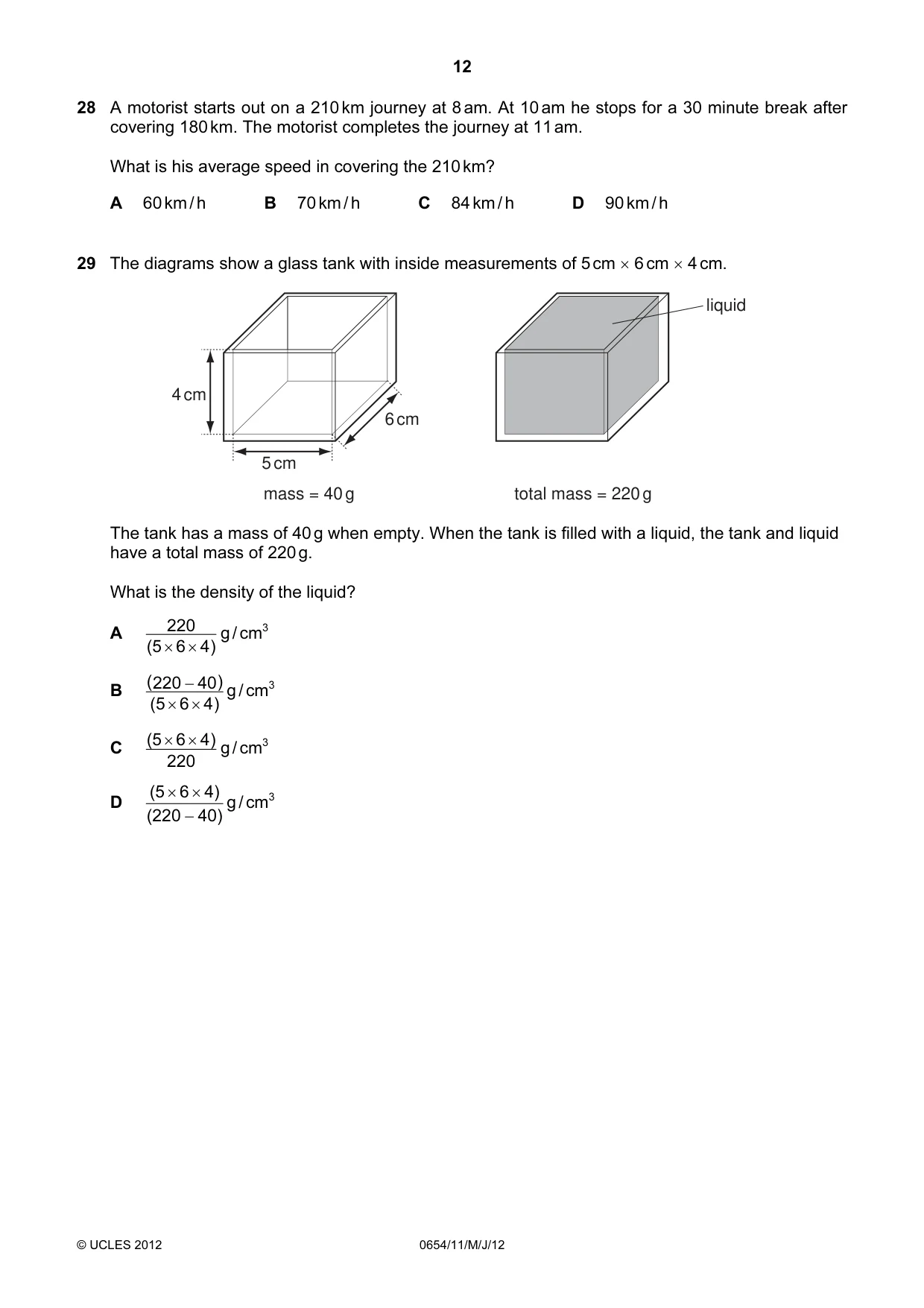
28 A motorist starts out on a 210 km journey at 8 am. At 10 am he stops for a 30 minute break after covering 180 km. The motorist completes the journey at 11 am. What is his average speed in covering the 210 km? A 60 km / h B 70 km / h C 84 km / h D 90 km / h
Mark scheme: B
Q29 · The diagrams show a glass tank with inside measurements of 5 cm × 6 cm × 4 cm
29 The diagrams show a glass tank with inside measurements of 5 cm × 6 cm × 4 cm. liquid 4 cm 6 cm 5 cm mass = 40 g total mass = 220 g The tank has a mass of 40 g when empty. When the tank is filled with a liquid, the tank and liquid have a total mass of 220 g. What is the density of the liquid? A 220 g / cm3 (5 × 6 × 4 ) ( 220 − 40 ) g / cm3 B (5 × 6 × 4 ) (5 × 6 × 4 ) g / cm3 C 220 (5 × 6 × 4) D g / cm3 (220 − 40)
Mark scheme: B
Q30 · A workman lifts a cubic block from ground level to a high shelf using a fork lift truck
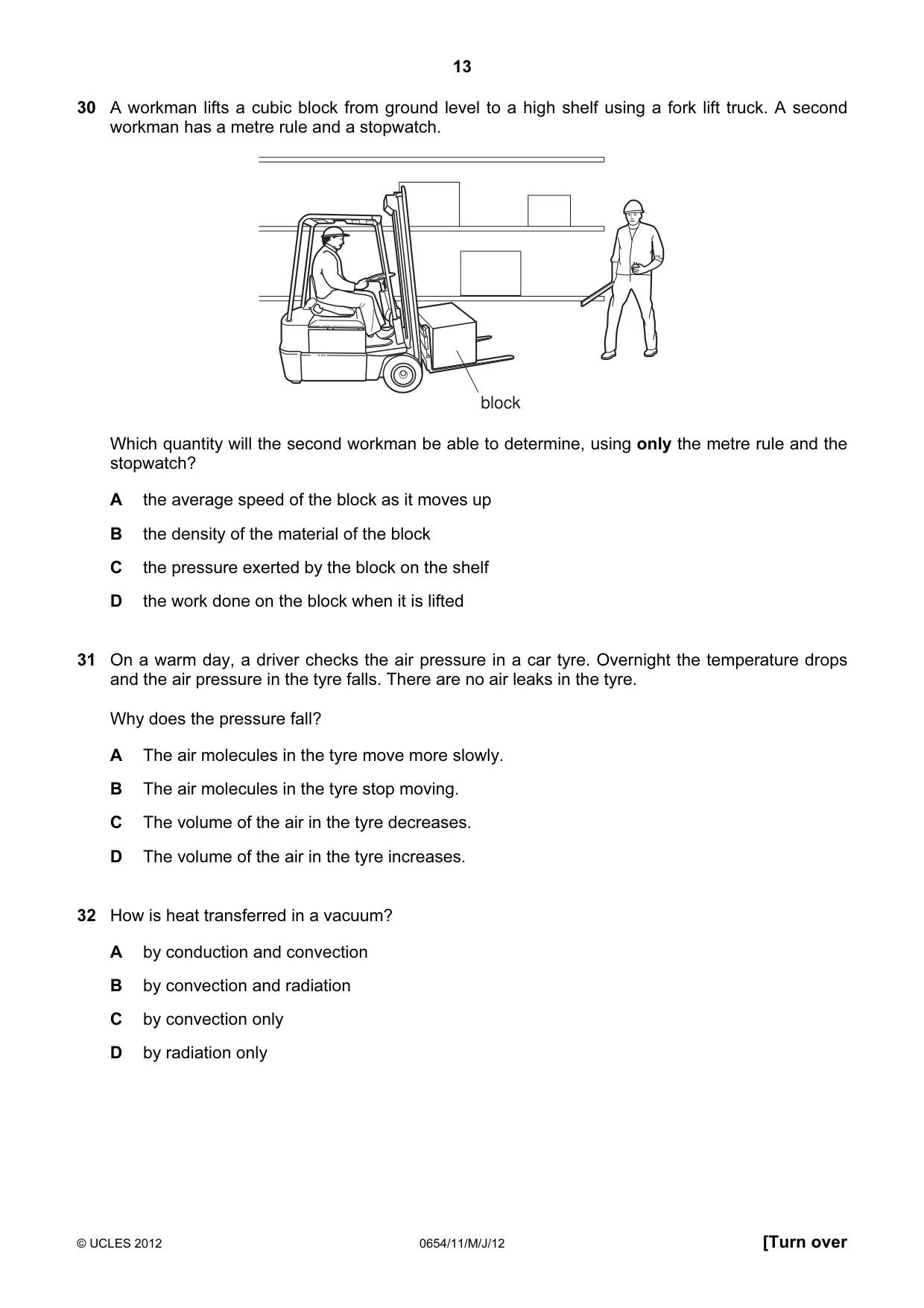
30 A workman lifts a cubic block from ground level to a high shelf using a fork lift truck. A second workman has a metre rule and a stopwatch. block Which quantity will the second workman be able to determine, using only the metre rule and the stopwatch? A the average speed of the block as it moves up B the density of the material of the block C the pressure exerted by the block on the shelf D the work done on the block when it is lifted
Mark scheme: A
Q31 · On a warm day, a driver checks the air pressure in a car tyre
31 On a warm day, a driver checks the air pressure in a car tyre. Overnight the temperature drops and the air pressure in the tyre falls. There are no air leaks in the tyre. Why does the pressure fall? A The air molecules in the tyre move more slowly. B The air molecules in the tyre stop moving. C The volume of the air in the tyre decreases. D The volume of the air in the tyre increases.
Mark scheme: A
Q32 · How is heat transferred in a vacuum?
32 How is heat transferred in a vacuum? A by conduction and convection B by convection and radiation C by convection only D by radiation only
Mark scheme: D
Q33 · The diagram shows water waves travelling towards a barrier
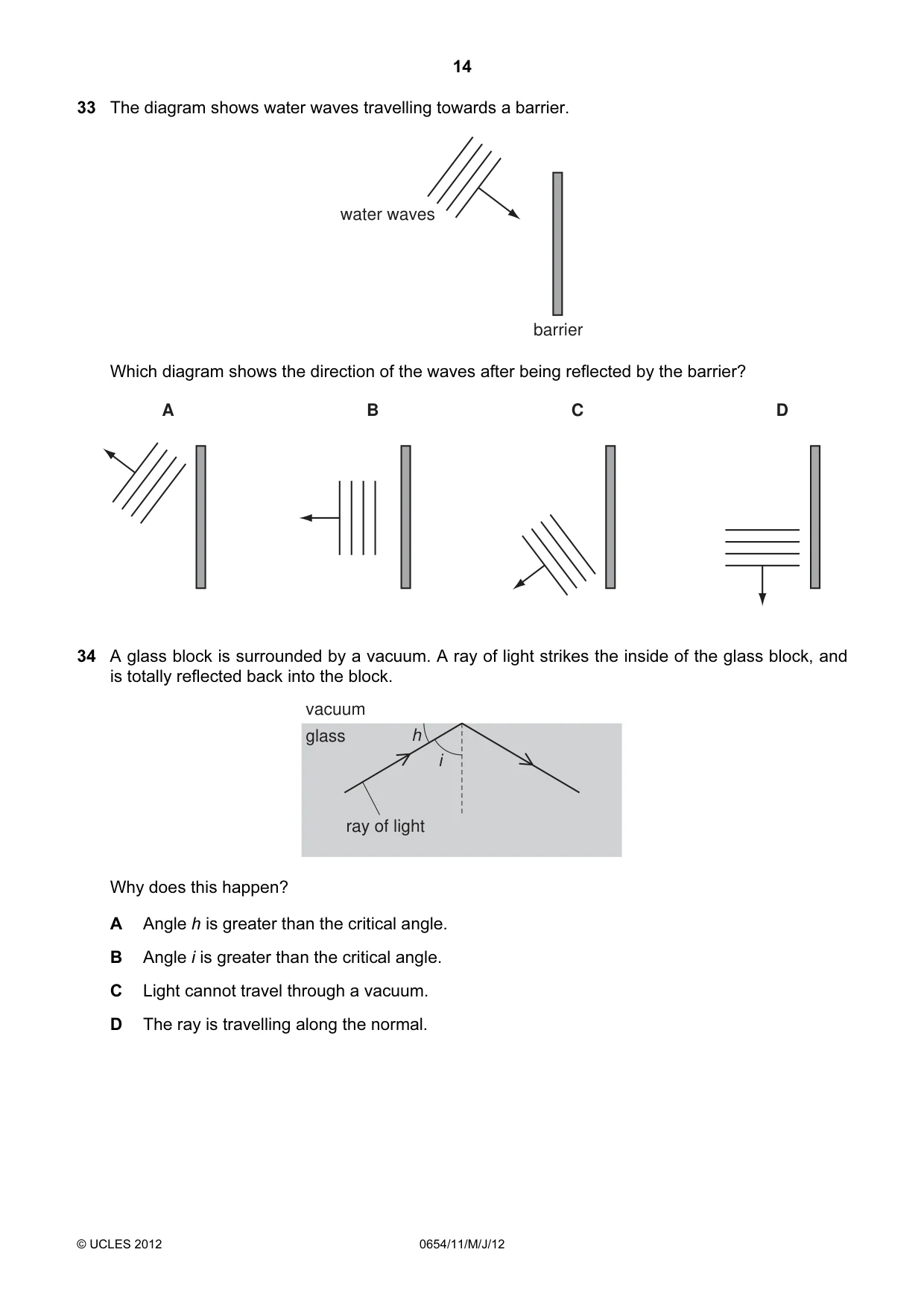
33 The diagram shows water waves travelling towards a barrier. water waves barrier Which diagram shows the direction of the waves after being reflected by the barrier? A B C D
Mark scheme: C
Q34 · A glass block is surrounded by a vacuum
34 A glass block is surrounded by a vacuum. A ray of light strikes the inside of the glass block, and is totally reflected back into the block. vacuum glass h i ray of light Why does this happen? A Angle h is greater than the critical angle. B Angle i is greater than the critical angle. C Light cannot travel through a vacuum. D The ray is travelling along the normal.
Mark scheme: B
Q35 · The Sun emits infra-red radiation, ultraviolet radiation and visible light
35 The Sun emits infra-red radiation, ultraviolet radiation and visible light. Which statement about the time it takes these radiations to reach Earth’s atmosphere is correct? A Infra-red radiation arrives first. B Ultraviolet radiation arrives first. C Visible light arrives first. D They all arrive at the same time.
Mark scheme: D
Q36 · Astronaut 1 uses a hammer to mend a satellite in space
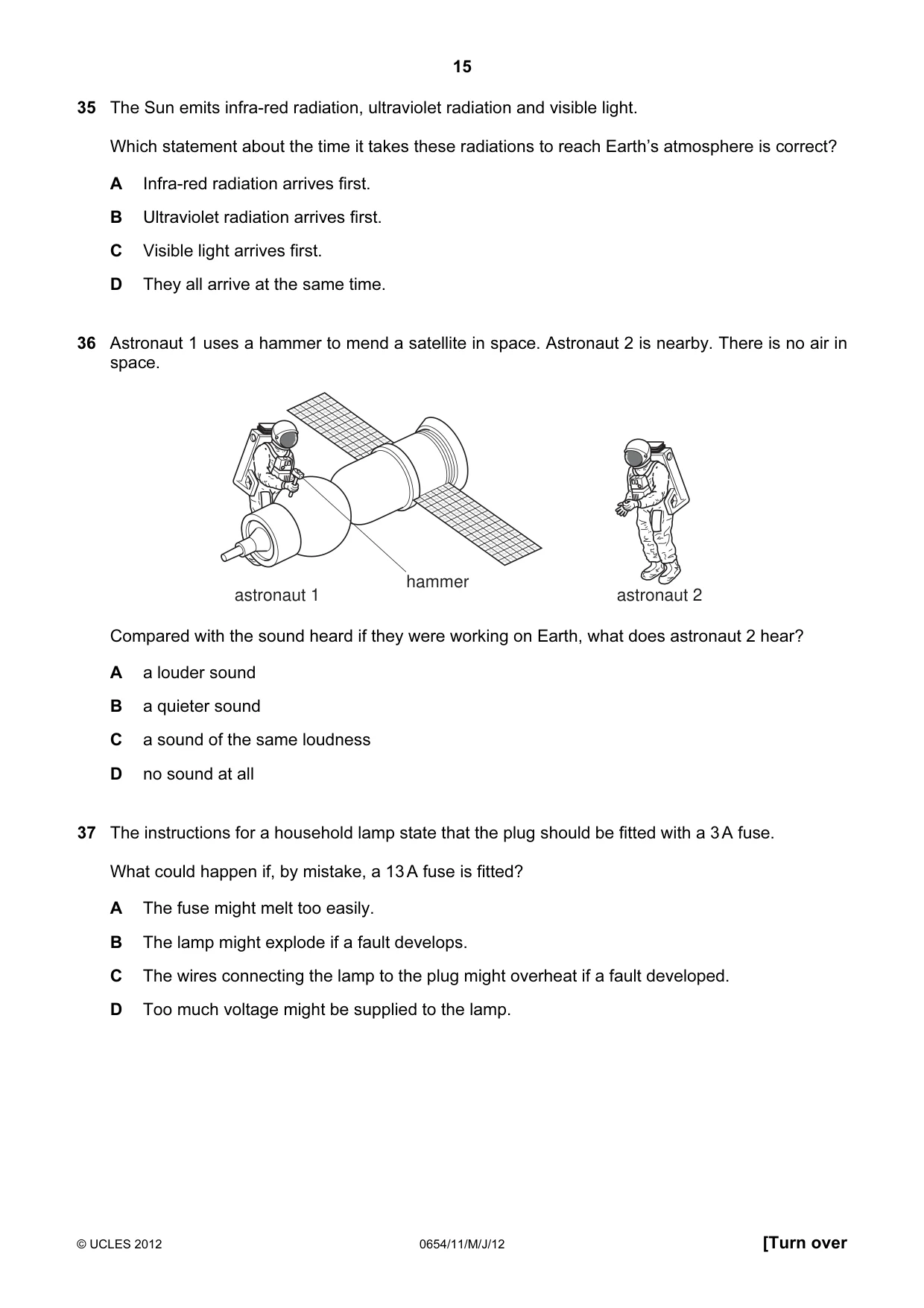
36 Astronaut 1 uses a hammer to mend a satellite in space. Astronaut 2 is nearby. There is no air in space. hammer astronaut 1 astronaut 2 Compared with the sound heard if they were working on Earth, what does astronaut 2 hear? A a louder sound B a quieter sound C a sound of the same loudness D no sound at all
Mark scheme: D
Q37 · The instructions for a household lamp state that the plug should be fitted with a 3 A fuse
37 The instructions for a household lamp state that the plug should be fitted with a 3 A fuse. What could happen if, by mistake, a 13 A fuse is fitted? A The fuse might melt too easily. B The lamp might explode if a fault develops. C The wires connecting the lamp to the plug might overheat if a fault developed. D Too much voltage might be supplied to the lamp.
Mark scheme: C
Q38 · A 3.0 Ω resistor and a 6.0 Ω resistor are connected to a power supply as shown
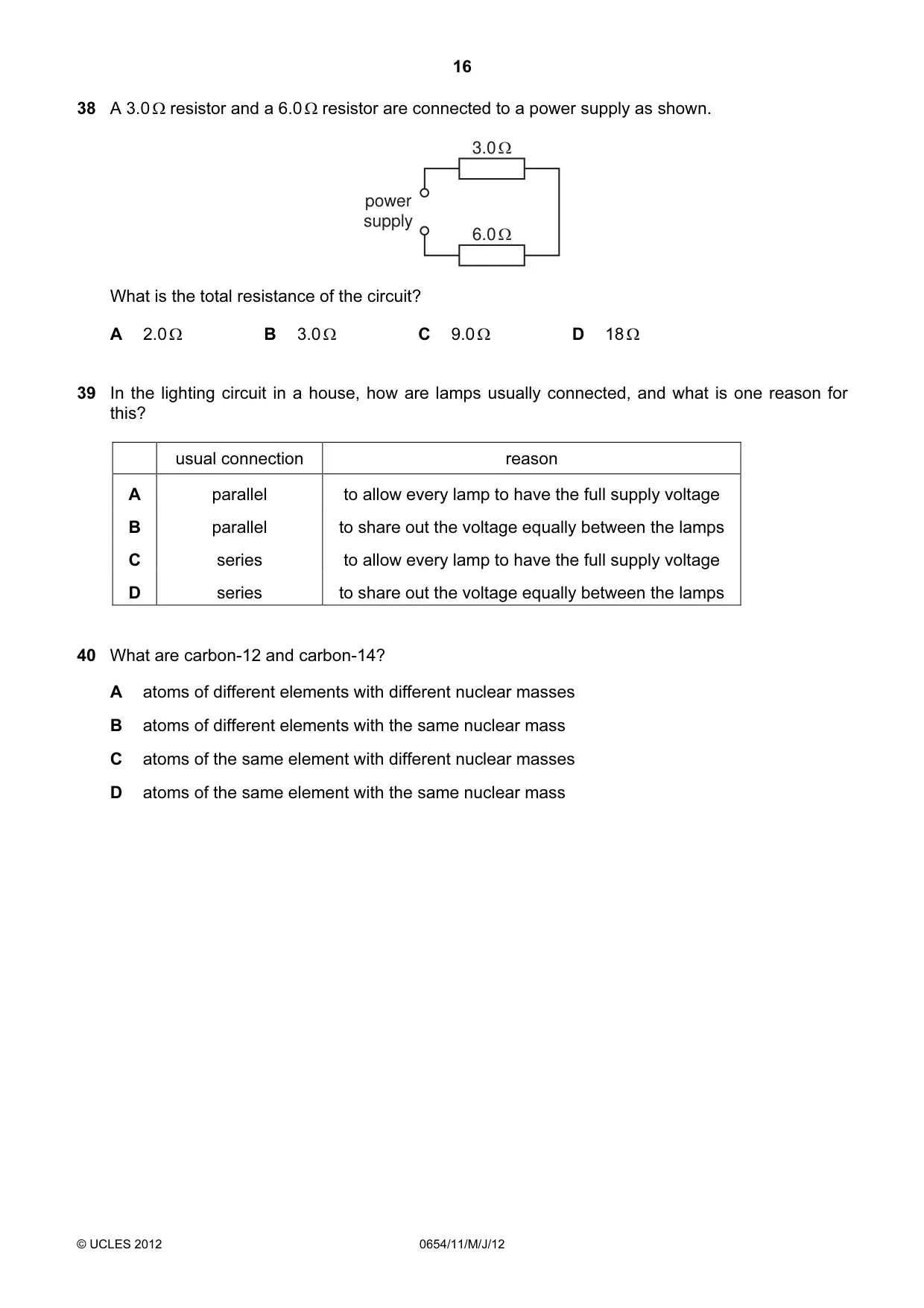
38 A 3.0 Ω resistor and a 6.0 Ω resistor are connected to a power supply as shown. 3.0 Ω power supply 6.0 Ω What is the total resistance of the circuit? A 2.0 Ω B 3.0 Ω C 9.0 Ω D 18 Ω
Mark scheme: C
Q39 · In the lighting circuit in a house, how are lamps usually connected, and what is one…
39 In the lighting circuit in a house, how are lamps usually connected, and what is one reason for this? usual connection reason A parallel to allow every lamp to have the full supply voltage B parallel to share out the voltage equally between the lamps C series to allow every lamp to have the full supply voltage D series to share out the voltage equally between the lamps
Mark scheme: A
Q40 · What are carbon-12 and carbon-14?
40 What are carbon-12 and carbon-14? A atoms of different elements with different nuclear masses B atoms of different elements with the same nuclear mass C atoms of the same element with different nuclear masses D atoms of the same element with the same nuclear mass
Mark scheme: C
What was in this paper
The subtopics covered by these 40 questions, and how many questions each got. Open one in a new tab to see every Cambridge question on it.
2Formulas2Motion2Air quality and climate1Atomic structure and the Periodic Table1Cell structure1Chromatography1Coordination and response1Corrosion of metals1Density1Diet1Digestive system1Diseases and immunity1Electrical safety1Electromagnetic spectrum1Extraction of metals1Food chains and food webs1General properties of waves1Group I properties1Habitat destruction1Homeostasis1Identification of ions and gases1Isotopes1Kinetic particle model of matter1Light1Monohybrid inheritance1Photosynthesis1Polymers1Properties of metals1Rate of reaction1Redox1Respiration1Sexual reproduction in humans1Sexual reproduction in plants1Sound1The characteristic properties of acids and bases1Transfer of thermal energy1What you needed in this session
Cambridge’s own grade thresholds for 2012 May/June, Paper 1 · Variant 1. A higher threshold means an easier paper — the bar moves with how the cohort did.