Questions as text
Q1 · An electric heating element in a beaker containing water 0625/32 Feb/March 2017
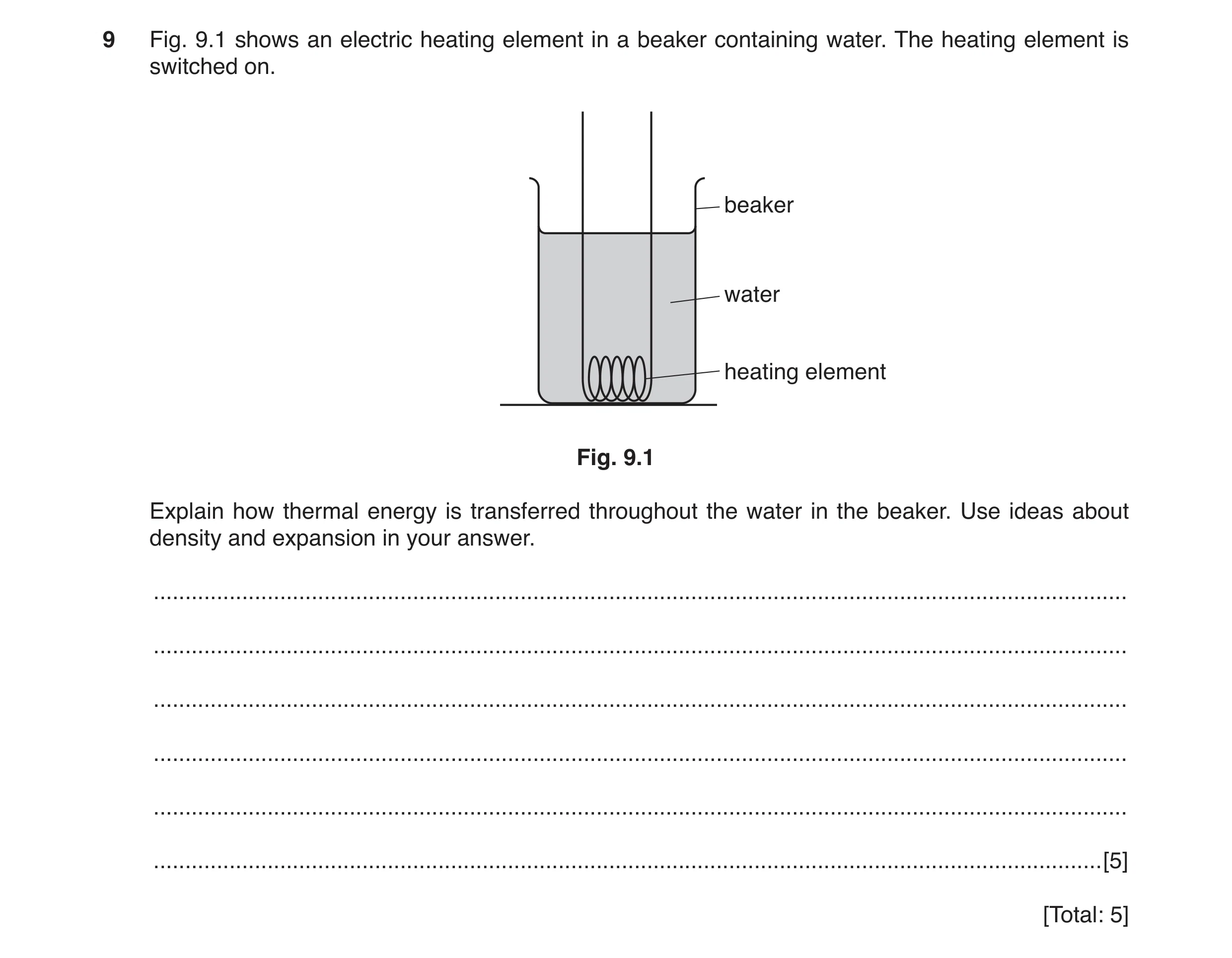
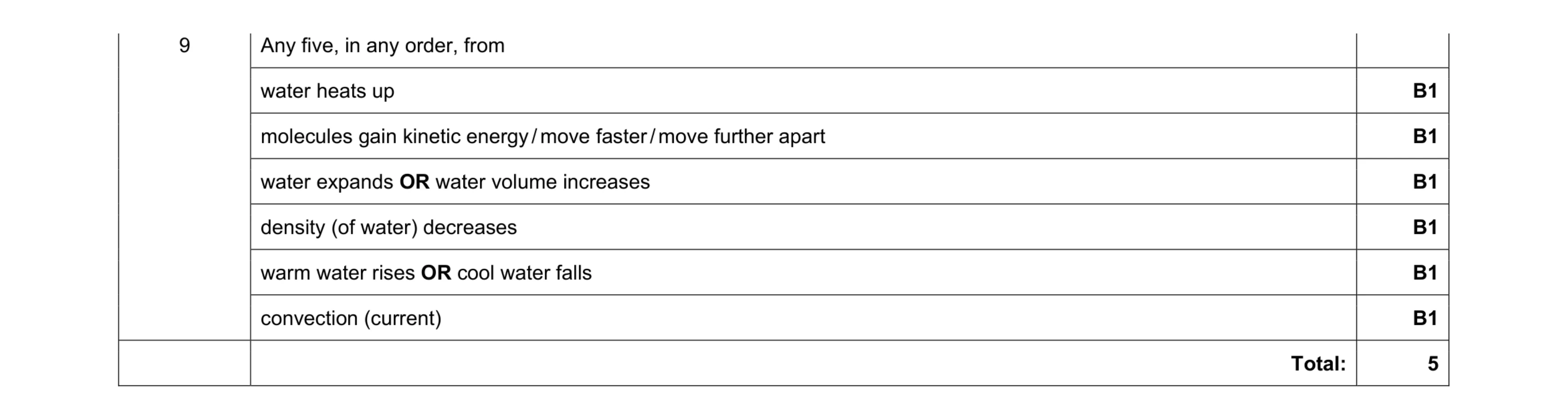
9 Fig. 9.1 shows an electric heating element in a beaker containing water. The heating element is switched on. beaker water heating element Fig. 9.1 Explain how thermal energy is transferred throughout the water in the beaker. Use ideas about density and expansion in your answer. … … … … … … [5] [Total: 5]
5 marks
Mark scheme: 9 Any five, in any order, from water heats up B1 molecules gain kinetic energy / move faster / move further apart B1 water expands OR water volume increases B1 density (of water) decreases B1 warm water rises OR cool water falls B1 convection (current) B1 Total: 5
This question in 0625/32 Feb/March 2017
Q2 · A house has white wooden walls and a black wooden door, as shown in Fig 0625/32 May/June 2017
4 A house has white wooden walls and a black wooden door, as shown in Fig. 4.1. white black Fig. 4.1 (a) The Sun is shining on the door and the front wall of the house. (i) State the name of the process by which thermal energy is transferred from the Sun to the Earth. … [1] (ii) Fig. 4.2 shows part of the white wall and the black door of the house. Two thermometers have been attached, one to the wall and the other to the door. thermometer A thermometer B Fig. 4.2 Thermometer A measures the temperature of the white wall. Thermometer B measures the temperature of the black door. The thermometer readings are recorded after the Sun has been shining on the house for some time. Suggest which thermometer has the higher temperature and explain why. higher temperature … explanation … … … … [3] (b) The air conditioning unit inside a room in the house is switched on. The air conditioning unit takes in warm air and gives out cold air, as shown in Fig. 4.3. cold air ceiling air conditioning unit room door Fig. 4.3 Explain how the air conditioning unit cools all the air in the room. … … … … … [3] [Total: 7]
7 marks
Mark scheme: 4(a) radiation B1 4(a)(ii) thermometer near door or B is at higher temperature B1 any 2 from: darker colours are better absorbers (of thermal energy) darker colours are better emitters (of thermal energy) white/lighter colours are better reflectors (of thermal energy) white/lighter colours are poorer absorbers (of thermal energy) white/lighter colours are poorer emitters (of thermal energy) B2 4(b) any 3 from: cold air is denser (than warm air) cold air will fall the cold air is warmed and expands less dense/warm air rises or replaces the cold air (forming a) convection (current) B3 Total: 7
This question in 0625/32 May/June 2017
Q3 · A cup made from plastic, containing a hot drink, is shown in Fig 0625/32 Oct/Nov 2017
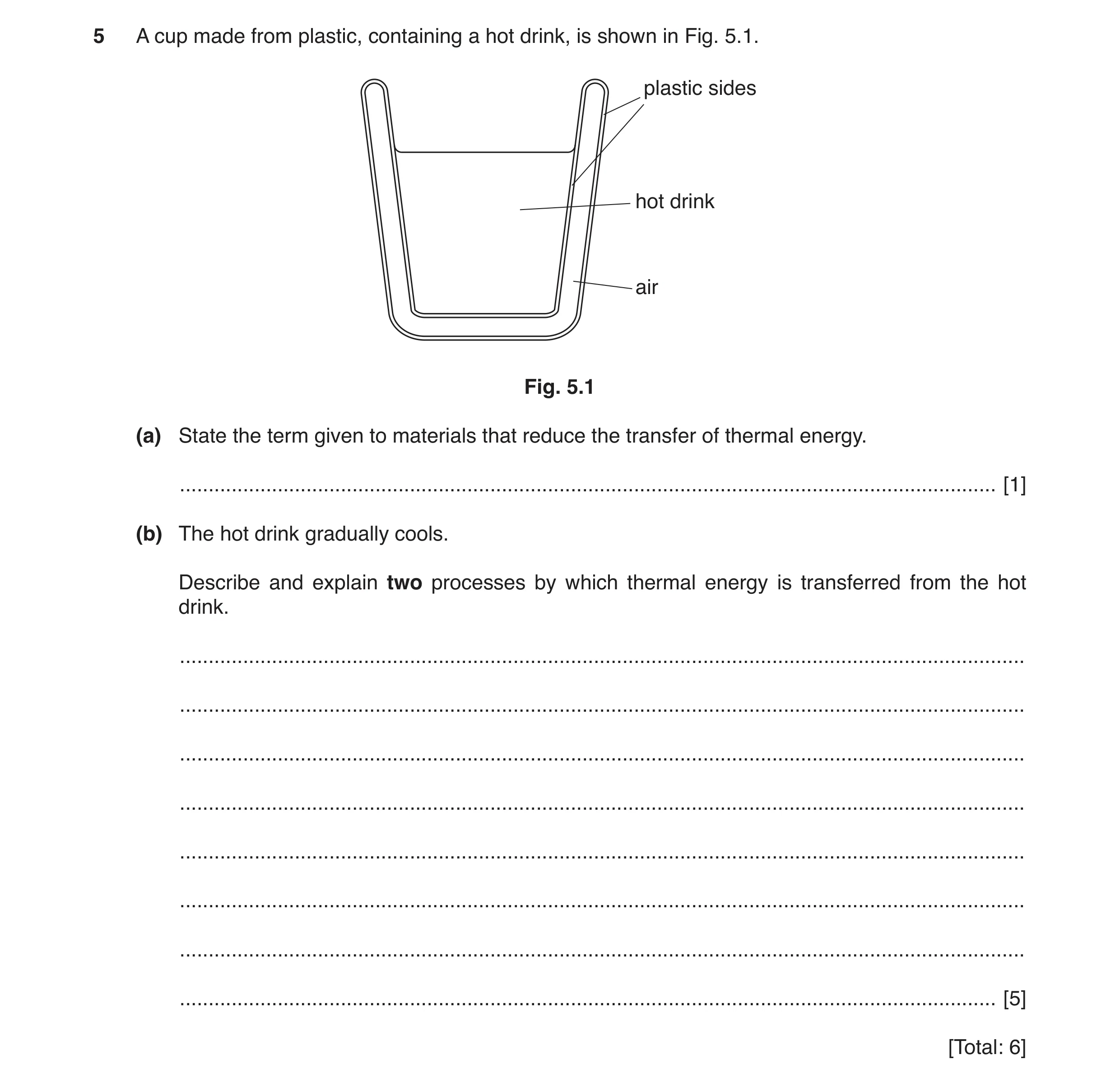
5 A cup made from plastic, containing a hot drink, is shown in Fig. 5.1. plastic sides hot drink air Fig. 5.1 (a) State the term given to materials that reduce the transfer of thermal energy. … [1] (b) The hot drink gradually cools. Describe and explain two processes by which thermal energy is transferred from the hot drink. … … … … … … … … [5] [Total: 6]
6 marks
Mark scheme: 5(a) insulator B1 5(b) Any five from: conduction / slow or limited transfer of thermal energy molecules move slower / lose kinetic energy convection stated as (drink cools) volume decreases density (of cooler drink) increases cooler water falls evaporation (of hot water) more energetic molecules escape / less energetic molecules remain B5
This question in 0625/32 Oct/Nov 2017
Question 4 0625/33 Oct/Nov 2017
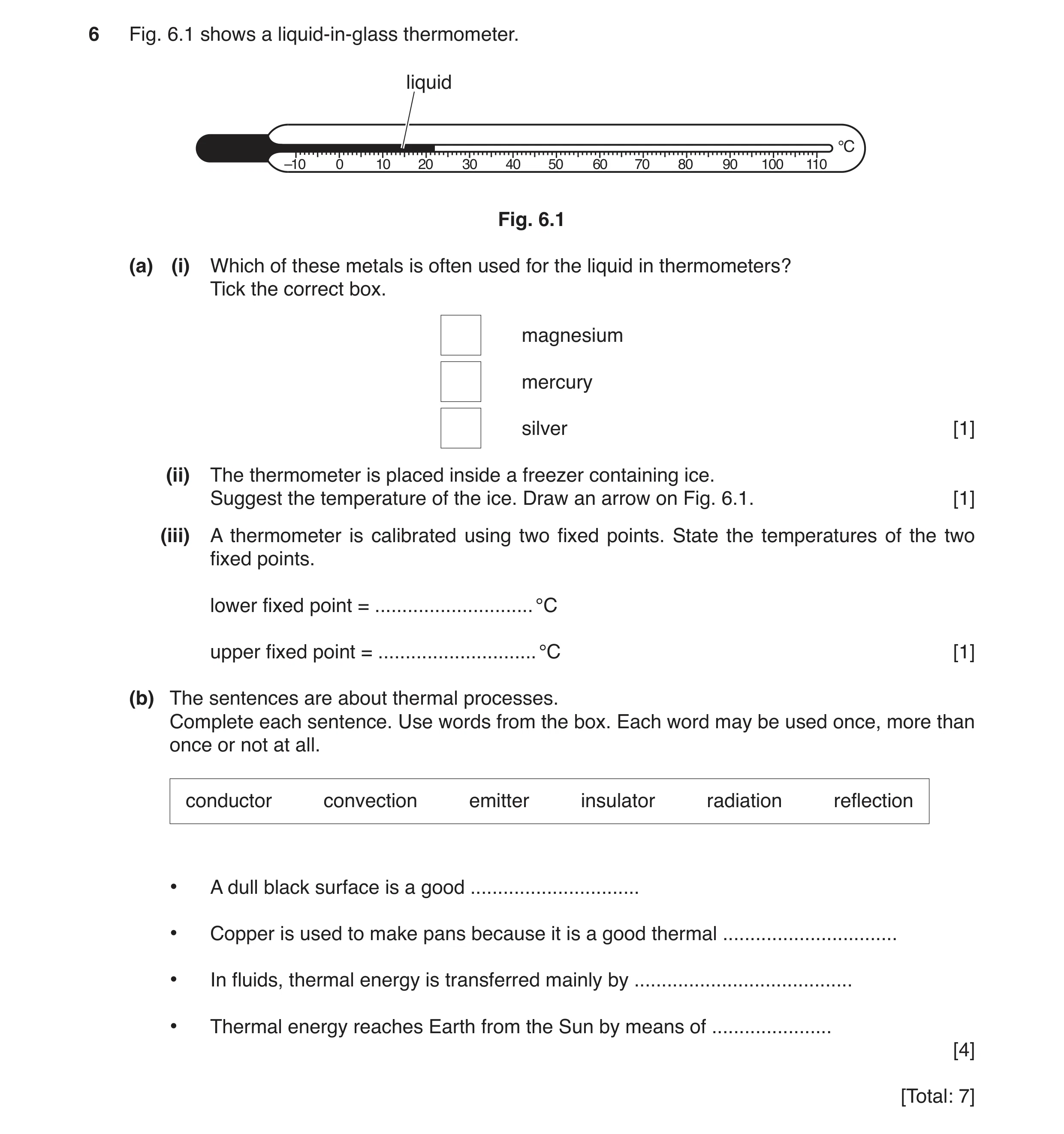
6 Fig. 6.1 shows a liquid-in-glass thermometer. liquid °C –10 0 10 20 30 40 50 60 70 80 90 100 110 Fig. 6.1 (a) (i) Which of these metals is often used for the liquid in thermometers? Tick the correct box. magnesium mercury silver [1] (ii) The thermometer is placed inside a freezer containing ice. Suggest the temperature of the ice. Draw an arrow on Fig. 6.1. [1] (iii) A thermometer is calibrated using two fixed points. State the temperatures of the two fixed points. lower fixed point = … °C upper fixed point = … °C [1] (b) The sentences are about thermal processes. Complete each sentence. Use words from the box. Each word may be used once, more than once or not at all. conductor convection emitter insulator radiation reflection • A dull black surface is a good … • Copper is used to make pans because it is a good thermal … • In fluids, thermal energy is transferred mainly by … • Thermal energy reaches Earth from the Sun by means of … [4] [Total: 7]
7 marks
Mark scheme: 6(a)(i) mercury B1 6(a)(ii) arrow between 0 o C and start of capillary tube B1 6(a)(iii) 0 (oC) AND 100 (o C) B1 6(b) emitter B1 conductor B1 convection B1 radiation B1
This question in 0625/33 Oct/Nov 2017
Q5 · A student constructs a device for absorbing thermal energy from the Sun 0625/31 May/June 2018
6 A student constructs a device for absorbing thermal energy from the Sun. Fig. 6.1 shows the device. Sun thermometer Tank A thermometer cold water white plastic pipe Tank B warm water Fig. 6.1 The student places the white plastic pipe in sunlight. The cold water flows slowly from Tank A to Tank B. Energy from the Sun heats the water in the pipe. Fig. 6.2 shows the temperatures in Tank A and Tank B. –10 0 10 20 30 40 50 60 70 80 90 100 110 °C Thermometer showing temperature in Tank A. –10 0 10 20 30 40 50 60 70 80 90 100 110 °C Thermometer showing temperature in Tank B. Fig. 6.2 (a) Determine the rise in temperature of the water. temperature rise = … ° C [1] (b) The student wants to increase the thermal energy absorbed by the water in the pipe. Suggest three improvements he can make to increase the thermal energy absorbed. 1 … … 2 … … 3 … … [3] (c) Describe how the thermal energy is transferred from the Sun to the water inside the pipe. … … [2] [Total: 6]
6 marks
Mark scheme: 6(a) (26 – 23 =) 3(°C) 1 6(b) any three from: use metal pipe paint black or use black pipe use matt or dull (paint) (place) reflector behind pipe use long(er) pipe use pipe with great(er) surface area slow(er) flow rate (place) glass/(clear) plastic cover over pipe 3 6(c) infra-red (radiation through space/air) 1 conduction through pipe 1
This question in 0625/31 May/June 2018
Q6 · A Bunsen burner heats a beaker of water, as shown in Fig 0625/32 May/June 2018
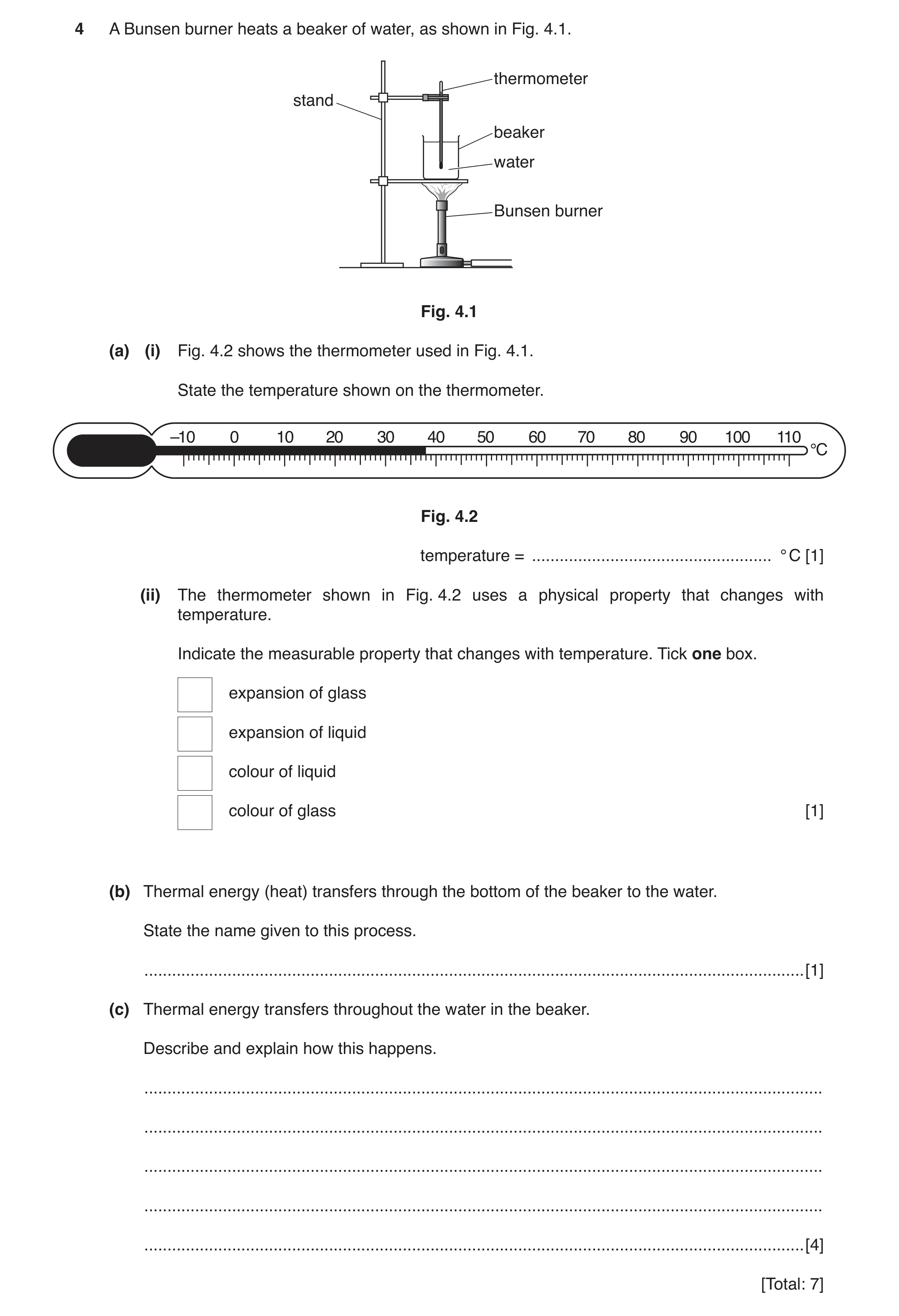
4 A Bunsen burner heats a beaker of water, as shown in Fig. 4.1. thermometer stand beaker water Bunsen burner Fig. 4.1 (a) (i) Fig. 4.2 shows the thermometer used in Fig. 4.1. State the temperature shown on the thermometer. –10 0 10 20 30 40 50 60 70 80 90 100 110 °C Fig. 4.2 temperature = … ° C [1] (ii) The thermometer shown in Fig. 4.2 uses a physical property that changes with temperature. Indicate the measurable property that changes with temperature. Tick one box. expansion of glass expansion of liquid colour of liquid colour of glass [1] (b) Thermal energy (heat) transfers through the bottom of the beaker to the water. State the name given to this process. … [1] (c) Thermal energy transfers throughout the water in the beaker. Describe and explain how this happens. … … … … … [4] [Total: 7]
7 marks
Mark scheme: 4(a)(i) 38 (°C) 1 4(a)(ii) 2nd box ticked i.e. expansion of liquid 1 4(b) conduction 1 4(c) any three from: water is a fluid water molecules gain (kinetic) energy/move faster/further apart water expands/volume increases warm/hot water or molecules rises convection (current created) cooler/cold/water falls/sinks (to be heated again) 3 correct reference to density change of water 1
This question in 0625/32 May/June 2018
Q7 · A student investigates the thermal energy lost from two metal cans, X and Y 0625/33 May/June 2018
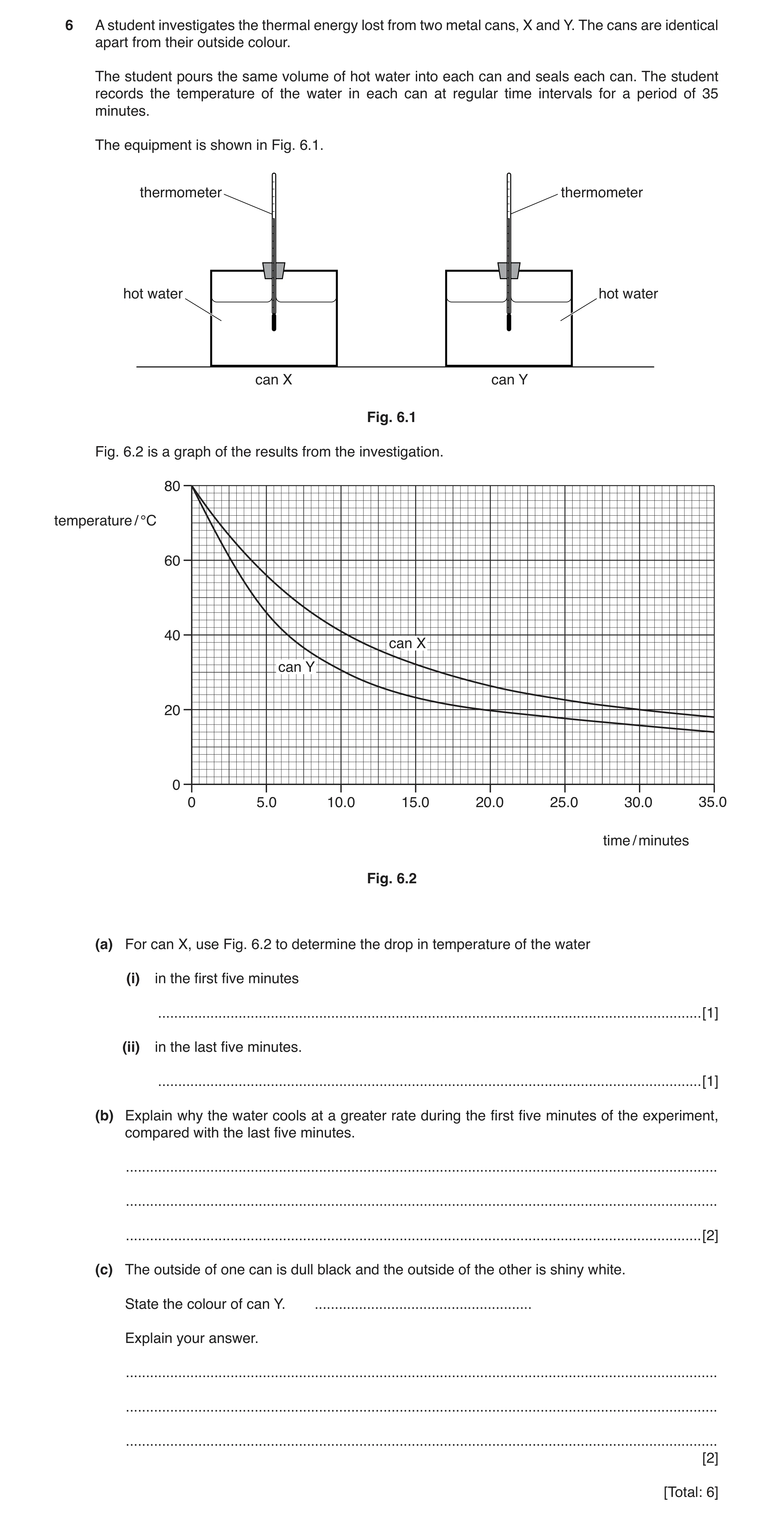
6 A student investigates the thermal energy lost from two metal cans, X and Y. The cans are identical apart from their outside colour. The student pours the same volume of hot water into each can and seals each can. The student records the temperature of the water in each can at regular time intervals for a period of 35 minutes. The equipment is shown in Fig. 6.1. thermometer thermometer hot water hot water can X can Y Fig. 6.1 Fig. 6.2 is a graph of the results from the investigation. 80 temperature / °C 60 40 can X can Y 20 0 0 5.0 10.0 15.0 20.0 25.0 30.0 35.0 time / minutes Fig. 6.2 (a) For can X, use Fig. 6.2 to determine the drop in temperature of the water (i) in the first five minutes … [1] (ii) in the last five minutes. … [1] (b) Explain why the water cools at a greater rate during the first five minutes of the experiment, compared with the last five minutes. … … … [2] (c) The outside of one can is dull black and the outside of the other is shiny white. State the colour of can Y. … Explain your answer. … … … [2] [Total: 6]
6 marks
Mark scheme: 6(a)(i) 80 – 56 OR 24(°C) 1 6(a)(ii) 20 – 18 or 2(°C) 1 6(b) water hotter (at start) 1 (so) greater temperature difference (between can and surroundings) 1 6(c) (dull) black 1 greater (rate of) loss of thermal energy (from dark colours) OR black or it is better radiator/emitter (of thermal energy) 1
This question in 0625/33 May/June 2018
Q8 · Some materials are poor conductors of thermal energy (heat energy) 0625/31 Oct/Nov 2018
6 (a) Some materials are poor conductors of thermal energy (heat energy). State the term that describes materials that are poor conductors of thermal energy. … [1] (b) Some materials are good conductors of thermal energy. Draw a ring around each material that is a good conductor of thermal energy. air aluminium copper glass plastic water [1] (c) A student has two rods made of different materials. The rods are the same size. Describe an experiment to identify which material is the better conductor of thermal energy. You may draw a diagram in the space below. … … … … … … … [3] [Total: 5]
5 marks
Mark scheme: 6(a) insulator(s) B1 6(b) aluminium AND copper B1 6(c) (one end of both rods) placed in same (type of) heat source means of detecting raised temperature e.g. wax covered rods OR pins attached to rods with wax outcome explained e.g. wax melted further / first on better conductor B3
This question in 0625/31 Oct/Nov 2018
Q9 · A cross-section of the inside of an electric oven 0625/32 Feb/March 2019
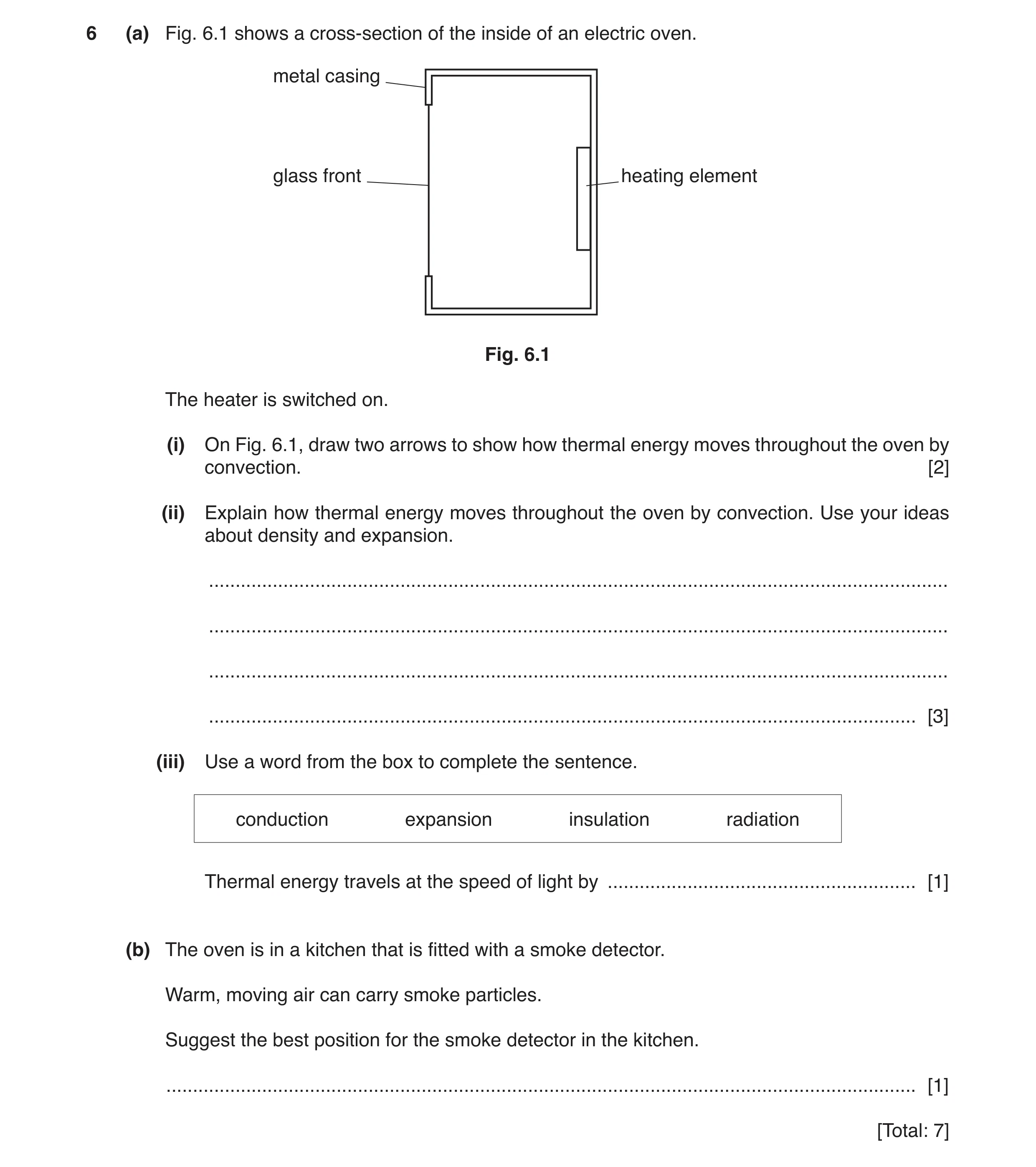
6 (a) Fig. 6.1 shows a cross-section of the inside of an electric oven. metal casing glass front heating element Fig. 6.1 The heater is switched on. (i) On Fig. 6.1, draw two arrows to show how thermal energy moves throughout the oven by convection. [2] (ii) Explain how thermal energy moves throughout the oven by convection. Use your ideas about density and expansion. … … … … [3] (iii) Use a word from the box to complete the sentence. conduction expansion insulation radiation Thermal energy travels at the speed of light by … [1] (b) The oven is in a kitchen that is fitted with a smoke detector. Warm, moving air can carry smoke particles. Suggest the best position for the smoke detector in the kitchen. … [1] [Total: 7]
7 marks
Mark scheme: 6(a)(i) arrow upwards from heating element B1 arrow across top OR down on opposite side B1 6(a)(ii) warm air expands B1 (air) becomes less dense B1 (air) rises B1 6(a)(iii) radiation B1 6(b) on ceiling B1
This question in 0625/32 Feb/March 2019
Q10 · A metal pan containing water being heated by an electrical heater 0625/33 May/June 2019
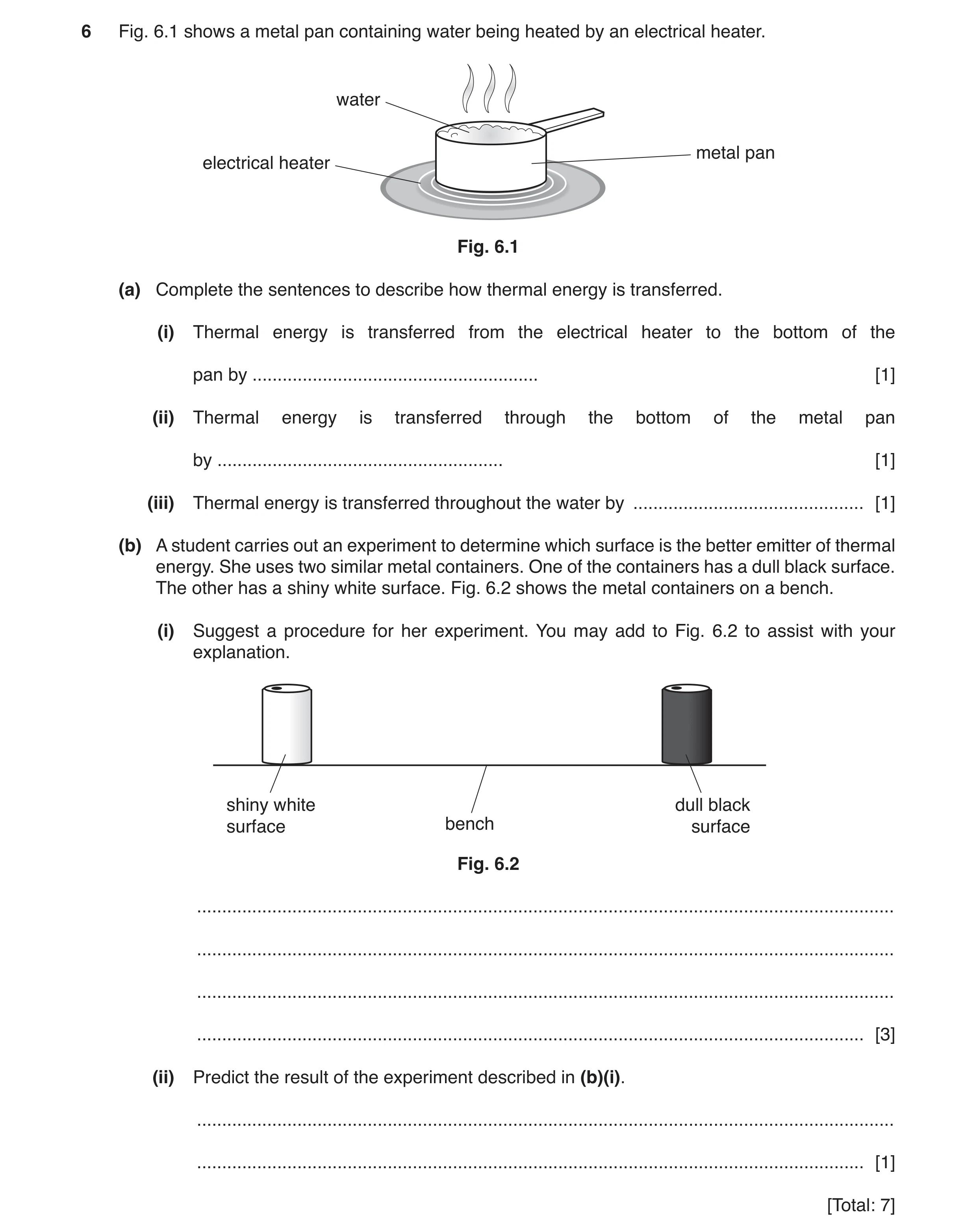
6 Fig. 6.1 shows a metal pan containing water being heated by an electrical heater. water metal pan electrical heater Fig. 6.1 (a) Complete the sentences to describe how thermal energy is transferred. (i) Thermal energy is transferred from the electrical heater to the bottom of the pan by … [1] (ii) Thermal energy is transferred through the bottom of the metal pan by … [1] (iii) Thermal energy is transferred throughout the water by … [1] (b) A student carries out an experiment to determine which surface is the better emitter of thermal energy. She uses two similar metal containers. One of the containers has a dull black surface. The other has a shiny white surface. Fig. 6.2 shows the metal containers on a bench. (i) Suggest a procedure for her experiment. You may add to Fig. 6.2 to assist with your explanation. shiny white dull black surface bench surface Fig. 6.2 … … … … [3] (ii) Predict the result of the experiment described in (b)(i). … … [1] [Total: 7]
7 marks
Mark scheme: 6(a)(i) conduction OR radiation B1 6(a)(ii) conduction B1 6(a)(iii) convection B1 6(b)(i) any THREE from: hot water in each can same volume of water in each can/same temperature thermometer/radiation detector placed near can or seen on labelled diagram thermometer/radiation detector at same distance from each can measure temperature (change) on each thermometer B3 6(b)(ii) bigger / faster temperature change from better emitter B1
This question in 0625/33 May/June 2019
Question 11 0625/32 Oct/Nov 2019
6 (a) Fig. 6.1 shows a liquid-in-glass thermometer. –10 0 10 20 30 40 50 60 70 80 90 100 110 °C Fig. 6.1 (i) State the name of a liquid used in liquid-in-glass thermometers. … [1] (ii) The thermometer is calibrated using two fixed points. State the values of these fixed points. … °C and … °C [1] (b) A student heats some water in a metal can, as shown in Fig. 6.2. water movement metal can of water heat Fig. 6.2 (i) Complete the sentence. Choose a word from the box. conduction convection radiation Thermal (heat) energy moves through the metal can by … [1] (ii) Describe how thermal energy is transferred throughout the water. Include your ideas about density changes. … … … … … … … [3] [Total: 6]
6 marks
Mark scheme: 6(a)(i) mercury or alcohol B1 6(a)(ii) 0 (°C) AND 100 (°C) B1 6(b)(i) conduction B1 6(b)(ii) Any three from: (heat causes) water molecules (to) move further apart OR (hot) water expands / volume increases (hot water) is less dense NOT molecules less dense/expand (so hot / less dense) water rises (and is replaced by cooler / more dense water) convection / current (in water) B3
This question in 0625/32 Oct/Nov 2019
Question 12 0625/31 May/June 2020
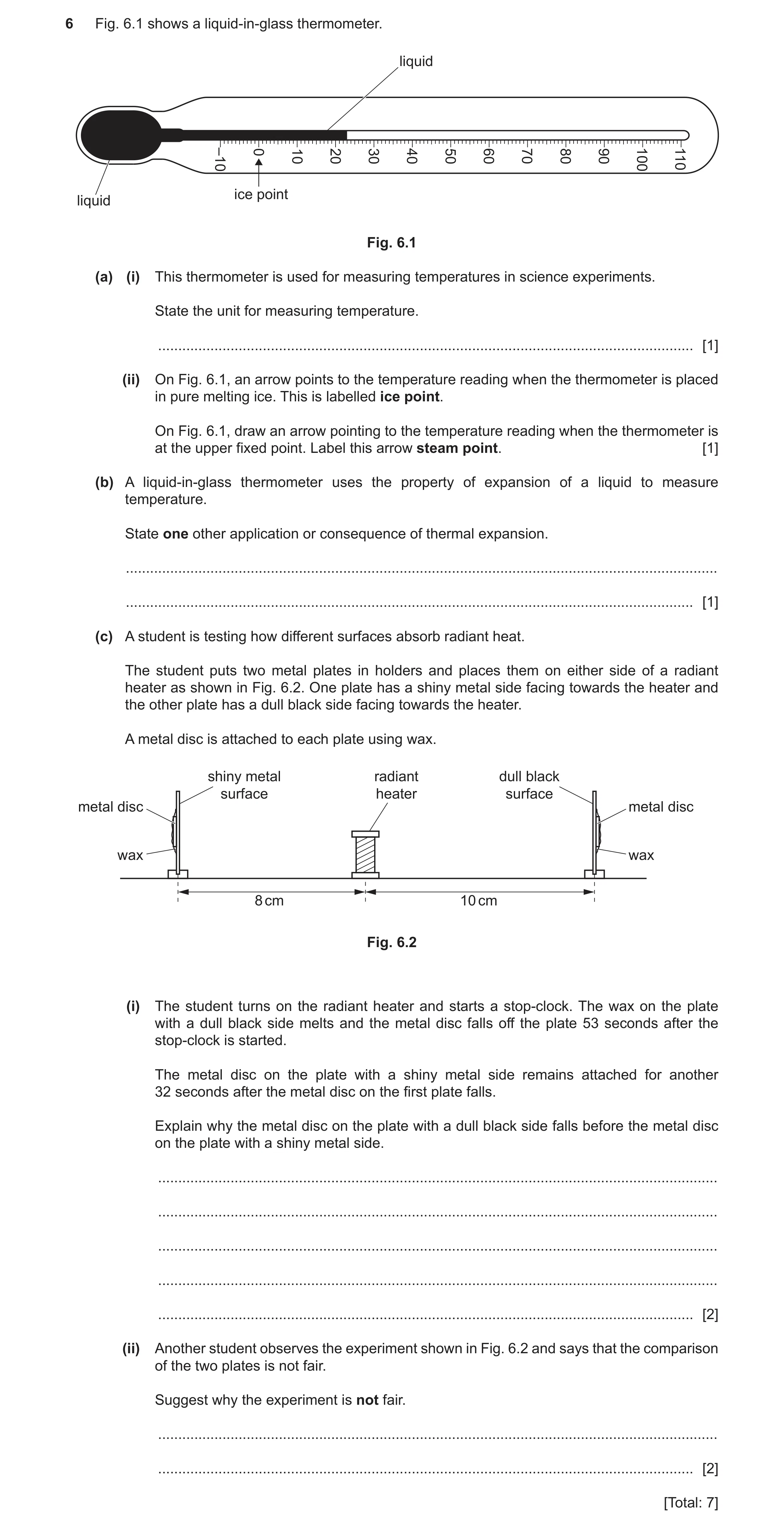
6 Fig. 6.1 shows a liquid-in-glass thermometer. liquid –10 0 10 20 30 40 50 60 70 80 90 100 110 ice point liquid Fig. 6.1 (a) (i) This thermometer is used for measuring temperatures in science experiments. State the unit for measuring temperature. … [1] (ii) On Fig. 6.1, an arrow points to the temperature reading when the thermometer is placed in pure melting ice. This is labelled ice point. On Fig. 6.1, draw an arrow pointing to the temperature reading when the thermometer is at the upper fixed point. Label this arrow steam point. [1] (b) A liquid-in-glass thermometer uses the property of expansion of a liquid to measure temperature. State one other application or consequence of thermal expansion. … … [1] (c) A student is testing how different surfaces absorb radiant heat. The student puts two metal plates in holders and places them on either side of a radiant heater as shown in Fig. 6.2. One plate has a shiny metal side facing towards the heater and the other plate has a dull black side facing towards the heater. A metal disc is attached to each plate using wax. shiny metal radiant dull black surface heater surface metal disc metal disc wax wax 8 cm 10 cm Fig. 6.2 (i) The student turns on the radiant heater and starts a stop-clock. The wax on the plate with a dull black side melts and the metal disc falls off the plate 53 seconds after the stop-clock is started. The metal disc on the plate with a shiny metal side remains attached for another 32 seconds after the metal disc on the first plate falls. Explain why the metal disc on the plate with a dull black side falls before the metal disc on the plate with a shiny metal side. … … … … … [2] (ii) Another student observes the experiment shown in Fig. 6.2 and says that the comparison of the two plates is not fair. Suggest why the experiment is not fair. … … [2] [Total: 7]
7 marks
Mark scheme: 6(a)(i) °C or degrees celcius B1 6(a)(ii) arrow at 100 (labelled steam) B1 6(b) use OR consequence of thermal expansion identified B1 6(c)(i) black is better / best absorber B1 (so) temperature of wax rises faster on black plate B1 6(c)(ii) (for a valid comparison all independent) variables must be the same B1 plates / discs should be equal distances (from heater) (owtte) B1
This question in 0625/31 May/June 2020
Q13 · A hot liquid in a vacuum flask 0625/32 May/June 2020
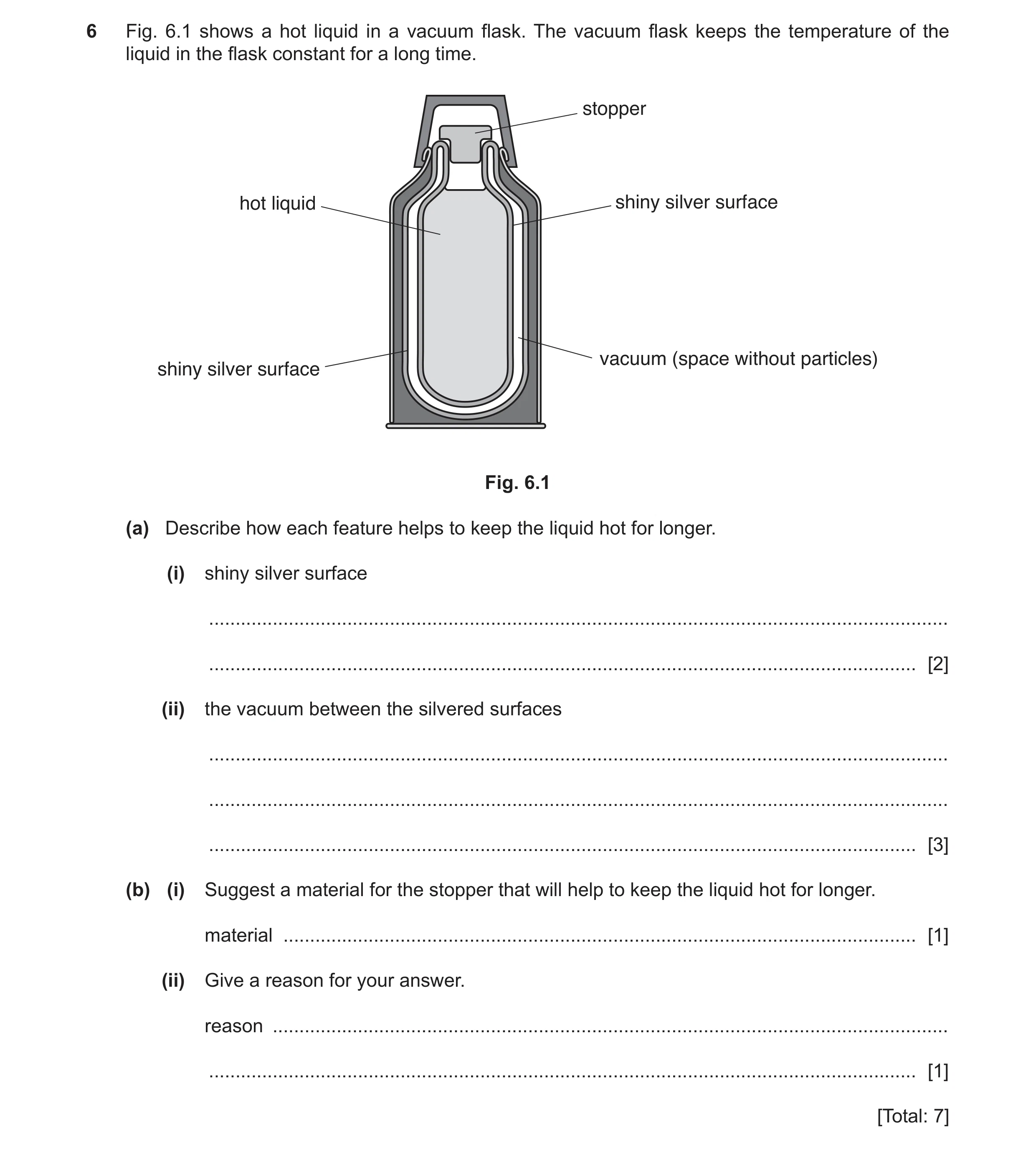
6 Fig. 6.1 shows a hot liquid in a vacuum flask. The vacuum flask keeps the temperature of the liquid in the flask constant for a long time. stopper hot liquid shiny silver surface vacuum (space without particles) shiny silver surface Fig. 6.1 (a) Describe how each feature helps to keep the liquid hot for longer. (i) shiny silver surface … … [2] (ii) the vacuum between the silvered surfaces … … … [3] (b) (i) Suggest a material for the stopper that will help to keep the liquid hot for longer. material … [1] (ii) Give a reason for your answer. reason … … [1] [Total: 7]
7 marks
Mark scheme: 6(a)(i) reflects / does not allow transmission of B1 infrared / thermal radiation B1 6(a)(ii) heat loss by conduction cannot take place B1 heat loss by convection cannot take place B1 because particles are needed for conduction and / or convection B1 6(b)(i) non-metal B1 6(b)(ii) metals are good conductors of heat / non-metals are good insulators / poor conductors B1
This question in 0625/32 May/June 2020
Q14 · Equipment used to demonstrate convection in air 0625/32 Oct/Nov 2020
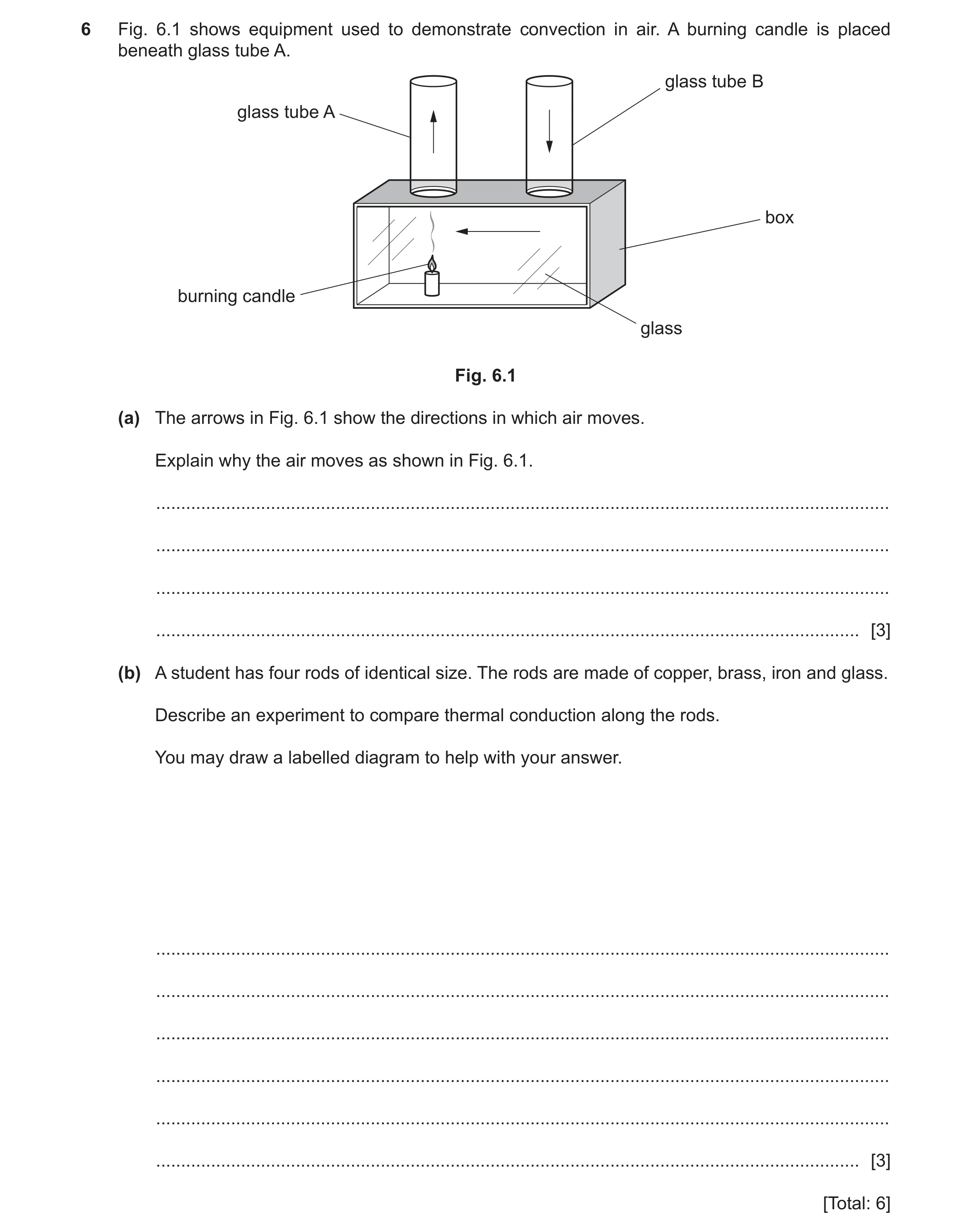
6 Fig. 6.1 shows equipment used to demonstrate convection in air. A burning candle is placed beneath glass tube A. glass tube B glass tube A box burning candle glass Fig. 6.1 (a) The arrows in Fig. 6.1 show the directions in which air moves. Explain why the air moves as shown in Fig. 6.1. … … … … [3] (b) A student has four rods of identical size. The rods are made of copper, brass, iron and glass. Describe an experiment to compare thermal conduction along the rods. You may draw a labelled diagram to help with your answer. … … … … … … [3] [Total: 6]
6 marks
Mark scheme: 6(a) air above candle is heated / warms B1 (air becomes) less dense C1 less dense air rises (up tube A) A1 6(b) means of heating one end of rods B1 means of identifying movement of thermal energy along rod B1 method of comparing materials B1
This question in 0625/32 Oct/Nov 2020
Q15 · An electric kettle containing cold water 0625/33 Oct/Nov 2020
6 (a) Fig. 6.1 shows an electric kettle containing cold water. metal cold water heating element Fig. 6.1 The metal heating element heats the water. Explain how thermal energy from the heating element is transferred to all the water in the kettle. … … … … … … [4] (b) Fig. 6.2 shows two similar metal cans. The only difference is the surface. Can A has a dull black surface and can B has a shiny white surface. dull black shiny white surface surface can A can B Fig. 6.2 (i) A student fills each can with hot water. The initial temperature of the water is 85 °C. The student records the temperature of the water in each can every 30 seconds for 10 minutes. Suggest which can of water will cool more quickly. Give a reason for your answer. suggestion … reason … … [2] (ii) Suggest and explain two changes to can B that reduce thermal energy loss to the surroundings. change 1 … … … change 2 … … … [4] [Total: 10]
10 marks
Mark scheme: 6(a) conduction from the element to the water B1 convection B1 warmer water less dense (than colder water) or ra B1 warm water rises / cool water falls B1 6(b)(i) dull black / can A M1 (dull black) better radiator / good radiator better emitter / gives out more radiant heat / emits more infra-red / loses more energy by radiation A1 6(b)(ii) Any two of following pairs: lag / wrap in (named) insulator / cotton wool / polystyrene reduces heat lost by conduction cover in foil reduces heat lost by radiation add lid reduces heat loss by convection / evaporation B4
This question in 0625/33 Oct/Nov 2020
Q16 · Three rods are identical in size and shape, but each rod is made from a different material 0625/33 May/June 2021
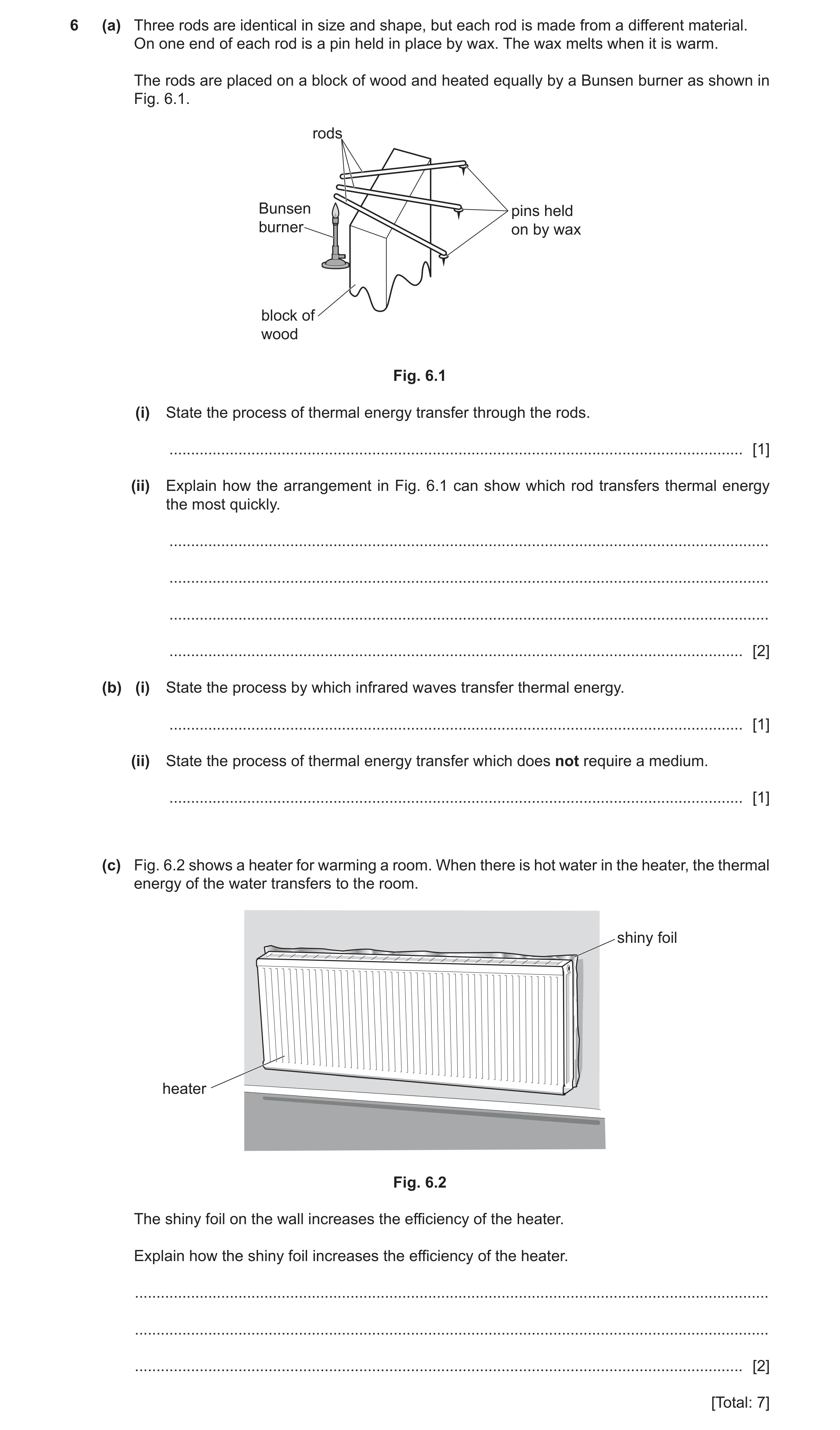
6 (a) Three rods are identical in size and shape, but each rod is made from a different material. On one end of each rod is a pin held in place by wax. The wax melts when it is warm. The rods are placed on a block of wood and heated equally by a Bunsen burner as shown in Fig. 6.1. rods Bunsen pins held burner on by wax block of wood Fig. 6.1 (i) State the process of thermal energy transfer through the rods. … [1] (ii) Explain how the arrangement in Fig. 6.1 can show which rod transfers thermal energy the most quickly. … … … … [2] (b) (i) State the process by which infrared waves transfer thermal energy. … [1] (ii) State the process of thermal energy transfer which does not require a medium. … [1] (c) Fig. 6.2 shows a heater for warming a room. When there is hot water in the heater, the thermal energy of the water transfers to the room. shiny foil heater Fig. 6.2 The shiny foil on the wall increases the efficiency of the heater. Explain how the shiny foil increases the efficiency of the heater. … … … [2] [Total: 7]
7 marks
Mark scheme: 6(a)(i) conduction B1 6(a)(ii) melts wax OR pin falls off C1 first pin to fall (is best conductor) A1 Question Answer Marks 6(b)(i) radiation B1 6(b)(ii) radiation B1 6(c) foil reflects (radiation / infrared / radiant heat) B1 more energy into room (from heater) B1
This question in 0625/33 May/June 2021
Q17 · A candle underneath a thin, metal fan 0625/32 Oct/Nov 2021
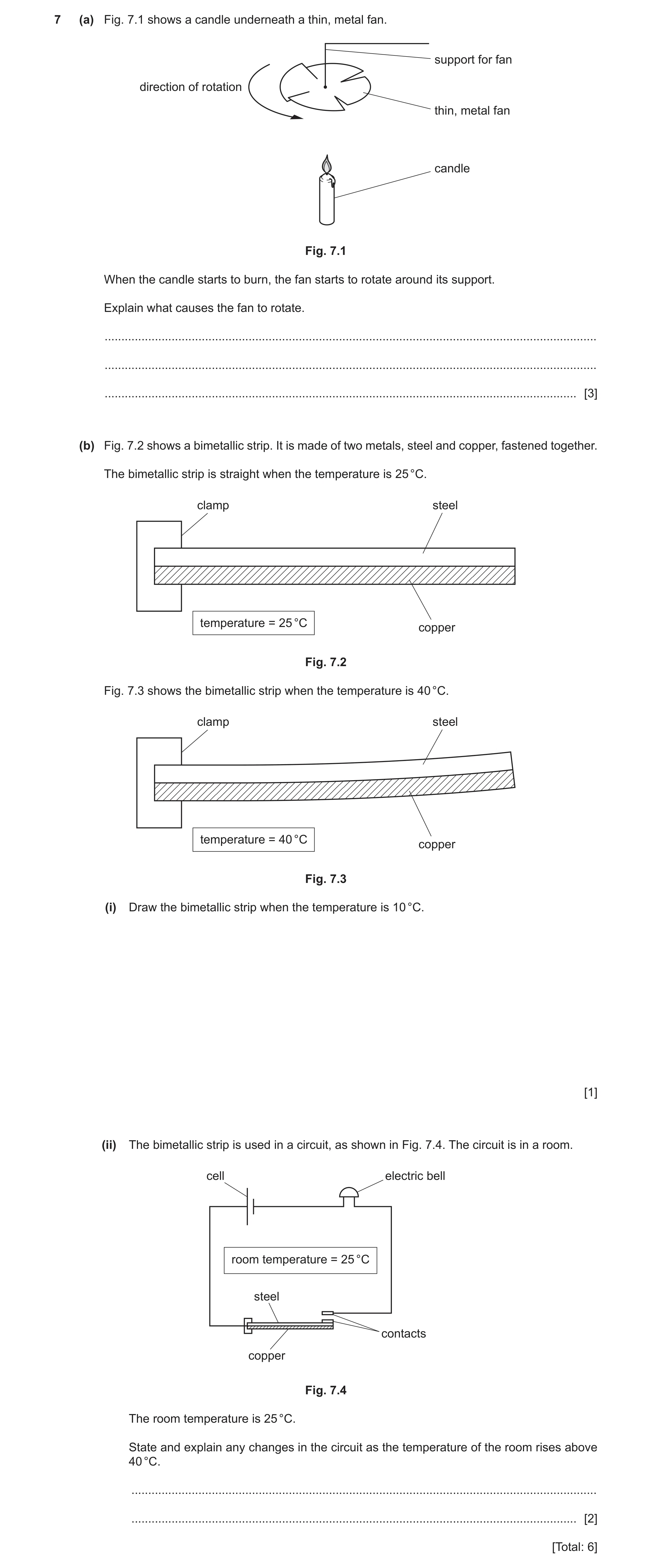
7 (a) Fig. 7.1 shows a candle underneath a thin, metal fan. support for fan direction of rotation thin, metal fan candle Fig. 7.1 When the candle starts to burn, the fan starts to rotate around its support. Explain what causes the fan to rotate. … … … [3] (b) Fig. 7.2 shows a bimetallic strip. It is made of two metals, steel and copper, fastened together. The bimetallic strip is straight when the temperature is 25 °C. clamp steel temperature = 25 °C copper Fig. 7.2 Fig. 7.3 shows the bimetallic strip when the temperature is 40 °C. clamp steel temperature = 40 °C copper Fig. 7.3 (i) Draw the bimetallic strip when the temperature is 10 °C. [1] (ii) The bimetallic strip is used in a circuit, as shown in Fig. 7.4. The circuit is in a room. cell electric bell room temperature = 25 °C steel contacts copper Fig. 7.4 The room temperature is 25 °C. State and explain any changes in the circuit as the temperature of the room rises above 40 °C. … … [2] [Total: 6]
6 marks
Mark scheme: 7(a) any three from: convection (currents) (candle) heats air (warm) air less dense (warm) air rises (rising / moving) air pushes on fan B3 7(b)(i) strip curved downwards B1 7(b)(ii) bimetallic strip curves upwards B1 bell rings OR switches circuit on owtte B1
This question in 0625/32 Oct/Nov 2021
Q18 · Two metal blocks, A and B, which are the same size and made of the same material 0625/33 Oct/Nov 2021
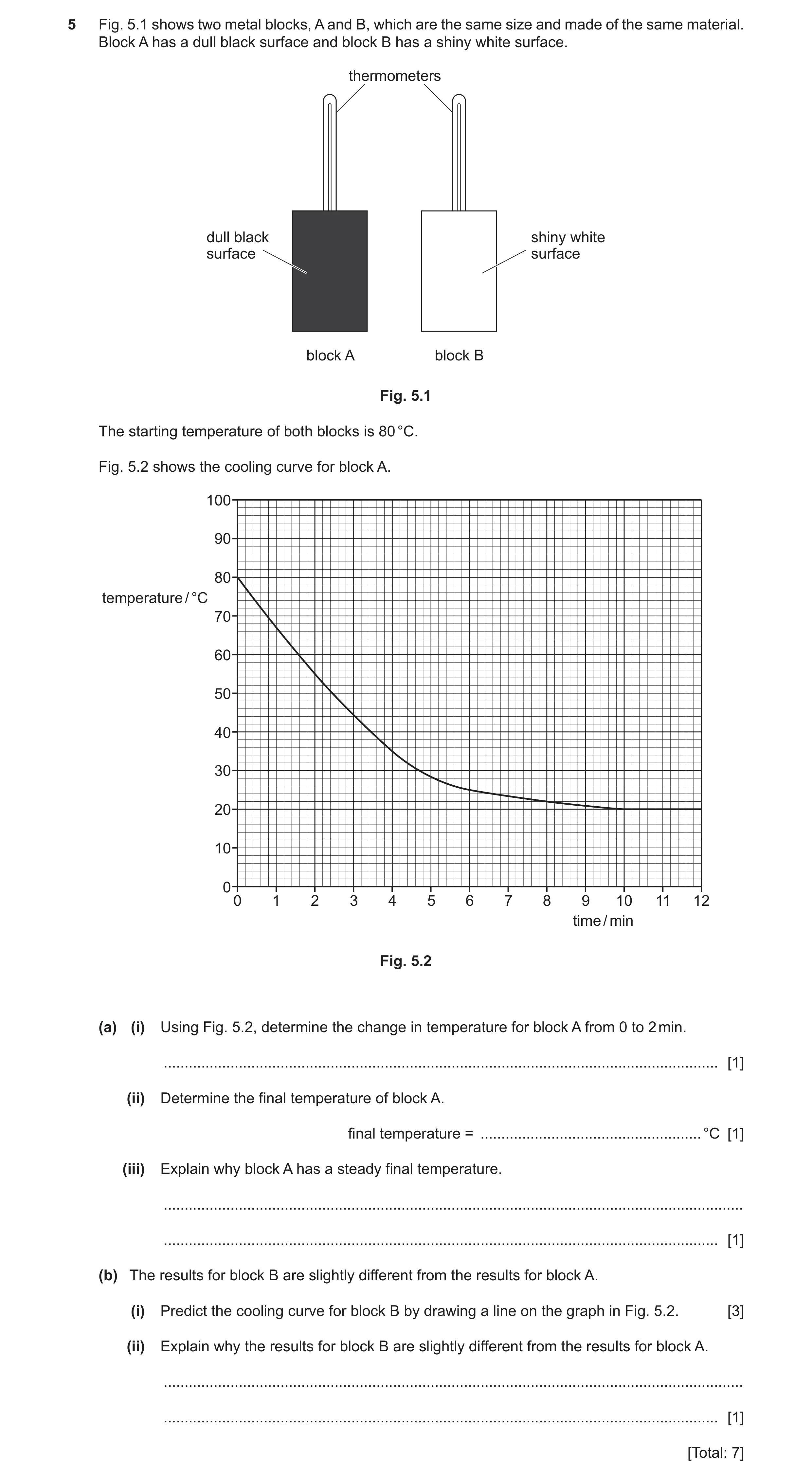
5 Fig. 5.1 shows two metal blocks, A and B, which are the same size and made of the same material. Block A has a dull black surface and block B has a shiny white surface. thermometers dull black shiny white surface surface block A block B Fig. 5.1 The starting temperature of both blocks is 80 °C. Fig. 5.2 shows the cooling curve for block A. 100 90 80 temperature / °C 70 60 50 40 30 20 10 0 0 1 2 3 4 5 6 7 8 9 10 11 12 time / min Fig. 5.2 (a) (i) Using Fig. 5.2, determine the change in temperature for block A from 0 to 2 min. … [1] (ii) Determine the final temperature of block A. final temperature = … °C [1] (iii) Explain why block A has a steady final temperature. … … [1] (b) The results for block B are slightly different from the results for block A. (i) Predict the cooling curve for block B by drawing a line on the graph in Fig. 5.2. [3] (ii) Explain why the results for block B are slightly different from the results for block A. … … [1] [Total: 7]
7 marks
Mark scheme: 5(a)(i) 25 (°C) B1 5(a)(ii) 20 (°C) B1 Question Answer Marks 5(a)(iii) (block reaches) room / surrounding temp OR no (net) energy transfer B1 5(b)(i) line starts at 80 (°C) B1 curve with negative gradient always above curve for block A B1 line above 20 (°C) after 10 min B1 5(b)(ii) black better / best emitter ora B1
This question in 0625/33 Oct/Nov 2021
Q19 · State the name for the transfer of thermal energy through a metal 0625/32 Feb/March 2022
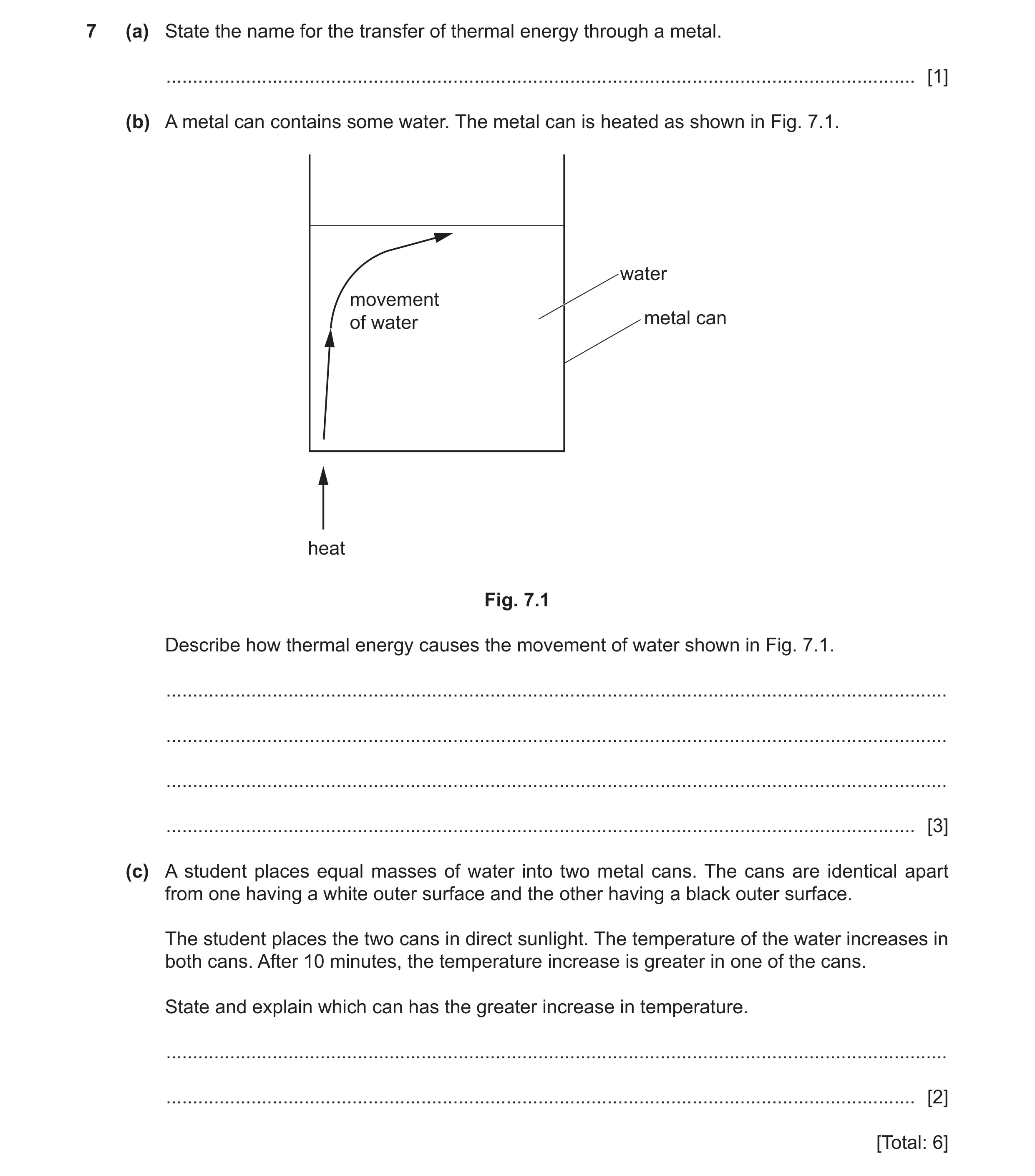
7 (a) State the name for the transfer of thermal energy through a metal. … [1] (b) A metal can contains some water. The metal can is heated as shown in Fig. 7.1. water movement of water metal can heat Fig. 7.1 Describe how thermal energy causes the movement of water shown in Fig. 7.1. … … … … [3] (c) A student places equal masses of water into two metal cans. The cans are identical apart from one having a white outer surface and the other having a black outer surface. The student places the two cans in direct sunlight. The temperature of the water increases in both cans. After 10 minutes, the temperature increase is greater in one of the cans. State and explain which can has the greater increase in temperature. … … [2] [Total: 6]
6 marks
Mark scheme: 7(a) conduction B1 7(b) any three from: convection (heated water) expands (becomes) less dense less dense water rises OR dense(r) water sinks B3 7(c) (dull) black (can) M1 (black) is a better absorber (of thermal radiation) OR white can is a better reflector A1
This question in 0625/32 Feb/March 2022
Q20 · A teacher fills a copper can with solid wax and heats the can 0625/31 May/June 2022
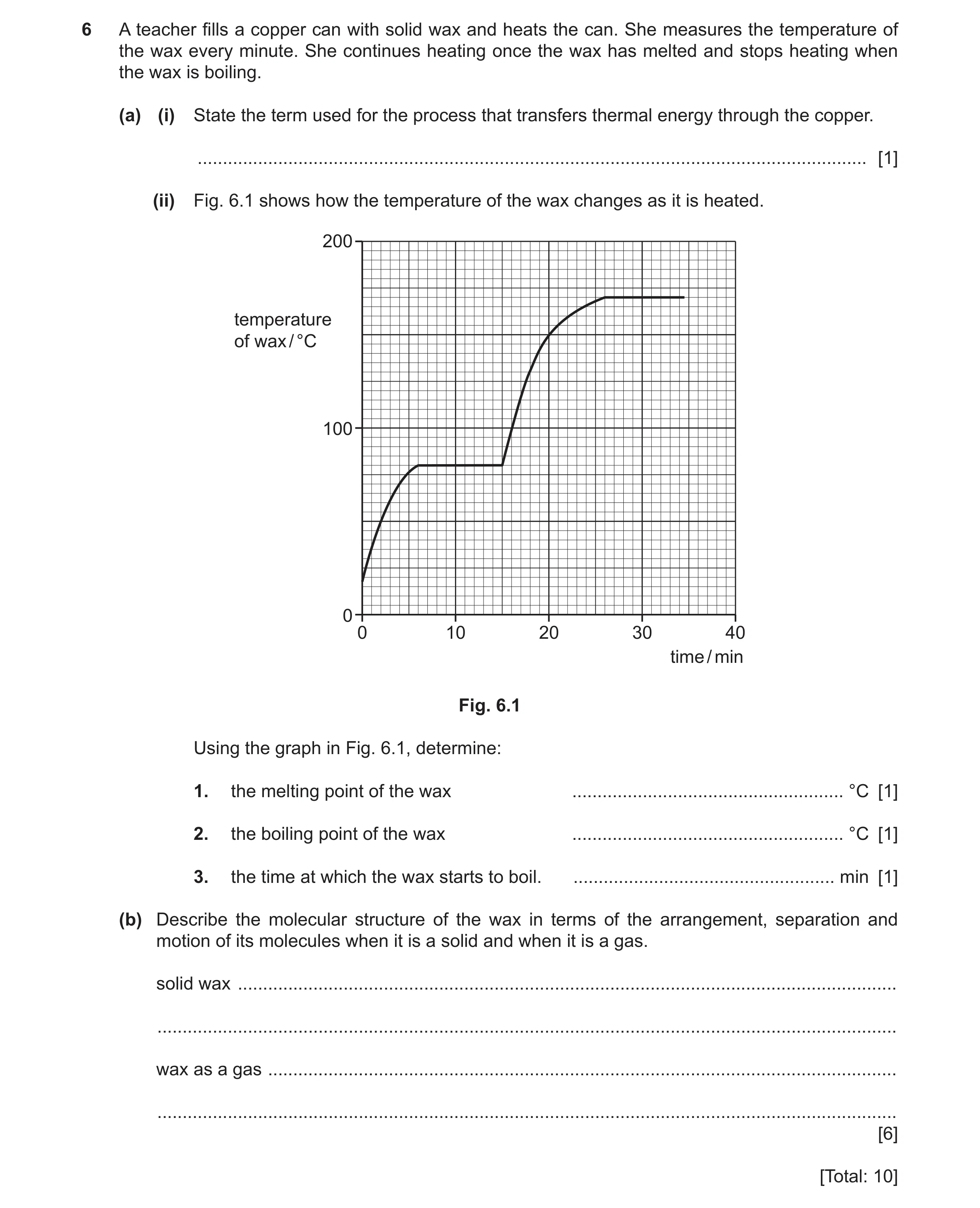
6 A teacher fills a copper can with solid wax and heats the can. She measures the temperature of the wax every minute. She continues heating once the wax has melted and stops heating when the wax is boiling. (a) (i) State the term used for the process that transfers thermal energy through the copper. … [1] (ii) Fig. 6.1 shows how the temperature of the wax changes as it is heated. 200 temperature of wax / °C 100 0 0 10 20 30 40 time / min Fig. 6.1 Using the graph in Fig. 6.1, determine: 1. the melting point of the wax … °C [1] 2. the boiling point of the wax … °C [1] 3. the time at which the wax starts to boil. … min [1] (b) Describe the molecular structure of the wax in terms of the arrangement, separation and motion of its molecules when it is a solid and when it is a gas. solid wax … … wax as a gas … … [6] [Total: 10]
10 marks
Mark scheme: 6(a)(i) conduction B1 6(a)(ii) 1 80 (°C) B1 2 170 (°C) B1 3 26 (minutes) B1 Question Answer Marks 6(b) (solid:) particles/molecules any three from: (are) fixed in place/position/arrangement regular spacing / pattern / arrangement vibrating close together B3 (gas:) particles/molecules any three from: (are) moving randomly at high speed colliding (with each other/walls) randomly arranged/no pattern (relatively) far apart B3
This question in 0625/31 May/June 2022
Q21 · A cross-section of a flask 0625/32 May/June 2022
5 Fig. 5.1 shows a cross-section of a flask. The flask is used to keep a liquid hot. The flask has two glass walls with a vacuum between them. The surfaces of the glass walls are shiny. plastic cap double-walled glass container hot liquid vacuum shiny surfaces Fig. 5.1 (a) (i) Explain how the shiny surfaces reduce the transfer of thermal energy from the hot liquid. … … [2] (ii) Explain how the vacuum reduces the transfer of thermal energy from the hot liquid. … … [2] (b) Some of the hot liquid is poured out of the flask into a shallow dish. Explain how evaporation causes the liquid to cool. … … … [3] (c) A student uses a microscope to view a small particle in the liquid. Fig. 5.2 shows the path of the particle. small particle Fig. 5.2 (i) State the name given to the motion of the small particle. … [1] (ii) Explain why the small particle moves as shown in Fig. 5.2. … … [2] [Total: 10]
10 marks
Mark scheme: 5(a)(i) (shiny surfaces) are good reflectors OR poor absorbers/emitters B1 so less thermal energy lost by radiation B1 5(a)(ii) less (heat lost by) convection B1 less (heat lost by) conduction B1 5(b) more energetic particles B1 particles escape (from the surface (attraction)) B1 so average energy of particles remaining (in liquid) decreases B1 5(c)(i) Brownian (motion) B1 5(c)(ii) any two from: (fast moving liquid) molecules bombard/collide with (small) particle collisions produce (resultant) force (in random directions) B2
This question in 0625/32 May/June 2022
Q22 · An engineer makes a device that absorbs thermal energy from the Sun 0625/33 May/June 2022
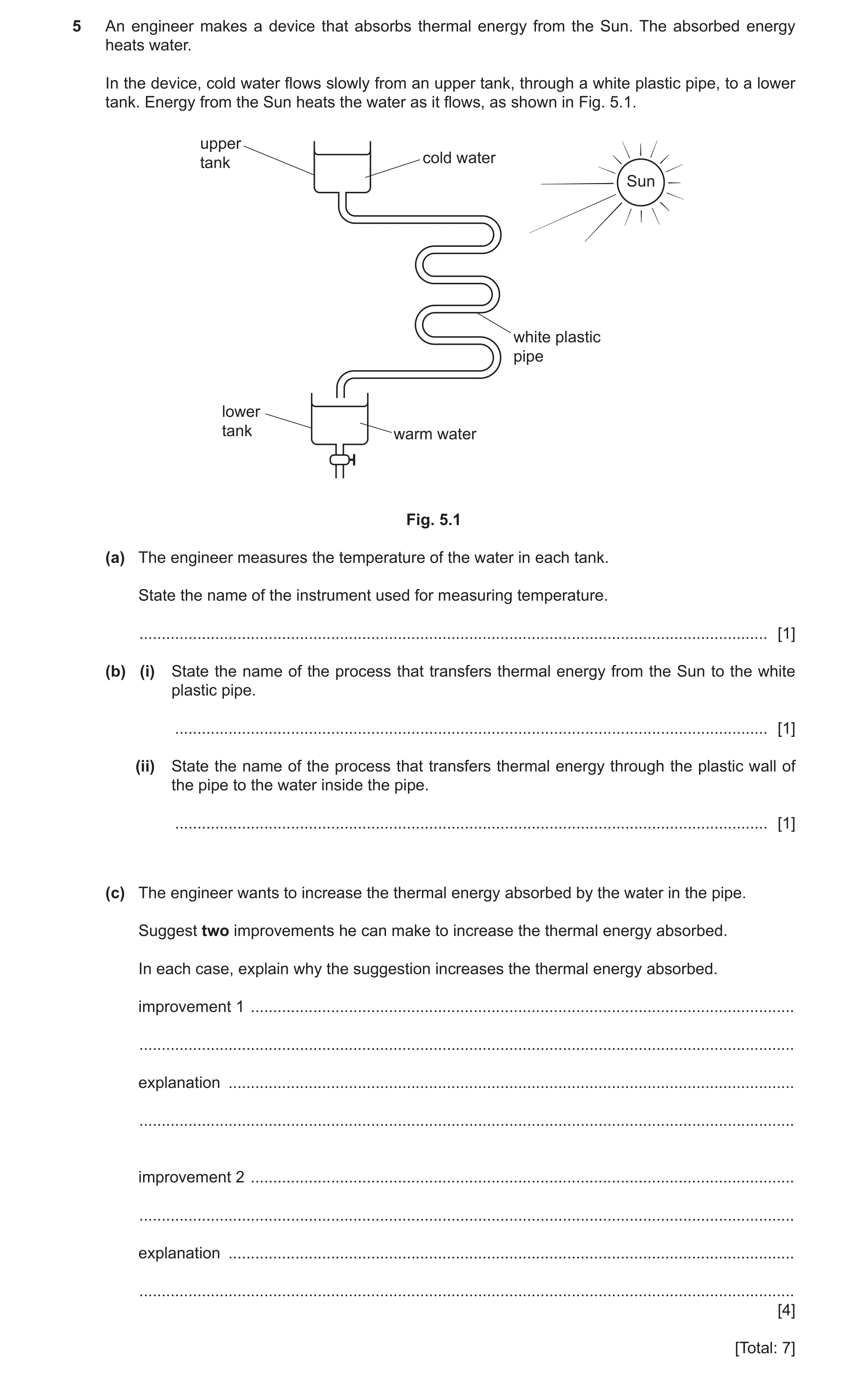
5 An engineer makes a device that absorbs thermal energy from the Sun. The absorbed energy heats water. In the device, cold water flows slowly from an upper tank, through a white plastic pipe, to a lower tank. Energy from the Sun heats the water as it flows, as shown in Fig. 5.1. upper cold water tank Sun white plastic pipe lower tank warm water Fig. 5.1 (a) The engineer measures the temperature of the water in each tank. State the name of the instrument used for measuring temperature. … [1] (b) (i) State the name of the process that transfers thermal energy from the Sun to the white plastic pipe. … [1] (ii) State the name of the process that transfers thermal energy through the plastic wall of the pipe to the water inside the pipe. … [1] (c) The engineer wants to increase the thermal energy absorbed by the water in the pipe. Suggest two improvements he can make to increase the thermal energy absorbed. In each case, explain why the suggestion increases the thermal energy absorbed. improvement 1 … … explanation … … improvement 2 … … explanation … … [4] [Total: 7]
7 marks
Mark scheme: 5(a) thermometer B1 5(b)(i) radiation B1 5(b)(ii) conduction B1 5(c) (dull) black pipes B1 better absorber (of radiation)/less reflection from pipes B1 foil/shiny metal behind pipes B1 reflects (radiation back to pipes) owtte B1 valid alternatives (B1)
This question in 0625/33 May/June 2022
Q23 · Students walking to school 0625/32 Oct/Nov 2022
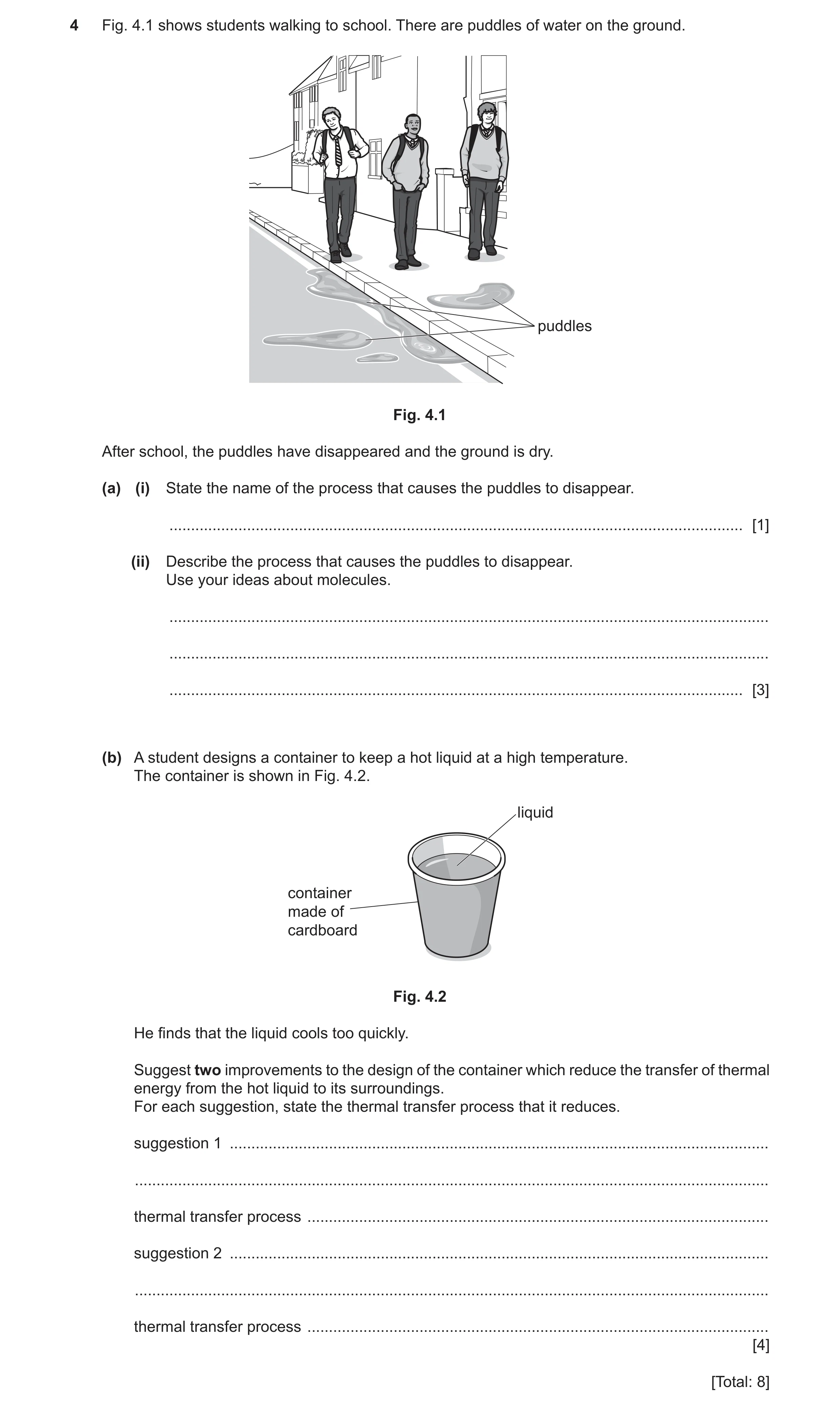
4 Fig. 4.1 shows students walking to school. There are puddles of water on the ground. puddles Fig. 4.1 After school, the puddles have disappeared and the ground is dry. (a) (i) State the name of the process that causes the puddles to disappear. … [1] (ii) Describe the process that causes the puddles to disappear. Use your ideas about molecules. … … … [3] (b) A student designs a container to keep a hot liquid at a high temperature. The container is shown in Fig. 4.2. liquid container made of cardboard Fig. 4.2 He finds that the liquid cools too quickly. Suggest two improvements to the design of the container which reduce the transfer of thermal energy from the hot liquid to its surroundings. For each suggestion, state the thermal transfer process that it reduces. suggestion 1 … … thermal transfer process … suggestion 2 … … thermal transfer process … [4] [Total: 8]
8 marks
Mark scheme: 4(a)(i) evaporation B1 4(a)(ii) any three from the following: B3 at the surface more energetic molecules escape (from liquid) owtte (as they) overcome / break forces / bonds (between molecules) (liquid (molecules) →) gas / vapour (molecules) 4(b) any two pairs B2 (surround container with) insulation / lagging / cotton wool or similar – conduction change material of cup to better insulator – conduction (surround container with) foil / silver / (paint) shiny white – radiation (surround container with) vacuum – conduction OR convection lid – evaporation / convection
This question in 0625/32 Oct/Nov 2022
Q24 · A student has a block of solid metal at room temperature 0625/32 May/June 2023
4 A student has a block of solid metal at room temperature. (a) (i) Describe the arrangement, separation and motion of the particles in the solid metal. … … … … [3] (ii) The student cools the block of metal in a freezer. State the effect, if any, of cooling on the kinetic energy of the particles in the block of metal. … [1] (b) (i) State the name of the temperature at which particles have the least kinetic energy. … [1] (ii) State the value of temperature at which particles have the least kinetic energy. Include the unit. … [1] (c) The metal block emits thermal radiation from its surface. State two features of a surface that is a good emitter of thermal radiation. 1 … 2 … [2] [Total: 8]
8 marks
Mark scheme: 4(a)(i) any three from: (particles are) fixed in position / place regular arrangement vibrating close(r than in liquids or gases) B3 4(a)(ii) (kinetic energy) decreases B1 4(b)(i) absolute zero B1 4(b)(ii) –273 °C OR 0 K OR zero K / kelvin B1 4(c) black OR dark (colour) B1 dull OR rough (surface) B1
This question in 0625/32 May/June 2023
Q25 · The arrangement and separation of particles in a liquid 0625/31 Oct/Nov 2023
3 Fig. 3.1 represents the arrangement and separation of particles in a liquid. Each circle represents a particle. Fig. 3.1 (a) In the box in Fig. 3.2, draw at least four circles to show the arrangement and separation of particles in a gas. Fig. 3.2 [2] (b) Describe the arrangement, separation and motion of particles in a solid. … … … [3] (c) Fig. 3.3 shows a fire heating water in a metal pan. water metal pan Fig. 3.3 (i) State the name of the process of thermal energy transfer through the metal of the pan. … [1] (ii) Describe how thermal energy is transferred through the water by convection. … … … [3] (iii) State the temperature at which the water boils at standard atmospheric pressure. temperature = … °C [1] [Total: 10]
10 marks
Mark scheme: 3(a) at least 4 circles widely separated (gaps at least the diameter of circles) B1 random arrangement B1 3(b) any three from: B3 regular / uniform arrangement fixed (positions) vibrating close(ly) OR tight(ly) (packed) 3(c)(i) conduction B1 3(c)(ii) any three from: B3 water particles (at bottom of pan) gain thermal / internal / kinetic energy (water) particles move apart density of liquid decreases OR liquid becomes less dense less dense liquid rises causing liquid to circulate (in pan) 3(c)(iii) 100 (°C) B1
This question in 0625/31 Oct/Nov 2023
Q26 · A cold drink in a thermal jug 0625/32 Oct/Nov 2023
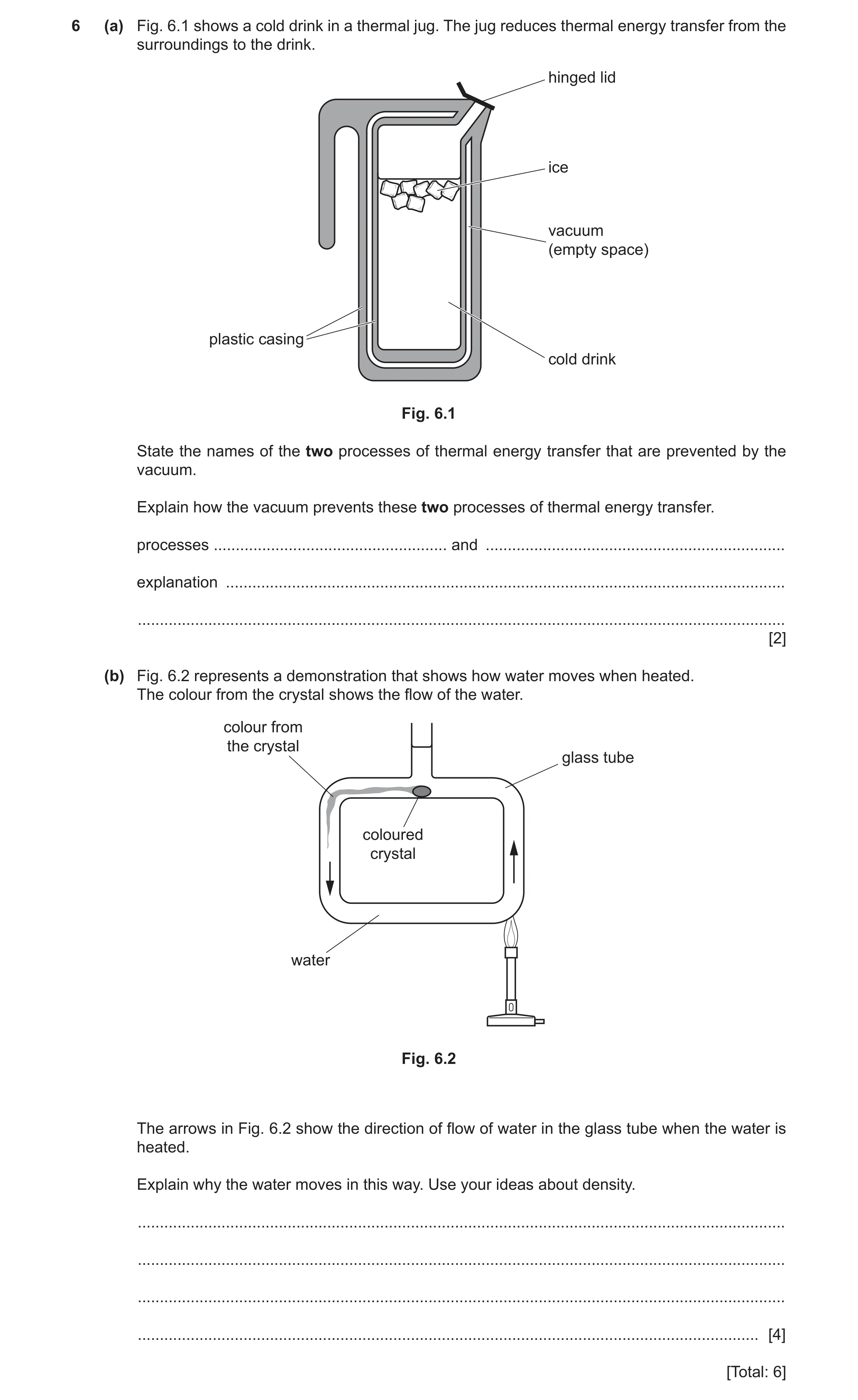
6 (a) Fig. 6.1 shows a cold drink in a thermal jug. The jug reduces thermal energy transfer from the surroundings to the drink. hinged lid ice vacuum (empty space) plastic casing cold drink Fig. 6.1 State the names of the two processes of thermal energy transfer that are prevented by the vacuum. Explain how the vacuum prevents these two processes of thermal energy transfer. processes … and … explanation … … [2] (b) Fig. 6.2 represents a demonstration that shows how water moves when heated. The colour from the crystal shows the flow of the water. colour from the crystal glass tube coloured crystal water Fig. 6.2 The arrows in Fig. 6.2 show the direction of flow of water in the glass tube when the water is heated. Explain why the water moves in this way. Use your ideas about density. … … … … [4] [Total: 6]
6 marks
Mark scheme: 6(a) conduction AND convection B1 need a medium / particles (to transfer energy) B1 6(b) any four from: B4 water particles gain thermal energy / KE (water) particles move apart warm water becomes less dense less dense water rises / more dense water falls (forming a) convection (current)
This question in 0625/32 Oct/Nov 2023
Q27 · A pan on a hotplate 0625/33 Oct/Nov 2023
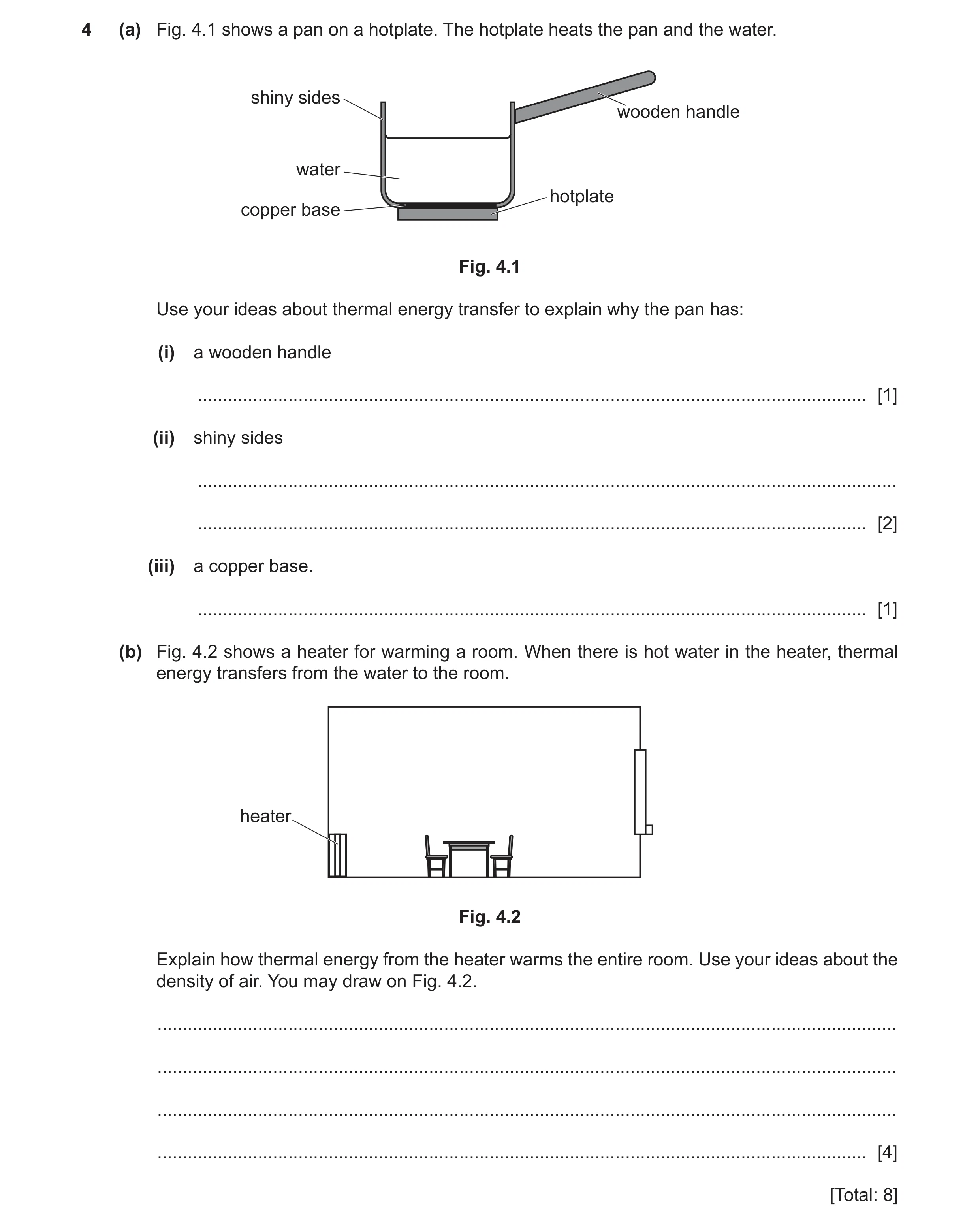
4 (a) Fig. 4.1 shows a pan on a hotplate. The hotplate heats the pan and the water. shiny sides wooden handle water hotplate copper base Fig. 4.1 Use your ideas about thermal energy transfer to explain why the pan has: (i) a wooden handle … [1] (ii) shiny sides … … [2] (iii) a copper base. … [1] (b) Fig. 4.2 shows a heater for warming a room. When there is hot water in the heater, thermal energy transfers from the water to the room. heater Fig. 4.2 Explain how thermal energy from the heater warms the entire room. Use your ideas about the density of air. You may draw on Fig. 4.2. … … … … [4] [Total: 8]
8 marks
Mark scheme: 4(a)(i) reduces heat transfer (to handle) OR wood is an insulator B1 4(a)(ii) poor / worst emitter (of heat) B1 (of) infrared / radiation B1 4(a)(iii) allows heat transfer (to water) OR (good) conductor (of heat) B1 4(b) any four from: B4 conduction (through metal of heater) air particles gain kinetic energy / KE air particles move further apart hot air becomes less dense hot / less dense air rises OR cold / denser air falls idea of convection current
This question in 0625/33 Oct/Nov 2023
Q28 · A metal container used for storing petrol 0625/32 Feb/March 2024
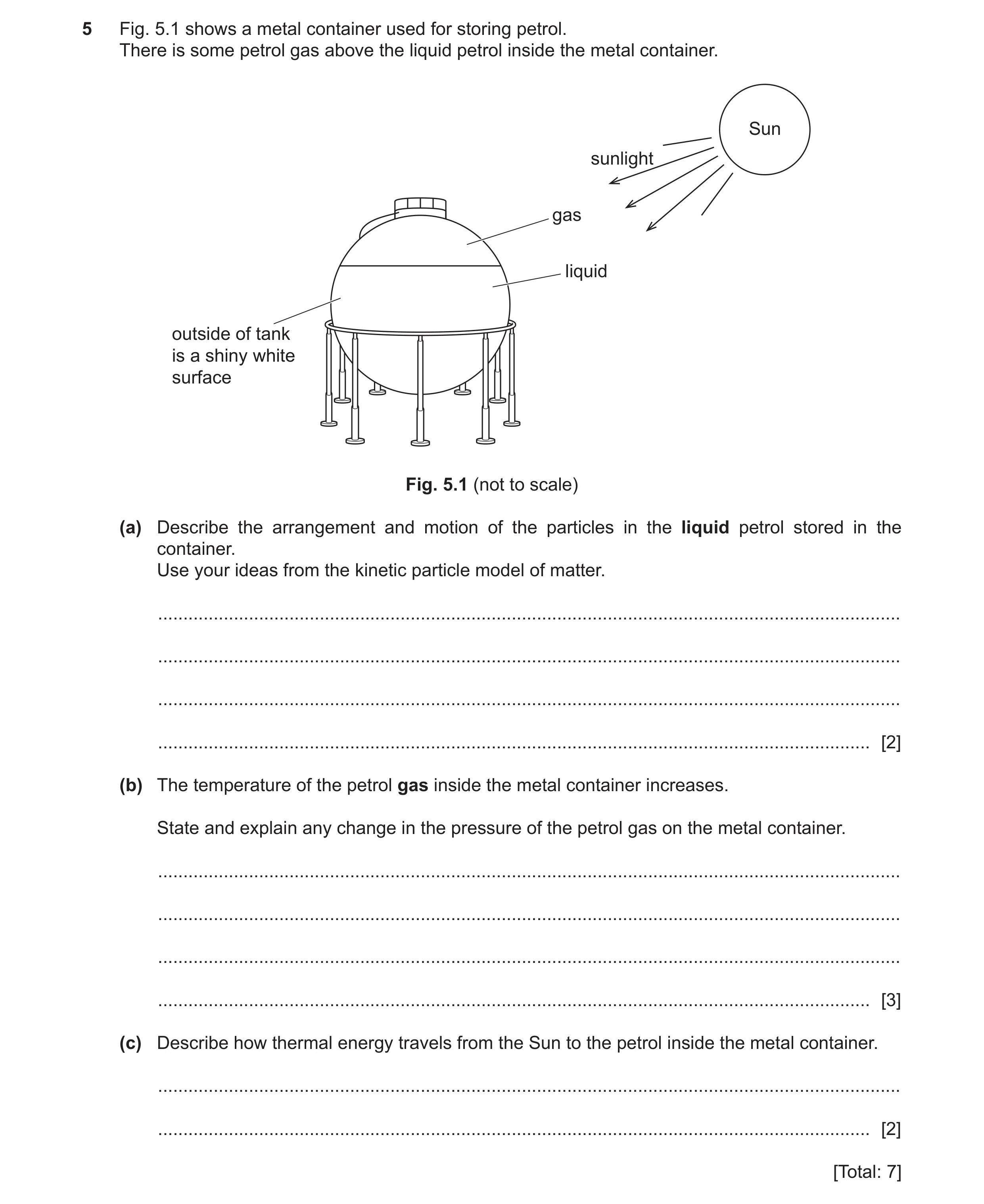
5 Fig. 5.1 shows a metal container used for storing petrol. There is some petrol gas above the liquid petrol inside the metal container. Sun sunlight gas liquid outside of tank is a shiny white surface Fig. 5.1 (not to scale) (a) Describe the arrangement and motion of the particles in the liquid petrol stored in the container. Use your ideas from the kinetic particle model of matter. … … … … [2] (b) The temperature of the petrol gas inside the metal container increases. State and explain any change in the pressure of the petrol gas on the metal container. … … … … [3] (c) Describe how thermal energy travels from the Sun to the petrol inside the metal container. … … [2] [Total: 7]
7 marks
Mark scheme: 5(a) any two from: B2 • (particles are;) random arrangement / pattern • close together OR idea slightly further apart than in solid • move randomly OR move around / about (freely) • colliding with each other / walls • have some vibrational energy / motion 5(b) pressure increases B1 any two from: (because) B2 • particles move faster OR have increased kinetic energy • more (frequent) collisions (with walls of container) • harder collisions (with walls of container) 5(c) infrared OR radiation (through space and atmosphere) B1 conduction (through the metal) B1
This question in 0625/32 Feb/March 2024
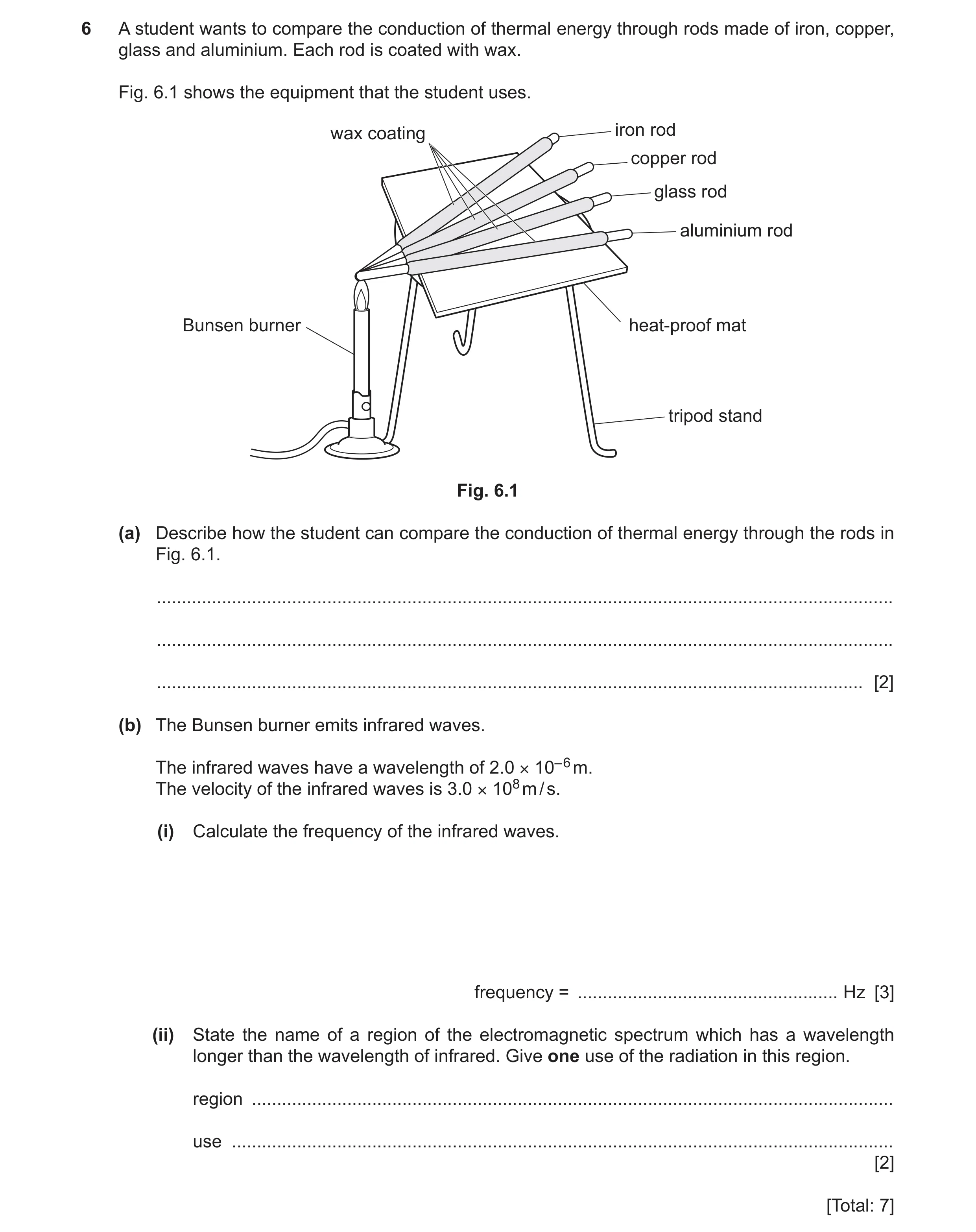
Q29 · A student wants to compare the conduction of thermal energy through rods made of iron… 0625/31 May/June 2024
6 A student wants to compare the conduction of thermal energy through rods made of iron, copper, glass and aluminium. Each rod is coated with wax. Fig. 6.1 shows the equipment that the student uses. wax coating iron rod copper rod glass rod aluminium rod Bunsen burner heat-proof mat tripod stand Fig. 6.1 (a) Describe how the student can compare the conduction of thermal energy through the rods in Fig. 6.1. … … … [2] (b) The Bunsen burner emits infrared waves. The infrared waves have a wavelength of 2.0 × 10– 6 m. The velocity of the infrared waves is 3.0 × 10⁸ m / s. (i) Calculate the frequency of the infrared waves. frequency = … Hz [3] (ii) State the name of a region of the electromagnetic spectrum which has a wavelength longer than the wavelength of infrared. Give one use of the radiation in this region. region … use … [2] [Total: 7]
7 marks
Mark scheme: 6(a) idea of measure / read / note / compare how much wax melts (along each rod) OR how quickly the wax melts B1 idea of: the better the conductor the shorter the length of unmelted wax (remaining) OR the better the conductor the further the wax melts (along rod) OR the better the conductor the shorter the time for the wax to melt B1 6(b)(i) (frequency =) 1.5 1014 (Hz) A3 (frequency =) 3(.0) 108 ÷ 2(.0) 10–6 (C2) velocity = frequency wavelength (C1) 6(b)(ii) (region) microwaves OR radio waves B1 valid use that is consistent with radiation in stated region B1
This question in 0625/31 May/June 2024
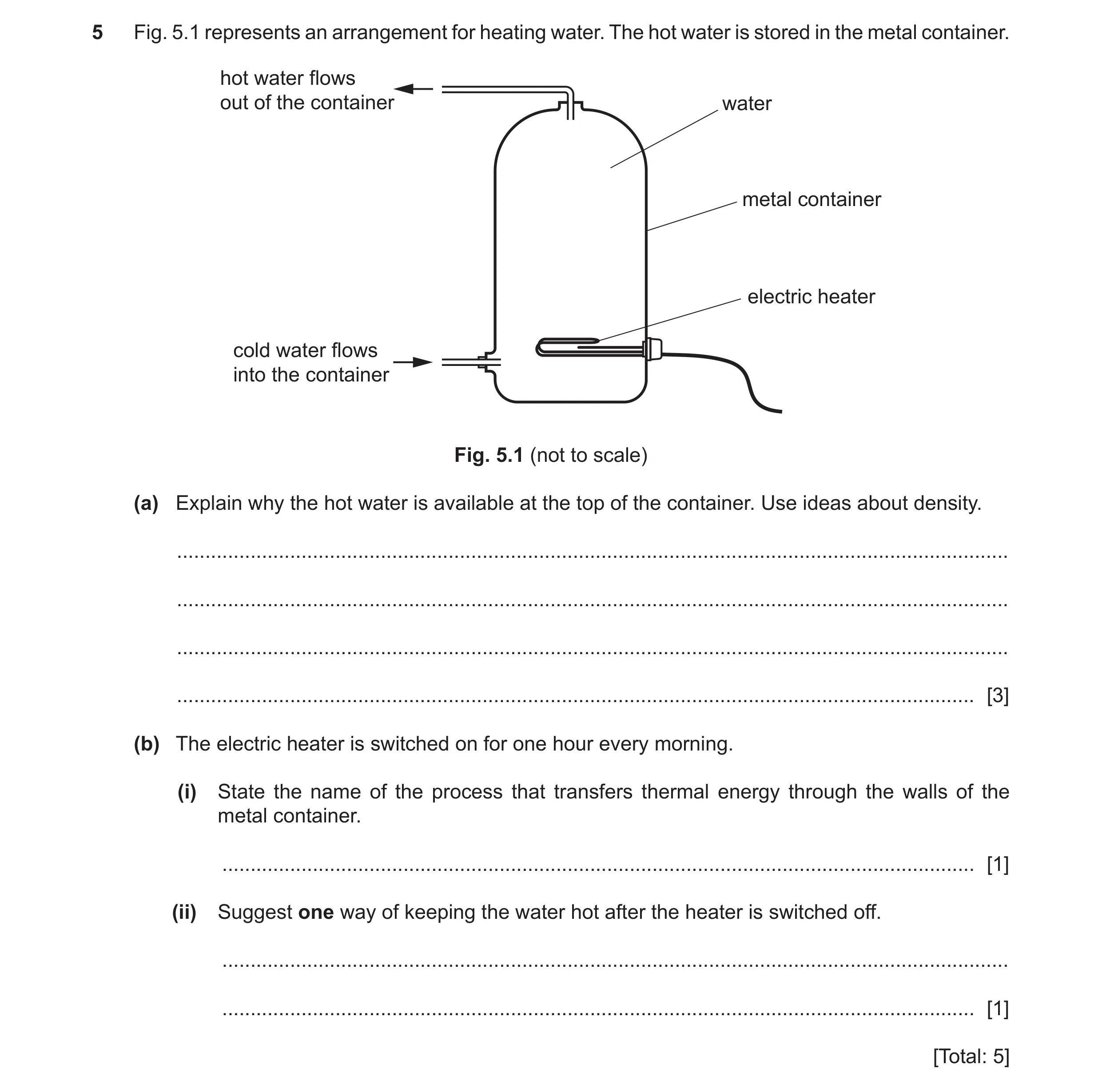
Q30 · An arrangement for heating water 0625/33 May/June 2024
5 Fig. 5.1 represents an arrangement for heating water. The hot water is stored in the metal container. hot water flows out of the container water metal container electric heater cold water flows into the container Fig. 5.1 (not to scale) (a) Explain why the hot water is available at the top of the container. Use ideas about density. … … … … [3] (b) The electric heater is switched on for one hour every morning. (i) State the name of the process that transfers thermal energy through the walls of the metal container. … [1] (ii) Suggest one way of keeping the water hot after the heater is switched off. … … [1] [Total: 5]
5 marks
Mark scheme: 5(a) convection (current) B1 any two from: (heated water) expands (becomes) less dense (less dense) water rises B2 5(b)(i) conduction B1 5(b)(ii) insulate / lag container owtte B1
This question in 0625/33 May/June 2024
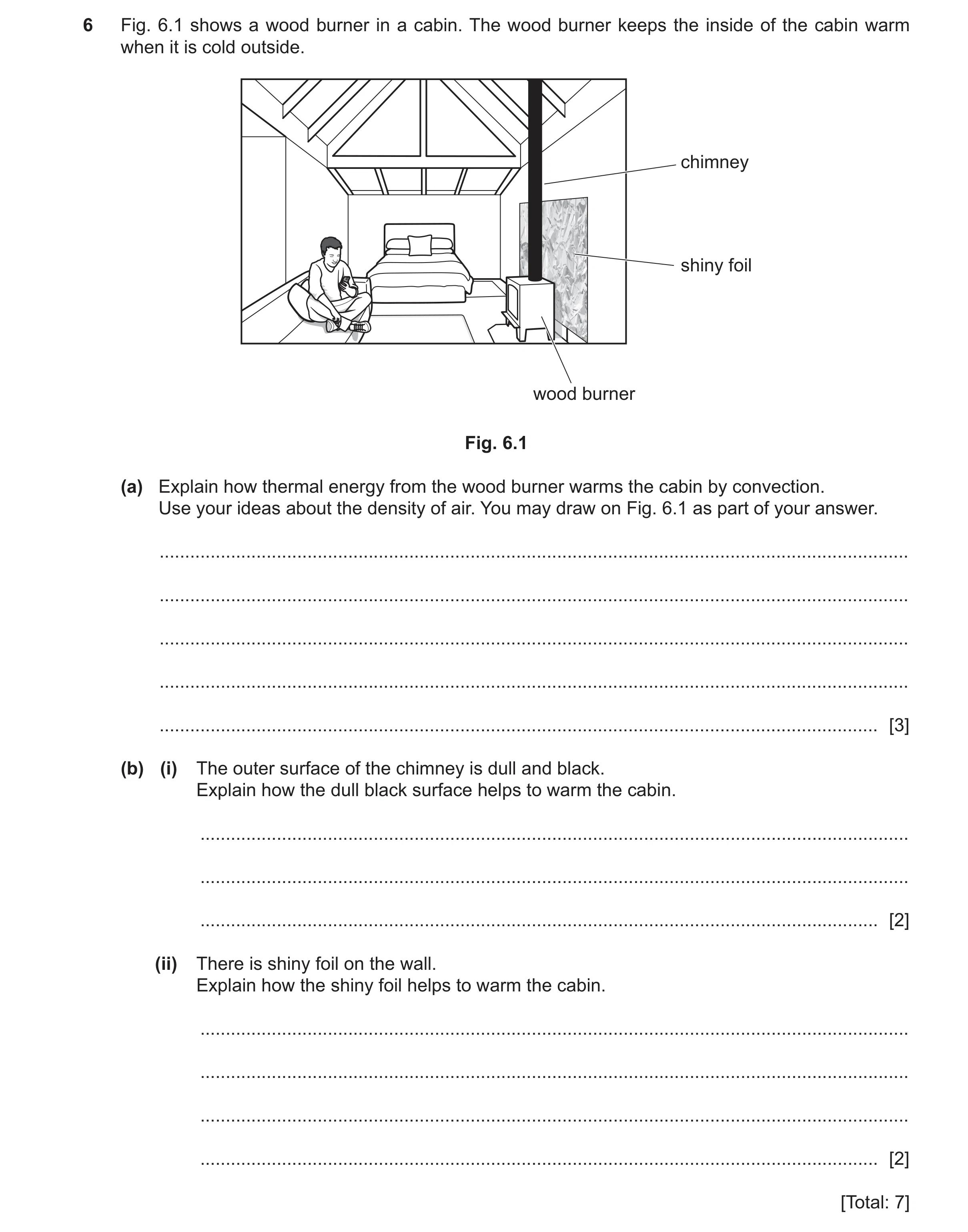
Q31 · A wood burner in a cabin 0625/32 Oct/Nov 2024
6 Fig. 6.1 shows a wood burner in a cabin. The wood burner keeps the inside of the cabin warm when it is cold outside. chimney shiny foil wood burner Fig. 6.1 (a) Explain how thermal energy from the wood burner warms the cabin by convection. Use your ideas about the density of air. You may draw on Fig. 6.1 as part of your answer. … … … … … [3] (b) (i) The outer surface of the chimney is dull and black. Explain how the dull black surface helps to warm the cabin. … … … [2] (ii) There is shiny foil on the wall. Explain how the shiny foil helps to warm the cabin. … … … … [2] [Total: 7]
7 marks
Mark scheme: 6(a) (heated air) expands B1 (becomes) less dense B1 less dense air rises OR denser air sinks B1 6(b)(i) (dull black is) best / better / good emitter owtte B1 of radiation / infrared B1 6(b)(ii) (shiny foil is) best / better / good reflector M1 of radiation / infrared A1
This question in 0625/32 Oct/Nov 2024
Q32 · Table 5.1 defines three specific temperatures 0625/33 Oct/Nov 2024
5 (a) Table 5.1 defines three specific temperatures. (i) Complete Table 5.1 by writing the correct temperature for each definition. Table 5.1 definition temperature / °C pure water boiling at standard atmospheric pressure pure ice melting at standard atmospheric pressure the lowest possible temperature of matter [3] (ii) The temperature of air in a room is 15 °C. Calculate the temperature of the air in kelvin. temperature = … K [2] (b) A teacher demonstrates thermal energy transfer through some metal rods. Fig. 5.1 shows the arrangement. metal rods Bunsen burner block of wood pins held on by wax Fig. 5.1 The metal rods are placed on a block of wood. The demonstration compares how quickly thermal energy is transferred to the wax at the end of each rod. (i) State the name of the process for thermal energy transfer through the metal rods. … [1] (ii) The rods are made from different metals. The rods have the same length and diameter. The ends of the rods in the Bunsen flame are at the same temperature. State how the demonstration shows which metal transfers thermal energy at the greatest rate. … … [2] (c) A playground includes a concrete area with white and black squares, as shown in Fig. 5.2. Fig. 5.2 The Sun shines on the concrete area during the day. The temperature of the concrete area increases. During the afternoon, students compare the temperature of the white squares with the temperature of the black squares. State and explain whether the white squares or the black squares have the higher temperature. Include the name of the process of thermal energy transfer from the Sun to the squares. … … … [2] [Total: 10]
10 marks
Mark scheme: 5(a)(i) B1 pure water boiling at standard atmospheric pressure 100 B1 pure ice melting at standard atmospheric pressure 0 the lowest possible temperature of matter –273 B1 5(a)(ii) 288 (K) A2 273 + 15 (C1) 5(b)(i) conduction B1 5(b)(ii) first wax to melt or first pin to fall off or the faster the pin falls off M1 the better the conductor / energy transfer / has the greatest rate A1 5(c) black (square) B1 AND either black – best/good absorber OR worse / poor reflector OR B1 white – best/good reflector OR worse / poor absorber of radiation / infrared (radiation)
This question in 0625/33 Oct/Nov 2024
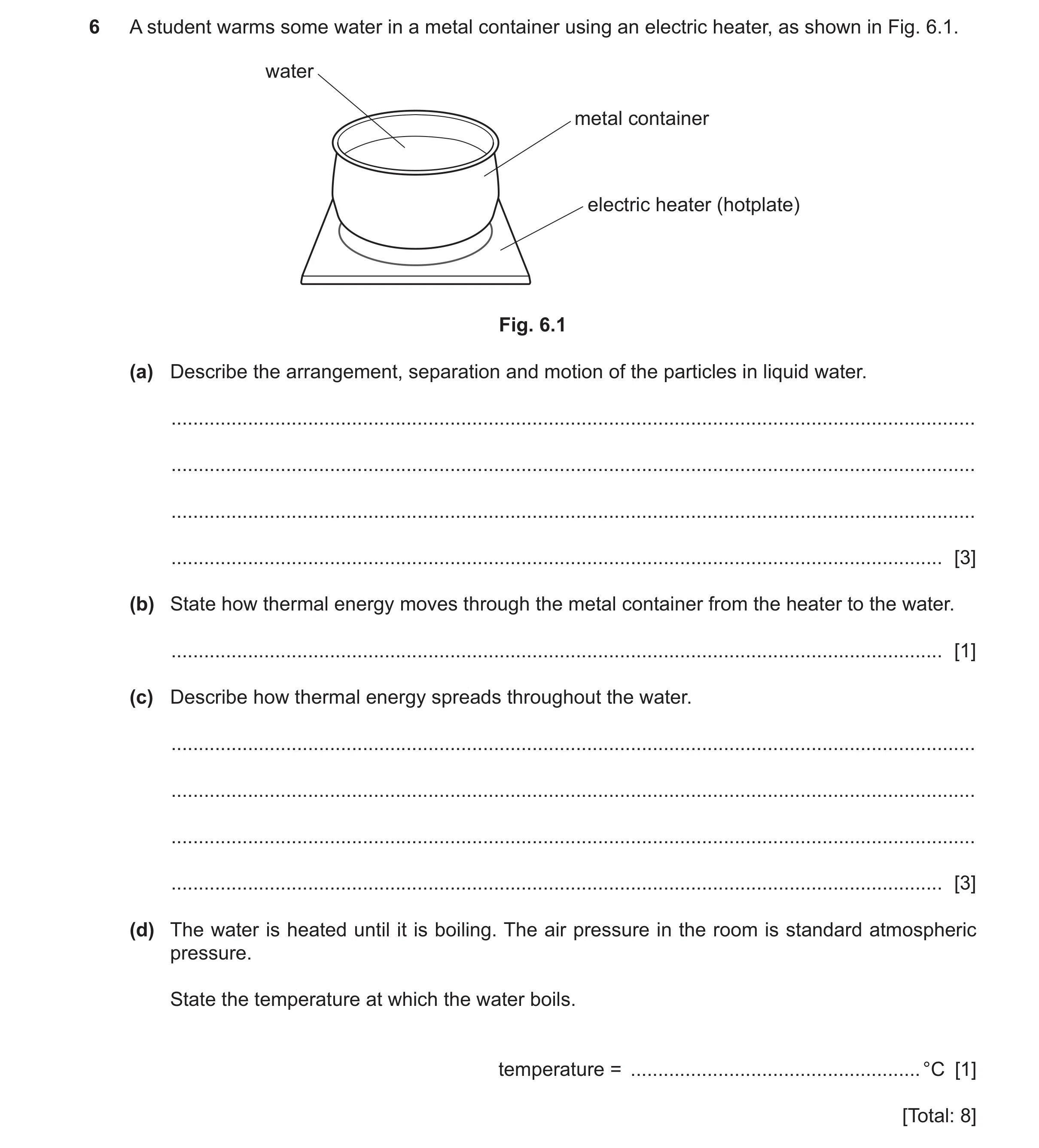
Q33 · A student warms some water in a metal container using an electric heater, as shown in Fig 0625/32 Feb/March 2025
6 A student warms some water in a metal container using an electric heater, as shown in Fig. 6.1. water metal container electric heater (hotplate) Fig. 6.1 (a) Describe the arrangement, separation and motion of the particles in liquid water. … … … … [3] (b) State how thermal energy moves through the metal container from the heater to the water. … [1] (c) Describe how thermal energy spreads throughout the water. … … … … [3] (d) The water is heated until it is boiling. The air pressure in the room is standard atmospheric pressure. State the temperature at which the water boils. temperature = … °C [1] [Total: 8]
8 marks
Mark scheme: 6(a) any three from (particles are:) B3 in a random arrangement close together OR slightly further apart than in solids move freely OR slide over each other collide (with each other) moving randomly 6(b) conduction B1 6(c) any three from: B3 convection idea that water at bottom of pan is warmed / temp of water at bottom increases warm water is less dense less dense / warm water rises OR more dense/colder water sinks 6(d) 100 (°C) B1
This question in 0625/32 Feb/March 2025
Q34 · A student uses the apparatus in Fig 0625/31 May/June 2025
5 (a) A student uses the apparatus in Fig. 5.1 to compare how different surfaces absorb infrared radiation. thermometer thermometer dull black metal container metal container surface shiny white surface air air Bunsen burner Fig. 5.1 There are two metal containers. One has a dull black surface and the other has a shiny white surface. Before heating, the air inside the metal containers is at the same temperature. The Bunsen burner flame is the same distance from each metal container. The Bunsen burner flame emits infrared radiation and heats the metal containers for three minutes. Explain the difference between the temperatures of the air inside the two metal containers after heating for three minutes. … … … … … [2] (b) A teacher has some equipment for comparing thermal conductivity. The teacher has four metal rods and one glass rod. The metals are brass, copper, iron and steel. All five rods are the same size and shape. Describe how the teacher may use the rods to compare the thermal conductivity of the five materials. You may draw a labelled diagram as part of your answer. … … … … … … [4] [Total: 6]
6 marks
Mark scheme: 5(a) black container / air has higher temperature OR black container / air is hotter OR black container / air heats (up) fastest M1 (because) black is a better / good absorber (of infrared radiation) A1 5(b) idea of heating one end of (each) rod B1 method of comparing conduction along rods B1 idea of how to compare: B1 the better the conductor, the shorter the length of unmelted wax (remaining) OR wax melts furthest (along rod) OR which wax melts in the shortest time detail: B1 any one from: • use of same Bunsen flame (at same time) • use of timer for each separate rod • pins attached at same distance from end of rod • rods have {same thickness of wax} / {even coat with wax} / {same length of wax}
This question in 0625/31 May/June 2025
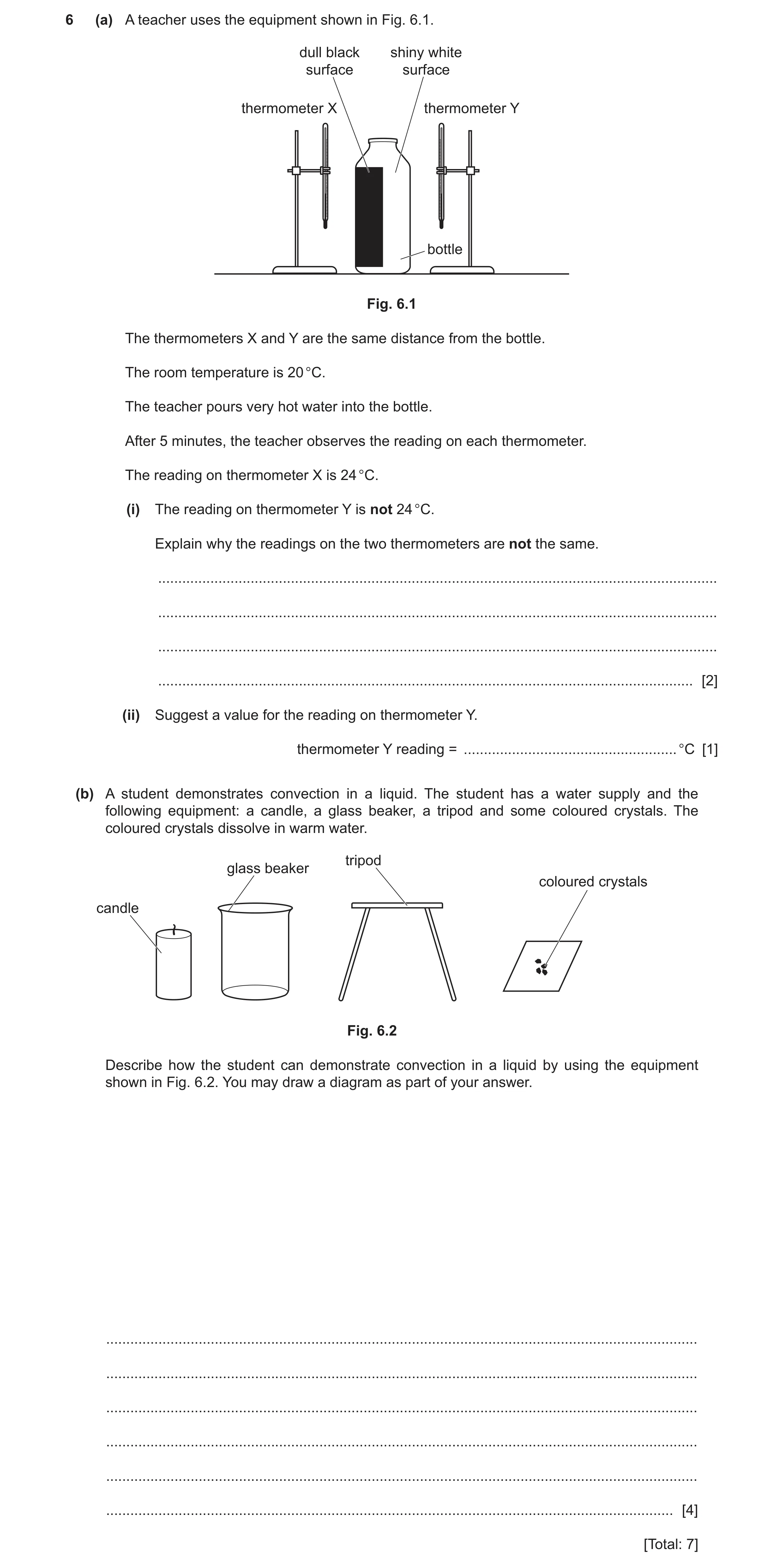
Q35 · A teacher uses the equipment shown in Fig 0625/32 May/June 2025
6 (a) A teacher uses the equipment shown in Fig. 6.1. dull black shiny white surface surface thermometer X thermometer Y bottle Fig. 6.1 The thermometers X and Y are the same distance from the bottle. The room temperature is 20 °C. The teacher pours very hot water into the bottle. After 5 minutes, the teacher observes the reading on each thermometer. The reading on thermometer X is 24 °C. (i) The reading on thermometer Y is not 24 °C. Explain why the readings on the two thermometers are not the same. … … … … [2] (ii) Suggest a value for the reading on thermometer Y. thermometer Y reading = … °C [1] (b) A student demonstrates convection in a liquid. The student has a water supply and the following equipment: a candle, a glass beaker, a tripod and some coloured crystals. The coloured crystals dissolve in warm water. tripod glass beaker coloured crystals candle Fig. 6.2 Describe how the student can demonstrate convection in a liquid by using the equipment shown in Fig. 6.2. You may draw a diagram as part of your answer. … … … … … … [4] [Total: 7]
7 marks
Mark scheme: 6(a)(i) dull / black better / best emitter / radiator M1 of infrared (radiation) A1 6(a)(ii) 20 value 24 (C) e.g. 21 OR 22 OR 23 OR 20.5 etc. B1 6(b) place crystals at bottom of (glass) beaker B1 any two from: B2 • (pour) water into (glass) beaker • place beaker on tripod • heat water / beaker with candle observe motion of coloured water / crystals B1
This question in 0625/32 May/June 2025
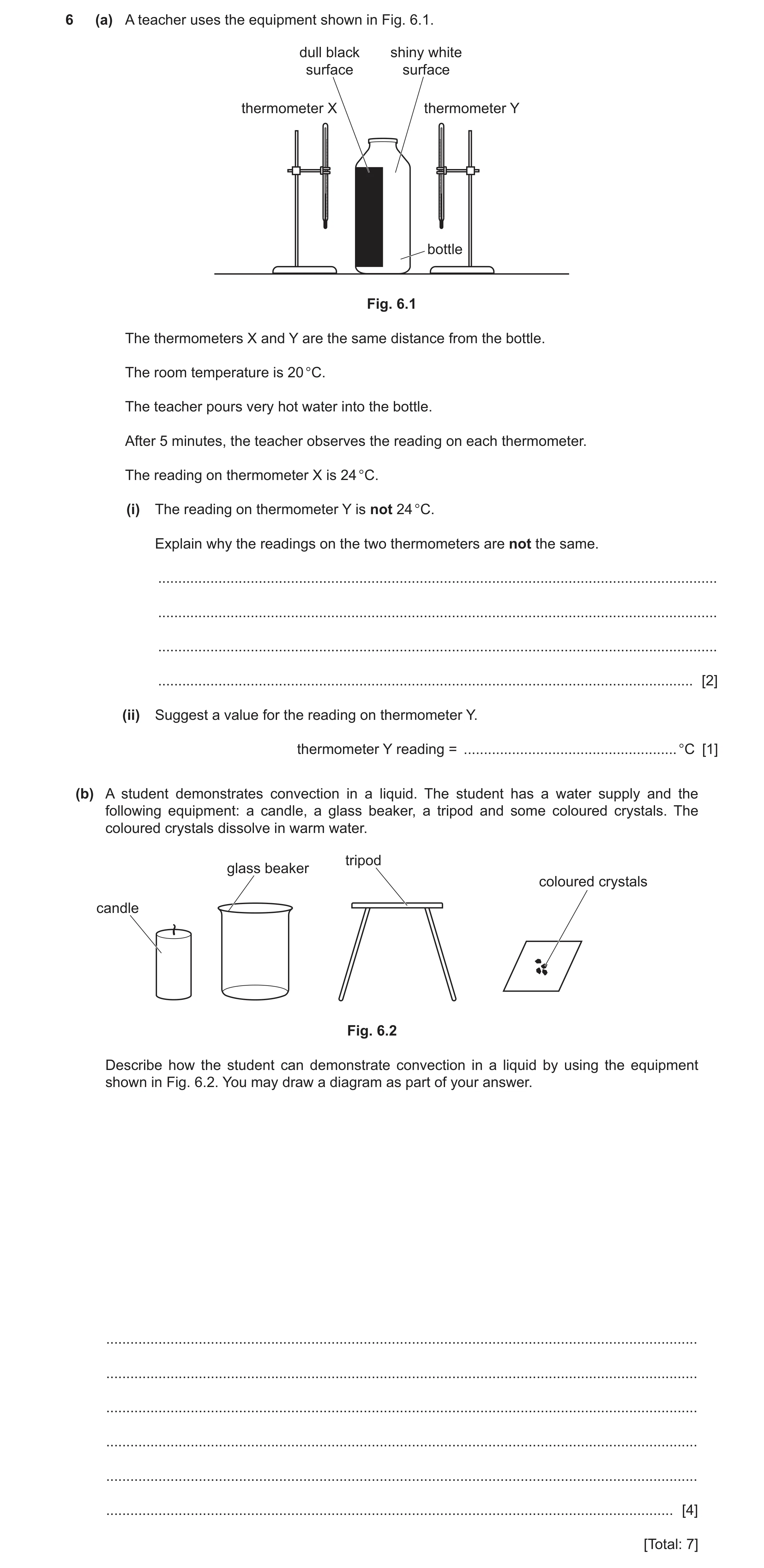
Q36 · A teacher uses the equipment shown in Fig 0625/33 May/June 2025
6 (a) A teacher uses the equipment shown in Fig. 6.1. dull black shiny white surface surface thermometer X thermometer Y bottle Fig. 6.1 The thermometers X and Y are the same distance from the bottle. The room temperature is 20 °C. The teacher pours very hot water into the bottle. After 5 minutes, the teacher observes the reading on each thermometer. The reading on thermometer X is 24 °C. (i) The reading on thermometer Y is not 24 °C. Explain why the readings on the two thermometers are not the same. … … … … [2] (ii) Suggest a value for the reading on thermometer Y. thermometer Y reading = … °C [1] (b) A student demonstrates convection in a liquid. The student has a water supply and the following equipment: a candle, a glass beaker, a tripod and some coloured crystals. The coloured crystals dissolve in warm water. tripod glass beaker coloured crystals candle Fig. 6.2 Describe how the student can demonstrate convection in a liquid by using the equipment shown in Fig. 6.2. You may draw a diagram as part of your answer. … … … … … … [4] [Total: 7]
7 marks
Mark scheme: 6(a)(i) dull / black better / best emitter / radiator M1 of infrared (radiation) A1 6(a)(ii) 20 value 24 (C) e.g. 21 OR 22 OR 23 OR 20.5 etc. B1 6(b) place crystals at bottom of (glass) beaker B1 any two from: B2 • (pour) water into (glass) beaker • place beaker on tripod • heat water / beaker with candle observe motion of coloured water / crystals B1
This question in 0625/33 May/June 2025
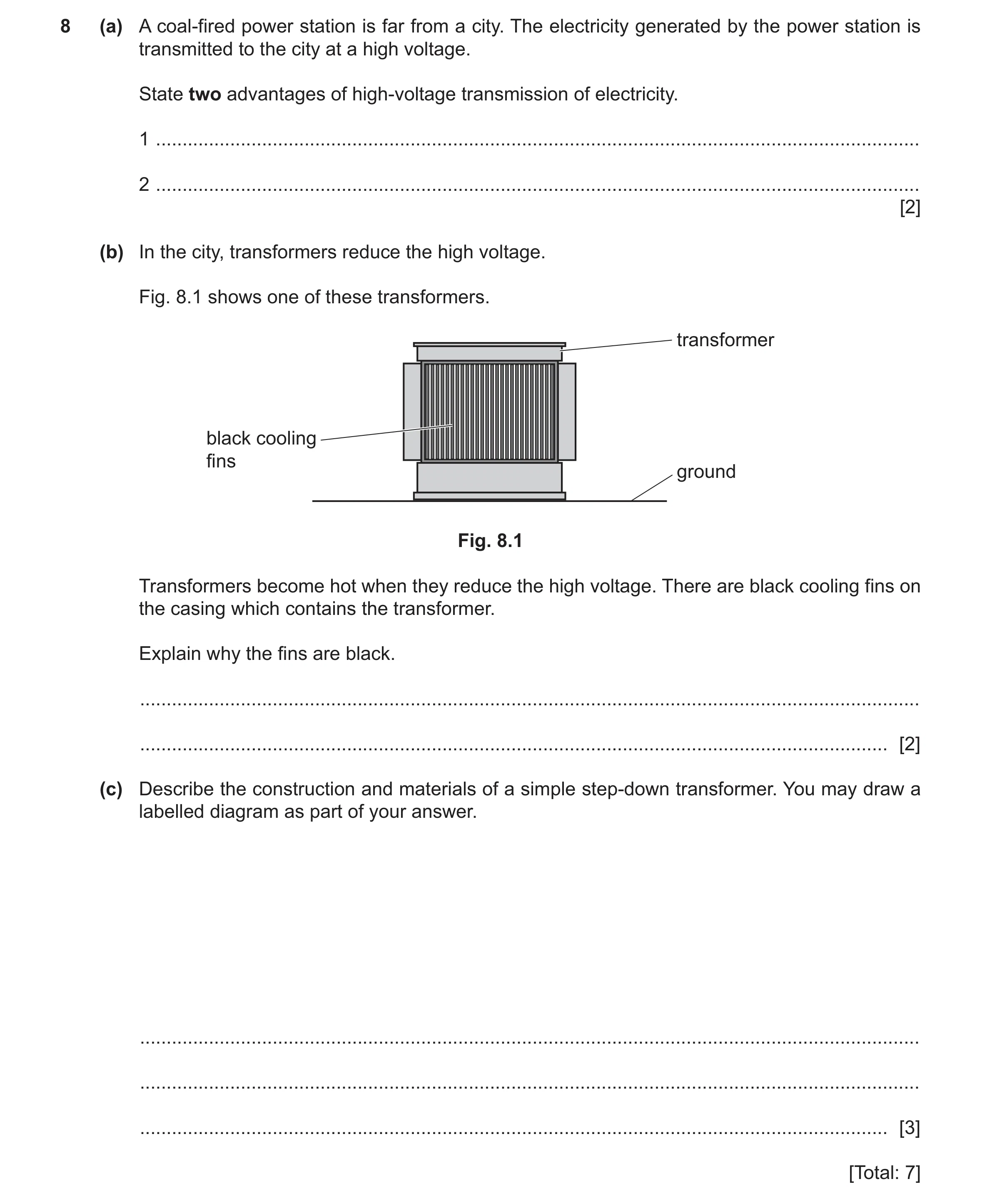
Q37 · A coal-fired power station is far from a city 0625/33 Oct/Nov 2025
8 (a) A coal-fired power station is far from a city. The electricity generated by the power station is transmitted to the city at a high voltage. State two advantages of high-voltage transmission of electricity. 1 … 2 … [2] (b) In the city, transformers reduce the high voltage. Fig. 8.1 shows one of these transformers. transformer black cooling fins ground Fig. 8.1 Transformers become hot when they reduce the high voltage. There are black cooling fins on the casing which contains the transformer. Explain why the fins are black. … … [2] (c) Describe the construction and materials of a simple step-down transformer. You may draw a labelled diagram as part of your answer. … … … [3] [Total: 7]
7 marks
Mark scheme: 8(a) any two from: B2 • smaller current (in cables) • more efficient • less power / heating losses • thinner / cheaper cables / pylons further apart owtte • less voltage drop • allows for transmission over a longer distance • fewer / larger power stations can supply more area / whole country 8(b) (black is a) good / best emitter M1 of thermal radiation / infrared A1 8(c) any three from: B3 • two coils • copper wire / coils • (coils wrapped round / linked by soft) iron core • more turns on primary coil
This question in 0625/33 Oct/Nov 2025
 1 / 46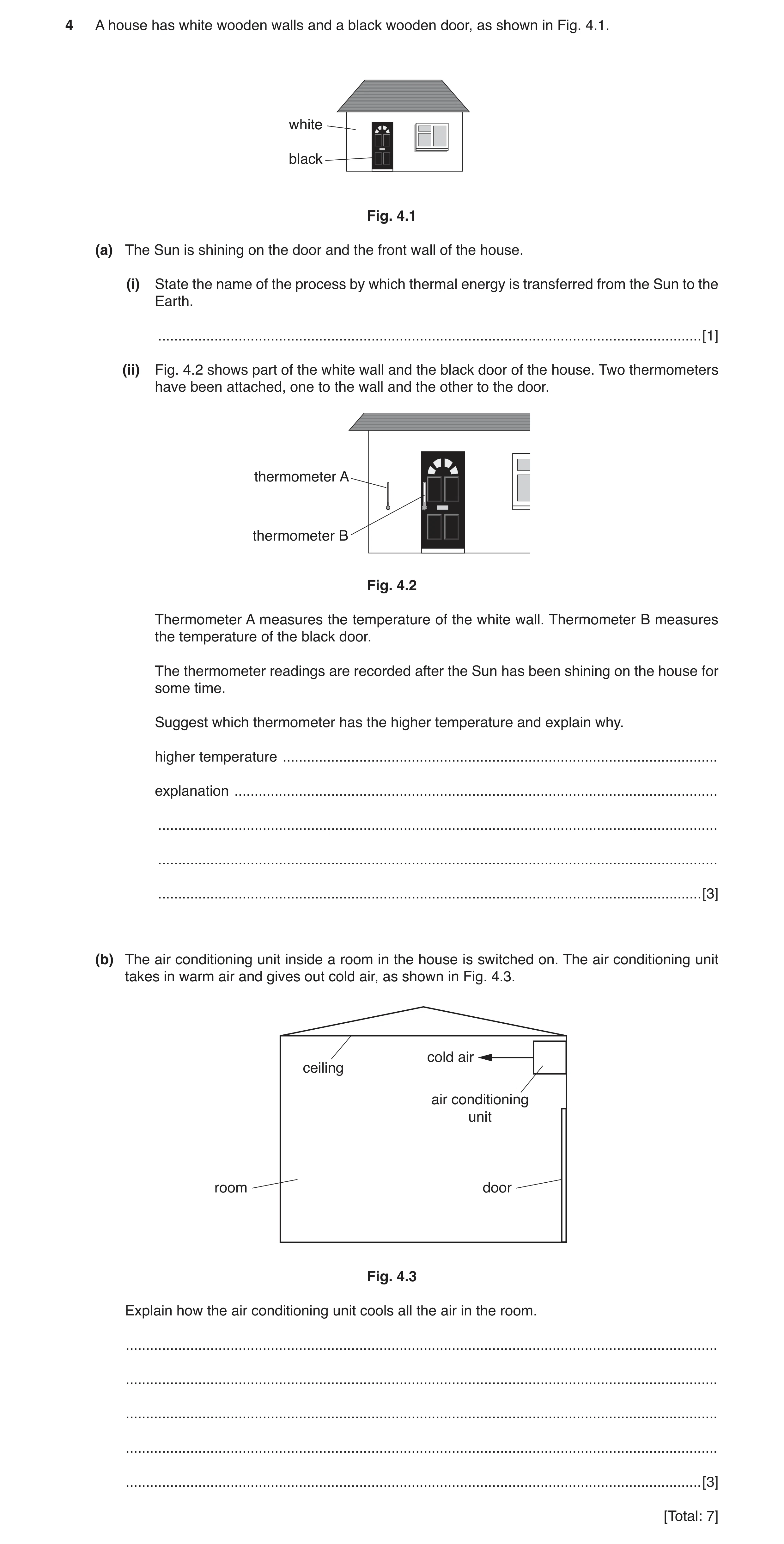
 3 / 46
 4 / 46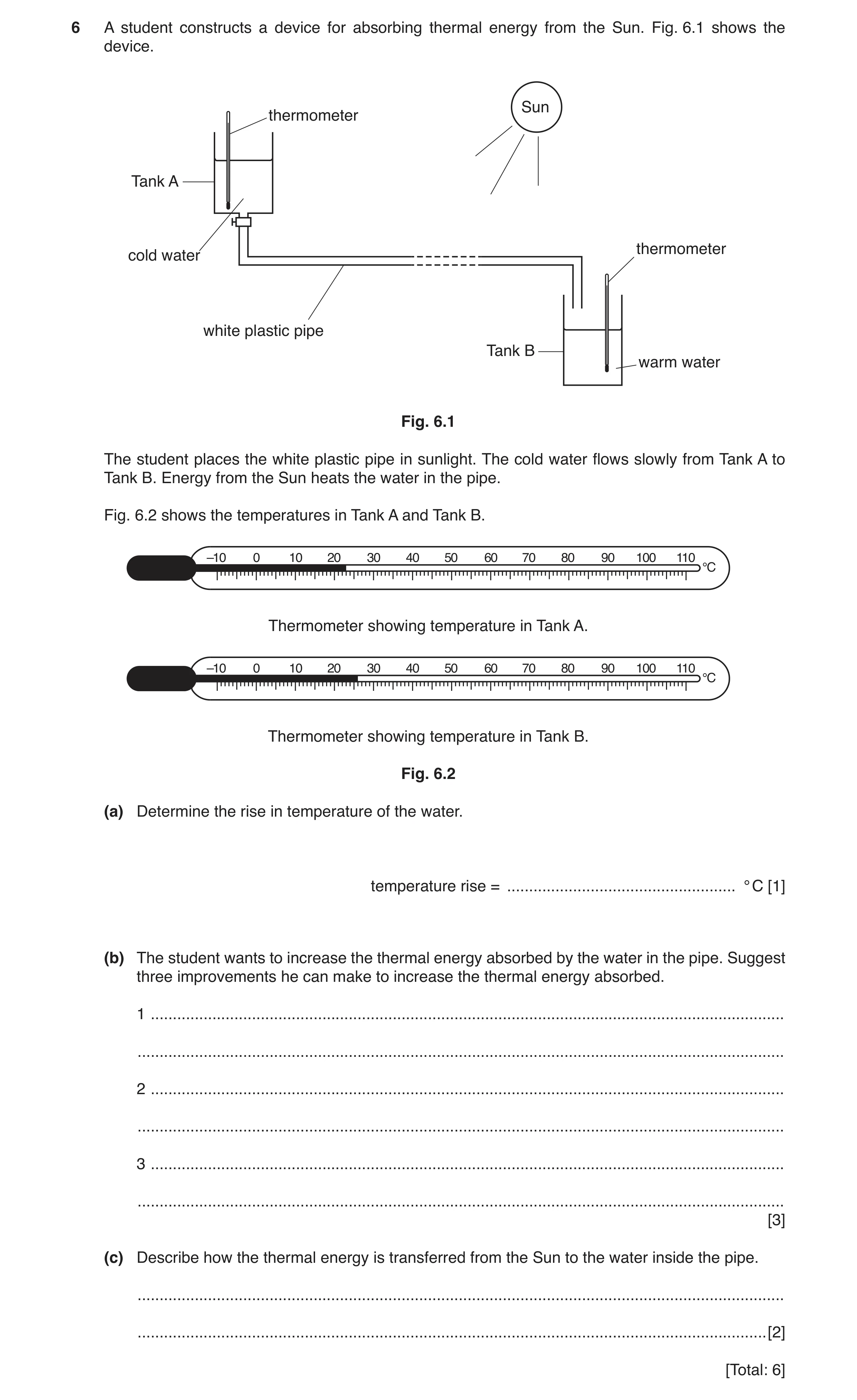
 9 / 46
 10 / 46
 11 / 46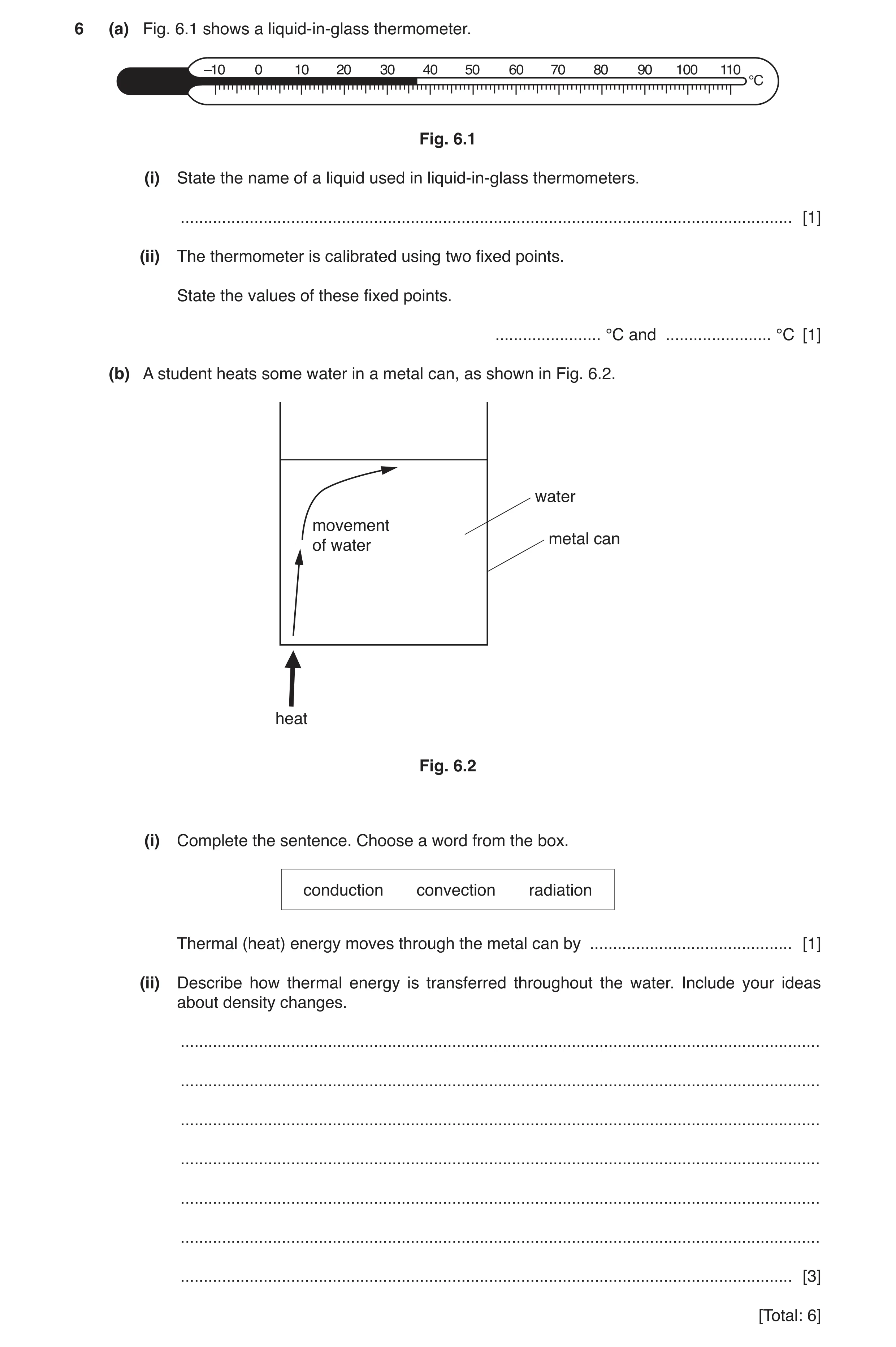
 15 / 46
 16 / 46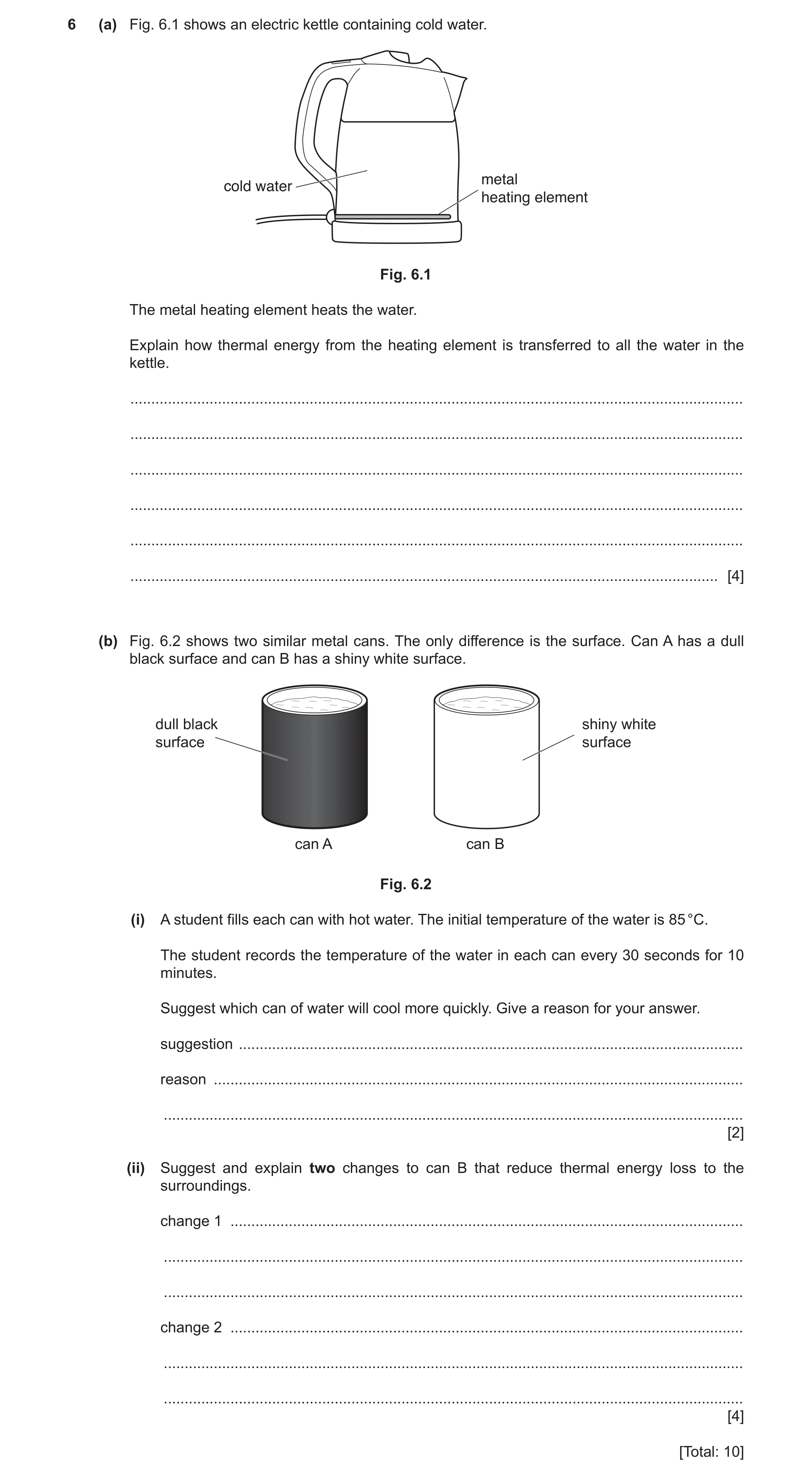
 23 / 46
 24 / 46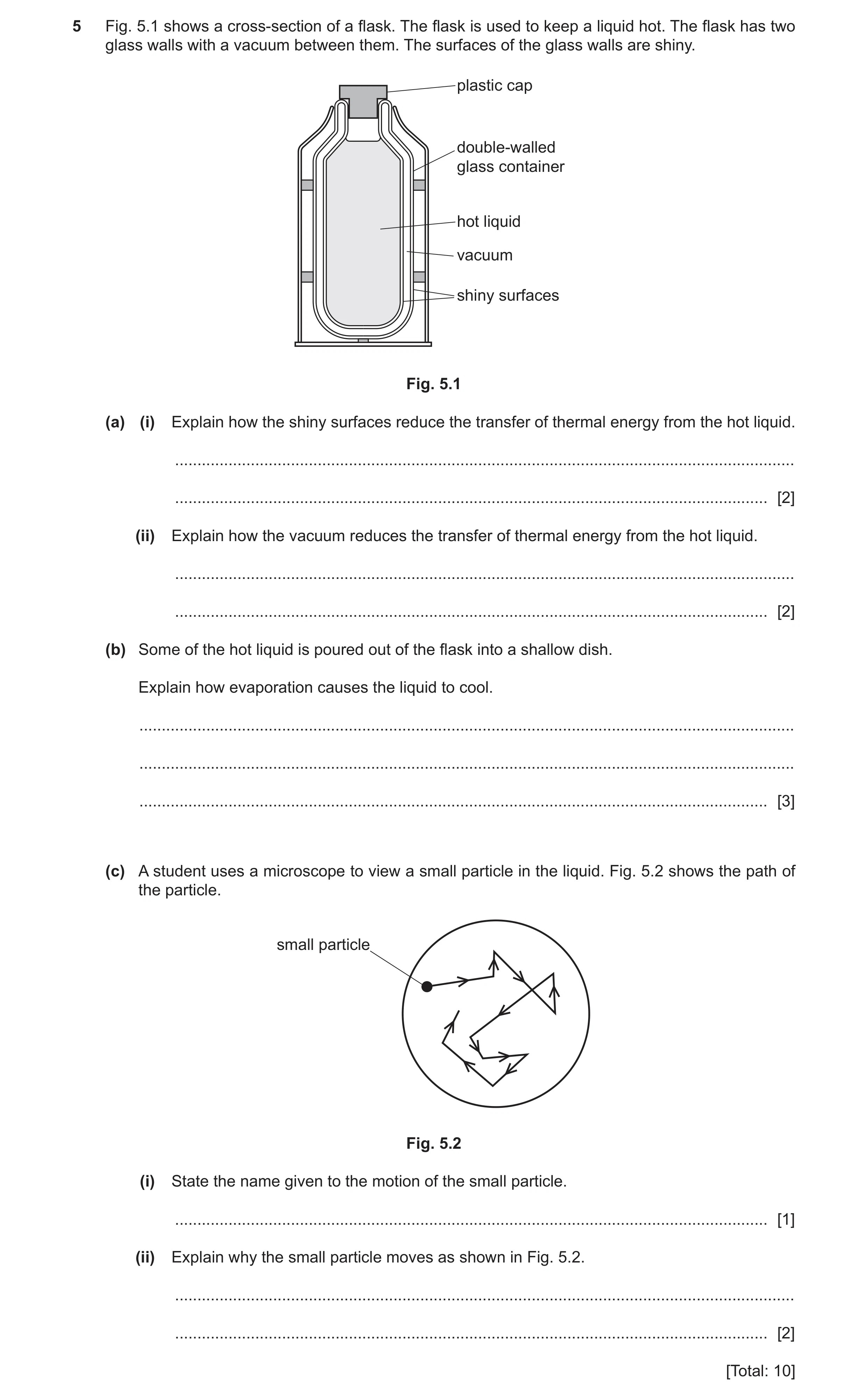
 29 / 46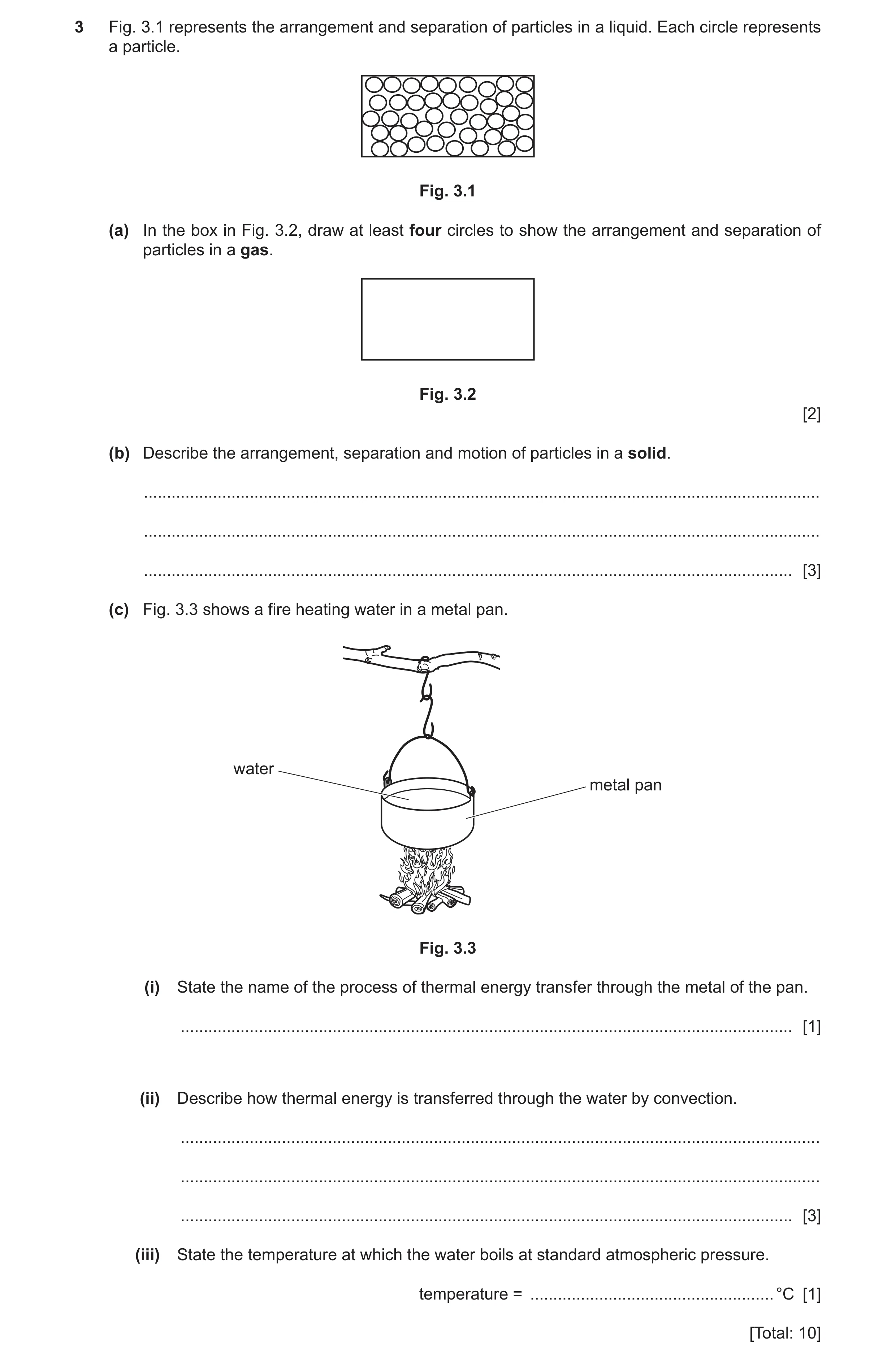
 33 / 46
 34 / 46
 35 / 46
 36 / 46
 37 / 46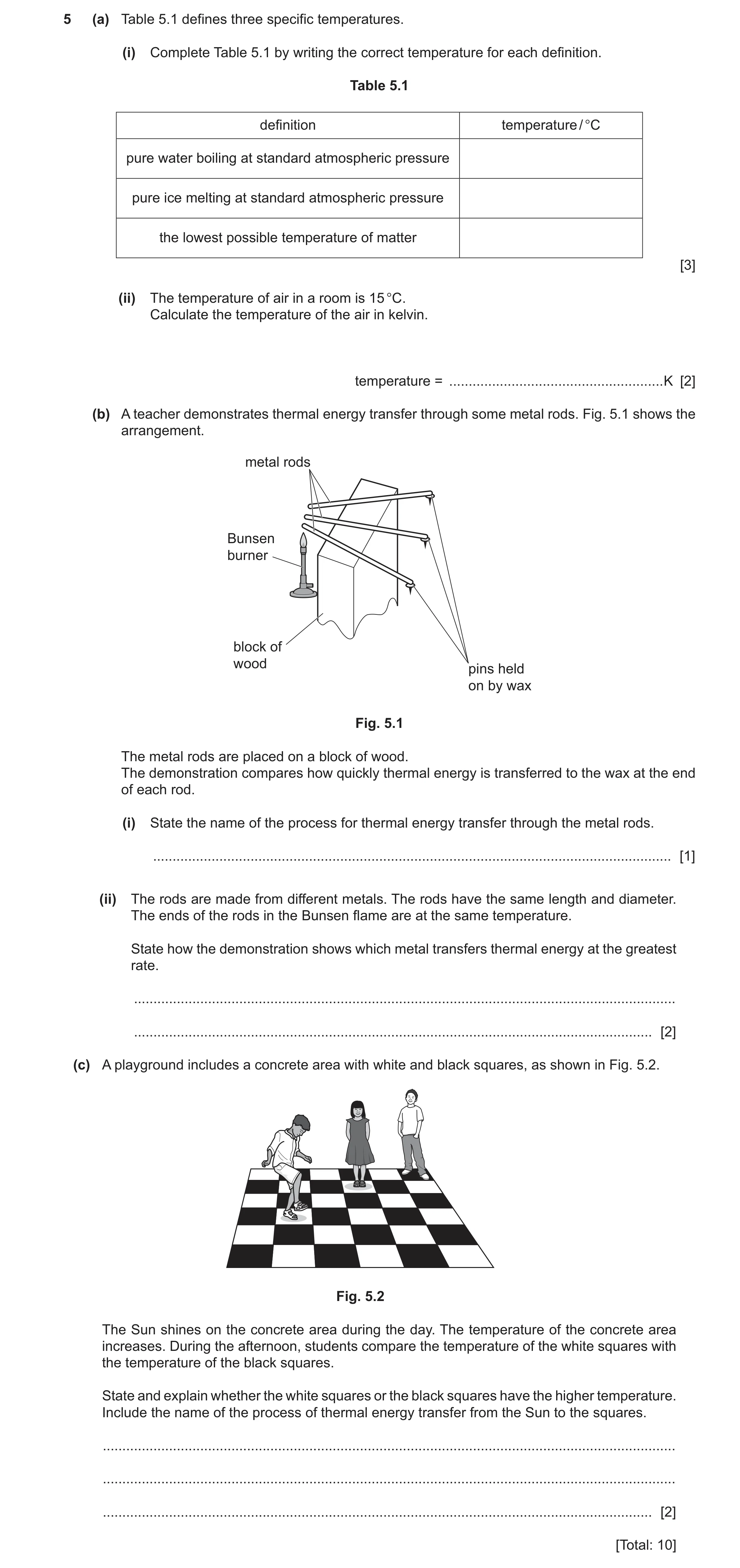
 40 / 46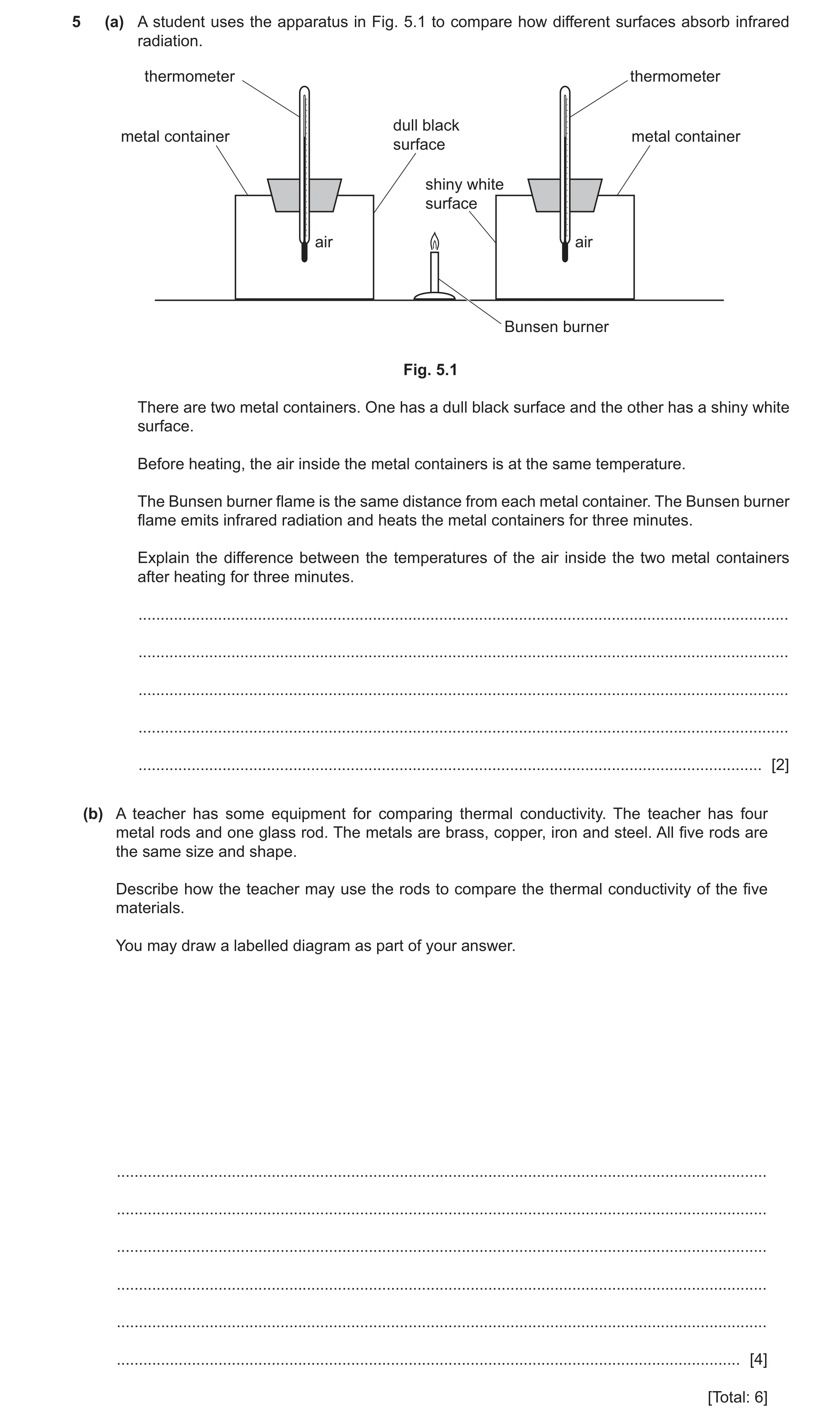
 46 / 46
 5
5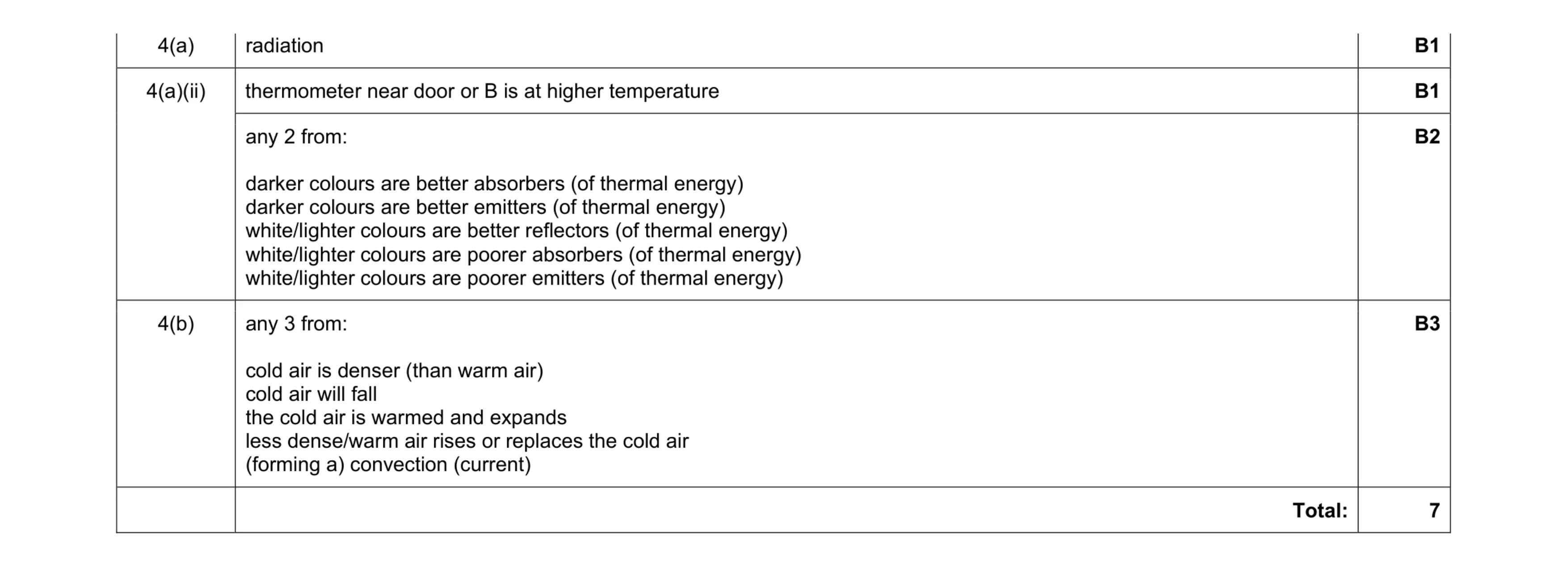 7
7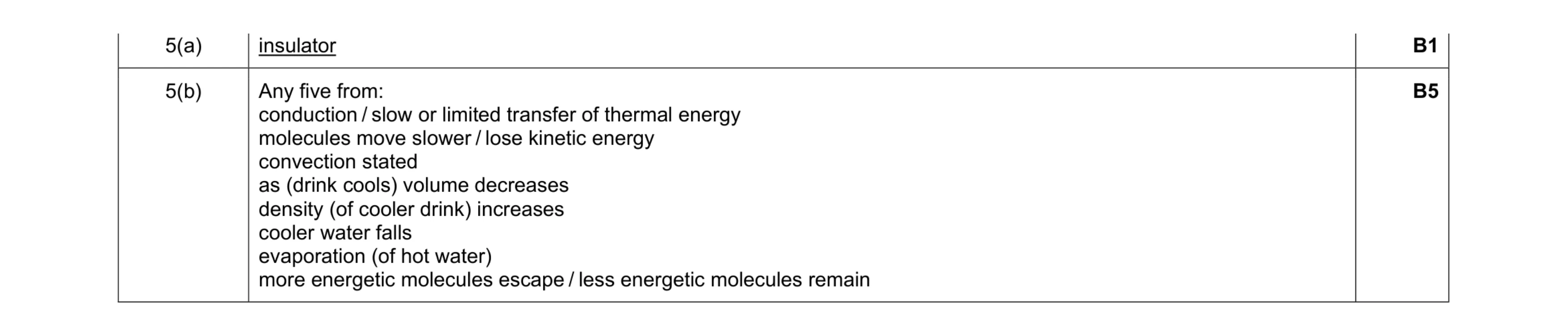 6
6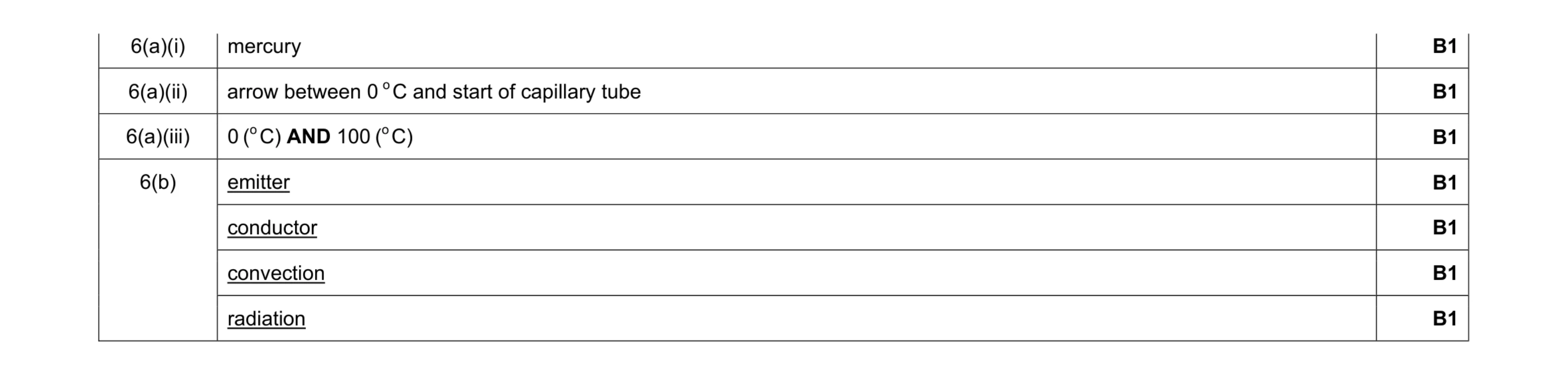 7
7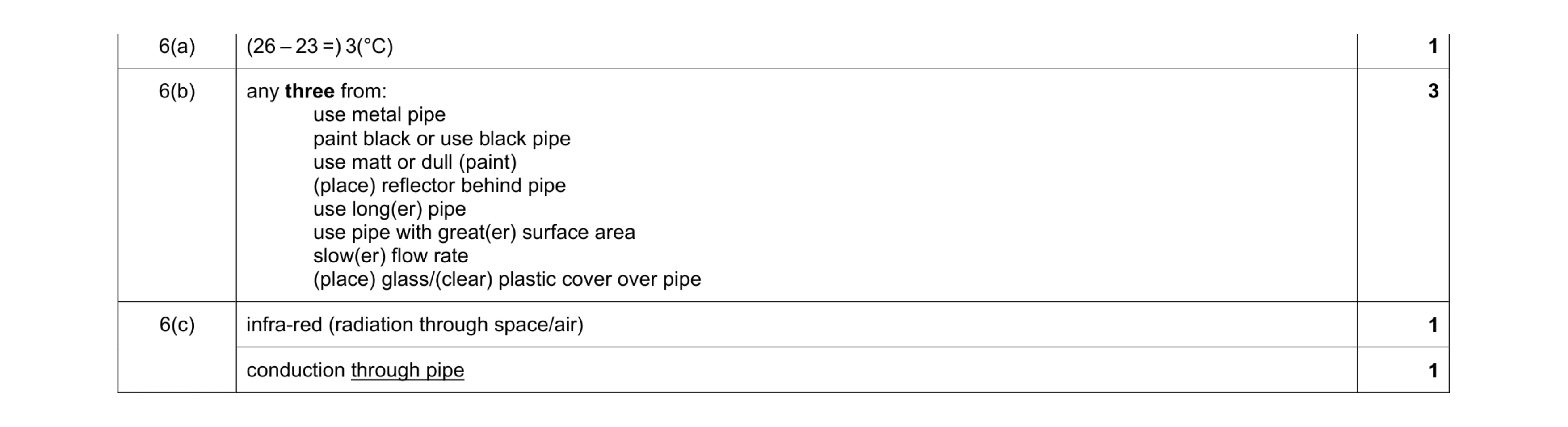 6
6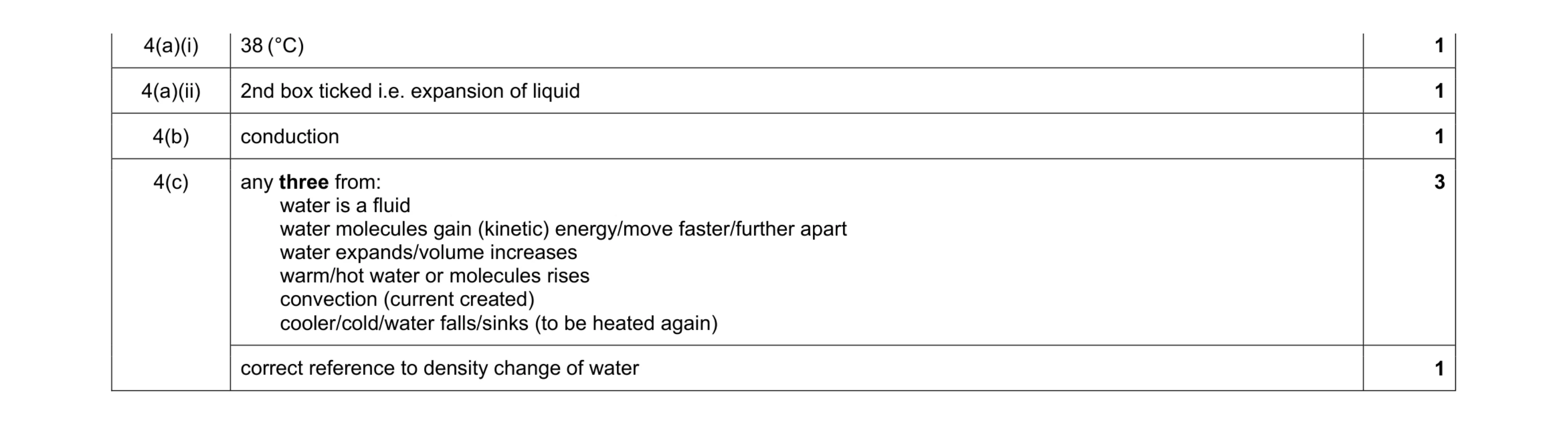 7
7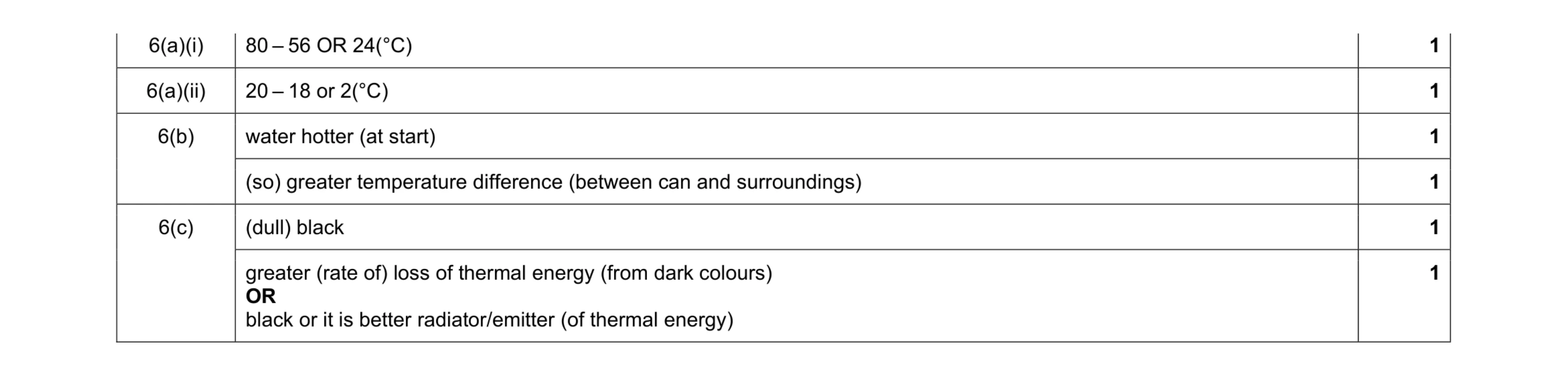 6
6 5
5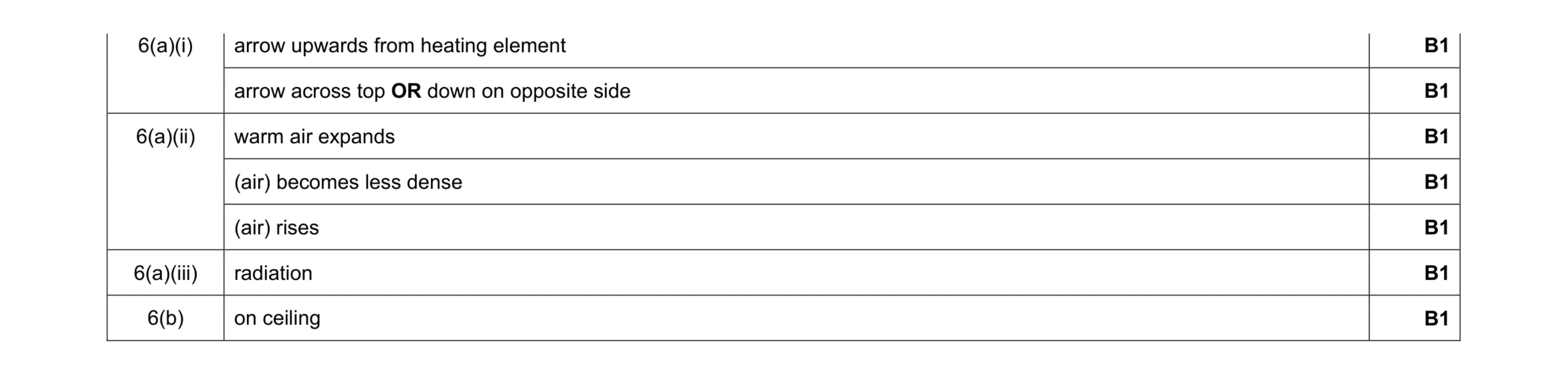 7
7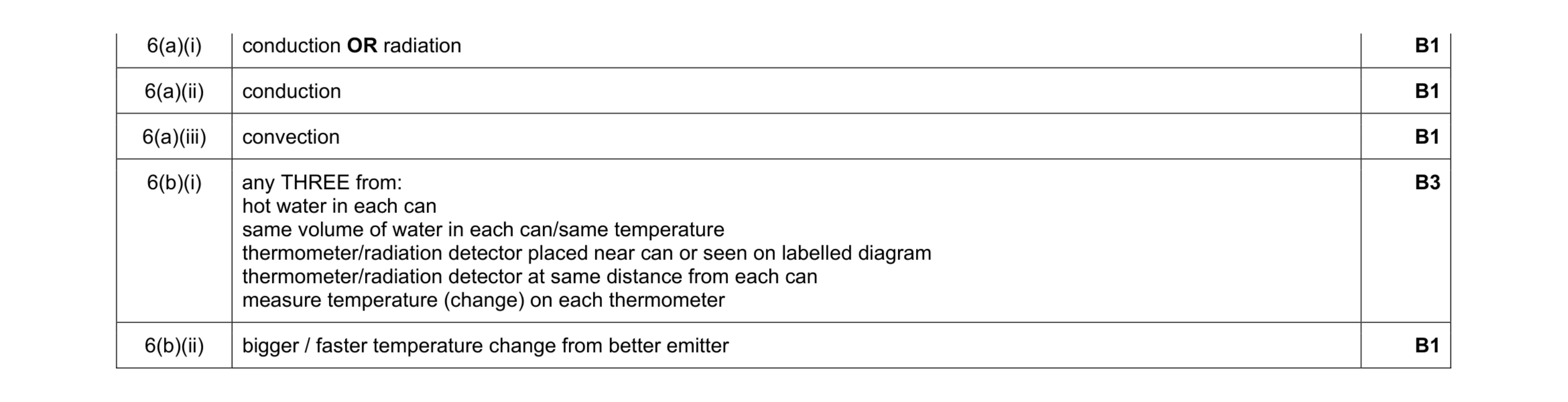 7
7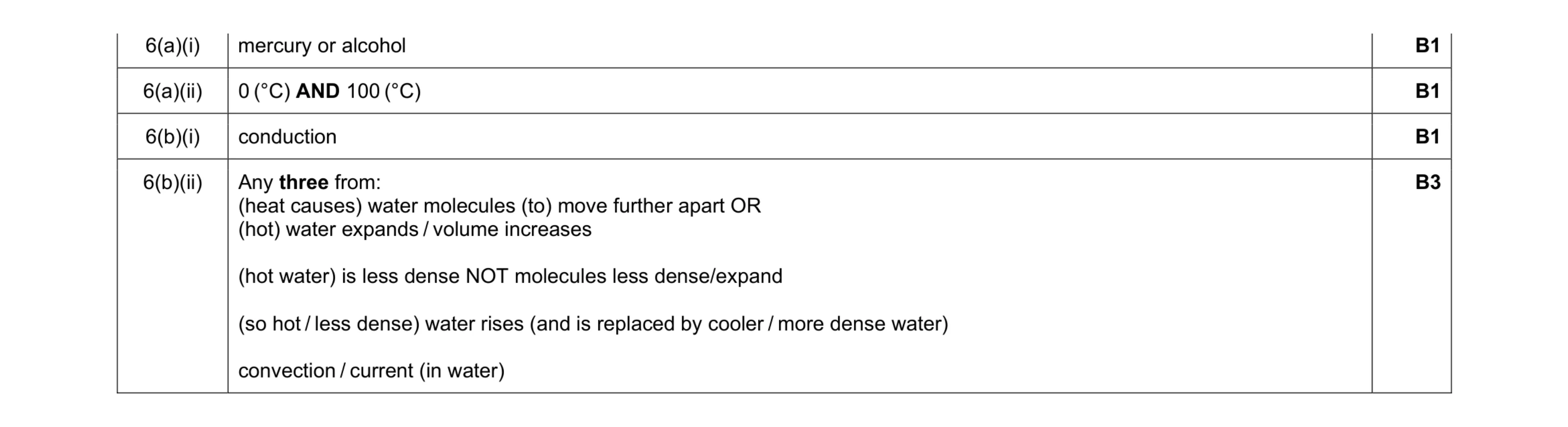 6
6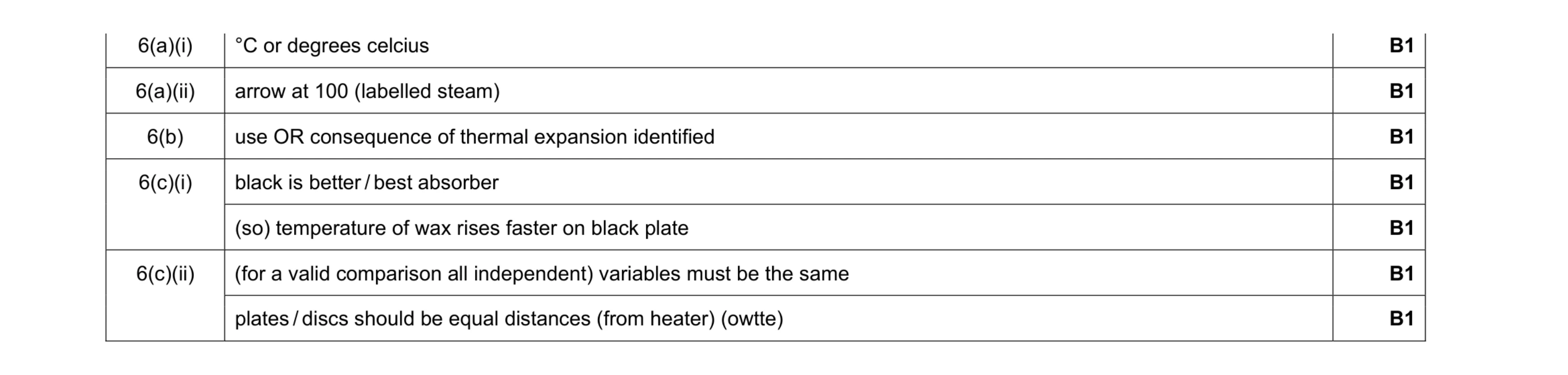 7
7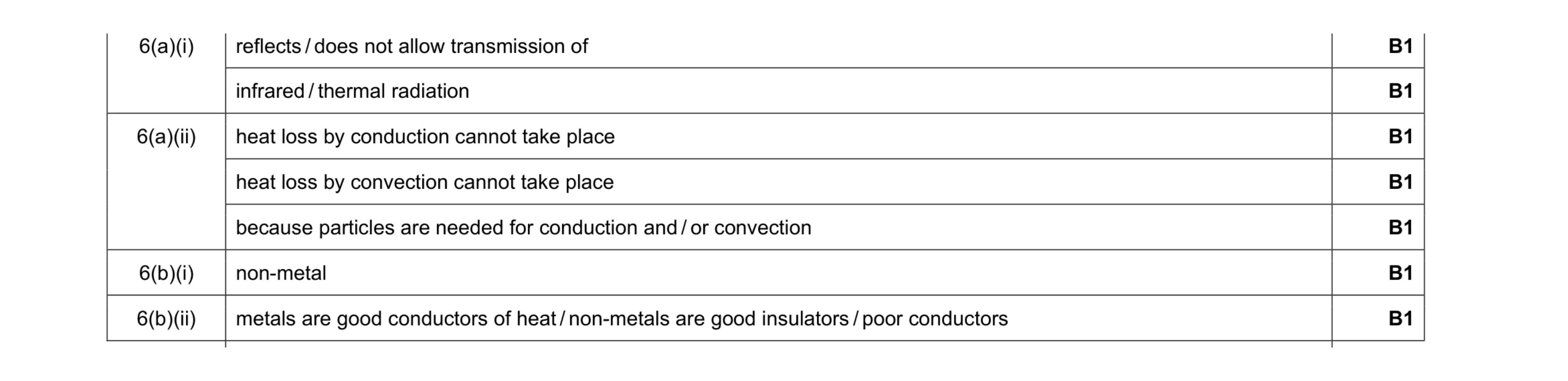 7
7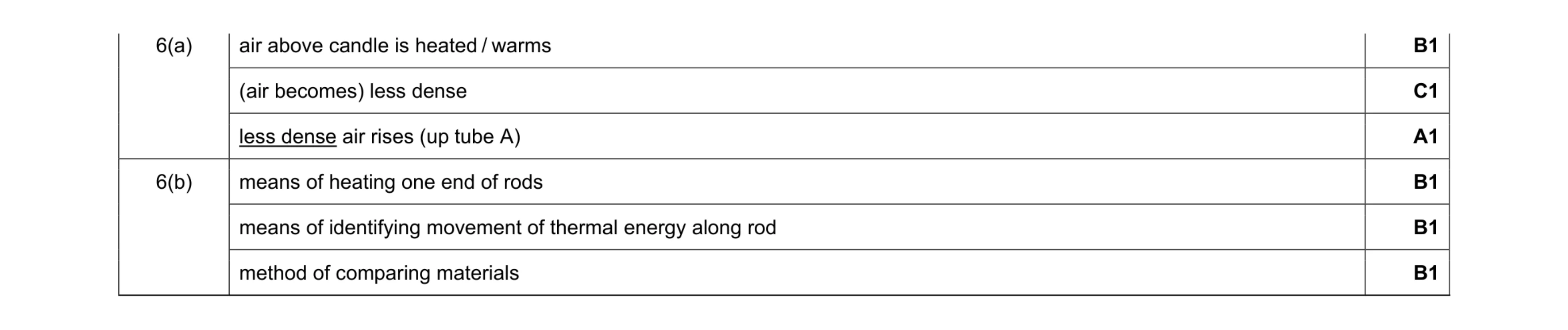 6
6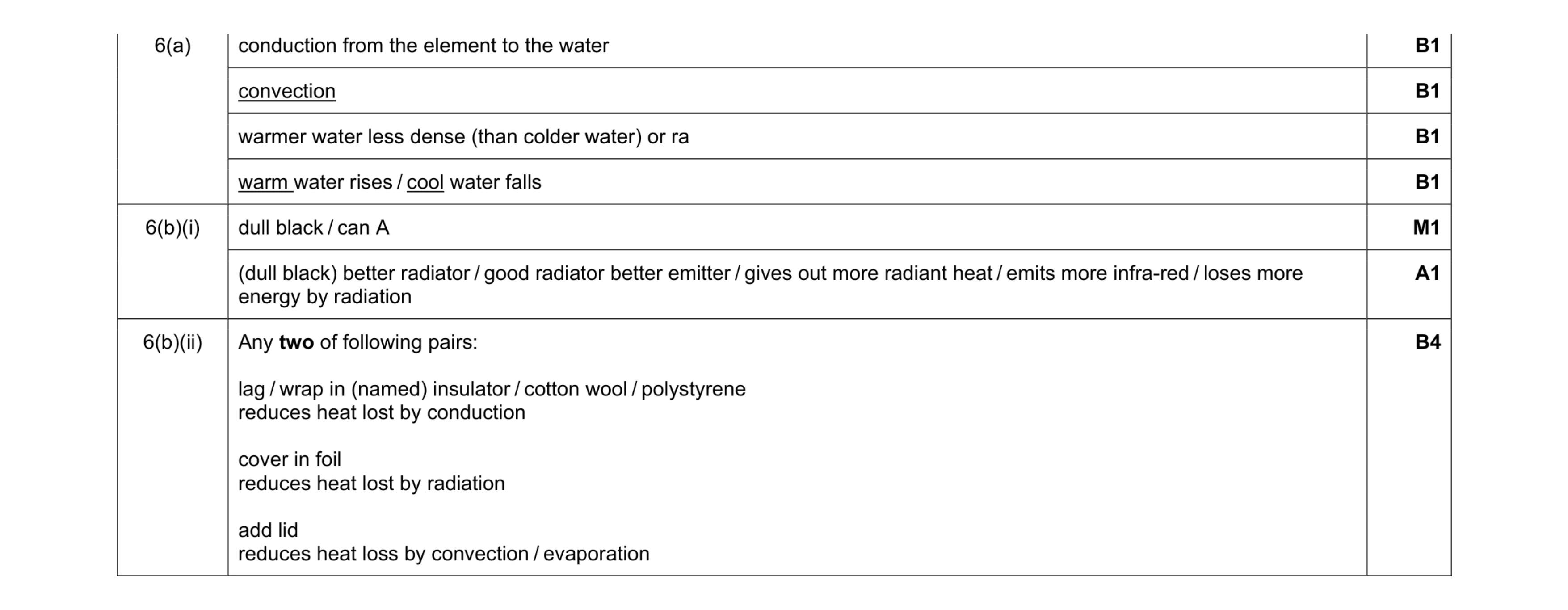 10
10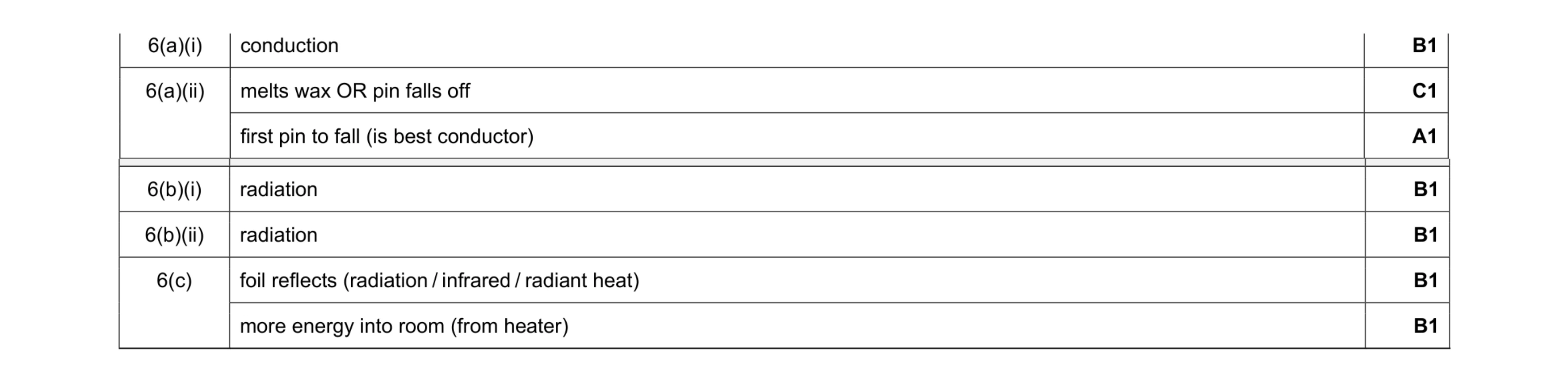 7
7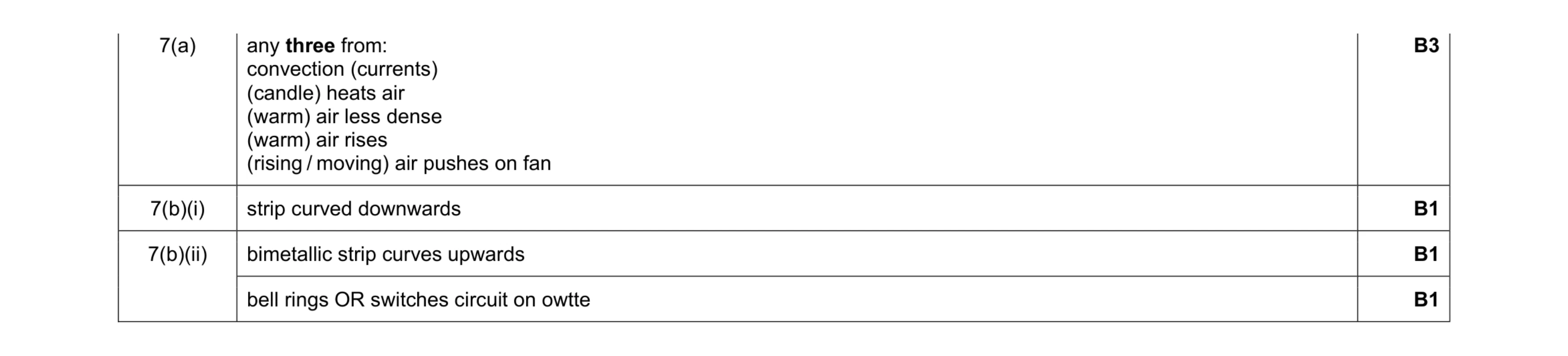 6
6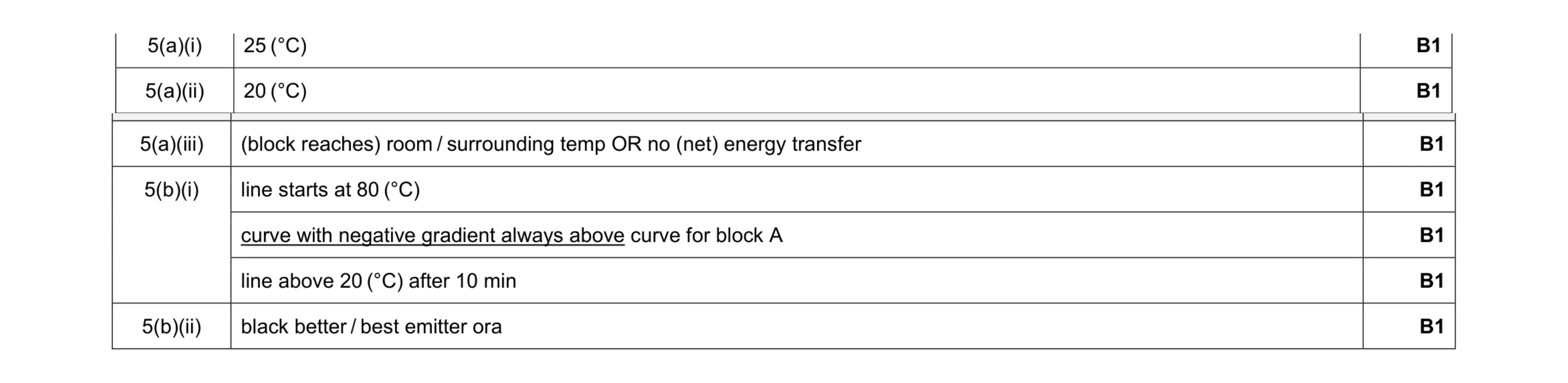 7
7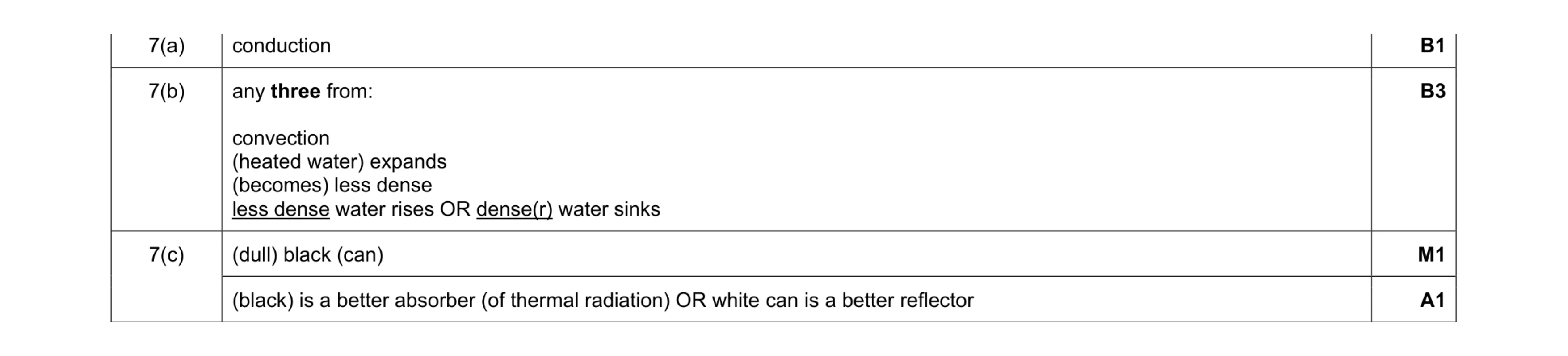 6
6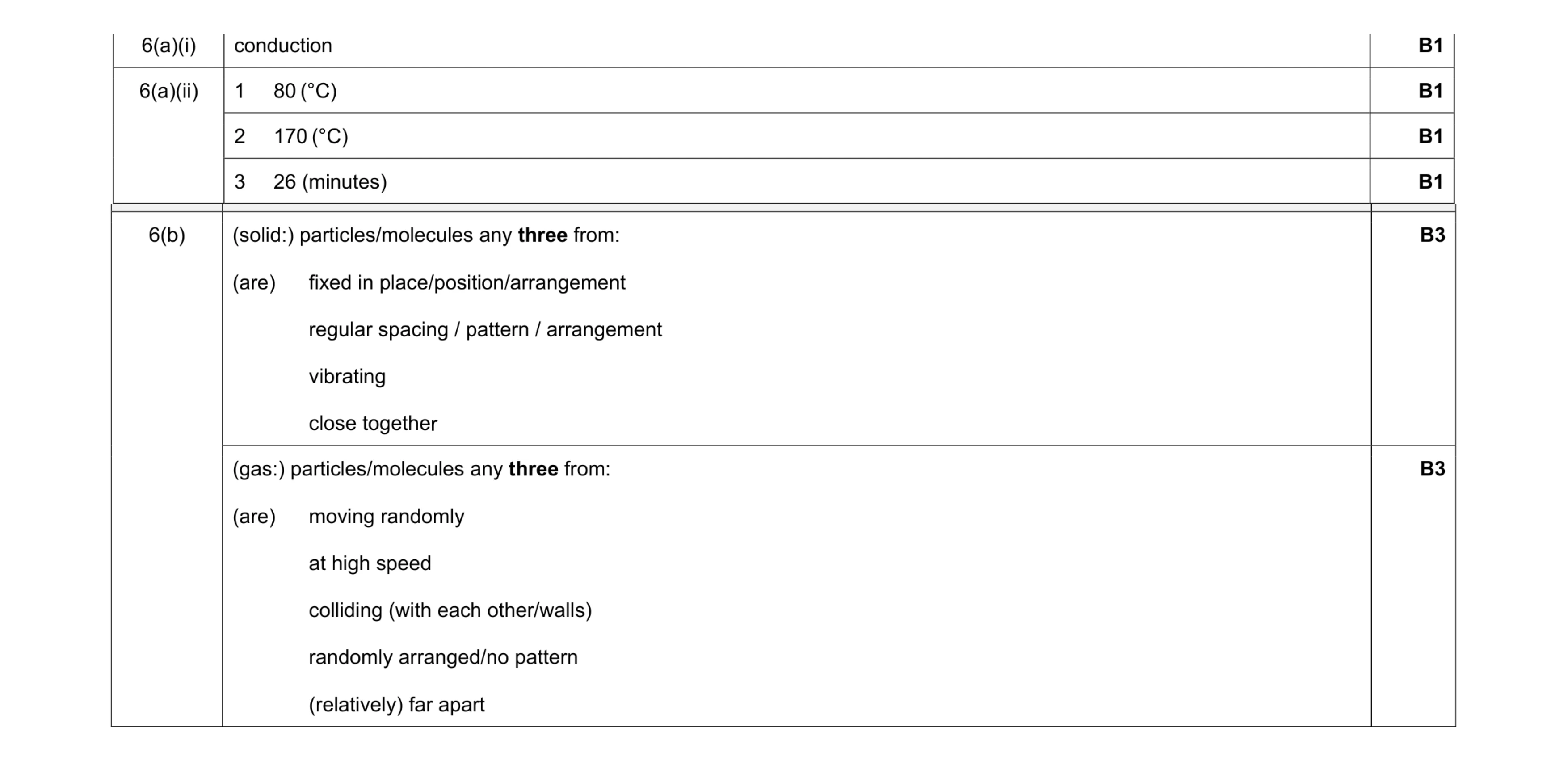 10
10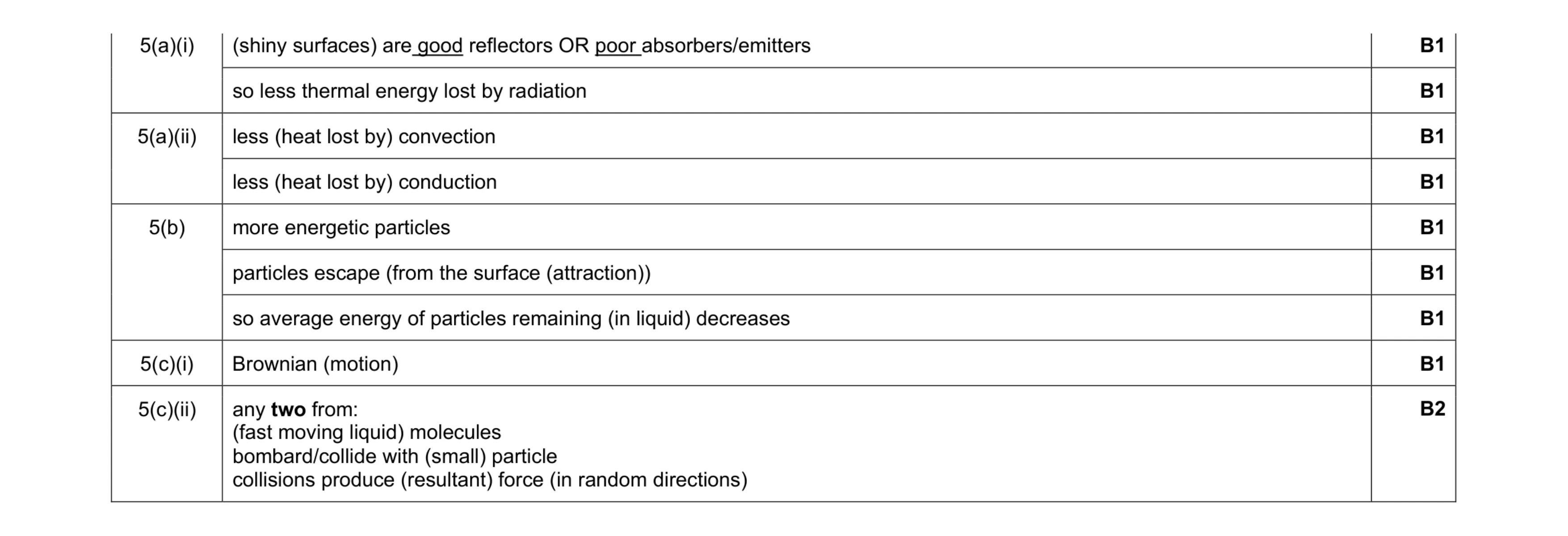 10
10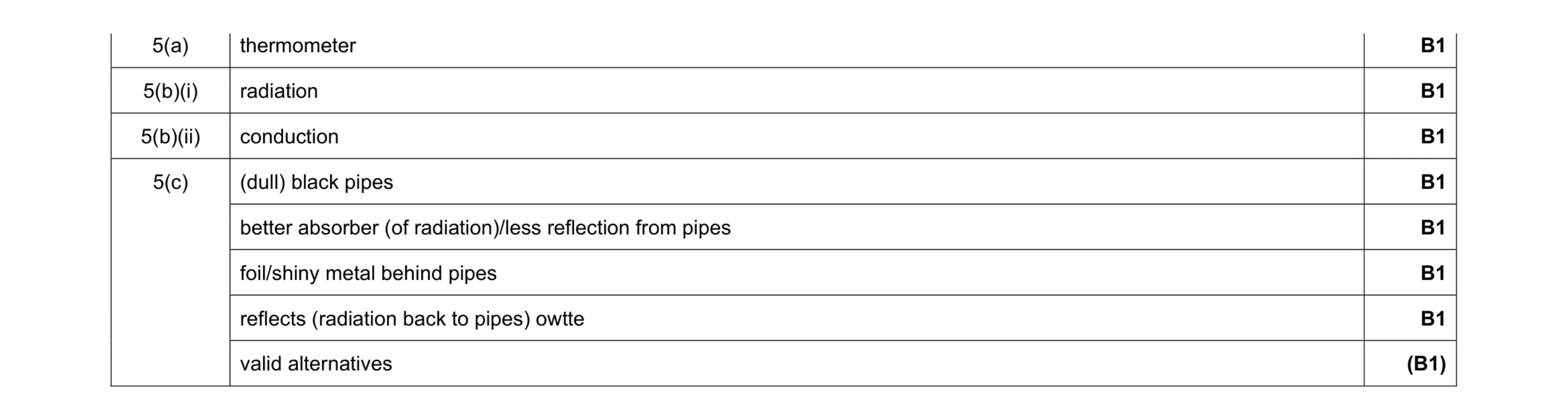 7
7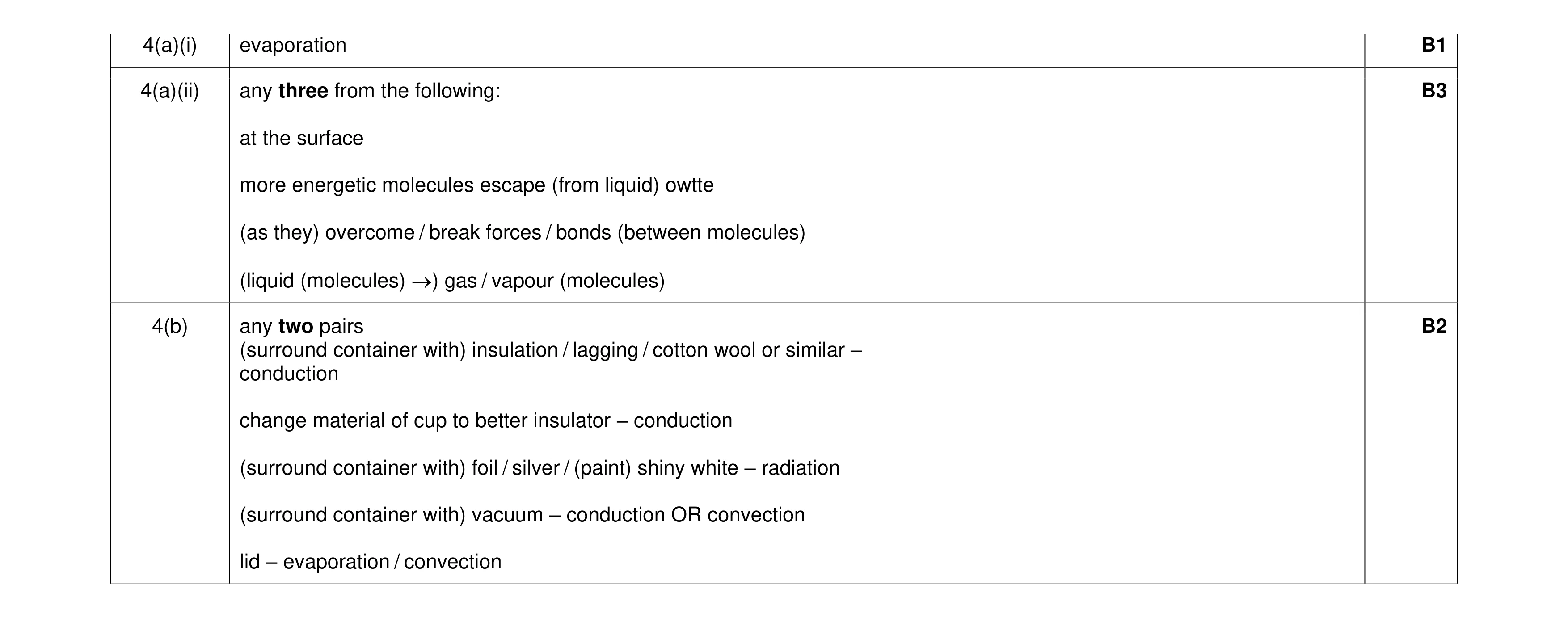 8
8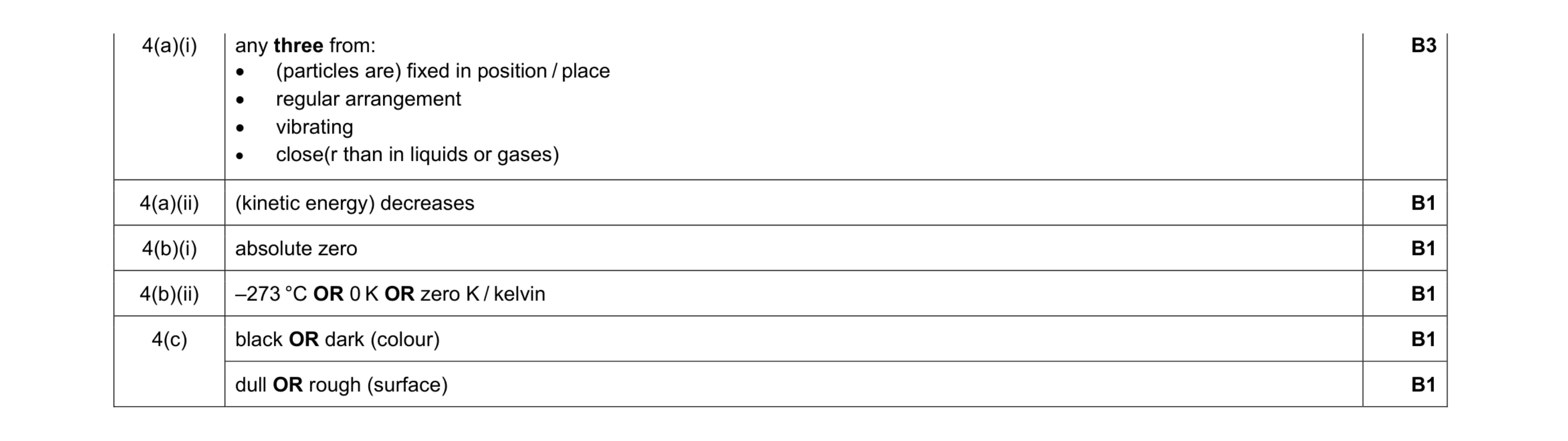 8
8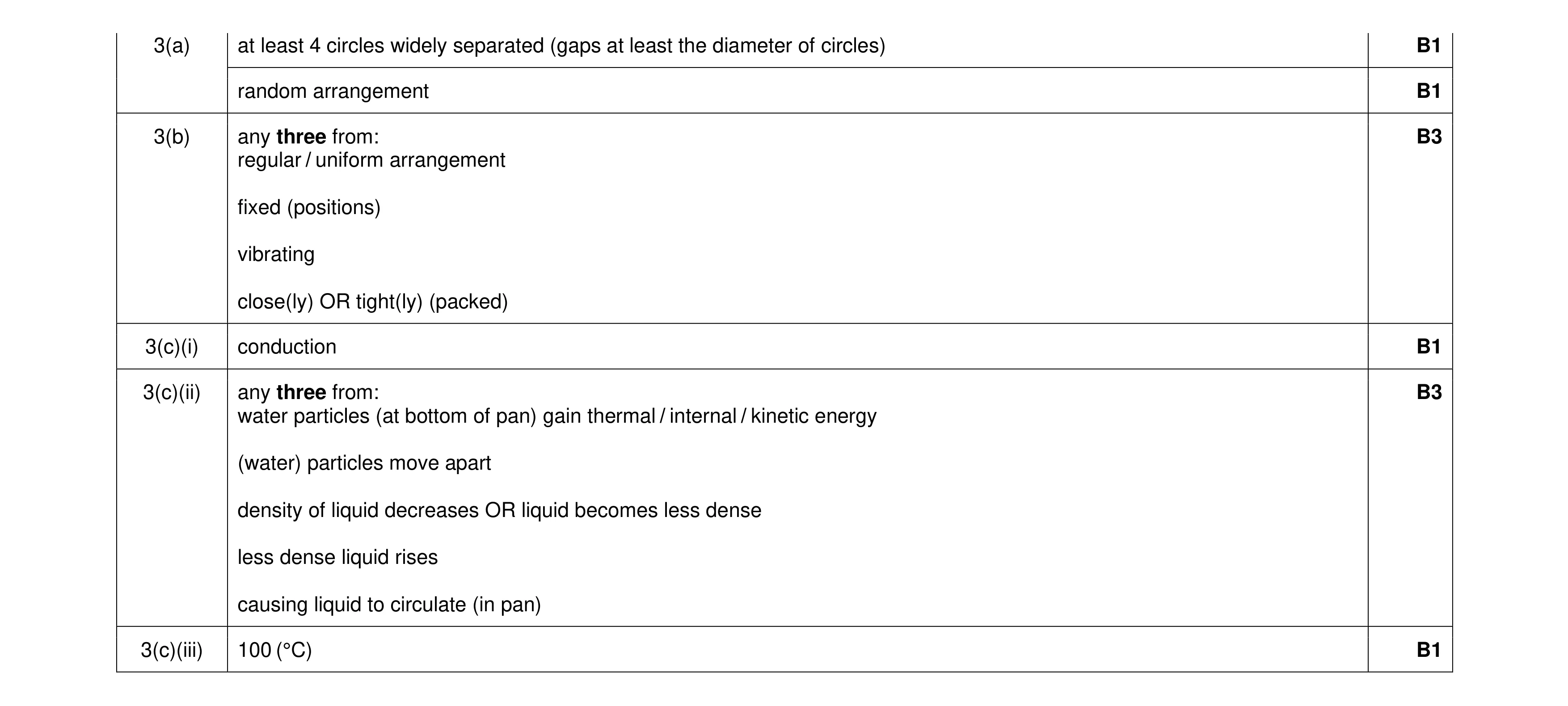 10
10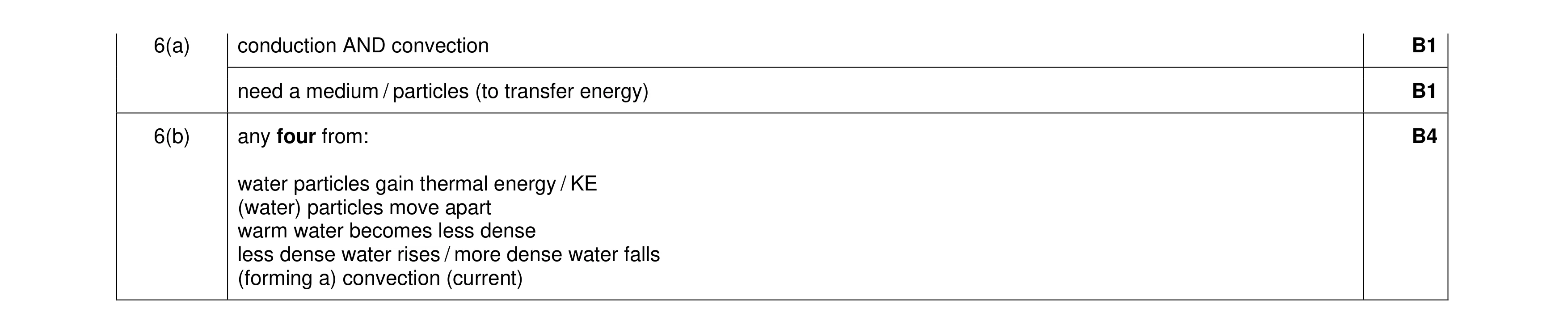 6
6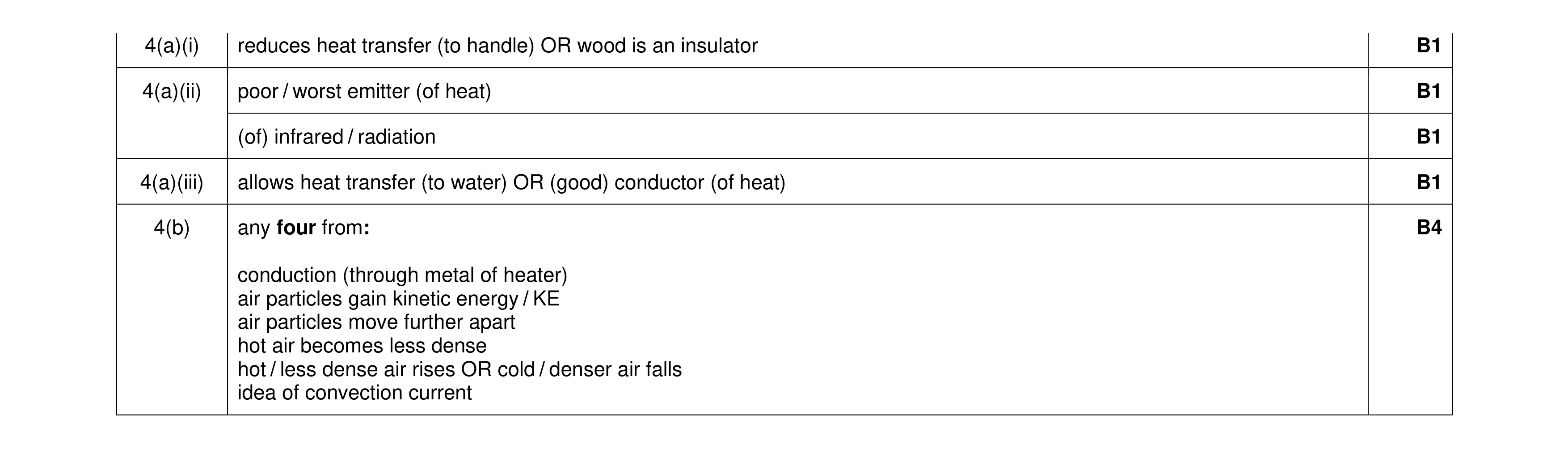 8
8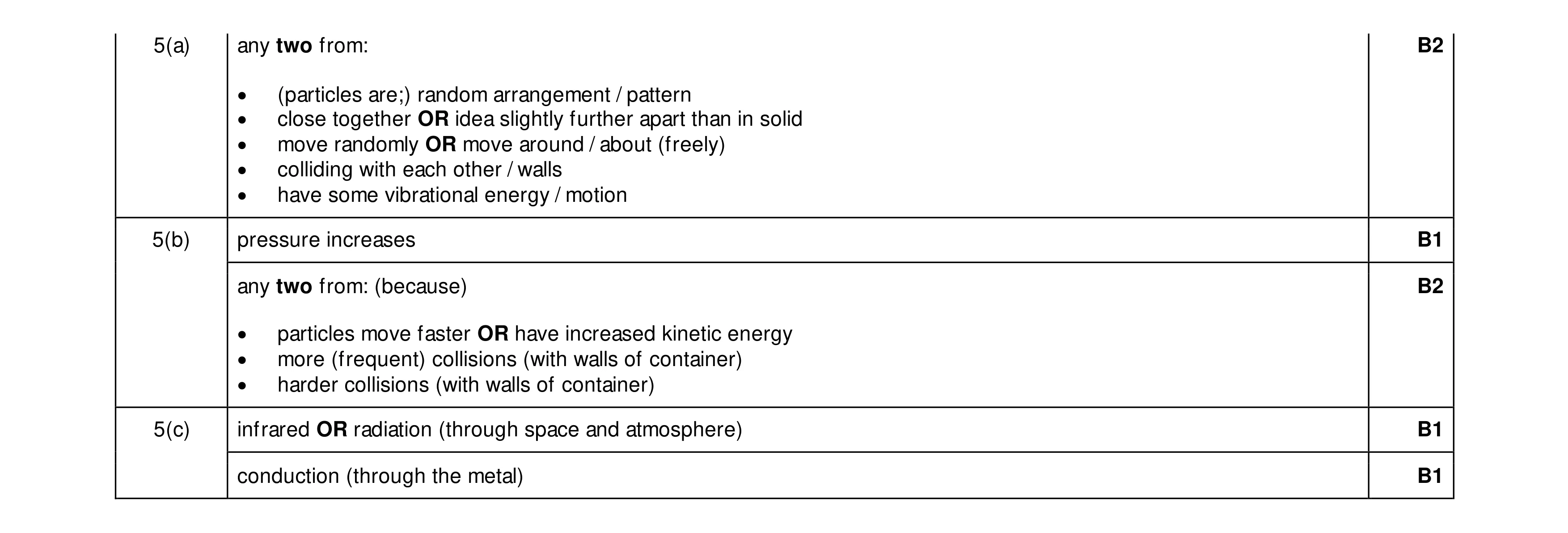 7
7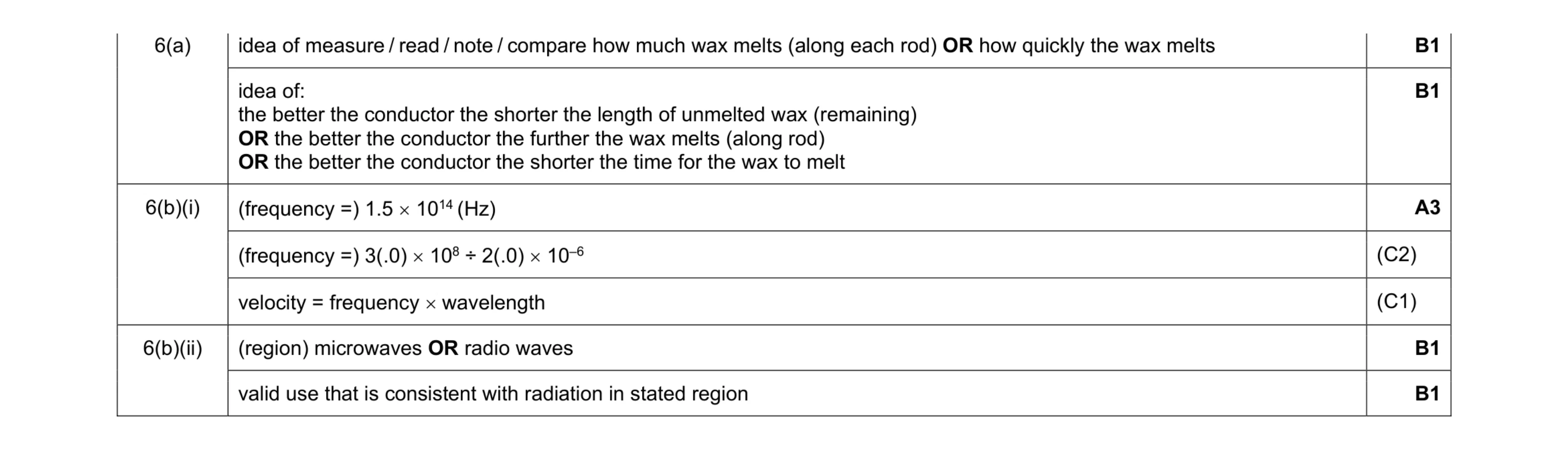 7
7 5
5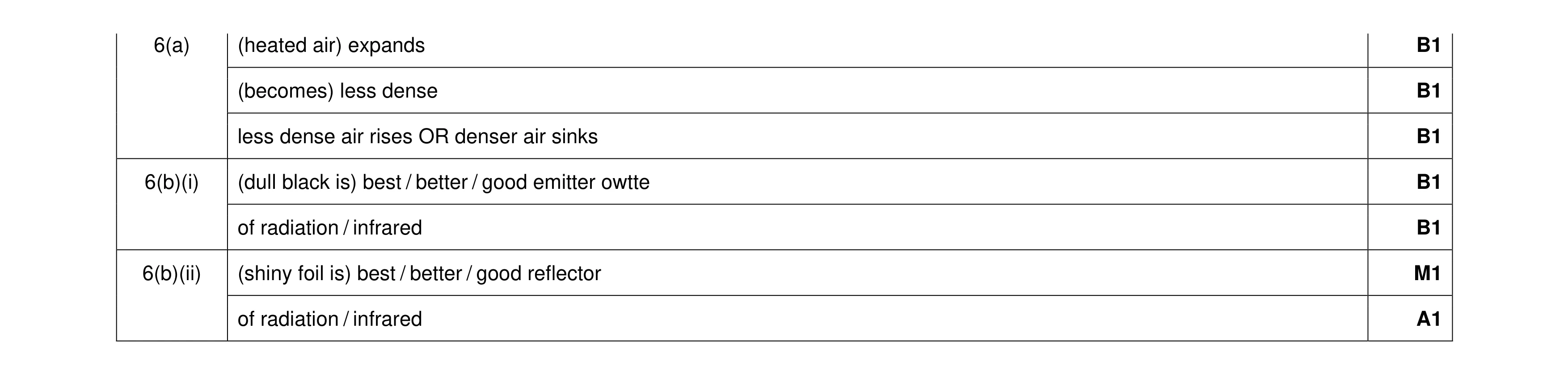 7
7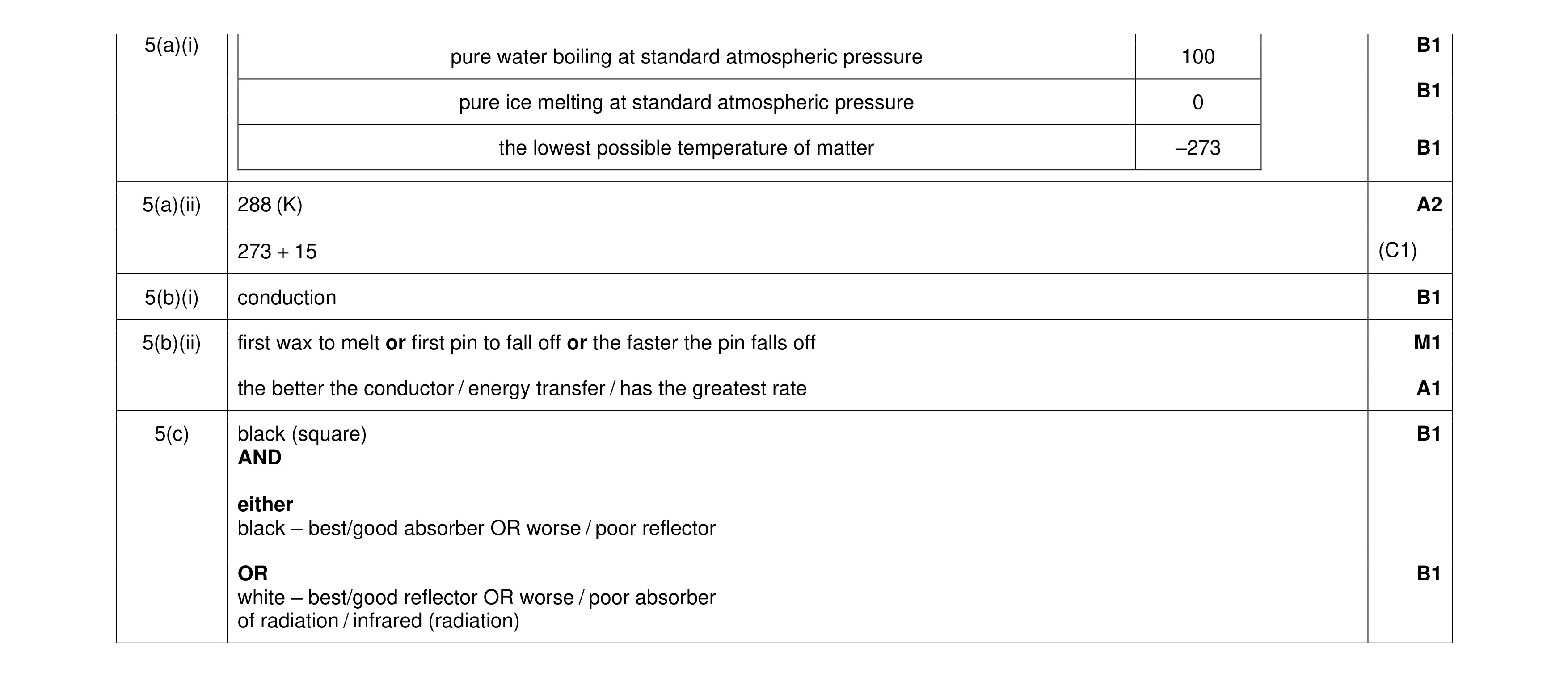 10
10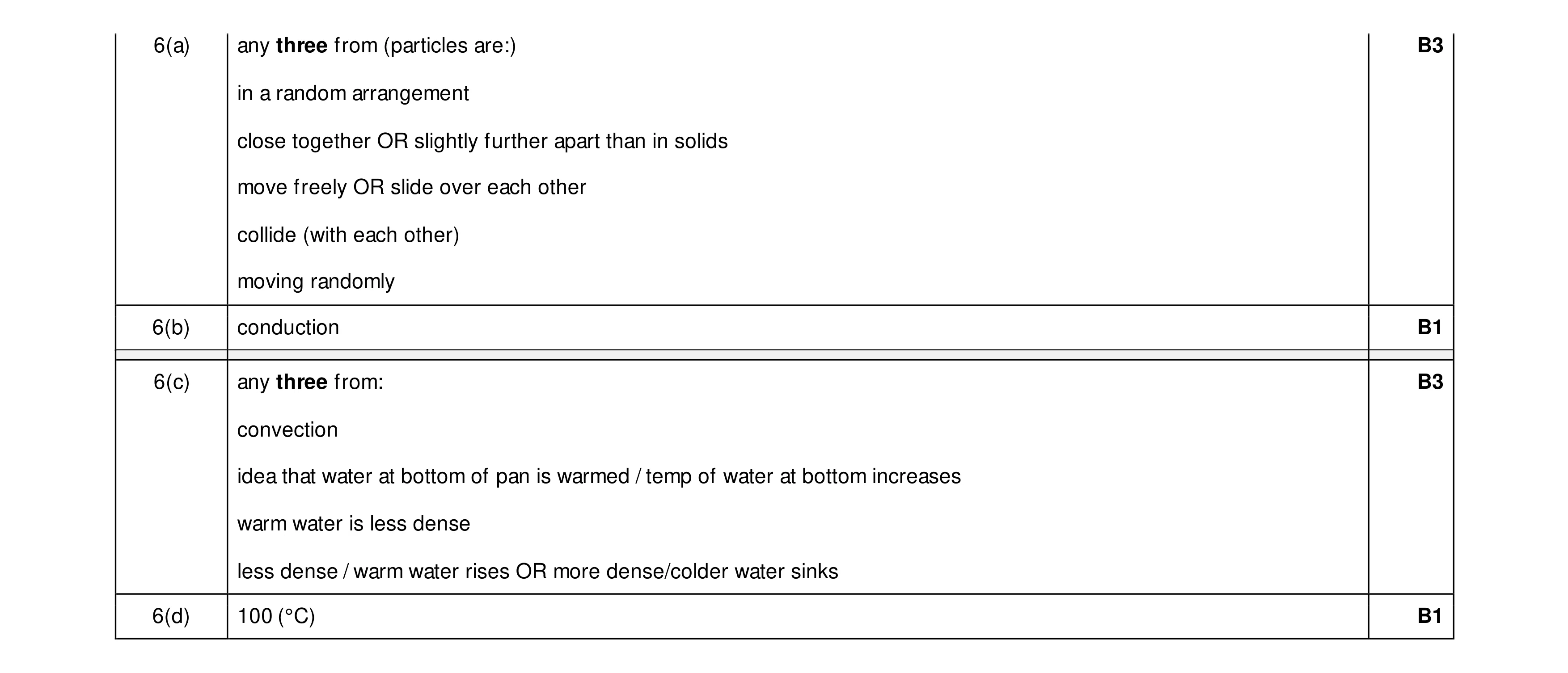 8
8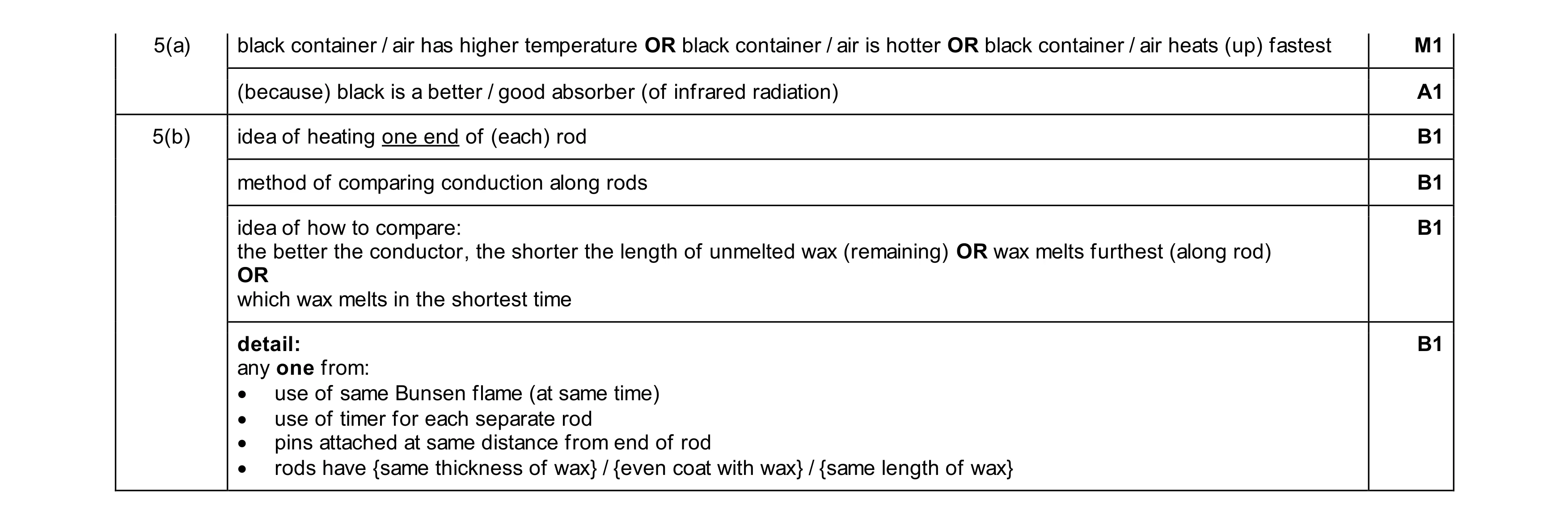 6
6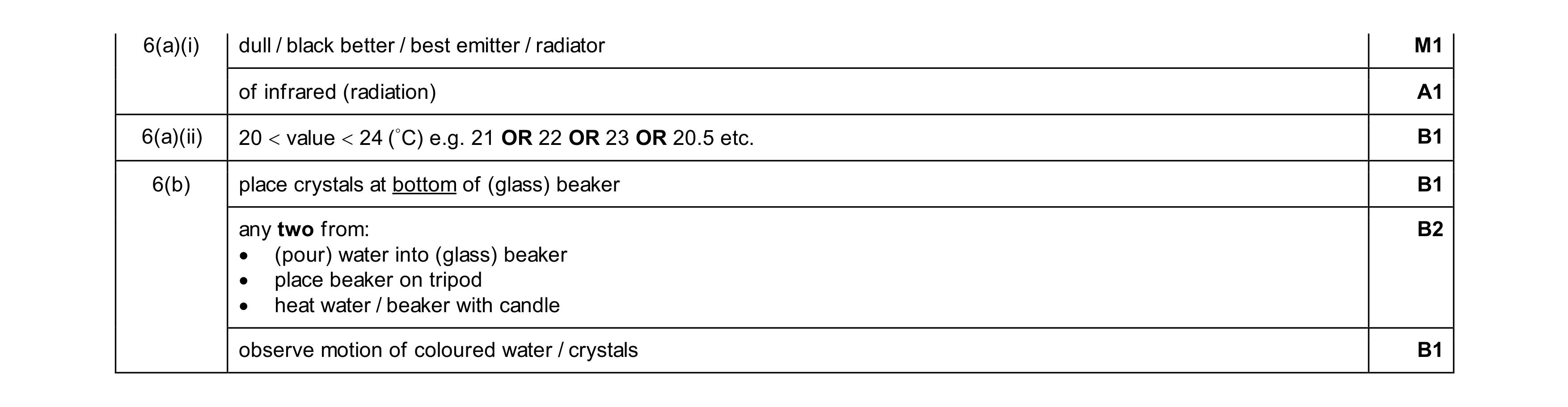 7
7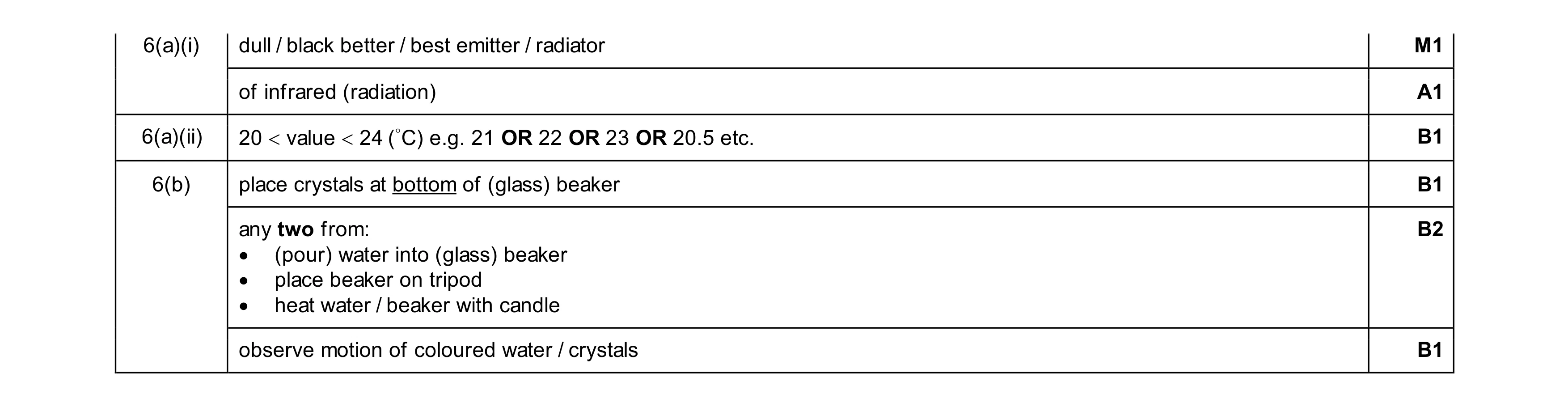 7
7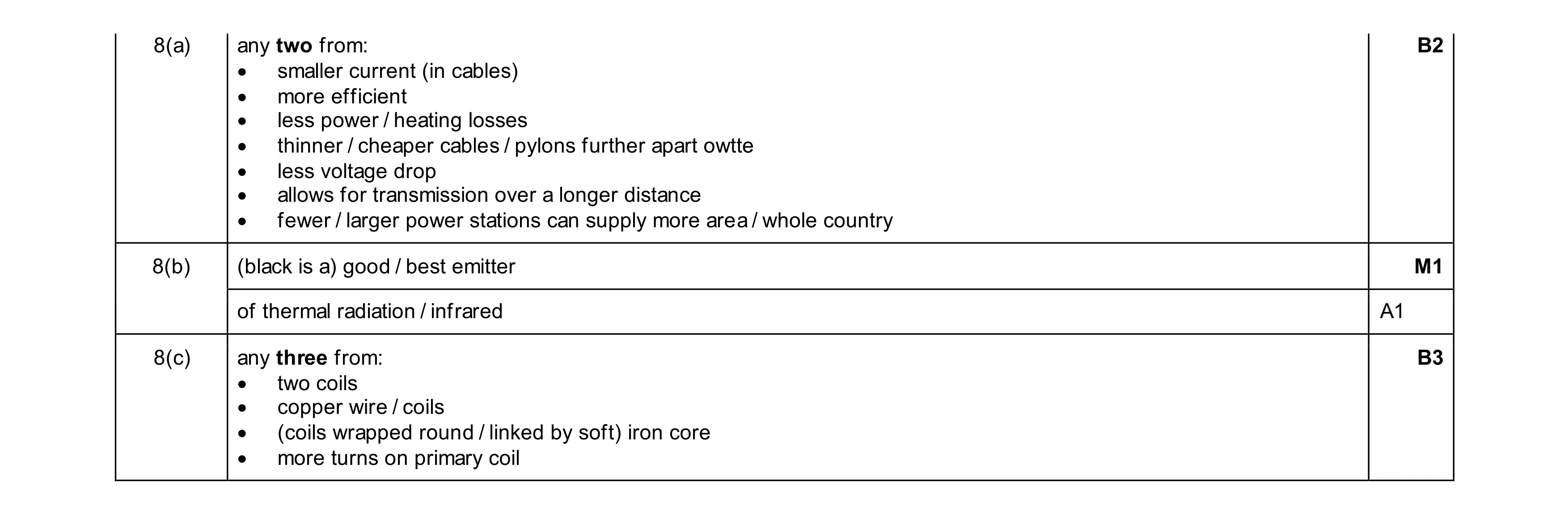 7
7