Cambridge IGCSE Physics 0625 — 2017 Oct/Nov Paper 3 · Variant 2
0625/32/O/N/17 · 12 questions · 80 marks · ≈90 min
The question paper and its mark scheme, free to read here and free to download. This is Cambridge’s own paper, exactly as it was sat.
Question paper16 pages
Mark scheme7 pages
Answers below. Sit the paper first if you are practising.
Questions as text
Q1 · Nuclear power stations generate electricity
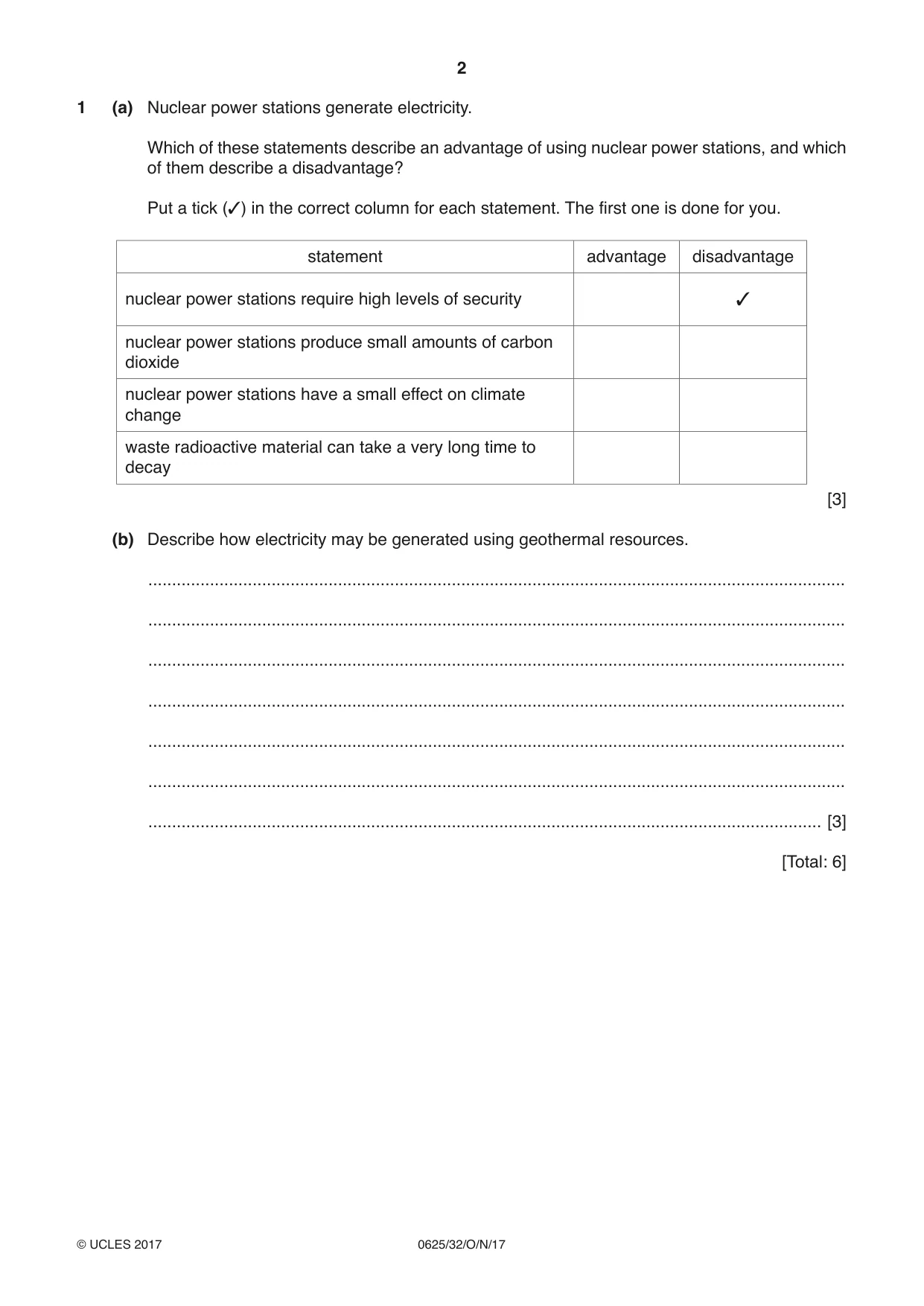
1 (a) Nuclear power stations generate electricity. Which of these statements describe an advantage of using nuclear power stations, and which of them describe a disadvantage? Put a tick (✓) in the correct column for each statement. The first one is done for you. statement advantage disadvantage nuclear power stations require high levels of security ✓ nuclear power stations produce small amounts of carbon dioxide nuclear power stations have a small effect on climate change waste radioactive material can take a very long time to decay [3] (b) Describe how electricity may be generated using geothermal resources. ................................................................................................................................................... ................................................................................................................................................... ................................................................................................................................................... ................................................................................................................................................... ................................................................................................................................................... ................................................................................................................................................... .............................................................................................................................................. [3] [Total: 6]
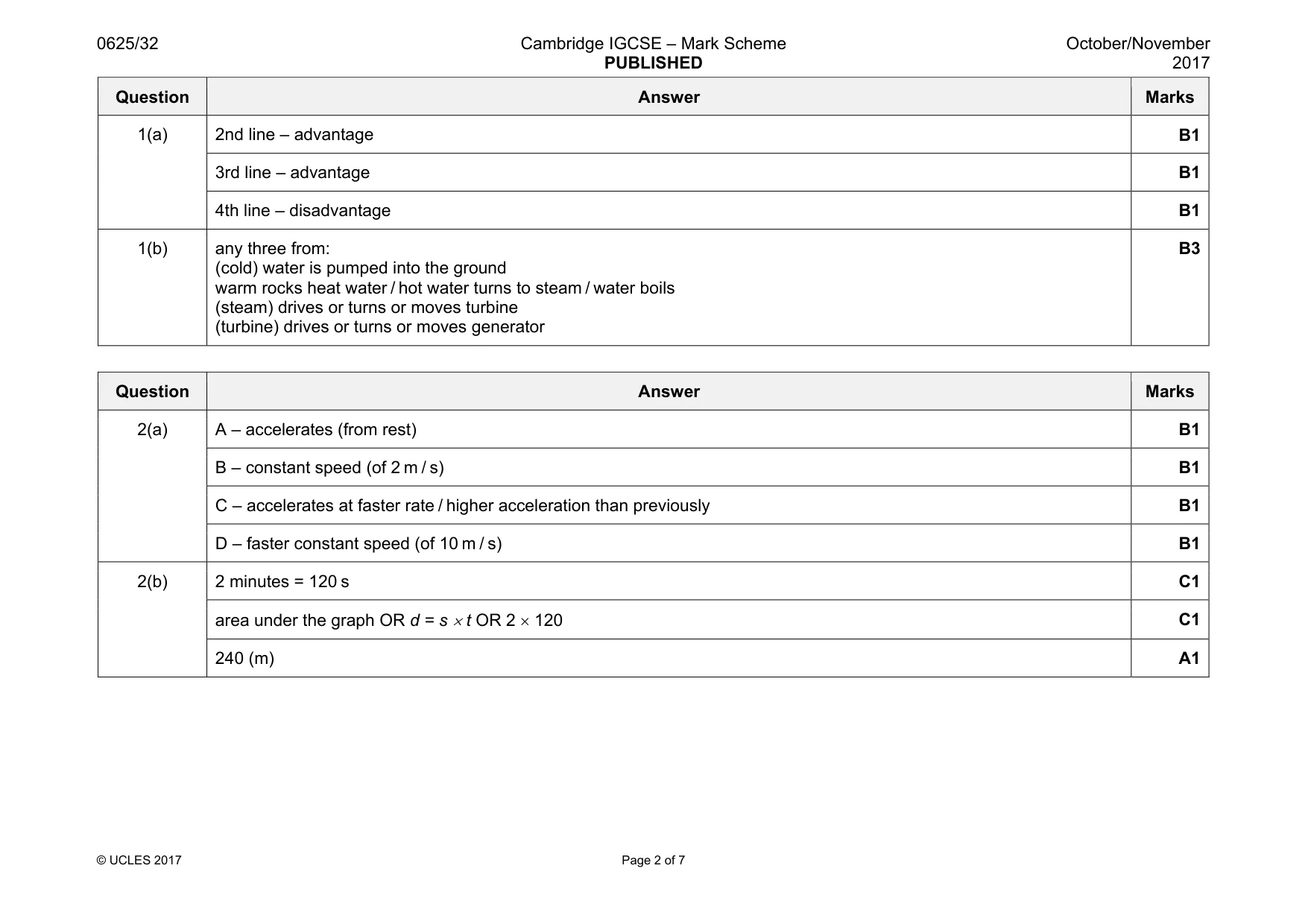
Mark scheme: 1(a) 2nd line – advantage B1 3rd line – advantage B1 4th line – disadvantage B1 1(b) any three from: (cold) water is pumped into the ground warm rocks heat water / hot water turns to steam / water boils (steam) drives or turns or moves turbine (turbine) drives or turns or moves generator B3
Q2 · A speed-time graph for a ship starting to move
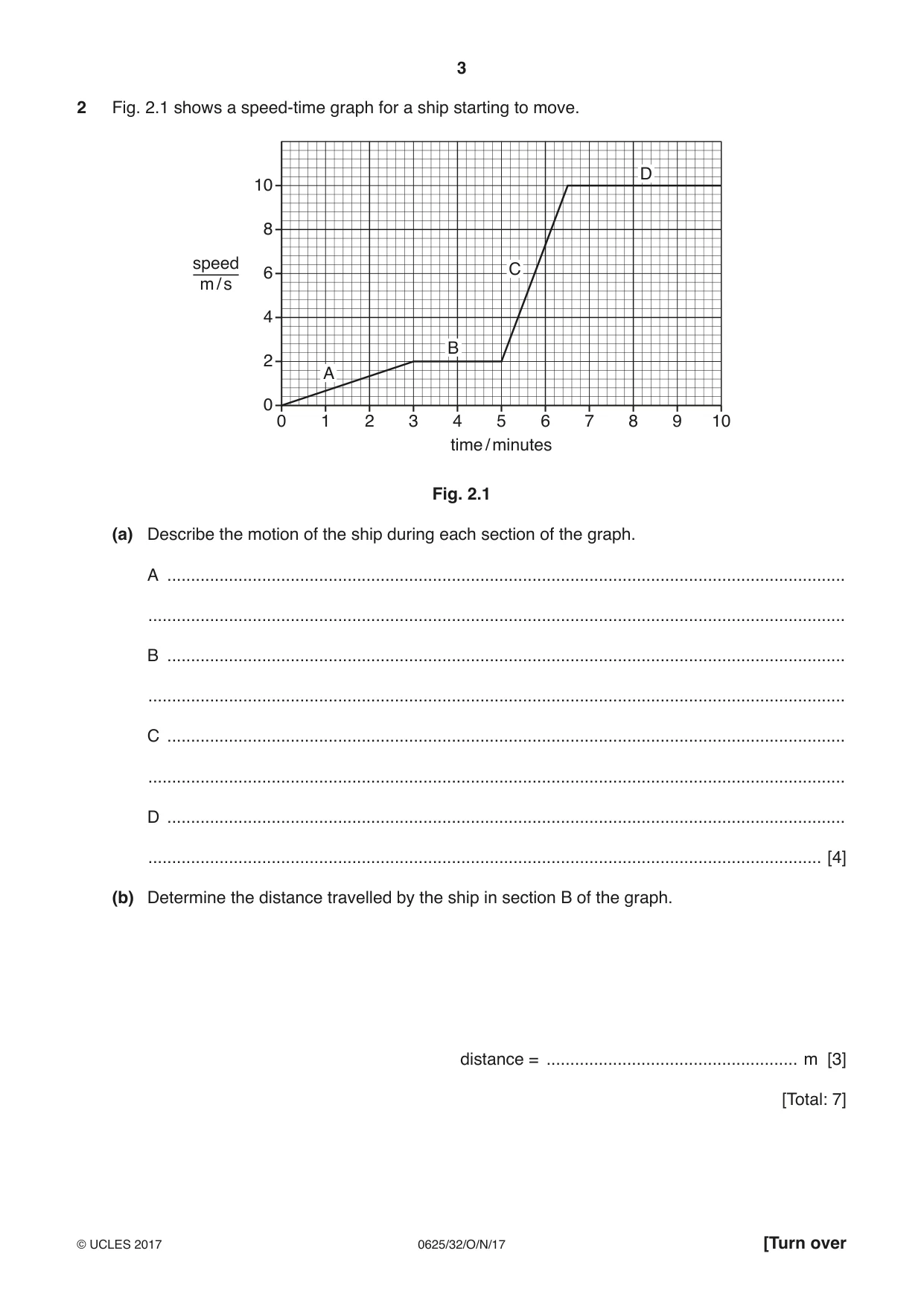
2 Fig. 2.1 shows a speed-time graph for a ship starting to move. D 10 8 speed 6 C m / s 4 B 2 A 0 0 1 2 3 4 5 6 7 8 9 10 time / minutes Fig. 2.1 (a) Describe the motion of the ship during each section of the graph. A ............................................................................................................................................... ................................................................................................................................................... B ............................................................................................................................................... ................................................................................................................................................... C ............................................................................................................................................... ................................................................................................................................................... D ............................................................................................................................................... .............................................................................................................................................. [4]
Mark scheme: 2(a) A – accelerates (from rest) B1 B – constant speed (of 2 m / s) B1 C – accelerates at faster rate / higher acceleration than previously B1 D – faster constant speed (of 10 m / s) B1 2(b) 2 minutes = 120 s C1 area under the graph OR d = s × t OR 2 × 120 C1 240 (m) A1
Q3 · A glass vase used for displaying flowers
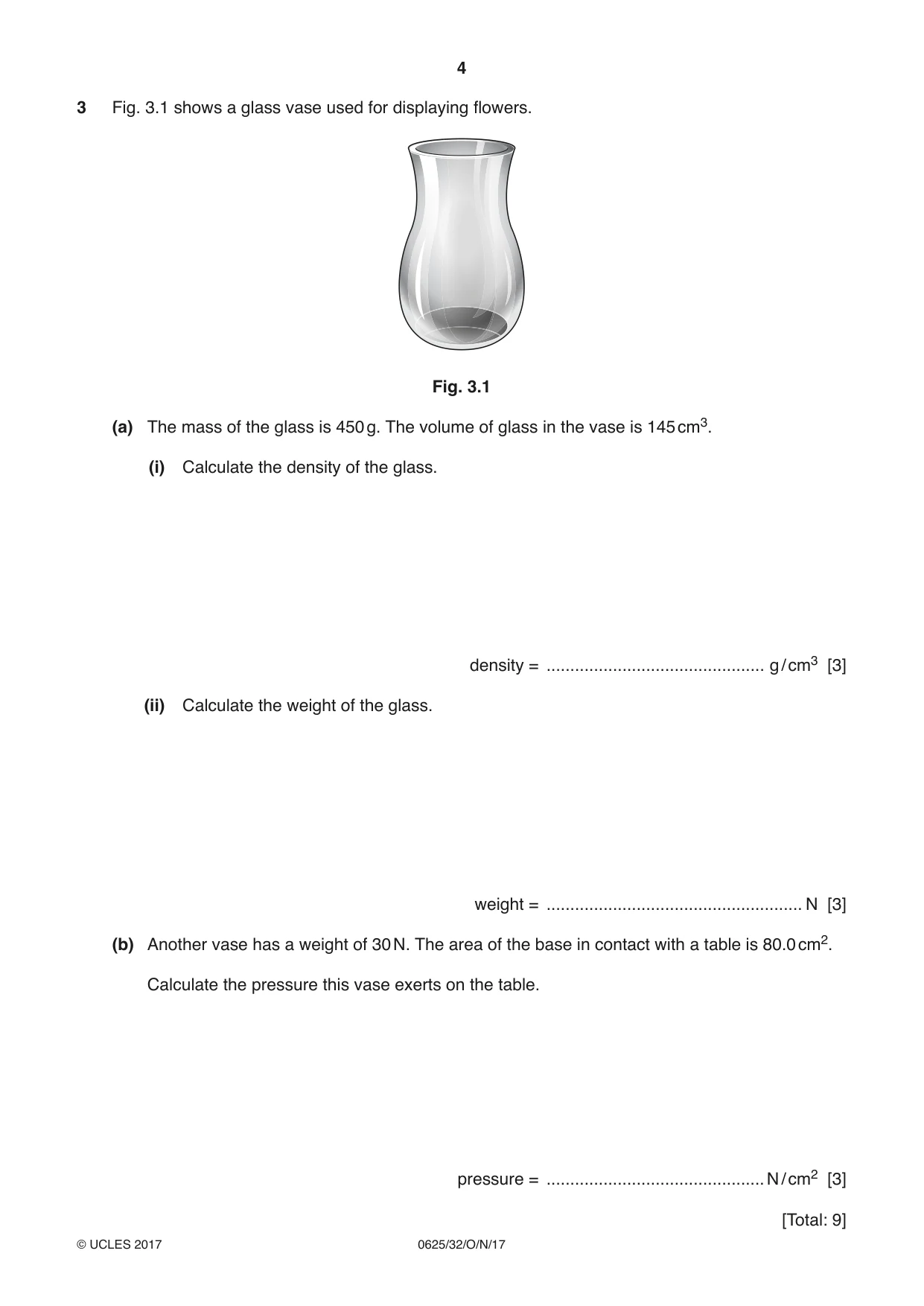
3 Fig. 3.1 shows a glass vase used for displaying flowers. Fig. 3.1 (a) The mass of the glass is 450 g. The volume of glass in the vase is 145 cm3. (i) Calculate the density of the glass. density = .............................................. g / cm3 [3] (ii) Calculate the weight of the glass. weight = ...................................................... N [3] (b) Another vase has a weight of 30 N. The area of the base in contact with a table is 80.0 cm2. Calculate the pressure this vase exerts on the table. pressure = .............................................. N / cm2 [3] [Total: 9]
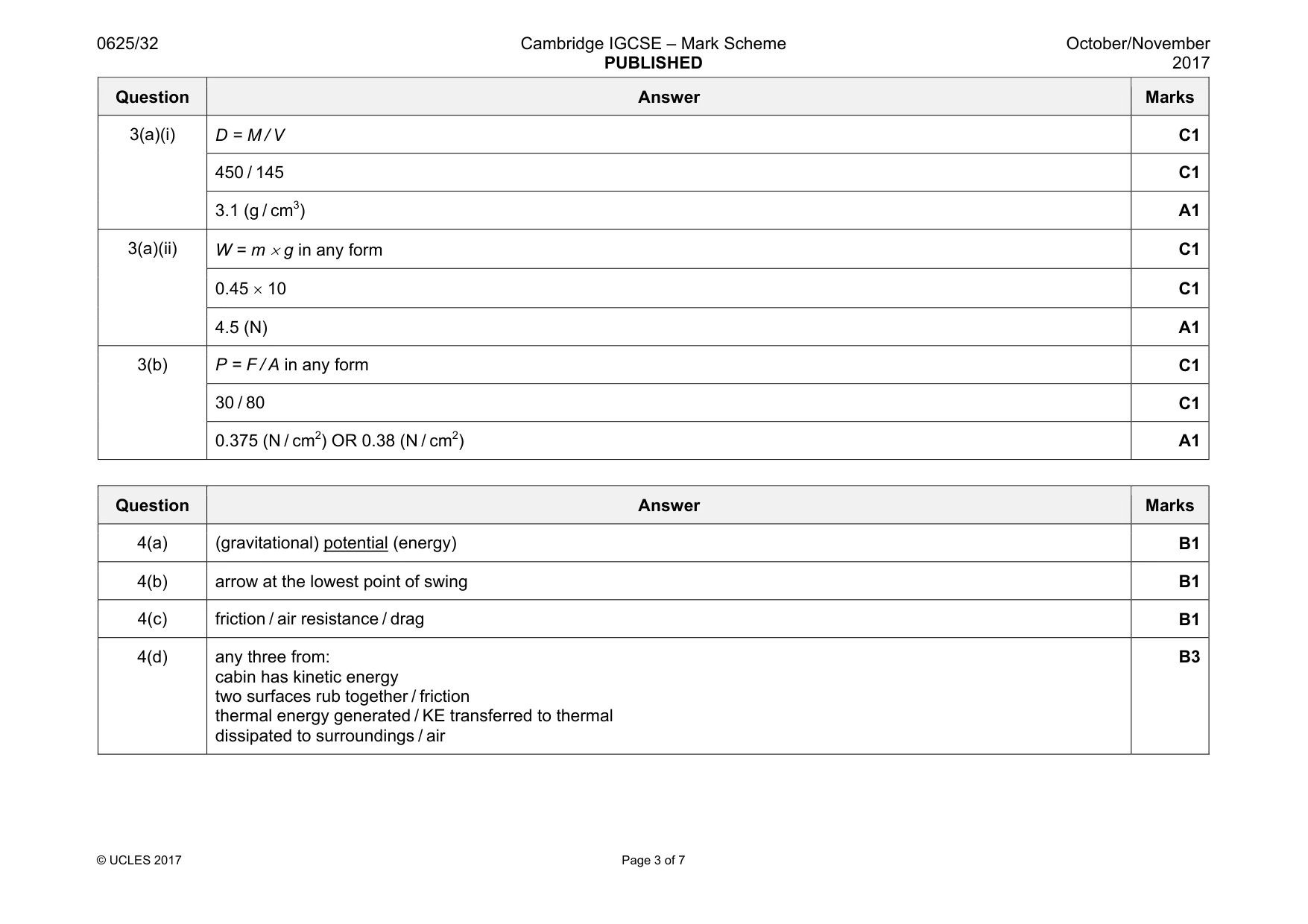
Mark scheme: 3(a)(i) D = M / V C1 450 / 145 C1 3.1 (g / cm3) A1 3(a)(ii) W = m × g in any form C1 0.45 × 10 C1 4.5 (N) A1 3(b) P = F / A in any form C1 30 / 80 C1 0.375 (N / cm2) OR 0.38 (N / cm2) A1
Question 4
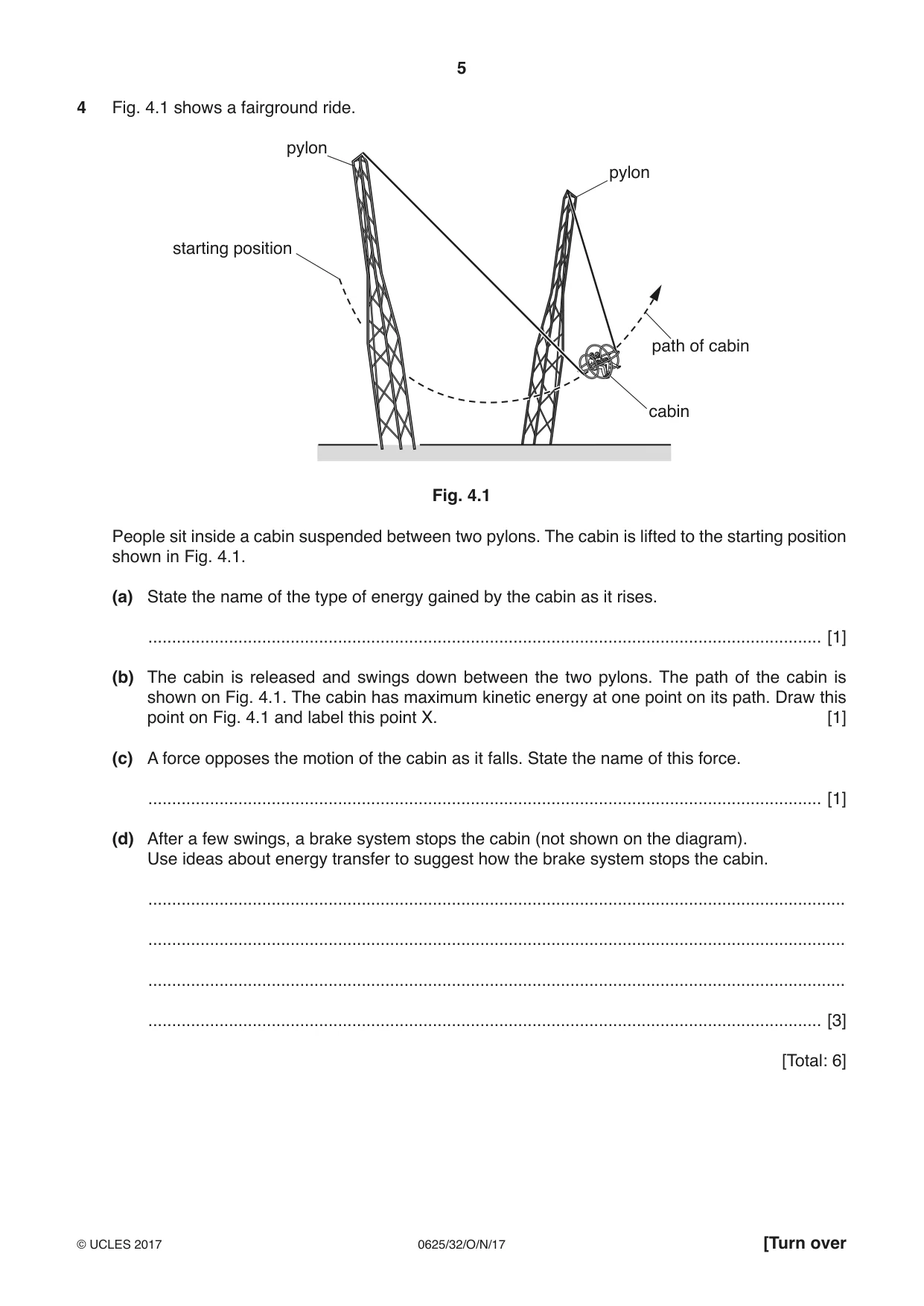
4 Fig. 4.1 shows a fairground ride. pylon pylon starting position path of cabin cabin Fig. 4.1 People sit inside a cabin suspended between two pylons. The cabin is lifted to the starting position shown in Fig. 4.1. (a) State the name of the type of energy gained by the cabin as it rises. .............................................................................................................................................. [1] (b) The cabin is released and swings down between the two pylons. The path of the cabin is shown on Fig. 4.1. The cabin has maximum kinetic energy at one point on its path. Draw this point on Fig. 4.1 and label this point X. [1] (c) A force opposes the motion of the cabin as it falls. State the name of this force. .............................................................................................................................................. [1] (d) After a few swings, a brake system stops the cabin (not shown on the diagram). Use ideas about energy transfer to suggest how the brake system stops the cabin. ................................................................................................................................................... ................................................................................................................................................... ................................................................................................................................................... .............................................................................................................................................. [3] [Total: 6]
Mark scheme: 4(a) (gravitational) potential (energy) B1 4(b) arrow at the lowest point of swing B1 4(c) friction / air resistance / drag B1 4(d) any three from: cabin has kinetic energy two surfaces rub together / friction thermal energy generated / KE transferred to thermal dissipated to surroundings / air B3
Q5 · A cup made from plastic, containing a hot drink, is shown in Fig
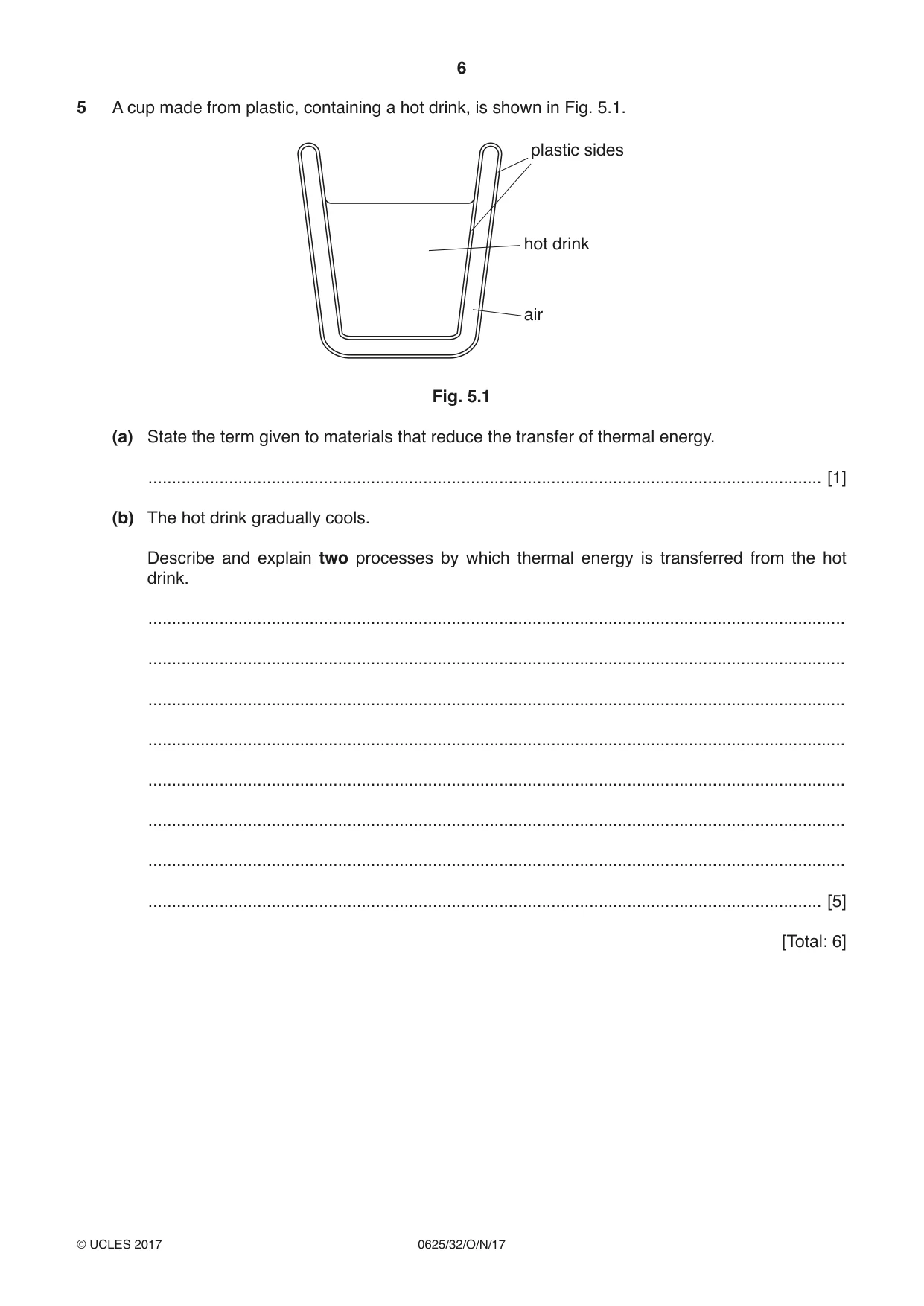
5 A cup made from plastic, containing a hot drink, is shown in Fig. 5.1. plastic sides hot drink air Fig. 5.1 (a) State the term given to materials that reduce the transfer of thermal energy. .............................................................................................................................................. [1] (b) The hot drink gradually cools. Describe and explain two processes by which thermal energy is transferred from the hot drink. ................................................................................................................................................... ................................................................................................................................................... ................................................................................................................................................... ................................................................................................................................................... ................................................................................................................................................... ................................................................................................................................................... ................................................................................................................................................... .............................................................................................................................................. [5] [Total: 6]
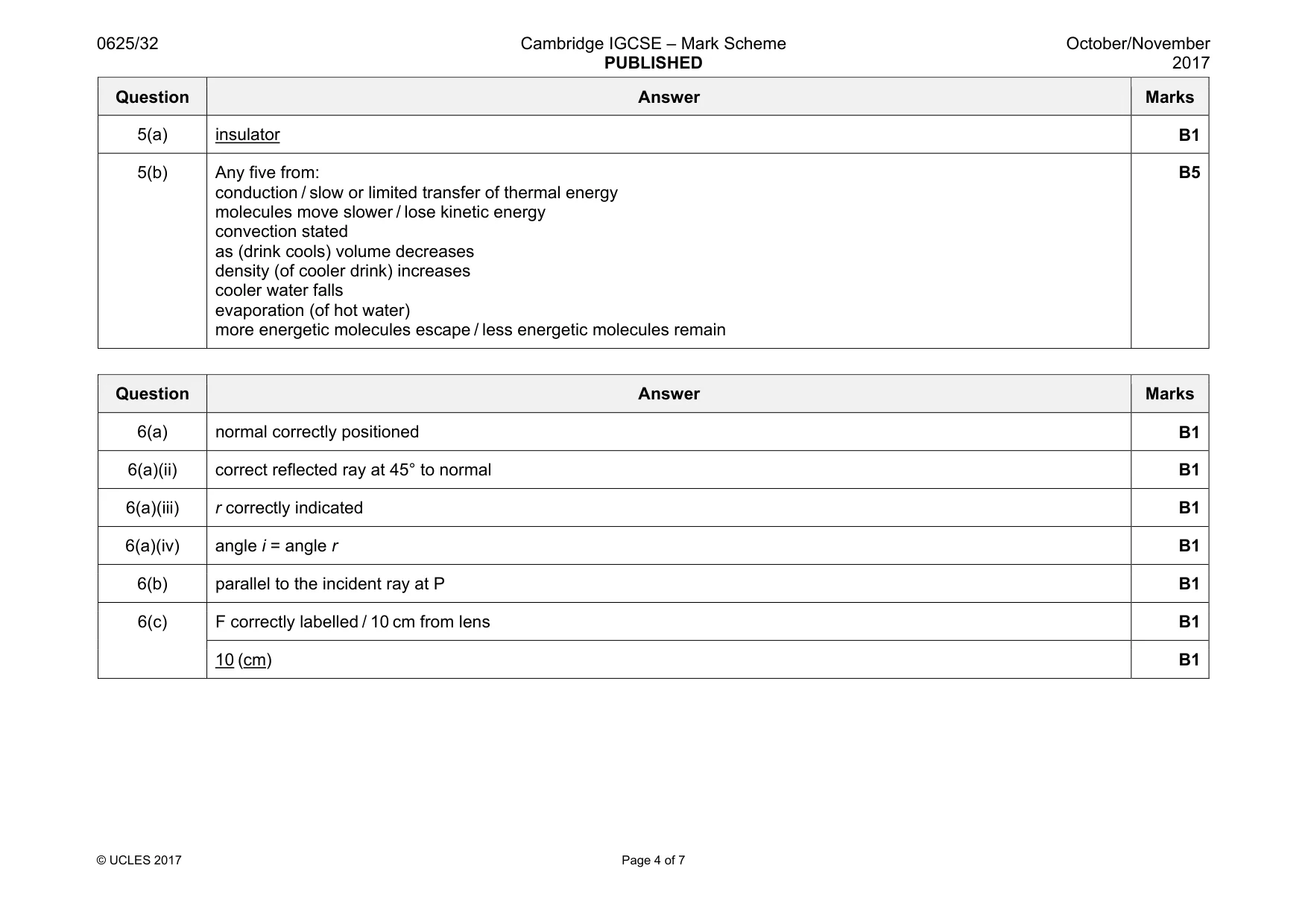
Mark scheme: 5(a) insulator B1 5(b) Any five from: conduction / slow or limited transfer of thermal energy molecules move slower / lose kinetic energy convection stated as (drink cools) volume decreases density (of cooler drink) increases cooler water falls evaporation (of hot water) more energetic molecules escape / less energetic molecules remain B5
Q6 · A ray of light reflected from mirror 1 at point P and striking mirror 2 at point Q
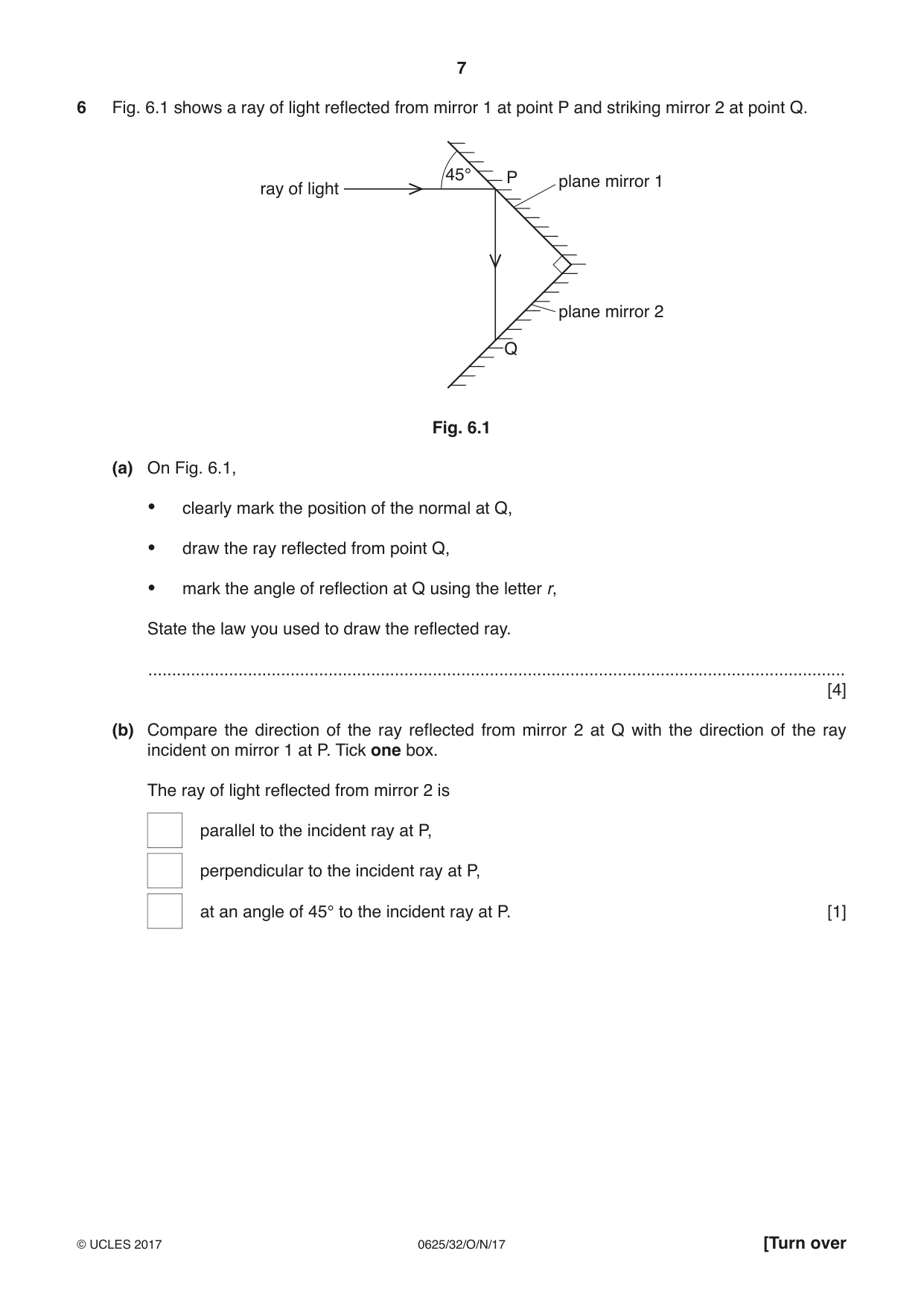
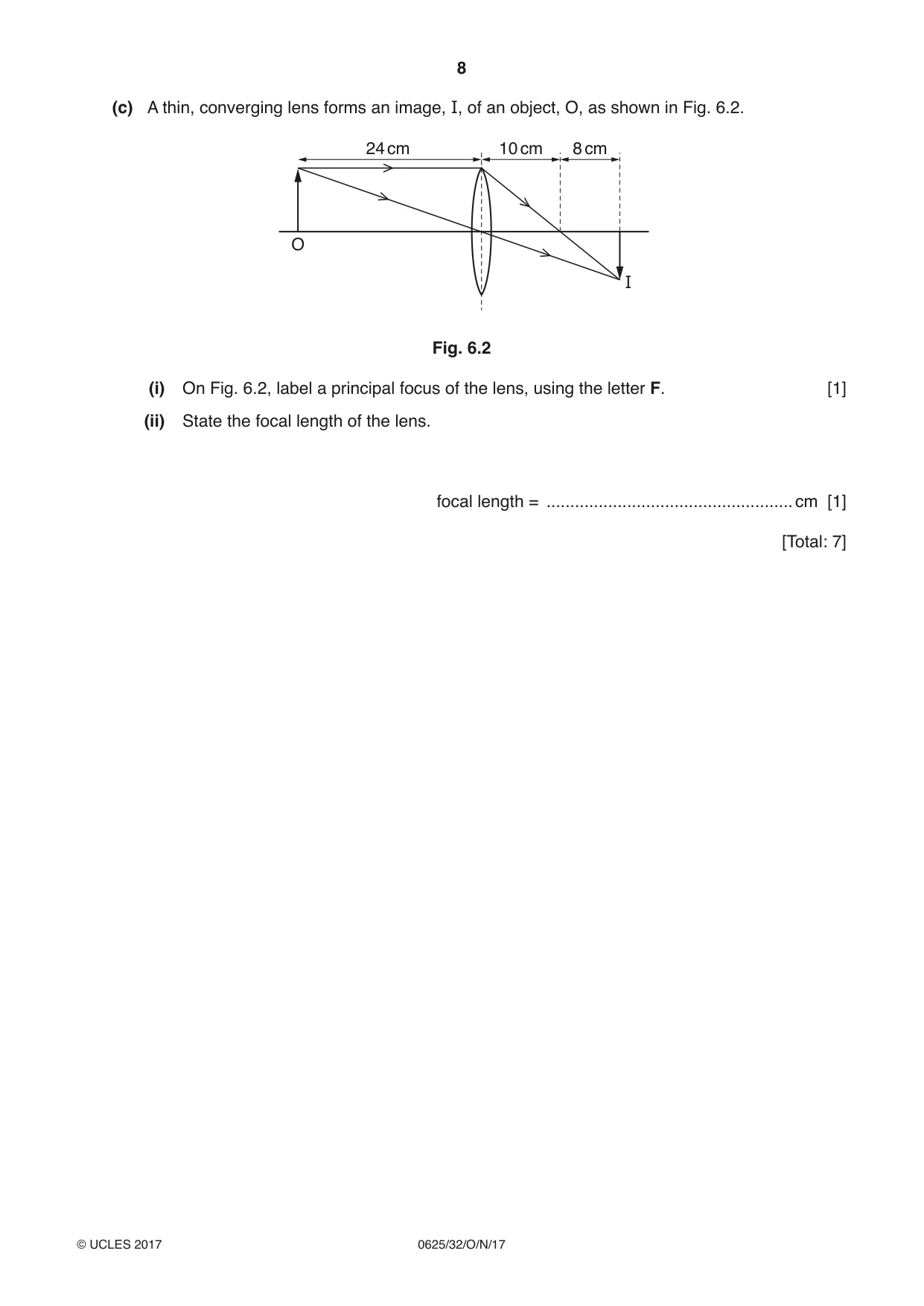
6 Fig. 6.1 shows a ray of light reflected from mirror 1 at point P and striking mirror 2 at point Q. 45° P plane mirror 1 ray of light plane mirror 2 Q Fig. 6.1 (a) On Fig. 6.1, • clearly mark the position of the normal at Q, • draw the ray reflected from point Q, • mark the angle of reflection at Q using the letter r, State the law you used to draw the reflected ray. ................................................................................................................................................... [4] (b) Compare the direction of the ray reflected from mirror 2 at Q with the direction of the ray incident on mirror 1 at P. Tick one box. The ray of light reflected from mirror 2 is parallel to the incident ray at P, perpendicular to the incident ray at P, at an angle of 45° to the incident ray at P. [1] (c) A thin, converging lens forms an image, I, of an object, O, as shown in Fig. 6.2. 24 cm 10 cm 8 cm O I Fig. 6.2 (i) On Fig. 6.2, label a principal focus of the lens, using the letter F. [1] (ii) State the focal length of the lens. focal length = .................................................... cm [1] [Total: 7]
Mark scheme: 6(a) normal correctly positioned B1 6(a)(ii) correct reflected ray at 45° to normal B1 6(a)(iii) r correctly indicated B1 6(a)(iv) angle i = angle r B1 6(b) parallel to the incident ray at P B1 6(c) F correctly labelled / 10 cm from lens B1 10 (cm) B1
Q7 · The regions of the electromagnetic spectrum
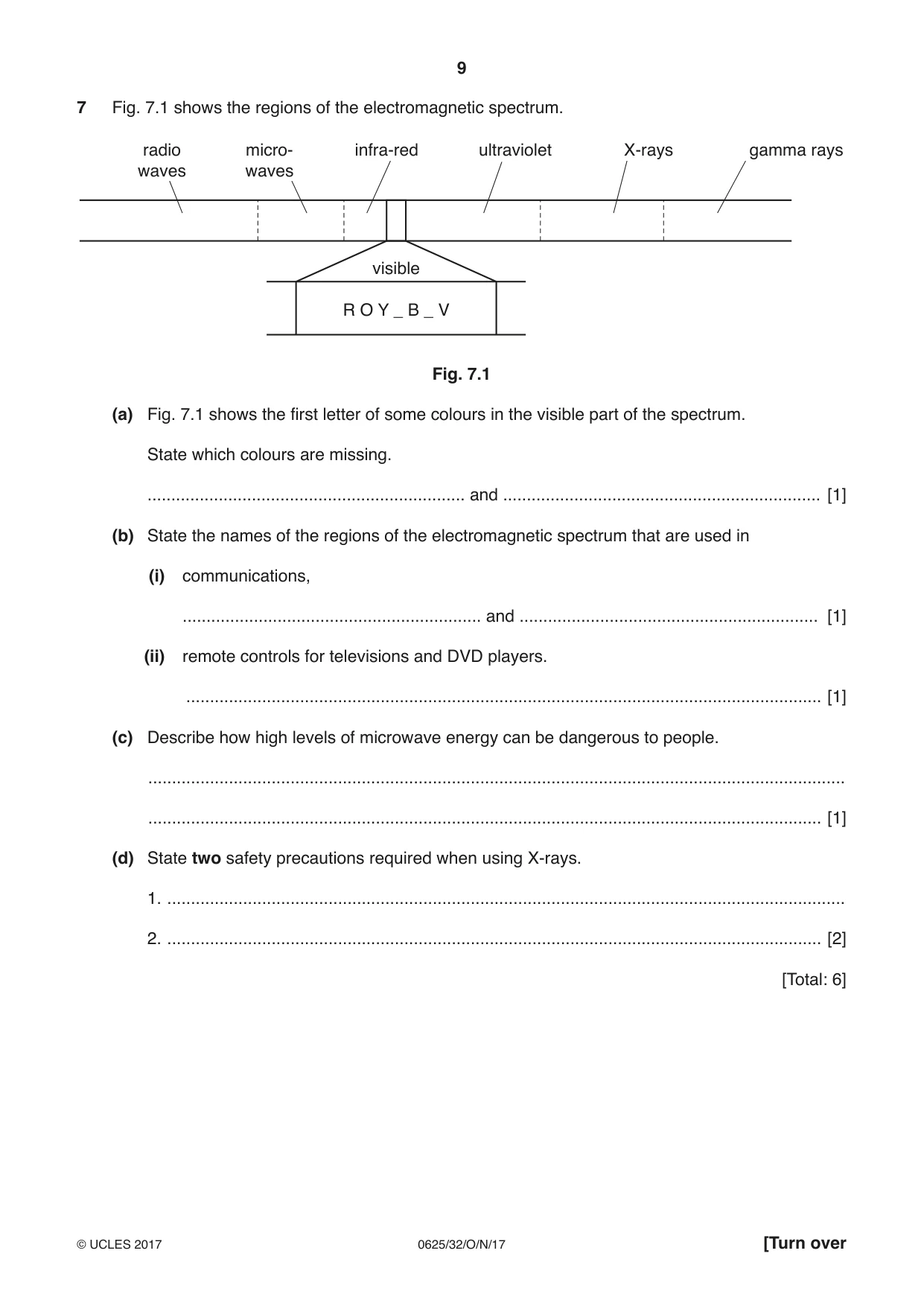
7 Fig. 7.1 shows the regions of the electromagnetic spectrum. radio micro- infra-red ultraviolet X-rays gamma rays waves waves visible R O Y _ B _ V Fig. 7.1 (a) Fig. 7.1 shows the first letter of some colours in the visible part of the spectrum. State which colours are missing. ................................................................... and ................................................................... [1] (b) State the names of the regions of the electromagnetic spectrum that are used in (i) communications, ............................................................... and ............................................................... [1] (ii) remote controls for televisions and DVD players. ...................................................................................................................................... [1] (c) Describe how high levels of microwave energy can be dangerous to people. ................................................................................................................................................... .............................................................................................................................................. [1] (d) State two safety precautions required when using X-rays. 1. ............................................................................................................................................... 2. .......................................................................................................................................... [2] [Total: 6]
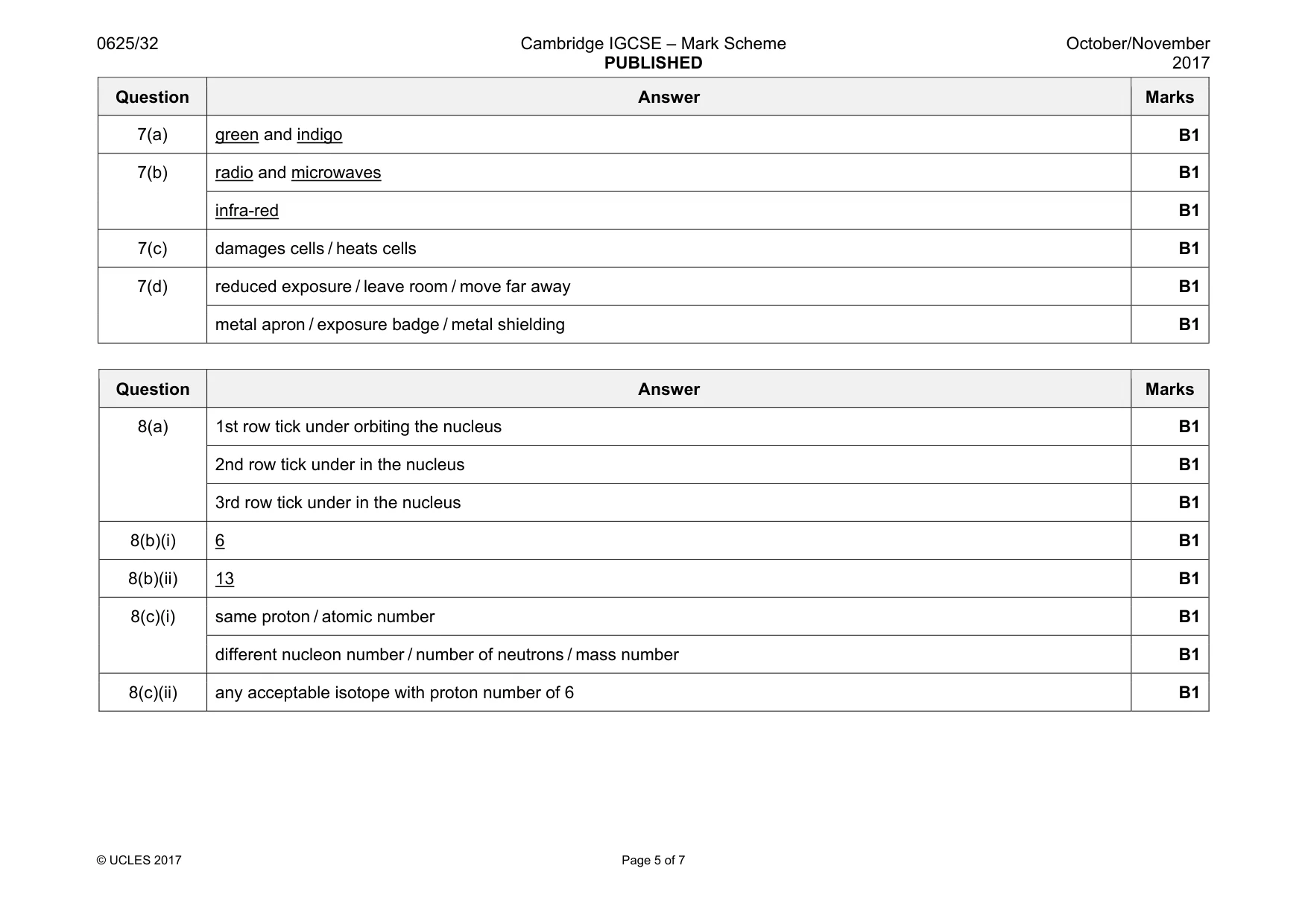
Mark scheme: 7(a) green and indigo B1 7(b) radio and microwaves B1 infra-red B1 7(c) damages cells / heats cells B1 7(d) reduced exposure / leave room / move far away B1 metal apron / exposure badge / metal shielding B1
Q8 · An atom of carbon contains protons, neutrons and electrons
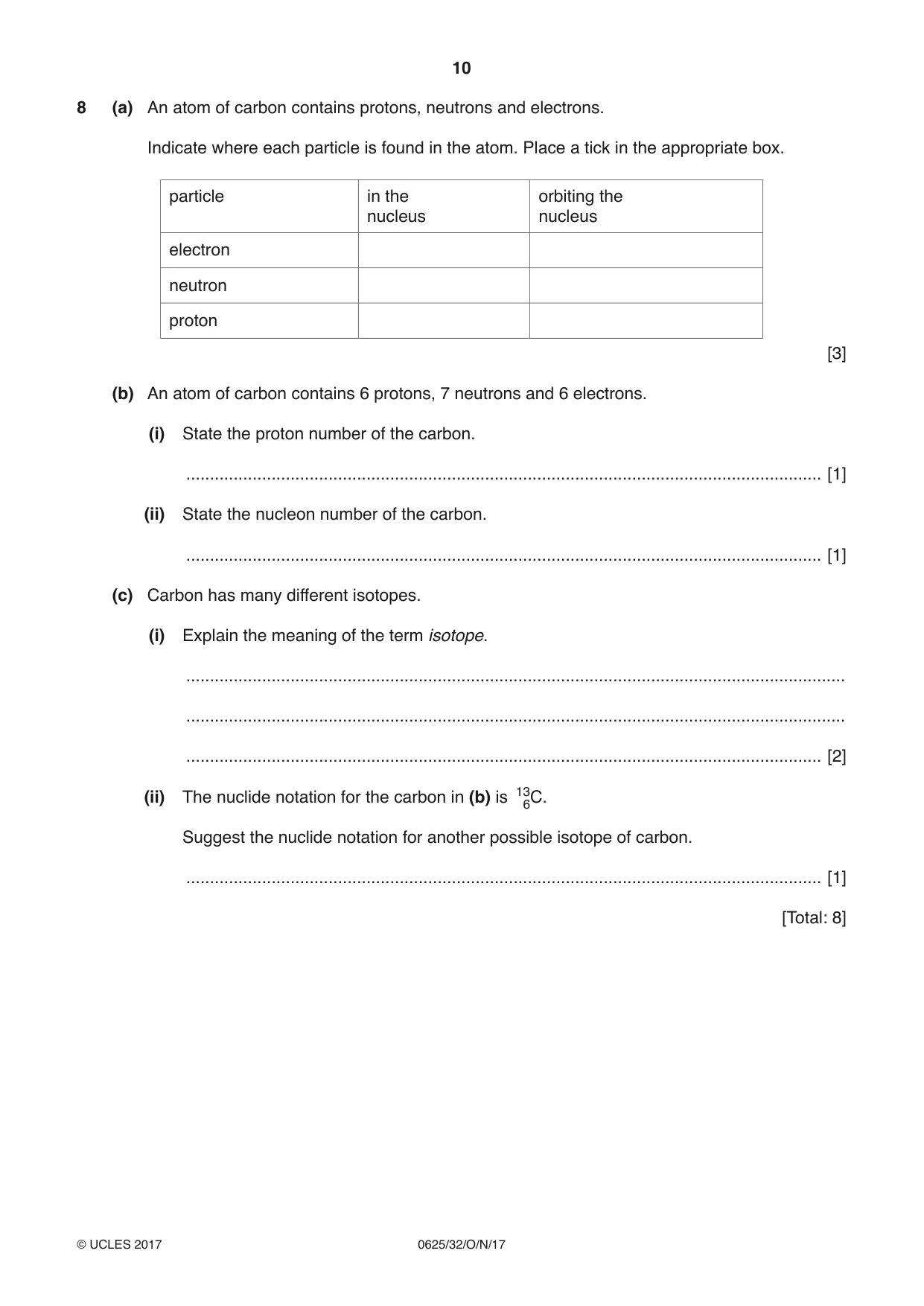
8 (a) An atom of carbon contains protons, neutrons and electrons. Indicate where each particle is found in the atom. Place a tick in the appropriate box. particle in the orbiting the nucleus nucleus electron neutron proton [3] (b) An atom of carbon contains 6 protons, 7 neutrons and 6 electrons. (i) State the proton number of the carbon. ...................................................................................................................................... [1] (ii) State the nucleon number of the carbon. ...................................................................................................................................... [1] (c) Carbon has many different isotopes. (i) Explain the meaning of the term isotope. ........................................................................................................................................... ........................................................................................................................................... ...................................................................................................................................... [2] (ii) The nuclide notation for the carbon in (b) is 136C. Suggest the nuclide notation for another possible isotope of carbon. ...................................................................................................................................... [1] [Total: 8]
Mark scheme: 8(a) 1st row tick under orbiting the nucleus B1 2nd row tick under in the nucleus B1 3rd row tick under in the nucleus B1 8(b)(i) 6 B1 8(b)(ii) 13 B1 8(c)(i) same proton / atomic number B1 different nucleon number / number of neutrons / mass number B1 8(c)(ii) any acceptable isotope with proton number of 6 B1
Q9 · Some metals can be used to make permanent magnets
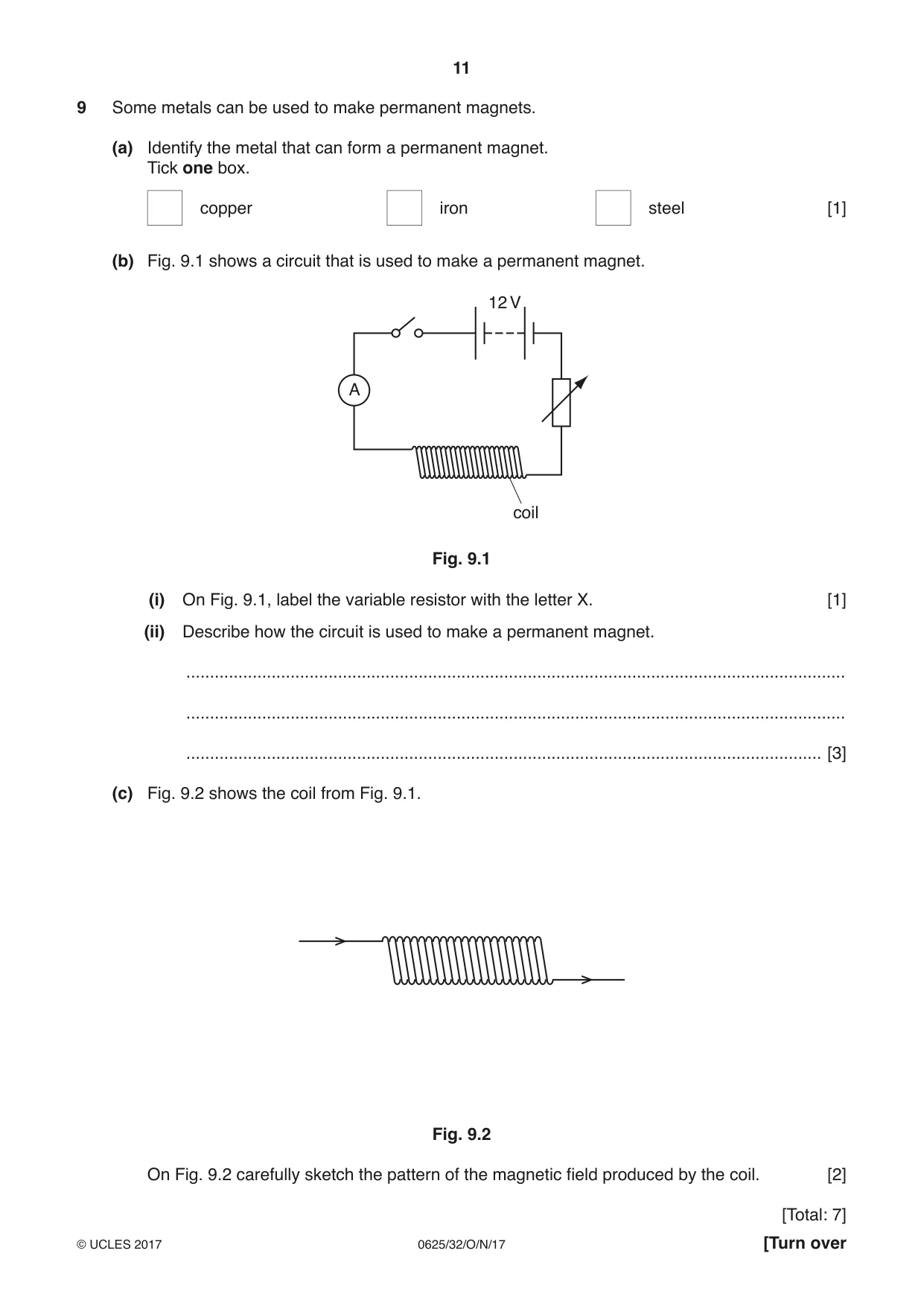
9 Some metals can be used to make permanent magnets. (a) Identify the metal that can form a permanent magnet. Tick one box. copper iron steel [1] (b) Fig. 9.1 shows a circuit that is used to make a permanent magnet. 12 V A coil Fig. 9.1 (i) On Fig. 9.1, label the variable resistor with the letter X. [1] (ii) Describe how the circuit is used to make a permanent magnet. ........................................................................................................................................... ........................................................................................................................................... ...................................................................................................................................... [3] (c) Fig. 9.2 shows the coil from Fig. 9.1. Fig. 9.2 On Fig. 9.2 carefully sketch the pattern of the magnetic field produced by the coil. [2] [Total: 7]
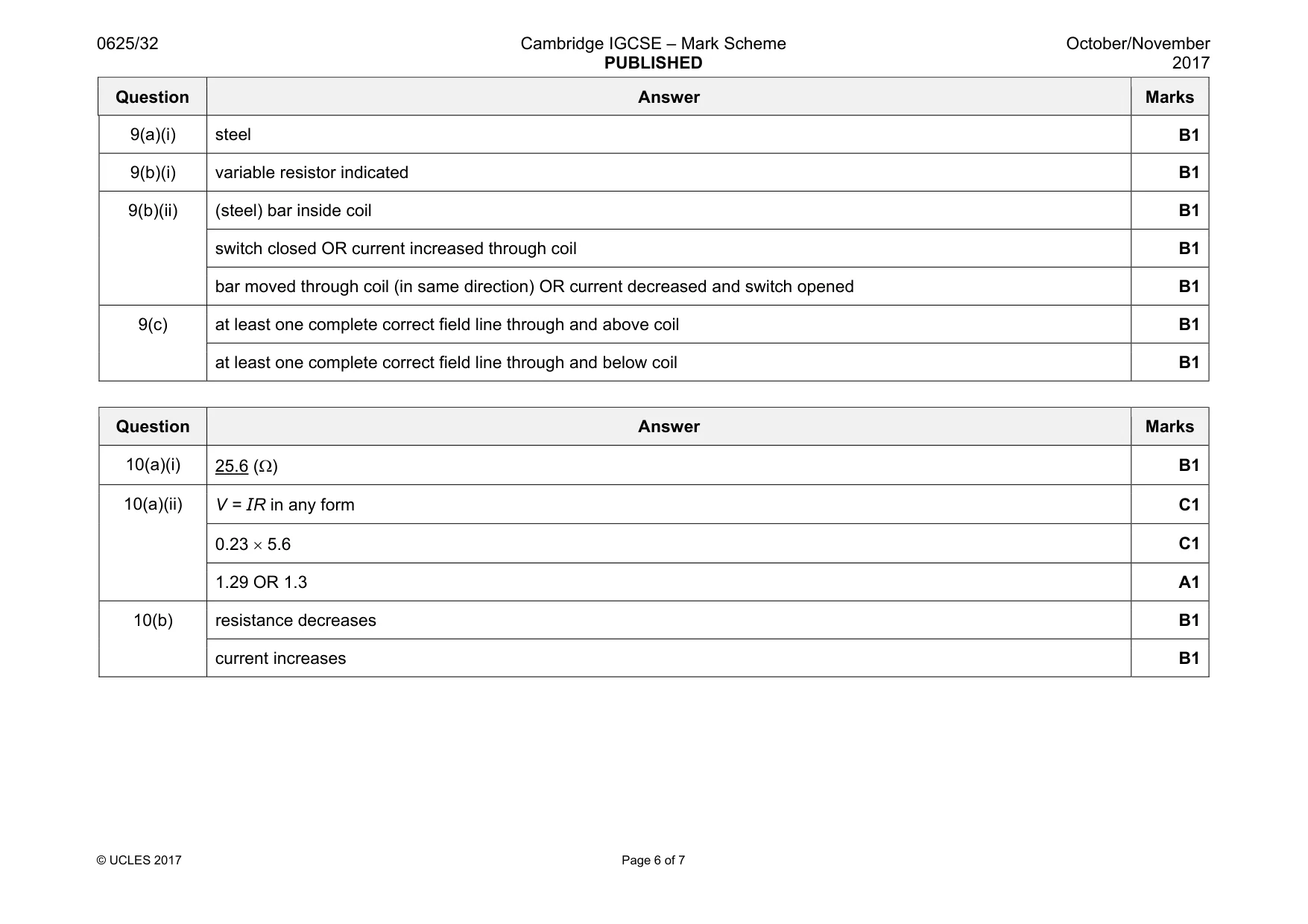
Mark scheme: 9(a)(i) steel B1 9(b)(i) variable resistor indicated B1 9(b)(ii) (steel) bar inside coil B1 switch closed OR current increased through coil B1 bar moved through coil (in same direction) OR current decreased and switch opened B1 9(c) at least one complete correct field line through and above coil B1 at least one complete correct field line through and below coil B1
Question 10
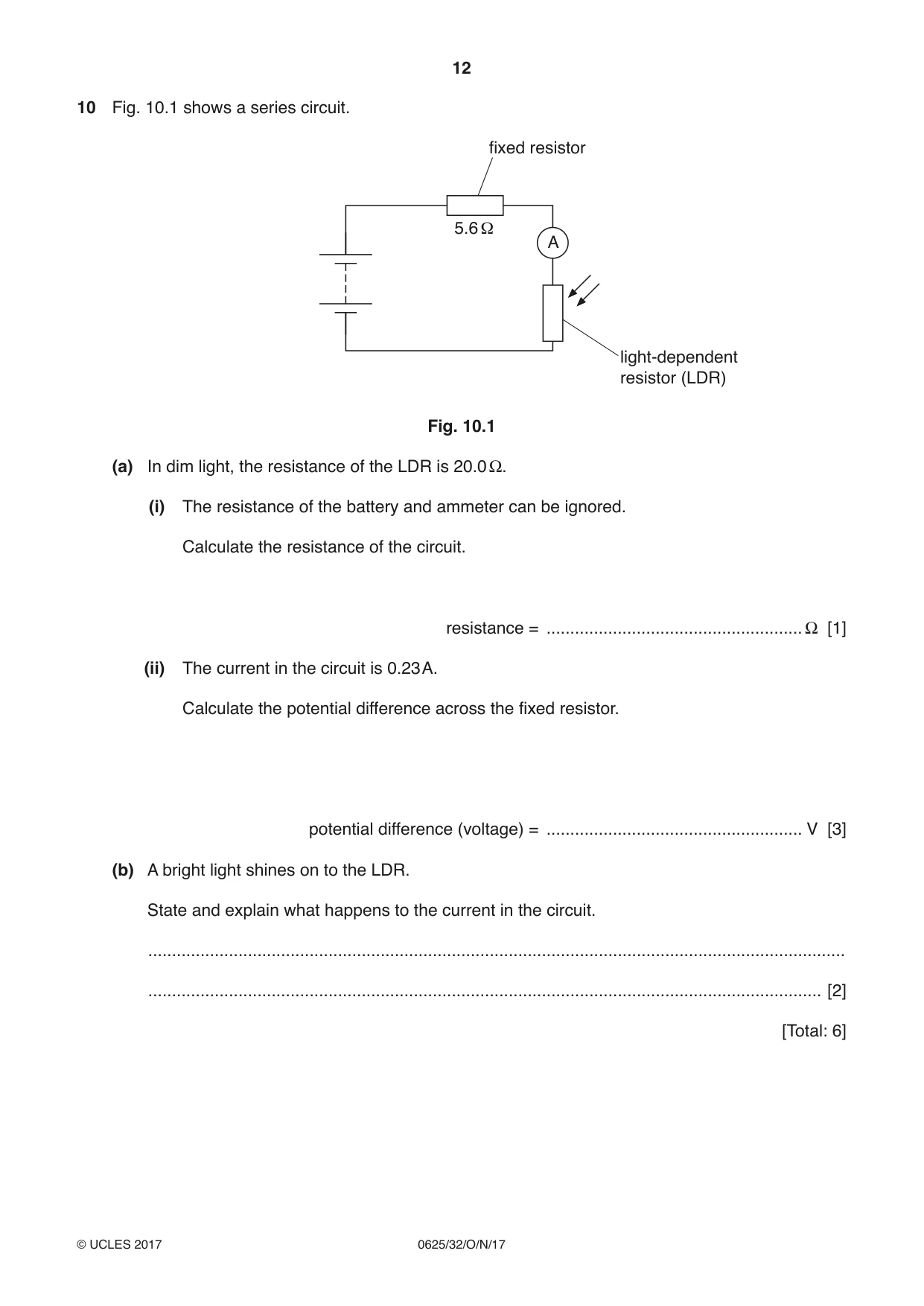
10 Fig. 10.1 shows a series circuit. fixed resistor 5.6 Ω A light-dependent resistor (LDR) Fig. 10.1 (a) In dim light, the resistance of the LDR is 20.0 Ω. (i) The resistance of the battery and ammeter can be ignored. Calculate the resistance of the circuit. resistance = ...................................................... Ω [1] (ii) The current in the circuit is 0.23 A. Calculate the potential difference across the fixed resistor. potential difference (voltage) = ...................................................... V [3] (b) A bright light shines on to the LDR. State and explain what happens to the current in the circuit. ................................................................................................................................................... .............................................................................................................................................. [2] [Total: 6]
Mark scheme: 10(a)(i) B1 10(a)(ii) V = IR in any form C1 0.23 × 5.6 C1 1.29 OR 1.3 A1 10(b) resistance decreases B1 current increases B1
Q11 · A charger for a mobile (cell) phone
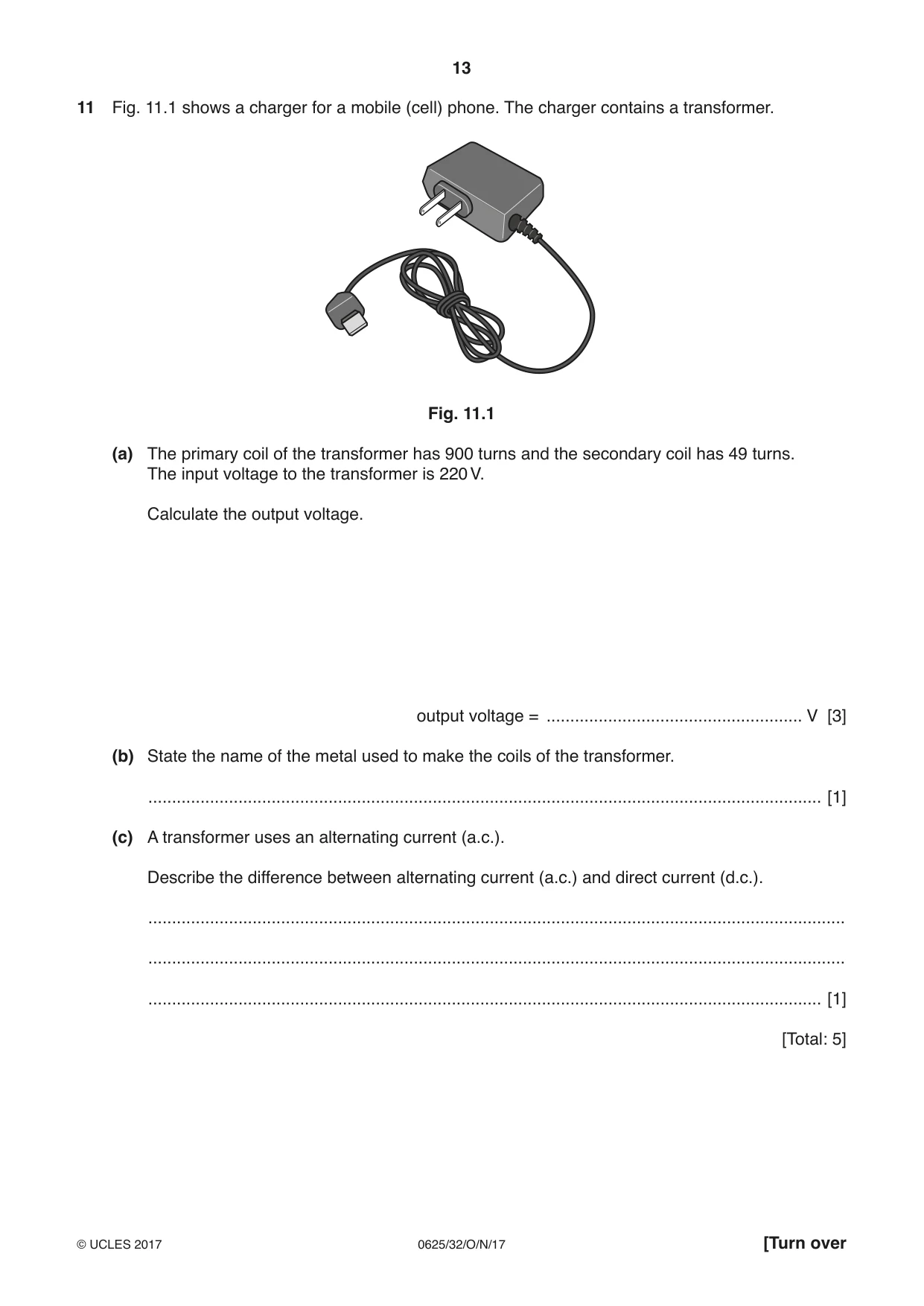
11 Fig. 11.1 shows a charger for a mobile (cell) phone. The charger contains a transformer. Fig. 11.1 (a) The primary coil of the transformer has 900 turns and the secondary coil has 49 turns. The input voltage to the transformer is 220 V. Calculate the output voltage. output voltage = ...................................................... V [3] (b) State the name of the metal used to make the coils of the transformer. .............................................................................................................................................. [1] (c) A transformer uses an alternating current (a.c.). Describe the difference between alternating current (a.c.) and direct current (d.c.). ................................................................................................................................................... ................................................................................................................................................... .............................................................................................................................................. [1] [Total: 5]
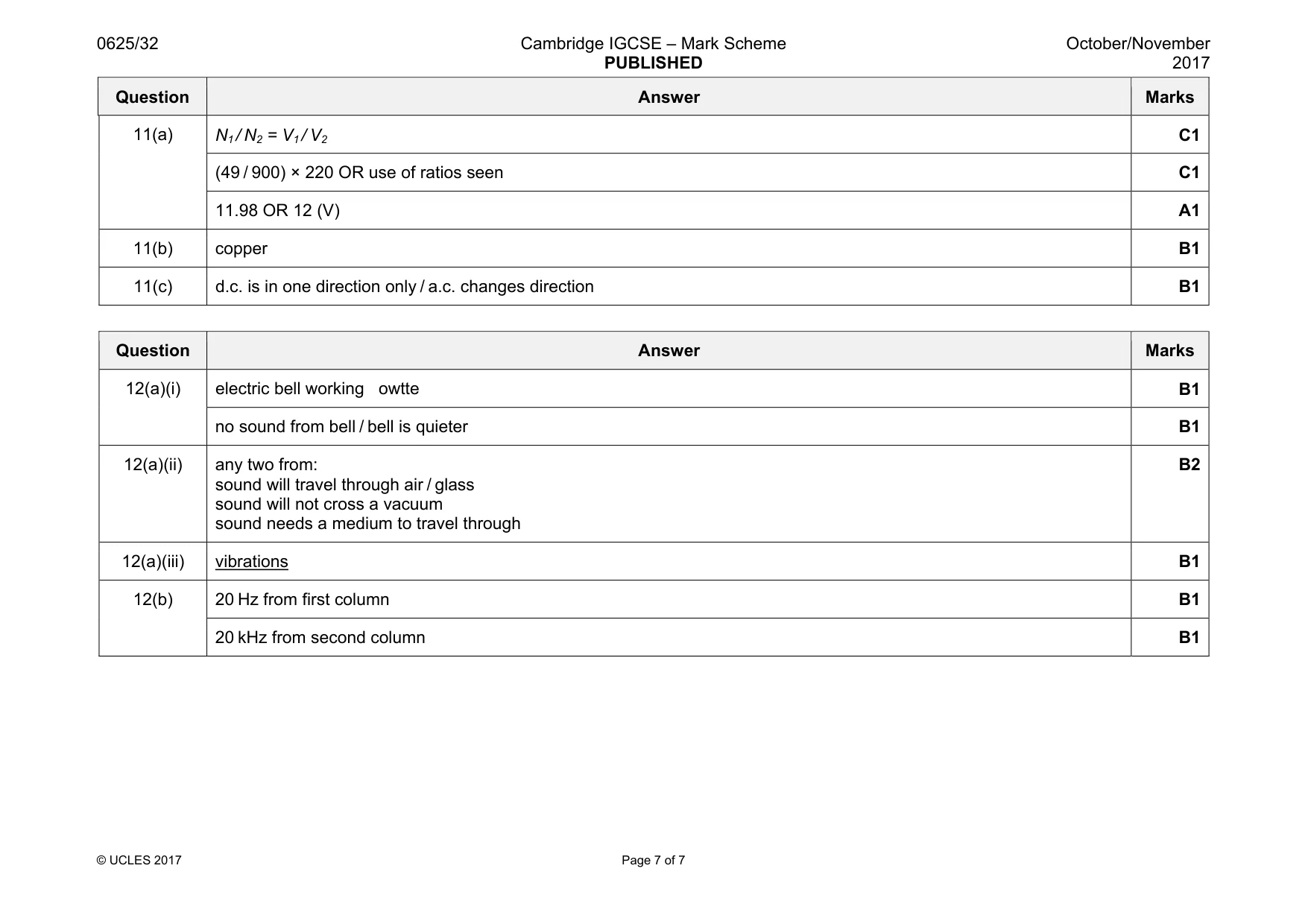
Mark scheme: 11(a) N1/ N2 = V1 / V2 C1 (49 / 900) × 220 OR use of ratios seen C1 11.98 OR 12 (V) A1 11(b) copper B1 11(c) d.c. is in one direction only / a.c. changes direction B1
Q12 · Some equipment used in a demonstration
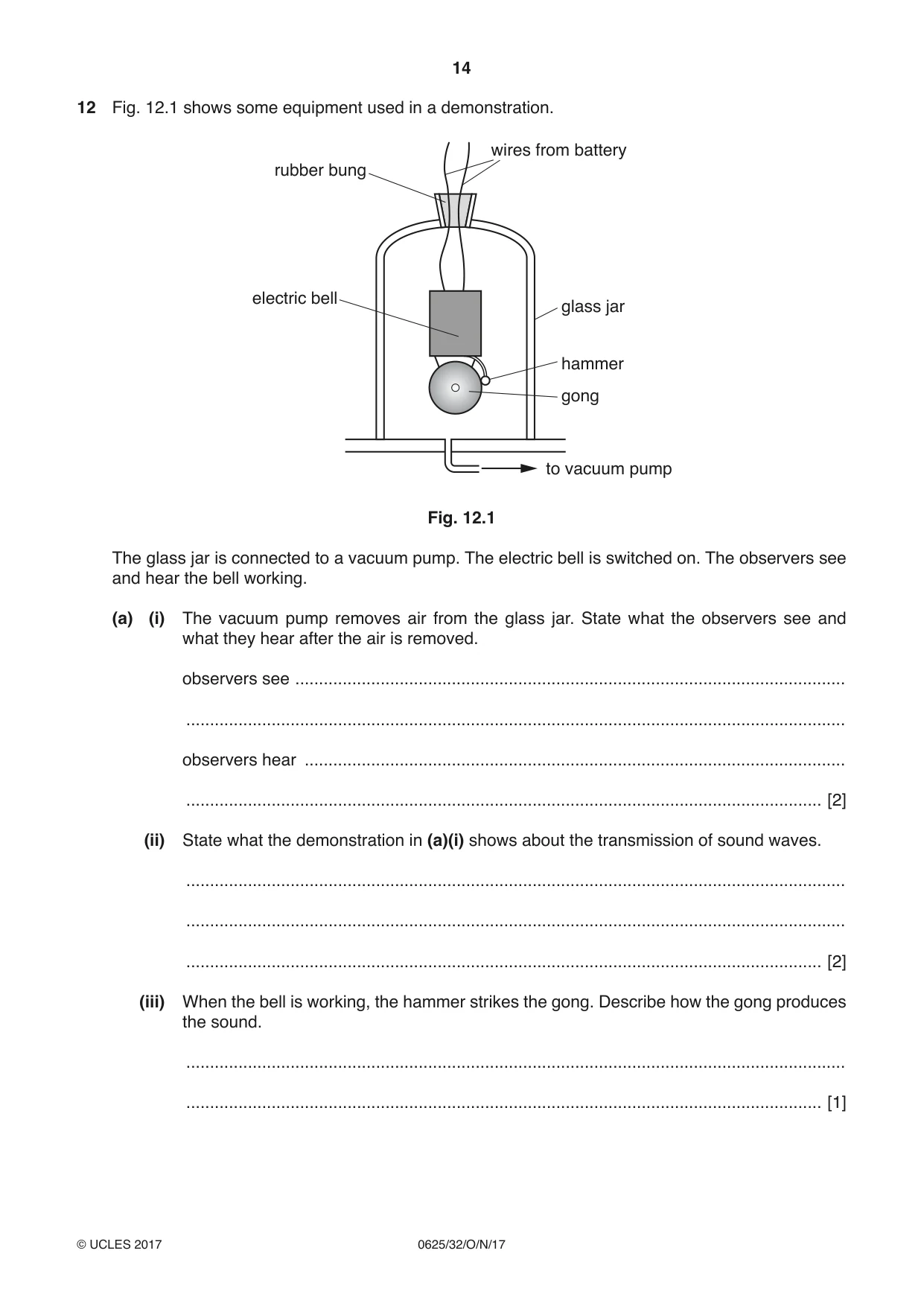
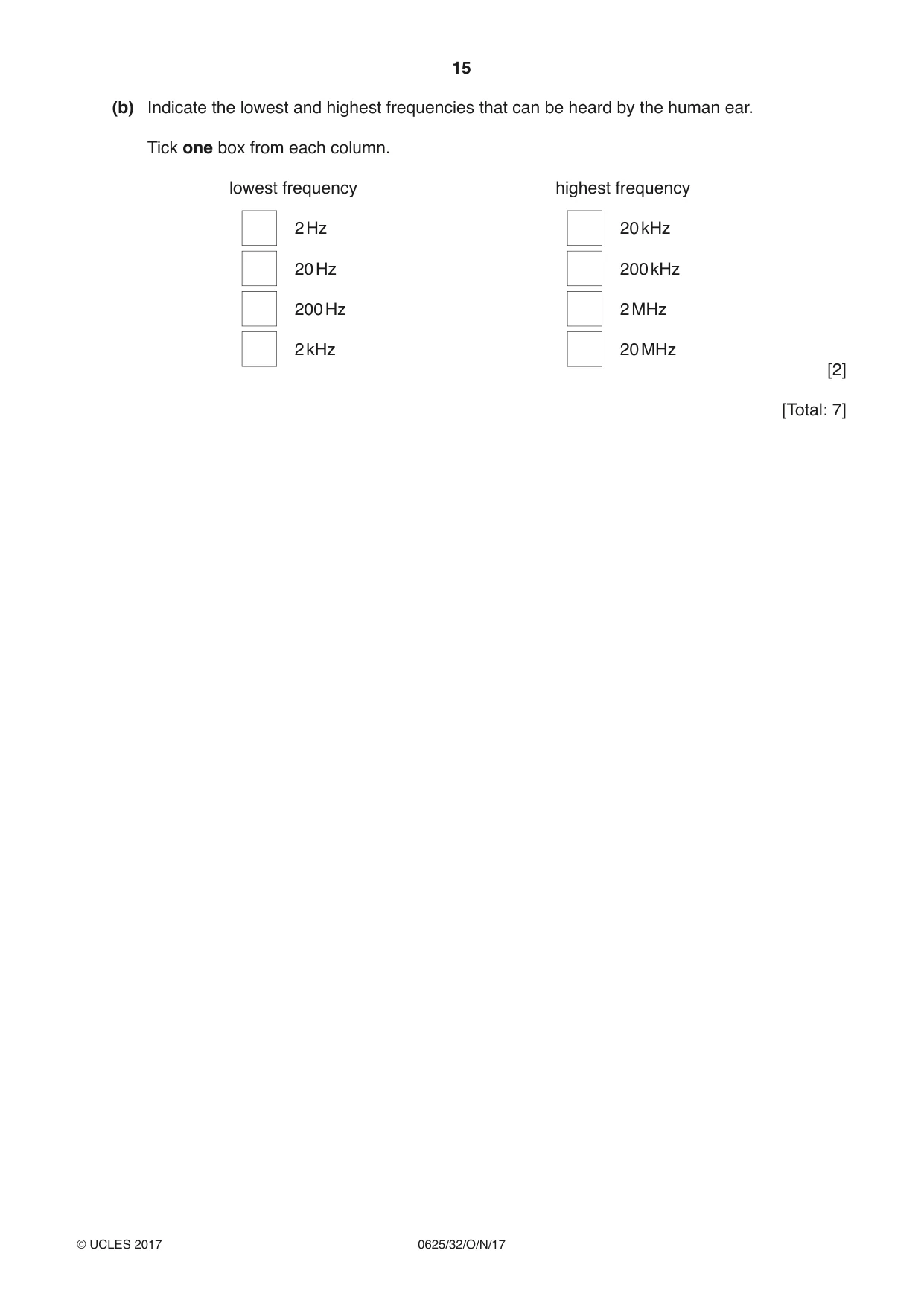
12 Fig. 12.1 shows some equipment used in a demonstration. wires from battery rubber bung electric bell glass jar hammer gong to vacuum pump Fig. 12.1 The glass jar is connected to a vacuum pump. The electric bell is switched on. The observers see and hear the bell working. (a) (i) The vacuum pump removes air from the glass jar. State what the observers see and what they hear after the air is removed. observers see .................................................................................................................... ........................................................................................................................................... observers hear .................................................................................................................. ...................................................................................................................................... [2] (ii) State what the demonstration in (a)(i) shows about the transmission of sound waves. ........................................................................................................................................... ........................................................................................................................................... ...................................................................................................................................... [2] (iii) When the bell is working, the hammer strikes the gong. Describe how the gong produces the sound. ........................................................................................................................................... ...................................................................................................................................... [1] (b) Indicate the lowest and highest frequencies that can be heard by the human ear. Tick one box from each column. lowest frequency highest frequency 2 Hz 20 kHz 20 Hz 200 kHz 200 Hz 2 MHz 2 kHz 20 MHz [2] [Total: 7]
Mark scheme: 12(a)(i) electric bell working owtte B1 no sound from bell / bell is quieter B1 12(a)(ii) any two from: sound will travel through air / glass sound will not cross a vacuum sound needs a medium to travel through B2 12(a)(iii) vibrations B1 12(b) 20 Hz from first column B1 20 kHz from second column B1
What was in this paper
The subtopics covered by these 12 questions, and how many questions each got. Open one in a new tab to see every Cambridge question on it.
What you needed in this session
Cambridge’s own grade thresholds for 2017 Oct/Nov, Paper 3 · Variant 2. A higher threshold means an easier paper — the bar moves with how the cohort did.