Questions as text
Q1 · Apparatus that is used to demonstrate some effects of the transfer of energy by radiation 0625/42 Feb/March 2017
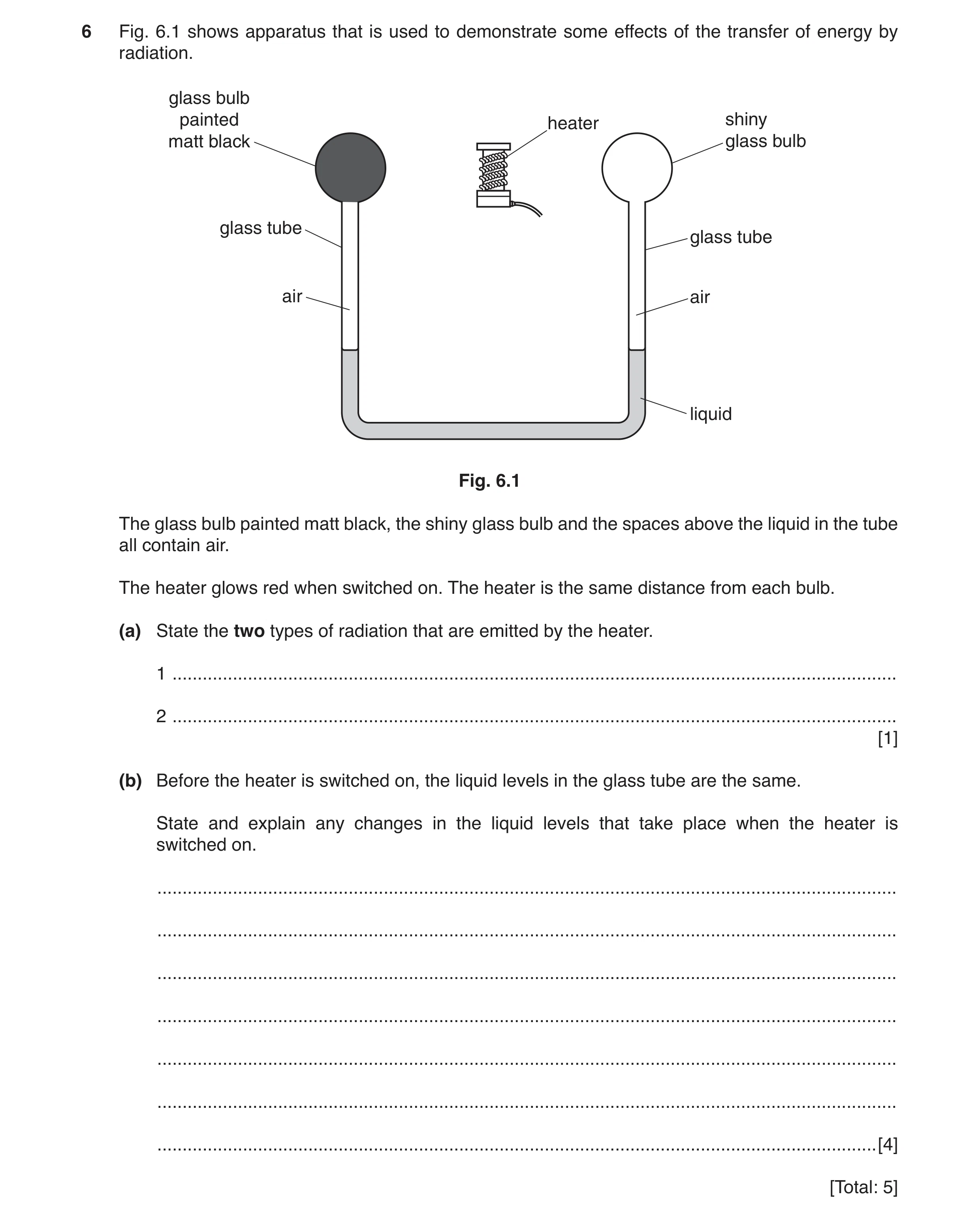
6 Fig. 6.1 shows apparatus that is used to demonstrate some effects of the transfer of energy by radiation. glass bulb painted heater shiny matt black glass bulb glass tube glass tube air air liquid Fig. 6.1 The glass bulb painted matt black, the shiny glass bulb and the spaces above the liquid in the tube all contain air. The heater glows red when switched on. The heater is the same distance from each bulb. (a) State the two types of radiation that are emitted by the heater. 1 … 2 … [1] (b) Before the heater is switched on, the liquid levels in the glass tube are the same. State and explain any changes in the liquid levels that take place when the heater is switched on. … … … … … … … [4] [Total: 5]
5 marks
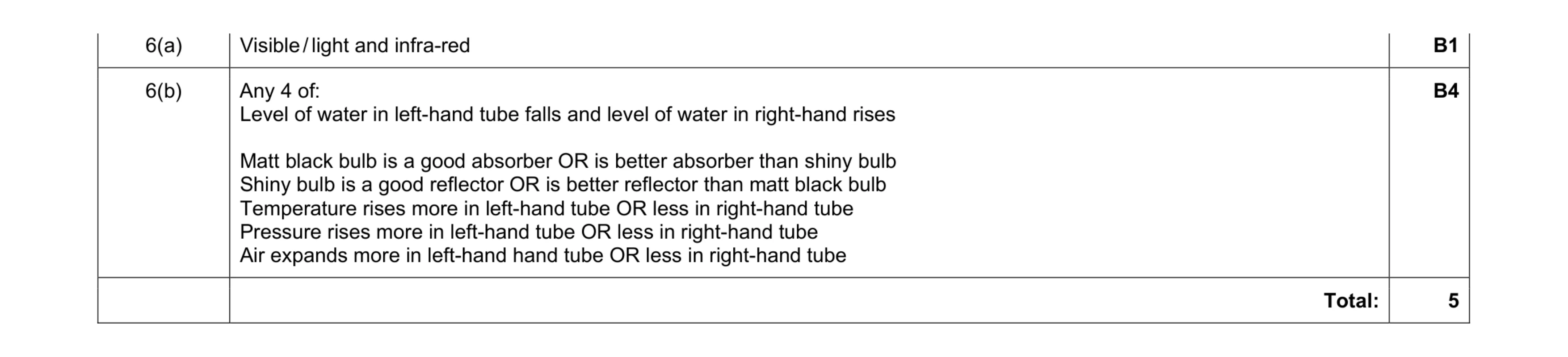
Mark scheme: 6(a) Visible / light and infra-red B1 6(b) Any 4 of: Level of water in left-hand tube falls and level of water in right-hand rises Matt black bulb is a good absorber OR is better absorber than shiny bulb Shiny bulb is a good reflector OR is better reflector than matt black bulb Temperature rises more in left-hand tube OR less in right-hand tube Pressure rises more in left-hand tube OR less in right-hand tube Air expands more in left-hand hand tube OR less in right-hand tube B4 Total: 5
This question in 0625/42 Feb/March 2017
Q2 · A 240 V, 60 W lamp is connected to a 240 V supply 0625/41 May/June 2017
4 (a) A 240 V, 60 W lamp is connected to a 240 V supply. The lamp has a constant temperature. State (i) the rate at which the lamp transfers energy to the surroundings, rate = … [1] (ii) the names of the thermal processes by which the lamp transfers energy to the surroundings. … … [1] (b) Fig. 4.1 shows a thick copper block that has been heated to 400 °C. One side of the block is dull black. The other side of the block is polished and shiny. thermometer A thermometer B copper block dull black surface polished shiny surface Fig. 4.1 (i) In Experiment 1, the thermometer bulbs are both painted black. They are placed at equal distances from the surfaces of the block. The maximum temperature shown by each thermometer is recorded. Explain any difference between the maximum temperature shown by the two thermometers. … … … … [3] (ii) In Experiment 2, the thermometer bulbs are both shiny silver-coloured. They are placed at the same distances from the surfaces of the block as in Experiment 1. State and explain any differences that are observed in the maximum temperatures shown by the thermometers in Experiments 1 and 2. … … … … … [2] (c) Fig. 4.2 shows a firefighter wearing shiny silver-coloured clothing. Fig. 4.2 State the benefit to a firefighter of wearing shiny silver-coloured clothing. … … [1] [Total: 8]
8 marks
Mark scheme: 4(a)(i) 60 W B1 4(a)(ii) Radiation and either conduction or convection B1 4(b)(i) Radiation mentioned B1 Higher reading or rises faster on thermometer A B1 Black (surface) is a good/better emitter (than polished surface) OR polished (surface) is a poor/bad/worse emitter (than black surface) B1 4(b)(ii) (Compared with black bulb thermometer) readings rise more slowly OR readings are low(er) B1 Shiny (bulb) surfaces are good/better reflectors (of radiation) OR Shiny (bulb) surfaces are poor/bad/worse absorbers (of radiation) B1 4(c) Firefighter does not get too hot/burned (from radiation) B1 Total: 8
This question in 0625/41 May/June 2017
Q3 · A footballer and a referee are discussing a puddle of water that has formed on the pitch 0625/43 May/June 2017
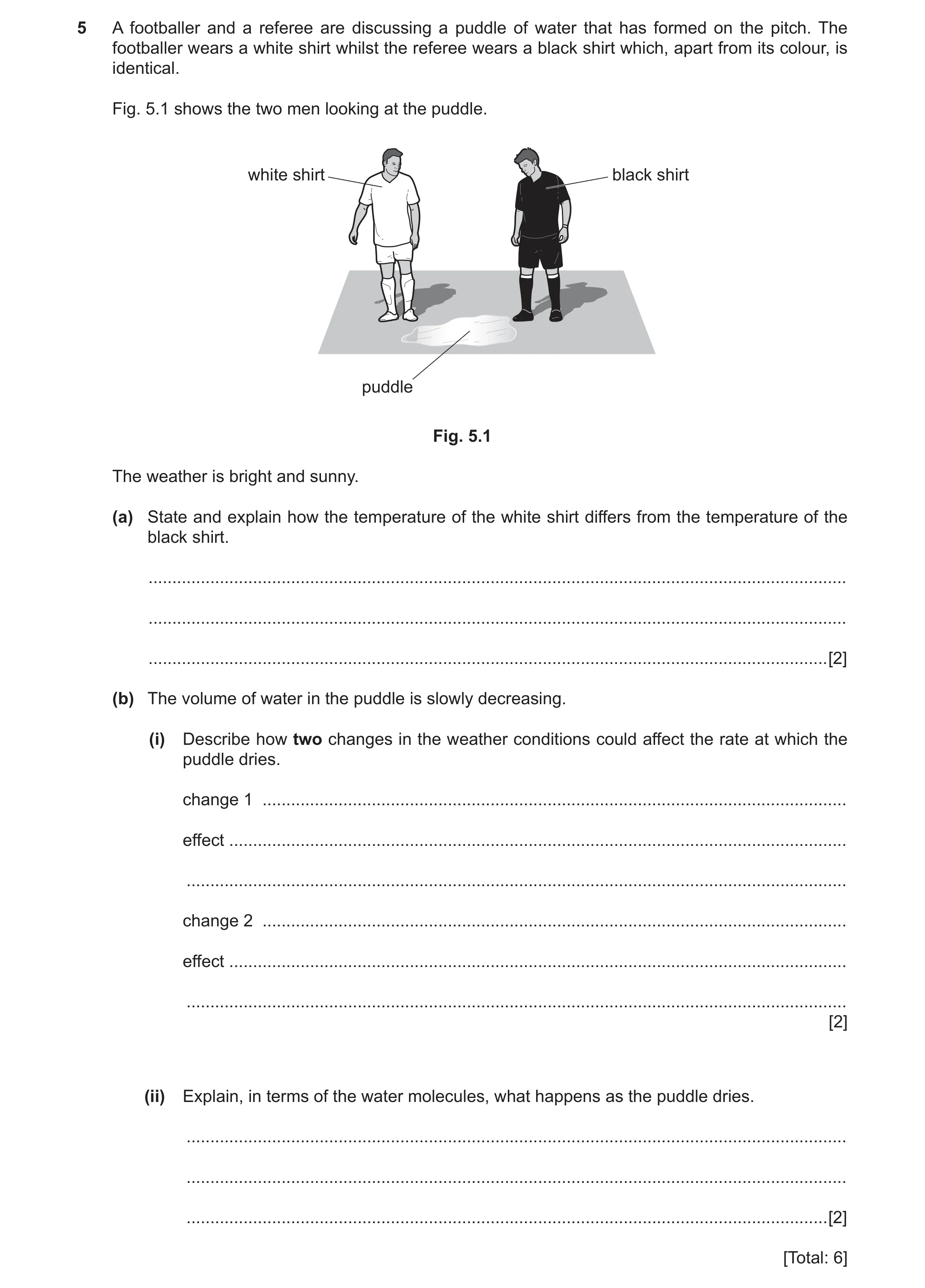
5 A footballer and a referee are discussing a puddle of water that has formed on the pitch. The footballer wears a white shirt whilst the referee wears a black shirt which, apart from its colour, is identical. Fig. 5.1 shows the two men looking at the puddle. white shirt black shirt puddle Fig. 5.1 The weather is bright and sunny. (a) State and explain how the temperature of the white shirt differs from the temperature of the black shirt. … … … [2] (b) The volume of water in the puddle is slowly decreasing. (i) Describe how two changes in the weather conditions could affect the rate at which the puddle dries. change 1 … effect … … change 2 … effect … … [2] (ii) Explain, in terms of the water molecules, what happens as the puddle dries. … … … [2] [Total: 6]
6 marks
Mark scheme: 5(a) white kit cooler OR black kit warmer M1 white poor absorber/good reflector of (IR)radiation/heat/thermal energy OR v.v. for black A1 5(b)(i) any two pairs from: more/less wind; dries quicker/slower temperature increases/decreases/sunnier/cloudier; dries quicker/slower stops/starts raining; dries quicker/slower less/more humid; dries quicker/slower B2 5(b)(ii) molecules with most (kinetic) energy (escape) OR water cools B1 escape liquid/break intermolecular bonds / molecules enter air / evaporate / become vapour B1 Total: 6
This question in 0625/43 May/June 2017
Q4 · Explain why houses in hot countries are often painted white 0625/42 Oct/Nov 2017
5 (a) Explain why houses in hot countries are often painted white. Use ideas about the transfer of thermal energy in your answer. … … … … [3] (b) As a star approaches the end of its life, the amount of radiation emitted from it per second changes. The star cools down. State any effect on the rate of emission of radiation. … … [1] [Total: 4]
4 marks
Mark scheme: 5(a) any three of these five: • any sensible mention of the sun (as source of energy) • (thermal / heat / IR / electromagnetic) radiation • white (or clearly implied) surfaces absorb less or don’t absorb • white (or clearly implied) surfaces reflect more • to keep house cooler OR to reduce thermal energy / heat transferred to house B3 5(b) decreases B1
This question in 0625/42 Oct/Nov 2017
Q5 · A silver spoon has a thermal capacity of 7.2 J / °C 0625/43 Oct/Nov 2017
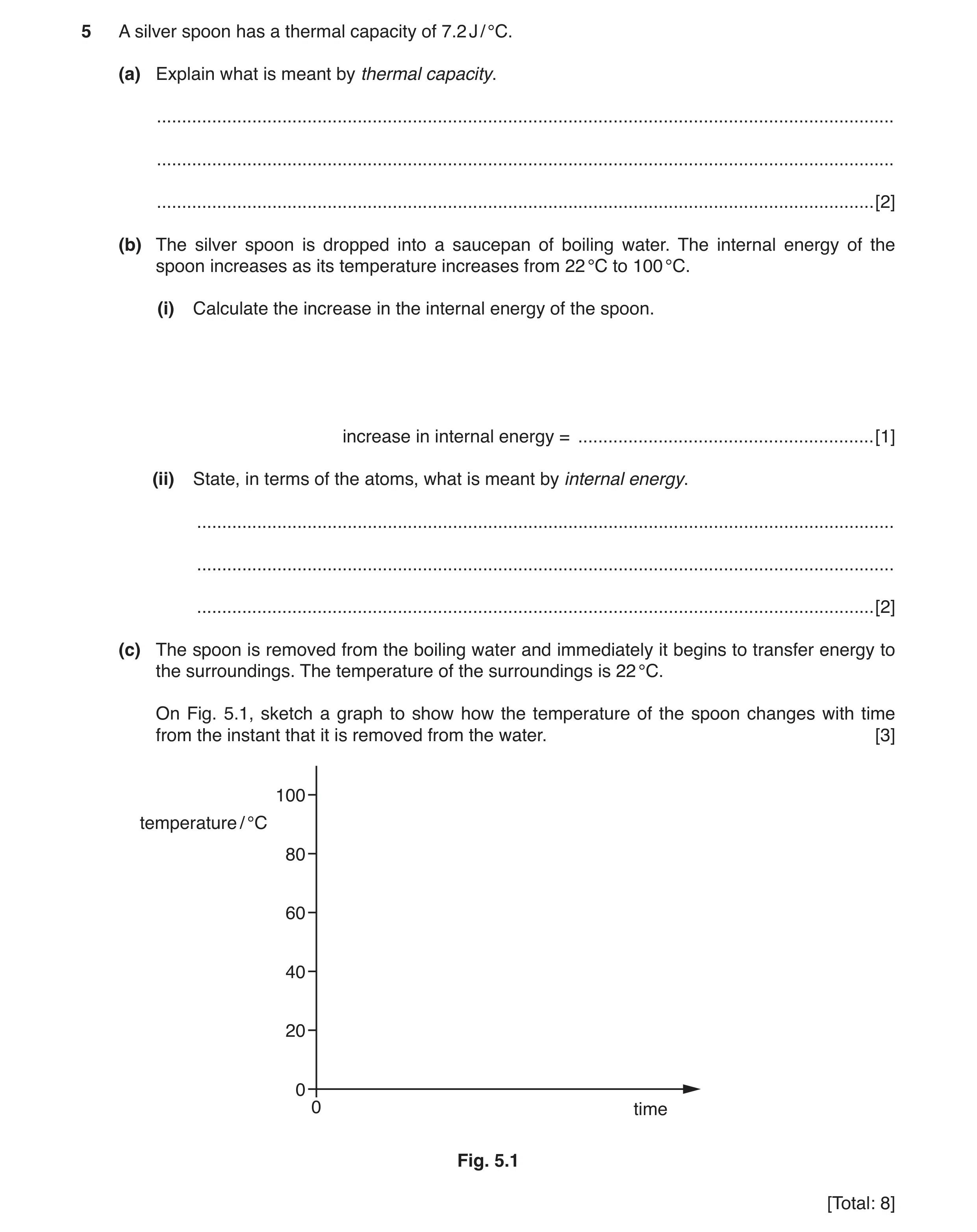
5 A silver spoon has a thermal capacity of 7.2 J / °C. (a) Explain what is meant by thermal capacity. … … … [2] (b) The silver spoon is dropped into a saucepan of boiling water. The internal energy of the spoon increases as its temperature increases from 22 °C to 100 °C. (i) Calculate the increase in the internal energy of the spoon. increase in internal energy = … [1] (ii) State, in terms of the atoms, what is meant by internal energy. … … … [2] (c) The spoon is removed from the boiling water and immediately it begins to transfer energy to the surroundings. The temperature of the surroundings is 22 °C. On Fig. 5.1, sketch a graph to show how the temperature of the spoon changes with time from the instant that it is removed from the water. [3] 100 temperature / °C 80 60 40 20 0 0 time Fig. 5.1 [Total: 8]
8 marks
Mark scheme: 5(a) (quantity of internal) energy that raises temperature M1 per degree Celsius / per unit temperature change A1 5(b)(i) 560 / 562 / 561.6 J B1 5(b)(ii) kinetic energy / potential energy / total energy (of atoms / molecules / particles) B1 kinetic added to potential energy (of atoms / molecules / particles) B1 5(c) line from 100 °C and falling B1 falls at decreasing rate B1 levels off at labelled / approximate 22 °C B1
This question in 0625/43 Oct/Nov 2017
Q6 · In a laboratory at normal room temperature, 200 g of water is poured into a beaker 0625/41 May/June 2018
8 In a laboratory at normal room temperature, 200 g of water is poured into a beaker. A thermometer placed in the water has a reading of 22 °C. Small pieces of ice at 0 °C are added to the water one by one. The mixture is stirred after each addition until the ice has melted. This process is continued until the temperature recorded by the thermometer is 0 °C. The total mass of ice added to the water is found to be 60 g. (a) The specific heat capacity of water is 4.2 J/(g °C). Calculate the thermal energy lost by the water originally in the beaker. thermal energy = … [2] (b) Assume that all the thermal energy lost by the water originally in the beaker is transferred to the ice. Calculate the specific latent heat of fusion of ice. specific latent heat of fusion of ice = … [2] (c) Suggest a reason for any inaccuracy in the value of the specific latent heat of fusion of ice calculated in (b). Assume the temperature readings and the values for the mass of the water and the mass of the ice are accurate. … … [1] [Total: 5]
5 marks
Mark scheme: 8(a) 1 18000 J 1 8(b) Q = m × L OR (L =) Q ÷ m OR 18 480 ÷ 60 1 310 J / g 1 8(c) (Thermal) energy/heat transfers from surroundings OR into water 1
This question in 0625/41 May/June 2018
Q7 · A student wants to investigate good and bad absorbers of thermal radiation 0625/42 May/June 2018
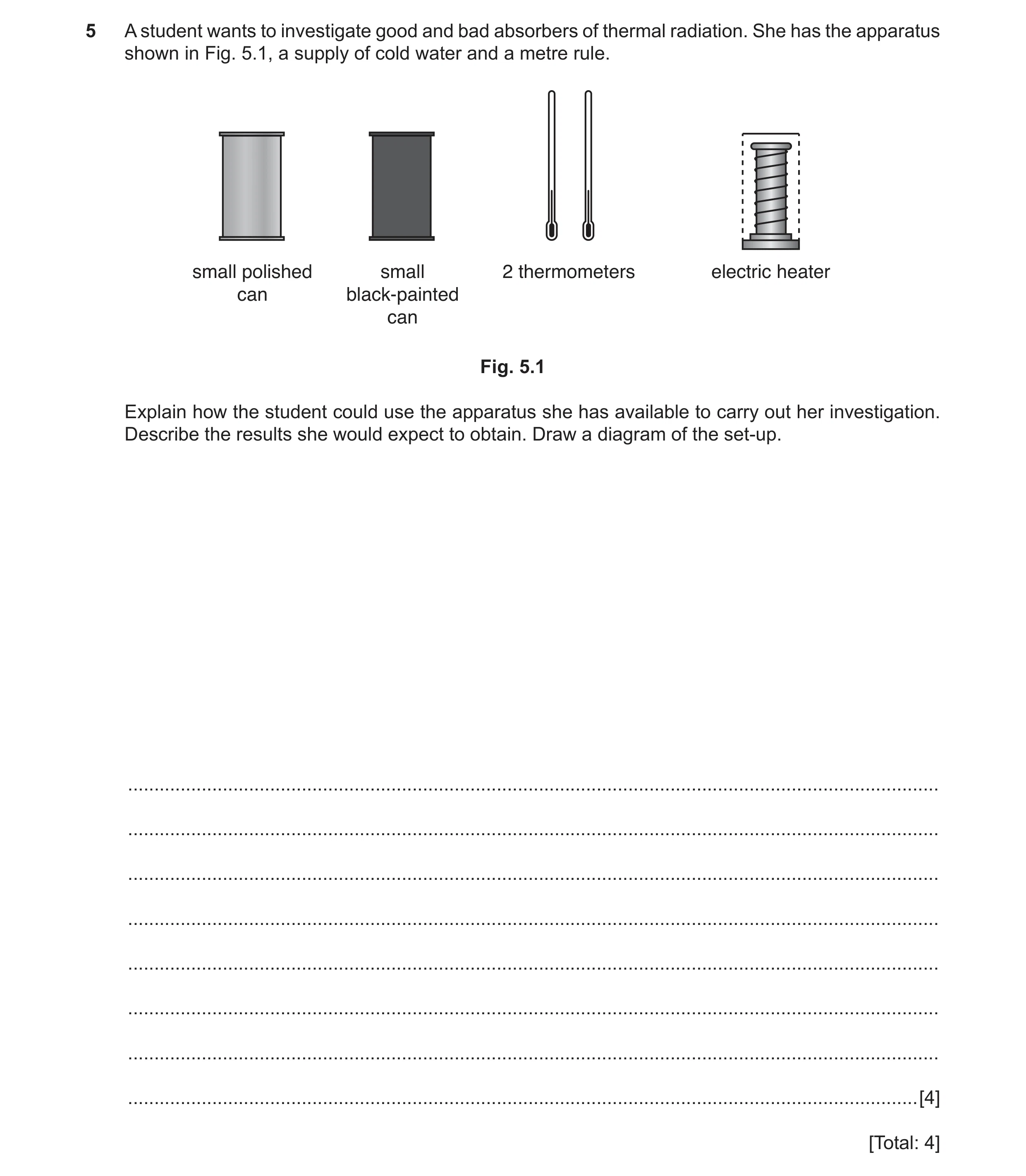
5 A student wants to investigate good and bad absorbers of thermal radiation. She has the apparatus shown in Fig. 5.1, a supply of cold water and a metre rule. small polished small 2 thermometers electric heater can black-painted can Fig. 5.1 Explain how the student could use the apparatus she has available to carry out her investigation. Describe the results she would expect to obtain. Draw a diagram of the set-up. … … … … … … … … [4] [Total: 4]
4 marks
Mark scheme: 5 diagram shows cans placed near heater 1 put thermometers in water AND observe readings 1 good detail e.g. cans equal distances from heater same water volumes/levels thermometers same positions in cans 1 higher thermometer reading in black (painted) can OR black (surface) good/best/better absorber 1
This question in 0625/42 May/June 2018
Q8 · A beaker contains some water at room temperature 0625/43 May/June 2018
4 A beaker contains some water at room temperature. A student places a mercury-in-glass thermometer in the water with the bulb of the thermometer just beneath the surface of the water. Fig. 4.1 shows the arrangement. thermometer water Fig. 4.1 The student uses an electric fan to blow air across the open top of the beaker. She notices that the reading on the thermometer begins to decrease. (a) Explain, in terms of water molecules, why the temperature of the water at the surface begins to decrease. … … … … … [3] (b) The student places the thermometer near the bottom of the beaker. The electric fan continues to blow air across the top of the beaker. After some time, the student observes that the temperature of the water at the bottom of the beaker is decreasing. State the name of the thermal transfer method causing this and explain what is happening in the water. … … … … … [3] (c) The thermometer used in this experiment has a small range and a large sensitivity. (i) State what is meant by 1. range, … … [1] 2. sensitivity. … … [1] (ii) State and explain the effect on the range of the thermometer of using a smaller bulb that contains less mercury. … … [1] [Total: 9]
9 marks
Mark scheme: 4(a) more energetic molecules escape/evaporate B1 less energetic molecules remain B1 average kinetic energy of molecules decreases OR temperature depends on kinetic energy B1 4(b) convection B1 surface/colder water more dense OR contracts B1 (cold water) sinks OR warmer water rises B1 4(c)(i)1 difference between the maximum temperature and minimum temperature it can measure B1 4(c)(i)2 distance moved by the thread per °C OR per unit temperature change B1 4(c)(ii) (range) increases and less expansion/increase in volume (of mercury per unit temperature rise) B1
This question in 0625/43 May/June 2018
Q9 · Apparatus used by a student to measure the specific heat capacity of iron 0625/42 Oct/Nov 2018
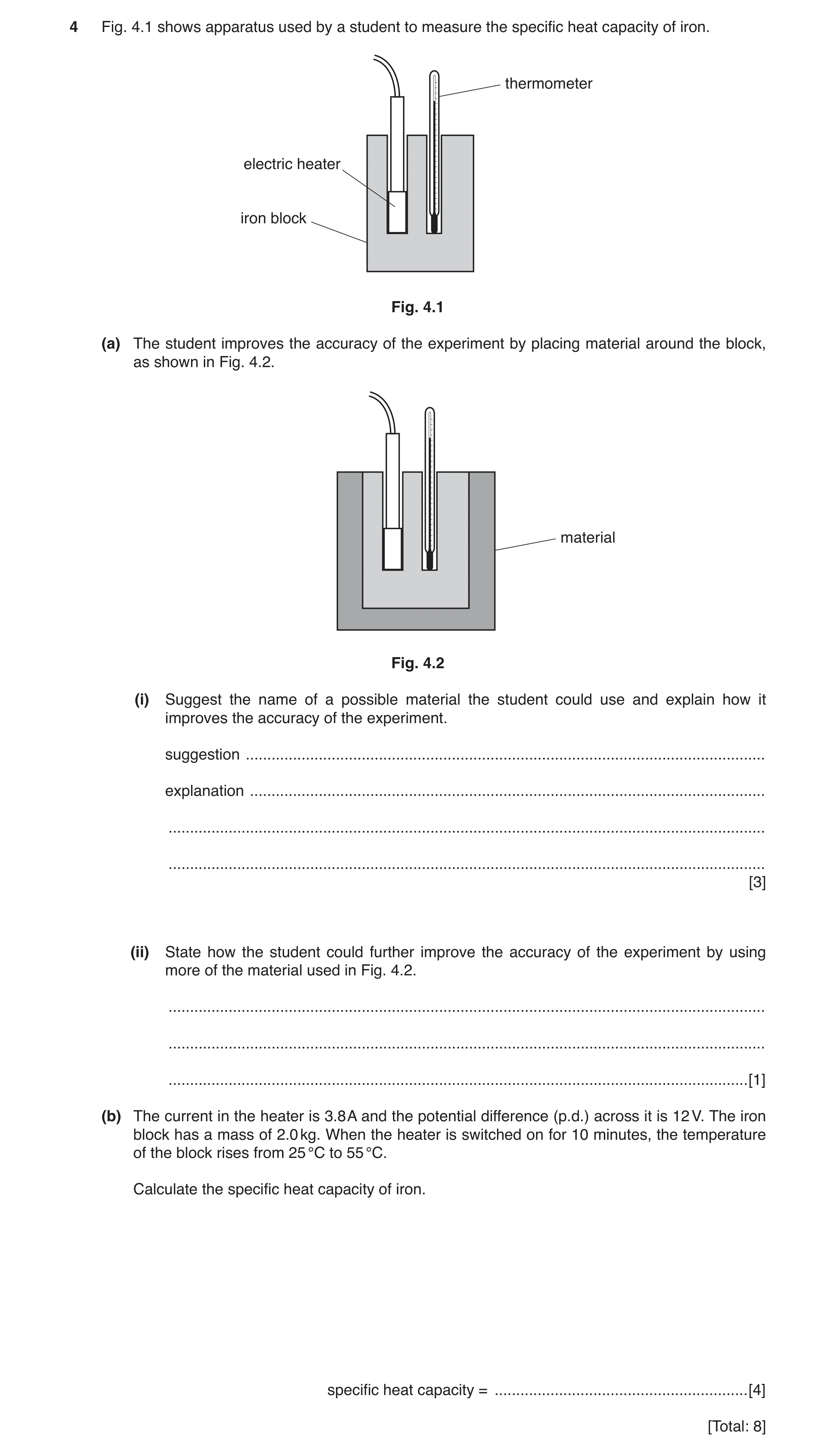
4 Fig. 4.1 shows apparatus used by a student to measure the specific heat capacity of iron. thermometer electric heater iron block Fig. 4.1 (a) The student improves the accuracy of the experiment by placing material around the block, as shown in Fig. 4.2. material Fig. 4.2 (i) Suggest the name of a possible material the student could use and explain how it improves the accuracy of the experiment. suggestion … explanation … … … [3] (ii) State how the student could further improve the accuracy of the experiment by using more of the material used in Fig. 4.2. … … … [1] (b) The current in the heater is 3.8 A and the potential difference (p.d.) across it is 12 V. The iron block has a mass of 2.0 kg. When the heater is switched on for 10 minutes, the temperature of the block rises from 25 °C to 55 °C. Calculate the specific heat capacity of iron. specific heat capacity = … [4] [Total: 8]
8 marks
Mark scheme: 4(a)(i) any feasible named insulating material B1 reduces thermal energy / heat loss or transfer to surroundings B1 more (calculated electrical) energy (transferred) into block or (it is an) insulator / poor conductor B1 4(a)(ii) insulation on top of block B1 4(b) (energy input = VIt = 12 × 3.8 × 600 =) 27 000 (J) B1 SHC = E / m∆T in any form OR E / m∆T B1 (∆T = ) 55 – 25 OR 30 (°C) B1 (SHC = 27 000 / (2 × 30)) = 450 J kg–1°C–1 OR J / (kg °C) B1
This question in 0625/42 Oct/Nov 2018
Q10 · An electrical heater is placed on the floor of a room in a house 0625/42 Feb/March 2019
6 An electrical heater is placed on the floor of a room in a house. The heater is switched on. (a) State the main process by which thermal energy is transferred to the air in all parts of the room. … [1] (b) The heater has a power of 1.5 kW. The air in the room has a mass of 65 kg. The specific heat capacity of air is 720 J / (kg °C). (i) Calculate the time it takes for this heater to raise the temperature of the air in the room from 8.0 °C to 15.0 °C. time = … [4] (ii) State two reasons why the time calculated in (b)(i) is smaller than the actual time taken to raise the temperature of the air in the room from 8.0 °C to 15.0 °C. 1 … … 2 … … [2] [Total: 7]
7 marks
Mark scheme: 6(a) Convection B1 6(b)(i) (E =) mc∆θ OR 65 × 720 × 7 C1 3.3 × 10⁵ (J) C1 P = E / t in any form OR (t=) E / P OR 3.3 × 10⁶ / 1.5 × 10³ C1 220 s A1 6(b)(ii) Two of: The heater warms walls, floor, ceiling, windows, furniture / objects. Thermal energy conducted through walls, floor, ceiling, windows (to exterior) Thermal energy used to raise temperature of air entering room via draughts / openings B2
This question in 0625/42 Feb/March 2019
Q11 · A cross‑section of the inside of a vacuum flask containing a cold liquid 0625/43 May/June 2019
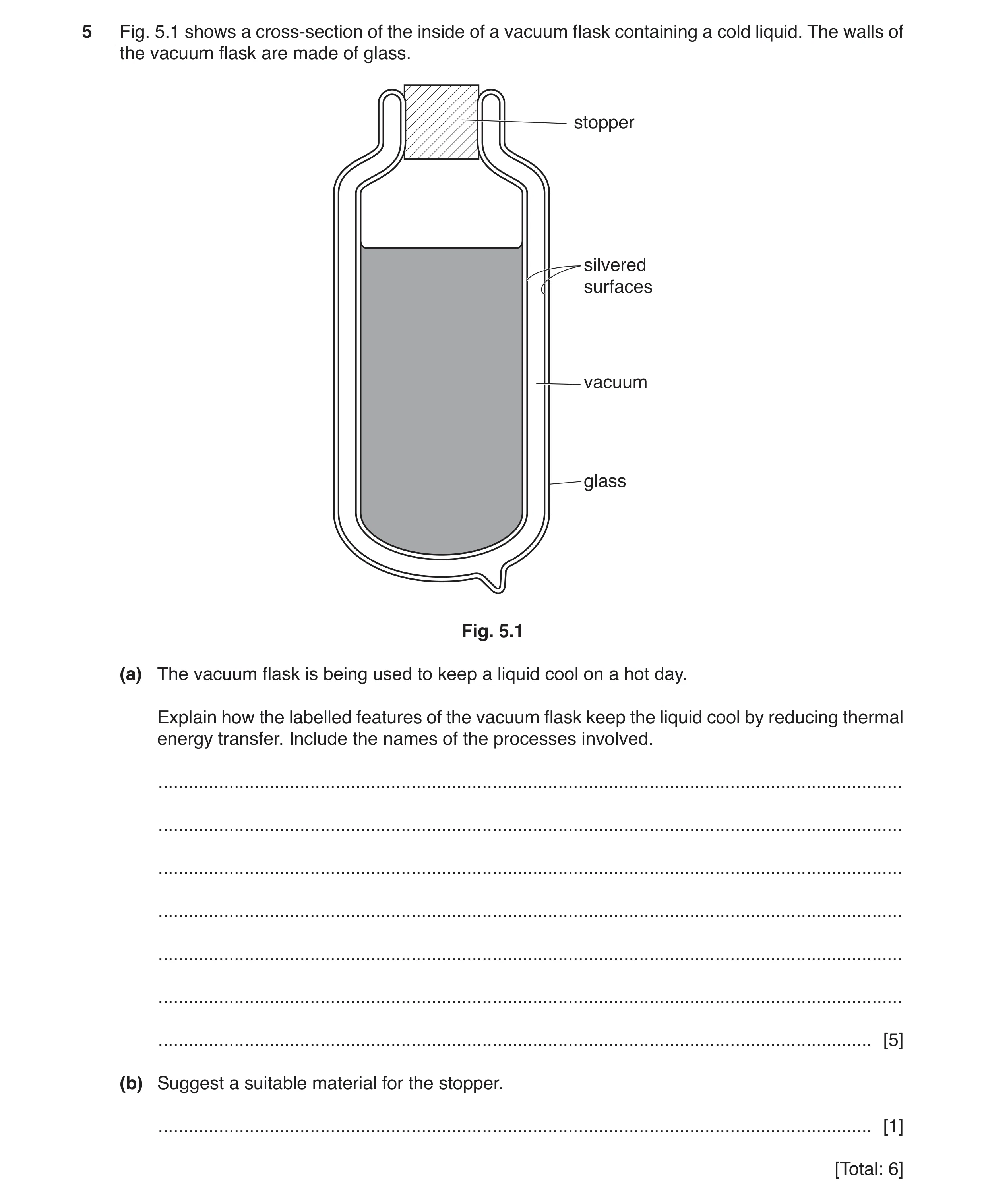
5 Fig. 5.1 shows a cross‑section of the inside of a vacuum flask containing a cold liquid. The walls of the vacuum flask are made of glass. stopper silvered surfaces vacuum glass Fig. 5.1 (a) The vacuum flask is being used to keep a liquid cool on a hot day. Explain how the labelled features of the vacuum flask keep the liquid cool by reducing thermal energy transfer. Include the names of the processes involved. … … … … … … … [5] (b) Suggest a suitable material for the stopper. … [1] [Total: 6]
6 marks
Mark scheme: 5(a) any mention of radiation/infra-red radiation wrt silvered surfaces B1 silvered surfaces are poor emitters / poor absorbers / (good) reflectors B1 glass is a poor conductor OR glass reduces thermal energy / heat gain by conduction B1 vacuum prevents thermal energy / heat gain by conduction OR convection B1 stopper reduces thermal energy / heat gain by convection B1 5(b) any suitable insulator e.g. cork, plastic, rubber B1
This question in 0625/43 May/June 2019
Q12 · Complete the sentences with words that describe the main process of thermal energy… 0625/42 Feb/March 2020
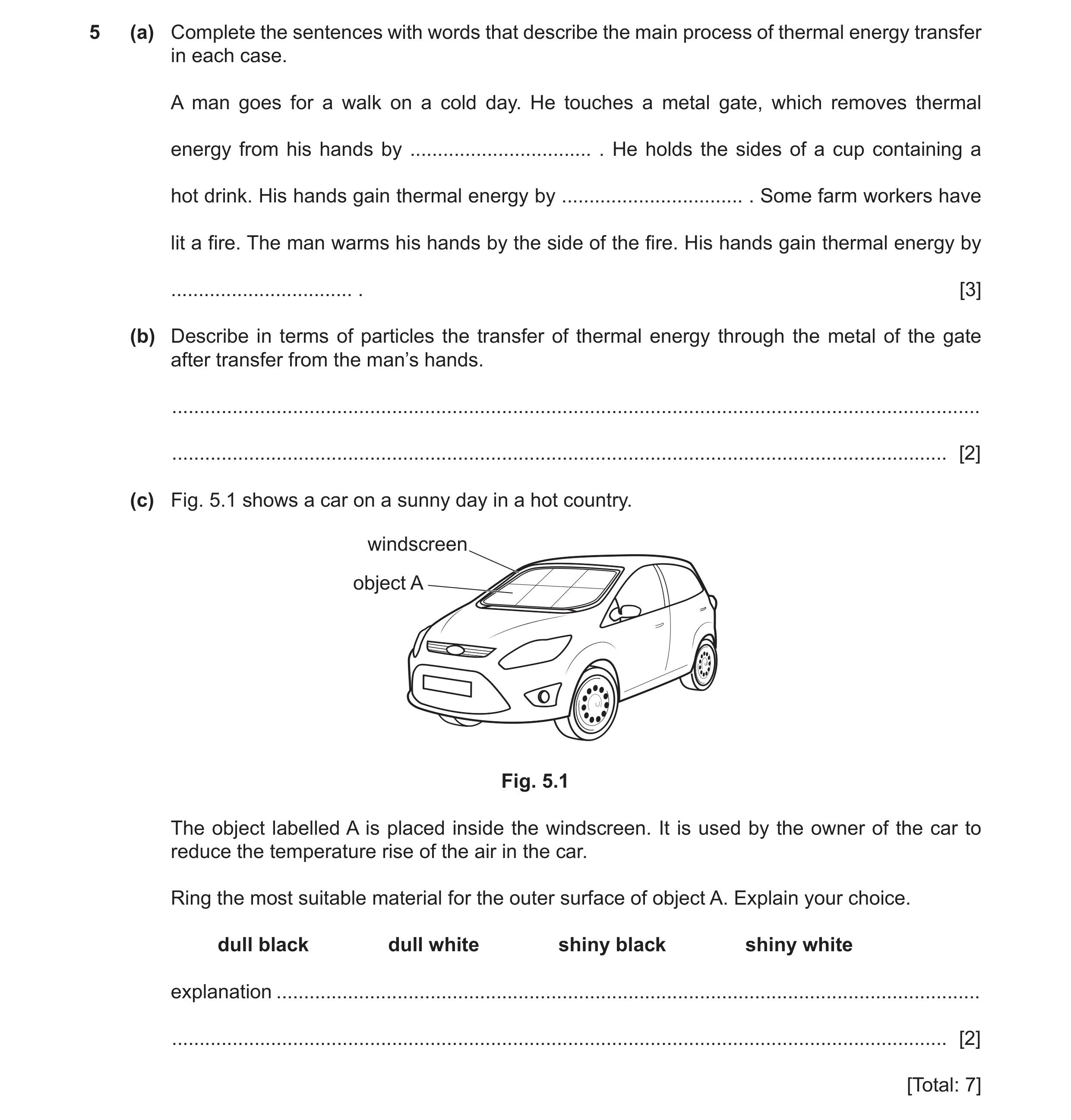
5 (a) Complete the sentences with words that describe the main process of thermal energy transfer in each case. A man goes for a walk on a cold day. He touches a metal gate, which removes thermal energy from his hands by … . He holds the sides of a cup containing a hot drink. His hands gain thermal energy by … . Some farm workers have lit a fire. The man warms his hands by the side of the fire. His hands gain thermal energy by … . [3] (b) Describe in terms of particles the transfer of thermal energy through the metal of the gate after transfer from the man’s hands. … … [2] (c) Fig. 5.1 shows a car on a sunny day in a hot country. windscreen object A Fig. 5.1 The object labelled A is placed inside the windscreen. It is used by the owner of the car to reduce the temperature rise of the air in the car. Ring the most suitable material for the outer surface of object A. Explain your choice. dull black dull white shiny black shiny white explanation … … [2] [Total: 7]
7 marks
Mark scheme: 5(a) conduction B1 conduction B1 radiation B1 5(b) electrons move B1 lattice / molecular / particle vibration or w.t.t.e. OR free / delocalised electrons B1 5(c) shiny white M1 best reflector A1
This question in 0625/42 Feb/March 2020
Q13 · A metal container is used to cook food 0625/41 Oct/Nov 2020
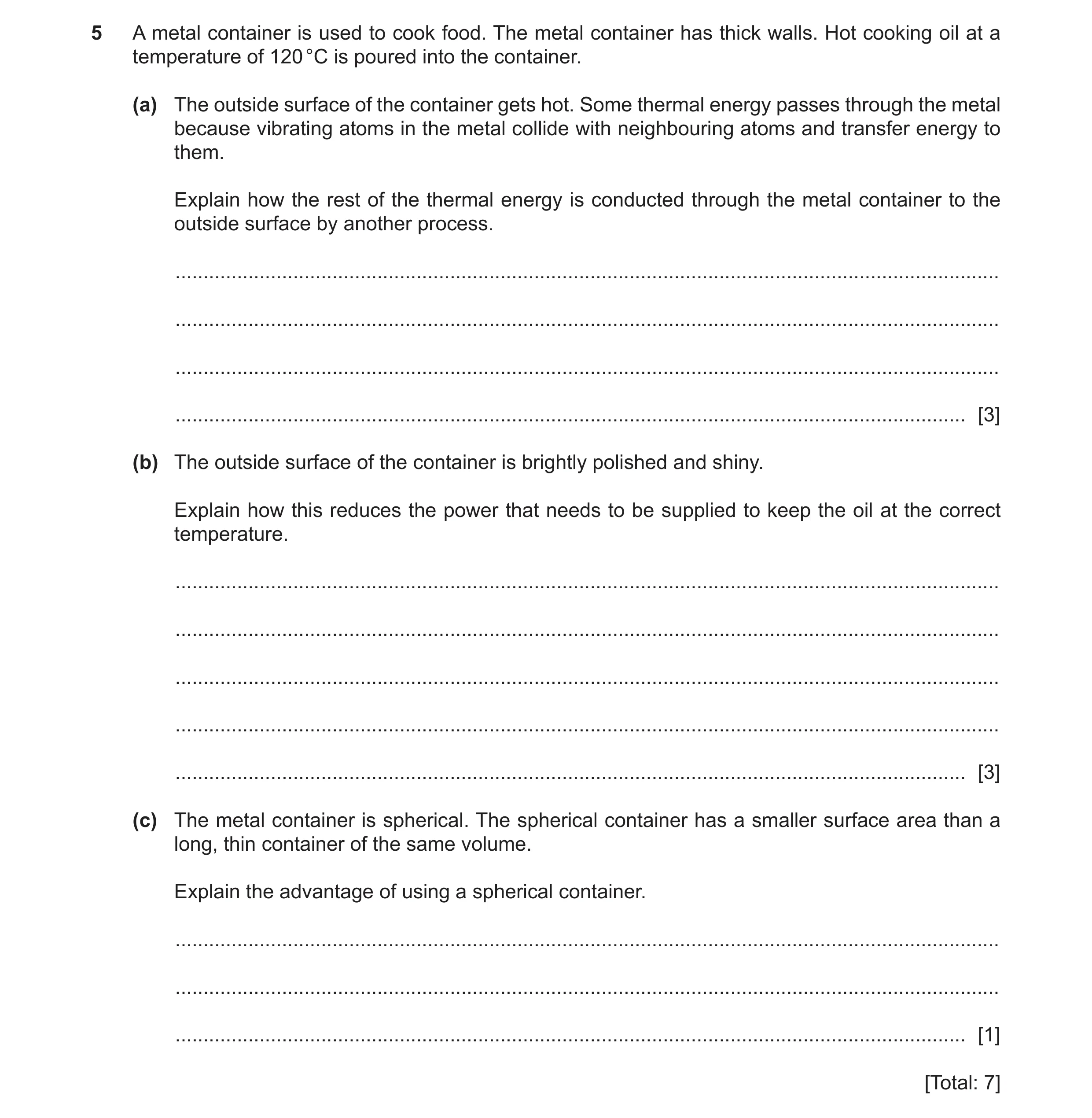
5 A metal container is used to cook food. The metal container has thick walls. Hot cooking oil at a temperature of 120 °C is poured into the container. (a) The outside surface of the container gets hot. Some thermal energy passes through the metal because vibrating atoms in the metal collide with neighbouring atoms and transfer energy to them. Explain how the rest of the thermal energy is conducted through the metal container to the outside surface by another process. … … … … [3] (b) The outside surface of the container is brightly polished and shiny. Explain how this reduces the power that needs to be supplied to keep the oil at the correct temperature. … … … … … [3] (c) The metal container is spherical. The spherical container has a smaller surface area than a long, thin container of the same volume. Explain the advantage of using a spherical container. … … … [1] [Total: 7]
7 marks
Mark scheme: 5(a) electrons mentioned B1 electrons travel (a great distance) through the metal or (vibrating) atoms hit (free) electrons B1 electrons hit (distant) particles or transfer energy (to distant atoms) B1 5(b) shiny surfaces are poor emitters (of radiation) B1 infrared / radiation / mentioned B1 less energy lost or lost energy does not need to be supplied B1 5(c) less thermal energy emitted or less space for energy to be lost B1
This question in 0625/41 Oct/Nov 2020
Q14 · Two metal plates A and B with a radiant heater placed midway between them 0625/43 Oct/Nov 2020
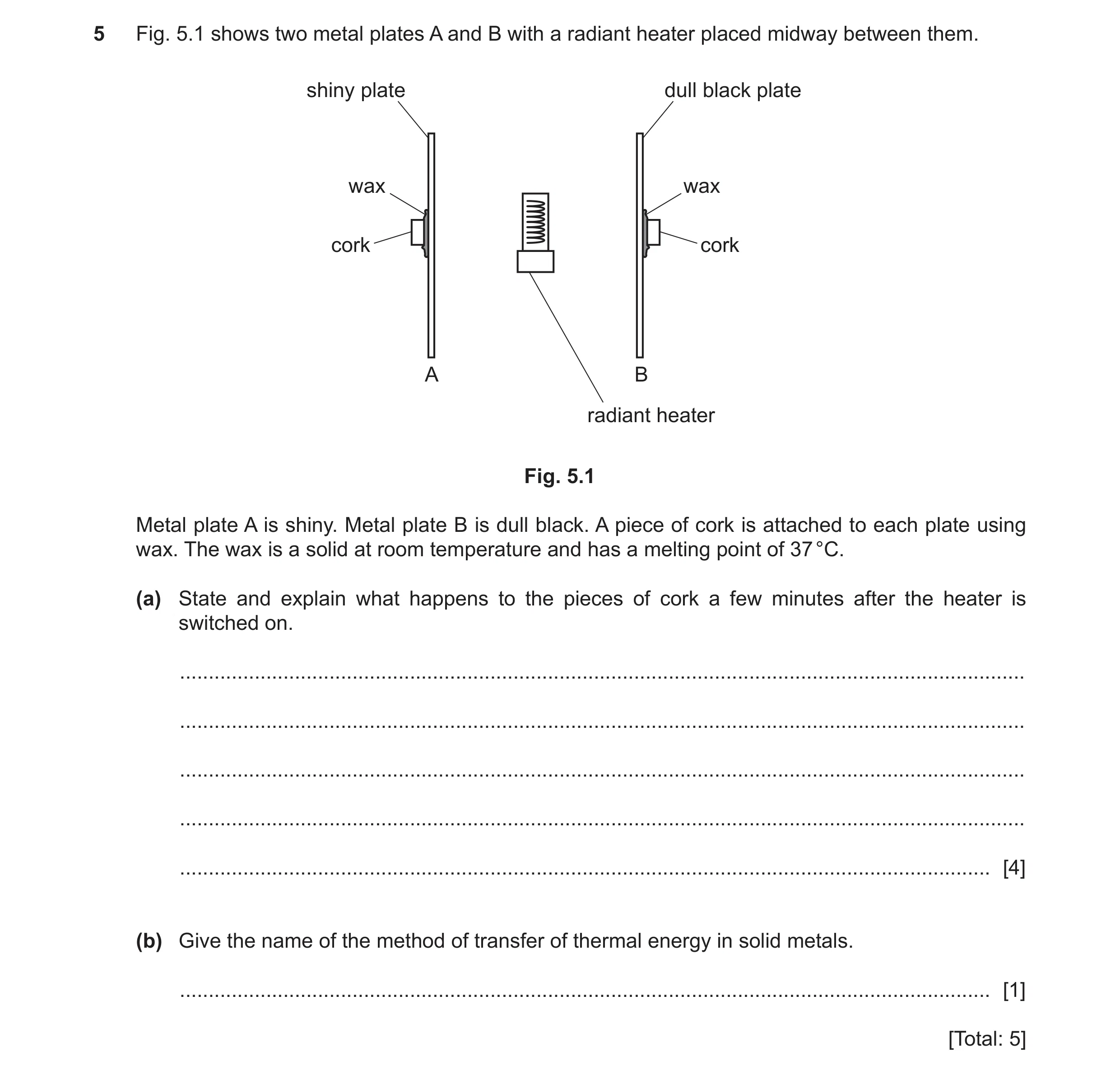
5 Fig. 5.1 shows two metal plates A and B with a radiant heater placed midway between them. shiny plate dull black plate wax wax cork cork A B radiant heater Fig. 5.1 Metal plate A is shiny. Metal plate B is dull black. A piece of cork is attached to each plate using wax. The wax is a solid at room temperature and has a melting point of 37 °C. (a) State and explain what happens to the pieces of cork a few minutes after the heater is switched on. … … … … … [4] (b) Give the name of the method of transfer of thermal energy in solid metals. … [1] [Total: 5]
5 marks
Mark scheme: 5(a) cork on black plate / side B falls off (before cork on shiny plate / side A) B1 black surface are better absorbers than shiny surfaces or shiny surfaces are better reflectors than black surfaces B1 black surface are better absorbers than shiny surfaces or shiny surfaces are better reflectors than black surfaces AND of (infrared) radiation B1 wax on black plate / plate B melts before wax on shiny plate / plate A B1 5(b) conduction B1
This question in 0625/43 Oct/Nov 2020
Q15 · An aluminium saucepan with a plastic handle contains cold water 0625/41 May/June 2021
4 An aluminium saucepan with a plastic handle contains cold water. Fig. 4.1 shows the saucepan on a hotplate. aluminium saucepan plastic handle water hotplate Fig. 4.1 (a) State why the pan is made from aluminium but the handle is made from plastic. … … [1] (b) The hotplate is switched on and, as the temperature of the water increases, the internal energy of the water increases. (i) State, in terms of molecules, what is meant by an increase in internal energy. … … [1] (ii) Explain, in terms of the atomic lattice and electrons, how thermal energy is transferred through the aluminium. … … … … [3] (iii) Eventually, the water reaches boiling point. Thermal energy from the hotplate is still being transferred to the water. Explain, in terms of molecules, the effect of this thermal energy on the water. … … … … [3] (iv) The mass of the water decreases by 0.11 kg in 300 s. The specific latent heat of vaporisation of water is 2.3 × 10⁶ J / kg. Calculate the rate at which the water gains thermal energy. rate of gain of energy = … [3] [Total: 11]
11 marks
Mark scheme: 4(a) aluminium is a (good) conductor (of heat) and plastic is a poor conductor / does not conduct (heat) B1 4(b)(i) increase in kinetic energy of molecules or increase in potential energy of molecules B1 4(b)(ii) any three from: • atoms (touching the hotplate) / lattice vibrate (faster) • atoms pass on energy / vibration to neighbouring atoms / to other atoms by collision • atoms pass on energy to electrons • electrons hit distant atoms or electrons move (through lattice) B3 4(b)(iii) molecules escape from the liquid (as a vapour) B1 bonds broken / (attractive) forces overcome B1 molecules gain potential energy or work done (to separate molecules / break bonds / overcome forces) B1 4(b)(iv) 840 W A3 (E =) mlv in any form or 0.11 × 2.3 × 106 or 2.53 × 10⁵ C1 (rate =) mlv / t in any form or 0.11 × 2.3 × 106 / 300 or 2.53 × 10⁵ / 300 C1
This question in 0625/41 May/June 2021
Q16 · A machine delivers a hot drink in a plastic cup, which is uncomfortably hot to hold 0625/42 May/June 2021
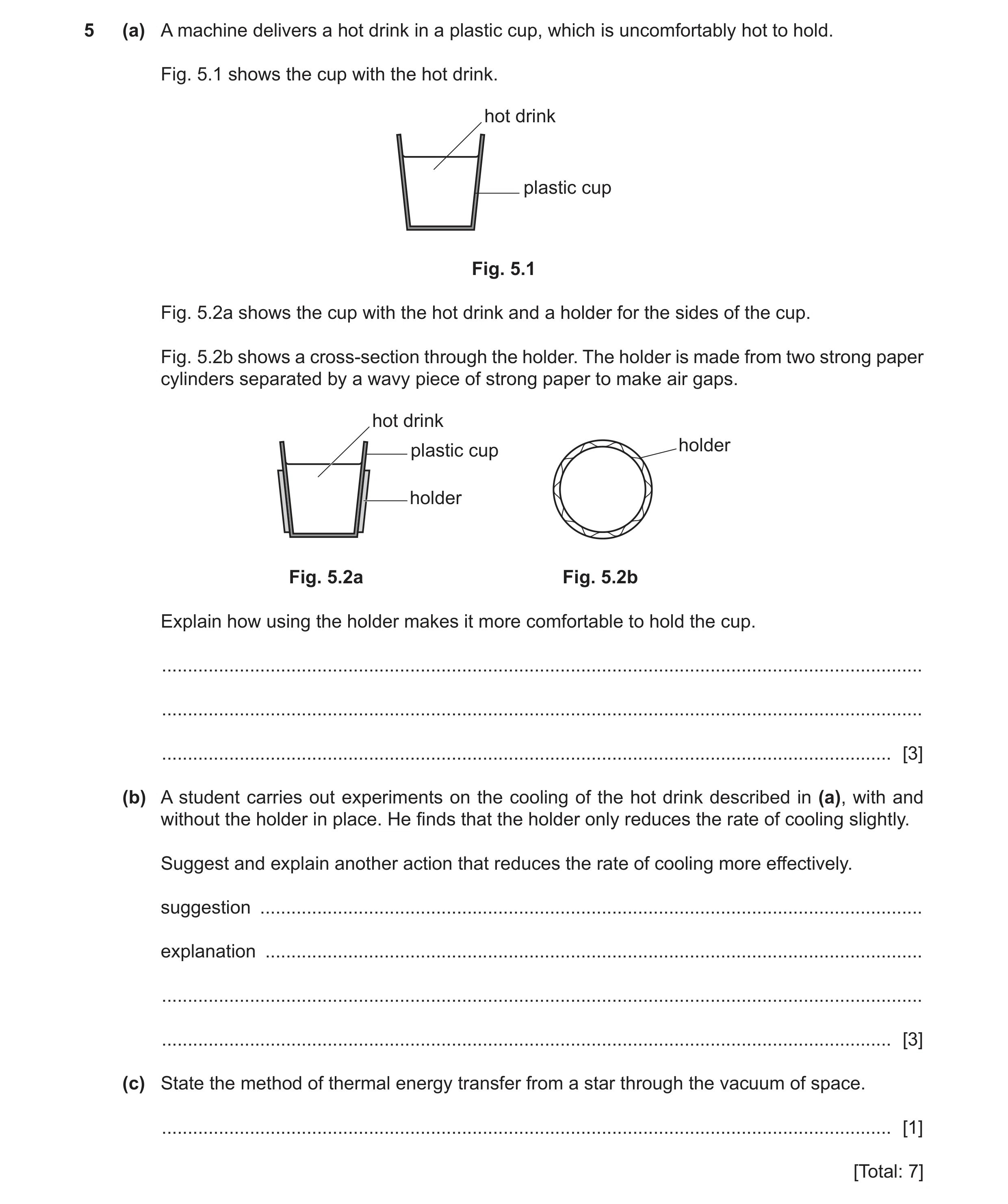
5 (a) A machine delivers a hot drink in a plastic cup, which is uncomfortably hot to hold. Fig. 5.1 shows the cup with the hot drink. hot drink plastic cup Fig. 5.1 Fig. 5.2a shows the cup with the hot drink and a holder for the sides of the cup. Fig. 5.2b shows a cross-section through the holder. The holder is made from two strong paper cylinders separated by a wavy piece of strong paper to make air gaps. hot drink holder plastic cup holder Fig. 5.2a Fig. 5.2b Explain how using the holder makes it more comfortable to hold the cup. … … … [3] (b) A student carries out experiments on the cooling of the hot drink described in (a), with and without the holder in place. He finds that the holder only reduces the rate of cooling slightly. Suggest and explain another action that reduces the rate of cooling more effectively. suggestion … explanation … … … [3] (c) State the method of thermal energy transfer from a star through the vacuum of space. … [1] [Total: 7]
7 marks
Mark scheme: 5(a) air good insulator / poor conductor B1 holder / it stops / reduces conduction OR no / less thermal energy conducted (to hand) B1 temperature (of outside of holder) lower (than cup) OR less energy to skin / hand / person B1 5(b) (put a) lid / cover (on cup) B1 mention of convection B1 less / no convection (from surface) B1 alternative route for last 2 m.p.s mention of evaporation (B1) less / no evaporation (from surface / container) (B1) 5(c) radiation B1
This question in 0625/42 May/June 2021
Q17 · An aluminium saucepan and a steel saucepan have the same dimensions 0625/43 Oct/Nov 2021
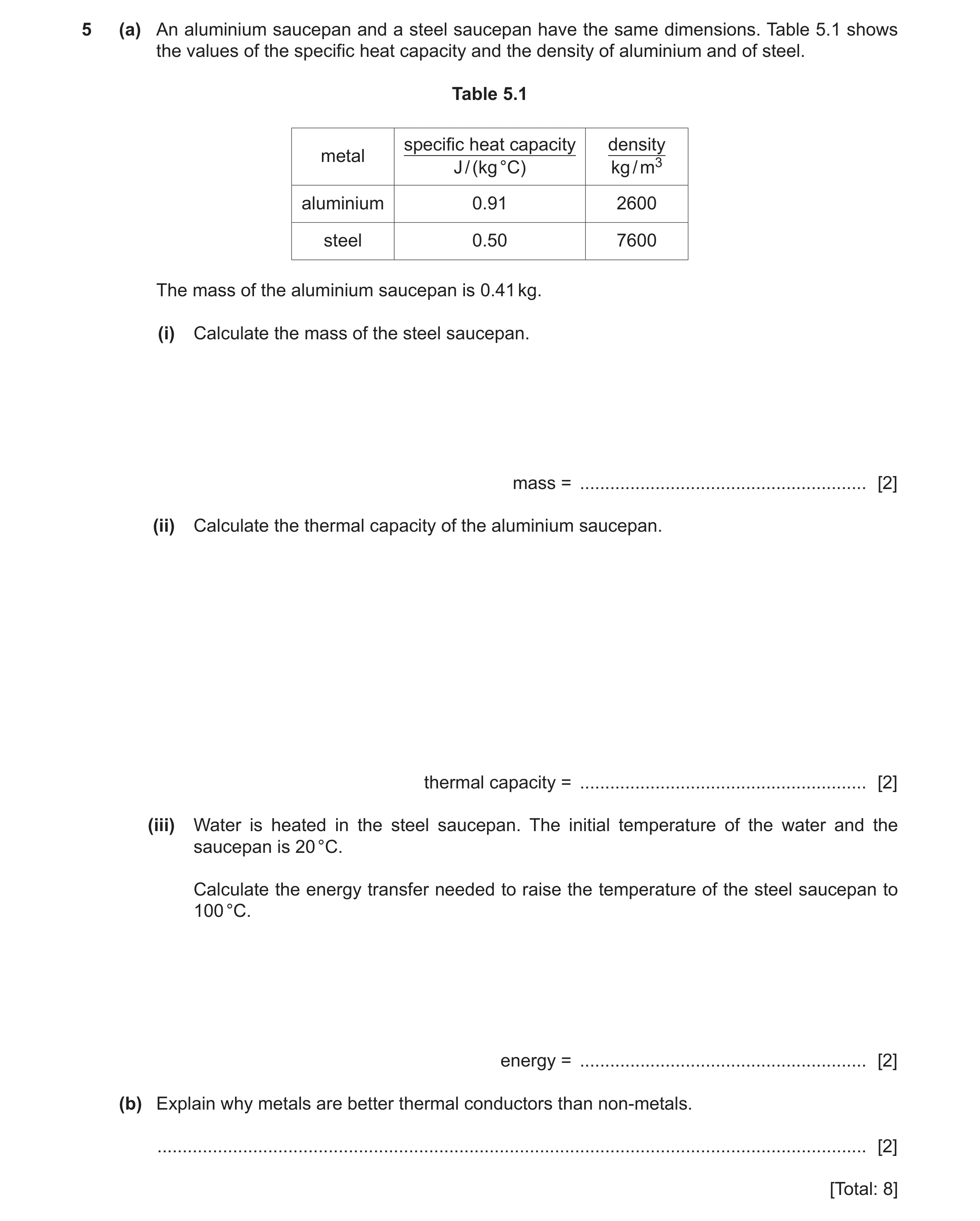
5 (a) An aluminium saucepan and a steel saucepan have the same dimensions. Table 5.1 shows the values of the specific heat capacity and the density of aluminium and of steel. Table 5.1 specific heat capacity density metal J / (kg °C) kg / m3 aluminium 0.91 2600 steel 0.50 7600 The mass of the aluminium saucepan is 0.41 kg. (i) Calculate the mass of the steel saucepan. mass = … [2] (ii) Calculate the thermal capacity of the aluminium saucepan. thermal capacity = … [2] (iii) Water is heated in the steel saucepan. The initial temperature of the water and the saucepan is 20 °C. Calculate the energy transfer needed to raise the temperature of the steel saucepan to 100 °C. energy = … [2] (b) Explain why metals are better thermal conductors than non-metals. … [2] [Total: 8]
8 marks
Mark scheme: 5(a)(i) 1.2 kg A2 ( ) 7600 0.41 2600 m × = volume constant so mass directly proportional to density C1 5(a)(ii) 0.37 J / °C A2 (thermal capacity =) mass × specific heat capacity C1 5(a)(iii) 48 J A2 (E =) mcΔT OR 1.2 × 0.50 × (100 – 20) in any form C1 5(b) electrons mentioned B1 (metals have) electrons free to move / delocalised (which transfer thermal energy) B1
This question in 0625/43 Oct/Nov 2021
Q18 · During a picnic on a warm, dry day, a metal can of lemonade is wrapped in a damp cloth 0625/41 May/June 2022
3 During a picnic on a warm, dry day, a metal can of lemonade is wrapped in a damp cloth. Evaporation cools the water in the cloth. (a) Explain, in terms of molecules, how evaporation cools the water in the cloth. … … … … [3] (b) As the water in the cloth cools, so does the lemonade. Explain how electrons transfer thermal energy through the metal of the can. … … … … [3] [Total: 6]
6 marks
Mark scheme: 3(a) fast(er) / high(er) speed / (more) energetic molecules escape (into air) B1 average speed / average kinetic energy of molecules decreases B1 temperature related to speed / energy of molecules or slow(er) / low(er) speed / less energetic molecules remain (in water) B1 3(b) any three from: atoms / ions vibrate (vibrating) atoms / ions hit electrons electrons propelled / travelling through metal / moving through metal electrons hit (distant) atoms free electrons / delocalised electrons mentioned B3
This question in 0625/41 May/June 2022
Q19 · A road next to the sea 0625/41 May/June 2022
6 Fig. 6.1 shows a road next to the sea. Fig. 6.1 (a) On a sunny day, the Sun warms the road. Describe how energy from the Sun reaches the Earth and warms the road. … … … … [3] (b) The temperature of the road is greater than the temperature of the sea. The surface of the road is black. Suggest one reason why the temperature of the road is greater than that of the sea. … … [1] (c) The air above the road is heated by the warm road. (i) Describe how this affects the molecules of the air. … … … [2] (ii) A cyclist travelling along the road notices that a cool breeze is blowing from the sea to the land. Explain how convection produces this breeze. You may include a diagram if it helps your answer. … … … … [3] [Total: 9]
9 marks
Mark scheme: 6(a) any three from: radiation light / infrared / electromagnetic (radiation) travel through space / vacuum absorbed by road B3 6(b) road / black surfaces are good absorbers (of radiation) or sea is a poor absorber (of radiation) B1 6(c)(i) they / molecules speed up or gain kinetic energy B1 they / molecules move further apart B1 6(c)(ii) density (of air above road) decreases or density (of hot air) decreases B1 air (above land / road) rises or air (that is hot) rises B1 air (above road) replaced by cool air / air from above sea B1
This question in 0625/41 May/June 2022
Q20 · A heater in a bathroom 0625/41 Oct/Nov 2022
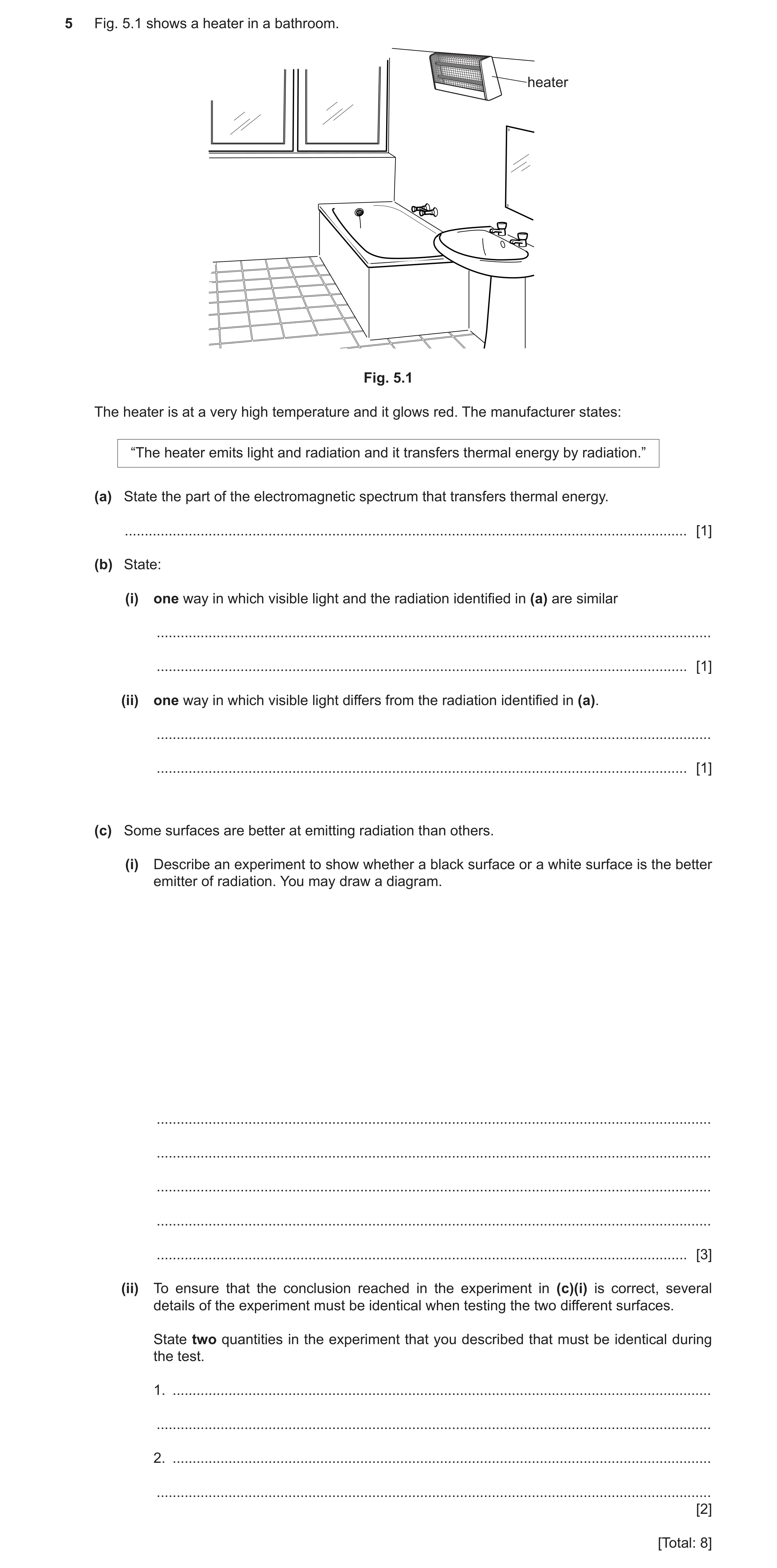
5 Fig. 5.1 shows a heater in a bathroom. heater Fig. 5.1 The heater is at a very high temperature and it glows red. The manufacturer states: “The heater emits light and radiation and it transfers thermal energy by radiation.” (a) State the part of the electromagnetic spectrum that transfers thermal energy. … [1] (b) State: (i) one way in which visible light and the radiation identified in (a) are similar … … [1] (ii) one way in which visible light differs from the radiation identified in (a). … … [1] (c) Some surfaces are better at emitting radiation than others. (i) Describe an experiment to show whether a black surface or a white surface is the better emitter of radiation. You may draw a diagram. … … … … … [3] (ii) To ensure that the conclusion reached in the experiment in (c)(i) is correct, several details of the experiment must be identical when testing the two different surfaces. State two quantities in the experiment that you described that must be identical during the test. 1. … … 2. … … [2] [Total: 8]
8 marks
Mark scheme: 5(a) infrared B1 5(b)(i) (both) transverse / electromagnetic / travel in a vacuum / have the same (high) speed (in a vacuum) B1 5(b)(ii) (it / visible light) compared with an e.m. radiation stated by candidate in 5(a) in terms of frequency / wavelength B1 5(c)(i) B3 equipment B1 e.g. black container, white container, thermometers or Leslie’s cube and detector measurements made B1 warm / hot water in container and temperature decreases recorded or time to reach a given temperature / to cool or warm / hot water in cube and meter readings recorded how a conclusion is reached B1 better emitter surface cools quicker or greater reading from better emitter surface 5(c)(ii) any two appropriate quantities B2 e.g. initial temperature of water mass / volume of water dimensions / surface area of container time of cooling mass of container shape of container smoothness of surface or surface area of face (of cube) distance of detector temperature of water at time of measurement smoothness of surface
This question in 0625/41 Oct/Nov 2022
Q21 · A metal pan on an electric hotplate 0625/42 Feb/March 2023
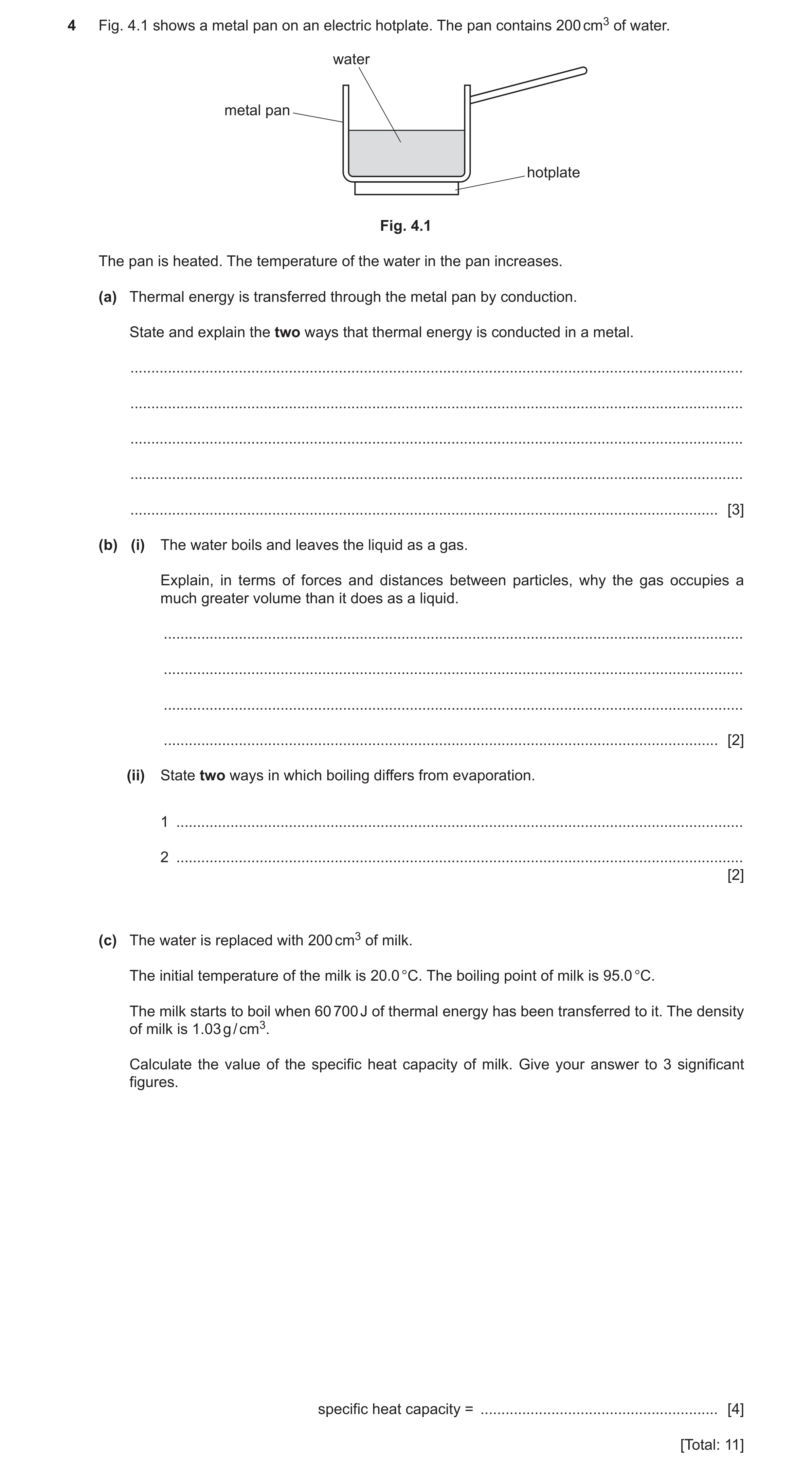
4 Fig. 4.1 shows a metal pan on an electric hotplate. The pan contains 200 cm3 of water. water metal pan hotplate Fig. 4.1 The pan is heated. The temperature of the water in the pan increases. (a) Thermal energy is transferred through the metal pan by conduction. State and explain the two ways that thermal energy is conducted in a metal. … … … … … [3] (b) (i) The water boils and leaves the liquid as a gas. Explain, in terms of forces and distances between particles, why the gas occupies a much greater volume than it does as a liquid. … … … … [2] (ii) State two ways in which boiling differs from evaporation. 1 … 2 … [2] (c) The water is replaced with 200 cm3 of milk. The initial temperature of the milk is 20.0 °C. The boiling point of milk is 95.0 °C. The milk starts to boil when 60 700 J of thermal energy has been transferred to it. The density of milk is 1.03 g / cm3. Calculate the value of the specific heat capacity of milk. Give your answer to 3 significant figures. specific heat capacity = … [4] [Total: 11]
11 marks
Mark scheme: 4(a) delocalised / free / mobile electrons B1 electrons move through metal OR electrons collide with distant particles OR electrons carry energy through the metal B1 lattice vibrations transfer energy to neighbouring particles OR particles vibrate and cause nearby / adjacent particles to B1 vibrate OR vibrating particles collide with particles transferring energy 4(b)(i) (attractive) forces (between particles are much) greater in liquids (than in gases) B1 particles in gases are (much) further apart (than in liquids) B1 4(b)(ii) occurs at a fixed temperature B1 takes place throughout the liquid B1 4(c) 3.93 J / (g °C) OR 3930 J / (kg °C) A4 = m / V OR (m =) V OR 1.03 200 OR 206 SEEN (C1) c = E / m∆OR (c = ) E / m∆OR 60 700 / (206 75) OR 60700 / (1.03 200 75) (C1) (m =) 206 (g) OR (∆) = 75 (°C) (C1)
This question in 0625/42 Feb/March 2023
Q22 · A rubber balloon is inflated with helium and sealed so that no helium escapes 0625/41 May/June 2023
3 A rubber balloon is inflated with helium and sealed so that no helium escapes. The balloon is positioned immediately below the ceiling in a room. Heaters are switched on and the temperature of the air in the room increases. (a) When the heaters are first switched on, the temperature of the air immediately below the ceiling increases more quickly than the temperature of the air in the rest of the room. Explain why this happens. … … … [2] (b) The temperature of the helium in the balloon increases and as the rubber stretches, the volume occupied by the helium increases. (i) State what happens to the motion of the helium particles as the temperature increases. … … [1] (ii) As the rubber stretches and the volume of the helium increases, the pressure of the helium remains constant. Explain, in terms of the particles of helium, how the pressure of the helium remains constant. … … … … [3] [Total: 6]
6 marks
Mark scheme: 3(a) heated / hot(ter) / warm(er) air is less dense OR cool(er) air is more dense B1 heated / hot(ter) / warm(er) air rises (to ceiling displacing cooler air) OR cool(er) air falls (displaced by warm(er) air) B1 3(b)(i) speed / velocity (of particles) increases OR (they) move faster B1 3(b)(ii) (higher temperature means) particles collide (with rubber) harder / with more force / with greater momentum (change) B1 (larger volume means) particles collide (with rubber) less frequently OR (larger volume means) larger (surface) area (for particle collisions) B1 effect of larger volume cancels effect of increased temperature / owtte OR the effect of larger area cancels the effect of larger force / owtte OR P = F / A so the two changes cancel each other / owtte B1
This question in 0625/41 May/June 2023
Q23 · An electric heater used to heat a room 0625/42 May/June 2023
5 (a) Fig. 5.1 shows an electric heater used to heat a room. Fig. 5.1 The dimensions of the room are 4.5 m × 6.1 m × 2.4 m. The density of air is 1.2 kg / m3. (i) Show that the mass of air in the room is 79 kg. [2] (ii) The power of the heater is 1100 W. The specific heat capacity of air is 1000 J / (kg °C). Calculate the time taken to increase the temperature of the air in the room from 16.0 °C to 20.0 °C. time = … [4] (iii) Suggest one reason why the time calculated in (a)(ii) is the minimum time needed to increase the temperature of the air in the room from 16.0 °C to 20.0 °C. … … [1] (b) Fig. 5.2 shows a cross-section of a double-glazed window in the room. outer glass pane narrow air gap inner glass pane Fig. 5.2 State the main methods of thermal energy transfer from the room to outside which are reduced by this type of window. … [1] [Total: 8]
8 marks
Mark scheme: 5(a)(i) B1 (m =) 1.2 4.5 6.1 2.4 (= 79 kg) OR (m =) 79.056 (kg) B1 5(a)(ii) 290 s A4 c = (∆)E / m∆ OR (∆E =) mc∆ OR (∆E =) 79 1000 4(.0) OR (∆E =) 316 000 OR (∆ =) 4(.0) C1 P = (∆)E / t OR (∆E =) Pt OR (∆E =) 1100 t C1 (t =) mc∆ / P OR (t =) 79 1000 4(.0) / 1100 OR (t =) 316 000 / 1100 C1 5(a)(iii) any one from: (thermal) energy is transferred to furniture / walls / objects (in the room) (thermal) energy is transferred through windows / doors / floor / ceiling / from the room B1 5(b) conduction AND convection B1
This question in 0625/42 May/June 2023
Q24 · A copper cooking pan contains water 0625/41 Oct/Nov 2023
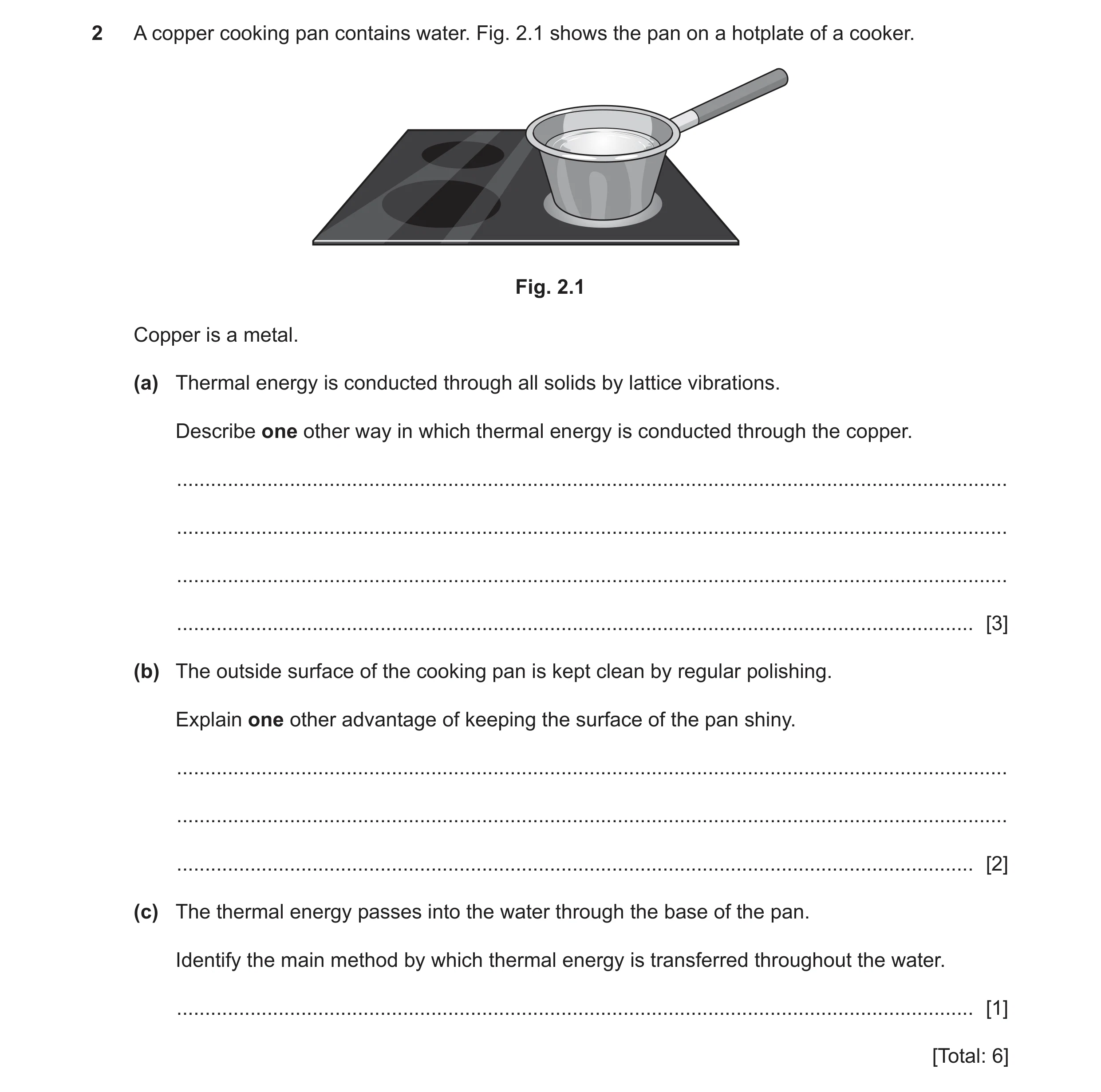
2 A copper cooking pan contains water. Fig. 2.1 shows the pan on a hotplate of a cooker. Fig. 2.1 Copper is a metal. (a) Thermal energy is conducted through all solids by lattice vibrations. Describe one other way in which thermal energy is conducted through the copper. … … … … [3] (b) The outside surface of the cooking pan is kept clean by regular polishing. Explain one other advantage of keeping the surface of the pan shiny. … … … [2] (c) The thermal energy passes into the water through the base of the pan. Identify the main method by which thermal energy is transferred throughout the water. … [1] [Total: 6]
6 marks
Mark scheme: 2(a) any three from: B3 • free / delocalised / mobile electrons • (electrons) gain (thermal) energy from hotplate / particles • (electrons) move through(out) copper / metal OR (electrons) move to distant particles • electrons transfer energy from higher temperature (region) to lower temperature (region) OR (electrons) collide with (distant) particles / transfer energy to (distant) particles 2(b) (shiny surfaces are) poor emitters of radiation B1 reduces energy loss (from the pan / copper) OR less energy transferred to surroundings B1 2(c) convection B1
This question in 0625/41 Oct/Nov 2023
Q25 · A small block of ice floating in a beaker of warm water 0625/41 May/June 2024
3 Fig. 3.1 shows a small block of ice floating in a beaker of warm water. block of ice warm water Fig. 3.1 (a) State one way in which the motion of the particles in ice differs from the motion of the particles in water. … … [1] (b) Energy is transferred from the water to the block of ice. (i) State the name of the thermal process that transfers energy from the water to the ice. … [1] (ii) Initially, there is 0.34 kg of water in the beaker. The specific heat capacity of water is 4200 J / (kg °C). Calculate the energy transferred from this water as its temperature decreases from 28 °C to 10 °C. energy transferred = … [2] (iii) The temperature of the water near the ice decreases first. Explain how convection causes the temperature of all the water in the beaker to decrease. … … … … [3] (iv) State what happens to the internal energy of the water as the temperature of the water decreases. Describe the change in terms of the energy of the particles. … … … [2] [Total: 9]
9 marks
Mark scheme: 3(a) (they / particles in ice) vibrate (about a fixed position) OR particles in water move throughout the liquid B1 3(b)(i) conduction B1 3(b)(ii) 2.6 104 J A2 c = (E / m OR (E =) mcOR 0.34 4200 18 OR 2.6 10N (J) C1 3(b)(iii) density (of water next to the ice) increases B1 cold(er) water sinks B1 warm(er) water replaces cold water OR warm(er) water rises OR making a convection current B1 Question Answer Marks 3(b)(iv) internal energy decreases AND (average) kinetic energy (of particles) decreases A2 kinetic energy decreases C1
This question in 0625/41 May/June 2024
Q26 · State two ways that evaporation differs from boiling 0625/42 May/June 2024
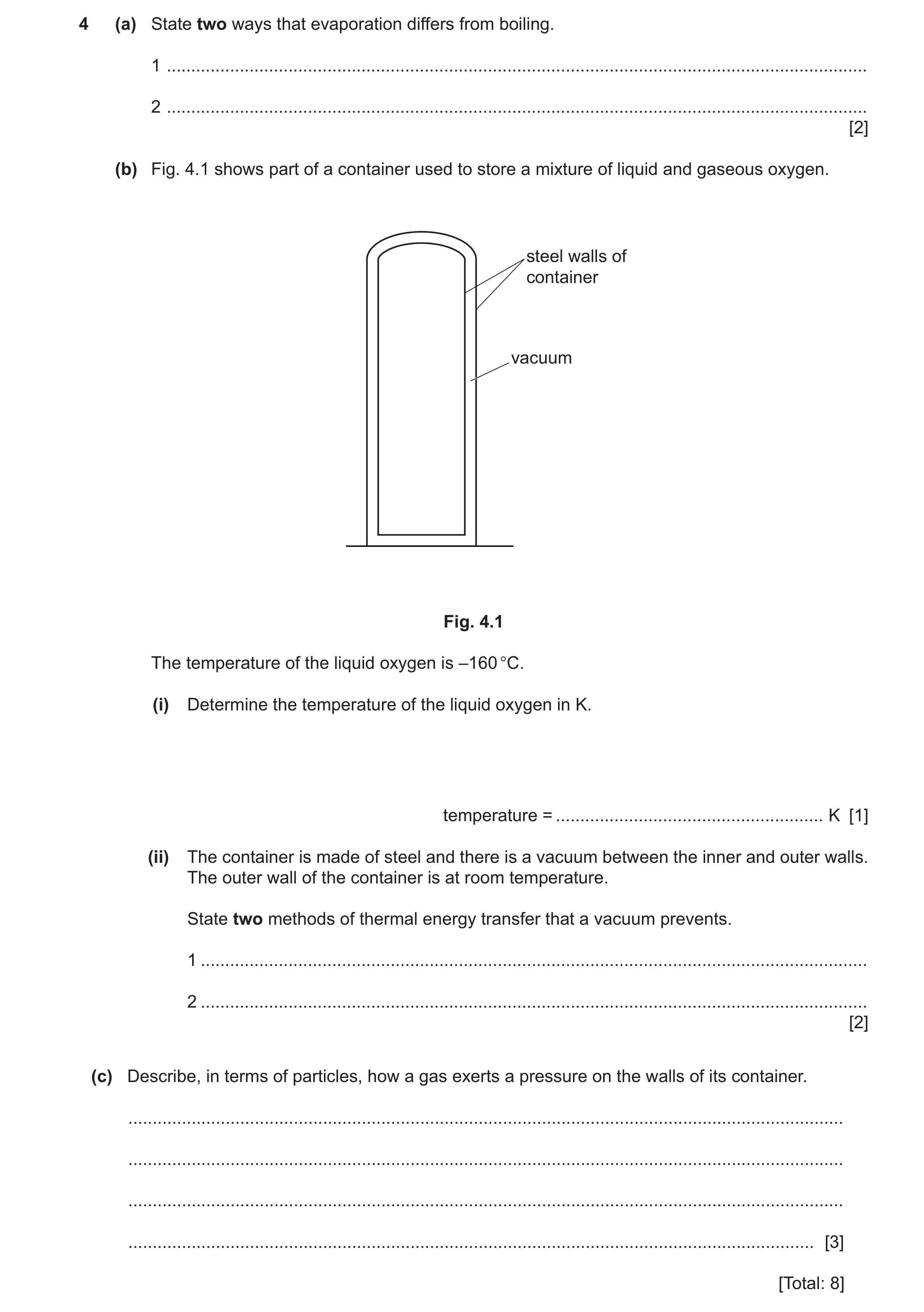
4 (a) State two ways that evaporation differs from boiling. 1 … 2 … [2] (b) Fig. 4.1 shows part of a container used to store a mixture of liquid and gaseous oxygen. steel walls of container vacuum Fig. 4.1 The temperature of the liquid oxygen is –160 °C. (i) Determine the temperature of the liquid oxygen in K. temperature = … K [1] (ii) The container is made of steel and there is a vacuum between the inner and outer walls. The outer wall of the container is at room temperature. State two methods of thermal energy transfer that a vacuum prevents. 1 … 2 … [2] (c) Describe, in terms of particles, how a gas exerts a pressure on the walls of its container. … … … … [3] [Total: 8]
8 marks
Mark scheme: 4(a) (evaporation:) (only) at the surface OR boiling: happens throughout the liquid B1 (evaporation:) takes place at any temperature OR boiling: takes place at a specific temperature / boiling point B1 4(b)(i) 113 (K) B1 4(b)(ii) conduction B1 convection B1 4(c) particles collide with the walls / container B1 (particles) exert a force on the walls OR collision with walls produces a change in momentum (of particles) B1 pressure is force per unit area OR p = F / A OR pressure is rate of change of momentum per unit area B1
This question in 0625/42 May/June 2024
Q27 · Two containers, each filled with hot water 0625/43 May/June 2024
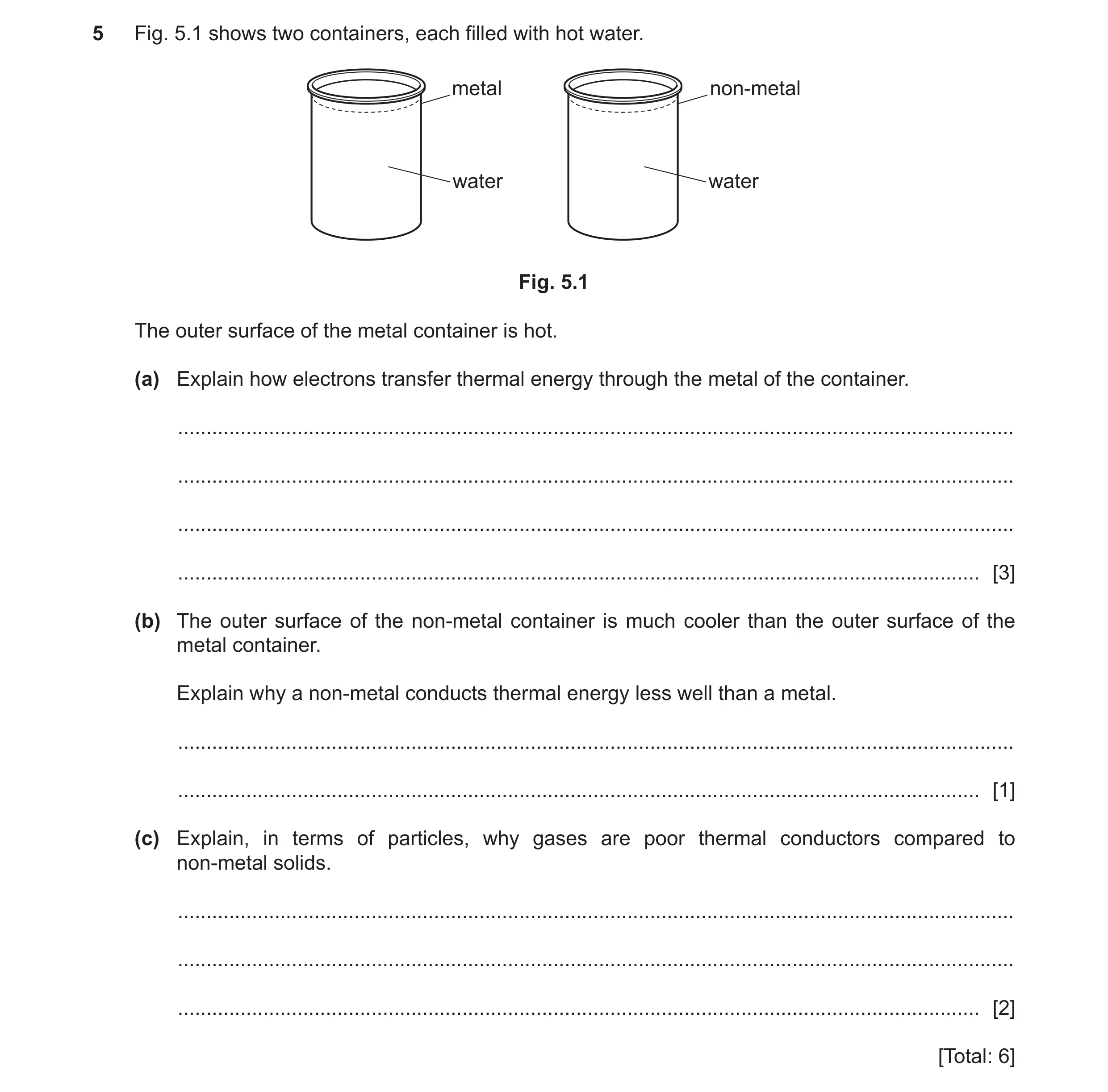
5 Fig. 5.1 shows two containers, each filled with hot water. metal non-metal water water Fig. 5.1 The outer surface of the metal container is hot. (a) Explain how electrons transfer thermal energy through the metal of the container. … … … … [3] (b) The outer surface of the non-metal container is much cooler than the outer surface of the metal container. Explain why a non-metal conducts thermal energy less well than a metal. … … [1] (c) Explain, in terms of particles, why gases are poor thermal conductors compared to non-metal solids. … … … [2] [Total: 6]
6 marks
Mark scheme: 5(a) any three from: (metals contain) delocalised / free / mobile electrons (delocalised electrons) gain energy (from lattice vibrations of the atoms nearest to the hot water) (delocalised) electrons move through the metal (lattice) collisions between the (delocalised) electrons and (remote) ions / atoms (transfers thermal energy to all parts of the metal container) 5(b) no delocalised / free electrons B1 5(c) particles are further / far apart B1 fewer particle collisions (to transfer energy) OR no lattice vibrations (to transfer energy) B1
This question in 0625/43 May/June 2024
Q28 · Describe an experiment to determine the specific heat capacity of aluminium 0625/41 Oct/Nov 2024
4 (a) Describe an experiment to determine the specific heat capacity of aluminium. You may draw a diagram. Include in your answer: • the measurements made • any equations needed. … … … … [4] (b) An aluminium dish is initially at room temperature. Boiling water is poured into the aluminium dish as shown in Fig. 4.1. boiling water aluminium dish table surface Fig. 4.1 (i) Explain why, after a short time, the dish and the water are the same temperature. … … … … [3] (ii) Explain, in terms of its particles, why the aluminium expands as the boiling water is poured into the dish. … … … [2] (iii) The water in the dish evaporates. Explain, in terms of the water molecules, what is meant by evaporation. … … … [2] [Total: 11]
11 marks
Mark scheme: 4(a) 1 Any one method to transfer measurable amount of thermal energy for ∆: B1 (a) to aluminium block (with electrical heater) (b) from aluminium block to known liquid (c) from known liquid to insulated aluminium (calorimeter) (d) to known liquid and aluminium (calorimeter) 2 Determination of energy transferred for ∆, to match workable method in 1: B1 (a) Use of E = Pt OR E= IVt (b) Use of E = mc with s.h.c. of known liquid (c) Use of E = mc with s.h.c. of known liquid (d) Use of E = Pt OR E = IVt AND E = mc (with known s.h.c. of liquid) 3 Any one measurement from: B1 • initial and final temperature / temperature change • time (of heating) • mass of aluminium 4 c = E / m OR (c =) E / m B1 4(b)(i) Any three from: B3 1 (net) transfer of energy from higher temperature to lower temperature OR (net) transfer of energy from water / to dish 2 (energy transfer) by conduction OR aluminium is a good conductor (of thermal energy) 3 temperature of water decreases AND temperature of dish increases 4 no (net) transfer of energy when temperature of dish = temperature of water 4(b)(ii) (particles) gain energy in kinetic store (as temperature of aluminium increases) B1 (average) separation of (aluminium) particles increases OR (aluminium) particles move further apart owtte B1 4(b)(iii) (water) molecules with more/enough energy escape from the surface A2 escape of more energetic molecules (from water) OR (molecules) leave from the surface C1
This question in 0625/41 Oct/Nov 2024
Q29 · A portable shower used on a campsite 0625/43 Oct/Nov 2024
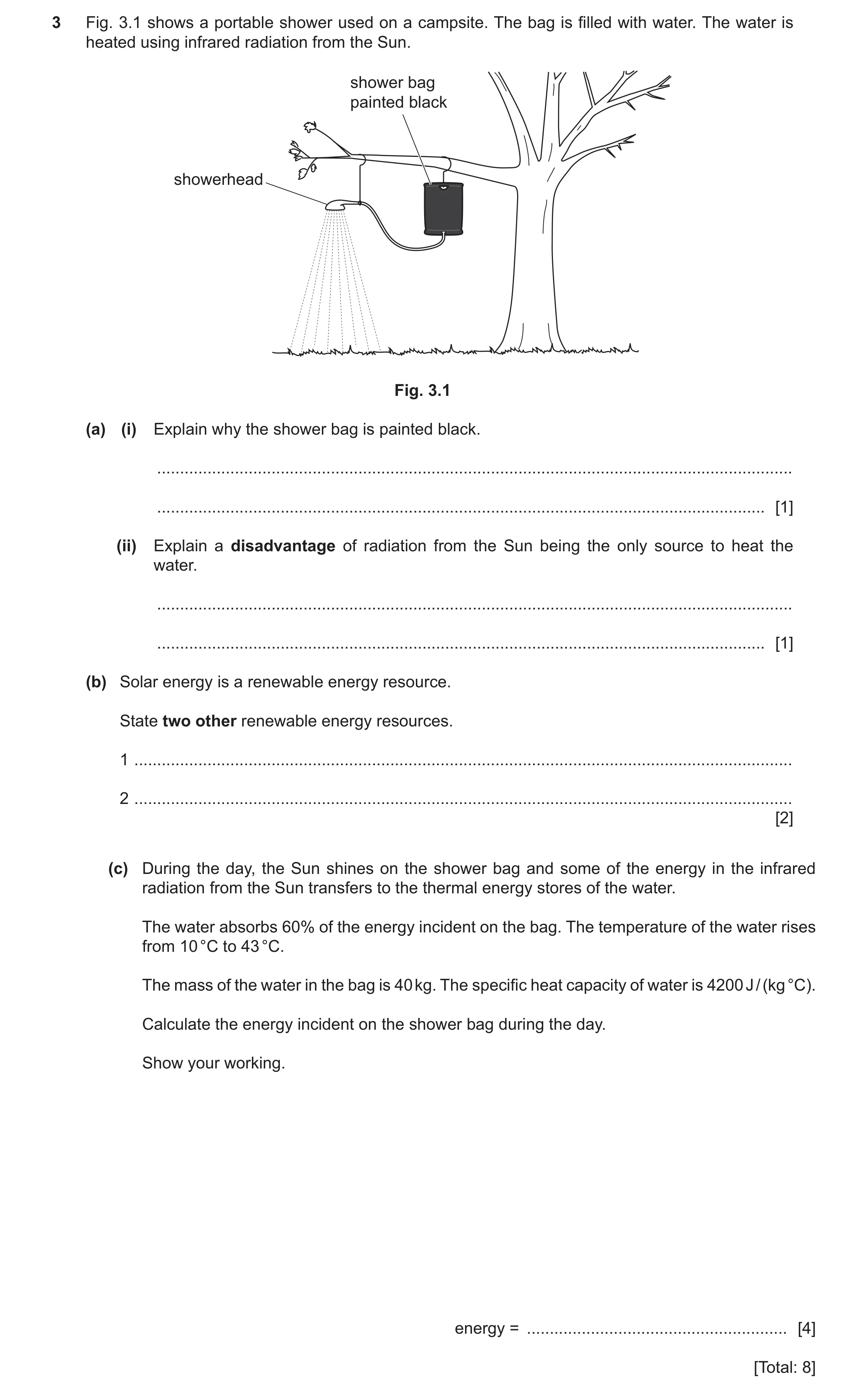
3 Fig. 3.1 shows a portable shower used on a campsite. The bag is filled with water. The water is heated using infrared radiation from the Sun. shower bag painted black showerhead Fig. 3.1 (a) (i) Explain why the shower bag is painted black. … … [1] (ii) Explain a disadvantage of radiation from the Sun being the only source to heat the water. … … [1] (b) Solar energy is a renewable energy resource. State two other renewable energy resources. 1 … 2 … [2] (c) During the day, the Sun shines on the shower bag and some of the energy in the infrared radiation from the Sun transfers to the thermal energy stores of the water. The water absorbs 60% of the energy incident on the bag. The temperature of the water rises from 10 °C to 43 °C. The mass of the water in the bag is 40 kg. The specific heat capacity of water is 4200 J / (kg °C). Calculate the energy incident on the shower bag during the day. Show your working. energy = … [4] [Total: 8]
8 marks
Mark scheme: 3(a)(i) good/better absorber (of radiation) OR bad / poor / worse reflector (of radiation) B1 3(a)(ii) doesn’t work at night / in cloud cover / when there is no sun B1 OR (sun has) variable output 3(b) any two from: B2 • hydroelectric • tidal • wave • wind • geothermal • biofuels 3(c) 9.2 106 J OR 9 200 000 J A4 (temperature rise =) 33 (°C) OR 43 – 10 C1 c = ∆E / m∆OR (E =) m c OR (E =) 40 4200 (43 – 10) OR 5.5 106 (J) C1 5.5 106 (100 / 60) OR 5.5 106 1.667 OR 5.5 106 / 0.6 C1 useful energy output OR efficiency = 100% total energy input
This question in 0625/43 Oct/Nov 2024
Q30 · A mains electric heater used to heat a small room 0625/42 Feb/March 2025
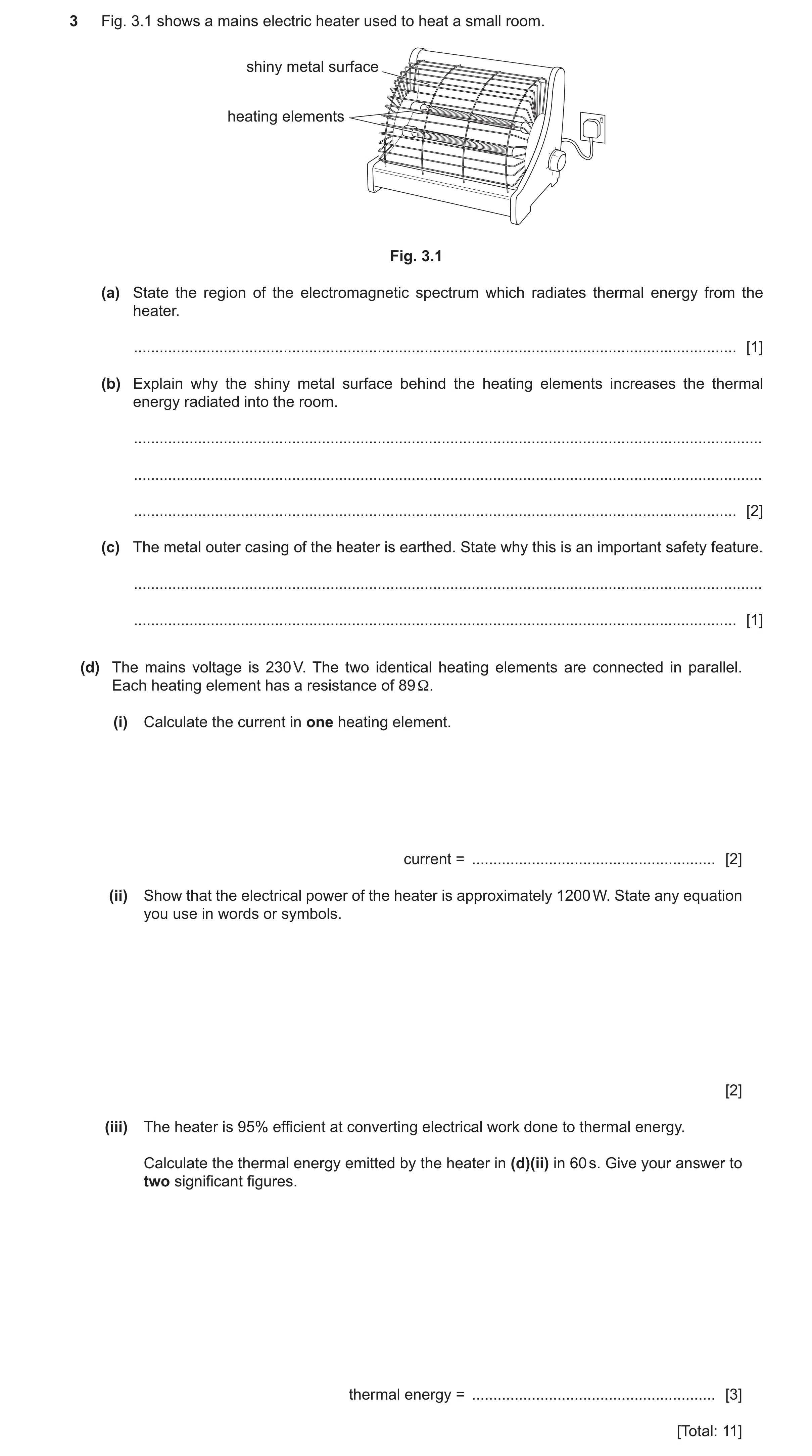
3 Fig. 3.1 shows a mains electric heater used to heat a small room. shiny metal surface heating elements Fig. 3.1 (a) State the region of the electromagnetic spectrum which radiates thermal energy from the heater. … [1] (b) Explain why the shiny metal surface behind the heating elements increases the thermal energy radiated into the room. … … … [2] (c) The metal outer casing of the heater is earthed. State why this is an important safety feature. … … [1] (d) The mains voltage is 230 V. The two identical heating elements are connected in parallel. Each heating element has a resistance of 89 Ω. (i) Calculate the current in one heating element. current = … [2] (ii) Show that the electrical power of the heater is approximately 1200 W. State any equation you use in words or symbols. [2] (iii) The heater is 95% efficient at converting electrical work done to thermal energy. Calculate the thermal energy emitted by the heater in (d)(ii) in 60 s. Give your answer to two significant figures. thermal energy = … [3] [Total: 11]
11 marks
Mark scheme: 3(a) infrared B1 3(b) shiny surface / it is a good reflector of radiation A2 Any one from: C1 • it is a good reflector • it reflects radiation 3(c) Any one from: B1 • prevents (electric) shock (if live wire touches the metal casing) owtte • if live wire touches the metal casing the current goes to earth 3(d)(i) 2.6 A A2 R = V / I OR (I=) V/R OR (I=) 230 / 89 C1 3(d)(ii) P = IV B1 (I =) 5.2 (A) OR (P =) 2 power of one element OR B1 3(d)(iii) 68 000 J OR 68 kJ A3 E = Pt OR (E =) Pt OR (E =) 1200 60 C1 efficiency = useful energy out / total energy (in) OR 95 100 E C1 (power output of heater =) 95% 1200
This question in 0625/42 Feb/March 2025
Q31 · A heater used to warm the air in a room 0625/41 May/June 2025
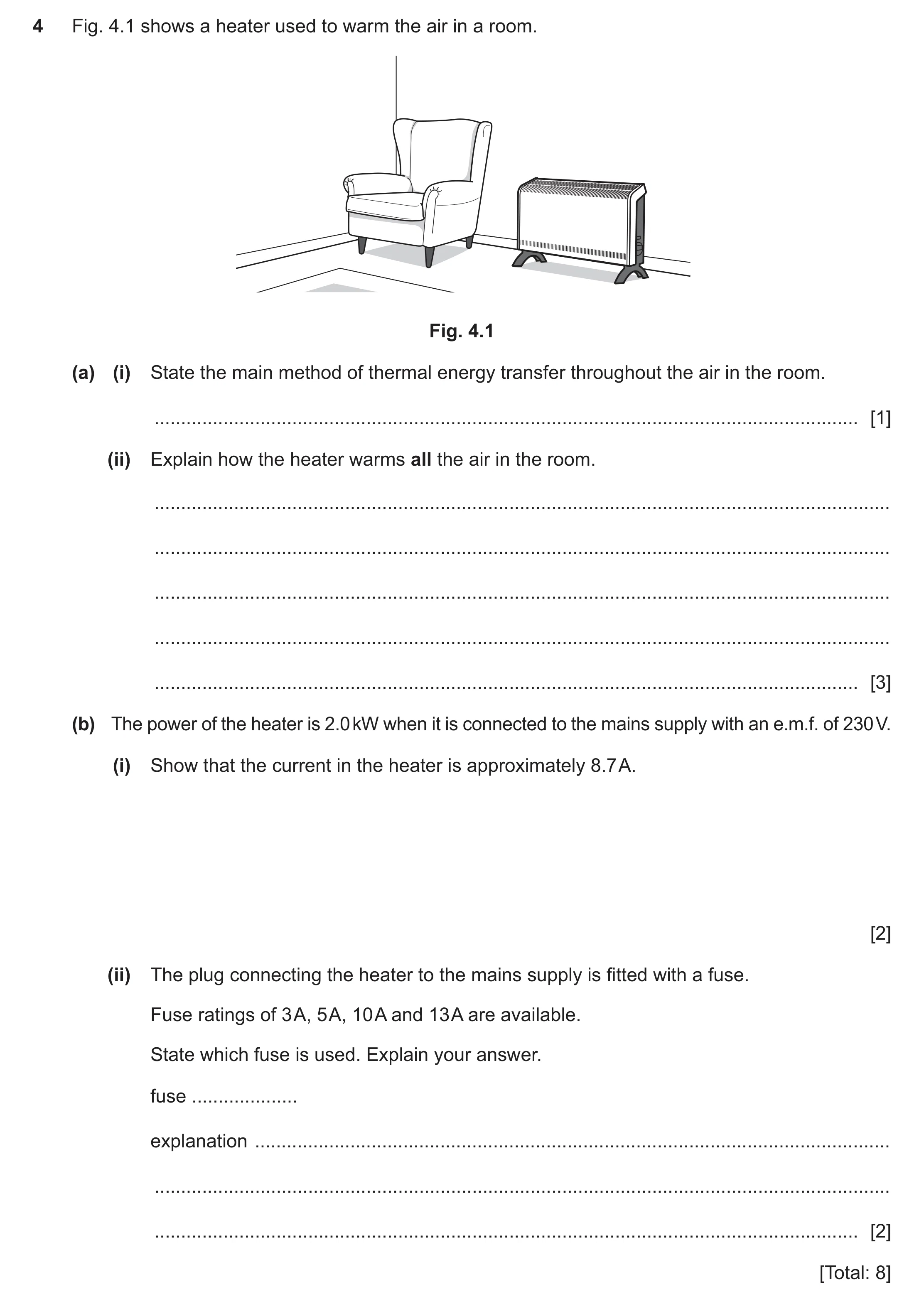
4 Fig. 4.1 shows a heater used to warm the air in a room. Fig. 4.1 (a) (i) State the main method of thermal energy transfer throughout the air in the room. … [1] (ii) Explain how the heater warms all the air in the room. … … … … … [3] (b) The power of the heater is 2.0 kW when it is connected to the mains supply with an e.m.f. of 230 V. (i) Show that the current in the heater is approximately 8.7 A. [2] (ii) The plug connecting the heater to the mains supply is fitted with a fuse. Fuse ratings of 3 A, 5 A, 10 A and 13 A are available. State which fuse is used. Explain your answer. fuse … explanation … … … [2] [Total: 8]
8 marks
Mark scheme: 4(a)(i) convection B1 4(a)(ii) warm air rises OR less dense air rises B1 warm air is less dense (than cool air) ORA B1 any one from: B1 • cold air replaces warm air • cold air falls and the process repeats owtte • there is a convection current owtte 4(b)(i) P = IV OR (I =) P V B1 2.0 kW = 2000 W OR 2000 230 B1 4(b)(ii) 10 (A) AND A2 any one from: • smaller fuse melts in normal use (of the heater) owtte • smaller fuse stops the heater working (at all) • larger fuse allows too much current (without melting) • larger fuse may not melt before the circuit is damaged • fuse (rating) must be higher than the (normal) current • the fuse will melt if current goes too high owtte any one from: C1 • 10 (A) • 13 (A) AND fuse (rating) must be higher than (normal) current • 13 (A) AND 3 A / 5 A fuse melts in normal use owtte
This question in 0625/41 May/June 2025
Q32 · Two metal containers, A and B 0625/42 May/June 2025
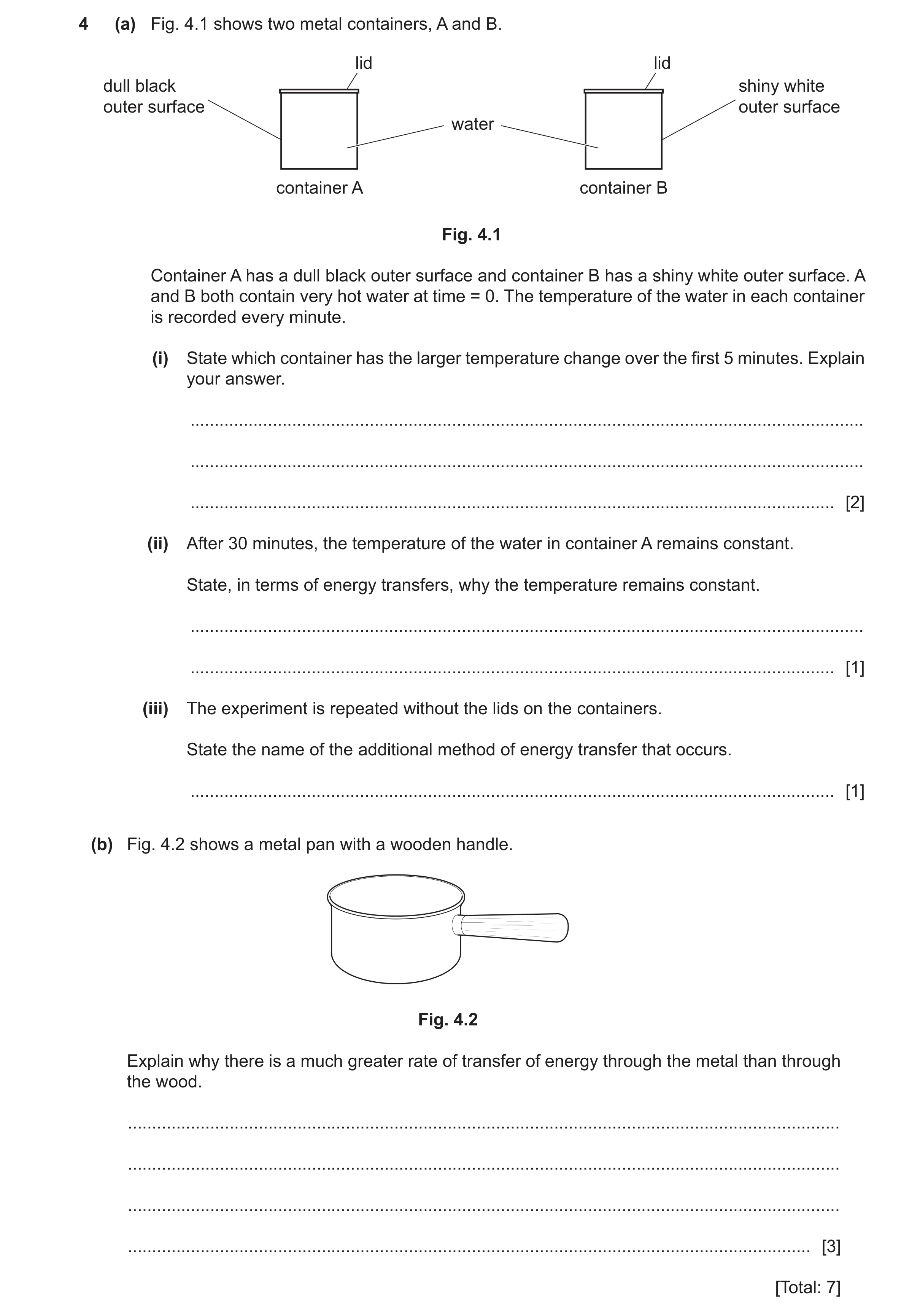
4 (a) Fig. 4.1 shows two metal containers, A and B. lid lid dull black shiny white outer surface outer surface water container A container B Fig. 4.1 Container A has a dull black outer surface and container B has a shiny white outer surface. A and B both contain very hot water at time = 0. The temperature of the water in each container is recorded every minute. (i) State which container has the larger temperature change over the first 5 minutes. Explain your answer. … … … [2] (ii) After 30 minutes, the temperature of the water in container A remains constant. State, in terms of energy transfers, why the temperature remains constant. … … [1] (iii) The experiment is repeated without the lids on the containers. State the name of the additional method of energy transfer that occurs. … [1] (b) Fig. 4.2 shows a metal pan with a wooden handle. Fig. 4.2 Explain why there is a much greater rate of transfer of energy through the metal than through the wood. … … … … [3] [Total: 7]
7 marks
Mark scheme: 4(a)(i) container A or container with (dull) black (surface) A2 AND (dull) black (surfaces) are better emitters of infrared / radiation (than shiny white surfaces) container A or container with (dull) black (surface) C1 AND (dull) black (surfaces) are better emitters (than shiny white surfaces) 4(a)(ii) rate of transfer of energy from the container is equal to rate of transfer of energy to the container B1 4(a)(iii) convection B1 4(b) any three from: B3 • metal is a good / better (thermal) conductor OR wood is a poor conductor OR wood is a (thermal) insulator • metal contains free / delocalised electrons OR wood does not contain free / delocalised electrons • electrons carry (thermal) energy through metal OR electrons collide with (distant) ions • wood only transfers (thermal) energy by lattice vibrations
This question in 0625/42 May/June 2025
Q33 · A pan with a copper base on a hotplate 0625/43 May/June 2025
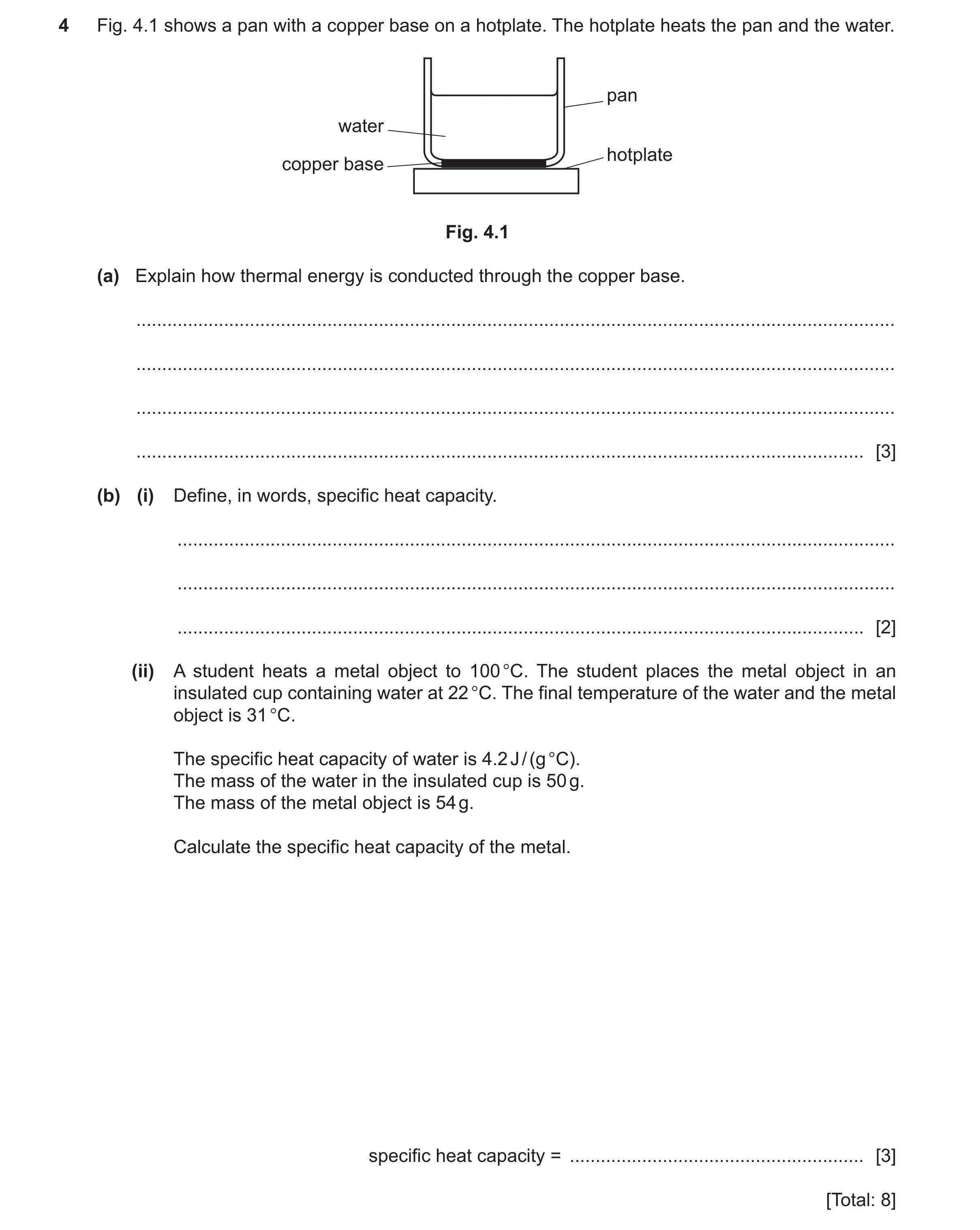
4 Fig. 4.1 shows a pan with a copper base on a hotplate. The hotplate heats the pan and the water. pan water hotplate copper base Fig. 4.1 (a) Explain how thermal energy is conducted through the copper base. … … … … [3] (b) (i) Define, in words, specific heat capacity. … … … [2] (ii) A student heats a metal object to 100 °C. The student places the metal object in an insulated cup containing water at 22 °C. The final temperature of the water and the metal object is 31 °C. The specific heat capacity of water is 4.2 J / (g °C). The mass of the water in the insulated cup is 50 g. The mass of the metal object is 54 g. Calculate the specific heat capacity of the metal. specific heat capacity = … [3] [Total: 8]
8 marks
Mark scheme: 4(a) any three from: B3 • (copper / metal contains) free / delocalised electrons • electrons carry (thermal) energy through metal • electrons collide with (distant) ions • lattice vibrations transfer energy (to neighbouring ions) OR ions vibrate and cause (nearby / adjacent) ions to vibrate 4(b)(i) energy transferred per unit mass per unit temperature change A2 (thermal) energy (transferred) per unit temperature change C1 4(b)(ii) 0.51 J / (g C) A3 (energy lost by metal =) 54 c 69 C1 OR (energy gained by water =) 50 4.2 9 OR 1890 energy lost by metal = energy gained by water C1 OR 54 c 69 = 50 4.2 9
This question in 0625/43 May/June 2025
Q34 · A simplified diagram of a solar cell 0625/41 Oct/Nov 2025
3 Fig. 3.1 shows a simplified diagram of a solar cell. negative contact light black coating positive contact conducting material V in solar cell Fig. 3.1 (a) Describe the energy transfer in the solar cell. … [2] (b) Suggest how the black coating allows the solar cell to transfer more energy. … … [1] (c) 0.72 kW of light is incident on the solar cell in Fig. 3.1. The cell has an efficiency of 75%. (i) Calculate the output power of the cell. output power = … [2] (ii) State the meaning of the term kilowatt-hour (kWh). … … [1] (iii) Energy is produced by each solar cell for an average of 6 hours per day. A household uses approximately 7400 kWh of electrical energy per year. Calculate the number of solar cells needed to produce energy for one household. Give your answer as a whole number of solar cells. number of solar cells = … [3] [Total: 9]
9 marks
Mark scheme: 3(a) (electromagnetic) radiation / light (from the Sun) B1 (produces) electrical (work done) B1 3(b) (black) is a good absorber / poor reflector (of radiation) owtte B1 3(c)(i) 0.54 kW OR 540 W A2 (output power =) total power input efficiency (÷100) C1 OR (output power =) 0.72 75 ÷ 100 OR 5.4 10N 3(c)(ii) the amount of (electrical) energy transferred by a 1 kW appliance in 1 hour owtte B1 OR energy transferred in one hour at a rate of transfer of 1 kW 3(c)(iii) 7 A3 Any one from: C1 • E = Pt • energy produced by one cell per year OR 3(c)(i) 6 365 • total power output required OR 7400 ÷ {365 6} • household energy used per day OR 7400 ÷ 365 • energy produced by one cell per day OR 3(c)(i) 6 3(c)(iii) Any one from: C1 • household energy used per year ÷ energy produced by one cell per year • total power output required ÷ power output of one cell • household energy used per day ÷ energy produced by one cell per day
This question in 0625/41 Oct/Nov 2025
Q35 · A 12 V, 50 W immersion heater is used to heat 0.15 kg of water in a beaker 0625/41 Oct/Nov 2025
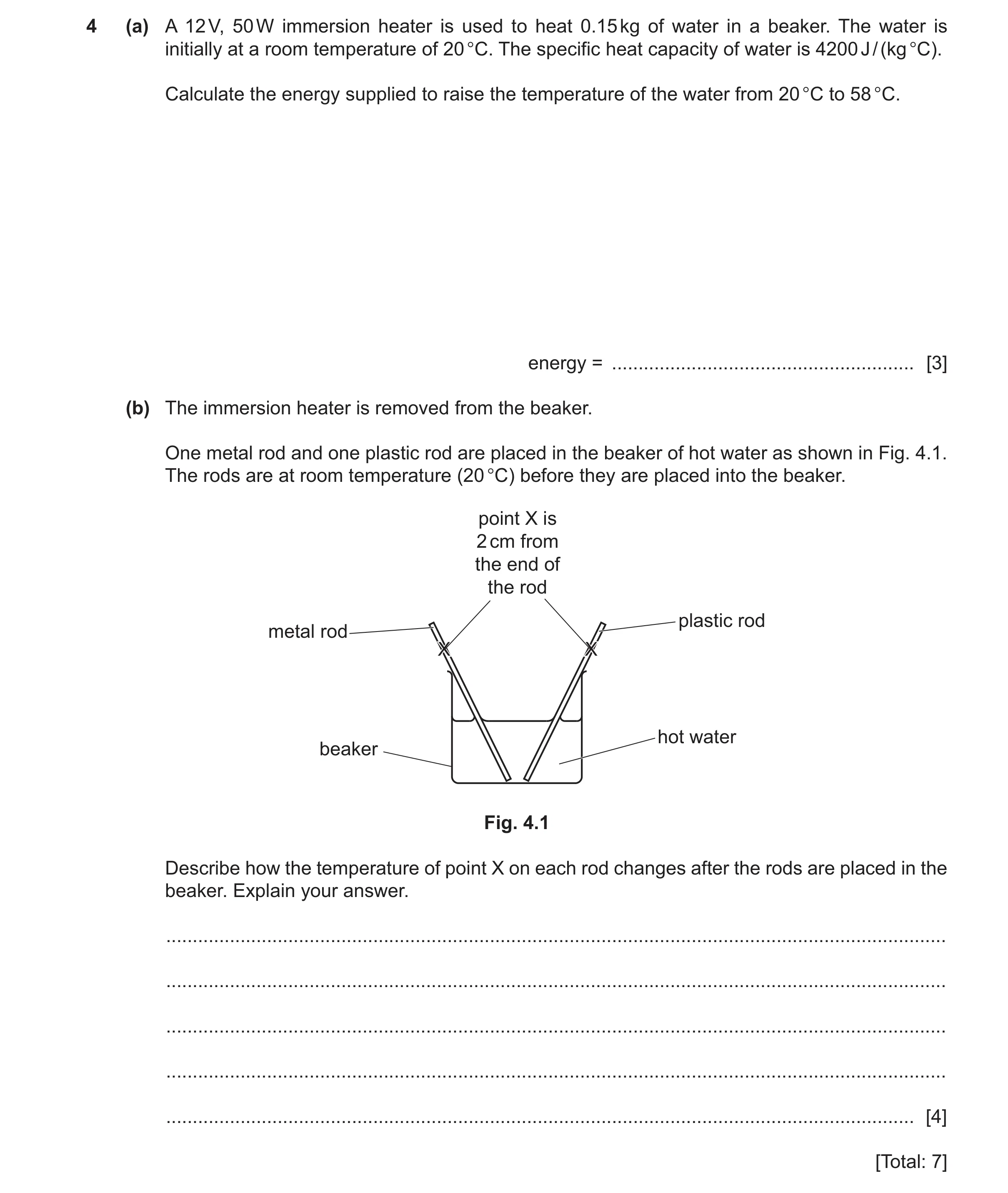
4 (a) A 12 V, 50 W immersion heater is used to heat 0.15 kg of water in a beaker. The water is initially at a room temperature of 20 °C. The specific heat capacity of water is 4200 J / (kg °C). Calculate the energy supplied to raise the temperature of the water from 20 °C to 58 °C. energy = … [3] (b) The immersion heater is removed from the beaker. One metal rod and one plastic rod are placed in the beaker of hot water as shown in Fig. 4.1. The rods are at room temperature (20 °C) before they are placed into the beaker. point X is 2 cm from the end of the rod plastic rod metal rod X X hot water beaker Fig. 4.1 Describe how the temperature of point X on each rod changes after the rods are placed in the beaker. Explain your answer. … … … … … [4] [Total: 7]
7 marks
Mark scheme: 4(a) 24 000 J OR 2.4 104 J A3 (∆E =) mc∆𝜃 OR (∆E =) 0.15 4200 {58 – 20} C1 (∆𝜃 =) 58 – 20 OR 38 (°C) seen C1 4(b) (temperature of point X) on metal rod increases faster ORA A2 (temperature of point X) increases (with time) C1 thermal energy is transferred) by conduction B1 metal rod (transfers thermal energy through movement of) delocalised / free electrons. ORA B1
This question in 0625/41 Oct/Nov 2025
Q36 · Black solar panels installed on the roof of a house and a large rechargeable battery 0625/42 Oct/Nov 2025
3 Fig. 3.1 shows black solar panels installed on the roof of a house and a large rechargeable battery. solar panels electric cable large rechargeable battery Fig. 3.1 (not to scale) The solar panels produce electricity and give a maximum power output of 3.5 kW. The efficiency of the solar panels is 16%. (a) State and explain one advantage of using black solar panels. … … … [2] (b) Calculate the power received by the solar panels from the Sun. power = … [3] (c) The solar panels produce direct current (d.c.) and household appliances use alternating current (a.c.). State the difference between alternating current and direct current. … … [1] (d) Suggest one advantage of storing energy in the large rechargeable battery. … … [1] (e) Calculate the charge that flows into the battery when there is a current of 4.0 A for 2.0 hours. charge = … [3] [Total: 10]
10 marks
Mark scheme: 3(a) more electricity generated OR makes solar panels more efficient B1 black is a good absorber OR black is a poor reflector owtte B1 3(b) 22 kW OR 22 000 W A3 (total power input =) {useful power output ( 100%)} / (%) efficiency C1 OR (total power input =) {3.5 100} / 16 OR (total power input =) 3.5 / 0.16 (total power input =) 3.5 / 0.16 OR (total power input =) {3.5 100} / 16 C1 3(c) alternating current reverses direction OR direct current is only in one direction B1 3(d) electricity can be used when there is no Sun OR when it is dark or cloudy OR at night B1 3(e) 29 000 C A3 (Q =) I t OR (Q =) 4.0 2.0 60 60 C1 correct conversion from h to s SEEN C1
This question in 0625/42 Oct/Nov 2025
 1 / 43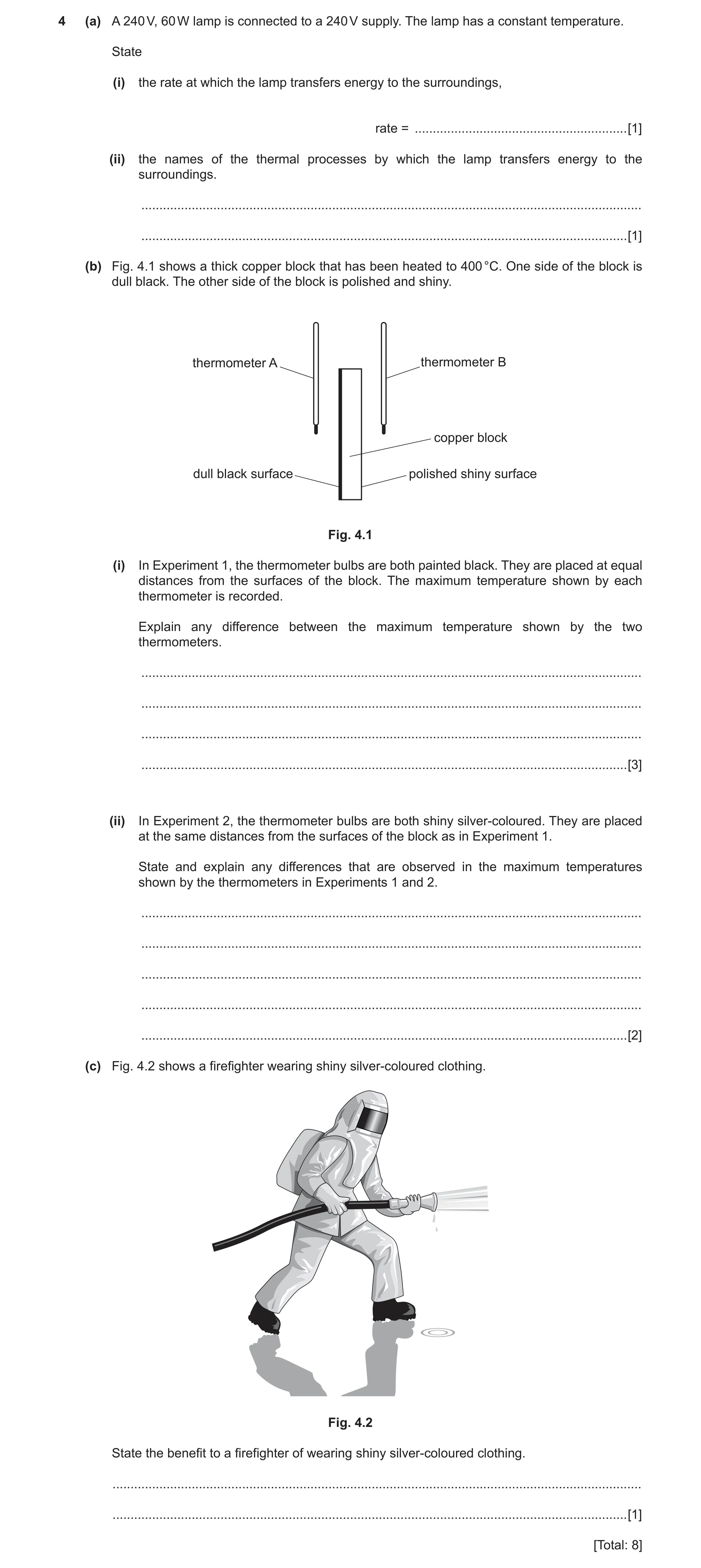
 4 / 43
 5 / 43
 6 / 43
 7 / 43
 8 / 43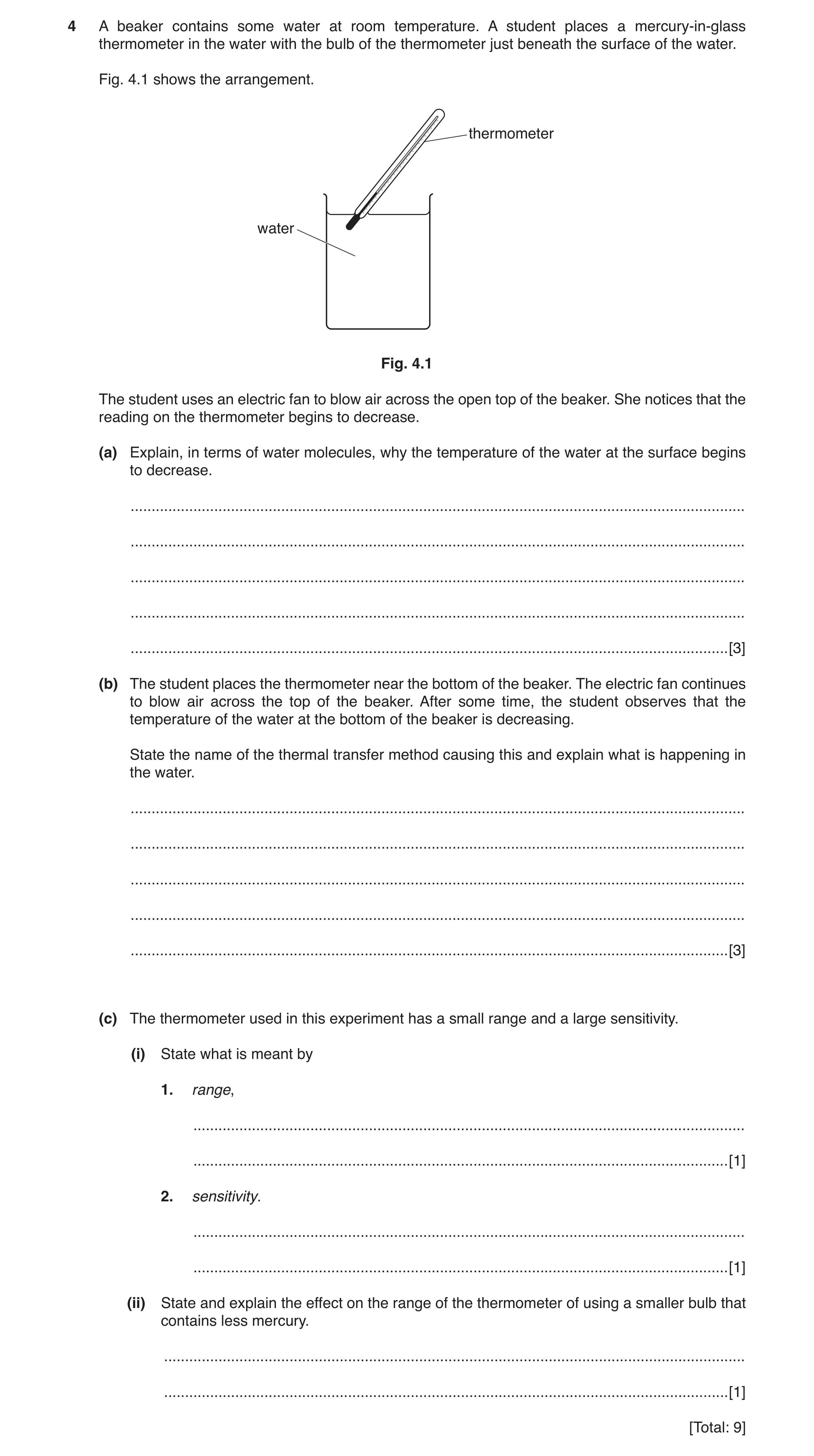
 12 / 43
 13 / 43
 14 / 43
 15 / 43
 16 / 43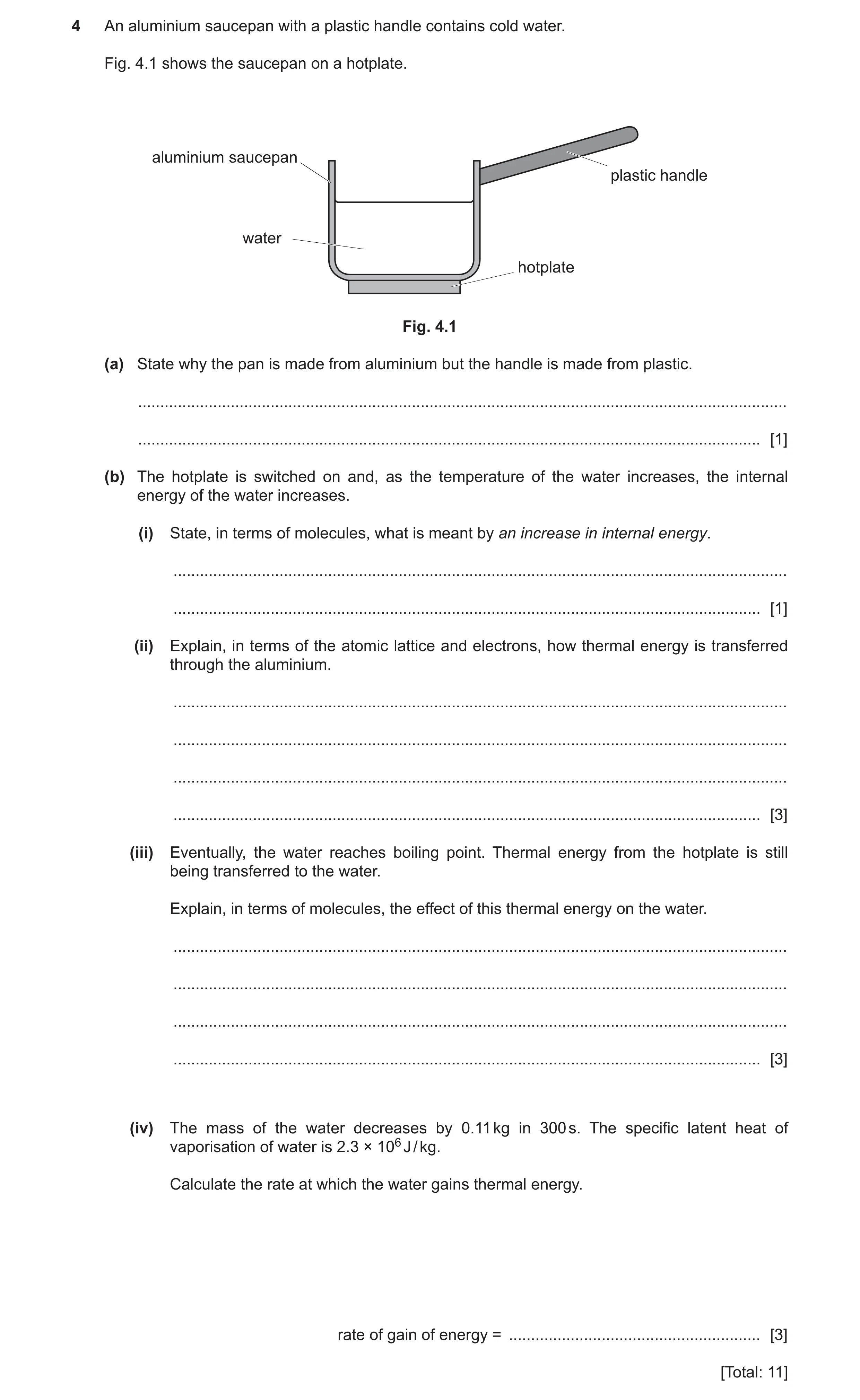
 18 / 43
 19 / 43
 20 / 43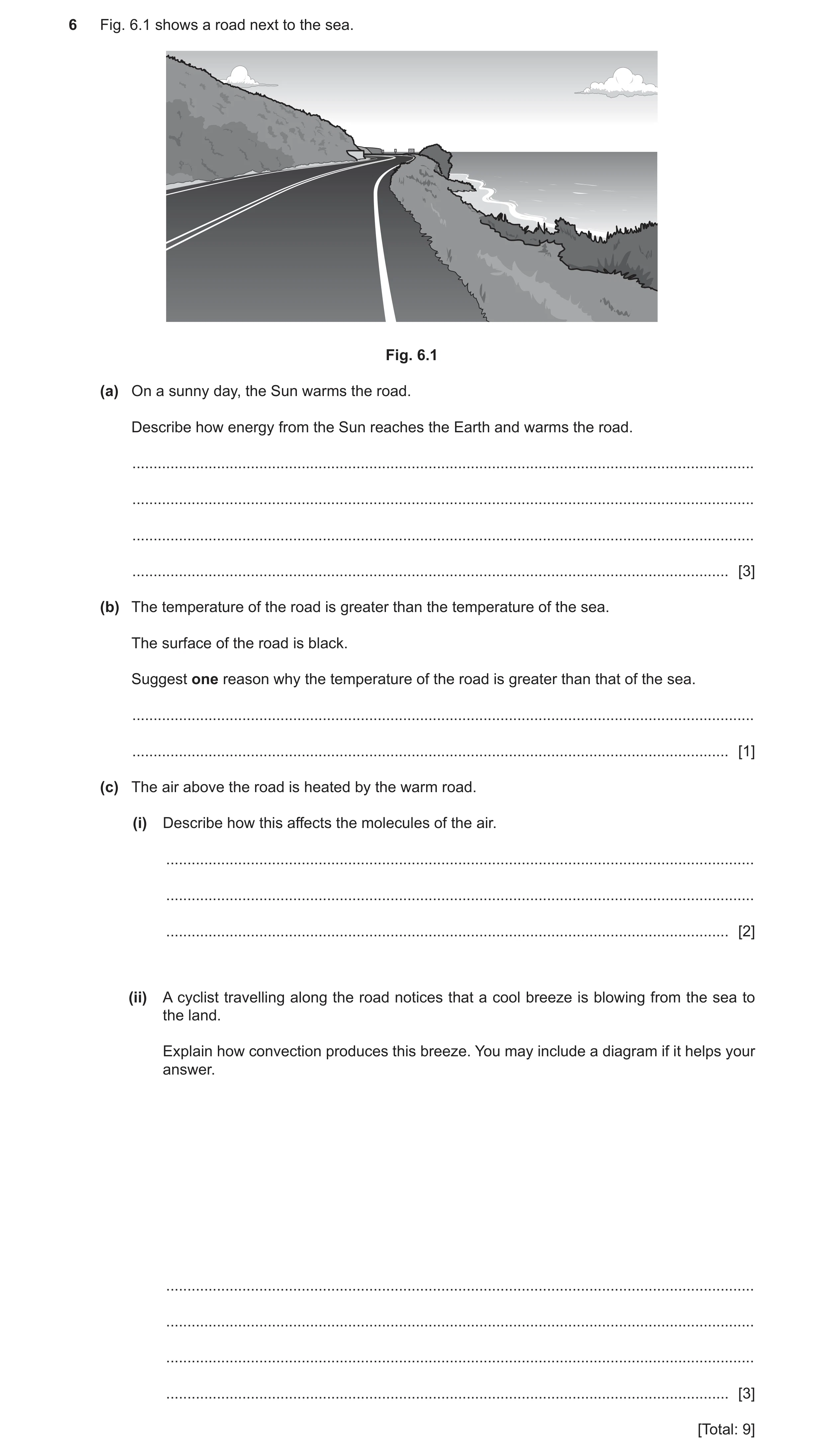
 25 / 43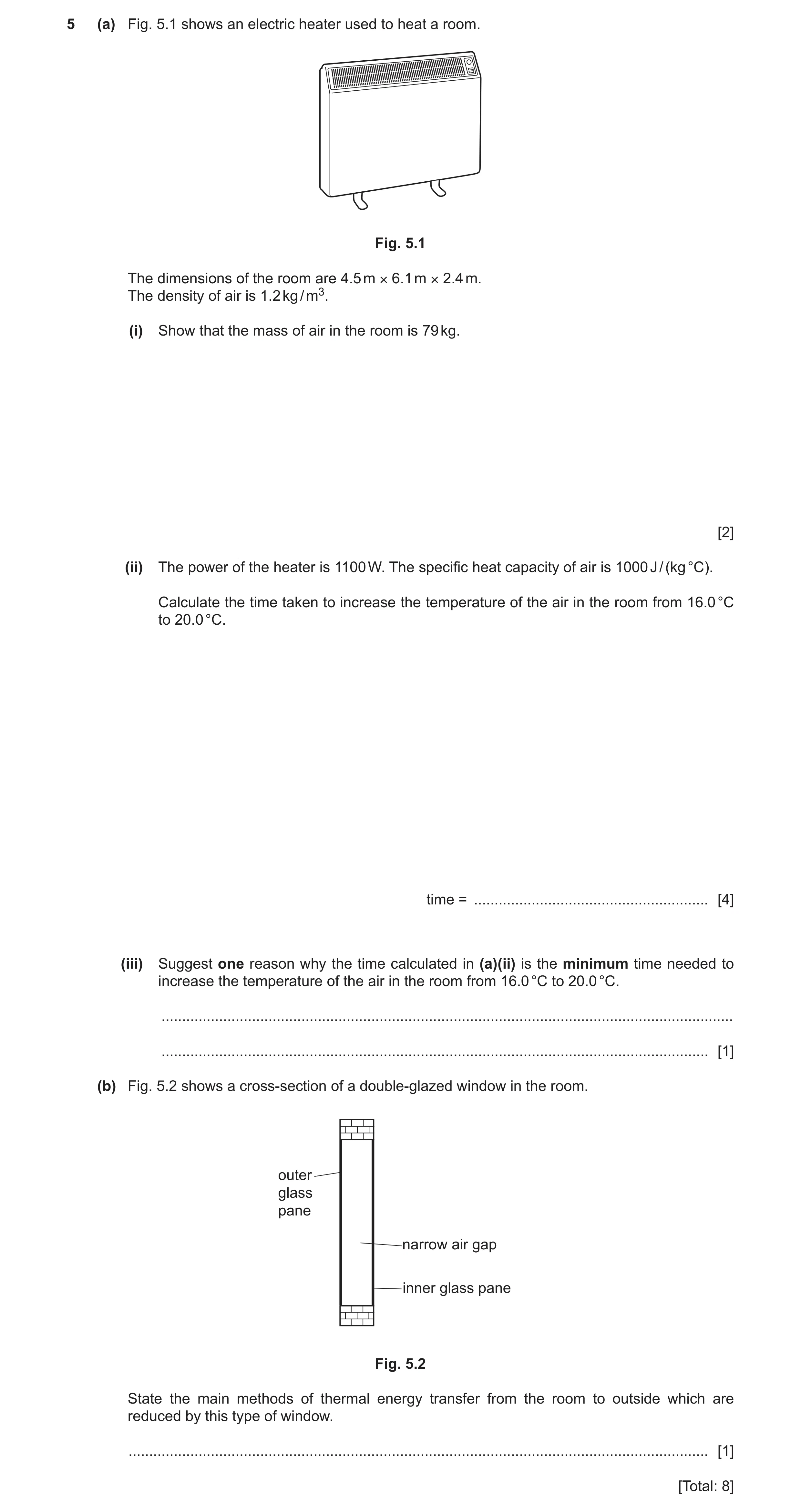
 28 / 43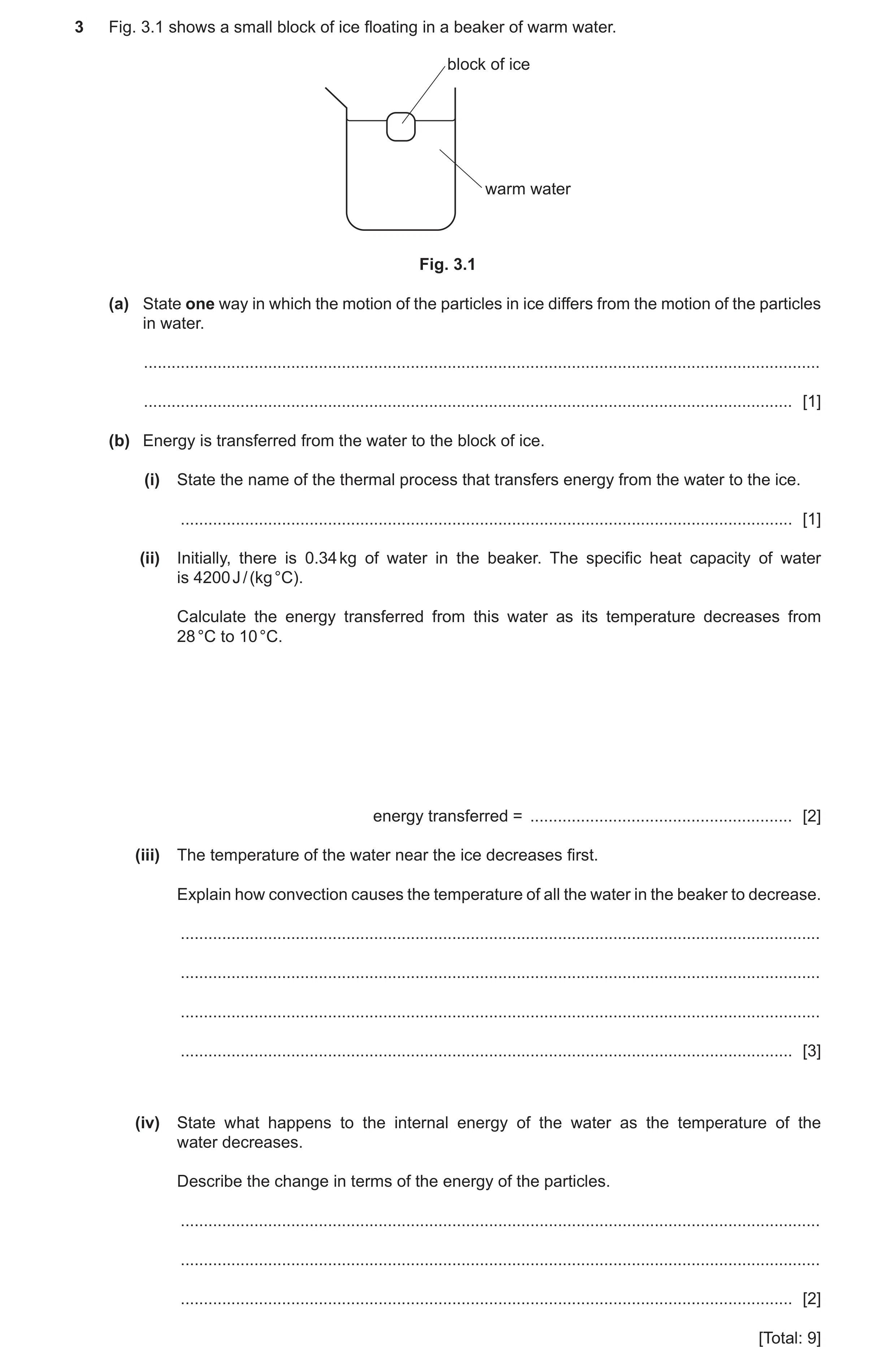
 30 / 43
 31 / 43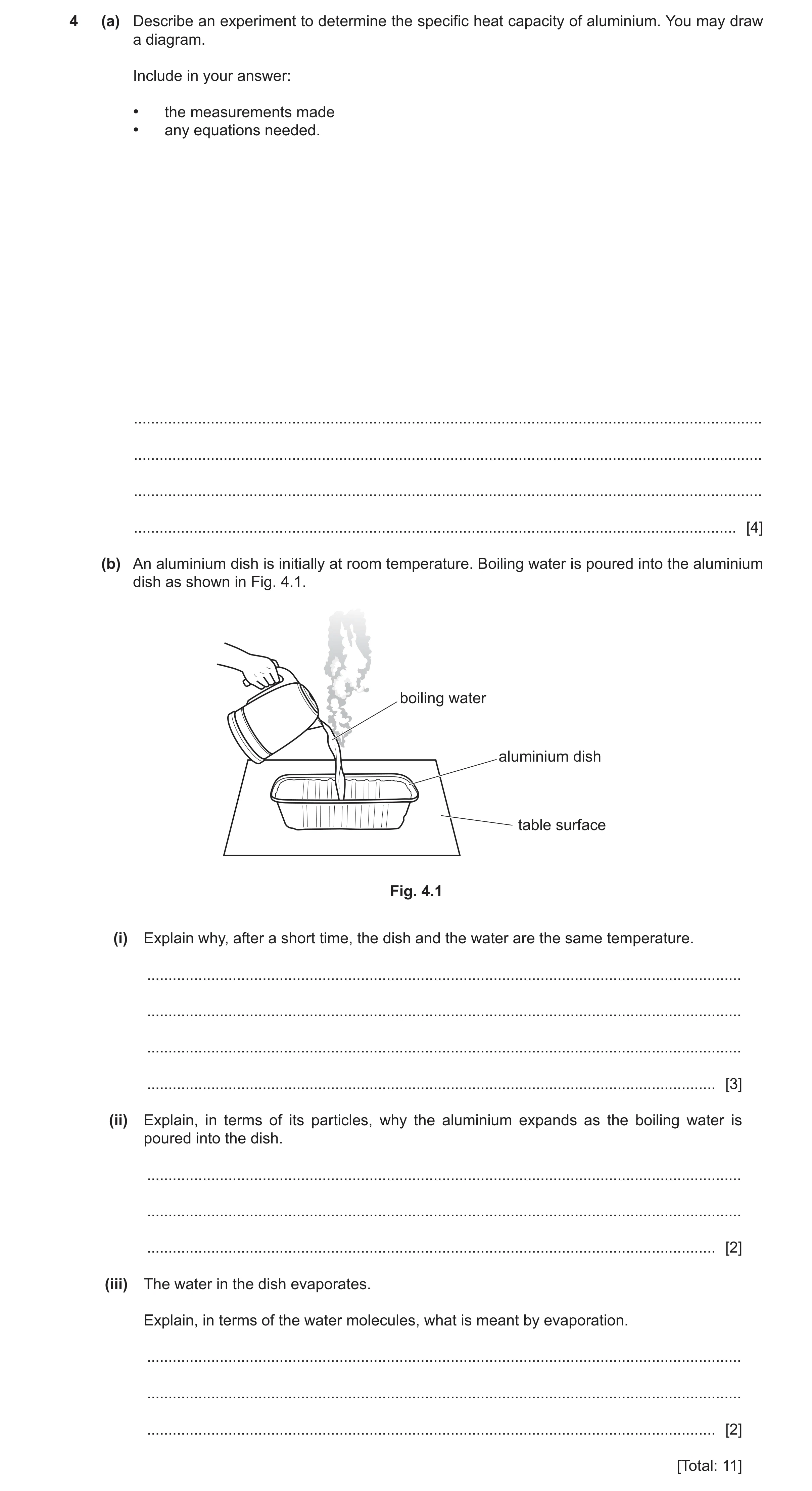
 36 / 43
 37 / 43
 38 / 43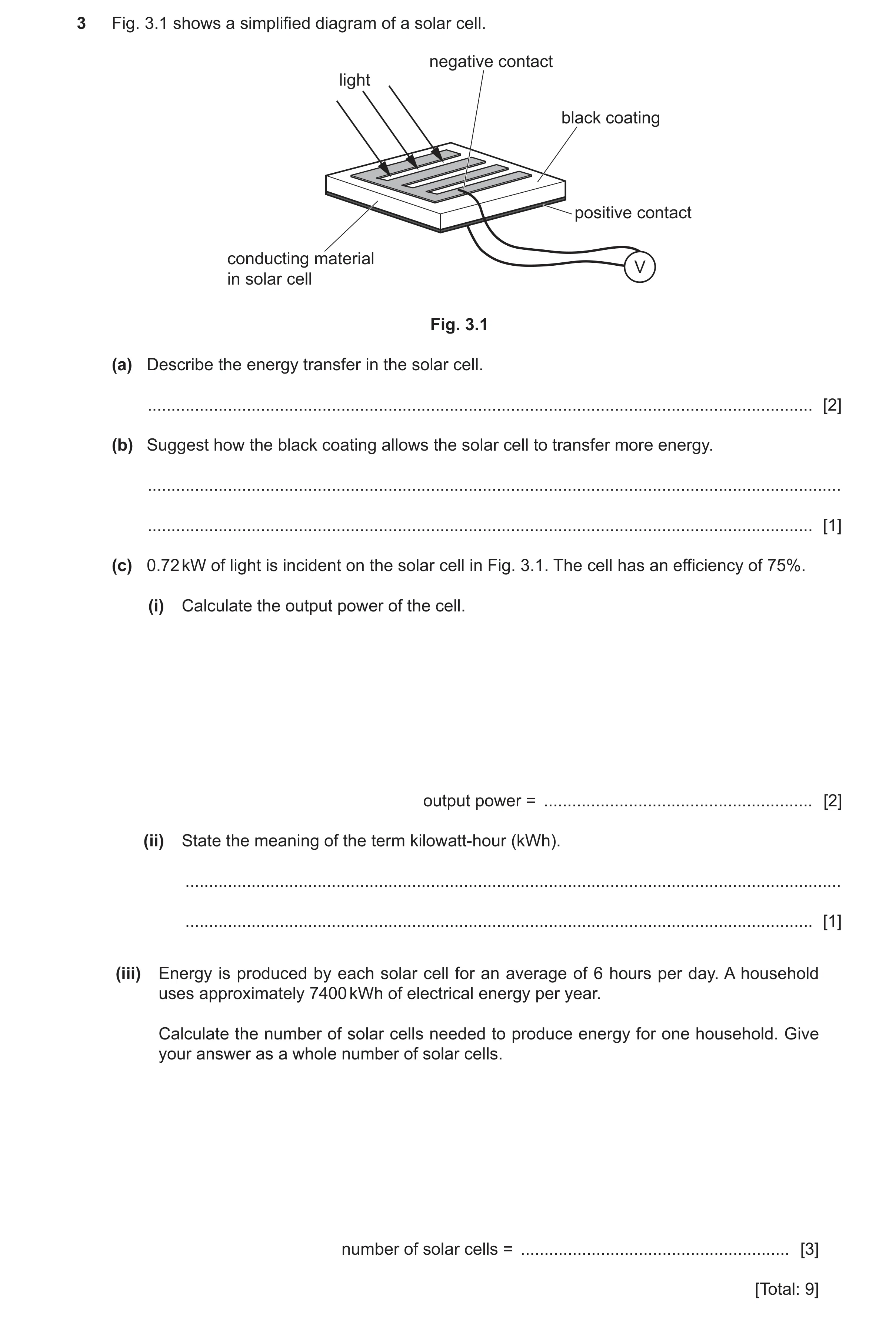
 41 / 43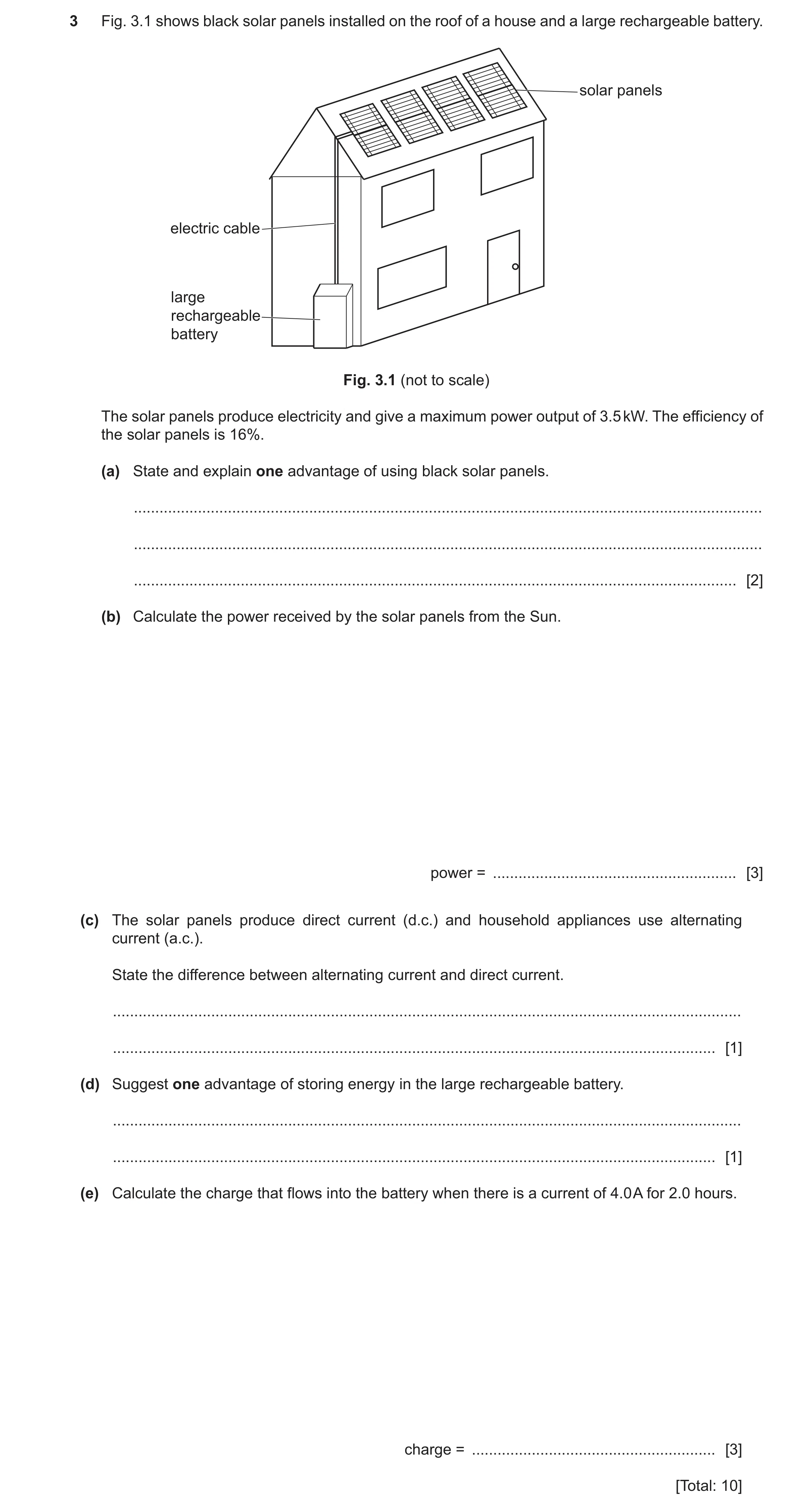
 5
5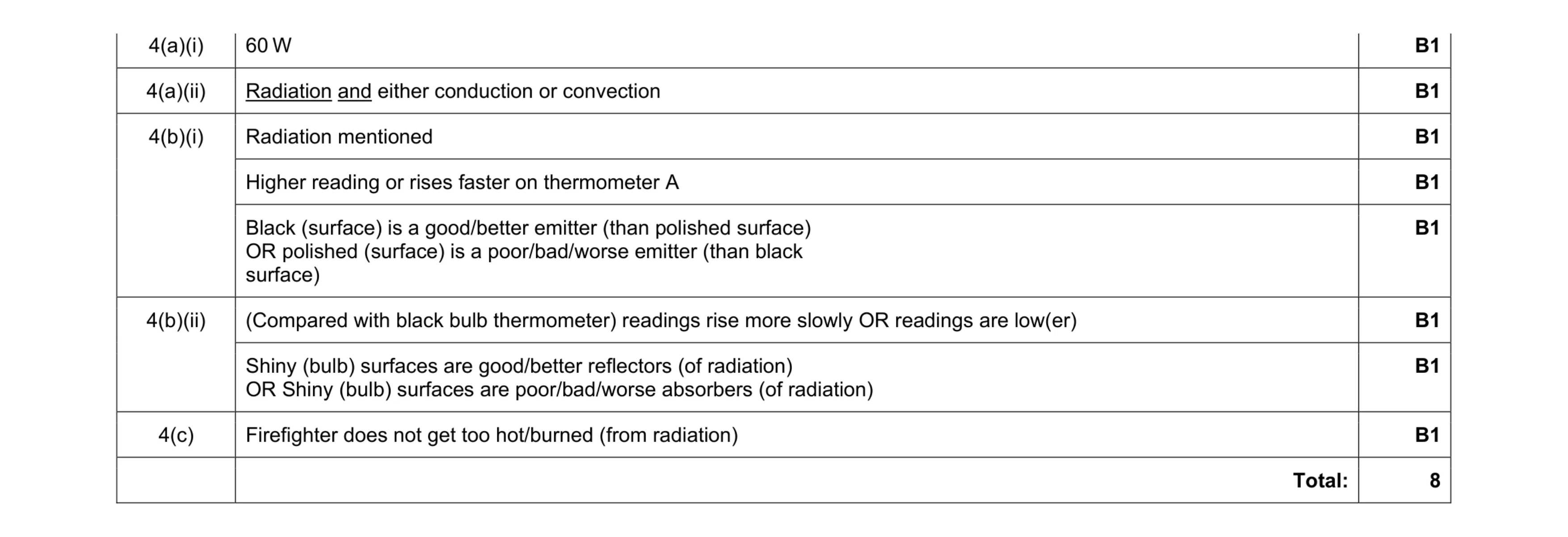 8
8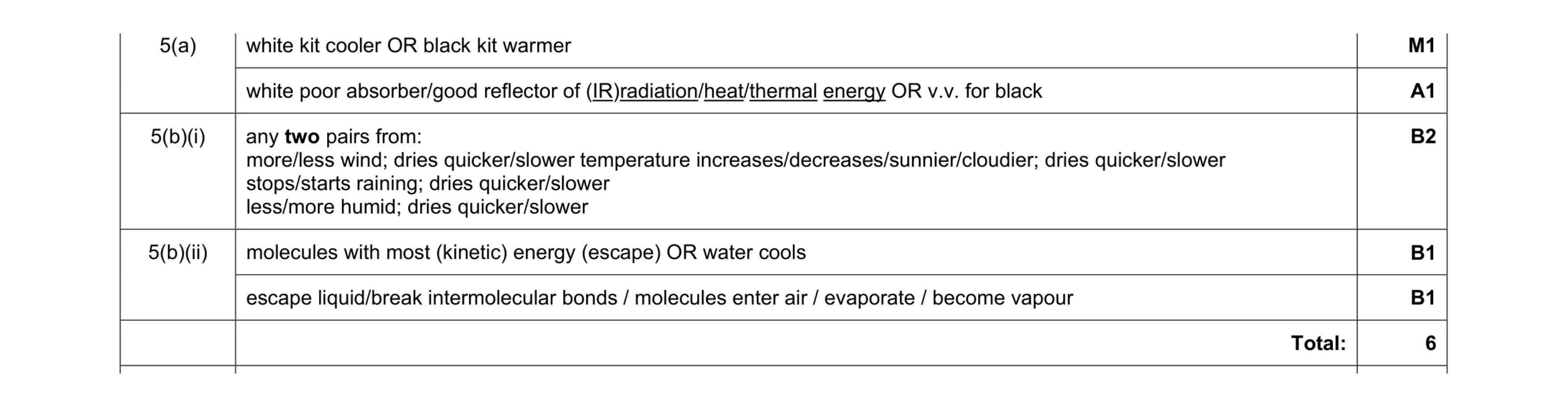 6
6 4
4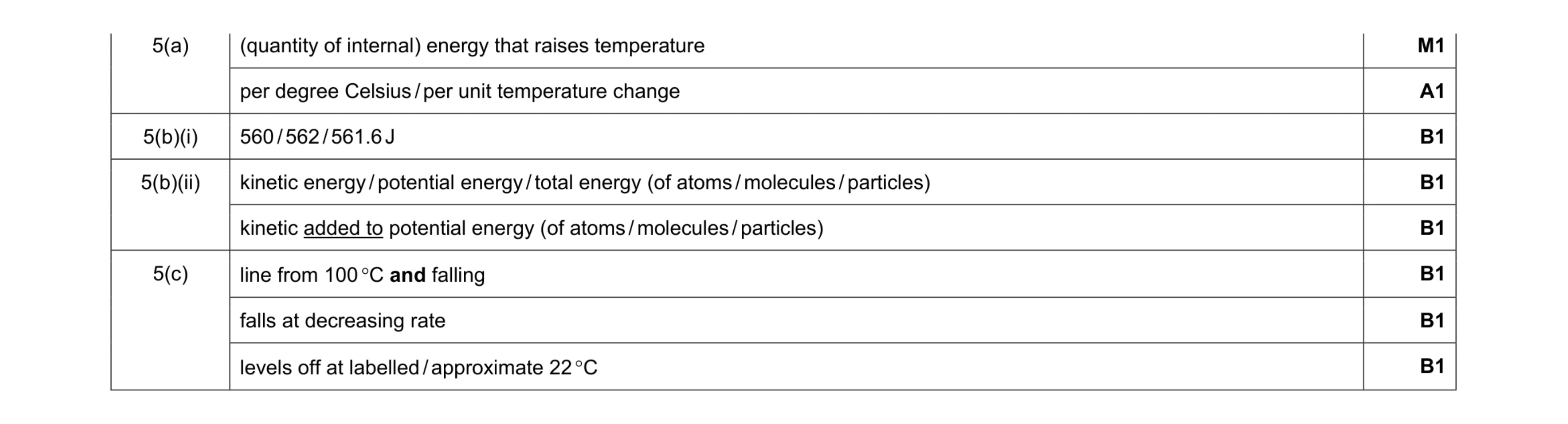 8
8 5
5 4
4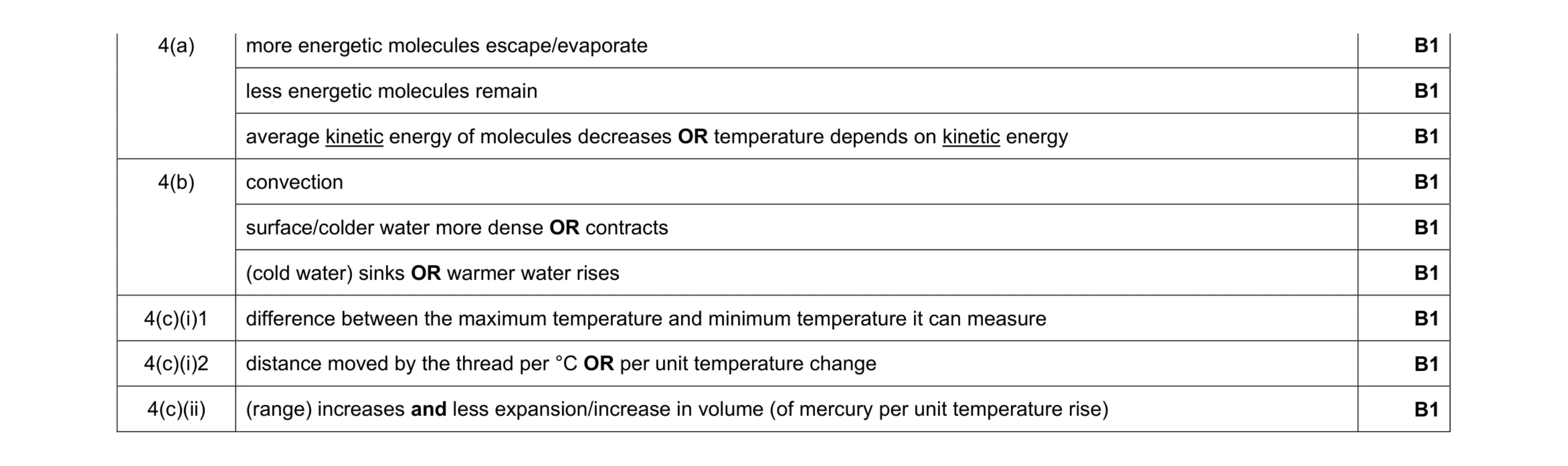 9
9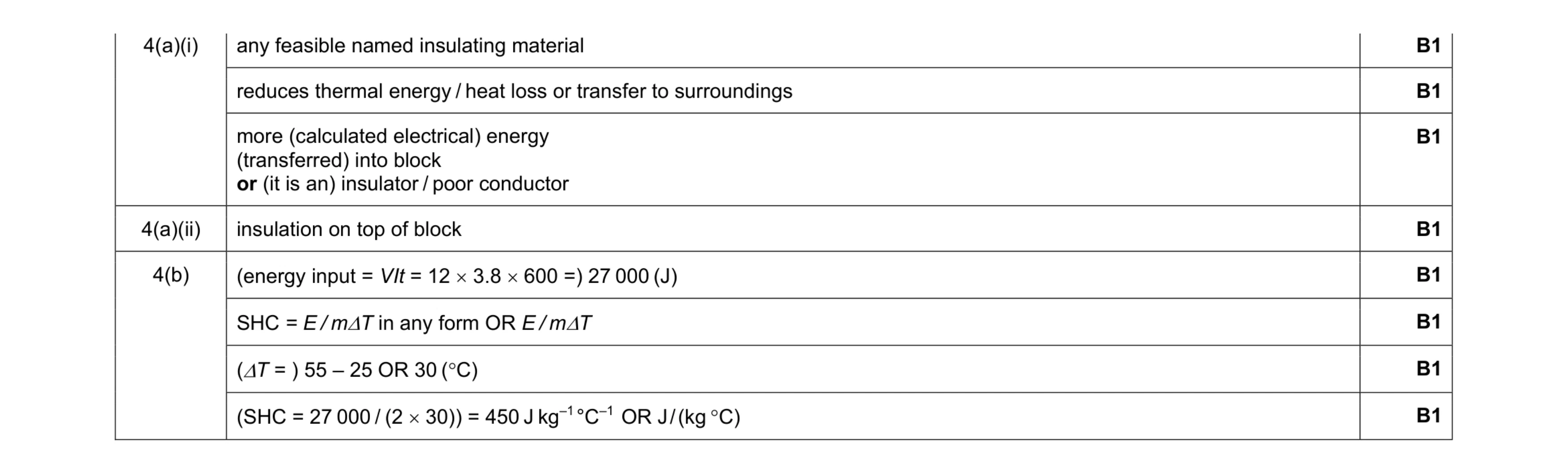 8
8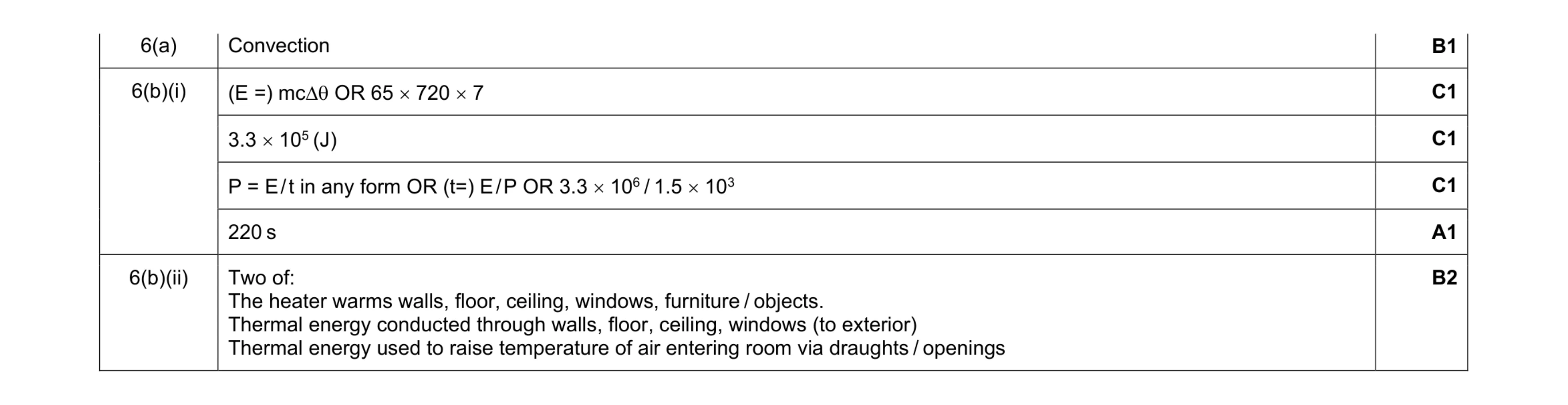 7
7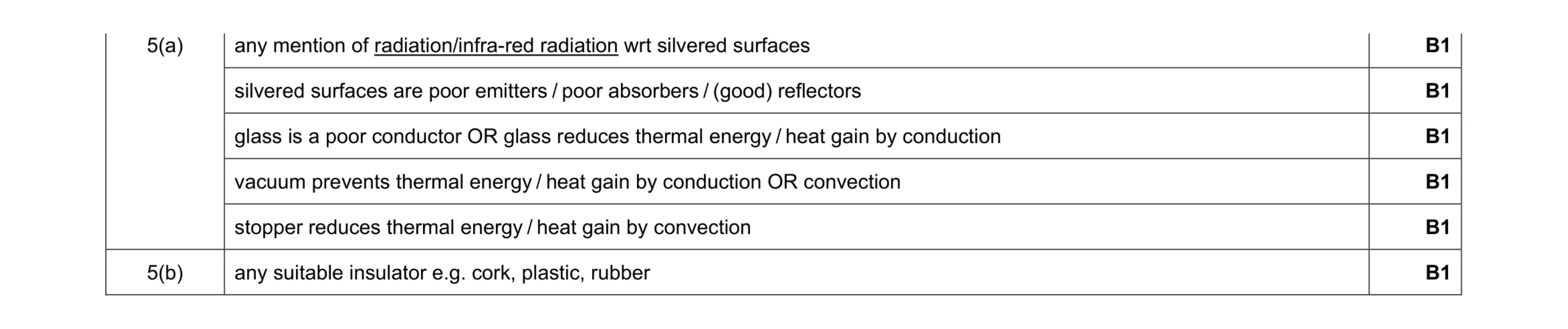 6
6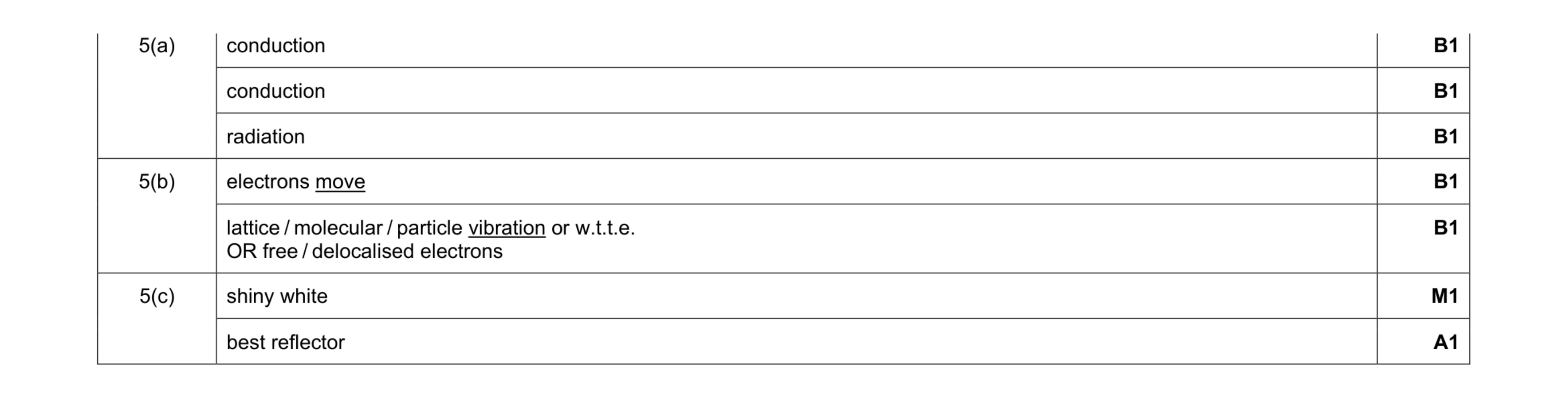 7
7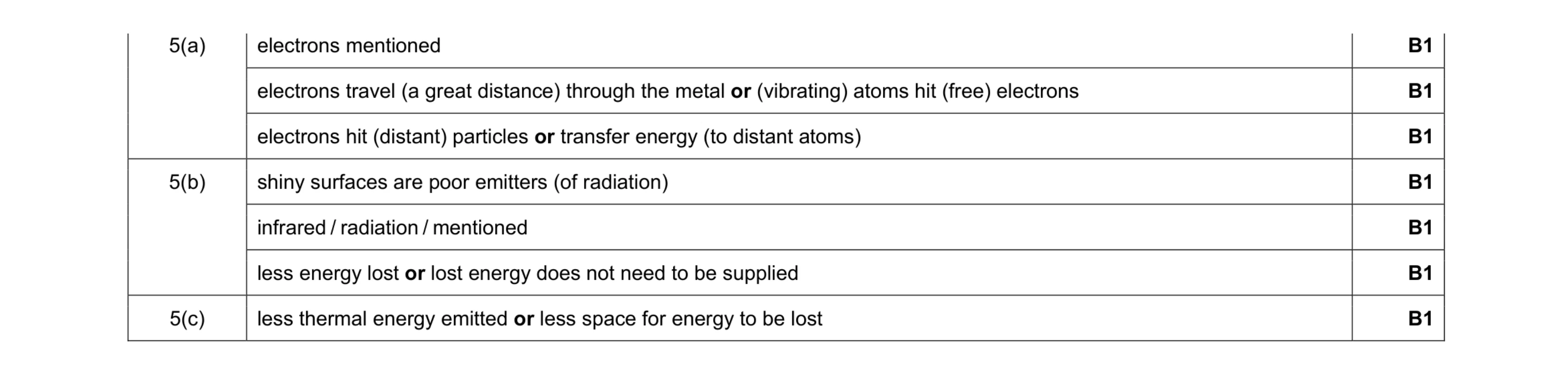 7
7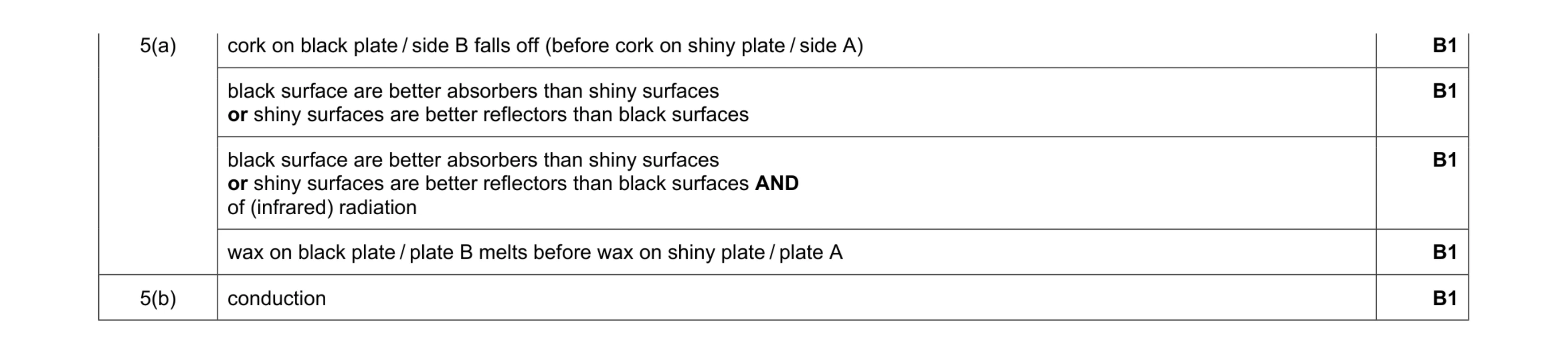 5
5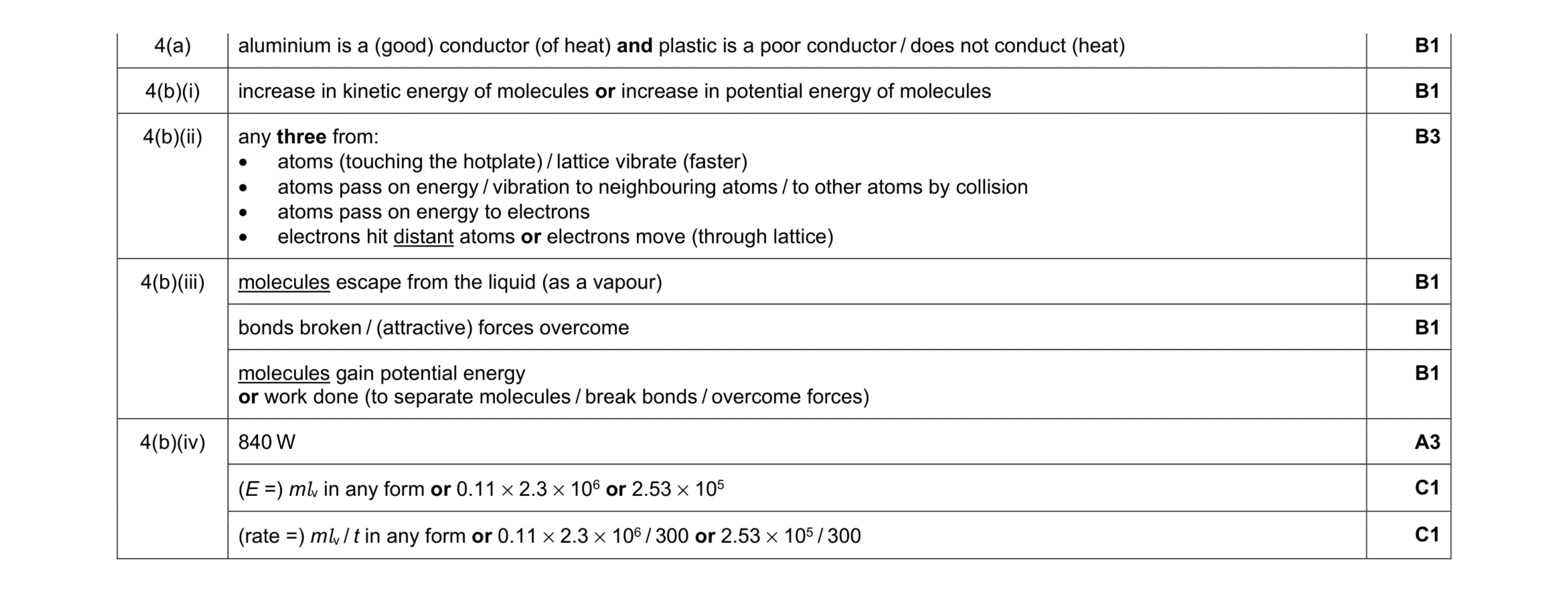 11
11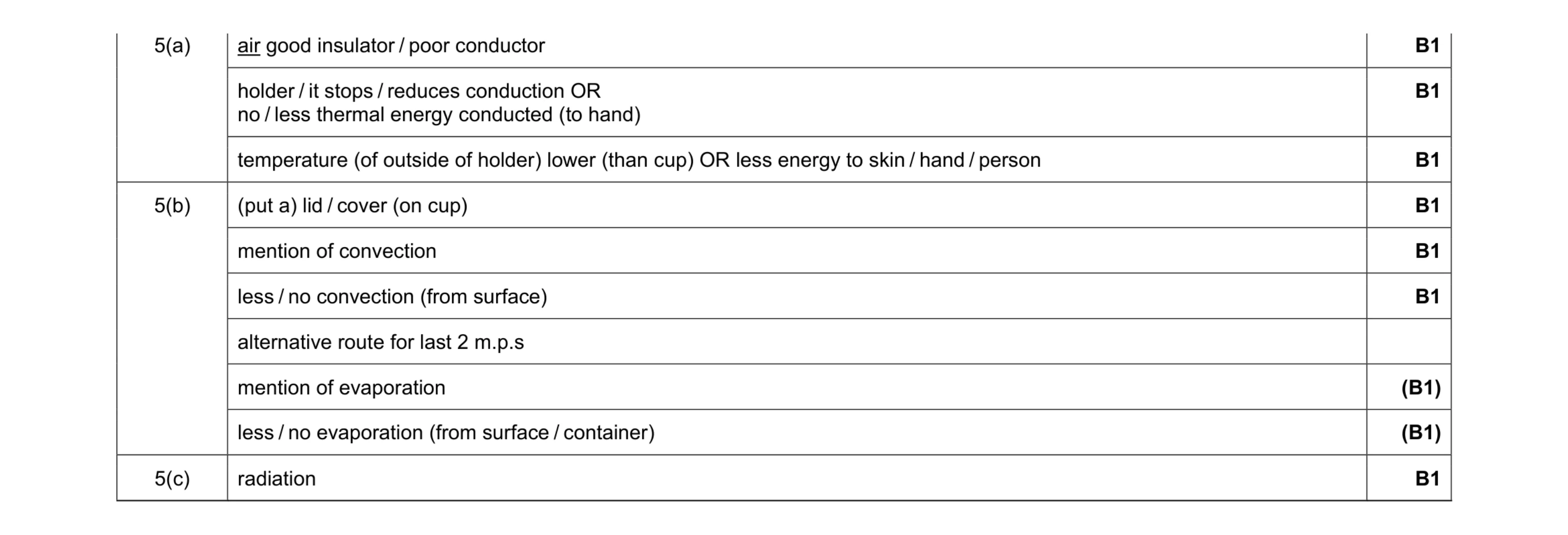 7
7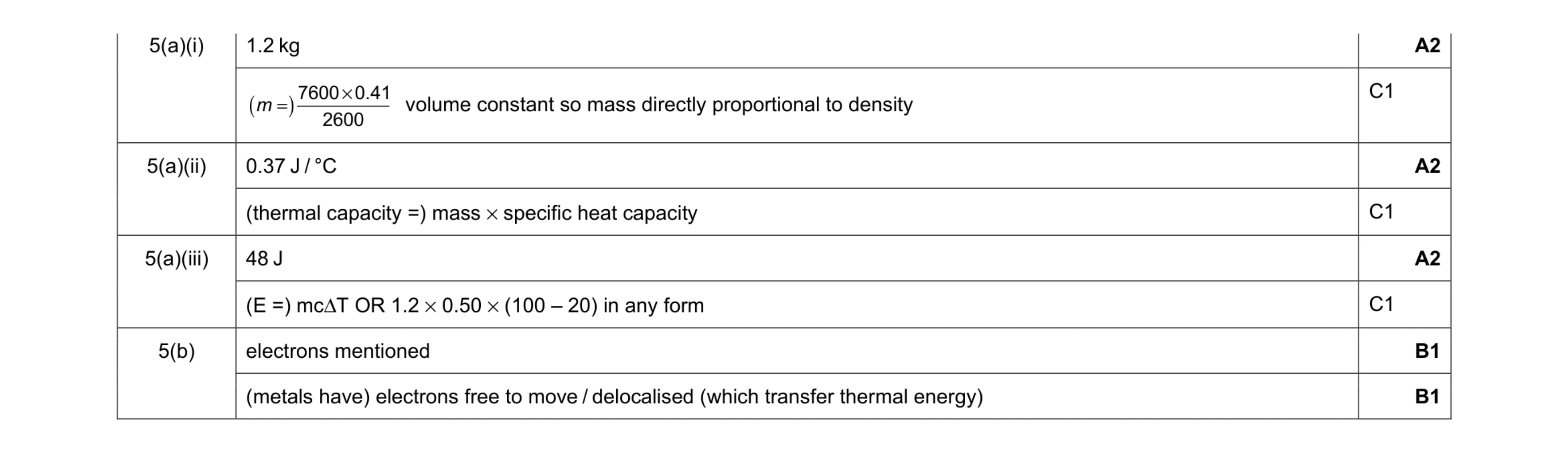 8
8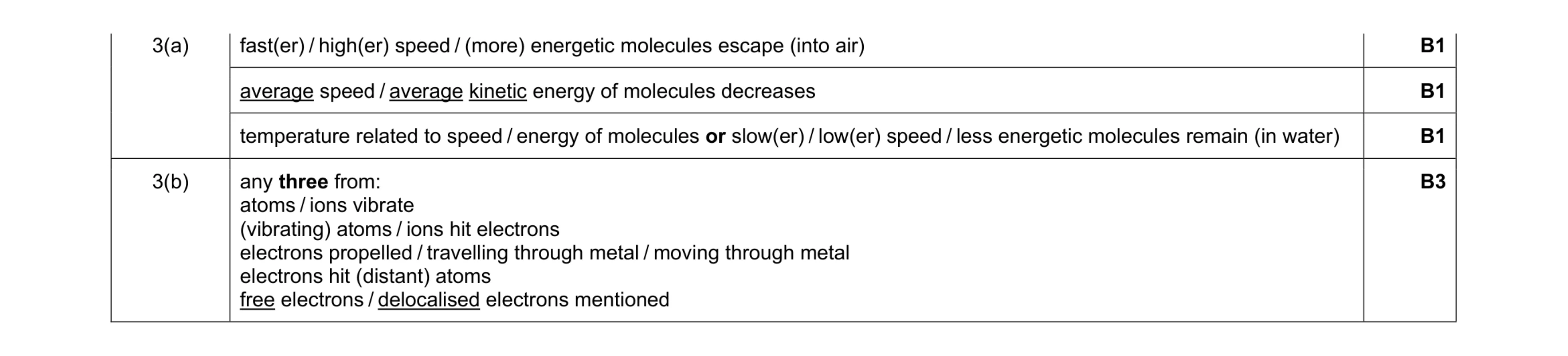 6
6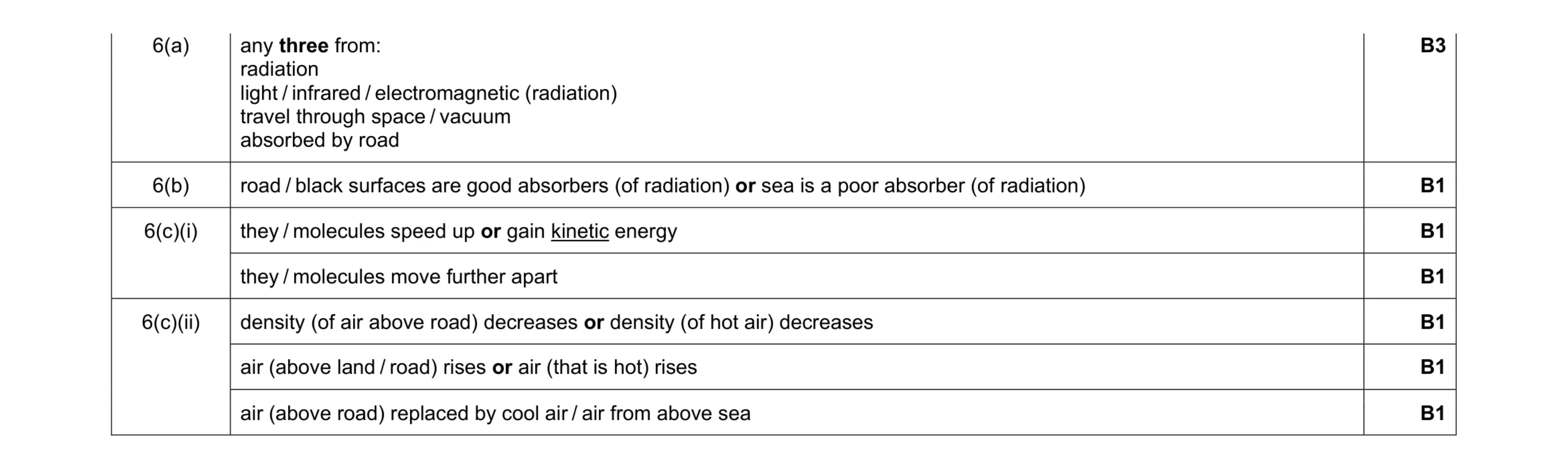 9
9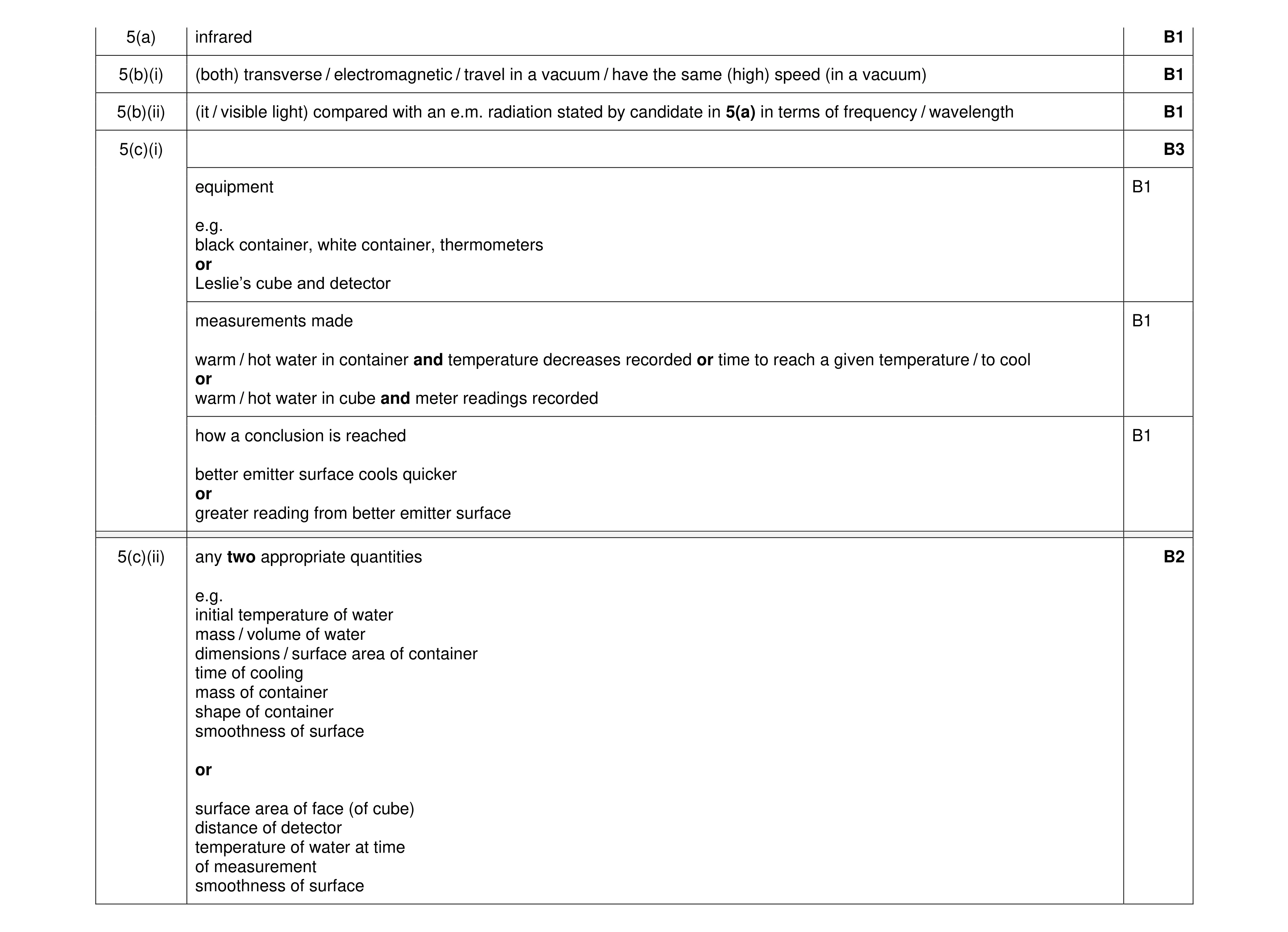 8
8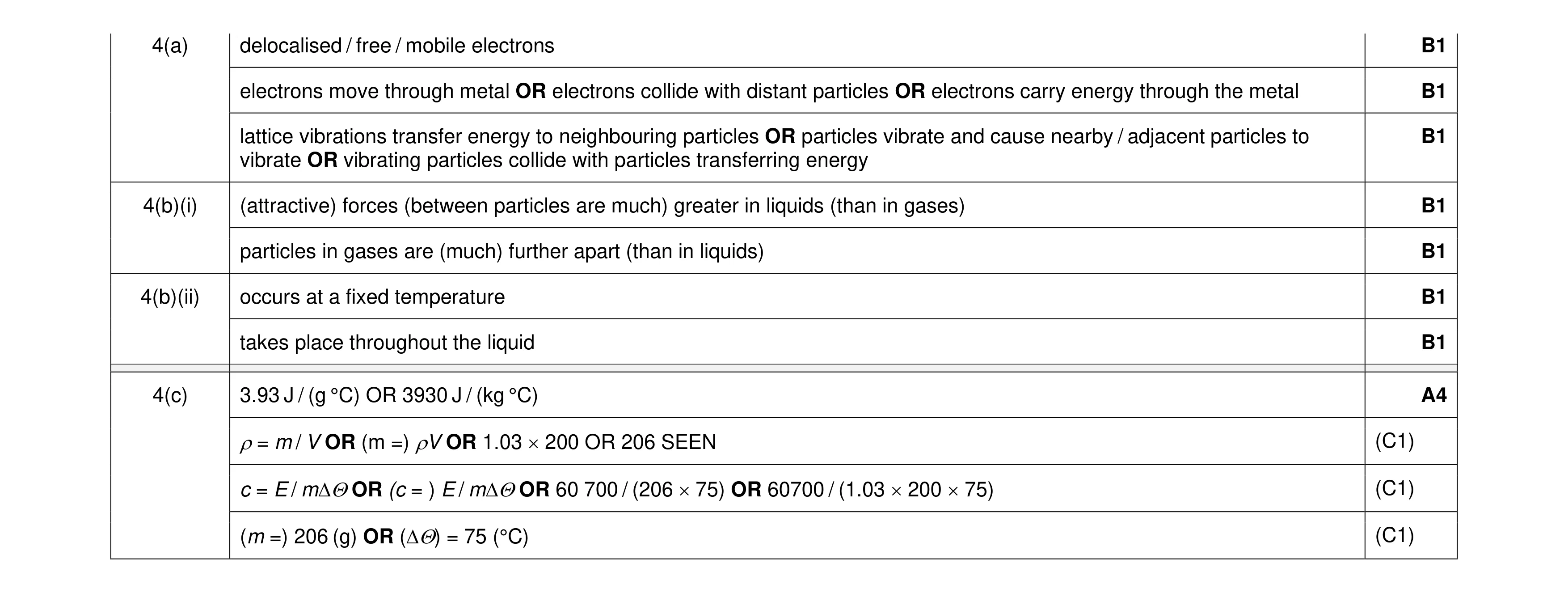 11
11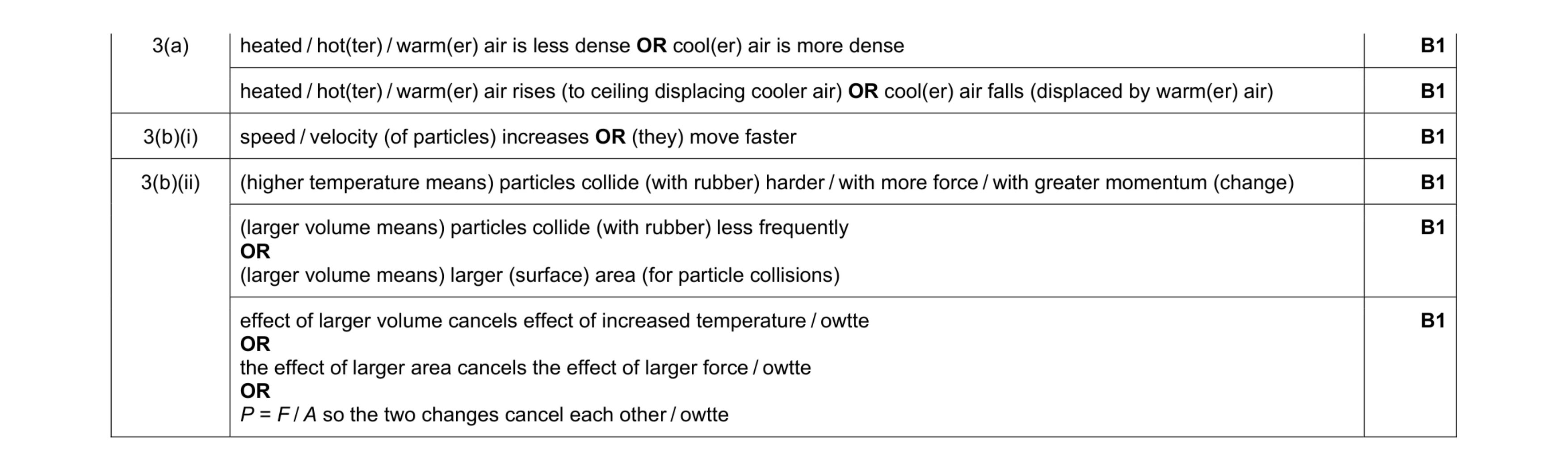 6
6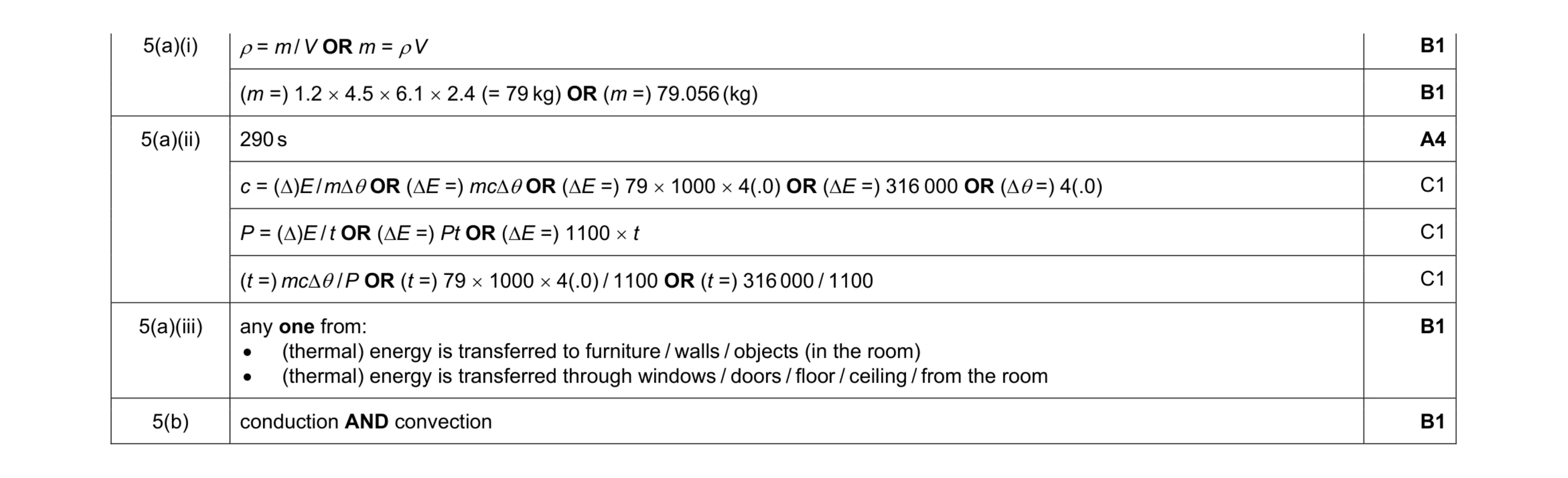 8
8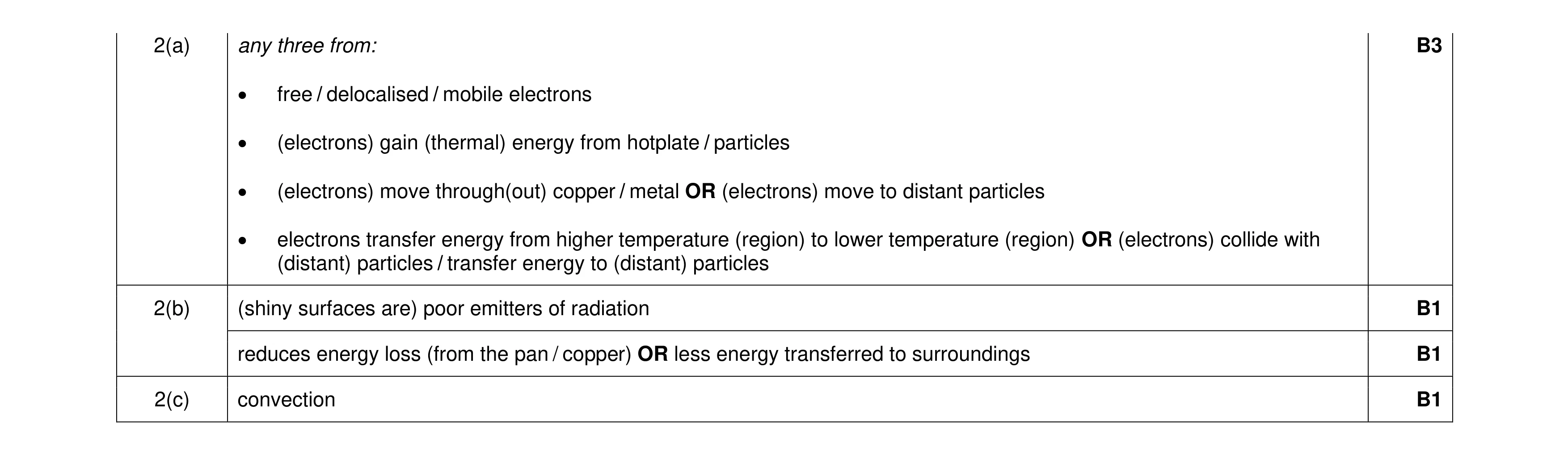 6
6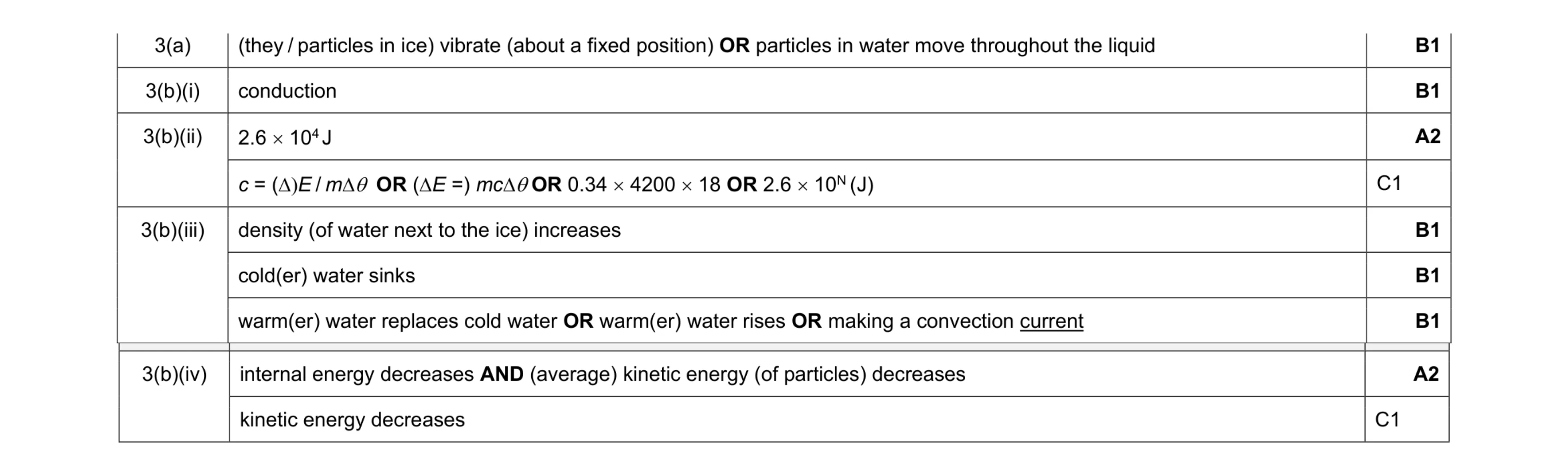 9
9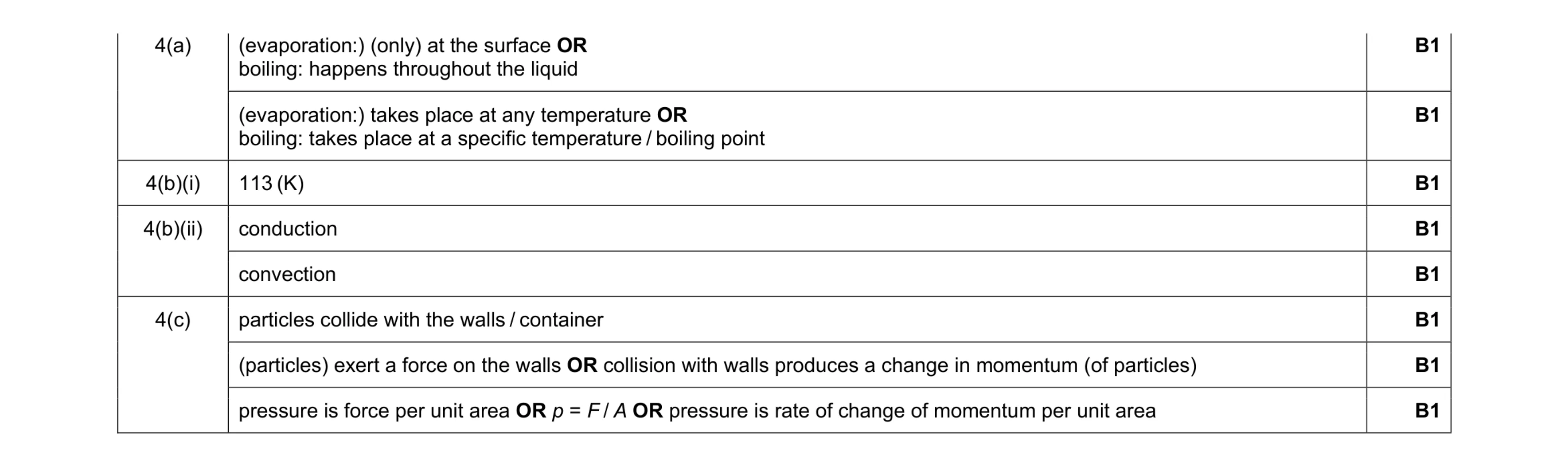 8
8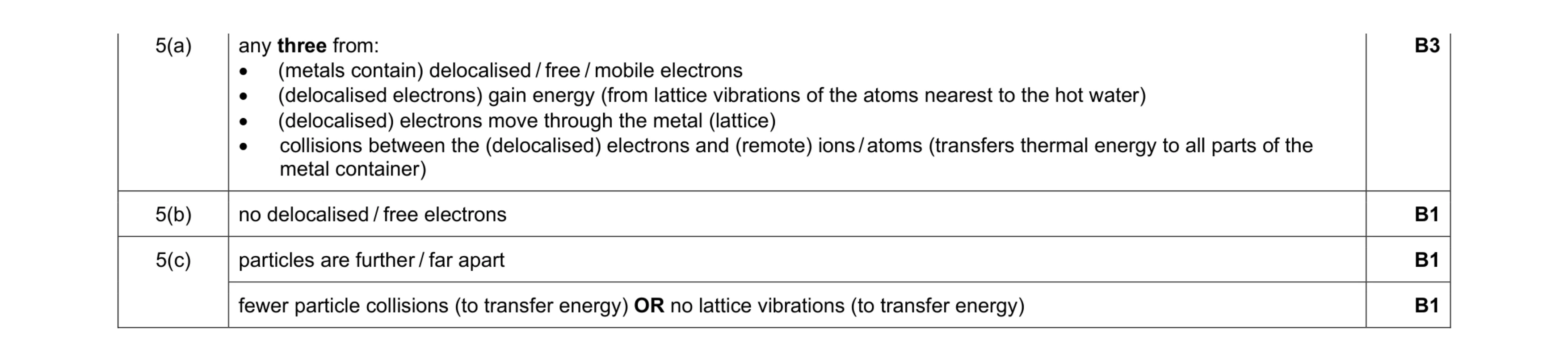 6
6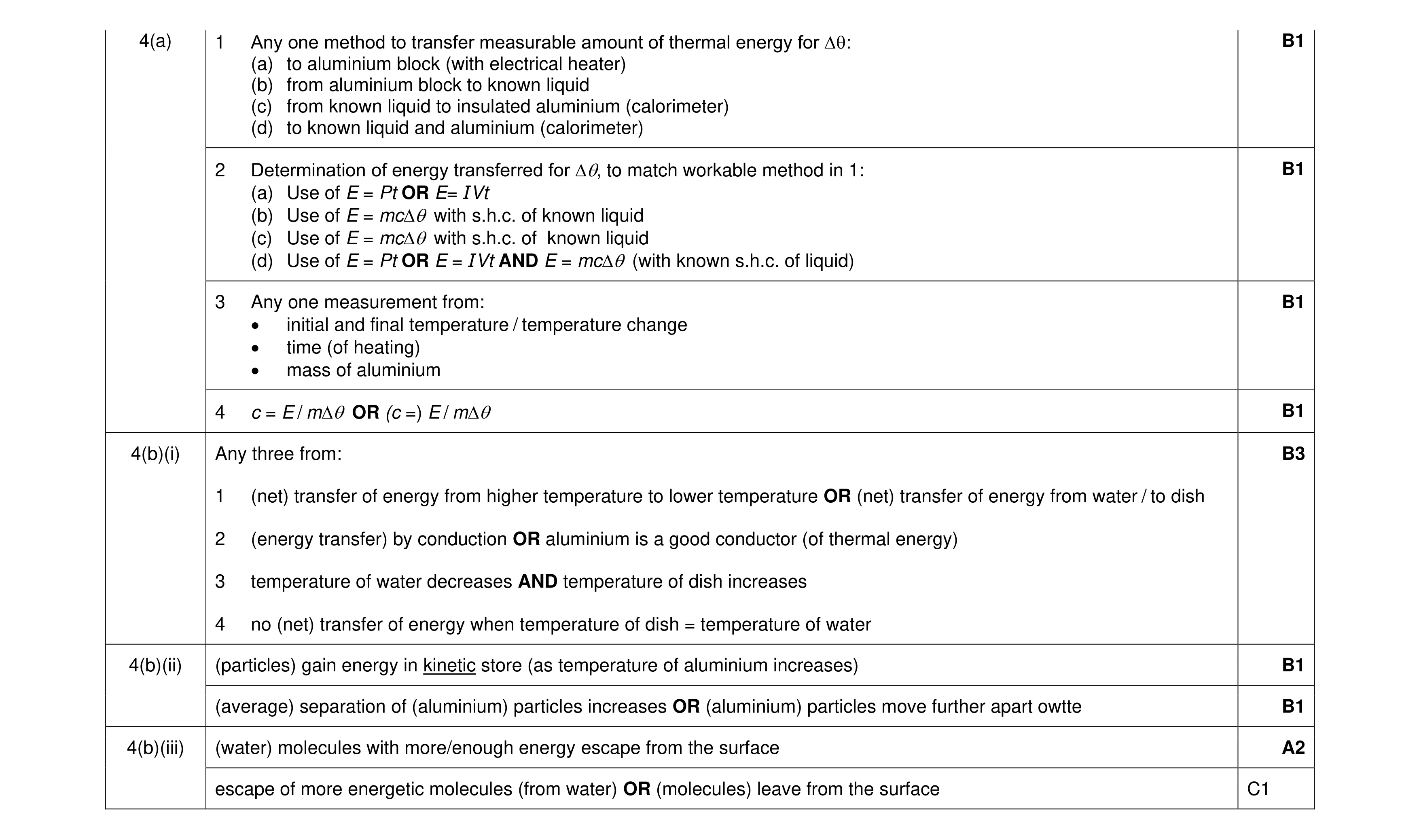 11
11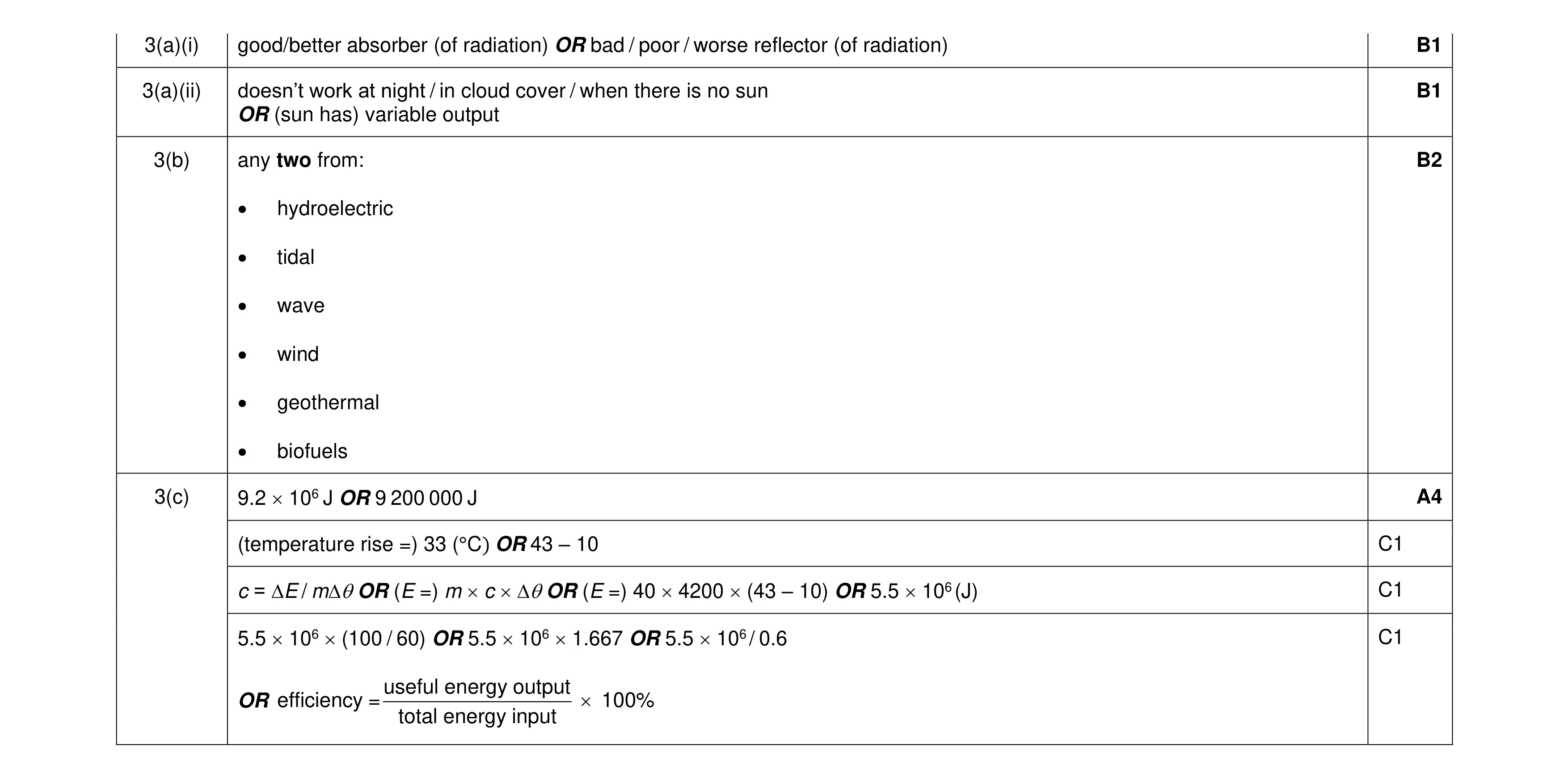 8
8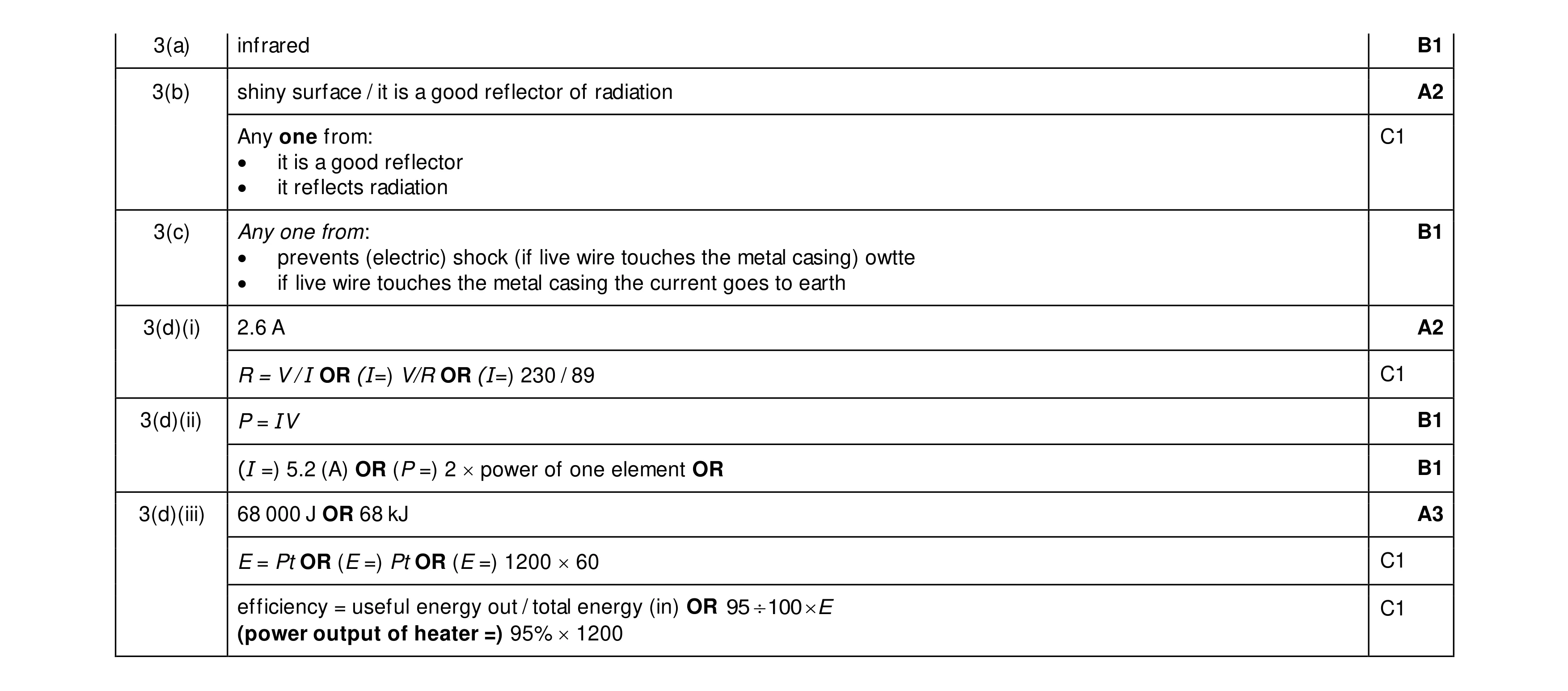 11
11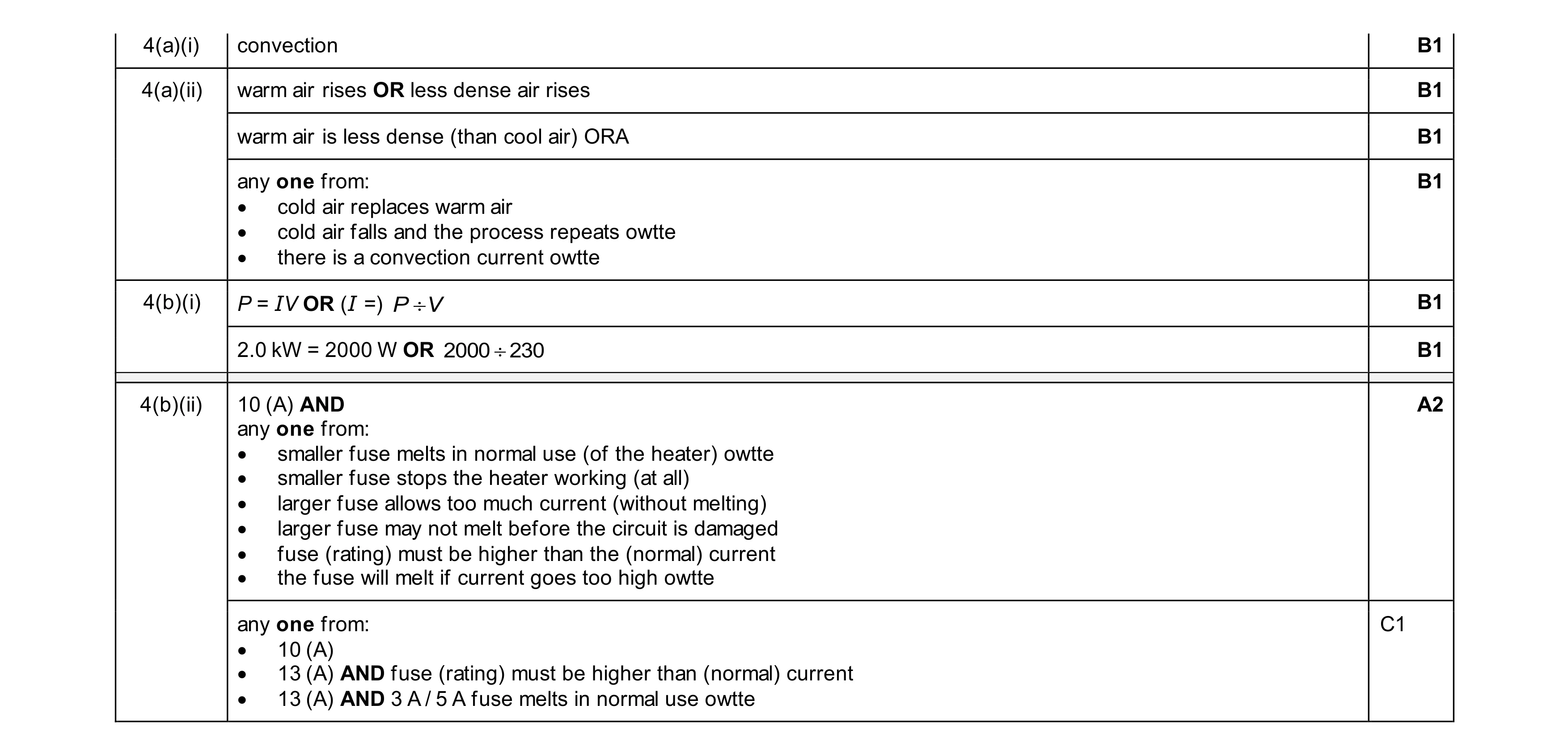 8
8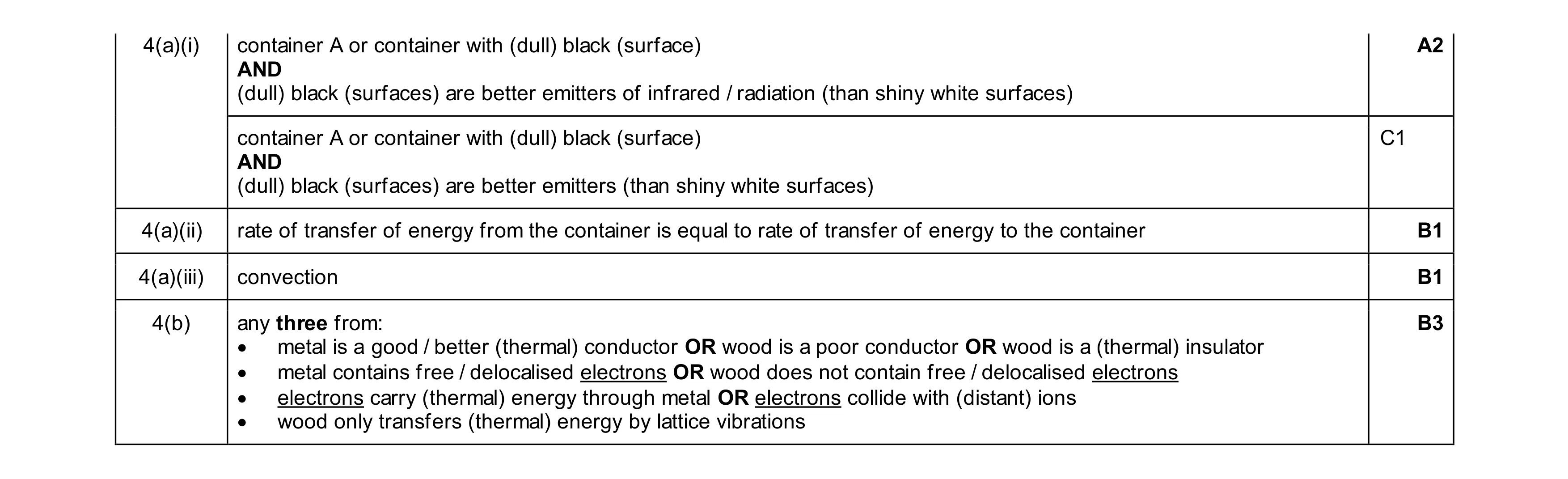 7
7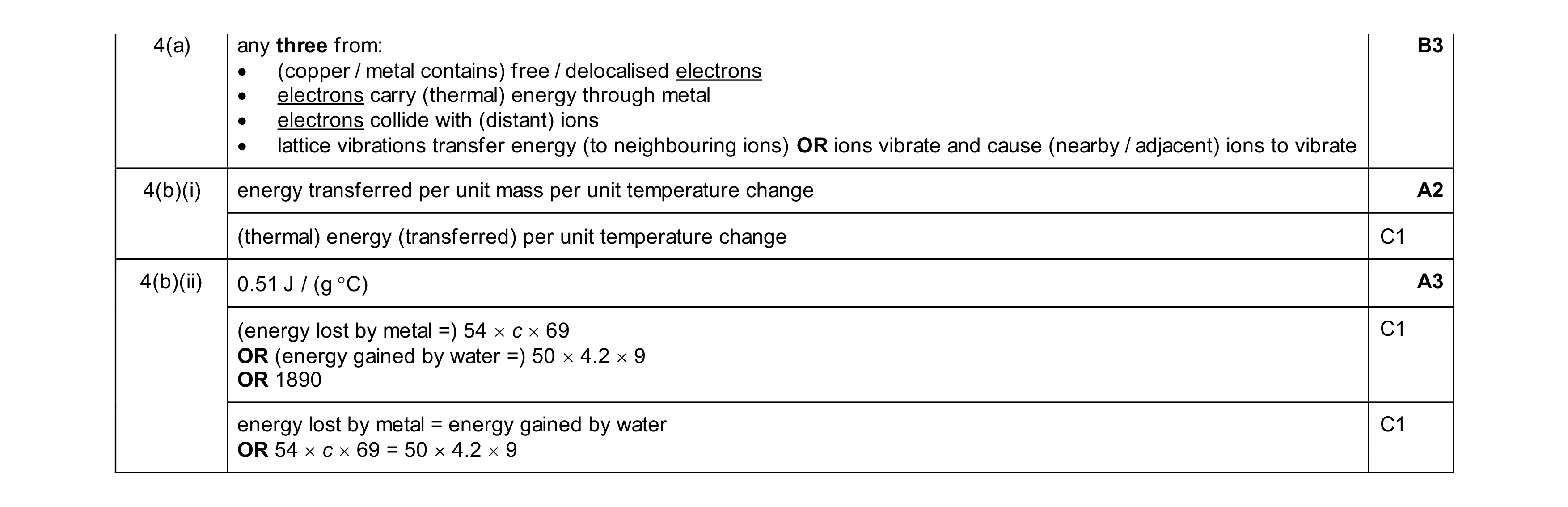 8
8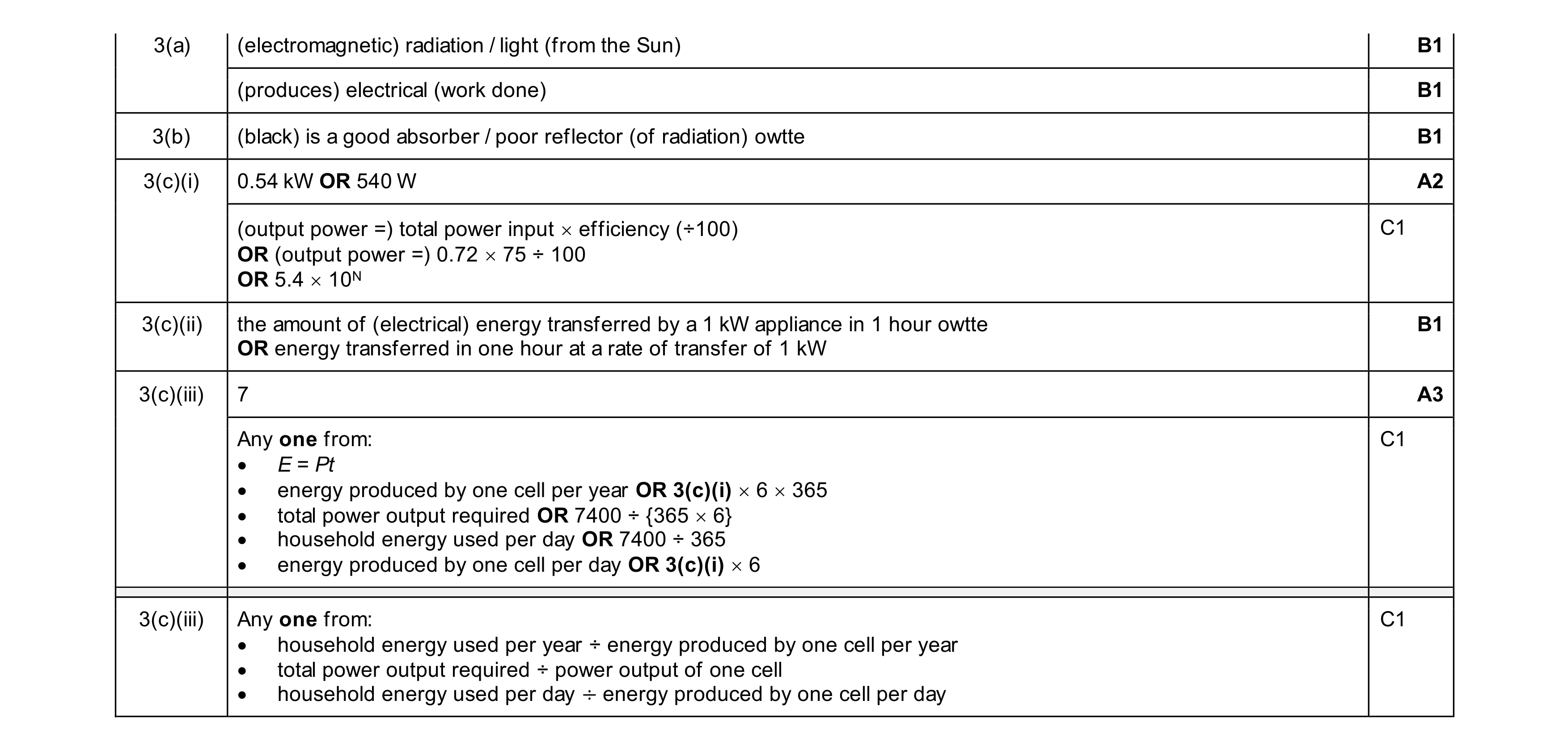 9
9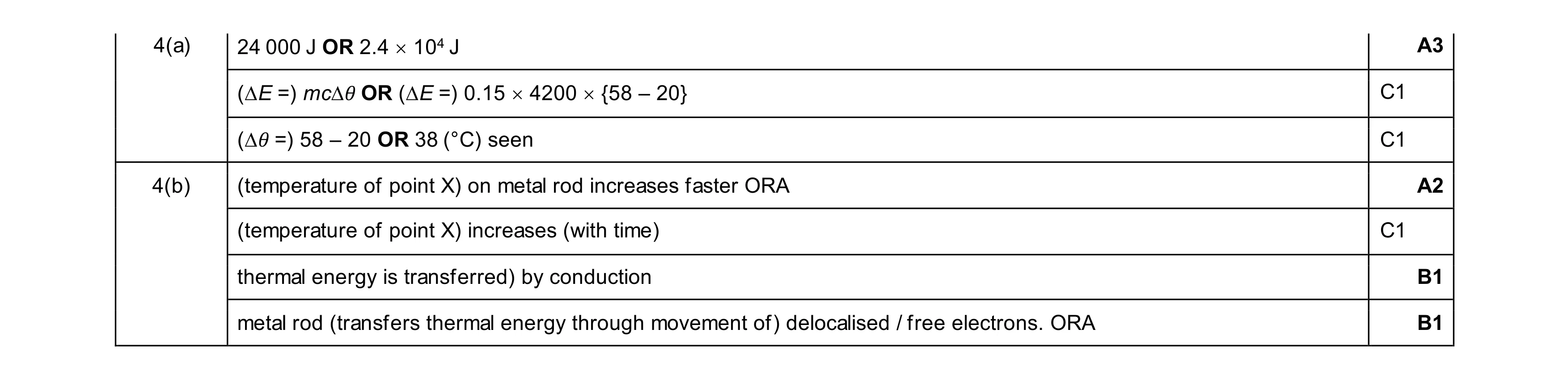 7
7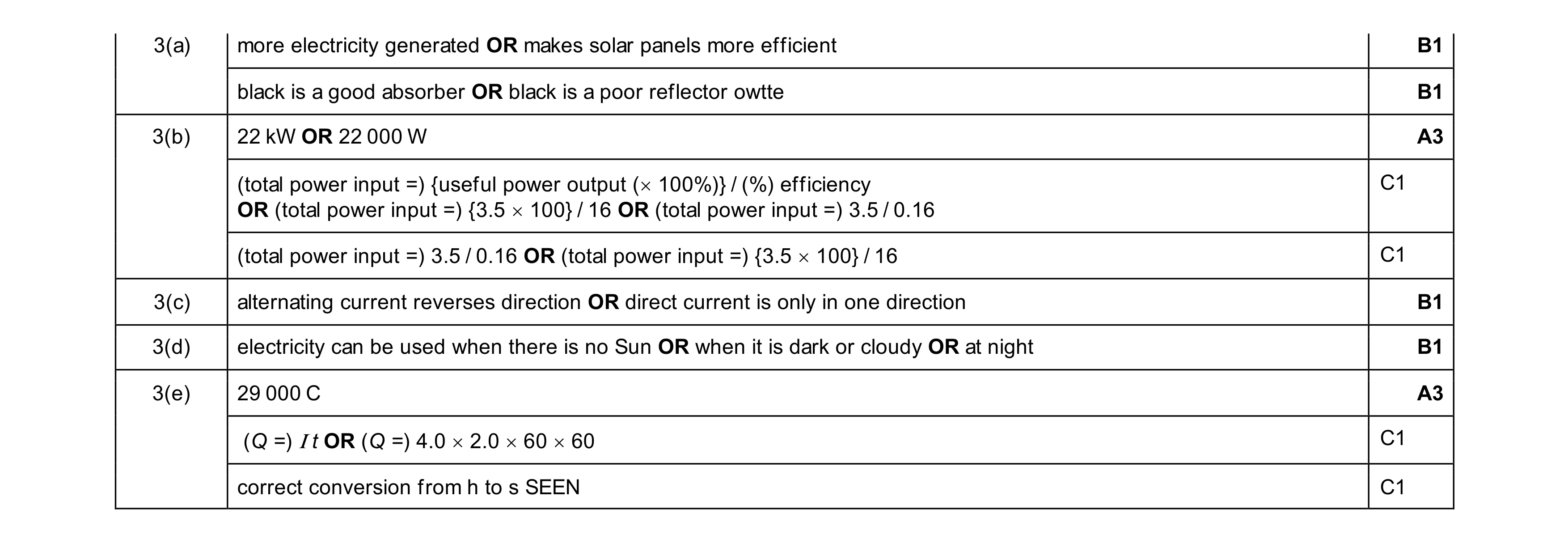 10
10