Questions as text
Q1 · One end of a copper rod is heated 0625/22 Feb/March 2016
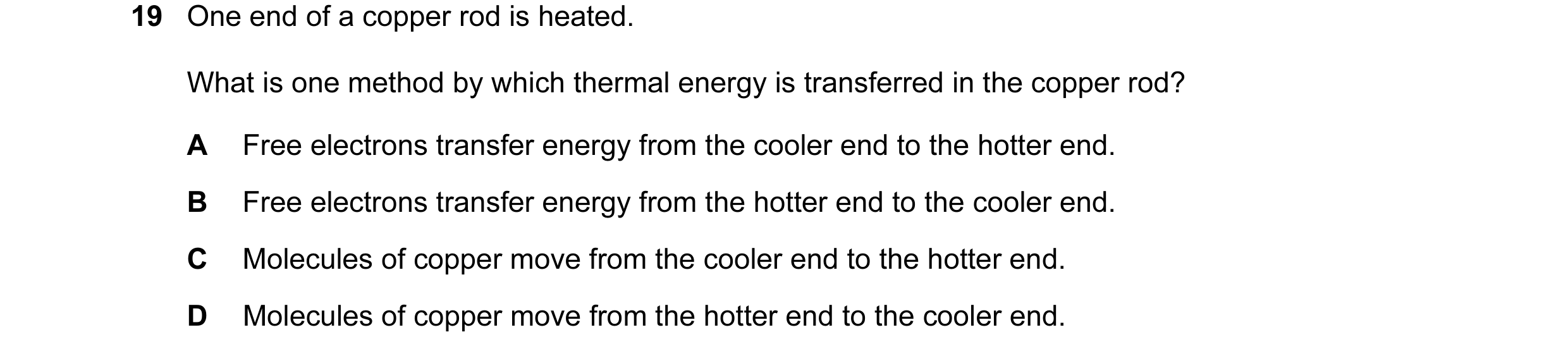
19 One end of a copper rod is heated. What is one method by which thermal energy is transferred in the copper rod? A Free electrons transfer energy from the cooler end to the hotter end. B Free electrons transfer energy from the hotter end to the cooler end. C Molecules of copper move from the cooler end to the hotter end. D Molecules of copper move from the hotter end to the cooler end.
1 marks
Answer: B
This question in 0625/22 Feb/March 2016
Q2 · Two plastic cups are placed one inside the other 0625/22 Feb/March 2016
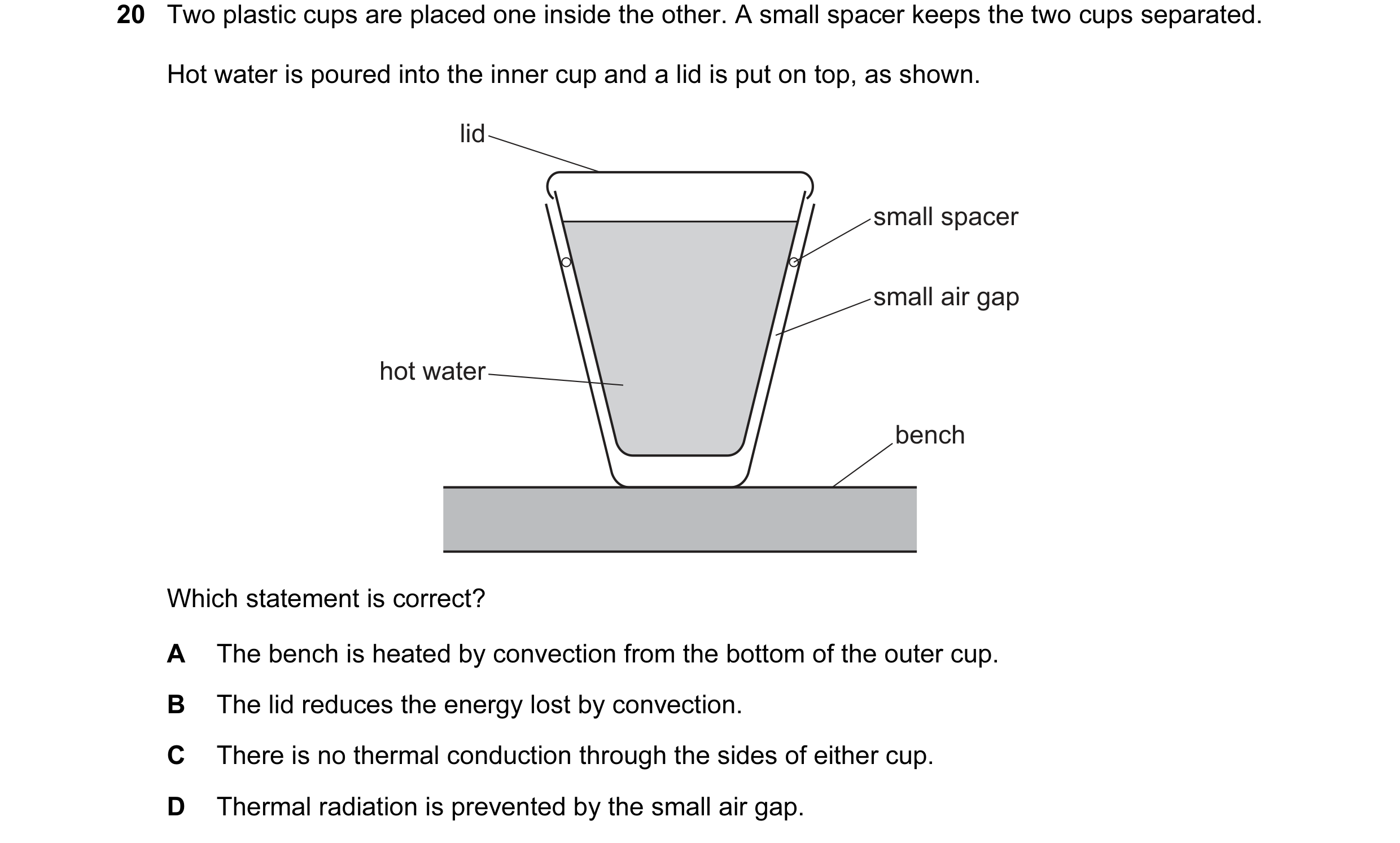
20 Two plastic cups are placed one inside the other. A small spacer keeps the two cups separated. Hot water is poured into the inner cup and a lid is put on top, as shown. lid small spacer small air gap hot water bench Which statement is correct? A The bench is heated by convection from the bottom of the outer cup. B The lid reduces the energy lost by convection. C There is no thermal conduction through the sides of either cup. D Thermal radiation is prevented by the small air gap.
1 marks
Answer: B
This question in 0625/22 Feb/March 2016
Q3 · Two otherwise identical cars, one black and one white, are at the same initial temperature 0625/21 May/June 2016
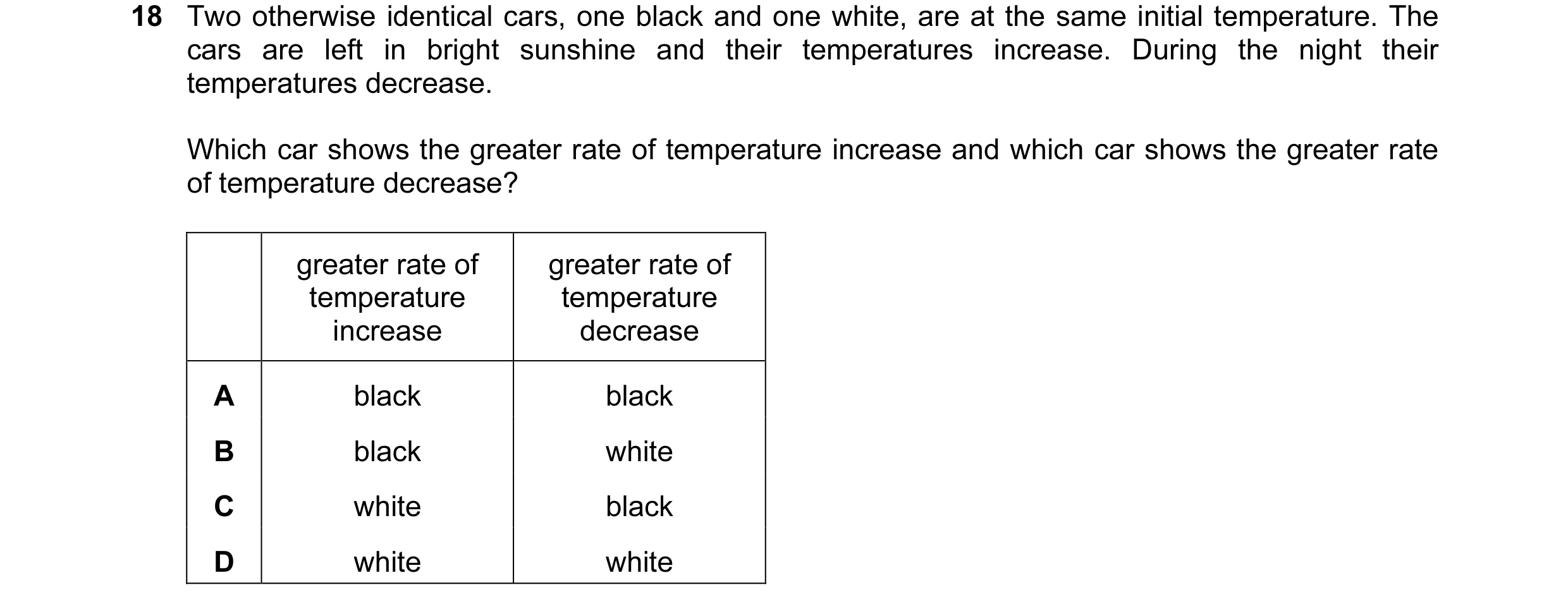
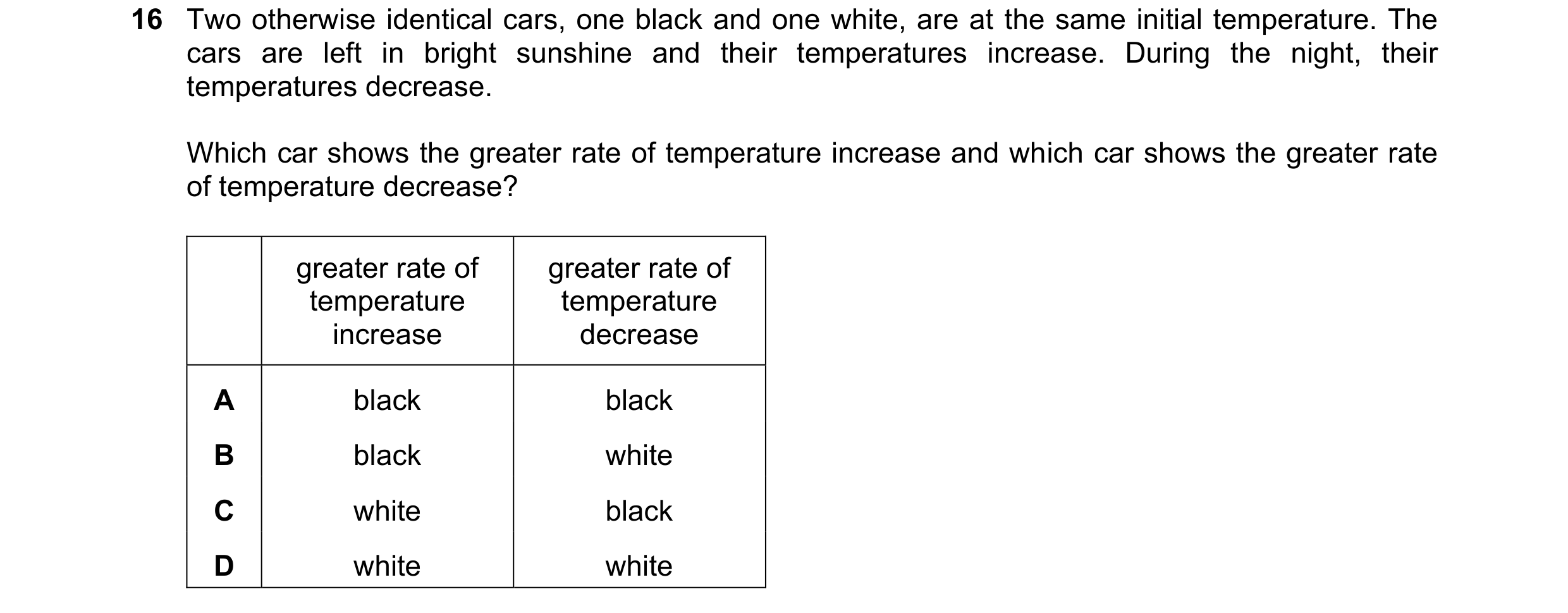
18 Two otherwise identical cars, one black and one white, are at the same initial temperature. The cars are left in bright sunshine and their temperatures increase. During the night their temperatures decrease. Which car shows the greater rate of temperature increase and which car shows the greater rate of temperature decrease? greater rate of greater rate of temperature temperature increase decrease A black black B black white C white black D white white
1 marks
Answer: A
This question in 0625/21 May/June 2016
Q4 · A liquid is heated in a beaker 0625/21 May/June 2016
19 A liquid is heated in a beaker. liquid heating The density of the liquid changes as its temperature increases. This causes energy to be transferred throughout the liquid. How does the density change and what is this energy transfer process? energy transfer density process A decreases conduction B decreases convection C increases conduction D increases convection
1 marks
Answer: B
This question in 0625/21 May/June 2016
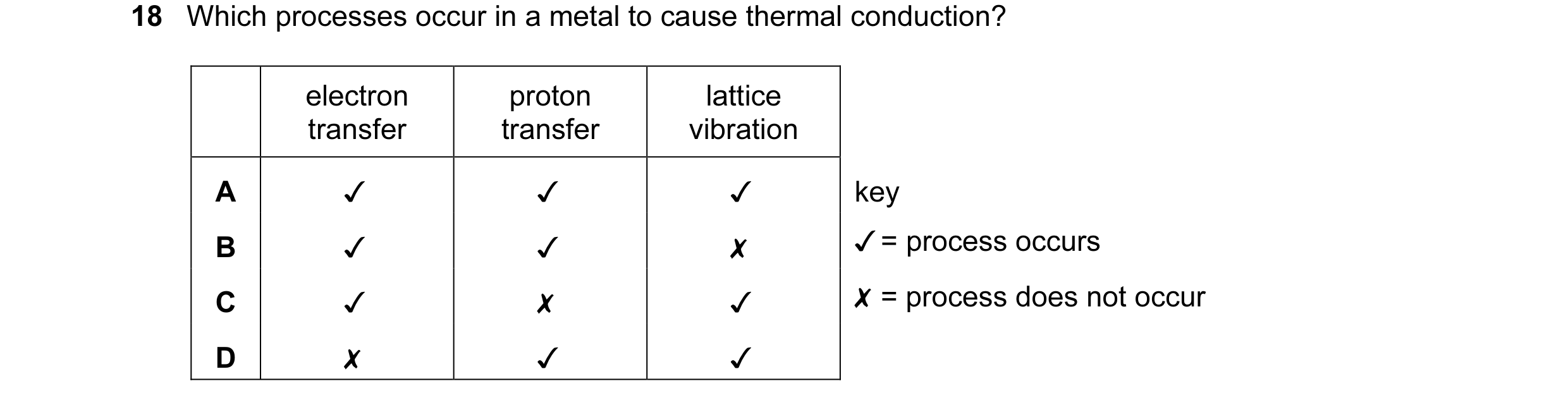
Q5 · Which processes occur in a metal to cause thermal conduction? 0625/22 May/June 2016
18 Which processes occur in a metal to cause thermal conduction?
electron proton lattice
transfer transfer vibration
A v v v
B v v x
Cc v x v
D x v v
key
/ = process occurs
X = process does not occur
1 marks
Answer: C
This question in 0625/22 May/June 2016
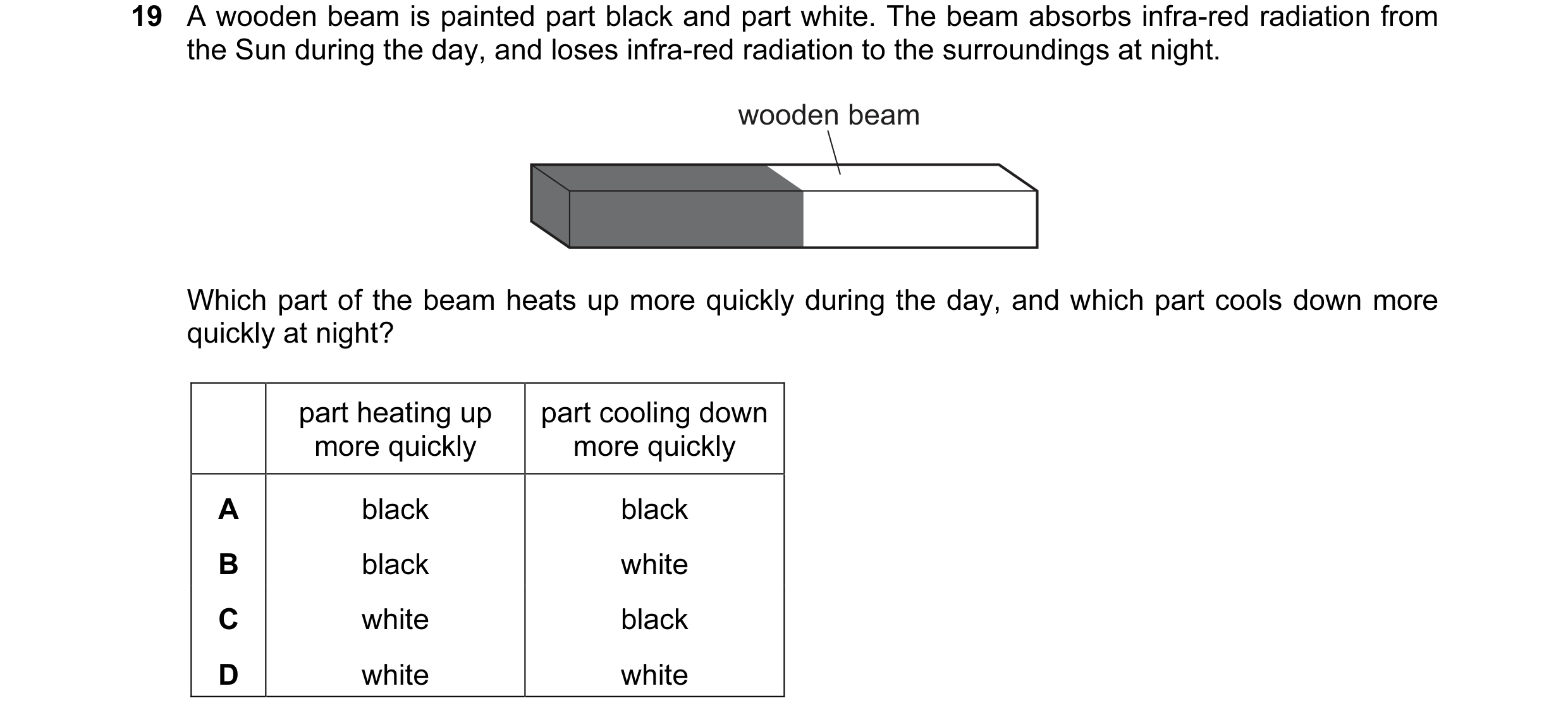
Q6 · A wooden beam is painted part black and part white 0625/22 May/June 2016
19 A wooden beam is painted part black and part white. The beam absorbs infra-red radiation from the Sun during the day, and loses infra-red radiation to the surroundings at night. wooden beam Which part of the beam heats up more quickly during the day, and which part cools down more quickly at night? part heating up part cooling down more quickly more quickly A black black B black white C white black D white white
1 marks
Answer: A
This question in 0625/22 May/June 2016
Q7 · Which row shows the surface that is the better absorber and the surface that is the… 0625/23 May/June 2016
18 Which row shows the surface that is the better absorber and the surface that is the better emitter of infra-red radiation? better absorber better emitter A black surface black surface B black surface white surface C white surface black surface D white surface white surface
1 marks
Answer: A
This question in 0625/23 May/June 2016
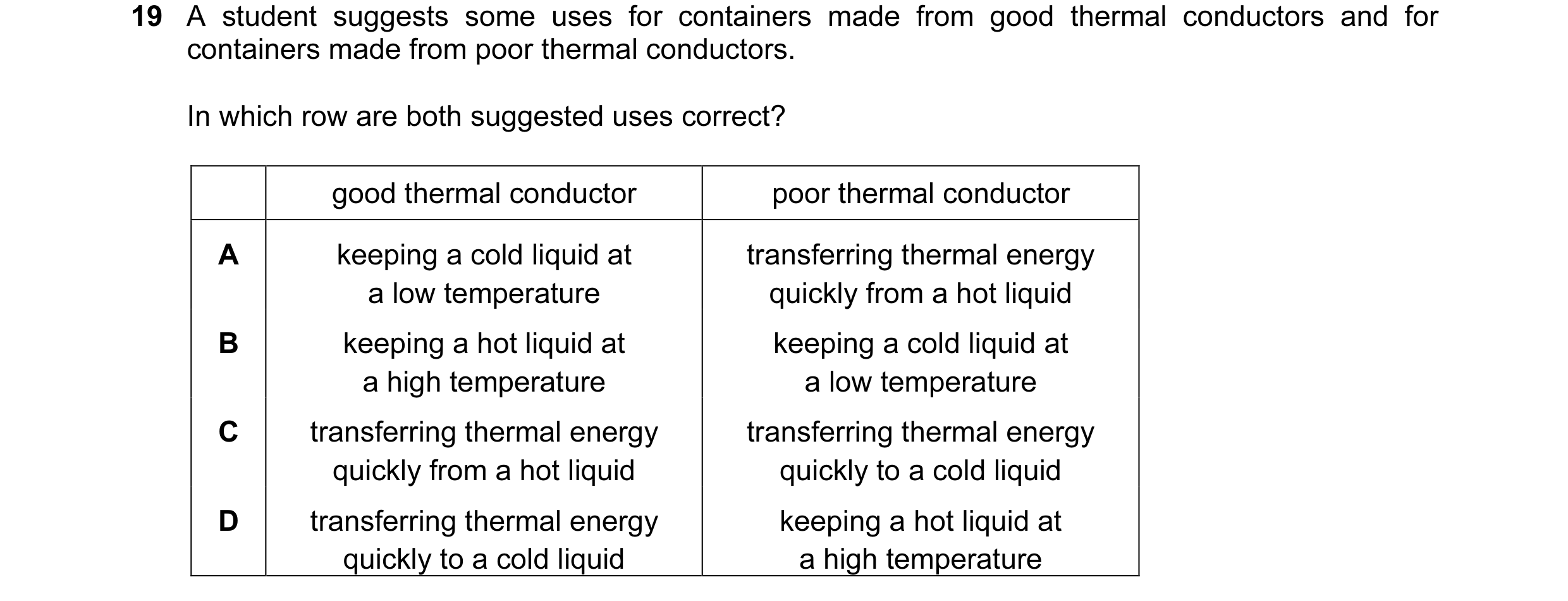
Q8 · A student suggests some uses for containers made from good thermal conductors and for… 0625/23 May/June 2016
19 A student suggests some uses for containers made from good thermal conductors and for containers made from poor thermal conductors. In which row are both suggested uses correct? good thermal conductor poor thermal conductor A keeping a cold liquid at transferring thermal energy a low temperature quickly from a hot liquid B keeping a hot liquid at keeping a cold liquid at a high temperature a low temperature C transferring thermal energy transferring thermal energy quickly from a hot liquid quickly to a cold liquid D transferring thermal energy keeping a hot liquid at quickly to a cold liquid a high temperature
1 marks
Answer: D
This question in 0625/23 May/June 2016
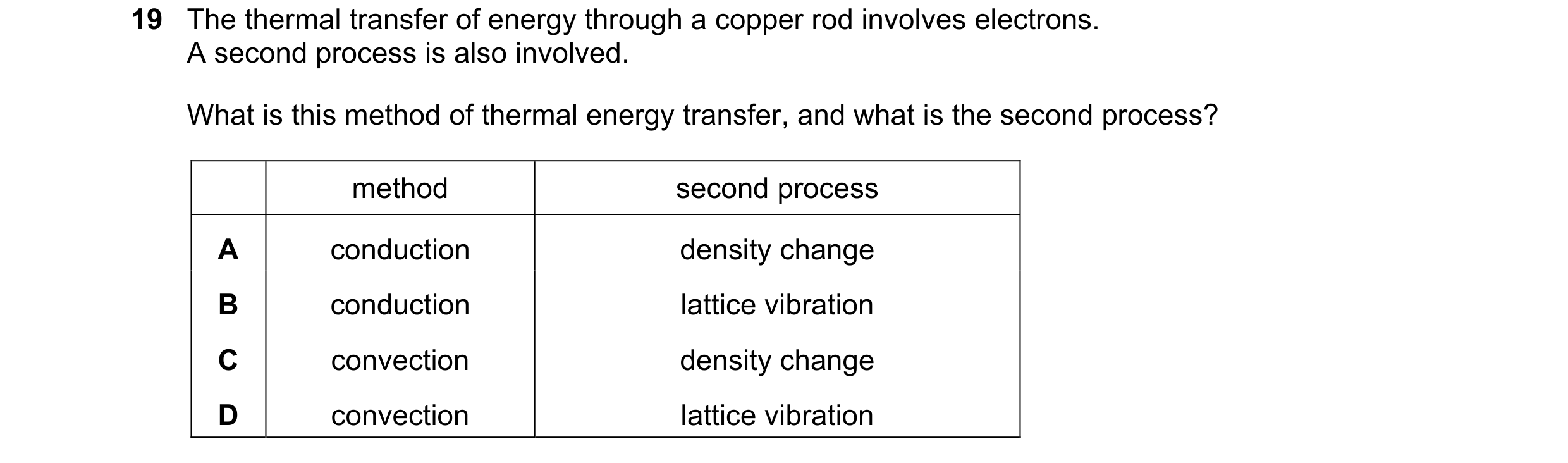
Q9 · The thermal transfer of energy through a copper rod involves electrons 0625/21 Oct/Nov 2016
19 The thermal transfer of energy through a copper rod involves electrons. A second process is also involved. What is this method of thermal energy transfer, and what is the second process? method second process A conduction density change B conduction lattice vibration C convection density change D convection lattice vibration
1 marks
Answer: B
This question in 0625/21 Oct/Nov 2016
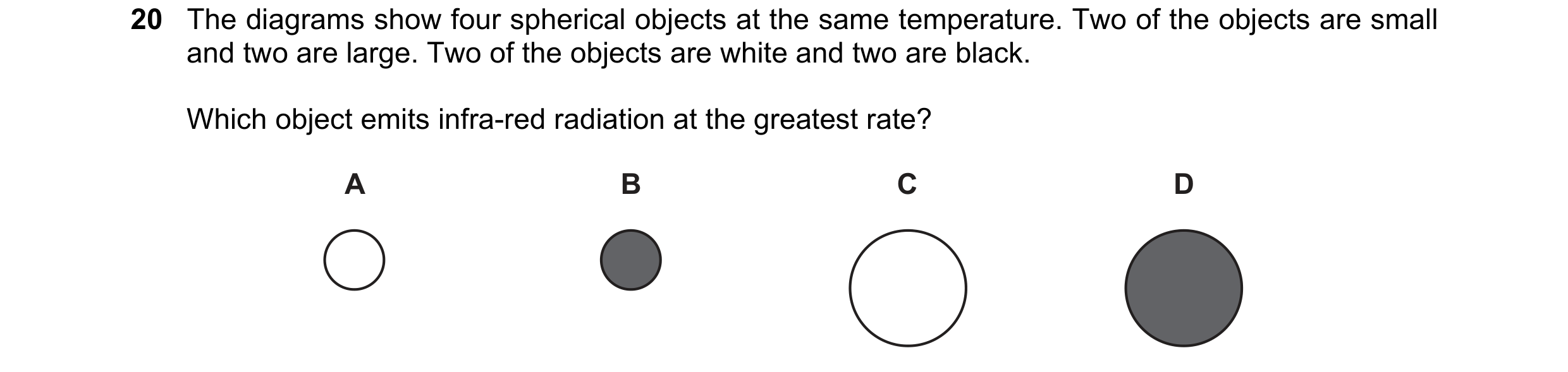
Q10 · The diagrams show four spherical objects at the same temperature 0625/21 Oct/Nov 2016
20 The diagrams show four spherical objects at the same temperature. Two of the objects are small and two are large. Two of the objects are white and two are black. Which object emits infra-red radiation at the greatest rate? A B C D
1 marks
Answer: D
This question in 0625/21 Oct/Nov 2016
Q11 · On a very cold day, a boy puts one hand on the metal handlebars of his bicycle 0625/22 Oct/Nov 2016
18 On a very cold day, a boy puts one hand on the metal handlebars of his bicycle. He puts the other hand on the rubber hand grip. The metal feels colder than the rubber hand grip, although they are both at the same temperature. Why is this? A The metal has a higher melting point than the rubber. B The metal has a lower thermal capacity than the rubber. C The metal is a better thermal conductor than the rubber. D The metal radiates more infra-red radiation than the rubber.
1 marks
Answer: C
This question in 0625/22 Oct/Nov 2016
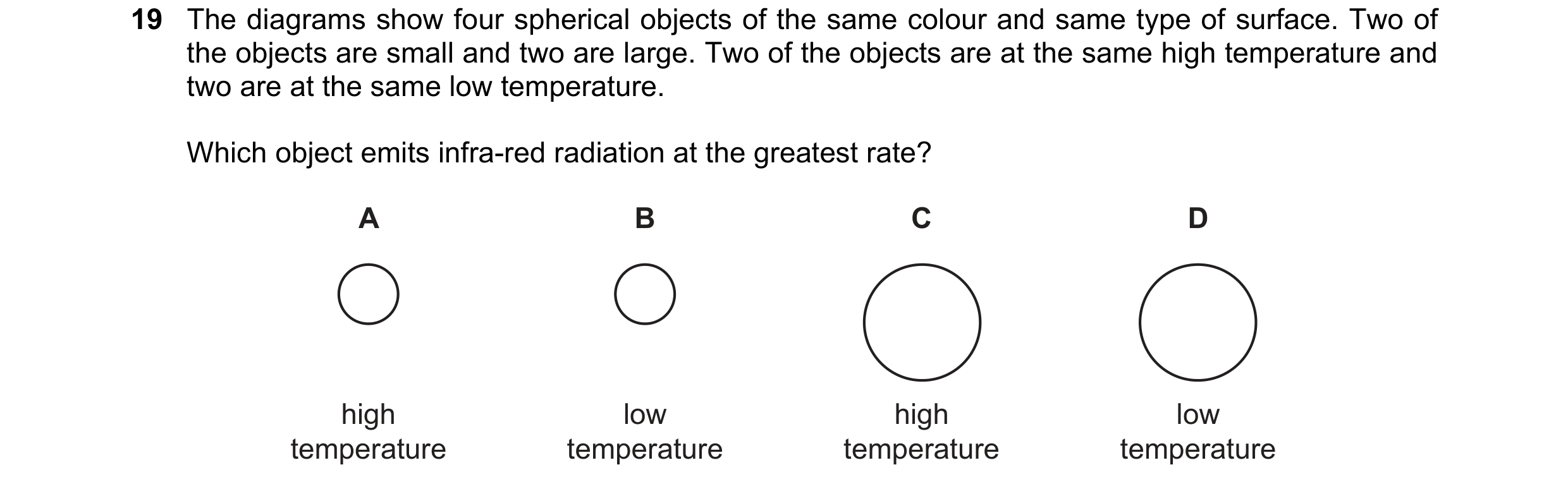
Q12 · The diagrams show four spherical objects of the same colour and same type of surface 0625/22 Oct/Nov 2016
19 The diagrams show four spherical objects of the same colour and same type of surface. Two of the objects are small and two are large. Two of the objects are at the same high temperature and two are at the same low temperature. Which object emits infra-red radiation at the greatest rate? A B C D high low high low temperature temperature temperature temperature
1 marks
Answer: C
This question in 0625/22 Oct/Nov 2016
Q13 · The diagrams show four spherical objects of the same size 0625/23 Oct/Nov 2016
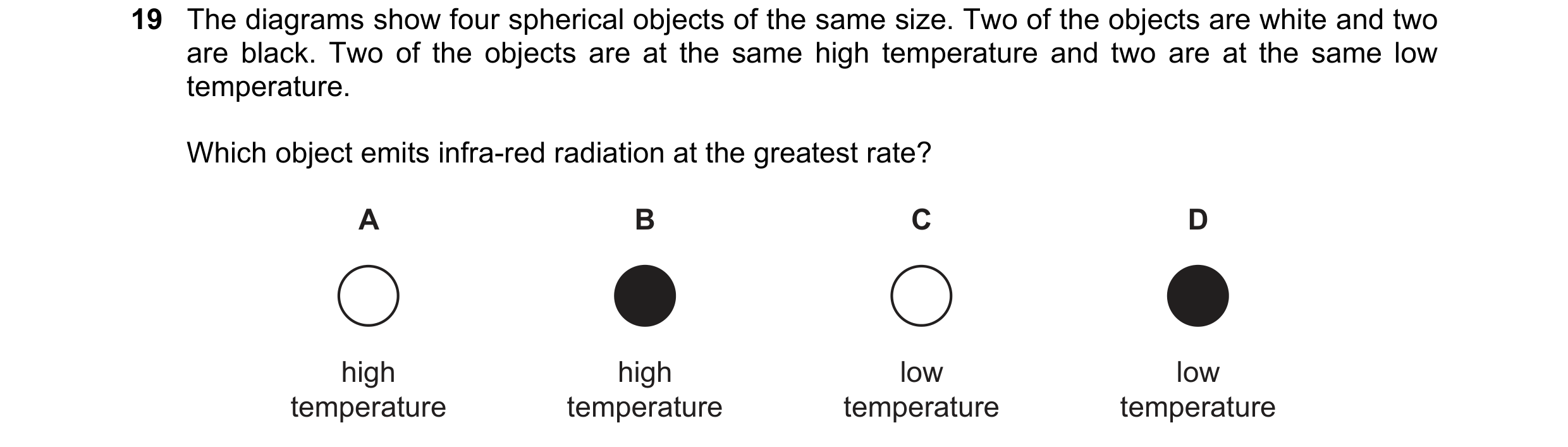
19 The diagrams show four spherical objects of the same size. Two of the objects are white and two are black. Two of the objects are at the same high temperature and two are at the same low temperature. Which object emits infra-red radiation at the greatest rate? A B C D high high low low temperature temperature temperature temperature
1 marks
Answer: B
This question in 0625/23 Oct/Nov 2016
Q14 · In which type of substance are free electrons involved in the transfer of thermal energy? 0625/22 Feb/March 2017
17 In which type of substance are free electrons involved in the transfer of thermal energy? A all liquids B all solids C metals only D plastics only
1 marks
Answer: C
This question in 0625/22 Feb/March 2017
Q15 · Four objects, made of the same material and having the same mass, are at the same… 0625/22 Feb/March 2017
18 Four objects, made of the same material and having the same mass, are at the same temperature. The objects have different surfaces and different surface areas. Which object emits infra-red radiation at the greatest rate? surface surface area A dull large B dull small C shiny large D shiny small
1 marks
Answer: A
This question in 0625/22 Feb/March 2017
Q16 · A copper bar and a wooden bar are joined 0625/21 May/June 2017
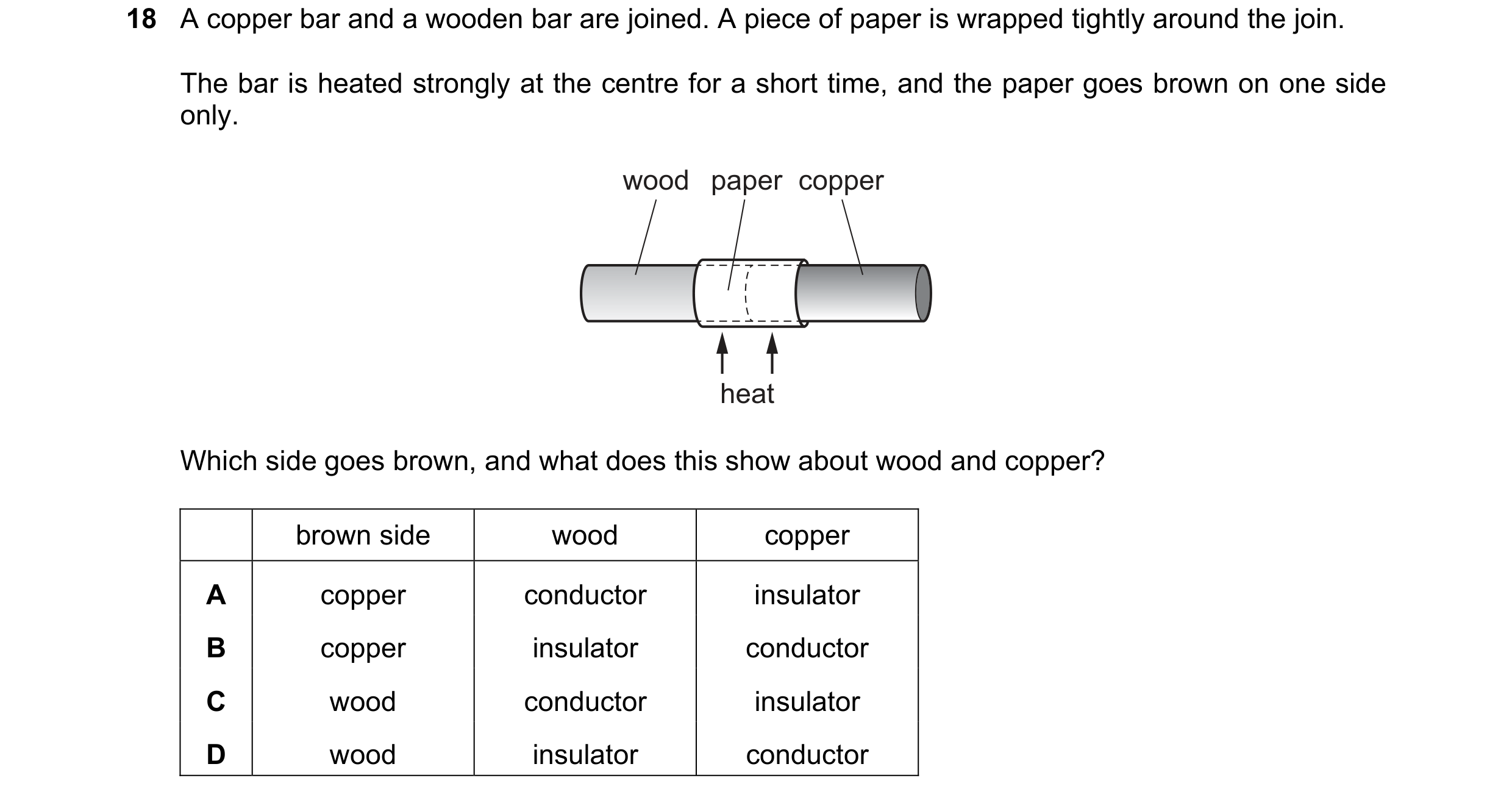
18 A copper bar and a wooden bar are joined. A piece of paper is wrapped tightly around the join. The bar is heated strongly at the centre for a short time, and the paper goes brown on one side only. wood paper copper heat Which side goes brown, and what does this show about wood and copper? brown side wood copper A copper conductor insulator B copper insulator conductor C wood conductor insulator D wood insulator conductor
1 marks
Answer: D
This question in 0625/21 May/June 2017
Q17 · A copper bar and a wooden bar are joined 0625/22 May/June 2017
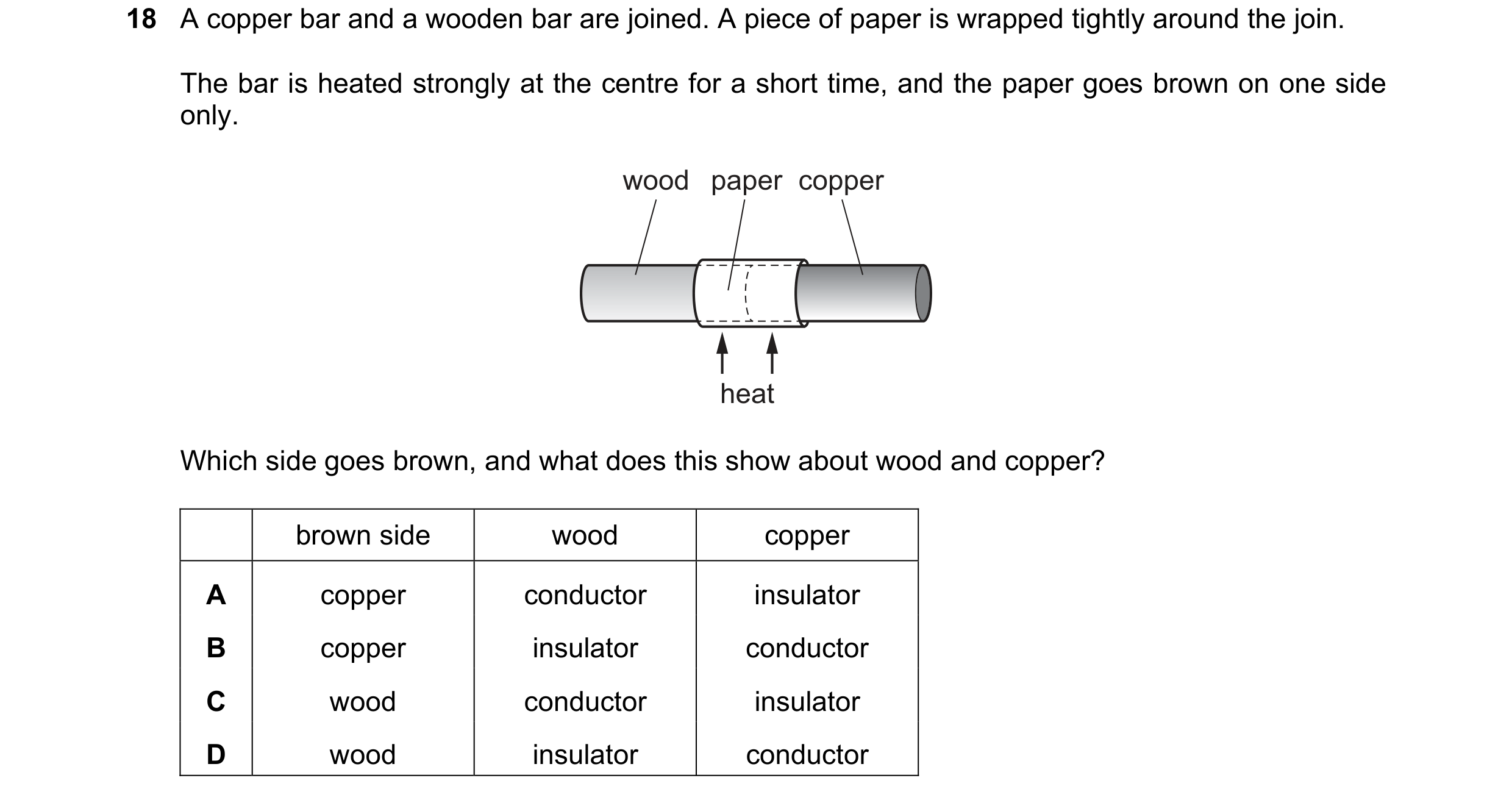
18 A copper bar and a wooden bar are joined. A piece of paper is wrapped tightly around the join. The bar is heated strongly at the centre for a short time, and the paper goes brown on one side only. wood paper copper heat Which side goes brown, and what does this show about wood and copper? brown side wood copper A copper conductor insulator B copper insulator conductor C wood conductor insulator D wood insulator conductor
1 marks
Answer: D
This question in 0625/22 May/June 2017
Q18 · A copper bar and a wooden bar are joined 0625/23 May/June 2017
18 A copper bar and a wooden bar are joined. A piece of paper is wrapped tightly around the join. The bar is heated strongly at the centre for a short time, and the paper goes brown on one side only. wood paper copper heat Which side goes brown, and what does this show about wood and copper? brown side wood copper A copper conductor insulator B copper insulator conductor C wood conductor insulator D wood insulator conductor
1 marks
Answer: D
This question in 0625/23 May/June 2017
Q19 · Which statement about convection currents is correct? 0625/21 Oct/Nov 2017
19 Which statement about convection currents is correct? A Convection currents occur because, when cooled, liquids contract and become more dense. B Convection currents occur because, when warmed, liquids expand and become more dense. C Convection currents only occur in liquids. D Convection currents only occur in solids and liquids.
1 marks
Answer: A
This question in 0625/21 Oct/Nov 2017
Q20 · Why does a balloon filled with hot air rise? 0625/22 Oct/Nov 2017
19 Why does a balloon filled with hot air rise? A Cold air is less dense than hot air. B Cold air is more dense than hot air. C Heat rises. D The density of the balloon is greater than the density of the surrounding gas.
1 marks
Answer: B
This question in 0625/22 Oct/Nov 2017
Q21 · Why is the heating coil of a domestic immersion heater placed at the bottom of the tank? 0625/23 Oct/Nov 2017
19 Why is the heating coil of a domestic immersion heater placed at the bottom of the tank? A Cold water is less dense than hot water and therefore sinks. B Cold water is more dense than hot water and therefore rises. C Hot water is less dense than cold water and therefore rises. D Hot water is more dense than cold water and therefore sinks.
1 marks
Answer: C
This question in 0625/23 Oct/Nov 2017
Q22 · On a cold day, a metal front-door knob X and a similar plastic knob Y are at the same… 0625/21 May/June 2018
18 On a cold day, a metal front-door knob X and a similar plastic knob Y are at the same temperature. Why does X feel cooler to the touch than Y? A X convects thermal energy better than Y. B X is a better thermal conductor than Y. C X is a better insulator than Y. D X is a better radiator of thermal energy than Y.
1 marks
Answer: B
This question in 0625/21 May/June 2018
Q23 · Four thermometers, with their bulbs painted different colours, are placed at equal… 0625/22 May/June 2018
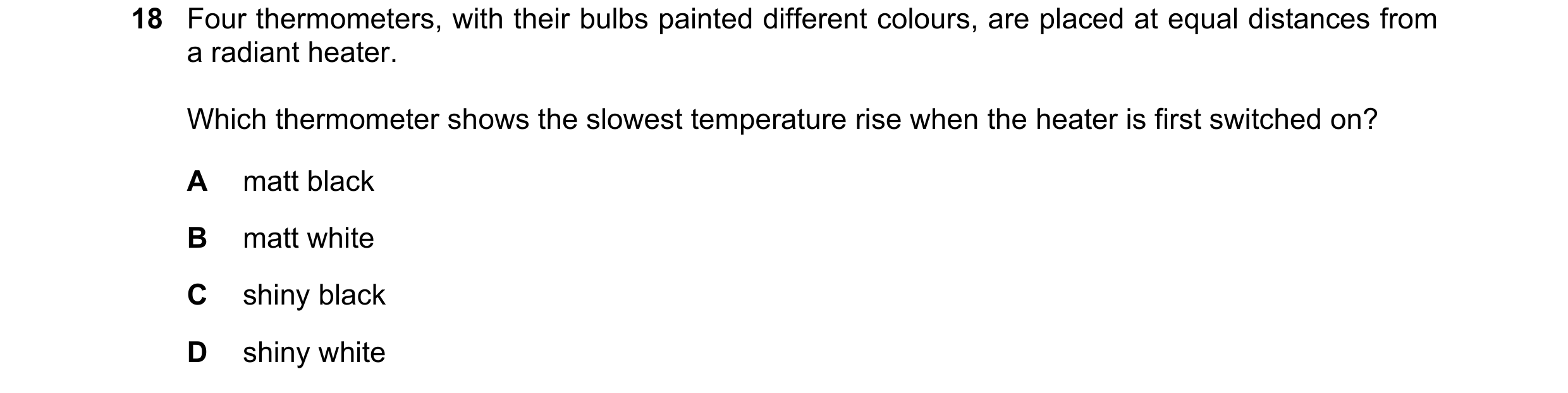
18 Four thermometers, with their bulbs painted different colours, are placed at equal distances from a radiant heater. Which thermometer shows the slowest temperature rise when the heater is first switched on? A matt black B matt white C shiny black D shiny white
1 marks
Answer: D
This question in 0625/22 May/June 2018
Q24 · The diagram shows a pan used for cooking food 0625/23 May/June 2018
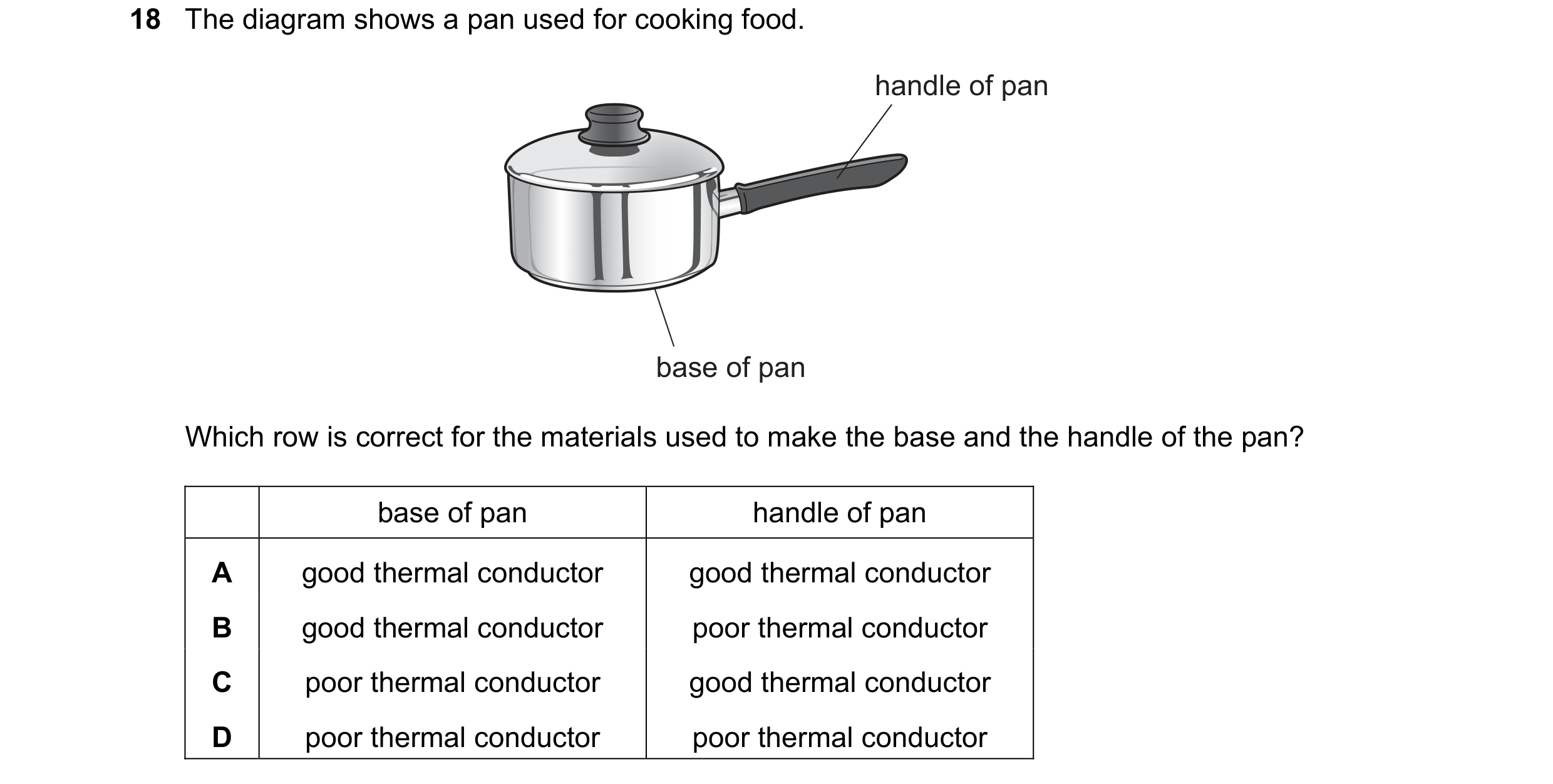
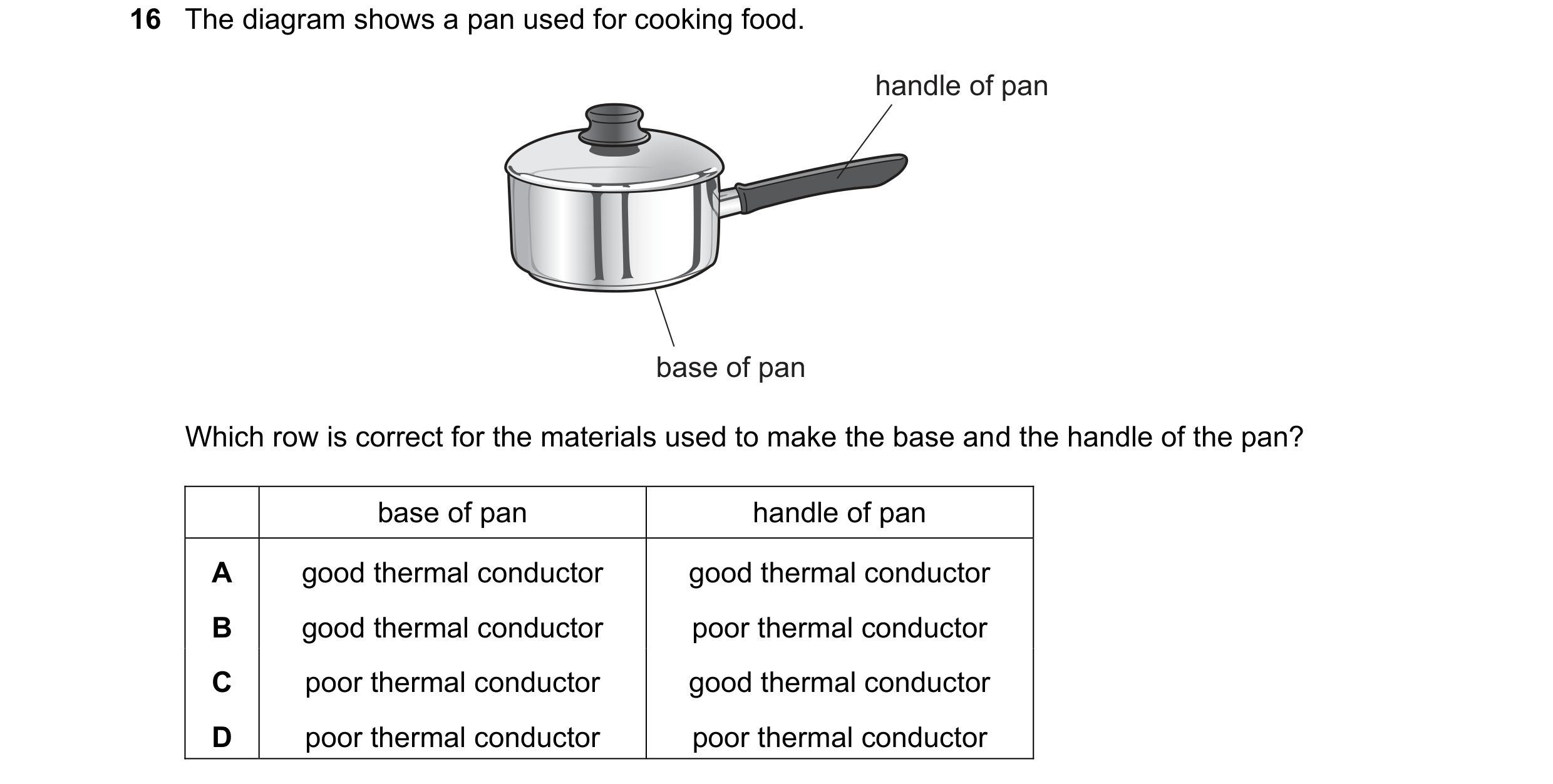
18 The diagram shows a pan used for cooking food. handle of pan base of pan Which row is correct for the materials used to make the base and the handle of the pan? base of pan handle of pan A good thermal conductor good thermal conductor B good thermal conductor poor thermal conductor C poor thermal conductor good thermal conductor D poor thermal conductor poor thermal conductor
1 marks
Answer: B
This question in 0625/23 May/June 2018
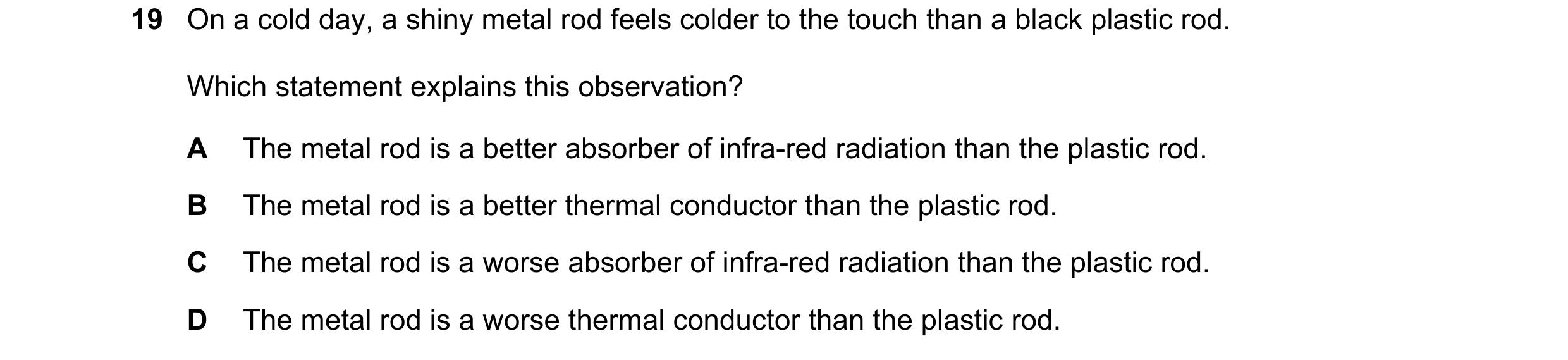
Q25 · On a cold day, a shiny metal rod feels colder to the touch than a black plastic rod 0625/21 Oct/Nov 2018
19 On a cold day, a shiny metal rod feels colder to the touch than a black plastic rod. Which statement explains this observation? A The metal rod is a better absorber of infra-red radiation than the plastic rod. B The metal rod is a better thermal conductor than the plastic rod. C The metal rod is a worse absorber of infra-red radiation than the plastic rod. D The metal rod is a worse thermal conductor than the plastic rod.
1 marks
Answer: B
This question in 0625/21 Oct/Nov 2018
Q26 · One end of a copper bar is heated to a high temperature 0625/21 Oct/Nov 2018
20 One end of a copper bar is heated to a high temperature. Which mechanism is responsible for the transfer of thermal energy to the other end of the copper bar? A the lattice vibrations of copper ions only B the lattice vibrations of copper ions and the movement of high energy electrons along the bar C the movement of high energy copper ions along the bar D the movement of high energy electrons along the bar only
1 marks
Answer: B
This question in 0625/21 Oct/Nov 2018
Q27 · Which statement about convection is not correct? 0625/22 Oct/Nov 2018
19 Which statement about convection is not correct? A It enables water in a pan on a cooker to get evenly heated. B It happens in liquids and gases. C It means that heat rises. D It occurs because the density of a fluid decreases when it is heated.
1 marks
Answer: C
This question in 0625/22 Oct/Nov 2018
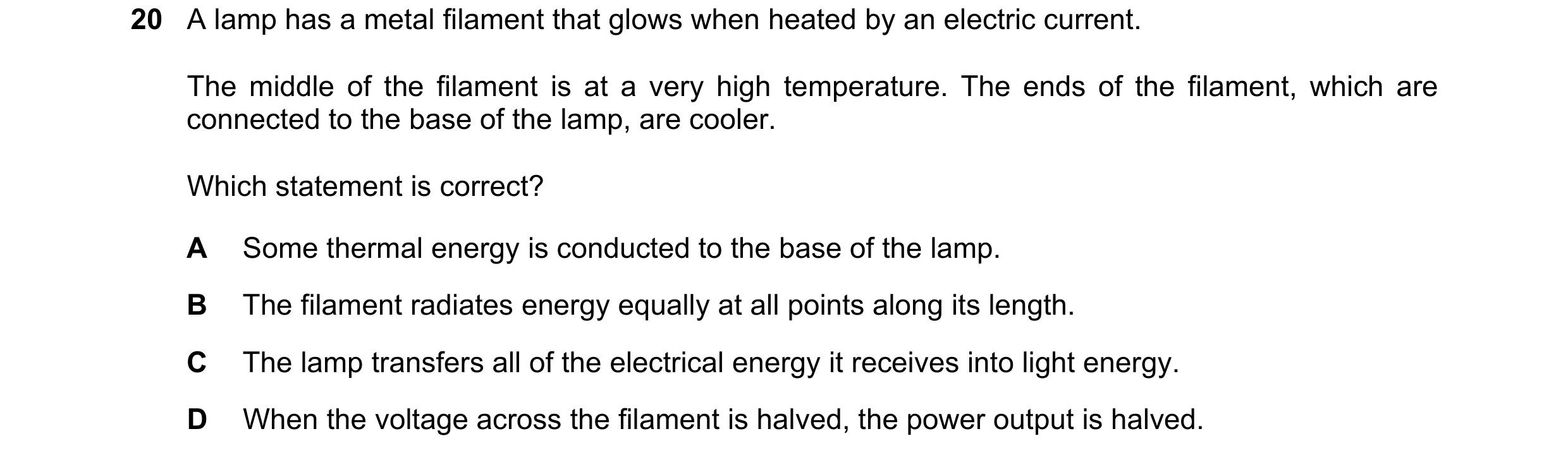
Q28 · A lamp has a metal filament that glows when heated by an electric current 0625/22 Oct/Nov 2018
20 A lamp has a metal filament that glows when heated by an electric current. The middle of the filament is at a very high temperature. The ends of the filament, which are connected to the base of the lamp, are cooler. Which statement is correct? A Some thermal energy is conducted to the base of the lamp. B The filament radiates energy equally at all points along its length. C The lamp transfers all of the electrical energy it receives into light energy. D When the voltage across the filament is halved, the power output is halved.
1 marks
Answer: A
This question in 0625/22 Oct/Nov 2018
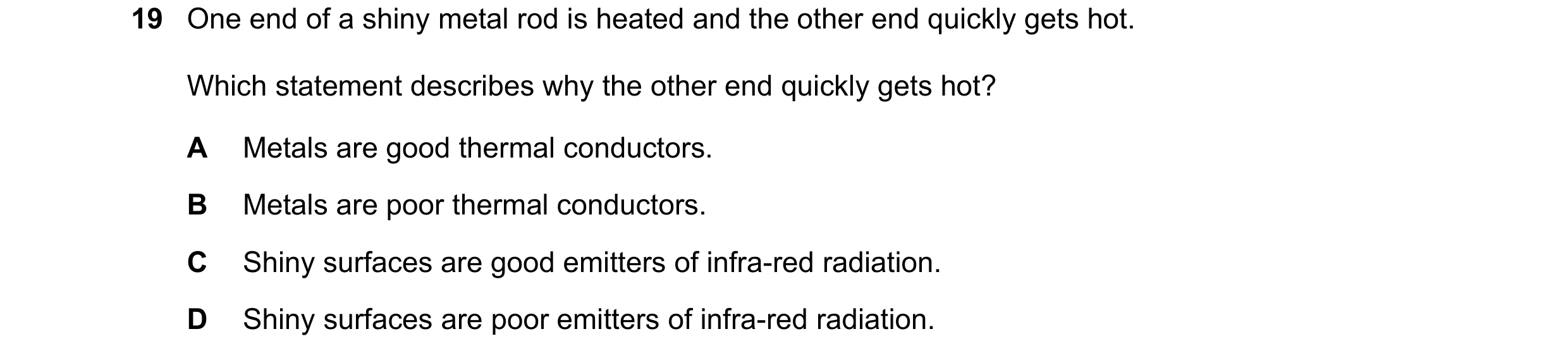
Q29 · One end of a shiny metal rod is heated and the other end quickly gets hot 0625/23 Oct/Nov 2018
19 One end of a shiny metal rod is heated and the other end quickly gets hot. Which statement describes why the other end quickly gets hot? A Metals are good thermal conductors. B Metals are poor thermal conductors. C Shiny surfaces are good emitters of infra-red radiation. D Shiny surfaces are poor emitters of infra-red radiation.
1 marks
Answer: A
This question in 0625/23 Oct/Nov 2018
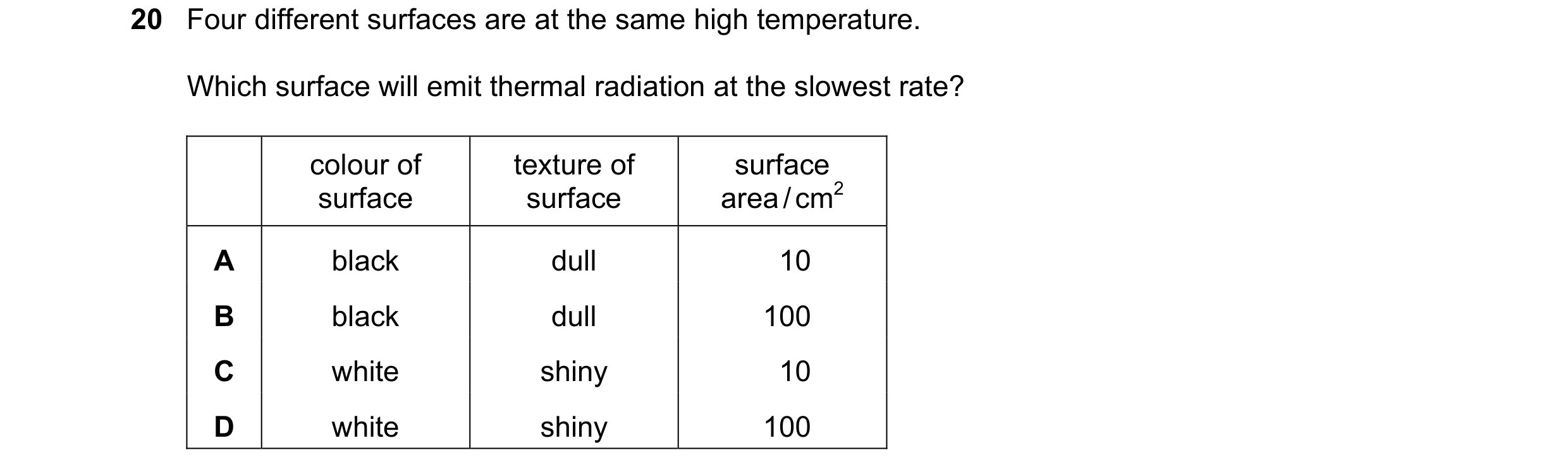
Q30 · Four different surfaces are at the same high temperature 0625/23 Oct/Nov 2018
20 Four different surfaces are at the same high temperature. Which surface will emit thermal radiation at the slowest rate? colour of texture of surface surface surface area / cm2 A black dull 10 B black dull 100 C white shiny 10 D white shiny 100
1 marks
Answer: C
This question in 0625/23 Oct/Nov 2018
Q31 · Four campers are warming their food on a fire 0625/22 Feb/March 2019
19 Four campers are warming their food on a fire. They use different rods, each of the same dimensions, to hold their food near the fire. rod food fire Which material is the best choice to prevent their hands from getting too hot? A aluminium B copper C steel D wood
1 marks
Answer: D
This question in 0625/22 Feb/March 2019
Q32 · Two metal cans are identical, except that one has a shiny silver outer surface and the… 0625/22 Feb/March 2019
20 Two metal cans are identical, except that one has a shiny silver outer surface and the other has a dull black outer surface. They each have 300 g of water at 80 °C sealed inside them. They are both in a vacuum, in the darkness of outer space. How does the temperature of the water in each one change? A Neither one will cool down. B The water in the black can cools more slowly than that in the shiny can. C The water in the shiny can cools more slowly than that in the black can. D They both cool down at the same rate.
1 marks
Answer: C
This question in 0625/22 Feb/March 2019
Q33 · In which does thermal conduction not occur? 0625/21 May/June 2019
17 In which does thermal conduction not occur? A a gas B a liquid C a solid D a vacuum
1 marks
Answer: D
This question in 0625/21 May/June 2019
Q34 · The metal surface of a kettle is hot 0625/21 May/June 2019
18 The metal surface of a kettle is hot. What happens to the cool air outside the kettle when it comes into contact with the hot kettle? A The density of the air decreases and the air falls. B The density of the air decreases and the air rises. C The density of the air increases and the air falls. D The density of the air increases and the air rises.
1 marks
Answer: B
This question in 0625/21 May/June 2019
Q35 · Some hot water is sealed inside a metal can 0625/21 May/June 2019
19 Some hot water is sealed inside a metal can. The can is in a vacuum in outer space. The hot water slowly cools down. How does the thermal energy escape into space? A by conduction then convection B by conduction then radiation C by evaporation then convection D by evaporation then radiation
1 marks
Answer: B
This question in 0625/21 May/June 2019
Q36 · The handle of a metal saucepan is made of plastic 0625/22 May/June 2019
17 The handle of a metal saucepan is made of plastic. As the saucepan heats up, the handle gets warmer. Which statement explains this? A Molecules of the plastic radiate their energy to other molecules. B Molecules of the plastic vibrate more and pass on their energy to nearby molecules. C The free electrons in the plastic transfer the thermal energy along the handle. D The heated molecules very slowly move along the plastic handle.
1 marks
Answer: B
This question in 0625/22 May/June 2019
Q37 · The metal surface of a kettle is hot 0625/22 May/June 2019
18 The metal surface of a kettle is hot. What happens to the cool air outside the kettle when it comes into contact with the hot kettle? A The density of the air decreases and the air falls. B The density of the air decreases and the air rises. C The density of the air increases and the air falls. D The density of the air increases and the air rises.
1 marks
Answer: B
This question in 0625/22 May/June 2019
Q38 · Vacuum flasks usually have silvered walls that help to keep the contents of the flask hot 0625/22 May/June 2019
19 Vacuum flasks usually have silvered walls that help to keep the contents of the flask hot. Why are the walls silvered? A to absorb thermal energy from the air around the flask B to increase the rate of convection inside the flask C to reduce energy loss to the surroundings by conduction D to reflect thermal radiation back into the flask
1 marks
Answer: D
This question in 0625/22 May/June 2019
Q39 · Why does a metal rod conduct thermal energy much better than a similar-sized plastic rod? 0625/23 May/June 2019
17 Why does a metal rod conduct thermal energy much better than a similar-sized plastic rod? A The molecules in the plastic are much closer together than the atoms in the metal. B The molecules in the plastic are much larger than the atoms in the metal. C The molecules in the plastic are much more tightly held together than the atoms in the metal. D The molecular structure in the plastic contains no free electrons, but the metal has free electrons.
1 marks
Answer: D
This question in 0625/23 May/June 2019
Q40 · The metal surface of a kettle is hot 0625/23 May/June 2019
18 The metal surface of a kettle is hot. What happens to the cool air outside the kettle when it comes into contact with the hot kettle? A The density of the air decreases and the air falls. B The density of the air decreases and the air rises. C The density of the air increases and the air falls. D The density of the air increases and the air rises.
1 marks
Answer: B
This question in 0625/23 May/June 2019
Q41 · One end of a rod of copper is placed in hot water 0625/21 Oct/Nov 2019
19 One end of a rod of copper is placed in hot water. Thermal energy travels along the rod to make the other end warmer. What is the behaviour of the copper at an atomic level that accounts for most of the transfer of thermal energy from one end to the other? A Atoms at the hot end gain kinetic energy and move towards the other end. B Atoms at the hot end expand, colliding with other atoms and transferring energy. C Free electrons at the hot end gain energy and move towards the other end, colliding with atoms along the rod. D Free electrons at the hot end gain energy from the hot water and move directly to the other end.
1 marks
Answer: C
This question in 0625/21 Oct/Nov 2019
Q42 · A surface is made so that it is a good source of infrared radiation 0625/21 Oct/Nov 2019
20 A surface is made so that it is a good source of infrared radiation. Which surface is not suitable? A a surface that is painted matt black B a surface that is painted white C a surface that is heated to a high temperature D a surface that has a large surface area
1 marks
Answer: B
This question in 0625/21 Oct/Nov 2019
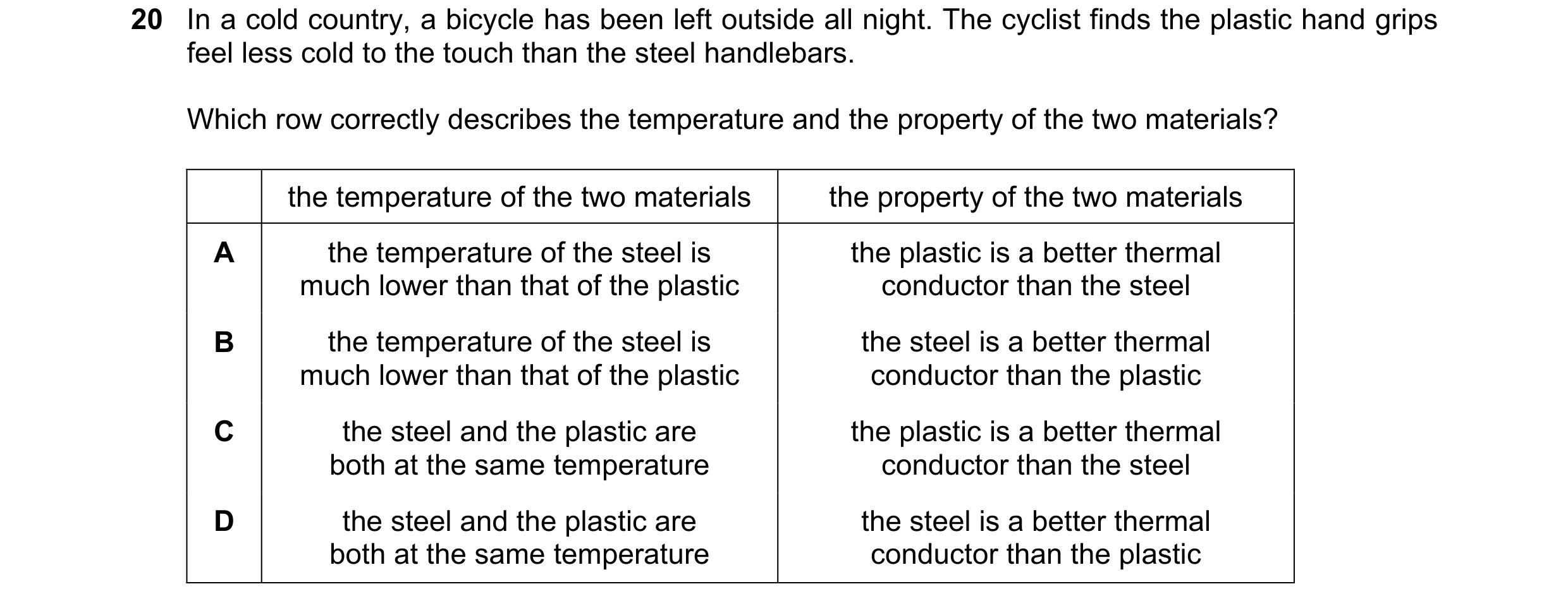
Q43 · In a cold country, a bicycle has been left outside all night 0625/22 Oct/Nov 2019
20 In a cold country, a bicycle has been left outside all night. The cyclist finds the plastic hand grips feel less cold to the touch than the steel handlebars. Which row correctly describes the temperature and the property of the two materials? the temperature of the two materials the property of the two materials A the temperature of the steel is the plastic is a better thermal much lower than that of the plastic conductor than the steel B the temperature of the steel is the steel is a better thermal much lower than that of the plastic conductor than the plastic C the steel and the plastic are the plastic is a better thermal both at the same temperature conductor than the steel D the steel and the plastic are the steel is a better thermal both at the same temperature conductor than the plastic
1 marks
Answer: D
This question in 0625/22 Oct/Nov 2019
Q44 · The diagram shows a tent made from a new material 0625/22 Oct/Nov 2019
21 The diagram shows a tent made from a new material. new material What type of material should the tent be made of to reflect the radiant energy from the Sun? material material texture surface colour A dull black B dull white C shiny black D shiny white
1 marks
Answer: D
This question in 0625/22 Oct/Nov 2019
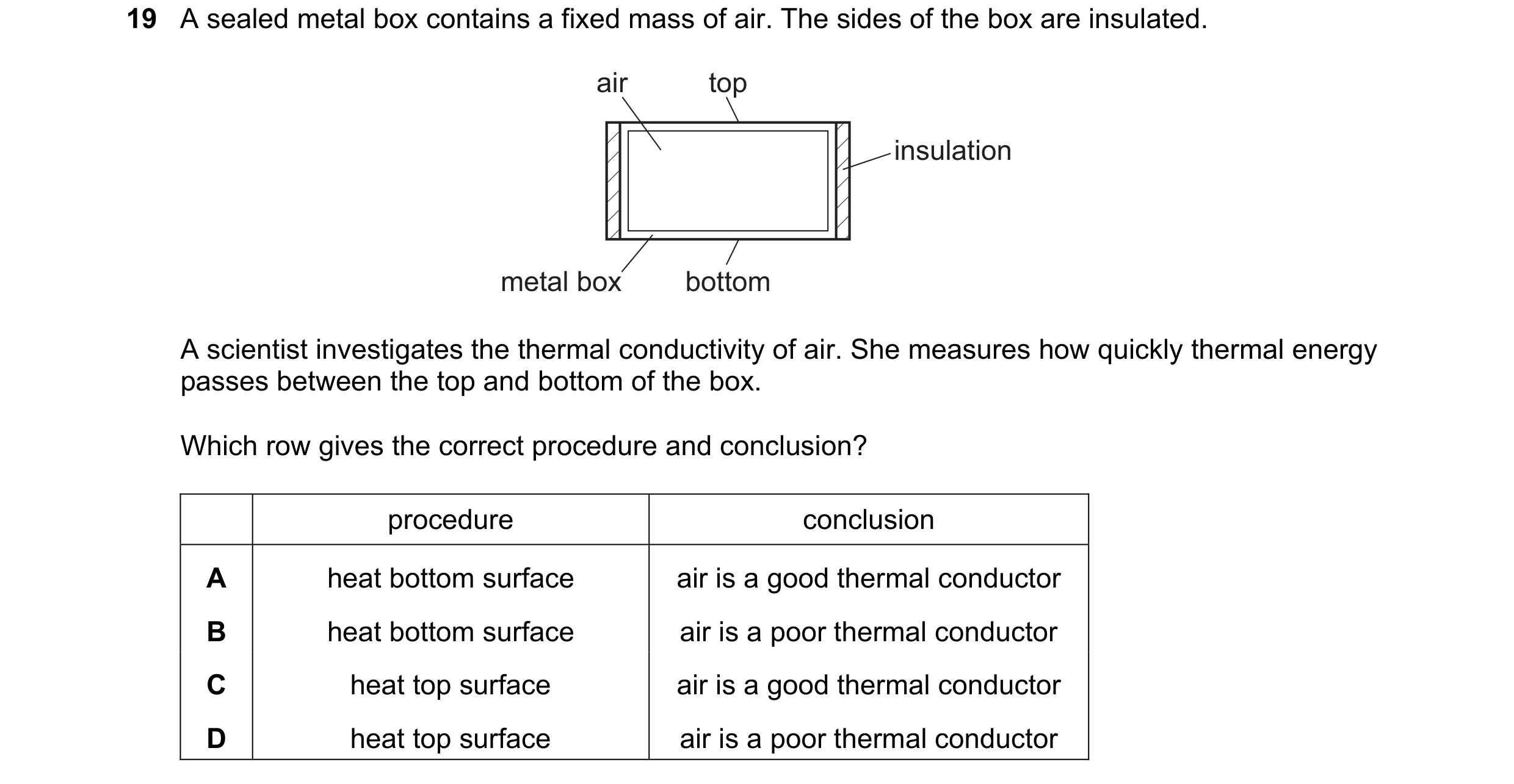
Q45 · A sealed metal box contains a fixed mass of air 0625/23 Oct/Nov 2019
19 A sealed metal box contains a fixed mass of air. The sides of the box are insulated. air top insulation metal box bottom A scientist investigates the thermal conductivity of air. She measures how quickly thermal energy passes between the top and bottom of the box. Which row gives the correct procedure and conclusion? procedure conclusion A heat bottom surface air is a good thermal conductor B heat bottom surface air is a poor thermal conductor C heat top surface air is a good thermal conductor D heat top surface air is a poor thermal conductor
1 marks
Answer: D
This question in 0625/23 Oct/Nov 2019
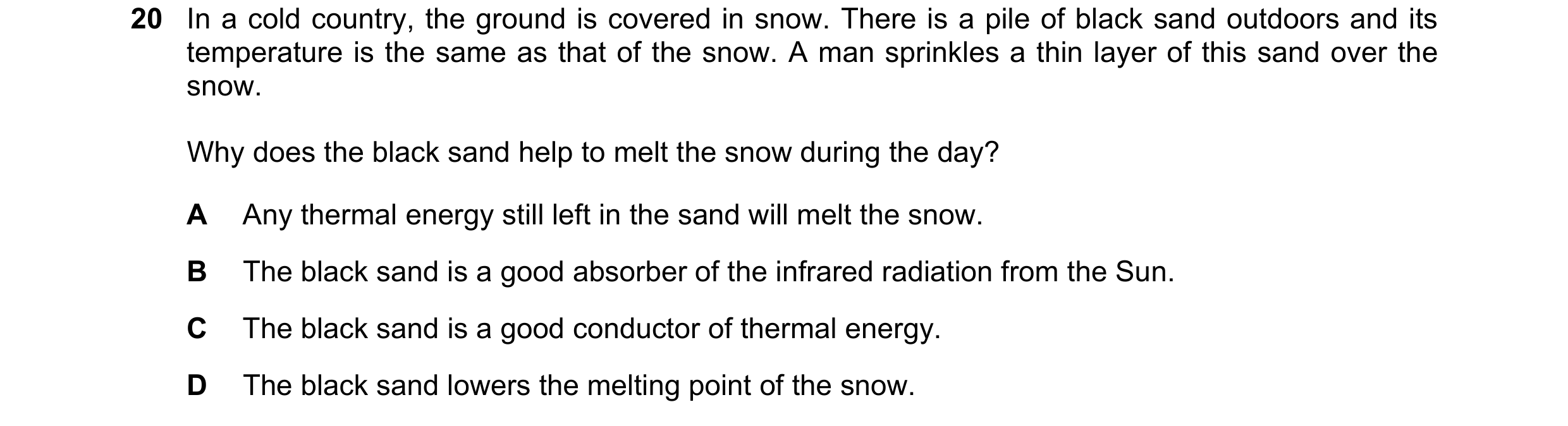
Q46 · In a cold country, the ground is covered in snow 0625/23 Oct/Nov 2019
20 In a cold country, the ground is covered in snow. There is a pile of black sand outdoors and its temperature is the same as that of the snow. A man sprinkles a thin layer of this sand over the snow. Why does the black sand help to melt the snow during the day? A Any thermal energy still left in the sand will melt the snow. B The black sand is a good absorber of the infrared radiation from the Sun. C The black sand is a good conductor of thermal energy. D The black sand lowers the melting point of the snow.
1 marks
Answer: B
This question in 0625/23 Oct/Nov 2019
Q47 · Metals are good thermal conductors 0625/22 Feb/March 2020
20 Metals are good thermal conductors. Insulators are poor thermal conductors. Which description of the mechanism of thermal conductivity is correct? A In insulators, conduction takes place by electron transfer and molecular vibrations. B In insulators, conduction takes place by electron transfer only. C In metals, conduction takes place by electron transfer and molecular vibrations. D In metals, conduction takes place by electron transfer only.
1 marks
Answer: C
This question in 0625/22 Feb/March 2020
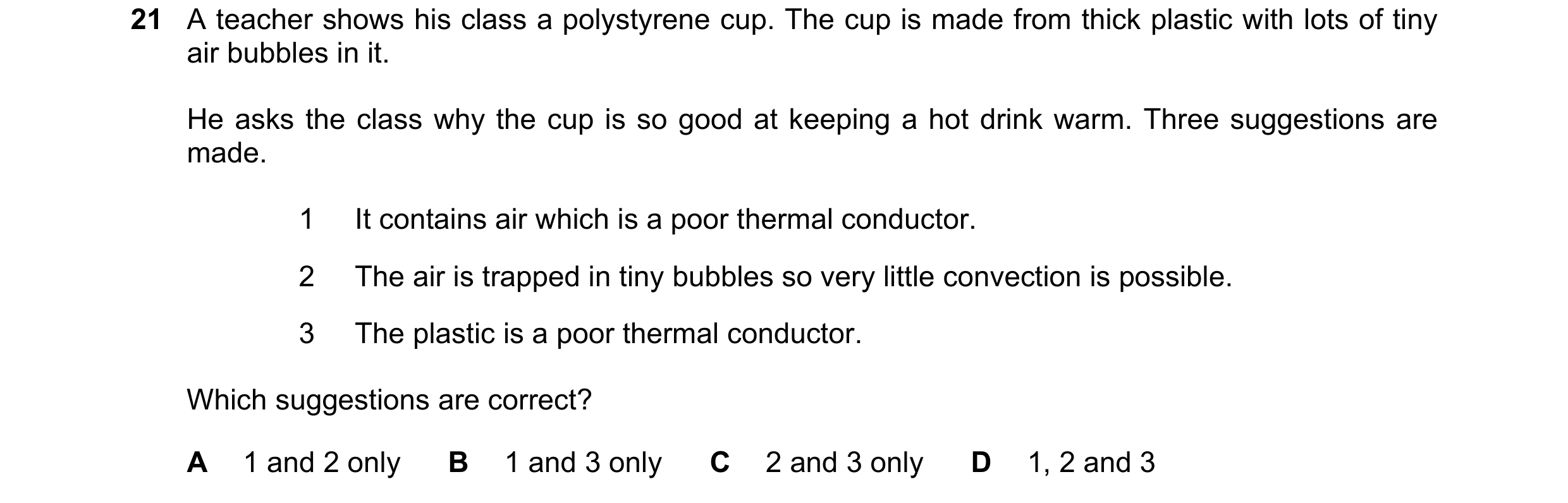
Q48 · A teacher shows his class a polystyrene cup 0625/22 Feb/March 2020
21 A teacher shows his class a polystyrene cup. The cup is made from thick plastic with lots of tiny air bubbles in it. He asks the class why the cup is so good at keeping a hot drink warm. Three suggestions are made. 1 It contains air which is a poor thermal conductor. 2 The air is trapped in tiny bubbles so very little convection is possible. 3 The plastic is a poor thermal conductor. Which suggestions are correct? A 1 and 2 only B 1 and 3 only C 2 and 3 only D 1, 2 and 3
1 marks
Answer: D
This question in 0625/22 Feb/March 2020
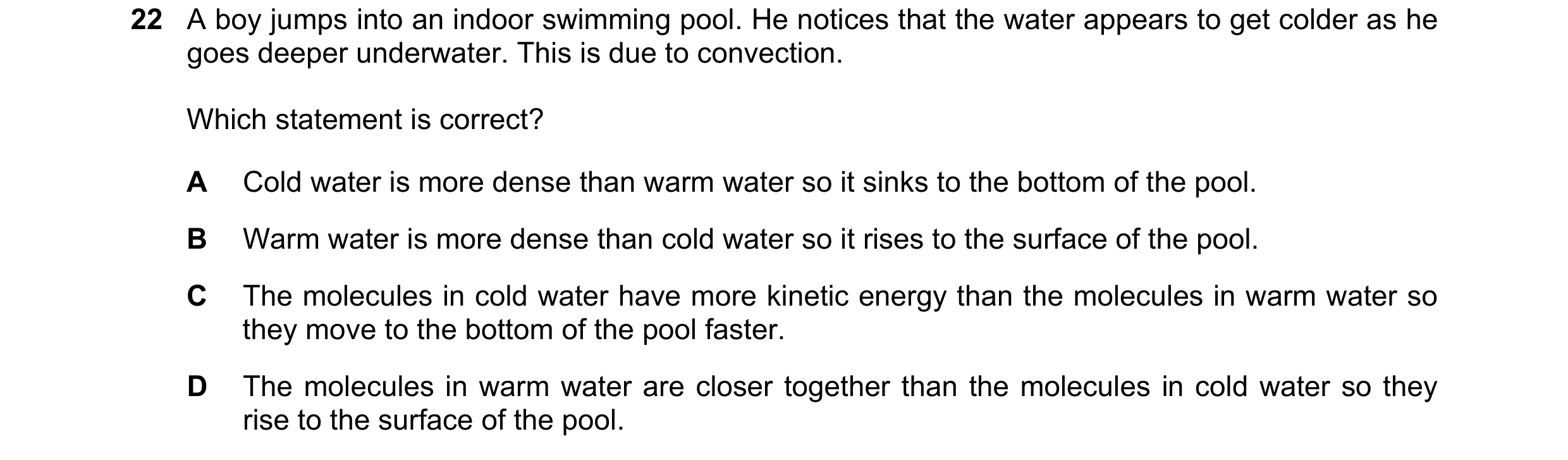
Q49 · A boy jumps into an indoor swimming pool 0625/22 Feb/March 2020
22 A boy jumps into an indoor swimming pool. He notices that the water appears to get colder as he goes deeper underwater. This is due to convection. Which statement is correct? A Cold water is more dense than warm water so it sinks to the bottom of the pool. B Warm water is more dense than cold water so it rises to the surface of the pool. C The molecules in cold water have more kinetic energy than the molecules in warm water so they move to the bottom of the pool faster. D The molecules in warm water are closer together than the molecules in cold water so they rise to the surface of the pool.
1 marks
Answer: A
This question in 0625/22 Feb/March 2020
Q50 · Why are metals better thermal conductors than other solids? 0625/21 May/June 2020
18 Why are metals better thermal conductors than other solids? A Metals contain free electrons which help transfer the energy. B Molecules in metals are in fixed positions. C Molecules in metals can move freely. D Molecules in metals vibrate faster than those in other solids.
1 marks
Answer: A
This question in 0625/21 May/June 2020
Q51 · Two freezers X and Y are identical except that one has a door opening at the front and… 0625/21 May/June 2020
19 Two freezers X and Y are identical except that one has a door opening at the front and the other has a door opening at the top. door freezer freezer door X Y Both doors are the same size and are opened for the same amount of time. Which freezer gains the least amount of thermal energy in this time and why? freezer gaining the reason least thermal energy A X cold air falls B X warm air falls C Y cold air falls D Y warm air falls
1 marks
Answer: C
This question in 0625/21 May/June 2020
Q52 · A room is heated by a radiator 0625/22 May/June 2020
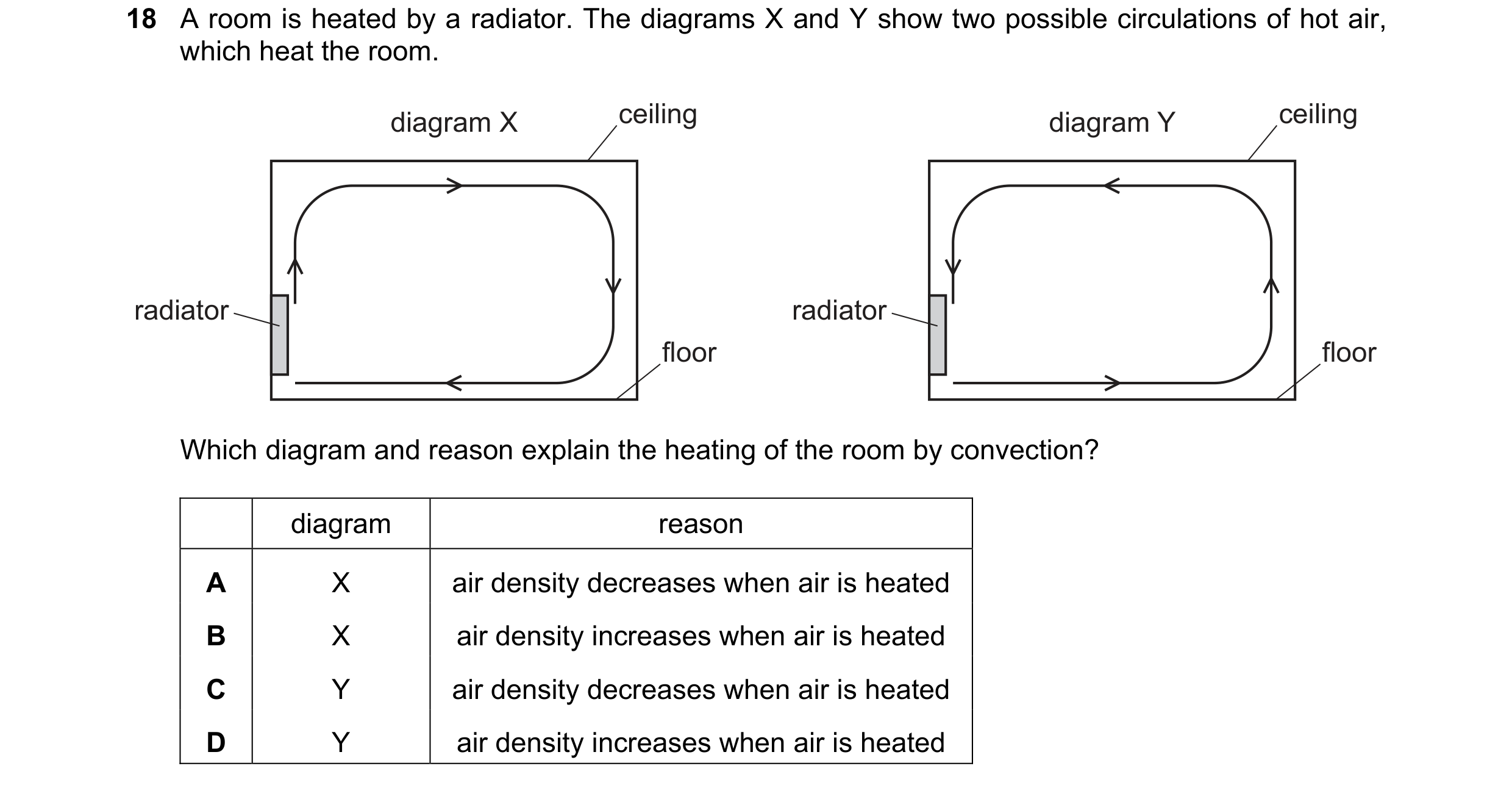
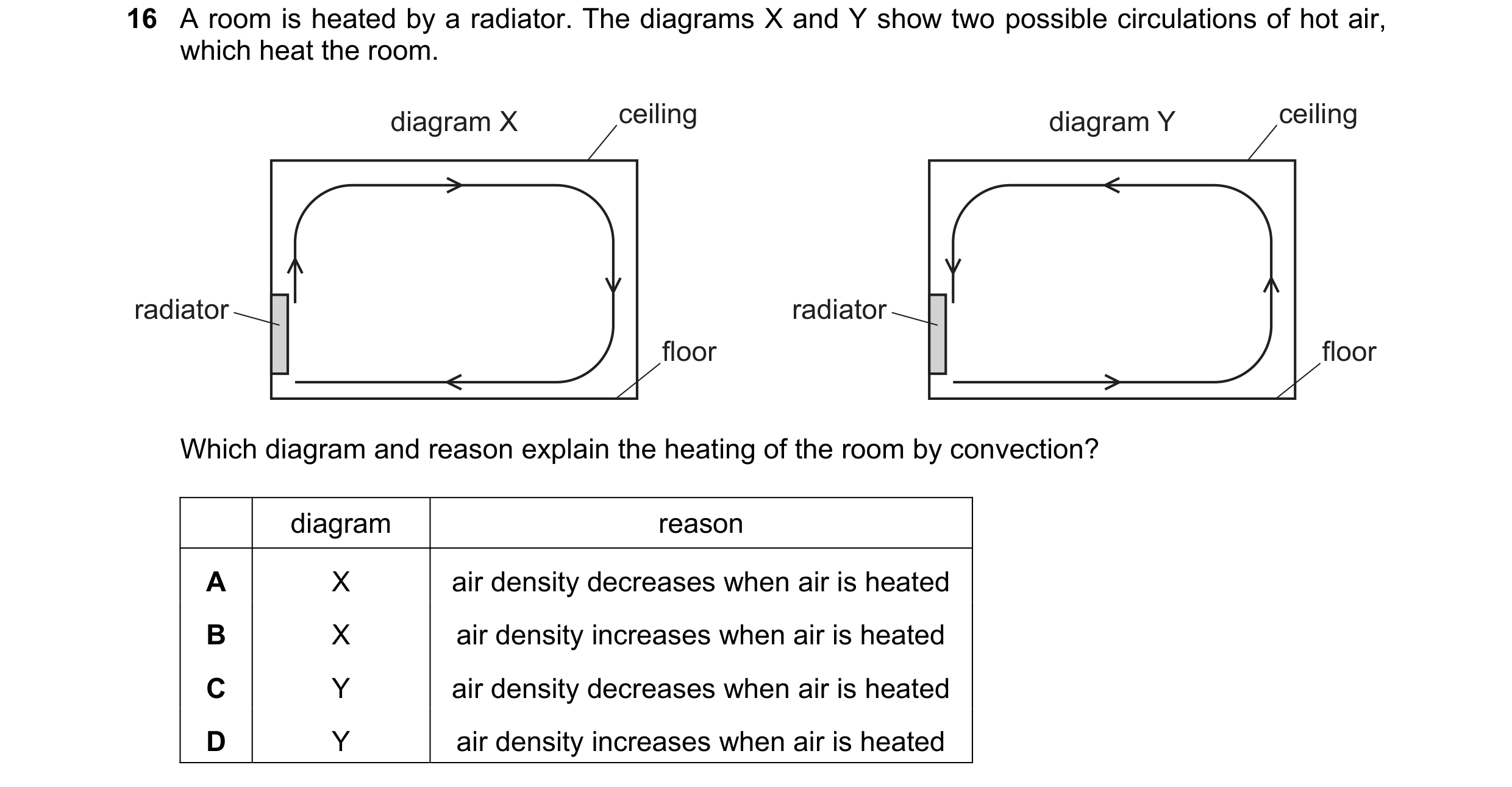
18 A room is heated by a radiator. The diagrams X and Y show two possible circulations of hot air, which heat the room. diagram X ceiling diagram Y ceiling radiator radiator floor floor Which diagram and reason explain the heating of the room by convection? diagram reason A X air density decreases when air is heated B X air density increases when air is heated C Y air density decreases when air is heated D Y air density increases when air is heated
1 marks
Answer: A
This question in 0625/22 May/June 2020
Q53 · Two copper containers P and Q are filled with hot water 0625/22 May/June 2020
19 Two copper containers P and Q are filled with hot water. The diagrams are both drawn to the same scale. P Q Container P emits more infrared radiation from its surfaces than container Q. What is a possible reason for this? A The surfaces of P are painted white and the surfaces of Q are painted black. B The surfaces of P are shiny and the surfaces of Q are dull. C The surfaces of P have a smaller area than the surfaces of Q. D The water in P is hotter than the water in Q.
1 marks
Answer: D
This question in 0625/22 May/June 2020
Q54 · Why are metals better conductors of thermal energy than non-metals? 0625/23 May/June 2020
18 Why are metals better conductors of thermal energy than non-metals? A They contain free electrons. B Their molecules are further apart. C Their molecules vibrate at a higher frequency. D They have smoother surfaces.
1 marks
Answer: A
This question in 0625/23 May/June 2020
Q55 · The diagram shows a vacuum flask used to keep a liquid warm 0625/23 May/June 2020
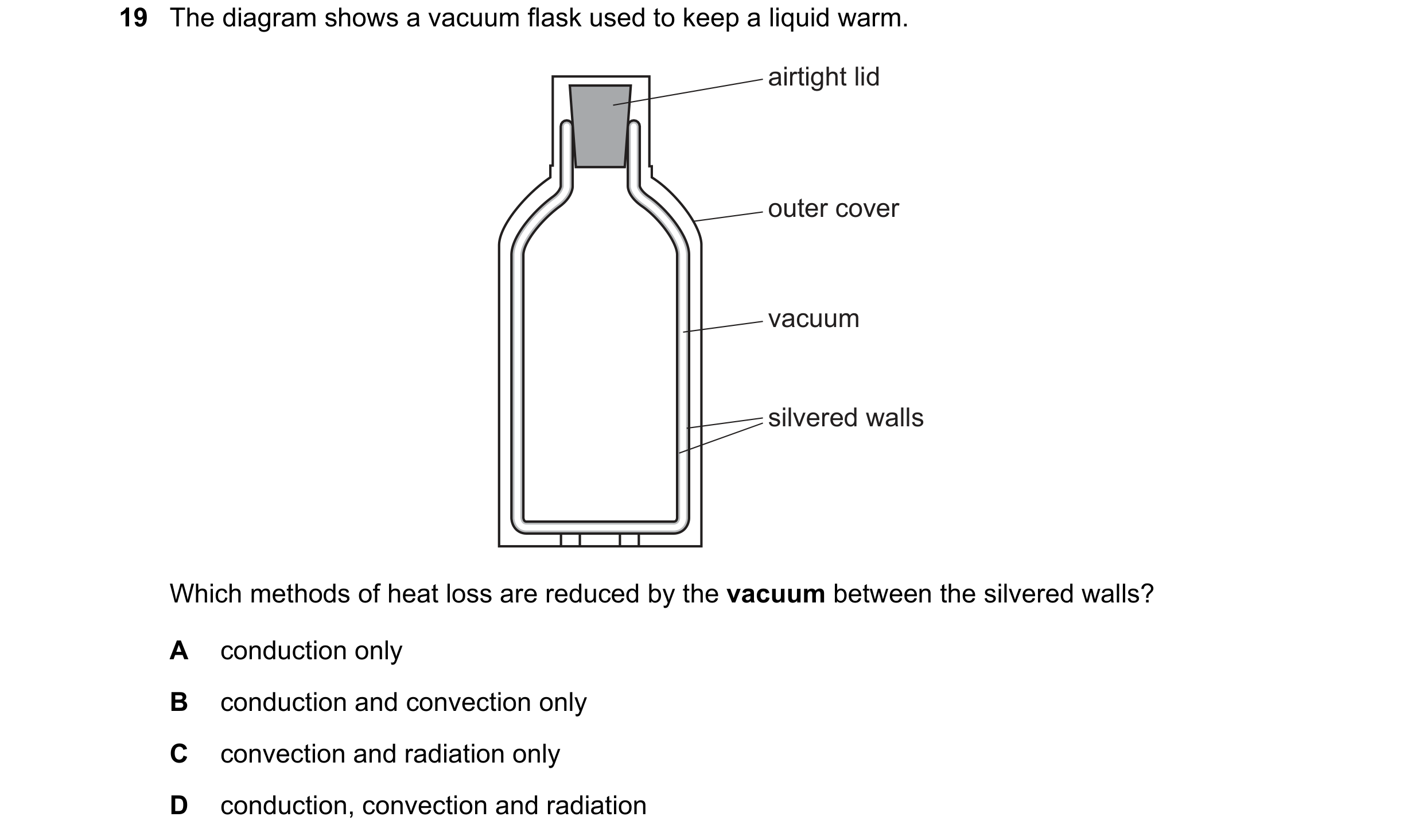
19 The diagram shows a vacuum flask used to keep a liquid warm. airtight lid outer cover vacuum silvered walls Which methods of heat loss are reduced by the vacuum between the silvered walls? A conduction only B conduction and convection only C convection and radiation only D conduction, convection and radiation
1 marks
Answer: B
This question in 0625/23 May/June 2020
Q56 · An intruder alarm sensor detects that a person is warmer than his surroundings 0625/23 May/June 2020
24 An intruder alarm sensor detects that a person is warmer than his surroundings. Which type of electromagnetic wave does the sensor detect? A infrared B radio C ultraviolet D visible light
1 marks
Answer: A
This question in 0625/23 May/June 2020
Q57 · The diagram shows four rods 0625/21 Oct/Nov 2020
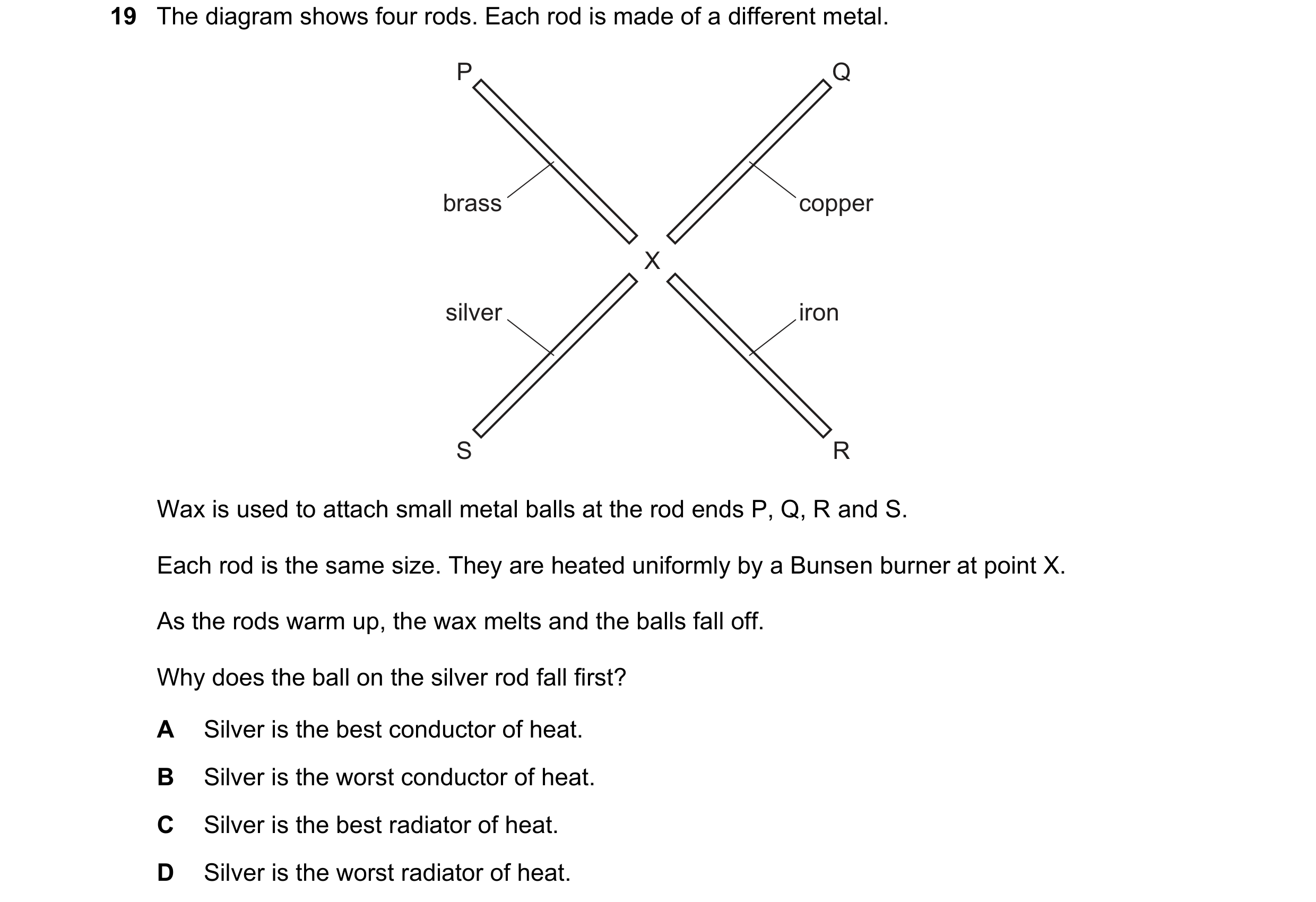
19 The diagram shows four rods. Each rod is made of a different metal. P Q brass copper X silver iron S R Wax is used to attach small metal balls at the rod ends P, Q, R and S. Each rod is the same size. They are heated uniformly by a Bunsen burner at point X. As the rods warm up, the wax melts and the balls fall off. Why does the ball on the silver rod fall first? A Silver is the best conductor of heat. B Silver is the worst conductor of heat. C Silver is the best radiator of heat. D Silver is the worst radiator of heat.
1 marks
Answer: A
This question in 0625/21 Oct/Nov 2020
Q58 · Four cups A, B, C and D contain hot coffee 0625/21 Oct/Nov 2020
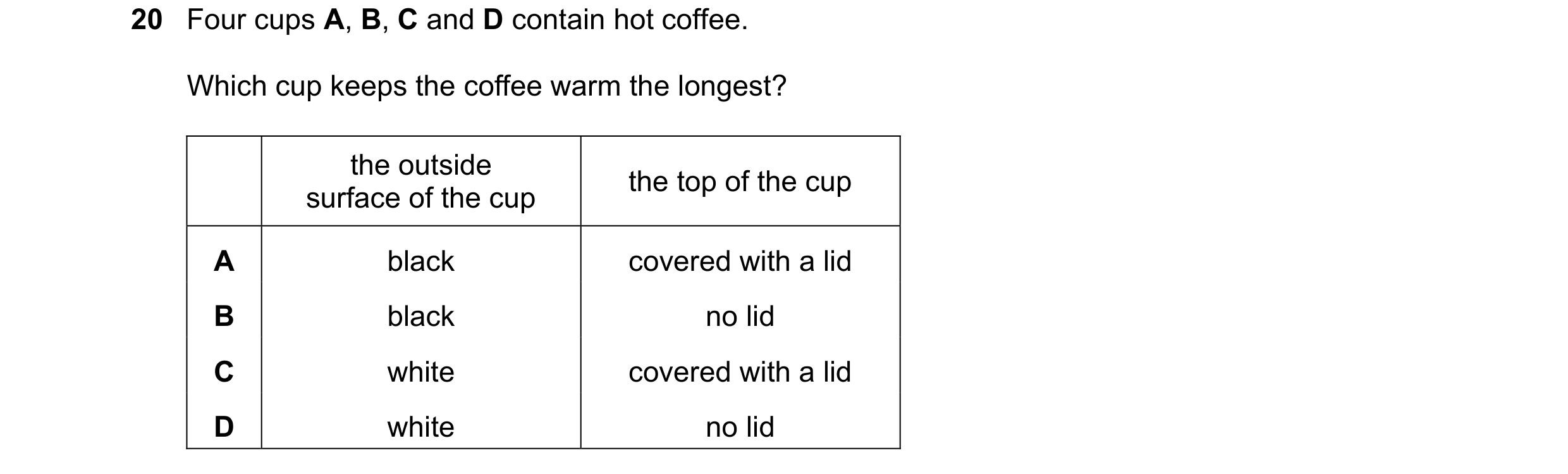
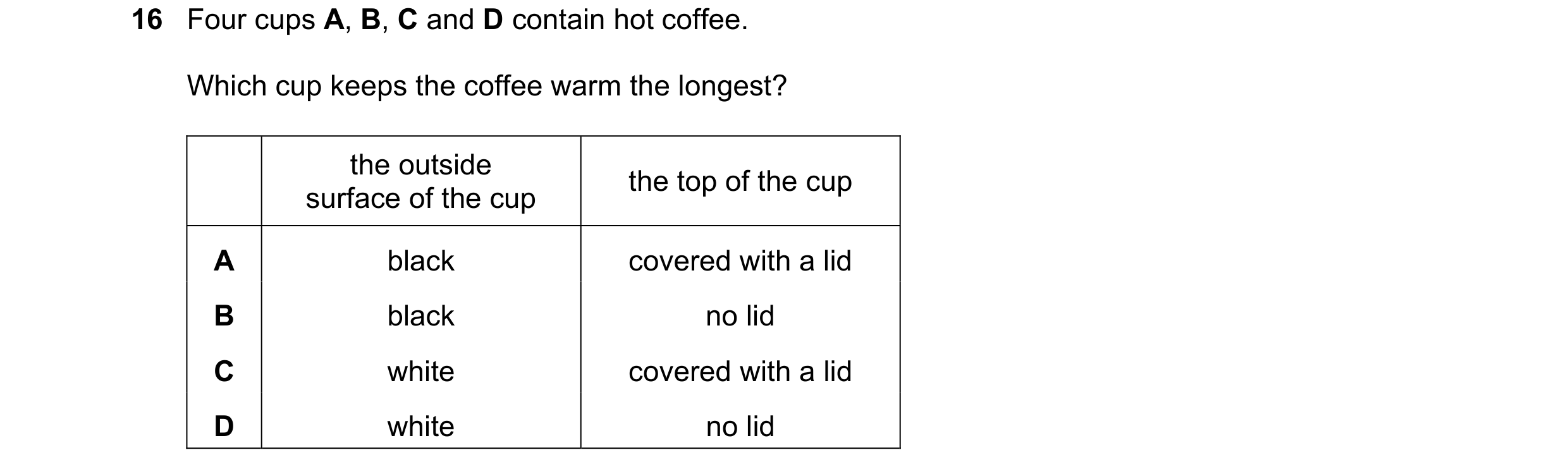
20 Four cups A, B, C and D contain hot coffee. Which cup keeps the coffee warm the longest? the outside the top of the cup surface of the cup A black covered with a lid B black no lid C white covered with a lid D white no lid
1 marks
Answer: C
This question in 0625/21 Oct/Nov 2020
Q59 · A scientist measures the air temperature at different heights from the floor in a cave 0625/22 Oct/Nov 2020
19 A scientist measures the air temperature at different heights from the floor in a cave. The results are recorded in the table. height / m temperature / C 0 10 10 11 20 13 30 14 40 16 Why does altering the height affect the temperature of the air? A The molecules in warm air have less energy than the molecules in cool air. B The molecules in cool air are further apart than the molecules in warm air. C Warm air is less dense than cool air. D Cool air rises above warm air.
1 marks
Answer: C
This question in 0625/22 Oct/Nov 2020
Q60 · Four solid spheres made of the same metal are heated to the same temperature 0625/22 Oct/Nov 2020
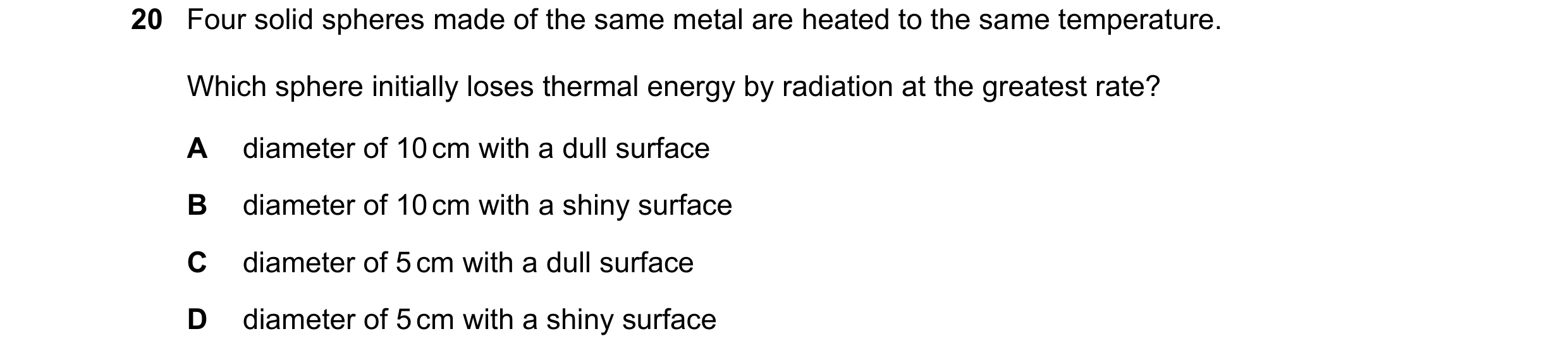
20 Four solid spheres made of the same metal are heated to the same temperature. Which sphere initially loses thermal energy by radiation at the greatest rate? A diameter of 10 cm with a dull surface B diameter of 10 cm with a shiny surface C diameter of 5 cm with a dull surface D diameter of 5 cm with a shiny surface
1 marks
Answer: A
This question in 0625/22 Oct/Nov 2020
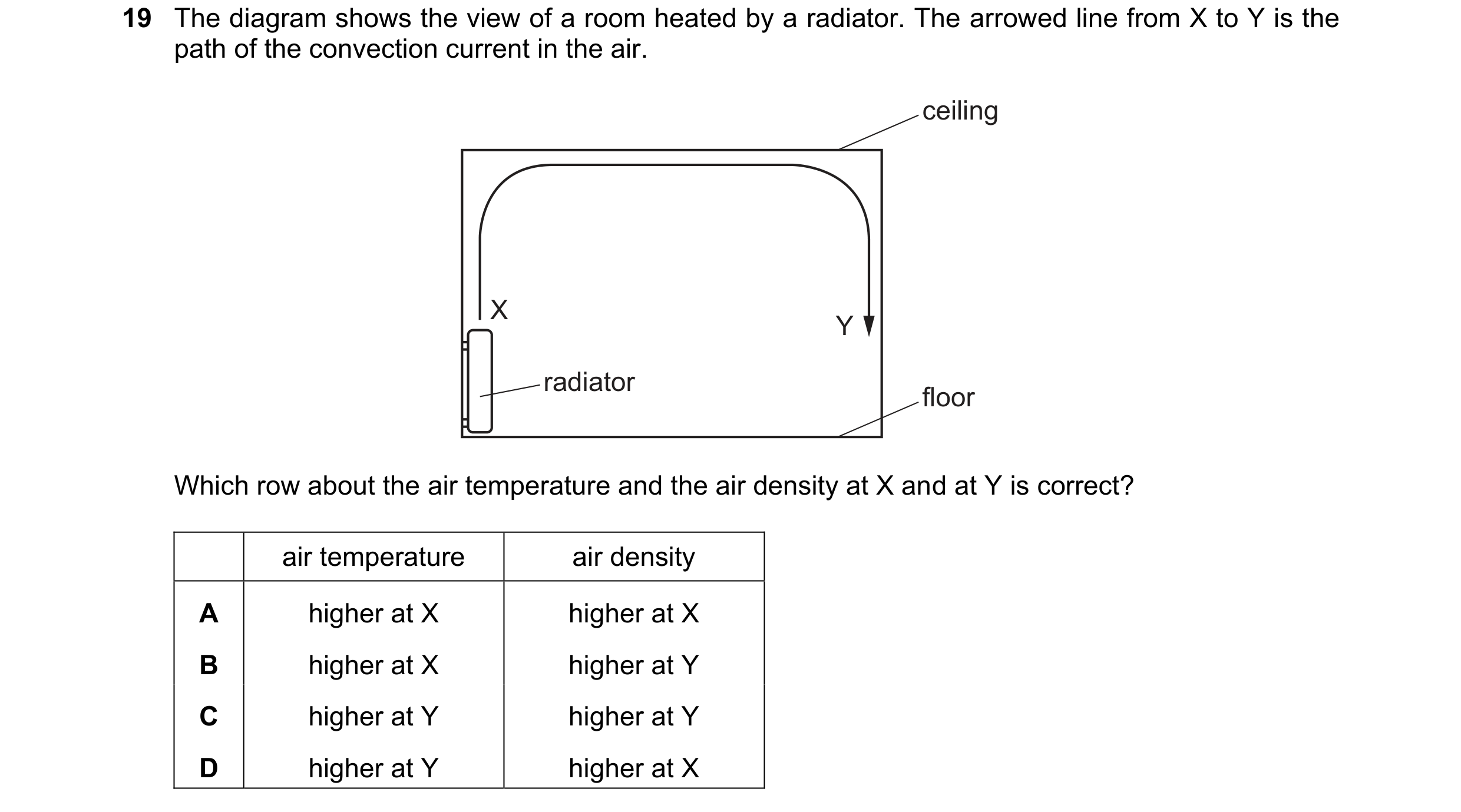
Q61 · The diagram shows the view of a room heated by a radiator 0625/23 Oct/Nov 2020
19 The diagram shows the view of a room heated by a radiator. The arrowed line from X to Y is the path of the convection current in the air. ceiling X Y radiator floor Which row about the air temperature and the air density at X and at Y is correct? air temperature air density A higher at X higher at X B higher at X higher at Y C higher at Y higher at Y D higher at Y higher at X
1 marks
Answer: B
This question in 0625/23 Oct/Nov 2020
Q62 · A warm dark-coloured surface emits radiation 0625/23 Oct/Nov 2020
20 A warm dark-coloured surface emits radiation. It is decided to increase the amount of radiation produced. Three suggestions are made. 1 Make the surface hotter. 2 Colour the surface white. 3 Increase the area of the surface. Which suggestions are correct? A 1 only B 1 and 2 only C 1 and 3 only D 1, 2 and 3
1 marks
Answer: C
This question in 0625/23 Oct/Nov 2020
Q63 · A piece of melting ice at 0 C and a beaker of boiling water are both in a laboratory 0625/22 Feb/March 2021
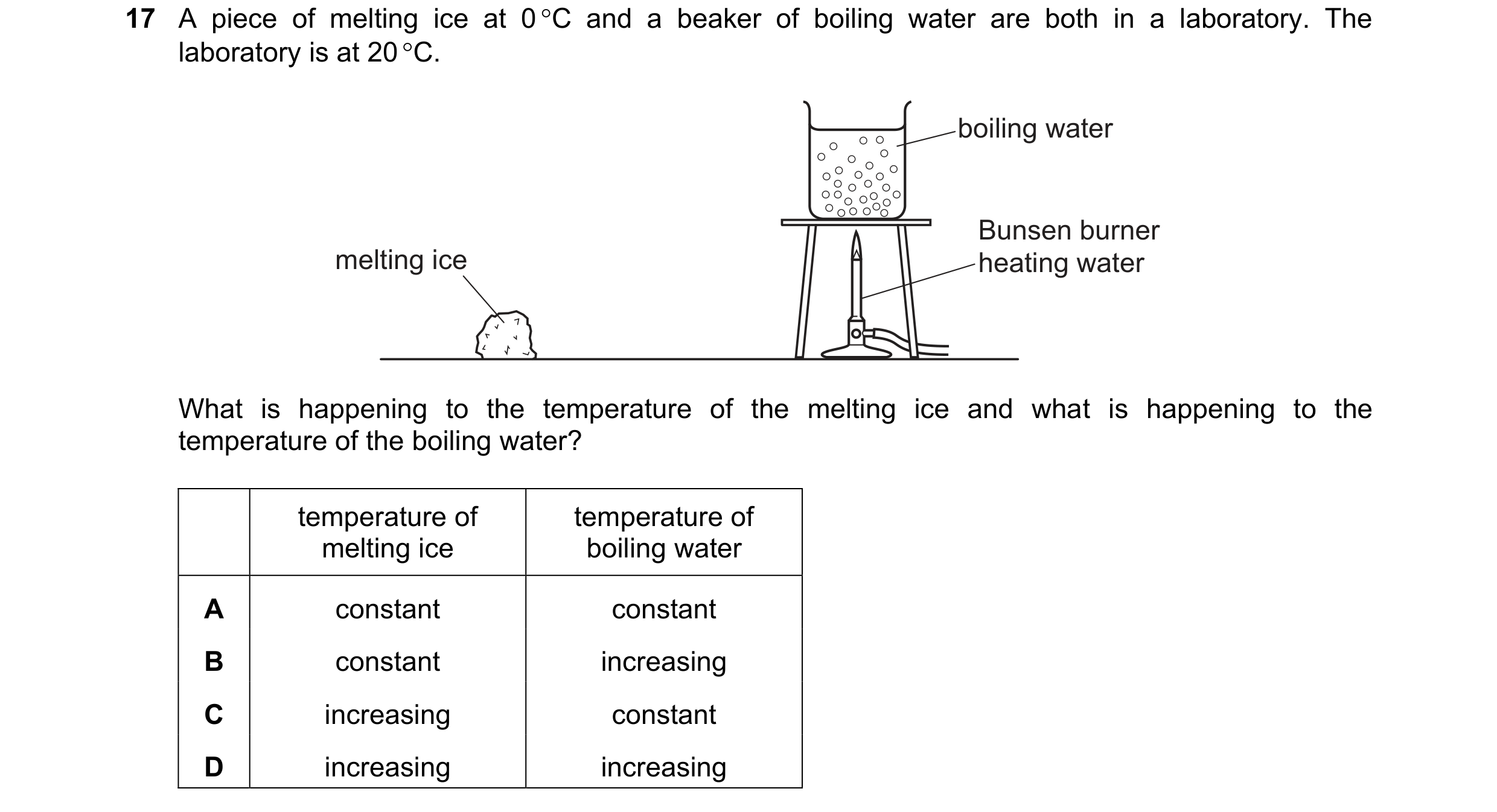
17 A piece of melting ice at 0 C and a beaker of boiling water are both in a laboratory. The laboratory is at 20 C. boiling water Bunsen burner melting ice heating water What is happening to the temperature of the melting ice and what is happening to the temperature of the boiling water? temperature of temperature of melting ice boiling water A constant constant B constant increasing C increasing constant D increasing increasing
1 marks
Answer: A
This question in 0625/22 Feb/March 2021
Q64 · One end of a copper rod is heated 0625/22 Feb/March 2021
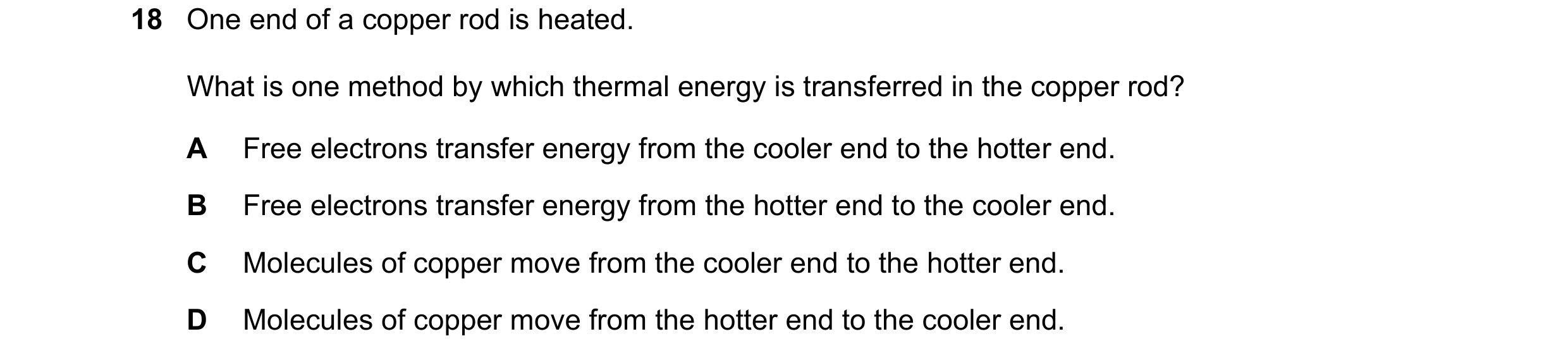
18 One end of a copper rod is heated. What is one method by which thermal energy is transferred in the copper rod? A Free electrons transfer energy from the cooler end to the hotter end. B Free electrons transfer energy from the hotter end to the cooler end. C Molecules of copper move from the cooler end to the hotter end. D Molecules of copper move from the hotter end to the cooler end.
1 marks
Answer: B
This question in 0625/22 Feb/March 2021
Q65 · Which change will cause a decrease in the rate of radiation emitted by an object? 0625/22 Feb/March 2021
19 Which change will cause a decrease in the rate of radiation emitted by an object? A changing the surface colour from white to black B changing the surface texture from dull to shiny C increasing the surface temperature D increasing the surface area
1 marks
Answer: B
This question in 0625/22 Feb/March 2021
Q66 · A student sets up four cans 0625/22 May/June 2021
19 A student sets up four cans. Each can contains the same mass of water at 90 C. The cans are identical except for the outside surfaces. Which can will cool down the fastest? A dull, black surface B dull, white surface C shiny, black surface D shiny, white surface
1 marks
Answer: A
This question in 0625/22 May/June 2021
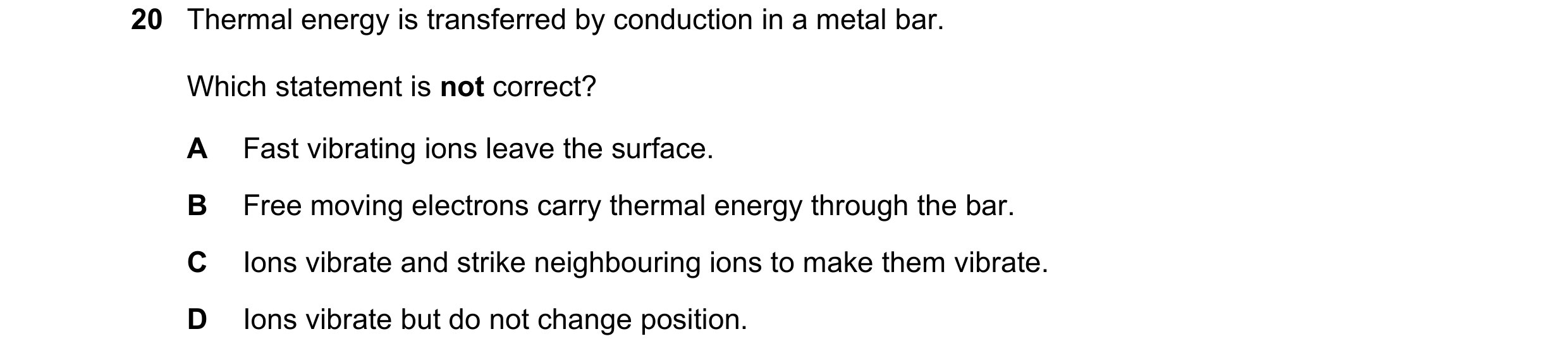
Q67 · Thermal energy is transferred by conduction in a metal bar 0625/22 May/June 2021
20 Thermal energy is transferred by conduction in a metal bar. Which statement is not correct? A Fast vibrating ions leave the surface. B Free moving electrons carry thermal energy through the bar. C Ions vibrate and strike neighbouring ions to make them vibrate. D Ions vibrate but do not change position.
1 marks
Answer: A
This question in 0625/22 May/June 2021
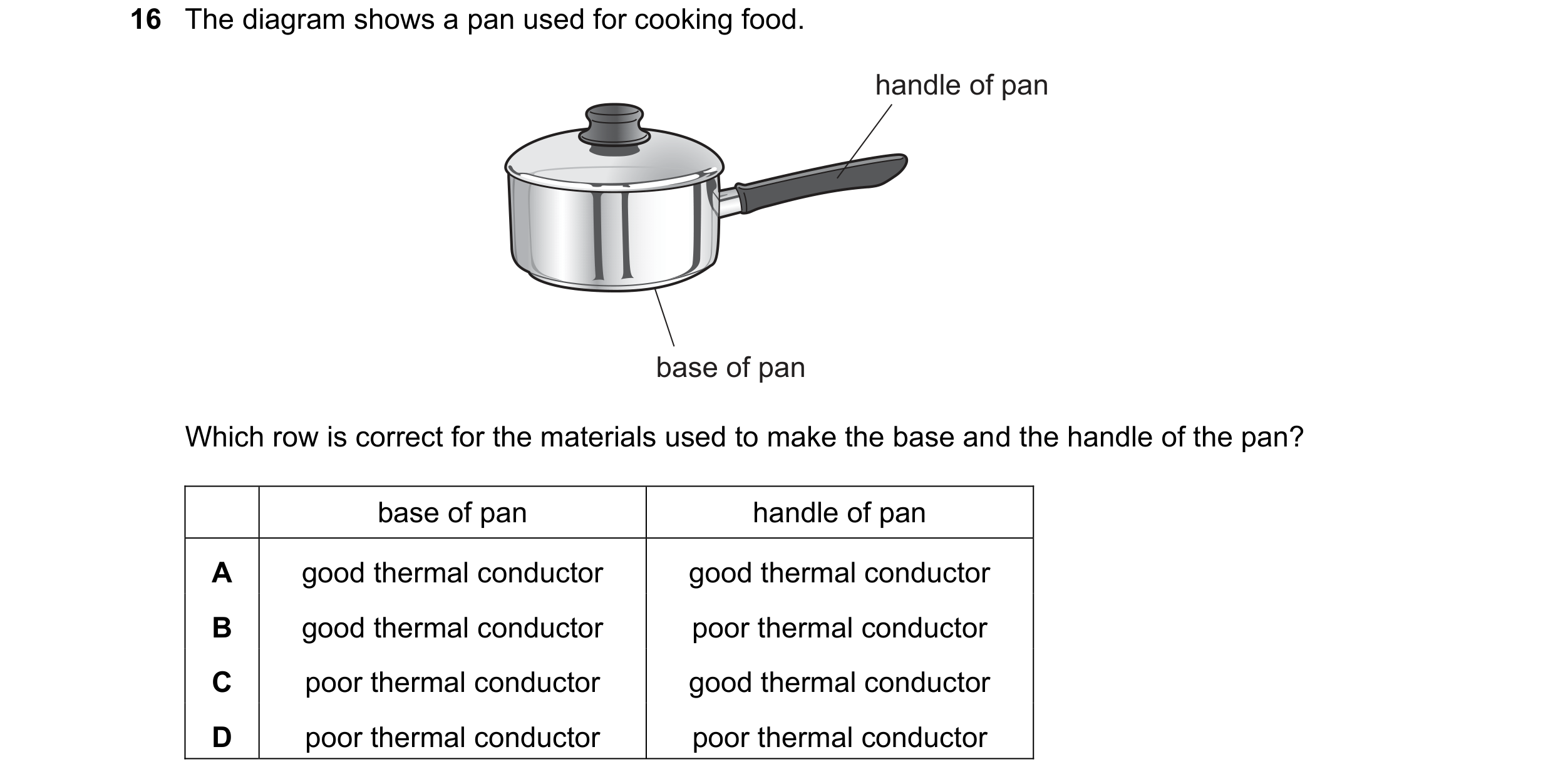
Q68 · The diagram shows a pan used for cooking food 0625/21 Oct/Nov 2021
16 The diagram shows a pan used for cooking food. handle of pan base of pan Which row is correct for the materials used to make the base and the handle of the pan? base of pan handle of pan A good thermal conductor good thermal conductor B good thermal conductor poor thermal conductor C poor thermal conductor good thermal conductor D poor thermal conductor poor thermal conductor
1 marks
Answer: B
This question in 0625/21 Oct/Nov 2021
Q69 · The diagram shows a pan used for cooking food 0625/22 Oct/Nov 2021
16 The diagram shows a pan used for cooking food. handle of pan base of pan Which row is correct for the materials used to make the base and the handle of the pan? base of pan handle of pan A good thermal conductor good thermal conductor B good thermal conductor poor thermal conductor C poor thermal conductor good thermal conductor D poor thermal conductor poor thermal conductor
1 marks
Answer: B
This question in 0625/22 Oct/Nov 2021
Q70 · The diagram shows a pan used for cooking food 0625/23 Oct/Nov 2021
16 The diagram shows a pan used for cooking food. handle of pan base of pan Which row is correct for the materials used to make the base and the handle of the pan? base of pan handle of pan A good thermal conductor good thermal conductor B good thermal conductor poor thermal conductor C poor thermal conductor good thermal conductor D poor thermal conductor poor thermal conductor
1 marks
Answer: B
This question in 0625/23 Oct/Nov 2021
Q71 · Which statement describes thermal conduction in a metal by electrons? 0625/22 Feb/March 2022
20 Which statement describes thermal conduction in a metal by electrons? A Atoms and electrons move freely throughout the metal. B Atoms and electrons vibrate about their fixed positions only. C Electrons move freely throughout the metal. D Electrons remain attached to atoms.
1 marks
Answer: C
This question in 0625/22 Feb/March 2022
Q72 · One end of a copper bar is heated to a high temperature 0625/21 May/June 2022
19 One end of a copper bar is heated to a high temperature. Which mechanism is responsible for the transfer of thermal energy to the other end of the copper bar? A the lattice vibrations of copper ions only B the lattice vibrations of copper ions and the movement of high energy electrons along the bar C the movement of high energy copper ions along the bar D the movement of high energy electrons along the bar only
1 marks
Answer: B
This question in 0625/21 May/June 2022
Q73 · The diagram shows a convection current caused by a piece of ice placed in a beaker of… 0625/21 May/June 2022
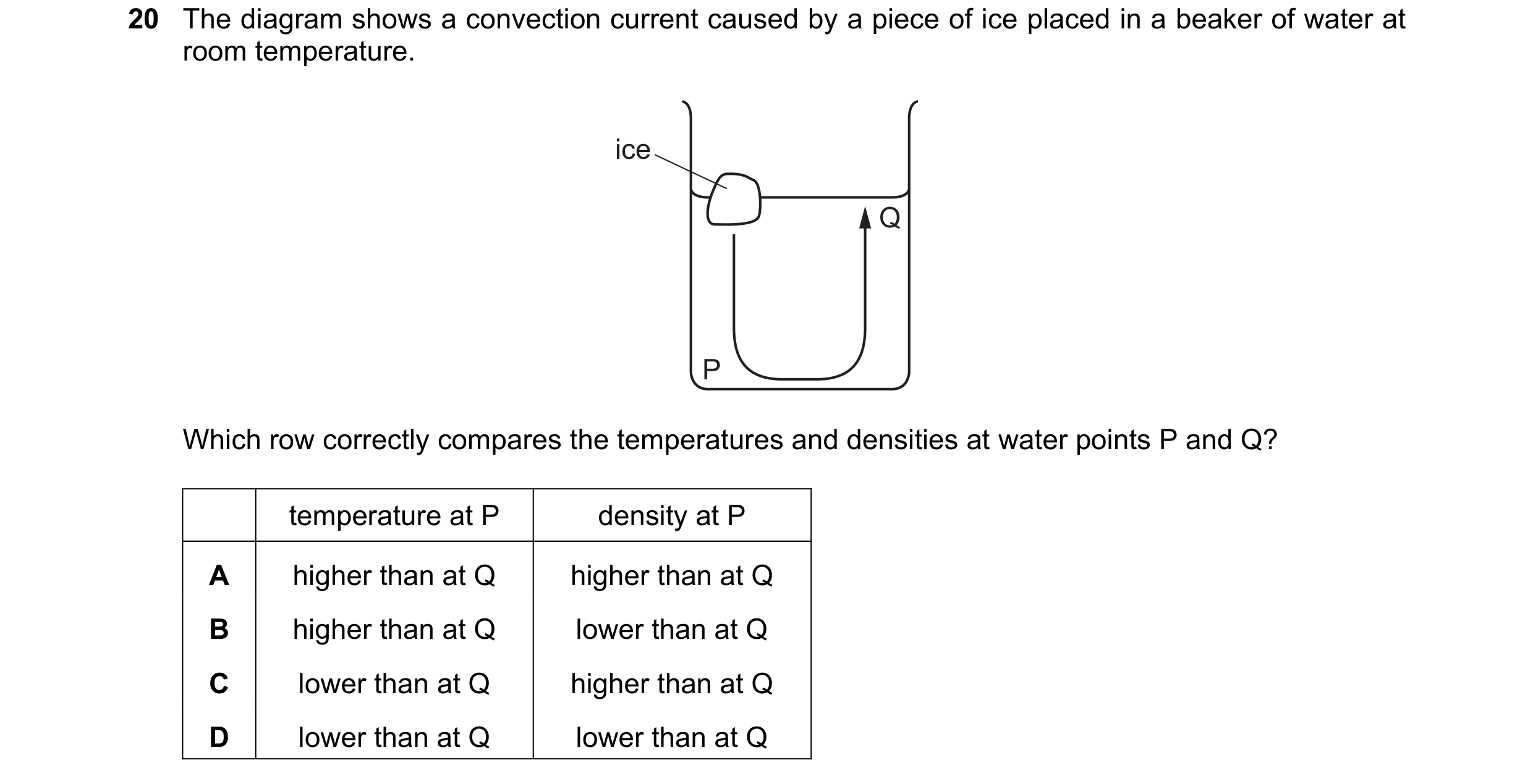
20 The diagram shows a convection current caused by a piece of ice placed in a beaker of water at room temperature. ice Q P Which row correctly compares the temperatures and densities at water points P and Q? temperature at P density at P A higher than at Q higher than at Q B higher than at Q lower than at Q C lower than at Q higher than at Q D lower than at Q lower than at Q
1 marks
Answer: C
This question in 0625/21 May/June 2022
Q74 · A glass contains an iced drink on a warm and humid day 0625/22 May/June 2022
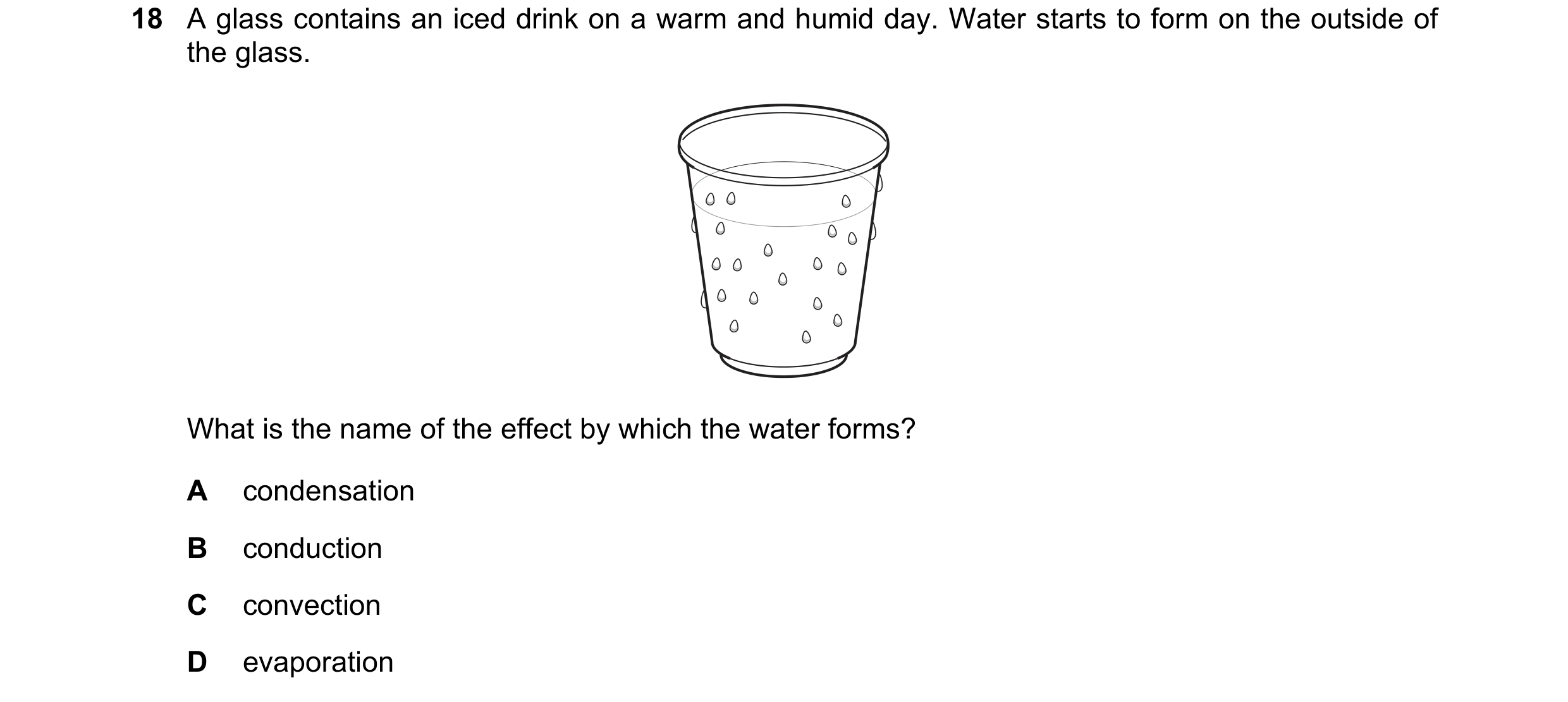
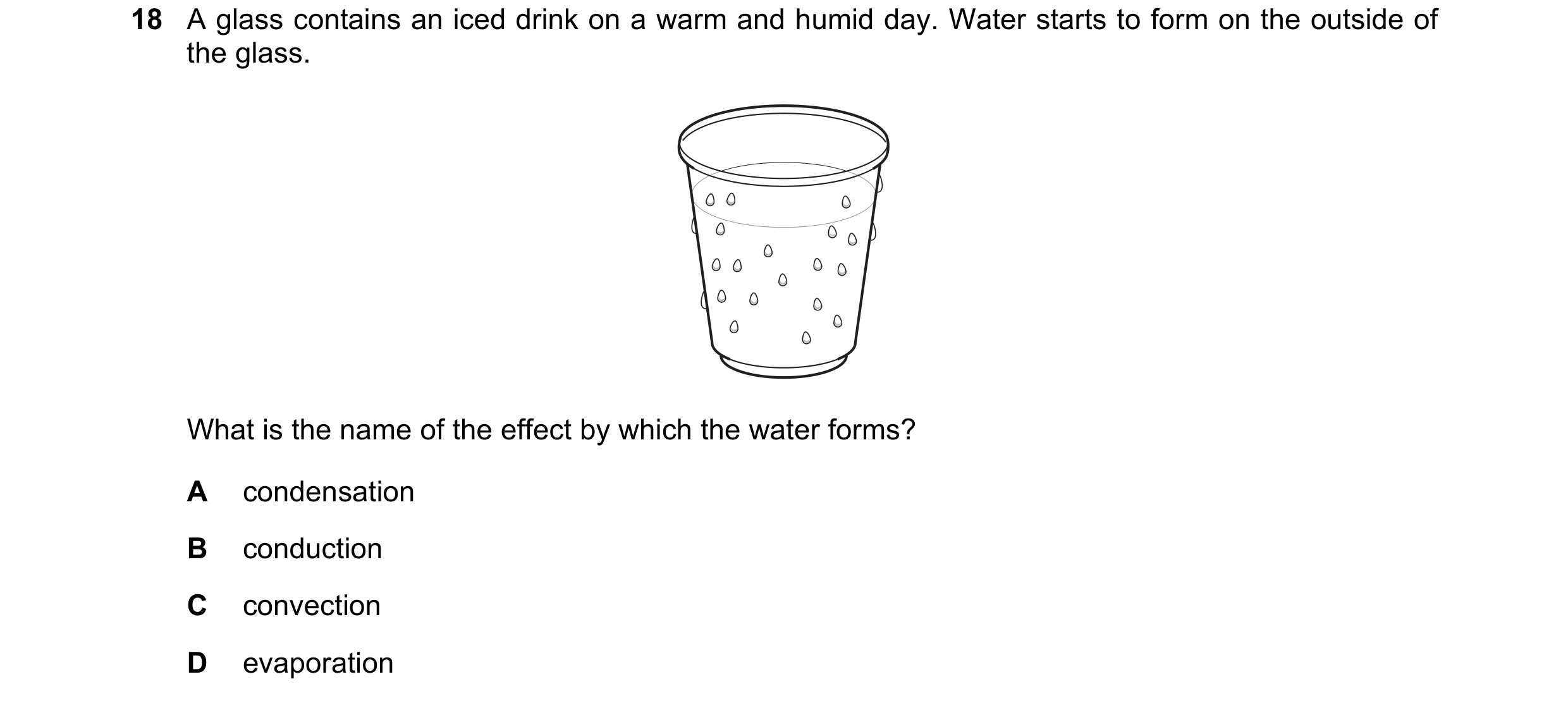
18 A glass contains an iced drink on a warm and humid day. Water starts to form on the outside of the glass. What is the name of the effect by which the water forms? A condensation B conduction C convection D evaporation
1 marks
Answer: A
This question in 0625/22 May/June 2022
Q75 · One end of a copper bar is heated to a high temperature 0625/22 May/June 2022
19 One end of a copper bar is heated to a high temperature. Which mechanism is responsible for the transfer of thermal energy to the other end of the copper bar? A the lattice vibrations of copper ions only B the lattice vibrations of copper ions and the movement of high energy electrons along the bar C the movement of high energy copper ions along the bar D the movement of high energy electrons along the bar only
1 marks
Answer: B
This question in 0625/22 May/June 2022
Q76 · Four cubic copper containers are filled with water 0625/22 May/June 2022
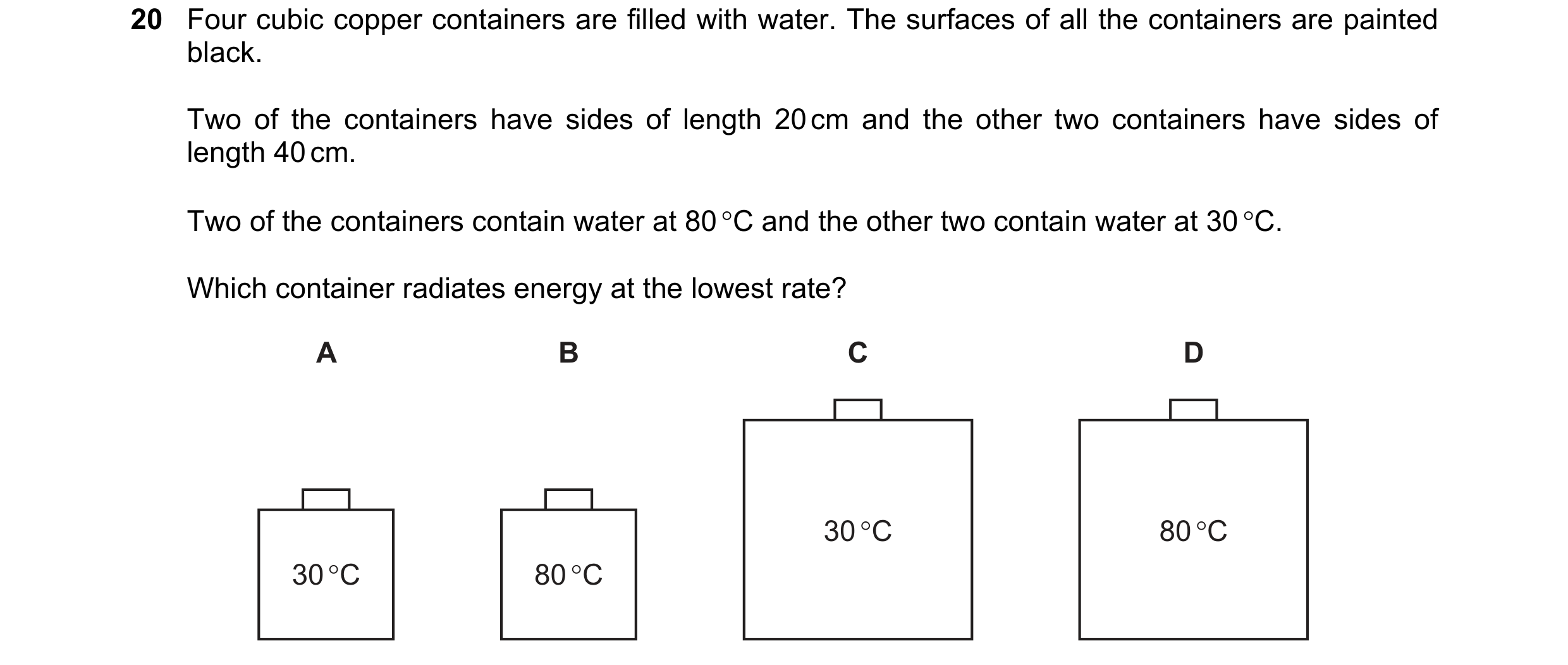
20 Four cubic copper containers are filled with water. The surfaces of all the containers are painted
black.
Two of the containers have sides of length 20cm and the other two containers have sides of
length 40cm.
Two of the containers contain water at 80°C and the other two contain water at 30°C.
Which container radiates energy at the lowest rate?
A B Cc
D
|| |
| |
30°C 80°C
30°C 80°C
1 marks
Answer: A
This question in 0625/22 May/June 2022
Q77 · A glass contains an iced drink on a warm and humid day 0625/23 May/June 2022
18 A glass contains an iced drink on a warm and humid day. Water starts to form on the outside of the glass. What is the name of the effect by which the water forms? A condensation B conduction C convection D evaporation
1 marks
Answer: A
This question in 0625/23 May/June 2022
Q78 · One end of a copper bar is heated to a high temperature 0625/23 May/June 2022
19 One end of a copper bar is heated to a high temperature. Which mechanism is responsible for the transfer of thermal energy to the other end of the copper bar? A the lattice vibrations of copper ions only B the lattice vibrations of copper ions and the movement of high energy electrons along the bar C the movement of high energy copper ions along the bar D the movement of high energy electrons along the bar only
1 marks
Answer: B
This question in 0625/23 May/June 2022
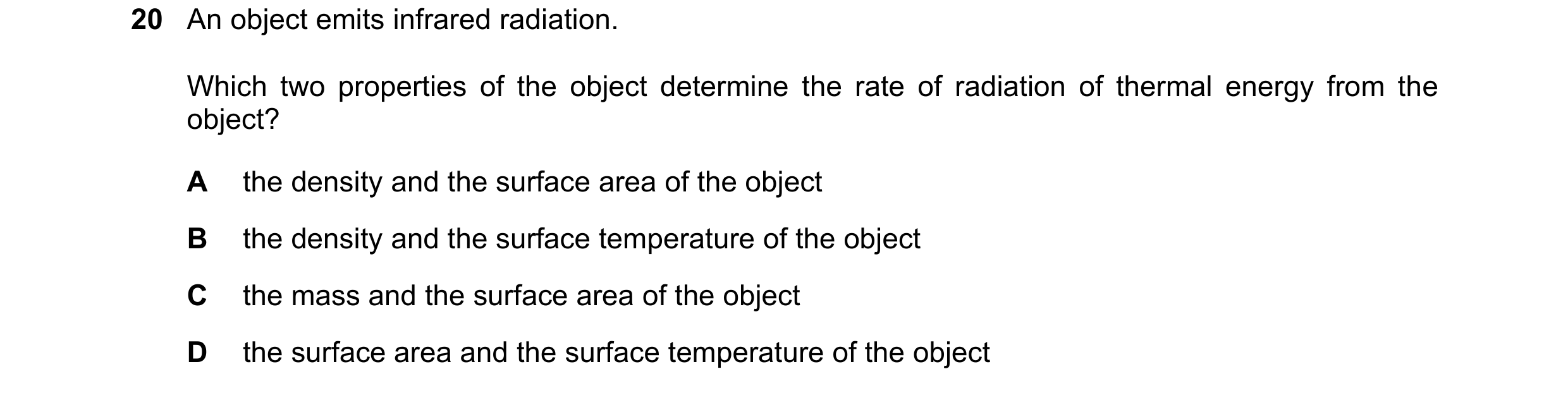
Q79 · An object emits infrared radiation 0625/23 May/June 2022
20 An object emits infrared radiation. Which two properties of the object determine the rate of radiation of thermal energy from the object? A the density and the surface area of the object B the density and the surface temperature of the object C the mass and the surface area of the object D the surface area and the surface temperature of the object
1 marks
Answer: D
This question in 0625/23 May/June 2022
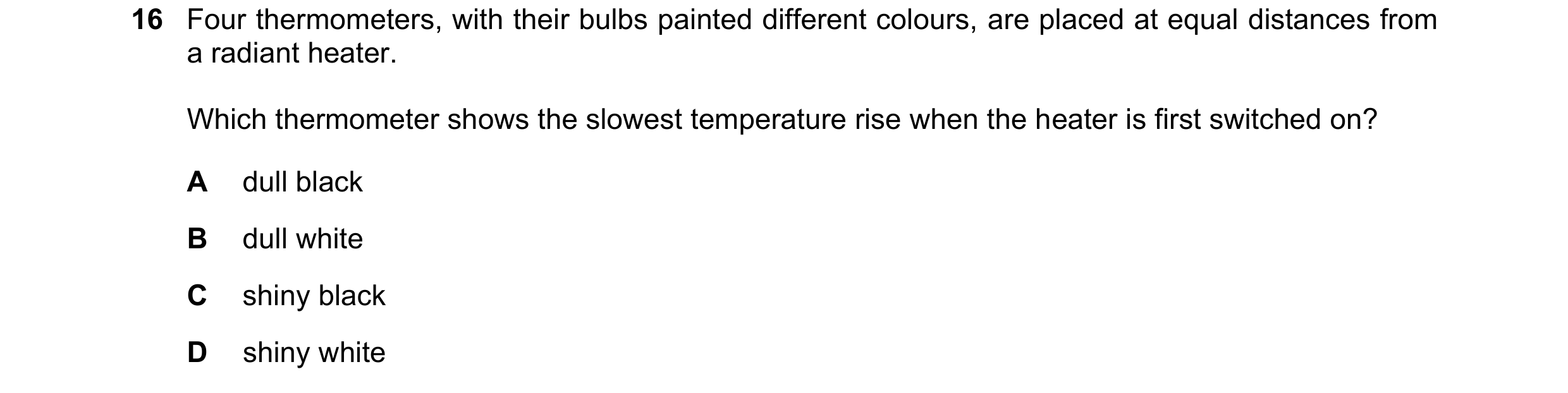
Q80 · Four thermometers, with their bulbs painted different colours, are placed at equal… 0625/21 Oct/Nov 2022
16 Four thermometers, with their bulbs painted different colours, are placed at equal distances from a radiant heater. Which thermometer shows the slowest temperature rise when the heater is first switched on? A dull black B dull white C shiny black D shiny white
1 marks
Answer: D
This question in 0625/21 Oct/Nov 2022
Q81 · Which statement about evaporation is correct? 0625/23 Oct/Nov 2022
13 Which statement about evaporation is correct? A A body in contact with an evaporating liquid loses thermal energy. B A decrease in the surface area of an evaporating liquid increases the rate of evaporation. C A wind over a liquid decreases the rate of evaporation. D It is necessary to provide an external source of thermal energy to a liquid for it to evaporate.
1 marks
Answer: A
This question in 0625/23 Oct/Nov 2022
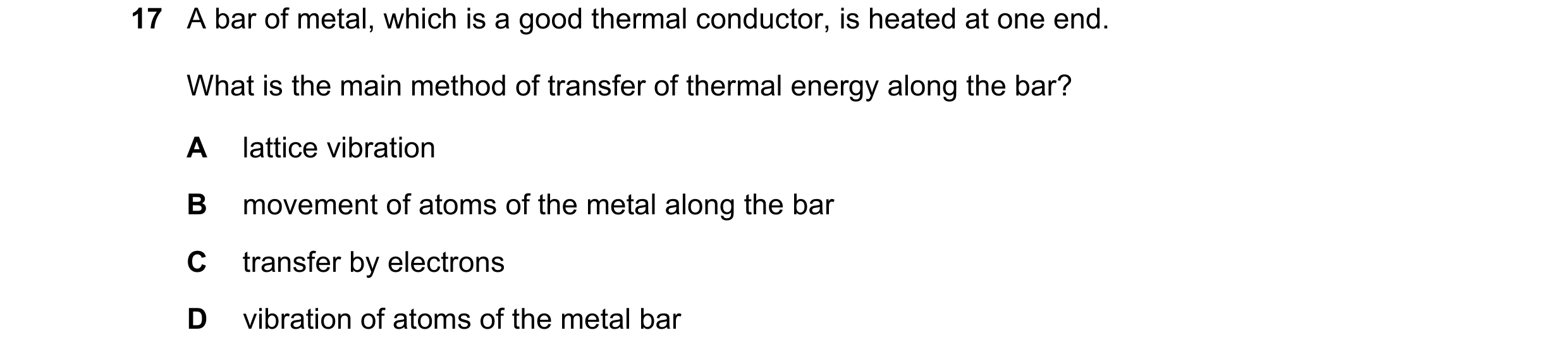
Q82 · A bar of metal, which is a good thermal conductor, is heated at one end 0625/22 Feb/March 2023
17 A bar of metal, which is a good thermal conductor, is heated at one end. What is the main method of transfer of thermal energy along the bar? A lattice vibration B movement of atoms of the metal along the bar C transfer by electrons D vibration of atoms of the metal bar
1 marks
Answer: C
This question in 0625/22 Feb/March 2023
Q83 · Some hot water is sealed inside a metal can 0625/21 May/June 2023
16 Some hot water is sealed inside a metal can. The can is in a vacuum in outer space. The hot water slowly cools down. How does the thermal energy escape into space? A by conduction then convection B by conduction then radiation C by evaporation then convection D by evaporation then radiation
1 marks
Answer: B
This question in 0625/21 May/June 2023
Q84 · Four cups A, B, C and D contain hot coffee 0625/22 May/June 2023
16 Four cups A, B, C and D contain hot coffee. Which cup keeps the coffee warm the longest? the outside the top of the cup surface of the cup A black covered with a lid B black no lid C white covered with a lid D white no lid
1 marks
Answer: C
This question in 0625/22 May/June 2023
Q85 · Two otherwise identical cars, one black and one white, are at the same initial temperature 0625/23 May/June 2023
16 Two otherwise identical cars, one black and one white, are at the same initial temperature. The cars are left in bright sunshine and their temperatures increase. During the night, their temperatures decrease. Which car shows the greater rate of temperature increase and which car shows the greater rate of temperature decrease? greater rate of greater rate of temperature temperature increase decrease A black black B black white C white black D white white
1 marks
Answer: A
This question in 0625/23 May/June 2023
Q86 · The diagram shows the view of a room heated by a radiator 0625/21 Oct/Nov 2023
16 The diagram shows the view of a room heated by a radiator. The arrowed line from X to Y is the path of the convection current in the air. ceiling X Y radiator floor Which row about the air temperature and the air density at X and at Y is correct? air temperature air density A higher at X higher at X B higher at X higher at Y C higher at Y higher at Y D higher at Y higher at X
1 marks
Answer: B
This question in 0625/21 Oct/Nov 2023
Q87 · A room is heated by a radiator 0625/22 Oct/Nov 2023
16 A room is heated by a radiator. The diagrams X and Y show two possible circulations of hot air, which heat the room. diagram X ceiling diagram Y ceiling radiator radiator floor floor Which diagram and reason explain the heating of the room by convection? diagram reason A X air density decreases when air is heated B X air density increases when air is heated C Y air density decreases when air is heated D Y air density increases when air is heated
1 marks
Answer: A
This question in 0625/22 Oct/Nov 2023
Q88 · A cupboard is placed in front of a heater 0625/23 Oct/Nov 2023
16 A cupboard is placed in front of a heater. Air can move through a gap under the cupboard. wall cupboard heater air moves through gap floor Which row describes the temperature and the direction of movement of the air in the gap? air temperature air direction A cool away from the heater B cool towards the heater C warm away from the heater D warm towards the heater
1 marks
Answer: B
This question in 0625/23 Oct/Nov 2023
Q89 · The diagram shows a pan used for cooking food 0625/22 Feb/March 2024
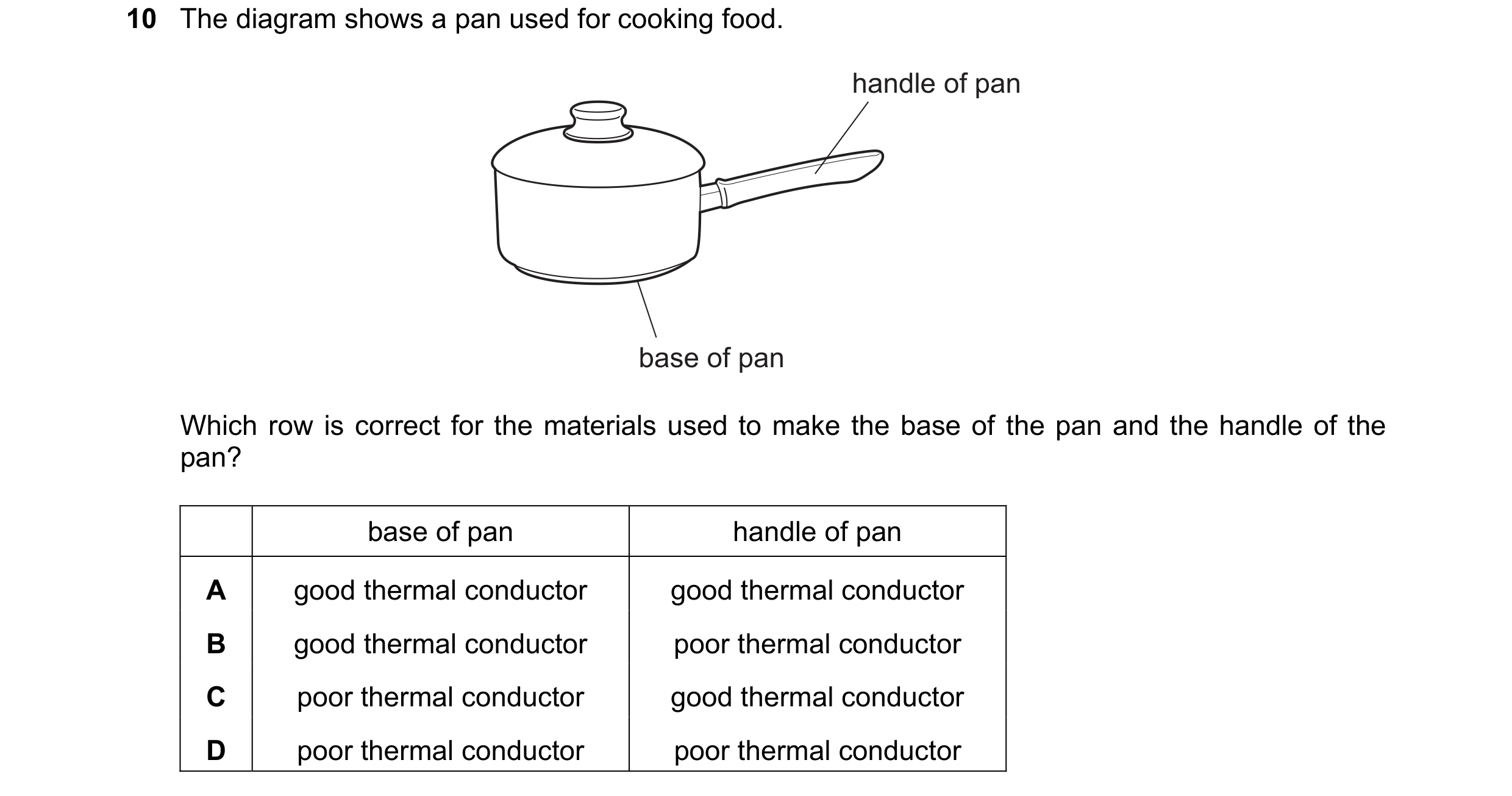
10 The diagram shows a pan used for cooking food. handle of pan base of pan Which row is correct for the materials used to make the base of the pan and the handle of the pan? base of pan handle of pan A good thermal conductor good thermal conductor B good thermal conductor poor thermal conductor C poor thermal conductor good thermal conductor D poor thermal conductor poor thermal conductor
1 marks
Answer: B
This question in 0625/22 Feb/March 2024
Q90 · Solar heating panels consist of pipes carrying water that absorb radiation from the Sun 0625/22 Feb/March 2024
11 Solar heating panels consist of pipes carrying water that absorb radiation from the Sun. Which texture and colour is the surface of the pipes so that the temperature of the water rises at the quickest rate? A dull black B dull white C shiny black D shiny white
1 marks
Answer: A
This question in 0625/22 Feb/March 2024
Q91 · A solar water heater is designed to absorb energy from sunlight 0625/21 May/June 2024
15 A solar water heater is designed to absorb energy from sunlight. Which surface texture and colour would be best for the solar water heater? A dull black B shiny black C dull white D shiny white
1 marks
Answer: A
This question in 0625/21 May/June 2024
Q92 · A teacher shows his class a polystyrene cup 0625/22 May/June 2024
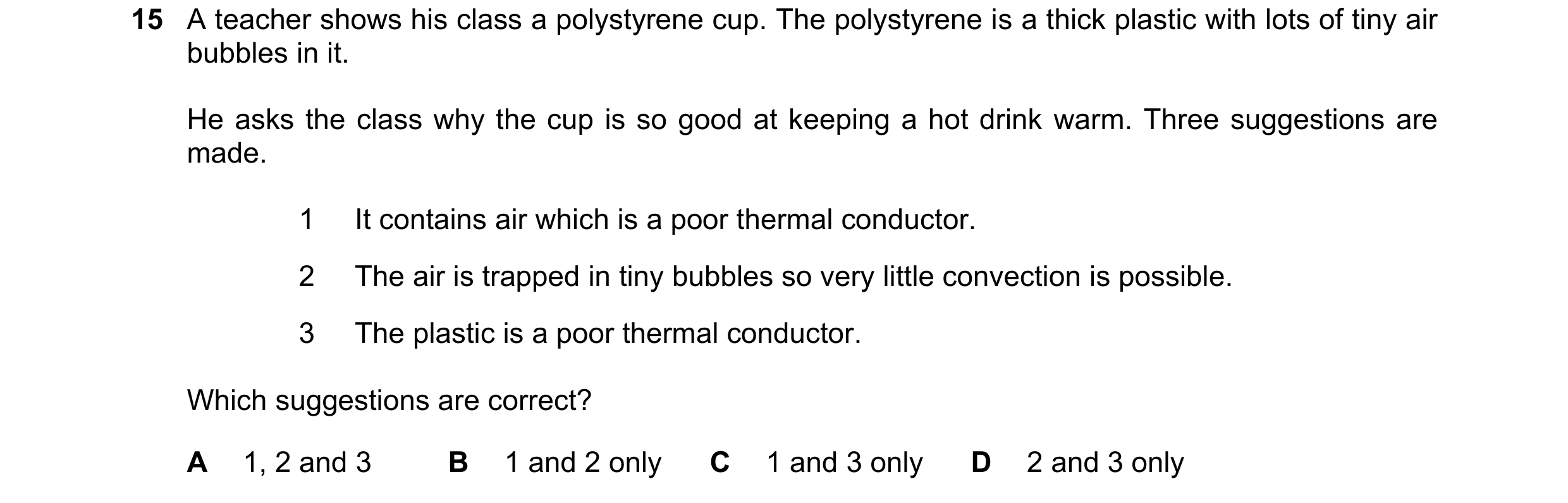
15 A teacher shows his class a polystyrene cup. The polystyrene is a thick plastic with lots of tiny air bubbles in it. He asks the class why the cup is so good at keeping a hot drink warm. Three suggestions are made. 1 It contains air which is a poor thermal conductor. 2 The air is trapped in tiny bubbles so very little convection is possible. 3 The plastic is a poor thermal conductor. Which suggestions are correct? A 1, 2 and 3 B 1 and 2 only C 1 and 3 only D 2 and 3 only
1 marks
Answer: A
This question in 0625/22 May/June 2024
Q93 · Thermal radiation is part of the electromagnetic spectrum 0625/22 May/June 2024
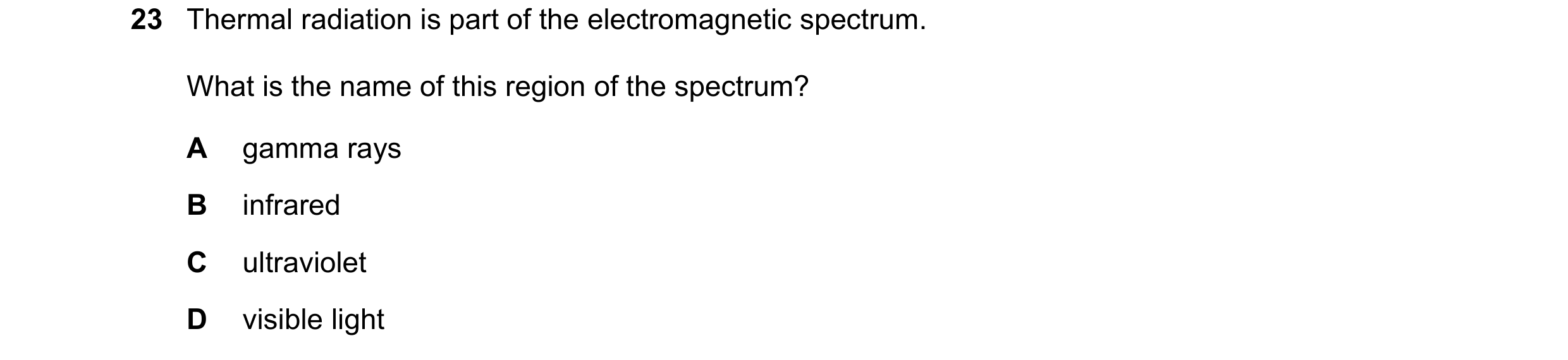
23 Thermal radiation is part of the electromagnetic spectrum. What is the name of this region of the spectrum? A gamma rays B infrared C ultraviolet D visible light
1 marks
Answer: B
This question in 0625/22 May/June 2024
Q94 · The table shows the state of materials P, Q, R and S, and whether each one contains free… 0625/23 May/June 2024
16 The table shows the state of materials P, Q, R and S, and whether each one contains free
electrons.
gas liquid solid fee en ns
P J x x x
Q x Jv x x
R x x Jv JV
S) x x J x
Using the information in the table, which comparison of the thermal conduction in the materials is
correct?
A _Itis better in P than in Q and S.
B_Itis better in Q than in R and P.
C_Itis better in R than in Q and P.
D_Itis better in S than in R and Q.
1 marks
Answer: C
This question in 0625/23 May/June 2024
Q95 · Which row shows the process by which energy in the Sun is released, the process by which… 0625/22 Oct/Nov 2024
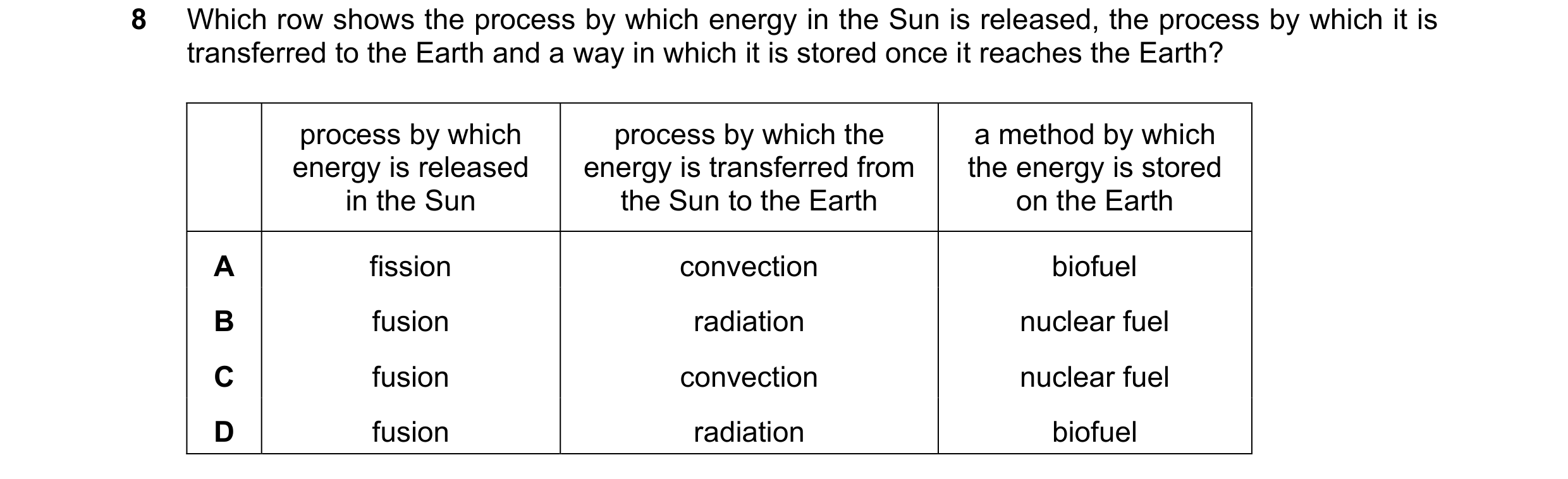
8 Which row shows the process by which energy in the Sun is released, the process by which it is transferred to the Earth and a way in which it is stored once it reaches the Earth? process by which process by which the a method by which energy is released energy is transferred from the energy is stored in the Sun the Sun to the Earth on the Earth A fission convection biofuel B fusion radiation nuclear fuel C fusion convection nuclear fuel D fusion radiation biofuel
1 marks
Answer: D
This question in 0625/22 Oct/Nov 2024
Q96 · Which statement about the transfer of thermal energy is correct? 0625/22 Oct/Nov 2024
16 Which statement about the transfer of thermal energy is correct? A All metals conduct thermal energy equally well. B Convection can only occur in solids or liquids. C Convection occurs in liquids because hot liquid is more dense than cold liquid. D The radiation that transfers thermal energy is a type of electromagnetic radiation.
1 marks
Answer: D
This question in 0625/22 Oct/Nov 2024
Q97 · A glass test-tube containing water is heated at the top 0625/23 Oct/Nov 2024
16 A glass test-tube containing water is heated at the top. The water at the top boils, but the water at the bottom remains cold. water test-tube heat Which row explains why the water at the bottom of the test-tube remains cold? glass water A good thermal conductor good thermal conductor B good thermal conductor poor thermal conductor C poor thermal conductor good thermal conductor D poor thermal conductor poor thermal conductor
1 marks
Answer: D
This question in 0625/23 Oct/Nov 2024
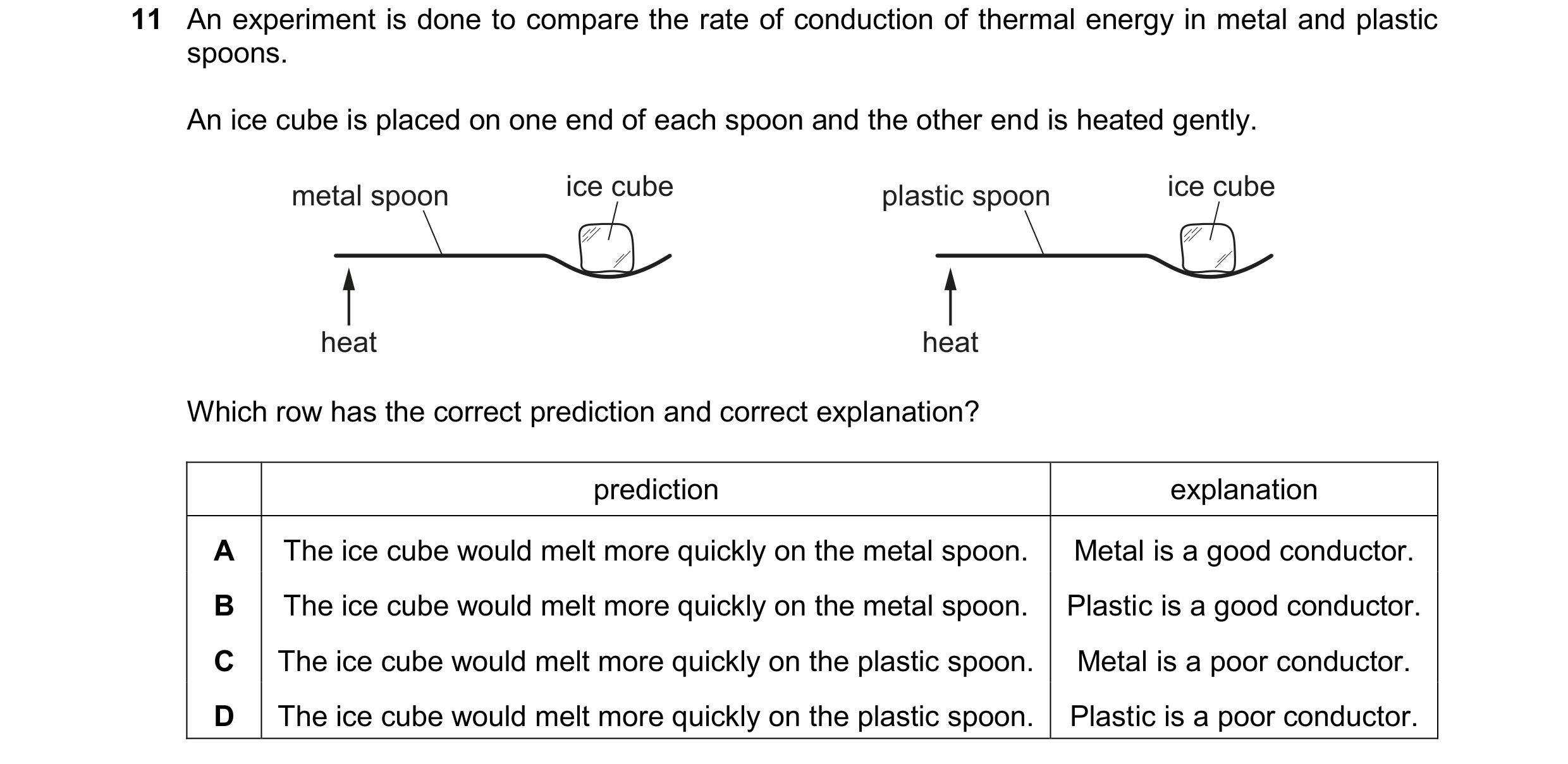
Q98 · An experiment is done to compare the rate of conduction of thermal energy in metal and… 0625/22 Feb/March 2025
11 An experiment is done to compare the rate of conduction of thermal energy in metal and plastic spoons. An ice cube is placed on one end of each spoon and the other end is heated gently. metal spoon ice cube plastic spoon ice cube heat heat Which row has the correct prediction and correct explanation? prediction explanation A The ice cube would melt more quickly on the metal spoon. Metal is a good conductor. B The ice cube would melt more quickly on the metal spoon. Plastic is a good conductor. C The ice cube would melt more quickly on the plastic spoon. Metal is a poor conductor. D The ice cube would melt more quickly on the plastic spoon. Plastic is a poor conductor.
1 marks
Answer: A
This question in 0625/22 Feb/March 2025
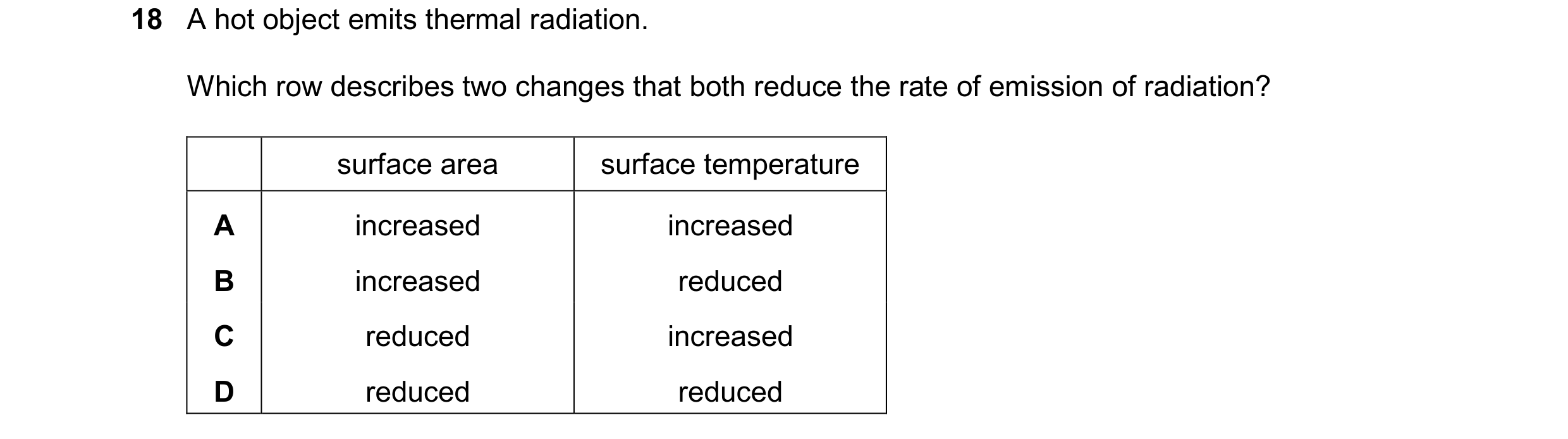
Q99 · A hot object emits thermal radiation 0625/22 Feb/March 2025
18 A hot object emits thermal radiation. Which row describes two changes that both reduce the rate of emission of radiation? surface area surface temperature A increased increased B increased reduced C reduced increased D reduced reduced
1 marks
Answer: D
This question in 0625/22 Feb/March 2025
Q100 · A student has a copper rod and a wooden rod 0625/21 May/June 2025
15 A student has a copper rod and a wooden rod. Both rods have the same dimensions. The student puts one end of each rod into a beaker of crushed ice. After a few minutes, the student picks up the rods by the ends not in the ice. Which statement is correct? A The copper rod feels colder than the wooden rod because copper is a better conductor than wood. B The copper rod feels warmer than the wooden rod because copper is a better conductor than wood. C The wooden rod feels colder than the copper rod because wood is a better conductor than copper. D The wooden rod feels warmer than the copper rod because wood is a better conductor than copper.
1 marks
Answer: A
This question in 0625/21 May/June 2025
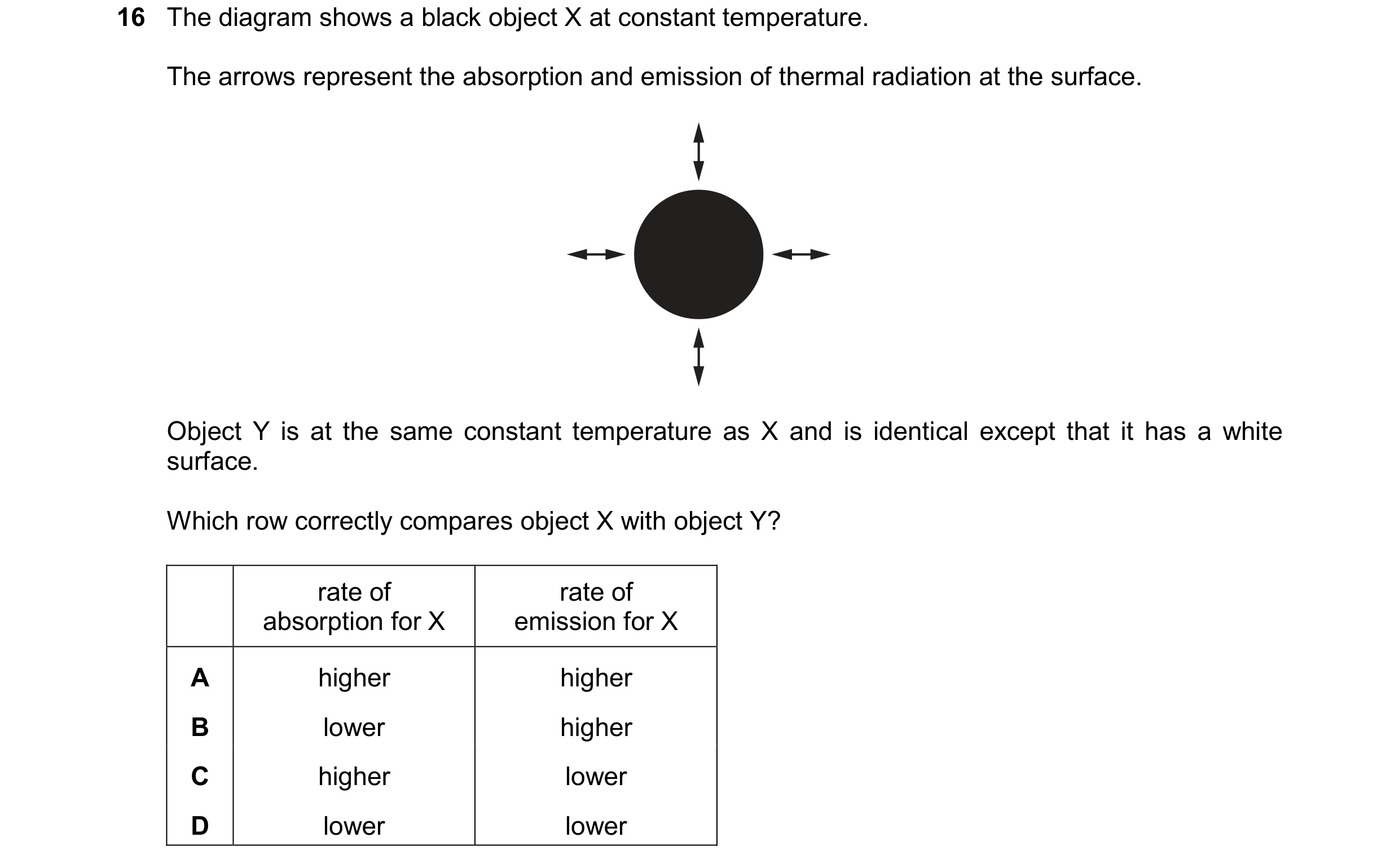
Q101 · The diagram shows a black object X at constant temperature 0625/21 May/June 2025
16 The diagram shows a black object X at constant temperature. The arrows represent the absorption and emission of thermal radiation at the surface. Object Y is at the same constant temperature as X and is identical except that it has a white surface. Which row correctly compares object X with object Y? rate of rate of absorption for X emission for X A higher higher B lower higher C higher lower D lower lower
1 marks
Answer: A
This question in 0625/21 May/June 2025
Q102 · The diagram shows four rods 0625/22 May/June 2025
15 The diagram shows four rods. Each rod is made of a different metal. P Q brass copper X silver iron S R Wax is used to attach small metal balls at the rod ends P, Q, R and S. Each rod is the same size. They are heated uniformly by a Bunsen burner at point X. As the rods warm up, the wax melts and the balls fall off. Why does the ball on the silver rod fall first? A Silver is the best conductor of heat. B Silver is the worst conductor of heat. C Silver is the best radiator of heat. D Silver is the worst radiator of heat.
1 marks
Answer: A
This question in 0625/22 May/June 2025
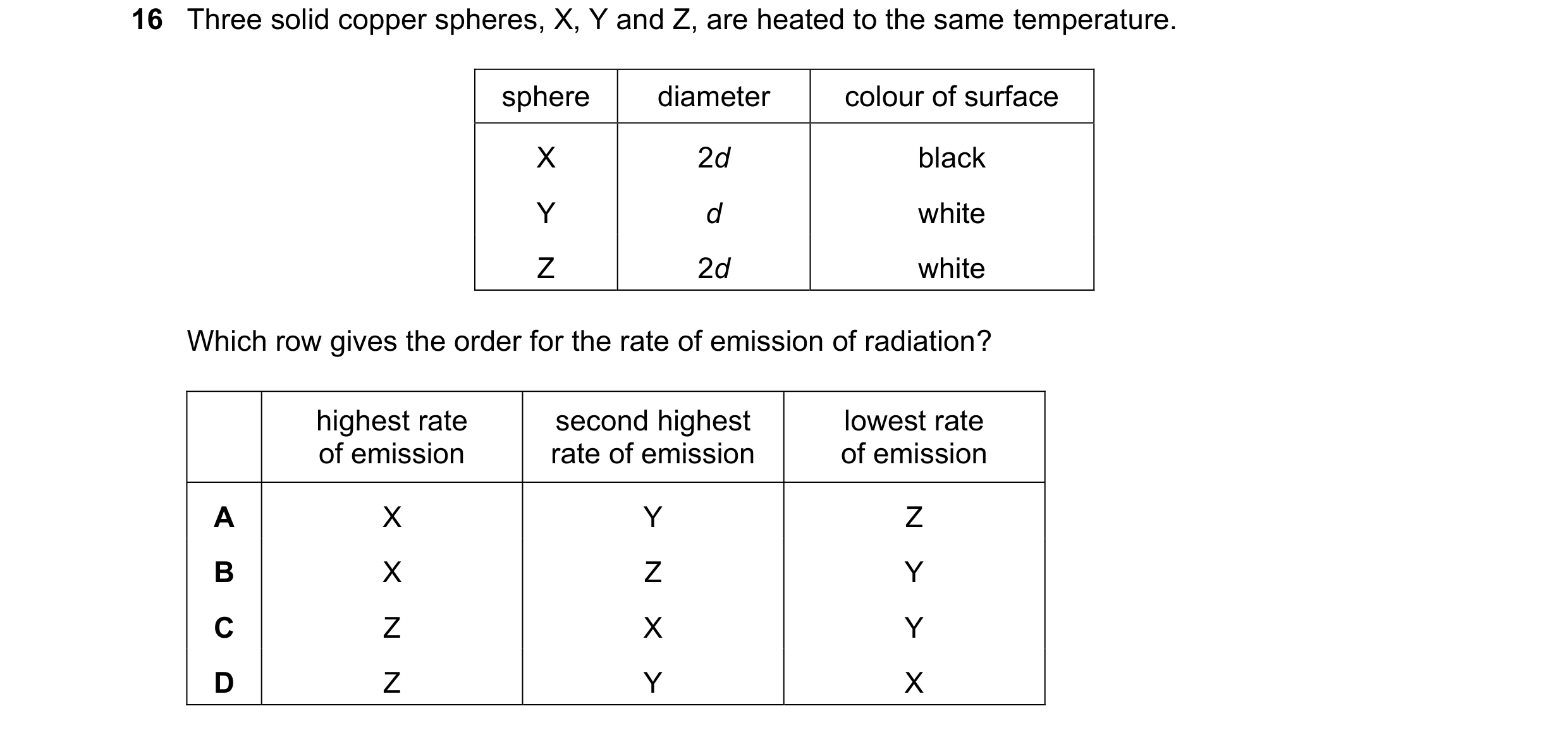
Q103 · Three solid copper spheres, X, Y and Z, are heated to the same temperature 0625/22 May/June 2025
16 Three solid copper spheres, X, Y and Z, are heated to the same temperature. sphere diameter colour of surface X 2d black Y d white Z 2d white Which row gives the order for the rate of emission of radiation? highest rate second highest lowest rate of emission rate of emission of emission A X Y Z B X Z Y C Z X Y D Z Y X
1 marks
Answer: B
This question in 0625/22 May/June 2025
Q104 · Four different surfaces are at the same high temperature 0625/23 May/June 2025
15 Four different surfaces are at the same high temperature. Which surface emits thermal radiation at the slowest rate? colour of texture of surface area / cm2 surface surface A black dull 10 B black dull 100 C white shiny 10 D white shiny 100
1 marks
Answer: C
This question in 0625/23 May/June 2025
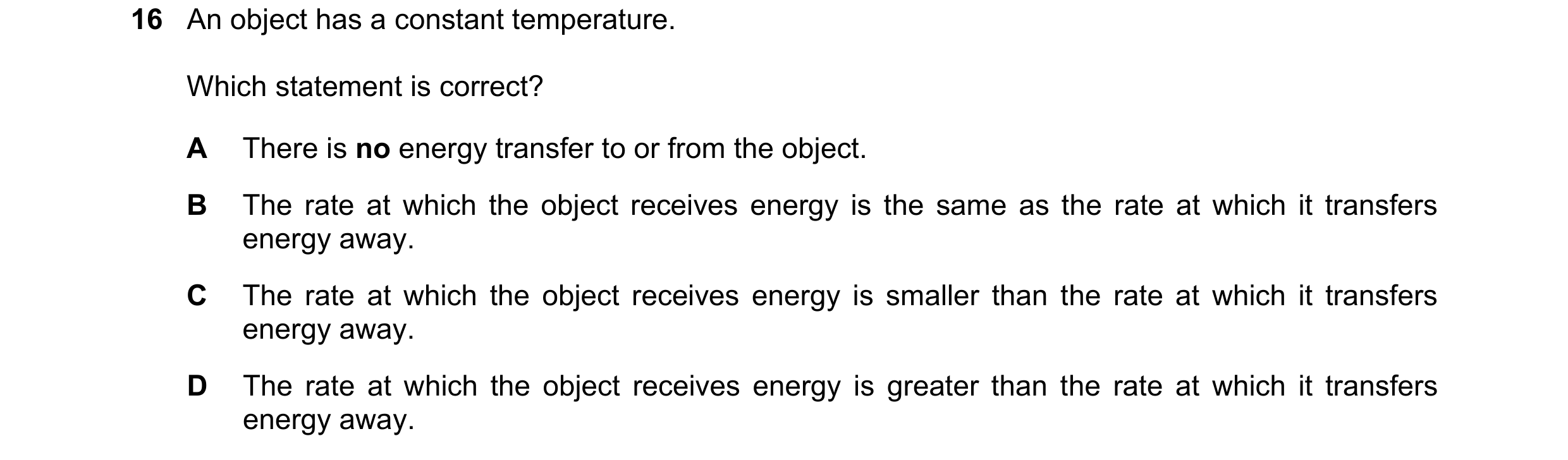
Q105 · An object has a constant temperature 0625/23 May/June 2025
16 An object has a constant temperature. Which statement is correct? A There is no energy transfer to or from the object. B The rate at which the object receives energy is the same as the rate at which it transfers energy away. C The rate at which the object receives energy is smaller than the rate at which it transfers energy away. D The rate at which the object receives energy is greater than the rate at which it transfers energy away.
1 marks
Answer: B
This question in 0625/23 May/June 2025
Q106 · Which statement about convection is not correct? 0625/21 Oct/Nov 2025
14 Which statement about convection is not correct? A It enables water in a pan on a cooker to get evenly heated. B It happens in liquids and gases. C It occurs because cooler liquids rise above warmer liquids. D It occurs because the density of a liquid decreases when it is heated.
1 marks
Answer: C
This question in 0625/21 Oct/Nov 2025
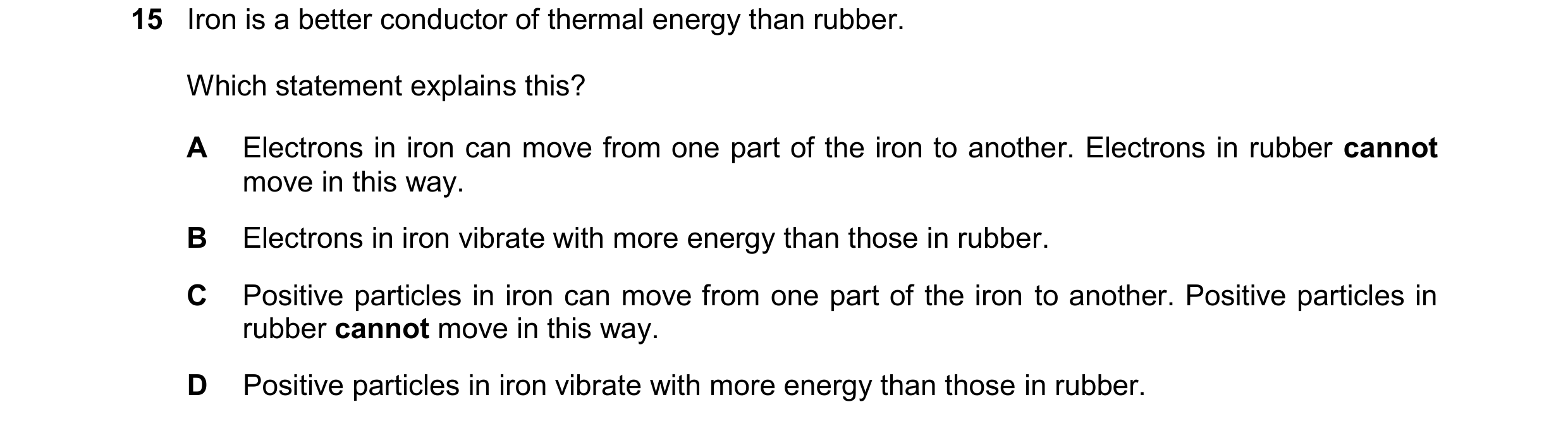
Q107 · Iron is a better conductor of thermal energy than rubber 0625/21 Oct/Nov 2025
15 Iron is a better conductor of thermal energy than rubber. Which statement explains this? A Electrons in iron can move from one part of the iron to another. Electrons in rubber cannot move in this way. B Electrons in iron vibrate with more energy than those in rubber. C Positive particles in iron can move from one part of the iron to another. Positive particles in rubber cannot move in this way. D Positive particles in iron vibrate with more energy than those in rubber.
1 marks
Answer: A
This question in 0625/21 Oct/Nov 2025
Q108 · Two metal cans are identical, except that one has a shiny silver outer surface and the… 0625/21 Oct/Nov 2025
16 Two metal cans are identical, except that one has a shiny silver outer surface and the other has a dull black outer surface. They each have the same mass of hot water at the same temperature sealed inside them. They are both in a vacuum in the darkness of outer space. How does the temperature of the water in each one change? A The temperature of the water does not change. B The water in the black can cools more slowly than that in the silver can. C The water in the silver can cools more slowly than that in the black can. D They both cool down at the same rate.
1 marks
Answer: C
This question in 0625/21 Oct/Nov 2025
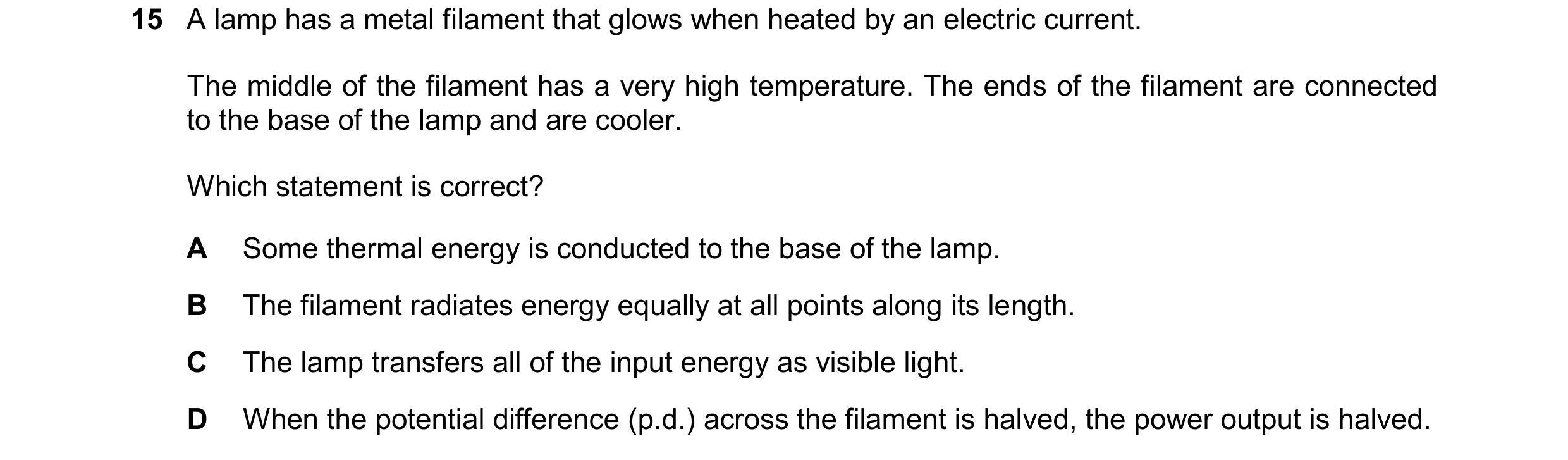
Q109 · A lamp has a metal filament that glows when heated by an electric current 0625/22 Oct/Nov 2025
15 A lamp has a metal filament that glows when heated by an electric current. The middle of the filament has a very high temperature. The ends of the filament are connected to the base of the lamp and are cooler. Which statement is correct? A Some thermal energy is conducted to the base of the lamp. B The filament radiates energy equally at all points along its length. C The lamp transfers all of the input energy as visible light. D When the potential difference (p.d.) across the filament is halved, the power output is halved.
1 marks
Answer: A
This question in 0625/22 Oct/Nov 2025
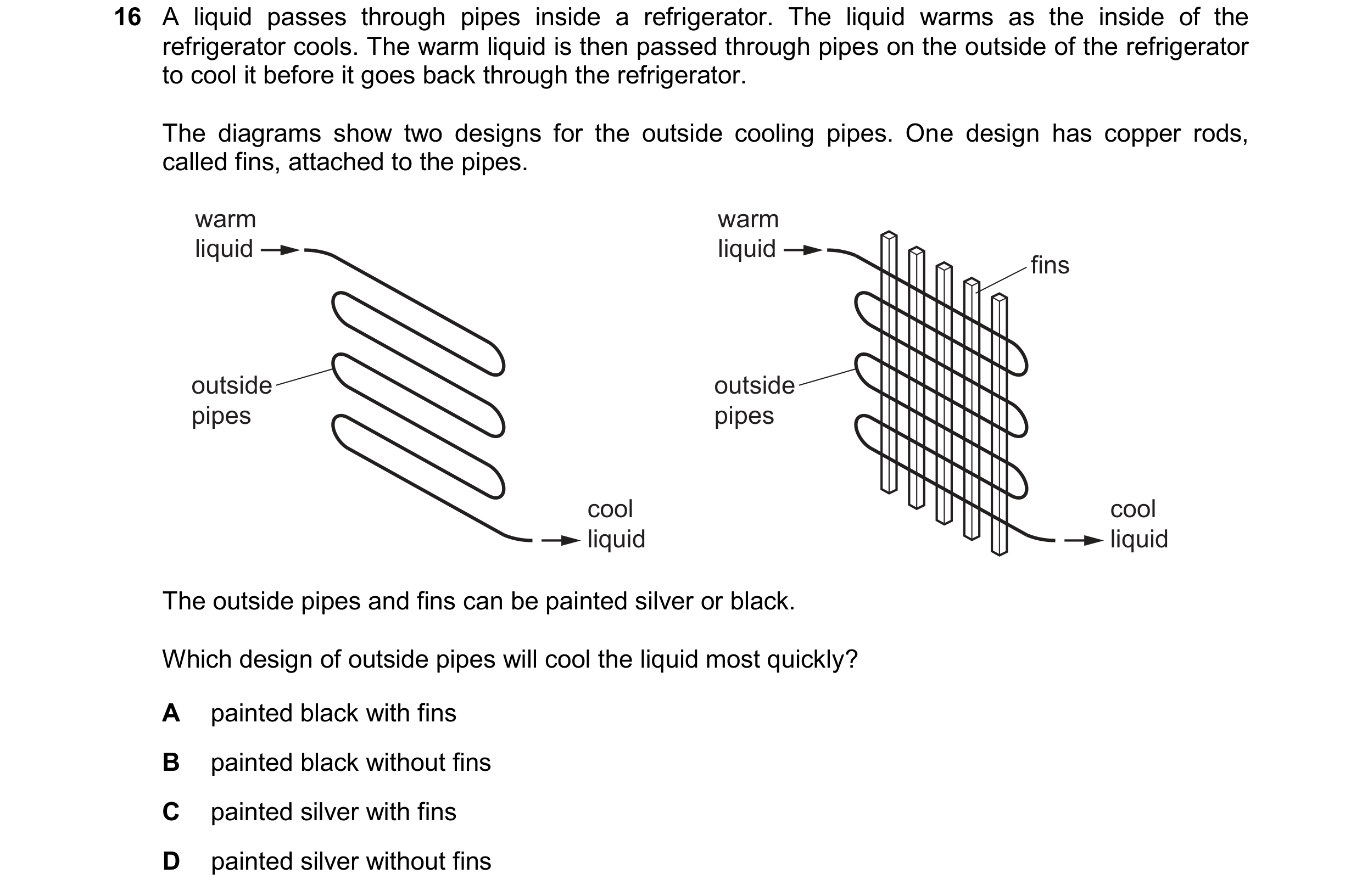
Q110 · A liquid passes through pipes inside a refrigerator 0625/22 Oct/Nov 2025
16 A liquid passes through pipes inside a refrigerator. The liquid warms as the inside of the refrigerator cools. The warm liquid is then passed through pipes on the outside of the refrigerator to cool it before it goes back through the refrigerator. The diagrams show two designs for the outside cooling pipes. One design has copper rods, called fins, attached to the pipes. warm warm liquid liquid fins outside outside pipes pipes cool cool liquid liquid The outside pipes and fins can be painted silver or black. Which design of outside pipes will cool the liquid most quickly? A painted black with fins B painted black without fins C painted silver with fins D painted silver without fins
1 marks
Answer: A
This question in 0625/22 Oct/Nov 2025
Q111 · Which row about the movement of electrons and ions during conduction of thermal energy… 0625/23 Oct/Nov 2025
15 Which row about the movement of electrons and ions during conduction of thermal energy through a metal is correct? electrons ions A move through metal vibrate about fixed points B vibrate about fixed points move through metal C vibrate about fixed points vibrate about fixed points D move through metal move through metal
1 marks
Answer: A
This question in 0625/23 Oct/Nov 2025
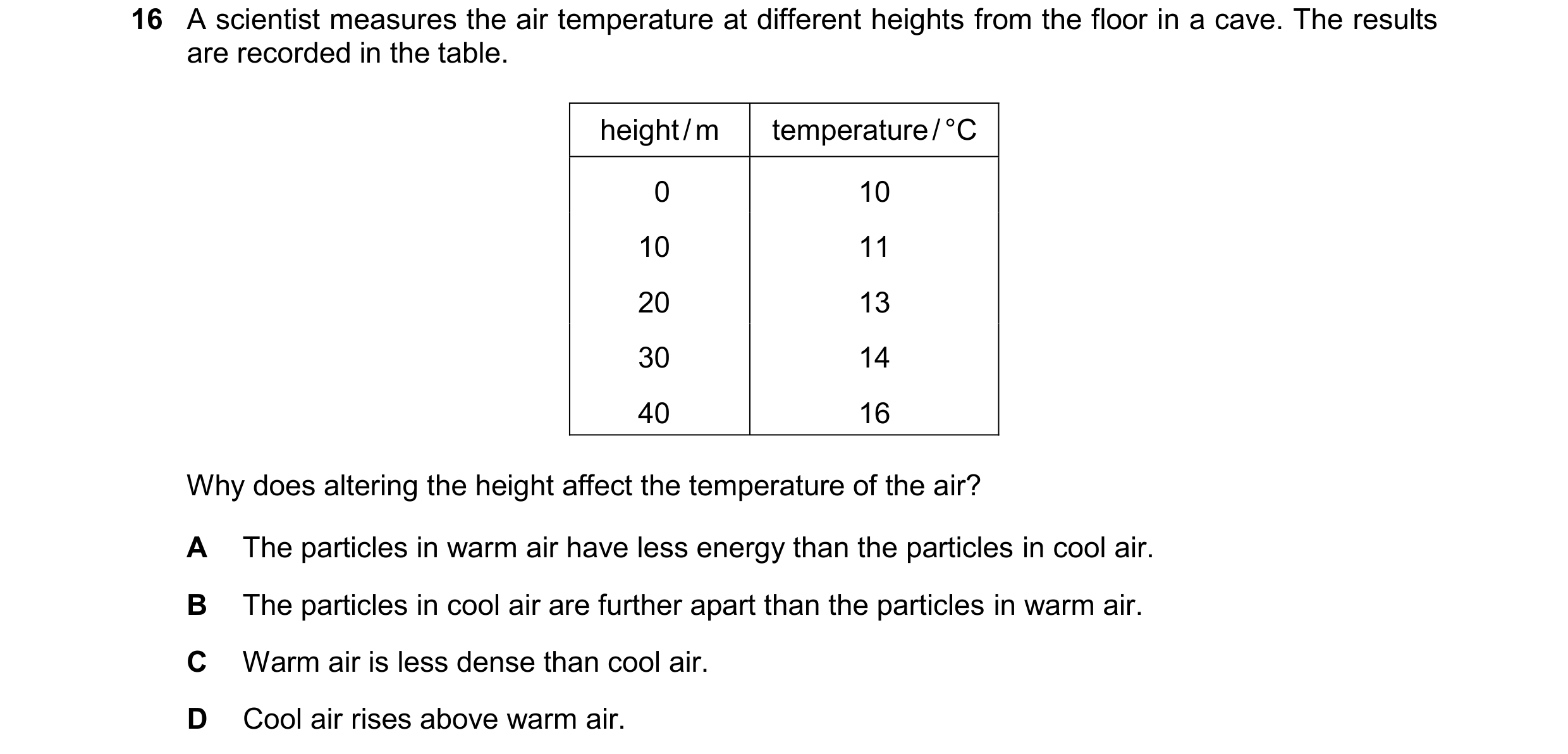
Q112 · A scientist measures the air temperature at different heights from the floor in a cave 0625/23 Oct/Nov 2025
16 A scientist measures the air temperature at different heights from the floor in a cave. The results are recorded in the table. height / m temperature / °C 0 10 10 11 20 13 30 14 40 16 Why does altering the height affect the temperature of the air? A The particles in warm air have less energy than the particles in cool air. B The particles in cool air are further apart than the particles in warm air. C Warm air is less dense than cool air. D Cool air rises above warm air.
1 marks
Answer: C
This question in 0625/23 Oct/Nov 2025
 1 / 34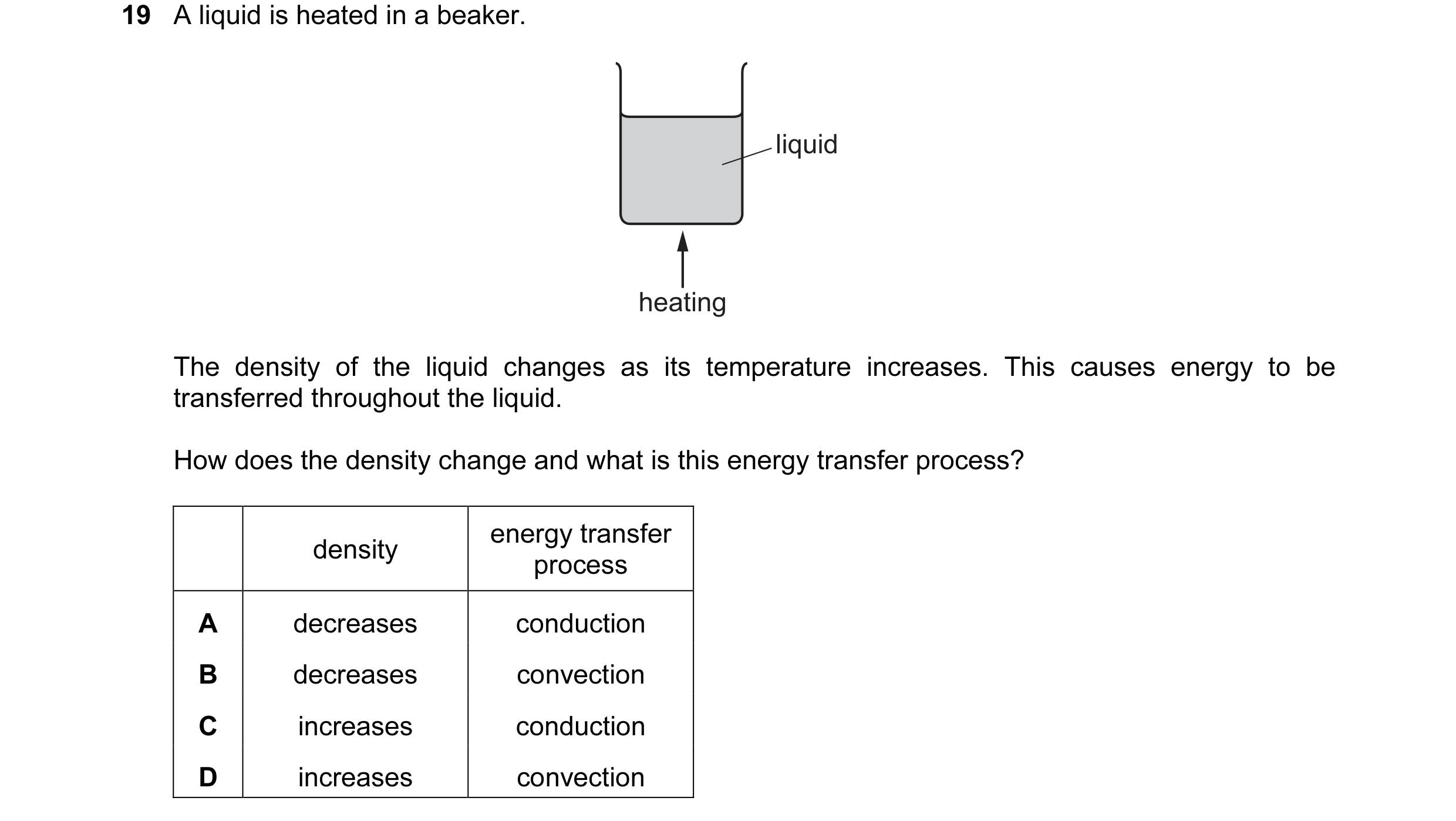
 2 / 34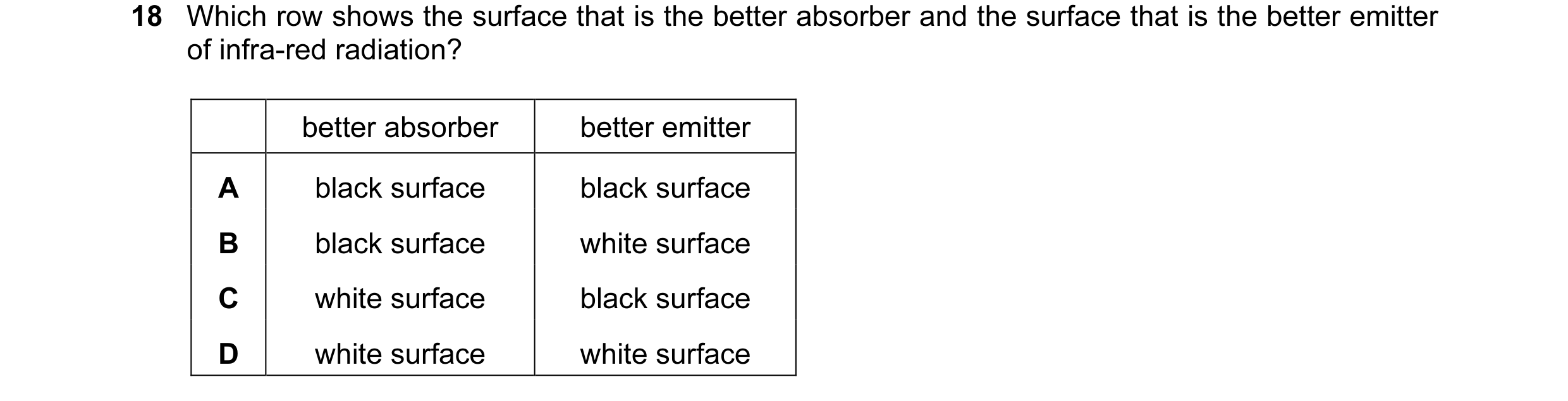
 3 / 34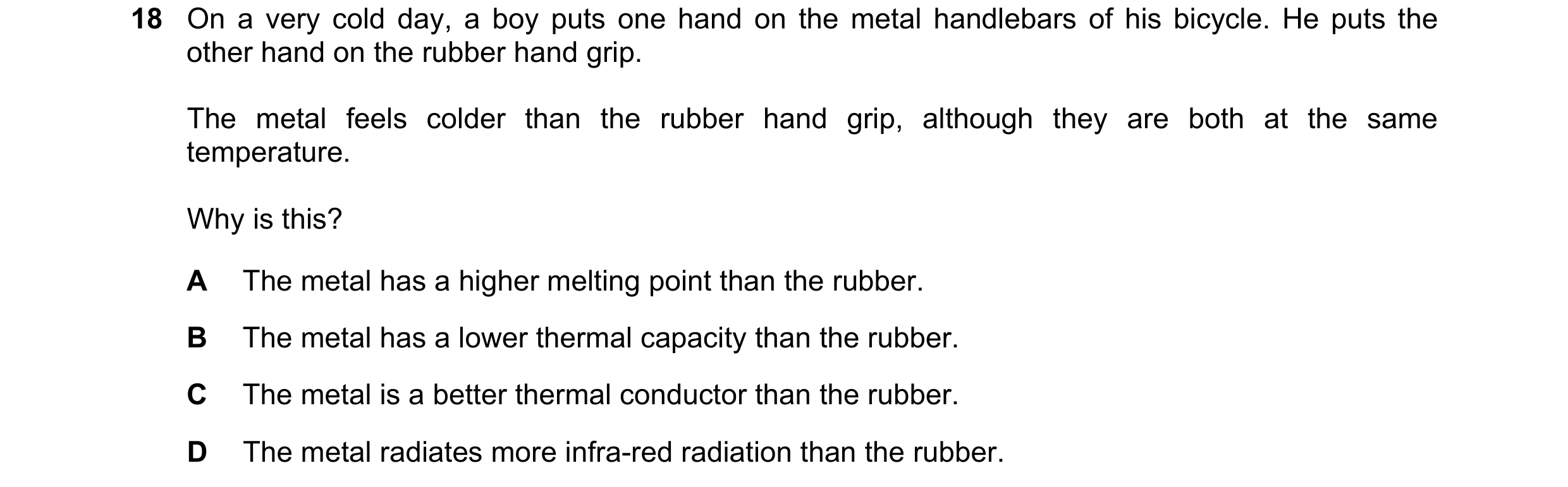
 4 / 34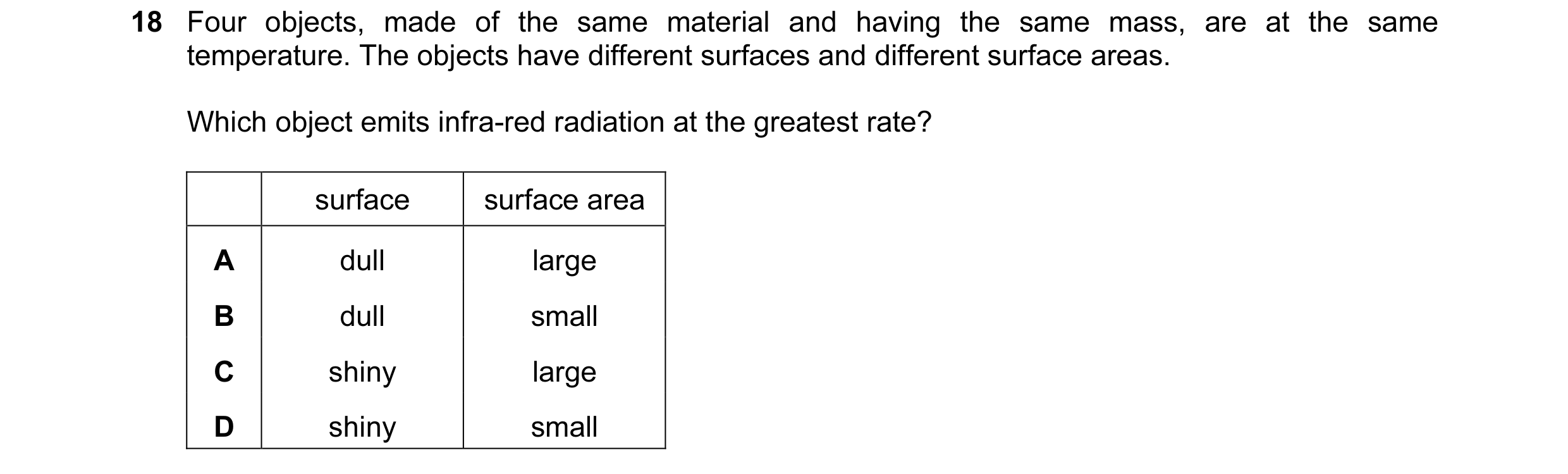
 5 / 34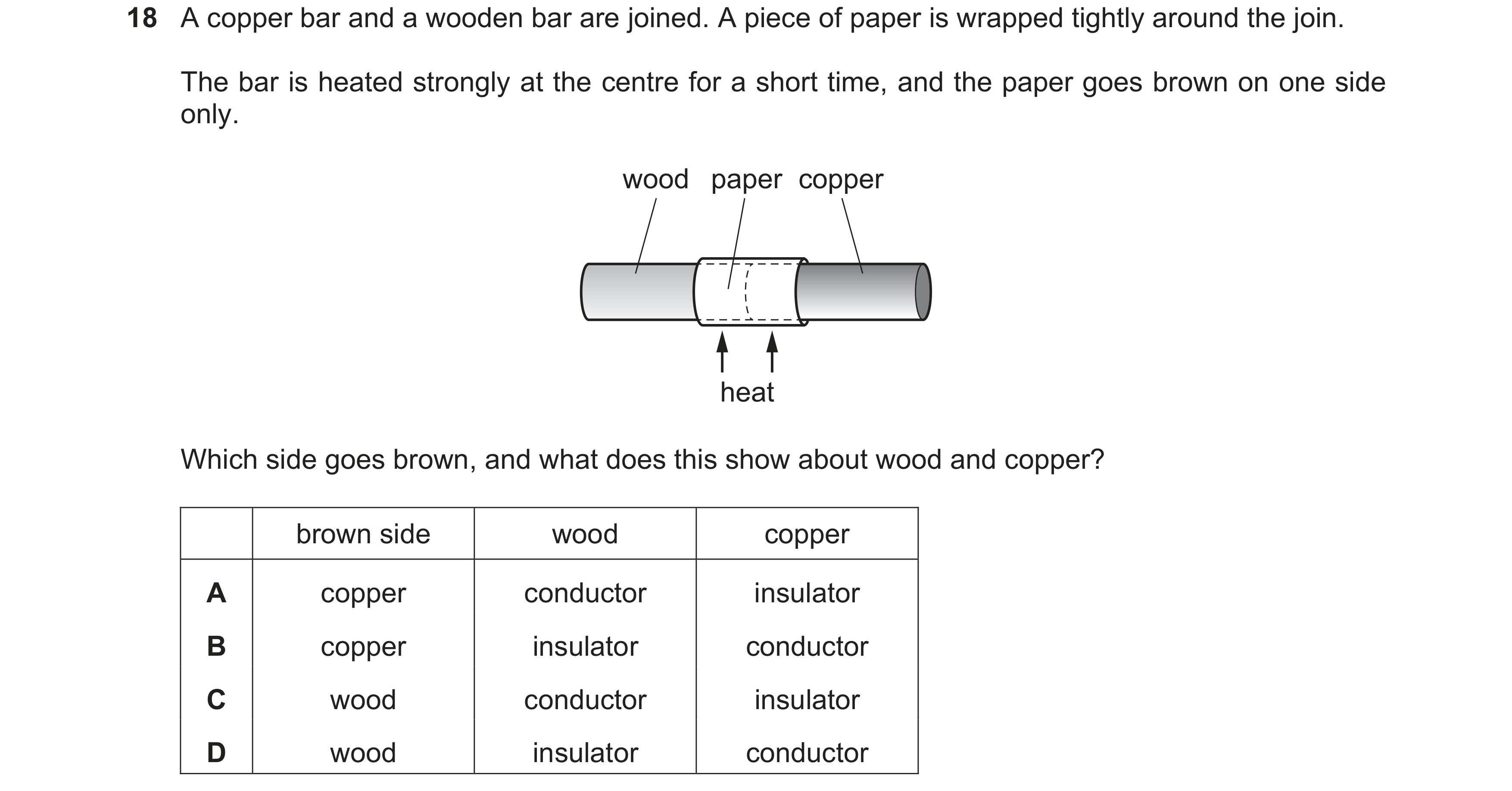


 6 / 34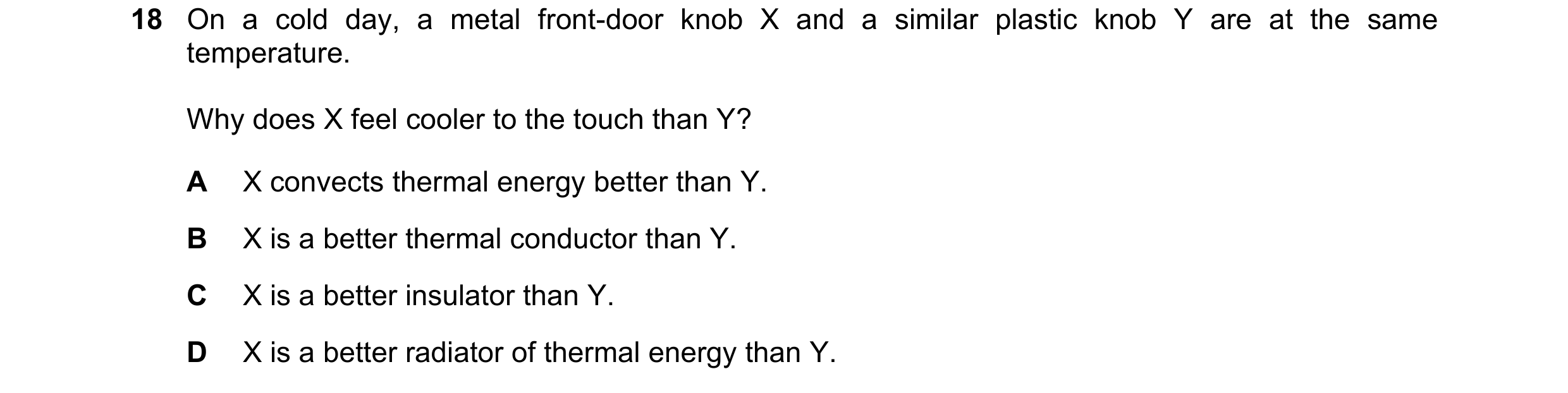
 7 / 34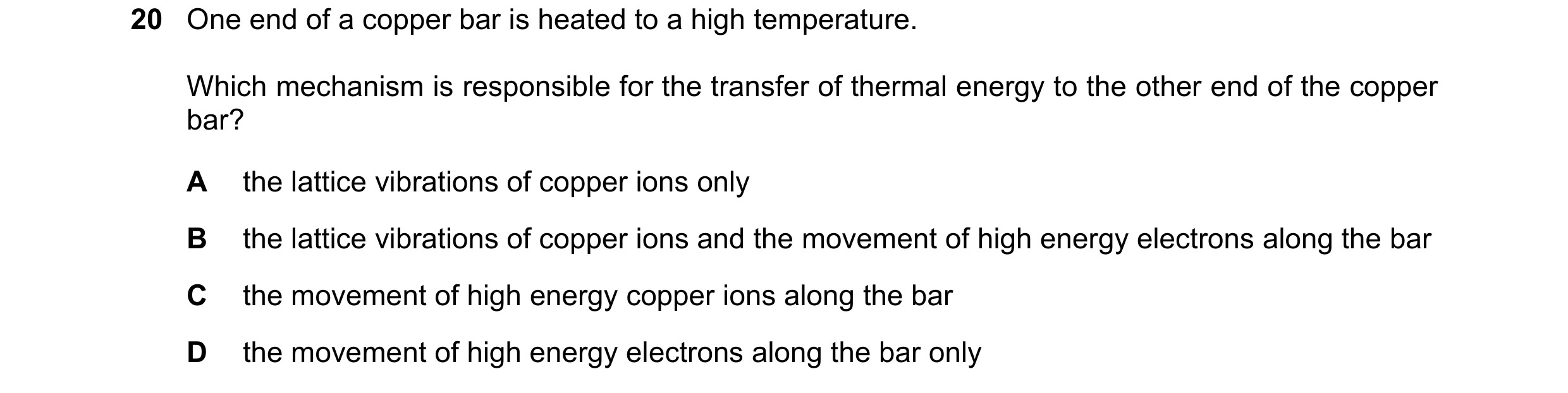

 8 / 34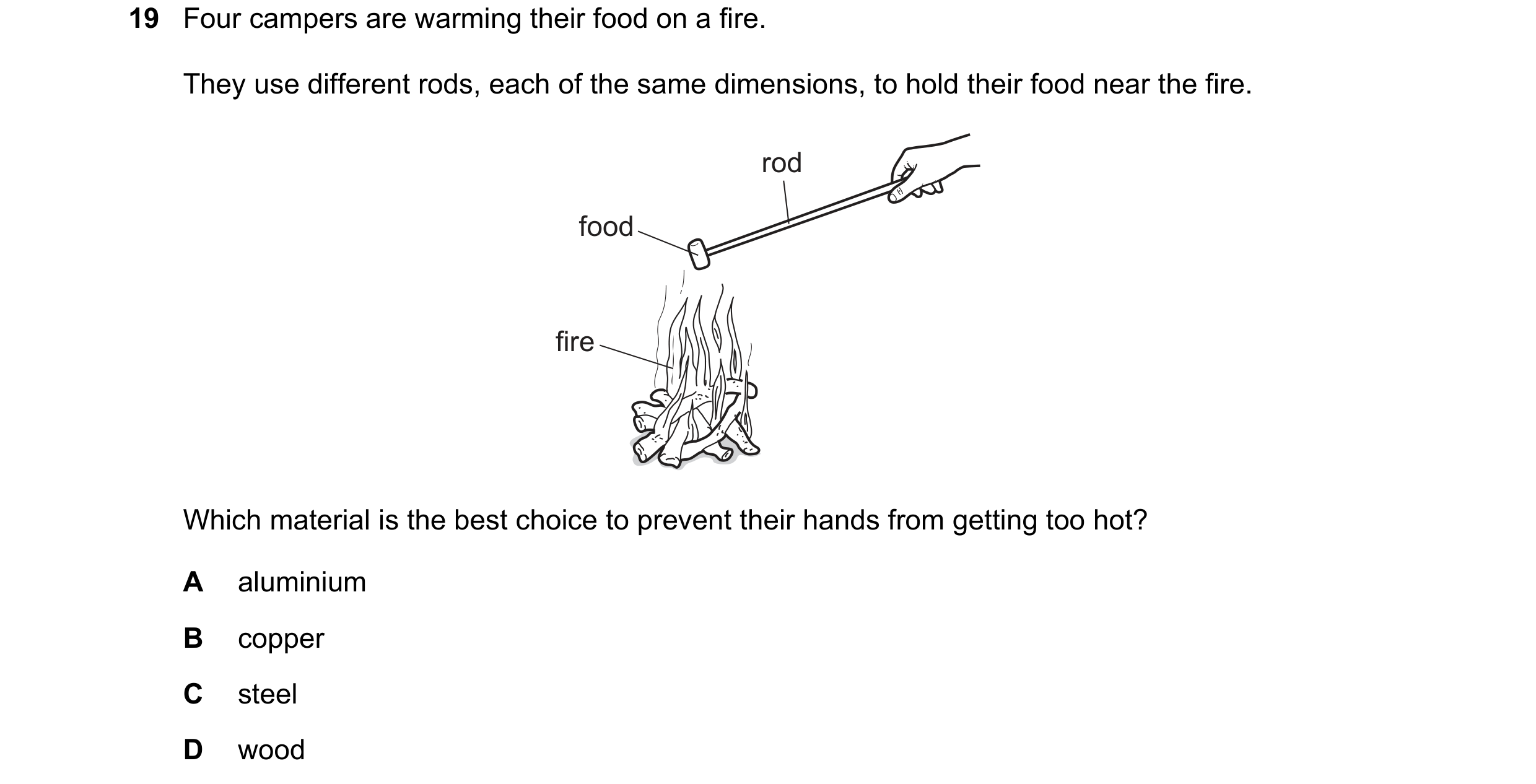

 9 / 34
 10 / 34
 11 / 34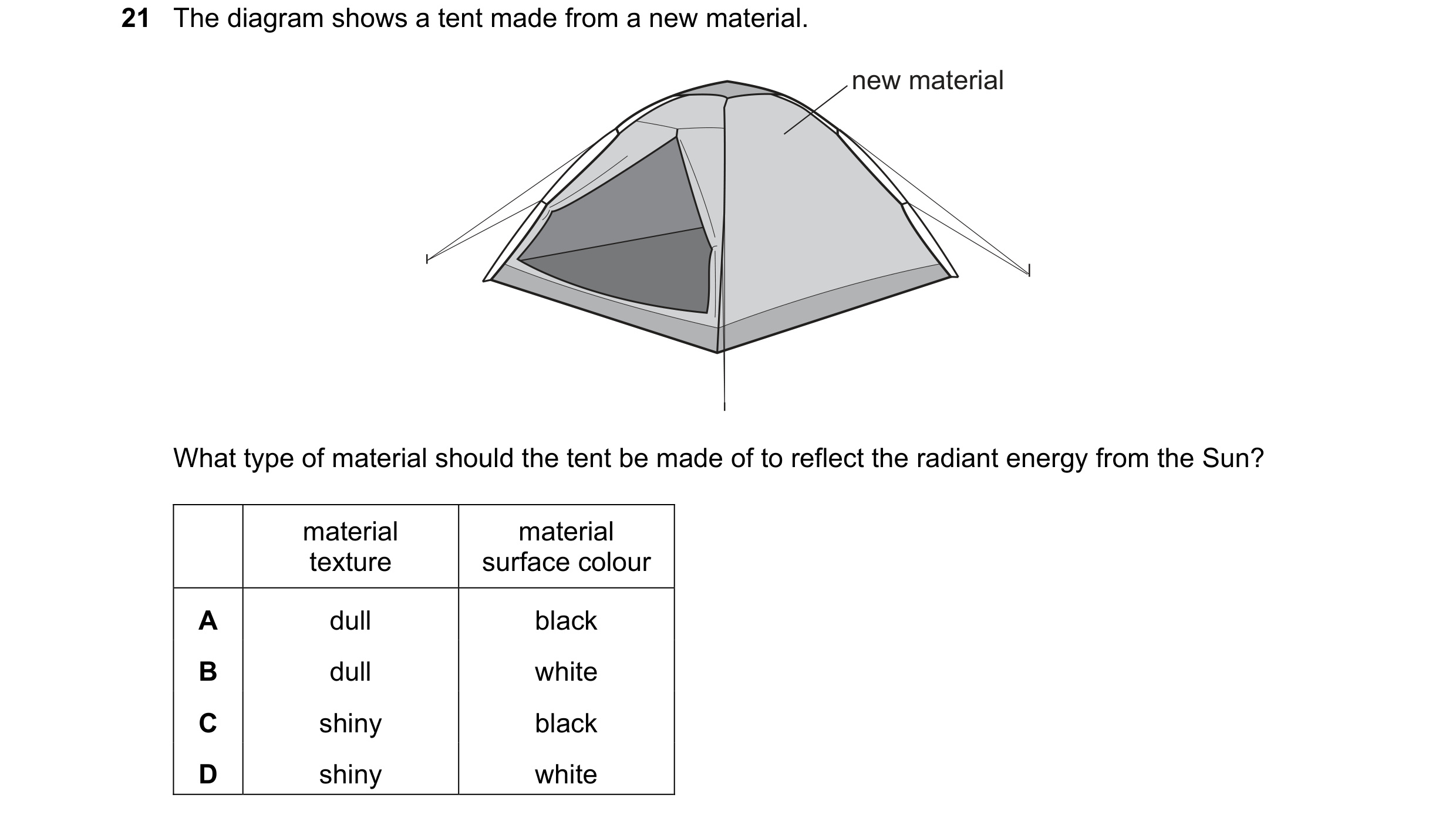
 12 / 34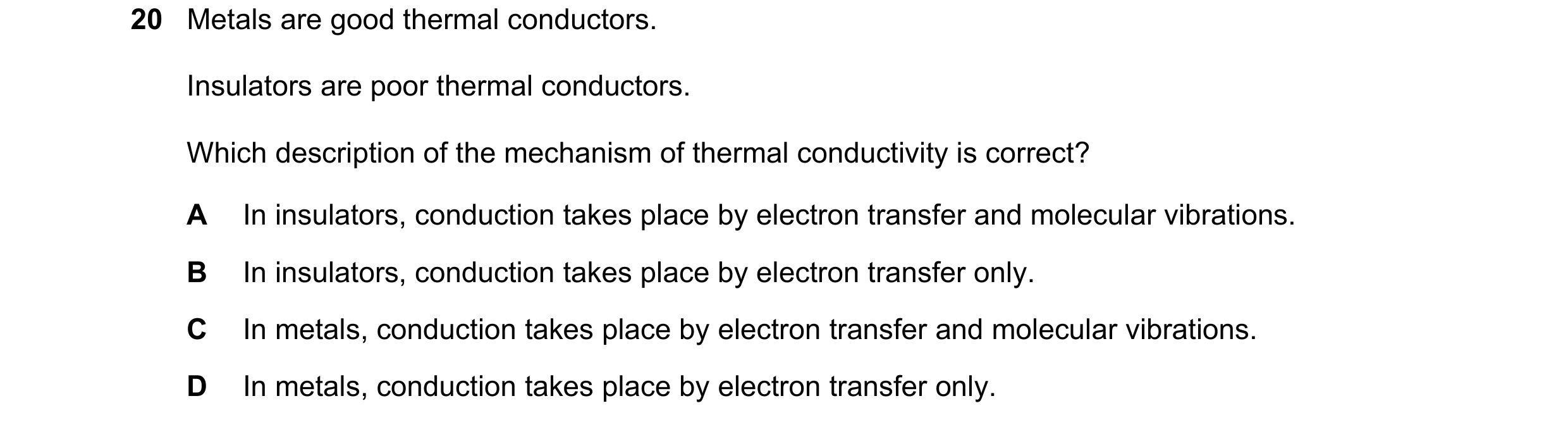
 13 / 34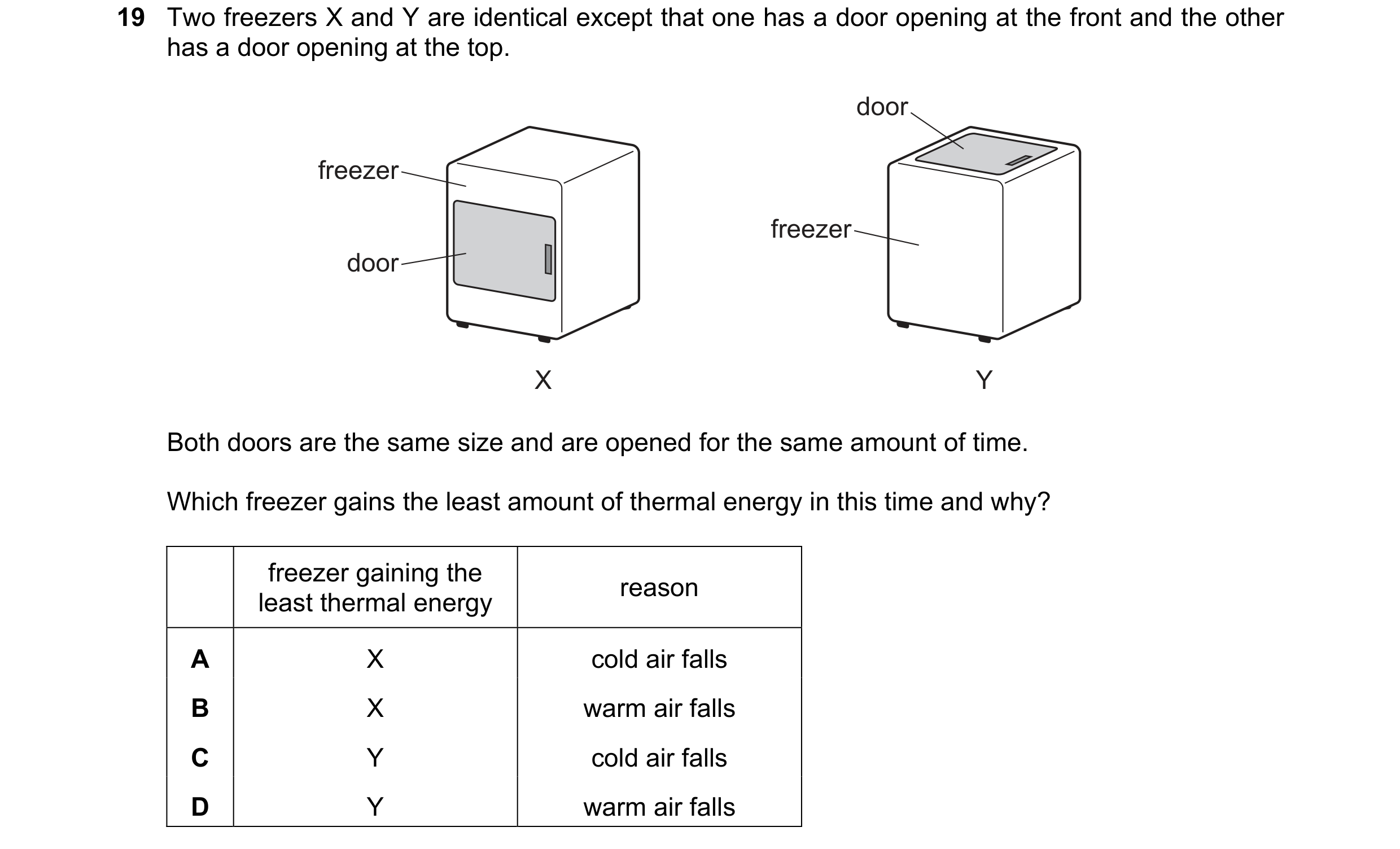
 14 / 34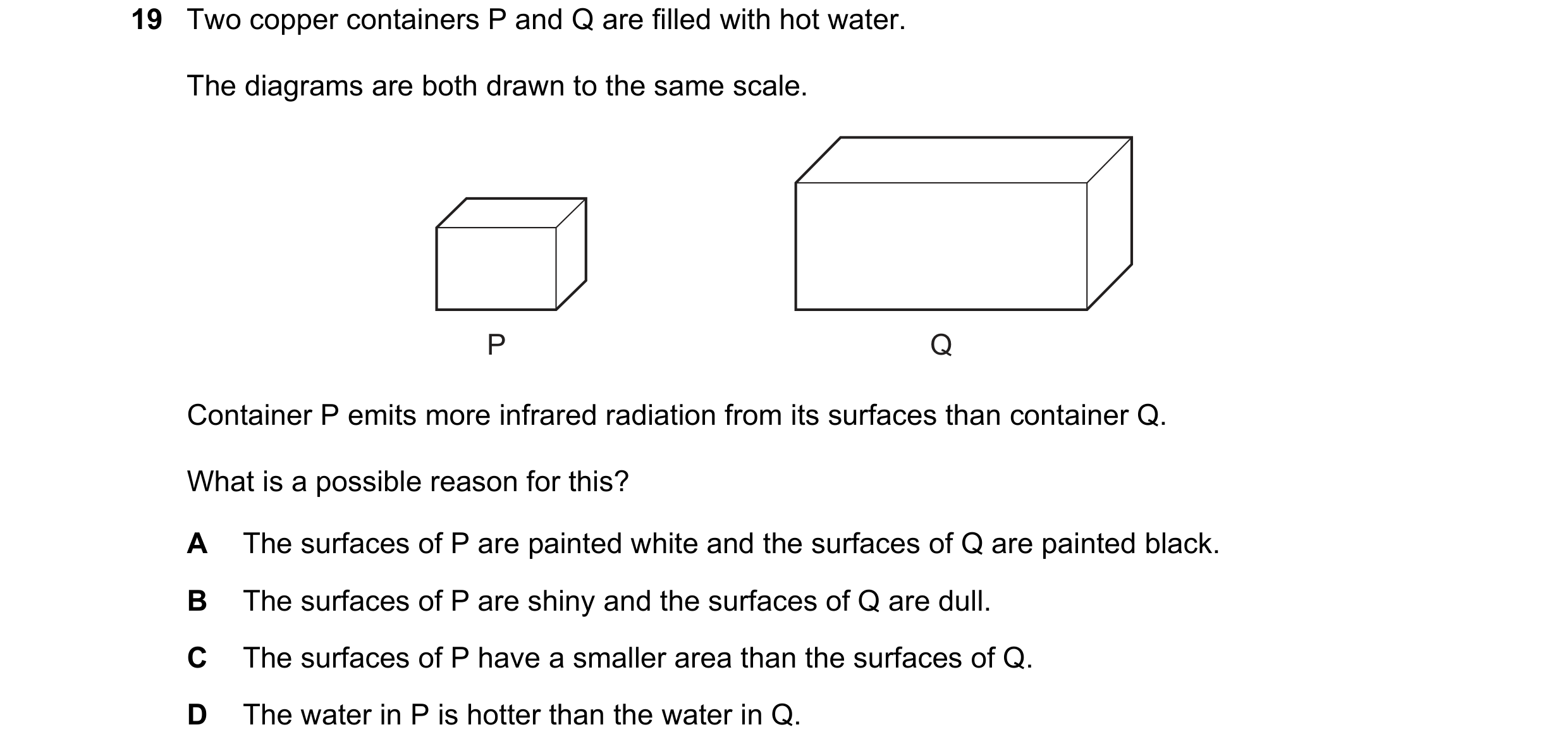

 15 / 34
 16 / 34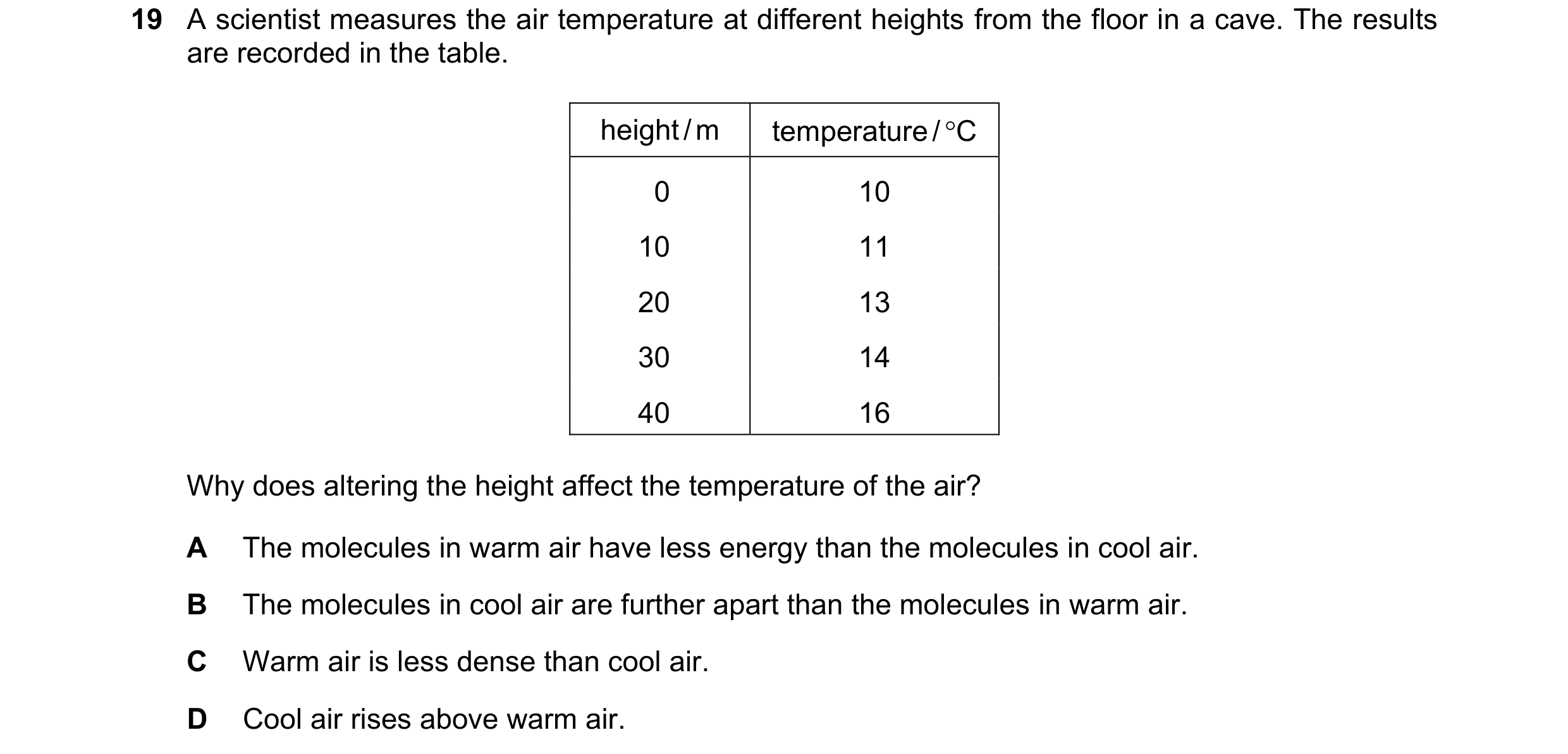
 17 / 34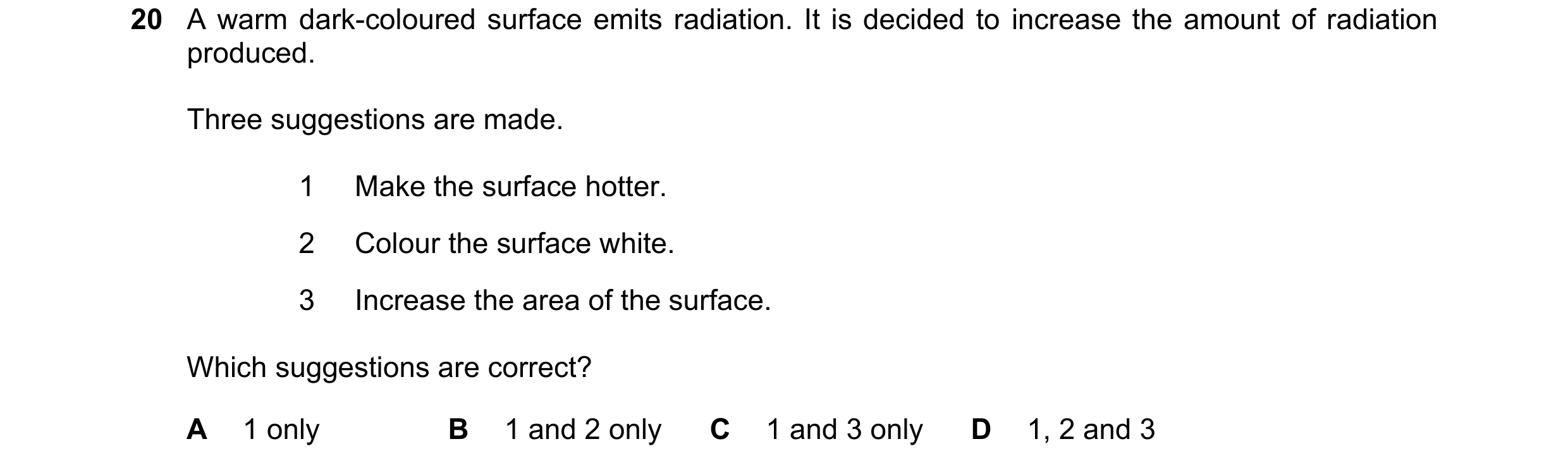
 18 / 34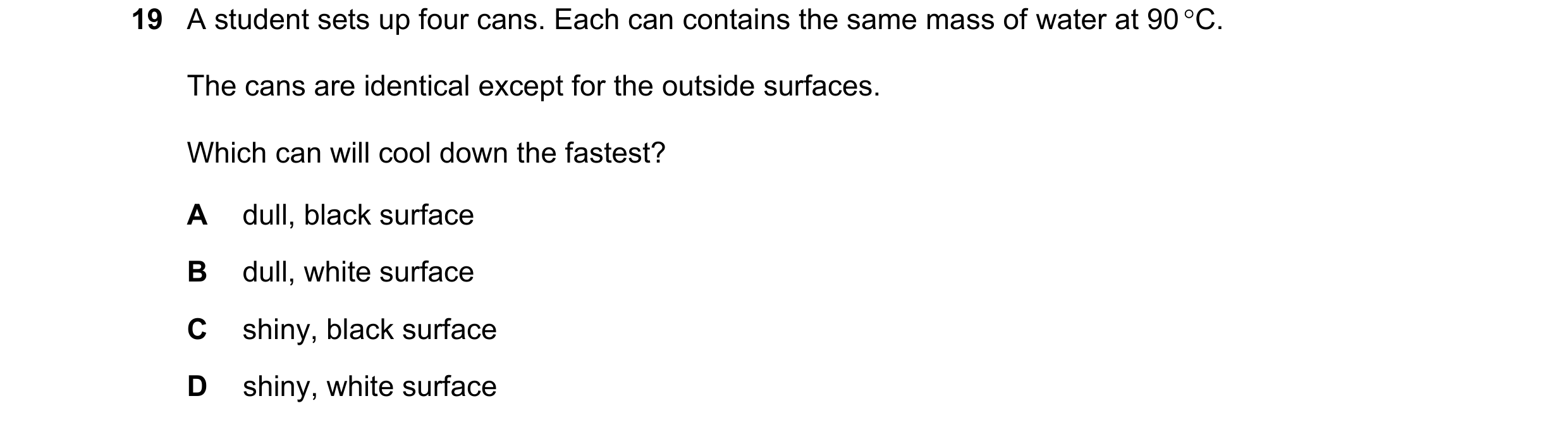
 19 / 34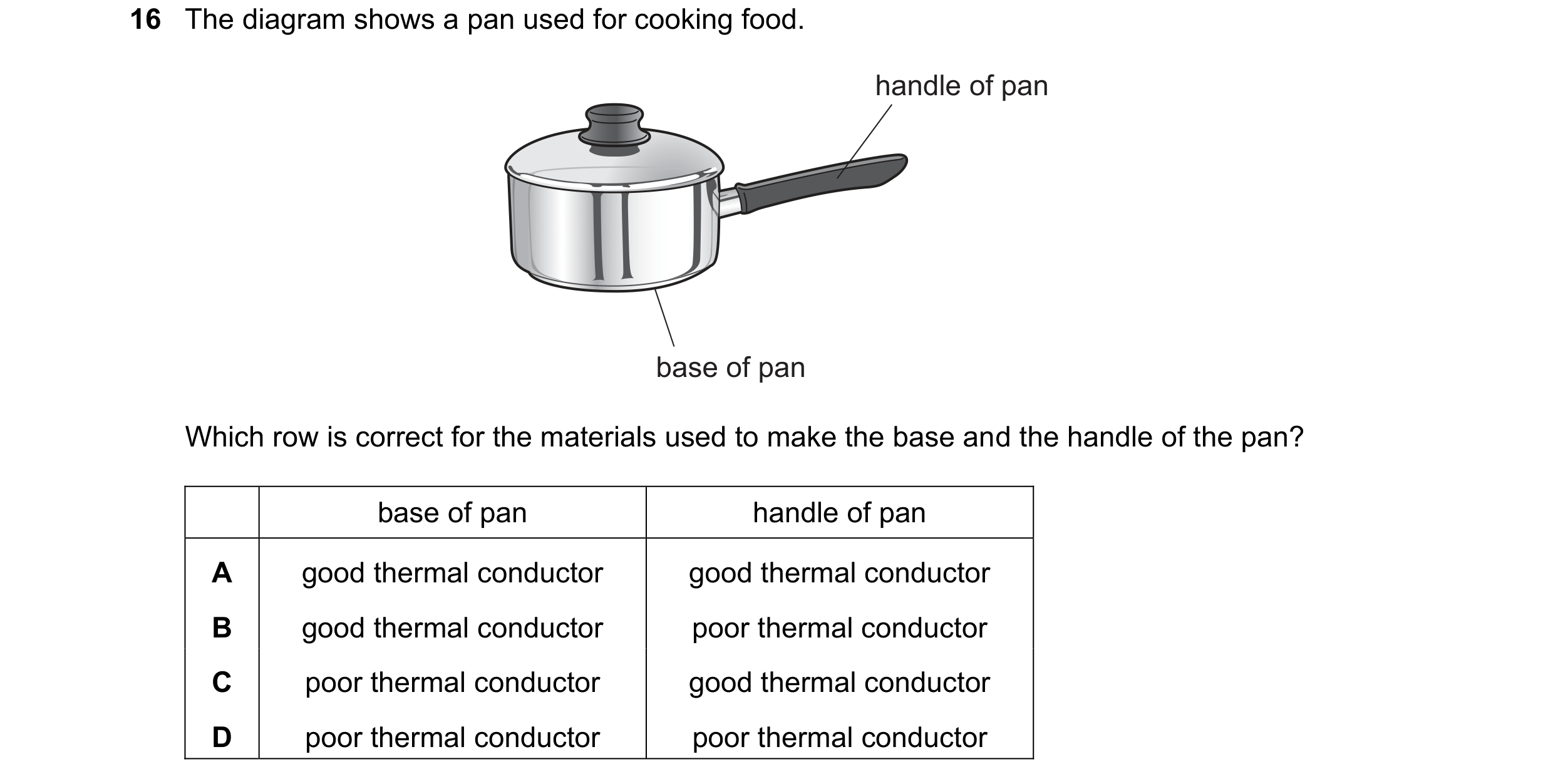
 20 / 34
 21 / 34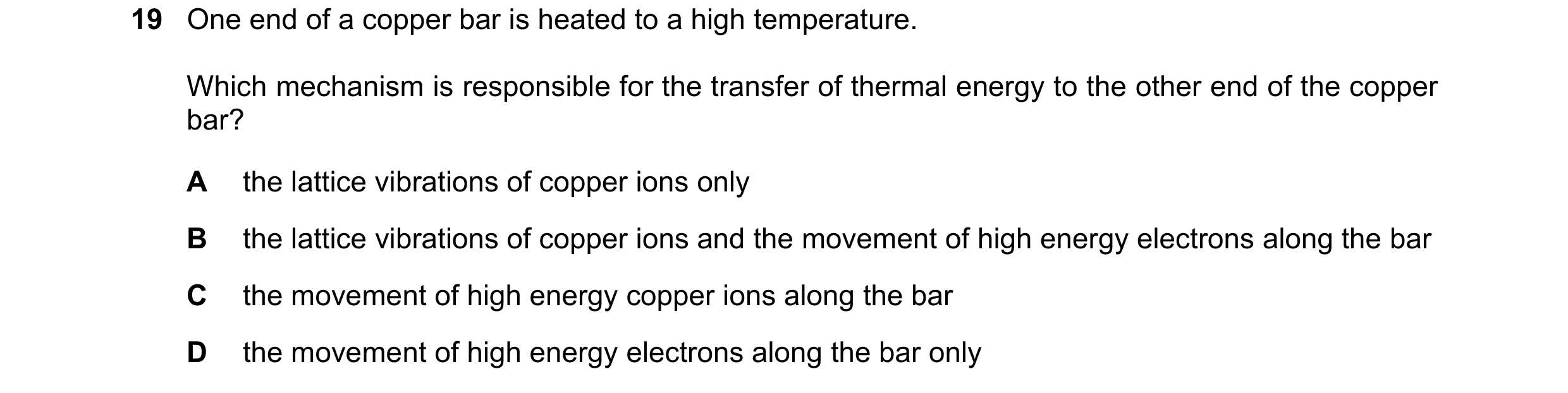
 22 / 34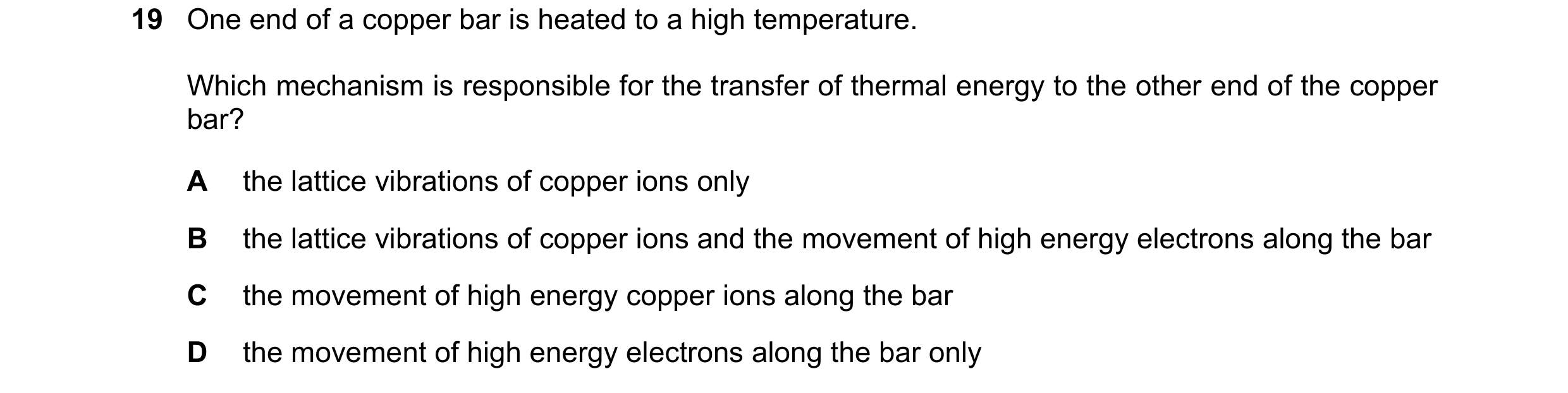

 23 / 34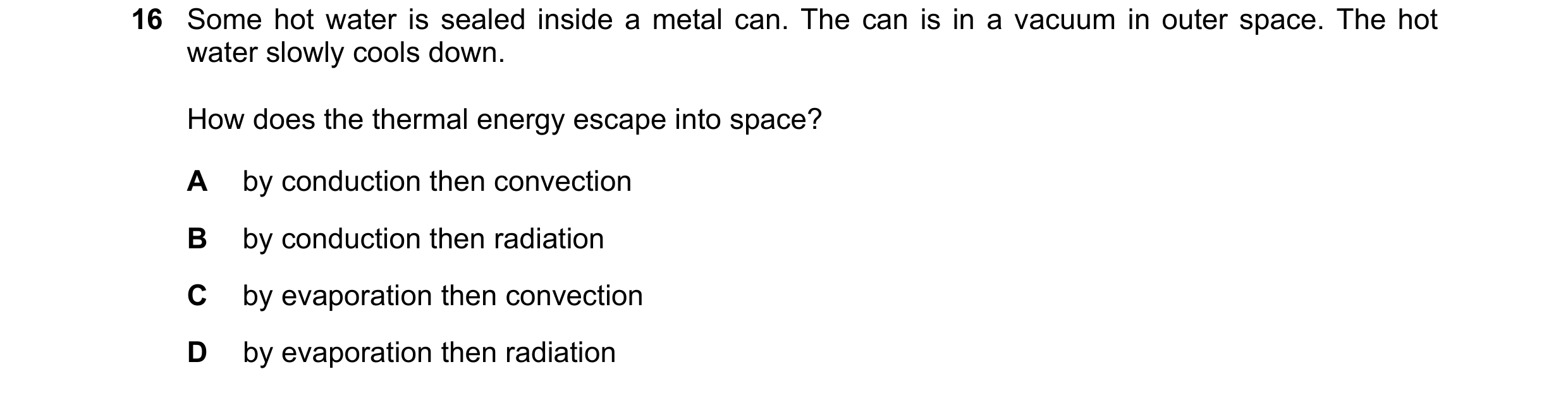
 24 / 34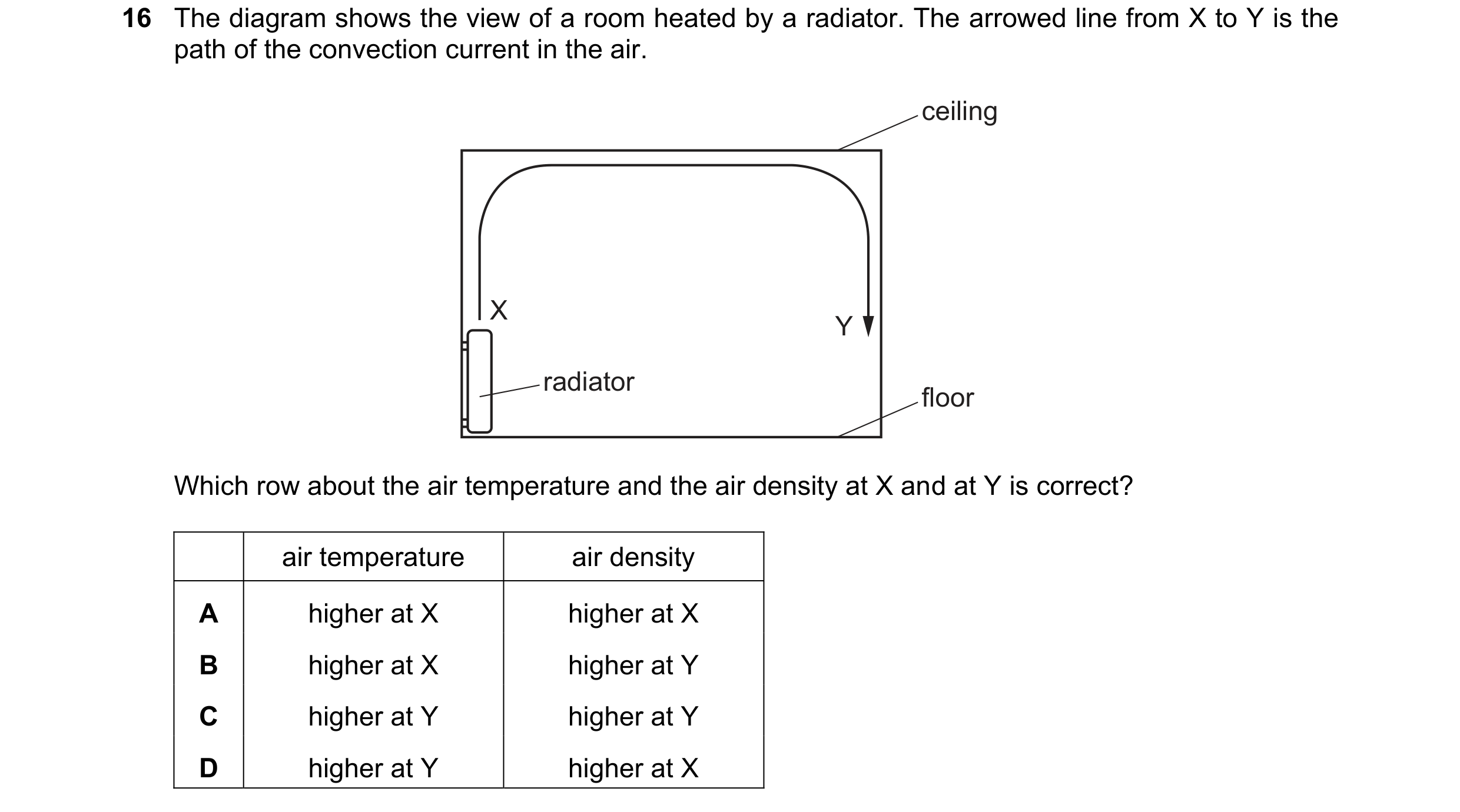
 25 / 34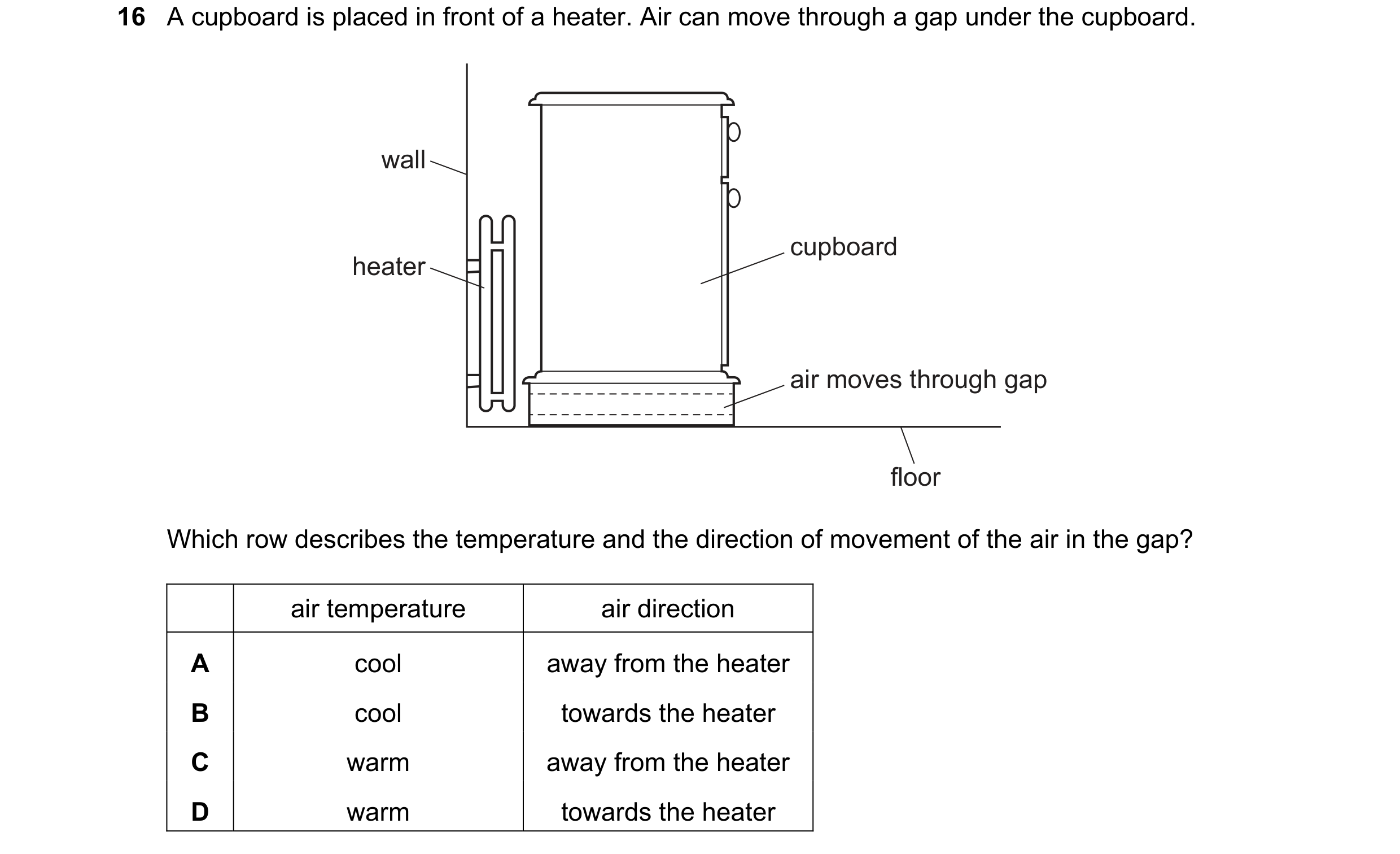
 26 / 34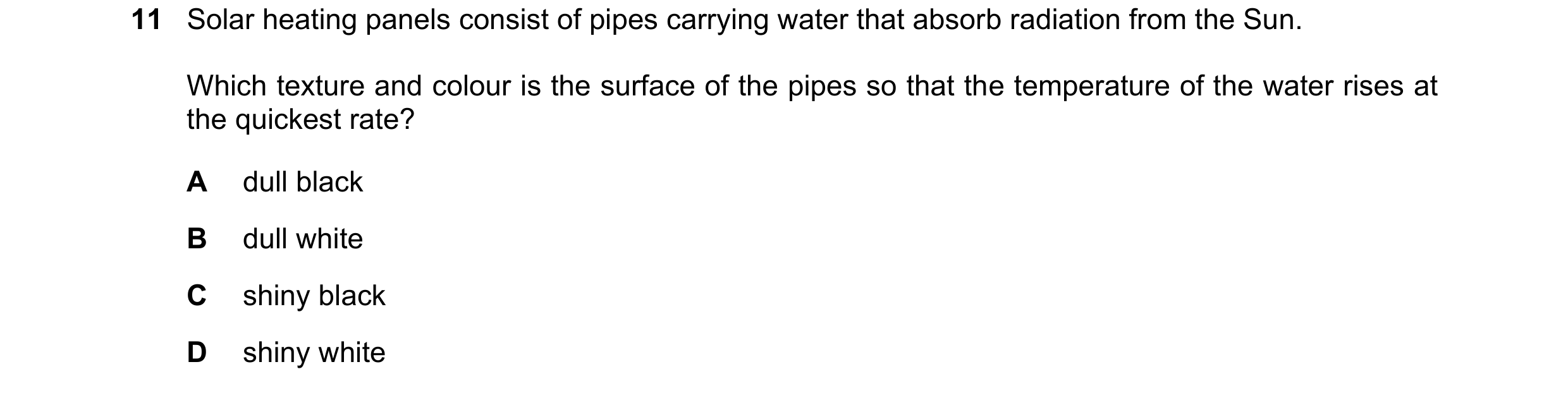
 27 / 34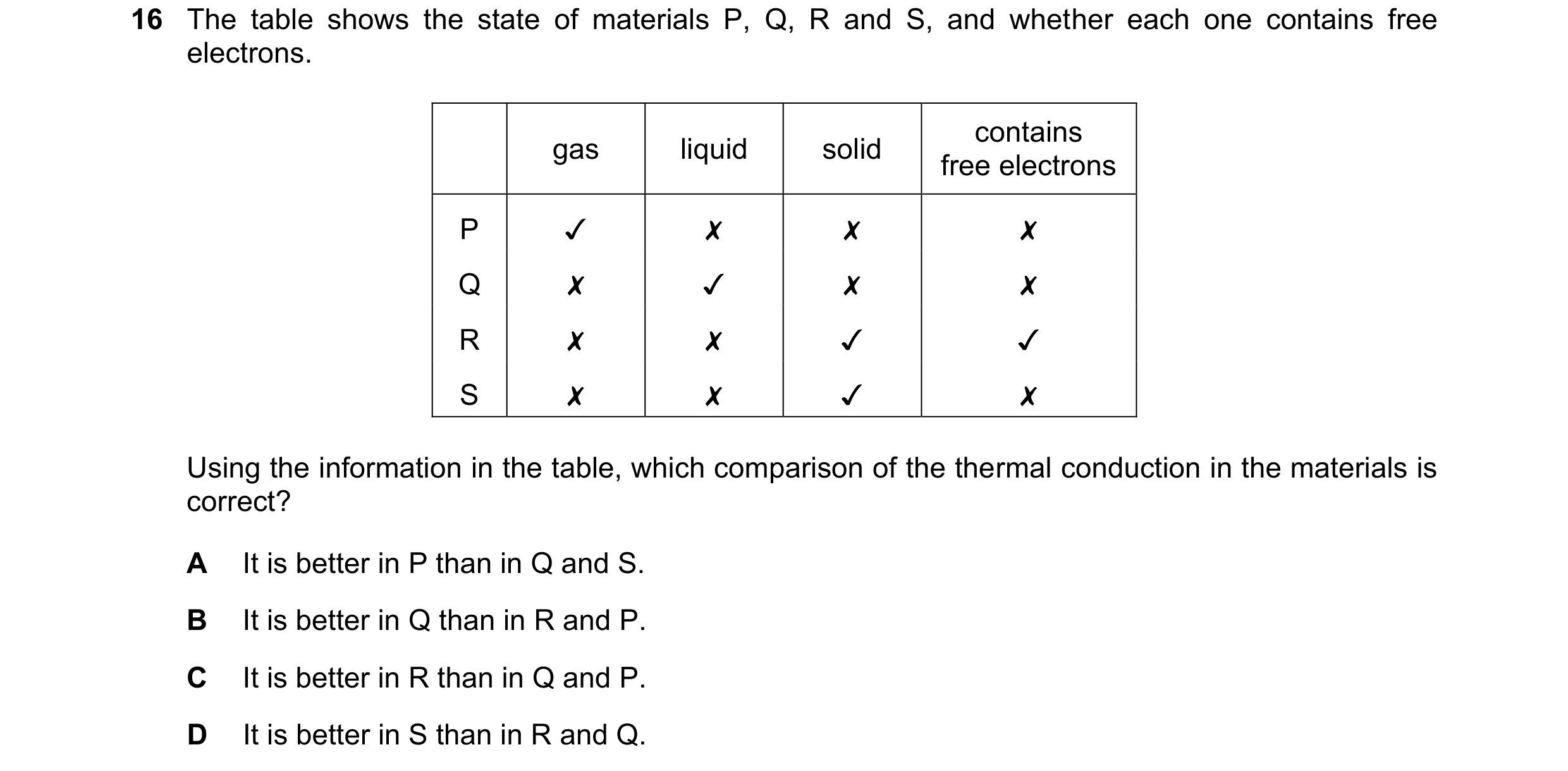
 28 / 34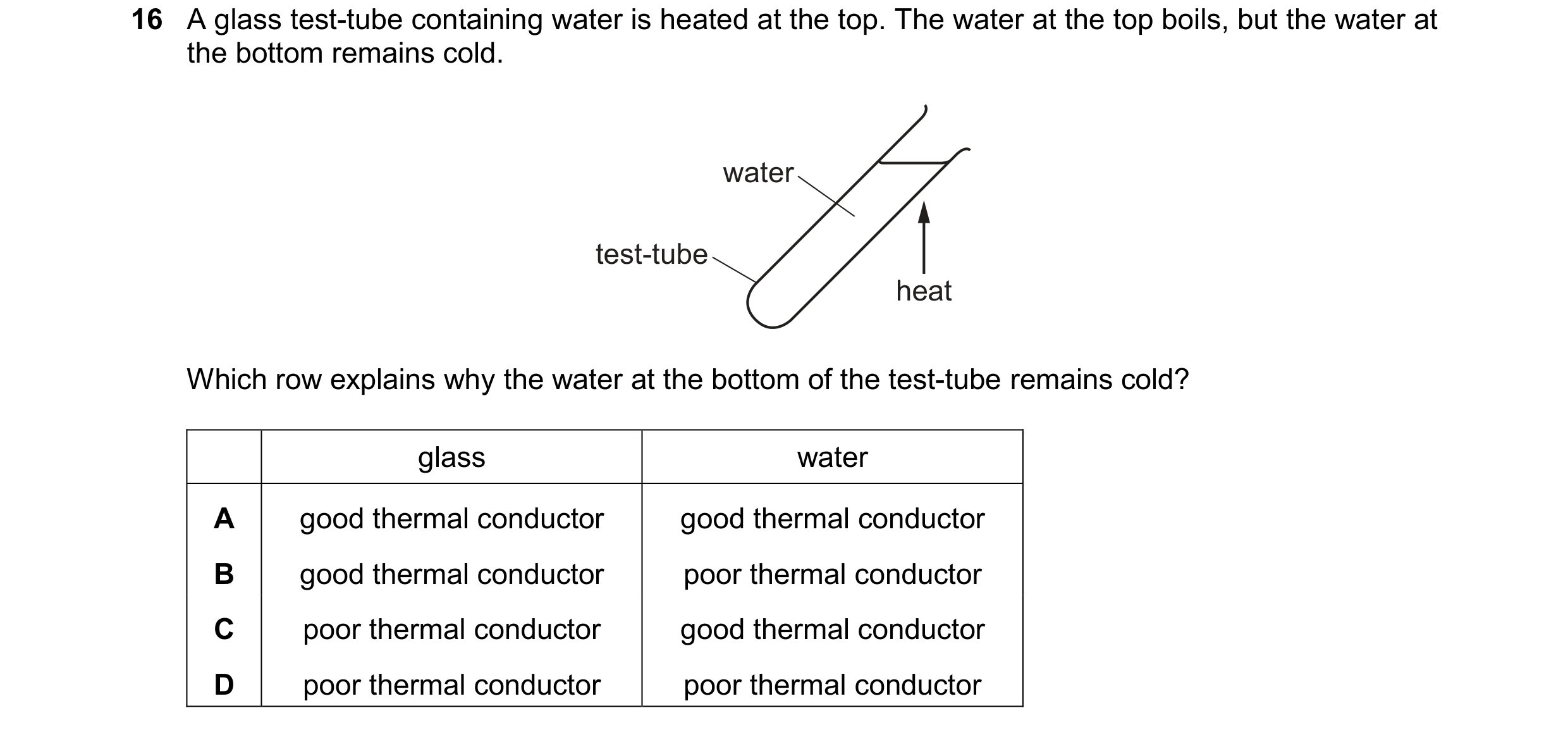
 29 / 34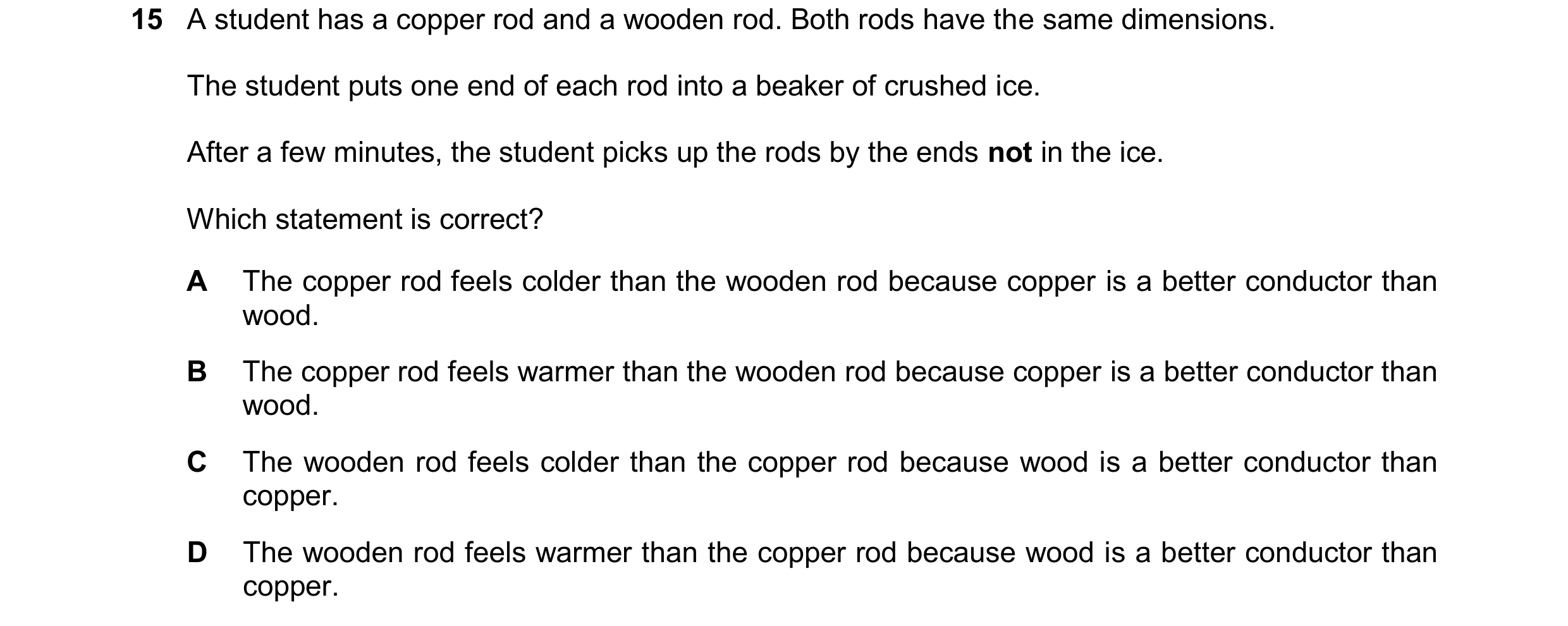
 30 / 34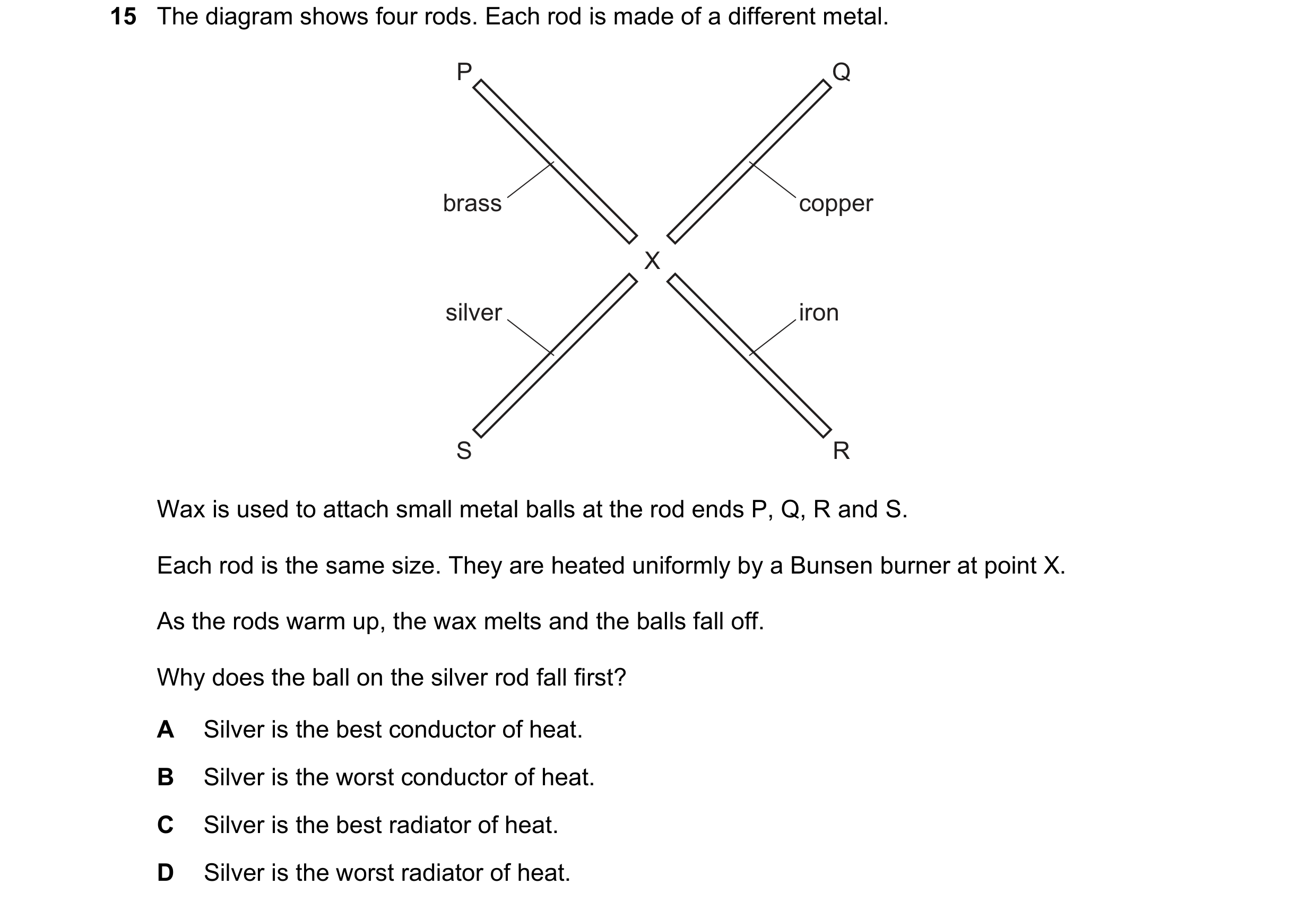
 31 / 34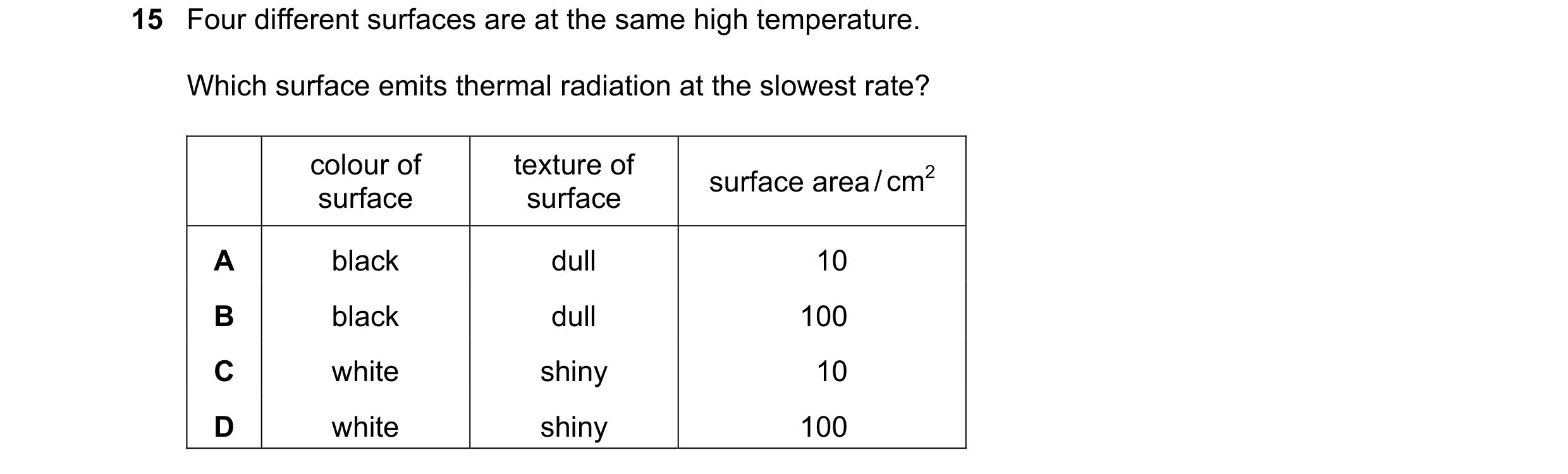

 32 / 34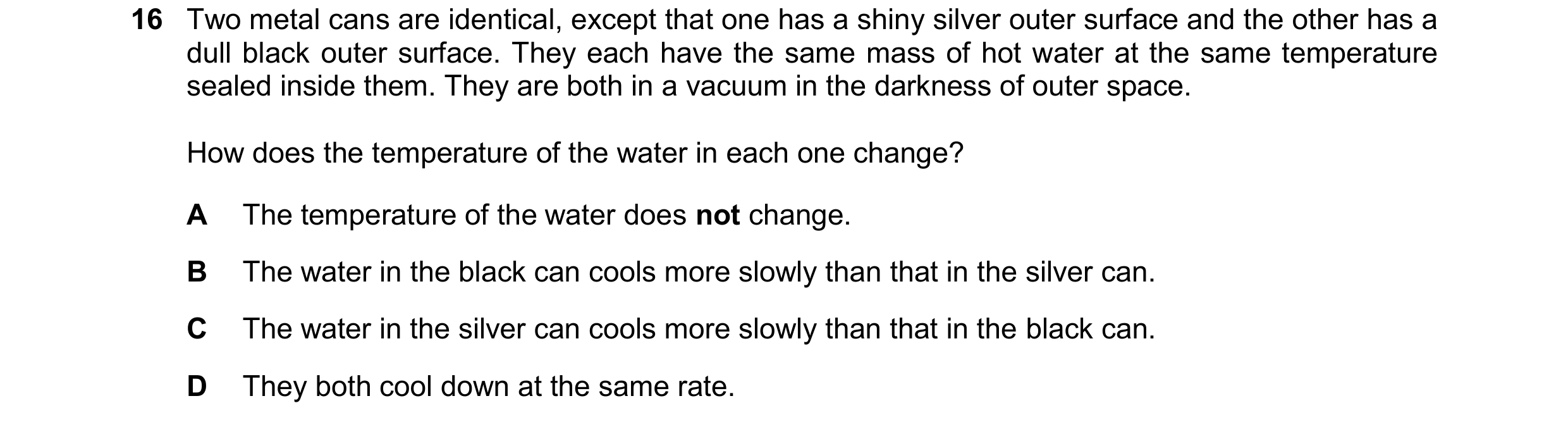
 33 / 34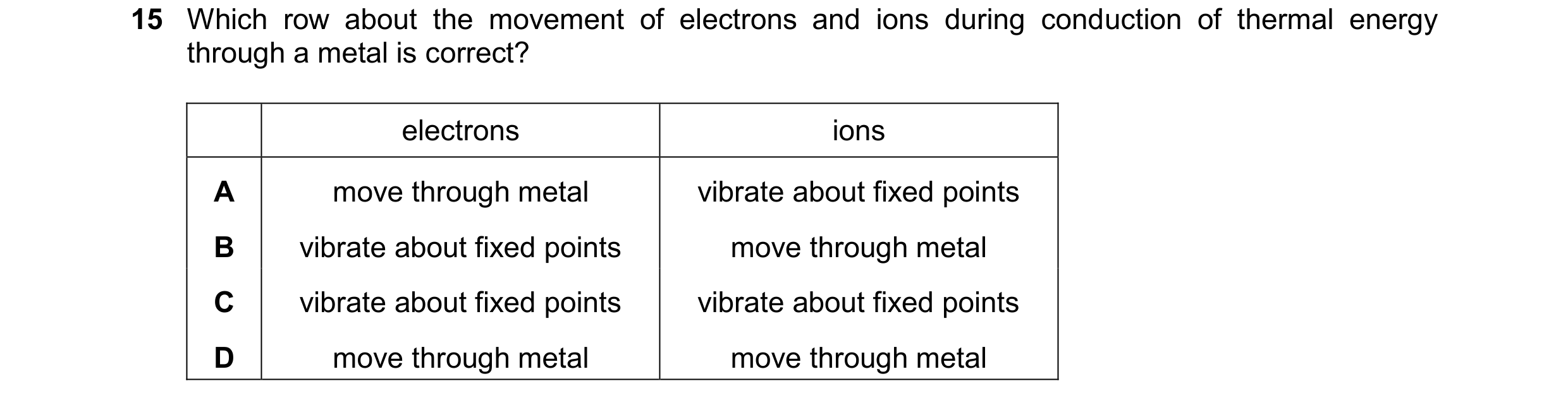
 34 / 34