Cambridge IGCSE Physics 0625 — 2010 Oct/Nov Paper 3 · Variant 2
0625/32/O/N/10 · 11 questions · 80 marks · ≈90 min
The question paper and its mark scheme, free to read here and free to download. This is Cambridge’s own paper, exactly as it was sat.
Question paper20 pages
Mark scheme8 pages
Answers below. Sit the paper first if you are practising.
Questions as text
Q1 · A hillside is covered with snow
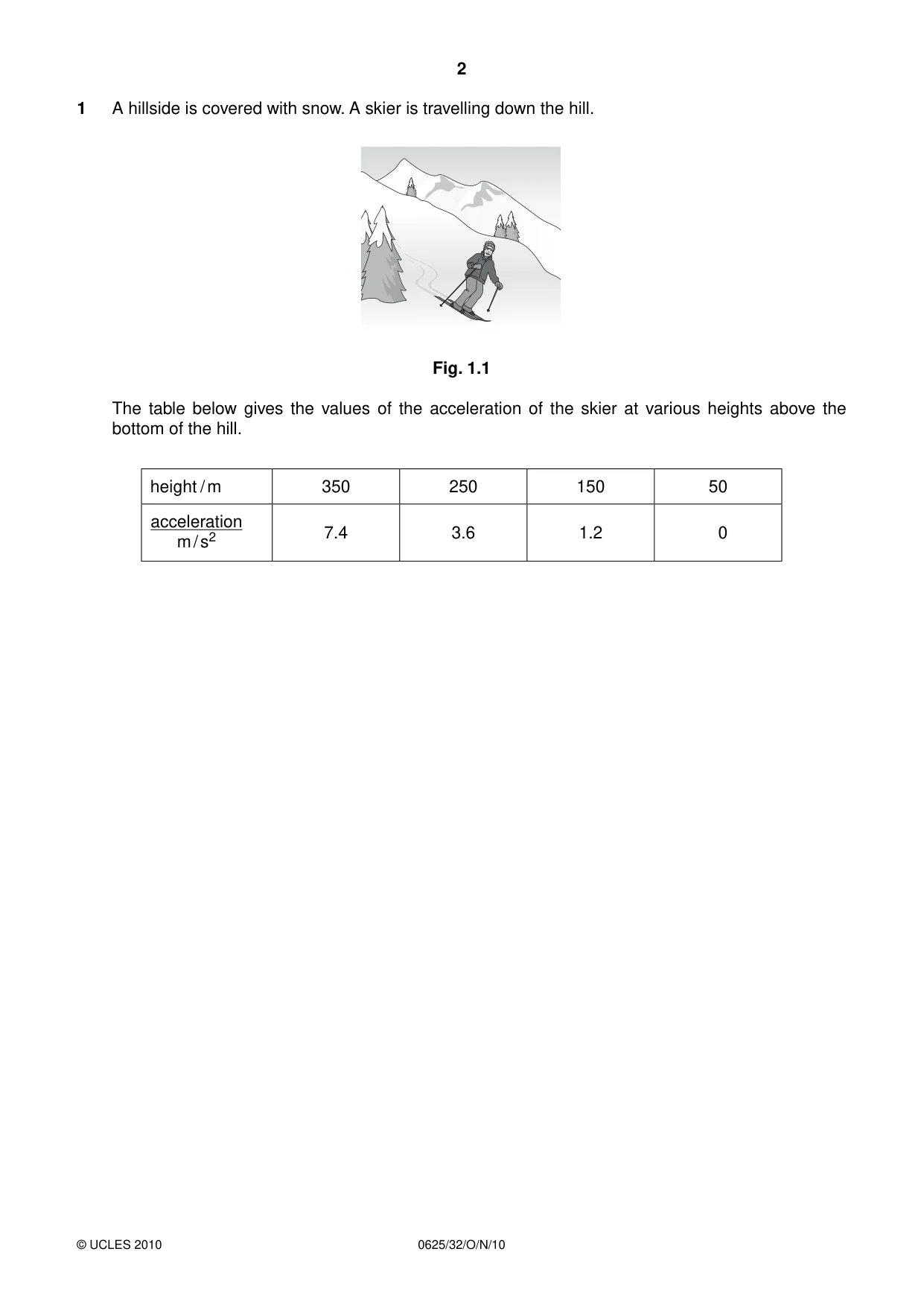
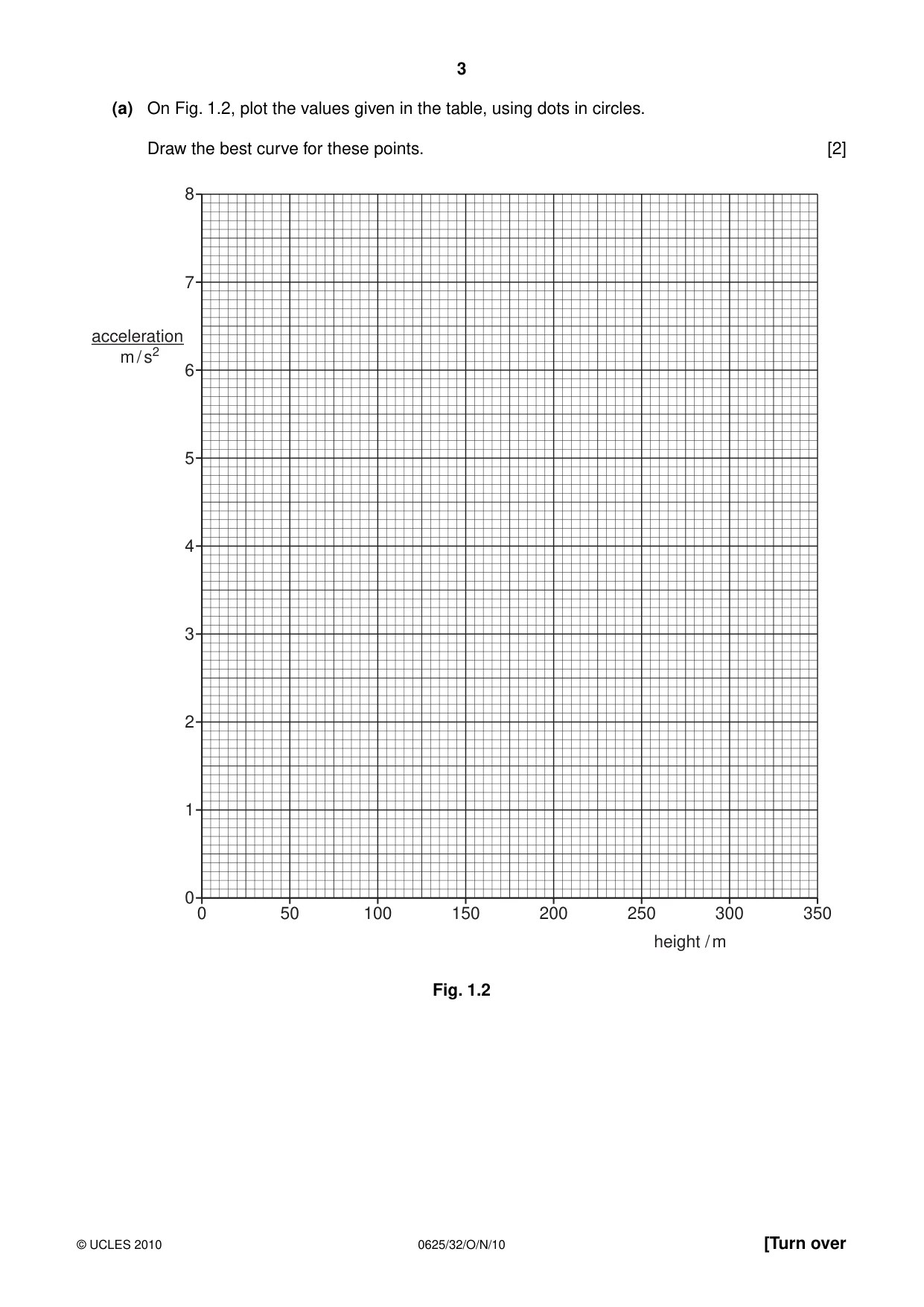
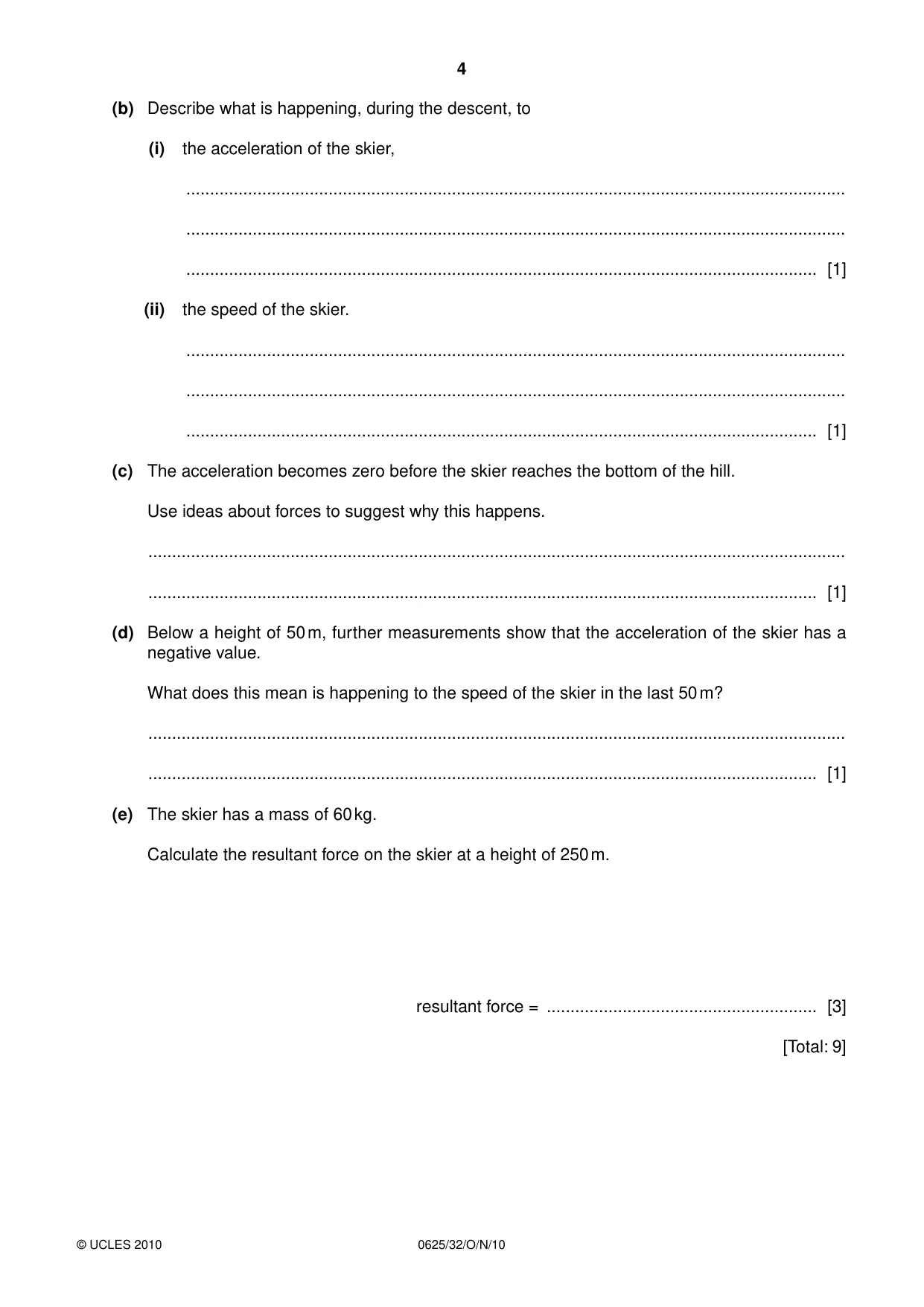
1 A hillside is covered with snow. A skier is travelling down the hill. Fig. 1.1 The table below gives the values of the acceleration of the skier at various heights above the bottom of the hill. height / m 350 250 150 50 acceleration 7.4 3.6 1.2 0 m / s2 (a) On Fig. 1.2, plot the values given in the table, using dots in circles. Draw the best curve for these points. [2] 8 7 acceleration m / s2 6 5 4 3 2 1 0 0 50 100 150 200 250 300 350 height / m Fig. 1.2 (b) Describe what is happening, during the descent, to (i) the acceleration of the skier, ........................................................................................................................................... ........................................................................................................................................... ..................................................................................................................................... [1] (ii) the speed of the skier. ........................................................................................................................................... ........................................................................................................................................... ..................................................................................................................................... [1] (c) The acceleration becomes zero before the skier reaches the bottom of the hill. Use ideas about forces to suggest why this happens. ................................................................................................................................................... ............................................................................................................................................. [1] (d) Below a height of 50 m, further measurements show that the acceleration of the skier has a negative value. What does this mean is happening to the speed of the skier in the last 50 m? ................................................................................................................................................... ............................................................................................................................................. [1] (e) The skier has a mass of 60 kg. Calculate the resultant force on the skier at a height of 250 m. resultant force = ......................................................... [3] [Total: 9]
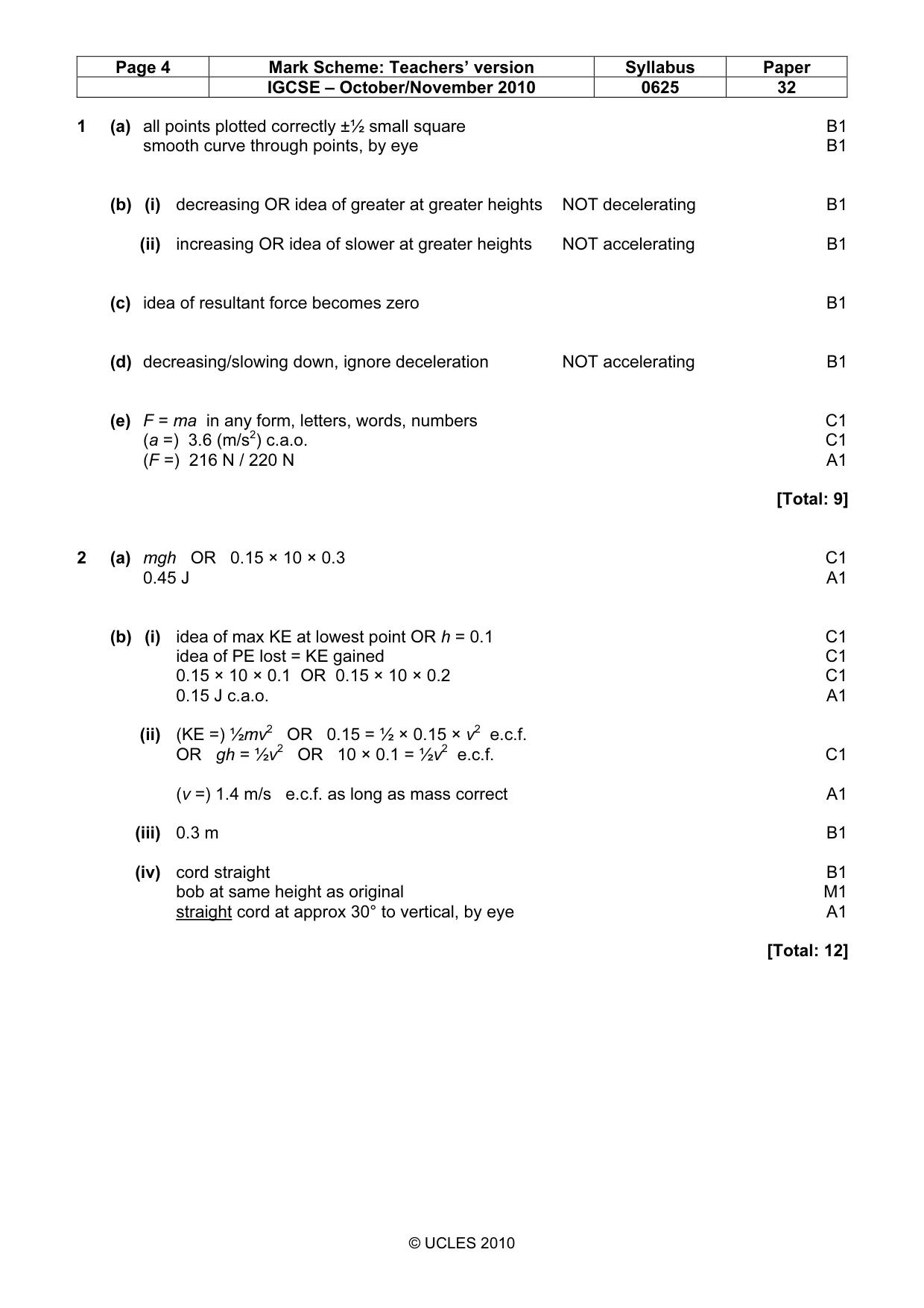
Mark scheme: 1 (a) all points plotted correctly ±½ small square B1 smooth curve through points, by eye B1 (b) (i) decreasing OR idea of greater at greater heights NOT decelerating B1 (ii) increasing OR idea of slower at greater heights NOT accelerating B1 (c) idea of resultant force becomes zero B1 (d) decreasing/slowing down, ignore deceleration NOT accelerating B1 (e) F = ma in any form, letters, words, numbers C1 (a =) 3.6 (m/s2) c.a.o. C1 (F =) 216 N / 220 N A1 [Total: 9]
Q2 · A bob of mass of 0.15 kg is tied at the end of a cord to form a simple pendulum 0.70 m…
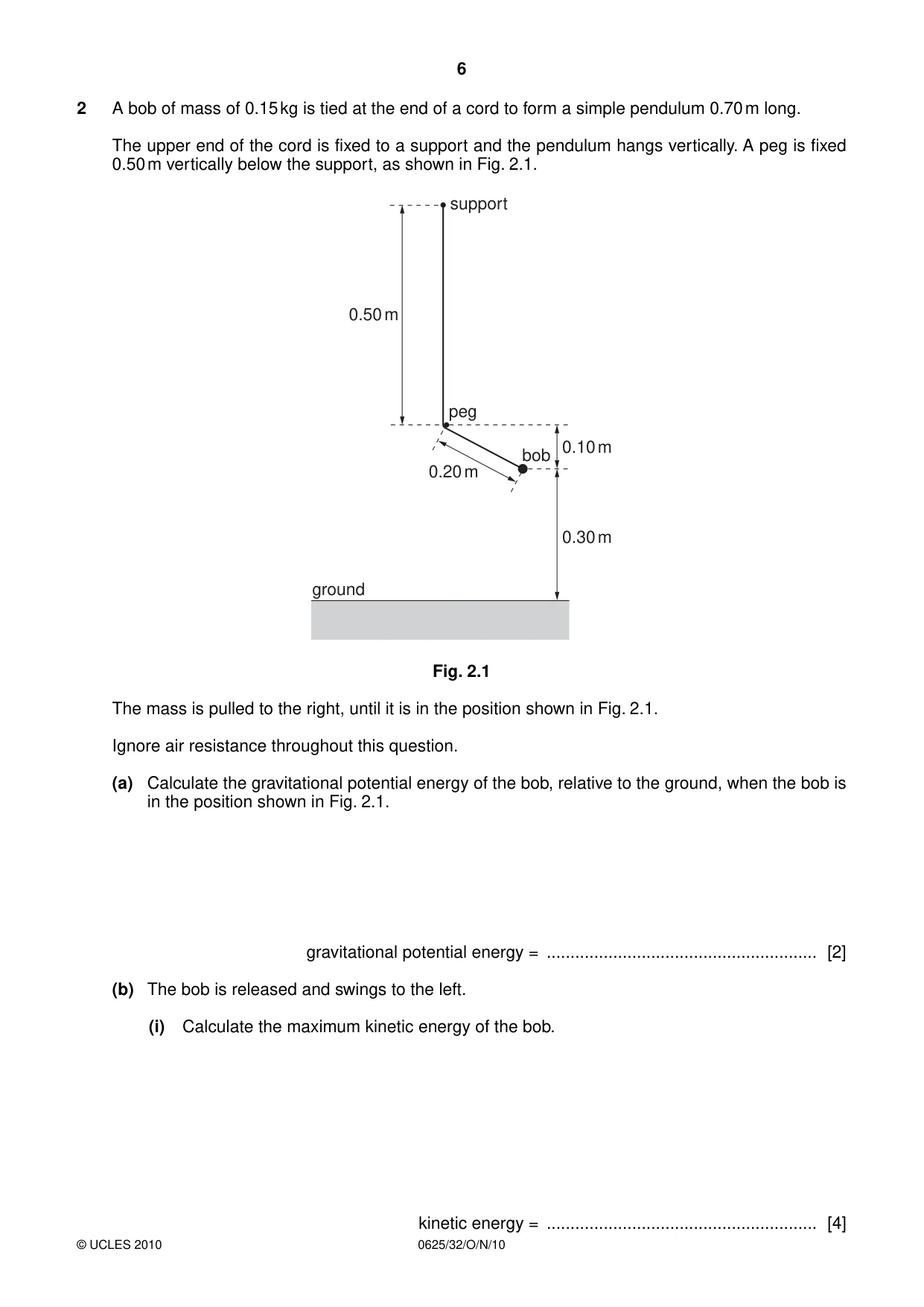
2 A bob of mass of 0.15 kg is tied at the end of a cord to form a simple pendulum 0.70 m long. The upper end of the cord is fixed to a support and the pendulum hangs vertically. A peg is fixed 0.50 m vertically below the support, as shown in Fig. 2.1. support 0.50 m peg 0.10 m bob 0.20 m 0.30 m ground Fig. 2.1 The mass is pulled to the right, until it is in the position shown in Fig. 2.1. Ignore air resistance throughout this question. (a) Calculate the gravitational potential energy of the bob, relative to the ground, when the bob is in the position shown in Fig. 2.1. gravitational potential energy = ......................................................... [2] (b) The bob is released and swings to the left. (i) Calculate the maximum kinetic energy of the bob. kinetic energy = ......................................................... [4] (ii) Calculate the maximum velocity of the bob. velocity = ......................................................... [2] (iii) As the pendulum swings to the left of vertical, state the maximum height above the ground that is reached by the bob. ..................................................................................................................................... [1] (iv) On Fig. 2.1, use your ruler to draw carefully the pendulum when the bob is at its maximum height on the left. [3] [Total: 12]
Mark scheme: 2 (a) mgh OR 0.15 × 10 × 0.3 C1 0.45 J A1 (b) (i) idea of max KE at lowest point OR h = 0.1 C1 idea of PE lost = KE gained C1 0.15 × 10 × 0.1 OR 0.15 × 10 × 0.2 C1 0.15 J c.a.o. A1 (ii) (KE =) ½mv2 OR 0.15 = ½ × 0.15 × v2 e.c.f. OR gh = ½v2 OR 10 × 0.1 = ½v2 e.c.f. C1 (v =) 1.4 m/s e.c.f. as long as mass correct A1 (iii) 0.3 m B1 (iv) cord straight B1 bob at same height as original M1 straight cord at approx 30° to vertical, by eye A1 [Total: 12] IGCSE – October/November 2010 0625 32
Q3 · A uniform metre rule is pivoted at its centre, which is also the position of its centre…
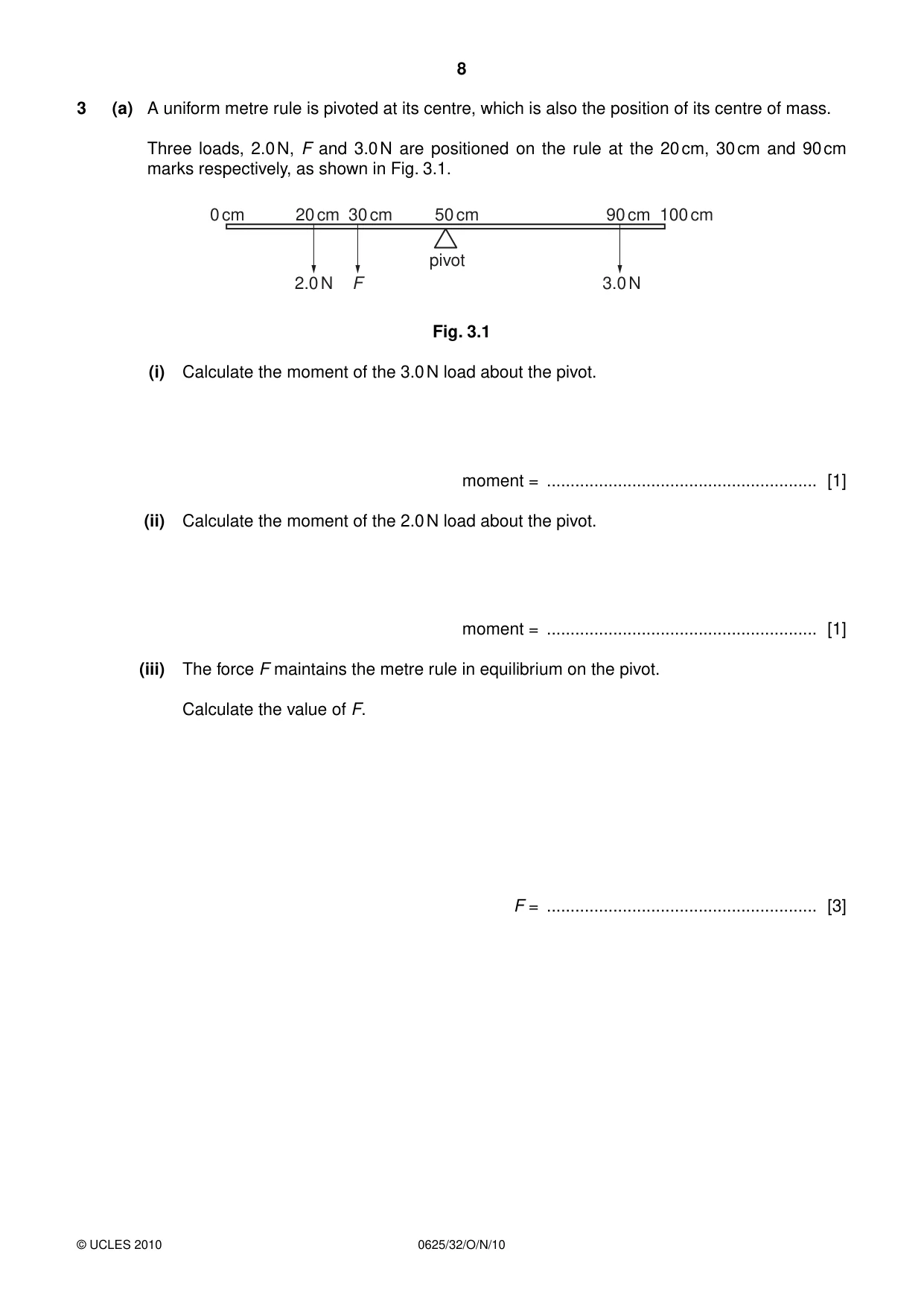
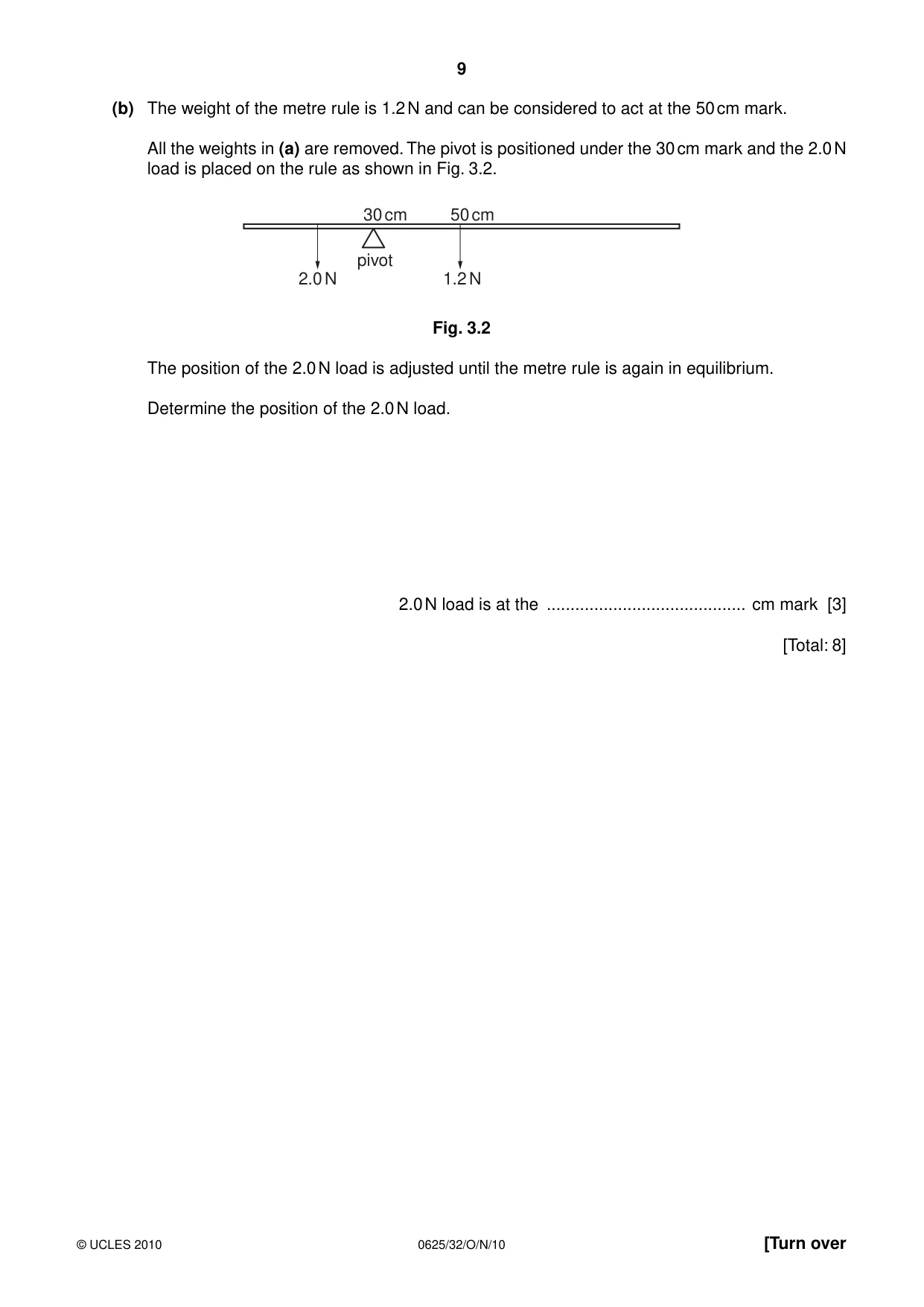
3 (a) A uniform metre rule is pivoted at its centre, which is also the position of its centre of mass. Three loads, 2.0 N, F and 3.0 N are positioned on the rule at the 20 cm, 30 cm and 90 cm marks respectively, as shown in Fig. 3.1. 0 cm 20 cm 30 cm 50 cm 90 cm 100 cm pivot 2.0 N F 3.0 N Fig. 3.1 (i) Calculate the moment of the 3.0 N load about the pivot. moment = ......................................................... [1] (ii) Calculate the moment of the 2.0 N load about the pivot. moment = ......................................................... [1] (iii) The force F maintains the metre rule in equilibrium on the pivot. Calculate the value of F. F = ......................................................... [3] (b) The weight of the metre rule is 1.2 N and can be considered to act at the 50 cm mark. All the weights in (a) are removed. The pivot is positioned under the 30 cm mark and the 2.0 N load is placed on the rule as shown in Fig. 3.2. 30 cm 50 cm pivot 2.0 N 1.2 N Fig. 3.2 The position of the 2.0 N load is adjusted until the metre rule is again in equilibrium. Determine the position of the 2.0 N load. 2.0 N load is at the .......................................... cm mark [3] [Total: 8]
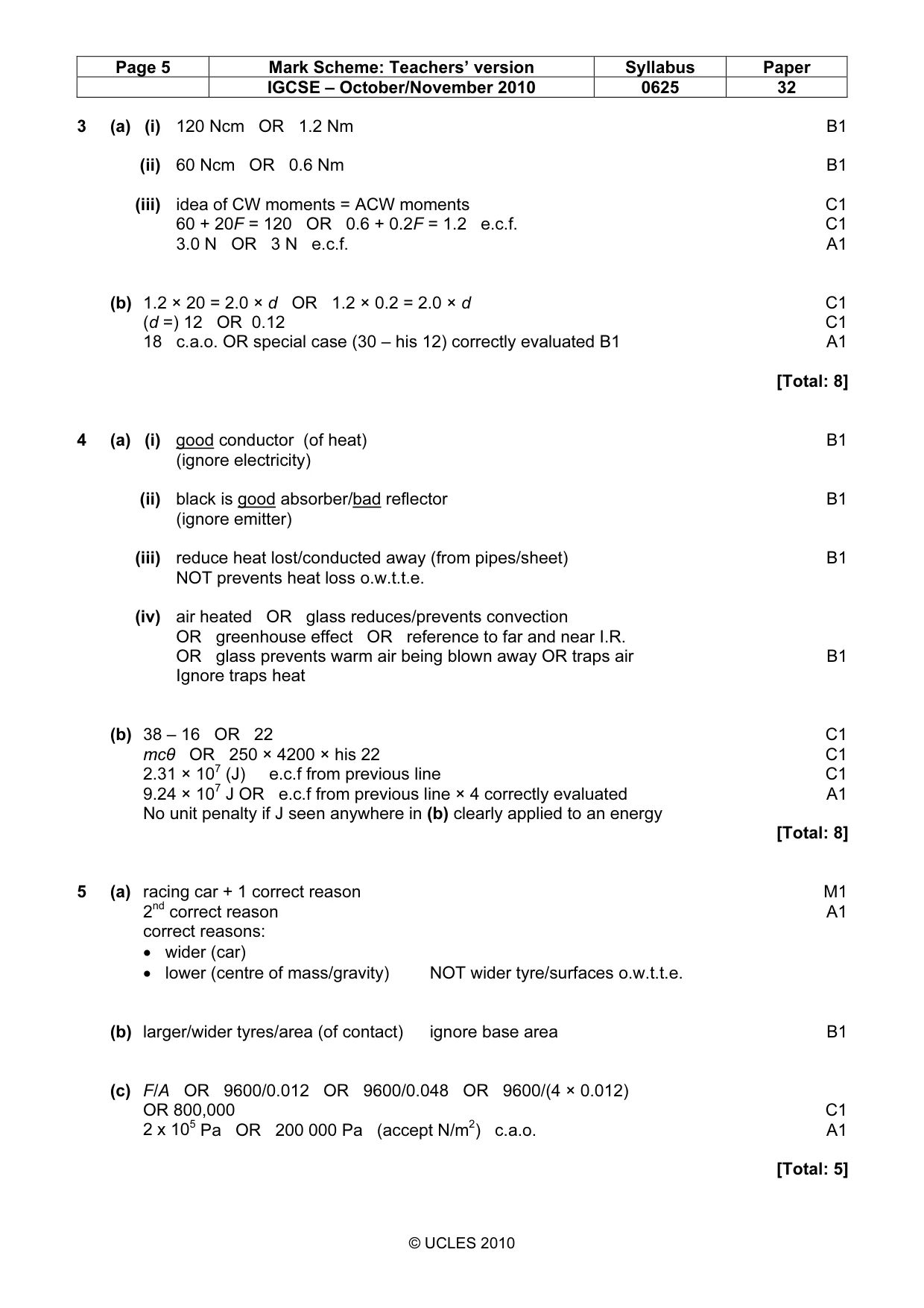
Mark scheme: 3 (a) (i) 120 Ncm OR 1.2 Nm B1 (ii) 60 Ncm OR 0.6 Nm B1 (iii) idea of CW moments = ACW moments C1 60 + 20F = 120 OR 0.6 + 0.2F = 1.2 e.c.f. C1 3.0 N OR 3 N e.c.f. A1 (b) 1.2 × 20 = 2.0 × d OR 1.2 × 0.2 = 2.0 × d C1 (d =) 12 OR 0.12 C1 18 c.a.o. OR special case (30 – his 12) correctly evaluated B1 A1 [Total: 8]
Q4 · A solar panel is mounted on the roof of a house
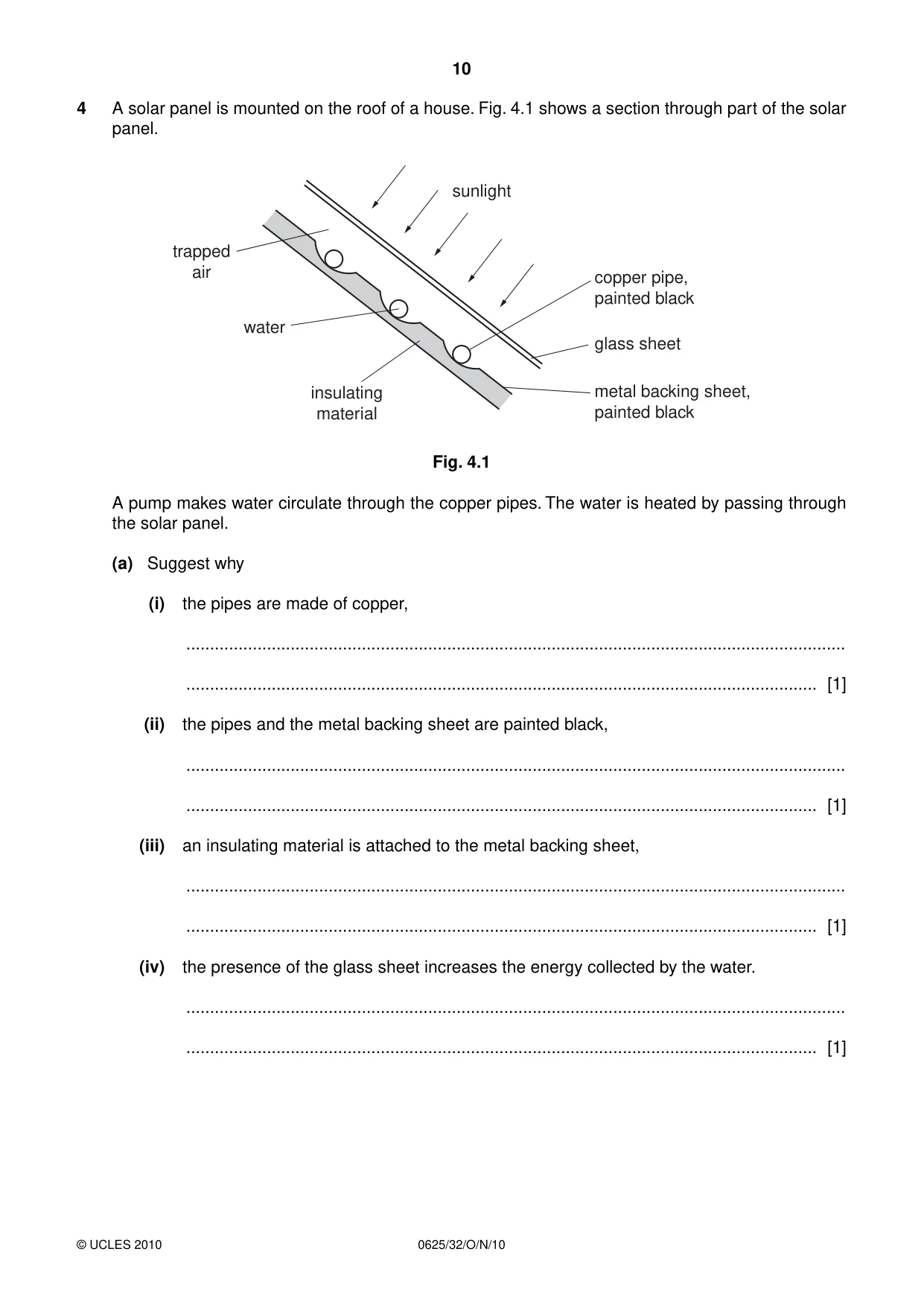
4 A solar panel is mounted on the roof of a house. Fig. 4.1 shows a section through part of the solar panel. sunlight trapped air copper pipe, painted black water glass sheet insulating metal backing sheet, material painted black Fig. 4.1 A pump makes water circulate through the copper pipes. The water is heated by passing through the solar panel. (a) Suggest why (i) the pipes are made of copper, ........................................................................................................................................... ..................................................................................................................................... [1] (ii) the pipes and the metal backing sheet are painted black, ........................................................................................................................................... ..................................................................................................................................... [1] (iii) an insulating material is attached to the metal backing sheet, ........................................................................................................................................... ..................................................................................................................................... [1] (iv) the presence of the glass sheet increases the energy collected by the water. ........................................................................................................................................... ..................................................................................................................................... [1] (b) During one day, 250 kg of water is pumped through the solar panel. The temperature of this water rises from 16 °C to 38 °C. The water absorbs 25% of the energy falling on the solar panel, and the specific heat capacity of water is 4200 J / (kg °C). Calculate the energy falling on the solar panel during that day. energy = ......................................................... [4] [Total: 8]
Mark scheme: 4 (a) (i) good conductor (of heat) B1 (ignore electricity) (ii) black is good absorber/bad reflector B1 (ignore emitter) (iii) reduce heat lost/conducted away (from pipes/sheet) B1 NOT prevents heat loss o.w.t.t.e. (iv) air heated OR glass reduces/prevents convection OR greenhouse effect OR reference to far and near I.R. OR glass prevents warm air being blown away OR traps air B1 Ignore traps heat (b) 38 – 16 OR 22 C1 mcθ OR 250 × 4200 × his 22 C1 2.31 × 10⁷ (J) e.c.f from previous line C1 9.24 × 10⁷ J OR e.c.f from previous line × 4 correctly evaluated A1 No unit penalty if J seen anywhere in (b) clearly applied to an energy [Total: 8]
Q5 · The front views of two cars are shown in Fig
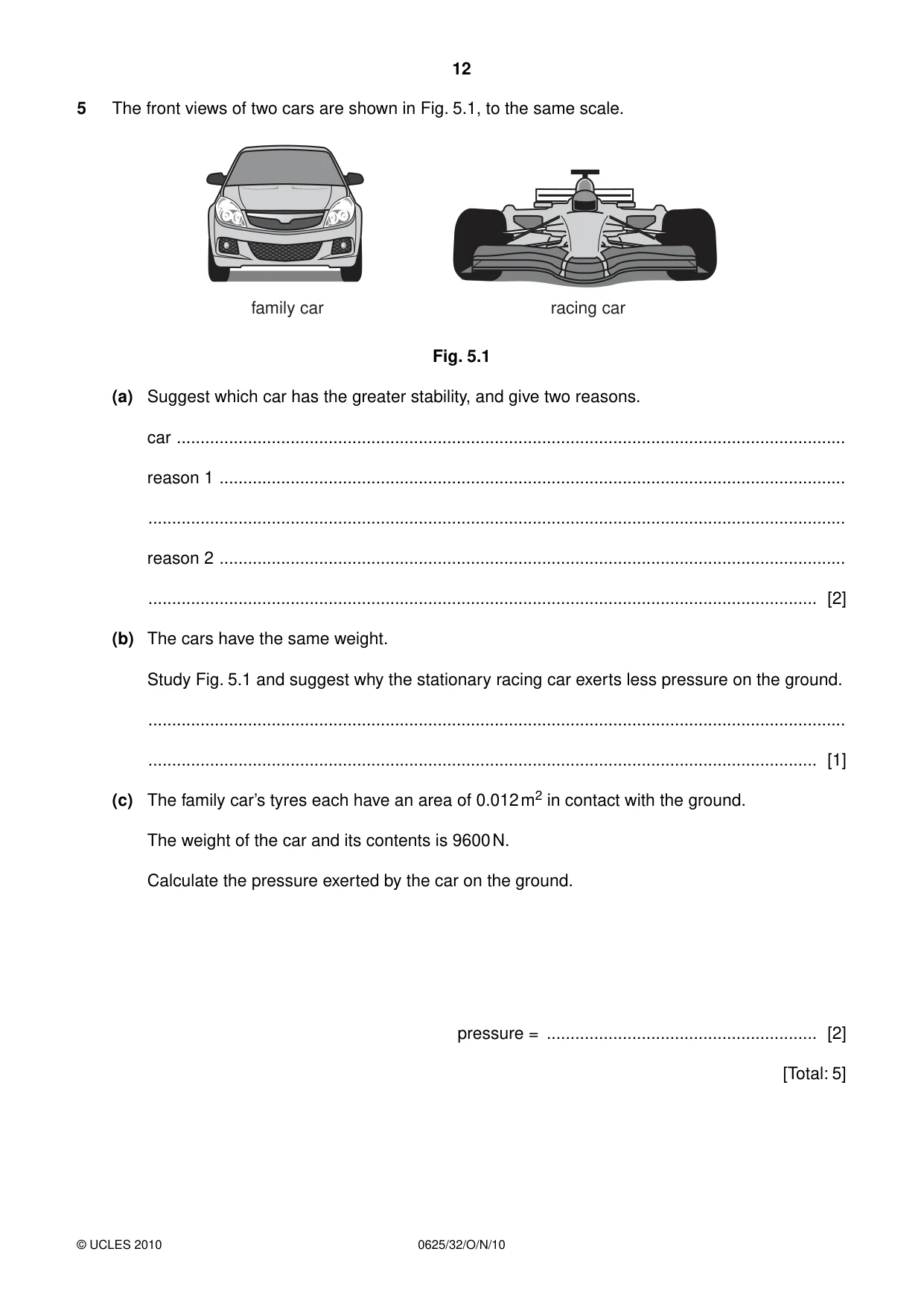
5 The front views of two cars are shown in Fig. 5.1, to the same scale. family car racing car Fig. 5.1 (a) Suggest which car has the greater stability, and give two reasons. car ............................................................................................................................................. reason 1 .................................................................................................................................... ................................................................................................................................................... reason 2 .................................................................................................................................... ............................................................................................................................................. [2] (b) The cars have the same weight. Study Fig. 5.1 and suggest why the stationary racing car exerts less pressure on the ground. ................................................................................................................................................... ............................................................................................................................................. [1] (c) The family car’s tyres each have an area of 0.012 m2 in contact with the ground. The weight of the car and its contents is 9600 N. Calculate the pressure exerted by the car on the ground. pressure = ......................................................... [2] [Total: 5]
Mark scheme: 5 (a) racing car + 1 correct reason M1 2nd correct reason A1 correct reasons: • wider (car) • lower (centre of mass/gravity) NOT wider tyre/surfaces o.w.t.t.e. (b) larger/wider tyres/area (of contact) ignore base area B1 (c) F/A OR 9600/0.012 OR 9600/0.048 OR 9600/(4 × 0.012) OR 800,000 C1 2 x 10⁵ Pa OR 200 000 Pa (accept N/m2) c.a.o. A1 [Total: 5] IGCSE – October/November 2010 0625 32
Q6 · Explain what is meant by the terms analogue and digital, as applied to electronic circuits
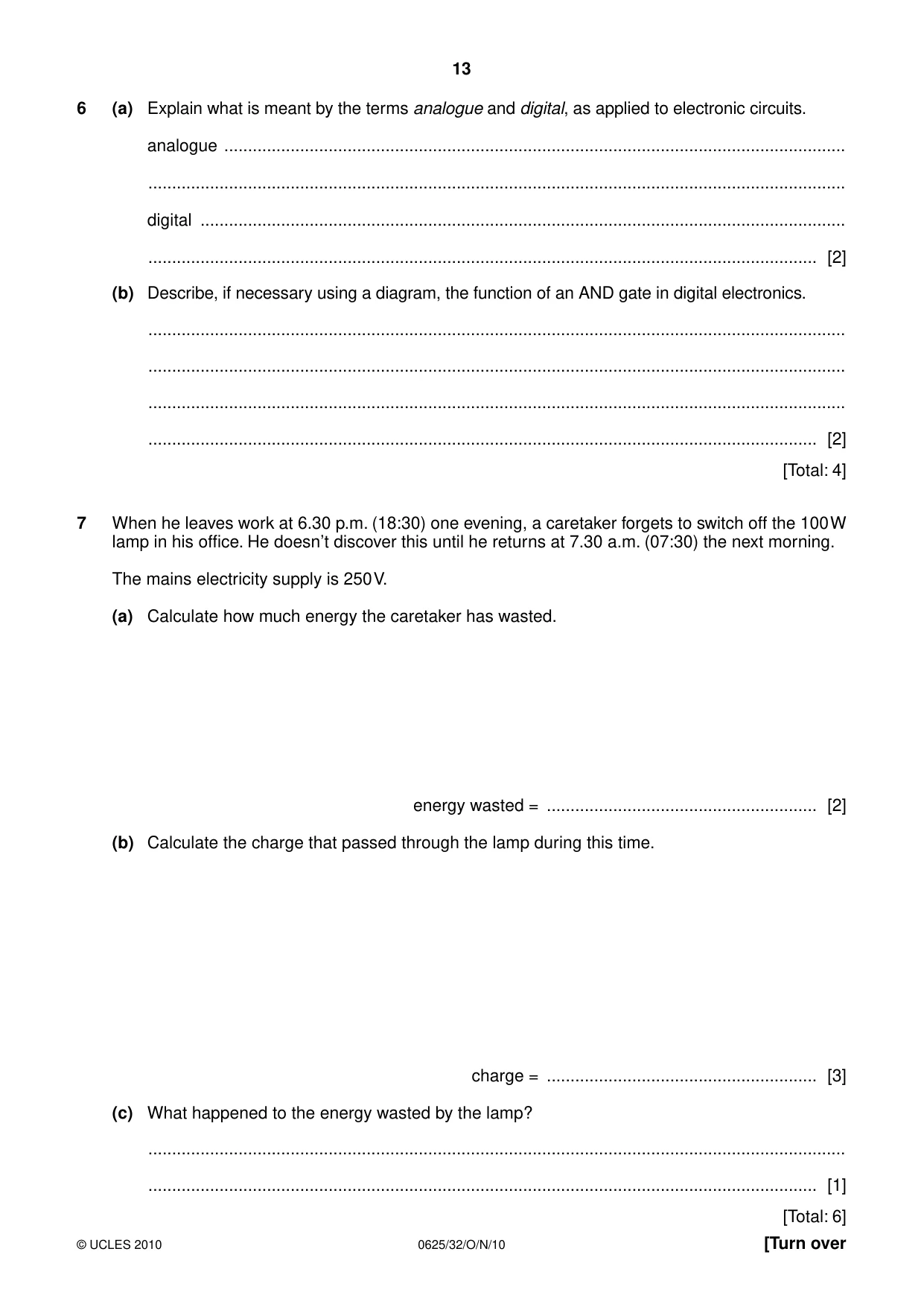
6 (a) Explain what is meant by the terms analogue and digital, as applied to electronic circuits. analogue ................................................................................................................................... ................................................................................................................................................... digital ........................................................................................................................................ ............................................................................................................................................. [2] (b) Describe, if necessary using a diagram, the function of an AND gate in digital electronics. ................................................................................................................................................... ................................................................................................................................................... ................................................................................................................................................... ............................................................................................................................................. [2] [Total: 4]
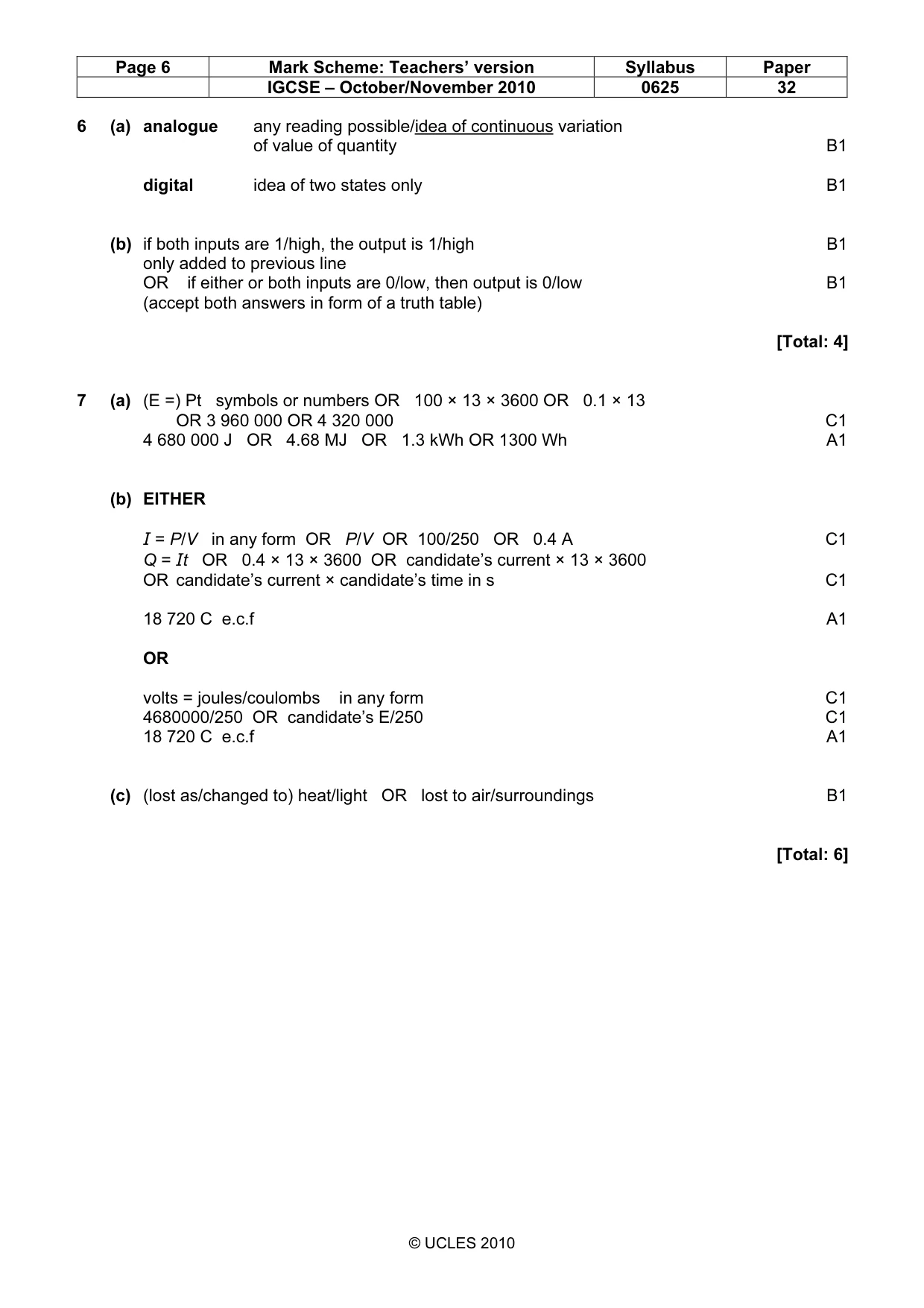
Mark scheme: 6 (a) analogue any reading possible/idea of continuous variation of value of quantity B1 digital idea of two states only B1 (b) if both inputs are 1/high, the output is 1/high B1 only added to previous line OR if either or both inputs are 0/low, then output is 0/low B1 (accept both answers in form of a truth table) [Total: 4]
Q7 · When he leaves work at 6.30 p.m
7 When he leaves work at 6.30 p.m. (18:30) one evening, a caretaker forgets to switch off the 100 W lamp in his office. He doesn’t discover this until he returns at 7.30 a.m. (07:30) the next morning. The mains electricity supply is 250 V. (a) Calculate how much energy the caretaker has wasted. energy wasted = ......................................................... [2] (b) Calculate the charge that passed through the lamp during this time. charge = ......................................................... [3] (c) What happened to the energy wasted by the lamp? ................................................................................................................................................... ............................................................................................................................................. [1] [Total: 6]
Mark scheme: 7 (a) (E =) Pt symbols or numbers OR 100 × 13 × 3600 OR 0.1 × 13 OR 3 960 000 OR 4 320 000 C1 4 680 000 J OR 4.68 MJ OR 1.3 kWh OR 1300 Wh A1 (b) EITHER I = P/V in any form OR P/V OR 100/250 OR 0.4 A C1 Q = It OR 0.4 × 13 × 3600 OR candidate’s current × 13 × 3600 OR candidate’s current × candidate’s time in s C1 18 720 C e.c.f A1 OR volts = joules/coulombs in any form C1 4680000/250 OR candidate’s E/250 C1 18 720 C e.c.f A1 (c) (lost as/changed to) heat/light OR lost to air/surroundings B1 [Total: 6] IGCSE – October/November 2010 0625 32
Question 8
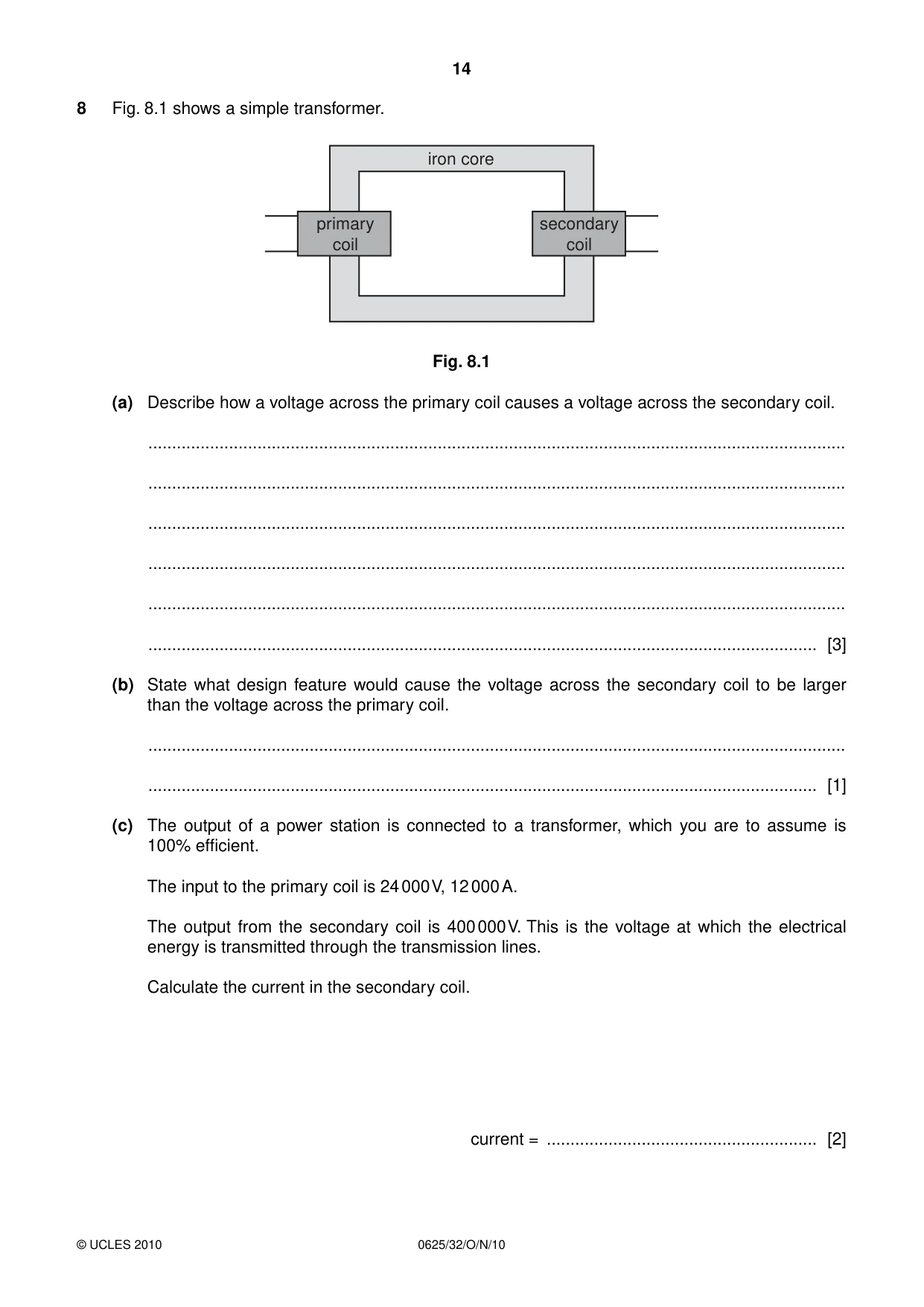
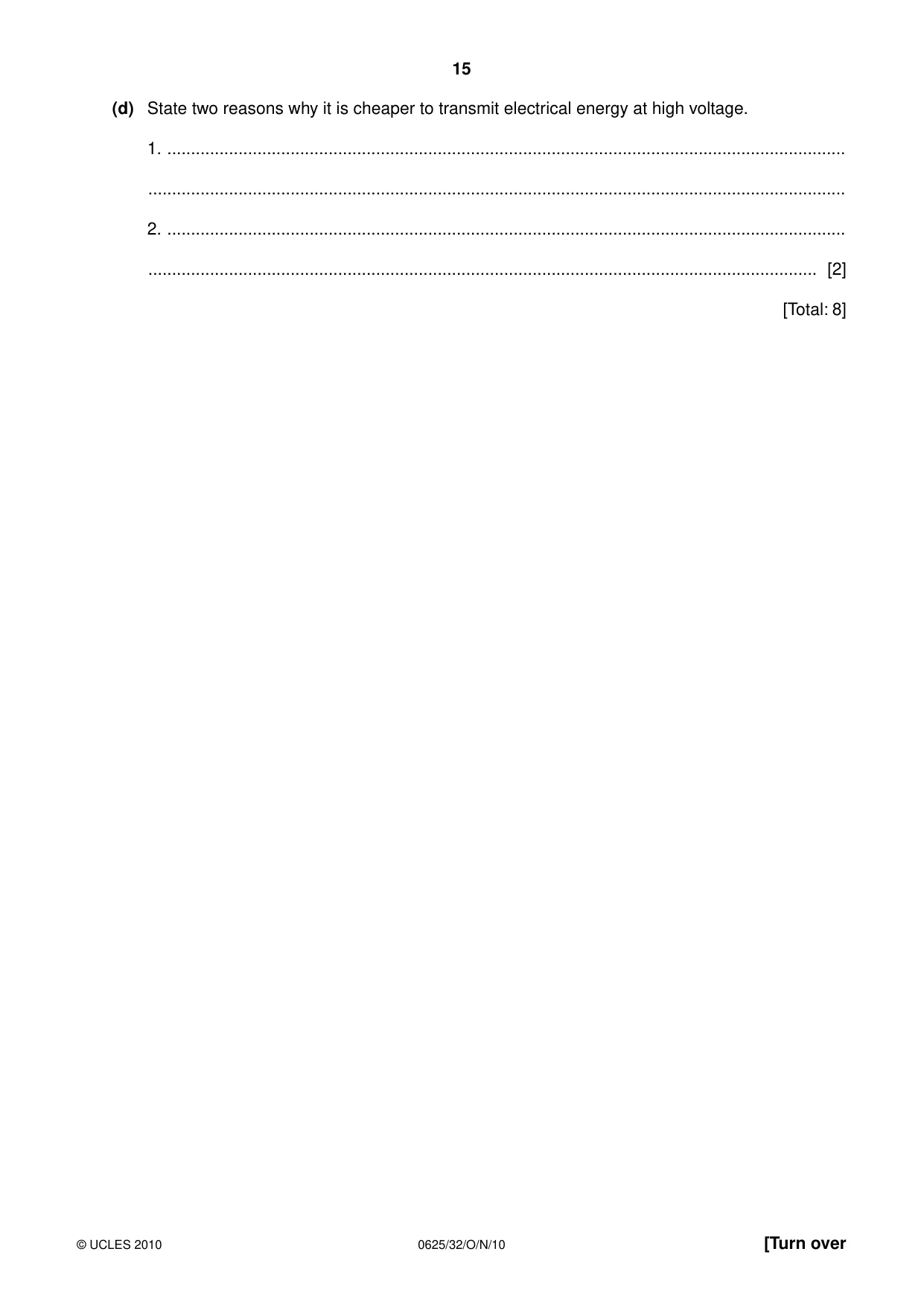
8 Fig. 8.1 shows a simple transformer. iron core primary secondary coil coil Fig. 8.1 (a) Describe how a voltage across the primary coil causes a voltage across the secondary coil. ................................................................................................................................................... ................................................................................................................................................... ................................................................................................................................................... ................................................................................................................................................... ................................................................................................................................................... ............................................................................................................................................. [3] (b) State what design feature would cause the voltage across the secondary coil to be larger than the voltage across the primary coil. ................................................................................................................................................... ............................................................................................................................................. [1] (c) The output of a power station is connected to a transformer, which you are to assume is 100% efficient. The input to the primary coil is 24 000 V, 12 000 A. The output from the secondary coil is 400 000 V. This is the voltage at which the electrical energy is transmitted through the transmission lines. Calculate the current in the secondary coil. current = ......................................................... [2] (d) State two reasons why it is cheaper to transmit electrical energy at high voltage. 1. ............................................................................................................................................... ................................................................................................................................................... 2. ............................................................................................................................................... ............................................................................................................................................. [2] [Total: 8]
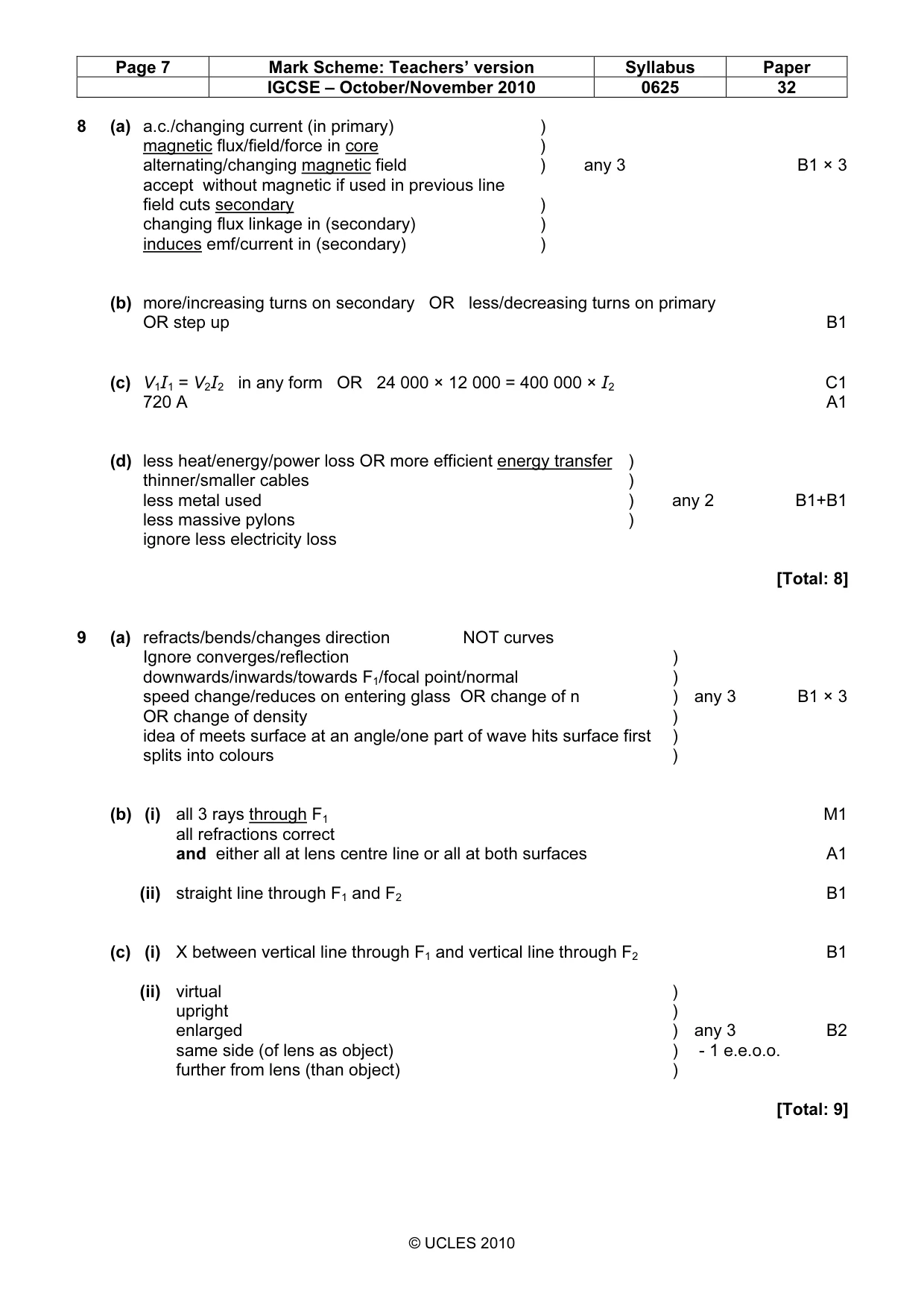
Mark scheme: 8 (a) a.c./changing current (in primary) ) magnetic flux/field/force in core ) alternating/changing magnetic field ) any 3 B1 × 3 accept without magnetic if used in previous line field cuts secondary ) changing flux linkage in (secondary) ) induces emf/current in (secondary) ) (b) more/increasing turns on secondary OR less/decreasing turns on primary OR step up B1 (c) V1I1 = V2I2 in any form OR 24 000 × 12 000 = 400 000 × I2 C1 720 A A1 (d) less heat/energy/power loss OR more efficient energy transfer ) thinner/smaller cables ) less metal used ) any 2 B1+B1 less massive pylons ) ignore less electricity loss [Total: 8]
Q9 · Three rays of light, parallel to the axis of a thin converging lens
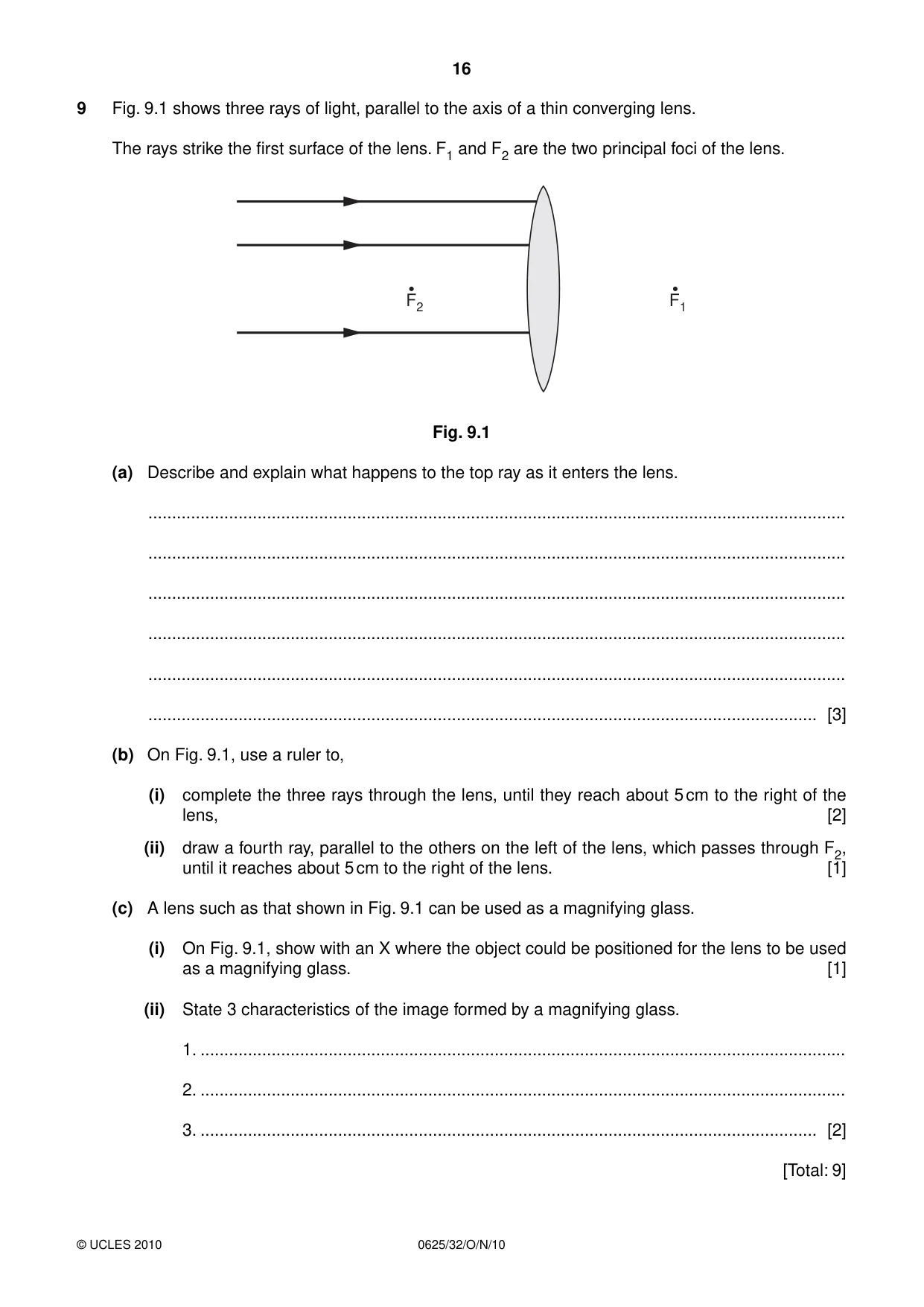
9 Fig. 9.1 shows three rays of light, parallel to the axis of a thin converging lens. The rays strike the first surface of the lens. F1 and F2 are the two principal foci of the lens. F2 F1 Fig. 9.1 (a) Describe and explain what happens to the top ray as it enters the lens. ................................................................................................................................................... ................................................................................................................................................... ................................................................................................................................................... ................................................................................................................................................... ................................................................................................................................................... ............................................................................................................................................. [3] (b) On Fig. 9.1, use a ruler to, (i) complete the three rays through the lens, until they reach about 5 cm to the right of the lens, [2] (ii) draw a fourth ray, parallel to the others on the left of the lens, which passes through F2, until it reaches about 5 cm to the right of the lens. [1] (c) A lens such as that shown in Fig. 9.1 can be used as a magnifying glass. (i) On Fig. 9.1, show with an X where the object could be positioned for the lens to be used as a magnifying glass. [1] (ii) State 3 characteristics of the image formed by a magnifying glass. 1. ........................................................................................................................................ 2. ........................................................................................................................................ 3. .................................................................................................................................. [2] [Total: 9]
Mark scheme: 9 (a) refracts/bends/changes direction NOT curves Ignore converges/reflection ) downwards/inwards/towards F1/focal point/normal ) speed change/reduces on entering glass OR change of n ) any 3 B1 × 3 OR change of density ) idea of meets surface at an angle/one part of wave hits surface first ) splits into colours ) (b) (i) all 3 rays through F1 M1 all refractions correct and either all at lens centre line or all at both surfaces A1 (ii) straight line through F1 and F2 B1 (c) (i) X between vertical line through F1 and vertical line through F2 B1 (ii) virtual ) upright ) enlarged ) any 3 B2 same side (of lens as object) ) - 1 e.e.o.o. further from lens (than object) ) [Total: 9] IGCSE – October/November 2010 0625 32
Q10 · In Geiger and Marsden’s α-particle scattering experiment, α-particles were directed at a…
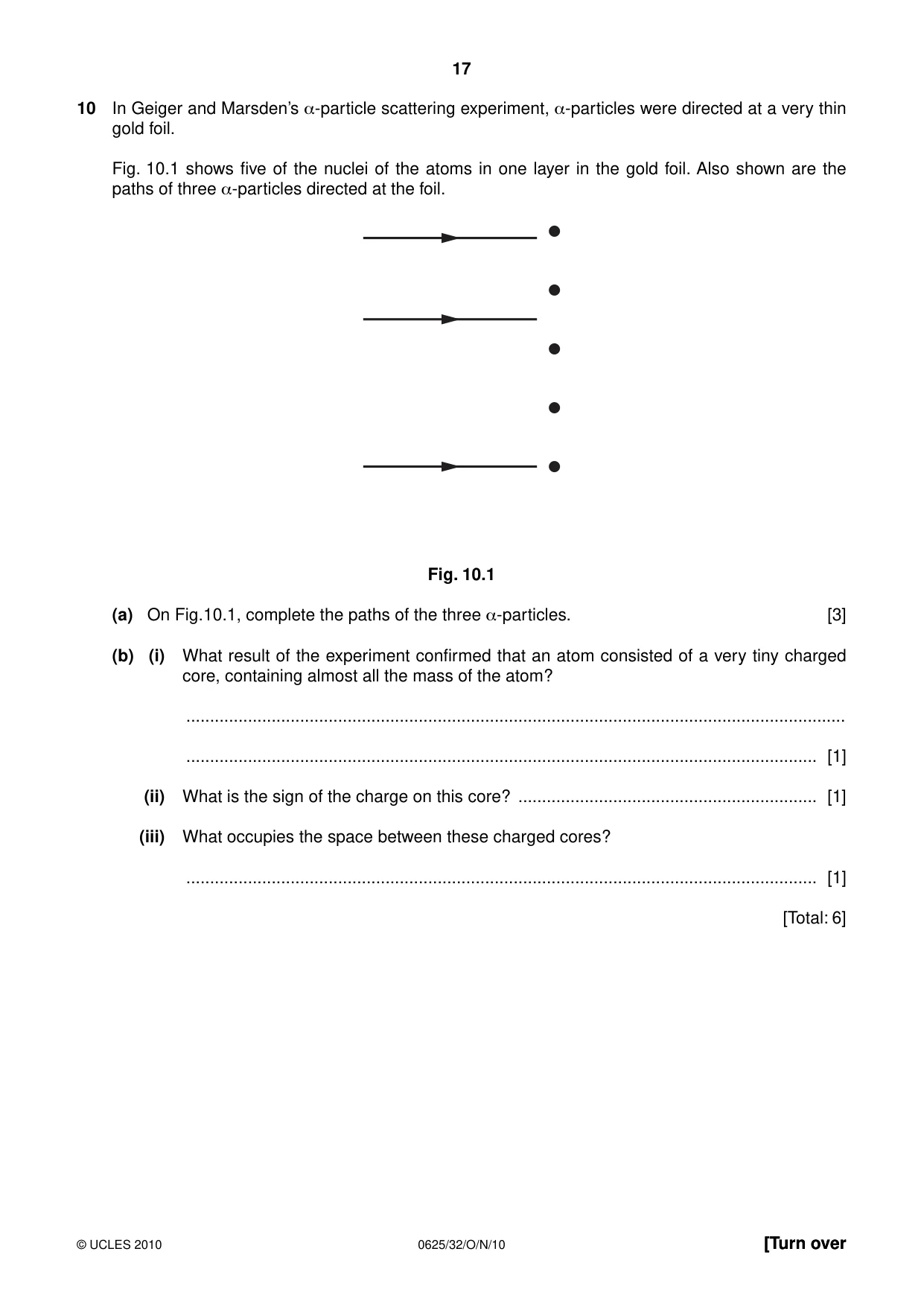
10 In Geiger and Marsden’s α-particle scattering experiment, α-particles were directed at a very thin gold foil. Fig. 10.1 shows five of the nuclei of the atoms in one layer in the gold foil. Also shown are the paths of three α-particles directed at the foil. Fig. 10.1 (a) On Fig.10.1, complete the paths of the three α-particles. [3] (b) (i) What result of the experiment confirmed that an atom consisted of a very tiny charged core, containing almost all the mass of the atom? ........................................................................................................................................... ..................................................................................................................................... [1] (ii) What is the sign of the charge on this core? ............................................................... [1] (iii) What occupies the space between these charged cores? ..................................................................................................................................... [1] [Total: 6]
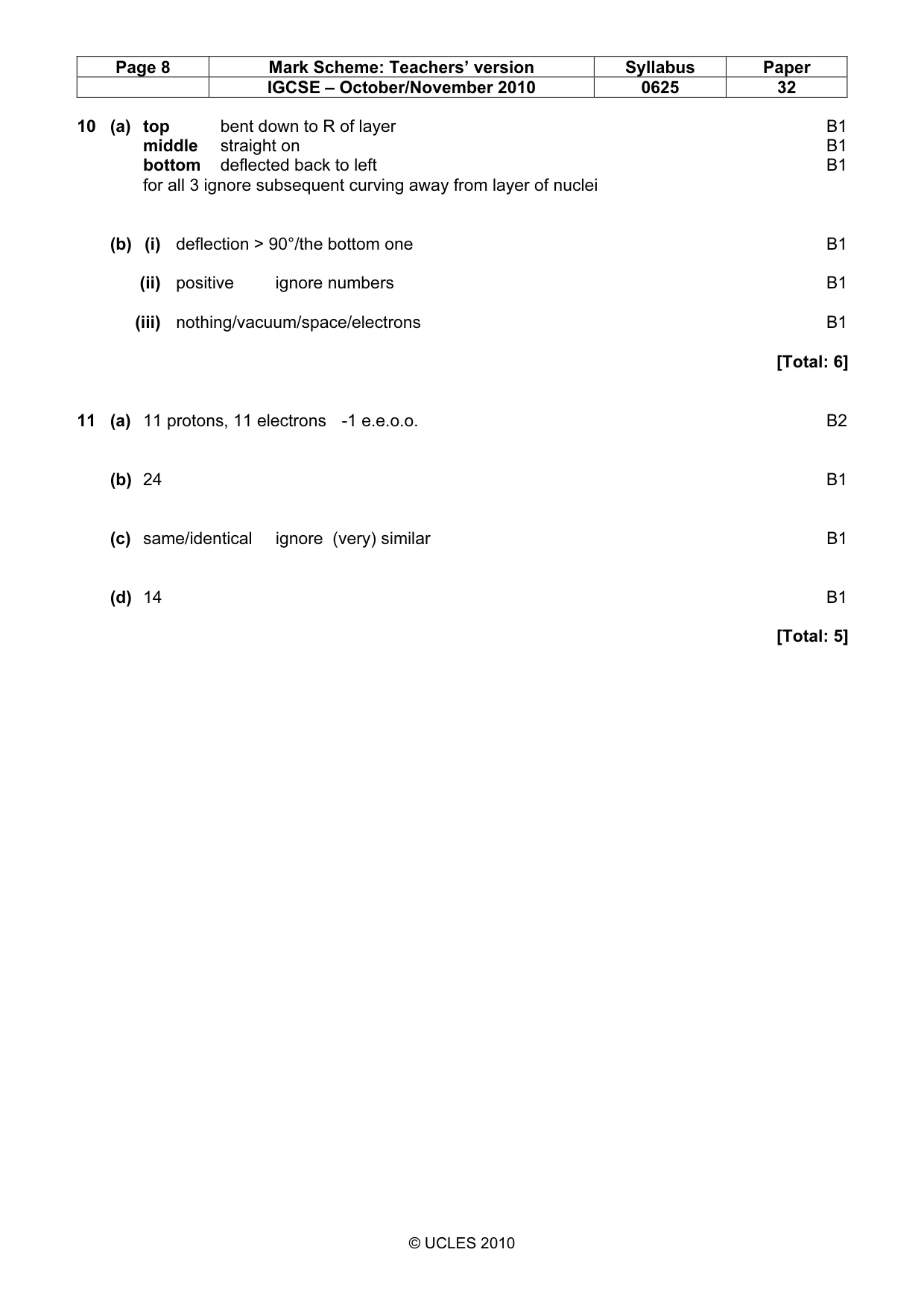
Mark scheme: 10 (a) top bent down to R of layer B1 middle straight on B1 bottom deflected back to left B1 for all 3 ignore subsequent curving away from layer of nuclei (b) (i) deflection > 90°/the bottom one B1 (ii) positive ignore numbers B1 (iii) nothing/vacuum/space/electrons B1 [Total: 6]
Q11 · An atom of one of the isotopes of sodium contains 11 protons, 11 electrons and 13 neutrons
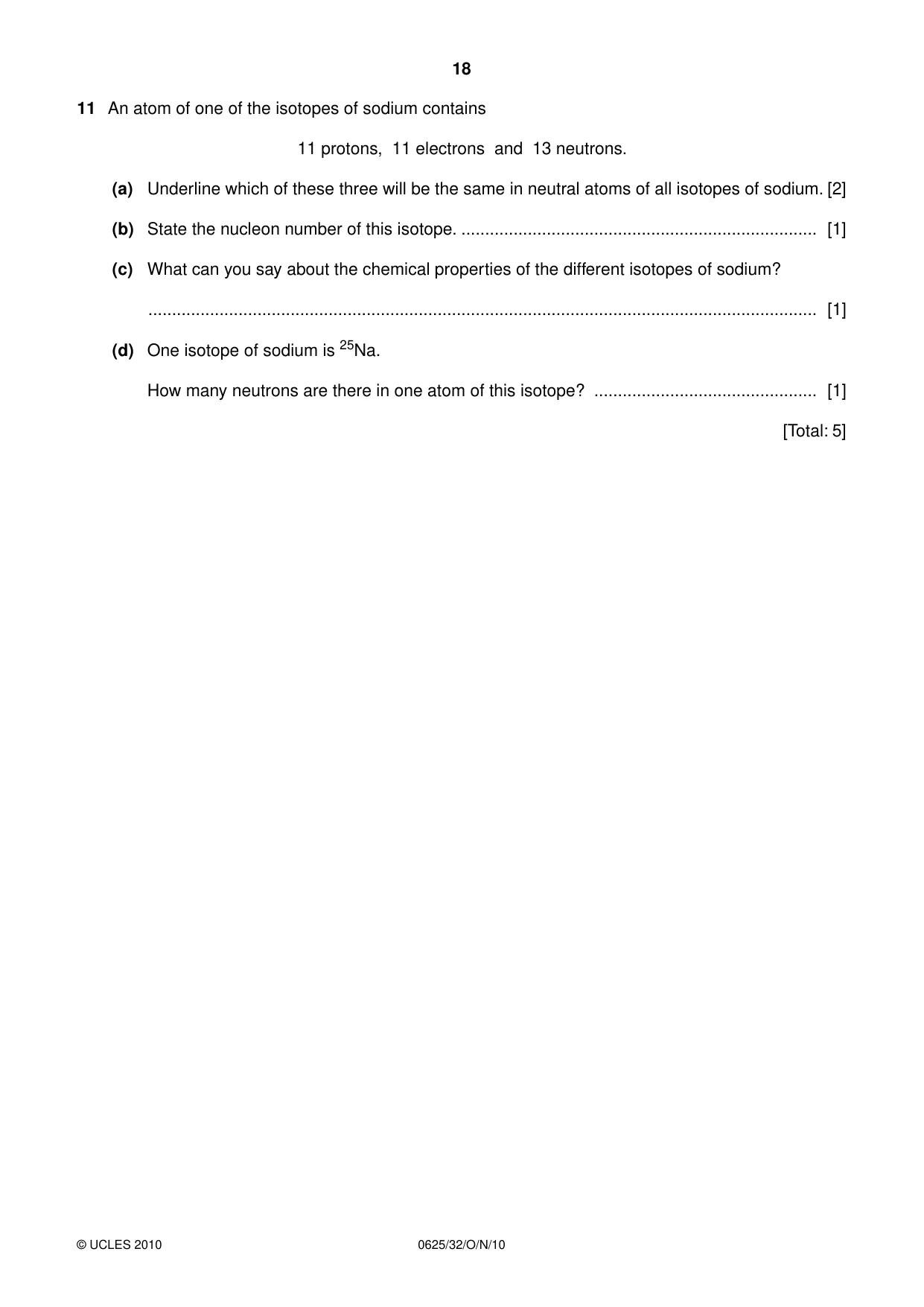
11 An atom of one of the isotopes of sodium contains 11 protons, 11 electrons and 13 neutrons. (a) Underline which of these three will be the same in neutral atoms of all isotopes of sodium. [2] (b) State the nucleon number of this isotope. ........................................................................... [1] (c) What can you say about the chemical properties of the different isotopes of sodium? ............................................................................................................................................. [1] (d) One isotope of sodium is 25Na. How many neutrons are there in one atom of this isotope? ............................................... [1] [Total: 5]
Mark scheme: 11 (a) 11 protons, 11 electrons -1 e.e.o.o. B2 (b) 24 B1 (c) same/identical ignore (very) similar B1 (d) 14 B1 [Total: 5]
What was in this paper
The subtopics covered by these 11 questions, and how many questions each got. Open one in a new tab to see every Cambridge question on it.
What you needed in this session
Cambridge’s own grade thresholds for 2010 Oct/Nov, Paper 3 · Variant 2. A higher threshold means an easier paper — the bar moves with how the cohort did.