Questions as text
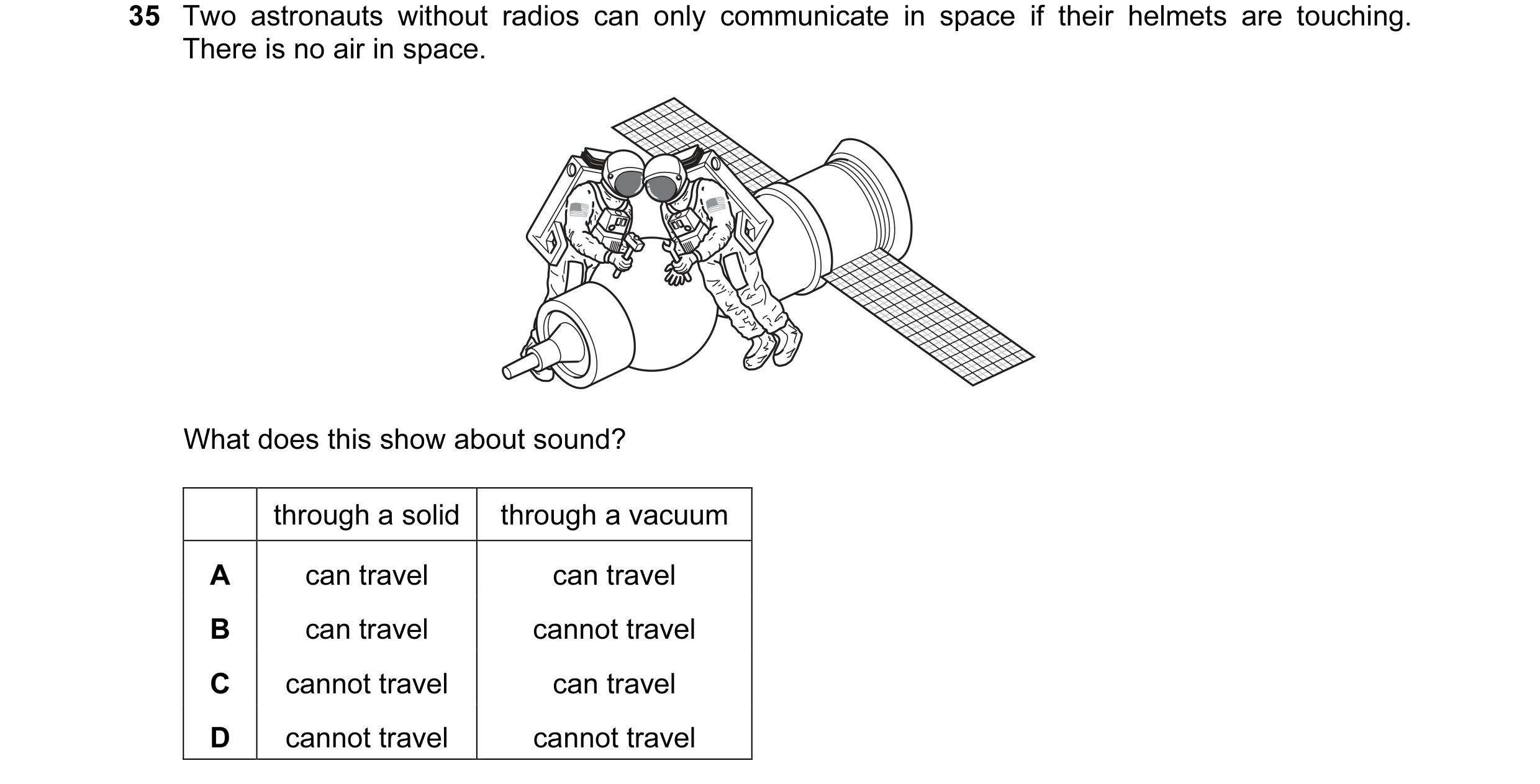
Q1 · Two astronauts without radios can only communicate in space if their helmets are touching 0653/11 Oct/Nov 2005
35 Two astronauts without radios can only communicate in space if their helmets are touching. There is no air in space. What does this show about sound? through a solid through a vacuum A can travel can travel B can travel cannot travel C cannot travel can travel D cannot travel cannot travel
1 marks
Answer: B
This question in 0653/11 Oct/Nov 2005
Q2 · Sounds are made by vibrating objects 0653/11 May/June 2006
35 Sounds are made by vibrating objects. A certain object vibrates but a person nearby cannot hear any sound. Which statement might explain why nothing is heard? A The amplitude of the sound waves is too large. B The frequency of the vibration is too high. C The sound waves are transverse. D The speed of the sound waves is too high.
1 marks
Answer: B
This question in 0653/11 May/June 2006
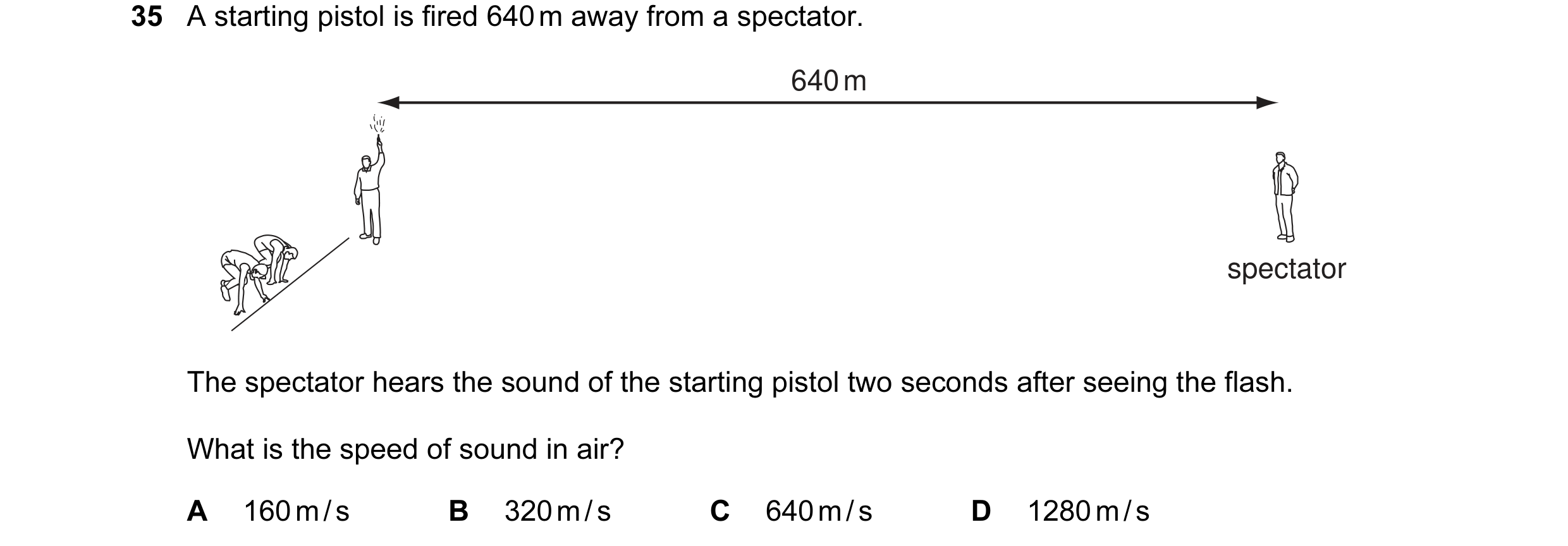
Q3 · A starting pistol is fired 640 m away from a spectator 0653/11 May/June 2007
35 A starting pistol is fired 640 m away from a spectator. 640 m spectator The spectator hears the sound of the starting pistol two seconds after seeing the flash. What is the speed of sound in air? A 160 m / s B 320 m / s C 640 m / s D 1280 m / s
1 marks
Answer: B
This question in 0653/11 May/June 2007
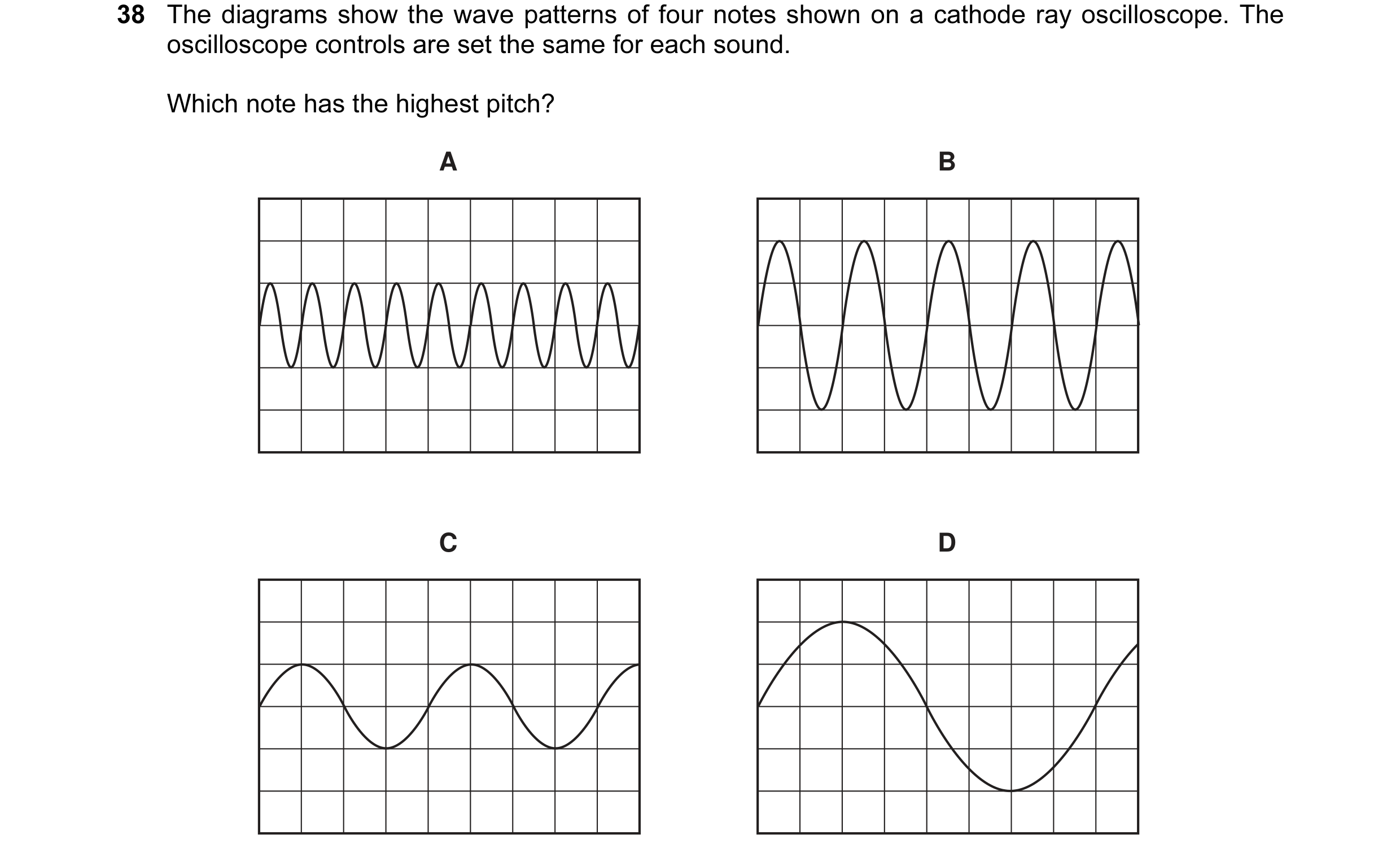
Q4 · The diagrams show the wave patterns of four notes shown on a cathode ray oscilloscope 0653/11 May/June 2010
39 The diagrams show the wave patterns of four notes shown on a cathode ray oscilloscope. The oscilloscope controls are set the same for each sound. Which note has the highest pitch? A B C D
1 marks
Answer: A
This question in 0653/11 May/June 2010
Q5 · The diagrams show the wave patterns of four notes shown on a cathode ray oscilloscope 0653/12 May/June 2010
38 The diagrams show the wave patterns of four notes shown on a cathode ray oscilloscope. The oscilloscope controls are set the same for each sound. Which note has the highest pitch? A B C D
1 marks
Answer: A
This question in 0653/12 May/June 2010
Q6 · The diagrams show the wave patterns of four notes shown on a cathode ray oscilloscope 0653/13 May/June 2010
38 The diagrams show the wave patterns of four notes shown on a cathode ray oscilloscope. The oscilloscope controls are set the same for each sound. Which note has the highest pitch? A B C D
1 marks
Answer: A
This question in 0653/13 May/June 2010
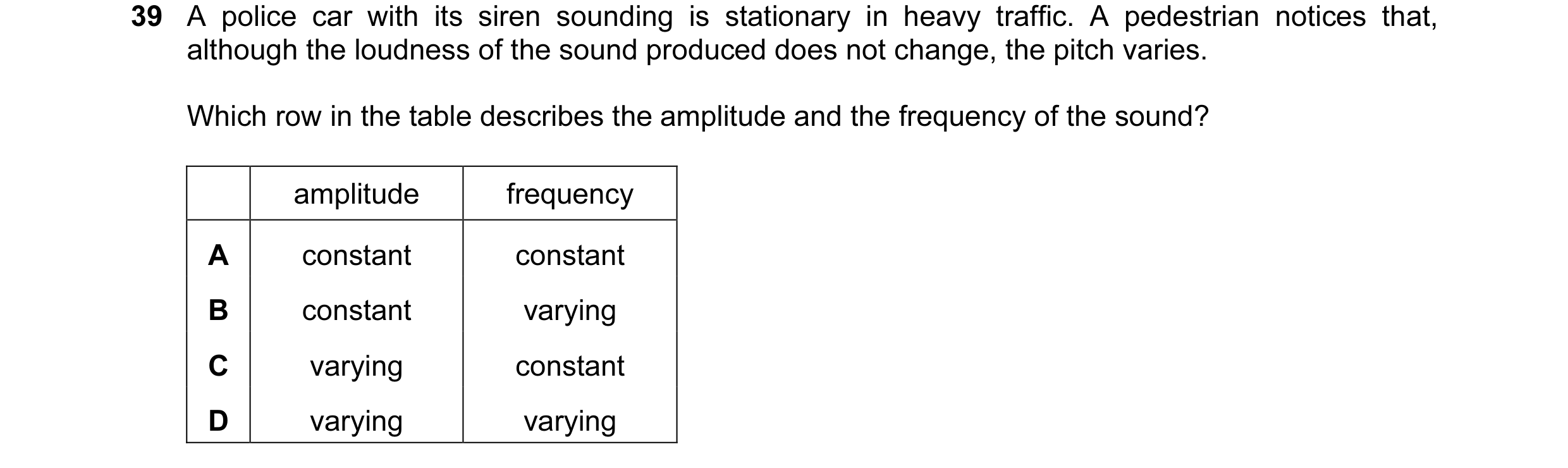
Q7 · A police car with its siren sounding is stationary in heavy traffic 0653/11 Oct/Nov 2010
39 A police car with its siren sounding is stationary in heavy traffic. A pedestrian notices that, although the loudness of the sound produced does not change, the pitch varies. Which row in the table describes the amplitude and the frequency of the sound? amplitude frequency A constant constant B constant varying C varying constant D varying varying
1 marks
Answer: B
This question in 0653/11 Oct/Nov 2010
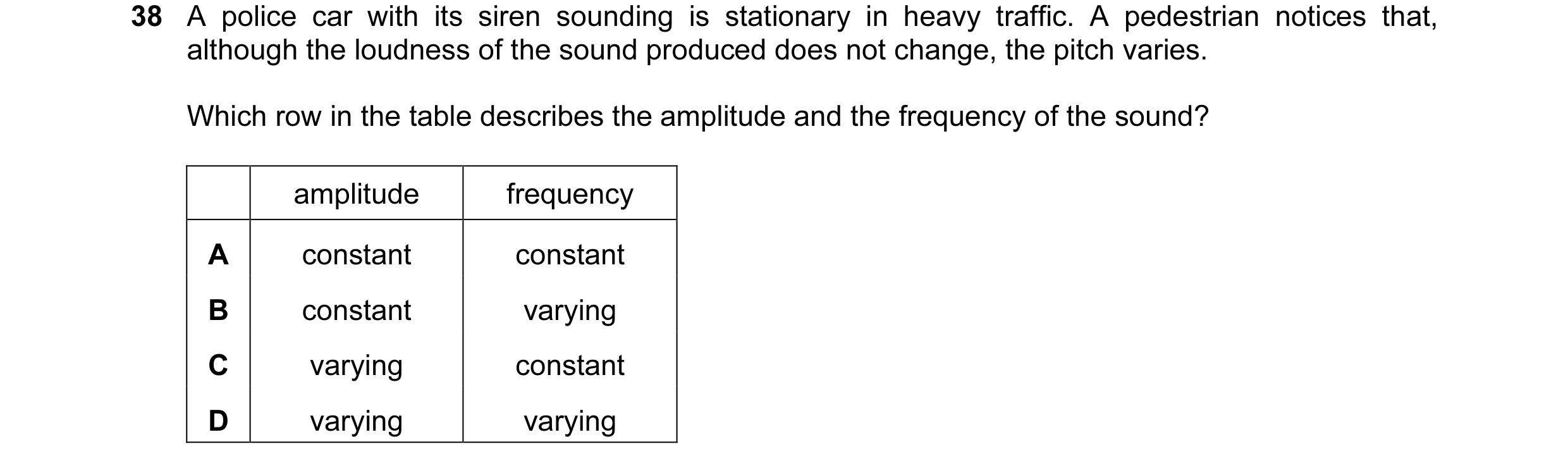
Q8 · A police car with its siren sounding is stationary in heavy traffic 0653/12 Oct/Nov 2010
38 A police car with its siren sounding is stationary in heavy traffic. A pedestrian notices that, although the loudness of the sound produced does not change, the pitch varies. Which row in the table describes the amplitude and the frequency of the sound? amplitude frequency A constant constant B constant varying C varying constant D varying varying
1 marks
Answer: B
This question in 0653/12 Oct/Nov 2010
Q9 · A police car with its siren sounding is stationary in heavy traffic 0653/13 Oct/Nov 2010
37 A police car with its siren sounding is stationary in heavy traffic. A pedestrian notices that, although the loudness of the sound produced does not change, the pitch varies. Which row in the table describes the amplitude and the frequency of the sound? amplitude frequency A constant constant B constant varying C varying constant D varying varying
1 marks
Answer: B
This question in 0653/13 Oct/Nov 2010
Q10 · Which row shows the input energy and the output energy for a microphone? 0653/11 May/June 2011
35 Which row shows the input energy and the output energy for a microphone? input energy output energy A electrical potential B electrical sound C sound electrical D sound potential
1 marks
Answer: C
This question in 0653/11 May/June 2011
Q11 · Which row shows the input energy and the output energy for a microphone? 0653/12 May/June 2011
32 Which row shows the input energy and the output energy for a microphone? input energy output energy A electrical potential B electrical sound C sound electrical D sound potential
1 marks
Answer: C
This question in 0653/12 May/June 2011
Q12 · Which is the best description of a wave that is a quiet, high-pitched sound? 0653/11 Oct/Nov 2011
37 Which is the best description of a wave that is a quiet, high-pitched sound? A large amplitude and high frequency. B large amplitude and low frequency. C small amplitude and high frequency. D small amplitude and low frequency.
1 marks
Answer: C
This question in 0653/11 Oct/Nov 2011
Q13 · Which is the best description of a wave that is a quiet, high-pitched sound? 0653/12 Oct/Nov 2011
39 Which is the best description of a wave that is a quiet, high-pitched sound? A large amplitude and high frequency. B large amplitude and low frequency. C small amplitude and high frequency. D small amplitude and low frequency.
1 marks
Answer: C
This question in 0653/12 Oct/Nov 2011
Q14 · Which is the best description of a wave that is a quiet, high-pitched sound? 0653/13 Oct/Nov 2011
38 Which is the best description of a wave that is a quiet, high-pitched sound? A large amplitude and high frequency. B large amplitude and low frequency. C small amplitude and high frequency. D small amplitude and low frequency.
1 marks
Answer: C
This question in 0653/13 Oct/Nov 2011
Q15 · The diagrams represent four different sound waves 0653/11 May/June 2012
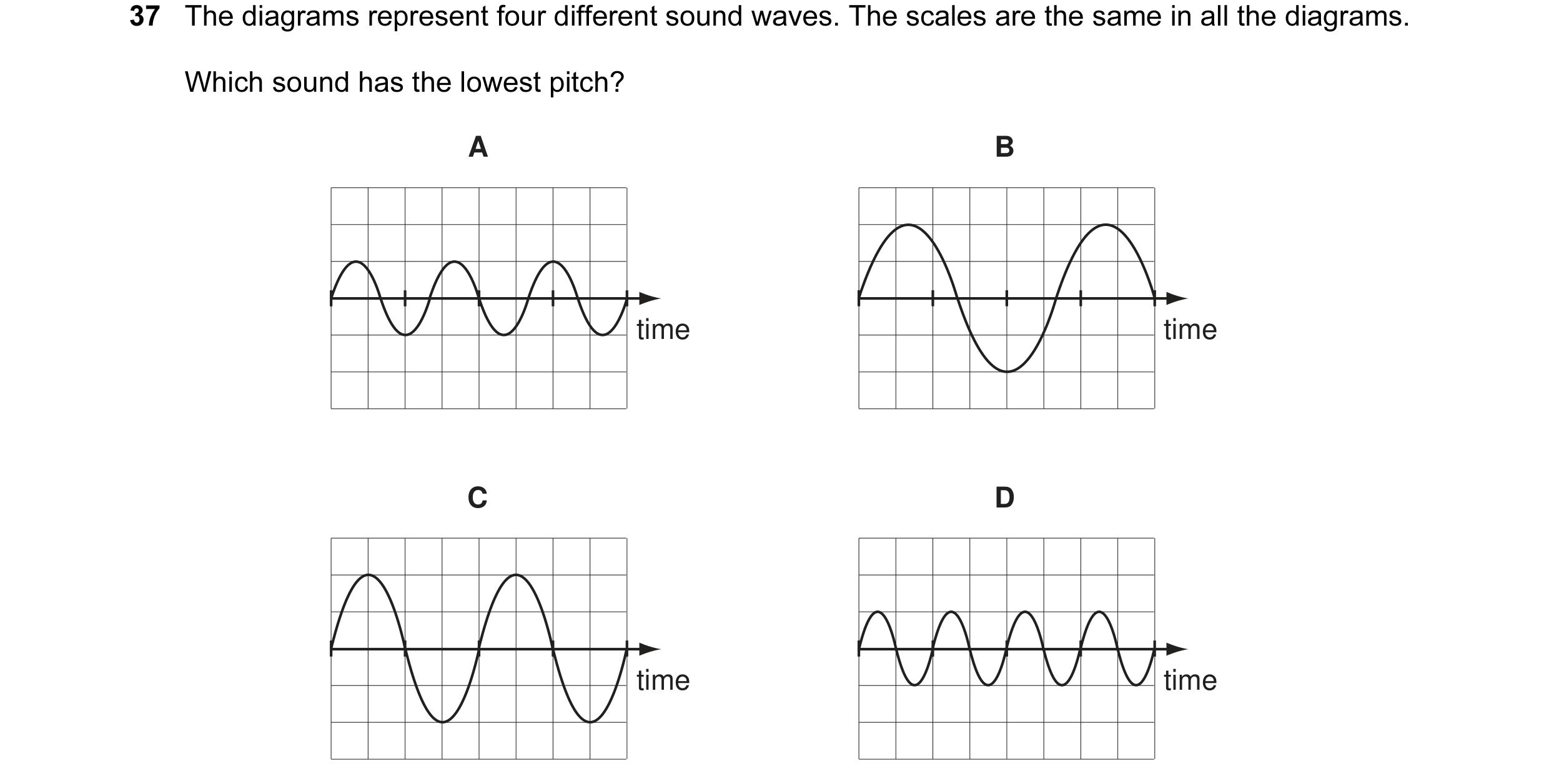
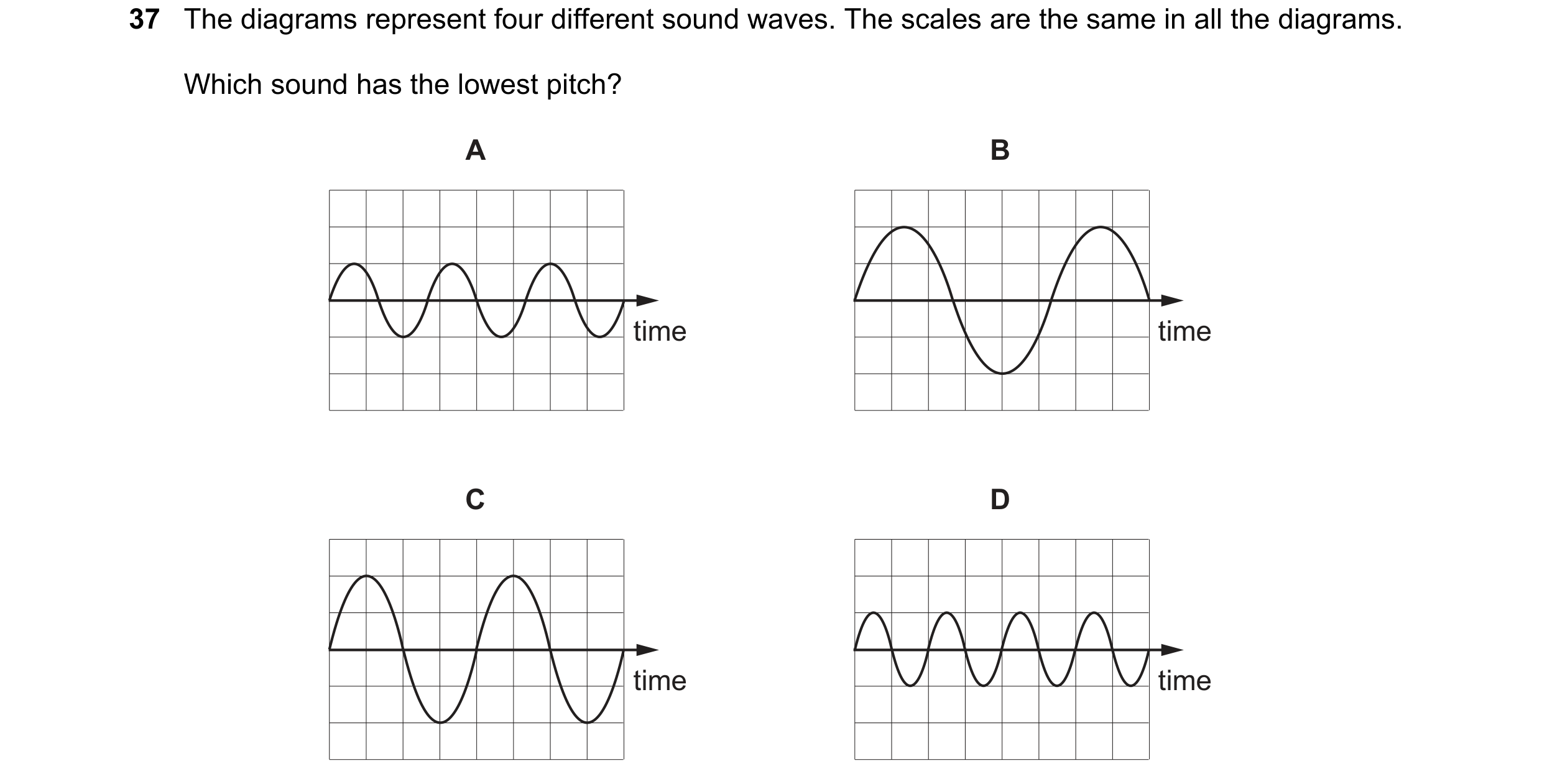
37 The diagrams represent four different sound waves. The scales are the same in all the diagrams. Which sound has the lowest pitch? A B time time C D time time
1 marks
This question in 0653/11 May/June 2012
Q16 · A climber stands on a ledge on one side of a valley 0653/12 May/June 2012
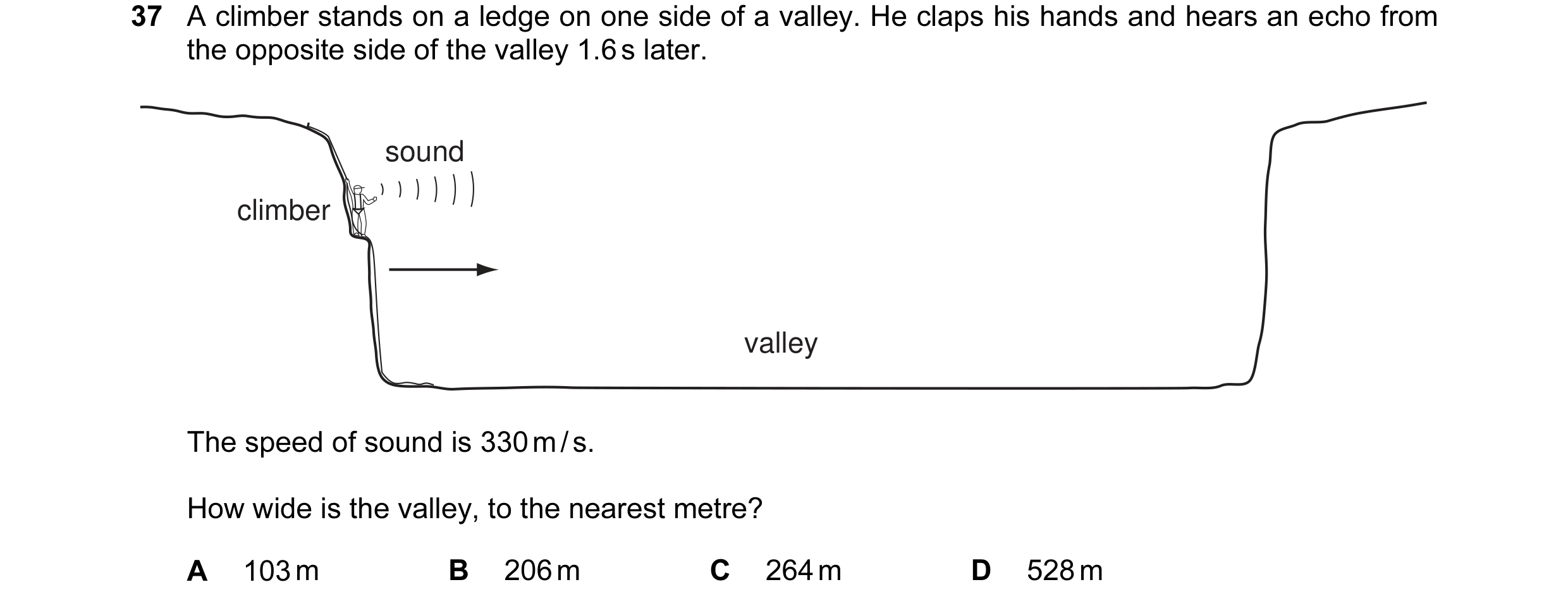
37 A climber stands on a ledge on one side of a valley. He claps his hands and hears an echo from the opposite side of the valley 1.6 s later. sound climber valley The speed of sound is 330 m / s. How wide is the valley, to the nearest metre? A 103 m B 206 m C 264 m D 528 m
1 marks
Answer: C
This question in 0653/12 May/June 2012
Q17 · A climber stands on a ledge on one side of a valley 0653/13 May/June 2012
37 A climber stands on a ledge on one side of a valley. He claps his hands and hears an echo from the opposite side of the valley 1.6 s later. sound climber valley The speed of sound is 330 m / s. How wide is the valley, to the nearest metre? A 103 m B 206 m C 264 m D 528 m
1 marks
Answer: C
This question in 0653/13 May/June 2012
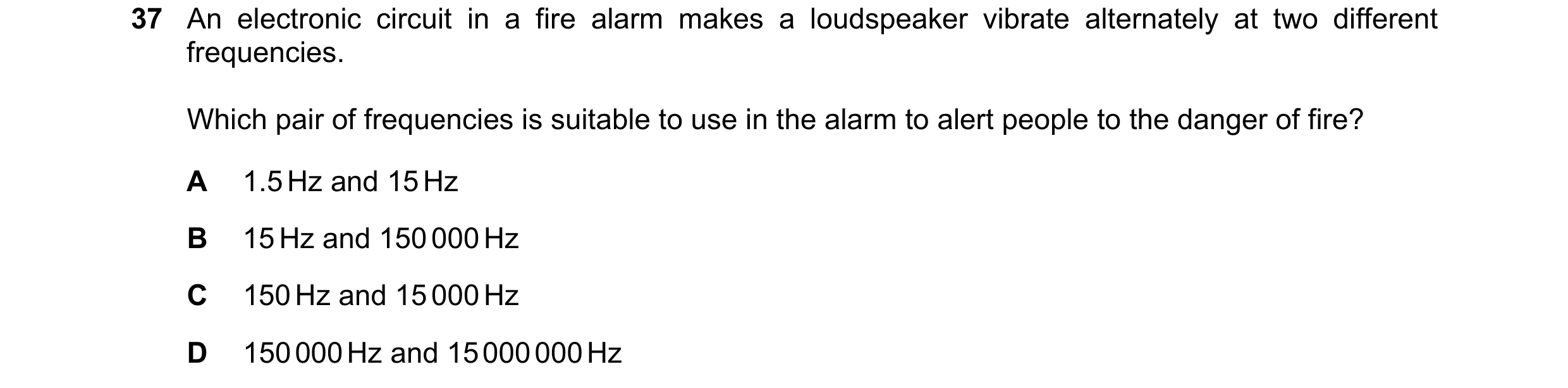
Q18 · An electronic circuit in a fire alarm makes a loudspeaker vibrate alternately at two… 0653/12 May/June 2013
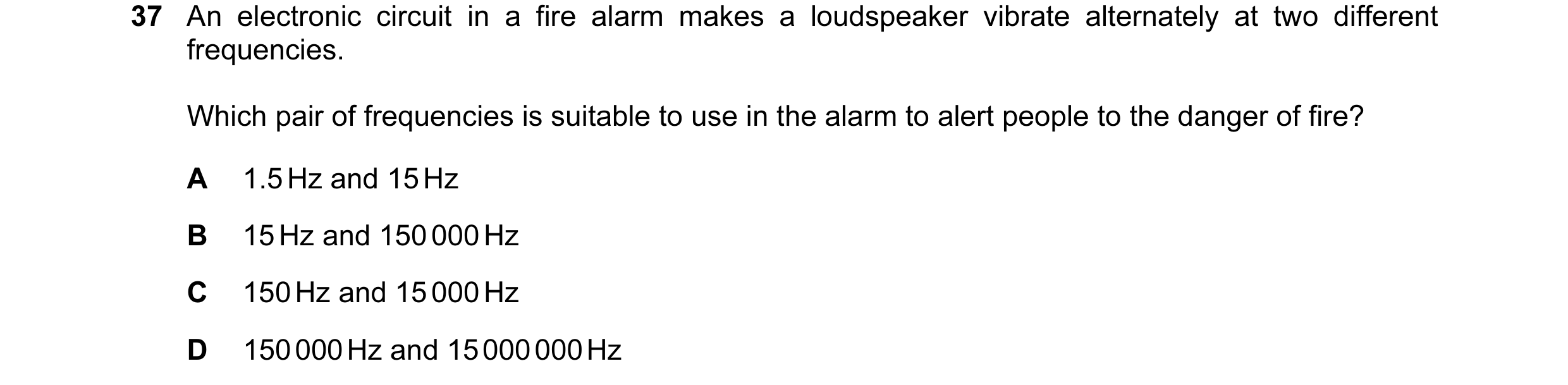
37 An electronic circuit in a fire alarm makes a loudspeaker vibrate alternately at two different frequencies. Which pair of frequencies is suitable to use in the alarm to alert people to the danger of fire? A 1.5 Hz and 15 Hz B 15 Hz and 150 000 Hz C 150 Hz and 15 000 Hz D 150 000 Hz and 15 000 000 Hz
1 marks
Answer: C
This question in 0653/12 May/June 2013
Q19 · A microphone is connected to an oscilloscope 0653/13 May/June 2013
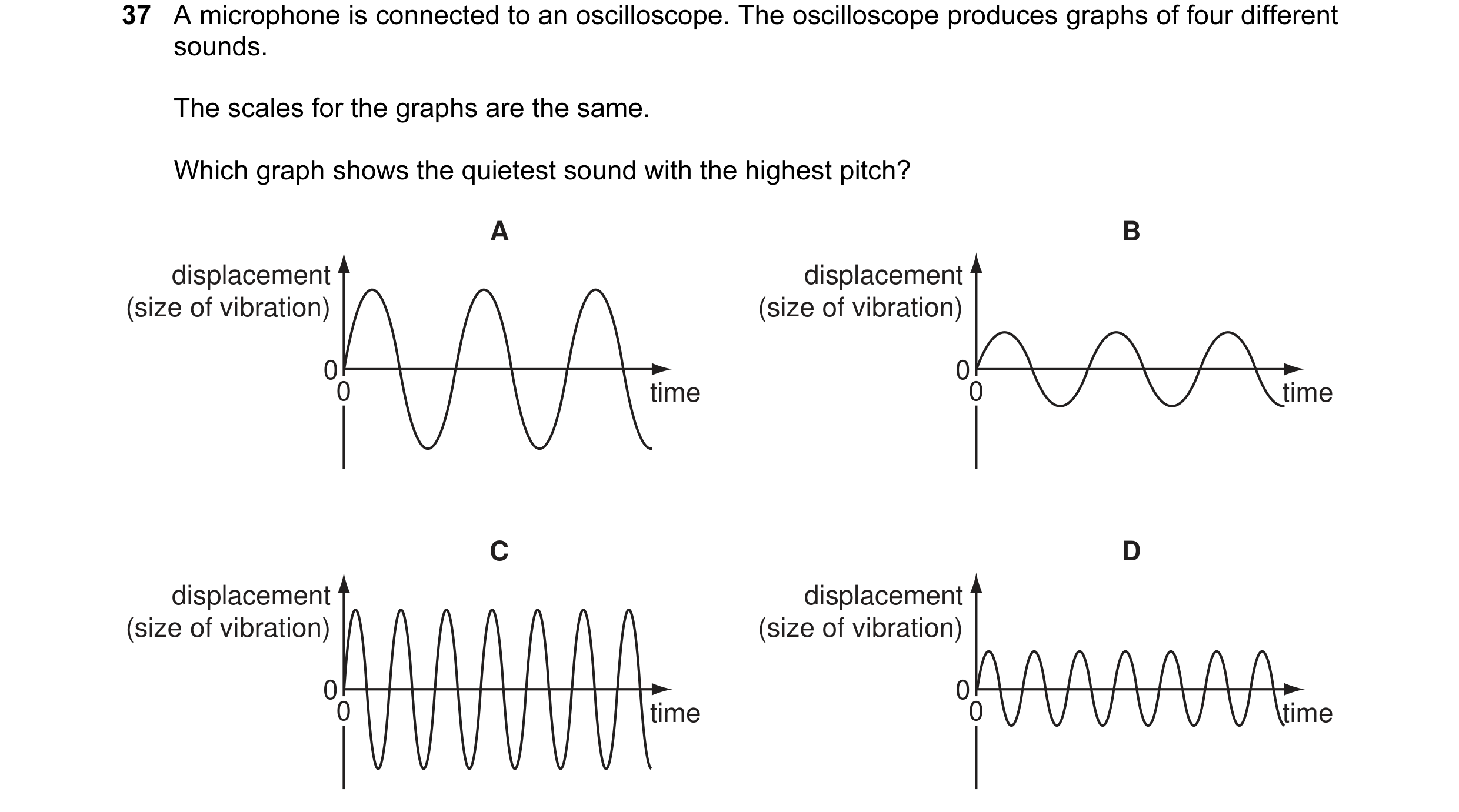
37 A microphone is connected to an oscilloscope. The oscilloscope produces graphs of four different sounds. The scales for the graphs are the same. Which graph shows the quietest sound with the highest pitch? A B displacement displacement (size of vibration) (size of vibration) 00 00 time time C D displacement displacement (size of vibration) (size of vibration) 00 00 time time
1 marks
Answer: D
This question in 0653/13 May/June 2013
Q20 · Two sound waves P and Q are displayed on an oscilloscope 0653/11 Oct/Nov 2013
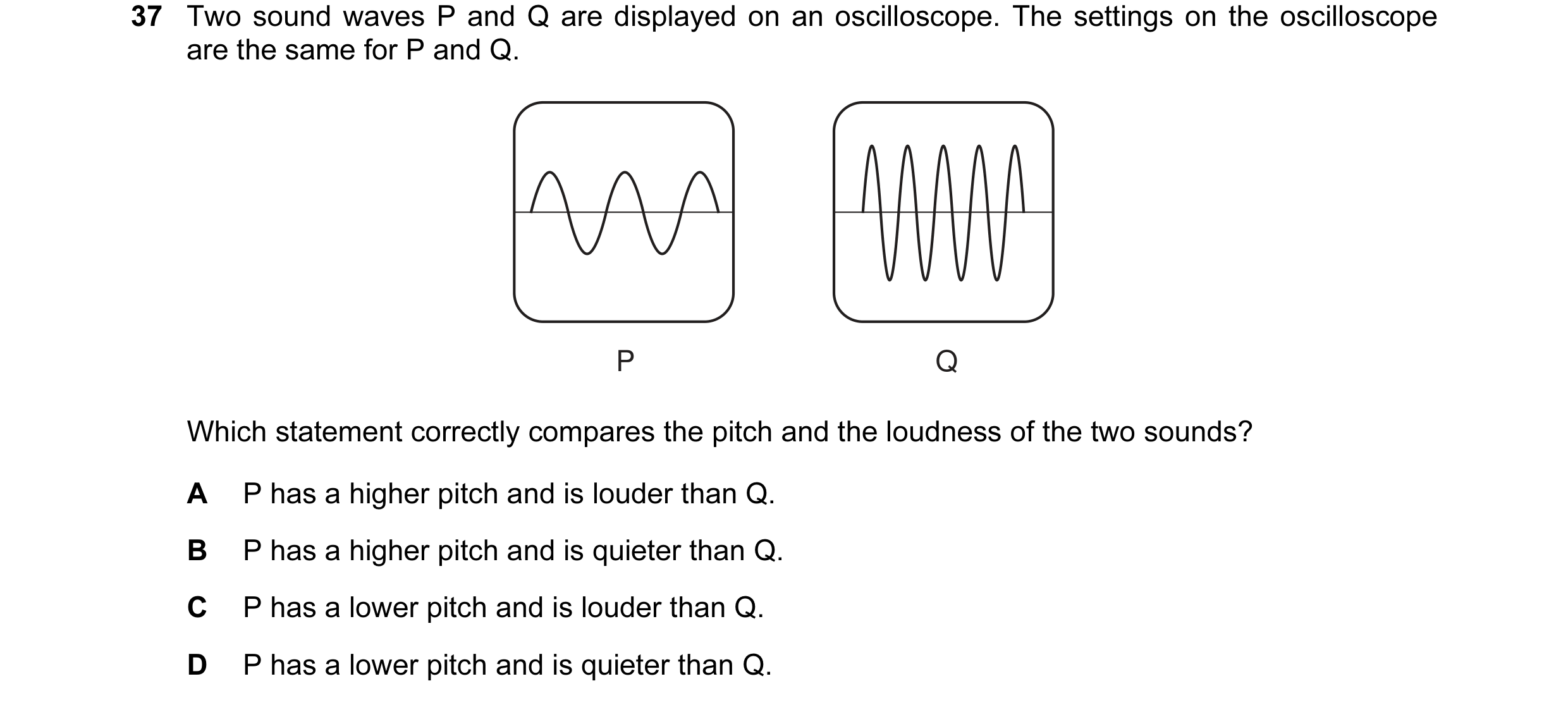
37 Two sound waves P and Q are displayed on an oscilloscope. The settings on the oscilloscope are the same for P and Q. P Q Which statement correctly compares the pitch and the loudness of the two sounds? A P has a higher pitch and is louder than Q. B P has a higher pitch and is quieter than Q. C P has a lower pitch and is louder than Q. D P has a lower pitch and is quieter than Q.
1 marks
Answer: D
This question in 0653/11 Oct/Nov 2013
Q21 · Two sound waves P and Q are displayed on an oscilloscope 0653/12 Oct/Nov 2013
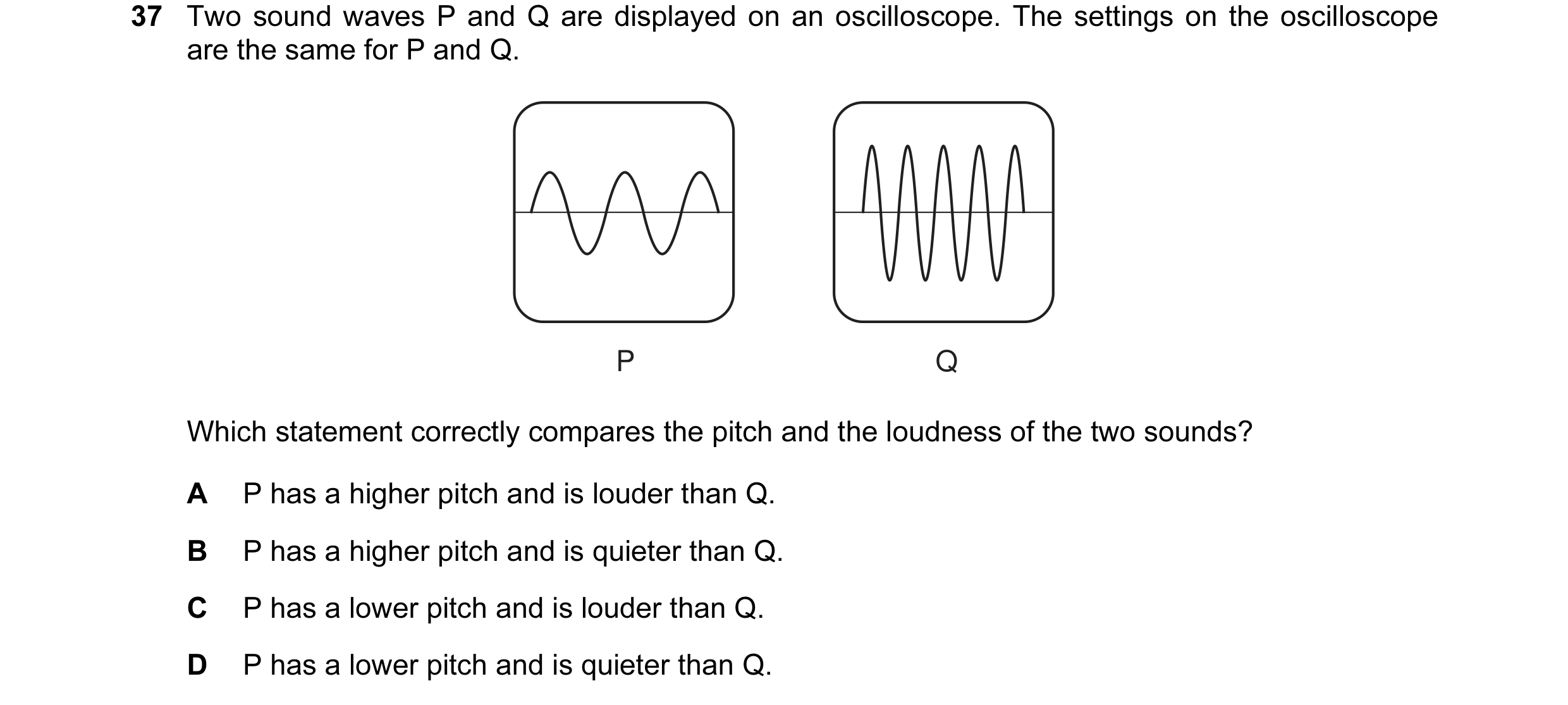
37 Two sound waves P and Q are displayed on an oscilloscope. The settings on the oscilloscope are the same for P and Q. P Q Which statement correctly compares the pitch and the loudness of the two sounds? A P has a higher pitch and is louder than Q. B P has a higher pitch and is quieter than Q. C P has a lower pitch and is louder than Q. D P has a lower pitch and is quieter than Q.
1 marks
Answer: D
This question in 0653/12 Oct/Nov 2013
Q22 · Two sound waves P and Q are displayed on an oscilloscope 0653/13 Oct/Nov 2013
37 Two sound waves P and Q are displayed on an oscilloscope. The settings on the oscilloscope are the same for P and Q. P Q Which statement correctly compares the pitch and the loudness of the two sounds? A P has a higher pitch and is louder than Q. B P has a higher pitch and is quieter than Q. C P has a lower pitch and is louder than Q. D P has a lower pitch and is quieter than Q.
1 marks
Answer: D
This question in 0653/13 Oct/Nov 2013
Q23 · A boy on an island is 500 m from some cliffs 0653/11 May/June 2014
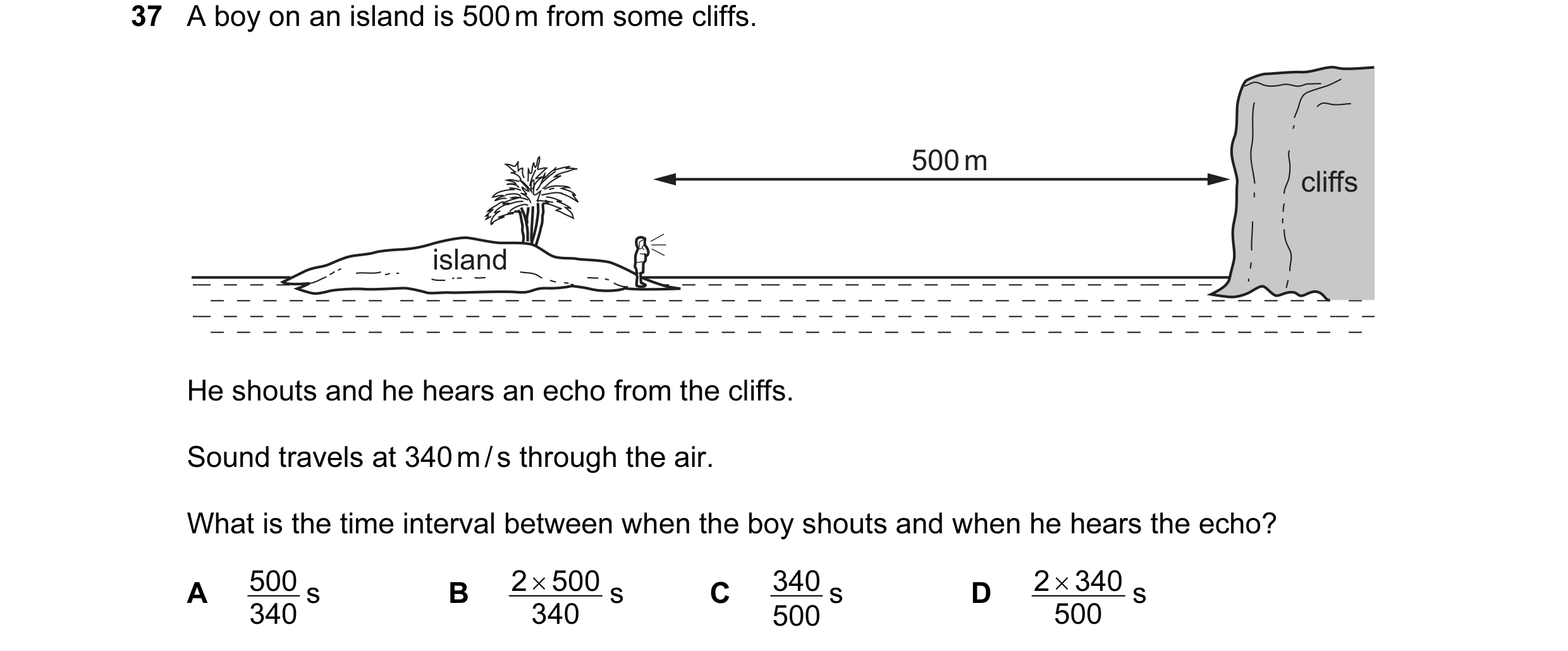
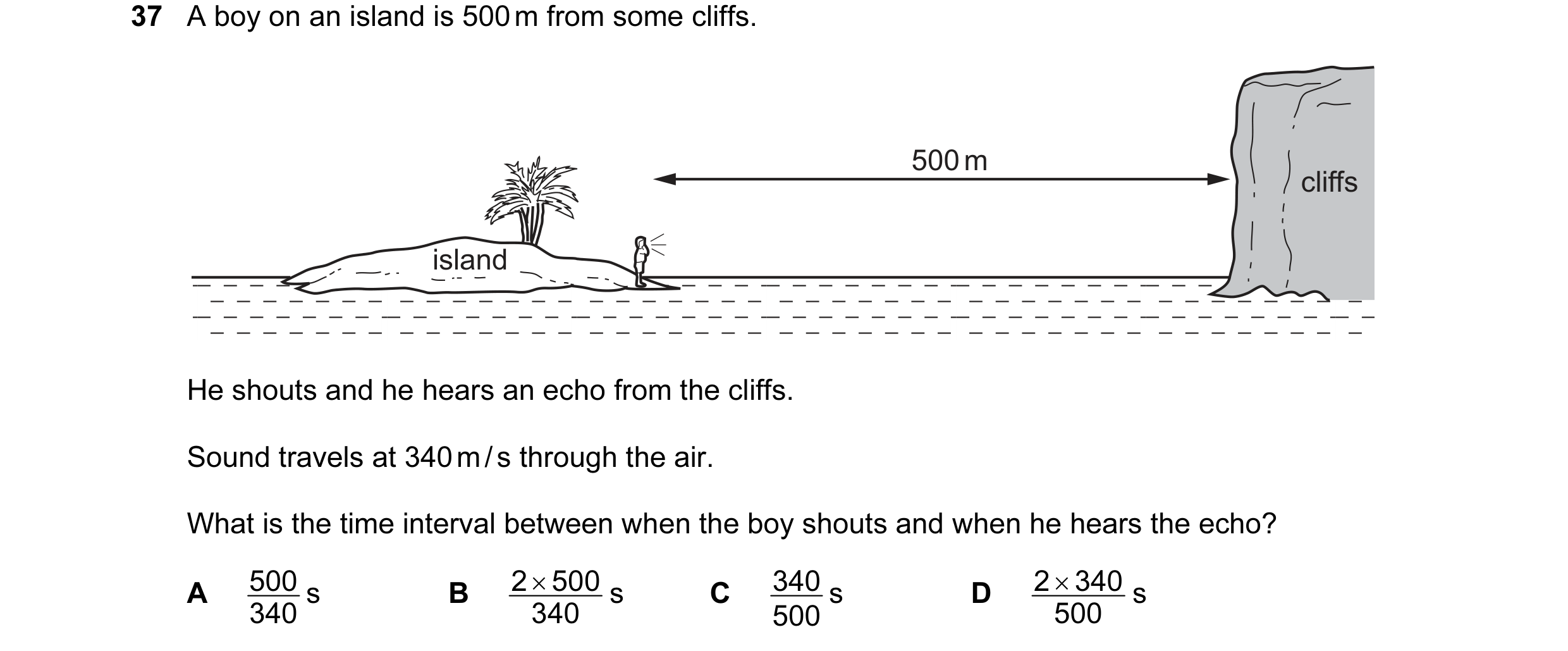
37 A boy on an island is 500 m from some cliffs. 500 m cliffs island He shouts and he hears an echo from the cliffs. Sound travels at 340 m / s through the air. What is the time interval between when the boy shouts and when he hears the echo? A 500 s B 2× 500 s C 340 s D 2× 340 s 340 340 5 00 500
1 marks
Answer: B
This question in 0653/11 May/June 2014
Q24 · A boy on an island is 500 m from some cliffs 0653/12 May/June 2014
37 A boy on an island is 500 m from some cliffs. 500 m cliffs island He shouts and he hears an echo from the cliffs. Sound travels at 340 m / s through the air. What is the time interval between when the boy shouts and when he hears the echo? A 500 s B 2× 500 s C 340 s D 2× 340 s 340 340 5 00 500
1 marks
Answer: B
This question in 0653/12 May/June 2014
Q25 · A boy on an island is 500 m from some cliffs 0653/13 May/June 2014
37 A boy on an island is 500 m from some cliffs. 500 m cliffs island He shouts and he hears an echo from the cliffs. Sound travels at 340 m / s through the air. What is the time interval between when the boy shouts and when he hears the echo? A 500 s B 2× 500 s C 340 s D 2× 340 s 340 340 5 00 500
1 marks
Answer: B
This question in 0653/13 May/June 2014
Q26 · The sound from a drum is loud and has a low pitch 0653/11 Oct/Nov 2014
37 The sound from a drum is loud and has a low pitch. Which row describes the amplitude and the frequency of the sound? amplitude frequency A large high B large low C small high D small low
1 marks
Answer: B
This question in 0653/11 Oct/Nov 2014
Q27 · The sound from a drum is loud and has a low pitch 0653/12 Oct/Nov 2014
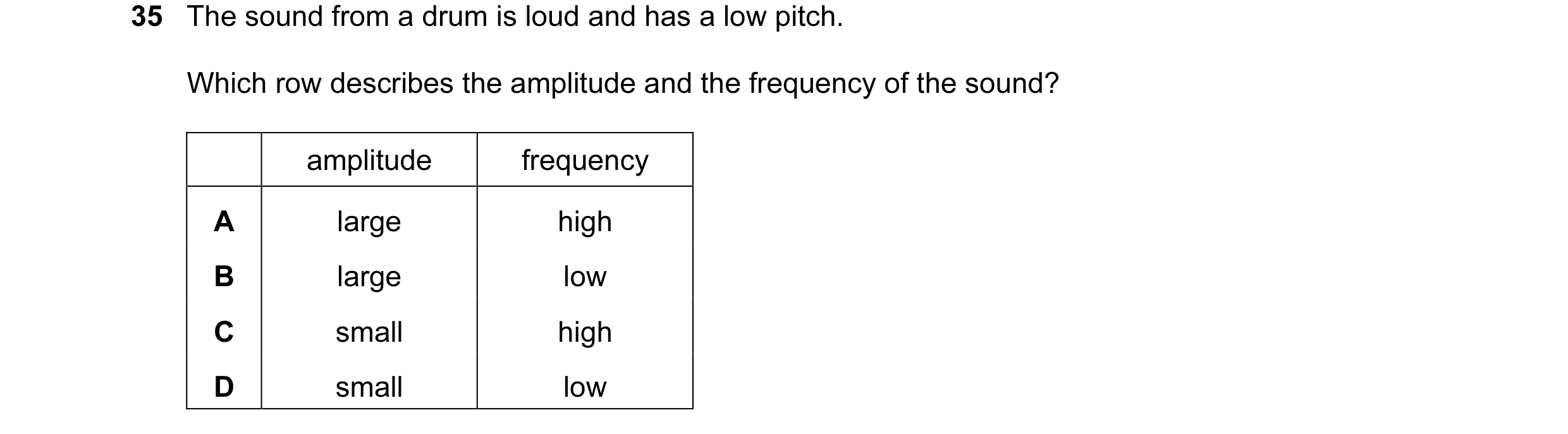
35 The sound from a drum is loud and has a low pitch. Which row describes the amplitude and the frequency of the sound? amplitude frequency A large high B large low C small high D small low
1 marks
Answer: B
This question in 0653/12 Oct/Nov 2014
Q28 · A woman hammers a post into the ground 0653/13 Oct/Nov 2014
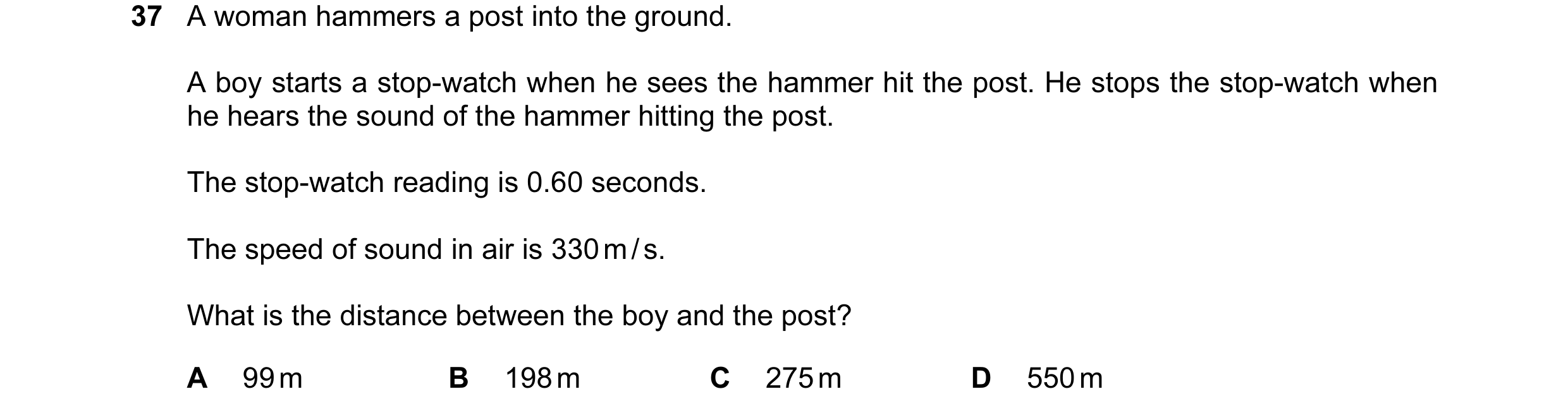
37 A woman hammers a post into the ground. A boy starts a stop-watch when he sees the hammer hit the post. He stops the stop-watch when he hears the sound of the hammer hitting the post. The stop-watch reading is 0.60 seconds. The speed of sound in air is 330 m / s. What is the distance between the boy and the post? A 99 m B 198 m C 275 m D 550 m
1 marks
Answer: B
This question in 0653/13 Oct/Nov 2014
Q29 · A loudspeaker is made to vibrate at four different frequencies 0653/11 May/June 2015
37 A loudspeaker is made to vibrate at four different frequencies. Which frequency cannot produce a sound that a human can hear? A 60 Hz B 600 Hz C 6.0 kHz D 60 kHz
1 marks
Answer: D
This question in 0653/11 May/June 2015
Q30 · A loudspeaker vibrates with different amplitudes and at different frequencies 0653/12 May/June 2015
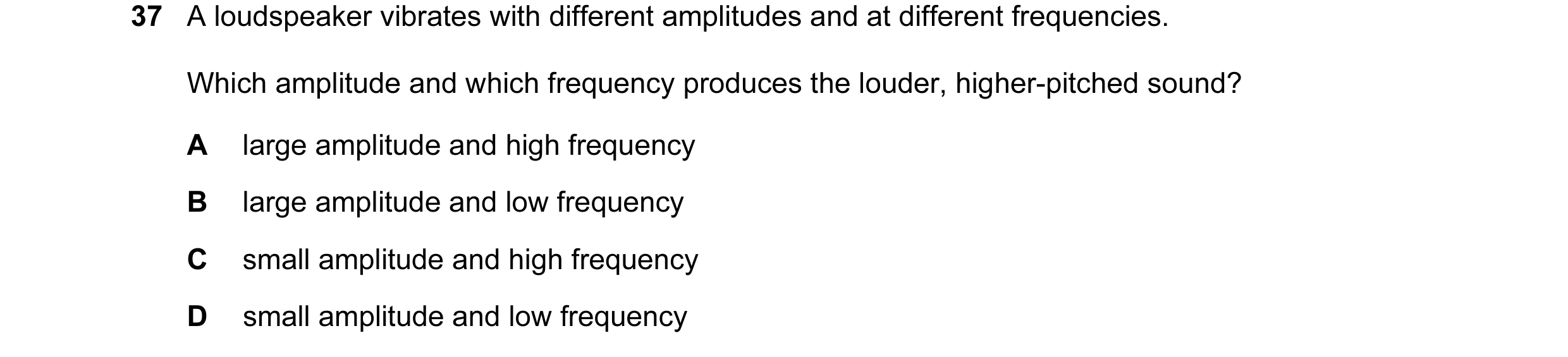
37 A loudspeaker vibrates with different amplitudes and at different frequencies. Which amplitude and which frequency produces the louder, higher-pitched sound? A large amplitude and high frequency B large amplitude and low frequency C small amplitude and high frequency D small amplitude and low frequency
1 marks
Answer: A
This question in 0653/12 May/June 2015
Q31 · A whistle produces a sound that dogs can hear 0653/13 May/June 2015
37 A whistle produces a sound that dogs can hear. It cannot be heard by humans. What is a possible frequency for the sound of the whistle? A 0.025 kHz B 0.25 kHz C 2.5 kHz D 25 kHz
1 marks
Answer: D
This question in 0653/13 May/June 2015
Q32 · A student measures the speed of sound 0653/11 Oct/Nov 2015
37 A student measures the speed of sound. He claps his hands and the sound reflects from a wall which is 100 m away from him. wall student timer 100 m An electronic timer detects the echo of the sound 0.60 s after it is made. Which calculation should the student use to determine the speed of sound? 100 m / s 100 m / s 200 m / s 200 m / s A B C D 0.60 1 . 2 0.30 0.60
1 marks
Answer: D
This question in 0653/11 Oct/Nov 2015
Q33 · A student measures the speed of sound 0653/12 Oct/Nov 2015
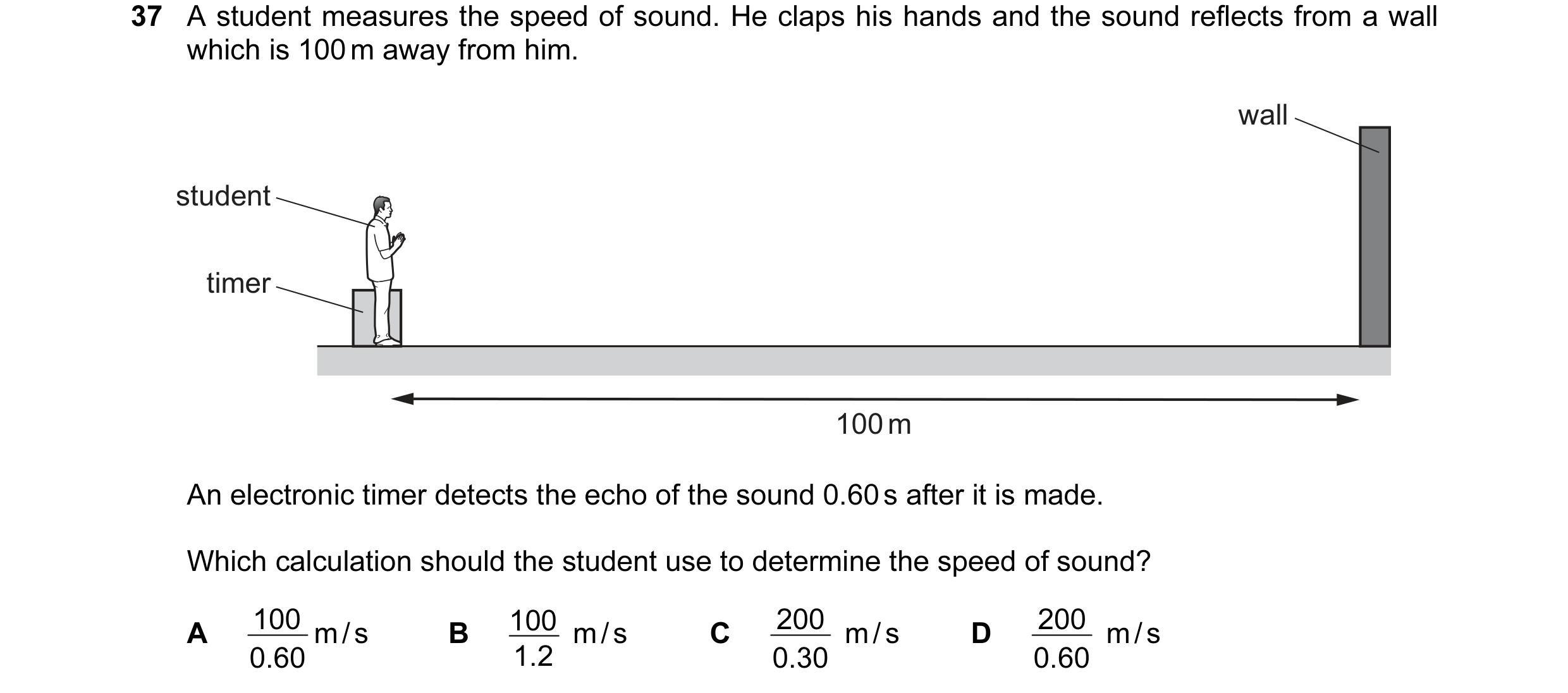
37 A student measures the speed of sound. He claps his hands and the sound reflects from a wall which is 100 m away from him. wall student timer 100 m An electronic timer detects the echo of the sound 0.60 s after it is made. Which calculation should the student use to determine the speed of sound? 100 m / s 100 m / s 200 m / s 200 m / s A B C D 0.60 1 . 2 0.30 0.60
1 marks
Answer: D
This question in 0653/12 Oct/Nov 2015
Q34 · A student measures the speed of sound 0653/13 Oct/Nov 2015
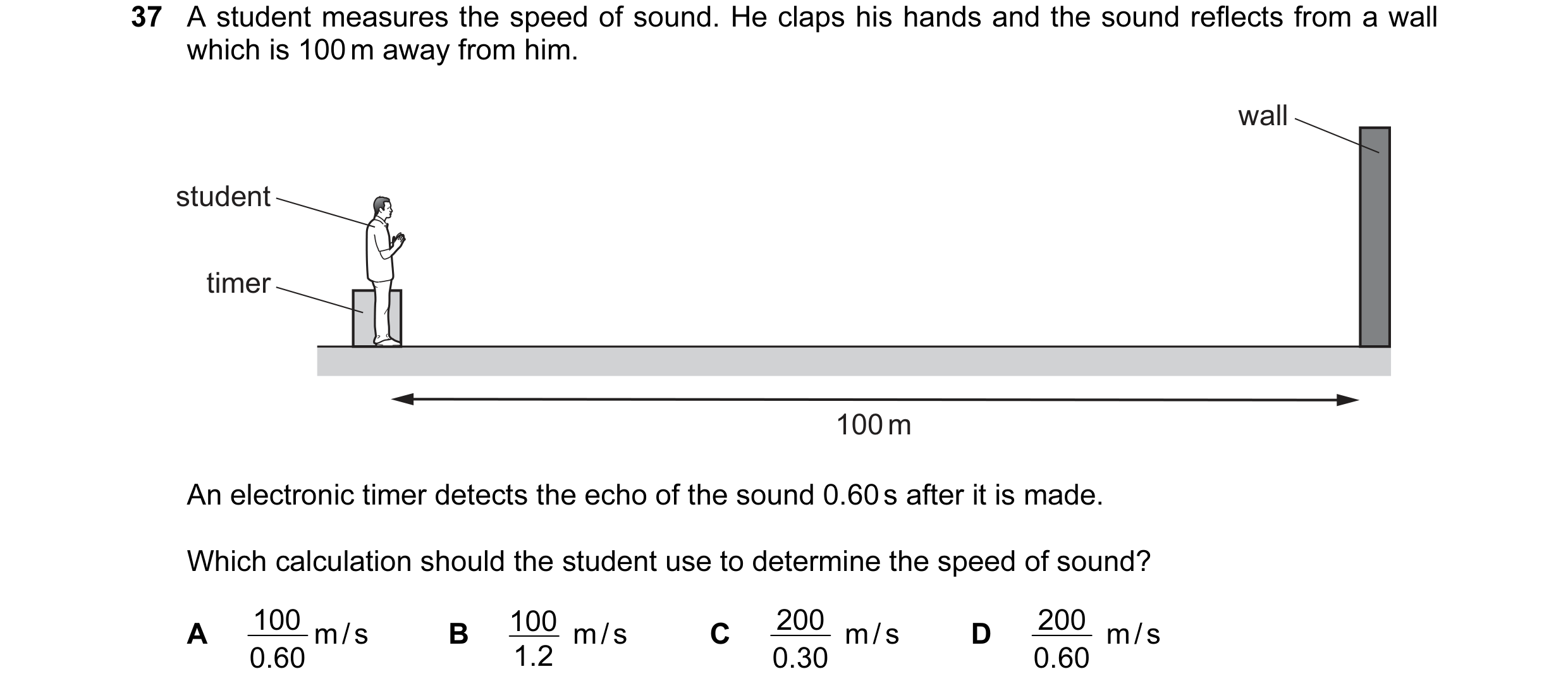
37 A student measures the speed of sound. He claps his hands and the sound reflects from a wall which is 100 m away from him. wall student timer 100 m An electronic timer detects the echo of the sound 0.60 s after it is made. Which calculation should the student use to determine the speed of sound? 100 m / s 100 m / s 200 m / s 200 m / s A B C D 0.60 1 . 2 0.30 0.60
1 marks
Answer: D
This question in 0653/13 Oct/Nov 2015
Q35 · A student determines the speed of sound in air 0653/11 May/June 2016
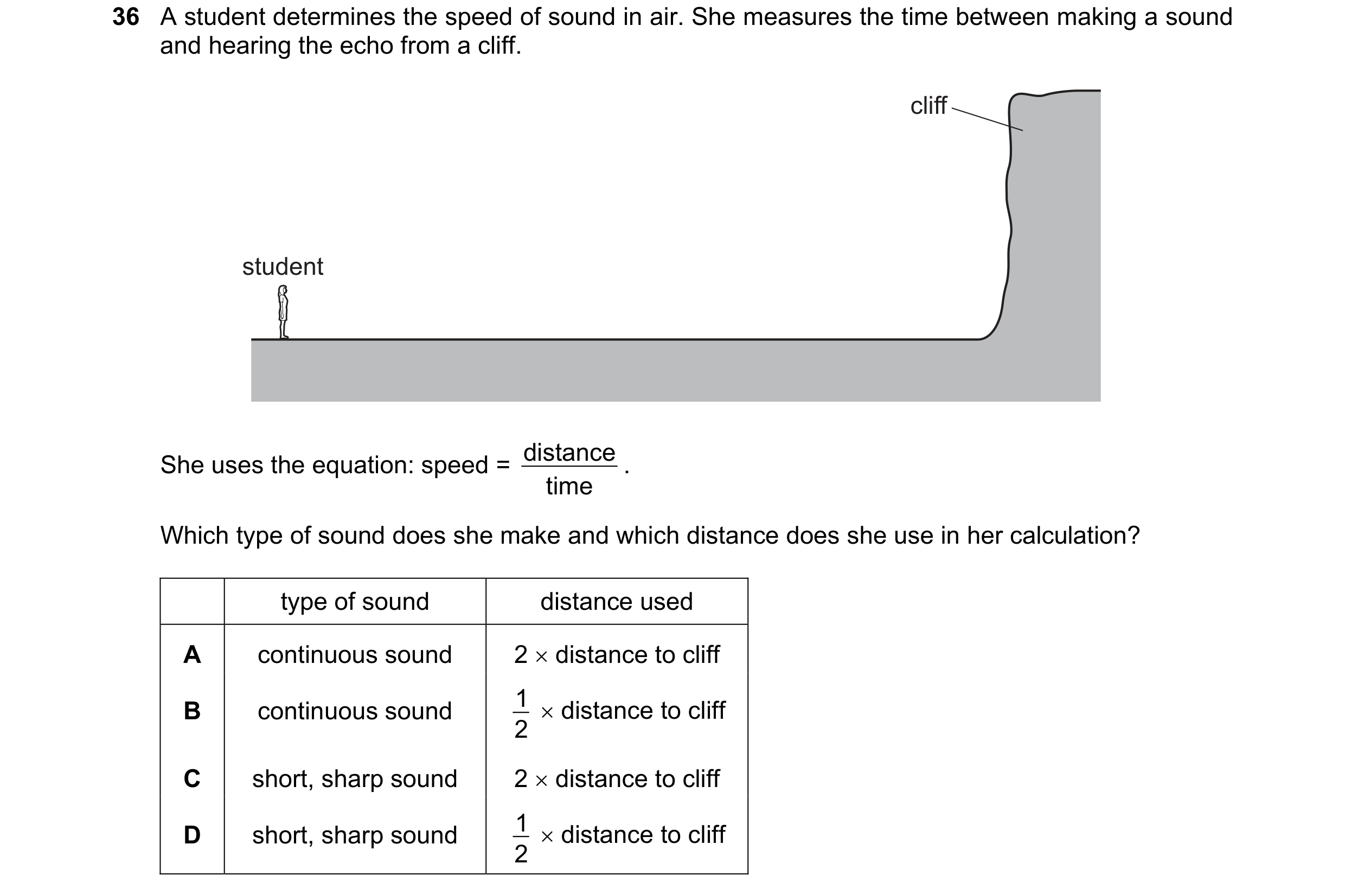
37 A student determines the speed of sound in air. She measures the time between making a sound and hearing the echo from a cliff. cliff student distance . She uses the equation: speed = time Which type of sound does she make and which distance does she use in her calculation? type of sound distance used A continuous sound 2 × distance to cliff B continuous sound 1 × distance to cliff 2 C short, sharp sound 2 × distance to cliff D short, sharp sound 1 × distance to cliff 2
1 marks
Answer: C
This question in 0653/11 May/June 2016
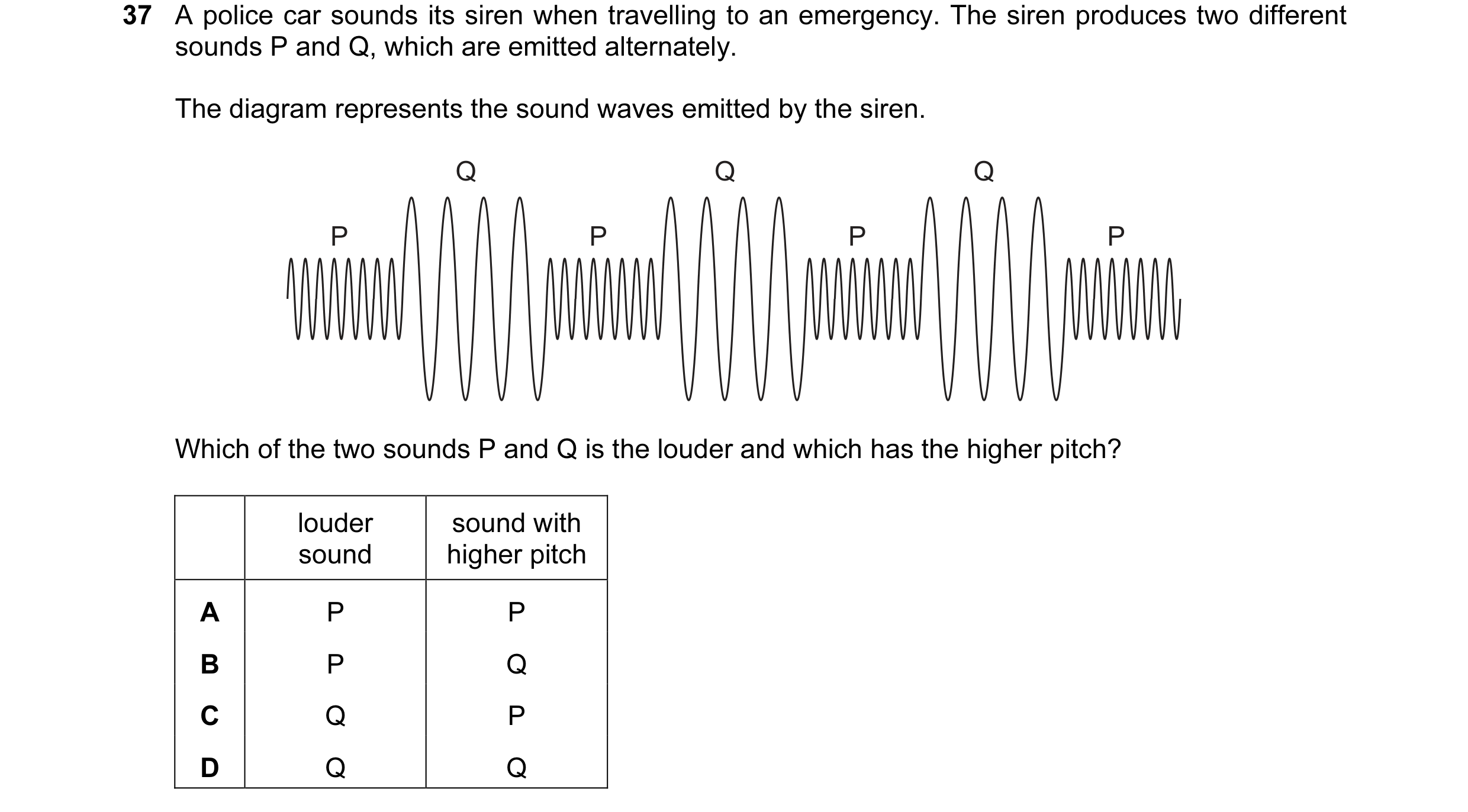
Q36 · A police car sounds its siren when travelling to an emergency 0653/12 May/June 2016
37 A police car sounds its siren when travelling to an emergency. The siren produces two different sounds P and Q, which are emitted alternately. The diagram represents the sound waves emitted by the siren. Q Q Q P P P P Which of the two sounds P and Q is the louder and which has the higher pitch? louder sound with sound higher pitch A P P B P Q C Q P D Q Q
1 marks
Answer: C
This question in 0653/12 May/June 2016
Q37 · A boy stands 132 metres in front of a vertical cliff 0653/13 May/June 2016
37 A boy stands 132 metres in front of a vertical cliff. He claps his hands and then hears an echo from the cliff. The speed of sound in air is 330 m / s. What is the time between the boy clapping his hands and hearing the echo? A 0.40 s B 0.80 s C 1.25 s D 2.50 s
1 marks
Answer: B
This question in 0653/13 May/June 2016
Q38 · A sound wave has a frequency of 250 Hz in air 0653/11 Oct/Nov 2016
37 A sound wave has a frequency of 250 Hz in air. A second sound wave has a frequency of 500 Hz in air. Both sound waves have the same amplitude. How does the second sound wave compare with the first? A It is louder. B It has a greater speed. C It has a higher pitch. D It has a larger wavelength.
1 marks
Answer: C
This question in 0653/11 Oct/Nov 2016
Q39 · A fire alarm is not loud enough 0653/12 Oct/Nov 2016
37 A fire alarm is not loud enough. An engineer adjusts it so that it produces a note of the same pitch which is louder. What effect does this have on the amplitude and on the frequency of the sound waves from the alarm? amplitude frequency A larger larger B larger unchanged C unchanged larger D unchanged unchanged
1 marks
Answer: B
This question in 0653/12 Oct/Nov 2016
Q40 · Which change makes the pitch of a sound lower? 0653/13 Oct/Nov 2016
37 Which change makes the pitch of a sound lower? A decreasing its amplitude B decreasing its frequency C increasing its amplitude D increasing its frequency
1 marks
Answer: B
This question in 0653/13 Oct/Nov 2016
Q41 · Four loudspeakers each vibrate at the frequencies shown 0653/12 Feb/March 2017
37 Four loudspeakers each vibrate at the frequencies shown. Which loudspeaker produces the lowest-pitched sound that can be heard by a human? A 5.0 Hz B 10 Hz C 5.0 × 10³ Hz D 10 × 103 Hz
1 marks
Answer: C
This question in 0653/12 Feb/March 2017
Q42 · An electronic circuit in a fire alarm makes a loudspeaker vibrate alternately at two… 0653/11 May/June 2017
37 An electronic circuit in a fire alarm makes a loudspeaker vibrate alternately at two different frequencies. Which pair of frequencies is suitable to use in the alarm to alert people to the danger of fire? A 1.5 Hz and 15 Hz B 15 Hz and 150 000 Hz C 150 Hz and 15 000 Hz D 150 000 Hz and 15 000 000 Hz
1 marks
Answer: C
This question in 0653/11 May/June 2017
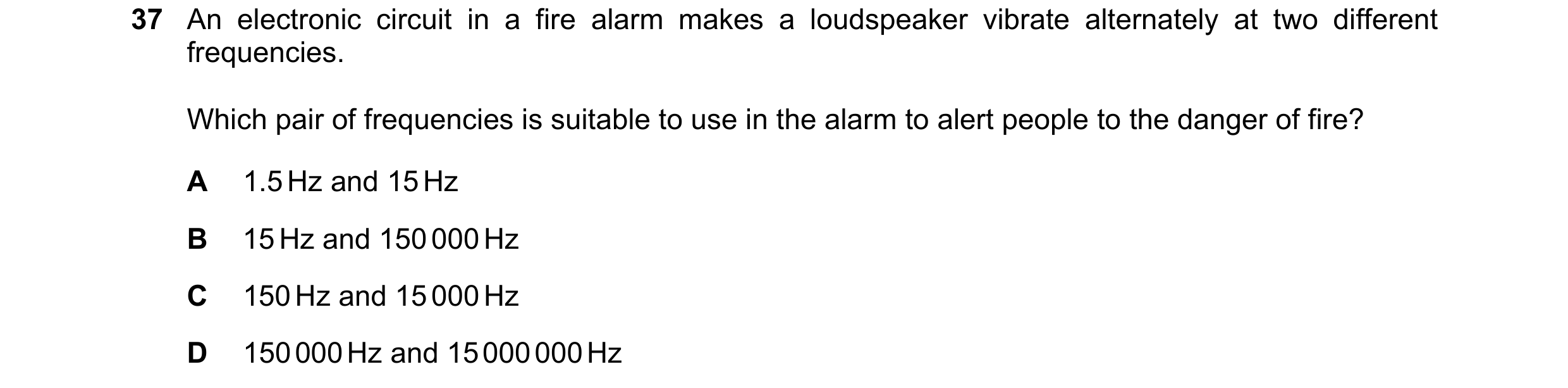
Q43 · An electronic circuit in a fire alarm makes a loudspeaker vibrate alternately at two… 0653/12 May/June 2017
37 An electronic circuit in a fire alarm makes a loudspeaker vibrate alternately at two different frequencies. Which pair of frequencies is suitable to use in the alarm to alert people to the danger of fire? A 1.5 Hz and 15 Hz B 15 Hz and 150 000 Hz C 150 Hz and 15 000 Hz D 150 000 Hz and 15 000 000 Hz
1 marks
Answer: C
This question in 0653/12 May/June 2017
Q44 · An electronic circuit in a fire alarm makes a loudspeaker vibrate alternately at two… 0653/13 May/June 2017
37 An electronic circuit in a fire alarm makes a loudspeaker vibrate alternately at two different frequencies. Which pair of frequencies is suitable to use in the alarm to alert people to the danger of fire? A 1.5 Hz and 15 Hz B 15 Hz and 150 000 Hz C 150 Hz and 15 000 Hz D 150 000 Hz and 15 000 000 Hz
1 marks
Answer: C
This question in 0653/13 May/June 2017
Q45 · A man stands 1.20 km away from a cliff 0653/12 Oct/Nov 2017
37 A man stands 1.20 km away from a cliff. The man fires a gun. A timer starts as the gun is fired. The timer stops when it detects the echo of the sound of the gun from the cliff. The time shown on the timer is 7.50 s. What value does this give for the speed of sound in air? A 160 m / s B 320 m / s C 330 m / s D 640 m / s
1 marks
Answer: B
This question in 0653/12 Oct/Nov 2017
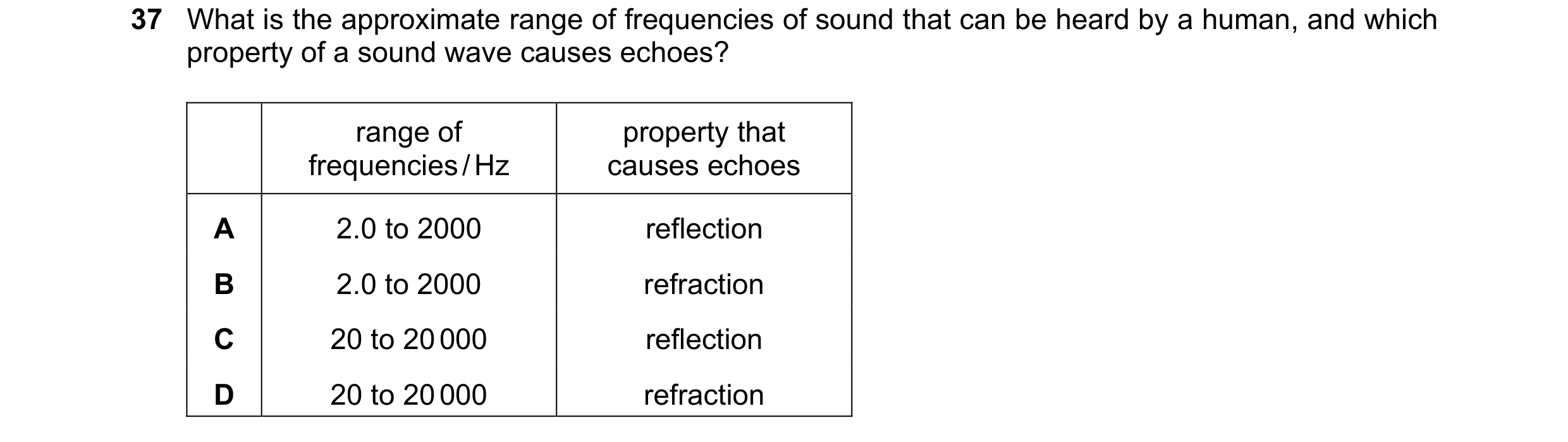
Q46 · What is the approximate range of frequencies of sound that can be heard by a human, and… 0653/13 Oct/Nov 2017
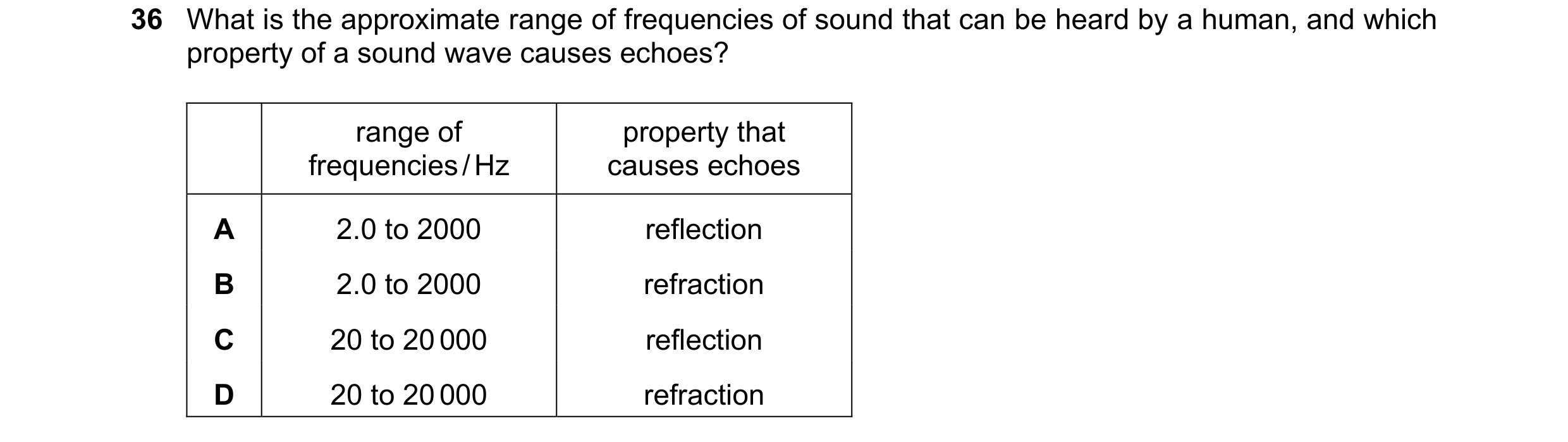
37 What is the approximate range of frequencies of sound that can be heard by a human, and which property of a sound wave causes echoes? range of property that frequencies / Hz causes echoes A 2.0 to 2000 reflection B 2.0 to 2000 refraction C 20 to 20 000 reflection D 20 to 20 000 refraction
1 marks
Answer: C
This question in 0653/13 Oct/Nov 2017
Q47 · A boy on an island is 500 m from some cliffs 0653/12 Feb/March 2018
37 A boy on an island is 500 m from some cliffs. 500 m cliffs island He shouts and he hears an echo from the cliffs. Sound travels at 340 m / s through the air. What is the time interval between when the boy shouts and when he hears the echo? 500 s 2× 500 340 s 2× 340 A B s C D s 340 340 5 00 500
1 marks
Answer: B
This question in 0653/12 Feb/March 2018
Q48 · Which waves are not electromagnetic waves? 0653/11 May/June 2018
36 Which waves are not electromagnetic waves? A gamma B infra-red C light D sound
1 marks
Answer: D
This question in 0653/11 May/June 2018
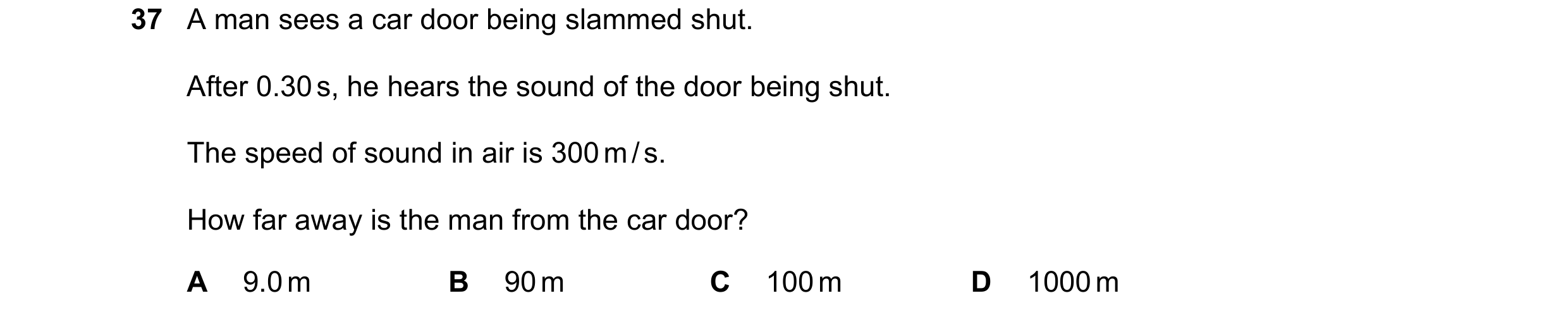
Q49 · A man sees a car door being slammed shut 0653/11 May/June 2018
37 A man sees a car door being slammed shut. After 0.30 s, he hears the sound of the door being shut. The speed of sound in air is 300 m / s. How far away is the man from the car door? A 9.0 m B 90 m C 100 m D 1000 m
1 marks
Answer: B
This question in 0653/11 May/June 2018
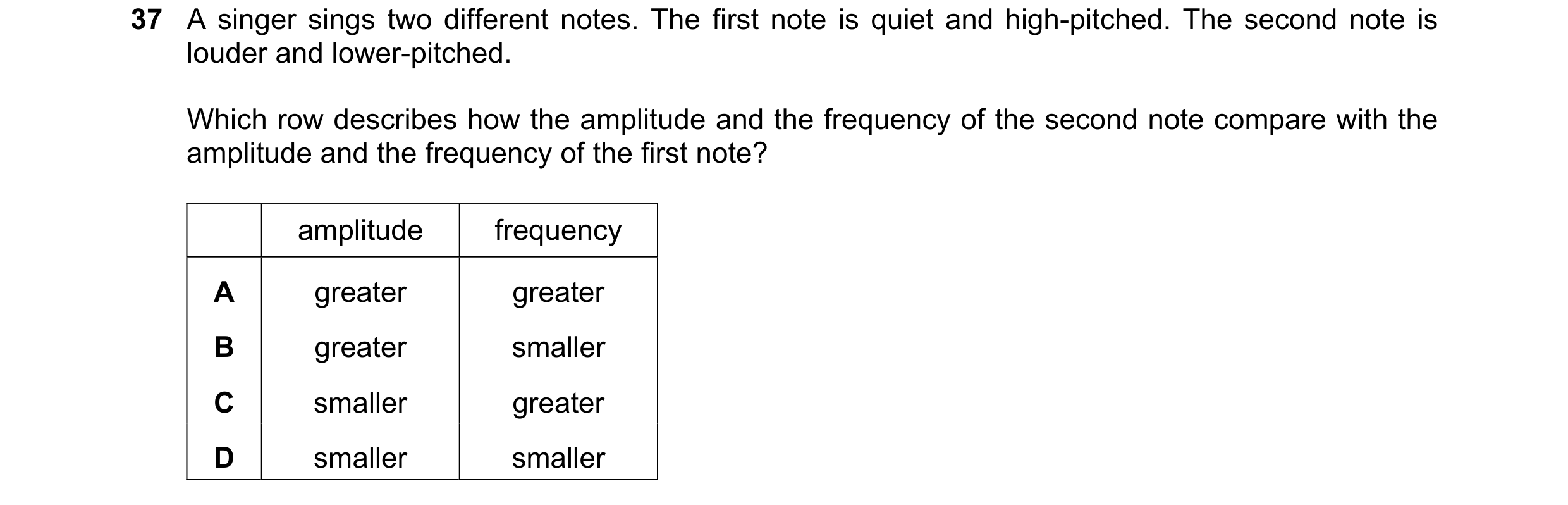
Q50 · A singer sings two different notes 0653/12 May/June 2018
37 A singer sings two different notes. The first note is quiet and high-pitched. The second note is louder and lower-pitched. Which row describes how the amplitude and the frequency of the second note compare with the amplitude and the frequency of the first note? amplitude frequency A greater greater B greater smaller C smaller greater D smaller smaller
1 marks
Answer: B
This question in 0653/12 May/June 2018
Q51 · A singer sings two different notes 0653/13 May/June 2018
37 A singer sings two different notes. The first note is quiet and high-pitched. The second note is louder and lower-pitched. Which row describes how the amplitude and the frequency of the second note compare with the amplitude and the frequency of the first note? amplitude frequency A greater greater B greater smaller C smaller greater D smaller smaller
1 marks
Answer: B
This question in 0653/13 May/June 2018
Q52 · The diagrams represent four different sound waves 0653/11 Oct/Nov 2018
37 The diagrams represent four different sound waves. The scales are the same in all the diagrams. Which sound has the lowest pitch? A B time time C D time time
1 marks
Answer: B
This question in 0653/11 Oct/Nov 2018
Q53 · The diagrams represent four different sound waves 0653/12 Oct/Nov 2018
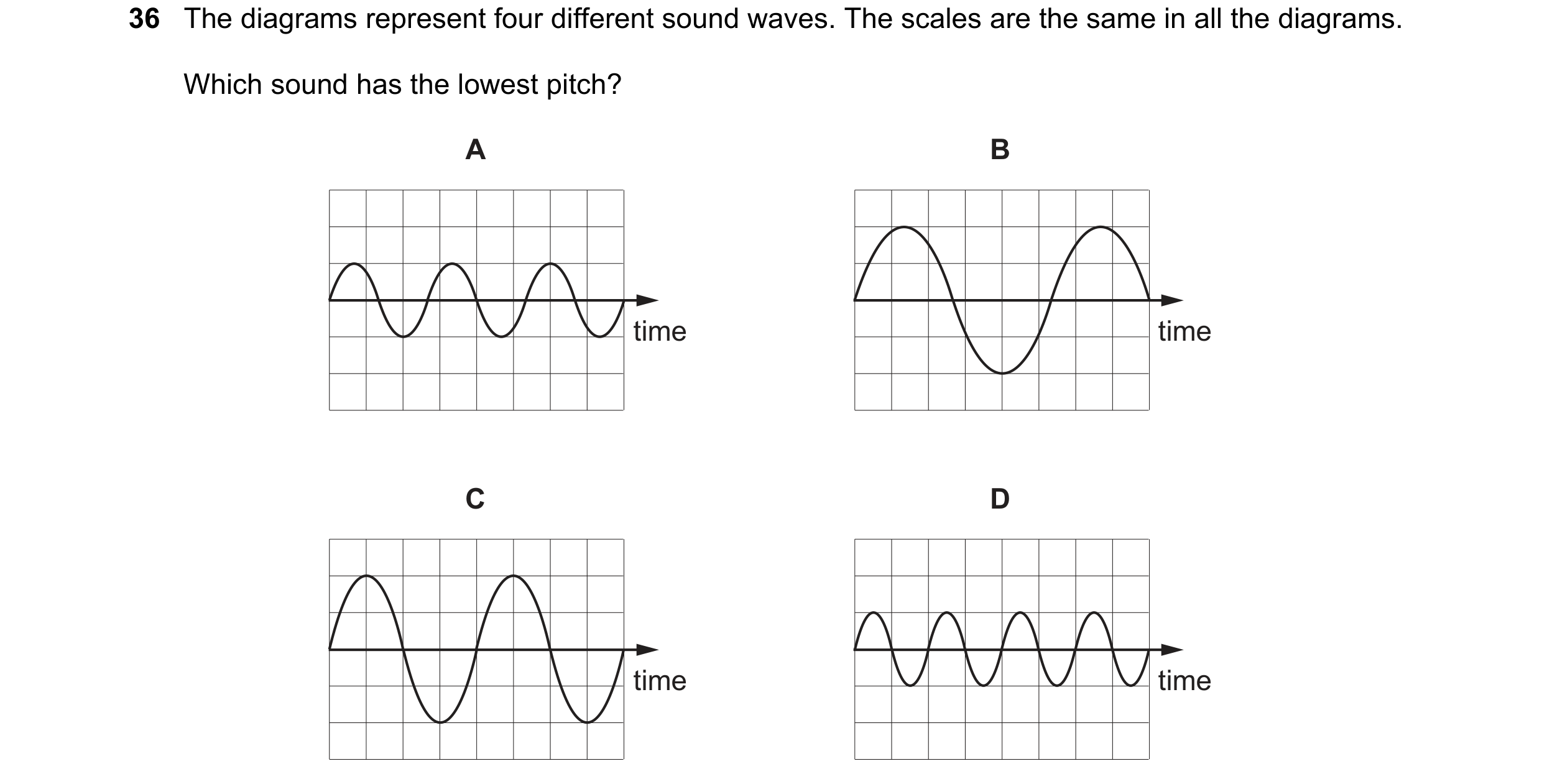
36 The diagrams represent four different sound waves. The scales are the same in all the diagrams. Which sound has the lowest pitch? A B time time C D time time
1 marks
Answer: B
This question in 0653/12 Oct/Nov 2018
Q54 · The diagrams represent four different sound waves 0653/13 Oct/Nov 2018
37 The diagrams represent four different sound waves. The scales are the same in all the diagrams. Which sound has the lowest pitch? A B time time C D time time
1 marks
Answer: B
This question in 0653/13 Oct/Nov 2018
Q55 · Which is not part of the electromagnetic spectrum? 0653/12 Feb/March 2019
34 Which is not part of the electromagnetic spectrum? A gamma radiation B microwaves C radio waves D sound waves
1 marks
Answer: D
This question in 0653/12 Feb/March 2019
Q56 · A girl stands 187 m from a tall building and shouts 0653/12 Feb/March 2019
35 A girl stands 187 m from a tall building and shouts. She hears the echo of the sound 1.1 s later. Using this information, what is the speed of sound in air? A 85 m / s B 170 m / s C 330 m / s D 340 m / s
1 marks
Answer: D
This question in 0653/12 Feb/March 2019
Q57 · The amplitude of a sound wave decreases and its frequency increases 0653/11 May/June 2019
37 The amplitude of a sound wave decreases and its frequency increases. What happens to the sound heard? A It becomes louder and its pitch becomes higher. B It becomes louder and its pitch becomes lower. C It becomes quieter and its pitch becomes higher. D It becomes quieter and its pitch becomes lower.
1 marks
Answer: C
This question in 0653/11 May/June 2019
Q58 · Three loudspeakers vibrate at different frequencies of 5 hertz, 15 kilohertz and 50… 0653/13 May/June 2019
37 Three loudspeakers vibrate at different frequencies of 5 hertz, 15 kilohertz and 50 kilohertz. Which row shows whether the vibrations from each loudspeaker can be heard by a healthy human ear? 5 hertz 15 kilohertz 50 kilohertz A no no no B no yes no C yes no yes D yes yes yes
1 marks
Answer: B
This question in 0653/13 May/June 2019
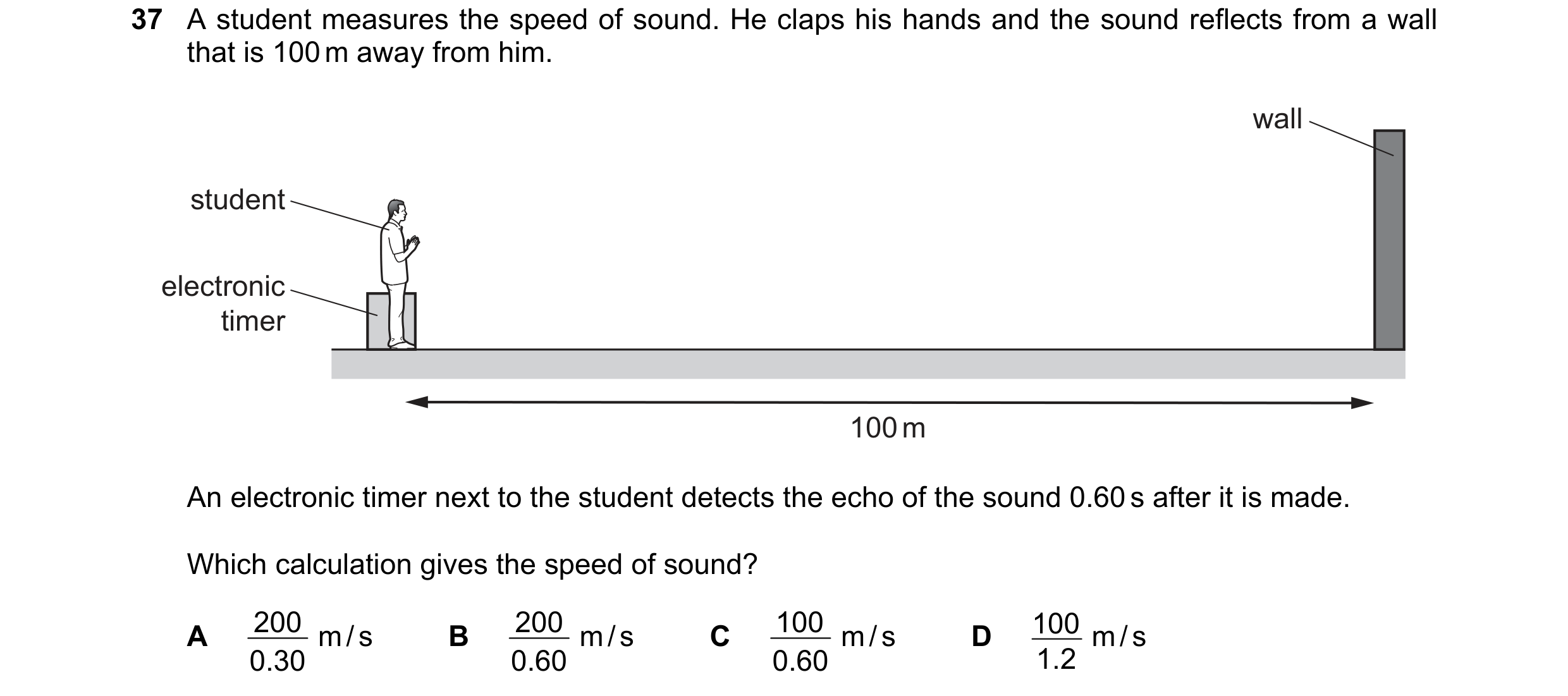
Q59 · A student measures the speed of sound 0653/11 Oct/Nov 2019
37 A student measures the speed of sound. He claps his hands and the sound reflects from a wall that is 100 m away from him. wall student electronic timer 100 m An electronic timer next to the student detects the echo of the sound 0.60 s after it is made. Which calculation gives the speed of sound? 200 200 100 100 A m / s B m / s C m / s D m / s 0.30 0.60 0.60 1 . 2
1 marks
Answer: B
This question in 0653/11 Oct/Nov 2019
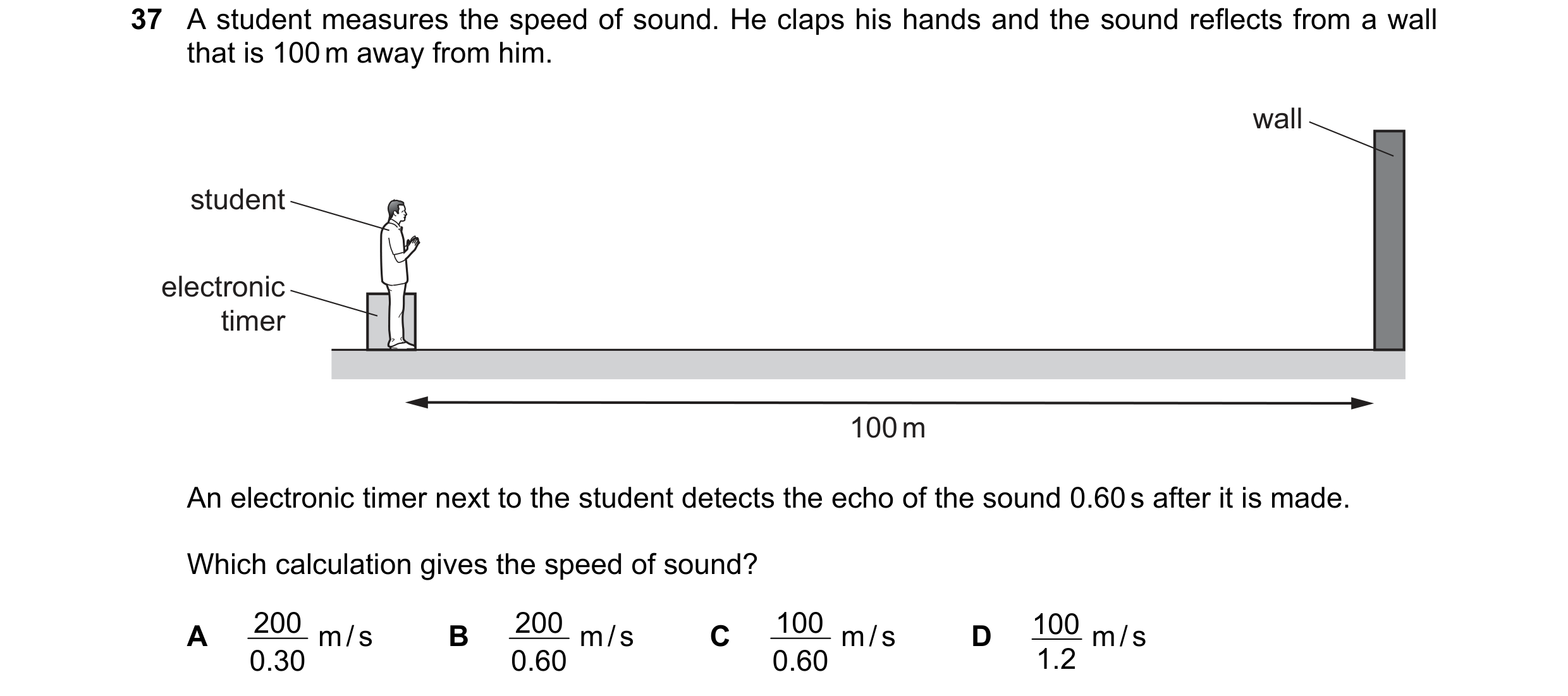
Q60 · A student measures the speed of sound 0653/12 Oct/Nov 2019
37 A student measures the speed of sound. He claps his hands and the sound reflects from a wall that is 100 m away from him. wall student electronic timer 100 m An electronic timer next to the student detects the echo of the sound 0.60 s after it is made. Which calculation gives the speed of sound? 200 200 100 100 A m / s B m / s C m / s D m / s 0.30 0.60 0.60 1 . 2
1 marks
Answer: B
This question in 0653/12 Oct/Nov 2019
Q61 · A student measures the speed of sound 0653/13 Oct/Nov 2019
37 A student measures the speed of sound. He claps his hands and the sound reflects from a wall that is 100 m away from him. wall student electronic timer 100 m An electronic timer next to the student detects the echo of the sound 0.60 s after it is made. Which calculation gives the speed of sound? 200 200 100 100 A m / s B m / s C m / s D m / s 0.30 0.60 0.60 1 . 2
1 marks
Answer: B
This question in 0653/13 Oct/Nov 2019
Q62 · A student determines the speed of sound in air 0653/12 Feb/March 2020
36 A student determines the speed of sound in air. She measures the time between making a sound and hearing the echo from a cliff. cliff student distance . She uses the equation: speed = time Which type of sound does she make and which distance does she use in her calculation? type of sound distance used A continuous sound 2 × distance to cliff 2 × distance to cliff 1 B continuous sound C short, sharp sound 2 × distance to cliff 2 × distance to cliff 1 D short, sharp sound
1 marks
Answer: C
This question in 0653/12 Feb/March 2020
Q63 · The sound from a drum is loud and has a low pitch 0653/11 May/June 2020
36 The sound from a drum is loud and has a low pitch. Which row describes the amplitude and the frequency of the sound wave? amplitude frequency A large high B large low C small high D small low
1 marks
Answer: B
This question in 0653/11 May/June 2020
Q64 · Which is not able to transmit sound waves? 0653/12 Oct/Nov 2020
36 Which is not able to transmit sound waves? A a gas B a liquid C a solid D a vacuum
1 marks
Answer: D
This question in 0653/12 Oct/Nov 2020
Q65 · Two sounds with the same frequency are produced by a loudspeaker 0653/13 Oct/Nov 2020
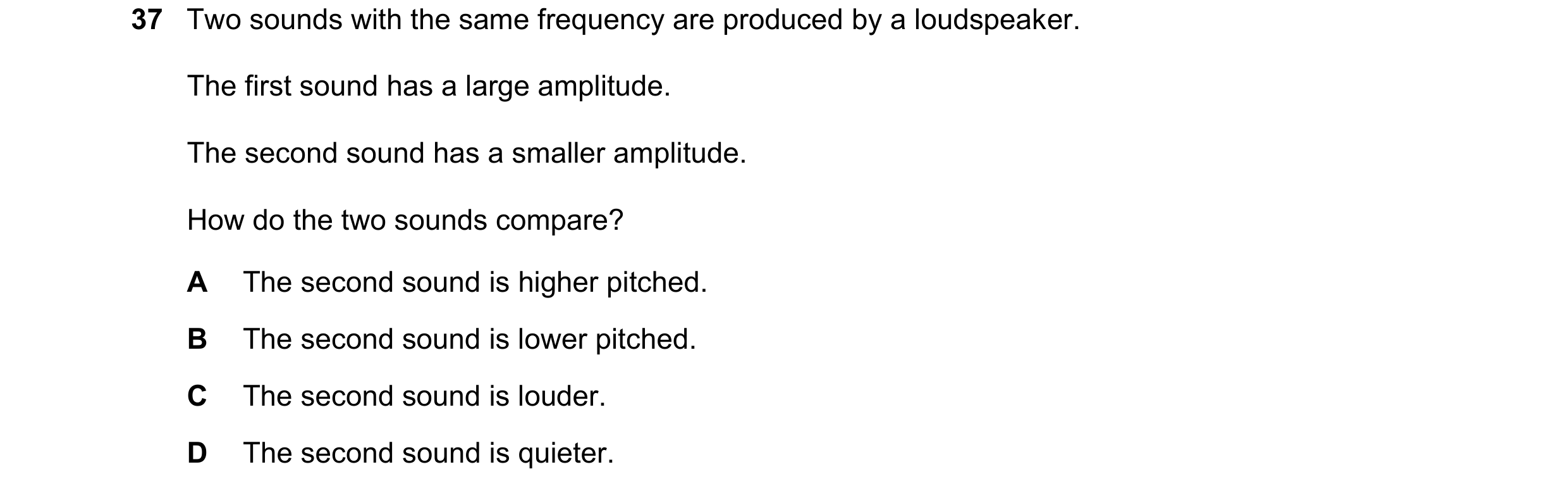
37 Two sounds with the same frequency are produced by a loudspeaker. The first sound has a large amplitude. The second sound has a smaller amplitude. How do the two sounds compare? A The second sound is higher pitched. B The second sound is lower pitched. C The second sound is louder. D The second sound is quieter.
1 marks
Answer: D
This question in 0653/13 Oct/Nov 2020
Q66 · What is the approximate range of frequencies of sound that can be heard by a human, and… 0653/12 Feb/March 2021
36 What is the approximate range of frequencies of sound that can be heard by a human, and which property of a sound wave causes echoes? range of property that frequencies / Hz causes echoes A 2.0 to 2000 reflection B 2.0 to 2000 refraction C 20 to 20 000 reflection D 20 to 20 000 refraction
1 marks
Answer: C
This question in 0653/12 Feb/March 2021
Q67 · An astronaut wearing a spacesuit is outside a space station in the vacuum of space 0653/11 Oct/Nov 2021
36 An astronaut wearing a spacesuit is outside a space station in the vacuum of space. A second astronaut inside the space station makes a knocking sound against the metal walls of the space station. Why can the astronaut outside the space station not hear this sound? A Sound cannot travel through the air inside the space station. B Sound cannot travel through the metal walls of the space station. C Sound cannot travel through the spacesuit of the astronaut. D Sound cannot travel through the vacuum outside the space station.
1 marks
Answer: D
This question in 0653/11 Oct/Nov 2021
Q68 · Sound of which frequencies can be heard by a healthy human ear? 0653/12 Feb/March 2022
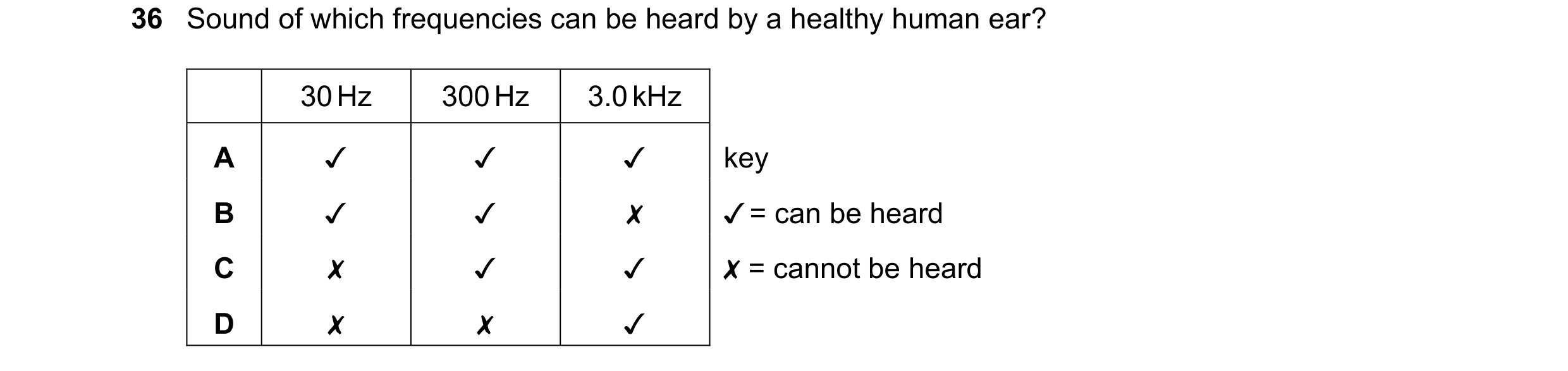
36 Sound of which frequencies can be heard by a healthy human ear?
key
/ = can be heard
X = cannot be heard
1 marks
Answer: A
This question in 0653/12 Feb/March 2022
Q69 · A student investigating the speed of sound stands at a distance of 50 m from a wall 0653/12 May/June 2022
36 A student investigating the speed of sound stands at a distance of 50 m from a wall. The student makes a short, sharp sound and then hears an echo from the wall 0.30 s later. Which calculation gives the speed of the sound in m / s? 50 50 100 100 A B C D 0.60 0.30 0.60 0.30
1 marks
Answer: D
This question in 0653/12 May/June 2022
Q70 · A boat uses sound to find the depth of the ocean 0653/13 May/June 2022
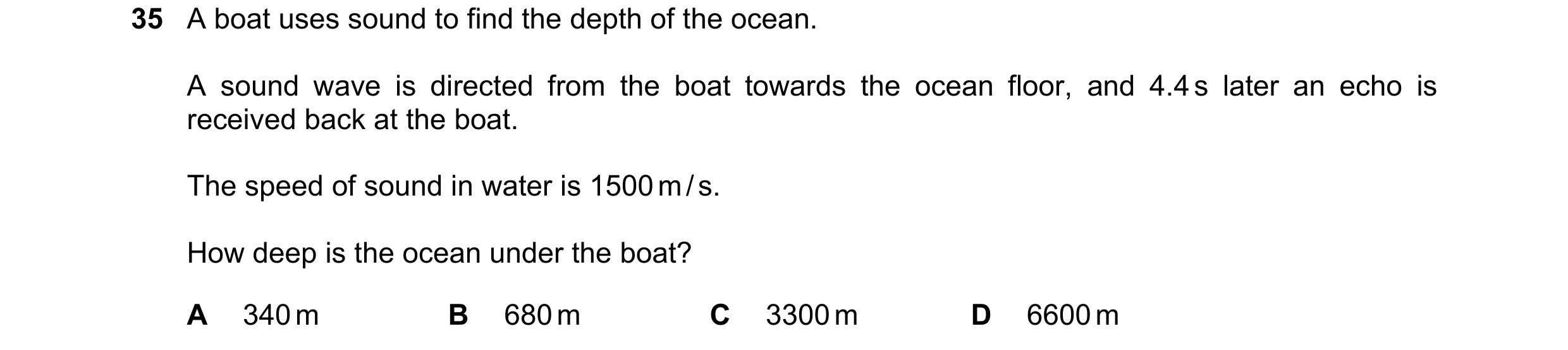
35 A boat uses sound to find the depth of the ocean. A sound wave is directed from the boat towards the ocean floor, and 4.4 s later an echo is received back at the boat. The speed of sound in water is 1500 m / s. How deep is the ocean under the boat? A 340 m B 680 m C 3300 m D 6600 m
1 marks
Answer: C
This question in 0653/13 May/June 2022
Q71 · Which statement about sound is not correct? 0653/12 Oct/Nov 2022
36 Which statement about sound is not correct? A A sound wave of frequency 2000 Hz can be heard by a healthy human ear. B Sound waves can travel through a vacuum. C The loudness of a sound depends on the amplitude of the sound wave. D The pitch of a sound depends on the frequency of the sound wave.
1 marks
Answer: B
This question in 0653/12 Oct/Nov 2022
Q72 · Which statement about sound is not correct? 0653/13 Oct/Nov 2022
36 Which statement about sound is not correct? A A sound wave of frequency 2000 Hz can be heard by a healthy human ear. B Sound waves can travel through a vacuum. C The loudness of a sound depends on the amplitude of the sound wave. D The pitch of a sound depends on the frequency of the sound wave.
1 marks
Answer: B
This question in 0653/13 Oct/Nov 2022
Q73 · The diagram shows the order of the lowest frequency of sound that can be heard by some… 0653/12 Feb/March 2023
37 The diagram shows the order of the lowest frequency of sound that can be heard by some animals. Which labelled position shows the lowest frequency that can be heard by humans with healthy ears? A whales B elephants C cows D 0 Hz 7 Hz 15 Hz 25 Hz 35 Hz lowest frequency that can be heard
1 marks
Answer: C
This question in 0653/12 Feb/March 2023
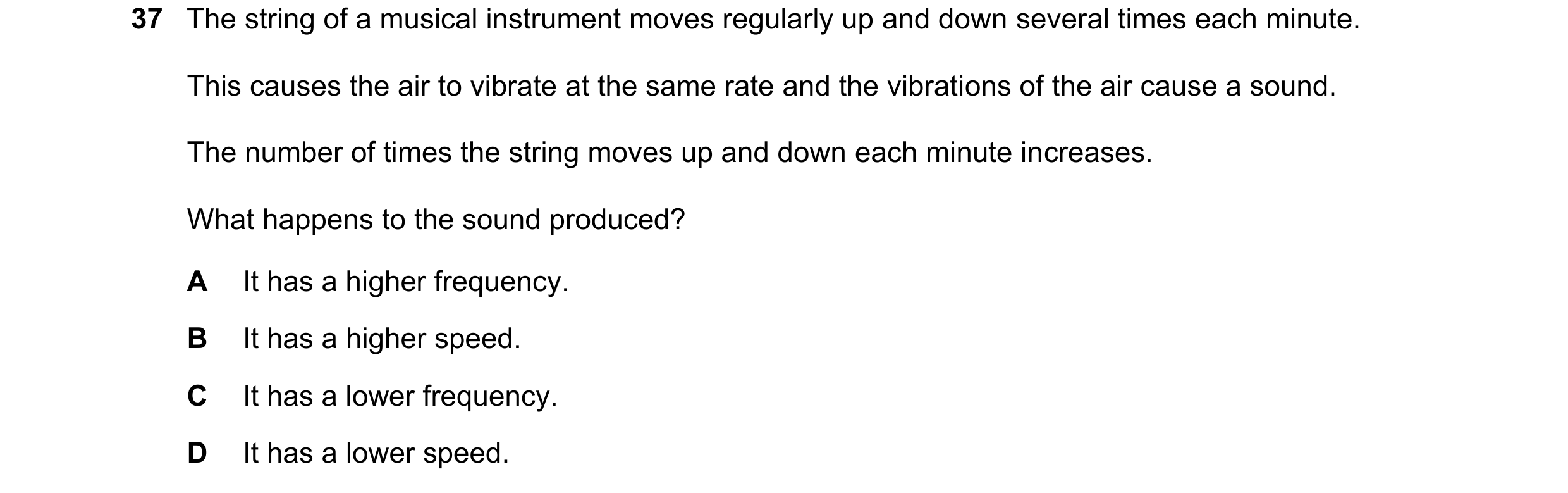
Q74 · The string of a musical instrument moves regularly up and down several times each minute 0653/11 May/June 2023
37 The string of a musical instrument moves regularly up and down several times each minute. This causes the air to vibrate at the same rate and the vibrations of the air cause a sound. The number of times the string moves up and down each minute increases. What happens to the sound produced? A It has a higher frequency. B It has a higher speed. C It has a lower frequency. D It has a lower speed.
1 marks
Answer: A
This question in 0653/11 May/June 2023
Q75 · Which change makes the pitch of a sound higher? 0653/12 May/June 2023
37 Which change makes the pitch of a sound higher? A decreasing the amplitude of the sound wave B decreasing the frequency of the sound wave C increasing the amplitude of the sound wave D increasing the frequency of the sound wave
1 marks
Answer: D
This question in 0653/12 May/June 2023
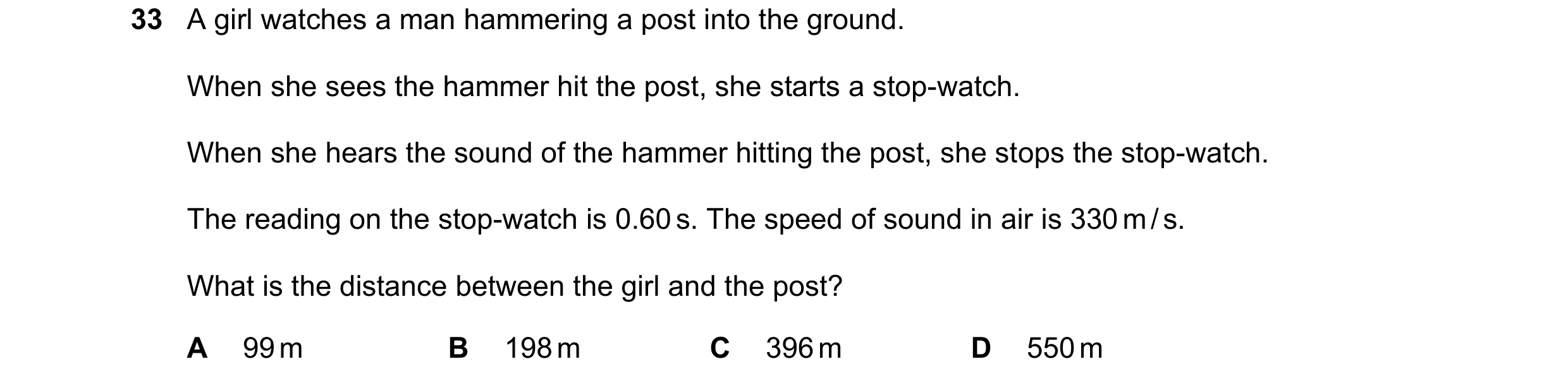
Q76 · A girl watches a man hammering a post into the ground 0653/11 Oct/Nov 2023
33 A girl watches a man hammering a post into the ground. When she sees the hammer hit the post, she starts a stop-watch. When she hears the sound of the hammer hitting the post, she stops the stop-watch. The reading on the stop-watch is 0.60 s. The speed of sound in air is 330 m / s. What is the distance between the girl and the post? A 99 m B 198 m C 396 m D 550 m
1 marks
Answer: B
This question in 0653/11 Oct/Nov 2023
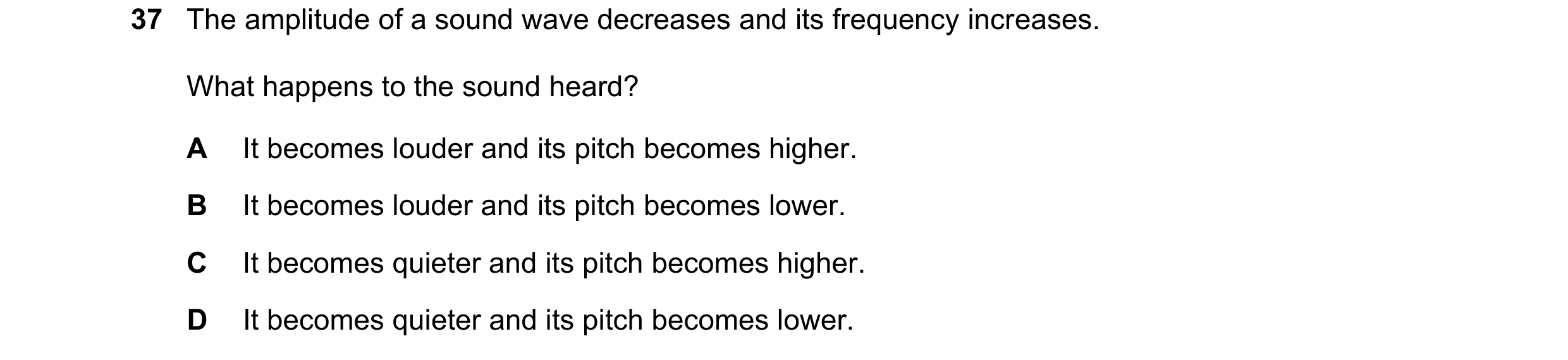
Q77 · The amplitude of a sound wave decreases and its frequency increases 0653/11 Oct/Nov 2023
37 The amplitude of a sound wave decreases and its frequency increases. What happens to the sound heard? A It becomes louder and its pitch becomes higher. B It becomes louder and its pitch becomes lower. C It becomes quieter and its pitch becomes higher. D It becomes quieter and its pitch becomes lower.
1 marks
Answer: C
This question in 0653/11 Oct/Nov 2023
Q78 · A loudspeaker vibrates at different frequencies 0653/12 Oct/Nov 2023
35 A loudspeaker vibrates at different frequencies. Which frequency of vibration does not produce a sound that a human can hear? A 60 Hz B 600 Hz C 6.0 kHz D 60 kHz
1 marks
Answer: D
This question in 0653/12 Oct/Nov 2023
Q79 · A loudspeaker vibrates at different frequencies 0653/13 Oct/Nov 2023
35 A loudspeaker vibrates at different frequencies. Which frequency of vibration does not produce a sound that a human can hear? A 60 Hz B 600 Hz C 6.0 kHz D 60 kHz
1 marks
Answer: D
This question in 0653/13 Oct/Nov 2023
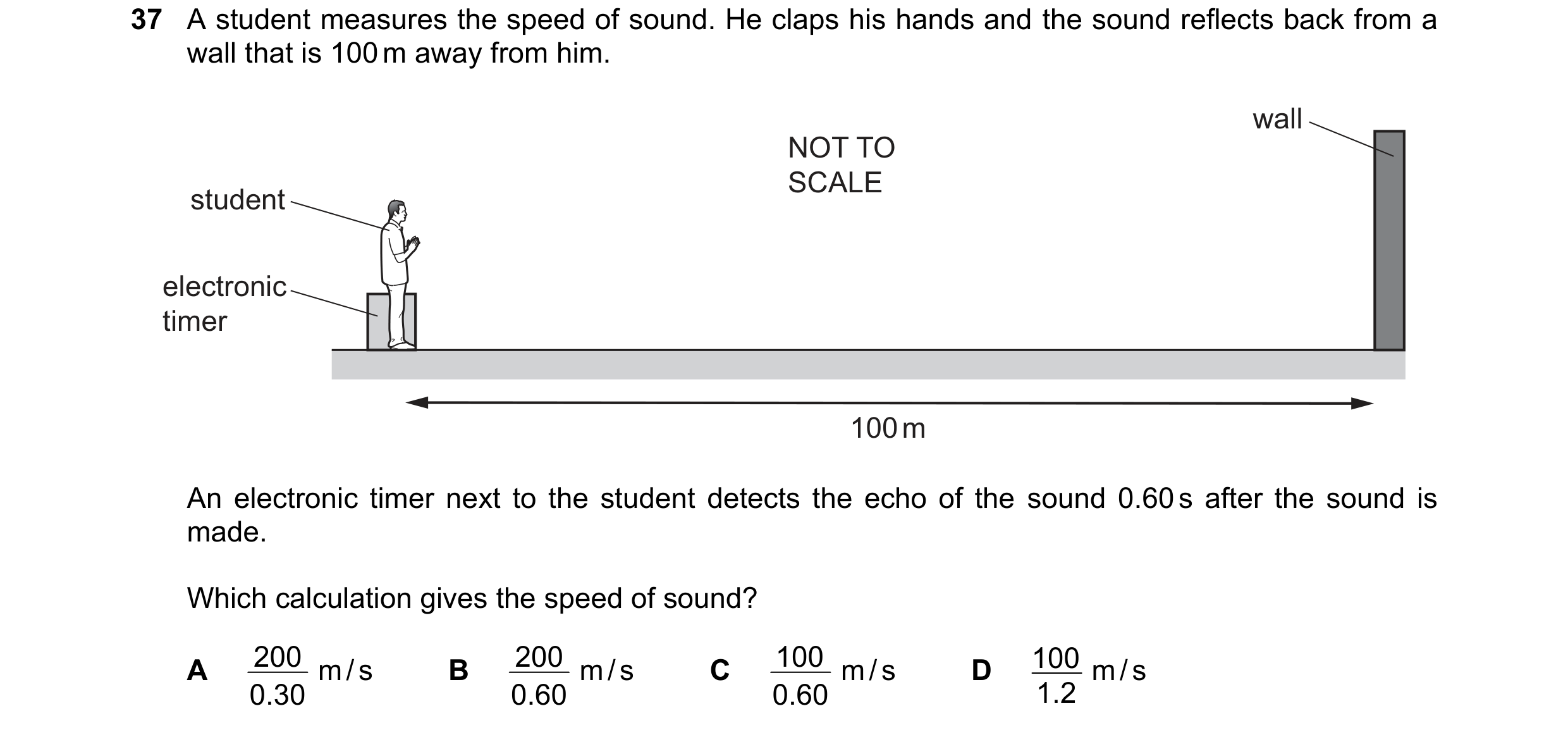
Q80 · A student measures the speed of sound 0653/11 May/June 2024
37 A student measures the speed of sound. He claps his hands and the sound reflects back from a wall that is 100 m away from him. wall NOT TO SCALE student electronic timer 100 m An electronic timer next to the student detects the echo of the sound 0.60 s after the sound is made. Which calculation gives the speed of sound? 200 200 100 100 A m / s B m / s C m / s D m / s 0.30 0.60 0.60 1 . 2
1 marks
Answer: B
This question in 0653/11 May/June 2024
Q81 · Elephants can hear sounds with frequencies between 10 Hz and 12 kHz 0653/11 Oct/Nov 2024
37 Elephants can hear sounds with frequencies between 10 Hz and 12 kHz. Which frequency of sound can be heard by both elephants and humans with healthy ears? A 10 Hz B 15 Hz C 1500 Hz D 15 000 Hz
1 marks
Answer: C
This question in 0653/11 Oct/Nov 2024
Q82 · An astronaut is outside a space station in the vacuum of space 0653/11 May/June 2025
36 An astronaut is outside a space station in the vacuum of space. The astronaut is wearing a spacesuit. A second astronaut is inside the space station. This astronaut makes a knocking sound against the inside metal walls of the space station. Which statement explains why the astronaut outside the space station does not hear this sound? A Sound cannot travel through the air inside the space station. B Sound cannot travel through the metal walls of the space station. C Sound cannot travel through the spacesuit of the astronaut. D Sound cannot travel through the vacuum outside the space station.
1 marks
Answer: D
This question in 0653/11 May/June 2025
Q83 · A man hits a post with a hammer 0653/12 May/June 2025
35 A man hits a post with a hammer. This produces a sound. A student is a distance of 170 m from the man. The speed of sound in air is 340 m / s. How much time does it take for the sound to travel to the student? A 0 s B 0.50 s C 1.0 s D 2.0 s
1 marks
Answer: B
This question in 0653/12 May/June 2025
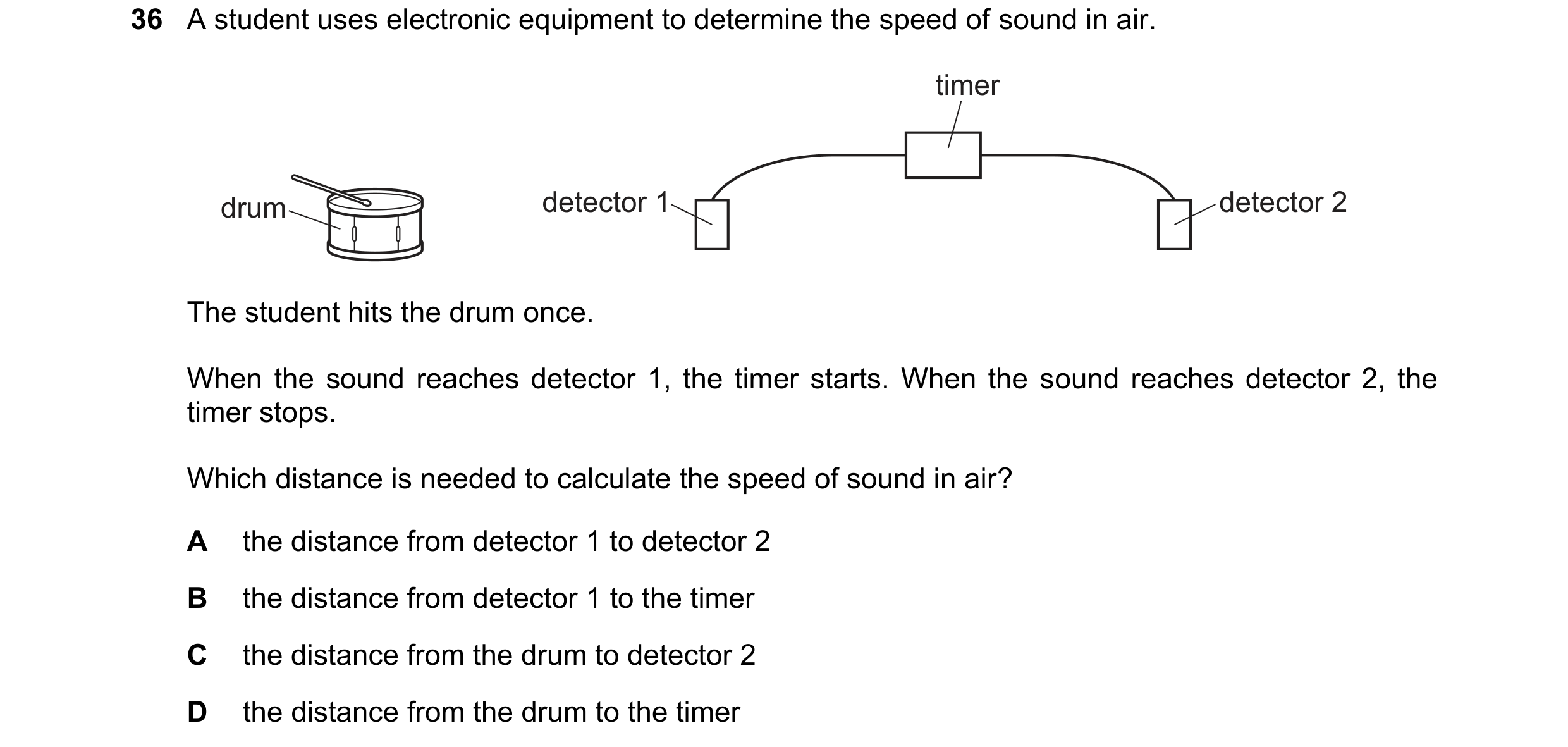
Q84 · A student uses electronic equipment to determine the speed of sound in air 0653/13 May/June 2025
36 A student uses electronic equipment to determine the speed of sound in air. timer drum detector 1 detector 2 The student hits the drum once. When the sound reaches detector 1, the timer starts. When the sound reaches detector 2, the timer stops. Which distance is needed to calculate the speed of sound in air? A the distance from detector 1 to detector 2 B the distance from detector 1 to the timer C the distance from the drum to detector 2 D the distance from the drum to the timer
1 marks
Answer: A
This question in 0653/13 May/June 2025
 1 / 23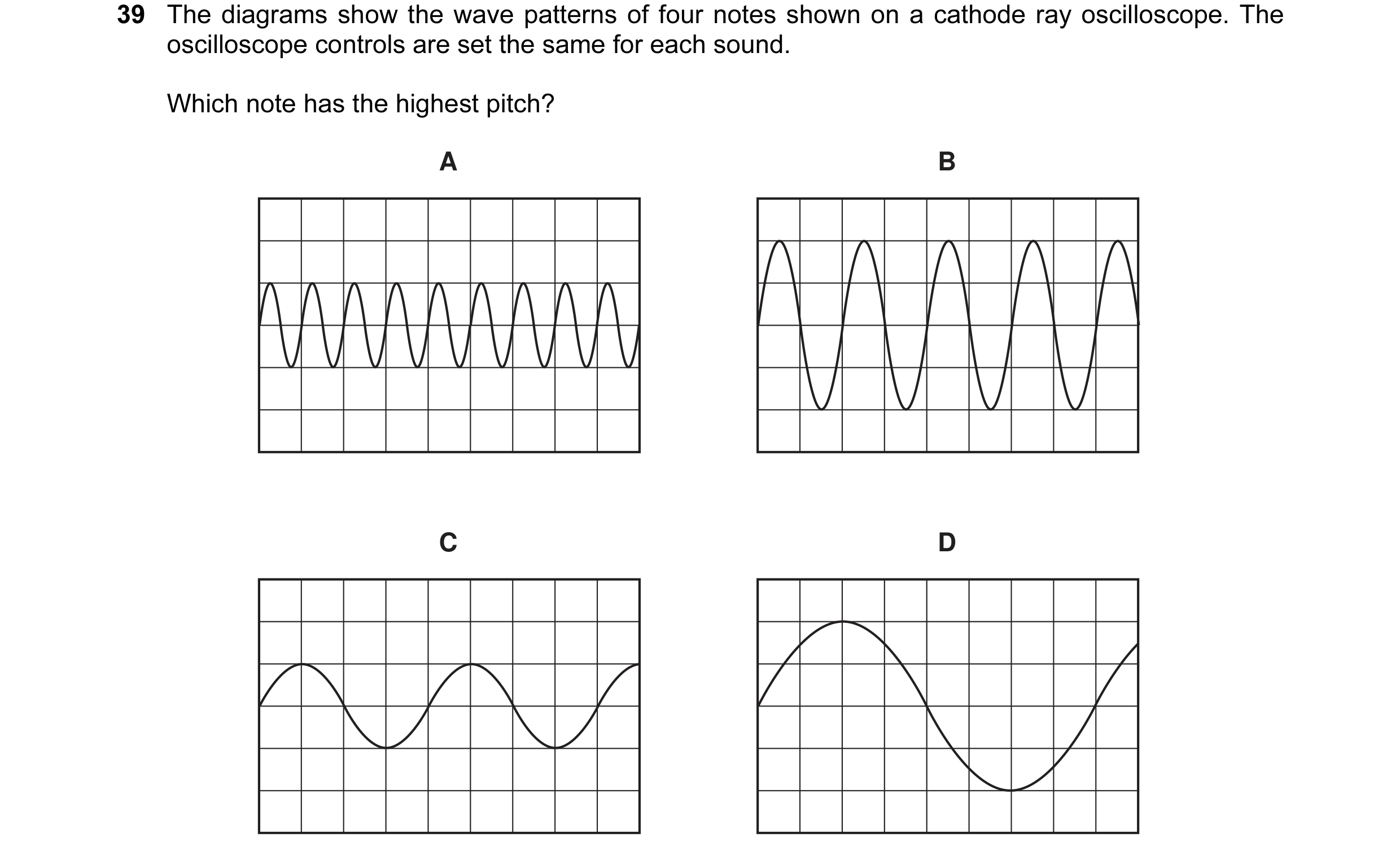
 2 / 23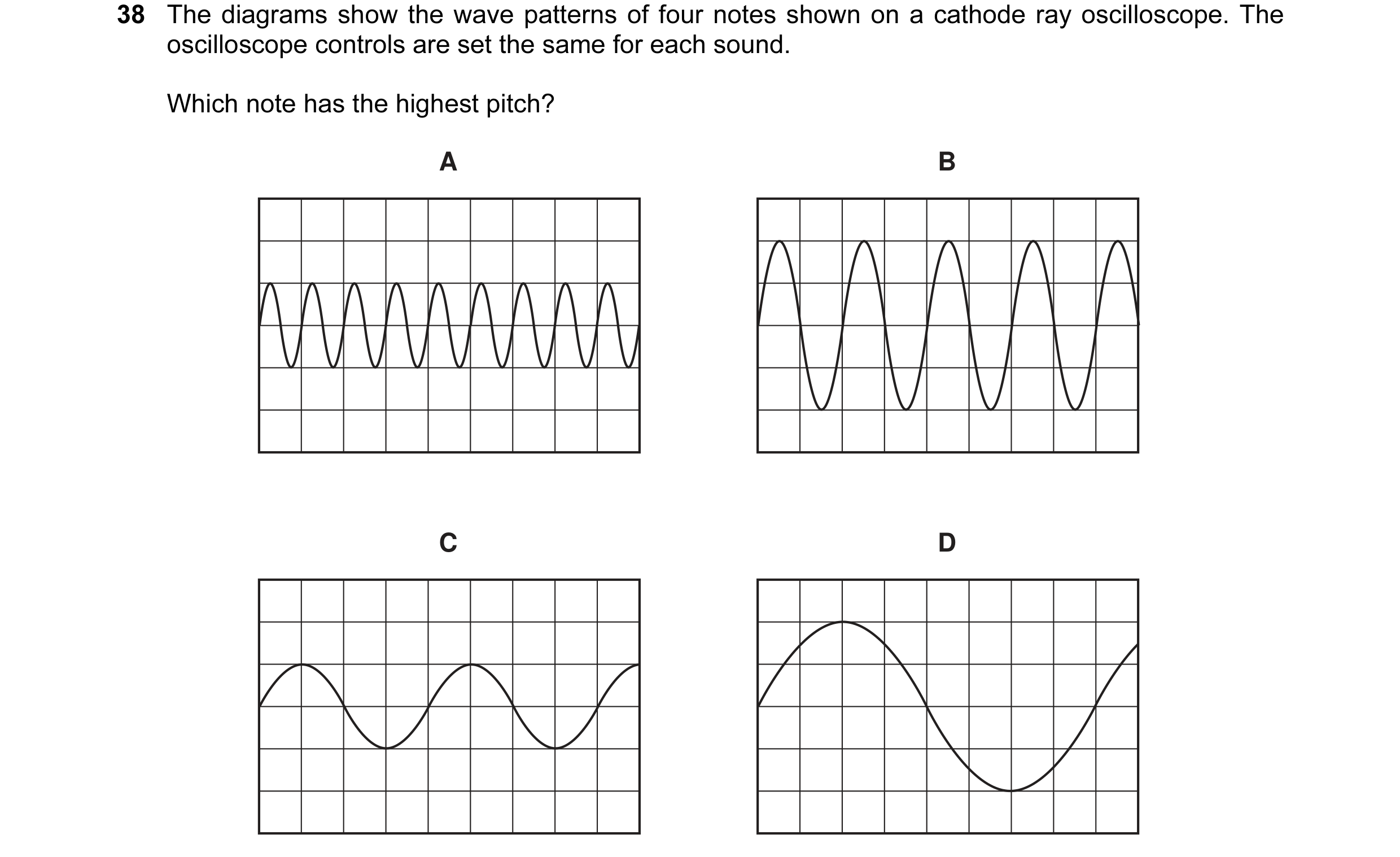
 3 / 23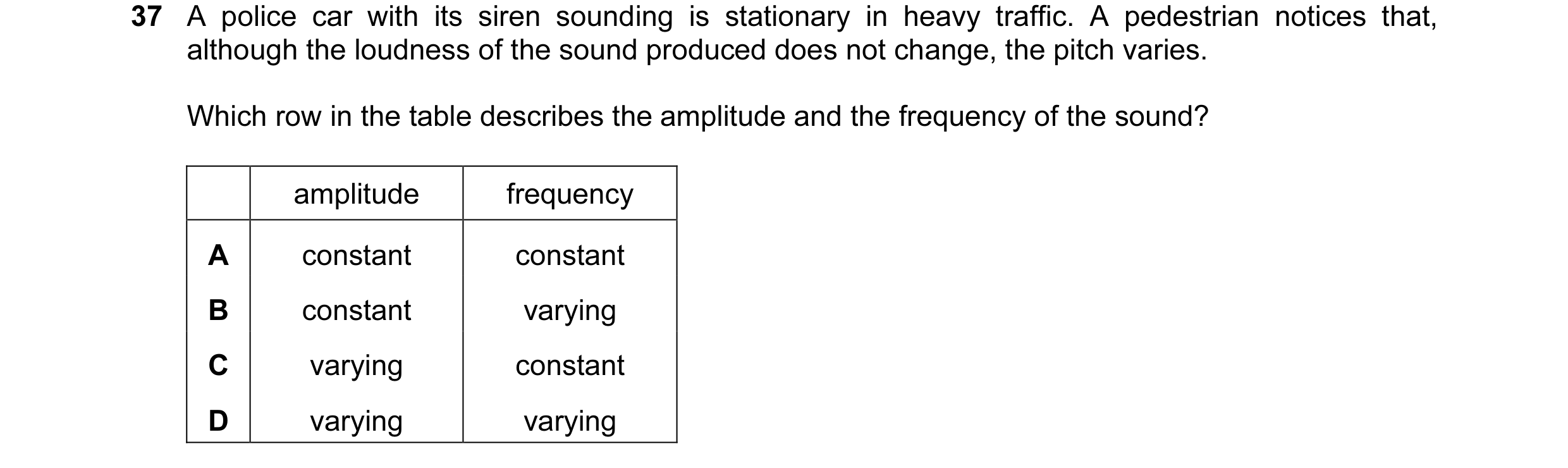



 4 / 23
 5 / 23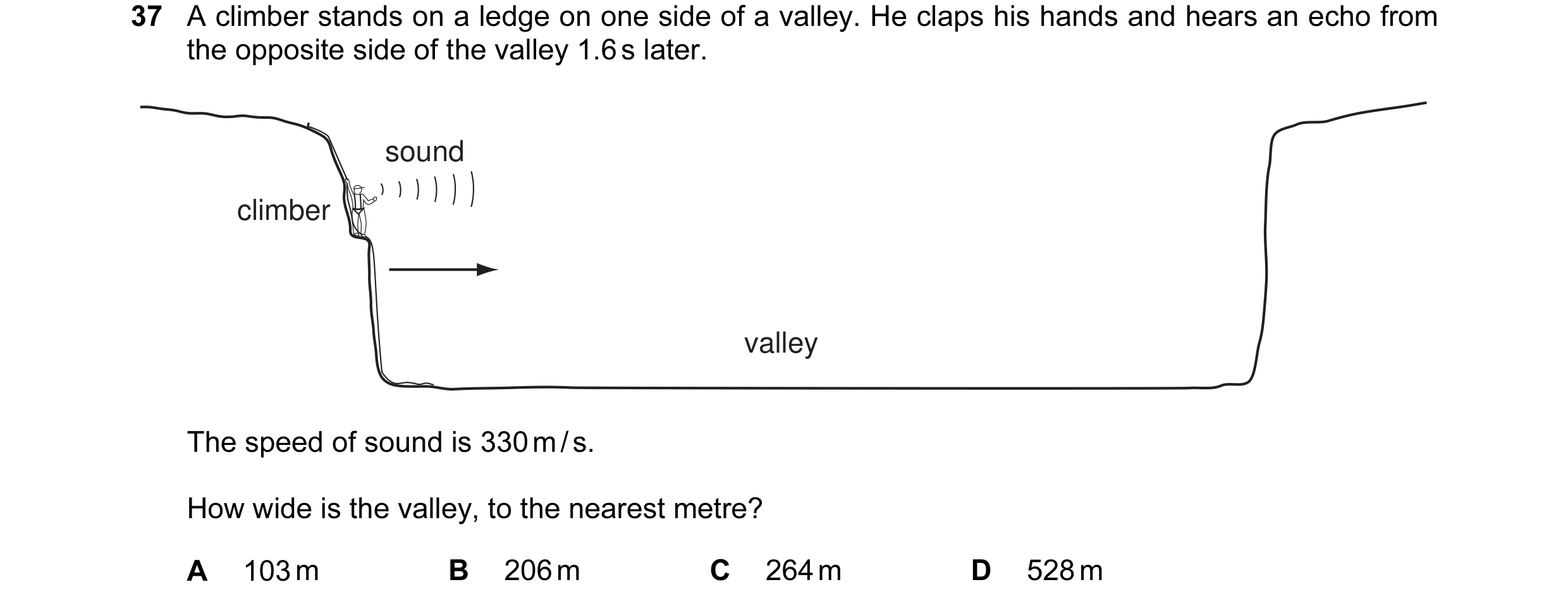
 6 / 23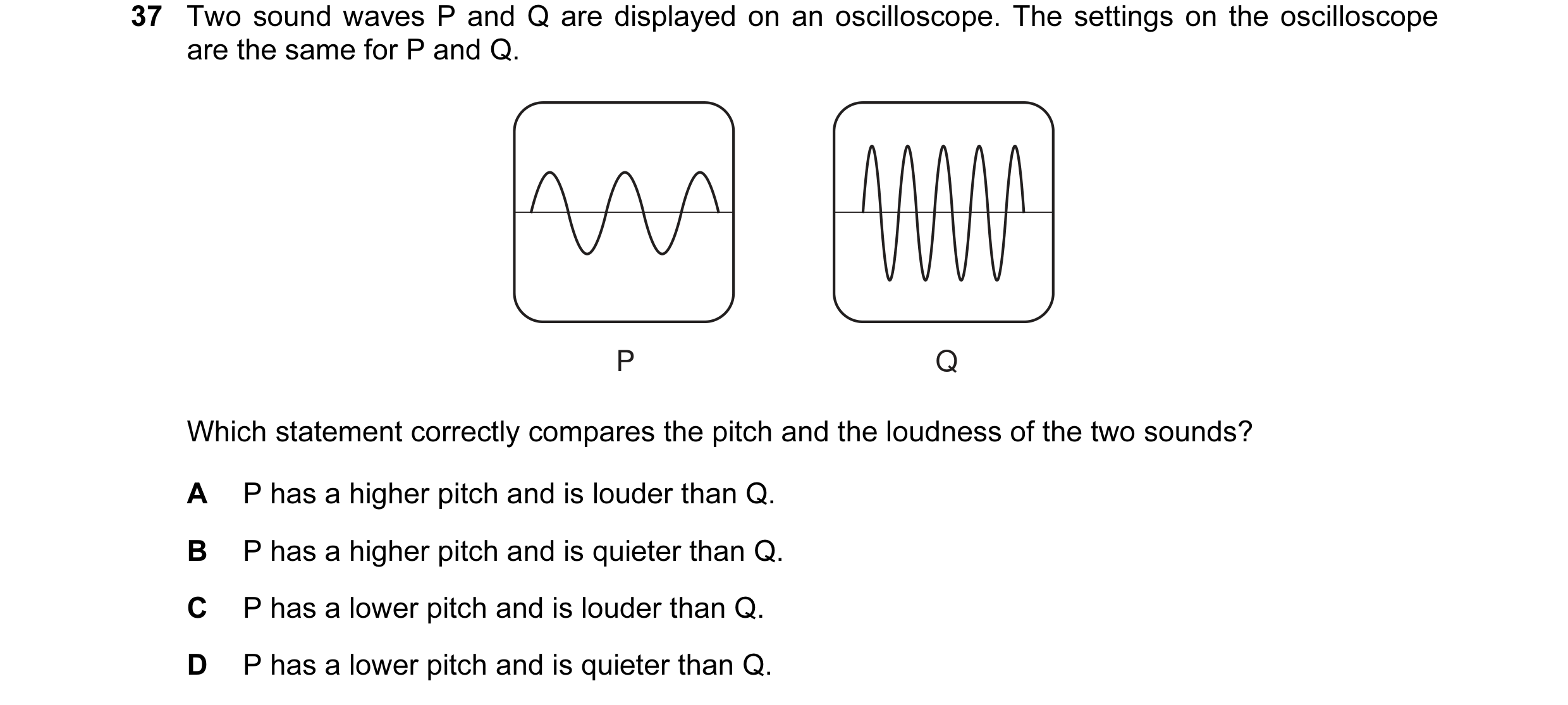
 7 / 23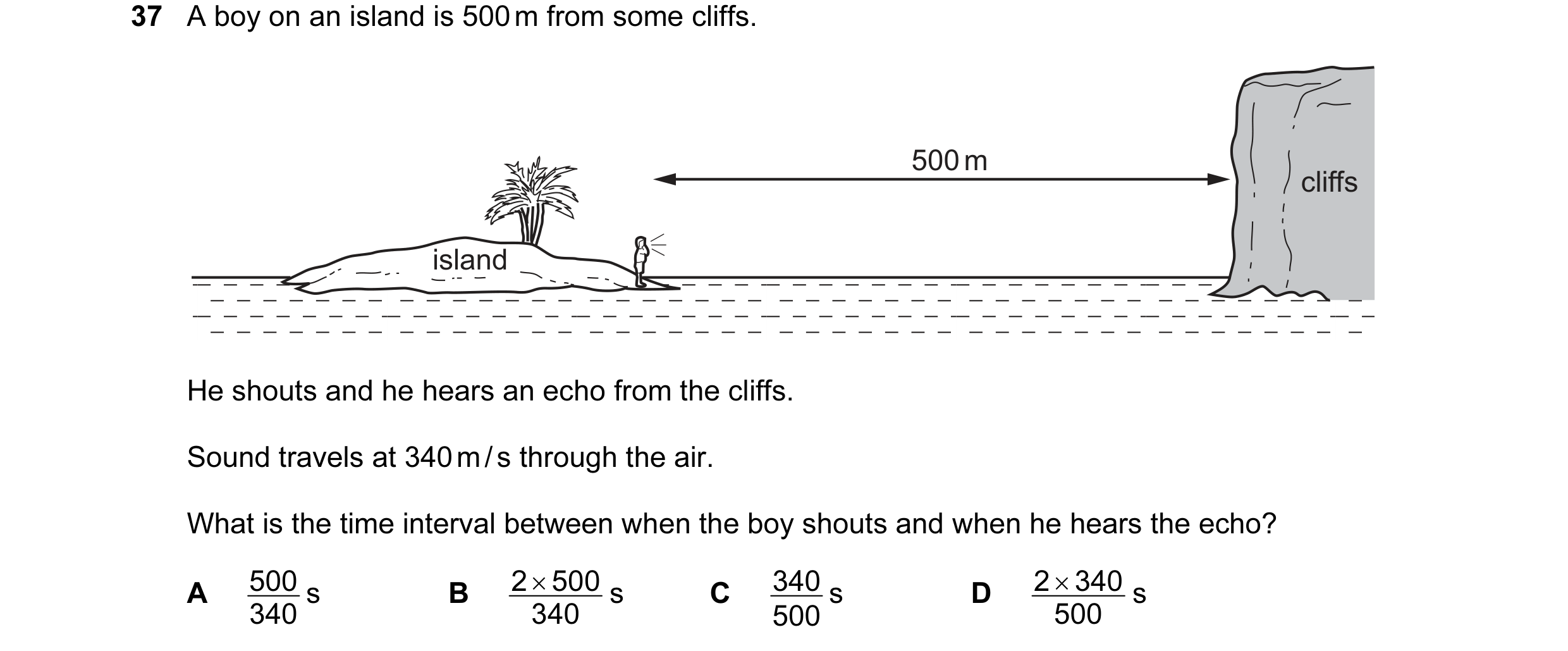
 8 / 23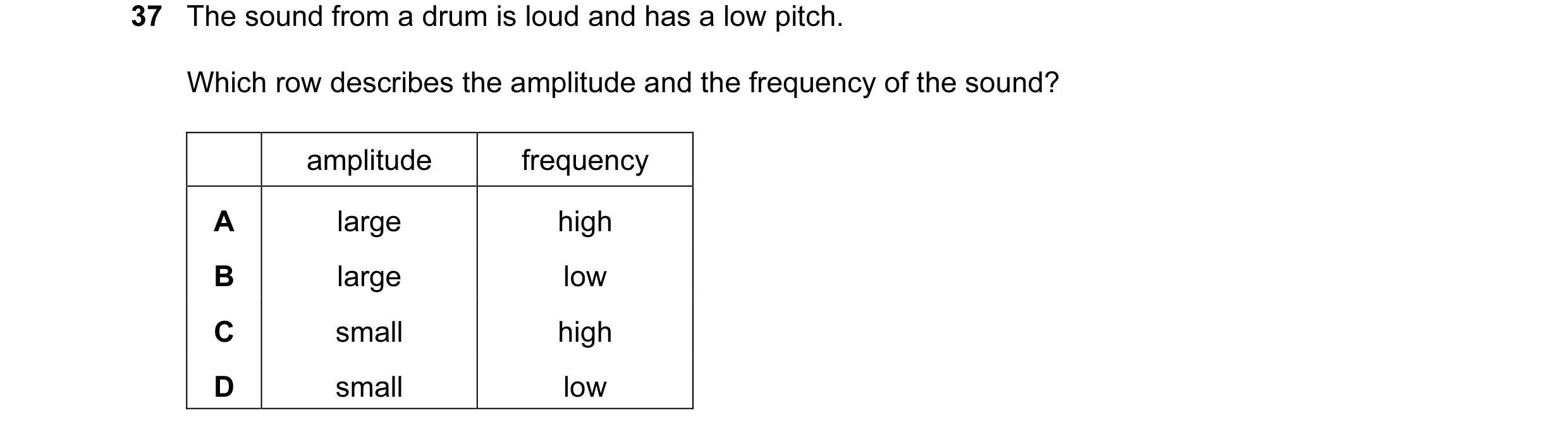

 9 / 23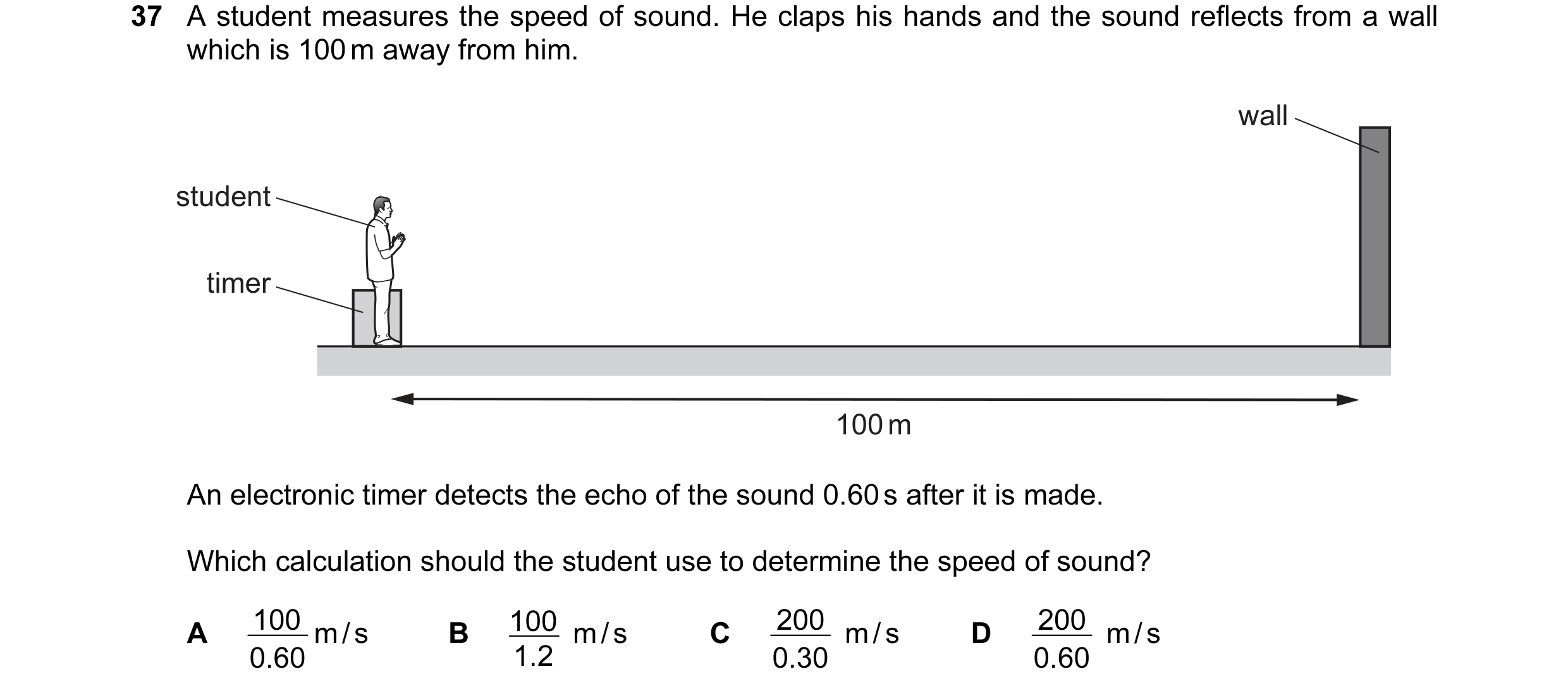
 10 / 23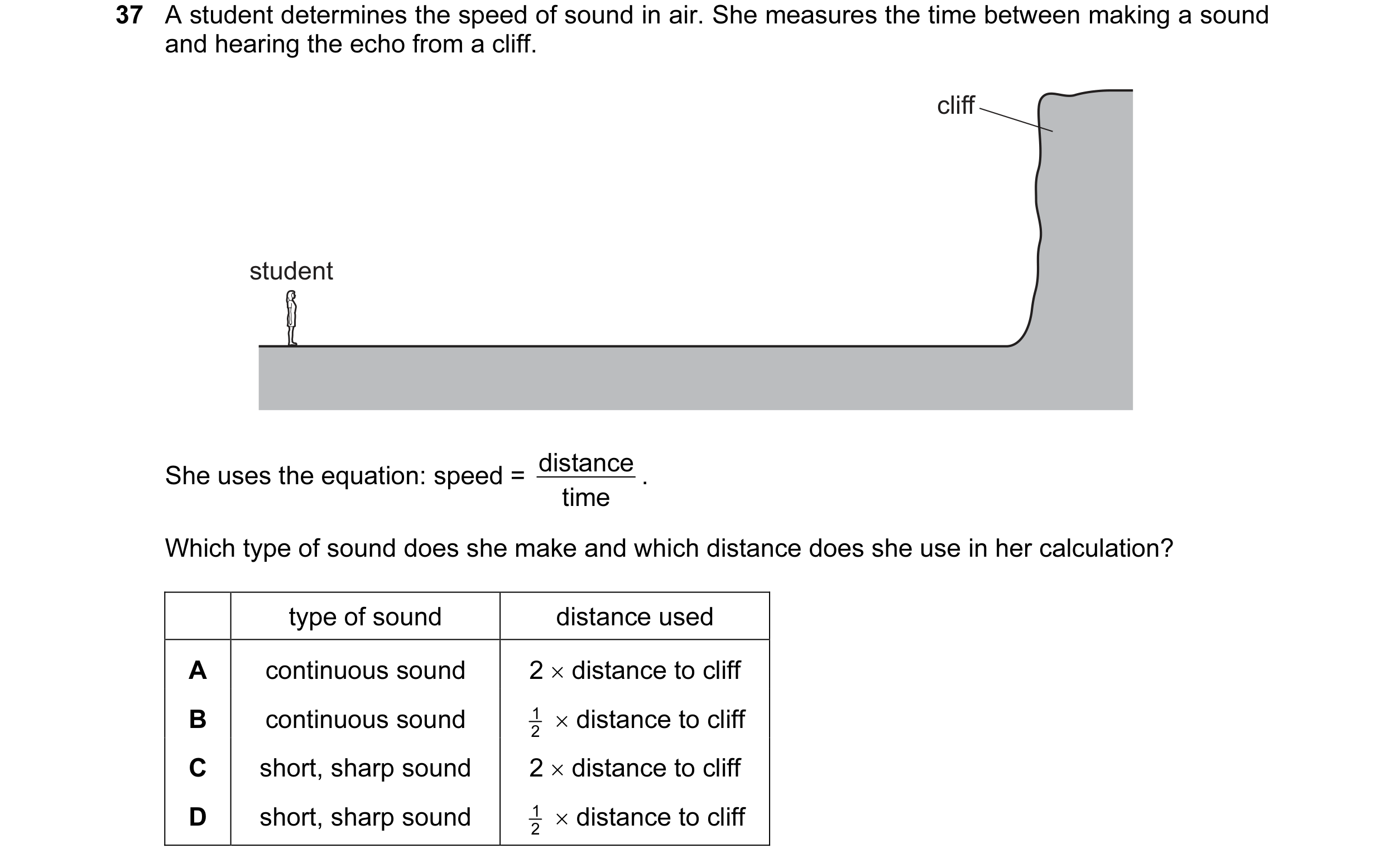
 11 / 23


 12 / 23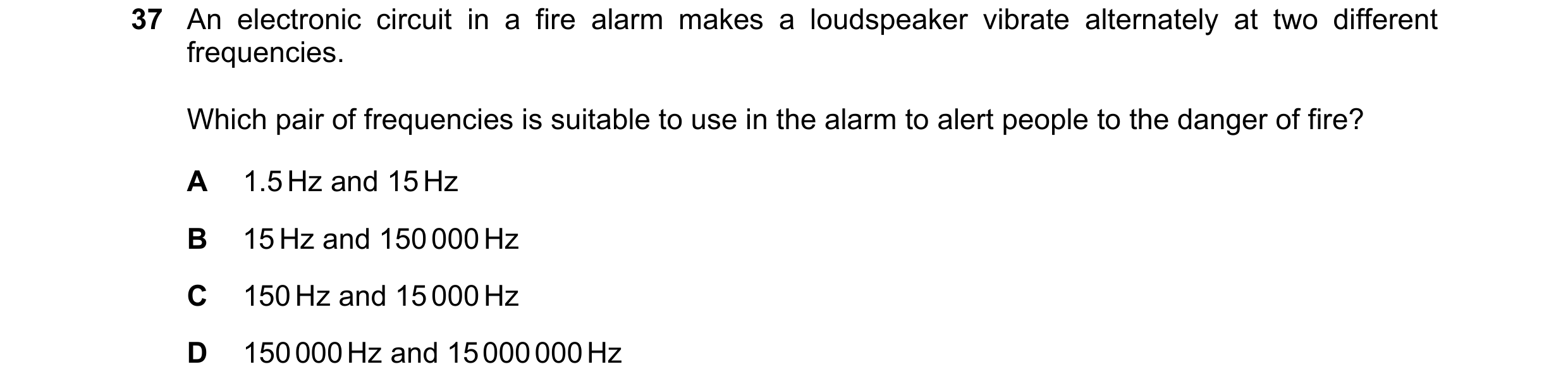

 13 / 23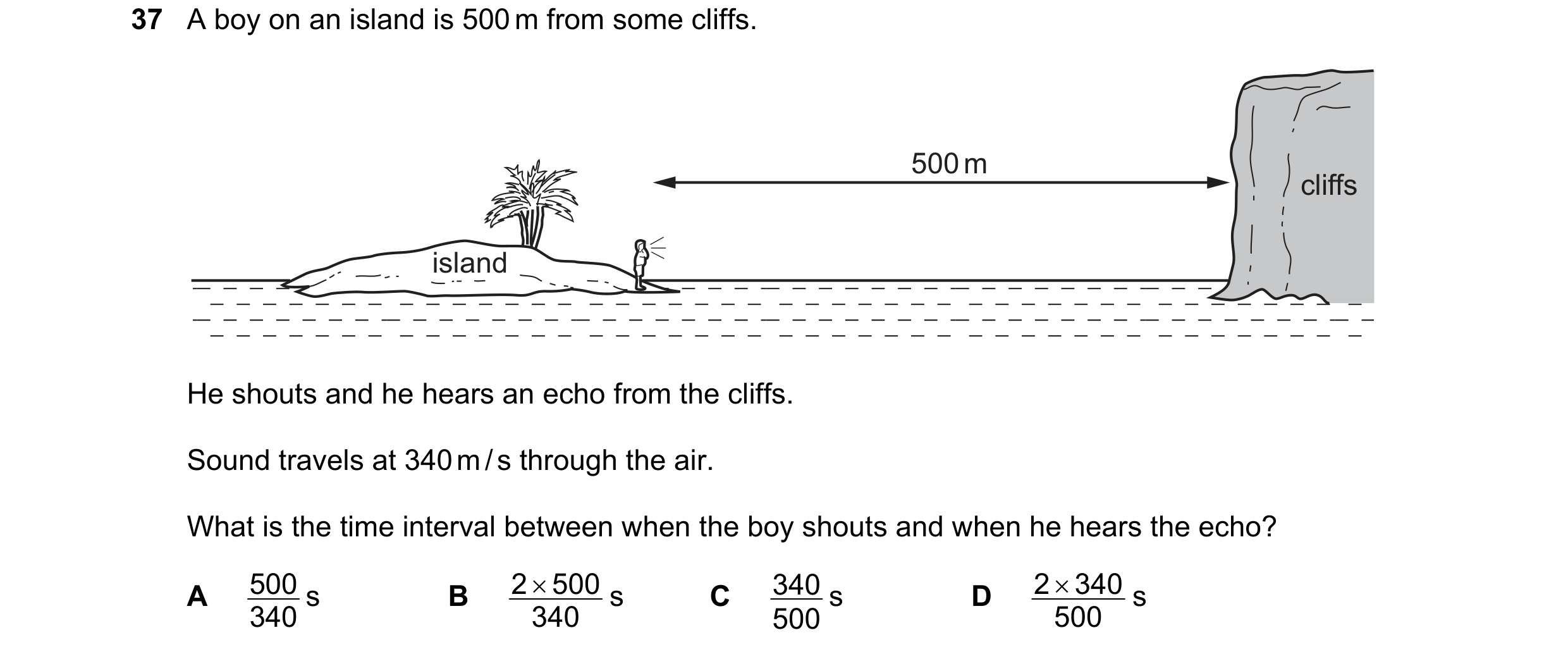

 14 / 23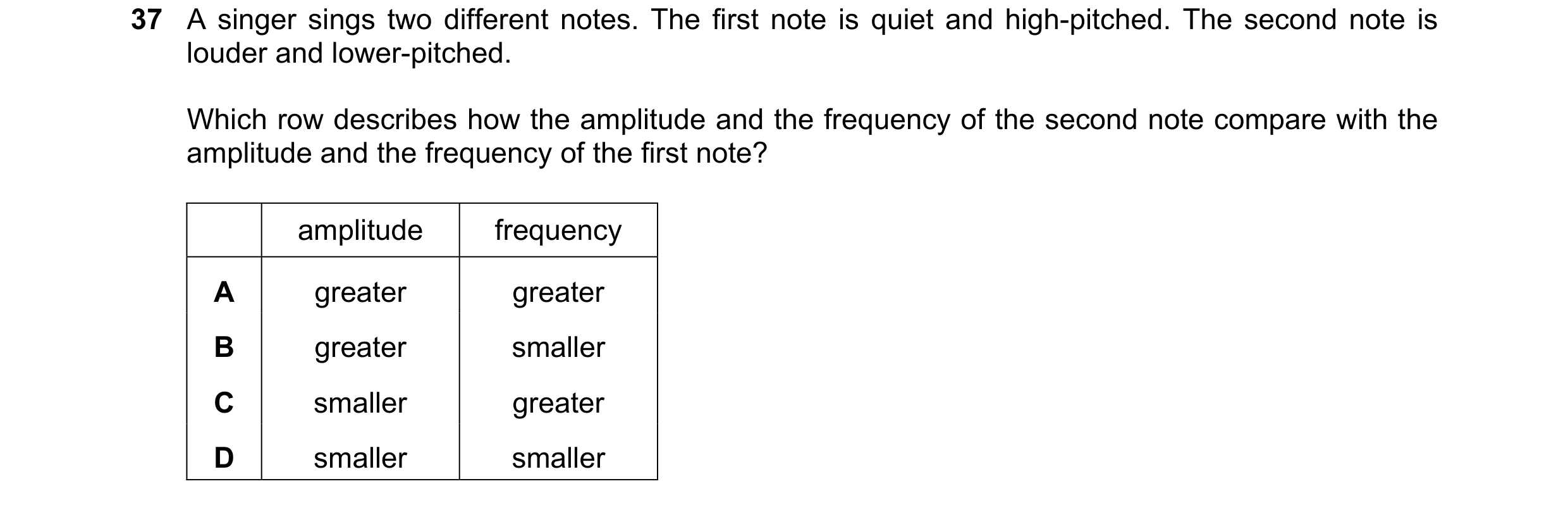
 15 / 23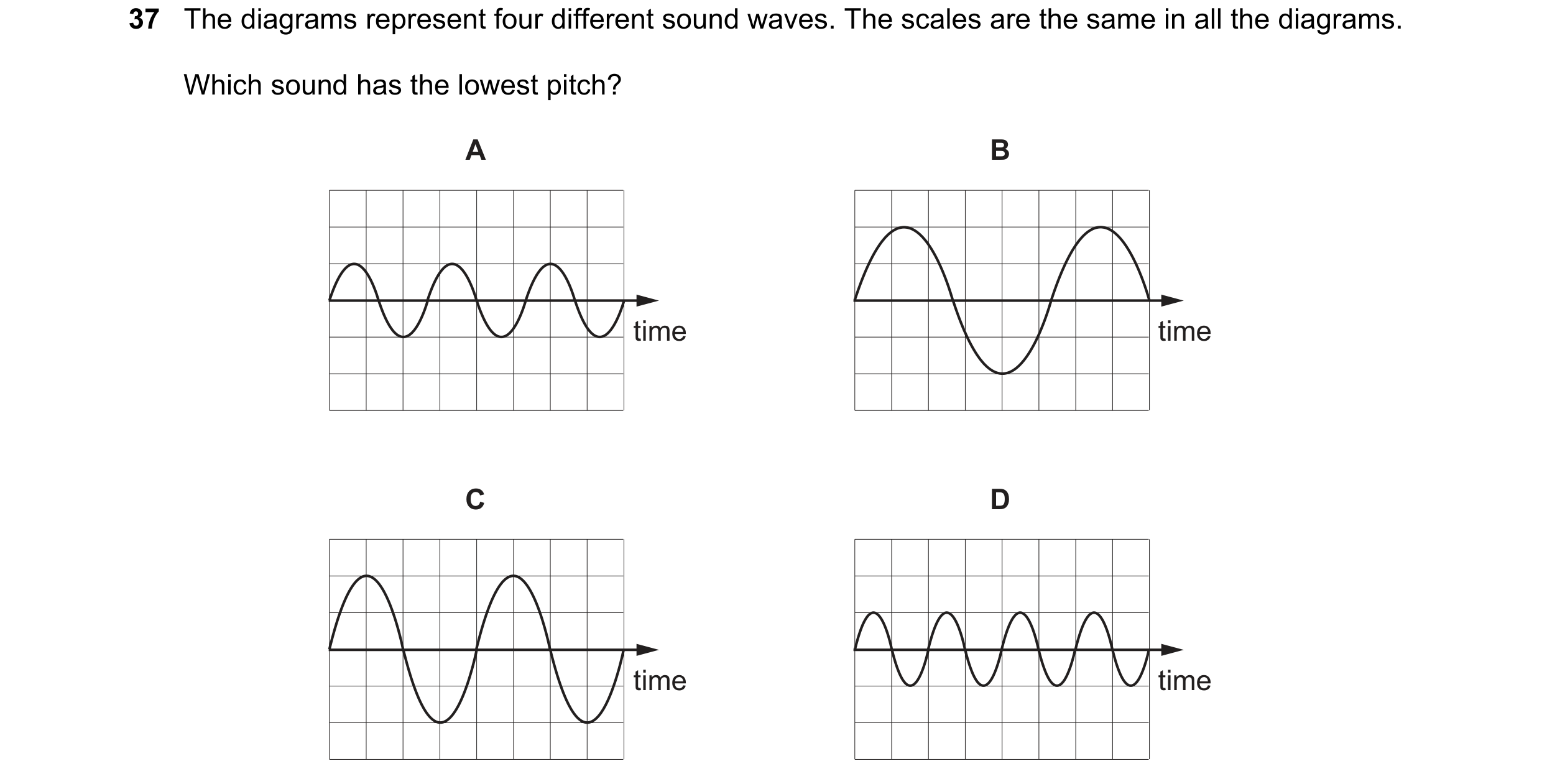


 16 / 23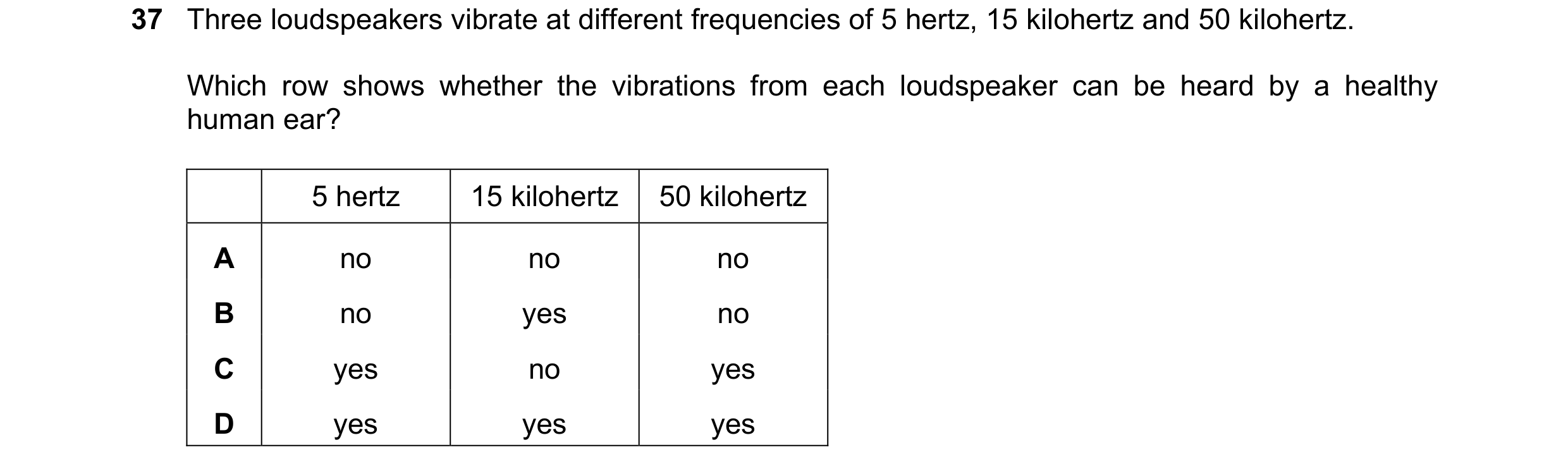
 17 / 23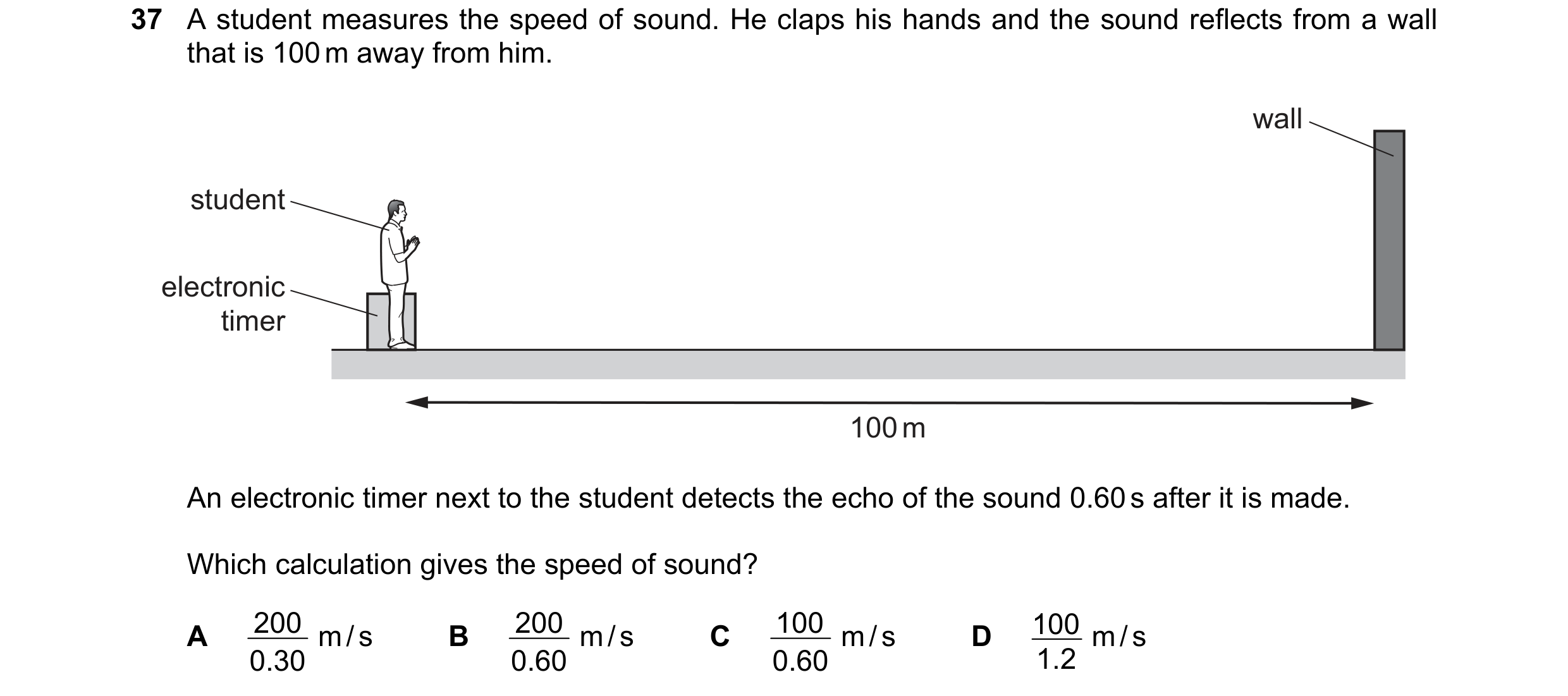
 18 / 23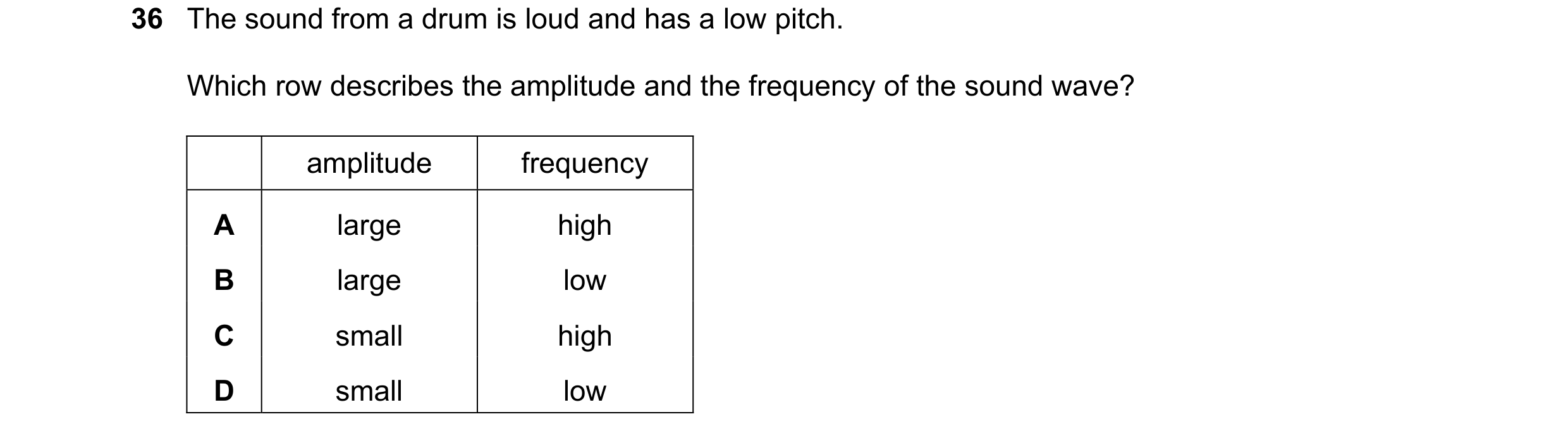

 19 / 23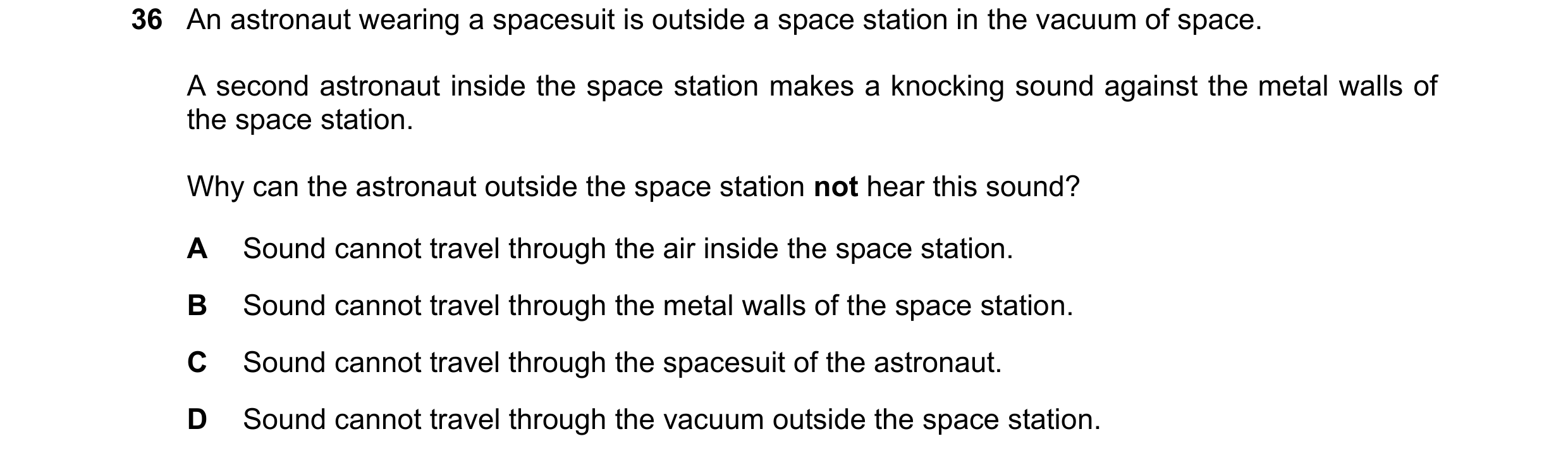


 20 / 23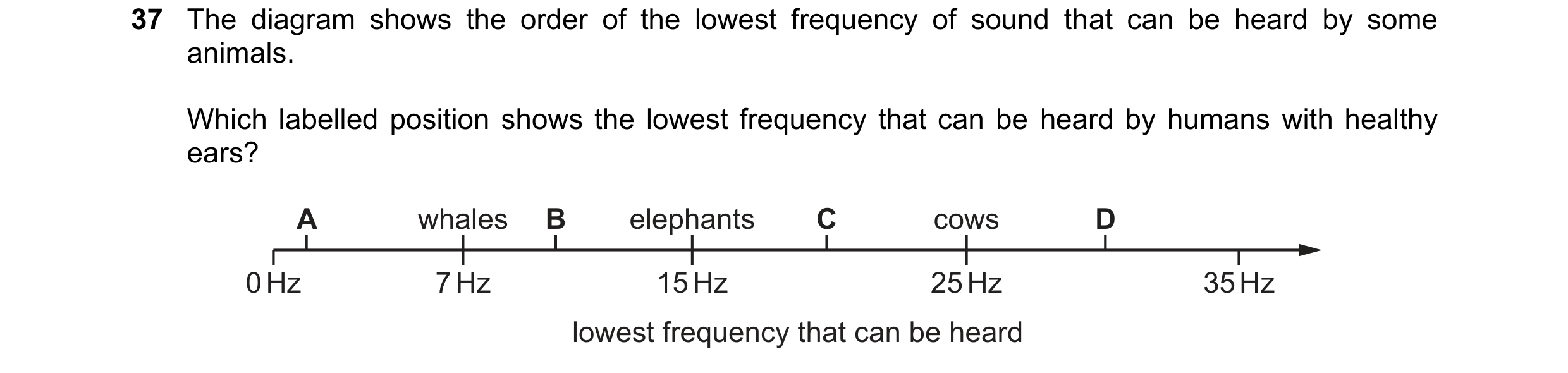

 21 / 23


 22 / 23
 23 / 23