Questions as text
Q1 · A boat sailing near a lighthouse at night 0653/32 Feb/March 2017
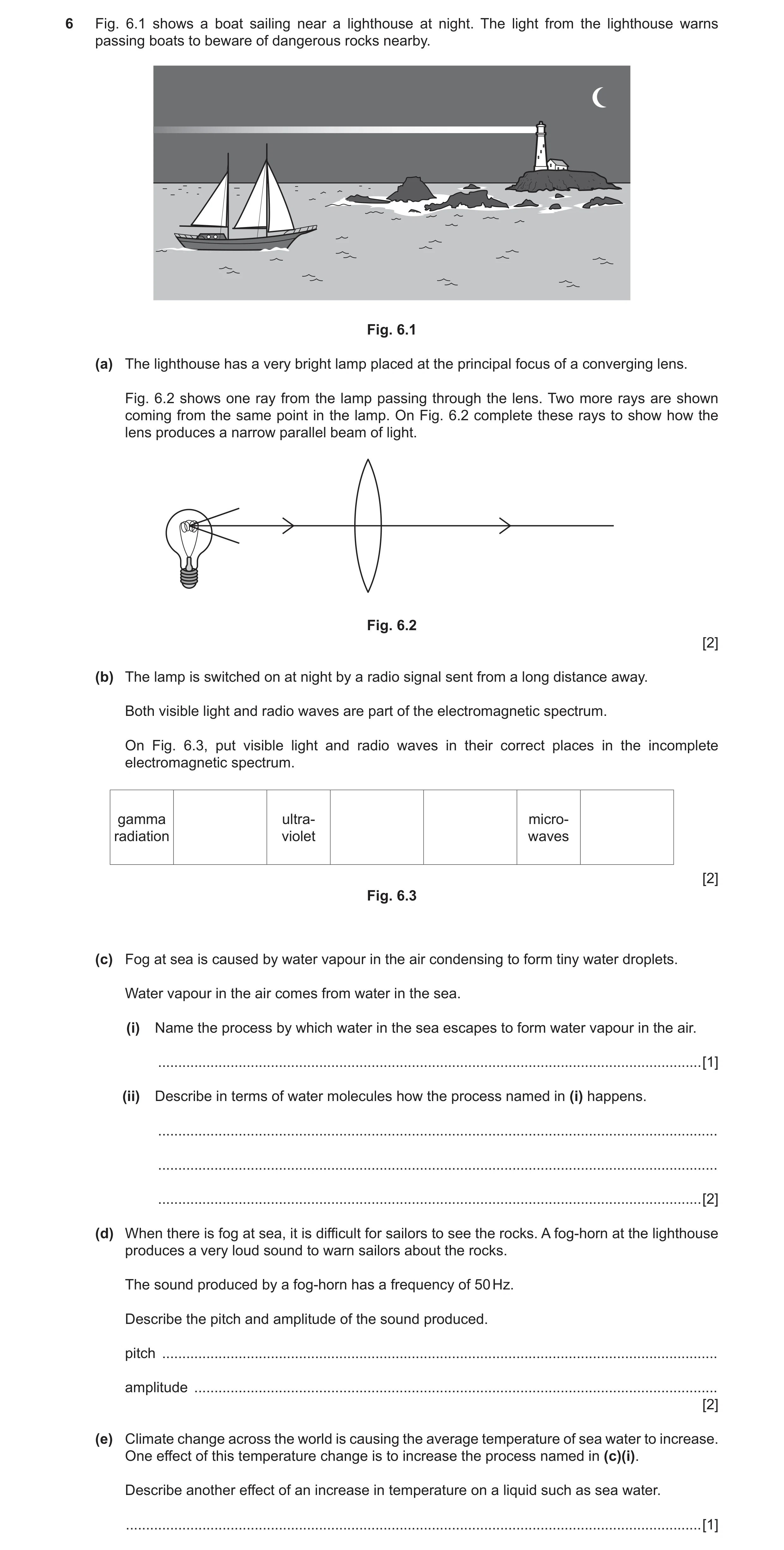
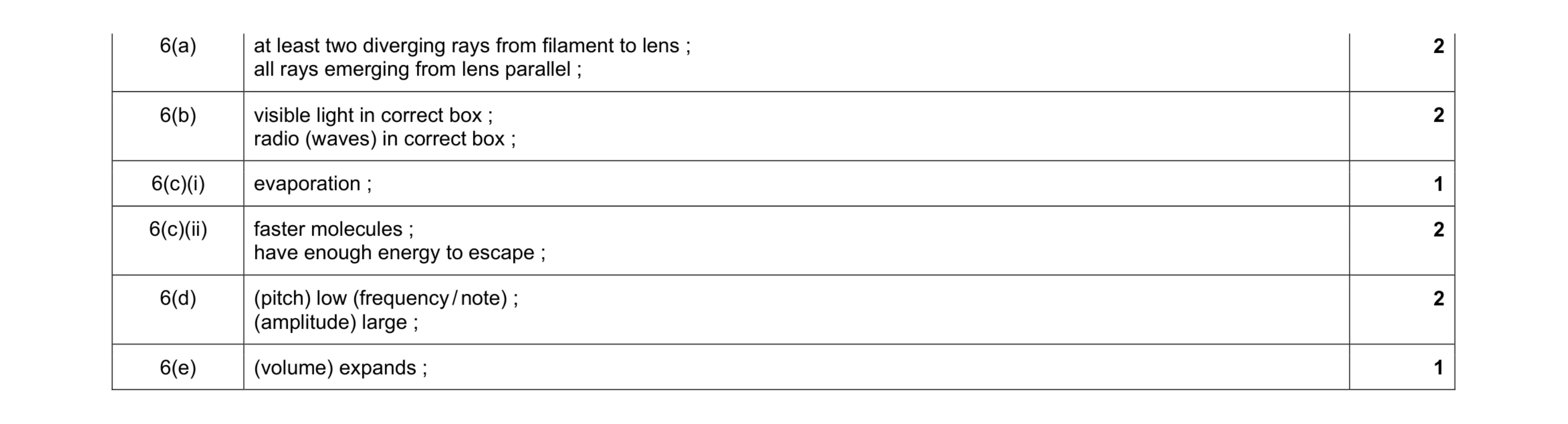
6 Fig. 6.1 shows a boat sailing near a lighthouse at night. The light from the lighthouse warns passing boats to beware of dangerous rocks nearby. Fig. 6.1 (a) The lighthouse has a very bright lamp placed at the principal focus of a converging lens. Fig. 6.2 shows one ray from the lamp passing through the lens. Two more rays are shown coming from the same point in the lamp. On Fig. 6.2 complete these rays to show how the lens produces a narrow parallel beam of light. Fig. 6.2 [2] (b) The lamp is switched on at night by a radio signal sent from a long distance away. Both visible light and radio waves are part of the electromagnetic spectrum. On Fig. 6.3, put visible light and radio waves in their correct places in the incomplete electromagnetic spectrum. gamma ultra- micro- radiation violet waves [2] Fig. 6.3 (c) Fog at sea is caused by water vapour in the air condensing to form tiny water droplets. Water vapour in the air comes from water in the sea. (i) Name the process by which water in the sea escapes to form water vapour in the air. … [1] (ii) Describe in terms of water molecules how the process named in (i) happens. … … … [2] (d) When there is fog at sea, it is difficult for sailors to see the rocks. A fog-horn at the lighthouse produces a very loud sound to warn sailors about the rocks. The sound produced by a fog-horn has a frequency of 50 Hz. Describe the pitch and amplitude of the sound produced. pitch … amplitude … [2] (e) Climate change across the world is causing the average temperature of sea water to increase. One effect of this temperature change is to increase the process named in (c)(i). Describe another effect of an increase in temperature on a liquid such as sea water. … [1]
10 marks
Mark scheme: 6(a) at least two diverging rays from filament to lens ; all rays emerging from lens parallel ; 2 6(b) visible light in correct box ; radio (waves) in correct box ; 2 6(c)(i) evaporation ; 1 6(c)(ii) faster molecules ; have enough energy to escape ; 2 6(d) (pitch) low (frequency / note) ; (amplitude) large ; 2 6(e) (volume) expands ; 1
This question in 0653/32 Feb/March 2017
Q2 · An aircraft is flying at a height of 10 000 m 0653/32 May/June 2017
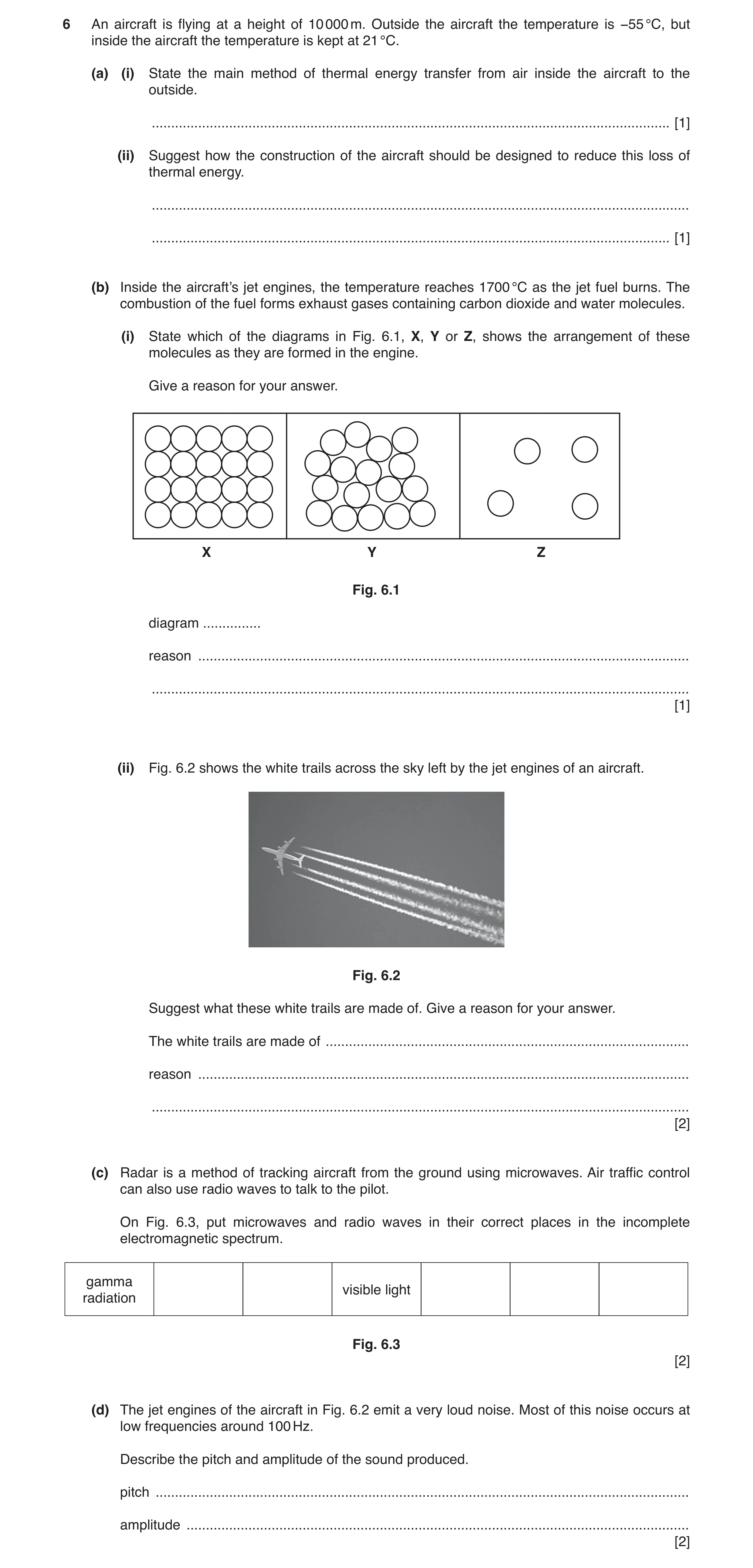
6 An aircraft is flying at a height of 10 000 m. Outside the aircraft the temperature is −55 °C, but inside the aircraft the temperature is kept at 21 °C. (a) (i) State the main method of thermal energy transfer from air inside the aircraft to the outside. … [1] (ii) Suggest how the construction of the aircraft should be designed to reduce this loss of thermal energy. … … [1] (b) Inside the aircraft’s jet engines, the temperature reaches 1700 °C as the jet fuel burns. The combustion of the fuel forms exhaust gases containing carbon dioxide and water molecules. (i) State which of the diagrams in Fig. 6.1, X, Y or Z, shows the arrangement of these molecules as they are formed in the engine. Give a reason for your answer. X Y Z Fig. 6.1 diagram … reason … … [1] (ii) Fig. 6.2 shows the white trails across the sky left by the jet engines of an aircraft. Fig. 6.2 Suggest what these white trails are made of. Give a reason for your answer. The white trails are made of … reason … … [2] (c) Radar is a method of tracking aircraft from the ground using microwaves. Air traffic control can also use radio waves to talk to the pilot. On Fig. 6.3, put microwaves and radio waves in their correct places in the incomplete electromagnetic spectrum. gamma visible lightradiation Fig. 6.3 [2] (d) The jet engines of the aircraft in Fig. 6.2 emit a very loud noise. Most of this noise occurs at low frequencies around 100 Hz. Describe the pitch and amplitude of the sound produced. pitch … amplitude … [2]
9 marks
Mark scheme: 6(a)(i) conduction ; 1 6(a)(ii) insulation (in outer layer of aircraft) / make aircraft out of bad (thermal) conductor / owtte ; 1 6(b)(i) (Z – no mark) gas molecules far apart / not touching ; 1 6(b)(ii) ice / (frozen) water ; water from fuel combustion freezing / condensing in very cold air ; 2 6(c) gamma radiation visible light micro- waves ; radio waves ; 2 6(d) (pitch) low ; (amplitude) (very) high ; 2
This question in 0653/32 May/June 2017
Question 3 0653/31 Oct/Nov 2017
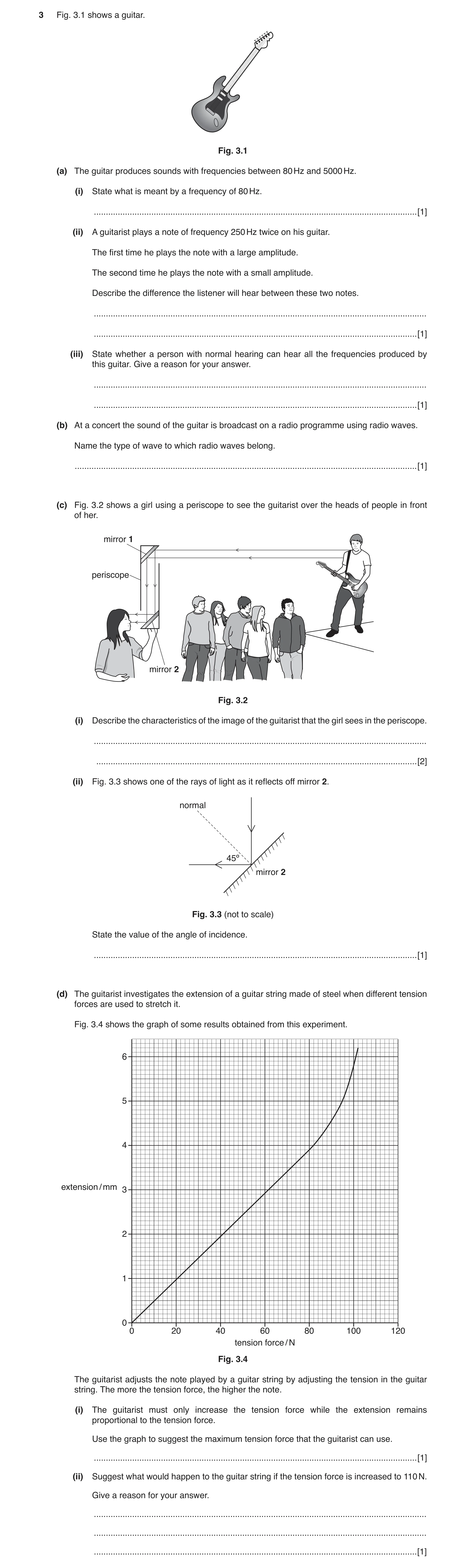
3 Fig. 3.1 shows a guitar. Fig. 3.1 (a) The guitar produces sounds with frequencies between 80 Hz and 5000 Hz. (i) State what is meant by a frequency of 80 Hz. … [1] (ii) A guitarist plays a note of frequency 250 Hz twice on his guitar. The first time he plays the note with a large amplitude. The second time he plays the note with a small amplitude. Describe the difference the listener will hear between these two notes. … … [1] (iii) State whether a person with normal hearing can hear all the frequencies produced by this guitar. Give a reason for your answer. … … [1] (b) At a concert the sound of the guitar is broadcast on a radio programme using radio waves. Name the type of wave to which radio waves belong. … [1] (c) Fig. 3.2 shows a girl using a periscope to see the guitarist over the heads of people in front of her. mirror 1 periscope mirror 2 Fig. 3.2 (i) Describe the characteristics of the image of the guitarist that the girl sees in the periscope. … … [2] (ii) Fig. 3.3 shows one of the rays of light as it reflects off mirror 2. normal 45º mirror 2 Fig. 3.3 (not to scale) State the value of the angle of incidence. … [1] (d) The guitarist investigates the extension of a guitar string made of steel when different tension forces are used to stretch it. Fig. 3.4 shows the graph of some results obtained from this experiment. 6 5 4 extension / mm 3 2 1 0 0 20 40 60 80 100 120 tension force / N Fig. 3.4 The guitarist adjusts the note played by a guitar string by adjusting the tension in the guitar string. The more the tension force, the higher the note. (i) The guitarist must only increase the tension force while the extension remains proportional to the tension force. Use the graph to suggest the maximum tension force that the guitarist can use. … [1] (ii) Suggest what would happen to the guitar string if the tension force is increased to 110 N. Give a reason for your answer. … … … [1]
9 marks
Mark scheme: 3(a)(i) 80 waves / cycles / vibrations / oscillations per second ; 1 3(a)(ii) first note louder than second note ; 1 3(a)(iii) yes (no mark) frequency range of guitar lies within frequency range of normal human hearing / is within range 20 Hz – 20 kHz ; 1 3(b) electromagnetic waves ; 1 3(c)(i) any two from upright ; virtual ; same size ; max 2 3(c)(ii) 45° ; 1 3(d)(i) answer in range 80–84 N ; 1 3(d)(ii) string breaks (as graph goes up vertically) / permanently stretches / owtte ; 1
This question in 0653/31 Oct/Nov 2017
Q4 · Two people talking to each other using cordless telephones over a link to a… 0653/32 Feb/March 2018
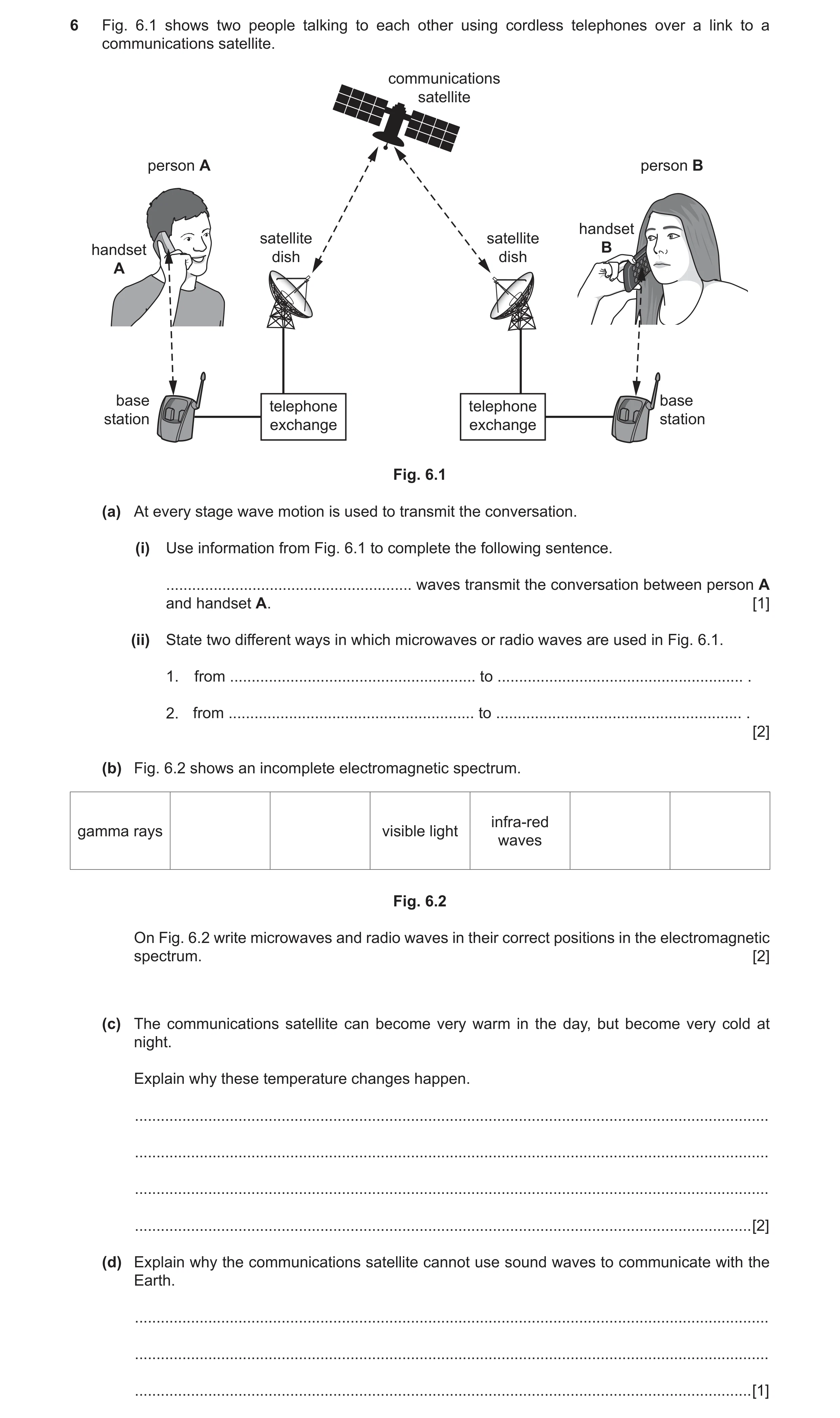
6 Fig. 6.1 shows two people talking to each other using cordless telephones over a link to a communications satellite. communications satellite person A person B handset satellite satellite handset B dish dish A base base telephone telephone station station exchange exchange Fig. 6.1 (a) At every stage wave motion is used to transmit the conversation. (i) Use information from Fig. 6.1 to complete the following sentence. … waves transmit the conversation between person A and handset A. [1] (ii) State two different ways in which microwaves or radio waves are used in Fig. 6.1. 1. from … to … . 2. from … to … . [2] (b) Fig. 6.2 shows an incomplete electromagnetic spectrum. infra-red gamma rays visible light waves Fig. 6.2 On Fig. 6.2 write microwaves and radio waves in their correct positions in the electromagnetic spectrum. [2] (c) The communications satellite can become very warm in the day, but become very cold at night. Explain why these temperature changes happen. … … … … [2] (d) Explain why the communications satellite cannot use sound waves to communicate with the Earth. … … … [1]
8 marks
Mark scheme: 6(a)(i) sound ; 1 6(a)(ii) from handset to base station (or reverse) ; from satellite dish to satellite (or reverse) ; 2 6(b) gamma rays visible light infrared waves microwaves ; radio waves; 2 6(c) (infrared) radiation from Sun absorbed during day ; at night, radiation from satellite results in cooling ; 2 6(d) sound needs a medium to travel through – no medium in space ; 1
This question in 0653/32 Feb/March 2018
Q5 · A whale swimming underwater 0653/31 May/June 2019
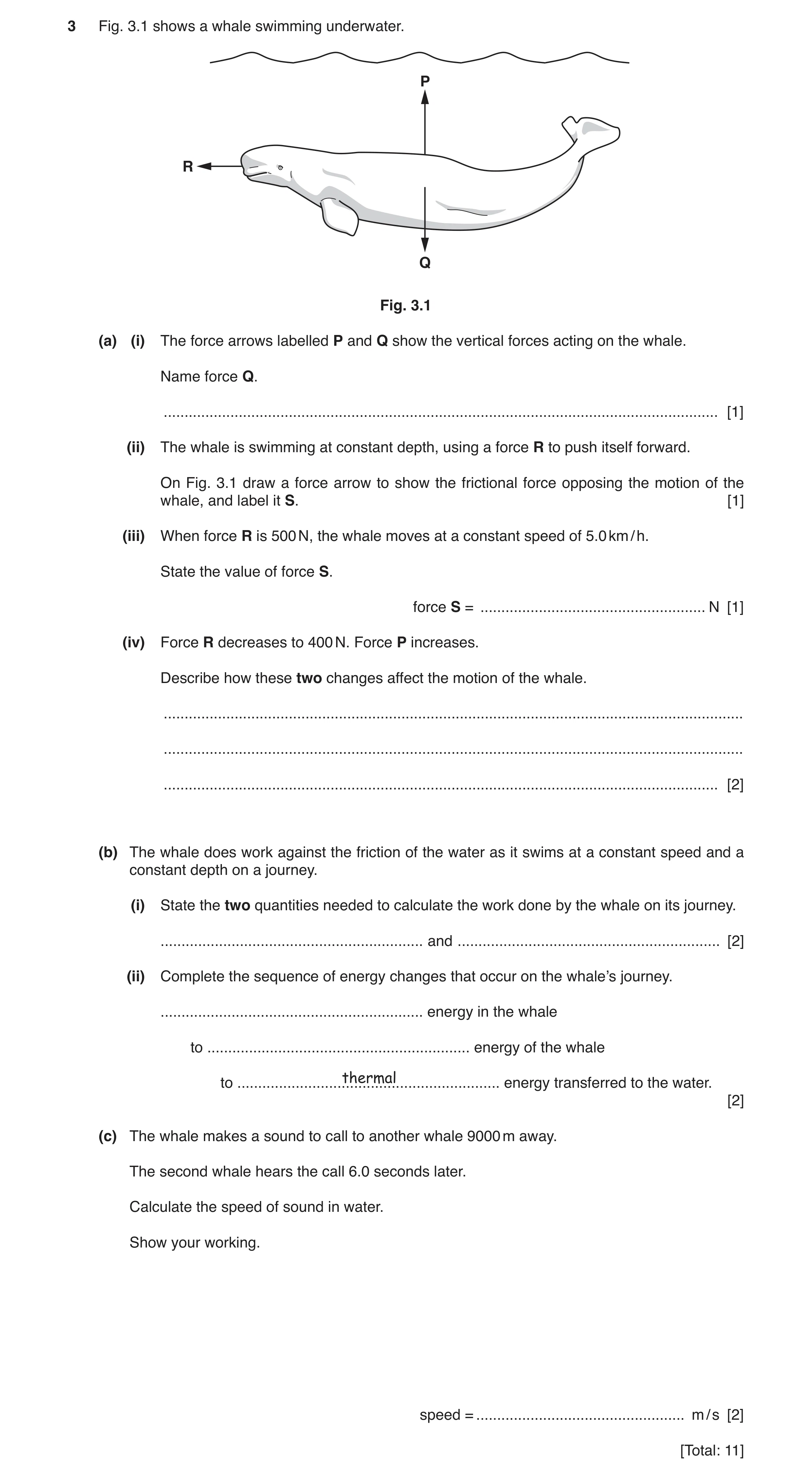
3 Fig. 3.1 shows a whale swimming underwater. P R Q Fig. 3.1 (a) (i) The force arrows labelled P and Q show the vertical forces acting on the whale. Name force Q. … [1] (ii) The whale is swimming at constant depth, using a force R to push itself forward. On Fig. 3.1 draw a force arrow to show the frictional force opposing the motion of the whale, and label it S. [1] (iii) When force R is 500 N, the whale moves at a constant speed of 5.0 km / h. State the value of force S. force S = … N [1] (iv) Force R decreases to 400 N. Force P increases. Describe how these two changes affect the motion of the whale. … … … [2] (b) The whale does work against the friction of the water as it swims at a constant speed and a constant depth on a journey. (i) State the two quantities needed to calculate the work done by the whale on its journey. … and … [2] (ii) Complete the sequence of energy changes that occur on the whale’s journey. … energy in the whale to … energy of the whale thermal to … energy transferred to the water. [2] (c) The whale makes a sound to call to another whale 9000 m away. The second whale hears the call 6.0 seconds later. Calculate the speed of sound in water. Show your working. speed = … m / s [2] [Total: 11]
11 marks
Mark scheme: 3(a)(i) weight / gravitational force / (force of) gravity 1 3(a)(ii) horizontal arrow pointing to right, with one end touching whale 1 3(a)(iii) 500 (N) 1 3(a)(iv) slows down ; moves upwards ; 2 3(b)(i) force (exerted by the whale) ; distance (travelled) ; 2 3(b)(ii) chemical potential ; (to) kinetic ; 2 3(c) speed = distance/time or 9000 / 6.0 ; = 1500 (m / s) ; 2
This question in 0653/31 May/June 2019
Q6 · Complete the sentences using words from the list 0653/33 May/June 2019
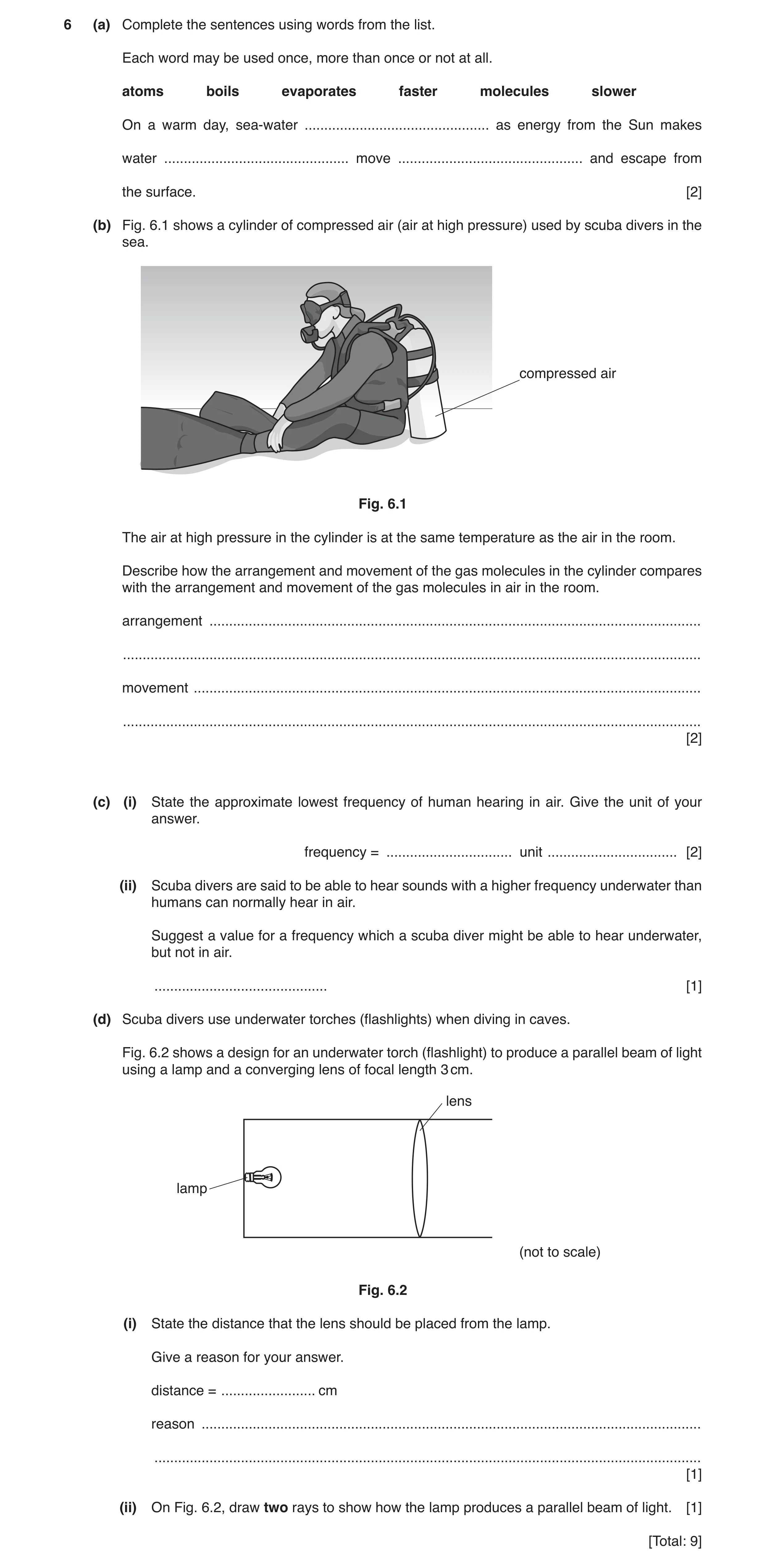
6 (a) Complete the sentences using words from the list. Each word may be used once, more than once or not at all. atoms boils evaporates faster molecules slower On a warm day, sea-water … as energy from the Sun makes water … move … and escape from the surface. [2] (b) Fig. 6.1 shows a cylinder of compressed air (air at high pressure) used by scuba divers in the sea. compressed air Fig. 6.1 The air at high pressure in the cylinder is at the same temperature as the air in the room. Describe how the arrangement and movement of the gas molecules in the cylinder compares with the arrangement and movement of the gas molecules in air in the room. arrangement … … movement … … [2] (c) (i) State the approximate lowest frequency of human hearing in air. Give the unit of your answer. frequency = … unit … [2] (ii) Scuba divers are said to be able to hear sounds with a higher frequency underwater than humans can normally hear in air. Suggest a value for a frequency which a scuba diver might be able to hear underwater, but not in air. … [1] (d) Scuba divers use underwater torches (flashlights) when diving in caves. Fig. 6.2 shows a design for an underwater torch (flashlight) to produce a parallel beam of light using a lamp and a converging lens of focal length 3 cm. lens lamp (not to scale) Fig. 6.2 (i) State the distance that the lens should be placed from the lamp. Give a reason for your answer. distance = … cm reason … … [1] (ii) On Fig. 6.2, draw two rays to show how the lamp produces a parallel beam of light. [1] [Total: 9]
9 marks
Mark scheme: 6(a) «evaporates« molecules « faster« ; ; any 2 correct for 1 mark all three correct for 2 marks 2 6(b) (molecules in the cylinder are) close together / less far apart ORA / random in both / arrangement irregular ; same speed (at same temperature) / both free to move around ; 2 6(c)(i) 20 ; Hz / hertz ; 2 6(c)(ii) any sensible value above 20 000 (Hz) ; 1 6(d)(i) (3 cm) no mark (to produce a parallel beam) must come from (principal) focus ; 1 6(d)(ii) ; 1
This question in 0653/33 May/June 2019
Q7 · How a small hydroelectric power station is used to supply electricity 0653/31 Oct/Nov 2019
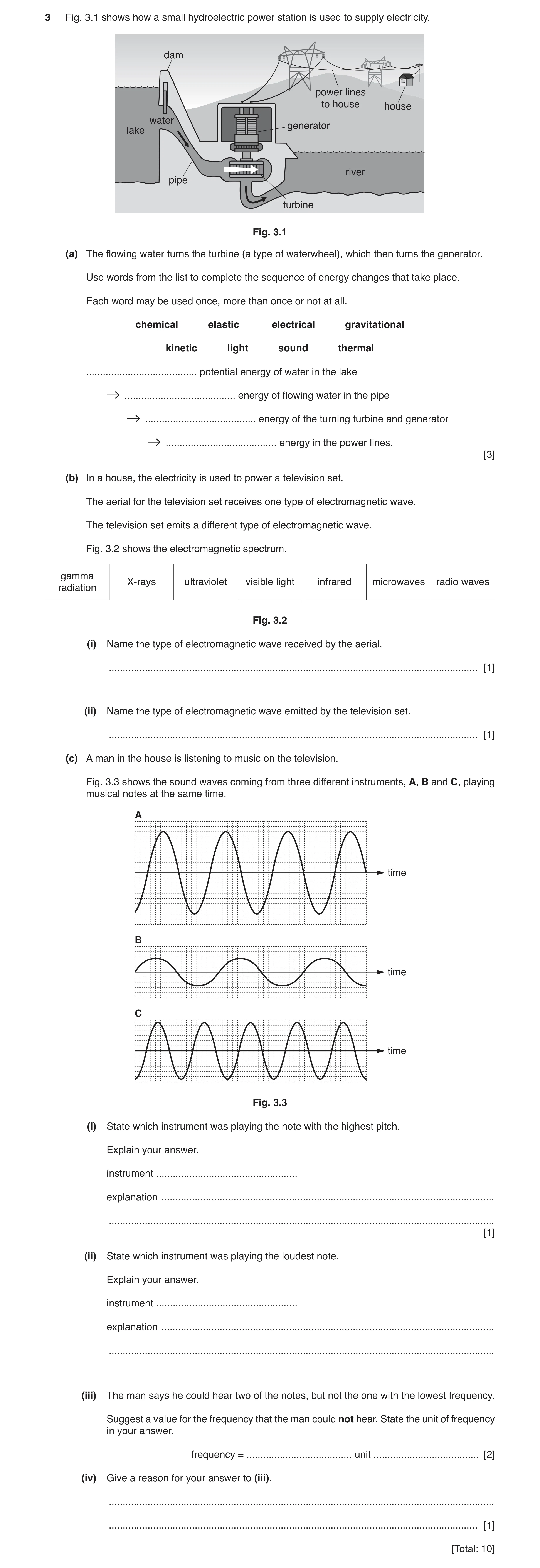
3 Fig. 3.1 shows how a small hydroelectric power station is used to supply electricity. dam power lines to house house water generator lake river pipe turbine Fig. 3.1 (a) The flowing water turns the turbine (a type of waterwheel), which then turns the generator. Use words from the list to complete the sequence of energy changes that take place. Each word may be used once, more than once or not at all. chemical elastic electrical gravitational kinetic light sound thermal … potential energy of water in the lake … energy of flowing water in the pipe … energy of the turning turbine and generator … energy in the power lines. [3] (b) In a house, the electricity is used to power a television set. The aerial for the television set receives one type of electromagnetic wave. The television set emits a different type of electromagnetic wave. Fig. 3.2 shows the electromagnetic spectrum. gamma X-rays ultraviolet visible light infrared microwaves radio waves radiation Fig. 3.2 (i) Name the type of electromagnetic wave received by the aerial. … [1] (ii) Name the type of electromagnetic wave emitted by the television set. … [1] (c) A man in the house is listening to music on the television. Fig. 3.3 shows the sound waves coming from three different instruments, A, B and C, playing musical notes at the same time. A time B time C time Fig. 3.3 (i) State which instrument was playing the note with the highest pitch. Explain your answer. instrument … explanation … … [1] (ii) State which instrument was playing the loudest note. Explain your answer. instrument … explanation … … (iii) The man says he could hear two of the notes, but not the one with the lowest frequency. Suggest a value for the frequency that the man could not hear. State the unit of frequency in your answer. frequency = … unit … [2] (iv) Give a reason for your answer to (iii). … … [1] [Total: 10]
10 marks
Mark scheme: 3(a) gravitational kinetic kinetic electrical 1 or 2 correct = 1 mark 3 correct = 2 marks All correct = 3 marks 3 3(b)(i) radio waves / microwaves ; 1 3(b)(ii) visible light ; 1 3(c)(i) C and because more waves in same time / higher frequency ; 1 3(c)(ii) A and because waves have largest amplitude ; 1 3(c)(iii) any value below 20 (Hz) ; Hz / hertz ; 2 3(c)(iv) below the (normal) lower limit / frequency of human hearing ; 1
This question in 0653/31 Oct/Nov 2019
Q8 · A lightning flash, which is a form of electrostatic discharge 0653/32 Oct/Nov 2019
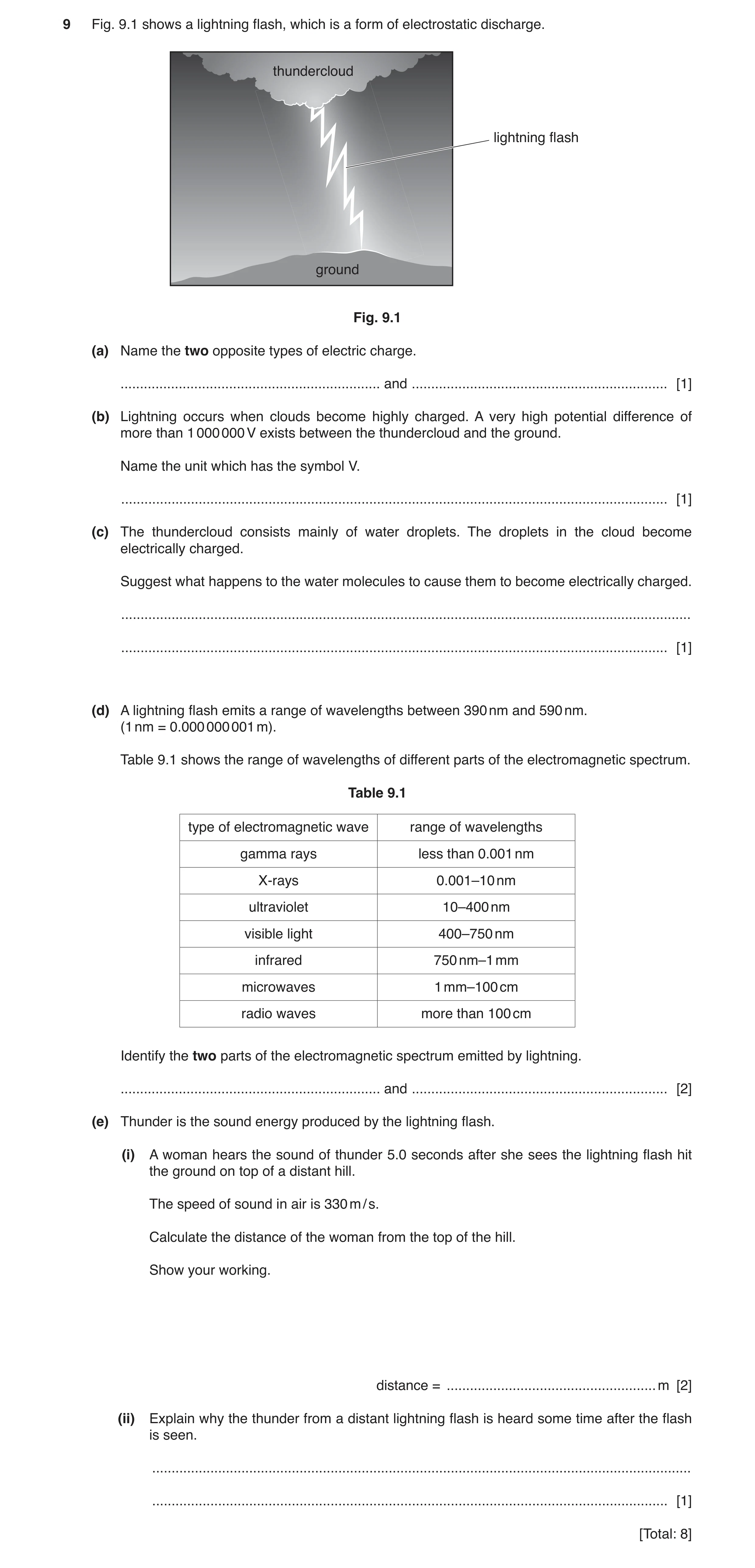
9 Fig. 9.1 shows a lightning flash, which is a form of electrostatic discharge. thundercloud lightning flash ground Fig. 9.1 (a) Name the two opposite types of electric charge. … and … [1] (b) Lightning occurs when clouds become highly charged. A very high potential difference of more than 1 000 000 V exists between the thundercloud and the ground. Name the unit which has the symbol V. … [1] (c) The thundercloud consists mainly of water droplets. The droplets in the cloud become electrically charged. Suggest what happens to the water molecules to cause them to become electrically charged. … … [1] (d) A lightning flash emits a range of wavelengths between 390 nm and 590 nm. (1 nm = 0.000 000 001 m). Table 9.1 shows the range of wavelengths of different parts of the electromagnetic spectrum. Table 9.1 type of electromagnetic wave range of wavelengths gamma rays less than 0.001 nm X‑rays 0.001–10 nm ultraviolet 10–400 nm visible light 400–750 nm infrared 750 nm–1 mm microwaves 1 mm–100 cm radio waves more than 100 cm Identify the two parts of the electromagnetic spectrum emitted by lightning. … and … [2] (e) Thunder is the sound energy produced by the lightning flash. (i) A woman hears the sound of thunder 5.0 seconds after she sees the lightning flash hit the ground on top of a distant hill. The speed of sound in air is 330 m / s. Calculate the distance of the woman from the top of the hill. Show your working. distance = … m [2] (ii) Explain why the thunder from a distant lightning flash is heard some time after the flash is seen. … … [1] [Total: 8]
8 marks
Mark scheme: 9(a) positive and negative ; 1 9(b) volt(s); 1 9(c) loss / gain / transfer of electrons (between molecules) ; 1 9(d) visible light; ultraviolet ; 2 9(e)(i) speed = distance / time or d = speed × time = 330 × 5.0 ; = 1650 (m) ; 2 9(e)(ii) light travels (much) faster than sound ; 1
This question in 0653/32 Oct/Nov 2019
Q9 · A crane lifting a load up the side of a building 0653/32 Feb/March 2020
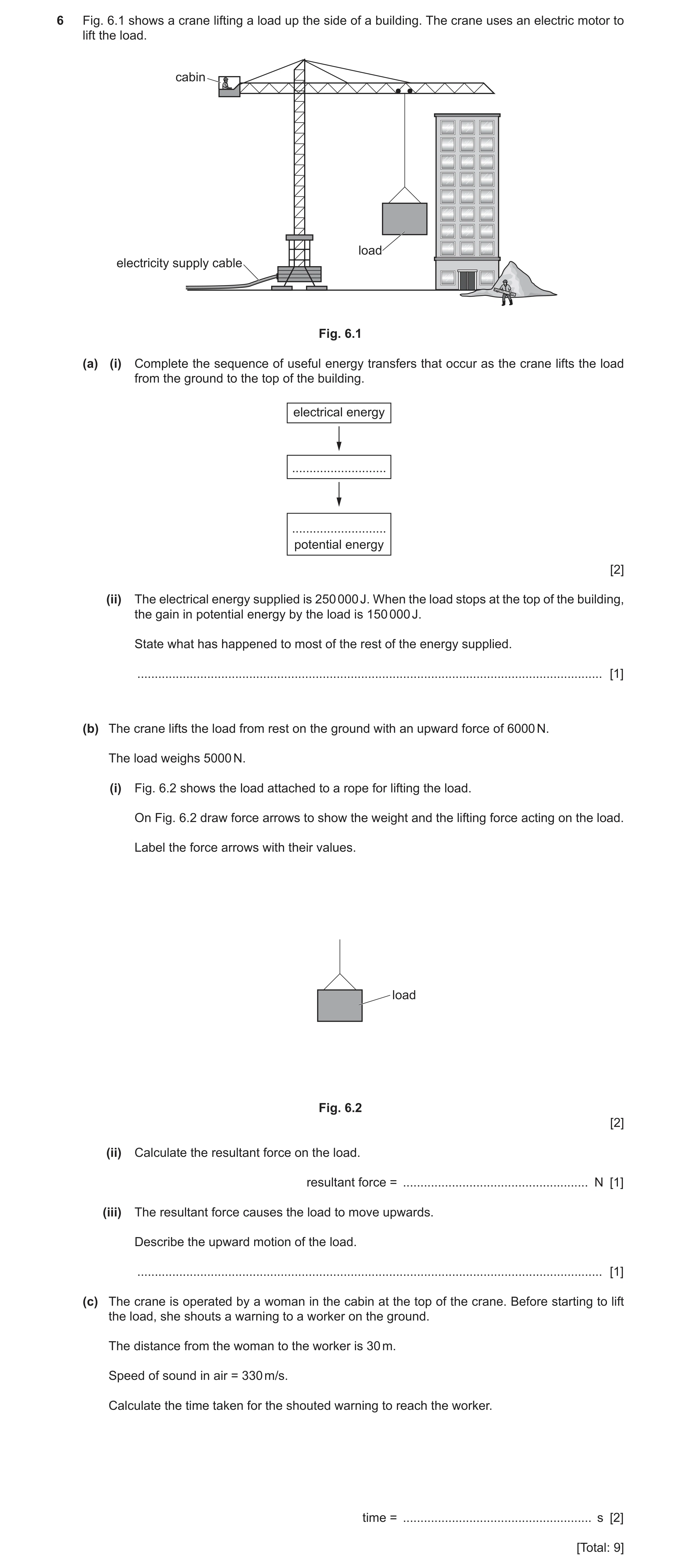
6 Fig. 6.1 shows a crane lifting a load up the side of a building. The crane uses an electric motor to lift the load. cabin load electricity supply cable Fig. 6.1 (a) (i) Complete the sequence of useful energy transfers that occur as the crane lifts the load from the ground to the top of the building. electrical energy … … potential energy [2] (ii) The electrical energy supplied is 250 000 J. When the load stops at the top of the building, the gain in potential energy by the load is 150 000 J. State what has happened to most of the rest of the energy supplied. … [1] (b) The crane lifts the load from rest on the ground with an upward force of 6000 N. The load weighs 5000 N. (i) Fig. 6.2 shows the load attached to a rope for lifting the load. On Fig. 6.2 draw force arrows to show the weight and the lifting force acting on the load. Label the force arrows with their values. load Fig. 6.2 [2] (ii) Calculate the resultant force on the load. resultant force = … N [1] (iii) The resultant force causes the load to move upwards. Describe the upward motion of the load. … [1] (c) The crane is operated by a woman in the cabin at the top of the crane. Before starting to lift the load, she shouts a warning to a worker on the ground. The distance from the woman to the worker is 30 m. Speed of sound in air = 330 m/s. Calculate the time taken for the shouted warning to reach the worker. time = … s [2] [Total: 9]
9 marks
Mark scheme: 6(a)(i) (electrical energy) kinetic (energy) ; gravitational (potential energy) ; 2 6(a)(ii) (lost as / transformed into) thermal energy ; 1 Question Answer Marks 6(b)(i) 6000 N 5000 N both arrows in correct directions ; both arrows correctly labelled ; 2 6(b)(ii) (6000 – 5000 =) 1000 (N) ; 1 6(b)(iii) accelerating / changing speed ; 1 6(c) distance 30 time = speed 330 = ; = 0.09(1) s ; 2
This question in 0653/32 Feb/March 2020
Q10 · A mobile (cell) phone and a loudspeaker 0653/31 May/June 2020
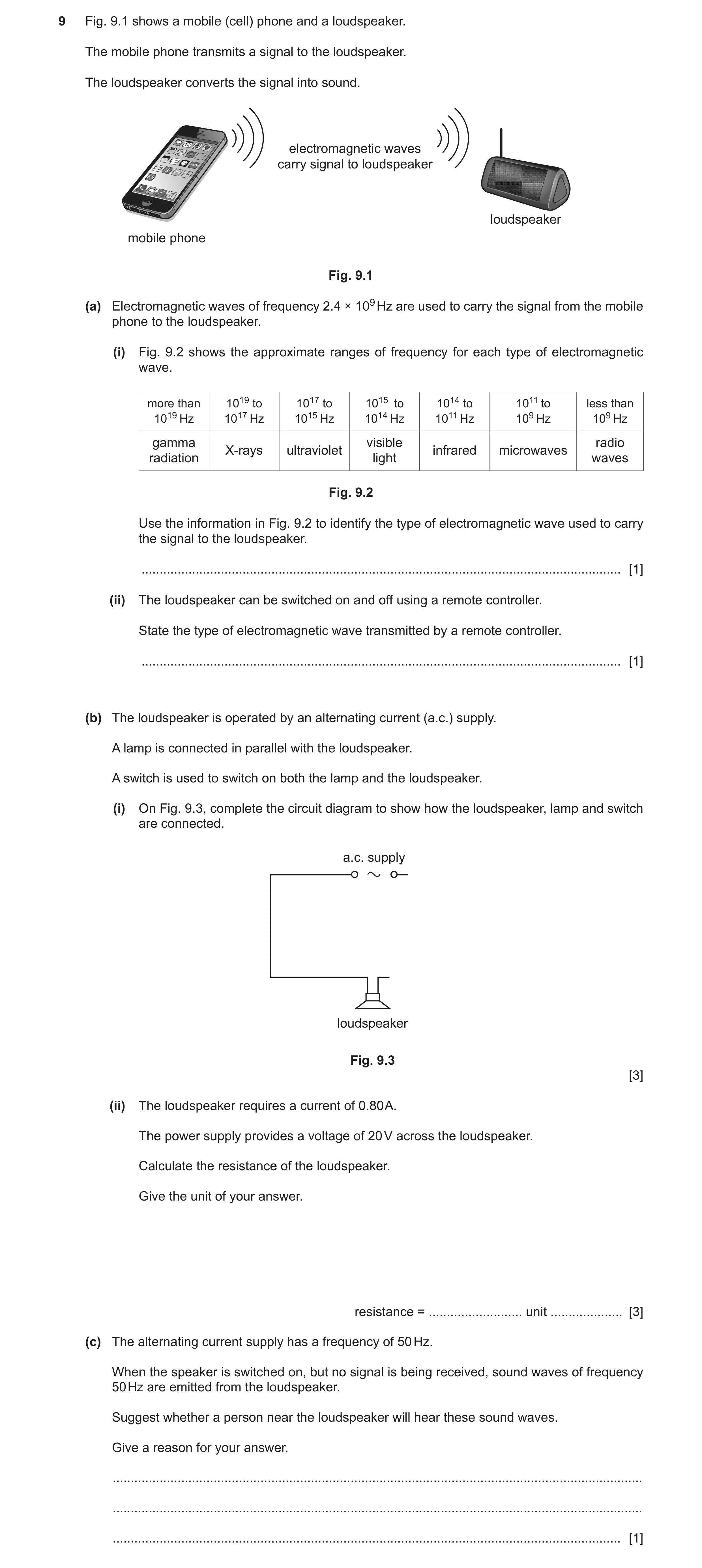
9 Fig. 9.1 shows a mobile (cell) phone and a loudspeaker. The mobile phone transmits a signal to the loudspeaker. The loudspeaker converts the signal into sound. electromagnetic waves carry signal to loudspeaker loudspeaker mobile phone Fig. 9.1 (a) Electromagnetic waves of frequency 2.4 × 10⁹ Hz are used to carry the signal from the mobile phone to the loudspeaker. (i) Fig. 9.2 shows the approximate ranges of frequency for each type of electromagnetic wave. more than 1019 to 1017 to 1015 to 1014 to 1011 to less than 1019 Hz 1017 Hz 1015 Hz 1014 Hz 1011 Hz 109 Hz 109 Hz gamma visible radio X-rays ultraviolet infrared microwaves radiation light waves Fig. 9.2 Use the information in Fig. 9.2 to identify the type of electromagnetic wave used to carry the signal to the loudspeaker. … [1] (ii) The loudspeaker can be switched on and off using a remote controller. State the type of electromagnetic wave transmitted by a remote controller. … [1] (b) The loudspeaker is operated by an alternating current (a.c.) supply. A lamp is connected in parallel with the loudspeaker. A switch is used to switch on both the lamp and the loudspeaker. (i) On Fig. 9.3, complete the circuit diagram to show how the loudspeaker, lamp and switch are connected. a.c. supply loudspeaker Fig. 9.3 [3] (ii) The loudspeaker requires a current of 0.80 A. The power supply provides a voltage of 20 V across the loudspeaker. Calculate the resistance of the loudspeaker. Give the unit of your answer. resistance = … unit … [3] (c) The alternating current supply has a frequency of 50 Hz. When the speaker is switched on, but no signal is being received, sound waves of frequency 50 Hz are emitted from the loudspeaker. Suggest whether a person near the loudspeaker will hear these sound waves. Give a reason for your answer. … … … [1]
9 marks
Mark scheme: 9(a)(i) microwaves ; 1 9(a)(ii) infrared ; 1 9(b)(i) 3 9(b)(ii) R = V / I = 20 / 0.80 ; = 25 ; unit: Ω / ohm ; 3 9(c) (yes – no mark) frequency within range of (human) hearing ; 1 all circuit symbols correct ; louspeaker and lamp in parallel ; switch in main circuit ;
This question in 0653/31 May/June 2020
Q11 · A man holding a glass rod in one hand and a metal rod in the other hand 0653/32 May/June 2020
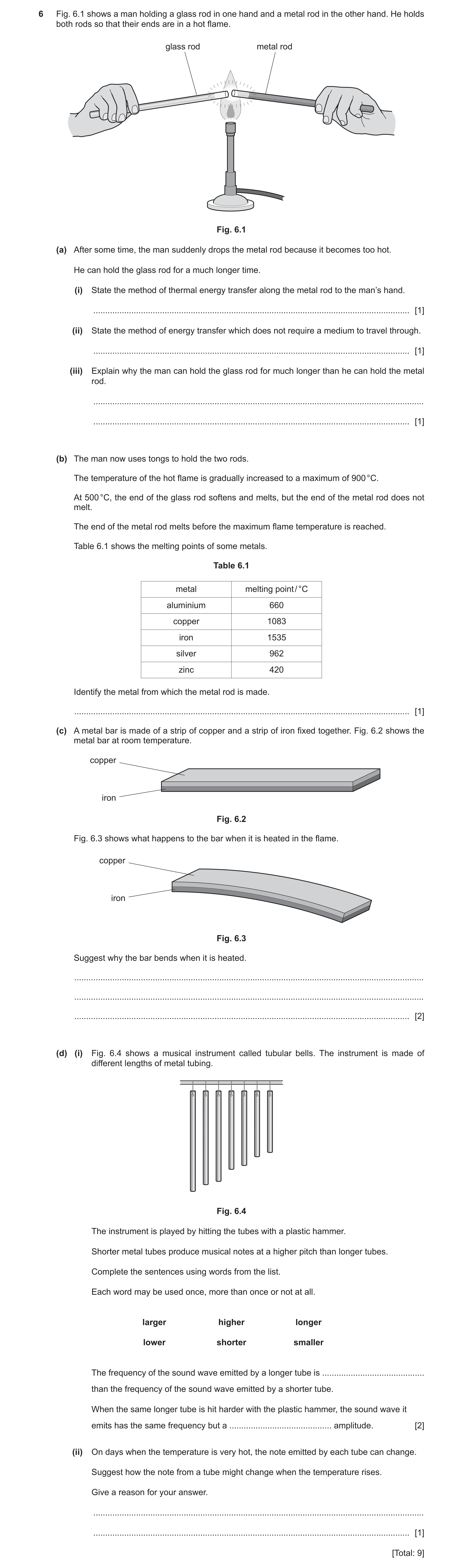
6 Fig. 6.1 shows a man holding a glass rod in one hand and a metal rod in the other hand. He holds both rods so that their ends are in a hot flame. glass rod metal rod Fig. 6.1 (a) After some time, the man suddenly drops the metal rod because it becomes too hot. He can hold the glass rod for a much longer time. (i) State the method of thermal energy transfer along the metal rod to the man’s hand. … [1] (ii) State the method of energy transfer which does not require a medium to travel through. … [1] (iii) Explain why the man can hold the glass rod for much longer than he can hold the metal rod. … … [1] (b) The man now uses tongs to hold the two rods. The temperature of the hot flame is gradually increased to a maximum of 900 °C. At 500 °C, the end of the glass rod softens and melts, but the end of the metal rod does not melt. The end of the metal rod melts before the maximum flame temperature is reached. Table 6.1 shows the melting points of some metals. Table 6.1 metal melting point / °C aluminium 660 copper 1083 iron 1535 silver 962 zinc 420 Identify the metal from which the metal rod is made. … [1] (c) A metal bar is made of a strip of copper and a strip of iron fixed together. Fig. 6.2 shows the metal bar at room temperature. copper iron Fig. 6.2 Fig. 6.3 shows what happens to the bar when it is heated in the flame. copper iron Fig. 6.3 Suggest why the bar bends when it is heated. … … … [2] (d) (i) Fig. 6.4 shows a musical instrument called tubular bells. The instrument is made of different lengths of metal tubing. Fig. 6.4 The instrument is played by hitting the tubes with a plastic hammer. Shorter metal tubes produce musical notes at a higher pitch than longer tubes. Complete the sentences using words from the list. Each word may be used once, more than once or not at all. larger higher longer lower shorter smaller The frequency of the sound wave emitted by a longer tube is … than the frequency of the sound wave emitted by a shorter tube. When the same longer tube is hit harder with the plastic hammer, the sound wave it emits has the same frequency but a … amplitude. [2] (ii) On days when the temperature is very hot, the note emitted by each tube can change. Suggest how the note from a tube might change when the temperature rises. Give a reason for your answer. … … [1] [Total: 9]
9 marks
Mark scheme: 6(a)(i) conduction ; 1 6(a)(ii) radiation ; 1 6(a)(iii) glass is a bad conductor, metal is a good conductor ; 1 6(b) aluminium ; 1 6(c) reference to expansion on heating ; copper expands more (rapidly) than iron ; 2 6(d)(i) lower ; larger ; 2 6(d)(ii) lower (note / pitch / frequency) or longer wavelength (no mark) (because) tube, expands / gets longer with temperature ; 1
This question in 0653/32 May/June 2020
Question 12 0653/31 Oct/Nov 2021
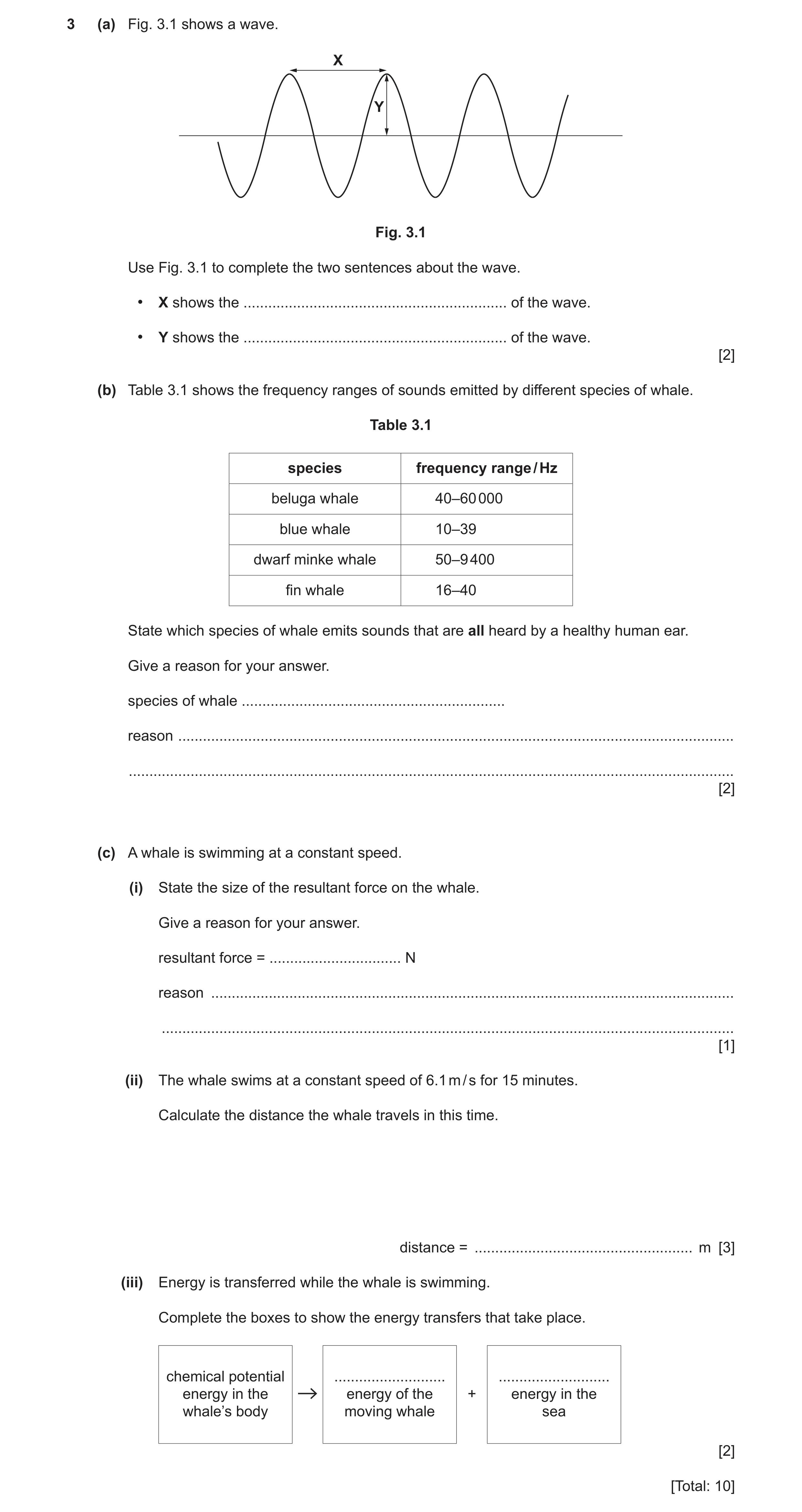
3 (a) Fig. 3.1 shows a wave. X Y Fig. 3.1 Use Fig. 3.1 to complete the two sentences about the wave. • X shows the … of the wave. • Y shows the … of the wave. [2] (b) Table 3.1 shows the frequency ranges of sounds emitted by different species of whale. Table 3.1 species frequency range / Hz beluga whale 40–60 000 blue whale 10–39 dwarf minke whale 50–9 400 fin whale 16–40 State which species of whale emits sounds that are all heard by a healthy human ear. Give a reason for your answer. species of whale … reason … … [2] (c) A whale is swimming at a constant speed. (i) State the size of the resultant force on the whale. Give a reason for your answer. resultant force = … N reason … … [1] (ii) The whale swims at a constant speed of 6.1 m / s for 15 minutes. Calculate the distance the whale travels in this time. distance = … m [3] (iii) Energy is transferred while the whale is swimming. Complete the boxes to show the energy transfers that take place. chemical potential … … energy in the energy of the + energy in the whale’s body moving whale sea [2] [Total: 10]
10 marks
Mark scheme: 3(a) X wavelength ; Y amplitude ; 2 3(b) dwarf minke (whale) ; all within audible frequency range of 20–20 000 Hz ; 2 3(c)(i) zero / 0 (N) AND (at constant speed there is) no resultant force ; 1 3(c)(ii) conversion of minutes to seconds / 15 × 60 = 900 ; distance = speed × time in any form / 6.1 × 900 ; 5500 (m); 3 3(c)(iii) kinetic ; thermal ; 2 Question Answer Marks
This question in 0653/31 Oct/Nov 2021
Q13 · The seven regions of the electromagnetic spectrum 0653/32 Oct/Nov 2021
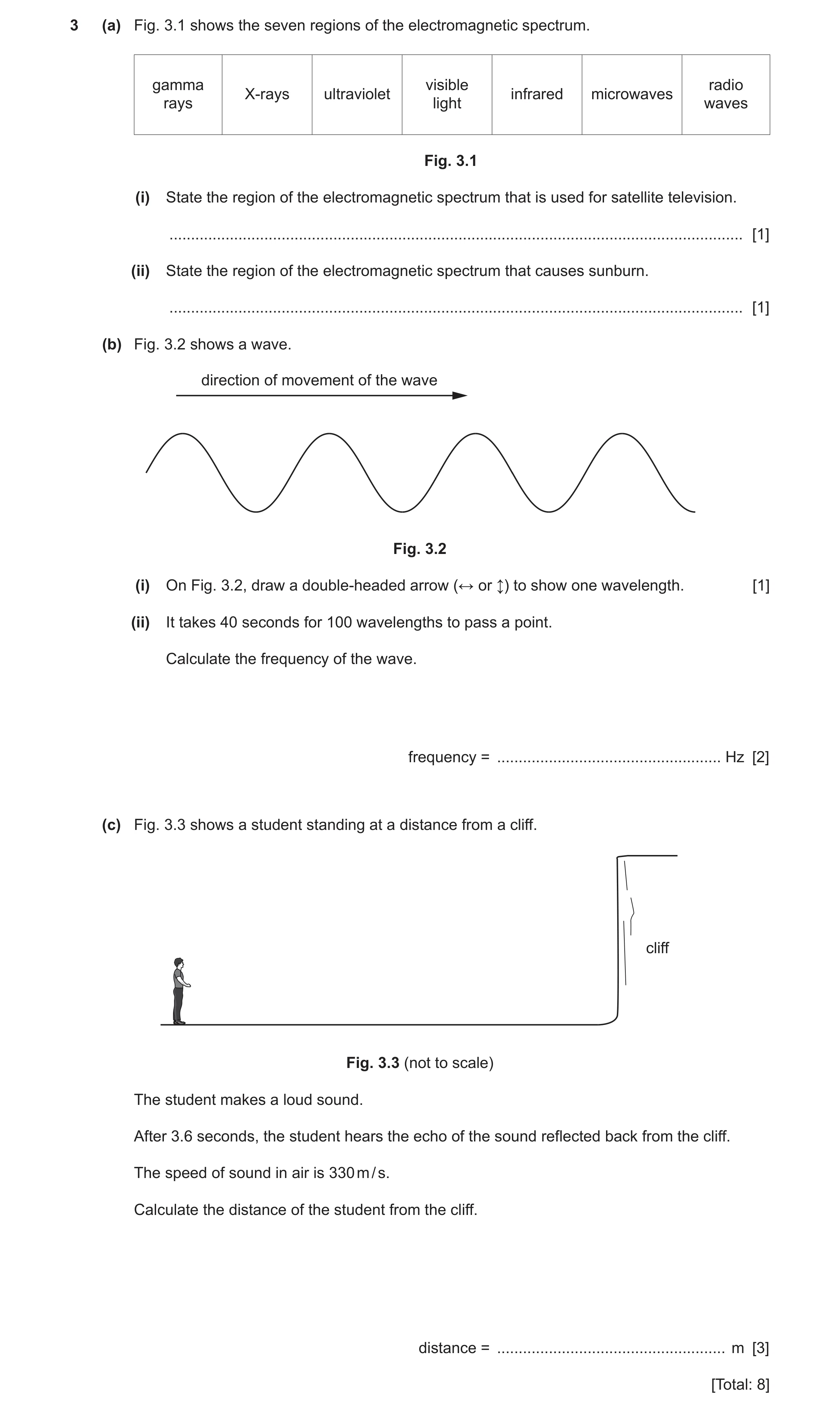
3 (a) Fig. 3.1 shows the seven regions of the electromagnetic spectrum. gamma visible radio X-rays ultraviolet infrared microwaves rays light waves Fig. 3.1 (i) State the region of the electromagnetic spectrum that is used for satellite television. … [1] (ii) State the region of the electromagnetic spectrum that causes sunburn. … [1] (b) Fig. 3.2 shows a wave. direction of movement of the wave Fig. 3.2 (i) On Fig. 3.2, draw a double-headed arrow (↔ or ↕) to show one wavelength. [1] (ii) It takes 40 seconds for 100 wavelengths to pass a point. Calculate the frequency of the wave. frequency = … Hz [2] (c) Fig. 3.3 shows a student standing at a distance from a cliff. cliff Fig. 3.3 (not to scale) The student makes a loud sound. After 3.6 seconds, the student hears the echo of the sound reflected back from the cliff. The speed of sound in air is 330 m / s. Calculate the distance of the student from the cliff. distance = … m [3] [Total: 8]
8 marks
Mark scheme: 3(a)(i) microwave(s) ; 1 3(a)(ii) ultraviolet ; 1 3(b)(i) double-headed arrow between any two equivalent points on adjacent waves, e.g. ; 1 3(b)(ii) frequency = number of waves per second / 100 ÷ 40 ; 2.5 (Hz) ; 2 3(c) speed = distance ÷ time in any form / 330 × 3.6 ; (total distance travelled =) 1188 OR idea of, distance / time, being halved ; 590 ; 3
This question in 0653/32 Oct/Nov 2021
Q14 · The seven regions of the electromagnetic spectrum 0653/33 Oct/Nov 2021
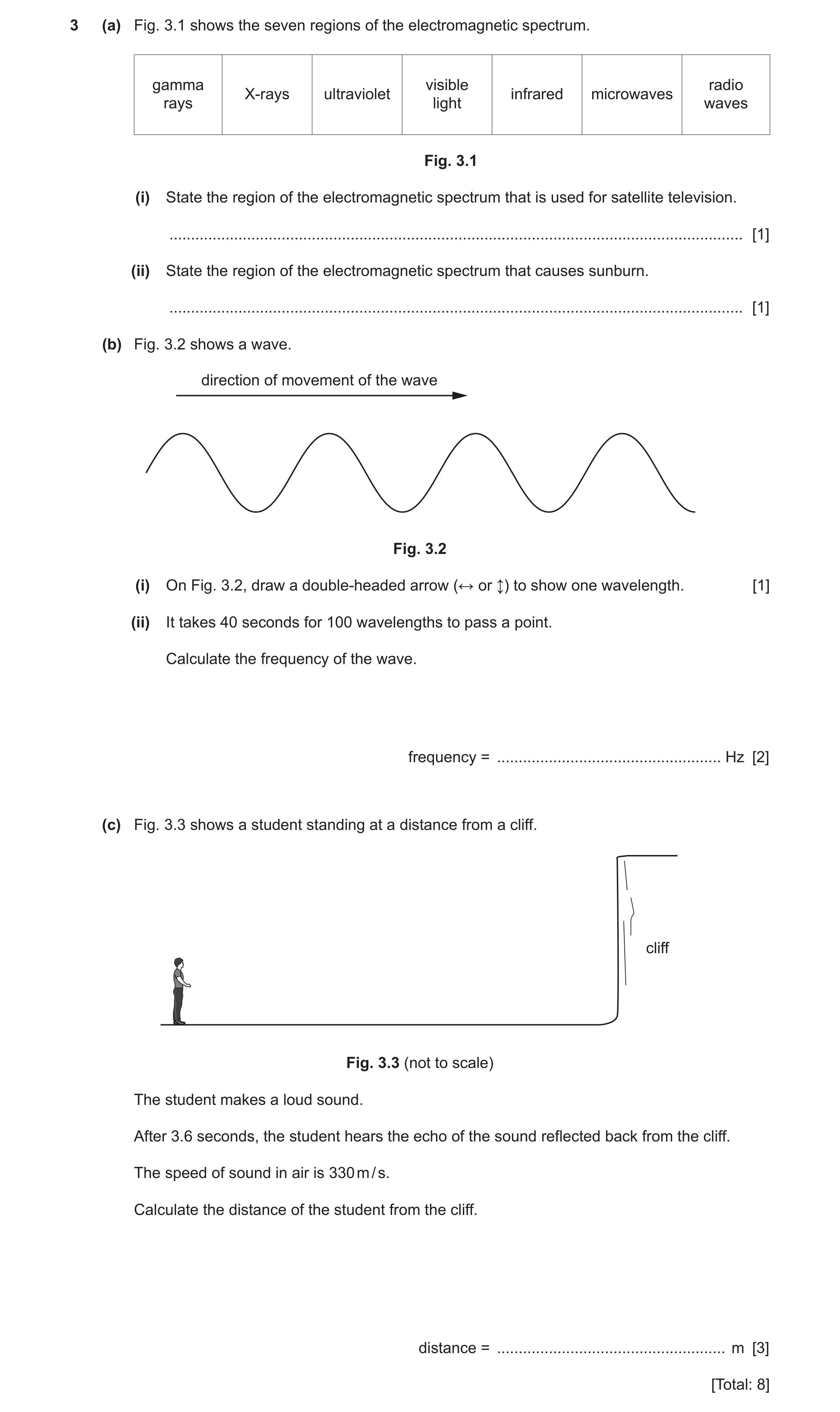
3 (a) Fig. 3.1 shows the seven regions of the electromagnetic spectrum. gamma visible radio X-rays ultraviolet infrared microwaves rays light waves Fig. 3.1 (i) State the region of the electromagnetic spectrum that is used for satellite television. … [1] (ii) State the region of the electromagnetic spectrum that causes sunburn. … [1] (b) Fig. 3.2 shows a wave. direction of movement of the wave Fig. 3.2 (i) On Fig. 3.2, draw a double-headed arrow (↔ or ↕) to show one wavelength. [1] (ii) It takes 40 seconds for 100 wavelengths to pass a point. Calculate the frequency of the wave. frequency = … Hz [2] (c) Fig. 3.3 shows a student standing at a distance from a cliff. cliff Fig. 3.3 (not to scale) The student makes a loud sound. After 3.6 seconds, the student hears the echo of the sound reflected back from the cliff. The speed of sound in air is 330 m / s. Calculate the distance of the student from the cliff. distance = … m [3] [Total: 8]
8 marks
Mark scheme: 3(a)(i) microwave(s) ; 1 3(a)(ii) ultraviolet ; 1 3(b)(i) double-headed arrow between any two equivalent points on adjacent waves, e.g. ; 1 3(b)(ii) frequency = number of waves per second / 100 ÷ 40 ; 2.5 (Hz) ; 2 3(c) speed = distance ÷ time in any form / 330 × 3.6 ; (total distance travelled =) 1188 OR idea of, distance / time, being halved ; 590 ; 3
This question in 0653/33 Oct/Nov 2021
Q15 · A thermometer in a beaker of water 0653/32 Feb/March 2022
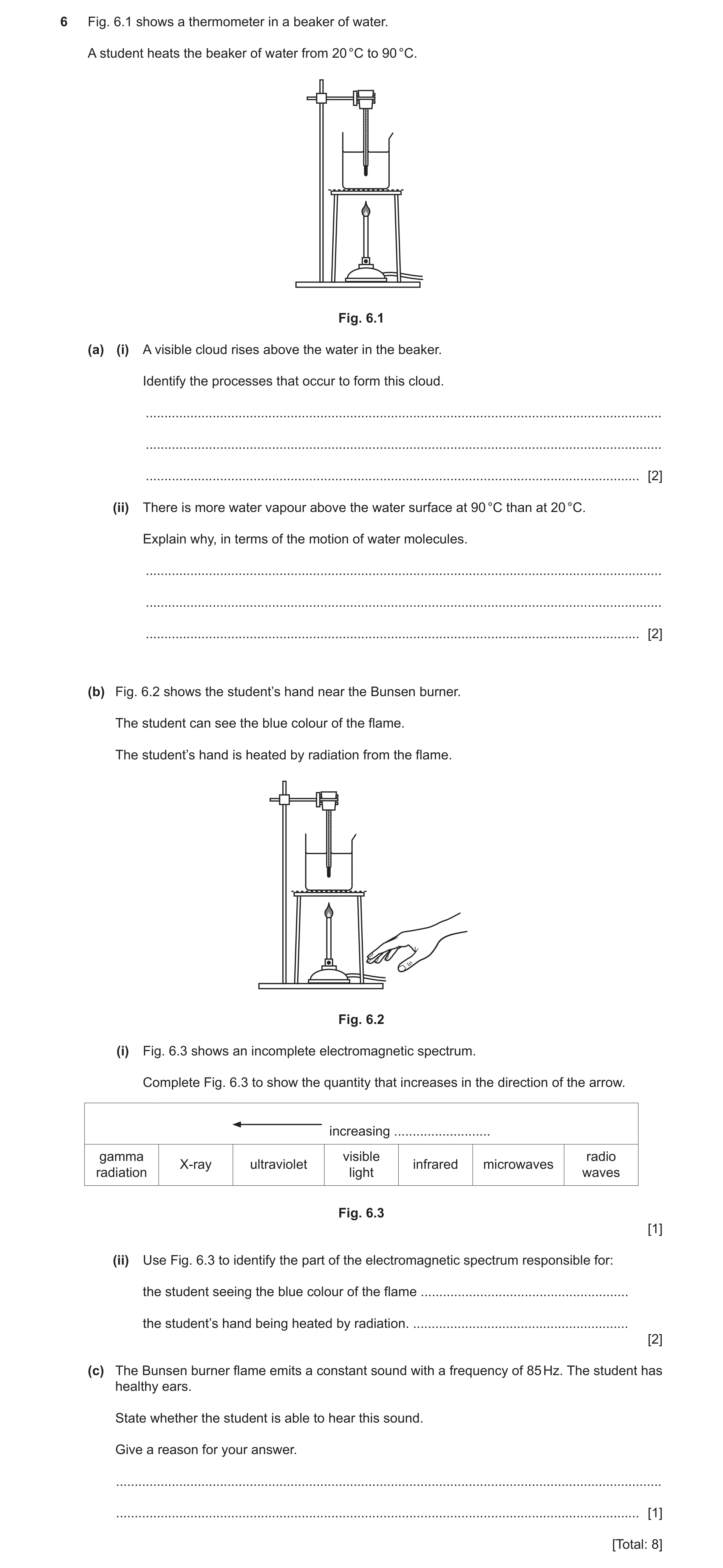
6 Fig. 6.1 shows a thermometer in a beaker of water. A student heats the beaker of water from 20 °C to 90 °C. Fig. 6.1 (a) (i) A visible cloud rises above the water in the beaker. Identify the processes that occur to form this cloud. … … … [2] (ii) There is more water vapour above the water surface at 90 °C than at 20 °C. Explain why, in terms of the motion of water molecules. … … … [2] (b) Fig. 6.2 shows the student’s hand near the Bunsen burner. The student can see the blue colour of the flame. The student’s hand is heated by radiation from the flame. Fig. 6.2 (i) Fig. 6.3 shows an incomplete electromagnetic spectrum. Complete Fig. 6.3 to show the quantity that increases in the direction of the arrow. increasing … gamma visible radio X-ray ultraviolet infrared microwaves radiation light waves Fig. 6.3 [1] (ii) Use Fig. 6.3 to identify the part of the electromagnetic spectrum responsible for: the student seeing the blue colour of the flame … the student’s hand being heated by radiation. … [2] (c) The Bunsen burner flame emits a constant sound with a frequency of 85 Hz. The student has healthy ears. State whether the student is able to hear this sound. Give a reason for your answer. … … [1] [Total: 8]
8 marks
Mark scheme: 6(a)(i) evaporation / water in beaker evaporates (from surface) ; condensation / water vapour condenses to form visible cloud ; 2 6(a)(ii) molecules moving faster / more energetic at 90 °C ; more (have sufficient energy to) escape ; 2 6(b)(i) frequency ; 1 6(b)(ii) visible light ; infrared (radiation) ; 2 6(c) (yes – no mark) frequency lies between 20 Hz and 20 kHz ; 1
This question in 0653/32 Feb/March 2022
Q16 · A heat lamp used to keep newborn chicks warm 0653/32 May/June 2022
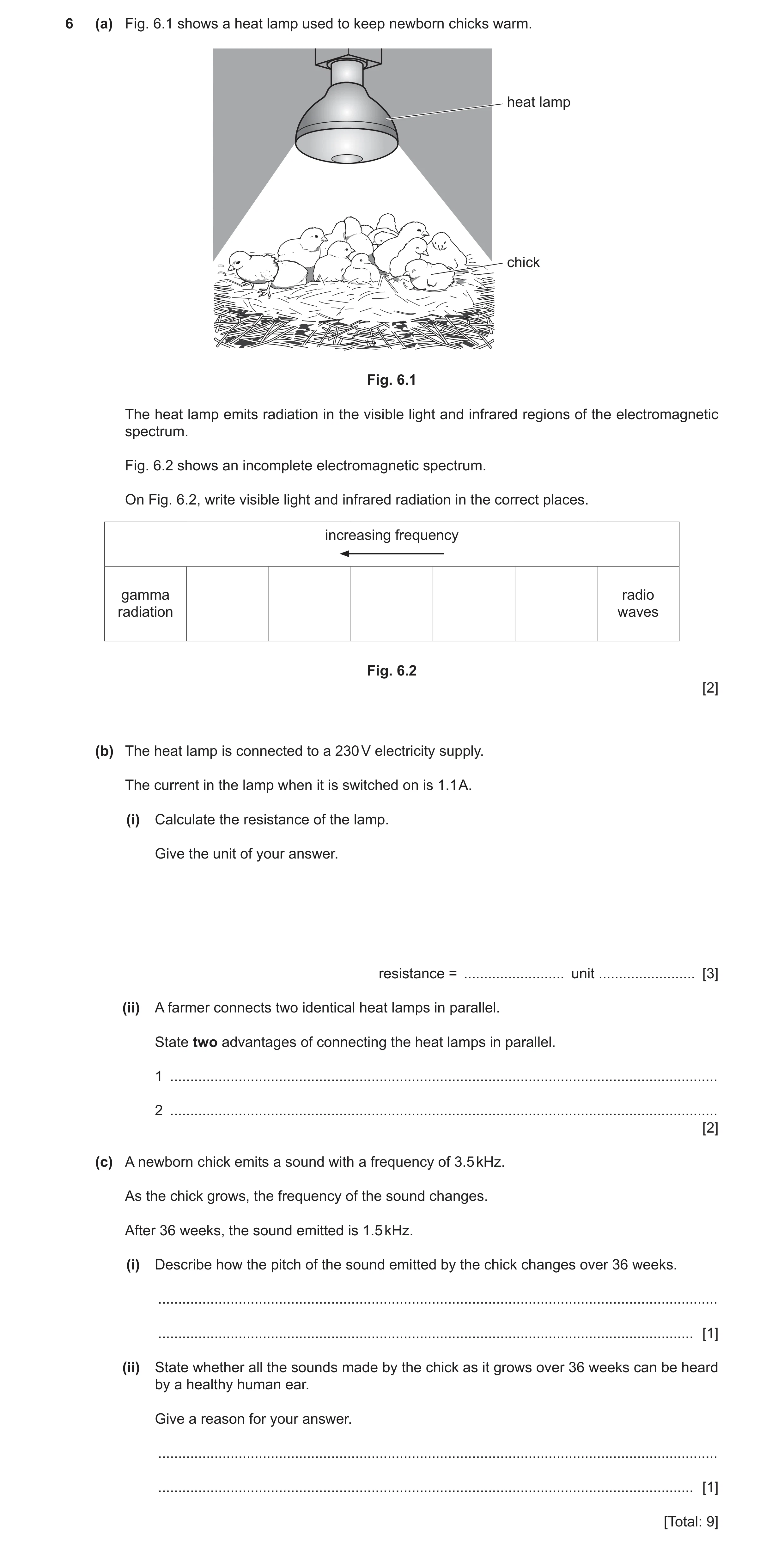
6 (a) Fig. 6.1 shows a heat lamp used to keep newborn chicks warm. heat lamp chick Fig. 6.1 The heat lamp emits radiation in the visible light and infrared regions of the electromagnetic spectrum. Fig. 6.2 shows an incomplete electromagnetic spectrum. On Fig. 6.2, write visible light and infrared radiation in the correct places. increasing frequency gamma radio radiation waves Fig. 6.2 [2] (b) The heat lamp is connected to a 230 V electricity supply. The current in the lamp when it is switched on is 1.1 A. (i) Calculate the resistance of the lamp. Give the unit of your answer. resistance = … unit … [3] (ii) A farmer connects two identical heat lamps in parallel. State two advantages of connecting the heat lamps in parallel. 1 … 2 … [2] (c) A newborn chick emits a sound with a frequency of 3.5 kHz. As the chick grows, the frequency of the sound changes. After 36 weeks, the sound emitted is 1.5 kHz. (i) Describe how the pitch of the sound emitted by the chick changes over 36 weeks. … … [1] (ii) State whether all the sounds made by the chick as it grows over 36 weeks can be heard by a healthy human ear. Give a reason for your answer. … … [1] [Total: 9]
9 marks
Mark scheme: 6(a) (gamma radiation) visible light ; Infrared radiation ; (radio waves) 2 6(b)(i) R = V ÷ I (in any form) / 230 ÷ 1.1 ; 209 ; / ohm(s) ; 3 6(b)(ii) any two of: if one lamp fails, the other remains lit owtte ; more light / heat ; can be controlled independently ; 2 6(c)(i) (pitch) decreases / gets lower / goes down ; 1 6(c)(ii) yes – AND sounds made by chicks all lie within range of 20 Hz – 20 000 Hz ; 1
This question in 0653/32 May/June 2022
Q17 · An ice cube floating in a glass of water 0653/33 May/June 2022
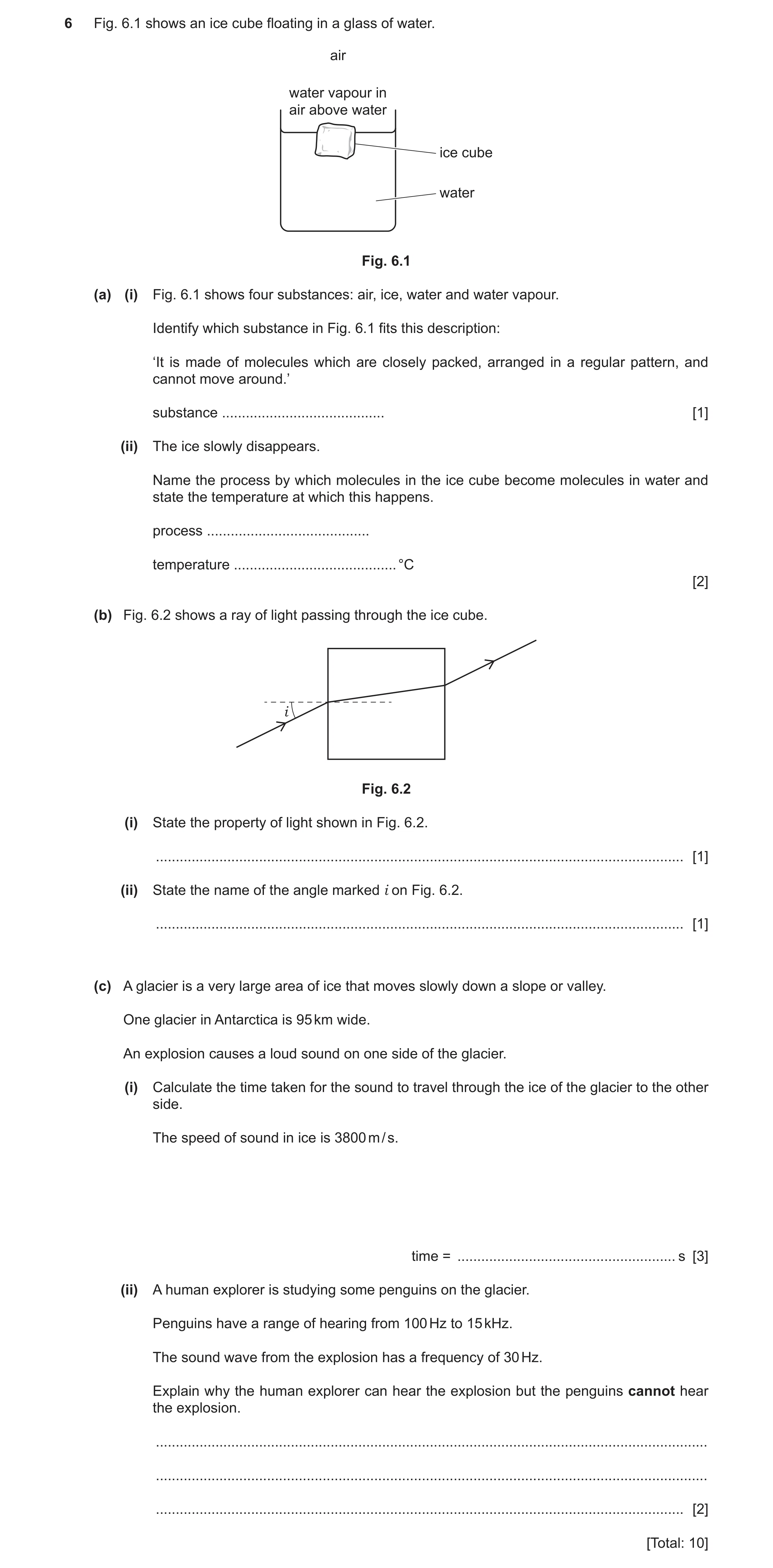
6 Fig. 6.1 shows an ice cube floating in a glass of water. air water vapour in air above water ice cube water Fig. 6.1 (a) (i) Fig. 6.1 shows four substances: air, ice, water and water vapour. Identify which substance in Fig. 6.1 fits this description: ‘It is made of molecules which are closely packed, arranged in a regular pattern, and cannot move around.’ substance … [1] (ii) The ice slowly disappears. Name the process by which molecules in the ice cube become molecules in water and state the temperature at which this happens. process … temperature … °C [2] (b) Fig. 6.2 shows a ray of light passing through the ice cube. i Fig. 6.2 (i) State the property of light shown in Fig. 6.2. … [1] (ii) State the name of the angle marked i on Fig. 6.2. … [1] (c) A glacier is a very large area of ice that moves slowly down a slope or valley. One glacier in Antarctica is 95 km wide. An explosion causes a loud sound on one side of the glacier. (i) Calculate the time taken for the sound to travel through the ice of the glacier to the other side. The speed of sound in ice is 3800 m / s. time = … s [3] (ii) A human explorer is studying some penguins on the glacier. Penguins have a range of hearing from 100 Hz to 15 kHz. The sound wave from the explosion has a frequency of 30 Hz. Explain why the human explorer can hear the explosion but the penguins cannot hear the explosion. … … … [2] [Total: 10]
10 marks
Mark scheme: 6(a)(i) ice ; 1 6(a)(ii) melting ; 0 (°C) ; 2 Question Answer Marks 6(b)(i) refraction ; 1 6(b)(ii) (angle of) incidence ; 1 6(c)(i) speed = distance ÷ time (in any form) OR = 95 000 ÷ 3800 OR 95 ÷ 3.8 ; unit conversion: 95 km = 95 000 m OR 3800 m / s = 3.8 km / s ; 25 (s) ; 3 6(c)(ii) (sound of explosion) outside range of hearing for penguins ; human hearing range 20 Hz – 20 kHz includes frequency of explosion ; 2
This question in 0653/33 May/June 2022
Q18 · Many security measures are used in airports, including security scans of baggage… 0653/31 Oct/Nov 2023
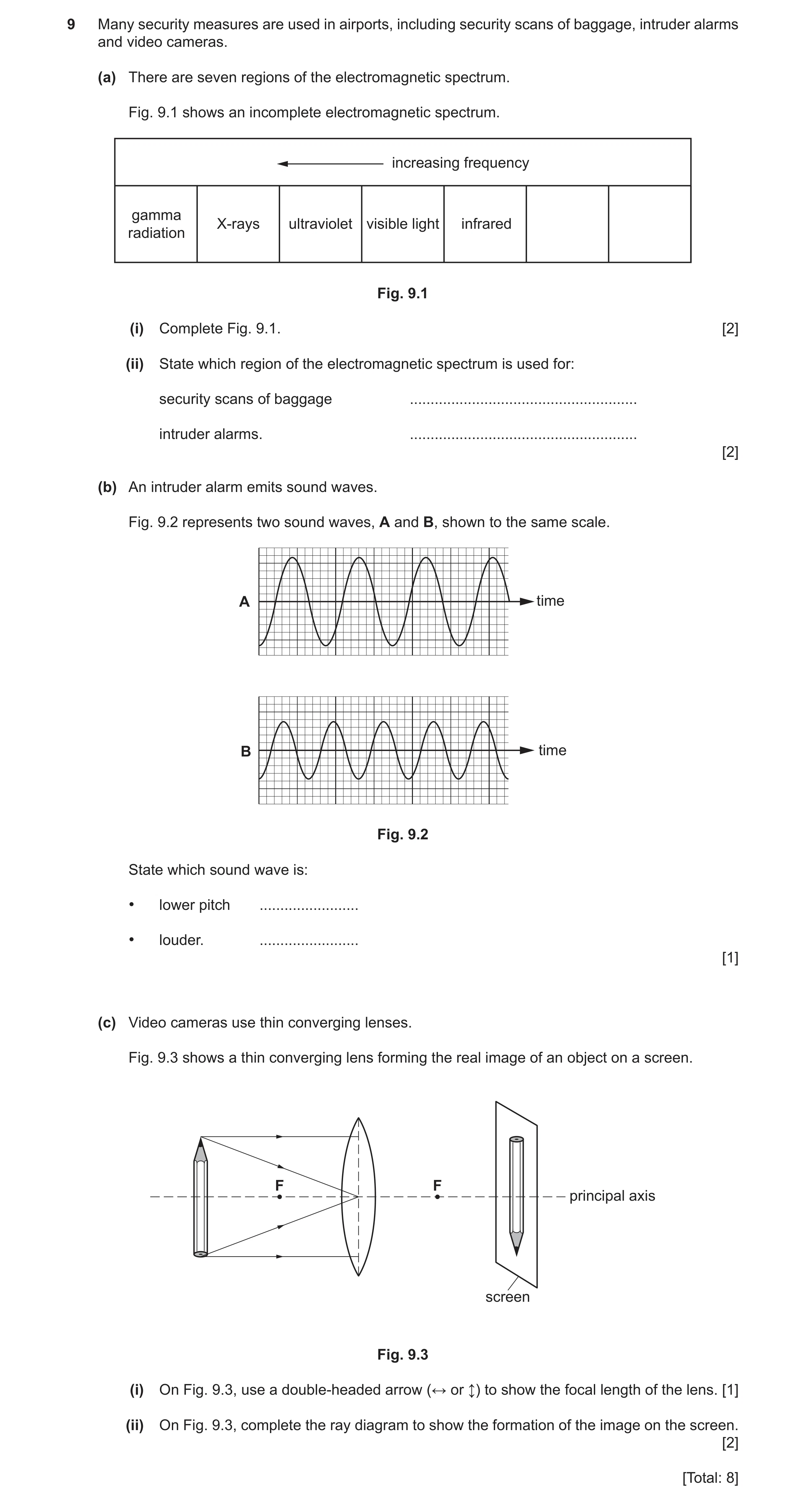
9 Many security measures are used in airports, including security scans of baggage, intruder alarms and video cameras. (a) There are seven regions of the electromagnetic spectrum. Fig. 9.1 shows an incomplete electromagnetic spectrum. increasing frequency gamma X-rays ultraviolet visible light infrared radiation Fig. 9.1 (i) Complete Fig. 9.1. [2] (ii) State which region of the electromagnetic spectrum is used for: security scans of baggage … intruder alarms. … [2] (b) An intruder alarm emits sound waves. Fig. 9.2 represents two sound waves, A and B, shown to the same scale. A time B time Fig. 9.2 State which sound wave is: • lower pitch … • louder. … [1] (c) Video cameras use thin converging lenses. Fig. 9.3 shows a thin converging lens forming the real image of an object on a screen. F F principal axis screen Fig. 9.3 (i) On Fig. 9.3, use a double-headed arrow (↔ or ↕) to show the focal length of the lens. [1] (ii) On Fig. 9.3, complete the ray diagram to show the formation of the image on the screen. [2] [Total: 8]
8 marks
Mark scheme: 9(a)(i) 2 one name correct AND in correct place / both names correct ; both names correct AND in correct places ; 9(a)(ii) X-rays ; 2 infrared ; 9(b) A AND A ; 1 9(c)(i) 1 focal length shown with double-headed arrow from lens axis to either F ; 9(c)(ii) 2 any two lines correct ; all four lines correct ;
This question in 0653/31 Oct/Nov 2023
Q19 · A lighthouse used at night to warn ships of dangerous rocks in the water 0653/32 Oct/Nov 2023
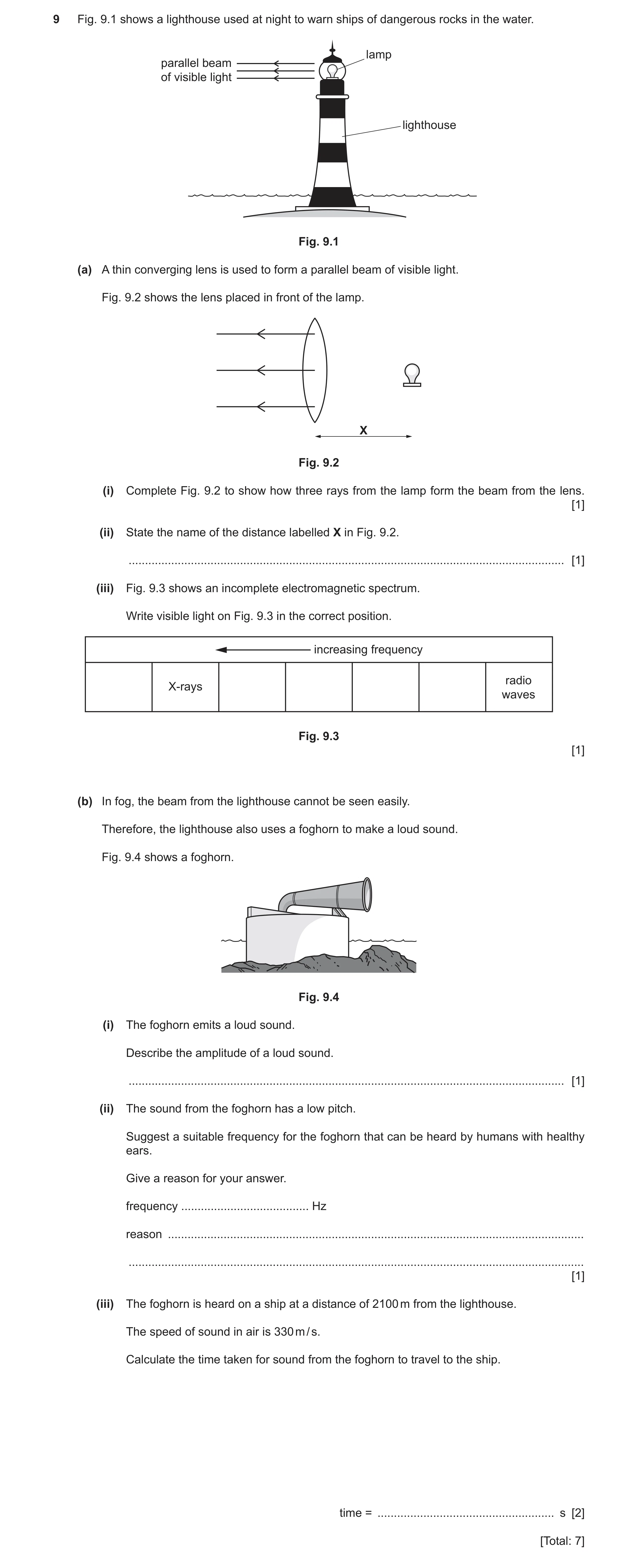
9 Fig. 9.1 shows a lighthouse used at night to warn ships of dangerous rocks in the water. lamp parallel beam of visible light lighthouse Fig. 9.1 (a) A thin converging lens is used to form a parallel beam of visible light. Fig. 9.2 shows the lens placed in front of the lamp. X Fig. 9.2 (i) Complete Fig. 9.2 to show how three rays from the lamp form the beam from the lens. [1] (ii) State the name of the distance labelled X in Fig. 9.2. … [1] (iii) Fig. 9.3 shows an incomplete electromagnetic spectrum. Write visible light on Fig. 9.3 in the correct position. increasing frequency radio X-rays waves Fig. 9.3 [1] (b) In fog, the beam from the lighthouse cannot be seen easily. Therefore, the lighthouse also uses a foghorn to make a loud sound. Fig. 9.4 shows a foghorn. Fig. 9.4 (i) The foghorn emits a loud sound. Describe the amplitude of a loud sound. … [1] (ii) The sound from the foghorn has a low pitch. Suggest a suitable frequency for the foghorn that can be heard by humans with healthy ears. Give a reason for your answer. frequency … Hz reason … … [1] (iii) The foghorn is heard on a ship at a distance of 2100 m from the lighthouse. The speed of sound in air is 330 m / s. Calculate the time taken for sound from the foghorn to travel to the ship. time = … s [2] [Total: 7]
7 marks
Mark scheme: 9(a)(i) 1 all emerging rays correctly linked back to principal focus at lamp ; 9(a)(ii) focal length ; 1 9(a)(iii) 1 visible (radio (X-rays) light ; waves) 9(b)(i) large / AW ; 1 9(b)(ii) any value between 20 Hz and 2000 Hz AND 1 this frequency is (at the lower end) of the human hearing range / AW ; 9(b)(iii) evidence of, speed = distance ÷ time / 2100 ÷ 330 ; 2 6.4 (s) ;
This question in 0653/32 Oct/Nov 2023
Q20 · A lighthouse used at night to warn ships of dangerous rocks in the water 0653/33 Oct/Nov 2023
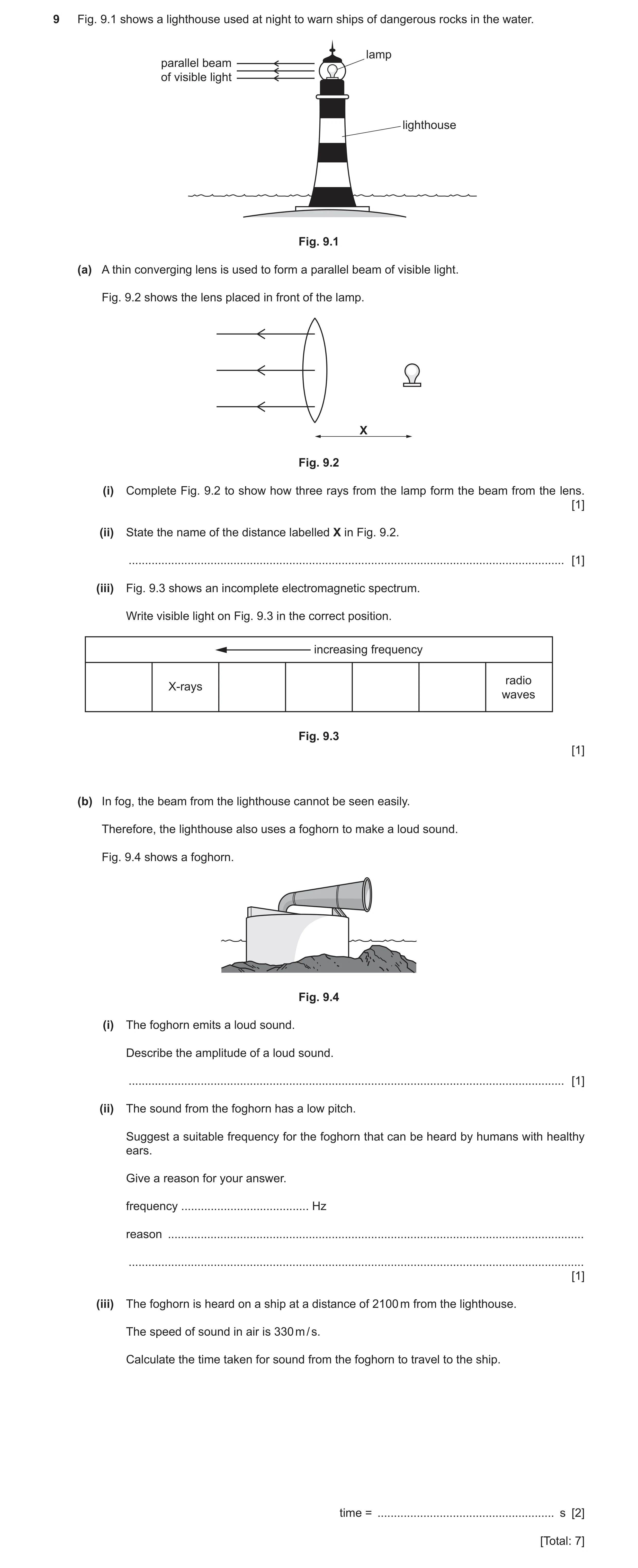
9 Fig. 9.1 shows a lighthouse used at night to warn ships of dangerous rocks in the water. lamp parallel beam of visible light lighthouse Fig. 9.1 (a) A thin converging lens is used to form a parallel beam of visible light. Fig. 9.2 shows the lens placed in front of the lamp. X Fig. 9.2 (i) Complete Fig. 9.2 to show how three rays from the lamp form the beam from the lens. [1] (ii) State the name of the distance labelled X in Fig. 9.2. … [1] (iii) Fig. 9.3 shows an incomplete electromagnetic spectrum. Write visible light on Fig. 9.3 in the correct position. increasing frequency radio X-rays waves Fig. 9.3 [1] (b) In fog, the beam from the lighthouse cannot be seen easily. Therefore, the lighthouse also uses a foghorn to make a loud sound. Fig. 9.4 shows a foghorn. Fig. 9.4 (i) The foghorn emits a loud sound. Describe the amplitude of a loud sound. … [1] (ii) The sound from the foghorn has a low pitch. Suggest a suitable frequency for the foghorn that can be heard by humans with healthy ears. Give a reason for your answer. frequency … Hz reason … … [1] (iii) The foghorn is heard on a ship at a distance of 2100 m from the lighthouse. The speed of sound in air is 330 m / s. Calculate the time taken for sound from the foghorn to travel to the ship. time = … s [2] [Total: 7]
7 marks
Mark scheme: 9(a)(i) 1 all emerging rays correctly linked back to principal focus at lamp ; 9(a)(ii) focal length ; 1 9(a)(iii) 1 visible (radio (X-rays) light ; waves) 9(b)(i) large / AW ; 1 9(b)(ii) any value between 20 Hz and 2000 Hz AND 1 this frequency is (at the lower end) of the human hearing range / AW ; 9(b)(iii) evidence of, speed = distance ÷ time / 2100 ÷ 330 ; 2 6.4 (s) ;
This question in 0653/33 Oct/Nov 2023
Q21 · A Bunsen burner with the air hole closed, burning with a yellow flame 0653/33 May/June 2025
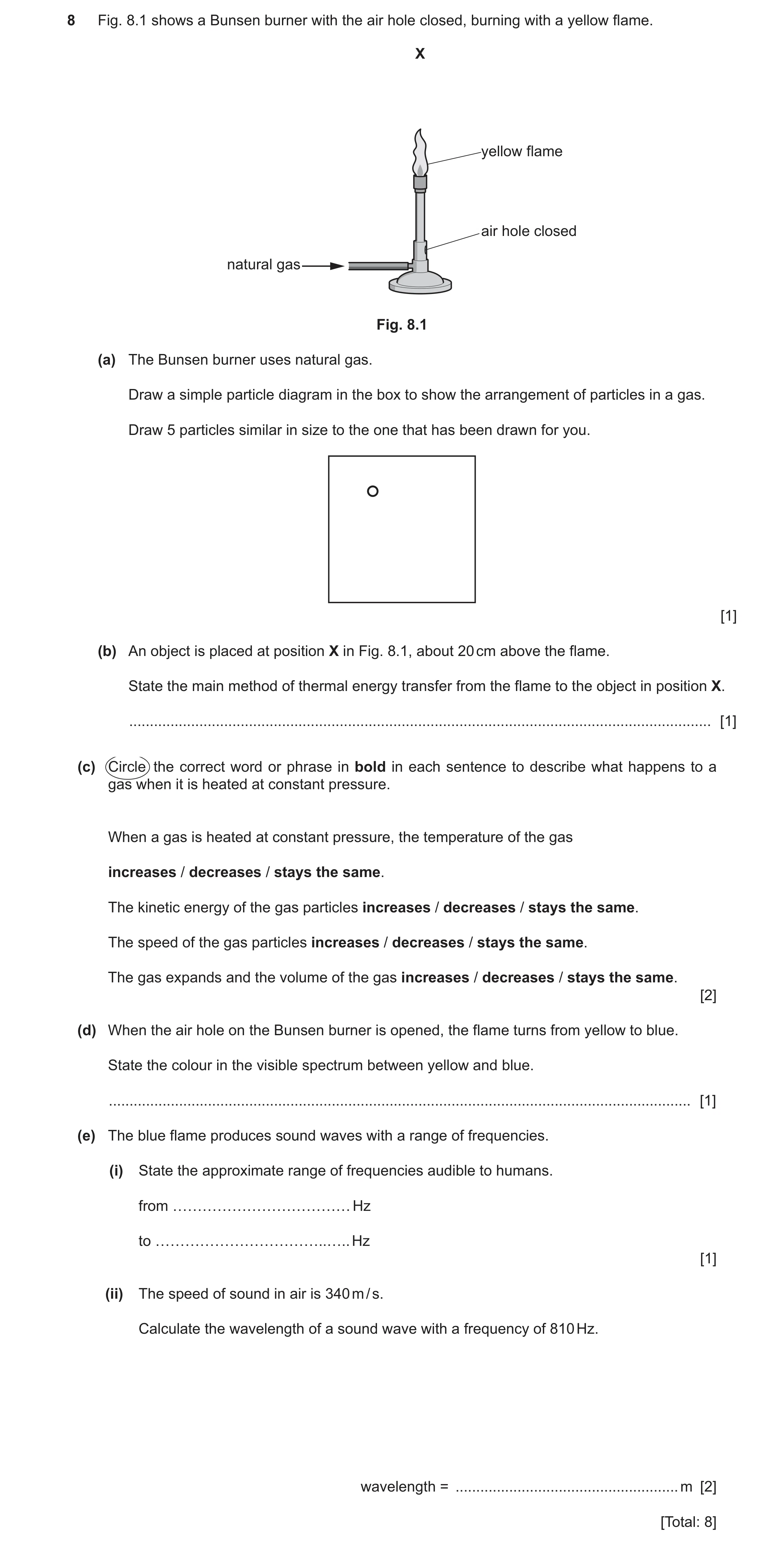
8 Fig. 8.1 shows a Bunsen burner with the air hole closed, burning with a yellow flame. X yellow flame air hole closed natural gas Fig. 8.1 (a) The Bunsen burner uses natural gas. Draw a simple particle diagram in the box to show the arrangement of particles in a gas. Draw 5 particles similar in size to the one that has been drawn for you. [1] (b) An object is placed at position X in Fig. 8.1, about 20 cm above the flame. State the main method of thermal energy transfer from the flame to the object in position X. … [1] (c) Circle the correct word or phrase in bold in each sentence to describe what happens to a gas when it is heated at constant pressure. When a gas is heated at constant pressure, the temperature of the gas increases / decreases / stays the same. The kinetic energy of the gas particles increases / decreases / stays the same. The speed of the gas particles increases / decreases / stays the same. The gas expands and the volume of the gas increases / decreases / stays the same. [2] (d) When the air hole on the Bunsen burner is opened, the flame turns from yellow to blue. State the colour in the visible spectrum between yellow and blue. … [1] (e) The blue flame produces sound waves with a range of frequencies. (i) State the approximate range of frequencies audible to humans. from ……………………………… Hz to ……………………………..….. Hz [1] (ii) The speed of sound in air is 340 m / s. Calculate the wavelength of a sound wave with a frequency of 810 Hz. wavelength = … m [2] [Total: 8]
8 marks
Mark scheme: 8(a) 5 additional particles shown in an irregular arrangement AND clearly separated ; 1 8(b) convection ; 1 8(c) When a gas is heated at constant pressure, the temperature of the gas 2 increases / decreases / stays the same. The kinetic energy of the gas particles increases / decreases / stays the same. The speed of the gas particles increases / decreases/stays the same. The gas expands and the volume of the gas increases / decreases / stays the same. ;; any two correct = 1 mark all four correct = 2 marks 8(d) green ; 1 8(e)(i) from 20 to 20 000 (Hz) ; 1 8(e)(ii) λ= v ÷ f / wavelength = speed ÷ frequency / λ= 340 ÷ 810 ; 2 0.41975 / 0.42 (m) ;
This question in 0653/33 May/June 2025
 10
10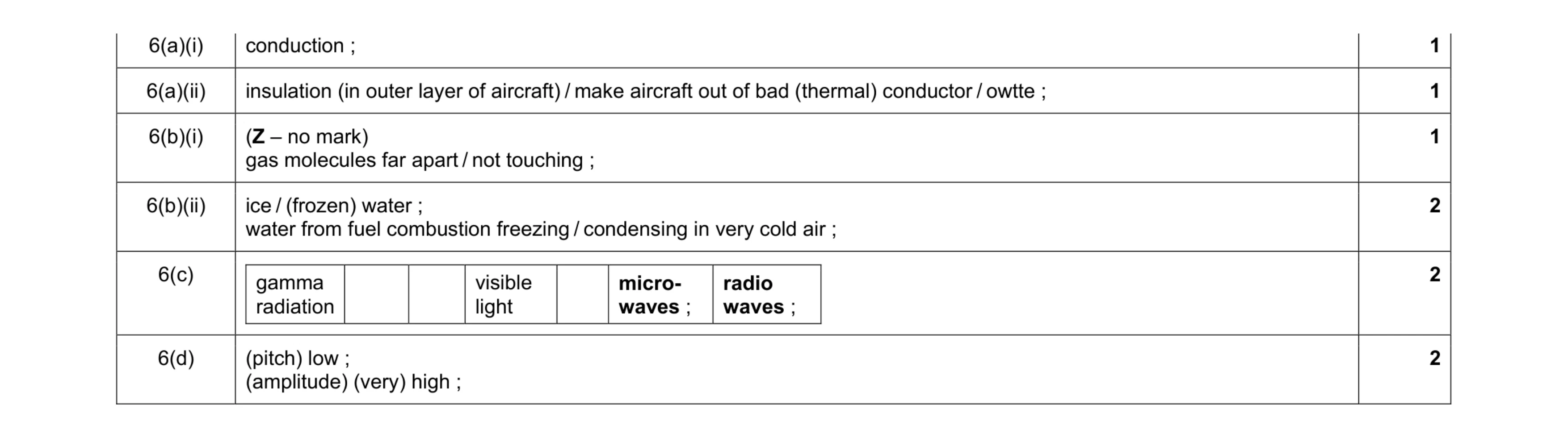 9
9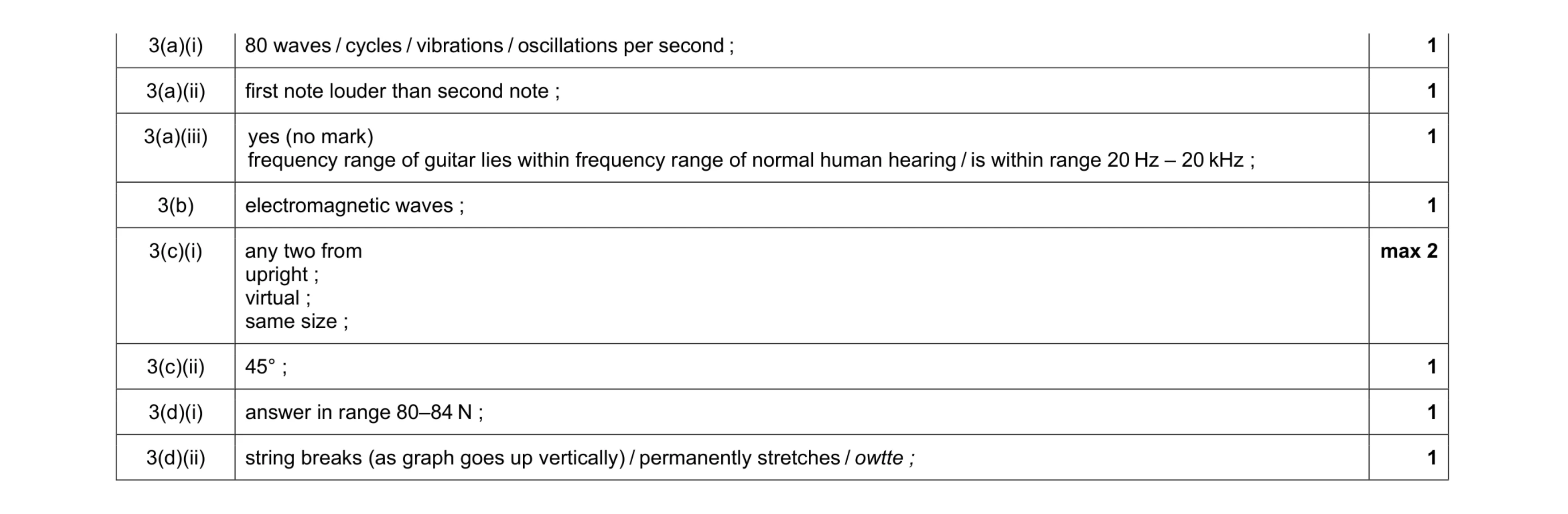 9
9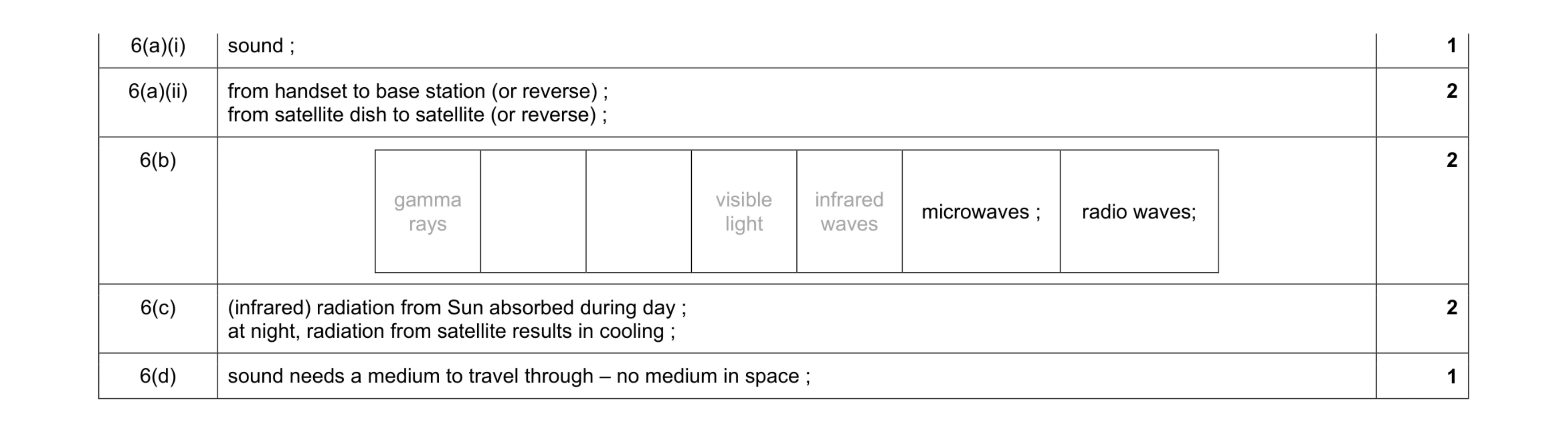 8
8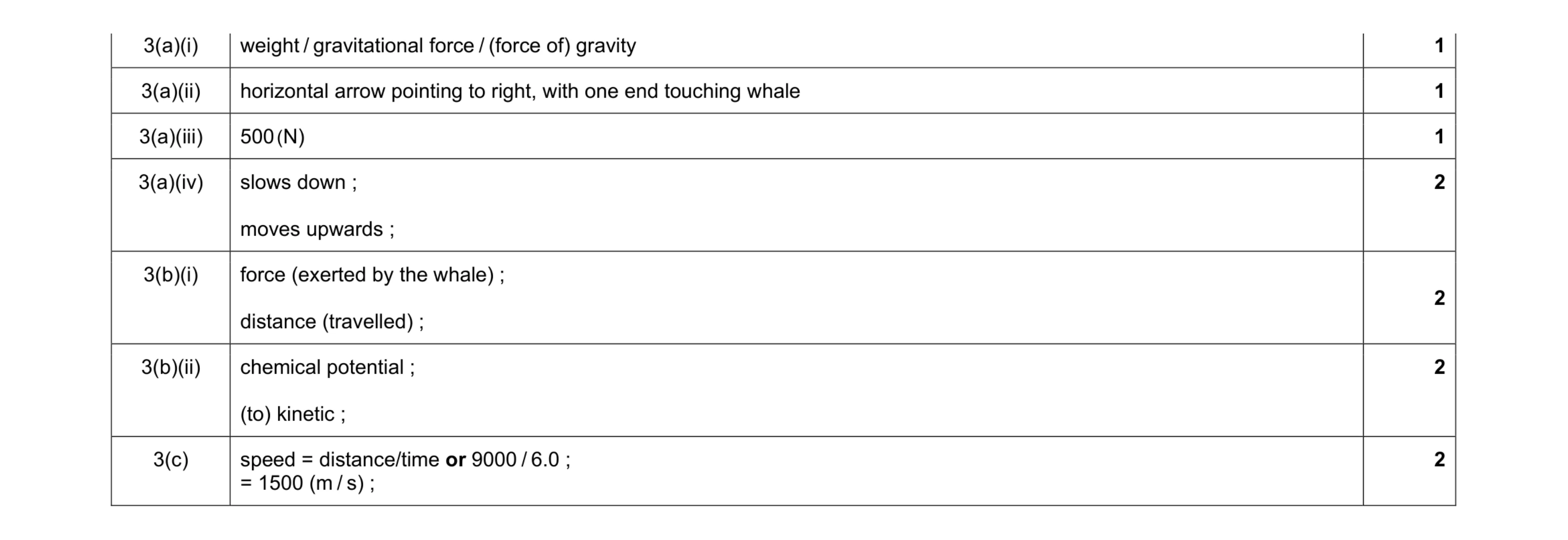 11
11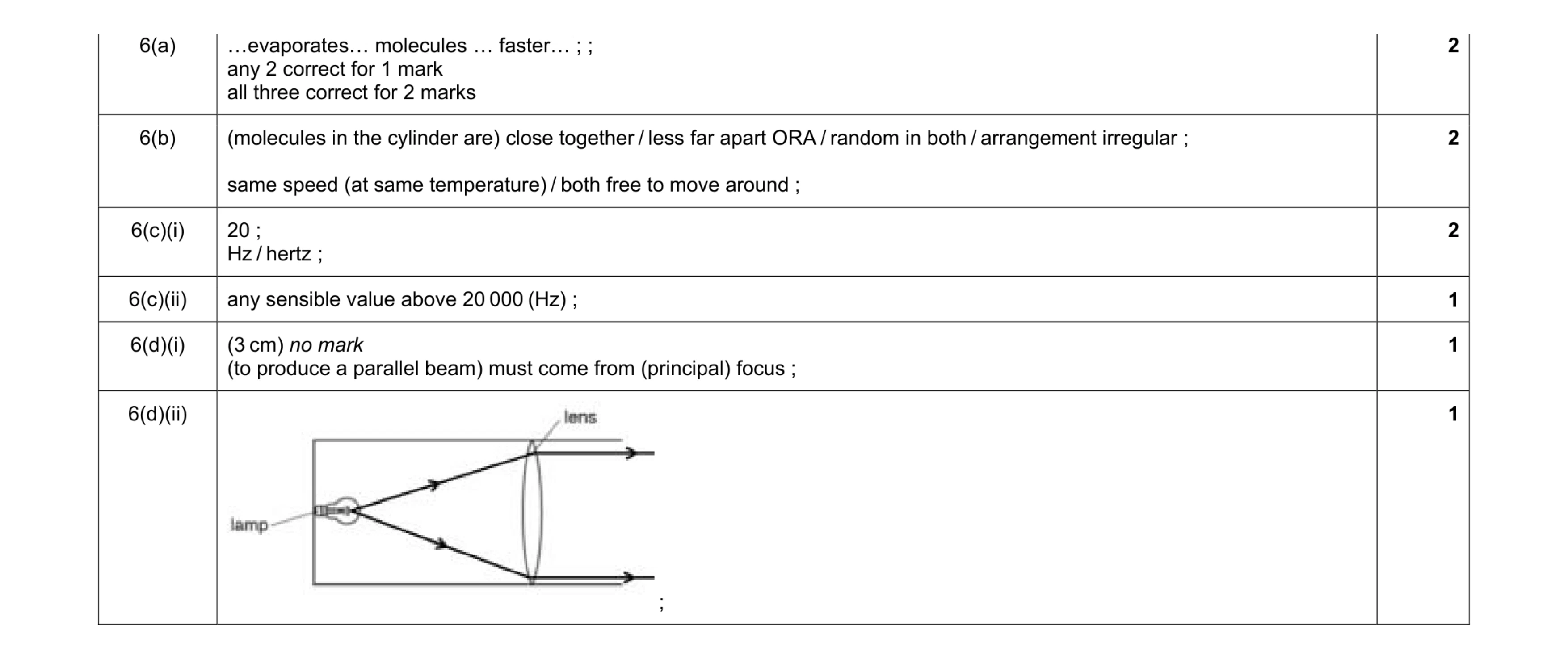 9
9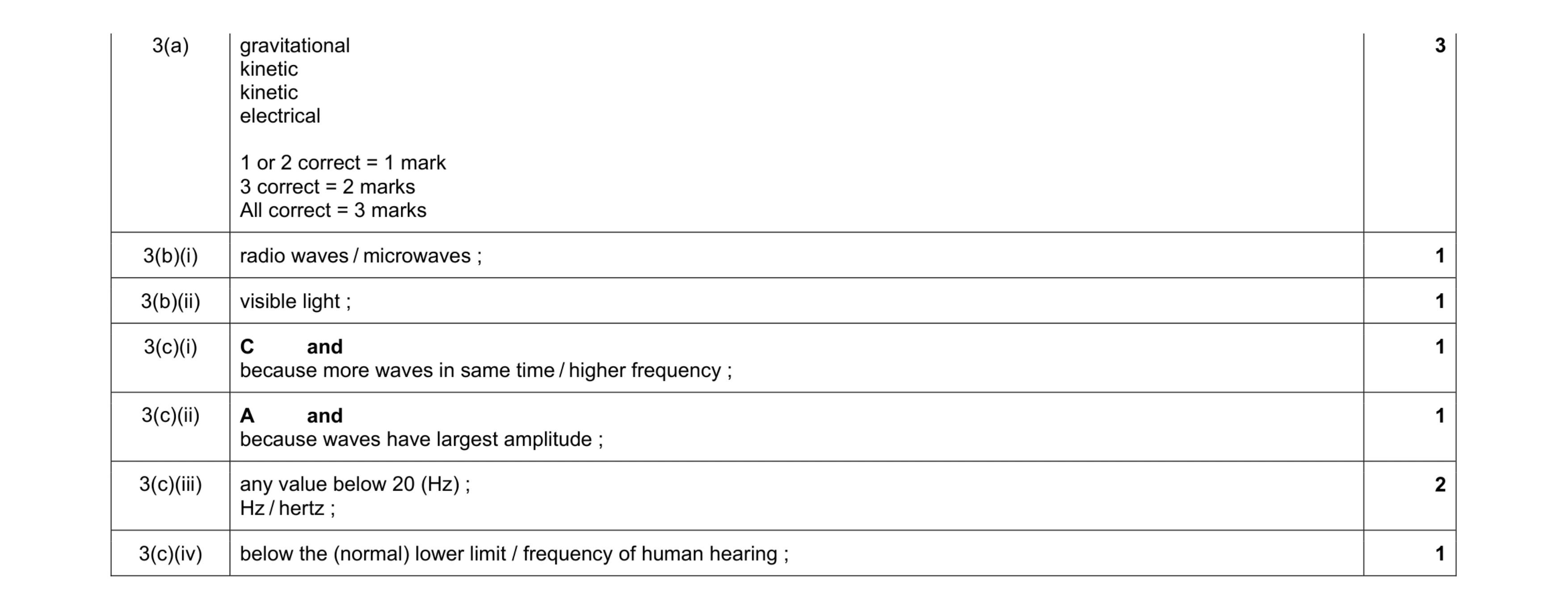 10
10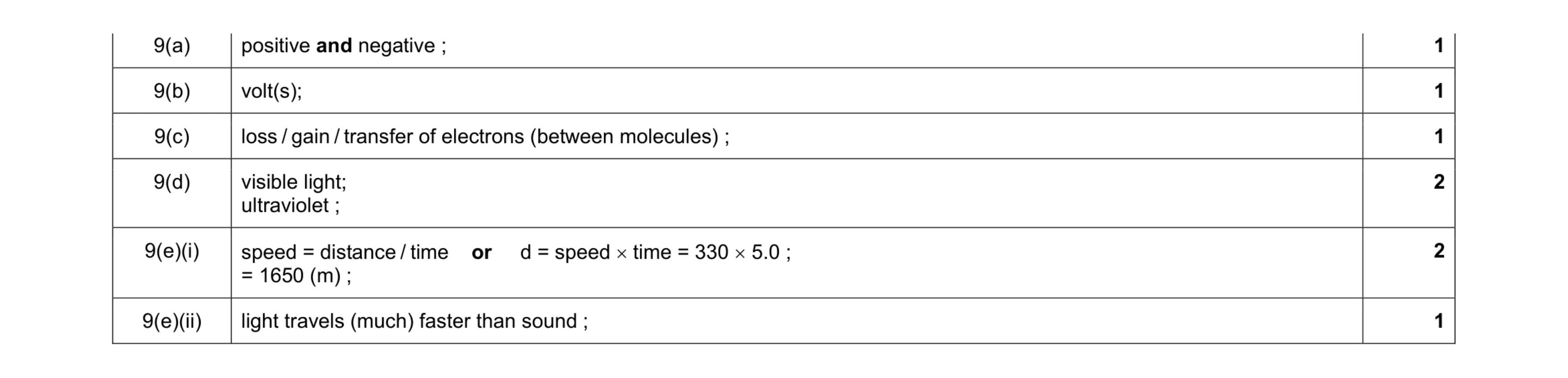 8
8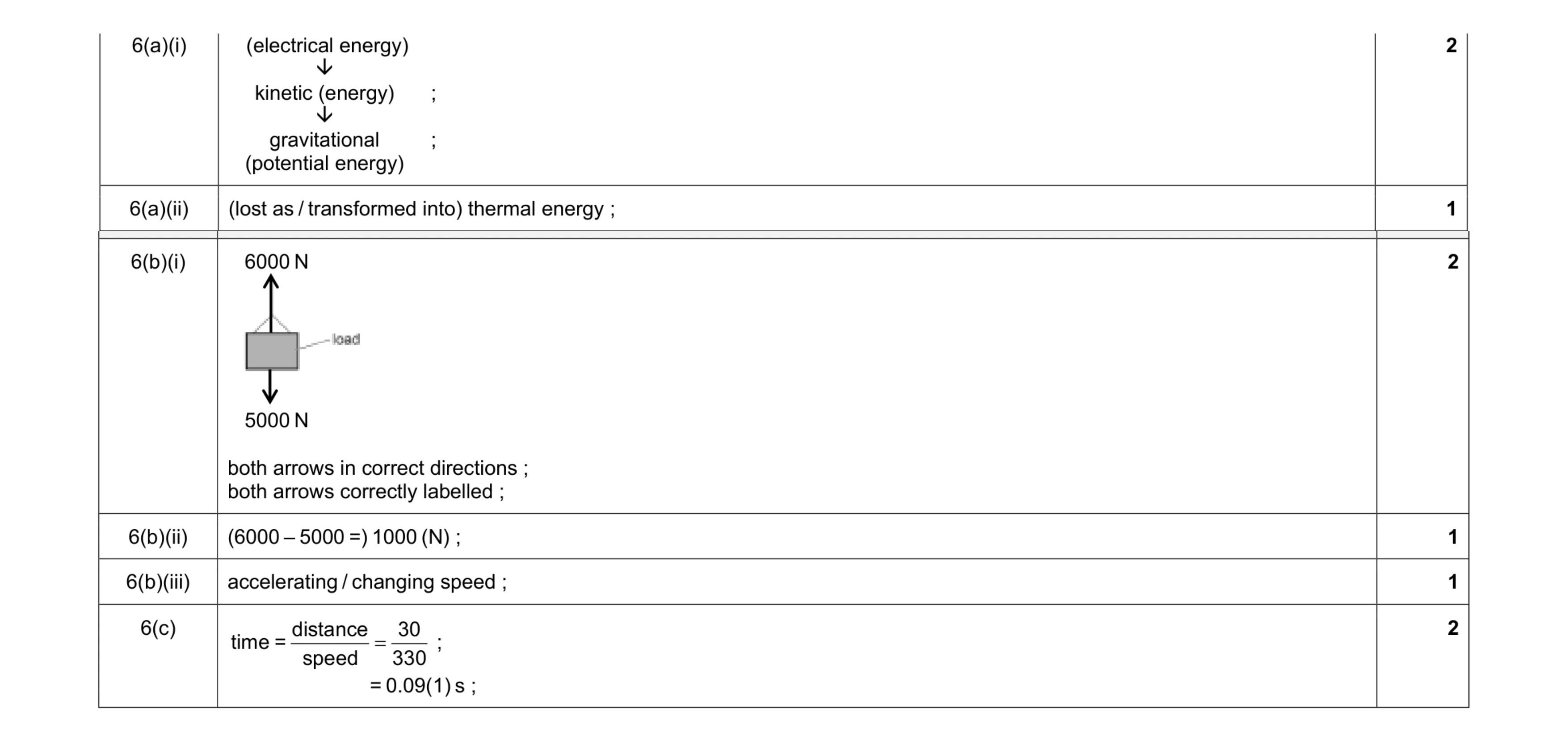 9
9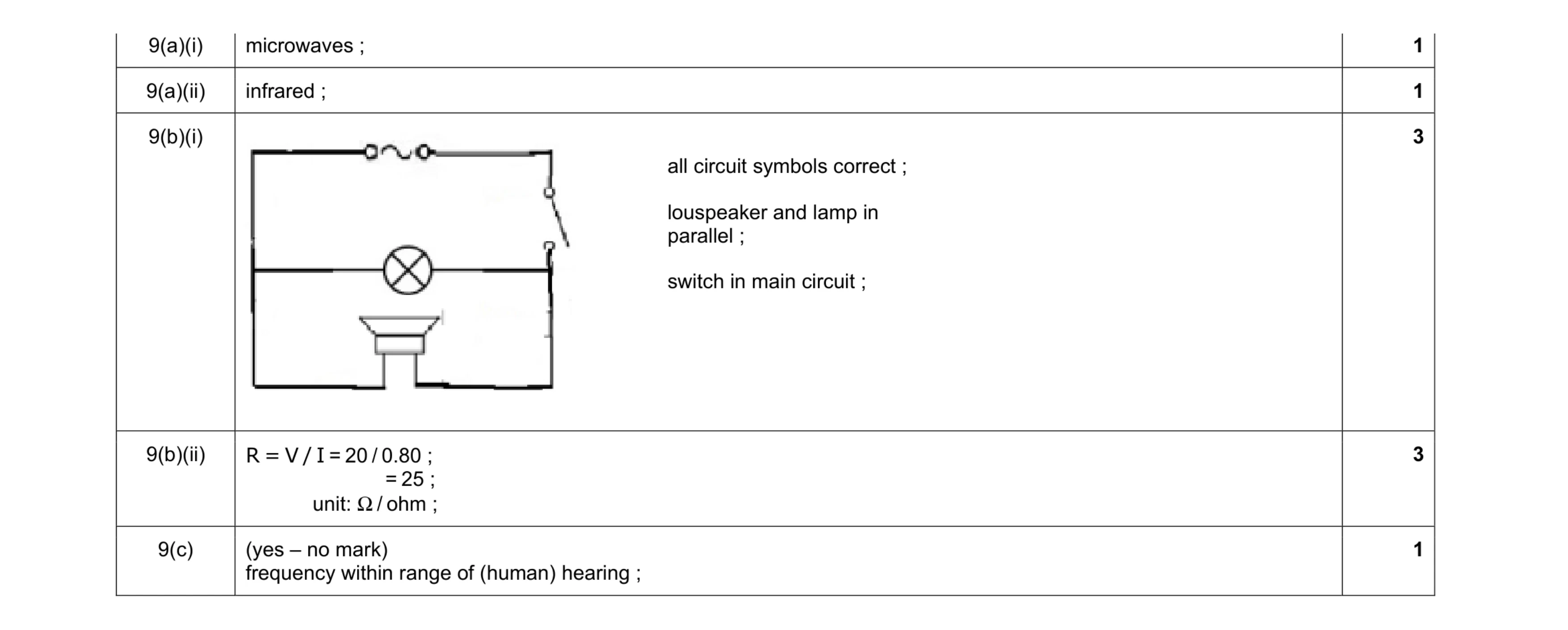 9
9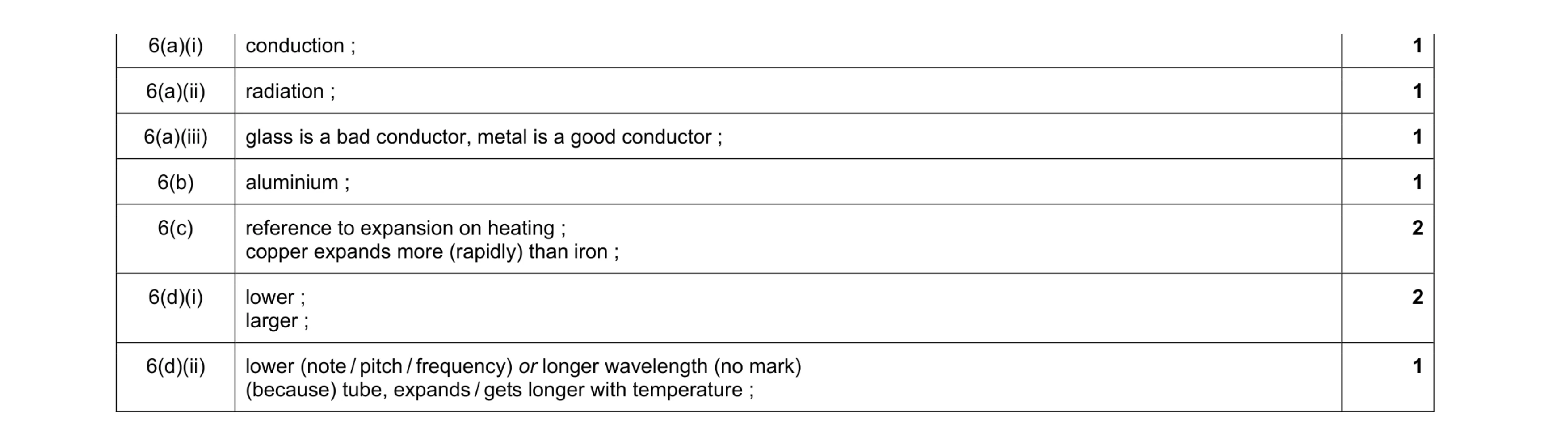 9
9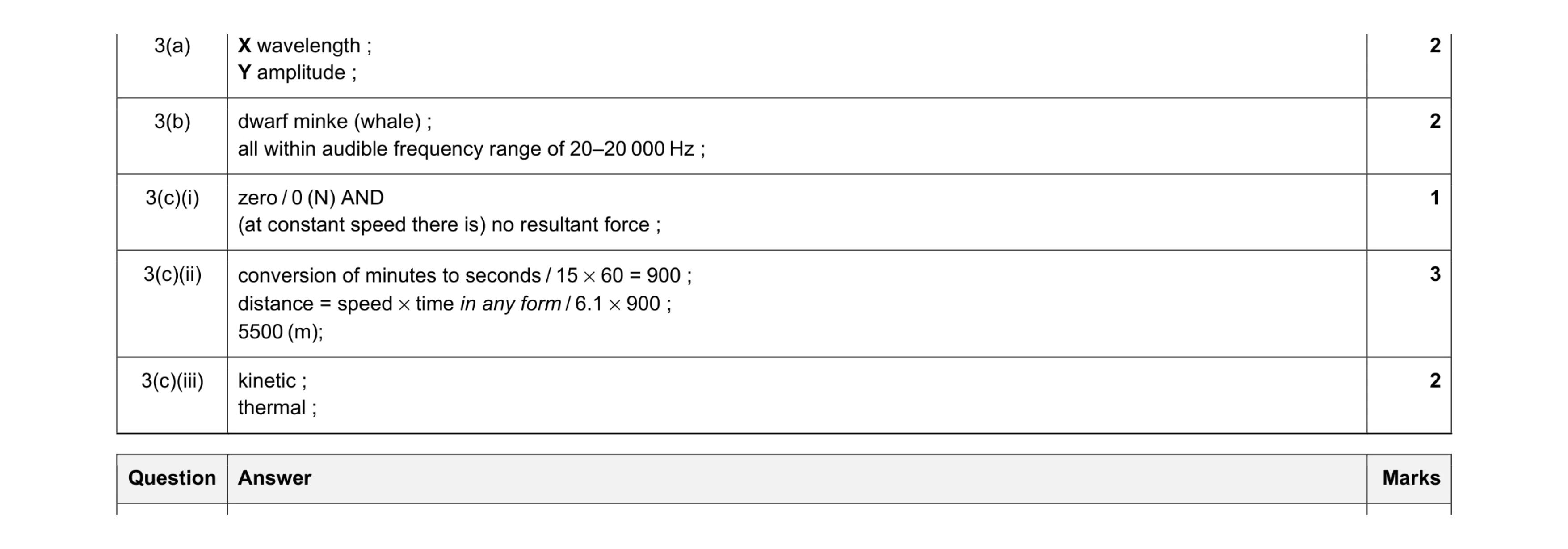 10
10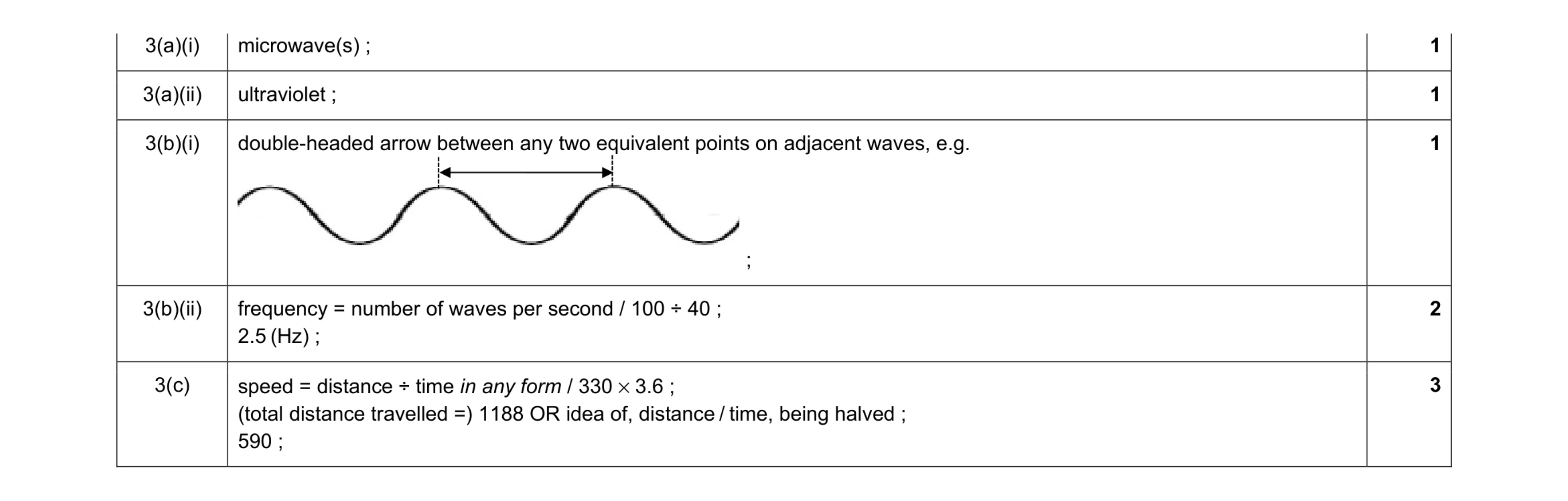 8
8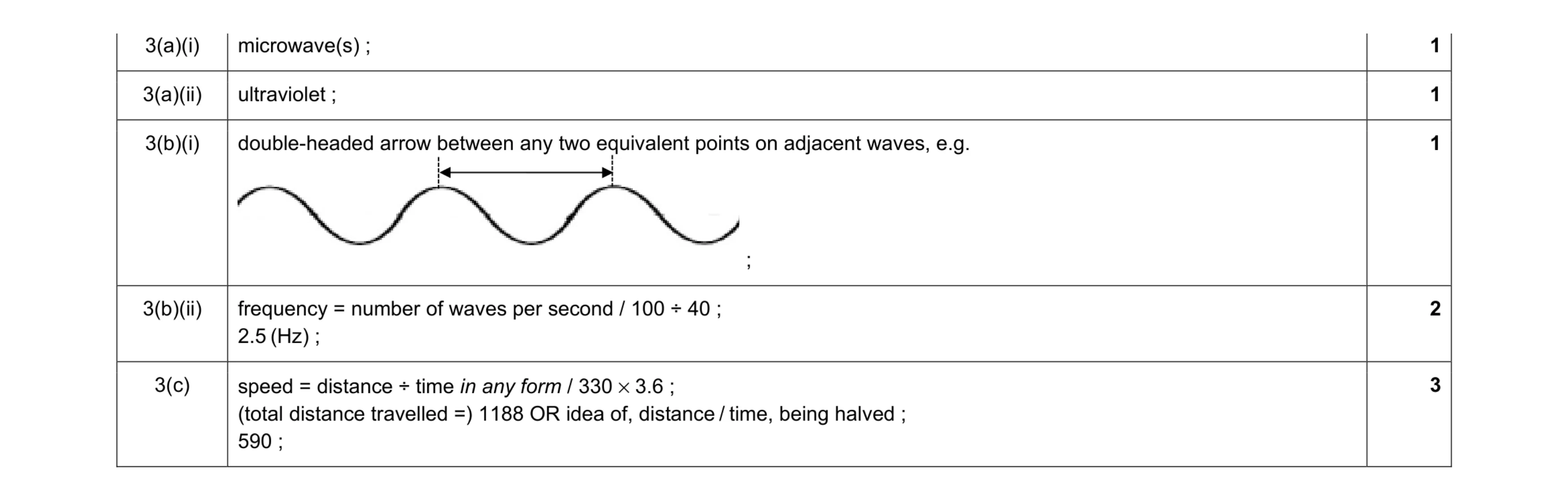 8
8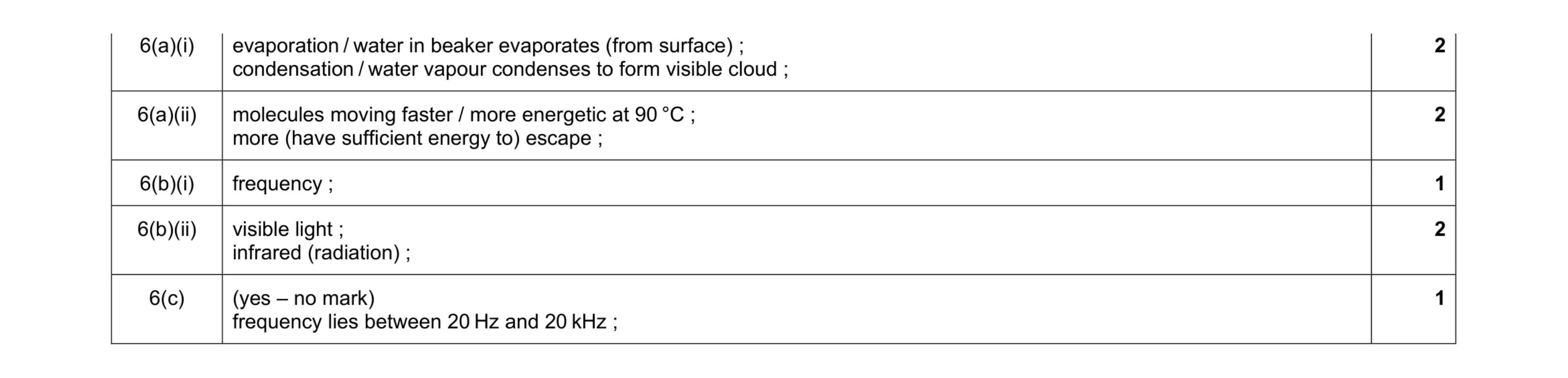 8
8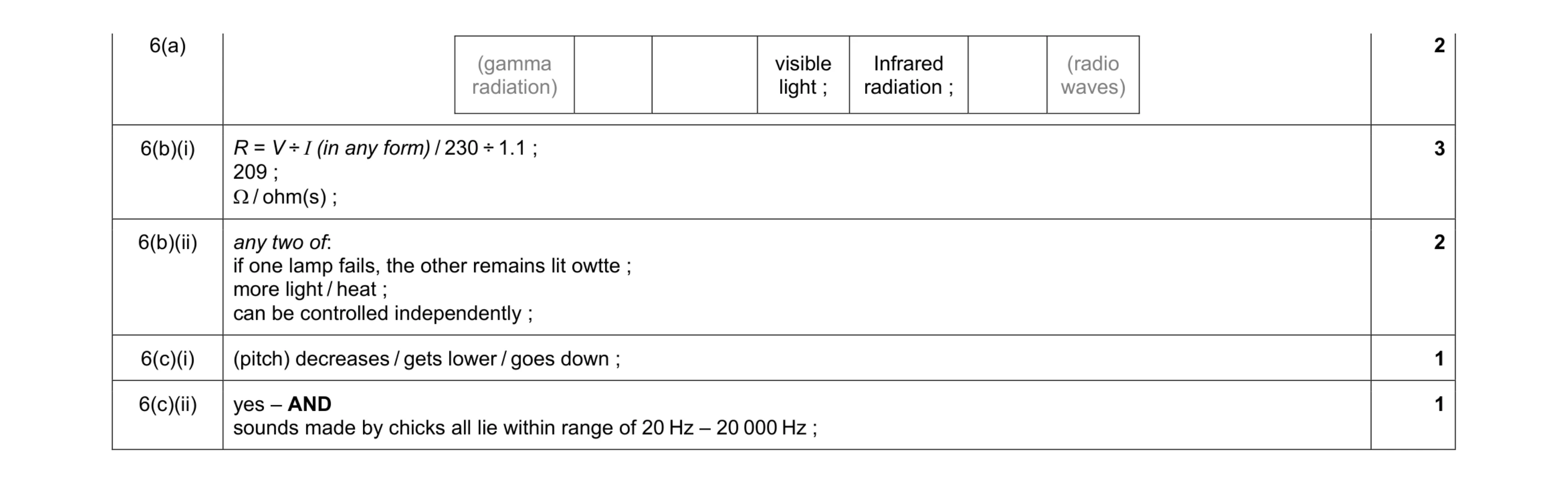 9
9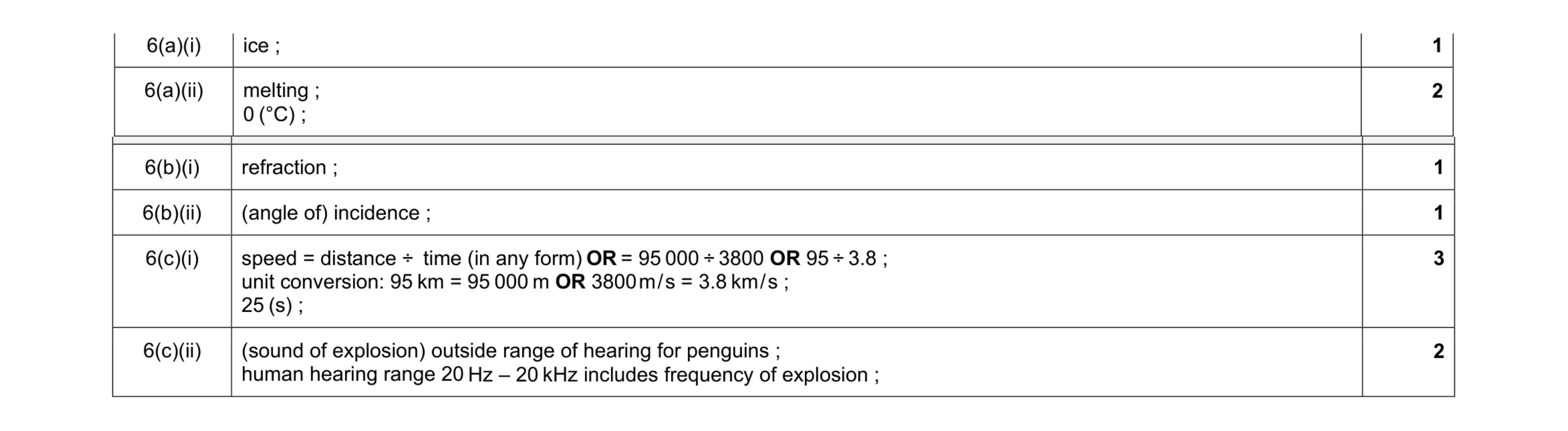 10
10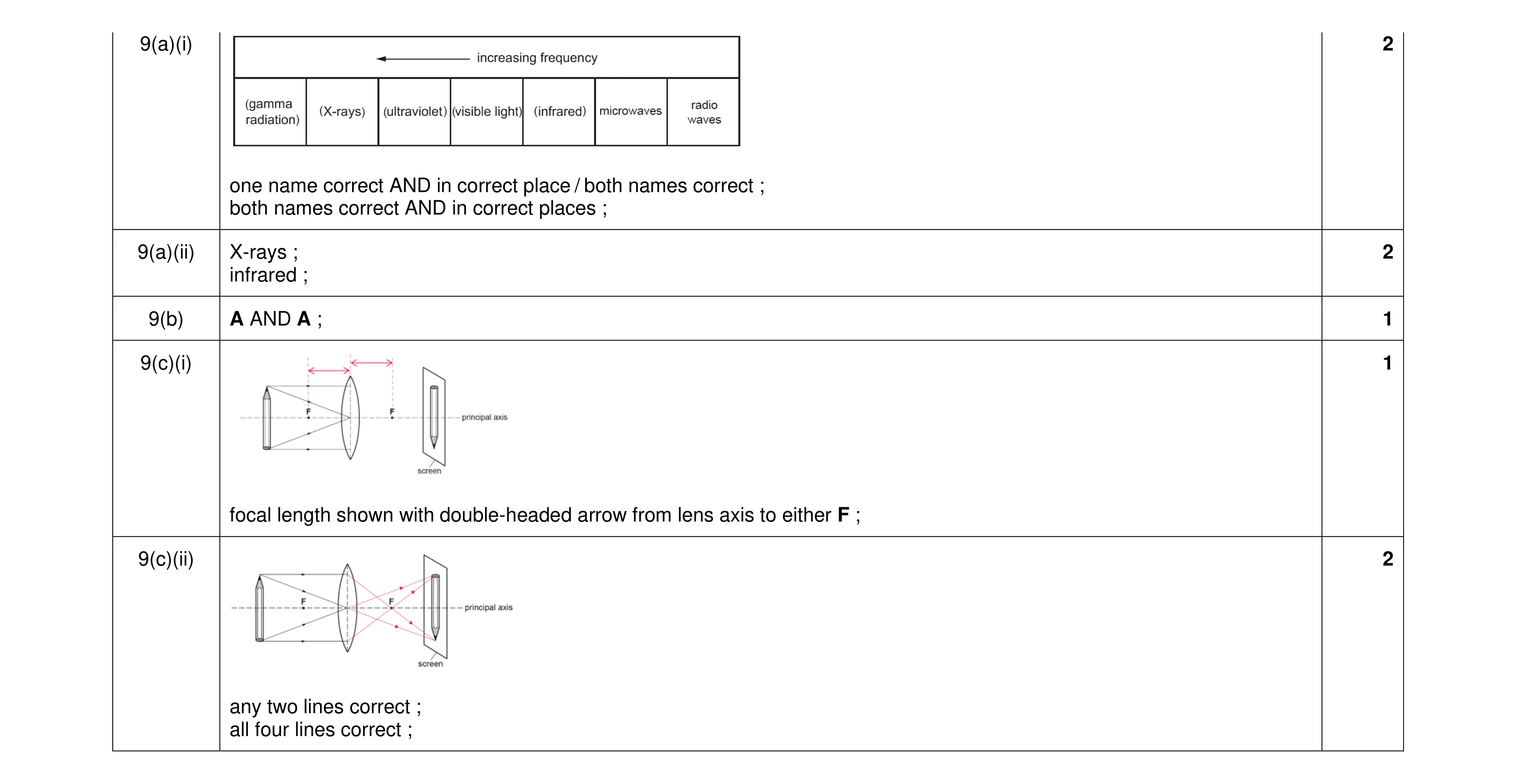 8
8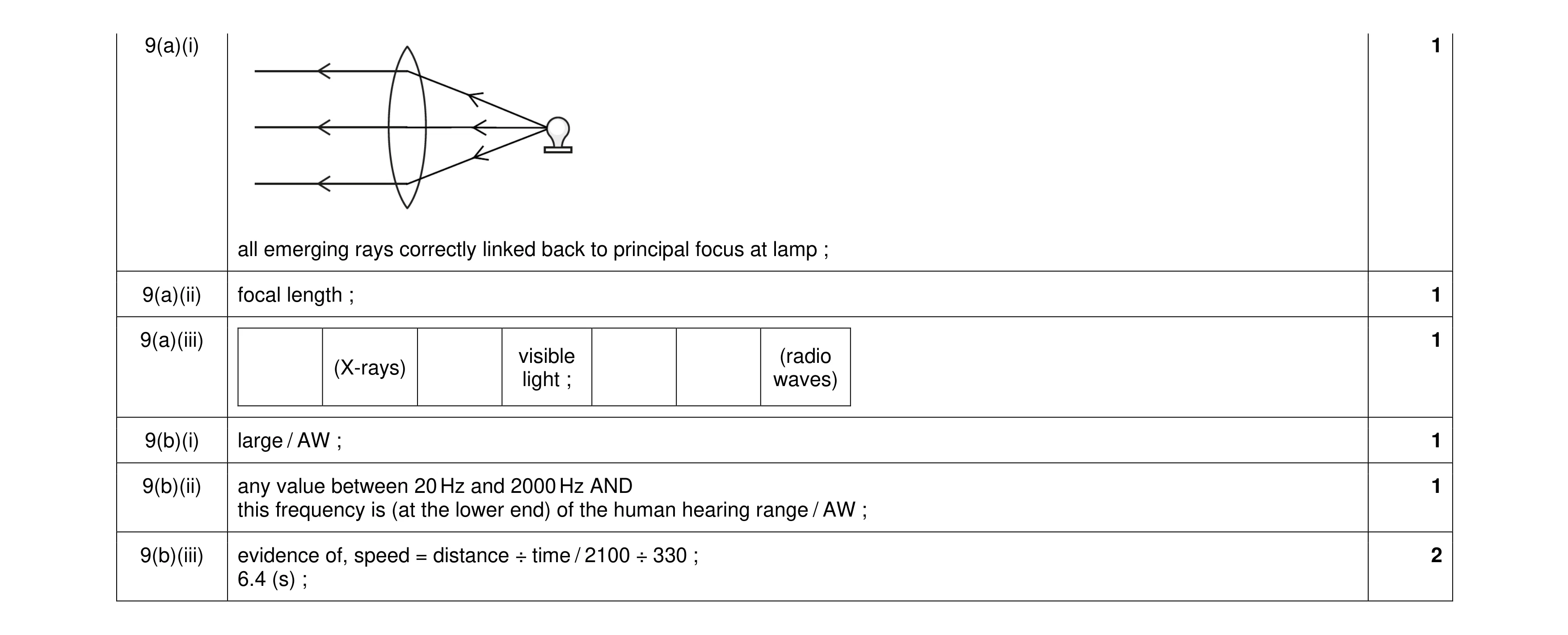 7
7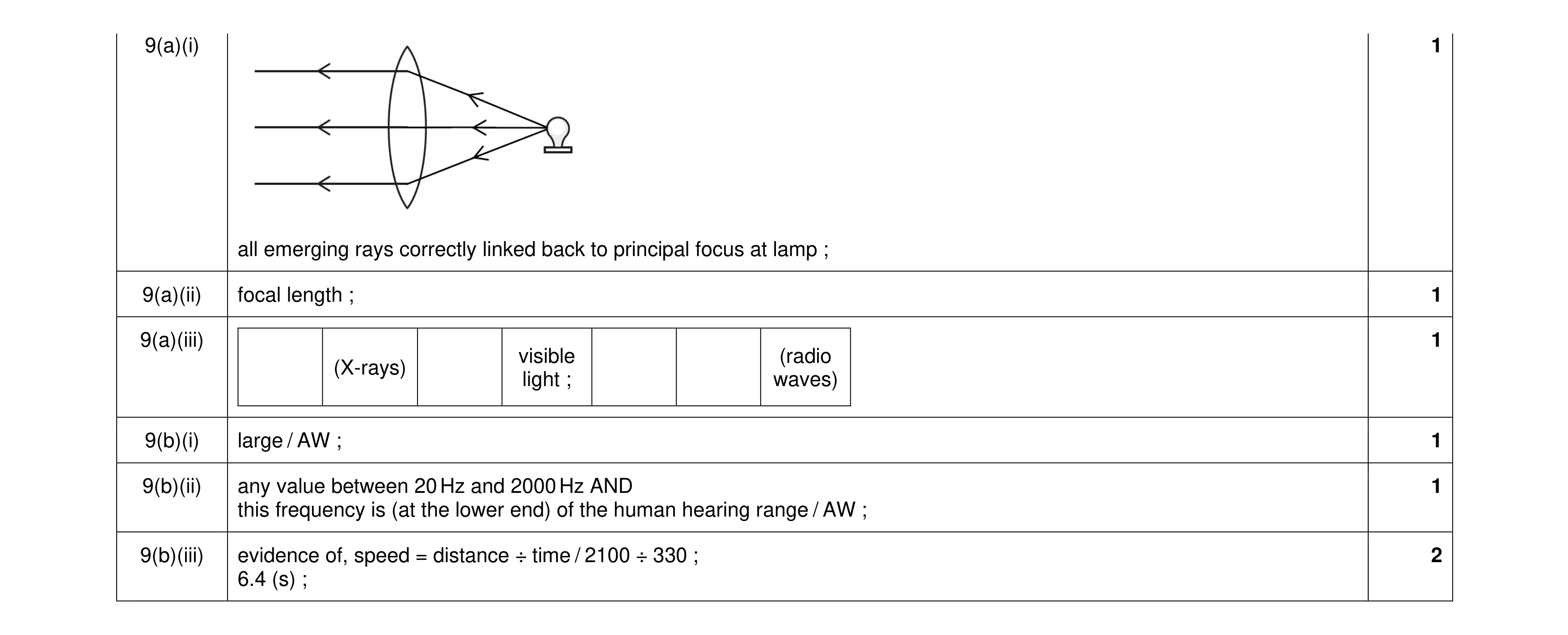 7
7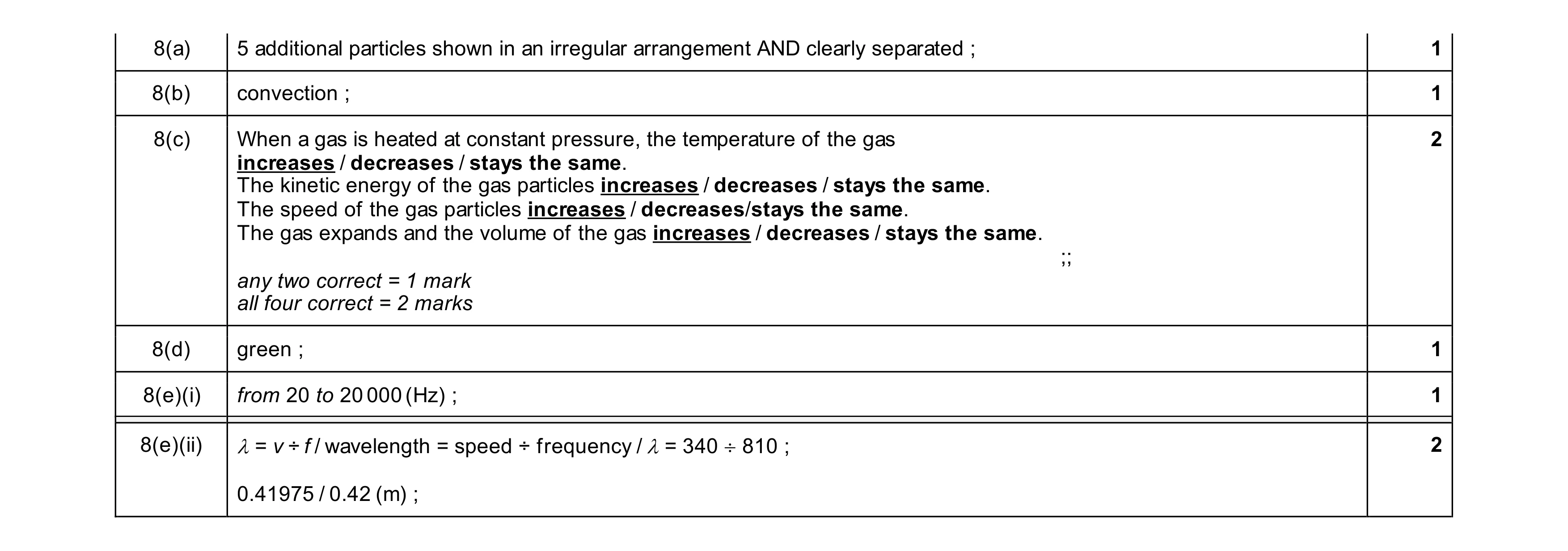 8
8