Questions as text
Q1 · A man riding a snowmobile across snow and ice at a research station in Antarctica 0653/43 May/June 2017
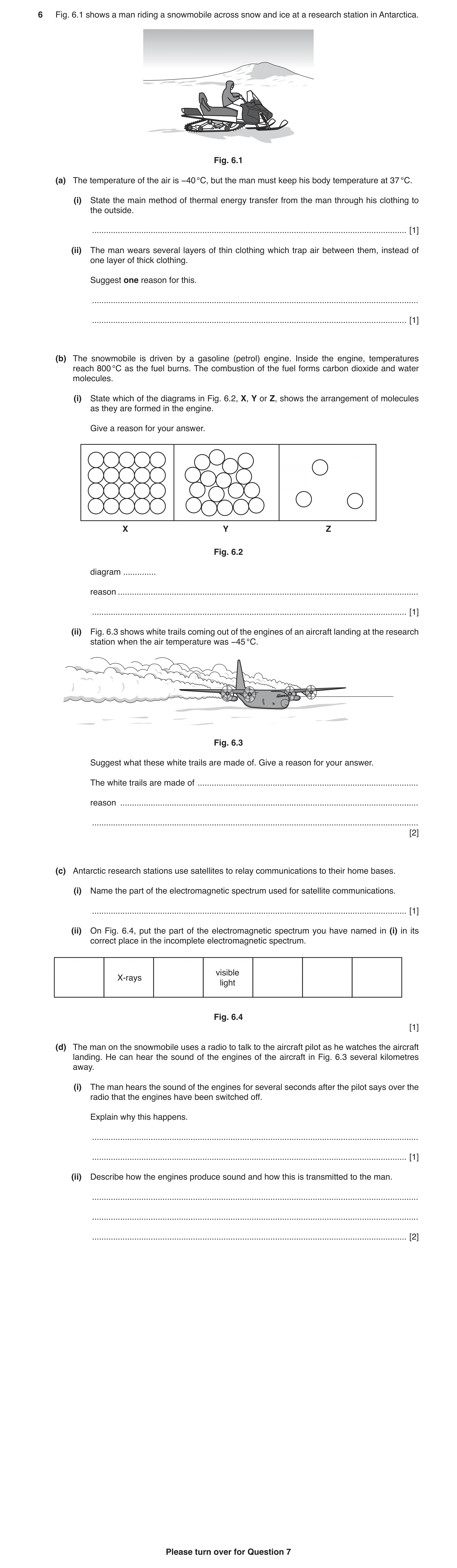
6 Fig. 6.1 shows a man riding a snowmobile across snow and ice at a research station in Antarctica. Fig. 6.1 (a) The temperature of the air is −40 °C, but the man must keep his body temperature at 37 °C. (i) State the main method of thermal energy transfer from the man through his clothing to the outside. … [1] (ii) The man wears several layers of thin clothing which trap air between them, instead of one layer of thick clothing. Suggest one reason for this. … … [1] (b) The snowmobile is driven by a gasoline (petrol) engine. Inside the engine, temperatures reach 800 °C as the fuel burns. The combustion of the fuel forms carbon dioxide and water molecules. (i) State which of the diagrams in Fig. 6.2, X, Y or Z, shows the arrangement of molecules as they are formed in the engine. Give a reason for your answer. X Y Z Fig. 6.2 diagram … reason … … [1] (ii) Fig. 6.3 shows white trails coming out of the engines of an aircraft landing at the research station when the air temperature was −45 °C. Fig. 6.3 Suggest what these white trails are made of. Give a reason for your answer. The white trails are made of … reason … … [2] (c) Antarctic research stations use satellites to relay communications to their home bases. (i) Name the part of the electromagnetic spectrum used for satellite communications. … [1] (ii) On Fig. 6.4, put the part of the electromagnetic spectrum you have named in (i) in its correct place in the incomplete electromagnetic spectrum. visible X-rays light Fig. 6.4 [1] (d) The man on the snowmobile uses a radio to talk to the aircraft pilot as he watches the aircraft landing. He can hear the sound of the engines of the aircraft in Fig. 6.3 several kilometres away. (i) The man hears the sound of the engines for several seconds after the pilot says over the radio that the engines have been switched off. Explain why this happens. … … [1] (ii) Describe how the engines produce sound and how this is transmitted to the man. … … … [2] Please turn over for Question 7
10 marks
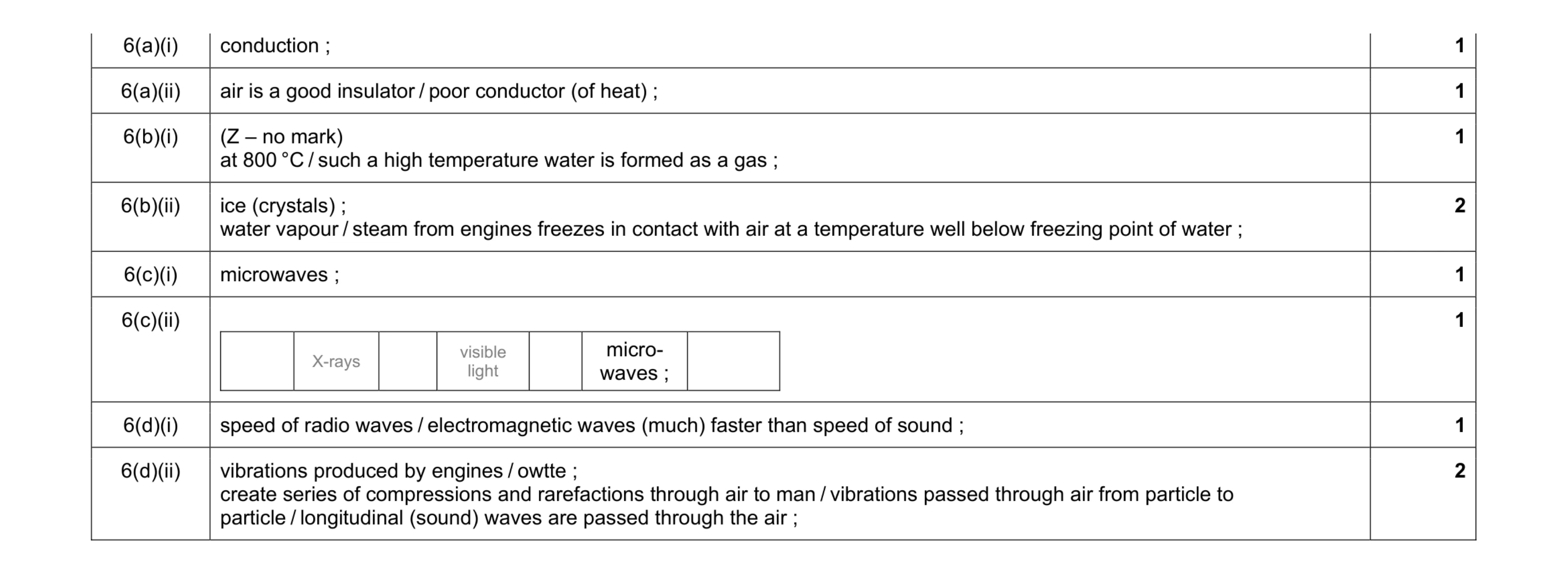
Mark scheme: 6(a)(i) conduction ; 1 6(a)(ii) air is a good insulator / poor conductor (of heat) ; 1 6(b)(i) (Z – no mark) at 800 °C / such a high temperature water is formed as a gas ; 1 6(b)(ii) ice (crystals) ; water vapour / steam from engines freezes in contact with air at a temperature well below freezing point of water ; 2 6(c)(i) microwaves ; 1 6(c)(ii) X-rays visible light micro- waves ; 1 6(d)(i) speed of radio waves / electromagnetic waves (much) faster than speed of sound ; 1 6(d)(ii) vibrations produced by engines / owtte ; create series of compressions and rarefactions through air to man / vibrations passed through air from particle to particle / longitudinal (sound) waves are passed through the air ; 2
This question in 0653/43 May/June 2017
Question 2 0653/41 Oct/Nov 2017
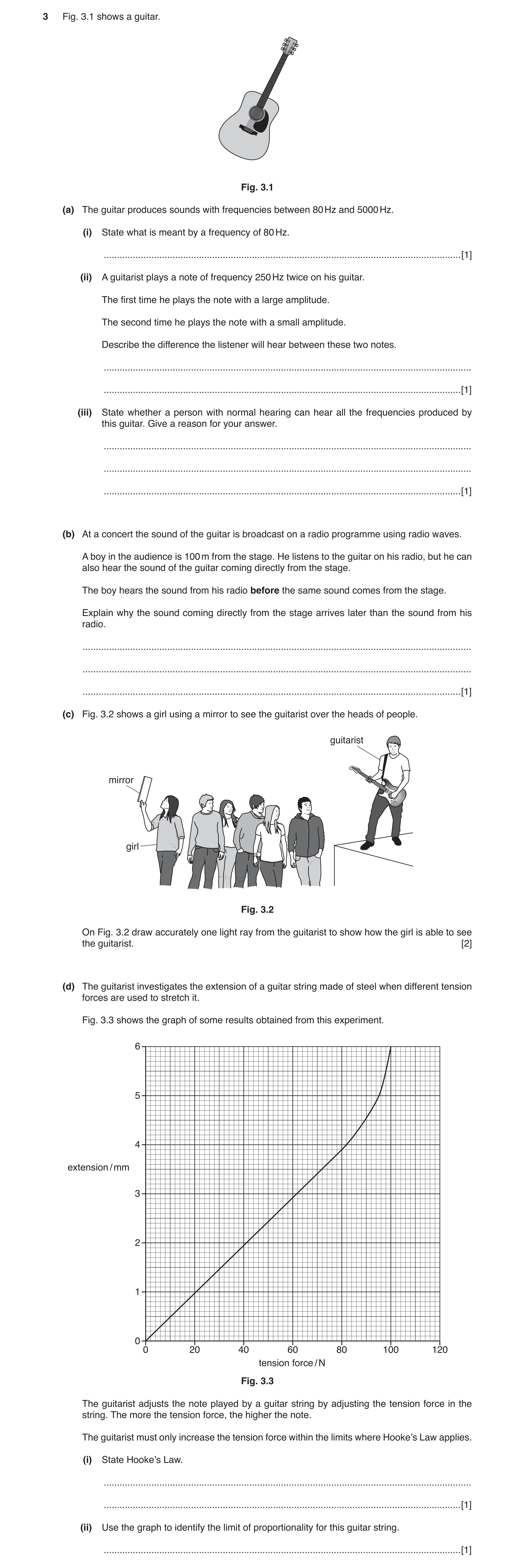
3 Fig. 3.1 shows a guitar. Fig. 3.1 (a) The guitar produces sounds with frequencies between 80 Hz and 5000 Hz. (i) State what is meant by a frequency of 80 Hz. … [1] (ii) A guitarist plays a note of frequency 250 Hz twice on his guitar. The first time he plays the note with a large amplitude. The second time he plays the note with a small amplitude. Describe the difference the listener will hear between these two notes. … … [1] (iii) State whether a person with normal hearing can hear all the frequencies produced by this guitar. Give a reason for your answer. … … … [1] (b) At a concert the sound of the guitar is broadcast on a radio programme using radio waves. A boy in the audience is 100 m from the stage. He listens to the guitar on his radio, but he can also hear the sound of the guitar coming directly from the stage. The boy hears the sound from his radio before the same sound comes from the stage. Explain why the sound coming directly from the stage arrives later than the sound from his radio. … … … [1] (c) Fig. 3.2 shows a girl using a mirror to see the guitarist over the heads of people. guitarist mirror girl Fig. 3.2 On Fig. 3.2 draw accurately one light ray from the guitarist to show how the girl is able to see the guitarist. [2] (d) The guitarist investigates the extension of a guitar string made of steel when different tension forces are used to stretch it. Fig. 3.3 shows the graph of some results obtained from this experiment. 6 5 4 extension / mm 3 2 1 0 0 20 40 60 80 100 120 tension force / N Fig. 3.3 The guitarist adjusts the note played by a guitar string by adjusting the tension force in the string. The more the tension force, the higher the note. The guitarist must only increase the tension force within the limits where Hooke’s Law applies. (i) State Hooke’s Law. … … [1] (ii) Use the graph to identify the limit of proportionality for this guitar string. … [1]
8 marks
Mark scheme: 3(a)(i) 80 cycles / vibrations / oscillations per second ; 1 3(a)(ii) first note louder than second note ; 1 3(a)(iii) yes (no mark) frequency range lies within frequency range of normal human hearing ; 1 3(b) radio / electromagnetic waves travel (much) faster than sound waves / ora ; 1 3(c) both rays shown as continuous straight lines, being reflected from and touching the mirror ; angles of incidence and reflection the same by inspection and at least one arrow in the correct direction ; 2 3(d)(i) extension / deformation is proportional to the load / cause / force = a constant × extension / F = kx ; 1 Question Answer Marks 3(d)(ii) tension in the range 80 to 84 N ; 1
This question in 0653/41 Oct/Nov 2017
Q3 · A radiator which uses hot water to provide heating for people sitting in a room watching… 0653/42 Oct/Nov 2017
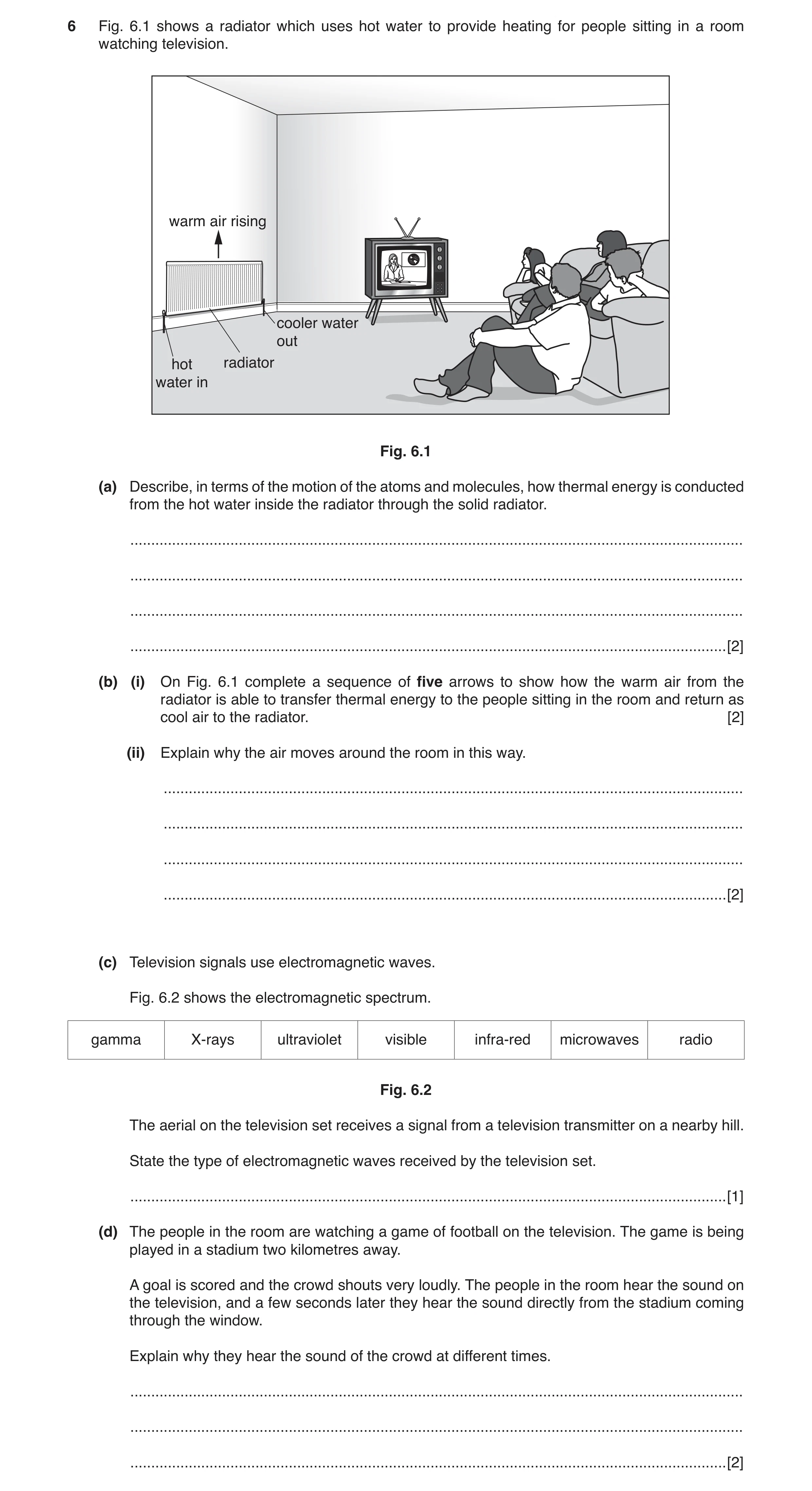
6 Fig. 6.1 shows a radiator which uses hot water to provide heating for people sitting in a room watching television. warm air rising cooler water out hot radiator water in Fig. 6.1 (a) Describe, in terms of the motion of the atoms and molecules, how thermal energy is conducted from the hot water inside the radiator through the solid radiator. … … … … [2] (b) (i) On Fig. 6.1 complete a sequence of five arrows to show how the warm air from the radiator is able to transfer thermal energy to the people sitting in the room and return as cool air to the radiator. [2] (ii) Explain why the air moves around the room in this way. … … … … [2] (c) Television signals use electromagnetic waves. Fig. 6.2 shows the electromagnetic spectrum. gamma X-rays ultraviolet visible infra-red microwaves radio Fig. 6.2 The aerial on the television set receives a signal from a television transmitter on a nearby hill. State the type of electromagnetic waves received by the television set. … [1] (d) The people in the room are watching a game of football on the television. The game is being played in a stadium two kilometres away. A goal is scored and the crowd shouts very loudly. The people in the room hear the sound on the television, and a few seconds later they hear the sound directly from the stadium coming through the window. Explain why they hear the sound of the crowd at different times. … … … [2]
9 marks
Mark scheme: 6(a) atoms / molecules (in contact with water) vibrate (more) ; the idea that energy / vibrations passed on through collisions / from particle to particle (owtte) ; 2 6(b)(i) arrows show rise (to ceiling), progress across (ceiling), downward progress (to floor) ; (past people) return to radiator ; 2 6(b)(ii) warm air is less dense / ora ; so warm air rises / ora ; 2 6(c) radio (waves) ; 1 6(d) TV signal travels at speed of e / m waves ; e / m waves travel (much) faster than sound (waves) ; 2
This question in 0653/42 Oct/Nov 2017
Q4 · An electric toaster used for toasting bread slices in a hotel dining room 0653/43 May/June 2018
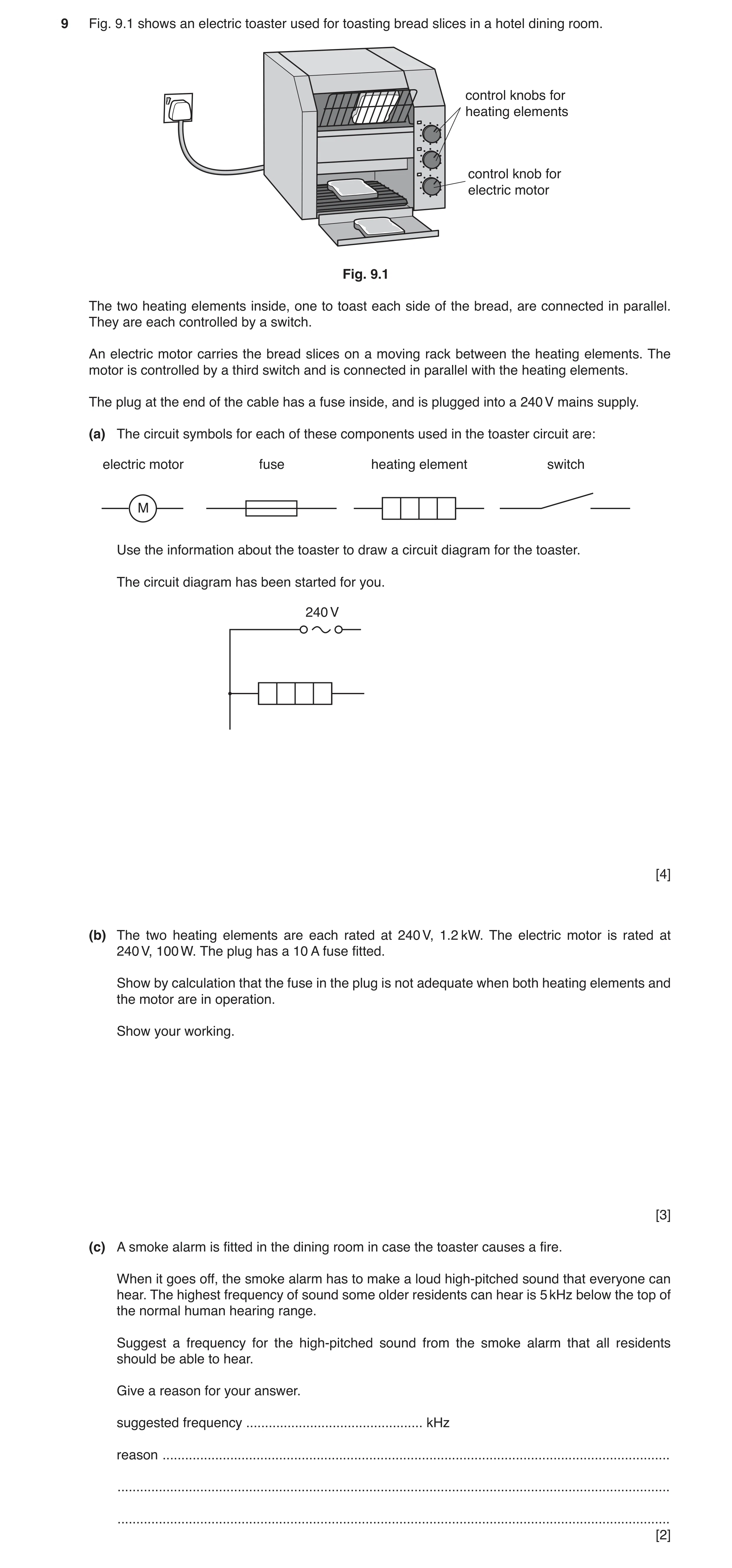
9 Fig. 9.1 shows an electric toaster used for toasting bread slices in a hotel dining room. control knobs for heating elements control knob for electric motor Fig. 9.1 The two heating elements inside, one to toast each side of the bread, are connected in parallel. They are each controlled by a switch. An electric motor carries the bread slices on a moving rack between the heating elements. The motor is controlled by a third switch and is connected in parallel with the heating elements. The plug at the end of the cable has a fuse inside, and is plugged into a 240 V mains supply. (a) The circuit symbols for each of these components used in the toaster circuit are: electric motor fuse heating element switch M Use the information about the toaster to draw a circuit diagram for the toaster. The circuit diagram has been started for you. 240 V [4] (b) The two heating elements are each rated at 240 V, 1.2 kW. The electric motor is rated at 240 V, 100 W. The plug has a 10 A fuse fitted. Show by calculation that the fuse in the plug is not adequate when both heating elements and the motor are in operation. Show your working. [3] (c) A smoke alarm is fitted in the dining room in case the toaster causes a fire. When it goes off, the smoke alarm has to make a loud high-pitched sound that everyone can hear. The highest frequency of sound some older residents can hear is 5 kHz below the top of the normal human hearing range. Suggest a frequency for the high-pitched sound from the smoke alarm that all residents should be able to hear. Give a reason for your answer. suggested frequency … kHz reason … … … [2]
9 marks
Mark scheme: 9(a) fuse in main circuit ; heating elements in parallel with each other and supply ; motor in parallel with heating elements (and supply) ; switches in series with both heaters and motor ; 4 9(b) total power supply required = 1200 × 2 + 100 = 2500 W ; use of P = I × V e.g. current through one heater = 5 A / total current = 2500 ÷ 240 ; = 10.4 A (which is above fuse rating) ; 3 Question Answer Marks 9(c) value within range 10–15 kHz ; top end of normal range is 20 kHz / older residents can hear up to 15 kHz ; 2
This question in 0653/43 May/June 2018
Q5 · A whale swimming underwater 0653/41 May/June 2019
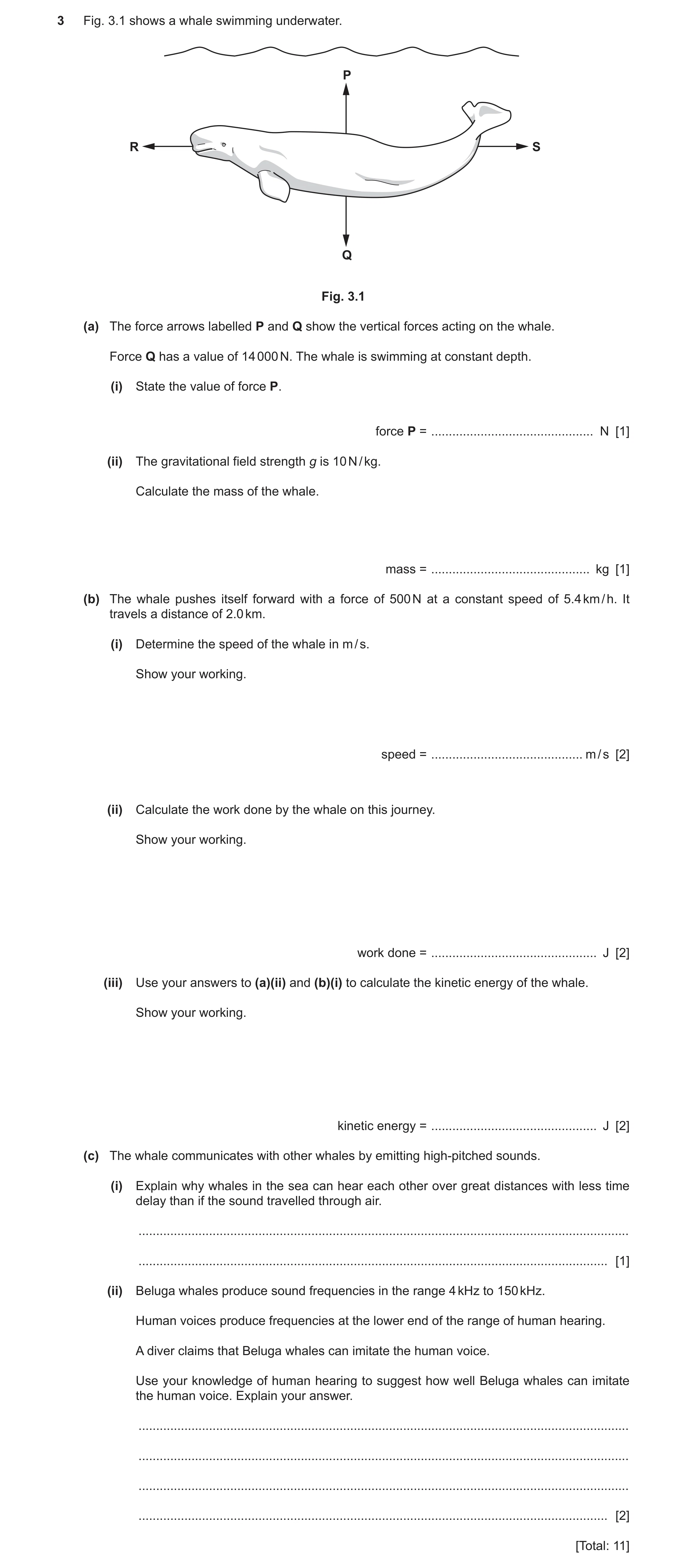
3 Fig. 3.1 shows a whale swimming underwater. P R S Q Fig. 3.1 (a) The force arrows labelled P and Q show the vertical forces acting on the whale. Force Q has a value of 14 000 N. The whale is swimming at constant depth. (i) State the value of force P. force P = … N [1] (ii) The gravitational field strength g is 10 N / kg. Calculate the mass of the whale. mass = … kg [1] (b) The whale pushes itself forward with a force of 500 N at a constant speed of 5.4 km / h. It travels a distance of 2.0 km. (i) Determine the speed of the whale in m / s. Show your working. speed = … m / s [2] (ii) Calculate the work done by the whale on this journey. Show your working. work done = … J [2] (iii) Use your answers to (a)(ii) and (b)(i) to calculate the kinetic energy of the whale. Show your working. kinetic energy = … J [2] (c) The whale communicates with other whales by emitting high-pitched sounds. (i) Explain why whales in the sea can hear each other over great distances with less time delay than if the sound travelled through air. … … [1] (ii) Beluga whales produce sound frequencies in the range 4 kHz to 150 kHz. Human voices produce frequencies at the lower end of the range of human hearing. A diver claims that Beluga whales can imitate the human voice. Use your knowledge of human hearing to suggest how well Beluga whales can imitate the human voice. Explain your answer. … … … … [2] [Total: 11]
11 marks
Mark scheme: 3(a)(i) 14 000 (N) ; 1 3(a)(ii) 1400 (kg) ; 1 3(b)(i) (speed =) distance / time or 5400 / 3600 ; = 1.5 (m/s) ; 2 Question Answer Marks 3(b)(ii) (work done =) force × distance / W = F × d = 500 × 2000 ; = 1 000 000 (J) ; 2 3(b)(iii) (KE =) ½ mv2 ; = ½ × 1400 × (1.5)2 = 1575 (J) ; 2 3(c)(i) speed of sound in liquid / water faster than in gas / air ; 1 3(c)(ii) range of human hearing = 20 to 20 000Hz ; so beluga can produce sound that lies within the range of human hearing ; beluga sounds very high-pitched (to humans) ; max 2
This question in 0653/41 May/June 2019
Q6 · How a small hydroelectric power station is used to supply electricity 0653/41 Oct/Nov 2019
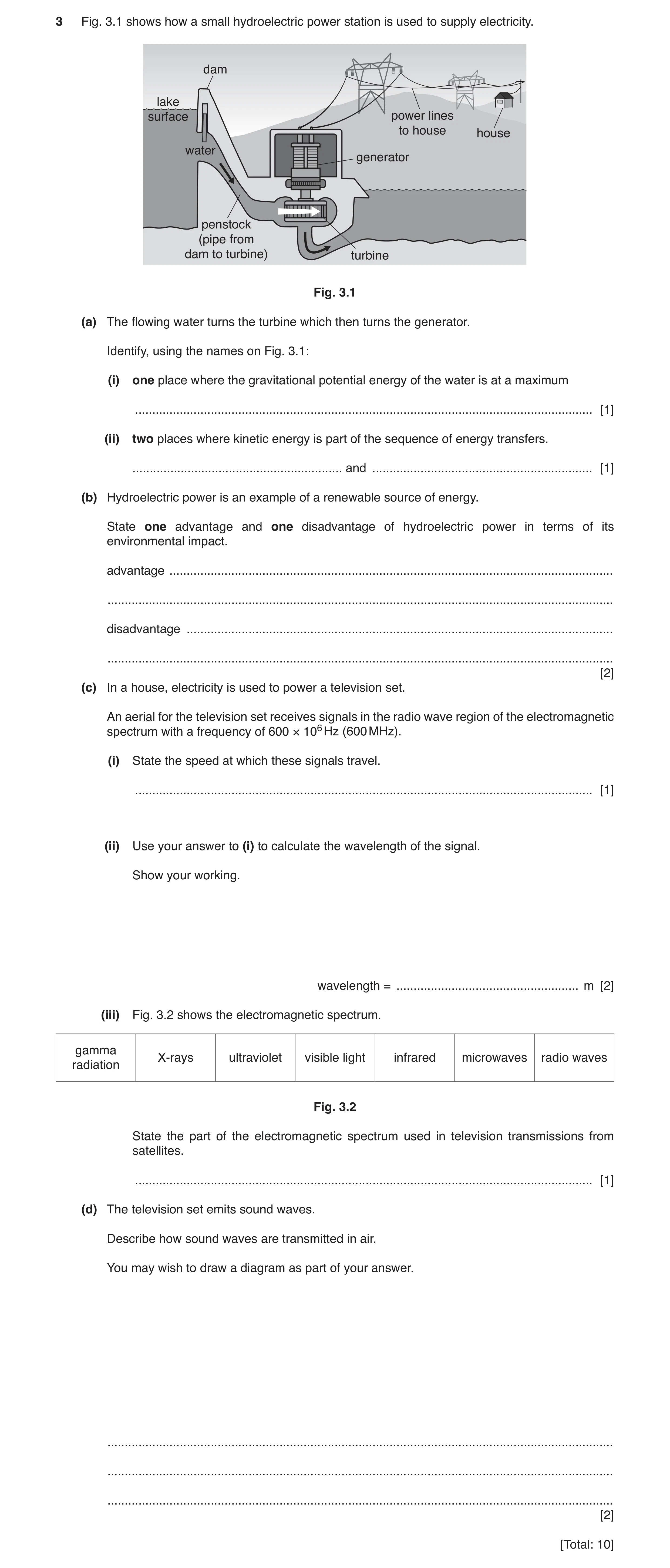
3 Fig. 3.1 shows how a small hydroelectric power station is used to supply electricity. dam lake surface power lines to house house water generator penstock (pipe from dam to turbine) turbine Fig. 3.1 (a) The flowing water turns the turbine which then turns the generator. Identify, using the names on Fig. 3.1: (i) one place where the gravitational potential energy of the water is at a maximum … [1] (ii) two places where kinetic energy is part of the sequence of energy transfers. … and … [1] (b) Hydroelectric power is an example of a renewable source of energy. State one advantage and one disadvantage of hydroelectric power in terms of its environmental impact. advantage … … disadvantage … … [2] (c) In a house, electricity is used to power a television set. An aerial for the television set receives signals in the radio wave region of the electromagnetic spectrum with a frequency of 600 × 106 Hz (600 MHz). (i) State the speed at which these signals travel. … [1] (ii) Use your answer to (i) to calculate the wavelength of the signal. Show your working. wavelength = … m [2] (iii) Fig. 3.2 shows the electromagnetic spectrum. gamma X-rays ultraviolet visible light infrared microwaves radio wavesradiation Fig. 3.2 State the part of the electromagnetic spectrum used in television transmissions from satellites. … [1] (d) The television set emits sound waves. Describe how sound waves are transmitted in air. You may wish to draw a diagram as part of your answer. … … … [2] [Total: 10]
10 marks
Mark scheme: 3(a)(i) lake surface ; 1 3(a)(ii) any 2 from: penstock (pipe from dam to turbine) ; turbine ; generator ; 1 3(b) advantage: no emissions / can be used for flood control ; disadvantage: creating reservoirs can flood useful land / destroy local ecosystems ; 2 3(c)(i) 3 × 10⁸ m/s ; 1 3(c)(ii) use of v = fλ ; (λ = v ÷ f = 3 × 10⁸ ÷ 600 × 106 ) = 0.5 m ; 2 3(c)(iii) microwaves ; 1 3(d) vibrations / oscillations of particles / air molecules or compressions and rarefactions ; longitudinal / vibration (direction) is parallel to direction of wave propagation / energy propagation ; 2
This question in 0653/41 Oct/Nov 2019
Q7 · Children using a magnifying glass to view a butterfly 0653/43 Oct/Nov 2019
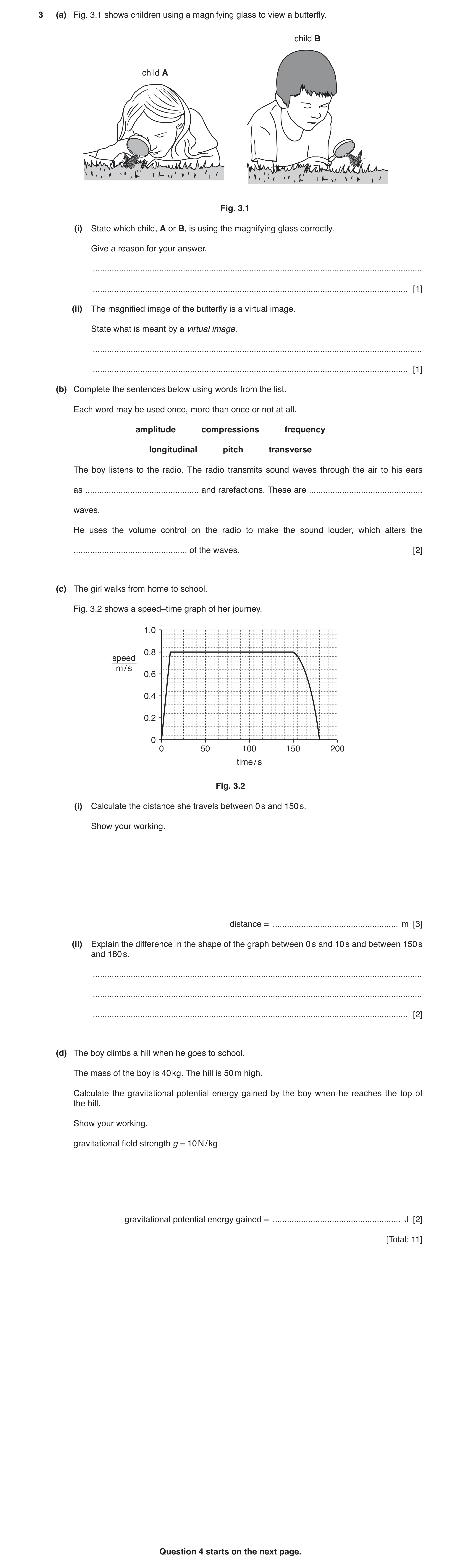
3 (a) Fig. 3.1 shows children using a magnifying glass to view a butterfly. child B child A Fig. 3.1 (i) State which child, A or B, is using the magnifying glass correctly. Give a reason for your answer. … … [1] (ii) The magnified image of the butterfly is a virtual image. State what is meant by a virtual image. … … [1] (b) Complete the sentences below using words from the list. Each word may be used once, more than once or not at all. amplitude compressions frequency longitudinal pitch transverse The boy listens to the radio. The radio transmits sound waves through the air to his ears as … and rarefactions. These are … waves. He uses the volume control on the radio to make the sound louder, which alters the … of the waves. [2] (c) The girl walks from home to school. Fig. 3.2 shows a speed–time graph of her journey. 1.0 0.8 speed m / s 0.6 0.4 0.2 0 0 50 100 150 200 time / s Fig. 3.2 (i) Calculate the distance she travels between 0 s and 150 s. Show your working. distance = … m [3] (ii) Explain the difference in the shape of the graph between 0 s and 10 s and between 150 s and 180 s. … … … [2] (d) The boy climbs a hill when he goes to school. The mass of the boy is 40 kg. The hill is 50 m high. Calculate the gravitational potential energy gained by the boy when he reaches the top of the hill. Show your working. gravitational field strength g = 10 N / kg gravitational potential energy gained = … J [2] [Total: 11] Question 4 starts on the next page.
11 marks
Mark scheme: 3(a)(i) (child A because) child A holding close(r) to eye / child B eye is too far from the lens ; 1 3(a)(ii) image that cannot be projected onto a screen ; 1 3(b) compressions longitudinal amplitude any 2 correct = 1 mark all 3 correct = 2 marks 2 3(c)(i) use of area under graph or d = s × t ; correct use of data from graph ; = 116 ; 3 3(c)(ii) constant acceleration (0–10 s) ; non-constant deceleration (150–180 s) ; 2 3(d) use of gravitational PE gained = mgh ; (= 40 × 10 × 50) = 20 000 (J) ; 2
This question in 0653/43 Oct/Nov 2019
Question 8 0653/42 Feb/March 2021
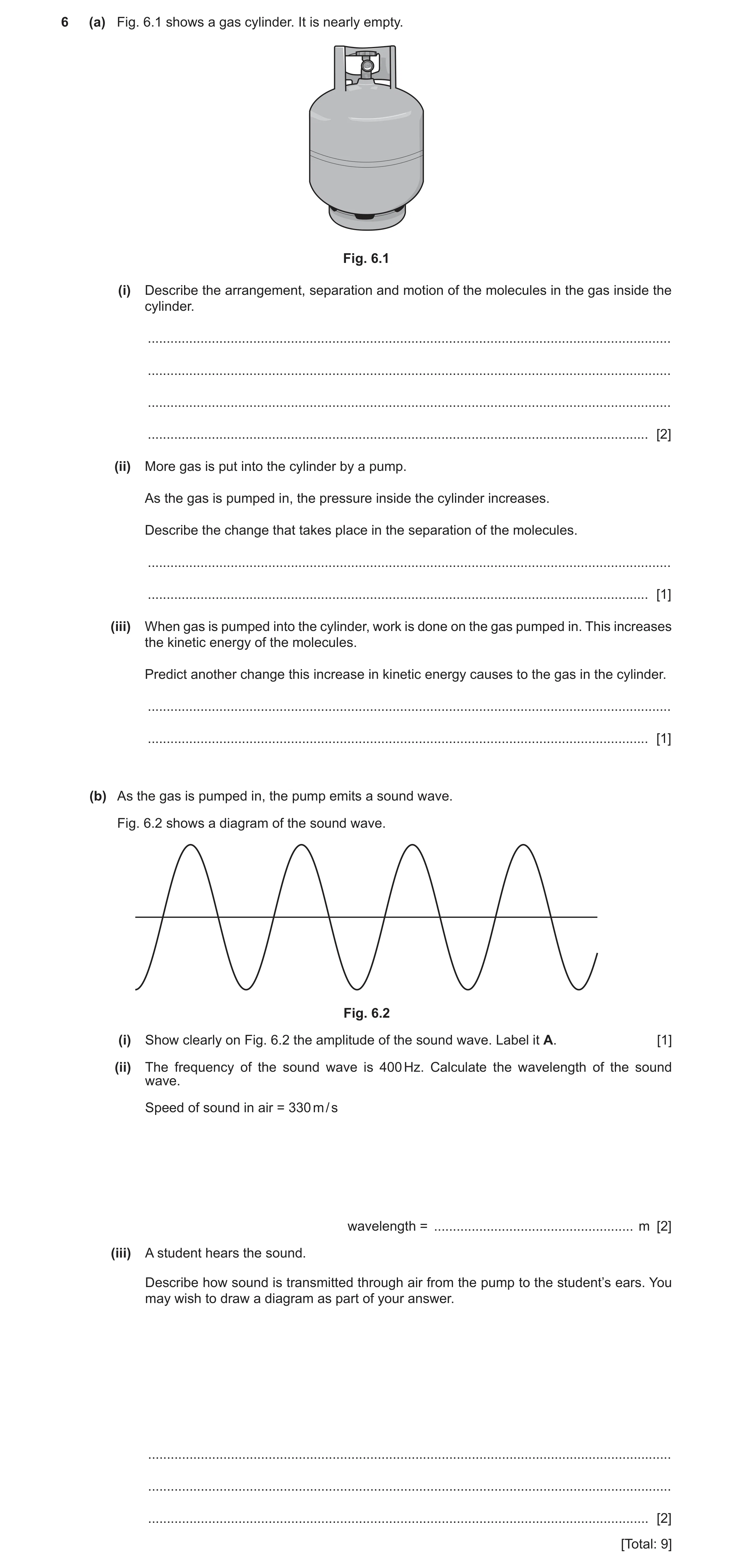
6 (a) Fig. 6.1 shows a gas cylinder. It is nearly empty. Fig. 6.1 (i) Describe the arrangement, separation and motion of the molecules in the gas inside the cylinder. … … … … [2] (ii) More gas is put into the cylinder by a pump. As the gas is pumped in, the pressure inside the cylinder increases. Describe the change that takes place in the separation of the molecules. … … [1] (iii) When gas is pumped into the cylinder, work is done on the gas pumped in. This increases the kinetic energy of the molecules. Predict another change this increase in kinetic energy causes to the gas in the cylinder. … … [1] (b) As the gas is pumped in, the pump emits a sound wave. Fig. 6.2 shows a diagram of the sound wave. Fig. 6.2 (i) Show clearly on Fig. 6.2 the amplitude of the sound wave. Label it A. [1] (ii) The frequency of the sound wave is 400 Hz. Calculate the wavelength of the sound wave. Speed of sound in air = 330 m / s wavelength = … m [2] (iii) A student hears the sound. Describe how sound is transmitted through air from the pump to the student’s ears. You may wish to draw a diagram as part of your answer. … … … [2] [Total: 9]
9 marks
Mark scheme: 6(a)(i) any two from: random (arrangement) ; the idea of far apart ; moving, freely / around / quickly / randomly ; 2 6(a)(ii) closer / not as far apart ; 1 6(a)(iii) increase in temperature ; 1 6(b)(i) amplitude correctly indicated on Fig. 6.2 ; 1 6(b)(ii) v = f λ / λ = v ÷ f / 330 ÷ 400 ; = 0.825 / 0.83 (m) ; 2 Question Answer Marks 6(b)(iii) (series of) compressions and rarefactions ; description of what these terms mean by reference to air pressure or distance between molecules / diagram such as one of those below, ; 2
This question in 0653/42 Feb/March 2021
Q9 · Two beach balls are floating in the sea 0653/42 Oct/Nov 2021
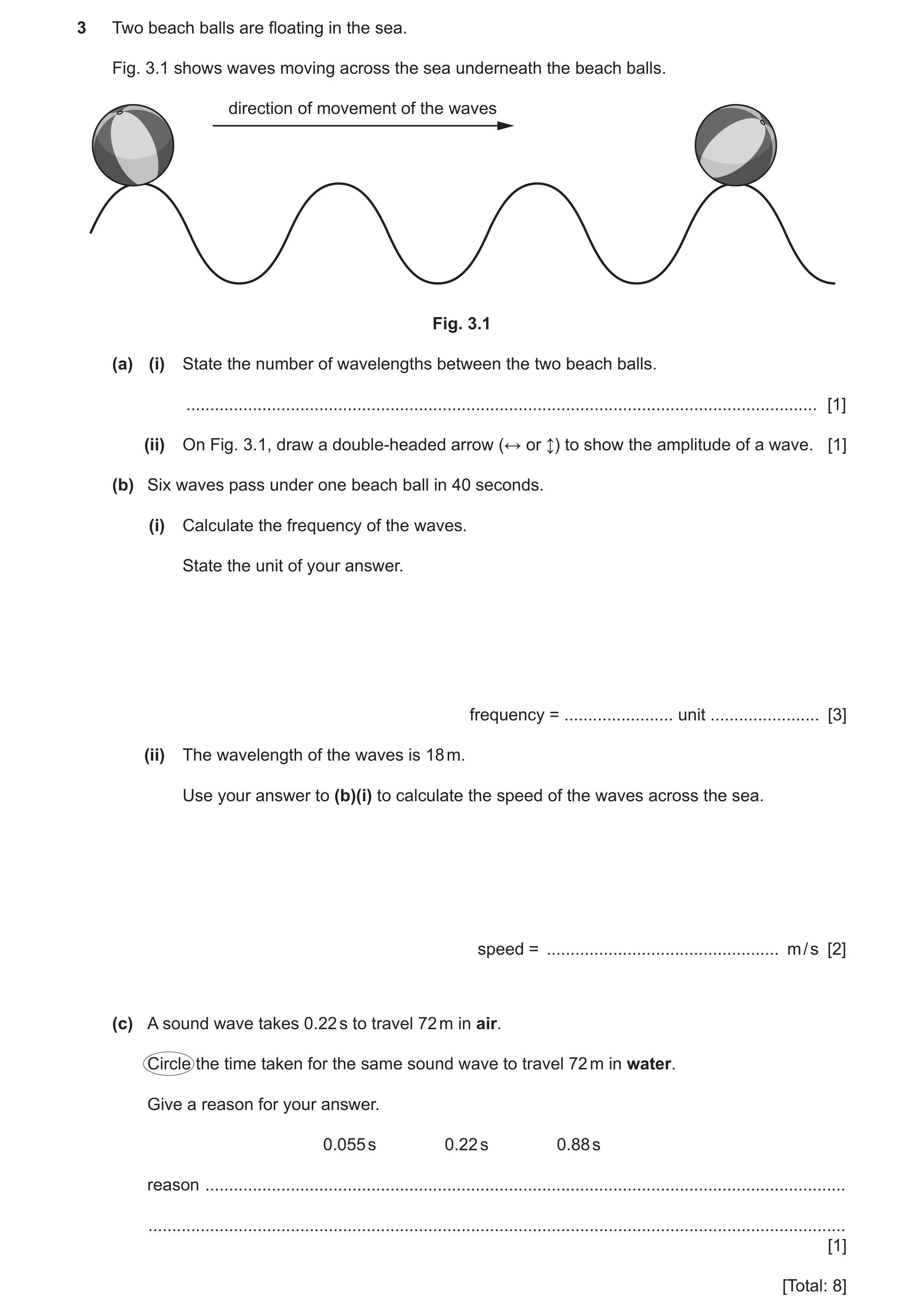
3 Two beach balls are floating in the sea. Fig. 3.1 shows waves moving across the sea underneath the beach balls. direction of movement of the waves Fig. 3.1 (a) (i) State the number of wavelengths between the two beach balls. … [1] (ii) On Fig. 3.1, draw a double-headed arrow (↔ or ↕) to show the amplitude of a wave. [1] (b) Six waves pass under one beach ball in 40 seconds. (i) Calculate the frequency of the waves. State the unit of your answer. frequency = … unit … [3] (ii) The wavelength of the waves is 18 m. Use your answer to (b)(i) to calculate the speed of the waves across the sea. speed = … m / s [2] (c) A sound wave takes 0.22 s to travel 72 m in air. Circle the time taken for the same sound wave to travel 72 m in water. Give a reason for your answer. 0.055 s 0.22 s 0.88 s reason … … [1] [Total: 8]
8 marks
Mark scheme: 3(a)(i) 3 ; 1 3(a)(ii) double-headed arrow between equilibrium position (mid-point) and any peak or trough ; 1 3(b)(i) frequency = number of waves per second / 6 ÷ 40 ; 0.15 ; Hz ; 3 3(b)(ii) 𝑣 = 𝑓 in any form / 0.15 × 18 ; 2.7 (m / s) ; 2 3(c) 0.055 s AND sound travels faster through, water / liquids (than in, air / gases) ORA ; 1
This question in 0653/42 Oct/Nov 2021
Q10 · A glacier is a very large area of ice that moves slowly down a slope or valley 0653/43 May/June 2022
6 A glacier is a very large area of ice that moves slowly down a slope or valley. Fig. 6.1 shows a glacier as it flows into a lake. glacier ice lake water Fig. 6.1 (a) At the end of the glacier, the ice in contact with water is melting. The temperature of the water is 4 °C. (i) State the temperature of the melting ice. temperature = … °C [1] (ii) Complete the sentences using words from the list. Each word may be used once, more than once or not at all. chemical electrical potential power pressure resistance temperature thermal The ice melts because … energy is transferred from the water to the ice. This causes the … of the water to decrease. [2] (b) Ice is a solid. Water is a liquid. Describe the differences between a solid and a liquid in terms of: • the forces between the molecules • the motion of the molecules. … … … … [2] (c) A scientist standing on the glacier sees a large rock fall onto the glacier 1900 m away. The rock makes a loud sound as it hits the glacier. (i) Show that the time for the sound to travel 1900 m through air to the scientist is 5.8 s. The speed of sound in air is 330 m / s. [1] (ii) Use data to explain why the scientist sees the rock fall onto the glacier before she hears the sound. … … … [2] (iii) The scientist actually hears the sound of the rock falling onto the glacier just 0.49 s after seeing the rock fall. Suggest why this time is less than the time in (c)(i). … … … [2] [Total: 10]
10 marks
Mark scheme: 6(a)(i) 0 (° C) ; 1 6(a)(ii) thermal ; temperature ; 2 6(b) weaker forces between molecules in liquid than in solid ; molecules able to move around in liquid / not able to move around in solid ; 2 6(c)(i) (time = distance / speed =) 1900 / 330 = 5.76 s (= 5.8 s) ; 1 6(c)(ii) speed of light 3 108 m / s (greater than 330 m / s for sound) ; light travels faster than sound ORA ; 2 6(c)(iii) (takes less time) so (sound) travelled at a higher speed (than 330 m / s) ; (sound) travelled through ice ; 2
This question in 0653/43 May/June 2022
Q11 · Two people keeping warm by a campfire and one is playing a guitar 0653/41 May/June 2023
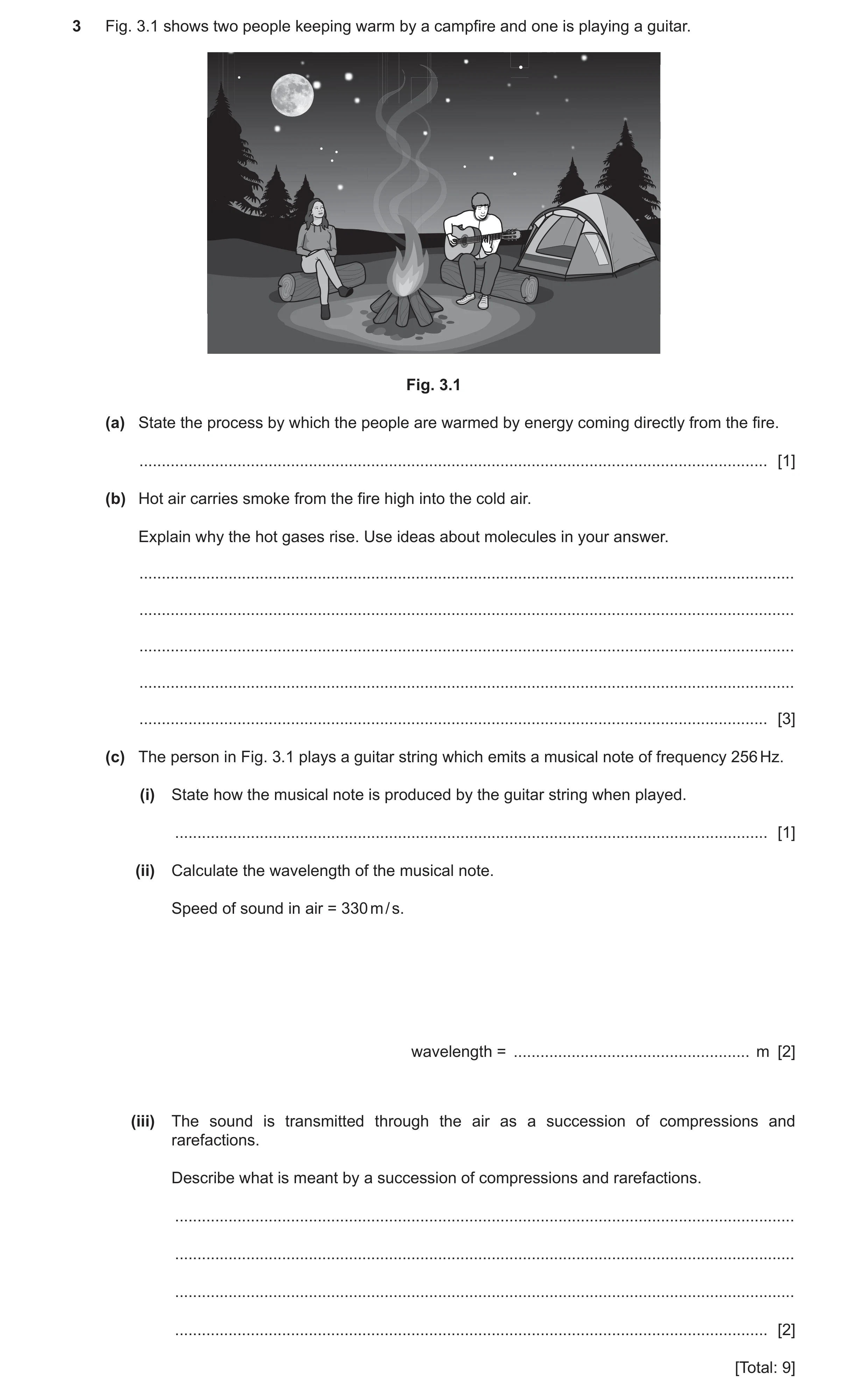
3 Fig. 3.1 shows two people keeping warm by a campfire and one is playing a guitar. Fig. 3.1 (a) State the process by which the people are warmed by energy coming directly from the fire. … [1] (b) Hot air carries smoke from the fire high into the cold air. Explain why the hot gases rise. Use ideas about molecules in your answer. … … … … … [3] (c) The person in Fig. 3.1 plays a guitar string which emits a musical note of frequency 256 Hz. (i) State how the musical note is produced by the guitar string when played. … [1] (ii) Calculate the wavelength of the musical note. Speed of sound in air = 330 m / s. wavelength = … m [2] (iii) The sound is transmitted through the air as a succession of compressions and rarefactions. Describe what is meant by a succession of compressions and rarefactions. … … … … [2] [Total: 9]
9 marks
Mark scheme: 3(a) radiation ; 1 3(b) reference to molecules moving faster ; reference to expansion of air or gases / gases or air occupy greater volume / molecules move further apart ; the idea that lower density (air) rises / hot air displaced by heavier or denser cool air ; 3 3(c)(i) vibrating (string) ; 1 3(c)(ii) speed = frequency wavelength / v = f (in any form) / = 330 ÷ 256 ; 1.29 (m) ; 2 3(c)(iii) compression means, particles or molecules are close together / (air) density is greater / air pressure is greater / ORA for rarefaction ; succession refers to the idea that compressions and rarefactions form a repeating, pattern / (longitudinal) wave ; 2
This question in 0653/41 May/June 2023
Q12 · A sound wave travelling through air between two people 0653/43 May/June 2023
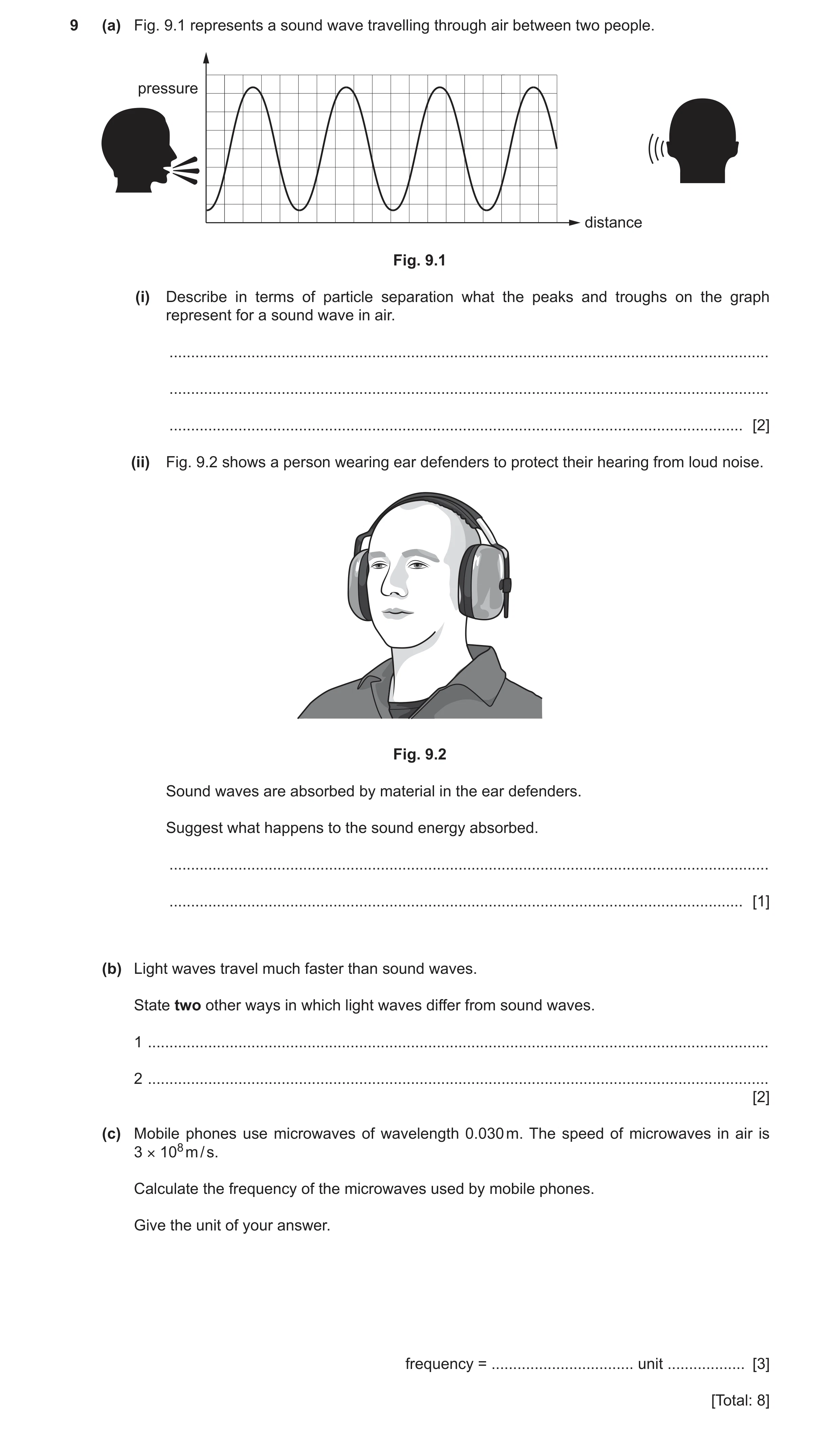
9 (a) Fig. 9.1 represents a sound wave travelling through air between two people. pressure distance Fig. 9.1 (i) Describe in terms of particle separation what the peaks and troughs on the graph represent for a sound wave in air. … … … [2] (ii) Fig. 9.2 shows a person wearing ear defenders to protect their hearing from loud noise. Fig. 9.2 Sound waves are absorbed by material in the ear defenders. Suggest what happens to the sound energy absorbed. … … [1] (b) Light waves travel much faster than sound waves. State two other ways in which light waves differ from sound waves. 1 … 2 … [2] (c) Mobile phones use microwaves of wavelength 0.030 m. The speed of microwaves in air is 3 × 10⁸ m / s. Calculate the frequency of the microwaves used by mobile phones. Give the unit of your answer. frequency = … unit … [3] [Total: 8]
8 marks
Mark scheme: 9(a)(i) (peaks represent) particles closer together ; (troughs represent) particles further apart ; 2 9(a)(ii) (transferred to) thermal energy ; 1 Question Answer Marks 9(b) any two from, and in any order: shorter wavelength ; higher frequency ; electromagnetic (as opposed to pressure waves) ; transverse ; can travel in a vacuum ; 2 9(c) speed = frequency wavelength / v = f λ OR f = 3 108 0.030 ; 1.0 1010 ; Hz ; 3
This question in 0653/43 May/June 2023
Q13 · A sound wave in air 0653/41 Oct/Nov 2023
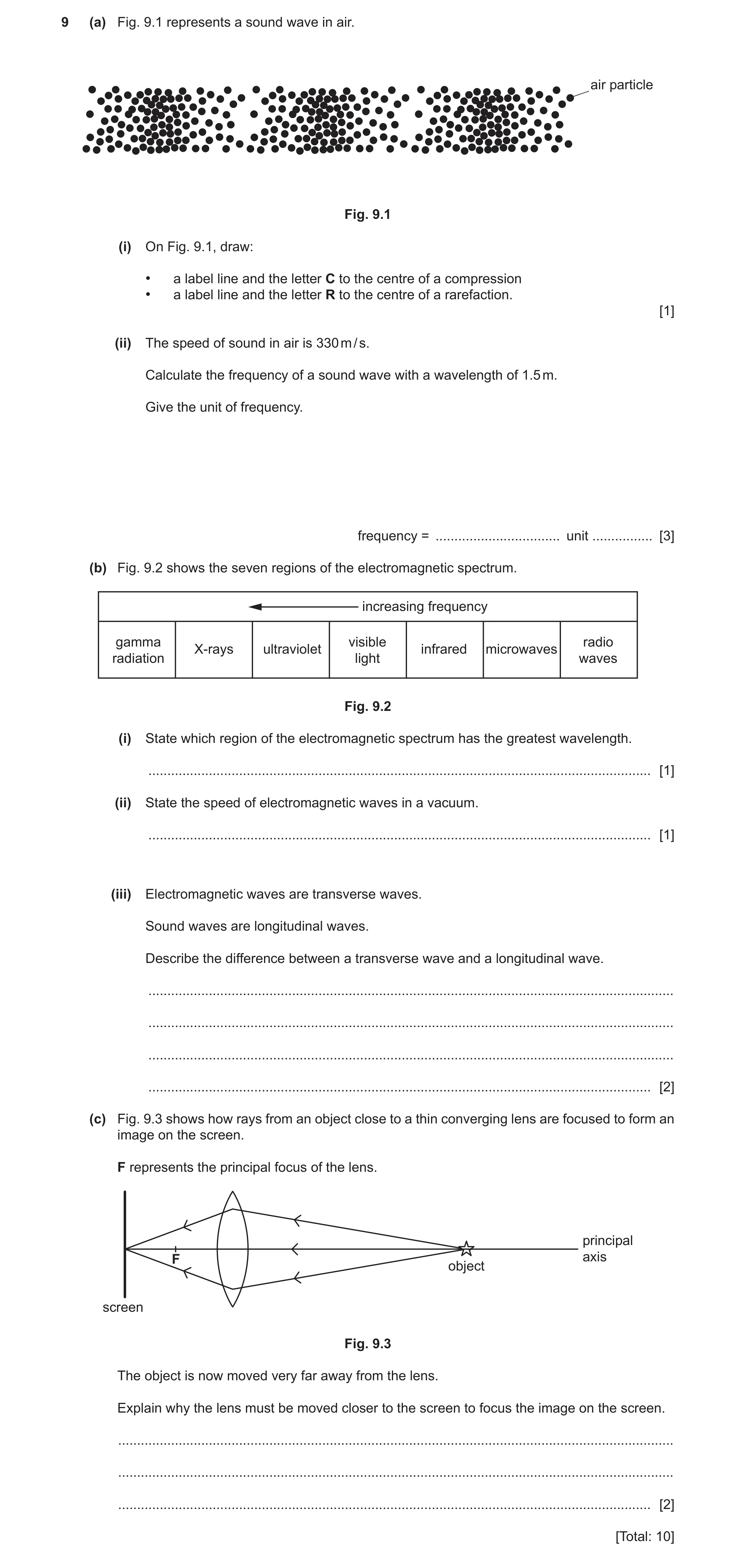
9 (a) Fig. 9.1 represents a sound wave in air. air particle Fig. 9.1 (i) On Fig. 9.1, draw: • a label line and the letter C to the centre of a compression • a label line and the letter R to the centre of a rarefaction. [1] (ii) The speed of sound in air is 330 m / s. Calculate the frequency of a sound wave with a wavelength of 1.5 m. Give the unit of frequency. frequency = … unit … [3] (b) Fig. 9.2 shows the seven regions of the electromagnetic spectrum. increasing frequency gamma visible radio X-rays ultraviolet infrared microwaves radiation light waves Fig. 9.2 (i) State which region of the electromagnetic spectrum has the greatest wavelength. … [1] (ii) State the speed of electromagnetic waves in a vacuum. … [1] (iii) Electromagnetic waves are transverse waves. Sound waves are longitudinal waves. Describe the difference between a transverse wave and a longitudinal wave. … … … … [2] (c) Fig. 9.3 shows how rays from an object close to a thin converging lens are focused to form an image on the screen. F represents the principal focus of the lens. principal F axis object screen Fig. 9.3 The object is now moved very far away from the lens. Explain why the lens must be moved closer to the screen to focus the image on the screen. … … … [2] [Total: 10]
10 marks
Mark scheme: 9(a)(i) compression correctly labelled with label line and letter C AND 1 rarefaction correctly labelled with label line and letter R ; 9(a)(ii) evidence of, v = f / 330 1.5 ; 3 220 ; Hz / hertz ; 9(b)(i) radio waves ; 1 9(b)(ii) 3.0 108 m / s ; 1 9(b)(iii) for longitudinal/sound waves, the direction of oscillation/vibration (of particles) is parallel to the (direction of) energy 2 transfer / AW ; for transverse/electromagnetic waves, the direction of oscillation/vibration (of particles) is perpendicular to the (direction of) energy transfer / AW ; 9(c) any two from: 2 incident rays now, parallel to axis / form a beam; idea that refracted rays now pass through, F / (principal) focus; lens must be moved so, (principal) focus / F, is, on / closer to, the screen (for focused image) ;
This question in 0653/41 Oct/Nov 2023
Q14 · A lighthouse used at night to warn ships of dangerous rocks in the sea 0653/42 Oct/Nov 2023
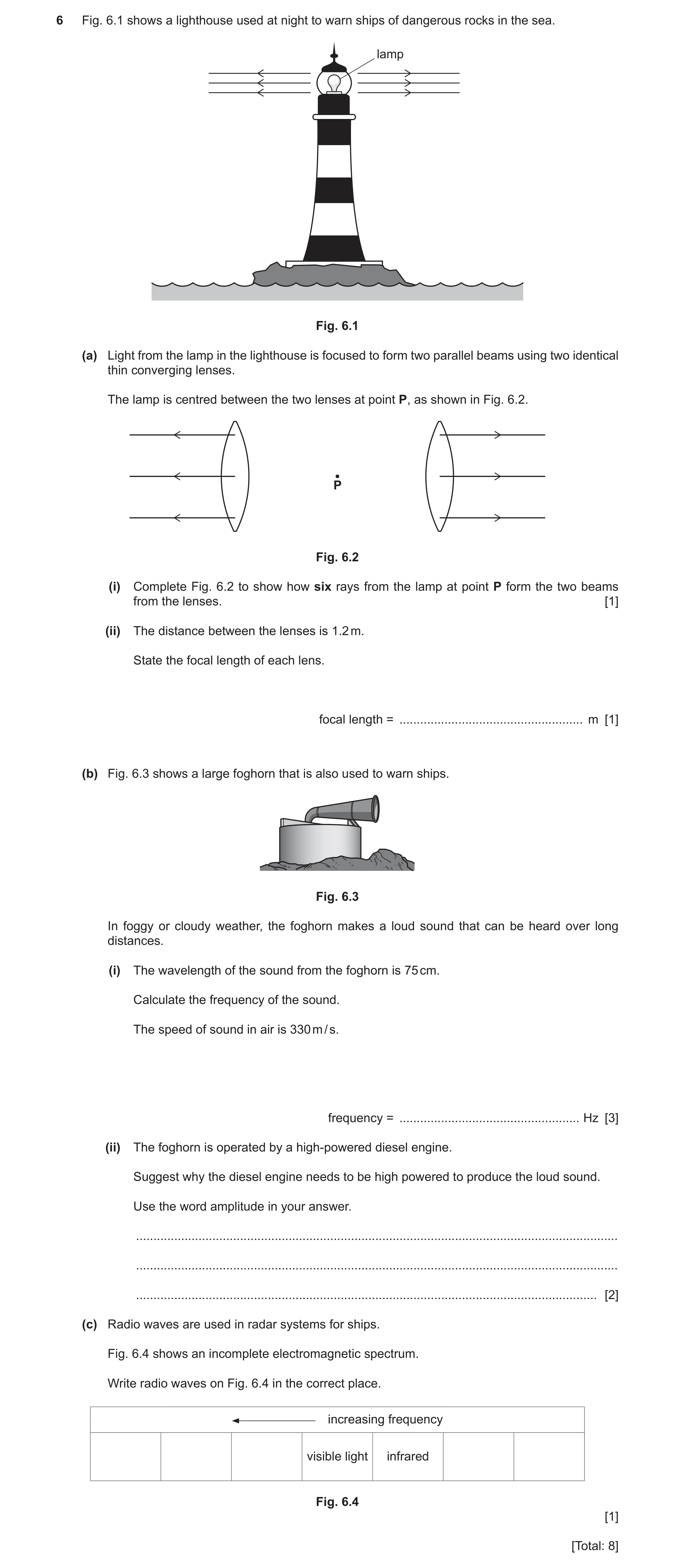
6 Fig. 6.1 shows a lighthouse used at night to warn ships of dangerous rocks in the sea. lamp Fig. 6.1 (a) Light from the lamp in the lighthouse is focused to form two parallel beams using two identical thin converging lenses. The lamp is centred between the two lenses at point P, as shown in Fig. 6.2. P Fig. 6.2 (i) Complete Fig. 6.2 to show how six rays from the lamp at point P form the two beams from the lenses. [1] (ii) The distance between the lenses is 1.2 m. State the focal length of each lens. focal length = … m [1] (b) Fig. 6.3 shows a large foghorn that is also used to warn ships. Fig. 6.3 In foggy or cloudy weather, the foghorn makes a loud sound that can be heard over long distances. (i) The wavelength of the sound from the foghorn is 75 cm. Calculate the frequency of the sound. The speed of sound in air is 330 m / s. frequency = … Hz [3] (ii) The foghorn is operated by a high-powered diesel engine. Suggest why the diesel engine needs to be high powered to produce the loud sound. Use the word amplitude in your answer. … … … [2] (c) Radio waves are used in radar systems for ships. Fig. 6.4 shows an incomplete electromagnetic spectrum. Write radio waves on Fig. 6.4 in the correct place. increasing frequency visible light infrared Fig. 6.4 [1] [Total: 8]
8 marks
Mark scheme: 6(a)(i) 1 all six emerging rays correctly linked back to principal focus at lamp ; 6(a)(ii) 0.6 (m) ; 1 6(b)(i) unit conversion cm to m ; 3 evidence of, v = f / 330 0.75 ; 440 (Hz) ; 6(b)(ii) (loud means) large amplitude ; 2 requires a lot of energy (from a powerful diesel engine) ; 6(c) 1 (visible (infrared) radio light) waves ;
This question in 0653/42 Oct/Nov 2023
Q15 · A musical instrument called a glockenspiel 0653/41 Oct/Nov 2024
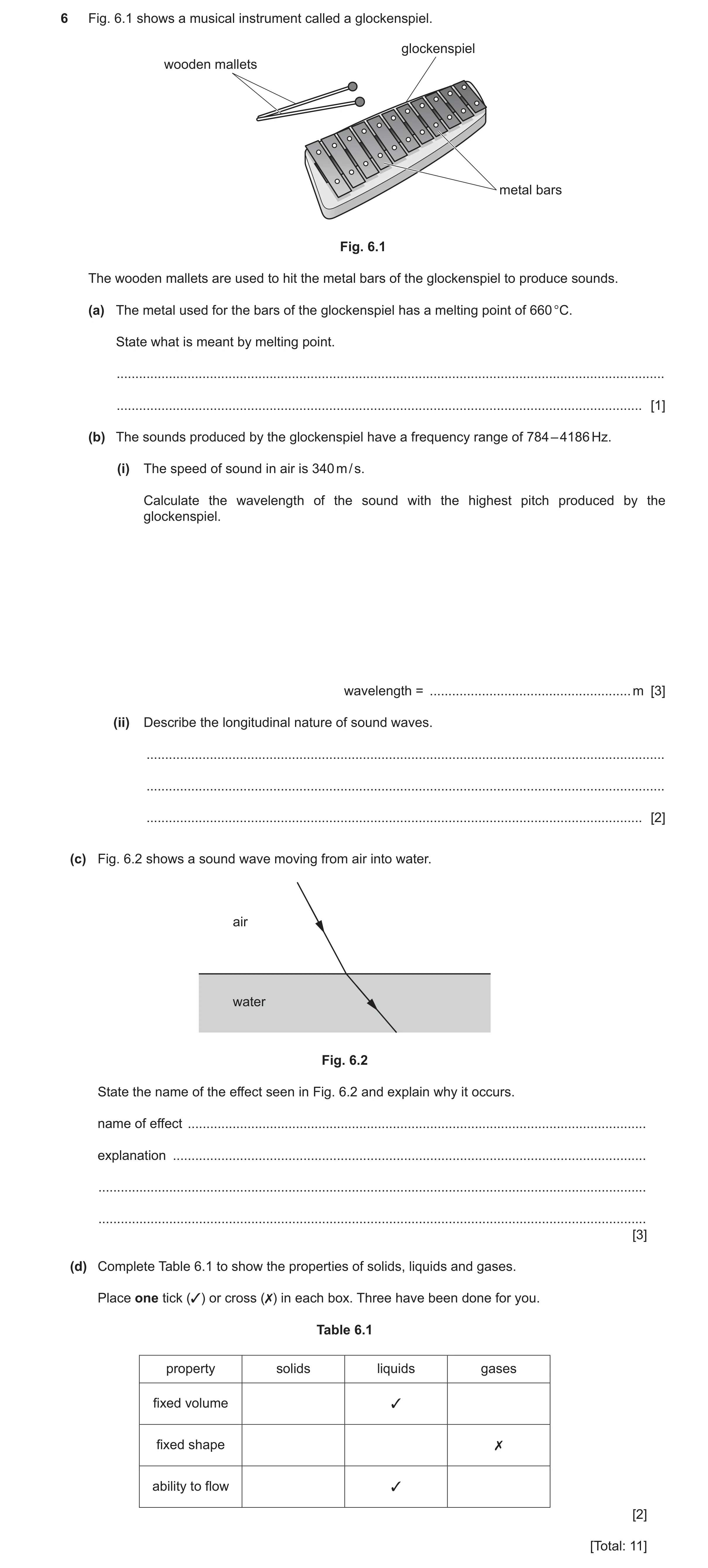
6 Fig. 6.1 shows a musical instrument called a glockenspiel. glockenspiel wooden mallets metal bars Fig. 6.1 The wooden mallets are used to hit the metal bars of the glockenspiel to produce sounds. (a) The metal used for the bars of the glockenspiel has a melting point of 660 °C. State what is meant by melting point. … … [1] (b) The sounds produced by the glockenspiel have a frequency range of 784 – 4186 Hz. (i) The speed of sound in air is 340 m / s. Calculate the wavelength of the sound with the highest pitch produced by the glockenspiel. wavelength = … m [3] (ii) Describe the longitudinal nature of sound waves. … … … [2] (c) Fig. 6.2 shows a sound wave moving from air into water. air water Fig. 6.2 State the name of the effect seen in Fig. 6.2 and explain why it occurs. name of effect … explanation … … … [3] (d) Complete Table 6.1 to show the properties of solids, liquids and gases. Place one tick (✓) or cross (✗) in each box. Three have been done for you. Table 6.1 property solids liquids gases fixed volume ✓ fixed shape ✗ ability to flow ✓ [2] [Total: 11]
11 marks
Mark scheme: 6(a) the temperature at which a substance changes state from solid to liquid / AW ; 1 6(b)(i) highest pitch = highest frequency / 4186 Hz ; 3 evidence of v = f / 340 ÷ 4186 ; 0.081(2) (m) ; 6(b)(ii) oscillations / vibrations (of the air / particles / molecules) ; 2 (motion of air / particles / molecules is) parallel to the direction of, energy transfer / travel / the wave ; 6(c) refraction ; 3 caused by change in speed / medium / density (of medium) ; sound wave moves faster in water / liquid / denser medium / ORA ; 6(d) 2 property solids liquids gases fixed volume ✓ (✓) × fixed shape ✓ × (✗) ability to flow × (✓) ✓ solids column correct ; liquids AND gases columns correct ;
This question in 0653/41 Oct/Nov 2024
Q16 · Complete the sentences about sound 0653/43 Oct/Nov 2024
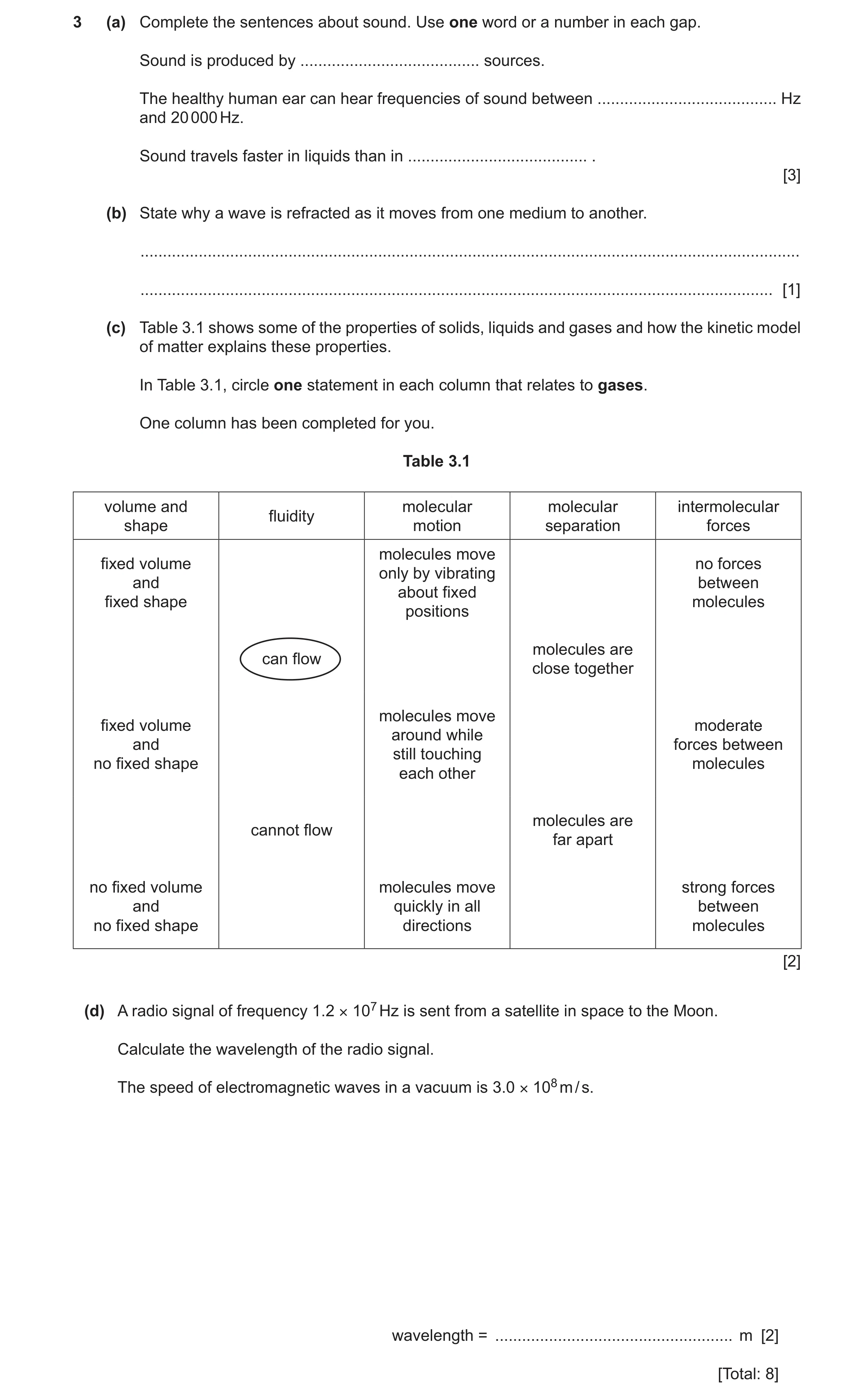
3 (a) Complete the sentences about sound. Use one word or a number in each gap. Sound is produced by … sources. The healthy human ear can hear frequencies of sound between … Hz and 20 000 Hz. Sound travels faster in liquids than in … . [3] (b) State why a wave is refracted as it moves from one medium to another. … … [1] (c) Table 3.1 shows some of the properties of solids, liquids and gases and how the kinetic model of matter explains these properties. In Table 3.1, circle one statement in each column that relates to gases. One column has been completed for you. Table 3.1 volume and molecular molecular intermolecular fluidity shape motion separation forces molecules move fixed volume no forces only by vibrating and between about fixed fixed shape molecules positions molecules are can flow close together molecules move fixed volume moderate around while and forces between still touching no fixed shape molecules each other molecules are cannot flow far apart no fixed volume molecules move strong forces and quickly in all between no fixed shape directions molecules [2] (d) A radio signal of frequency 1.2 × 10⁷ Hz is sent from a satellite in space to the Moon. Calculate the wavelength of the radio signal. The speed of electromagnetic waves in a vacuum is 3.0 × 10⁸ m / s. wavelength = … m [2] [Total: 8]
8 marks
Mark scheme: 3(a) vibrating ; 3 20 ; gases ; 3(b) (because of its) change in speed / different speeds ; 1 3(c) 2 two columns correct ; four columns correct ; 3(d) evidence of, v = f / 3.0 10 8 ÷ 1.2 10 7 ; 2 25 (m) ;
This question in 0653/43 Oct/Nov 2024
 17 / 28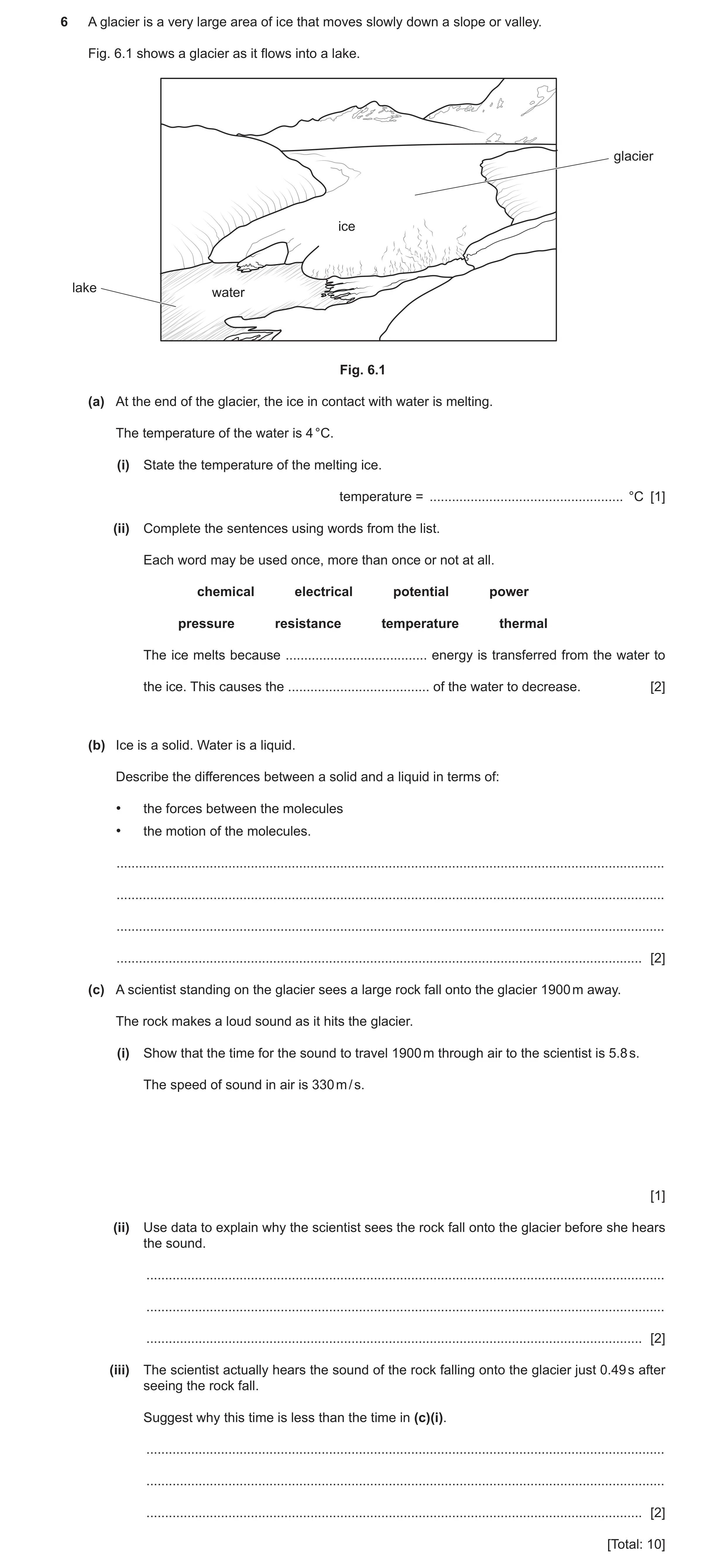
 10
10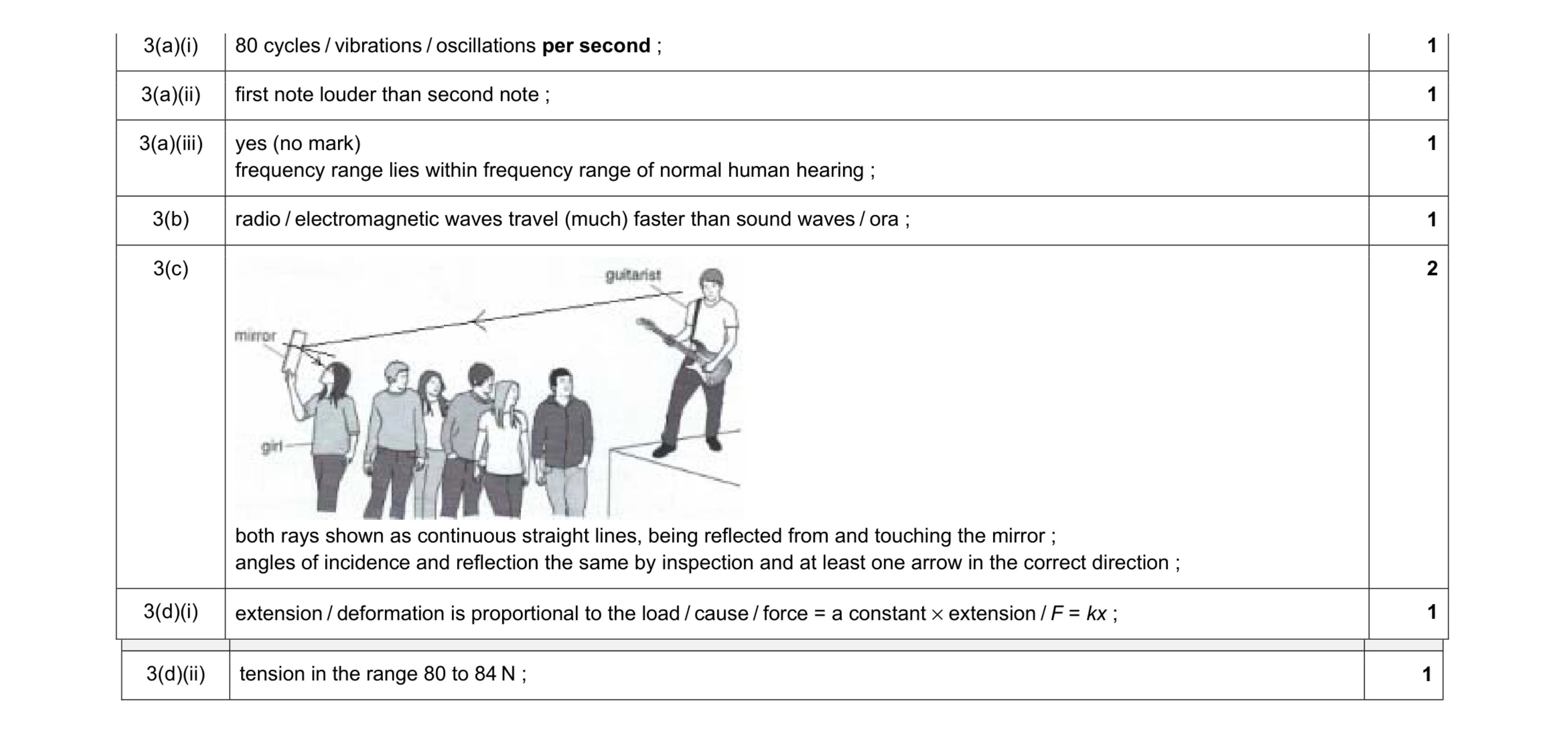 8
8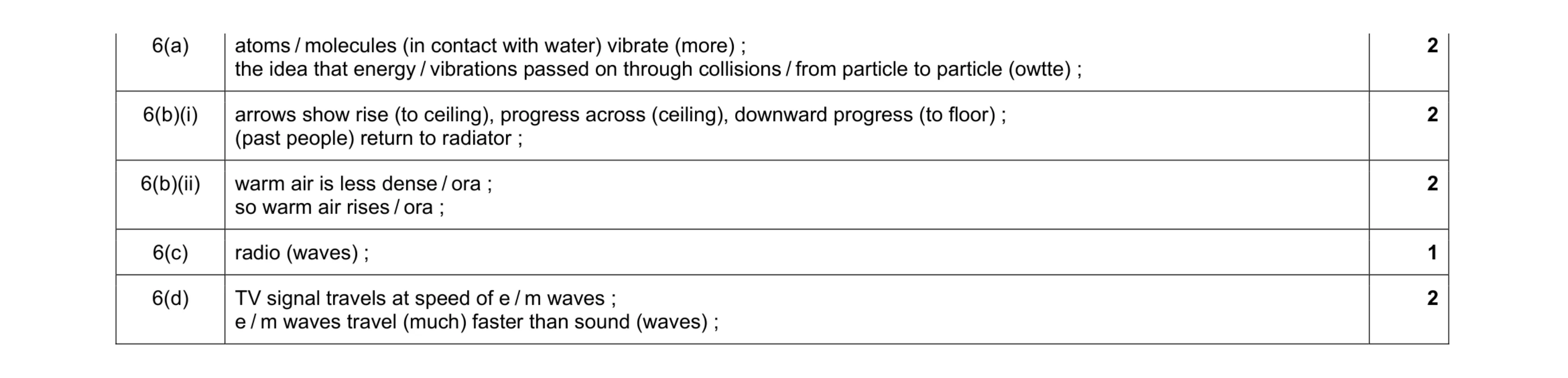 9
9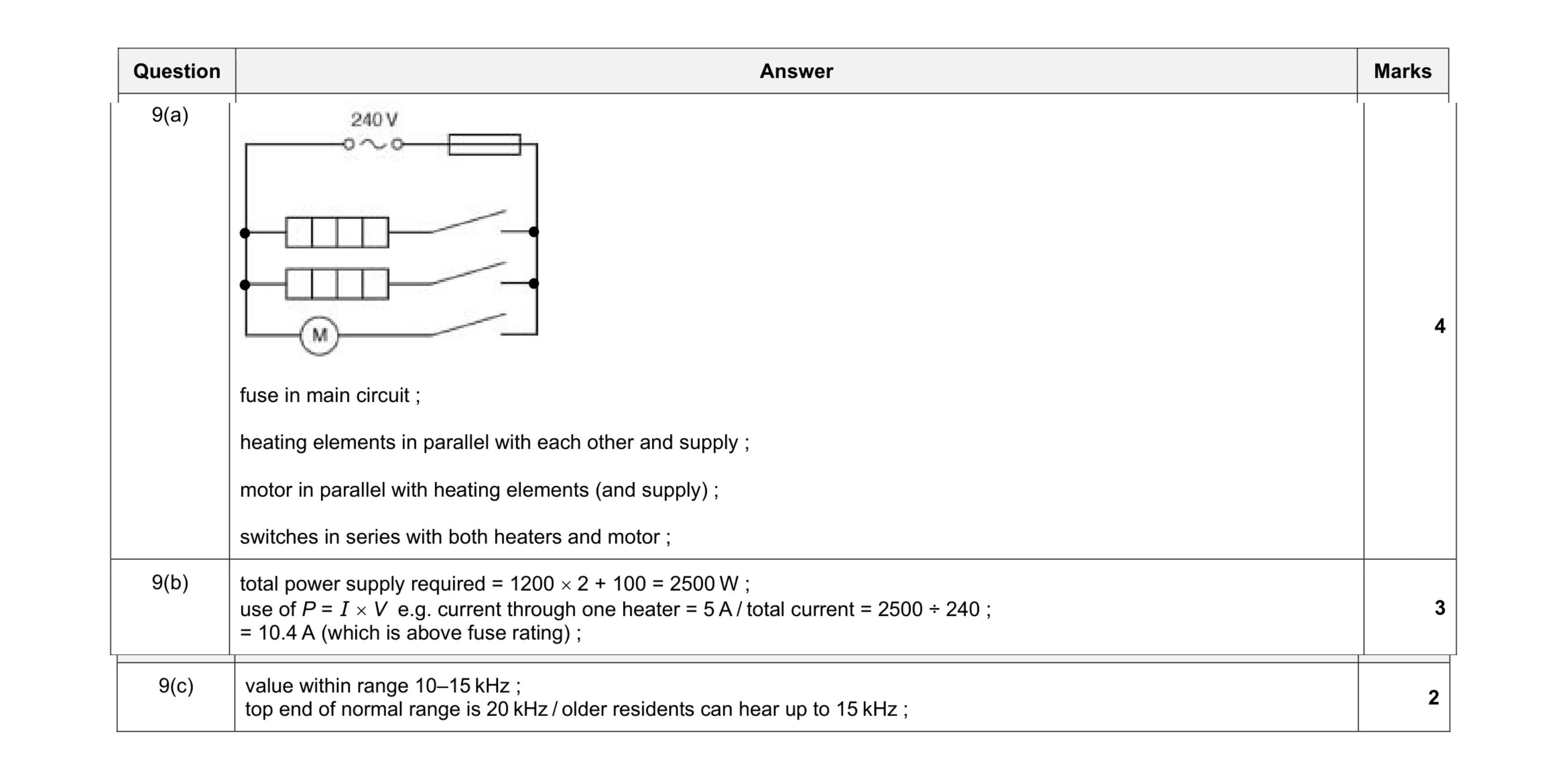 9
9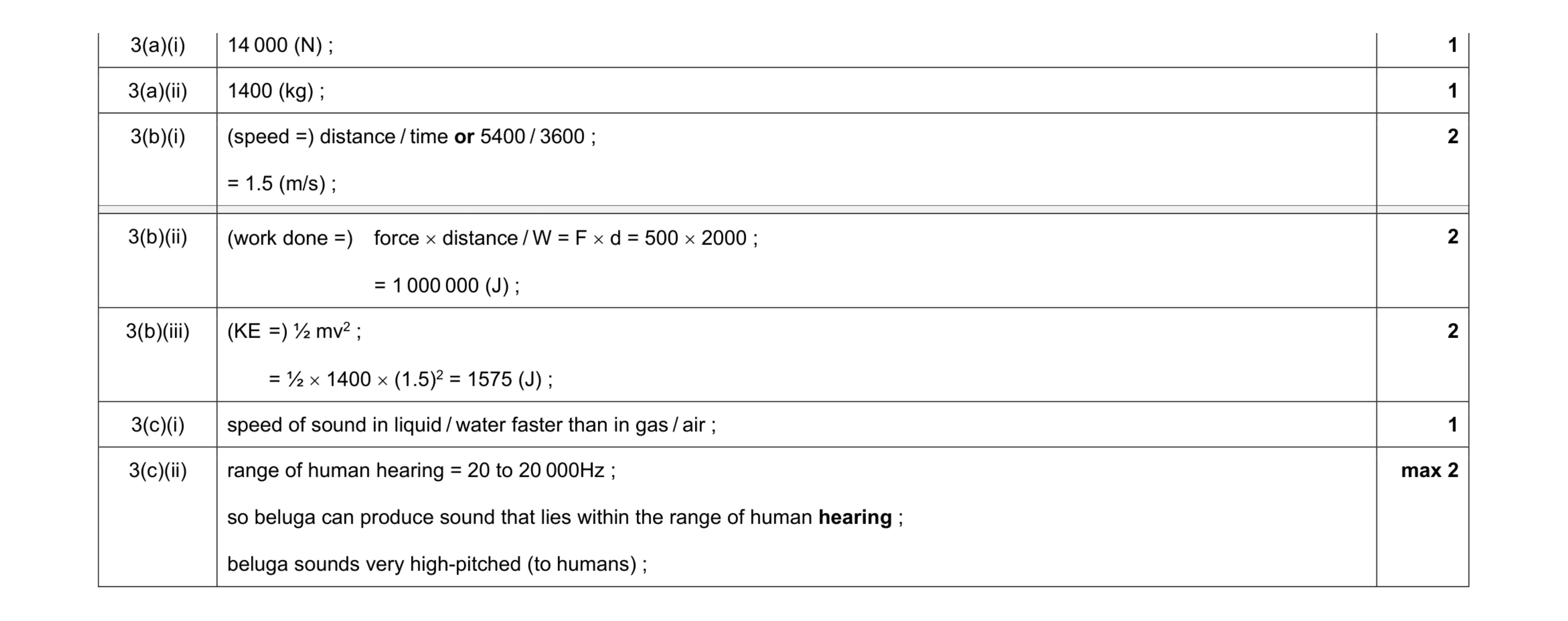 11
11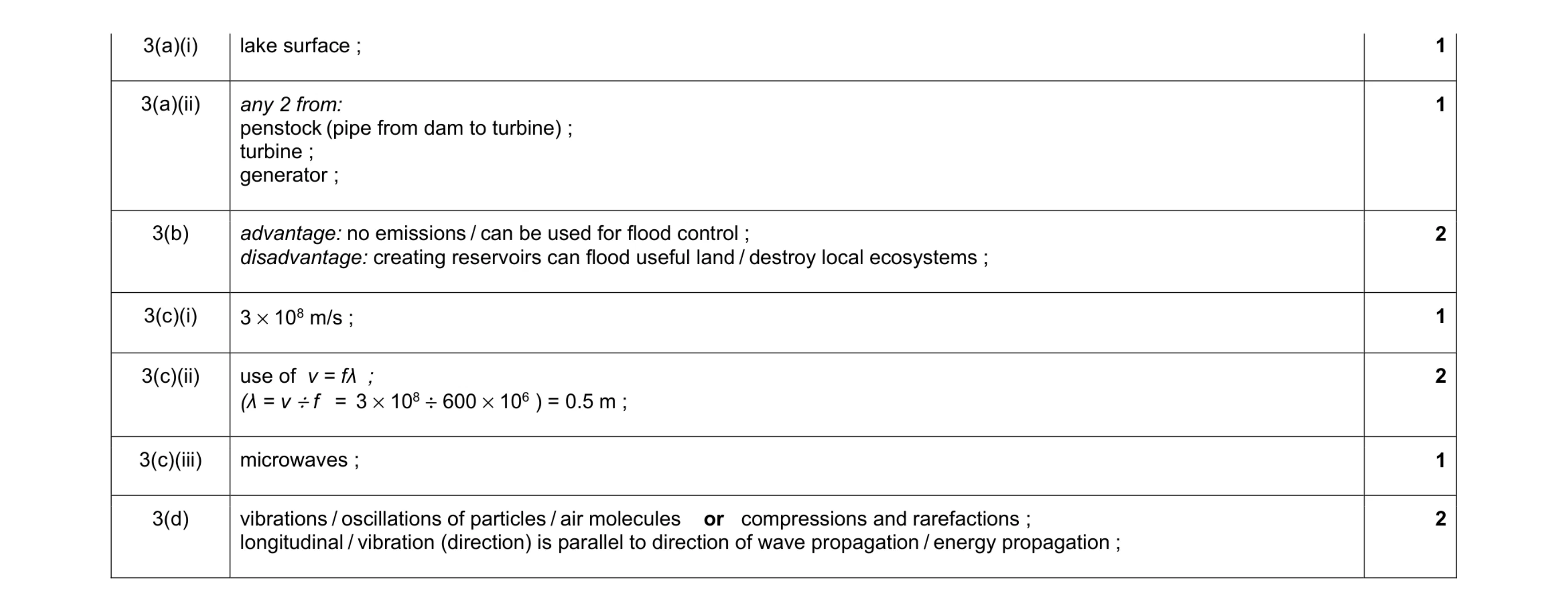 10
10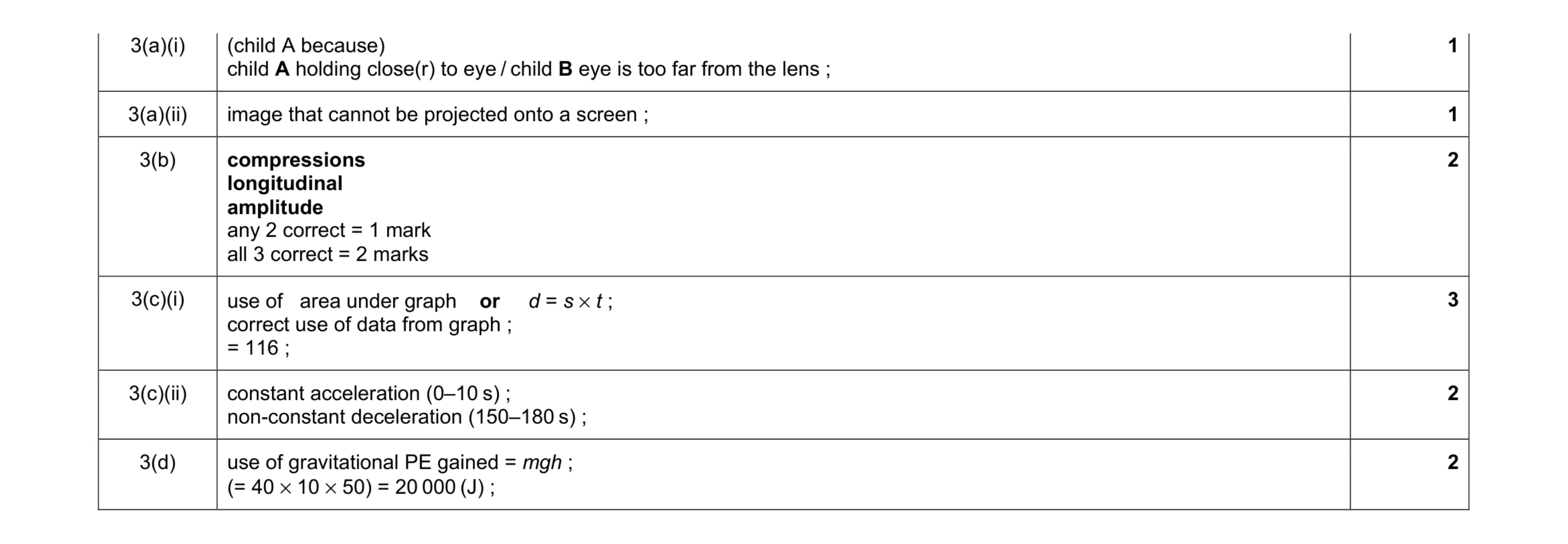 11
11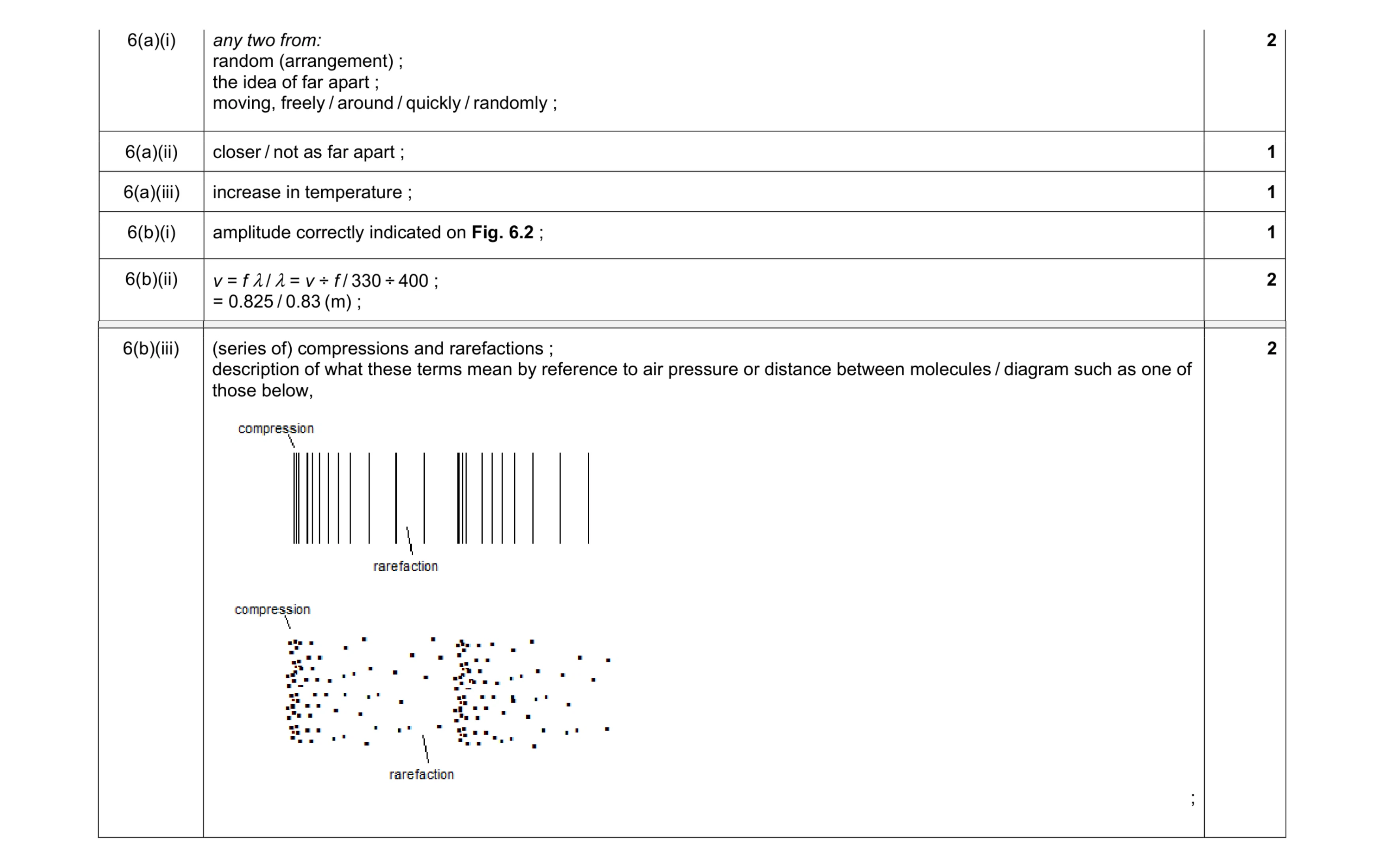 9
9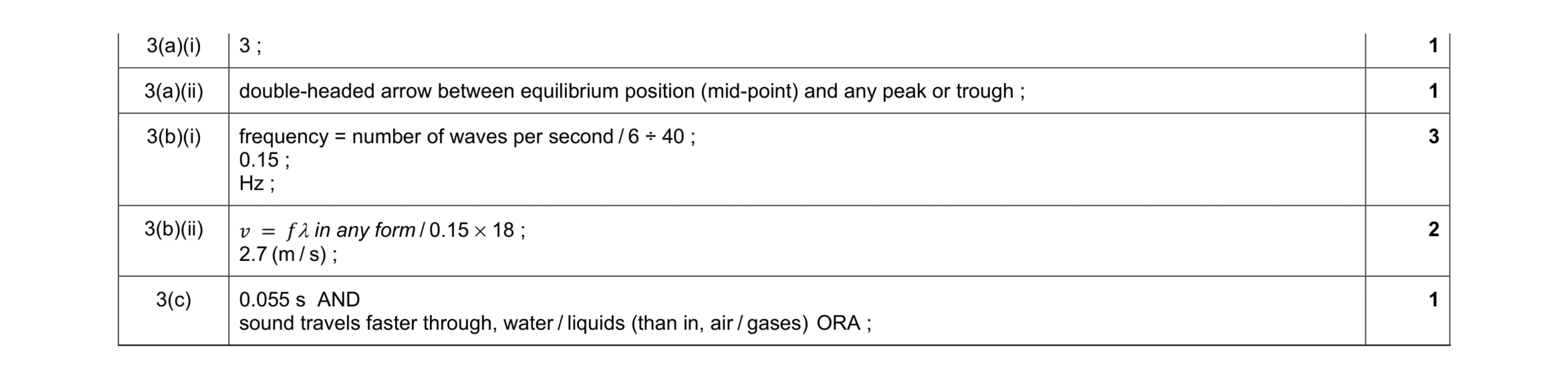 8
8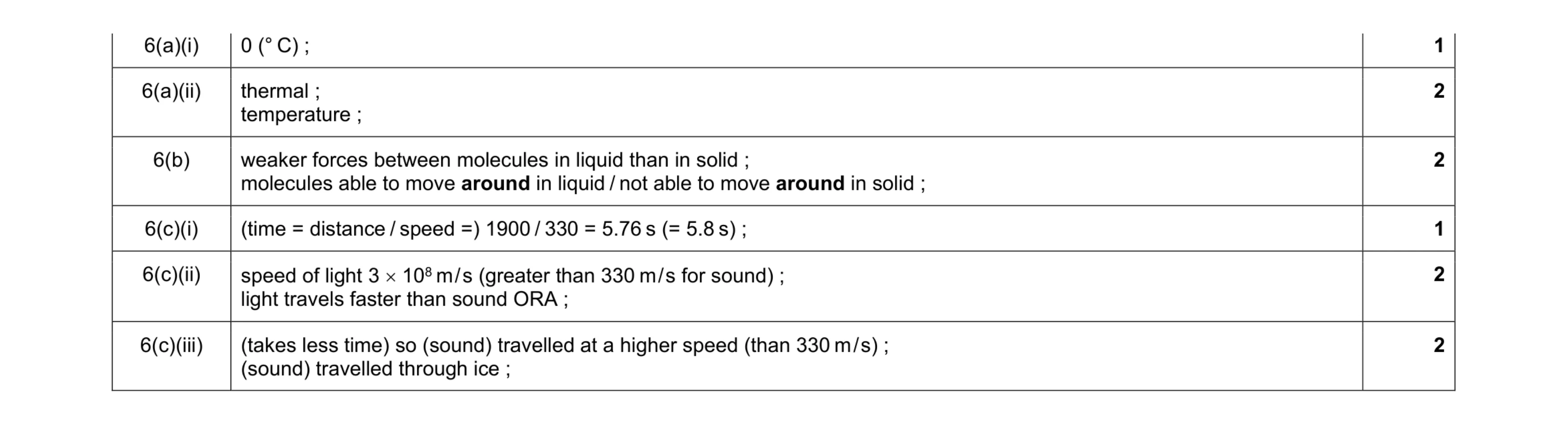 10
10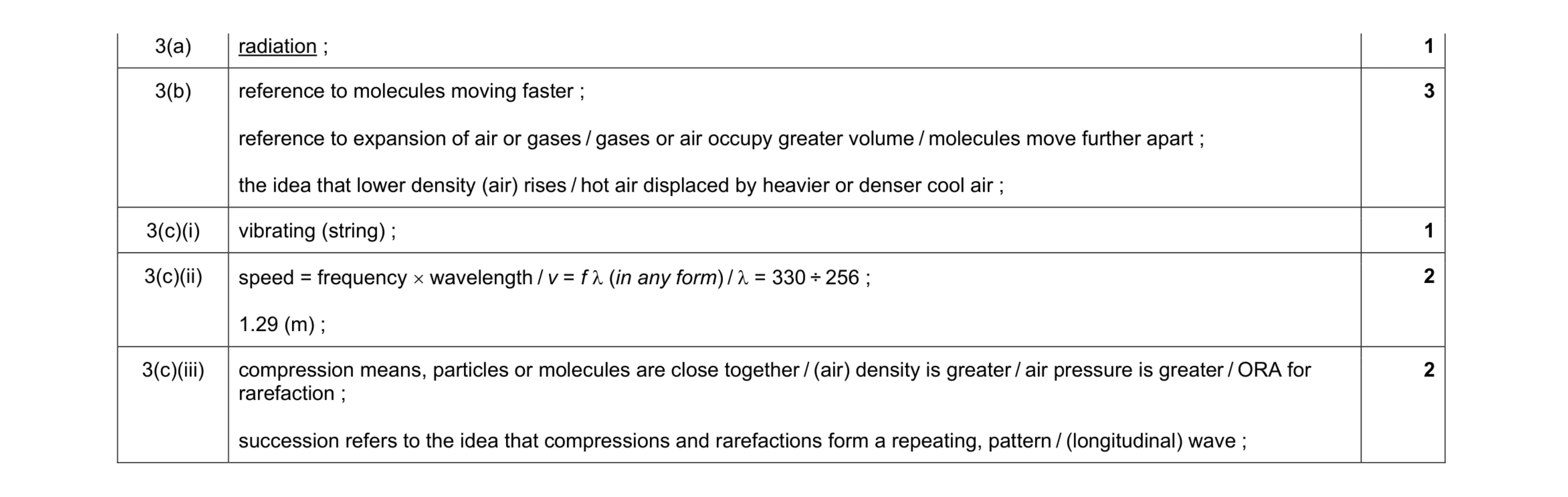 9
9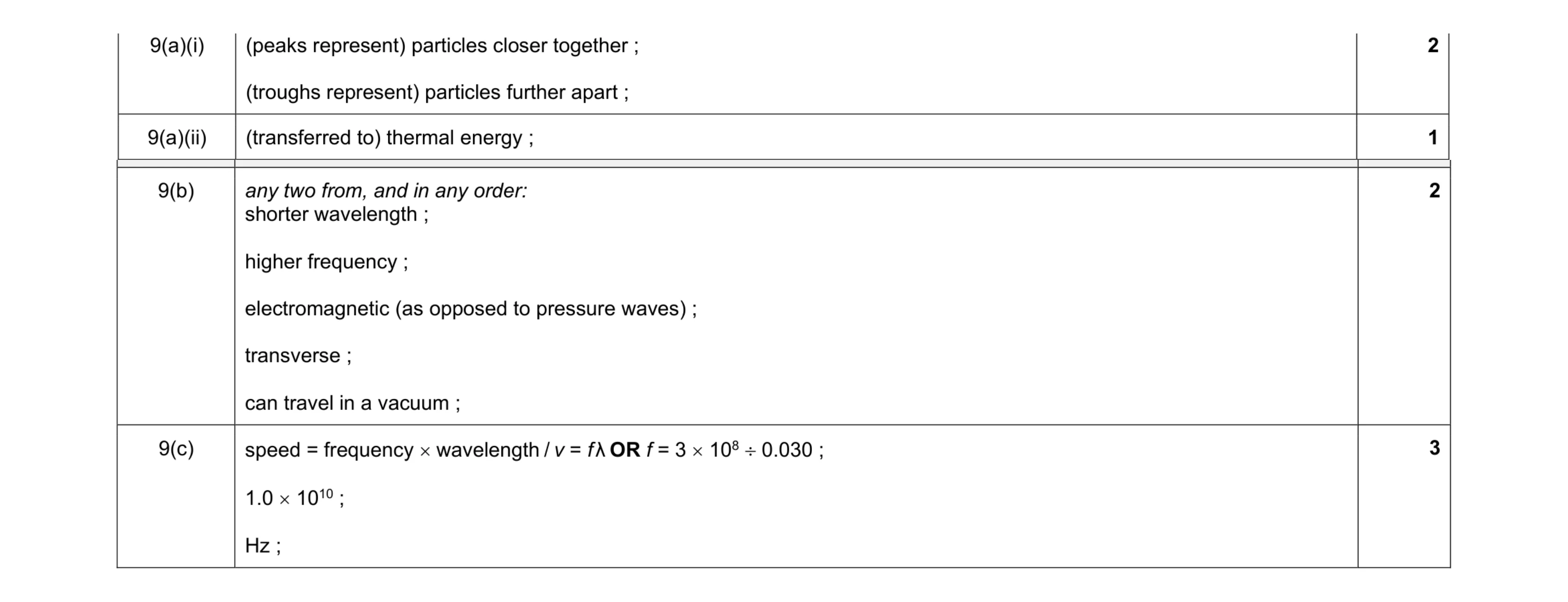 8
8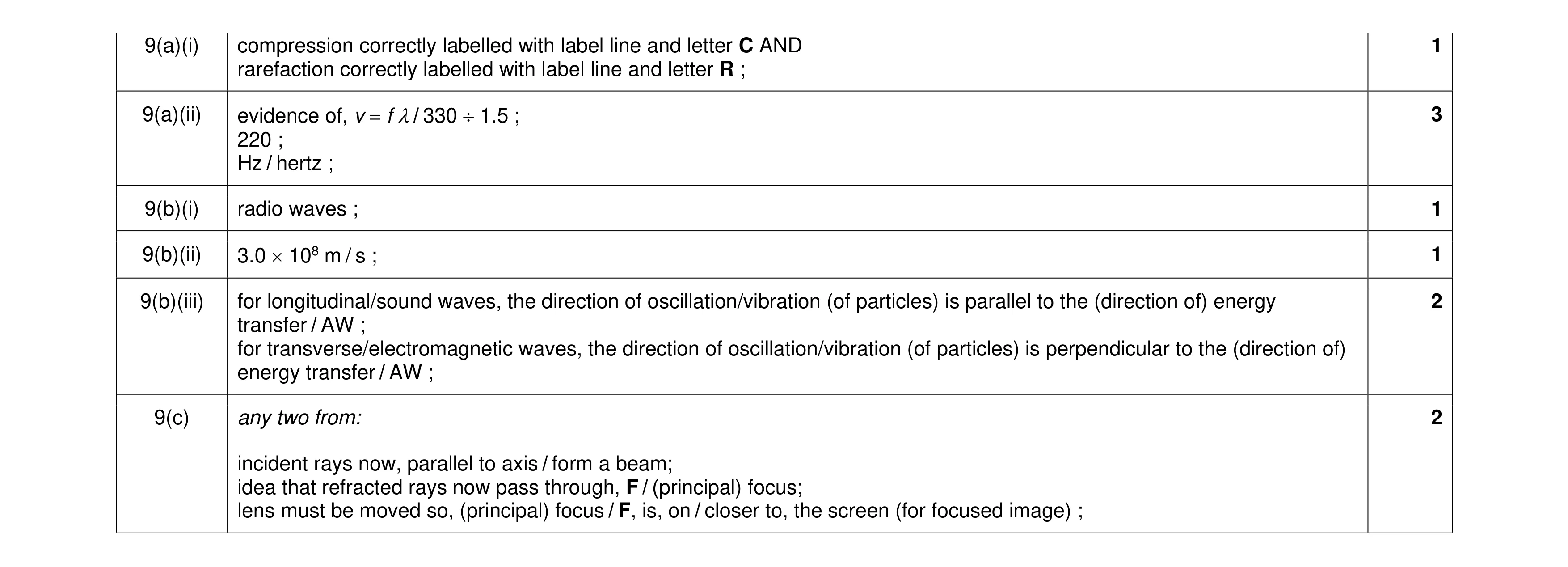 10
10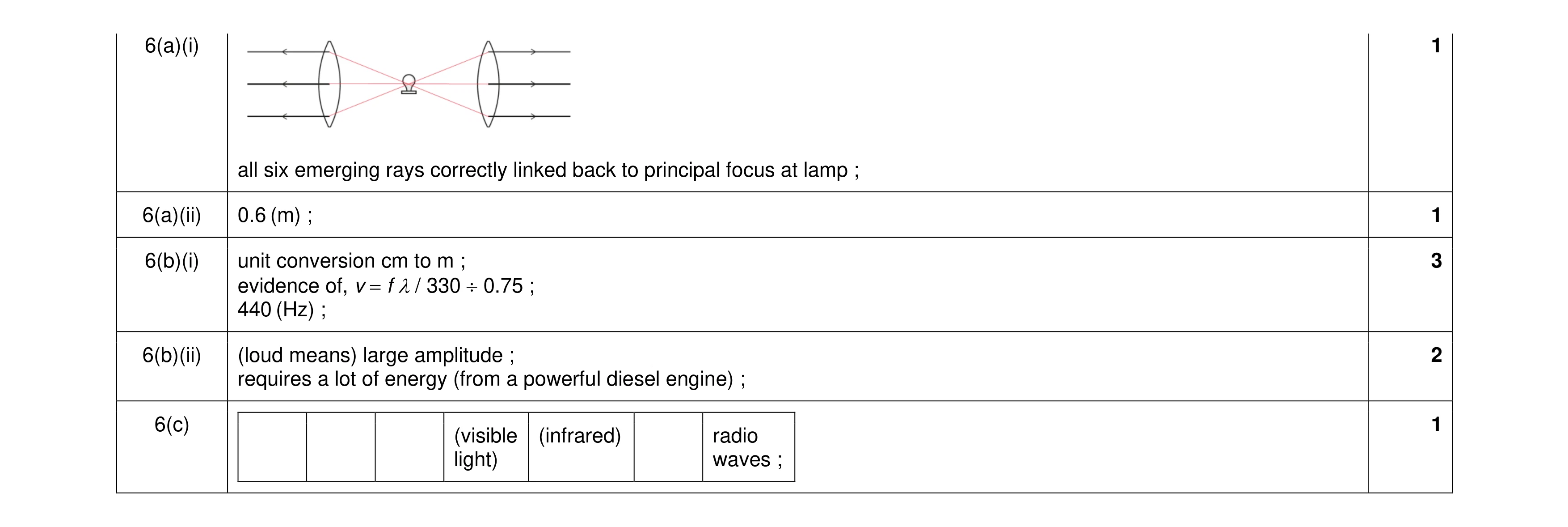 8
8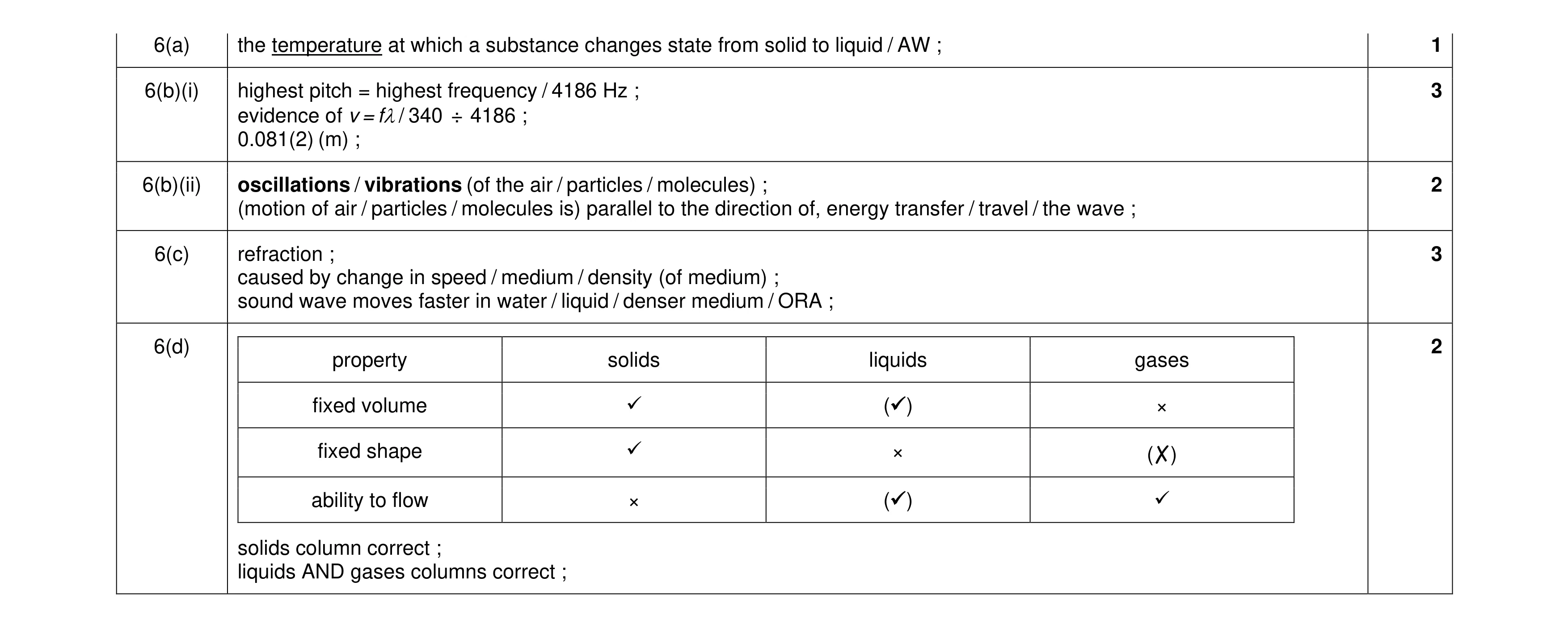 11
11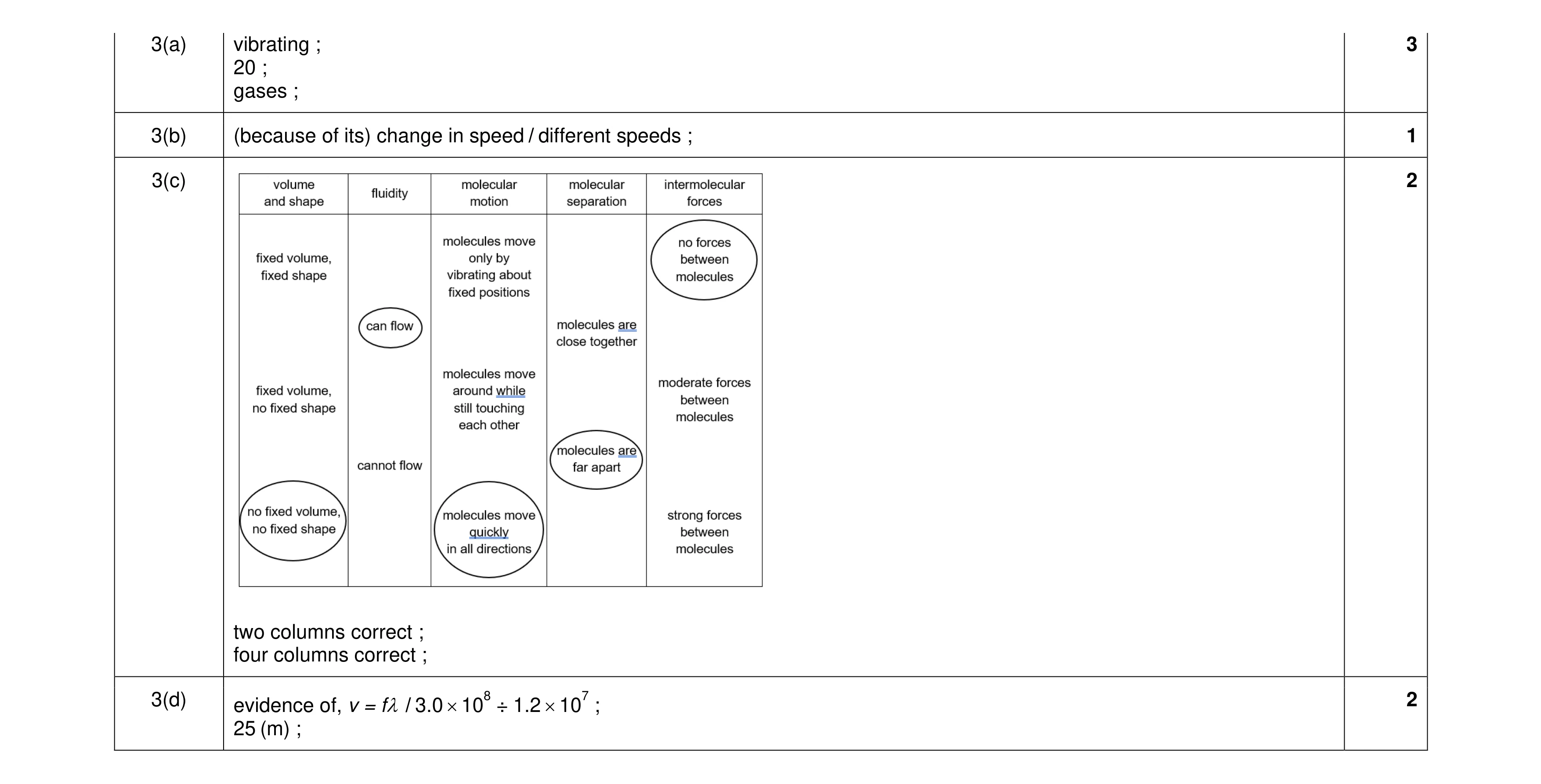 8
8