Questions as text
Q1 · A wave on a string 0625/32 Feb/March 2017
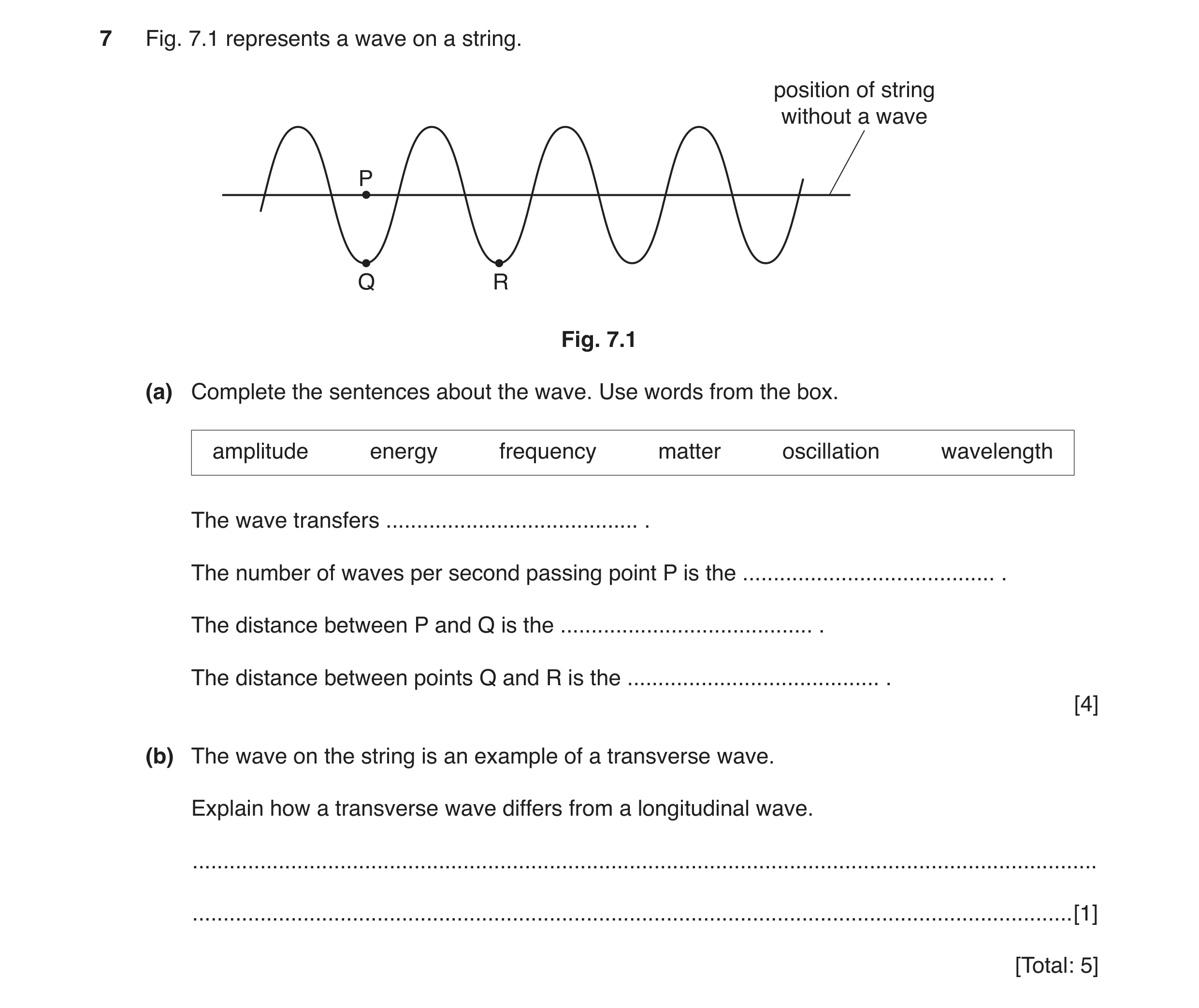
7 Fig. 7.1 represents a wave on a string. position of string without a wave P Q R Fig. 7.1 (a) Complete the sentences about the wave. Use words from the box. amplitude energy frequency matter oscillation wavelength The wave transfers … . The number of waves per second passing point P is the … . The distance between P and Q is the … . The distance between points Q and R is the … . [4] (b) The wave on the string is an example of a transverse wave. Explain how a transverse wave differs from a longitudinal wave. … … [1] [Total: 5]
5 marks
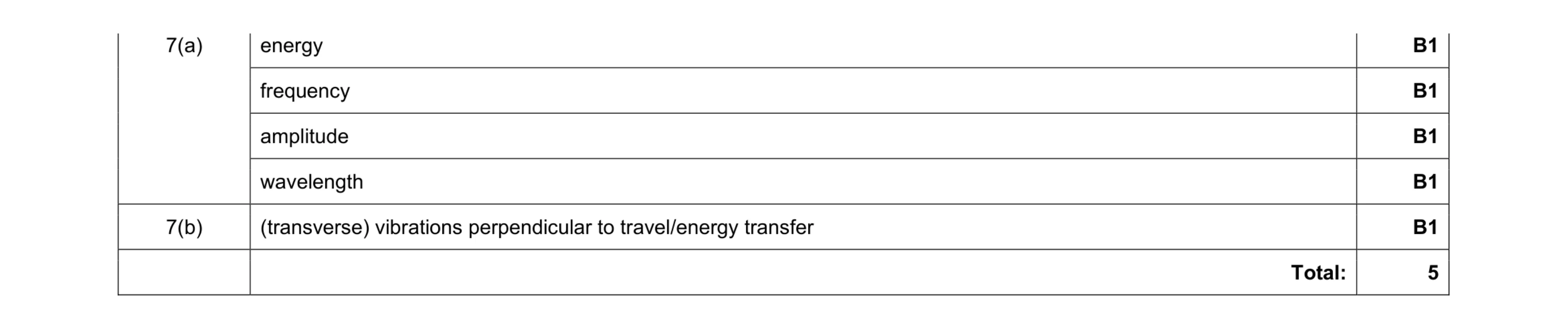
Mark scheme: 7(a) energy B1 frequency B1 amplitude B1 wavelength B1 7(b) (transverse) vibrations perpendicular to travel/energy transfer B1 Total: 5
This question in 0625/32 Feb/March 2017
Q2 · The diagrams in Fig 0625/33 May/June 2017
6 (a) The diagrams in Fig. 6.1 show reflection, refraction and diffraction. On Fig. 6.1, write the correct word next to each diagram for the process shown. barrier … ray of light … ray of light air … water Fig. 6.1 [3] (b) Fig. 6.2 shows a transverse wave. displacement 0 distance Fig. 6.2 (i) On Fig. 6.2, label the amplitude of the wave. [1] (ii) On Fig. 6.2, label the wavelength of the wave. [1] (c) A thin converging lens forms an image of an object, as shown in Fig. 6.3. lens X object image Y Fig. 6.3 Only one ray is shown in Fig. 6.3. On Fig. 6.3, draw two more rays from point X on the object that can be used to locate point Y on the image. [2] [Total: 7]
7 marks
Mark scheme: 6(a) B1 middle diagram labelled reflection B1 bottom diagram labelled refraction B1 6(b)(i) amplitude correctly indicated by eye B1 6(b)(ii) wavelength correctly indicated by eye B1 6(c) straight line (by eye) drawn through centre of lens to Y B1 sloping ray that emerges horizontally from lens to Y B1 Total: 7
This question in 0625/33 May/June 2017
Q3 · A ray of light inside a semi-circular glass block 0625/31 Oct/Nov 2017
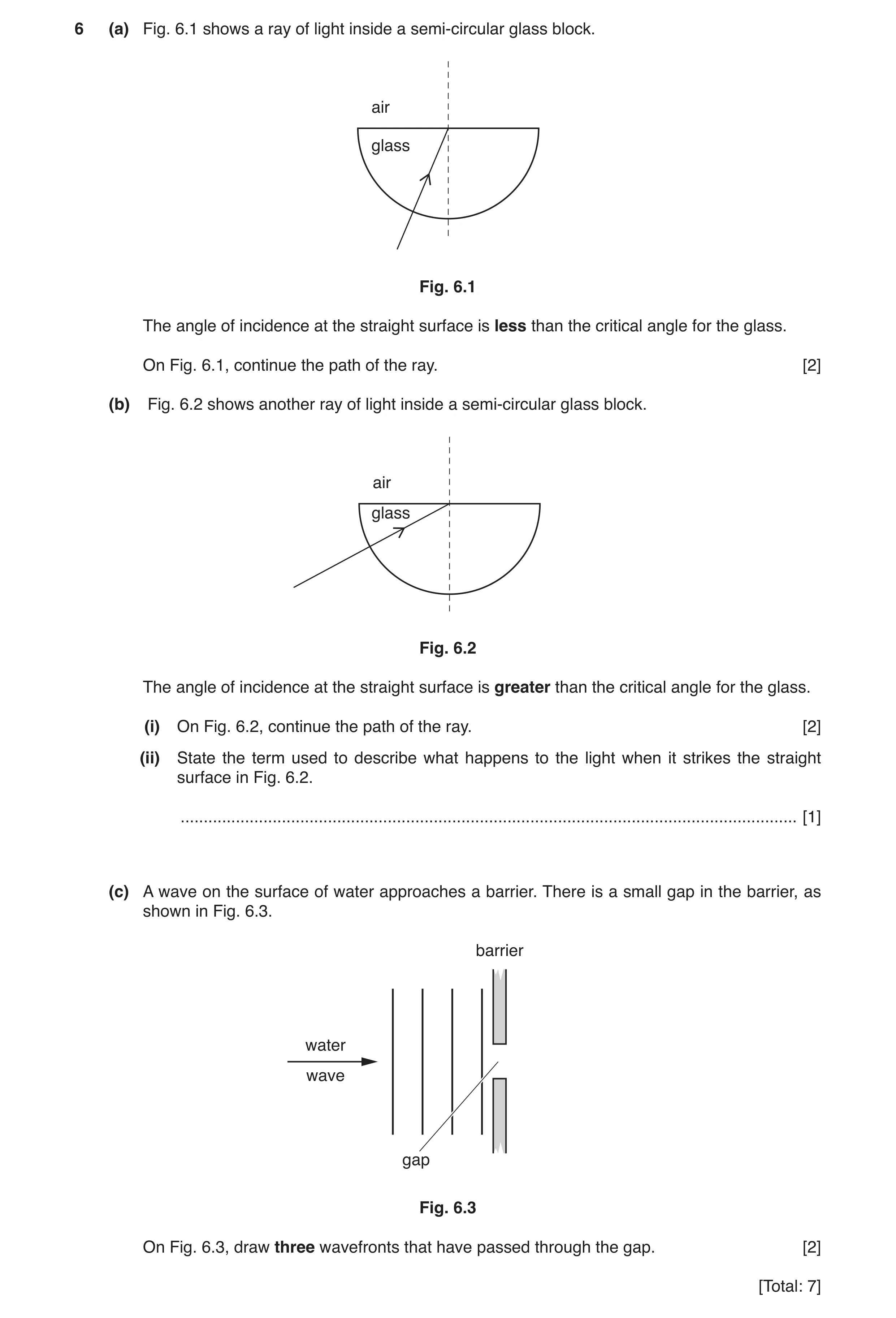
6 (a) Fig. 6.1 shows a ray of light inside a semi-circular glass block. air glass Fig. 6.1 The angle of incidence at the straight surface is less than the critical angle for the glass. On Fig. 6.1, continue the path of the ray. [2] (b) Fig. 6.2 shows another ray of light inside a semi-circular glass block. air glass Fig. 6.2 The angle of incidence at the straight surface is greater than the critical angle for the glass. (i) On Fig. 6.2, continue the path of the ray. [2] (ii) State the term used to describe what happens to the light when it strikes the straight surface in Fig. 6.2. … [1] (c) A wave on the surface of water approaches a barrier. There is a small gap in the barrier, as shown in Fig. 6.3. barrier water wave gap Fig. 6.3 On Fig. 6.3, draw three wavefronts that have passed through the gap. [2] [Total: 7]
7 marks
Mark scheme: 6(a) ray leaves glass at top surface B1 ray refracted away from normal B1 6(b)(i) ray reflected into glass B1 angle i = angle r by eye B1 6(b)(ii) total internal reflection B1 6(c) waves with arcs centred on gap B1 same wavelength B1
This question in 0625/31 Oct/Nov 2017
Q4 · A floating plastic ball attached by a long rope to a weight on the bottom of a lake 0625/33 Oct/Nov 2017
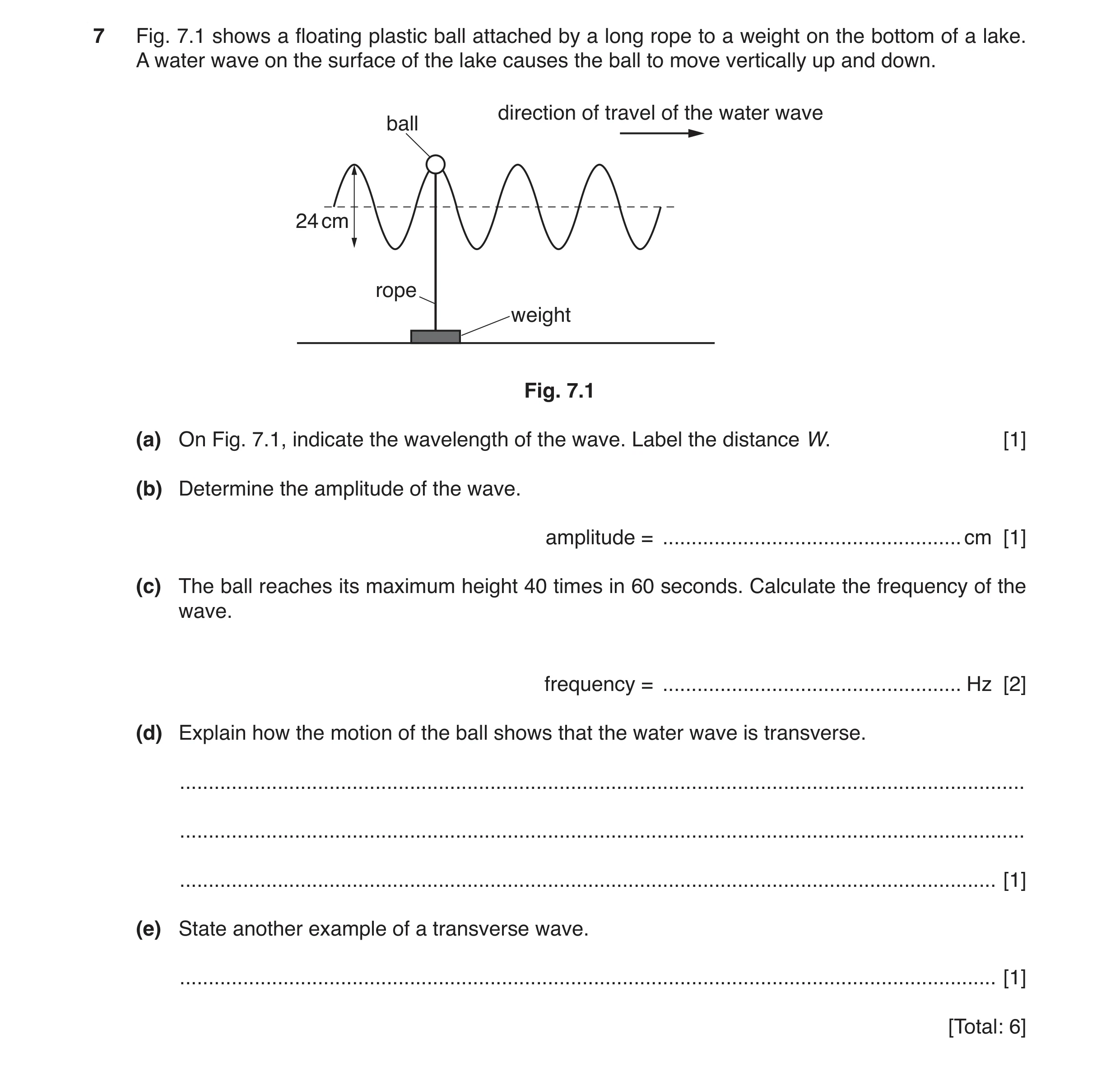
7 Fig. 7.1 shows a floating plastic ball attached by a long rope to a weight on the bottom of a lake. A water wave on the surface of the lake causes the ball to move vertically up and down. direction of travel of the water wave ball 24 cm rope weight Fig. 7.1 (a) On Fig. 7.1, indicate the wavelength of the wave. Label the distance W. [1] (b) Determine the amplitude of the wave. amplitude = … cm [1] (c) The ball reaches its maximum height 40 times in 60 seconds. Calculate the frequency of the wave. frequency = … Hz [2] (d) Explain how the motion of the ball shows that the water wave is transverse. … … … [1] (e) State another example of a transverse wave. … [1] [Total: 6]
6 marks
Mark scheme: 7(a) wavelength correctly indicated B1 7(b) 12 (cm) B1 7(c) 40 / 60 C1 0.67 (Hz) A1 7(d) direction of travel perpendicular to direction of vibration owtte B1 7(e) any component of the electromagnetic spectrum B1
This question in 0625/33 Oct/Nov 2017
Question 5 0625/33 Oct/Nov 2018
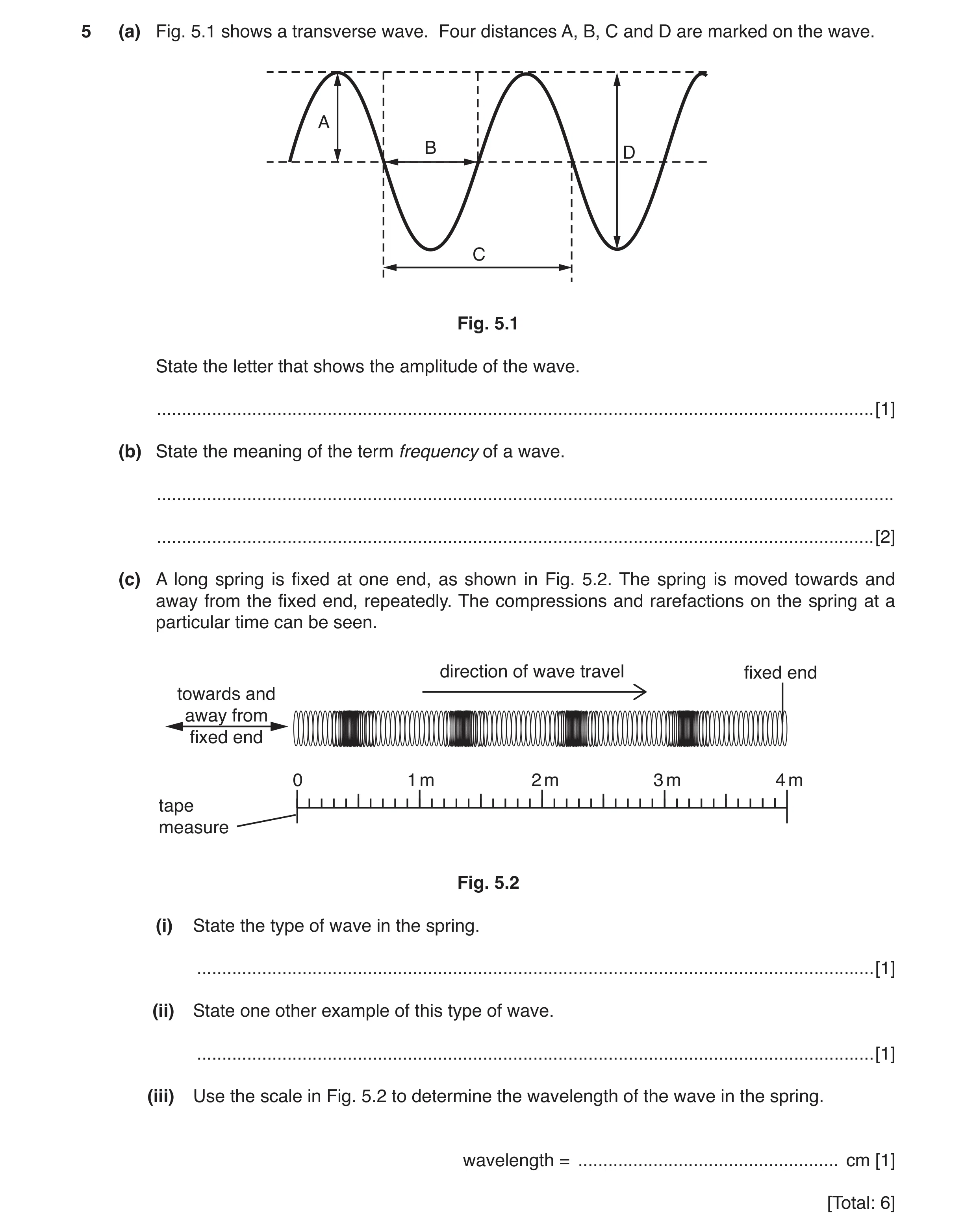
5 (a) Fig. 5.1 shows a transverse wave. Four distances A, B, C and D are marked on the wave. A B D C Fig. 5.1 State the letter that shows the amplitude of the wave. … [1] (b) State the meaning of the term frequency of a wave. … … [2] (c) A long spring is fixed at one end, as shown in Fig. 5.2. The spring is moved towards and away from the fixed end, repeatedly. The compressions and rarefactions on the spring at a particular time can be seen. direction of wave travel fixed end towards and away from fixed end 0 1 m 2 m 3 m 4 m tape measure Fig. 5.2 (i) State the type of wave in the spring. … [1] (ii) State one other example of this type of wave. … [1] (iii) Use the scale in Fig. 5.2 to determine the wavelength of the wave in the spring. wavelength = … cm [1] [Total: 6]
6 marks
Mark scheme: 5(a) A B1 5(b) number of (complete) waves produced by source / passing a point B1 each second / in unit time B1 5(c)(i) longitudinal B1 5(c)(ii) sound wave B1 5(c)(iii) 85–99 (cm) B1
This question in 0625/33 Oct/Nov 2018
Q6 · Light and sound both travel as waves 0625/32 Feb/March 2019
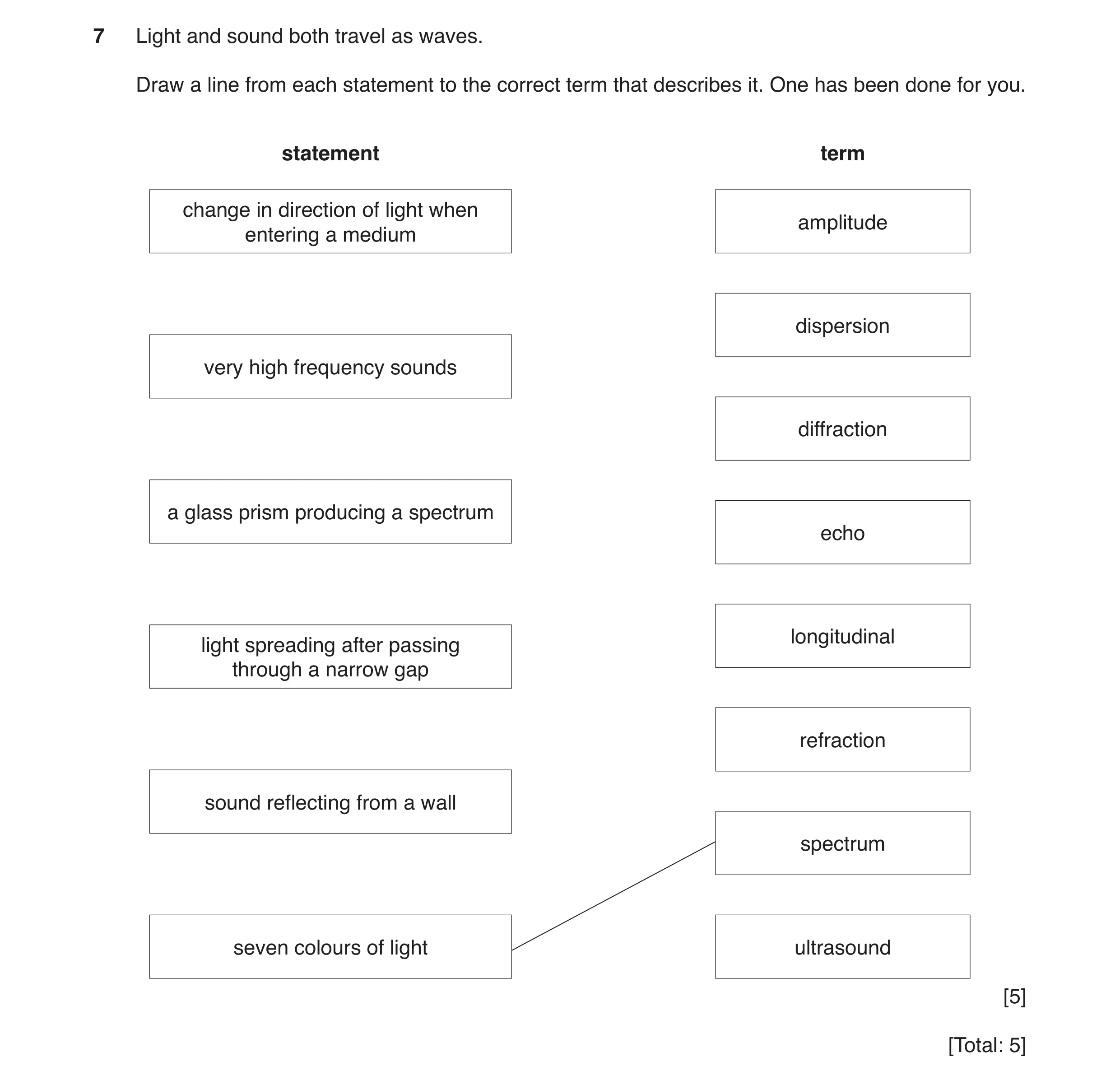
7 Light and sound both travel as waves. Draw a line from each statement to the correct term that describes it. One has been done for you. statement term change in direction of light when amplitude entering a medium dispersion very high frequency sounds diffraction a glass prism producing a spectrum echo longitudinal light spreading after passing through a narrow gap refraction sound reflecting from a wall spectrum seven colours of light ultrasound [5] [Total: 5]
5 marks
Mark scheme: 7 change in direction of light when entering a medium – refraction very high frequency sounds – ultrasound a glass prism producing a spectrum – dispersion light spreading after passing through a narrow gap – diffraction sound reflecting from a wall – echo B5
This question in 0625/32 Feb/March 2019
Q7 · A student listening to the sound produced by a tuning fork 0625/31 Oct/Nov 2019
8 (a) Fig. 8.1 shows a student listening to the sound produced by a tuning fork. tuning fork Fig. 8.1 (i) State how the tuning fork produces the sound. … [1] (ii) Complete the following sentence. Choose a word from the box. electromagnetic longitudinal transverse A sound wave is … [1] (iii) A loudspeaker produces a sound with a frequency of 25 kHz. A student with healthy ears cannot hear this sound. Explain why. … … [2] (b) Fig. 8.2 represents a sound wave travelling in air. Fig. 8.2 (drawn full size) (i) The air particles are moving. On Fig. 8.2, draw two arrows in opposite directions to show the movement of the air particles. [1] (ii) Use Fig. 8.2 to determine the wavelength of the sound wave. wavelength = … cm [1] (c) Describe a method of using water waves to demonstrate refraction. … … … … … … [4] [Total: 10]
10 marks
Mark scheme: 8(a)(i) (it is) vibrating B1 8(a)(ii) longitudinal B1 8(a)(iii) frequency (of sound) OR 25 kHz B1 is above (upper limit of) human hearing range OR is an ultrasound B1 8(b)(i) horizontal line with arrows at either end B1 8(b)(ii) (14.4 ÷ 4 =) 3.6 (cm) B1 8(c) Any four from: use of shallow water use of flat lamina or shape below surface / different depths (of water) used waves hit {shallower water / shape} at an angle (other than 90°) waves change direction (due to) change in speed B4
This question in 0625/31 Oct/Nov 2019
Q8 · A transverse wave drawn full size 0625/33 Oct/Nov 2019
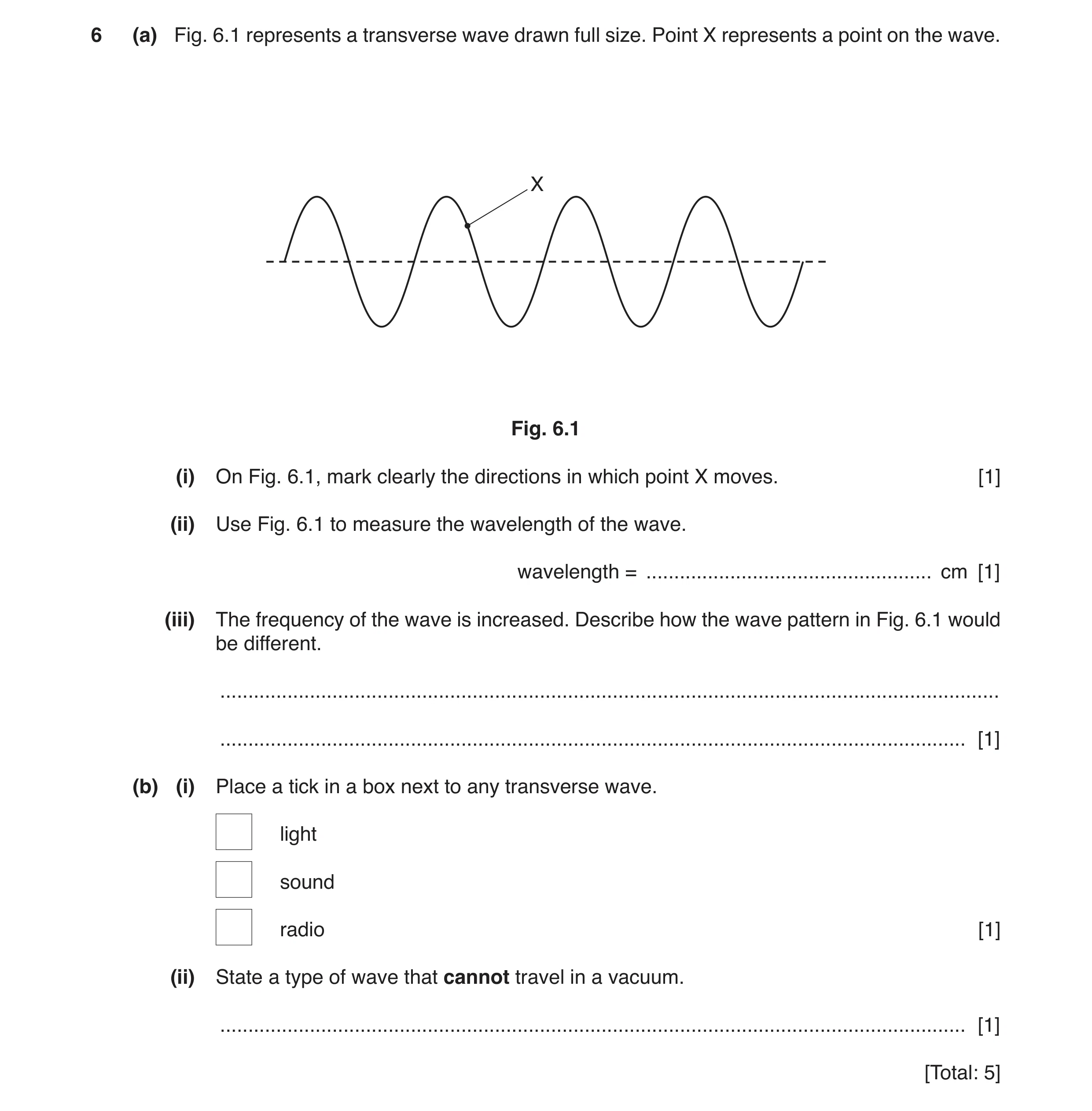
6 (a) Fig. 6.1 represents a transverse wave drawn full size. Point X represents a point on the wave. X Fig. 6.1 (i) On Fig. 6.1, mark clearly the directions in which point X moves. [1] (ii) Use Fig. 6.1 to measure the wavelength of the wave. wavelength = … cm [1] (iii) The frequency of the wave is increased. Describe how the wave pattern in Fig. 6.1 would be different. … … [1] (b) (i) Place a tick in a box next to any transverse wave. light sound radio [1] (ii) State a type of wave that cannot travel in a vacuum. … [1] [Total: 5]
5 marks
Mark scheme: 6(a)(i) vertical arrow pointing down AND up B1 6(a)(ii) (10.0 ÷ 4 =) 2.5 (cm) B1 6(a)(iii) more waves / waves closer together / shorter wavelength B1 6(b)(i) light AND radio B1 6(b)(ii) sound OR ultrasound OR longitudinal B1
This question in 0625/33 Oct/Nov 2019
Q9 · A travelling wave at an instant in time 0625/32 Feb/March 2020
8 Fig. 8.1 represents a travelling wave at an instant in time. direction of wave travel 1.0 displacement / cm 0 –1.0 0 10 20 30 40 50 60 70 80 90 100 110 120 distance from source of waves / cm Fig. 8.1 (a) (i) Determine the amplitude of the wave. amplitude = … cm [1] (ii) Determine the wavelength of the wave. wavelength = … cm [2] (iii) It takes 2.0 s for a source to emit the wave shown in Fig. 8.1. Calculate the frequency of the wave. frequency = … Hz [2] (b) Fig. 8.2 shows the main regions of the electromagnetic spectrum. visible radio microwaves light X-rays γ-rays waves waves Fig. 8.2 (i) Two of the regions are not labelled. Add the correct label to each of the unlabelled regions by writing in each box. [2] (ii) Describe one use of γ-rays. … … [1] [Total: 8]
8 marks
Mark scheme: 8(a)(i) (amplitude =) 0.9 (cm) B1 8(a)(ii) (wavelength =) 112 ÷ 8 C1 (wavelength =) 14 (cm) A1 8(a)(iii) (frequency =) 8 ÷ 2 C1 (frequency =) 4 (Hz) A1 8(b)(i) bottom left box labelled infrared B1 bottom right box labelled ultraviolet B1 8(b)(ii) treating cancer / identifying cancer / gamma ray photography / sterilise medical equipment B1
This question in 0625/32 Feb/March 2020
Q10 · A teacher uses a long spring to demonstrate wave motion 0625/32 Oct/Nov 2020
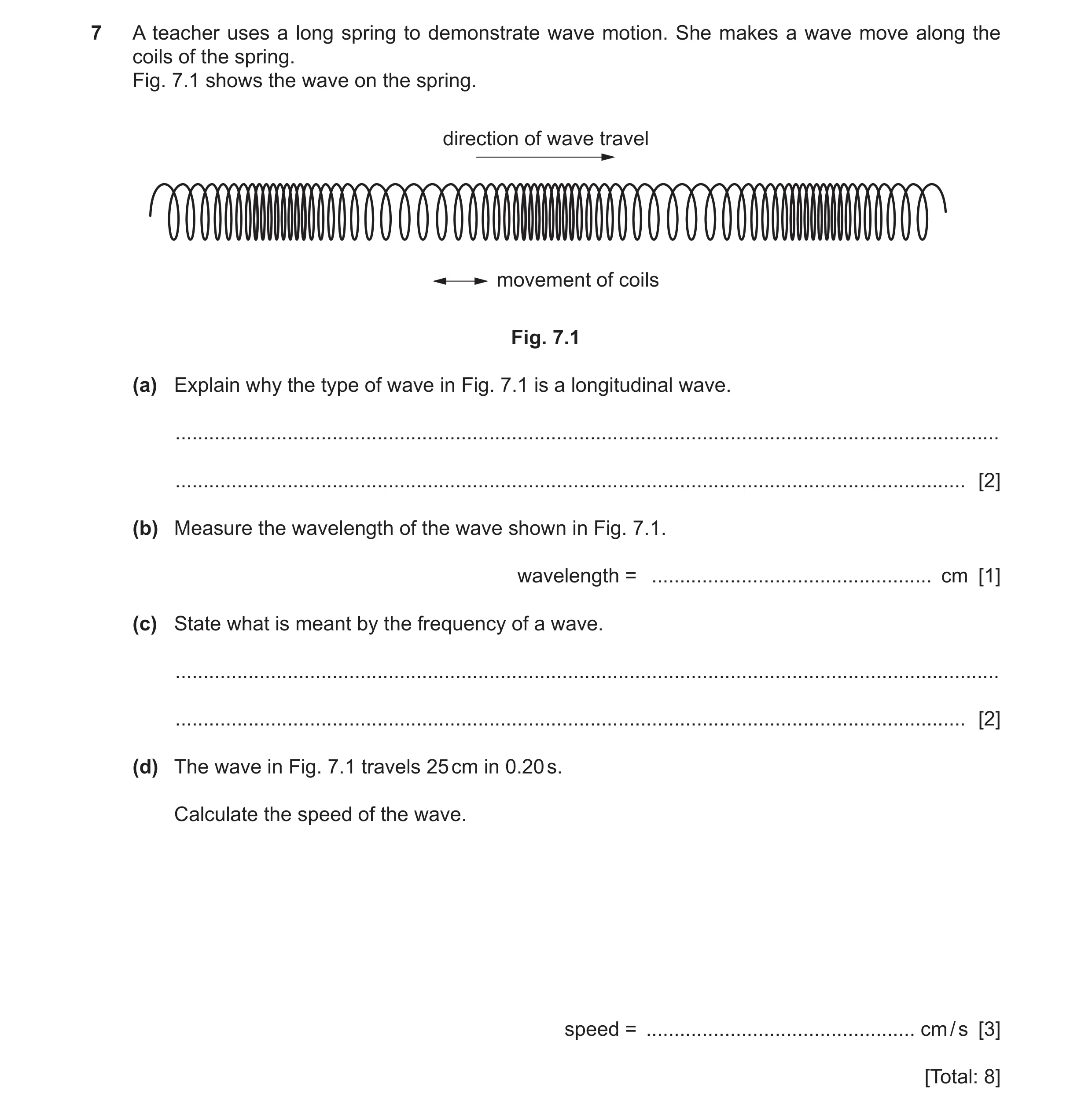
7 A teacher uses a long spring to demonstrate wave motion. She makes a wave move along the coils of the spring. Fig. 7.1 shows the wave on the spring. direction of wave travel movement of coils Fig. 7.1 (a) Explain why the type of wave in Fig. 7.1 is a longitudinal wave. … … [2] (b) Measure the wavelength of the wave shown in Fig. 7.1. wavelength = … cm [1] (c) State what is meant by the frequency of a wave. … … [2] (d) The wave in Fig. 7.1 travels 25 cm in 0.20 s. Calculate the speed of the wave. speed = … cm / s [3] [Total: 8]
8 marks
Mark scheme: 7(a) movement (of coils / spring) parallel B1 to the direction wave / it / disturbance travels B1 7(b) 5.2 (cm) B1 7(c) number of waves (passing a point OR sent out) B1 (in) one second / unit time. B1 7(d) speed = distance ÷ time C1 25 ÷ 0.2(0) C1 125 (cm / s) A1
This question in 0625/32 Oct/Nov 2020
Question 11 0625/32 Feb/March 2021
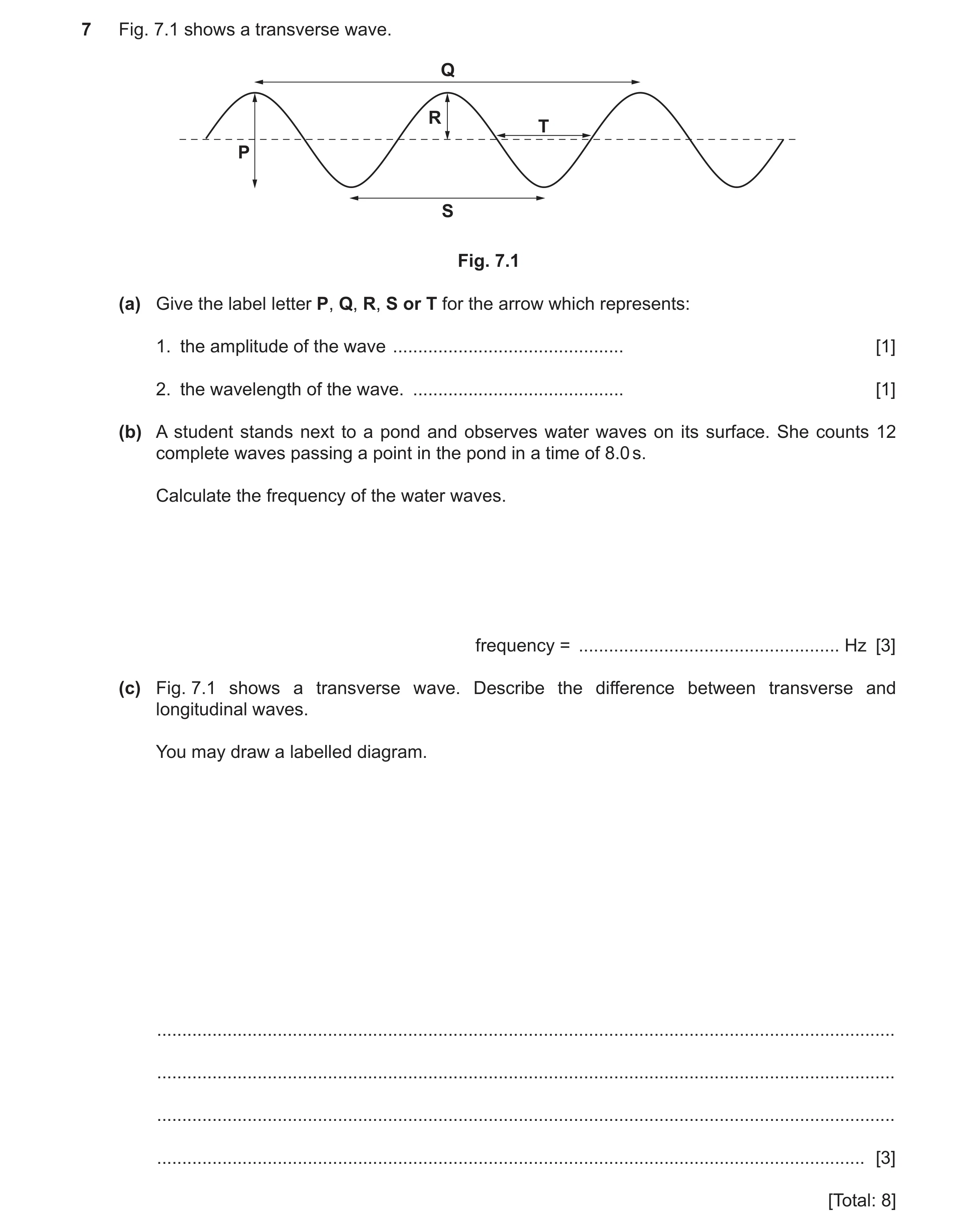
7 Fig. 7.1 shows a transverse wave. Q R T P S Fig. 7.1 (a) Give the label letter P, Q, R, S or T for the arrow which represents: 1. the amplitude of the wave … [1] 2. the wavelength of the wave. … [1] (b) A student stands next to a pond and observes water waves on its surface. She counts 12 complete waves passing a point in the pond in a time of 8.0 s. Calculate the frequency of the water waves. frequency = … Hz [3] (c) Fig. 7.1 shows a transverse wave. Describe the difference between transverse and longitudinal waves. You may draw a labelled diagram. … … … … [3] [Total: 8]
8 marks
Mark scheme: 7(a) 1 (amplitude of wave = arrow) R B1 2 ( wavelength of wave = arrow) S B1 7(b) (frequency =) number of (complete) waves per second C1 (frequency =) 12 ÷ 8 C1 1.5 (Hz) A1 7(c) vibration(s) OR oscillation(s) B1 in transverse waves is / are perpendicular / at right angles to the direction of energy transfer / wave travel B1 in longitudinal waves is / are in same direction OR parallel to the direction of energy transfer / wave travel B1
This question in 0625/32 Feb/March 2021
Q12 · Both radio waves and γ-rays (gamma) are radiations in the electromagnetic spectrum 0625/32 May/June 2021
7 (a) Both radio waves and γ-rays (gamma) are radiations in the electromagnetic spectrum. Fig. 7.1 shows the main regions of the electromagnetic spectrum. Most regions are labelled. radio microwave infrared … … visible light γ-rays waves radiation radiation … … Fig. 7.1 (i) On Fig. 7.1, write the names of the radiations in the other two parts of the electromagnetic spectrum. [2] (ii) State one use of γ-rays. … [1] (iii) A star emits radio waves and γ-rays at the same time. They all travel across the vacuum of space to the Earth’s atmosphere. State whether the radio waves or the γ-rays, if either, arrive first at the Earth’s atmosphere. Give a reason for your answer. statement … reason … [2] (b) Fig. 7.2 shows pulses of a signal from a star. amplitude of signal 0 0.0 0.2 0.4 0.6 0.8 1.0 1.2 1.4 1.6 1.8 2.0 time / s Fig. 7.2 (i) Use the graph in Fig. 7.2 to determine the time between pulses. time between pulses = … s [2] (ii) Determine the frequency of the pulses in Fig. 7.2. frequency = … Hz [2] [Total: 9]
9 marks
Mark scheme: 7(a)(i) (2nd box/next to gamma) X-rays B1 7(a)(ii) detection and treatment of cancer OR imaging/gamma photography OR (space) telescopes OR sterilisation of food/medical equipment B1 7(a)(iii) statement: (radiations arrive) at same time M1 reason: (because they have) same speed (in a vacuum) A1 7(b)(i) use of peaks to find time interval C1 0.2 (s) A1 7(b)(ii) frequency = number of pulses per s C1 5 (Hz) A1
This question in 0625/32 May/June 2021
Q13 · Part of a water wave 0625/31 Oct/Nov 2021
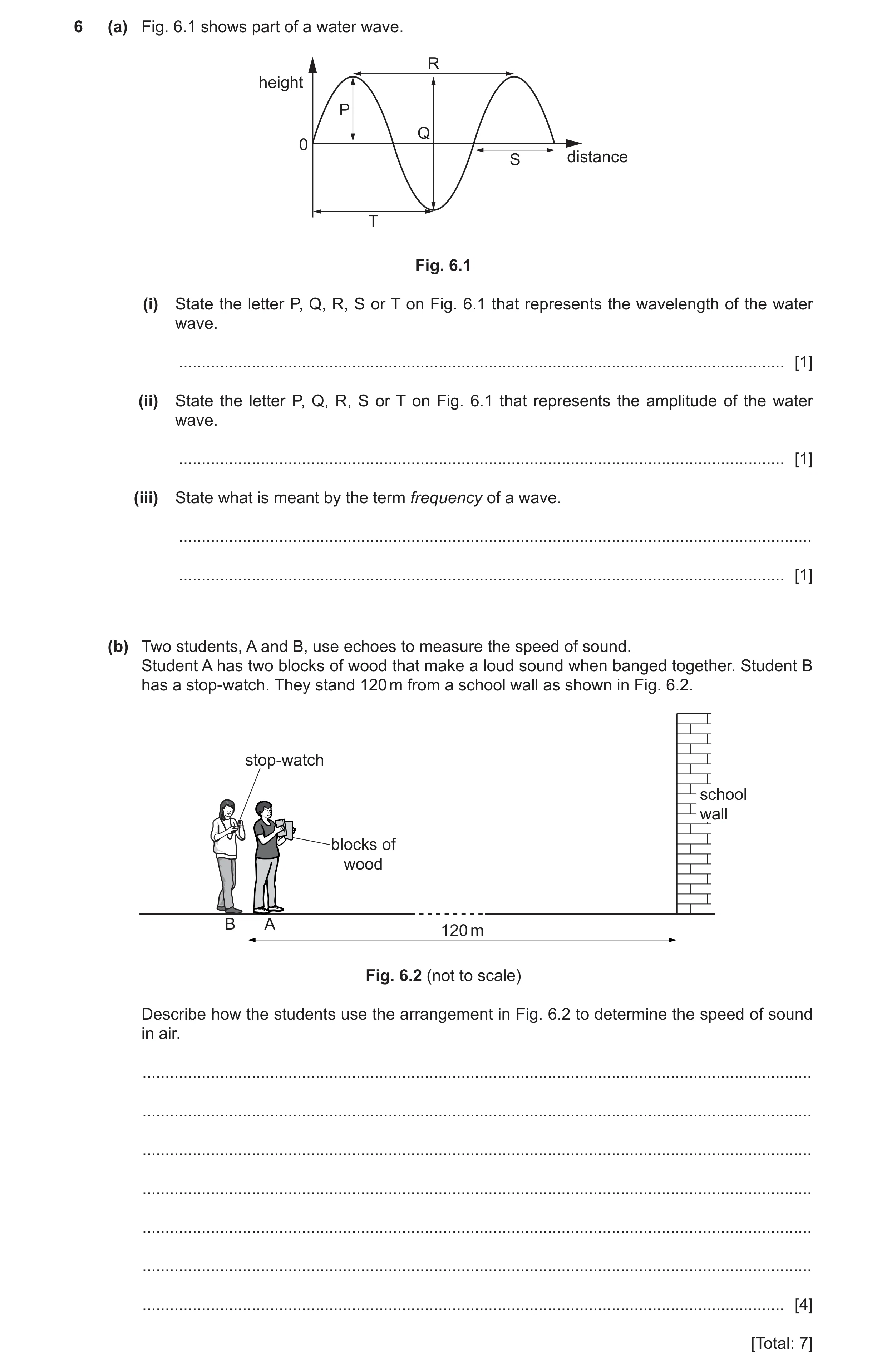
6 (a) Fig. 6.1 shows part of a water wave. R height P Q 0 S distance T Fig. 6.1 (i) State the letter P, Q, R, S or T on Fig. 6.1 that represents the wavelength of the water wave. … [1] (ii) State the letter P, Q, R, S or T on Fig. 6.1 that represents the amplitude of the water wave. … [1] (iii) State what is meant by the term frequency of a wave. … … [1] (b) Two students, A and B, use echoes to measure the speed of sound. Student A has two blocks of wood that make a loud sound when banged together. Student B has a stop‑watch. They stand 120 m from a school wall as shown in Fig. 6.2. stop-watch school wall blocks of wood B A 120 m Fig. 6.2 (not to scale) Describe how the students use the arrangement in Fig. 6.2 to determine the speed of sound in air. … … … … … … … [4] [Total: 7]
7 marks
Mark scheme: 6(a)(i) R B1 6(a)(ii) P B1 6(a)(iii) idea of: number of (complete) waves {sent out or produced or passing a point} {in one second or unit time} B1 6(b) any four from: (student A) bangs two blocks of wood together (student B) starts stopwatch when (sees) blocks or wood collide (student B) stops stopwatch when she hears echo repeat (experiment) AND calculate average (time) uses 240 m as distance travelled by sound owtte use s= d ÷ t B4
This question in 0625/31 Oct/Nov 2021
Q14 · A student uses a tank of water to observe waves on the surface of the water 0625/32 Feb/March 2022
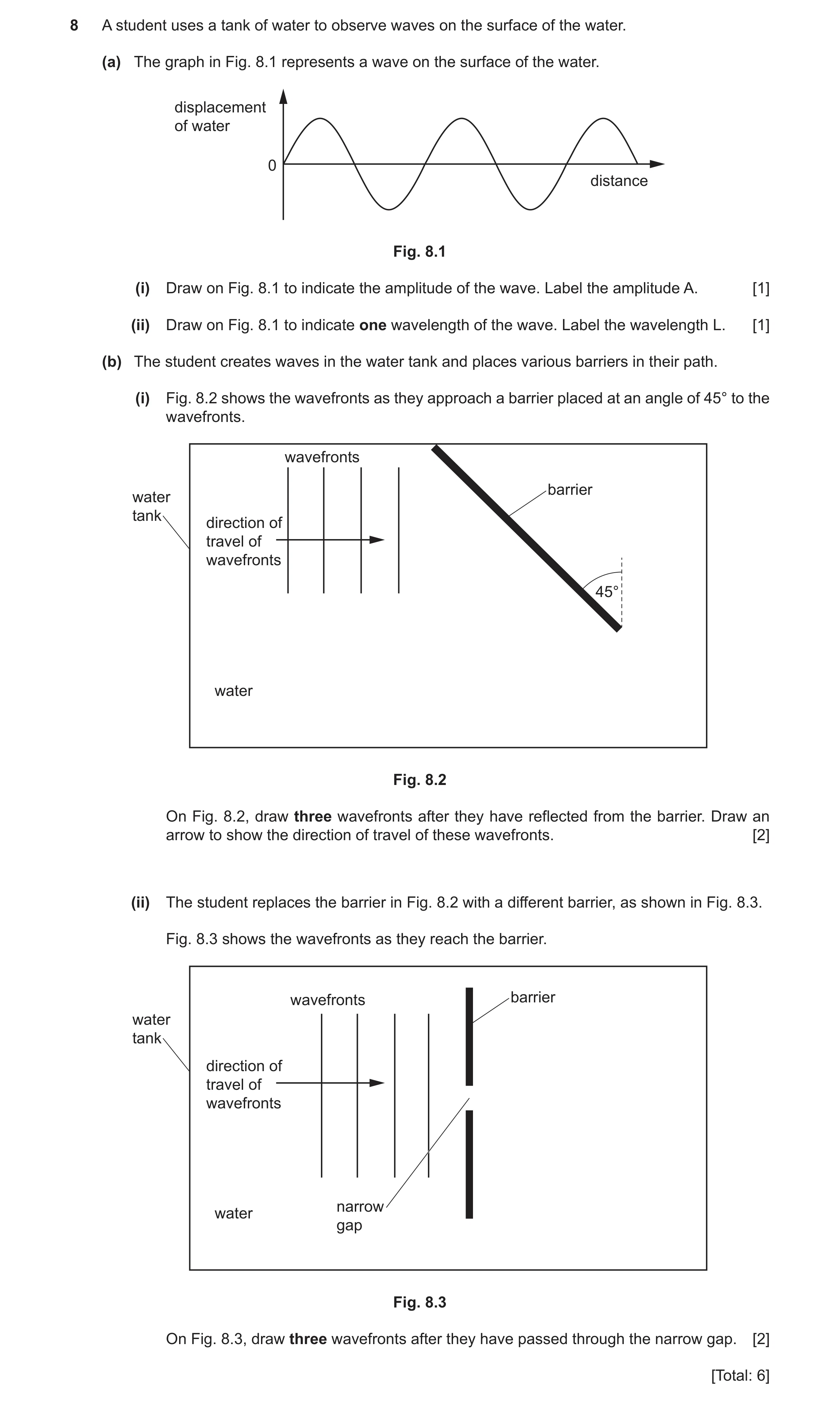
8 A student uses a tank of water to observe waves on the surface of the water. (a) The graph in Fig. 8.1 represents a wave on the surface of the water. displacement of water 0 distance Fig. 8.1 (i) Draw on Fig. 8.1 to indicate the amplitude of the wave. Label the amplitude A. [1] (ii) Draw on Fig. 8.1 to indicate one wavelength of the wave. Label the wavelength L. [1] (b) The student creates waves in the water tank and places various barriers in their path. (i) Fig. 8.2 shows the wavefronts as they approach a barrier placed at an angle of 45° to the wavefronts. wavefronts barrier water tank direction of travel of wavefronts 45° water Fig. 8.2 On Fig. 8.2, draw three wavefronts after they have reflected from the barrier. Draw an arrow to show the direction of travel of these wavefronts. [2] (ii) The student replaces the barrier in Fig. 8.2 with a different barrier, as shown in Fig. 8.3. Fig. 8.3 shows the wavefronts as they reach the barrier. wavefronts barrier water tank direction of travel of wavefronts narrow water gap Fig. 8.3 On Fig. 8.3, draw three wavefronts after they have passed through the narrow gap. [2] [Total: 6]
6 marks
Mark scheme: 8(a)(i) one amplitude drawn on diagram labelled A B1 8(a)(ii) one wavelength drawn on diagram labelled L B1 8(b)(i) at least 3 wavefronts reflected from barrier B1 direction of (wavefront) motion vertically down the page. B1 8(b)(ii) at least 3 semi-circular wavefronts after gap showing diffraction (centred on gap) B1 wavefronts with same wavelength as before gap B1
This question in 0625/32 Feb/March 2022
Q15 · The displacement of particles in a water wave 0625/31 May/June 2022
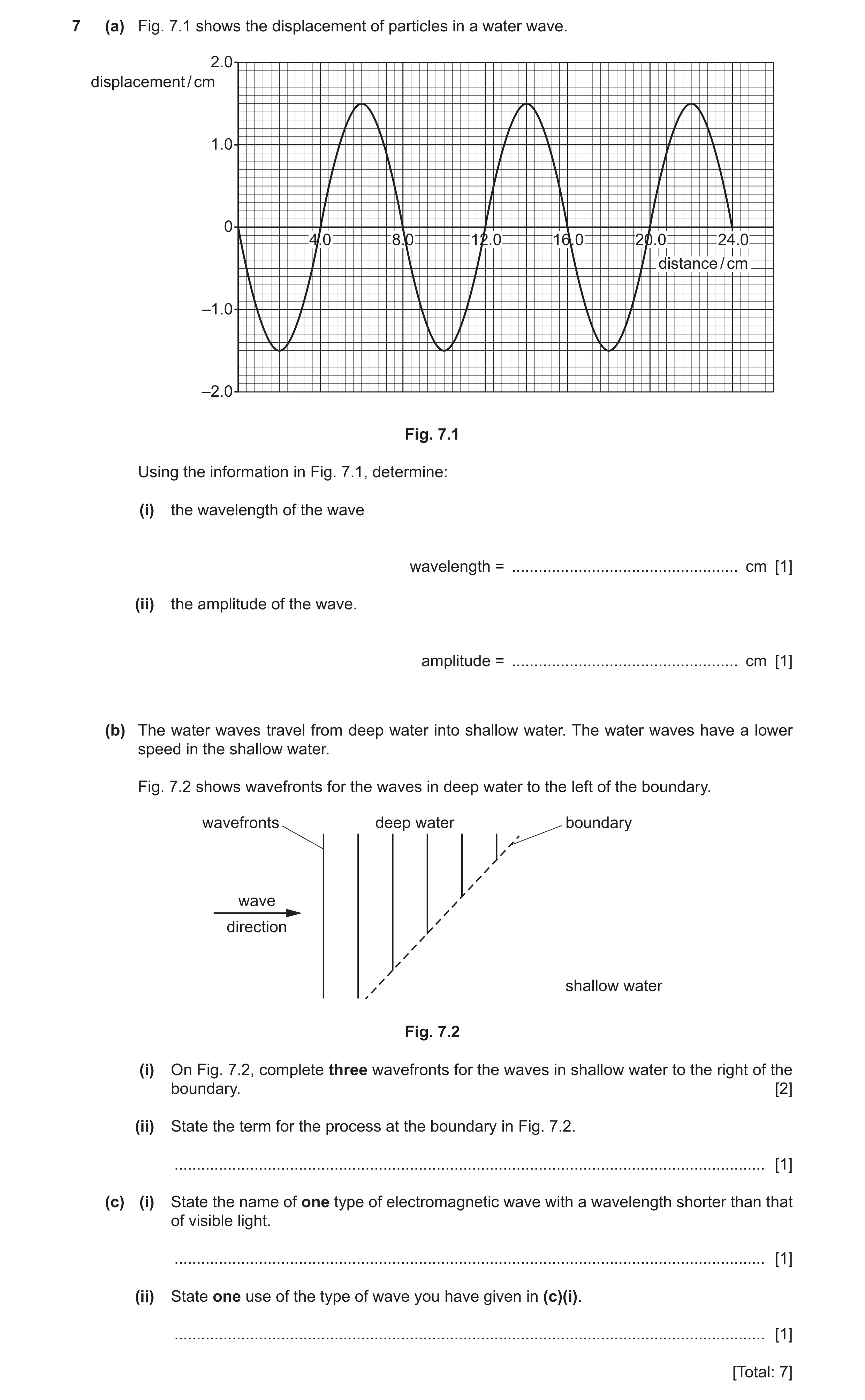
7 (a) Fig. 7.1 shows the displacement of particles in a water wave. 2.0 displacement / cm 1.0 0 4.0 8.0 12.0 16.0 20.0 24.0 distance / cm –1.0 –2.0 Fig. 7.1 Using the information in Fig. 7.1, determine: (i) the wavelength of the wave wavelength = … cm [1] (ii) the amplitude of the wave. amplitude = … cm [1] (b) The water waves travel from deep water into shallow water. The water waves have a lower speed in the shallow water. Fig. 7.2 shows wavefronts for the waves in deep water to the left of the boundary. wavefronts deep water boundary wave direction shallow water Fig. 7.2 (i) On Fig. 7.2, complete three wavefronts for the waves in shallow water to the right of the boundary. [2] (ii) State the term for the process at the boundary in Fig. 7.2. … [1] (c) (i) State the name of one type of electromagnetic wave with a wavelength shorter than that of visible light. … [1] (ii) State one use of the type of wave you have given in (c)(i). … [1] [Total: 7]
7 marks
Mark scheme: 7(a)(i) 8.0 (cm) B1 7(a)(ii) 1.5 (cm) B1 7(b)(i) wavefronts at different angle to boundary B1 wavefronts towards left AND all with smaller wavelength B1 7(b)(ii) refraction B1 Question Answer Marks 7(c)(i) ultraviolet OR X-rays OR gamma rays B1 7(c)(ii) correct use for wave in (c)(i) B1
This question in 0625/31 May/June 2022
Q16 · The main regions of the electromagnetic spectrum 0625/32 May/June 2022
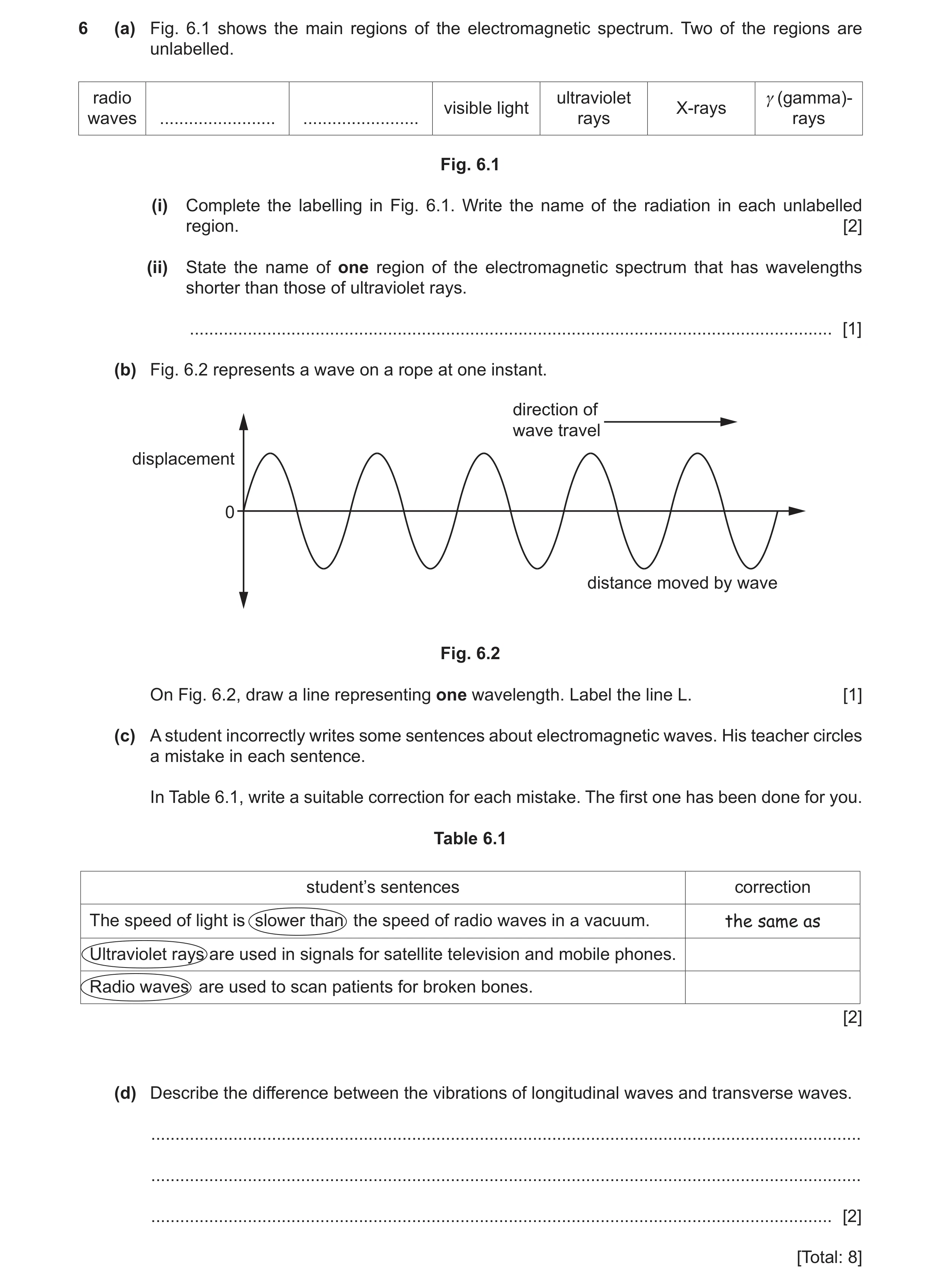
6 (a) Fig. 6.1 shows the main regions of the electromagnetic spectrum. Two of the regions are unlabelled. radio ultraviolet γ (gamma)- visible light X-rays waves … … rays rays Fig. 6.1 (i) Complete the labelling in Fig. 6.1. Write the name of the radiation in each unlabelled region. [2] (ii) State the name of one region of the electromagnetic spectrum that has wavelengths shorter than those of ultraviolet rays. … [1] (b) Fig. 6.2 represents a wave on a rope at one instant. direction of wave travel displacement 0 distance moved by wave Fig. 6.2 On Fig. 6.2, draw a line representing one wavelength. Label the line L. [1] (c) A student incorrectly writes some sentences about electromagnetic waves. His teacher circles a mistake in each sentence. In Table 6.1, write a suitable correction for each mistake. The first one has been done for you. Table 6.1 student’s sentences correction The speed of light is slower than the speed of radio waves in a vacuum. the same as Ultraviolet rays are used in signals for satellite television and mobile phones. Radio waves are used to scan patients for broken bones. [2] (d) Describe the difference between the vibrations of longitudinal waves and transverse waves. … … … [2] [Total: 8]
8 marks
Mark scheme: 6(a)(i) (1st box) microwaves B1 (2nd box) infrared B1 6(a)(ii) X-rays OR gamma rays B1 6(b) horizontal line drawn between 2 peaks OR any 2 adjacent similar points on the wave B1 6(c) microwaves B1 X-rays B1 6(d) longitudinal (vibrations) are parallel to the direction of propagation B1 transverse (vibrations) are perpendicular/at right angles to the direction of propagation B1
This question in 0625/32 May/June 2022
Q17 · This question is about the following four types of wave 0625/33 May/June 2022
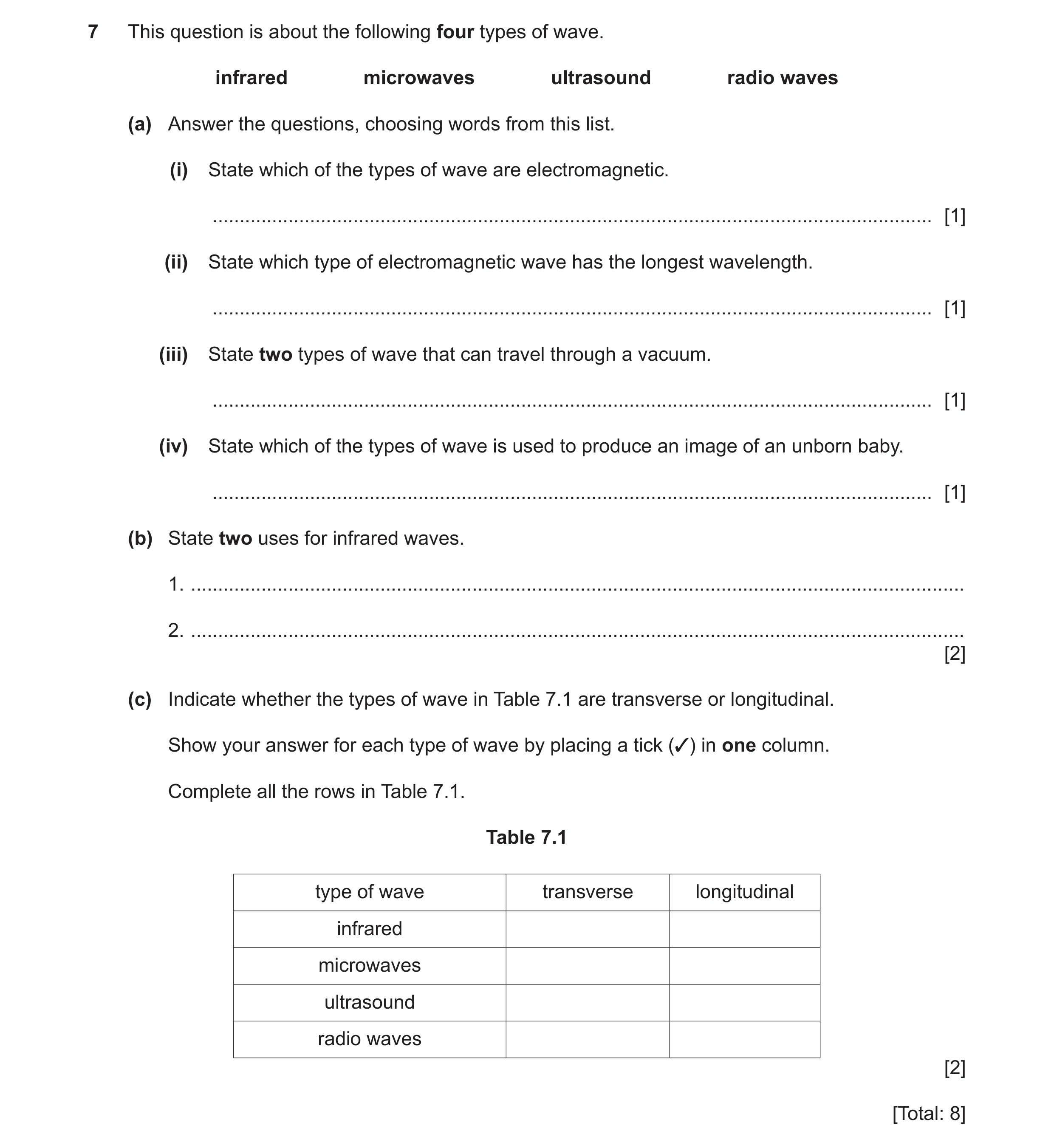
7 This question is about the following four types of wave. infrared microwaves ultrasound radio waves (a) Answer the questions, choosing words from this list. (i) State which of the types of wave are electromagnetic. … [1] (ii) State which type of electromagnetic wave has the longest wavelength. … [1] (iii) State two types of wave that can travel through a vacuum. … [1] (iv) State which of the types of wave is used to produce an image of an unborn baby. … [1] (b) State two uses for infrared waves. 1. … 2. … [2] (c) Indicate whether the types of wave in Table 7.1 are transverse or longitudinal. Show your answer for each type of wave by placing a tick (3) in one column. Complete all the rows in Table 7.1. Table 7.1 type of wave transverse longitudinal infrared microwaves ultrasound radio waves [2] [Total: 8]
8 marks
Mark scheme: 7(a)(i) infrared AND microwaves AND radio waves B1 7(a)(ii) radio waves B1 7(a)(iii) any two from: infrared microwaves radio waves B1 7(a)(iv) ultrasound B1 7(b) remote controls/heat lamps/heaters/thermal imaging/night vision/security cameras/heaters/grills/measuring blood B1 oxygen/pulse oximeters/measuring body temperature/thermal thermometer B1 Question Answer Marks 7(c) wave transverse longitudinal infrared microwaves ultrasound radio waves B2
This question in 0625/33 May/June 2022
Q18 · A student investigates wave properties 0625/31 Oct/Nov 2022
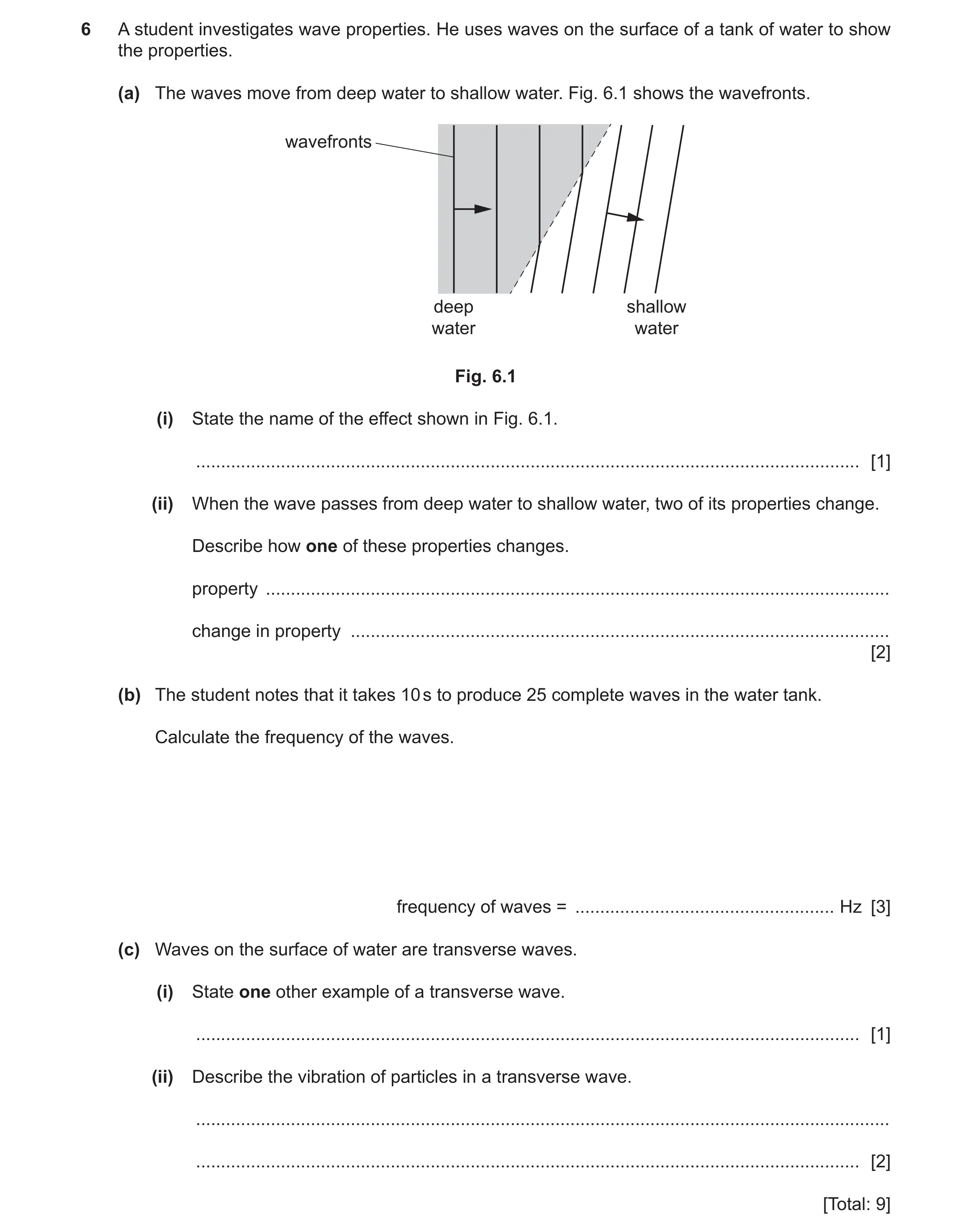
6 A student investigates wave properties. He uses waves on the surface of a tank of water to show the properties. (a) The waves move from deep water to shallow water. Fig. 6.1 shows the wavefronts. wavefronts deep shallow water water Fig. 6.1 (i) State the name of the effect shown in Fig. 6.1. … [1] (ii) When the wave passes from deep water to shallow water, two of its properties change. Describe how one of these properties changes. property … change in property … [2] (b) The student notes that it takes 10 s to produce 25 complete waves in the water tank. Calculate the frequency of the waves. frequency of waves = … Hz [3] (c) Waves on the surface of water are transverse waves. (i) State one other example of a transverse wave. … [1] (ii) Describe the vibration of particles in a transverse wave. … … [2] [Total: 9]
9 marks
Mark scheme: 6(a)(i) refraction B1 6(a)(ii) wavelength M1 (of) waves (in shallow water) is shorter / smaller ORA A1 OR speed (M1) (of) waves / wavefronts (in shallow water) is slower ORA (A1) 6(b) 2.5 (Hz) A3 25 / 10 C2 (frequency =) number of (complete) waves sent out OR passing a point in one second / unit time OR 1 Hz is 1 wave in one C1 second OR no. of waves ÷ time taken 6(c)(i) any electromagnetic wave OR an S-wave B1 6(c)(ii) (particle vibrations are) perpendicular / at right angles B1 to the direction of propagation / wave travel / energy transfer B1
This question in 0625/31 Oct/Nov 2022
Q19 · The diagram in Fig 0625/32 Oct/Nov 2022
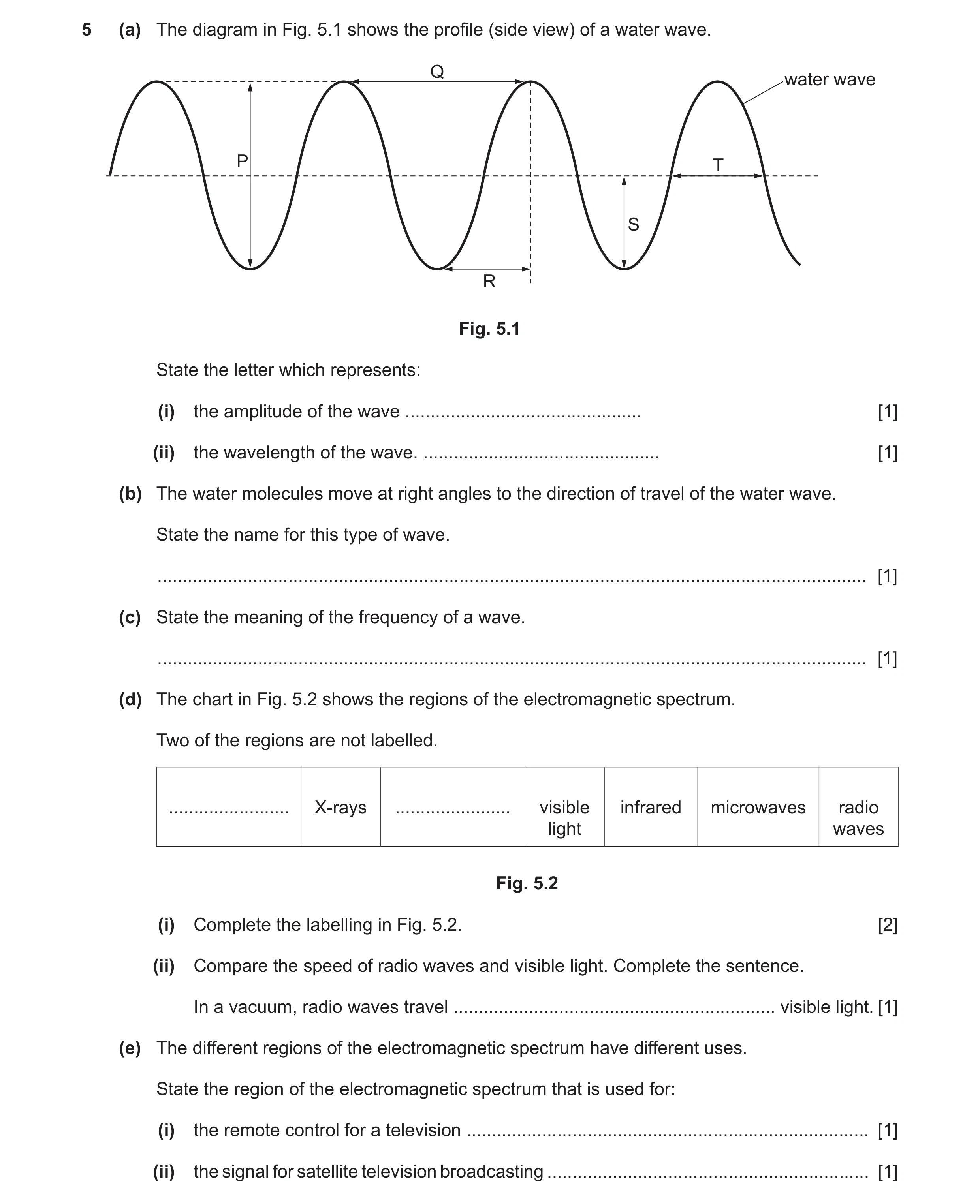
5 (a) The diagram in Fig. 5.1 shows the profile (side view) of a water wave. Q water wave P T S R Fig. 5.1 State the letter which represents: (i) the amplitude of the wave … [1] (ii) the wavelength of the wave. … [1] (b) The water molecules move at right angles to the direction of travel of the water wave. State the name for this type of wave. … [1] (c) State the meaning of the frequency of a wave. … [1] (d) The chart in Fig. 5.2 shows the regions of the electromagnetic spectrum. Two of the regions are not labelled. … X-rays … visible infrared microwaves radio light waves Fig. 5.2 (i) Complete the labelling in Fig. 5.2. [2] (ii) Compare the speed of radio waves and visible light. Complete the sentence. In a vacuum, radio waves travel … visible light. [1] (e) The different regions of the electromagnetic spectrum have different uses. State the region of the electromagnetic spectrum that is used for: (i) the remote control for a television … [1] (ii) the signal for satellite television broadcasting … [1]
9 marks
Mark scheme: 5(a)(i) S B1 5(a)(ii) Q B1 5(b) transverse B1 5(c) (number of) cycles / vibrations / waves per unit time / second B1 5(d)(i) gamma / (rays) on lhs B1 ultraviolet / uv (rays) between X rays and visible B1 5(d)(ii) the same (speed) B1 5(e)(i) infrared B1 5(e)(ii) microwaves B1
This question in 0625/32 Oct/Nov 2022
Q20 · How the displacement of a transverse wave varies with time 0625/32 Feb/March 2023
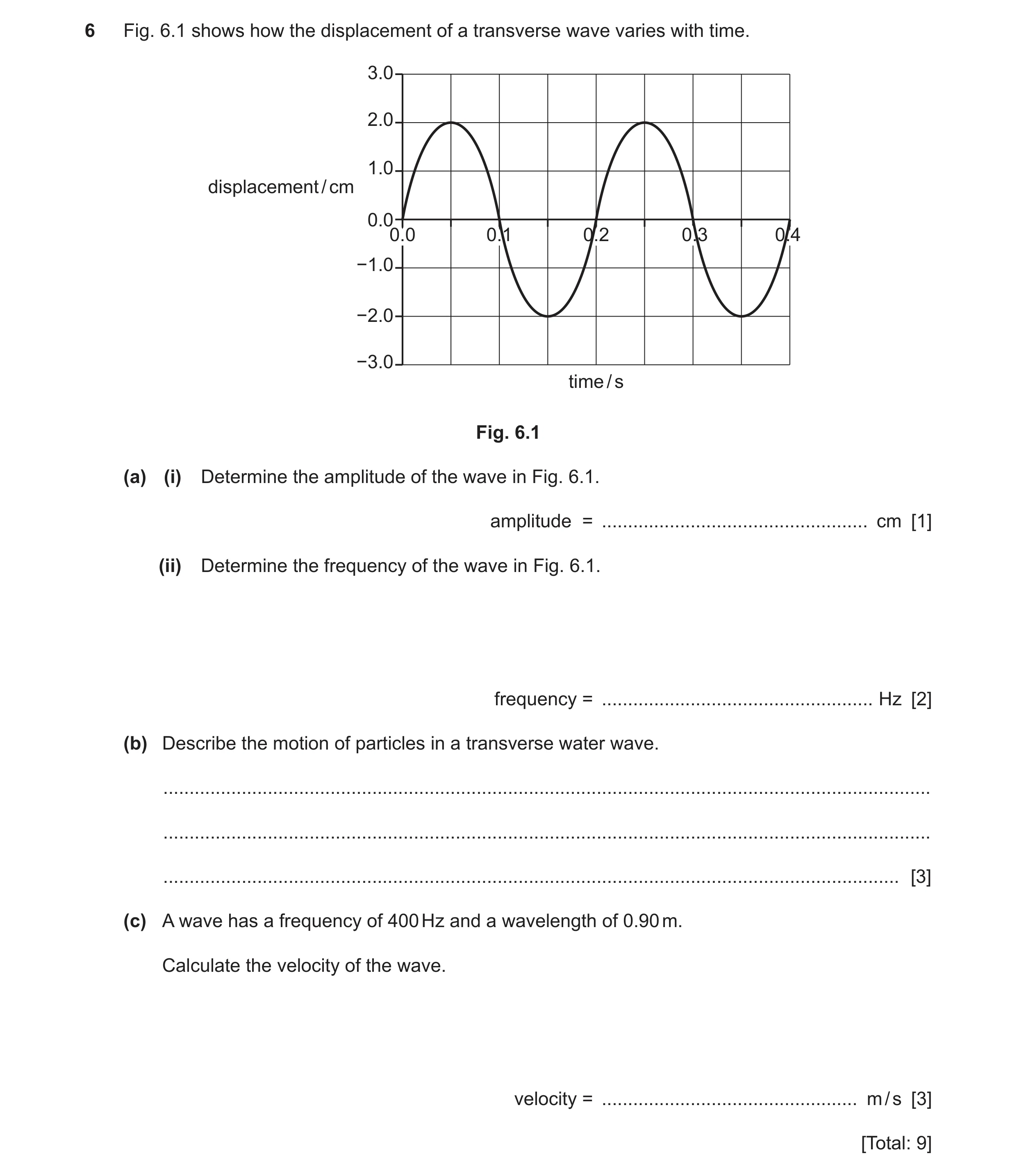
6 Fig. 6.1 shows how the displacement of a transverse wave varies with time. 3.0 2.0 1.0 displacement / cm 0.0 0.00.0 0.10.1 0.20.2 0.30.3 0.40.4 −1.0 −2.0 −3.0 time / s Fig. 6.1 (a) (i) Determine the amplitude of the wave in Fig. 6.1. amplitude = … cm [1] (ii) Determine the frequency of the wave in Fig. 6.1. frequency = … Hz [2] (b) Describe the motion of particles in a transverse water wave. … … … [3] (c) A wave has a frequency of 400 Hz and a wavelength of 0.90 m. Calculate the velocity of the wave. velocity = … m / s [3] [Total: 9]
9 marks
Mark scheme: 6(a)(i) 2.0 (cm) B1 6(a)(ii) (so frequency =) 5.0 (Hz) A2 (frequency =) number of waves (sent out) per s / unit time OR (C1) time for 1 wave = 0.2 s OR 2 waves in 0.4 s 6(b) vibrations OR oscillations (of particles) B1 at right angles OR perpendicular B1 to direction of propogation B1 6(c) (v =) 360 (m / s) A3 (v =) 400 0.90 (C2) =) λ (C1)
This question in 0625/32 Feb/March 2023
Q21 · A student observes waves on the surface of water in a tank 0625/31 May/June 2023
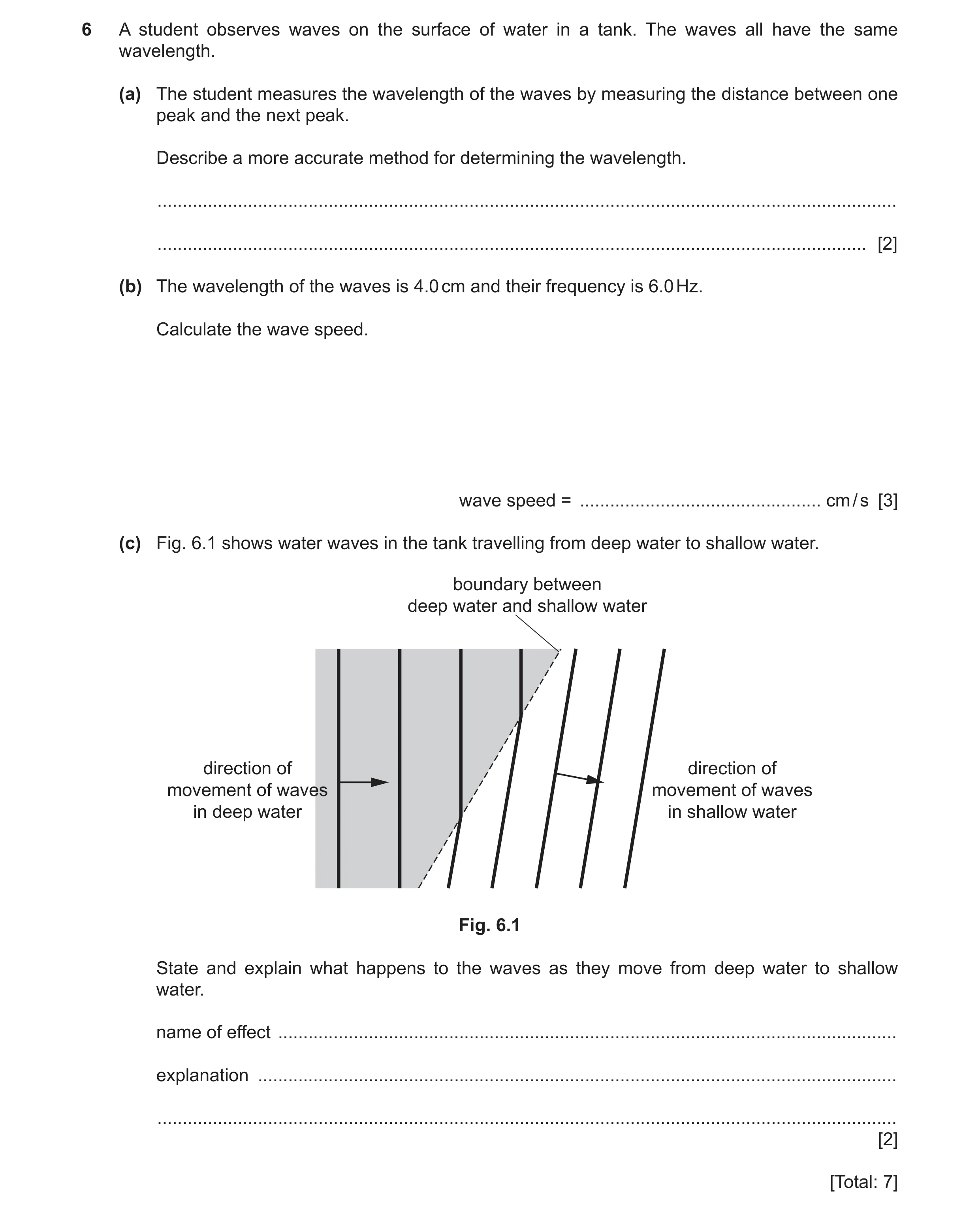
6 A student observes waves on the surface of water in a tank. The waves all have the same wavelength. (a) The student measures the wavelength of the waves by measuring the distance between one peak and the next peak. Describe a more accurate method for determining the wavelength. … … [2] (b) The wavelength of the waves is 4.0 cm and their frequency is 6.0 Hz. Calculate the wave speed. wave speed = … cm / s [3] (c) Fig. 6.1 shows water waves in the tank travelling from deep water to shallow water. boundary between deep water and shallow water direction of direction of movement of waves movement of waves in deep water in shallow water Fig. 6.1 State and explain what happens to the waves as they move from deep water to shallow water. name of effect … explanation … … [2] [Total: 7]
7 marks
Mark scheme: 6(a) idea of measure more than one wavelength B1 idea of dividing measurement by number of wavelengths (measured) B1 6(b) (speed =) 24 (cm / s) A3 (speed =) 6(.0) 4(.0) (C2) (v =) f (C1) 6(c) (name of effect) refraction B1 change of speed B1
This question in 0625/31 May/June 2023
Q22 · A teacher demonstrates the behaviour of waves by using water waves in a ripple tank 0625/33 May/June 2023
5 A teacher demonstrates the behaviour of waves by using water waves in a ripple tank. Fig. 5.1 shows a cross-section through part of the water waves. water 18.2 cm Fig. 5.1 (not to scale) (a) Calculate the wavelength of the water waves. Use the information in Fig. 5.1. wavelength = … cm [2] (b) The teacher places a pointer above the water waves as shown in Fig. 5.2. pointer water Fig. 5.2 (not to scale) Three students use stop-watches to measure the time taken for 50 peaks to pass the pointer. Fig. 5.3 shows the measurements. min s 1 s min s 1 s min s 1 s 100 100 100 time = … s time = … s time = … s Fig. 5.3 (i) On the line below each stop-watch, state the time measurement, in seconds. [1] (ii) Calculate the average of the three time measurements in (b)(i). average time = … s [2] (iii) Calculate the frequency of the water waves using your result in (b)(ii). frequency = … Hz [2] (c) The teacher repeats the demonstration using a different ripple tank and obtains these results for the waves. wavelength = 0.025 m frequency = 2.4 Hz Calculate the speed of the wave. speed of wave = … m / s [3] [Total: 10]
10 marks
Mark scheme: 5(a) 18.2 ÷ 7 C1 2.6 (cm) A1 5(b)(i) 17.24 AND 17.14 AND 17.16 (s) B1 5(b)(ii) (17.24 + 17.14 + 17.16) ÷ 3 OR 51.54 ÷ 3 C1 17.18 (s) A1 5(b)(iii) 50 ÷ 17.18 C1 2.9 (Hz) A1 5(c) (speed =) frequency wavelength in any form C1 2.4 0.025 C1 0.06(0) (m / s) A1
This question in 0625/33 May/June 2023
Q23 · A wave on the surface of water 0625/31 Oct/Nov 2023
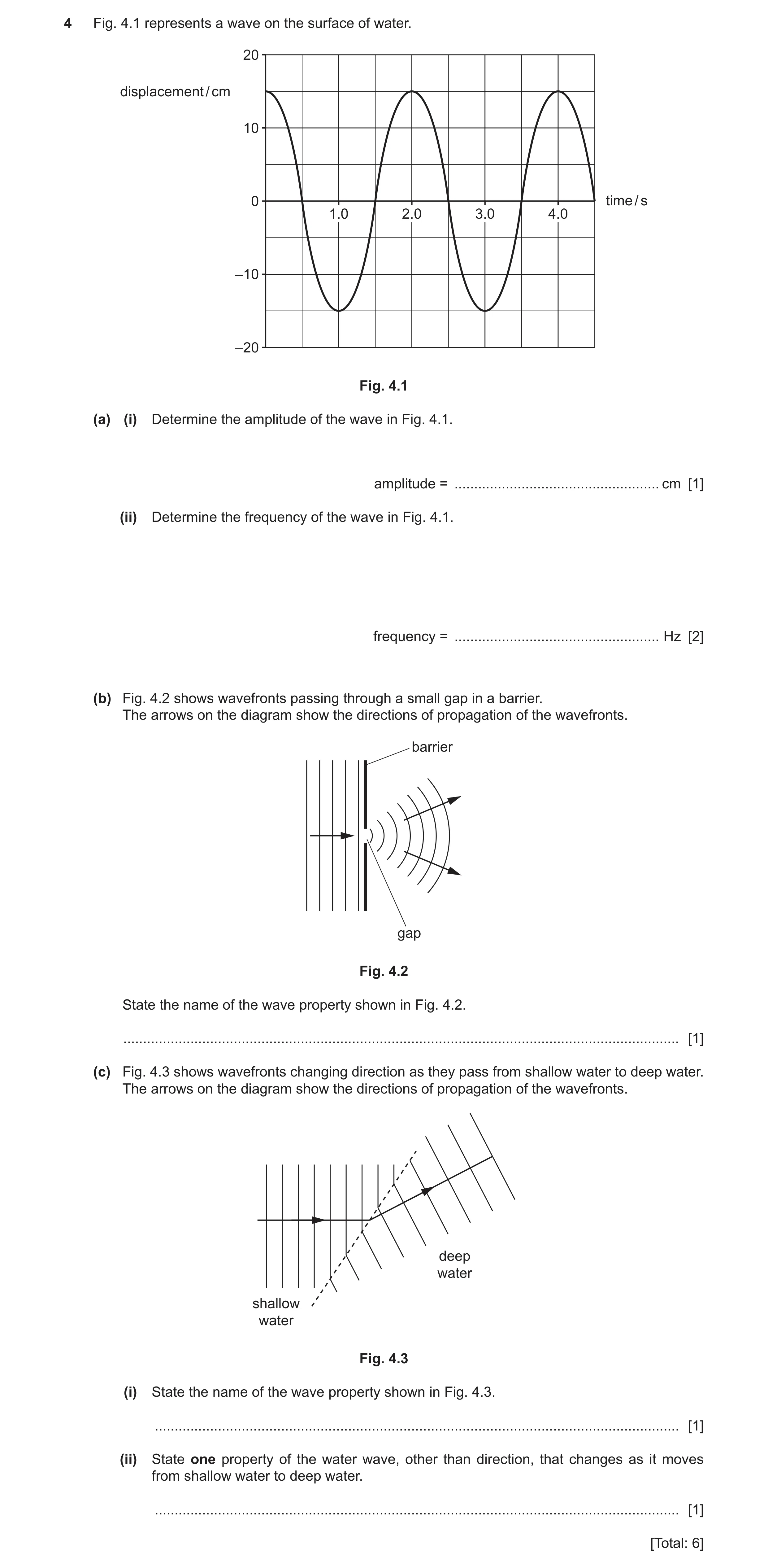
4 Fig. 4.1 represents a wave on the surface of water. 20 displacement / cm 10 0 time / s 1.0 2.0 3.0 4.0 –10 –20 Fig. 4.1 (a) (i) Determine the amplitude of the wave in Fig. 4.1. amplitude = … cm [1] (ii) Determine the frequency of the wave in Fig. 4.1. frequency = … Hz [2] (b) Fig. 4.2 shows wavefronts passing through a small gap in a barrier. The arrows on the diagram show the directions of propagation of the wavefronts. barrier gap Fig. 4.2 State the name of the wave property shown in Fig. 4.2. … [1] (c) Fig. 4.3 shows wavefronts changing direction as they pass from shallow water to deep water. The arrows on the diagram show the directions of propagation of the wavefronts. deep water shallow water Fig. 4.3 (i) State the name of the wave property shown in Fig. 4.3. … [1] (ii) State one property of the water wave, other than direction, that changes as it moves from shallow water to deep water. … [1] [Total: 6]
6 marks
Mark scheme: 4(a)(i) (amplitude =) 15 (cm) B1 4(a)(ii) (frequency =) 0.5 (Hz) A2 (frequency =) number of waves sent out / emitted in one second (C1) OR 1 wave in 2.0 (s) OR frequency = 1 ÷ 2(0) 4(b) diffraction B1 4(c)(i) refraction B1 4(c)(ii) (change of) wavelength OR (wave) speed OR velocity B1
This question in 0625/31 Oct/Nov 2023
Question 24 0625/32 Oct/Nov 2023
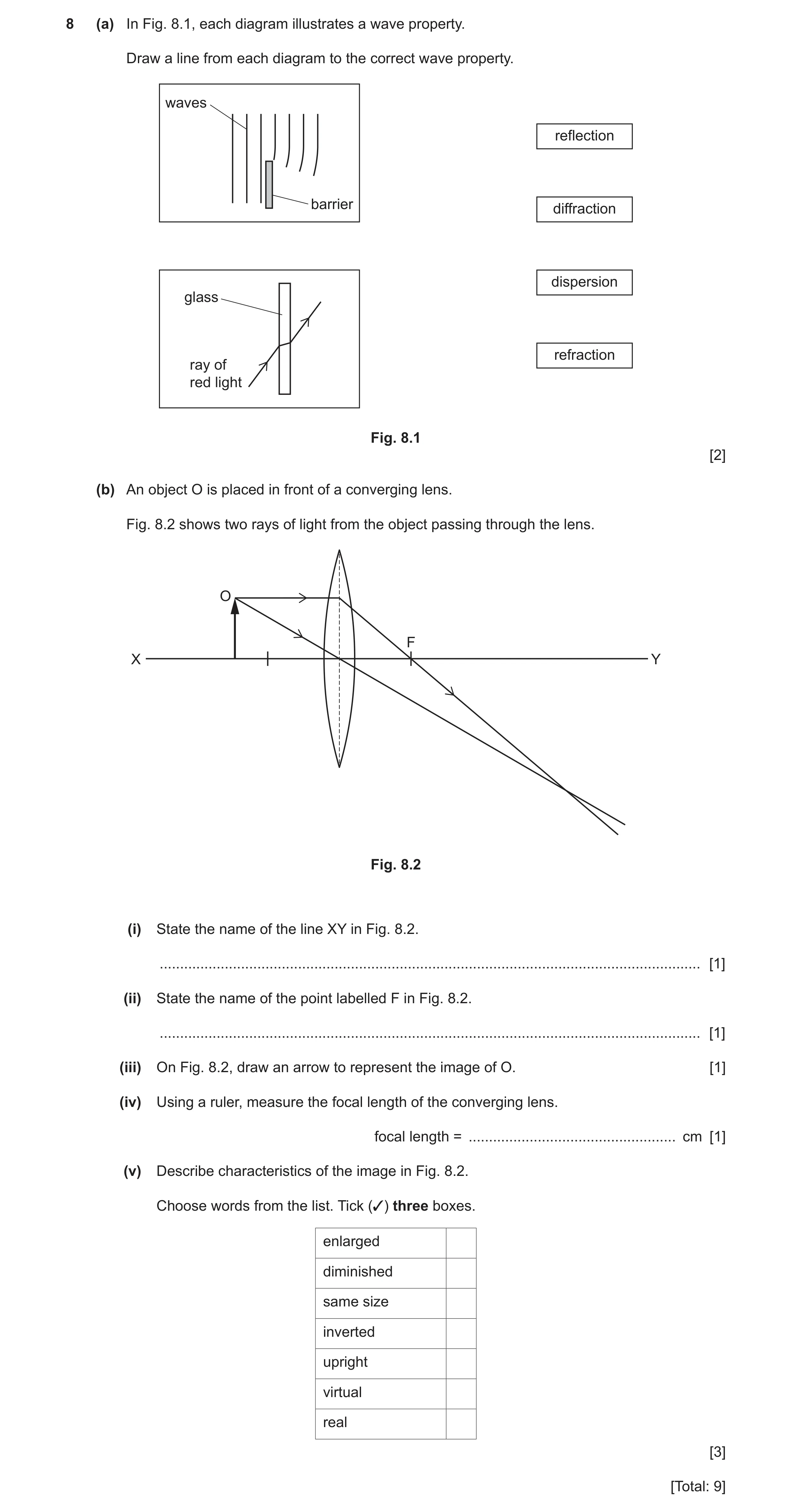
8 (a) In Fig. 8.1, each diagram illustrates a wave property. Draw a line from each diagram to the correct wave property. waves reflection barrier diffraction dispersion glass refraction ray of red light Fig. 8.1 [2] (b) An object O is placed in front of a converging lens. Fig. 8.2 shows two rays of light from the object passing through the lens. O F X Y Fig. 8.2 (i) State the name of the line XY in Fig. 8.2. … [1] (ii) State the name of the point labelled F in Fig. 8.2. … [1] (iii) On Fig. 8.2, draw an arrow to represent the image of O. [1] (iv) Using a ruler, measure the focal length of the converging lens. focal length = … cm [1] (v) Describe characteristics of the image in Fig. 8.2. Choose words from the list. Tick (3) three boxes. enlarged diminished same size inverted upright virtual real [3] [Total: 9]
9 marks
Mark scheme: 8(a) top diagram ----------- diffraction B1 bottom diagram ---------- refraction B1 8(b)(i) principal axis B1 8(b)(ii) principal focus B1 8(b)(iii) vertical line from point where rays cross to the principal axis B1 8(b)(iv) 1.9 (cm) B1 8(b)(v) B1 enlarged ✓ B1 diminished B1 same size inverted ✓ upright virtual real ✓
This question in 0625/32 Oct/Nov 2023
Question 25 0625/32 Feb/March 2024
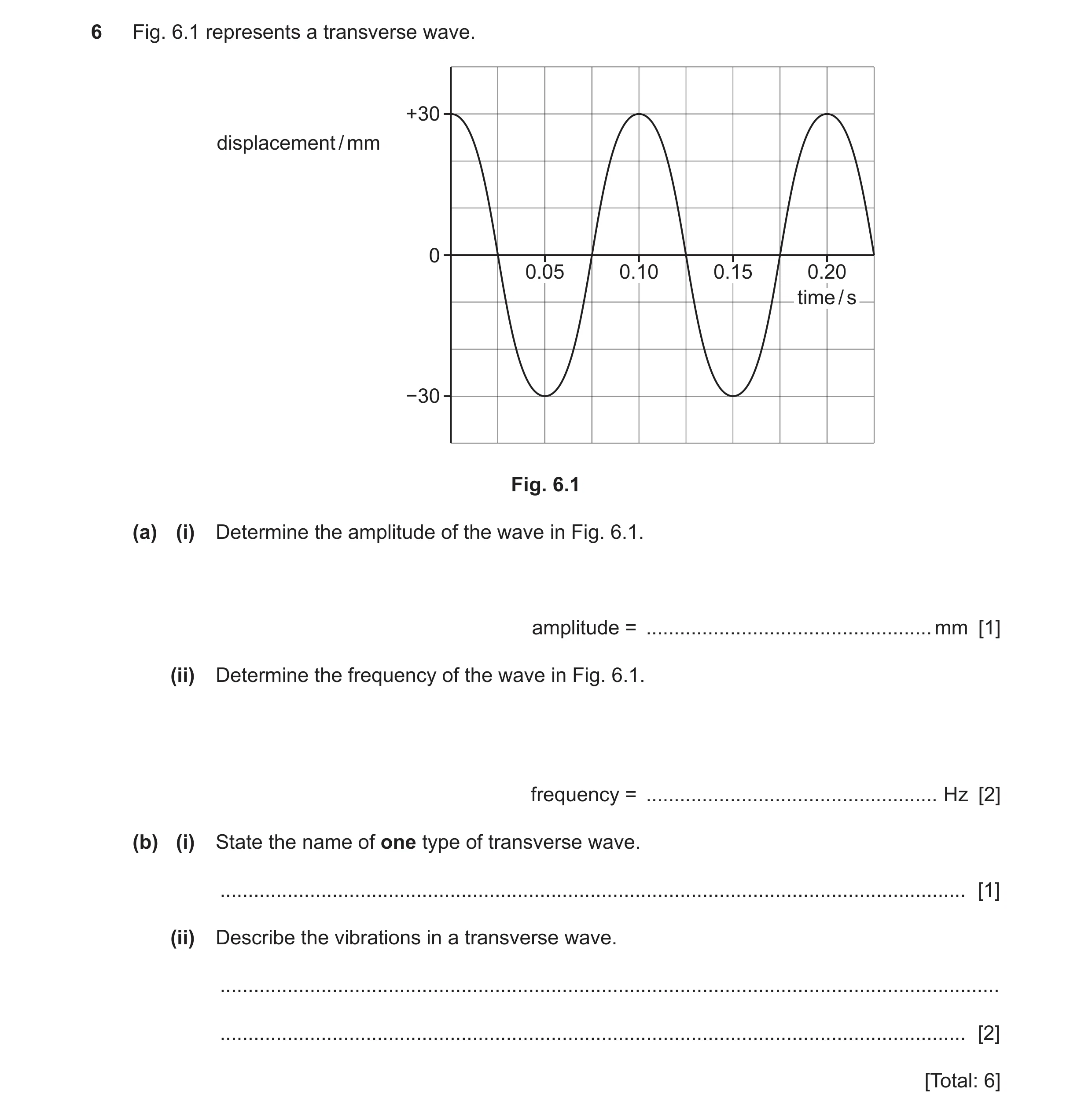
6 Fig. 6.1 represents a transverse wave. +30 displacement / mm 0 0.05 0.10 0.15 0.20 time / s −30 Fig. 6.1 (a) (i) Determine the amplitude of the wave in Fig. 6.1. amplitude = … mm [1] (ii) Determine the frequency of the wave in Fig. 6.1. frequency = … Hz [2] (b) (i) State the name of one type of transverse wave. … [1] (ii) Describe the vibrations in a transverse wave. … … [2] [Total: 6]
6 marks
Mark scheme: 6(a)(i) 30 (mm) B1 6(a)(ii) 10 (Hz) A2 idea of frequency = no. of waves per second (C1) 6(b)(i) electromagnetic wave(s) OR any named electromagnetic wave OR wave (on surface of) water OR (seismic) S-wave / B1 secondary wave 6(b)(ii) (vibrations or they are) at right angles OR perpendicular M1 to direction of propagation OR direction of energy transfer A1
This question in 0625/32 Feb/March 2024
Q26 · A student studies different types of wave 0625/32 May/June 2024
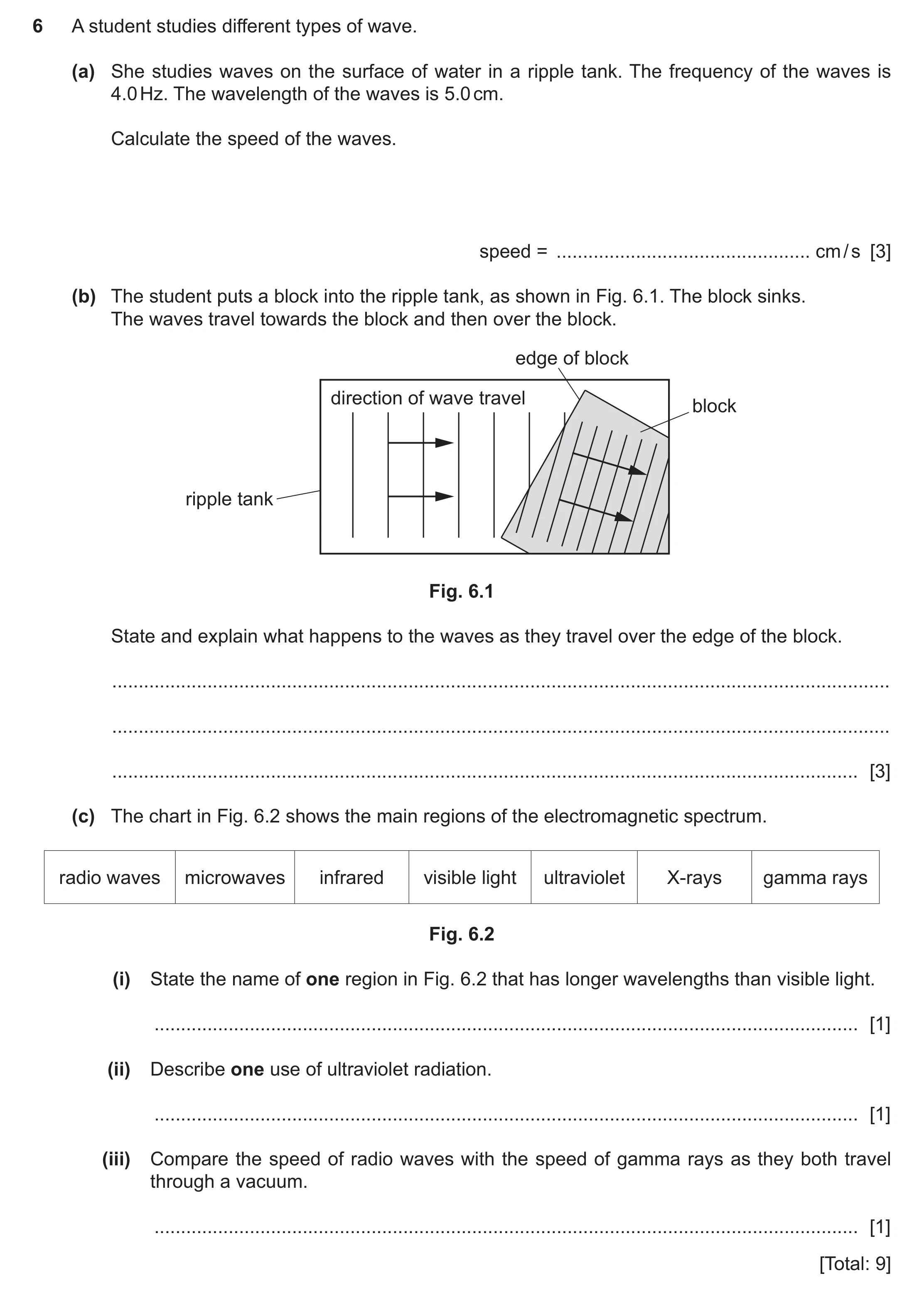
6 A student studies different types of wave. (a) She studies waves on the surface of water in a ripple tank. The frequency of the waves is 4.0 Hz. The wavelength of the waves is 5.0 cm. Calculate the speed of the waves. speed = … cm / s [3] (b) The student puts a block into the ripple tank, as shown in Fig. 6.1. The block sinks. The waves travel towards the block and then over the block. edge of block direction of wave travel block ripple tank Fig. 6.1 State and explain what happens to the waves as they travel over the edge of the block. … … … [3] (c) The chart in Fig. 6.2 shows the main regions of the electromagnetic spectrum. radio waves microwaves infrared visible light ultraviolet X-rays gamma rays Fig. 6.2 (i) State the name of one region in Fig. 6.2 that has longer wavelengths than visible light. … [1] (ii) Describe one use of ultraviolet radiation. … [1] (iii) Compare the speed of radio waves with the speed of gamma rays as they both travel through a vacuum. … [1] [Total: 9]
9 marks
Mark scheme: 6(a) (v =) 20 (cm / s) A3 (v =) 4(.0) 5(.0) (C2) (v =) f (C1) 6(b) any three from: refraction direction of waves / wavefronts changes (due to) change in speed wavelength changes as depth of water changes B3 6(c)(i) radio waves OR microwaves OR infrared B1 6(c)(ii) security marking OR detecting forged bank notes OR sterilising food / water B1 6(c)(iii) (both have) same speed owtte B1
This question in 0625/32 May/June 2024
Q27 · State the name of the type of wave in which the direction of vibration is at right angles… 0625/33 May/June 2024
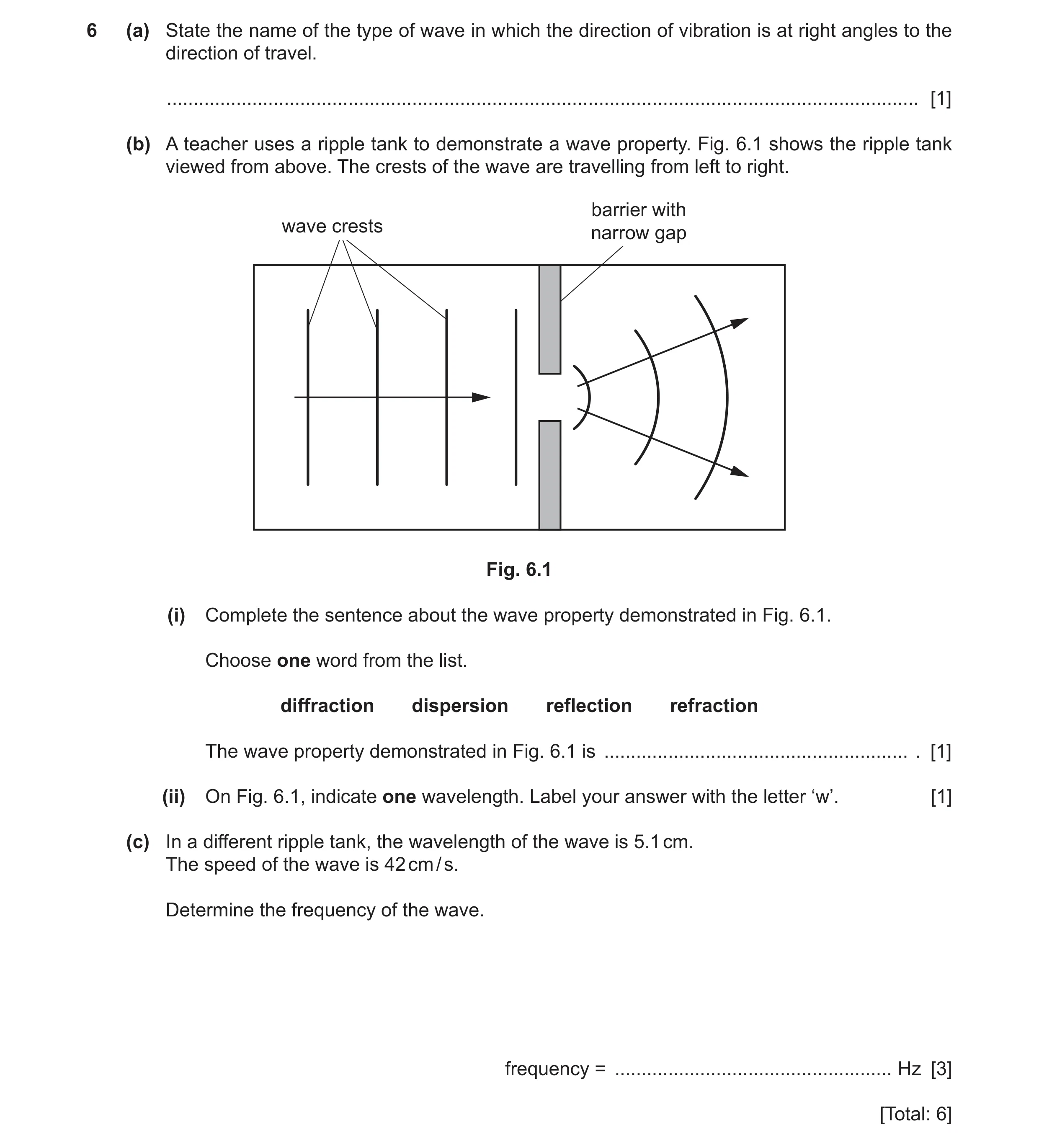
6 (a) State the name of the type of wave in which the direction of vibration is at right angles to the direction of travel. … [1] (b) A teacher uses a ripple tank to demonstrate a wave property. Fig. 6.1 shows the ripple tank viewed from above. The crests of the wave are travelling from left to right. barrier with wave crests narrow gap Fig. 6.1 (i) Complete the sentence about the wave property demonstrated in Fig. 6.1. Choose one word from the list. diffraction dispersion reflection refraction The wave property demonstrated in Fig. 6.1 is … . [1] (ii) On Fig. 6.1, indicate one wavelength. Label your answer with the letter ‘w’. [1] (c) In a different ripple tank, the wavelength of the wave is 5.1 cm. The speed of the wave is 42 cm / s. Determine the frequency of the wave. frequency = … Hz [3] [Total: 6]
6 marks
Mark scheme: 6(a) transverse B1 6(b)(i) diffraction B1 6(b)(ii) correct wavelength indicated B1 6(c) 8.2 (Hz) A3 42 5.1 (C2) v = f OR (frequency =) speed wavelength in any form (C1)
This question in 0625/33 May/June 2024
Q28 · A student demonstrates three different processes that change the direction of water waves… 0625/31 Oct/Nov 2024
7 (a) A student demonstrates three different processes that change the direction of water waves in a ripple tank. Fig. 7.1, Fig. 7.2 and Fig. 7.3 illustrate the three processes. (i) barrier direction of wave travel Fig. 7.1 State the name of the process shown in Fig. 7.1. … [1] (ii) barrier direction of wave travel Fig. 7.2 State the name of the process shown in Fig. 7.2. … [1] (iii) deep water shallow water direction of wave travel Fig. 7.3 State the name of the process shown in Fig. 7.3. … [1] (iv) Give a reason why the waves in Fig. 7.3 change direction as they move from deep water to shallow water. … [1] (b) Describe the direction of vibration of particles in a transverse wave. … … [2] (c) Fig. 7.4 lists examples of waves. Two of the examples are transverse waves. radio waves seismic P‑waves light waves sound waves Fig. 7.4 Indicate which of the examples are transverse waves. Put a tick (3) in the box next to each example of a transverse wave. [2] (d) The velocity of a wave is 1500 m / s. The frequency of the wave is 250 Hz. Calculate the wavelength of the wave. wavelength = … m [3] [Total: 11]
11 marks
Mark scheme: 7(a)(i) reflection B1 7(a)(ii) diffraction B1 7(a)(iii) refraction B1 7(a)(iv) change in speed B1 7(b) (vibrations are) at right angles / perpendicular B1 (to the) direction of propagation of the wave B1 7(c) tick in 1st and 3rd boxes B1 ✓ radio waves B1 ✓ light waves 7(d) (=) 6(.0) (m) A3 (=) 1500 250 (C2) velocity (of wave) OR wave speed = frequency wavelength OR (=) v f (C1)
This question in 0625/31 Oct/Nov 2024
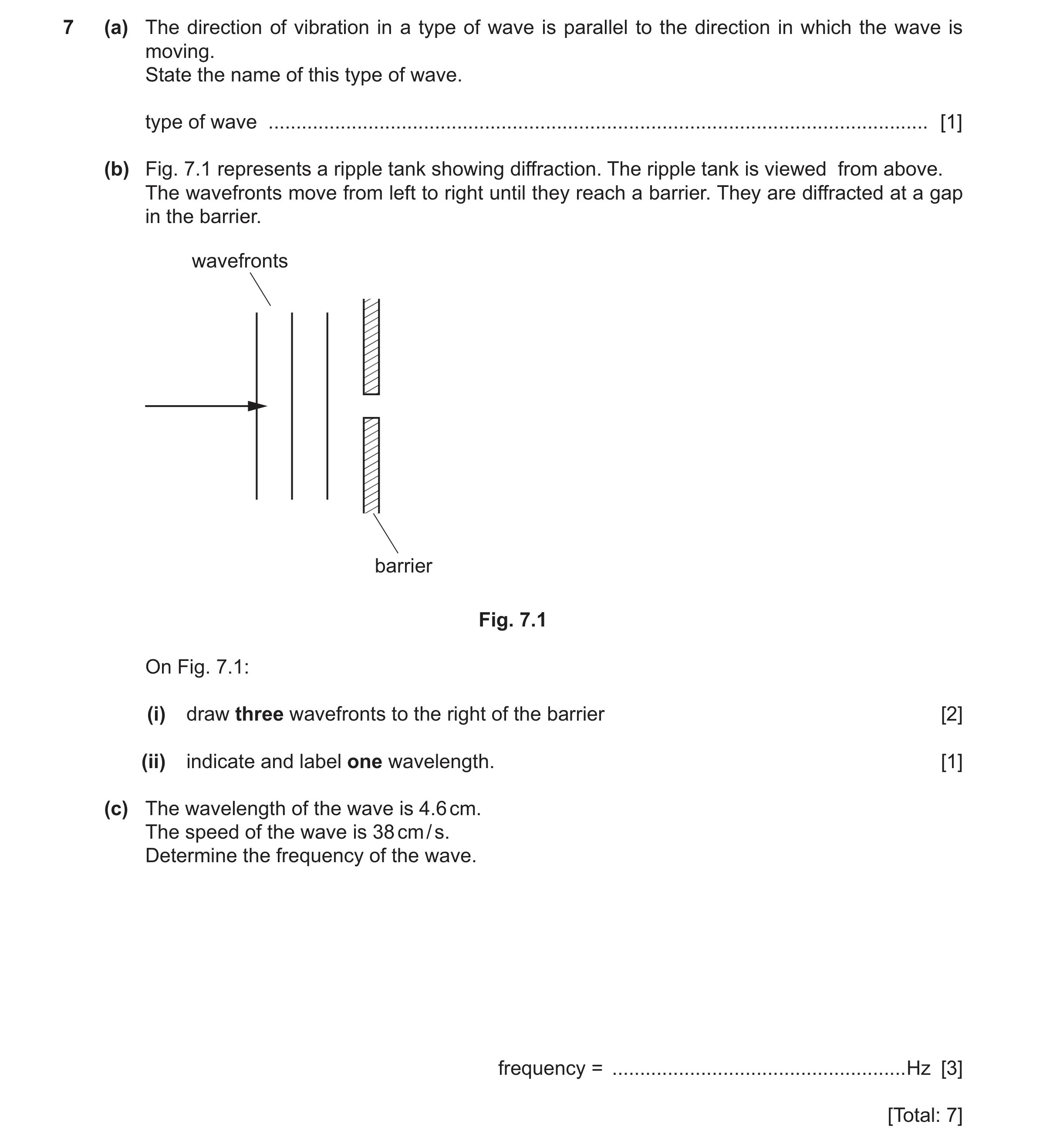
Q29 · The direction of vibration in a type of wave is parallel to the direction in which the… 0625/32 Oct/Nov 2024
7 (a) The direction of vibration in a type of wave is parallel to the direction in which the wave is moving. State the name of this type of wave. type of wave … [1] (b) Fig. 7.1 represents a ripple tank showing diffraction. The ripple tank is viewed from above. The wavefronts move from left to right until they reach a barrier. They are diffracted at a gap in the barrier. wavefronts barrier Fig. 7.1 On Fig. 7.1: (i) draw three wavefronts to the right of the barrier [2] (ii) indicate and label one wavelength. [1] (c) The wavelength of the wave is 4.6 cm. The speed of the wave is 38 cm / s. Determine the frequency of the wave. frequency = … Hz [3] [Total: 7]
7 marks
Mark scheme: 7(a) longitudinal B1 7(b)(i) (at least) 3 semi-circular wavefronts after gap showing diffraction B1 wavefronts with same wavelength as before gap B1 7(b)(ii) one wavelength drawn on diagram B1 7(c) 8.3 (Hz) A3 38 4.6 (C2) v = f OR (frequency =) speed wavelength OR (f =) v (C1)
This question in 0625/32 Oct/Nov 2024
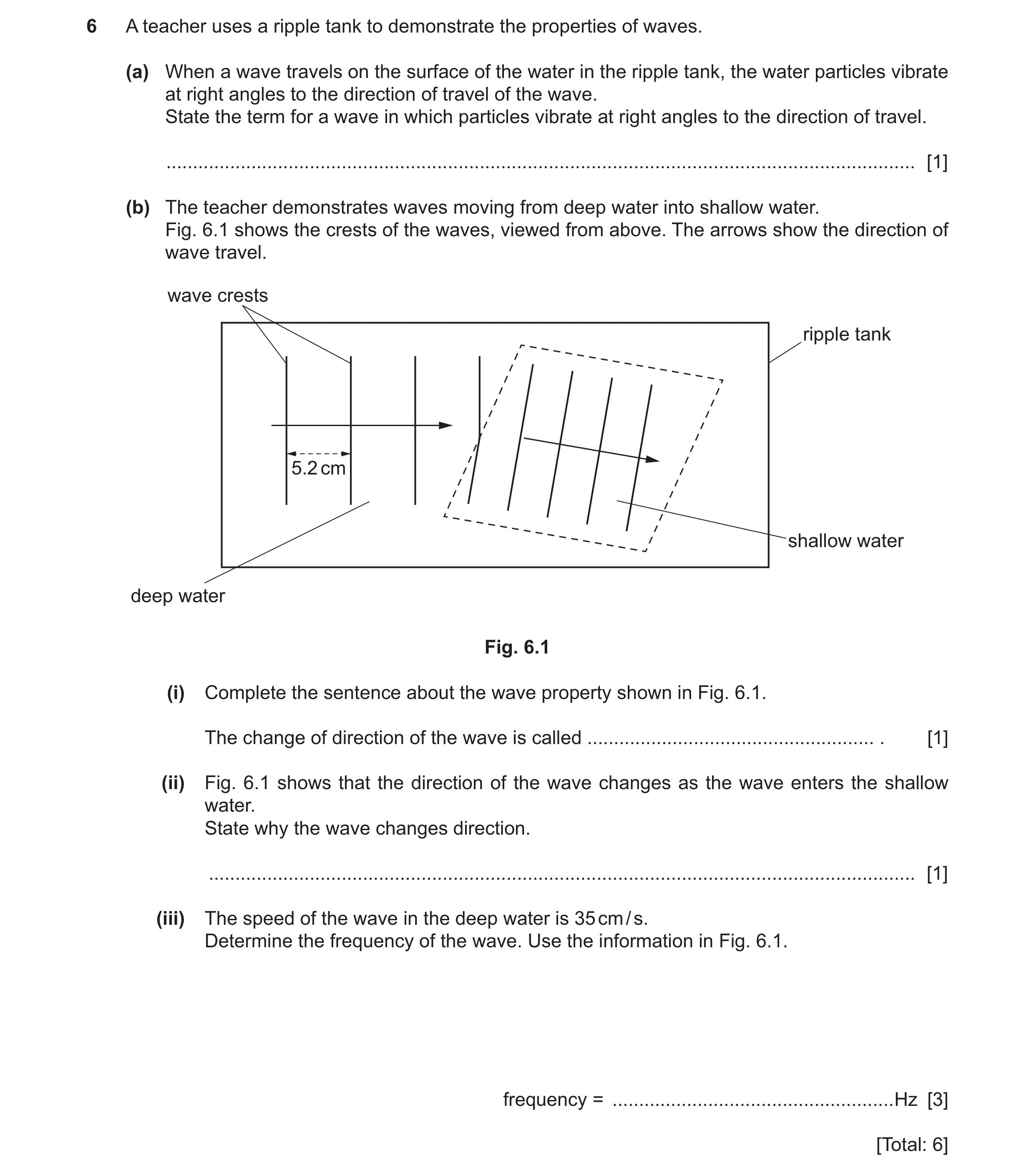
Q30 · A teacher uses a ripple tank to demonstrate the properties of waves 0625/33 Oct/Nov 2024
6 A teacher uses a ripple tank to demonstrate the properties of waves. (a) When a wave travels on the surface of the water in the ripple tank, the water particles vibrate at right angles to the direction of travel of the wave. State the term for a wave in which particles vibrate at right angles to the direction of travel. … [1] (b) The teacher demonstrates waves moving from deep water into shallow water. Fig. 6.1 shows the crests of the waves, viewed from above. The arrows show the direction of wave travel. wave crests ripple tank 5.2 cm shallow water deep water Fig. 6.1 (i) Complete the sentence about the wave property shown in Fig. 6.1. The change of direction of the wave is called … . [1] (ii) Fig. 6.1 shows that the direction of the wave changes as the wave enters the shallow water. State why the wave changes direction. … [1] (iii) The speed of the wave in the deep water is 35 cm / s. Determine the frequency of the wave. Use the information in Fig. 6.1. frequency = … Hz [3] [Total: 6]
6 marks
Mark scheme: 6(a) transverse B1 6(b)(i) refraction B1 6(b)(ii) speed (of wave) changes B1 6(b)(iii) 6.7 (Hz) A3 35 5.2 (C2) v = f OR (frequency =) (wave) speed wavelength (C1)
This question in 0625/33 Oct/Nov 2024
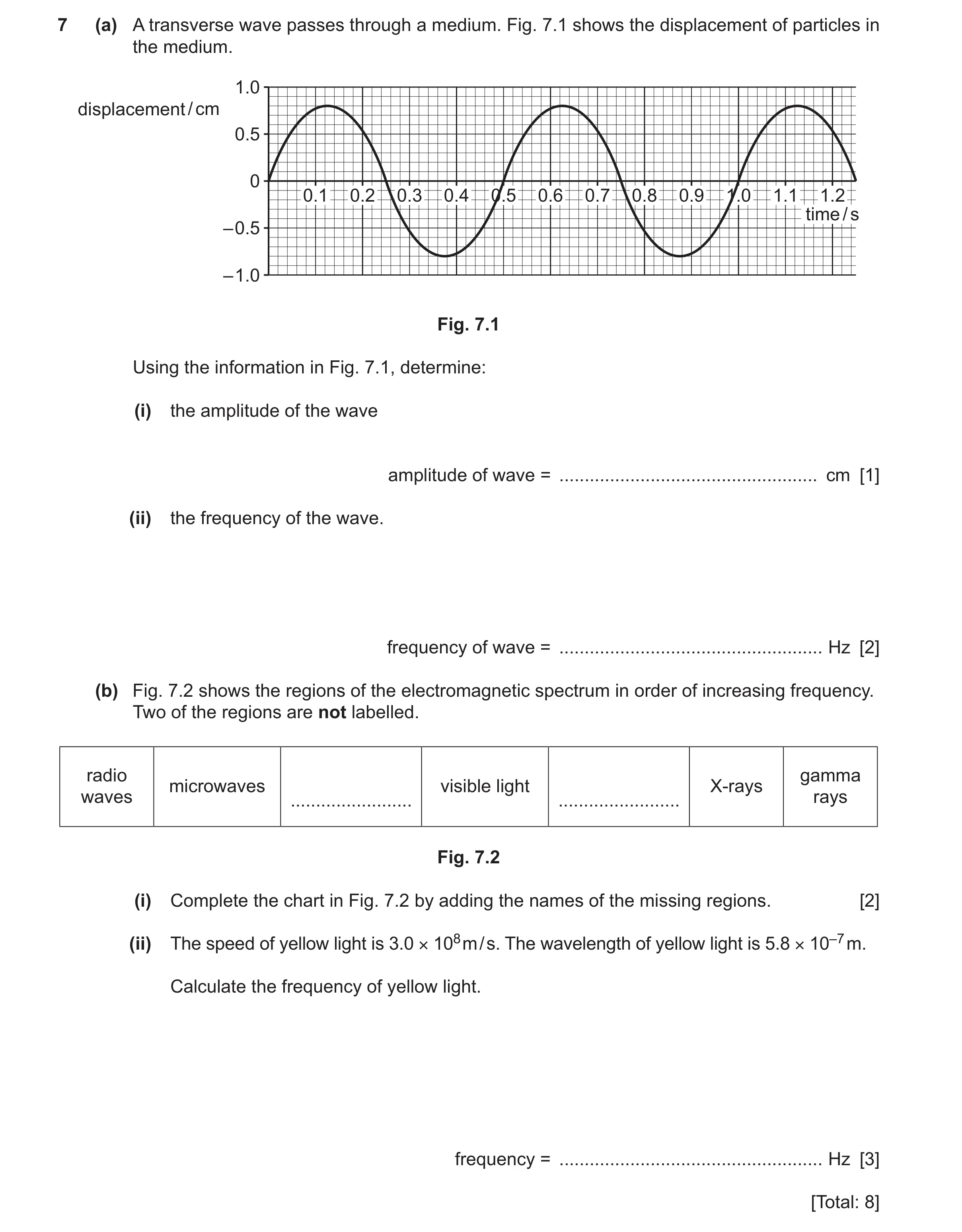
Q31 · A transverse wave passes through a medium 0625/31 May/June 2025
7 (a) A transverse wave passes through a medium. Fig. 7.1 shows the displacement of particles in the medium. 1.0 displacement / cm 0.5 0 0.1 0.2 0.3 0.4 0.5 0.6 0.7 0.8 0.9 1.0 1.1 1.2 time / s – 0.5 – 1.0 Fig. 7.1 Using the information in Fig. 7.1, determine: (i) the amplitude of the wave amplitude of wave = … cm [1] (ii) the frequency of the wave. frequency of wave = … Hz [2] (b) Fig. 7.2 shows the regions of the electromagnetic spectrum in order of increasing frequency. Two of the regions are not labelled. radio gamma microwaves visible light X-rays waves … … rays Fig. 7.2 (i) Complete the chart in Fig. 7.2 by adding the names of the missing regions. [2] (ii) The speed of yellow light is 3.0 × 10⁸ m / s. The wavelength of yellow light is 5.8 × 10⁻⁷ m. Calculate the frequency of yellow light. frequency = … Hz [3] [Total: 8]
8 marks
Mark scheme: 7(a)(i) 0.8 (cm) B1 7(a)(ii) (frequency =) 2(.0) (Hz) A2 idea that frequency is number of waves (sent out) in one second C1 7(b)(i) infrared (waves) (in left box) B1 ultraviolet (light / waves) (in right box) B1 7(b)(ii) 5.2 1014 (Hz) A3 3.0 108 = f 5.8 10−7 OR (f =) 3.0 10N ÷ 5.8 10N C2 v = fin any form OR (f =) v ÷ C1
This question in 0625/31 May/June 2025
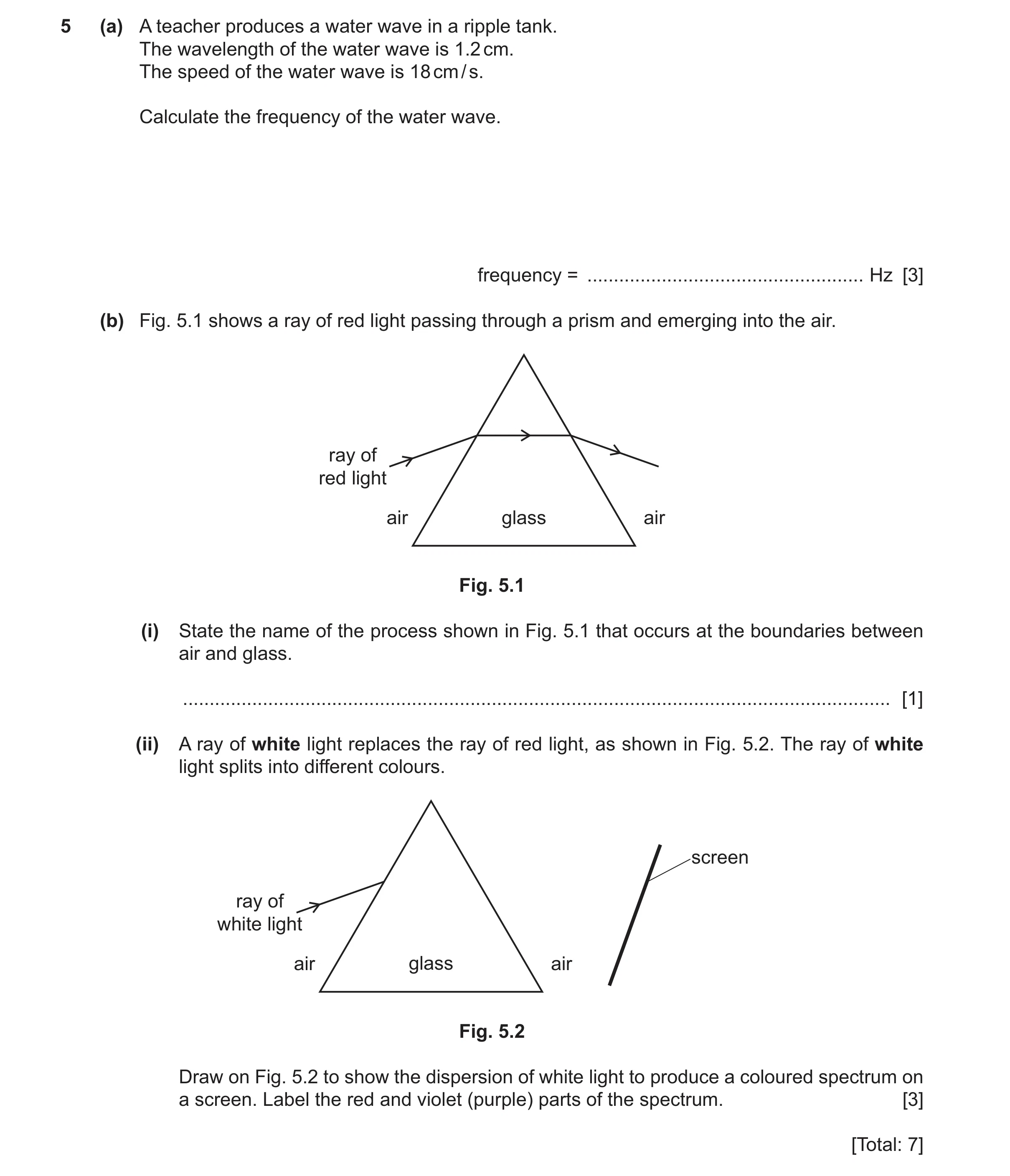
Q32 · A teacher produces a water wave in a ripple tank 0625/32 May/June 2025
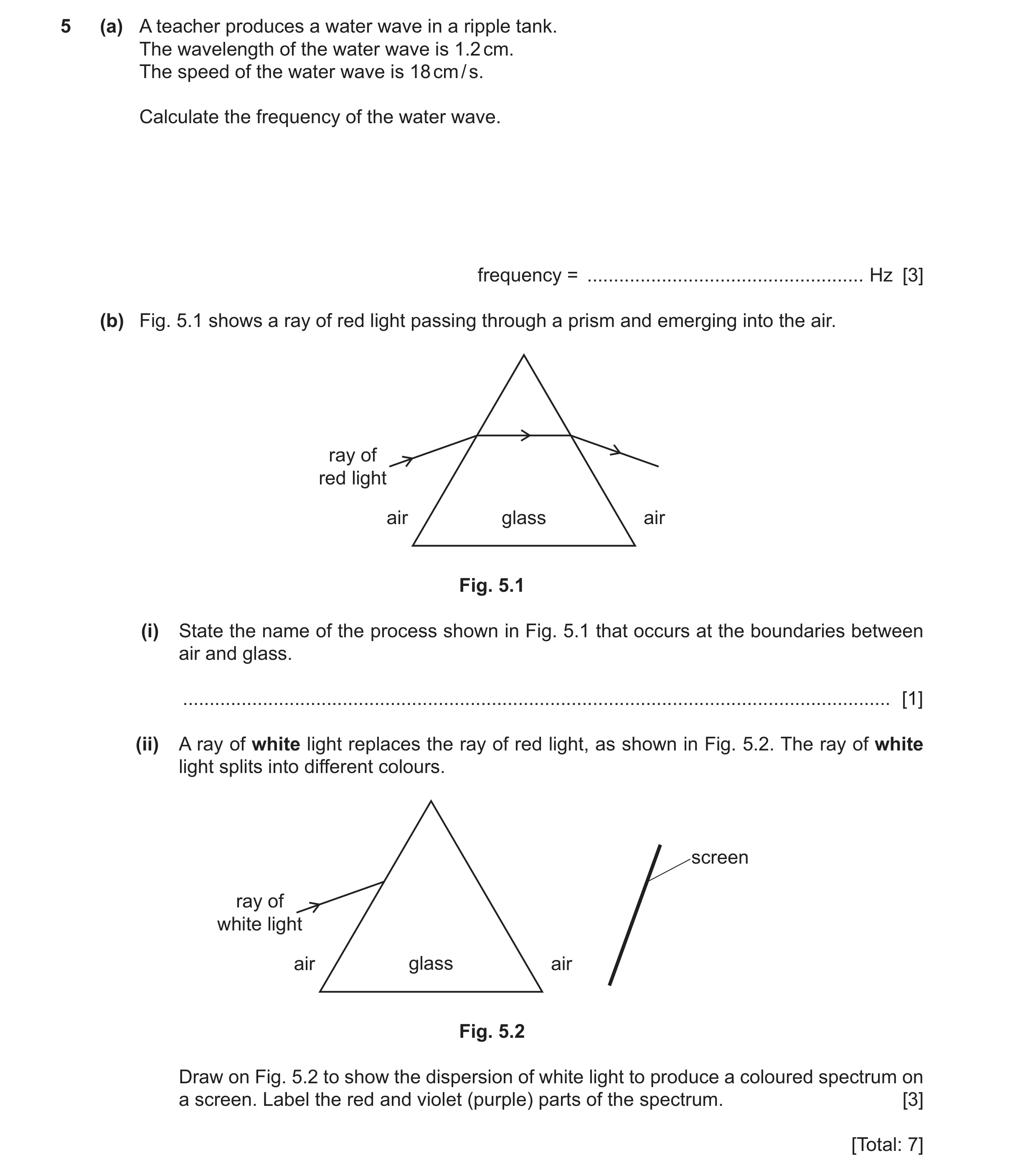
5 (a) A teacher produces a water wave in a ripple tank. The wavelength of the water wave is 1.2 cm. The speed of the water wave is 18 cm / s. Calculate the frequency of the water wave. frequency = … Hz [3] (b) Fig. 5.1 shows a ray of red light passing through a prism and emerging into the air. ray of red light air glass air Fig. 5.1 (i) State the name of the process shown in Fig. 5.1 that occurs at the boundaries between air and glass. … [1] (ii) A ray of white light replaces the ray of red light, as shown in Fig. 5.2. The ray of white light splits into different colours. screen ray of white light air glass air Fig. 5.2 Draw on Fig. 5.2 to show the dispersion of white light to produce a coloured spectrum on a screen. Label the red and violet (purple) parts of the spectrum. [3] [Total: 7]
7 marks
Mark scheme: 5(a) 15 (Hz) A3 18 ÷ 1.2 C2 (frequency =) speed ÷ wavelength C1 5(b)(i) refraction B1 5(b)(ii) dispersion at air-glass boundary AND rays continue to screen A2 dispersion / ray broadens seen at either boundary C1 red (at top) and violet / purple (at bottom) B1
This question in 0625/32 May/June 2025
Q33 · Place ticks (✓) in Table 7.1 to show the properties of sound waves and of microwaves 0625/32 May/June 2025
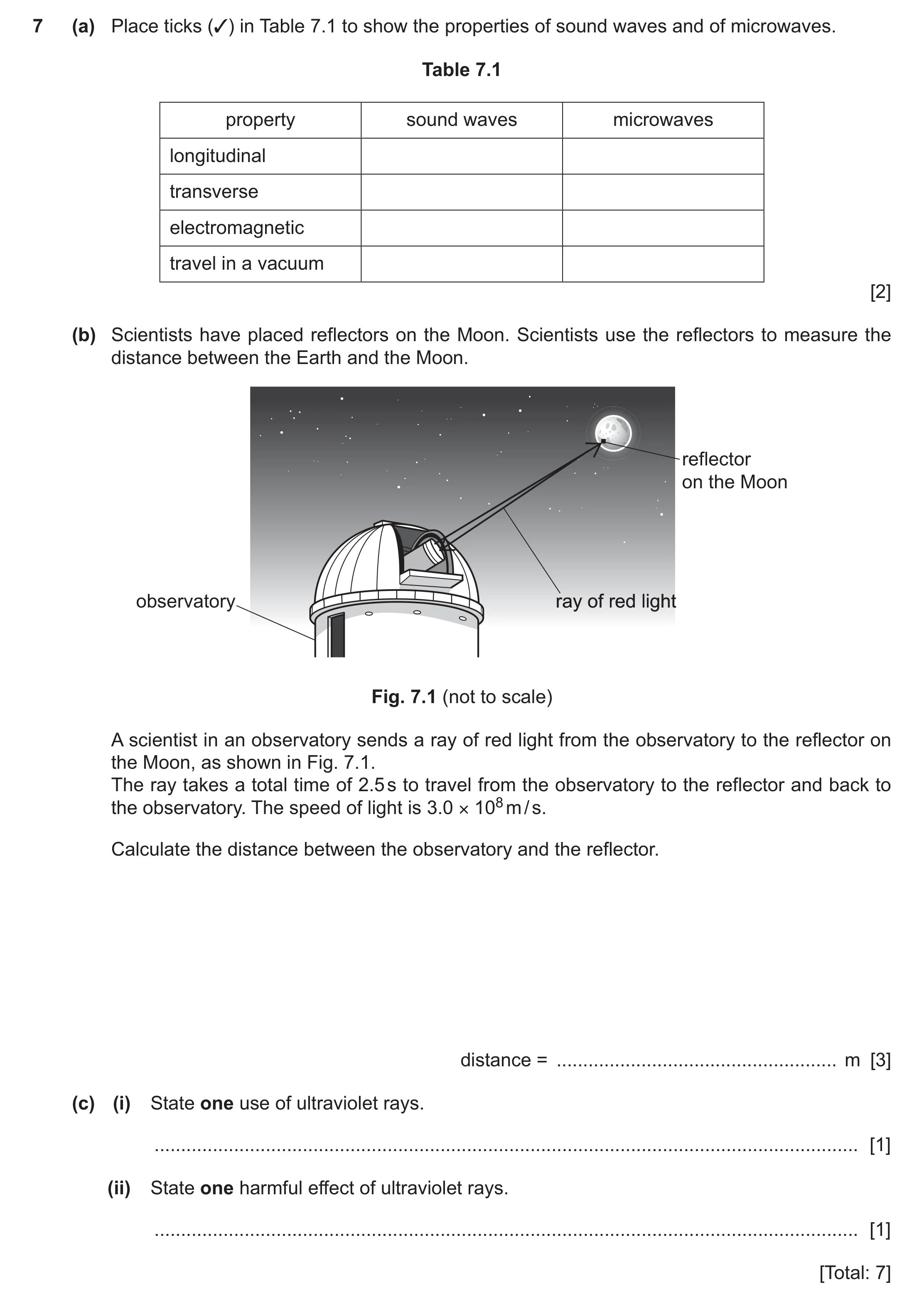
7 (a) Place ticks (✓) in Table 7.1 to show the properties of sound waves and of microwaves. Table 7.1 property sound waves microwaves longitudinal transverse electromagnetic travel in a vacuum [2] (b) Scientists have placed reflectors on the Moon. Scientists use the reflectors to measure the distance between the Earth and the Moon. reflector on the Moon observatory rayray ofof redred lightlight Fig. 7.1 (not to scale) A scientist in an observatory sends a ray of red light from the observatory to the reflector on the Moon, as shown in Fig. 7.1. The ray takes a total time of 2.5 s to travel from the observatory to the reflector and back to the observatory. The speed of light is 3.0 × 10⁸ m / s. Calculate the distance between the observatory and the reflector. distance = … m [3] (c) (i) State one use of ultraviolet rays. … [1] (ii) State one harmful effect of ultraviolet rays. … [1] [Total: 7]
7 marks
Mark scheme: 7(a) B2 property sound waves microwaves longitudinal ✓ transverse ✓ electromagnetic ✓ travel in a vacuum ✓ 4 correct – 2 marks 2 or 3 correct – 1 mark 7(b) 3.8 108 (m) A3 3(.0) 108 1.25 OR 3(.0) 108 (2.5 ÷ 2) OR 7.5 108 C2 (distance =) speed time C1 7(c)(i) security marking OR detecting fake bank notes OR sterilising water OR fluorescent effects B1 7(c)(ii) damage to surface cells / skin / eyes OR damage to genes / DNA OR skin cancer B1
This question in 0625/32 May/June 2025
Q34 · A teacher produces a water wave in a ripple tank 0625/33 May/June 2025
5 (a) A teacher produces a water wave in a ripple tank. The wavelength of the water wave is 1.2 cm. The speed of the water wave is 18 cm / s. Calculate the frequency of the water wave. frequency = … Hz [3] (b) Fig. 5.1 shows a ray of red light passing through a prism and emerging into the air. ray of red light air glass air Fig. 5.1 (i) State the name of the process shown in Fig. 5.1 that occurs at the boundaries between air and glass. … [1] (ii) A ray of white light replaces the ray of red light, as shown in Fig. 5.2. The ray of white light splits into different colours. screen ray of white light air glass air Fig. 5.2 Draw on Fig. 5.2 to show the dispersion of white light to produce a coloured spectrum on a screen. Label the red and violet (purple) parts of the spectrum. [3] [Total: 7]
7 marks
Mark scheme: 5(a) 15 (Hz) A3 18 ÷ 1.2 C2 (frequency =) speed ÷ wavelength C1 5(b)(i) refraction B1 5(b)(ii) dispersion at air-glass boundary AND rays continue to screen A2 dispersion / ray broadens seen at either boundary C1 red (at top) and violet / purple (at bottom) B1
This question in 0625/33 May/June 2025
Q35 · Place ticks (✓) in Table 7.1 to show the properties of sound waves and of microwaves 0625/33 May/June 2025
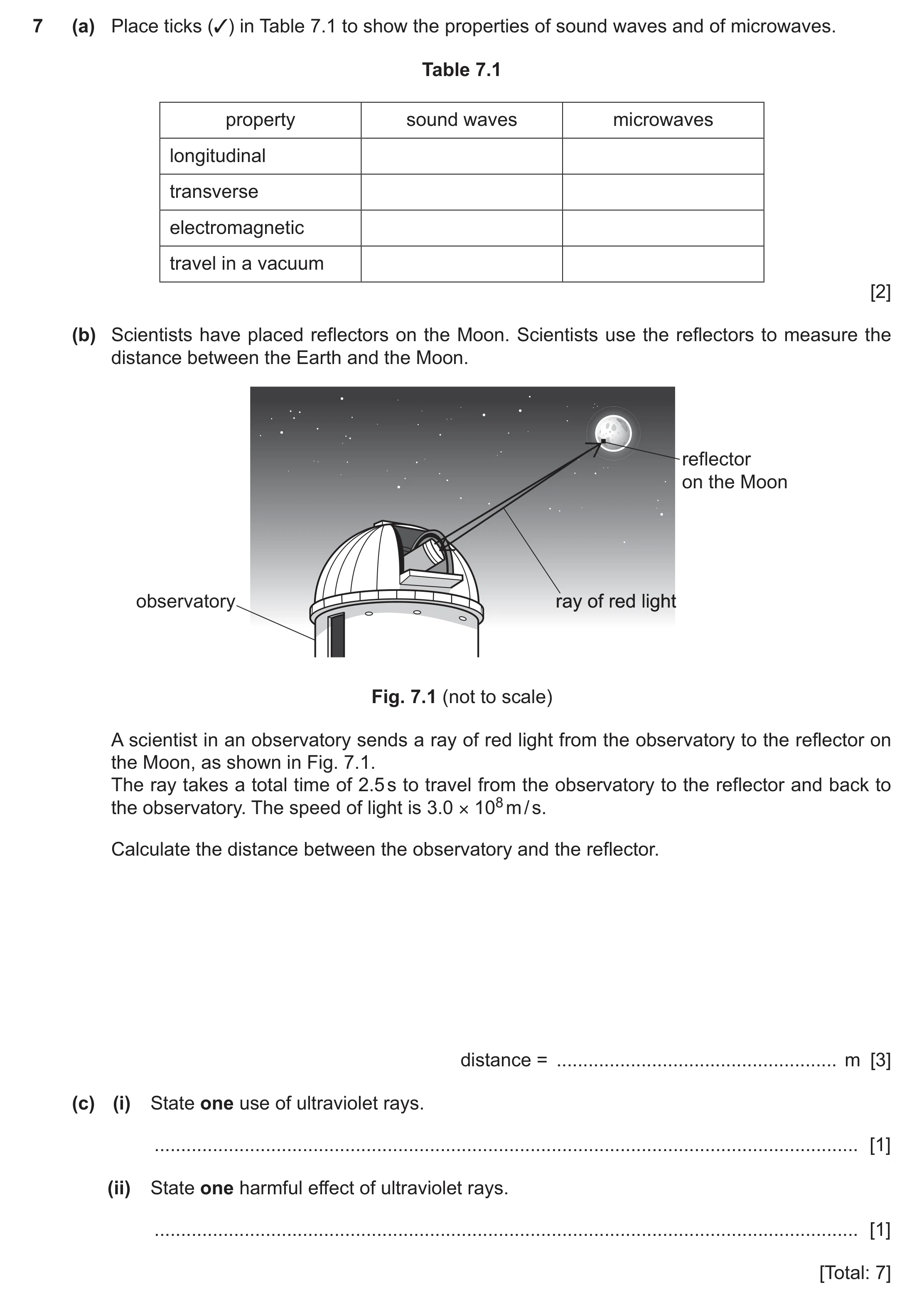
7 (a) Place ticks (✓) in Table 7.1 to show the properties of sound waves and of microwaves. Table 7.1 property sound waves microwaves longitudinal transverse electromagnetic travel in a vacuum [2] (b) Scientists have placed reflectors on the Moon. Scientists use the reflectors to measure the distance between the Earth and the Moon. reflector on the Moon observatory rayray ofof redred lightlight Fig. 7.1 (not to scale) A scientist in an observatory sends a ray of red light from the observatory to the reflector on the Moon, as shown in Fig. 7.1. The ray takes a total time of 2.5 s to travel from the observatory to the reflector and back to the observatory. The speed of light is 3.0 × 10⁸ m / s. Calculate the distance between the observatory and the reflector. distance = … m [3] (c) (i) State one use of ultraviolet rays. … [1] (ii) State one harmful effect of ultraviolet rays. … [1] [Total: 7]
7 marks
Mark scheme: 7(a) B2 property sound waves microwaves longitudinal ✓ transverse ✓ electromagnetic ✓ travel in a vacuum ✓ 4 correct – 2 marks 2 or 3 correct – 1 mark 7(b) 3.8 108 (m) A3 3(.0) 108 1.25 OR 3(.0) 108 (2.5 ÷ 2) OR 7.5 108 C2 (distance =) speed time C1 7(c)(i) security marking OR detecting fake bank notes OR sterilising water OR fluorescent effects B1 7(c)(ii) damage to surface cells / skin / eyes OR damage to genes / DNA OR skin cancer B1
This question in 0625/33 May/June 2025
Q36 · The main regions of the electromagnetic spectrum in order of increasing frequency 0625/31 Oct/Nov 2025
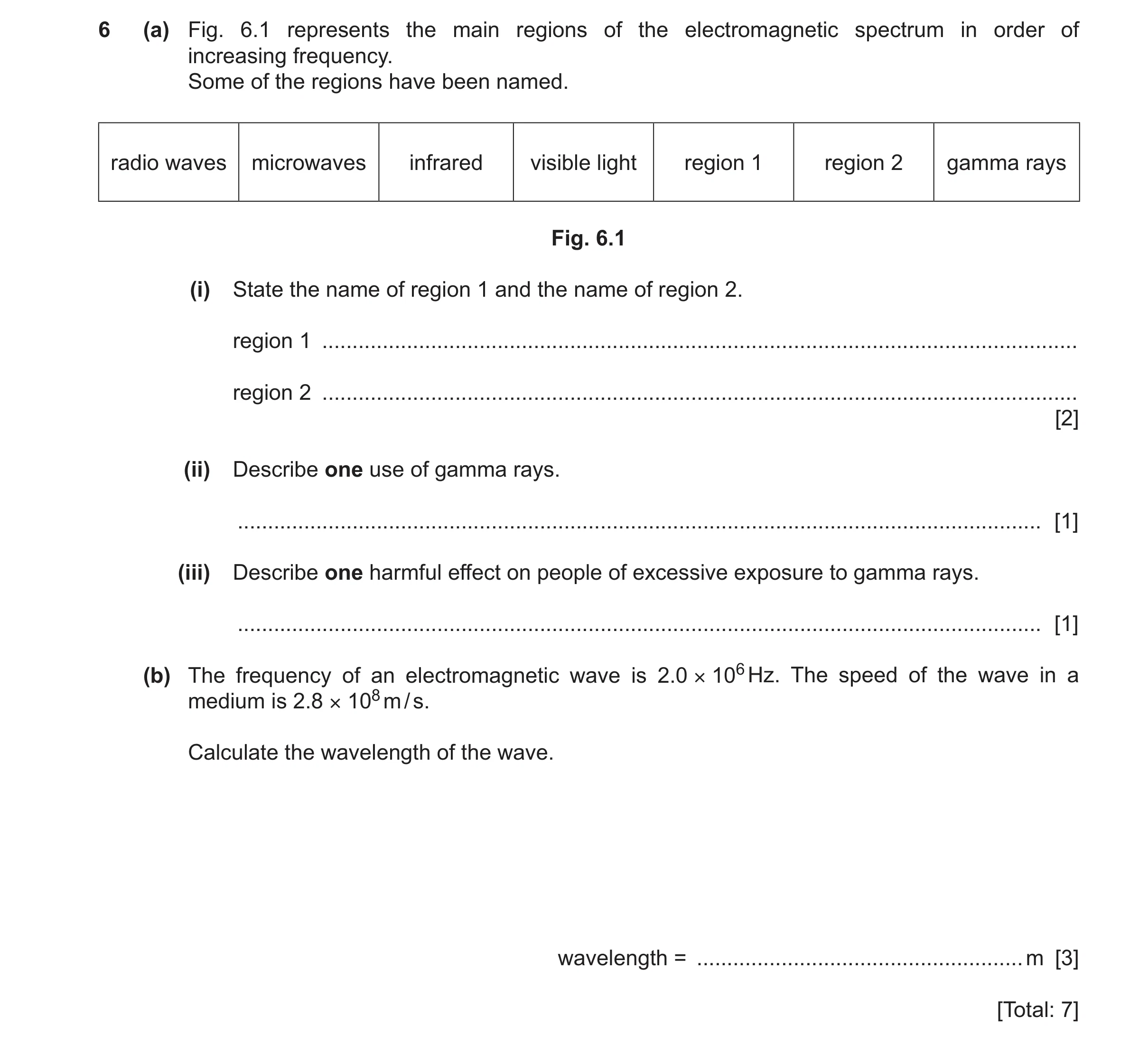
6 (a) Fig. 6.1 represents the main regions of the electromagnetic spectrum in order of increasing frequency. Some of the regions have been named. radio waves microwaves infrared visible light region 1 region 2 gamma rays Fig. 6.1 (i) State the name of region 1 and the name of region 2. region 1 … region 2 … [2] (ii) Describe one use of gamma rays. … [1] (iii) Describe one harmful effect on people of excessive exposure to gamma rays. … [1] (b) The frequency of an electromagnetic wave is 2.0 × 10⁶ Hz. The speed of the wave in a medium is 2.8 × 10⁸ m / s. Calculate the wavelength of the wave. wavelength = … m [3] [Total: 7]
7 marks
Mark scheme: 6(a)(i) (1) ultraviolet (light/rays) B1 (2) X-rays B1 6(a)(ii) sterilising (food or medical dressings/equipment) OR detection/treatment of cancer OR B1 (gamma) imaging OR tracing detection of (underground) leaking pipes/(metal) cracks owtte 6(a)(iii) mutation of cells/DNA OR damage to cells/DNA B1 6(b) (λ = ) 1.4 102 (m) A3 (λ = ) 2.8 ( 108) ÷ 2.0 ( 106) (C2) v = f × λ OR (λ = ) v ÷ f (C1)
This question in 0625/31 Oct/Nov 2025
Q37 · A group of students are studying a topic called ‘Light and Sound’ 0625/32 Oct/Nov 2025
4 A group of students are studying a topic called ‘Light and Sound’. (a) Fig. 4.1 shows a demonstration using a noisy toy. air outlet noisy toy transparent box sound proof block Fig. 4.1 The teacher puts the noisy toy into a sealed, transparent case that contains air. The teacher removes the air from inside the case. The sound of the noisy toy becomes quieter until the students cannot hear it. The students can see the toy moving, but cannot hear it, because light and sound have different properties. State three differences between the properties of light and the properties of sound. 1 … 2 … 3 … [3] (b) The students go to a large park to determine the speed of sound. Describe an experiment for determining the speed of sound. You may draw a diagram as part of your answer. … … … … … … … … [4] (c) The students find that the speed of sound is 340 m / s. They strike a tuning fork of frequency 260 Hz. Calculate the wavelength of the sound that the tuning fork produces. wavelength = … m [3] [Total: 10]
10 marks
Mark scheme: 4(a) any three from: B3 • light travels through a vacuum or • sound does not travel through a vacuum / needs a medium owtte • light is transverse (wave – sound isn’t) • sound is longitudinal (wave – light isn’t) • light is electromagnetic / e.m. (wave – sound isn’t) • light travels at different speed than sound (in air) 4(b) two students / groups at least 100 m apart B1 any three from: B3 • distance measured by tape (measure) / trundle wheel • means of making loud sound (that is visible) e.g. wooden blocks • distant student / group start measuring time when sound is made e.g. when blocks colliding seen • distant student / group stop time measurement when sound is heard • (time measured by) stopwatch / stop-clock / timer • repeat (experiment) AND calculate average (time) • use speed = distance ÷ time in any form alternative MS for echo method: B1 two students / group at least 50 m from wall / solid structure any three from: B3 • distance measured by tape (measure) / trundle wheel • means of making loud sound e.g. shouting • another student / group start(s) measuring time when loud noise made • another student / group stop measuring when echo / number of echoes is / are heard • (time measured by) stopwatch / stop-clock / timer • repeat (experiment) AND calculate average (time) or perform sound-echo-sound-echo (n) ⩾ 9 times AND ÷ n • use speed = 2 distance ÷ time 4(c) 1.3 (m) A3 340 ÷ 260 C2 (wavelength =) speed ÷ frequency C1
This question in 0625/32 Oct/Nov 2025
Q38 · Whether some energy resources are renewable and whether they cause air pollution when… 0625/33 Oct/Nov 2025
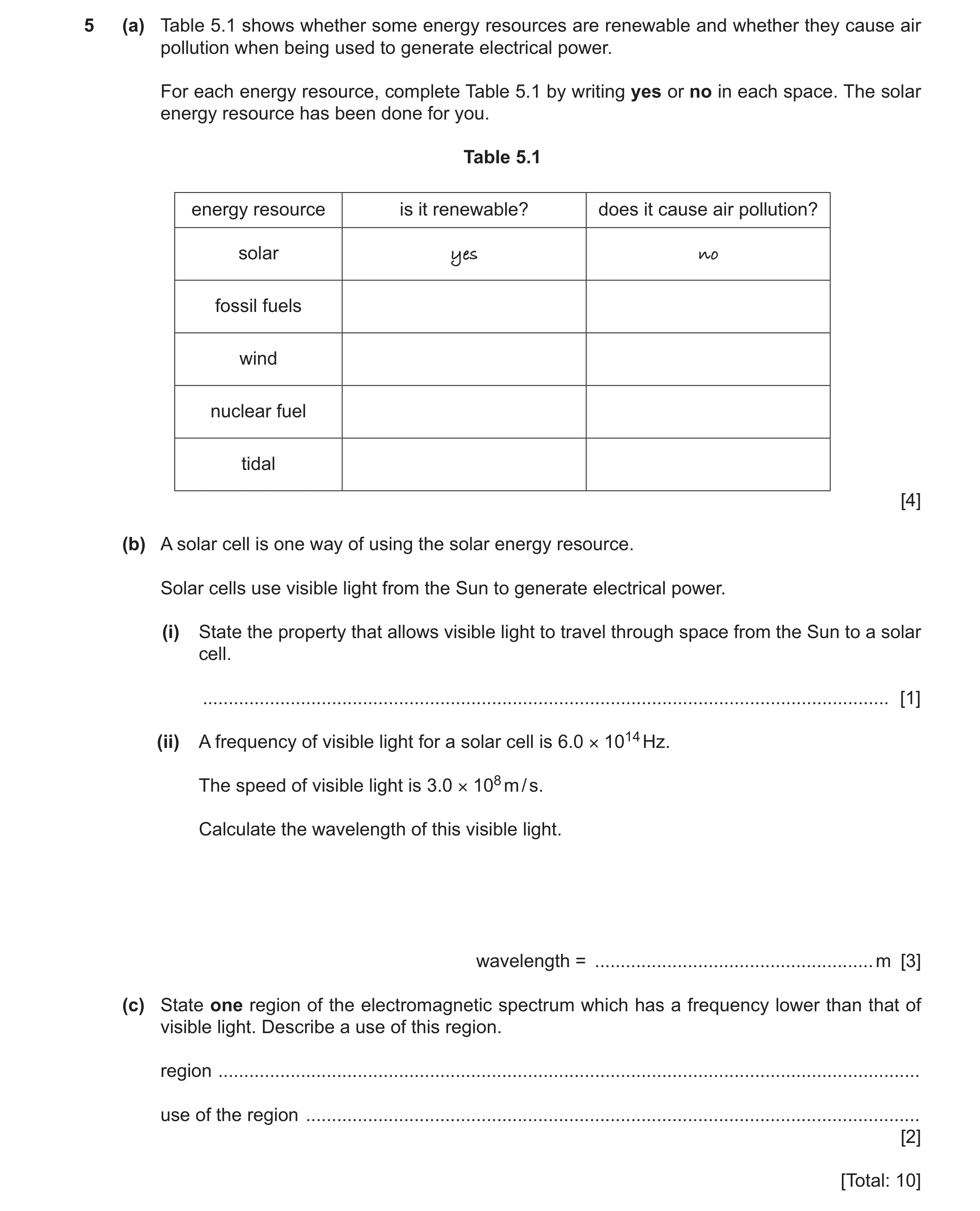
5 (a) Table 5.1 shows whether some energy resources are renewable and whether they cause air pollution when being used to generate electrical power. For each energy resource, complete Table 5.1 by writing yes or no in each space. The solar energy resource has been done for you. Table 5.1 energy resource is it renewable? does it cause air pollution? solar yes no fossil fuels wind nuclear fuel tidal [4] (b) A solar cell is one way of using the solar energy resource. Solar cells use visible light from the Sun to generate electrical power. (i) State the property that allows visible light to travel through space from the Sun to a solar cell. … [1] (ii) A frequency of visible light for a solar cell is 6.0 × 10¹⁴ Hz. The speed of visible light is 3.0 × 10⁸ m / s. Calculate the wavelength of this visible light. wavelength = … m [3] (c) State one region of the electromagnetic spectrum which has a frequency lower than that of visible light. Describe a use of this region. region … use of the region … [2] [Total: 10]
10 marks
Mark scheme: 5(a) B1 energy resource is it renewable? does it cause air pollution? B1 solar yes no B1 fossil fuels no yes B1 wind yes no nuclear fuel no no tidal yes no 5(b)(i) (light) travels through a vacuum or (light) does not need a medium B1 5(b)(ii) 5(.0) 10–7 (m) A3 3.0 ( 108) ÷ 6.0 ( 1014) C2 (wavelength =) speed ÷ frequency C1 5(c) infrared or microwaves or radio (waves) B1 matching use B1
This question in 0625/33 Oct/Nov 2025
 1 / 43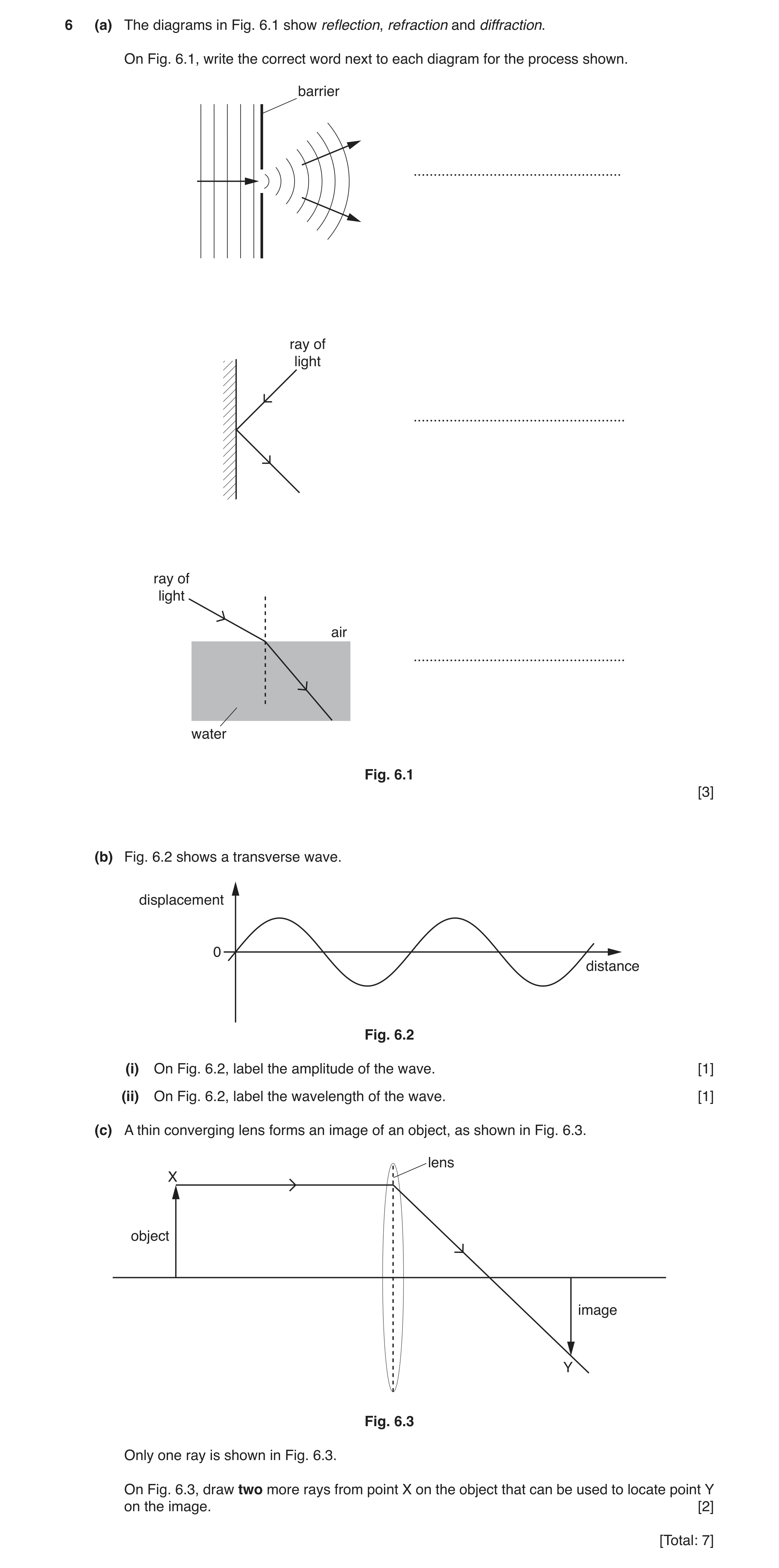
 5 / 43
 6 / 43
 7 / 43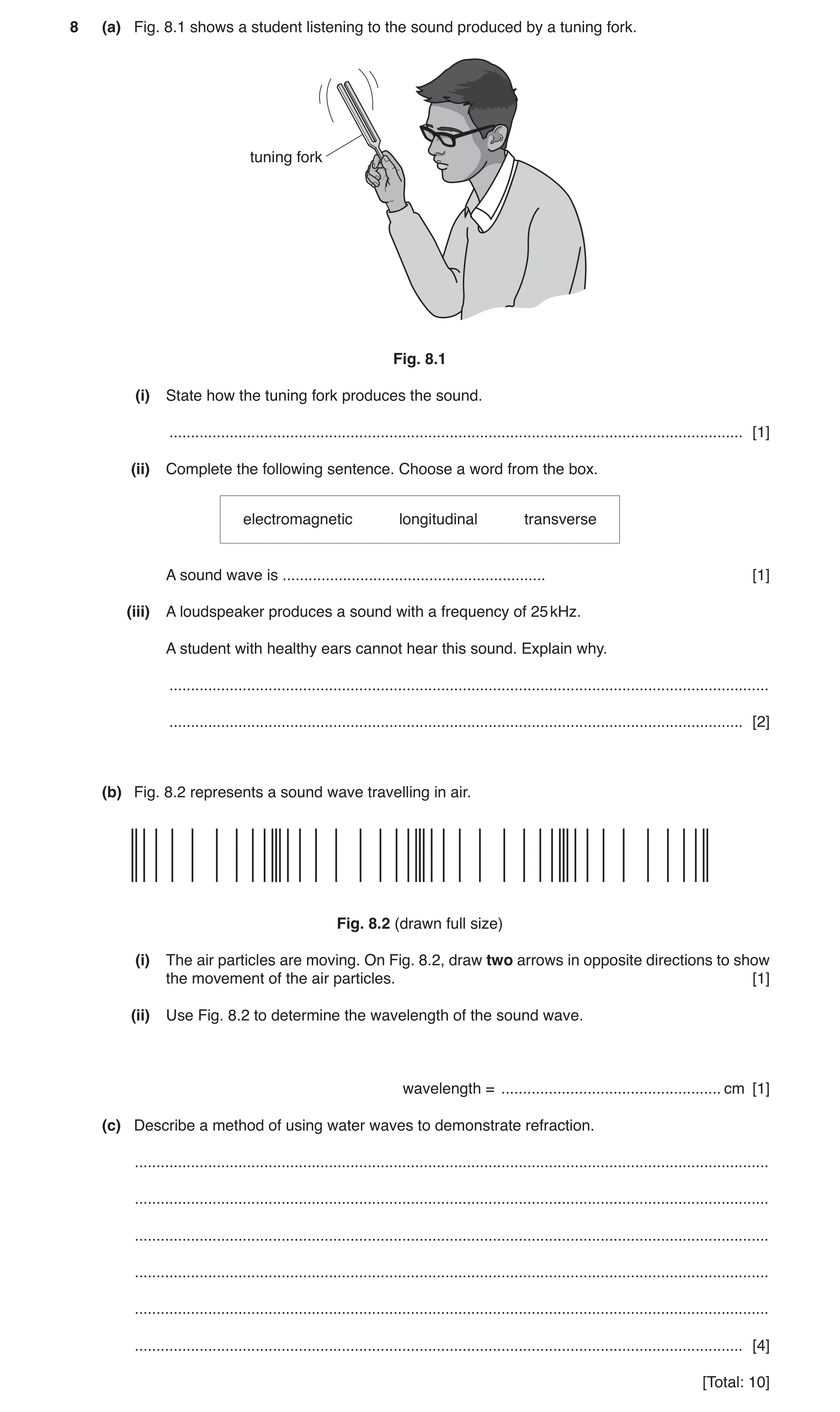
 9 / 43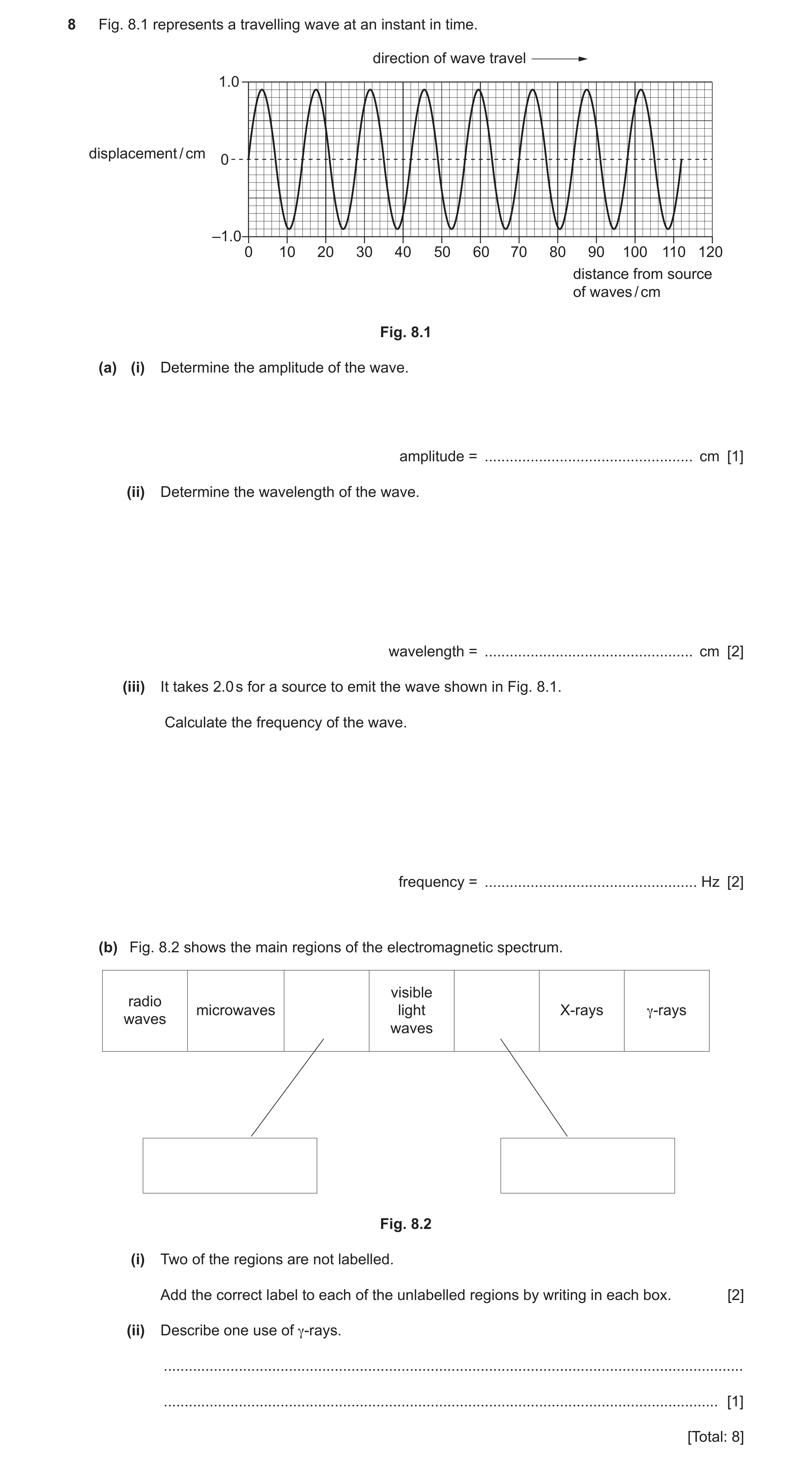
 11 / 43
 12 / 43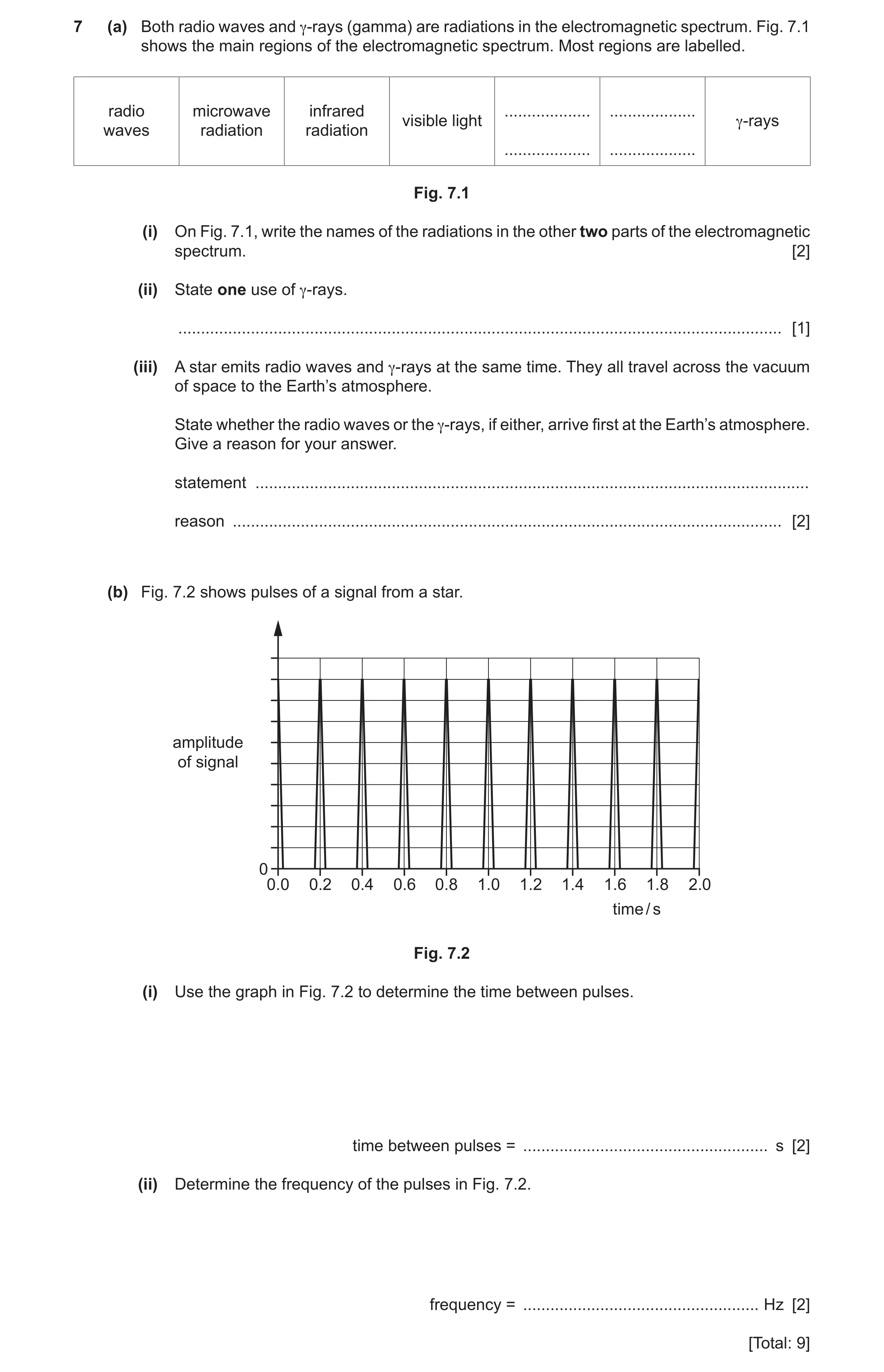
 18 / 43
 19 / 43
 20 / 43
 21 / 43
 22 / 43
 23 / 43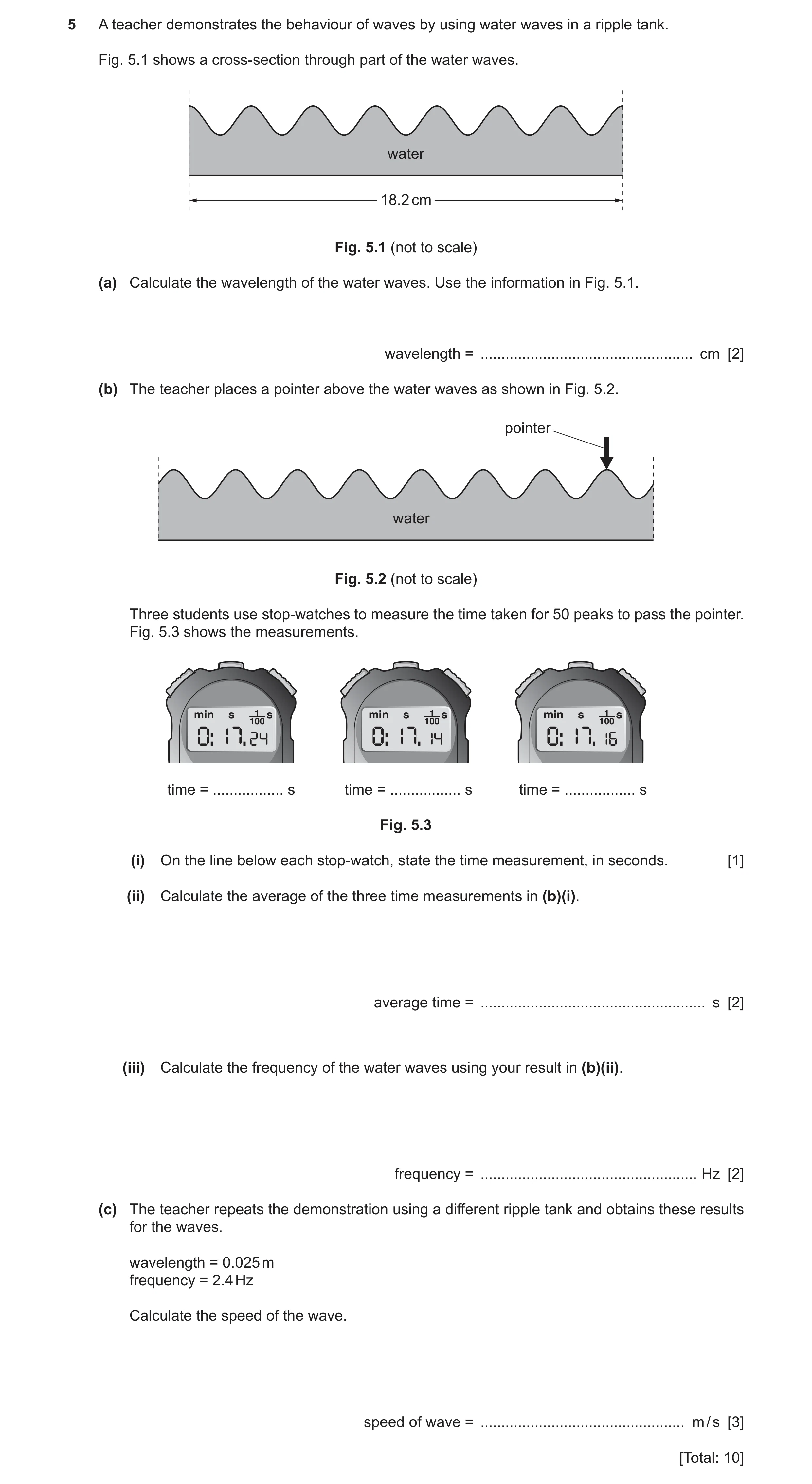
 29 / 43
 30 / 43
 31 / 43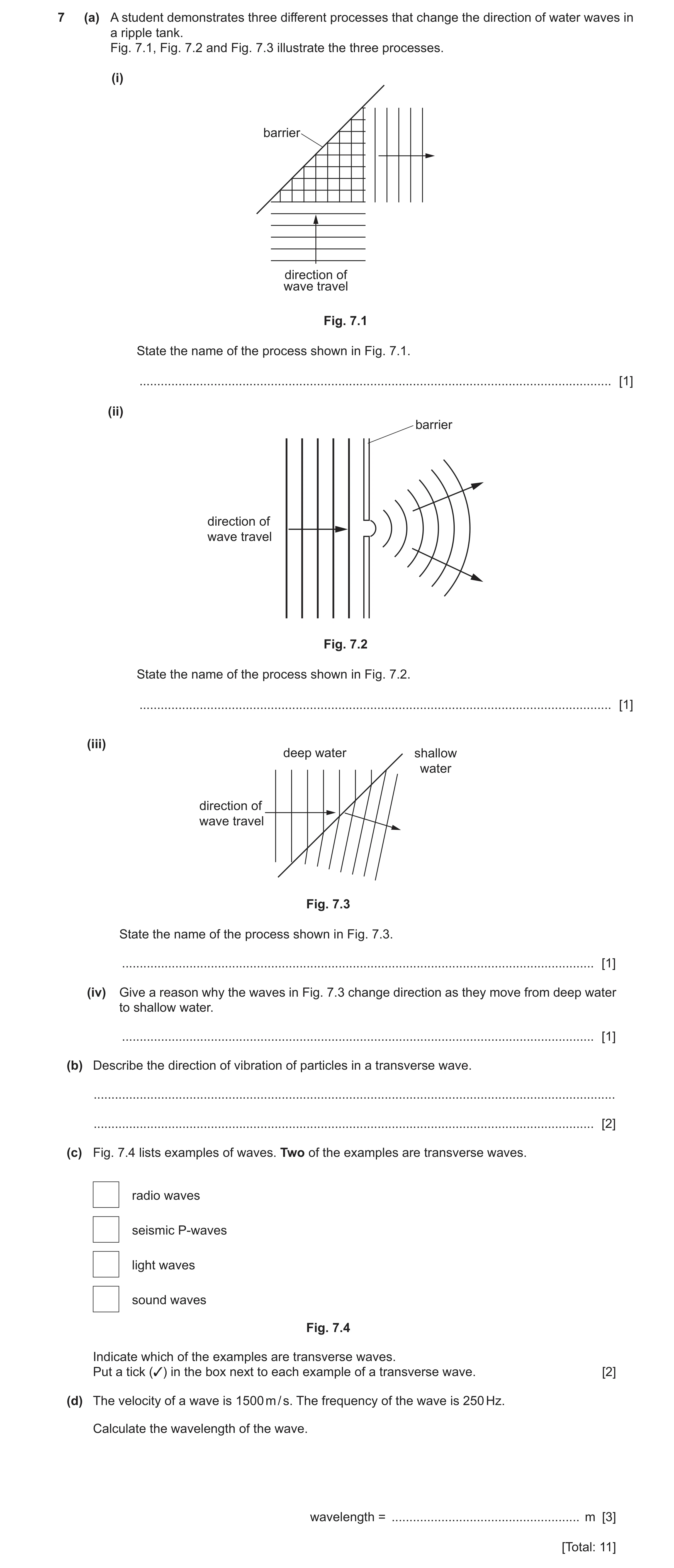
 34 / 43
 35 / 43
 36 / 43
 37 / 43
 38 / 43
 39 / 43
 40 / 43
 41 / 43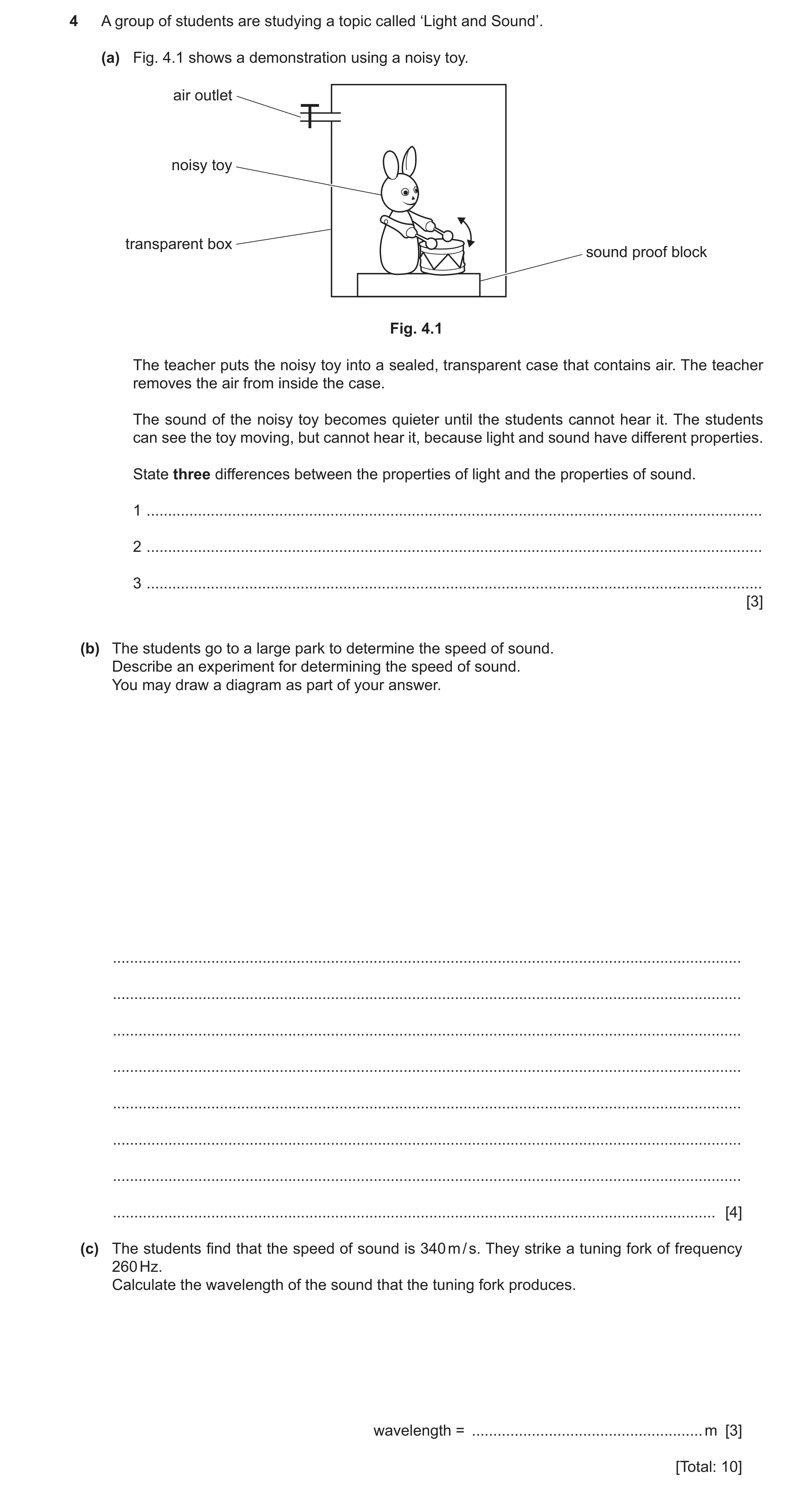
 43 / 43
 5
5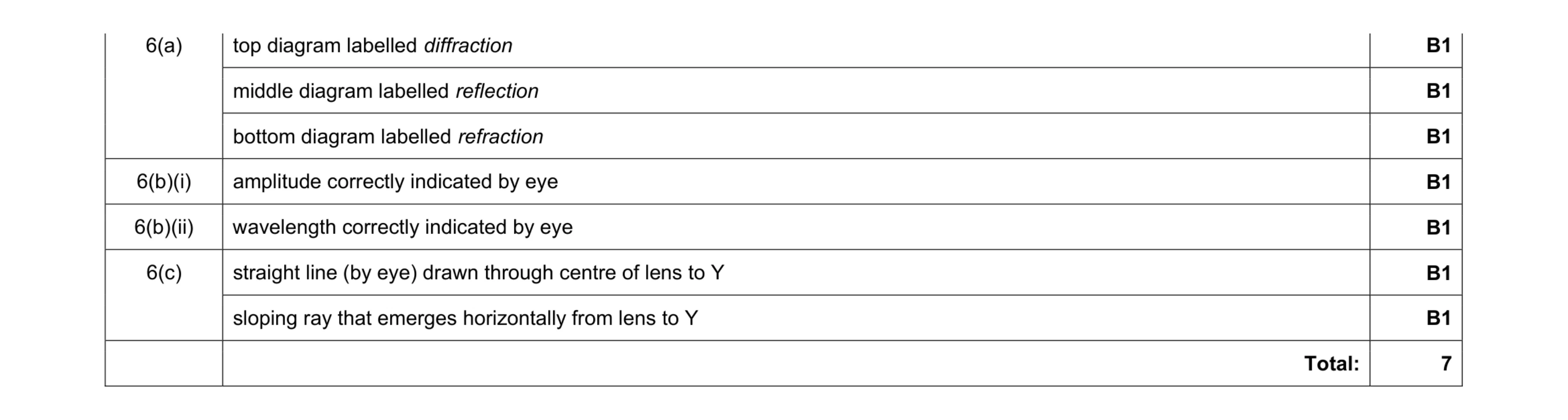 7
7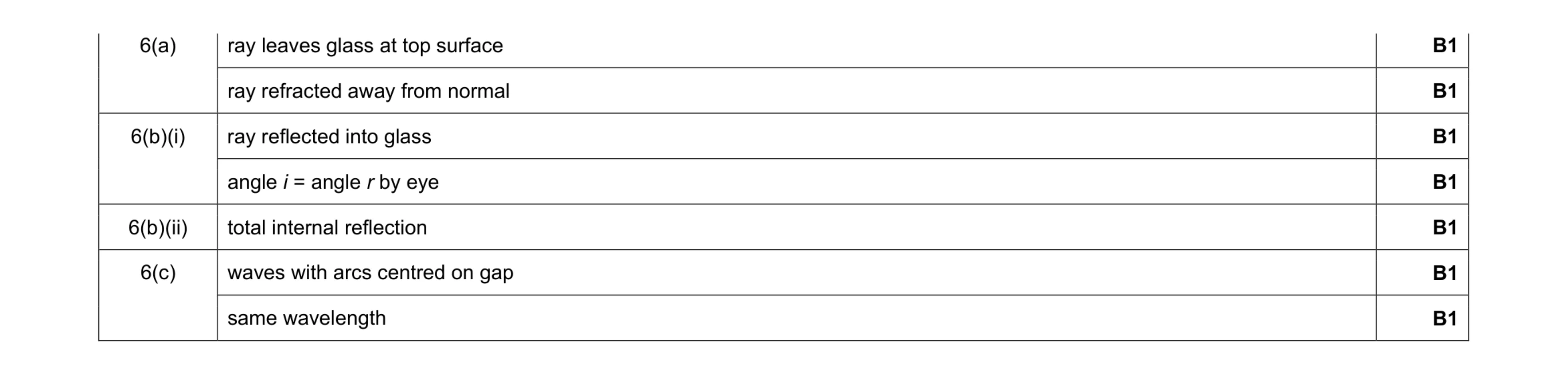 7
7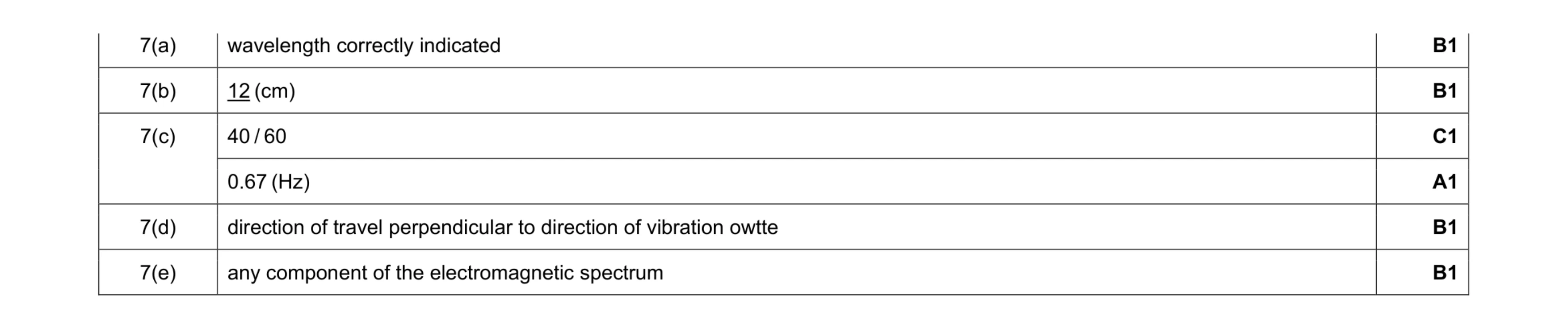 6
6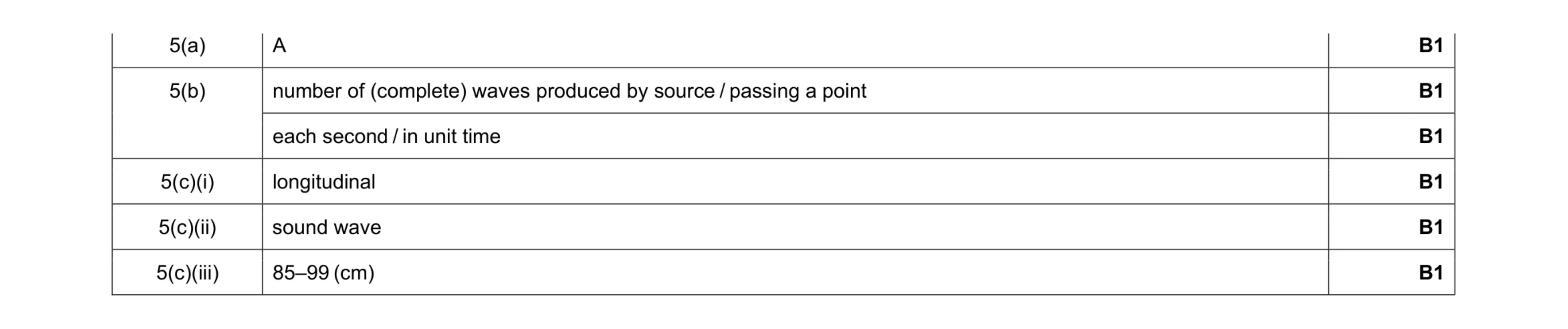 6
6 5
5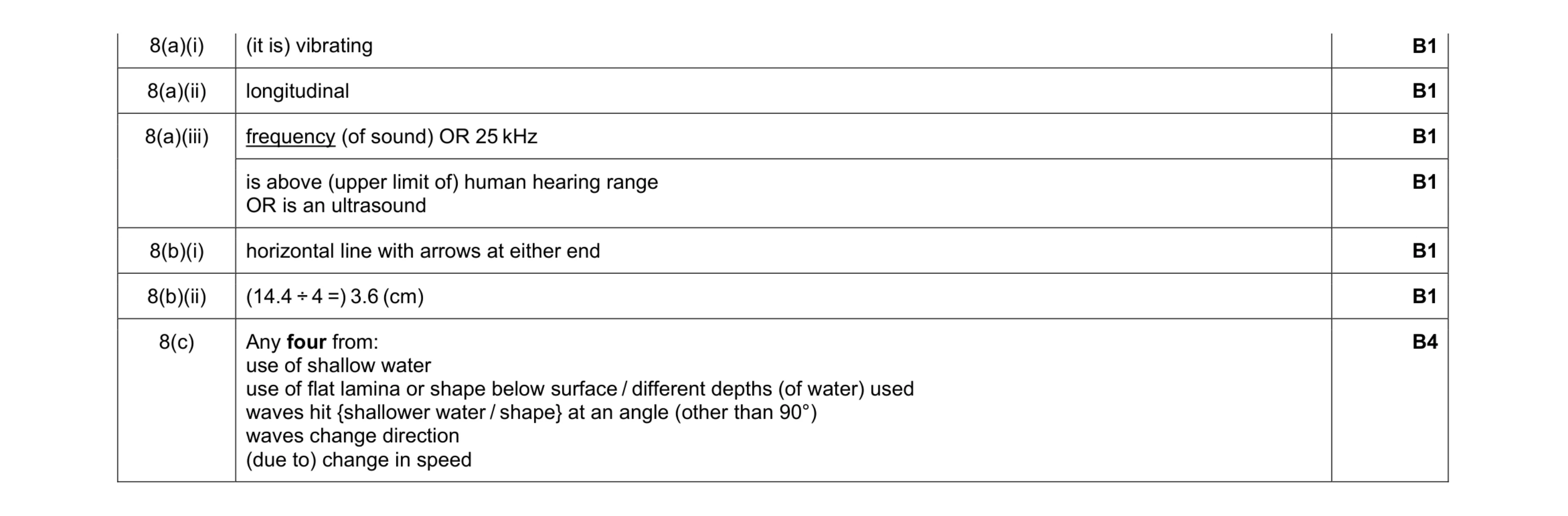 10
10 5
5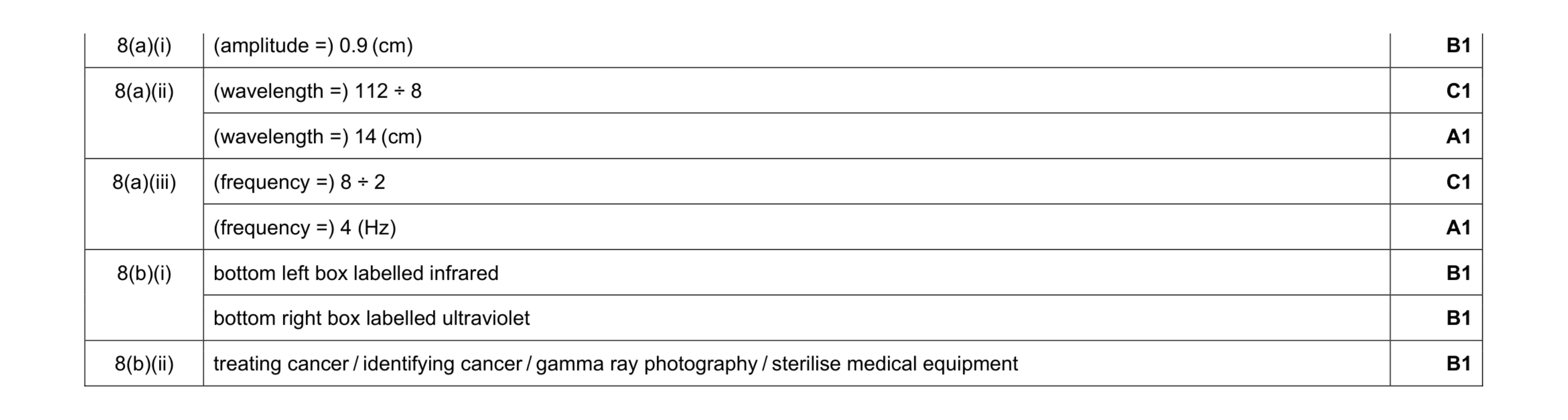 8
8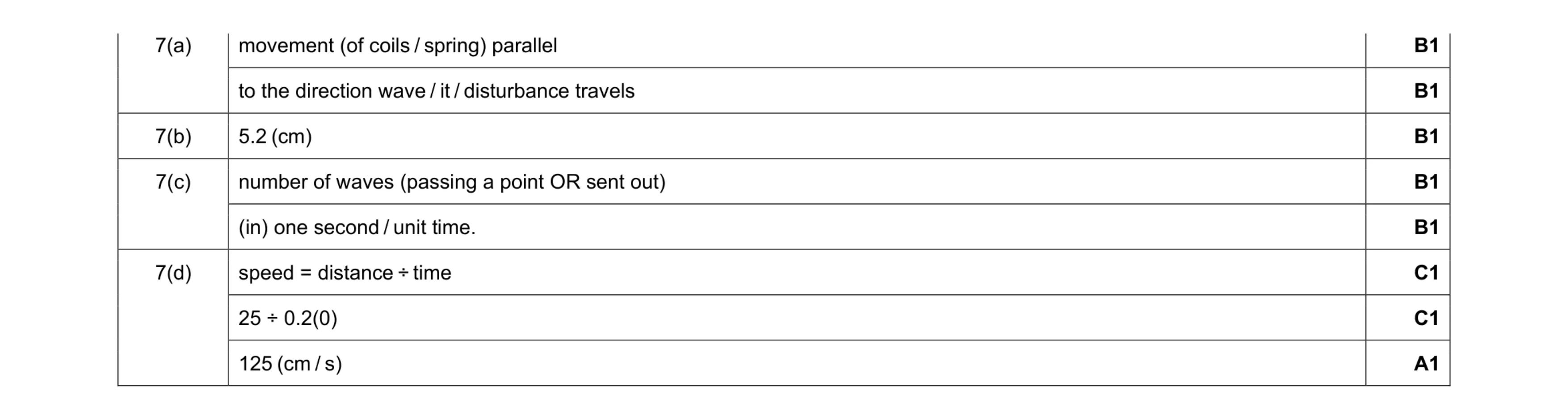 8
8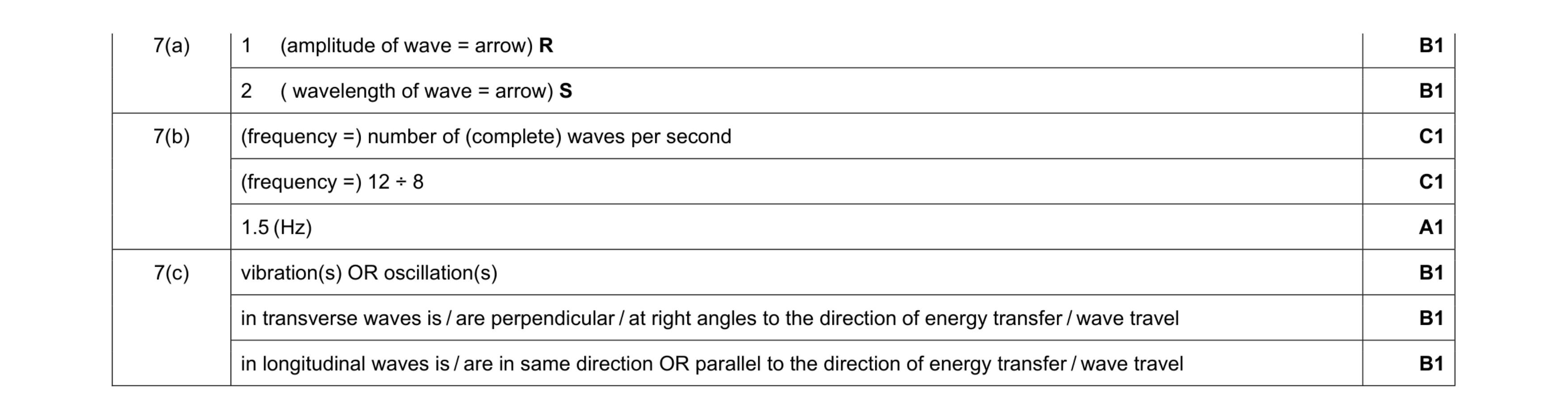 8
8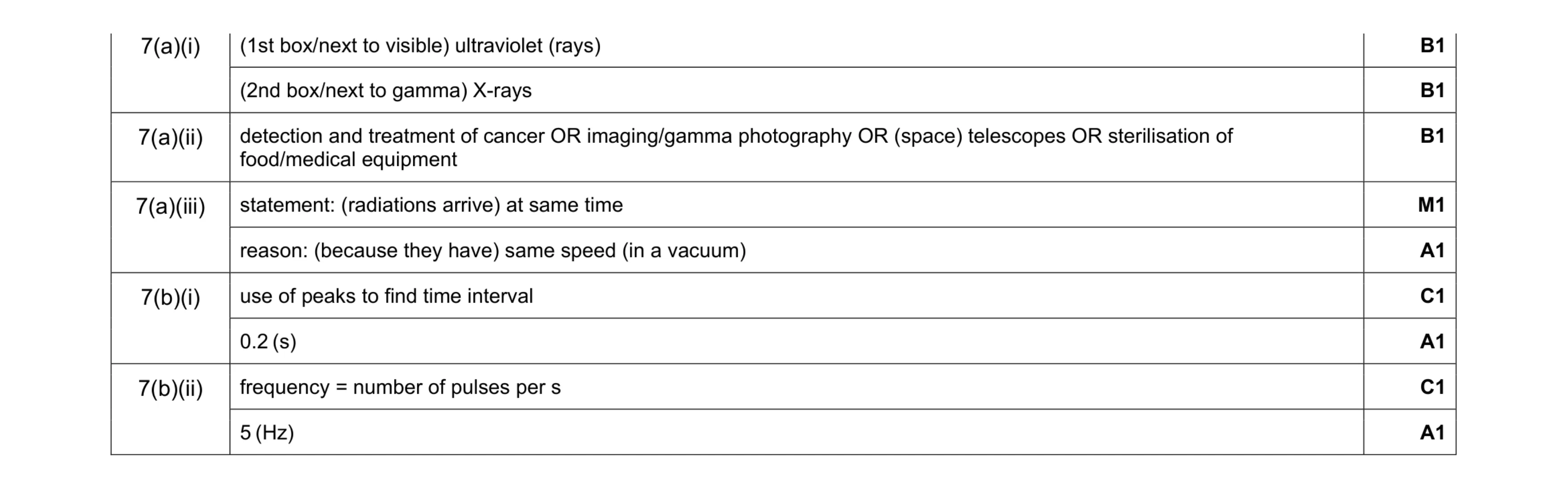 9
9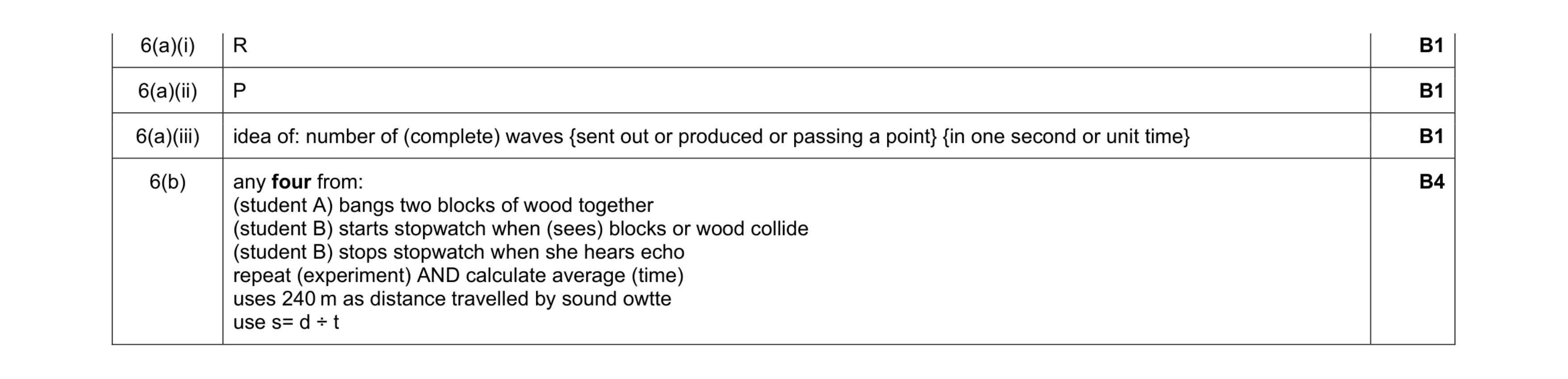 7
7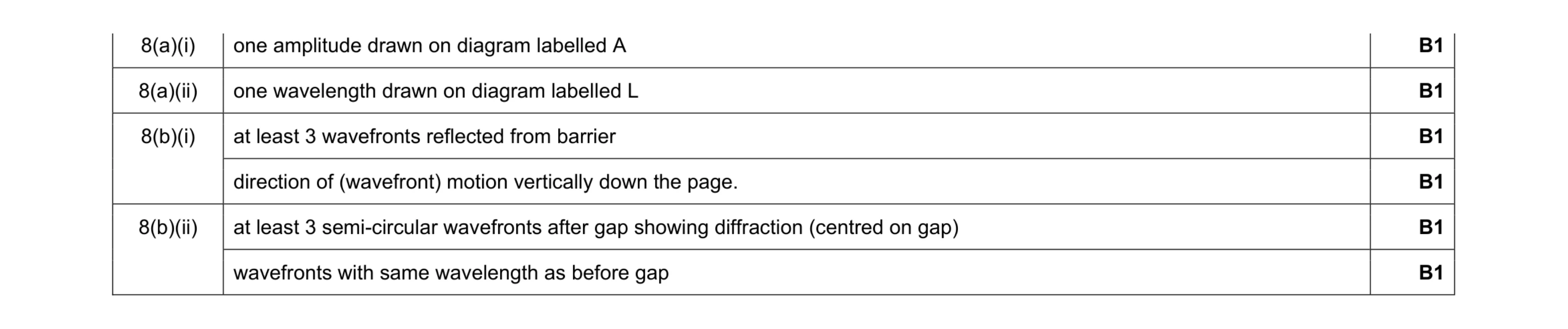 6
6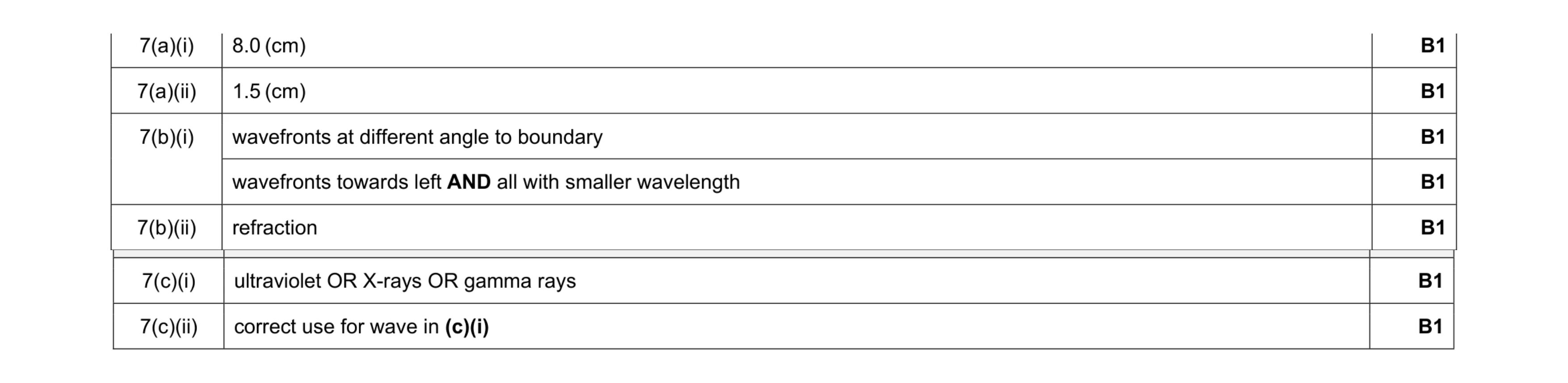 7
7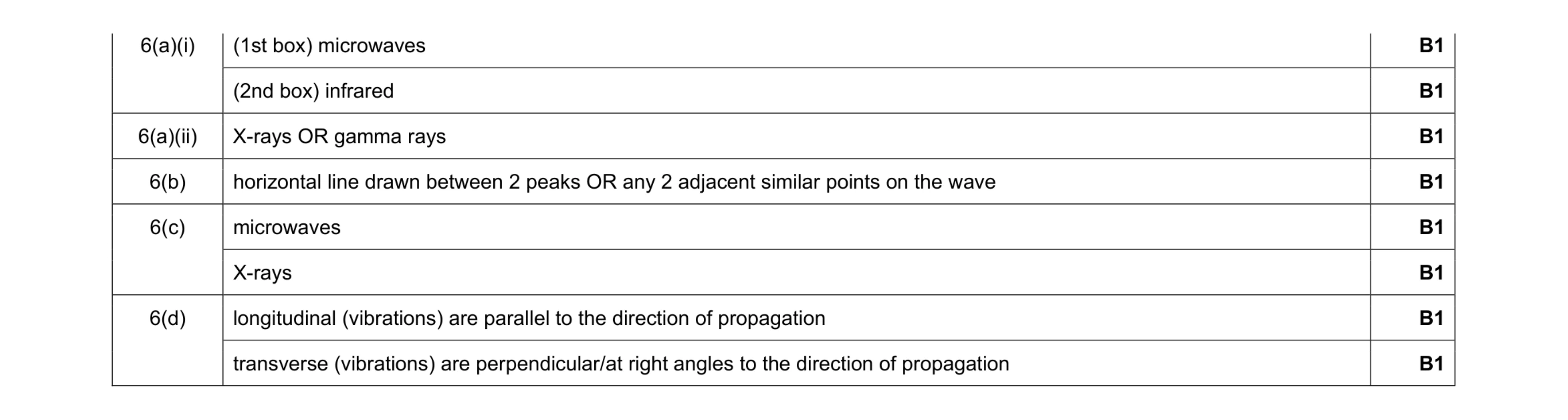 8
8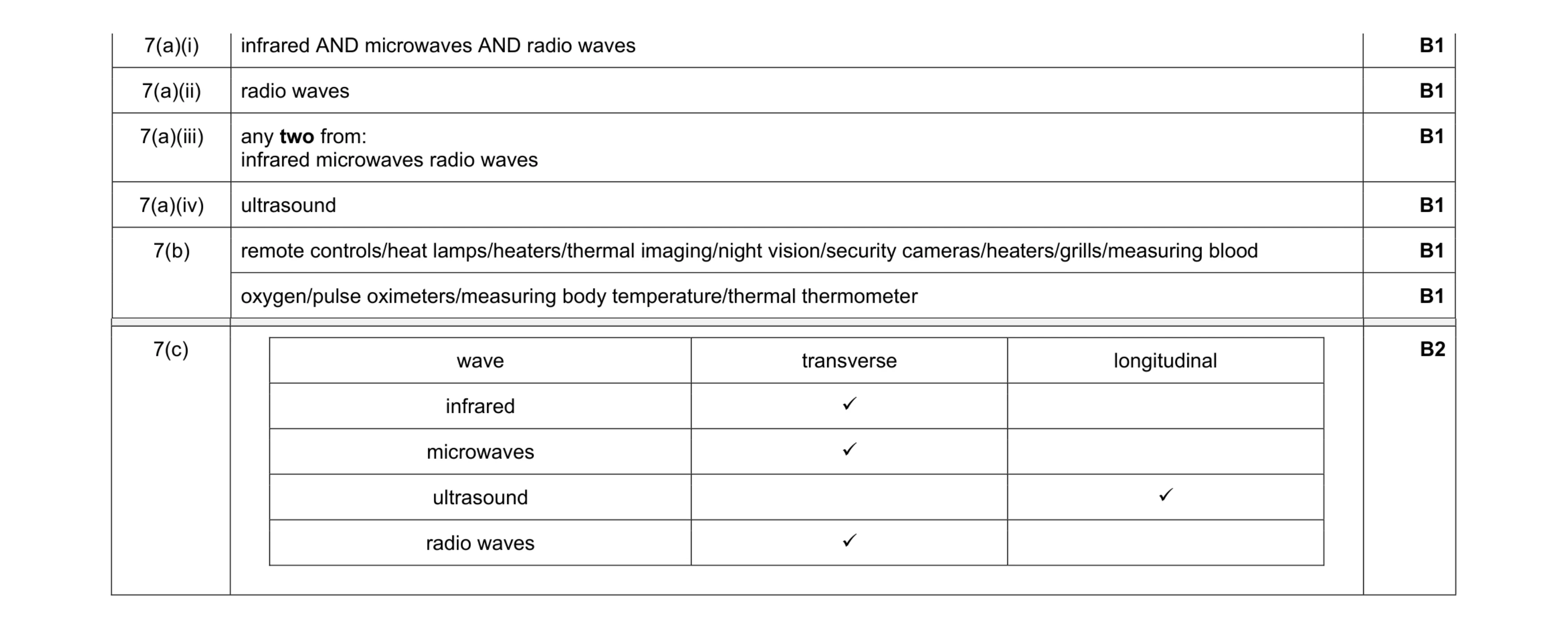 8
8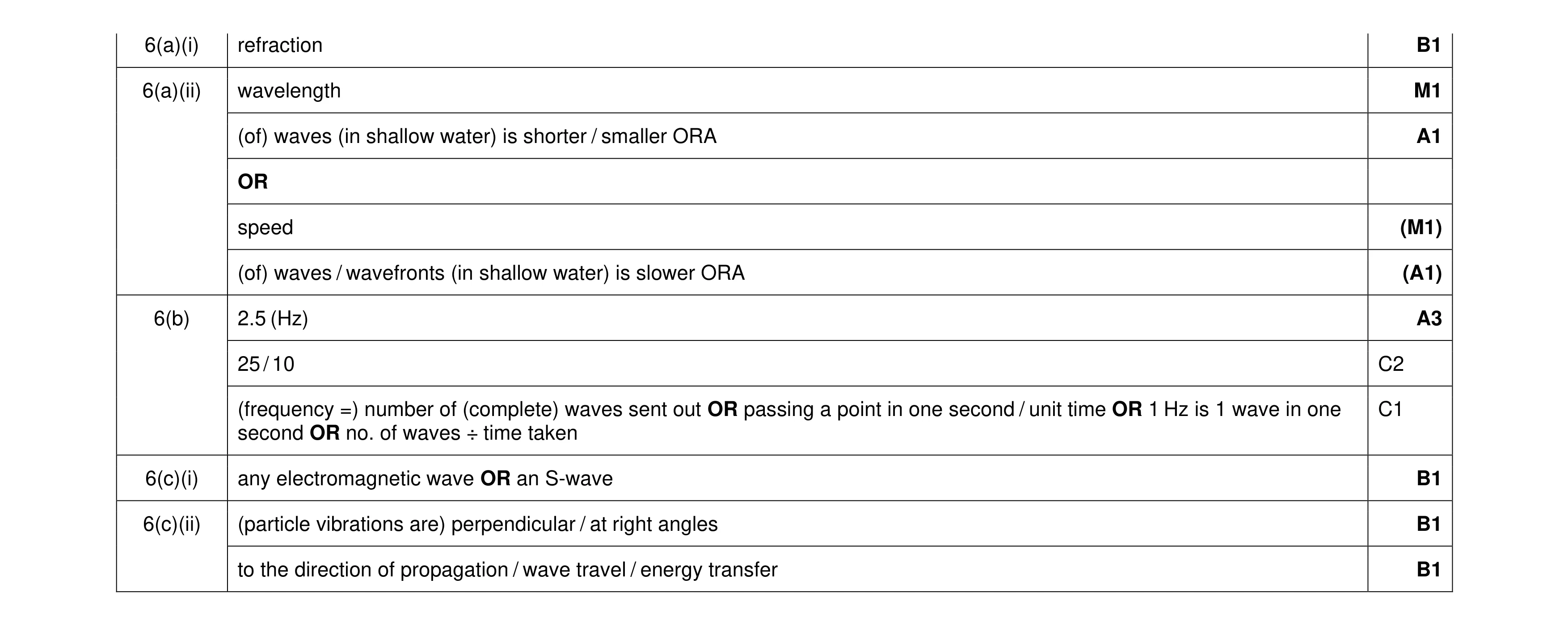 9
9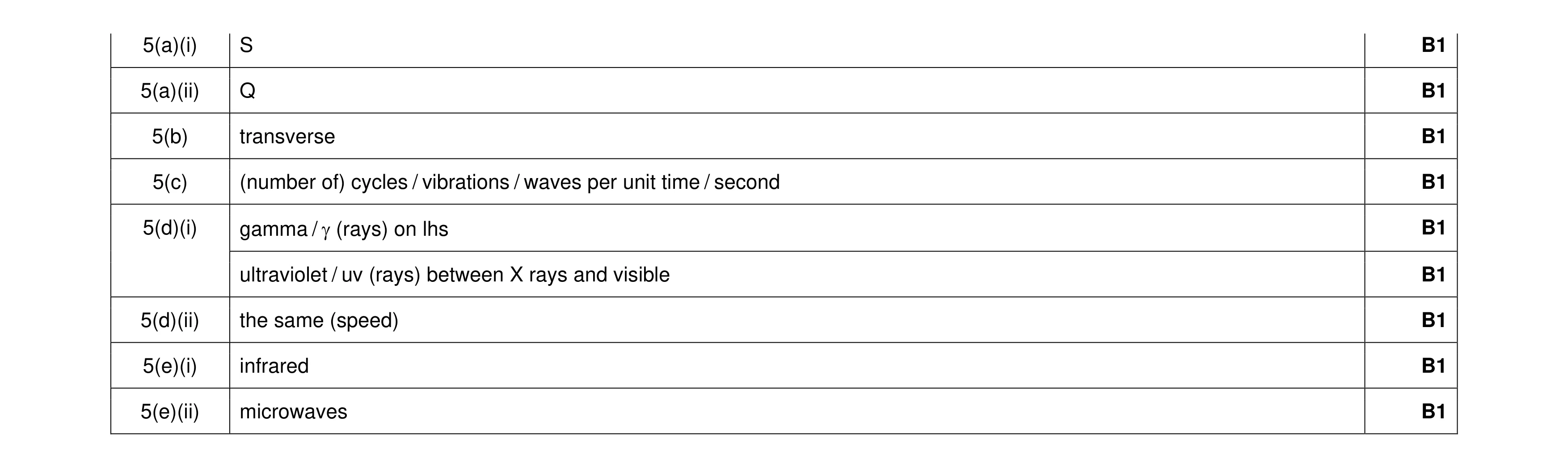 9
9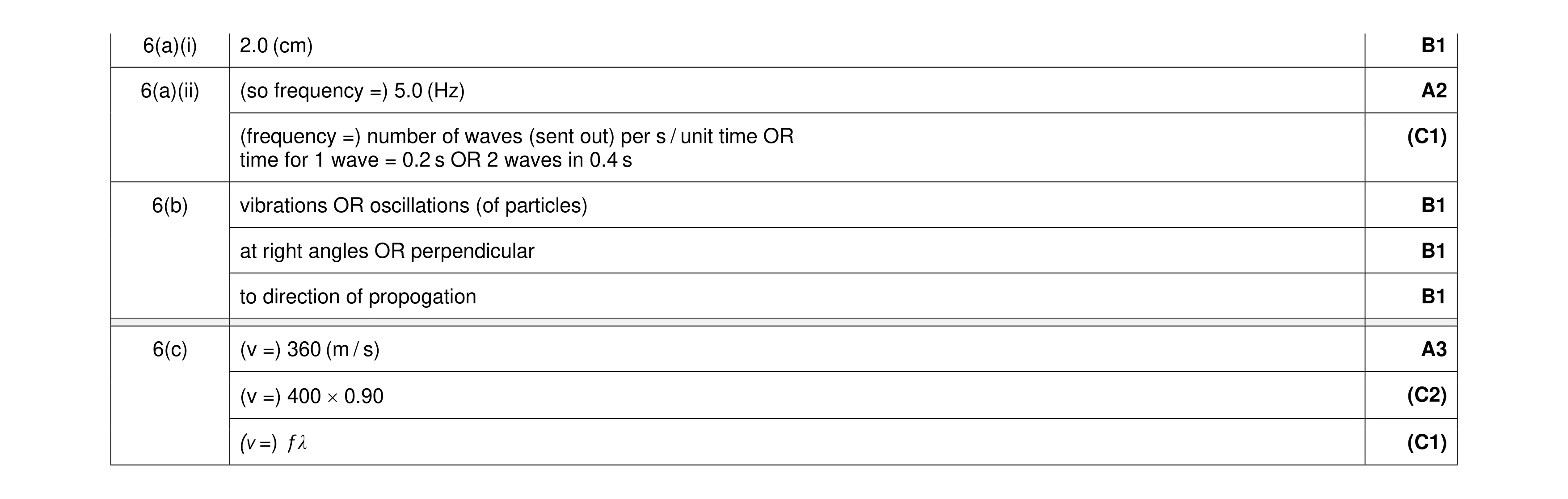 9
9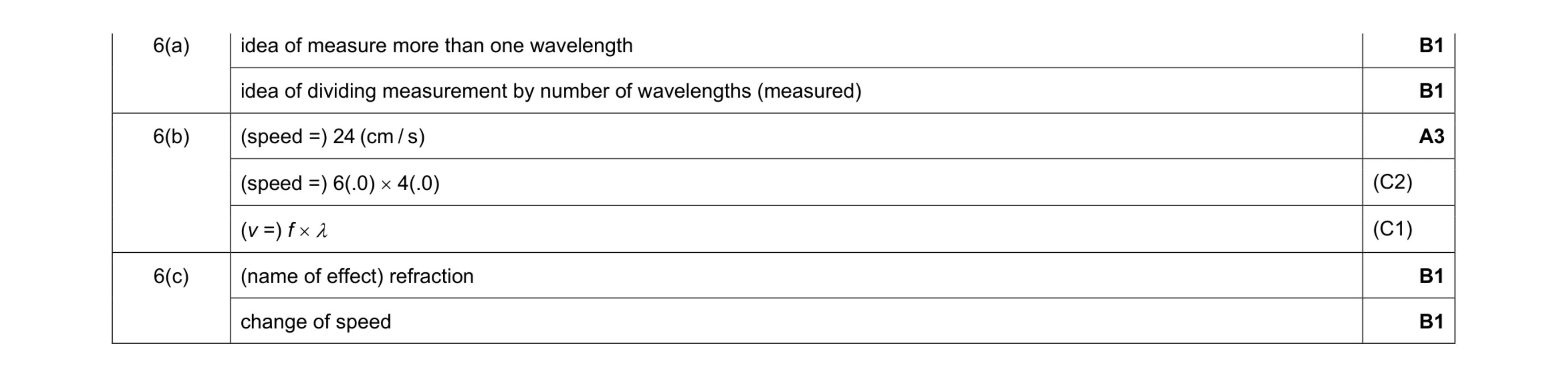 7
7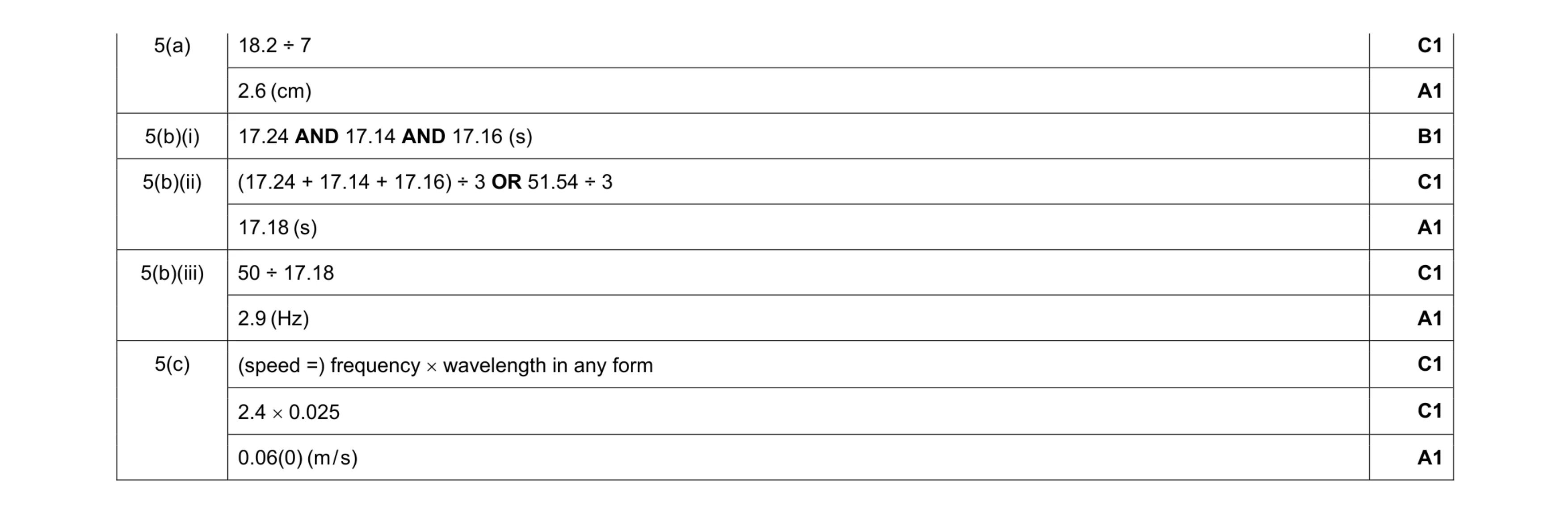 10
10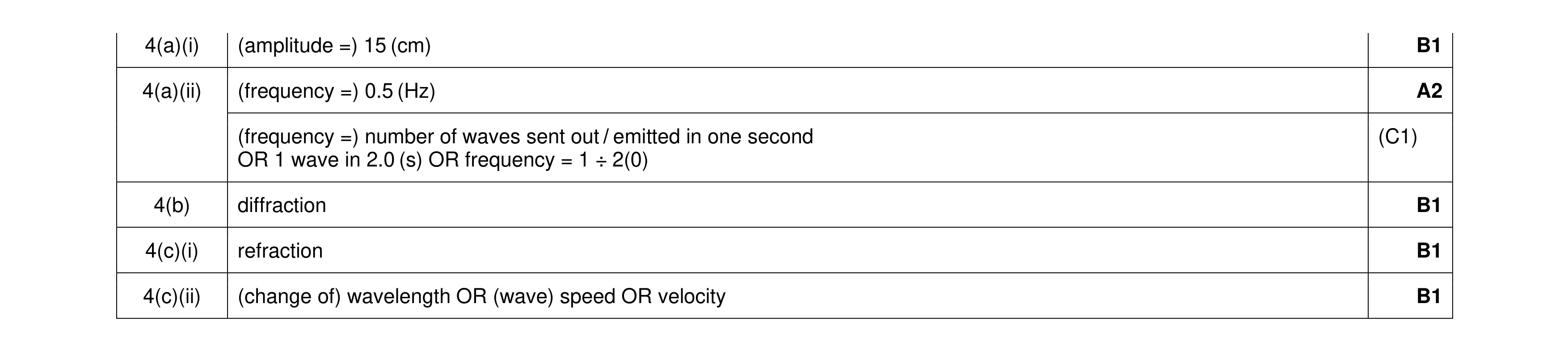 6
6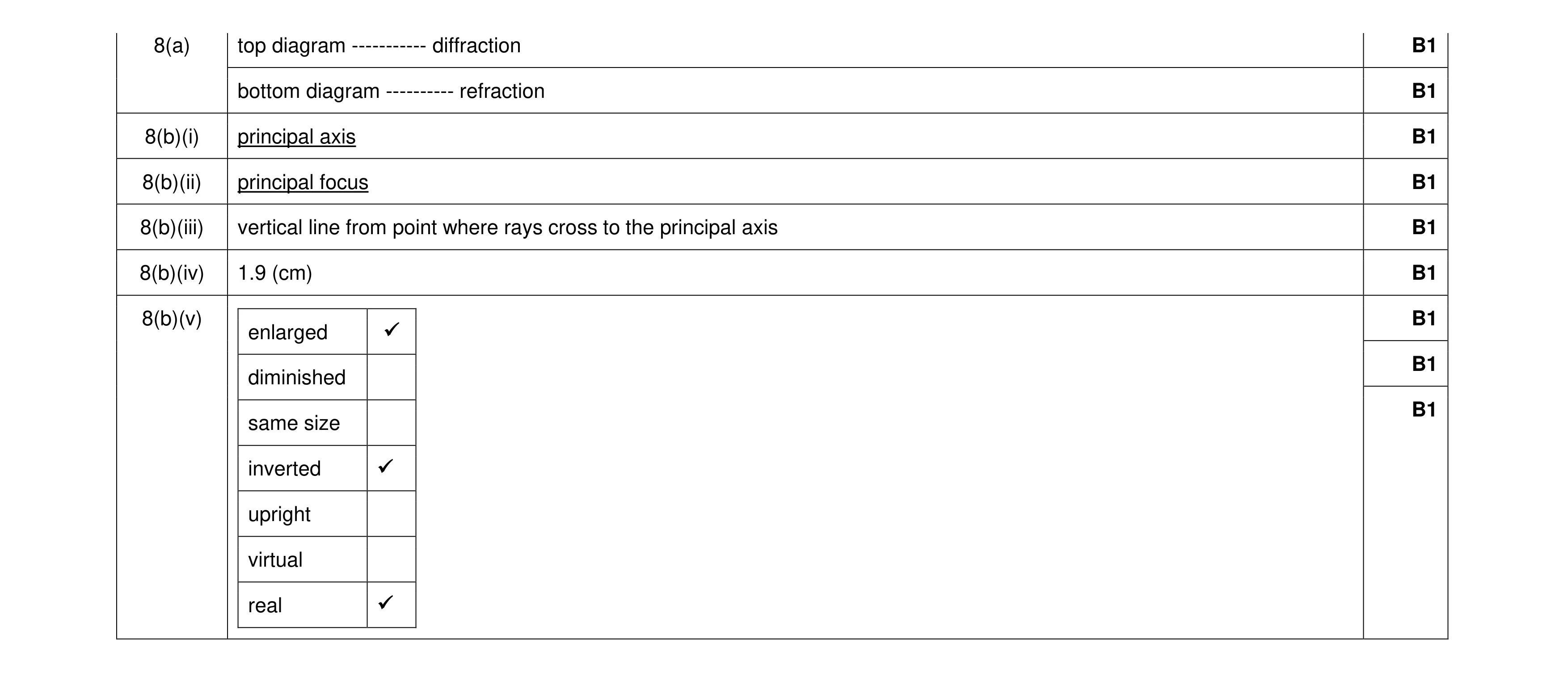 9
9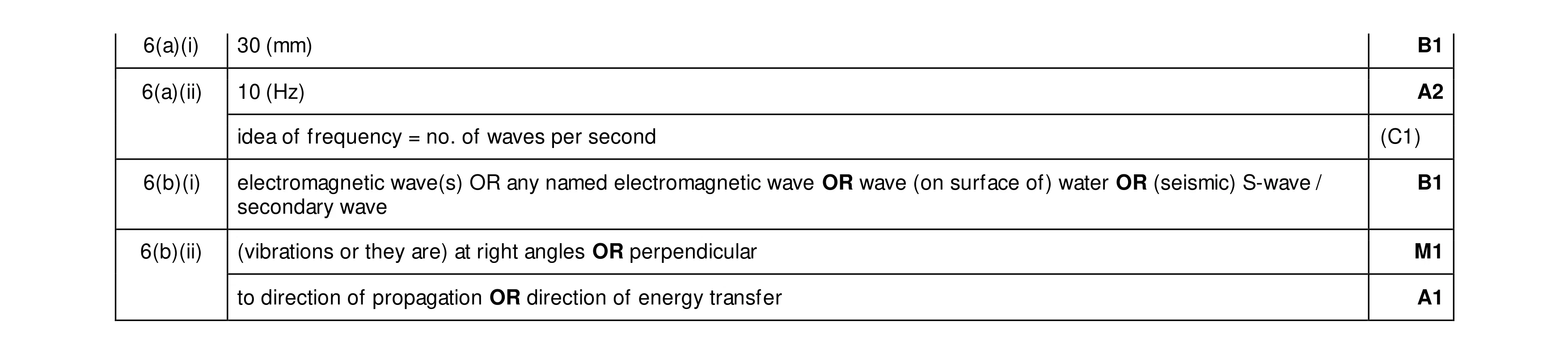 6
6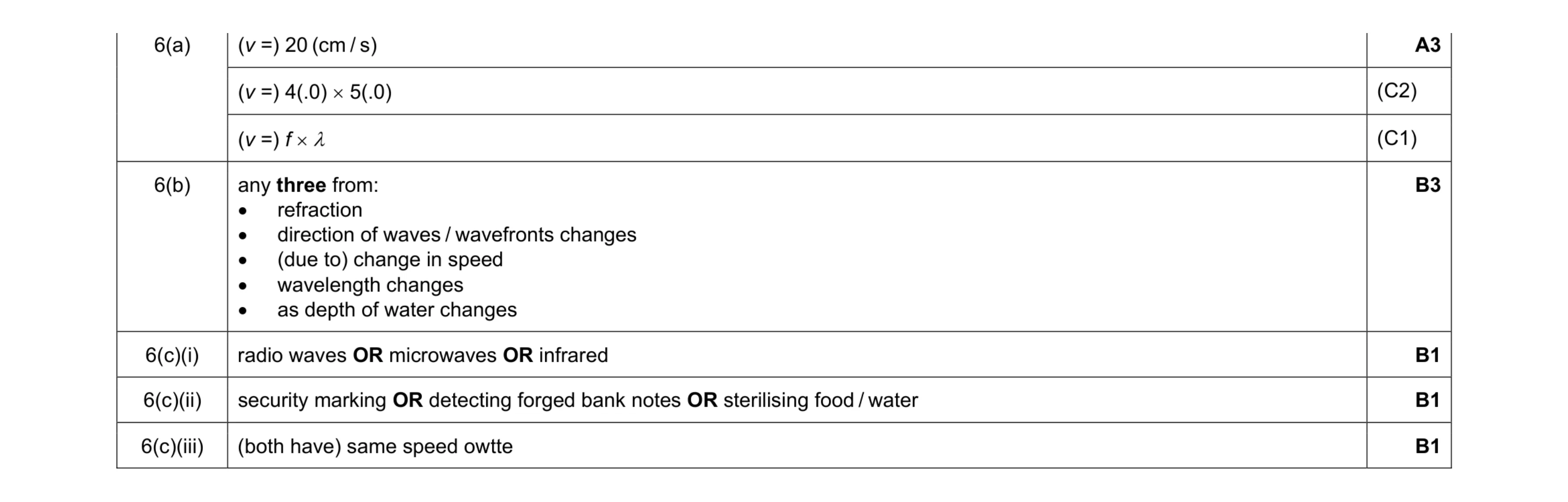 9
9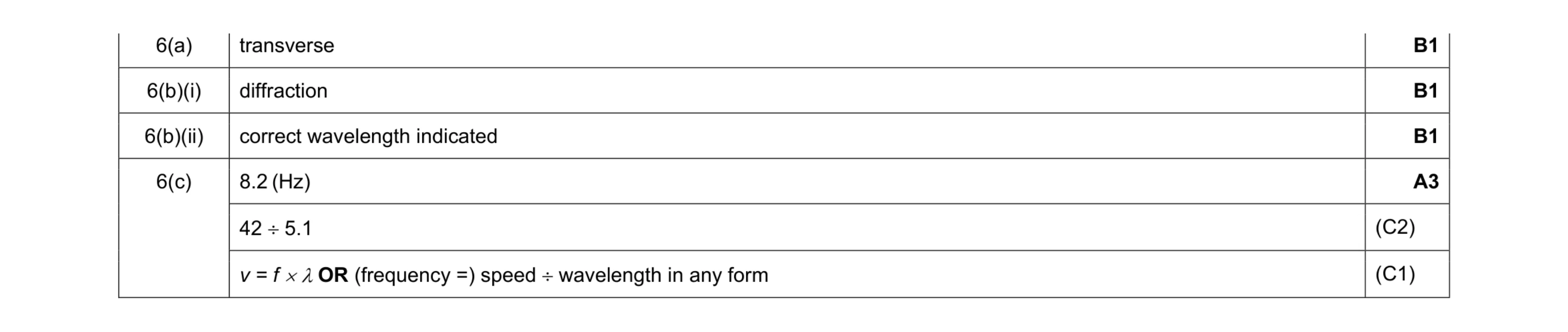 6
6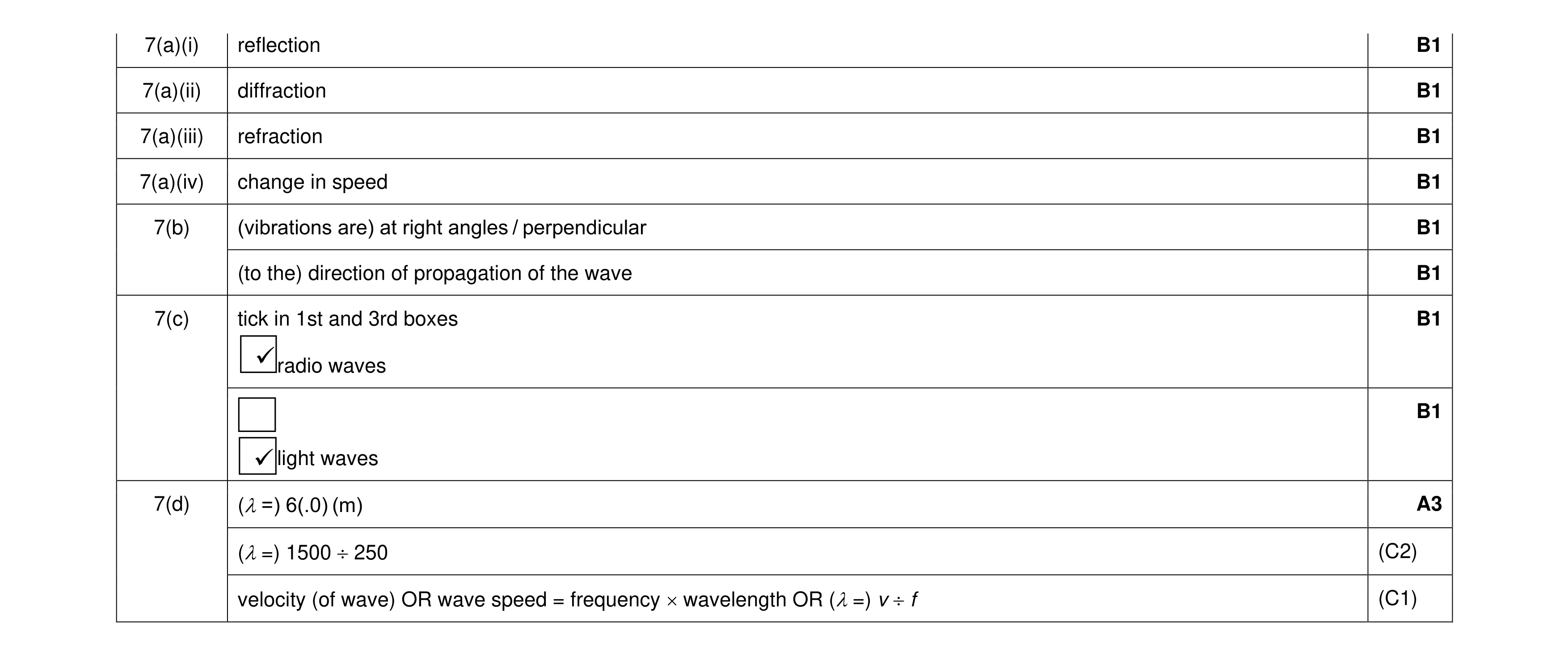 11
11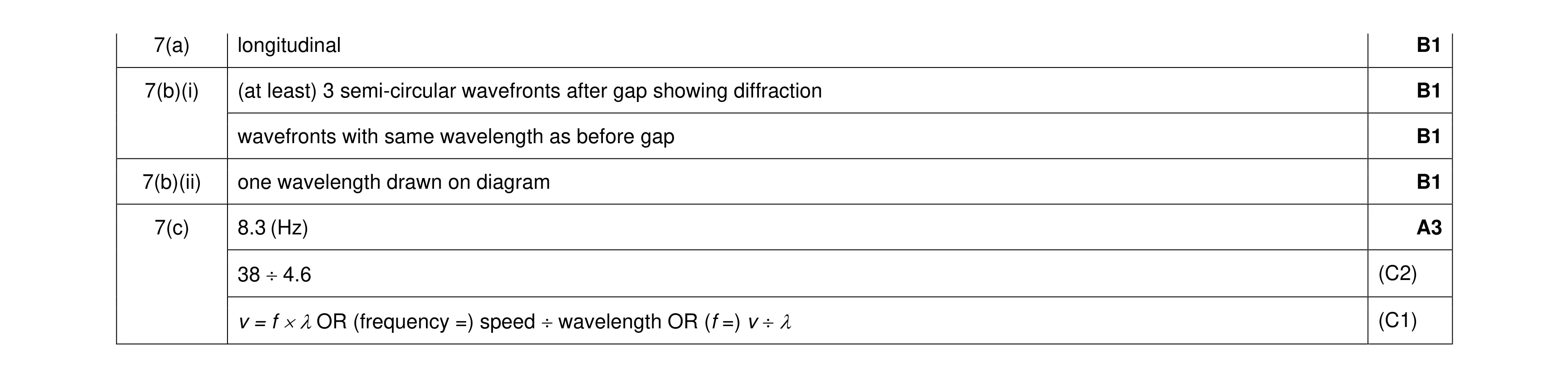 7
7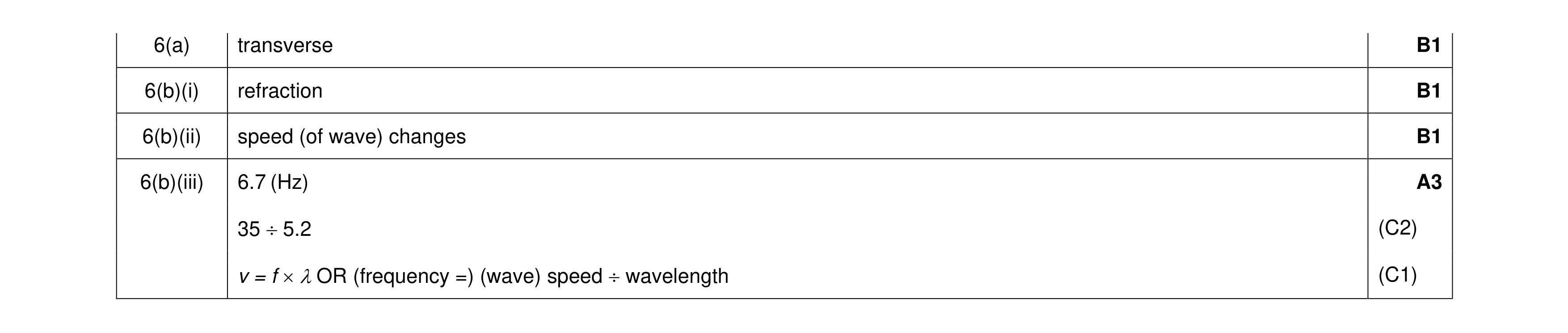 6
6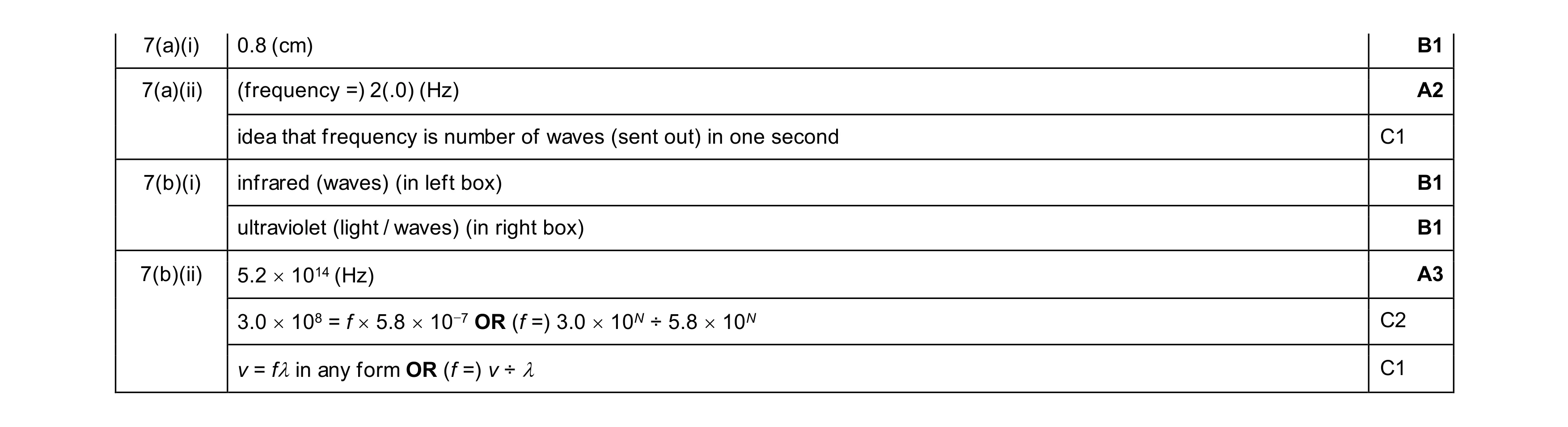 8
8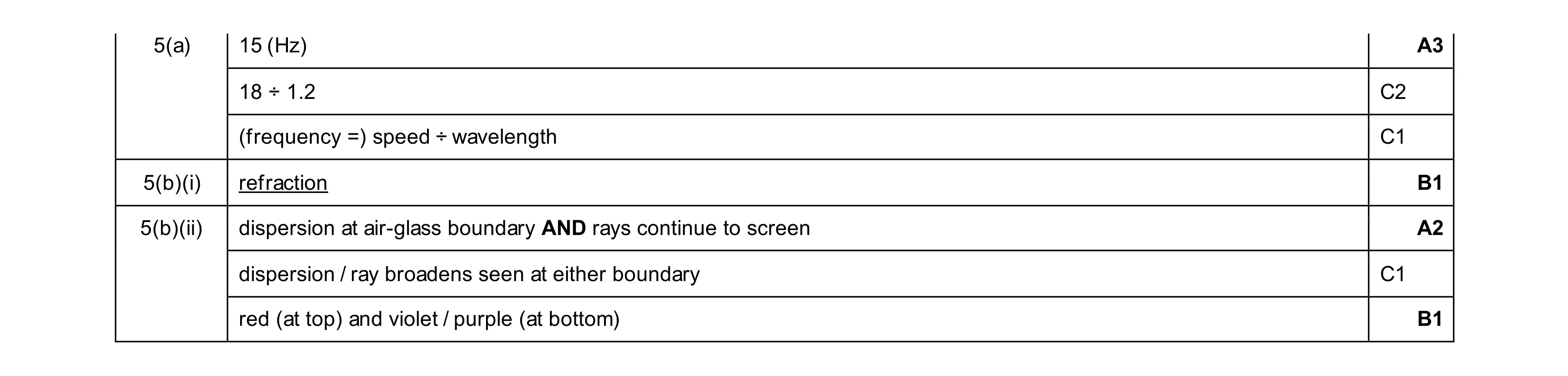 7
7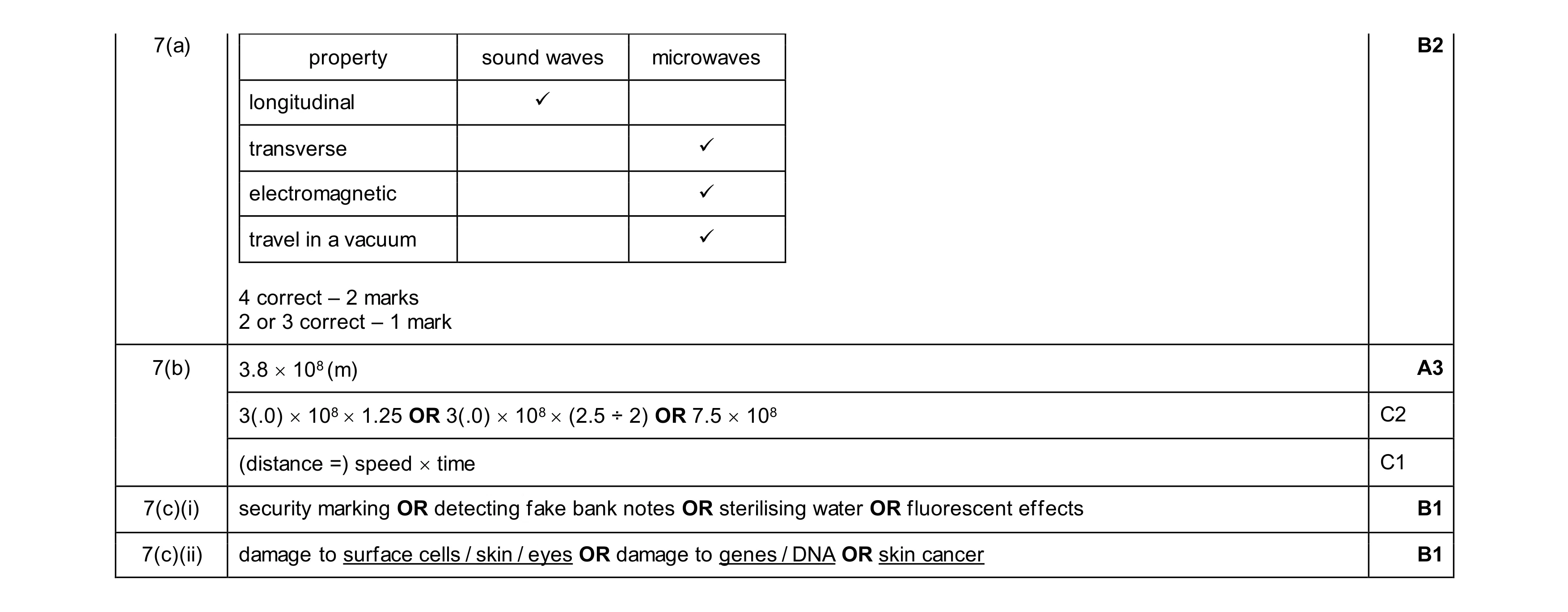 7
7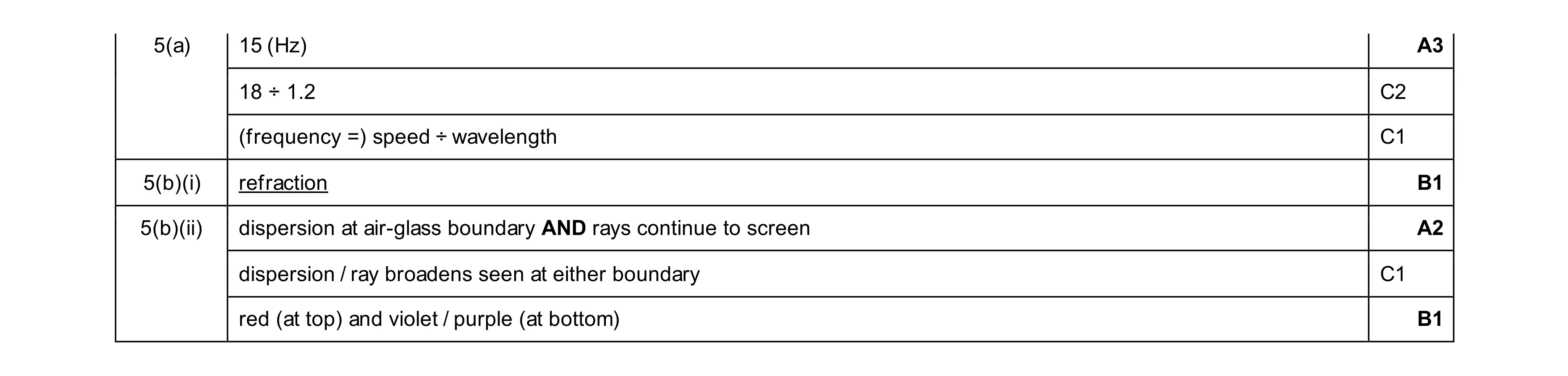 7
7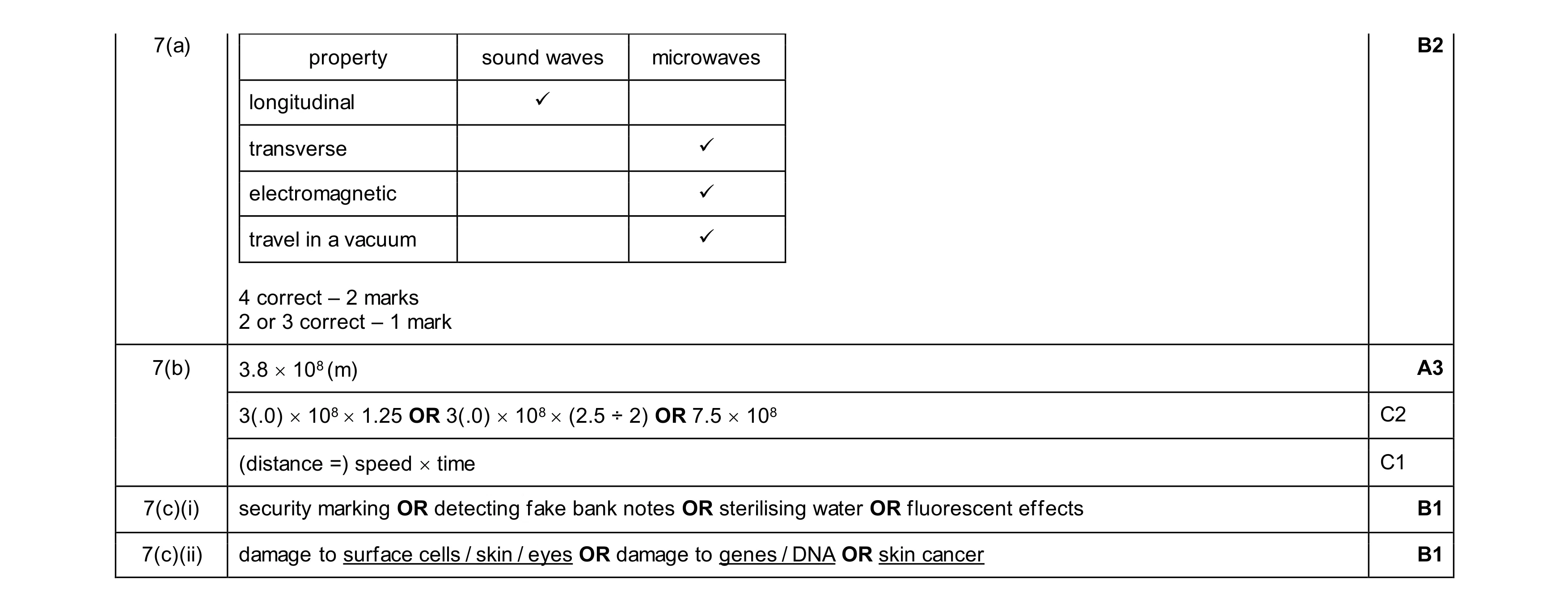 7
7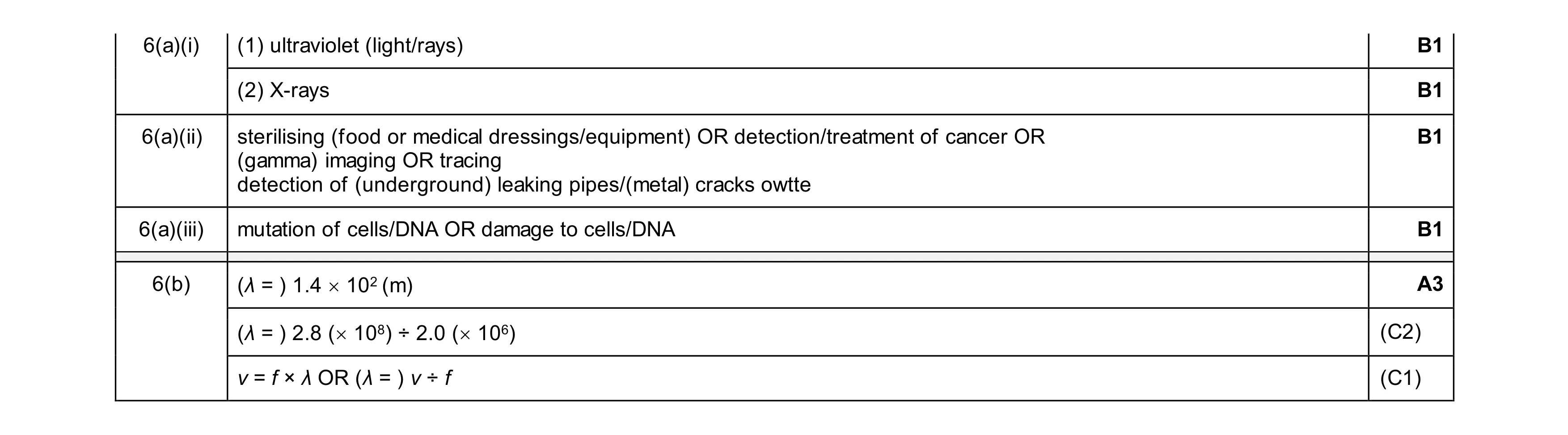 7
7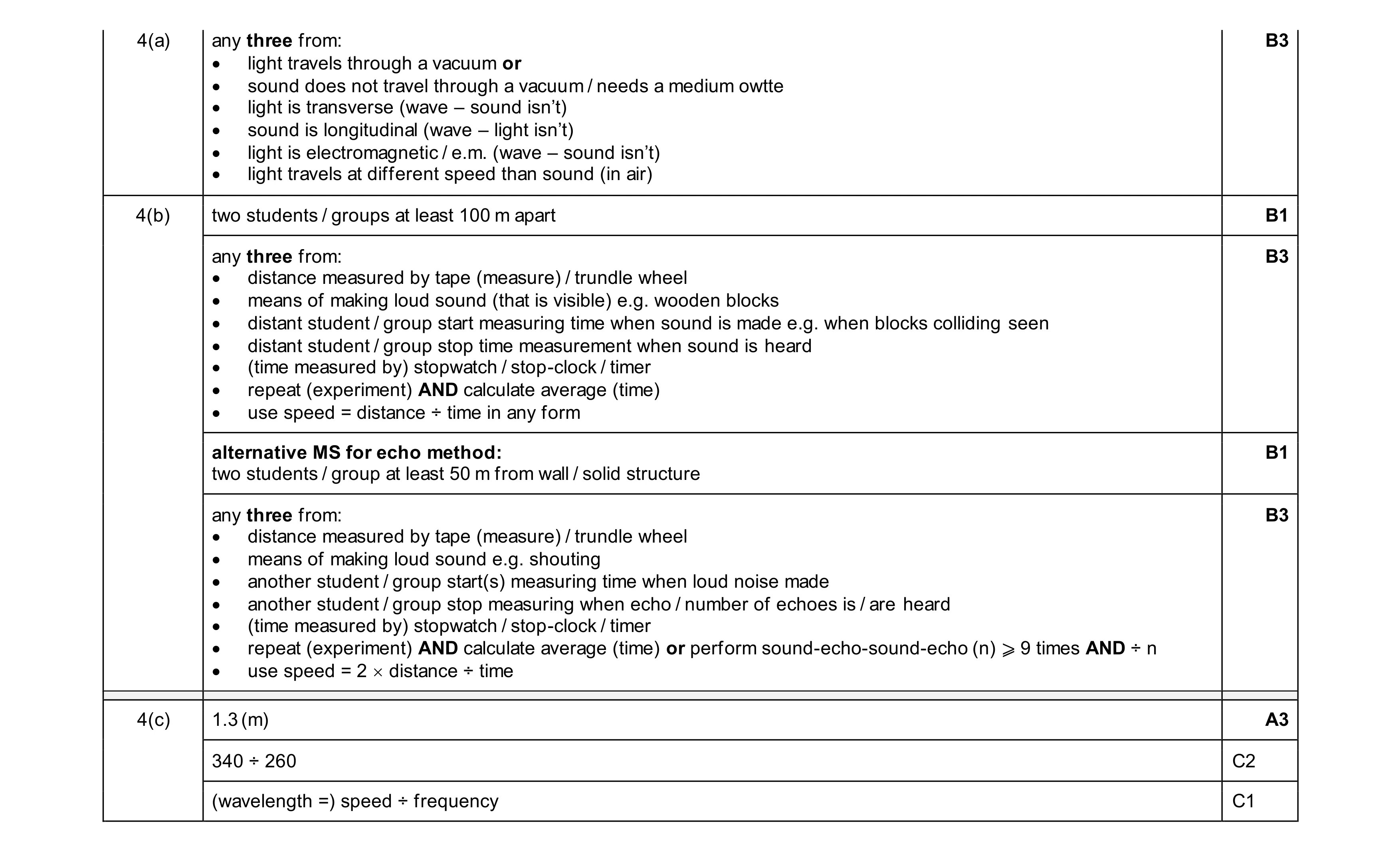 10
10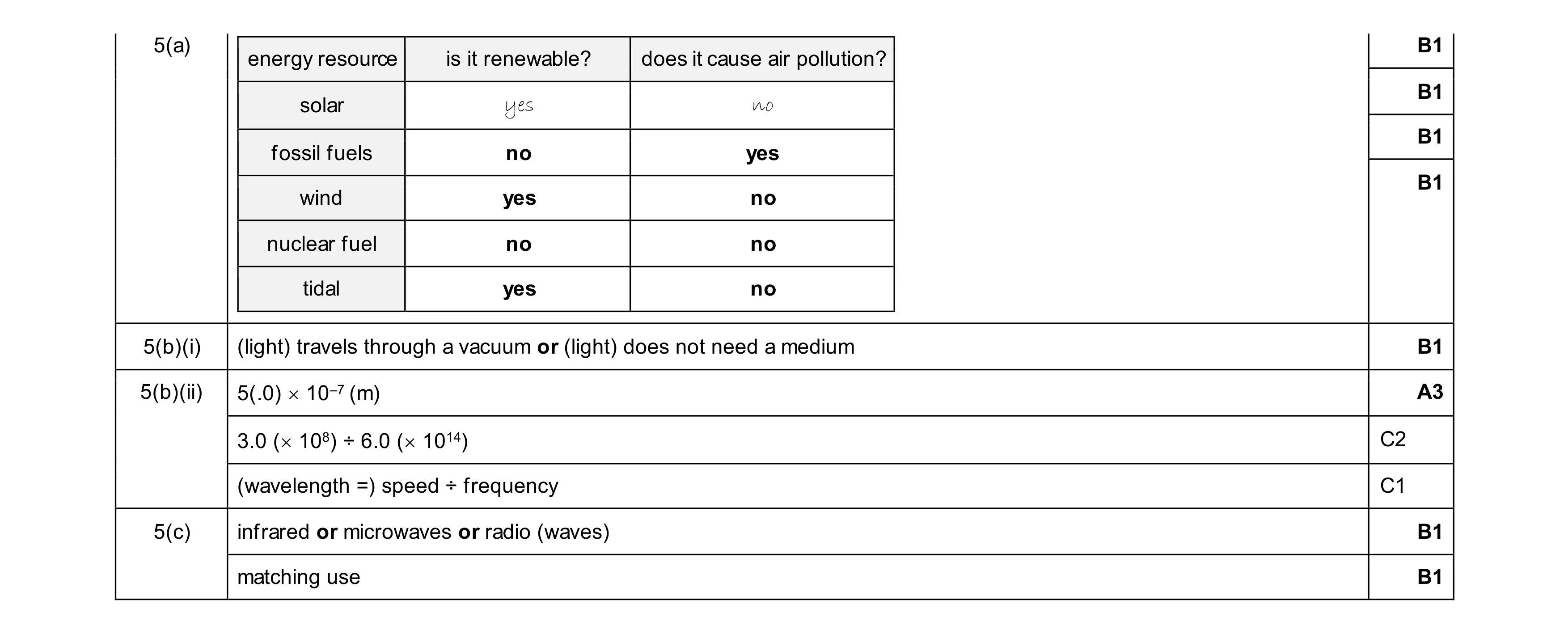 10
10