Questions as text
Q1 · Which is a unit of wavelength? 0625/22 Feb/March 2016
21 Which is a unit of wavelength? A hertz B metre C metre per second D second
1 marks
Answer: B
This question in 0625/22 Feb/March 2016
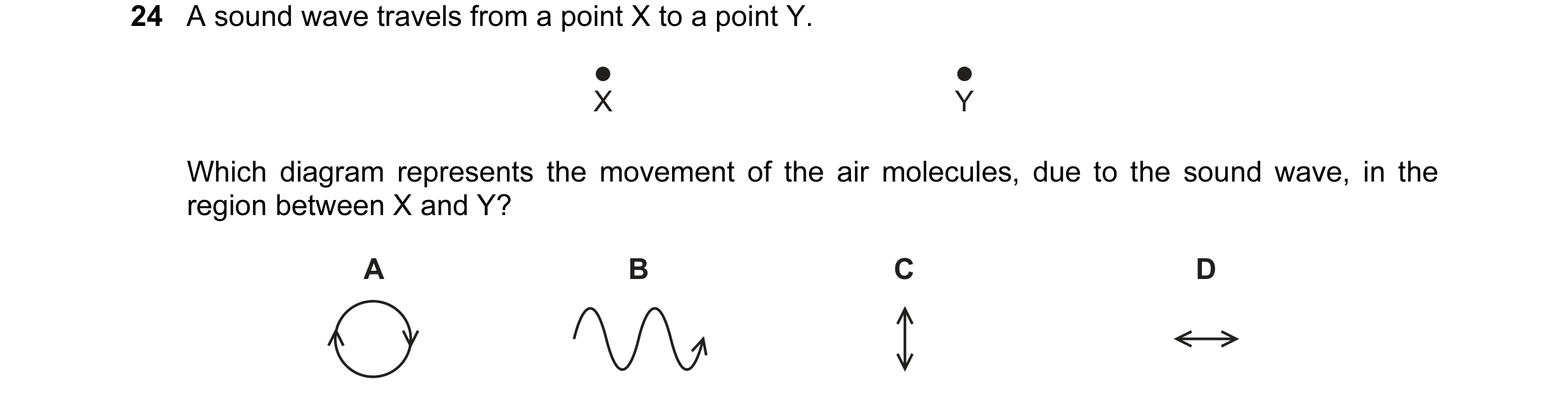
Q2 · A sound wave travels from a point X to a point Y 0625/22 Feb/March 2016
24 A sound wave travels from a point X to a point Y. X Y Which diagram represents the movement of the air molecules, due to the sound wave, in the region between X and Y? A B C D
1 marks
Answer: D
This question in 0625/22 Feb/March 2016
Q3 · Sound waves of frequency 2.0 kHz travel through a substance at a speed of 800 m / s 0625/21 May/June 2016
20 Sound waves of frequency 2.0 kHz travel through a substance at a speed of 800 m / s. What is the wavelength of the waves? A 0.40 m B 2.5 m C 400 m D 1600 m
1 marks
Answer: A
This question in 0625/21 May/June 2016
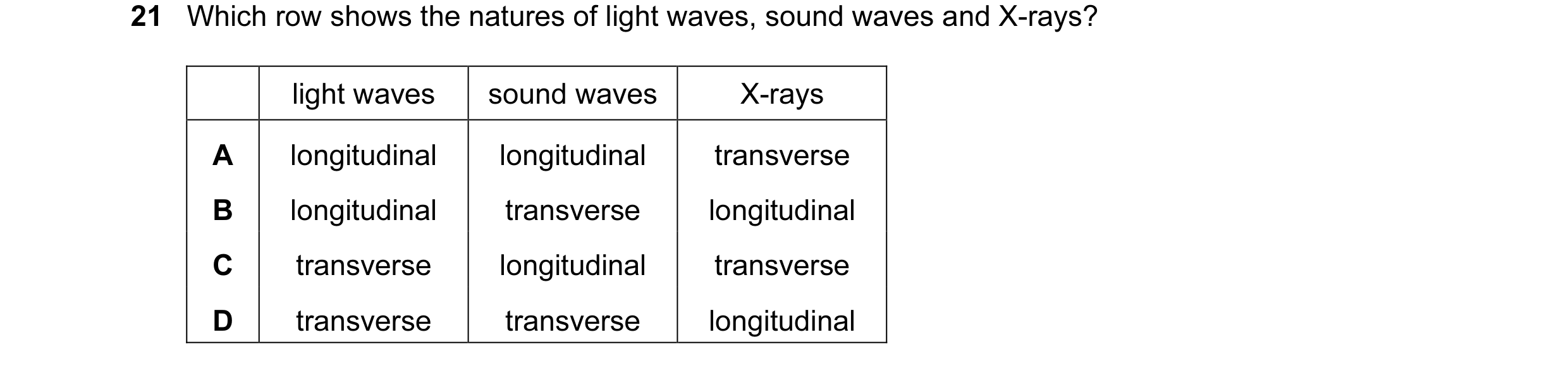
Q4 · Which row shows the natures of light waves, sound waves and X-rays? 0625/21 May/June 2016
21 Which row shows the natures of light waves, sound waves and X-rays? light waves sound waves X-rays A longitudinal longitudinal transverse B longitudinal transverse longitudinal C transverse longitudinal transverse D transverse transverse longitudinal
1 marks
Answer: C
This question in 0625/21 May/June 2016
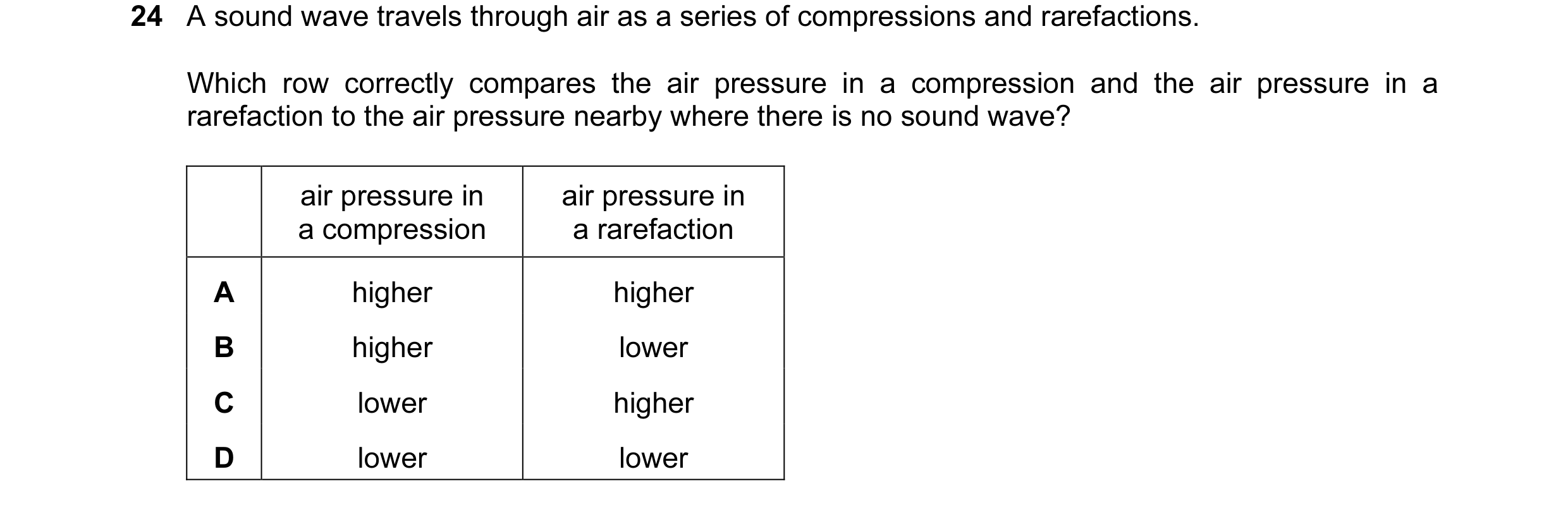
Q5 · A sound wave travels through air as a series of compressions and rarefactions 0625/21 May/June 2016
24 A sound wave travels through air as a series of compressions and rarefactions. Which row correctly compares the air pressure in a compression and the air pressure in a rarefaction to the air pressure nearby where there is no sound wave? air pressure in air pressure in a compression a rarefaction A higher higher B higher lower C lower higher D lower lower
1 marks
Answer: B
This question in 0625/21 May/June 2016
Q6 · The frequency of a wave is doubled 0625/22 May/June 2016
21 The frequency of a wave is doubled. The speed of the wave does not change. What happens to the wavelength of the wave? A It becomes four times as large. B It does not change. C It doubles. D It halves.
1 marks
Answer: D
This question in 0625/22 May/June 2016
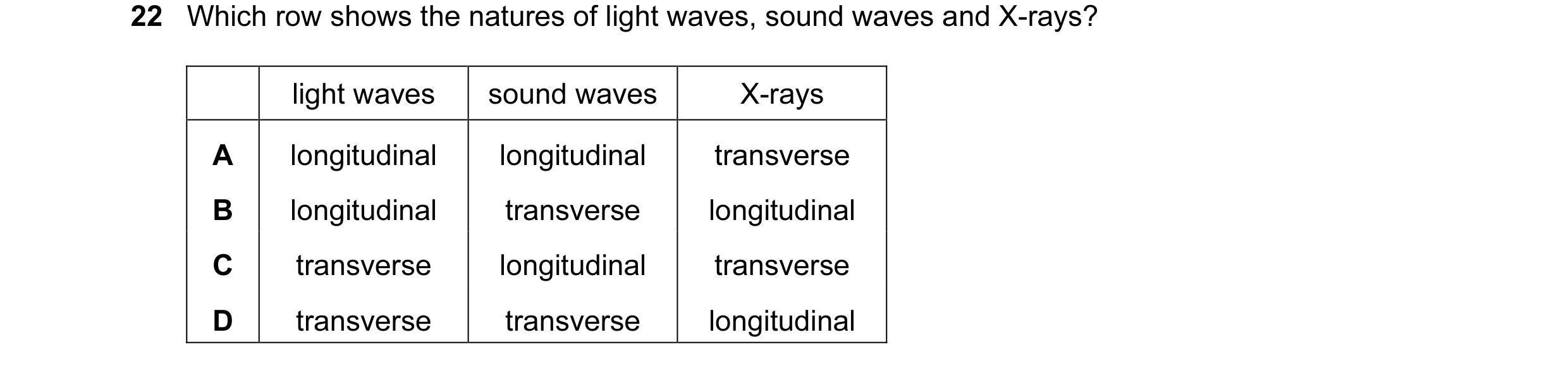
Q7 · Which row shows the natures of light waves, sound waves and X-rays? 0625/22 May/June 2016
22 Which row shows the natures of light waves, sound waves and X-rays? light waves sound waves X-rays A longitudinal longitudinal transverse B longitudinal transverse longitudinal C transverse longitudinal transverse D transverse transverse longitudinal
1 marks
Answer: C
This question in 0625/22 May/June 2016
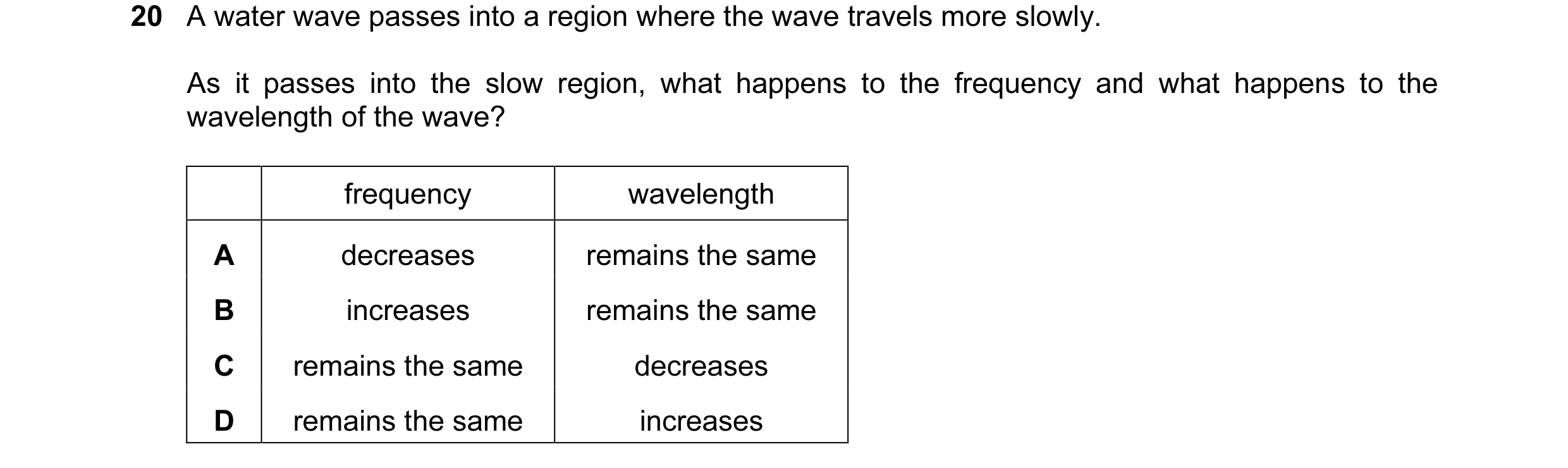
Q8 · A water wave passes into a region where the wave travels more slowly 0625/23 May/June 2016
20 A water wave passes into a region where the wave travels more slowly. As it passes into the slow region, what happens to the frequency and what happens to the wavelength of the wave? frequency wavelength A decreases remains the same B increases remains the same C remains the same decreases D remains the same increases
1 marks
Answer: C
This question in 0625/23 May/June 2016
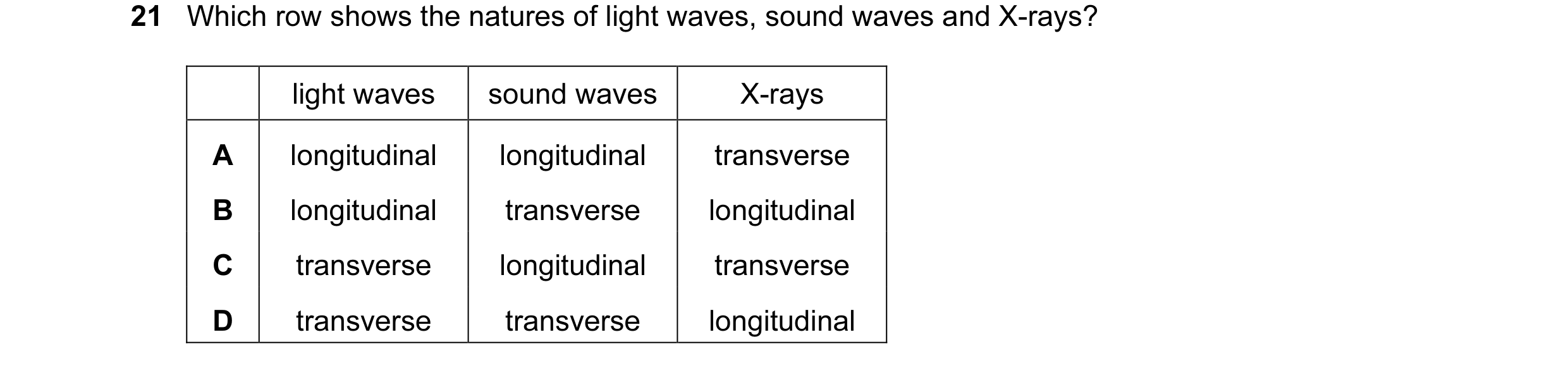
Q9 · Which row shows the natures of light waves, sound waves and X-rays? 0625/23 May/June 2016
21 Which row shows the natures of light waves, sound waves and X-rays? light waves sound waves X-rays A longitudinal longitudinal transverse B longitudinal transverse longitudinal C transverse longitudinal transverse D transverse transverse longitudinal
1 marks
Answer: C
This question in 0625/23 May/June 2016
Q10 · The diagram represents plane wavefronts being diffracted by passing through a gap in a… 0625/21 Oct/Nov 2016
21 The diagram represents plane wavefronts being diffracted by passing through a gap in a barrier. barrier wavefronts gap Which pair of changes must increase the amount of diffraction that occurs? A decrease the wavelength and decrease the size of the gap B decrease the wavelength and increase the size of the gap C increase the wavelength and decrease the size of the gap D increase the wavelength and increase the size of the gap
1 marks
Answer: C
This question in 0625/21 Oct/Nov 2016
Q11 · A girl notices that, when she shouts into a cave, she hears an echo 0625/21 Oct/Nov 2016
25 A girl notices that, when she shouts into a cave, she hears an echo. Which wave property causes the echo? A diffraction B dispersion C reflection D refraction
1 marks
Answer: C
This question in 0625/21 Oct/Nov 2016
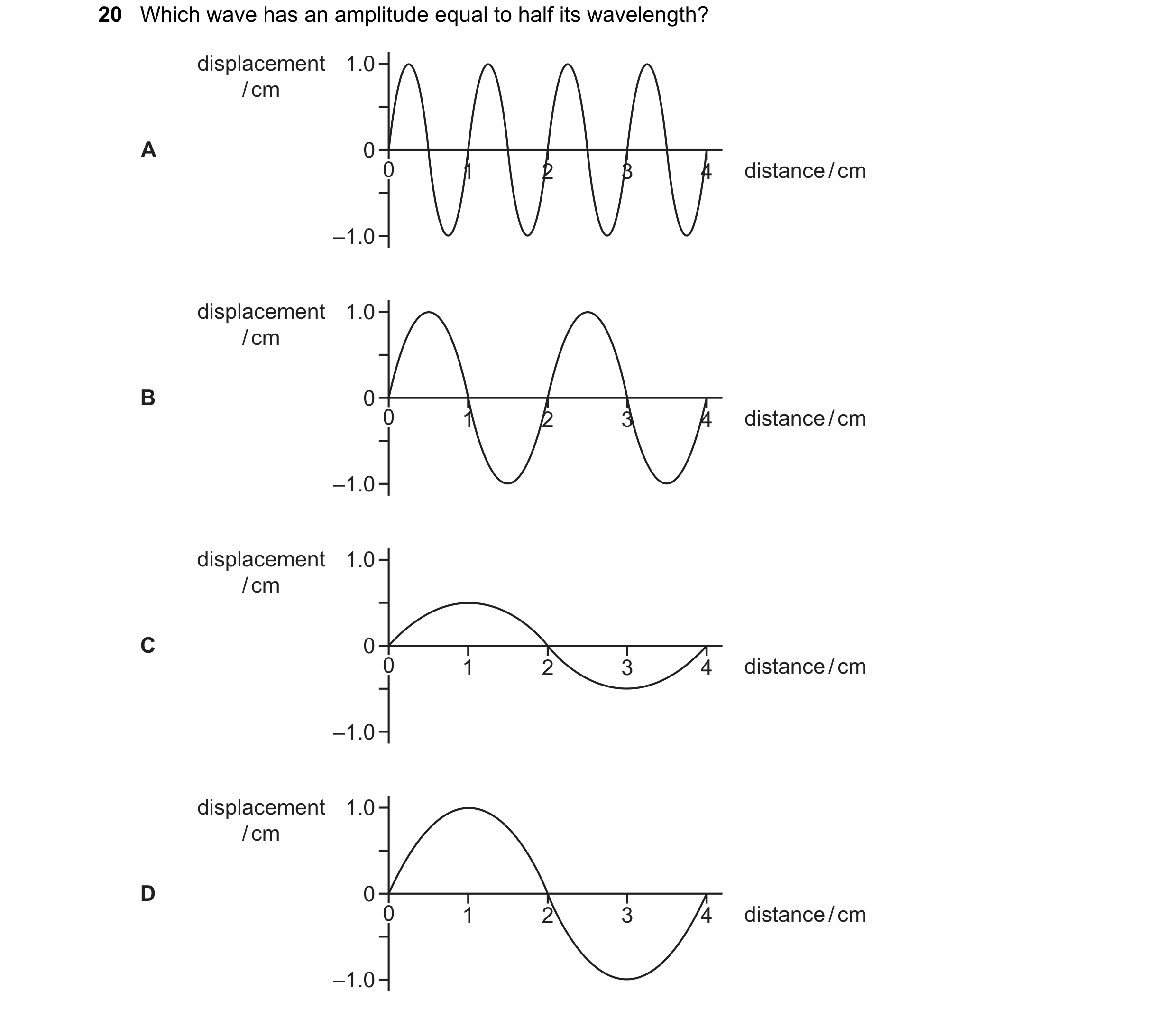
Q12 · Which wave has an amplitude equal to half its wavelength? 0625/22 Oct/Nov 2016
20 Which wave has an amplitude equal to half its wavelength? displacement 1.0 / cm A 0 0 1 2 3 4 distance / cm –1.0 displacement 1.0 / cm B 0 0 1 2 3 4 distance / cm –1.0 displacement 1.0 / cm C 0 0 1 2 3 4 distance / cm –1.0 displacement 1.0 / cm D 0 0 1 2 3 4 distance / cm –1.0
1 marks
Answer: B
This question in 0625/22 Oct/Nov 2016
Q13 · Which diagram shows what happens when plane waves pass the edge of the object shown? 0625/22 Oct/Nov 2016
21 Which diagram shows what happens when plane waves pass the edge of the object shown? A B object object C D object object
1 marks
Answer: D
This question in 0625/22 Oct/Nov 2016
Q14 · A girl notices that, when she shouts into a cave, she hears an echo 0625/22 Oct/Nov 2016
25 A girl notices that, when she shouts into a cave, she hears an echo. Which wave property causes the echo? A diffraction B dispersion C reflection D refraction
1 marks
Answer: C
This question in 0625/22 Oct/Nov 2016
Q15 · Which property of a sound wave affects the loudness of the sound? 0625/22 Oct/Nov 2016
26 Which property of a sound wave affects the loudness of the sound? A amplitude B frequency C speed D wavelength
1 marks
Answer: A
This question in 0625/22 Oct/Nov 2016
Q16 · A man is talking at the side of a house 0625/23 Oct/Nov 2016
20 A man is talking at the side of a house. He can be heard by a woman at the front of the house even though she cannot see him. What is the explanation for this? A Sound waves are longitudinal and light waves are transverse. B Sound waves are transverse and light waves are longitudinal. C The sound waves have a long wavelength and the light waves have short wavelength. D The sound waves have a short wavelength and the light waves have long wavelength.
1 marks
Answer: C
This question in 0625/23 Oct/Nov 2016
Q17 · A person uses a surfboard to ride every 30th wave crest towards the beach 0625/22 Feb/March 2017
19 A person uses a surfboard to ride every 30th wave crest towards the beach. The wave crest travels at a speed of 1.6 m / s and the distance between each wave crest is 24 m. How many wave crests does the person surf in one hour? A 1 B 2 C 8 D 450
1 marks
Answer: C
This question in 0625/22 Feb/March 2017
Q18 · In a shallow tank, a water wave moves towards a barrier with a narrow gap 0625/22 Feb/March 2017
20 In a shallow tank, a water wave moves towards a barrier with a narrow gap. barrier water wave Which diagram shows the wave beyond the barrier? A B C D
1 marks
Answer: D
This question in 0625/22 Feb/March 2017
Q19 · Which statement about sound waves is correct? 0625/22 Feb/March 2017
23 Which statement about sound waves is correct? A They are able to travel through a vacuum. B They are able to travel through solids. C They are transverse waves. D They travel at the same speed in all substances.
1 marks
Answer: B
This question in 0625/22 Feb/March 2017
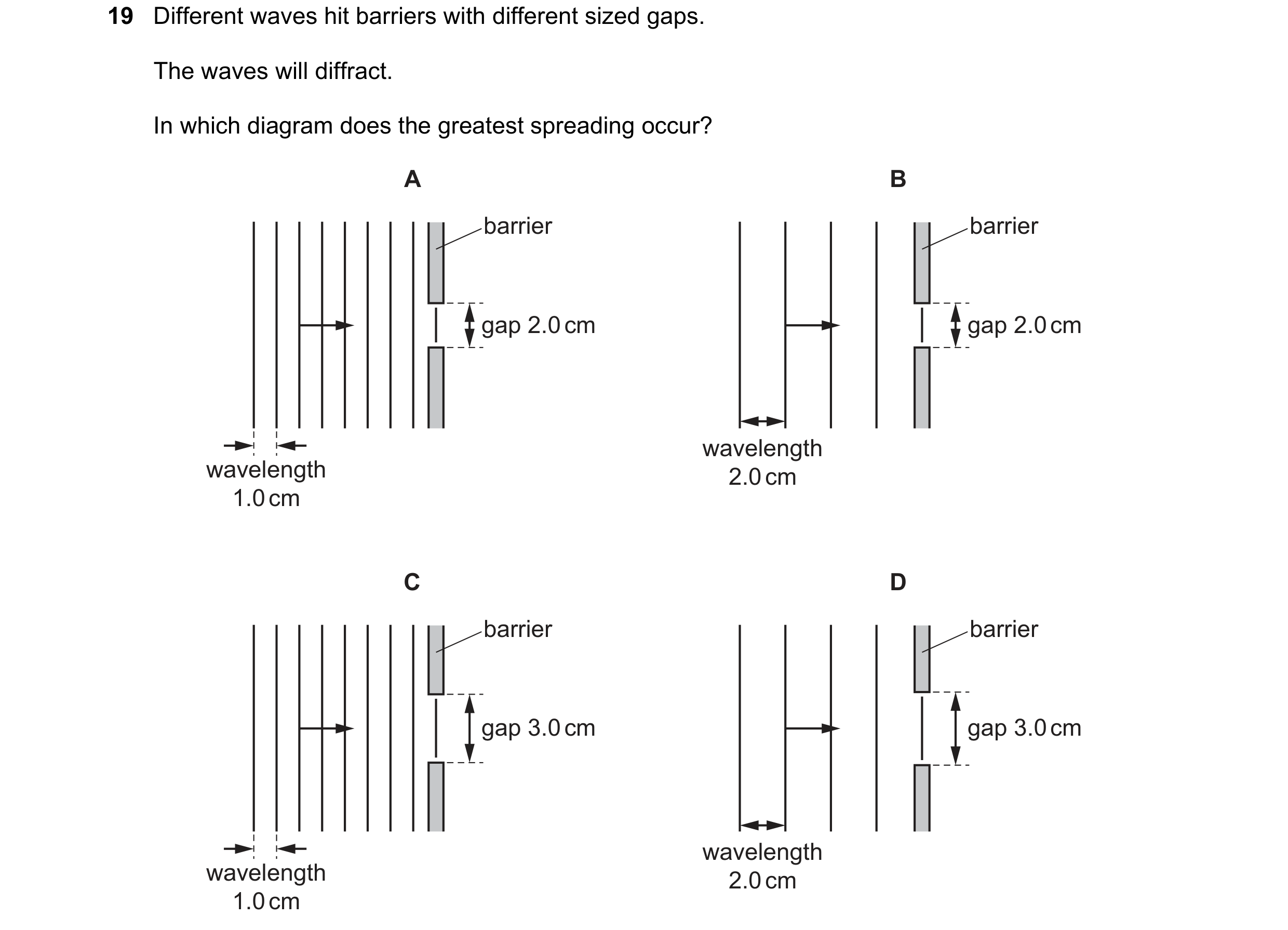
Q20 · Different waves hit barriers with different sized gaps 0625/21 May/June 2017
19 Different waves hit barriers with different sized gaps. The waves will diffract. In which diagram does the greatest spreading occur? A B barrier barrier gap 2.0 cm gap 2.0 cm wavelength wavelength 2.0 cm 1.0 cm C D barrier barrier gap 3.0 cm gap 3.0 cm wavelength wavelength 2.0 cm 1.0 cm
1 marks
Answer: B
This question in 0625/21 May/June 2017
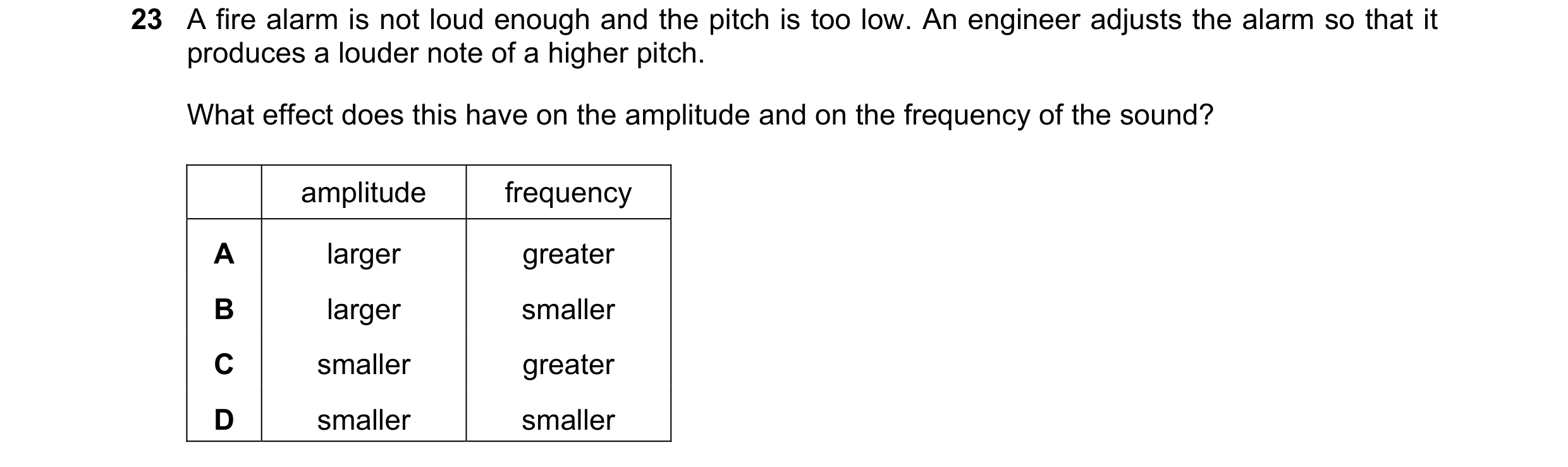
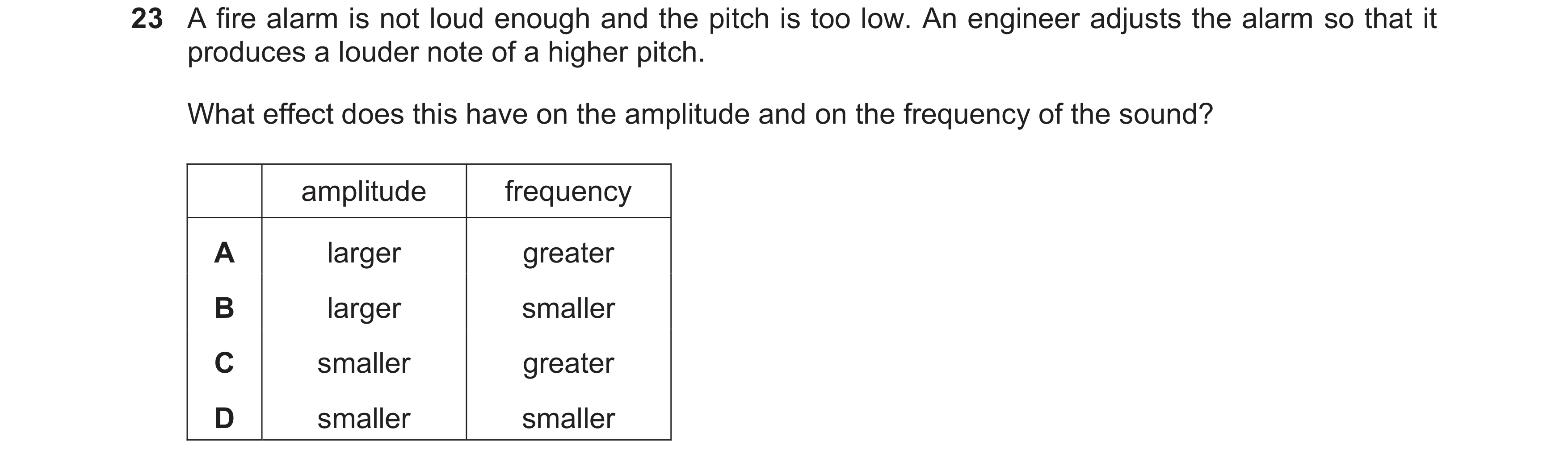
Q21 · A fire alarm is not loud enough and the pitch is too low 0625/21 May/June 2017
23 A fire alarm is not loud enough and the pitch is too low. An engineer adjusts the alarm so that it produces a louder note of a higher pitch. What effect does this have on the amplitude and on the frequency of the sound? amplitude frequency A larger greater B larger smaller C smaller greater D smaller smaller
1 marks
Answer: A
This question in 0625/21 May/June 2017
Q22 · Different waves hit barriers with different sized gaps 0625/22 May/June 2017
19 Different waves hit barriers with different sized gaps. The waves will diffract. In which diagram does the greatest spreading occur? A B barrier barrier gap 2.0 cm gap 2.0 cm wavelength wavelength 2.0 cm 1.0 cm C D barrier barrier gap 3.0 cm gap 3.0 cm wavelength wavelength 2.0 cm 1.0 cm
1 marks
Answer: B
This question in 0625/22 May/June 2017
Q23 · Different waves hit barriers with different sized gaps 0625/23 May/June 2017
19 Different waves hit barriers with different sized gaps. The waves will diffract. In which diagram does the greatest spreading occur? A B barrier barrier gap 2.0 cm gap 2.0 cm wavelength wavelength 2.0 cm 1.0 cm C D barrier barrier gap 3.0 cm gap 3.0 cm wavelength wavelength 2.0 cm 1.0 cm
1 marks
Answer: B
This question in 0625/23 May/June 2017
Q24 · A fire alarm is not loud enough and the pitch is too low 0625/23 May/June 2017
23 A fire alarm is not loud enough and the pitch is too low. An engineer adjusts the alarm so that it produces a louder note of a higher pitch. What effect does this have on the amplitude and on the frequency of the sound? amplitude frequency A larger greater B larger smaller C smaller greater D smaller smaller
1 marks
Answer: A
This question in 0625/23 May/June 2017
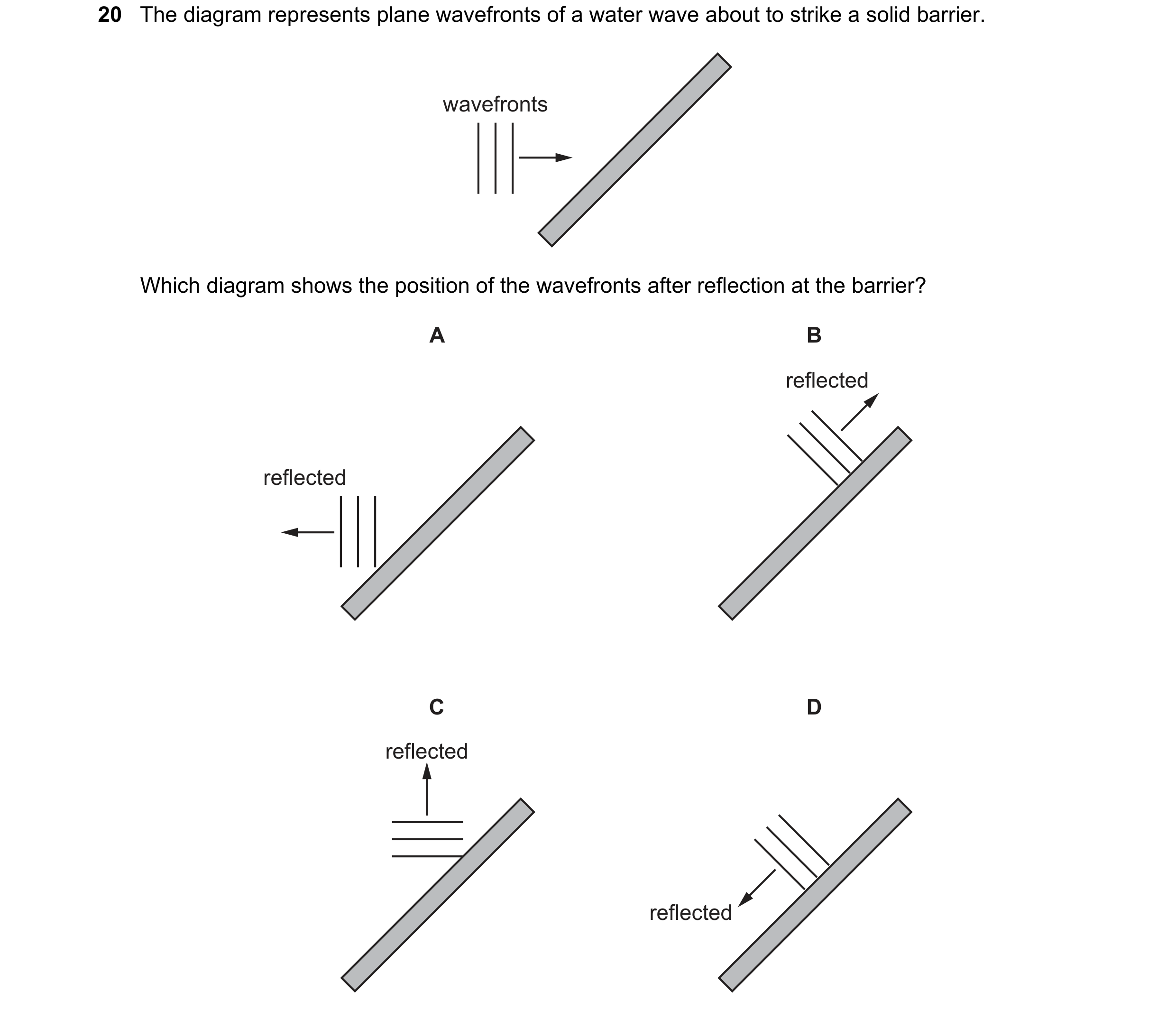
Q25 · The diagram represents plane wavefronts of a water wave about to strike a solid barrier 0625/21 Oct/Nov 2017
20 The diagram represents plane wavefronts of a water wave about to strike a solid barrier. wavefronts Which diagram shows the position of the wavefronts after reflection at the barrier? A B reflected reflected C D reflected reflected
1 marks
Answer: C
This question in 0625/21 Oct/Nov 2017
Q26 · The diagram represents plane wavefronts of a water wave about to strike a solid barrier 0625/22 Oct/Nov 2017
20 The diagram represents plane wavefronts of a water wave about to strike a solid barrier. wavefronts Which diagram shows the position of the wavefronts after reflection at the barrier? A B reflected reflected C D reflected reflected
1 marks
Answer: C
This question in 0625/22 Oct/Nov 2017
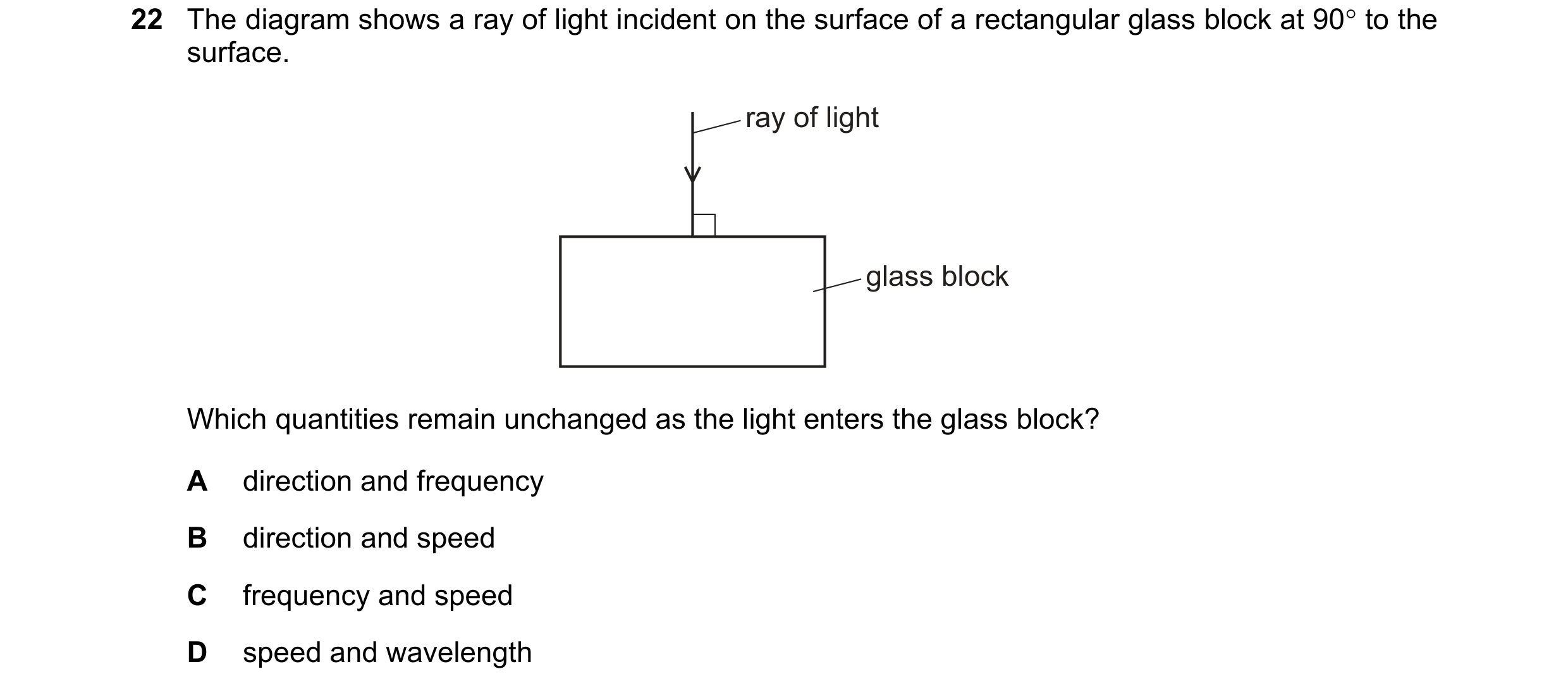
Q27 · The diagram shows a ray of light incident on the surface of a rectangular glass block at… 0625/22 Oct/Nov 2017
22 The diagram shows a ray of light incident on the surface of a rectangular glass block at 90° to the surface. ray of light glass block Which quantities remain unchanged as the light enters the glass block? A direction and frequency B direction and speed C frequency and speed D speed and wavelength
1 marks
Answer: A
This question in 0625/22 Oct/Nov 2017
Q28 · The diagram represents plane wavefronts of a water wave about to strike a solid barrier 0625/23 Oct/Nov 2017
20 The diagram represents plane wavefronts of a water wave about to strike a solid barrier. wavefronts Which diagram shows the position of the wavefronts after reflection at the barrier? A B reflected reflected C D reflected reflected
1 marks
Answer: C
This question in 0625/23 Oct/Nov 2017
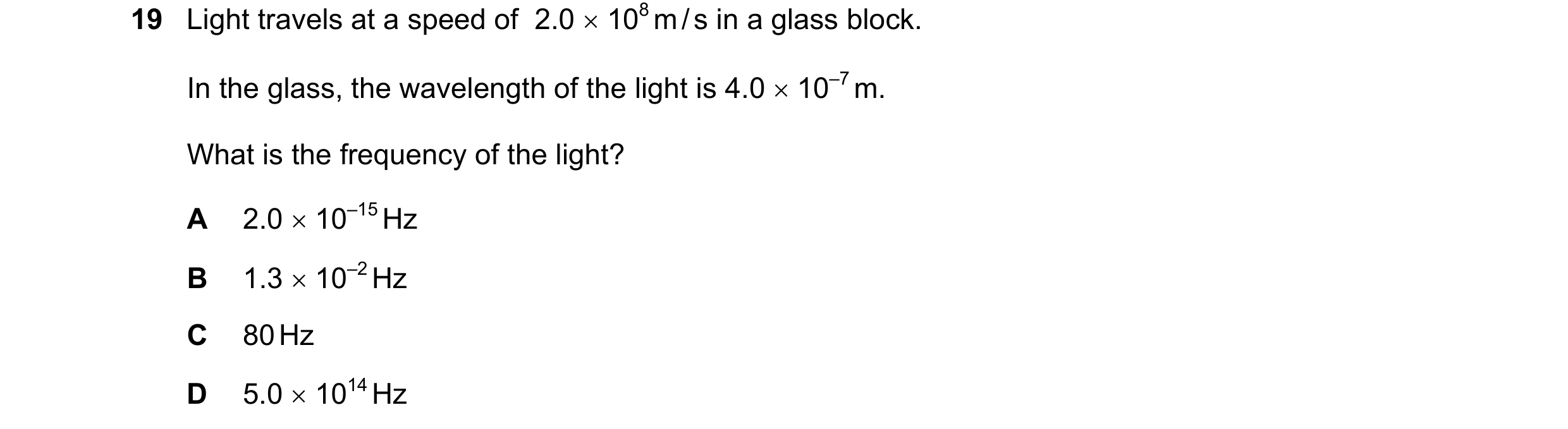
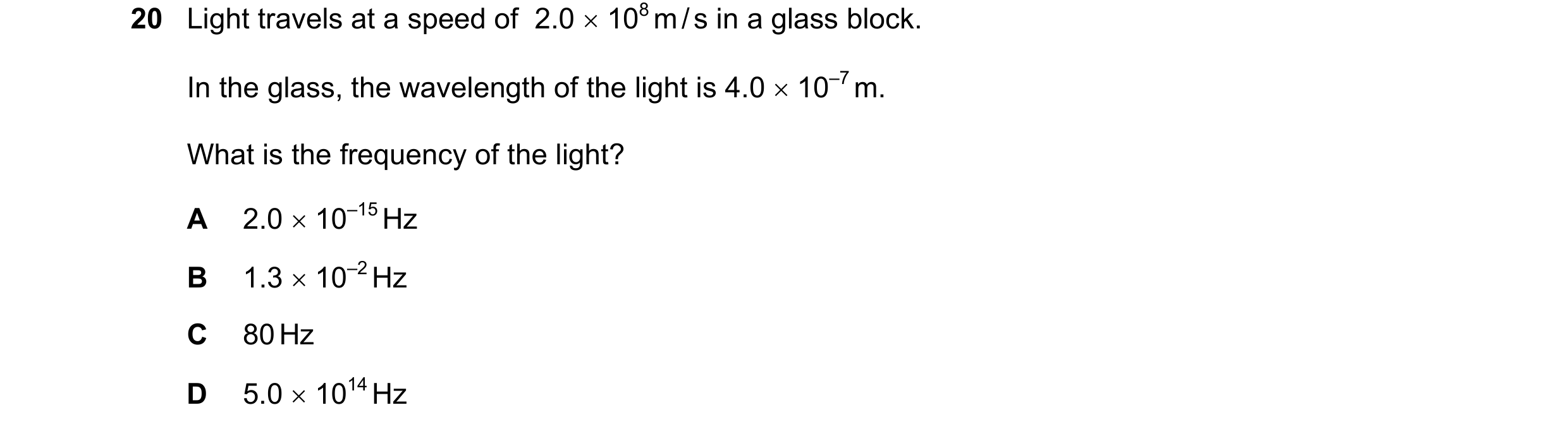
Q29 · Light travels at a speed of 2.0 × 10⁸ m / s in a glass block 0625/21 May/June 2018
19 Light travels at a speed of 2.0 × 10⁸ m / s in a glass block. In the glass, the wavelength of the light is 4.0 × 10⁻⁷ m. What is the frequency of the light? A 2.0 × 10⁻¹⁵ Hz B 1.3 × 10⁻² Hz C 80 Hz D 5.0 × 10¹⁴ Hz
1 marks
Answer: D
This question in 0625/21 May/June 2018
Q30 · Which arrow on the graph shows the amplitude of the wave? 0625/21 May/June 2018
20 Which arrow on the graph shows the amplitude of the wave? displacement B A C 0 0 distance D
1 marks
Answer: B
This question in 0625/21 May/June 2018
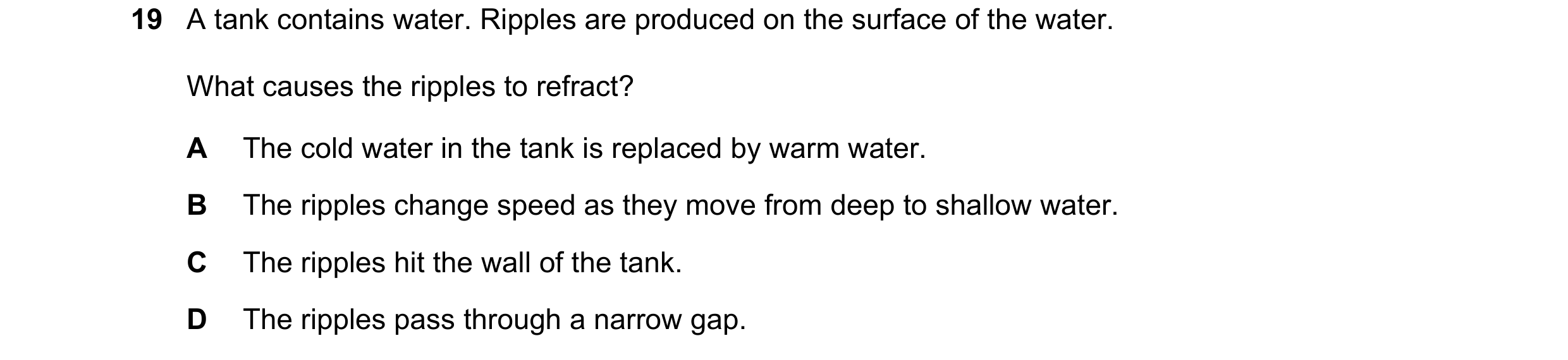
Q31 · A tank contains water 0625/22 May/June 2018
19 A tank contains water. Ripples are produced on the surface of the water. What causes the ripples to refract? A The cold water in the tank is replaced by warm water. B The ripples change speed as they move from deep to shallow water. C The ripples hit the wall of the tank. D The ripples pass through a narrow gap.
1 marks
Answer: B
This question in 0625/22 May/June 2018
Q32 · Light travels at a speed of 2.0 × 10⁸ m / s in a glass block 0625/22 May/June 2018
20 Light travels at a speed of 2.0 × 10⁸ m / s in a glass block. In the glass, the wavelength of the light is 4.0 × 10⁻⁷ m. What is the frequency of the light? A 2.0 × 10⁻¹⁵ Hz B 1.3 × 10⁻² Hz C 80 Hz D 5.0 × 10¹⁴ Hz
1 marks
Answer: D
This question in 0625/22 May/June 2018
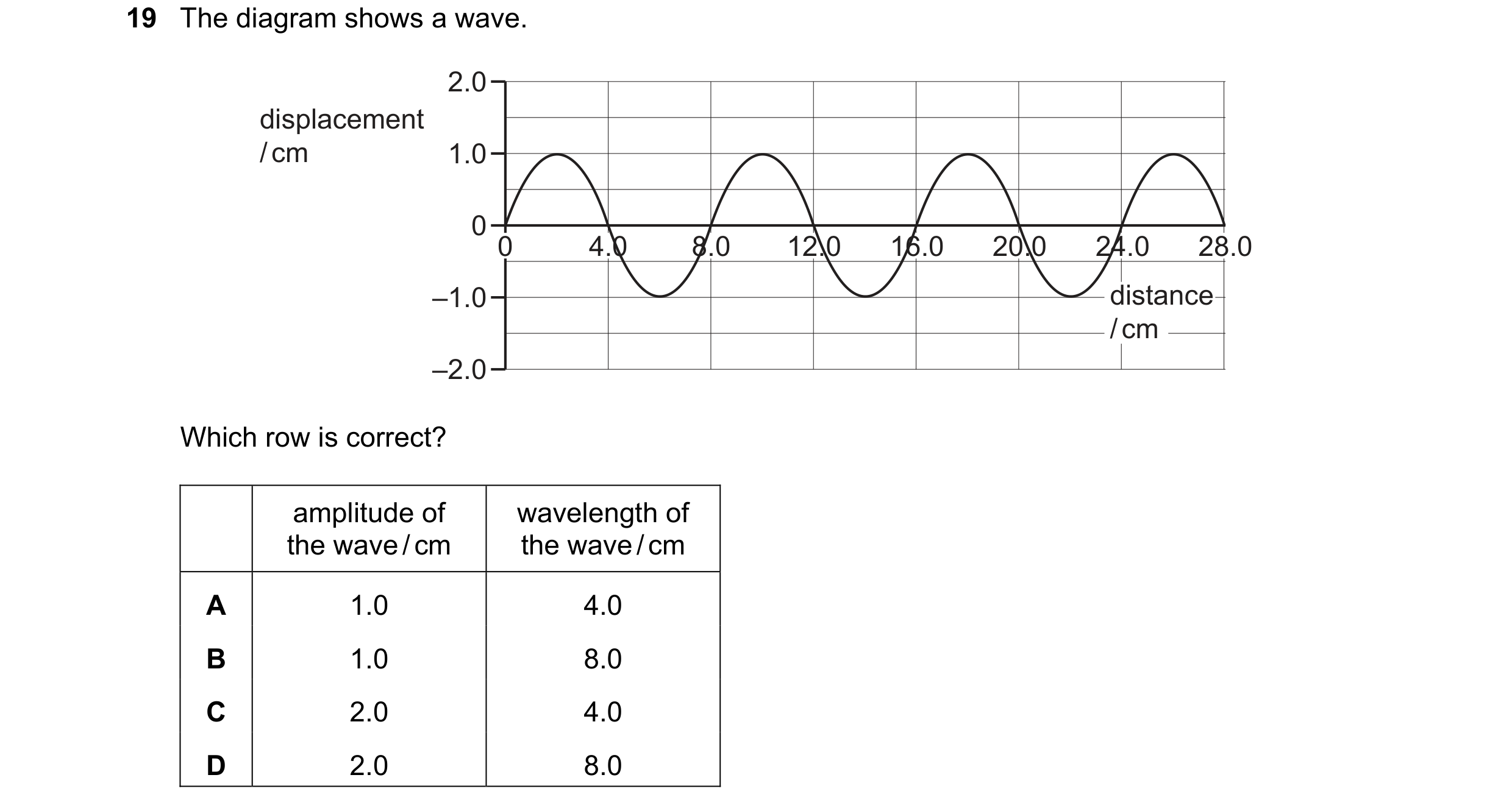
Q33 · The diagram shows a wave 0625/23 May/June 2018
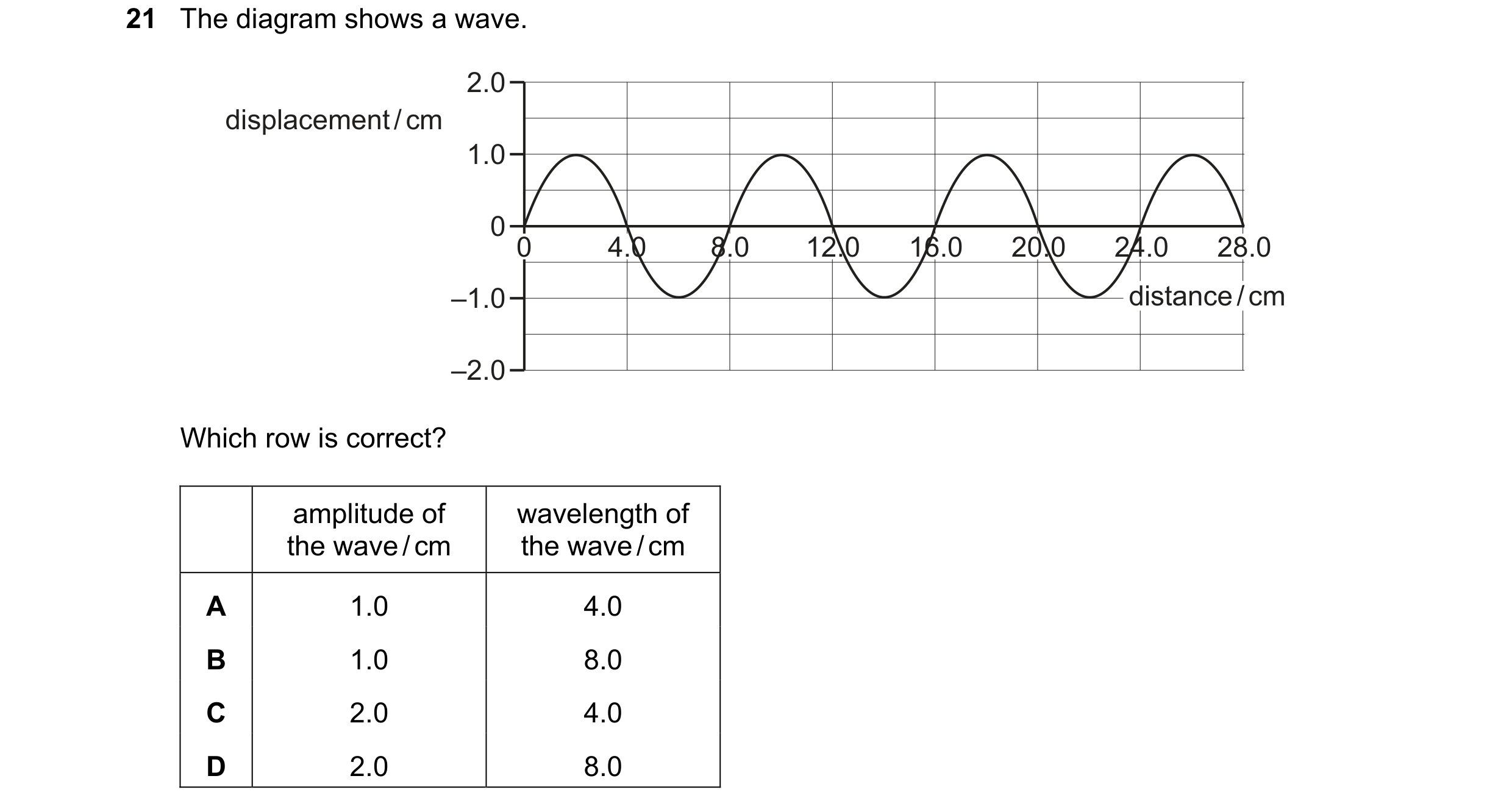
19 The diagram shows a wave. 2.0 displacement / cm 1.0 0 0 4.0 8.0 12.0 16.0 20.0 24.0 28.0 –1.0 distance / cm –2.0 Which row is correct? amplitude of wavelength of the wave / cm the wave / cm A 1.0 4.0 B 1.0 8.0 C 2.0 4.0 D 2.0 8.0
1 marks
Answer: B
This question in 0625/23 May/June 2018
Q34 · Light travels at a speed of 2.0 × 10⁸ m / s in a glass block 0625/23 May/June 2018
20 Light travels at a speed of 2.0 × 10⁸ m / s in a glass block. In the glass, the wavelength of the light is 4.0 × 10⁻⁷ m. What is the frequency of the light? A 2.0 × 10⁻¹⁵ Hz B 1.3 × 10⁻² Hz C 80 Hz D 5.0 × 10¹⁴ Hz
1 marks
Answer: D
This question in 0625/23 May/June 2018
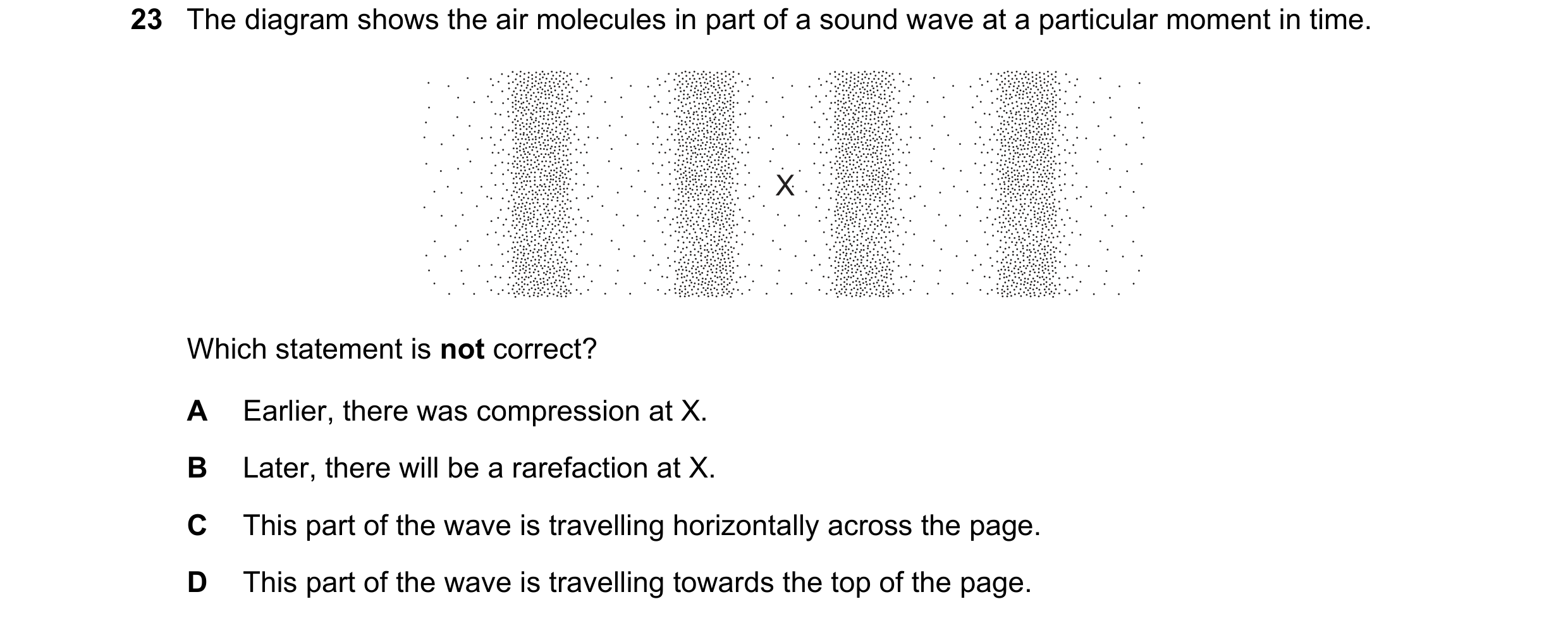
Q35 · The diagram shows the air molecules in part of a sound wave at a particular moment in time 0625/23 May/June 2018
23 The diagram shows the air molecules in part of a sound wave at a particular moment in time. X Which statement is not correct? A Earlier, there was compression at X. B Later, there will be a rarefaction at X. C This part of the wave is travelling horizontally across the page. D This part of the wave is travelling towards the top of the page.
1 marks
Answer: D
This question in 0625/23 May/June 2018
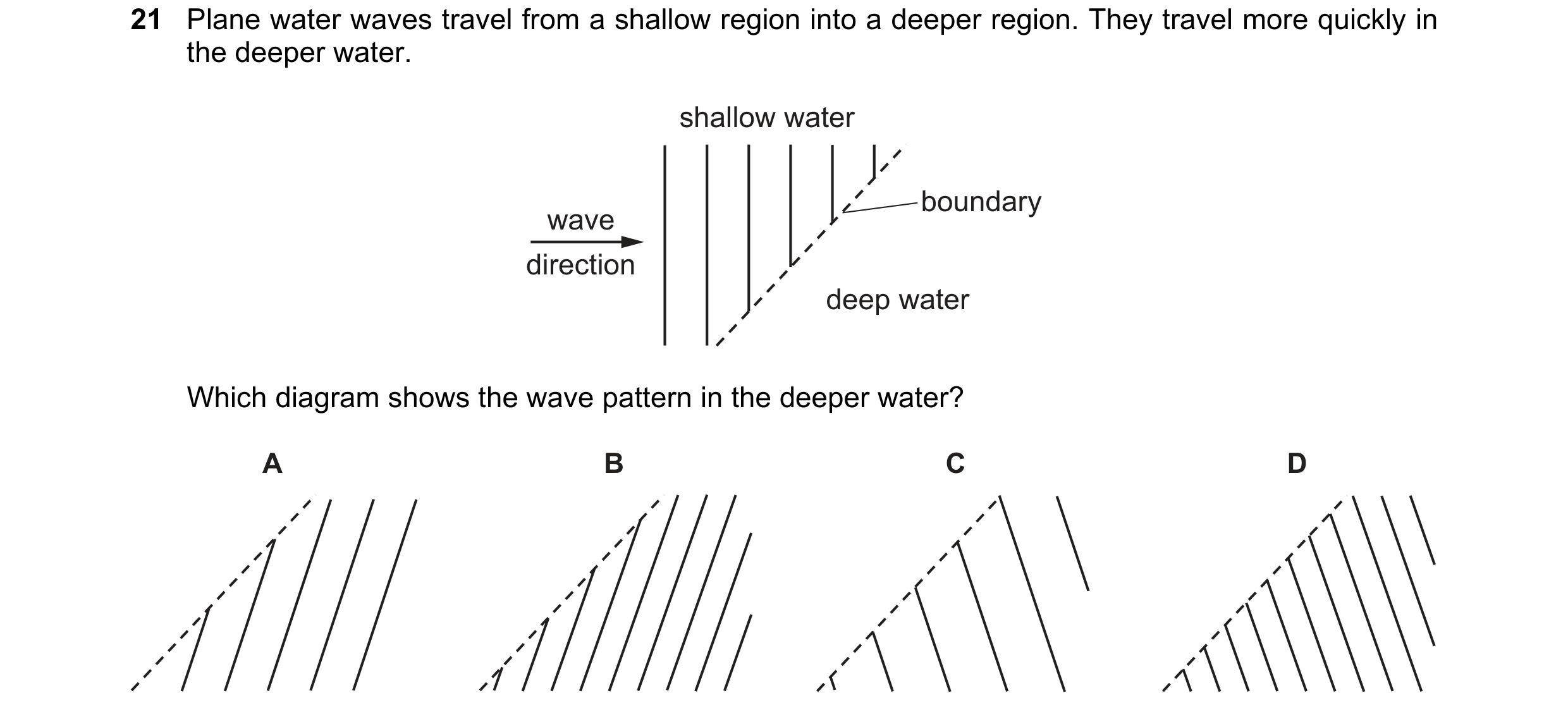
Q36 · Plane water waves travel from a shallow region into a deeper region 0625/21 Oct/Nov 2018
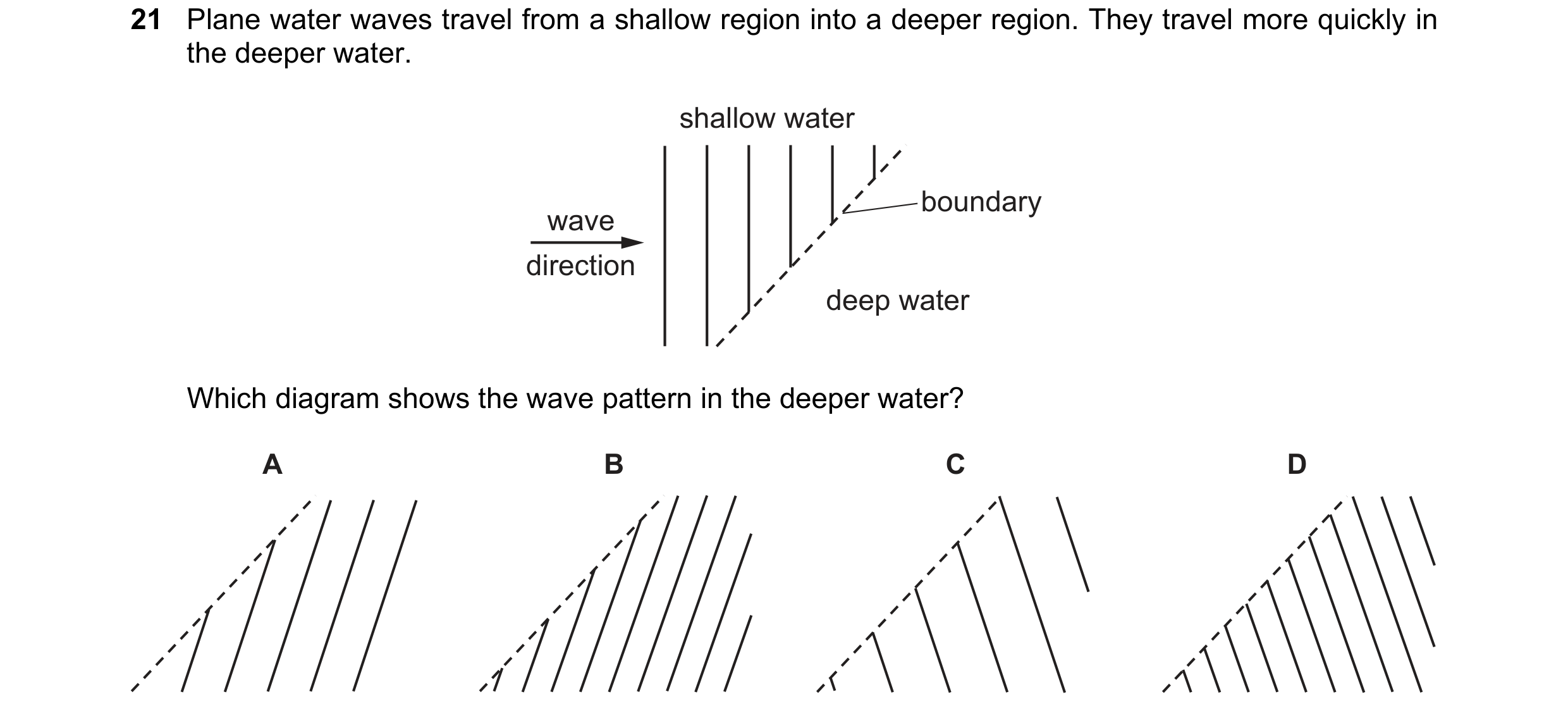
21 Plane water waves travel from a shallow region into a deeper region. They travel more quickly in the deeper water. shallow water boundary wave direction deep water Which diagram shows the wave pattern in the deeper water? A B C D
1 marks
Answer: C
This question in 0625/21 Oct/Nov 2018
Q37 · Plane water waves travel from a shallow region into a deeper region 0625/22 Oct/Nov 2018
21 Plane water waves travel from a shallow region into a deeper region. They travel more quickly in the deeper water. shallow water boundary wave direction deep water Which diagram shows the wave pattern in the deeper water? A B C D
1 marks
Answer: C
This question in 0625/22 Oct/Nov 2018
Q38 · Plane water waves travel from a shallow region into a deeper region 0625/23 Oct/Nov 2018
21 Plane water waves travel from a shallow region into a deeper region. They travel more quickly in the deeper water. shallow water boundary wave direction deep water Which diagram shows the wave pattern in the deeper water? A B C D
1 marks
Answer: C
This question in 0625/23 Oct/Nov 2018
Q39 · The diagram shows a wave before it reflects from a barrier 0625/22 Feb/March 2019
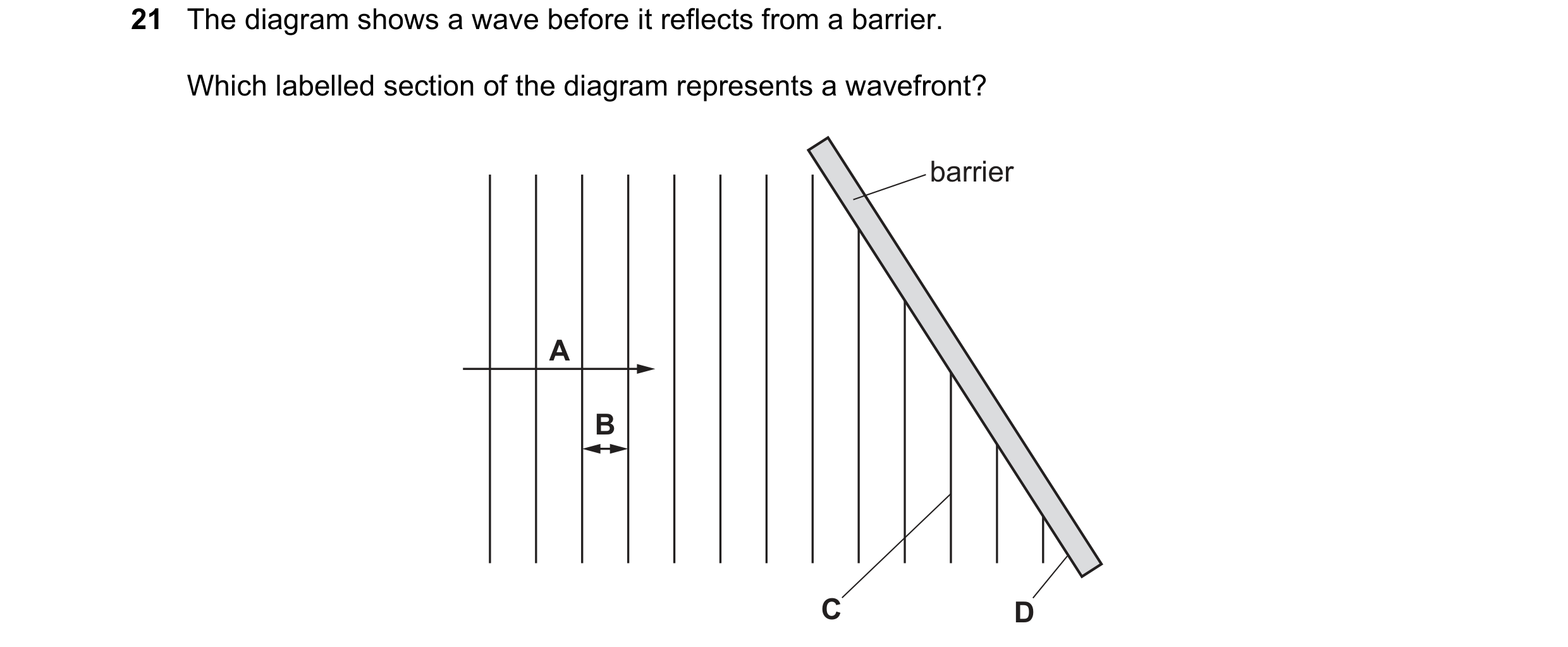
21 The diagram shows a wave before it reflects from a barrier. Which labelled section of the diagram represents a wavefront? barrier A B C D
1 marks
Answer: C
This question in 0625/22 Feb/March 2019
Q40 · A vibrating object produces ripples on the surface of a liquid 0625/22 Feb/March 2019
22 A vibrating object produces ripples on the surface of a liquid. The object completes 20 vibrations every second. The spacing of the ripples, from one crest to the next, is 3.0 cm. What is the speed of the ripples? A 0.15 cm / s B 6.7 cm / s C 60 cm / s D 120 cm / s
1 marks
Answer: C
This question in 0625/22 Feb/March 2019
Q41 · A sound wave passes a point 0625/22 Feb/March 2019
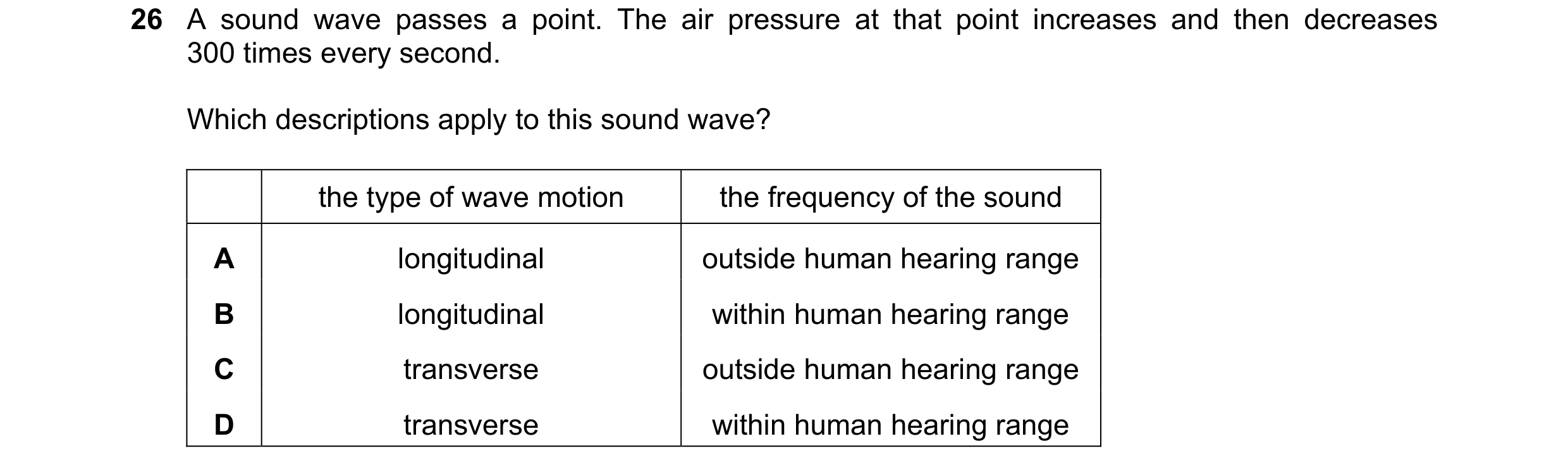
26 A sound wave passes a point. The air pressure at that point increases and then decreases 300 times every second. Which descriptions apply to this sound wave? the type of wave motion the frequency of the sound A longitudinal outside human hearing range B longitudinal within human hearing range C transverse outside human hearing range D transverse within human hearing range
1 marks
Answer: B
This question in 0625/22 Feb/March 2019
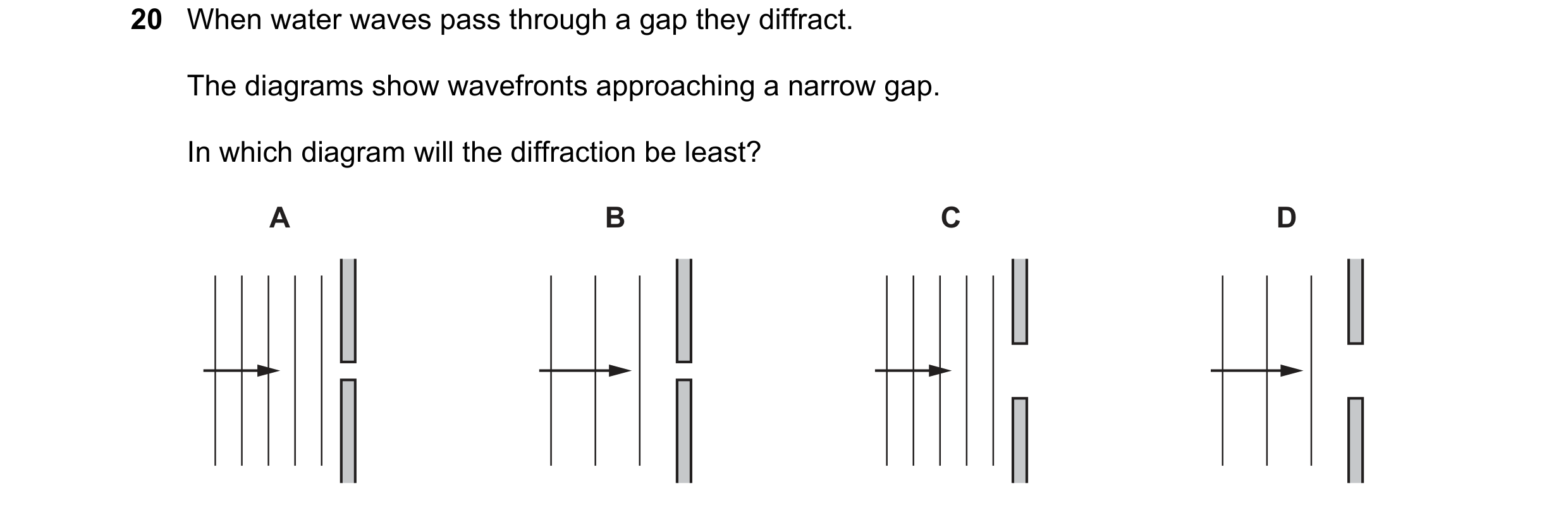
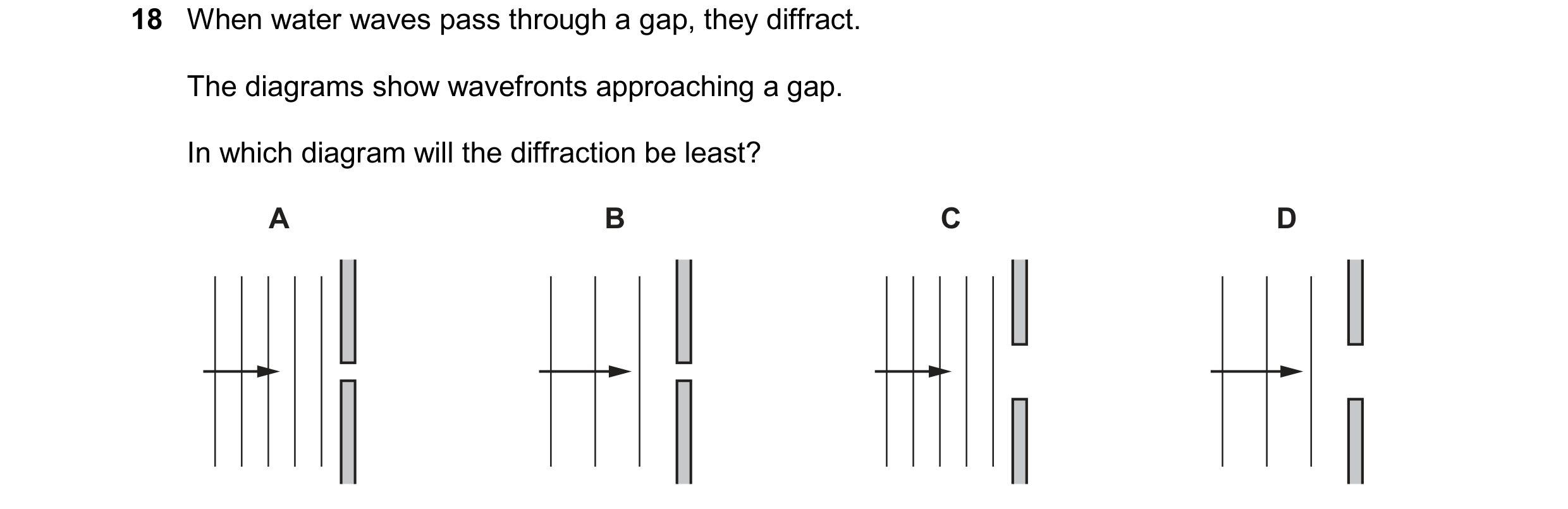
Q42 · When water waves pass through a gap they diffract 0625/21 May/June 2019
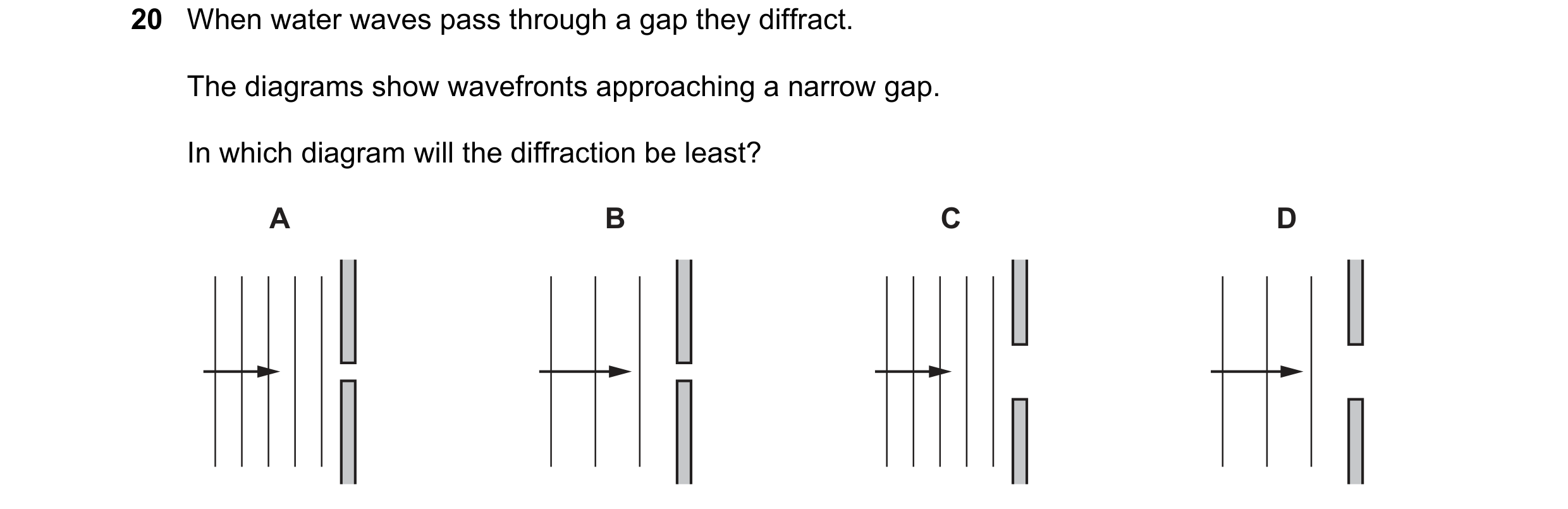
20 When water waves pass through a gap they diffract. The diagrams show wavefronts approaching a narrow gap. In which diagram will the diffraction be least? A B C D
1 marks
Answer: C
This question in 0625/21 May/June 2019
Q43 · When water waves pass through a gap they diffract 0625/22 May/June 2019
20 When water waves pass through a gap they diffract. The diagrams show wavefronts approaching a narrow gap. In which diagram will the diffraction be least? A B C D
1 marks
Answer: C
This question in 0625/22 May/June 2019
Q44 · When water waves pass through a gap they diffract 0625/23 May/June 2019
19 When water waves pass through a gap they diffract. The diagrams show wavefronts approaching a narrow gap. In which diagram will the diffraction be least? A B C D
1 marks
Answer: C
This question in 0625/23 May/June 2019
Q45 · Sound travels through air at a speed of 340 m / s 0625/23 May/June 2019
20 Sound travels through air at a speed of 340 m / s. A source generates sound waves at a frequency of 1.2 kHz. What is the wavelength of the sound waves? A 0.28 m B 3.5 m C 280 m D 410 m
1 marks
Answer: A
This question in 0625/23 May/June 2019
Q46 · Which statement about ultrasound is correct? 0625/23 May/June 2019
25 Which statement about ultrasound is correct? A It has a higher frequency than audible sound, and it is a longitudinal wave. B It has a higher frequency than audible sound, and it is a transverse wave. C It has a lower frequency than audible sound, and it is a longitudinal wave. D It has a lower frequency than audible sound, and it is a transverse wave.
1 marks
Answer: A
This question in 0625/23 May/June 2019
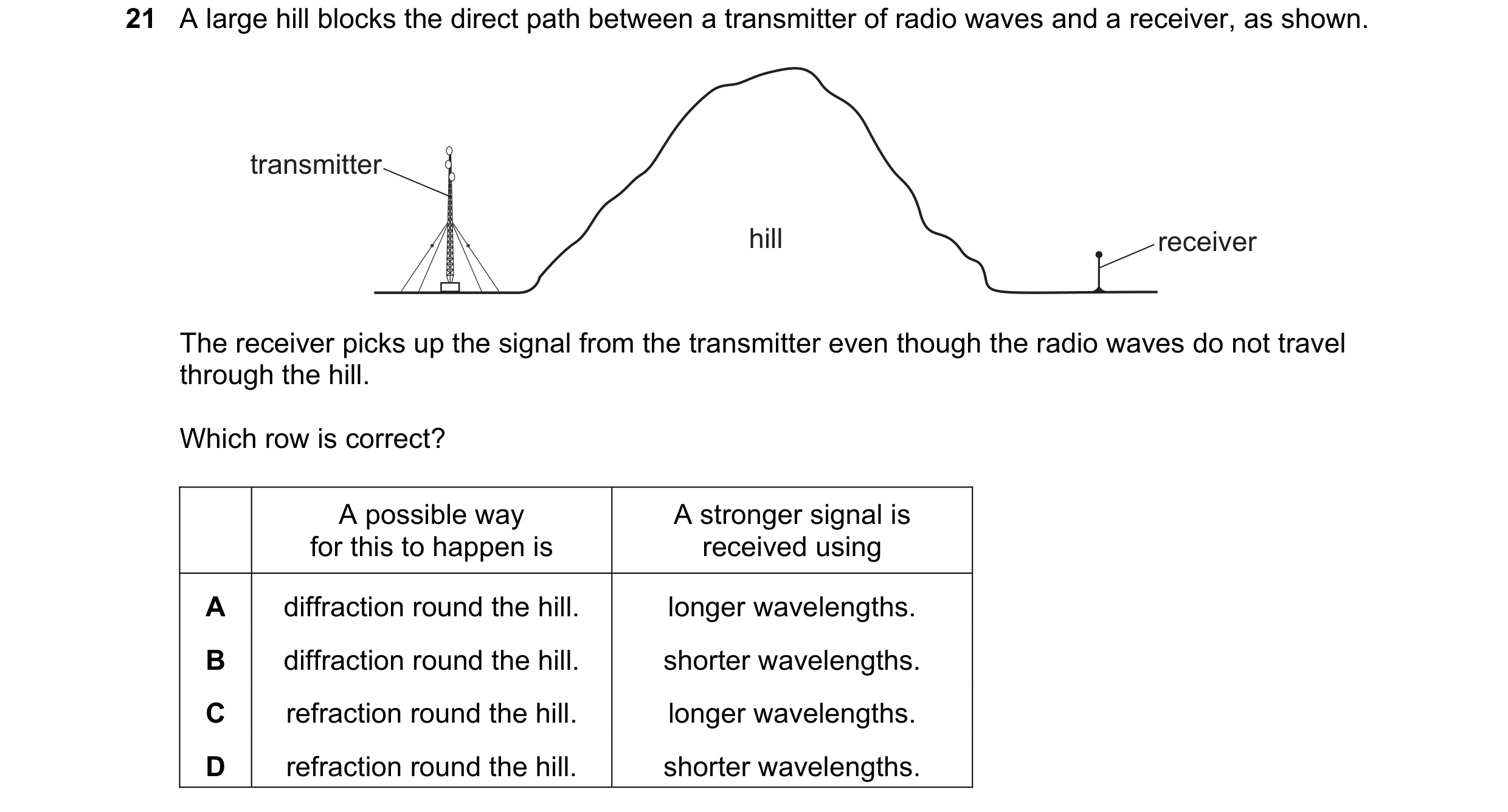
Q47 · A large hill blocks the direct path between a transmitter of radio waves and a receiver… 0625/21 Oct/Nov 2019
21 A large hill blocks the direct path between a transmitter of radio waves and a receiver, as shown. transmitter hill receiver The receiver picks up the signal from the transmitter even though the radio waves do not travel through the hill. Which row is correct? A possible way A stronger signal is for this to happen is received using A diffraction round the hill. longer wavelengths. B diffraction round the hill. shorter wavelengths. C refraction round the hill. longer wavelengths. D refraction round the hill. shorter wavelengths.
1 marks
Answer: A
This question in 0625/21 Oct/Nov 2019
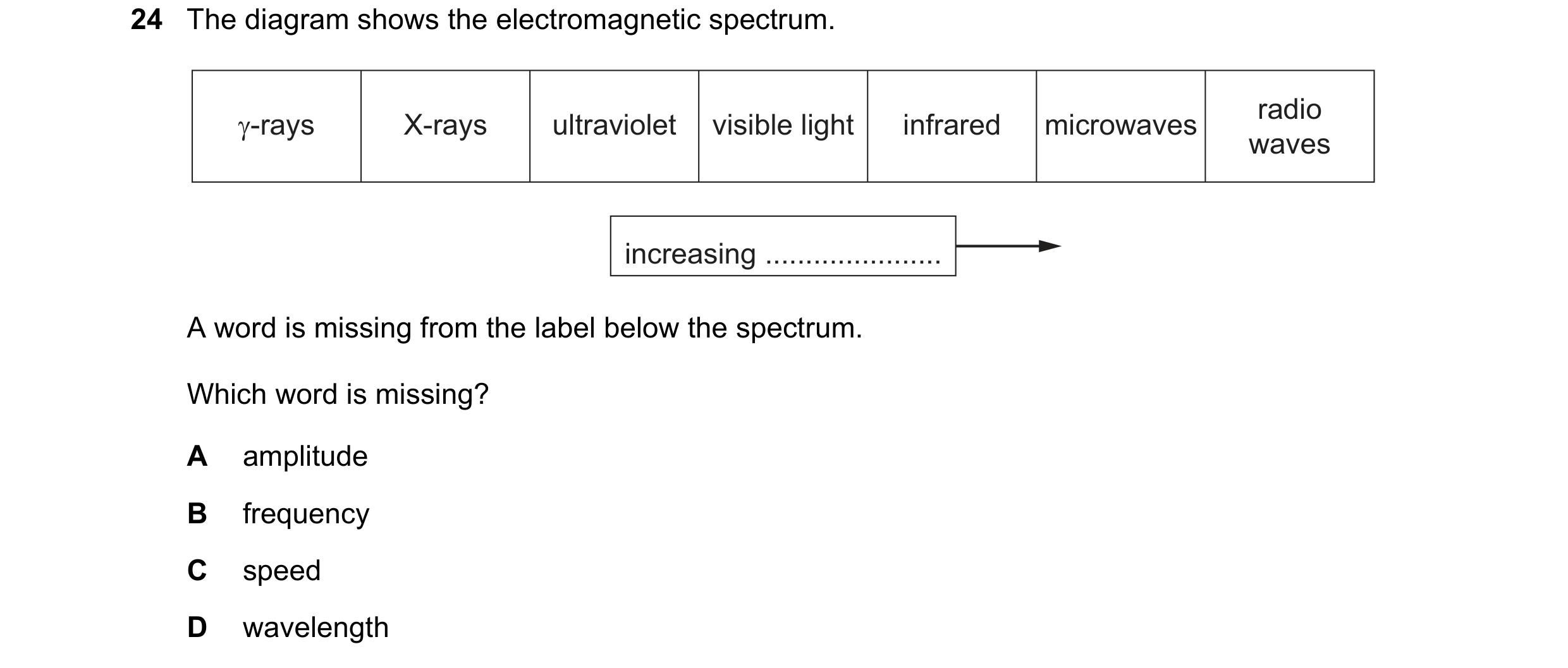
Q48 · The diagram shows the electromagnetic spectrum 0625/21 Oct/Nov 2019
24 The diagram shows the electromagnetic spectrum. radio γ-rays X-rays ultraviolet visible light infrared microwaves waves increasing … A word is missing from the label below the spectrum. Which word is missing? A amplitude B frequency C speed D wavelength
1 marks
Answer: D
This question in 0625/21 Oct/Nov 2019
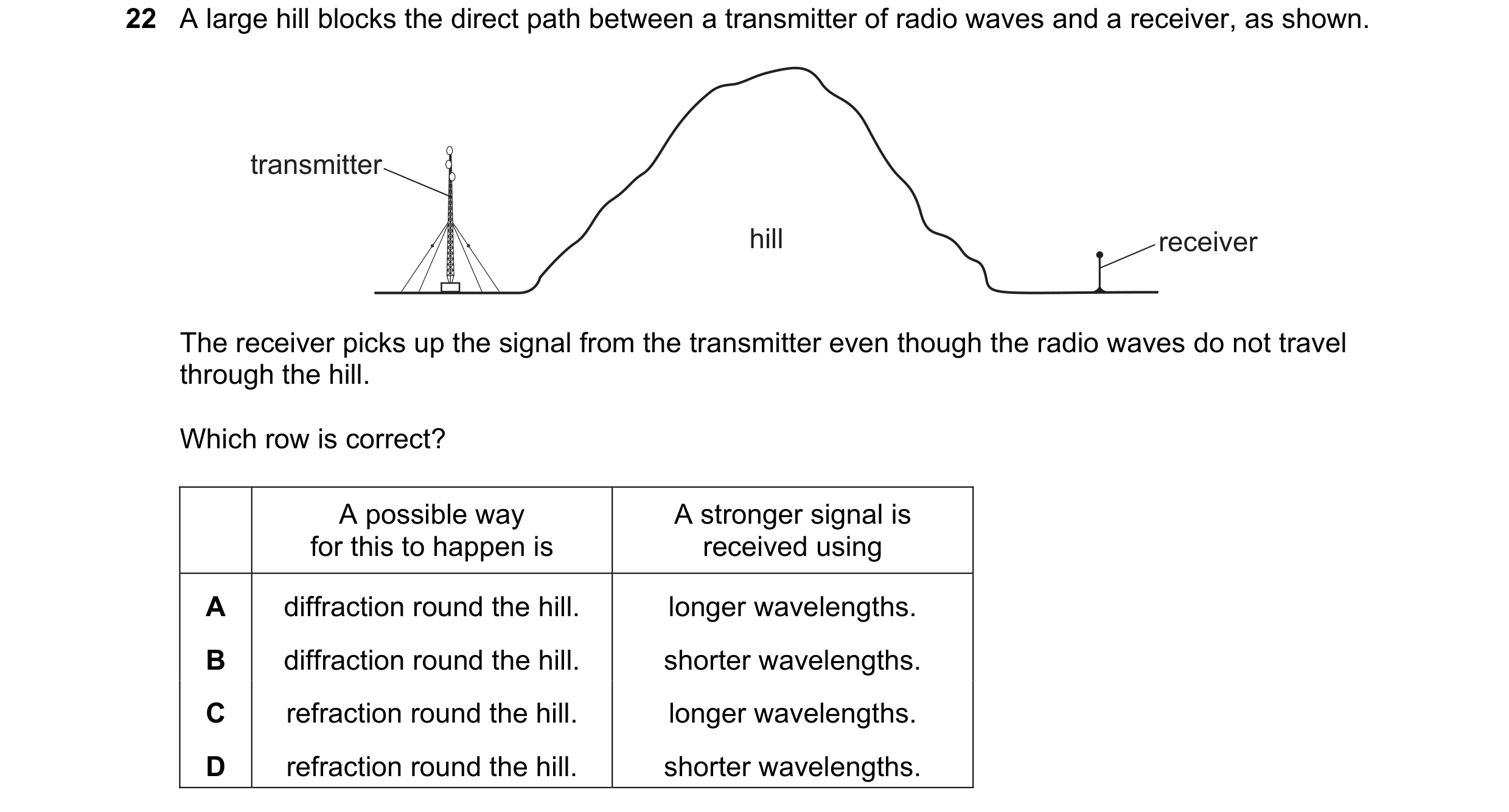
Q49 · A large hill blocks the direct path between a transmitter of radio waves and a receiver… 0625/22 Oct/Nov 2019
22 A large hill blocks the direct path between a transmitter of radio waves and a receiver, as shown. transmitter hill receiver The receiver picks up the signal from the transmitter even though the radio waves do not travel through the hill. Which row is correct? A possible way A stronger signal is for this to happen is received using A diffraction round the hill. longer wavelengths. B diffraction round the hill. shorter wavelengths. C refraction round the hill. longer wavelengths. D refraction round the hill. shorter wavelengths.
1 marks
Answer: A
This question in 0625/22 Oct/Nov 2019
Q50 · A large hill blocks the direct path between a transmitter of radio waves and a receiver… 0625/23 Oct/Nov 2019
21 A large hill blocks the direct path between a transmitter of radio waves and a receiver, as shown. transmitter hill receiver The receiver picks up the signal from the transmitter even though the radio waves do not travel through the hill. Which row is correct? A possible way A stronger signal is for this to happen is received using A diffraction round the hill. longer wavelengths. B diffraction round the hill. shorter wavelengths. C refraction round the hill. longer wavelengths. D refraction round the hill. shorter wavelengths.
1 marks
Answer: A
This question in 0625/23 Oct/Nov 2019
Q51 · The diagram shows the electromagnetic spectrum 0625/23 Oct/Nov 2019
24 The diagram shows the electromagnetic spectrum. radio γ-rays X-rays ultraviolet visible light infrared microwaves waves increasing … A word is missing from the label below the spectrum. Which word is missing? A amplitude B frequency C speed D wavelength
1 marks
Answer: D
This question in 0625/23 Oct/Nov 2019
Q52 · Four students A, B, C and D, investigate the diffraction of water waves through a gap 0625/22 Feb/March 2020
23 Four students A, B, C and D, investigate the diffraction of water waves through a gap. Each student uses a different gap size and a different wavelength for the water waves. Which student produces the waves which have the most diffraction? gap size wavelength / cm / cm A 2.0 1.8 B 3.0 2.1 C 4.0 2.0 D 5.0 0.9
1 marks
Answer: A
This question in 0625/22 Feb/March 2020
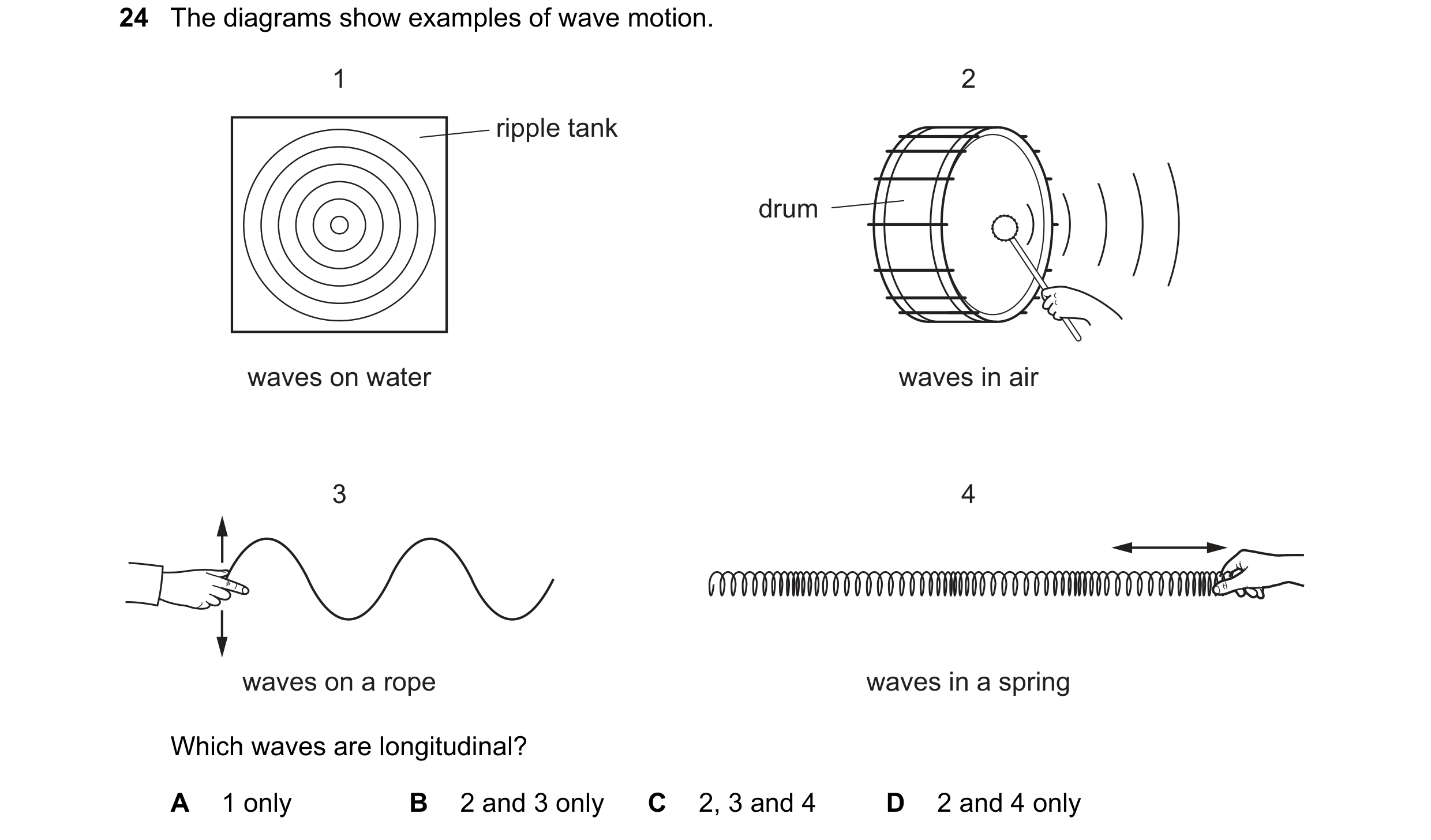
Q53 · The diagrams show examples of wave motion 0625/22 Feb/March 2020
24 The diagrams show examples of wave motion. 1 2 ripple tank drum waves on water waves in air 3 4 waves on a rope waves in a spring Which waves are longitudinal? A 1 only B 2 and 3 only C 2, 3 and 4 D 2 and 4 only
1 marks
Answer: D
This question in 0625/22 Feb/March 2020
Q54 · A wave of frequency 6600 Hz travels 1320 m in 4.0 s 0625/21 May/June 2020
20 A wave of frequency 6600 Hz travels 1320 m in 4.0 s. What is the wavelength? A 0.050 m B 0.80 m C 1.3 m D 20 m
1 marks
Answer: A
This question in 0625/21 May/June 2020
Q55 · The diagram shows a wave 0625/21 May/June 2020
21 The diagram shows a wave. 8 cm 3 cm 6 cm 4 cm What are the amplitude and the wavelength of this wave? amplitude / cm wavelength / cm A 3 4 B 3 8 C 6 4 D 6 8
1 marks
Answer: B
This question in 0625/21 May/June 2020
Q56 · Sound travels through air as a series of compressions and rarefactions 0625/21 May/June 2020
25 Sound travels through air as a series of compressions and rarefactions. Which statement correctly compares a compression with a rarefaction? A In a compression the wavelength is longer than in a rarefaction. B In a compression the wavelength is shorter than in a rarefaction. C In a compression the density of the air is greater than in a rarefaction. D In a compression the density of the air is lower than in a rarefaction.
1 marks
Answer: C
This question in 0625/21 May/June 2020
Q57 · The diagram shows a wave 0625/22 May/June 2020
20 The diagram shows a wave. 8 cm 3 cm 6 cm 4 cm What are the amplitude and the wavelength of this wave? amplitude / cm wavelength / cm A 3 4 B 3 8 C 6 4 D 6 8
1 marks
Answer: B
This question in 0625/22 May/June 2020
Q58 · The frequency of the microwaves used in a microwave oven is 2400 MHz 0625/22 May/June 2020
21 The frequency of the microwaves used in a microwave oven is 2400 MHz. What is the wavelength of these microwaves? A 0.125 m B 8.00 m C 125 m D 7200 m
1 marks
Answer: A
This question in 0625/22 May/June 2020
Q59 · A dolphin sends out a sound wave 0625/22 May/June 2020
25 A dolphin sends out a sound wave. An echo returns 0.010 s later from a fish which is 7.5 m from the dolphin. What is the speed of the sound wave in water? A 0.075 m / s B 0.15 m / s C 750 m / s D 1500 m / s
1 marks
Answer: D
This question in 0625/22 May/June 2020
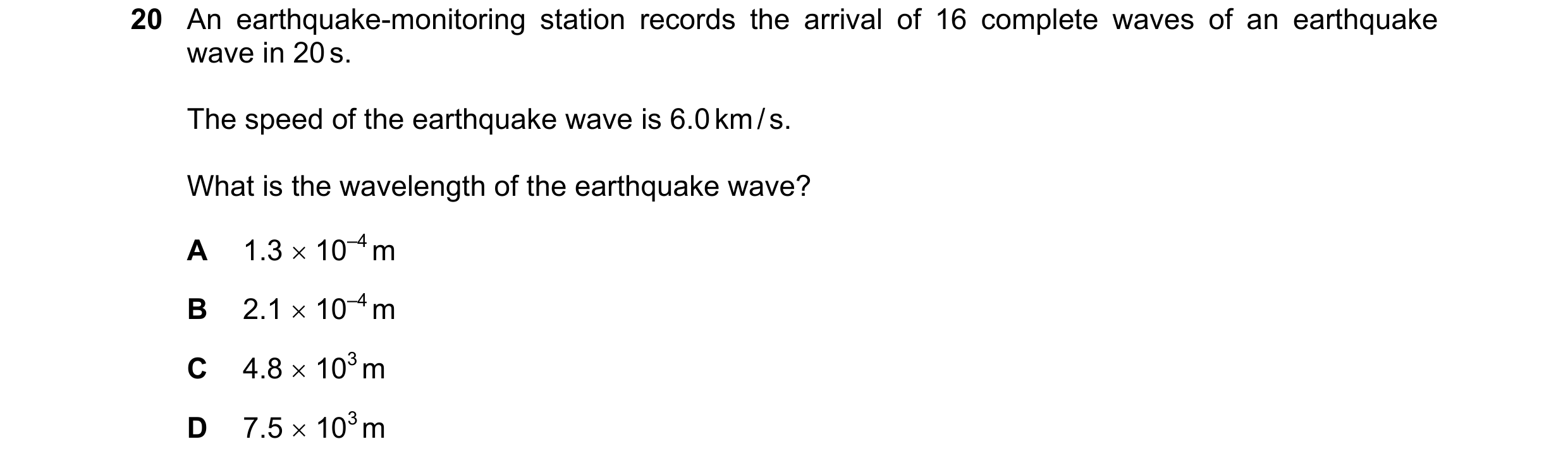
Q60 · An earthquake-monitoring station records the arrival of 16 complete waves of an… 0625/23 May/June 2020
20 An earthquake-monitoring station records the arrival of 16 complete waves of an earthquake wave in 20 s. The speed of the earthquake wave is 6.0 km / s. What is the wavelength of the earthquake wave? A 1.3 × 10⁻⁴ m B 2.1 × 10⁻⁴ m C 4.8 × 10³ m D 7.5 × 10³ m
1 marks
Answer: D
This question in 0625/23 May/June 2020
Q61 · The diagram shows a wave 0625/23 May/June 2020
21 The diagram shows a wave. 8 cm 3 cm 6 cm 4 cm What are the amplitude and the wavelength of this wave? amplitude / cm wavelength / cm A 3 4 B 3 8 C 6 4 D 6 8
1 marks
Answer: B
This question in 0625/23 May/June 2020
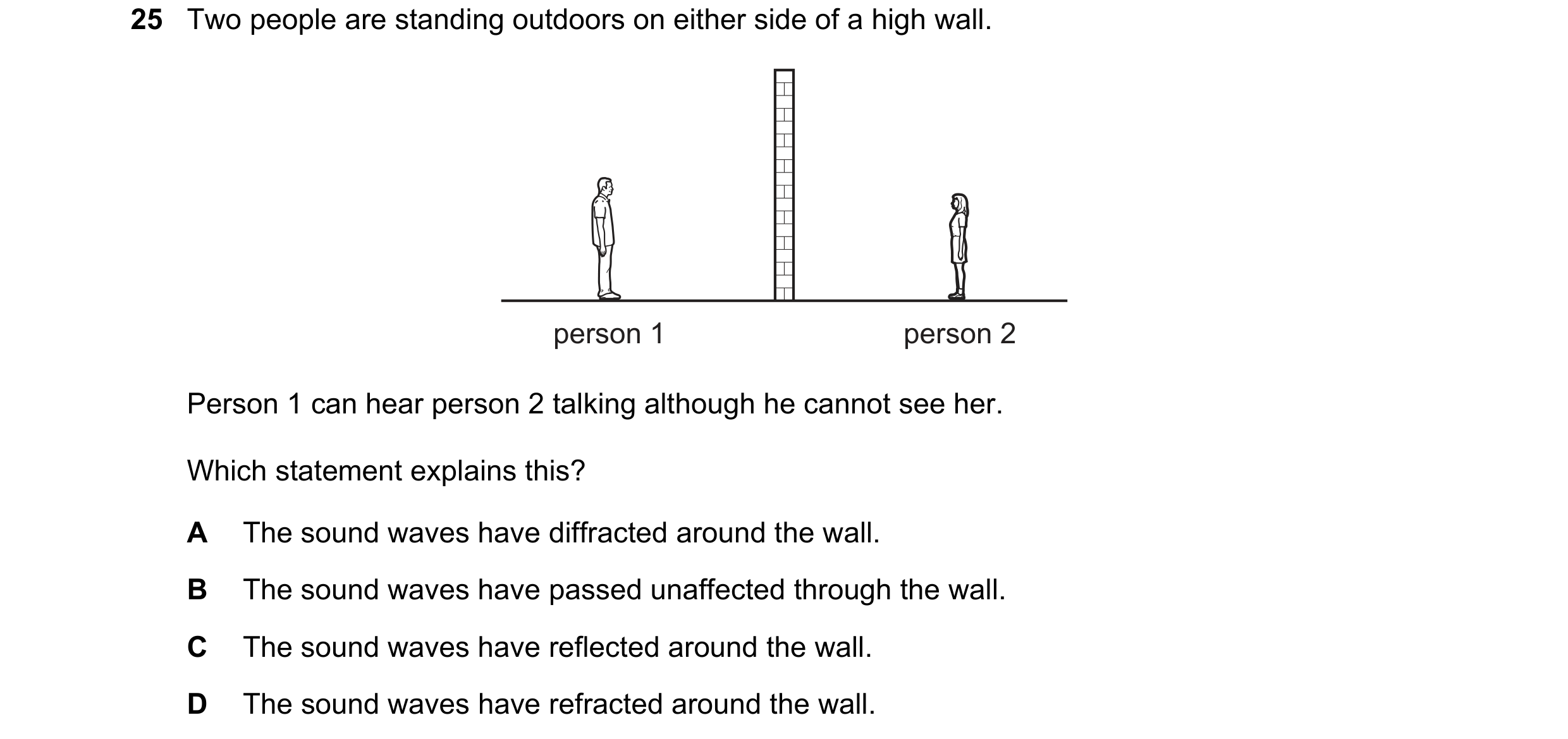
Q62 · Two people are standing outdoors on either side of a high wall 0625/23 May/June 2020
25 Two people are standing outdoors on either side of a high wall. person 1 person 2 Person 1 can hear person 2 talking although he cannot see her. Which statement explains this? A The sound waves have diffracted around the wall. B The sound waves have passed unaffected through the wall. C The sound waves have reflected around the wall. D The sound waves have refracted around the wall.
1 marks
Answer: A
This question in 0625/23 May/June 2020
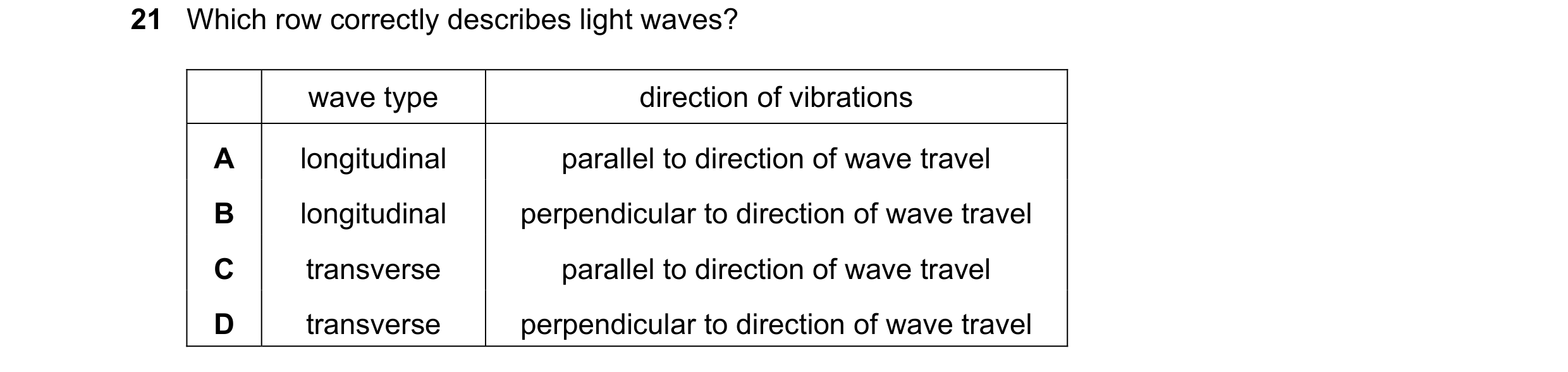
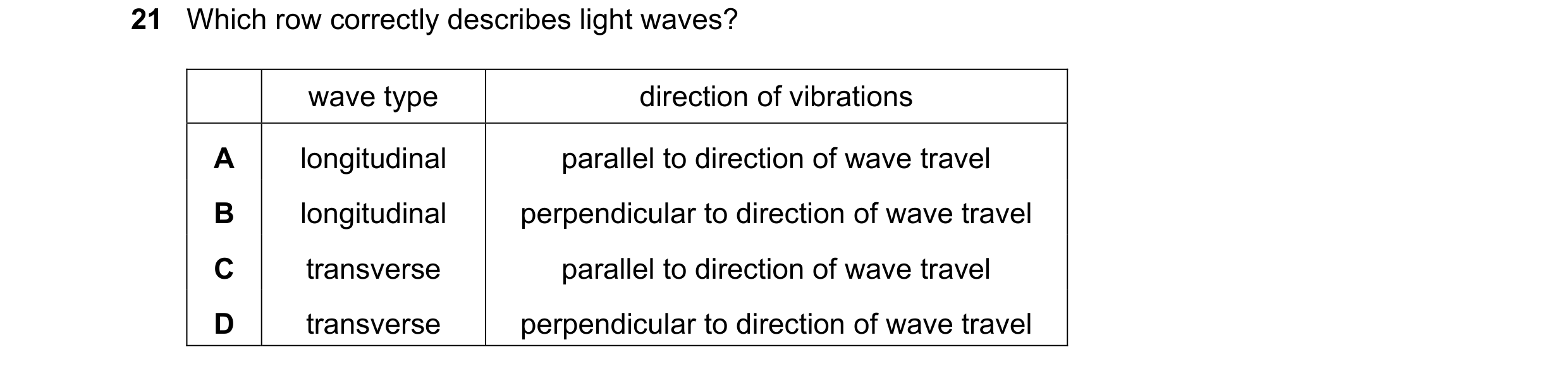
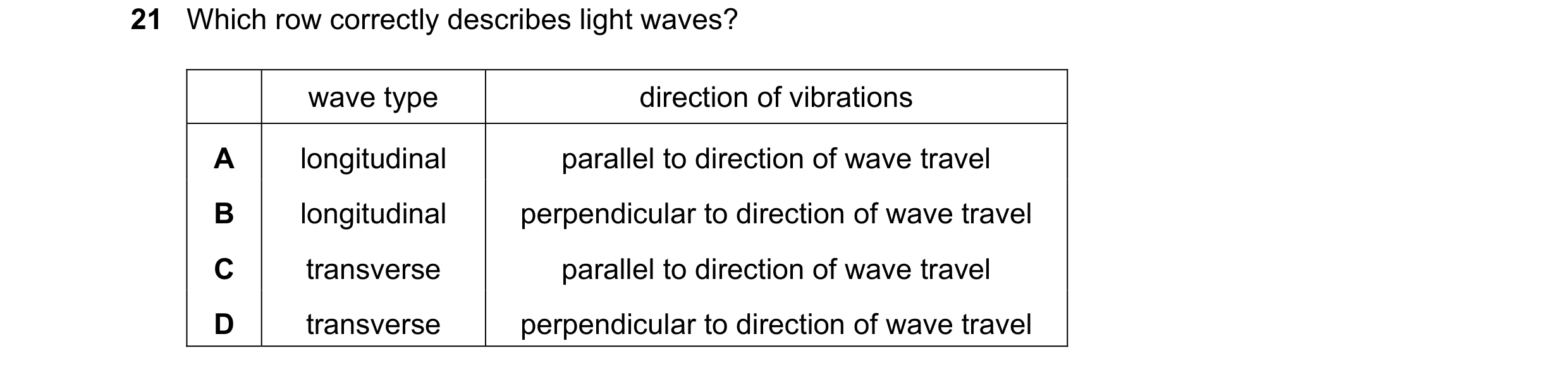
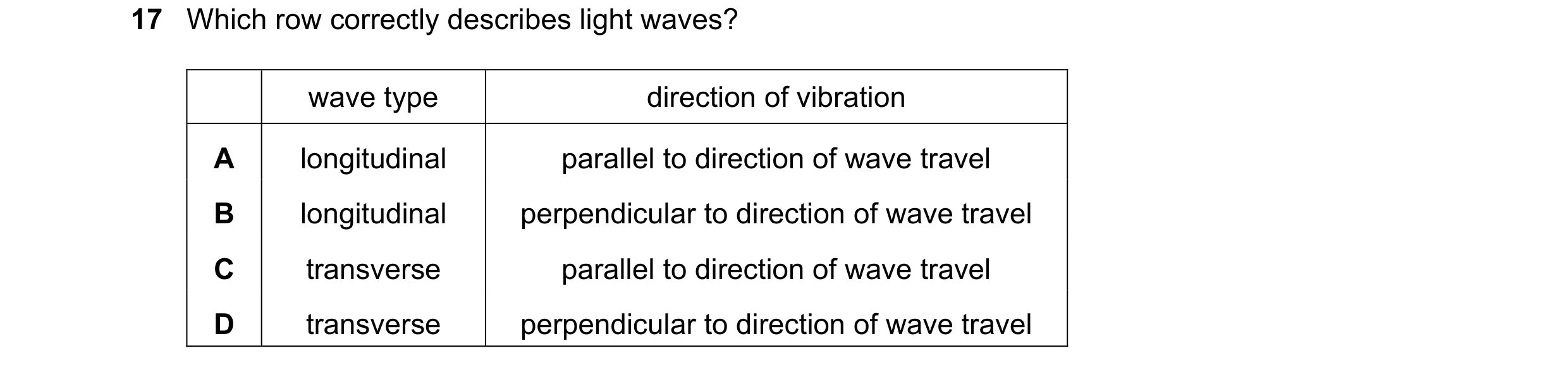
Q63 · Which row correctly describes light waves? 0625/21 Oct/Nov 2020
21 Which row correctly describes light waves? wave type direction of vibrations A longitudinal parallel to direction of wave travel B longitudinal perpendicular to direction of wave travel C transverse parallel to direction of wave travel D transverse perpendicular to direction of wave travel
1 marks
Answer: D
This question in 0625/21 Oct/Nov 2020
Q64 · The diagram shows part of a diffracted wave pattern 0625/21 Oct/Nov 2020
22 The diagram shows part of a diffracted wave pattern. barrier direction of waves Changes are made to the wavelength and to the gap size to produce a semicircular diffracted wave pattern. Which row produces the required semicircular diffracted wave pattern? gap in barrier wavelength A larger same B larger smaller C same larger D same smaller
1 marks
Answer: C
This question in 0625/21 Oct/Nov 2020
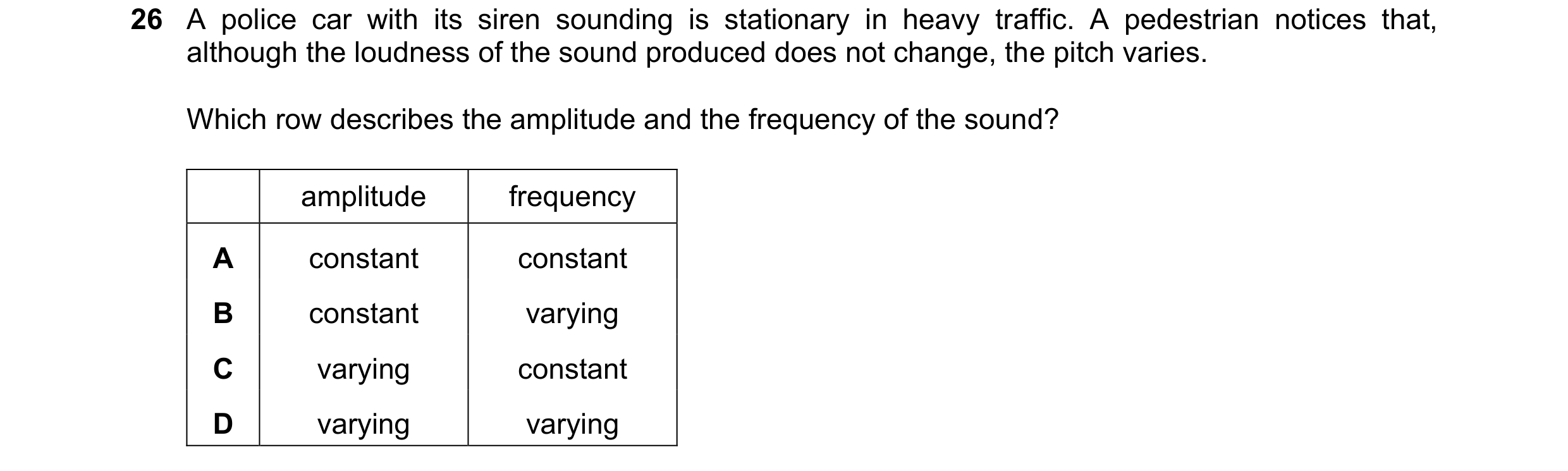
Q65 · A police car with its siren sounding is stationary in heavy traffic 0625/21 Oct/Nov 2020
26 A police car with its siren sounding is stationary in heavy traffic. A pedestrian notices that, although the loudness of the sound produced does not change, the pitch varies. Which row describes the amplitude and the frequency of the sound? amplitude frequency A constant constant B constant varying C varying constant D varying varying
1 marks
Answer: B
This question in 0625/21 Oct/Nov 2020
Q66 · Which row correctly describes light waves? 0625/22 Oct/Nov 2020
21 Which row correctly describes light waves? wave type direction of vibrations A longitudinal parallel to direction of wave travel B longitudinal perpendicular to direction of wave travel C transverse parallel to direction of wave travel D transverse perpendicular to direction of wave travel
1 marks
Answer: D
This question in 0625/22 Oct/Nov 2020
Q67 · A radio transmitter broadcasts at a frequency of 200 kHz 0625/22 Oct/Nov 2020
22 A radio transmitter broadcasts at a frequency of 200 kHz. What is the wavelength of these radio waves? A 6.7 10–4 m B 1.5 m C 1.5 103 m D 1.5 106 m
1 marks
Answer: C
This question in 0625/22 Oct/Nov 2020
Q68 · A student draws a diagram to illustrate the different sections of a longitudinal wave 0625/22 Oct/Nov 2020
24 A student draws a diagram to illustrate the different sections of a longitudinal wave. Which labelled section is a rarefaction? A B D C
1 marks
Answer: B
This question in 0625/22 Oct/Nov 2020
Q69 · Which row correctly describes light waves? 0625/23 Oct/Nov 2020
21 Which row correctly describes light waves? wave type direction of vibrations A longitudinal parallel to direction of wave travel B longitudinal perpendicular to direction of wave travel C transverse parallel to direction of wave travel D transverse perpendicular to direction of wave travel
1 marks
Answer: D
This question in 0625/23 Oct/Nov 2020
Q70 · A water wave has a speed of 2.0 m / s 0625/23 Oct/Nov 2020
22 A water wave has a speed of 2.0 m / s. 4.0 complete waves pass a point every 10 seconds. What is the wavelength of the wave? A 0.50 m B 0.80 m C 5.0 m D 8.0 m
1 marks
Answer: C
This question in 0625/23 Oct/Nov 2020
Q71 · What is the approximate wavelength in air of the highest frequency sound that can be… 0625/22 Feb/March 2021
20 What is the approximate wavelength in air of the highest frequency sound that can be heard by a normal healthy person? A 0.02 m B 60 m C 20 000 m D 7 000 000 m
1 marks
Answer: A
This question in 0625/22 Feb/March 2021
Q72 · What causes the change in direction when light travels from air into glass? 0625/22 Feb/March 2021
21 What causes the change in direction when light travels from air into glass? A The amplitude of the light changes. B The colour of the light changes. C The frequency of the light changes. D The speed of the light changes.
1 marks
Answer: D
This question in 0625/22 Feb/March 2021
Q73 · The diagram represents a sound wave 0625/22 Feb/March 2021
26 The diagram represents a sound wave. X Y What are the names of the parts of the sound wave labelled X and Y? X Y A amplitude wavelength B compression rarefaction C rarefaction amplitude D wavelength compression
1 marks
Answer: B
This question in 0625/22 Feb/March 2021
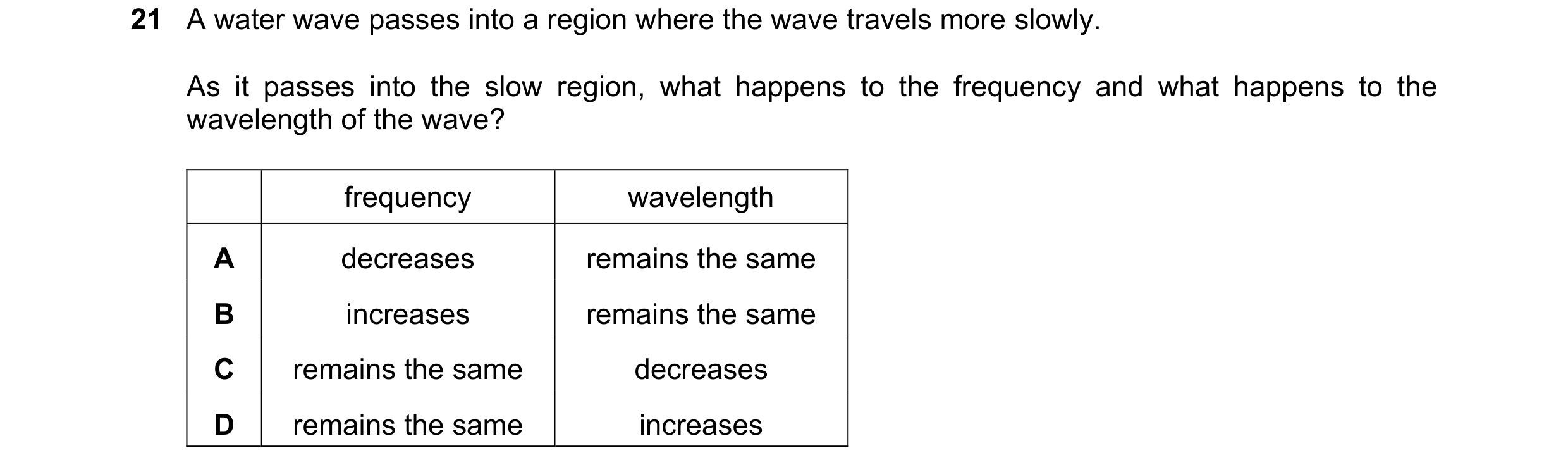
Q74 · A water wave passes into a region where the wave travels more slowly 0625/22 May/June 2021
21 A water wave passes into a region where the wave travels more slowly. As it passes into the slow region, what happens to the frequency and what happens to the wavelength of the wave? frequency wavelength A decreases remains the same B increases remains the same C remains the same decreases D remains the same increases
1 marks
Answer: C
This question in 0625/22 May/June 2021
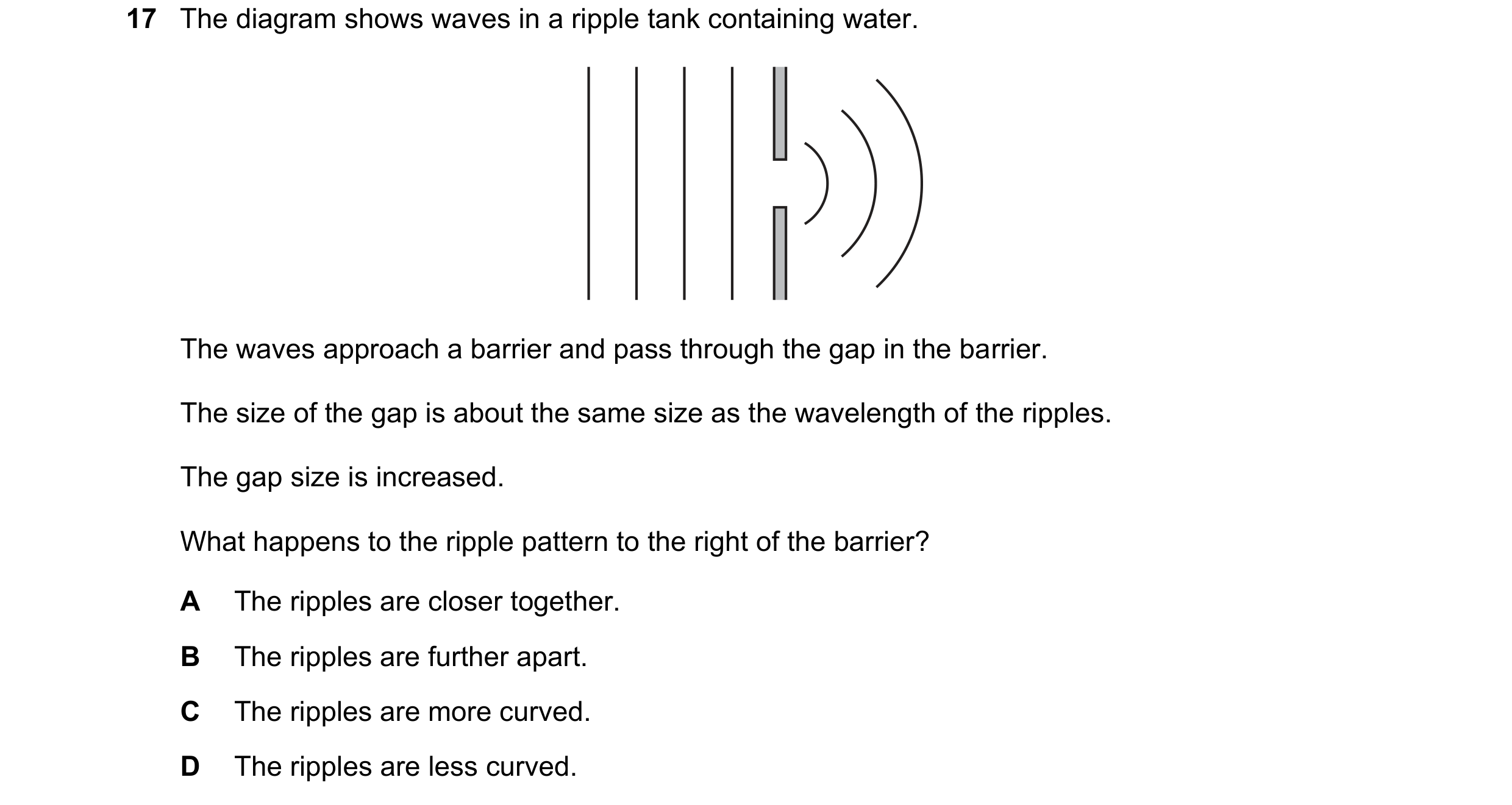
Q75 · The diagram shows waves in a ripple tank containing water 0625/21 Oct/Nov 2021
17 The diagram shows waves in a ripple tank containing water. The waves approach a barrier and pass through the gap in the barrier. The size of the gap is about the same size as the wavelength of the ripples. The gap size is increased. What happens to the ripple pattern to the right of the barrier? A The ripples are closer together. B The ripples are further apart. C The ripples are more curved. D The ripples are less curved.
1 marks
Answer: D
This question in 0625/21 Oct/Nov 2021
Q76 · The diagram shows a wave 0625/21 Oct/Nov 2021
18 The diagram shows a wave. 1 displacement 2 4 5 6 0 0 distance 3 Which row correctly indicates the amplitude and the wavelength of the wave? amplitude wavelength A the distance between 1 and 2 the distance between 4 and 5 B the distance between 1 and 2 the distance between 4 and 6 C the distance between 1 and 3 the distance between 4 and 5 D the distance between 1 and 3 the distance between 4 and 6
1 marks
Answer: B
This question in 0625/21 Oct/Nov 2021
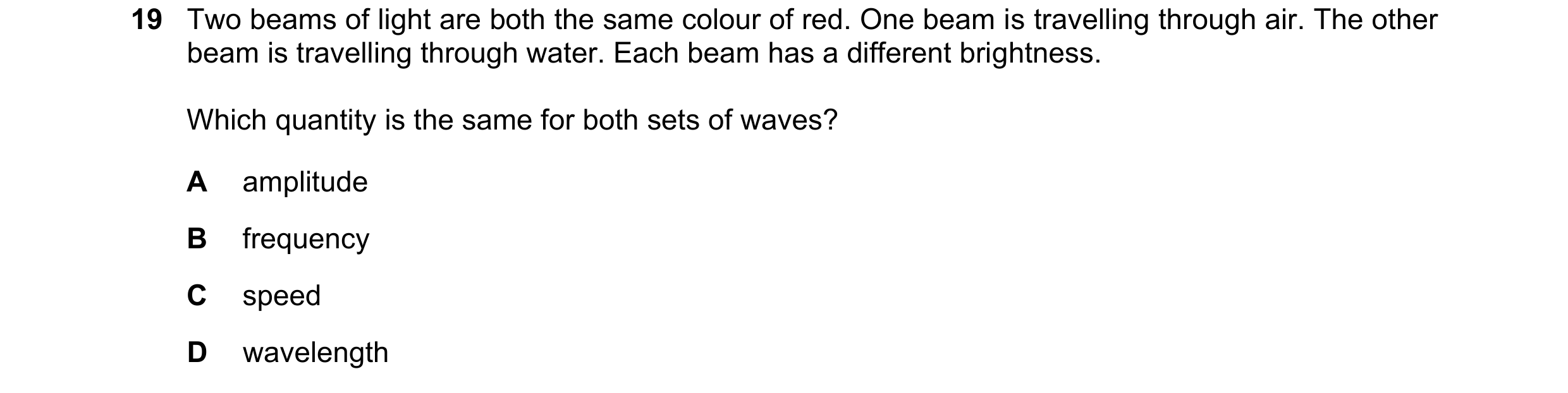
Q77 · Two beams of light are both the same colour of red 0625/21 Oct/Nov 2021
19 Two beams of light are both the same colour of red. One beam is travelling through air. The other beam is travelling through water. Each beam has a different brightness. Which quantity is the same for both sets of waves? A amplitude B frequency C speed D wavelength
1 marks
Answer: B
This question in 0625/21 Oct/Nov 2021
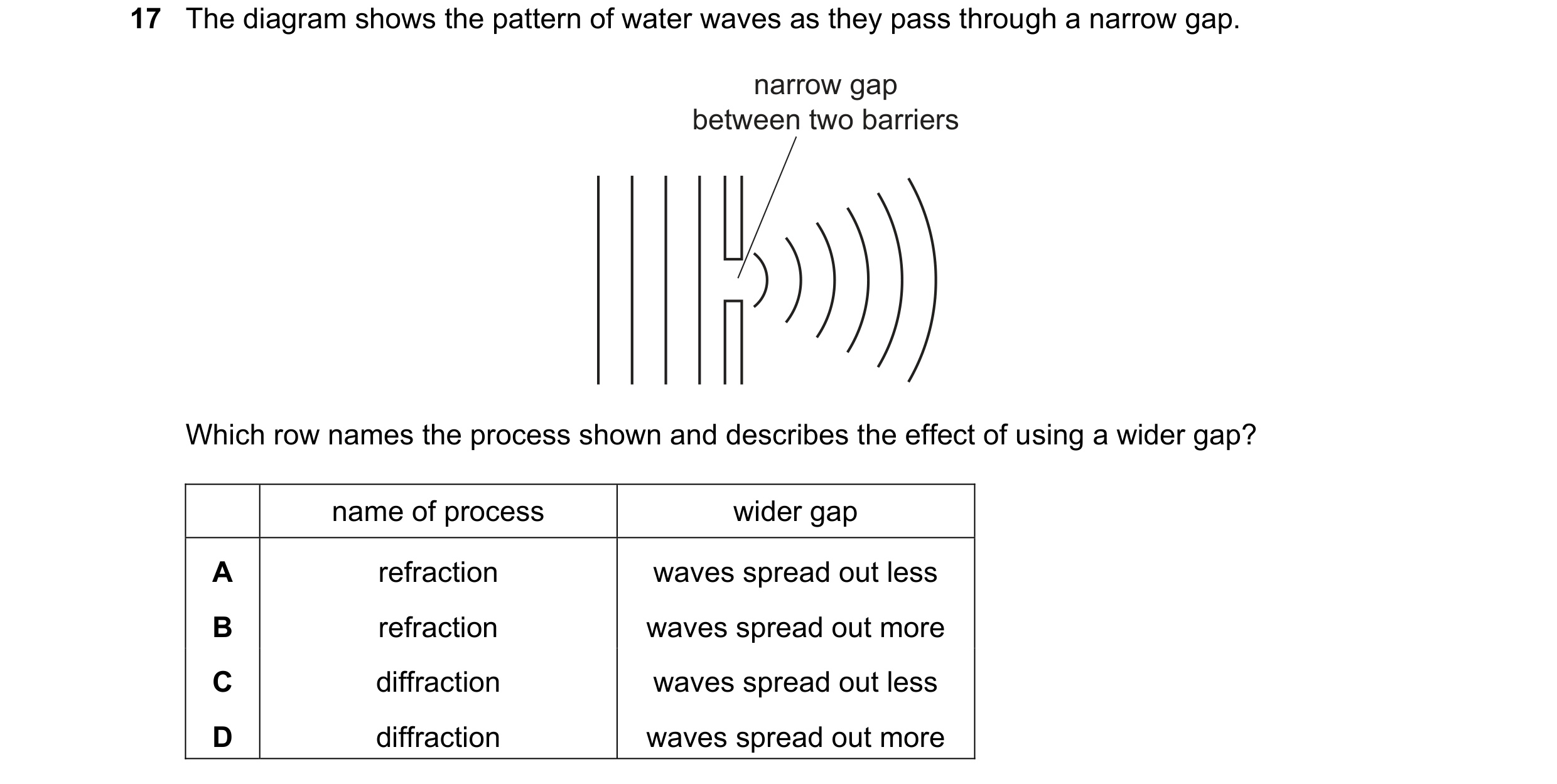
Q78 · The diagram shows the pattern of water waves as they pass through a narrow gap 0625/22 Oct/Nov 2021
17 The diagram shows the pattern of water waves as they pass through a narrow gap. narrow gap between two barriers Which row names the process shown and describes the effect of using a wider gap? name of process wider gap A refraction waves spread out less B refraction waves spread out more C diffraction waves spread out less D diffraction waves spread out more
1 marks
Answer: C
This question in 0625/22 Oct/Nov 2021
Q79 · Which row is not correct for a wave on the surface of water? 0625/22 Oct/Nov 2021
18 Which row is not correct for a wave on the surface of water? quantity usual unit A amplitude m B frequency Hz C wavelength D speed m / s
1 marks
Answer: C
This question in 0625/22 Oct/Nov 2021
Q80 · Which statement about electromagnetic waves is not correct? 0625/22 Oct/Nov 2021
23 Which statement about electromagnetic waves is not correct? A They travel at 3 108 m / s in a vacuum. B They transfer energy. C They travel at 340 m / s in air. D They are transverse waves.
1 marks
Answer: C
This question in 0625/22 Oct/Nov 2021
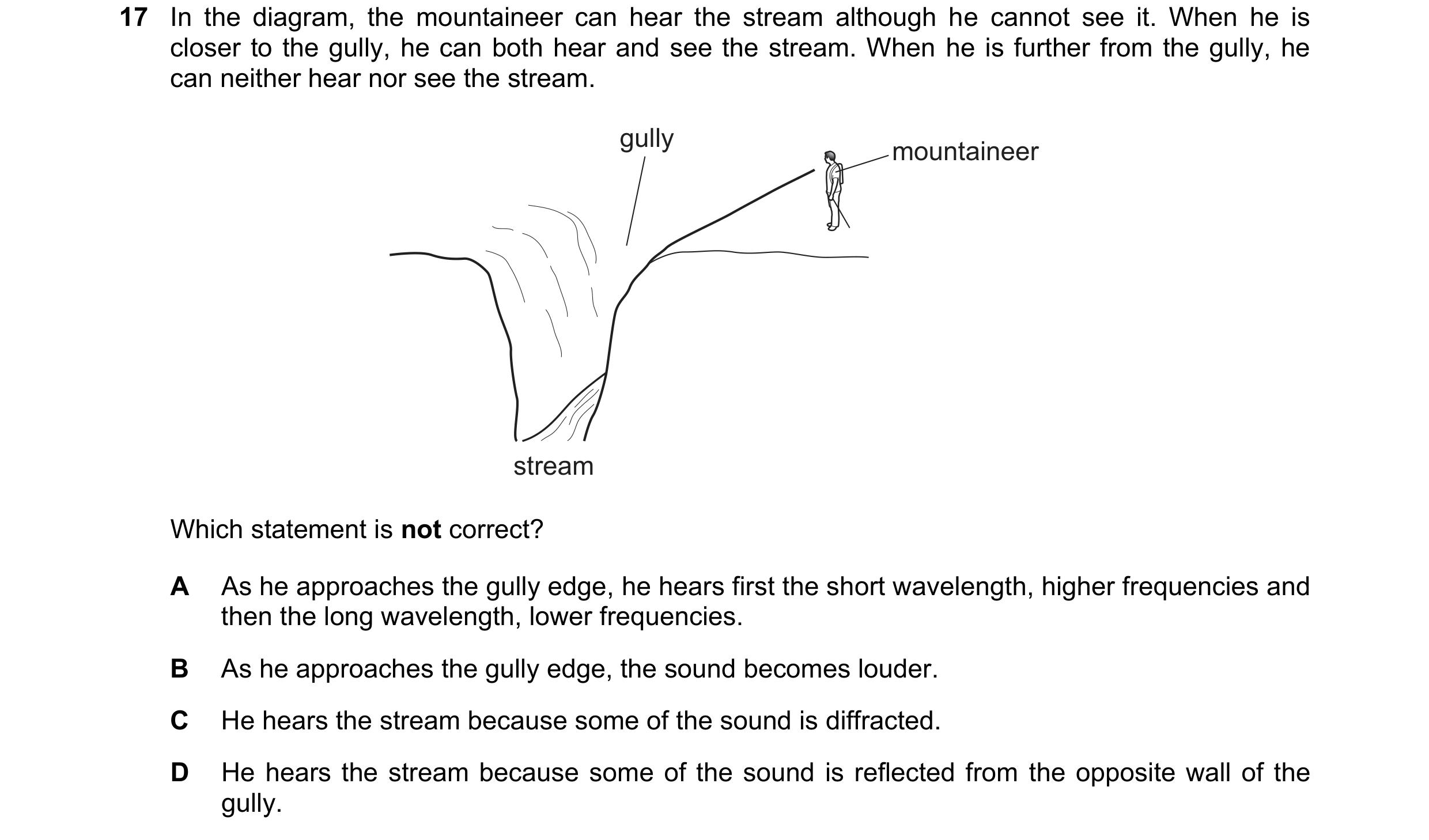
Q81 · In the diagram, the mountaineer can hear the stream although he cannot see it 0625/23 Oct/Nov 2021
17 In the diagram, the mountaineer can hear the stream although he cannot see it. When he is closer to the gully, he can both hear and see the stream. When he is further from the gully, he can neither hear nor see the stream. gully mountaineer stream Which statement is not correct? A As he approaches the gully edge, he hears first the short wavelength, higher frequencies and then the long wavelength, lower frequencies. B As he approaches the gully edge, the sound becomes louder. C He hears the stream because some of the sound is diffracted. D He hears the stream because some of the sound is reflected from the opposite wall of the gully.
1 marks
Answer: A
This question in 0625/23 Oct/Nov 2021
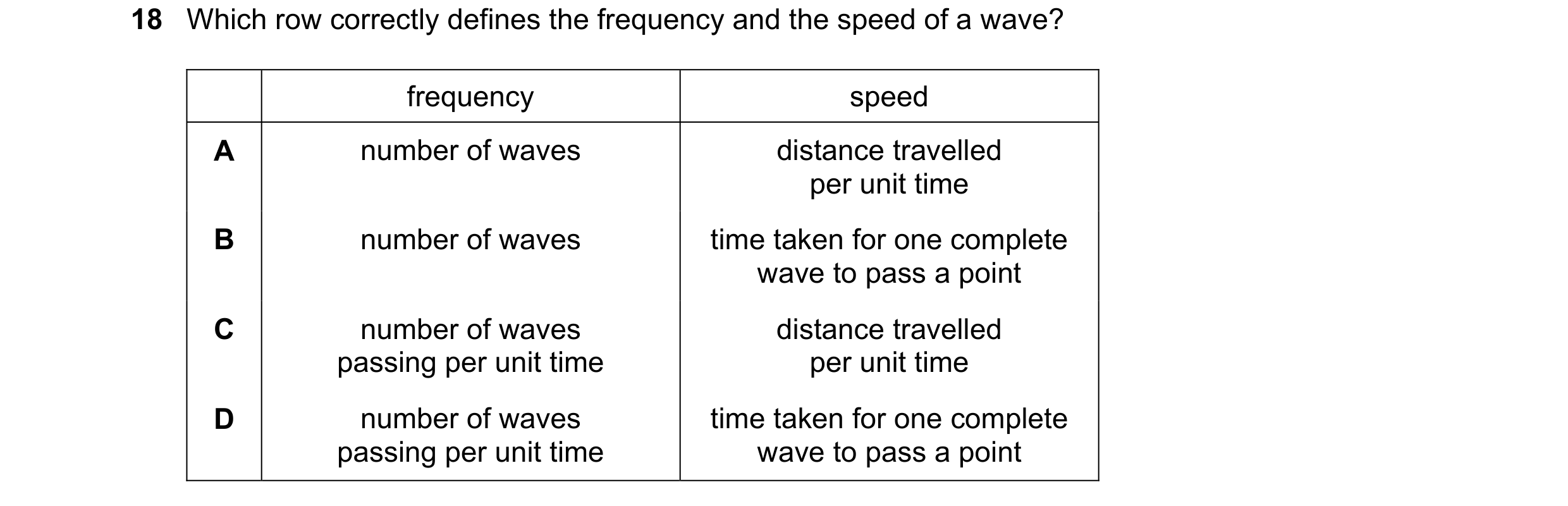
Q82 · Which row correctly defines the frequency and the speed of a wave? 0625/23 Oct/Nov 2021
18 Which row correctly defines the frequency and the speed of a wave? frequency speed A number of waves distance travelled per unit time B number of waves time taken for one complete wave to pass a point C number of waves distance travelled passing per unit time per unit time D number of waves time taken for one complete passing per unit time wave to pass a point
1 marks
Answer: C
This question in 0625/23 Oct/Nov 2021
Q83 · A ray of light travels from air into a glass block 0625/23 Oct/Nov 2021
19 A ray of light travels from air into a glass block. in air in glass speed of ray va vg wavelength of ray a g frequency of ray fa fg Three suggestions as to how the refractive index of glass n may be calculated are listed. v 1 n = v a g 2 n = a g f 3 n = a f g Which suggestions are correct? A 1, 2 and 3 B 1 and 2 only C 1 and 3 only D 2 and 3 only
1 marks
Answer: B
This question in 0625/23 Oct/Nov 2021
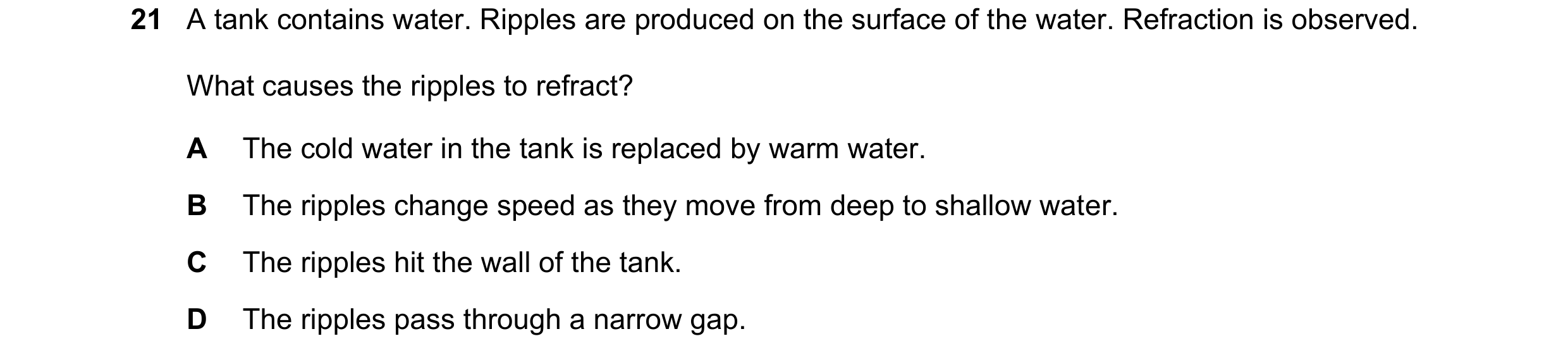
Q84 · A tank contains water 0625/22 Feb/March 2022
21 A tank contains water. Ripples are produced on the surface of the water. Refraction is observed. What causes the ripples to refract? A The cold water in the tank is replaced by warm water. B The ripples change speed as they move from deep to shallow water. C The ripples hit the wall of the tank. D The ripples pass through a narrow gap.
1 marks
Answer: B
This question in 0625/22 Feb/March 2022
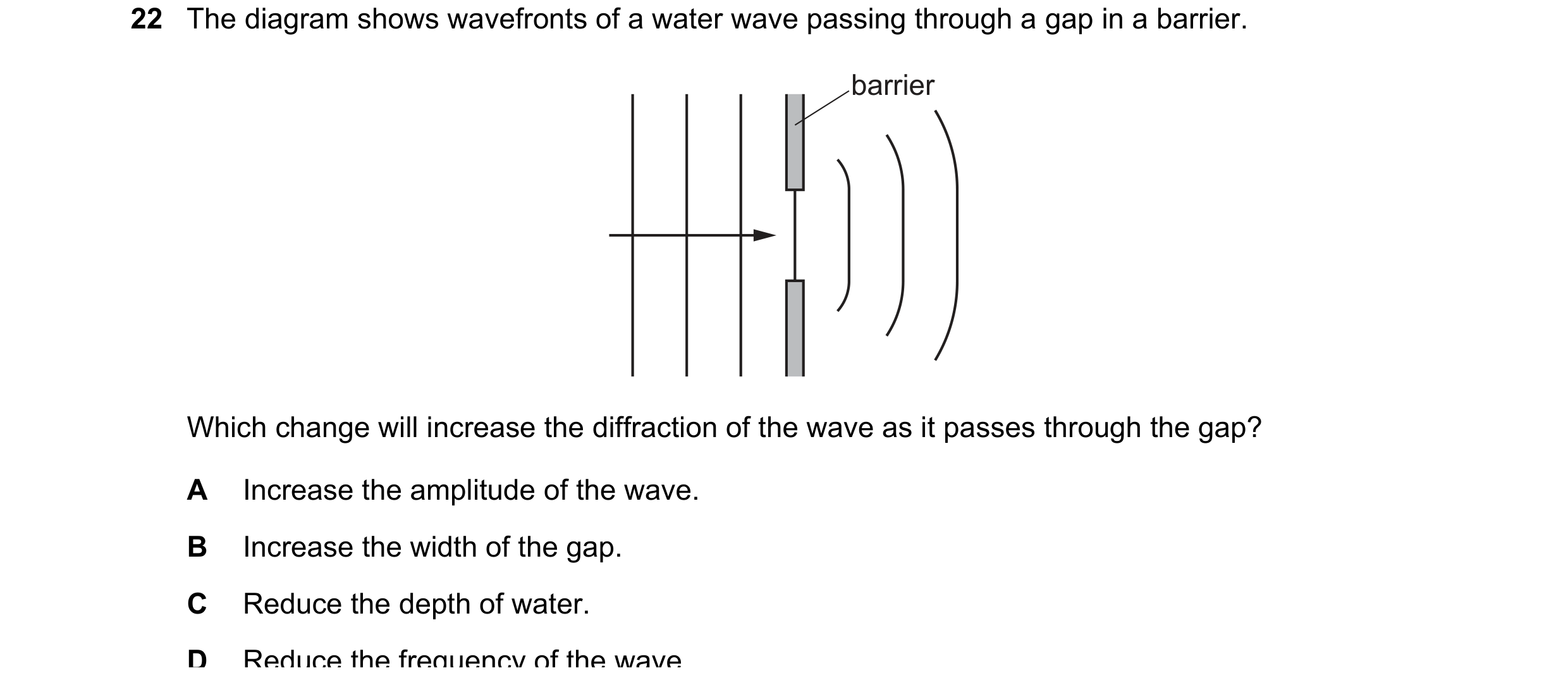
Q85 · The diagram shows wavefronts of a water wave passing through a gap in a barrier 0625/22 Feb/March 2022
22 The diagram shows wavefronts of a water wave passing through a gap in a barrier. barrier Which change will increase the diffraction of the wave as it passes through the gap? A Increase the amplitude of the wave. B Increase the width of the gap. C Reduce the depth of water. D Reduce the frequency of the wave.
1 marks
Answer: D
This question in 0625/22 Feb/March 2022
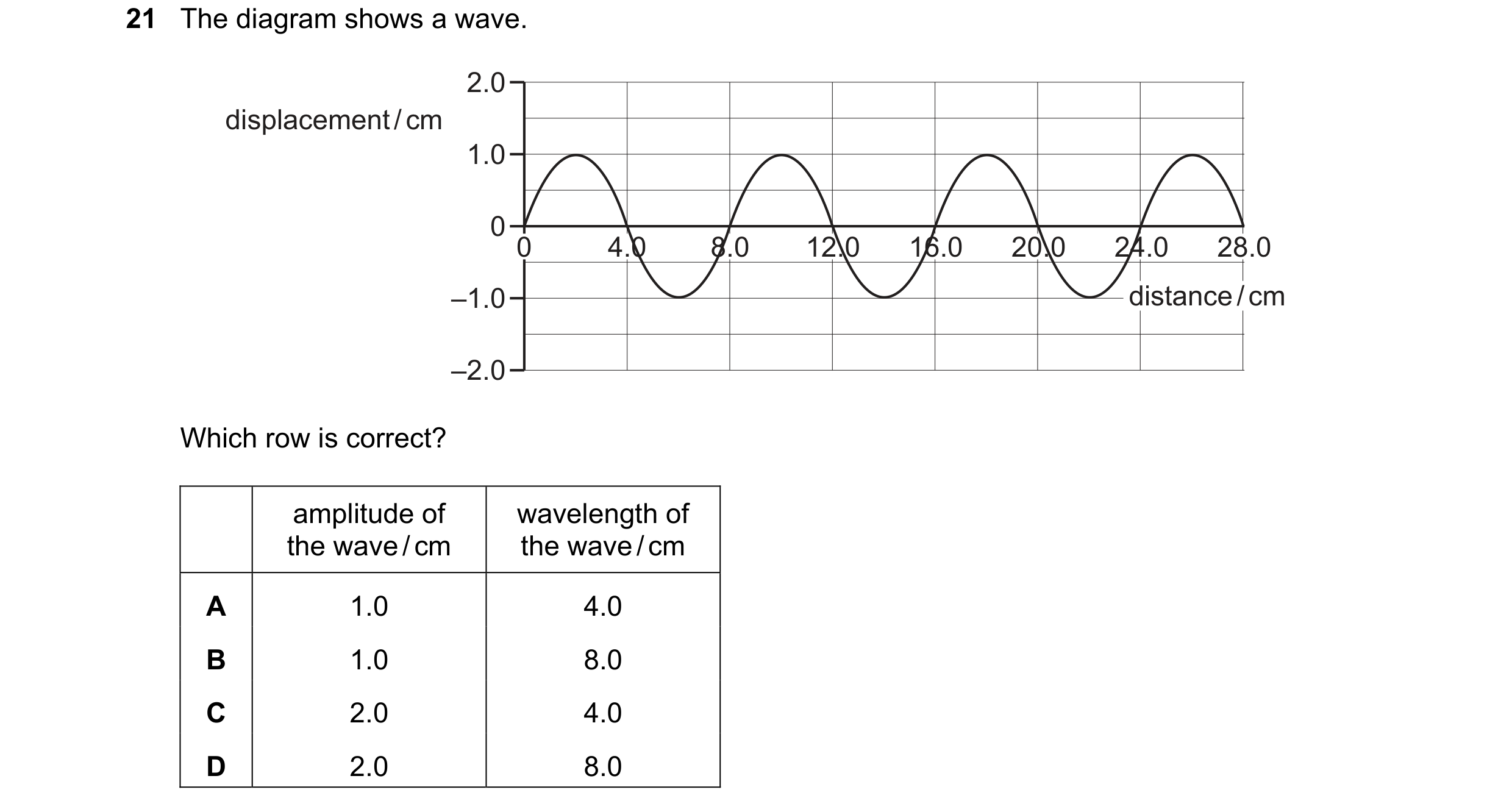
Q86 · The diagram shows a wave 0625/21 May/June 2022
21 The diagram shows a wave. 2.0 displacement / cm 1.0 0 0 4.0 8.0 12.0 16.0 20.0 24.0 28.0 –1.0 distance / cm –2.0 Which row is correct? amplitude of wavelength of the wave / cm the wave / cm A 1.0 4.0 B 1.0 8.0 C 2.0 4.0 D 2.0 8.0
1 marks
Answer: B
This question in 0625/21 May/June 2022
Q87 · A sound wave is created by a loudspeaker that vibrates backwards and forwards 96 000… 0625/21 May/June 2022
22 A sound wave is created by a loudspeaker that vibrates backwards and forwards 96 000 times per minute. The speed of sound is 320 m / s. What is the wavelength of the sound wave? A 0.20 m B 5.0 m C 300 m D 18 000 m
1 marks
Answer: A
This question in 0625/21 May/June 2022
Q88 · The diagram shows a wave 0625/22 May/June 2022
21 The diagram shows a wave. 2.0 displacement / cm 1.0 0 0 4.0 8.0 12.0 16.0 20.0 24.0 28.0 –1.0 distance / cm –2.0 Which row is correct? amplitude of wavelength of the wave / cm the wave / cm A 1.0 4.0 B 1.0 8.0 C 2.0 4.0 D 2.0 8.0
1 marks
Answer: B
This question in 0625/22 May/June 2022
Q89 · The water wave shown has a frequency of 4.0 Hz 0625/22 May/June 2022
22 The water wave shown has a frequency of 4.0 Hz. 36 cm 3.0 cm What is the speed of the wave? A 3.0 cm / s B 12 cm / s C 48 cm / s D 72 cm / s
1 marks
Answer: C
This question in 0625/22 May/June 2022
Q90 · The diagram shows a wave 0625/23 May/June 2022
21 The diagram shows a wave. 2.0 displacement / cm 1.0 0 0 4.0 8.0 12.0 16.0 20.0 24.0 28.0 –1.0 distance / cm –2.0 Which row is correct? amplitude of wavelength of the wave / cm the wave / cm A 1.0 4.0 B 1.0 8.0 C 2.0 4.0 D 2.0 8.0
1 marks
Answer: B
This question in 0625/23 May/June 2022
Q91 · The wavelength of a beam of X-rays, travelling through air, is 5.4 × 10⁻¹⁰ m 0625/23 May/June 2022
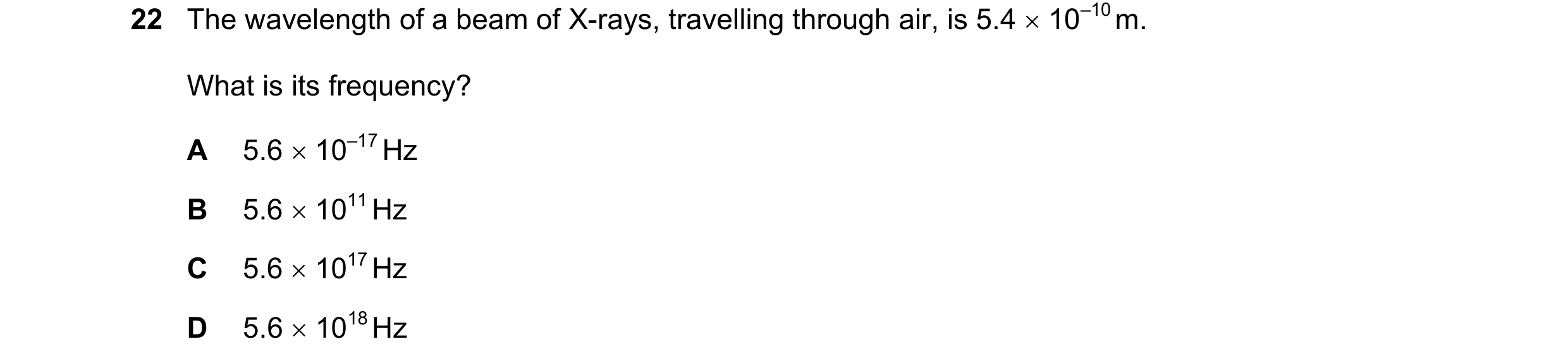
22 The wavelength of a beam of X-rays, travelling through air, is 5.4 × 10⁻¹⁰ m. What is its frequency? A 5.6 × 10⁻¹⁷ Hz B 5.6 × 10¹¹ Hz C 5.6 × 10¹⁷ Hz D 5.6 × 10¹⁸ Hz
1 marks
Answer: C
This question in 0625/23 May/June 2022
Q92 · A wave source produces 3000 crests every minute 0625/21 Oct/Nov 2022
17 A wave source produces 3000 crests every minute. The wave has a speed of 300 m / s. What is the wavelength of the wave? A 0.10 m B 0.17 m C 6.0 m D 10.0 m
1 marks
Answer: C
This question in 0625/21 Oct/Nov 2022
Q93 · The diagrams show two sets of wavefronts in a ripple tank 0625/21 Oct/Nov 2022
18 The diagrams show two sets of wavefronts in a ripple tank. wave wave direction direction barrier shallow water A student makes two statements about the waves. 1 When the waves reflect from the barrier the direction changes but the wavelength remains the same. 2 When the waves refract as they enter the shallow water the direction remains the same, but the wavelength changes. Which statements are correct? A statement 1 and statement 2 B statement 1 only C statement 2 only D neither statement 1 nor statement 2
1 marks
Answer: B
This question in 0625/21 Oct/Nov 2022
Q94 · A sound wave travels from air into water 0625/22 Oct/Nov 2022
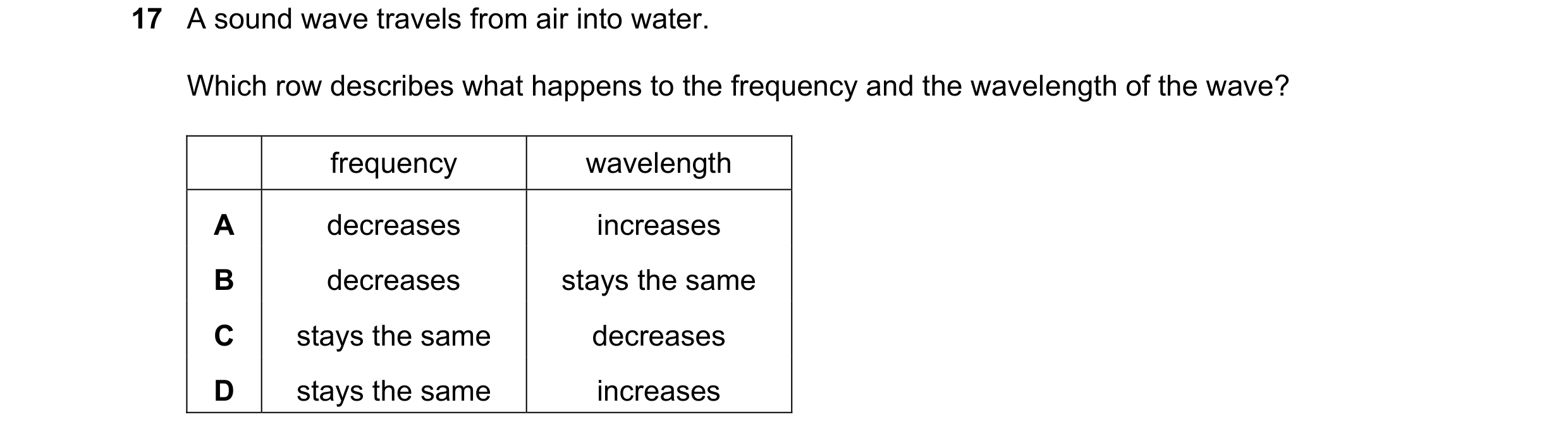
17 A sound wave travels from air into water. Which row describes what happens to the frequency and the wavelength of the wave? frequency wavelength A decreases increases B decreases stays the same C stays the same decreases D stays the same increases
1 marks
Answer: D
This question in 0625/22 Oct/Nov 2022
Q95 · The diagram shows plane water waves in a ripple tank passing through a gap between two… 0625/22 Oct/Nov 2022
18 The diagram shows plane water waves in a ripple tank passing through a gap between two barriers and spreading out. barrier plane water waves barrier Which name is given to this effect? A diffraction B reflection C refraction D total internal reflection
1 marks
Answer: A
This question in 0625/22 Oct/Nov 2022
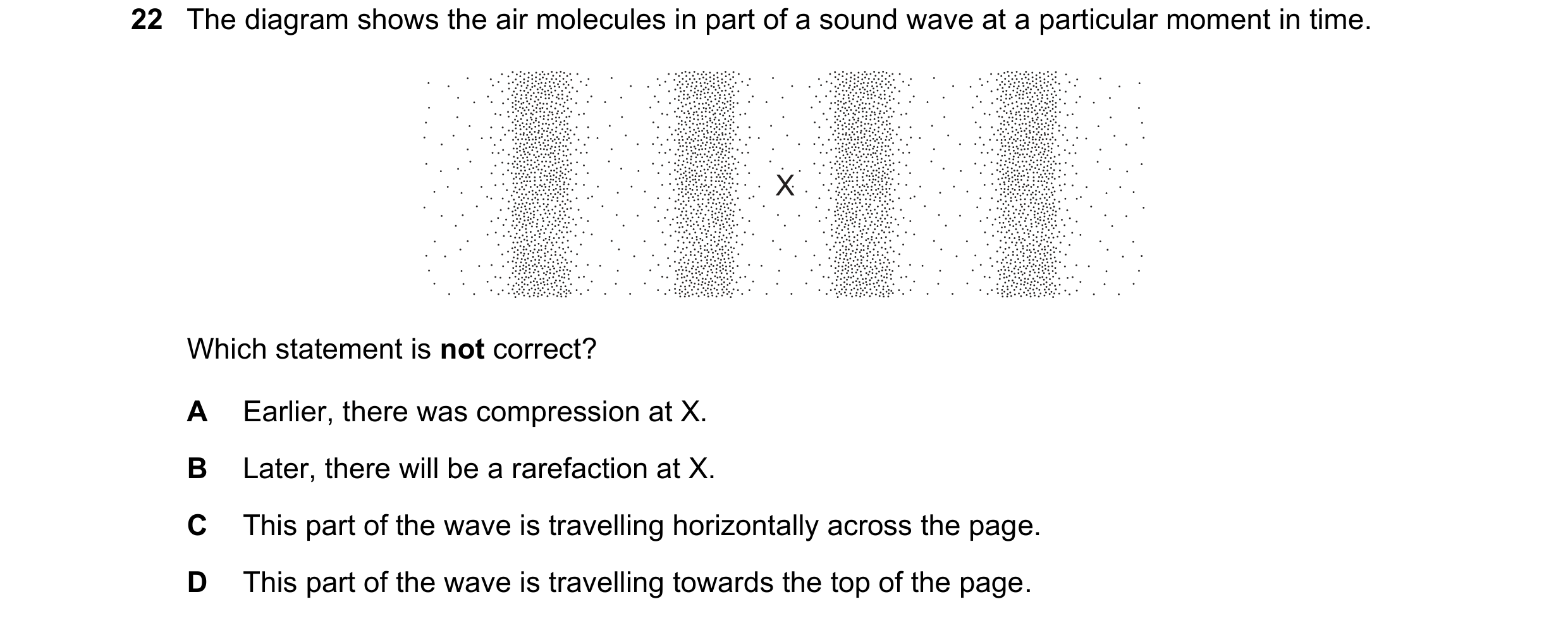
Q96 · The diagram shows the air molecules in part of a sound wave at a particular moment in time 0625/22 Oct/Nov 2022
22 The diagram shows the air molecules in part of a sound wave at a particular moment in time. X Which statement is not correct? A Earlier, there was compression at X. B Later, there will be a rarefaction at X. C This part of the wave is travelling horizontally across the page. D This part of the wave is travelling towards the top of the page.
1 marks
Answer: D
This question in 0625/22 Oct/Nov 2022
Q97 · A passing boat causes a floating object on a lake to bob up and down 18 times in 12 s 0625/23 Oct/Nov 2022
17 A passing boat causes a floating object on a lake to bob up and down 18 times in 12 s. The wavelength of the wave created by the boat is 48 cm. What is the velocity of these water waves? A 32 cm / s B 72 cm / s C 576 cm / s D 864 cm / s
1 marks
Answer: B
This question in 0625/23 Oct/Nov 2022
Q98 · Wavefronts are incident on a boundary 0625/23 Oct/Nov 2022
18 Wavefronts are incident on a boundary. What is needed for the wave to refract at the boundary? A a shiny surface at the boundary B a small gap in the boundary C different mediums either side of the boundary in which the frequency of the wave is different D different mediums either side of the boundary in which the speed of the wave is different
1 marks
Answer: D
This question in 0625/23 Oct/Nov 2022
Q99 · The diagram shows the air molecules in part of a sound wave at a particular moment in time 0625/23 Oct/Nov 2022
22 The diagram shows the air molecules in part of a sound wave at a particular moment in time. X Which statement is not correct? A Earlier, there was compression at X. B Later, there will be a rarefaction at X. C This part of the wave is travelling horizontally across the page. D This part of the wave is travelling towards the top of the page.
1 marks
Answer: D
This question in 0625/23 Oct/Nov 2022
Q100 · A transverse wave moves along a rope 0625/22 Feb/March 2023
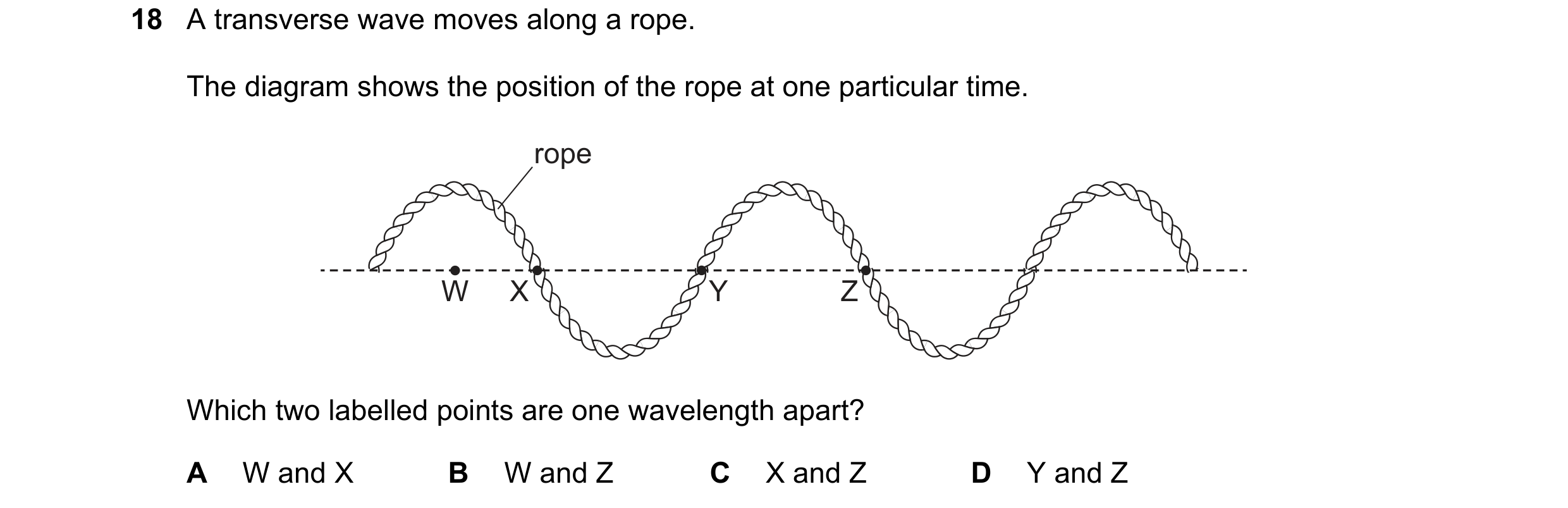
18 A transverse wave moves along a rope. The diagram shows the position of the rope at one particular time. rope W X Y Z Which two labelled points are one wavelength apart? A W and X B W and Z C X and Z D Y and Z
1 marks
Answer: C
This question in 0625/22 Feb/March 2023
Q101 · The diagrams show graphs of displacement against time for four waves 0625/21 May/June 2023
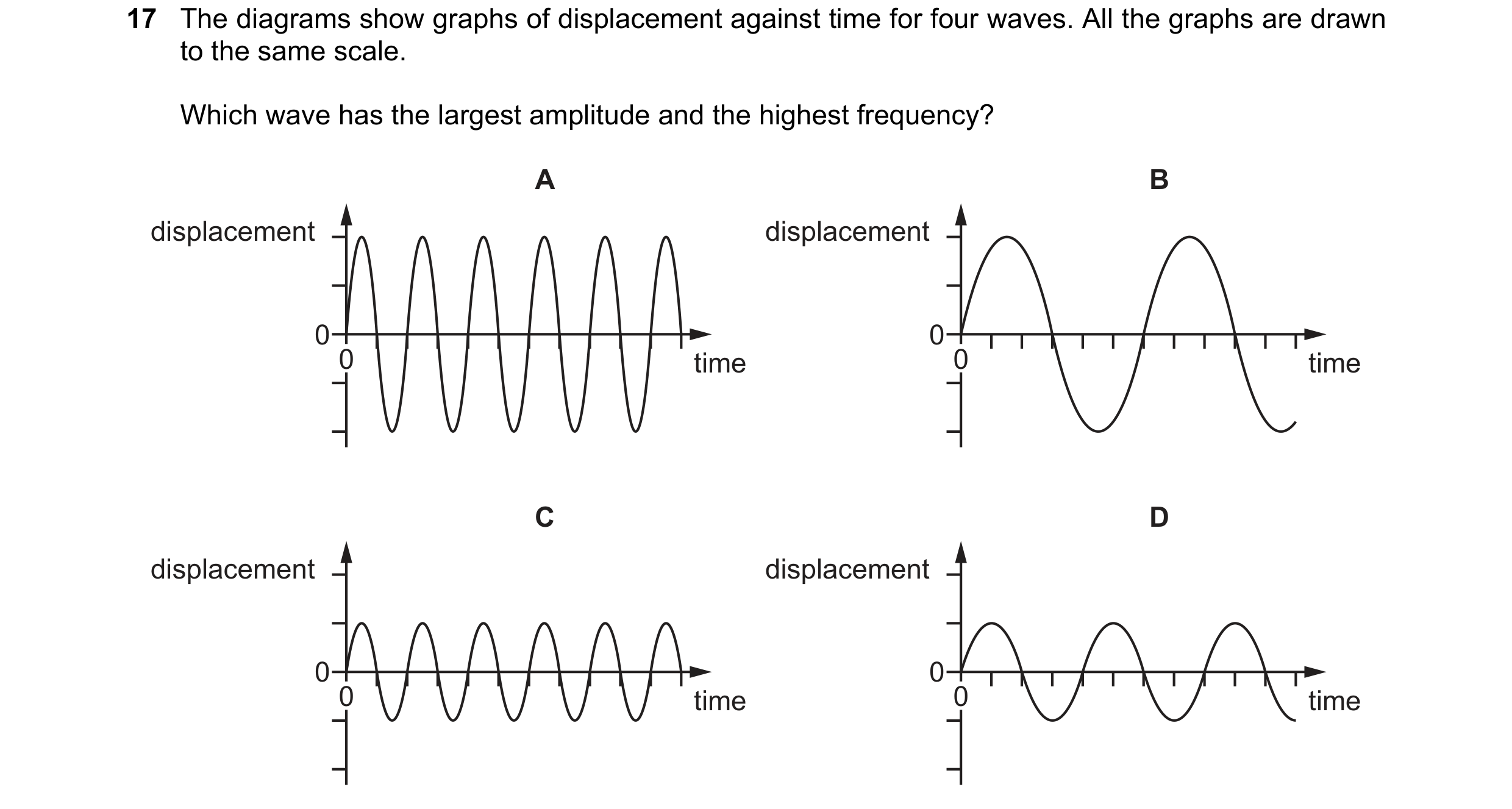
17 The diagrams show graphs of displacement against time for four waves. All the graphs are drawn to the same scale. Which wave has the largest amplitude and the highest frequency? A B displacement displacement 0 0 0 time 0 time C D displacement displacement 0 0 0 time 0 time
1 marks
Answer: A
This question in 0625/21 May/June 2023
Q102 · The diagram shows a wave 0625/22 May/June 2023
17 The diagram shows a wave. 8 cm 3 cm 6 cm 4 cm What are the amplitude and the wavelength of this wave? amplitude / cm wavelength / cm A 3 4 B 3 8 C 6 4 D 6 8
1 marks
Answer: B
This question in 0625/22 May/June 2023
Q103 · A radio station broadcasts a signal with a frequency of 89 MHz 0625/22 May/June 2023
21 A radio station broadcasts a signal with a frequency of 89 MHz. What is the wavelength of this signal? A 3.7 µm B 3.4 m C 3.7 km D 3.4 Mm
1 marks
Answer: B
This question in 0625/22 May/June 2023
Q104 · A drop of water from a tap falls onto the surface of some water of constant depth 0625/23 May/June 2023
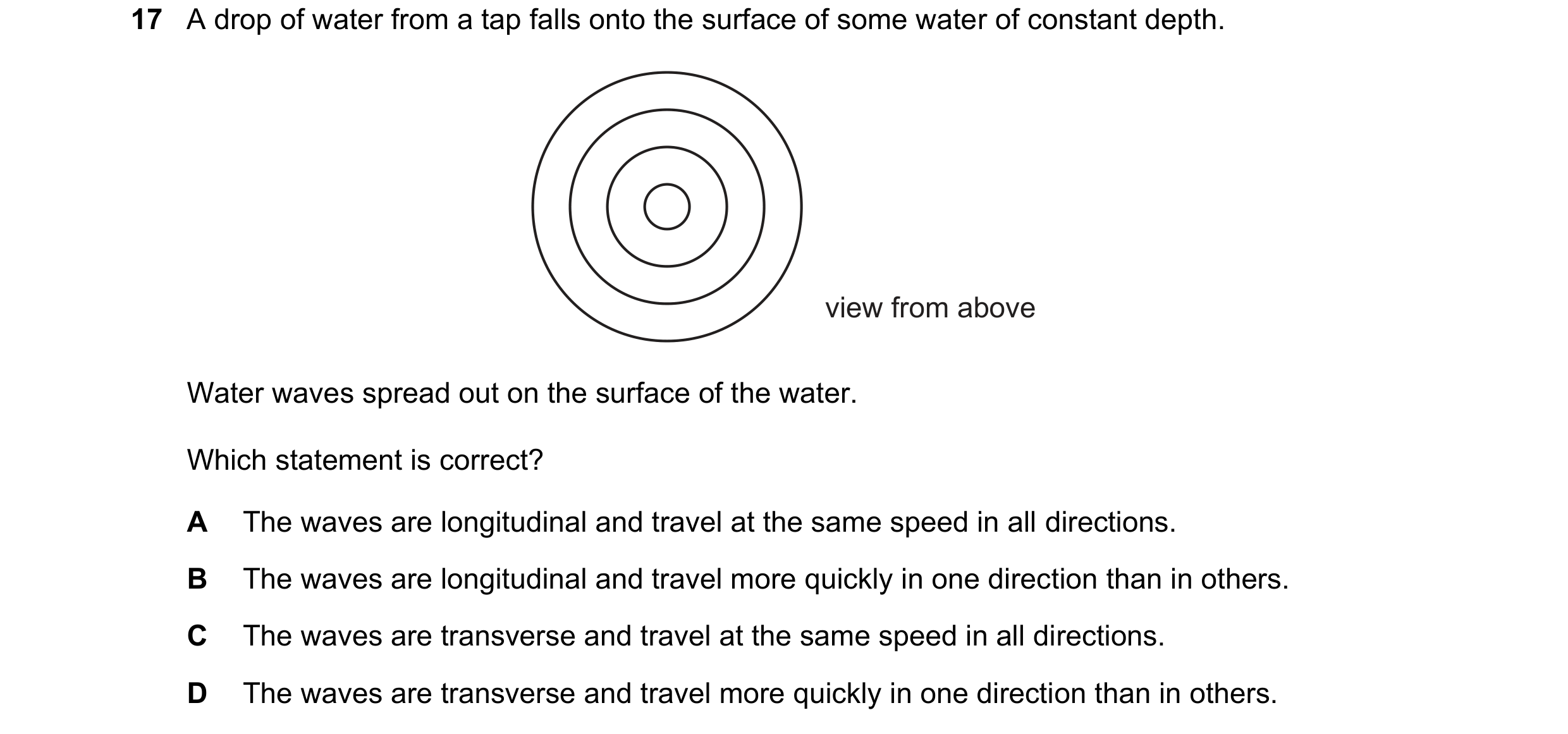
17 A drop of water from a tap falls onto the surface of some water of constant depth. view from above Water waves spread out on the surface of the water. Which statement is correct? A The waves are longitudinal and travel at the same speed in all directions. B The waves are longitudinal and travel more quickly in one direction than in others. C The waves are transverse and travel at the same speed in all directions. D The waves are transverse and travel more quickly in one direction than in others.
1 marks
Answer: C
This question in 0625/23 May/June 2023
Q105 · Two men, P and Q, stand close to a gap in a wall, as shown 0625/21 Oct/Nov 2023
17 Two men, P and Q, stand close to a gap in a wall, as shown. Man P cannot see man Q but man P can hear man Q speaking. P Q gap Which statement explains this? A Light waves do not diffract at all because they are electromagnetic waves. B Light waves have a range of frequencies but sound has just one frequency. C Sound waves are of a higher frequency than light waves. D Sound waves diffract a lot because their wavelength is a similar size to the width of the gap.
1 marks
Answer: D
This question in 0625/21 Oct/Nov 2023
Q106 · Which quantities relating to a wave on the surface of water can both be measured in… 0625/21 Oct/Nov 2023
18 Which quantities relating to a wave on the surface of water can both be measured in metres? A amplitude and frequency B amplitude and wavelength C amplitude and wave speed D frequency and wavelength
1 marks
Answer: B
This question in 0625/21 Oct/Nov 2023
Q107 · A radio transmitter broadcasts at a frequency of 200 kHz 0625/21 Oct/Nov 2023
22 A radio transmitter broadcasts at a frequency of 200 kHz. What is the wavelength of these radio waves? A 6.7 10– 4 m B 1.5 m C 1.5 103 m D 1.5 106 m
1 marks
Answer: C
This question in 0625/21 Oct/Nov 2023
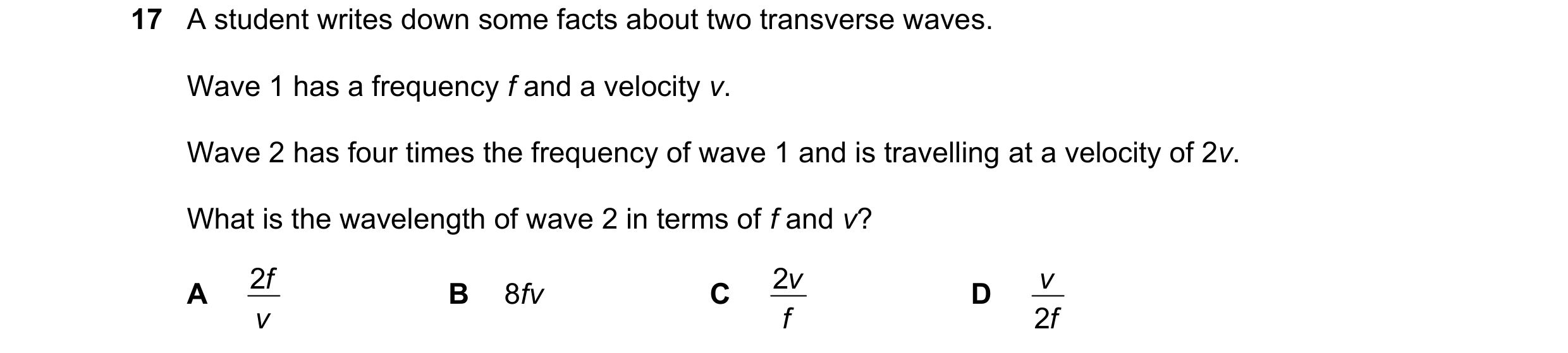
Q108 · A student writes down some facts about two transverse waves 0625/22 Oct/Nov 2023
17 A student writes down some facts about two transverse waves. Wave 1 has a frequency f and a velocity v. Wave 2 has four times the frequency of wave 1 and is travelling at a velocity of 2v. What is the wavelength of wave 2 in terms of f and v? 2 f 2 v v A B 8fv C D v f 2 f
1 marks
Answer: D
This question in 0625/22 Oct/Nov 2023
Q109 · Straight wavefronts on the surface of a ripple tank approach a gap in a barrier 0625/22 Oct/Nov 2023
18 Straight wavefronts on the surface of a ripple tank approach a gap in a barrier. The diagram shows how the wavefronts change shape as they pass through the gap. barrier straight wavefronts What is the name of this effect? A diffraction B propagation C reflection D refraction
1 marks
Answer: A
This question in 0625/22 Oct/Nov 2023
Q110 · The frequency of the microwaves used in a microwave oven is 2400 MHz 0625/22 Oct/Nov 2023
22 The frequency of the microwaves used in a microwave oven is 2400 MHz. What is the wavelength of these microwaves? A 0.125 m B 8.00 m C 125 m D 7200 m
1 marks
Answer: A
This question in 0625/22 Oct/Nov 2023
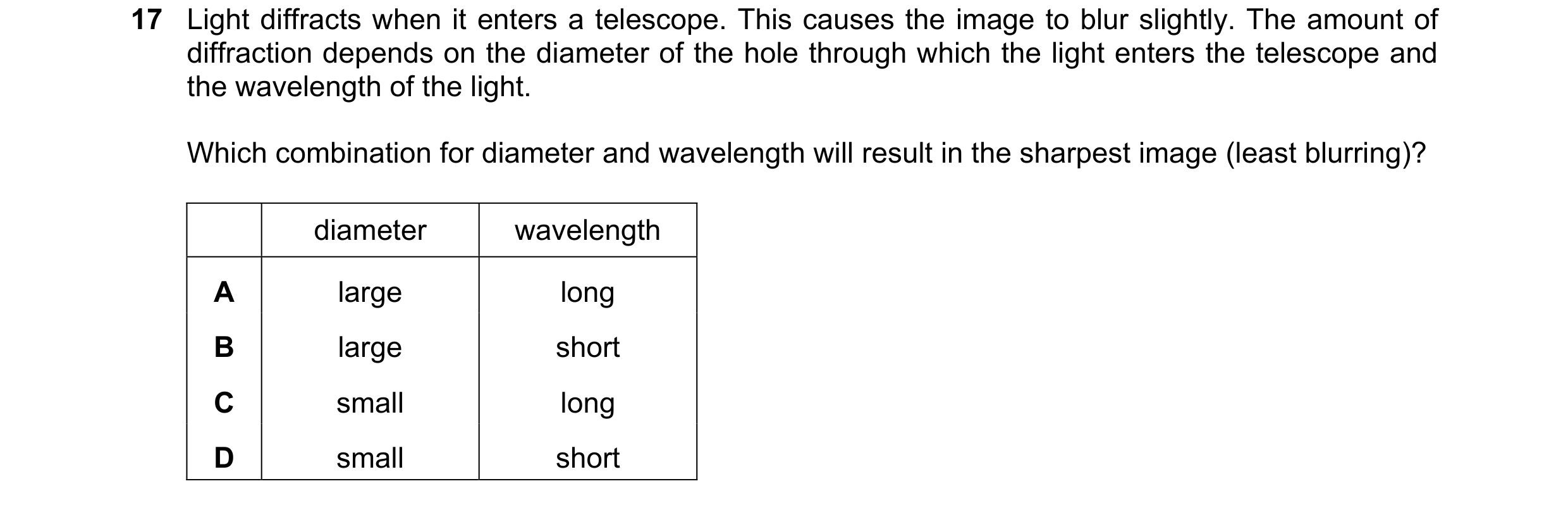
Q111 · Light diffracts when it enters a telescope 0625/23 Oct/Nov 2023
17 Light diffracts when it enters a telescope. This causes the image to blur slightly. The amount of diffraction depends on the diameter of the hole through which the light enters the telescope and the wavelength of the light. Which combination for diameter and wavelength will result in the sharpest image (least blurring)? diameter wavelength A large long B large short C small long D small short
1 marks
Answer: B
This question in 0625/23 Oct/Nov 2023
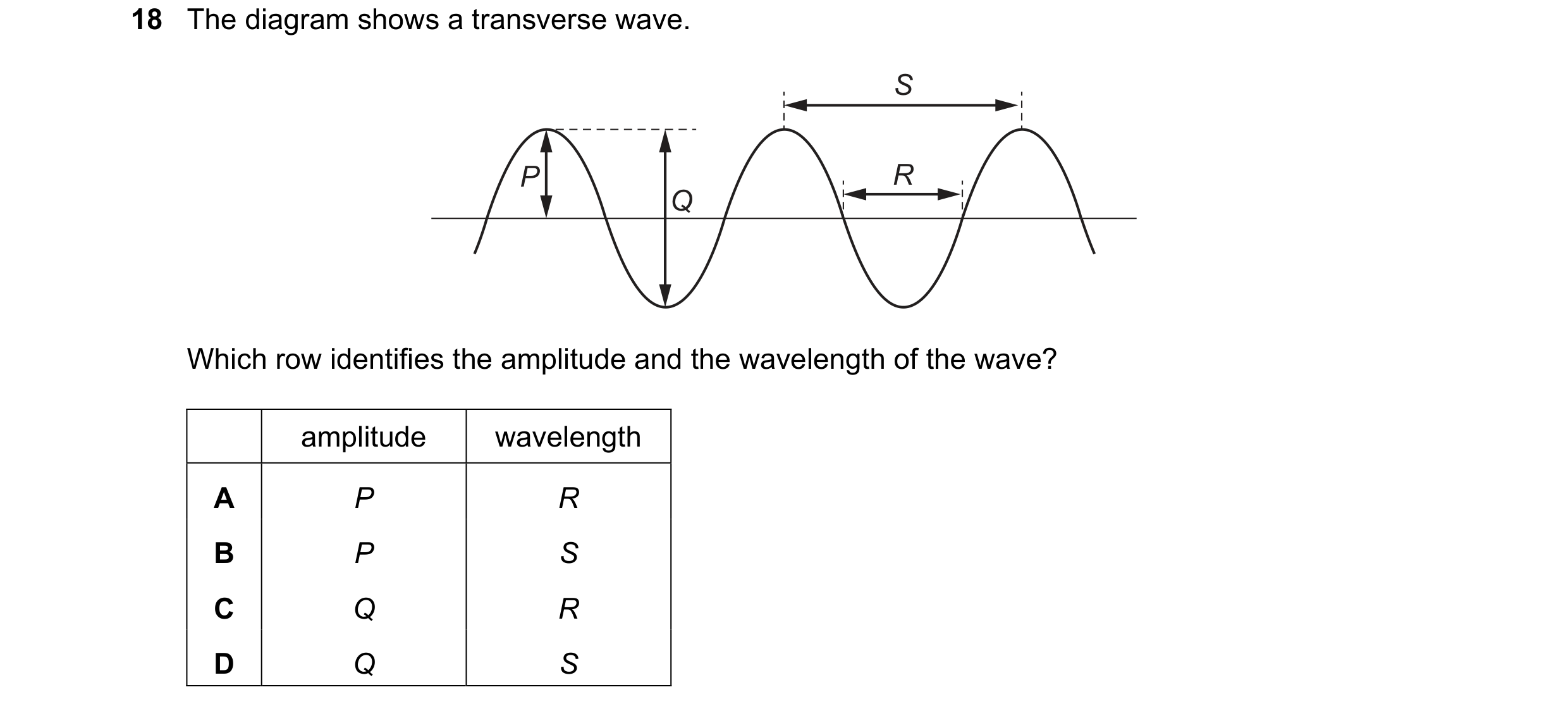
Q112 · The diagram shows a transverse wave 0625/23 Oct/Nov 2023
18 The diagram shows a transverse wave. S P R Q Which row identifies the amplitude and the wavelength of the wave? amplitude wavelength A P R B P S C Q R D Q S
1 marks
Answer: B
This question in 0625/23 Oct/Nov 2023
Q113 · The diagram shows a wave 0625/22 Feb/March 2024
16 The diagram shows a wave. displacement from undisturbed position Q P 0 0 position R S along wave Which dimensions describe the properties of the wave? A P = amplitude, S = speed B P = speed, Q = wavelength C R = amplitude, Q = wavelength D R = amplitude, S = wavelength
1 marks
Answer: C
This question in 0625/22 Feb/March 2024
Q114 · Which statement about waves is correct? 0625/21 May/June 2024
16 Which statement about waves is correct? A Waves do not transfer either energy or matter. B Waves transfer both energy and matter. C Waves transfer energy without transferring matter. D Waves transfer matter without transferring energy.
1 marks
Answer: C
This question in 0625/21 May/June 2024
Q115 · A sound wave travels at 330 m / s 0625/21 May/June 2024
22 A sound wave travels at 330 m / s. The distance between the centre of a compression and the centre of the nearest rarefaction in the sound wave is 2.5 cm. What is the frequency of the sound wave? A 66 Hz B 130 Hz C 6600 Hz D 13 000 Hz
1 marks
Answer: C
This question in 0625/21 May/June 2024
Q116 · In which type of wave is the direction of vibration parallel to the direction of travel? 0625/22 May/June 2024
17 In which type of wave is the direction of vibration parallel to the direction of travel? A electromagnetic waves B seismic P-waves C seismic S-waves D water waves
1 marks
Answer: B
This question in 0625/22 May/June 2024
Q117 · Waves in a ripple tank are diffracted as they pass through a narrow gap 0625/22 May/June 2024
18 Waves in a ripple tank are diffracted as they pass through a narrow gap. What can be done to make the spreading due to diffraction greater? A Decrease the frequency of the waves and keep the speed constant. B Decrease the speed of the waves and keep the frequency constant. C Increase the frequency of the waves and keep the speed constant. D Increase the frequency of the waves and decrease the speed.
1 marks
Answer: A
This question in 0625/22 May/June 2024
Q118 · A seismic wave has a frequency of 5.0 Hz and a speed of 10 km / s 0625/23 May/June 2024
17 A seismic wave has a frequency of 5.0 Hz and a speed of 10 km / s. What is the wavelength of the wave? A 0.20 km B 0.50 km C 2.0 km D 50 km
1 marks
Answer: C
This question in 0625/23 May/June 2024
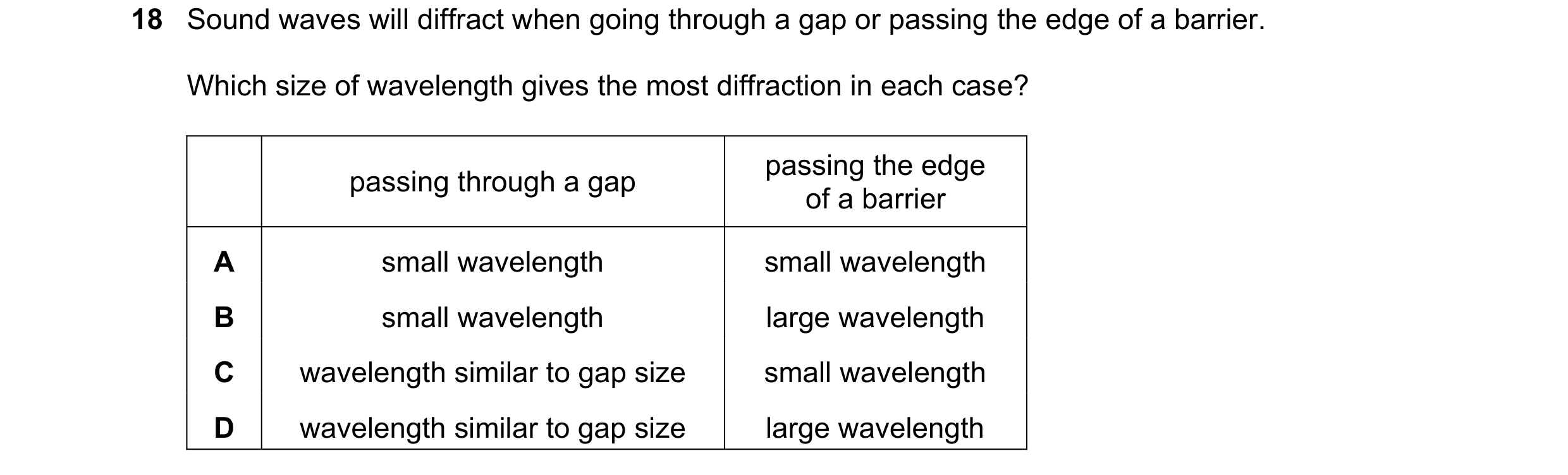
Q119 · Sound waves will diffract when going through a gap or passing the edge of a barrier 0625/23 May/June 2024
18 Sound waves will diffract when going through a gap or passing the edge of a barrier. Which size of wavelength gives the most diffraction in each case? passing the edge passing through a gap of a barrier A small wavelength small wavelength B small wavelength large wavelength C wavelength similar to gap size small wavelength D wavelength similar to gap size large wavelength
1 marks
Answer: D
This question in 0625/23 May/June 2024
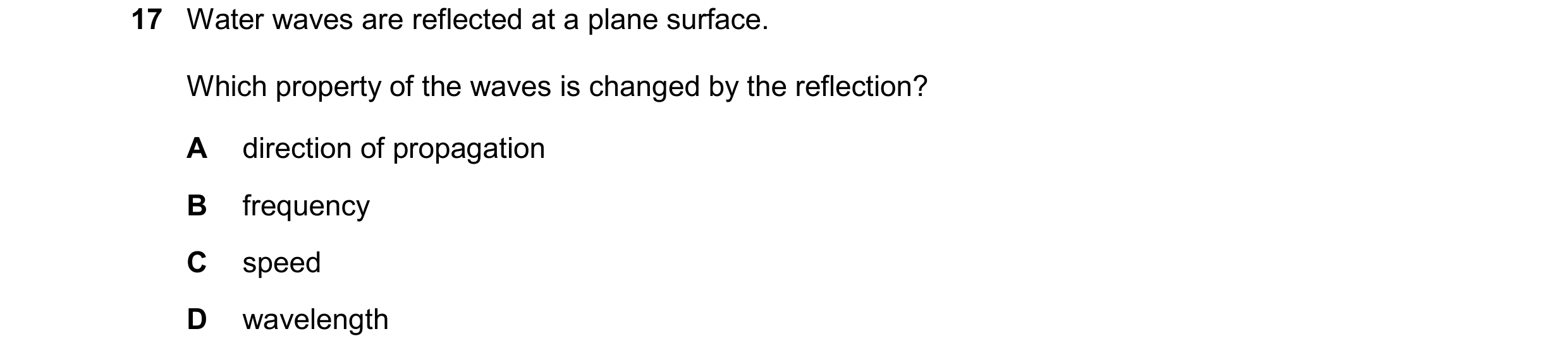
Q120 · Water waves are reflected at a plane surface 0625/21 Oct/Nov 2024
17 Water waves are reflected at a plane surface. Which property of the waves is changed by the reflection? A direction of propagation B frequency C speed D wavelength
1 marks
Answer: A
This question in 0625/21 Oct/Nov 2024
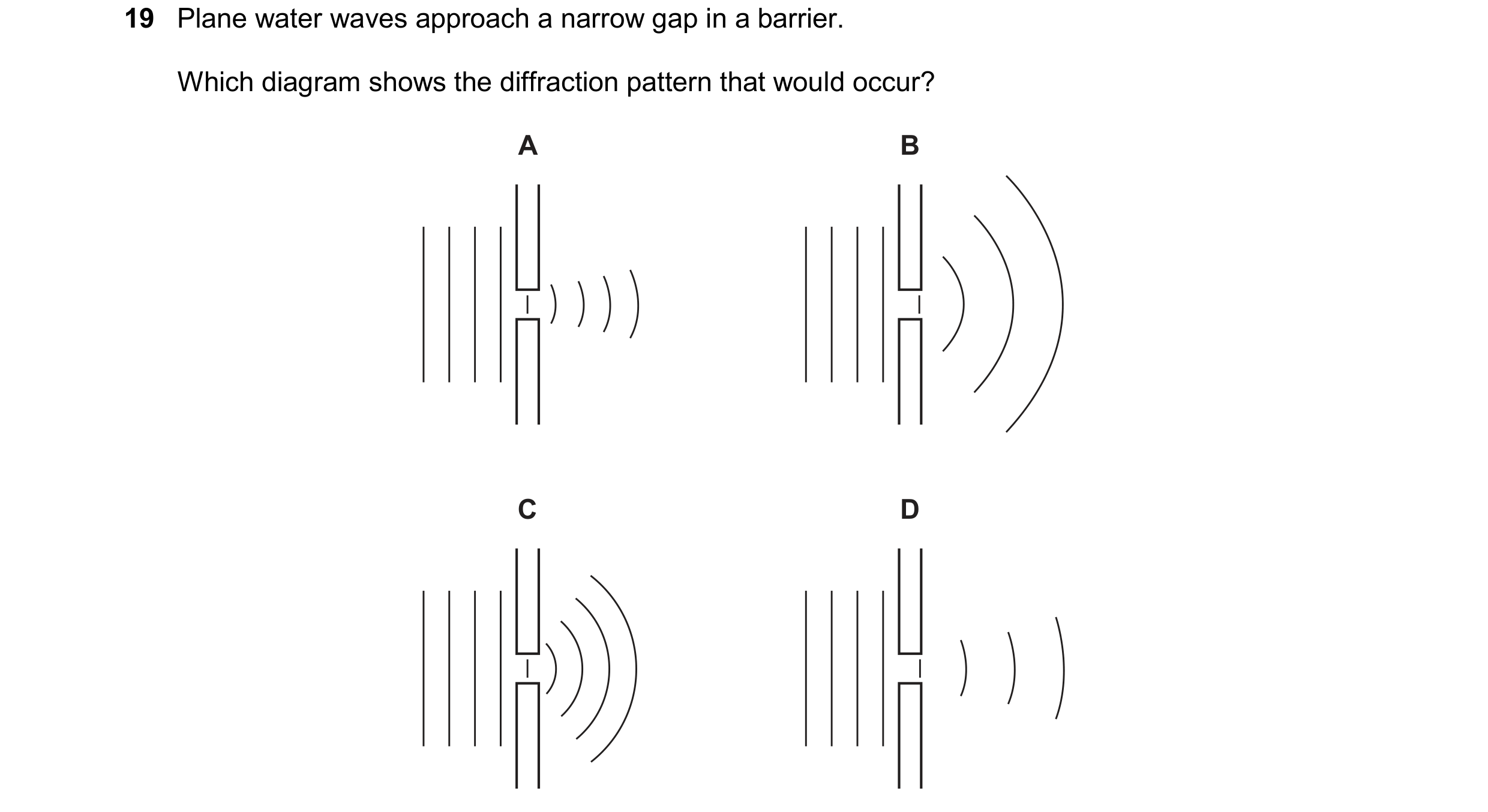
Q121 · Plane water waves approach a narrow gap in a barrier 0625/21 Oct/Nov 2024
19 Plane water waves approach a narrow gap in a barrier. Which diagram shows the diffraction pattern that would occur? A B C D
1 marks
Answer: C
This question in 0625/21 Oct/Nov 2024
Q122 · Radio waves are electromagnetic waves 0625/21 Oct/Nov 2024
22 Radio waves are electromagnetic waves. What is the wavelength of a radio wave of frequency 2.0 105 Hz? A 0.00067 m B 0.0015 m C 670 m D 1500 m
1 marks
Answer: D
This question in 0625/21 Oct/Nov 2024
Q123 · A candle flame is placed in front of a loudspeaker 0625/21 Oct/Nov 2024
23 A candle flame is placed in front of a loudspeaker. The loudspeaker produces a sound wave that causes air particles to vibrate. The vibrating air particles make the candle flame vibrate in the same direction as the air particles. candle flame loudspeaker Which row shows the direction of vibration of the candle flame and the nature of sound waves? direction of nature of vibration sound waves A longitudinal B transverse C longitudinal D transverse
1 marks
Answer: C
This question in 0625/21 Oct/Nov 2024
Q124 · What is the number of wavefronts per second that pass a fixed point? 0625/22 Oct/Nov 2024
17 What is the number of wavefronts per second that pass a fixed point? A the amplitude of the wave B the frequency of the wave C the speed of the wave D the wavelength of the wave
1 marks
Answer: B
This question in 0625/22 Oct/Nov 2024
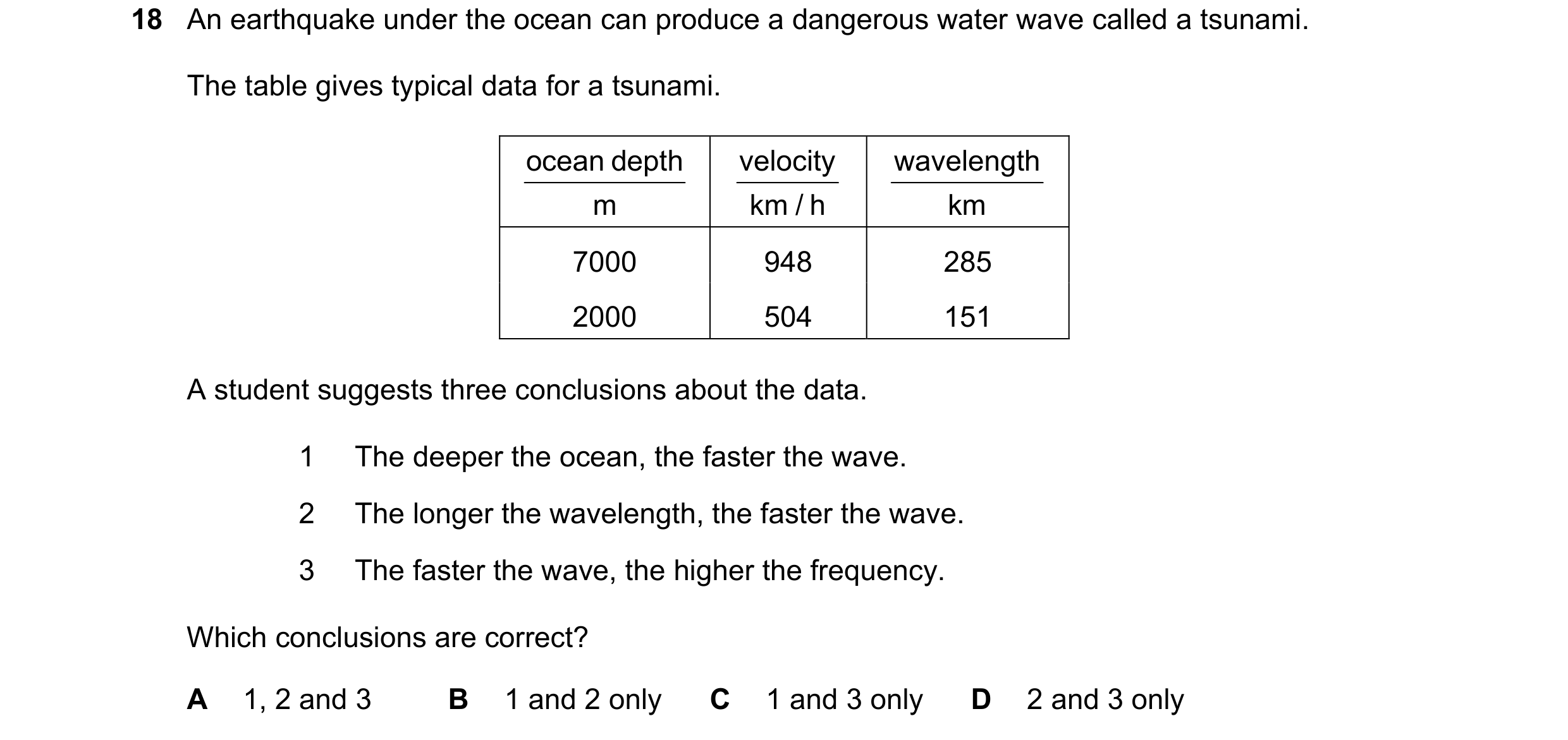
Q125 · An earthquake under the ocean can produce a dangerous water wave called a tsunami 0625/22 Oct/Nov 2024
18 An earthquake under the ocean can produce a dangerous water wave called a tsunami. The table gives typical data for a tsunami. ocean depth velocity wavelength m km / h km 7000 948 285 2000 504 151 A student suggests three conclusions about the data. 1 The deeper the ocean, the faster the wave. 2 The longer the wavelength, the faster the wave. 3 The faster the wave, the higher the frequency. Which conclusions are correct? A 1, 2 and 3 B 1 and 2 only C 1 and 3 only D 2 and 3 only
1 marks
Answer: B
This question in 0625/22 Oct/Nov 2024
Q126 · The diagram shows what happens to wavefronts at sea when they enter a harbour 0625/22 Oct/Nov 2024
19 The diagram shows what happens to wavefronts at sea when they enter a harbour. sea direction of harbour movement of wavefronts harbour wall What causes the change in the shape of the wavefronts? A diffraction B dispersion C reflection D refraction
1 marks
Answer: A
This question in 0625/22 Oct/Nov 2024
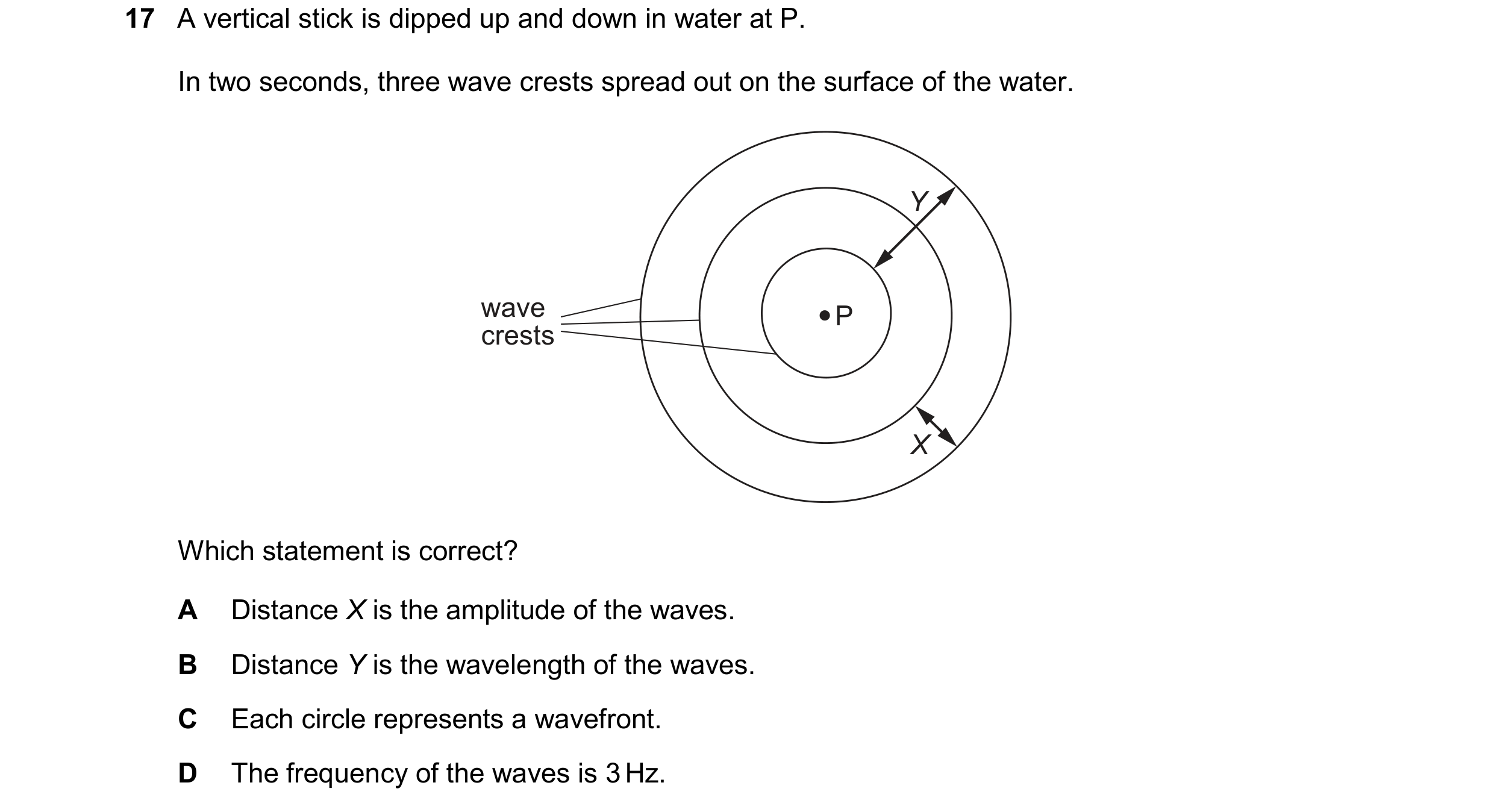
Q127 · A vertical stick is dipped up and down in water at P 0625/23 Oct/Nov 2024
17 A vertical stick is dipped up and down in water at P. In two seconds, three wave crests spread out on the surface of the water. Y wave P crests X Which statement is correct? A Distance X is the amplitude of the waves. B Distance Y is the wavelength of the waves. C Each circle represents a wavefront. D The frequency of the waves is 3 Hz.
1 marks
Answer: C
This question in 0625/23 Oct/Nov 2024
Q128 · Seismic waves from the epicentre of an earthquake take 100 s to reach a point 300 km away 0625/23 Oct/Nov 2024
18 Seismic waves from the epicentre of an earthquake take 100 s to reach a point 300 km away. When they arrive, they cause the ground to vibrate with a frequency of 2.0 Hz. What is the wavelength of these seismic waves? A 0.67 km B 1.5 km C 3.0 km D 6.0 km
1 marks
Answer: B
This question in 0625/23 Oct/Nov 2024
Q129 · Which diagram illustrates diffraction of water waves? 0625/23 Oct/Nov 2024
19 Which diagram illustrates diffraction of water waves? A B C D
1 marks
Answer: A
This question in 0625/23 Oct/Nov 2024
Q130 · The frequency of a wave is doubled 0625/22 Feb/March 2025
19 The frequency of a wave is doubled. The speed of the wave does not change. What happens to the wavelength of the wave? A It becomes four times as large. B It does not change. C It doubles. D It halves.
1 marks
Answer: D
This question in 0625/22 Feb/March 2025
Q131 · Which statement about ultrasound is correct? 0625/22 Feb/March 2025
20 Which statement about ultrasound is correct? A It has a higher frequency than audible sound and it is a longitudinal wave. B It has a higher frequency than audible sound and it is a transverse wave. C It has a lower frequency than audible sound and it is a longitudinal wave. D It has a lower frequency than audible sound and it is a transverse wave.
1 marks
Answer: A
This question in 0625/22 Feb/March 2025
Q132 · The diagram shows a cork with a weight attached so that the cork floats upright in water 0625/21 May/June 2025
17 The diagram shows a cork with a weight attached so that the cork floats upright in water. cork water surface X Y weight Transverse waves travel across the water from X to Y. In which direction do the waves make the cork move? A right and left B up and down C only to the right D only to the left
1 marks
Answer: B
This question in 0625/21 May/June 2025
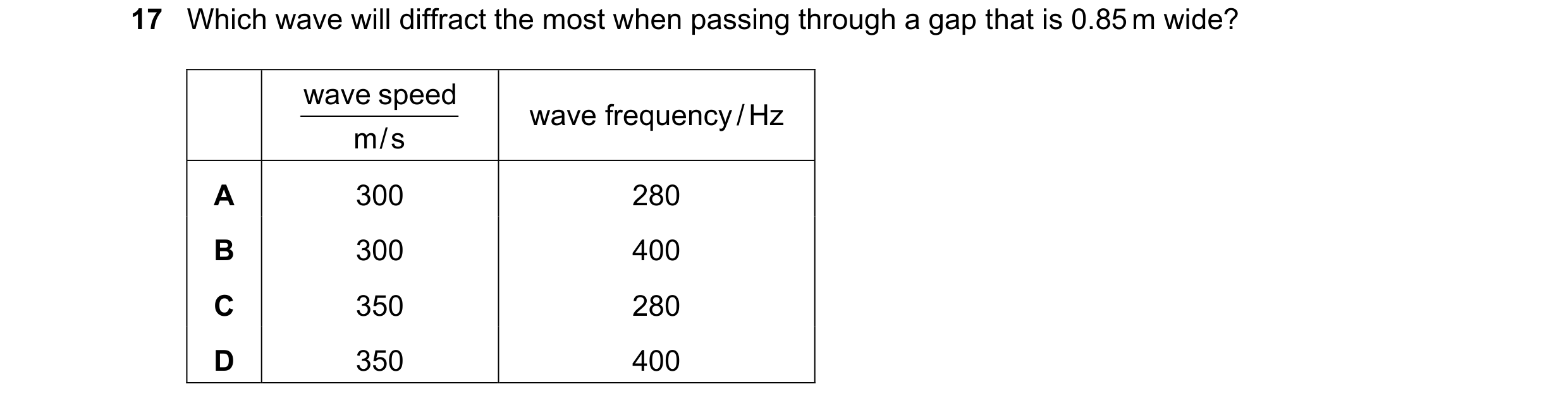
Q133 · Which wave will diffract the most when passing through a gap that is 0.85 m wide? 0625/22 May/June 2025
17 Which wave will diffract the most when passing through a gap that is 0.85 m wide? wave speed wave frequency / Hz m / s A 300 280 B 300 400 C 350 280 D 350 400
1 marks
Answer: C
This question in 0625/22 May/June 2025
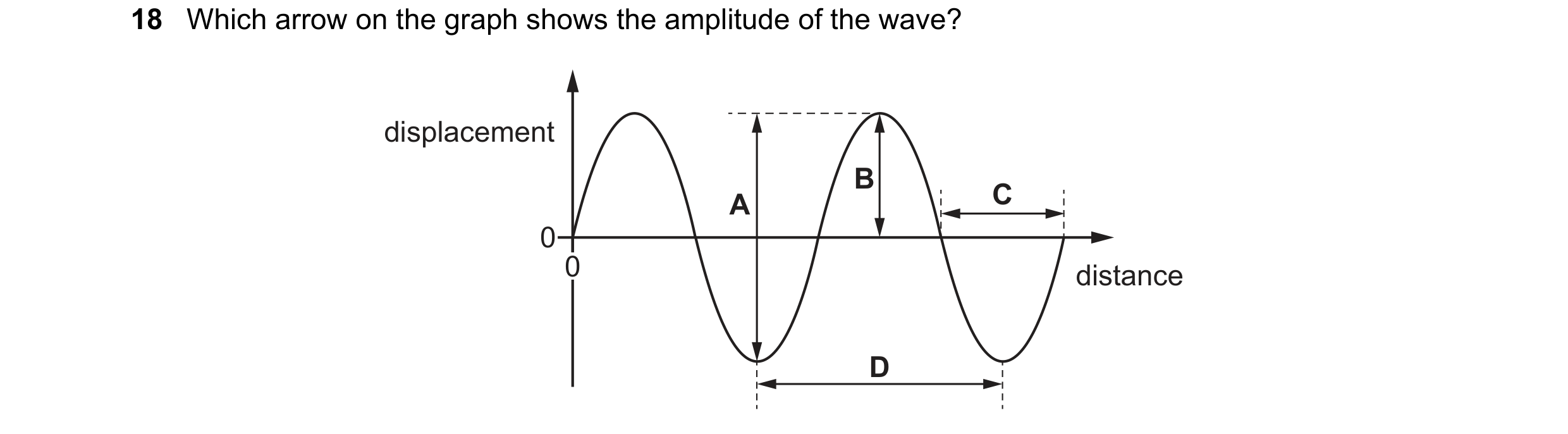
Q134 · Which arrow on the graph shows the amplitude of the wave? 0625/22 May/June 2025
18 Which arrow on the graph shows the amplitude of the wave? displacement B A C 0 0 distance D
1 marks
Answer: B
This question in 0625/22 May/June 2025
Q135 · Which row describes a seismic S-wave? 0625/22 May/June 2025
19 Which row describes a seismic S-wave? type of wave direction of vibration A longitudinal parallel to the direction of travel of the wavefront B longitudinal perpendicular to the direction of travel of the wavefront C transverse parallel to the direction of travel of the wavefront D transverse perpendicular to the direction of travel of the wavefront
1 marks
Answer: D
This question in 0625/22 May/June 2025
Q136 · Which row correctly describes light waves? 0625/23 May/June 2025
17 Which row correctly describes light waves? wave type direction of vibration A longitudinal parallel to direction of wave travel B longitudinal perpendicular to direction of wave travel C transverse parallel to direction of wave travel D transverse perpendicular to direction of wave travel
1 marks
Answer: D
This question in 0625/23 May/June 2025
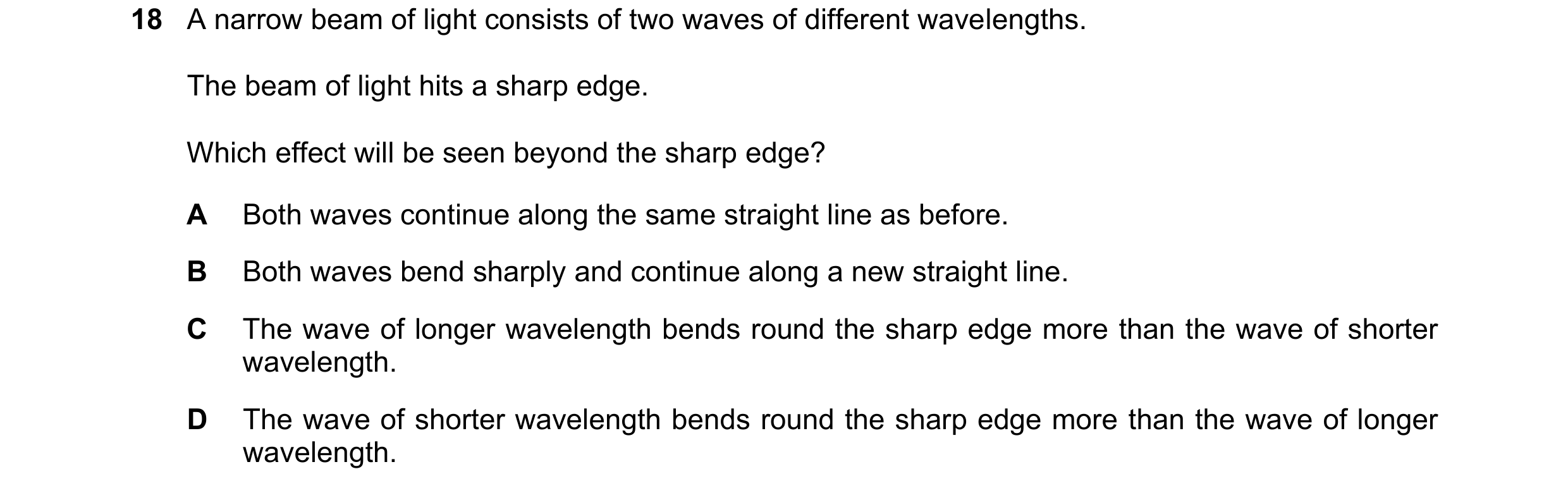
Q137 · A narrow beam of light consists of two waves of different wavelengths 0625/23 May/June 2025
18 A narrow beam of light consists of two waves of different wavelengths. The beam of light hits a sharp edge. Which effect will be seen beyond the sharp edge? A Both waves continue along the same straight line as before. B Both waves bend sharply and continue along a new straight line. C The wave of longer wavelength bends round the sharp edge more than the wave of shorter wavelength. D The wave of shorter wavelength bends round the sharp edge more than the wave of longer wavelength.
1 marks
Answer: C
This question in 0625/23 May/June 2025
Q138 · What is a compression? 0625/23 May/June 2025
23 What is a compression? A a point in a longitudinal wave where the particles of the medium are close together B a point in a longitudinal wave where the particles of the medium are far apart C a point in a transverse wave where the particles of the medium are close together D a point in a transverse wave where the particles of the medium are far apart
1 marks
Answer: A
This question in 0625/23 May/June 2025
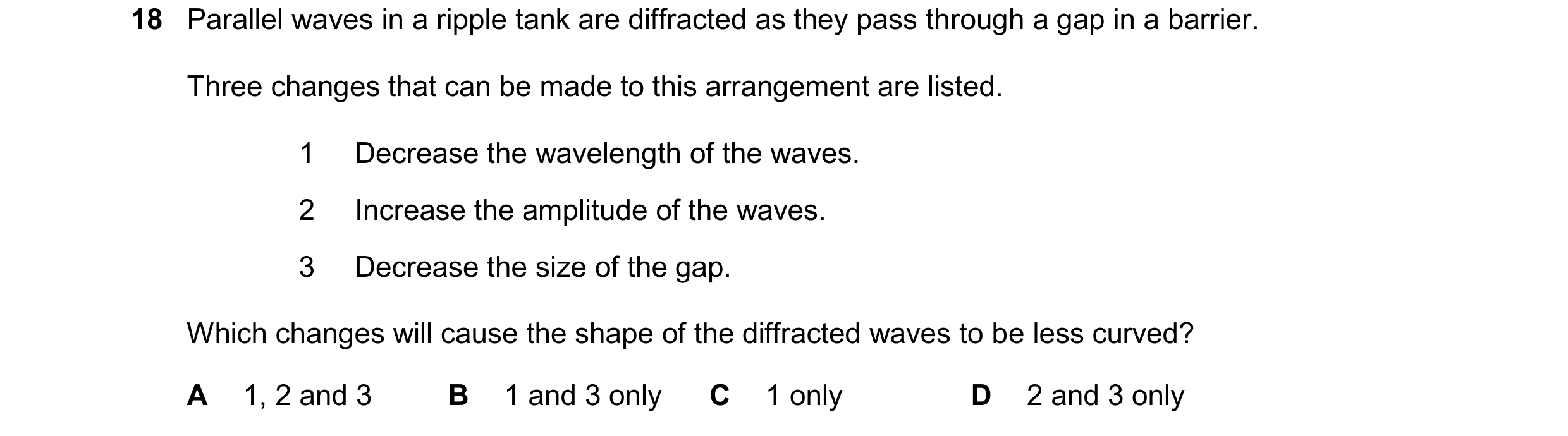
Q139 · Parallel waves in a ripple tank are diffracted as they pass through a gap in a barrier 0625/21 Oct/Nov 2025
18 Parallel waves in a ripple tank are diffracted as they pass through a gap in a barrier. Three changes that can be made to this arrangement are listed. 1 Decrease the wavelength of the waves. 2 Increase the amplitude of the waves. 3 Decrease the size of the gap. Which changes will cause the shape of the diffracted waves to be less curved? A 1, 2 and 3 B 1 and 3 only C 1 only D 2 and 3 only
1 marks
Answer: C
This question in 0625/21 Oct/Nov 2025
Q140 · An earthquake-monitoring station records the arrival of 16 complete wavelengths of an… 0625/22 Oct/Nov 2025
17 An earthquake-monitoring station records the arrival of 16 complete wavelengths of an earthquake wave in a time of 20 s. The speed of the earthquake wave is 6.0 km / s. What is the wavelength of the earthquake wave? A 1.3 10– 4 m B 2.1 10– 4 m C 4.8 103 m D 7.5 103 m
1 marks
Answer: D
This question in 0625/22 Oct/Nov 2025
Q141 · Which statement is correct? 0625/22 Oct/Nov 2025
18 Which statement is correct? A Seismic S-waves are longitudinal. B Sound waves are longitudinal. C The amplitude is always greater than the wavelength in a longitudinal wave. D The vibration is at right-angles to the direction of propagation in a longitudinal wave.
1 marks
Answer: B
This question in 0625/22 Oct/Nov 2025
Q142 · When water waves pass through a gap, they diffract 0625/23 Oct/Nov 2025
18 When water waves pass through a gap, they diffract. The diagrams show wavefronts approaching a gap. In which diagram will the diffraction be least? A B C D
1 marks
Answer: C
This question in 0625/23 Oct/Nov 2025
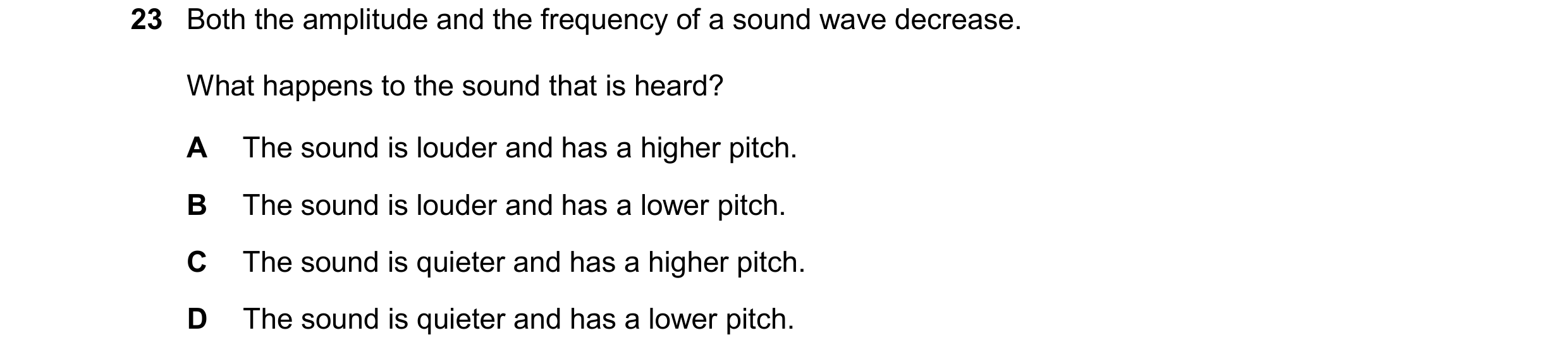
Q143 · Both the amplitude and the frequency of a sound wave decrease 0625/23 Oct/Nov 2025
23 Both the amplitude and the frequency of a sound wave decrease. What happens to the sound that is heard? A The sound is louder and has a higher pitch. B The sound is louder and has a lower pitch. C The sound is quieter and has a higher pitch. D The sound is quieter and has a lower pitch.
1 marks
Answer: D
This question in 0625/23 Oct/Nov 2025


 1 / 46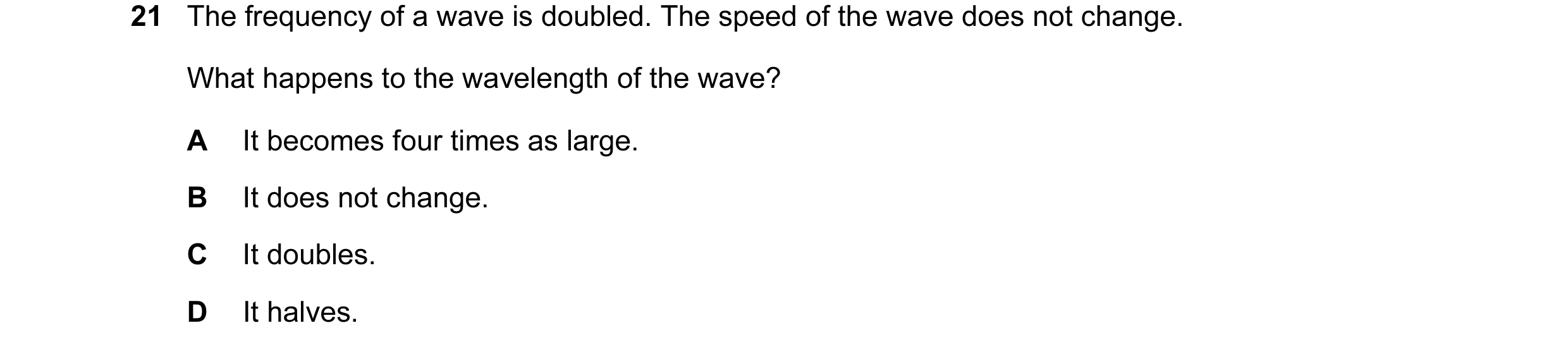
 2 / 46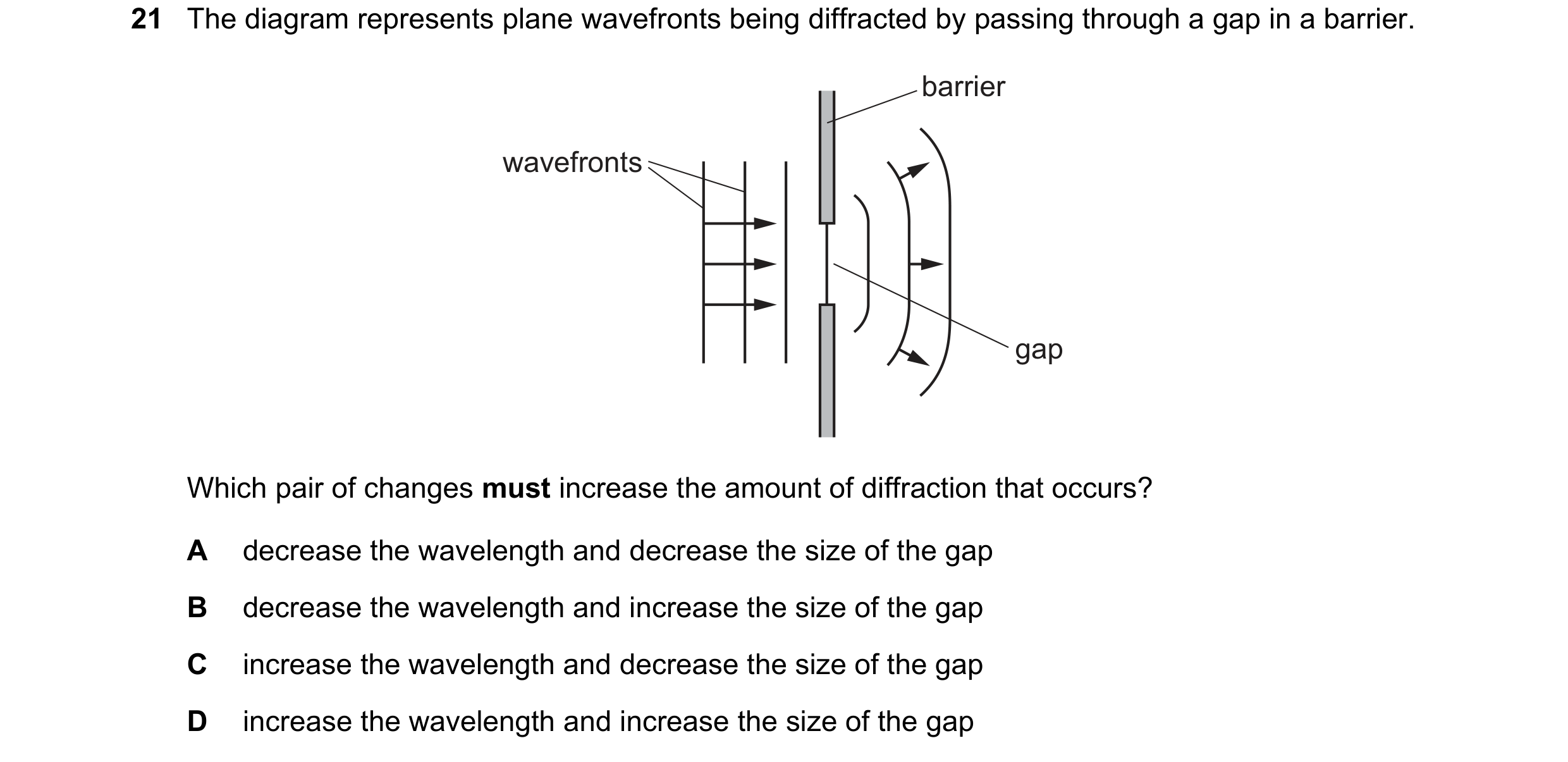
 3 / 46
 4 / 46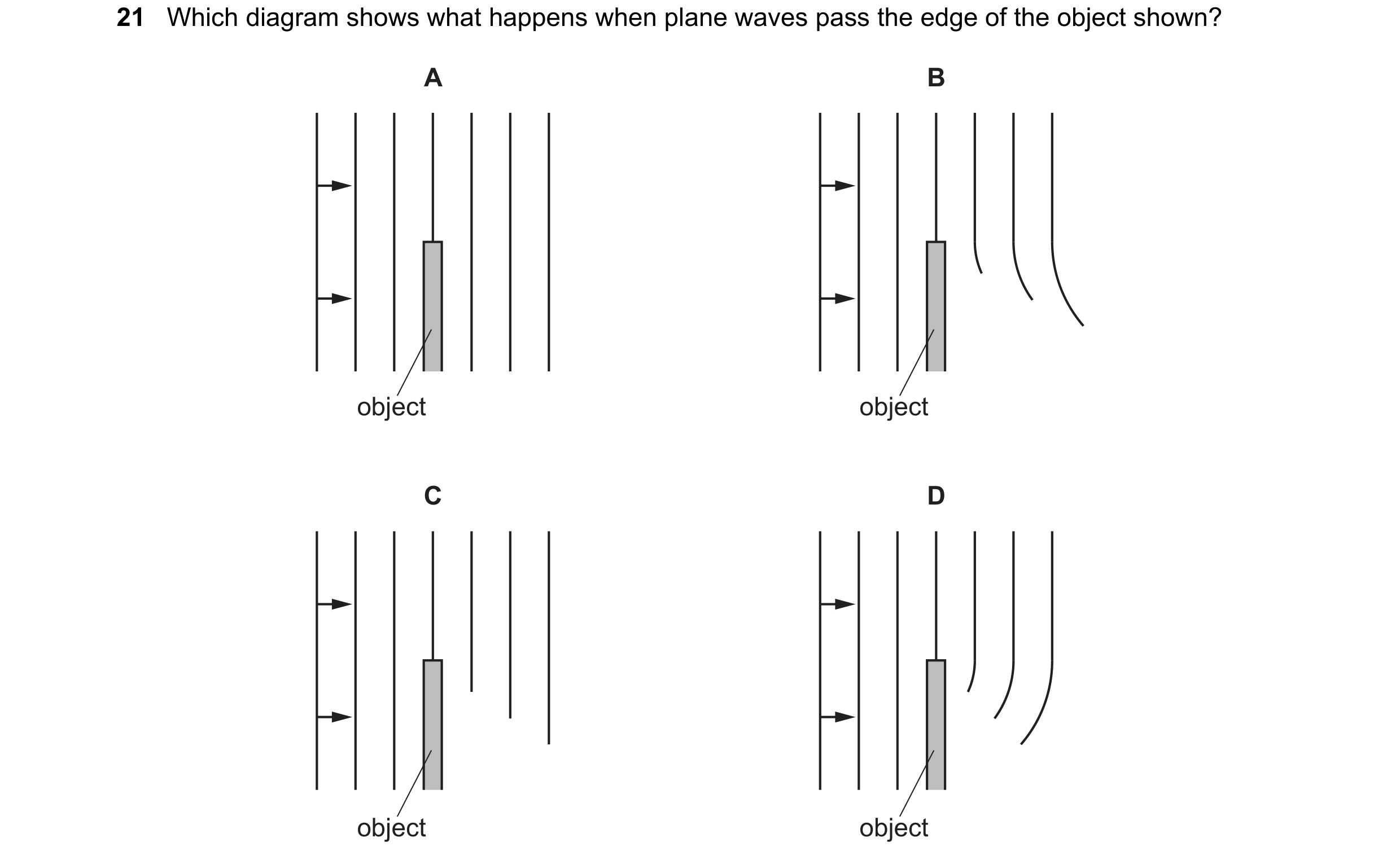
 5 / 46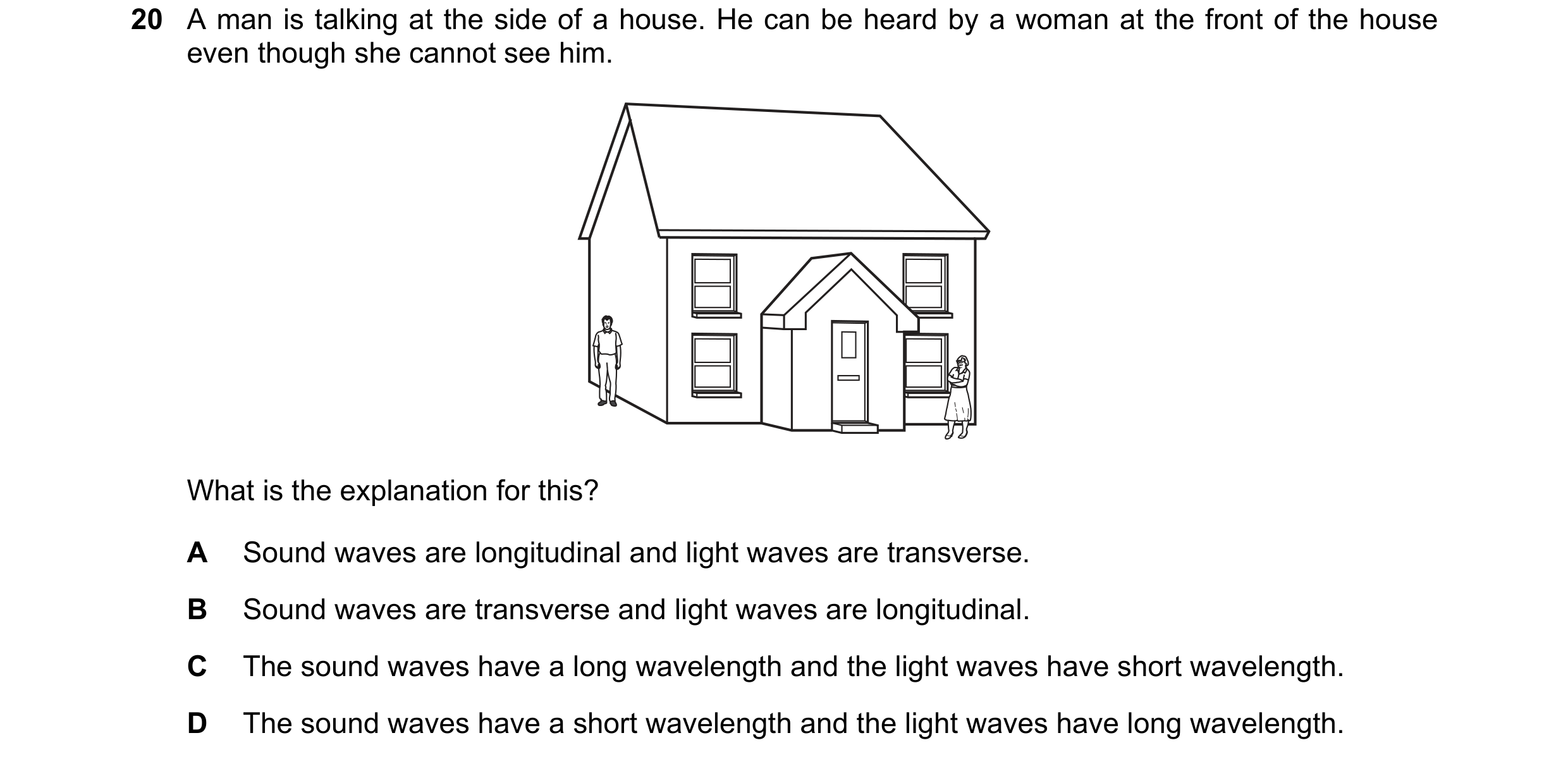
 6 / 46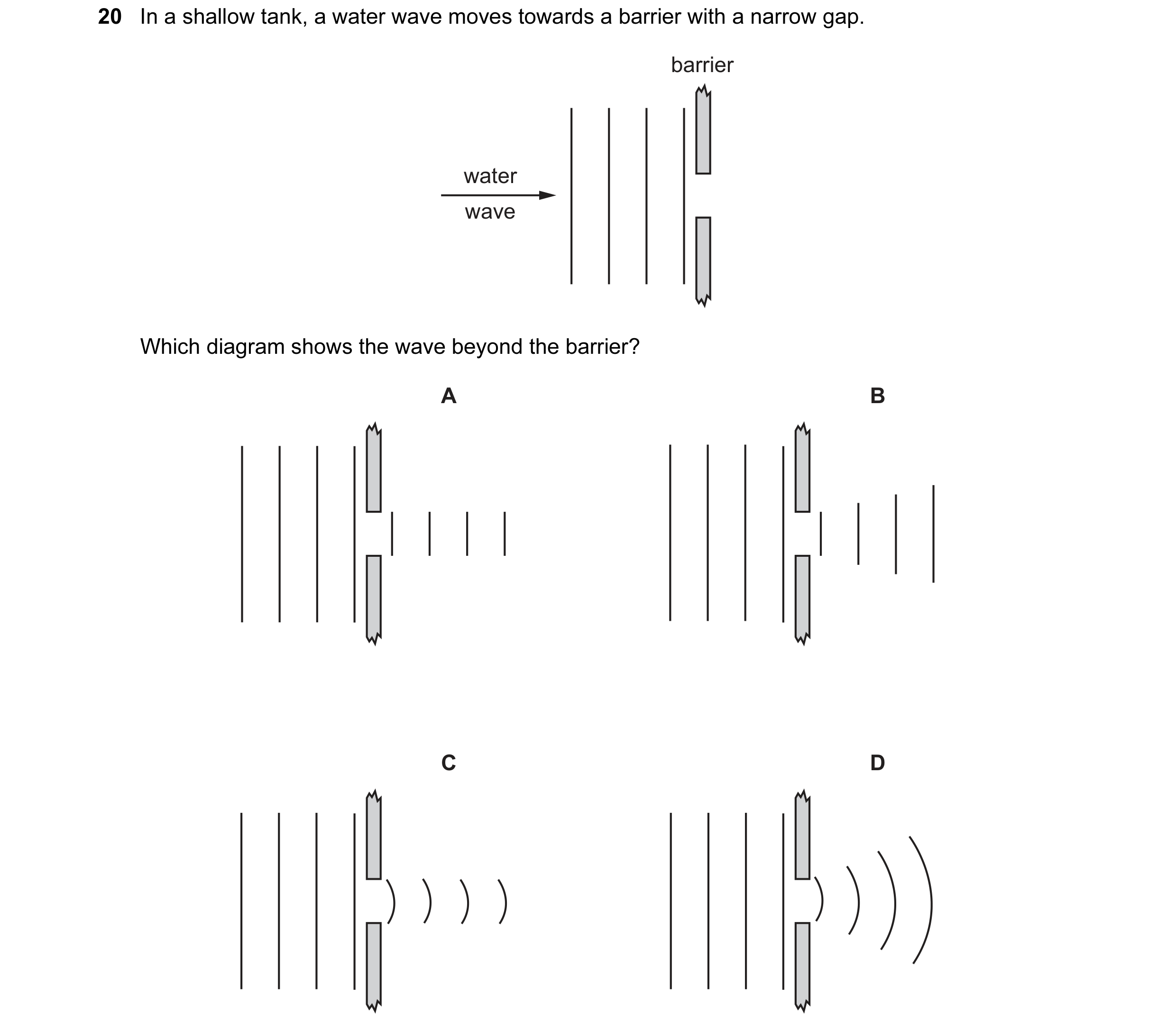
 7 / 46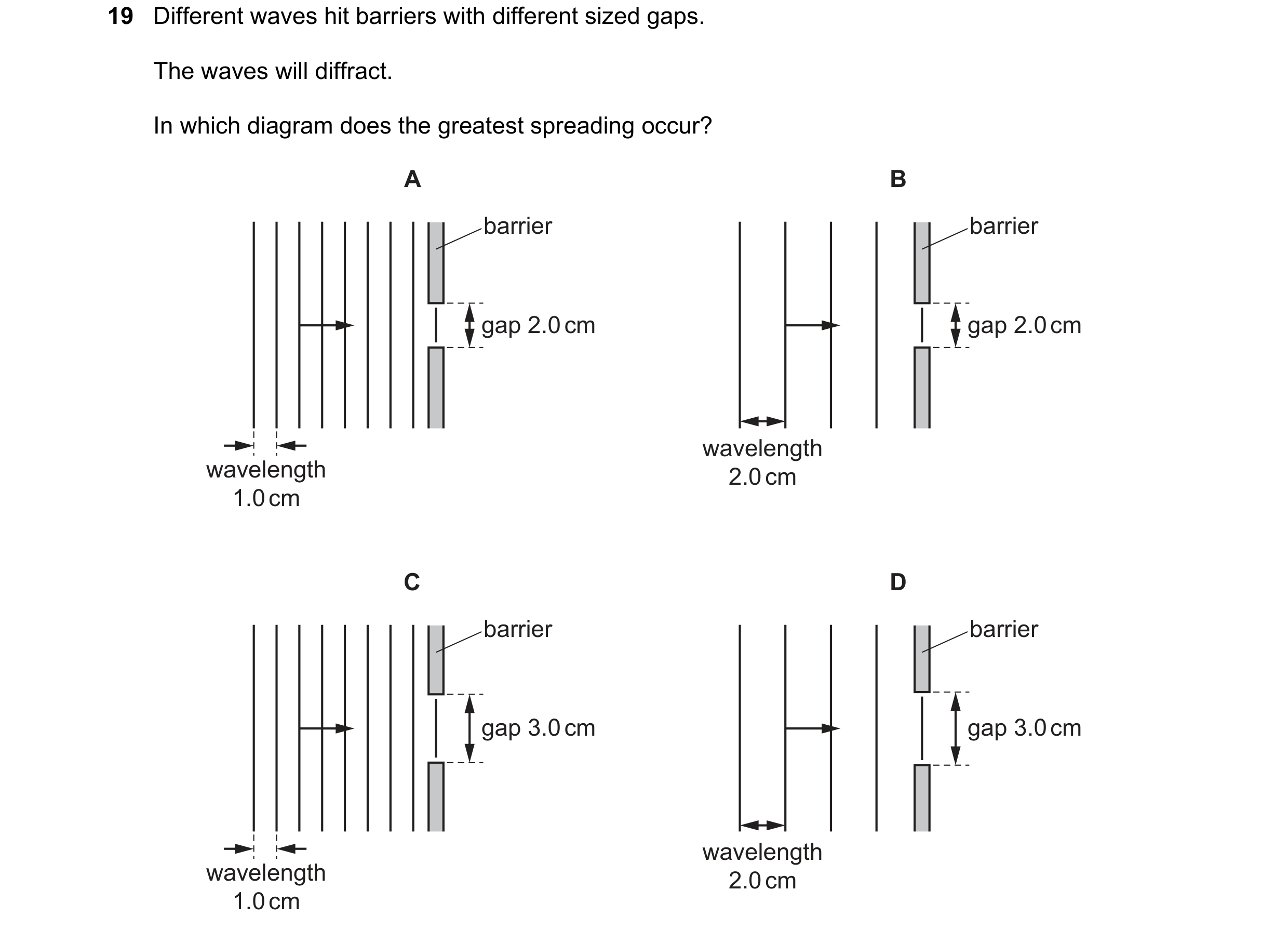
 8 / 46
 9 / 46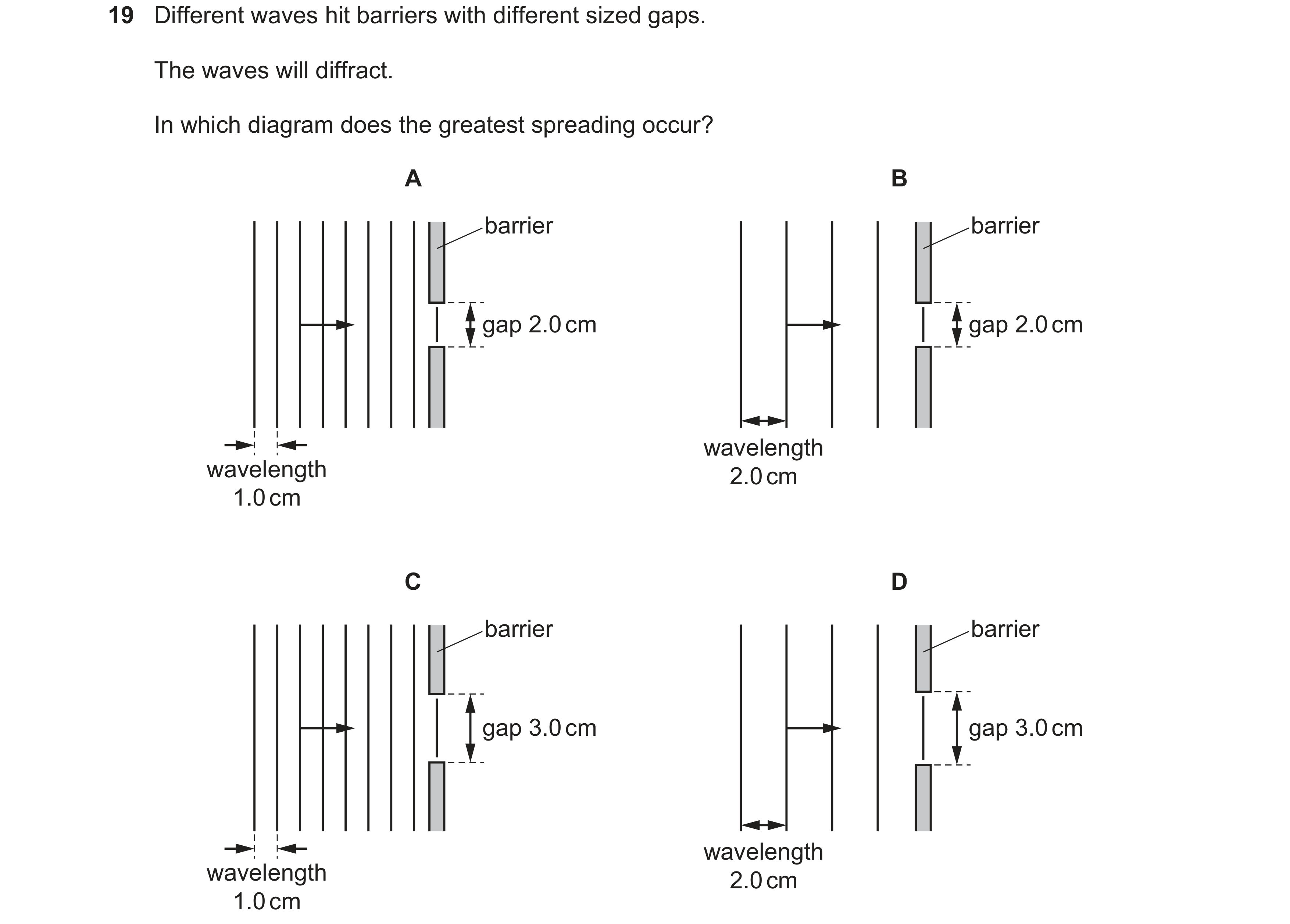
 10 / 46
 11 / 46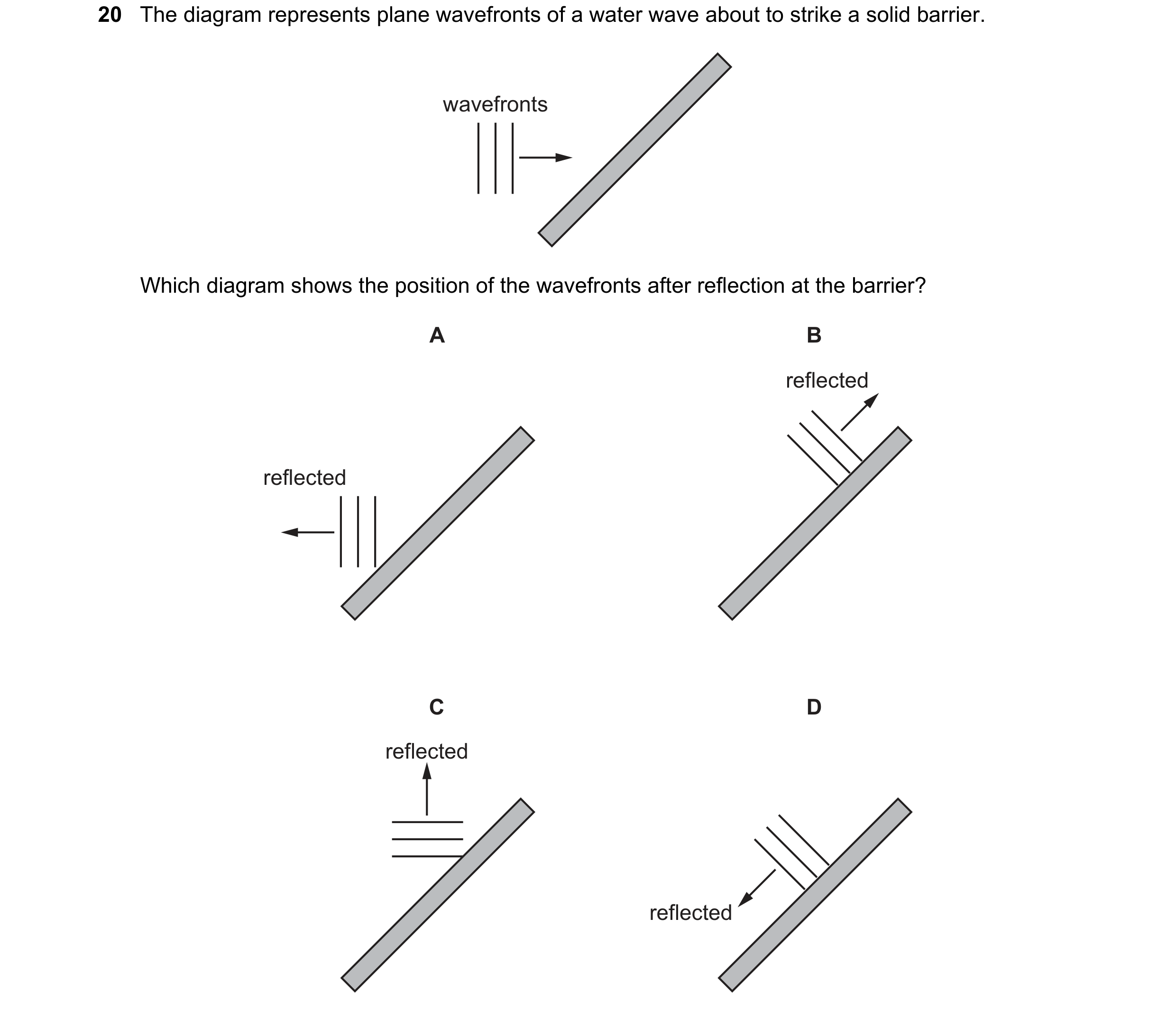
 12 / 46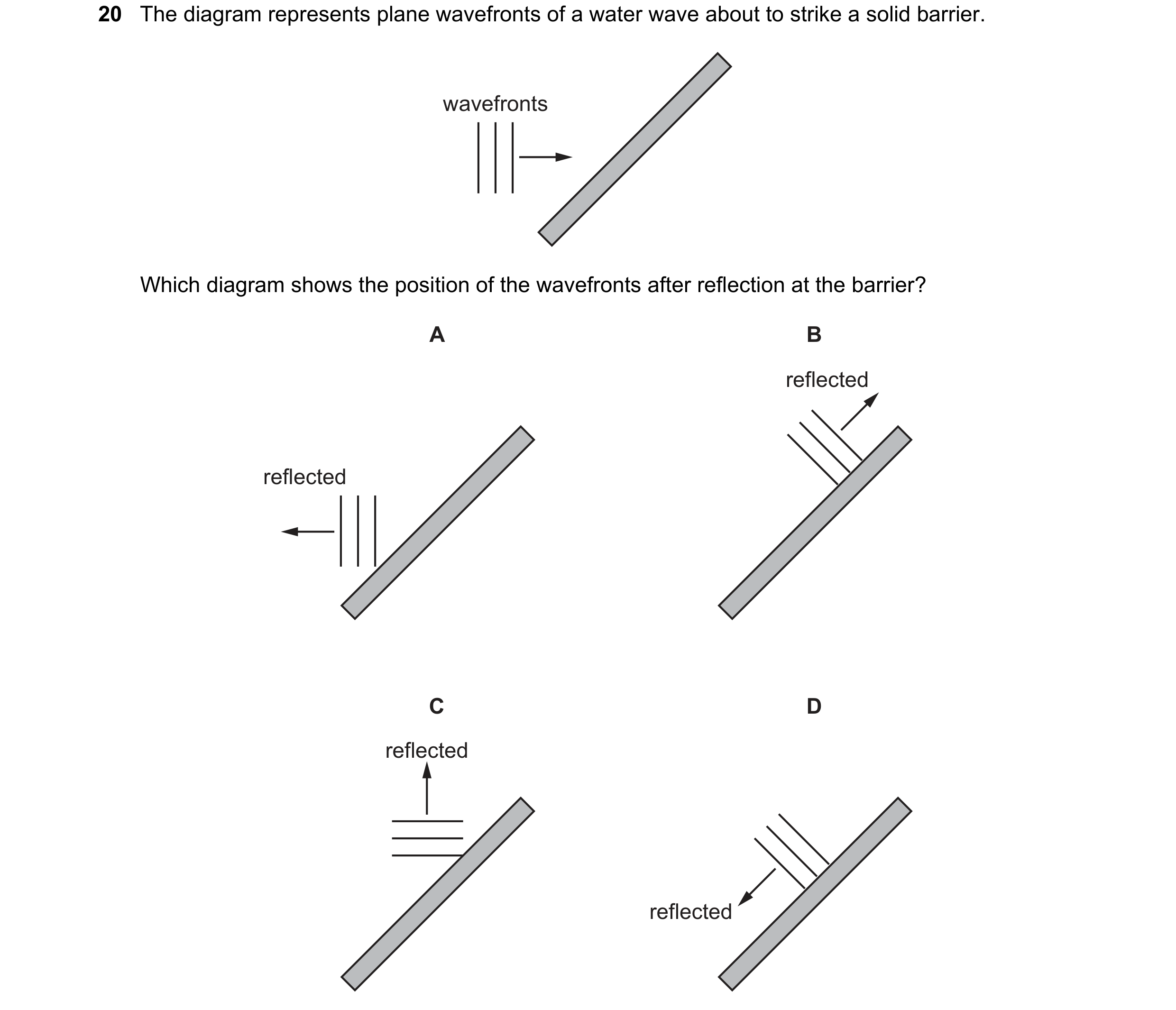
 13 / 46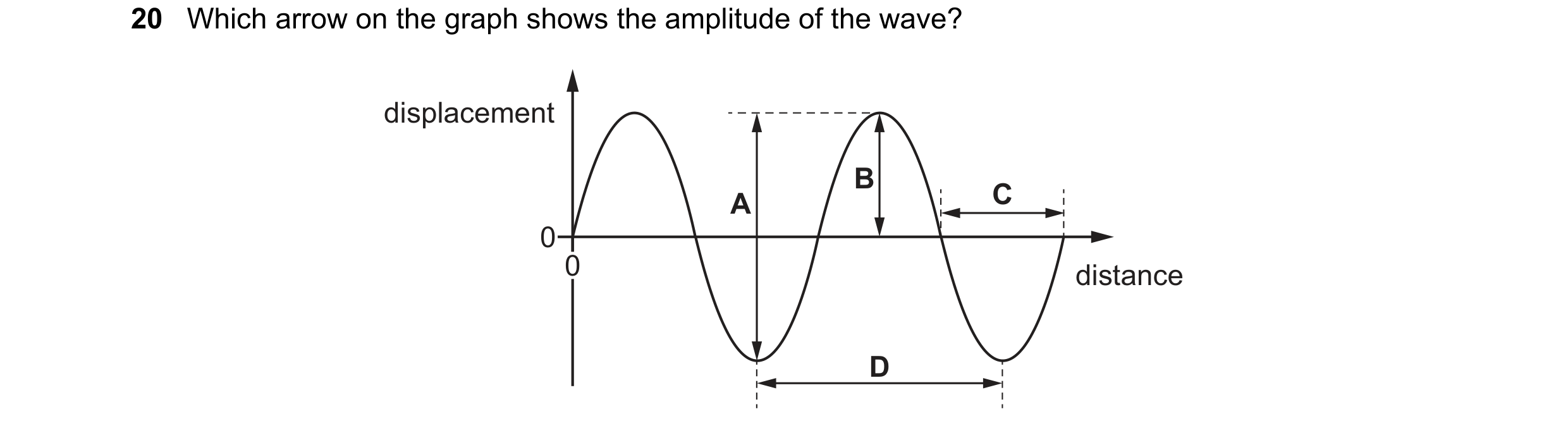
 14 / 46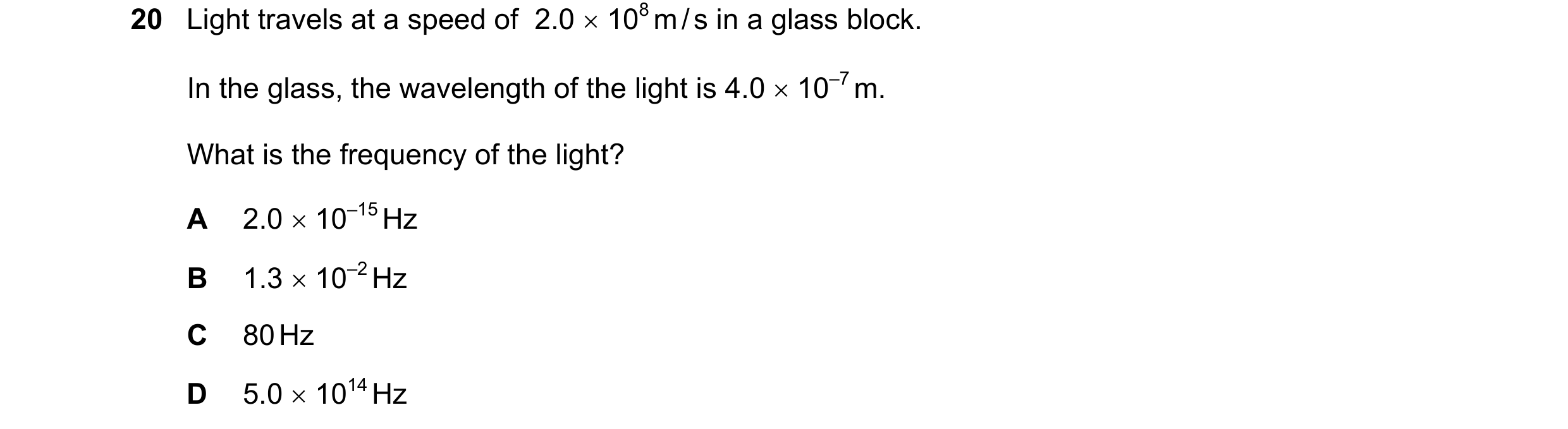
 15 / 46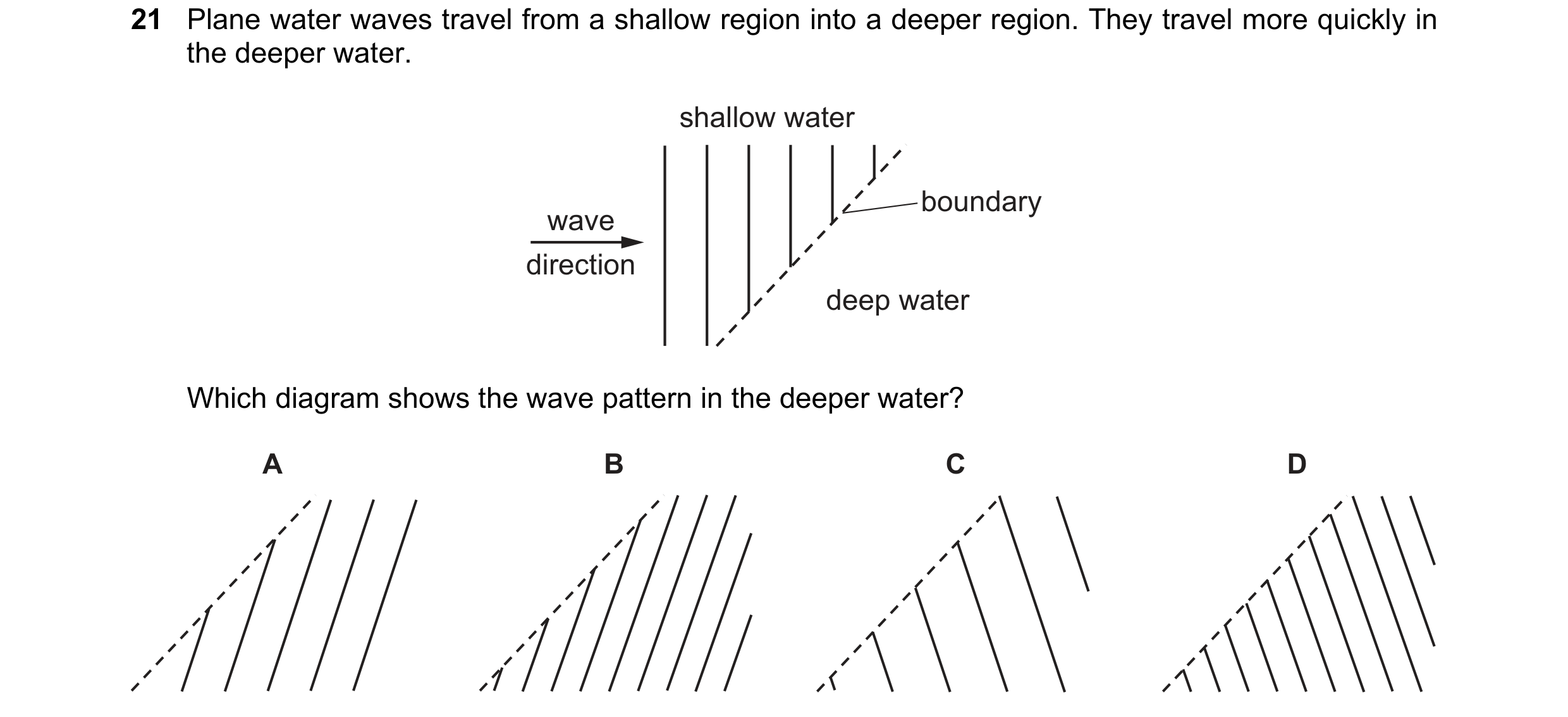
 16 / 46
 17 / 46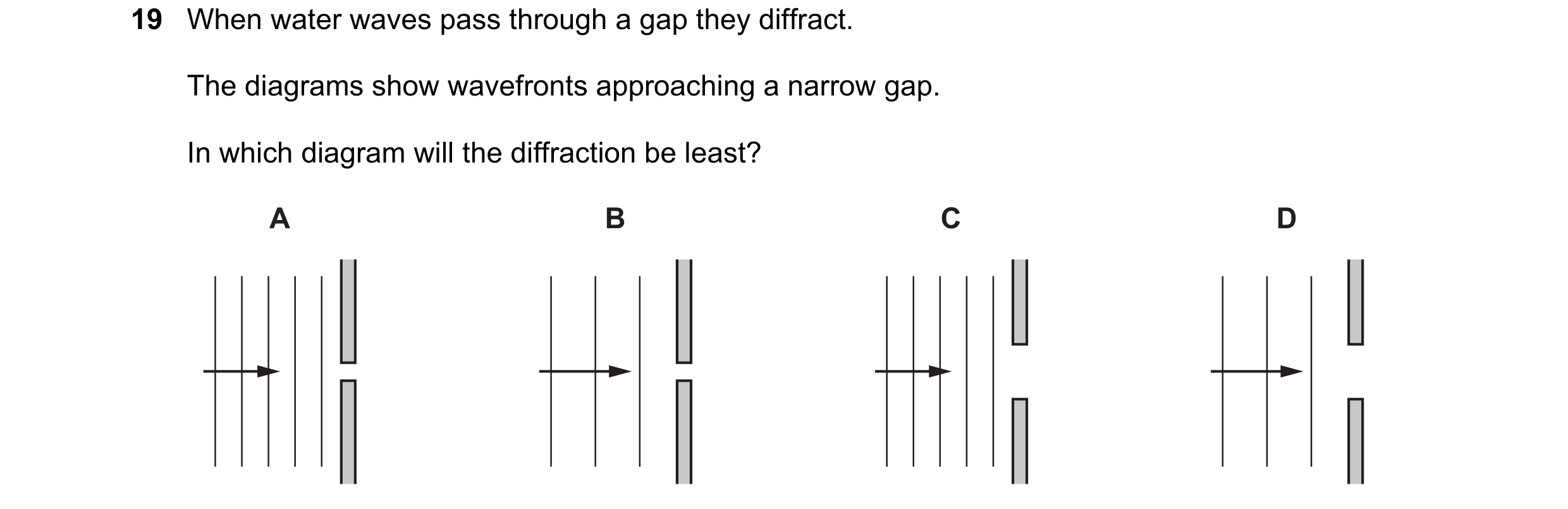


 18 / 46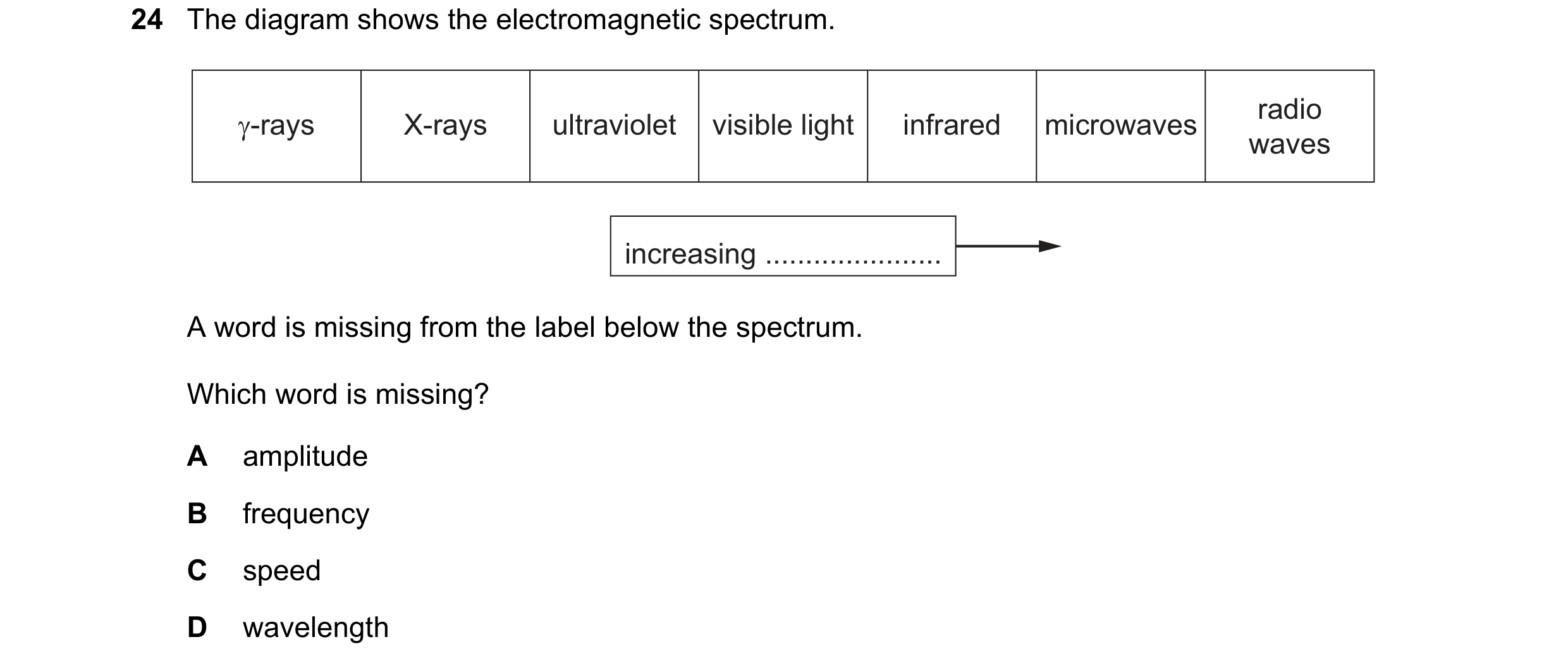
 19 / 46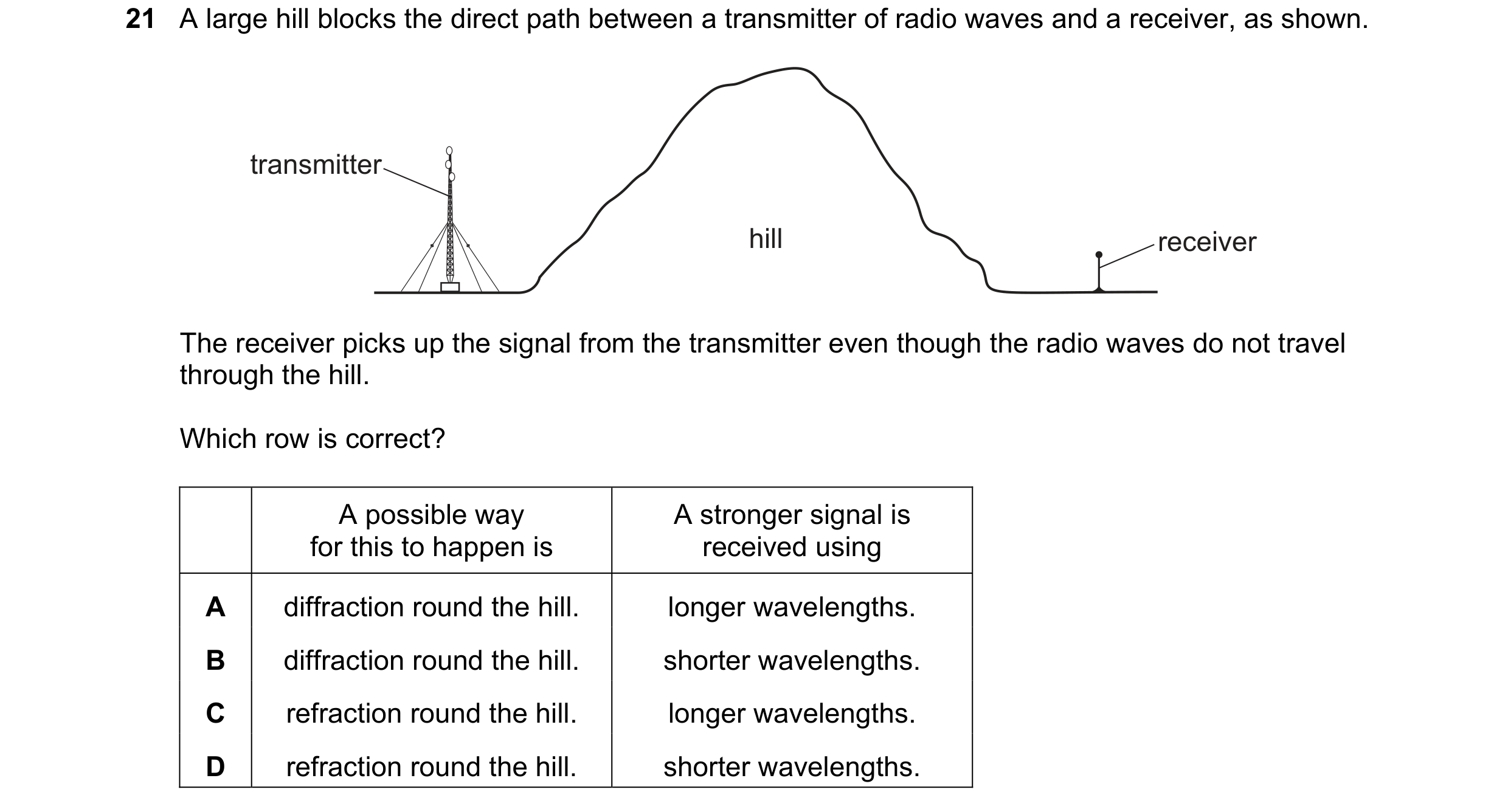
 20 / 46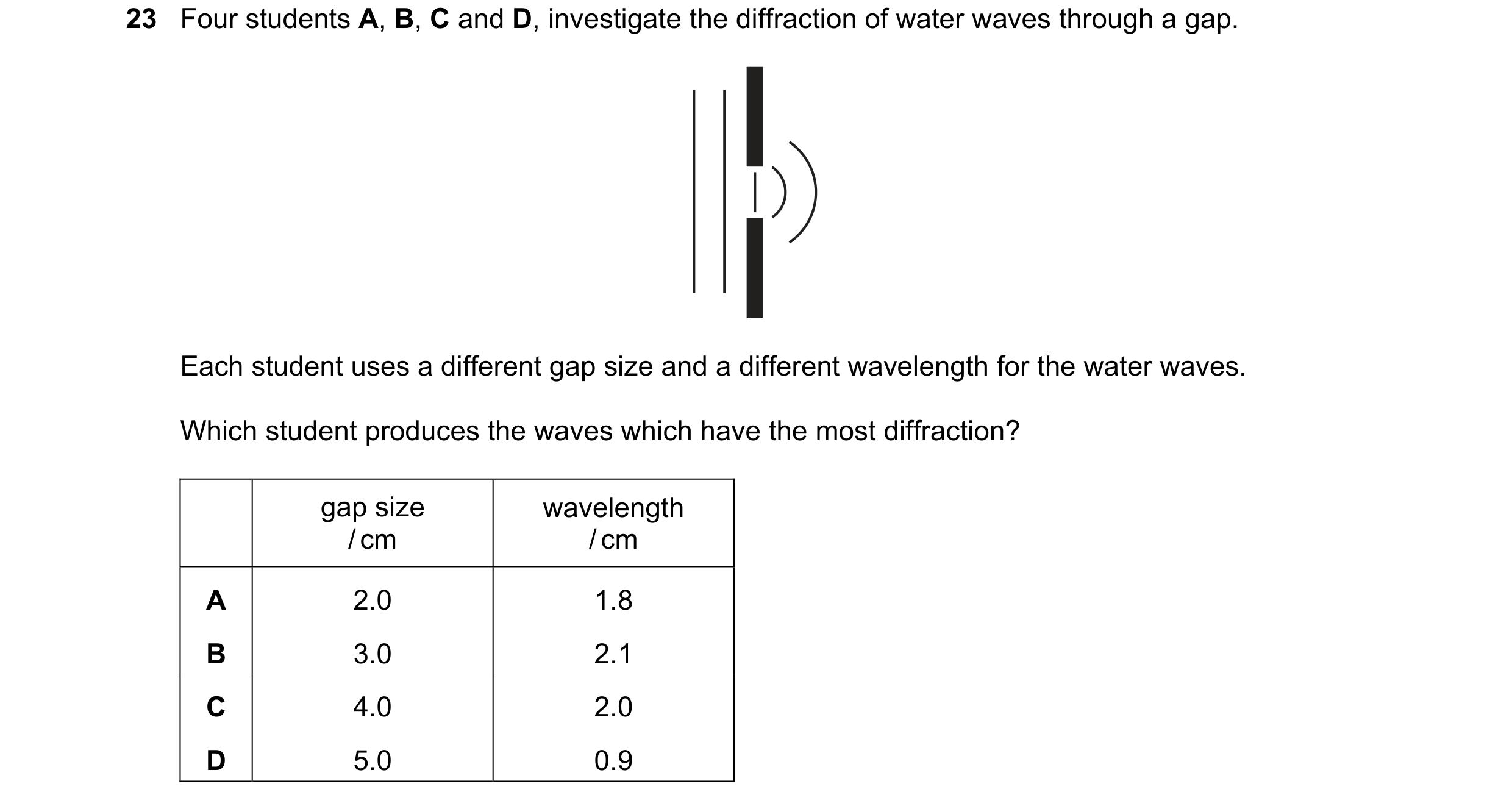
 21 / 46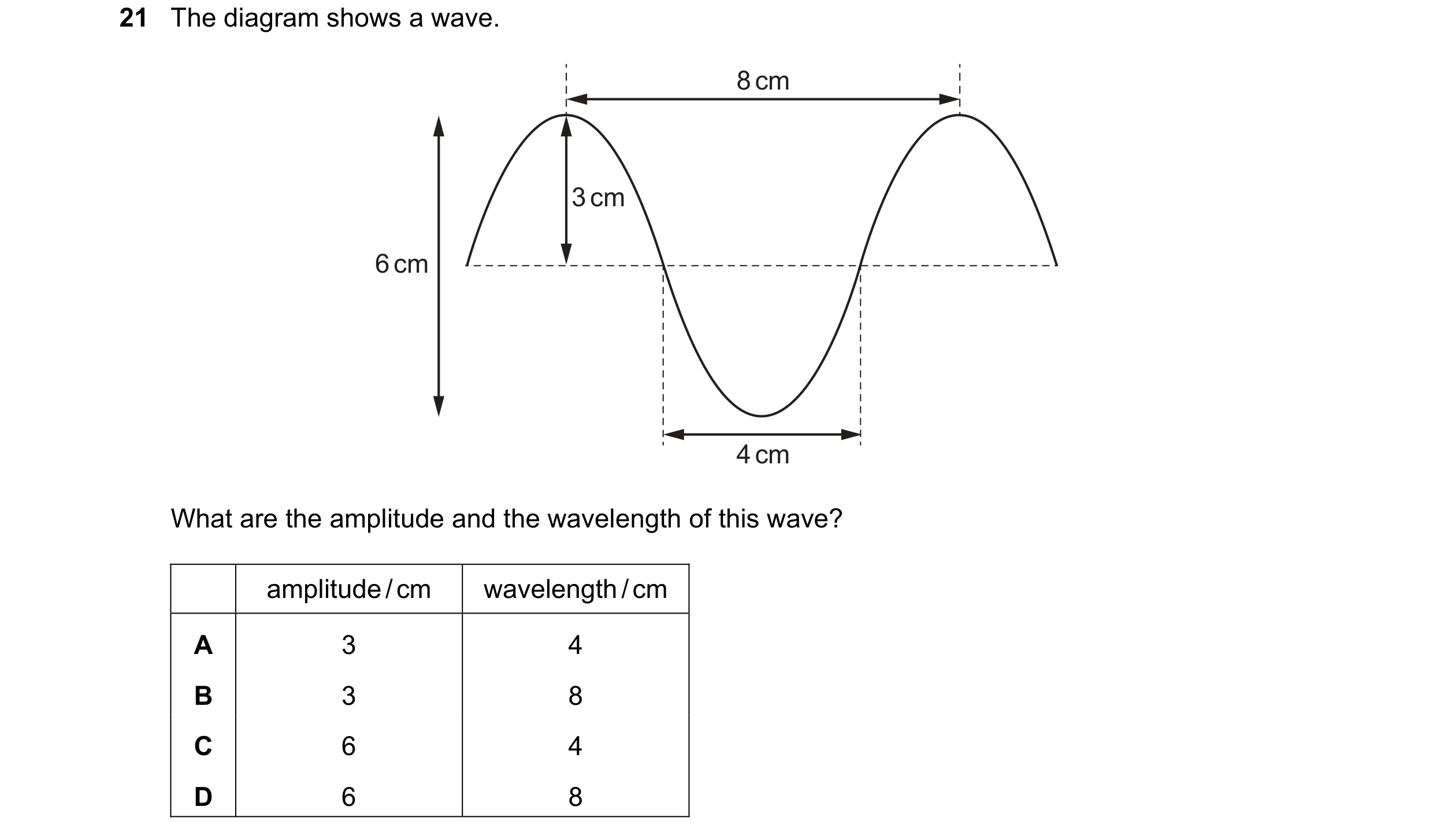
 22 / 46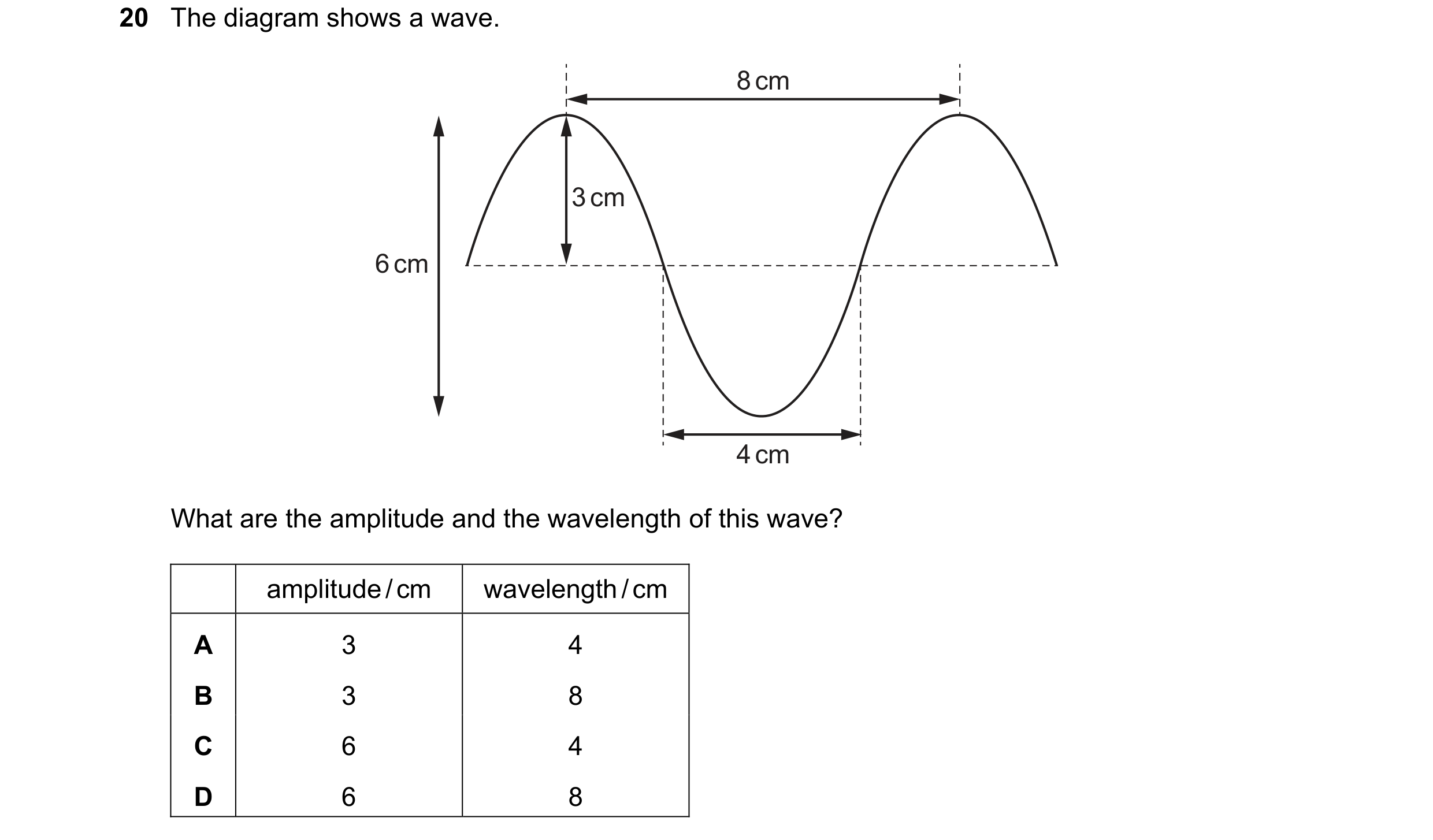


 23 / 46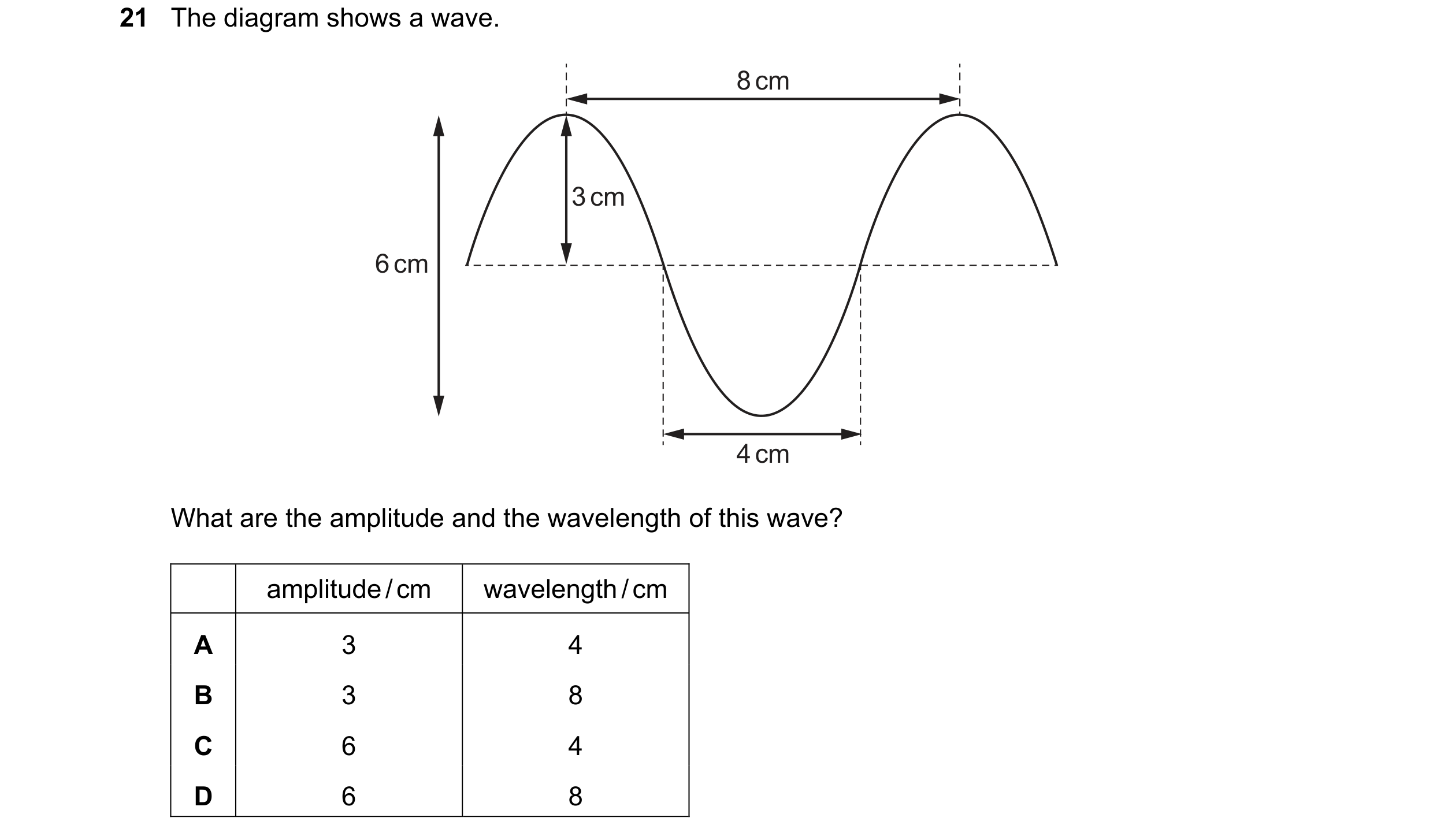
 24 / 46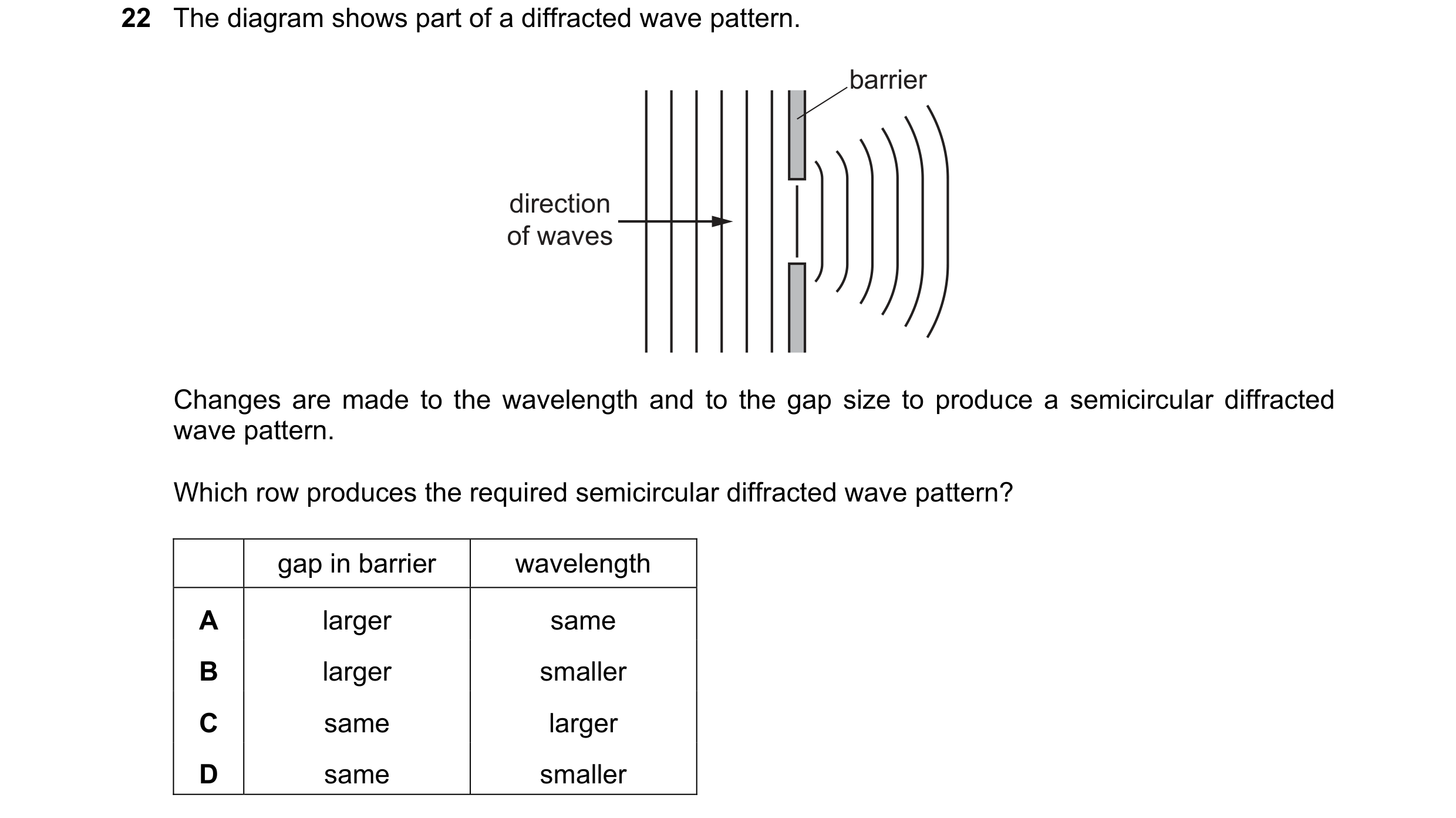
 25 / 46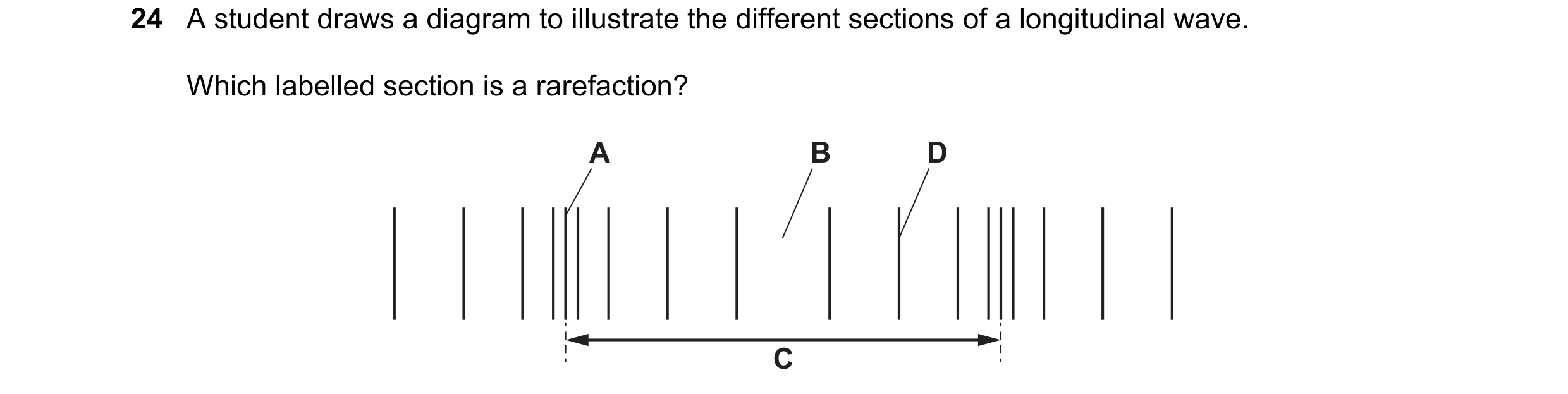


 26 / 46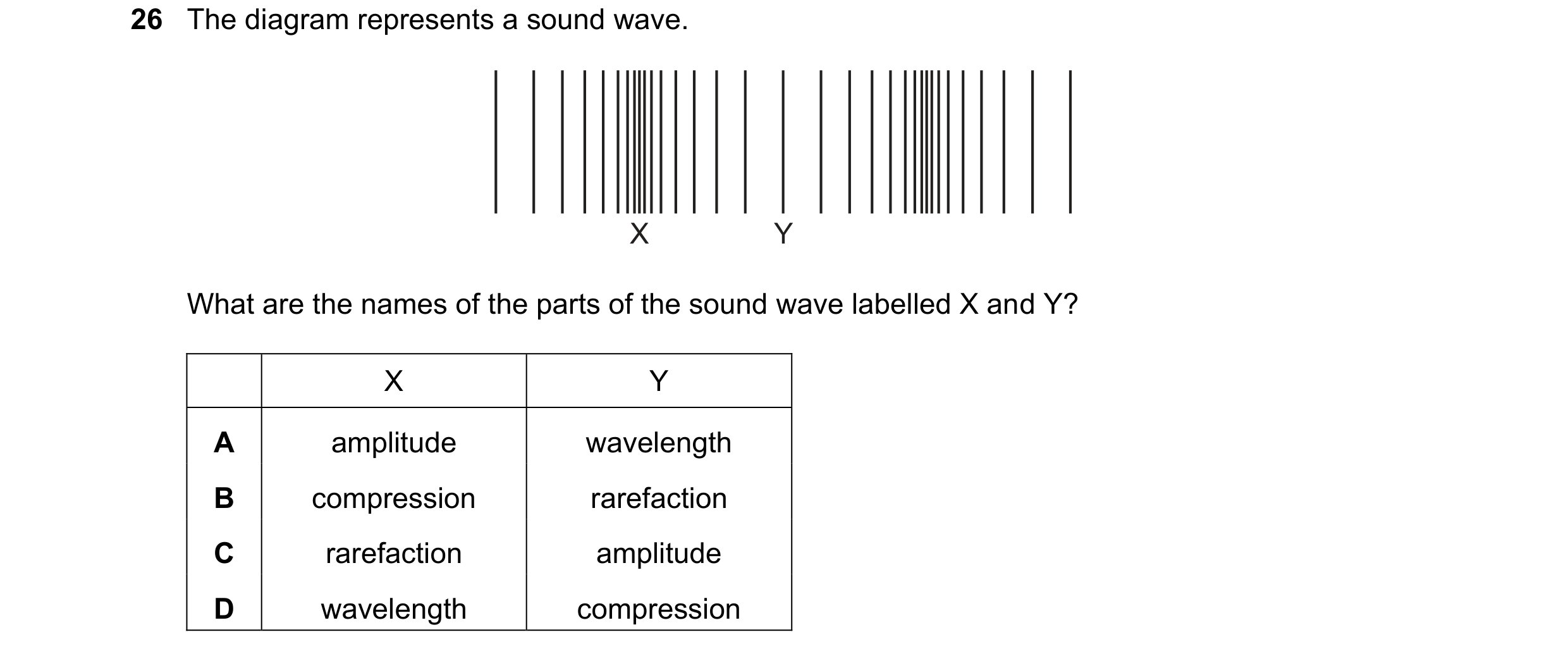
 27 / 46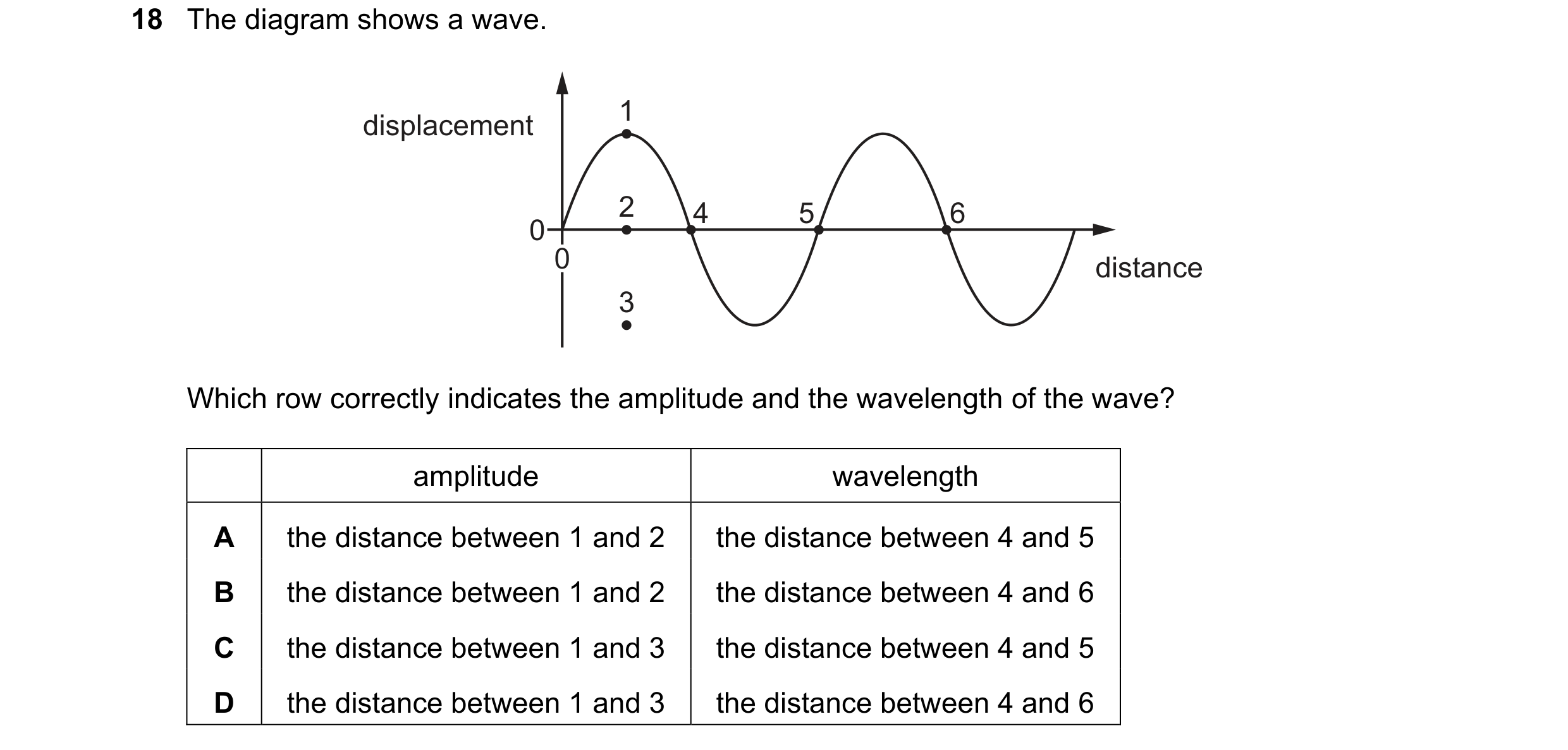
 28 / 46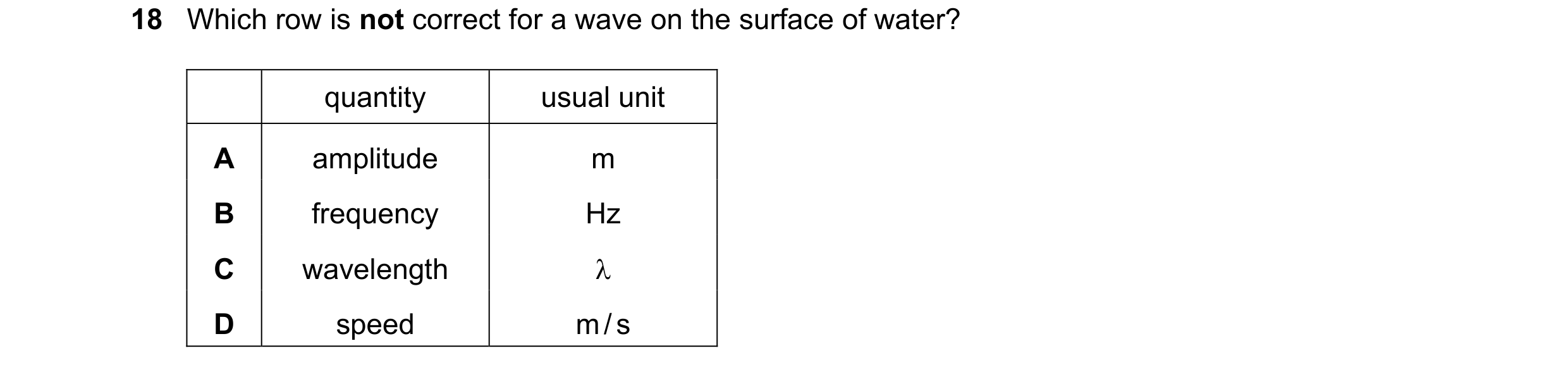

 29 / 46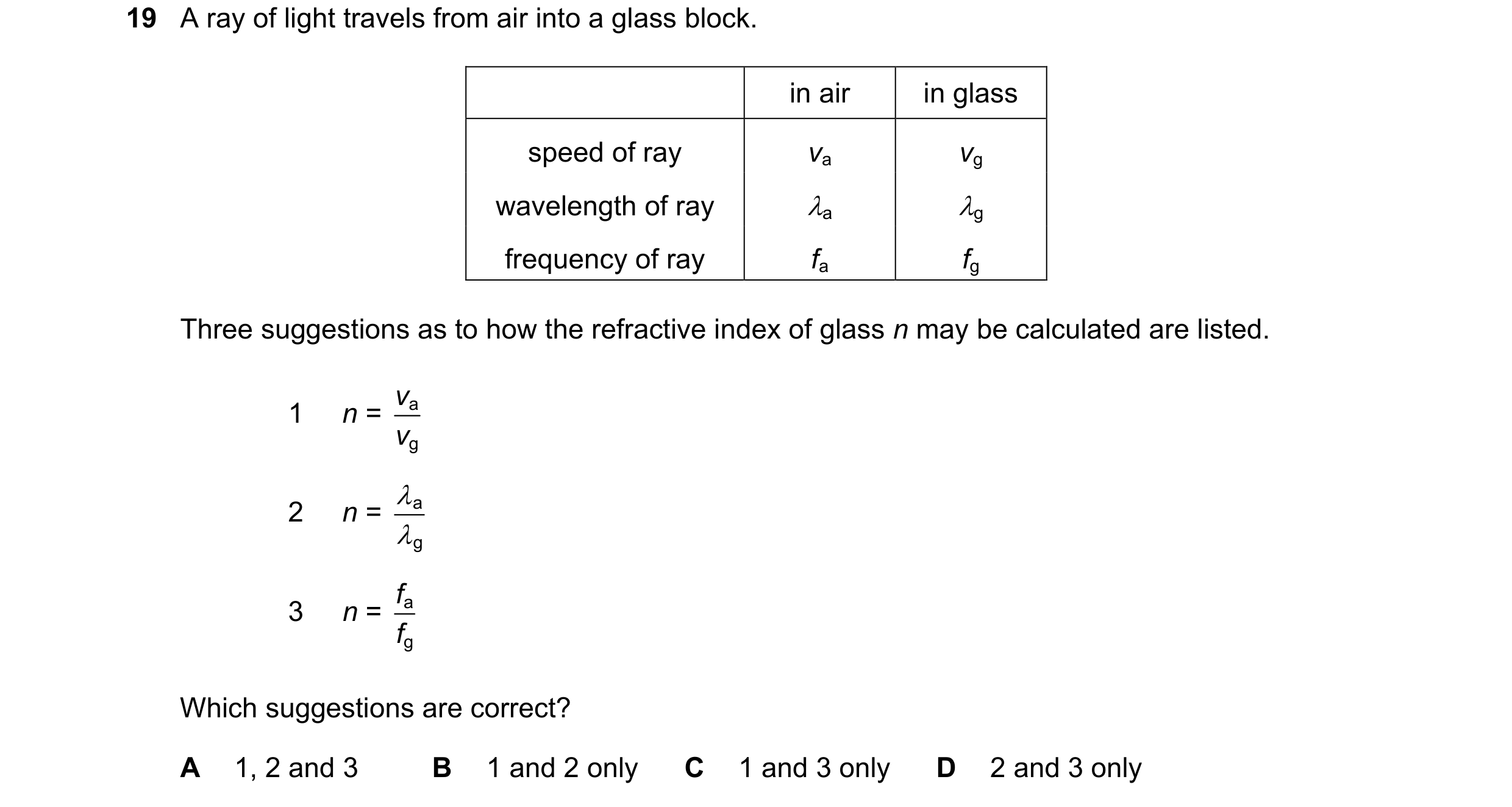
 30 / 46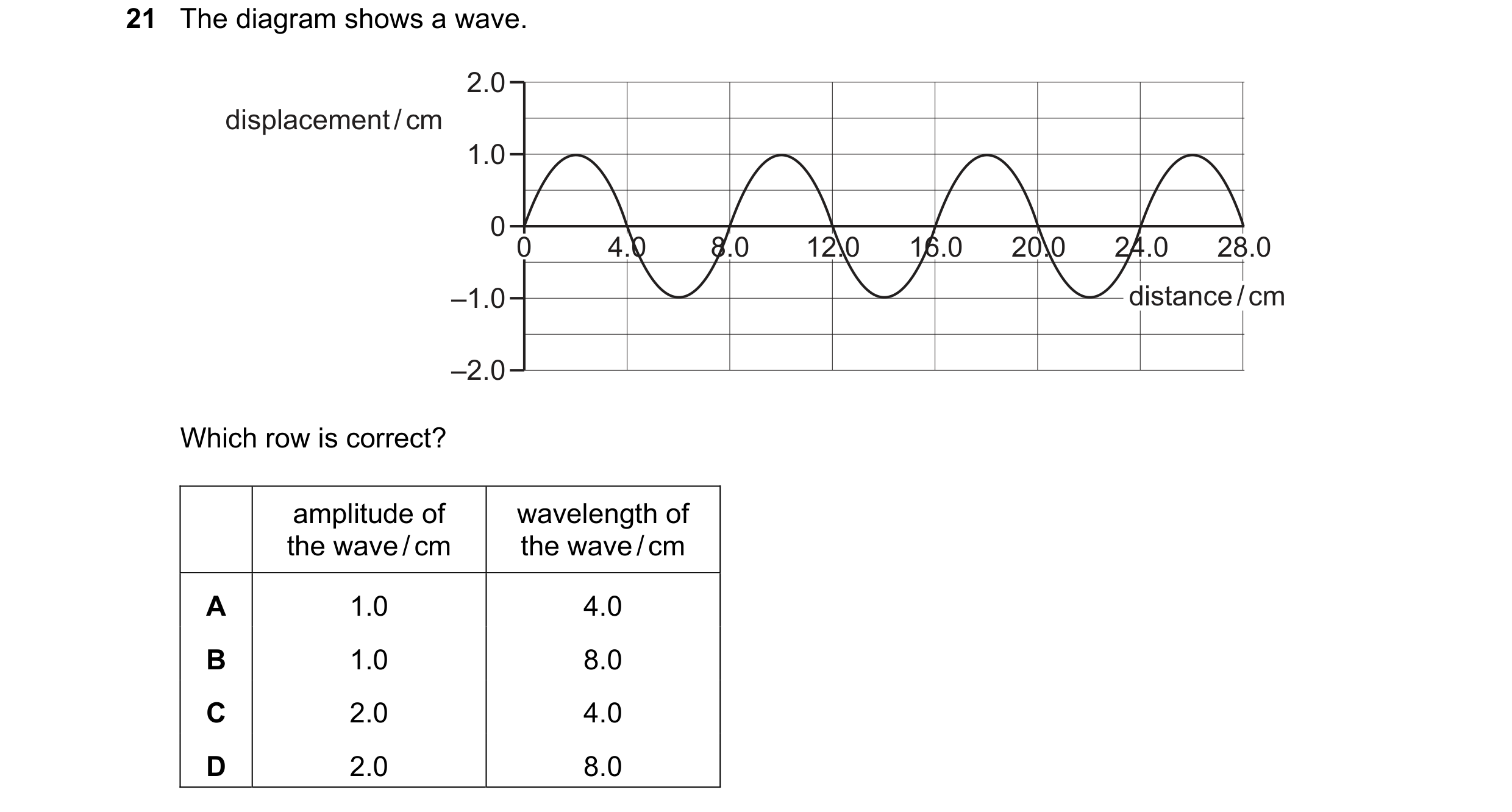

 31 / 46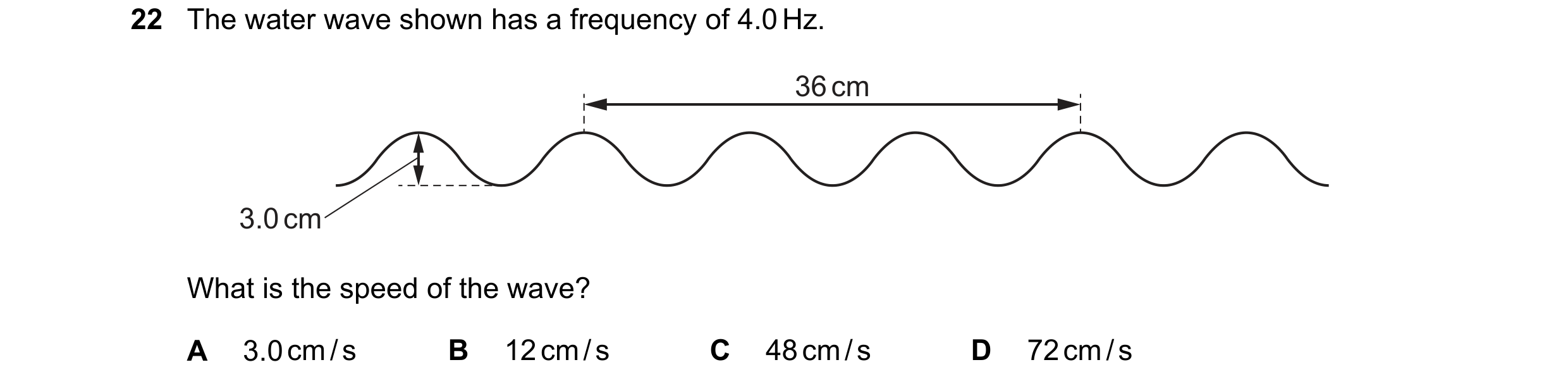
 32 / 46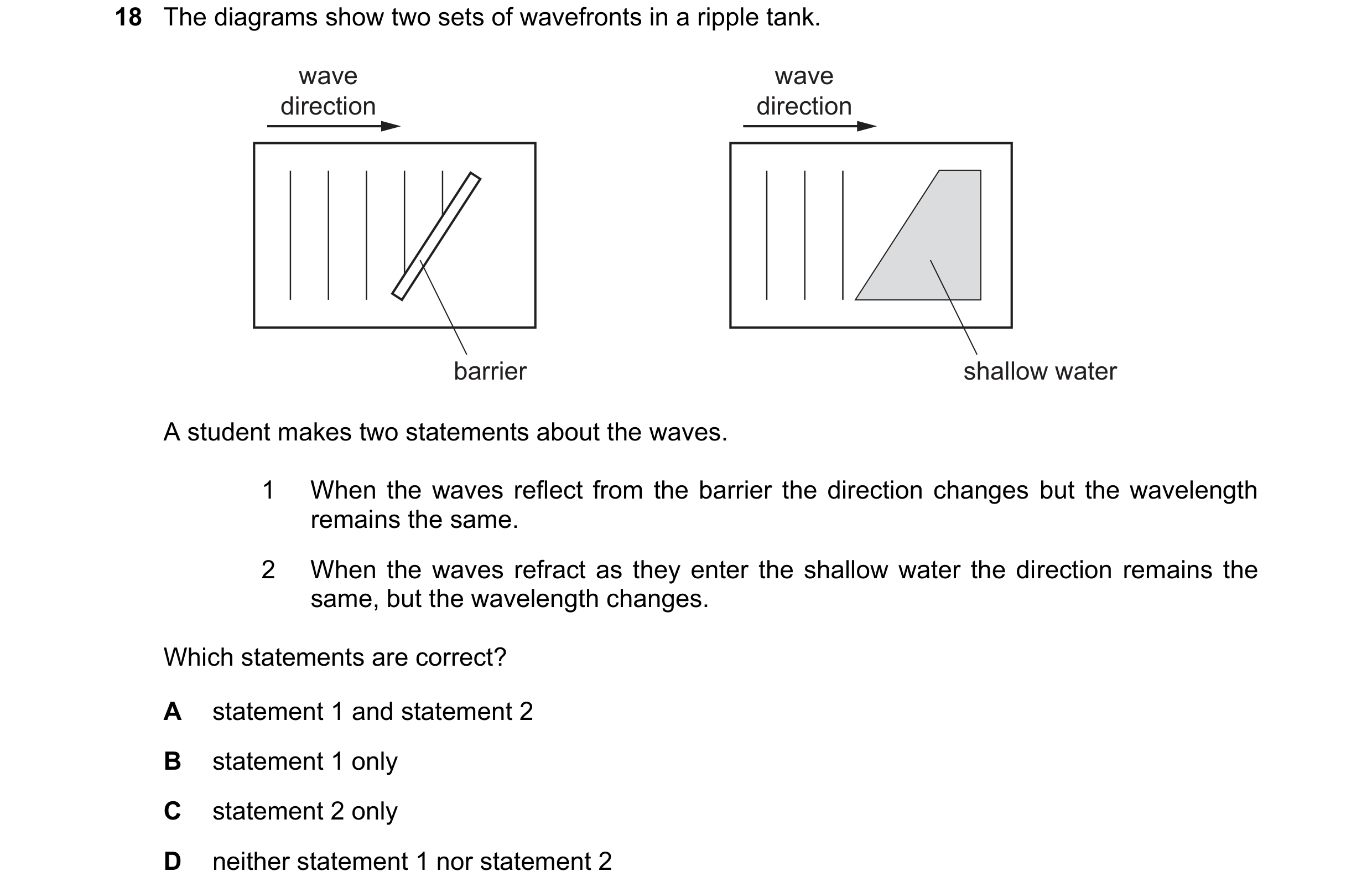
 33 / 46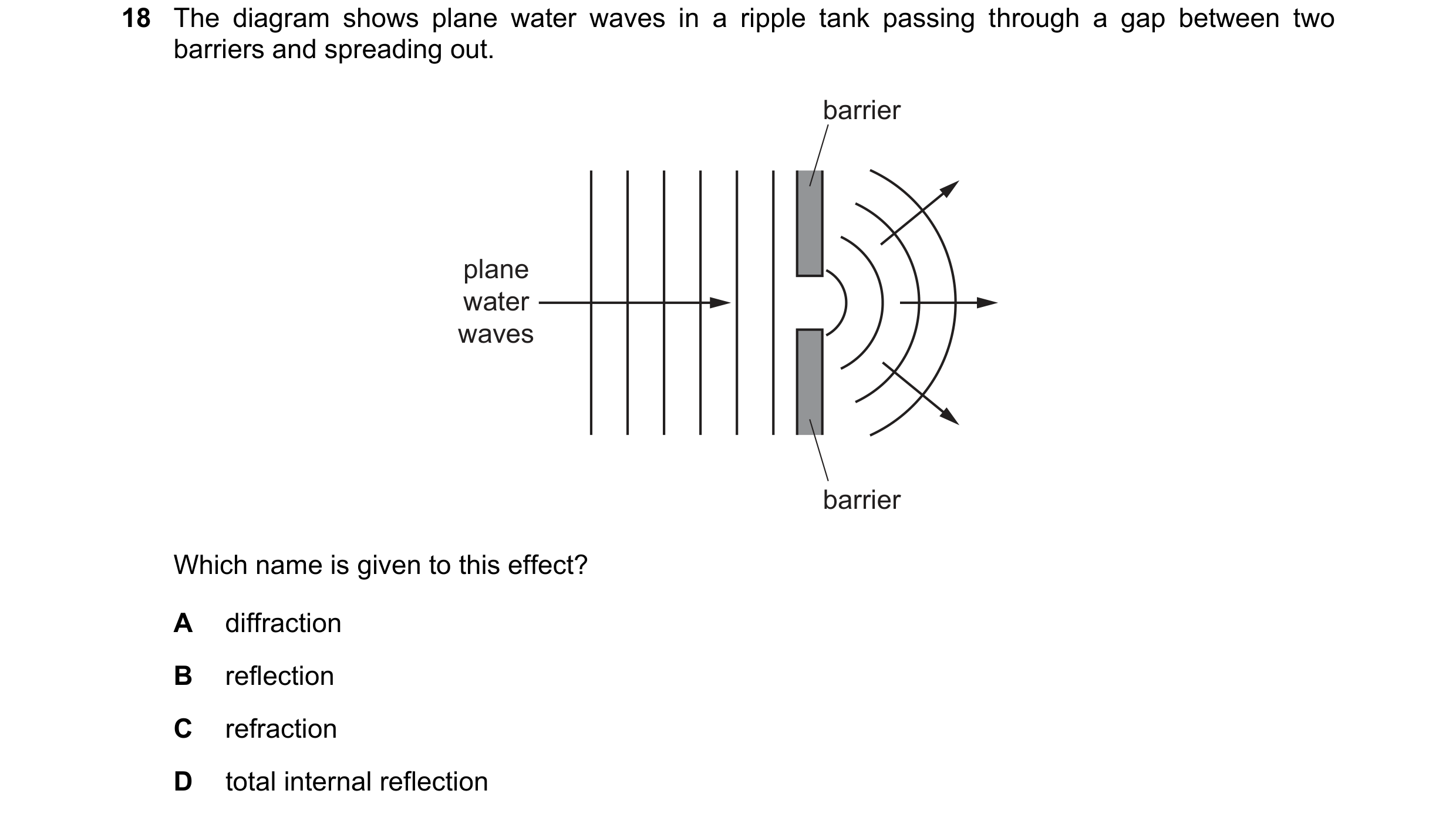

 34 / 46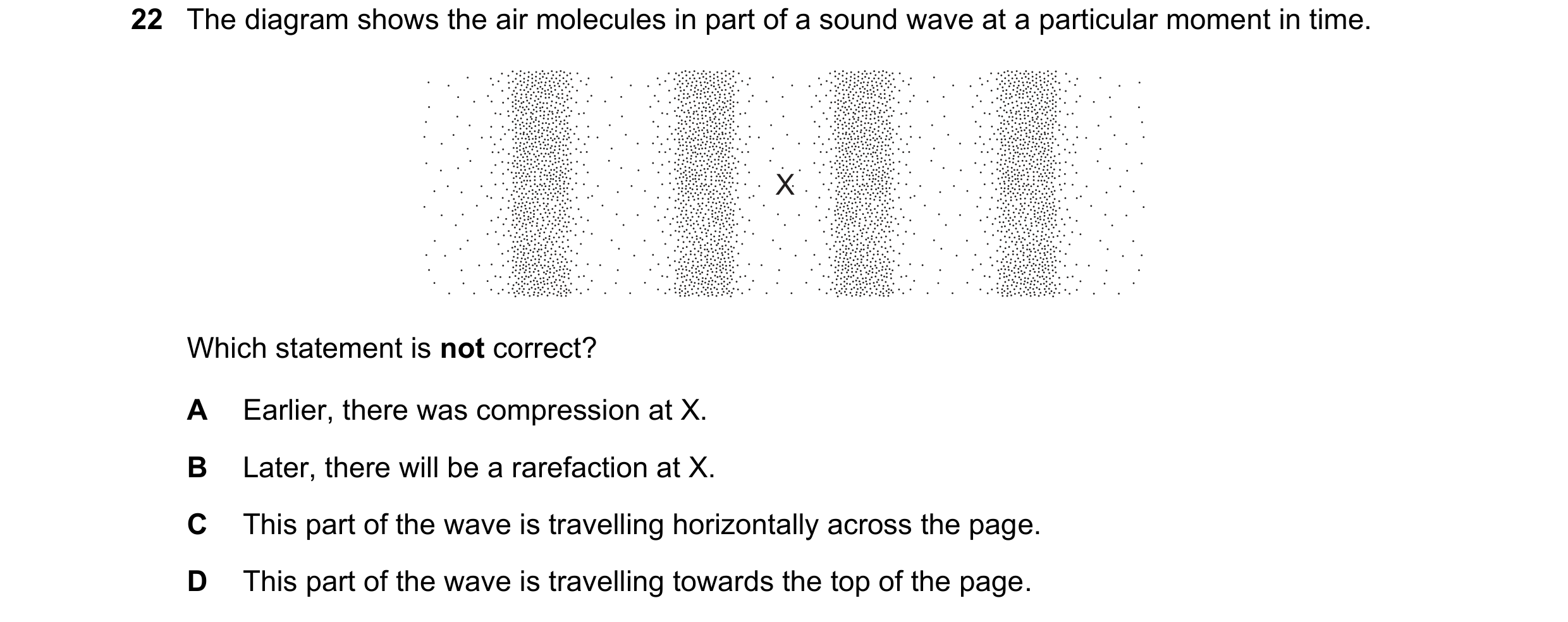
 35 / 46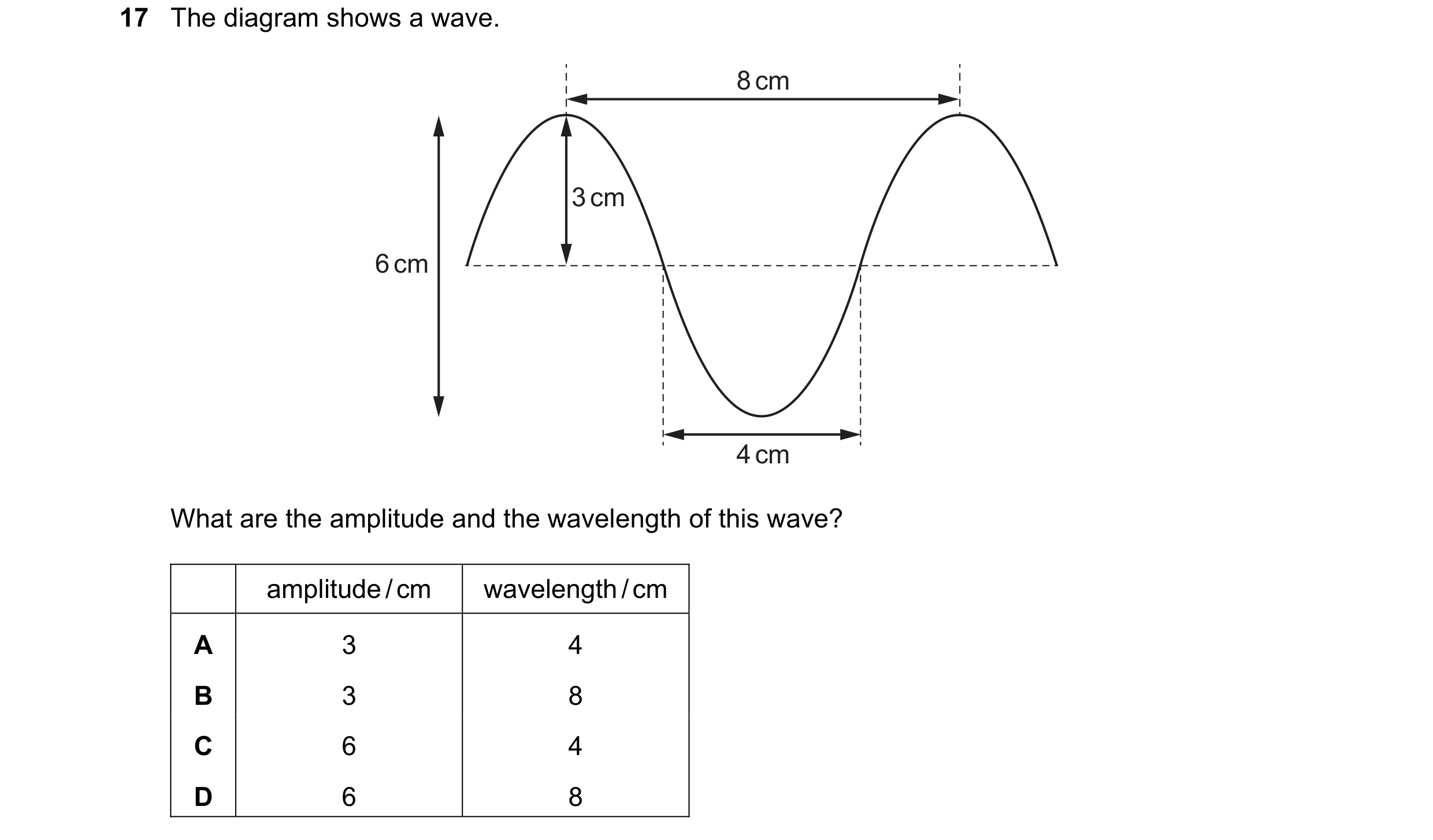

 36 / 46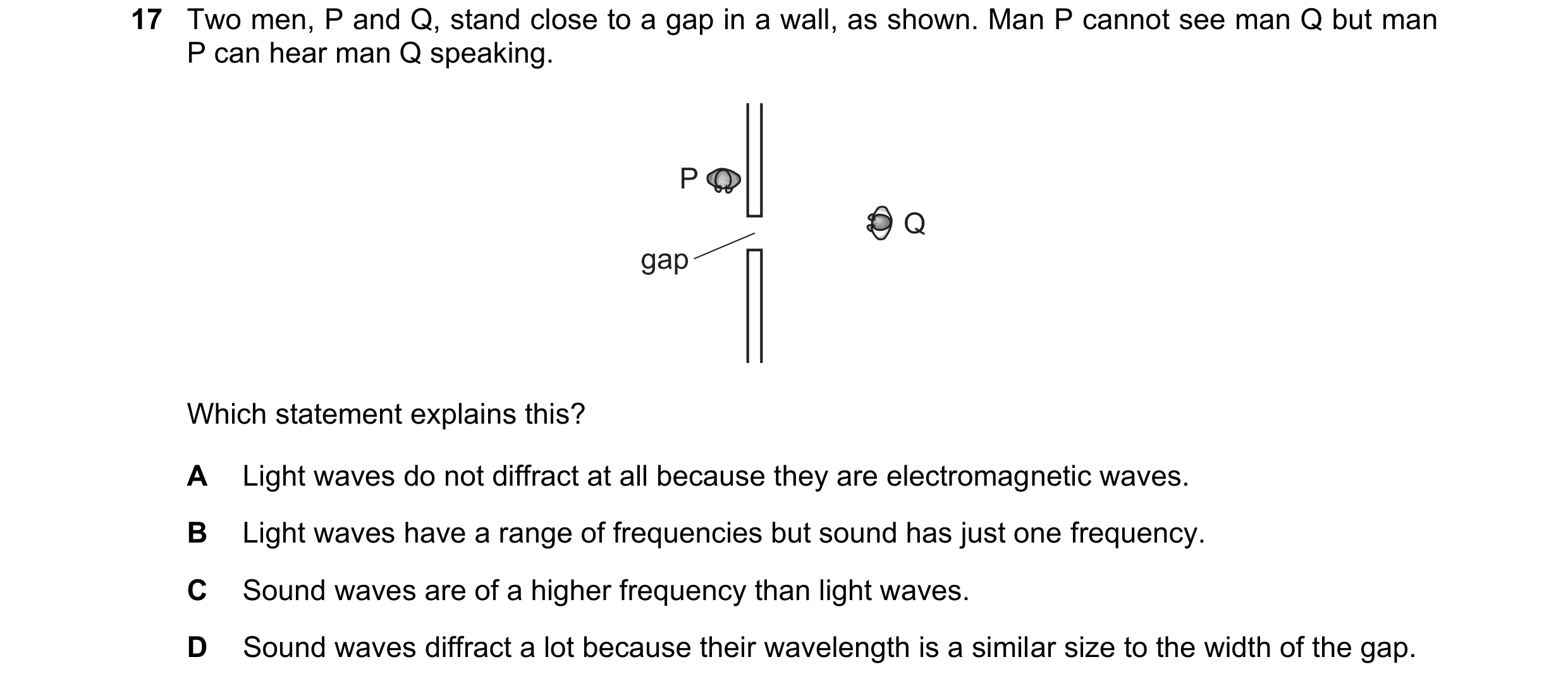


 37 / 46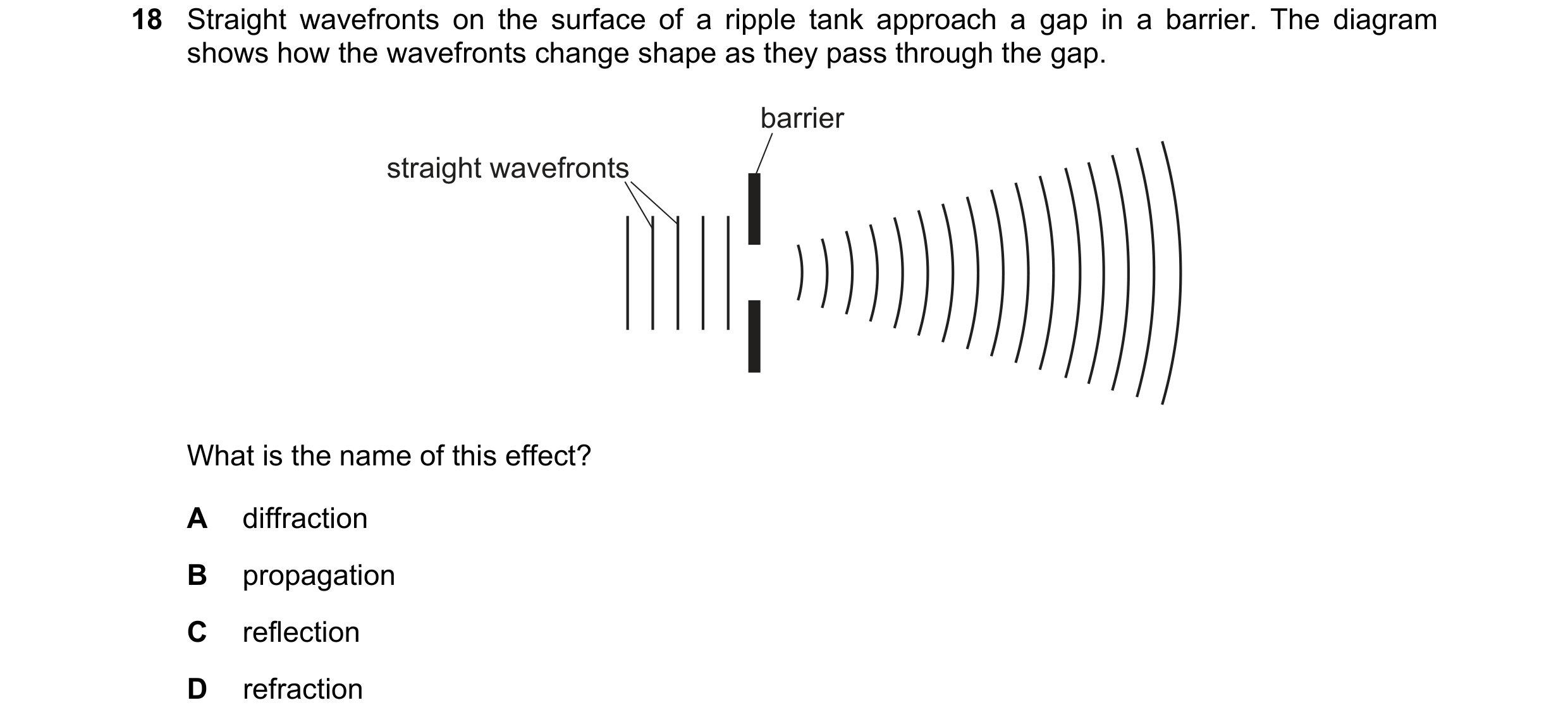

 38 / 46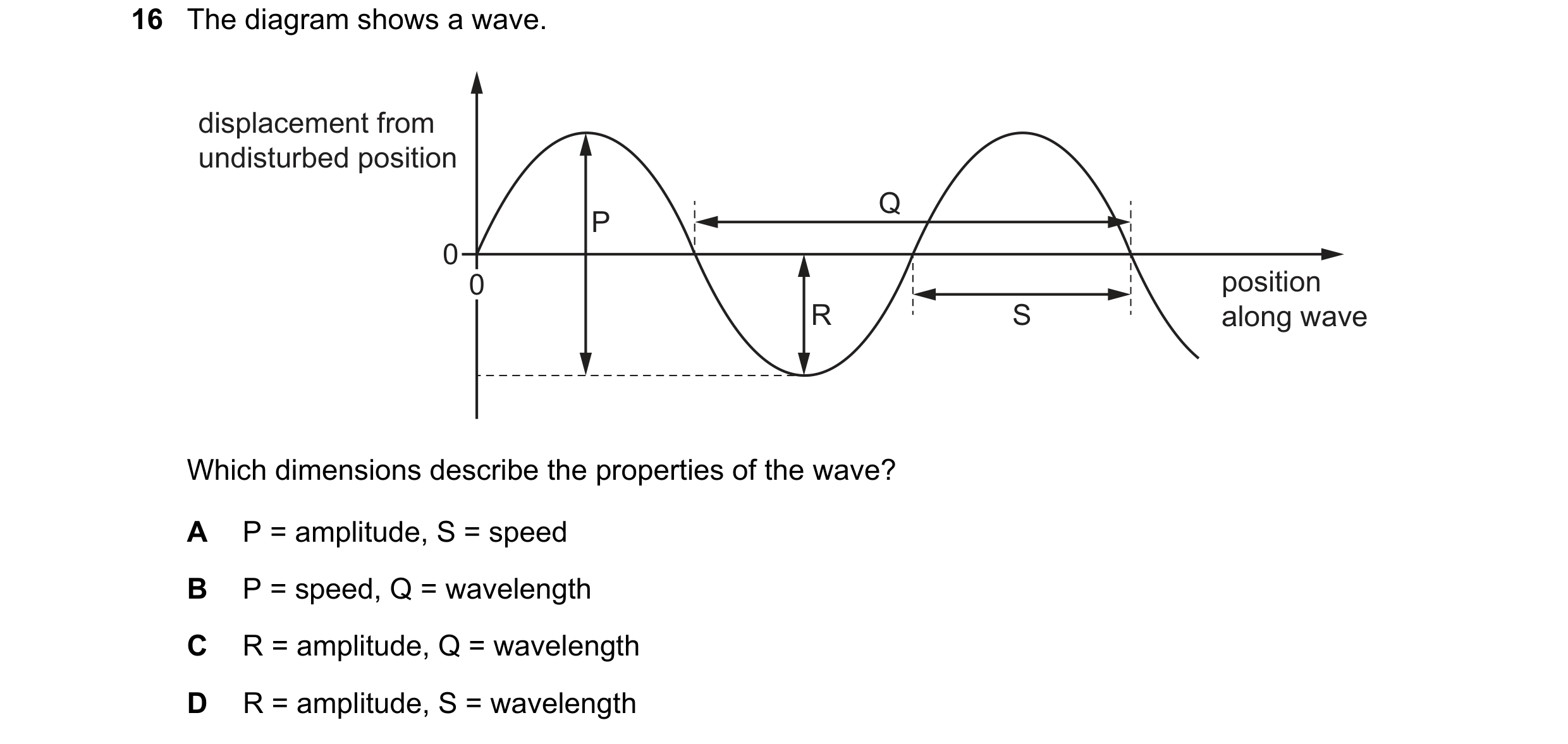



 39 / 46
 40 / 46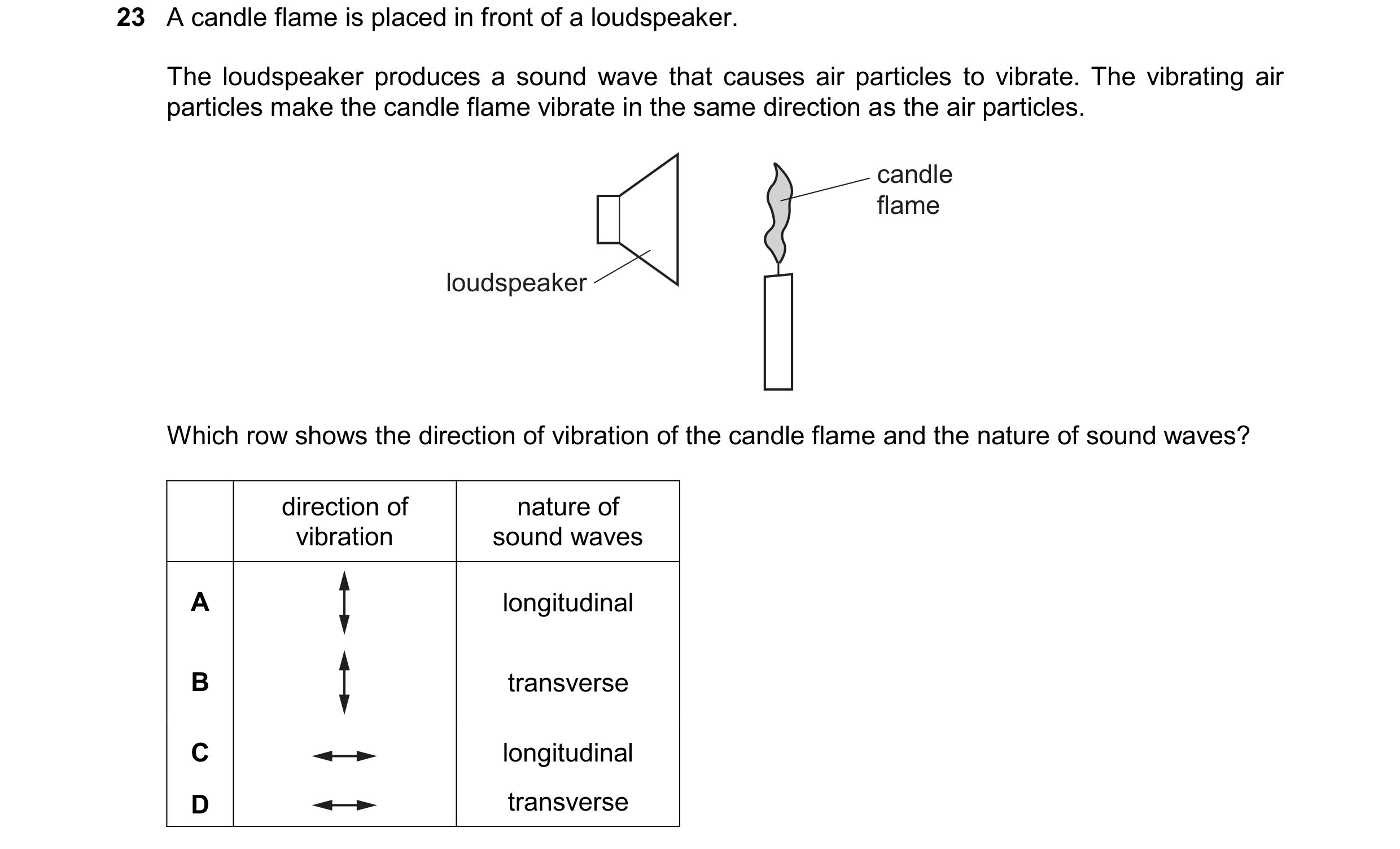

 41 / 46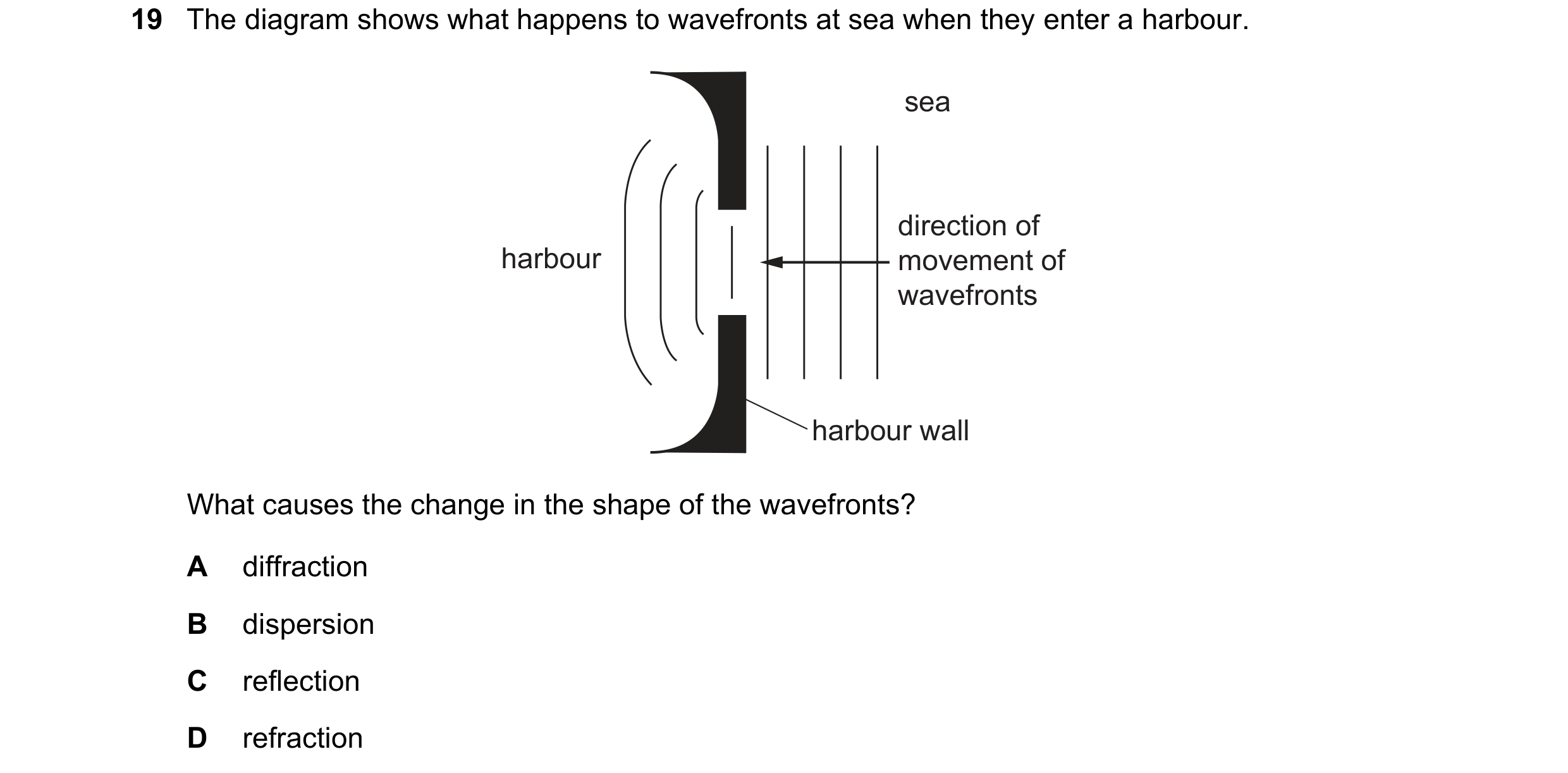
 42 / 46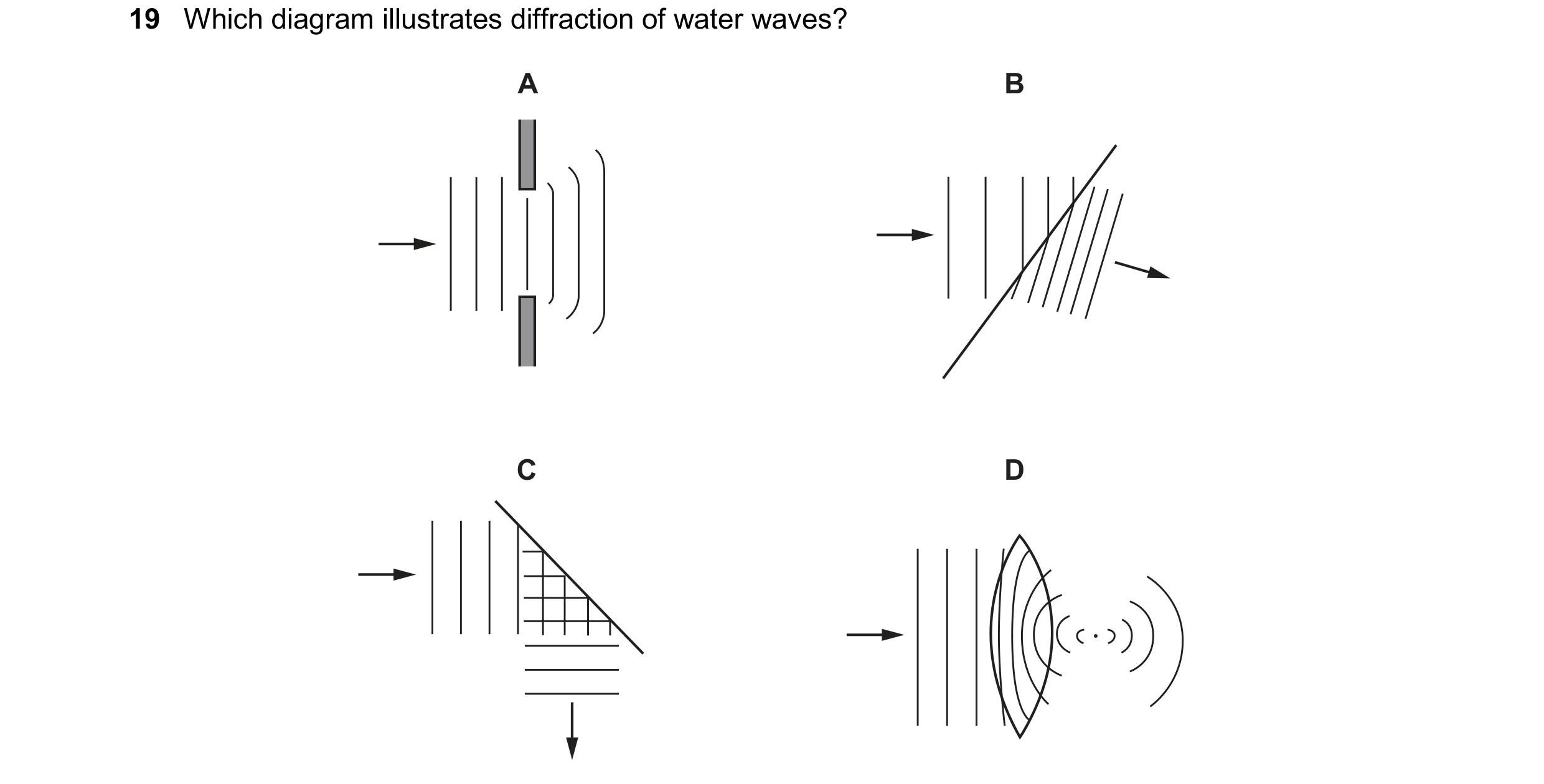
 43 / 46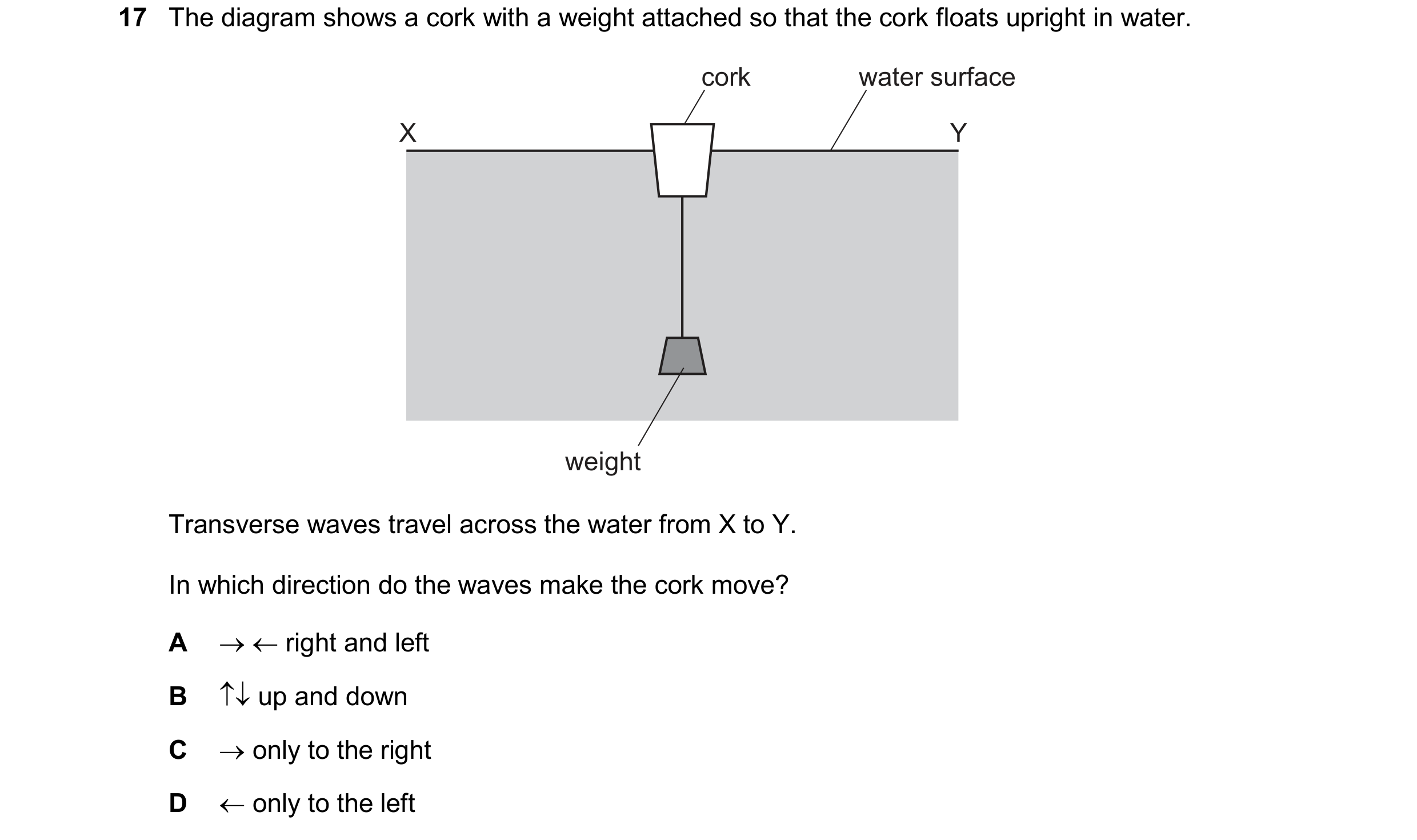
 44 / 46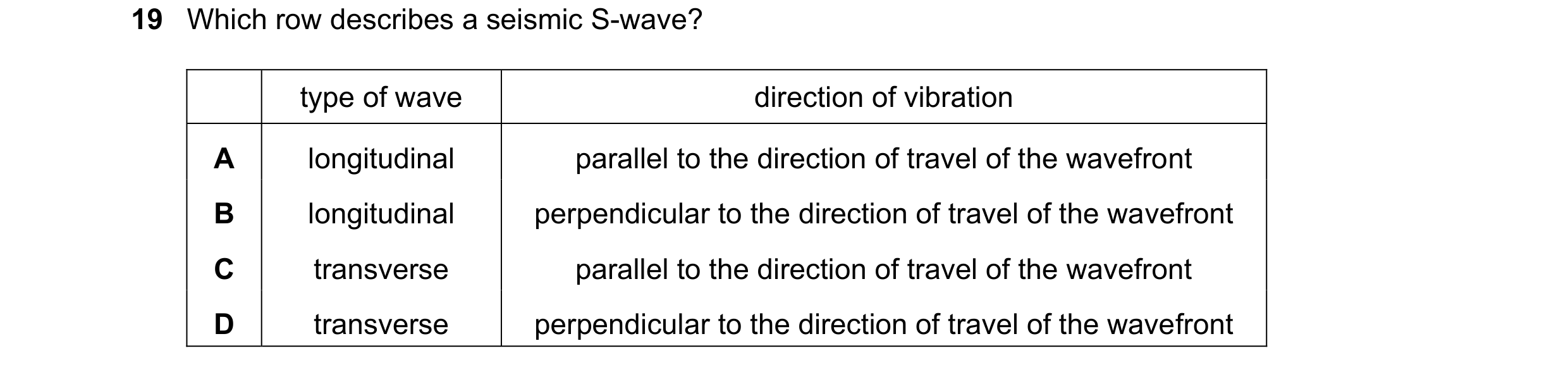

 45 / 46

 46 / 46