Questions as text
Q1 · A loudspeaker produces a sound wave of constant frequency 0625/41 May/June 2017
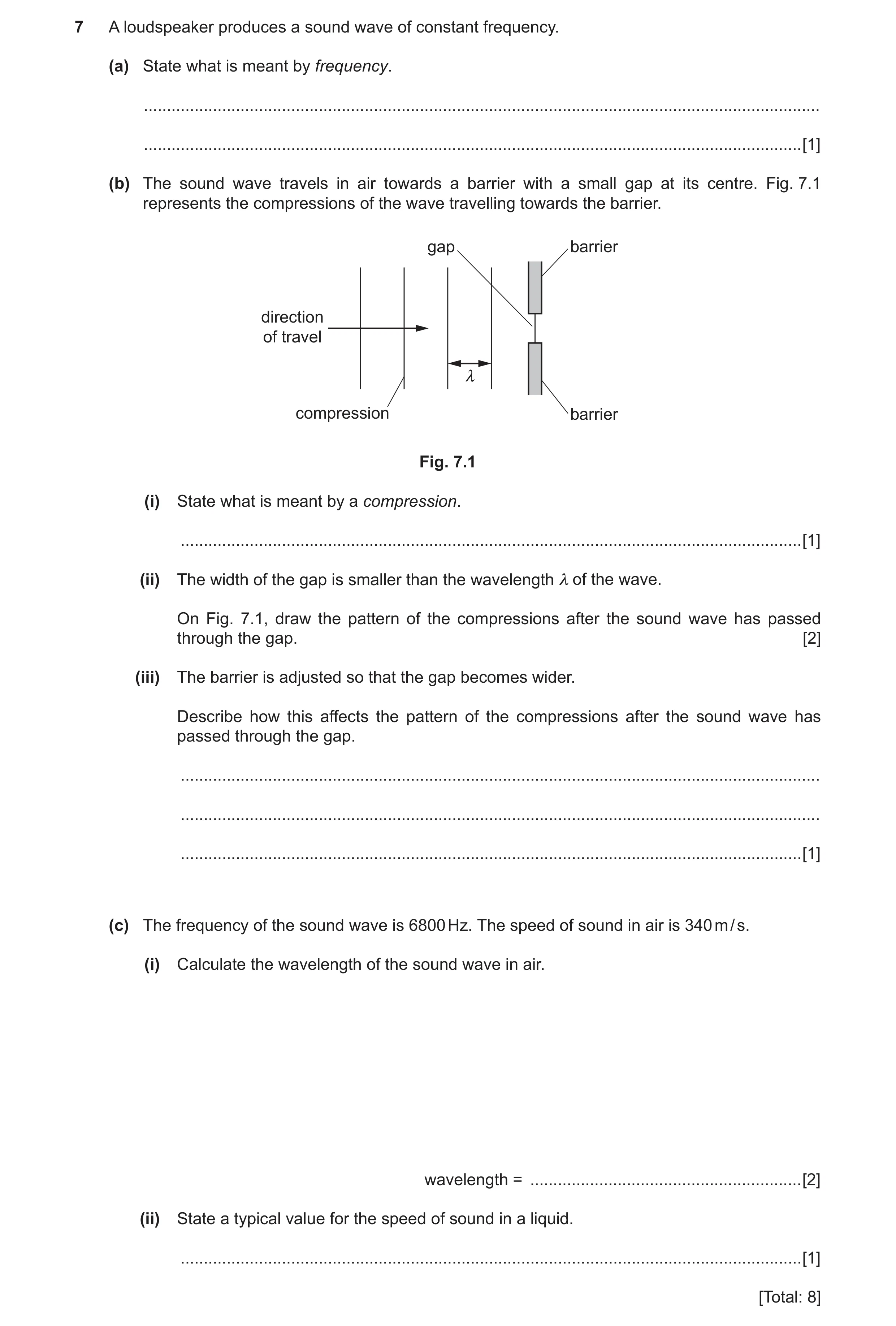
7 A loudspeaker produces a sound wave of constant frequency. (a) State what is meant by frequency. … … [1] (b) The sound wave travels in air towards a barrier with a small gap at its centre. Fig. 7.1 represents the compressions of the wave travelling towards the barrier. gap barrier direction of travel λ compression barrier Fig. 7.1 (i) State what is meant by a compression. … [1] (ii) The width of the gap is smaller than the wavelength λ of the wave. On Fig. 7.1, draw the pattern of the compressions after the sound wave has passed through the gap. [2] (iii) The barrier is adjusted so that the gap becomes wider. Describe how this affects the pattern of the compressions after the sound wave has passed through the gap. … … … [1] (c) The frequency of the sound wave is 6800 Hz. The speed of sound in air is 340 m / s. (i) Calculate the wavelength of the sound wave in air. wavelength = … [2] (ii) State a typical value for the speed of sound in a liquid. … [1] [Total: 8]
8 marks
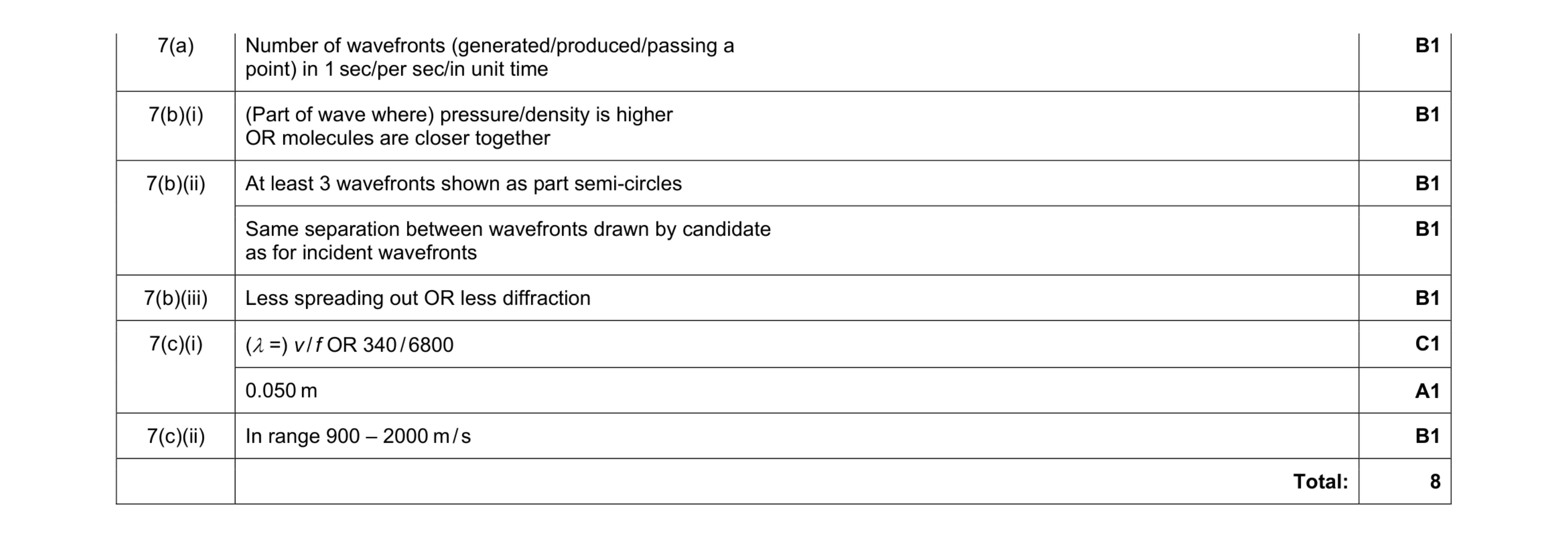
Mark scheme: 7(a) Number of wavefronts (generated/produced/passing a point) in 1 sec/per sec/in unit time B1 7(b)(i) (Part of wave where) pressure/density is higher OR molecules are closer together B1 7(b)(ii) At least 3 wavefronts shown as part semi-circles B1 Same separation between wavefronts drawn by candidate as for incident wavefronts B1 7(b)(iii) Less spreading out OR less diffraction B1 7(c)(i) (λ =) v / f OR 340 / 6800 C1 0.050 m A1 7(c)(ii) In range 900 – 2000 m / s B1 Total: 8
This question in 0625/41 May/June 2017
Q2 · A wave passes through a gap in a barrier 0625/41 Oct/Nov 2017
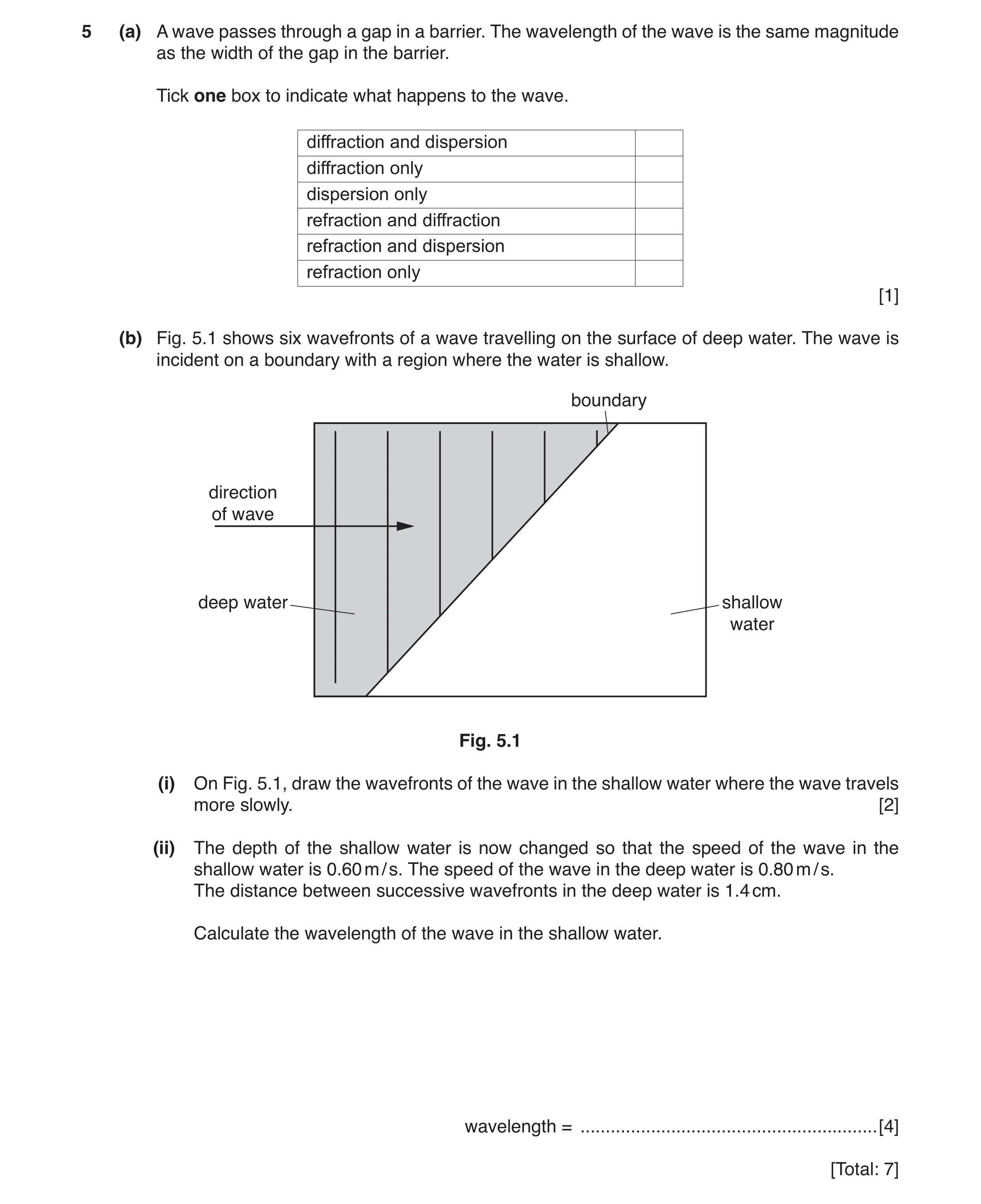
5 (a) A wave passes through a gap in a barrier. The wavelength of the wave is the same magnitude as the width of the gap in the barrier. Tick one box to indicate what happens to the wave. diffraction and dispersion diffraction only dispersion only refraction and diffraction refraction and dispersion refraction only [1] (b) Fig. 5.1 shows six wavefronts of a wave travelling on the surface of deep water. The wave is incident on a boundary with a region where the water is shallow. boundary direction of wave deep water shallow water Fig. 5.1 (i) On Fig. 5.1, draw the wavefronts of the wave in the shallow water where the wave travels more slowly. [2] (ii) The depth of the shallow water is now changed so that the speed of the wave in the shallow water is 0.60 m / s. The speed of the wave in the deep water is 0.80 m / s. The distance between successive wavefronts in the deep water is 1.4 cm. Calculate the wavelength of the wave in the shallow water. wavelength = … [4] [Total: 7]
7 marks
Mark scheme: 5(a) Tick 2nd box only B1 5(b)(i) At least 3 parallel wavefronts in shallow water sloping upwards from left to right B1 Wavefronts in shallow water meet wavefronts in deep water B1 5(b)(ii) Indication that frequency is same in deep and shallow water C1 In deep water v = fλ in any form OR (f =) v / λ OR 80 / 1.4 C1 = 57.1 (Hz) C1 Wavelength in shallow water = v / f OR 60 / 57.1 = 1.05 cm A1 OR speed in deep water / speed in shallow water = 0.80 / 0.60 (C1) = 1.33 (C1) (f is constant so) λ in deep water / λ in shallow water = 1.33 (C1) λ in shallow water = 1.4 / 1.33 = 1.05 cm (A1)
This question in 0625/41 Oct/Nov 2017
Q3 · Wavefronts of a water wave on the surface of water approaching a gap in a barrier 0625/42 Oct/Nov 2017
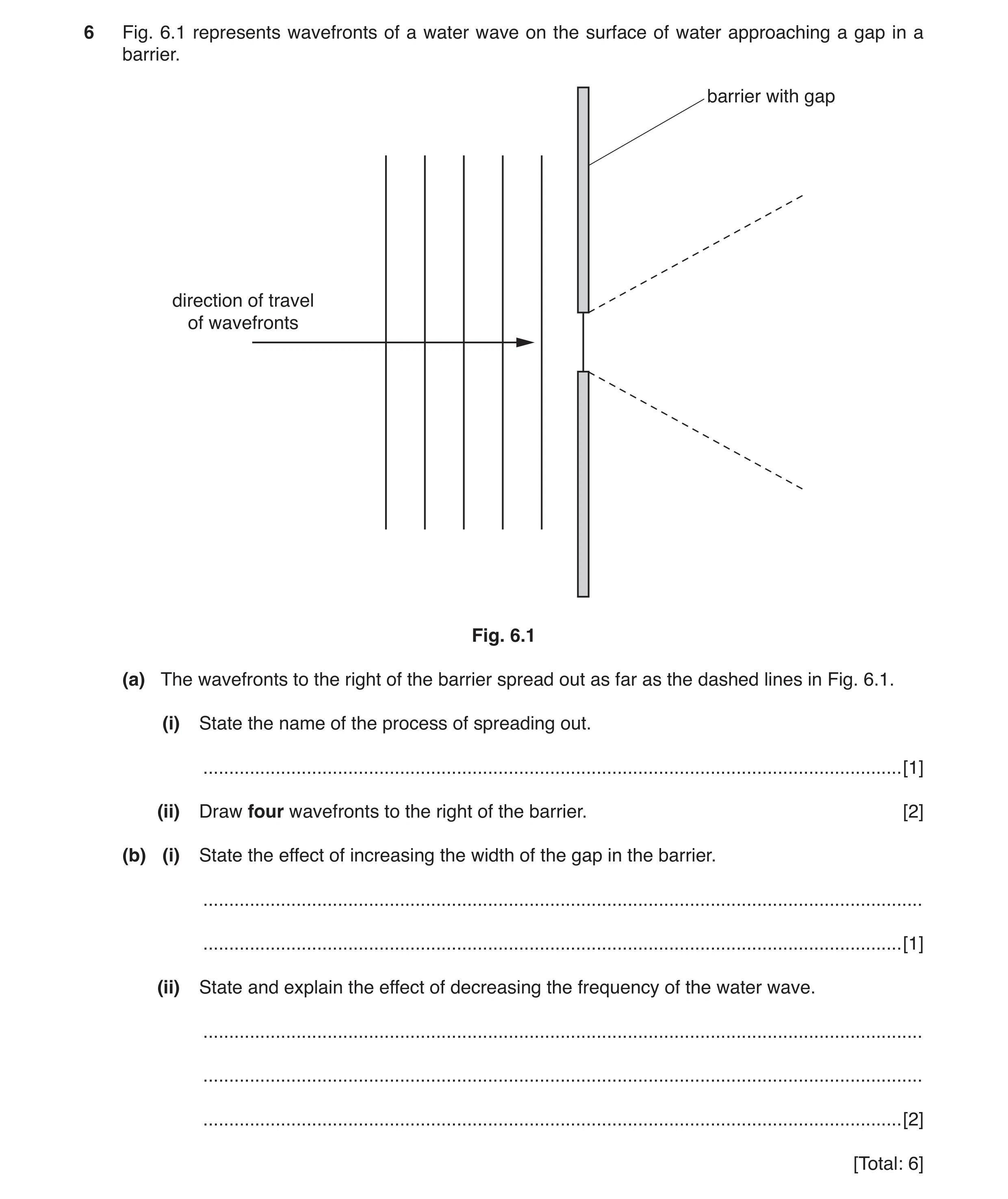
6 Fig. 6.1 represents wavefronts of a water wave on the surface of water approaching a gap in a barrier. barrier with gap direction of travel of wavefronts Fig. 6.1 (a) The wavefronts to the right of the barrier spread out as far as the dashed lines in Fig. 6.1. (i) State the name of the process of spreading out. … [1] (ii) Draw four wavefronts to the right of the barrier. [2] (b) (i) State the effect of increasing the width of the gap in the barrier. … … [1] (ii) State and explain the effect of decreasing the frequency of the water wave. … … … [2] [Total: 6]
6 marks
Mark scheme: 6(a)(i) diffraction B1 6(a)(ii) 4 arcs between dashed lines centred vertically at centre of gap B1 any 3 wavelengths same as incident wavelengths including wavelength from wavefront in gap B1 6(b)(i) wavefronts have smaller angular width OR do not extend as far as dashed lines OR less (angular) spread B1 6(b)(ii) increased wavelength OR more spreading B1 use of v=f λ OR increased wavelength B1
This question in 0625/42 Oct/Nov 2017
Q4 · Wavefronts approaching a gap in a barrier 0625/41 May/June 2018
6 (a) Fig. 6.1 shows wavefronts approaching a gap in a barrier. wavefront barrier Fig. 6.1 (i) On Fig. 6.1, draw three wavefronts to the right of the barrier. [2] (ii) Fig. 6.2 shows the gap in the barrier increased to five times the gap in Fig. 6.1. wavefront barrier Fig. 6.2 On Fig. 6.2, draw three wavefronts to the right of the barrier. [2] (b) Describe, with a labelled diagram, an experiment using water waves that shows the reflection of wavefronts that occur at a straight barrier. … … … … … … [4] [Total: 8]
8 marks
Mark scheme: 6(a)(i) At least 3 circular wavefronts centred on gap extending to at least half of semicircle 1 Same spacing as incident wavefronts 1 6(a)(ii) At least 3 straight, parallel, wavefronts, approximately same length as width of gap 1 Ends of straight lines curving towards but not reaching barrier 1 6(b) Any four of: Diagram to show: labelled barrier, incident straight or curved waves Diagram shows appropriately reflected waves Water surface e.g. tank of water/ripple tank/pond/acceptable alternative How waves are produced: e.g., moving end or length of solid rod dipping into surface OR small solid object thrown in. Detail of barrier: made of metal, glass or wood fixed in position How observed: by eye, video, film, stroboscope 4
This question in 0625/41 May/June 2018
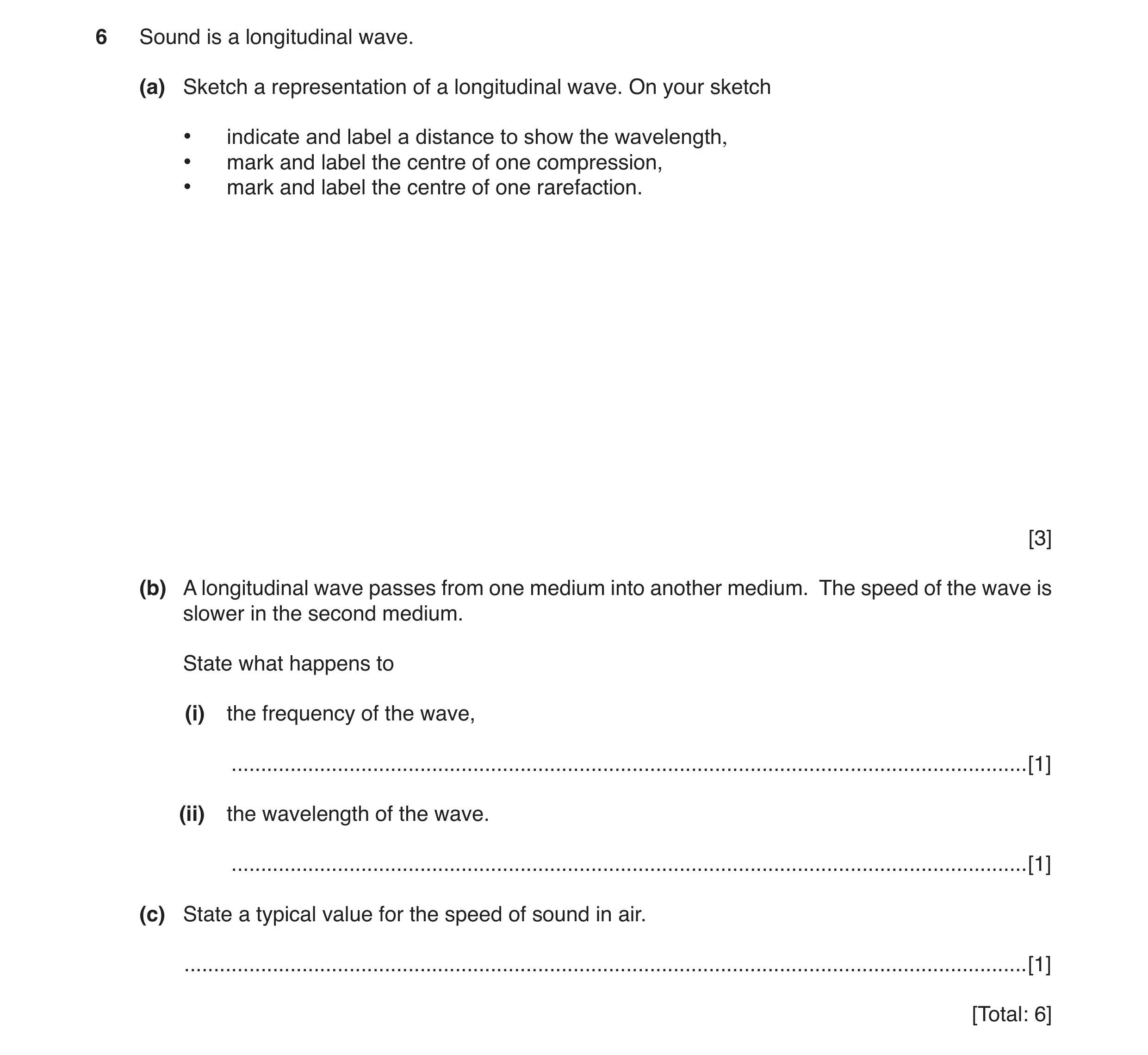
Q5 · Sound is a longitudinal wave 0625/43 May/June 2018
6 Sound is a longitudinal wave. (a) Sketch a representation of a longitudinal wave. On your sketch • indicate and label a distance to show the wavelength, • mark and label the centre of one compression, • mark and label the centre of one rarefaction. [3] (b) A longitudinal wave passes from one medium into another medium. The speed of the wave is slower in the second medium. State what happens to (i) the frequency of the wave, … [1] (ii) the wavelength of the wave. … [1] (c) State a typical value for the speed of sound in air. … [1] [Total: 6]
6 marks
Mark scheme: 6(a) attempt at compressions and rarefactions B1 at least one compression labelled and at least one rarefaction labelled B1 wavelength and labelled λ B1 6(b)(i) (it/frequency remains) constant B1 6(b)(ii) (it/wavelength) decreases B1 6(c) 320 to 350 m / s B1
This question in 0625/43 May/June 2018
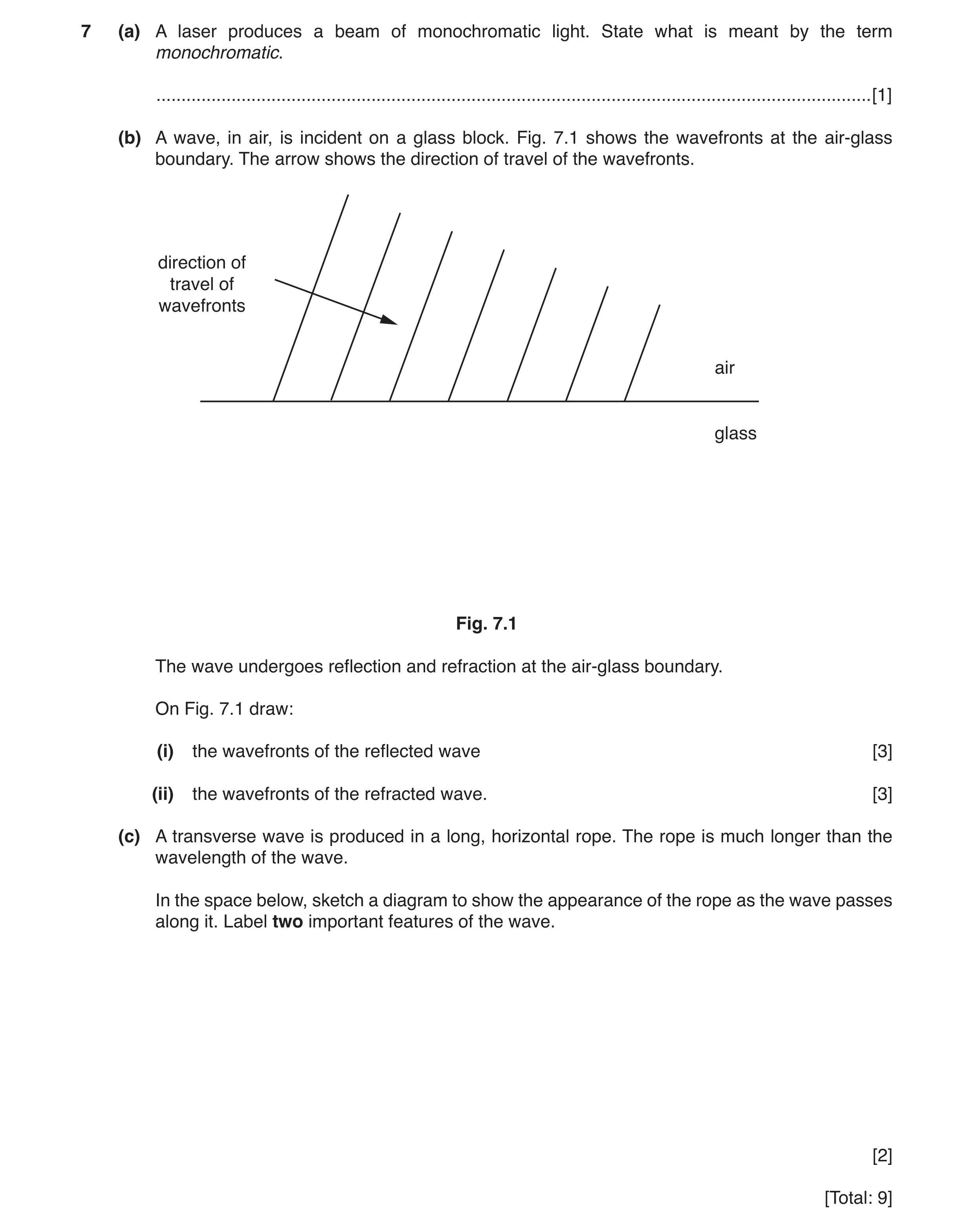
Q6 · A laser produces a beam of monochromatic light 0625/41 Oct/Nov 2018
7 (a) A laser produces a beam of monochromatic light. State what is meant by the term monochromatic. … [1] (b) A wave, in air, is incident on a glass block. Fig. 7.1 shows the wavefronts at the air-glass boundary. The arrow shows the direction of travel of the wavefronts. direction of travel of wavefronts air glass Fig. 7.1 The wave undergoes reflection and refraction at the air-glass boundary. On Fig. 7.1 draw: (i) the wavefronts of the reflected wave [3] (ii) the wavefronts of the refracted wave. [3] (c) A transverse wave is produced in a long, horizontal rope. The rope is much longer than the wavelength of the wave. In the space below, sketch a diagram to show the appearance of the rope as the wave passes along it. Label two important features of the wave. [2] [Total: 9]
9 marks
Mark scheme: 7(a) Light of a single colour / wavelength / frequency B1 7(b)(i) Reflected wavefronts: In air, at least 3 wavefronts parallel to each other. B1 Same spacing as incident wavefronts B1 Reflecting at same angle with surface as incident wavefronts B1 7(b)(ii) Refracted wavefronts: In glass, at least 3 wavefronts parallel to each other AND continuous with incident wavefronts, unless drawn to right of incident wavefronts. B1 Smaller wavelength than incident wavefronts AND equally spaced. B1 At smaller angle with surface than incident wavefronts and rotated clockwise compared to incident wavefronts B1 7(c) Rope drawn with two of: Amplitude labelled Wavelength labelled Crest and trough labelled B2
This question in 0625/41 Oct/Nov 2018
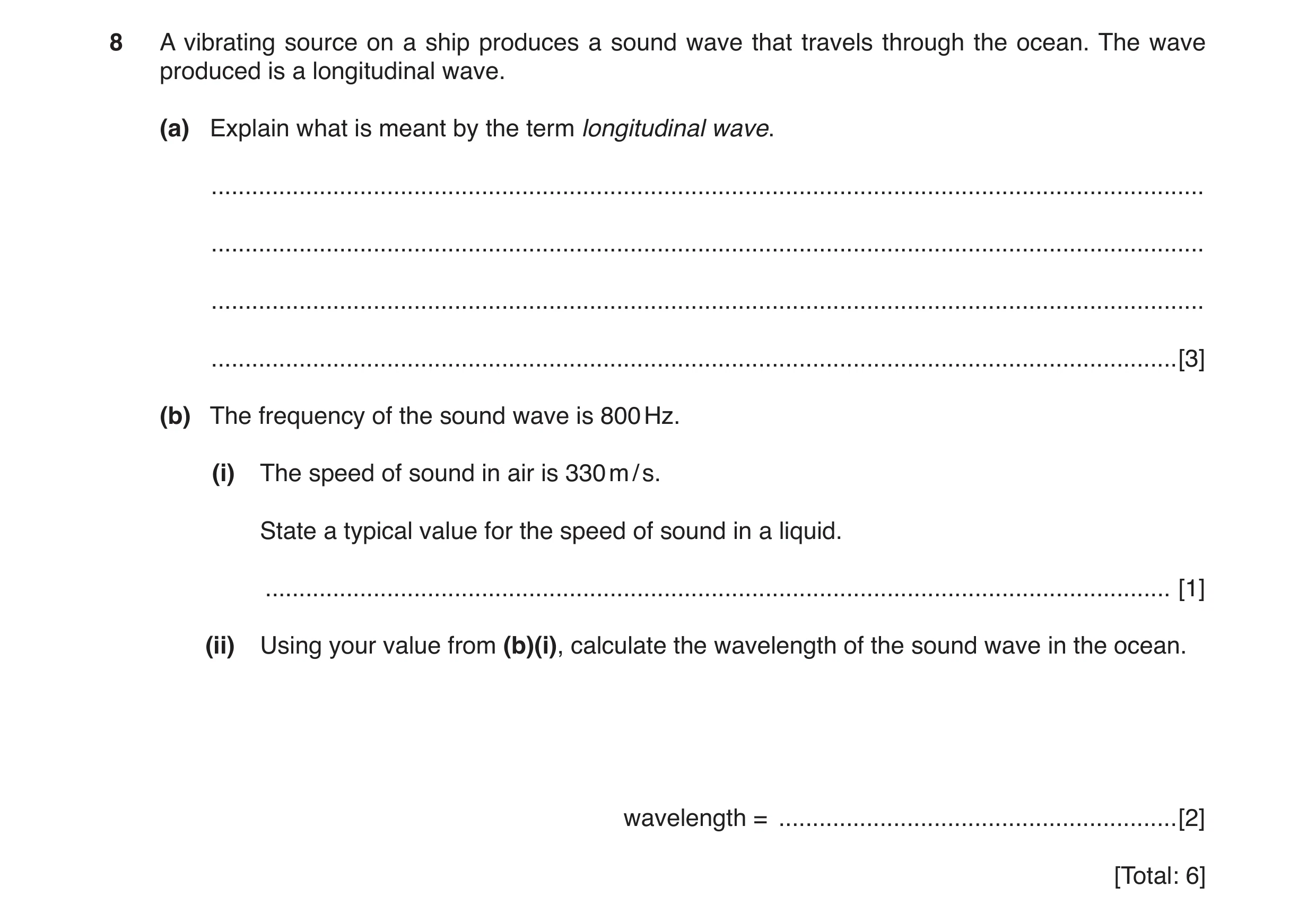
Q7 · A vibrating source on a ship produces a sound wave that travels through the ocean 0625/41 Oct/Nov 2018
8 A vibrating source on a ship produces a sound wave that travels through the ocean. The wave produced is a longitudinal wave. (a) Explain what is meant by the term longitudinal wave. … … … … [3] (b) The frequency of the sound wave is 800 Hz. (i) The speed of sound in air is 330 m / s. State a typical value for the speed of sound in a liquid. … [1] (ii) Using your value from (b)(i), calculate the wavelength of the sound wave in the ocean. wavelength = … [2] [Total: 6]
6 marks
Mark scheme: 8(a) Particles / molecules / water / medium vibrate B1 Vibration is in the direction travel of the wave B1 Has compressions and rarefactions B1 8(b)(i) Value in range from 900 m / s to 2000 m / s B1 8(b)(ii) v = fλ in any form OR (λ =) v / f OR answer to (b)(i) / 800 C1 correct evaluation with unit (m) A1
This question in 0625/41 Oct/Nov 2018
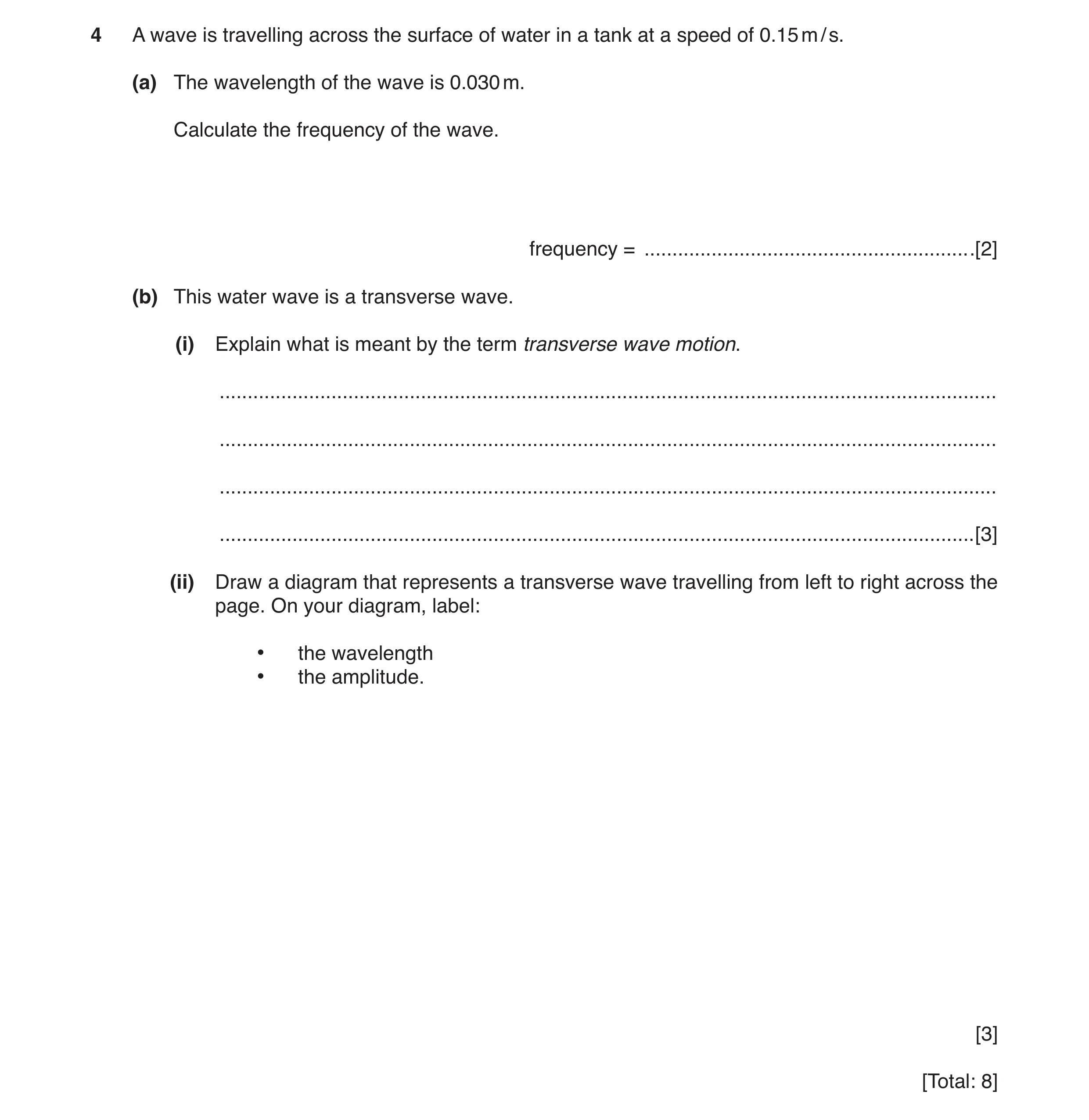
Q8 · A wave is travelling across the surface of water in a tank at a speed of 0.15 m / s 0625/43 Oct/Nov 2018
4 A wave is travelling across the surface of water in a tank at a speed of 0.15 m / s. (a) The wavelength of the wave is 0.030 m. Calculate the frequency of the wave. frequency = … [2] (b) This water wave is a transverse wave. (i) Explain what is meant by the term transverse wave motion. … … … … [3] (ii) Draw a diagram that represents a transverse wave travelling from left to right across the page. On your diagram, label: • the wavelength • the amplitude. [3] [Total: 8]
8 marks
Mark scheme: 4(a) C1 5.0 Hz A1 4(b)(i) transmission of energy (through medium) and no transfer of matter B1 (direction of) vibration of particles or (direction of) vibration of medium M1 perpendicular to direction of energy travel / wave / propagation A1 4(b)(ii) wave with constant wavelength and amplitude B1 wavelength indicated and labelled B1 amplitude indicated and labelled B1
This question in 0625/43 Oct/Nov 2018
Q9 · A water wave in a ripple tank 0625/42 May/June 2019
6 (a) Fig. 6.1 shows a water wave in a ripple tank. new wave direction original wave direction region B region A Fig. 6.1 (i) State the name of the process that occurs as the wave moves from region A to region B. … [1] (ii) Suggest a cause for the change in direction of the wave. … [1] (b) Fig. 6.2 shows a transverse wave. displacement 0 time Fig. 6.2 On Fig. 6.2, draw a wave which has half the amplitude and a greater frequency than the wave shown. [2] (c) A train travels along steel rails. A person waiting at a station hears the sound of the train through the rails before he hears the sound through the air. (i) Explain why this happens. … … [1] (ii) The speed of sound in the rails is 5800 m / s. Calculate the wavelength of sound of frequency 1100 Hz travelling at this speed. wavelength = … [2] [Total: 7]
7 marks
Mark scheme: 6(a)(i) refraction B1 6(a)(ii) (waves move) faster (in region B) OR slower in region A B1 6(b) at least one complete cycle with half the amplitude B1 at least one complete cycle shorter time period B1 6(c)(i) sound travels faster in steel/metal/solid/the rail (than in air) B1 6(c)(ii) v = f λ in any form OR (λ = ) v/f OR (λ =) 5800/1100 C1 (λ =) 5.3 m A1
This question in 0625/42 May/June 2019
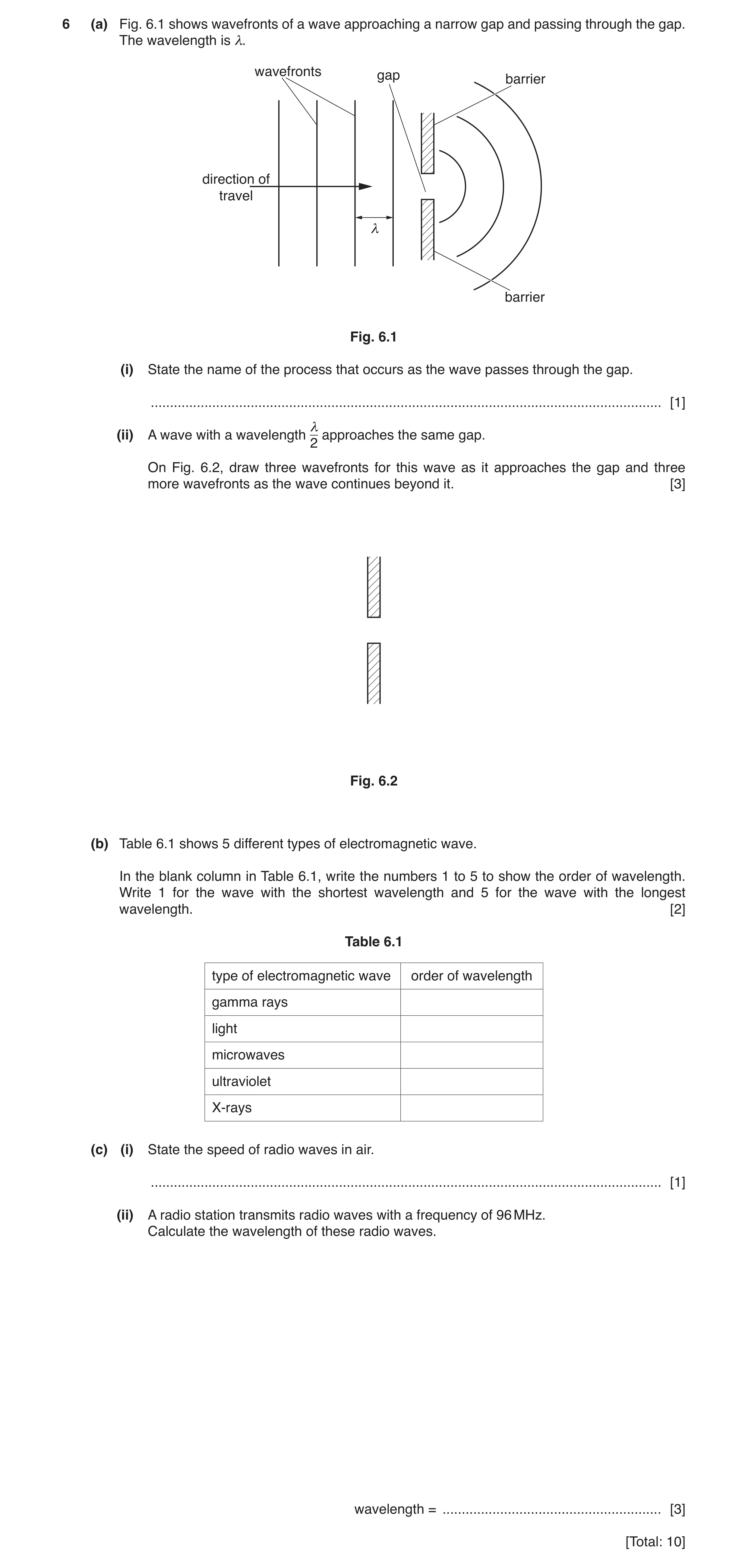
Q10 · Wavefronts of a wave approaching a narrow gap and passing through the gap 0625/43 May/June 2019
6 (a) Fig. 6.1 shows wavefronts of a wave approaching a narrow gap and passing through the gap. The wavelength is λ. wavefronts gap barrier direction of travel λ barrier Fig. 6.1 (i) State the name of the process that occurs as the wave passes through the gap. … [1] (ii) A wave with a wavelength λ approaches the same gap. 2 On Fig. 6.2, draw three wavefronts for this wave as it approaches the gap and three more wavefronts as the wave continues beyond it. [3] Fig. 6.2 (b) Table 6.1 shows 5 different types of electromagnetic wave. In the blank column in Table 6.1, write the numbers 1 to 5 to show the order of wavelength. Write 1 for the wave with the shortest wavelength and 5 for the wave with the longest wavelength. [2] Table 6.1 type of electromagnetic wave order of wavelength gamma rays light microwaves ultraviolet X‑rays (c) (i) State the speed of radio waves in air. … [1] (ii) A radio station transmits radio waves with a frequency of 96 MHz. Calculate the wavelength of these radio waves. wavelength = … [3] [Total: 10]
10 marks
Mark scheme: 6(a)(i) diffraction B1 6(a)(ii) wave on left half the wavelength of waves in Fig 6.1 B1 both wavelengths on right same wavelength as on left B1 much less spreading than in Fig 6.1 B1 6(b) 3 numbers correct B1 all 5 numbers correct (Correct answer: 1, 4, 5, 3, 2) B1 6(c)(i) 3.0 × 10⁸ m/s B1 6(c)(ii) v = fλ in any form OR (λ = v/f ) C1 96 × 106 seen C1 (λ = 8 6 3.0 10 96 10 × × = ) 3.1 m A1
This question in 0625/43 May/June 2019
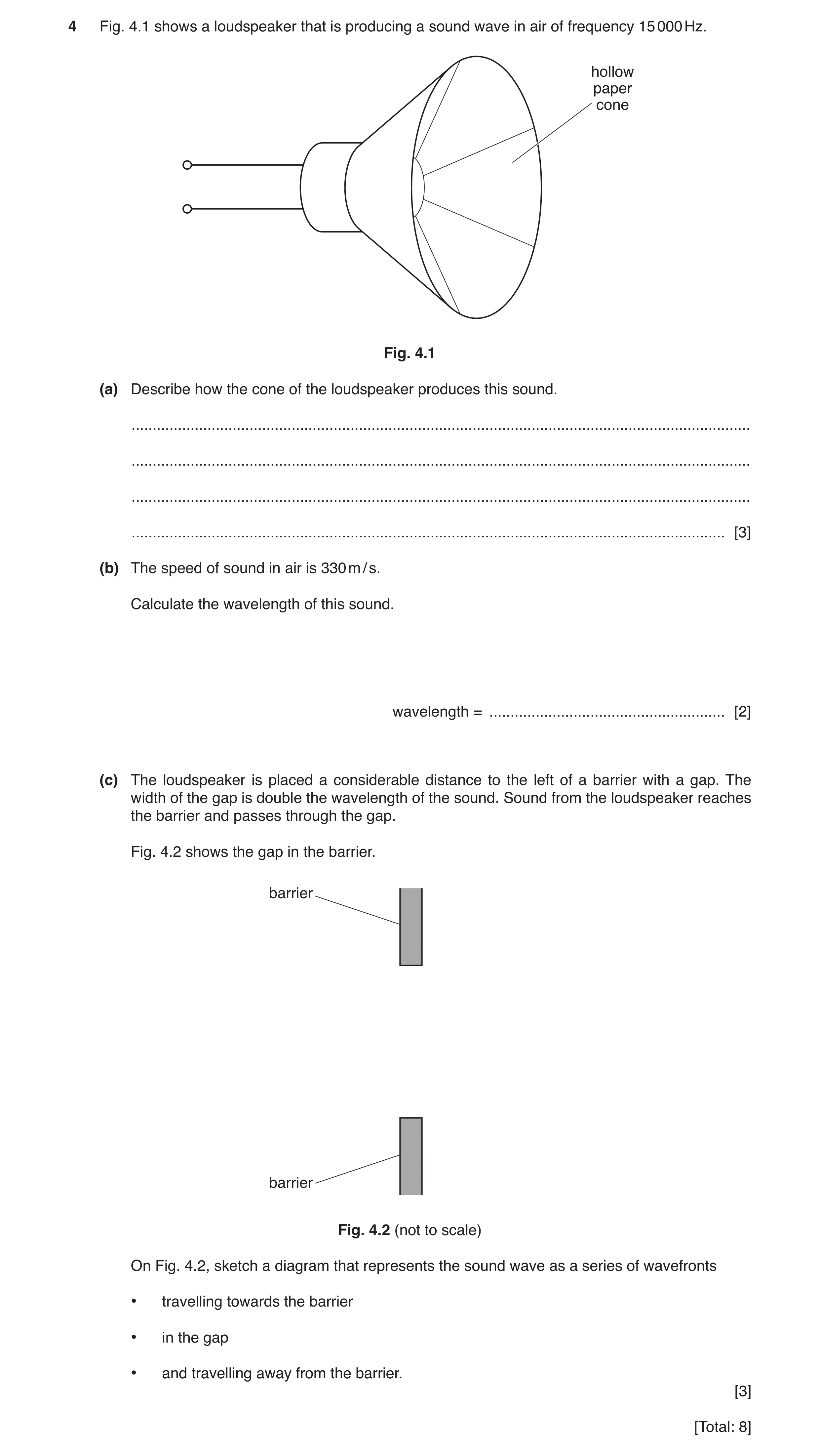
Q11 · A loudspeaker that is producing a sound wave in air of frequency 15 000 Hz 0625/41 Oct/Nov 2019
4 Fig. 4.1 shows a loudspeaker that is producing a sound wave in air of frequency 15 000 Hz. hollow paper cone Fig. 4.1 (a) Describe how the cone of the loudspeaker produces this sound. … … … … [3] (b) The speed of sound in air is 330 m / s. Calculate the wavelength of this sound. wavelength = … [2] (c) The loudspeaker is placed a considerable distance to the left of a barrier with a gap. The width of the gap is double the wavelength of the sound. Sound from the loudspeaker reaches the barrier and passes through the gap. Fig. 4.2 shows the gap in the barrier. barrier barrier Fig. 4.2 (not to scale) On Fig. 4.2, sketch a diagram that represents the sound wave as a series of wavefronts • travelling towards the barrier • in the gap • and travelling away from the barrier. [3] [Total: 8]
8 marks
Mark scheme: 4(a) it / cone vibrates any two from: alternating current (a.c.) (in coil / wire) or alternating magnetic field (neighbouring) air vibrates or vibrations passed on (producing) compressions and rarefactions / vibrations parallel to energy transfer vibrating at 15 000 Hz B1 B2 4(b) λ = v / f in any form words, symbols or numbers or (λ =) v / f or 330 / 15 000 0.022 m C1 A1 4(c) at least two vertical wavefronts either to left of barrier or in gap at least one wavefront showing some diffraction approximately constant wavelength throughout and ~50% of gap width B1 B1 B1
This question in 0625/41 Oct/Nov 2019
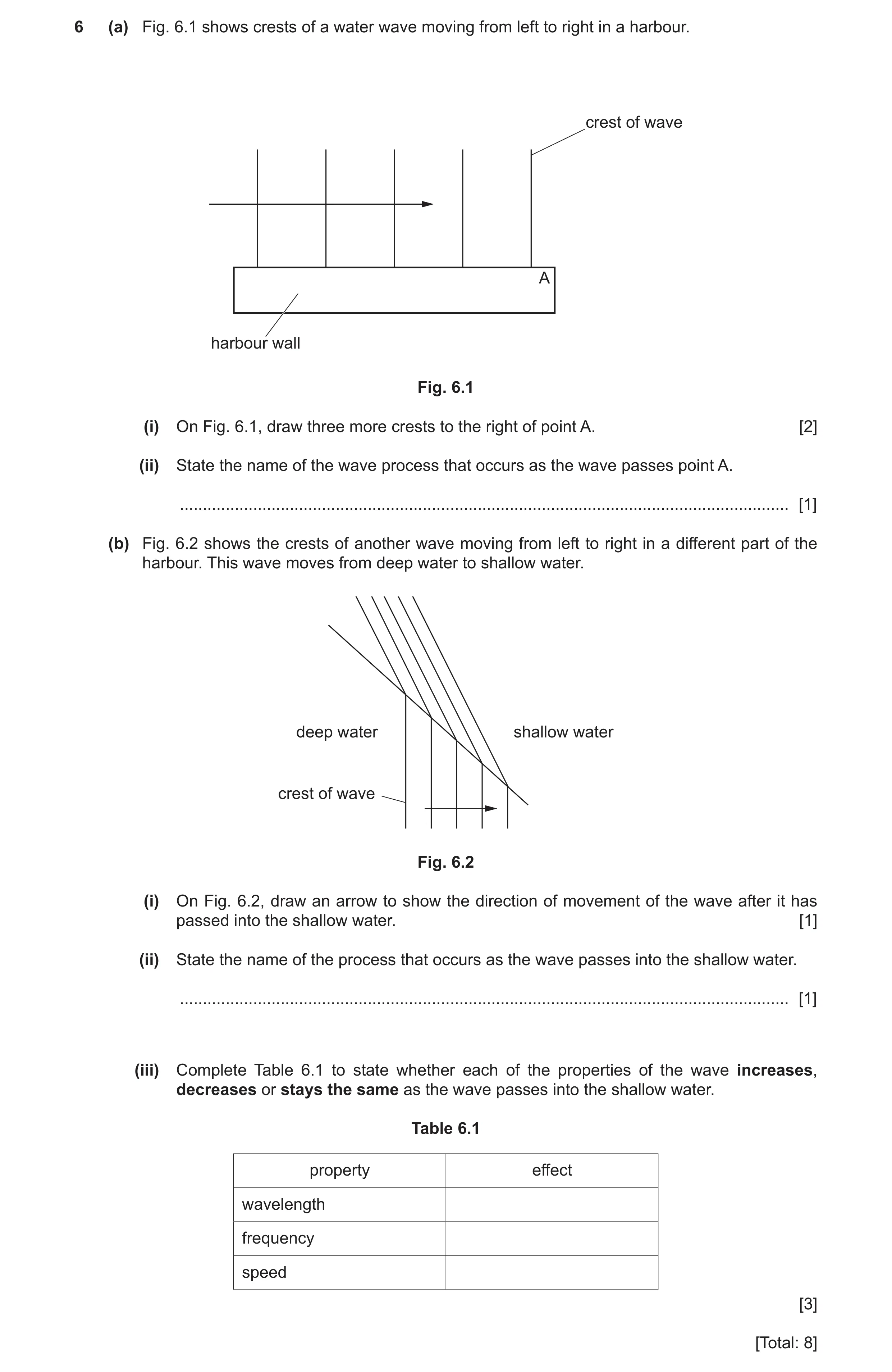
Q12 · Crests of a water wave moving from left to right in a harbour 0625/42 Feb/March 2020
6 (a) Fig. 6.1 shows crests of a water wave moving from left to right in a harbour. crest of wave A harbour wall Fig. 6.1 (i) On Fig. 6.1, draw three more crests to the right of point A. [2] (ii) State the name of the wave process that occurs as the wave passes point A. … [1] (b) Fig. 6.2 shows the crests of another wave moving from left to right in a different part of the harbour. This wave moves from deep water to shallow water. deep water shallow water crest of wave Fig. 6.2 (i) On Fig. 6.2, draw an arrow to show the direction of movement of the wave after it has passed into the shallow water. [1] (ii) State the name of the process that occurs as the wave passes into the shallow water. … [1] (iii) Complete Table 6.1 to state whether each of the properties of the wave increases, decreases or stays the same as the wave passes into the shallow water. Table 6.1 property effect wavelength frequency speed [3] [Total: 8]
8 marks
Mark scheme: 6(a)(i) 3 straight crests, to the right of A parallel to incident crests AND same λ by eye B1 curving round correct way below A B1 6(a)(ii) diffraction B1 6(b)(i) correct arrow perpendicular to wave fronts B1 6(b)(ii) refraction B1 6(b)(iii) wavelength – decreases B1 frequency – stays same B1 speed of wave – decreases B1
This question in 0625/42 Feb/March 2020
Q13 · The speed of sound in air is 340 m / s 0625/41 May/June 2020
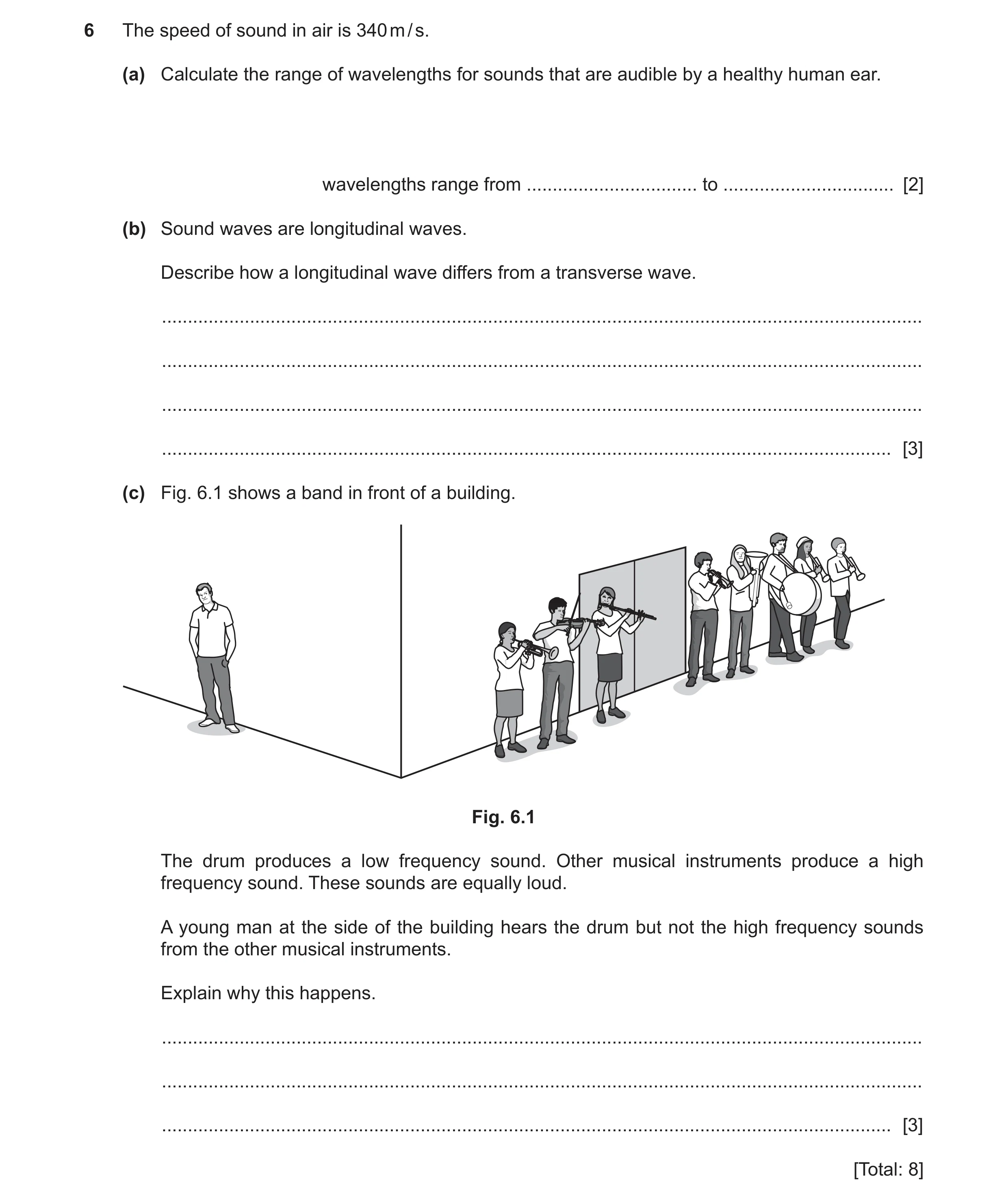
6 The speed of sound in air is 340 m / s. (a) Calculate the range of wavelengths for sounds that are audible by a healthy human ear. wavelengths range from … to … [2] (b) Sound waves are longitudinal waves. Describe how a longitudinal wave differs from a transverse wave. … … … … [3] (c) Fig. 6.1 shows a band in front of a building. Fig. 6.1 The drum produces a low frequency sound. Other musical instruments produce a high frequency sound. These sounds are equally loud. A young man at the side of the building hears the drum but not the high frequency sounds from the other musical instruments. Explain why this happens. … … … [3] [Total: 8]
8 marks
Mark scheme: 6(a) (λ =) v / f OR 340 / 20 000 OR 340 / 20 C1 0.017 m AND 17 m A1 6(b) (longitudinal wave) vibration direction parallel to propagation / energy travel direction B1 transverse wave vibration direction perpendicular to propagation / energy travel direction B1 consists of rarefactions AND compressions B1 Question Answer Marks 6(c) diffraction mentioned B1 wavelength of sound from drum / low frequency sound greater (than wavelength of high frequency sound) B1 more diffraction of sound from drum OR less diffraction of high frequency sound B1
This question in 0625/41 May/June 2020
Q14 · Crests of a wave approaching a barrier where the wave is reflected 0625/42 May/June 2020
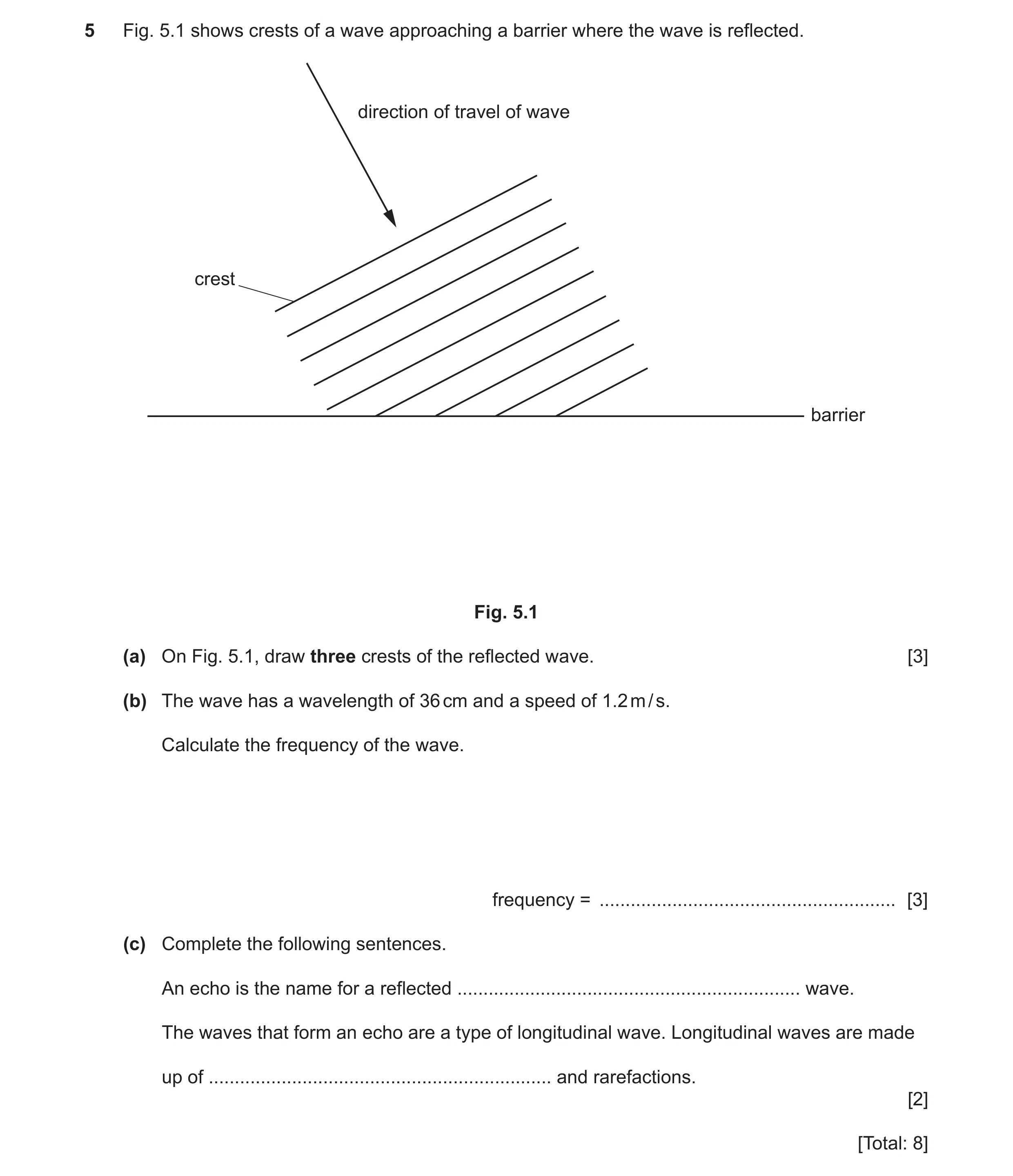
5 Fig. 5.1 shows crests of a wave approaching a barrier where the wave is reflected. direction of travel of wave crest barrier Fig. 5.1 (a) On Fig. 5.1, draw three crests of the reflected wave. [3] (b) The wave has a wavelength of 36 cm and a speed of 1.2 m / s. Calculate the frequency of the wave. frequency = … [3] (c) Complete the following sentences. An echo is the name for a reflected … wave. The waves that form an echo are a type of longitudinal wave. Longitudinal waves are made up of … and rarefactions. [2] [Total: 8]
8 marks
Mark scheme: 5(a) three wavefronts parallel to each other AND same angles of reflection and incidence both by eye B1 two wavelengths same as original wavelength by eye B1 three reflected waves meet incident waves at barrier B1 5(b) v = fλ in any form OR (f =) v/λ C1 OR (f =) 1.2 / 0.36 C1 (f =) 3.3 Hz A1 5(c) sound OR ultrasound B1 compressions B1
This question in 0625/42 May/June 2020
Q15 · Crests of a sound wave after reflection from a solid surface 0625/43 May/June 2020
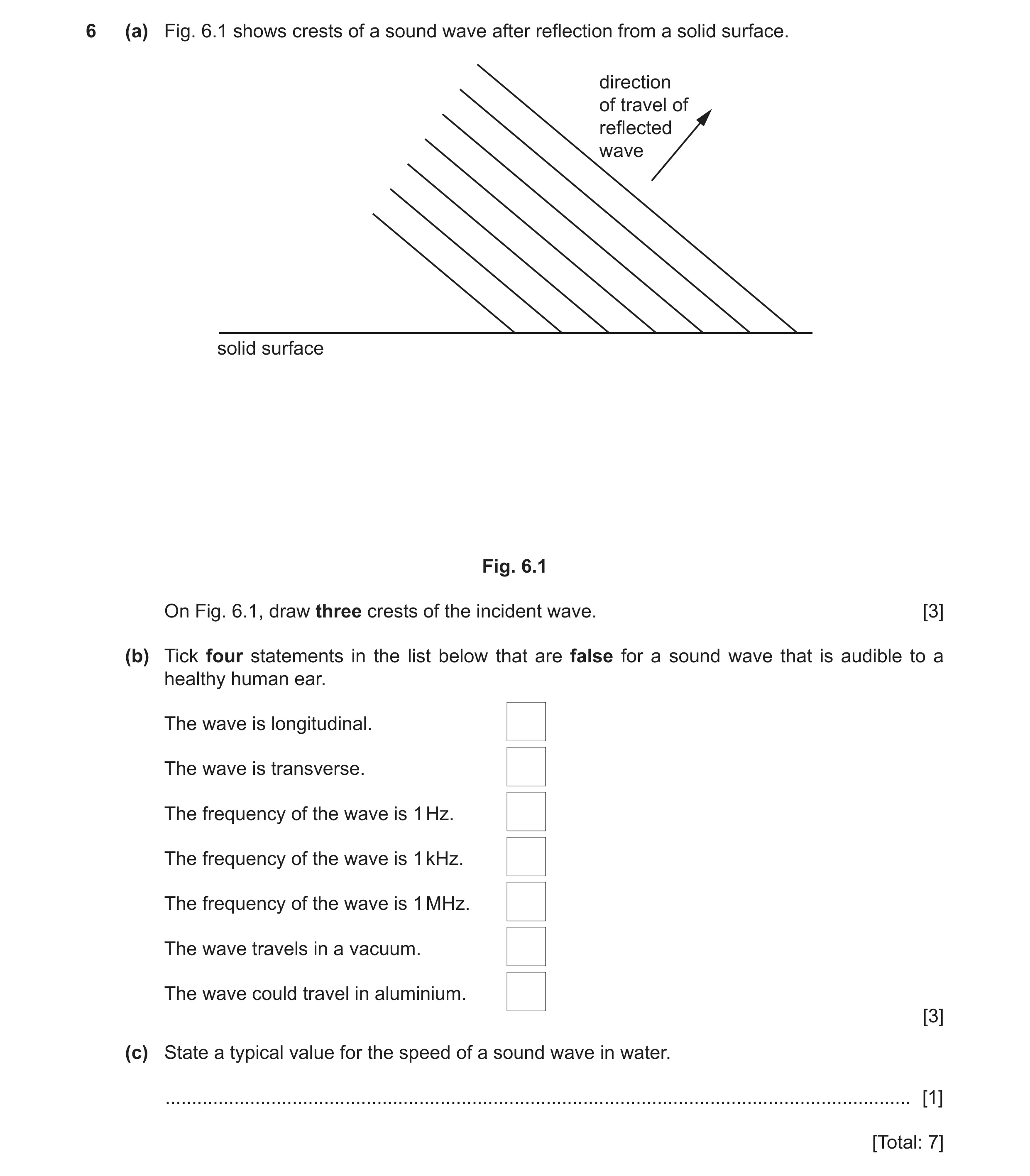
6 (a) Fig. 6.1 shows crests of a sound wave after reflection from a solid surface. direction of travel of reflected wave solid surface Fig. 6.1 On Fig. 6.1, draw three crests of the incident wave. [3] (b) Tick four statements in the list below that are false for a sound wave that is audible to a healthy human ear. The wave is longitudinal. The wave is transverse. The frequency of the wave is 1 Hz. The frequency of the wave is 1 kHz. The frequency of the wave is 1 MHz. The wave travels in a vacuum. The wave could travel in aluminium. [3] (c) State a typical value for the speed of a sound wave in water. … [1] [Total: 7]
7 marks
Mark scheme: 6(a) three wavefronts parallel to each other B1 two wavelengths same as reflected by eye B1 three wavefronts at same angle to barrier as original B1 6(b) second, third, fifth and sixth boxes ticked B3 6(c) 1500 m / s B1
This question in 0625/43 May/June 2020
Q16 · A shallow tank viewed from above 0625/41 Oct/Nov 2020
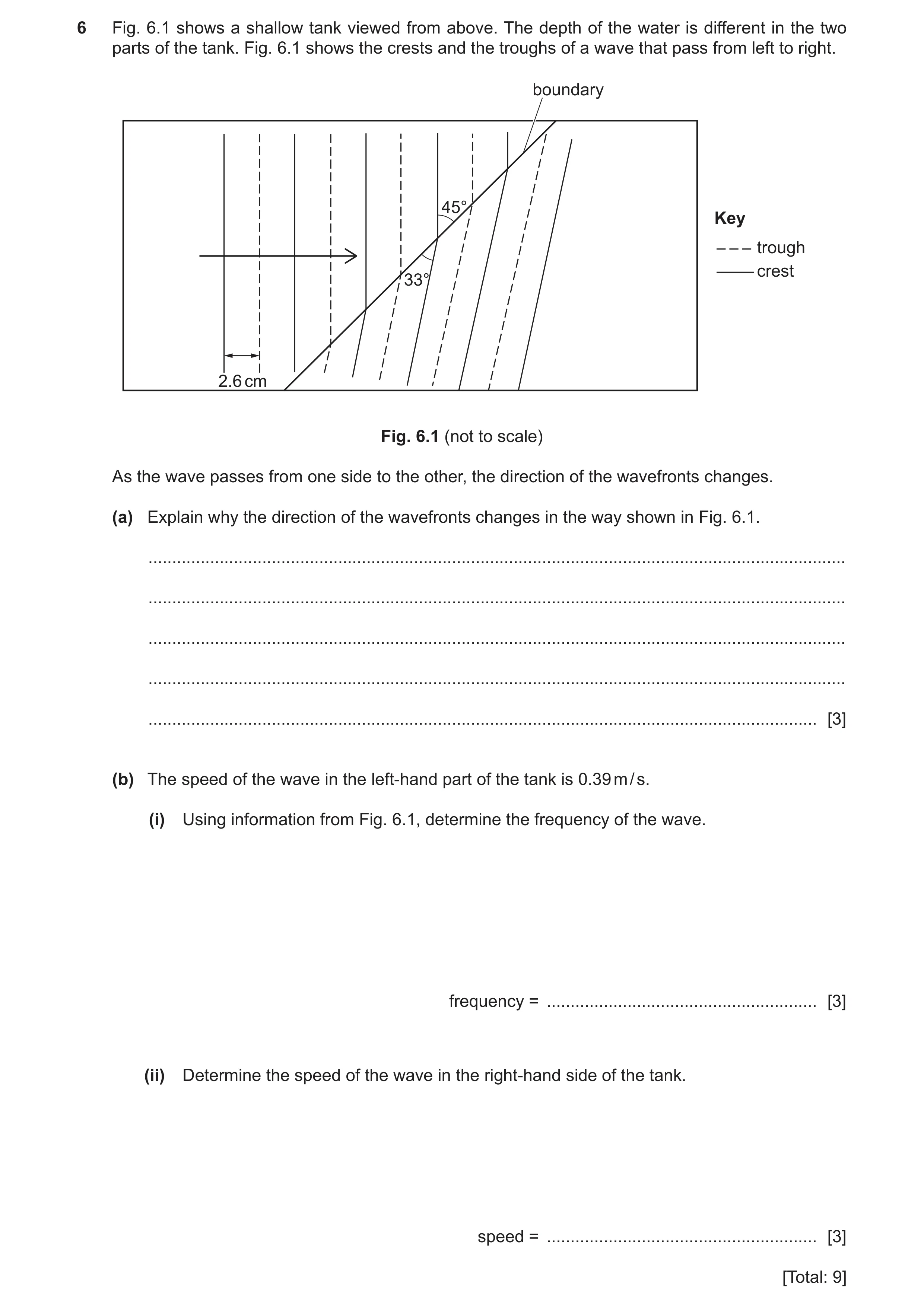
6 Fig. 6.1 shows a shallow tank viewed from above. The depth of the water is different in the two parts of the tank. Fig. 6.1 shows the crests and the troughs of a wave that pass from left to right. boundary 45° Key trough crest 33° 2.6 cm Fig. 6.1 (not to scale) As the wave passes from one side to the other, the direction of the wavefronts changes. (a) Explain why the direction of the wavefronts changes in the way shown in Fig. 6.1. … … … … … [3] (b) The speed of the wave in the left-hand part of the tank is 0.39 m / s. (i) Using information from Fig. 6.1, determine the frequency of the wave. frequency = … [3] (ii) Determine the speed of the wave in the right-hand side of the tank. speed = … [3] [Total: 9]
9 marks
Mark scheme: 6(a) speed changes or (wave) speed is smaller in right-hand part of tank or waves slow down or bottom (on the page) section of wave hits the boundary first C1 (wave) speed is smaller in right-hand part of tank or waves slow down or bottom (on the page) section of wave hits the boundary first C1 bottom (on the page) / one part / one side / one section of wave slows down first (and different sections are delayed by different amounts) A1 6(b)(i) (f =) v ÷ λ (in any form) or 0.39 ÷ 0.052 or 0.39 ÷ 0.026 or 15 (Hz) or 0.39 ÷ 5.2 or 0.39 ÷ 2.6 or 0.15 (Hz) or 0.075 (Hz) C1 0.39 ÷ 0.052 or 15 (Hz) or 0.39 ÷ 5.2 or 0.15 (Hz) or 0.075 (Hz) C1 7.5 Hz A1 6(b)(ii) angle of incidence / i = 45(°) or angle of refraction / r = 33(°) C1 (v2 =) v1 × sin(r) ÷ sin (i) (in any form) or λ2 = λ1 × sin(r) ÷ sin (i) (in any form) or 0.39 × sin(33°) ÷ sin(45°) or 0.39 × sin(57°) ÷ sin(45°) C1 0.30 m / s A1
This question in 0625/41 Oct/Nov 2020
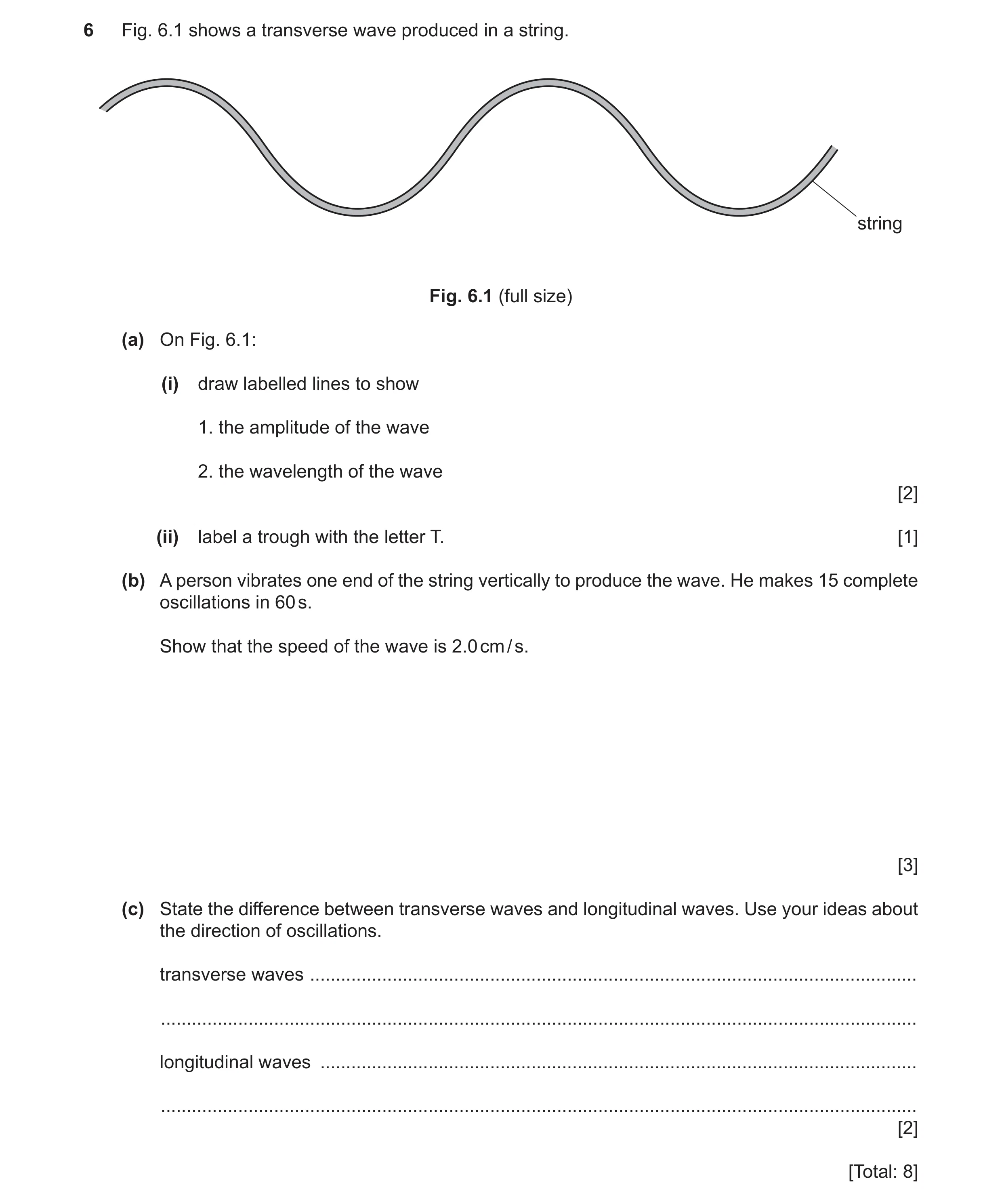
Q17 · A transverse wave produced in a string 0625/42 Oct/Nov 2020
6 Fig. 6.1 shows a transverse wave produced in a string. string Fig. 6.1 (full size) (a) On Fig. 6.1: (i) draw labelled lines to show 1. the amplitude of the wave 2. the wavelength of the wave [2] (ii) label a trough with the letter T. [1] (b) A person vibrates one end of the string vertically to produce the wave. He makes 15 complete oscillations in 60 s. Show that the speed of the wave is 2.0 cm / s. [3] (c) State the difference between transverse waves and longitudinal waves. Use your ideas about the direction of oscillations. transverse waves … … longitudinal waves … … [2] [Total: 8]
8 marks
Mark scheme: 6(a)(i) 1 amplitude marked correctly B1 2 wavelength marked correctly B1 6(a)(ii) trough labelled T B1 6(b) f = 15 / 60 (= 0.25) B1 v = f λ in any form OR (v =) fλ words, symbols or numbers B1 (v =) 0.08 × 0.25 (= 0.02 m / s) OR 0.25 × 8 (= 2.0 cm / s) B1 Alternative route 1 : v = d ÷ t words, symbols or numbers (B1) distance moved in one minute = 15 × 8 OR 120 OR 15 × 0.08 OR 1.2 (B1) (v =) 120 / 60 (= 0.02 m / s) OR 120 ÷ 60 OR 15 × 0.08 ÷ 60 OR 1.2 ÷ 60 (B1) Alternative route 2 : time for 1 oscillation = 4 s (B1) distance moved in 4 s = 8 cm (B1) so speed = 8 ÷ 4 = 2 cm / s (B1) 6(c) oscillation at right angles to the direction of propagation / travel / energy transfer (of the wave) B1 oscillation parallel to / in the direction of propagation / travel / energy transfer (of the wave) OR has compressions and rarefactions OR needs / must have a medium B1
This question in 0625/42 Oct/Nov 2020
Q18 · A full-scale diagram that represents a sound wave travelling in air 0625/41 May/June 2021
6 Fig. 6.1 is a full-scale diagram that represents a sound wave travelling in air. direction of travel Fig. 6.1 (a) On Fig. 6.1, mark two points, each at the centre of a different compression. Label both of the points C. [1] (b) The speed of sound in air is 330 m / s. Measure the diagram and determine the frequency of the sound. frequency = … [3] (c) The wave reaches a barrier. Fig. 6.2 shows the wave passing through a gap in the barrier. barrier direction of travel Fig. 6.2 The frequency of the wave is increased to a value many times greater than the value obtained in (b). Describe and explain two ways in which a diagram representing the wave with the greater frequency differs from Fig. 6.2. 1. … … 2. … … [3] [Total: 7]
7 marks
Mark scheme: 6(a) two points labelled C at the centre of the two compressions B1 6(b) 6200−6500 Hz A3 (λ =) value from 0.051 to 0.053 (m) seen anywhere C1 (f =) v / λ in any form or 330 / 0.052 or 330 / 5.2 or 63 C1 6(c) compressions / rarefactions closer or more compressions / rarefactions (in same distance) B1 less diffraction / spreading out B1 (because of) smaller wavelength or ratio wavelength / gap width smaller B1
This question in 0625/41 May/June 2021
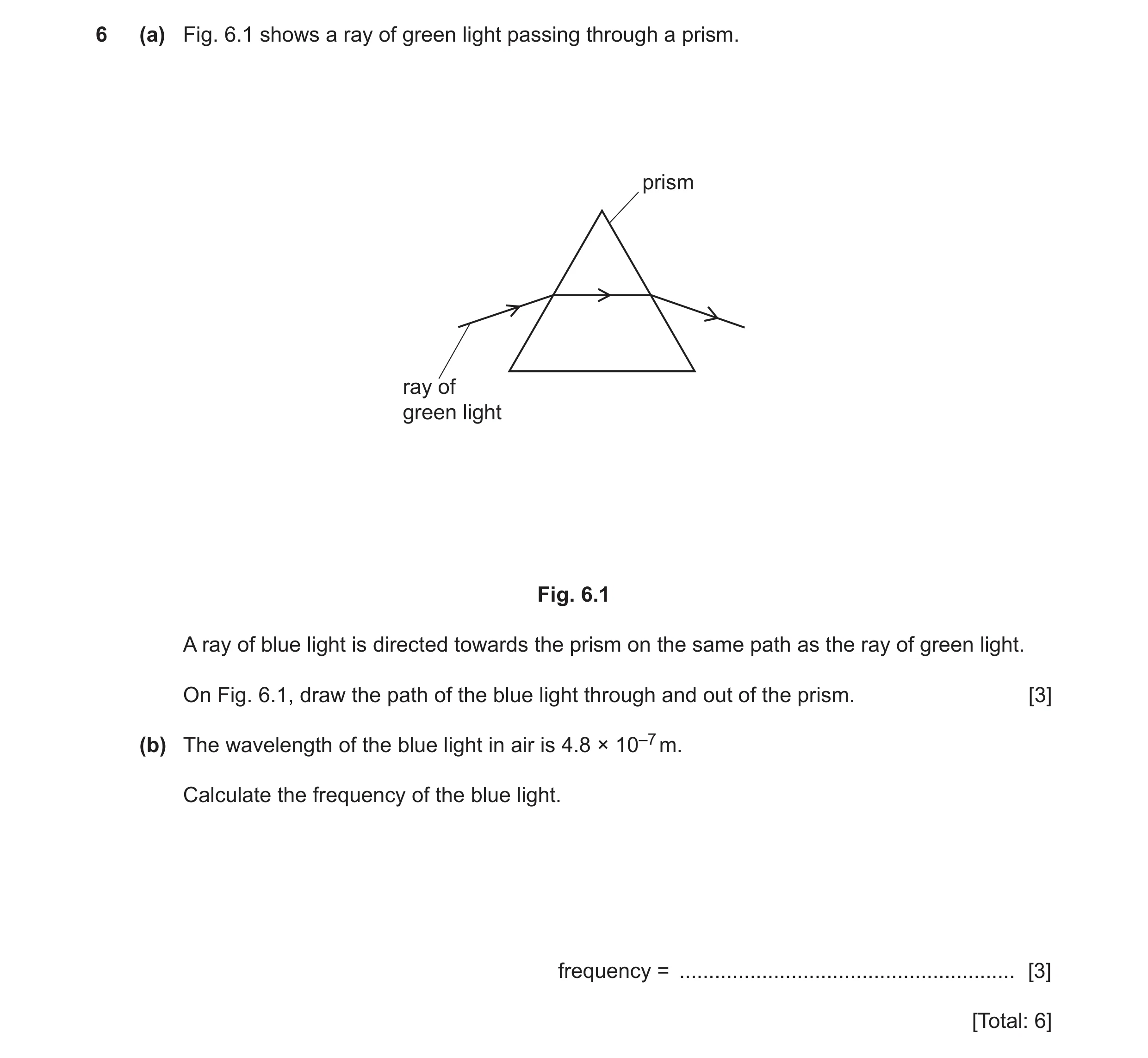
Q19 · A ray of green light passing through a prism 0625/42 May/June 2021
6 (a) Fig. 6.1 shows a ray of green light passing through a prism. prism ray of green light Fig. 6.1 A ray of blue light is directed towards the prism on the same path as the ray of green light. On Fig. 6.1, draw the path of the blue light through and out of the prism. [3] (b) The wavelength of the blue light in air is 4.8 × 10⁻⁷ m. Calculate the frequency of the blue light. frequency = … [3] [Total: 6]
6 marks
Mark scheme: 6(a) blue ray refracted MORE towards normal at first surface B1 refraction away from normal at second surface B1 ray of blue light below ray of green light and diverging throughout path (after entering prism) B1 6(b) v = fλ in any form OR (f=) v / λ C1 (f =) 3 × 10⁸ ÷ 4.8 × 10⁻⁷ C1 (f =) 6.3 × 10¹⁴ Hz A1
This question in 0625/42 May/June 2021
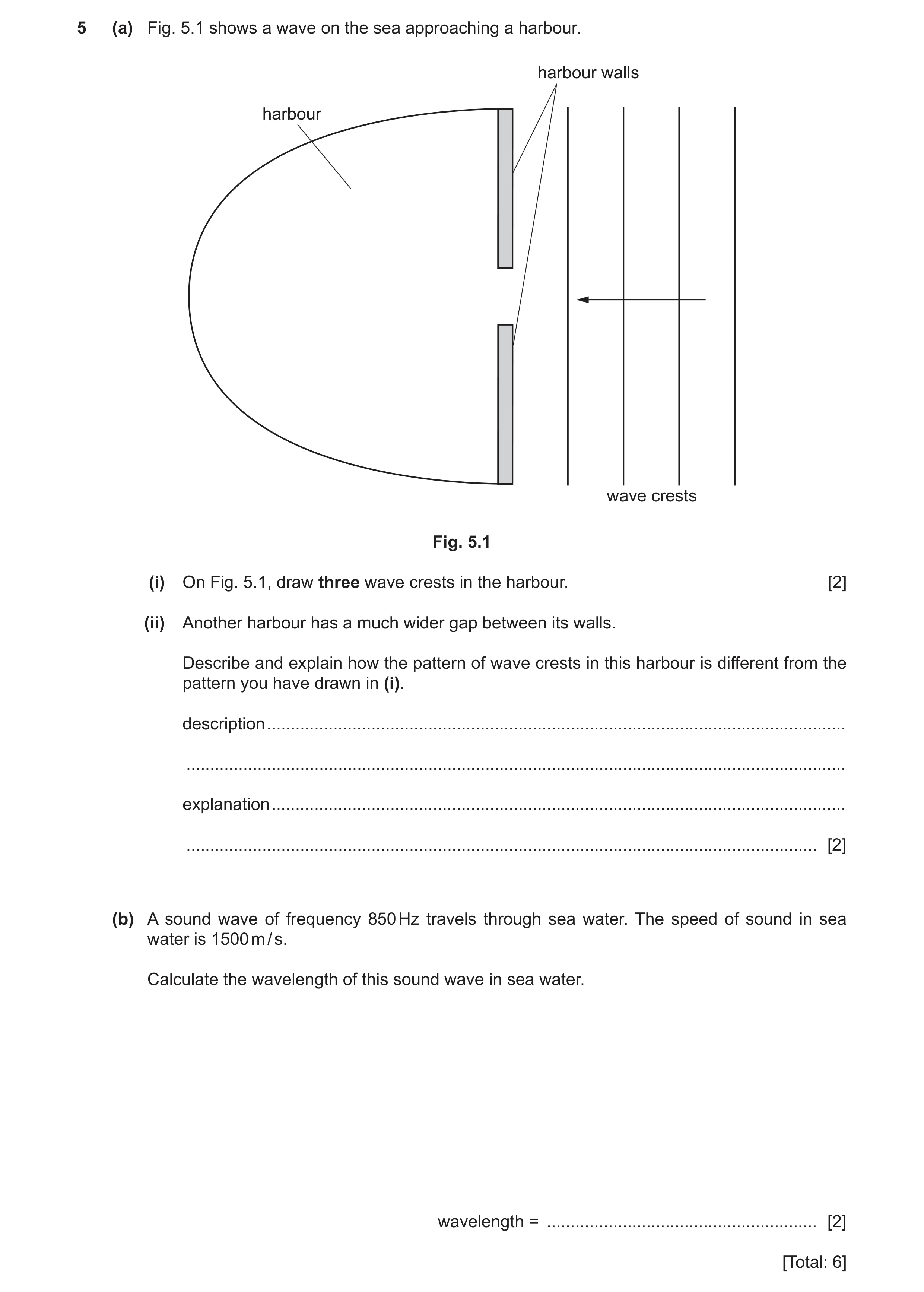
Q20 · A wave on the sea approaching a harbour 0625/43 May/June 2021
5 (a) Fig. 5.1 shows a wave on the sea approaching a harbour. harbour walls harbour wave crests Fig. 5.1 (i) On Fig. 5.1, draw three wave crests in the harbour. [2] (ii) Another harbour has a much wider gap between its walls. Describe and explain how the pattern of wave crests in this harbour is different from the pattern you have drawn in (i). description … … explanation … … [2] (b) A sound wave of frequency 850 Hz travels through sea water. The speed of sound in sea water is 1500 m / s. Calculate the wavelength of this sound wave in sea water. wavelength = … [2] [Total: 6]
6 marks
Mark scheme: 5(a)(i) part of a circle, at least quarter of a circle, centred on centre of gap B1 waves same wavelength as incident waves B1 5(a)(ii) waves pass through gap remaining straight B1 less / no diffraction occurs B1 5(b) 1.8 m A2 λ = v/f OR 1500/850 in any form C1
This question in 0625/43 May/June 2021
Q21 · Describe an experiment to determine the speed of sound in air 0625/43 Oct/Nov 2021
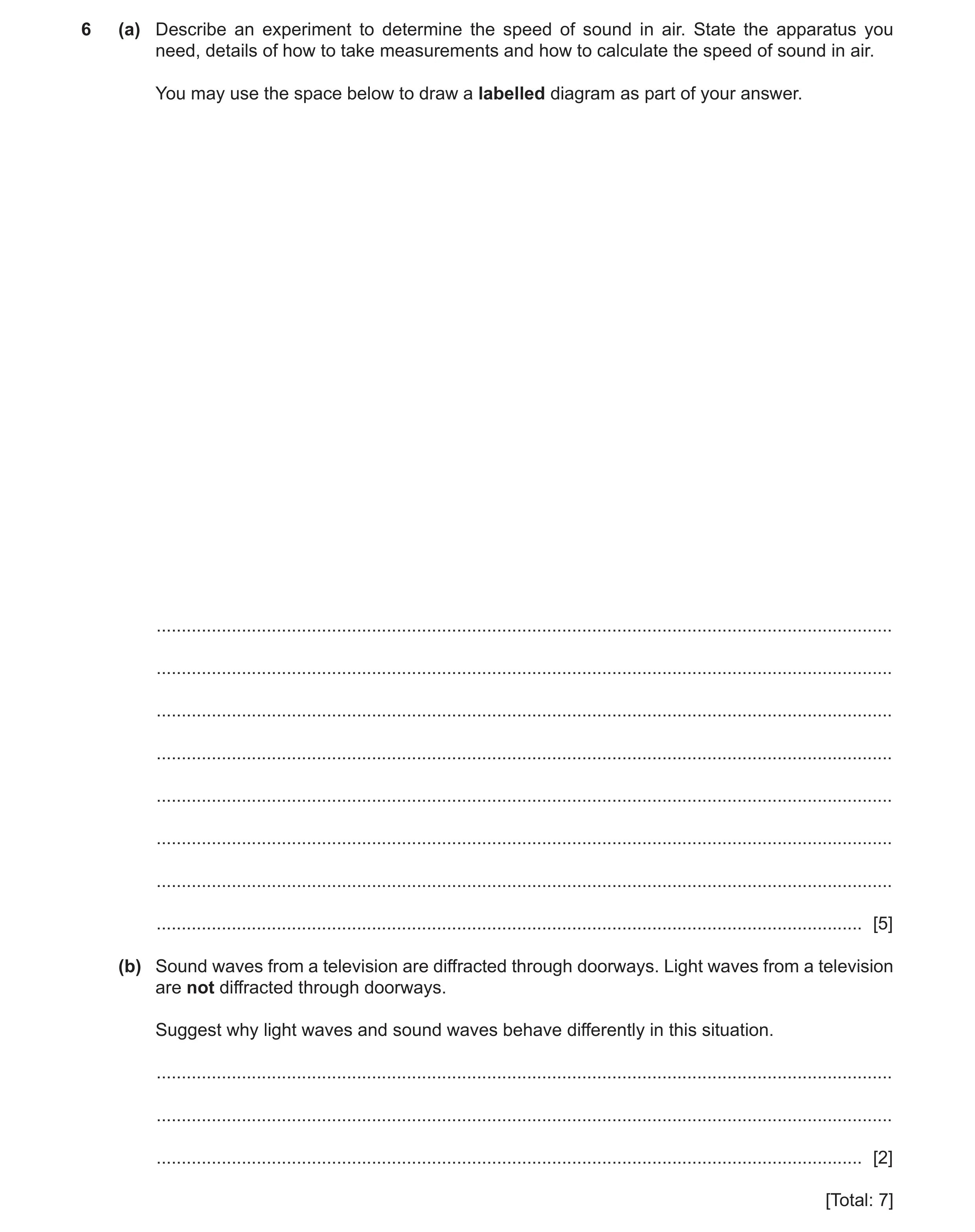
6 (a) Describe an experiment to determine the speed of sound in air. State the apparatus you need, details of how to take measurements and how to calculate the speed of sound in air. You may use the space below to draw a labelled diagram as part of your answer. … … … … … … … … [5] (b) Sound waves from a television are diffracted through doorways. Light waves from a television are not diffracted through doorways. Suggest why light waves and sound waves behave differently in this situation. … … … [2] [Total: 7]
7 marks
Mark scheme: 6(a) B5 method of producing sound, e.g. clap for echo method or gun for direct measurement, sig gen or loudspeaker, hammer on block B1 apparatus used, e.g. stopwatch, long tape, trundle wheel, wall if using echo method, metre rule, microphones and timer or microphones and oscilloscope B1 detail of measurement of (long) distance, e.g. measure distance between person and the wall, measure distance between loudspeaker and microphone or measure distance between two microphones B1 detail of measurement of time OR appropriate time measured, e.g. at one end start stopwatch when smoke seen from gun and stop it when sound heard, start stopwatch when gun heard / clap heard and stop when echo heard, measure time taken between clap and hearing echo, timer starts when first microphone receives signal and stops when second receives signal OR measurement of wavelength, e.g. move one microphone away until two waves on oscilloscope have moved one wavelength apart B1 speed = measured distance / time for direct method OR speed = 2 × distance from student clapping to wall / time for echo method OR distance between microphones = wavelength AND v = f × λ B1 6(b) B2 wavelength of light is (much) smaller than width of doorway or wavelength of sound B1 wavelength of sound is similar to width of doorway OR λ ≃ width of gap for diffraction to occur OR larger wavelength results in greater diffraction ORA B1
This question in 0625/43 Oct/Nov 2021
Q22 · How the electromotive force (e.m.f.) of a 60 Hz alternating current (a.c.) power supply… 0625/42 May/June 2022
8 Fig. 8.1 shows how the electromotive force (e.m.f.) of a 60 Hz alternating current (a.c.) power supply varies with time. e.m.f. 0 0 time time period Fig. 8.1 (a) Calculate the time period of the a.c. time period = … [1] (b) Fig. 8.2 shows this power supply connected in a circuit. A B C Fig. 8.2 (i) State the name of component A. … [1] (ii) In each time period of the a.c., 1.5 × 10¹⁷ electrons pass through component A. The charge on an electron is 1.6 × 10⁻¹⁹ C. Calculate the average current in the circuit during one time period. current = … [3] (c) On Fig. 8.3: 1. mark, with an arrow labelled E, the direction of the electron flow through component B 2. mark, with an arrow labelled I, the direction of the conventional current in component C. A B C Fig. 8.3 [2] (d) Fig. 8.4 shows a circuit with components B and C connected to a direct current (d.c.) power supply of e.m.f. 12 V. B C Fig. 8.4 The current in the circuit is 0.35 A. Calculate the power delivered by the power supply to the circuit. power = … [2] [Total: 9]
9 marks
Mark scheme: 8(a) 8(b)(i) diode B1 8(b)(ii) (I =) 1.4 A A3 (I =) Q / t in any form C1 (I =) 1.5 1017 1.6 10–19 / 0.017 OR 0.024 / 0.017 C1 Question Answer Marks 8(c) one arrow clockwise AND one arrow anticlockwise B1 arrow anticlockwise (around circuit) labelled I B1 8(d) (P = 0.35 12 =) 4.2 W A2 (P =) IV in any form C1
This question in 0625/42 May/June 2022
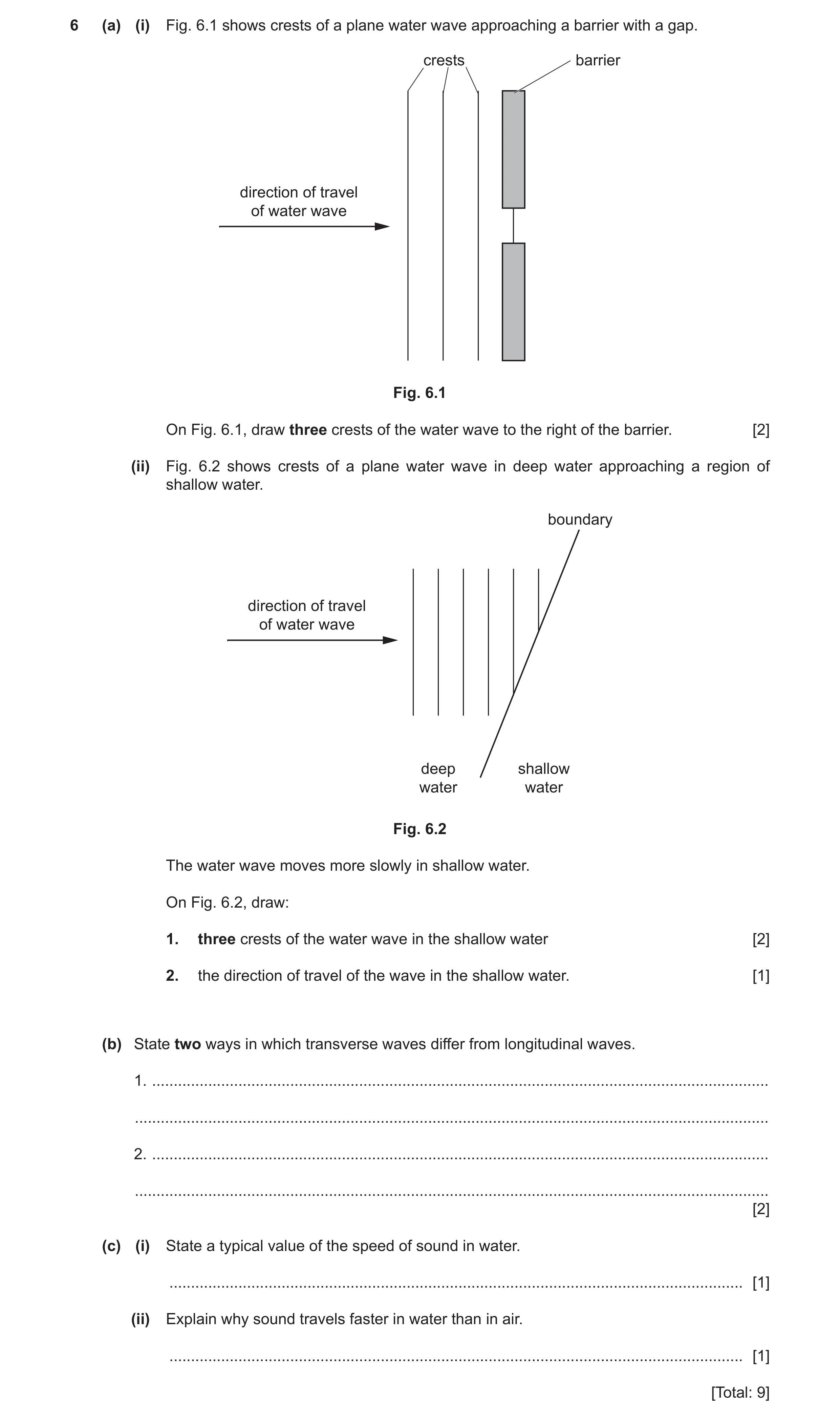
Q23 · Crests of a plane water wave approaching a barrier with a gap 0625/43 May/June 2022
6 (a) (i) Fig. 6.1 shows crests of a plane water wave approaching a barrier with a gap. crests barrier direction of travel of water wave Fig. 6.1 On Fig. 6.1, draw three crests of the water wave to the right of the barrier. [2] (ii) Fig. 6.2 shows crests of a plane water wave in deep water approaching a region of shallow water. boundary direction of travel of water wave deep shallow water water Fig. 6.2 The water wave moves more slowly in shallow water. On Fig. 6.2, draw: 1. three crests of the water wave in the shallow water [2] 2. the direction of travel of the wave in the shallow water. [1] (b) State two ways in which transverse waves differ from longitudinal waves. 1. … … 2. … … [2] (c) (i) State a typical value of the speed of sound in water. … [1] (ii) Explain why sound travels faster in water than in air. … [1] [Total: 9]
9 marks
Mark scheme: 6(a)(i) wavefronts semicircles or part semicircles centred on gap B1 wavelength of waves to right of barrier same as wavelength of incident wave B1 6(a)(ii) 1 wavelength shorter B1 correct refraction B1 2 direction of travel perpendicular to wavefronts B1 6(b) any two from: particles (in transverse waves) vibrate perpendicular to the direction of travel (of the wave) OR particles in longitudinal waves vibrate parallel to the direction of travel of the wave longitudinal waves have compressions and rarefactions transverse waves have troughs and crests B2 6(c)(i) 1000 m / s ⩽ value ⩽ 2000 m / s B1 6(c)(ii) molecules closer together / water has greater density B1
This question in 0625/43 May/June 2022
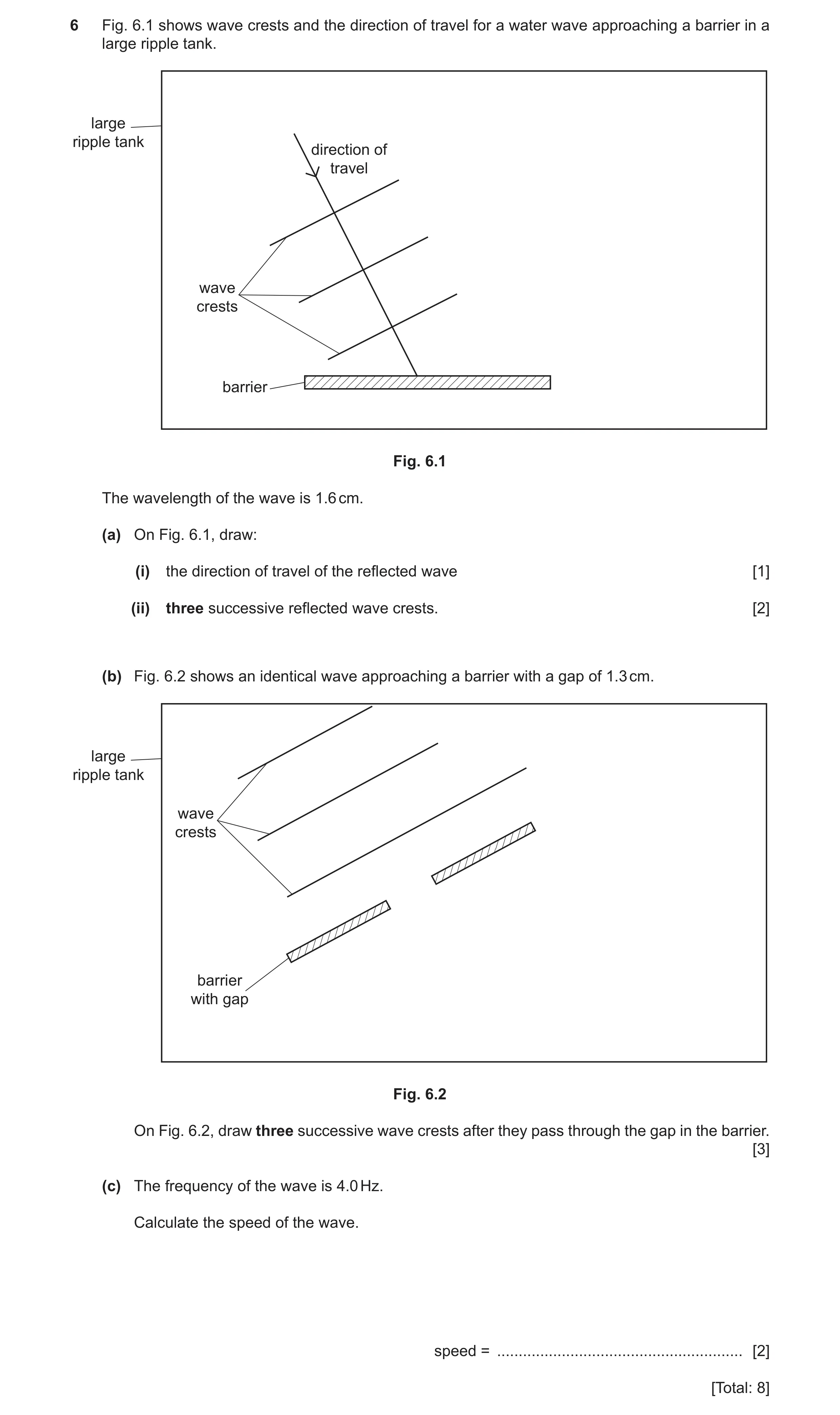
Q24 · Wave crests and the direction of travel for a water wave approaching a barrier in a large… 0625/43 Oct/Nov 2022
6 Fig. 6.1 shows wave crests and the direction of travel for a water wave approaching a barrier in a large ripple tank. large ripple tank direction of travel wave crests barrier Fig. 6.1 The wavelength of the wave is 1.6 cm. (a) On Fig. 6.1, draw: (i) the direction of travel of the reflected wave [1] (ii) three successive reflected wave crests. [2] (b) Fig. 6.2 shows an identical wave approaching a barrier with a gap of 1.3 cm. large ripple tank wave crests barrier with gap Fig. 6.2 On Fig. 6.2, draw three successive wave crests after they pass through the gap in the barrier. [3] (c) The frequency of the wave is 4.0 Hz. Calculate the speed of the wave. speed = … [2] [Total: 8]
8 marks
Mark scheme: 6(a)(i) correct direction, with angle made with surface correct B1 6(a)(ii) three wavefronts perpendicular to their answer to (a)(i) B1 wavelength 1.6 cm / same as incident wave B1 6(b) at least two correct arcs (after the gap in the barrier) B1 three circular arcs (after the gap on the barrier) centred on gap B1 wavelength same as wavelength of incident wavefronts B1 6(c) 6.4 cm / s OR 0.064 m / s A2 v = fOR (v =) fOR 4.0 1.6 OR 4.0 0.016 C1
This question in 0625/43 Oct/Nov 2022
Q25 · A circuit with an alternating current (a.c.) supply, a resistor and a diode 0625/43 Oct/Nov 2022
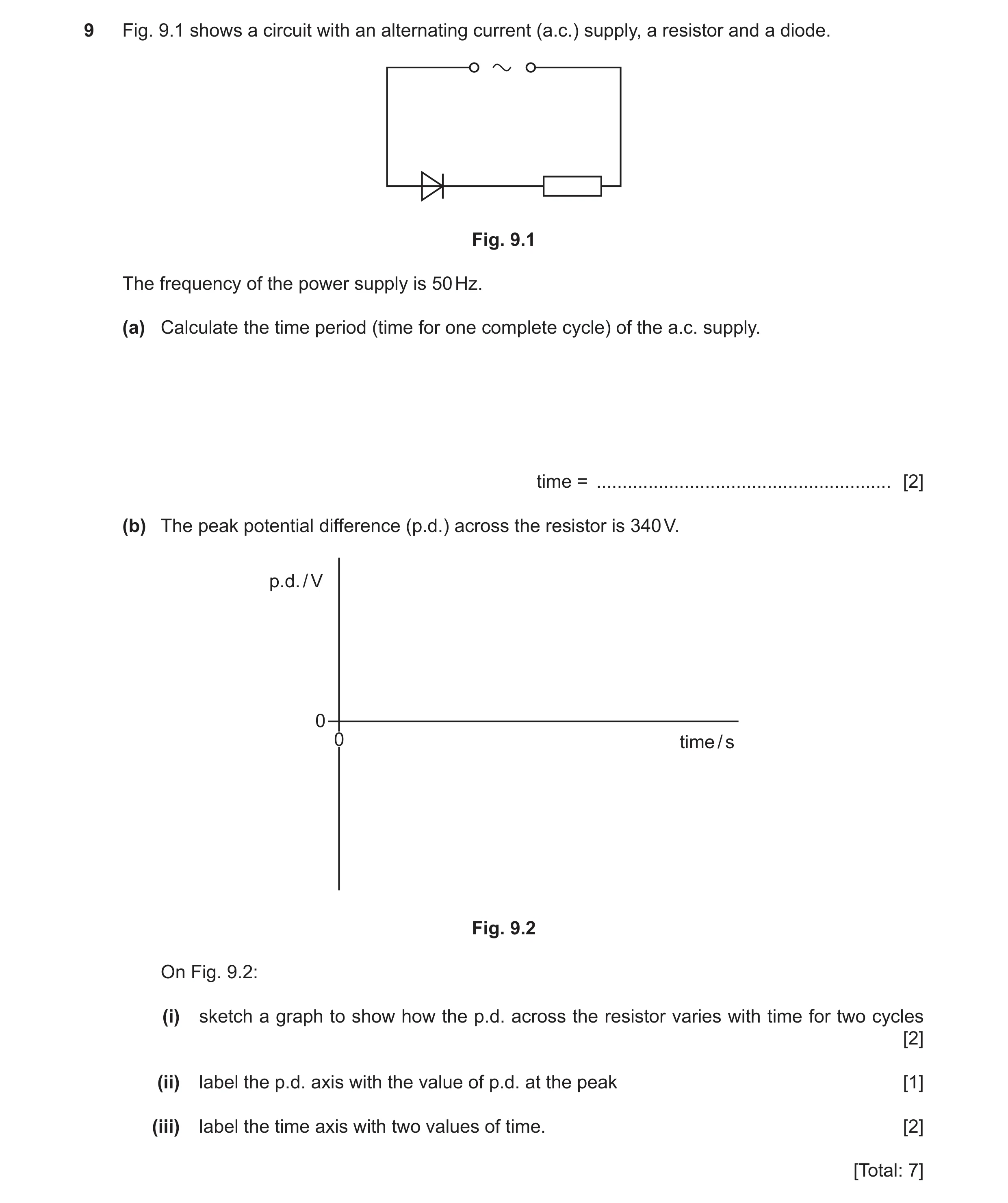
9 Fig. 9.1 shows a circuit with an alternating current (a.c.) supply, a resistor and a diode. Fig. 9.1 The frequency of the power supply is 50 Hz. (a) Calculate the time period (time for one complete cycle) of the a.c. supply. time = … [2] (b) The peak potential difference (p.d.) across the resistor is 340 V. p.d. / V 0 0 time / s Fig. 9.2 On Fig. 9.2: (i) sketch a graph to show how the p.d. across the resistor varies with time for two cycles [2] (ii) label the p.d. axis with the value of p.d. at the peak [1] (iii) label the time axis with two values of time. [2] [Total: 7]
7 marks
Mark scheme: 9(a) 0.02 s A2 t =1 / f OR (t = )1 / f OR 1 / 50 C1 9(b)(i) correct shape shown with rectification for two cycles A2 sine shape shown (without rectification for two cycles) C1 9(b)(ii) 340 marked A1 9(b)(iii) one correct time value marked on time axis B1 a second correct time value marked on time axis B1
This question in 0625/43 Oct/Nov 2022
Q26 · A mobile phone (cell phone) network uses microwaves of frequency 1.9 × 10⁹ Hz to transmit… 0625/41 May/June 2023
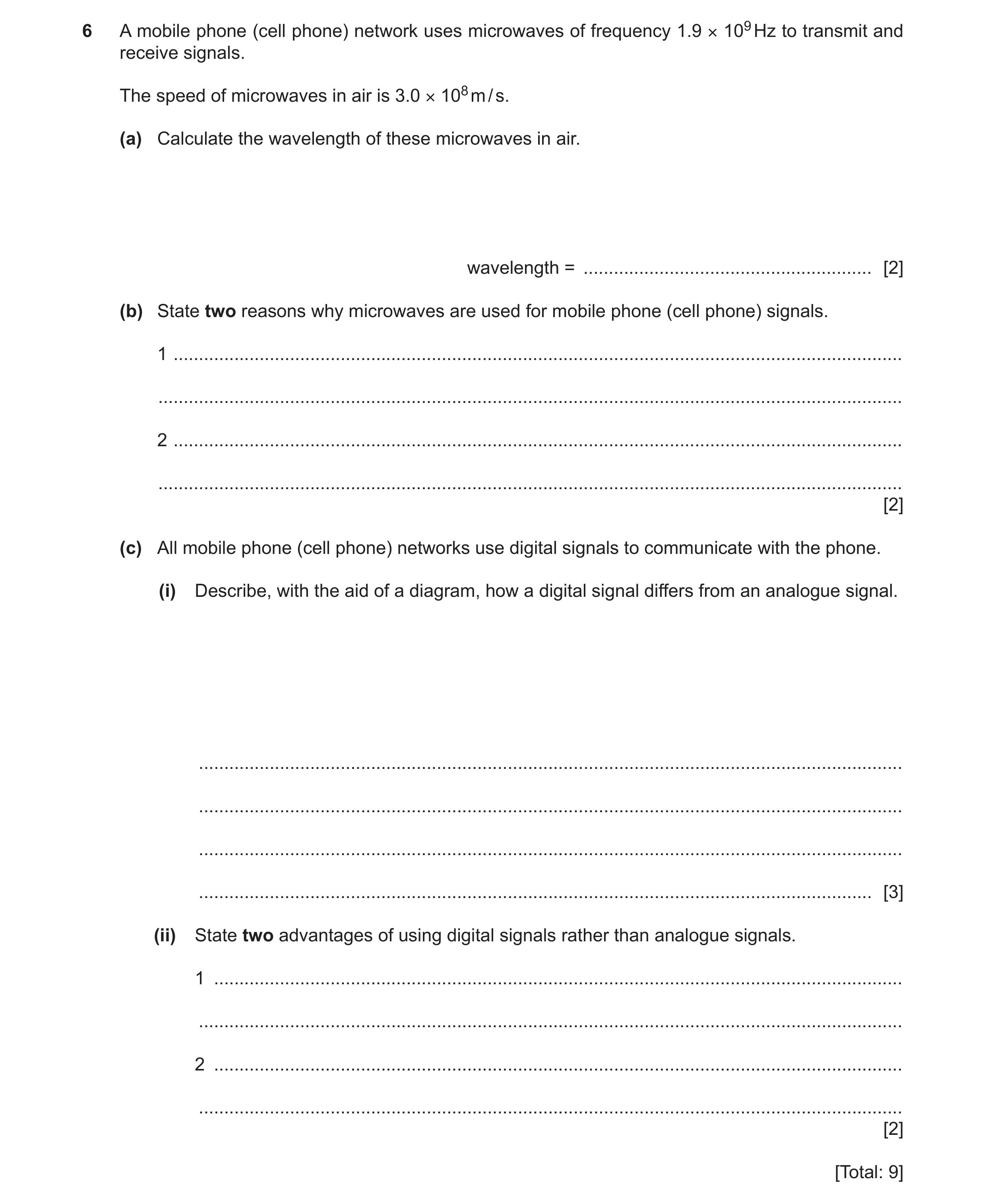
6 A mobile phone (cell phone) network uses microwaves of frequency 1.9 × 10⁹ Hz to transmit and receive signals. The speed of microwaves in air is 3.0 × 10⁸ m / s. (a) Calculate the wavelength of these microwaves in air. wavelength = … [2] (b) State two reasons why microwaves are used for mobile phone (cell phone) signals. 1 … … 2 … … [2] (c) All mobile phone (cell phone) networks use digital signals to communicate with the phone. (i) Describe, with the aid of a diagram, how a digital signal differs from an analogue signal. … … … … [3] (ii) State two advantages of using digital signals rather than analogue signals. 1 … … 2 … … [2] [Total: 9]
9 marks
Mark scheme: 6(a) (wavelength =) 0.16 m A2 v = f OR ( =) v / f OR ( =) 3 108 / 1.9 109 C1 6(b) (microwaves) only need short aerials / antennas B1 (microwaves) penetrate (some) walls B1 Question Answer Marks 6(c)(i) labelled diagram of digital (signal) with blocks of high (1) and low (0) AND labelled diagram of analogue with continuously variable signal B1 digital (signal) consists of two values owtte B1 analogue (signal) varies over a range (of values) owtte B1 6(c)(ii) any two from: faster (data) transmission rate OR data can be compressed data / signal transmitted over long(er) distances (as signal can be regenerated) noise easily removed (from signal / data) OR signal can be regenerated B2
This question in 0625/41 May/June 2023
Q27 · Two types of seismic waves are P-waves and S-waves 0625/42 May/June 2023
6 Two types of seismic waves are P-waves and S-waves. (a) State the types of wave that P-waves and S-waves can be modelled as. P-waves … S-waves … [2] (b) The velocity of a P-wave in the Earth’s solid crust is 7.2 km / s and its frequency is 4.5 Hz. Calculate the wavelength of this P-wave. wavelength = … [3] [Total: 5]
5 marks
Mark scheme: 6(a) P-waves: longitudinal B1 S-waves: transverse B1 6(b) 1600 m OR 1.6 km A3 v = f OR ( =) v / f C1 ( =) [7.2 1000] / 4.5 OR ( =) 1.6 10N OR ( =) 7.2 / 4.5 C1
This question in 0625/42 May/June 2023
Q28 · Some uses of electromagnetic radiation and different regions of the electromagnetic… 0625/42 Oct/Nov 2023
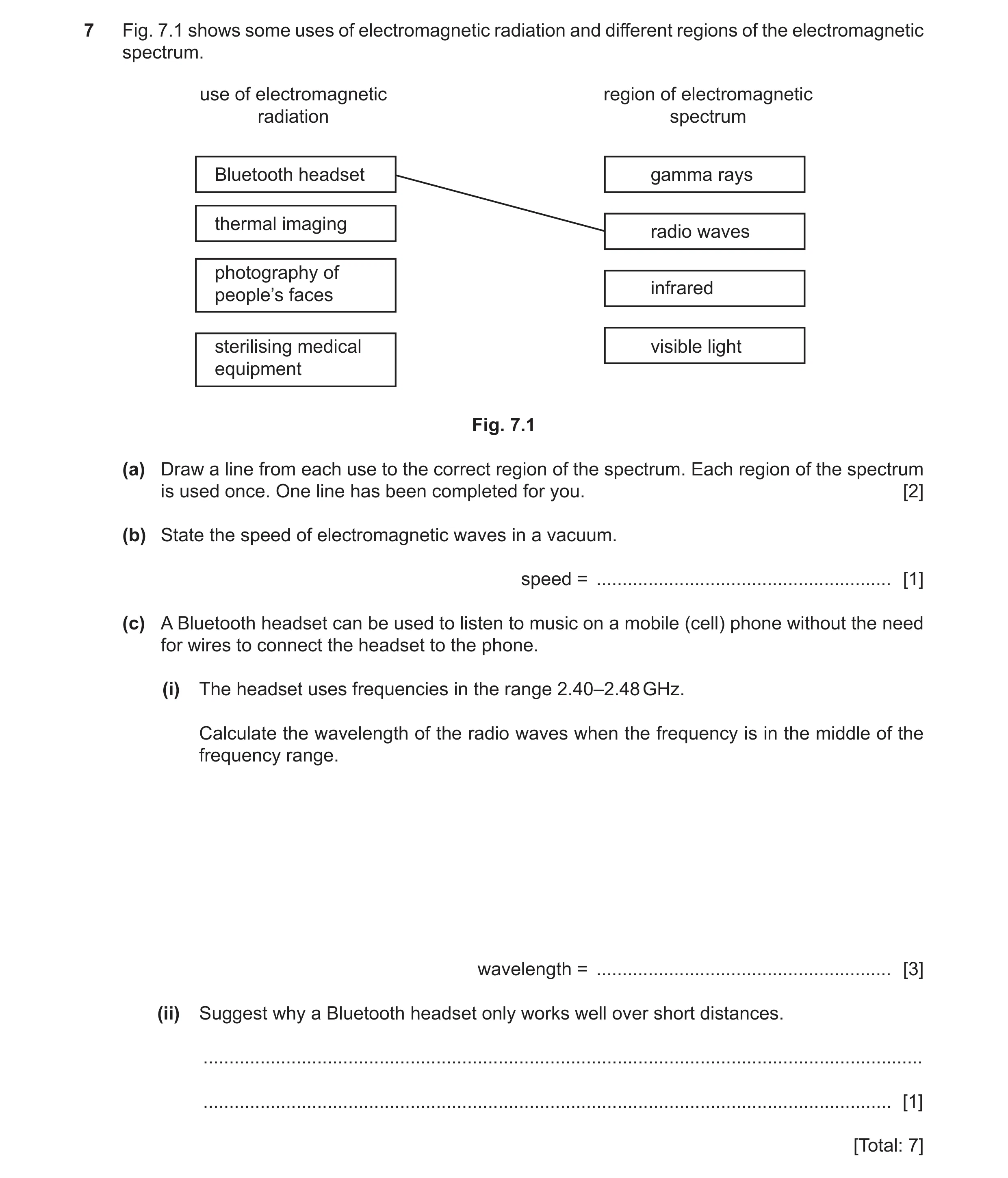
7 Fig. 7.1 shows some uses of electromagnetic radiation and different regions of the electromagnetic spectrum. use of electromagnetic region of electromagnetic radiation spectrum Bluetooth headset gamma rays thermal imaging radio waves photography of infrared people’s faces sterilising medical visible light equipment Fig. 7.1 (a) Draw a line from each use to the correct region of the spectrum. Each region of the spectrum is used once. One line has been completed for you. [2] (b) State the speed of electromagnetic waves in a vacuum. speed = … [1] (c) A Bluetooth headset can be used to listen to music on a mobile (cell) phone without the need for wires to connect the headset to the phone. (i) The headset uses frequencies in the range 2.40–2.48 GHz. Calculate the wavelength of the radio waves when the frequency is in the middle of the frequency range. wavelength = … [3] (ii) Suggest why a Bluetooth headset only works well over short distances. … … [1] [Total: 7]
7 marks
Mark scheme: 7(a) B2 all correct 2 marks 1 or 2 correct 1 mark 7(b) 3.0 108 m / s B1 7(c)(i) 0.12 m A3 (mid-point of frequency range identified as) 2.44 (GHz) C1 v = fOR (=) v / f OR (=) 3.0 108 / 2.44 109 OR (=) 1.2 10N C1 7(c)(ii) (radio waves / signal) lose energy / get weaker / lose (signal) strength (passing through walls) owtte B1
This question in 0625/42 Oct/Nov 2023
Q29 · Applications of regions of the electromagnetic spectrum 0625/42 Feb/March 2024
5 (a) (i) Table 5.1 shows applications of regions of the electromagnetic spectrum. Complete the second column of the table with the region of the electromagnetic spectrum used for each application. Choose from the regions in this list: gamma rays infrared microwaves radio waves ultraviolet Each region may be used once, more than once or not at all. Table 5.1 application region of electromagnetic spectrum cancer treatment gamma rays Bluetooth data connection optical fibres security marking sterilising food wireless internet [3] (ii) State the approximate speed of radio waves in air. speed = … m / s [1] (b) Fig. 5.1 shows successive crests of a wave after a plane wave has passed through a gap. Fig. 5.1 (i) On Fig. 5.1 draw three successive crests before the wave reaches the gap. [2] (ii) Fig. 5.2 shows a much wider gap. A plane wave of the same wavelength as in (b)(i) is incident on the gap from the left side of the barrier. Fig. 5.2 On Fig. 5.2, draw three successive crests of the wave after the wave has passed through the gap. [2] [Total: 8]
8 marks
Mark scheme: 5(a)(i) B3 application region of electromagnetic spectrum cancer treatment gamma rays bluetooth radio waves optical fibres infrared security marking ultraviolet sterilising food gamma rays wireless internet Microwaves 5(a)(ii) 3.0 108 (m / s) OR 300 000 000 (m / s) B1 5(b)(i) three crests parallel to the barrier B1 same wavelength as wave after the gap B1 5(b)(ii) central part of crest (parallel to the (gap in the) barrier) is straight B1 crests have curved ends B1
This question in 0625/42 Feb/March 2024
Q30 · Describe how a longitudinal wave differs from a transverse wave 0625/41 May/June 2024
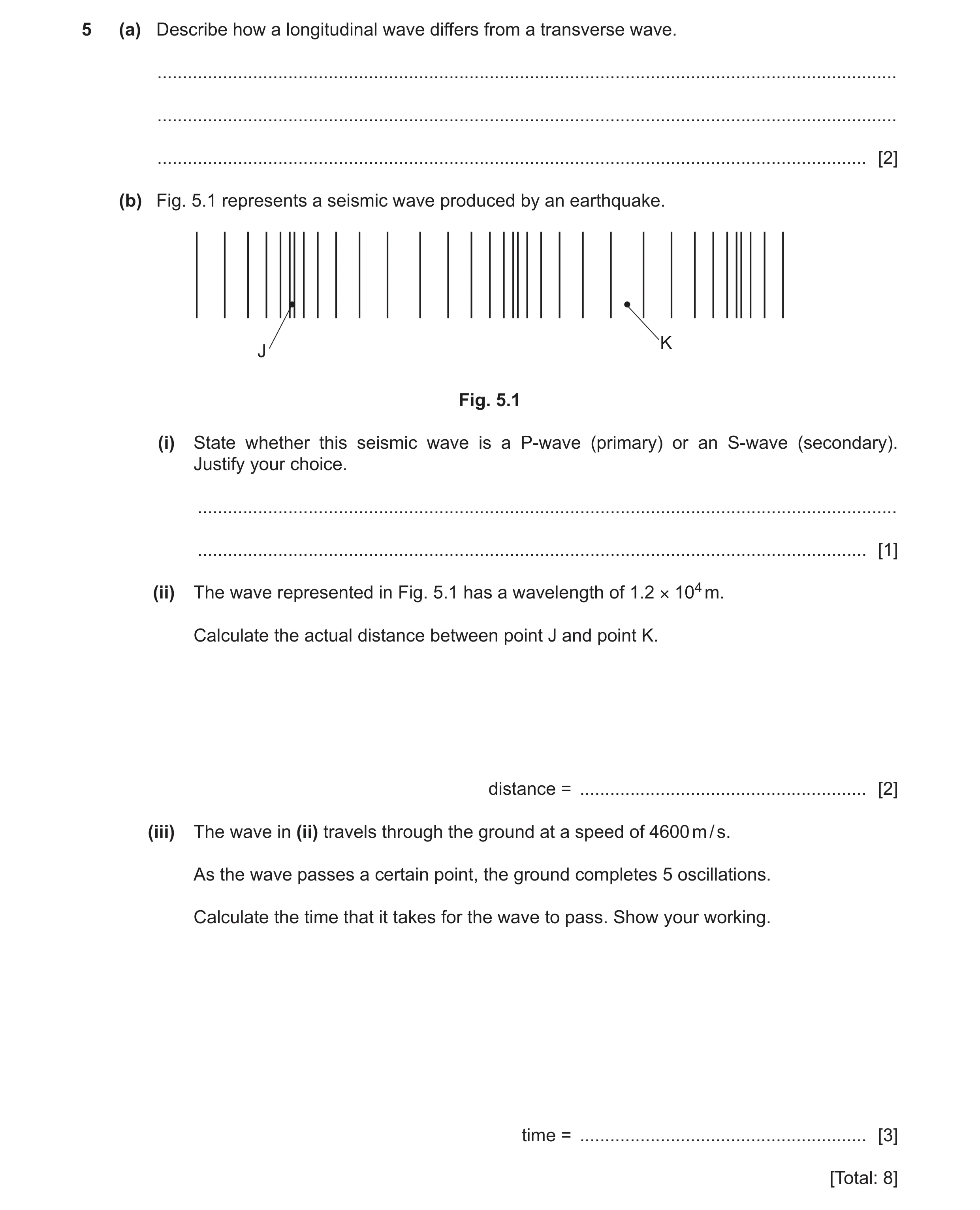
5 (a) Describe how a longitudinal wave differs from a transverse wave. … … … [2] (b) Fig. 5.1 represents a seismic wave produced by an earthquake. K J Fig. 5.1 (i) State whether this seismic wave is a P-wave (primary) or an S-wave (secondary). Justify your choice. … … [1] (ii) The wave represented in Fig. 5.1 has a wavelength of 1.2 × 10⁴ m. Calculate the actual distance between point J and point K. distance = … [2] (iii) The wave in (ii) travels through the ground at a speed of 4600 m / s. As the wave passes a certain point, the ground completes 5 oscillations. Calculate the time that it takes for the wave to pass. Show your working. time = … [3] [Total: 8]
8 marks
Mark scheme: 5(a) any two from: (longitudinal) vibration / oscillation in wave parallel to propagation direction / direction of travel transverse wave vibrates / oscillates perpendicular to propagation direction / direction of travel (longitudinal) consists of compressions and rarefactions transverse wave consists of crests / peaks and troughs (longitudinal) needs a medium (to travel) B2 5(b)(i) P-wave AND it is longitudinal B1 5(b)(ii) 1.8 104 m OR 18 km A2 1.5OR 1.5 1.2 104 OR 1.8 10N C1 5(b)(iii) v = f OR v= / t OR (t =) / v OR f = 4 4600 / 1.2 10 OR (t / 5 =) 1.2 104 / 4600 OR (t =) 6(.0) 104 / 4600 M1 13 s A2 t = 1 / f OR (time for one wave = ) 2.6 (s) C1
This question in 0625/41 May/June 2024
Q31 · A loudspeaker produces a sound wave in air 0625/41 Oct/Nov 2024
5 A loudspeaker produces a sound wave in air. The distance between the centre of a compression and the centre of a neighbouring rarefaction is 0.10 m. (a) Calculate the wavelength of the sound wave. wavelength = … [1] (b) State a typical value for the speed of sound in air. … [1] (c) (i) Calculate the frequency of the sound from the loudspeaker. frequency = … [2] (ii) Explain whether the sound from the loudspeaker is audible to a human with normal hearing. … … [1] (d) Another loudspeaker produces a sound of wavelength 0.40 m. Sound from the loudspeaker reaches a sound absorbing surface with a gap of width 0.80 m at the centre. Fig. 5.1 shows the arrangement. J gap 0.80 m loudspeaker K sound absorbing surface Fig. 5.1 Explain whether it is possible to detect sound from the loudspeaker at either point J or at point K. point J … … … point K … … … [4] [Total: 9]
9 marks
Mark scheme: 5(a) 0.20 m B1 5(b) any value in range from 330 m / s ⩽ value ⩽ 350 m / s B1 5(c)(i) (b) (a) evaluated AND Hz A2 f = v / OR (f = ) v / OR (b) (a) C1 5(c)(ii) audible/yes/it is OR inaudible / no / it isn’t consistent with value in 5(c)(i) B1 AND consistent explanation with reference to 20 (Hz) ⩽ normal range of human hearing ⩽ 20 000 (Hz) 5(d) 1 (explanation mentions) diffraction M1 2 Only a little diffraction owtte A1 3 (because) gap width large (compared to wavelength) owtte A1 4 Little / no sound heard at J AND (some) sound heard at K A1
This question in 0625/41 Oct/Nov 2024
Q32 · A diagram of a transverse wave 0625/43 Oct/Nov 2024
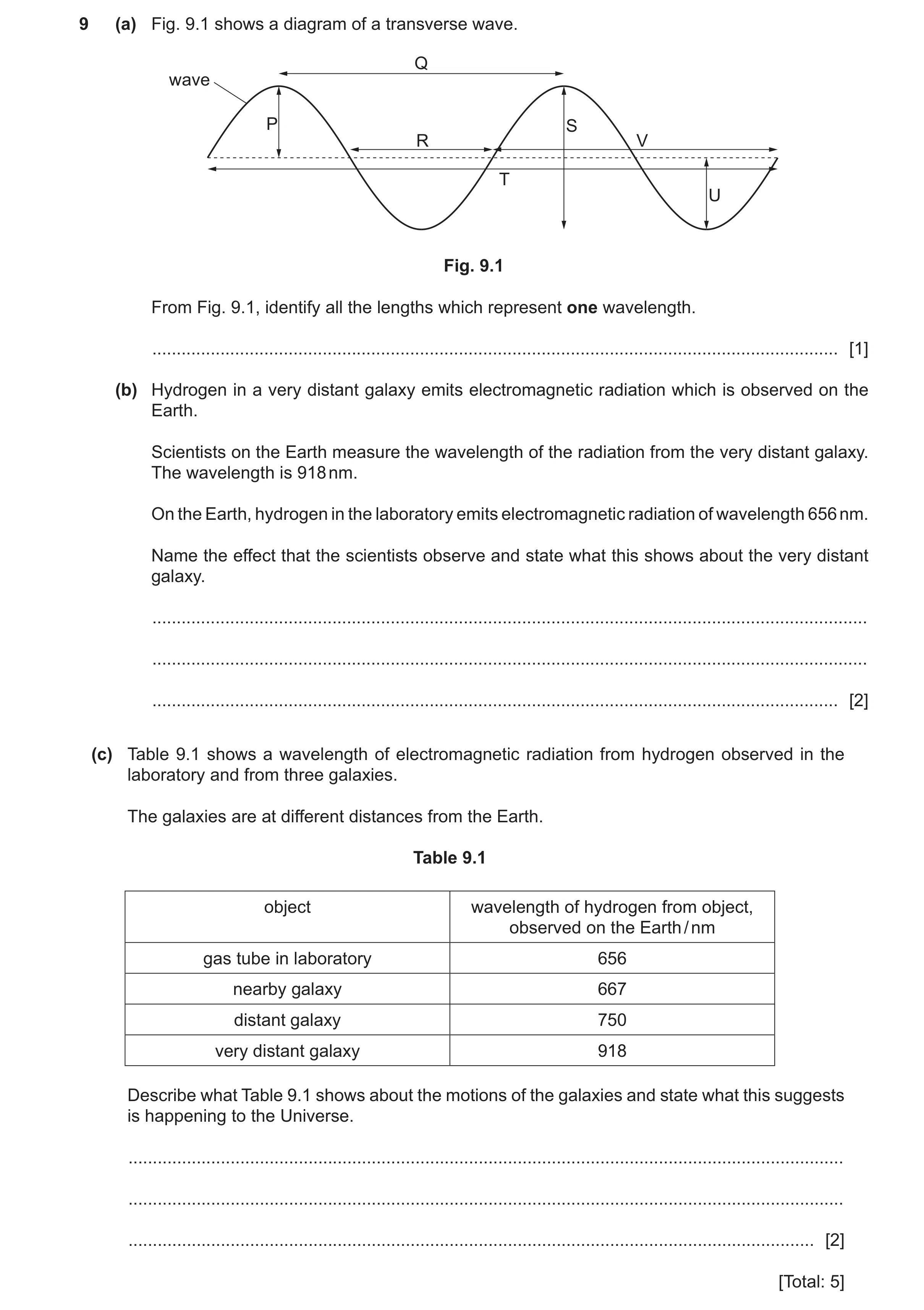
9 (a) Fig. 9.1 shows a diagram of a transverse wave. Q wave P S R V T U Fig. 9.1 From Fig. 9.1, identify all the lengths which represent one wavelength. … [1] (b) Hydrogen in a very distant galaxy emits electromagnetic radiation which is observed on the Earth. Scientists on the Earth measure the wavelength of the radiation from the very distant galaxy. The wavelength is 918 nm. On the Earth, hydrogen in the laboratory emits electromagnetic radiation of wavelength 656 nm. Name the effect that the scientists observe and state what this shows about the very distant galaxy. … … … [2] (c) Table 9.1 shows a wavelength of electromagnetic radiation from hydrogen observed in the laboratory and from three galaxies. The galaxies are at different distances from the Earth. Table 9.1 object wavelength of hydrogen from object, observed on the Earth / nm gas tube in laboratory 656 nearby galaxy 667 distant galaxy 750 very distant galaxy 918 Describe what Table 9.1 shows about the motions of the galaxies and state what this suggests is happening to the Universe. … … … [2] [Total: 5]
5 marks
Mark scheme: 9(a) Q and V B1 9(b) red shift B1 (galaxy) moving away / receding (from Earth/us) B1 9(c) galaxies further away (are receding) with higher speed OR galaxies further away have greater redshift B1 Universe is expanding B1
This question in 0625/43 Oct/Nov 2024
Q33 · A scale drawing of light waves approaching a narrow slit 0625/42 Feb/March 2025
7 (a) Fig. 7.1 is a scale drawing of light waves approaching a narrow slit. SCALE 1.0 cm : 4.0 × 10⁻⁷m direction of propagation of light crests of 3 successive barrier with wavefronts narrow slit Fig. 7.1 (i) Name the wave effect produced by the narrow slit. … [1] (ii) Using Fig. 7.1, determine the wavelength of the light. Give your answer to two significant figures. wavelength = … [2] (iii) On Fig. 7.1, draw three wavefronts that have passed through the narrow slit. [3] (b) A foghorn emits a sound with frequency 380 Hz. The sound is heard by a ship 2.5 km away from the foghorn. The speed of sound in air is 330 m / s. (i) Show that the wavelength of the sound is approximately 0.9 m. State any equation you use in words or symbols. [2] (ii) Calculate the time it takes for sound to travel to the ship from the foghorn. time = … [2] [Total: 10]
10 marks
Mark scheme: 7(a)(i) diffraction B1 7(a)(ii) 4.8 10–7 m OR 480 nm A2 One wavelength marked on Fig. 6.1 OR 1.2 seen C1 7(a)(iii) at least two curved wavefronts B1 three semi-circular wavefronts centred on (centre of) gap B1 wavelength is unchanged B1 7(b)(i) v = f M1 (=) 330 / 380 OR (=) 0.87 (m) A1 7(b)(ii) 7.6 s A2 v = s / t OR (t = ) s / v OR (t =) 2500 / 330 C1
This question in 0625/42 Feb/March 2025
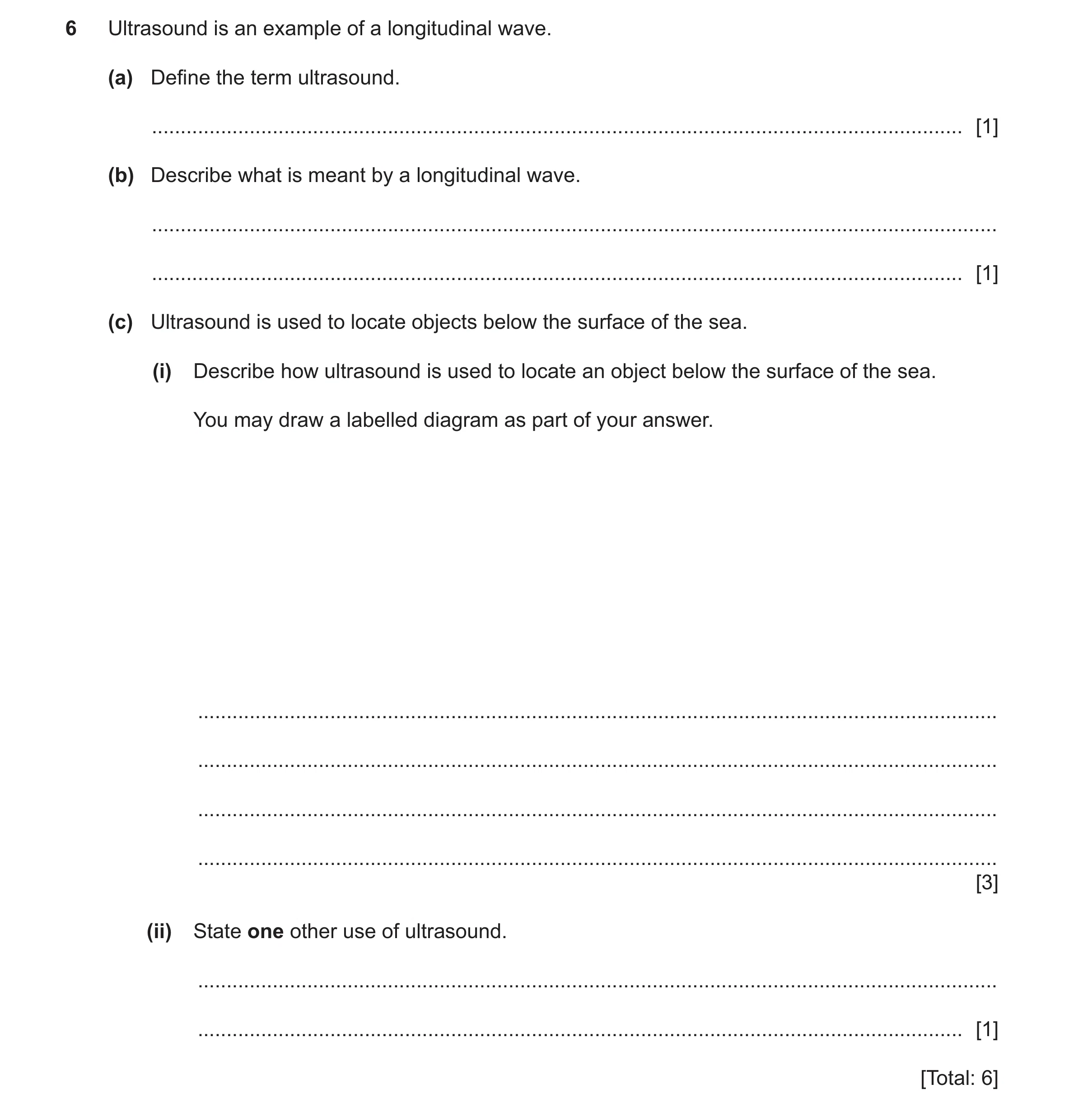
Q34 · Ultrasound is an example of a longitudinal wave 0625/43 May/June 2025
6 Ultrasound is an example of a longitudinal wave. (a) Define the term ultrasound. … [1] (b) Describe what is meant by a longitudinal wave. … … [1] (c) Ultrasound is used to locate objects below the surface of the sea. (i) Describe how ultrasound is used to locate an object below the surface of the sea. You may draw a labelled diagram as part of your answer. … … … … [3] (ii) State one other use of ultrasound. … … [1] [Total: 6]
6 marks
Mark scheme: 6(a) sound with a frequency higher than 20 kHz B1 6(b) vibrations (of the wave / particles) are parallel to the direction of propagation B1 6(c)(i) (pulse of) ultrasound / sound / wave (sent into water) reflects from object B1 time to travel to object and back measured B1 depth = speed time B1 6(c)(ii) any one from: B1 • non-destructive testing of materials • medical scanning (of soft tissue)
This question in 0625/43 May/June 2025
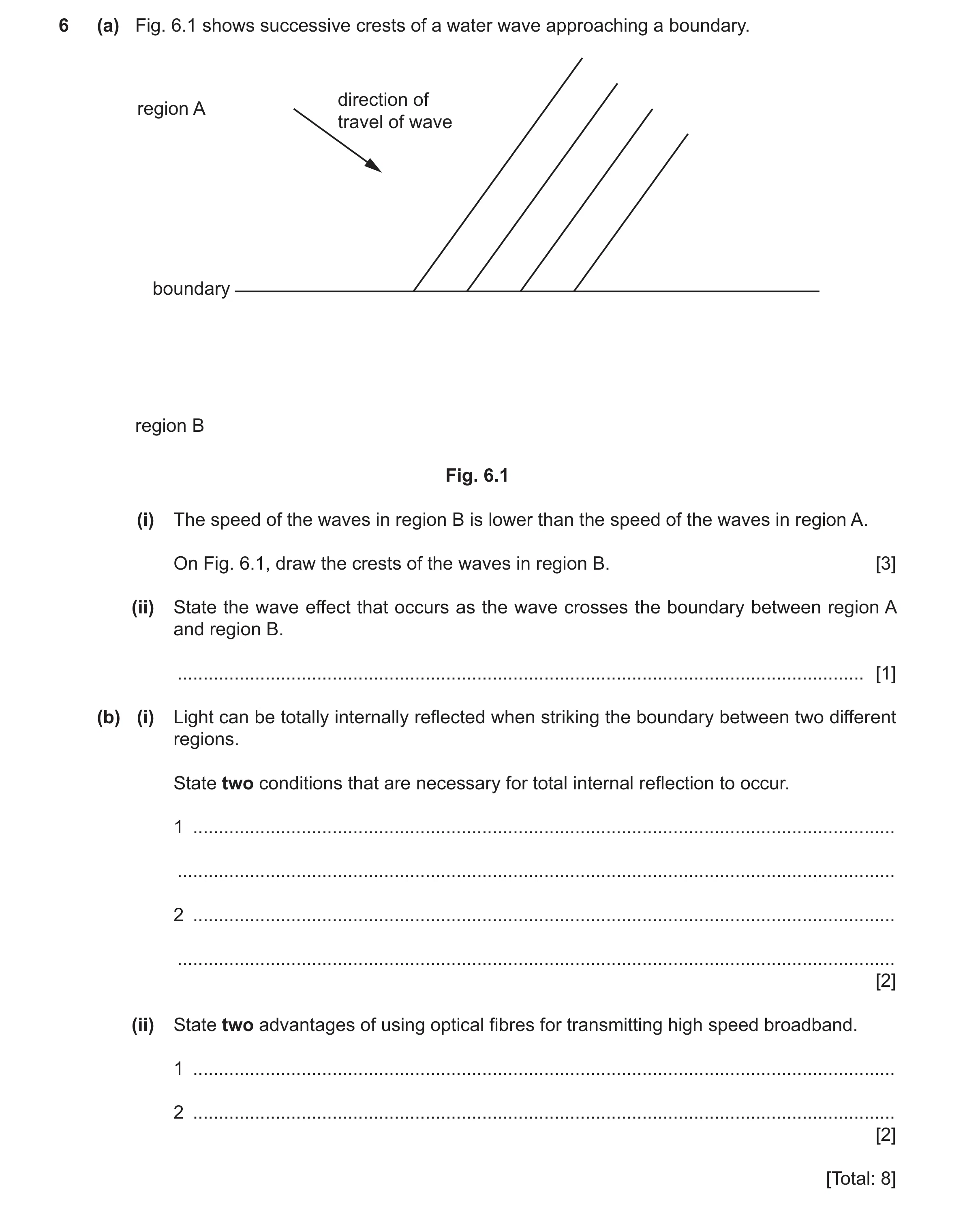
Q35 · Successive crests of a water wave approaching a boundary 0625/42 Oct/Nov 2025
6 (a) Fig. 6.1 shows successive crests of a water wave approaching a boundary. direction of region A travel of wave boundary region B Fig. 6.1 (i) The speed of the waves in region B is lower than the speed of the waves in region A. On Fig. 6.1, draw the crests of the waves in region B. [3] (ii) State the wave effect that occurs as the wave crosses the boundary between region A and region B. … [1] (b) (i) Light can be totally internally reflected when striking the boundary between two different regions. State two conditions that are necessary for total internal reflection to occur. 1 … … 2 … … [2] (ii) State two advantages of using optical fibres for transmitting high speed broadband. 1 … 2 … [2] [Total: 8]
8 marks
Mark scheme: 6(a)(i) wavefronts joined at the boundary B1 angle with the surface in region B smaller than angle with surface in region A AND slanting in correct direction B1 refracted wavefronts all parallel slanting in the correct direction AND wavelength less than incident waves B1 6(a)(ii) refraction B1 6(b)(i) speed of light in first region is less than speed of light in second region owtte B1 angle of incidence must be greater than the critical angle B1 6(b)(ii) any two from: B2 • high rates of data (transmission) • carry large amounts of data / information • secure • little data / signal loss • glass is transparent to visible light and (some) infrared
This question in 0625/42 Oct/Nov 2025
 3 / 44
 4 / 44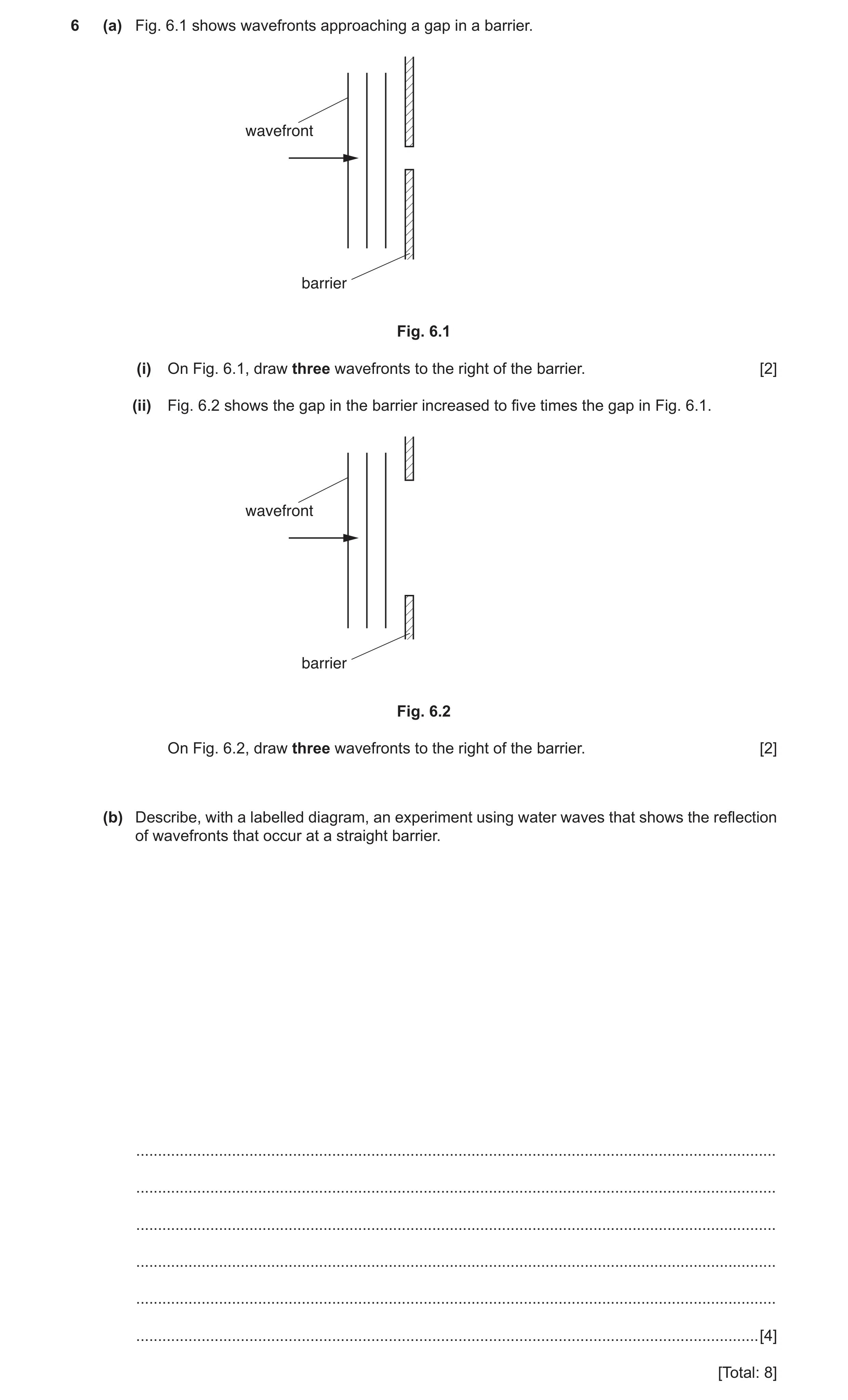
 6 / 44
 7 / 44
 8 / 44
 9 / 44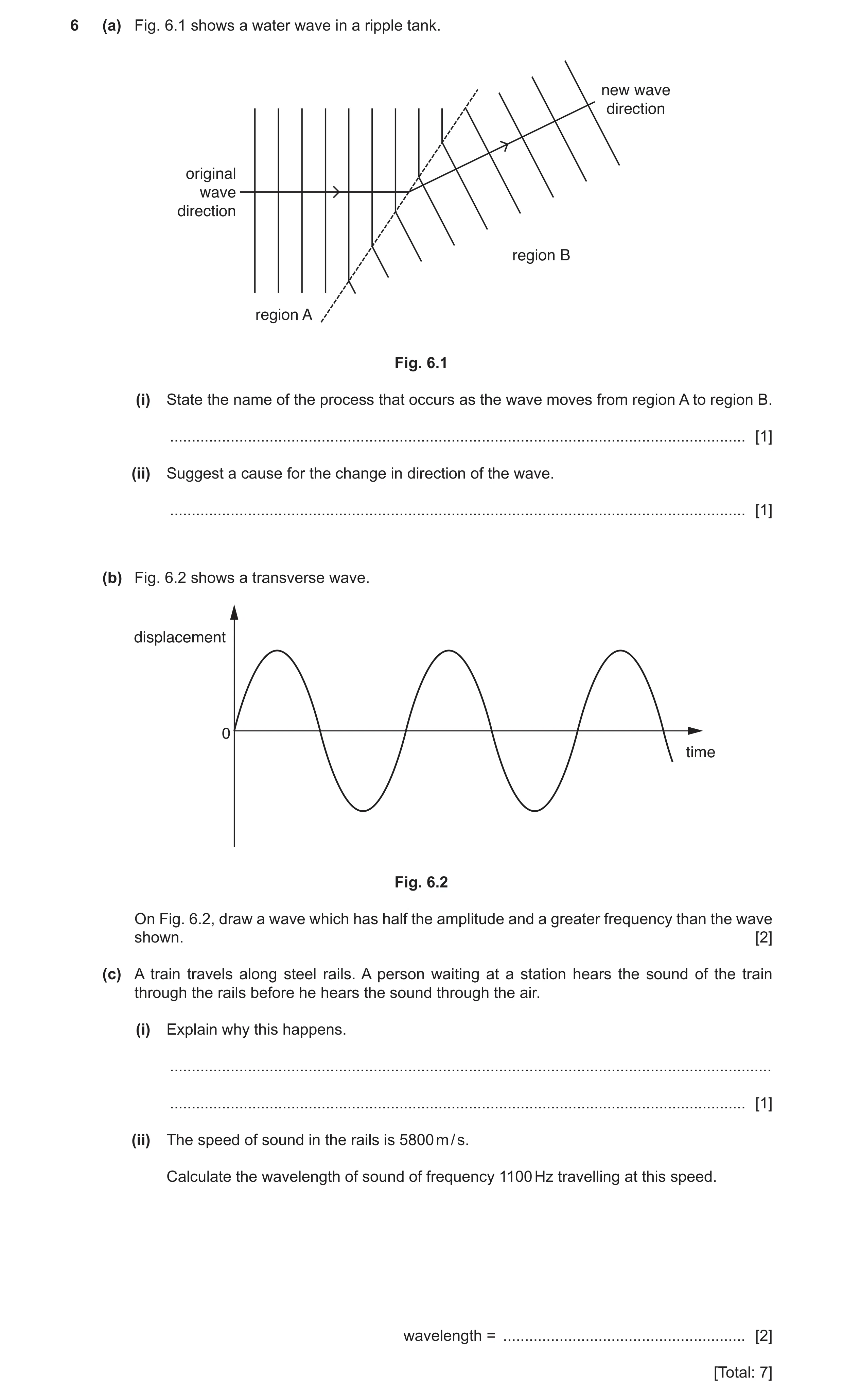
 16 / 44
 17 / 44
 18 / 44
 19 / 44
 20 / 44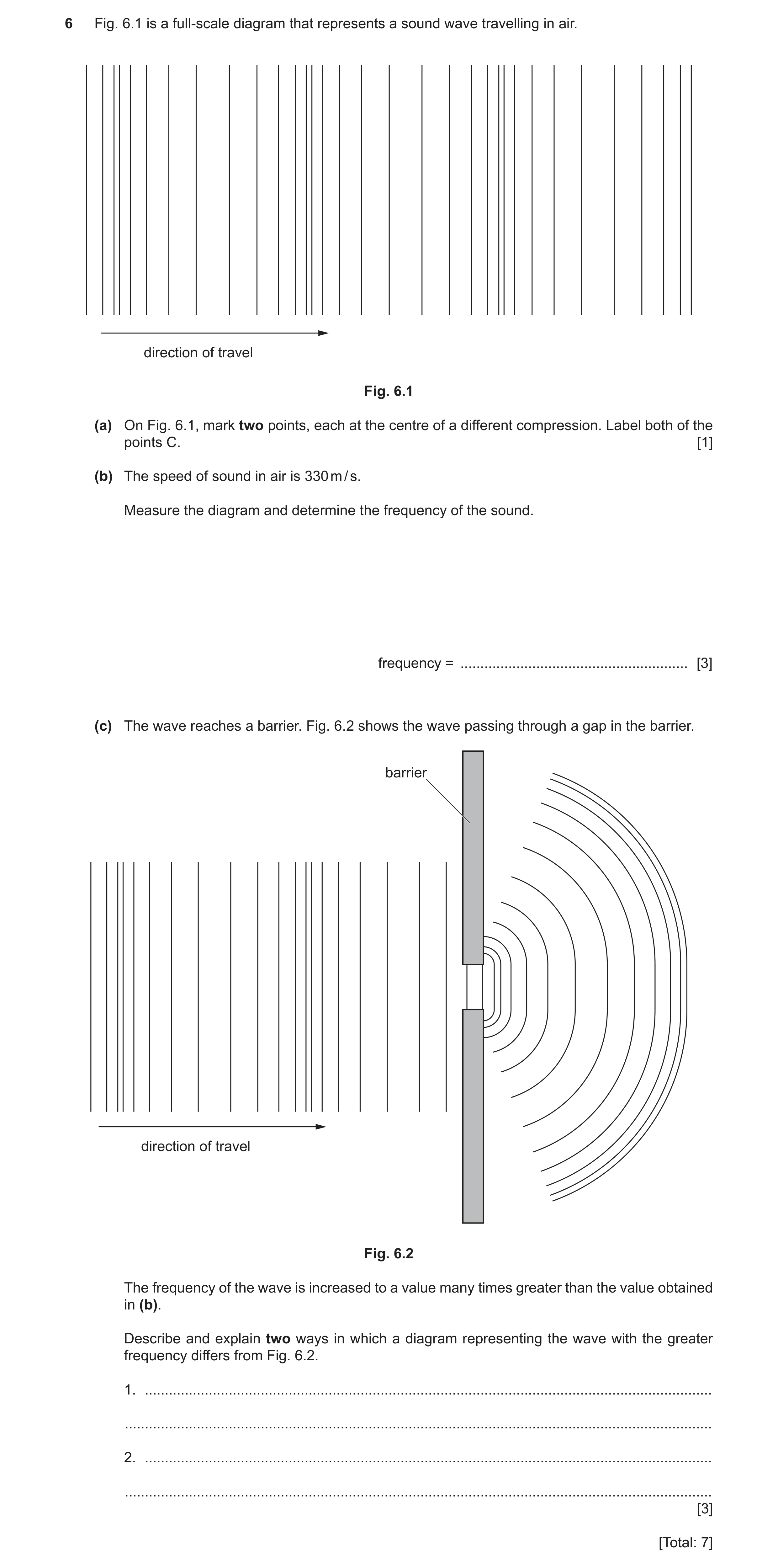
 23 / 44
 24 / 44
 25 / 44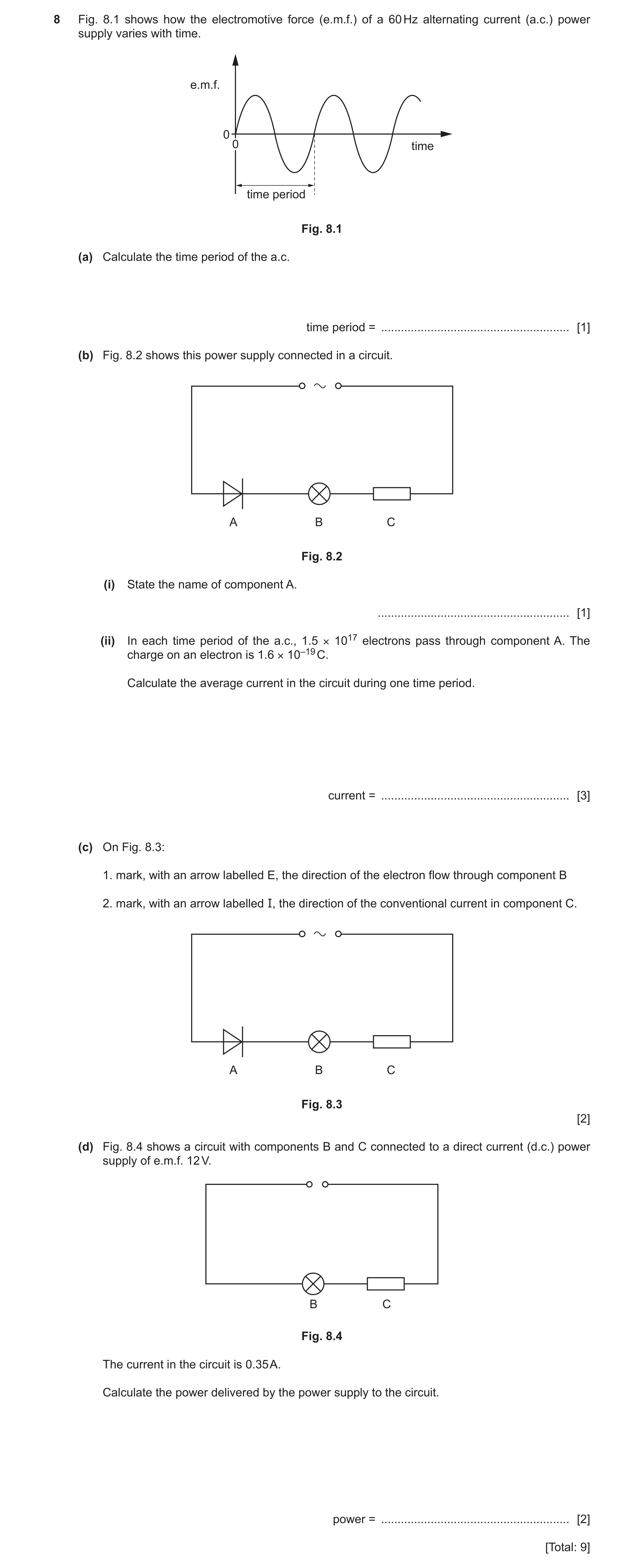
 31 / 44
 32 / 44
 33 / 44
 34 / 44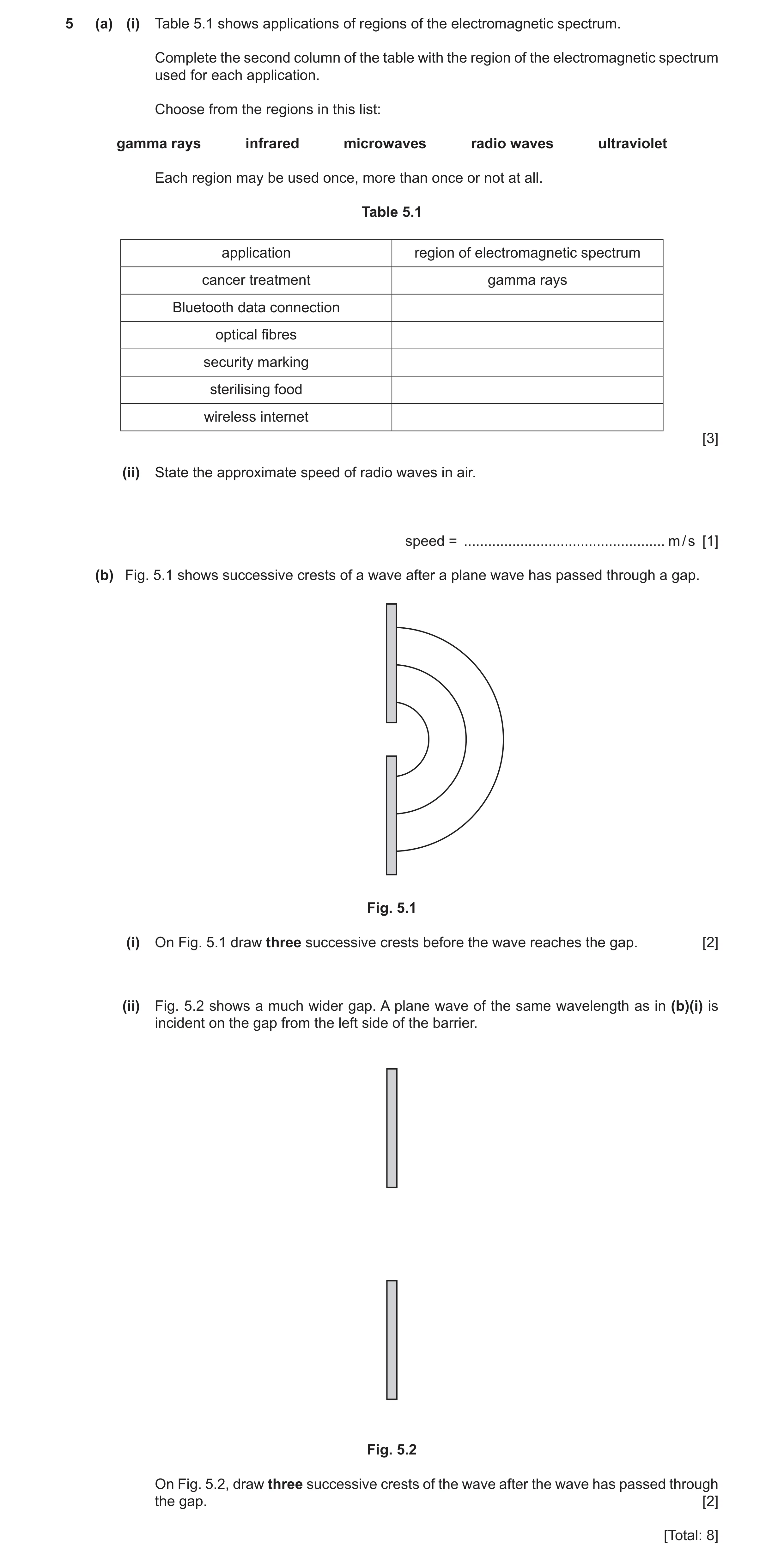
 37 / 44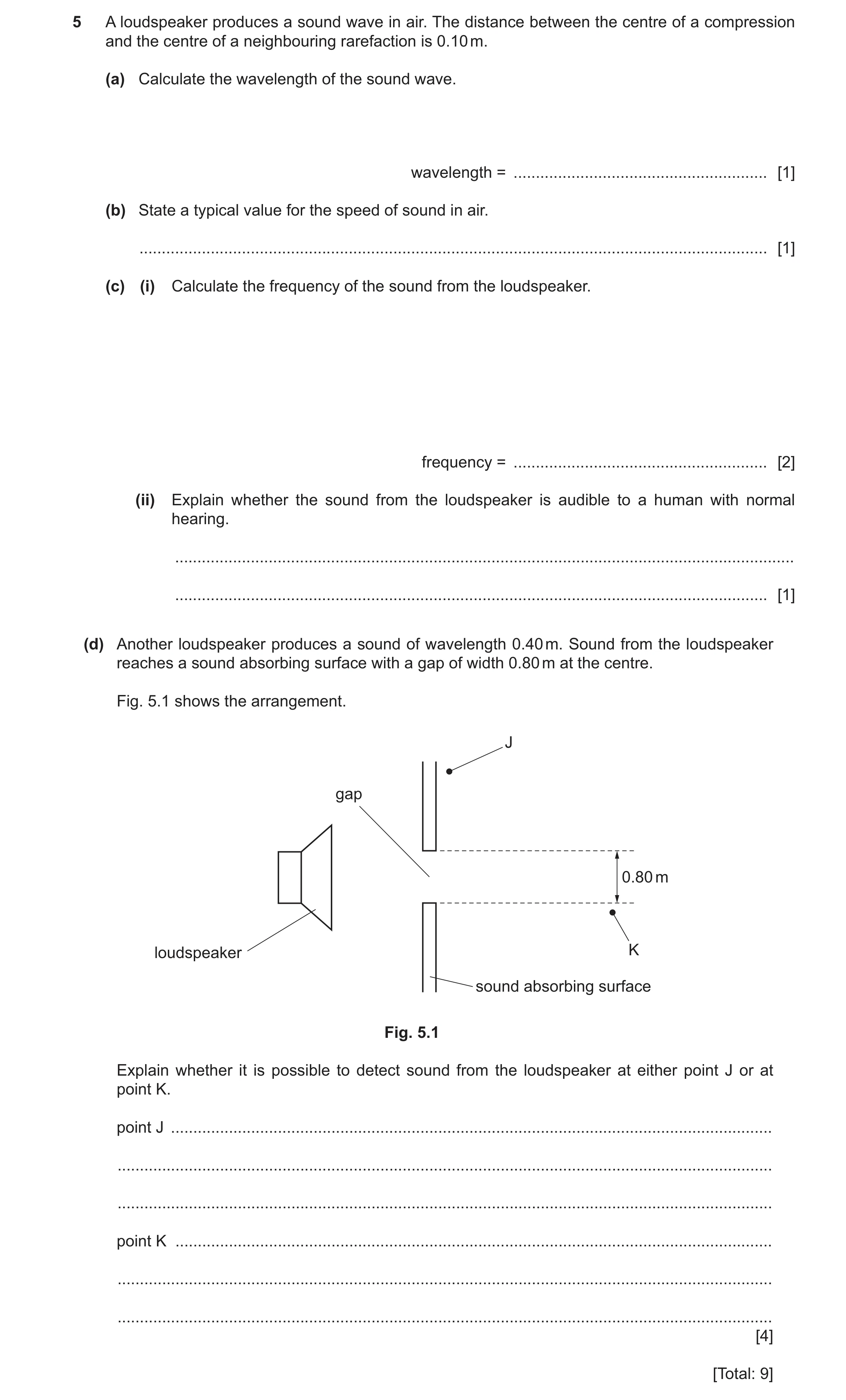
 40 / 44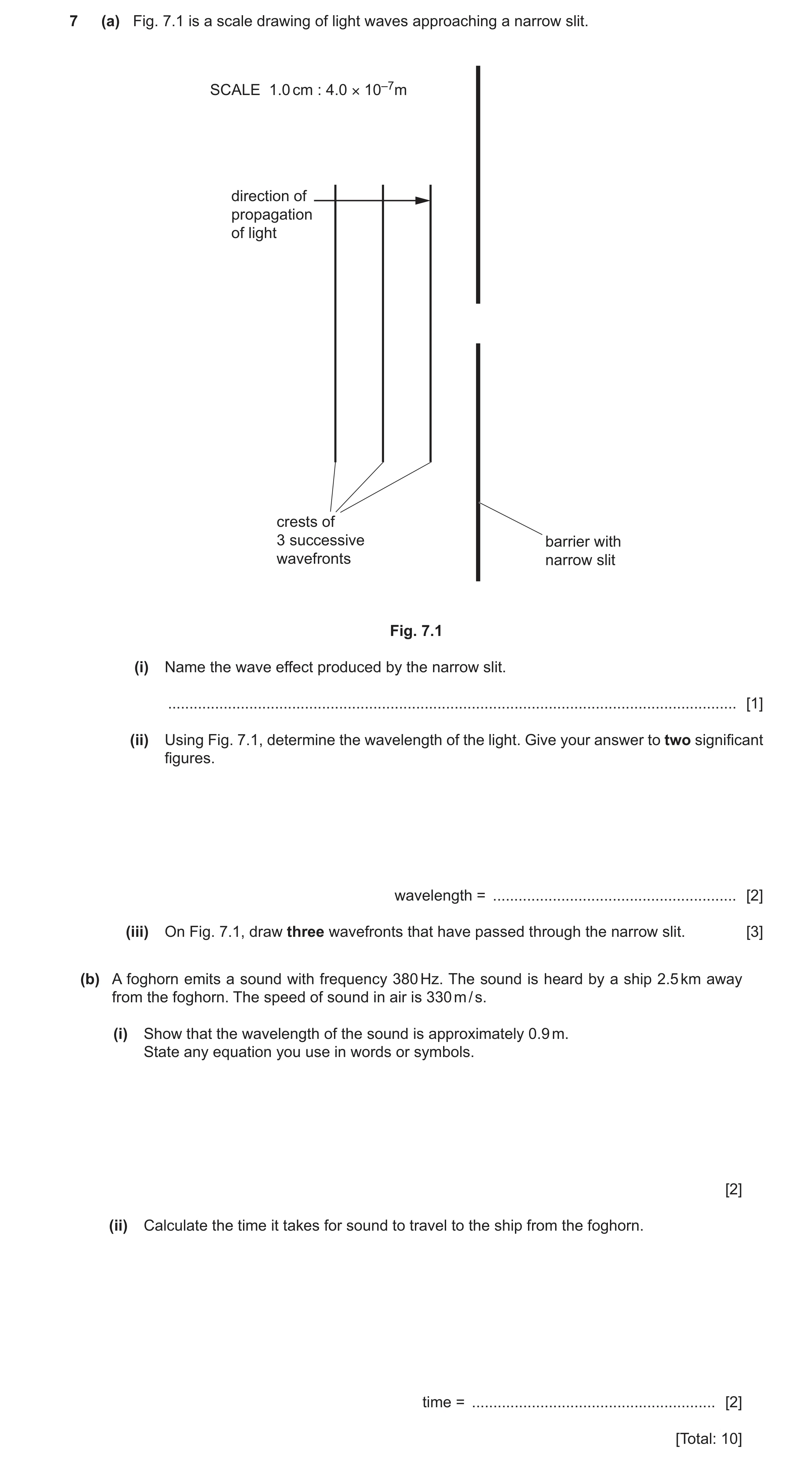
 43 / 44
 44 / 44
 8
8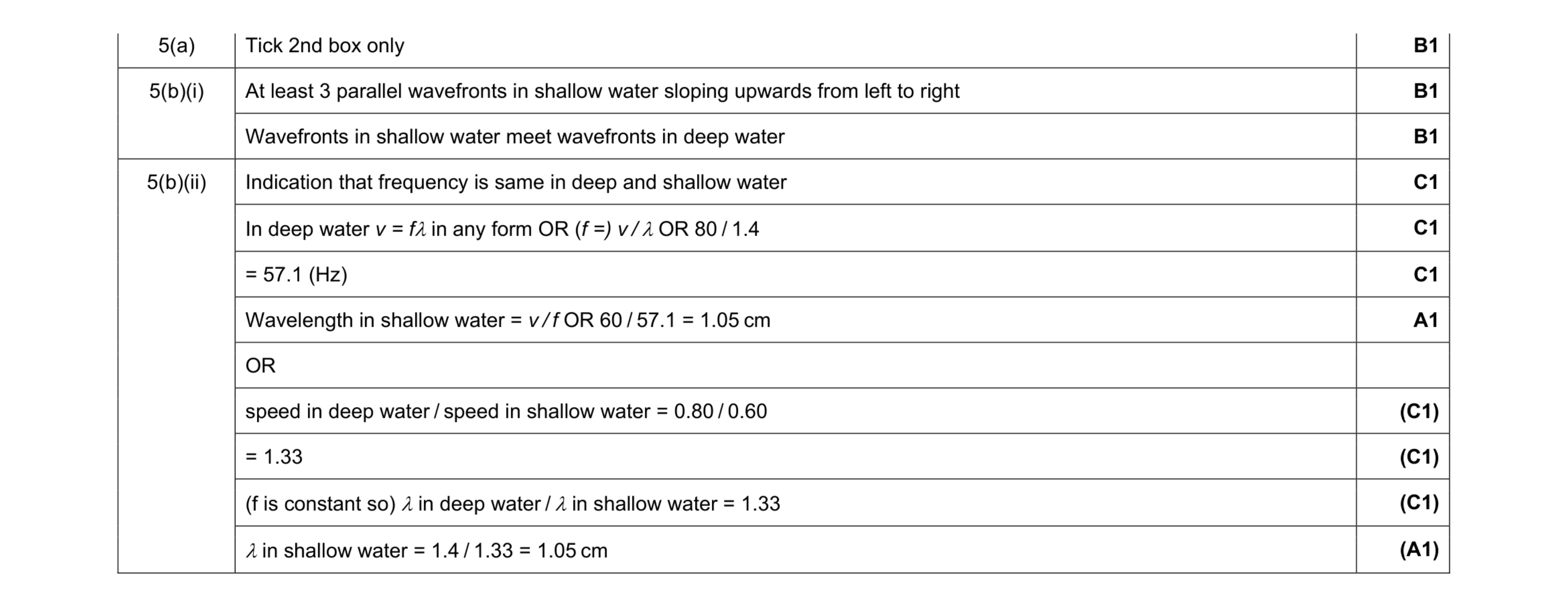 7
7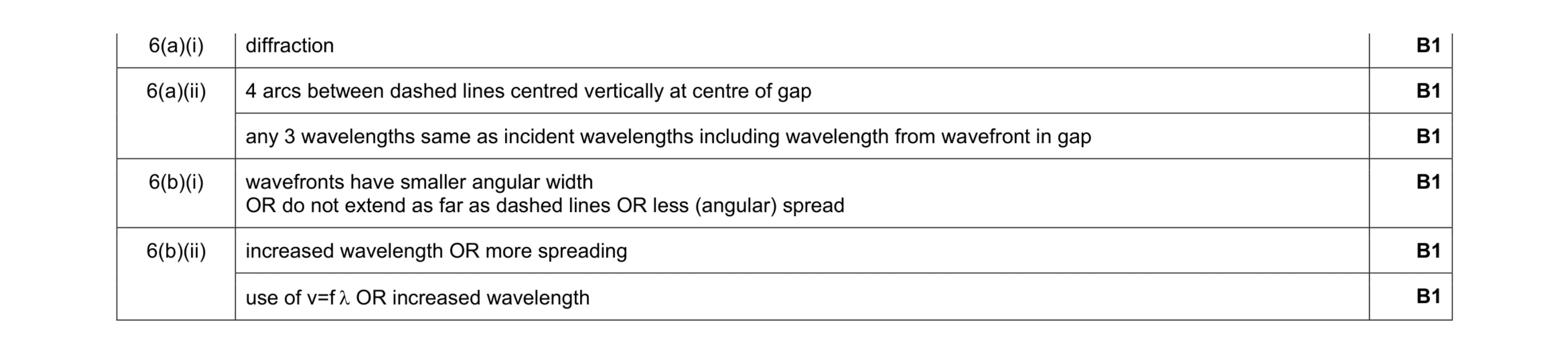 6
6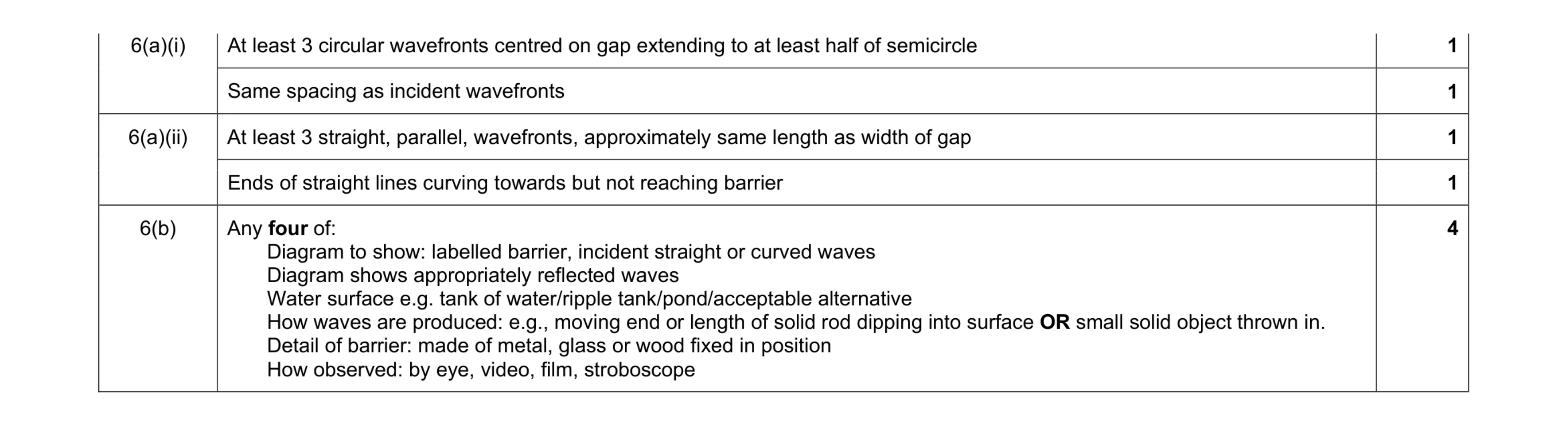 8
8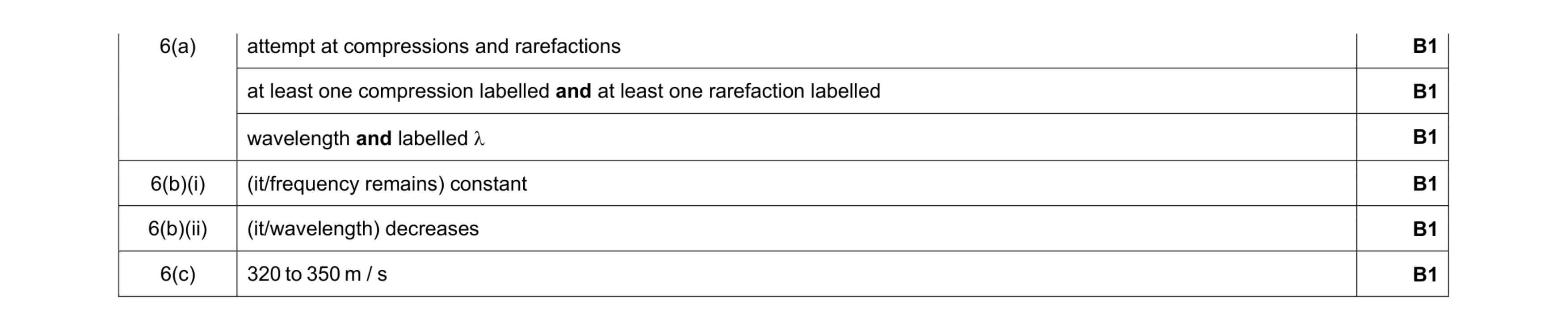 6
6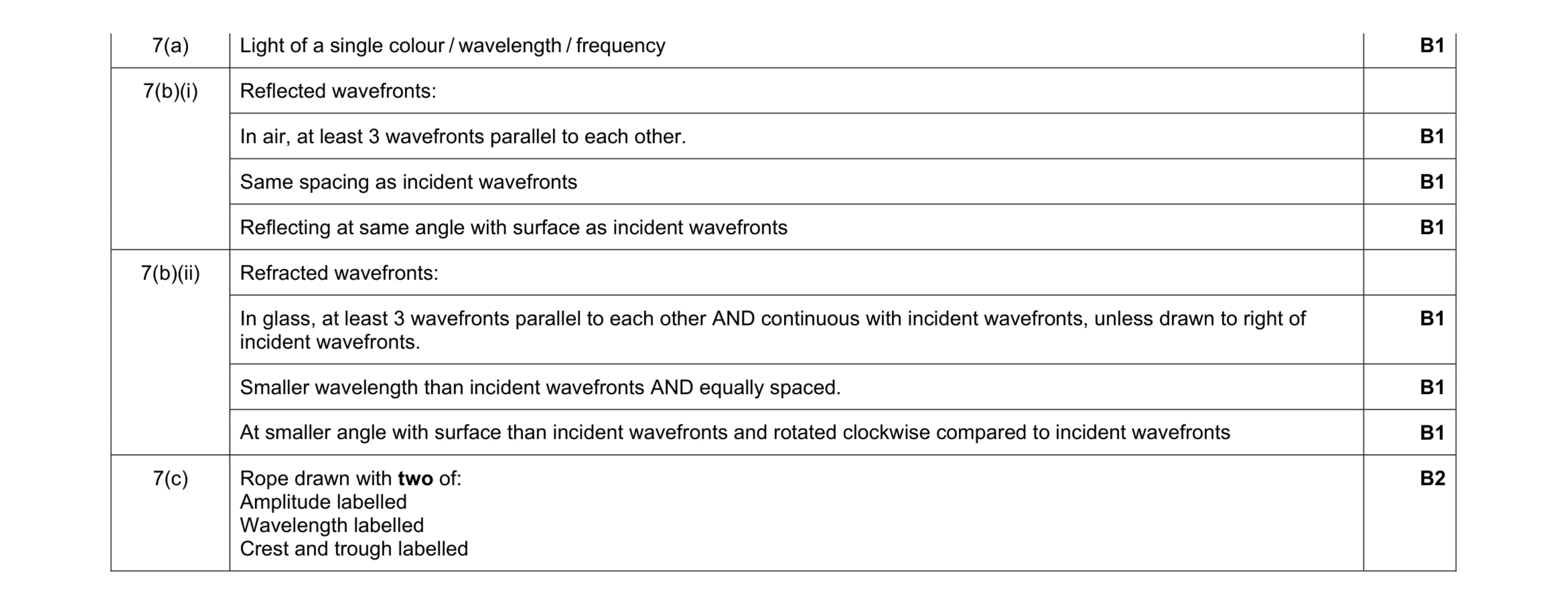 9
9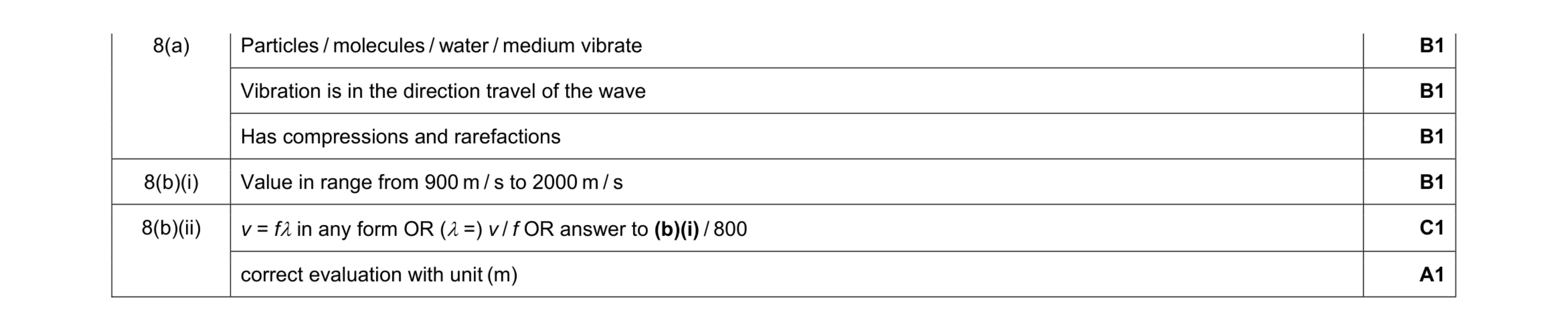 6
6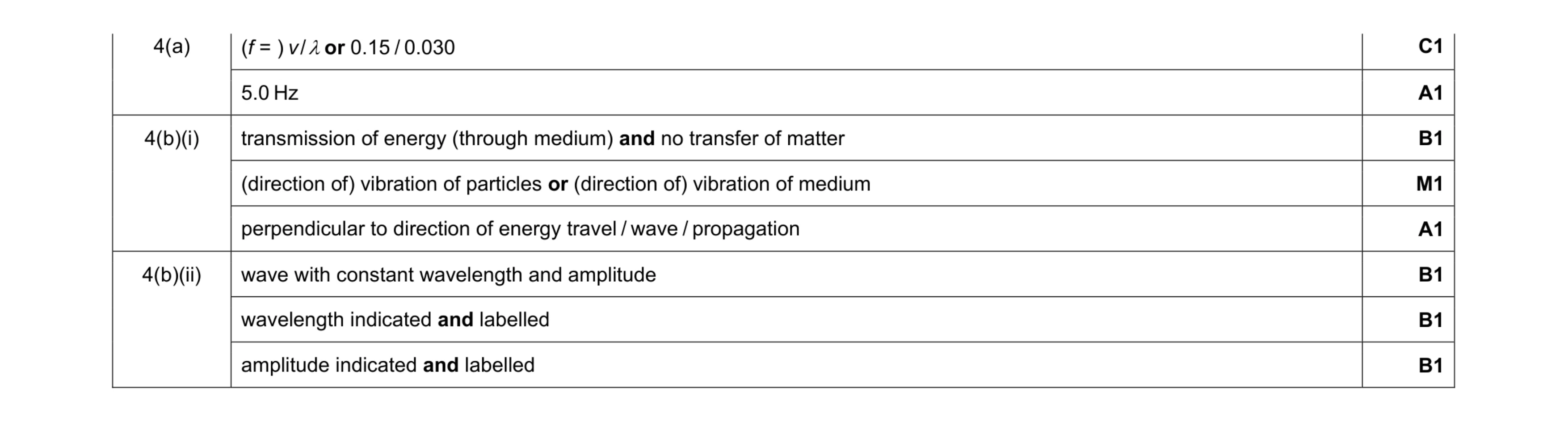 8
8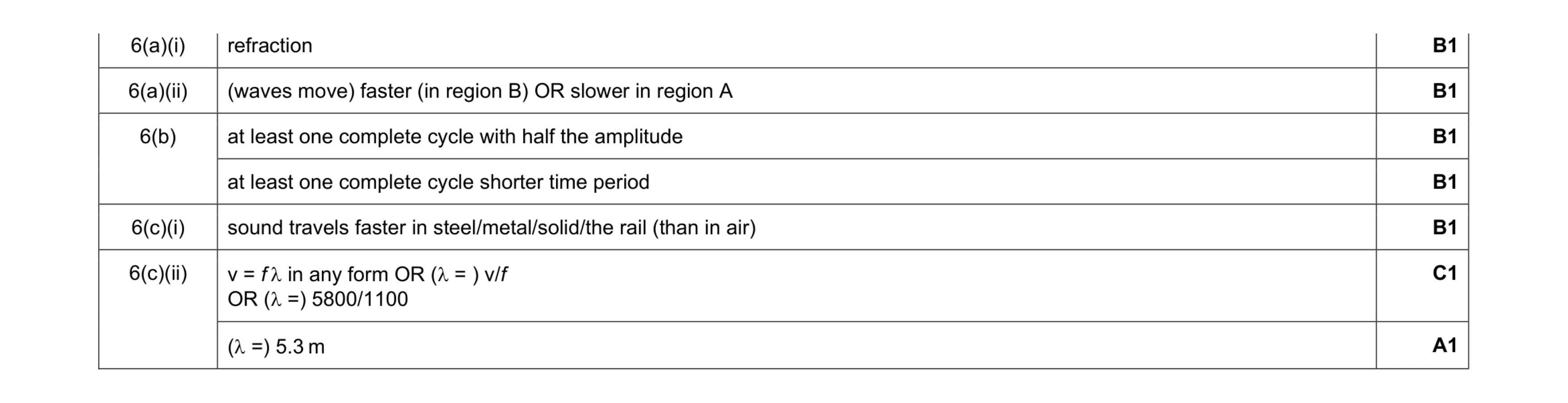 7
7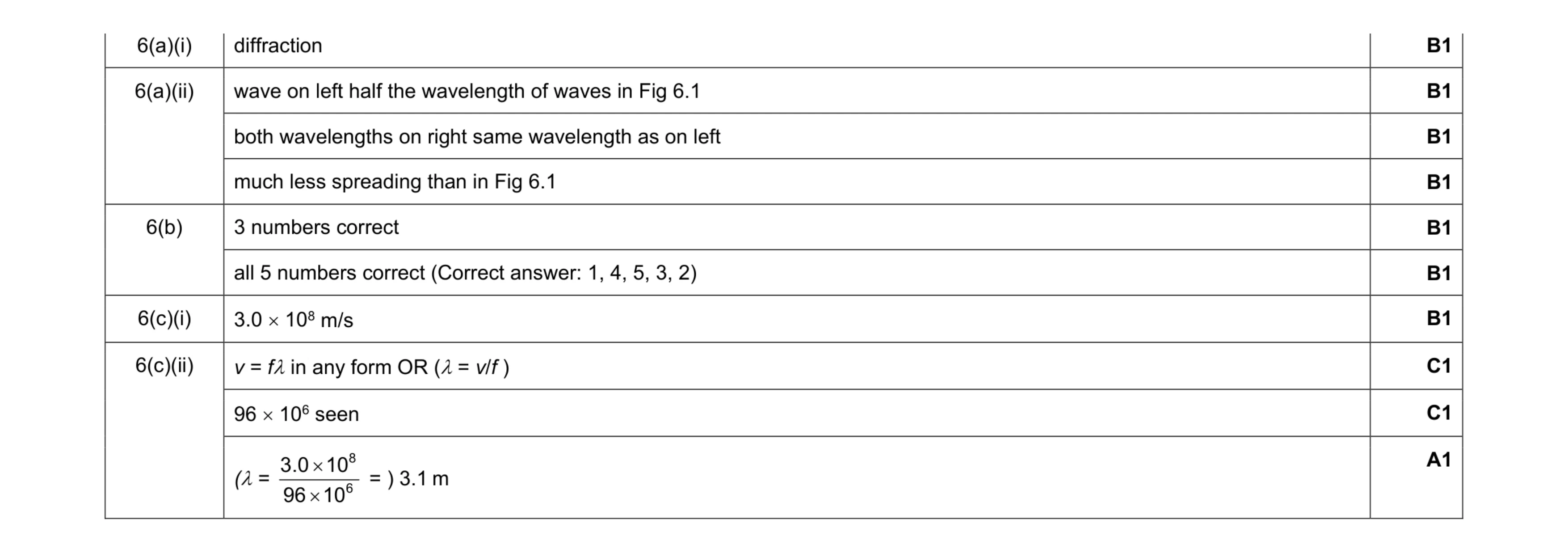 10
10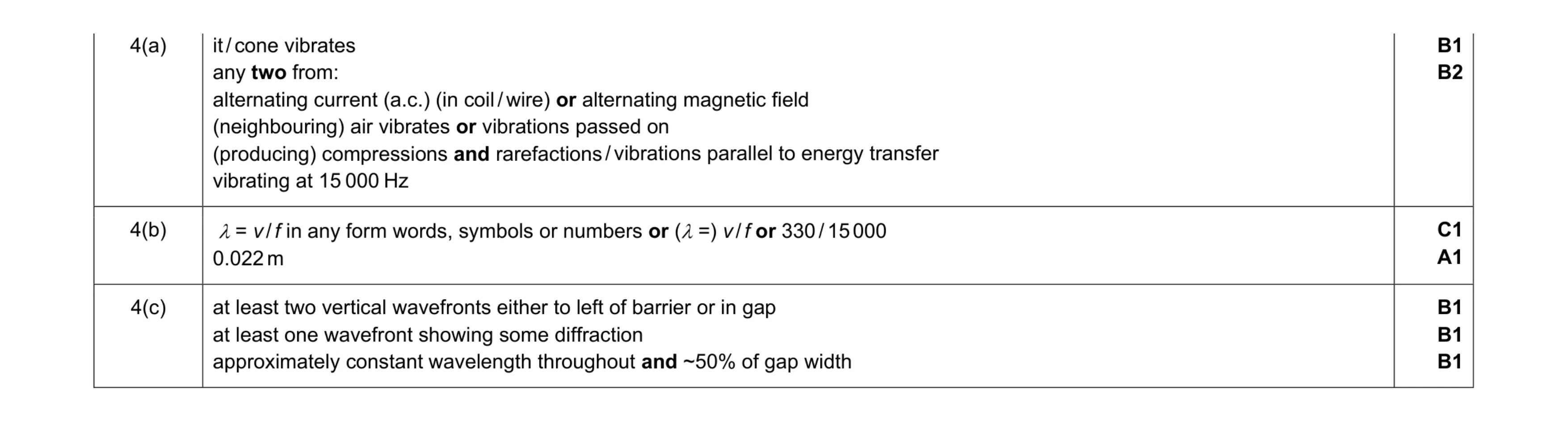 8
8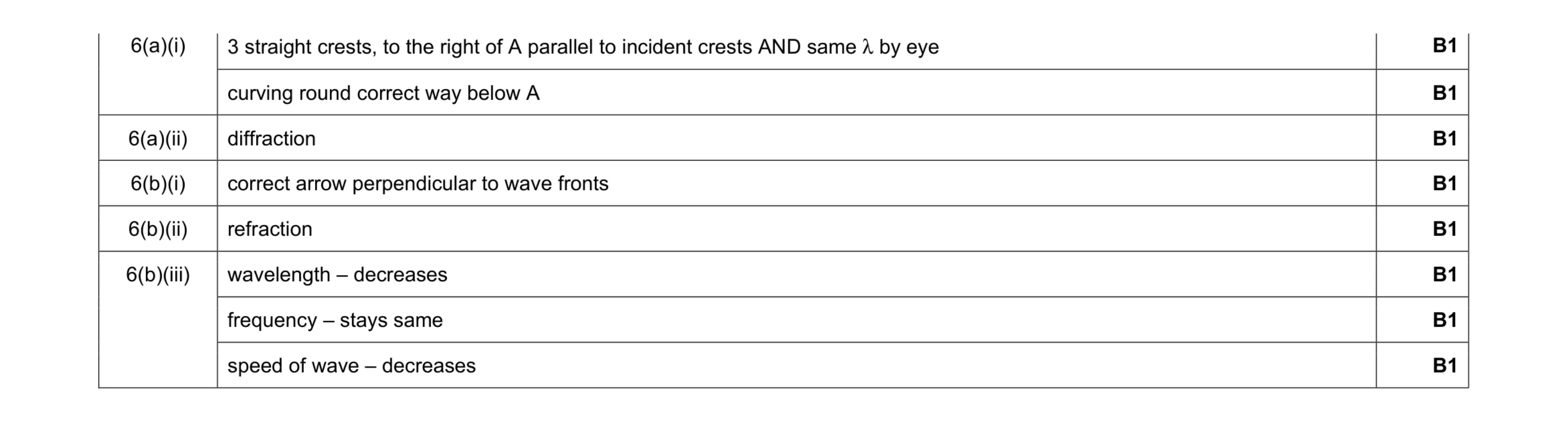 8
8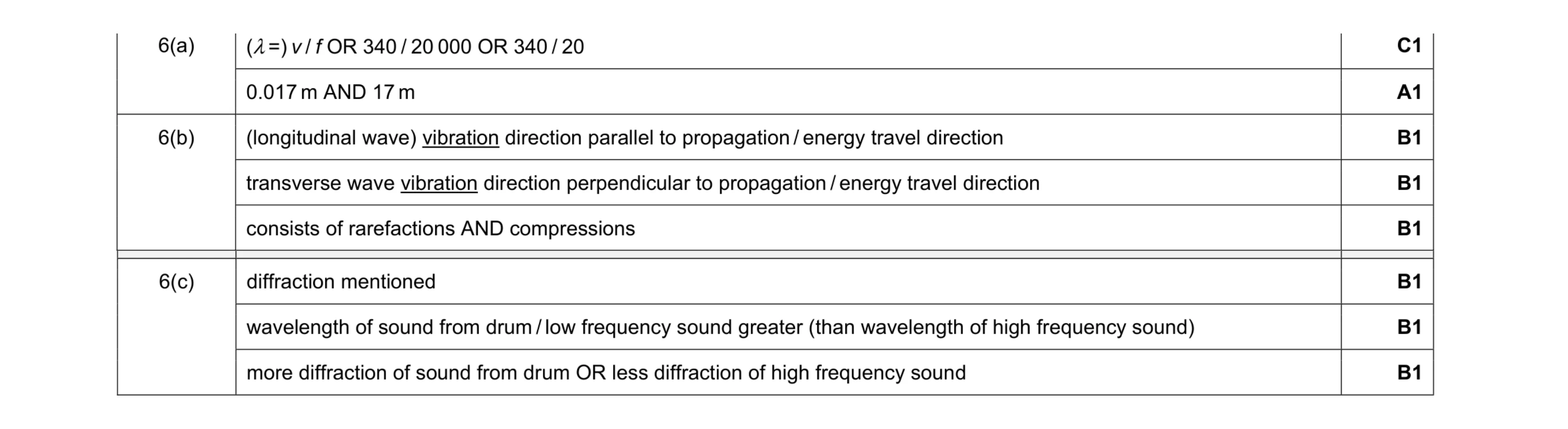 8
8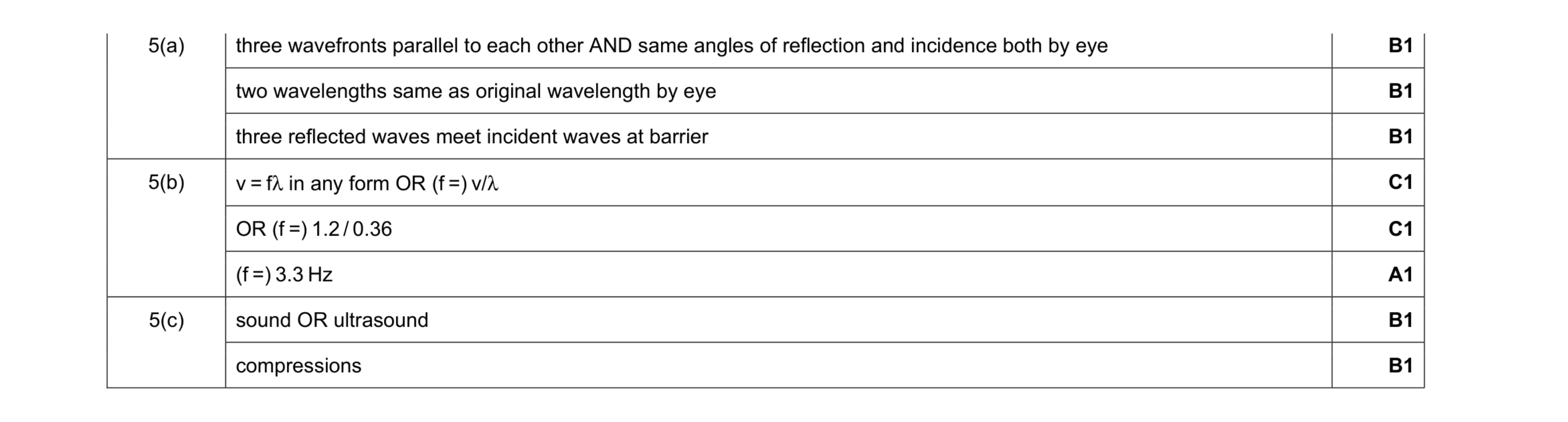 8
8 7
7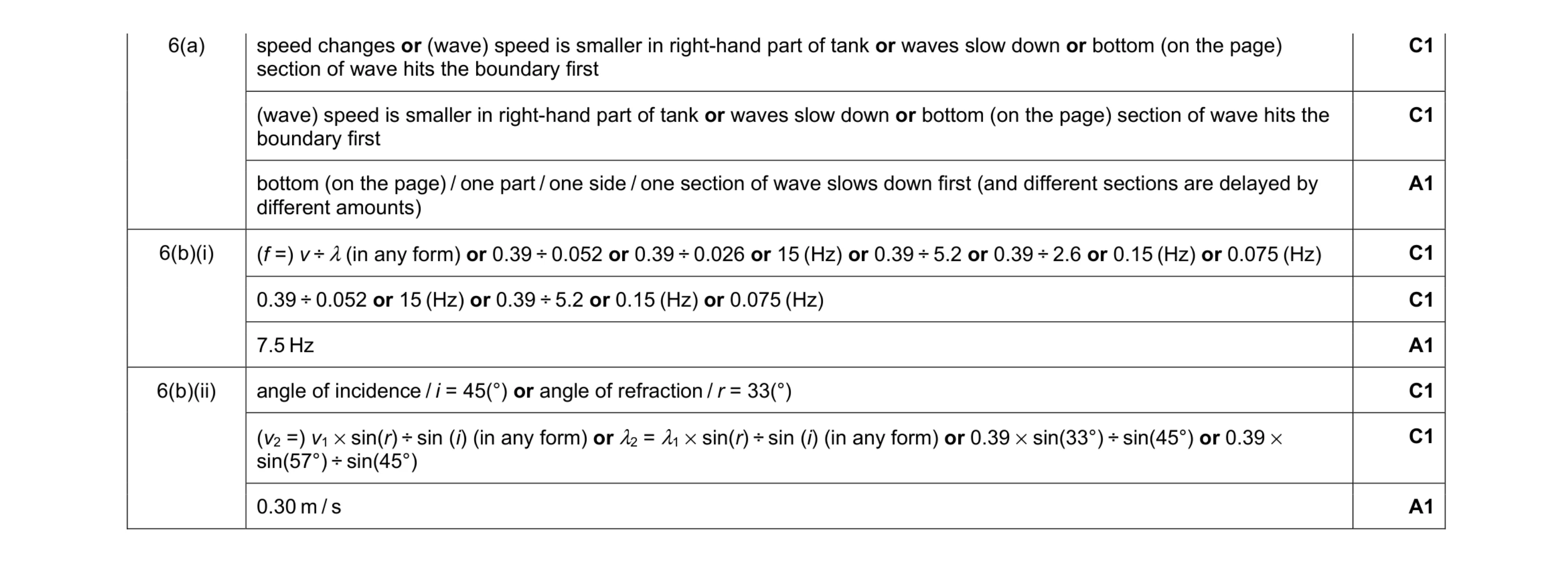 9
9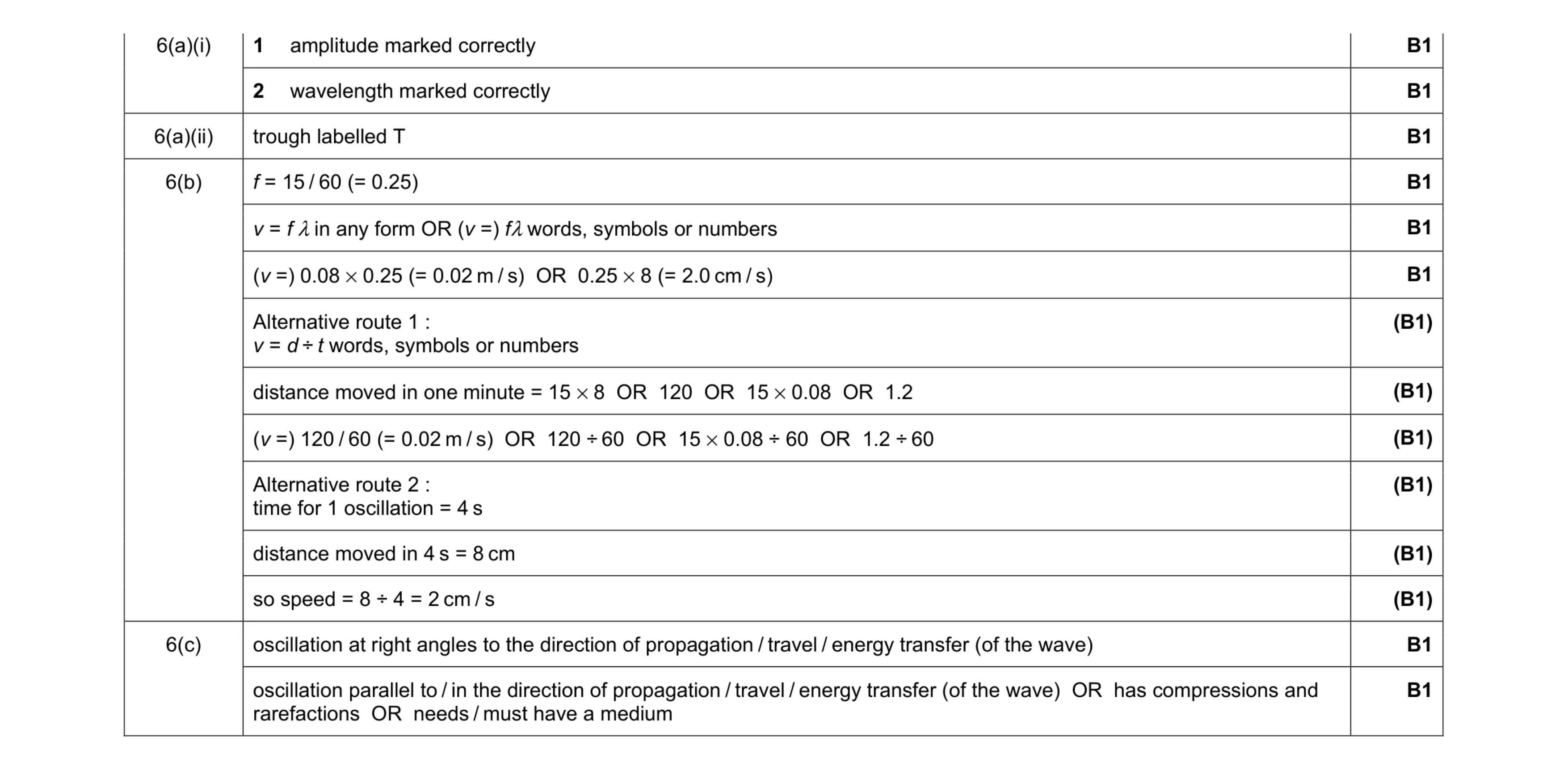 8
8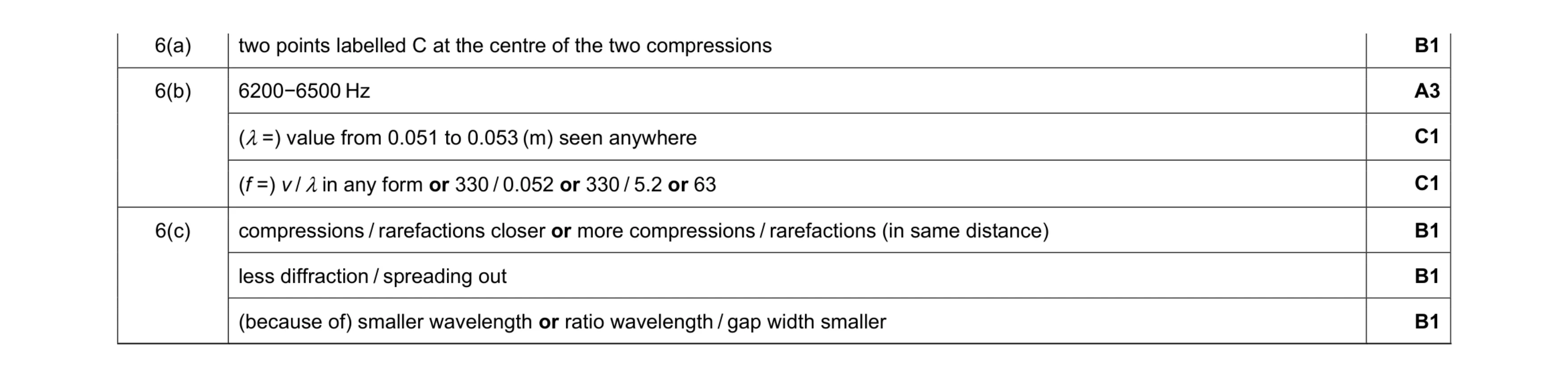 7
7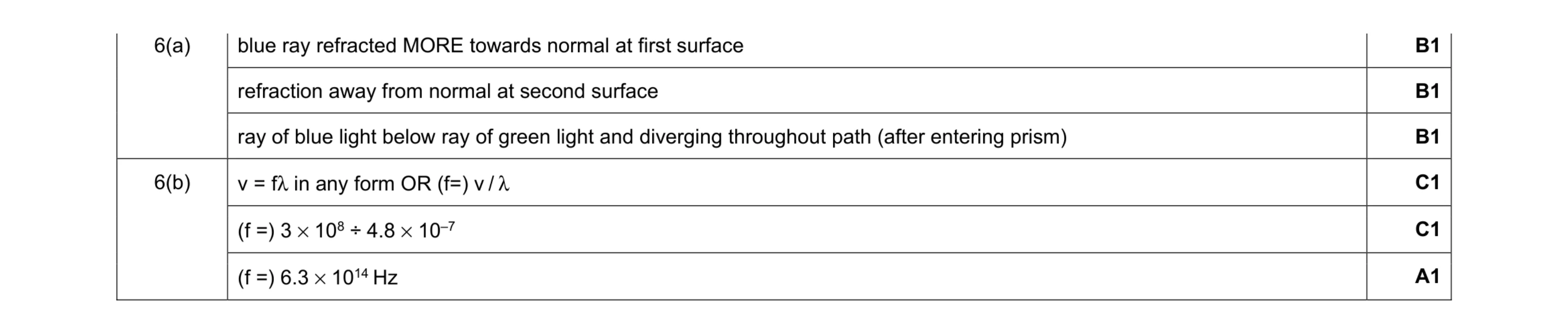 6
6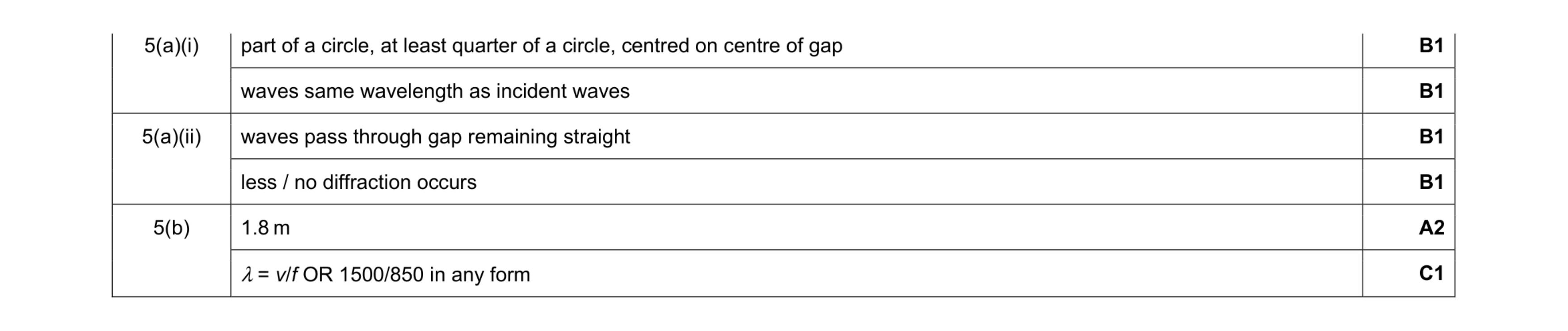 6
6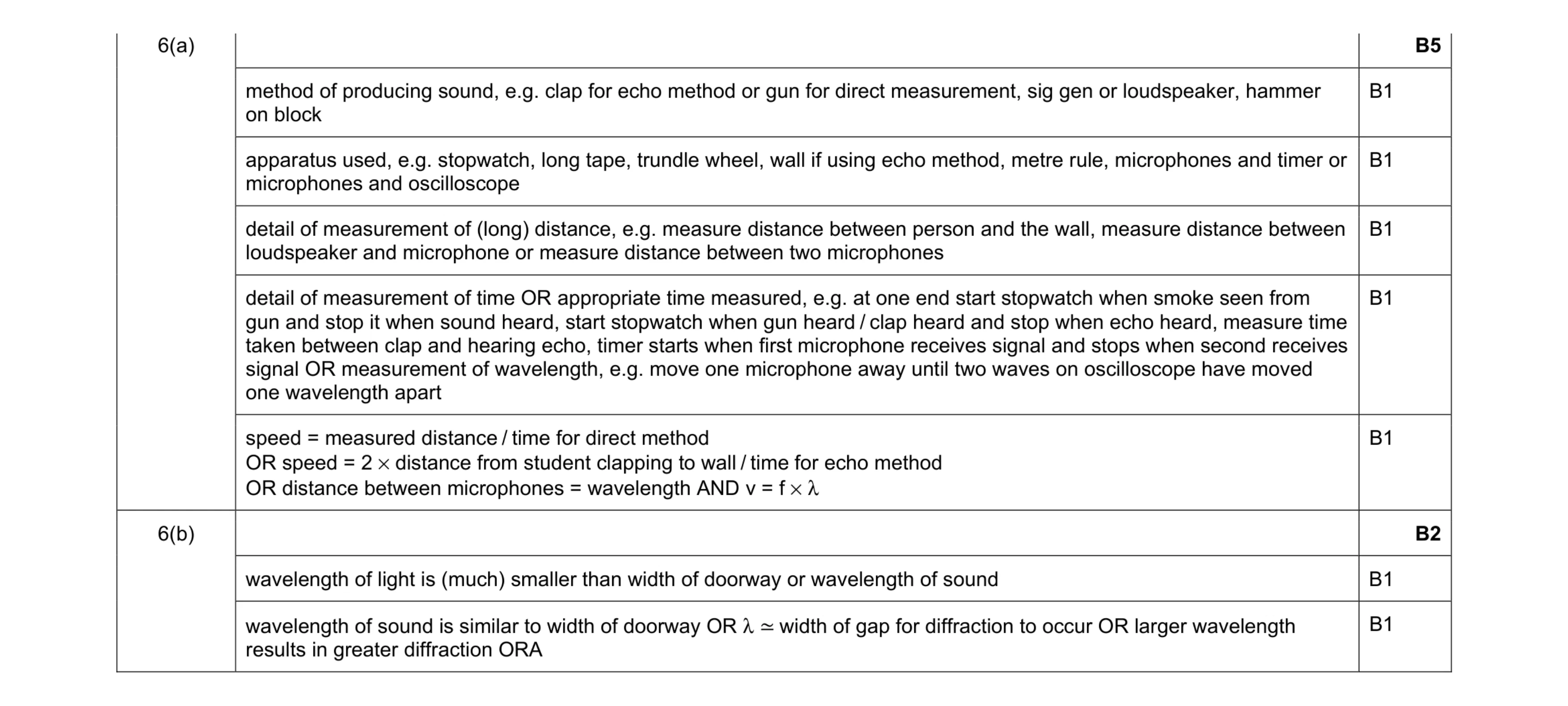 7
7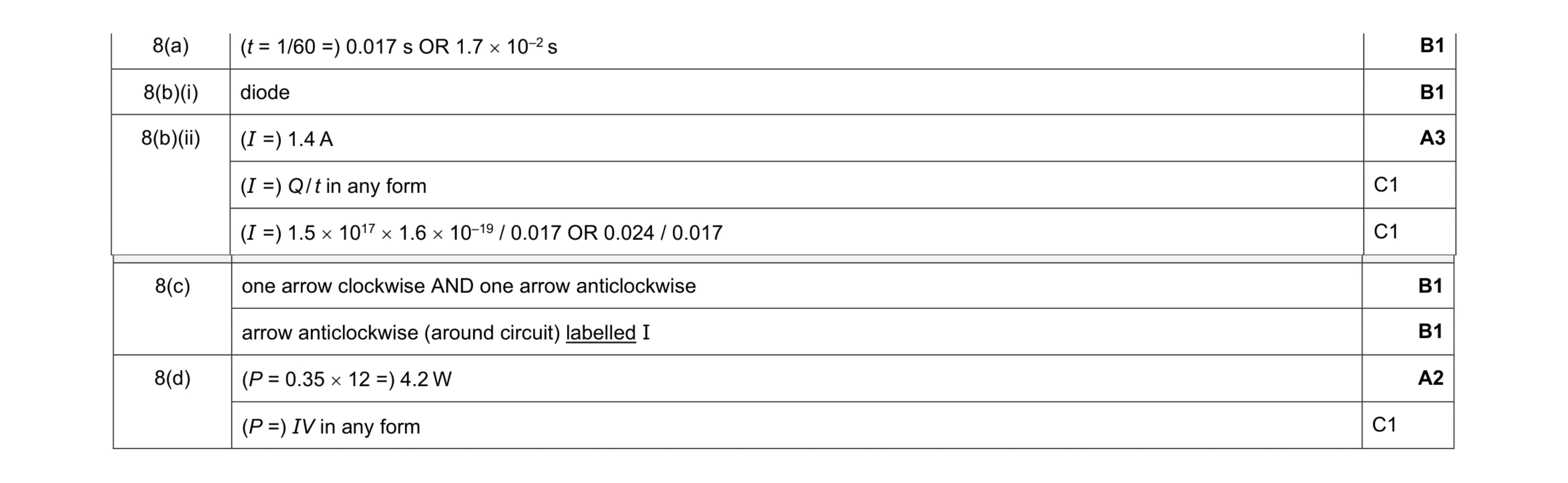 9
9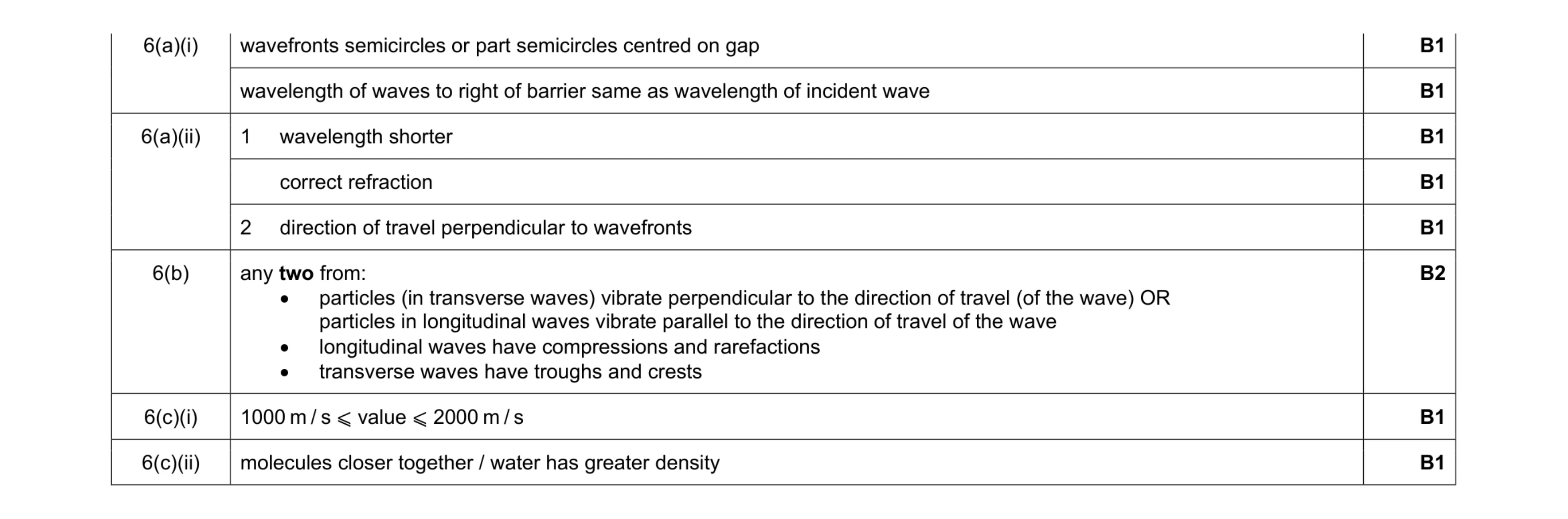 9
9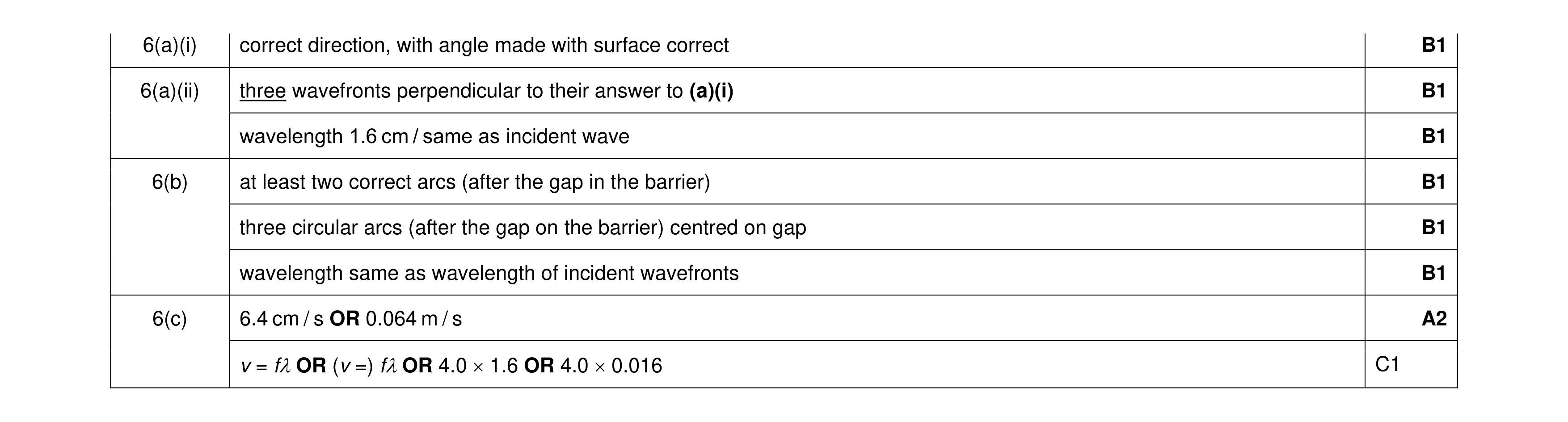 8
8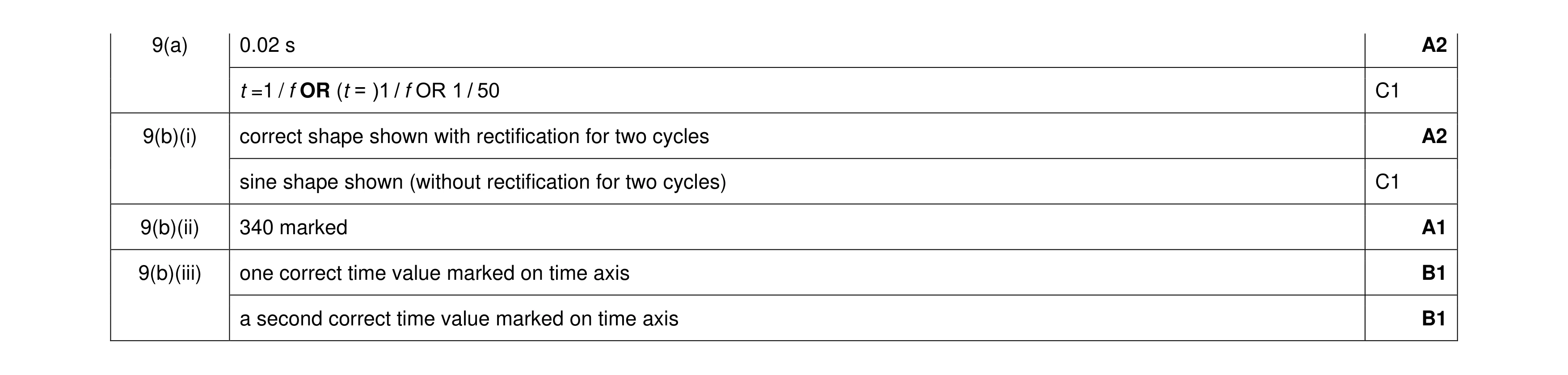 7
7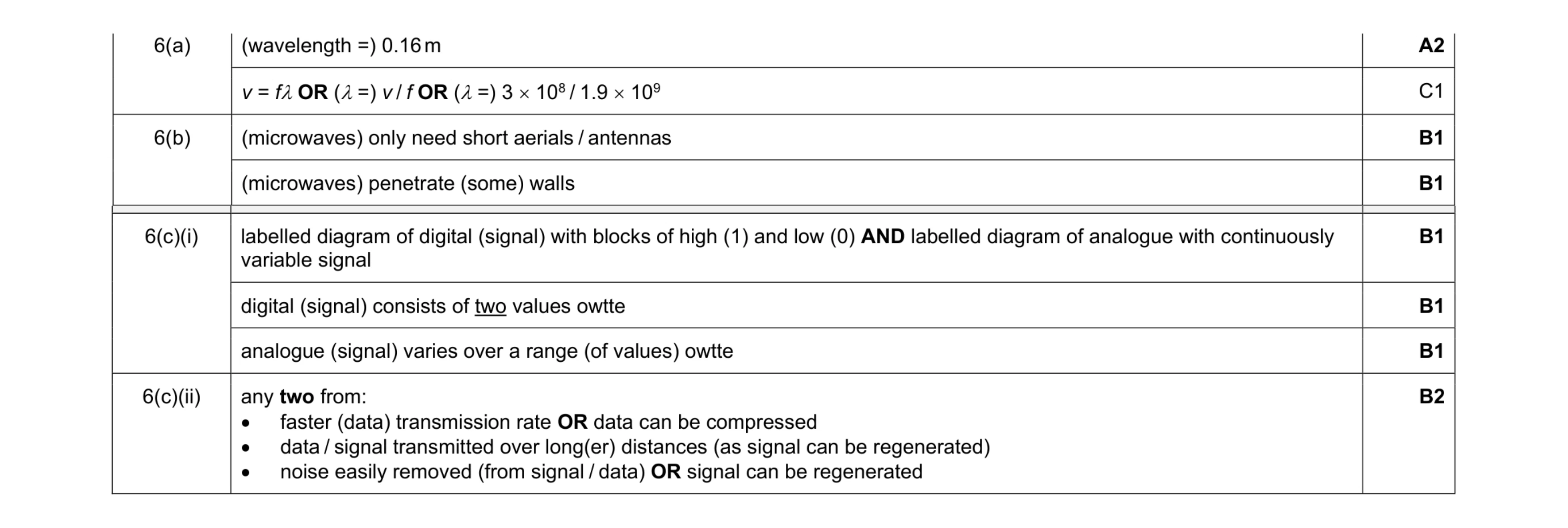 9
9 5
5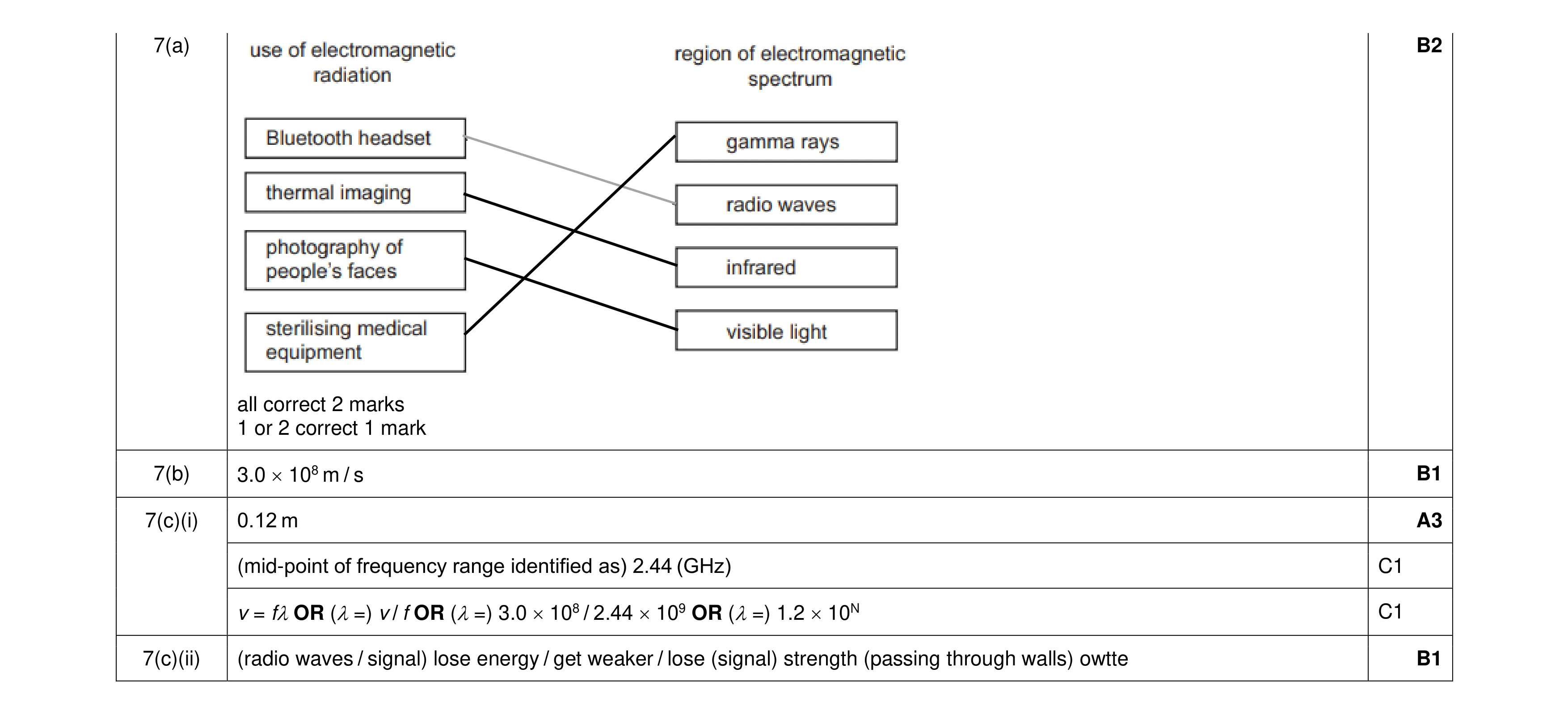 7
7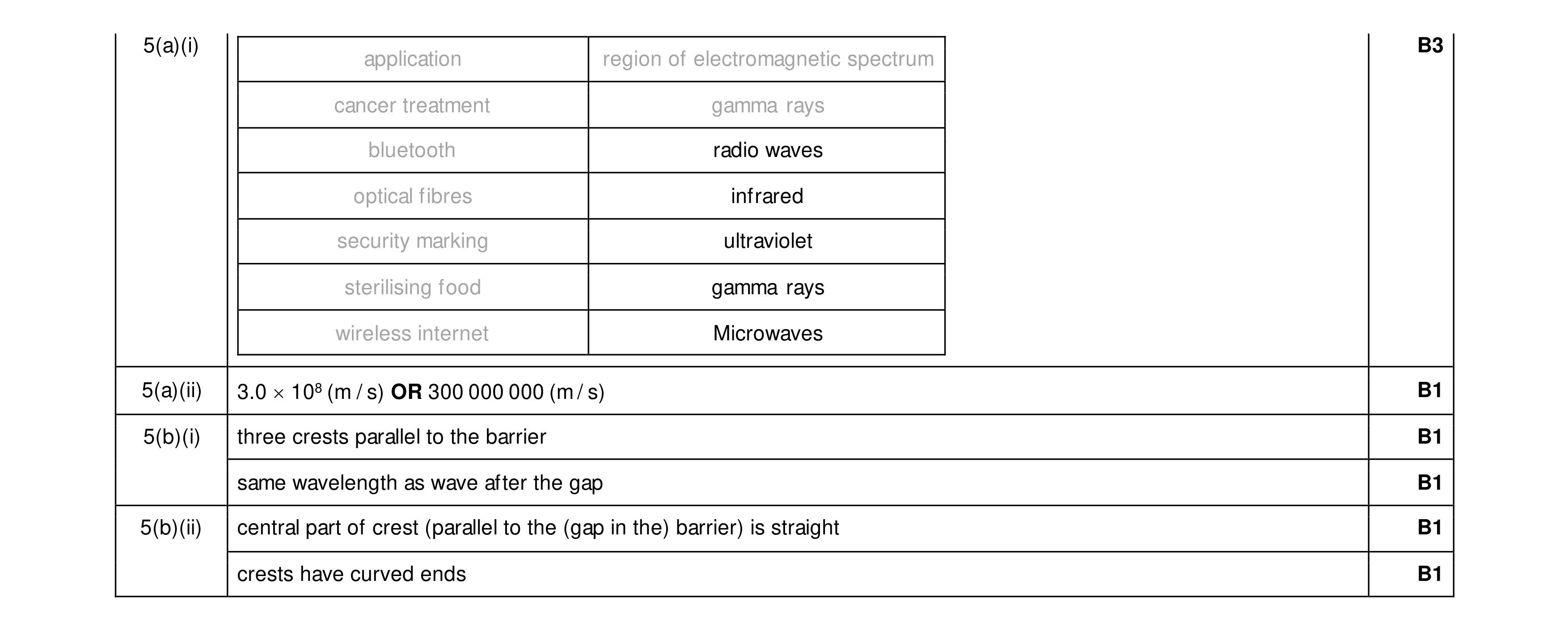 8
8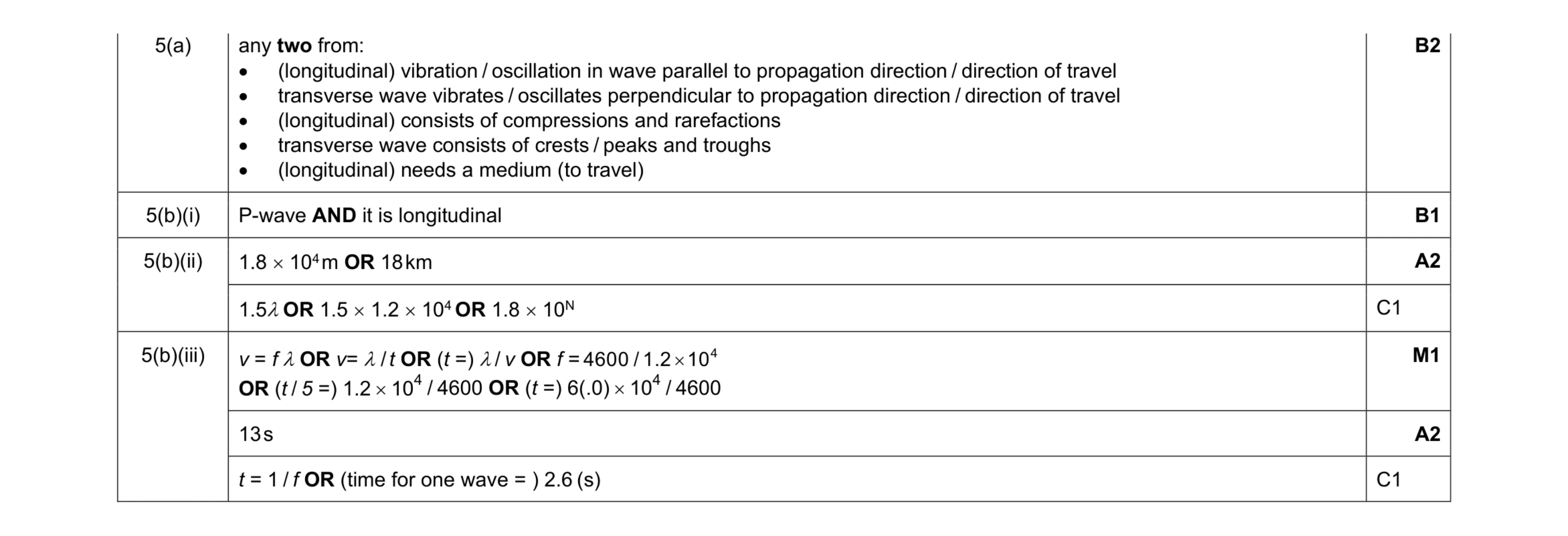 8
8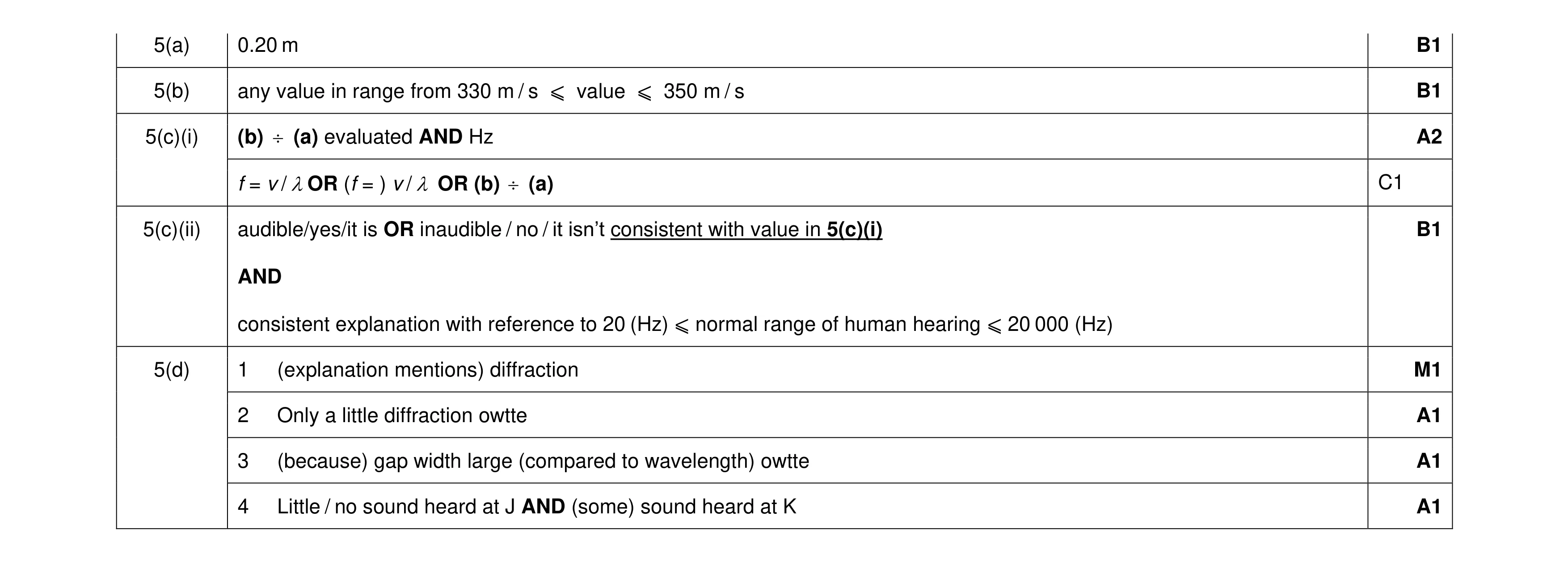 9
9 5
5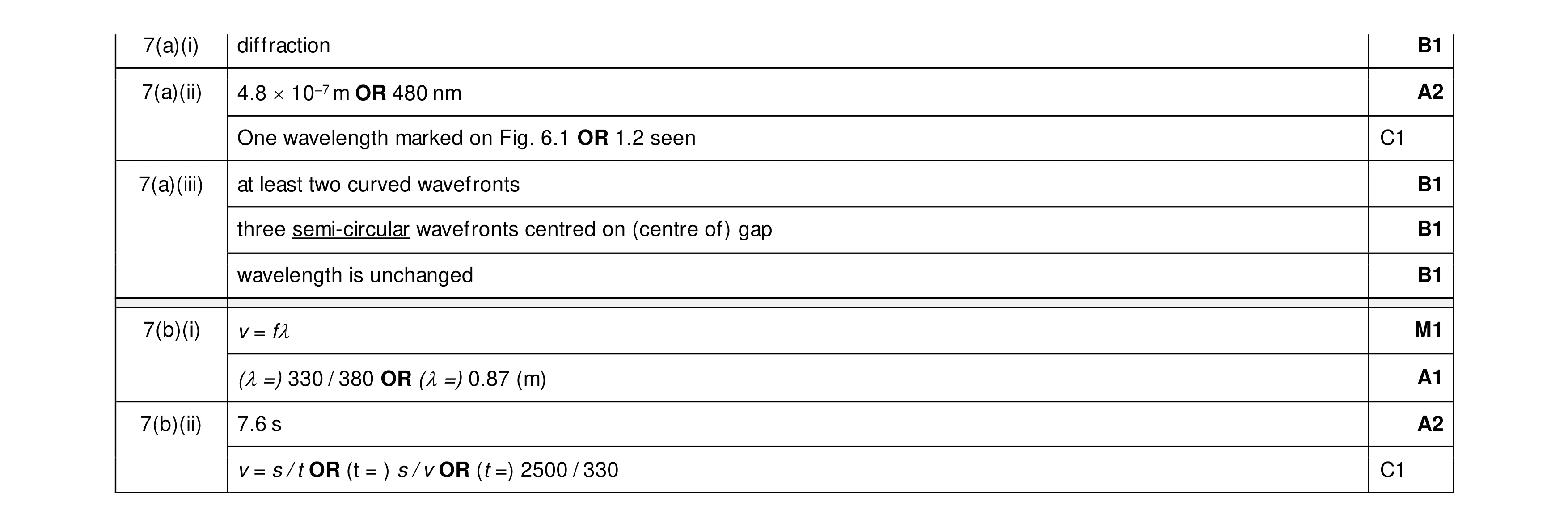 10
10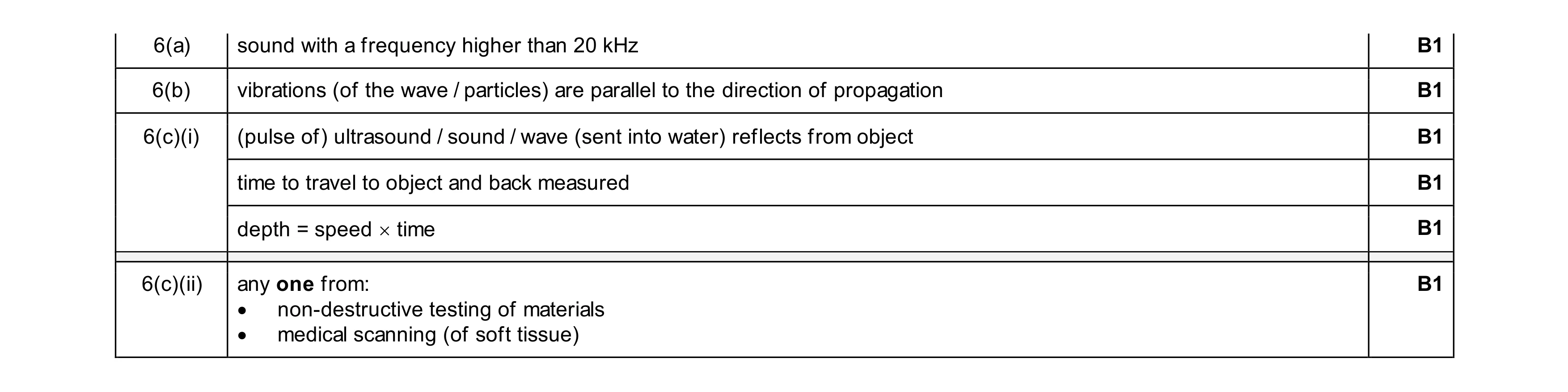 6
6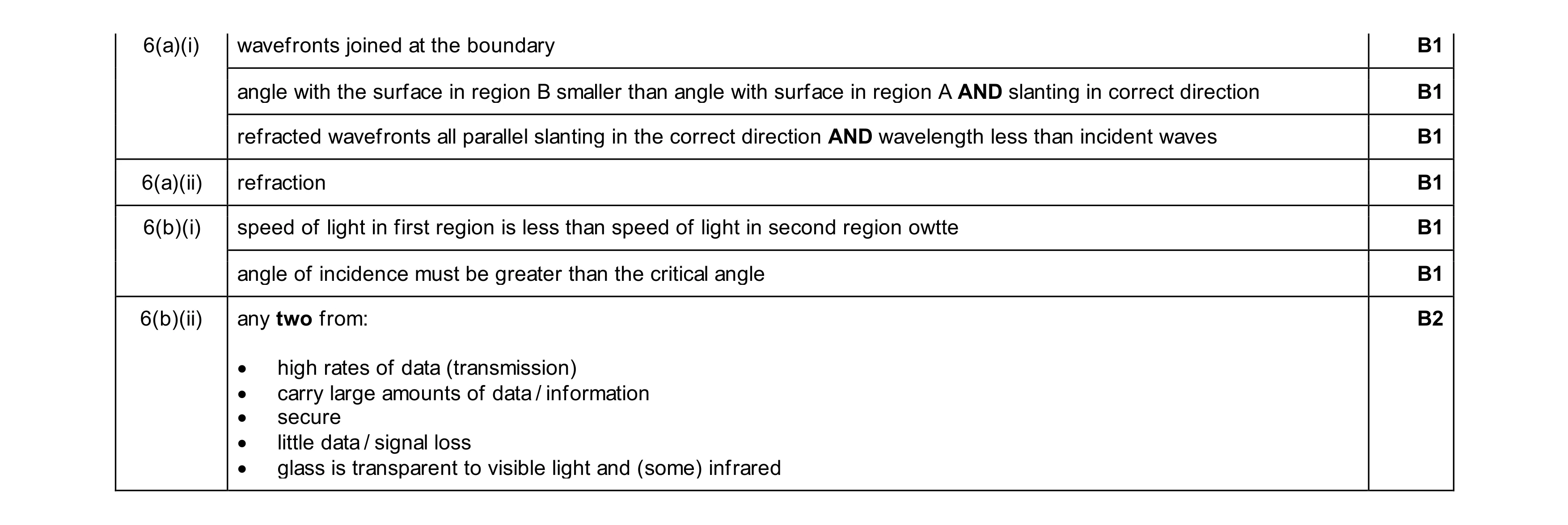 8
8