Questions as text
Q1 · Food tests are carried out on four solutions 9700/11 Oct/Nov 2004
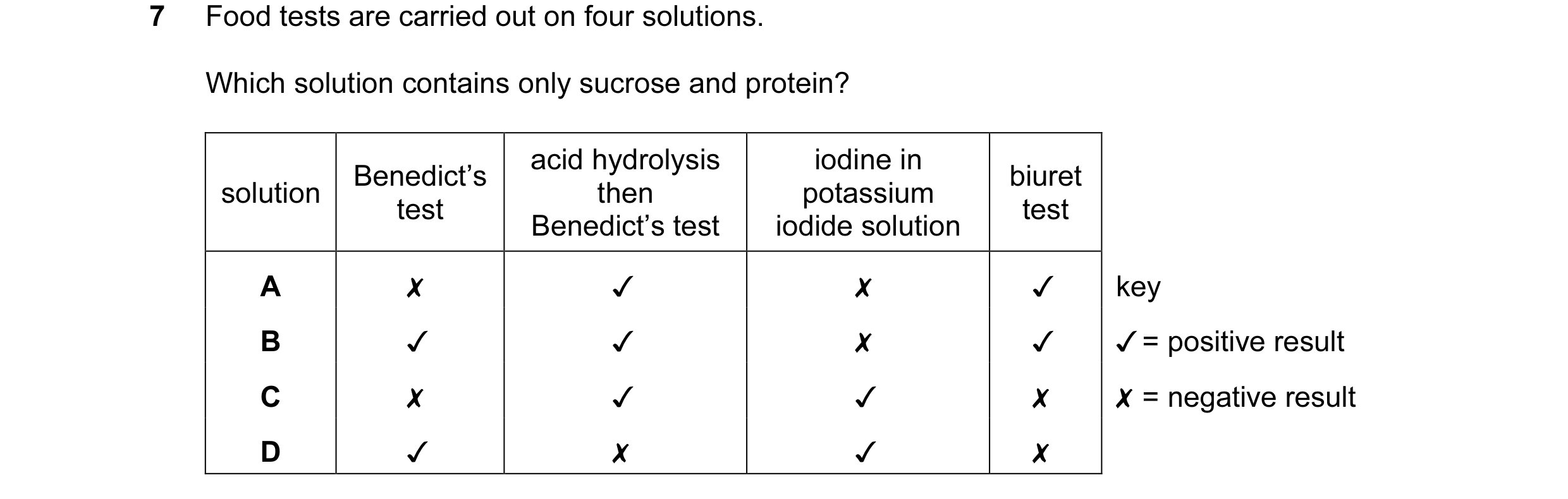
7 Food tests are carried out on four solutions.
Which solution contains only sucrose and protein?
Benedict’s acid hydrolysis iodine in biuret
solution test then potassium test
Benedict's test iodide solution
A Xx v x v
B Jv v Xx v
Cc Xx v v x
D Jv Xx v x
key
¥ = positive result
X = negative result
1 marks
Answer: A
This question in 9700/11 Oct/Nov 2004
Q2 · A solution of starch is mixed with a solution of amylase 9700/11 May/June 2006
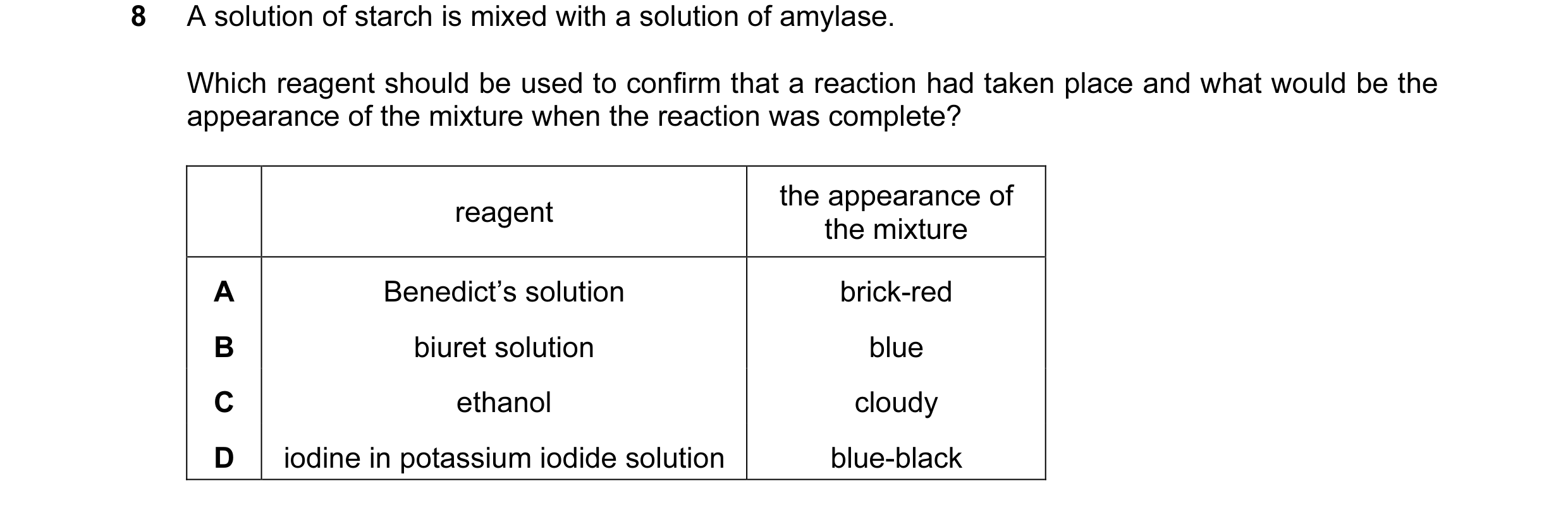
8 A solution of starch is mixed with a solution of amylase. Which reagent should be used to confirm that a reaction had taken place and what would be the appearance of the mixture when the reaction was complete? the appearance of reagent the mixture A Benedict’s solution brick-red B biuret solution blue C ethanol cloudy D iodine in potassium iodide solution blue-black
1 marks
Answer: A
This question in 9700/11 May/June 2006
Q3 · Heating with which solution breaks glycosidic bonds? 9700/11 Oct/Nov 2006
7 Heating with which solution breaks glycosidic bonds? A Benedict’s solution B dilute hydrochloric acid C dilute sodium hydroxide D ethanol
1 marks
Answer: B
This question in 9700/11 Oct/Nov 2006
Q4 · When solutions of dilute sodium hydroxide and copper(II) sulphate (biuret test) were… 9700/11 Oct/Nov 2007
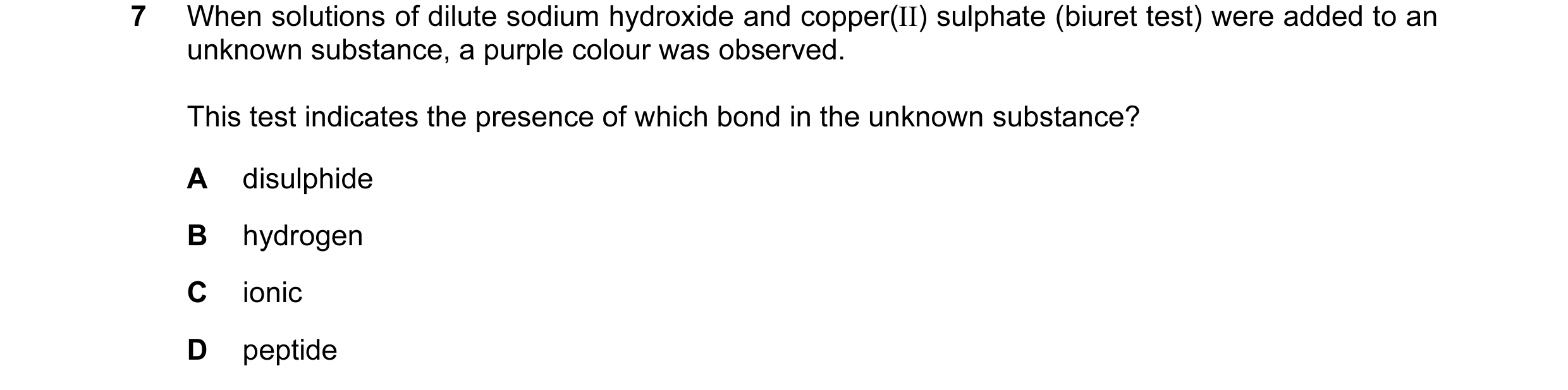
7 When solutions of dilute sodium hydroxide and copper(II) sulphate (biuret test) were added to an unknown substance, a purple colour was observed. This test indicates the presence of which bond in the unknown substance? A disulphide B hydrogen C ionic D peptide
1 marks
Answer: D
This question in 9700/11 Oct/Nov 2007
Q5 · Samples of a food were tested using Benedict’s reagent, biuret solution and ethanol 9700/11 May/June 2008
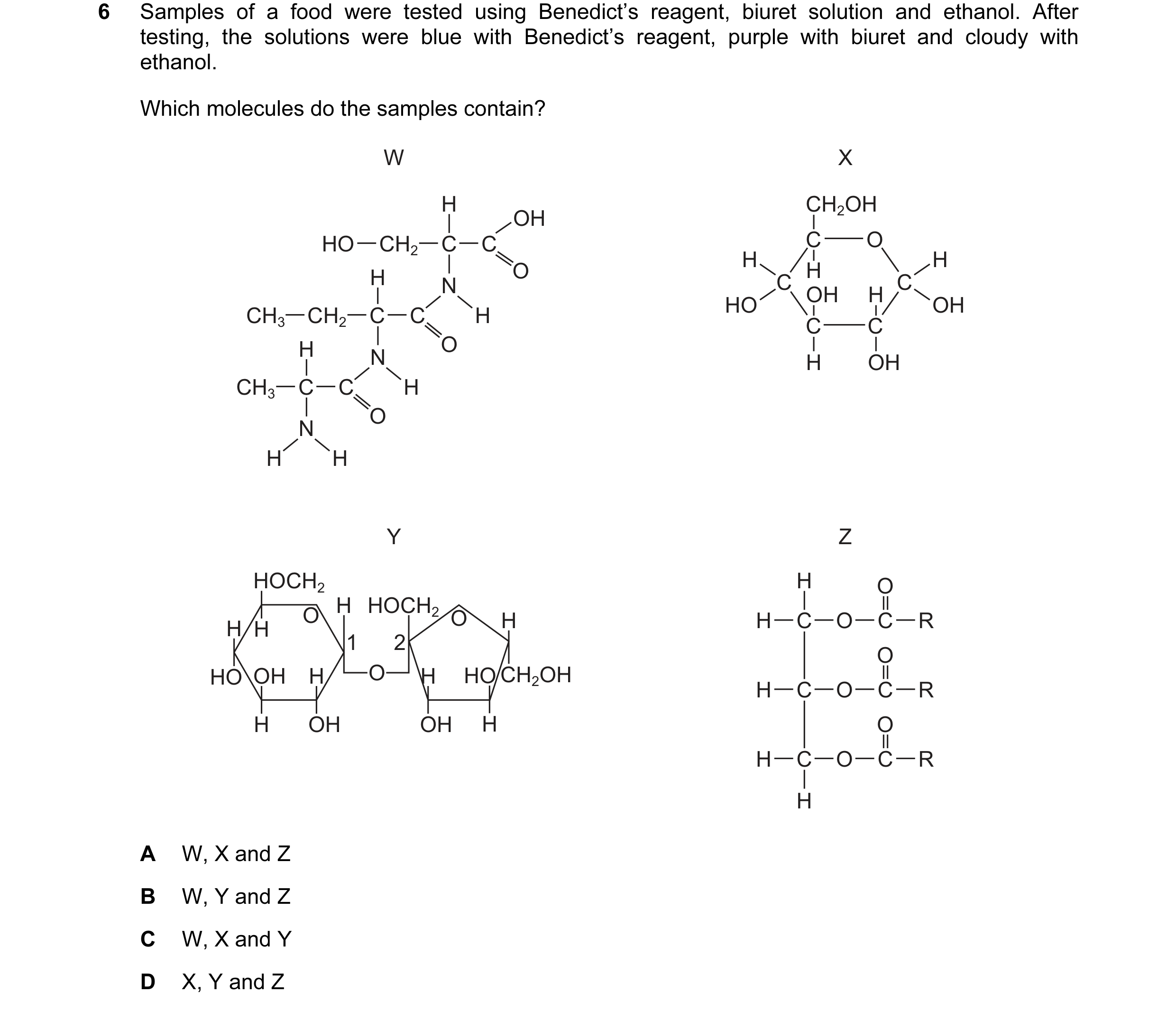
6 Samples of a food were tested using Benedict’s reagent, biuret solution and ethanol. After testing, the solutions were blue with Benedict’s reagent, purple with biuret and cloudy with ethanol. Which molecules do the samples contain? W X H CH2OH OH HO CH2 C C C O H H H O H N C C OH H OH OH CH3 CH2 C C H C C H O N H OH CH3 C C H O N H H Y Z HOCH2 H O H HOCH2 O O H H C O C R H H 1 2 O HO OH H O H HO CH2OH H C O C R H OH OH H O H C O C R H A W, X and Z B W, Y and Z C W, X and Y D X, Y and Z
1 marks
Answer: B
This question in 9700/11 May/June 2008
Q6 · A large number of aphids were used to collect samples of the contents of the sieve tubes… 9700/11 May/June 2008
25 A large number of aphids were used to collect samples of the contents of the sieve tubes of a tomato plant. sieve tube element sample taken micopipette tomato plant stem (aphid and stem are not drawn to the same scale) Different samples of the sieve tube solution were tested. Which was the correct result? Benedict’s test iodine in KI before hydrolysis after hydrolysis A blue red brown B blue blue blue / black C red blue blue / black D red red brown
1 marks
Answer: A
This question in 9700/11 May/June 2008
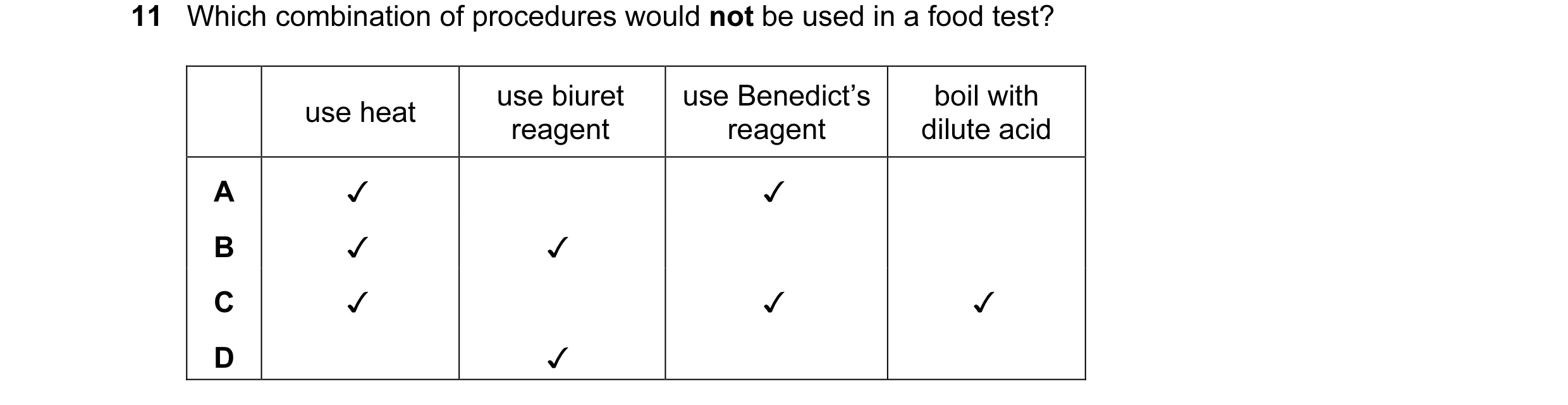
Q7 · Which combination of procedures would not be used in a food test? 9700/12 Oct/Nov 2009
11. Which combination of procedures would not be used in a food test?
use biuret use Benedict’s boil with
use heat : ;
reagent reagent dilute acid
A Jv Jv
B Jv Jv
Cc Jv Jv Jv
D
1 marks
Answer: B
This question in 9700/12 Oct/Nov 2009
Q8 · A student tested four samples of food, A, B, C and D, for the presence of • lipids •… 9700/11 May/June 2010
7 A student tested four samples of food, A, B, C and D, for the presence of • lipids • protein • reducing sugars • starch One of the food samples, milk, was found to contain lipid, protein and reducing sugar. Which of the food samples, shown in the results below, is milk? observation adding iodine in boiling with mixing with adding biuret sample potassium iodide Benedict’s ethanol and reagent solution solution adding to water A lilac orange orange precipitate milky emulsion B lilac blue-black blue milky emulsion C pale blue blue-black orange precipitate clear D pale blue orange blue clear
1 marks
Answer: A
This question in 9700/11 May/June 2010
Q9 · A student tested four samples of food, A, B, C and D, for the presence of • lipids •… 9700/12 May/June 2010
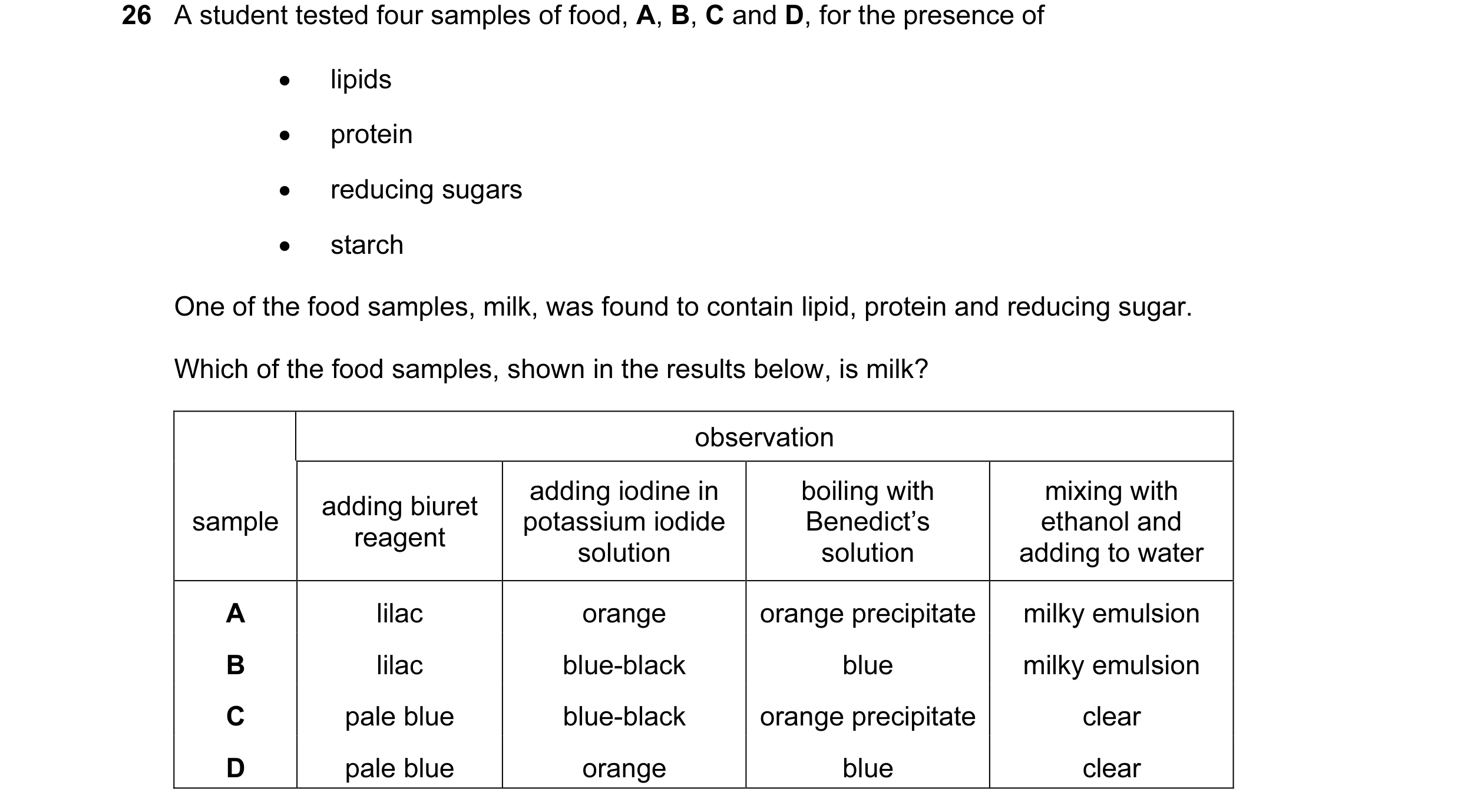
26 A student tested four samples of food, A, B, C and D, for the presence of • lipids • protein • reducing sugars • starch One of the food samples, milk, was found to contain lipid, protein and reducing sugar. Which of the food samples, shown in the results below, is milk? observation adding iodine in boiling with mixing with adding biuret sample potassium iodide Benedict’s ethanol and reagent solution solution adding to water A lilac orange orange precipitate milky emulsion B lilac blue-black blue milky emulsion C pale blue blue-black orange precipitate clear D pale blue orange blue clear
1 marks
Answer: A
This question in 9700/12 May/June 2010
Q10 · A student tested four samples of food, A, B, C and D, for the presence of • lipids •… 9700/13 May/June 2010
18 A student tested four samples of food, A, B, C and D, for the presence of • lipids • protein • reducing sugars • starch One of the food samples, milk, was found to contain lipid, protein and reducing sugar. Which of the food samples, shown in the results below, is milk? observation adding iodine in boiling with mixing with adding biuret sample potassium iodide Benedict’s ethanol and reagent solution solution adding to water A lilac orange orange precipitate milky emulsion B lilac blue-black blue milky emulsion C pale blue blue-black orange precipitate clear D pale blue orange blue clear
1 marks
Answer: A
This question in 9700/13 May/June 2010
Q11 · Tests on a liquid give these results 9700/11 Oct/Nov 2010
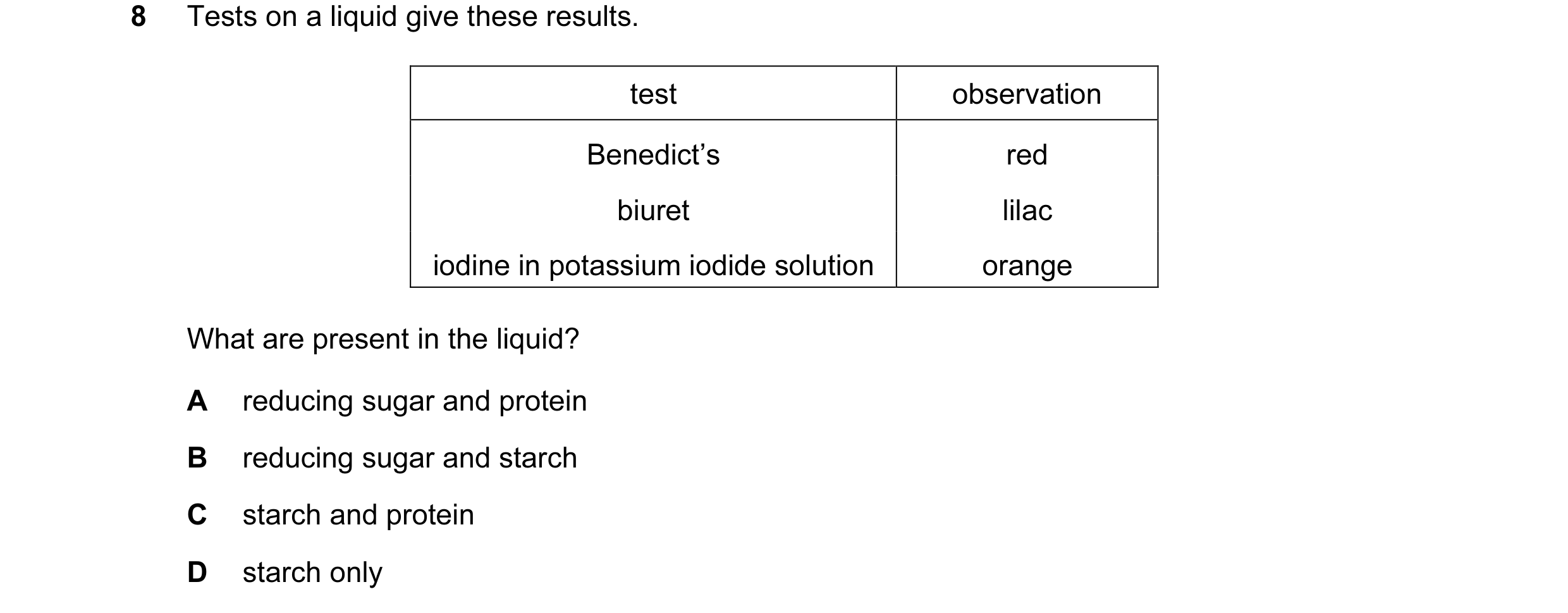
8 Tests on a liquid give these results. test observation Benedict’s red biuret lilac iodine in potassium iodide solution orange What are present in the liquid? A reducing sugar and protein B reducing sugar and starch C starch and protein D starch only
1 marks
Answer: A
This question in 9700/11 Oct/Nov 2010
Q12 · Four different fruit juices, A, B, C and D, were tested with Benedict’s solution 9700/11 May/June 2011
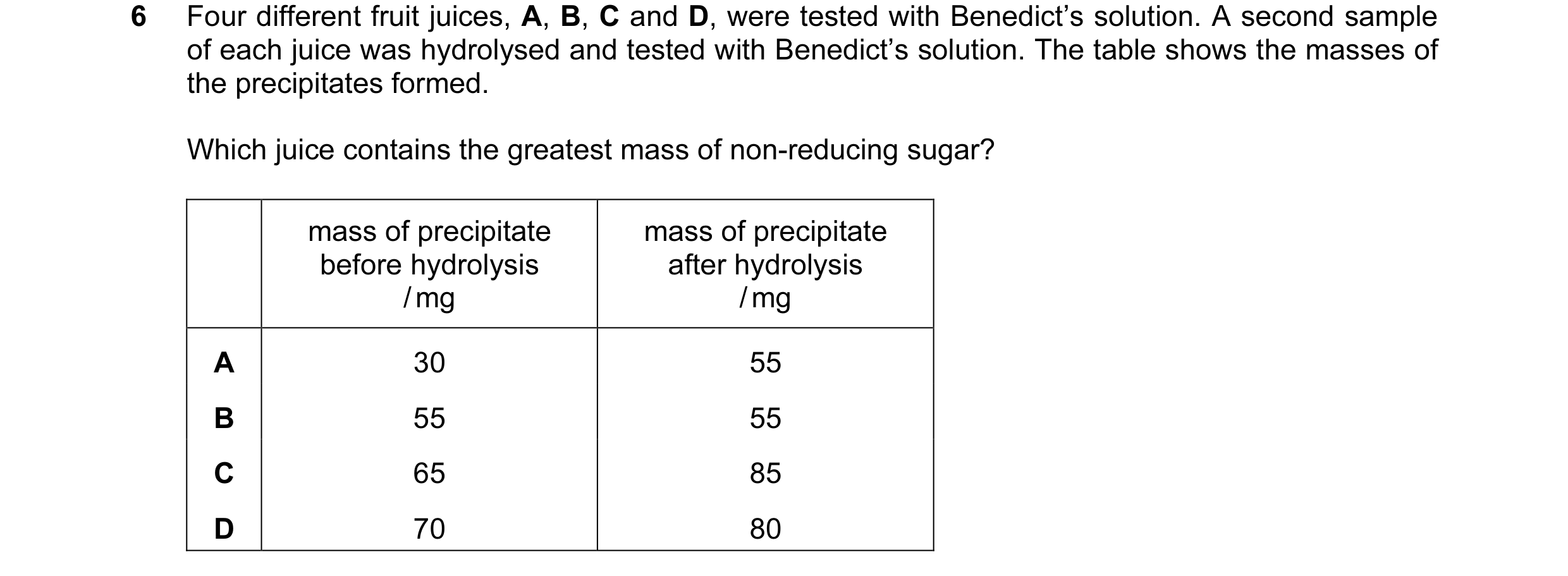
6 Four different fruit juices, A, B, C and D, were tested with Benedict’s solution. A second sample of each juice was hydrolysed and tested with Benedict’s solution. The table shows the masses of the precipitates formed. Which juice contains the greatest mass of non-reducing sugar? mass of precipitate mass of precipitate before hydrolysis after hydrolysis / mg / mg A 30 55 B 55 55 C 65 85 D 70 80
1 marks
Answer: A
This question in 9700/11 May/June 2011
Q13 · Four different fruit juices, A, B, C and D, were tested with Benedict’s solution 9700/13 May/June 2011
31 Four different fruit juices, A, B, C and D, were tested with Benedict’s solution. A second sample of each juice was hydrolysed and tested with Benedict’s solution. The table shows the masses of the precipitates formed. Which juice contains the greatest mass of non-reducing sugar? mass of precipitate mass of precipitate before hydrolysis after hydrolysis / mg / mg A 30 55 B 55 55 C 65 85 D 70 80
1 marks
Answer: A
This question in 9700/13 May/June 2011
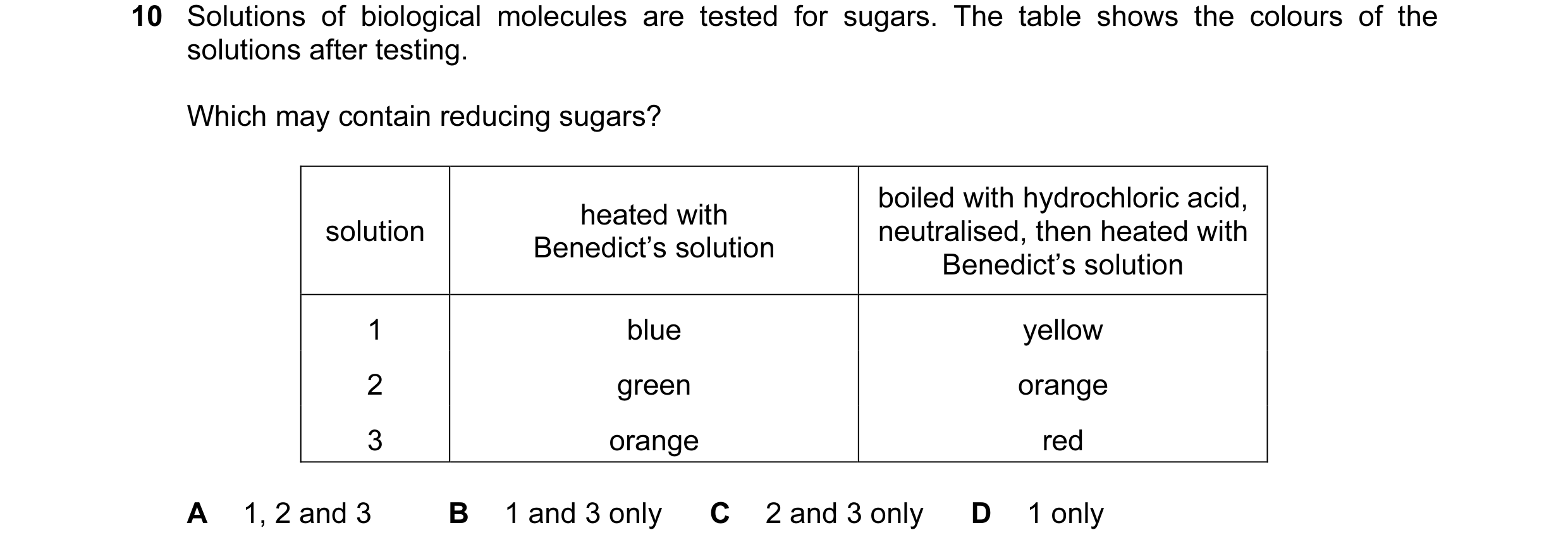
Q14 · Solutions of biological molecules are tested for sugars 9700/11 Oct/Nov 2011
10 Solutions of biological molecules are tested for sugars. The table shows the colours of the solutions after testing. Which may contain reducing sugars? boiled with hydrochloric acid, heated with solution neutralised, then heated with Benedict’s solution Benedict’s solution 1 blue yellow 2 green orange 3 orange red A 1, 2 and 3 B 1 and 3 only C 2 and 3 only D 1 only
1 marks
Answer: C
This question in 9700/11 Oct/Nov 2011
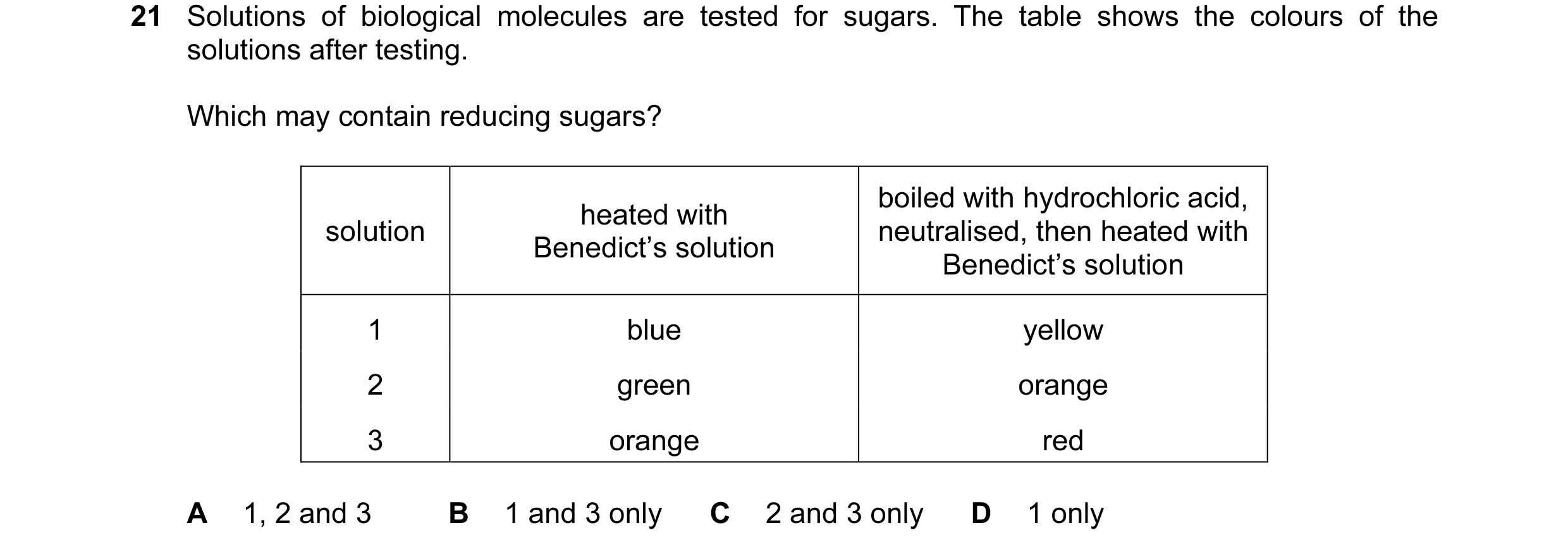
Q15 · Solutions of biological molecules are tested for sugars 9700/13 Oct/Nov 2011
21 Solutions of biological molecules are tested for sugars. The table shows the colours of the solutions after testing. Which may contain reducing sugars? boiled with hydrochloric acid, heated with solution neutralised, then heated with Benedict’s solution Benedict’s solution 1 blue yellow 2 green orange 3 orange red A 1, 2 and 3 B 1 and 3 only C 2 and 3 only D 1 only
1 marks
Answer: C
This question in 9700/13 Oct/Nov 2011
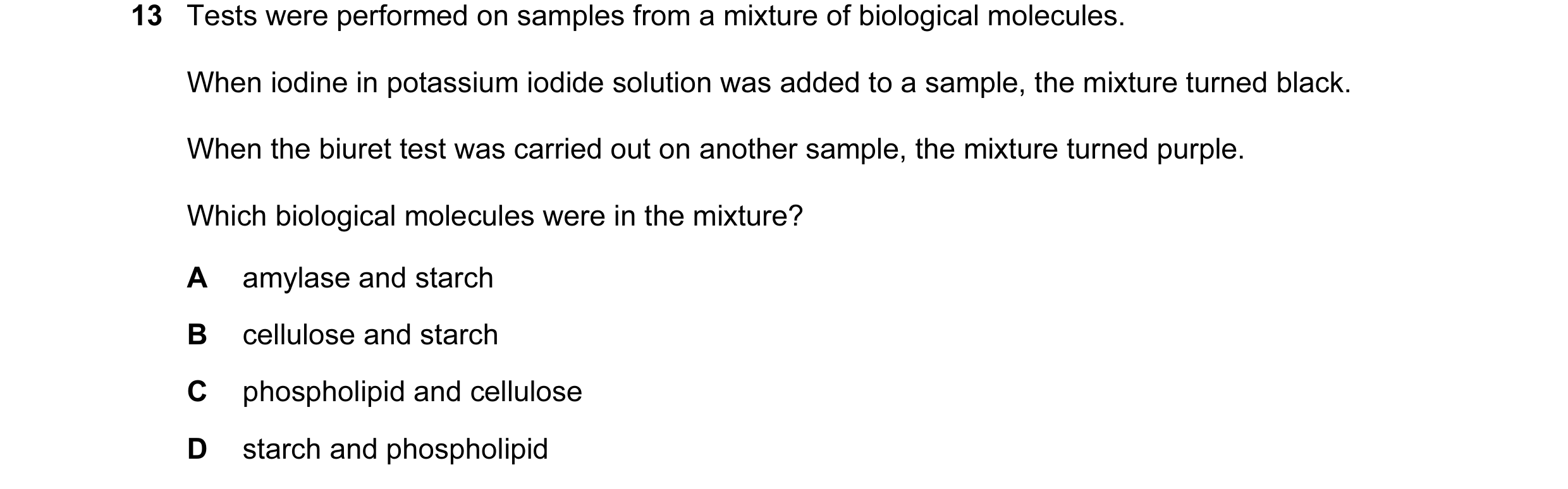
Q16 · Tests were performed on samples from a mixture of biological molecules 9700/11 May/June 2012
6 Tests were performed on samples from a mixture of biological molecules. When iodine in potassium iodide solution was added to a sample, the mixture turned black. When the biuret test was carried out on another sample, the mixture turned purple. Which biological molecules were in the mixture? A amylase and starch B cellulose and starch C phospholipid and cellulose D starch and phospholipid
1 marks
Answer: A
This question in 9700/11 May/June 2012
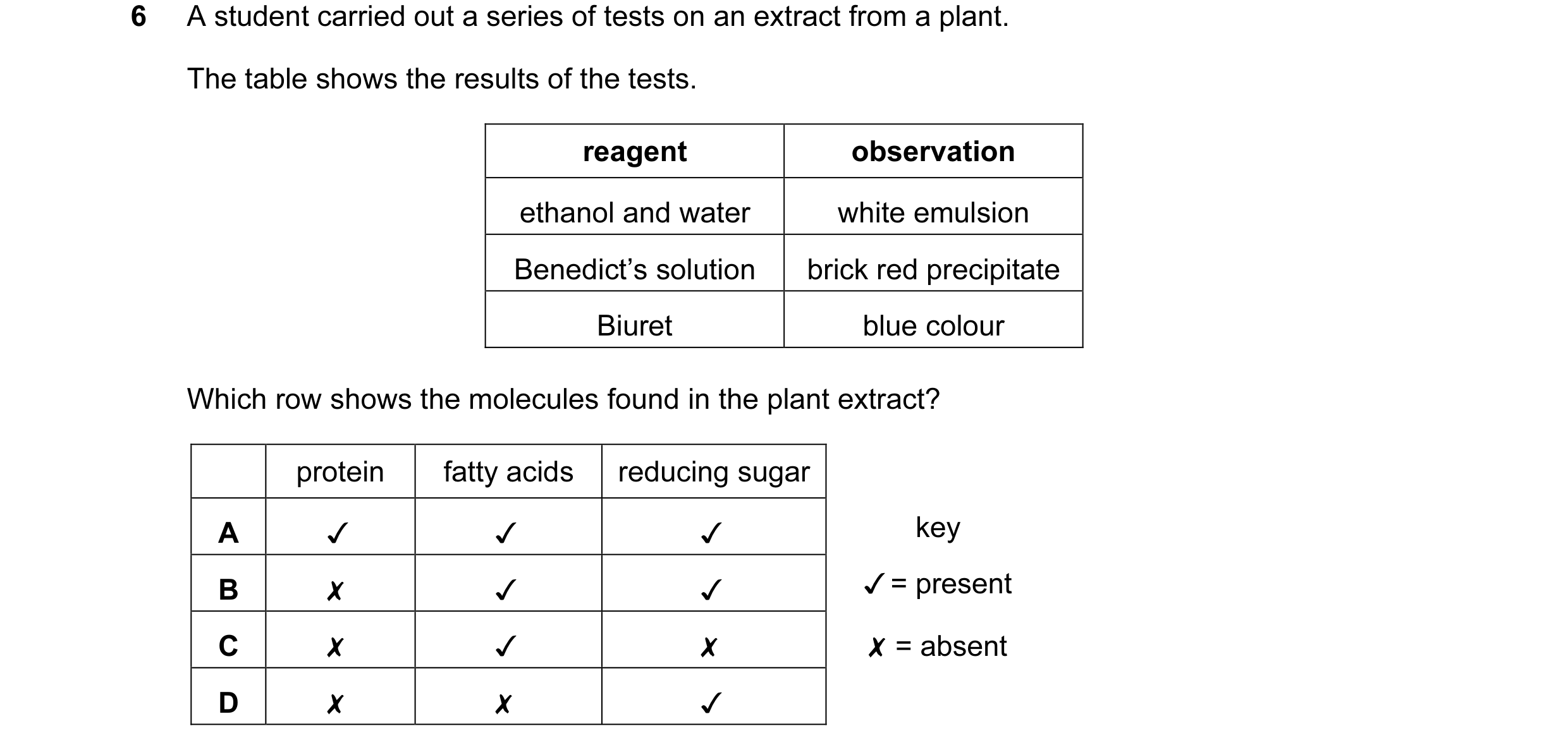
Q17 · A student carried out a series of tests on an extract from a plant 9700/12 May/June 2012
6 A student carried out a series of tests on an extract from a plant.
The table shows the results of the tests.
reagent observation
ethanol and water white emulsion
Benedict’s solution brick red precipitate
Biuret blue colour
Which row shows the molecules found in the plant extract?
protein fatty acids | reducing sugar
A v v v | key
B x V V | /¥ = present
Cc x J x | X = absent
D x x Jv |
1 marks
Answer: B
This question in 9700/12 May/June 2012
Q18 · Which carbohydrate gives a brick red colour when heated with Benedict’s solution? 9700/12 May/June 2012
10 Which carbohydrate gives a brick red colour when heated with Benedict’s solution? A cellulose B fructose C glycogen D sucrose
1 marks
Answer: B
This question in 9700/12 May/June 2012
Q19 · Tests were performed on samples from a mixture of biological molecules 9700/13 May/June 2012
13 Tests were performed on samples from a mixture of biological molecules. When iodine in potassium iodide solution was added to a sample, the mixture turned black. When the biuret test was carried out on another sample, the mixture turned purple. Which biological molecules were in the mixture? A amylase and starch B cellulose and starch C phospholipid and cellulose D starch and phospholipid
1 marks
Answer: A
This question in 9700/13 May/June 2012
Q20 · Four students, 1, 2, 3 and 4, each carried out the reducing sugar test and the… 9700/11 Oct/Nov 2012
7 Four students, 1, 2, 3 and 4, each carried out the reducing sugar test and the non-reducing sugar test on a sucrose solution. Which observations demonstrate that they carried out the correct tests? observations for reducing observations for non- student sugar test reducing sugar test 1 no colour change changed colour 2 no colour change red 3 blue changed colour 4 blue red A 2 only B 3 only C 4 only D 1, 2, 3 and 4
1 marks
Answer: C
This question in 9700/11 Oct/Nov 2012
Q21 · Heating with which solution breaks glycosidic bonds? 9700/12 Oct/Nov 2012
7 Heating with which solution breaks glycosidic bonds? A Benedict’s solution B dilute hydrochloric acid C dilute sodium hydroxide D ethanol
1 marks
Answer: B
This question in 9700/12 Oct/Nov 2012
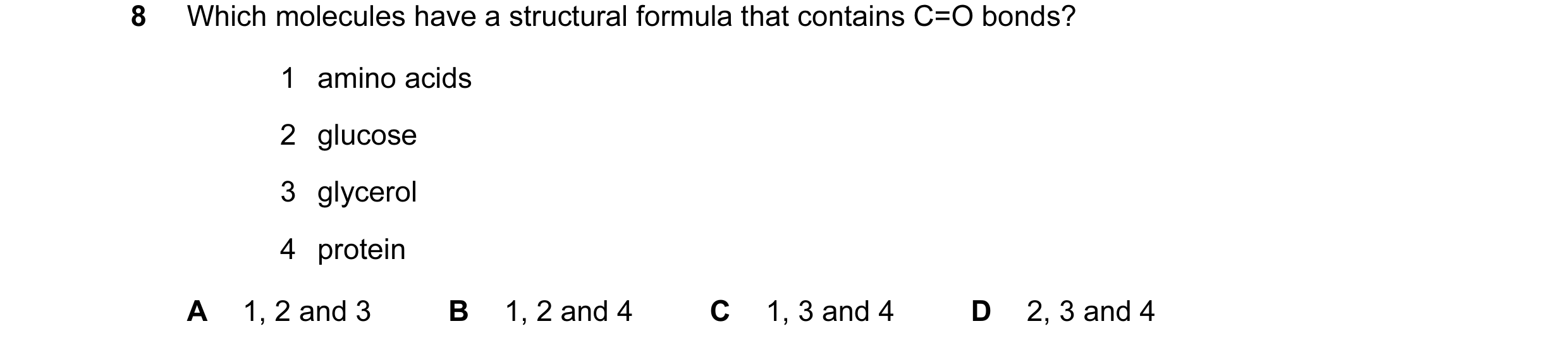
Q22 · Which molecules have a structural formula that contains C=O bonds? 9700/13 Oct/Nov 2012
8 Which molecules have a structural formula that contains C=O bonds? 1 amino acids 2 glucose 3 glycerol 4 protein A 1, 2 and 3 B 1, 2 and 4 C 1, 3 and 4 D 2, 3 and 4
1 marks
Answer: B
This question in 9700/13 Oct/Nov 2012
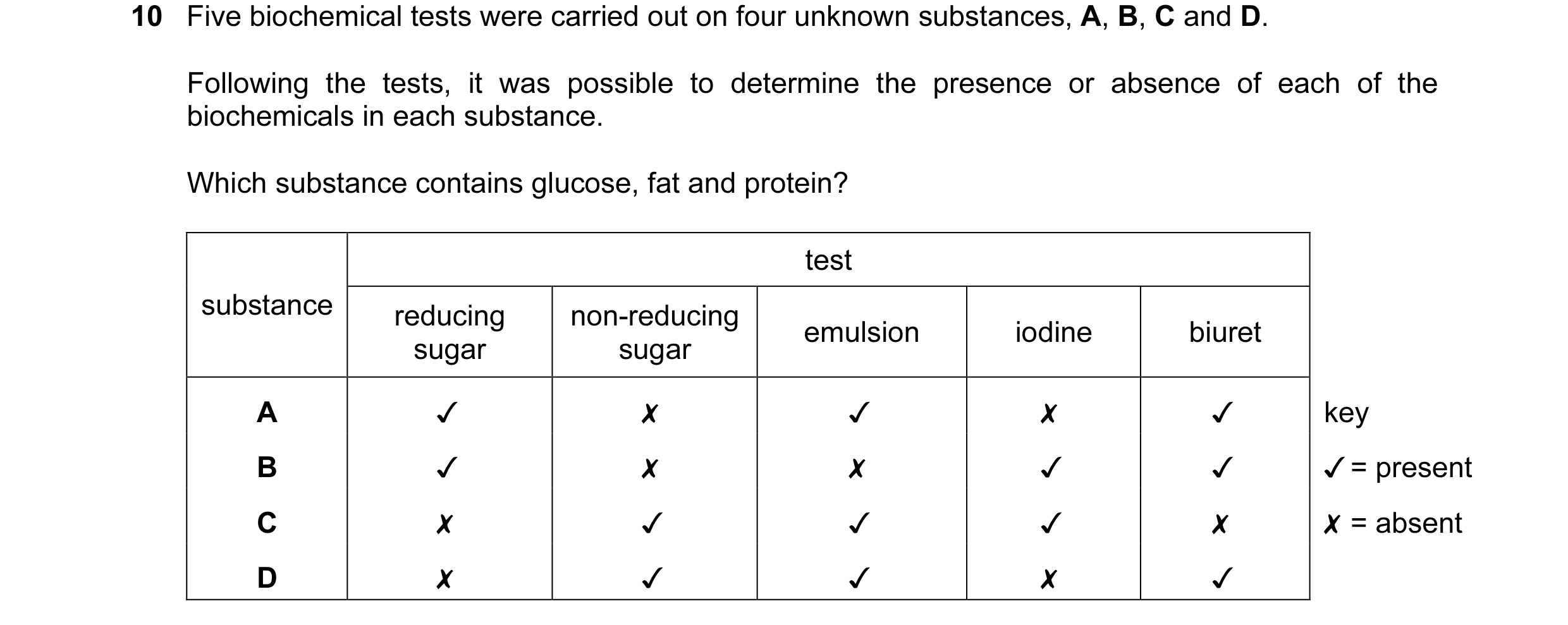
Q23 · Five biochemical tests were carried out on four unknown substances, A, B, C and D 9700/13 Oct/Nov 2012
10 Five biochemical tests were carried out on four unknown substances, A, B, C and D.
Following the tests, it was possible to determine the presence or absence of each of the
biochemicals in each substance.
Which substance contains glucose, fat and protein?
test
substance reducing vn sar emulsion iodine biuret
A Vv x v x Y rey
B y x x 4 J / = present
Cc x Jv Jv Jv x X = absent
D x v v x ‘
1 marks
Answer: A
This question in 9700/13 Oct/Nov 2012
Q24 · Which describes the emulsion test for the presence of lipids? 9700/12 May/June 2013
8 Which describes the emulsion test for the presence of lipids? A Add ethanol and shake. B Add ethanol, pour into water and shake. C Add water and shake. D Add water, pour into ethanol and shake.
1 marks
Answer: B
This question in 9700/12 May/June 2013
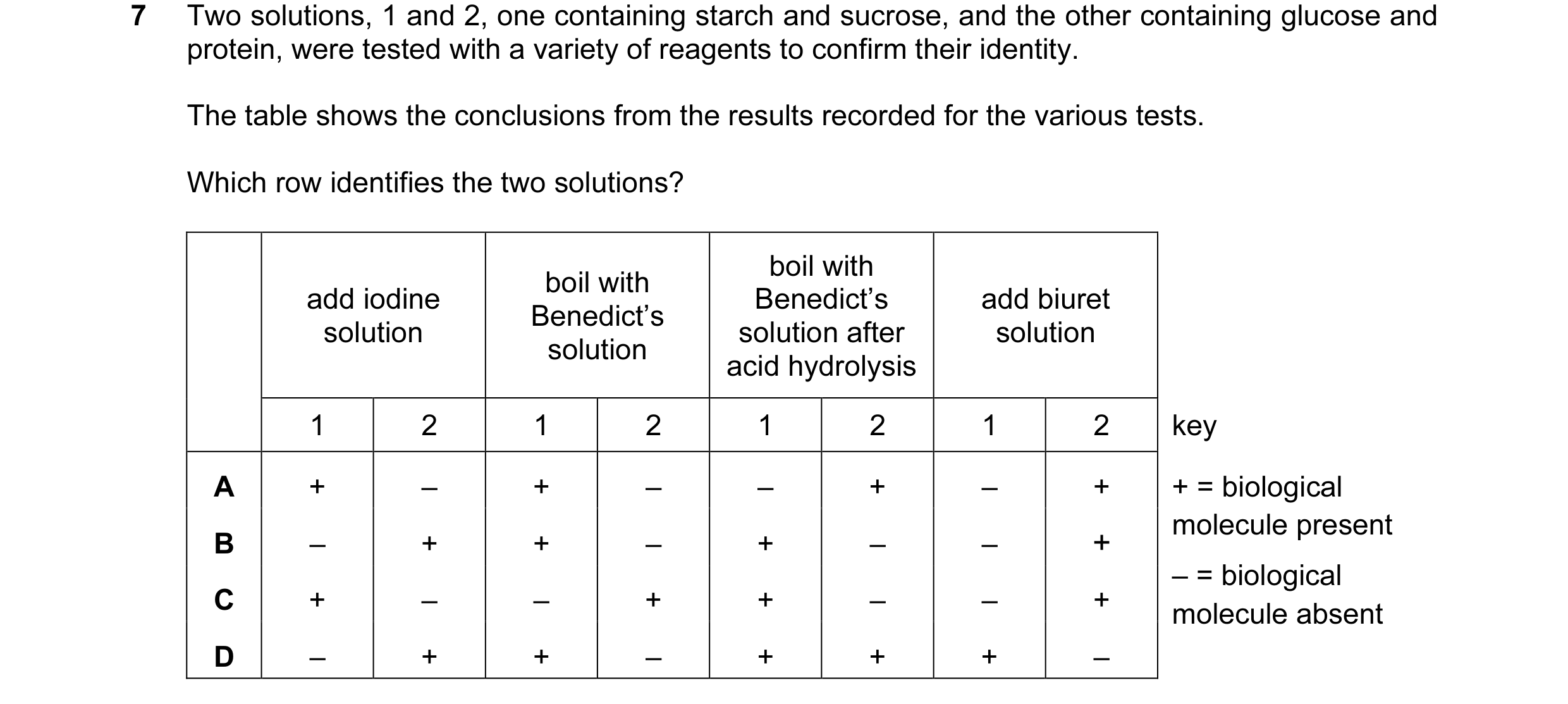
Q25 · Two solutions, 1 and 2, one containing starch and sucrose, and the other containing… 9700/13 May/June 2013
7 Two solutions, 1 and 2, one containing starch and sucrose, and the other containing glucose and protein, were tested with a variety of reagents to confirm their identity. The table shows the conclusions from the results recorded for the various tests. Which row identifies the two solutions? boil with boil with add iodine Benedict’s add biuret Benedict’s solution solution after solution solution acid hydrolysis 1 2 1 2 1 2 1 2 key A + – + – – + – + + = biological molecule present B – + + – + – – + – = biological C + – – + + – – + molecule absent D – + + – + + + –
1 marks
Answer: C
This question in 9700/13 May/June 2013
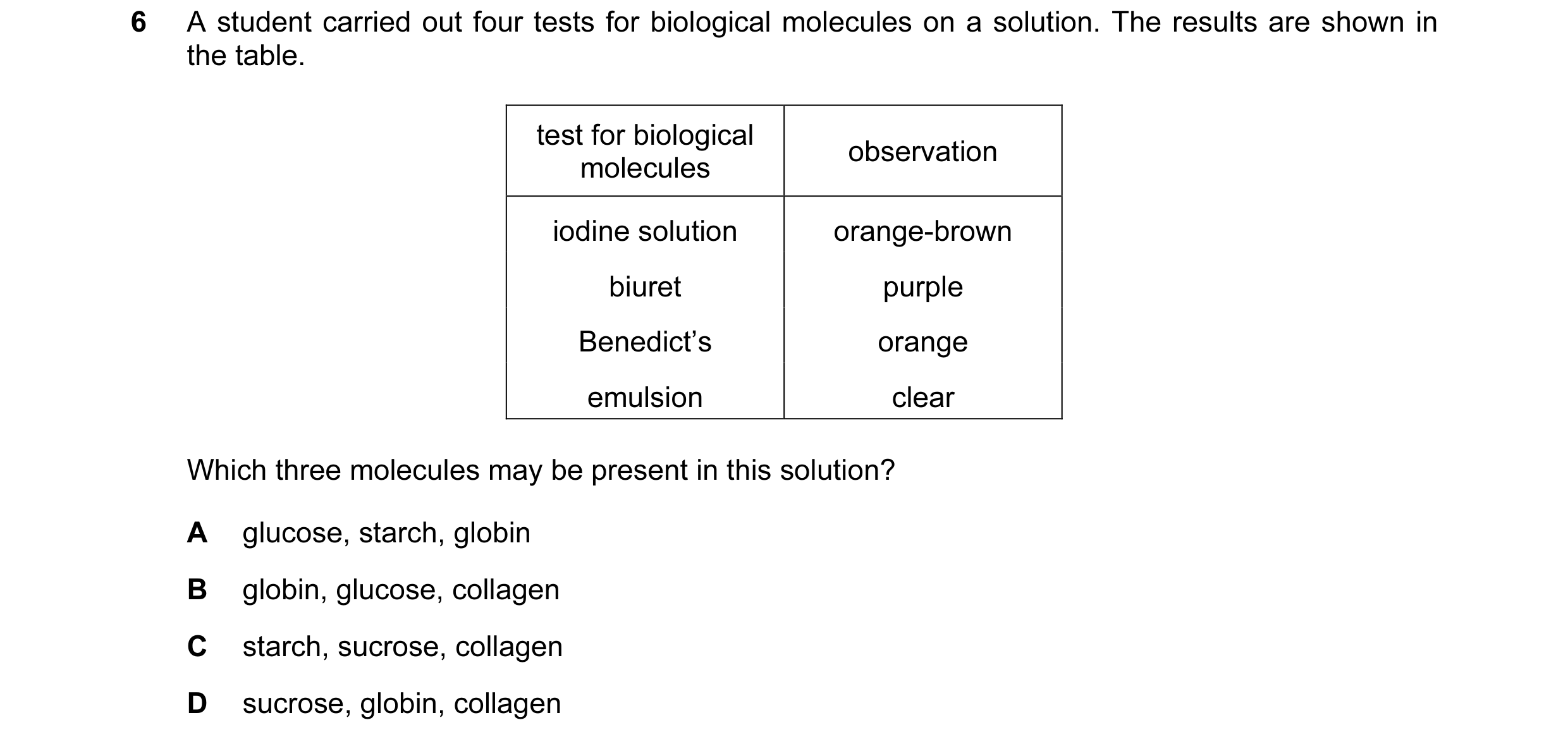
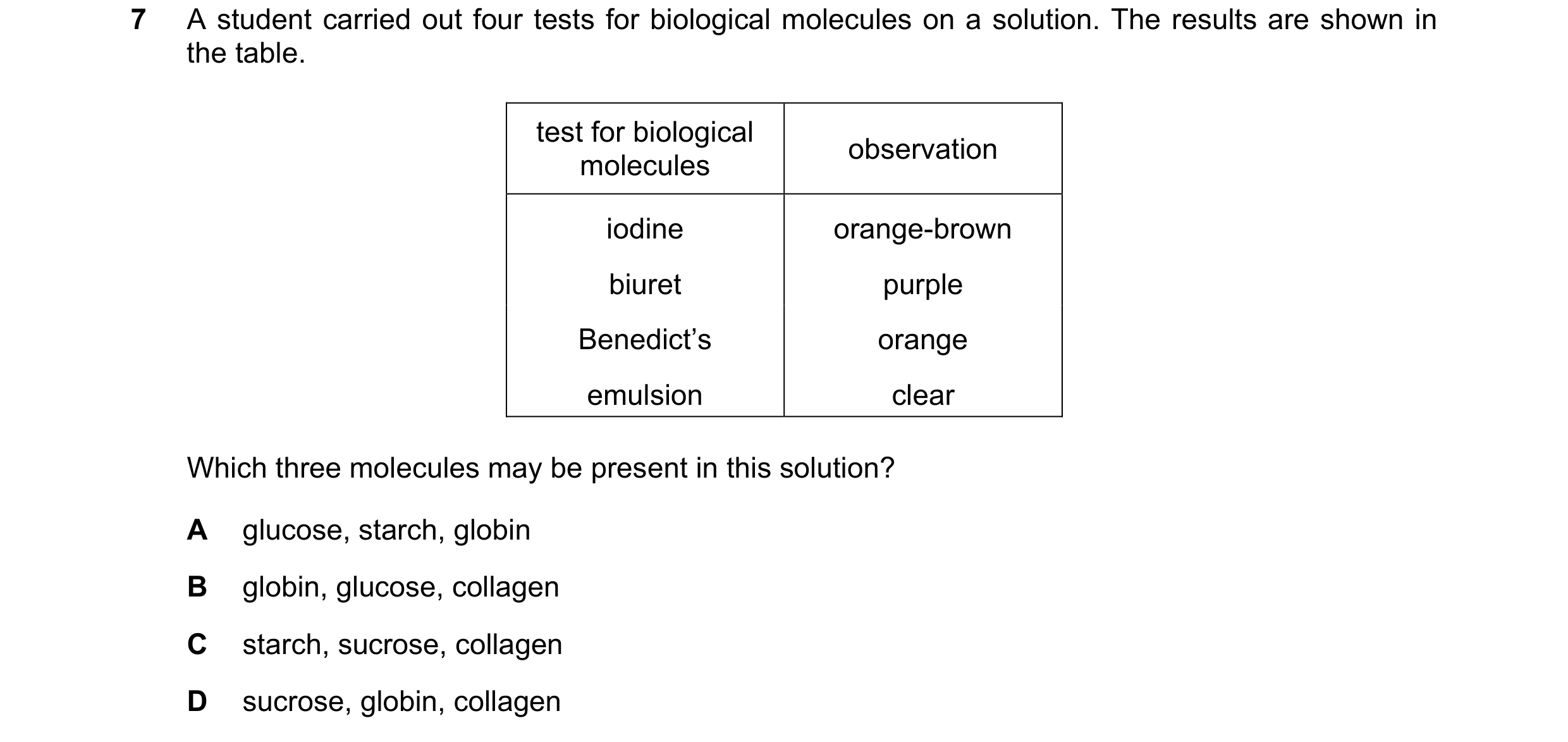
Q26 · A student carried out four tests for biological molecules on a solution 9700/11 May/June 2014
6 A student carried out four tests for biological molecules on a solution. The results are shown in the table. test for biological observation molecules iodine solution orange-brown biuret purple Benedict’s orange emulsion clear Which three molecules may be present in this solution? A glucose, starch, globin B globin, glucose, collagen C starch, sucrose, collagen D sucrose, globin, collagen
1 marks
Answer: B
This question in 9700/11 May/June 2014
Q27 · The molecule shown is a polymer of reducing sugars 9700/11 May/June 2014
7 The molecule shown is a polymer of reducing sugars. CH2OH CH2OH CH2OH CH2OH O O O O OH OH OH OH O O O HO OH OH OH OH OH Which procedures could be carried out in order to test for the presence of the reducing sugars in this molecule? 1 Add hydrolytic enzyme and then heat with Benedict’s reagent. 2 Dissolve in water, neutralise and then heat with Benedict’s reagent. 3 Boil with hydrochloric acid, neutralise and then heat with Benedict’s reagent. A 1, 2 and 3 B 1 and 2 only C 1 and 3 only D 2 and 3 only
1 marks
Answer: C
This question in 9700/11 May/June 2014
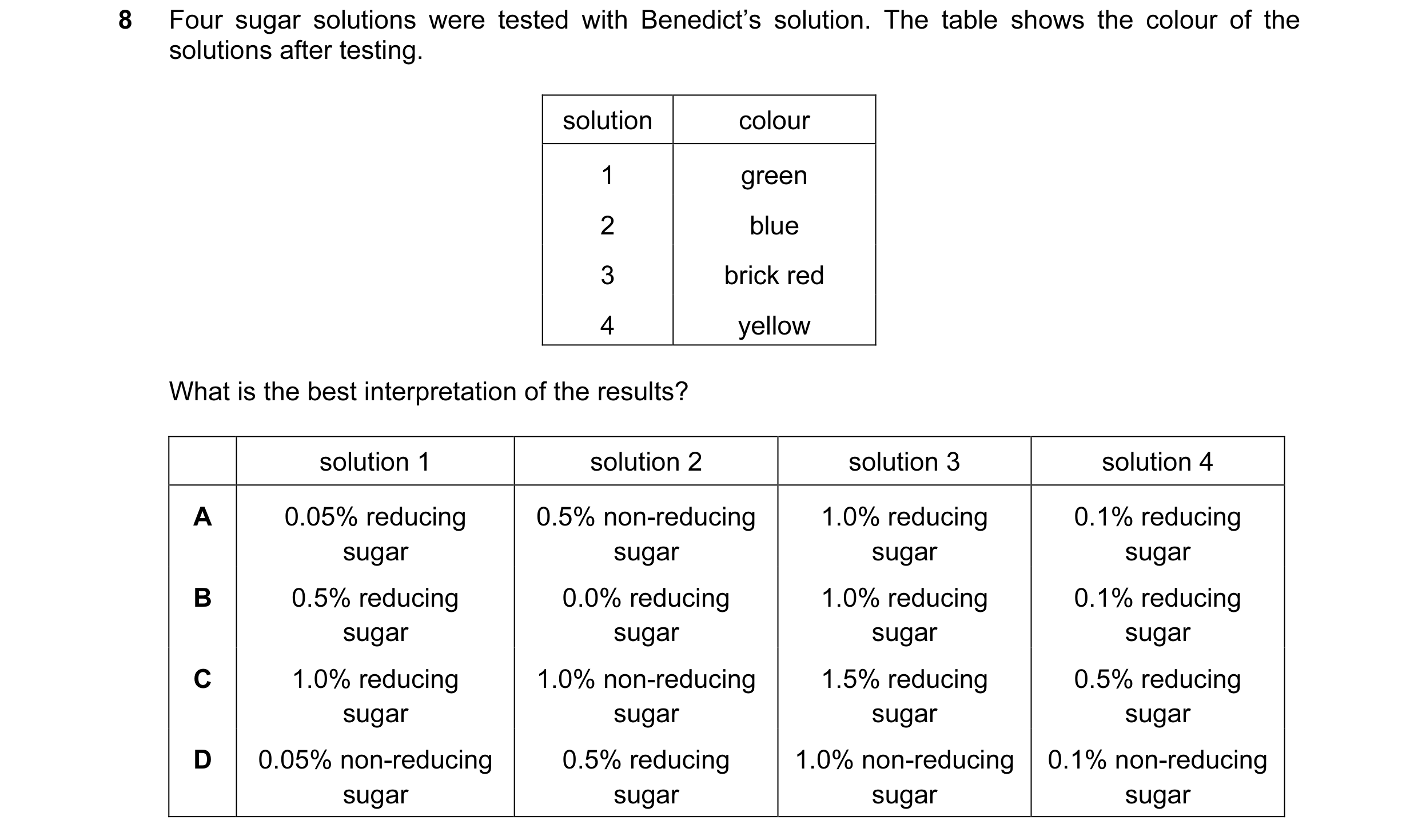
Q28 · Four sugar solutions were tested with Benedict’s solution 9700/12 May/June 2014
8 Four sugar solutions were tested with Benedict’s solution. The table shows the colour of the solutions after testing. solution colour 1 green 2 blue 3 brick red 4 yellow What is the best interpretation of the results? solution 1 solution 2 solution 3 solution 4 A 0.05% reducing 0.5% non-reducing 1.0% reducing 0.1% reducing sugar sugar sugar sugar B 0.5% reducing 0.0% reducing 1.0% reducing 0.1% reducing sugar sugar sugar sugar C 1.0% reducing 1.0% non-reducing 1.5% reducing 0.5% reducing sugar sugar sugar sugar D 0.05% non-reducing 0.5% reducing 1.0% non-reducing 0.1% non-reducing sugar sugar sugar sugar
1 marks
Answer: A
This question in 9700/12 May/June 2014
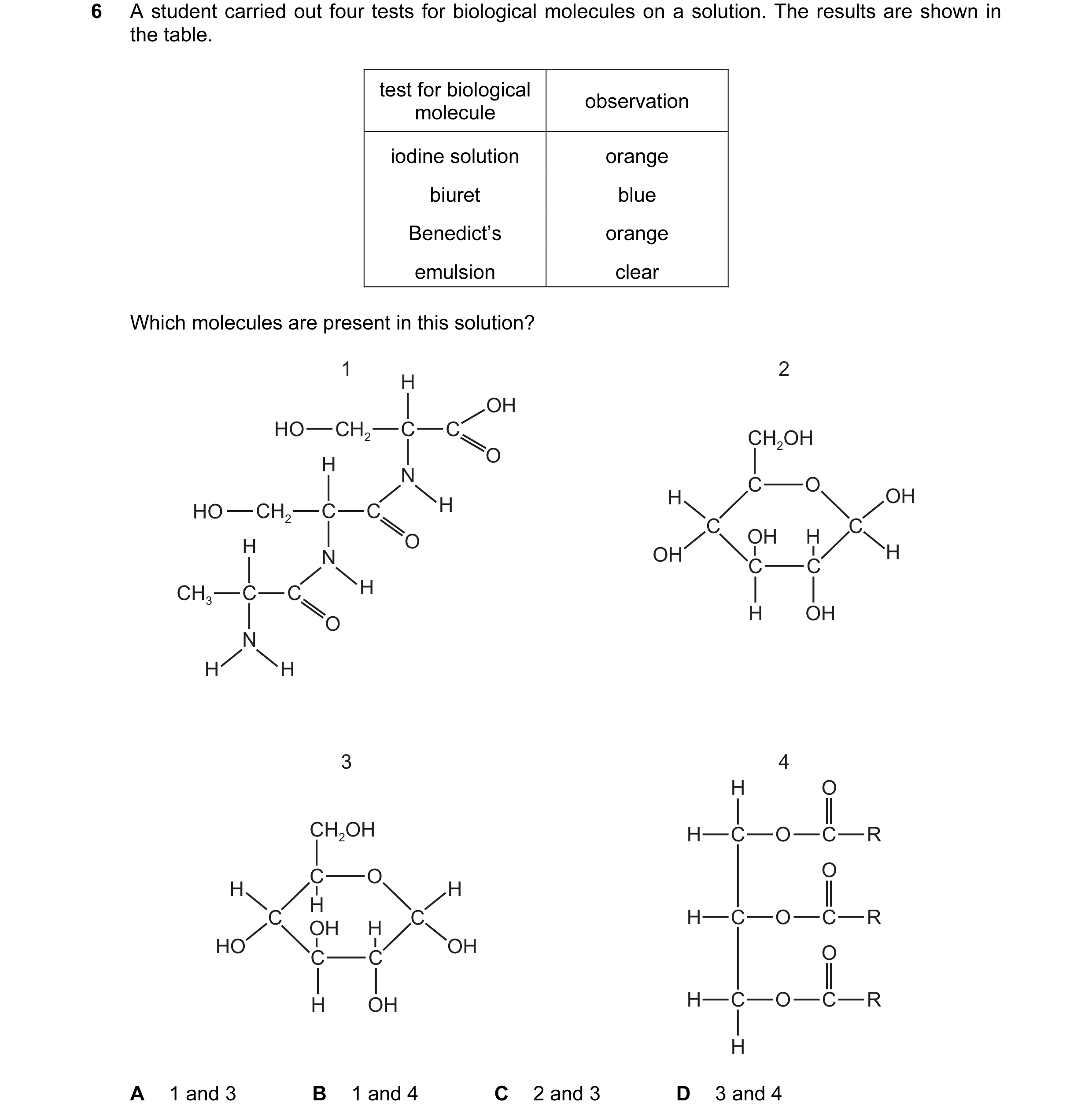
Q29 · A student carried out four tests for biological molecules on a solution 9700/13 May/June 2014
6 A student carried out four tests for biological molecules on a solution. The results are shown in the table. test for biological observation molecule iodine solution orange biuret blue Benedict’s orange emulsion clear Which molecules are present in this solution? 1 2 H OH HO CH2 C C CH2OH H O N C O H H OH HO CH2 C C C C O OH H H OH H N C C CH3 C C H H OH O N H H 3 4 H O CH2OH H C O C R C O O H H H C C H C O C R OH H HO OH O C C H OH H C O C R H A 1 and 3 B 1 and 4 C 2 and 3 D 3 and 4
1 marks
Answer: C
This question in 9700/13 May/June 2014
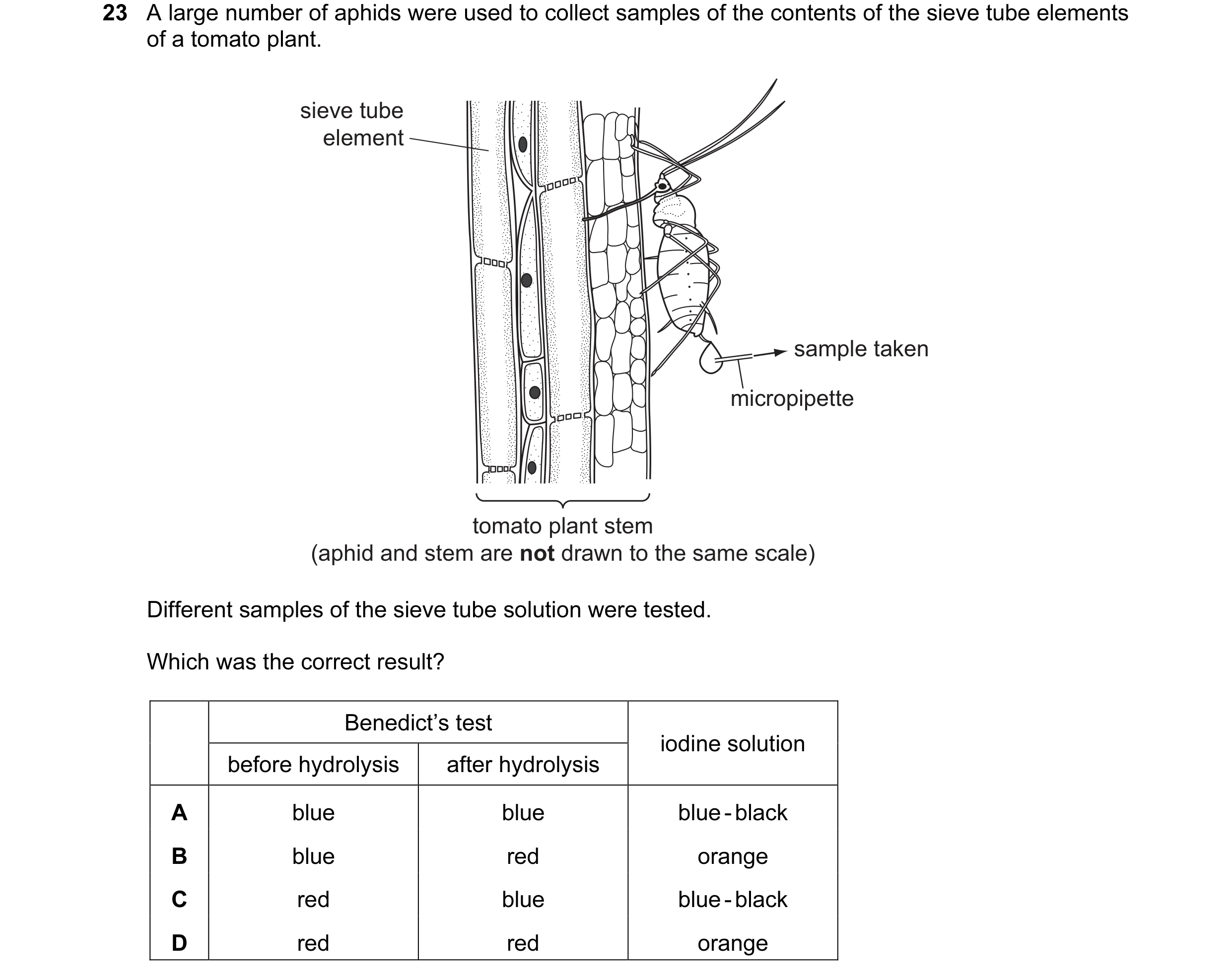
Q30 · A large number of aphids were used to collect samples of the contents of the sieve tube… 9700/11 Oct/Nov 2014
23 A large number of aphids were used to collect samples of the contents of the sieve tube elements of a tomato plant. sieve tube element sample taken micropipette tomato plant stem (aphid and stem are not drawn to the same scale) Different samples of the sieve tube solution were tested. Which was the correct result? Benedict’s test iodine solution before hydrolysis after hydrolysis A blue blue blue - black B blue red orange C red blue blue - black D red red orange
1 marks
Answer: B
This question in 9700/11 Oct/Nov 2014
Q31 · Samples of a mixture of biological molecules were tested using Benedict’s reagent, biuret… 9700/13 Oct/Nov 2014
6 Samples of a mixture of biological molecules were tested using Benedict’s reagent, biuret solution and ethanol. After testing, the solutions were blue with Benedict’s reagent, purple with biuret and cloudy with ethanol. Which molecules could the mixture contain? W X H CH2OH OH HO CH2 C C C O H H H O H N C C OH H OH OH HOOC CH2 CH2 C C H C C H O N H OH CH3 C C H O N H H Y Z H OH H O HOCH2 CH2OH H C C H C O C R H C O H H H H O C C C C OH H O H C O C R O HO C C CH2OH O H OH H C O C R H A W, X and Y B W, X and Z C W, Y and Z D X, Y and Z
1 marks
Answer: C
This question in 9700/13 Oct/Nov 2014
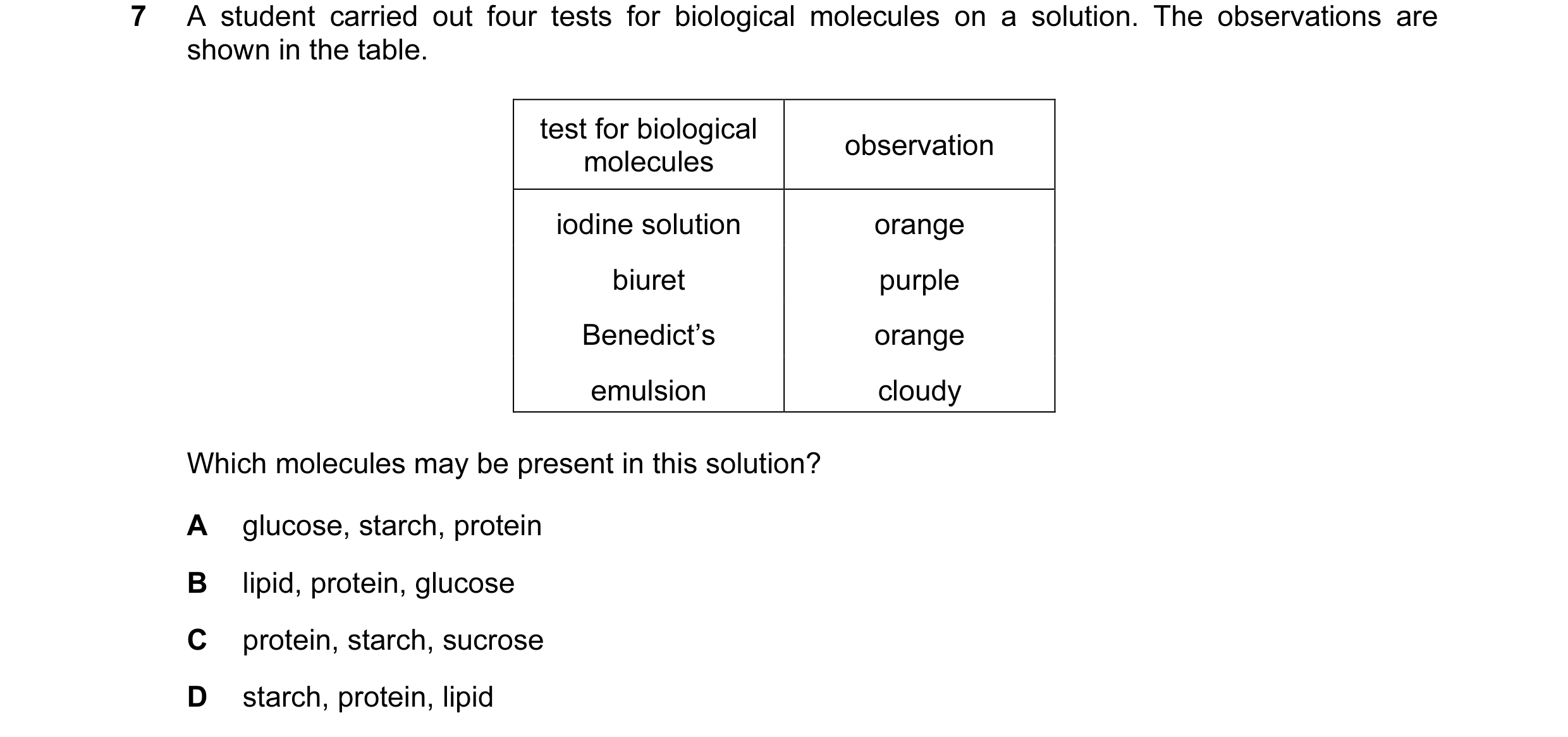
Q32 · A student carried out four tests for biological molecules on a solution 9700/11 May/June 2015
7 A student carried out four tests for biological molecules on a solution. The observations are shown in the table. test for biological observation molecules iodine solution orange biuret purple Benedict’s orange emulsion cloudy Which molecules may be present in this solution? A glucose, starch, protein B lipid, protein, glucose C protein, starch, sucrose D starch, protein, lipid
1 marks
Answer: B
This question in 9700/11 May/June 2015
Q33 · Solutions of biological molecules are tested for sugars 9700/12 May/June 2015
12 Solutions of biological molecules are tested for sugars. The table shows the colours of the solutions after testing. boiled with hydrochloric acid, heated with solution neutralised, then heated with Benedict’s solution Benedict’s solution 1 blue orange 2 green green 3 yellow red Which may contain non-reducing sugars? A 1, 2 and 3 B 1 and 2 only C 1 and 3 only D 2 and 3 only
1 marks
Answer: C
This question in 9700/12 May/June 2015
Q34 · A student carried out four tests for biological molecules 9700/13 May/June 2015
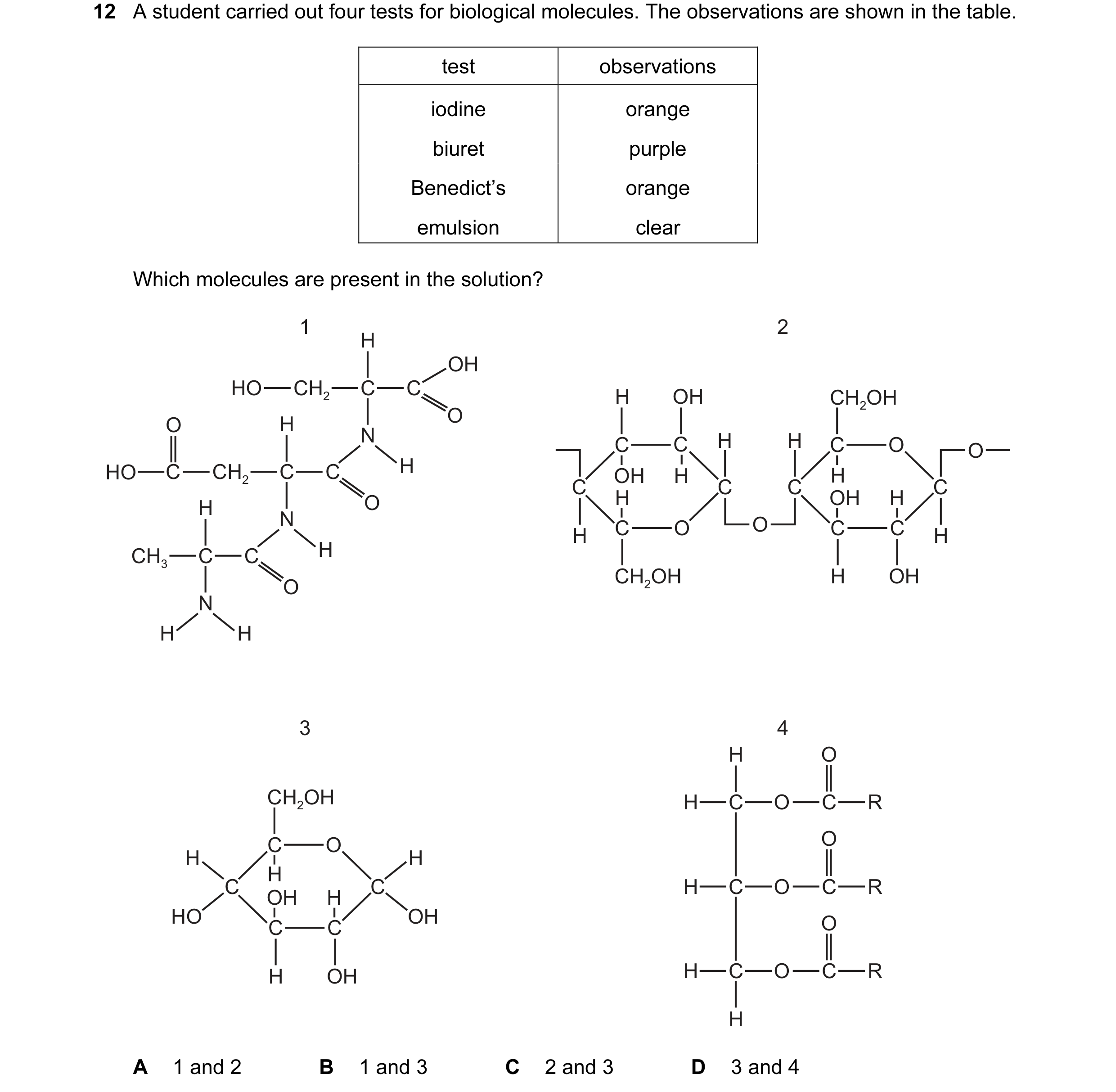
12 A student carried out four tests for biological molecules. The observations are shown in the table. test observations iodine orange biuret purple Benedict’s orange emulsion clear Which molecules are present in the solution? 1 2 H OH HO CH2 C C H OH CH2OH H O O N C H H C C O O HO C CH2 C C H OH H H C C C C O H OH H H N C O O C C H H CH3 C C H CH2OH H OH O N H H 3 4 H O CH2OH H C O C R C O O H H H C C H C O C R OH H HO OH O C C H OH H C O C R H A 1 and 2 B 1 and 3 C 2 and 3 D 3 and 4
1 marks
Answer: B
This question in 9700/13 May/June 2015
Q35 · Tests for biological molecules were carried out on three solutions 9700/11 Oct/Nov 2015
8 Tests for biological molecules were carried out on three solutions. The observations were as follows. solution 1 Benedict’s test – blue to orange solution 2 Benedict’s test after acid hydrolysis – blue to red solution 3 biuret test – blue to purple Which observations would show the solutions that contained sucrose and amylase? A 1, 2 and 3 B 1 and 3 only C 2 and 3 only D 2 only
1 marks
Answer: C
This question in 9700/11 Oct/Nov 2015
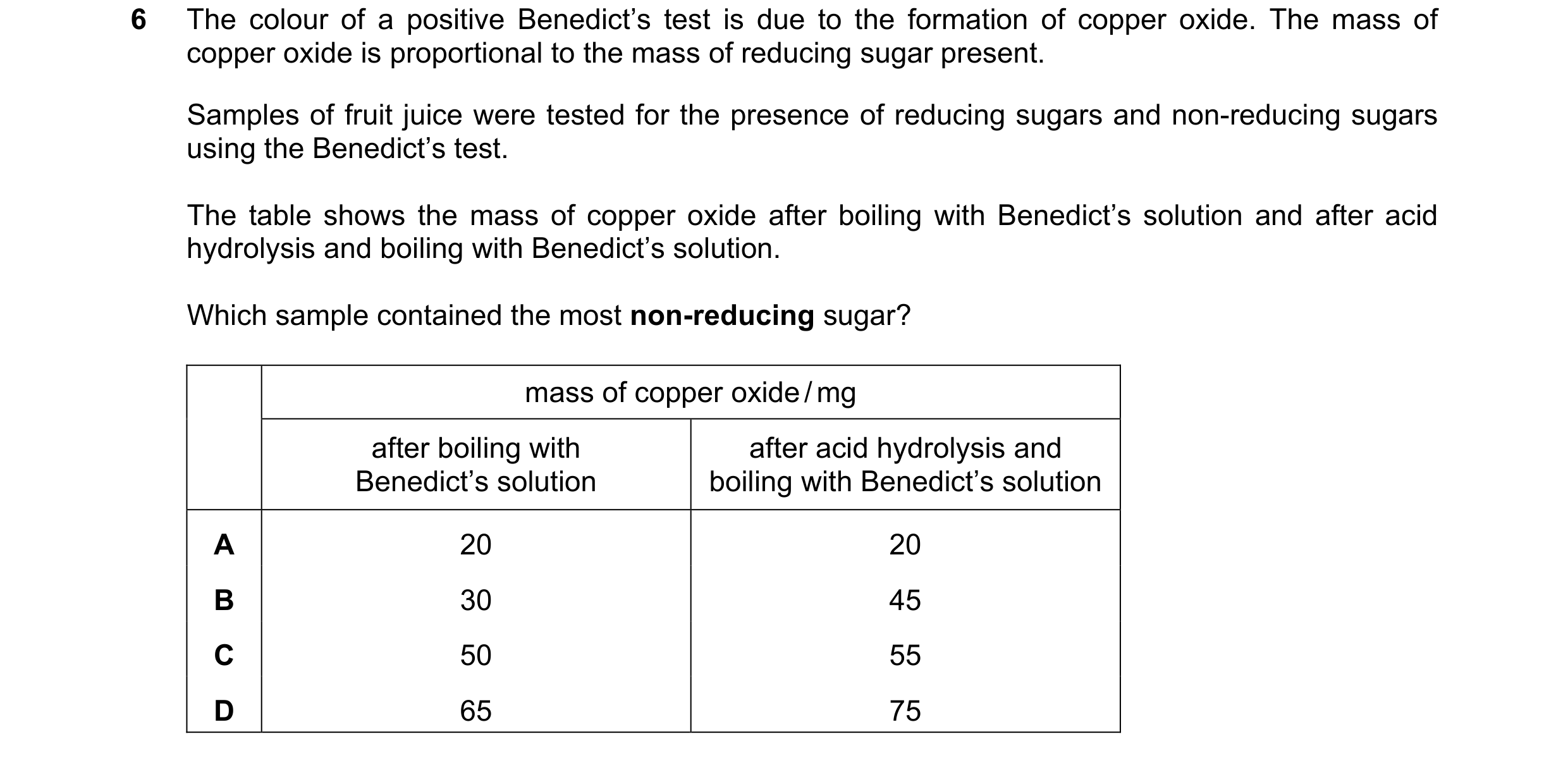
Q36 · The colour of a positive Benedict’s test is due to the formation of copper oxide 9700/12 Oct/Nov 2015
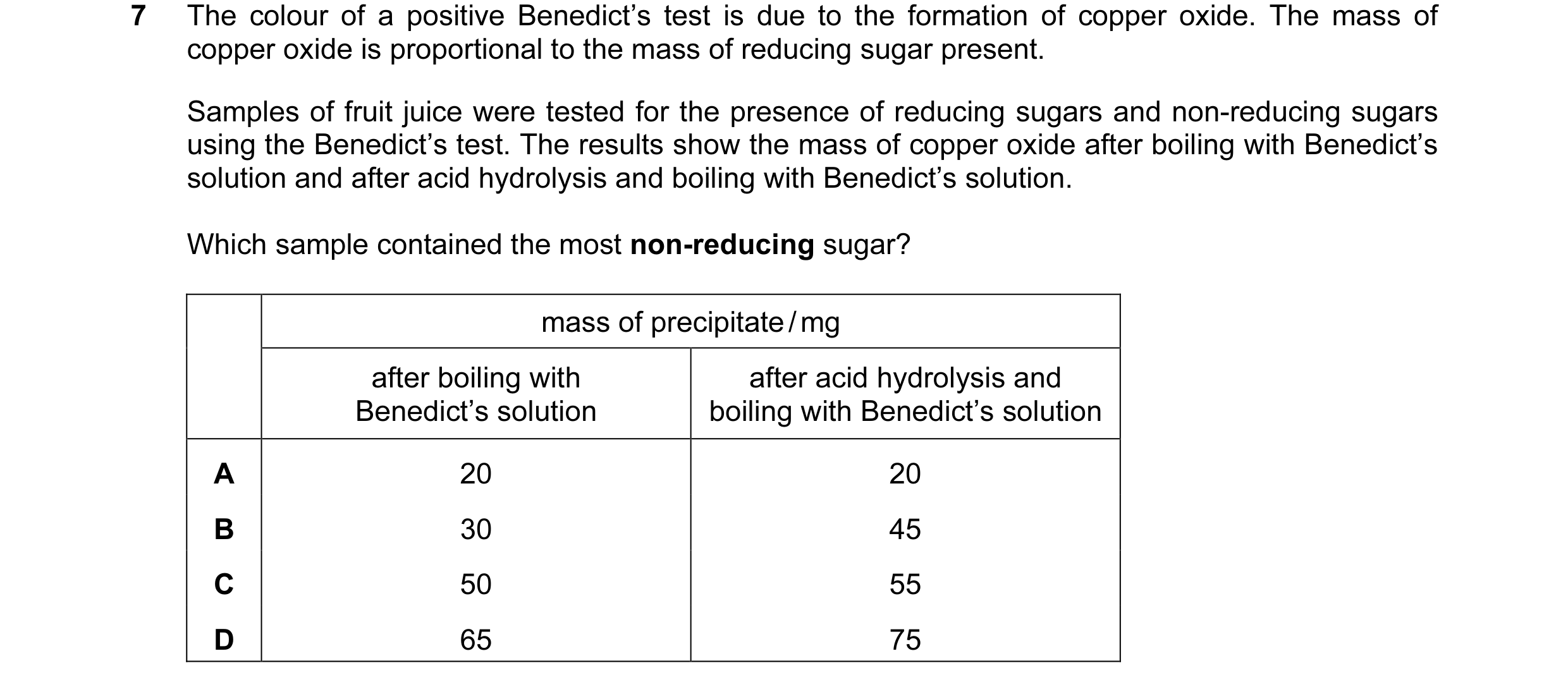
7 The colour of a positive Benedict’s test is due to the formation of copper oxide. The mass of copper oxide is proportional to the mass of reducing sugar present. Samples of fruit juice were tested for the presence of reducing sugars and non-reducing sugars using the Benedict’s test. The results show the mass of copper oxide after boiling with Benedict’s solution and after acid hydrolysis and boiling with Benedict’s solution. Which sample contained the most non-reducing sugar? mass of precipitate / mg after boiling with after acid hydrolysis and Benedict’s solution boiling with Benedict’s solution A 20 20 B 30 45 C 50 55 D 65 75
1 marks
Answer: B
This question in 9700/12 Oct/Nov 2015
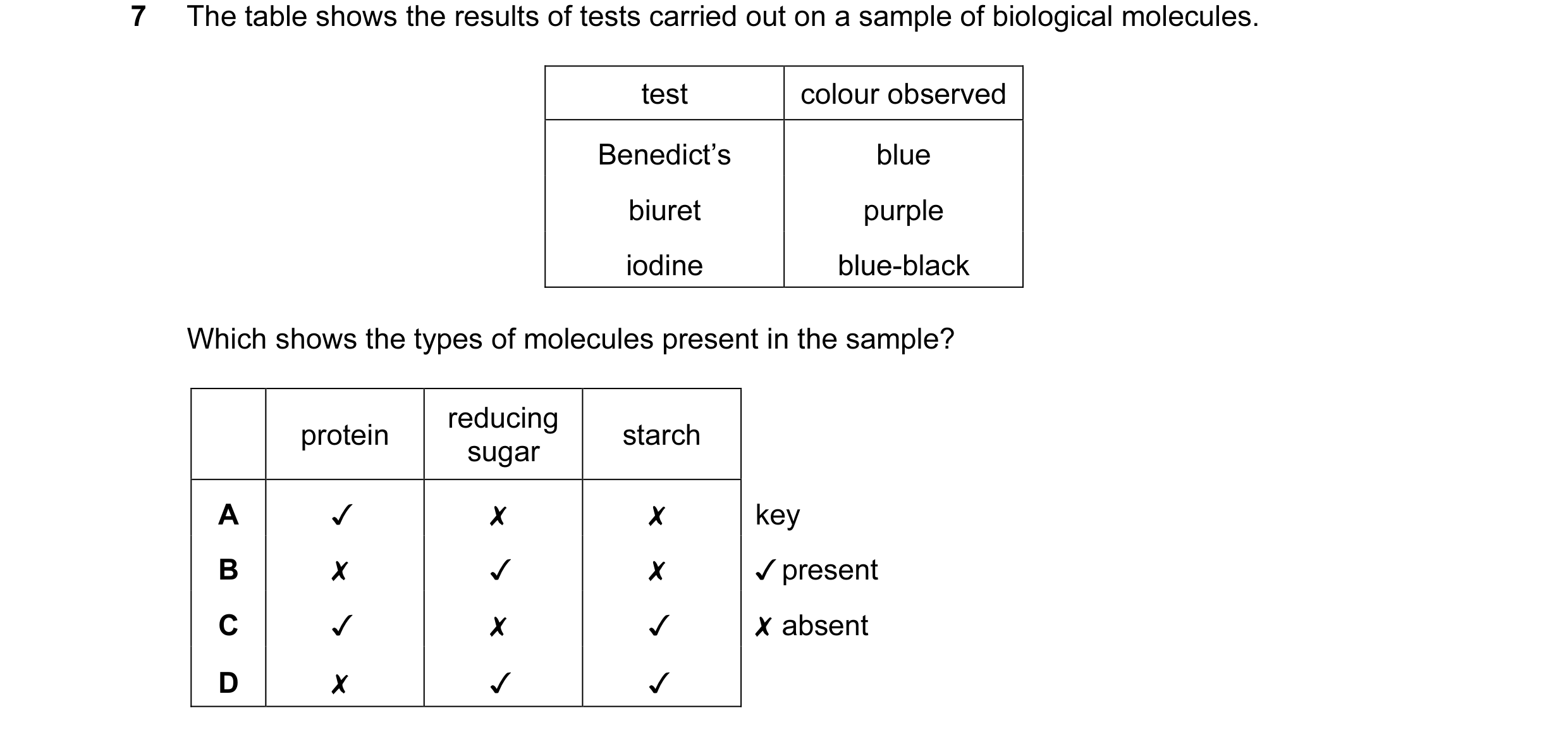
Q37 · The table shows the results of tests carried out on a sample of biological molecules 9700/13 Oct/Nov 2015
7 The table shows the results of tests carried out on a sample of biological molecules.
test colour observed
Benedict’s blue
biuret purple
iodine blue-black
Which shows the types of molecules present in the sample?
protein sugar starch
A v x x
B x v x
Cc v x v
D x v v
key
J present
X absent
1 marks
Answer: C
This question in 9700/13 Oct/Nov 2015
Q38 · Which molecule in the key is sucrose? 9700/12 Feb/March 2016
8 Which molecule in the key is sucrose? is a reducing sugar yes no contains pentose sugar contains hexose sugar yes no yes no A B C D
1 marks
Answer: C
This question in 9700/12 Feb/March 2016
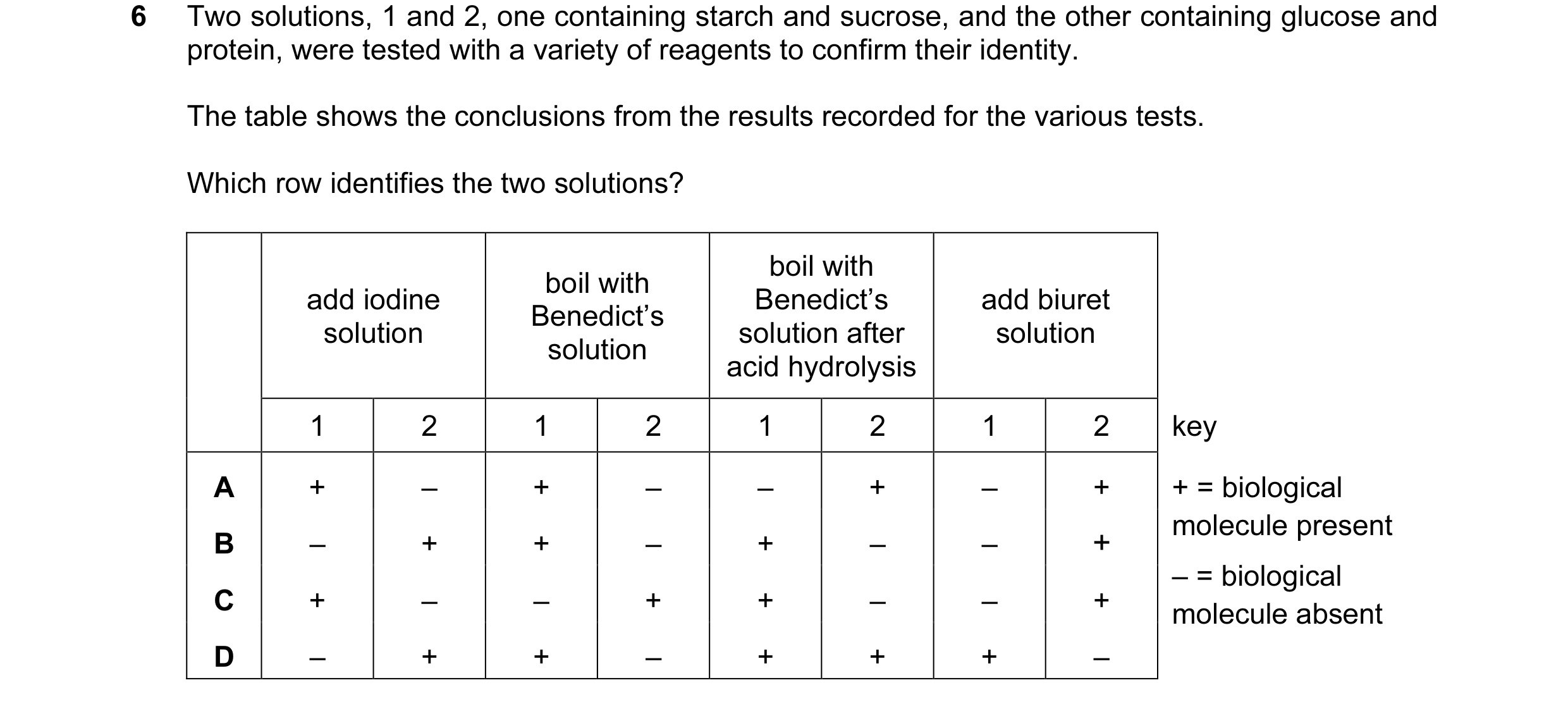
Q39 · Two solutions, 1 and 2, one containing starch and sucrose, and the other containing… 9700/11 May/June 2016
6 Two solutions, 1 and 2, one containing starch and sucrose, and the other containing glucose and protein, were tested with a variety of reagents to confirm their identity. The table shows the conclusions from the results recorded for the various tests. Which row identifies the two solutions? boil with boil with add iodine Benedict’s add biuret Benedict’s solution solution after solution solution acid hydrolysis 1 2 1 2 1 2 1 2 key A + – + – – + – + + = biological molecule present B – + + – + – – + – = biological C + – – + + – – + molecule absent D – + + – + + + –
1 marks
Answer: C
This question in 9700/11 May/June 2016
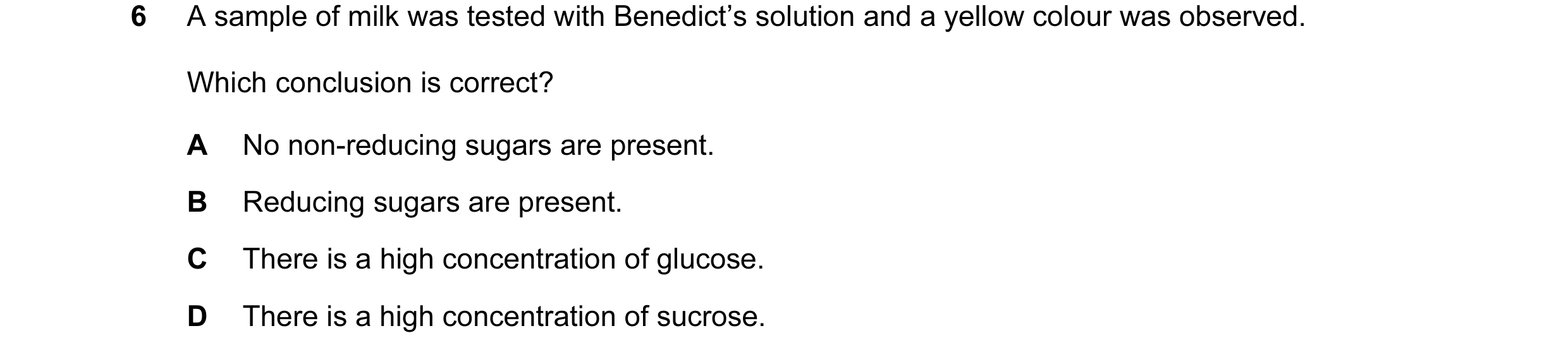
Q40 · A sample of milk was tested with Benedict’s solution and a yellow colour was observed 9700/13 May/June 2016
6 A sample of milk was tested with Benedict’s solution and a yellow colour was observed. Which conclusion is correct? A No non-reducing sugars are present. B Reducing sugars are present. C There is a high concentration of glucose. D There is a high concentration of sucrose.
1 marks
This question in 9700/13 May/June 2016
Q41 · In order to estimate the quantity of glucose in a solution, equal volumes of a range of… 9700/11 Oct/Nov 2016
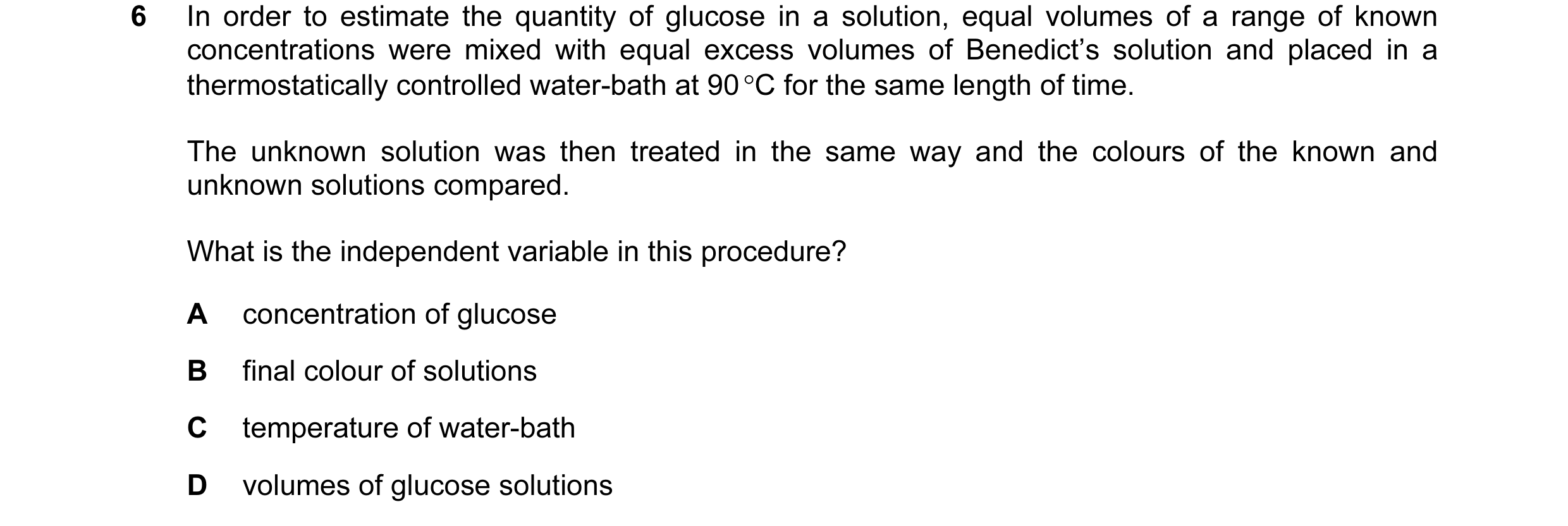
6 In order to estimate the quantity of glucose in a solution, equal volumes of a range of known concentrations were mixed with equal excess volumes of Benedict’s solution and placed in a thermostatically controlled water-bath at 90 °C for the same length of time. The unknown solution was then treated in the same way and the colours of the known and unknown solutions compared. What is the independent variable in this procedure? A concentration of glucose B final colour of solutions C temperature of water-bath D volumes of glucose solutions
1 marks
Answer: A
This question in 9700/11 Oct/Nov 2016
Q42 · A student carried out the Benedict’s test on four different concentrations of glucose… 9700/13 Oct/Nov 2016
6 A student carried out the Benedict’s test on four different concentrations of glucose solution and then recorded the time taken for the first appearance of a colour change (the end-point). The student found it difficult to identify the first appearance of a colour change and consistently timed each solution for two seconds after it had appeared. This introduced a source of error into the experiment. Which statements about this error are correct? 1 The effect of the error will be reduced if the student performs three repeats at each concentration of glucose. 2 The error will prevent the student from identifying which solution has the highest concentration of glucose. 3 The error is systematic as the student consistently timed each solution for two seconds after the end-point. A 1 and 2 B 1 and 3 C 2 and 3 D 3 only
1 marks
Answer: D
This question in 9700/13 Oct/Nov 2016
Q43 · A sample of milk is tested with Benedict’s solution 9700/12 Feb/March 2017
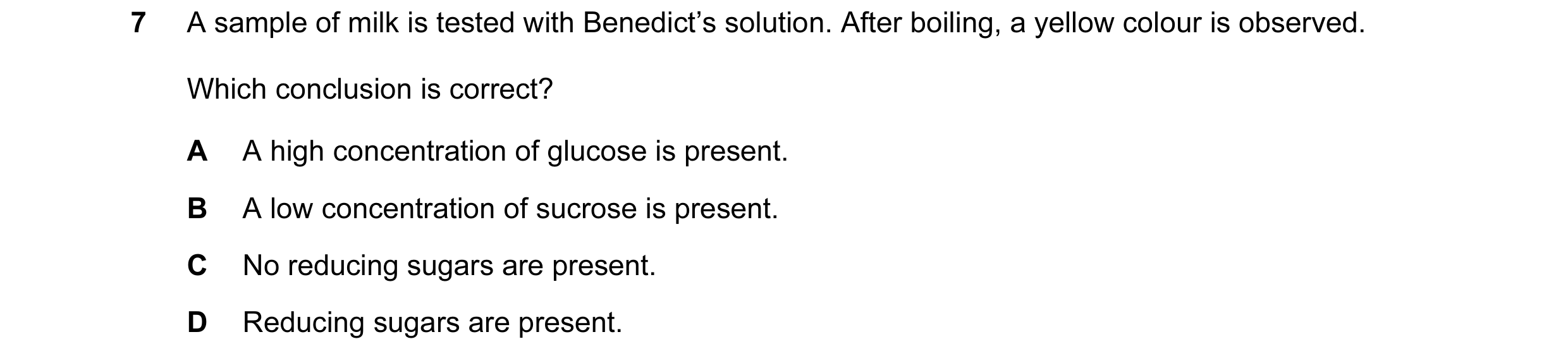
7 A sample of milk is tested with Benedict’s solution. After boiling, a yellow colour is observed. Which conclusion is correct? A A high concentration of glucose is present. B A low concentration of sucrose is present. C No reducing sugars are present. D Reducing sugars are present.
1 marks
Answer: D
This question in 9700/12 Feb/March 2017
Q44 · The diagram shows the results of tests on four solutions containing biological molecules 9700/12 May/June 2017
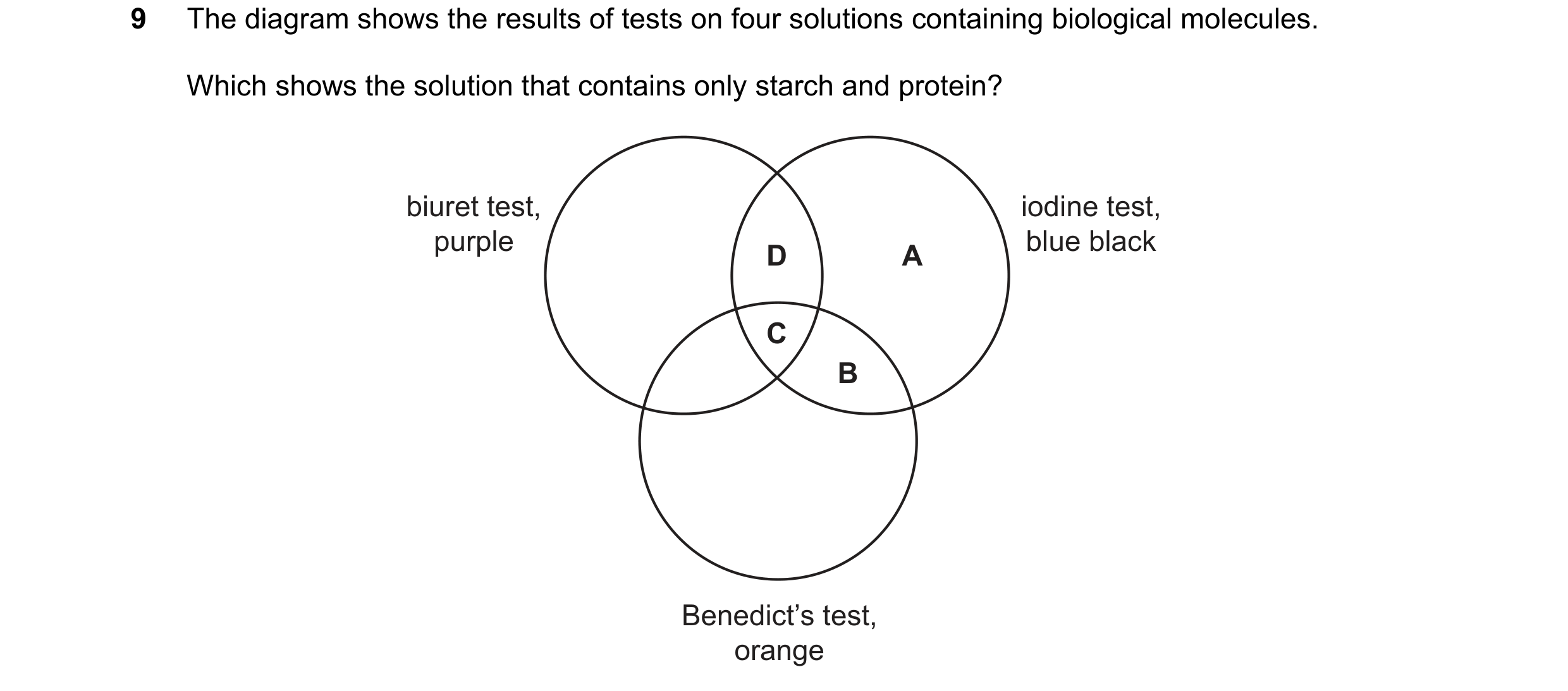
9 The diagram shows the results of tests on four solutions containing biological molecules. Which shows the solution that contains only starch and protein? biuret test, iodine test, purple blue black D A C B Benedict’s test, orange
1 marks
Answer: D
This question in 9700/12 May/June 2017
Q45 · Steps 1–4 are used to test for a non-reducing sugar 9700/13 May/June 2017
5 Steps 1–4 are used to test for a non-reducing sugar. 1 Put 5 cm3 of solution into a test-tube. 2 Add a few drops of acid. 3 Neutralise with alkali. 4 Add 6 cm3 Benedict’s solution. When is the solution boiled? A between steps 1 and 2 B between steps 2 and 3 and after step 4 C between steps 2 and 3 only D after step 4 only
1 marks
Answer: B
This question in 9700/13 May/June 2017
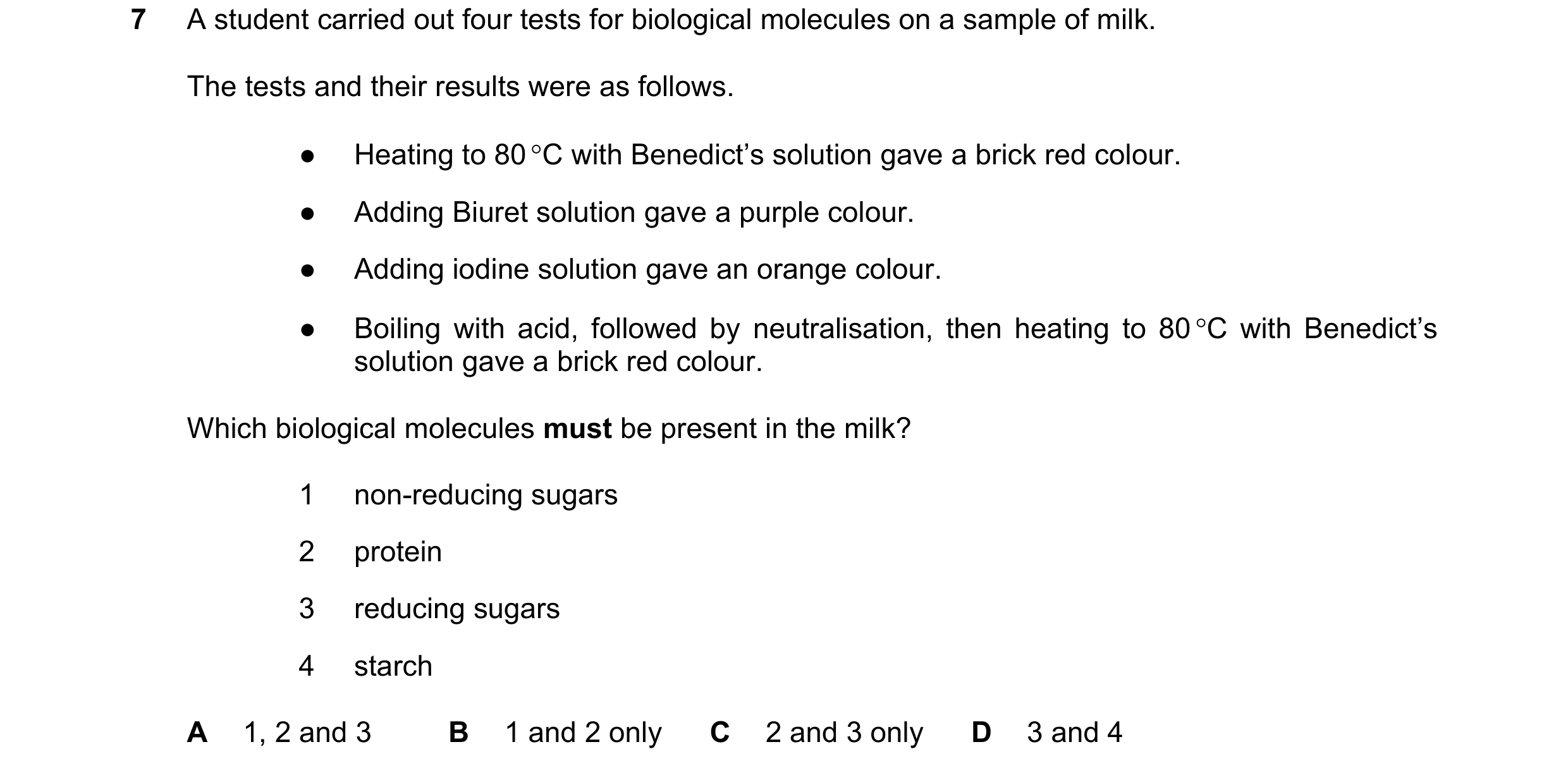
Q46 · A student carried out four tests for biological molecules on a sample of milk 9700/12 Oct/Nov 2017
7 A student carried out four tests for biological molecules on a sample of milk. The tests and their results were as follows. ● Heating to 80 °C with Benedict’s solution gave a brick red colour. ● Adding Biuret solution gave a purple colour. ● Adding iodine solution gave an orange colour. ● Boiling with acid, followed by neutralisation, then heating to 80 °C with Benedict’s solution gave a brick red colour. Which biological molecules must be present in the milk? 1 non-reducing sugars 2 protein 3 reducing sugars 4 starch A 1, 2 and 3 B 1 and 2 only C 2 and 3 only D 3 and 4
1 marks
Answer: C
This question in 9700/12 Oct/Nov 2017
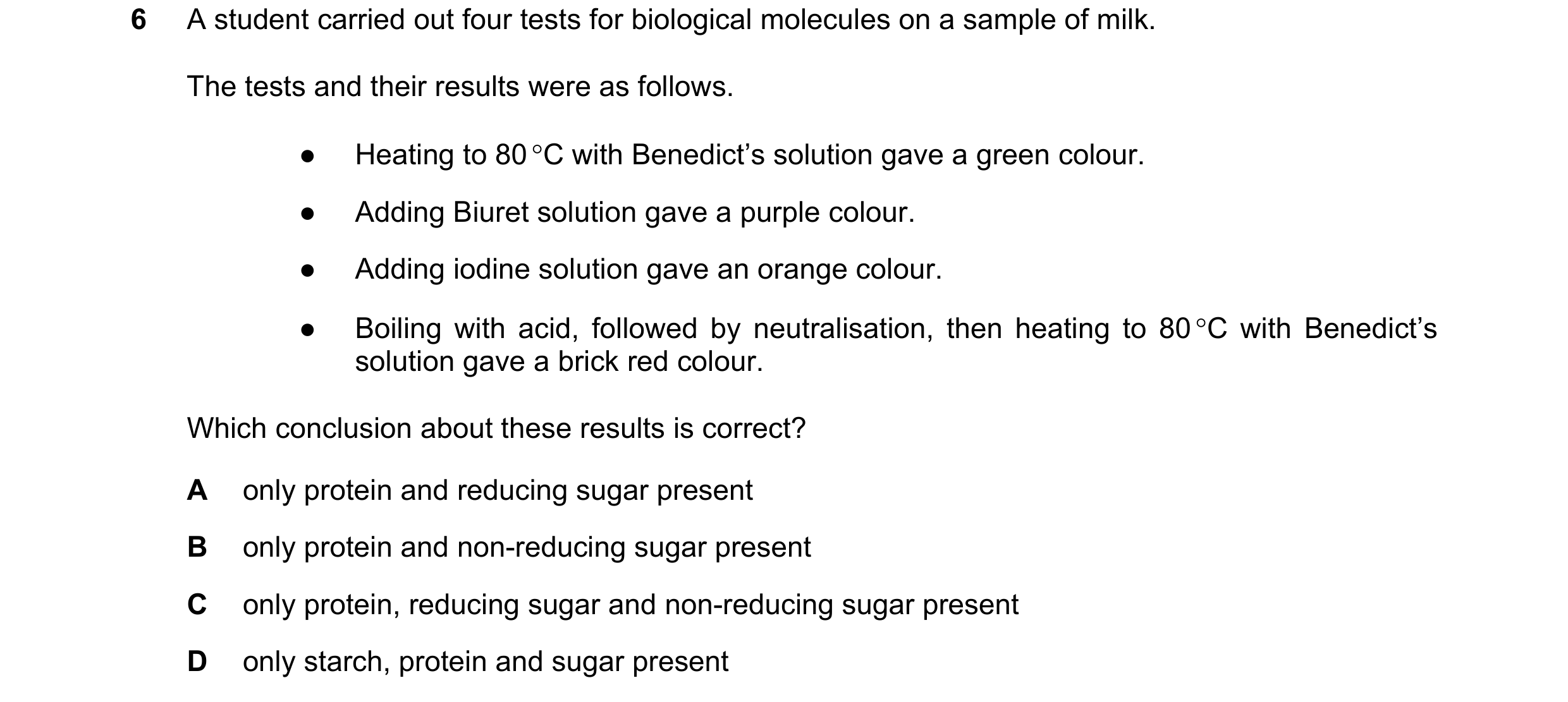
Q47 · A student carried out four tests for biological molecules on a sample of milk 9700/13 Oct/Nov 2017
6 A student carried out four tests for biological molecules on a sample of milk. The tests and their results were as follows. ● Heating to 80 °C with Benedict’s solution gave a green colour. ● Adding Biuret solution gave a purple colour. ● Adding iodine solution gave an orange colour. ● Boiling with acid, followed by neutralisation, then heating to 80 °C with Benedict’s solution gave a brick red colour. Which conclusion about these results is correct? A only protein and reducing sugar present B only protein and non-reducing sugar present C only protein, reducing sugar and non-reducing sugar present D only starch, protein and sugar present
1 marks
Answer: C
This question in 9700/13 Oct/Nov 2017
Q48 · Which concentrations could be produced by a serial dilution of an 8.00% glucose solution? 9700/12 Feb/March 2018
7 Which concentrations could be produced by a serial dilution of an 8.00% glucose solution? A 4.00%, 2.00%, 1.00%, 0.50% and 0.25% B 4.00%, 3.00%, 2.00%, 1.00% and 0.00% C 6.00%, 4.00%, 2.00%, 1.00% and 0.50% D 8.00%, 6.00%, 4.00%, 2.00% and 0.00%
1 marks
Answer: A
This question in 9700/12 Feb/March 2018
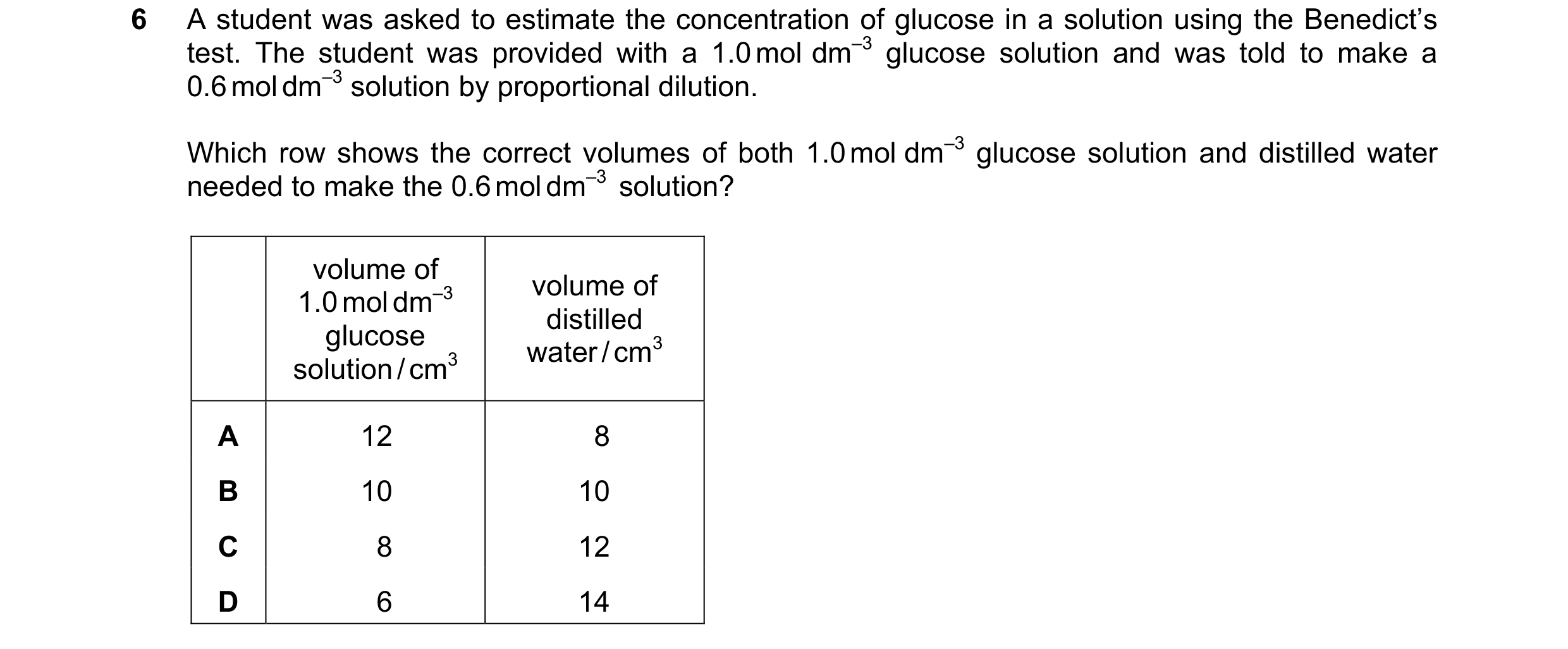
Q49 · A student was asked to estimate the concentration of glucose in a solution using the… 9700/12 May/June 2018
6 A student was asked to estimate the concentration of glucose in a solution using the Benedict’s test. The student was provided with a 1.0 mol dm–3 glucose solution and was told to make a 0.6 mol dm–3 solution by proportional dilution. Which row shows the correct volumes of both 1.0 mol dm–3 glucose solution and distilled water needed to make the 0.6 mol dm–3 solution? volume of 1.0 mol dm–3 volume of distilled glucose water / cm3 solution / cm3 A 12 8 B 10 10 C 8 12 D 6 14
1 marks
Answer: A
This question in 9700/12 May/June 2018
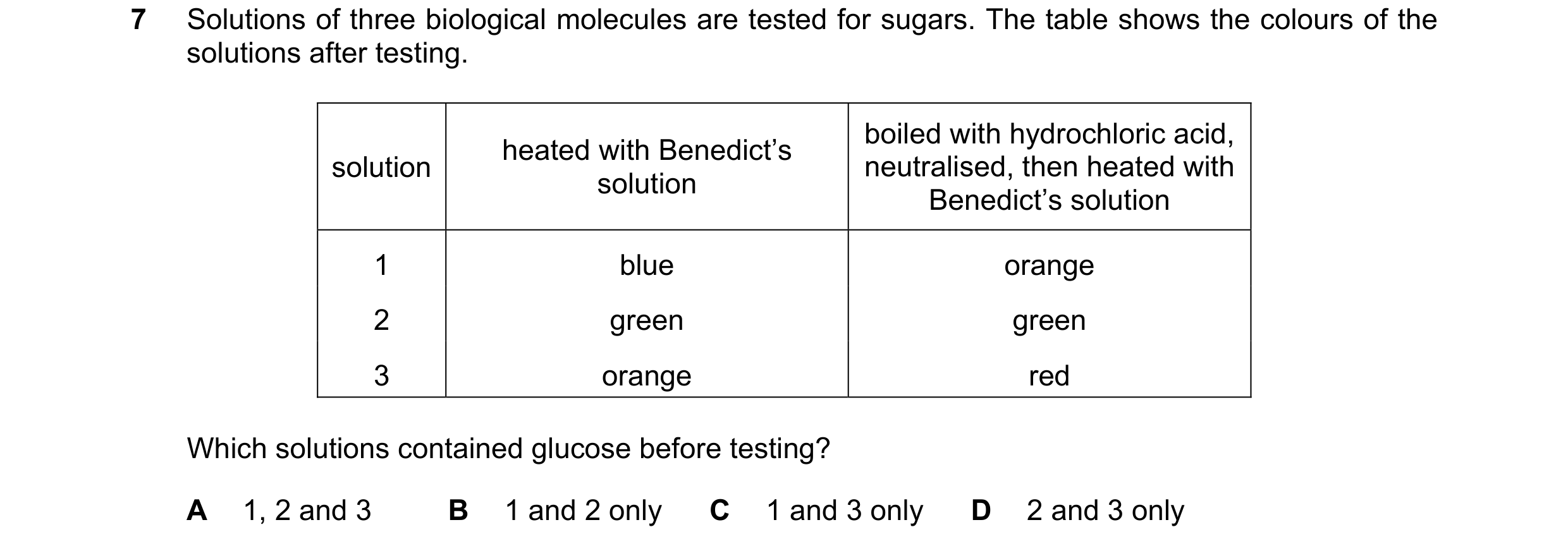
Q50 · Solutions of three biological molecules are tested for sugars 9700/13 May/June 2018
7 Solutions of three biological molecules are tested for sugars. The table shows the colours of the solutions after testing. boiled with hydrochloric acid, heated with Benedict’s solution neutralised, then heated with solution Benedict’s solution 1 blue orange 2 green green 3 orange red Which solutions contained glucose before testing? A 1, 2 and 3 B 1 and 2 only C 1 and 3 only D 2 and 3 only
1 marks
Answer: D
This question in 9700/13 May/June 2018
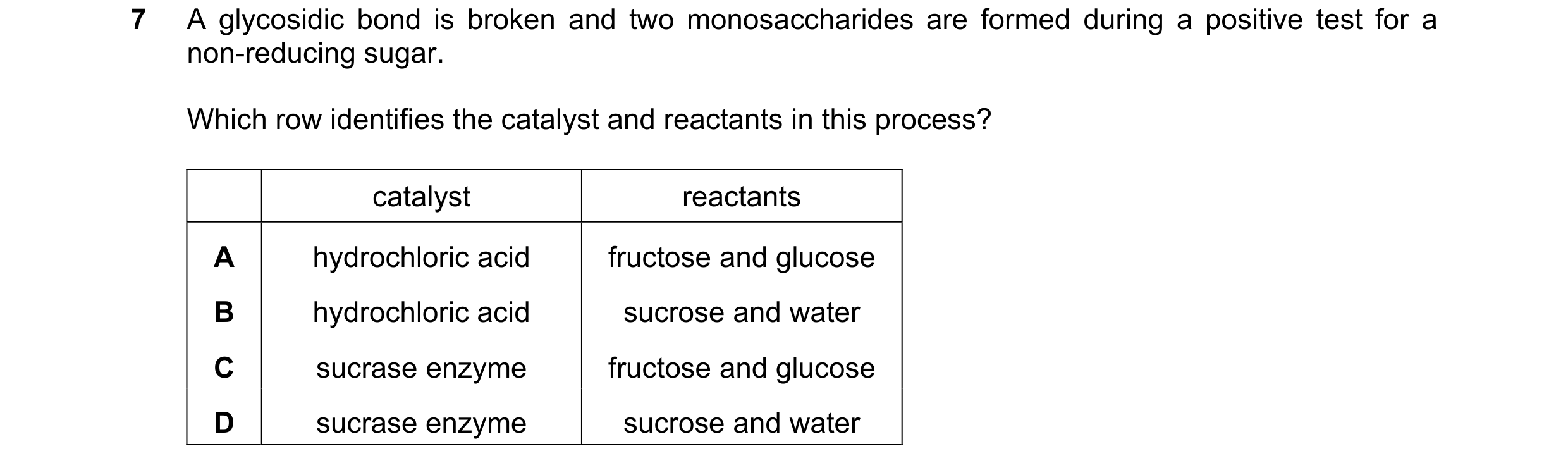
Q51 · A glycosidic bond is broken and two monosaccharides are formed during a positive test for… 9700/11 Oct/Nov 2018
7 A glycosidic bond is broken and two monosaccharides are formed during a positive test for a non-reducing sugar. Which row identifies the catalyst and reactants in this process? catalyst reactants A hydrochloric acid fructose and glucose B hydrochloric acid sucrose and water C sucrase enzyme fructose and glucose D sucrase enzyme sucrose and water
1 marks
Answer: B
This question in 9700/11 Oct/Nov 2018
Q52 · A sample of a solution was tested for reducing sugar and the result was negative 9700/12 Oct/Nov 2018
7 A sample of a solution was tested for reducing sugar and the result was negative. Another sample of the same solution was then tested for non-reducing sugar and the result was positive. Which step in the test for non-reducing sugar breaks the glycosidic bonds? A addition of Benedict’s reagent B addition of sodium hydroxide C boiling with hydrochloric acid D heating to 80 °C
1 marks
Answer: C
This question in 9700/12 Oct/Nov 2018
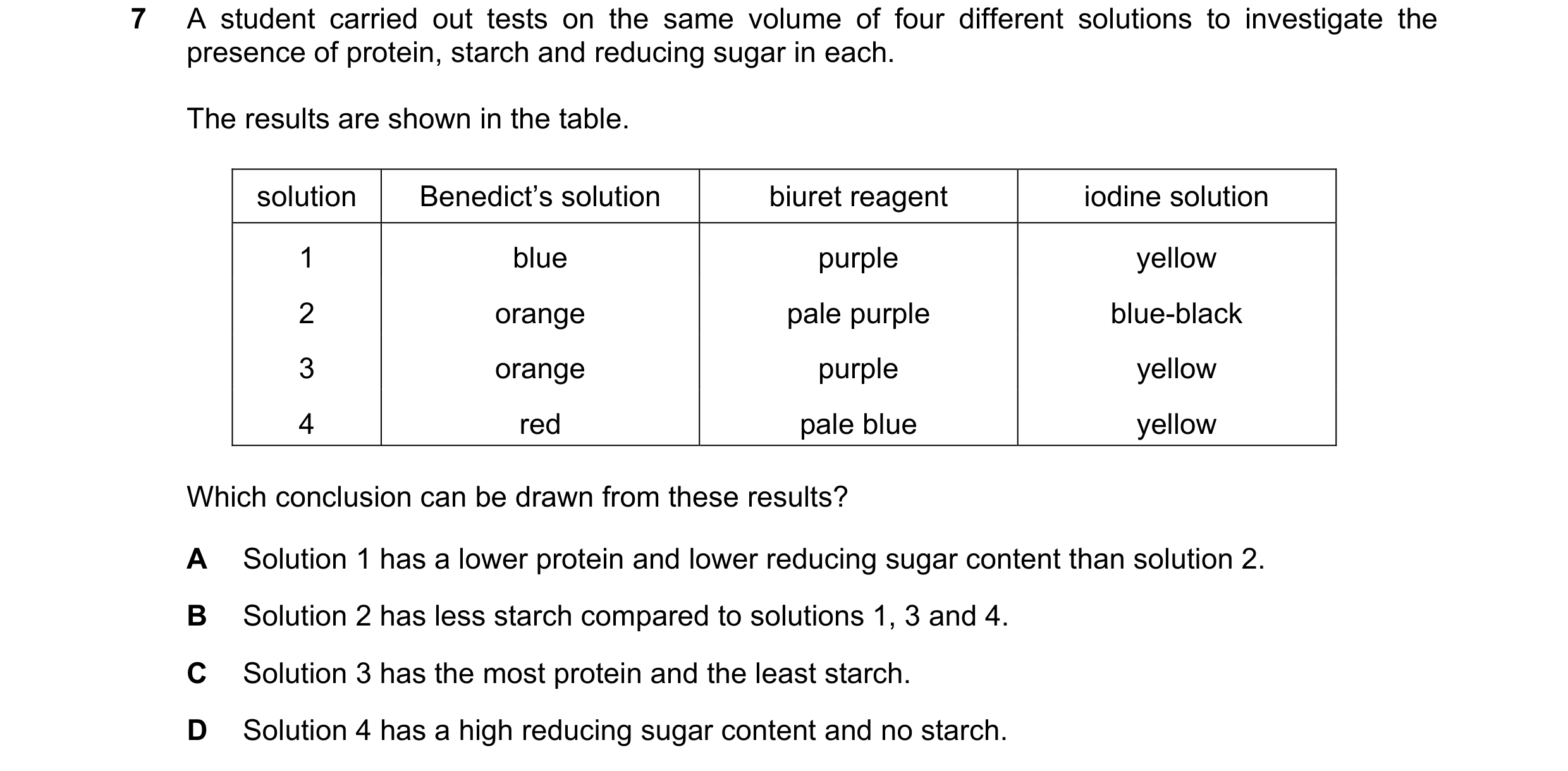
Q53 · A student carried out tests on the same volume of four different solutions to investigate… 9700/13 Oct/Nov 2018
7 A student carried out tests on the same volume of four different solutions to investigate the presence of protein, starch and reducing sugar in each. The results are shown in the table. solution Benedict’s solution biuret reagent iodine solution 1 blue purple yellow 2 orange pale purple blue-black 3 orange purple yellow 4 red pale blue yellow Which conclusion can be drawn from these results? A Solution 1 has a lower protein and lower reducing sugar content than solution 2. B Solution 2 has less starch compared to solutions 1, 3 and 4. C Solution 3 has the most protein and the least starch. D Solution 4 has a high reducing sugar content and no starch.
1 marks
Answer: D
This question in 9700/13 Oct/Nov 2018
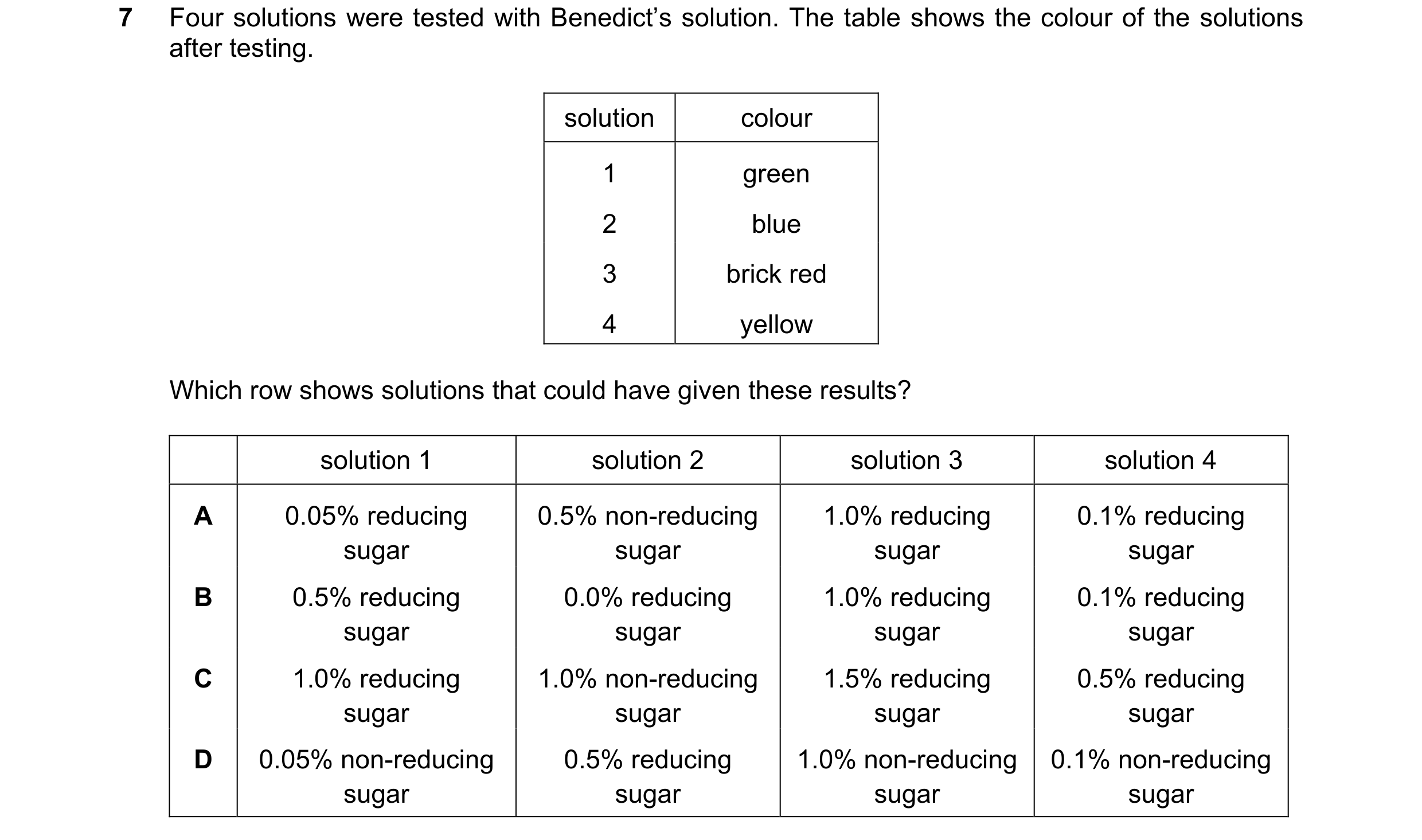
Q54 · Four solutions were tested with Benedict’s solution 9700/12 Feb/March 2019
7 Four solutions were tested with Benedict’s solution. The table shows the colour of the solutions after testing. solution colour 1 green 2 blue 3 brick red 4 yellow Which row shows solutions that could have given these results? solution 1 solution 2 solution 3 solution 4 A 0.05% reducing 0.5% non-reducing 1.0% reducing 0.1% reducing sugar sugar sugar sugar B 0.5% reducing 0.0% reducing 1.0% reducing 0.1% reducing sugar sugar sugar sugar C 1.0% reducing 1.0% non-reducing 1.5% reducing 0.5% reducing sugar sugar sugar sugar D 0.05% non-reducing 0.5% reducing 1.0% non-reducing 0.1% non-reducing sugar sugar sugar sugar
1 marks
Answer: A
This question in 9700/12 Feb/March 2019
Q55 · A solution of amylase was added to a suspension of starch 9700/11 May/June 2019
7 A solution of amylase was added to a suspension of starch. After 30 seconds, three samples of the mixture were tested with iodine solution, Benedict’s solution or with biuret reagent. Which are the expected results? colour with test reagent iodine solution Benedict’s solution biuret reagent A black green purple B black red blue C brown blue purple D brown yellow blue
1 marks
Answer: A
This question in 9700/11 May/June 2019
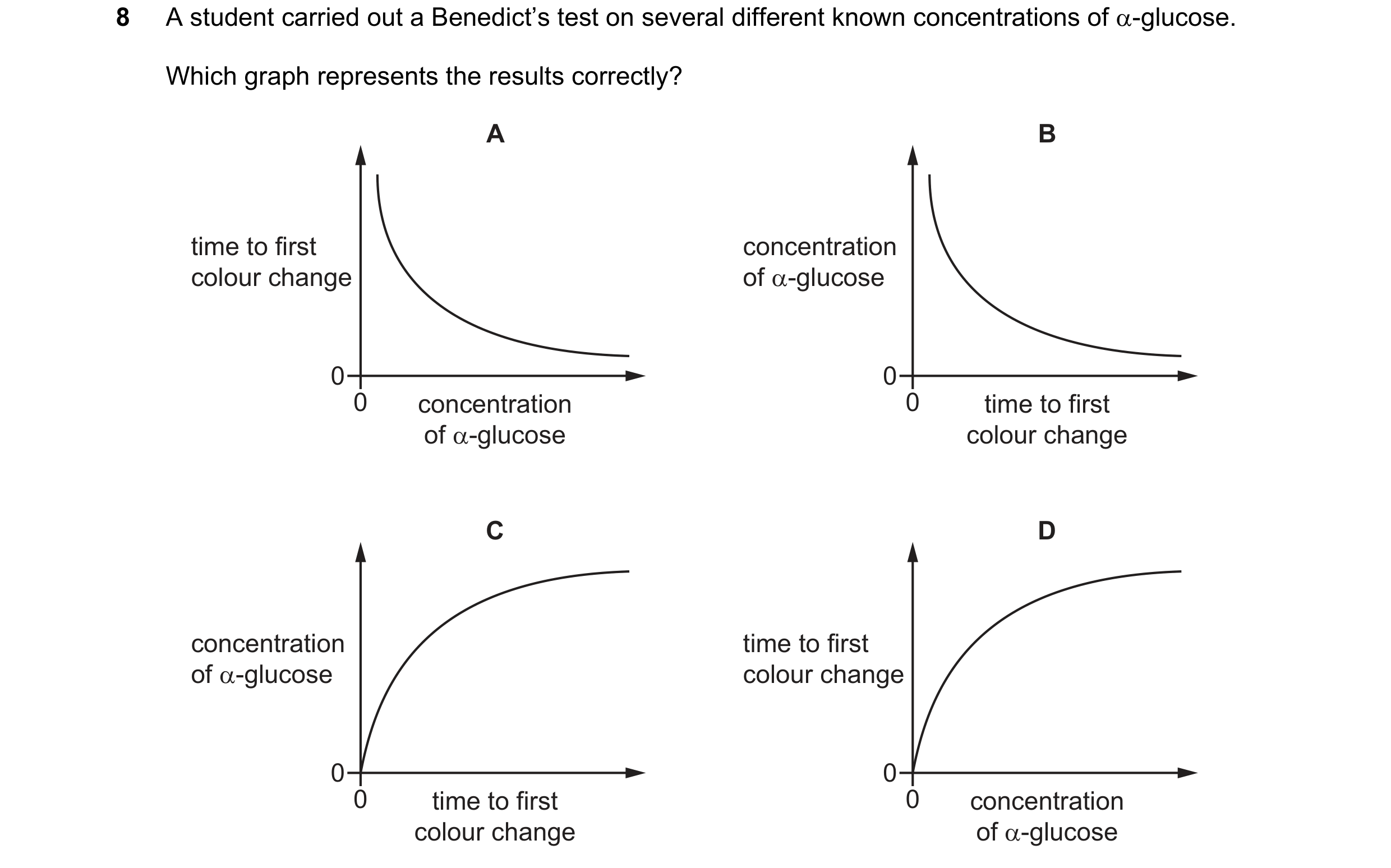
Q56 · A student carried out a Benedict’s test on several different known concentrations of… 9700/11 May/June 2019
8 A student carried out a Benedict’s test on several different known concentrations of α-glucose. Which graph represents the results correctly? A B time to first concentration colour change of α-glucose 0 0 0 concentration 0 time to first of α-glucose colour change C D concentration time to first of α-glucose colour change 0 0 0 time to first 0 concentration colour change of α-glucose
1 marks
Answer: A
This question in 9700/11 May/June 2019
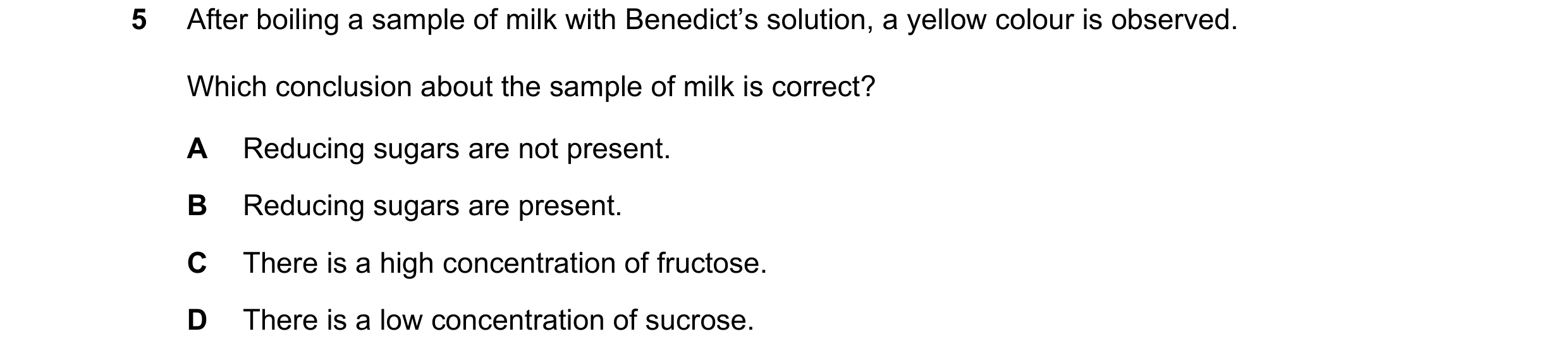
Q57 · After boiling a sample of milk with Benedict’s solution, a yellow colour is observed 9700/12 May/June 2019
5 After boiling a sample of milk with Benedict’s solution, a yellow colour is observed. Which conclusion about the sample of milk is correct? A Reducing sugars are not present. B Reducing sugars are present. C There is a high concentration of fructose. D There is a low concentration of sucrose.
1 marks
Answer: B
This question in 9700/12 May/June 2019
Q58 · A solution of amylase was added to a suspension of starch 9700/13 May/June 2019
7 A solution of amylase was added to a suspension of starch. The mixture was stirred and kept at 40 °C for 45 minutes. Samples were then tested with various reagents. What is the expected set of results? test and resulting colour iodine test Benedict’s test biuret test A black blue blue B black orange purple C brown blue blue D brown orange purple
1 marks
Answer: D
This question in 9700/13 May/June 2019
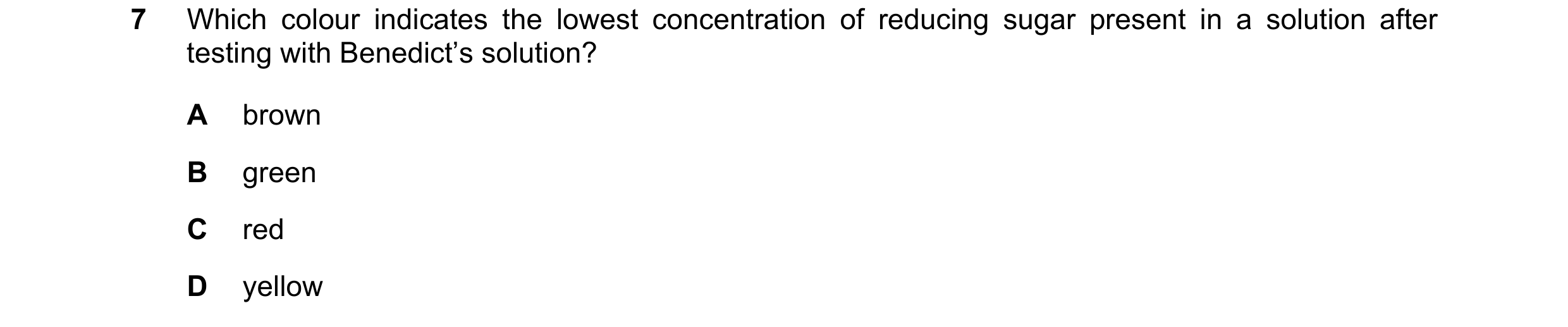
Q59 · Which colour indicates the lowest concentration of reducing sugar present in a solution… 9700/11 Oct/Nov 2019
7 Which colour indicates the lowest concentration of reducing sugar present in a solution after testing with Benedict’s solution? A brown B green C red D yellow
1 marks
Answer: B
This question in 9700/11 Oct/Nov 2019
Q60 · A student carried out four tests for biological molecules on a solution 9700/12 Oct/Nov 2019
7 A student carried out four tests for biological molecules on a solution. The results are shown in the table. test for biological observation molecules iodine orange-brown biuret purple Benedict’s orange emulsion clear Which three molecules may be present in this solution? A glucose, starch, globin B globin, glucose, collagen C starch, sucrose, collagen D sucrose, globin, collagen
1 marks
Answer: B
This question in 9700/12 Oct/Nov 2019
Q61 · A student was asked to estimate the concentration of reducing sugar in an unknown… 9700/12 Oct/Nov 2019
8 A student was asked to estimate the concentration of reducing sugar in an unknown solution using the Benedict’s test. Five reducing sugar solutions with different concentrations were provided in order to produce a calibration curve. The student added 2 cm3 of Benedict’s solution to each of the reducing sugar solutions, heated them in a water-bath and recorded the time taken for the first appearance of a colour change. Which variables should the student standardise, when carrying out the Benedict’s test on each reducing sugar solution, to ensure the results are comparable? 1 volume of reducing sugar used 2 the temperature of the water-bath 3 the time the solutions are heated A 1, 2 and 3 B 1 and 2 only C 1 and 3 only D 3 only
1 marks
Answer: B
This question in 9700/12 Oct/Nov 2019
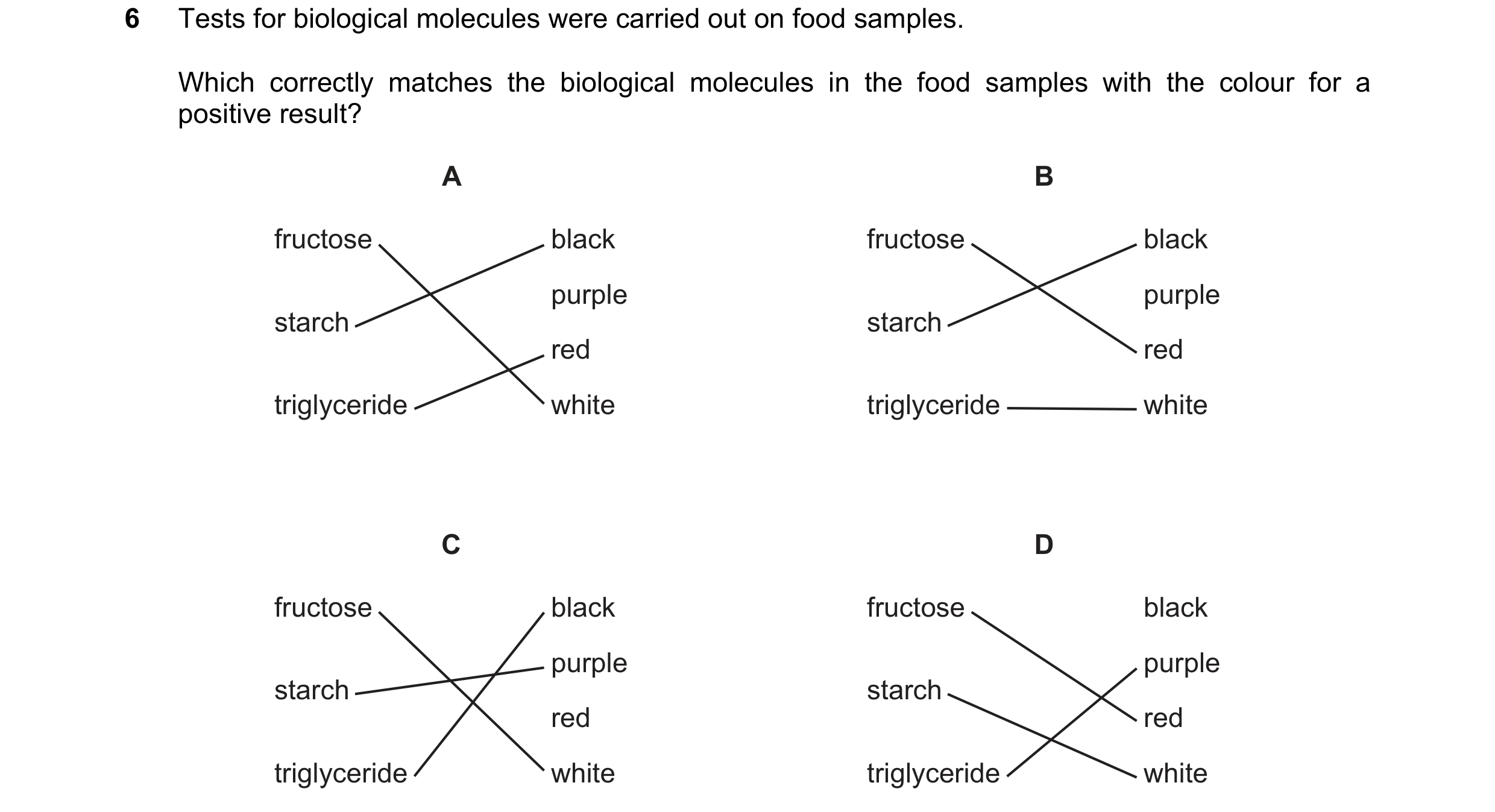
Q62 · Tests for biological molecules were carried out on food samples 9700/13 Oct/Nov 2019
6 Tests for biological molecules were carried out on food samples. Which correctly matches the biological molecules in the food samples with the colour for a positive result? A B fructose black fructose black purple purple starch starch red red triglyceride white triglyceride white C D fructose black fructose black purple purple starch starch red red triglyceride white triglyceride white
1 marks
Answer: B
This question in 9700/13 Oct/Nov 2019
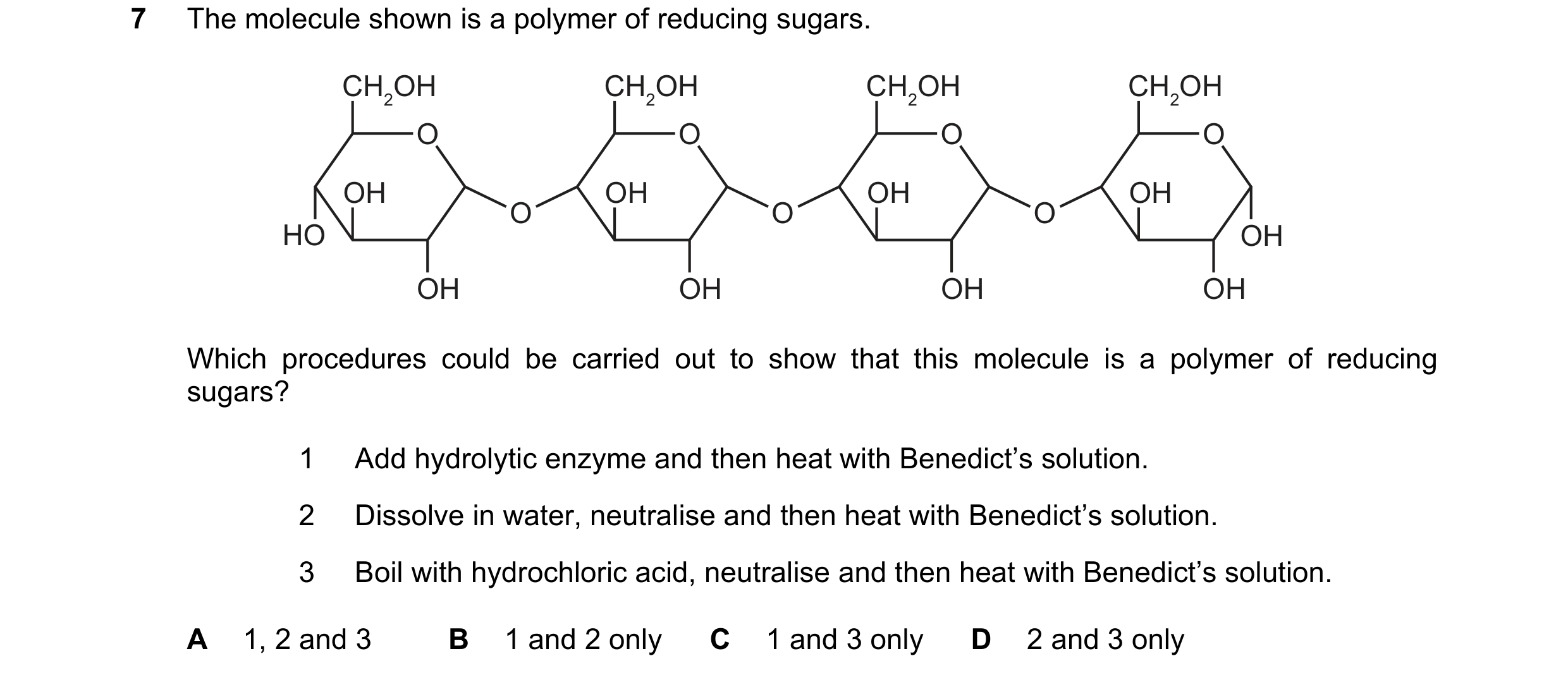
Q63 · The molecule shown is a polymer of reducing sugars 9700/12 Feb/March 2020
7 The molecule shown is a polymer of reducing sugars. CH2OH CH2OH CH2OH CH2OH O O O O OH OH OH OH O O O HO OH OH OH OH OH Which procedures could be carried out to show that this molecule is a polymer of reducing sugars? 1 Add hydrolytic enzyme and then heat with Benedict’s solution. 2 Dissolve in water, neutralise and then heat with Benedict’s solution. 3 Boil with hydrochloric acid, neutralise and then heat with Benedict’s solution. A 1, 2 and 3 B 1 and 2 only C 1 and 3 only D 2 and 3 only
1 marks
Answer: C
This question in 9700/12 Feb/March 2020
Q64 · The flow diagram shows the results of a number of tests on a solution of biochemicals 9700/11 May/June 2020
6 The flow diagram shows the results of a number of tests on a solution of biochemicals. solution of biochemicals Benedict’s test non-reducing iodine test biuret test blue sugar test blue-black purple yellow Which substances are present in the solution? A amylose, amylopectin and lipid B glucose, starch and catalase C sucrose, amylase and triglyceride D sucrose, starch and catalase
1 marks
Answer: D
This question in 9700/11 May/June 2020
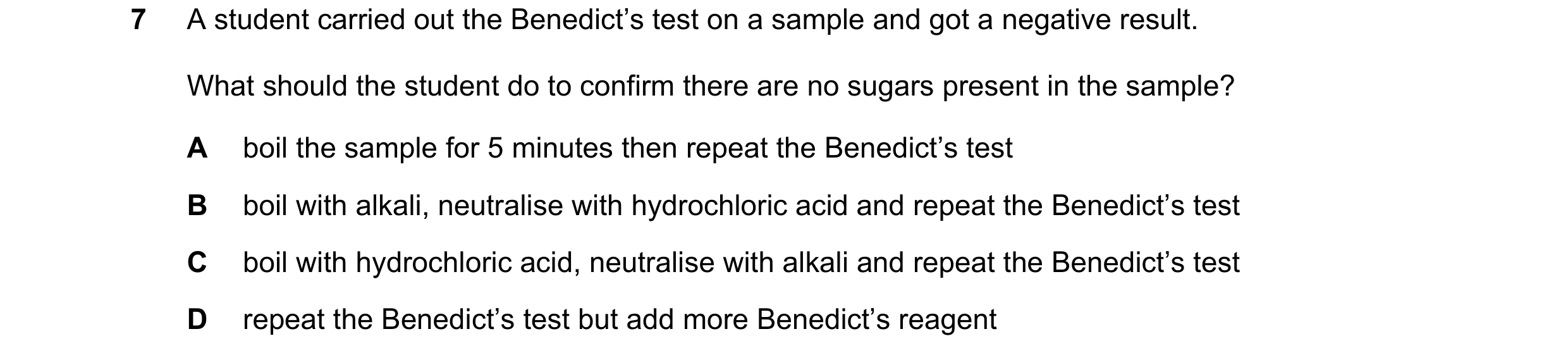
Q65 · A student carried out the Benedict’s test on a sample and got a negative result 9700/12 May/June 2020
7 A student carried out the Benedict’s test on a sample and got a negative result. What should the student do to confirm there are no sugars present in the sample? A boil the sample for 5 minutes then repeat the Benedict’s test B boil with alkali, neutralise with hydrochloric acid and repeat the Benedict’s test C boil with hydrochloric acid, neutralise with alkali and repeat the Benedict’s test D repeat the Benedict’s test but add more Benedict’s reagent
1 marks
Answer: C
This question in 9700/12 May/June 2020
Q66 · The colour of a positive Benedict’s test is due to the formation of copper oxide 9700/13 May/June 2020
6 The colour of a positive Benedict’s test is due to the formation of copper oxide. The mass of copper oxide is proportional to the mass of reducing sugar present. Samples of fruit juice were tested for the presence of reducing sugars and non-reducing sugars using the Benedict’s test. The table shows the mass of copper oxide after boiling with Benedict’s solution and after acid hydrolysis and boiling with Benedict’s solution. Which sample contained the most non-reducing sugar? mass of copper oxide / mg after boiling with after acid hydrolysis and Benedict’s solution boiling with Benedict’s solution A 20 20 B 30 45 C 50 55 D 65 75
1 marks
Answer: B
This question in 9700/13 May/June 2020
Q67 · A student carried out the Benedict’s test on two different types of milk, X and Y 9700/11 Oct/Nov 2020
7 A student carried out the Benedict’s test on two different types of milk, X and Y. A sample of each type of milk was heated to 100 C in a water-bath with Benedict’s solution and the time taken for the first appearance of a colour change was recorded. The results are shown in the table. time for first appearance type of of a colour change with milk Benedict’s solution / s X 13 Y 26 Which row shows the biological molecule the student detected in each sample of milk and the sample of milk with the highest concentration of this biological molecule? biological sample of milk with the molecule present in highest concentration of each sample of milk this biological molecule A glucose X B glucose Y C reducing sugar X D reducing sugar Y
1 marks
Answer: C
This question in 9700/11 Oct/Nov 2020
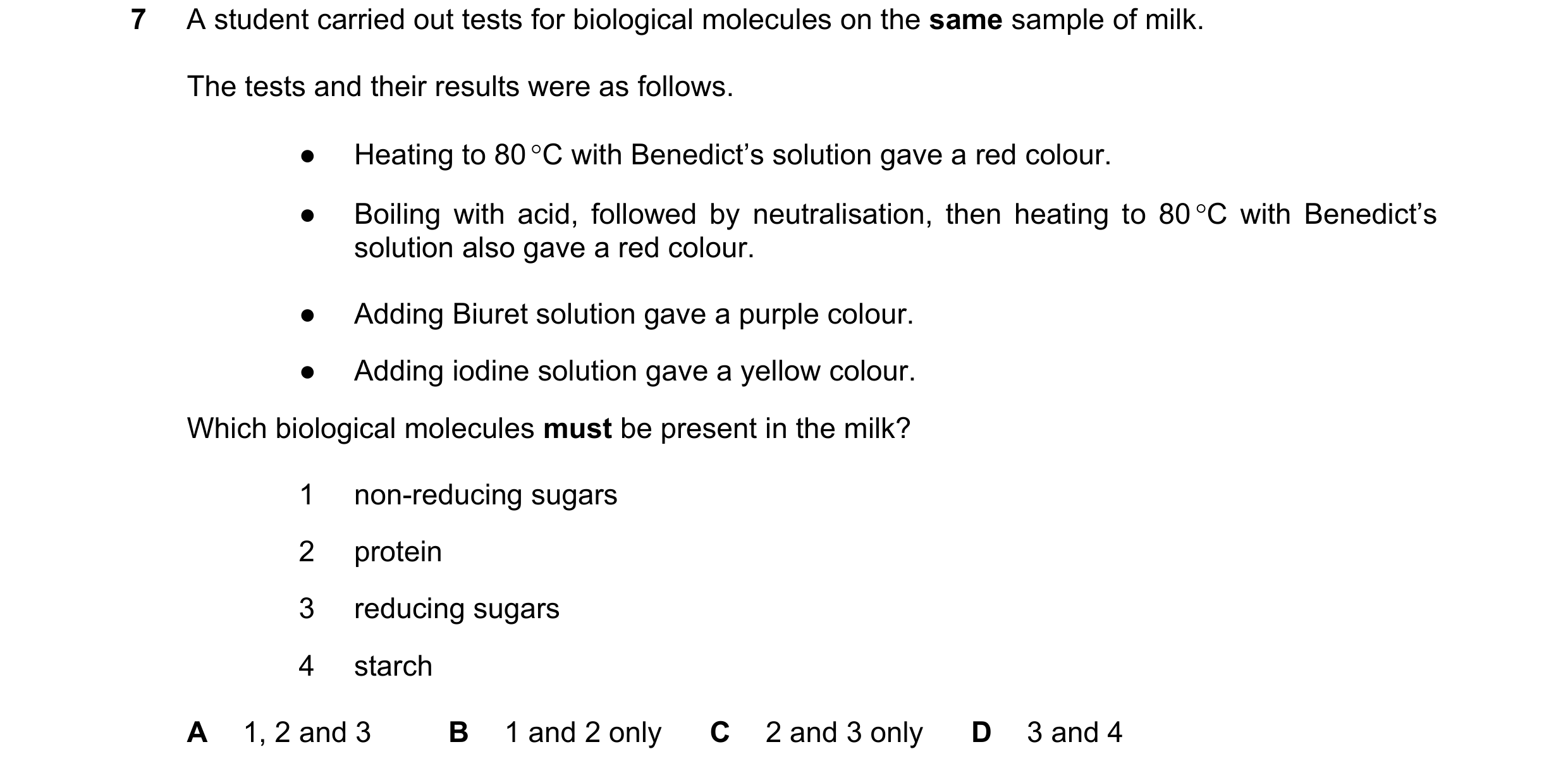
Q68 · A student carried out tests for biological molecules on the same sample of milk 9700/13 Oct/Nov 2020
7 A student carried out tests for biological molecules on the same sample of milk. The tests and their results were as follows. ● Heating to 80 C with Benedict’s solution gave a red colour. ● Boiling with acid, followed by neutralisation, then heating to 80 C with Benedict’s solution also gave a red colour. ● Adding Biuret solution gave a purple colour. ● Adding iodine solution gave a yellow colour. Which biological molecules must be present in the milk? 1 non-reducing sugars 2 protein 3 reducing sugars 4 starch A 1, 2 and 3 B 1 and 2 only C 2 and 3 only D 3 and 4
1 marks
Answer: C
This question in 9700/13 Oct/Nov 2020
Q69 · A student carried out four biochemical tests on a sample of food 9700/12 Feb/March 2021
7 A student carried out four biochemical tests on a sample of food. test observation emulsion cloudy Benedict’s yellow biuret purple iodine yellow Which conclusion is supported by the results? A Fat is not present. B Glucose is present. C Protein is present. D Starch is present.
1 marks
Answer: C
This question in 9700/12 Feb/March 2021
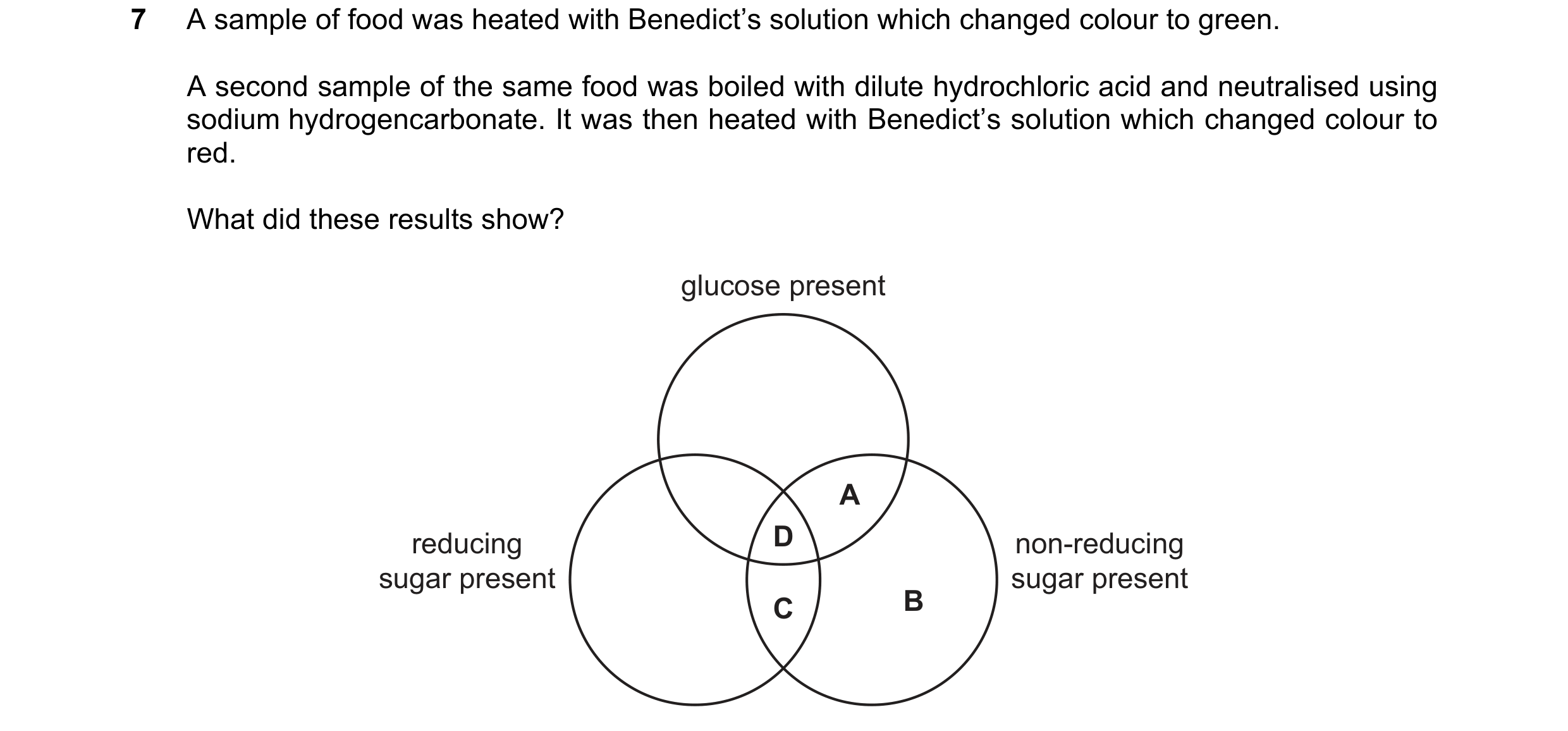
Q70 · A sample of food was heated with Benedict’s solution which changed colour to green 9700/11 May/June 2021
7 A sample of food was heated with Benedict’s solution which changed colour to green. A second sample of the same food was boiled with dilute hydrochloric acid and neutralised using sodium hydrogencarbonate. It was then heated with Benedict’s solution which changed colour to red. What did these results show? glucose present A reducing D non-reducing sugar present sugar present C B
1 marks
Answer: C
This question in 9700/11 May/June 2021
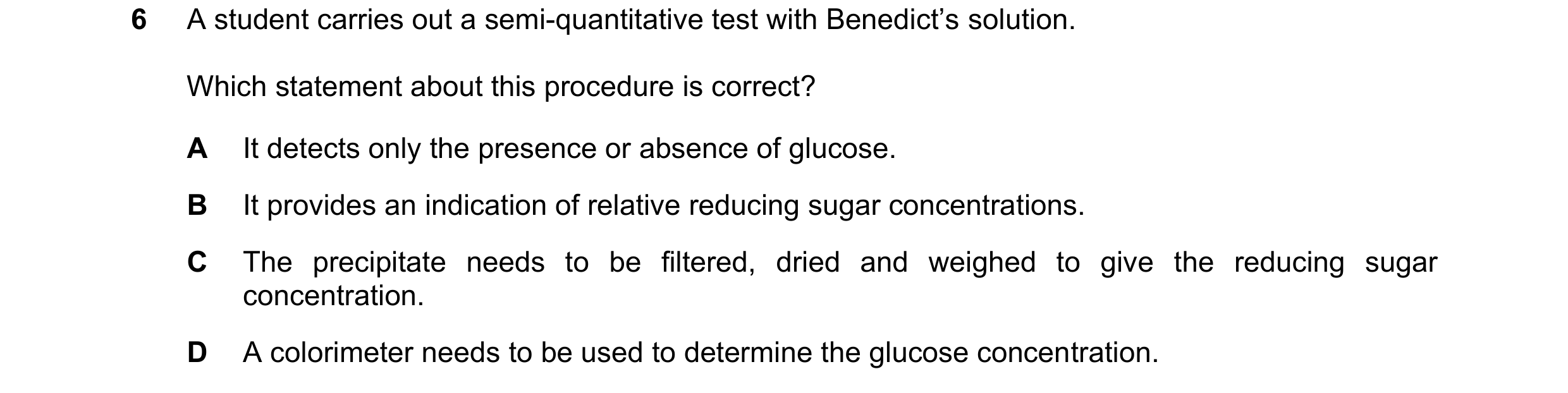
Q71 · A student carries out a semi-quantitative test with Benedict’s solution 9700/12 May/June 2021
6 A student carries out a semi-quantitative test with Benedict’s solution. Which statement about this procedure is correct? A It detects only the presence or absence of glucose. B It provides an indication of relative reducing sugar concentrations. C The precipitate needs to be filtered, dried and weighed to give the reducing sugar concentration. D A colorimeter needs to be used to determine the glucose concentration.
1 marks
Answer: B
This question in 9700/12 May/June 2021
Q72 · Four solutions were tested for the presence of four different biological molecules 9700/13 May/June 2021
7 Four solutions were tested for the presence of four different biological molecules. The appearance of the solutions after each test are shown in the table. Benedict’s solution following acid Benedict’s biuret emulsion hydrolysis 1 blue blue purple cloudy 2 green blue purple clear 3 red green purple cloudy 4 yellow yellow blue clear Which solutions contained molecules with ester bonds? A 1, 2 and 3 B 1 and 3 only C 2, 3 and 4 D 2 and 4 only
1 marks
Answer: B
This question in 9700/13 May/June 2021
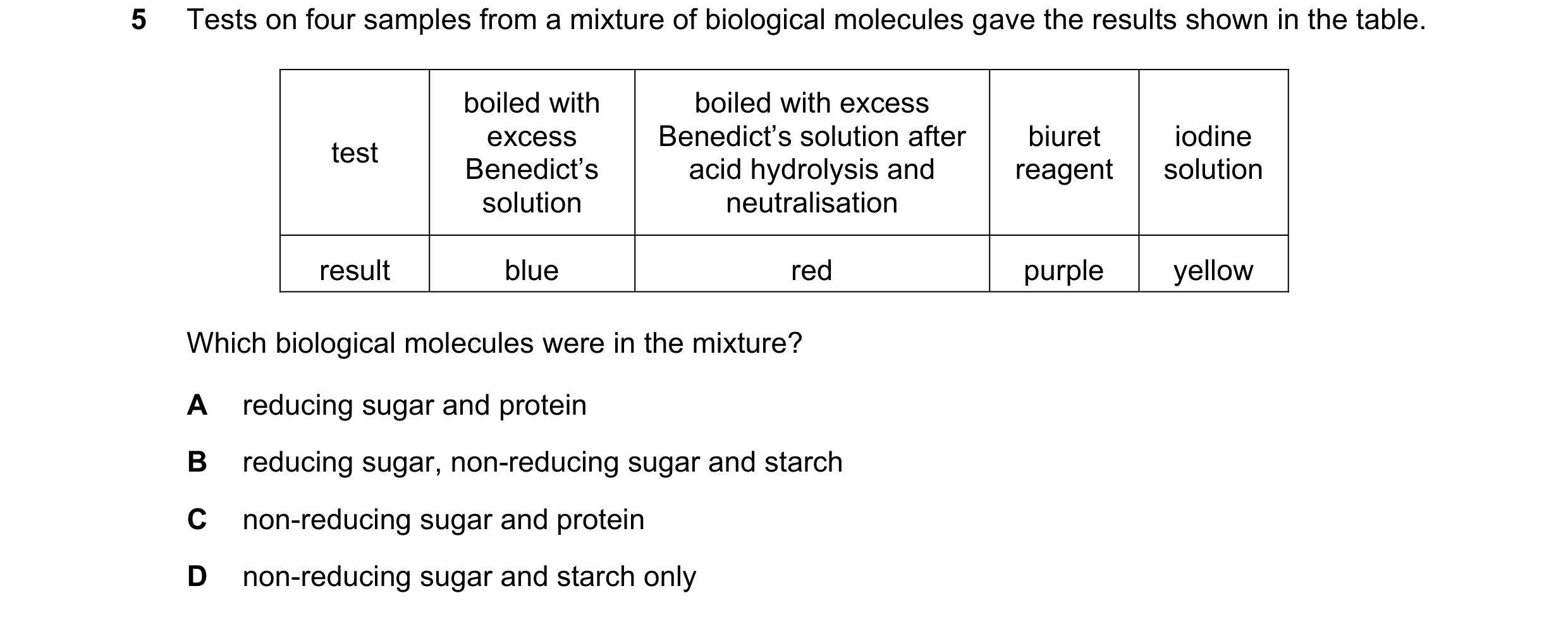
Q73 · Tests on four samples from a mixture of biological molecules gave the results shown in… 9700/11 Oct/Nov 2021
5 Tests on four samples from a mixture of biological molecules gave the results shown in the table. boiled with boiled with excess excess Benedict’s solution after biuret iodine test Benedict’s acid hydrolysis and reagent solution solution neutralisation result blue red purple yellow Which biological molecules were in the mixture? A reducing sugar and protein B reducing sugar, non-reducing sugar and starch C non-reducing sugar and protein D non-reducing sugar and starch only
1 marks
Answer: C
This question in 9700/11 Oct/Nov 2021
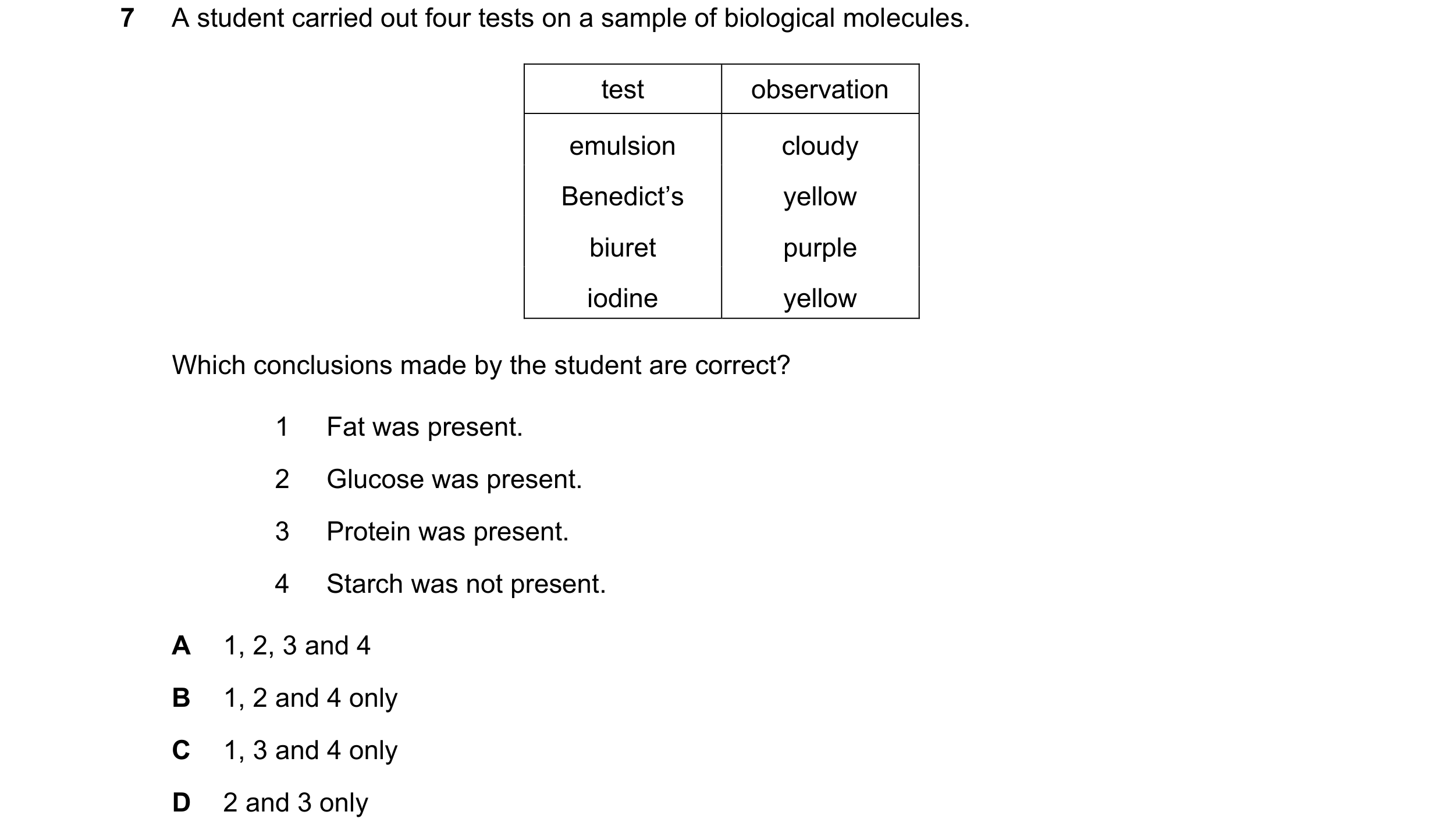
Q74 · A student carried out four tests on a sample of biological molecules 9700/12 Oct/Nov 2021
7 A student carried out four tests on a sample of biological molecules. test observation emulsion cloudy Benedict’s yellow biuret purple iodine yellow Which conclusions made by the student are correct? 1 Fat was present. 2 Glucose was present. 3 Protein was present. 4 Starch was not present. A 1, 2, 3 and 4 B 1, 2 and 4 only C 1, 3 and 4 only D 2 and 3 only
1 marks
Answer: C
This question in 9700/12 Oct/Nov 2021
Q75 · Which tests will identify biological molecules that contain monomers with a carboxyl… 9700/13 Oct/Nov 2021
7 Which tests will identify biological molecules that contain monomers with a carboxyl group? Benedict’s D A biuret ethanol C B
1 marks
This question in 9700/13 Oct/Nov 2021
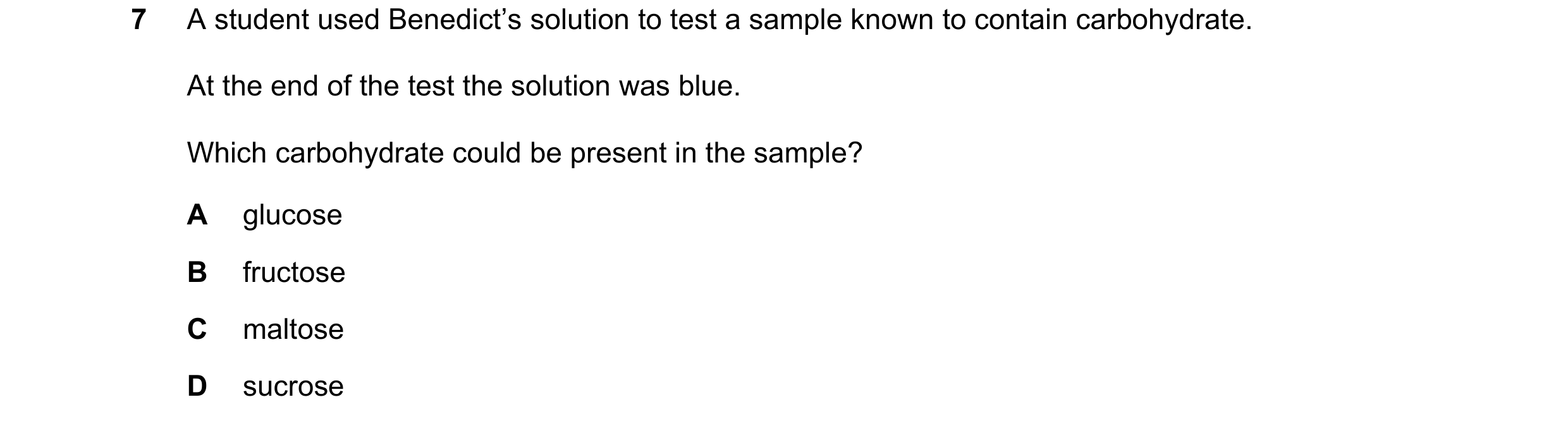
Q76 · A student used Benedict’s solution to test a sample known to contain carbohydrate 9700/12 Feb/March 2022
7 A student used Benedict’s solution to test a sample known to contain carbohydrate. At the end of the test the solution was blue. Which carbohydrate could be present in the sample? A glucose B fructose C maltose D sucrose
1 marks
Answer: D
This question in 9700/12 Feb/March 2022
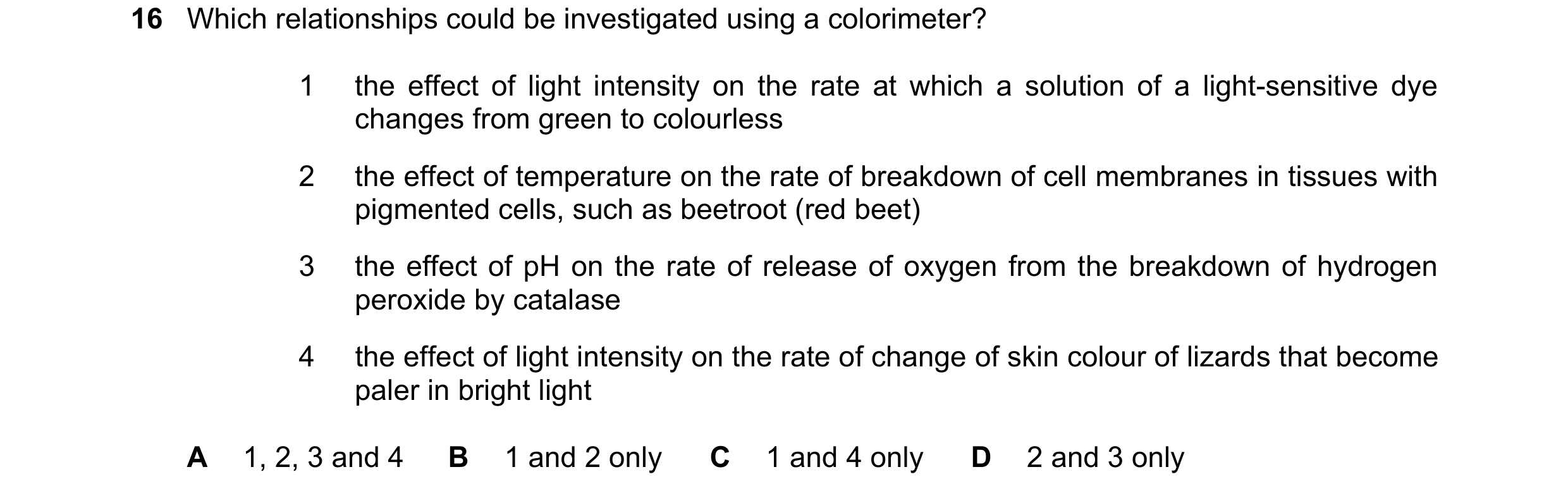
Q77 · Which relationships could be investigated using a colorimeter? 9700/12 Feb/March 2022
16 Which relationships could be investigated using a colorimeter? 1 the effect of light intensity on the rate at which a solution of a light-sensitive dye changes from green to colourless 2 the effect of temperature on the rate of breakdown of cell membranes in tissues with pigmented cells, such as beetroot (red beet) 3 the effect of pH on the rate of release of oxygen from the breakdown of hydrogen peroxide by catalase 4 the effect of light intensity on the rate of change of skin colour of lizards that become paler in bright light A 1, 2, 3 and 4 B 1 and 2 only C 1 and 4 only D 2 and 3 only
1 marks
Answer: B
This question in 9700/12 Feb/March 2022
Q78 · Samples of glucose, sucrose, and a mixture of glucose and sucrose were divided into two… 9700/11 May/June 2022
6 Samples of glucose, sucrose, and a mixture of glucose and sucrose were divided into two halves M and N. M was then tested with Benedict’s solution. N was boiled with dilute hydrochloric acid, neutralised and then tested with Benedict’s solution. The colour of the solution was compared to colour standards. Which table identifies the correct colour changes for these samples? A B sample M N sample M N glucose blue blue glucose yellow yellow sucrose blue yellow sucrose blue yellow mixture blue yellow mixture blue yellow C D sample M N sample M N glucose yellow yellow glucose yellow red sucrose blue yellow sucrose blue red mixture yellow red mixture yellow red
1 marks
Answer: C
This question in 9700/11 May/June 2022
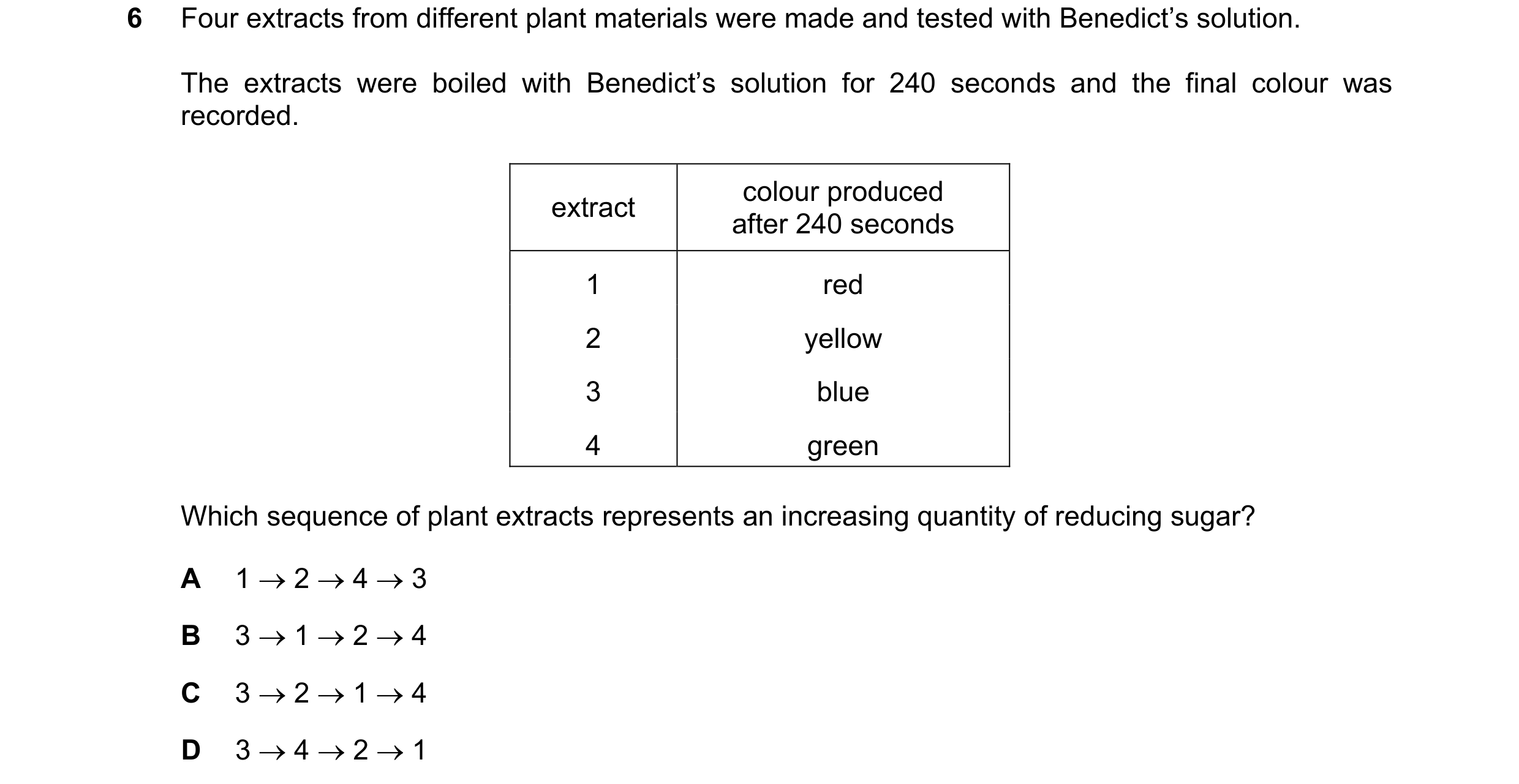
Q79 · Four extracts from different plant materials were made and tested with Benedict’s solution 9700/12 May/June 2022
6 Four extracts from different plant materials were made and tested with Benedict’s solution. The extracts were boiled with Benedict’s solution for 240 seconds and the final colour was recorded. colour produced extract after 240 seconds 1 red 2 yellow 3 blue 4 green Which sequence of plant extracts represents an increasing quantity of reducing sugar? A 1 2 4 3 B 3 1 2 4 C 3 2 1 4 D 3 4 2 1
1 marks
Answer: D
This question in 9700/12 May/June 2022
Q80 · The concentration of reducing sugar in a solution can be found if an observational… 9700/13 May/June 2022
7 The concentration of reducing sugar in a solution can be found if an observational measurement is compared to a standard. Which observational measurement could be used to estimate the concentration of reducing sugar in an unknown solution? 1 the colour of the solution after 20 minutes 2 the time for the first colour change to occur 3 the rate of formation of solid particles A 1, 2 and 3 B 1 and 2 only C 2 only D 3 only
1 marks
Answer: B
This question in 9700/13 May/June 2022
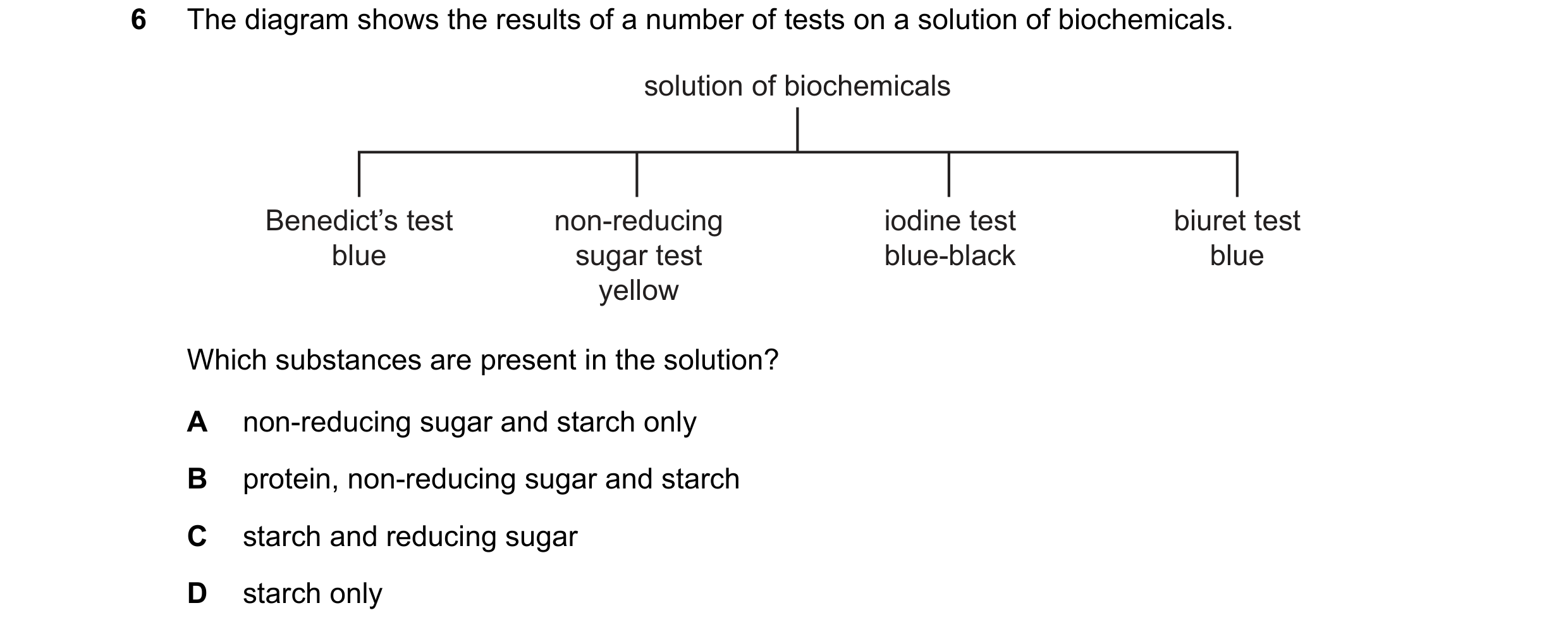
Q81 · The diagram shows the results of a number of tests on a solution of biochemicals 9700/11 Oct/Nov 2022
6 The diagram shows the results of a number of tests on a solution of biochemicals. solution of biochemicals Benedict’s test non-reducing iodine test biuret test blue sugar test blue-black blue yellow Which substances are present in the solution? A non-reducing sugar and starch only B protein, non-reducing sugar and starch C starch and reducing sugar D starch only
1 marks
Answer: A
This question in 9700/11 Oct/Nov 2022
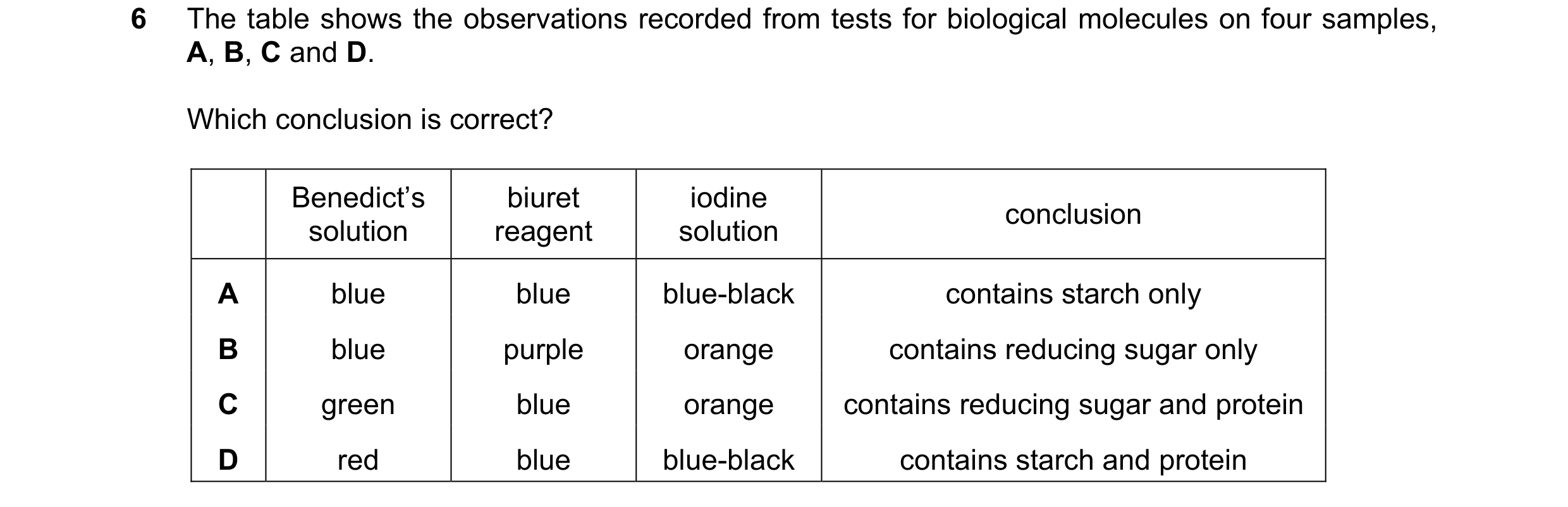
Q82 · The table shows the observations recorded from tests for biological molecules on four… 9700/12 Oct/Nov 2022
6 The table shows the observations recorded from tests for biological molecules on four samples, A, B, C and D. Which conclusion is correct? Benedict’s biuret iodine conclusion solution reagent solution A blue blue blue-black contains starch only B blue purple orange contains reducing sugar only C green blue orange contains reducing sugar and protein D red blue blue-black contains starch and protein
1 marks
Answer: A
This question in 9700/12 Oct/Nov 2022
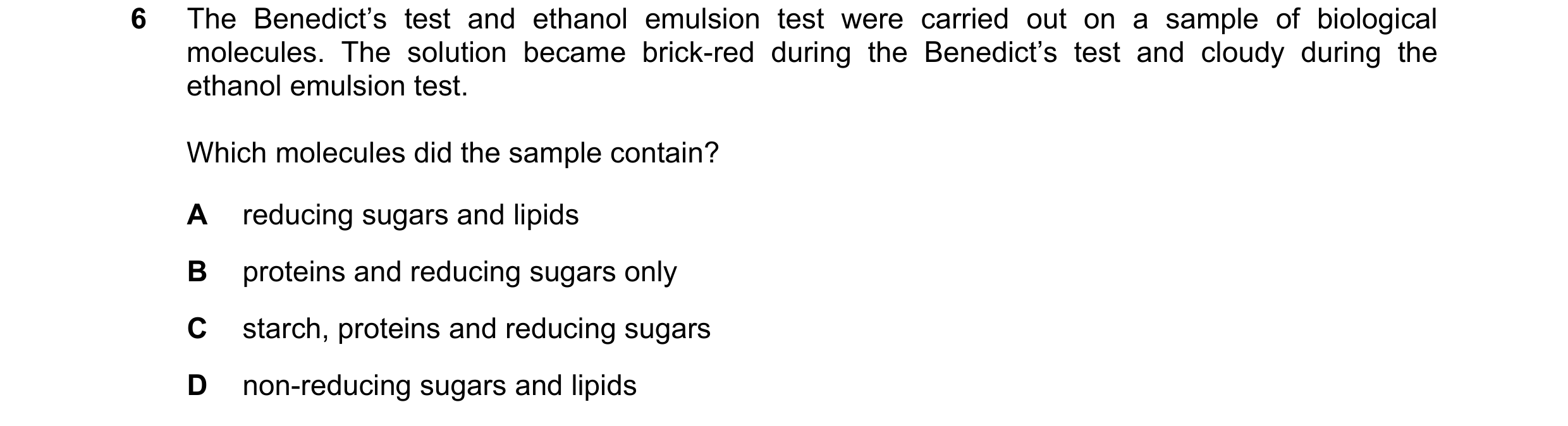
Q83 · The Benedict’s test and ethanol emulsion test were carried out on a sample of biological… 9700/13 Oct/Nov 2022
6 The Benedict’s test and ethanol emulsion test were carried out on a sample of biological molecules. The solution became brick-red during the Benedict’s test and cloudy during the ethanol emulsion test. Which molecules did the sample contain? A reducing sugars and lipids B proteins and reducing sugars only C starch, proteins and reducing sugars D non-reducing sugars and lipids
1 marks
Answer: A
This question in 9700/13 Oct/Nov 2022
Q84 · To estimate the concentration of glucose in an unknown solution, equal volumes of a range… 9700/12 Feb/March 2023
7 To estimate the concentration of glucose in an unknown solution, equal volumes of a range of known concentrations of glucose were each mixed with the same excess volume of Benedict’s solution. After mixing, the solutions were placed in a thermostatically controlled water-bath at 90 C for three minutes. The unknown solution was then treated in the same way and the colours of the known and unknown solutions compared. What is the independent variable in this procedure? A concentration of glucose B final colour of solutions C temperature of water-bath D volume of glucose solutions
1 marks
Answer: A
This question in 9700/12 Feb/March 2023
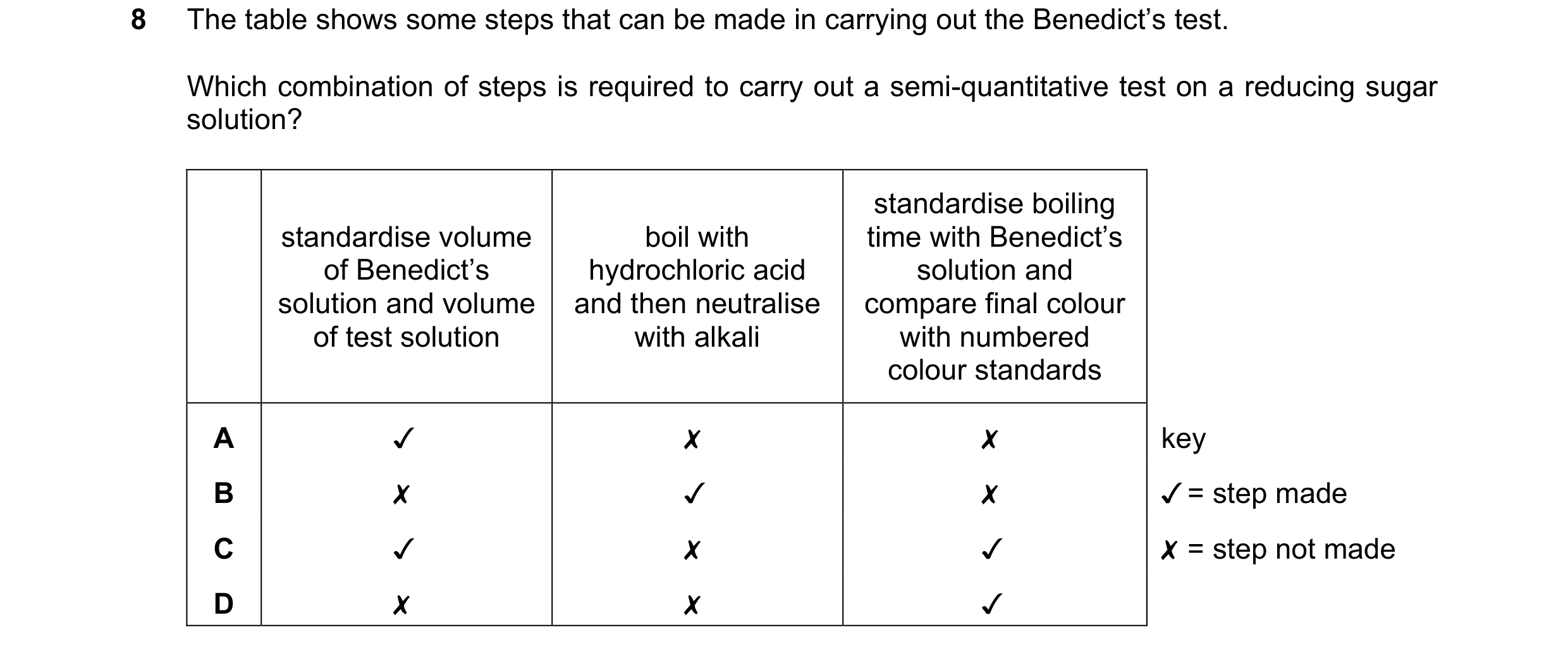
Q85 · The table shows some steps that can be made in carrying out the Benedict’s test 9700/11 May/June 2023
8 The table shows some steps that can be made in carrying out the Benedict’s test.
Which combination of steps is required to carry out a semi-quantitative test on a reducing sugar
solution?
standardise volume
of Benedict's
solution and volume
boil with
hydrochloric acid
and then neutralise
standardise boiling
time with Benedict’s
solution and
compare final colour
of test solution with alkali with numbered
colour standards
A v x x
B x v x
Cc v x v
D x x J
key
Jv = step made
X = step not made
1 marks
Answer: C
This question in 9700/11 May/June 2023
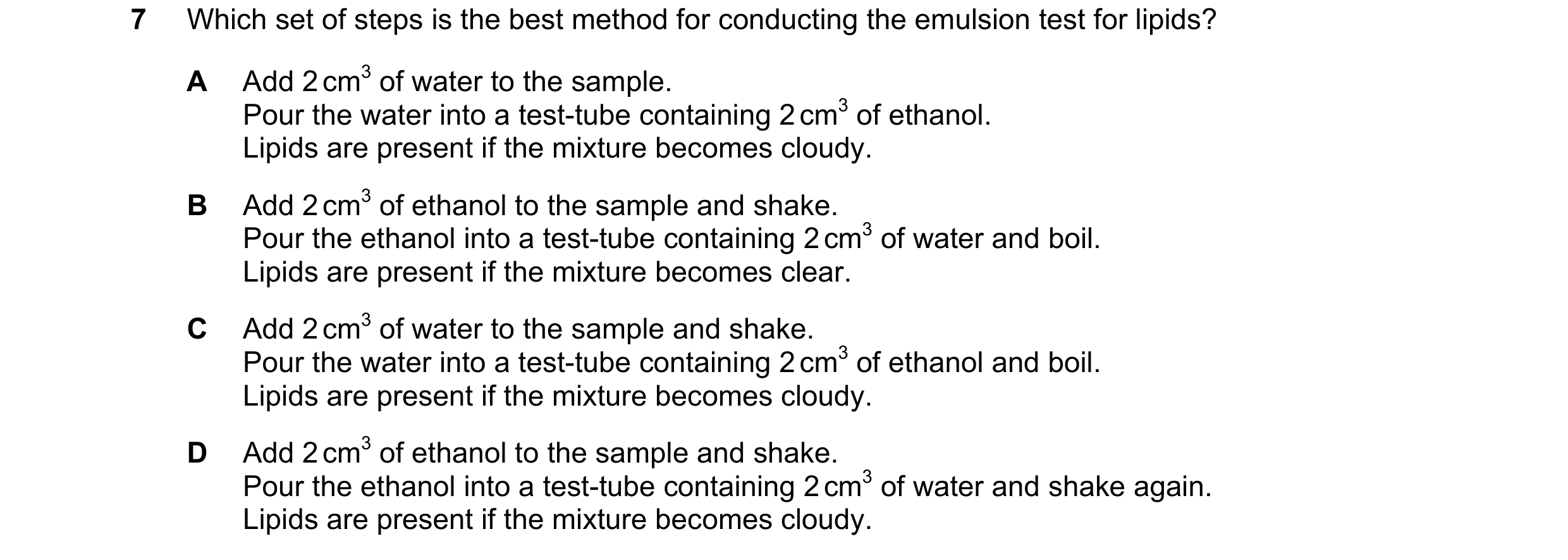
Q86 · Which set of steps is the best method for conducting the emulsion test for lipids? 9700/12 May/June 2023
7 Which set of steps is the best method for conducting the emulsion test for lipids? A Add 2 cm3 of water to the sample. Pour the water into a test-tube containing 2 cm3 of ethanol. Lipids are present if the mixture becomes cloudy. B Add 2 cm3 of ethanol to the sample and shake. Pour the ethanol into a test-tube containing 2 cm3 of water and boil. Lipids are present if the mixture becomes clear. C Add 2 cm3 of water to the sample and shake. Pour the water into a test-tube containing 2 cm3 of ethanol and boil. Lipids are present if the mixture becomes cloudy. D Add 2 cm3 of ethanol to the sample and shake. Pour the ethanol into a test-tube containing 2 cm3 of water and shake again. Lipids are present if the mixture becomes cloudy.
1 marks
Answer: D
This question in 9700/12 May/June 2023
Q87 · A student was provided with a solution of carbohydrate 9700/12 May/June 2023
8 A student was provided with a solution of carbohydrate. They removed two samples from the solution and performed tests on each sample, as shown. carbohydrate solution sample one sample two boiled with dilute Benedict’s test hydrochloric acid Benedict’s solution neutralised with dilute remained blue sodium hydroxide Benedict’s test Benedict’s solution turned yellow Which statement explains the results? A Condensation reactions occur in sample two to release reducing sugar. B Glycosidic bonds in a polysaccharide have been broken to release reducing sugar. C Sample one shows that sucrose is present in the carbohydrate solution. D The change in colour to a yellow solution shows that glucose is present.
1 marks
Answer: B
This question in 9700/12 May/June 2023
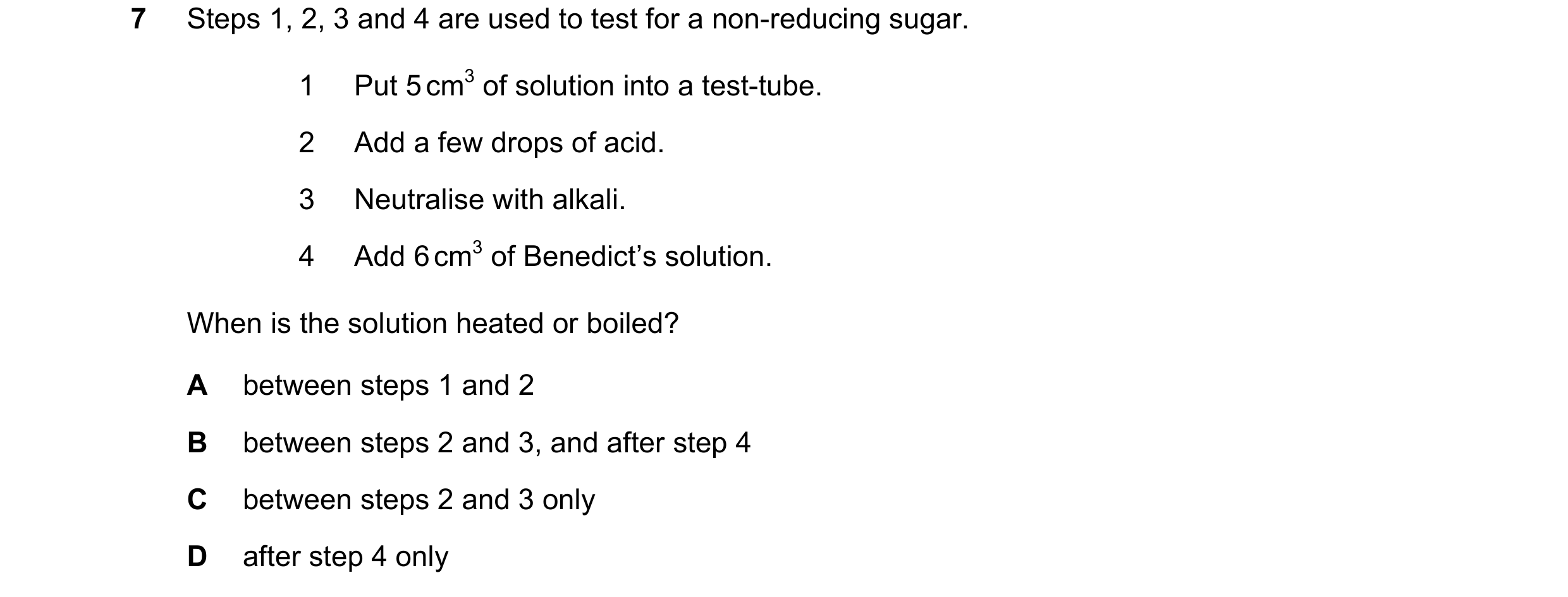
Q88 · Steps 1, 2, 3 and 4 are used to test for a non-reducing sugar 9700/13 May/June 2023
7 Steps 1, 2, 3 and 4 are used to test for a non-reducing sugar. 1 Put 5 cm3 of solution into a test-tube. 2 Add a few drops of acid. 3 Neutralise with alkali. 4 Add 6 cm3 of Benedict’s solution. When is the solution heated or boiled? A between steps 1 and 2 B between steps 2 and 3, and after step 4 C between steps 2 and 3 only D after step 4 only
1 marks
Answer: B
This question in 9700/13 May/June 2023
Q89 · A student carried out the Benedict’s test on four different concentrations of glucose… 9700/12 Oct/Nov 2023
8 A student carried out the Benedict’s test on four different concentrations of glucose solution and then recorded the time taken for the first appearance of a colour change (the end-point). The student found it difficult to identify the first appearance of a colour change and consistently timed each solution for two seconds after the colour change first appeared. This introduced a source of error into the experiment. Which statements about this error are correct? 1 The effect of the error will be reduced if the student performs three repeats at each concentration of glucose. 2 The error will prevent the student from identifying which solution has the highest concentration of glucose. 3 The error is systematic as the student consistently timed each solution for two seconds after the end-point. A 1 and 2 B 1 and 3 C 2 and 3 D 3 only
1 marks
Answer: D
This question in 9700/12 Oct/Nov 2023
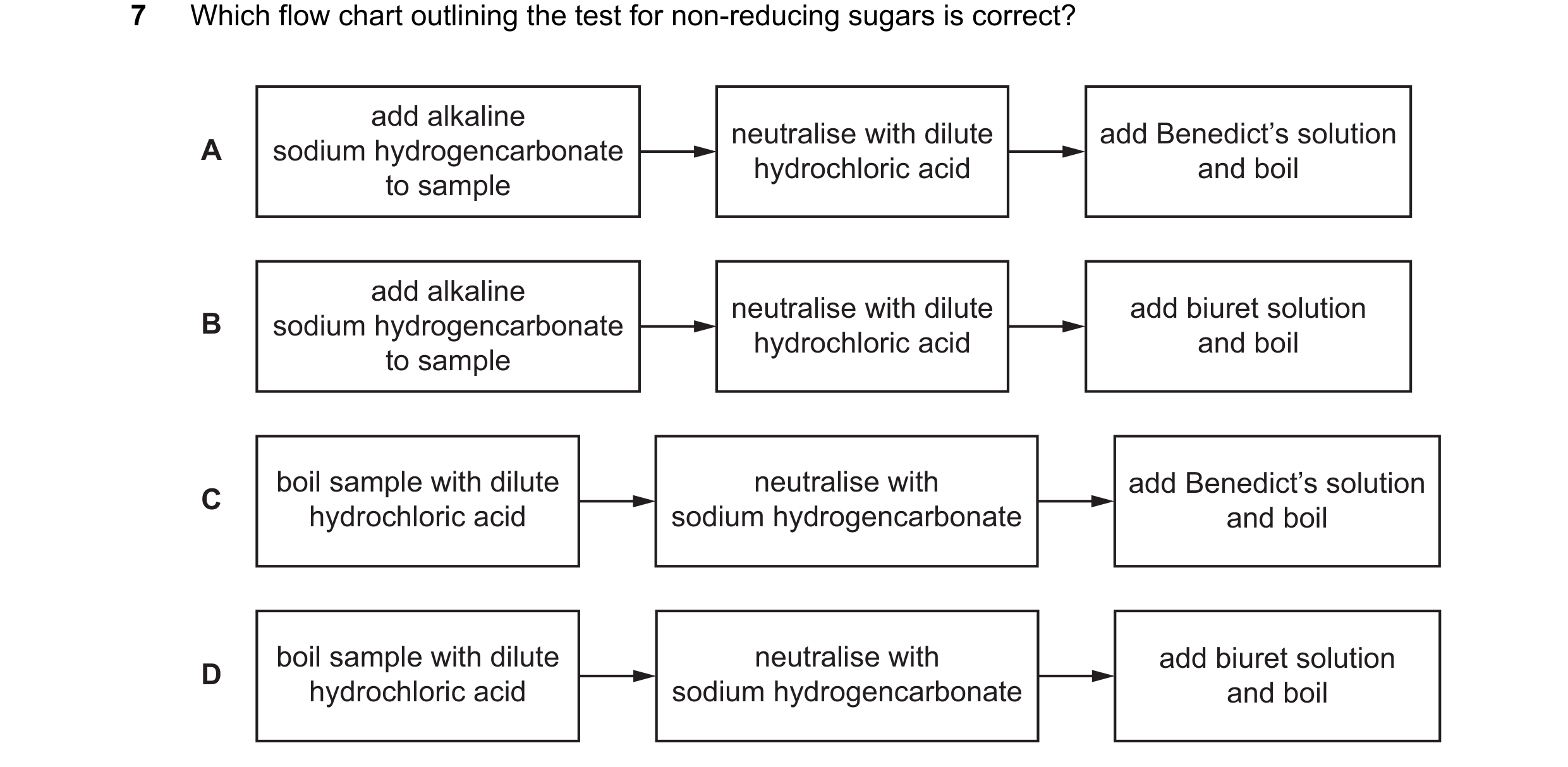
Q90 · Which flow chart outlining the test for non-reducing sugars is correct? 9700/12 Feb/March 2024
7 Which flow chart outlining the test for non-reducing sugars is correct? add alkaline A neutralise with dilute add Benedict’s solution sodium hydrogencarbonate hydrochloric acid and boil to sample add alkaline B neutralise with dilute add biuret solution sodium hydrogencarbonate hydrochloric acid and boil to sample C boil sample with dilute neutralise with add Benedict’s solution hydrochloric acid sodium hydrogencarbonate and boil D boil sample with dilute neutralise with add biuret solution hydrochloric acid sodium hydrogencarbonate and boil
1 marks
Answer: C
This question in 9700/12 Feb/March 2024
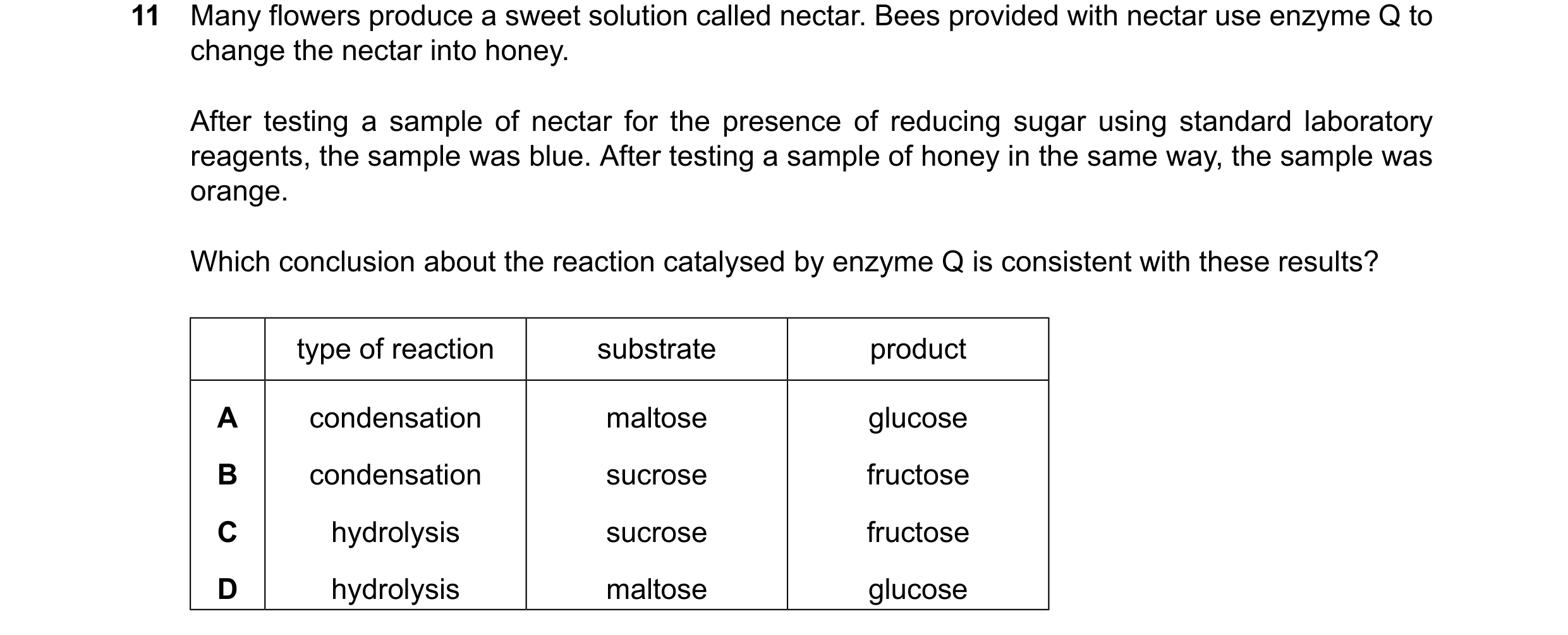
Q91 · Many flowers produce a sweet solution called nectar 9700/12 Feb/March 2024
11 Many flowers produce a sweet solution called nectar. Bees provided with nectar use enzyme Q to change the nectar into honey. After testing a sample of nectar for the presence of reducing sugar using standard laboratory reagents, the sample was blue. After testing a sample of honey in the same way, the sample was orange. Which conclusion about the reaction catalysed by enzyme Q is consistent with these results? type of reaction substrate product A condensation maltose glucose B condensation sucrose fructose C hydrolysis sucrose fructose D hydrolysis maltose glucose
1 marks
Answer: C
This question in 9700/12 Feb/March 2024
Q92 · Tests for biological molecules were carried out on three solutions 9700/12 May/June 2024
9 Tests for biological molecules were carried out on three solutions. Each solution contained only one type of biological molecule. The observations were as follows. solution test observation 1 Benedict’s test blue to orange 2 Benedict’s test after acid hydrolysis blue to red 3 biuret test blue to purple Which solutions would contain either sucrose or amylase? A 1, 2 and 3 B 1 and 3 only C 2 and 3 only D 2 only
1 marks
Answer: C
This question in 9700/12 May/June 2024
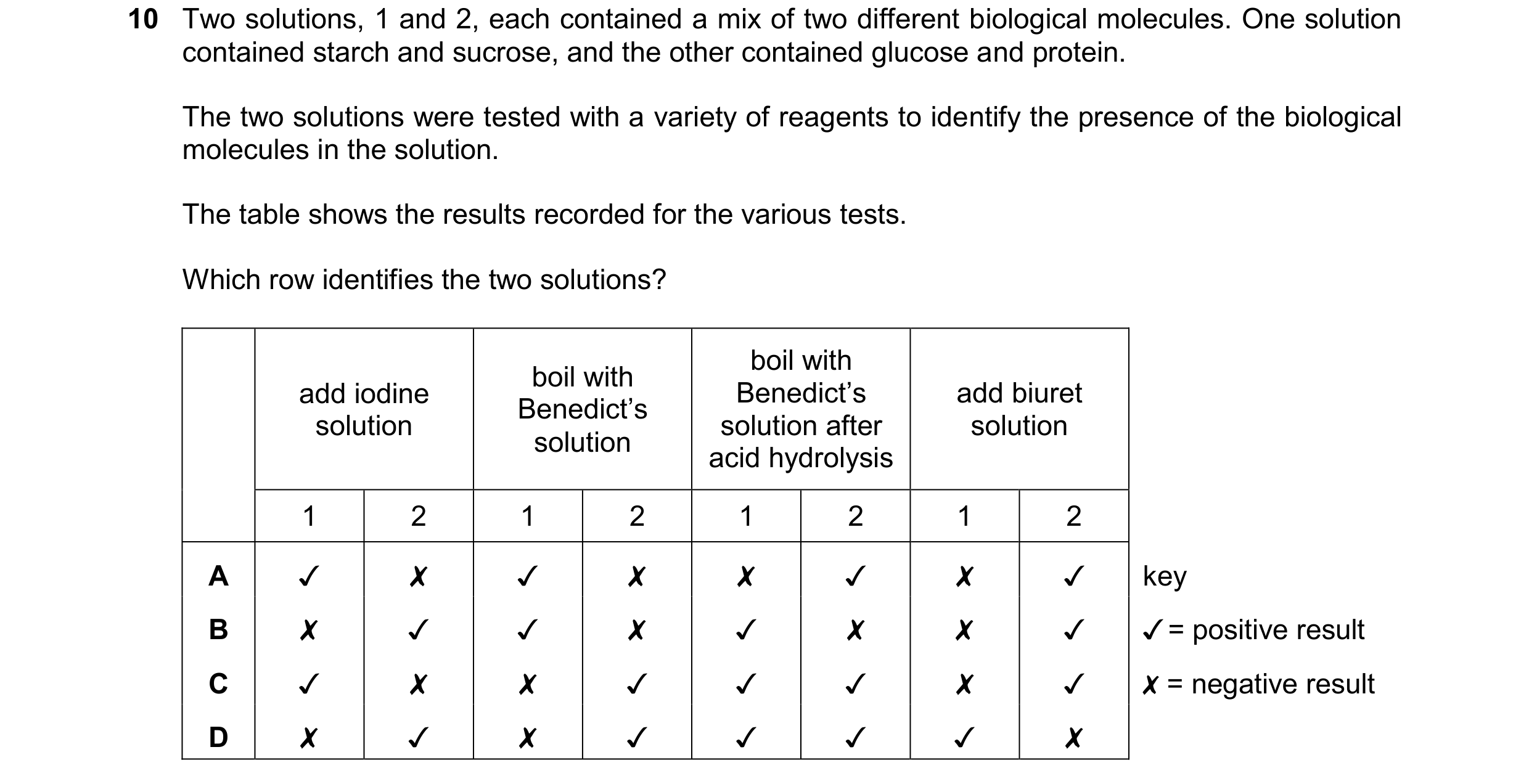
Q93 · Two solutions, 1 and 2, each contained a mix of two different biological molecules 9700/11 Oct/Nov 2024
10 Two solutions, 1 and 2, each contained a mix of two different biological molecules. One solution
contained starch and sucrose, and the other contained glucose and protein.
The two solutions were tested with a variety of reagents to identify the presence of the biological
molecules in the solution.
The table shows the results recorded for the various tests.
Which row identifies the two solutions?
boil with boil with
add iodine Benedict’s Benedict's add biuret
solution solution after solution
solution acid hydrolysis
key
/ = positive result
X = negative result
1 marks
Answer: C
This question in 9700/11 Oct/Nov 2024
Q94 · What could take place during a hydrolysis reaction? 9700/12 Feb/March 2025
7 What could take place during a hydrolysis reaction? 1 A glycosidic bond is broken. 2 A molecule of water is produced. 3 A sucrose molecule is split into fructose and glucose. A 1, 2 and 3 B 1 and 2 only C 1 and 3 only D 2 and 3 only
1 marks
Answer: C
This question in 9700/12 Feb/March 2025
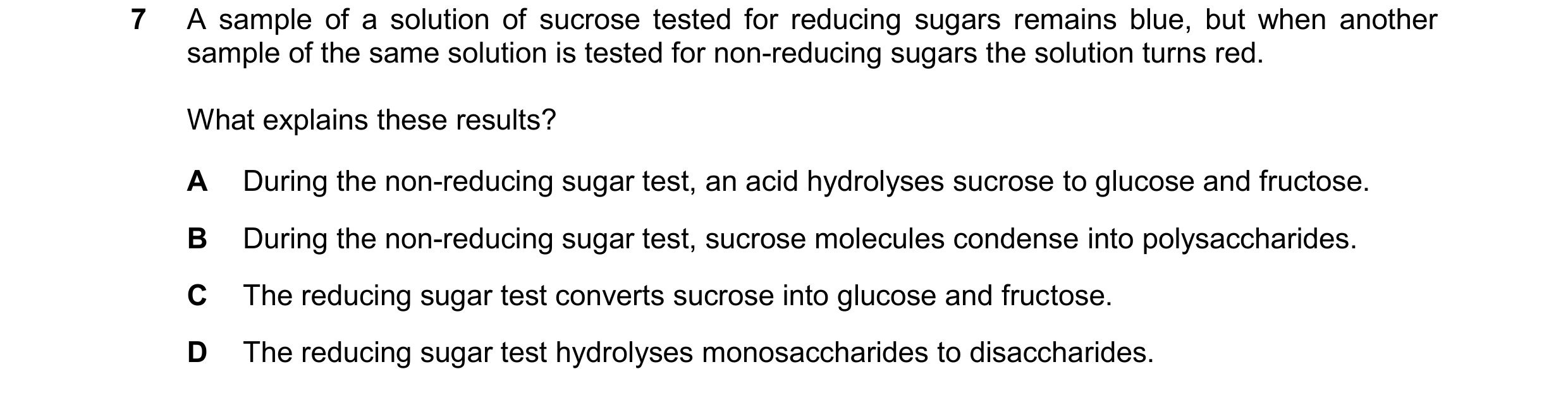
Q95 · A sample of a solution of sucrose tested for reducing sugars remains blue, but when… 9700/12 May/June 2025
7 A sample of a solution of sucrose tested for reducing sugars remains blue, but when another sample of the same solution is tested for non-reducing sugars the solution turns red. What explains these results? A During the non-reducing sugar test, an acid hydrolyses sucrose to glucose and fructose. B During the non-reducing sugar test, sucrose molecules condense into polysaccharides. C The reducing sugar test converts sucrose into glucose and fructose. D The reducing sugar test hydrolyses monosaccharides to disaccharides.
1 marks
Answer: A
This question in 9700/12 May/June 2025
Q96 · A student half filled a beaker with solution X 9700/13 May/June 2025
20 A student half filled a beaker with solution X. They placed a sealed Visking tubing bag containing solution Y into the beaker. X Y At 30 minutes, the solution in the beaker was orange and the solution inside the Visking tubing was blue-black. What did solutions X and Y contain at the start to give these results? solution X solution Y A starch amylase and iodine B iodine amylase C starch and amylase iodine D iodine starch
1 marks
Answer: D
This question in 9700/13 May/June 2025
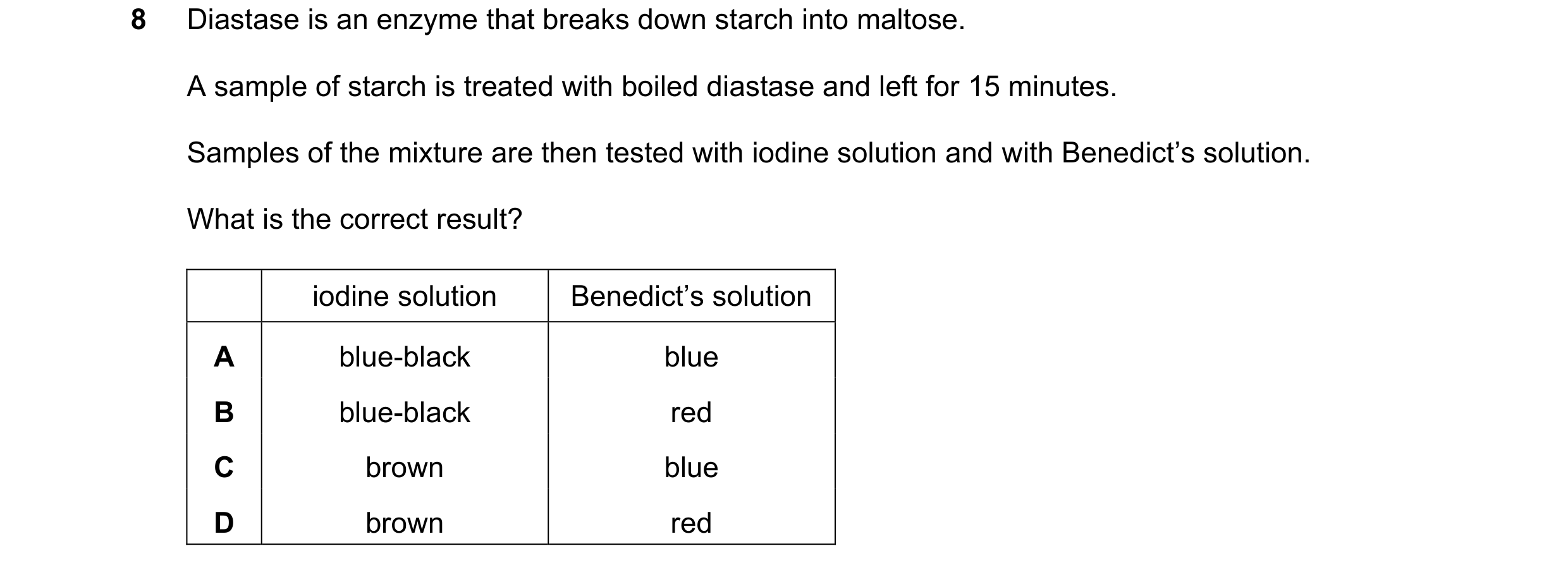
Q97 · Diastase is an enzyme that breaks down starch into maltose 9700/14 May/June 2025
8 Diastase is an enzyme that breaks down starch into maltose. A sample of starch is treated with boiled diastase and left for 15 minutes. Samples of the mixture are then tested with iodine solution and with Benedict’s solution. What is the correct result? iodine solution Benedict’s solution A blue-black blue B blue-black red C brown blue D brown red
1 marks
Answer: A
This question in 9700/14 May/June 2025
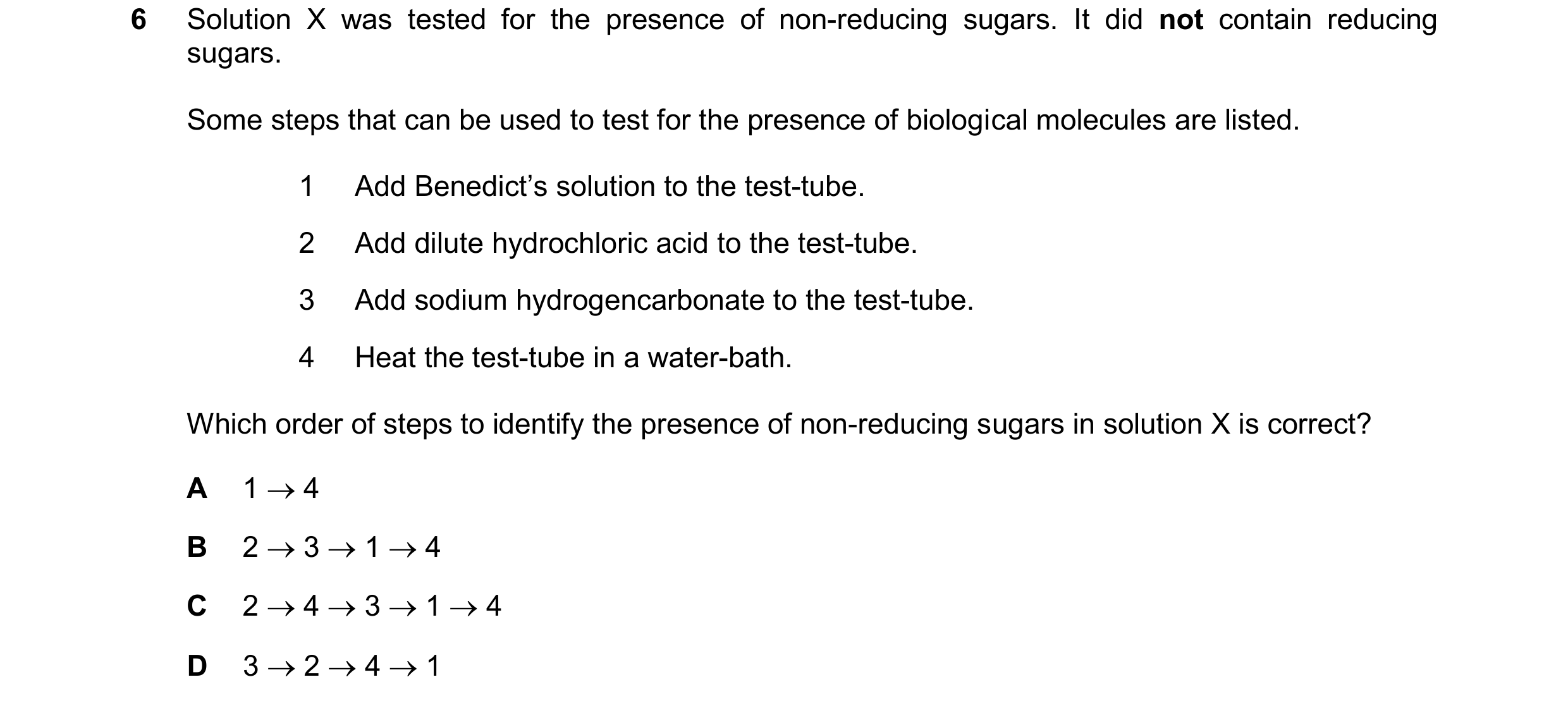
Q98 · Solution X was tested for the presence of non-reducing sugars 9700/11 Oct/Nov 2025
6 Solution X was tested for the presence of non-reducing sugars. It did not contain reducing sugars. Some steps that can be used to test for the presence of biological molecules are listed. 1 Add Benedict’s solution to the test-tube. 2 Add dilute hydrochloric acid to the test-tube. 3 Add sodium hydrogencarbonate to the test-tube. 4 Heat the test-tube in a water-bath. Which order of steps to identify the presence of non-reducing sugars in solution X is correct? A 1 4 B 2 3 1 4 C 2 4 3 1 4 D 3 2 4 1
1 marks
Answer: C
This question in 9700/11 Oct/Nov 2025
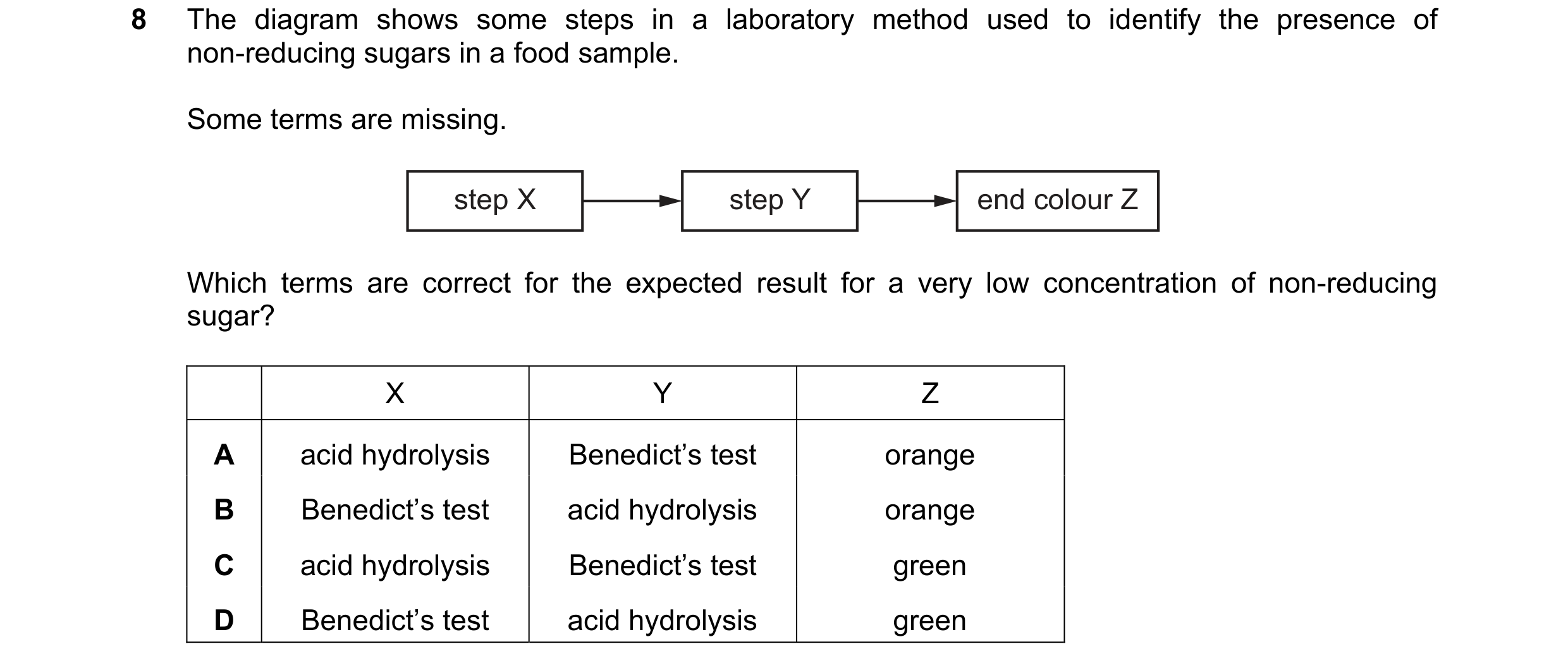
Q99 · The diagram shows some steps in a laboratory method used to identify the presence of… 9700/13 Oct/Nov 2025
8 The diagram shows some steps in a laboratory method used to identify the presence of non-reducing sugars in a food sample. Some terms are missing. step X step Y end colour Z Which terms are correct for the expected result for a very low concentration of non-reducing sugar? X Y Z A acid hydrolysis Benedict’s test orange B Benedict’s test acid hydrolysis orange C acid hydrolysis Benedict’s test green D Benedict’s test acid hydrolysis green
1 marks
Answer: C
This question in 9700/13 Oct/Nov 2025

 1 / 36
 2 / 36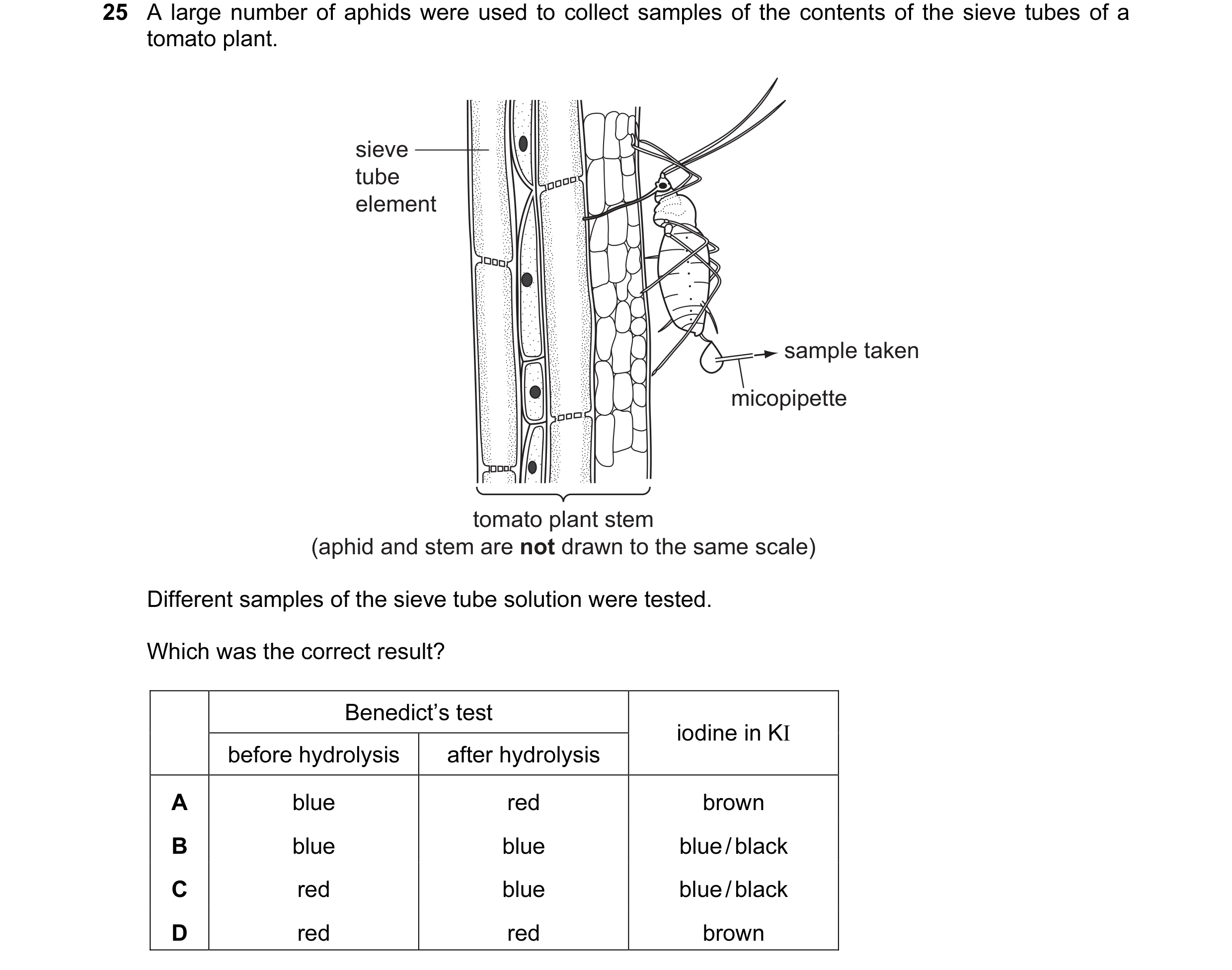
 3 / 36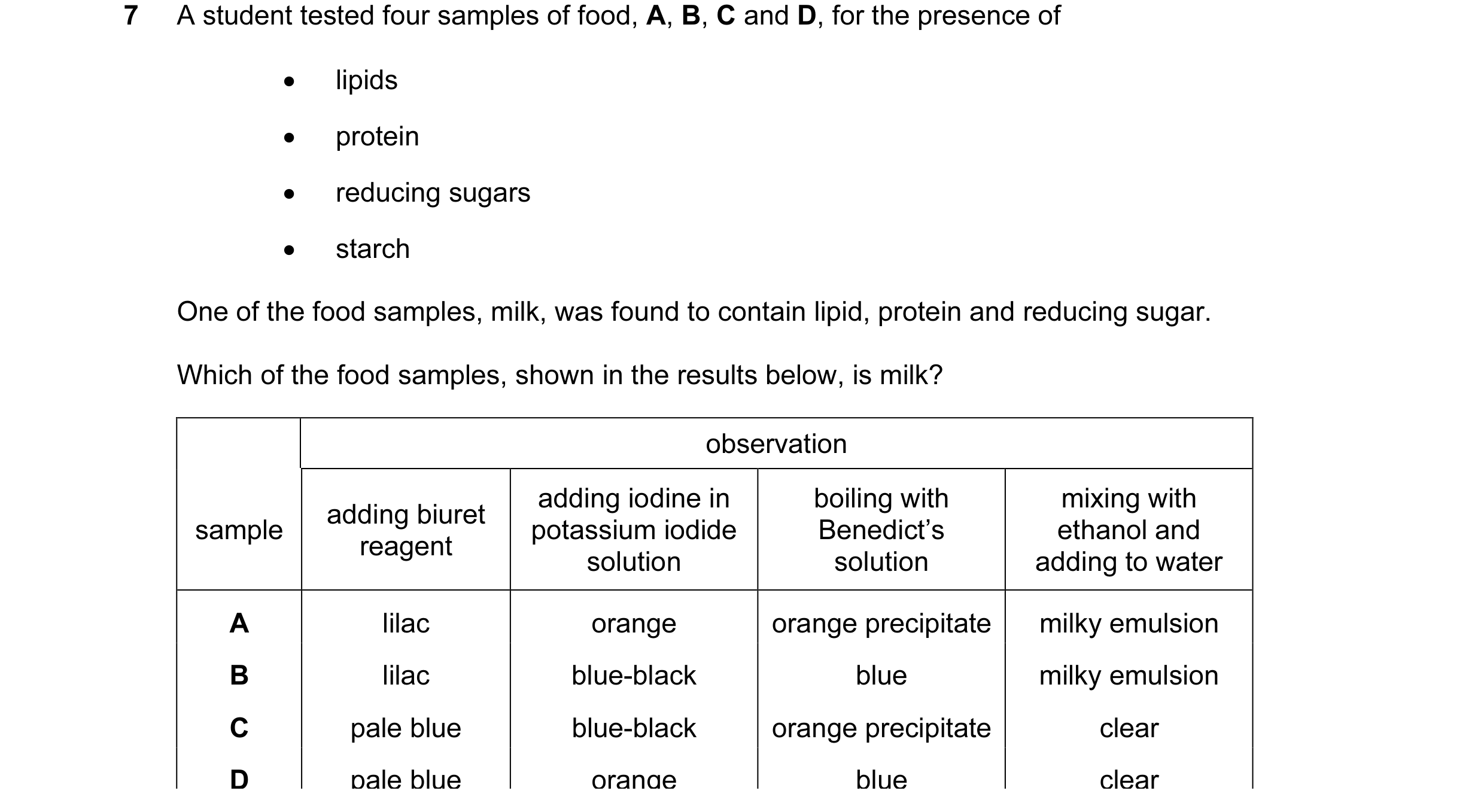
 4 / 36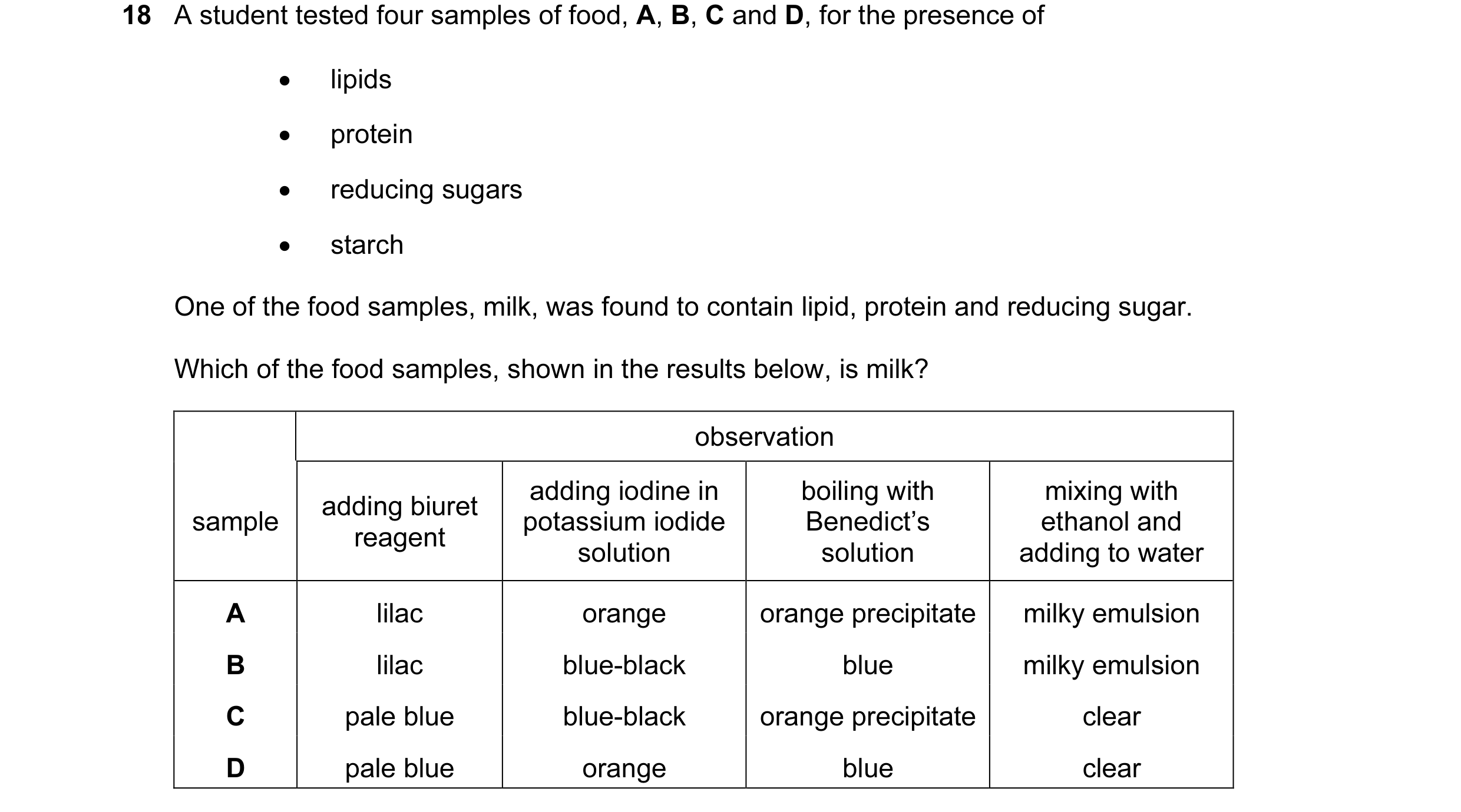
 5 / 36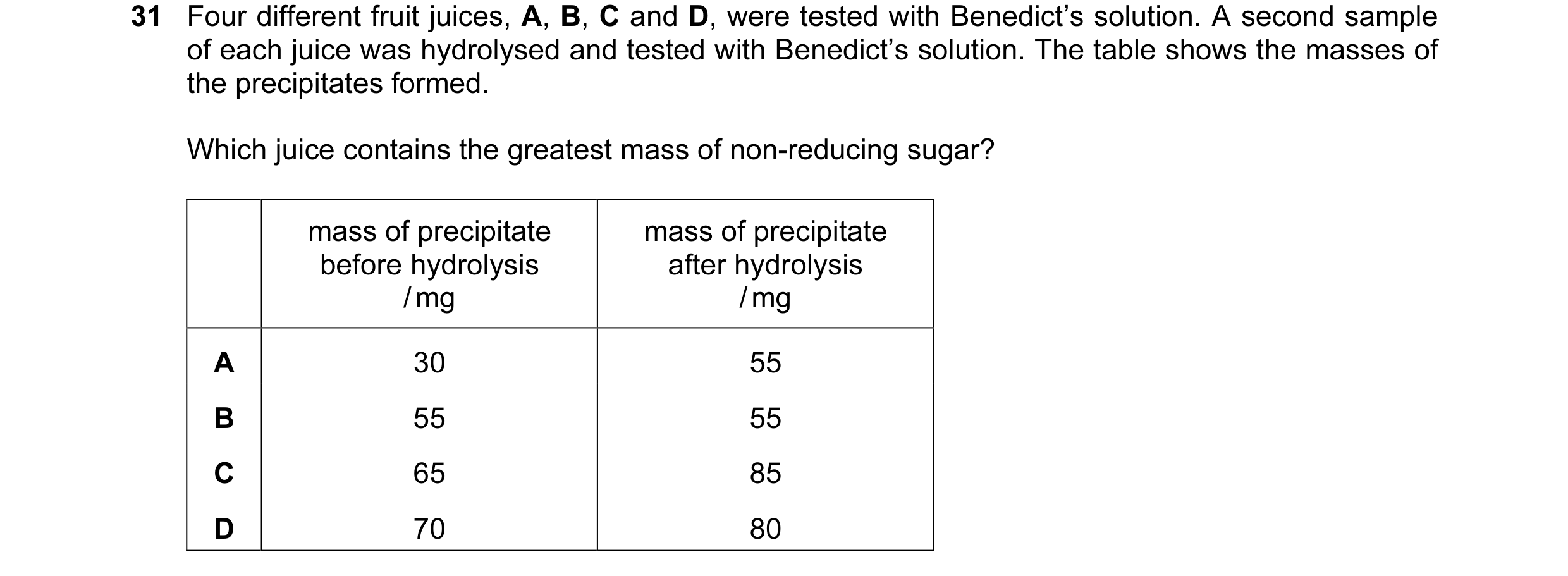
 6 / 36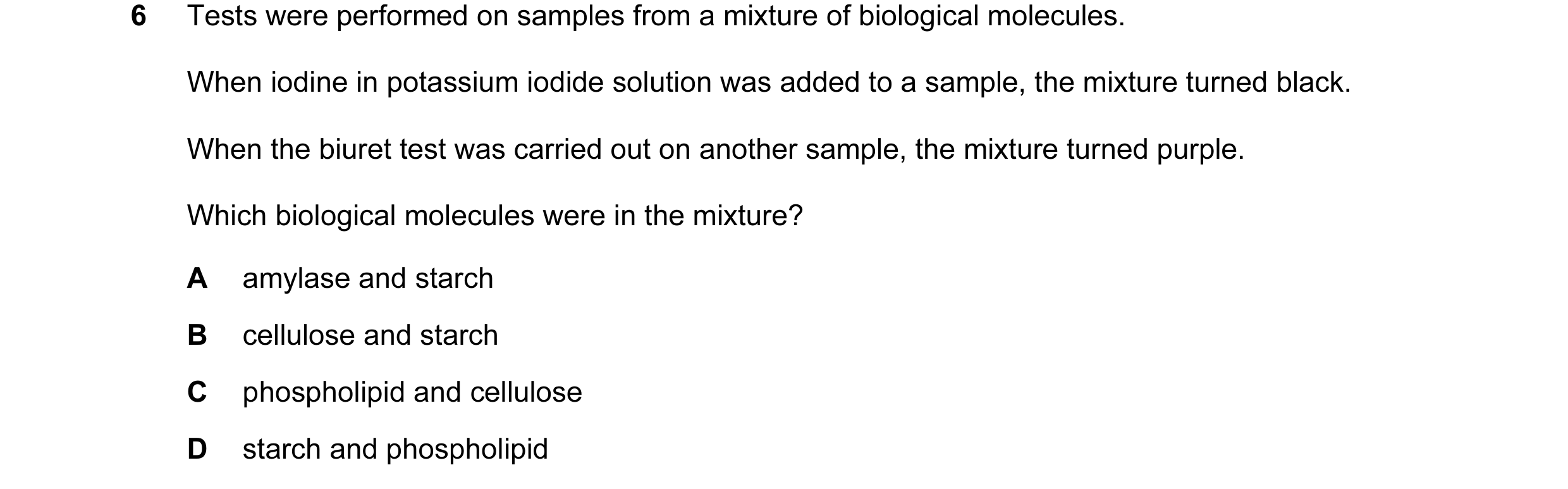

 7 / 36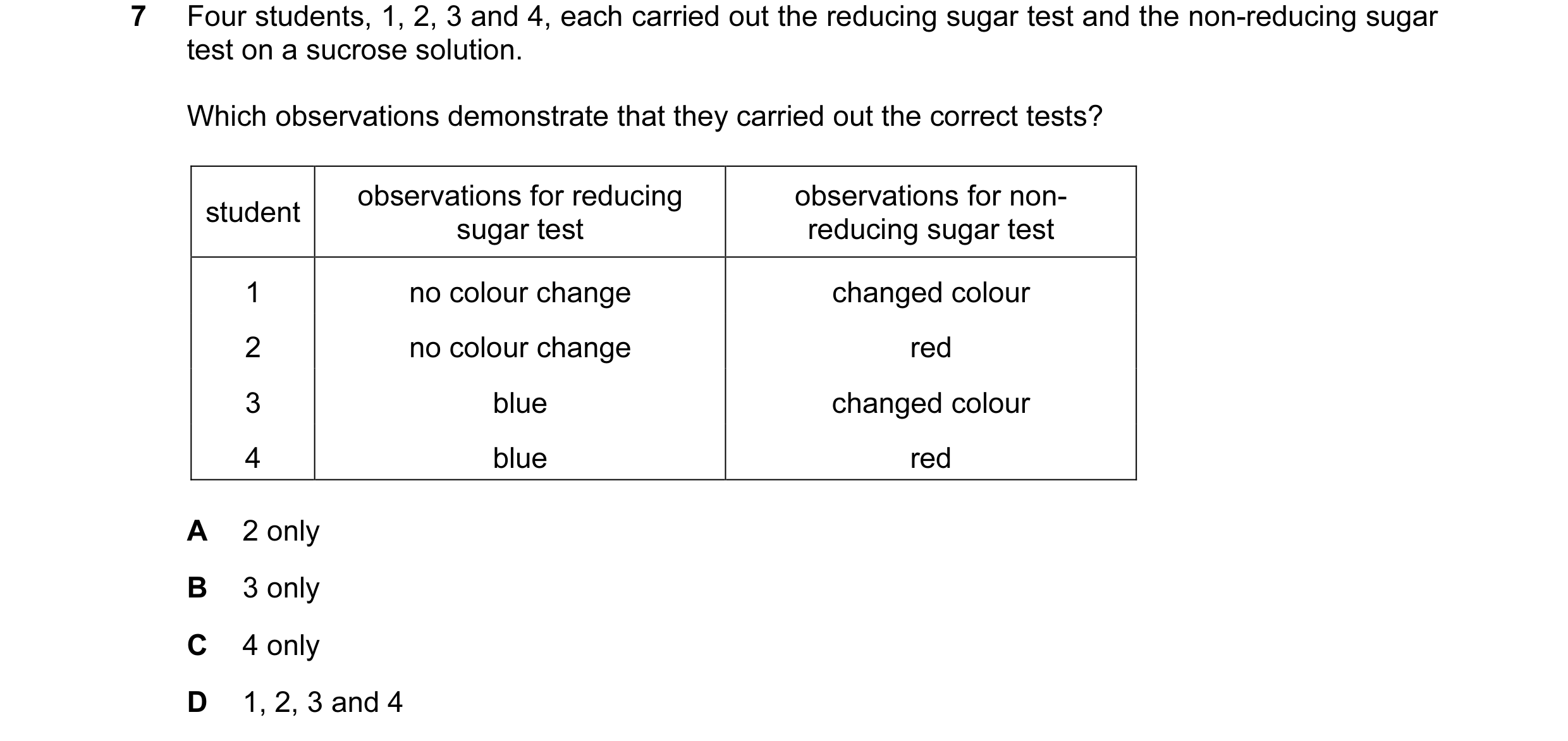

 8 / 36
 9 / 36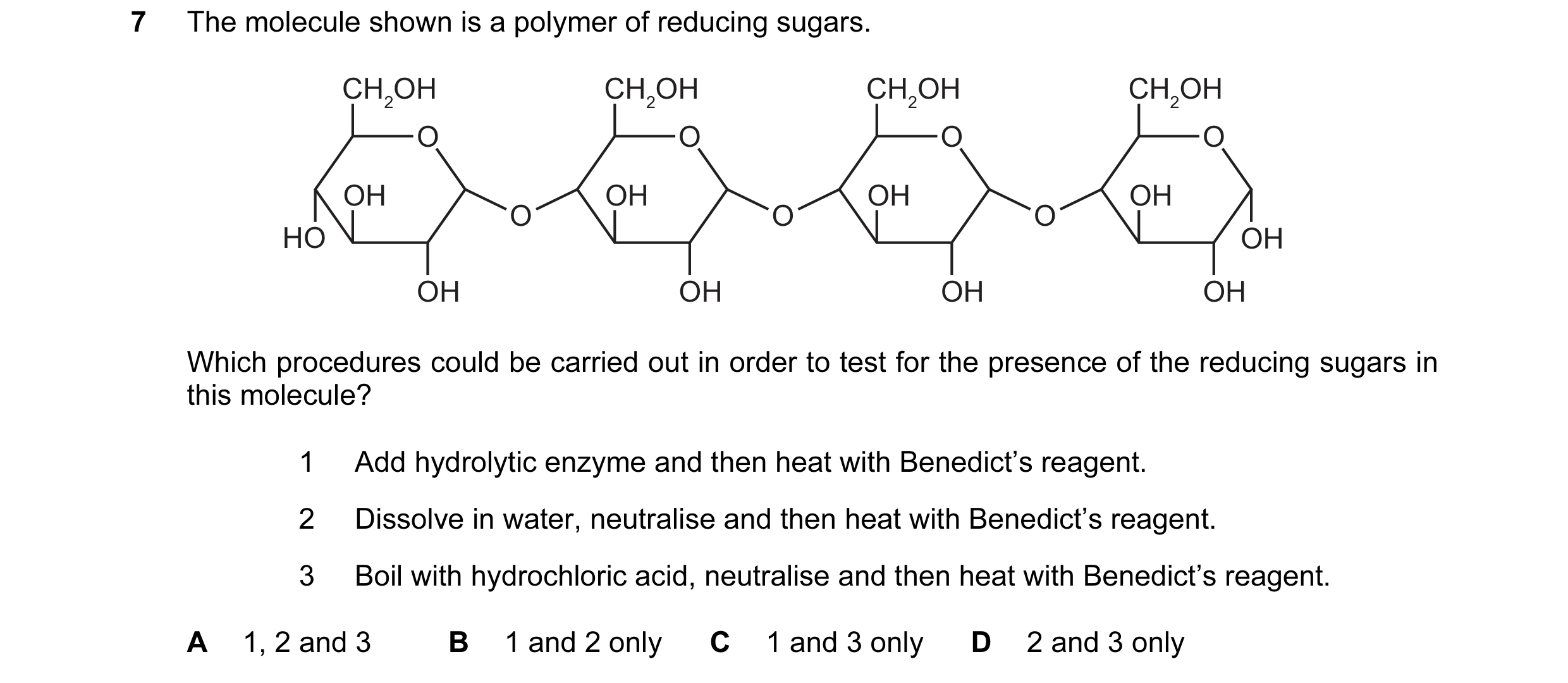
 10 / 36
 11 / 36
 12 / 36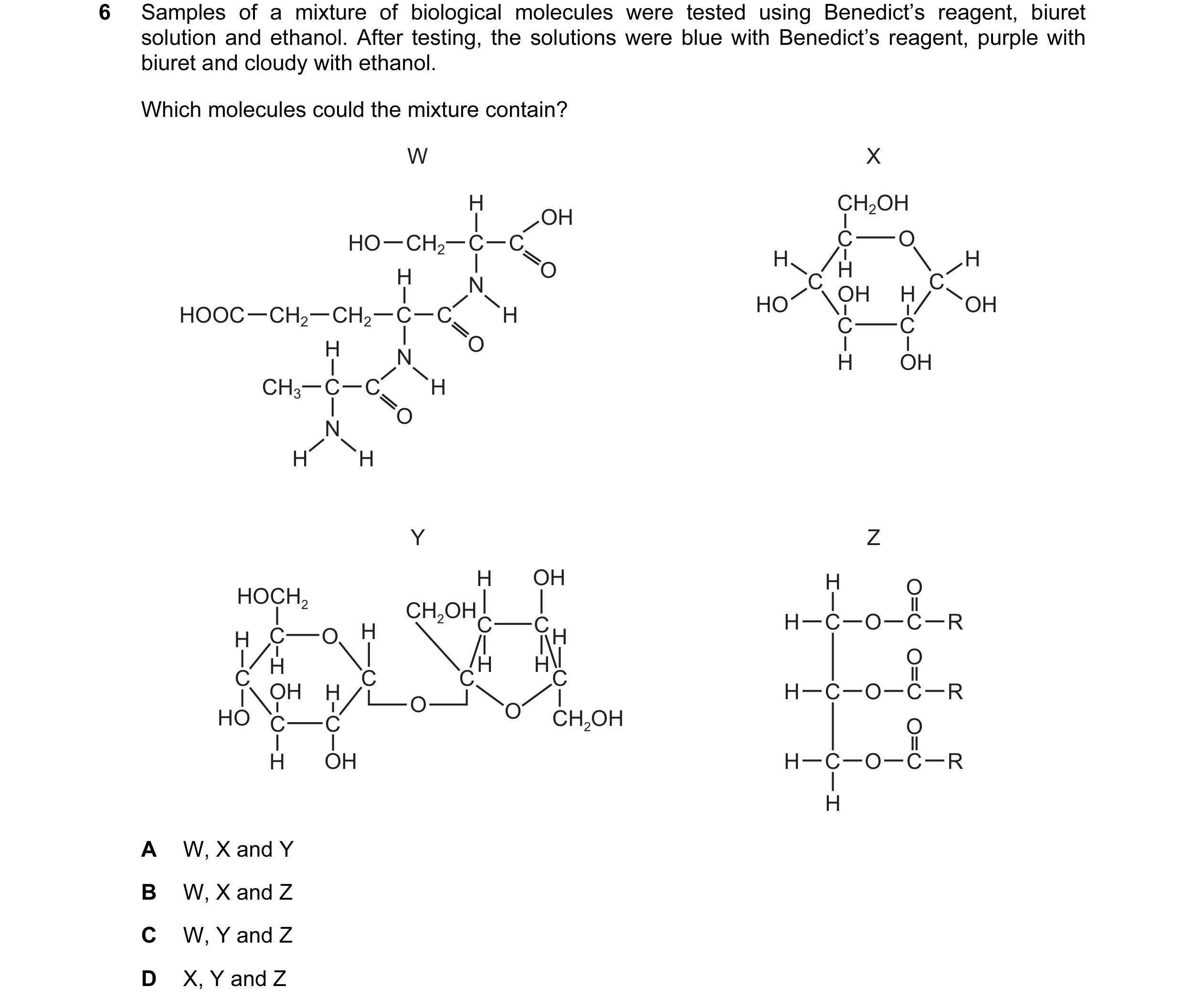
 13 / 36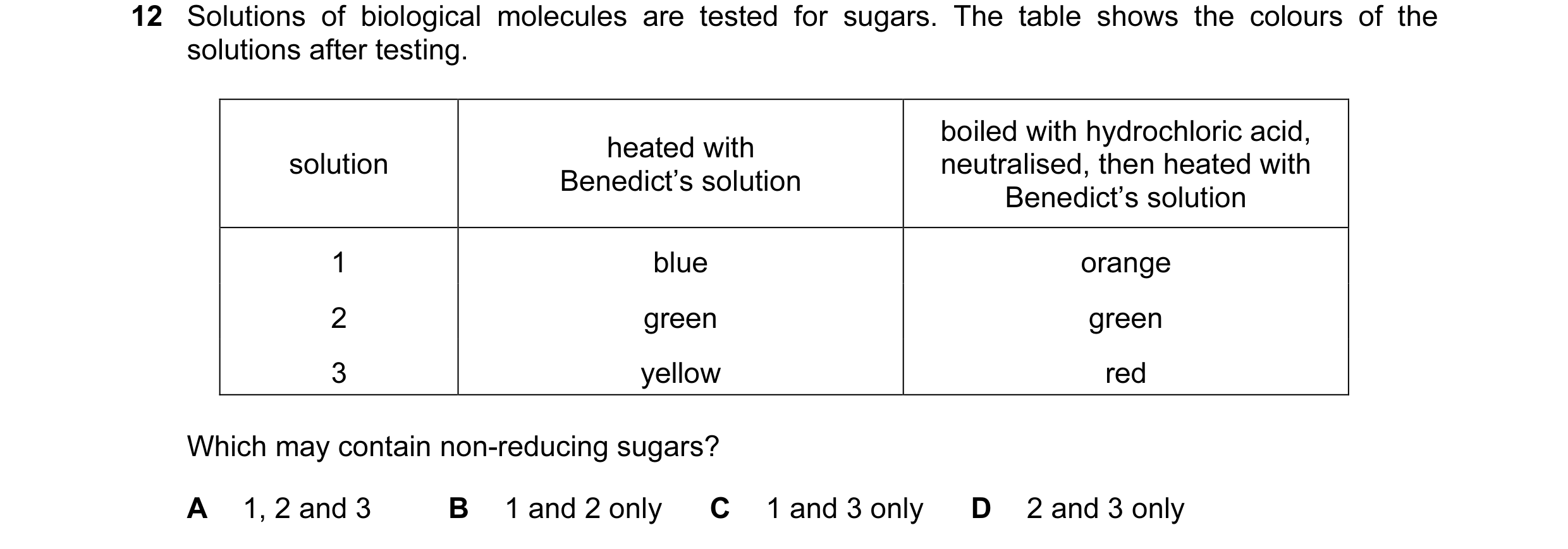
 14 / 36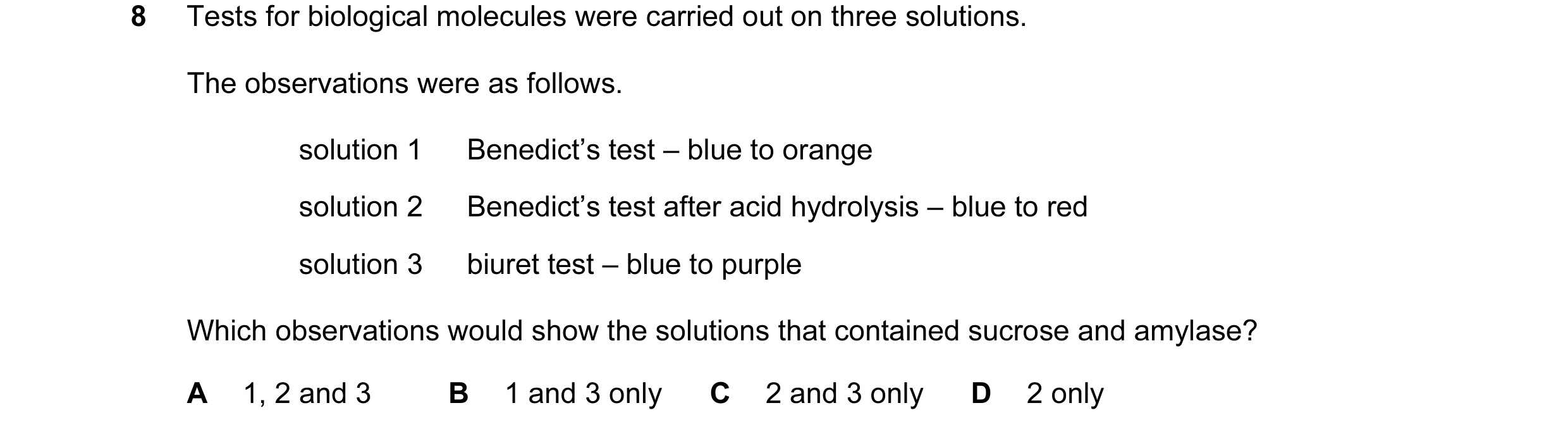
 15 / 36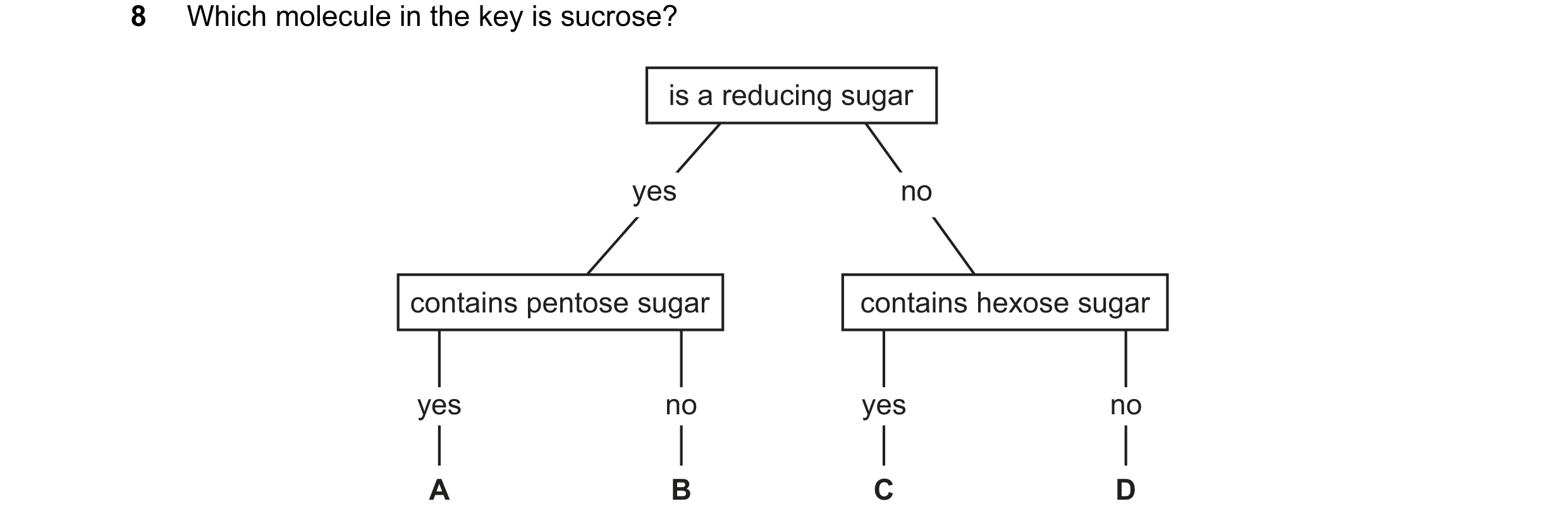
 16 / 36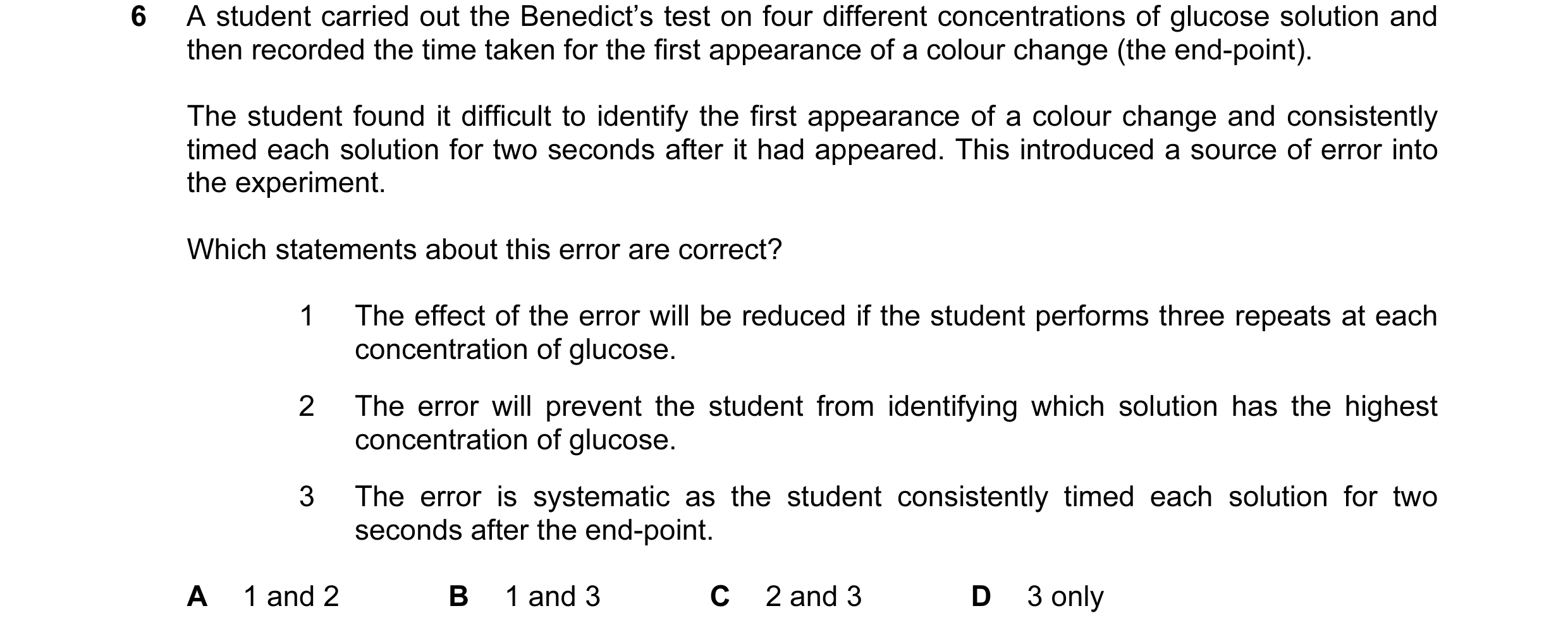
 17 / 36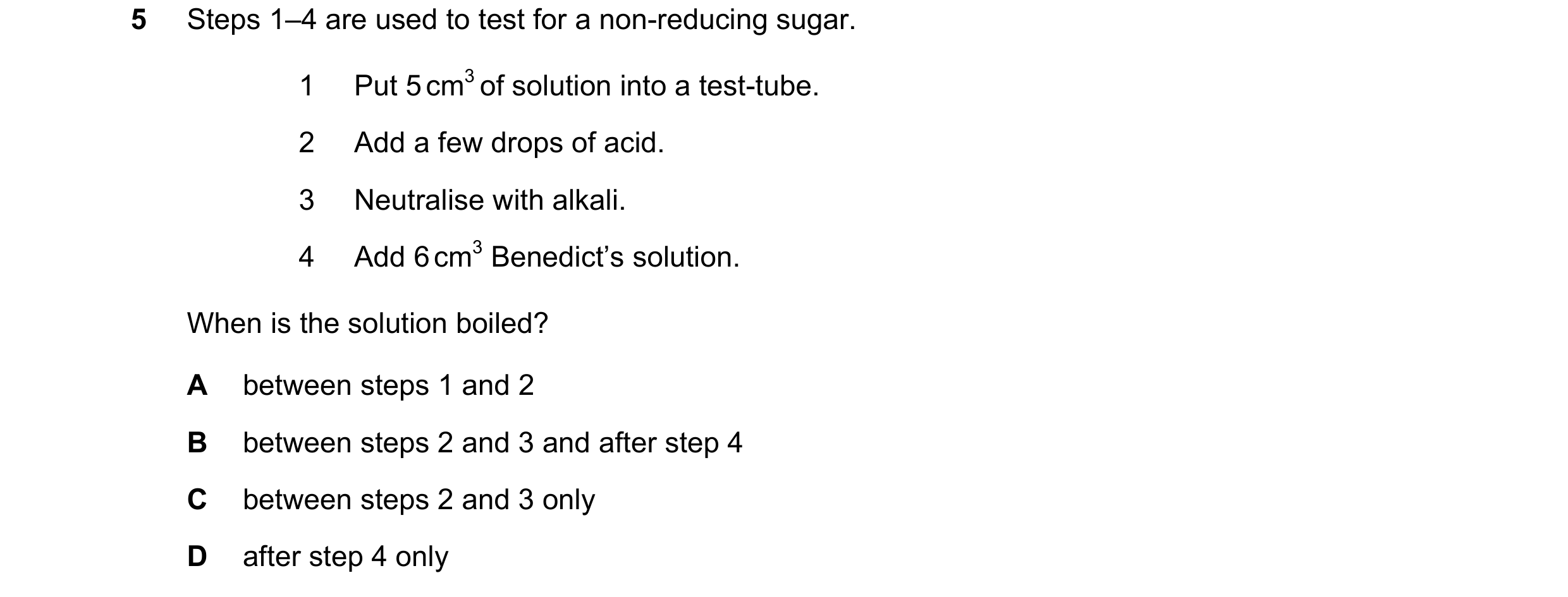
 18 / 36
 19 / 36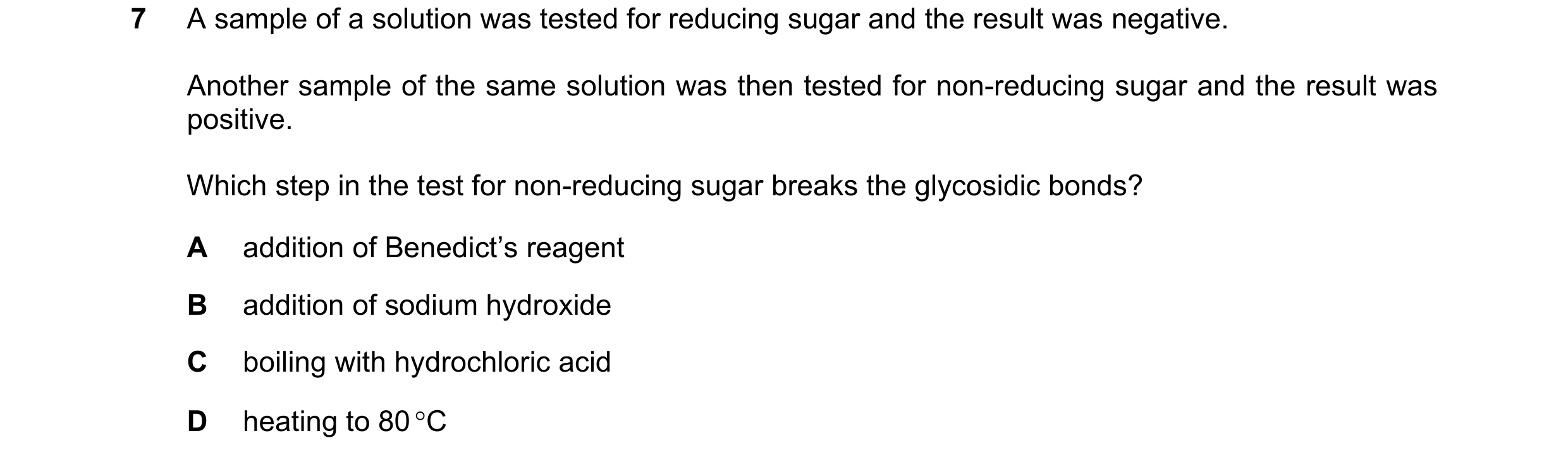
 20 / 36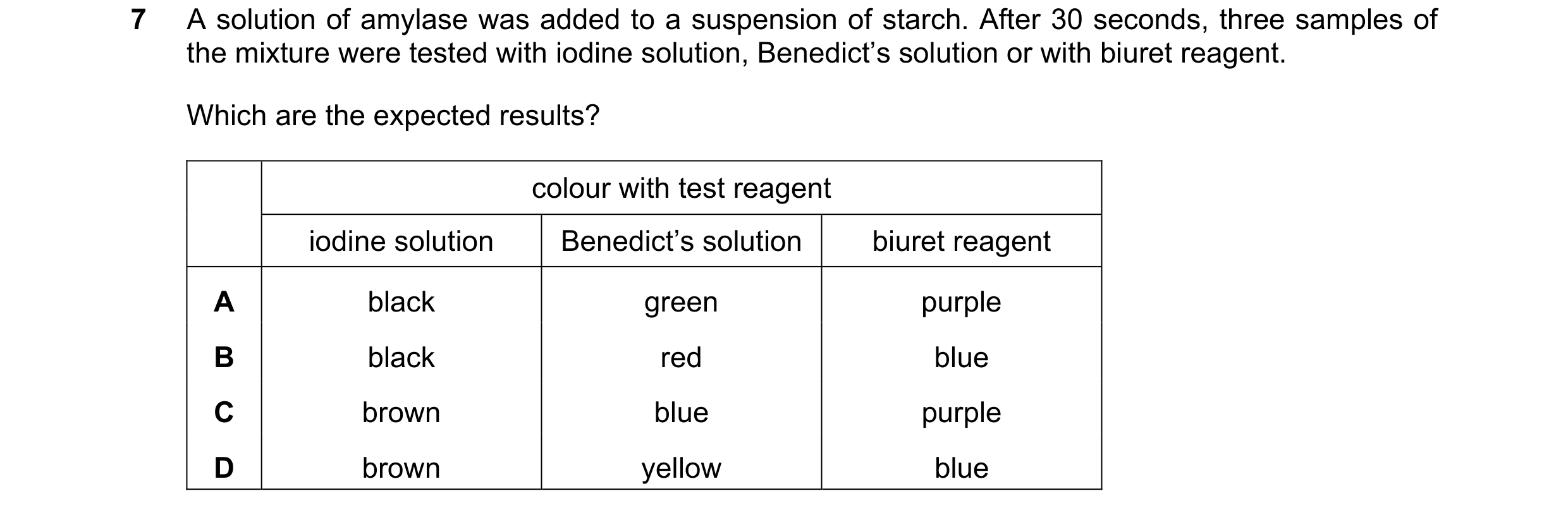
 21 / 36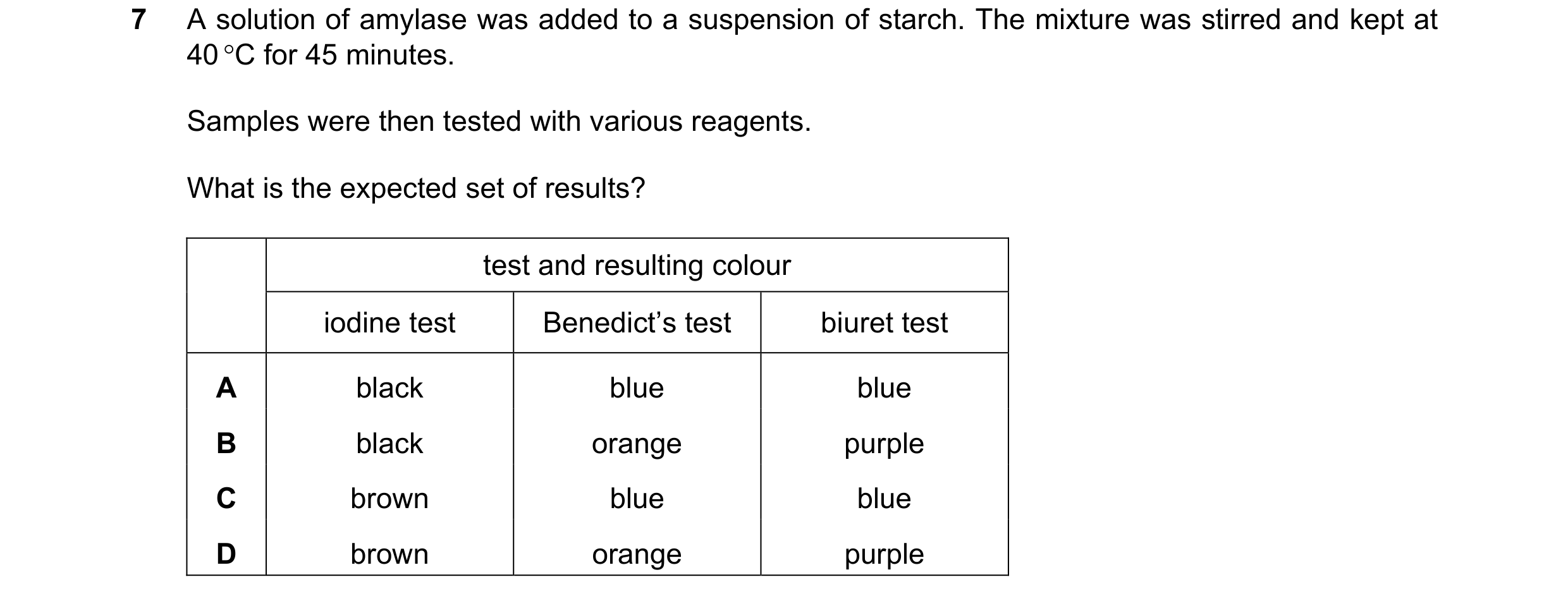
 22 / 36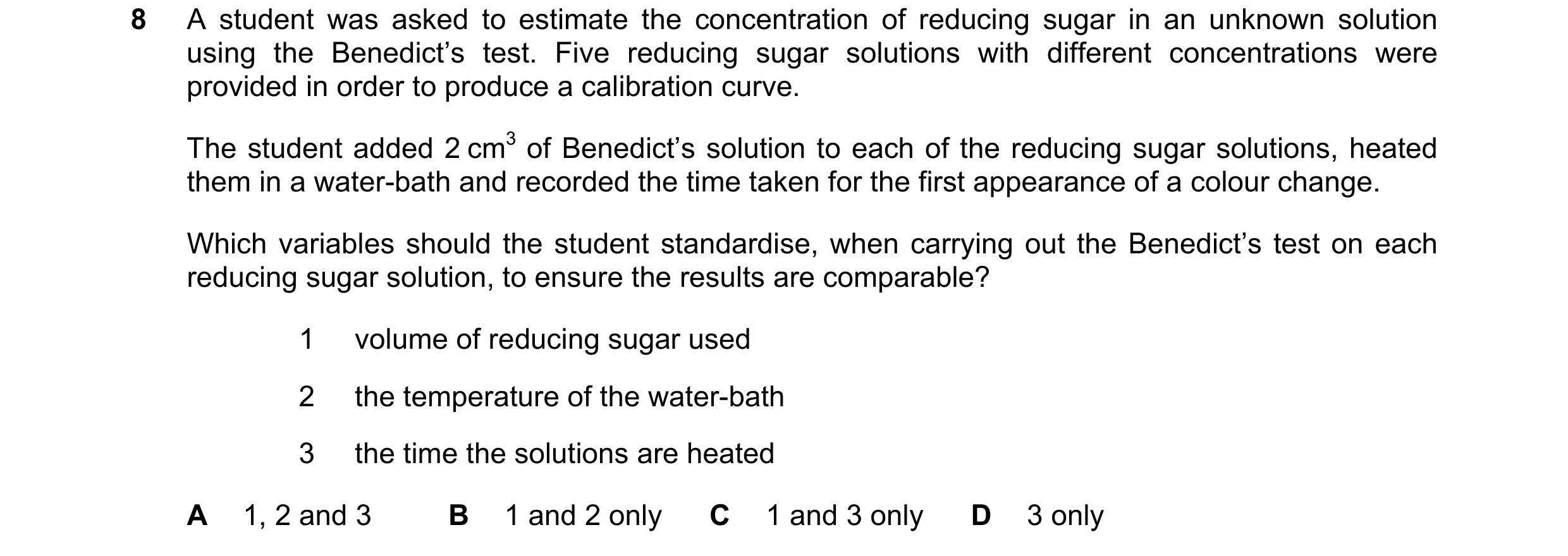
 23 / 36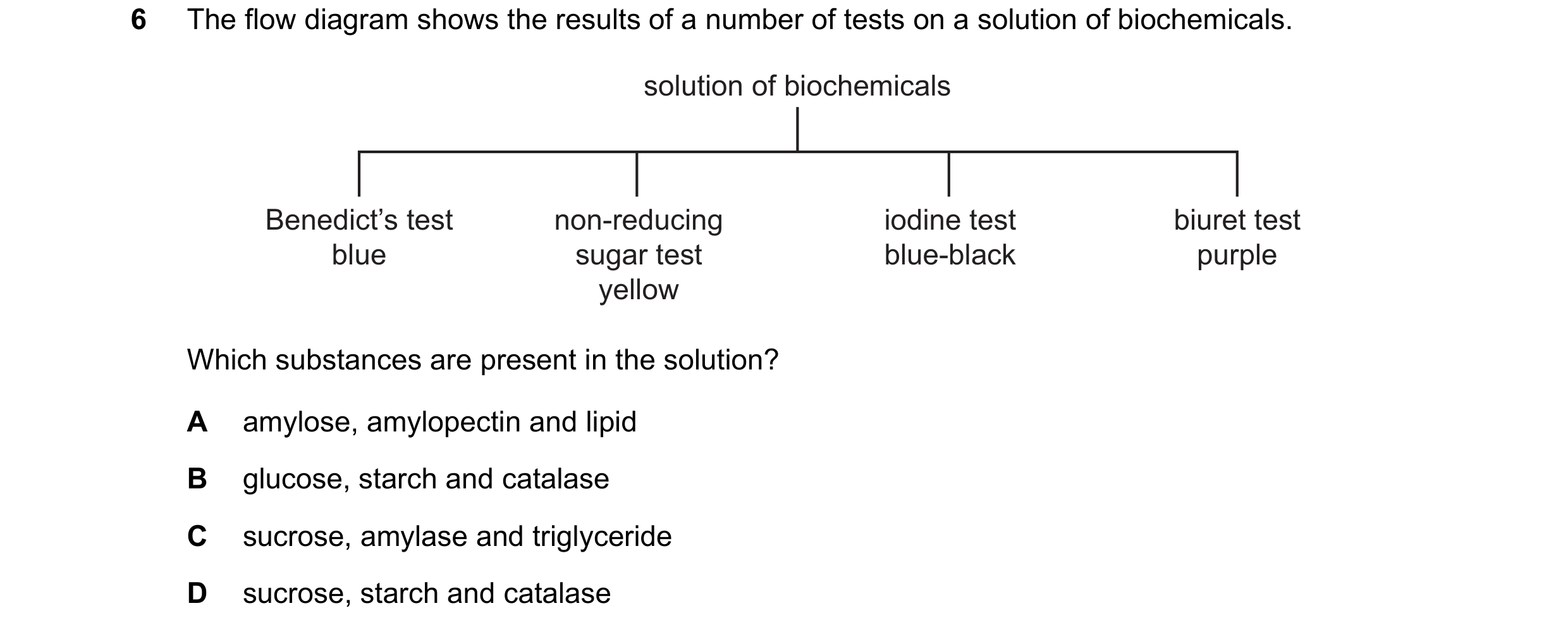
 24 / 36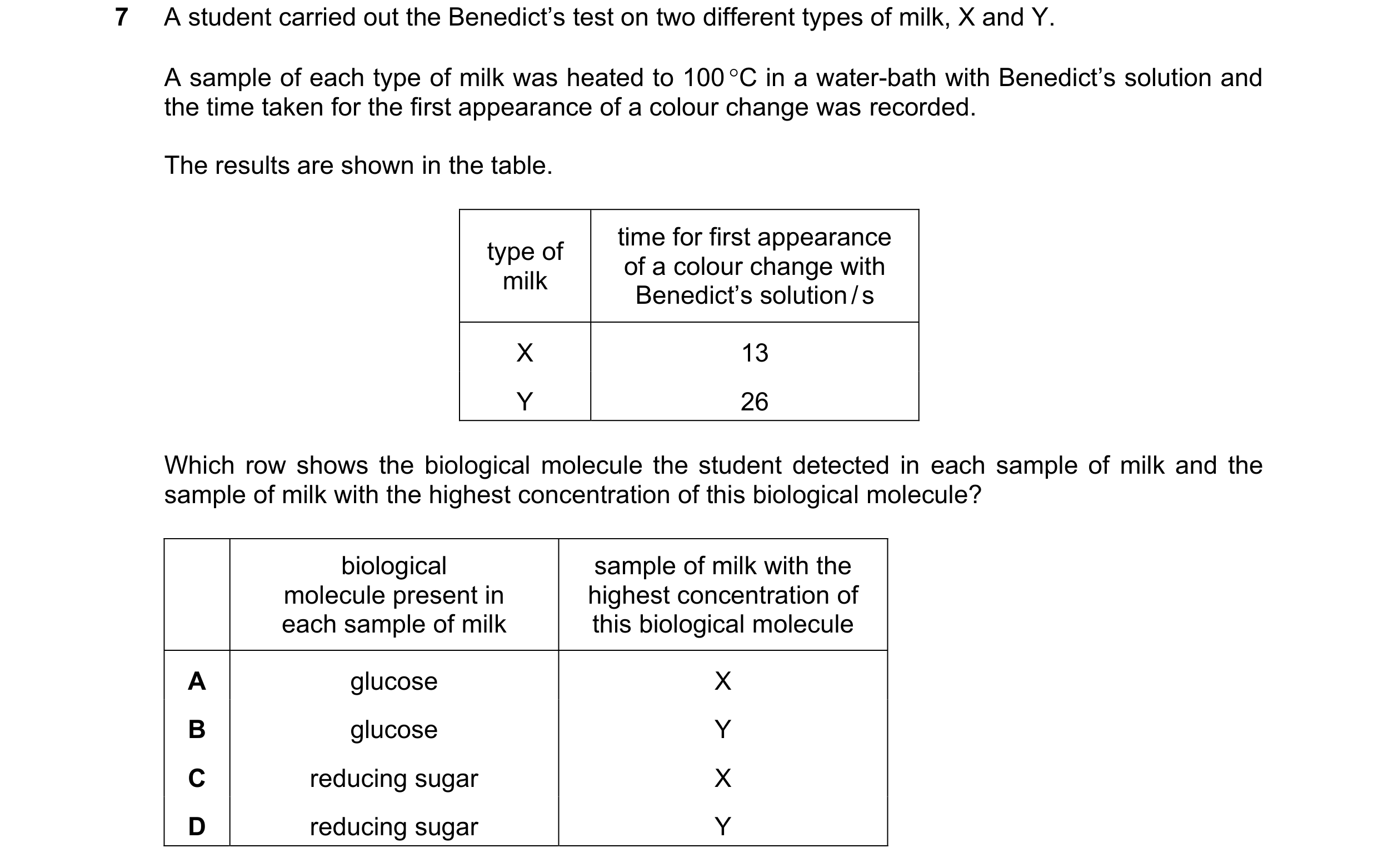
 25 / 36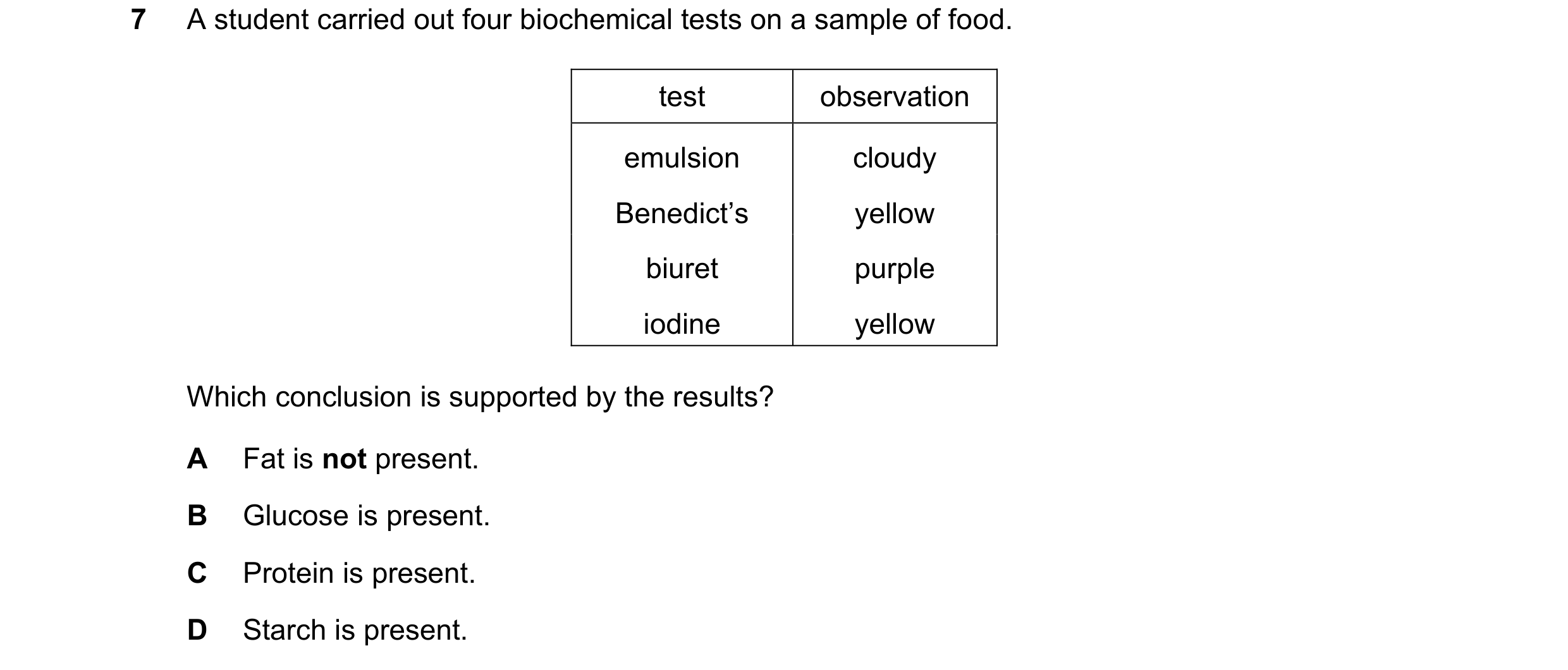
 26 / 36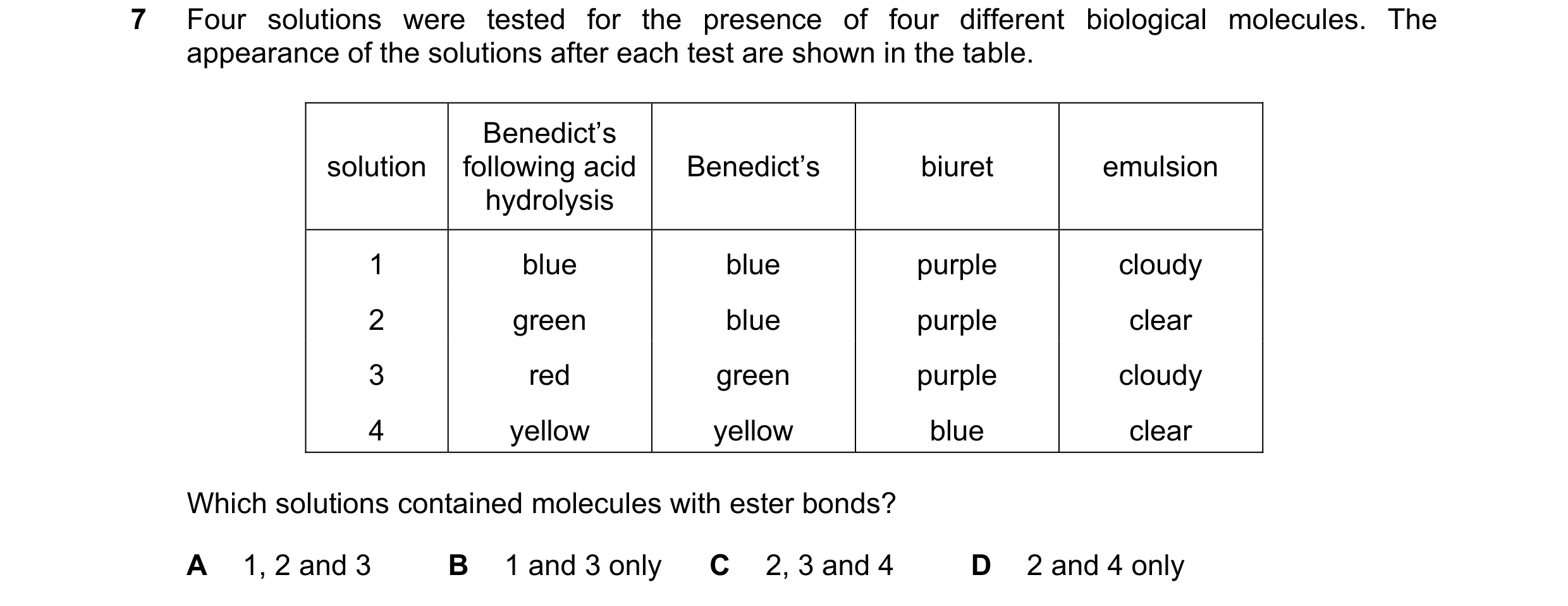
 27 / 36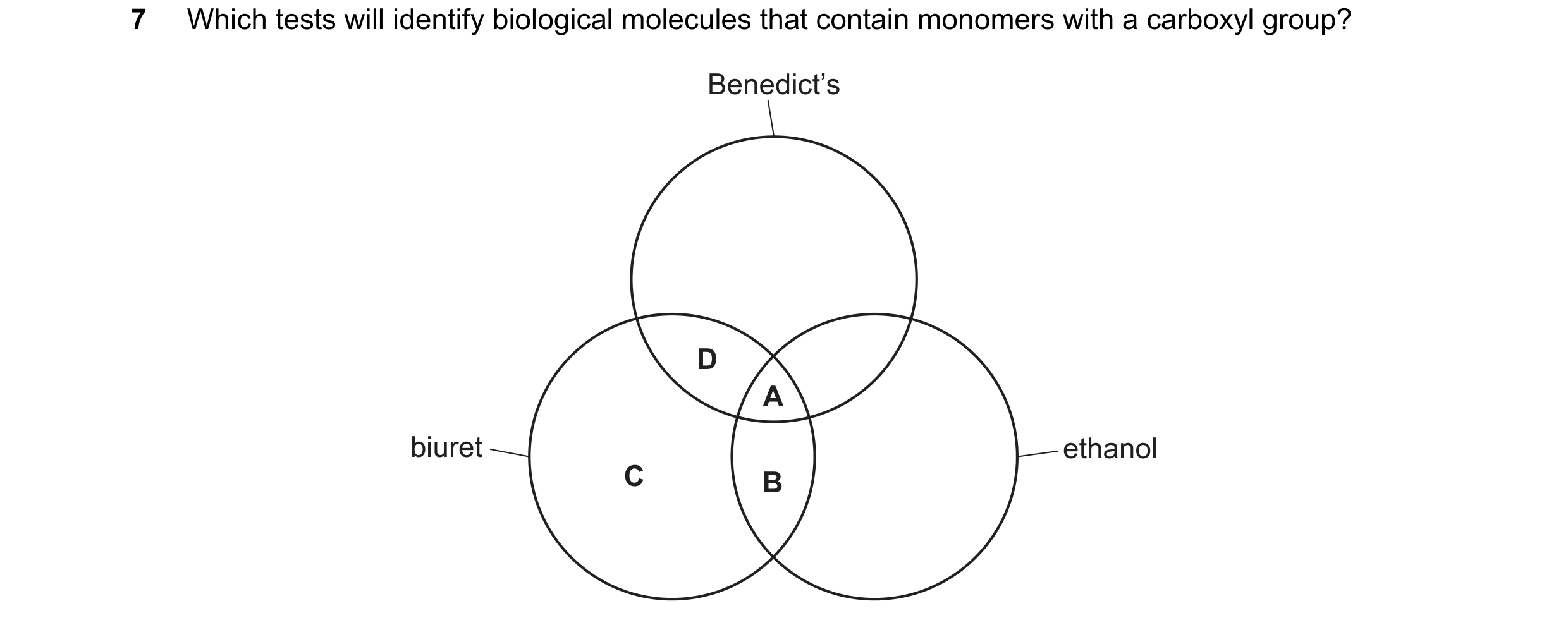
 28 / 36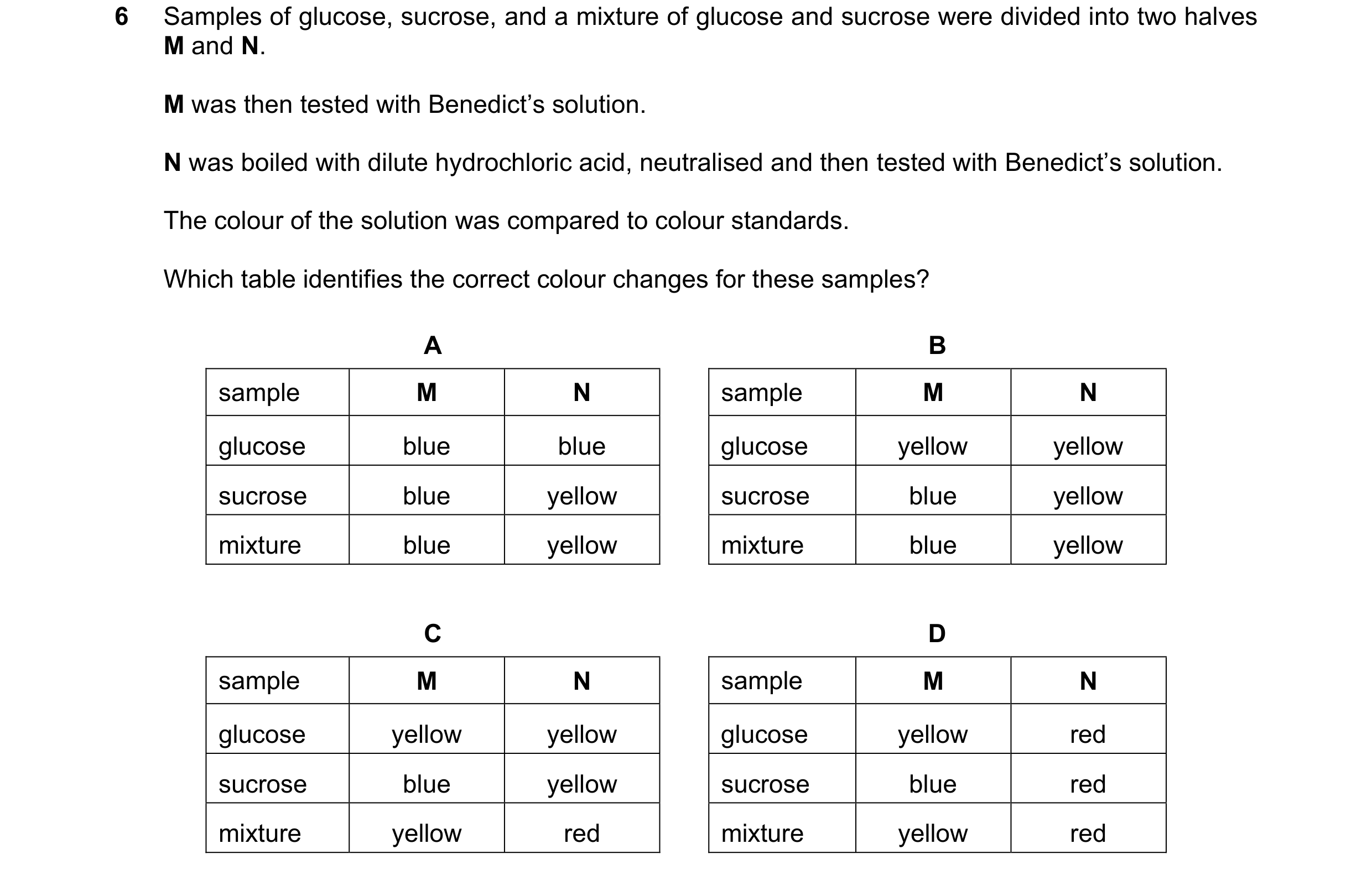
 29 / 36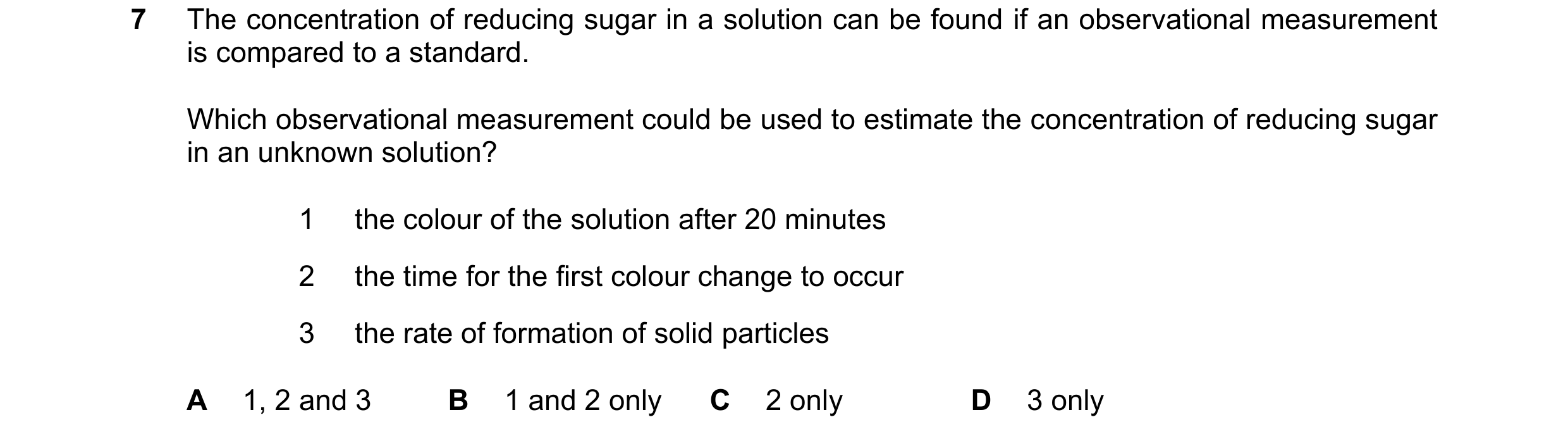
 30 / 36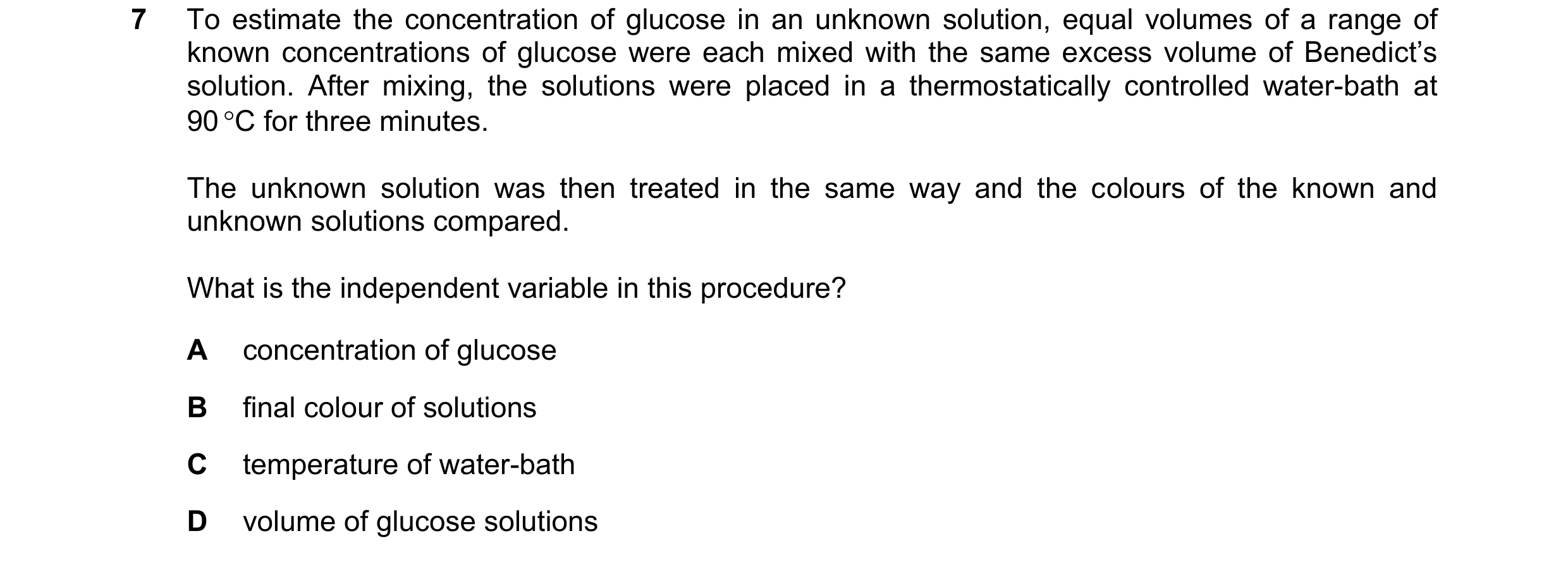
 31 / 36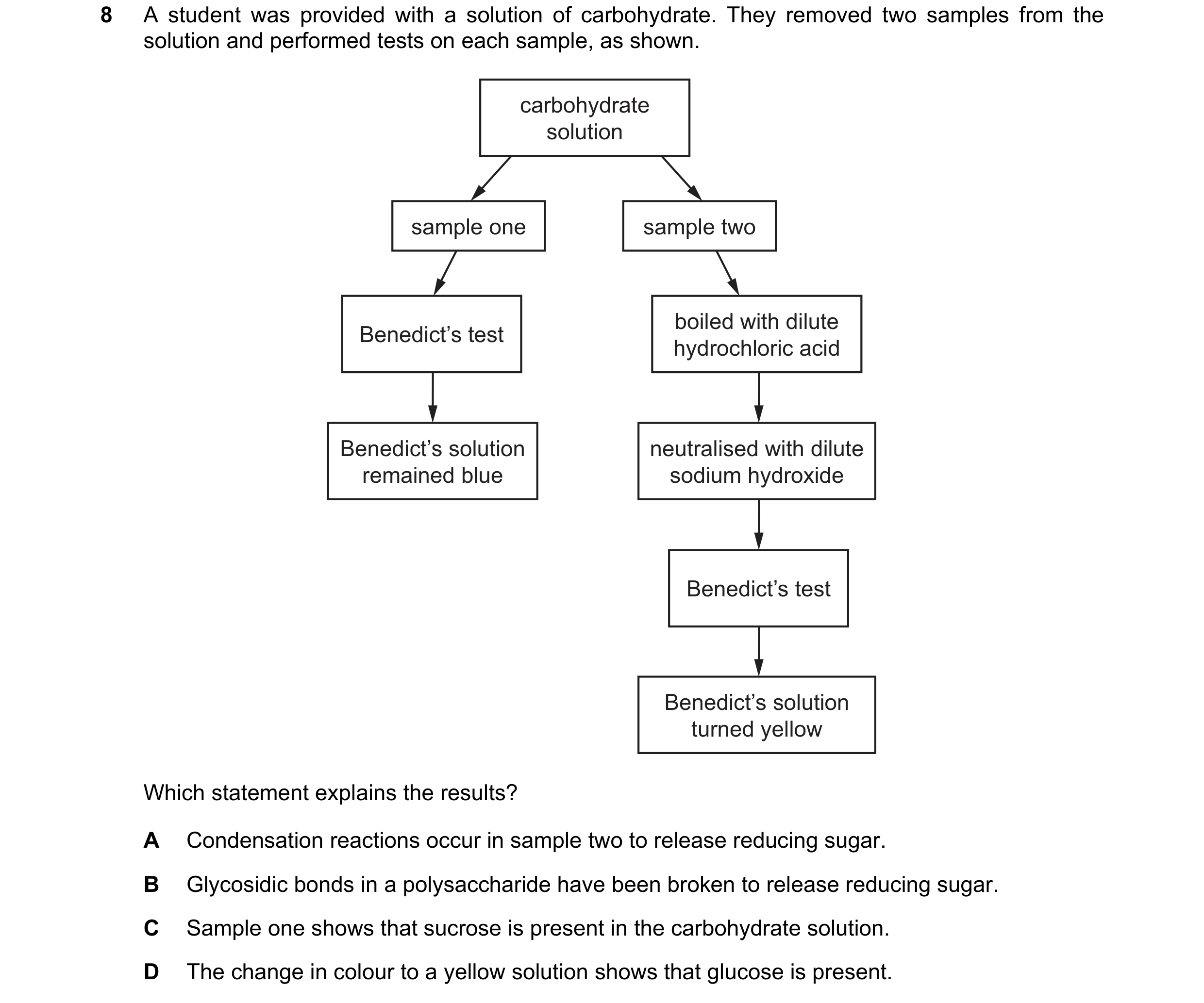
 32 / 36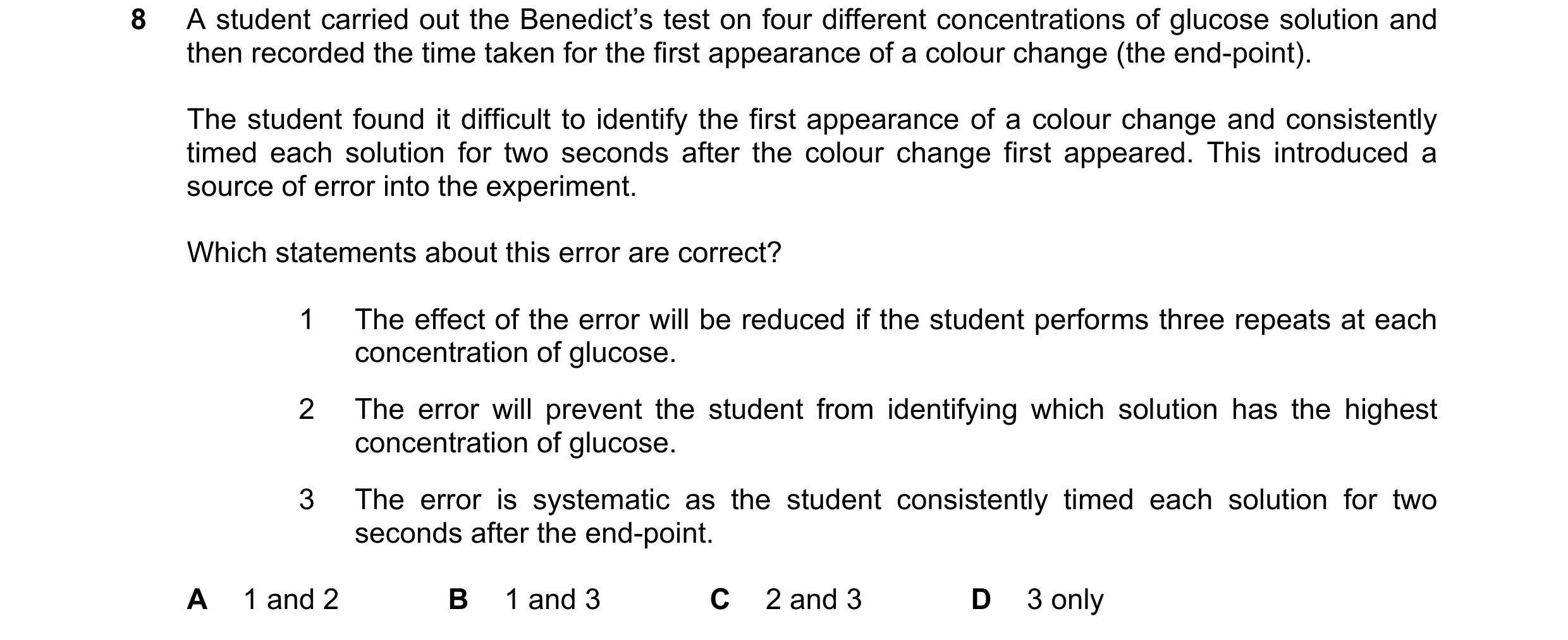
 33 / 36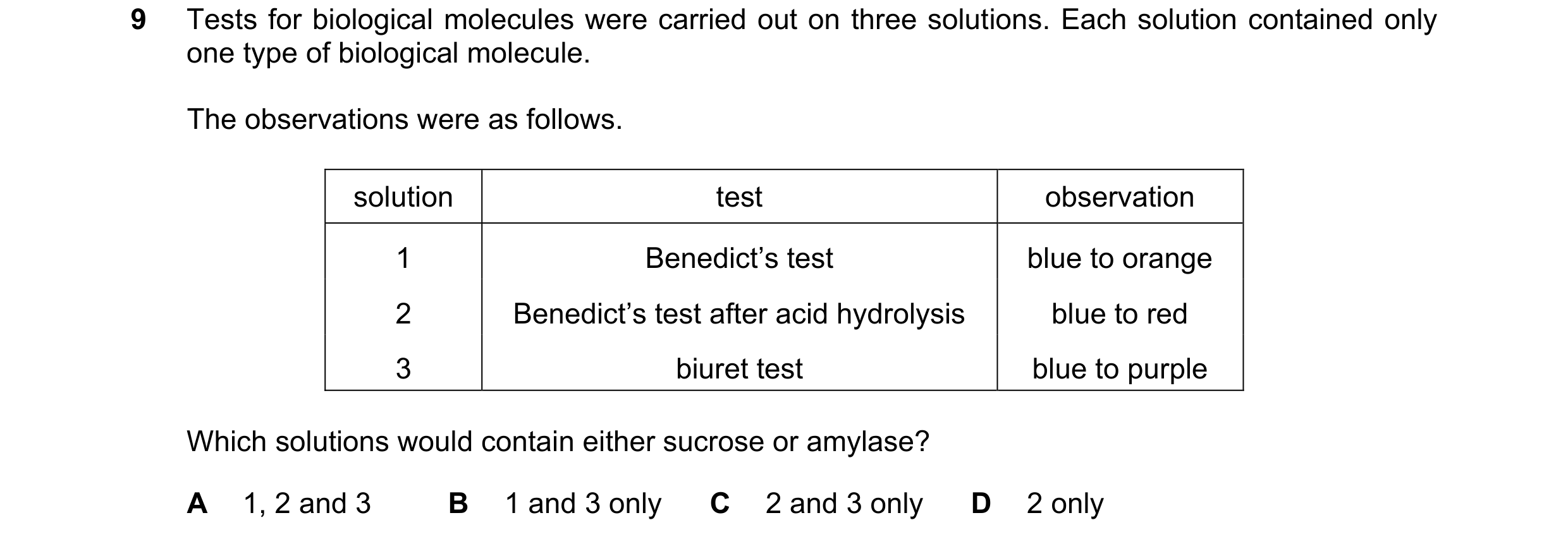

 34 / 36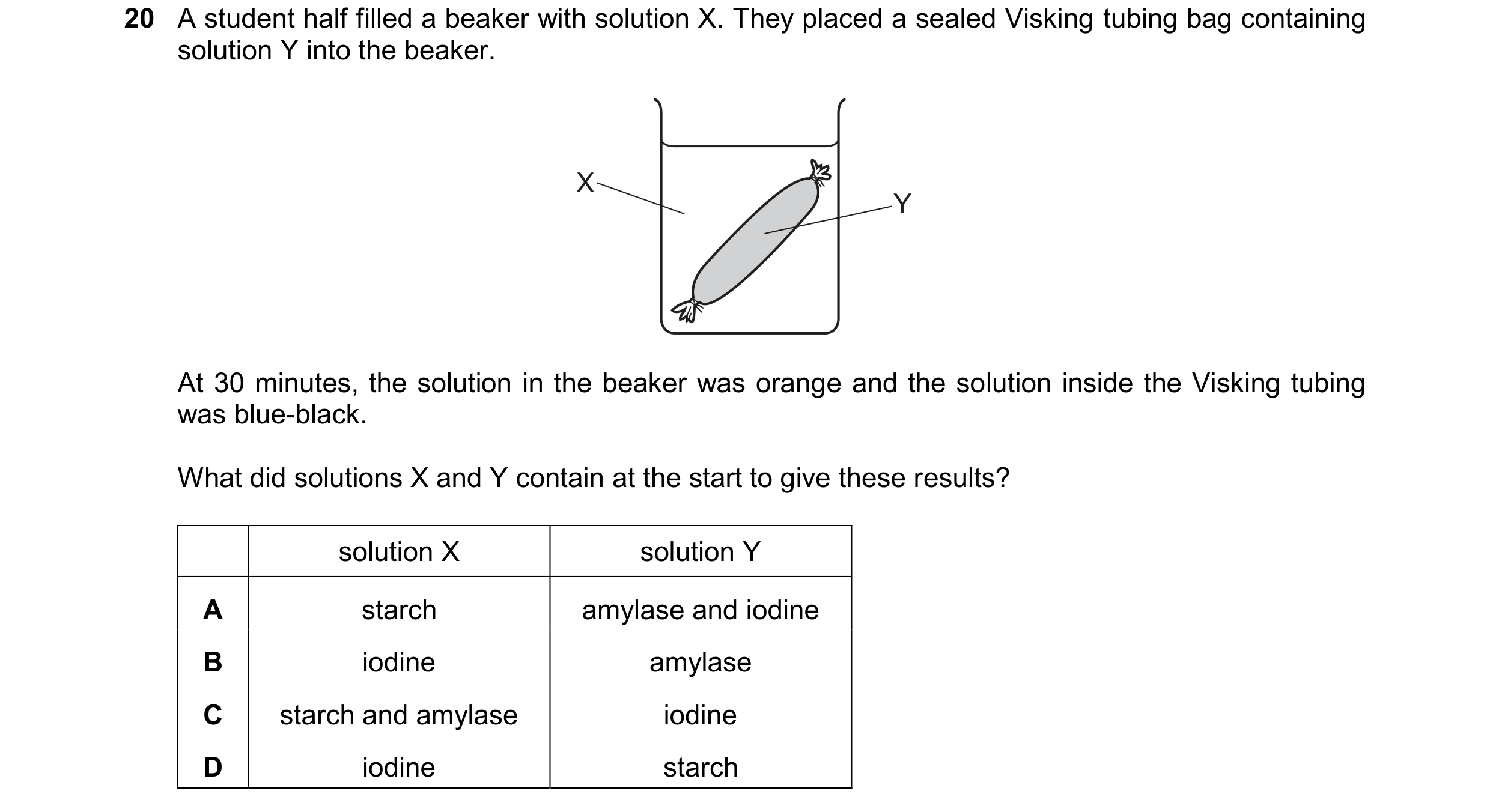
 35 / 36
 36 / 36