Questions as text
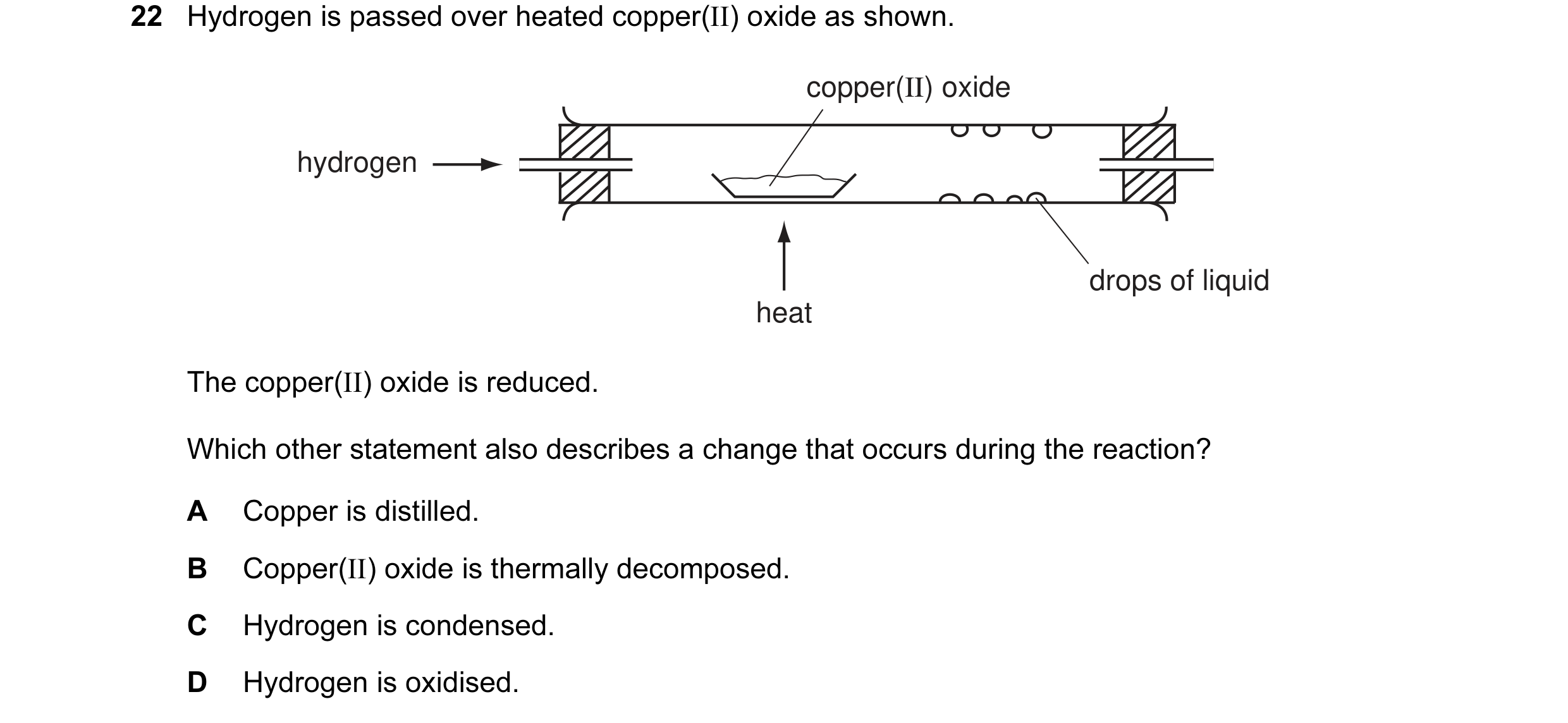
Q1 · Hydrogen is passed over heated copper(II) oxide as shown 0653/11 Oct/Nov 2006
22 Hydrogen is passed over heated copper(II) oxide as shown. copper(II) oxide hydrogen drops of liquid heat The copper(II) oxide is reduced. Which other statement also describes a change that occurs during the reaction? A Copper is distilled. B Copper(II) oxide is thermally decomposed. C Hydrogen is condensed. D Hydrogen is oxidised.
1 marks
Answer: D
This question in 0653/11 Oct/Nov 2006
Q2 · Which method is used to obtain iron from iron(III) oxide? 0653/11 May/June 2007
19 Which method is used to obtain iron from iron(III) oxide? A combustion B electrolysis C reduction D thermal decomposition
1 marks
Answer: C
This question in 0653/11 May/June 2007
Q3 · Which substance is reduced during the following reaction? 0653/11 May/June 2007
25 Which substance is reduced during the following reaction? A B C D lead(II) oxide + hydrogen → lead + water
1 marks
Answer: A
This question in 0653/11 May/June 2007
Q4 · An oxide of lead is changed to lead by heating it with carbon 0653/11 Oct/Nov 2007
19 An oxide of lead is changed to lead by heating it with carbon. Pb xO y + 2C 3Pb + 2CO2 What is the formula of this oxide of lead? A Pb2O3 B Pb3O2 C Pb3O4 D Pb4O3
1 marks
Answer: C
This question in 0653/11 Oct/Nov 2007
Q5 · Copper(II) oxide is mixed with solid Q 0653/11 Oct/Nov 2008
20 Copper(II) oxide is mixed with solid Q. On heating the mixture, a reaction occurs and the limewater turns cloudy. copper(II) oxide and solid Q heat limewater What is solid Q? A carbon B iron C sulphur D zinc
1 marks
Answer: A
This question in 0653/11 Oct/Nov 2008
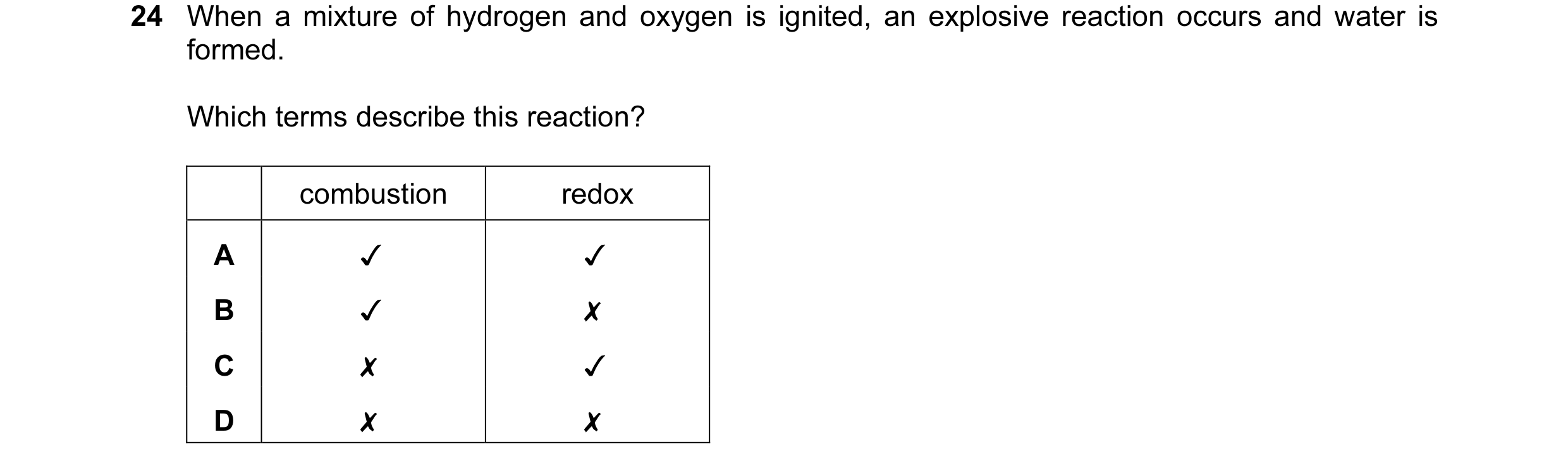
Q6 · When a mixture of hydrogen and oxygen is ignited, an explosive reaction occurs and water… 0653/11 Oct/Nov 2008
24 When a mixture of hydrogen and oxygen is ignited, an explosive reaction occurs and water is
formed.
Which terms describe this reaction?
combustion redox
00 DW >
«x O* &
x \ x
1 marks
Answer: A
This question in 0653/11 Oct/Nov 2008
Q7 · Which method is used to obtain iron from iron(III) oxide? 0653/11 May/June 2010
20 Which method is used to obtain iron from iron(III) oxide? A combustion B electrolysis C reduction D thermal decomposition
1 marks
Answer: C
This question in 0653/11 May/June 2010
Q8 · What happens to a piece of magnesium when it burns in air? 0653/11 May/June 2010
24 What happens to a piece of magnesium when it burns in air? A oxidation and combustion B oxidation and thermal decomposition C reduction and combustion D reduction and thermal decomposition
1 marks
Answer: A
This question in 0653/11 May/June 2010
Q9 · Which method is used to obtain iron from iron(III) oxide? 0653/12 May/June 2010
21 Which method is used to obtain iron from iron(III) oxide? A combustion B electrolysis C reduction D thermal decomposition
1 marks
Answer: C
This question in 0653/12 May/June 2010
Q10 · What happens to a piece of magnesium when it burns in air? 0653/12 May/June 2010
25 What happens to a piece of magnesium when it burns in air? A oxidation and combustion B oxidation and thermal decomposition C reduction and combustion D reduction and thermal decomposition
1 marks
Answer: A
This question in 0653/12 May/June 2010
Q11 · Which method is used to obtain iron from iron(III) oxide? 0653/13 May/June 2010
21 Which method is used to obtain iron from iron(III) oxide? A combustion B electrolysis C reduction D thermal decomposition
1 marks
Answer: C
This question in 0653/13 May/June 2010
Q12 · What happens to a piece of magnesium when it burns in air? 0653/13 May/June 2010
25 What happens to a piece of magnesium when it burns in air? A oxidation and combustion B oxidation and thermal decomposition C reduction and combustion D reduction and thermal decomposition
1 marks
Answer: A
This question in 0653/13 May/June 2010
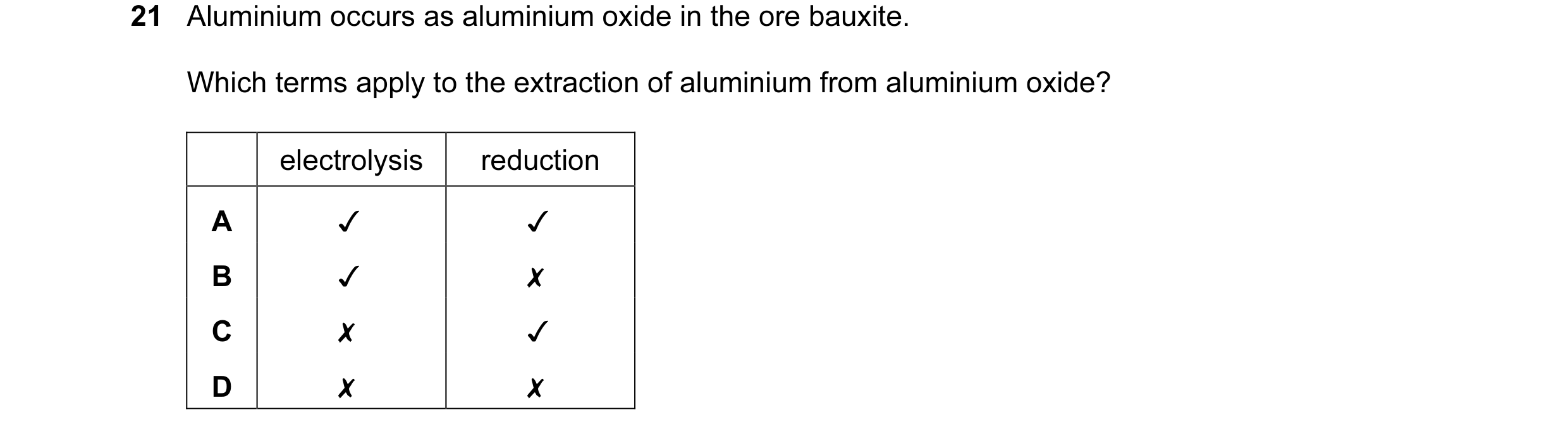
Q13 · Aluminium occurs as aluminium oxide in the ore bauxite 0653/12 Oct/Nov 2010
21 Aluminium occurs as aluminium oxide in the ore bauxite.
Which terms apply to the extraction of aluminium from aluminium oxide?
electrolysis reduction
A v v
B v x
Cc x v
D x x
1 marks
Answer: A
This question in 0653/12 Oct/Nov 2010
Q14 · Aluminium occurs as aluminium oxide in the ore bauxite 0653/13 Oct/Nov 2010
19 Aluminium occurs as aluminium oxide in the ore bauxite.
Which terms apply to the extraction of aluminium from aluminium oxide?
electrolysis reduction
A v v
B v x
Cc x v
D x x
1 marks
Answer: A
This question in 0653/13 Oct/Nov 2010
Q15 · Ethene burns as shown 0653/11 Oct/Nov 2011
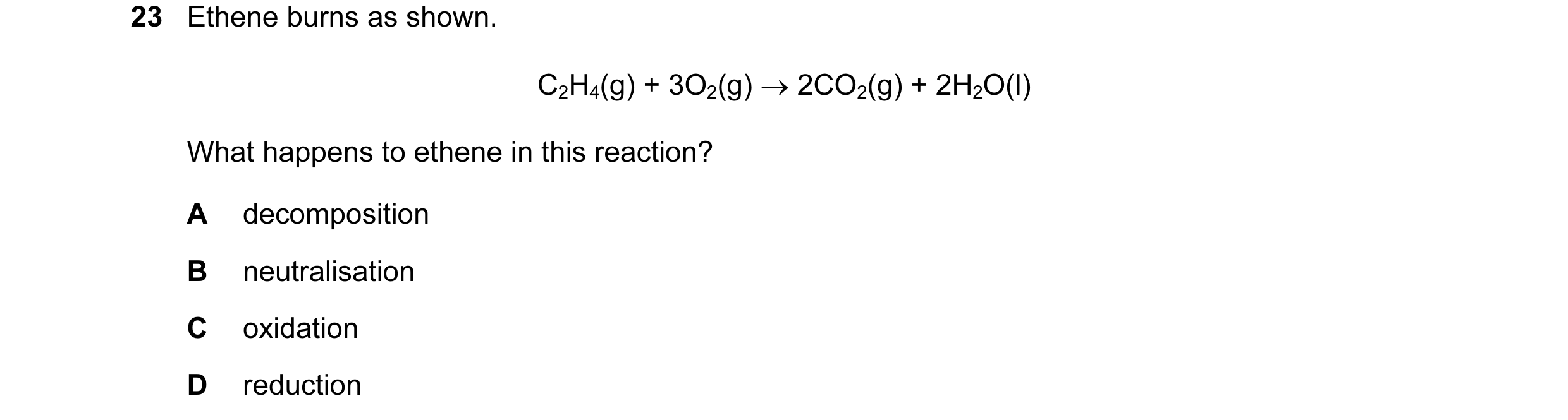
23 Ethene burns as shown. C2H4(g) + 3O2(g) → 2CO2(g) + 2H2O(l) What happens to ethene in this reaction? A decomposition B neutralisation C oxidation D reduction
1 marks
Answer: C
This question in 0653/11 Oct/Nov 2011
Q16 · Ethene burns as shown 0653/12 Oct/Nov 2011
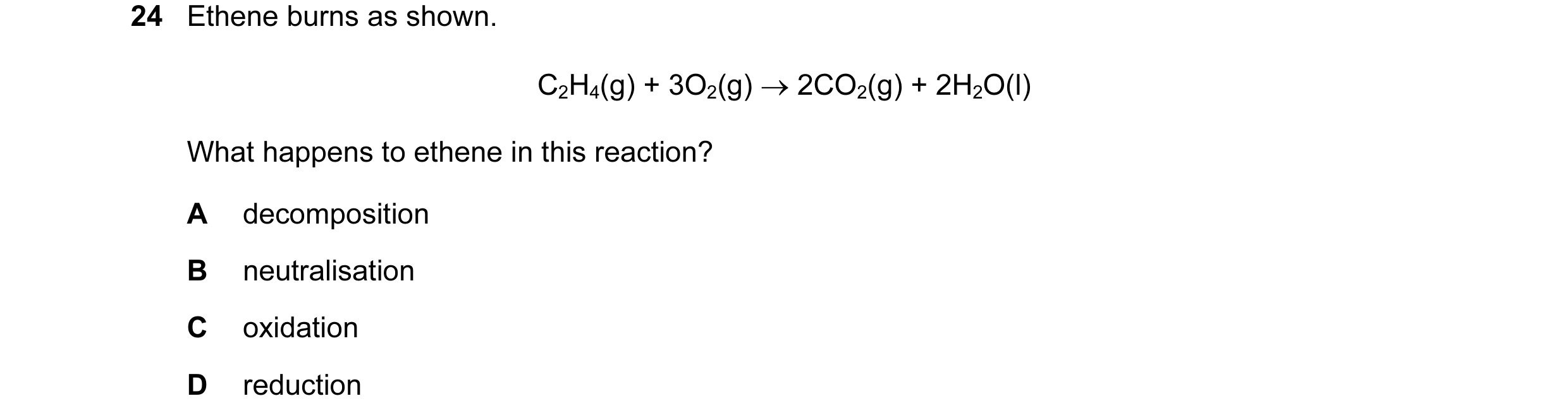
24 Ethene burns as shown. C2H4(g) + 3O2(g) → 2CO2(g) + 2H2O(l) What happens to ethene in this reaction? A decomposition B neutralisation C oxidation D reduction
1 marks
Answer: C
This question in 0653/12 Oct/Nov 2011
Q17 · Ethene burns as shown 0653/13 Oct/Nov 2011
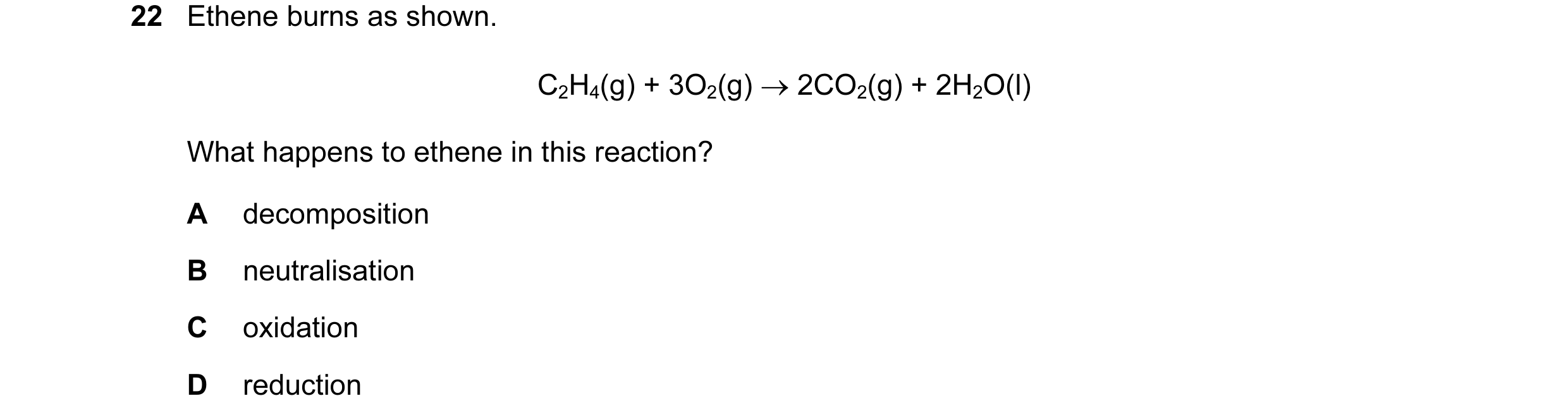
22 Ethene burns as shown. C2H4(g) + 3O2(g) → 2CO2(g) + 2H2O(l) What happens to ethene in this reaction? A decomposition B neutralisation C oxidation D reduction
1 marks
Answer: C
This question in 0653/13 Oct/Nov 2011
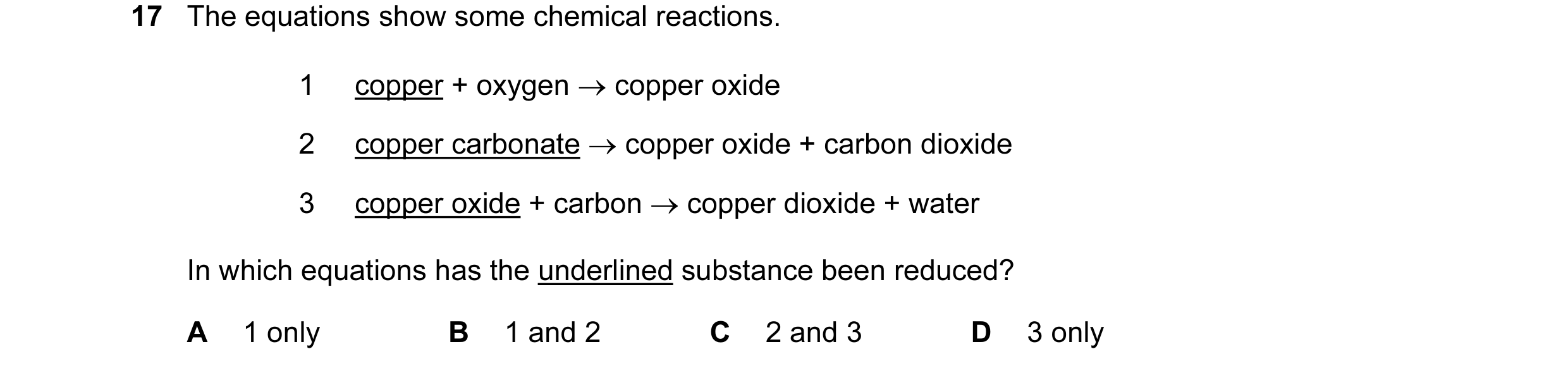
Q18 · The equations show some chemical reactions 0653/11 May/June 2012
17 The equations show some chemical reactions. 1 copper + oxygen → copper oxide 2 copper carbonate → copper oxide + carbon dioxide 3 copper oxide + carbon → copper dioxide + water In which equations has the underlined substance been reduced? A 1 only B 1 and 2 C 2 and 3 D 3 only
1 marks
This question in 0653/11 May/June 2012
Q19 · Copper(II) oxide is mixed with a solid Q 0653/11 May/June 2012
24 Copper(II) oxide is mixed with a solid Q. On heating the mixture, a reaction occurs and the limewater turns milky. copper(II) oxide and solid Q heat limewater What is solid Q? A carbon B iron C sulfur D zinc
1 marks
This question in 0653/11 May/June 2012
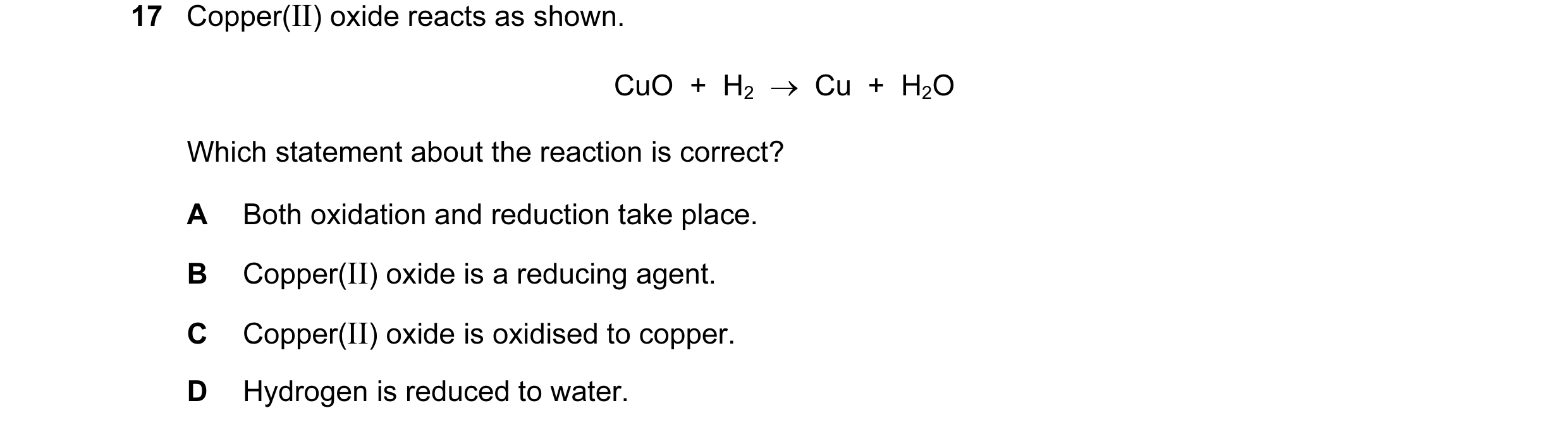
Q20 · Copper(II) oxide reacts as shown 0653/12 May/June 2012
17 Copper(II) oxide reacts as shown. CuO + H2 → Cu + H2O Which statement about the reaction is correct? A Both oxidation and reduction take place. B Copper(II) oxide is a reducing agent. C Copper(II) oxide is oxidised to copper. D Hydrogen is reduced to water.
1 marks
Answer: A
This question in 0653/12 May/June 2012
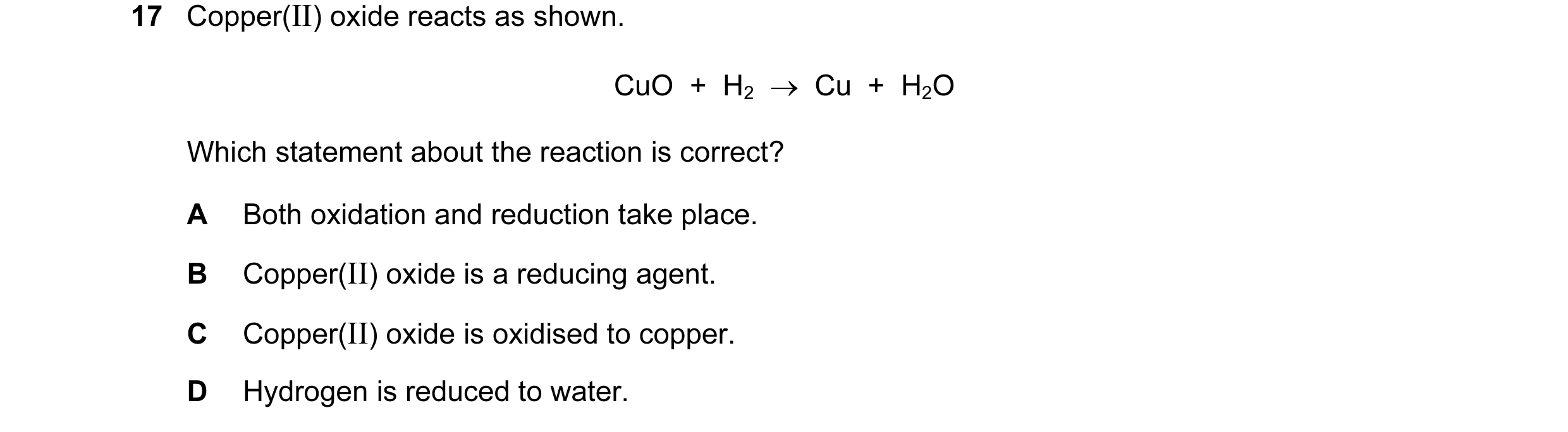
Q21 · Copper(II) oxide reacts as shown 0653/13 May/June 2012
17 Copper(II) oxide reacts as shown. CuO + H2 → Cu + H2O Which statement about the reaction is correct? A Both oxidation and reduction take place. B Copper(II) oxide is a reducing agent. C Copper(II) oxide is oxidised to copper. D Hydrogen is reduced to water.
1 marks
Answer: A
This question in 0653/13 May/June 2012
Q22 · Which equation shows the complete combustion of a hydrocarbon? 0653/13 May/June 2012
27 Which equation shows the complete combustion of a hydrocarbon? A C2H4 + 2O2 → 2CO + 2H2O B C2H4 + 3O2 → 2CO2 + 2H2O C C2H6O + 2O2 → 2CO + 3H2O D C2H6O + 3O2 → 2CO2 + 3H2O
1 marks
Answer: B
This question in 0653/13 May/June 2012
Q23 · Which method is used to extract copper from copper(II) oxide? 0653/12 May/June 2013
27 Which method is used to extract copper from copper(II) oxide? A dissolving copper(II) oxide with hydrochloric acid and then filtering B dissolving copper(II) oxide in water and then filtering C heating the copper(II) oxide D heating the copper(II) oxide mixed with carbon
1 marks
Answer: D
This question in 0653/12 May/June 2013
Q24 · The equation shows the reaction of copper oxide with carbon 0653/13 May/June 2013
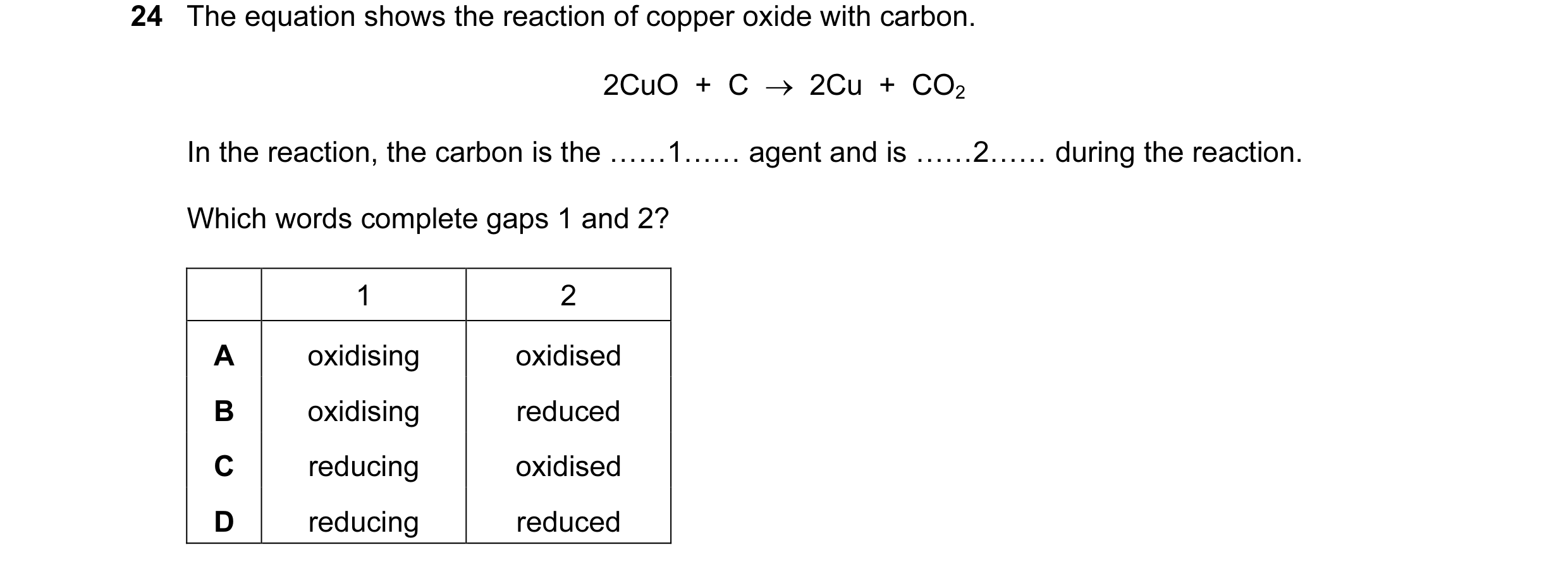
24 The equation shows the reaction of copper oxide with carbon. 2CuO + C → 2Cu + CO2 In the reaction, the carbon is the ……1…… agent and is ……2…… during the reaction. Which words complete gaps 1 and 2? 1 2 A oxidising oxidised B oxidising reduced C reducing oxidised D reducing reduced
1 marks
Answer: C
This question in 0653/13 May/June 2013
Q25 · Metal X reacts rapidly with cold water 0653/12 Oct/Nov 2013
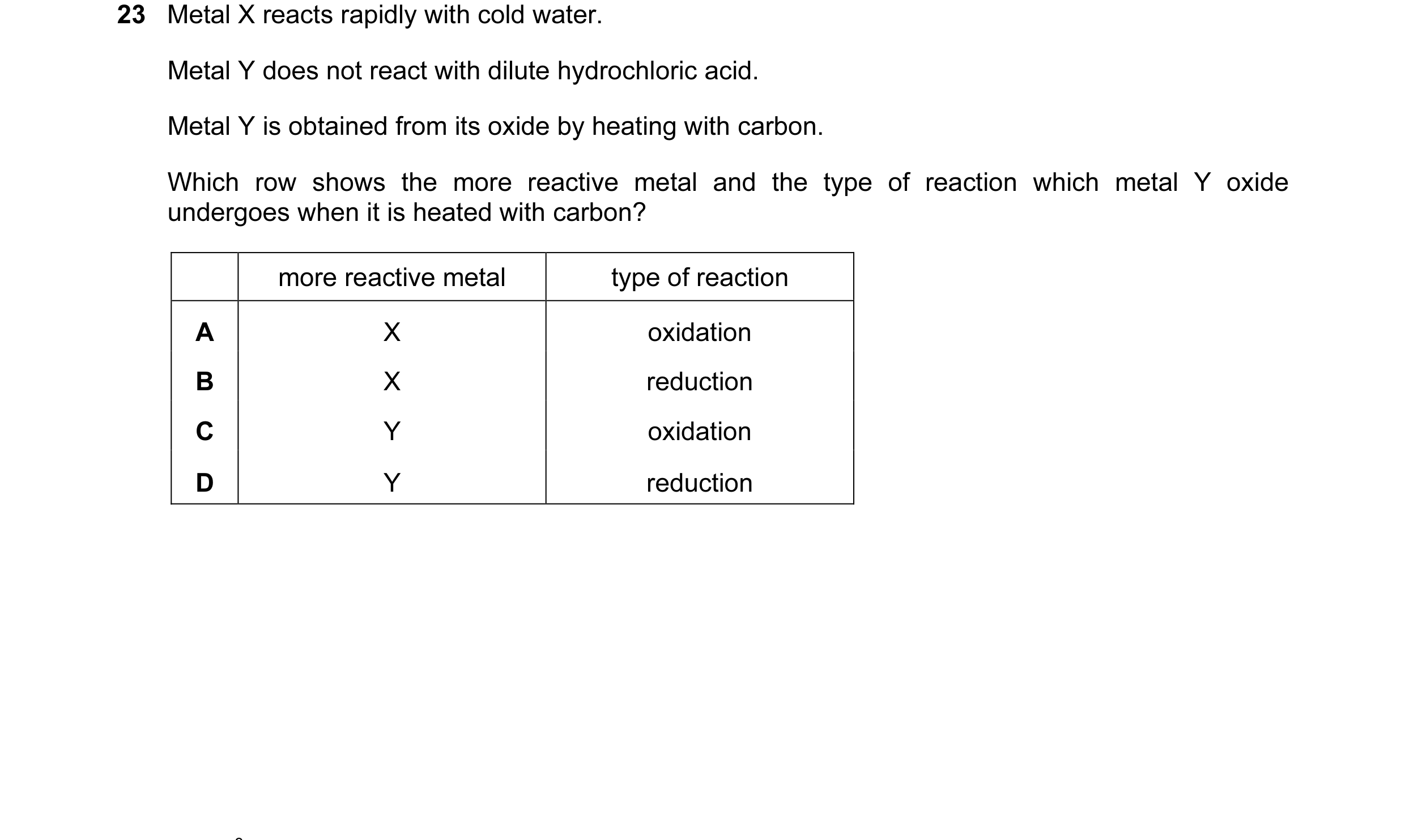
23 Metal X reacts rapidly with cold water. Metal Y does not react with dilute hydrochloric acid. Metal Y is obtained from its oxide by heating with carbon. Which row shows the more reactive metal and the type of reaction which metal Y oxide undergoes when it is heated with carbon? more reactive metal type of reaction A X oxidation B X reduction C Y oxidation D Y reduction
1 marks
Answer: B
This question in 0653/12 Oct/Nov 2013
Q26 · Magnesium can be used to extract iron from iron(III) oxide, Fe2O3 to give magnesium oxide… 0653/11 May/June 2014
25 Magnesium can be used to extract iron from iron(III) oxide, Fe2O3 to give magnesium oxide and iron. The equation for the reaction is shown. 2Mg + Fe2O3 → Mg2O3 + 2Fe Why is magnesium used in this reaction? A It is less reactive than iron and oxidises iron(III) oxide. B It is less reactive than iron and reduces iron(III) oxide. C It is more reactive than iron and oxidises iron(III) oxide. D It is more reactive than iron and reduces iron(III) oxide.
1 marks
Answer: D
This question in 0653/11 May/June 2014
Q27 · Magnesium can be used to extract iron from iron(III) oxide, Fe2O3 to give magnesium oxide… 0653/13 May/June 2014
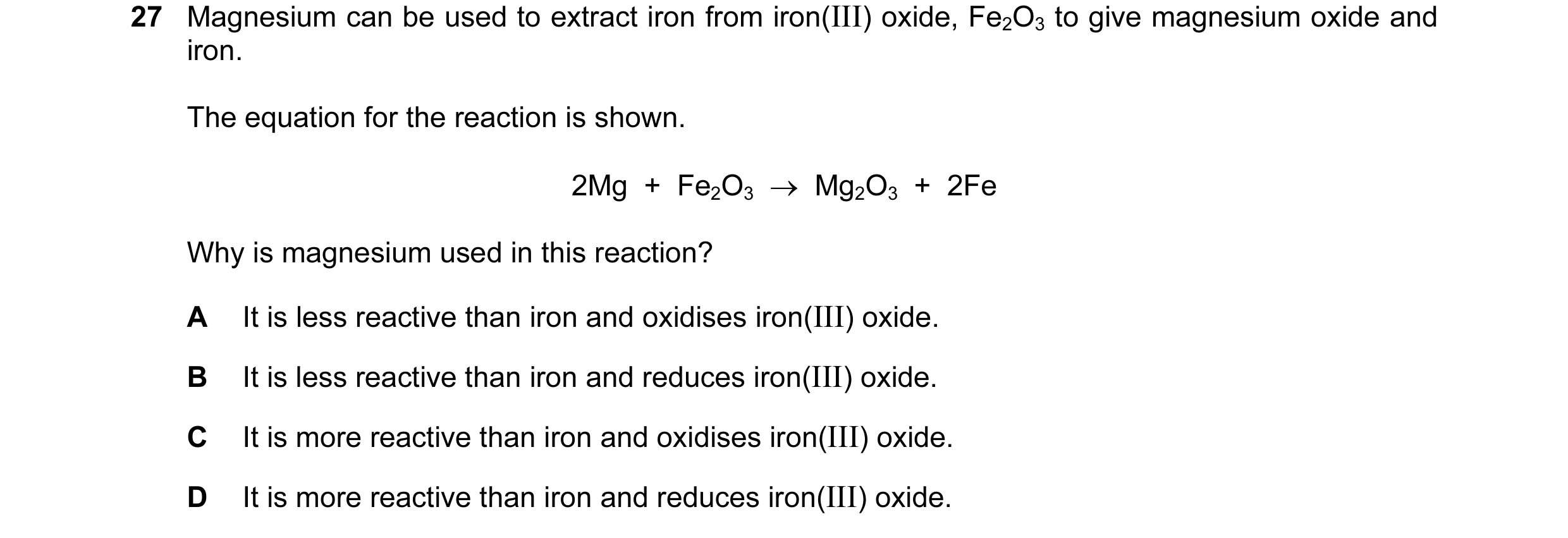
27 Magnesium can be used to extract iron from iron(III) oxide, Fe2O3 to give magnesium oxide and iron. The equation for the reaction is shown. 2Mg + Fe2O3 → Mg2O3 + 2Fe Why is magnesium used in this reaction? A It is less reactive than iron and oxidises iron(III) oxide. B It is less reactive than iron and reduces iron(III) oxide. C It is more reactive than iron and oxidises iron(III) oxide. D It is more reactive than iron and reduces iron(III) oxide.
1 marks
Answer: D
This question in 0653/13 May/June 2014
Q28 · Iron(III) oxide, Fe2O3, reacts with carbon monoxide, CO, to produce iron and carbon… 0653/11 Oct/Nov 2014
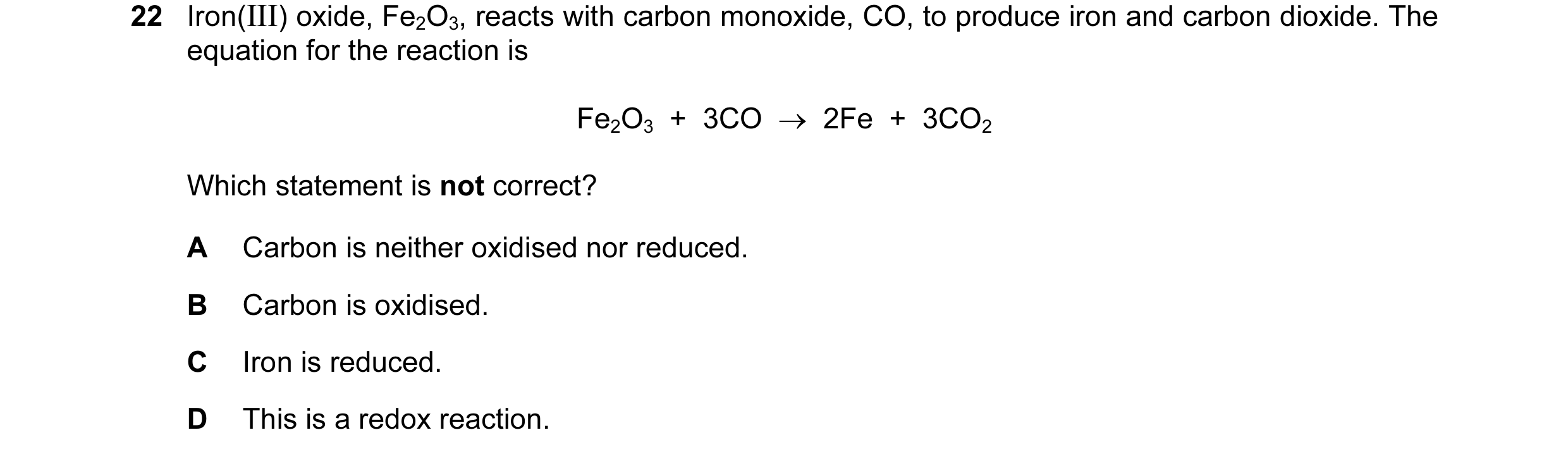
22 Iron(III) oxide, Fe2O3, reacts with carbon monoxide, CO, to produce iron and carbon dioxide. The equation for the reaction is Fe2O3 + 3CO → 2Fe + 3CO2 Which statement is not correct? A Carbon is neither oxidised nor reduced. B Carbon is oxidised. C Iron is reduced. D This is a redox reaction.
1 marks
Answer: A
This question in 0653/11 Oct/Nov 2014
Q29 · Iron(III) oxide, Fe2O3, reacts with carbon monoxide, CO, to produce iron and carbon… 0653/12 Oct/Nov 2014
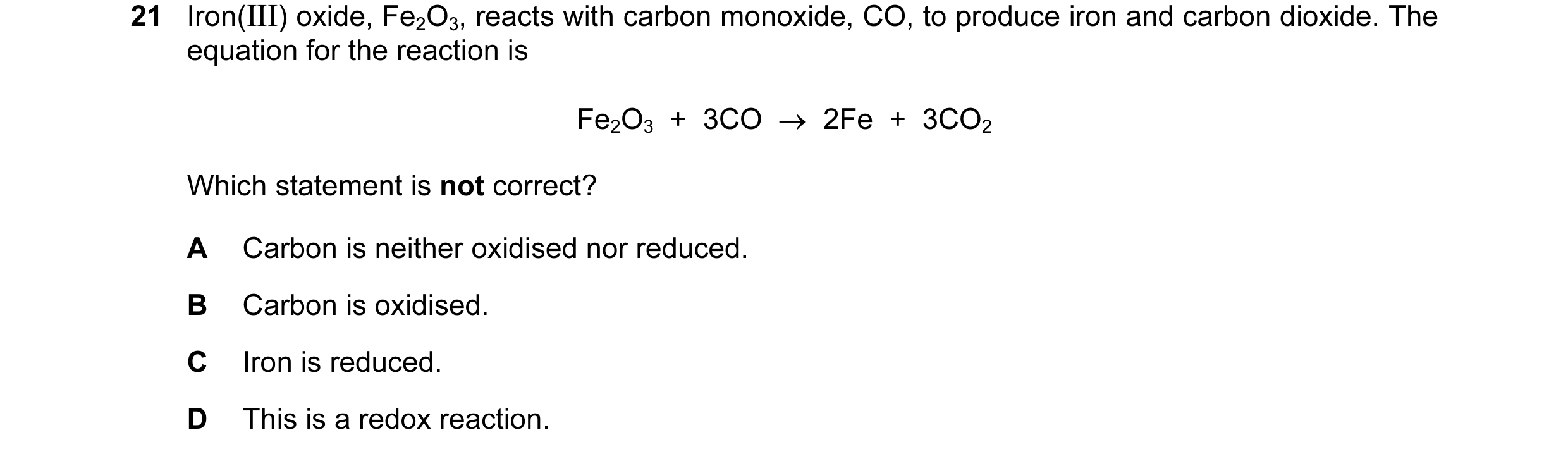
21 Iron(III) oxide, Fe2O3, reacts with carbon monoxide, CO, to produce iron and carbon dioxide. The equation for the reaction is Fe2O3 + 3CO → 2Fe + 3CO2 Which statement is not correct? A Carbon is neither oxidised nor reduced. B Carbon is oxidised. C Iron is reduced. D This is a redox reaction.
1 marks
Answer: A
This question in 0653/12 Oct/Nov 2014
Q30 · In the blast furnace, iron(III) oxide reacts with carbon forming iron and carbon monoxide 0653/11 May/June 2015
20 In the blast furnace, iron(III) oxide reacts with carbon forming iron and carbon monoxide. What happens to the iron(III) oxide? A It is oxidised by gaining oxygen. B It is oxidised by losing oxygen. C It is reduced by gaining oxygen. D It is reduced by losing oxygen.
1 marks
Answer: D
This question in 0653/11 May/June 2015
Q31 · Magnesium reacts with carbon dioxide to give magnesium oxide and carbon 0653/12 May/June 2015
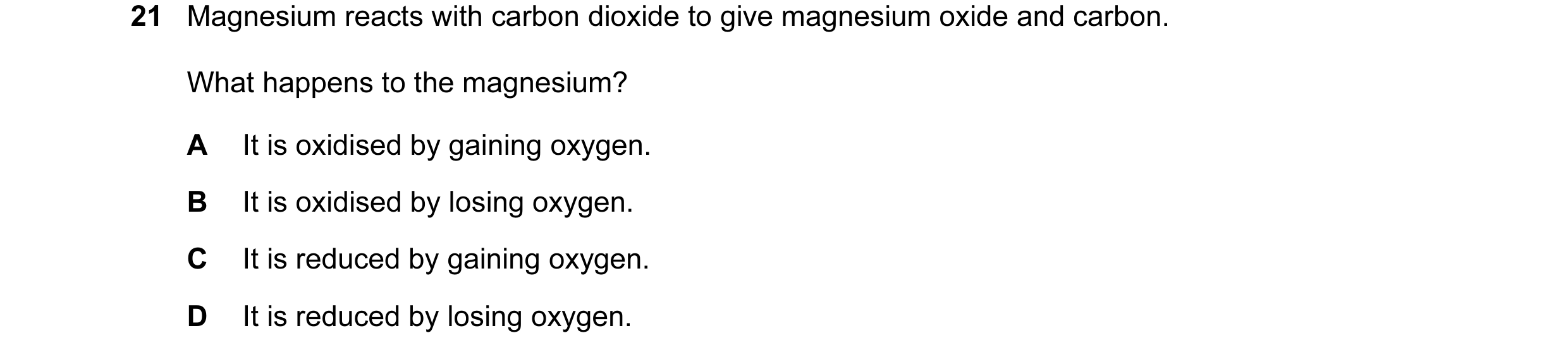
21 Magnesium reacts with carbon dioxide to give magnesium oxide and carbon. What happens to the magnesium? A It is oxidised by gaining oxygen. B It is oxidised by losing oxygen. C It is reduced by gaining oxygen. D It is reduced by losing oxygen.
1 marks
Answer: A
This question in 0653/12 May/June 2015
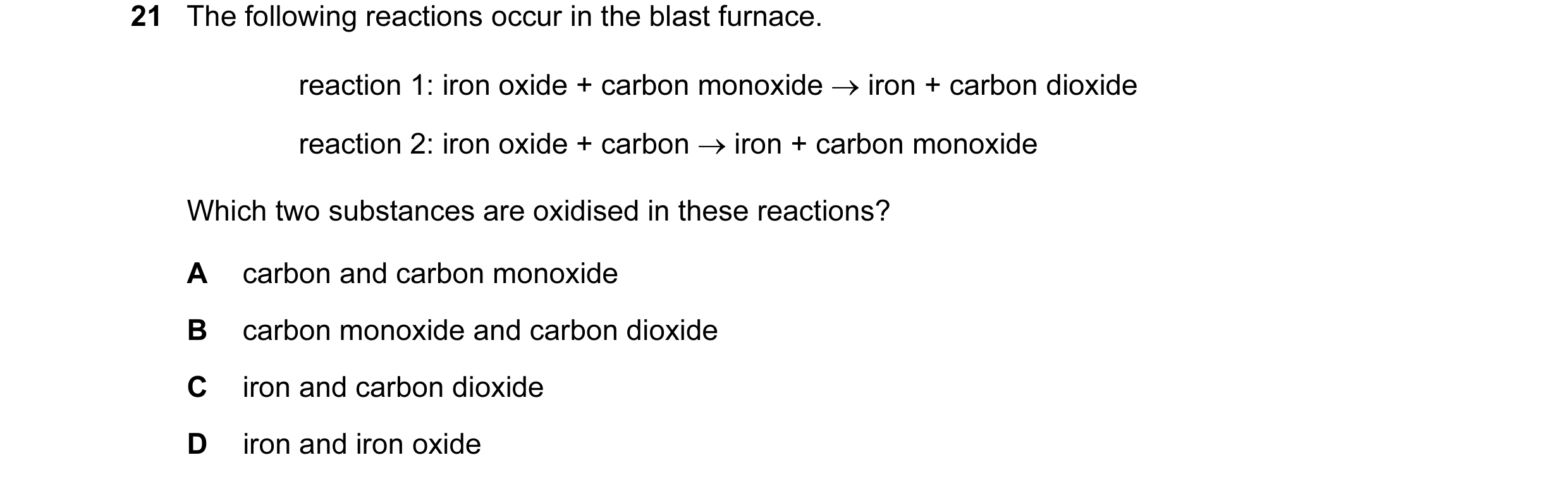
Q32 · The following reactions occur in the blast furnace 0653/13 May/June 2015
21 The following reactions occur in the blast furnace. reaction 1: iron oxide + carbon monoxide → iron + carbon dioxide reaction 2: iron oxide + carbon → iron + carbon monoxide Which two substances are oxidised in these reactions? A carbon and carbon monoxide B carbon monoxide and carbon dioxide C iron and carbon dioxide D iron and iron oxide
1 marks
Answer: A
This question in 0653/13 May/June 2015
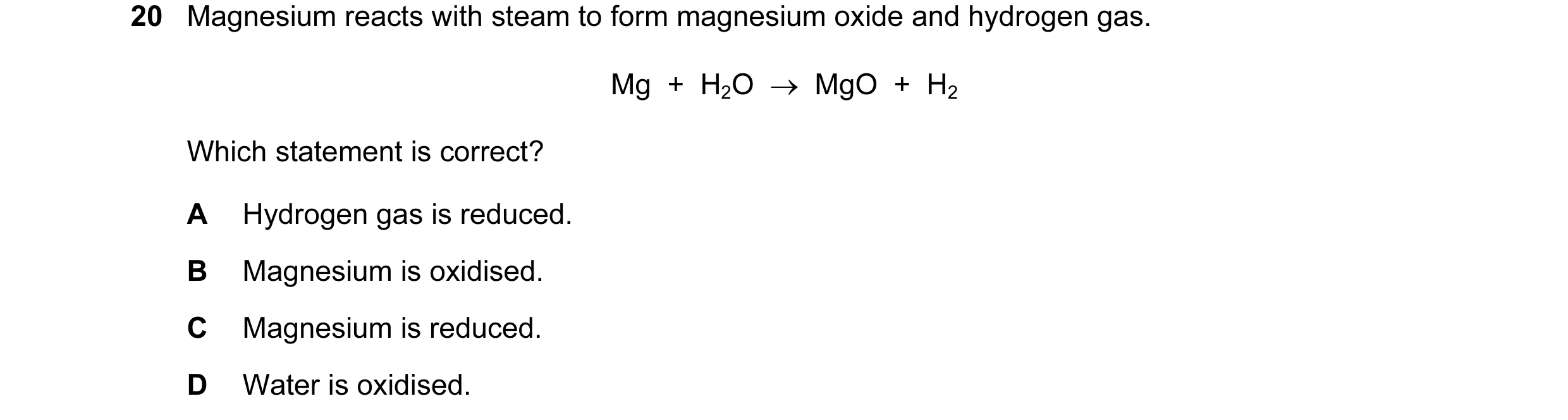
Q33 · Magnesium reacts with steam to form magnesium oxide and hydrogen gas 0653/11 Oct/Nov 2015
20 Magnesium reacts with steam to form magnesium oxide and hydrogen gas. Mg + H2O → MgO + H2 Which statement is correct? A Hydrogen gas is reduced. B Magnesium is oxidised. C Magnesium is reduced. D Water is oxidised.
1 marks
Answer: B
This question in 0653/11 Oct/Nov 2015
Q34 · Which statement describes a redox reaction? 0653/11 May/June 2016
19 Which statement describes a redox reaction? A An acid reacts with a base. B Only oxidation takes place. C Oxygen is transferred from one substance to another. D Two substances are both reduced.
1 marks
Answer: C
This question in 0653/11 May/June 2016
Q35 · Carbon dioxide reacts with carbon 0653/12 May/June 2016
19 Carbon dioxide reacts with carbon. carbon dioxide + carbon → carbon monoxide Which row describes what happens to the carbon dioxide and to the carbon during the reaction? carbon dioxide carbon A oxidised oxidised B oxidised reduced C reduced oxidised D reduced reduced
1 marks
Answer: C
This question in 0653/12 May/June 2016
Q36 · In which word equation is copper reduced? 0653/11 May/June 2017
20 In which word equation is copper reduced? A anhydrous copper sulfate + water → hydrated copper sulfate B copper carbonate + hydrochloric acid → copper chloride + water + carbon dioxide C copper oxide + hydrogen → copper + water D copper + oxygen → copper oxide
1 marks
Answer: C
This question in 0653/11 May/June 2017
Q37 · In which reactions is the underlined substance oxidised? 0653/12 May/June 2017
20 In which reactions is the underlined substance oxidised? 1 iron when it rusts 2 methane when it burns in air 3 copper oxide when it reacts with carbon A 1, 2 and 3 B 1 and 2 only C 1 and 3 only D 2 and 3 only
1 marks
Answer: B
This question in 0653/12 May/June 2017
Q38 · In which reactions is the underlined substance oxidised? 0653/13 May/June 2017
20 In which reactions is the underlined substance oxidised? 1 iron when it rusts 2 methane when it burns in air 3 copper oxide when it reacts with carbon A 1, 2 and 3 B 1 and 2 only C 1 and 3 only D 2 and 3 only
1 marks
Answer: B
This question in 0653/13 May/June 2017
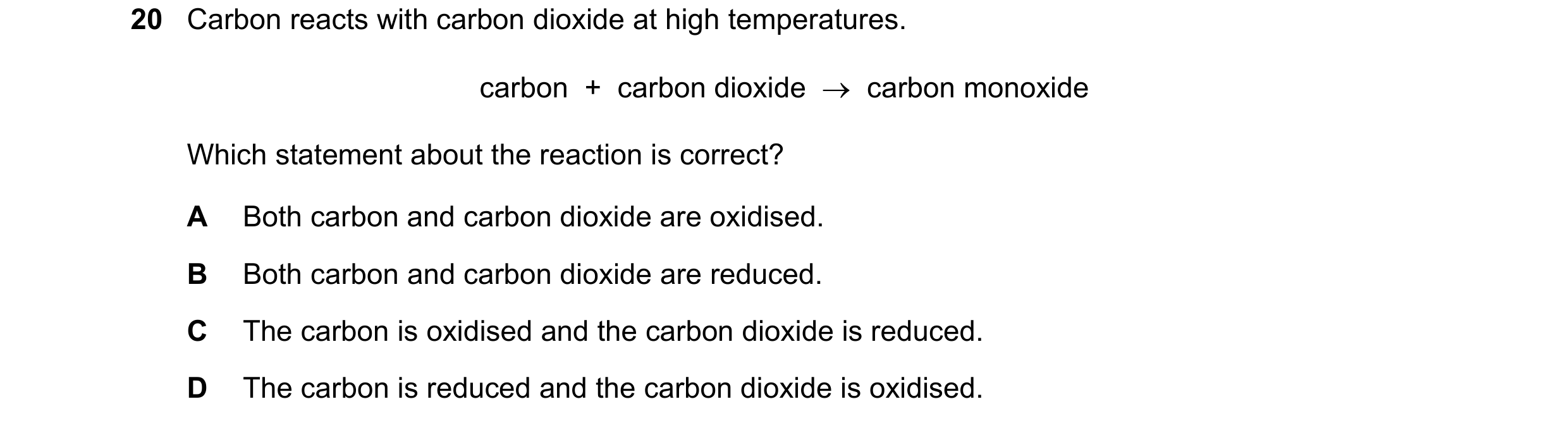
Q39 · Carbon reacts with carbon dioxide at high temperatures 0653/11 Oct/Nov 2017
20 Carbon reacts with carbon dioxide at high temperatures. carbon + carbon dioxide → carbon monoxide Which statement about the reaction is correct? A Both carbon and carbon dioxide are oxidised. B Both carbon and carbon dioxide are reduced. C The carbon is oxidised and the carbon dioxide is reduced. D The carbon is reduced and the carbon dioxide is oxidised.
1 marks
Answer: C
This question in 0653/11 Oct/Nov 2017
Q40 · The word equation for the reaction between hydrogen and copper oxide is shown 0653/12 Oct/Nov 2017
20 The word equation for the reaction between hydrogen and copper oxide is shown. hydrogen + copper oxide → copper + water Which substance, shown in the word equation, is reduced in the reaction? A copper B copper oxide C hydrogen D water
1 marks
Answer: B
This question in 0653/12 Oct/Nov 2017
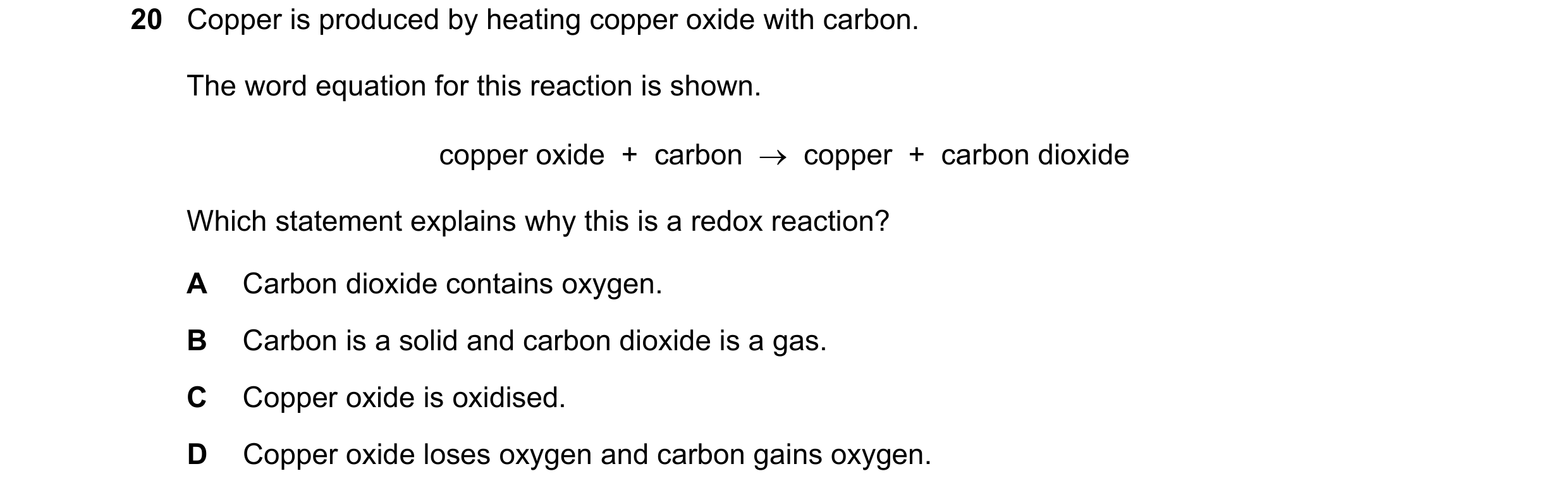
Q41 · Copper is produced by heating copper oxide with carbon 0653/13 Oct/Nov 2017
20 Copper is produced by heating copper oxide with carbon. The word equation for this reaction is shown. copper oxide + carbon → copper + carbon dioxide Which statement explains why this is a redox reaction? A Carbon dioxide contains oxygen. B Carbon is a solid and carbon dioxide is a gas. C Copper oxide is oxidised. D Copper oxide loses oxygen and carbon gains oxygen.
1 marks
Answer: D
This question in 0653/13 Oct/Nov 2017
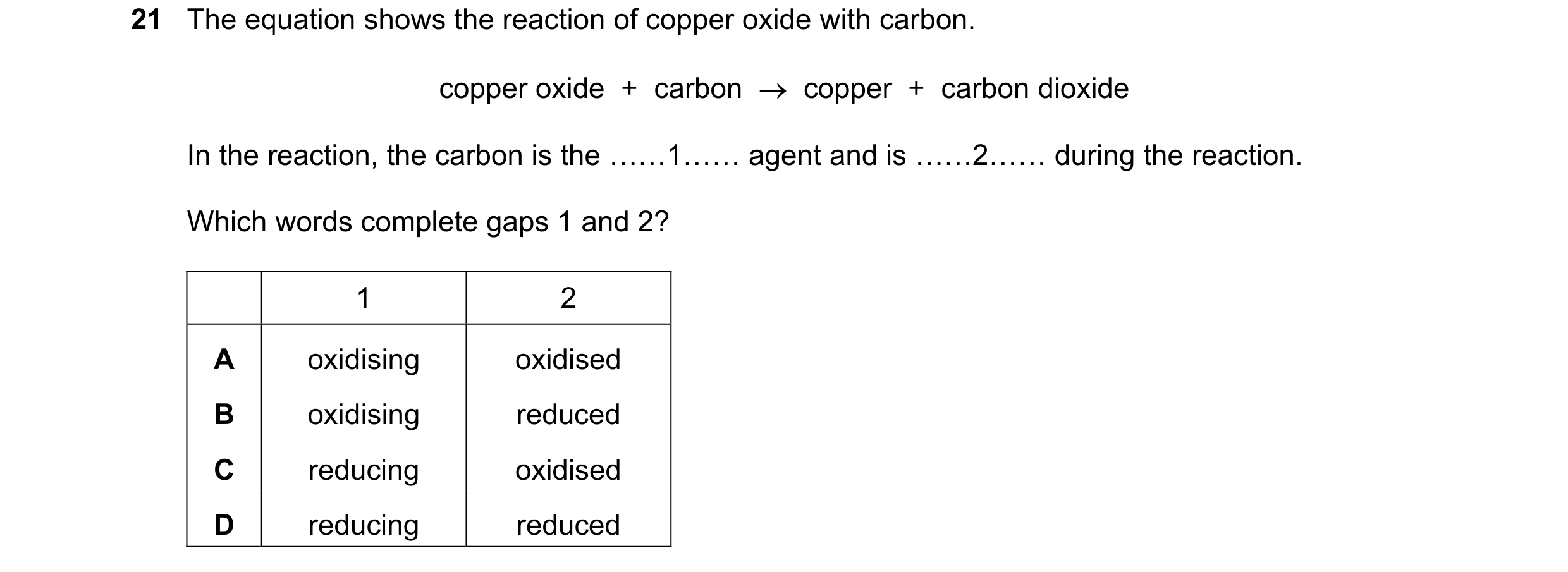
Q42 · The equation shows the reaction of copper oxide with carbon 0653/12 Feb/March 2018
21 The equation shows the reaction of copper oxide with carbon. copper oxide + carbon → copper + carbon dioxide In the reaction, the carbon is the ««1«« agent and is ««2«« during the reaction. Which words complete gaps 1 and 2? 1 2 A oxidising oxidised B oxidising reduced C reducing oxidised D reducing reduced
1 marks
Answer: C
This question in 0653/12 Feb/March 2018
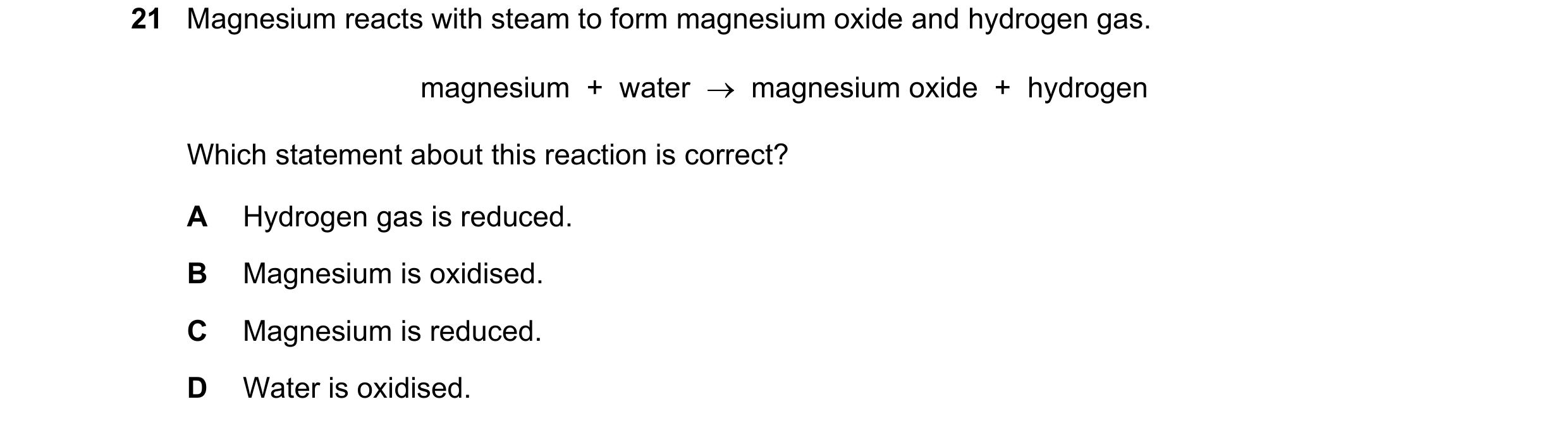
Q43 · Magnesium reacts with steam to form magnesium oxide and hydrogen gas 0653/11 May/June 2018
21 Magnesium reacts with steam to form magnesium oxide and hydrogen gas. magnesium + water → magnesium oxide + hydrogen Which statement about this reaction is correct? A Hydrogen gas is reduced. B Magnesium is oxidised. C Magnesium is reduced. D Water is oxidised.
1 marks
Answer: B
This question in 0653/11 May/June 2018
Q44 · Magnesium reacts with steam to form magnesium oxide and hydrogen gas 0653/12 May/June 2018
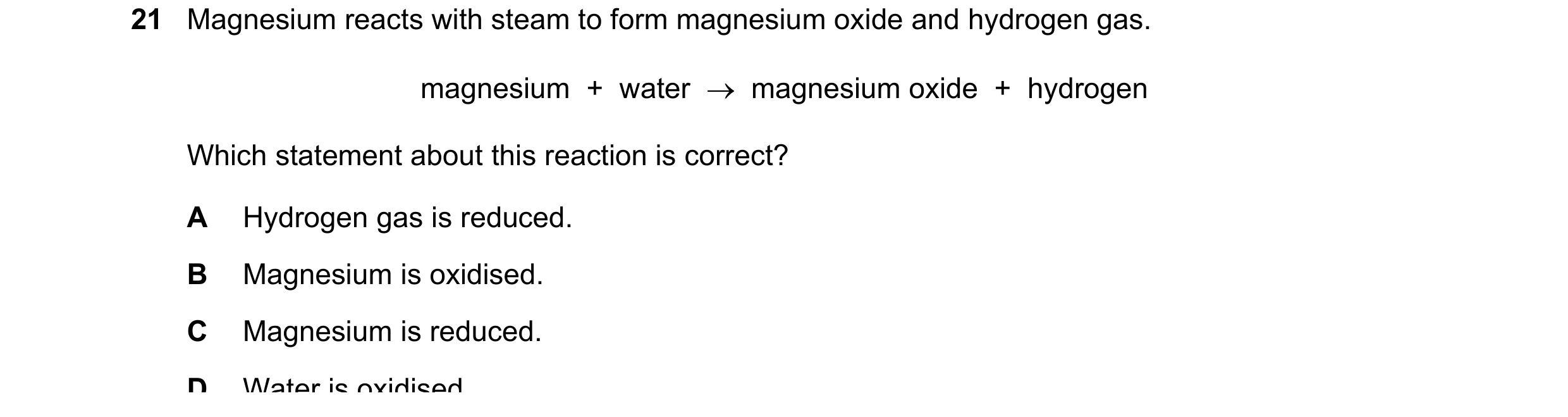
21 Magnesium reacts with steam to form magnesium oxide and hydrogen gas. magnesium + water → magnesium oxide + hydrogen Which statement about this reaction is correct? A Hydrogen gas is reduced. B Magnesium is oxidised. C Magnesium is reduced. D Water is oxidised.
1 marks
Answer: B
This question in 0653/12 May/June 2018
Q45 · Magnesium reacts with steam to form magnesium oxide and hydrogen gas 0653/13 May/June 2018
21 Magnesium reacts with steam to form magnesium oxide and hydrogen gas. magnesium + water → magnesium oxide + hydrogen Which statement about this reaction is correct? A Hydrogen gas is reduced. B Magnesium is oxidised. C Magnesium is reduced. D Water is oxidised.
1 marks
Answer: B
This question in 0653/13 May/June 2018
Q46 · Iron oxide reacts with carbon monoxide 0653/11 Oct/Nov 2018
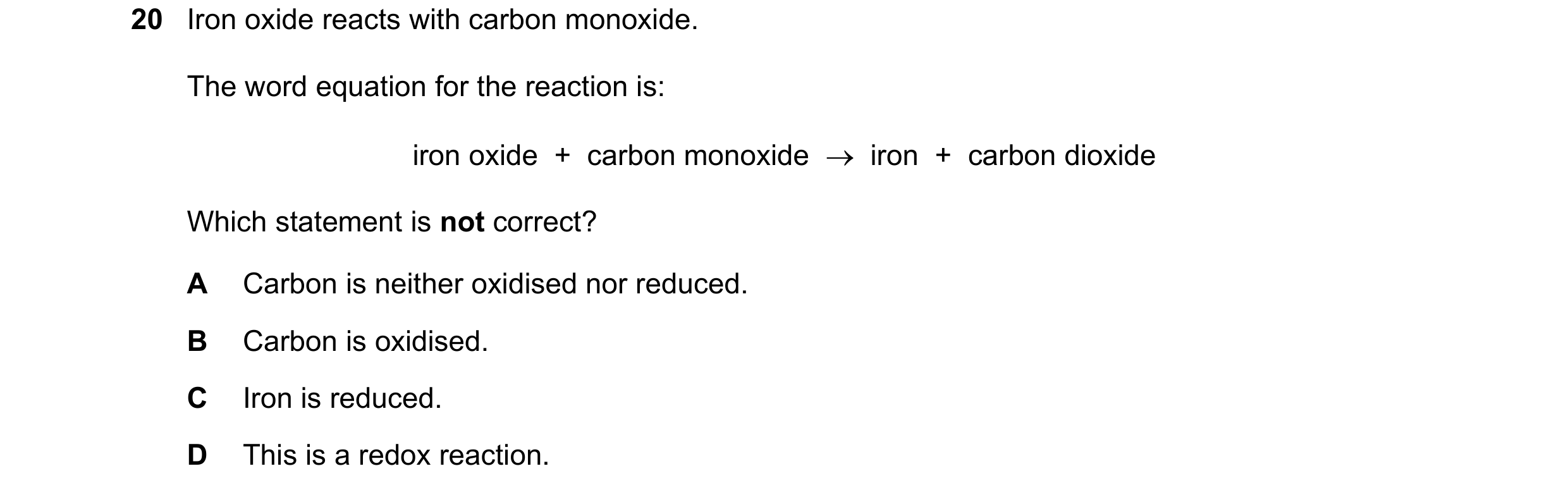
20 Iron oxide reacts with carbon monoxide. The word equation for the reaction is: iron oxide + carbon monoxide → iron + carbon dioxide Which statement is not correct? A Carbon is neither oxidised nor reduced. B Carbon is oxidised. C Iron is reduced. D This is a redox reaction.
1 marks
Answer: A
This question in 0653/11 Oct/Nov 2018
Q47 · Iron oxide reacts with carbon monoxide 0653/12 Oct/Nov 2018
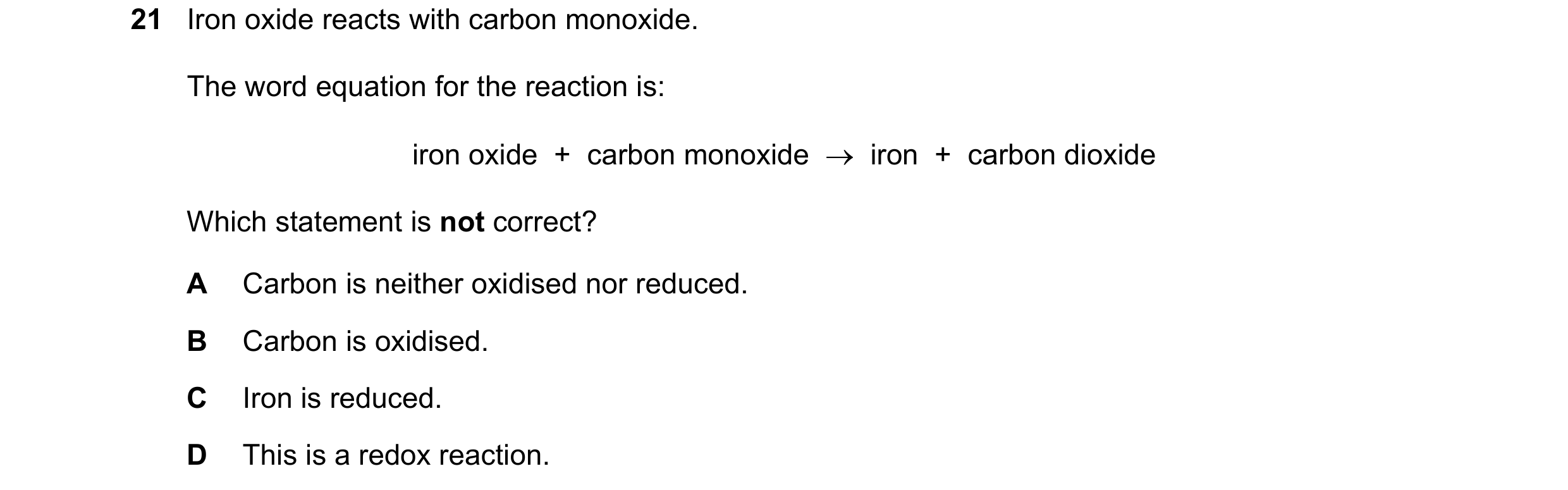
21 Iron oxide reacts with carbon monoxide. The word equation for the reaction is: iron oxide + carbon monoxide → iron + carbon dioxide Which statement is not correct? A Carbon is neither oxidised nor reduced. B Carbon is oxidised. C Iron is reduced. D This is a redox reaction.
1 marks
Answer: A
This question in 0653/12 Oct/Nov 2018
Q48 · Iron oxide reacts with carbon monoxide 0653/13 Oct/Nov 2018
21 Iron oxide reacts with carbon monoxide. The word equation for the reaction is: iron oxide + carbon monoxide → iron + carbon dioxide Which statement is not correct? A Carbon is neither oxidised nor reduced. B Carbon is oxidised. C Iron is reduced. D This is a redox reaction.
1 marks
Answer: A
This question in 0653/13 Oct/Nov 2018
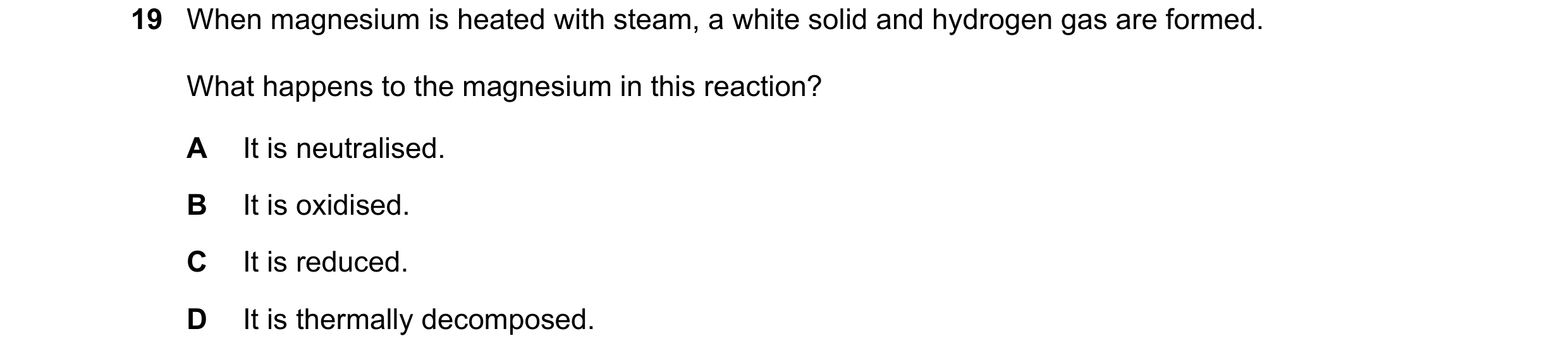
Q49 · When magnesium is heated with steam, a white solid and hydrogen gas are formed 0653/12 Feb/March 2019
19 When magnesium is heated with steam, a white solid and hydrogen gas are formed. What happens to the magnesium in this reaction? A It is neutralised. B It is oxidised. C It is reduced. D It is thermally decomposed.
1 marks
Answer: B
This question in 0653/12 Feb/March 2019
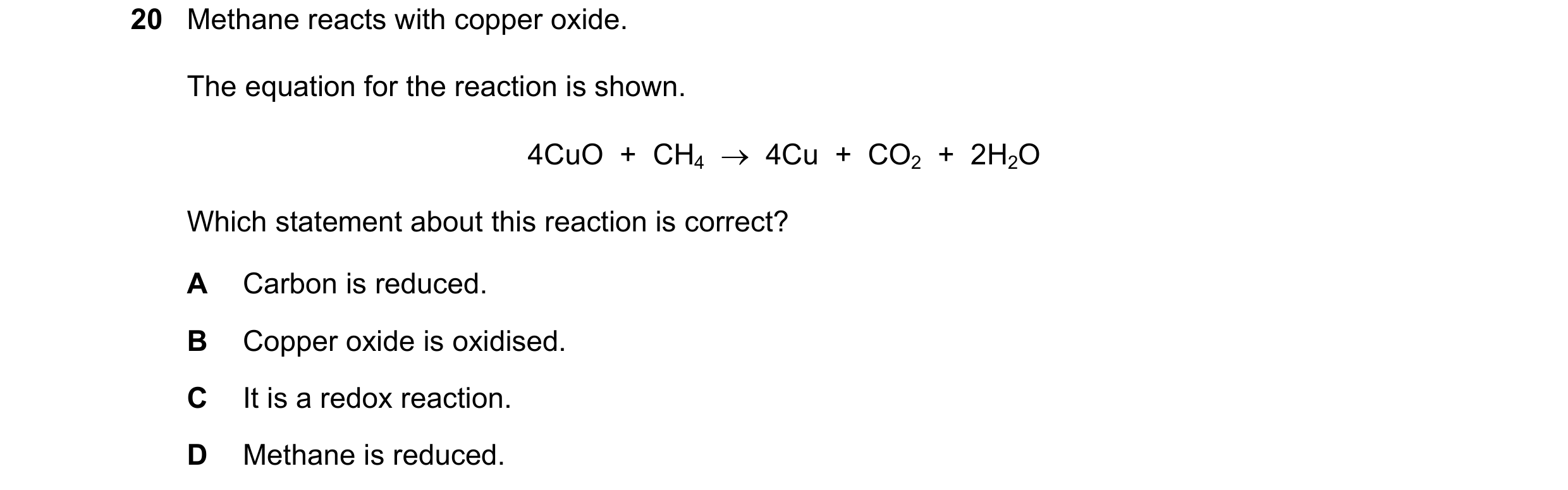
Q50 · Methane reacts with copper oxide 0653/11 May/June 2019
20 Methane reacts with copper oxide. The equation for the reaction is shown. 4CuO + CH4 → 4Cu + CO2 + 2H2O Which statement about this reaction is correct? A Carbon is reduced. B Copper oxide is oxidised. C It is a redox reaction. D Methane is reduced.
1 marks
Answer: C
This question in 0653/11 May/June 2019
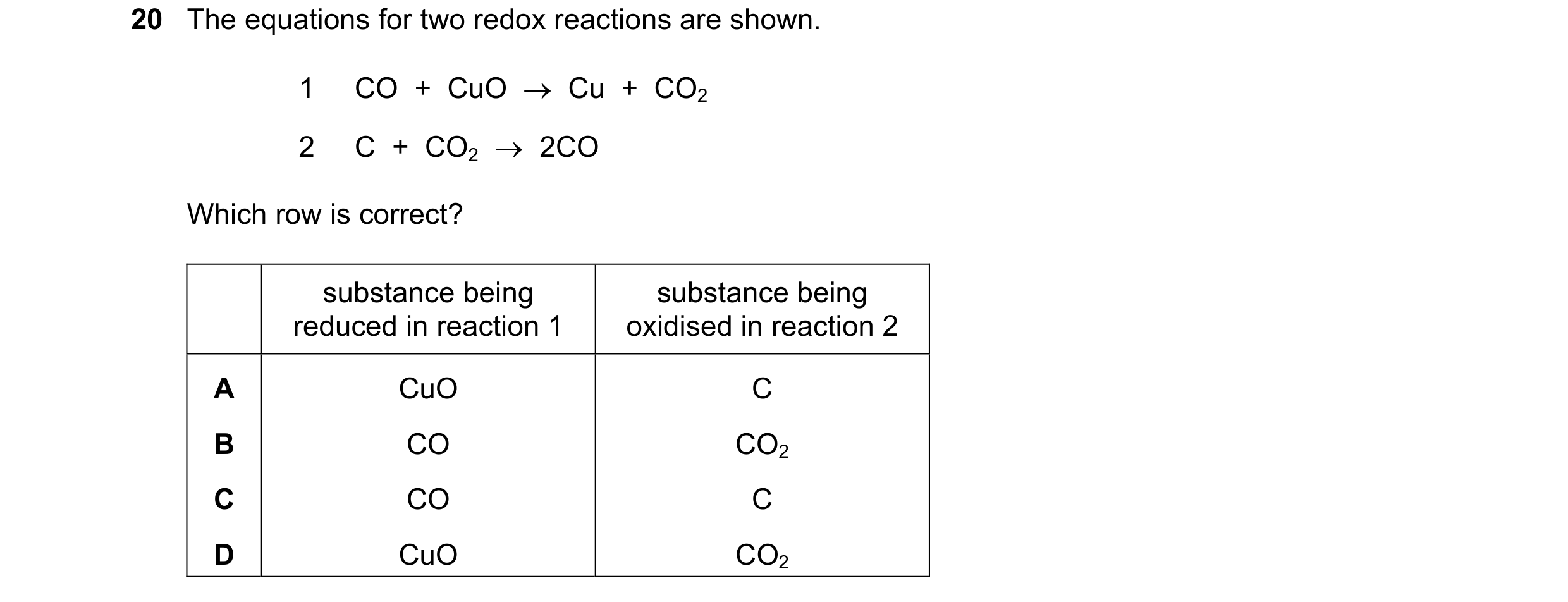
Q51 · The equations for two redox reactions are shown 0653/12 May/June 2019
20 The equations for two redox reactions are shown. 1 CO + CuO → Cu + CO2 2 C + CO2 → 2CO Which row is correct? substance being substance being reduced in reaction 1 oxidised in reaction 2 A CuO C B CO CO2 C CO C D CuO CO2
1 marks
Answer: A
This question in 0653/12 May/June 2019
Q52 · When hydrogen gas is passed over heated lead oxide, lead and water are produced 0653/13 May/June 2019
20 When hydrogen gas is passed over heated lead oxide, lead and water are produced. lead oxide + hydrogen → lead + water Which substance is reduced during the reaction? A hydrogen B lead C lead oxide D water
1 marks
Answer: C
This question in 0653/13 May/June 2019
Q53 · In which reaction is a metal oxide being reduced? 0653/11 Oct/Nov 2019
21 In which reaction is a metal oxide being reduced? A copper oxide + hydrochloric acid → copper chloride + water B iron(II) oxide + oxygen → iron(III) oxide C lead oxide + carbon → lead + carbon dioxide D zinc oxide + sulfuric acid → zinc sulfate + water
1 marks
Answer: C
This question in 0653/11 Oct/Nov 2019
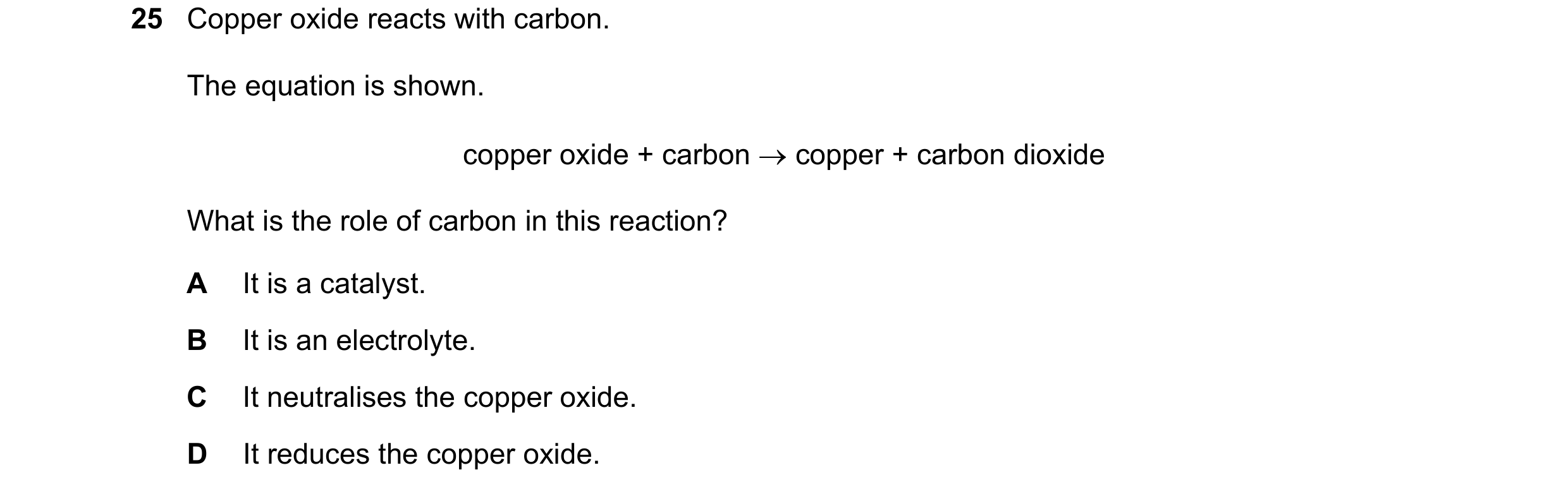
Q54 · Copper oxide reacts with carbon 0653/12 Oct/Nov 2019
25 Copper oxide reacts with carbon. The equation is shown. copper oxide + carbon → copper + carbon dioxide What is the role of carbon in this reaction? A It is a catalyst. B It is an electrolyte. C It neutralises the copper oxide. D It reduces the copper oxide.
1 marks
Answer: D
This question in 0653/12 Oct/Nov 2019
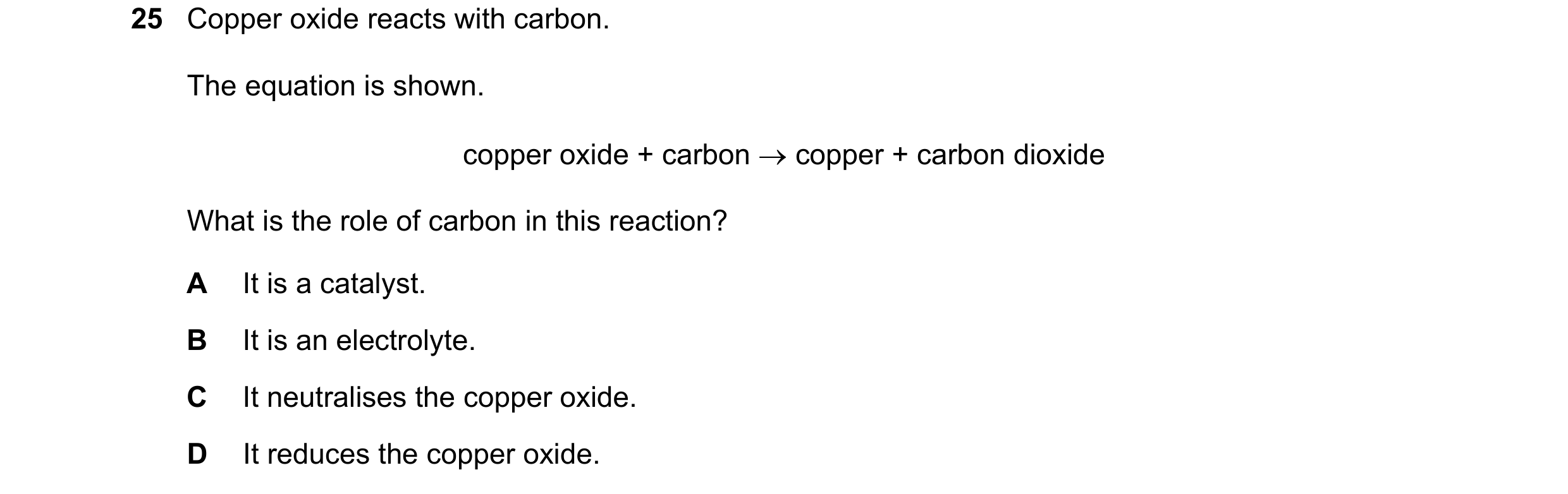
Q55 · Copper oxide reacts with carbon 0653/13 Oct/Nov 2019
25 Copper oxide reacts with carbon. The equation is shown. copper oxide + carbon → copper + carbon dioxide What is the role of carbon in this reaction? A It is a catalyst. B It is an electrolyte. C It neutralises the copper oxide. D It reduces the copper oxide.
1 marks
Answer: D
This question in 0653/13 Oct/Nov 2019
Q56 · The equation for the reaction of iron(III) oxide with aluminium is shown 0653/12 Feb/March 2020
19 The equation for the reaction of iron(III) oxide with aluminium is shown. Fe2O3 + 2Al → Al 2O3 + 2Fe What is oxidised during this reaction? A aluminium B aluminium oxide C iron D iron(III) oxide
1 marks
Answer: A
This question in 0653/12 Feb/March 2020
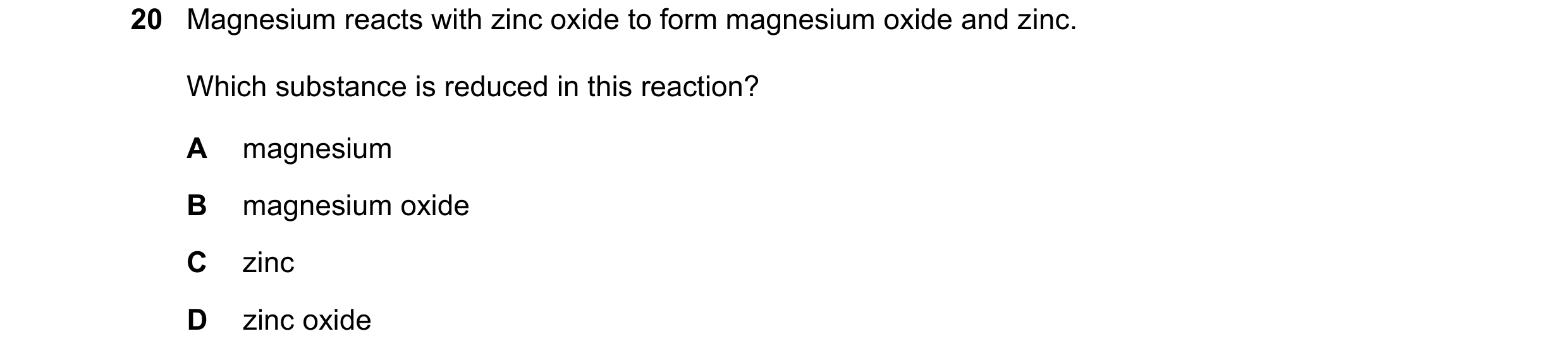
Q57 · Magnesium reacts with zinc oxide to form magnesium oxide and zinc 0653/12 Oct/Nov 2020
20 Magnesium reacts with zinc oxide to form magnesium oxide and zinc. Which substance is reduced in this reaction? A magnesium B magnesium oxide C zinc D zinc oxide
1 marks
Answer: D
This question in 0653/12 Oct/Nov 2020
Q58 · Which equation represents a reaction in which oxidation and reduction occur? 0653/12 Feb/March 2021
19 Which equation represents a reaction in which oxidation and reduction occur? A CaCO3 CaO + CO2 B 2H2 + O2 2H2O C Na2CO3 + ZnSO4 Na2SO4 + ZnCO3 D NaOH + HCl NaCl + H2O
1 marks
Answer: B
This question in 0653/12 Feb/March 2021
Q59 · Which compound can oxidise carbon? 0653/12 May/June 2021
24 Which compound can oxidise carbon? A aluminium oxide B copper oxide C magnesium oxide D potassium oxide
1 marks
Answer: B
This question in 0653/12 May/June 2021
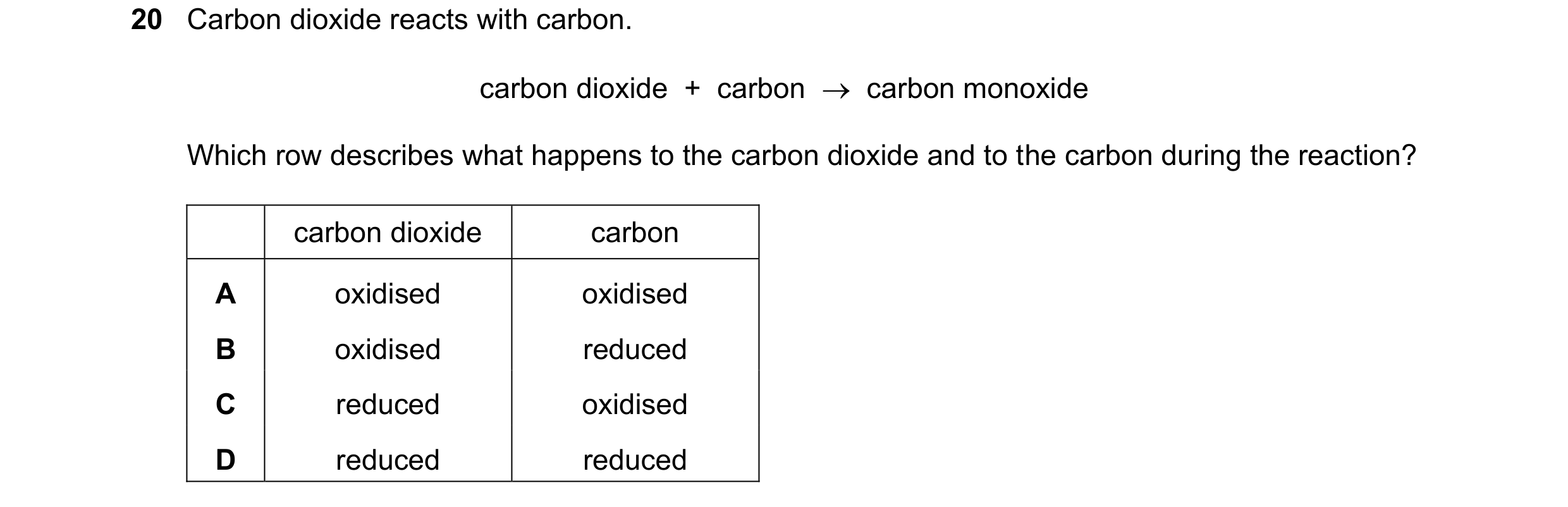
Q60 · Carbon dioxide reacts with carbon 0653/12 Feb/March 2022
20 Carbon dioxide reacts with carbon. carbon dioxide + carbon carbon monoxide Which row describes what happens to the carbon dioxide and to the carbon during the reaction? carbon dioxide carbon A oxidised oxidised B oxidised reduced C reduced oxidised D reduced reduced
1 marks
Answer: C
This question in 0653/12 Feb/March 2022
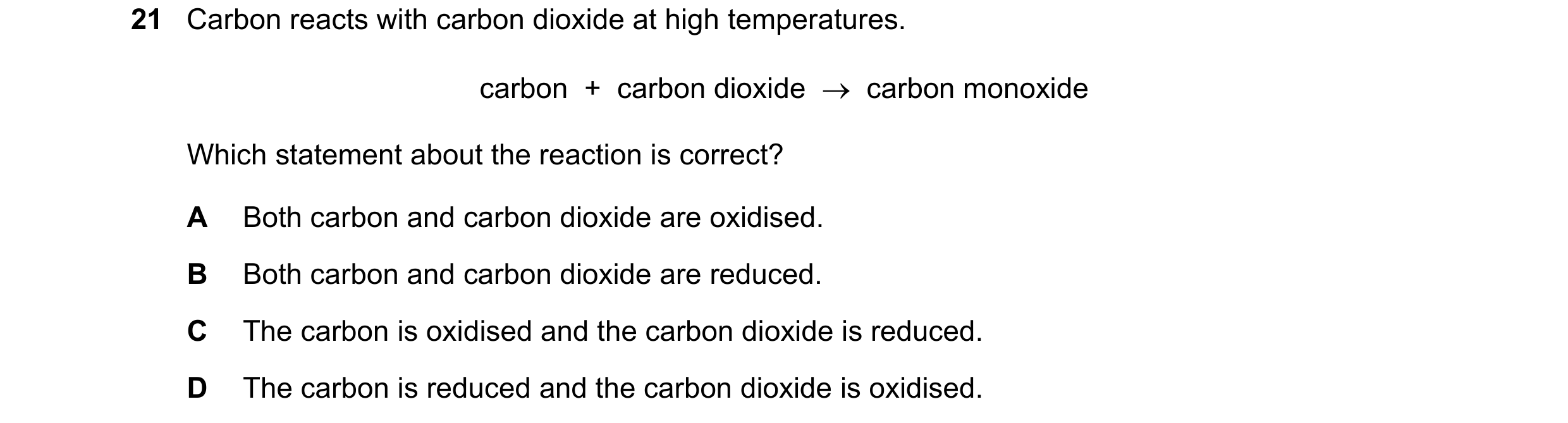
Q61 · Carbon reacts with carbon dioxide at high temperatures 0653/11 May/June 2022
21 Carbon reacts with carbon dioxide at high temperatures. carbon + carbon dioxide carbon monoxide Which statement about the reaction is correct? A Both carbon and carbon dioxide are oxidised. B Both carbon and carbon dioxide are reduced. C The carbon is oxidised and the carbon dioxide is reduced. D The carbon is reduced and the carbon dioxide is oxidised.
1 marks
Answer: C
This question in 0653/11 May/June 2022
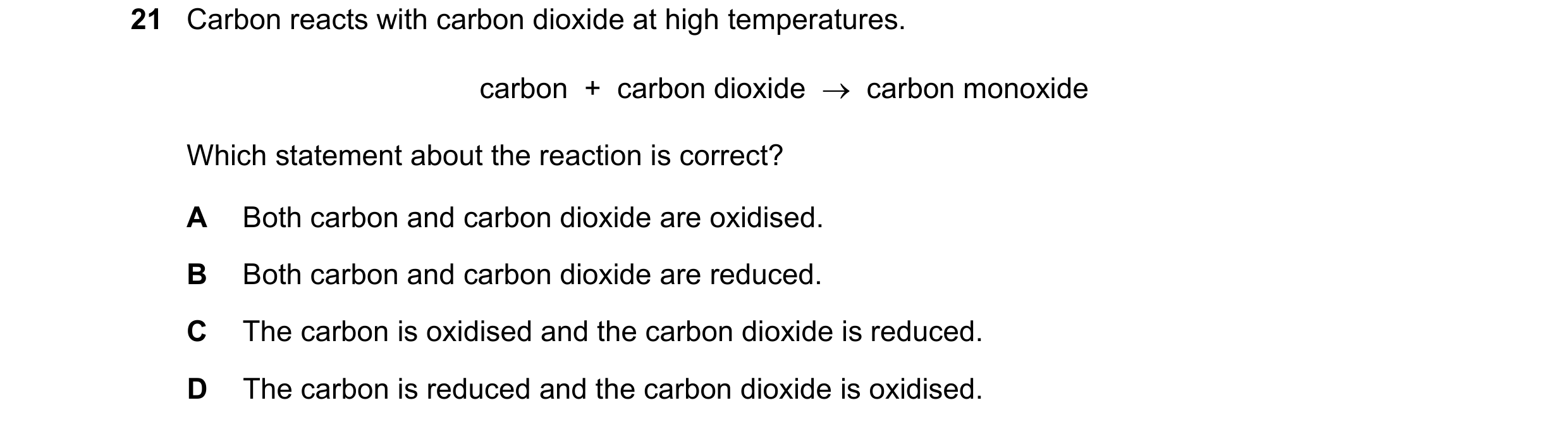
Q62 · Carbon reacts with carbon dioxide at high temperatures 0653/12 May/June 2022
21 Carbon reacts with carbon dioxide at high temperatures. carbon + carbon dioxide carbon monoxide Which statement about the reaction is correct? A Both carbon and carbon dioxide are oxidised. B Both carbon and carbon dioxide are reduced. C The carbon is oxidised and the carbon dioxide is reduced. D The carbon is reduced and the carbon dioxide is oxidised.
1 marks
Answer: C
This question in 0653/12 May/June 2022
Q63 · Carbon reacts with carbon dioxide at high temperatures 0653/13 May/June 2022
21 Carbon reacts with carbon dioxide at high temperatures. carbon + carbon dioxide carbon monoxide Which statement about the reaction is correct? A Both carbon and carbon dioxide are oxidised. B Both carbon and carbon dioxide are reduced. C The carbon is oxidised and the carbon dioxide is reduced. D The carbon is reduced and the carbon dioxide is oxidised.
1 marks
Answer: C
This question in 0653/13 May/June 2022
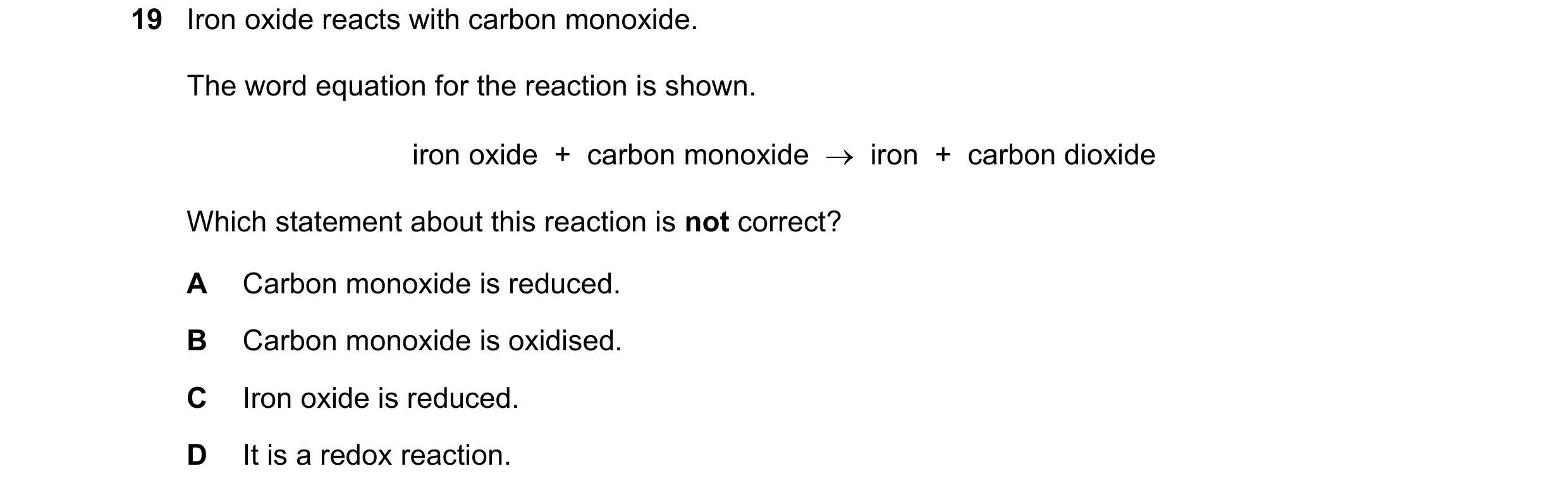
Q64 · Iron oxide reacts with carbon monoxide 0653/11 Oct/Nov 2022
19 Iron oxide reacts with carbon monoxide. The word equation for the reaction is shown. iron oxide + carbon monoxide iron + carbon dioxide Which statement about this reaction is not correct? A Carbon monoxide is reduced. B Carbon monoxide is oxidised. C Iron oxide is reduced. D It is a redox reaction.
1 marks
Answer: A
This question in 0653/11 Oct/Nov 2022
Q65 · Iron oxide reacts with carbon monoxide 0653/12 Oct/Nov 2022
19 Iron oxide reacts with carbon monoxide. The word equation for the reaction is shown. iron oxide + carbon monoxide iron + carbon dioxide Which statement about this reaction is not correct? A Carbon monoxide is reduced. B Carbon monoxide is oxidised. C Iron oxide is reduced. D It is a redox reaction.
1 marks
Answer: A
This question in 0653/12 Oct/Nov 2022
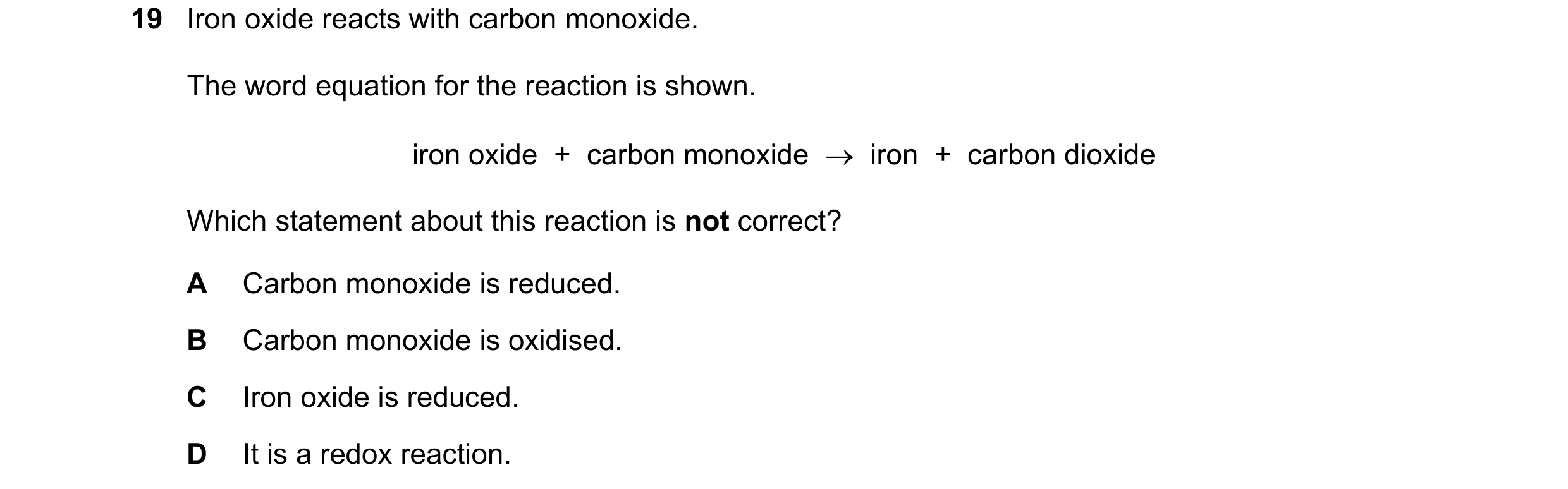
Q66 · Iron oxide reacts with carbon monoxide 0653/13 Oct/Nov 2022
19 Iron oxide reacts with carbon monoxide. The word equation for the reaction is shown. iron oxide + carbon monoxide iron + carbon dioxide Which statement about this reaction is not correct? A Carbon monoxide is reduced. B Carbon monoxide is oxidised. C Iron oxide is reduced. D It is a redox reaction.
1 marks
Answer: A
This question in 0653/13 Oct/Nov 2022
Q67 · Which statement describes a redox reaction? 0653/12 Feb/March 2023
18 Which statement describes a redox reaction? A An acid reacts with a base. B Only oxidation takes place. C Oxygen is transferred from one substance to another. D Two substances are both reduced.
1 marks
Answer: C
This question in 0653/12 Feb/March 2023
Q68 · In which chemical reaction is copper reduced? 0653/11 May/June 2023
20 In which chemical reaction is copper reduced? A anhydrous copper sulfate + water hydrated copper sulfate B copper carbonate + hydrochloric acid copper chloride + water + carbon dioxide C copper oxide + hydrogen copper + water D copper + oxygen copper oxide
1 marks
Answer: C
This question in 0653/11 May/June 2023
Q69 · Copper oxide and excess carbon are mixed together 0653/11 May/June 2023
25 Copper oxide and excess carbon are mixed together. The mass before heating is 12.2 g. The mixture is heated strongly and allowed to cool. The mass after heating is 10.4 g. Why does the mass change? A Carbon forms carbon dioxide which then combines with the copper oxide. B Carbon reduces the copper oxide and leaves the test-tube as carbon dioxide. C Copper oxide loses oxygen, turns into copper and the carbon remains unchanged. D Carbon oxidises the copper oxide and leaves the test-tube as carbon dioxide.
1 marks
Answer: B
This question in 0653/11 May/June 2023
Q70 · In which reactions is the underlined substance oxidised? 0653/12 May/June 2023
20 In which reactions is the underlined substance oxidised? 1 iron when it rusts 2 methane when it burns in air 3 copper oxide when it reacts with carbon A 1, 2 and 3 B 1 and 2 only C 1 and 3 only D 2 and 3 only
1 marks
Answer: B
This question in 0653/12 May/June 2023
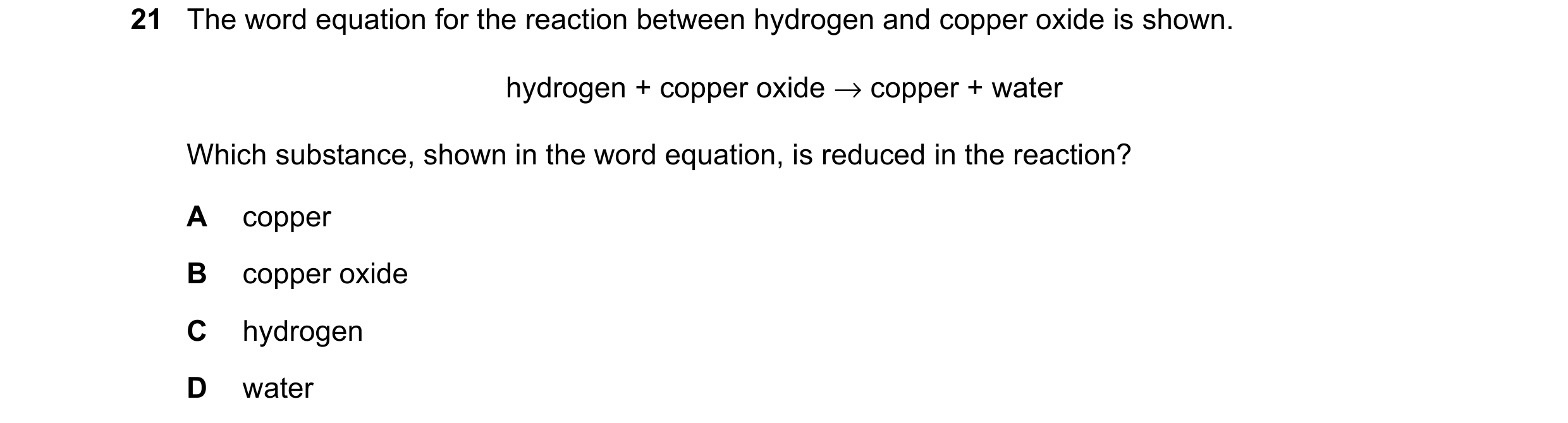
Q71 · The word equation for the reaction between hydrogen and copper oxide is shown 0653/13 May/June 2023
21 The word equation for the reaction between hydrogen and copper oxide is shown. hydrogen + copper oxide → copper + water Which substance, shown in the word equation, is reduced in the reaction? A copper B copper oxide C hydrogen D water
1 marks
Answer: B
This question in 0653/13 May/June 2023
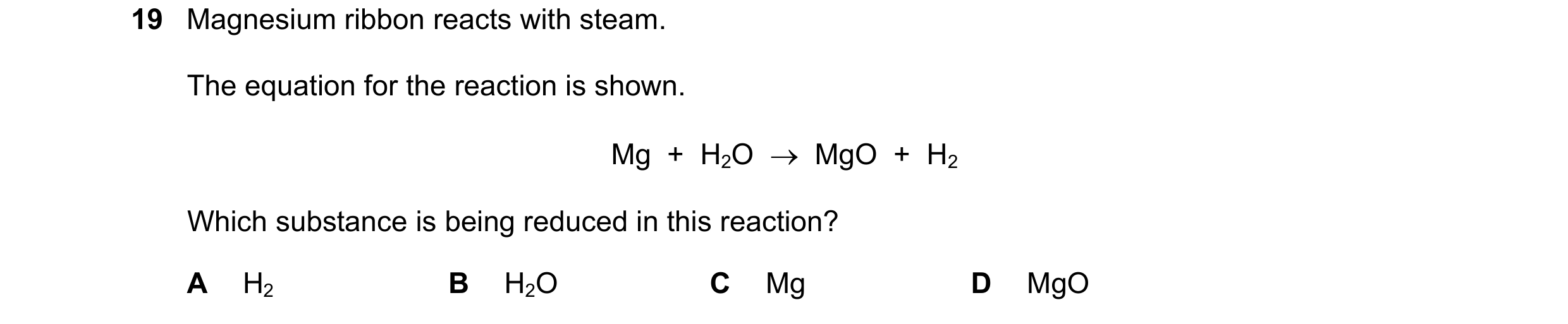
Q72 · Magnesium ribbon reacts with steam 0653/11 Oct/Nov 2023
19 Magnesium ribbon reacts with steam. The equation for the reaction is shown. Mg + H2O MgO + H2 Which substance is being reduced in this reaction? A H2 B H2O C Mg D MgO
1 marks
Answer: B
This question in 0653/11 Oct/Nov 2023
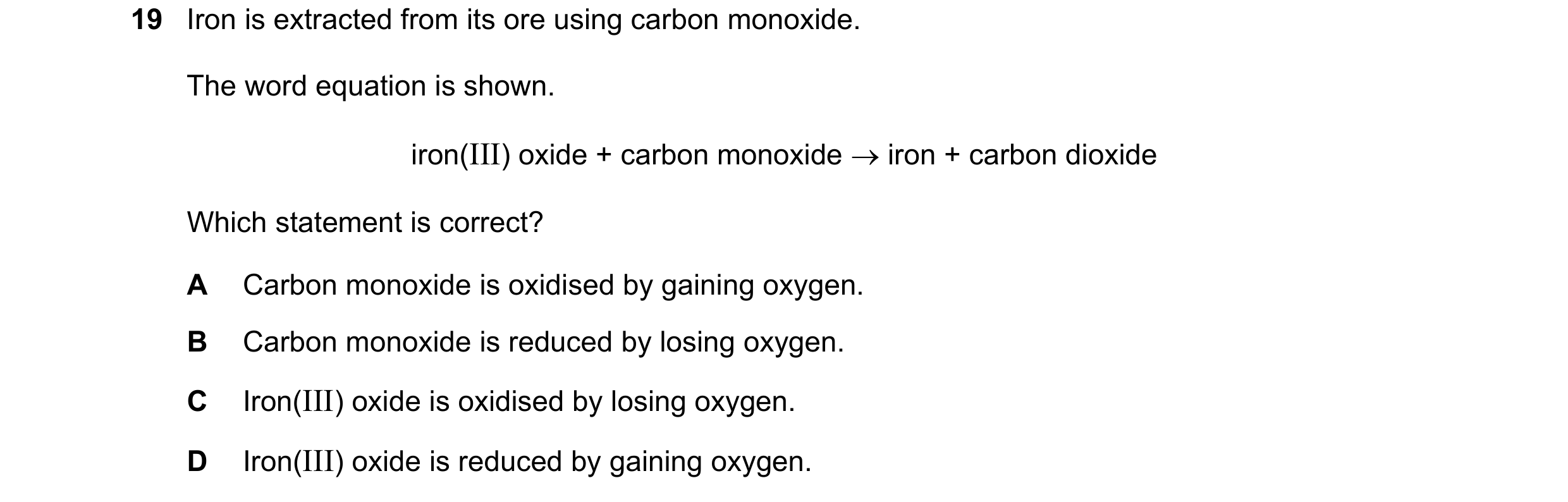
Q73 · Iron is extracted from its ore using carbon monoxide 0653/12 Oct/Nov 2023
19 Iron is extracted from its ore using carbon monoxide. The word equation is shown. iron(III) oxide + carbon monoxide iron + carbon dioxide Which statement is correct? A Carbon monoxide is oxidised by gaining oxygen. B Carbon monoxide is reduced by losing oxygen. C Iron(III) oxide is oxidised by losing oxygen. D Iron(III) oxide is reduced by gaining oxygen.
1 marks
Answer: A
This question in 0653/12 Oct/Nov 2023
Q74 · Iron is extracted from its ore using carbon monoxide 0653/13 Oct/Nov 2023
19 Iron is extracted from its ore using carbon monoxide. The word equation is shown. iron(III) oxide + carbon monoxide iron + carbon dioxide Which statement is correct? A Carbon monoxide is oxidised by gaining oxygen. B Carbon monoxide is reduced by losing oxygen. C Iron(III) oxide is oxidised by losing oxygen. D Iron(III) oxide is reduced by gaining oxygen.
1 marks
Answer: A
This question in 0653/13 Oct/Nov 2023
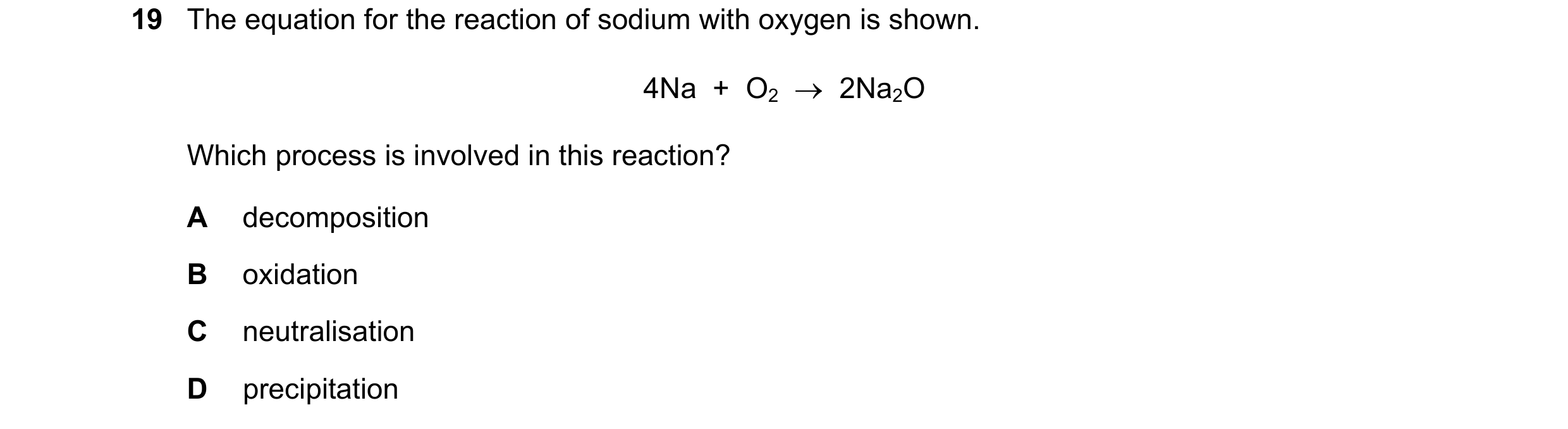
Q75 · The equation for the reaction of sodium with oxygen is shown 0653/12 Feb/March 2024
19 The equation for the reaction of sodium with oxygen is shown. 4Na + O2 2Na2O Which process is involved in this reaction? A decomposition B oxidation C neutralisation D precipitation
1 marks
Answer: B
This question in 0653/12 Feb/March 2024
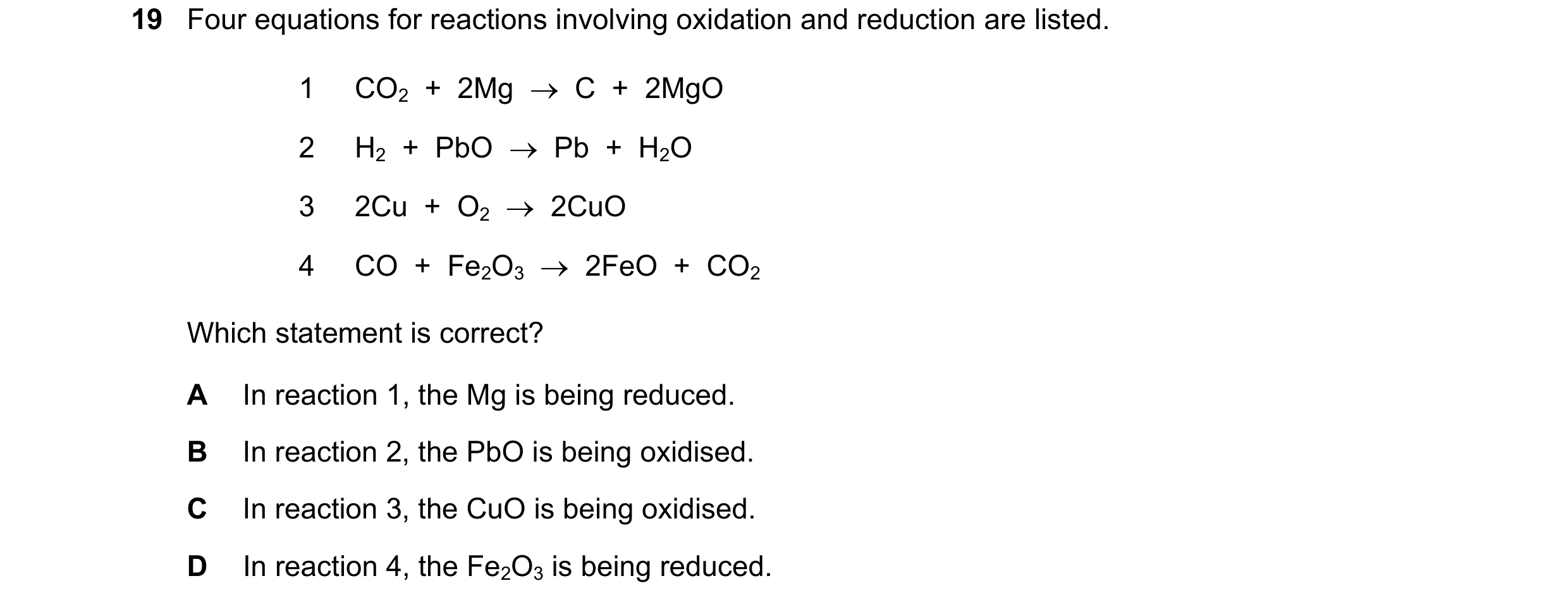
Q76 · Four equations for reactions involving oxidation and reduction are listed 0653/11 May/June 2024
19 Four equations for reactions involving oxidation and reduction are listed. 1 CO2 + 2Mg C + 2MgO 2 H2 + PbO Pb + H2O 3 2Cu + O2 2CuO 4 CO + Fe2O3 2FeO + CO2 Which statement is correct? A In reaction 1, the Mg is being reduced. B In reaction 2, the PbO is being oxidised. C In reaction 3, the CuO is being oxidised. D In reaction 4, the Fe2O3 is being reduced.
1 marks
Answer: D
This question in 0653/11 May/June 2024
Q77 · What is a reduction process? 0653/12 May/June 2024
21 What is a reduction process? A the combustion of a fuel B the thermal decomposition of calcium carbonate C the extraction of copper from copper oxide D the reaction between an acid and an alkali
1 marks
Answer: C
This question in 0653/12 May/June 2024
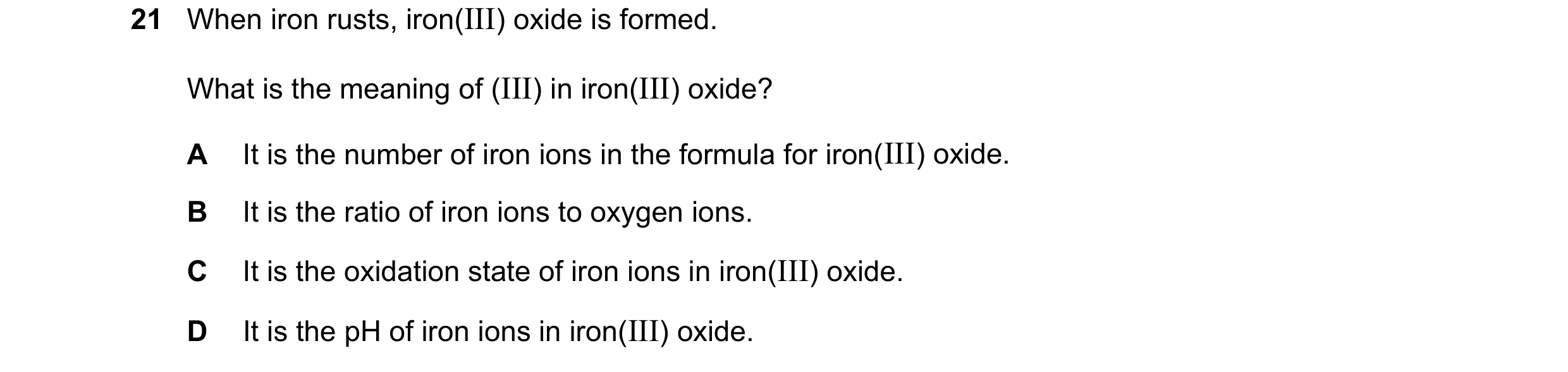
Q78 · When iron rusts, iron(III) oxide is formed 0653/13 May/June 2024
21 When iron rusts, iron(III) oxide is formed. What is the meaning of (III) in iron(III) oxide? A It is the number of iron ions in the formula for iron(III) oxide. B It is the ratio of iron ions to oxygen ions. C It is the oxidation state of iron ions in iron(III) oxide. D It is the pH of iron ions in iron(III) oxide.
1 marks
Answer: C
This question in 0653/13 May/June 2024
Q79 · Copper oxide reacts with hydrogen to form copper and water 0653/11 Oct/Nov 2024
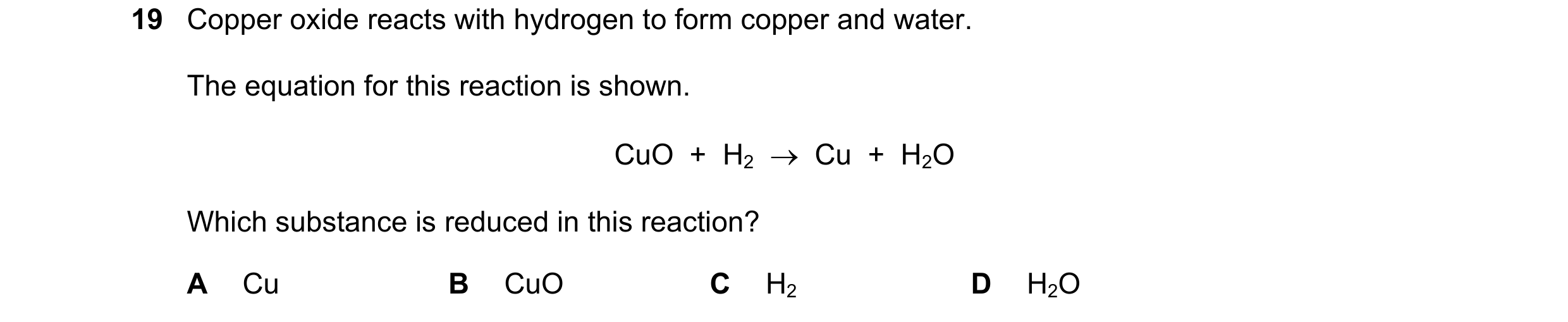
19 Copper oxide reacts with hydrogen to form copper and water. The equation for this reaction is shown. CuO + H2 Cu + H2O Which substance is reduced in this reaction? A Cu B CuO C H2 D H2O
1 marks
Answer: B
This question in 0653/11 Oct/Nov 2024
Q80 · Which type of reaction occurs when iron is obtained from its oxide using carbon? 0653/12 Oct/Nov 2024
19 Which type of reaction occurs when iron is obtained from its oxide using carbon? A combustion B neutralisation C electrolysis D reduction
1 marks
Answer: D
This question in 0653/12 Oct/Nov 2024
Q81 · Which type of reaction occurs when iron is obtained from its oxide using carbon? 0653/13 Oct/Nov 2024
19 Which type of reaction occurs when iron is obtained from its oxide using carbon? A combustion B neutralisation C electrolysis D reduction
1 marks
Answer: D
This question in 0653/13 Oct/Nov 2024
Q82 · Which row explains why carbon is used to extract copper from copper oxide and identifies… 0653/13 Oct/Nov 2024
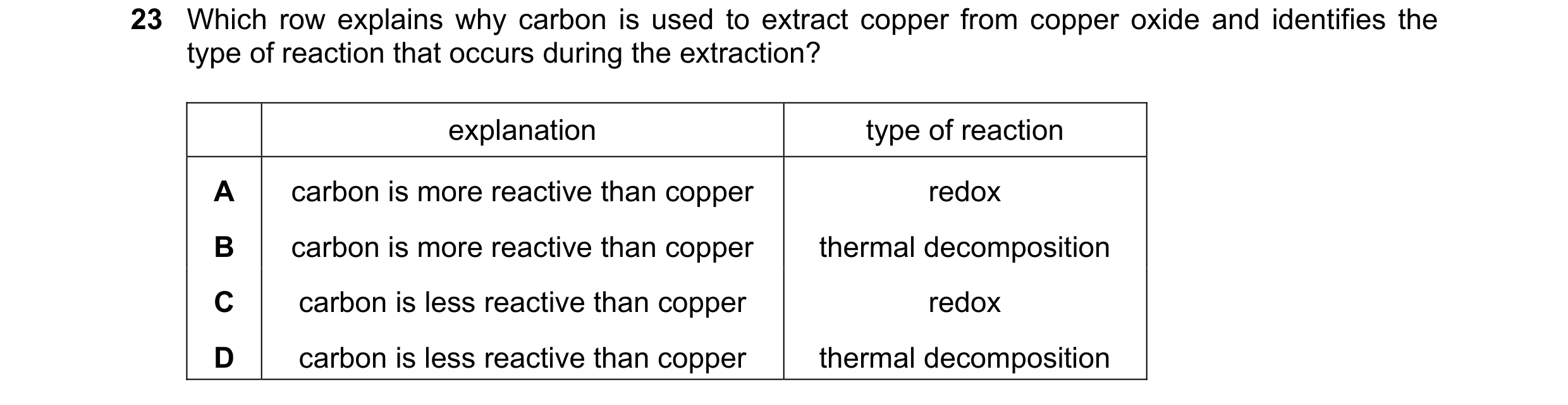
23 Which row explains why carbon is used to extract copper from copper oxide and identifies the type of reaction that occurs during the extraction? explanation type of reaction A carbon is more reactive than copper redox B carbon is more reactive than copper thermal decomposition C carbon is less reactive than copper redox D carbon is less reactive than copper thermal decomposition
1 marks
Answer: A
This question in 0653/13 Oct/Nov 2024
Q83 · Which description explains why a reaction involves reduction? 0653/11 May/June 2025
21 Which description explains why a reaction involves reduction? A mass decreases B oxygen is lost C pH decreases D temperature decreases
1 marks
Answer: B
This question in 0653/11 May/June 2025
Q84 · Which statement describes what happens during reduction? 0653/12 May/June 2025
22 Which statement describes what happens during reduction? A An element gains oxygen. B A compound gains oxygen. C A compound loses oxygen. D A mixture of elements loses oxygen.
1 marks
Answer: C
This question in 0653/12 May/June 2025
Q85 · In the blast furnace, iron(III) oxide reacts with carbon monoxide to form iron 0653/13 May/June 2025
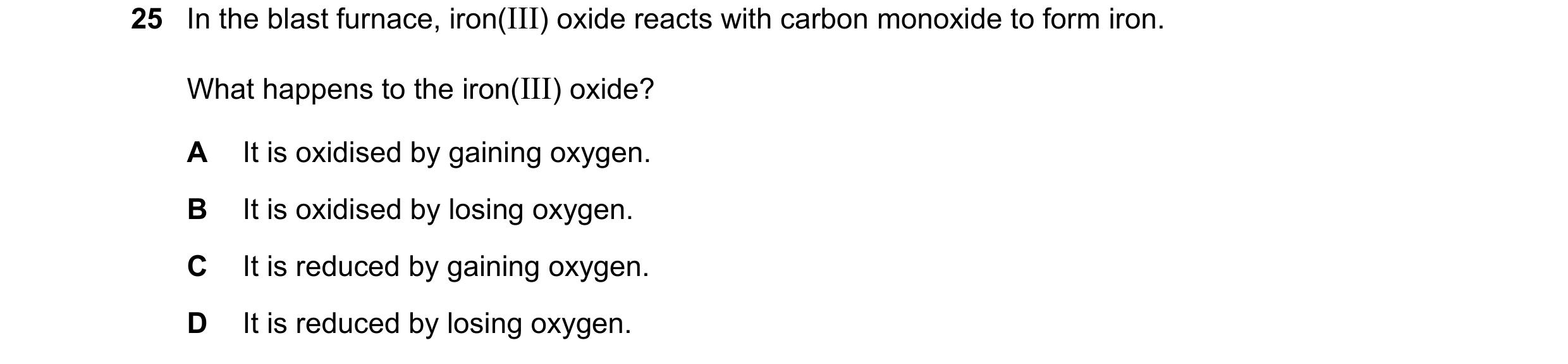
25 In the blast furnace, iron(III) oxide reacts with carbon monoxide to form iron. What happens to the iron(III) oxide? A It is oxidised by gaining oxygen. B It is oxidised by losing oxygen. C It is reduced by gaining oxygen. D It is reduced by losing oxygen.
1 marks
Answer: D
This question in 0653/13 May/June 2025


 1 / 20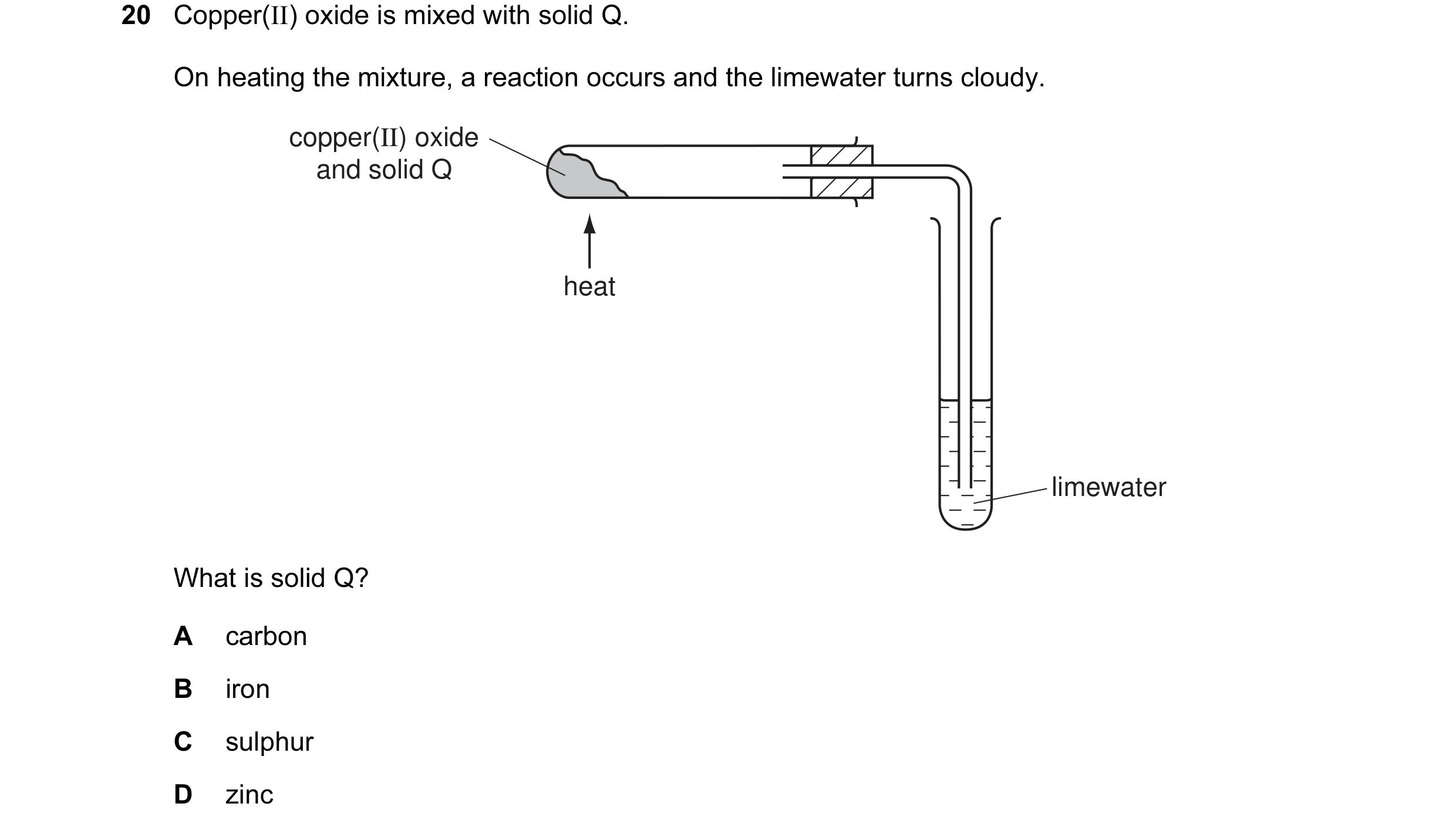

 2 / 20



 3 / 20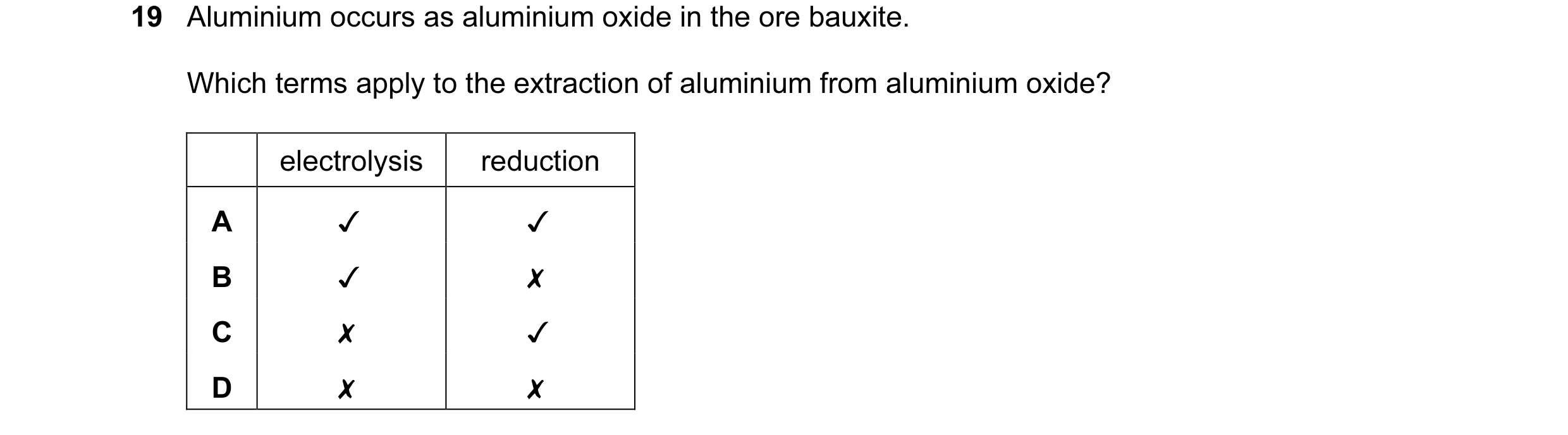
 4 / 20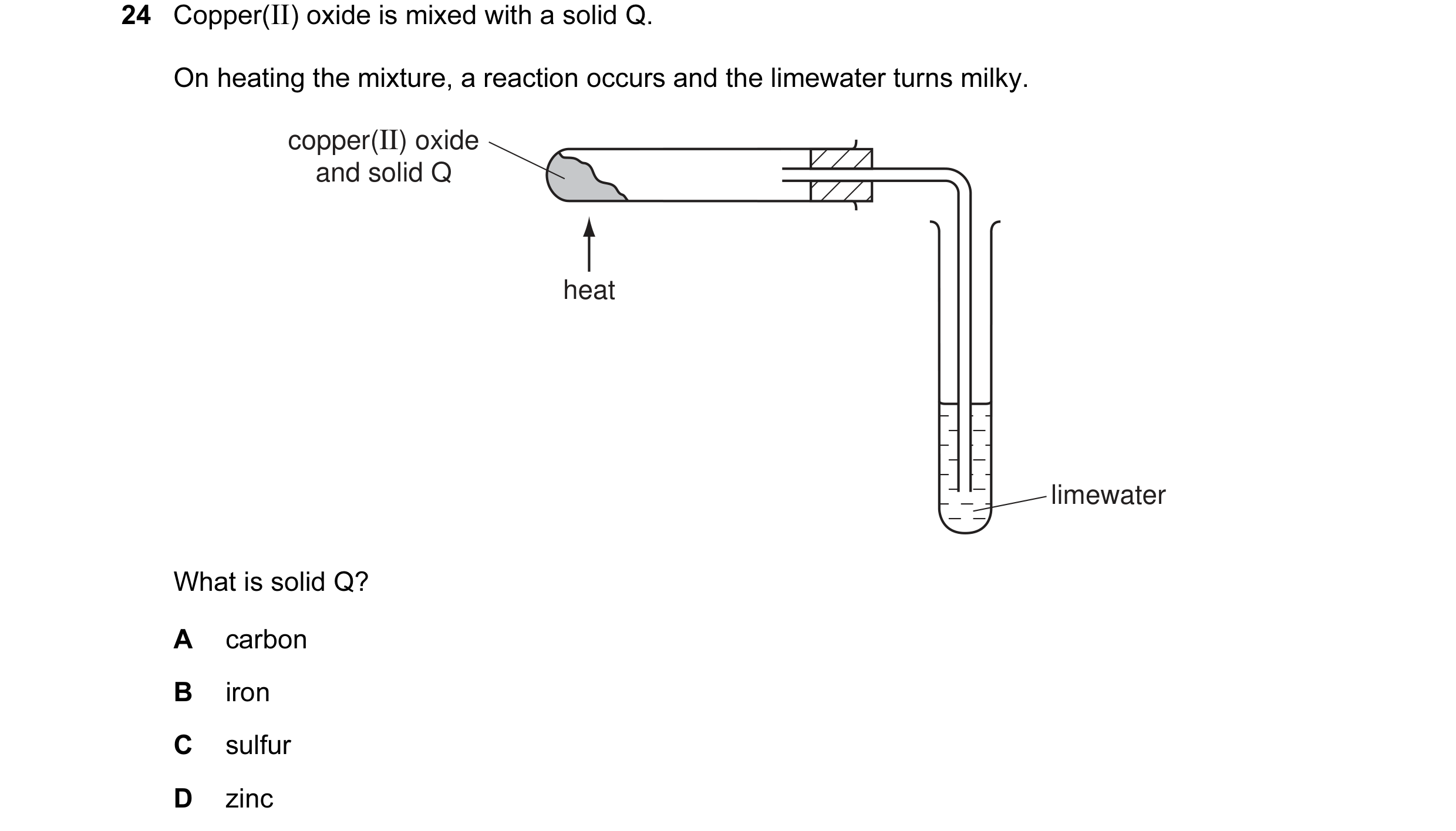
 5 / 20
 6 / 20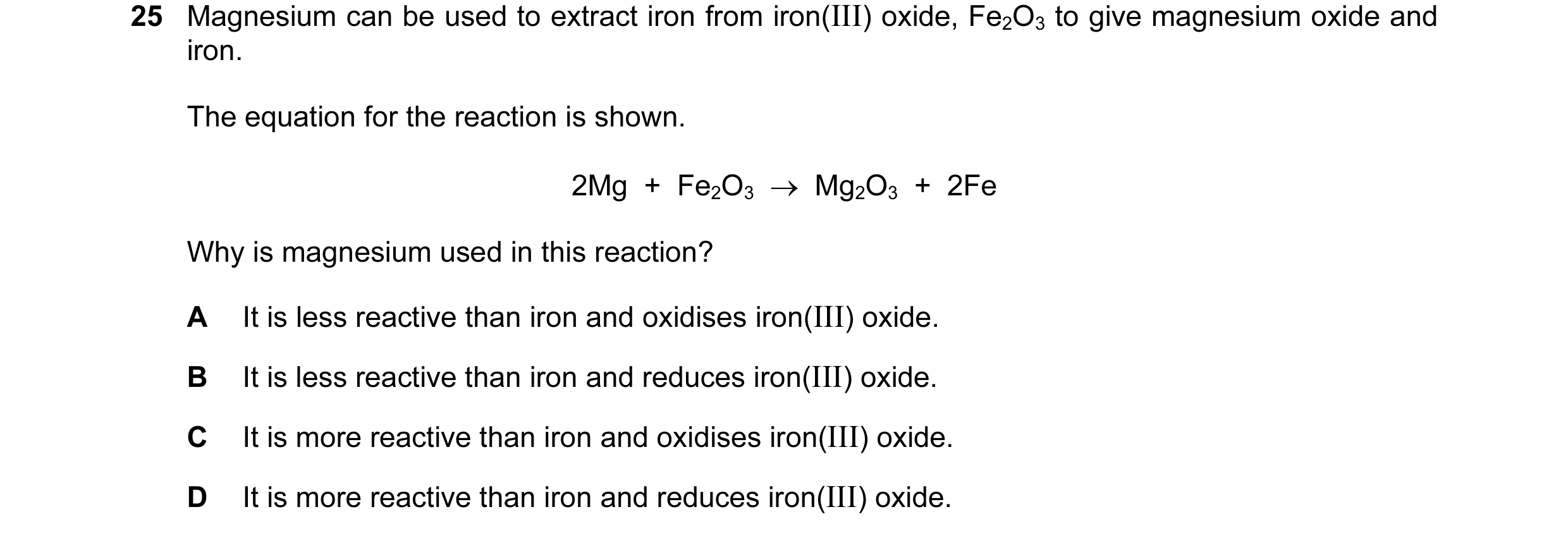
 7 / 20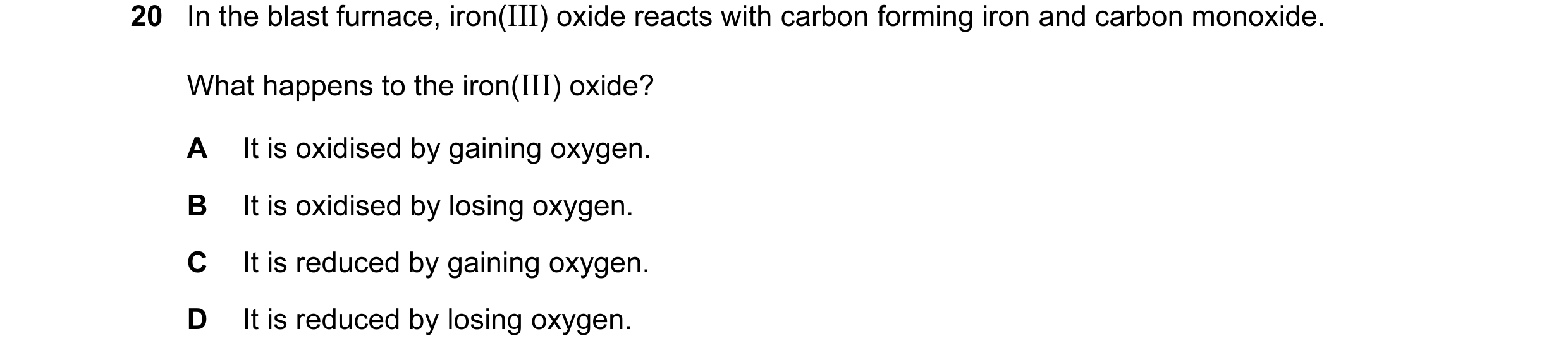
 8 / 20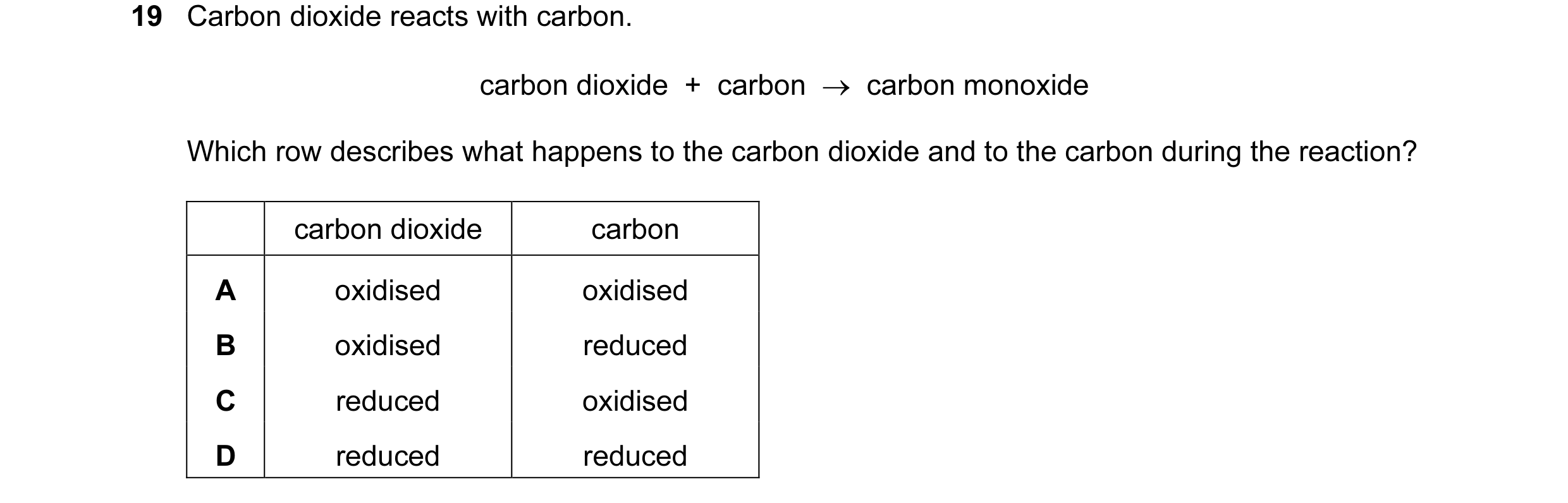



 9 / 20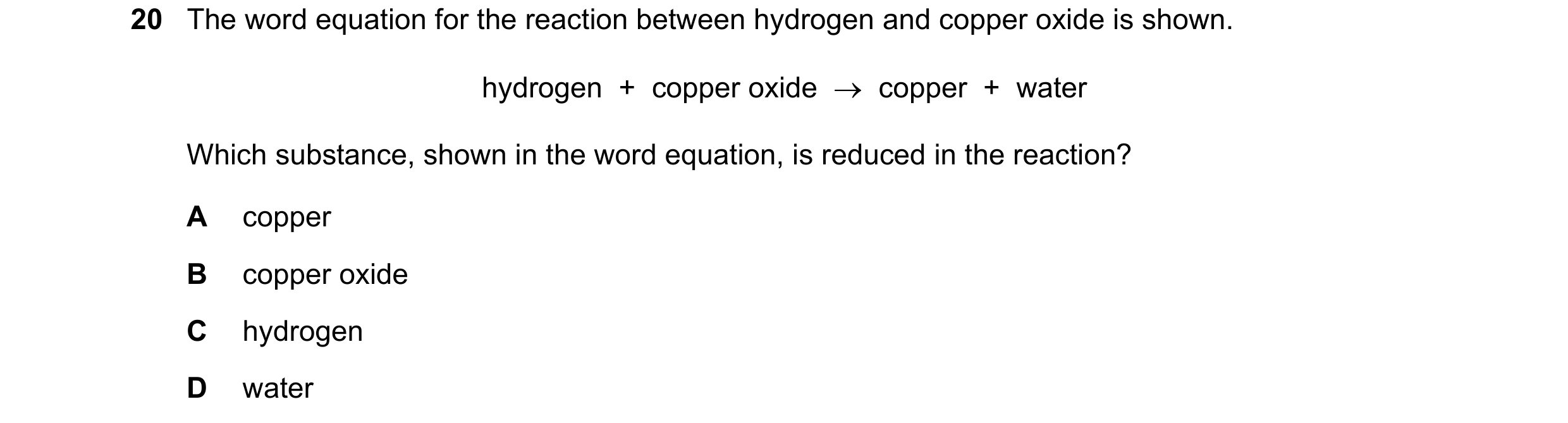
 10 / 20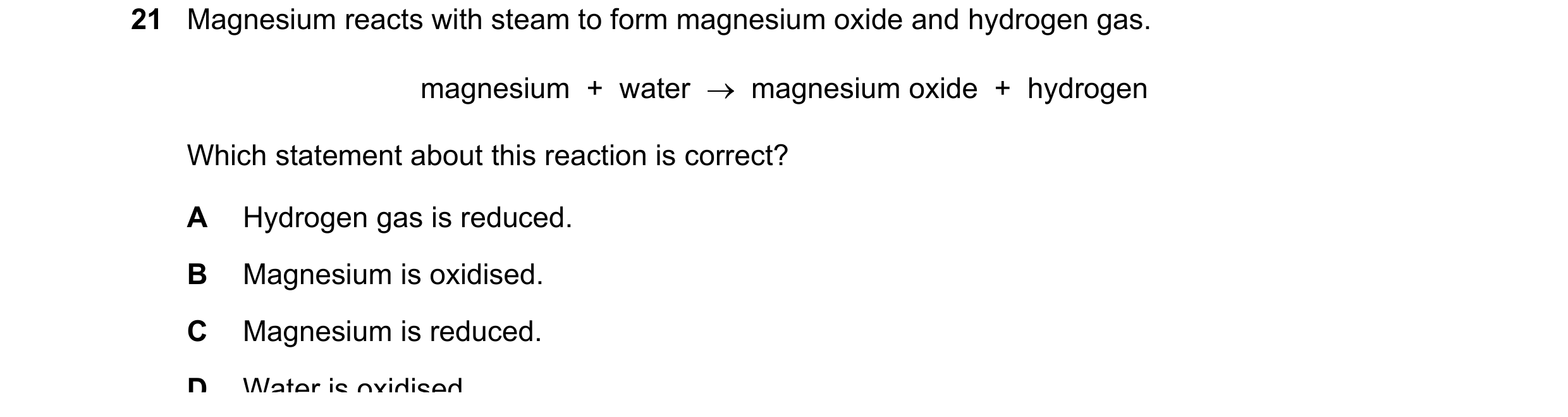
 11 / 20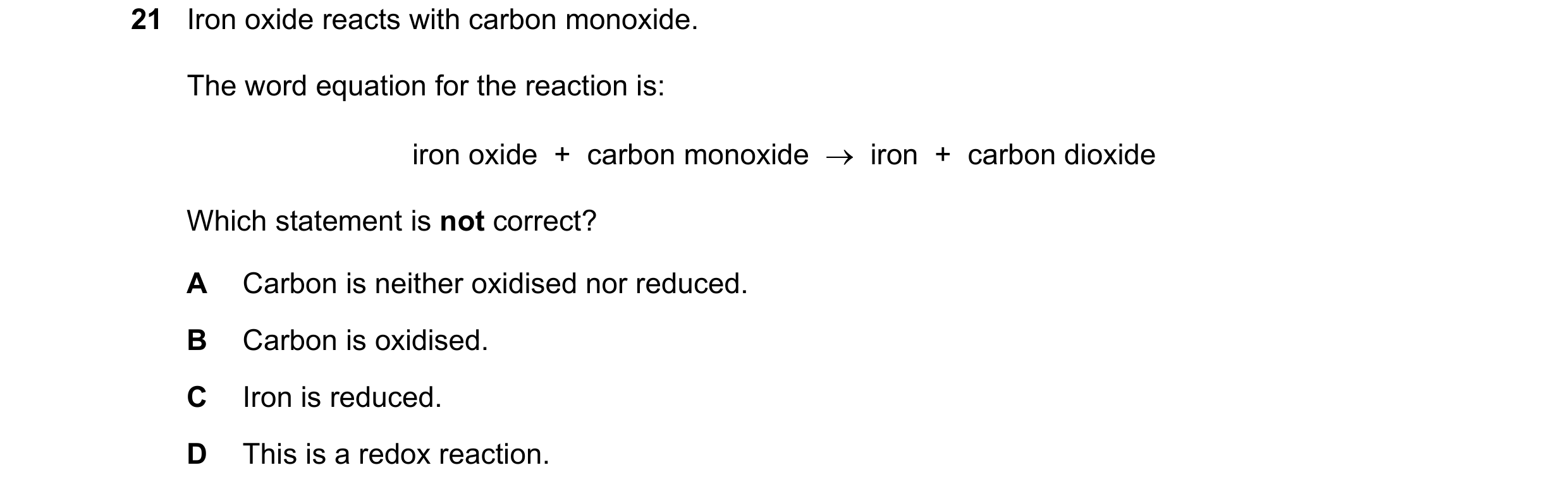
 12 / 20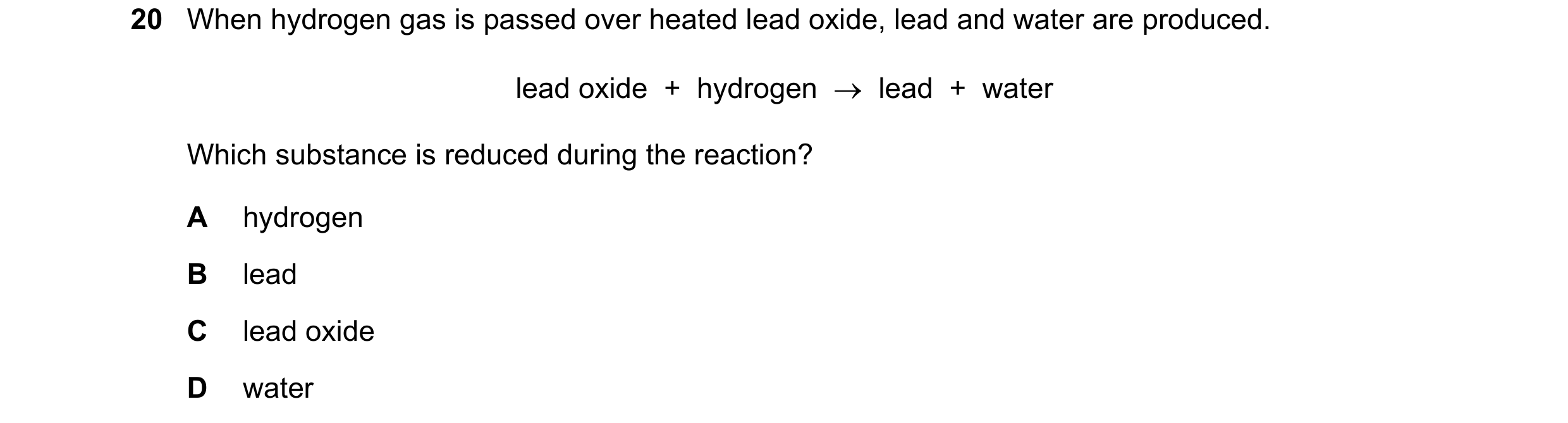

 13 / 20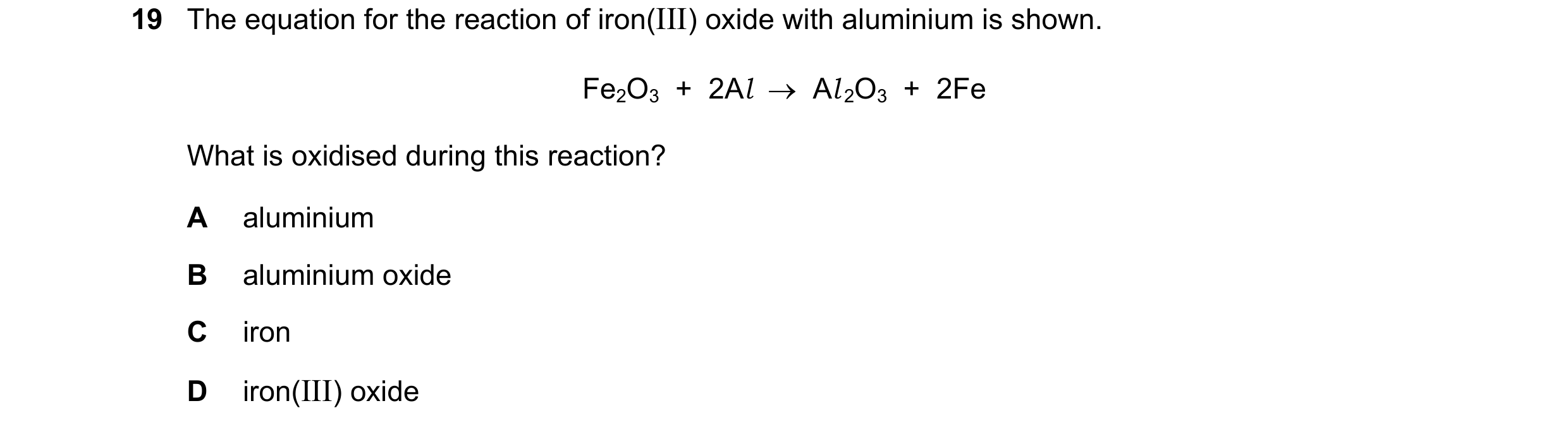


 14 / 20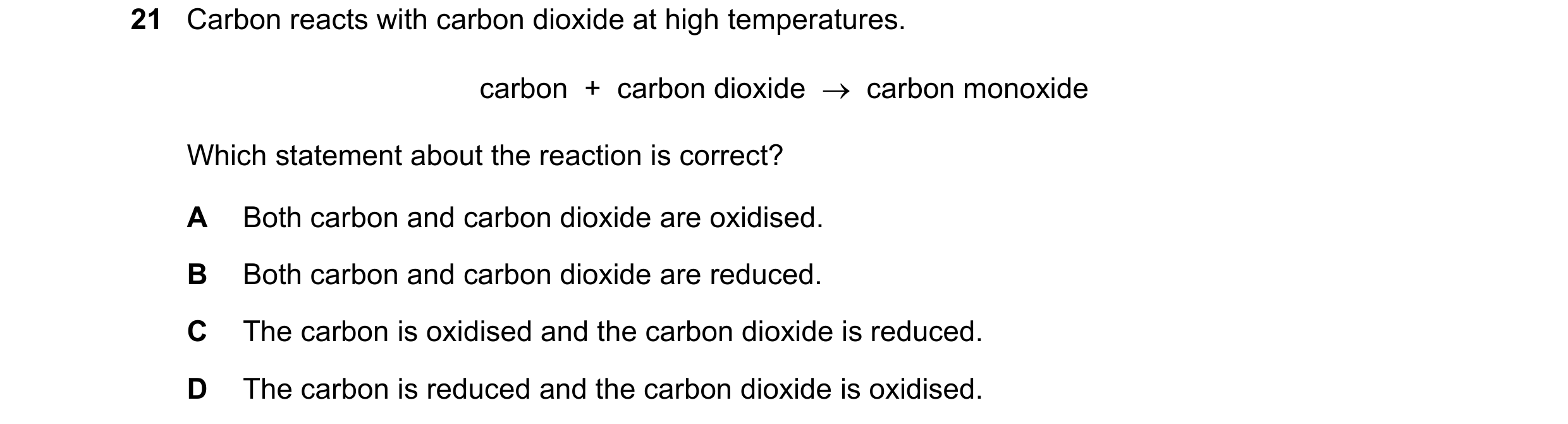
 15 / 20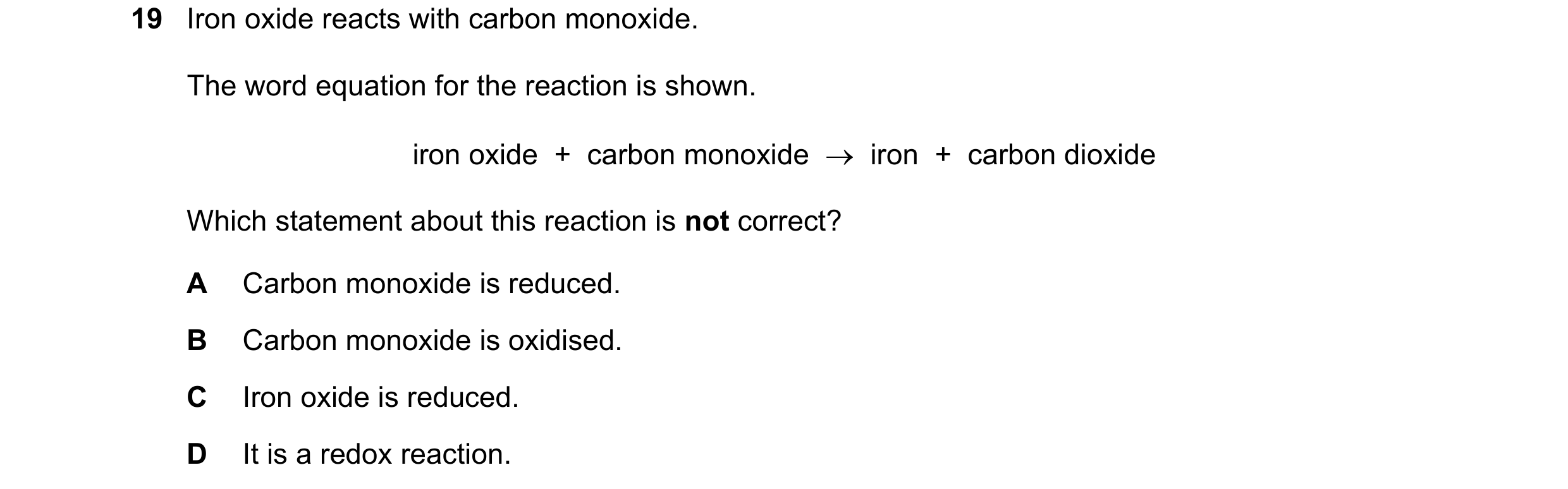

 16 / 20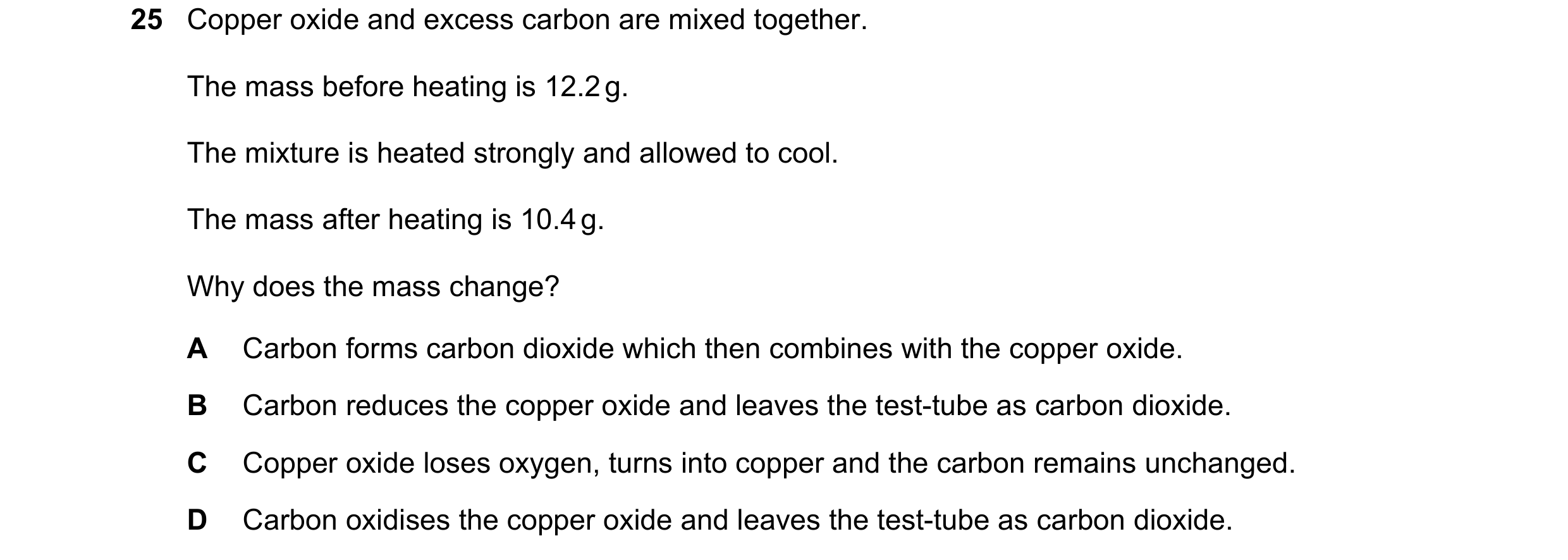

 17 / 20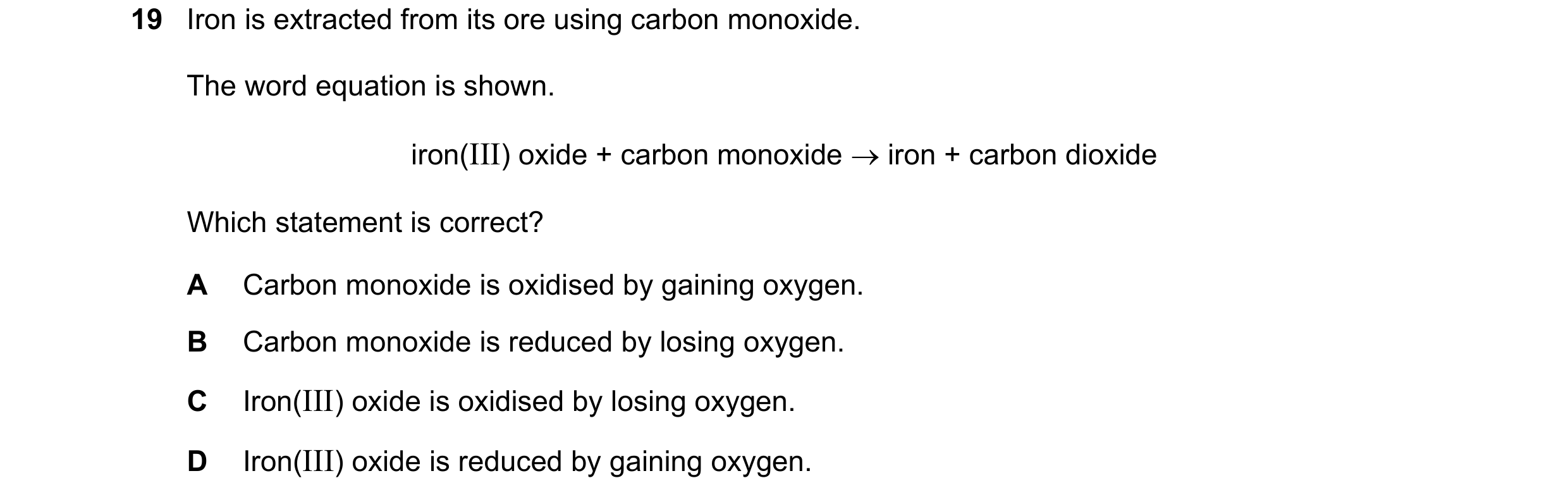
 18 / 20


 19 / 20

 20 / 20