Questions as text
Q1 · In which word equation is copper reduced? 0653/21 May/June 2017
21 In which word equation is copper reduced? A anhydrous copper sulfate + water → hydrated copper sulfate B copper carbonate + hydrochloric acid → copper chloride + water + carbon dioxide C copper oxide + hydrogen → copper + water D copper + oxygen → copper oxide
1 marks
Answer: C
This question in 0653/21 May/June 2017
Q2 · In which reactions is the underlined substance oxidised? 0653/22 May/June 2017
21 In which reactions is the underlined substance oxidised? 1 iron when it rusts 2 methane when it burns in air 3 copper oxide when it reacts with carbon A 1, 2 and 3 B 1 and 2 only C 1 and 3 only D 2 and 3 only
1 marks
Answer: B
This question in 0653/22 May/June 2017
Q3 · Iron is extracted from its ore using carbon monoxide 0653/23 May/June 2017
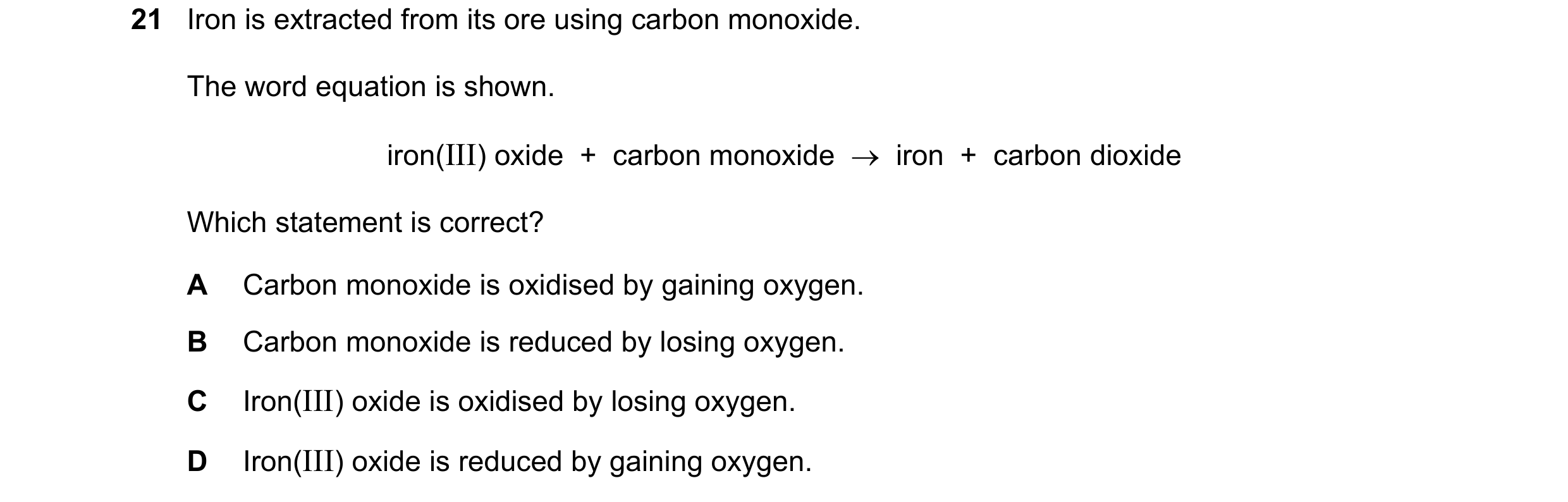
21 Iron is extracted from its ore using carbon monoxide. The word equation is shown. iron(III) oxide + carbon monoxide → iron + carbon dioxide Which statement is correct? A Carbon monoxide is oxidised by gaining oxygen. B Carbon monoxide is reduced by losing oxygen. C Iron(III) oxide is oxidised by losing oxygen. D Iron(III) oxide is reduced by gaining oxygen.
1 marks
Answer: A
This question in 0653/23 May/June 2017
Q4 · Carbon reacts with carbon dioxide at high temperatures 0653/21 Oct/Nov 2017
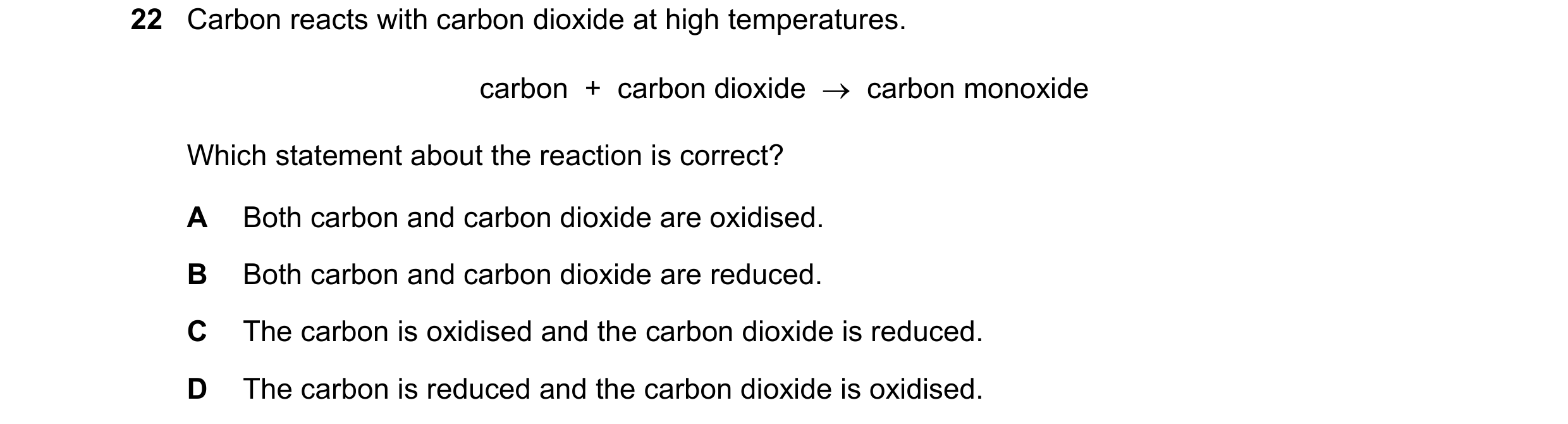
22 Carbon reacts with carbon dioxide at high temperatures. carbon + carbon dioxide → carbon monoxide Which statement about the reaction is correct? A Both carbon and carbon dioxide are oxidised. B Both carbon and carbon dioxide are reduced. C The carbon is oxidised and the carbon dioxide is reduced. D The carbon is reduced and the carbon dioxide is oxidised.
1 marks
Answer: C
This question in 0653/21 Oct/Nov 2017
Q5 · The word equation for the reaction between hydrogen and copper oxide is shown 0653/22 Oct/Nov 2017
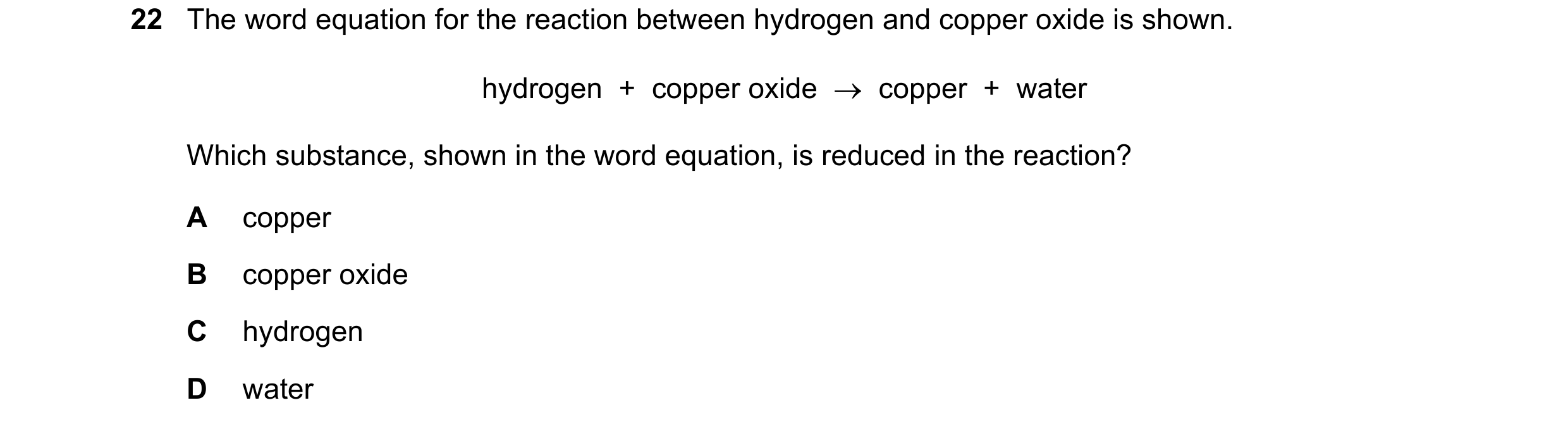
22 The word equation for the reaction between hydrogen and copper oxide is shown. hydrogen + copper oxide → copper + water Which substance, shown in the word equation, is reduced in the reaction? A copper B copper oxide C hydrogen D water
1 marks
Answer: B
This question in 0653/22 Oct/Nov 2017
Q6 · Copper is produced by heating copper oxide with carbon 0653/23 Oct/Nov 2017
22 Copper is produced by heating copper oxide with carbon. The word equation for this reaction is shown. copper oxide + carbon → copper + carbon dioxide Which statement explains why this is a redox reaction? A Carbon dioxide contains oxygen. B Carbon is a solid and carbon dioxide is a gas. C Copper oxide is oxidised. D Copper oxide loses oxygen and carbon gains oxygen.
1 marks
Answer: D
This question in 0653/23 Oct/Nov 2017
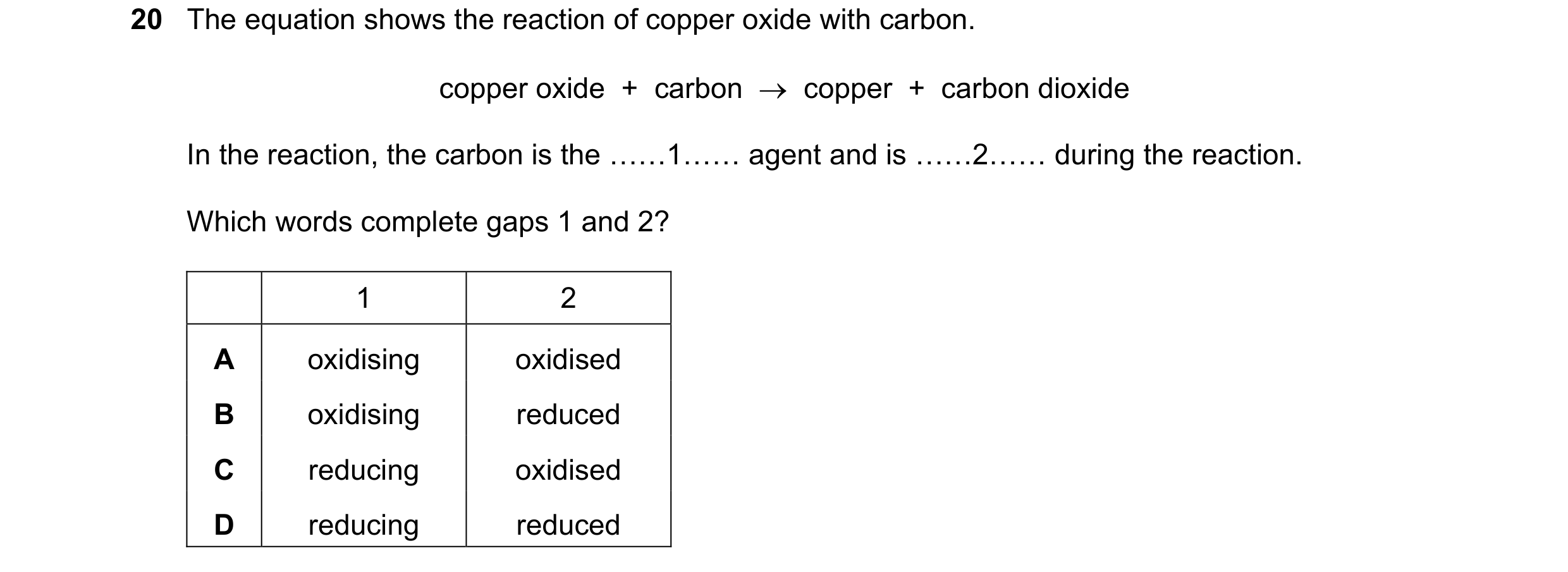
Q7 · The equation shows the reaction of copper oxide with carbon 0653/22 Feb/March 2018
20 The equation shows the reaction of copper oxide with carbon. copper oxide + carbon → copper + carbon dioxide In the reaction, the carbon is the ««1«« agent and is ««2«« during the reaction. Which words complete gaps 1 and 2? 1 2 A oxidising oxidised B oxidising reduced C reducing oxidised D reducing reduced
1 marks
Answer: C
This question in 0653/22 Feb/March 2018
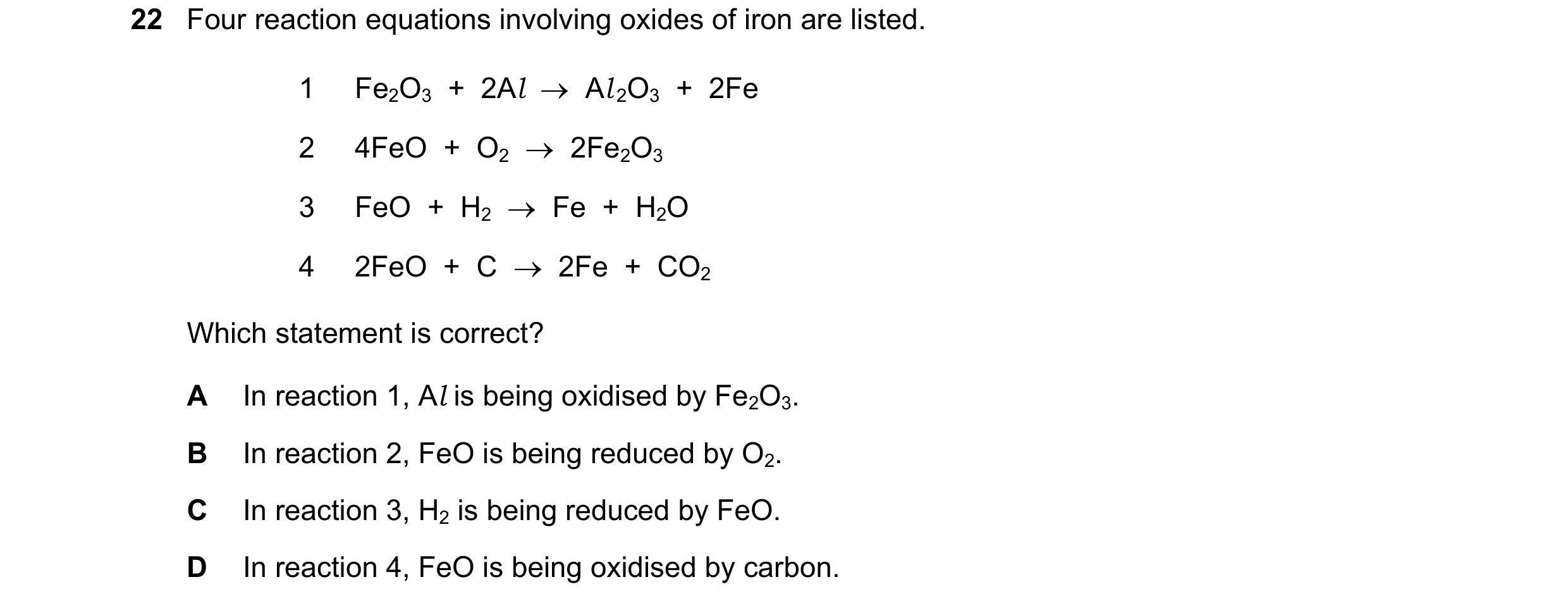
Q8 · Four reaction equations involving oxides of iron are listed 0653/21 May/June 2018
22 Four reaction equations involving oxides of iron are listed. 1 Fe2O3 + 2Al → Al 2O3 + 2Fe 2 4FeO + O2 → 2Fe2O3 3 FeO + H2 → Fe + H2O 4 2FeO + C → 2Fe + CO2 Which statement is correct? A In reaction 1, Al is being oxidised by Fe2O3. B In reaction 2, FeO is being reduced by O2. C In reaction 3, H2 is being reduced by FeO. D In reaction 4, FeO is being oxidised by carbon.
1 marks
Answer: A
This question in 0653/21 May/June 2018
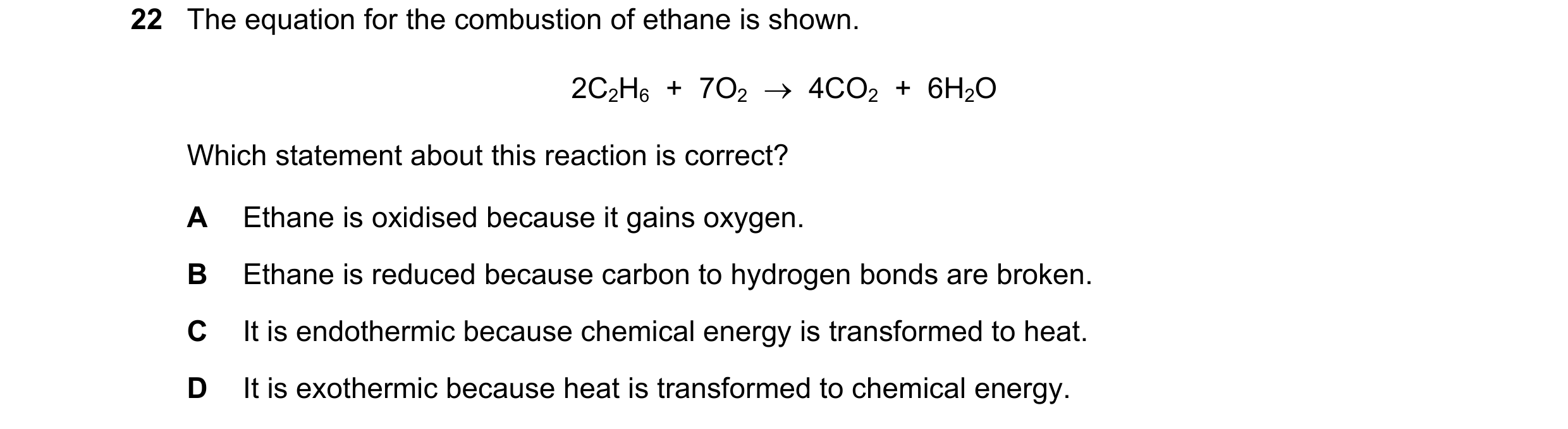
Q9 · The equation for the combustion of ethane is shown 0653/22 May/June 2018
22 The equation for the combustion of ethane is shown. 2C2H6 + 7O2 → 4CO2 + 6H2O Which statement about this reaction is correct? A Ethane is oxidised because it gains oxygen. B Ethane is reduced because carbon to hydrogen bonds are broken. C It is endothermic because chemical energy is transformed to heat. D It is exothermic because heat is transformed to chemical energy.
1 marks
Answer: A
This question in 0653/22 May/June 2018
Q10 · Molten calcium chloride is electrolysed 0653/23 May/June 2018
19 Molten calcium chloride is electrolysed. What happens at the negative electrode? A Calcium atoms lose electrons to form calcium ions. B Calcium ions gain electrons to form calcium atoms. C Chloride ions lose electrons to form chlorine molecules. D Chlorine molecules gain electrons to form chloride ions.
1 marks
Answer: B
This question in 0653/23 May/June 2018
Q11 · Which reaction is a redox reaction? 0653/23 May/June 2018
22 Which reaction is a redox reaction? A 2HCl + CaCO3 → CaCl 2 + CO2 + H2O B AgNO3 + KCl → AgCl + KNO3 C Ca(OH)2 + CO2 → CaCO3 + H2O D 2H2 + O2 → 2H2O
1 marks
Answer: D
This question in 0653/23 May/June 2018
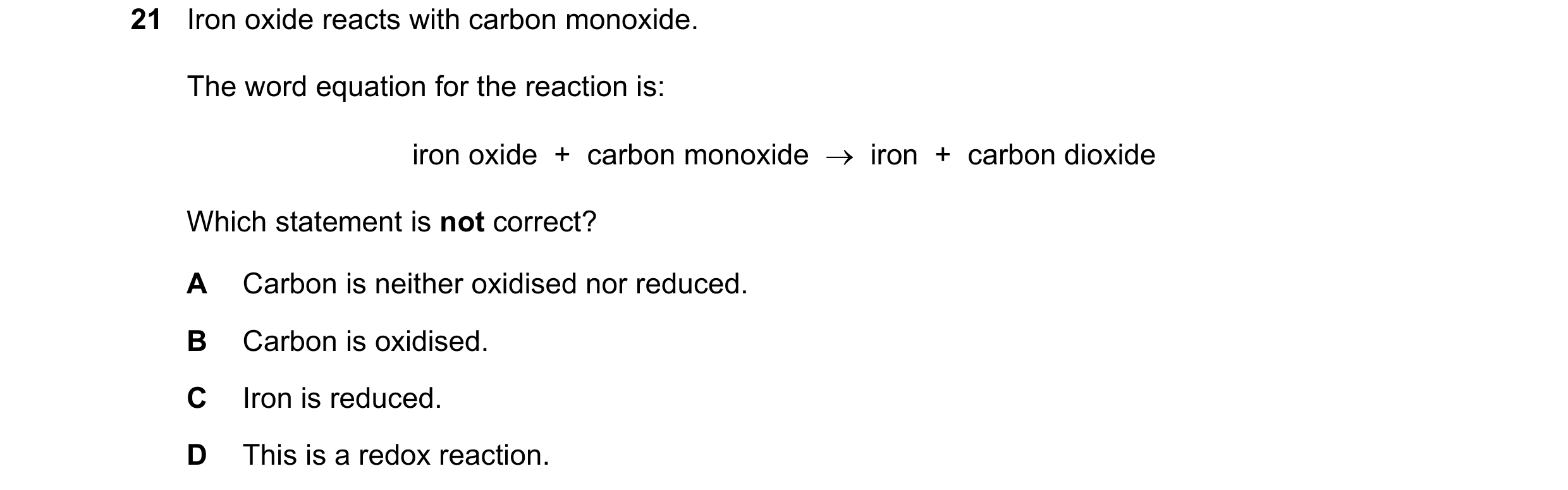
Q12 · Iron oxide reacts with carbon monoxide 0653/21 Oct/Nov 2018
21 Iron oxide reacts with carbon monoxide. The word equation for the reaction is: iron oxide + carbon monoxide → iron + carbon dioxide Which statement is not correct? A Carbon is neither oxidised nor reduced. B Carbon is oxidised. C Iron is reduced. D This is a redox reaction.
1 marks
Answer: A
This question in 0653/21 Oct/Nov 2018
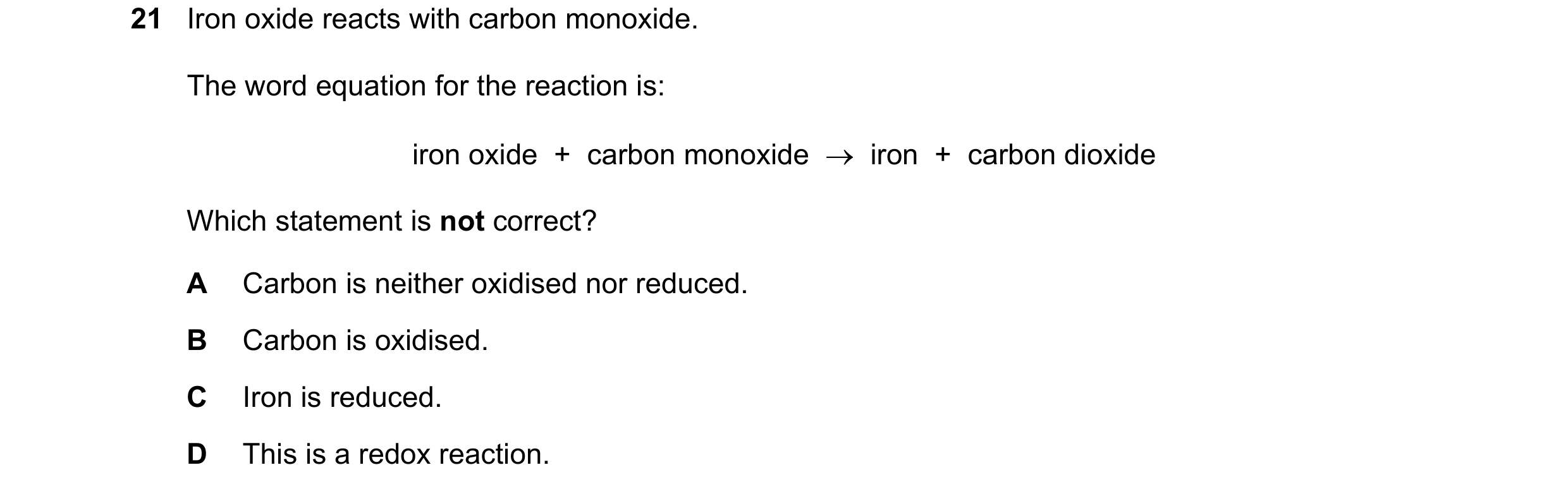
Q13 · Iron oxide reacts with carbon monoxide 0653/22 Oct/Nov 2018
21 Iron oxide reacts with carbon monoxide. The word equation for the reaction is: iron oxide + carbon monoxide → iron + carbon dioxide Which statement is not correct? A Carbon is neither oxidised nor reduced. B Carbon is oxidised. C Iron is reduced. D This is a redox reaction.
1 marks
Answer: A
This question in 0653/22 Oct/Nov 2018
Q14 · Iron oxide reacts with carbon monoxide 0653/23 Oct/Nov 2018
21 Iron oxide reacts with carbon monoxide. The word equation for the reaction is: iron oxide + carbon monoxide → iron + carbon dioxide Which statement is not correct? A Carbon is neither oxidised nor reduced. B Carbon is oxidised. C Iron is reduced. D This is a redox reaction.
1 marks
Answer: A
This question in 0653/23 Oct/Nov 2018
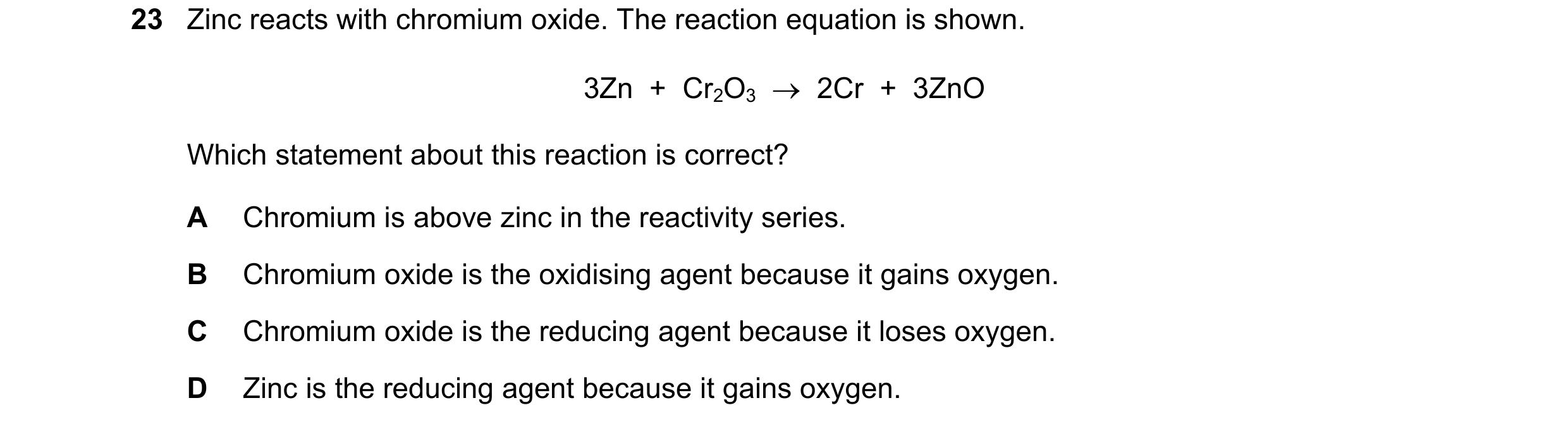
Q15 · Zinc reacts with chromium oxide 0653/22 May/June 2019
23 Zinc reacts with chromium oxide. The reaction equation is shown. 3Zn + Cr2O3 → 2Cr + 3ZnO Which statement about this reaction is correct? A Chromium is above zinc in the reactivity series. B Chromium oxide is the oxidising agent because it gains oxygen. C Chromium oxide is the reducing agent because it loses oxygen. D Zinc is the reducing agent because it gains oxygen.
1 marks
Answer: D
This question in 0653/22 May/June 2019
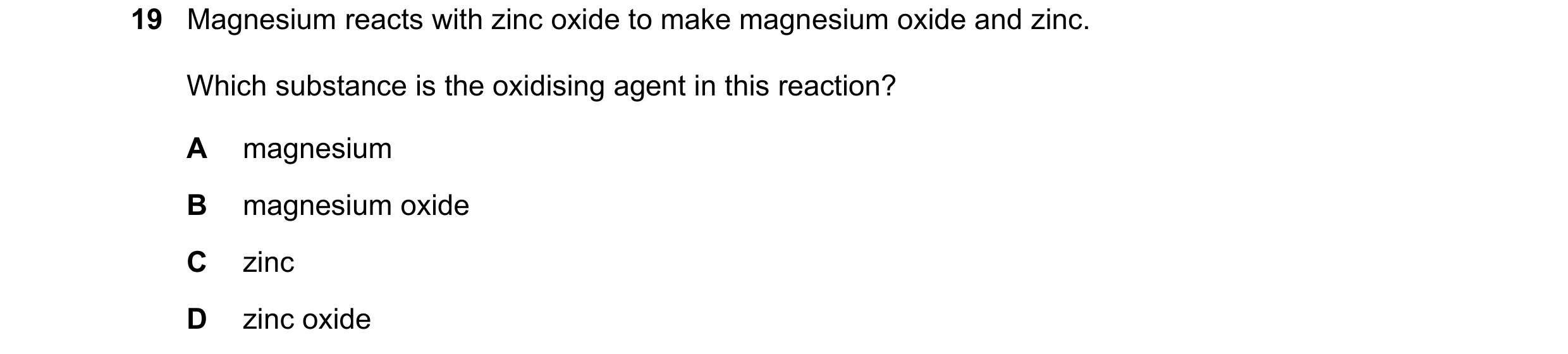
Q16 · Magnesium reacts with zinc oxide to make magnesium oxide and zinc 0653/23 May/June 2019
19 Magnesium reacts with zinc oxide to make magnesium oxide and zinc. Which substance is the oxidising agent in this reaction? A magnesium B magnesium oxide C zinc D zinc oxide
1 marks
Answer: D
This question in 0653/23 May/June 2019
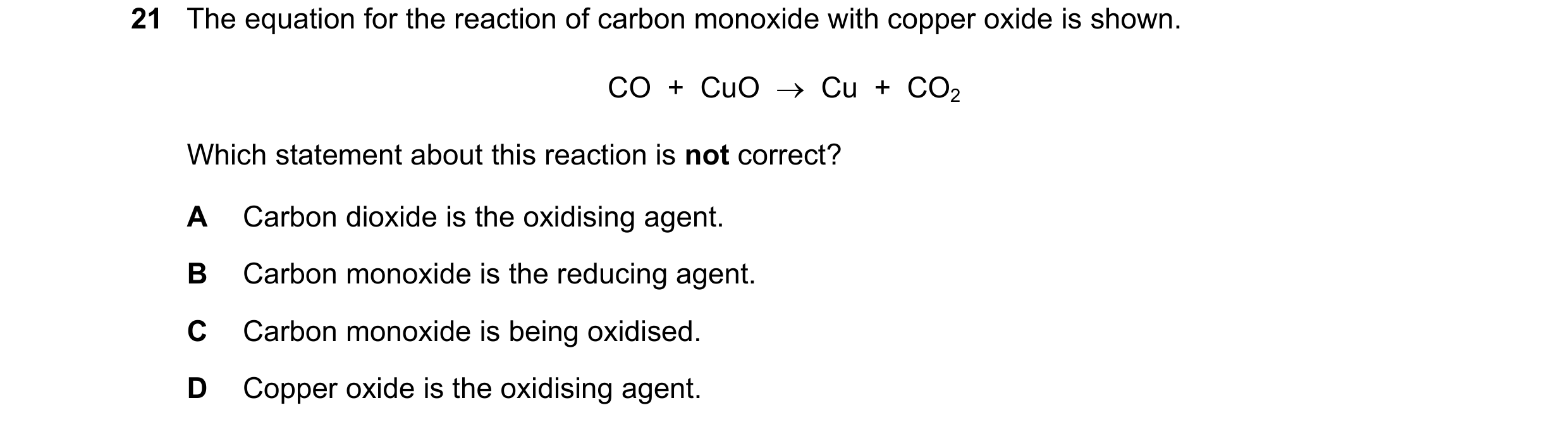
Q17 · The equation for the reaction of carbon monoxide with copper oxide is shown 0653/21 Oct/Nov 2019
21 The equation for the reaction of carbon monoxide with copper oxide is shown. CO + CuO → Cu + CO2 Which statement about this reaction is not correct? A Carbon dioxide is the oxidising agent. B Carbon monoxide is the reducing agent. C Carbon monoxide is being oxidised. D Copper oxide is the oxidising agent.
1 marks
Answer: A
This question in 0653/21 Oct/Nov 2019
Q18 · Which statement about the extraction of iron in a blast furnace is not correct? 0653/22 Oct/Nov 2019
23 Which statement about the extraction of iron in a blast furnace is not correct? A Carbon dioxide reduces iron oxide. B Carbon monoxide is oxidised by iron oxide. C Carbon reduces carbon dioxide. D The high temperatures required are produced by reacting carbon with oxygen.
1 marks
Answer: A
This question in 0653/22 Oct/Nov 2019
Q19 · The equation for a reaction is shown 0653/23 Oct/Nov 2019
20 The equation for a reaction is shown. CuO + CO → Cu + CO2 Which statement about this reaction is correct? A CO acts as a reducing agent. B CO2 is reduced. C Cu is oxidised. D CuO acts as a reducing agent.
1 marks
Answer: A
This question in 0653/23 Oct/Nov 2019
Q20 · Which process is a redox reaction? 0653/22 Feb/March 2020
21 Which process is a redox reaction? A combustion of methane B decomposition of calcium carbonate C neutralisation of dilute hydrochloric acid by copper oxide D precipitation by the addition of aqueous silver nitrate to aqueous chloride ions
1 marks
Answer: A
This question in 0653/22 Feb/March 2020
Q21 · Why is carbon used to extract some metals from their oxide ores? 0653/22 Feb/March 2020
25 Why is carbon used to extract some metals from their oxide ores? A It oxidises the ore by removing oxygen. B It prevents the oxygen of the air reacting with the ore. C It reacts with impurities in the ore. D It reduces the ore by removing oxygen.
1 marks
Answer: D
This question in 0653/22 Feb/March 2020
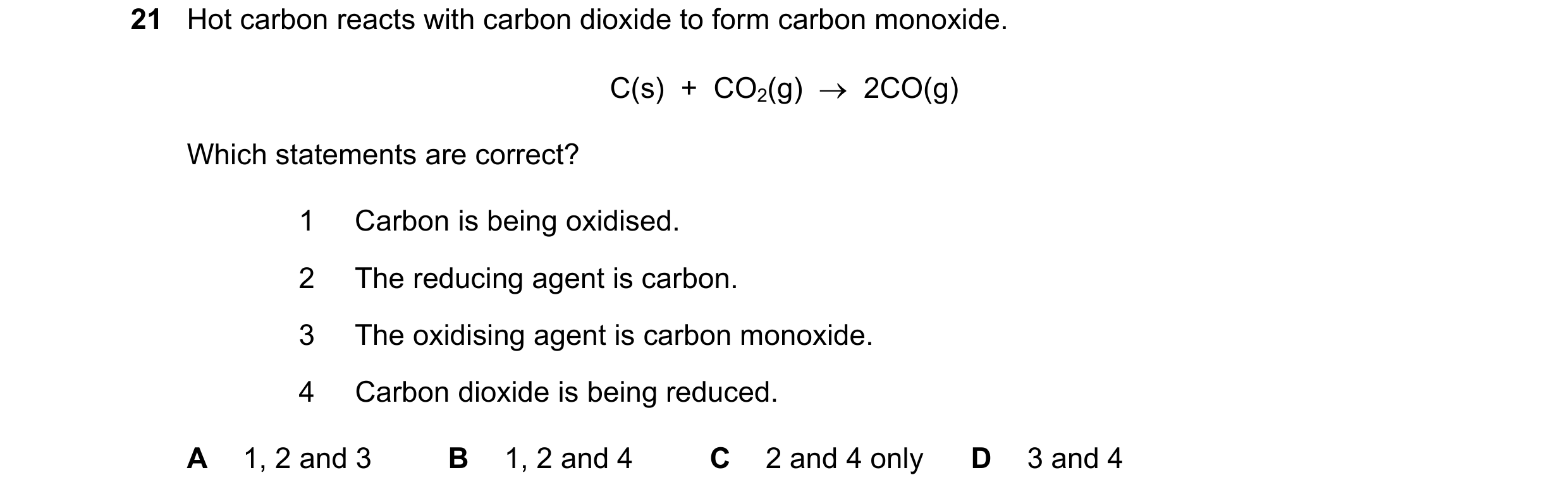
Q22 · Hot carbon reacts with carbon dioxide to form carbon monoxide 0653/21 May/June 2020
21 Hot carbon reacts with carbon dioxide to form carbon monoxide. C(s) + CO2(g) → 2CO(g) Which statements are correct? 1 Carbon is being oxidised. 2 The reducing agent is carbon. 3 The oxidising agent is carbon monoxide. 4 Carbon dioxide is being reduced. A 1, 2 and 3 B 1, 2 and 4 C 2 and 4 only D 3 and 4
1 marks
Answer: B
This question in 0653/21 May/June 2020
Q23 · Which statements about redox reactions are correct? 0653/22 May/June 2020
19 Which statements about redox reactions are correct? 1 The oxidising agent oxidises another substance. 2 The reducing agent is oxidised. 3 The substance that loses oxygen has been oxidised. A 1 and 2 only B 1 and 3 only C 2 and 3 only D 1, 2 and 3
1 marks
Answer: A
This question in 0653/22 May/June 2020
Q24 · Atoms and ions of metals P, Q and R take part in two reactions 0653/22 May/June 2020
24 Atoms and ions of metals P, Q and R take part in two reactions. The equations for these reactions are shown. P + 2Q+ → P2+ + 2Q R + P2+ → R2+ + P Which statements are correct? 1 P is more reactive than R. 2 P is less reactive than Q. 3 R is more reactive than Q. 4 R loses electrons most readily. A 1 and 2 B 1 and 3 C 2 and 4 D 3 and 4
1 marks
Answer: D
This question in 0653/22 May/June 2020
Q25 · Which statement about the electrolysis of a molten metal halide is correct? 0653/21 Oct/Nov 2020
18 Which statement about the electrolysis of a molten metal halide is correct? A Cations move to the anode. B Electrons flow through the electrolyte. C Ions gain protons at the cathode. D Ions lose electrons at the anode.
1 marks
Answer: D
This question in 0653/21 Oct/Nov 2020
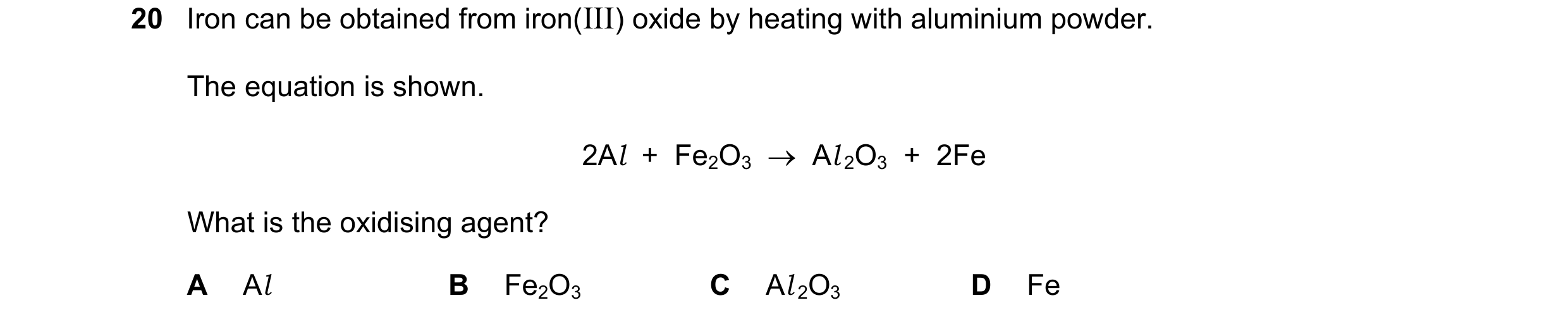
Q26 · Iron can be obtained from iron(III) oxide by heating with aluminium powder 0653/21 Oct/Nov 2020
20 Iron can be obtained from iron(III) oxide by heating with aluminium powder. The equation is shown. 2Al + Fe2O3 Al 2O3 + 2Fe What is the oxidising agent? A Al B Fe2O3 C Al 2O3 D Fe
1 marks
Answer: B
This question in 0653/21 Oct/Nov 2020
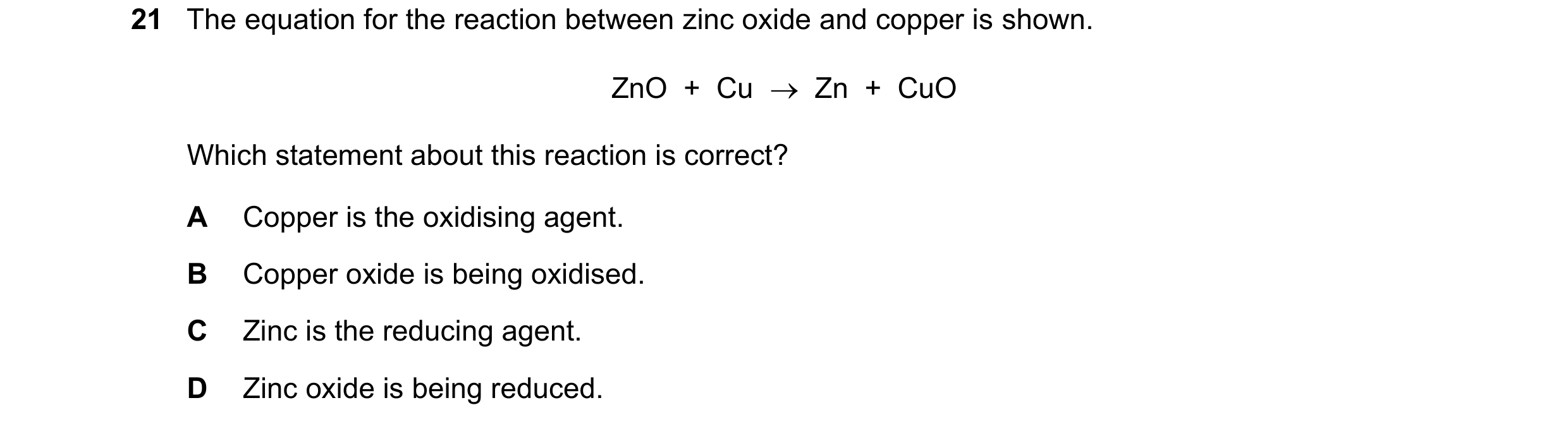
Q27 · The equation for the reaction between zinc oxide and copper is shown 0653/23 Oct/Nov 2020
21 The equation for the reaction between zinc oxide and copper is shown. ZnO + Cu Zn + CuO Which statement about this reaction is correct? A Copper is the oxidising agent. B Copper oxide is being oxidised. C Zinc is the reducing agent. D Zinc oxide is being reduced.
1 marks
Answer: D
This question in 0653/23 Oct/Nov 2020
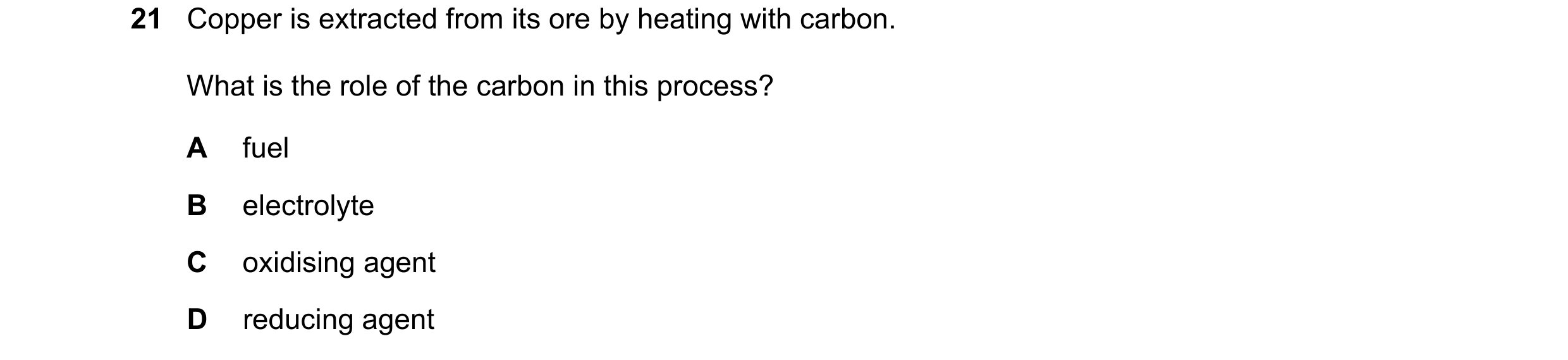
Q28 · Copper is extracted from its ore by heating with carbon 0653/22 Feb/March 2021
21 Copper is extracted from its ore by heating with carbon. What is the role of the carbon in this process? A fuel B electrolyte C oxidising agent D reducing agent
1 marks
Answer: D
This question in 0653/22 Feb/March 2021
Q29 · In the blast furnace, carbon reacts with carbon dioxide to form carbon monoxide 0653/21 May/June 2021
25 In the blast furnace, carbon reacts with carbon dioxide to form carbon monoxide. C + CO2 2CO Why is this reaction essential in the extraction of iron from hematite? A Carbon monoxide is needed to reduce iron oxide. B Carbon monoxide neutralises impurities to make slag. C The reaction removes carbon impurities from the iron ore. D The reaction prevents the release of greenhouse gases.
1 marks
Answer: A
This question in 0653/21 May/June 2021
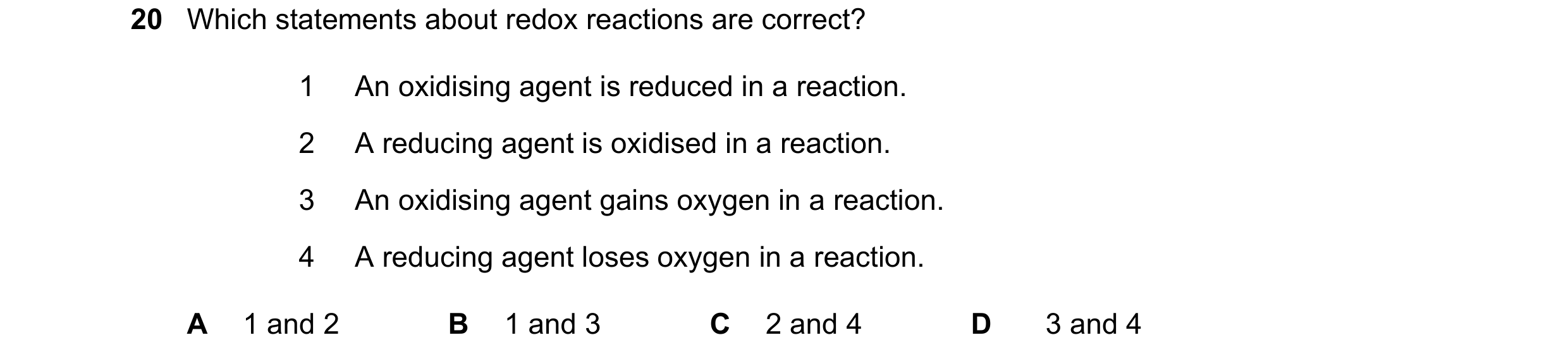
Q30 · Which statements about redox reactions are correct? 0653/22 May/June 2021
20 Which statements about redox reactions are correct? 1 An oxidising agent is reduced in a reaction. 2 A reducing agent is oxidised in a reaction. 3 An oxidising agent gains oxygen in a reaction. 4 A reducing agent loses oxygen in a reaction. A 1 and 2 B 1 and 3 C 2 and 4 D 3 and 4
1 marks
Answer: A
This question in 0653/22 May/June 2021
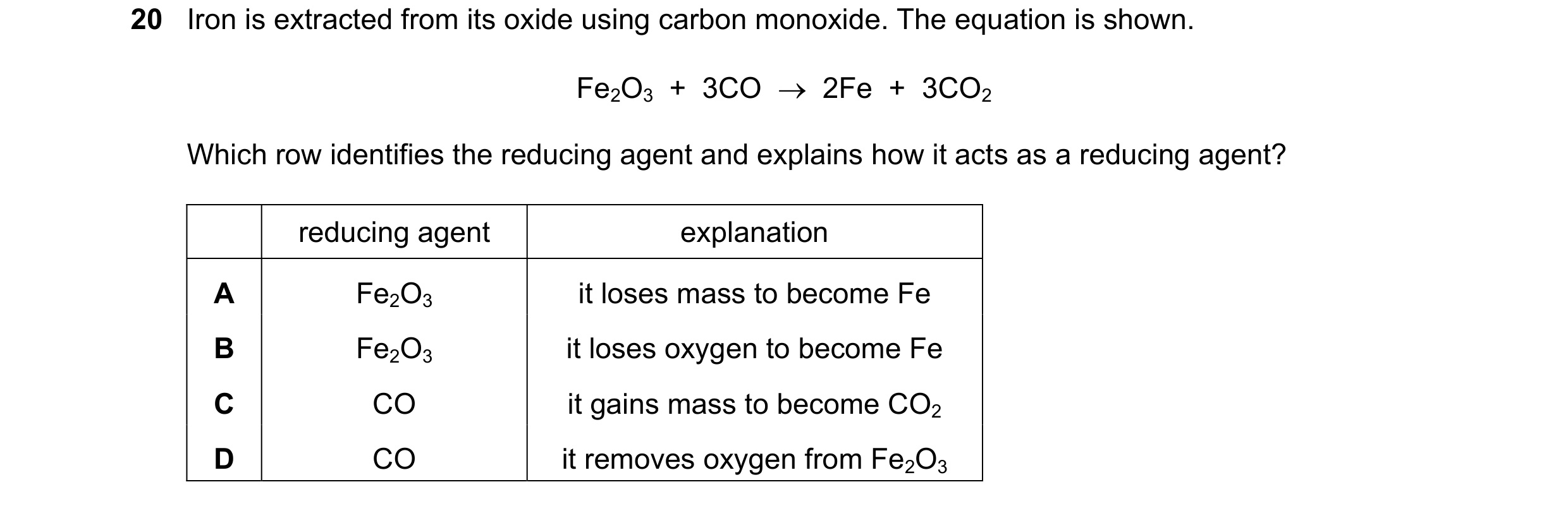
Q31 · Iron is extracted from its oxide using carbon monoxide 0653/23 May/June 2021
20 Iron is extracted from its oxide using carbon monoxide. The equation is shown. Fe2O3 + 3CO 2Fe + 3CO2 Which row identifies the reducing agent and explains how it acts as a reducing agent? reducing agent explanation A Fe2O3 it loses mass to become Fe B Fe2O3 it loses oxygen to become Fe C CO it gains mass to become CO2 D CO it removes oxygen from Fe2O3
1 marks
Answer: D
This question in 0653/23 May/June 2021
Q32 · Aqueous chlorine is added to aqueous sodium bromide 0653/23 May/June 2021
23 Aqueous chlorine is added to aqueous sodium bromide. aqueous chlorine aqueous sodium bromide Which statement about the reaction is correct? A The solution turns orange because bromine is formed. B The solution turns orange because bromide ions are reduced. C The solution remains colourless because bromine is less reactive than chlorine. D The solution remains colourless because chlorine is reduced.
1 marks
Answer: A
This question in 0653/23 May/June 2021
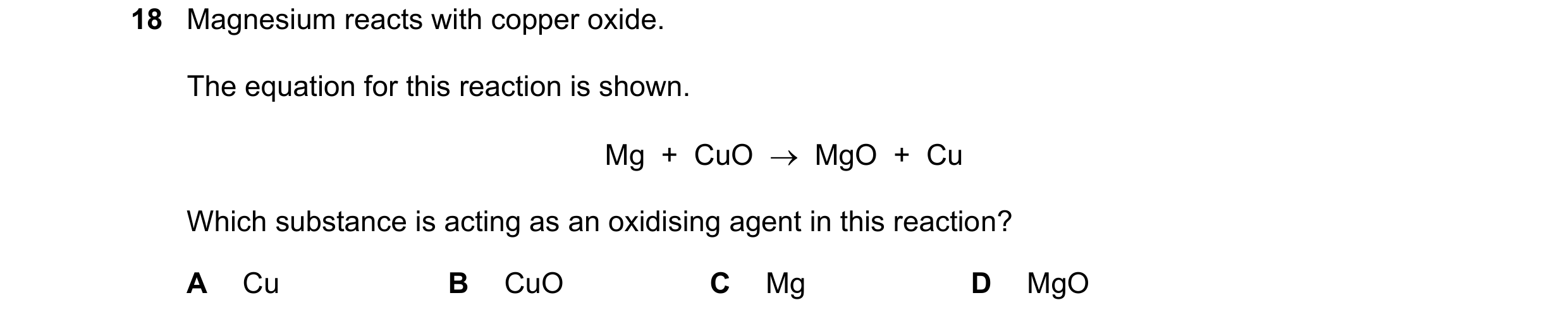
Q33 · Magnesium reacts with copper oxide 0653/21 Oct/Nov 2021
18 Magnesium reacts with copper oxide. The equation for this reaction is shown. Mg + CuO MgO + Cu Which substance is acting as an oxidising agent in this reaction? A Cu B CuO C Mg D MgO
1 marks
Answer: B
This question in 0653/21 Oct/Nov 2021
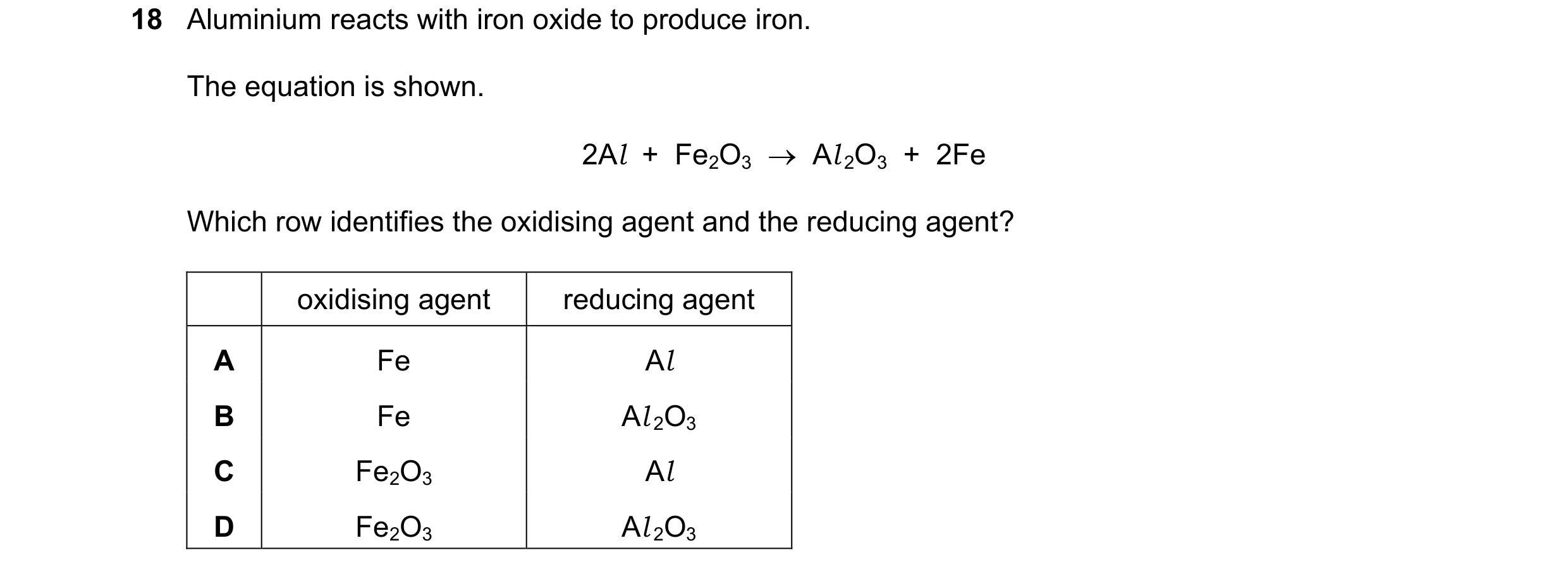
Q34 · Aluminium reacts with iron oxide to produce iron 0653/22 Oct/Nov 2021
18 Aluminium reacts with iron oxide to produce iron. The equation is shown. 2Al + Fe2O3 Al 2O3 + 2Fe Which row identifies the oxidising agent and the reducing agent? oxidising agent reducing agent A Fe Al B Fe Al 2O3 C Fe2O3 Al D Fe2O3 Al 2O3
1 marks
Answer: C
This question in 0653/22 Oct/Nov 2021
Q35 · Iron oxide reacts with aluminium 0653/23 Oct/Nov 2021
18 Iron oxide reacts with aluminium. Fe2O3 + 2Al 2Fe + Al 2O3 Which row identifies the oxidising agent and reducing agent in the reaction? oxidising agent reducing agent A aluminium oxide aluminium B aluminium oxide iron C iron(III) oxide aluminium D iron(III) oxide iron
1 marks
Answer: C
This question in 0653/23 Oct/Nov 2021
Q36 · In which equation is the underlined substance acting as an oxidising agent? 0653/21 May/June 2022
18 In which equation is the underlined substance acting as an oxidising agent? A CaCO3 + 2HCl CaCl 2 + CO2 + H2O B Fe2O3 + 3CO 2Fe + 3CO2 C 2Mg + O2 2MgO D ZnO + C Zn + CO
1 marks
Answer: D
This question in 0653/21 May/June 2022
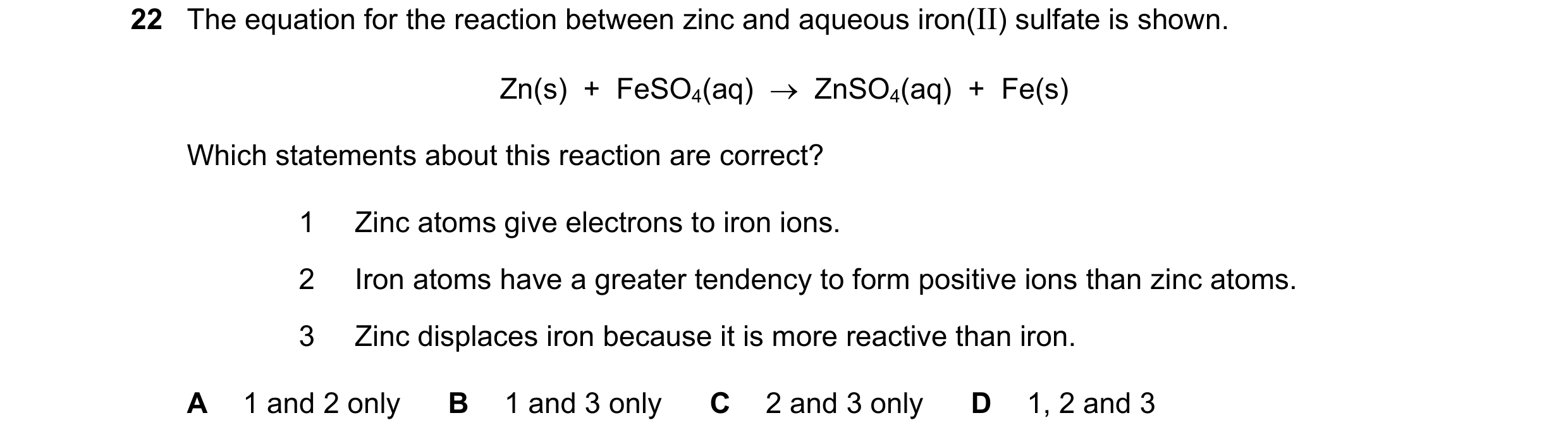
Q37 · The equation for the reaction between zinc and aqueous iron(II) sulfate is shown 0653/21 May/June 2022
22 The equation for the reaction between zinc and aqueous iron(II) sulfate is shown. Zn(s) + FeSO4(aq) ZnSO4(aq) + Fe(s) Which statements about this reaction are correct? 1 Zinc atoms give electrons to iron ions. 2 Iron atoms have a greater tendency to form positive ions than zinc atoms. 3 Zinc displaces iron because it is more reactive than iron. A 1 and 2 only B 1 and 3 only C 2 and 3 only D 1, 2 and 3
1 marks
Answer: B
This question in 0653/21 May/June 2022
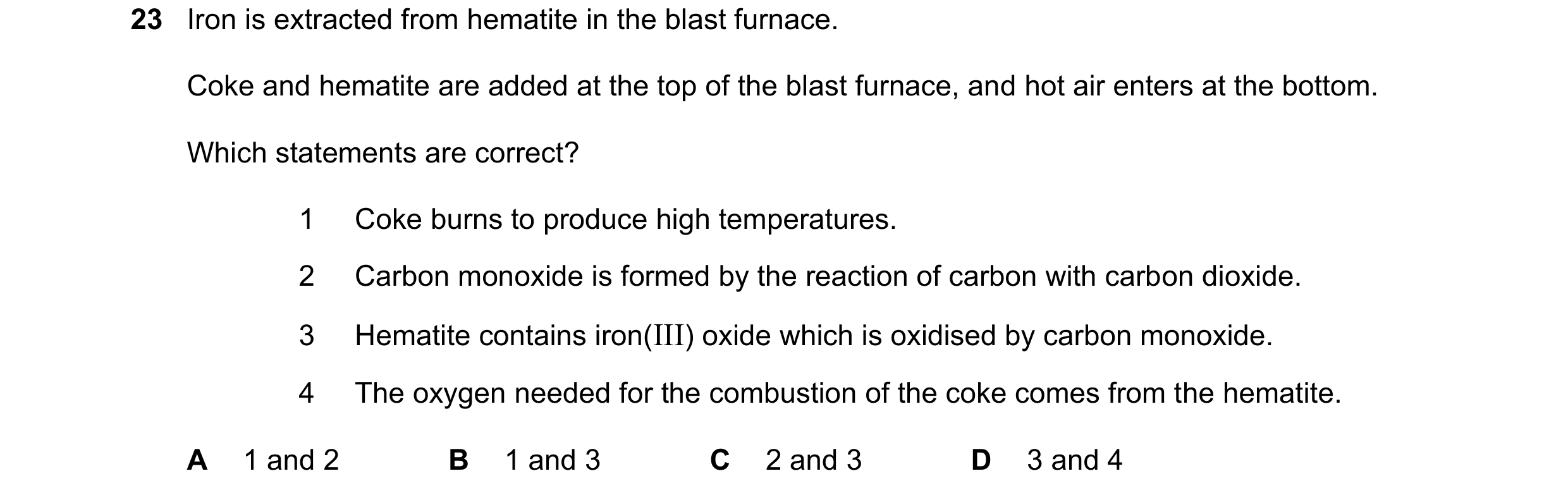
Q38 · Iron is extracted from hematite in the blast furnace 0653/21 May/June 2022
23 Iron is extracted from hematite in the blast furnace. Coke and hematite are added at the top of the blast furnace, and hot air enters at the bottom. Which statements are correct? 1 Coke burns to produce high temperatures. 2 Carbon monoxide is formed by the reaction of carbon with carbon dioxide. 3 Hematite contains iron(III) oxide which is oxidised by carbon monoxide. 4 The oxygen needed for the combustion of the coke comes from the hematite. A 1 and 2 B 1 and 3 C 2 and 3 D 3 and 4
1 marks
Answer: A
This question in 0653/21 May/June 2022
Q39 · The equation for a reaction that occurs in the blast furnace is shown 0653/23 May/June 2022
18 The equation for a reaction that occurs in the blast furnace is shown. Fe2O3 + 3CO 2Fe + 3CO2 Which statement about the reaction is correct? A Fe2O3 is the oxidising agent. B CO2 is the reducing agent. C CO is reduced. D Fe2O3 is oxidised.
1 marks
Answer: A
This question in 0653/23 May/June 2022
Q40 · Which statement about reactions in the blast furnace is not correct? 0653/21 Oct/Nov 2022
23 Which statement about reactions in the blast furnace is not correct? A Carbon is oxidised by oxygen. B Carbon is oxidised by carbon dioxide. C Carbon dioxide is reduced by iron oxide. D Iron oxide is reduced by carbon monoxide.
1 marks
Answer: C
This question in 0653/21 Oct/Nov 2022
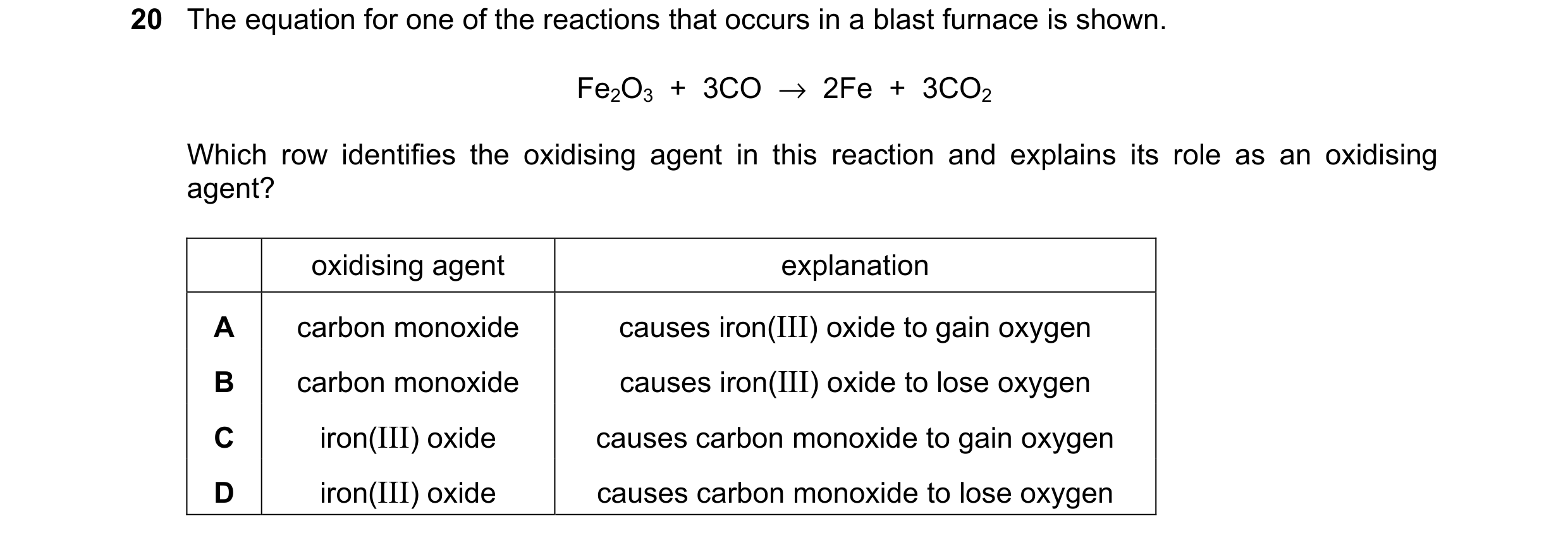
Q41 · The equation for one of the reactions that occurs in a blast furnace is shown 0653/22 Feb/March 2023
20 The equation for one of the reactions that occurs in a blast furnace is shown. Fe2O3 + 3CO → 2Fe + 3CO2 Which row identifies the oxidising agent in this reaction and explains its role as an oxidising agent? oxidising agent explanation A carbon monoxide causes iron(III) oxide to gain oxygen B carbon monoxide causes iron(III) oxide to lose oxygen C iron(III) oxide causes carbon monoxide to gain oxygen D iron(III) oxide causes carbon monoxide to lose oxygen
1 marks
Answer: C
This question in 0653/22 Feb/March 2023
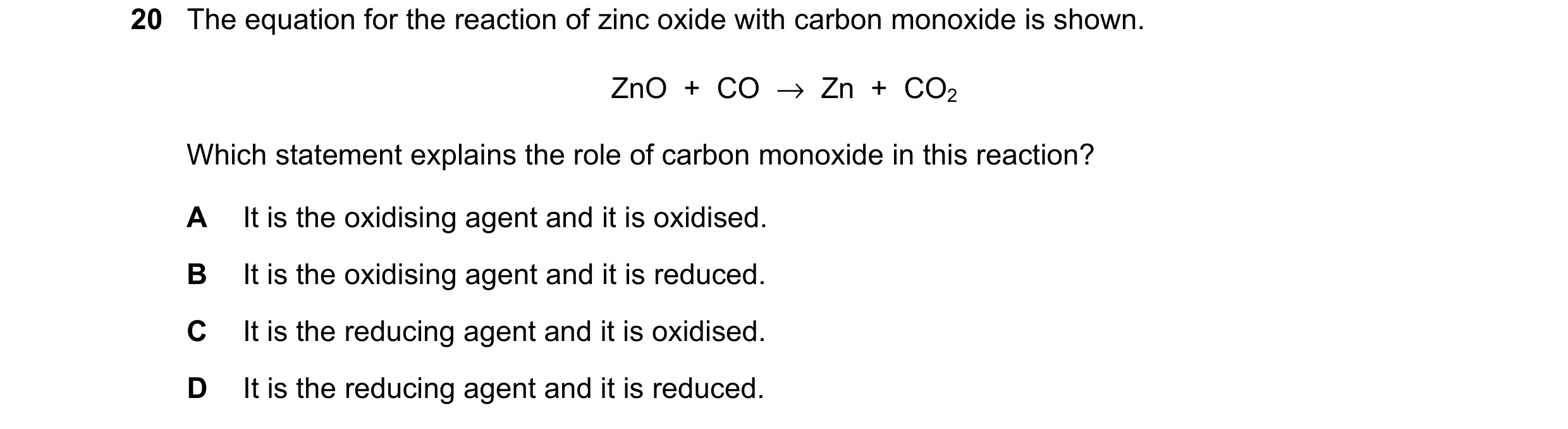
Q42 · The equation for the reaction of zinc oxide with carbon monoxide is shown 0653/21 May/June 2023
20 The equation for the reaction of zinc oxide with carbon monoxide is shown. ZnO + CO → Zn + CO2 Which statement explains the role of carbon monoxide in this reaction? A It is the oxidising agent and it is oxidised. B It is the oxidising agent and it is reduced. C It is the reducing agent and it is oxidised. D It is the reducing agent and it is reduced.
1 marks
Answer: C
This question in 0653/21 May/June 2023
Q43 · Copper oxide and excess carbon are mixed together 0653/21 May/June 2023
24 Copper oxide and excess carbon are mixed together. The mass before heating is 12.2 g. The mixture is heated strongly and allowed to cool. The mass after heating is 10.4 g. Why does the mass change? A Carbon forms carbon dioxide which then combines with the copper oxide. B Carbon reduces the copper oxide and leaves the test-tube as carbon dioxide. C Copper oxide loses oxygen, turns into copper and the carbon remains unchanged. D Carbon oxidises the copper oxide and leaves the test-tube as carbon dioxide.
1 marks
Answer: B
This question in 0653/21 May/June 2023
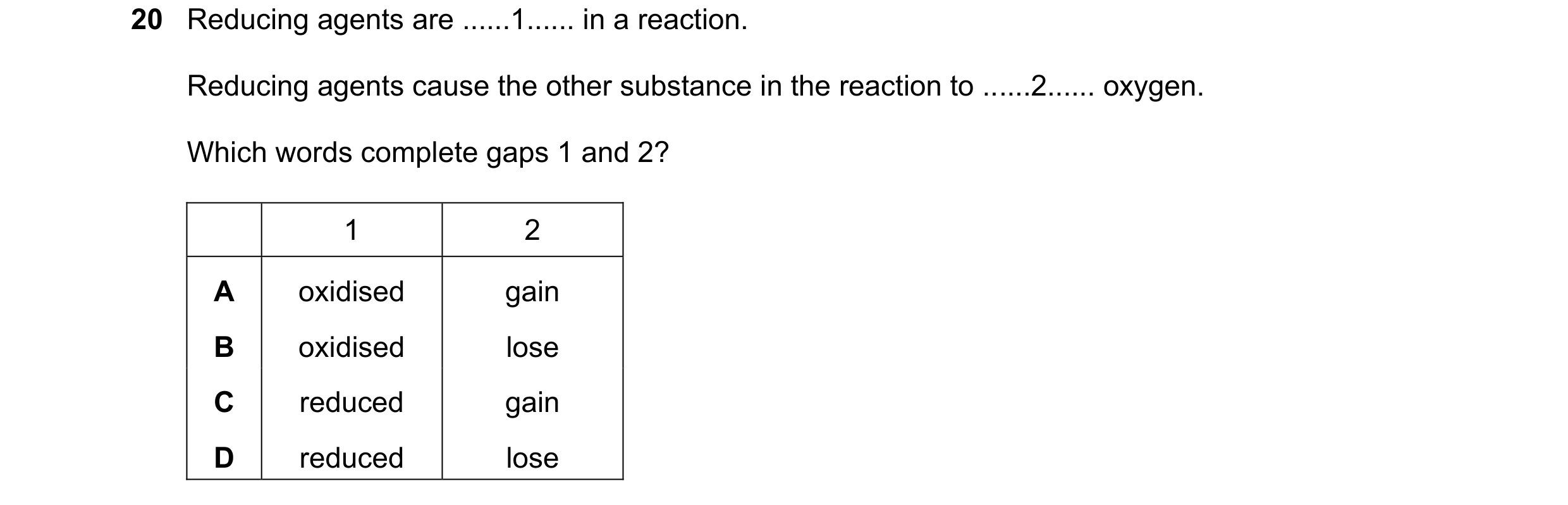
Q44 · Reducing agents are … 1 … in a reaction 0653/22 May/June 2023
20 Reducing agents are … 1 … in a reaction. Reducing agents cause the other substance in the reaction to … 2 … oxygen. Which words complete gaps 1 and 2? 1 2 A oxidised gain B oxidised lose C reduced gain D reduced lose
1 marks
Answer: B
This question in 0653/22 May/June 2023
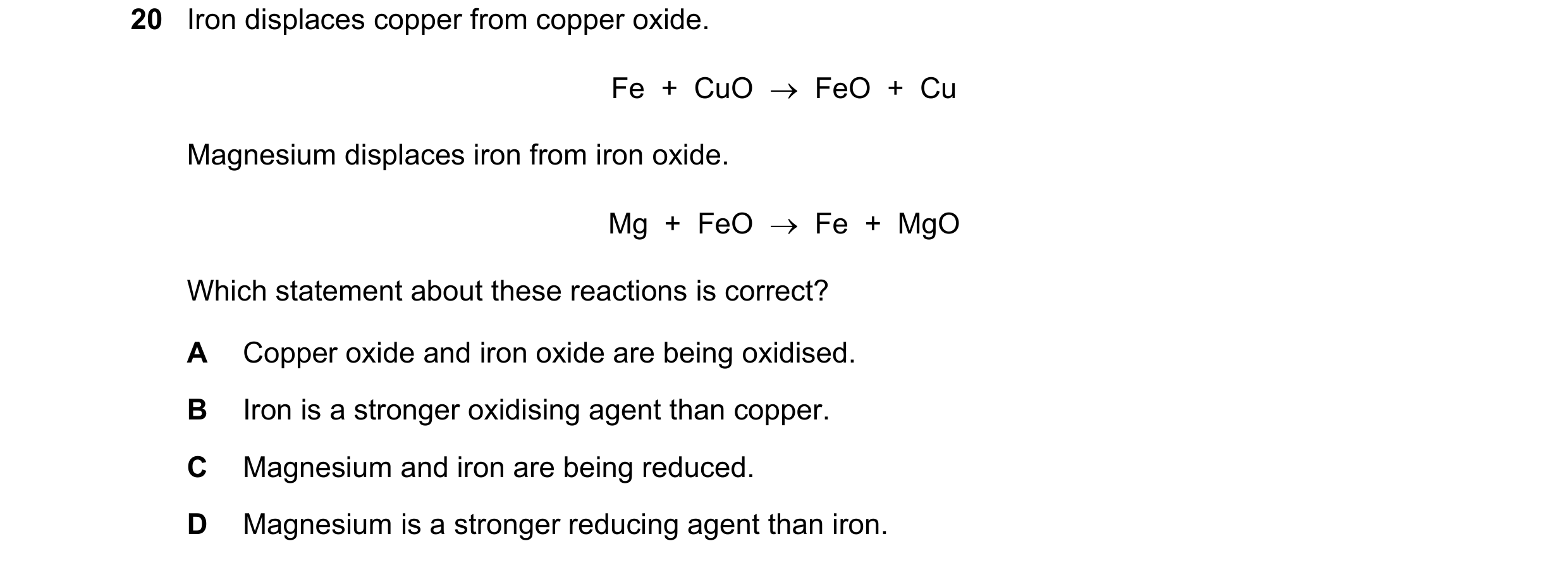
Q45 · Iron displaces copper from copper oxide 0653/23 May/June 2023
20 Iron displaces copper from copper oxide. Fe + CuO FeO + Cu Magnesium displaces iron from iron oxide. Mg + FeO Fe + MgO Which statement about these reactions is correct? A Copper oxide and iron oxide are being oxidised. B Iron is a stronger oxidising agent than copper. C Magnesium and iron are being reduced. D Magnesium is a stronger reducing agent than iron.
1 marks
Answer: D
This question in 0653/23 May/June 2023
Q46 · Copper oxide is heated with carbon as shown 0653/23 May/June 2023
24 Copper oxide is heated with carbon as shown. copper oxide and carbon crucible tripod Bunsen burner Which statement about this experiment is correct? A A pink-brown solid is formed. B Carbon is placed underneath the copper oxide so that the air can react with the hot copper oxide. C Carbon reacts with the air to form carbon dioxide which then reacts with the copper oxide. D Copper is more reactive than carbon.
1 marks
Answer: A
This question in 0653/23 May/June 2023
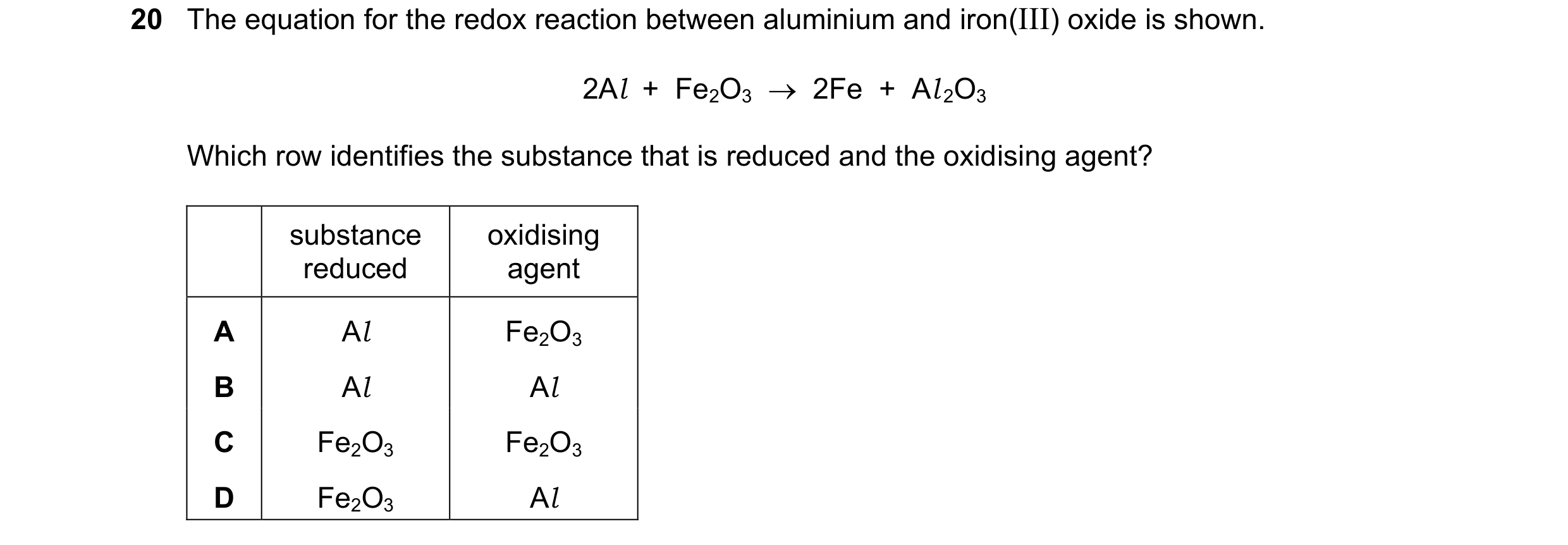
Q47 · The equation for the redox reaction between aluminium and iron(III) oxide is shown 0653/21 Oct/Nov 2023
20 The equation for the redox reaction between aluminium and iron(III) oxide is shown. 2Al + Fe2O3 2Fe + Al 2O3 Which row identifies the substance that is reduced and the oxidising agent? substance oxidising reduced agent A Al Fe2O3 B Al Al C Fe2O3 Fe2O3 D Fe2O3 Al
1 marks
Answer: C
This question in 0653/21 Oct/Nov 2023
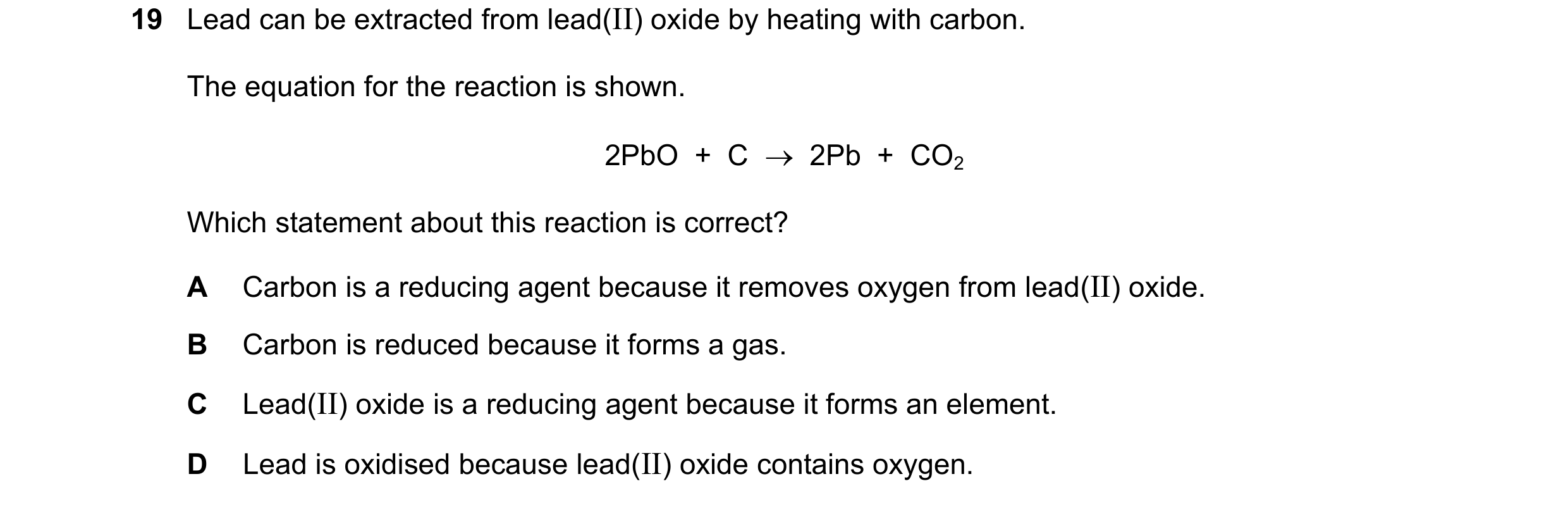
Q48 · Lead can be extracted from lead(II) oxide by heating with carbon 0653/22 Oct/Nov 2023
19 Lead can be extracted from lead(II) oxide by heating with carbon. The equation for the reaction is shown. 2PbO + C 2Pb + CO2 Which statement about this reaction is correct? A Carbon is a reducing agent because it removes oxygen from lead(II) oxide. B Carbon is reduced because it forms a gas. C Lead(II) oxide is a reducing agent because it forms an element. D Lead is oxidised because lead(II) oxide contains oxygen.
1 marks
Answer: A
This question in 0653/22 Oct/Nov 2023
Q49 · The equation for the reaction between aqueous potassium iodide and aqueous bromine is… 0653/22 Oct/Nov 2023
23 The equation for the reaction between aqueous potassium iodide and aqueous bromine is shown. 2KI + Br2 2KBr + I2 Which statement about this reaction is correct? A Bromine acts as a reducing agent. B Bromine molecules change to bromine atoms in the reaction. C Iodine is displaced from its salt because it is less reactive than bromine. D The mixture becomes colourless as the reaction proceeds.
1 marks
Answer: C
This question in 0653/22 Oct/Nov 2023
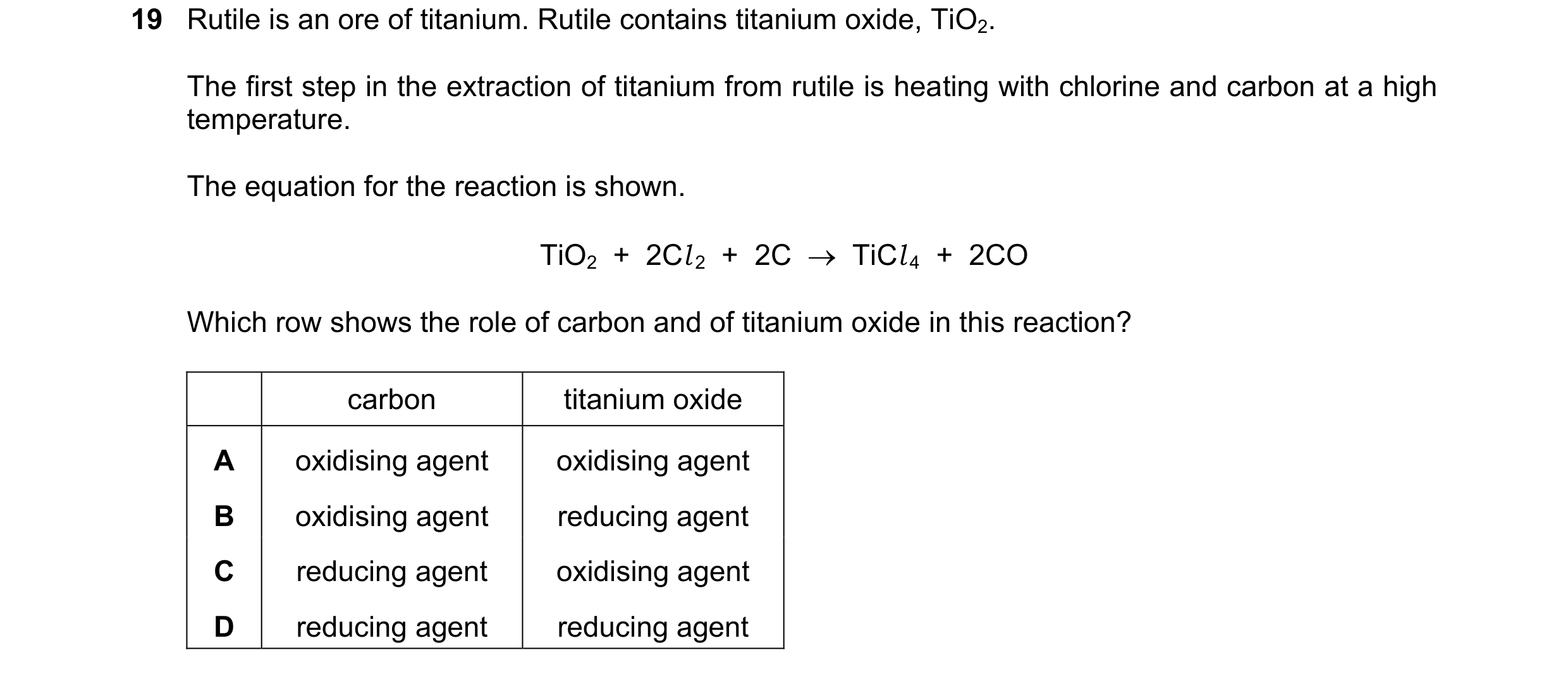
Q50 · Rutile is an ore of titanium 0653/23 Oct/Nov 2023
19 Rutile is an ore of titanium. Rutile contains titanium oxide, TiO2. The first step in the extraction of titanium from rutile is heating with chlorine and carbon at a high temperature. The equation for the reaction is shown. TiO2 + 2Cl 2 + 2C TiCl 4 + 2CO Which row shows the role of carbon and of titanium oxide in this reaction? carbon titanium oxide A oxidising agent oxidising agent B oxidising agent reducing agent C reducing agent oxidising agent D reducing agent reducing agent
1 marks
Answer: C
This question in 0653/23 Oct/Nov 2023
Q51 · The equations show reactions that occur in the extraction of copper and of iron 0653/23 Oct/Nov 2023
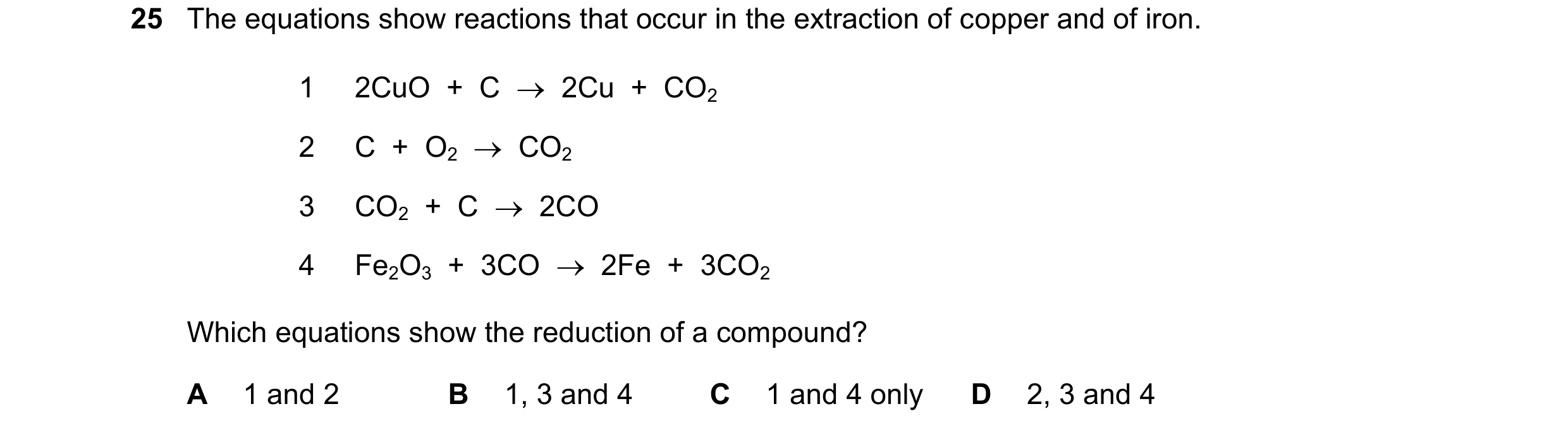
25 The equations show reactions that occur in the extraction of copper and of iron. 1 2CuO + C 2Cu + CO2 2 C + O2 CO2 3 CO2 + C 2CO 4 Fe2O3 + 3CO 2Fe + 3CO2 Which equations show the reduction of a compound? A 1 and 2 B 1, 3 and 4 C 1 and 4 only D 2, 3 and 4
1 marks
Answer: B
This question in 0653/23 Oct/Nov 2023
Q52 · The equation for the reaction between copper(II) oxide and hydrogen is shown 0653/22 Feb/March 2024
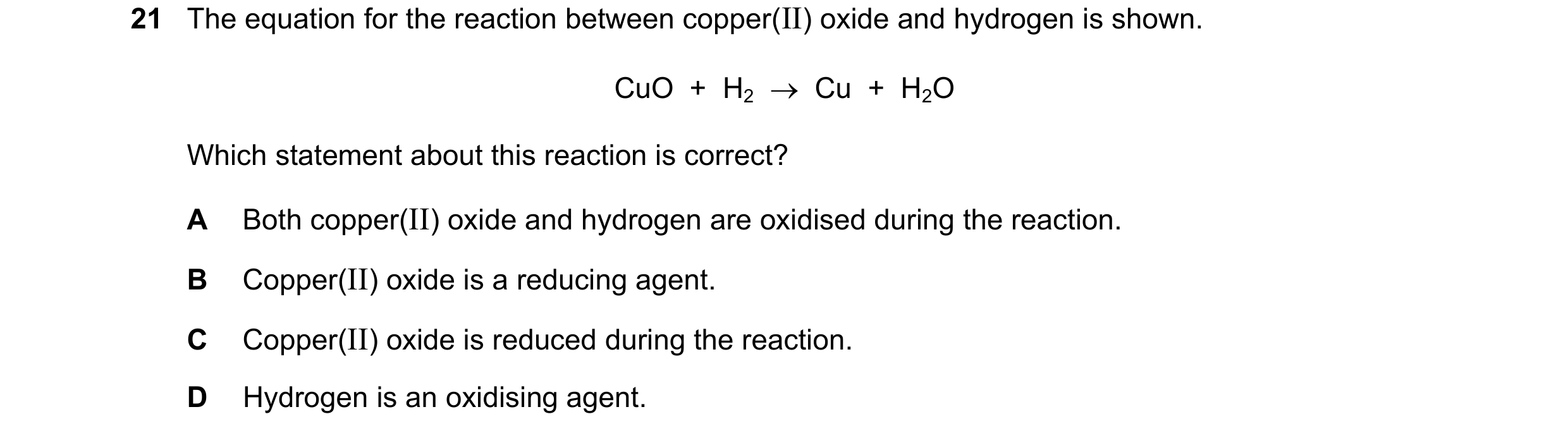
21 The equation for the reaction between copper(II) oxide and hydrogen is shown. CuO + H2 Cu + H2O Which statement about this reaction is correct? A Both copper(II) oxide and hydrogen are oxidised during the reaction. B Copper(II) oxide is a reducing agent. C Copper(II) oxide is reduced during the reaction. D Hydrogen is an oxidising agent.
1 marks
Answer: C
This question in 0653/22 Feb/March 2024
Q53 · Hydrogen reacts with oxygen to produce water as shown 0653/21 May/June 2024
19 Hydrogen reacts with oxygen to produce water as shown.
2H-H + O=O — 2H-O-H
The reaction causes the surroundings to heat up.
Which row identifies the type of reaction and explains why it is endothermic or exothermic?
type of reaction explanation
A endothermic the bonds formed are stronger than the bonds broken
B endothermic the bonds formed are weaker than the bonds broken
Cc exothermic the bonds formed are stronger than the bonds broken
D exothermic the bonds formed are weaker than the bonds broken
1 marks
Answer: C
This question in 0653/21 May/June 2024
Q54 · Iron is extracted from its ore in a blast furnace 0653/21 May/June 2024
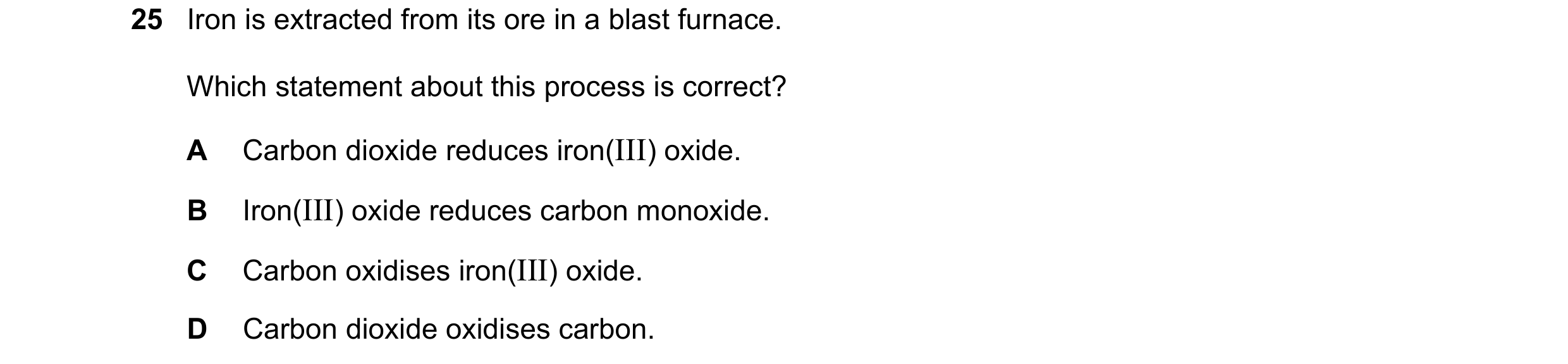
25 Iron is extracted from its ore in a blast furnace. Which statement about this process is correct? A Carbon dioxide reduces iron(III) oxide. B Iron(III) oxide reduces carbon monoxide. C Carbon oxidises iron(III) oxide. D Carbon dioxide oxidises carbon.
1 marks
Answer: D
This question in 0653/21 May/June 2024
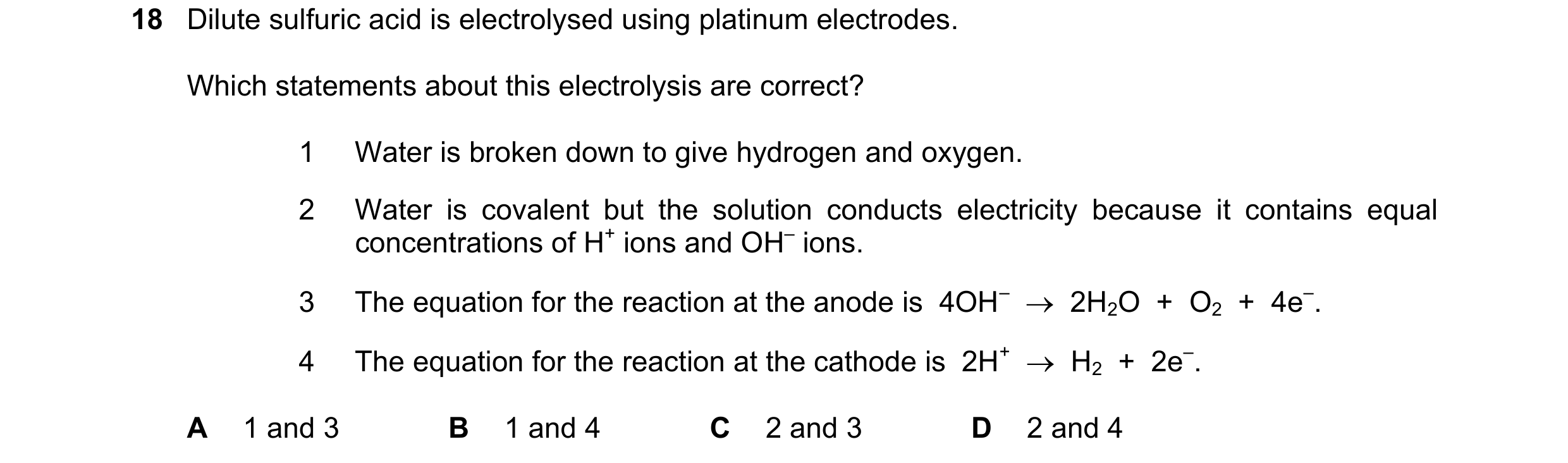
Q55 · Dilute sulfuric acid is electrolysed using platinum electrodes 0653/22 May/June 2024
18 Dilute sulfuric acid is electrolysed using platinum electrodes. Which statements about this electrolysis are correct? 1 Water is broken down to give hydrogen and oxygen. 2 Water is covalent but the solution conducts electricity because it contains equal concentrations of H+ ions and OH– ions. 3 The equation for the reaction at the anode is 4OH– 2H2O + O2 + 4e–. 4 The equation for the reaction at the cathode is 2H+ H2 + 2e–. A 1 and 3 B 1 and 4 C 2 and 3 D 2 and 4
1 marks
Answer: A
This question in 0653/22 May/June 2024
Q56 · Which equation represents a redox reaction? 0653/22 May/June 2024
21 Which equation represents a redox reaction? A AgNO3 + NaCl NaNO3 + AgCl B CaCO3 CaO + CO2 C CH4 + 2O2 CO2 + 2H2O D HCl + NaOH NaCl + H2O
1 marks
Answer: C
This question in 0653/22 May/June 2024
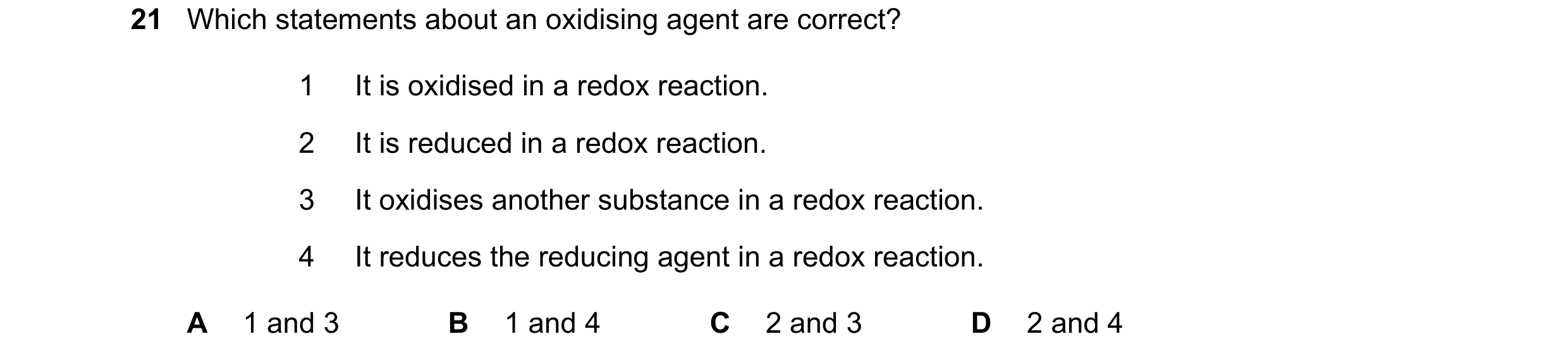
Q57 · Which statements about an oxidising agent are correct? 0653/23 Oct/Nov 2024
21 Which statements about an oxidising agent are correct? 1 It is oxidised in a redox reaction. 2 It is reduced in a redox reaction. 3 It oxidises another substance in a redox reaction. 4 It reduces the reducing agent in a redox reaction. A 1 and 3 B 1 and 4 C 2 and 3 D 2 and 4
1 marks
Answer: C
This question in 0653/23 Oct/Nov 2024
Q58 · Aqueous chlorine is added to colourless aqueous potassium bromide 0653/23 May/June 2025
21 Aqueous chlorine is added to colourless aqueous potassium bromide. aqueous chlorine aqueous potassium bromide Which row describes and explains the observation? observation explanation A white precipitate forms solution contains chloride ions B effervescence bromine gas forms C orange solution forms solution contains aqueous bromine D solution remains colourless there is no change
1 marks
Answer: C
This question in 0653/23 May/June 2025
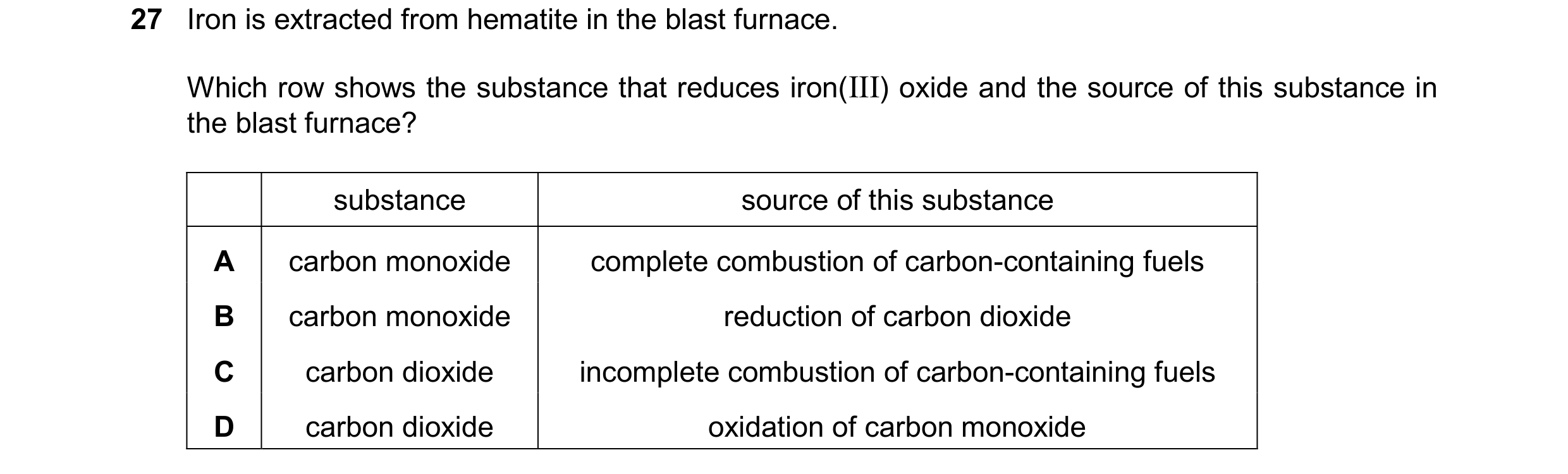
Q59 · Iron is extracted from hematite in the blast furnace 0653/23 May/June 2025
27 Iron is extracted from hematite in the blast furnace. Which row shows the substance that reduces iron(III) oxide and the source of this substance in the blast furnace? substance source of this substance A carbon monoxide complete combustion of carbon-containing fuels B carbon monoxide reduction of carbon dioxide C carbon dioxide incomplete combustion of carbon-containing fuels D carbon dioxide oxidation of carbon monoxide
1 marks
Answer: B
This question in 0653/23 May/June 2025
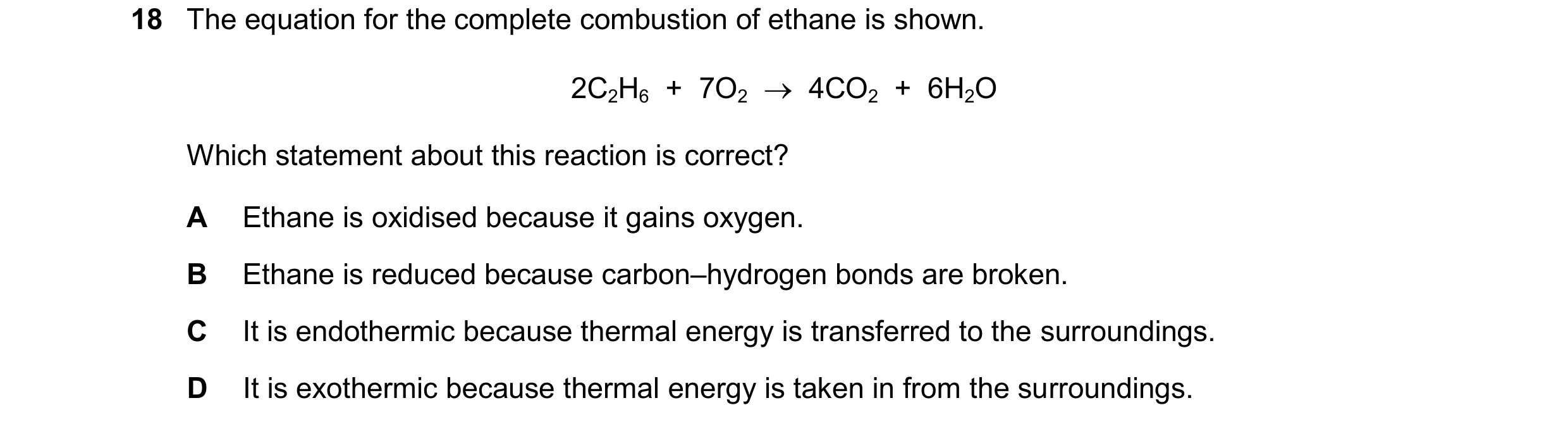
Q60 · The equation for the complete combustion of ethane is shown 0653/23 Oct/Nov 2025
18 The equation for the complete combustion of ethane is shown. 2C2H6 + 7O2 4CO2 + 6H2O Which statement about this reaction is correct? A Ethane is oxidised because it gains oxygen. B Ethane is reduced because carbon–hydrogen bonds are broken. C It is endothermic because thermal energy is transferred to the surroundings. D It is exothermic because thermal energy is taken in from the surroundings.
1 marks
Answer: A
This question in 0653/23 Oct/Nov 2025
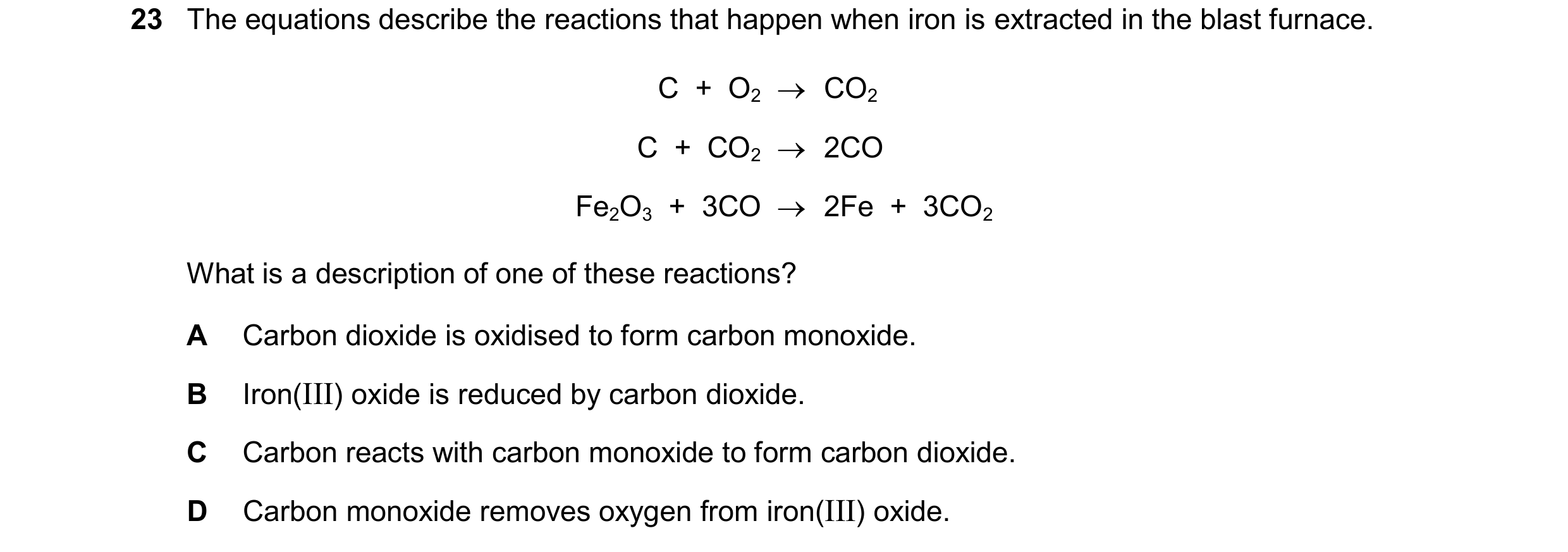
Q61 · The equations describe the reactions that happen when iron is extracted in the blast… 0653/23 Oct/Nov 2025
23 The equations describe the reactions that happen when iron is extracted in the blast furnace. C + O2 CO2 C + CO2 2CO Fe2O3 + 3CO 2Fe + 3CO2 What is a description of one of these reactions? A Carbon dioxide is oxidised to form carbon monoxide. B Iron(III) oxide is reduced by carbon dioxide. C Carbon reacts with carbon monoxide to form carbon dioxide. D Carbon monoxide removes oxygen from iron(III) oxide.
1 marks
Answer: D
This question in 0653/23 Oct/Nov 2025


 1 / 16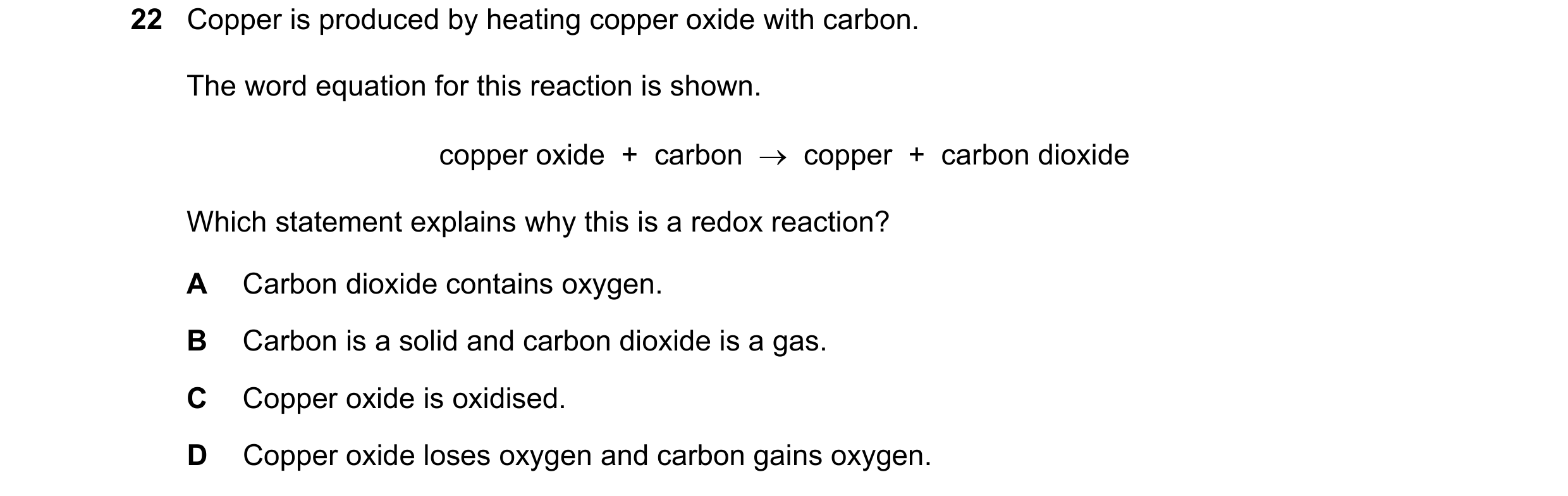
 2 / 16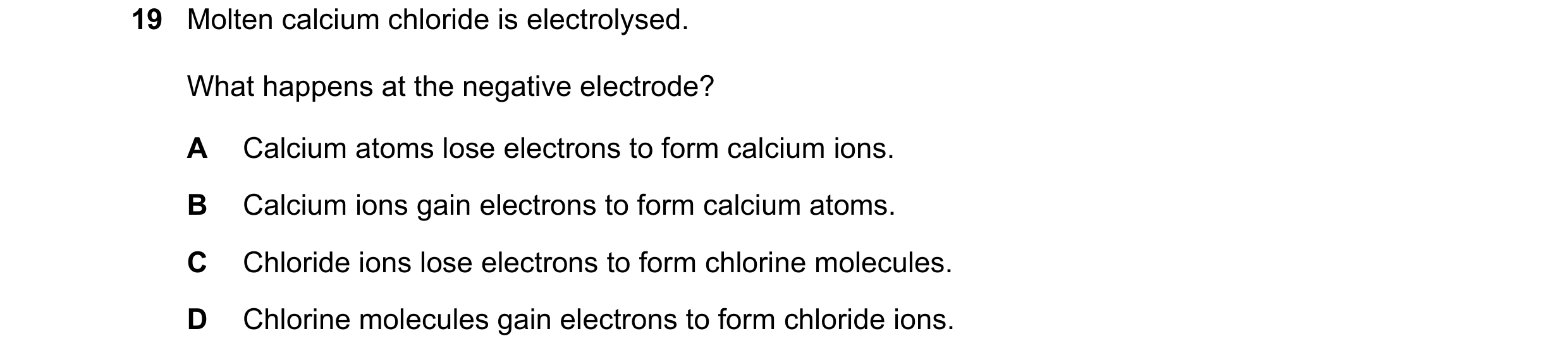

 3 / 16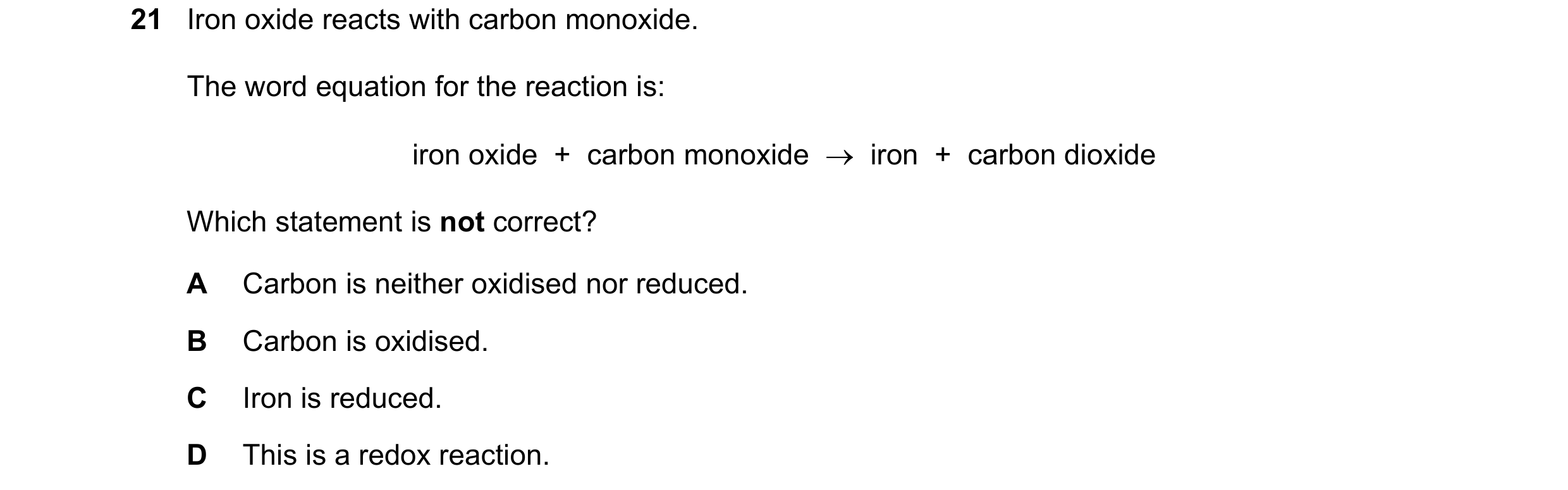
 4 / 16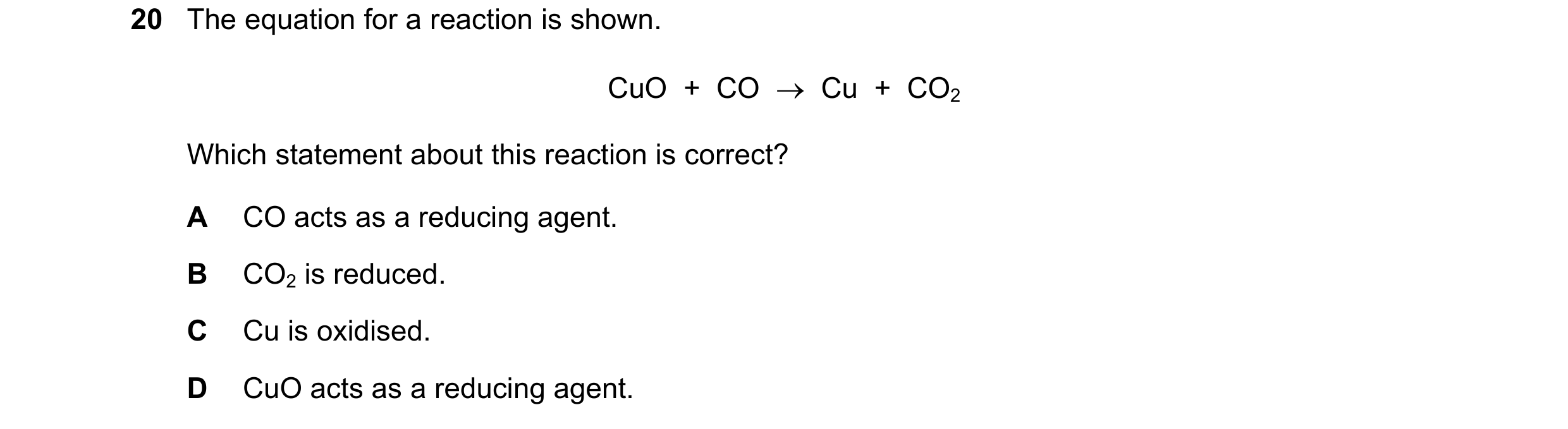


 5 / 16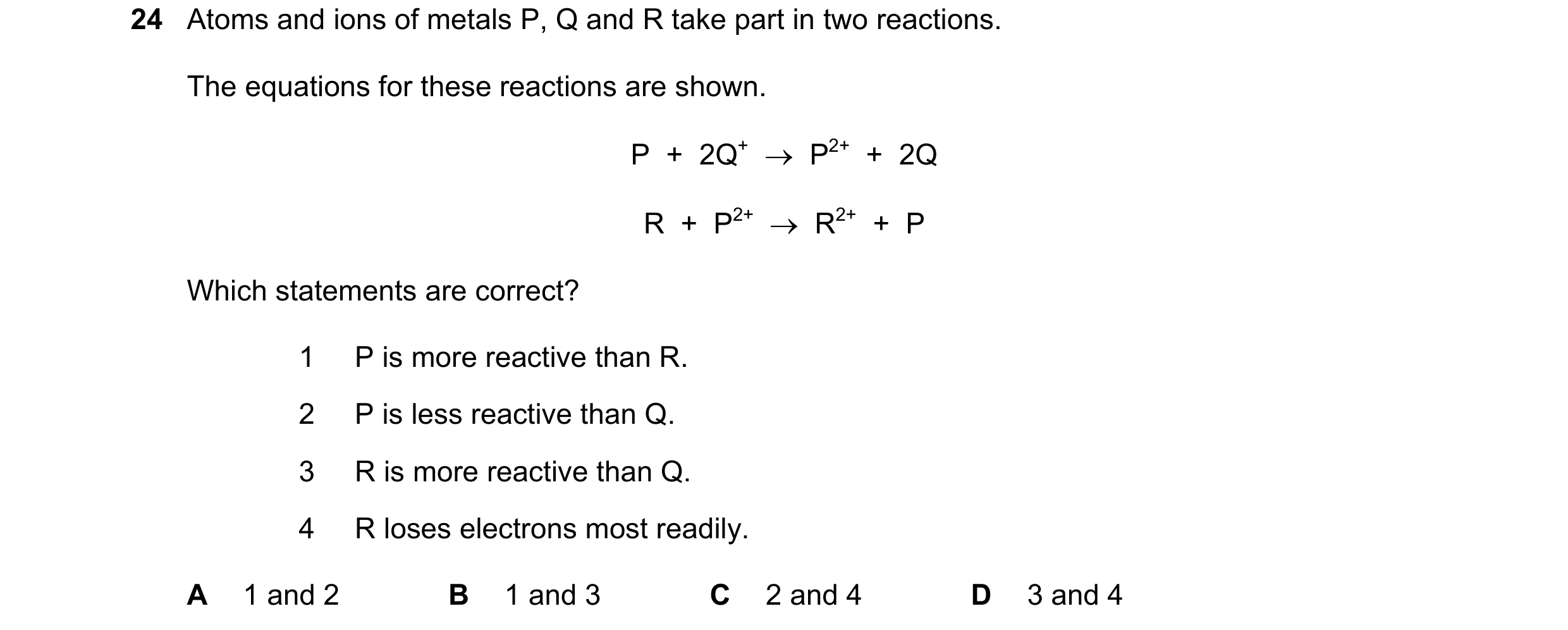

 6 / 16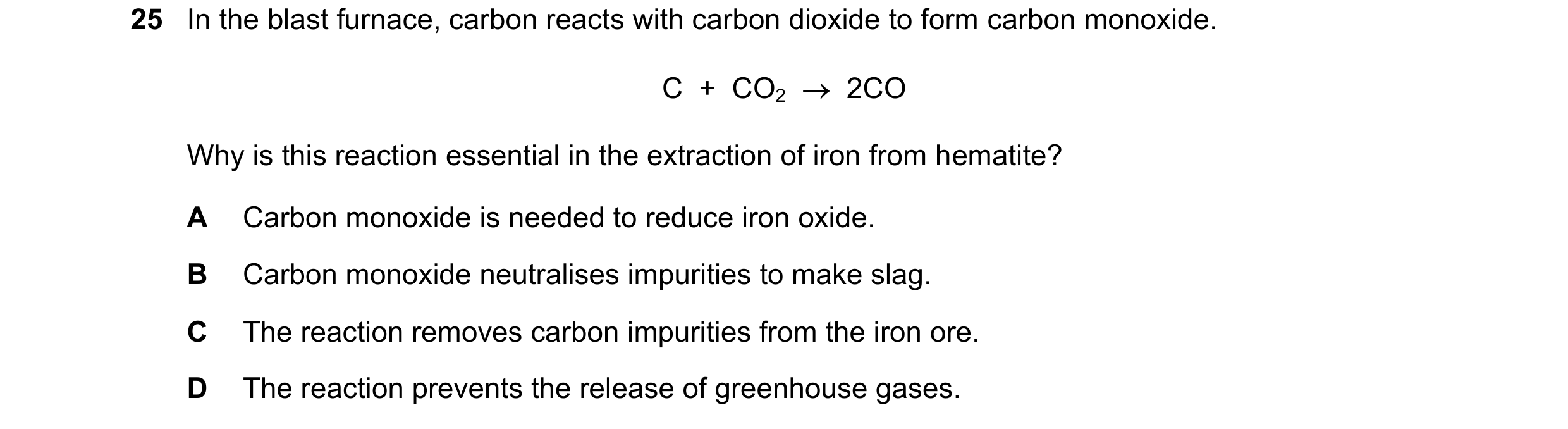
 7 / 16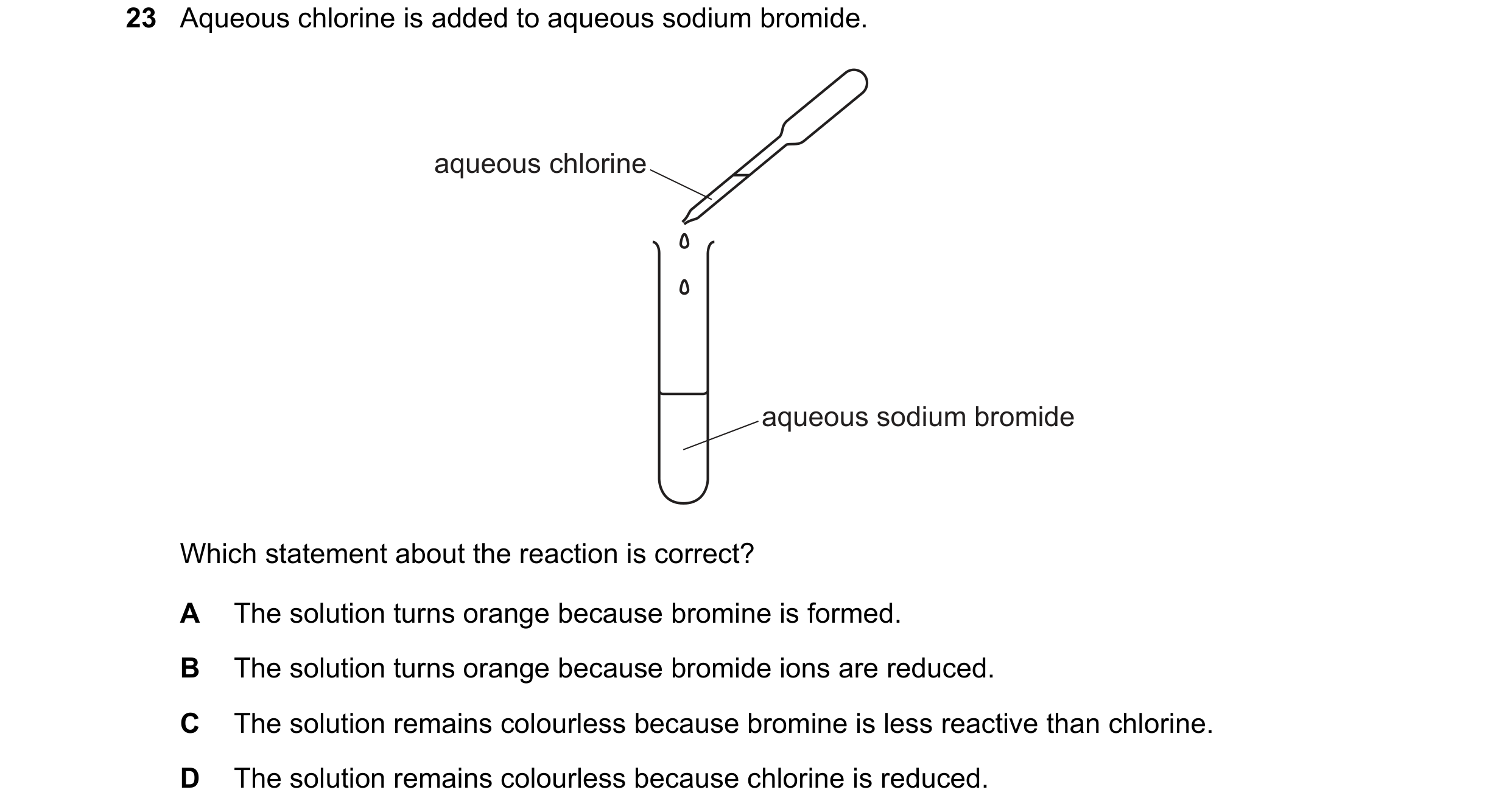
 8 / 16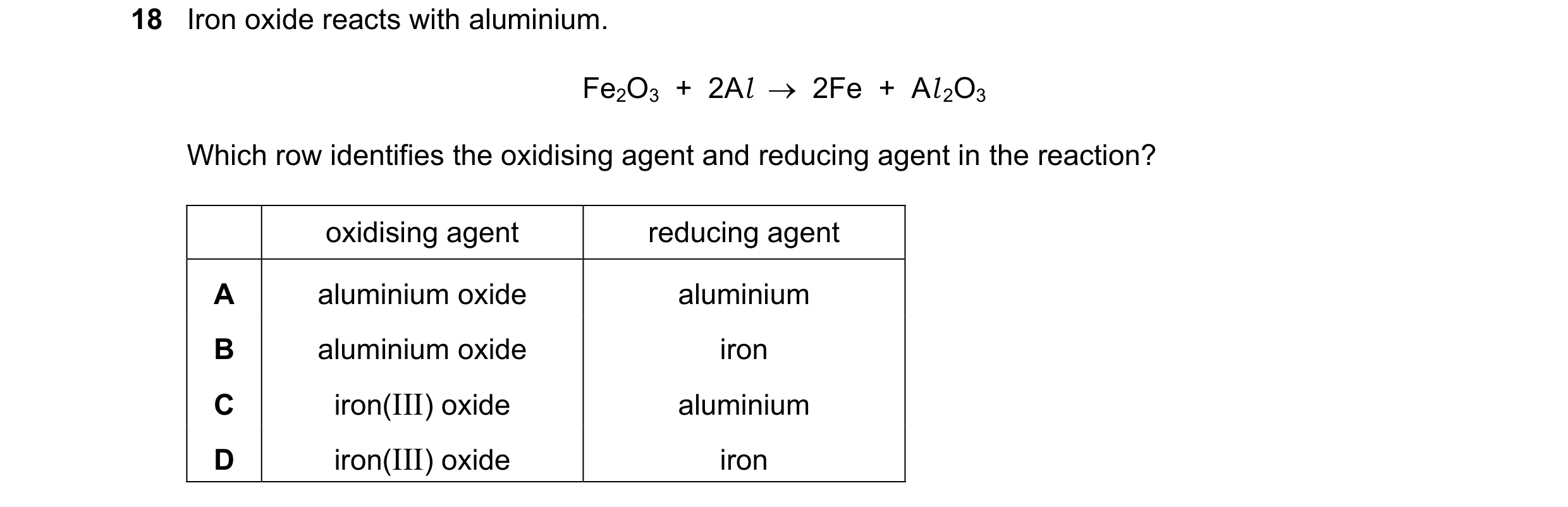

 9 / 16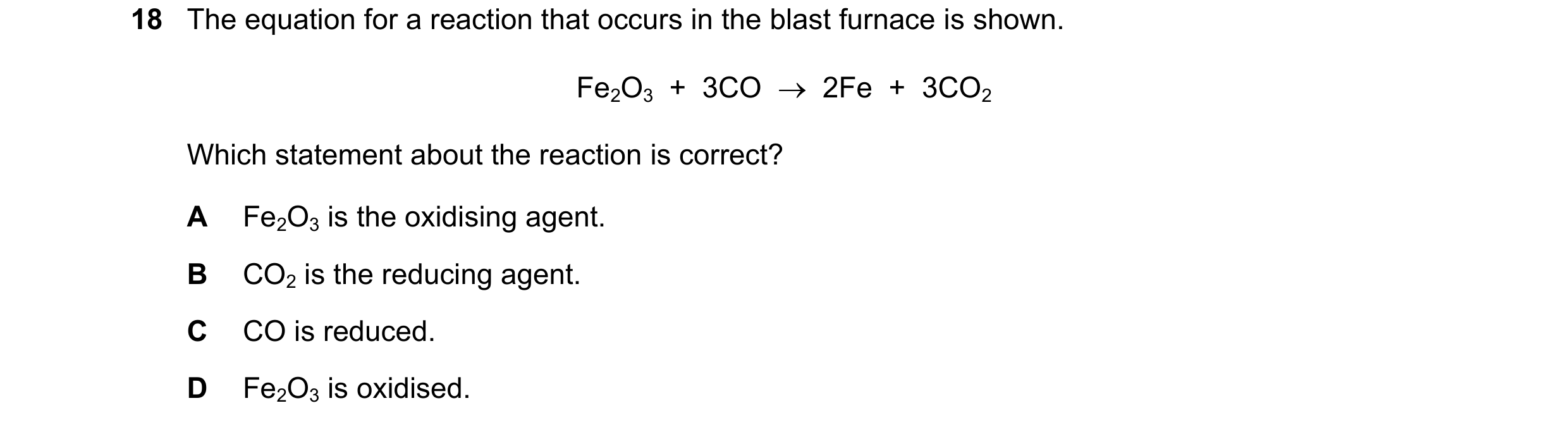

 10 / 16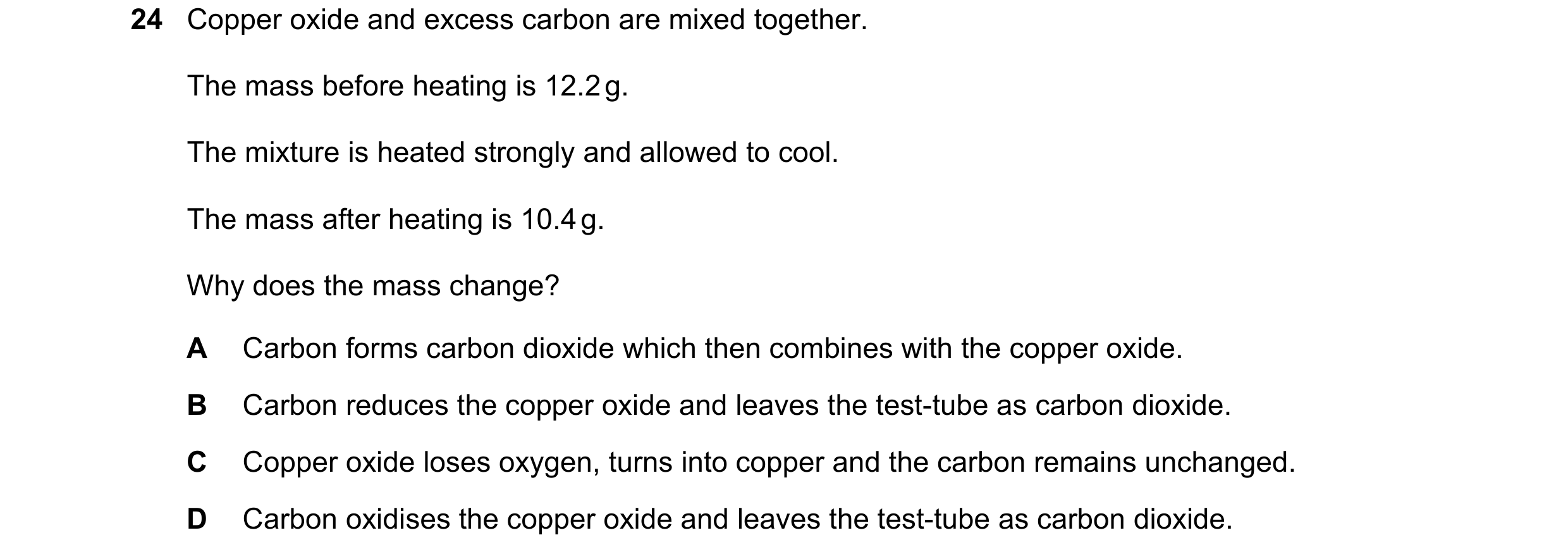
 11 / 16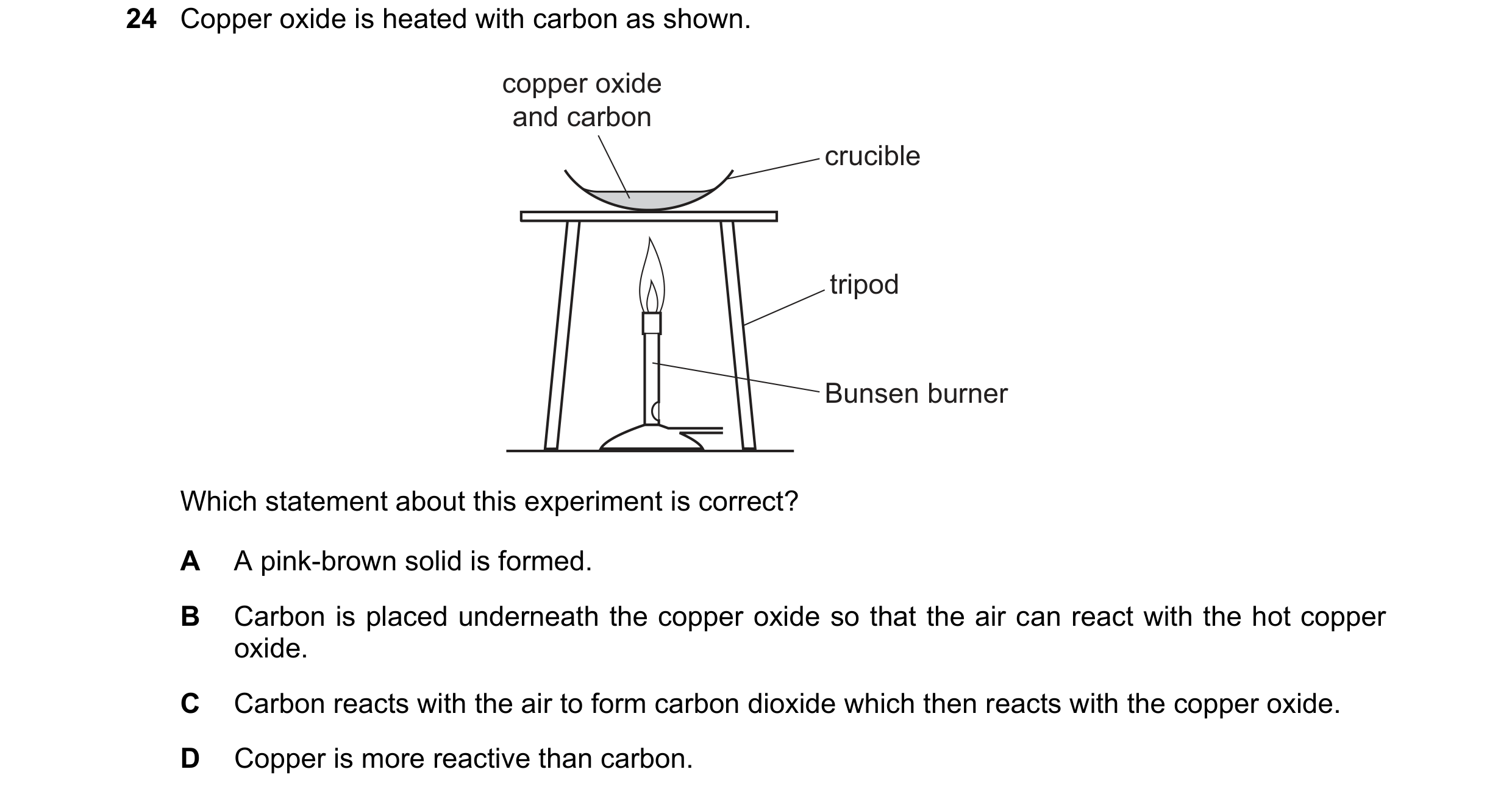
 12 / 16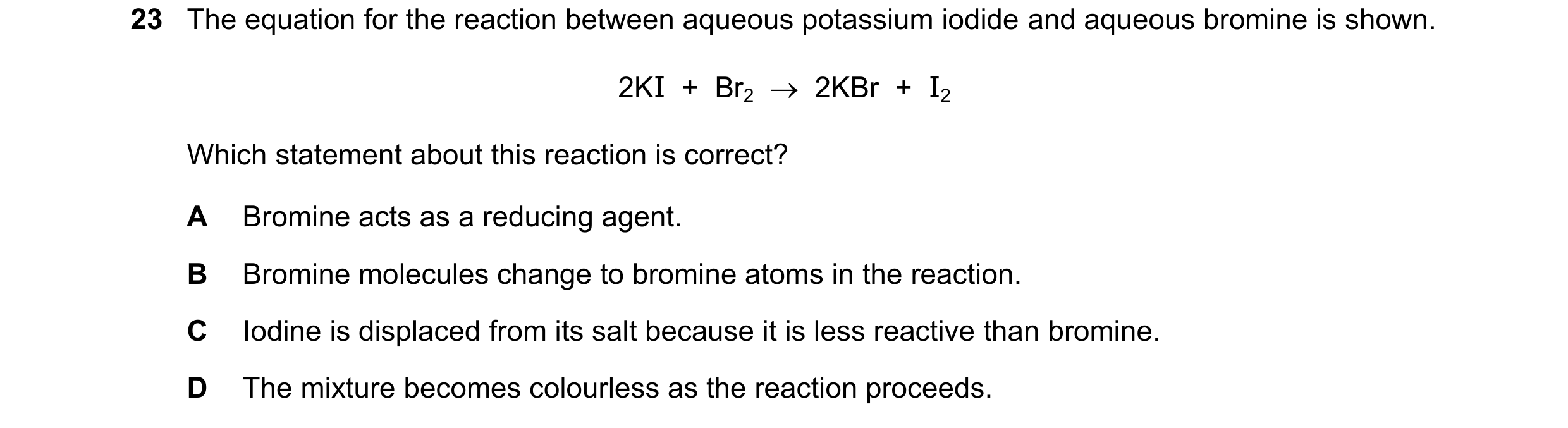
 13 / 16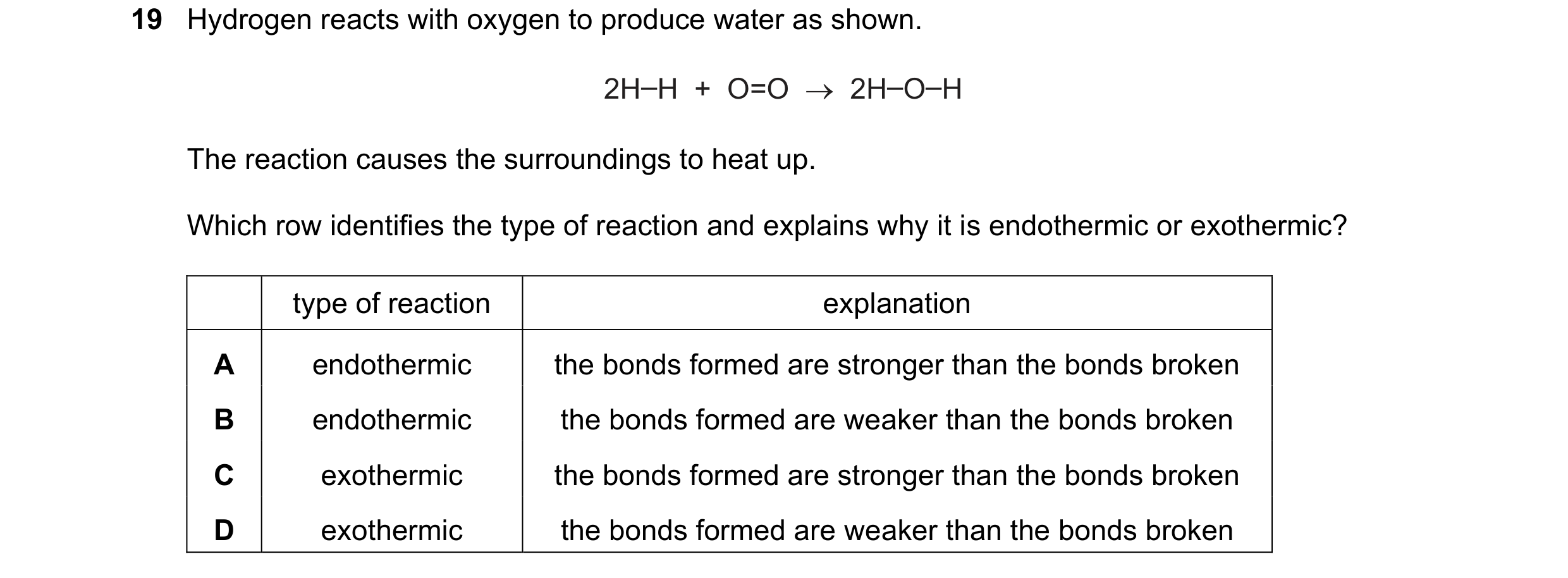

 14 / 16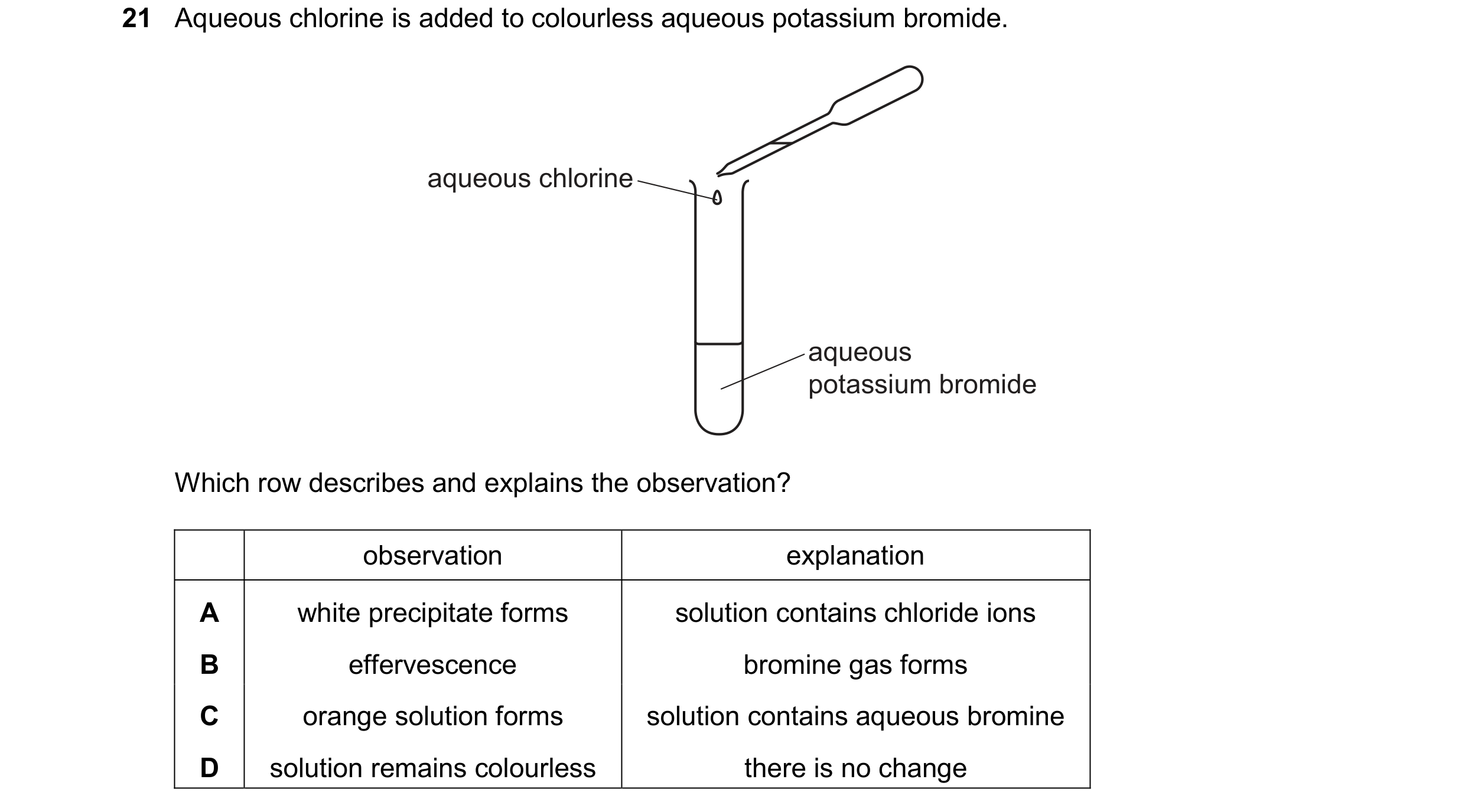
 15 / 16
 16 / 16