Questions as text
Q1 · Molten lead(II) bromide is broken down into simpler substances using the apparatus shown… 0653/33 Oct/Nov 2017
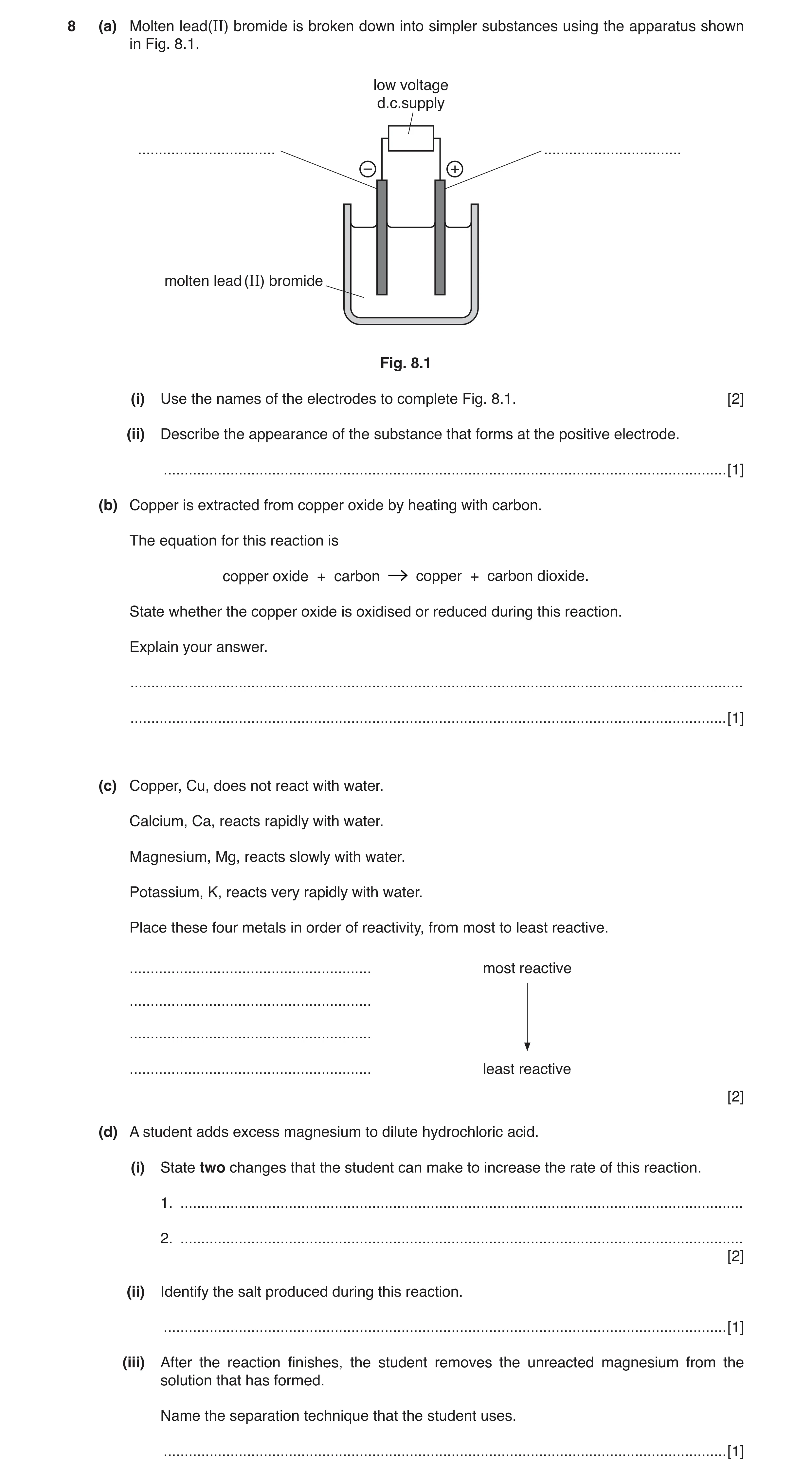
8 (a) Molten lead(II) bromide is broken down into simpler substances using the apparatus shown in Fig. 8.1. low voltage d.c.supply … … – + molten lead (II) bromide Fig. 8.1 (i) Use the names of the electrodes to complete Fig. 8.1. [2] (ii) Describe the appearance of the substance that forms at the positive electrode. … [1] (b) Copper is extracted from copper oxide by heating with carbon. The equation for this reaction is copper oxide + carbon copper + carbon dioxide. State whether the copper oxide is oxidised or reduced during this reaction. Explain your answer. … … [1] (c) Copper, Cu, does not react with water. Calcium, Ca, reacts rapidly with water. Magnesium, Mg, reacts slowly with water. Potassium, K, reacts very rapidly with water. Place these four metals in order of reactivity, from most to least reactive. … most reactive … … … least reactive [2] (d) A student adds excess magnesium to dilute hydrochloric acid. (i) State two changes that the student can make to increase the rate of this reaction. 1. … 2. … [2] (ii) Identify the salt produced during this reaction. … [1] (iii) After the reaction finishes, the student removes the unreacted magnesium from the solution that has formed. Name the separation technique that the student uses. … [1]
10 marks
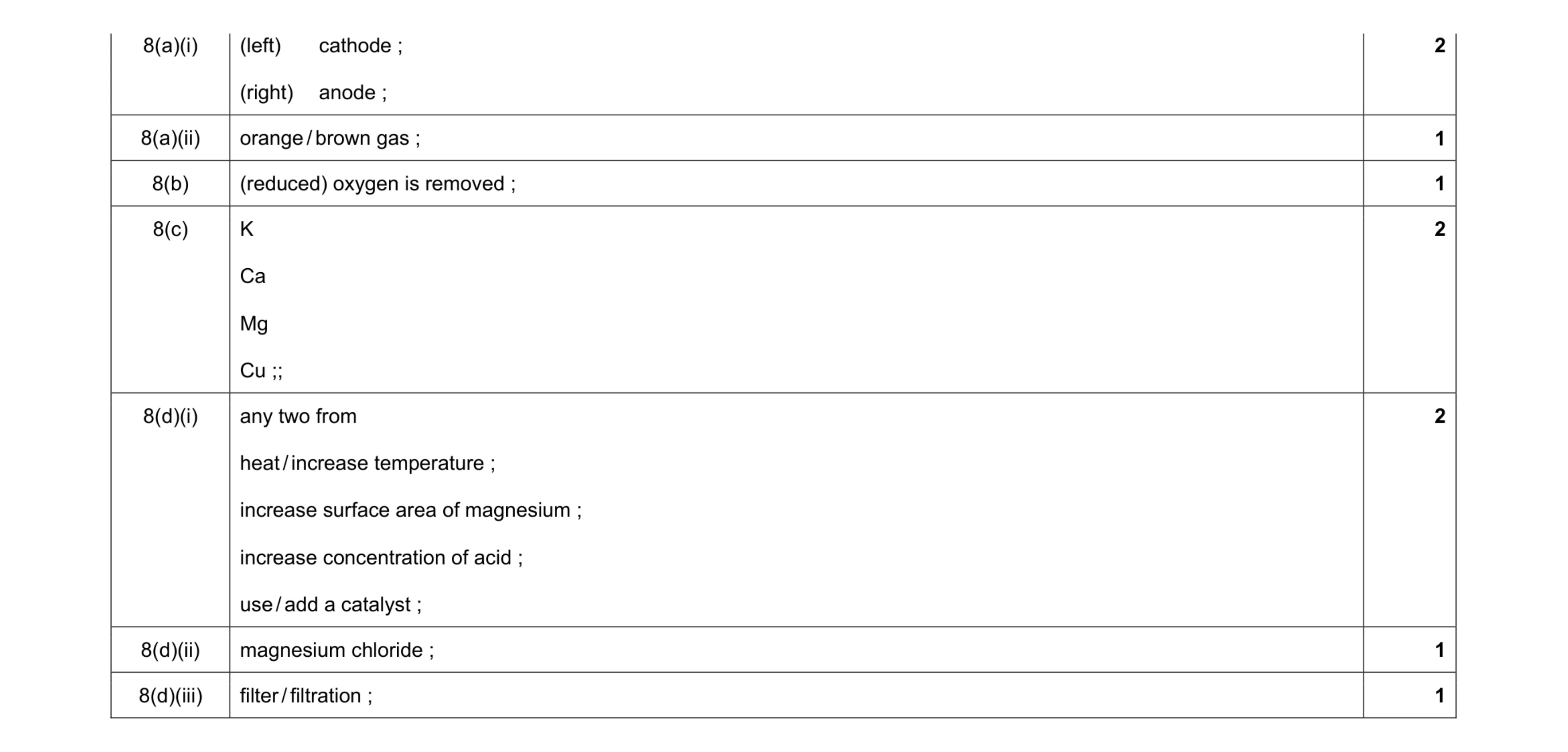
Mark scheme: 8(a)(i) (left) cathode ; (right) anode ; 2 8(a)(ii) orange / brown gas ; 1 8(b) (reduced) oxygen is removed ; 1 8(c) K Ca Mg Cu ;; 2 8(d)(i) any two from heat / increase temperature ; increase surface area of magnesium ; increase concentration of acid ; use / add a catalyst ; 2 8(d)(ii) magnesium chloride ; 1 8(d)(iii) filter / filtration ; 1
This question in 0653/33 Oct/Nov 2017
Q2 · A student adds magnesium powder to dilute hydrochloric acid 0653/32 May/June 2018
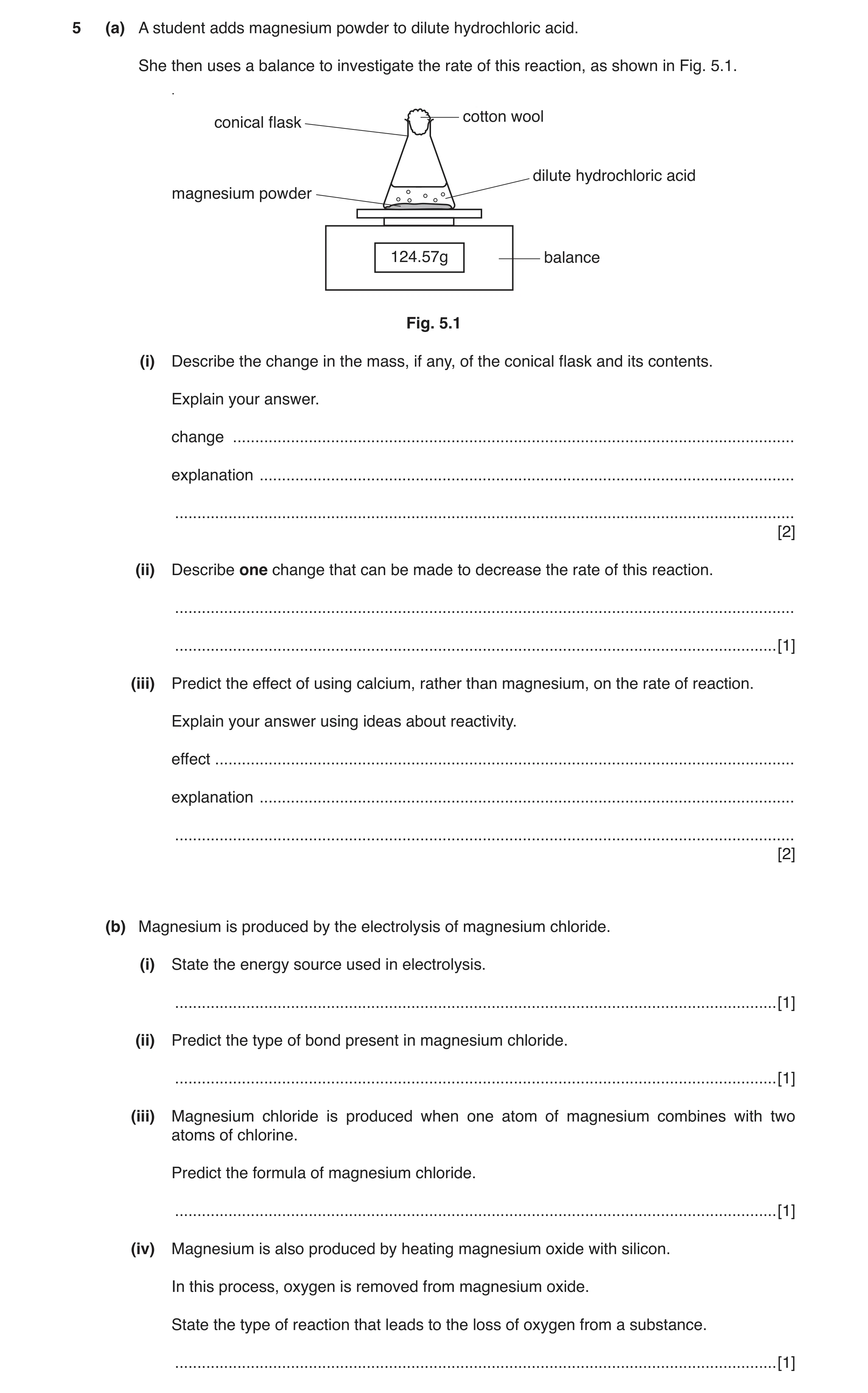
5 (a) A student adds magnesium powder to dilute hydrochloric acid. She then uses a balance to investigate the rate of this reaction, as shown in Fig. 5.1. cotton wool conical flask dilute hydrochloric acid magnesium powder 124.57g balance Fig. 5.1 (i) Describe the change in the mass, if any, of the conical flask and its contents. Explain your answer. change … explanation … … [2] (ii) Describe one change that can be made to decrease the rate of this reaction. … … [1] (iii) Predict the effect of using calcium, rather than magnesium, on the rate of reaction. Explain your answer using ideas about reactivity. effect … explanation … … [2] (b) Magnesium is produced by the electrolysis of magnesium chloride. (i) State the energy source used in electrolysis. … [1] (ii) Predict the type of bond present in magnesium chloride. … [1] (iii) Magnesium chloride is produced when one atom of magnesium combines with two atoms of chlorine. Predict the formula of magnesium chloride. … [1] (iv) Magnesium is also produced by heating magnesium oxide with silicon. In this process, oxygen is removed from magnesium oxide. State the type of reaction that leads to the loss of oxygen from a substance. … [1]
9 marks
Mark scheme: 5(a)(i) (decreases) no mark gas produced / released (during reaction) ; (gas goes) to the surroundings / (gas) leaves flask ; 2 5(a)(ii) lower temperature / lower (acid) concentration / use lumps (instead of powder) ; 1 5(a)(iii) increases ; calcium is more reactive (than magnesium) ; 2 5(b)(i) electricity ; 1 5(b)(ii) ionic ; 1 5(b)(iii) MgCl2 ; 1 5(b)(iv) reduction ; 1 Que estion Answer Ma arks
This question in 0653/32 May/June 2018
Q3 · A student adds magnesium powder to dilute hydrochloric acid 0653/33 May/June 2018
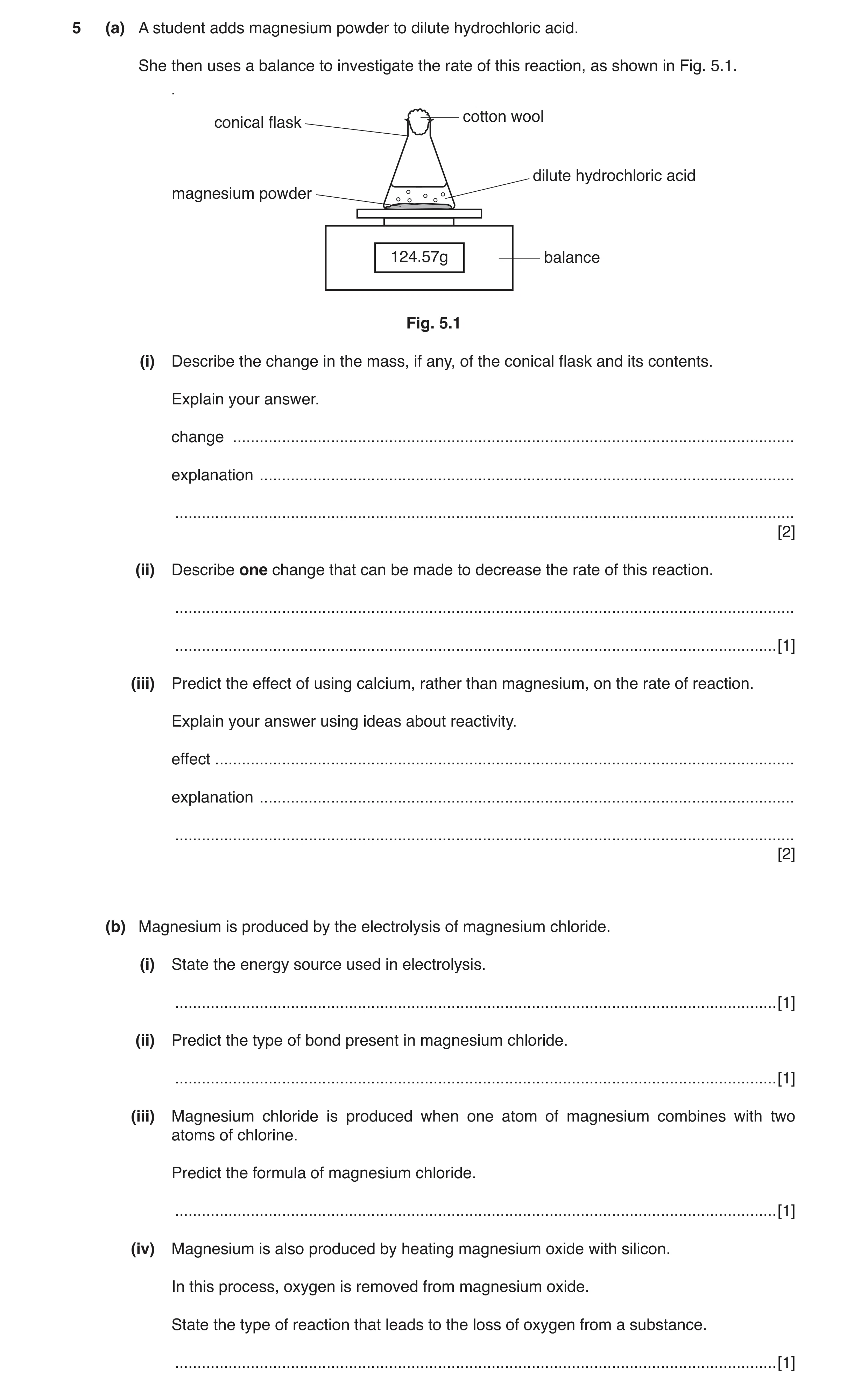
5 (a) A student adds magnesium powder to dilute hydrochloric acid. She then uses a balance to investigate the rate of this reaction, as shown in Fig. 5.1. cotton wool conical flask dilute hydrochloric acid magnesium powder 124.57g balance Fig. 5.1 (i) Describe the change in the mass, if any, of the conical flask and its contents. Explain your answer. change … explanation … … [2] (ii) Describe one change that can be made to decrease the rate of this reaction. … … [1] (iii) Predict the effect of using calcium, rather than magnesium, on the rate of reaction. Explain your answer using ideas about reactivity. effect … explanation … … [2] (b) Magnesium is produced by the electrolysis of magnesium chloride. (i) State the energy source used in electrolysis. … [1] (ii) Predict the type of bond present in magnesium chloride. … [1] (iii) Magnesium chloride is produced when one atom of magnesium combines with two atoms of chlorine. Predict the formula of magnesium chloride. … [1] (iv) Magnesium is also produced by heating magnesium oxide with silicon. In this process, oxygen is removed from magnesium oxide. State the type of reaction that leads to the loss of oxygen from a substance. … [1]
9 marks
Mark scheme: 5(a)(i) (decreases) no mark gas produced / released (during reaction) ; (gas goes) to the surroundings / (gas) leaves flask ; 2 5(a)(ii) lower temperature / lower (acid) concentration / use lumps (instead of powder) ; 1 5(a)(iii) increases ; calcium is more reactive (than magnesium) ; 2 5(b)(i) electricity ; 1 5(b)(ii) ionic ; 1 5(b)(iii) MgCl2 ; 1 5(b)(iv) reduction ; 1 Que estion Answer Ma arks
This question in 0653/33 May/June 2018
Q4 · A teacher uses the apparatus shown in Fig 0653/32 Oct/Nov 2018
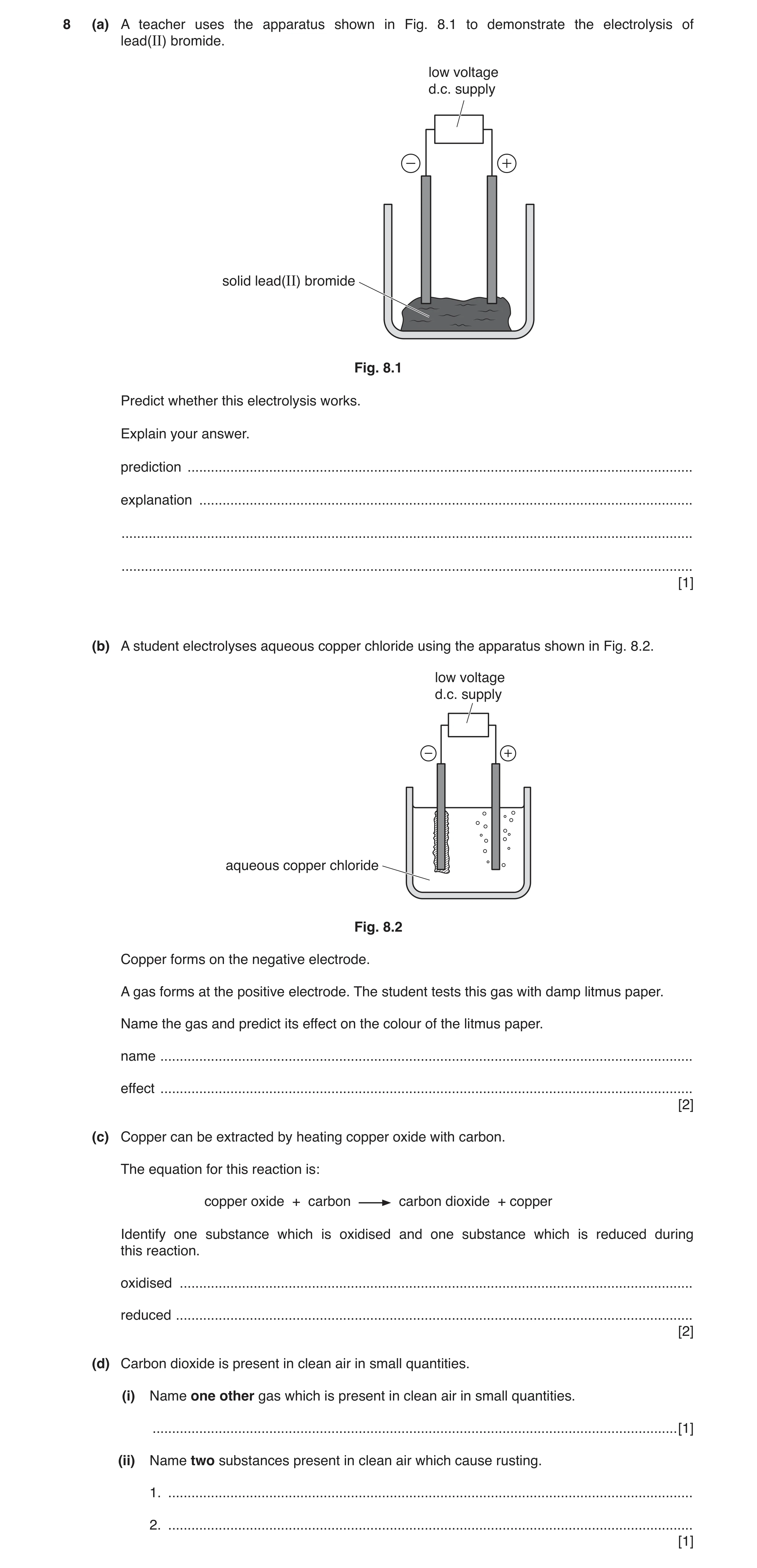
8 (a) A teacher uses the apparatus shown in Fig. 8.1 to demonstrate the electrolysis of lead(II) bromide. low voltage d.c. supply solid lead(II) bromide Fig. 8.1 Predict whether this electrolysis works. Explain your answer. prediction … explanation … … … [1] (b) A student electrolyses aqueous copper chloride using the apparatus shown in Fig. 8.2. low voltage d.c. supply aqueous copper chloride Fig. 8.2 Copper forms on the negative electrode. A gas forms at the positive electrode. The student tests this gas with damp litmus paper. Name the gas and predict its effect on the colour of the litmus paper. name … effect … [2] (c) Copper can be extracted by heating copper oxide with carbon. The equation for this reaction is: copper oxide + carbon carbon dioxide + copper Identify one substance which is oxidised and one substance which is reduced during this reaction. oxidised … reduced … [2] (d) Carbon dioxide is present in clean air in small quantities. (i) Name one other gas which is present in clean air in small quantities. … [1] (ii) Name two substances present in clean air which cause rusting. 1. … 2. … [1]
7 marks
Mark scheme: 8(a) (prediction) no reaction AND (explanation) lead bromide is solid / needs to be molten / liquid ; 1 8(b) (name) chlorine ; (effect) bleaches / (turns) white / decolourises ; 2 8(c) (oxidised) carbon ; (reduced) copper oxide ; 2 8(d)(i) water (vapour) / noble gas / named noble gas ; 1 8(d)(ii) oxygen / O2 AND water (vapour) / H2O ; 1
This question in 0653/32 Oct/Nov 2018
Q5 · A student investigates the rate of reaction of four metals, calcium, iron, magnesium and… 0653/33 Oct/Nov 2018
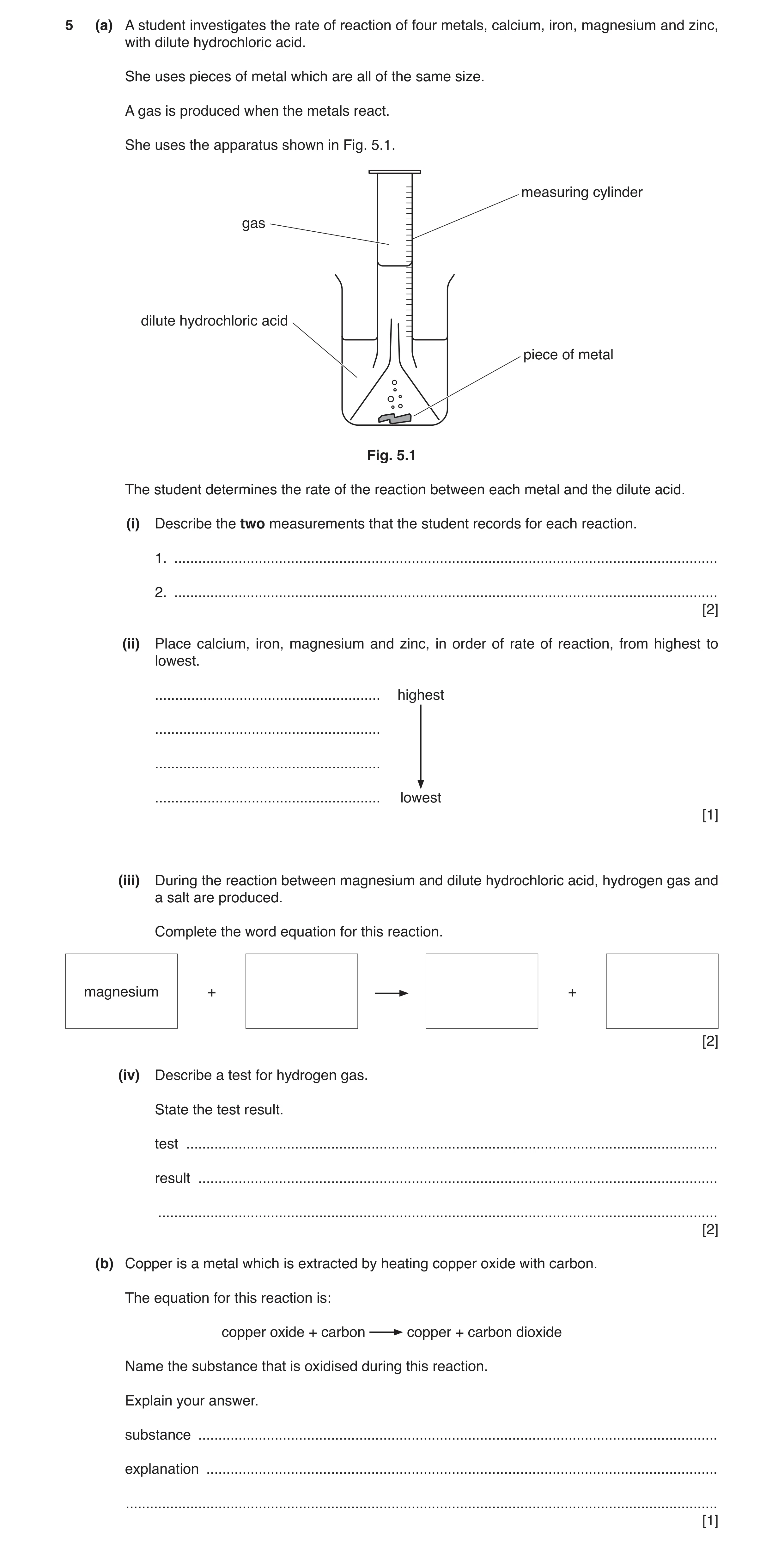
5 (a) A student investigates the rate of reaction of four metals, calcium, iron, magnesium and zinc, with dilute hydrochloric acid. She uses pieces of metal which are all of the same size. A gas is produced when the metals react. She uses the apparatus shown in Fig. 5.1. measuring cylinder gas dilute hydrochloric acid piece of metal Fig. 5.1 The student determines the rate of the reaction between each metal and the dilute acid. (i) Describe the two measurements that the student records for each reaction. 1. … 2. … [2] (ii) Place calcium, iron, magnesium and zinc, in order of rate of reaction, from highest to lowest. … highest … … … lowest [1] (iii) During the reaction between magnesium and dilute hydrochloric acid, hydrogen gas and a salt are produced. Complete the word equation for this reaction. magnesium + + [2] (iv) Describe a test for hydrogen gas. State the test result. test … result … … [2] (b) Copper is a metal which is extracted by heating copper oxide with carbon. The equation for this reaction is: copper oxide + carbon copper + carbon dioxide Name the substance that is oxidised during this reaction. Explain your answer. substance … explanation … … [1]
8 marks
Mark scheme: 5(a)(i) time taken ; volume of gas ; 2 5(a)(ii) (highest) calcium / Ca magnesium / Mg zinc / Zn (lowest) iron / Fe 1 5(a)(iii) (magnesium) + hydrochloric acid Î hydrogen + magnesium chloride magnesium chloride identified anywhere ; all species correct and in correct places ; 2 5(a)(iv) (test) lighted splint ; (result) burns with a (squeaky) ‘pop’ ; 2 5(b) (substance) carbon and (explanation) gains oxygen / O ; 1
This question in 0653/33 Oct/Nov 2018
Q6 · When zinc oxide is heated with carbon, zinc and carbon dioxide are formed 0653/33 May/June 2019
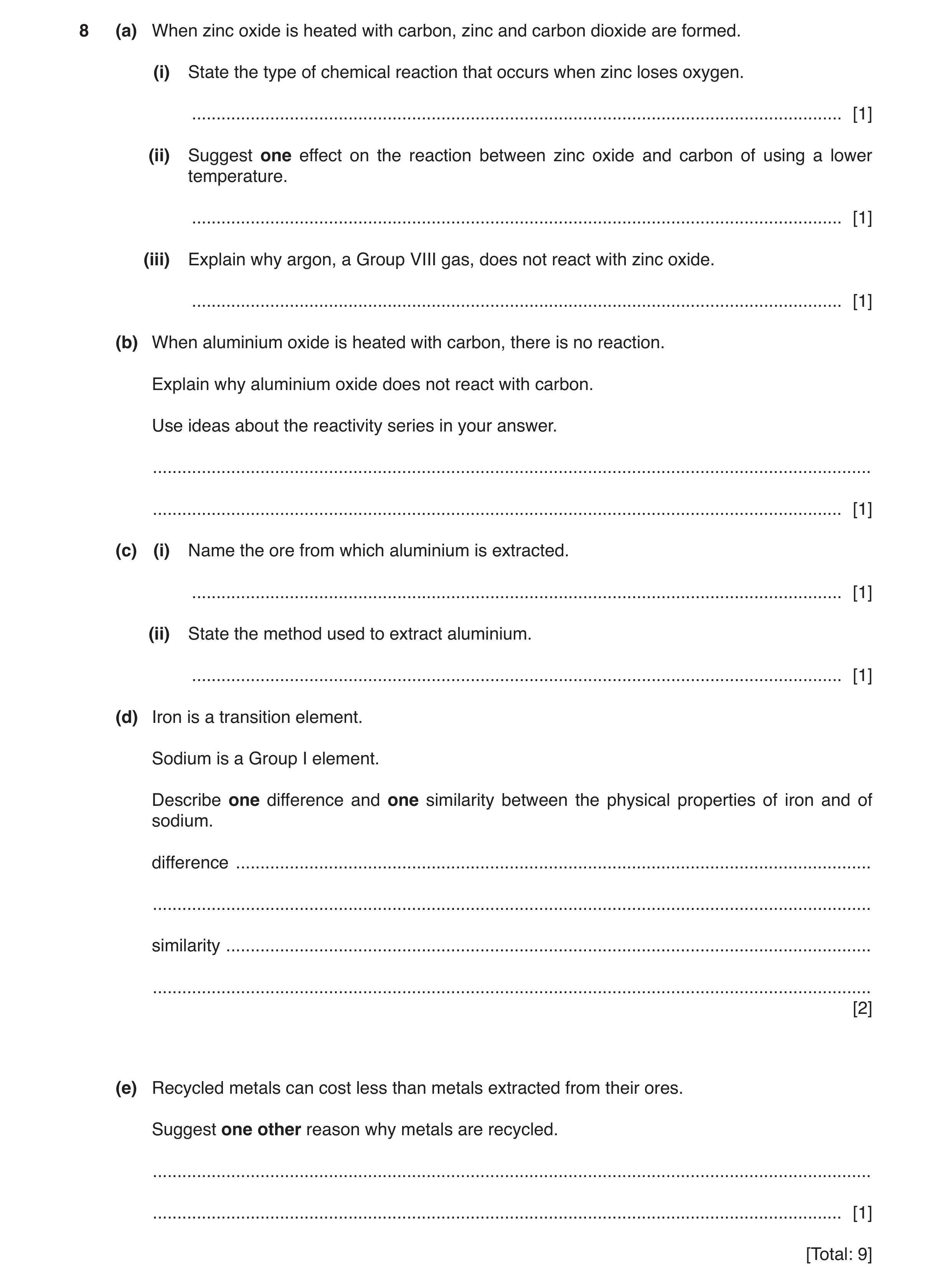
8 (a) When zinc oxide is heated with carbon, zinc and carbon dioxide are formed. (i) State the type of chemical reaction that occurs when zinc loses oxygen. … [1] (ii) Suggest one effect on the reaction between zinc oxide and carbon of using a lower temperature. … [1] (iii) Explain why argon, a Group VIII gas, does not react with zinc oxide. … [1] (b) When aluminium oxide is heated with carbon, there is no reaction. Explain why aluminium oxide does not react with carbon. Use ideas about the reactivity series in your answer. … … [1] (c) (i) Name the ore from which aluminium is extracted. … [1] (ii) State the method used to extract aluminium. … [1] (d) Iron is a transition element. Sodium is a Group I element. Describe one difference and one similarity between the physical properties of iron and of sodium. difference … … similarity … … [2] (e) Recycled metals can cost less than metals extracted from their ores. Suggest one other reason why metals are recycled. … … [1] [Total: 9]
9 marks
Mark scheme: 8(a)(i) reduction ; 1 8(a)(ii) slower (reaction) ; 1 8(a)(iii) argon / noble gases / Group VIII gases have full outer electron shell ; 1 8(b) aluminium is more reactive (than carbon) ; 1 8(c)(i) bauxite ; 1 8(c)(ii) electrolysis ; 1 8(d) (difference) density / melting point / hardness / strength ; (similarity) (electrical / heat) conductivity ; 2 8(e) metals/ores are running out/finite / no need to mine / does not go into landfill ; 1
This question in 0653/33 May/June 2019
Q7 · Methane, CH4, is a hydrocarbon 0653/31 Oct/Nov 2021
8 Methane, CH4, is a hydrocarbon. (a) State what is meant by hydrocarbon. … … [2] (b) Methane is an alkane. An alkane contains only single covalent bonds. Fig. 8.1 is a dot-and-cross diagram of a molecule of methane, CH4. Only the outer shell electrons are shown. H × H × C × H × H Fig. 8.1 Use Fig. 8.1 to describe what is meant by single covalent bonds. … … … [2] (c) The complete combustion of methane produces carbon dioxide and water. (i) Balance the equation for the complete combustion of methane. CH4 + … O2 CO2 + … H2O [2] (ii) State and explain whether the carbon in methane is oxidised or reduced in this reaction. carbon … explanation … … [1] (iii) Explain why argon, a noble gas, does not react with oxygen. Use ideas about electronic structure in your answer. … … [1] (d) Describe how the bonding in alkenes is different from the bonding in alkanes. … … [1] [Total: 9]
9 marks
Mark scheme: 8(a) (compound) containing carbon (atoms) and hydrogen (atoms) ; only ; 2 8(b) single: one pair of electrons / one dot and one cross ; covalent: electrons are shared / electrons inside two circles ; 2 8(c)(i) 2 ; 2 ; 2 8(c)(ii) oxidised AND gains oxygen ; 1 8(c)(iii) atoms of argon have full outer shells / 8 electrons in outer shells ; 1 8(d) alkenes contain a double bond / C=C (whereas alkanes contain only single bonds) ; 1
This question in 0653/31 Oct/Nov 2021
Q8 · Zinc is extracted from zinc oxide by heating with carbon 0653/32 May/June 2022
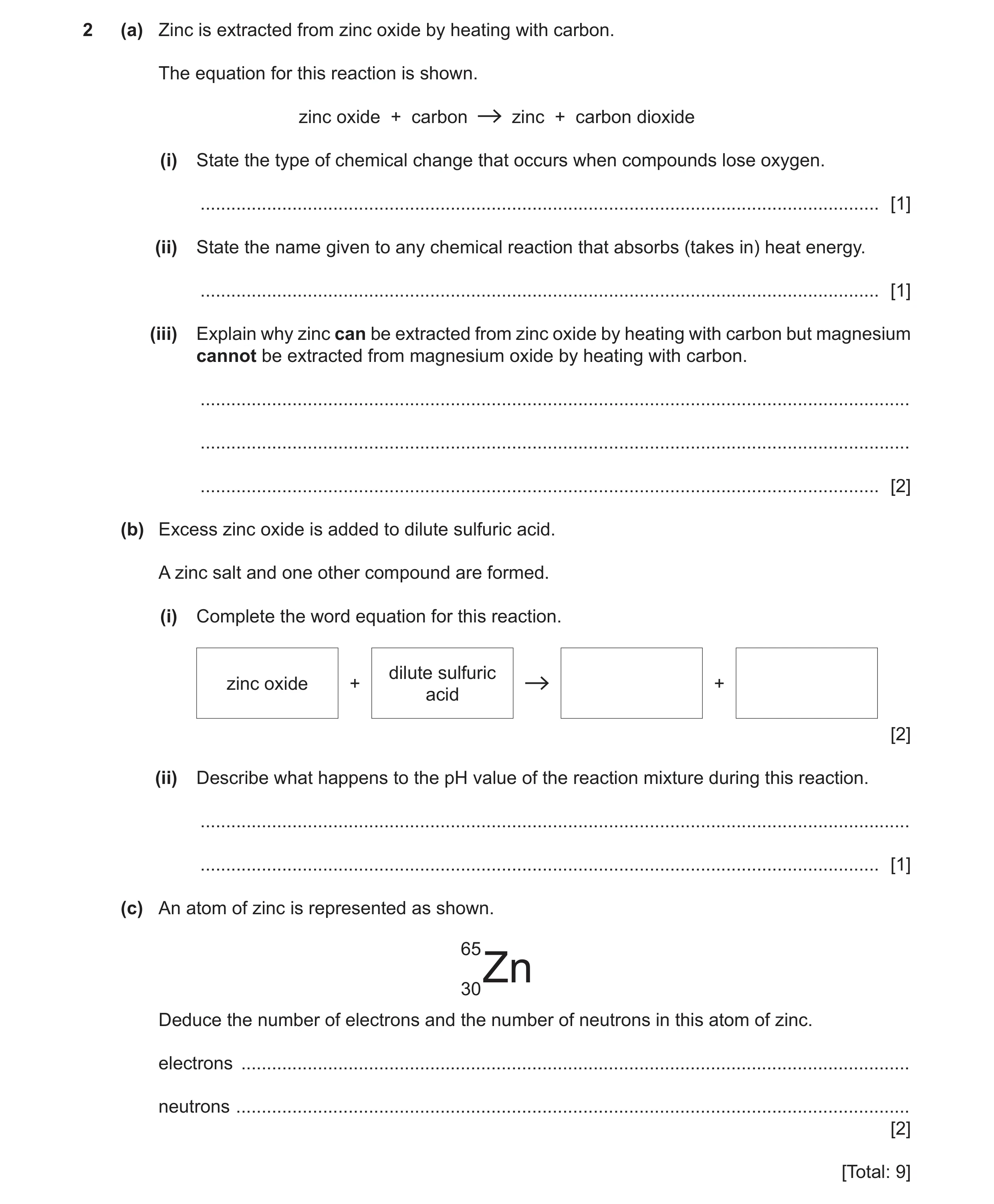
2 (a) Zinc is extracted from zinc oxide by heating with carbon. The equation for this reaction is shown. zinc oxide + carbon zinc + carbon dioxide (i) State the type of chemical change that occurs when compounds lose oxygen. … [1] (ii) State the name given to any chemical reaction that absorbs (takes in) heat energy. … [1] (iii) Explain why zinc can be extracted from zinc oxide by heating with carbon but magnesium cannot be extracted from magnesium oxide by heating with carbon. … … … [2] (b) Excess zinc oxide is added to dilute sulfuric acid. A zinc salt and one other compound are formed. (i) Complete the word equation for this reaction. dilute sulfuric zinc oxide + + acid [2] (ii) Describe what happens to the pH value of the reaction mixture during this reaction. … … [1] (c) An atom of zinc is represented as shown. 6530Zn Deduce the number of electrons and the number of neutrons in this atom of zinc. electrons … neutrons … [2] [Total: 9]
9 marks
Mark scheme: 2(a)(i) reduction ; 1 2(a)(ii) endothermic ; 1 2(a)(iii) zinc / Zn is less reactive than carbon / C ; ORA magnesium / Mg is more reactive than carbon / C ; ORA 2 2(b)(i) zinc oxide + dilute sulfuric acid zinc sulfate ; + water ; 2 2(b)(ii) (pH) increases ; 1 Question Answer Marks 2(c) (electrons) 30 ; (neutrons) 35 ; 2
This question in 0653/32 May/June 2022
Q9 · A student investigates the reaction of magnesium with dilute hydrochloric acid, as shown… 0653/32 Oct/Nov 2022
5 (a) A student investigates the reaction of magnesium with dilute hydrochloric acid, as shown in Fig. 5.1. gas syringe bubble of gas dilute piece of hydrochloric magnesium acid Fig. 5.1 Magnesium chloride and a gas are produced. (i) Complete the word equation for this reaction. magnesium + + [2] (ii) Suggest one change that can be made to increase the rate of this reaction. … … [1] (iii) Suggest one metal that reacts with dilute hydrochloric acid with a lower rate of reaction than magnesium. … [1] (iv) Magnesium reacts with a different dilute acid to make magnesium sulfate. State the name of this acid. … [1] (v) Describe a chemical test for chloride ions and state the positive result. test … … result … [2] (b) The combustion of magnesium in air forms magnesium oxide, MgO. Magnesium oxide reacts slowly with carbon dioxide in the air to form magnesium carbonate, MgCO3, as shown in Fig. 5.2. combustion reaction in air magnesium with CO2 magnesium magnesium oxide carbonate Fig. 5.2 (i) Explain why the combustion of magnesium is described as oxidation. … … [1] (ii) The combustion of other substances produces carbon dioxide. State the name of one substance that produces carbon dioxide during combustion. … [1] (iii) Carbon dioxide is a greenhouse gas. State the name of one other greenhouse gas. … [1] [Total: 10]
10 marks
Mark scheme: 5(a)(i) 2 hydrogen ; hydrochloric acid AND magnesium chloride ; 5(a)(ii) any one from: 1 increase temperature / heat ; increase (acid) concentration ; use a catalyst ; use, powdered / smaller pieces of, magnesium ; 5(a)(iii) any one from: 1 aluminium / Al ; zinc / Zn ; iron / Fe ; 5(a)(iv) sulfuric (acid) ; 1 5(a)(v) test (acidified aqueous) silver nitrate ; 2 result white precipitate ; 5(b)(i) oxygen is, added / gained ; 1 5(b)(ii) any named carbon-containing compound ; 1 5(b)(iii) methane ; 1
This question in 0653/32 Oct/Nov 2022
Q10 · A student investigates the reaction of magnesium with dilute hydrochloric acid, as shown… 0653/33 Oct/Nov 2022
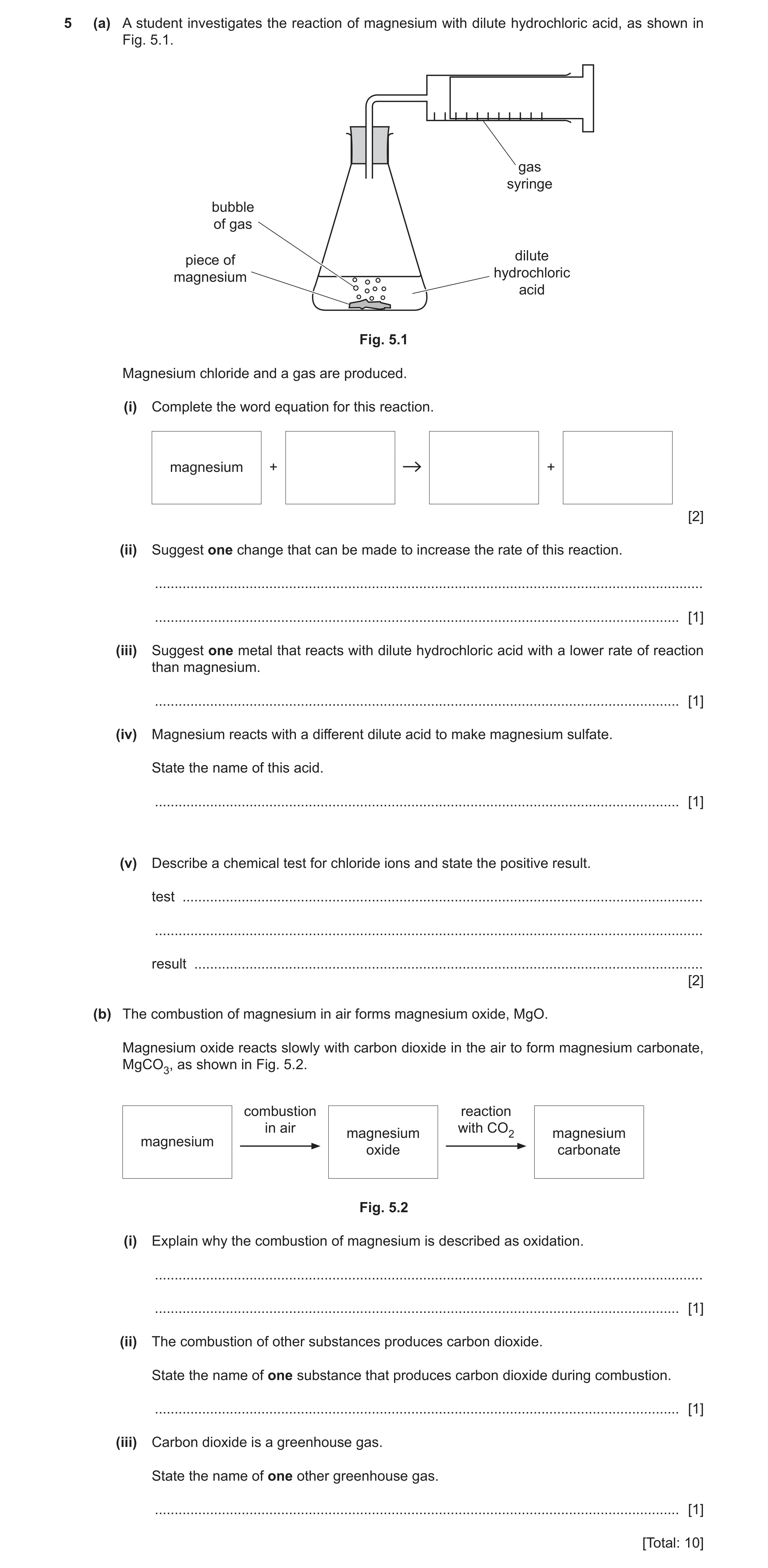
5 (a) A student investigates the reaction of magnesium with dilute hydrochloric acid, as shown in Fig. 5.1. gas syringe bubble of gas dilute piece of hydrochloric magnesium acid Fig. 5.1 Magnesium chloride and a gas are produced. (i) Complete the word equation for this reaction. magnesium + + [2] (ii) Suggest one change that can be made to increase the rate of this reaction. … … [1] (iii) Suggest one metal that reacts with dilute hydrochloric acid with a lower rate of reaction than magnesium. … [1] (iv) Magnesium reacts with a different dilute acid to make magnesium sulfate. State the name of this acid. … [1] (v) Describe a chemical test for chloride ions and state the positive result. test … … result … [2] (b) The combustion of magnesium in air forms magnesium oxide, MgO. Magnesium oxide reacts slowly with carbon dioxide in the air to form magnesium carbonate, MgCO3, as shown in Fig. 5.2. combustion reaction in air magnesium with CO2 magnesium magnesium oxide carbonate Fig. 5.2 (i) Explain why the combustion of magnesium is described as oxidation. … … [1] (ii) The combustion of other substances produces carbon dioxide. State the name of one substance that produces carbon dioxide during combustion. … [1] (iii) Carbon dioxide is a greenhouse gas. State the name of one other greenhouse gas. … [1] [Total: 10]
10 marks
Mark scheme: 5(a)(i) 2 hydrogen ; hydrochloric acid AND magnesium chloride ; 5(a)(ii) any one from: 1 increase temperature / heat ; increase (acid) concentration ; use a catalyst ; use, powdered / smaller pieces of, magnesium ; 5(a)(iii) any one from: 1 aluminium / Al ; zinc / Zn ; iron / Fe ; 5(a)(iv) sulfuric (acid) ; 1 5(a)(v) test (acidified aqueous) silver nitrate ; 2 result white precipitate ; 5(b)(i) oxygen is, added / gained ; 1 5(b)(ii) any named carbon-containing compound ; 1 5(b)(iii) methane ; 1
This question in 0653/33 Oct/Nov 2022
Q11 · Copper is a transition element 0653/32 Feb/March 2023
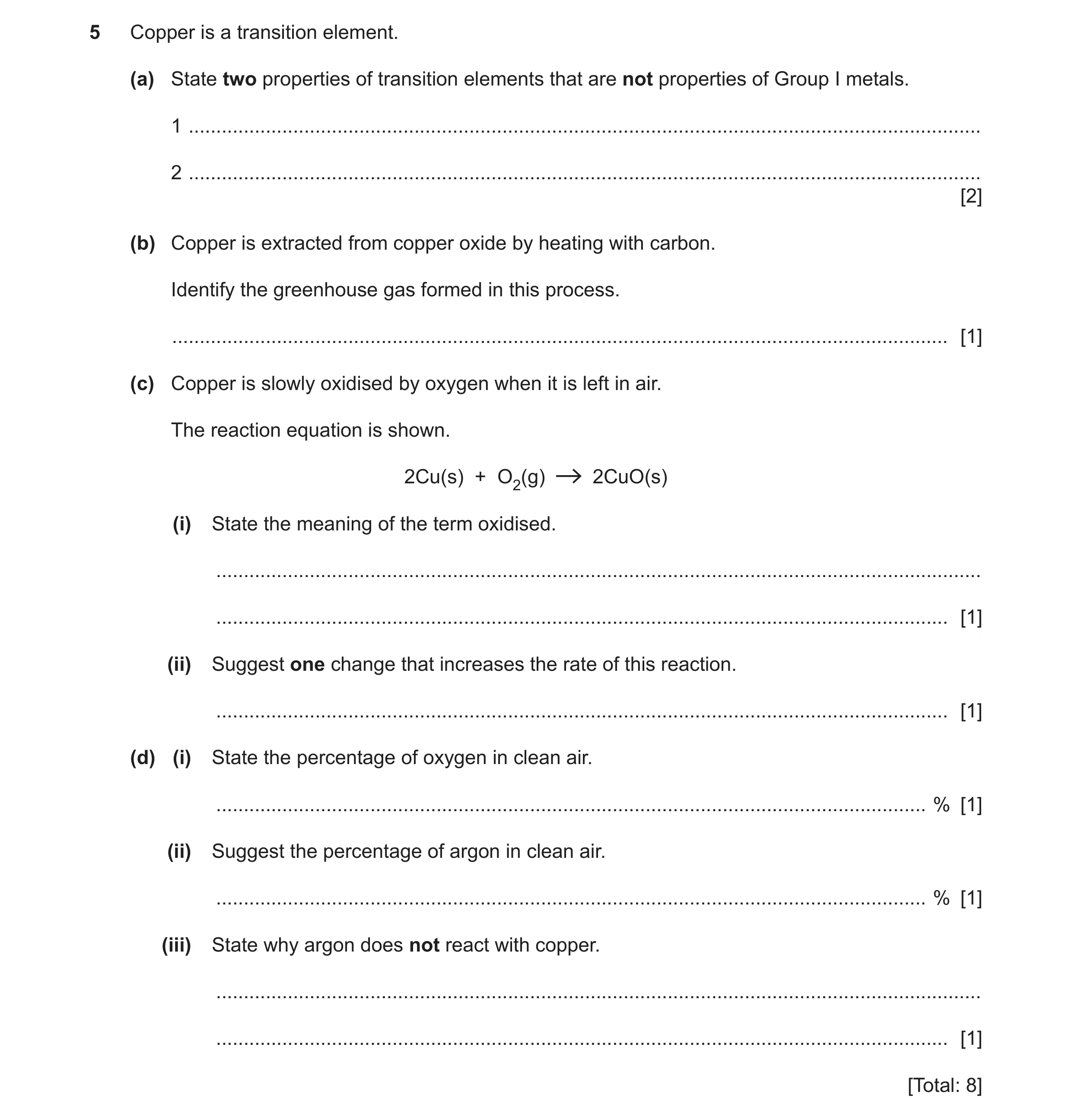
5 Copper is a transition element. (a) State two properties of transition elements that are not properties of Group I metals. 1 … 2 … [2] (b) Copper is extracted from copper oxide by heating with carbon. Identify the greenhouse gas formed in this process. … [1] (c) Copper is slowly oxidised by oxygen when it is left in air. The reaction equation is shown. 2Cu(s) + O2(g) 2CuO(s) (i) State the meaning of the term oxidised. … … [1] (ii) Suggest one change that increases the rate of this reaction. … [1] (d) (i) State the percentage of oxygen in clean air. … % [1] (ii) Suggest the percentage of argon in clean air. … % [1] (iii) State why argon does not react with copper. … … [1] [Total: 8]
8 marks
Mark scheme: 5(a) any two from: 2 high density ; high melting point ; (forms) coloured compounds ; (can) act as catalysts (as element or compound) ; 5(b) carbon dioxide / CO2 ; 1 5(c)(i) (it) gains oxygen ; 1 5(c)(ii) any one from: 1 increase / higher, temperature / heat (it) ; increase surface area ; 5(d)(i) 21(%) ; 1 5(d)(ii) less than 1(%) ; 1 5(d)(iii) argon is inert / argon is a noble gas / argon atoms have full outer shell ; 1
This question in 0653/32 Feb/March 2023
Q12 · Copper is a transition element 0653/31 Oct/Nov 2023
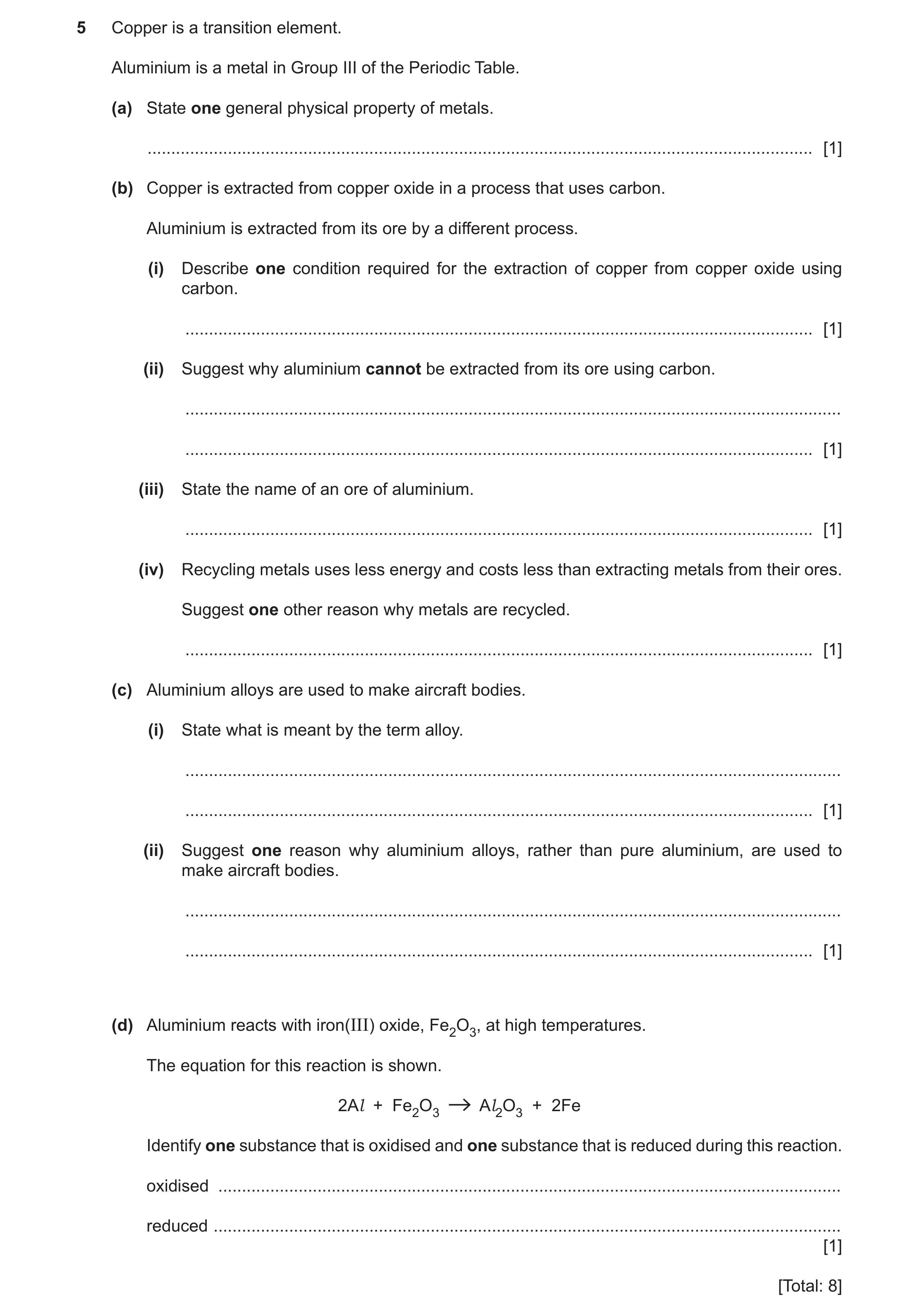
5 Copper is a transition element. Aluminium is a metal in Group III of the Periodic Table. (a) State one general physical property of metals. … [1] (b) Copper is extracted from copper oxide in a process that uses carbon. Aluminium is extracted from its ore by a different process. (i) Describe one condition required for the extraction of copper from copper oxide using carbon. … [1] (ii) Suggest why aluminium cannot be extracted from its ore using carbon. … … [1] (iii) State the name of an ore of aluminium. … [1] (iv) Recycling metals uses less energy and costs less than extracting metals from their ores. Suggest one other reason why metals are recycled. … [1] (c) Aluminium alloys are used to make aircraft bodies. (i) State what is meant by the term alloy. … … [1] (ii) Suggest one reason why aluminium alloys, rather than pure aluminium, are used to make aircraft bodies. … … [1] (d) Aluminium reacts with iron(III) oxide, Fe2O3, at high temperatures. The equation for this reaction is shown. 2Al + Fe2O3 Al2O3 + 2Fe Identify one substance that is oxidised and one substance that is reduced during this reaction. oxidised … reduced … [1] [Total: 8]
8 marks
Mark scheme: 5(a) any one from: 1 malleable ; (good) electrical / heat / thermal, conductor ; high, melting / boiling, point ; 5(b)(i) heat / high temperature ; 1 5(b)(ii) (aluminium is) more reactive (than carbon) / ORA ; 1 5(b)(iii) bauxite ; 1 5(b)(iv) metal ores are a finite resource / may run out ; 1 5(c)(i) a mixture of a metal with other element(s) ; 1 5(c)(ii) stronger (for the same mass) OR less dense (for the same strength) ; 1 5(d) (oxidised) Al / aluminium AND 1 (reduced) Fe ions / iron(III) / Fe3+ ;
This question in 0653/31 Oct/Nov 2023
Q13 · Lithium is an element in Group I of the Periodic Table 0653/32 Feb/March 2024
2 Lithium is an element in Group I of the Periodic Table. (a) An atom of lithium is represented as shown. 73Li Complete Table 2.1 to show the number of protons, electrons and neutrons in one atom of 73Li. Table 2.1 number of protons number of electrons number of neutrons [2] (b) Describe what happens when an atom of lithium becomes an ion of lithium. … … [1] (c) Lithium reacts slowly with oxygen at room temperature to form lithium oxide. This reaction is exothermic. (i) Balance the symbol equation for this reaction. [1] ……. Li + .…... O2 ……. Li2O (ii) Circle the word that describes the reaction between lithium and oxygen. decomposition distillation neutralisation oxidation [1] (iii) Describe one observation that shows the reaction is exothermic. … … [1] (d) There is an alloy that contains lithium and aluminium only. Tick (3) one box to show which statement describes this alloy. It contains one type of atom only. It is a mixture. It has the chemical properties of aluminium only. It has the physical properties of lithium only. [1] (e) Aluminium is used to make cooking pans. Suggest why lithium is not used to make cooking pans. … … [1] (f) Recycling aluminium is cheaper than producing it from its ore. Suggest one other reason why aluminium is recycled. … … [1] [Total: 9]
9 marks
Mark scheme: 2(a) 2 number of protons number of electrons number of neutrons 3 3 4 ;; 3 correct = [2] 1–2 correct = [1] 2(b) loss of one electron (from its outer shell) ; 1 2(c)(i) 4Li + O2 → 2Li2O ; 1 2(c)(ii) oxidation circled ; 1 2(c)(iii) idea that heat is transferred from reactants / temperature (of reaction mixture) increases ; 1 2(d) second box ticked (It is a mixture.) ; 1 2(e) too reactive / melting point too low / too soft ; 1 2(f) (aluminium is a) finite resource / will run out / non-renewable ; 1
This question in 0653/32 Feb/March 2024
Q14 · Aluminium ore contains aluminium oxide 0653/32 May/June 2024
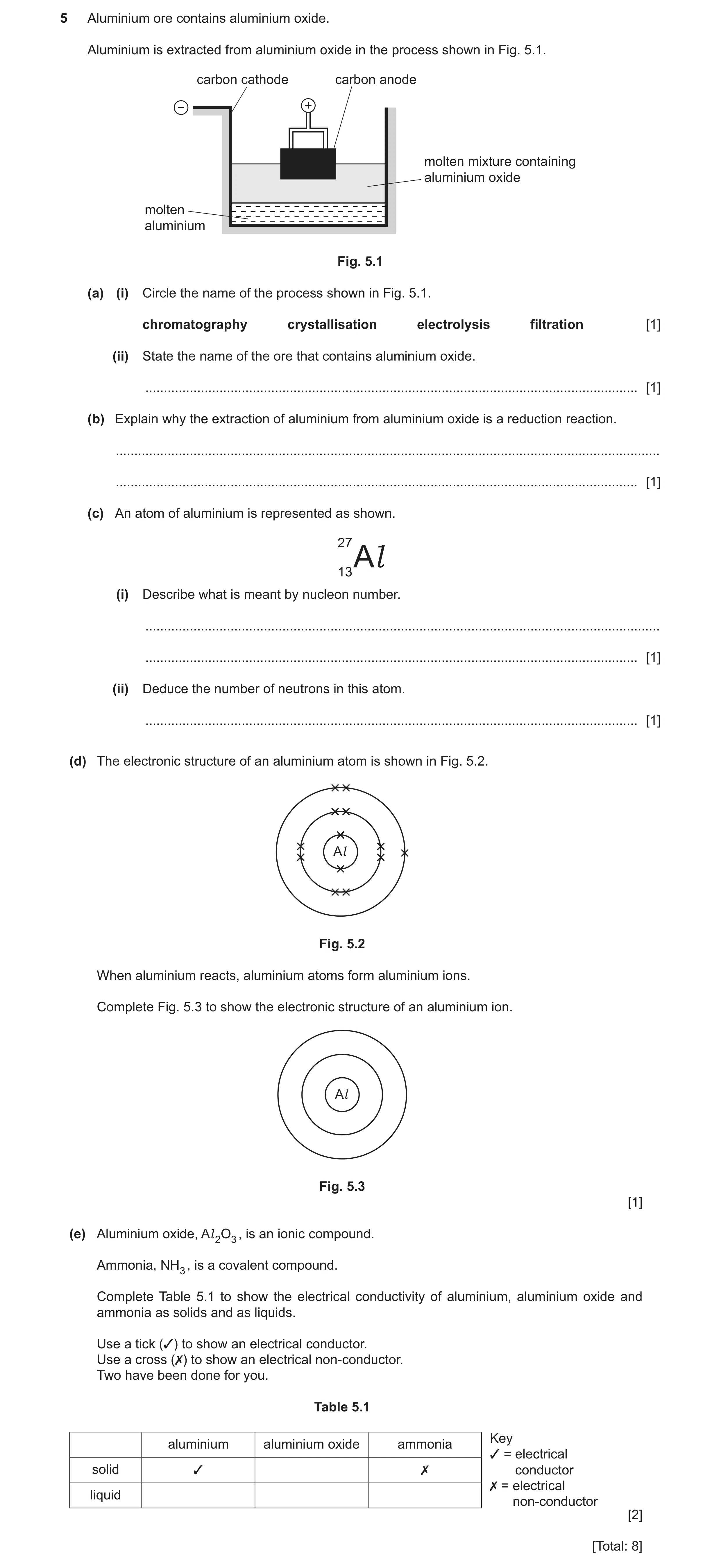
5 Aluminium ore contains aluminium oxide. Aluminium is extracted from aluminium oxide in the process shown in Fig. 5.1. carbon cathode carbon anode – + molten mixture containing aluminium oxide molten aluminium Fig. 5.1 (a) (i) Circle the name of the process shown in Fig. 5.1. chromatography crystallisation electrolysis filtration [1] (ii) State the name of the ore that contains aluminium oxide. … [1] (b) Explain why the extraction of aluminium from aluminium oxide is a reduction reaction. … … [1] (c) An atom of aluminium is represented as shown. 27 13Al (i) Describe what is meant by nucleon number. … … [1] (ii) Deduce the number of neutrons in this atom. … [1] (d) The electronic structure of an aluminium atom is shown in Fig. 5.2. Al Fig. 5.2 When aluminium reacts, aluminium atoms form aluminium ions. Complete Fig. 5.3 to show the electronic structure of an aluminium ion. Al Fig. 5.3 [1] (e) Aluminium oxide, Al2O3 , is an ionic compound. Ammonia, NH3 , is a covalent compound. Complete Table 5.1 to show the electrical conductivity of aluminium, aluminium oxide and ammonia as solids and as liquids. Use a tick (✓) to show an electrical conductor. Use a cross (✗) to show an electrical non‑conductor. Two have been done for you. Table 5.1 Key aluminium aluminium oxide ammonia ✓ = electrical solid ✓ ✗ conductor ✗ = electrical liquid non‑conductor [2] [Total: 8]
8 marks
Mark scheme: 5(a)(i) electrolysis (circled) ; 1 5(a)(ii) bauxite ; 1 5(b) oxygen is lost ; 1 5(c)(i) the (total) number of protons and neutrons ; 1 5(c)(ii) 14 ; 1 5(d) 2 electrons in inner shell, 8 in second shell and none in third shell ; 1 5(e) ;; four correct = (2) two or three correct = (1) 2
This question in 0653/32 May/June 2024
Q15 · Iron is a metal 0653/31 May/June 2025
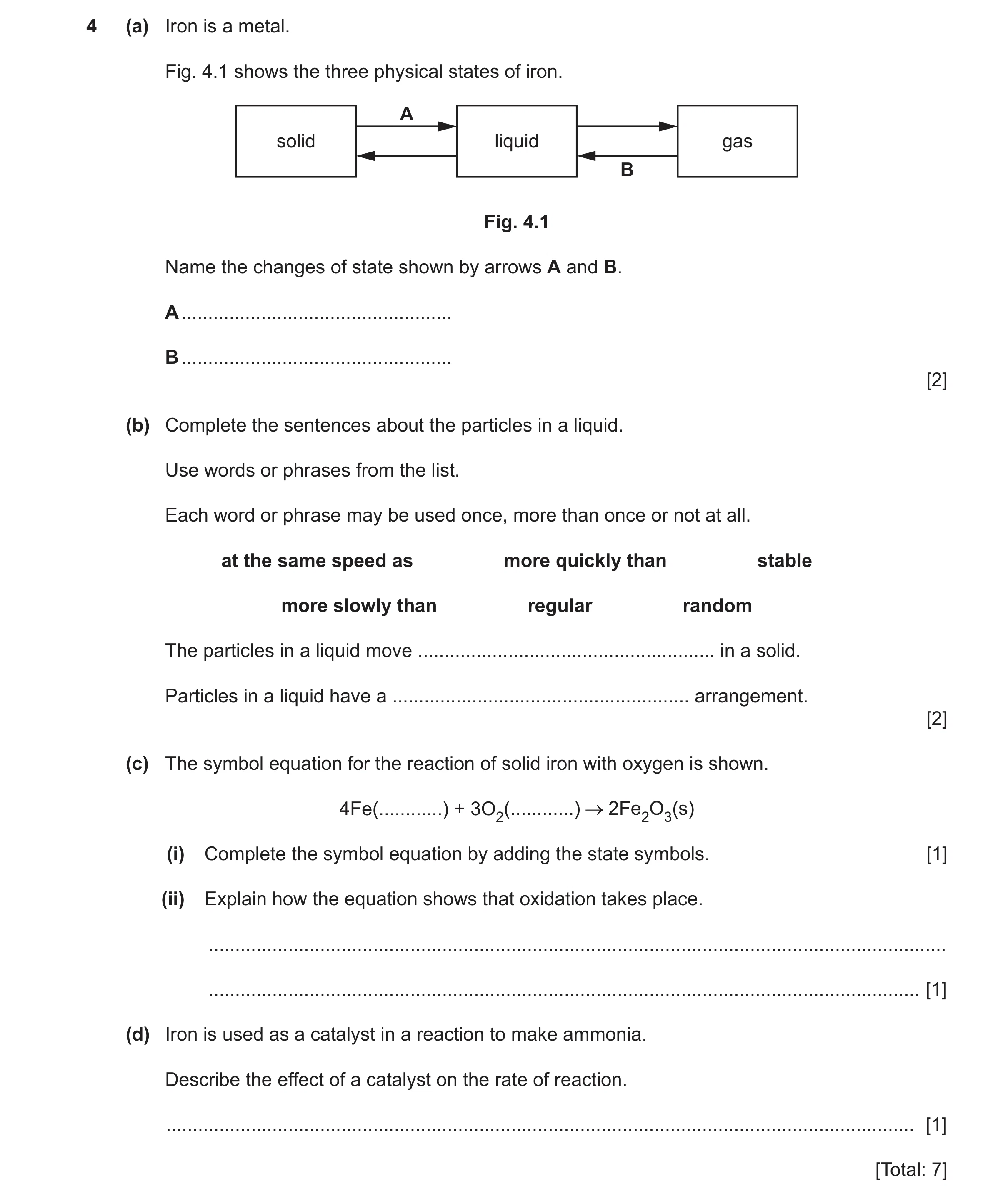
4 (a) Iron is a metal. Fig. 4.1 shows the three physical states of iron. A solid liquid gas B Fig. 4.1 Name the changes of state shown by arrows A and B. A … B … [2] (b) Complete the sentences about the particles in a liquid. Use words or phrases from the list. Each word or phrase may be used once, more than once or not at all. at the same speed as more quickly than stable more slowly than regular random The particles in a liquid move … in a solid. Particles in a liquid have a … arrangement. [2] (c) The symbol equation for the reaction of solid iron with oxygen is shown. 4Fe( … ) + 3O2( … ) 2Fe2O3(s) (i) Complete the symbol equation by adding the state symbols. [1] (ii) Explain how the equation shows that oxidation takes place. … … [1] (d) Iron is used as a catalyst in a reaction to make ammonia. Describe the effect of a catalyst on the rate of reaction. … [1] [Total: 7]
7 marks
Mark scheme: 4(a) A: melting / melt ; 2 B: condensing / condensation ; 4(b) more quickly than ; 2 random ; 4(c)(i) s and g ; 1 4(c)(ii) Fe / iron, gains oxygen ; 1 4(d) increases (the rate) ; 1
This question in 0653/31 May/June 2025
Q16 · Iron is a transition element 0653/32 May/June 2025
5 (a) Iron is a transition element. Tick () two boxes that show correct statements about the properties of iron and Group I elements. Iron and Group I elements conduct electricity. Iron has a higher melting point than Group I elements. Group I elements have a higher density than iron. Group I elements form coloured compounds but iron compounds are white. [2] (b) Iron reacts with dilute hydrochloric acid. Write the word equation for the reaction. + + [1] (c) Fig. 5.1 shows three identical iron nails, each in a different test-tube, A, B and C. A B C oil water Fig. 5.1 Predict in which test-tube the iron nail rusts most quickly. Explain your answer. test-tube … explanation … … … [2] (d) Iron is extracted from iron(III) oxide in a blast furnace. Fe2O3 + 3CO 2Fe + 3CO2 Circle the type of reaction when iron(III) oxide forms iron. combustion oxidation reduction separation [1] (e) Aluminium is extracted by electrolysis. Name the main ore of aluminium. … [1] (f) Part of the reactivity series is shown. sodium magnesium carbon zinc hydrogen copper (i) Use this reactivity series to name: • one metal that must be extracted by electrolysis • one metal that is extracted by heating with carbon. metal extracted by electrolysis … metal extracted by heating with carbon … [2] (ii) Explain why different methods of extraction are needed for the two metals in (f)(i). … … [1] [Total: 10]
10 marks
Mark scheme: 5(a) first and second boxes ticked ; 2 5(b) iron + hydrochloric acid → iron(II) chloride + hydrogen ; 1 5(c) B ; 2 oxygen and water are needed for rusting ; 5(d) reduction ; 1 5(e) bauxite ; 1 5(f)(i) electrolysis: magnesium or sodium ; 2 carbon: zinc or copper ; 5(f)(ii) metals more reactive than carbon are extracted by electrolysis / metals less reactive than carbon can be extracted by 1 heating (with carbon) ;
This question in 0653/32 May/June 2025
Q17 · Scientists are investigating the use of iron as a fuel in cars 0653/33 May/June 2025
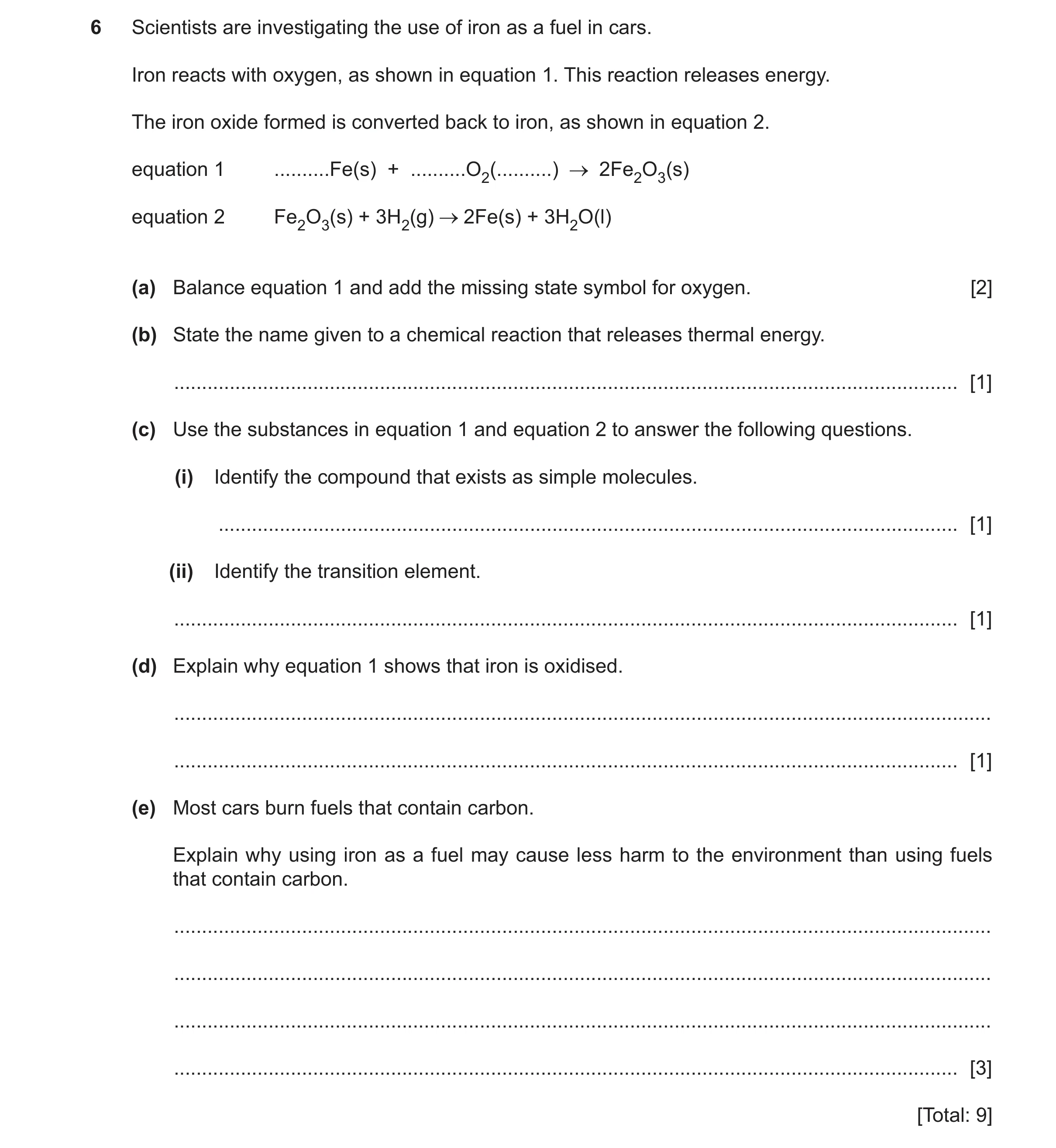
6 Scientists are investigating the use of iron as a fuel in cars. Iron reacts with oxygen, as shown in equation 1. This reaction releases energy. The iron oxide formed is converted back to iron, as shown in equation 2. equation 1 … Fe(s) + … O2( … ) 2Fe2O3(s) equation 2 Fe2O3(s) + 3H2(g) 2Fe(s) + 3H2O(l) (a) Balance equation 1 and add the missing state symbol for oxygen. [2] (b) State the name given to a chemical reaction that releases thermal energy. … [1] (c) Use the substances in equation 1 and equation 2 to answer the following questions. (i) Identify the compound that exists as simple molecules. … [1] (ii) Identify the transition element. … [1] (d) Explain why equation 1 shows that iron is oxidised. … … [1] (e) Most cars burn fuels that contain carbon. Explain why using iron as a fuel may cause less harm to the environment than using fuels that contain carbon. … … … … [3] [Total: 9]
9 marks
Mark scheme: 6(a) 4Fe + 3O2 ; 2 (g) ; 6(b) exothermic ; 1 6(c)(i) water / H2O ; 1 6(c)(ii) iron / Fe ; 1 6(d) (Fe / iron) gains oxygen ; 1 6(e) any three from: 3 iron does not produce carbon dioxide / carbon fuels produce carbon dioxide ; iron does not produce carbon monoxide / carbon fuels produce carbon monoxide ; carbon dioxide causes climate change ; carbon monoxide is toxic ; using iron as a fuel only produces water as a waste product ;
This question in 0653/33 May/June 2025
 8 / 23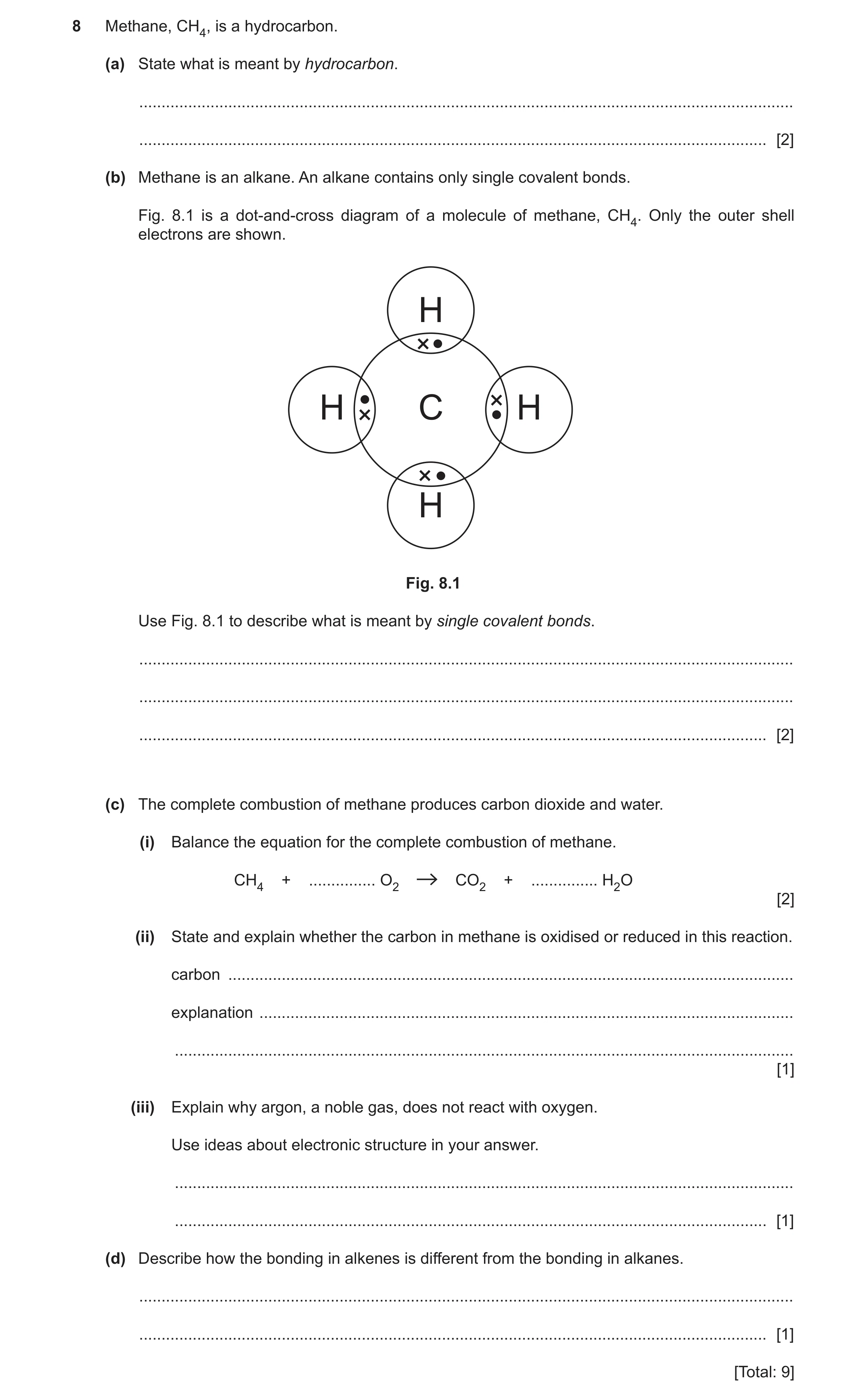
 11 / 23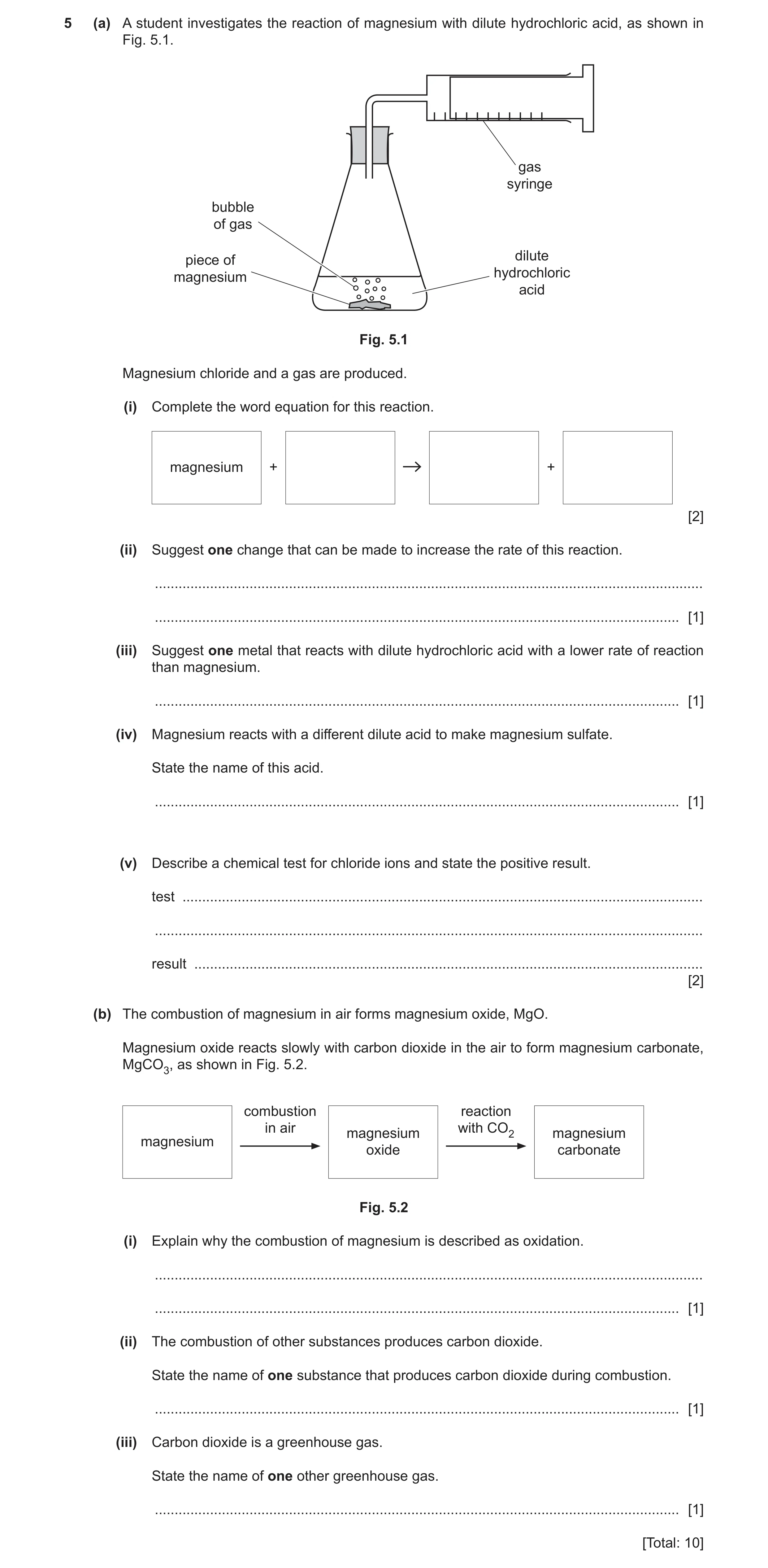
 15 / 23
 16 / 23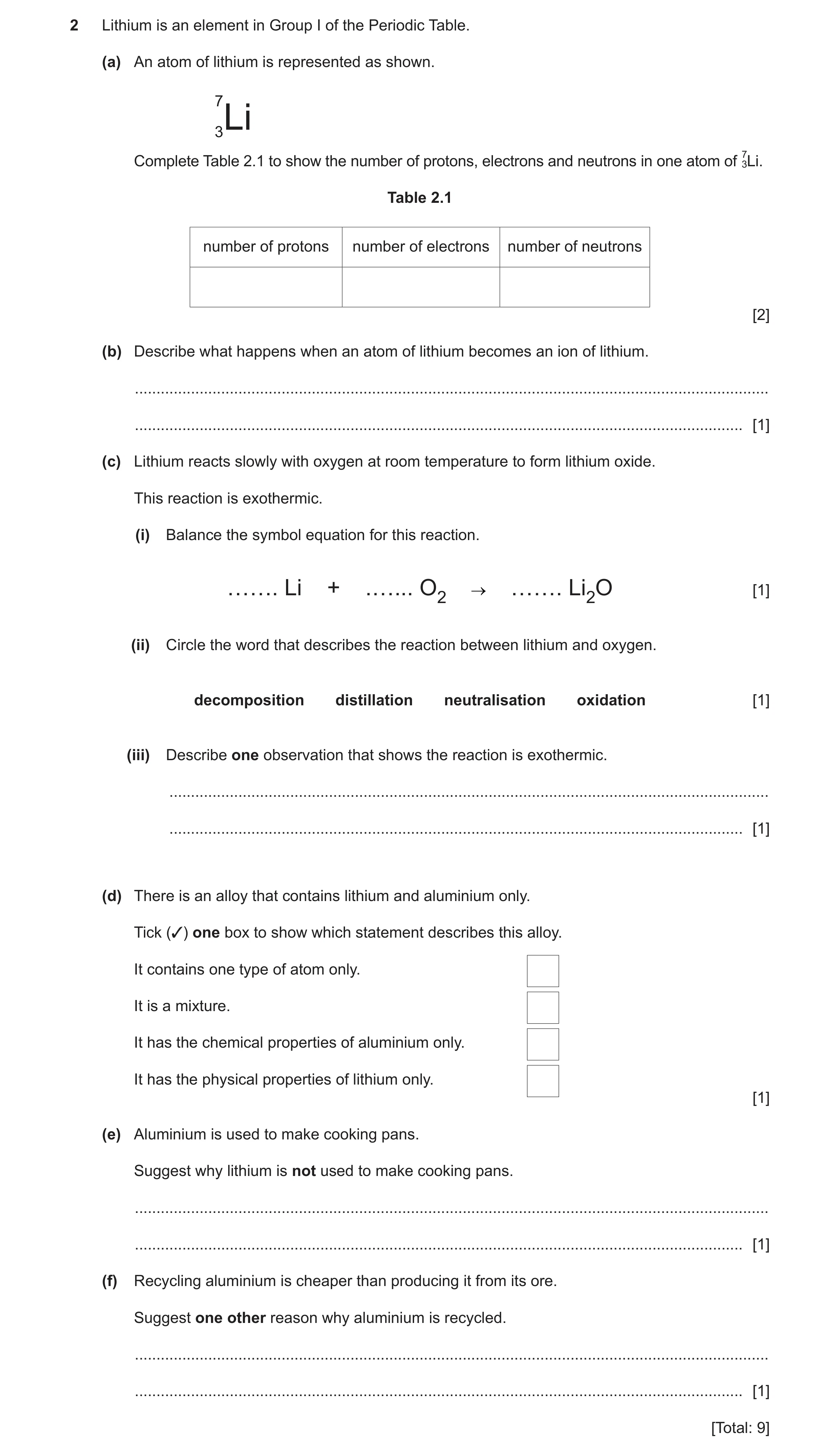
 20 / 23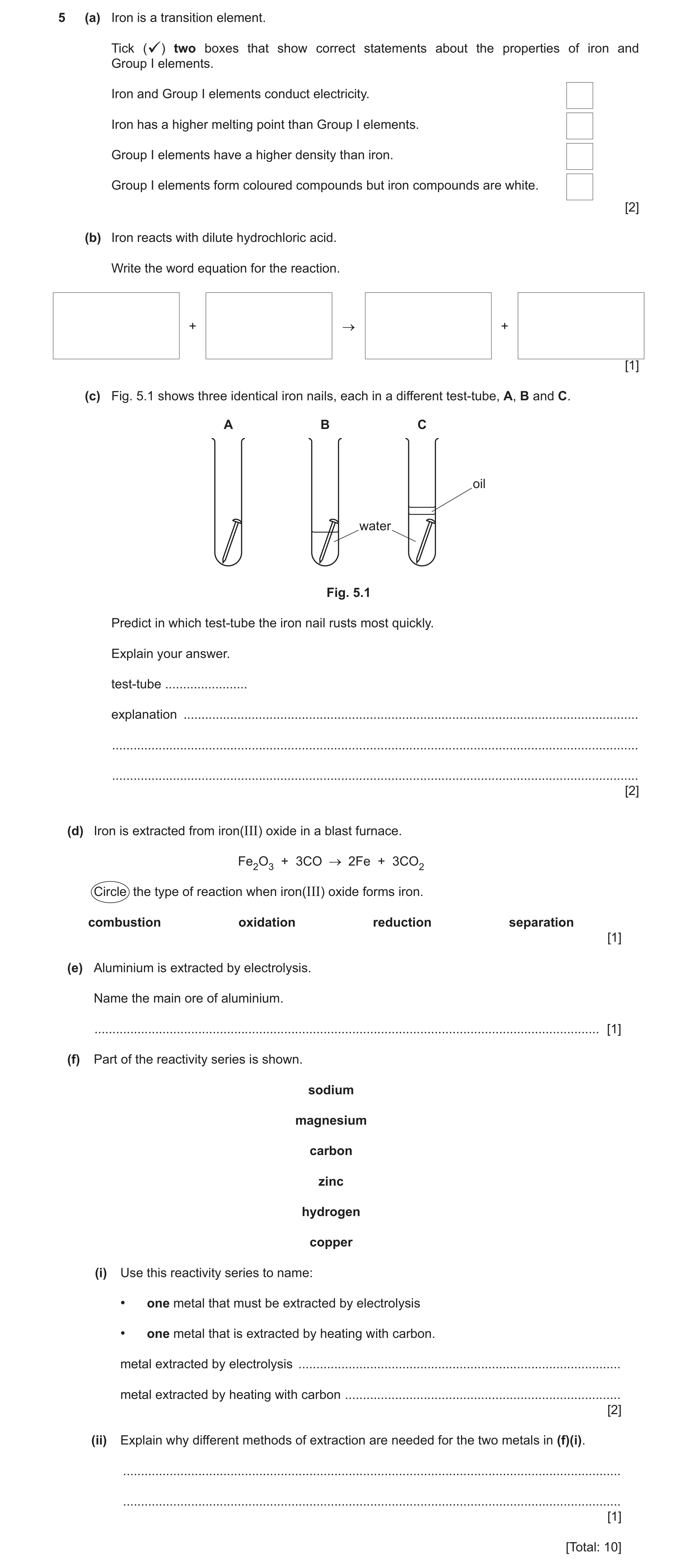
 23 / 23
 10
10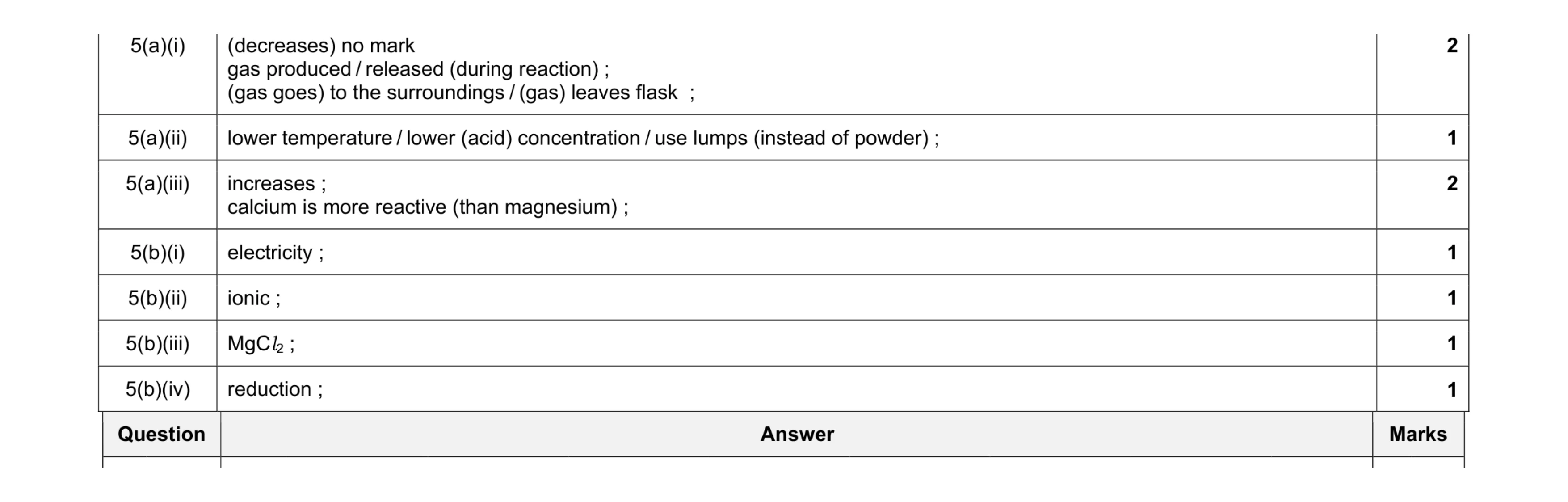 9
9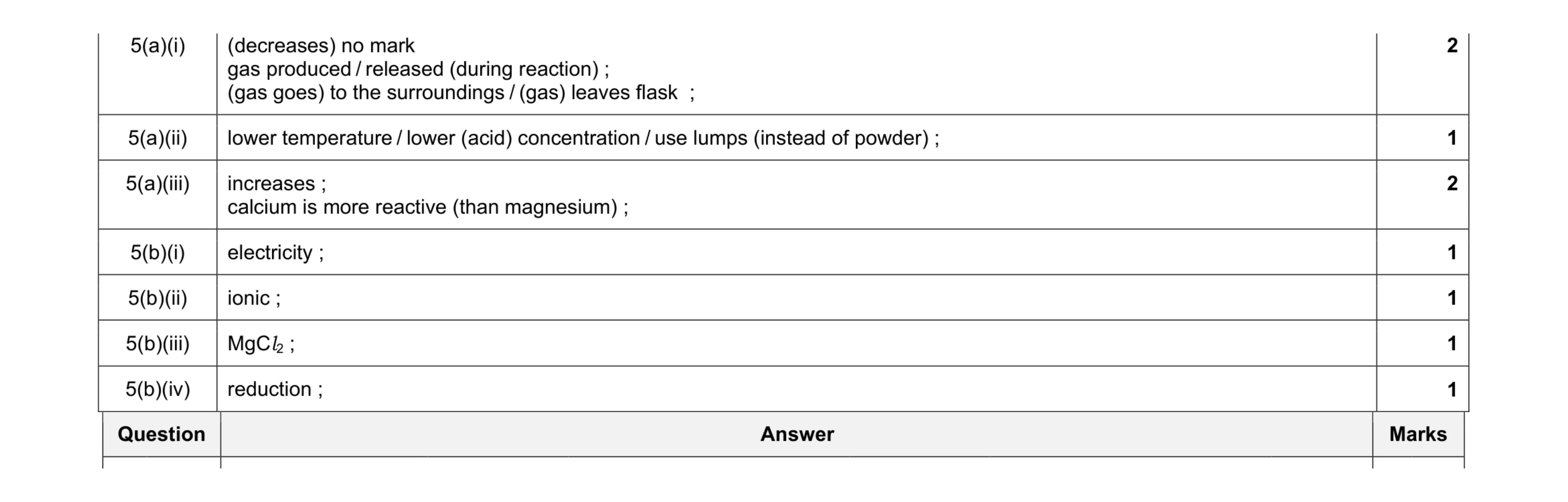 9
9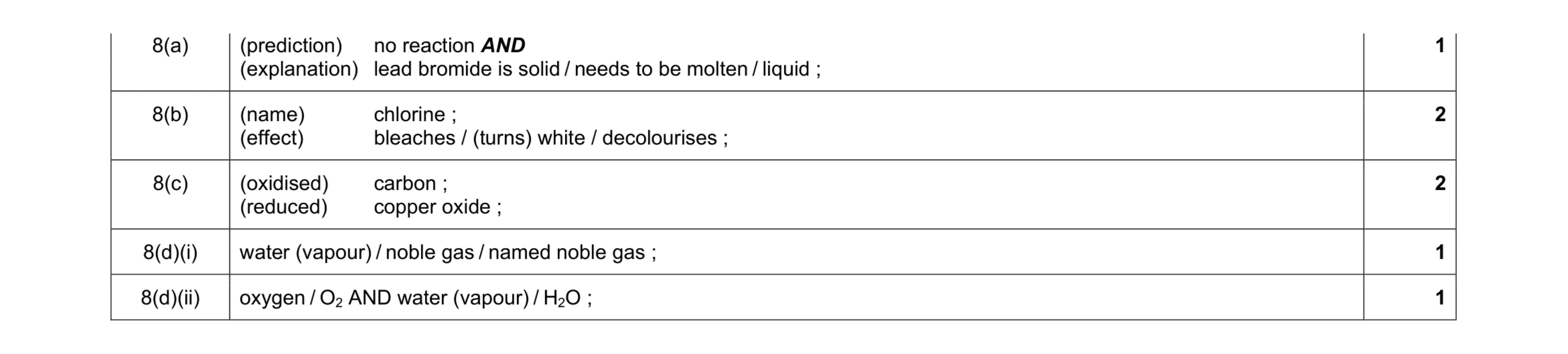 7
7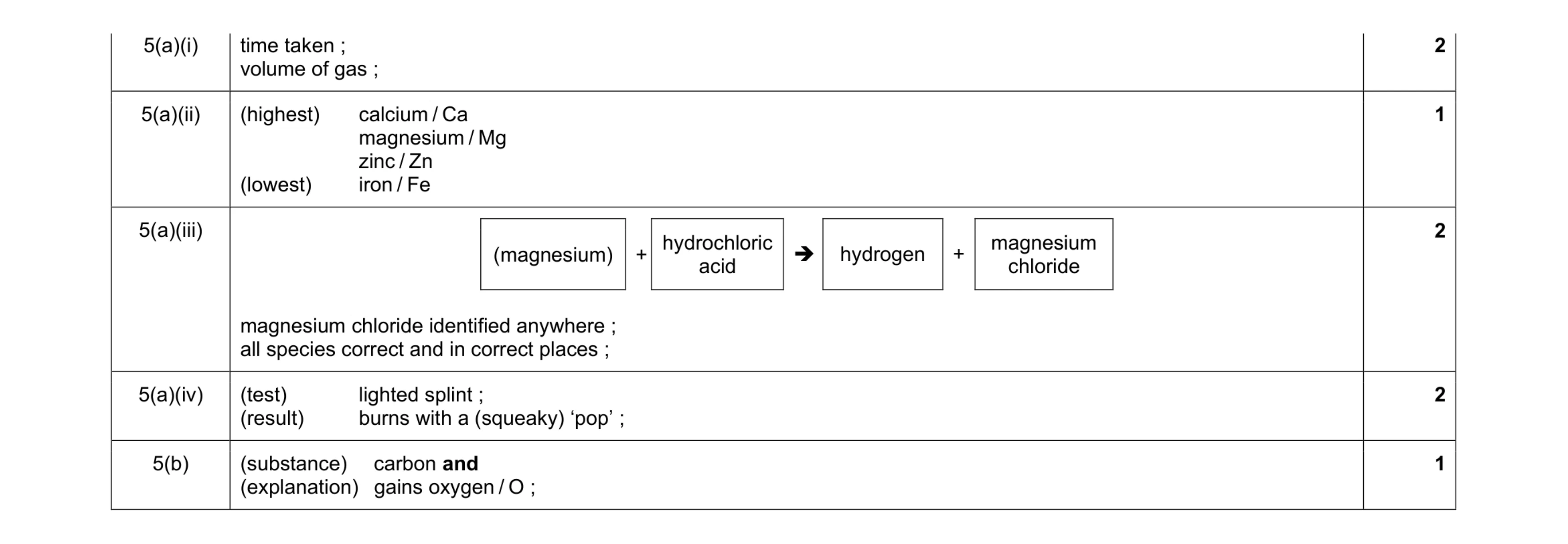 8
8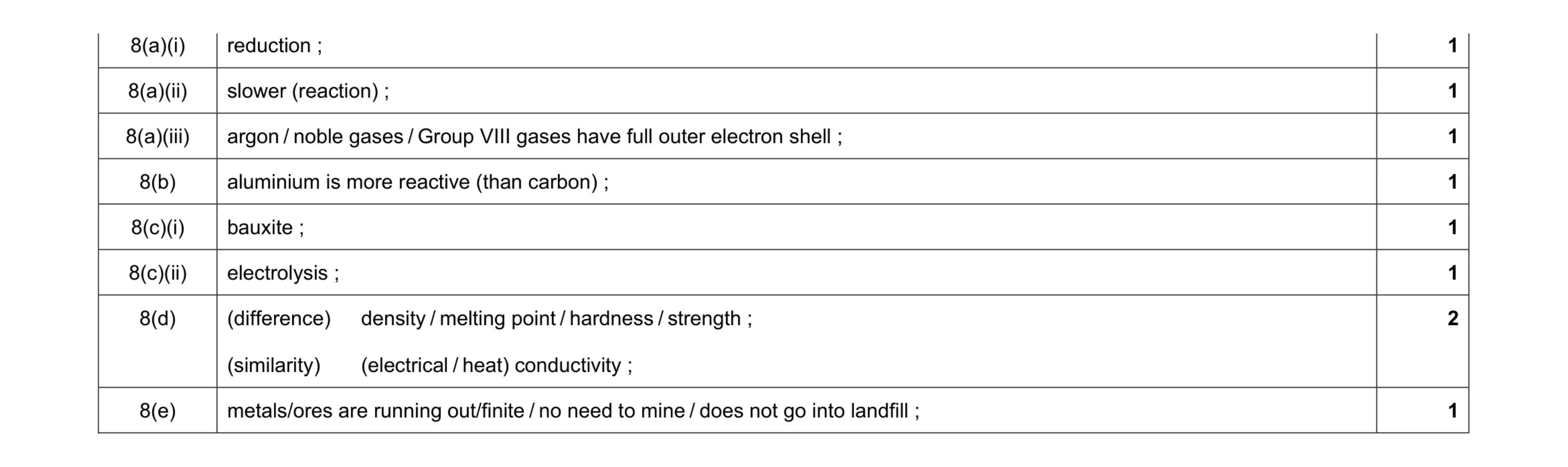 9
9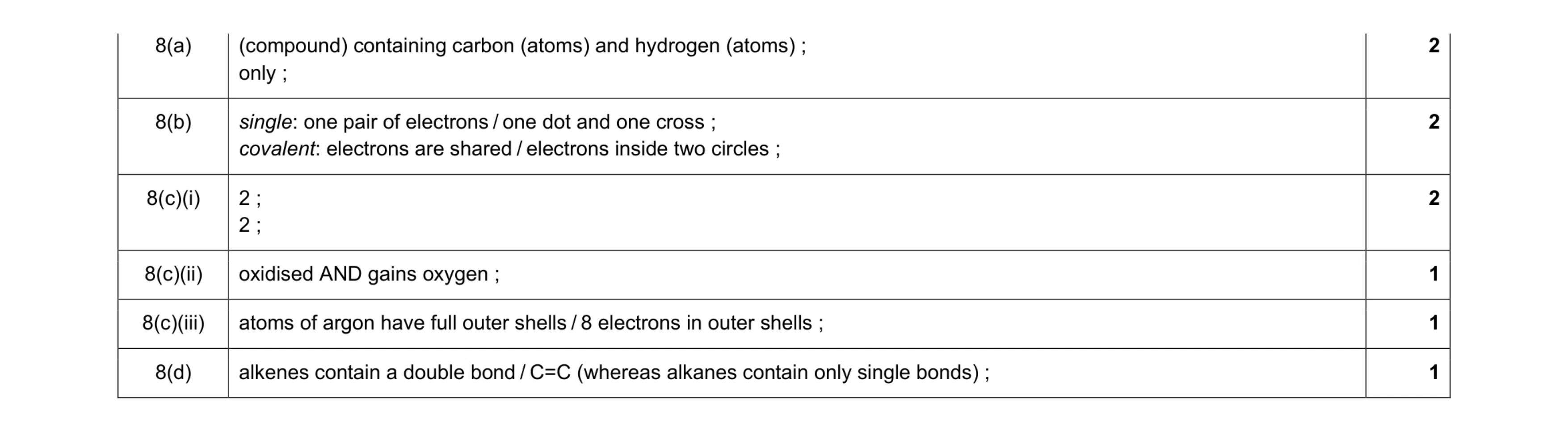 9
9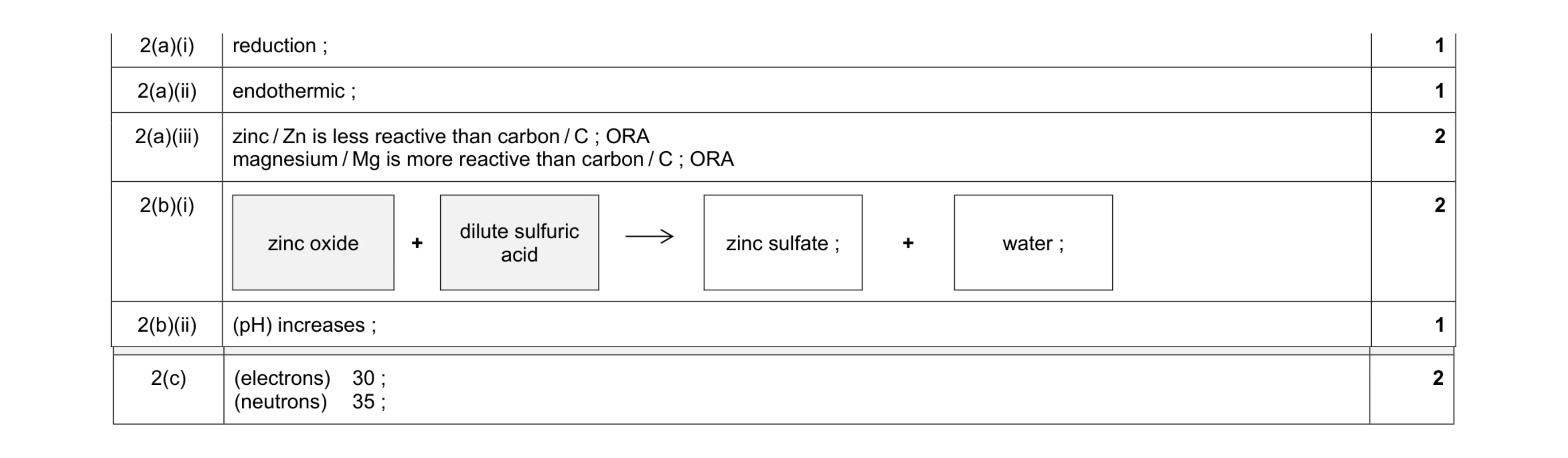 9
9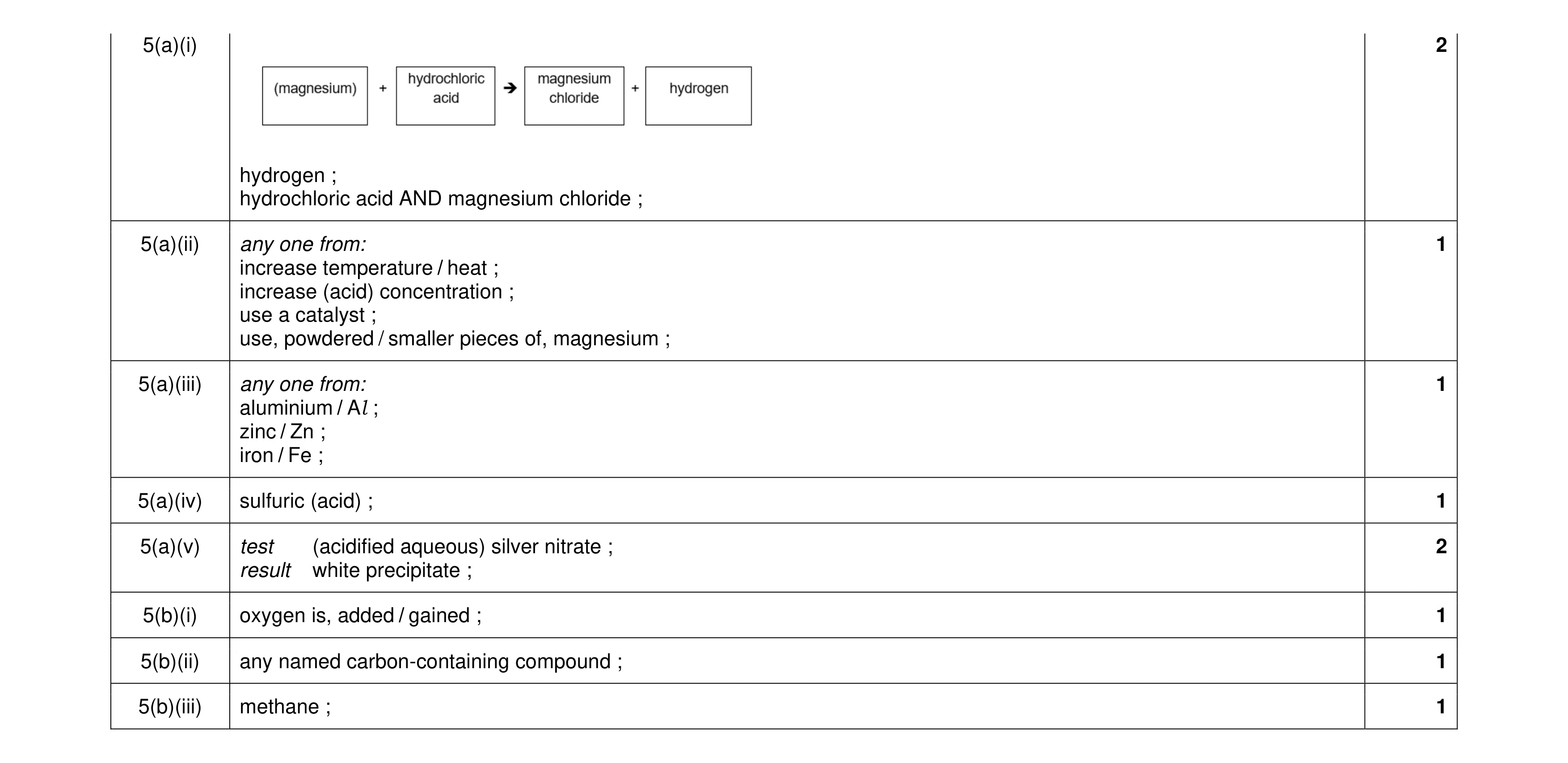 10
10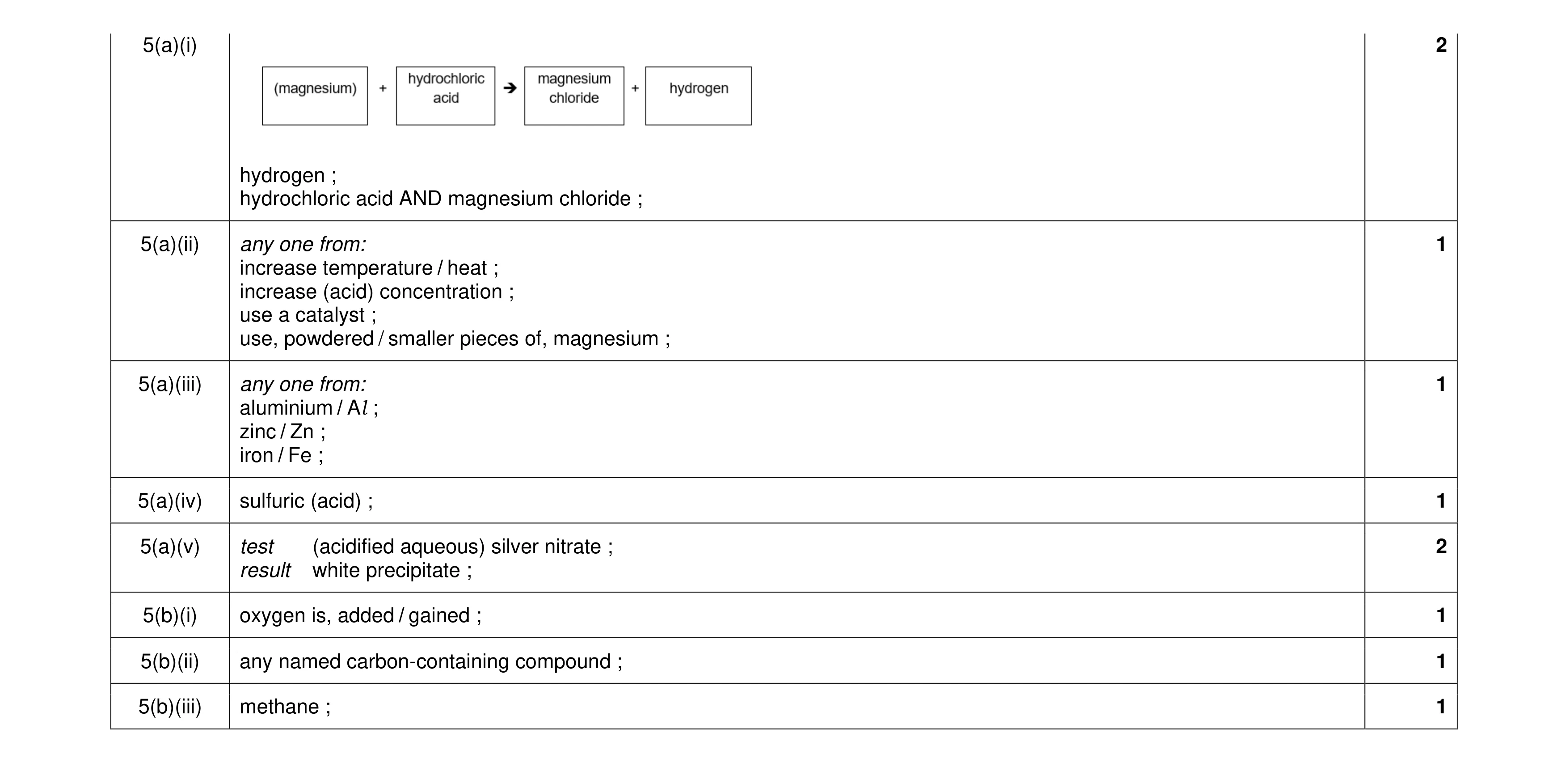 10
10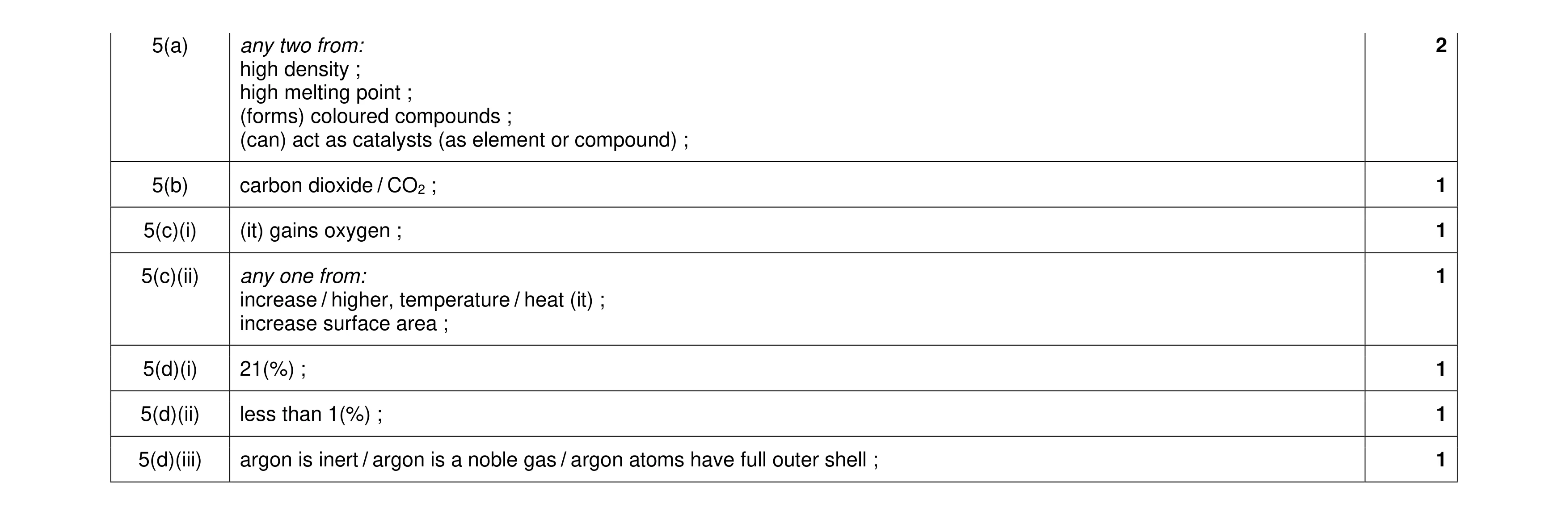 8
8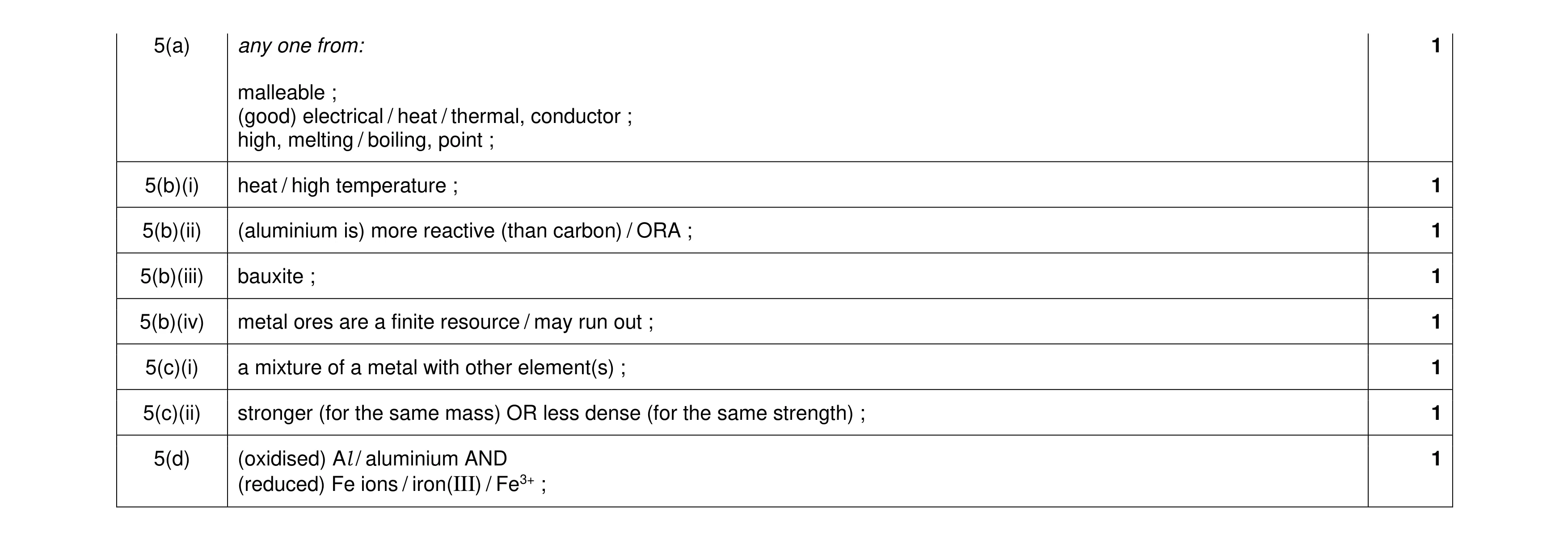 8
8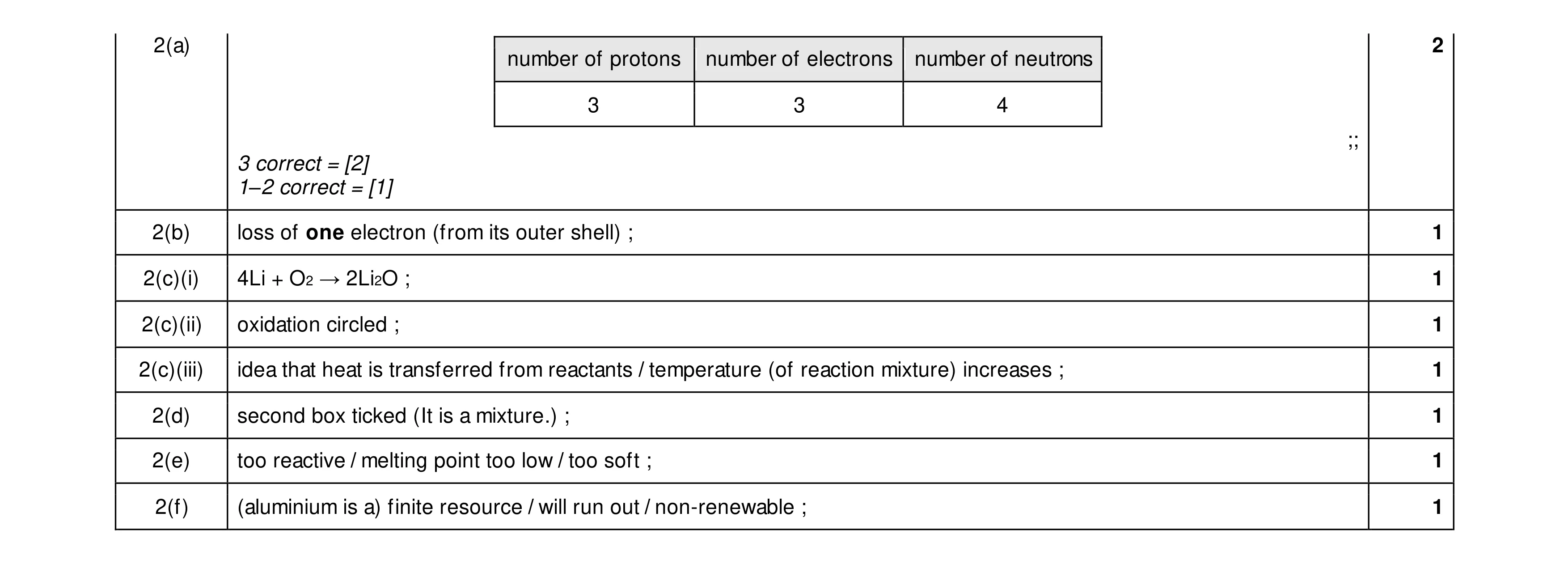 9
9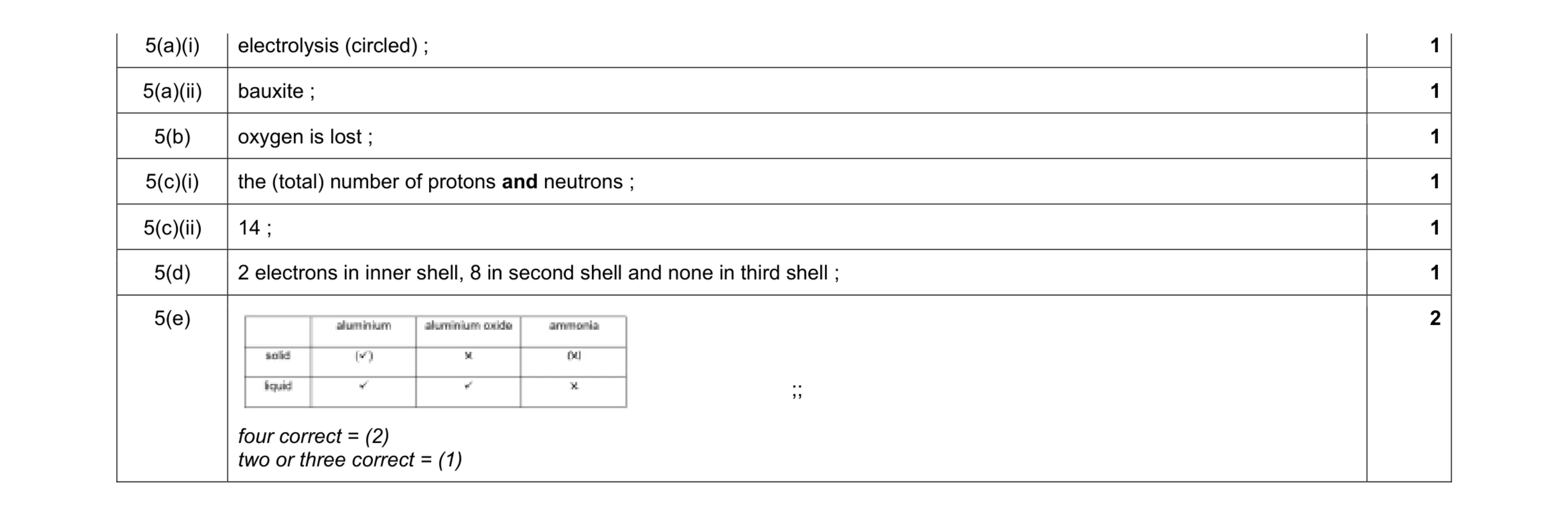 8
8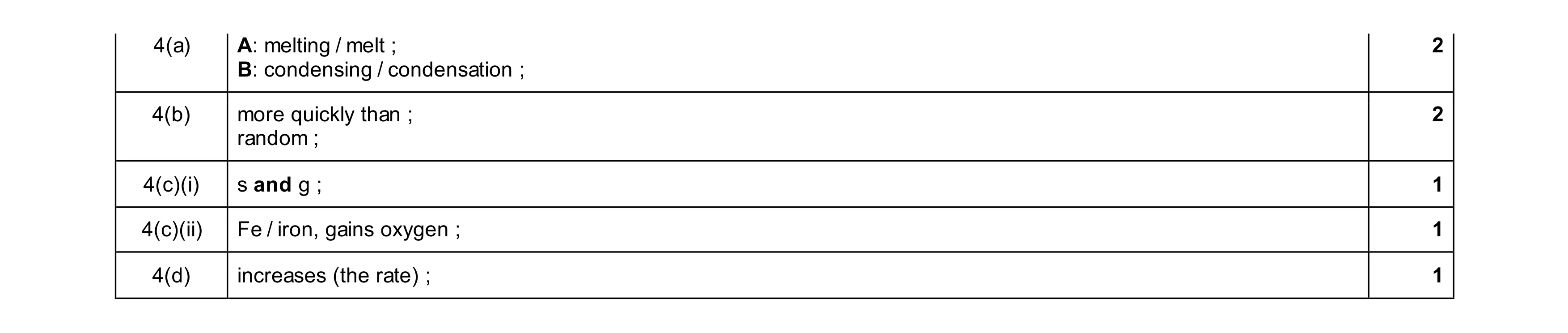 7
7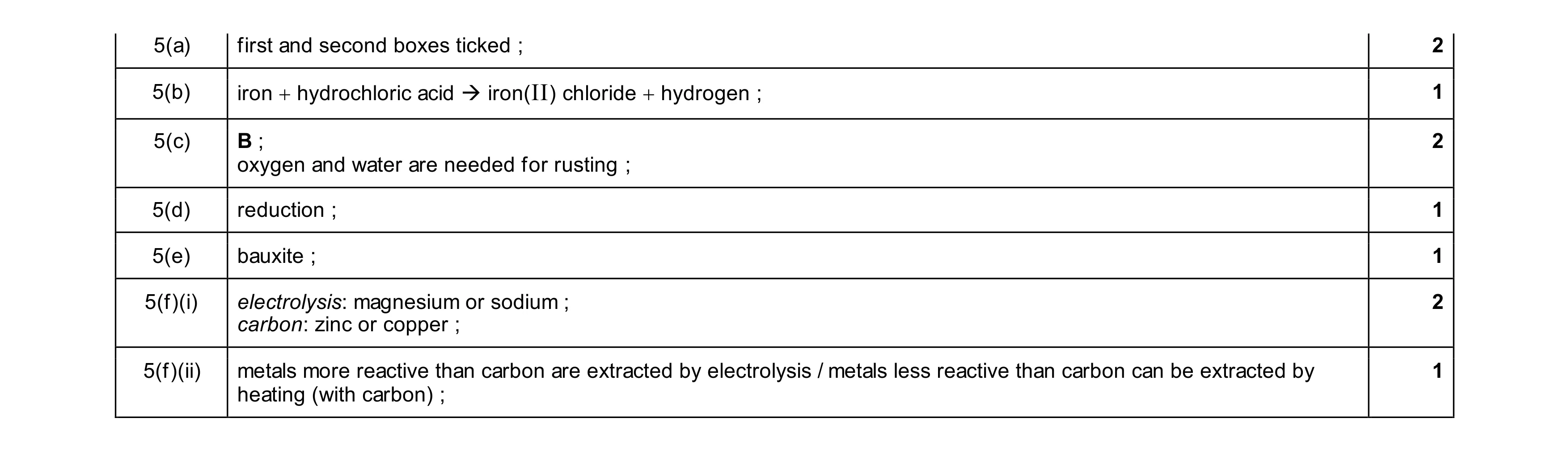 10
10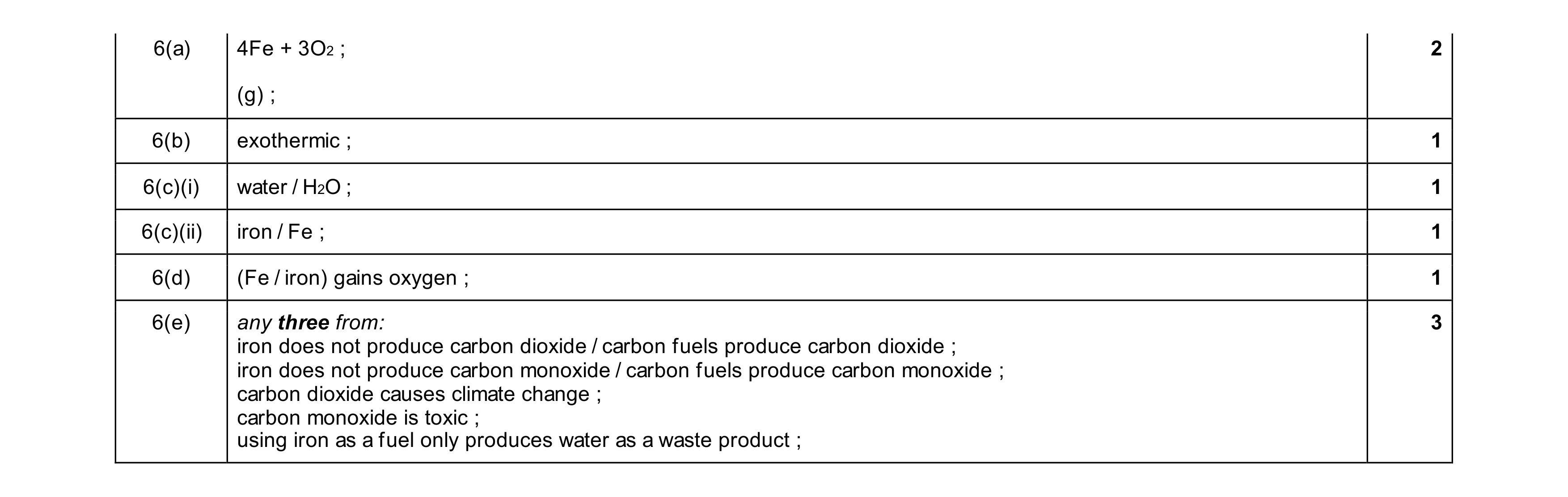 9
9