Questions as text
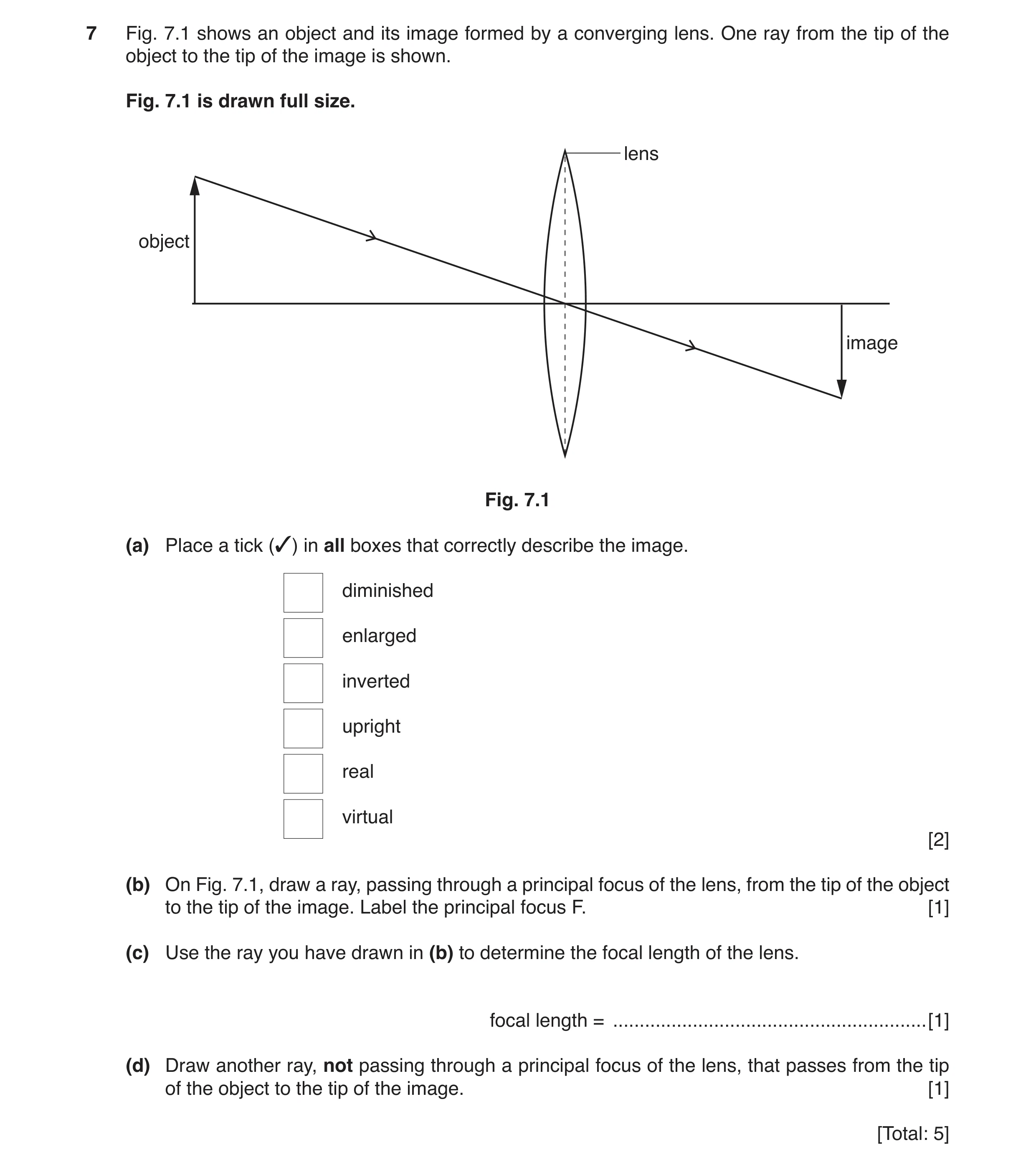
Q1 · An object and its image formed by a converging lens 0625/42 Feb/March 2017
7 Fig. 7.1 shows an object and its image formed by a converging lens. One ray from the tip of the object to the tip of the image is shown. Fig. 7.1 is drawn full size. lens object image Fig. 7.1 (a) Place a tick (3) in all boxes that correctly describe the image. diminished enlarged inverted upright real virtual [2] (b) On Fig. 7.1, draw a ray, passing through a principal focus of the lens, from the tip of the object to the tip of the image. Label the principal focus F. [1] (c) Use the ray you have drawn in (b) to determine the focal length of the lens. focal length = … [1] (d) Draw another ray, not passing through a principal focus of the lens, that passes from the tip of the object to the tip of the image. [1] [Total: 5]
5 marks
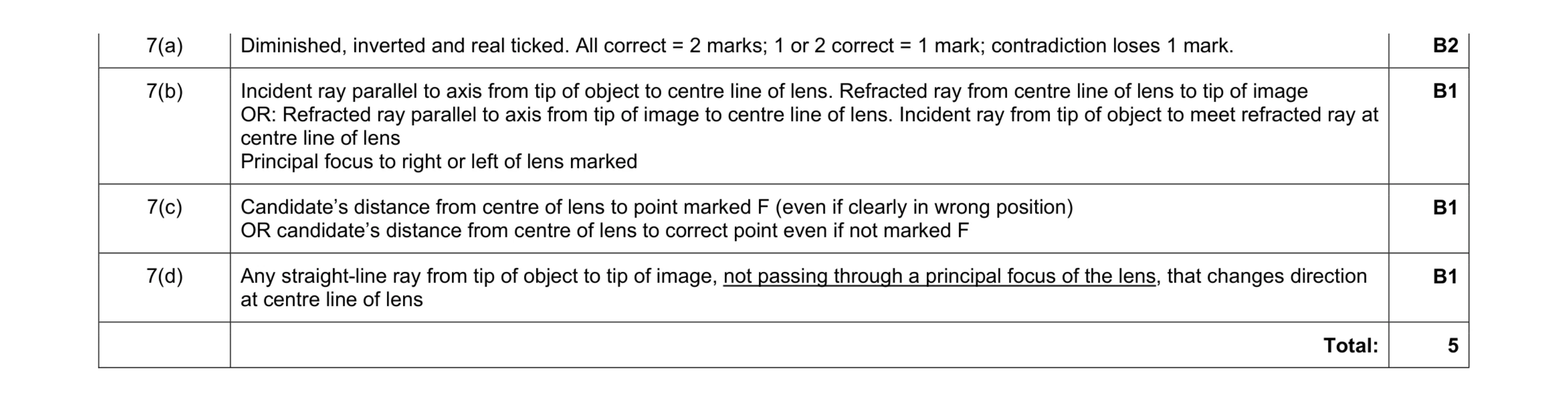
Mark scheme: 7(a) Diminished, inverted and real ticked. All correct = 2 marks; 1 or 2 correct = 1 mark; contradiction loses 1 mark. B2 7(b) Incident ray parallel to axis from tip of object to centre line of lens. Refracted ray from centre line of lens to tip of image OR: Refracted ray parallel to axis from tip of image to centre line of lens. Incident ray from tip of object to meet refracted ray at centre line of lens Principal focus to right or left of lens marked B1 7(c) Candidate’s distance from centre of lens to point marked F (even if clearly in wrong position) OR candidate’s distance from centre of lens to correct point even if not marked F B1 7(d) Any straight-line ray from tip of object to tip of image, not passing through a principal focus of the lens, that changes direction at centre line of lens B1 Total: 5
This question in 0625/42 Feb/March 2017
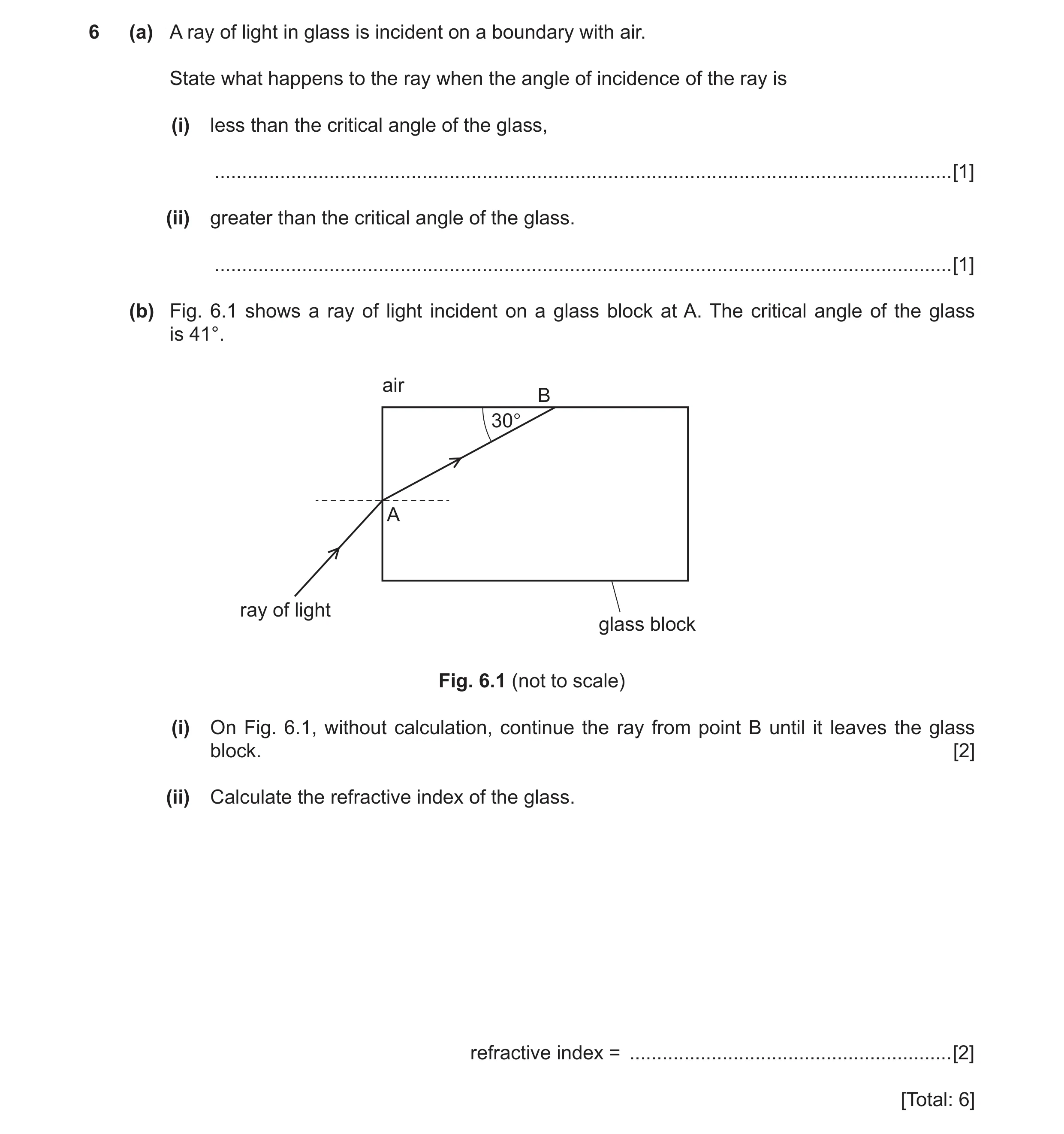
Q2 · A ray of light in glass is incident on a boundary with air 0625/41 May/June 2017
6 (a) A ray of light in glass is incident on a boundary with air. State what happens to the ray when the angle of incidence of the ray is (i) less than the critical angle of the glass, … [1] (ii) greater than the critical angle of the glass. … [1] (b) Fig. 6.1 shows a ray of light incident on a glass block at A. The critical angle of the glass is 41°. air B 30° A ray of light glass block Fig. 6.1 (not to scale) (i) On Fig. 6.1, without calculation, continue the ray from point B until it leaves the glass block. [2] (ii) Calculate the refractive index of the glass. refractive index = … [2] [Total: 6]
6 marks
Mark scheme: 6(a)(i) (Ray passes into the air and) refracts / changes direction / bends B1 6(a)(ii) Total internal reflection (takes place) B1 6(b)(i) Total internal reflection at B with angle of incidence equal to angle of reflection (by eye) B1 Refraction into air at right-hand face with angle of refraction greater than angle of incidence B1 6(b)(ii) (n =) 1/sin c OR 1/sin 41 M1 1.5 A1 Total: 6
This question in 0625/41 May/June 2017
Q3 · Red light travelling in air strikes the curved surface of a semi-circular glass block at P 0625/43 May/June 2017
8 Red light travelling in air strikes the curved surface of a semi-circular glass block at P. Fig. 8.1 shows the ray of light. O red light air P 30° semi-circular glass block Q Fig. 8.1 The light travels in a straight line from O to Q. (a) Explain why the light does not change direction as it enters the glass block at P. … … [1] (b) The light travels in the glass to Q where it strikes the edge of the block at 30° to the normal. The light then emerges into the air. (i) The refractive index of the glass is 1.5. Calculate the angle between the normal and the ray in the air after the light emerges from the block at Q. angle = … [3] (ii) On Fig. 8.1, sketch the path of the light in the air after it emerges at Q. [1] (c) The direction of the light striking the curved surface of the glass block is changed. The angle between the ray and the normal at Q gradually increases from 30° to 90°. Describe what happens to the light that strikes the block at Q as this angle increases. … … … … … … [3] [Total: 8]
8 marks
Mark scheme: 8(a) OP/it is along the normal/at 90° (to the curved surface) B1 8(b)(i) sin i / sin r = n C1 sin r / sin 30(°) = 1.5 OR sin r = 1.5 × sin 30(°) C1 49° A1 8(b)(ii) ray bends away from the normal c.a.o. B1 8(c) angle (from normal) of refraction increases B1 refracted ray travels along boundary OR reflected ray becomes brighter OR refracted ray becomes dimmer B1 light reflects back into glass (with i = r) B1 Total: 8
This question in 0625/43 May/June 2017
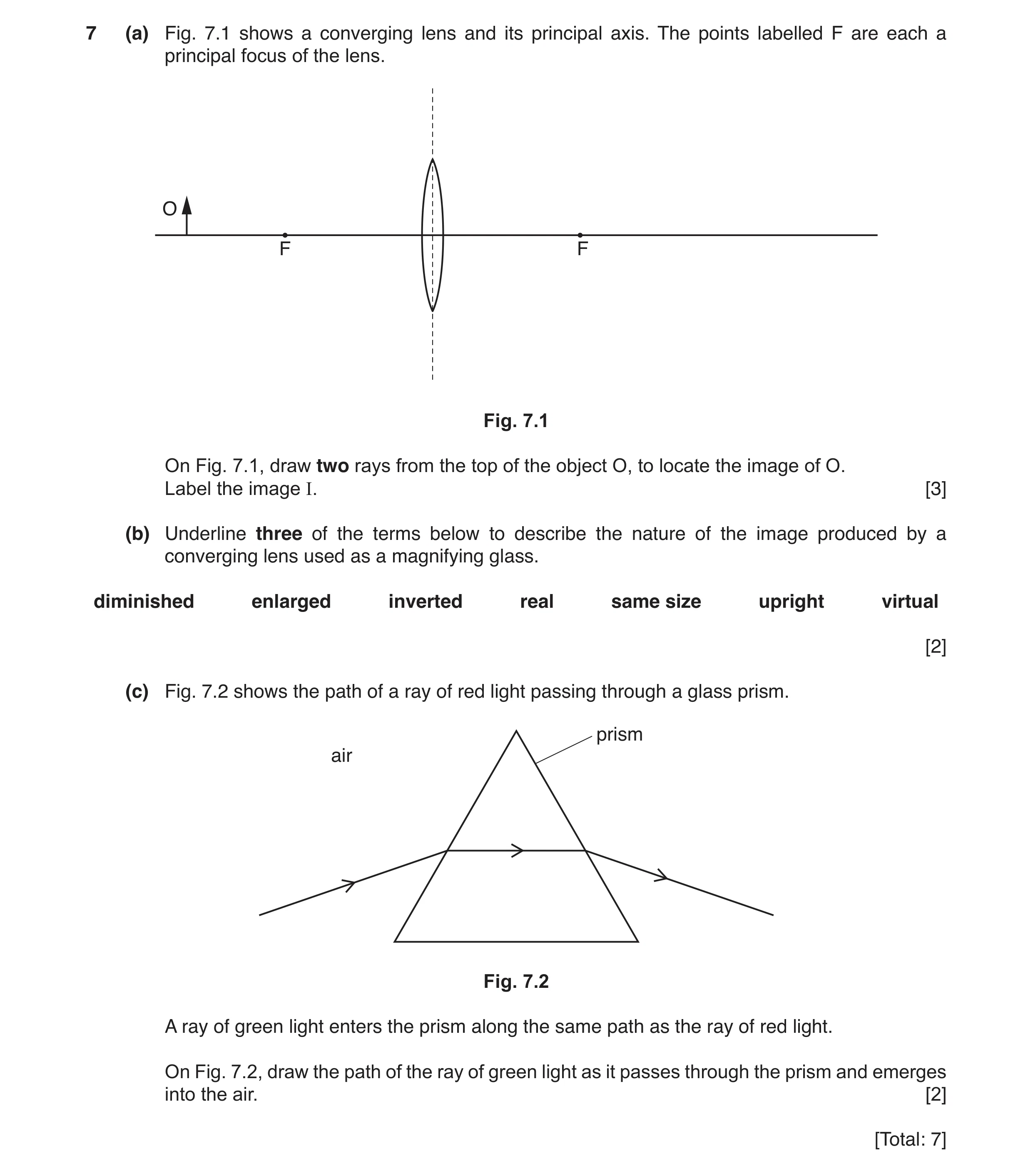
Q4 · A converging lens and its principal axis 0625/41 Oct/Nov 2017
7 (a) Fig. 7.1 shows a converging lens and its principal axis. The points labelled F are each a principal focus of the lens. O F F Fig. 7.1 On Fig. 7.1, draw two rays from the top of the object O, to locate the image of O. Label the image I. [3] (b) Underline three of the terms below to describe the nature of the image produced by a converging lens used as a magnifying glass. diminished enlarged inverted real same size upright virtual [2] (c) Fig. 7.2 shows the path of a ray of red light passing through a glass prism. prism air Fig. 7.2 A ray of green light enters the prism along the same path as the ray of red light. On Fig. 7.2, draw the path of the ray of green light as it passes through the prism and emerges into the air. [2] [Total: 7]
7 marks
Mark scheme: 7(a) One ray with correct path through lens B1 Another ray with correct path through lens Rays intersect to right of F and below axis, inverted image B1 drawn and labelled I B1 7(b) enlarged, upright and virtual only underlined or ringed B2 Two of above descriptions underlined B1 7(c) On entering prism: green ray deflection more than red ray and above normal B1 On leaving prism: diverging downwards from red ray and not along surface of prism B1
This question in 0625/41 Oct/Nov 2017
Q5 · A diagram of a converging lens used to produce an image of an object 0625/42 Oct/Nov 2017
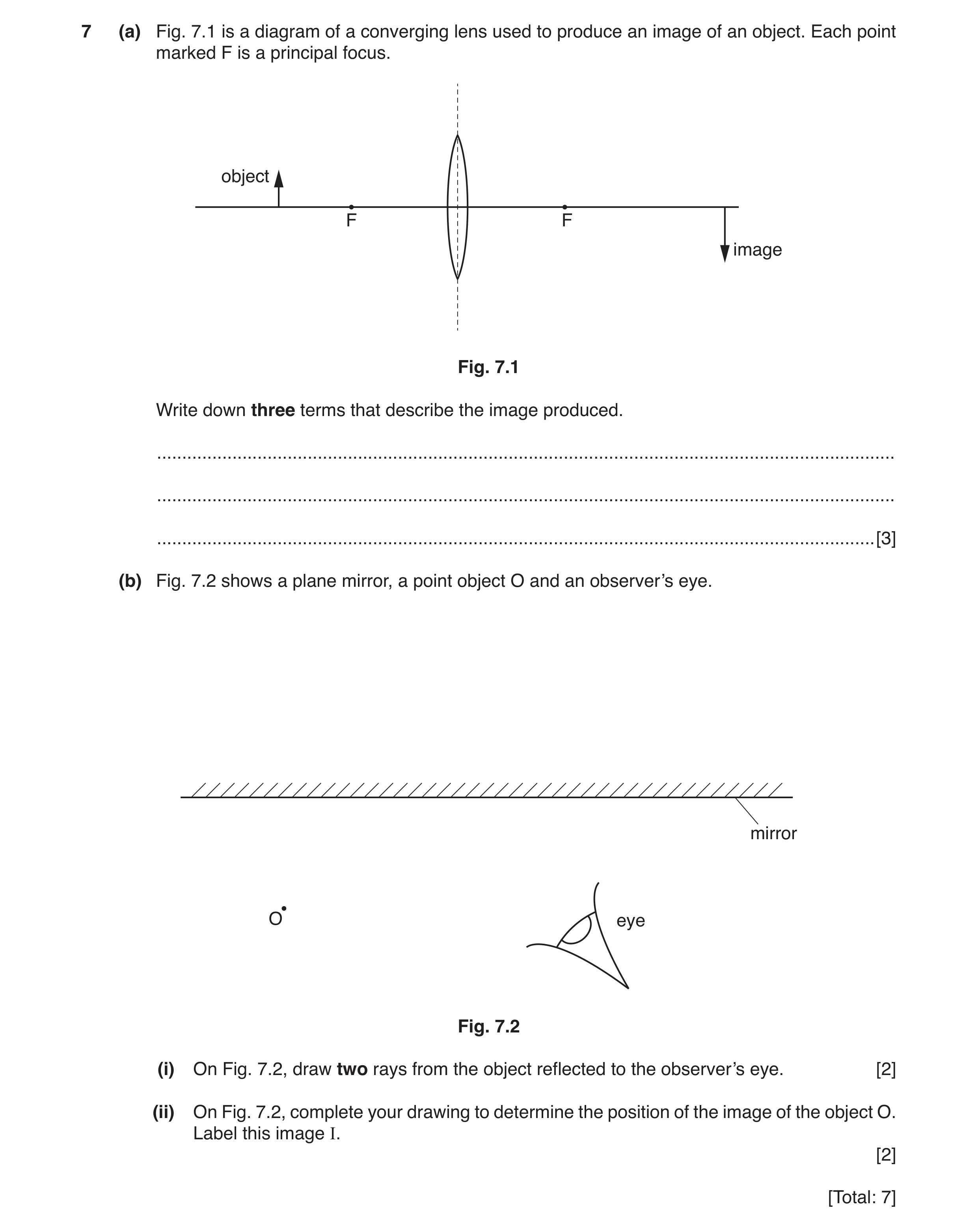
7 (a) Fig. 7.1 is a diagram of a converging lens used to produce an image of an object. Each point marked F is a principal focus. object F F image Fig. 7.1 Write down three terms that describe the image produced. … … … [3] (b) Fig. 7.2 shows a plane mirror, a point object O and an observer’s eye. mirror O eye Fig. 7.2 (i) On Fig. 7.2, draw two rays from the object reflected to the observer’s eye. [2] (ii) On Fig. 7.2, complete your drawing to determine the position of the image of the object O. Label this image I. [2] [Total: 7]
7 marks
Mark scheme: 7(a) real (answers in any order for 7(a)) B1 enlarged OR magnified B1 Inverted OR upside down B1 7(b)(i) 1st straight incident ray from close to point object to mirror correctly reflected, i = r M1 2nd straight incident ray from point object to mirror correctly reflected, i = r A1 7(b)(ii) BOTH reflected rays extended back to intersect behind mirror M1 BOTH reflected rays extended back in straight lines AND I in correct position AND {labelled OR clearly indicated} A1
This question in 0625/42 Oct/Nov 2017
Q6 · Visible light is one component of the electromagnetic spectrum 0625/43 Oct/Nov 2017
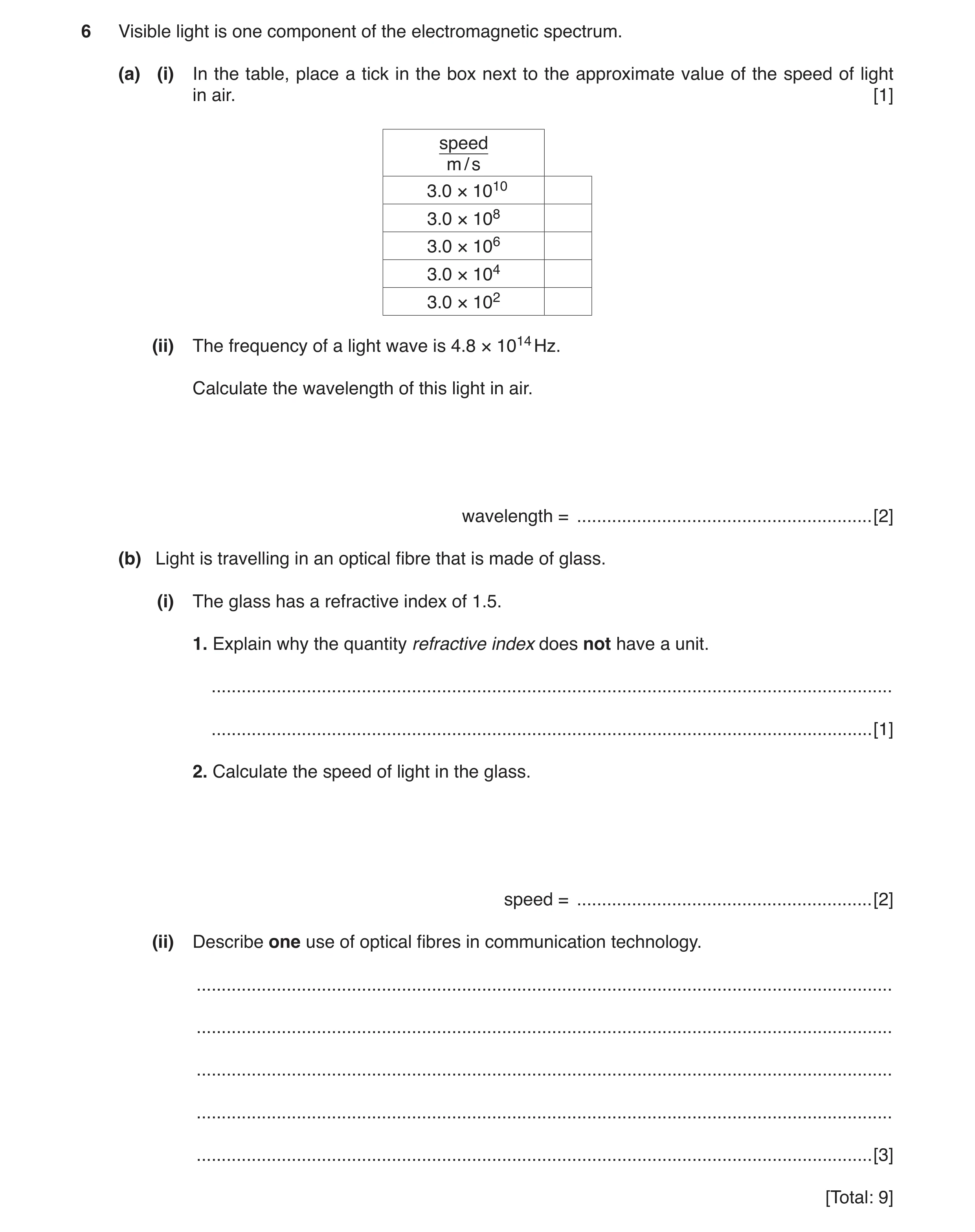
6 Visible light is one component of the electromagnetic spectrum. (a) (i) In the table, place a tick in the box next to the approximate value of the speed of light in air. [1] speed m / s 3.0 × 10¹⁰ 3.0 × 10⁸ 3.0 × 10⁶ 3.0 × 10⁴ 3.0 × 10² (ii) The frequency of a light wave is 4.8 × 10¹⁴ Hz. Calculate the wavelength of this light in air. wavelength = … [2] (b) Light is travelling in an optical fibre that is made of glass. (i) The glass has a refractive index of 1.5. 1. Explain why the quantity refractive index does not have a unit. … … [1] 2. Calculate the speed of light in the glass. speed = … [2] (ii) Describe one use of optical fibres in communication technology. … … … … … [3] [Total: 9]
9 marks
Mark scheme: 6(a)(i) B1 6(a)(ii) (λ = )c / f or 3.0 × 10⁸ / 4.8 × 10¹⁴ C1 6.2 / 6.25 / 6.3 × 10⁻⁷ m A1 6(b)(i) 1. sines have no unit or sines are ratio of two lengths or ratio of two speeds (whose units cancel) or units cancel B1 2. (v =) c / n or 3.0 × 10⁸ / 1.5 C1 2.0 × 10⁸ m / s A1 6(b)(ii) information / message / music/sound / signal / data (encoded as pulses of light) sent B1 light (travels along fibre) or infra-red (radiation) B1 light detected (at far end) or message decoded or total internal reflection mentioned B1
This question in 0625/43 Oct/Nov 2017
Q7 · A converging lens and its principal axis 0625/43 Oct/Nov 2017
7 (a) Fig. 7.1 shows a converging lens and its principal axis. The points F1 and F2 are each a principal focus of the lens. principal axis O F1 F2 Fig. 7.1 An object O is placed between F1 and the lens. (i) On Fig. 7.1, draw two rays from the top of the object O to locate the image. Label the image I. [3] (ii) The object O is moved to the left along the principal axis so that it is further from the lens than F1. Fig. 7.2 is a diagram of the new arrangement with the new image shown. O F1 F2 principal axis image Fig. 7.2 Underline three of the terms below that describe the image shown in Fig. 7.2. [2] diminished enlarged inverted real same size upright virtual (b) Fig. 7.3 shows yellow light passing through a glass prism. Fig. 7.3 Blue light enters the prism along the same path as the yellow light. On Fig. 7.3, draw the path of the blue light as it enters, passes through and leaves the prism. [2] [Total: 7]
7 marks
Mark scheme: 7(a)(i) any two rays that start at the top of the image from: • seems to come from F1 to lens and emerges paraxially • passes through centre of lens undeviated • paraxial to the lens and passes through F2 M2 two correct rays traced back and image indicated A1 7(a)(ii) any two of enlarged; inverted; real underlined B1 enlarged and inverted and real underlined B1 7(b) refracted ray in prism below yellow ray and above normal B1 emergent ray diverging away from the yellow ray and above side of prism B1
This question in 0625/43 Oct/Nov 2017
Q8 · A ray of light in air is incident on a glass block 0625/41 May/June 2018
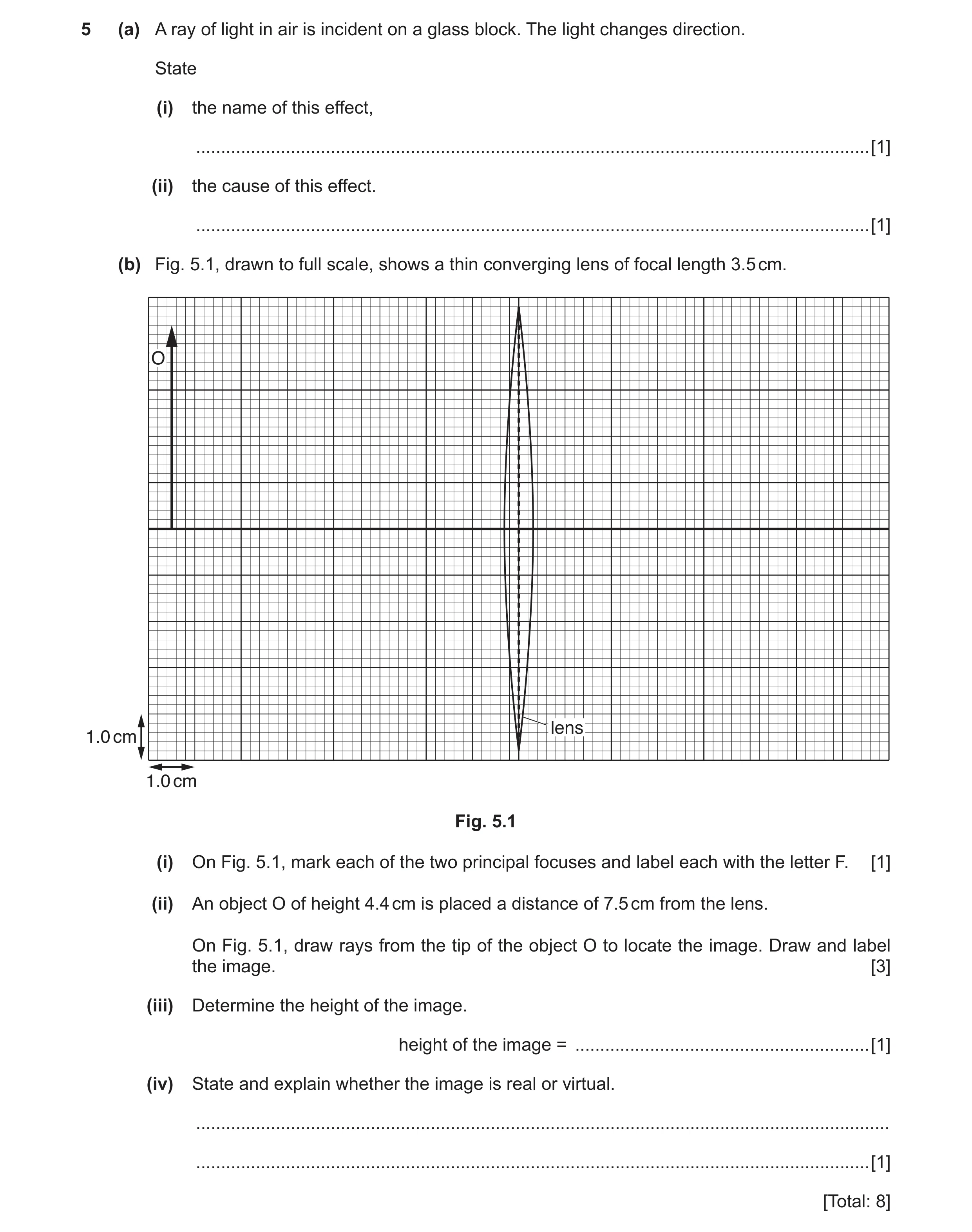
5 (a) A ray of light in air is incident on a glass block. The light changes direction. State (i) the name of this effect, … [1] (ii) the cause of this effect. … [1] (b) Fig. 5.1, drawn to full scale, shows a thin converging lens of focal length 3.5 cm. O lens 1.0 cm 1.0 cm Fig. 5.1 (i) On Fig. 5.1, mark each of the two principal focuses and label each with the letter F. [1] (ii) An object O of height 4.4 cm is placed a distance of 7.5 cm from the lens. On Fig. 5.1, draw rays from the tip of the object O to locate the image. Draw and label the image. [3] (iii) Determine the height of the image. height of the image = … [1] (iv) State and explain whether the image is real or virtual. … … [1] [Total: 8]
8 marks
Mark scheme: 5(a)(i) Refraction OR reflection 1 5(a)(ii) If refraction in (i) Change or increase or decrease in speed of wave OR change of refractive index OR 1 If reflection in (i) Mention of surface or boundary (1) 5(b)(i) 2 points both labelled F at 3.5 cm either side of optical centre of lens 1 5(b)(ii) Any two of: Paraxial ray from tip of O refracted through farther F/3.5 cm Undeviated ray from tip of O through optical centre of lens Ray from tip of O through nearer F refracted paraxially 2 Image/I drawn from intersection of rays to principal axis with indication that image is inverted 1 5(b)(iii) In range 3.6 to 4.1 cm 1 5(b)(iv) (Image is) real and light passes through it OR can be projected/seen on a screen OR refracted rays cross/meet 1
This question in 0625/41 May/June 2018
Q9 · A ray of light in water that is incident on a submerged, transparent plastic block 0625/42 May/June 2018
7 (a) Fig. 7.1 shows a ray of light in water that is incident on a submerged, transparent plastic block. water plastic Fig. 7.1 State what happens to the speed of light as it enters the plastic block. Explain your answer. … … … [2] (b) Fig. 7.2 shows the two principal focuses F1 and F2 of a thin converging lens. F1 F2 O lens 1.0 cm 1.0 cm Fig. 7.2 Fig. 7.2 also shows an object O of height 1.2 cm placed close to the lens. Two rays from the tip of the object O are incident on the lens. (i) On Fig. 7.2, continue the paths of these two rays for a further distance of at least 5 cm. [2] (ii) Using your answer to (b)(i), find and mark on Fig. 7.2 the image I of object O and label this image. [2] (iii) Determine the height of image I. height = … [1] (iv) State and explain whether I is a real image or a virtual image. … … [1] [Total: 8]
8 marks
Mark scheme: 7(a) (speed/it) decreases 1 refractive index > 1.0 OR sin (i) > sin (r) OR i > r OR refraction/bends towards normal OR np>nw OR sin (i) ÷ sin (r) = cw ÷ cp 1 7(b)(i) paraxial ray refracts through F2 1 other ray continues undeviated 1 7(b)(ii) candidate’s rays from (b)(i) traced back to intersection 1 image marked from intersection of candidate’s rays to axis 1 7(b)(iii) in range 2.7 cm to 3.3 cm AND rays converge to the left of the object 1 7(b)(iv) virtual AND light does not pass through image/cannot be projected on to a screen OR object distance < f OR on left of object 1
This question in 0625/42 May/June 2018
Q10 · A ray of light travelling in air strikes a glass block at an angle of 30° to the normal 0625/43 May/June 2018
7 (a) A ray of light travelling in air strikes a glass block at an angle of 30° to the normal. The light slows down as it enters the glass block. State and explain, in terms of wavefronts, what happens to the light. … … … … [3] (b) The speed of light in this block of glass is 1.9 × 10⁸ m / s. Calculate the refractive index of the glass. refractive index = … [2] [Total: 5]
5 marks
Mark scheme: 7(a) one side of wave(front) slows down before the other side B1 wave(front) slews around OR bends at boundary B1 bends towards the normal OR bends towards the side that slows first B1 7(b) (n =) c ÷ v OR (3.0 × 08) ÷ (1.9 × 10⁸) C1 1.6 A1
This question in 0625/43 May/June 2018
Q11 · A thin converging lens is used to produce an image I of object O 0625/43 May/June 2018
8 (a) A thin converging lens is used to produce an image I of object O. Fig. 8.1 shows O, I and the screen on which the image is produced. screen O principal axis I 1.0 cm 1.0 cm Fig. 8.1 (i) On Fig. 8.1, draw a straight line to represent a ray from the tip of the arrowhead of O to the tip of the arrowhead of I. Draw a vertical dotted line to indicate the position of the lens. This dotted line must extend above and below the principal axis. [2] (ii) Draw a second ray from the tip of the object O to the tip of image I. This ray should pass through a principle focus. Label the principle focus, F. [1] (iii) Determine the focal length of the lens. focal length = … [1] (iv) Image I is further from the lens than object O is from the lens. Image I is described as enlarged and inverted. State and explain one other characteristic of I. … … [1] (b) Fig. 8.2 shows a spherical fishbowl, full of water, by a window. A black curtain hangs behind the fishbowl. window black curtain fishbowl bright sunlight water Fig. 8.2 When full of water, the fishbowl can act as a converging lens. Suggest one possible hazard of leaving the fishbowl next to the window in bright sunlight. … … [1] [Total: 6]
6 marks
Mark scheme: 8(a)(i) straight line from tip of O to tip of I B1 dotted line/lens marked at 3.0 cm from O B1 8(a)(ii) Any one of: paraxial ray from tip of O refracting at lens to tip of I paraxial ray to I from lens and ray from O to meet it at lens B1 8(a)(iii) (focal length) in range 2.2 cm to 2.6 cm B1 8(a)(iv) real and light pass through it/projected on to screen/rays converge B1 8(b) (focused rays) set fire to curtain B1
This question in 0625/43 May/June 2018
Q12 · A laser produces a beam of monochromatic light 0625/41 Oct/Nov 2018
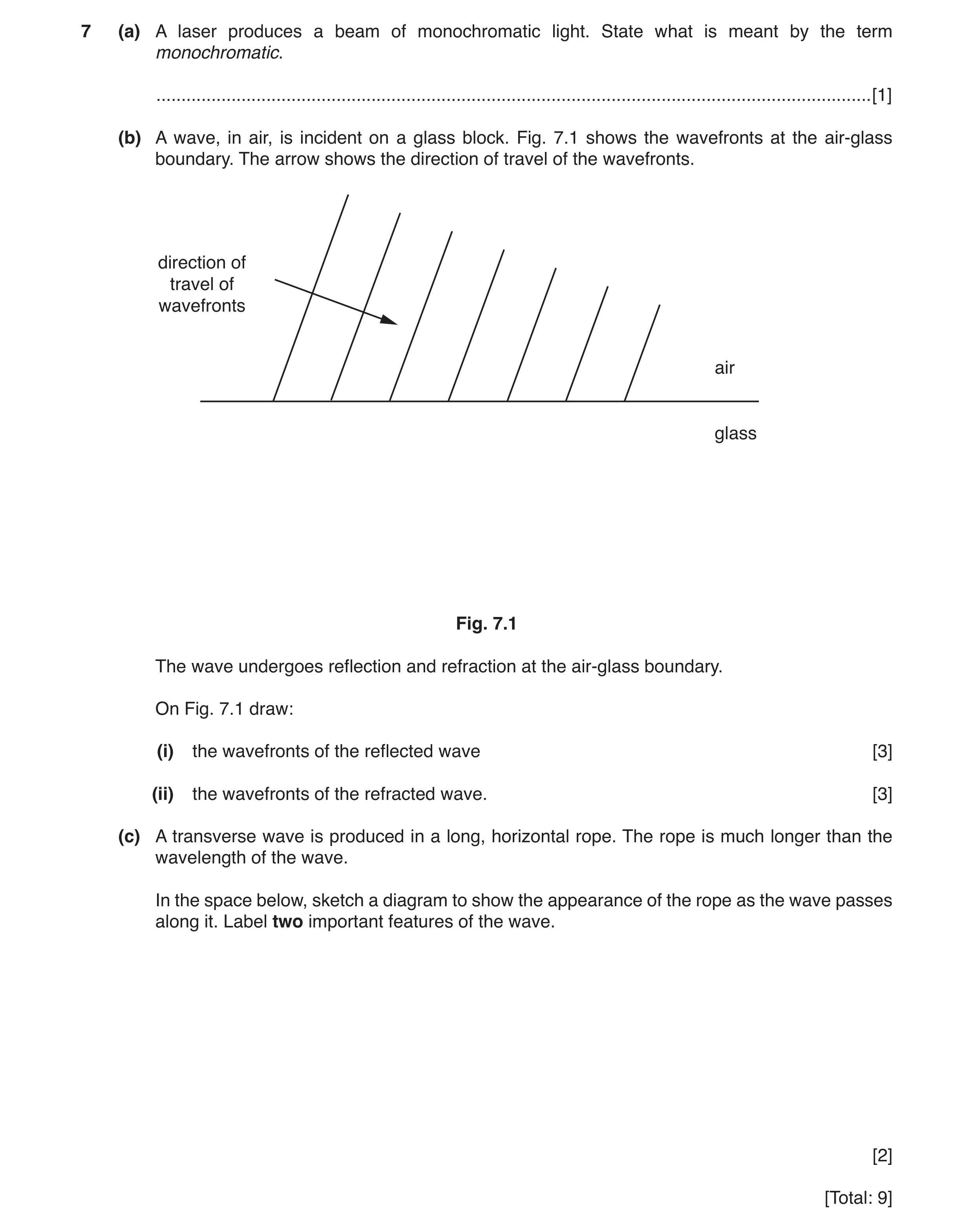
7 (a) A laser produces a beam of monochromatic light. State what is meant by the term monochromatic. … [1] (b) A wave, in air, is incident on a glass block. Fig. 7.1 shows the wavefronts at the air-glass boundary. The arrow shows the direction of travel of the wavefronts. direction of travel of wavefronts air glass Fig. 7.1 The wave undergoes reflection and refraction at the air-glass boundary. On Fig. 7.1 draw: (i) the wavefronts of the reflected wave [3] (ii) the wavefronts of the refracted wave. [3] (c) A transverse wave is produced in a long, horizontal rope. The rope is much longer than the wavelength of the wave. In the space below, sketch a diagram to show the appearance of the rope as the wave passes along it. Label two important features of the wave. [2] [Total: 9]
9 marks
Mark scheme: 7(a) Light of a single colour / wavelength / frequency B1 7(b)(i) Reflected wavefronts: In air, at least 3 wavefronts parallel to each other. B1 Same spacing as incident wavefronts B1 Reflecting at same angle with surface as incident wavefronts B1 7(b)(ii) Refracted wavefronts: In glass, at least 3 wavefronts parallel to each other AND continuous with incident wavefronts, unless drawn to right of incident wavefronts. B1 Smaller wavelength than incident wavefronts AND equally spaced. B1 At smaller angle with surface than incident wavefronts and rotated clockwise compared to incident wavefronts B1 7(c) Rope drawn with two of: Amplitude labelled Wavelength labelled Crest and trough labelled B2
This question in 0625/41 Oct/Nov 2018
Q13 · A visible spectrum focused on a screen by passing light from a source of white light… 0625/42 Oct/Nov 2018
5 (a) Fig. 5.1 shows a visible spectrum focused on a screen by passing light from a source of white light through a lens and a prism. glass screen prism glass lens A visible spectrum B filament lamp (white light source) Fig. 5.1 (i) State the name of the process that separates the colours in white light. … [1] (ii) State the colour of the light on the screen at: point A … point B … [1] (iii) State the property of the glass of the prism that causes white light to be split into the different colours of the spectrum. … [1] (b) Fig. 5.2 shows a section of an optical fibre in air. A ray of light is incident on the fibre wall at X. X optical fibre ray of light Fig. 5.2 (i) On Fig. 5.2, continue the path of the ray of light up to the end of the fibre. [1] (ii) The refractive index of the material of the fibre is 1.46. Calculate the critical angle of the material of the fibre. critical angle = … [2] (iii) State two uses of optical fibres. 1 … 2 … [2] [Total: 8]
8 marks
Mark scheme: 5(a)(i) B1 5(a)(ii) point A: red point B: violet B1 5(a)(iii) different speeds / refractive indices / refractions( for different colours / wavelengths) B1 5(b)(i) 1 more reflection on top wall of fibre, between X and end of fibre AND 0 reflections on lower wall of fibre AND ray reaches end of fibre B1 5(b)(ii) sin c = 1 / n in any form C1 (c = sin –1(1 / 1.46) =) 43° A1 5(b)(iii) Any two from • to carry (telephone) signals / communications • for medical diagnosis / imaging • specified artistic (display) • specified lighting B2
This question in 0625/42 Oct/Nov 2018
Q14 · White light incident at point X on a glass prism 0625/43 Oct/Nov 2018
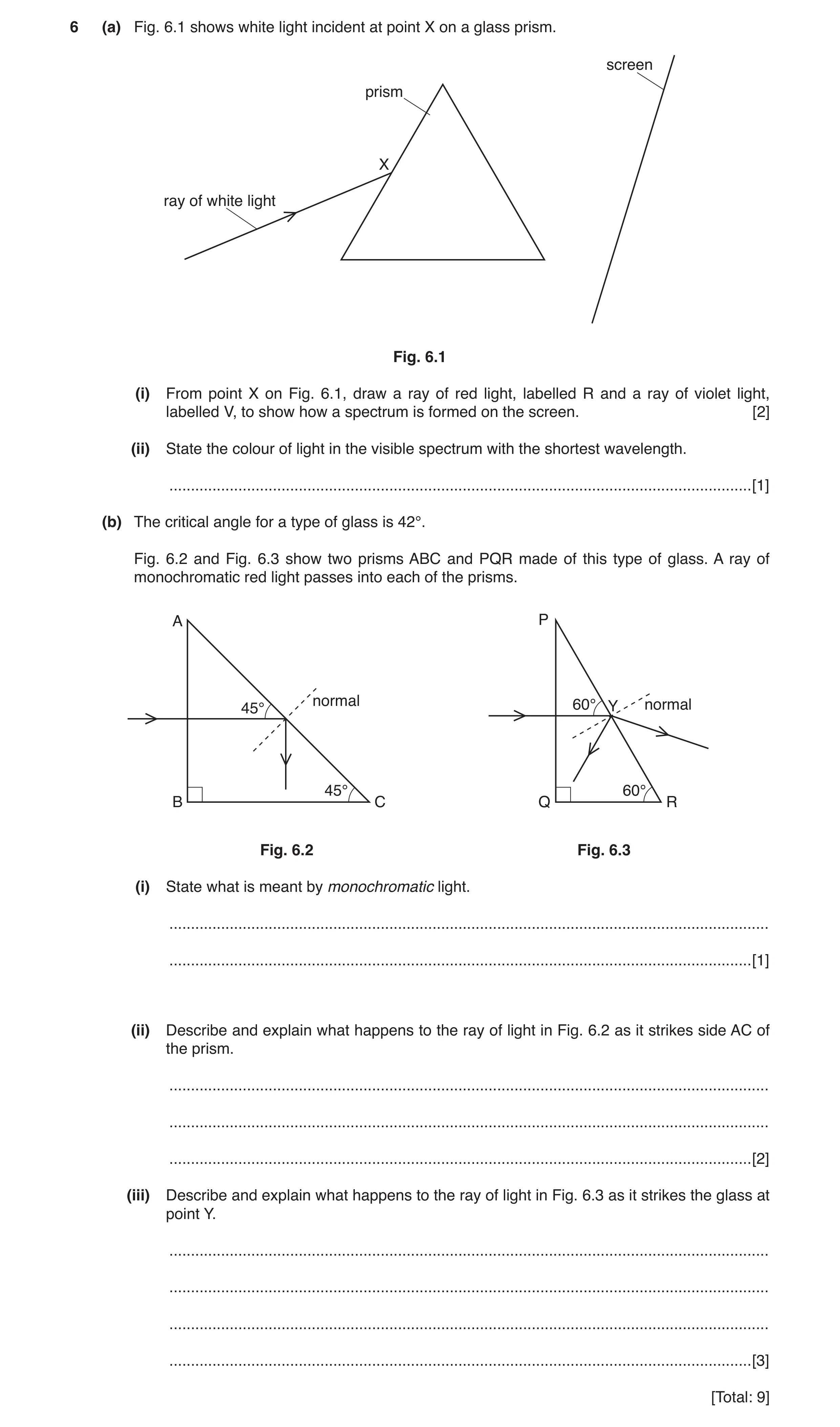
6 (a) Fig. 6.1 shows white light incident at point X on a glass prism. screen prism X ray of white light Fig. 6.1 (i) From point X on Fig. 6.1, draw a ray of red light, labelled R and a ray of violet light, labelled V, to show how a spectrum is formed on the screen. [2] (ii) State the colour of light in the visible spectrum with the shortest wavelength. … [1] (b) The critical angle for a type of glass is 42°. Fig. 6.2 and Fig. 6.3 show two prisms ABC and PQR made of this type of glass. A ray of monochromatic red light passes into each of the prisms. A P normal 60° Y normal 45° 45° 60° B C Q R Fig. 6.2 Fig. 6.3 (i) State what is meant by monochromatic light. … … [1] (ii) Describe and explain what happens to the ray of light in Fig. 6.2 as it strikes side AC of the prism. … … … [2] (iii) Describe and explain what happens to the ray of light in Fig. 6.3 as it strikes the glass at point Y. … … … … [3] [Total: 9]
9 marks
Mark scheme: 6(a)(i) correct refractions and dispersion at first surface M1 correct and more refractions of both rays at second surface and (more) divergence and labels A1 6(a)(ii) violet B1 6(b)(i) (light of) a single frequency B1 6(b)(ii) total internal reflection (at side AC) or internal reflection and no refraction B1 angle of incidence greater than critical angle / 42° (and refractive index of glass greater than that of air than air) B1 6(b)(iii) light refracts (at Y) B1 angle of incidence less than critical angle / 42° B1 (some) light reflects B1
This question in 0625/43 Oct/Nov 2018
Q15 · Parallel wavefronts of a light wave in ice 0625/42 Feb/March 2019
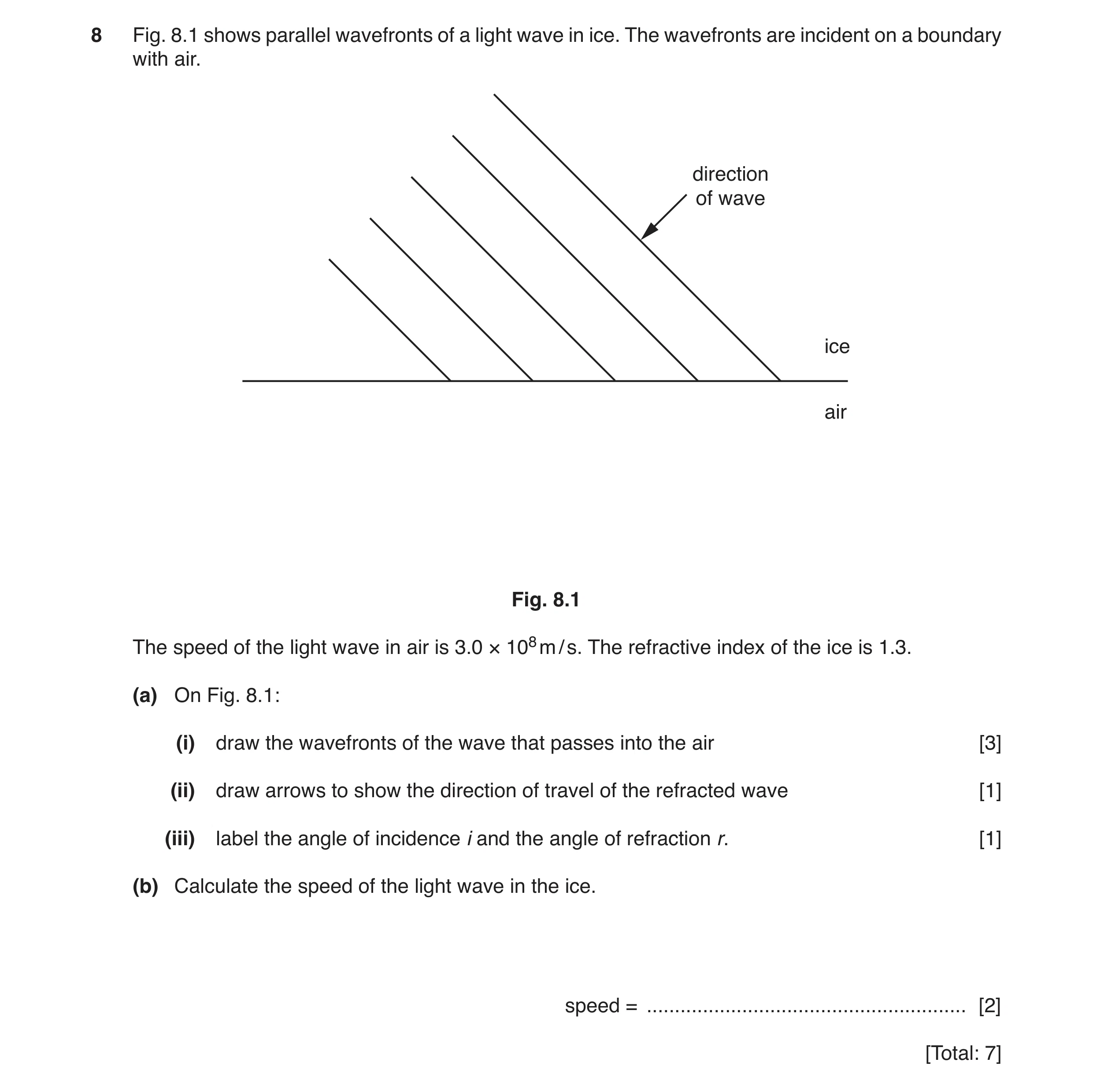
8 Fig. 8.1 shows parallel wavefronts of a light wave in ice. The wavefronts are incident on a boundary with air. direction of wave ice air Fig. 8.1 The speed of the light wave in air is 3.0 × 10⁸ m / s. The refractive index of the ice is 1.3. (a) On Fig. 8.1: (i) draw the wavefronts of the wave that passes into the air [3] (ii) draw arrows to show the direction of travel of the refracted wave [1] (iii) label the angle of incidence i and the angle of refraction r. [1] (b) Calculate the speed of the light wave in the ice. speed = … [2] [Total: 7]
7 marks
Mark scheme: 8(a)(i) Wavefronts in the air: Parallel to each other B1 Make a larger angle with the boundary than wavefronts in ice and from top left to bottom right B1 At least one wavefront meets a wavefront in ice at the boundary B1 8(a)(ii) Arrows at right angles to wavefronts pointing away from boundary B1 8(a)(iii) Acute angle between any wavefront in ice and boundary marked i Acute angle between any wavefront in air and boundary marked r B1 OR In ice, normal at boundary and ray perpendicular to any wavefront both drawn. Angle between normal and ray in ice marked i. In air, normal at boundary and ray perpendicular to any wavefront both drawn. Angle between normal and ray in air marked r. (B1) Question Answer Marks 8(b) n = speed in air / speed in ice OR n = VAIR / VICE OR (VICE))= VAIR / n OR 3.0 × 10⁸ / 1.3 C1 2.3 × 10⁸ m / s A1
This question in 0625/42 Feb/March 2019
Q16 · Green light of frequency 5.7 × 10¹⁴ Hz is travelling in air at a speed of 3.0 × 10⁸ m / s 0625/41 May/June 2019
6 Green light of frequency 5.7 × 10¹⁴ Hz is travelling in air at a speed of 3.0 × 10⁸ m / s. The light is incident on the surface of a transparent solid. Fig. 6.1 shows the wavefronts and the direction of travel of the light in the air. wavefront air solid Fig. 6.1 The light travels more slowly in the transparent solid. (a) Explain, in terms of the wavefronts, why the light changes direction as it enters the solid. You may draw on Fig. 6.1 as part of your answer. … … … … [3] (b) The refractive index of the transparent solid is 1.3. (i) The light is incident on the surface of the solid at an angle of incidence of 67°. Calculate the angle of refraction of the light in the solid. angle of refraction = … [2] (ii) Determine the wavelength of the green light in the transparent solid. wavelength = … [4] [Total: 9]
9 marks
Mark scheme: 6(a) idea of one side of wavefront enters / hits solid first OR wavefront does not all hit the solid all at once; B1 idea of this side slowed down first OR this side delayed relative to other side B1 angle of wave(front) changes OR different parts of wavefront delayed by different amounts B1 6(b)(i) n = sini sinr in any form OR n1sinθ 1 = n2sinθ 2 OR 1.3 = sin67° sinr OR (r = )sin–1(sin67° / 1.3) OR sin–1(0.71) C1 45° A1 6(b)(ii) v ts = c / n in any form OR (v ts =) c / n OR 3.0 × 10⁸ / 1.3 C1 2.3 × 10⁸ OR 3.0 × 10⁸ / 1.3 C1 λ = v / f in any form OR (λ =) v / f OR 2.3 × 10⁸ / 5.7 × 10¹⁴ OR 3.0 × 10⁸ / (1.3 × 5.7 × 1014) C1 4.0 × 10⁻⁷ m A1 OR (alternative approach) λ = v / f in any form OR (λ =) v / f OR 3.0 × 10⁸ / 5.7 × 10¹⁴ C1 5.3 × 10⁻⁷ OR 3.0 × 10⁸ / 5.7 × 10¹⁴ C1 λ g = λ a / n in any form OR (λ g =) λ a / n OR 5.3 × 10⁻⁷ / 1.3 OR 3.0 × 10⁸ / (1.3 × 5.7 × 1014) C1 4.0 × 10⁻⁷ m A1
This question in 0625/41 May/June 2019
Question 17 0625/42 May/June 2019
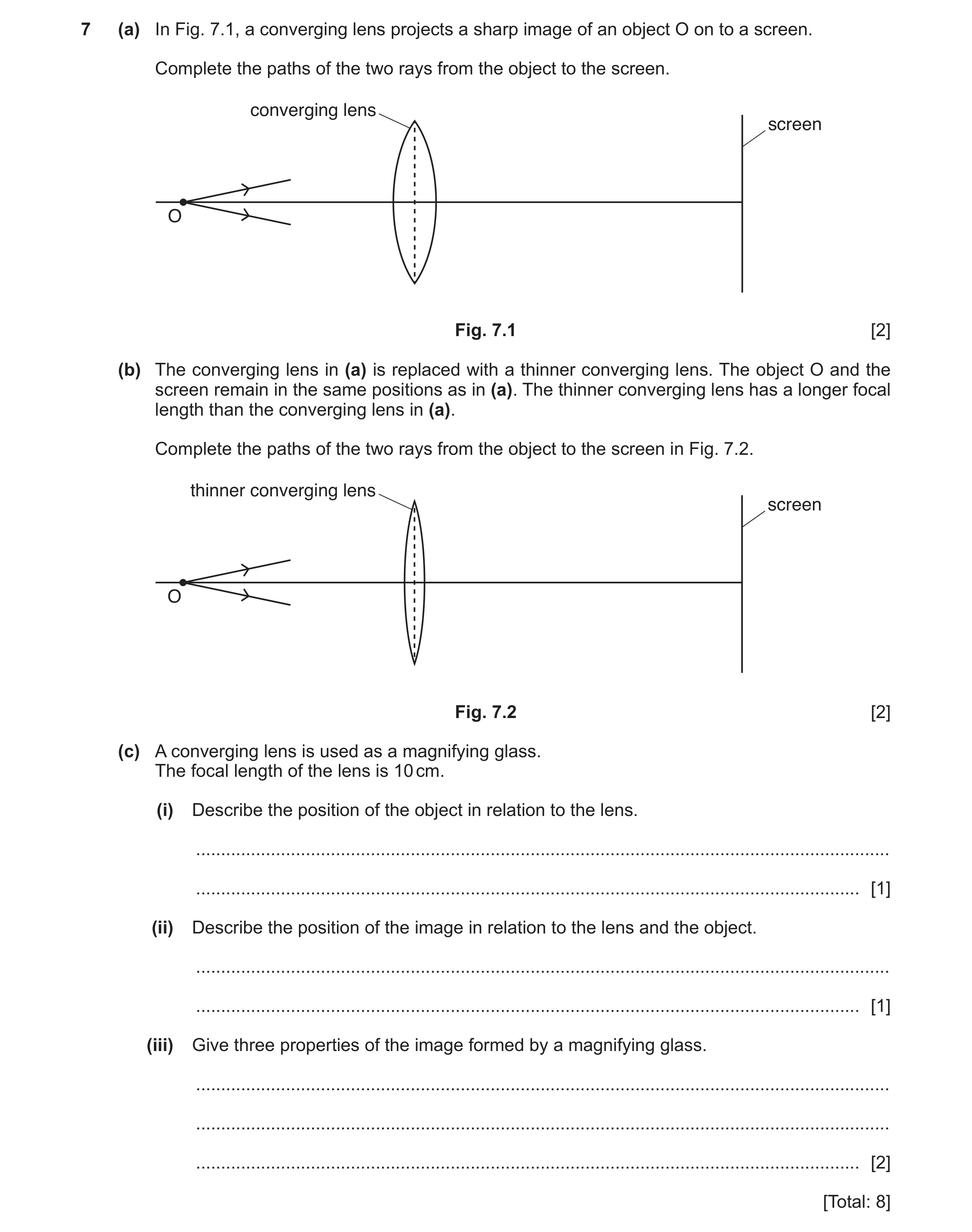
7 (a) In Fig. 7.1, a converging lens projects a sharp image of an object O on to a screen. Complete the paths of the two rays from the object to the screen. converging lens screen O Fig. 7.1 [2] (b) The converging lens in (a) is replaced with a thinner converging lens. The object O and the screen remain in the same positions as in (a). The thinner converging lens has a longer focal length than the converging lens in (a). Complete the paths of the two rays from the object to the screen in Fig. 7.2. thinner converging lens screen O Fig. 7.2 [2] (c) A converging lens is used as a magnifying glass. The focal length of the lens is 10 cm. (i) Describe the position of the object in relation to the lens. … … [1] (ii) Describe the position of the image in relation to the lens and the object. … … [1] (iii) Give three properties of the image formed by a magnifying glass. … … … [2] [Total: 8]
8 marks
Mark scheme: 7(a) both rays straight to left of lens AND top ray bends clockwise AND bottom ray bends anti-clockwise B1 both rays converge to meet on the centreline at the screen B1 7(b) both rays straight to left of lens AND top ray bends clockwise less than in (a) AND bottom ray bends anti-clockwise less than in (a) B1 both rays converge and/would meet beyond screen B1 7(c)(i) object closer to lens than one focal length B1 7(c)(ii) (image) same side (of lens as object) OR image further from lens (than object) B1 Question Answer Marks 7(c)(iii) 1 from 3 of : (image) enlarged/magnified, upright / goes up, virtual B1 all 3: (image) enlarged, upright, virtual B1
This question in 0625/42 May/June 2019
Q18 · Light approaching a boundary between two materials at speed v 0625/43 May/June 2019
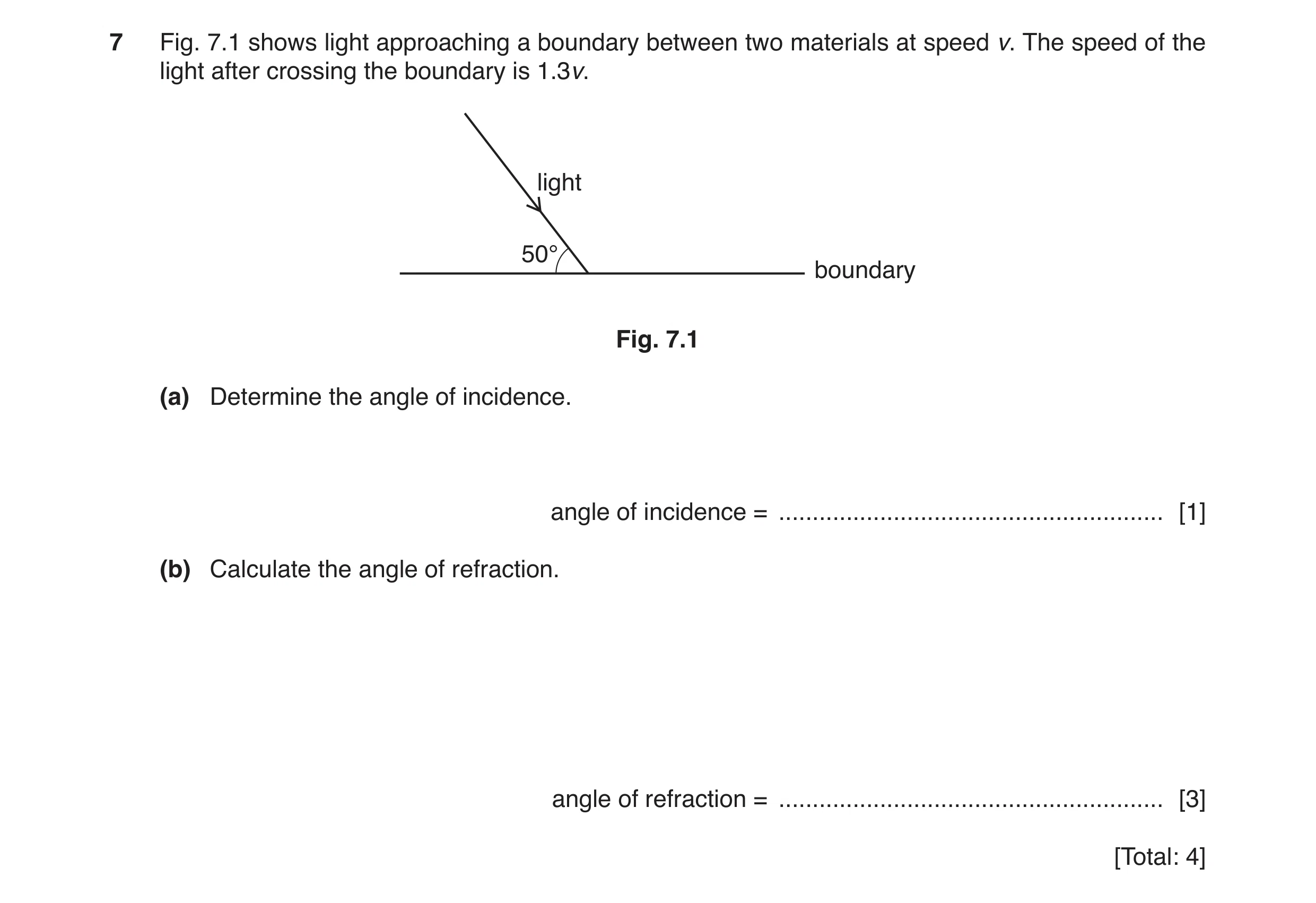
7 Fig. 7.1 shows light approaching a boundary between two materials at speed v. The speed of the light after crossing the boundary is 1.3v. light 50° boundary Fig. 7.1 (a) Determine the angle of incidence. angle of incidence = … [1] (b) Calculate the angle of refraction. angle of refraction = … [3] [Total: 4]
4 marks
Mark scheme: 7(a) 40° B1 7(b) n = 1.3 OR seen in calculation C1 sin i / sin r = n in any form OR sin 40 / sinr = n sin i / sin r = 1 / n C1 (sin r = 1.3 × sin 40°) (r =) 57° A1
This question in 0625/43 May/June 2019
Q19 · A ray of red light incident on one side of a glass prism in air 0625/41 Oct/Nov 2019
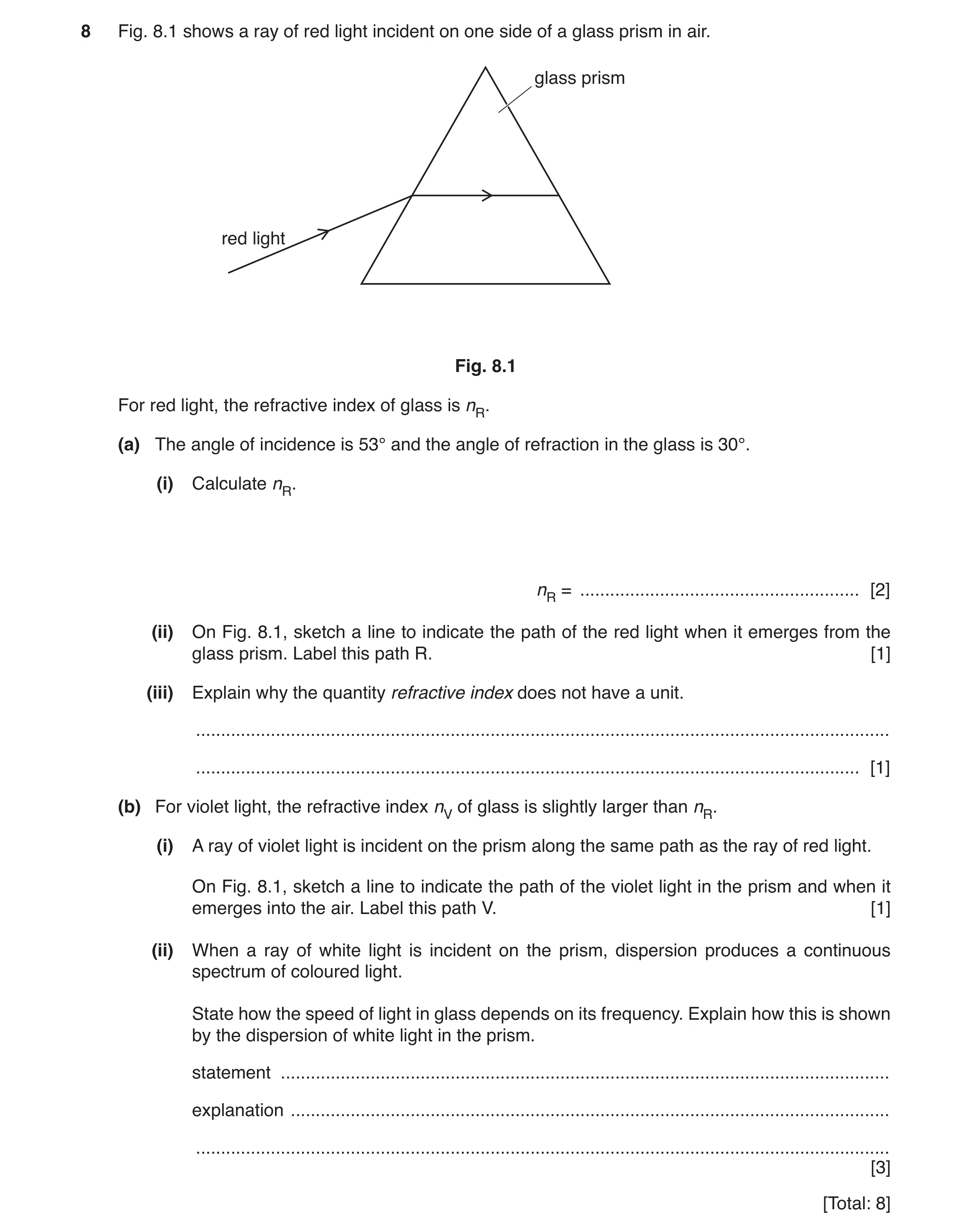
8 Fig. 8.1 shows a ray of red light incident on one side of a glass prism in air. glass prism red light Fig. 8.1 For red light, the refractive index of glass is nR. (a) The angle of incidence is 53° and the angle of refraction in the glass is 30°. (i) Calculate nR. nR = … [2] (ii) On Fig. 8.1, sketch a line to indicate the path of the red light when it emerges from the glass prism. Label this path R. [1] (iii) Explain why the quantity refractive index does not have a unit. … … [1] (b) For violet light, the refractive index nV of glass is slightly larger than nR. (i) A ray of violet light is incident on the prism along the same path as the ray of red light. On Fig. 8.1, sketch a line to indicate the path of the violet light in the prism and when it emerges into the air. Label this path V. [1] (ii) When a ray of white light is incident on the prism, dispersion produces a continuous spectrum of coloured light. State how the speed of light in glass depends on its frequency. Explain how this is shown by the dispersion of white light in the prism. statement … explanation … … [3] [Total: 8]
8 marks
Mark scheme: 8(a)(i) n = sin(i) / sin(r) in any form words, symbols or numbers or (n =) sin(i) / sin(r) or sin(53°) / sin(30°) 1.6 C1 A1 8(a)(ii) path emerging into air along correct path (by eye) and labelled R B1 8(a)(iii) ratio / division of two identical quantities / speeds / sine functions / (pure) numbers B1 8(b)(i) path labelled V with two correct refractions and below path of red light in glass B1 8(b)(ii) larger frequency results in smaller speed (in glass) or r.a. (reverse argument) or inversely related / proportional. any two from: more refraction / closer to normal / larger refractive index for larger frequency or r.a. violet light has larger frequency or o.r.a. violet light has a smaller speed (in glass) or o.r.a. violet light has larger refractive index or o.r.a. B1 B2
This question in 0625/41 Oct/Nov 2019
Q20 · The position of a converging lens, its principal axis and an object O 0625/43 Oct/Nov 2019
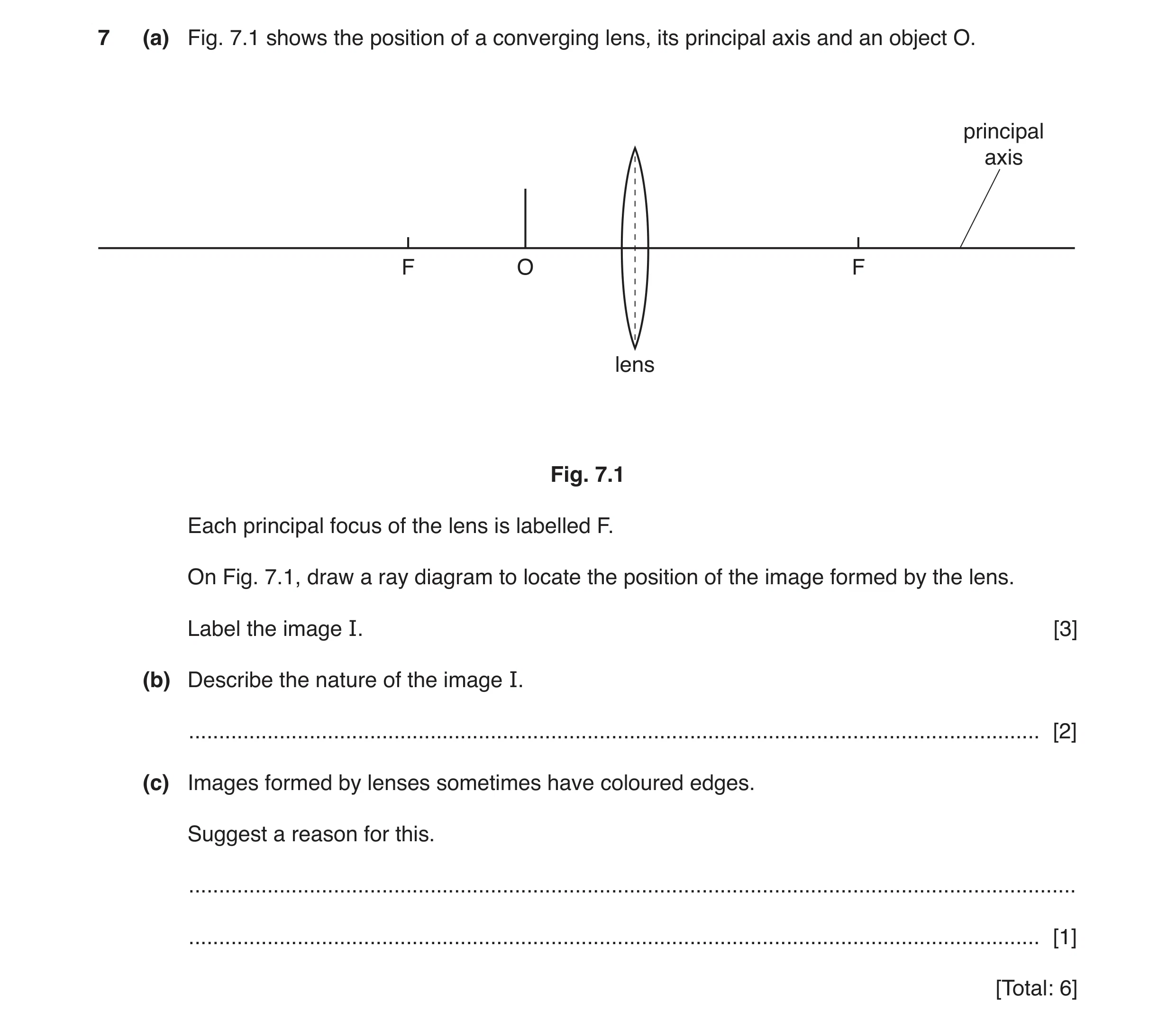
7 (a) Fig. 7.1 shows the position of a converging lens, its principal axis and an object O. principal axis F O F lens Fig. 7.1 Each principal focus of the lens is labelled F. On Fig. 7.1, draw a ray diagram to locate the position of the image formed by the lens. Label the image I. [3] (b) Describe the nature of the image I. … [2] (c) Images formed by lenses sometimes have coloured edges. Suggest a reason for this. … … [1] [Total: 6]
6 marks
Mark scheme: 7(a) ray parallel to axis and through F M1 ray through centre of lens M1 position of image correct and labelled A1 7(b) enlarged and upright B1 virtual B1 7(c) different colours have different wavelengths / different frequencies / refracted by different amounts OR dispersion (in glass) B1
This question in 0625/43 Oct/Nov 2019
Q21 · A converging lens and the image I formed when an object is placed to the left of the lens 0625/42 Feb/March 2020
7 (a) Fig. 7.1 shows a converging lens and the image I formed when an object is placed to the left of the lens. The principal focuses are labelled A and B and the centre of the lens is labelled C. (i) On Fig. 7.1, draw two rays to locate the position of the object. Draw the object and label it O. lens A C B I Fig. 7.1 [3] (ii) Ring all of the following distances that are equal to the focal length of the lens. AB AC CB 2AB [2] (b) Fig. 7.2 shows green light passing through a triangular glass block. Fig. 7.2 Red light enters the triangular glass block shown in Fig. 7.2 along the same path as the green light. (i) On Fig. 7.2, draw the path of the red light within the triangular glass block. [1] Fig. 7.3 shows green light passing through a rectangular glass block. Red light enters the rectangular glass block shown in Fig. 7.3 along the same path as the green light. Fig. 7.3 On Fig. 7.3: (ii) draw the path of the red light within the rectangular glass block [1] (iii) draw the path of the red light after leaving the rectangular glass block. [1] [Total: 8]
8 marks
Mark scheme: 7(a)(i) one correct ray B1 second correct ray B1 rays intersect above axis to left of A AND object drawn from axis to intersection B1 7(a)(ii) AC B1 CB B1 7(b)(i) ray in prism refracted down less than green ray B1 7(b)(ii) ray in rectangular block refracted down less than green ray B1 7(b)(iii) ray leaving rectangular block parallel to incident ray B1
This question in 0625/42 Feb/March 2020
Q22 · The distance between the centre of a thin converging lens and each principal focus is 5.0… 0625/41 May/June 2020
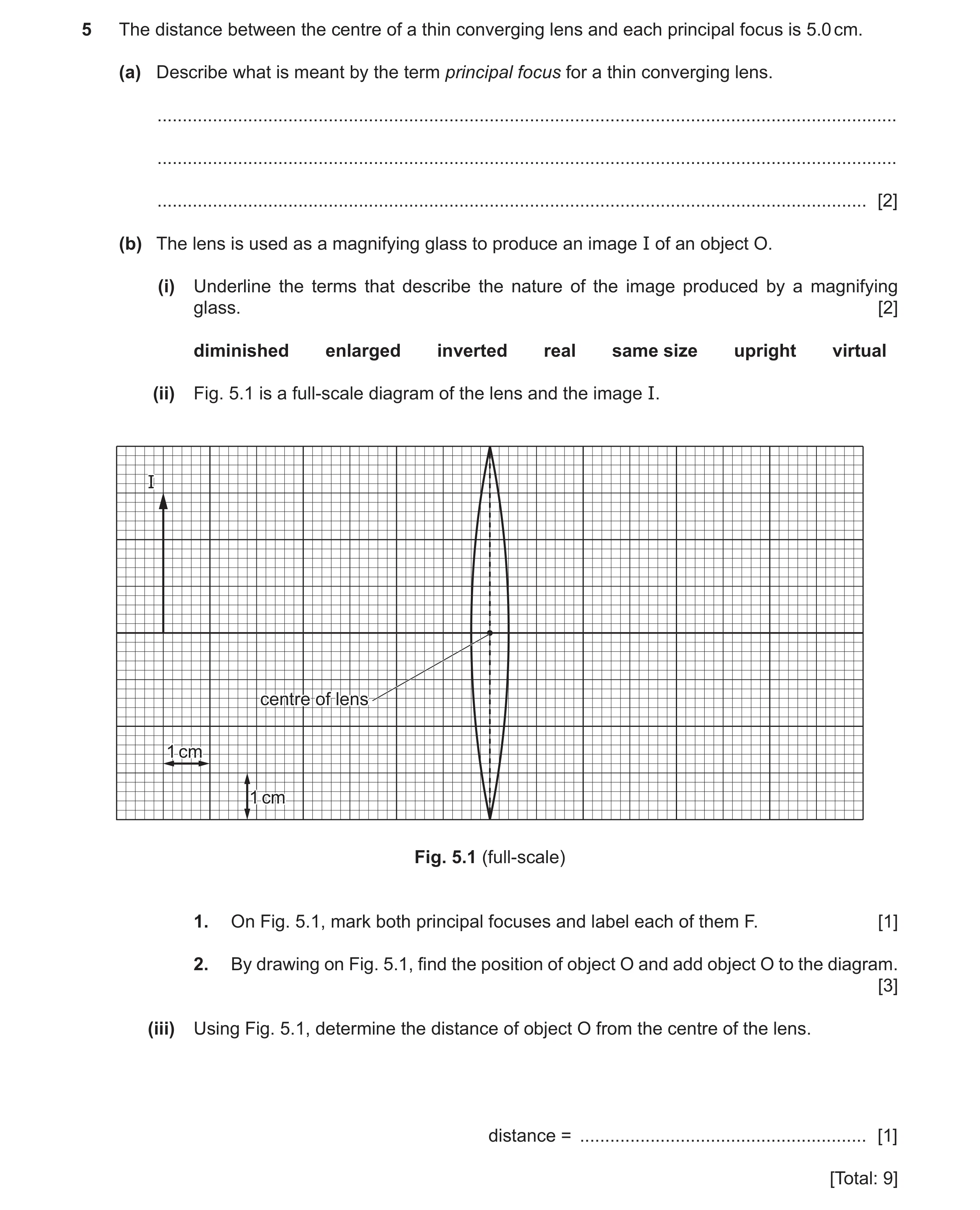
5 The distance between the centre of a thin converging lens and each principal focus is 5.0 cm. (a) Describe what is meant by the term principal focus for a thin converging lens. … … … [2] (b) The lens is used as a magnifying glass to produce an image I of an object O. (i) Underline the terms that describe the nature of the image produced by a magnifying glass. [2] diminished enlarged inverted real same size upright virtual (ii) Fig. 5.1 is a full-scale diagram of the lens and the image I. II centrecentre ofof lenslens 11 cmcm 11 cmcm Fig. 5.1 (full-scale) 1. On Fig. 5.1, mark both principal focuses and label each of them F. [1] 2. By drawing on Fig. 5.1, find the position of object O and add object O to the diagram. [3] (iii) Using Fig. 5.1, determine the distance of object O from the centre of the lens. distance = … [1] [Total: 9]
9 marks
Mark scheme: 5(a) (point) where incident parallel rays meet after passing through lens OR origin of rays that emerge parallel after passing through lens M1 on principal axis OR use of term paraxial OR centre line A1 5(b)(i) enlarged virtual upright two correct answers underlined AND no more than one wrong answer underlined M1 three correct answers underlined AND no wrong answer underlined A1 5(b)(ii)1 both principal focuses marked at points 5.0 cm from the optical centre B1 5(b)(ii)2 any two construction lines from: • line from top of I towards far principal focus and traced back from lens horizontally • line from top of I to (and through) centre of lens • horizontal line from top of I to lens and traced back to near principal focus B2 O marked with top at intersection B1 5(b)(iii) 2.7 cm ⩾ distance ⩾ 3.1 cm B1
This question in 0625/41 May/June 2020
Q23 · An arrangement of glass prisms inside a box 0625/42 May/June 2020
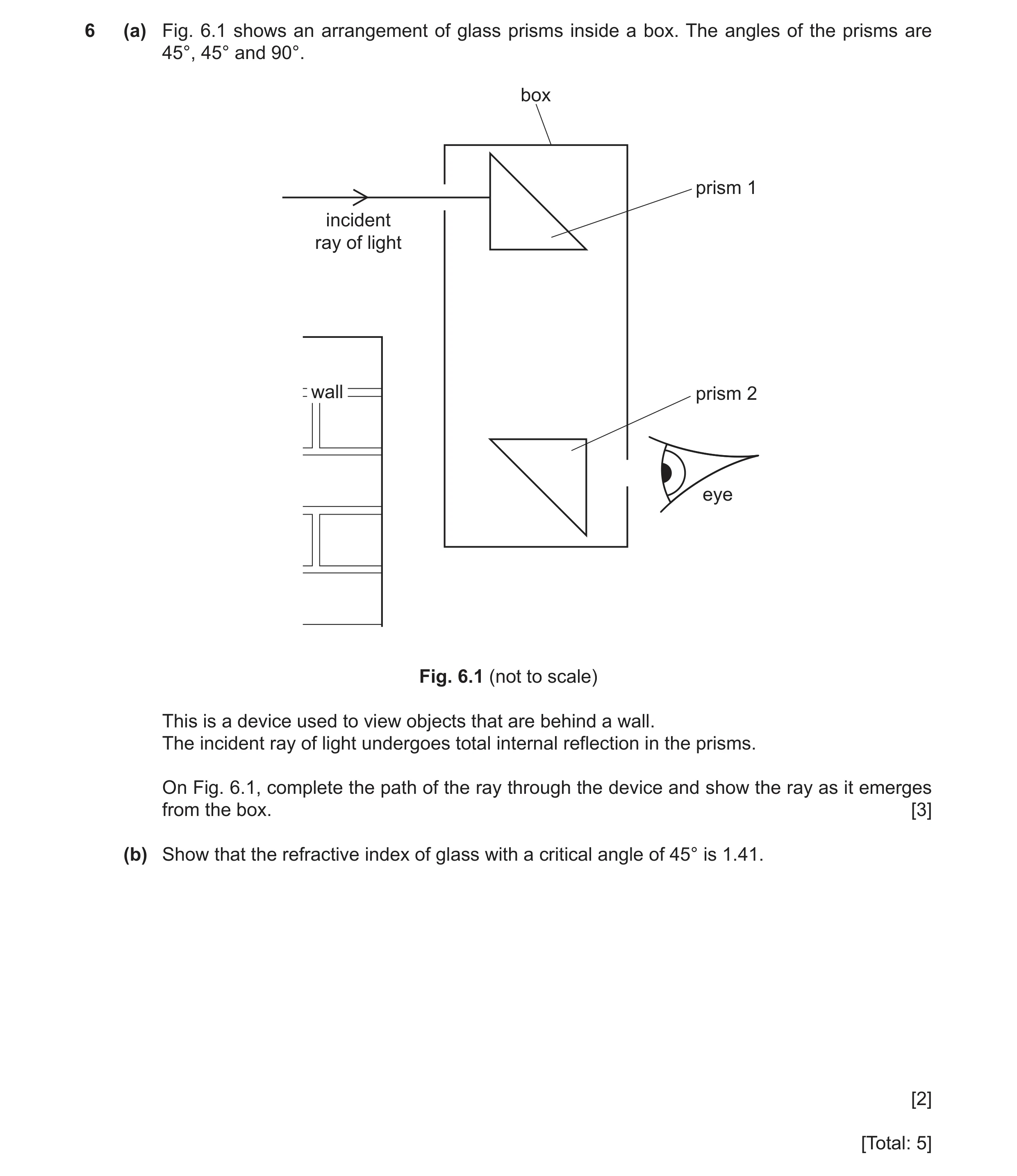
6 (a) Fig. 6.1 shows an arrangement of glass prisms inside a box. The angles of the prisms are 45°, 45° and 90°. box prism 1 incident ray of light wall prism 2 eye Fig. 6.1 (not to scale) This is a device used to view objects that are behind a wall. The incident ray of light undergoes total internal reflection in the prisms. On Fig. 6.1, complete the path of the ray through the device and show the ray as it emerges from the box. [3] (b) Show that the refractive index of glass with a critical angle of 45° is 1.41. [2] [Total: 5]
5 marks
Mark scheme: 6(a) incident ray travels straight on at first face of prism 1 B1 ray reflected through 90° at sloping face of prism 1 continues vertically downwards to sloping face of prism 2 B1 ray reflected through 90° at sloping face and leaves box horizontally B1 6(b) n = 1 / sin C in any form OR (n =) 1 / sin C B1 {(n=) 1 / sin 45 OR (n=) 1 / 0.707} AND (n=) 1.41 B1
This question in 0625/42 May/June 2020
Q24 · Red light travelling from air into a prism made of diamond 0625/43 May/June 2020
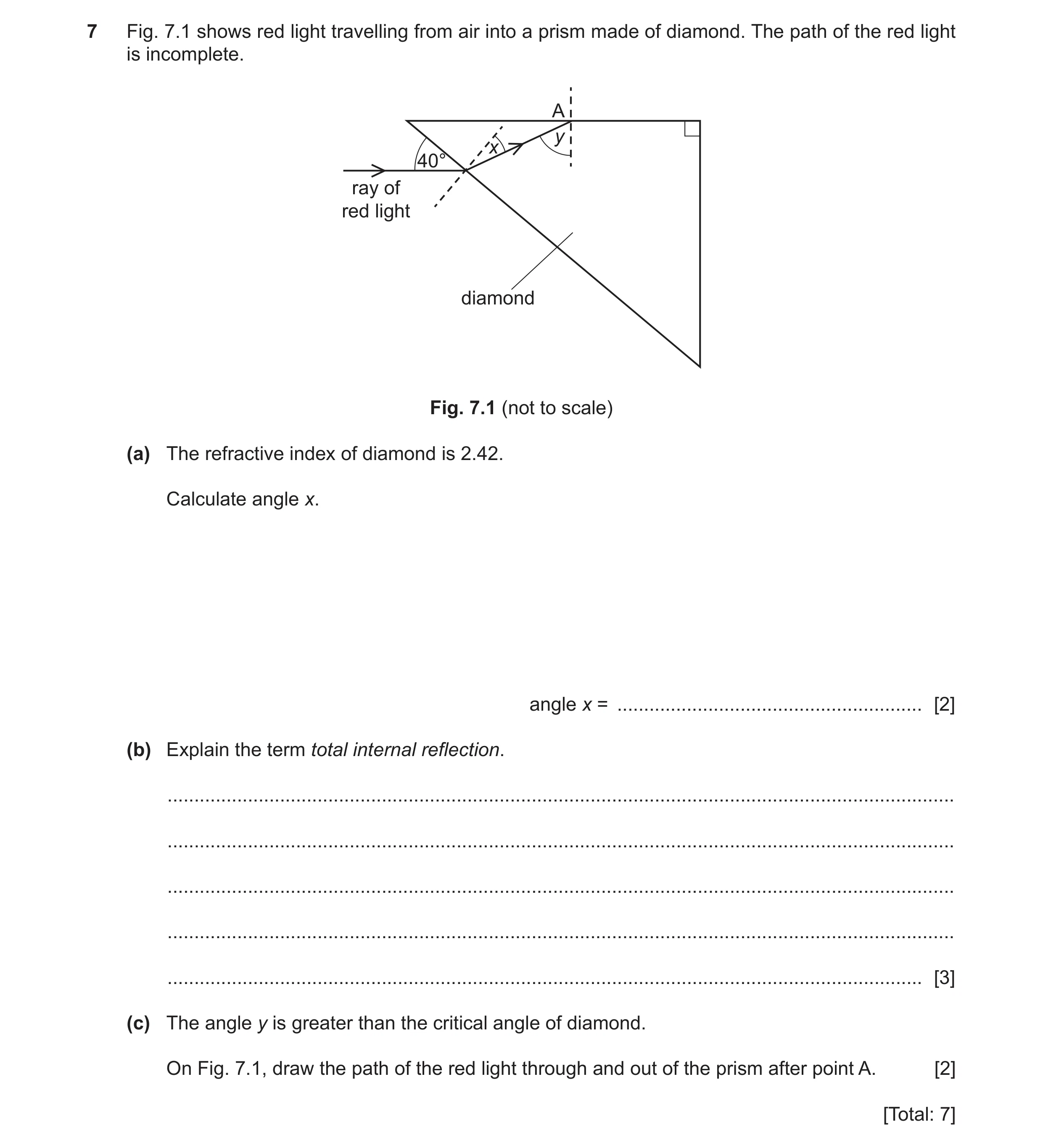
7 Fig. 7.1 shows red light travelling from air into a prism made of diamond. The path of the red light is incomplete. A y x 40° ray of red light diamond Fig. 7.1 (not to scale) (a) The refractive index of diamond is 2.42. Calculate angle x. angle x = … [2] (b) Explain the term total internal reflection. … … … … … [3] (c) The angle y is greater than the critical angle of diamond. On Fig. 7.1, draw the path of the red light through and out of the prism after point A. [2] [Total: 7]
7 marks
Mark scheme: 7(a) sin i / sin r = n in any form C1 r = 18° A1 7(b) light travelling from optically dense medium to optically less dense medium B1 all light reflected OR no light refracted B1 angle of incidence is greater than the critical angle B1 7(c) ray reflected at face AB with i = r by eye B1 ray refracted at face BC and bent away from the normal B1
This question in 0625/43 May/June 2020
Q25 · Describe what is observed during total internal reflection 0625/41 Oct/Nov 2020
9 (a) (i) Describe what is observed during total internal reflection. … … [1] (ii) State two conditions required for light to be totally internally reflected. 1. … … 2. … … [2] (b) Describe and explain the action of optical fibres in communication technology. You may draw a diagram in your answer. … … … … [3] [Total: 6]
6 marks
Mark scheme: 9(a)(i) wave / light / energy / ray is completely / entirely reflected (at the boundary between two mediums) or no refraction or no wave / light / energy / ray passes into second medium / across boundary or only reflection occurs B1 9(a)(ii) light (must pass) from medium where it travels slower or to medium where it is faster or from medium with larger refractive index or to medium with smaller refractive index B1 angle of incidence (must be) greater than the critical angle / sin–1(1 ÷ n) B1 9(b) light / infrared travels in fibre B1 total internal reflection at inner surface or within (graded-index) fibre B1 light carries information / signal / data / message or signal / light encoded B1
This question in 0625/41 Oct/Nov 2020
Q26 · A ray of light passing through an optical fibre 0625/42 Oct/Nov 2020
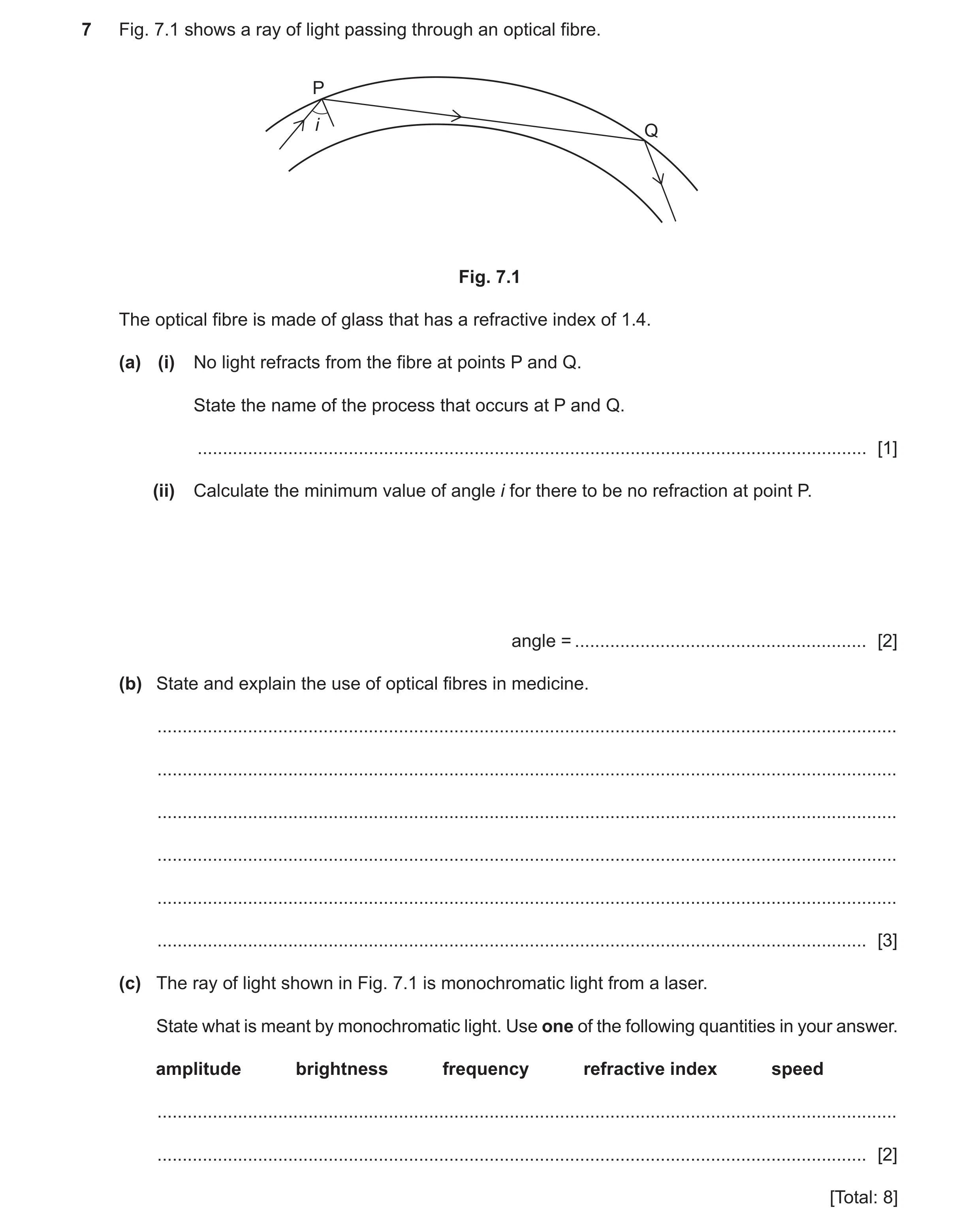
7 Fig. 7.1 shows a ray of light passing through an optical fibre. P i Q Fig. 7.1 The optical fibre is made of glass that has a refractive index of 1.4. (a) (i) No light refracts from the fibre at points P and Q. State the name of the process that occurs at P and Q. … [1] (ii) Calculate the minimum value of angle i for there to be no refraction at point P. angle = … [2] (b) State and explain the use of optical fibres in medicine. … … … … … … [3] (c) The ray of light shown in Fig. 7.1 is monochromatic light from a laser. State what is meant by monochromatic light. Use one of the following quantities in your answer. amplitude brightness frequency refractive index speed … … [2] [Total: 8]
8 marks
Mark scheme: 7(a)(i) total internal reflection OR T.I.R. B1 7(a)(ii) sin C = 1 ÷ n in any form OR (C =) sin–1 {1 ÷ 1.4} C1 (C = sin–1 {1 ÷ 1.4} = sin–1 0.714 =) 46° A1 7(b) description of fibre passing to site to be examined / treated B1 light passes down fibre (to site) AND (image) returns (to sensor / observer) OR alternative use to endoscopy B1 extra detail, e.g. laser light source, illuminated organ, image, camera / type of sensor B1 7(c) any mention of frequency B1 (all of light) same / single / one frequency B1
This question in 0625/42 Oct/Nov 2020
Q27 · A ray of green light passing through a prism 0625/42 May/June 2021
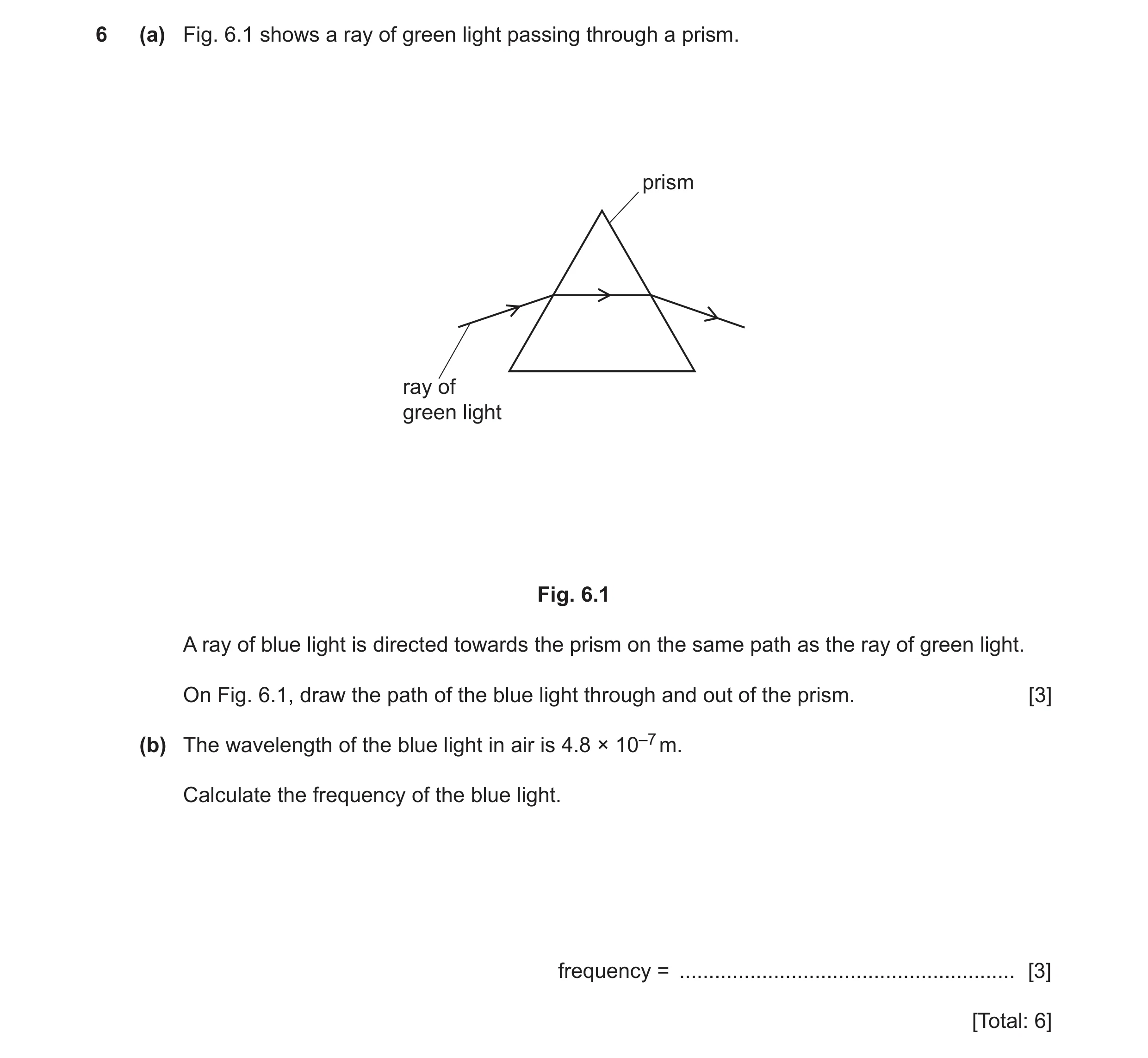
6 (a) Fig. 6.1 shows a ray of green light passing through a prism. prism ray of green light Fig. 6.1 A ray of blue light is directed towards the prism on the same path as the ray of green light. On Fig. 6.1, draw the path of the blue light through and out of the prism. [3] (b) The wavelength of the blue light in air is 4.8 × 10⁻⁷ m. Calculate the frequency of the blue light. frequency = … [3] [Total: 6]
6 marks
Mark scheme: 6(a) blue ray refracted MORE towards normal at first surface B1 refraction away from normal at second surface B1 ray of blue light below ray of green light and diverging throughout path (after entering prism) B1 6(b) v = fλ in any form OR (f=) v / λ C1 (f =) 3 × 10⁸ ÷ 4.8 × 10⁻⁷ C1 (f =) 6.3 × 10¹⁴ Hz A1
This question in 0625/42 May/June 2021
Q28 · A full-scale diagram of a lens and an object O 0625/43 May/June 2021
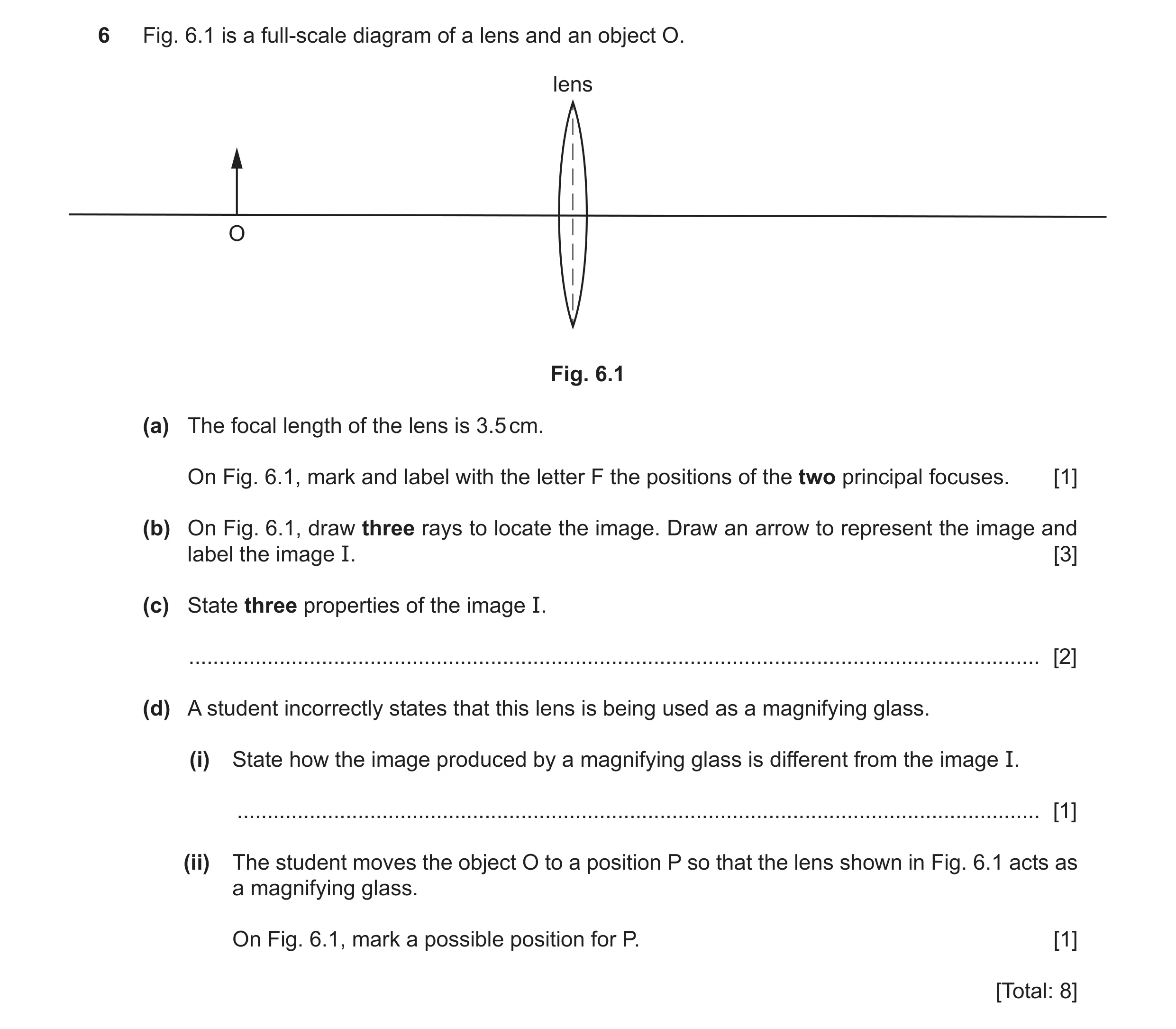
6 Fig. 6.1 is a full-scale diagram of a lens and an object O. lens O Fig. 6.1 (a) The focal length of the lens is 3.5 cm. On Fig. 6.1, mark and label with the letter F the positions of the two principal focuses. [1] (b) On Fig. 6.1, draw three rays to locate the image. Draw an arrow to represent the image and label the image I. [3] (c) State three properties of the image I. … [2] (d) A student incorrectly states that this lens is being used as a magnifying glass. (i) State how the image produced by a magnifying glass is different from the image I. … [1] (ii) The student moves the object O to a position P so that the lens shown in Fig. 6.1 acts as a magnifying glass. On Fig. 6.1, mark a possible position for P. [1] [Total: 8]
8 marks
Mark scheme: 6(a) principal focuses marked in correct position B1 6(b) 1 mark for each of: • 1 correct ray • 2nd correct ray • 3rd correct ray and image, labelled I, in correct position with arrow at bottom B3 6(c) real B1 inverted and enlarged B1 6(d)(i) (image produced by a magnifying glass is) upright OR NOT inverted OR virtual B1 6(d)(ii) position marked between principal focus and lens B1
This question in 0625/43 May/June 2021
Q29 · Explain, in terms of the behaviour of light rays, what is meant by principal focus for a… 0625/41 Oct/Nov 2021
5 (a) Explain, in terms of the behaviour of light rays, what is meant by principal focus for a thin converging lens. … … … [2] (b) State what is meant by focal length. … … [1] (c) A lens is used to produce a focused image of an object on a translucent screen. Fig. 5.1 shows the object O and its image I. translucent screen 1 cm 1 cm O P I Fig. 5.1 (i) Consider the straight ray that passes from the tip of O to the tip of I and find the position of the lens. Mark the position of the lens by drawing a vertical line labelled L from the top of the grid to the bottom. [1] (ii) On Fig. 5.1, draw a ray that passes through one of the principal focuses and determine the focal length of the lens. focal length = … [2] (iii) Object O is a printed document that includes a large letter R on the side facing the lens. The top edge of the document corresponds to the tip of O. Fig. 5.2 shows the printed document. top edge R printeddocument R R R R Fig. 5.2 Fig. 5.3 On Fig. 5.3, mark a tick in one of the boxes ( ✓ ) to indicate how the image on the translucent screen appears to someone who is looking at the screen from point P. Explain why the image has this appearance. … … … [2] [Total: 8]
8 marks
Mark scheme: 5(a) (point) where (parallel) rays (of light) meet (after passing through lens) C1 point) where parallel rays (of light) meet / are focussed (after passing through lens) or (point) through which rays (of light) that emerge parallel pass (before reaching lens) A1 5(b) distance between principal focus / focal point and optical centre / lens B1 5(c)(i) vertical line labelled L 4.0 (± 0.2) cm to the right of O B1 5(c)(ii) paraxial ray from tip of O to candidate’s lens and from lens to tip of I or paraxial ray from lens to tip of I and from tip of O to candidate’s lens C1 3.0 (± 0.2) cm A1 5(c)(iii) fourth box ticked i.e: B1 reversed / inverted B1
This question in 0625/41 Oct/Nov 2021
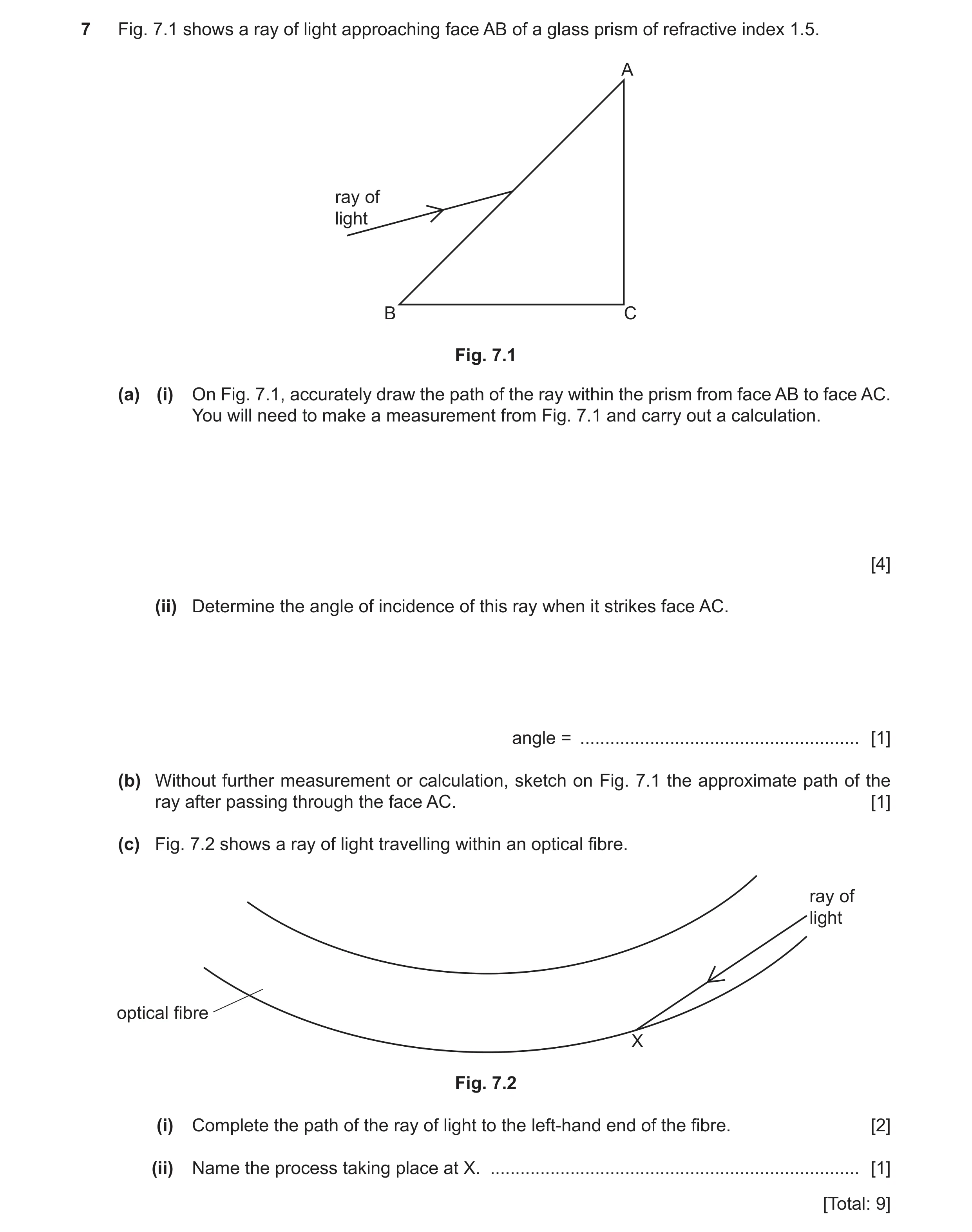
Q30 · A ray of light approaching face AB of a glass prism of refractive index 1.5 0625/42 Oct/Nov 2021
7 Fig. 7.1 shows a ray of light approaching face AB of a glass prism of refractive index 1.5. A ray of light B C Fig. 7.1 (a) (i) On Fig. 7.1, accurately draw the path of the ray within the prism from face AB to face AC. You will need to make a measurement from Fig. 7.1 and carry out a calculation. [4] (ii) Determine the angle of incidence of this ray when it strikes face AC. angle = … [1] (b) Without further measurement or calculation, sketch on Fig. 7.1 the approximate path of the ray after passing through the face AC. [1] (c) Fig. 7.2 shows a ray of light travelling within an optical fibre. ray of light optical fibre X Fig. 7.2 (i) Complete the path of the ray of light to the left-hand end of the fibre. [2] (ii) Name the process taking place at X. … [1] [Total: 9]
9 marks
Mark scheme: 7(a)(i) i = 60° used or seen C1 sin i / sin r =n in any form C1 ray refracted toward normal and toward AC C1 ray clearly refracted down in prism reaching AC with r = 35(°) A1 7(a)(ii) 10° B1 7(b) refracted away from normal B1 7(c)(i) (total internal) reflection at X NOT refraction at X or anywhere else B1 reaches end of fibre with only one additional reflection (off lower internal edge of fibre) B1 7(c)(ii) total internal reflection B1
This question in 0625/42 Oct/Nov 2021
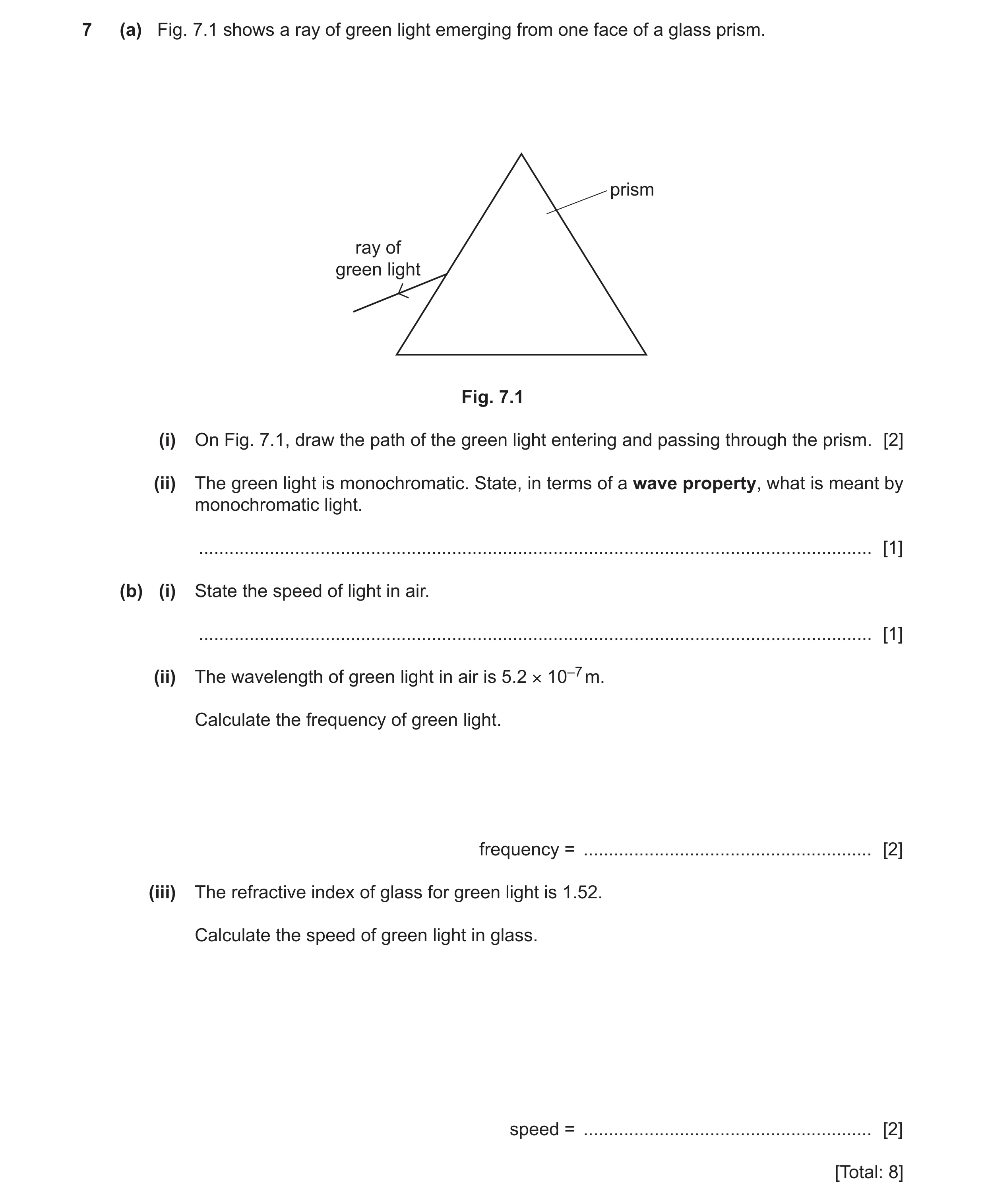
Q31 · A ray of green light emerging from one face of a glass prism 0625/43 Oct/Nov 2021
7 (a) Fig. 7.1 shows a ray of green light emerging from one face of a glass prism. prism ray of green light Fig. 7.1 (i) On Fig. 7.1, draw the path of the green light entering and passing through the prism. [2] (ii) The green light is monochromatic. State, in terms of a wave property, what is meant by monochromatic light. … [1] (b) (i) State the speed of light in air. … [1] (ii) The wavelength of green light in air is 5.2 × 10⁻⁷ m. Calculate the frequency of green light. frequency = … [2] (iii) The refractive index of glass for green light is 1.52. Calculate the speed of green light in glass. speed = … [2] [Total: 8]
8 marks
Mark scheme: 7(a)(i) B2 ray approaching left hand face of prism closer to normal than emerging ray B1 ray entering right hand face of prism showing refraction towards normal for ray already drawn B1 7(a)(ii) light of single frequency B1 7(b)(i) 3(.0) × 108 m / s B1 7(b)(ii) 5.8 × 10¹⁴ Hz A2 (f =) v / λ in any form OR 3.0 × 10⁸ / 5.2 × 10⁻⁷ C1 7(b)(iii) 2.0 × 10⁸ m / s A2 refractive index = speed of light in air / speed of light in glass in any form C1
This question in 0625/43 Oct/Nov 2021
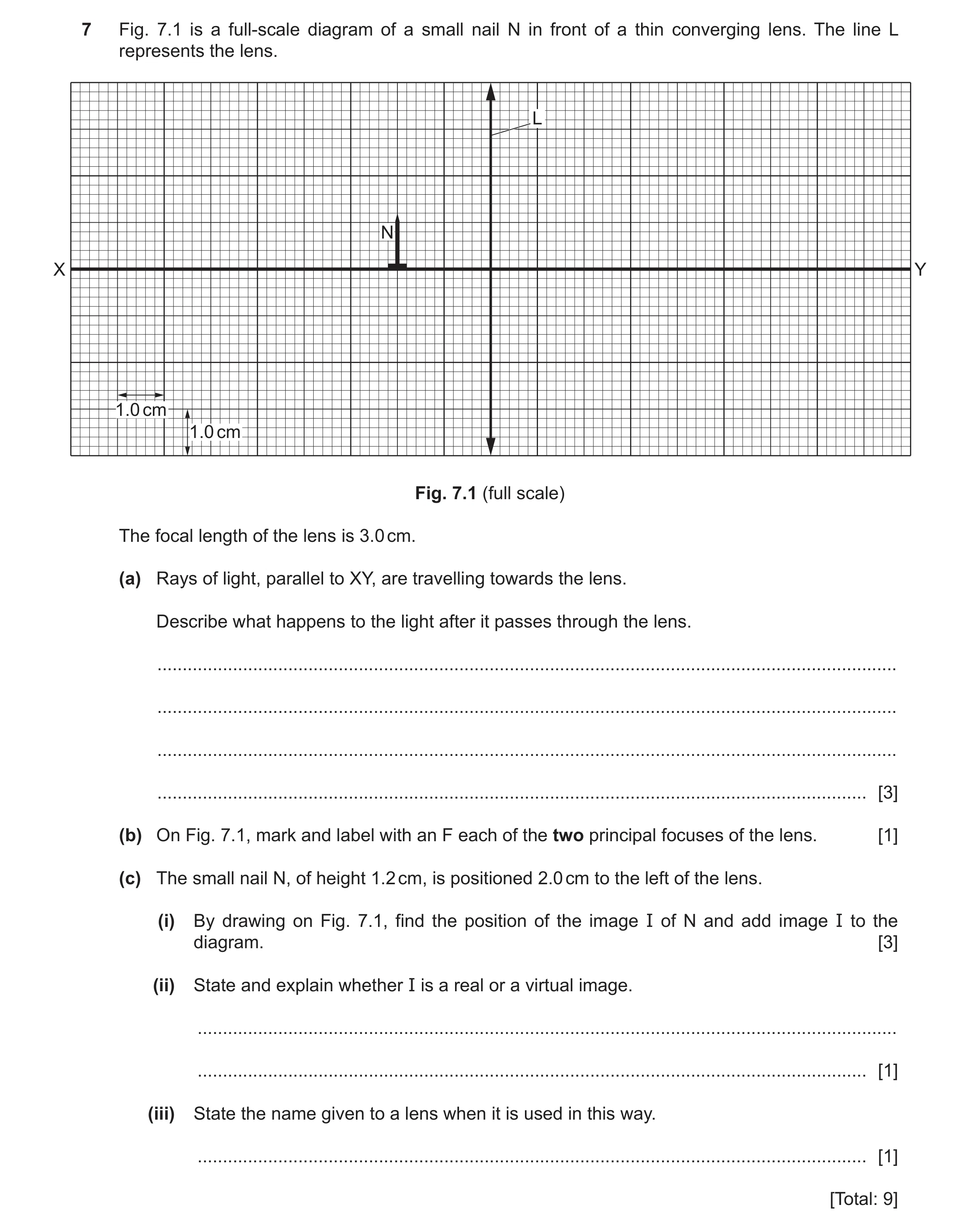
Q32 · A full-scale diagram of a small nail N in front of a thin converging lens 0625/41 May/June 2022
7 Fig. 7.1 is a full-scale diagram of a small nail N in front of a thin converging lens. The line L represents the lens. L N X Y 1.0 cm 1.0 cm Fig. 7.1 (full scale) The focal length of the lens is 3.0 cm. (a) Rays of light, parallel to XY, are travelling towards the lens. Describe what happens to the light after it passes through the lens. … … … … [3] (b) On Fig. 7.1, mark and label with an F each of the two principal focuses of the lens. [1] (c) The small nail N, of height 1.2 cm, is positioned 2.0 cm to the left of the lens. (i) By drawing on Fig. 7.1, find the position of the image I of N and add image I to the diagram. [3] (ii) State and explain whether I is a real or a virtual image. … … [1] (iii) State the name given to a lens when it is used in this way. … [1] [Total: 9]
9 marks
Mark scheme: 7(a) (all the light) meets (at a point) or is focused or intersects A2 (all the light) travels towards a point C1 it then diverges or spreads out (from that point) or point of convergence is on XY / at F / the focal point / principal focus / 3.0 cm from lens B1 7(b) two marked points on XY 3.0 cm from centre of lens and one on left and one on right and each labelled F B1 Question Answer Marks 7(c)(i) two of these rays from tip of N drawn: ray (that seems to come) from left-hand principal focus and emerges from lens paraxially paraxial ray to lens and then towards right-hand principal focus ray towards / through centre of lens M2 two rays traced back to intersection and line from intersection to axis and line labelled I A1 7(c)(ii) virtual and light / rays do not pass through I or virtual and light / rays only seem to come from I or virtual and produced by diverging rays virtual and (real) rays do not meet B1 7(c)(iii) magnifying glass B1
This question in 0625/41 May/June 2022
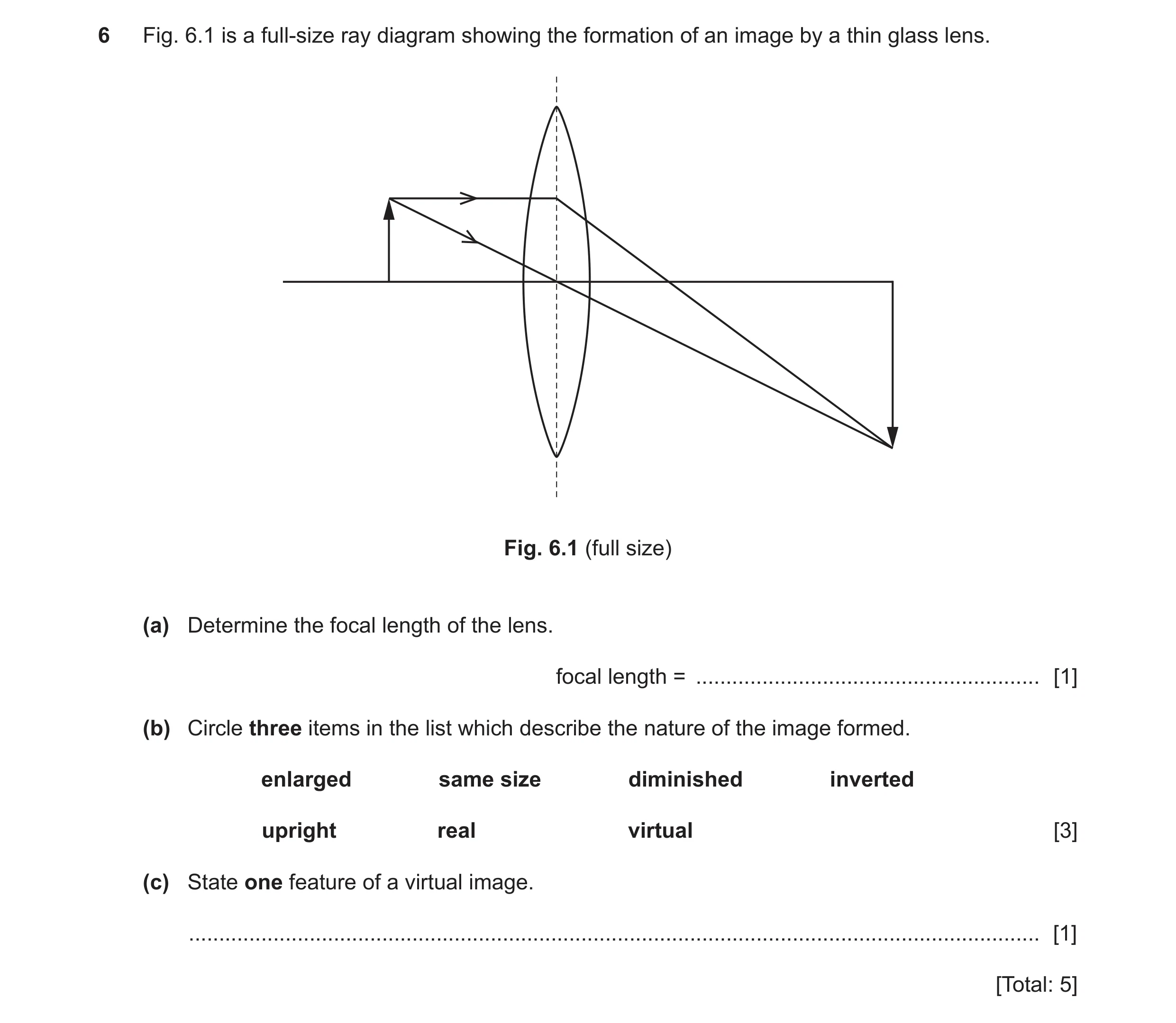
Q33 · A full-size ray diagram showing the formation of an image by a thin glass lens 0625/42 May/June 2022
6 Fig. 6.1 is a full-size ray diagram showing the formation of an image by a thin glass lens. Fig. 6.1 (full size) (a) Determine the focal length of the lens. focal length = … [1] (b) Circle three items in the list which describe the nature of the image formed. enlarged same size diminished inverted upright real virtual [3] (c) State one feature of a virtual image. … [1] [Total: 5]
5 marks
Mark scheme: 6(a) 1.9–2.1 cm B1 6(b) (circle round) enlarged B1 (circle round) inverted B1 (circle round) real B1 6(c) not an intersection of rays OR cannot be formed on a screen OR cannot be projected on a screen OR light rays do not pass through image OR light rays do not meet OR light rays do not converge B1
This question in 0625/42 May/June 2022
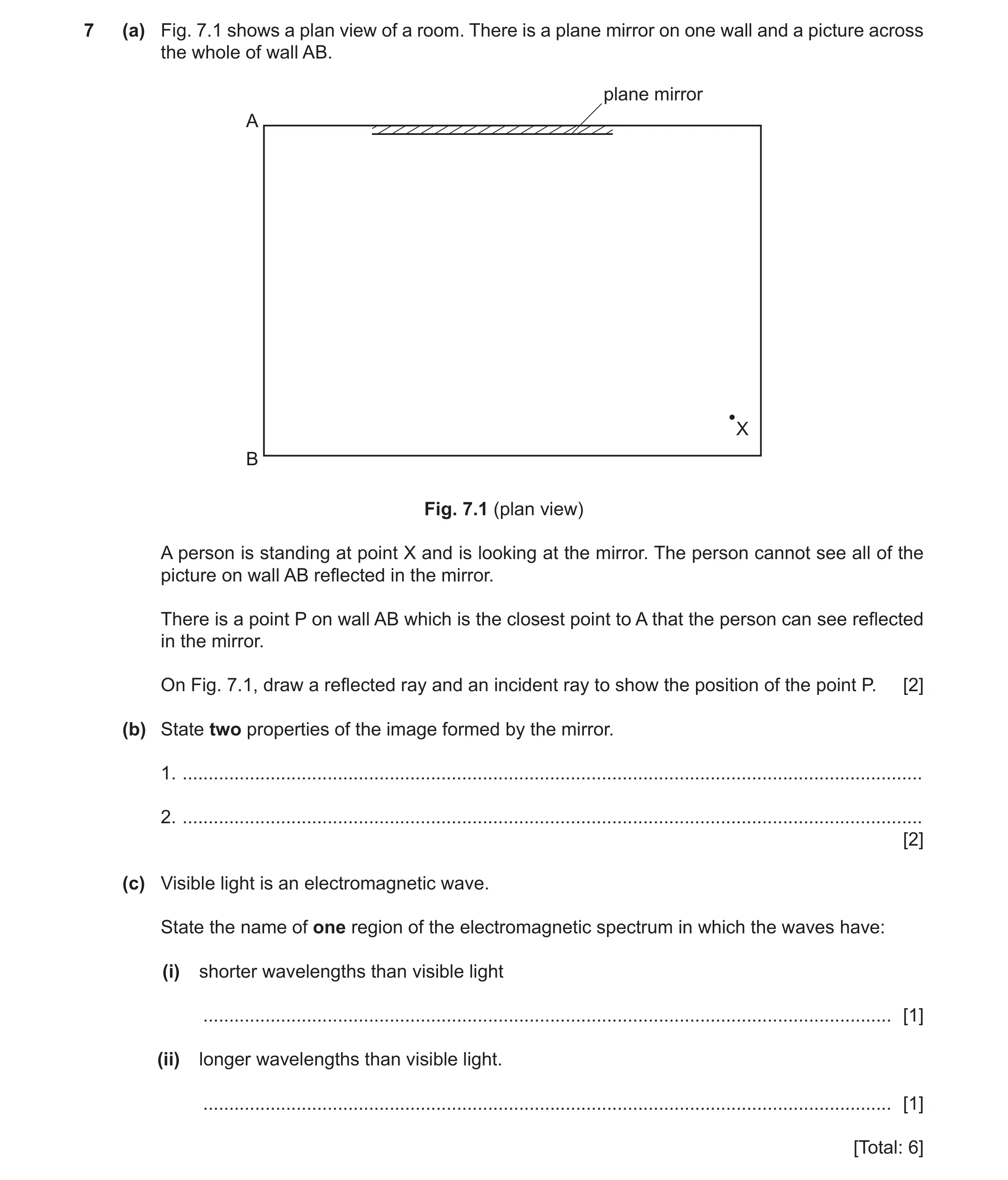
Q34 · A plan view of a room 0625/43 May/June 2022
7 (a) Fig. 7.1 shows a plan view of a room. There is a plane mirror on one wall and a picture across the whole of wall AB. plane mirror A X B Fig. 7.1 (plan view) A person is standing at point X and is looking at the mirror. The person cannot see all of the picture on wall AB reflected in the mirror. There is a point P on wall AB which is the closest point to A that the person can see reflected in the mirror. On Fig. 7.1, draw a reflected ray and an incident ray to show the position of the point P. [2] (b) State two properties of the image formed by the mirror. 1. … 2. … [2] (c) Visible light is an electromagnetic wave. State the name of one region of the electromagnetic spectrum in which the waves have: (i) shorter wavelengths than visible light … [1] (ii) longer wavelengths than visible light. … [1] [Total: 6]
6 marks
Mark scheme: 7(a) ray from left hand corner of the mirror to the eye B1 angle of incidence = angle of reflection B1 7(b) any two from: virtual upright same size as object laterally inverted B2 7(c)(i) ultraviolet / X-rays / gamma rays B1 7(c)(ii) infrared / microwaves / radio (waves) B1
This question in 0625/43 May/June 2022
Q35 · The red light produced by a laser is monochromatic 0625/41 Oct/Nov 2022
6 The red light produced by a laser is monochromatic. (a) State what is meant by monochromatic. … … [1] (b) The red light from the laser hits the curved surface of a semicircular transparent plastic block at point P and passes into the plastic. The red light travels through the plastic and hits the straight edge of the block at its midpoint M. Fig. 6.1 shows that some of the light is reflected and that some light travels in the air along the straight edge of the plastic block. laser reflected light P red light plastic block 37° M Fig. 6.1 The speed of light in air is 3.0 × 10⁸ m / s. (i) Explain why the red light does not change direction as it enters the plastic block. … … … [2] (ii) At M, the angle between the red light in the plastic and the normal is 37°. Calculate the speed of the red light in the plastic. speed = … [4] (iii) In the plastic, blue light travels slightly slower than red light and so the critical angle for blue light is smaller than the critical angle for red light. The laser that emits red light is replaced by one that emits blue light. Now blue light enters the block at P and hits the straight edge at M. Explain what happens to the blue light after it hits the straight edge at M. … … … … [3] [Total: 10]
10 marks
Mark scheme: 6(a) (light of a) single frequency B1 6(b)(i) B2 angle of incidence is 0° B1 (hence) angle of refraction is 0° or B1 all the wavefront hits the plastic at the same time all slows down at the same time 6(b)(ii) 1.8 108 m / s A4 n = 1 / sin c in any form or n = 1 / sin 37° C1 (n =) 1.7 C1 vpl = v0 / n in any form or 3.0 108 / 1.7 or 3.0 108 sin 37° C1 6(b)(iii) B3 critical angle (for blue light) < 37° or critical angle for red (light) is 37° B1 angle of incidence (of blue light) greater than its critical angle (in plastic) B1 total internal reflection or all the (blue) light reflects or no (blue) light B1 leaves the glass / refracts / travels in air along the straight edge
This question in 0625/41 Oct/Nov 2022
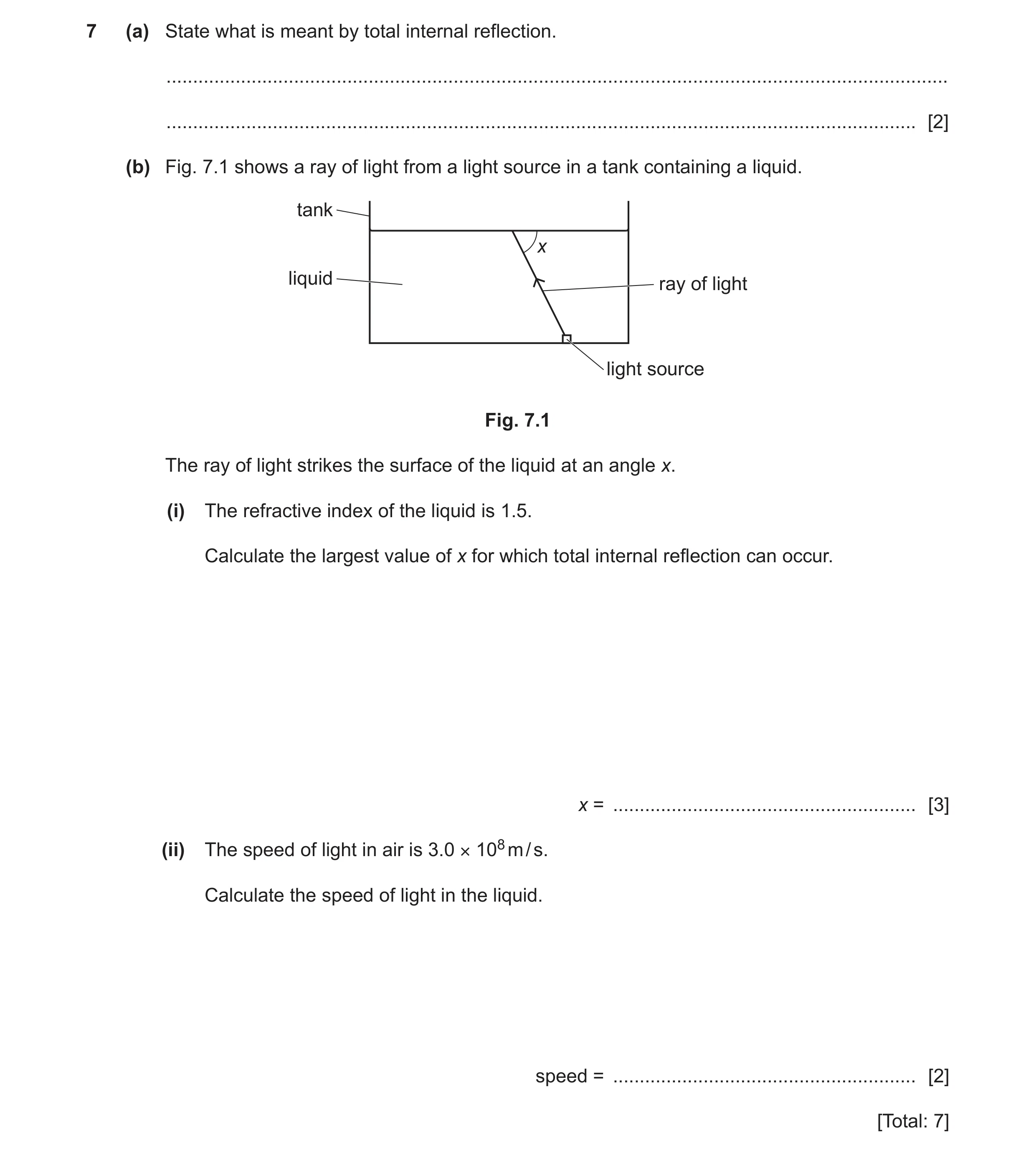
Q36 · State what is meant by total internal reflection 0625/43 Oct/Nov 2022
7 (a) State what is meant by total internal reflection. … … [2] (b) Fig. 7.1 shows a ray of light from a light source in a tank containing a liquid. tank x liquid ray of light light source Fig. 7.1 The ray of light strikes the surface of the liquid at an angle x. (i) The refractive index of the liquid is 1.5. Calculate the largest value of x for which total internal reflection can occur. x = … [3] (ii) The speed of light in air is 3.0 × 10⁸ m / s. Calculate the speed of light in the liquid. speed = … [2] [Total: 7]
7 marks
Mark scheme: 7(a) any two from: B2 • all light is reflected • no light is refracted • (occurs) when light travels in a more dense medium towards a (boundary with a) less dense medium 7(b)(i) (x =) 48° A3 n = 1 / sin c OR c = sin–1 (1 / n) OR sin c = 1 / 1.5 OR c = sin–1 (1 / 1.5) C1 c = 42(°) C1 7(b)(ii) (speed =) 2.0 108 m / s A2 speed of light in vacuum (approx.) speed of light in air C1 n = OR n = speed of light in liquid speed of light in liquid OR n = c / v OR (v =) c / n 3 108 OR 1.5 = speed of light in liquid
This question in 0625/43 Oct/Nov 2022
Q37 · A semicircular transparent plastic block 0625/42 Feb/March 2023
5 (a) Fig. 5.1 shows a semicircular transparent plastic block. semicircular transparent plastic block Fig. 5.1 A ray of light is incident normally on the curved surface of the block. The refractive index of the plastic is 1.5. (i) Calculate the critical angle for the plastic. critical angle = … [2] (ii) On Fig. 5.1, draw the path of the ray in the block and after the ray emerges from the block. [2] (b) Fig. 5.2 is a full‑scale diagram of a lens and an object O. lens F O Fig. 5.2 The point marked F shows the position of a principal focus of the lens. (i) Determine the focal length of the lens. focal length = … [1] (ii) On Fig. 5.2, draw two rays from the object to locate the image. Label the image I. [3] (c) Fig. 5.3 shows a simplified diagram of an eye with rays from a distant object and the path of the rays inside the eye of a person with short sight. retina lens Fig. 5.3 On Fig. 5.4, draw an additional lens outside the eye to correct short‑sightedness and show the path of the rays inside the eye. Fig. 5.4 [2] [Total: 10]
10 marks
Mark scheme: 5(a)(i) 42° A2 n = 1 / sin c OR c = sin–1 (1 / n) OR c = sin–1 (1 / 1.5) (C1) 5(a)(ii) ray continues along radius of semicircle within plastic M1 ray reflected inside plastic on straight edge, with angle of reflection = angle of incidence AND emerges from block along A1 the normal 5(b)(i) (focal length =) 7.2 cm B1 5(b)(ii) two correct rays from: M2 • ray from top of object through centre of lens • ray from top of object (that would pass through F on LHS of lens) refracted parallel to the principal axis • ray from top of object to lens, parallel to principal axis, refracted through F (same distance on right of lens as F marked on left of lens) Two rays correctly extended back to intersect to left of object and line from principal axis to top of image labelled I. A1 5(c) diverging lens in front of eye lens B1 rays meeting on the retina B1
This question in 0625/42 Feb/March 2023
Q38 · A block ABCD made of glass that has a refractive index of 1.5 0625/41 May/June 2023
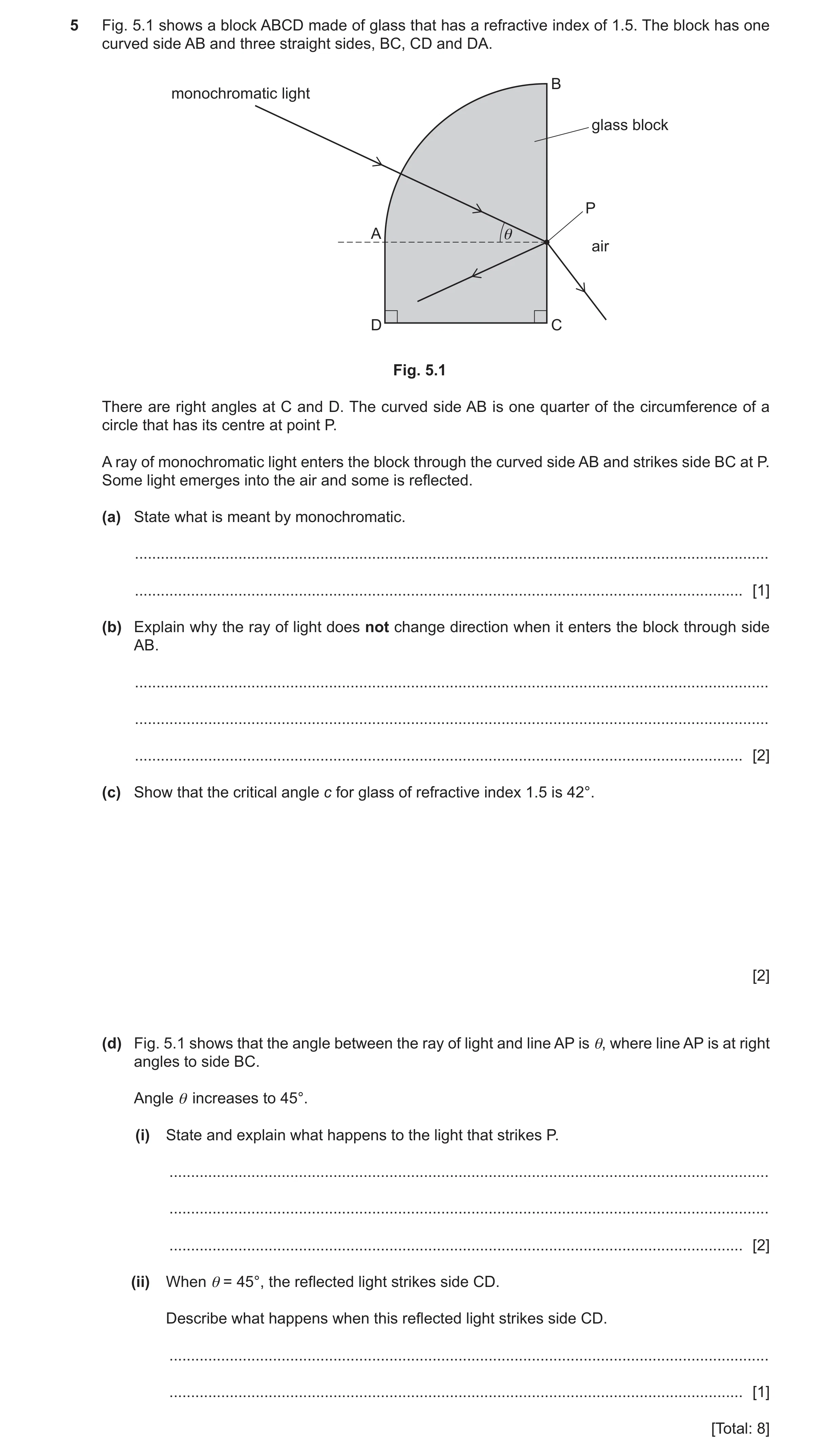
5 Fig. 5.1 shows a block ABCD made of glass that has a refractive index of 1.5. The block has one curved side AB and three straight sides, BC, CD and DA. B monochromatic light glass block P A θ air D C Fig. 5.1 There are right angles at C and D. The curved side AB is one quarter of the circumference of a circle that has its centre at point P. A ray of monochromatic light enters the block through the curved side AB and strikes side BC at P. Some light emerges into the air and some is reflected. (a) State what is meant by monochromatic. … … [1] (b) Explain why the ray of light does not change direction when it enters the block through side AB. … … … [2] (c) Show that the critical angle c for glass of refractive index 1.5 is 42°. [2] (d) Fig. 5.1 shows that the angle between the ray of light and line AP is θ, where line AP is at right angles to side BC. Angle θ increases to 45°. (i) State and explain what happens to the light that strikes P. … … … [2] (ii) When θ = 45°, the reflected light strikes side CD. Describe what happens when this reflected light strikes side CD. … … [1] [Total: 8]
8 marks
Mark scheme: 5(a) (light / electromagnetic radiation) of a single frequency B1 5(b) angle of incidence / i = 0 OR incident ray along normal OR all of wavefront enters block at same time B1 angle of refraction / r = 0 OR no refraction OR whole wavefront slows down at same time B1 5(c) (c =) sin–1{1 /1.5} (= 42°) OR (c =) sin–1 {1 / n} = 41.8° A2 n = 1 / sin c OR (c =) sin-1 {1 / n} OR (c =) 41.8° C1 5(d)(i) all light is reflected B1 𝜃 / angle of incidence > c / critical angle B1 5(d)(ii) all light is reflected OR reflected ray at 90° to incident ray OR reflected ray is parallel to original ray B1
This question in 0625/41 May/June 2023
Q39 · A container of oil 0625/42 May/June 2023
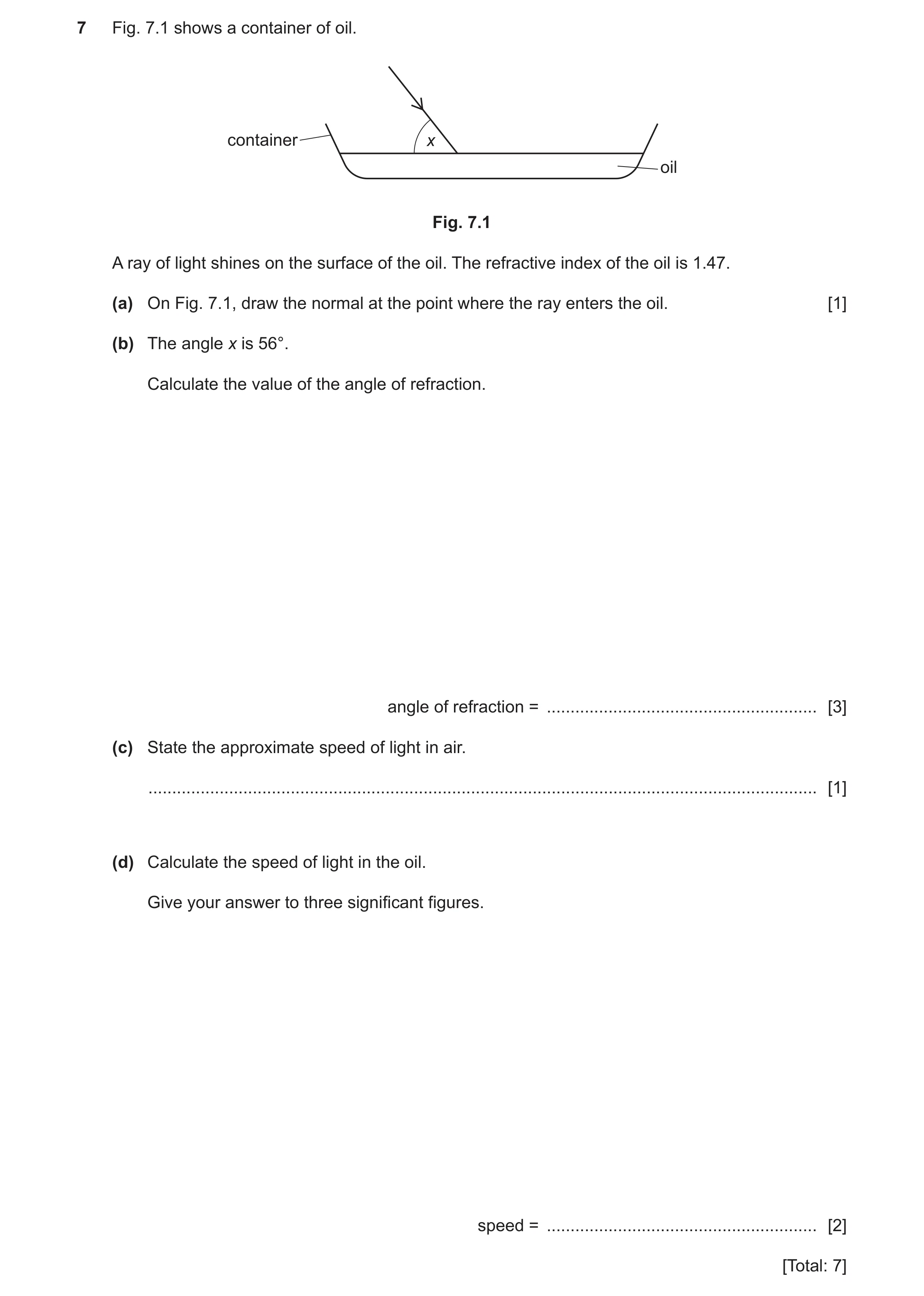
7 Fig. 7.1 shows a container of oil. container x oil Fig. 7.1 A ray of light shines on the surface of the oil. The refractive index of the oil is 1.47. (a) On Fig. 7.1, draw the normal at the point where the ray enters the oil. [1] (b) The angle x is 56°. Calculate the value of the angle of refraction. angle of refraction = … [3] (c) State the approximate speed of light in air. … [1] (d) Calculate the speed of light in the oil. Give your answer to three significant figures. speed = … [2] [Total: 7]
7 marks
Mark scheme: 7(a) normal drawn in correct position and at right angles to the surface B1 7(b) 22° A3 i = 34(°) C1 n = sin i / sin r OR (r =) sin–1 {sin i / n} OR sin r = sin 34 / 1.47 OR sin r = 0.38 C1 7(c) 3.0 108 m / s B1 7(d) 2.04 108 m / s A2 n = speed of light in air / speed of light in oil OR (speed of light in oil =) speed of light in air / n OR (speed of light in oil =) 3.0 108 / 1.47 C1
This question in 0625/42 May/June 2023
Q40 · A page of printed text is placed 18 cm from a converging lens of focal length 35 cm 0625/41 Oct/Nov 2023
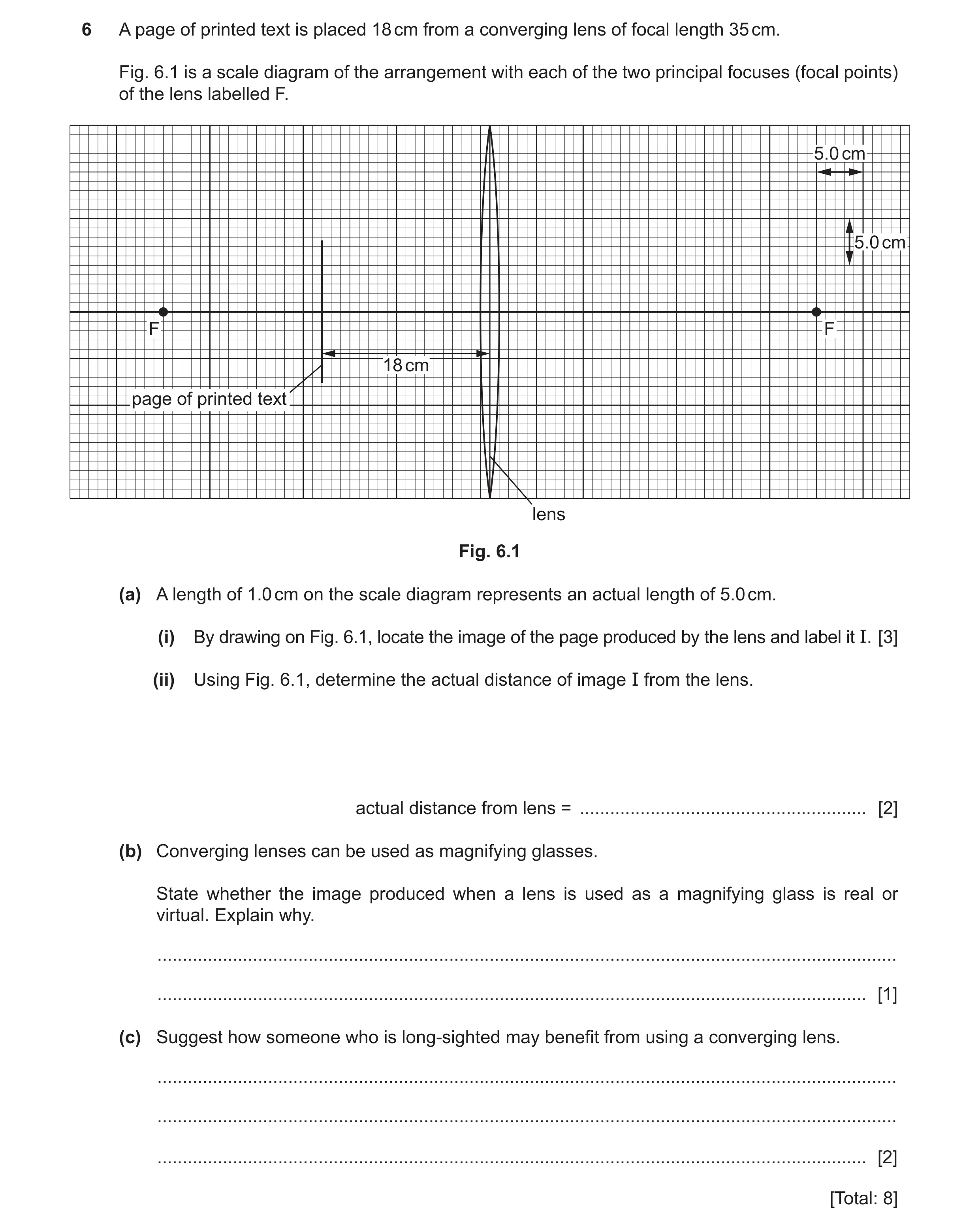
6 A page of printed text is placed 18 cm from a converging lens of focal length 35 cm. Fig. 6.1 is a scale diagram of the arrangement with each of the two principal focuses (focal points) of the lens labelled F. 5.0 cm 5.0 cm F F 18 cm page of printed text lens Fig. 6.1 (a) A length of 1.0 cm on the scale diagram represents an actual length of 5.0 cm. (i) By drawing on Fig. 6.1, locate the image of the page produced by the lens and label it I. [3] (ii) Using Fig. 6.1, determine the actual distance of image I from the lens. actual distance from lens = … [2] (b) Converging lenses can be used as magnifying glasses. State whether the image produced when a lens is used as a magnifying glass is real or virtual. Explain why. … … [1] (c) Suggest how someone who is long-sighted may benefit from using a converging lens. … … … [2] [Total: 8]
8 marks
Mark scheme: 6(a)(i) any two from: M2 • ray from top / bottom of object, parallel to principal axis, refracted through right-hand principal focus • straight ray from same point on object through optical centre • ray that (seems to) come from left-hand principal focus through same point of object and refracted parallel to principal axis rays traced back to intersection AND intersection / image labelled I A1 6(a)(ii) (distance = ) 35.5 cm to 38.5 cm A2 7.1 to 7.7 (cm) OR (distance =) 35.0 (cm) to 40.0 (cm) C1 6(b) virtual AND any one from: B1 • cannot be projected on a screen • (real) light (ray) does not pass through image • light only seems to come from image 6(c) any one from: B1 • long-sightedness focuses image behind retina / back of eye OR longsightedness produces blurry / fuzzy images (of close objects) • converging lens reduces focal length (of eye) • (converging lens) puts image further away (from the eye) (converging lens gives) sharp/focussed image on retina / back of eye OR (with lens) rays converge on retina / back of eye B1
This question in 0625/41 Oct/Nov 2023
Q41 · A road junction, a moving car and a stationary truck 0625/42 Oct/Nov 2023
5 Fig. 5.1 shows a road junction, a moving car and a stationary truck. The road has high walls on each side. X truck car Fig. 5.1 (a) The driver of the truck is at position X. The car moves around the corner. On Fig. 5.1, label a point Y on the road where the truck driver first sees the car. [1] (b) A plane mirror is placed at the road junction as shown in Fig. 5.2. X truck car Fig. 5.2 Show how this mirror allows the driver of the truck to see the car when it is at the position shown in Fig. 5.2. [2] (c) The truck driver wears spectacles to correct long-sightedness. Fig. 5.3 shows how a blurred image of an object O forms on the retina. Any effect of the cornea on the rays of light can be ignored. lens retina O cornea Fig. 5.3 On Fig. 5.4, show how long-sightedness is corrected by: • adding a suitable lens in front of the eye • continuing the path of the three rays of light until they meet to form an image. lens retina O Fig. 5.4 [4] [Total: 7]
7 marks
Mark scheme: 5(a) indication of position of car along a straight line from X above and to left of road at junction. B1 5(b) Incident ray from car to mirror AND reflected ray from mirror towards X B1 angle of incidence equal to angle of reflection B1 5(c) converging lens (to left of eye) M1 rays refracted by additional converging lens A1 rays refracted by lens in eye to give converging rays B1 focal point of rays / image on retina B1
This question in 0625/42 Oct/Nov 2023
Q42 · A full‑scale diagram of an object O and its image I produced by a converging lens 0625/42 Feb/March 2024
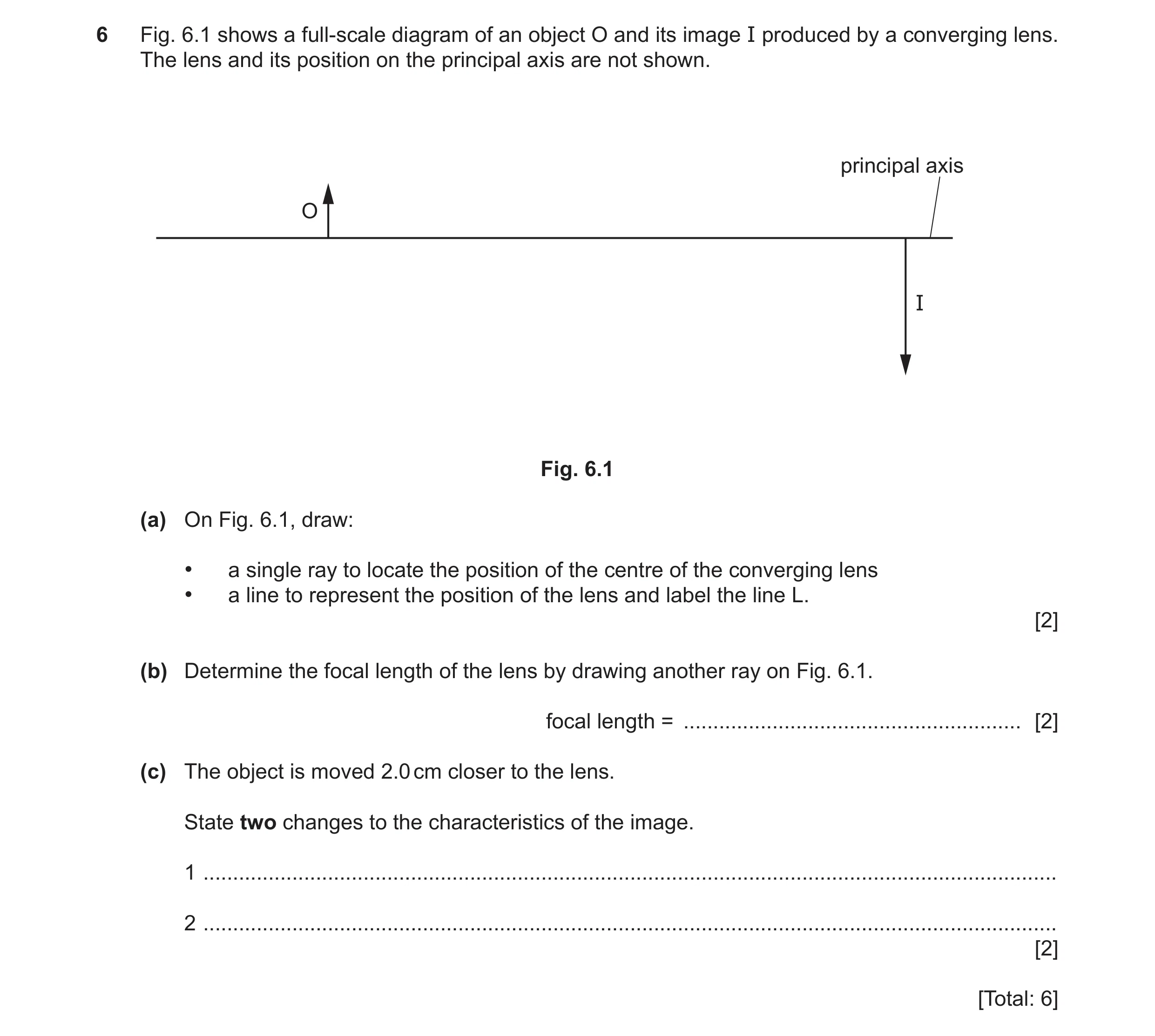
6 Fig. 6.1 shows a full‑scale diagram of an object O and its image I produced by a converging lens. The lens and its position on the principal axis are not shown. principal axis O I Fig. 6.1 (a) On Fig. 6.1, draw: • a single ray to locate the position of the centre of the converging lens • a line to represent the position of the lens and label the line L. [2] (b) Determine the focal length of the lens by drawing another ray on Fig. 6.1. focal length = … [2] (c) The object is moved 2.0 cm closer to the lens. State two changes to the characteristics of the image. 1 … 2 … [2] [Total: 6]
6 marks
Mark scheme: 6(a) ray from top of object to tip of image M1 line labelled L drawn perpendicular to principal axis at its intersection with previous ray A1 6(b) ray from top of O parallel to principal axis to lens AND ray from lens to tip of I B1 OR ray from tip of I parallel to principal axis to lens AND ray from lens to top of O 2.1 cm B1 6(c) virtual B1 upright B1
This question in 0625/42 Feb/March 2024
Q43 · The lens in a magnifying glass is a converging lens 0625/41 May/June 2024
4 The lens in a magnifying glass is a converging lens. (a) Fig. 4.1 shows the lens of the magnifying glass, its two focal points, F1 and F2 , and its principal axis. lens principal axis F1 F2 Fig. 4.1 (i) State what is meant by ‘focal point’. … … … [2] (ii) A student using the magnifying glass sees a magnified image of an object. On Fig. 4.1, mark: • a point X on the principal axis for a possible position of the object • a point E for a possible position of the student’s eye. [1] (iii) Underline two words in the list that describe the image produced in (a)(ii). inverted real upright virtual [1] (b) The refractive index of the glass used to make the lens is 1.5. (i) The speed of light in air is 3.0 × 10⁸ m / s. Calculate the speed of light in the glass. speed in glass = … [2] (ii) State what happens to the wavelength of light as it passes into the lens. … … [1] (c) Converging lenses are used in spectacles (glasses) to correct one problem with vision. State the name of the problem and explain how a converging lens is used to correct it. You may draw a diagram. name of problem: … … … … … [3] [Total: 10]
10 marks
Mark scheme: 4(a)(i) (point on principal axis) where rays of light parallel (to the principal axis, incident on converging lens) B1 (rays) meet / converge after passing through lens / refraction B1 4(a)(ii) X marked between one of the focal points and the lens AND E marked on other side of lens B1 4(a)(iii) virtual AND upright B1 4(b)(i) 2.0 108 m / s A2 n = c / vg OR (vg =) c / n OR (vg =) 3(.0) 108 / 1.5 C1 4(b)(ii) (wavelength) decreases B1 4(c) long-sightedness B1 it moves the image towards the lens / back of the eye / retina OR reduces / shortens focal length of (combined lens) B1 (converging lens) focuses image on back of eye / retina B1
This question in 0625/41 May/June 2024
Q44 · A ray of yellow light incident on a glass prism ABC 0625/42 May/June 2024
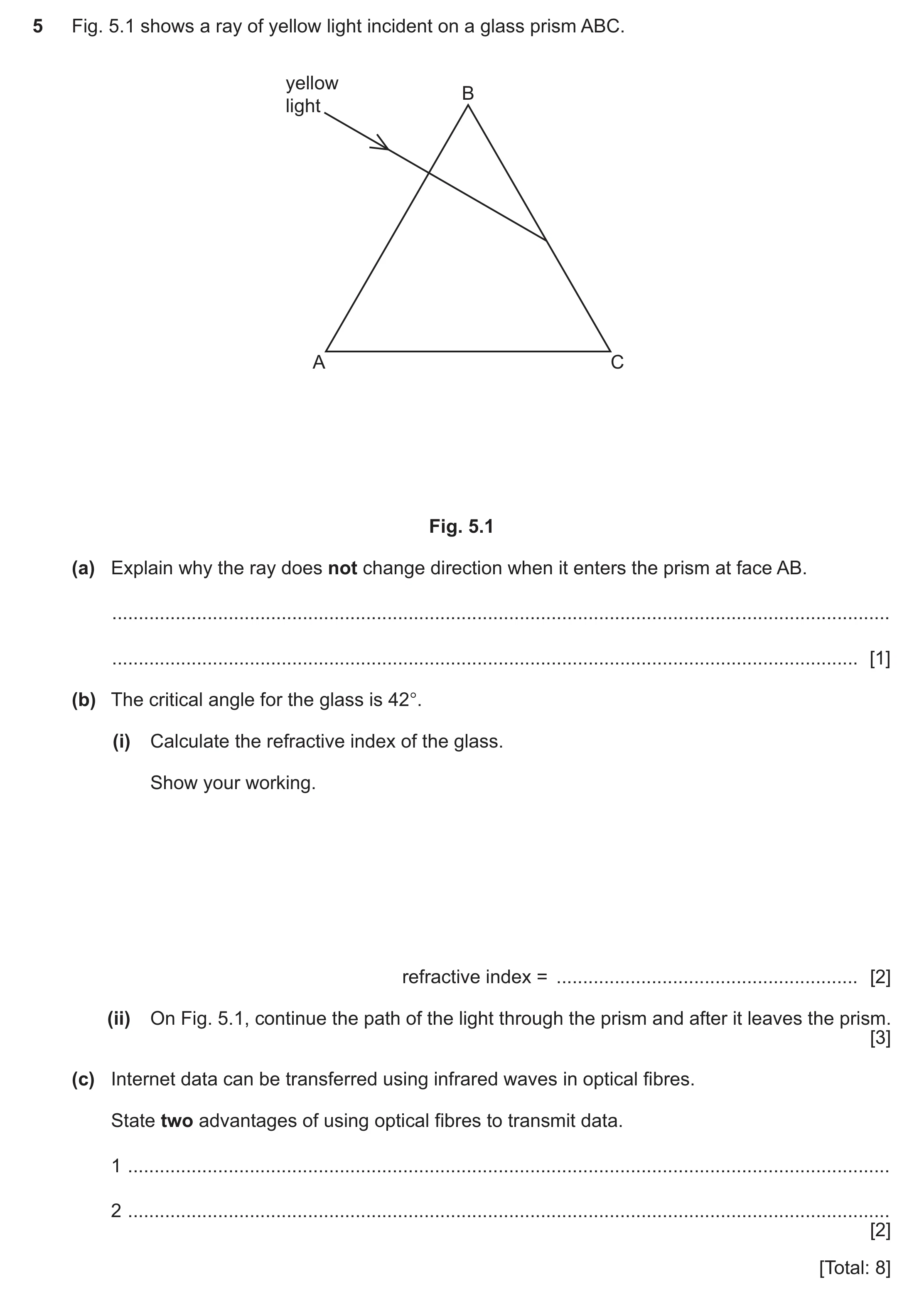
5 Fig. 5.1 shows a ray of yellow light incident on a glass prism ABC. yellow B light A C Fig. 5.1 (a) Explain why the ray does not change direction when it enters the prism at face AB. … … [1] (b) The critical angle for the glass is 42°. (i) Calculate the refractive index of the glass. Show your working. refractive index = … [2] (ii) On Fig. 5.1, continue the path of the light through the prism and after it leaves the prism. [3] (c) Internet data can be transferred using infrared waves in optical fibres. State two advantages of using optical fibres to transmit data. 1 … 2 … [2] [Total: 8]
8 marks
Mark scheme: 5(a) ray travels along the normal OR angle of incidence = 0(°) B1 5(b)(i) n = 1 / sin c OR (n =) 1 / sin c OR (n =) 1 / sin 42 (°) M1 1.5 A1 5(b)(ii) ray reflected at BC AND no refracted ray M1 ray hits AC with angle of incidence = 0 ° A1 correct refraction of candidate’s ray into air at AC B1 Question Answer Marks 5(c) any two from: high rates (of data transmission) / fast (data transmission) carry large amounts (of data / information) secure little signal / data loss glass is transparent to (some) infrared B2
This question in 0625/42 May/June 2024
Q45 · A thin converging lens used to produce a magnified image of an object AB 0625/43 May/June 2024
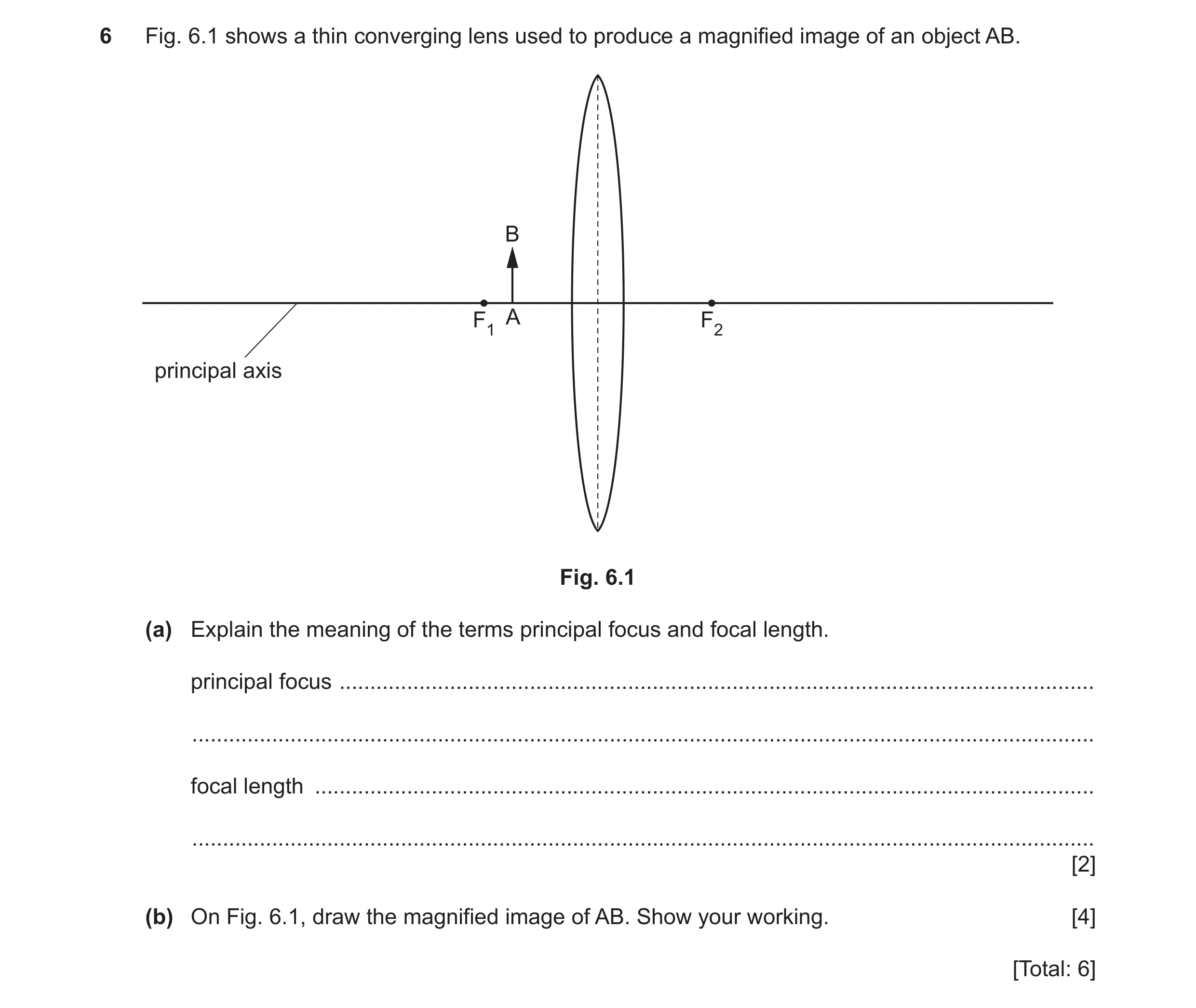
6 Fig. 6.1 shows a thin converging lens used to produce a magnified image of an object AB. B F1 A F2 principal axis Fig. 6.1 (a) Explain the meaning of the terms principal focus and focal length. principal focus … … focal length … … [2] (b) On Fig. 6.1, draw the magnified image of AB. Show your working. [4] [Total: 6]
6 marks
Mark scheme: 6(a) where rays of light parallel (to the principal axis) converge after passing through lens B1 (focal length is) the distance between (centre of) the lens and principal focus B1 6(b) any two from: ray from top of object to lens, parallel to principal axis, refracted to F2 ray from top of object through centre of lens, undeviated ray from F1, through top of object and on to lens, then parallel to principal axis M2 rays extrapolated back to converge to the left of F1 A1 image drawn from principal axis to intersection with arrow (to show orientation) A1
This question in 0625/43 May/June 2024
Q46 · A ray of light as it enters the side of a plastic block 0625/43 Oct/Nov 2024
4 (a) Fig. 4.1 shows a ray of light as it enters the side of a plastic block. The ray of light passes from air into the plastic. plastic block normal r = 30° i = 45° air ray of light Fig. 4.1 (i) State how the speed, wavelength and frequency of the wave in the plastic block compare with their values in the air. speed: … wavelength: … frequency: … [2] (ii) Show that the refractive index of the plastic is 1.4. Show your working. [1] (iii) Calculate the critical angle for the plastic. critical angle = … [2] (b) Fig. 4.2 shows the same plastic as in (a) used to make an optical fibre. A ray of light is passing along the fibre. P Fig. 4.2 (i) Carefully continue the ray of light P until it reaches the other end of the fibre. [2] (ii) State two uses for optical fibres. 1 … 2 … [2] [Total: 9]
9 marks
Mark scheme: 4(a)(i) any two correct = 1 mark B2 all three correct = 2 marks • speed decreases / gets less / slower • wavelength decreases / gets smaller / shorter • frequency unchanged / stays the same / no effect 4(a)(ii) (n =) sin 45 / sin 30 B1 4(a)(iii) 46° OR 45° A1 n = 1 / sin c OR (c =) sin–1 (1 / n) OR (c =) sin–1 (1 / 1.4) OR sin c = 1 / n M1 4(b)(i) total internal reflection AND i = r for initial reflection B1 ray reaches end of fibre after a total of 2 or 3 reflections only B1 4(b)(ii) any two from: B2 • internet transmission / (highspeed) broadband • telephone networks OR telecommunications • cable TV • endoscope • lasers in surgery • microscopy • military aircraft wiring • imaging (cameras) in industry • inspection of pipes or other hard to reach places
This question in 0625/43 Oct/Nov 2024
Q47 · An object O which is 5.0 cm away from the centre of a thin, converging lens L 0625/42 Feb/March 2025
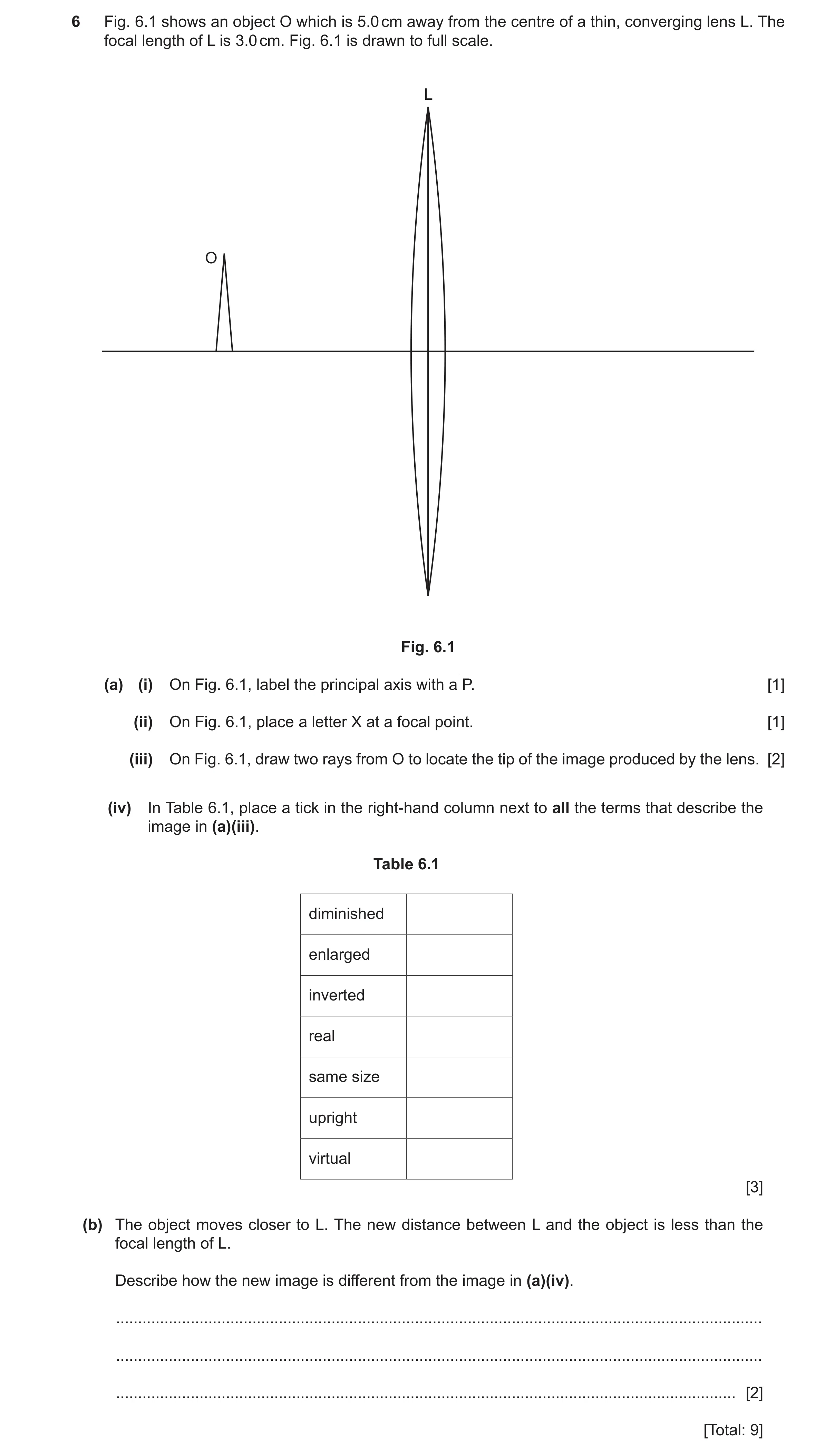
6 Fig. 6.1 shows an object O which is 5.0 cm away from the centre of a thin, converging lens L. The focal length of L is 3.0 cm. Fig. 6.1 is drawn to full scale. L O Fig. 6.1 (a) (i) On Fig. 6.1, label the principal axis with a P. [1] (ii) On Fig. 6.1, place a letter X at a focal point. [1] (iii) On Fig. 6.1, draw two rays from O to locate the tip of the image produced by the lens. [2] (iv) In Table 6.1, place a tick in the right-hand column next to all the terms that describe the image in (a)(iii). Table 6.1 diminished enlarged inverted real same size upright virtual [3] (b) The object moves closer to L. The new distance between L and the object is less than the focal length of L. Describe how the new image is different from the image in (a)(iv). … … … [2] [Total: 9]
9 marks
Mark scheme: 6(a)(i) Horizontal axis labelled P B1 6(a)(ii) X on horizontal axis 3.0 cm to the left of centre of L OR X on horizontal axis 3.0 cm to the right of centre of L B1 6(a)(iii) Any two from: M1 • Straight line from a point on O, passing through centre of L (and beyond) • Horizontal line from same point on O to L, refracted through F (on RH side of L) • Straight line from same point on O through F (on LH side of L) to L, refracted parallel to principal axis both rays extended until they intersect A1 6(a)(iv) B3 diminished enlarged inverted real same size upright virtual 6(b) (image is now) virtual B1 (image is now) upright B1
This question in 0625/42 Feb/March 2025
Q48 · A ray of light is incident on a soap film 0625/41 May/June 2025
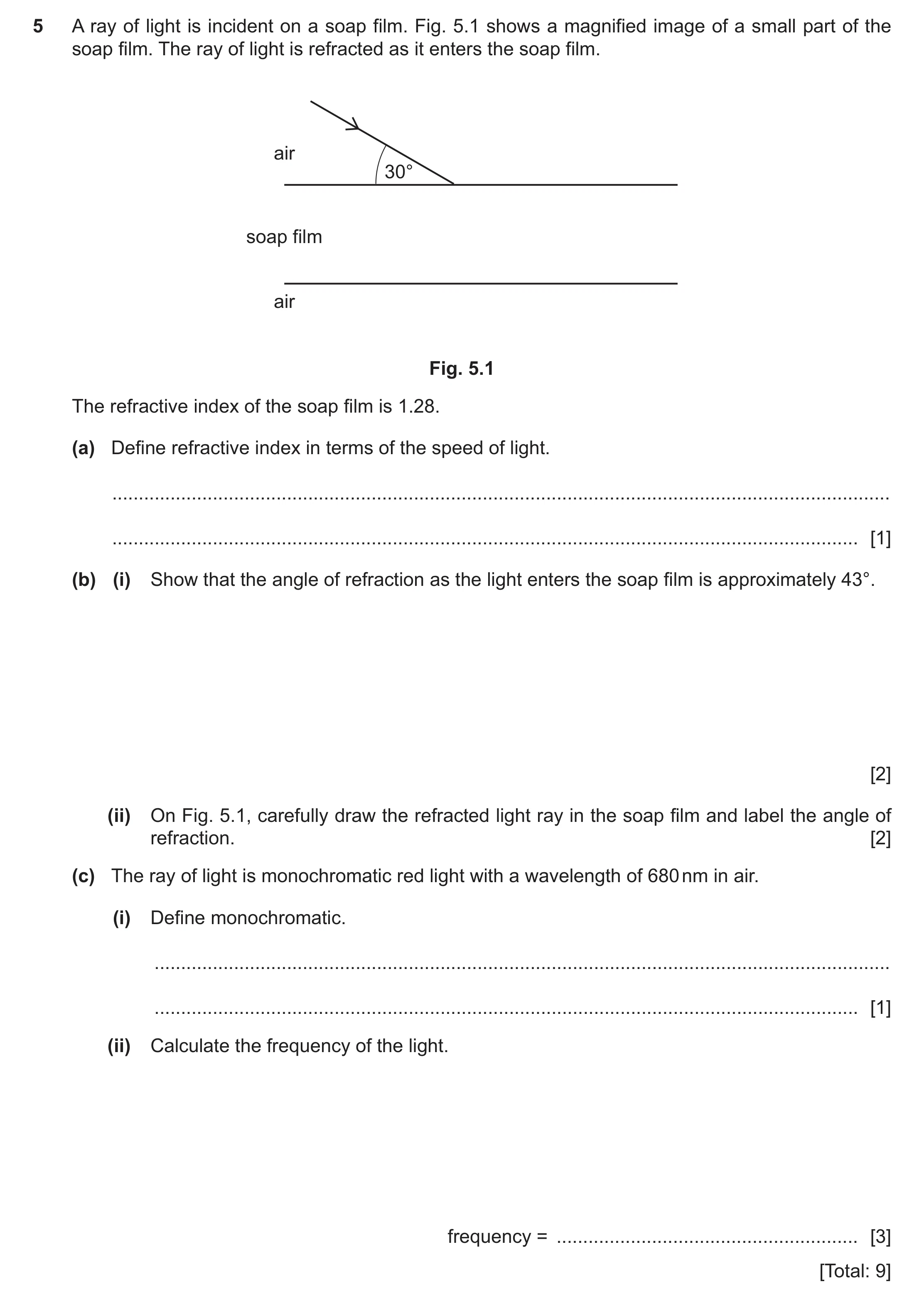
5 A ray of light is incident on a soap film. Fig. 5.1 shows a magnified image of a small part of the soap film. The ray of light is refracted as it enters the soap film. air 30° soap film air Fig. 5.1 The refractive index of the soap film is 1.28. (a) Define refractive index in terms of the speed of light. … … [1] (b) (i) Show that the angle of refraction as the light enters the soap film is approximately 43°. [2] (ii) On Fig. 5.1, carefully draw the refracted light ray in the soap film and label the angle of refraction. [2] (c) The ray of light is monochromatic red light with a wavelength of 680 nm in air. (i) Define monochromatic. … … [1] (ii) Calculate the frequency of the light. frequency = … [3] [Total: 9]
9 marks
Mark scheme: 5(a) (refractive index is) the ratio of the speed of light in two different regions owtte B1 speed of light in air OR (refractive index =) speed of light in ( soap ) film 5(b)(i) sin i sini sin60 B1 n = OR (r =) sin–1 OR 1.28 = sin r n sinr i = 60 (°) B1 5(b)(ii) normal drawn (at the point incident ray meets film) M1 refracted ray drawn (refraction towards normal in film) and angle of refraction labelled A1 braille: angle identified but not labelled 5(c)(i) (light of) a single frequency B1 5(c)(ii) 4.4 1014 Hz A3 (speed of light / e-m waves is approximately) 3.0 108 m / s (in air) C1 v = fOR (f =) 3.0 108 680 10 −9 C1
This question in 0625/41 May/June 2025
Q49 · A full-size diagram of a lens and an image I of an object 0625/42 May/June 2025
6 (a) Fig. 6.1 is a full-size diagram of a lens and an image I of an object. lens I Fig. 6.1 The focal length of the lens is 3.0 cm. (i) On Fig. 6.1, mark two points with labels F, to show the positions of the principal focuses (focal points) of the lens. [1] (ii) On Fig. 6.1, draw two rays from the image I to locate the object. Draw the object and label it O. [3] (iii) The object is moved so that it is 6 cm to the left of the lens. State one characteristic of the image formed when the object is in this position. … [1] (b) Fig. 6.2 shows a simplified diagram of an eye with rays from a near object. The eye needs correction for long-sightedness. lens retina cornea Fig. 6.2 (i) On Fig. 6.2, draw the path of the rays inside the eye to show the effect of long-sightedness. [1] (ii) A lens is used to correct the long-sightedness. Draw a lens suitable for this correction. lens to correct long-sightedness [1] [Total: 7]
7 marks
Mark scheme: 6(a)(i) two points labelled F on principal axis, both 3.0 cm from the centre of the lens B1 6(a)(ii) method 1 M2 two correct rays from: • ray from top of I through the centre of the lens • ray from top of I parallel to principal axis to the left of the lens, to centre of lens and then through RH focus • ray from top of I through LH focus to lens, to centre of lens and then parallel to principal axis on the right of the lens OR method 2 M2 two correct rays from: • ray from top of I through the centre of the lens • ray from top of I through RH focus of lens and extended back, from centre of lens, parallel to principal axis on the left of the lens • ray from top of I parallel to principal axis to the left of the lens, and extended back, from the centre of the lens, through the LH focus object, labelled O, at the intersection of rays to the RH of the lens for method 1 A1 object, labelled O, at the intersection of rays to the LH of the lens for method 2 6(a)(iii) real OR inverted B1 6(b)(i) rays meeting behind the retina OR would meet behind retina if extended B1 6(b)(ii) any converging lens B1
This question in 0625/42 May/June 2025
Q50 · Four rays of red light, P, Q, R and S, coming from a spotlight in a swimming pool 0625/43 May/June 2025
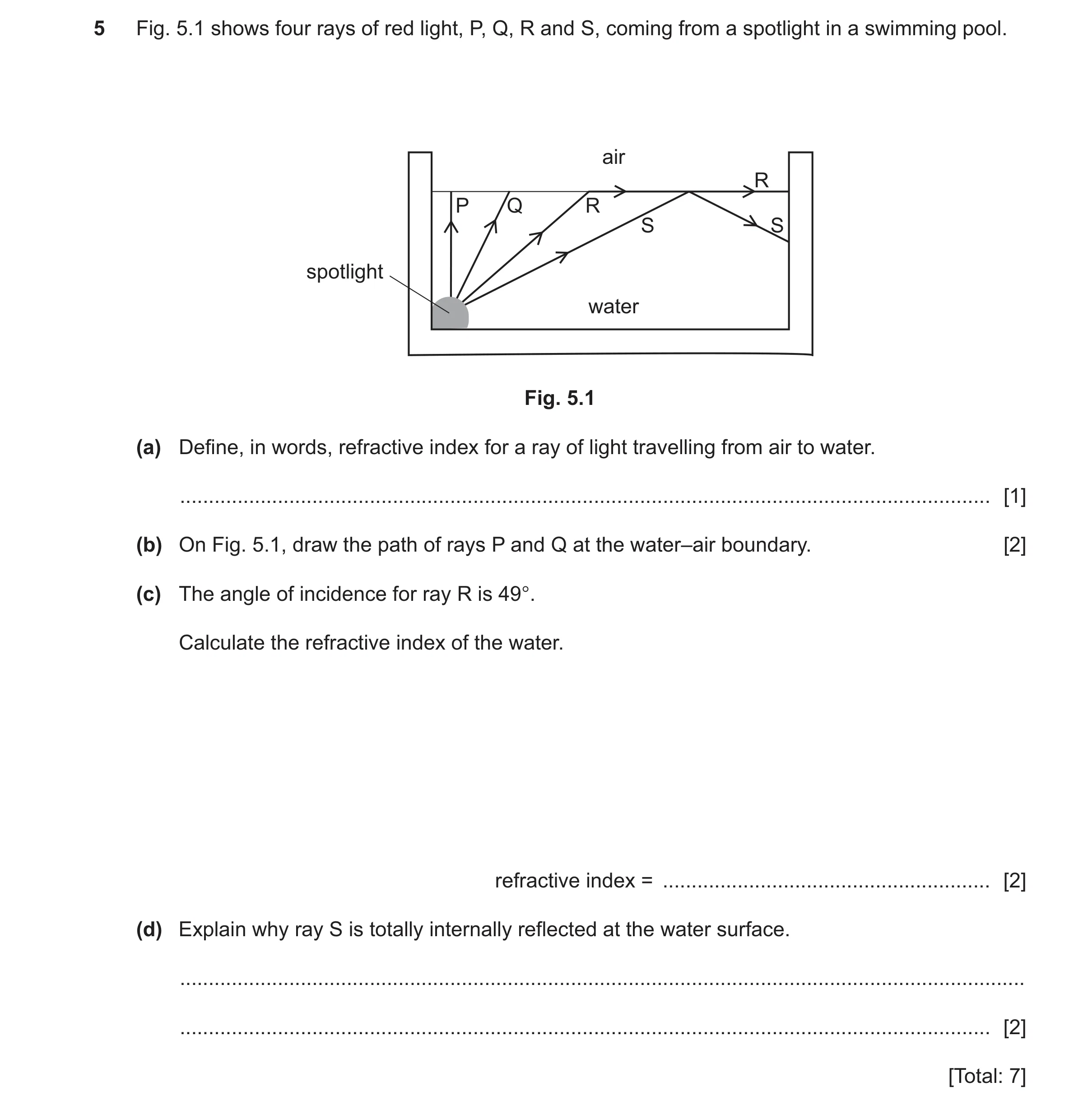
5 Fig. 5.1 shows four rays of red light, P, Q, R and S, coming from a spotlight in a swimming pool. air R P Q R S S spotlight water Fig. 5.1 (a) Define, in words, refractive index for a ray of light travelling from air to water. … [1] (b) On Fig. 5.1, draw the path of rays P and Q at the water–air boundary. [2] (c) The angle of incidence for ray R is 49°. Calculate the refractive index of the water. refractive index = … [2] (d) Explain why ray S is totally internally reflected at the water surface. … … [2] [Total: 7]
7 marks
Mark scheme: 5(a) (refractive index is) the ratio of the speed of light in two different mediums B1 speed of light in air OR (refractive index =) speed of light in water sine of angle of incidence OR (refractive index =) sine of angle of refraction 5(b) P continues vertical B1 Q refracted away from normal in the correct direction B1 5(c) 1.3 A2 (n =) 1 ÷ sin 49 OR (n =) 1 ÷ sin c C1 5(d) any two from: B2 • (ray travelling from) dense to less dense medium OR water is more dense than air • critical angle = 49° • angle of incidence exceeds critical angle / 49°
This question in 0625/43 May/June 2025
Q51 · Part of an optical fibre used in high-speed broadband communication 0625/41 Oct/Nov 2025
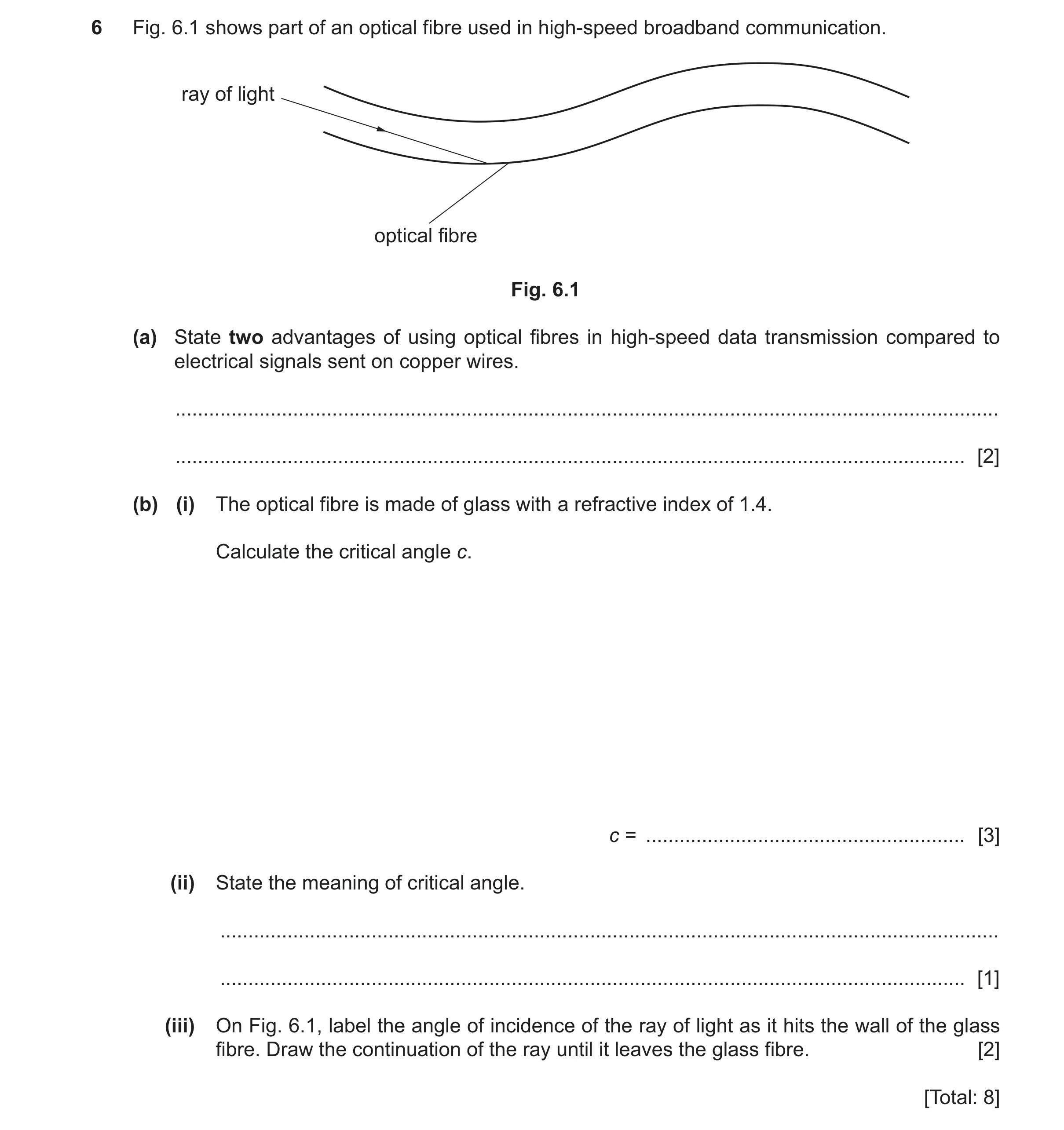
6 Fig. 6.1 shows part of an optical fibre used in high-speed broadband communication. ray of light optical fibre Fig. 6.1 (a) State two advantages of using optical fibres in high-speed data transmission compared to electrical signals sent on copper wires. … … [2] (b) (i) The optical fibre is made of glass with a refractive index of 1.4. Calculate the critical angle c. c = … [3] (ii) State the meaning of critical angle. … … [1] (iii) On Fig. 6.1, label the angle of incidence of the ray of light as it hits the wall of the glass fibre. Draw the continuation of the ray until it leaves the glass fibre. [2] [Total: 8]
8 marks
Mark scheme: 6(a) Any two from: B2 • high rates (of data transmission) / faster (data transmission) • carry large amounts (of data / information) • secure • Little data / signal loss • glass is transparent to (some) infrared 6(b)(i) (c =) 46° A3 N = 1 / sin c, 1.4 = 1 / sin c OR (c =) sin–1 (1 / 1.4) C1 Equation in this form only C1 (c =) sin–1 (1 / n) OR (c =) sin–1 (1 / 1.4) OR (c =) 46 6(b)(ii) angle of incidence (of light) at which the angle of refraction is (exactly) 90° B1 6(b)(iii) angle of incidence marked AND A2 TIR of ray inside glass AND light ray leaves end of fibre after two or three reflections angle of incidence marked OR TIR drawn until ray leaves end of fibre C1
This question in 0625/41 Oct/Nov 2025
Q52 · Successive crests of a water wave approaching a boundary 0625/42 Oct/Nov 2025
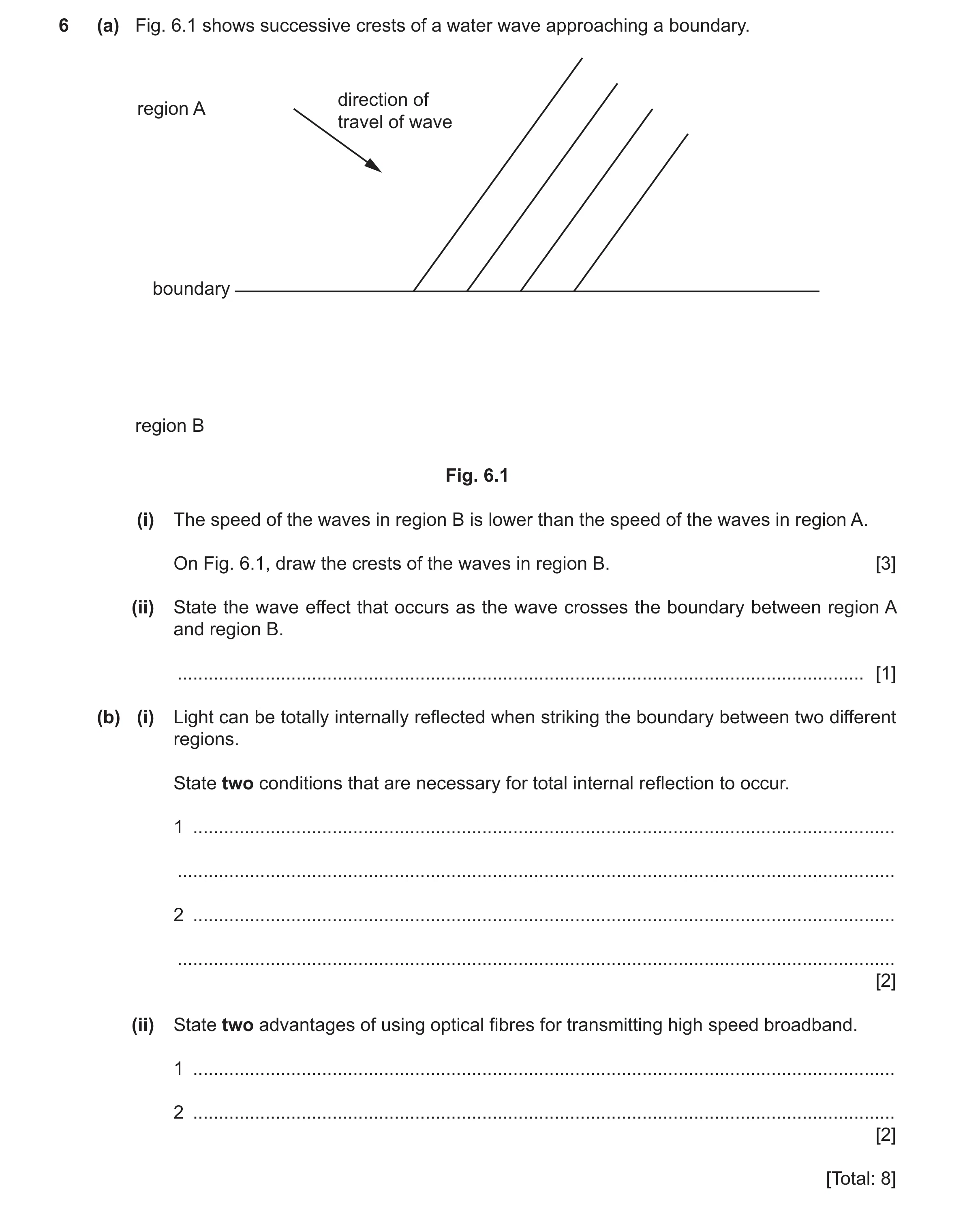
6 (a) Fig. 6.1 shows successive crests of a water wave approaching a boundary. direction of region A travel of wave boundary region B Fig. 6.1 (i) The speed of the waves in region B is lower than the speed of the waves in region A. On Fig. 6.1, draw the crests of the waves in region B. [3] (ii) State the wave effect that occurs as the wave crosses the boundary between region A and region B. … [1] (b) (i) Light can be totally internally reflected when striking the boundary between two different regions. State two conditions that are necessary for total internal reflection to occur. 1 … … 2 … … [2] (ii) State two advantages of using optical fibres for transmitting high speed broadband. 1 … 2 … [2] [Total: 8]
8 marks
Mark scheme: 6(a)(i) wavefronts joined at the boundary B1 angle with the surface in region B smaller than angle with surface in region A AND slanting in correct direction B1 refracted wavefronts all parallel slanting in the correct direction AND wavelength less than incident waves B1 6(a)(ii) refraction B1 6(b)(i) speed of light in first region is less than speed of light in second region owtte B1 angle of incidence must be greater than the critical angle B1 6(b)(ii) any two from: B2 • high rates of data (transmission) • carry large amounts of data / information • secure • little data / signal loss • glass is transparent to visible light and (some) infrared
This question in 0625/42 Oct/Nov 2025
 1 / 60
 2 / 60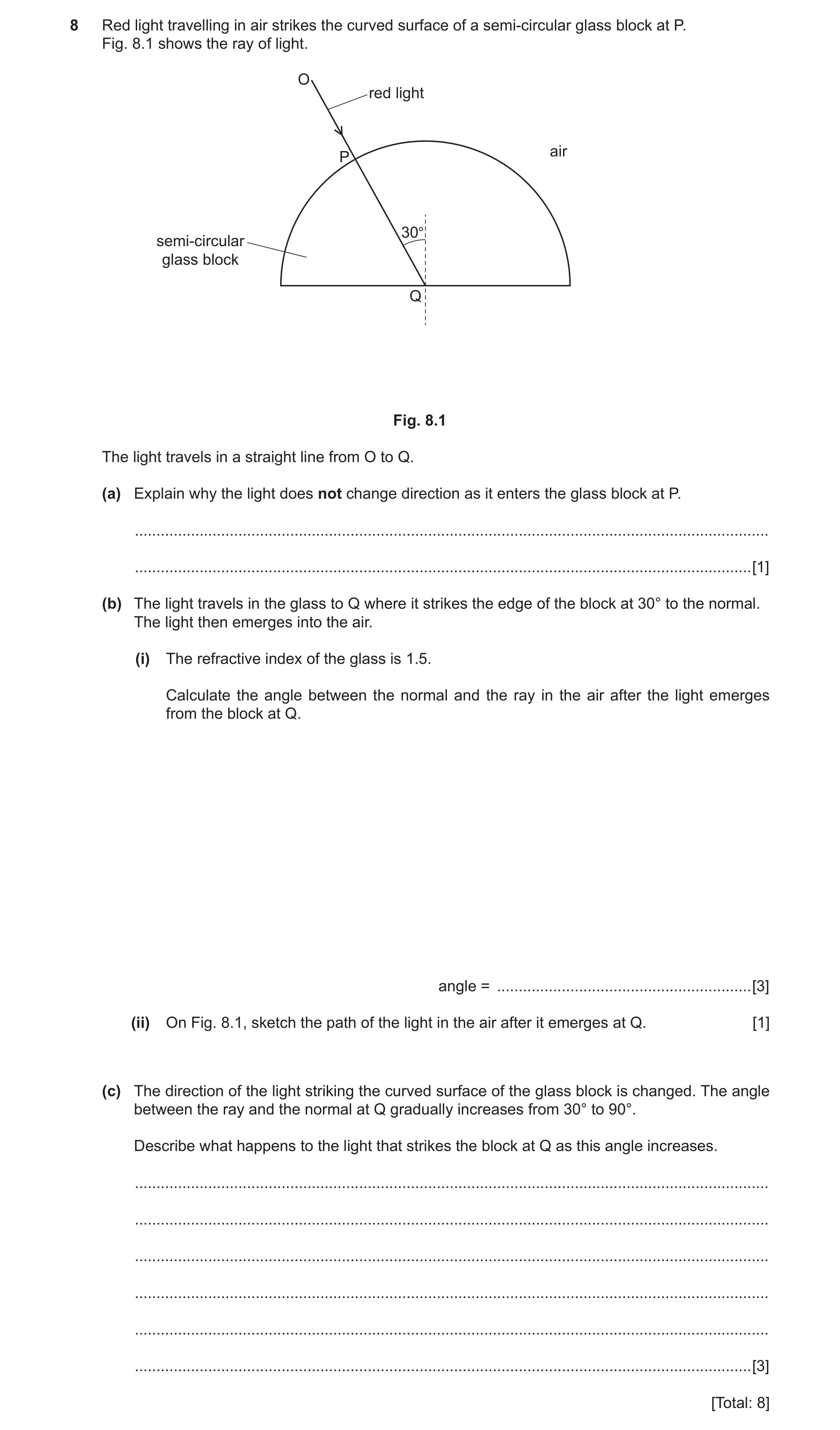
 4 / 60
 5 / 60
 6 / 60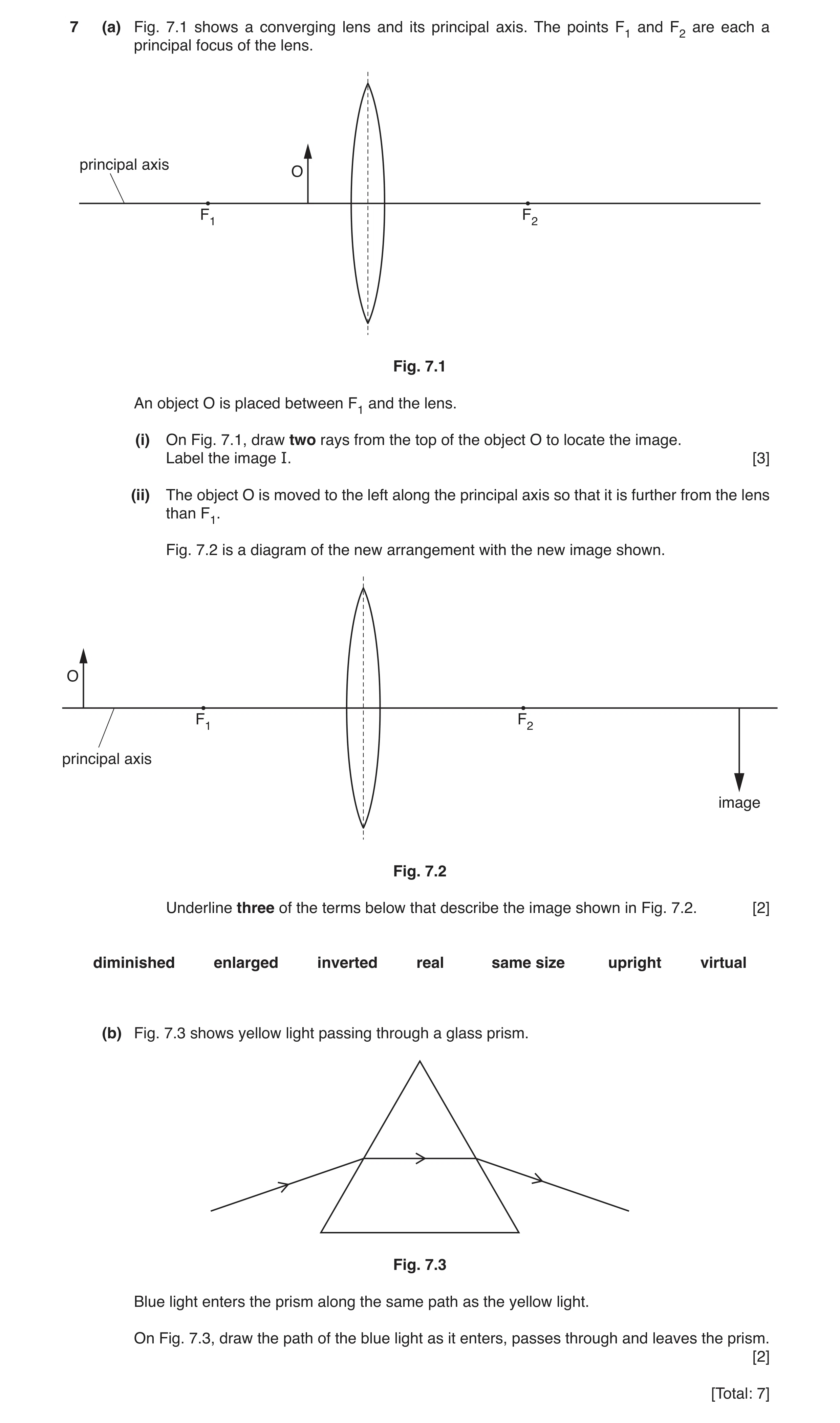
 9 / 60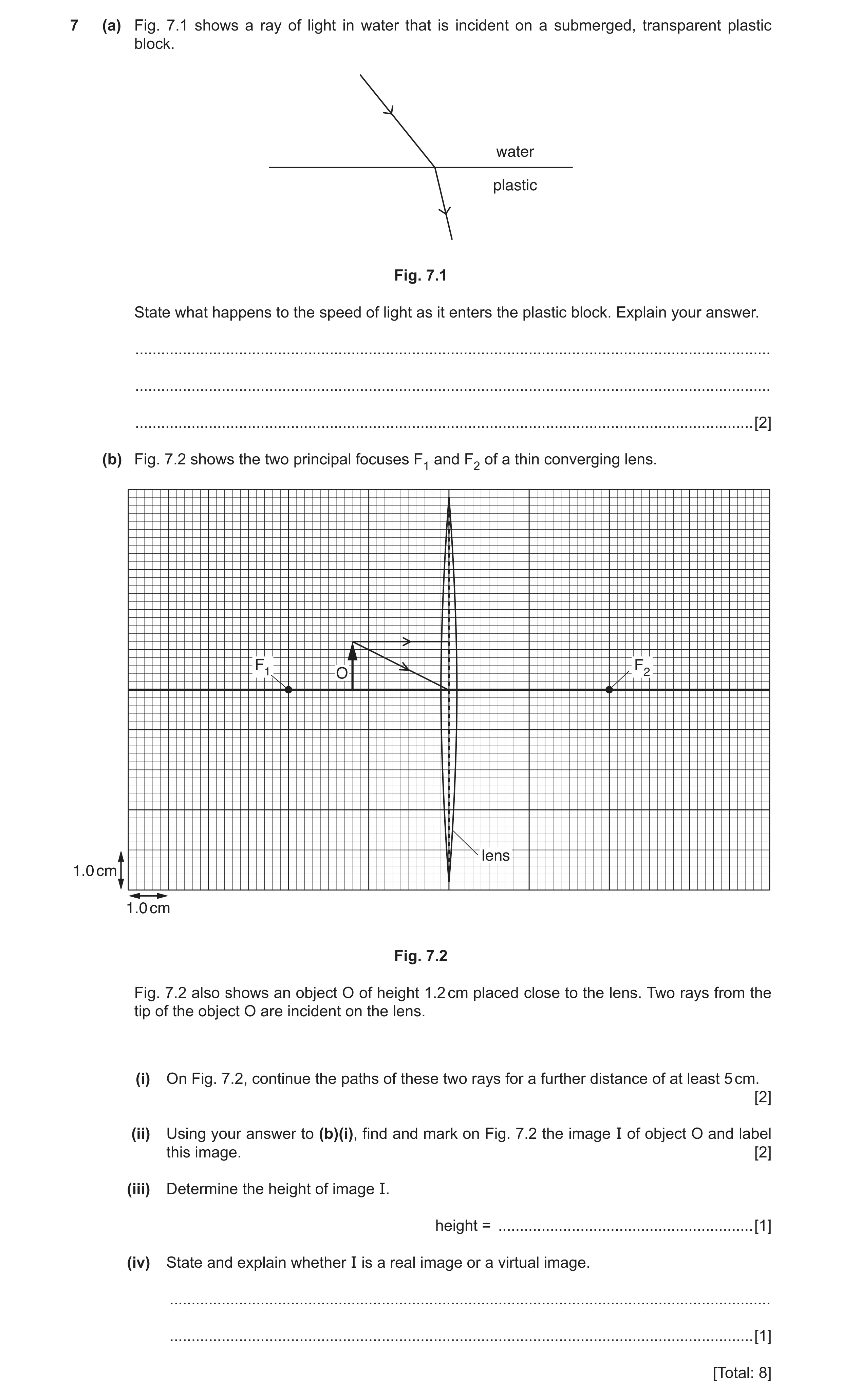
 11 / 60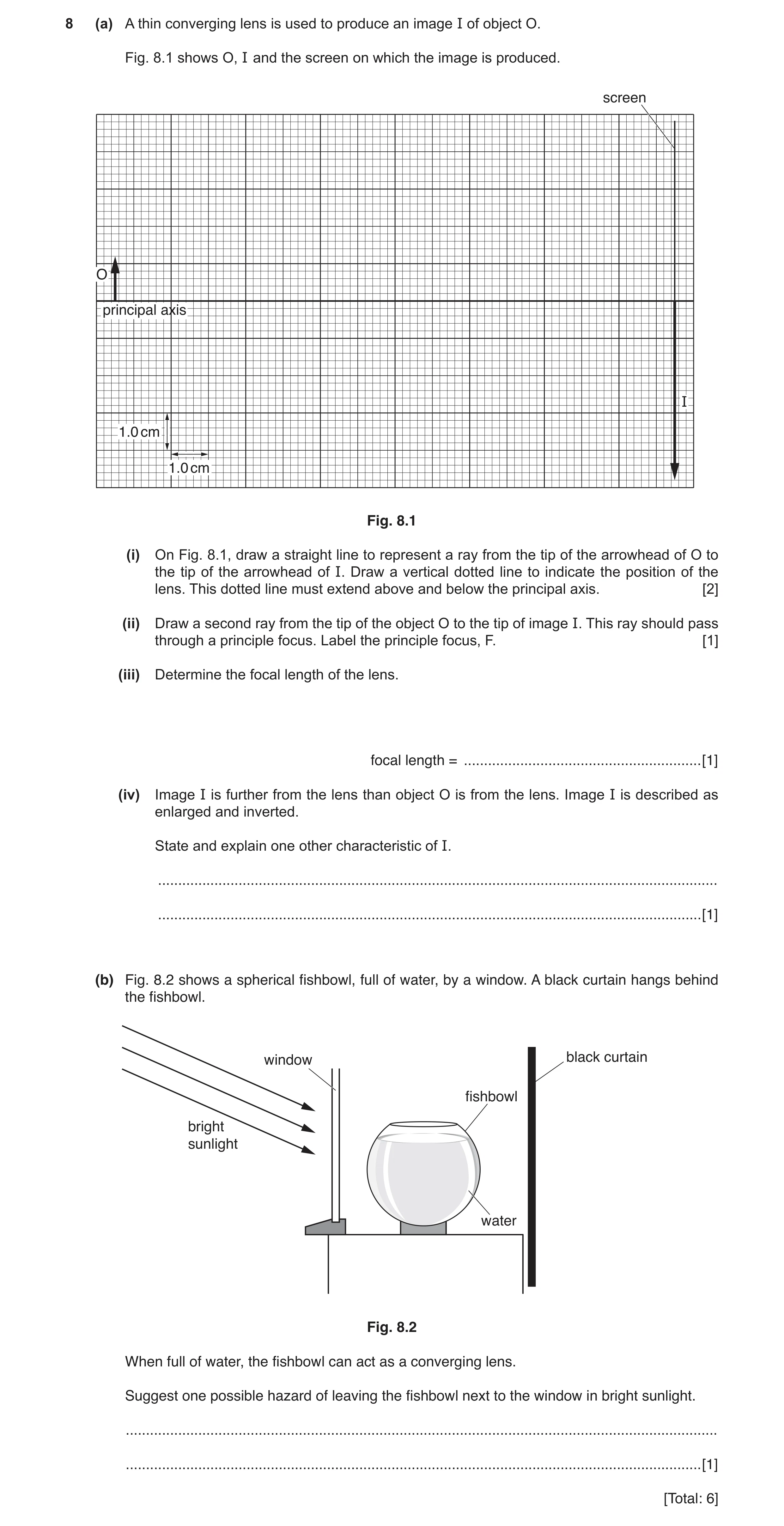
 14 / 60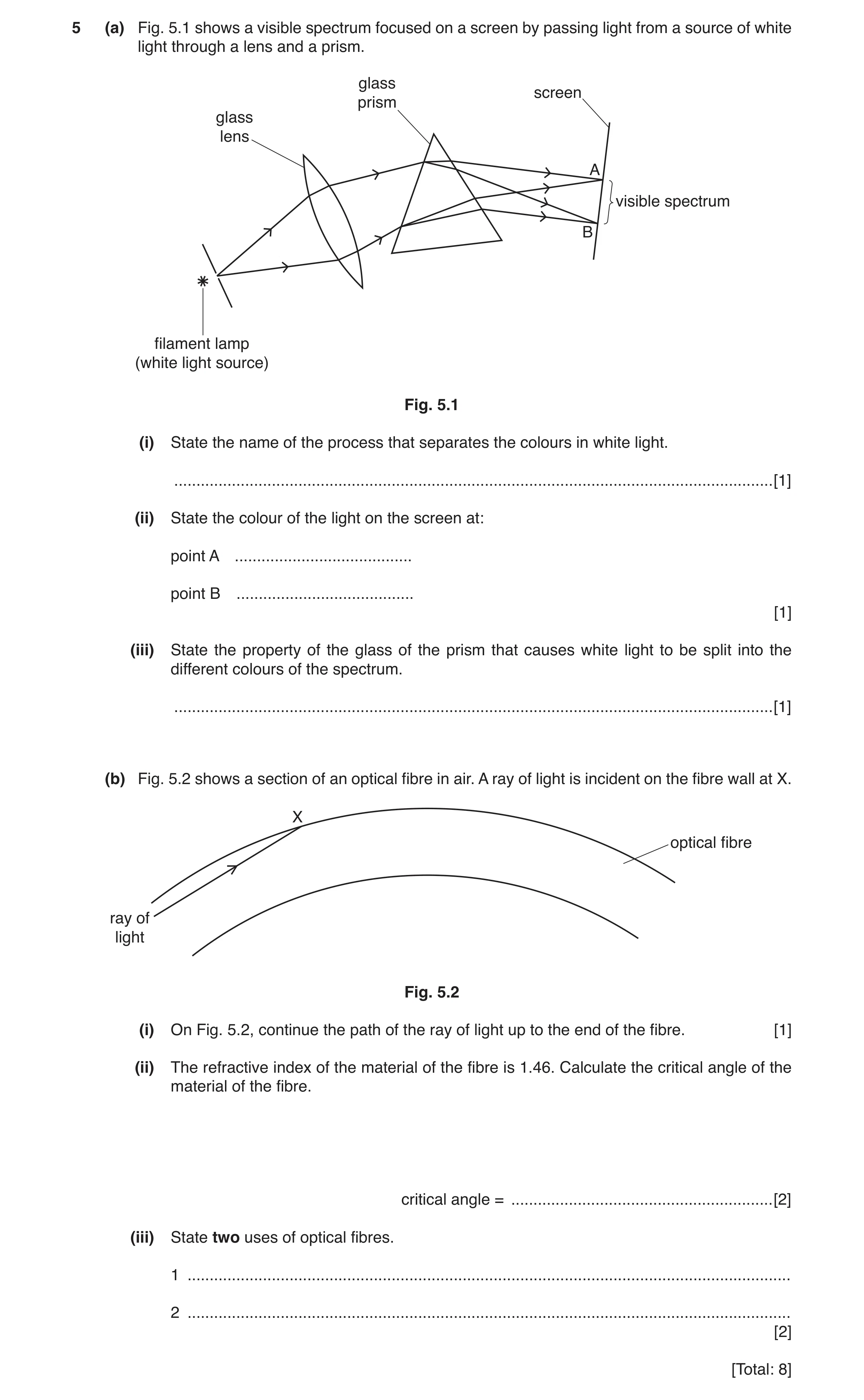
 18 / 60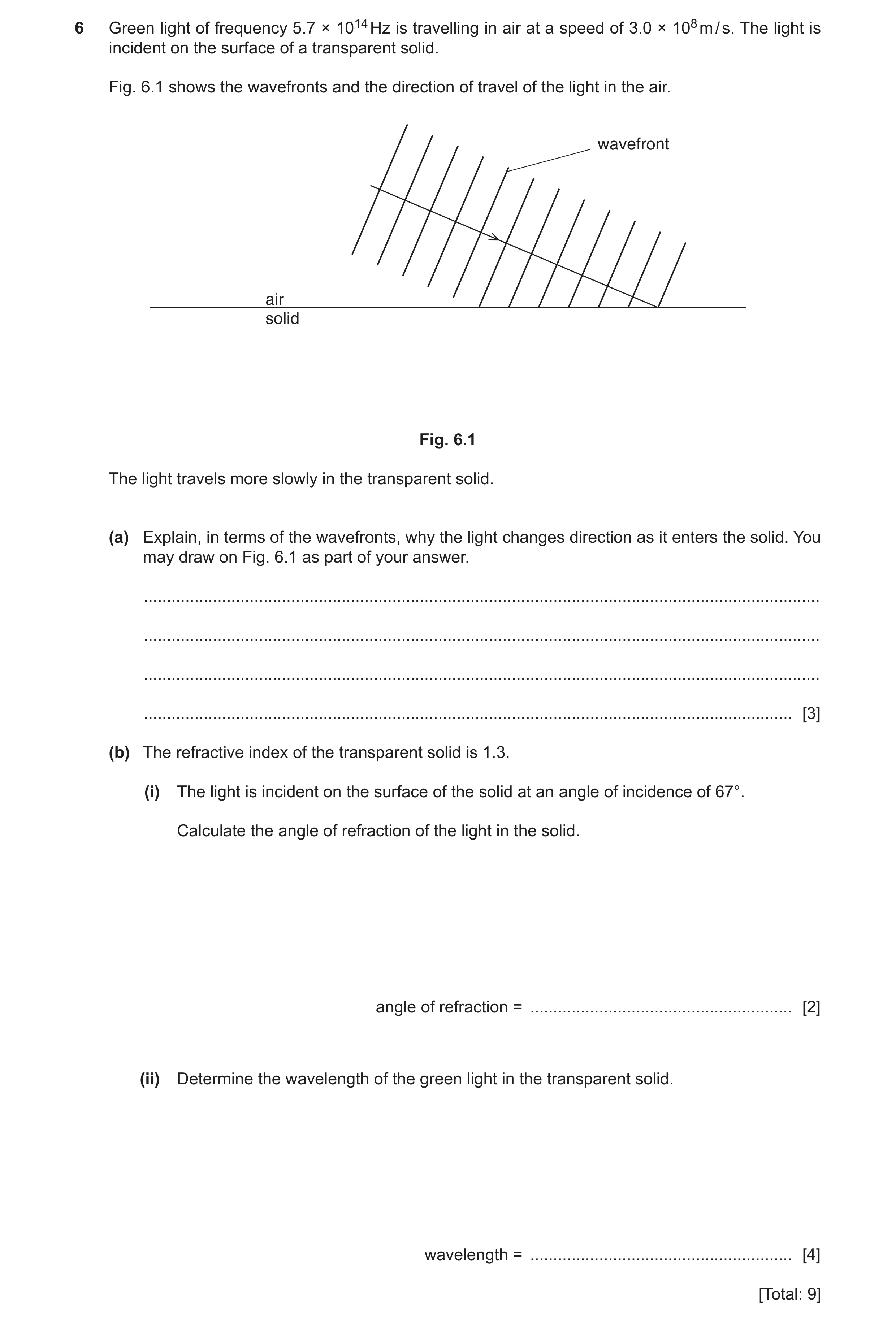
 21 / 60
 22 / 60
 23 / 60
 24 / 60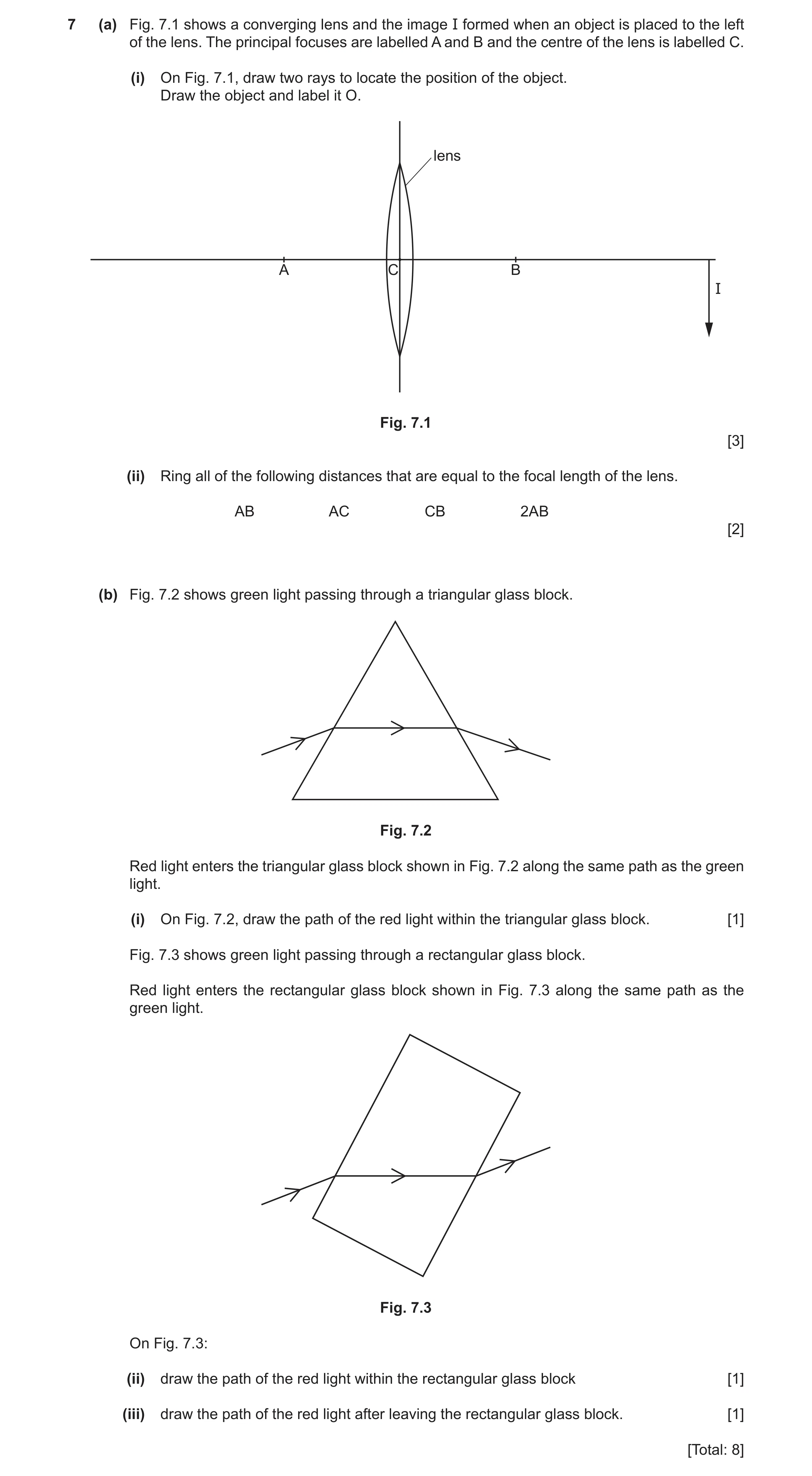
 26 / 60
 27 / 60
 28 / 60
 29 / 60
 30 / 60
 31 / 60
 32 / 60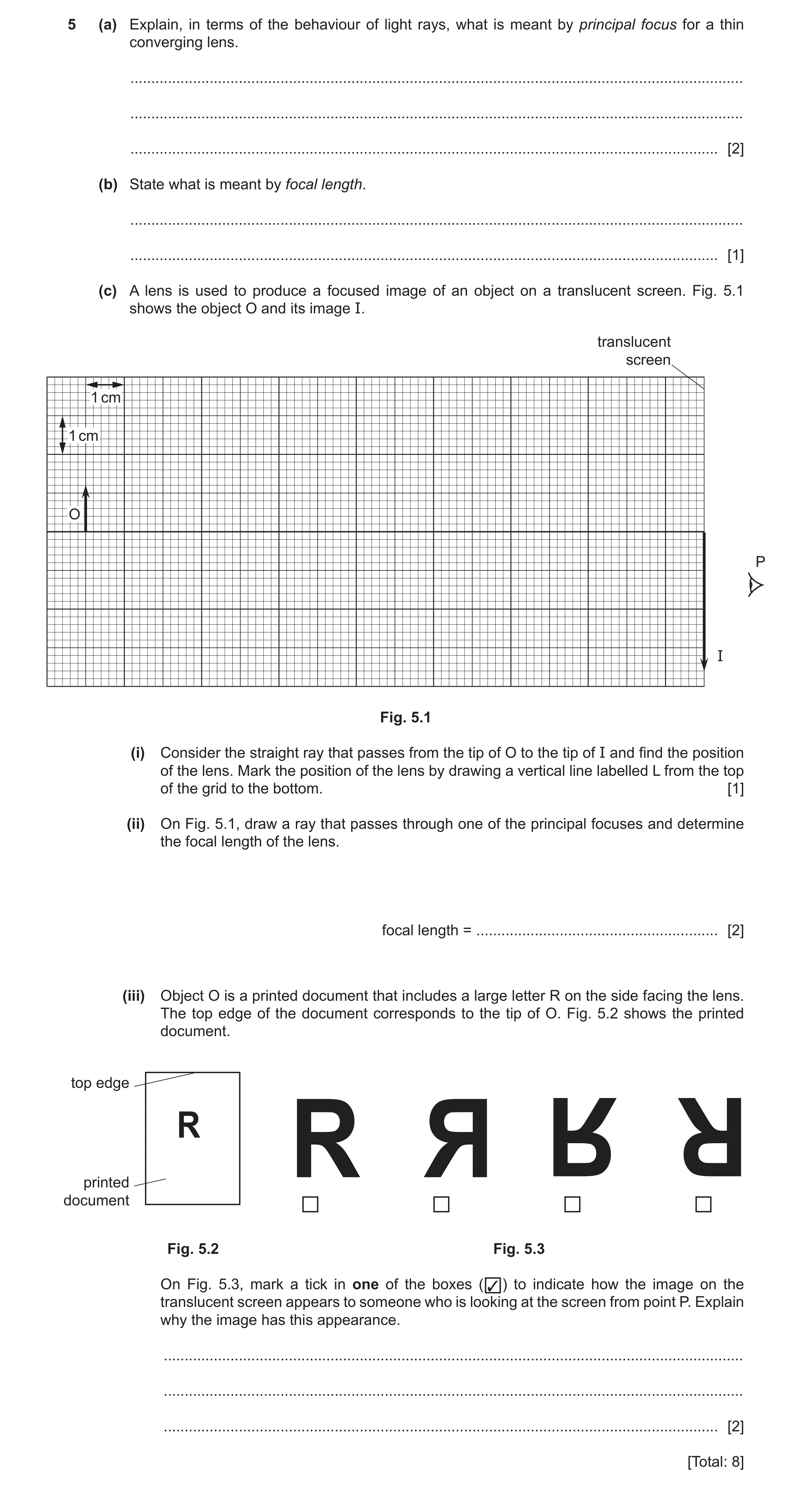
 34 / 60
 35 / 60
 36 / 60
 37 / 60
 38 / 60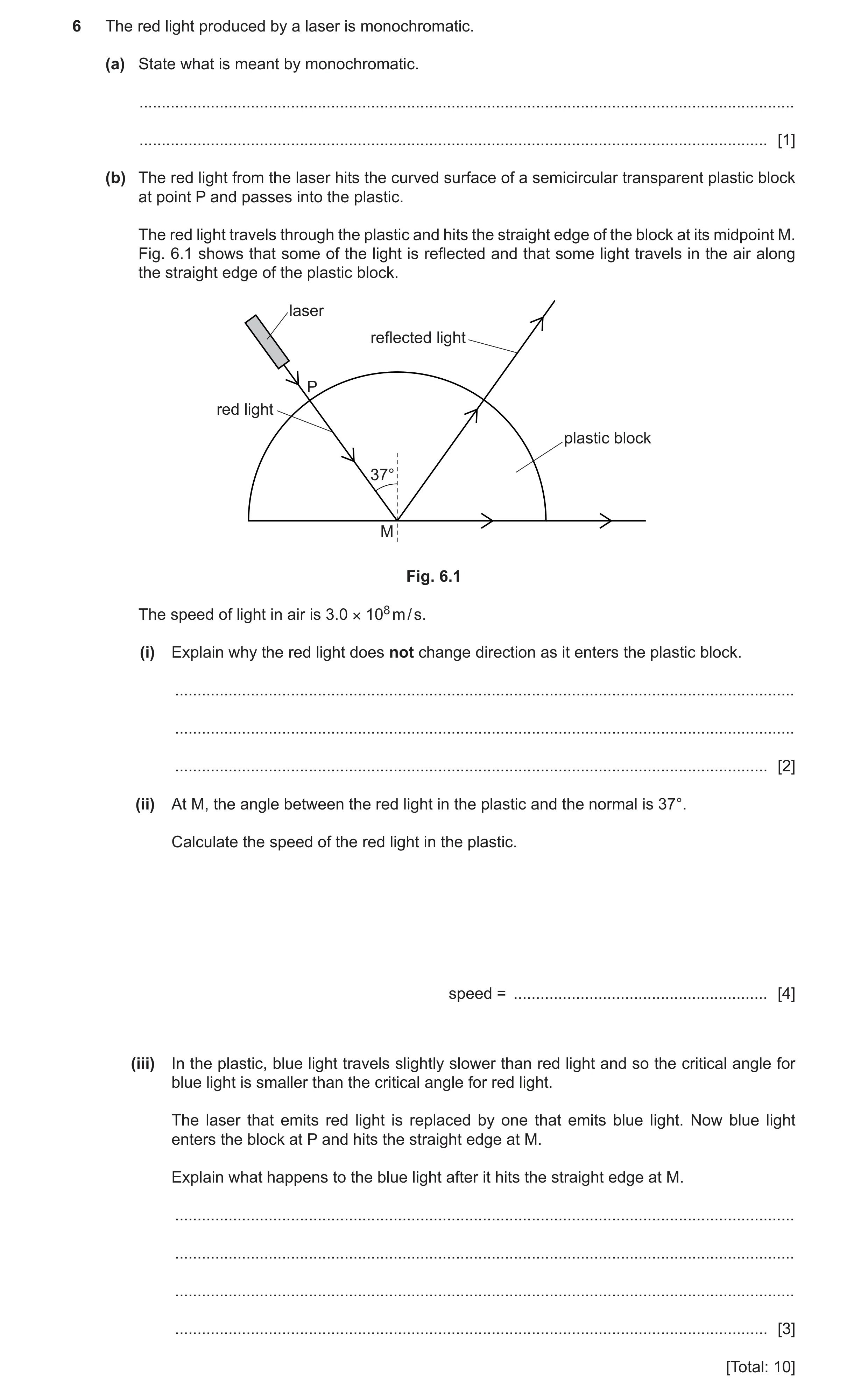
 40 / 60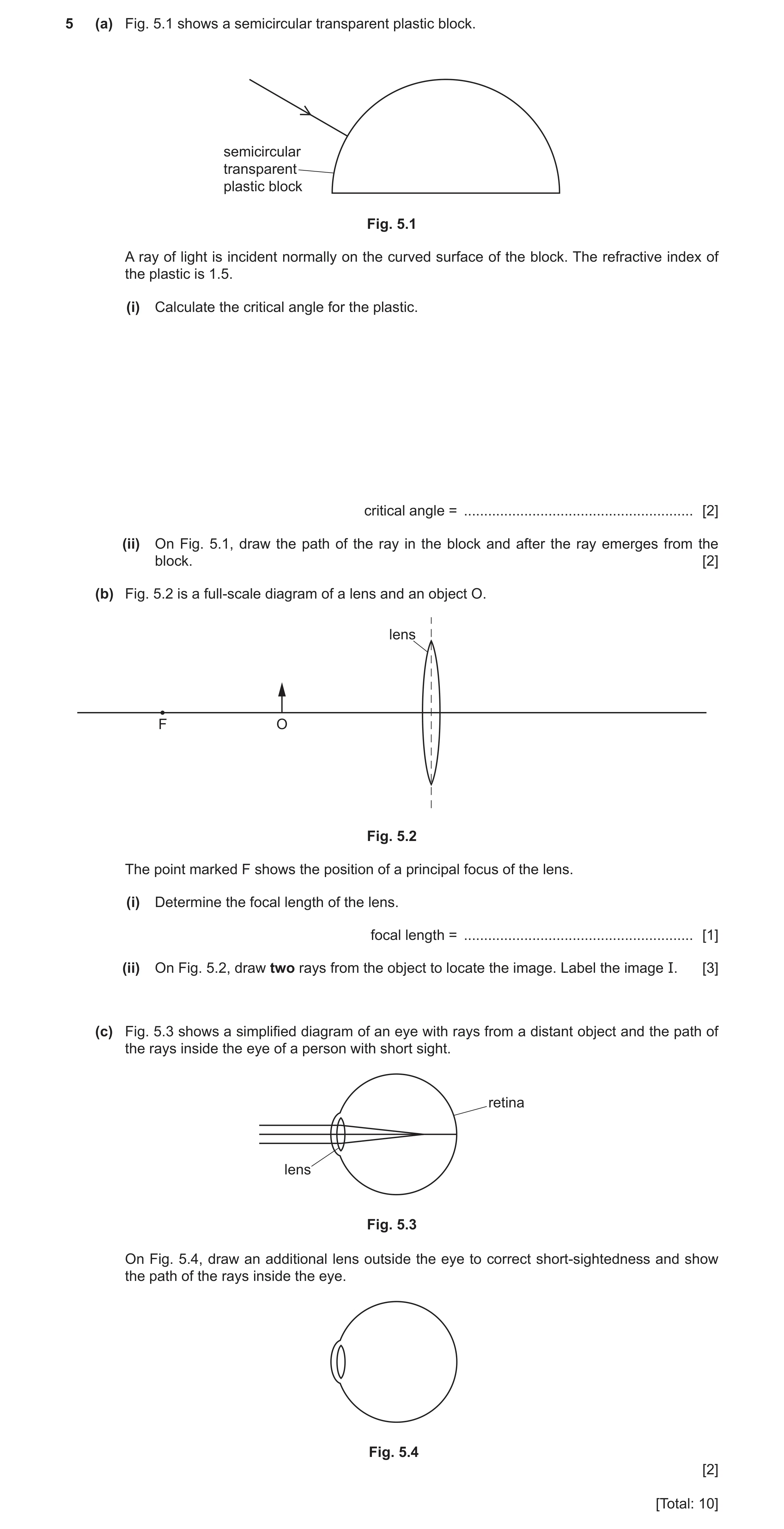
 44 / 60
 45 / 60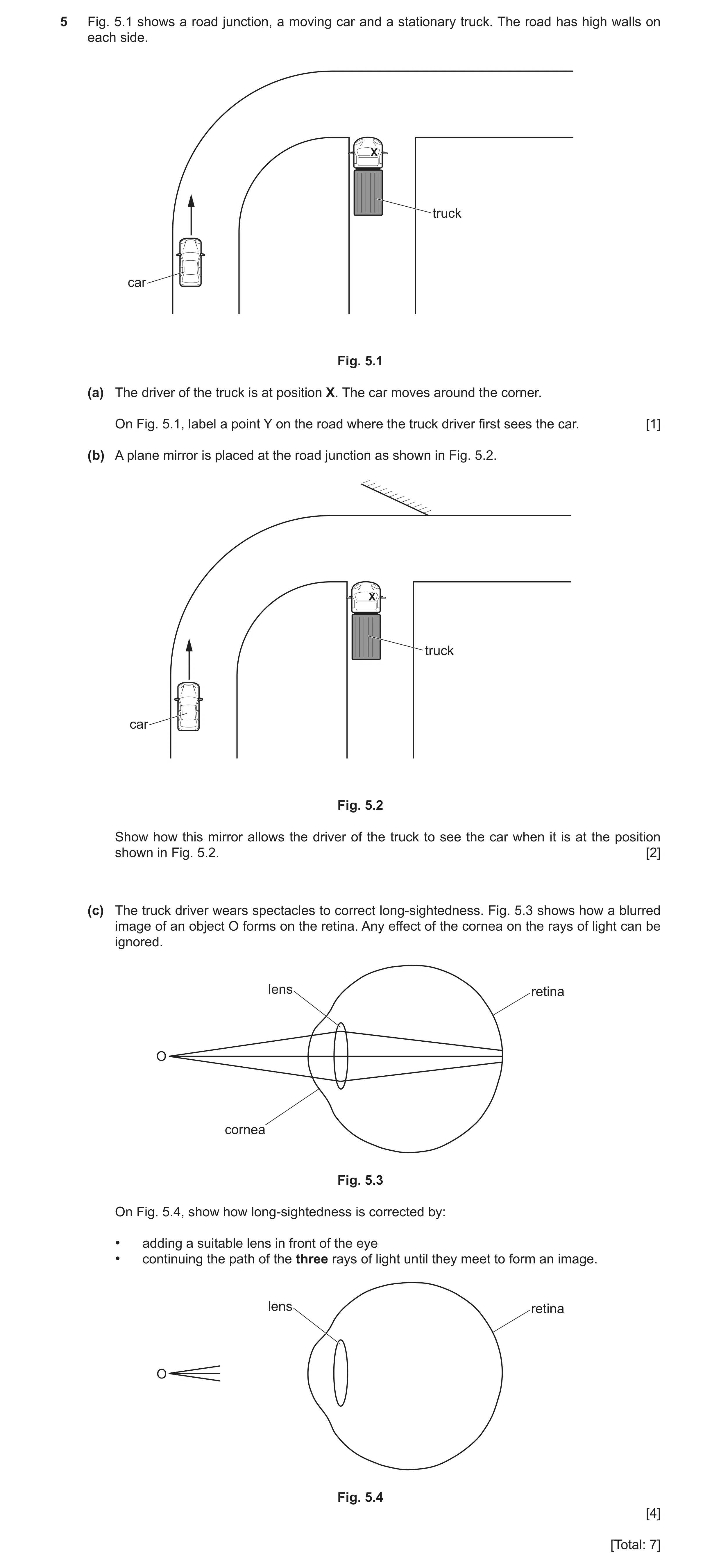
 48 / 60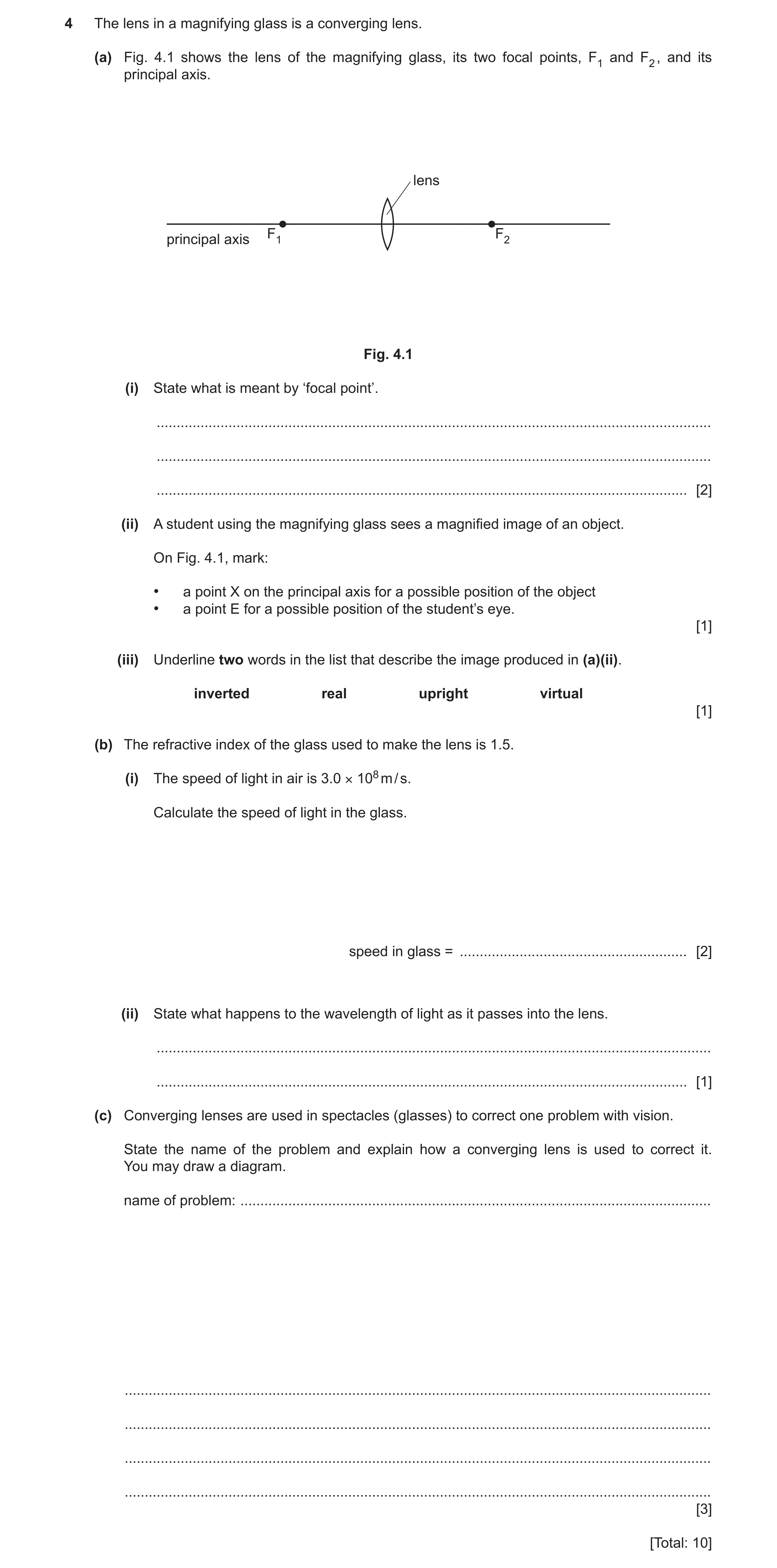
 51 / 60
 52 / 60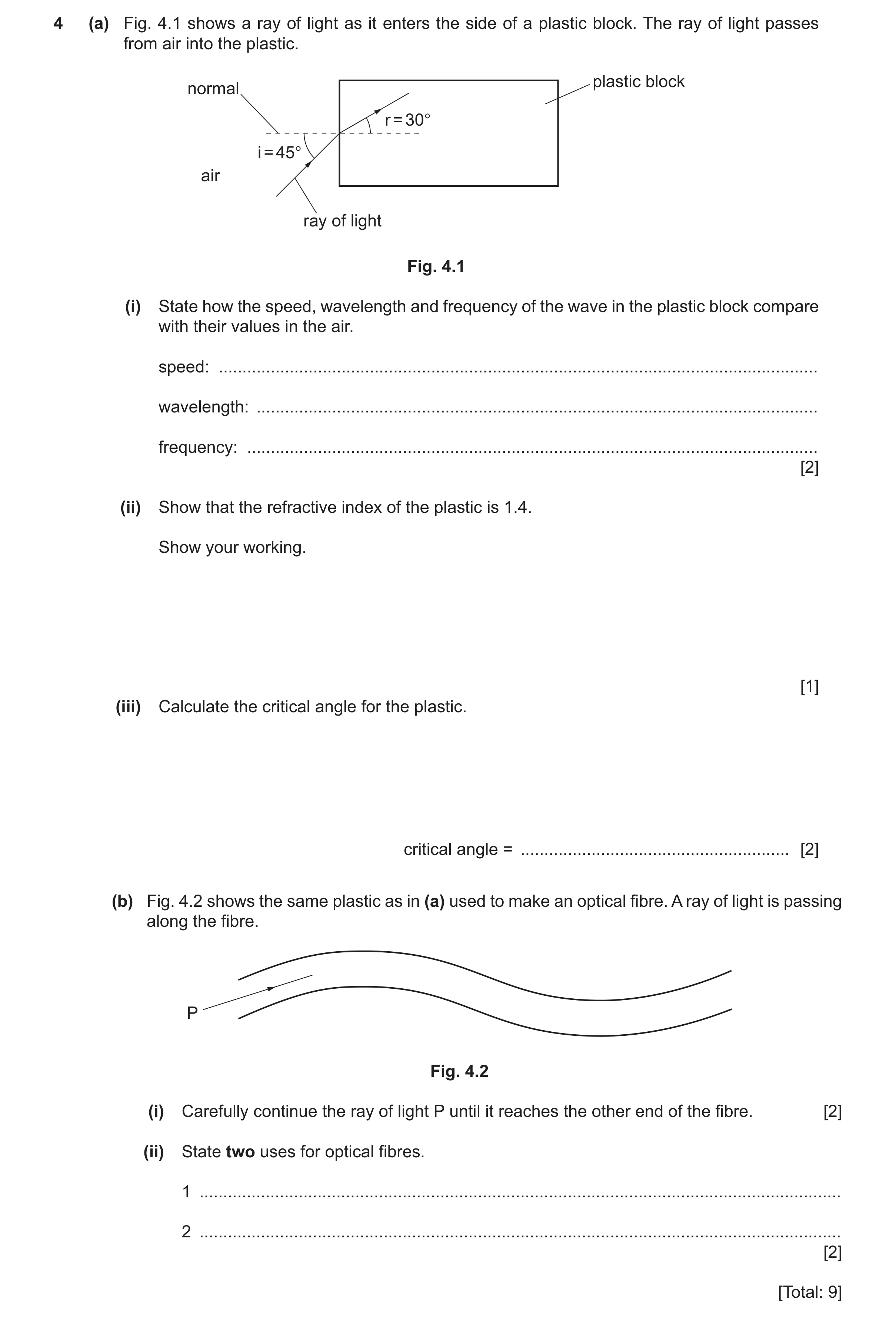
 56 / 60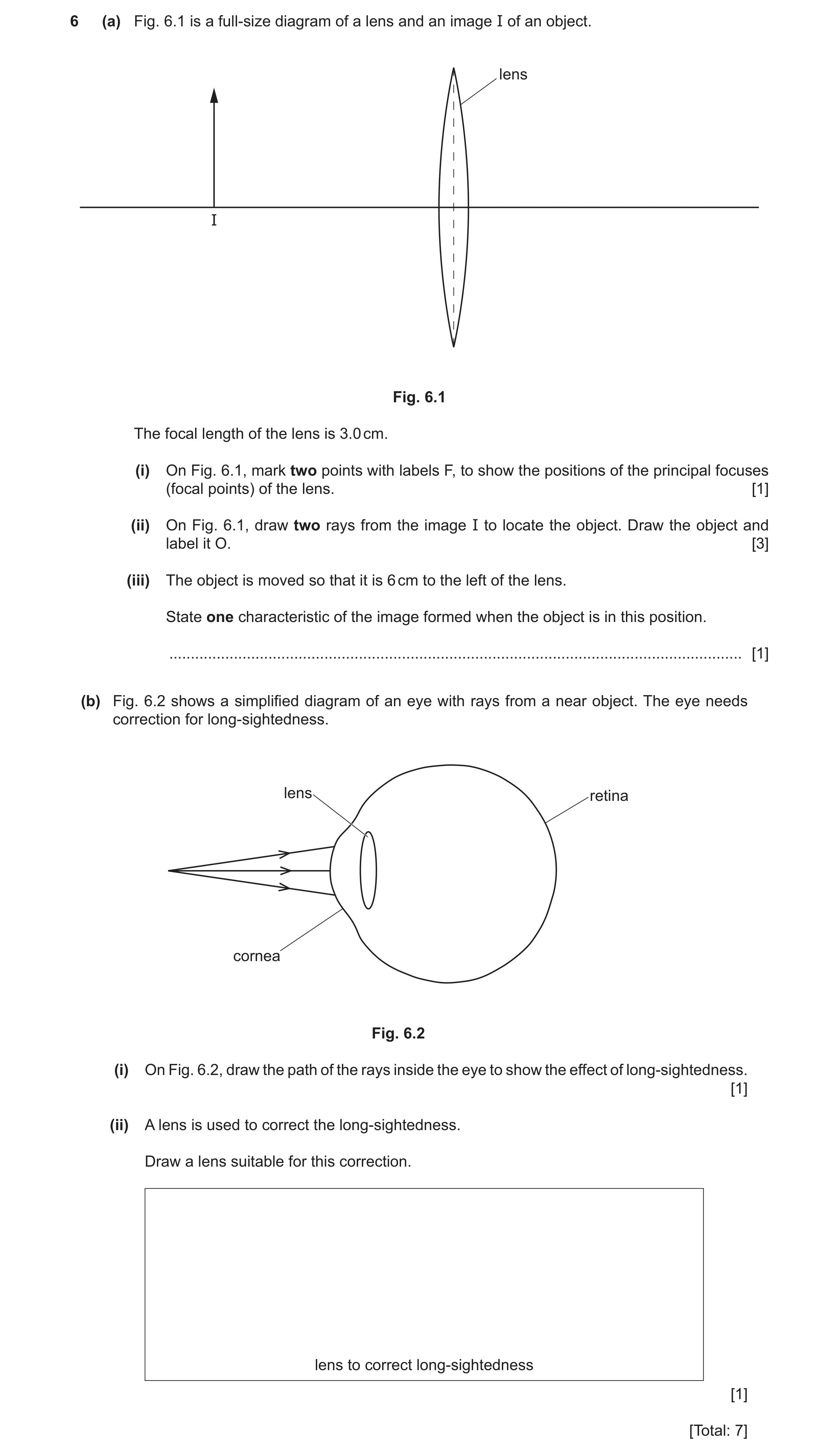
 58 / 60
 59 / 60
 60 / 60
 5
5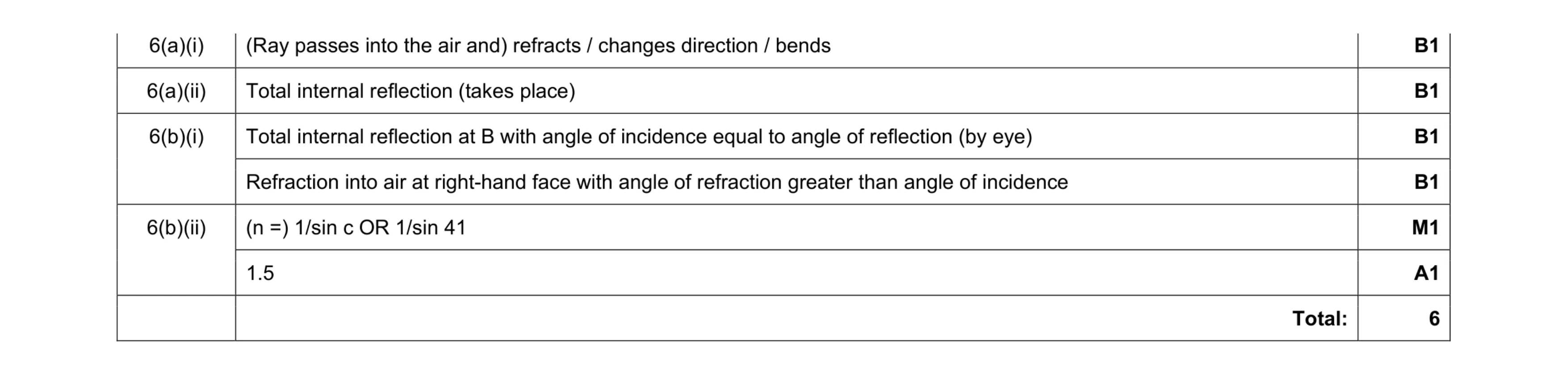 6
6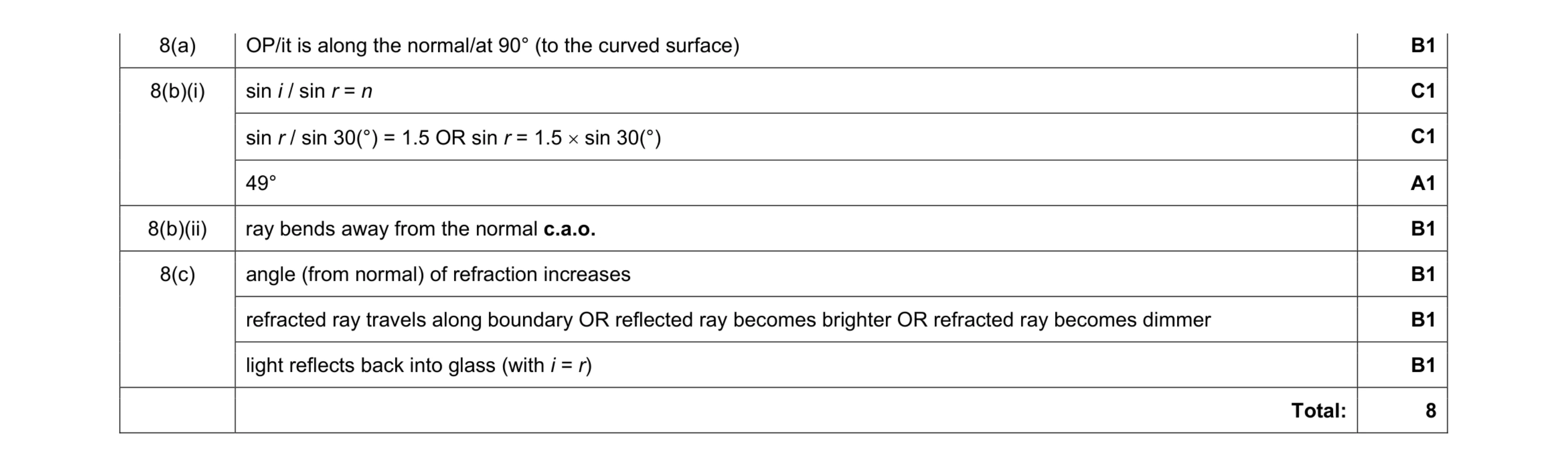 8
8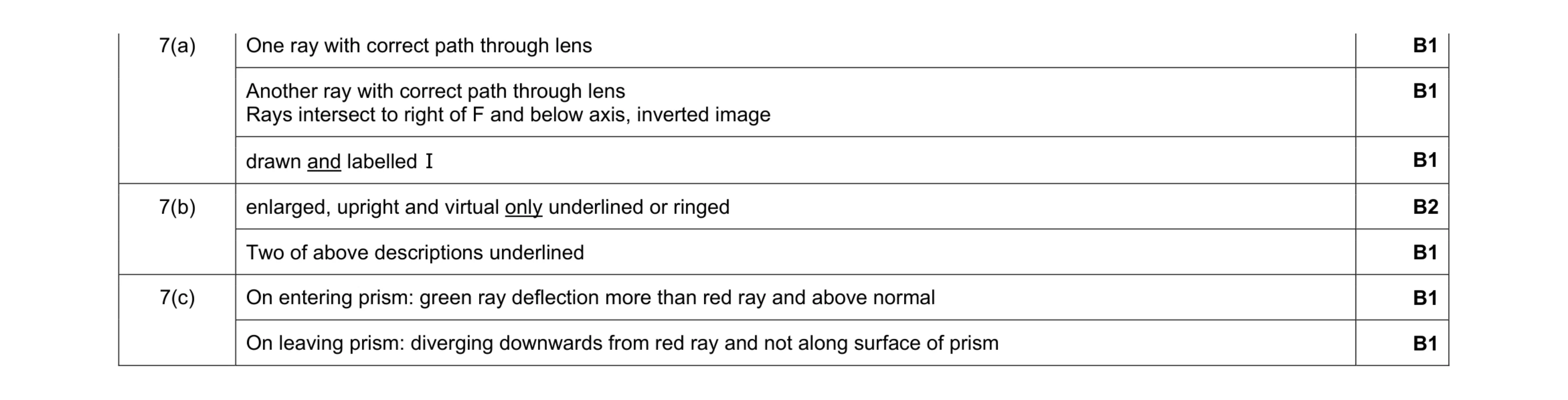 7
7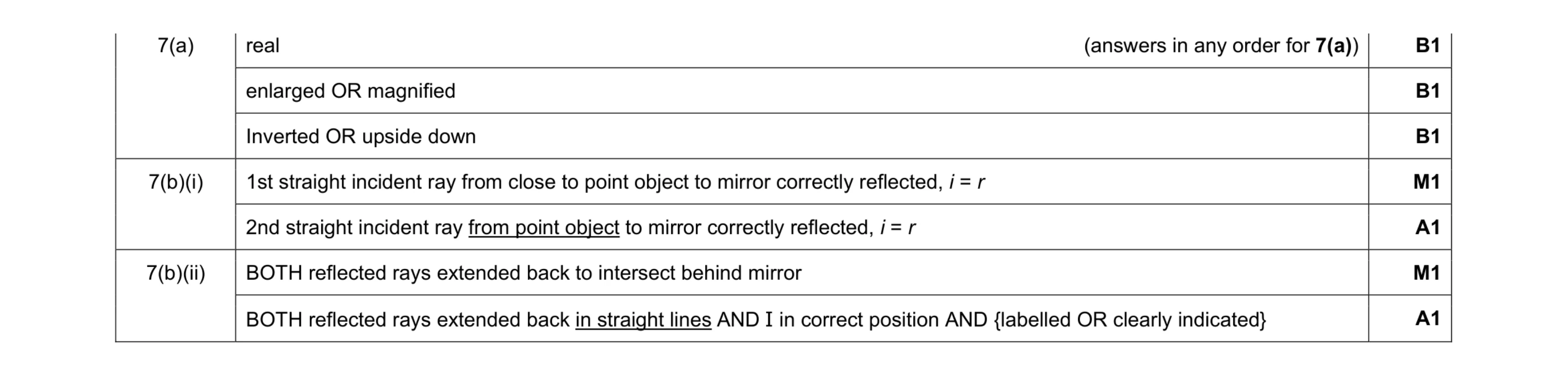 7
7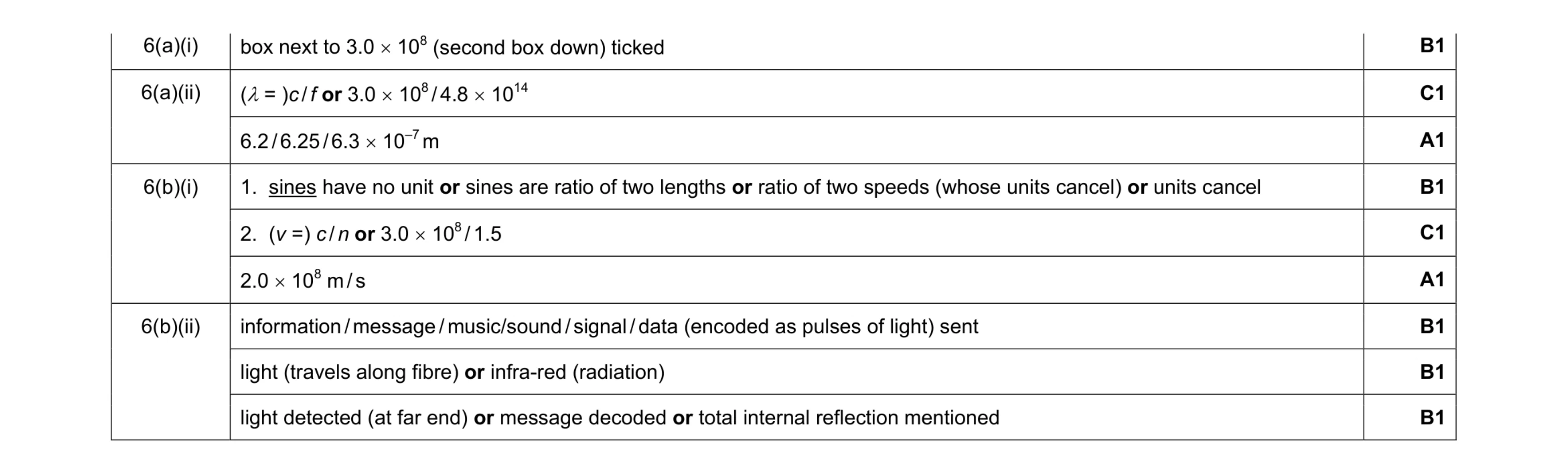 9
9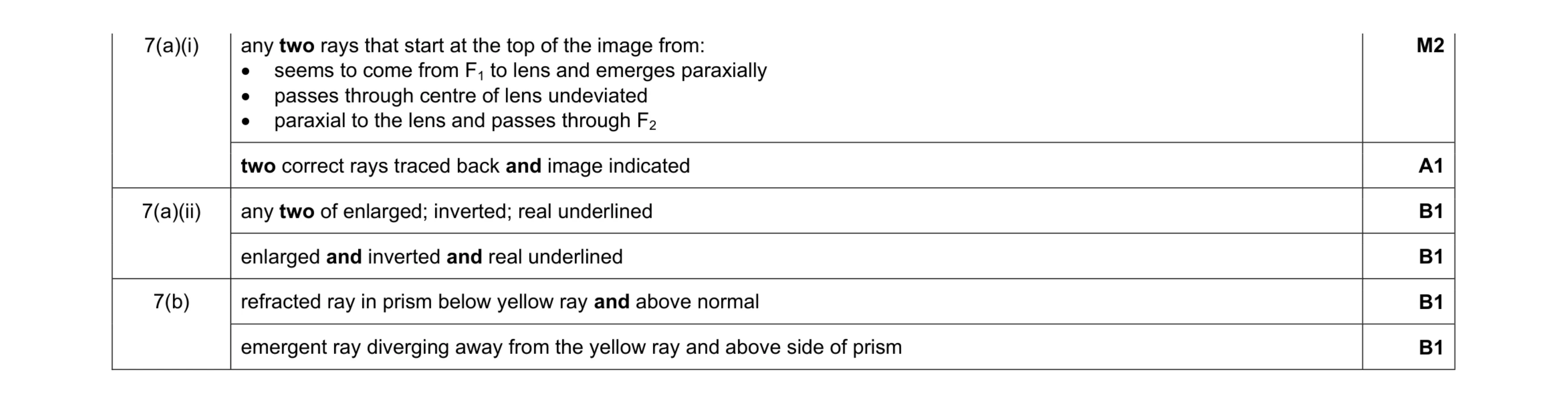 7
7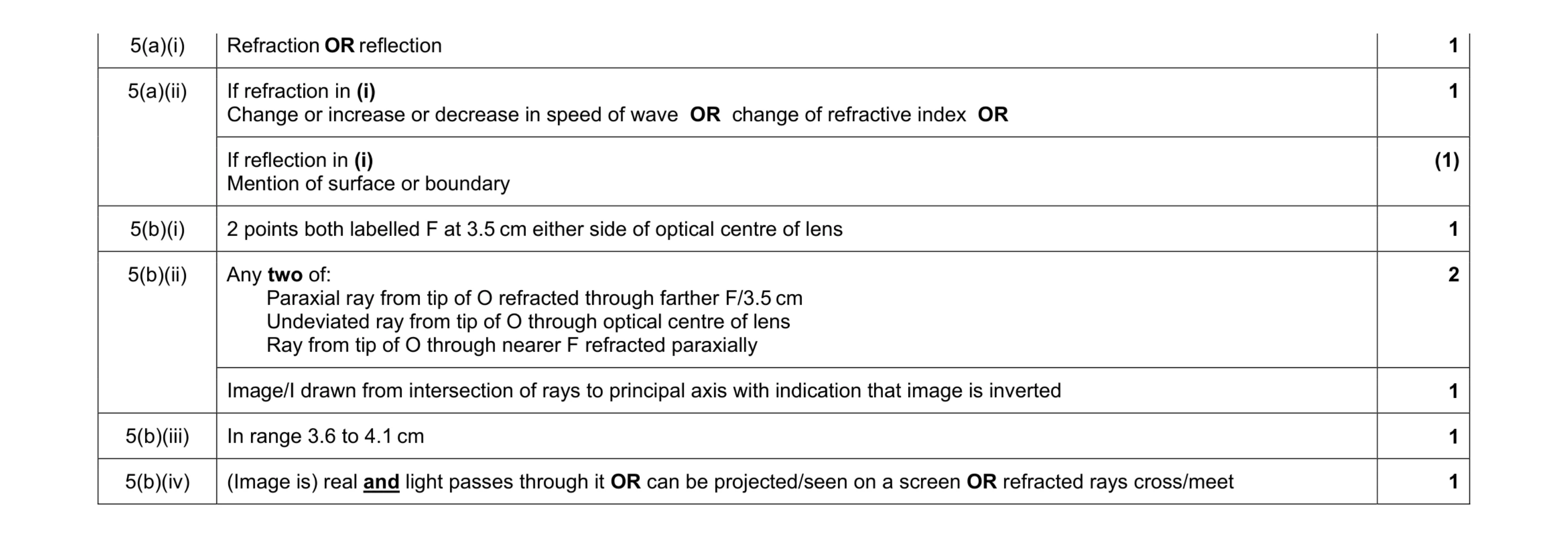 8
8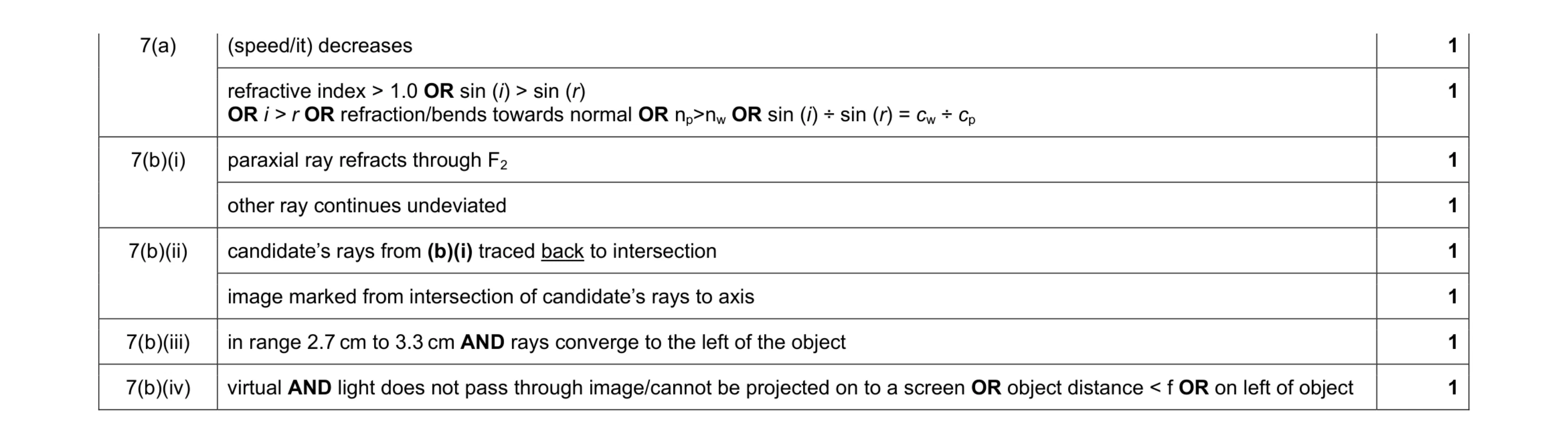 8
8 5
5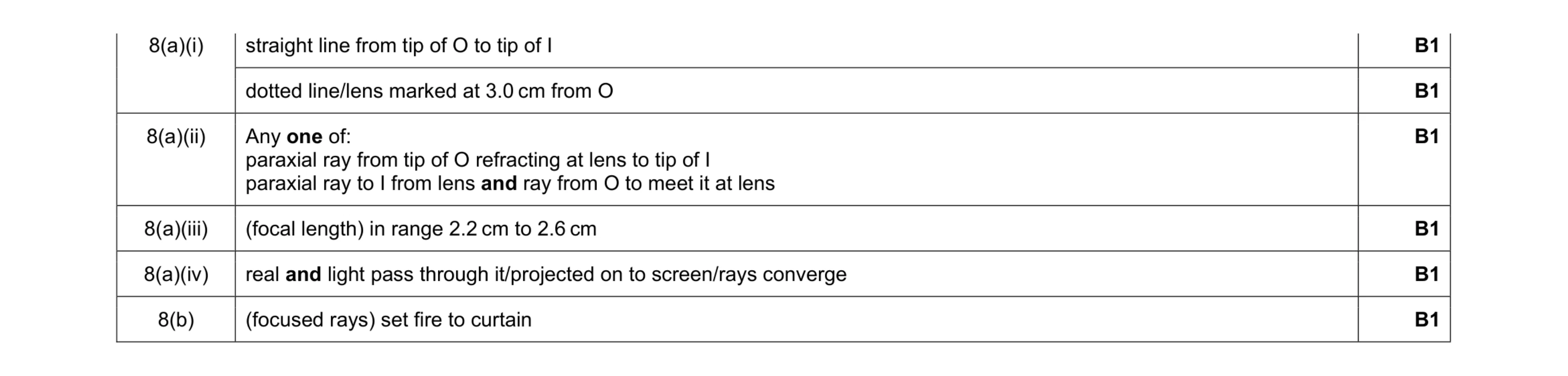 6
6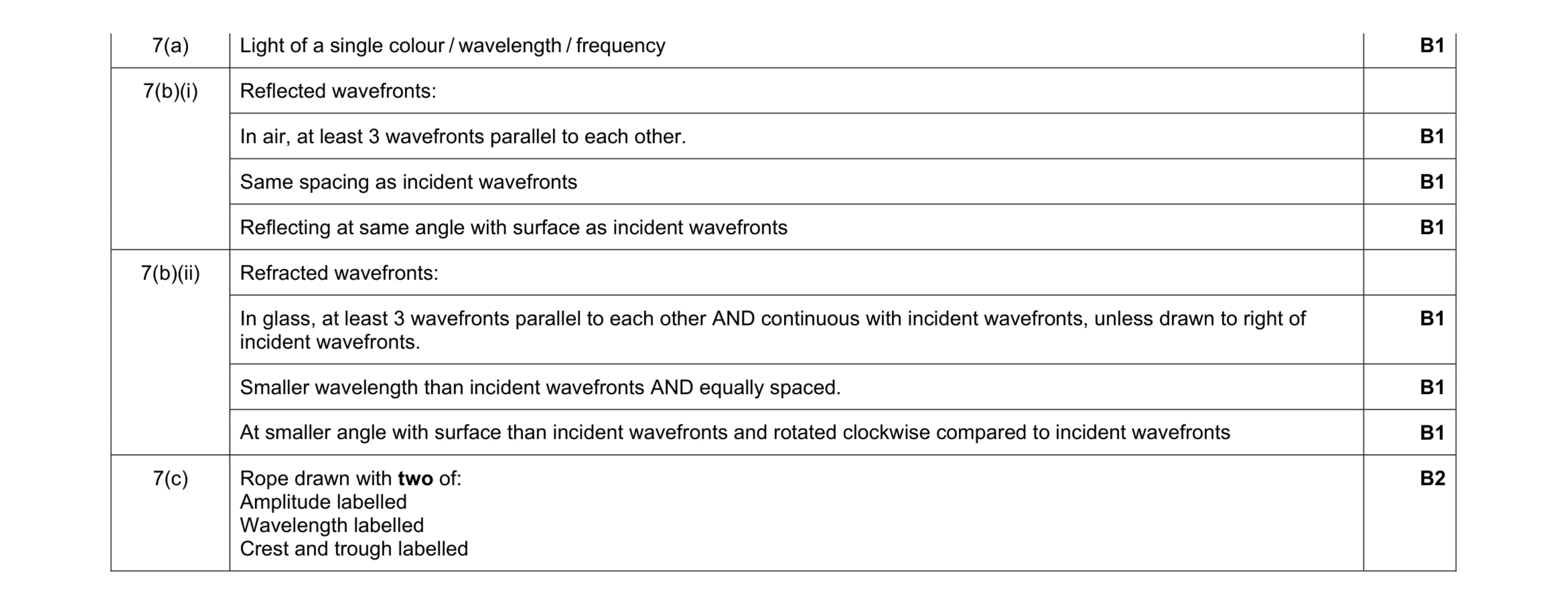 9
9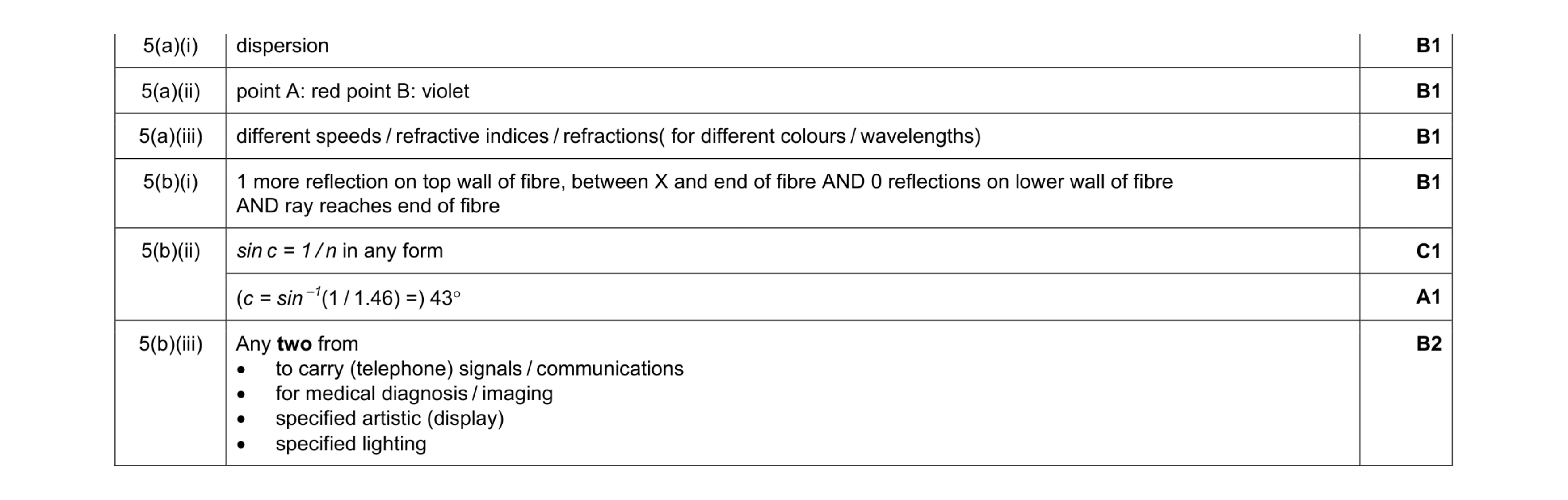 8
8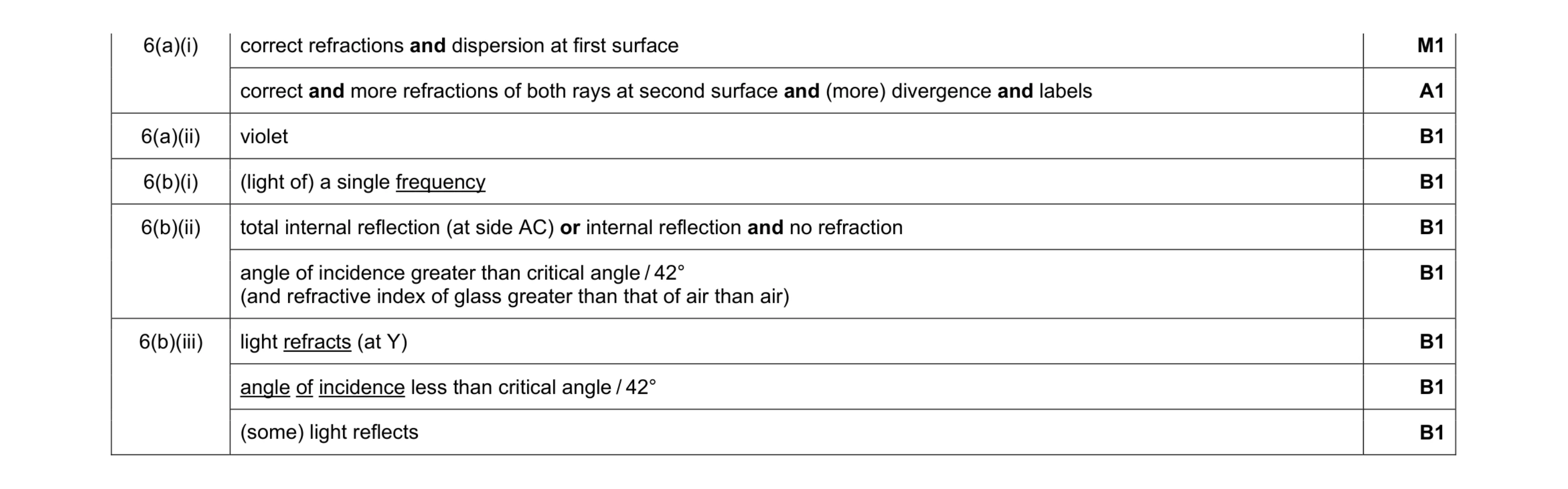 9
9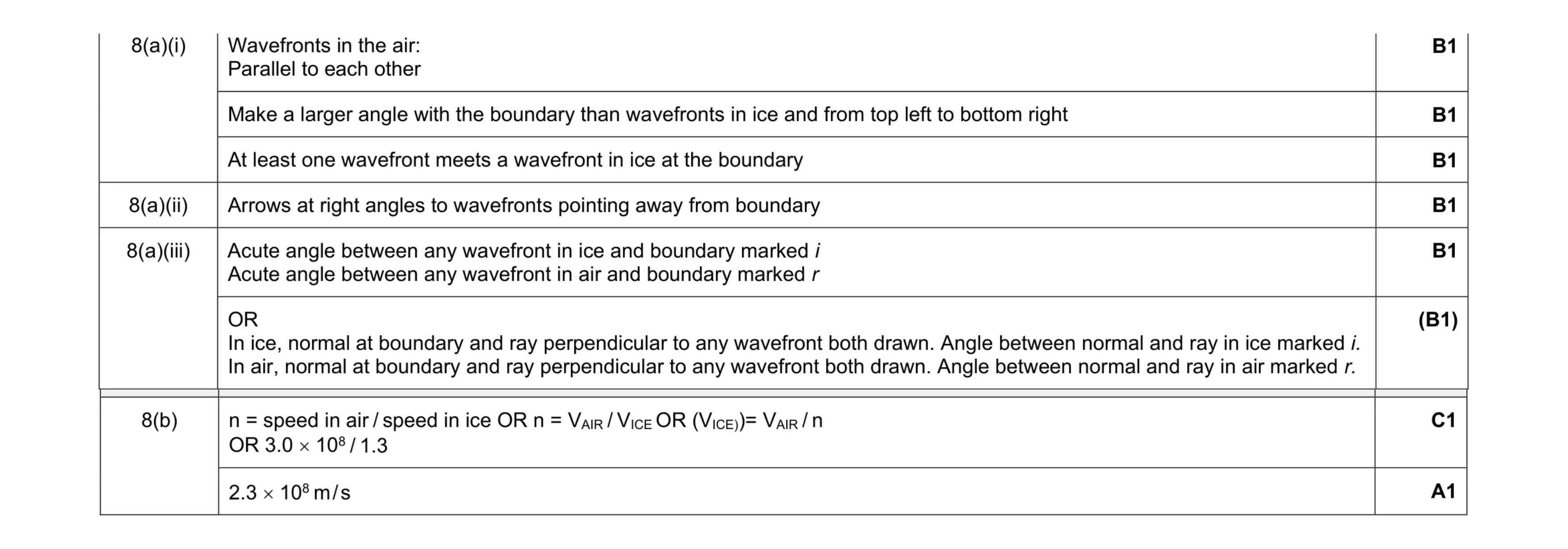 7
7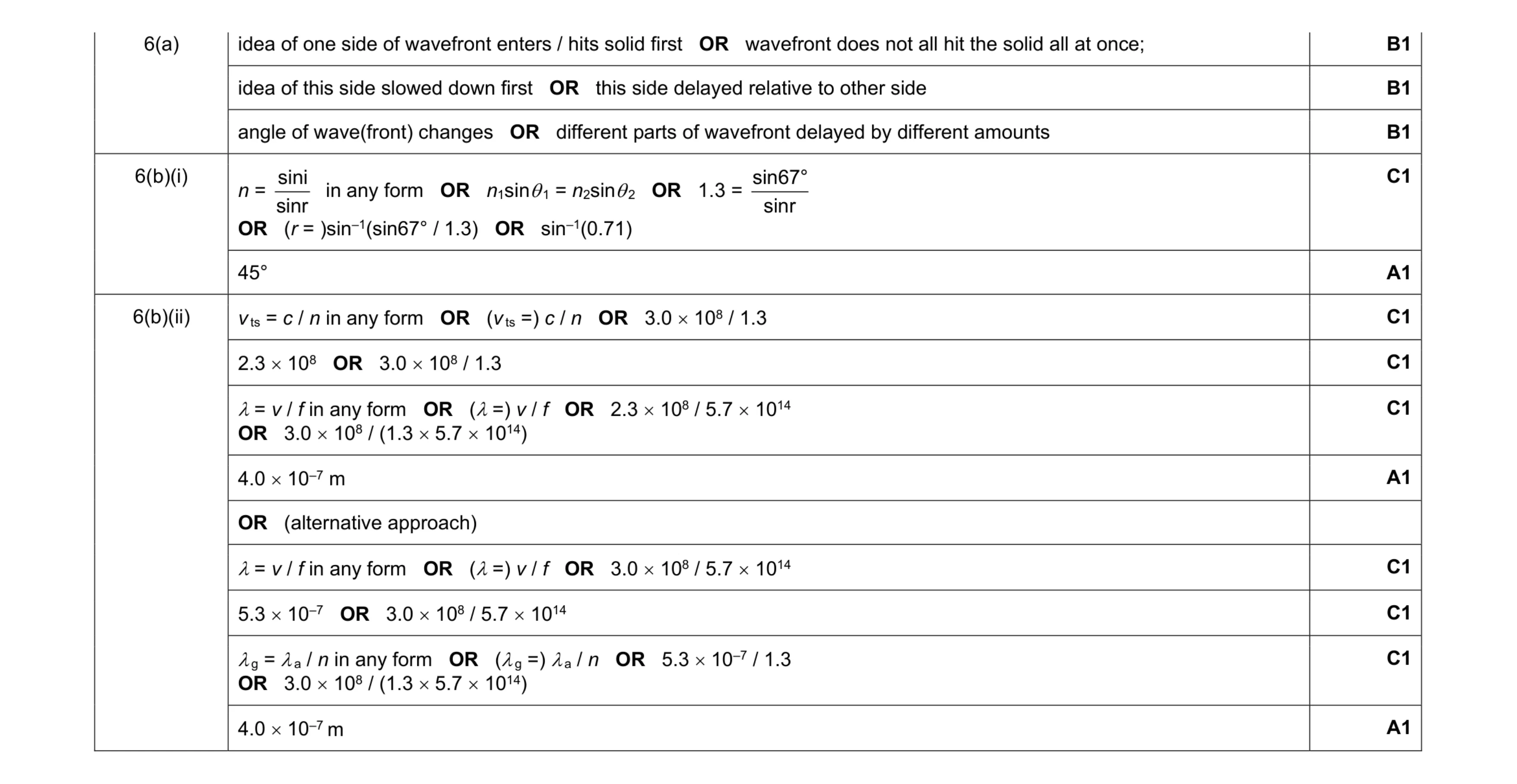 9
9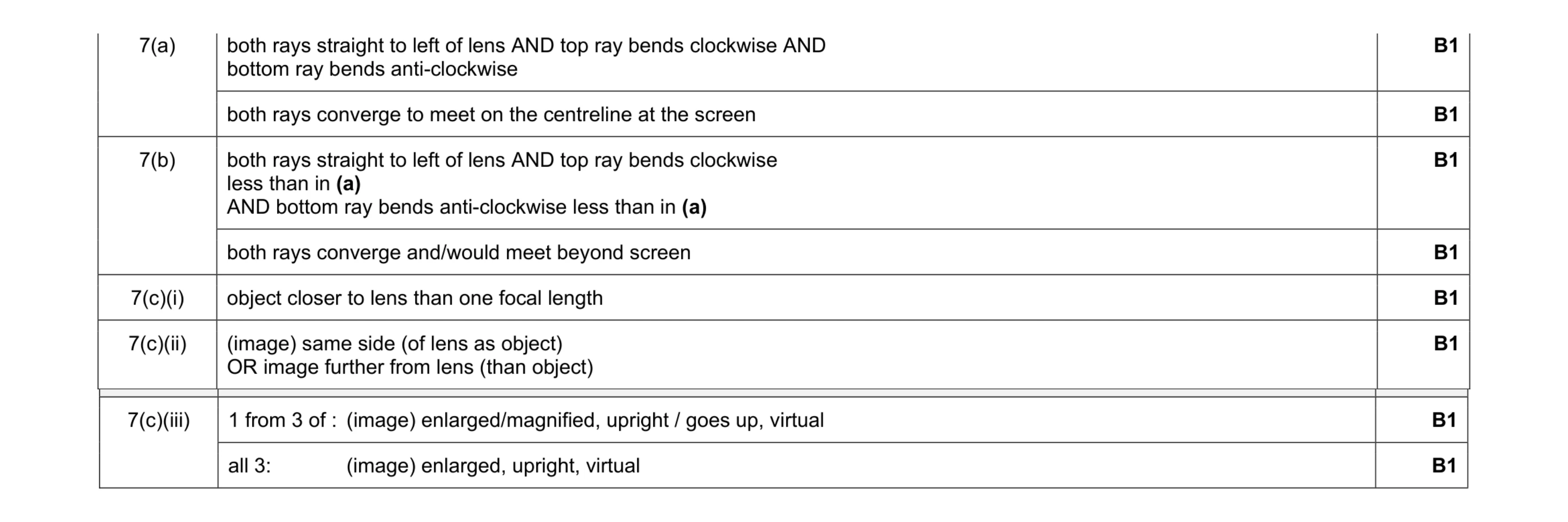 8
8 4
4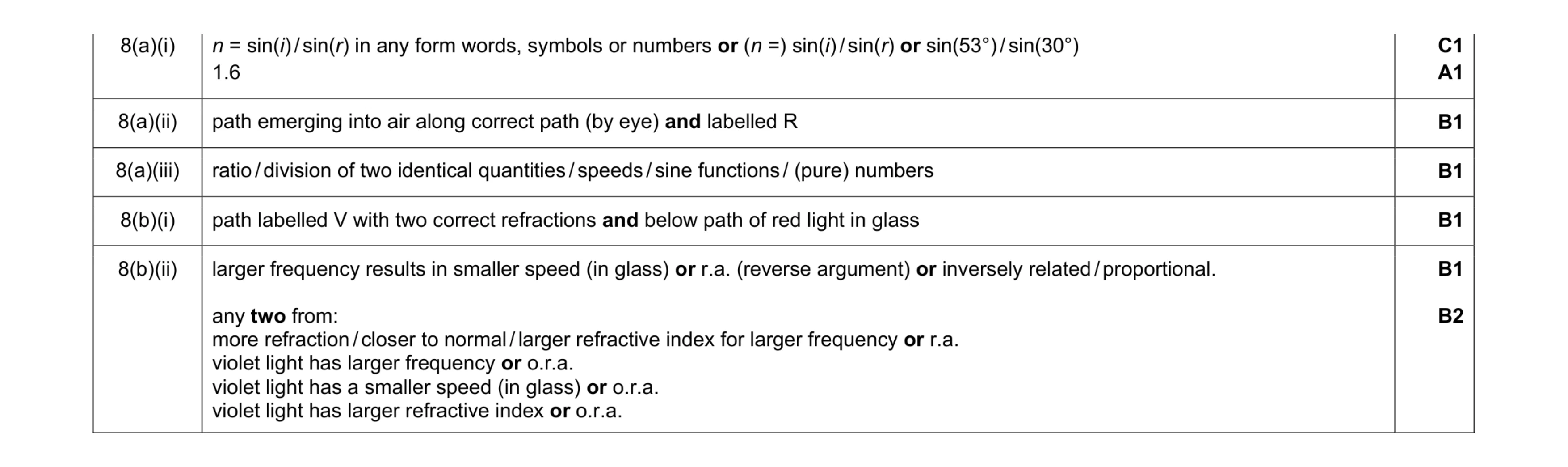 8
8 6
6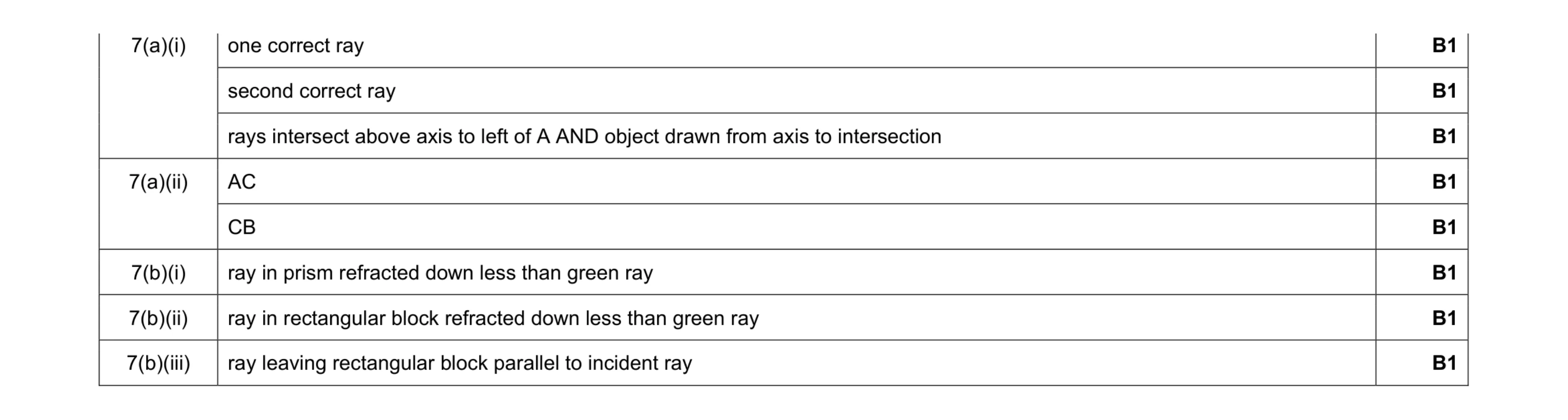 8
8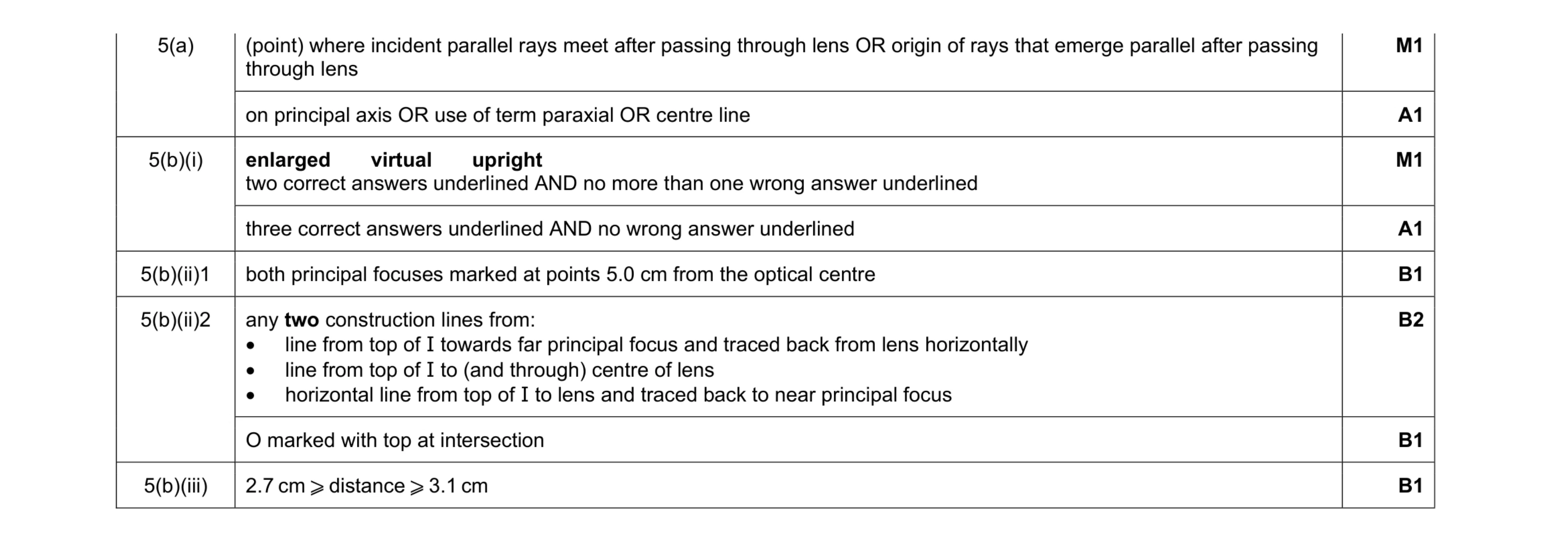 9
9 5
5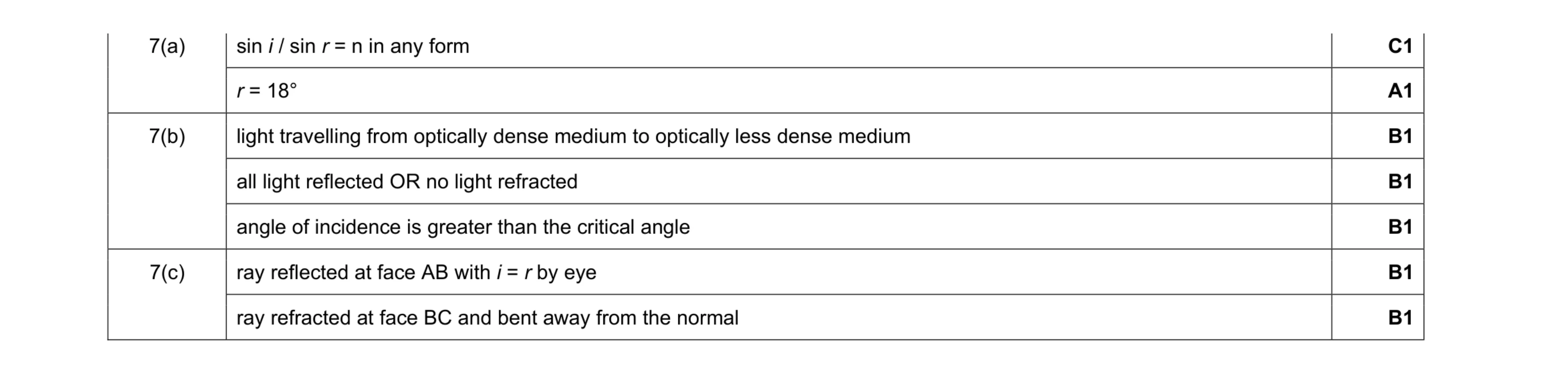 7
7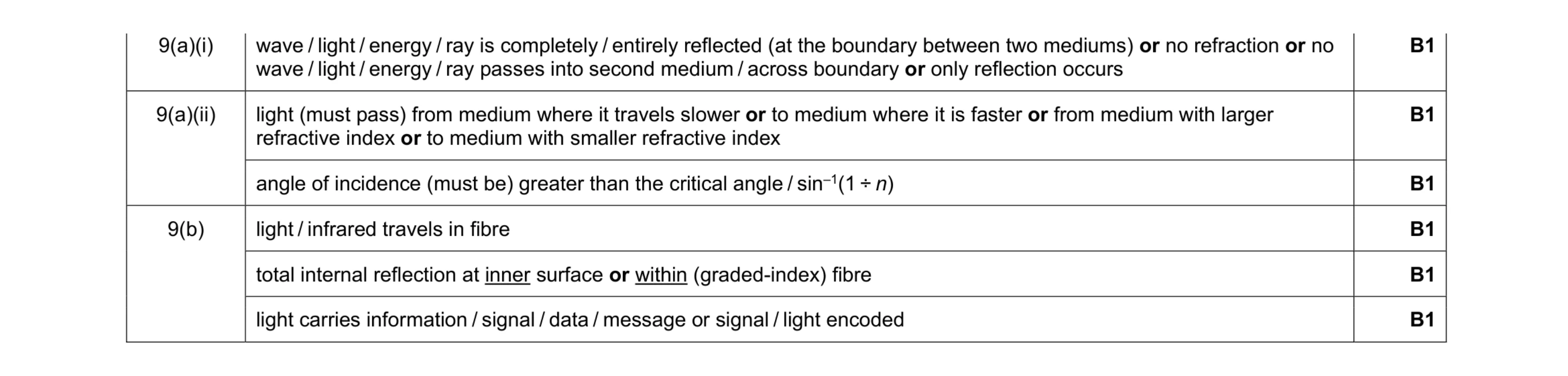 6
6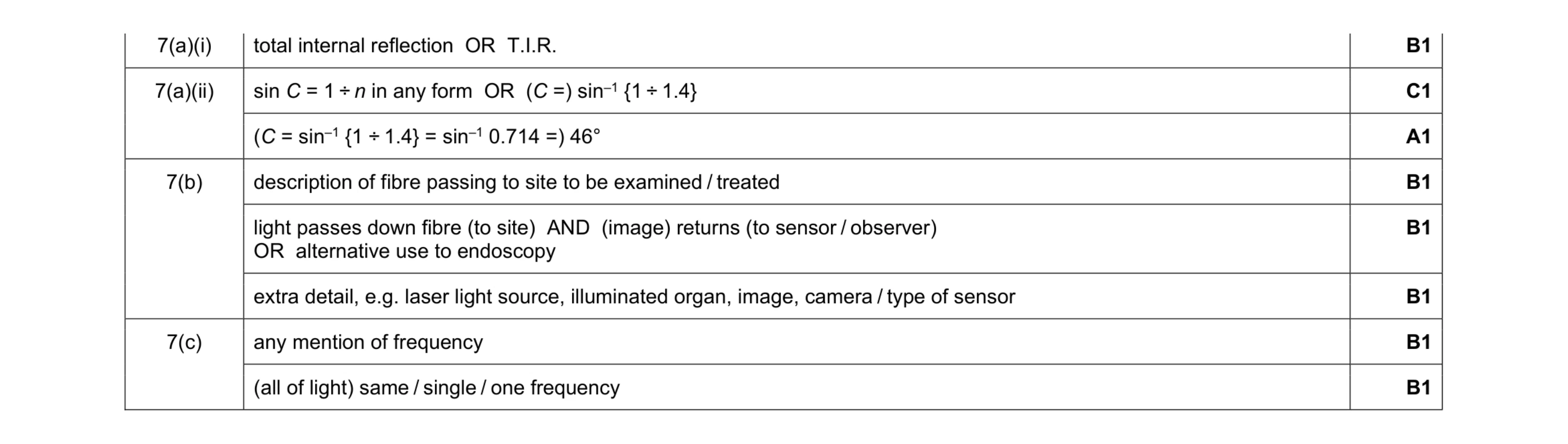 8
8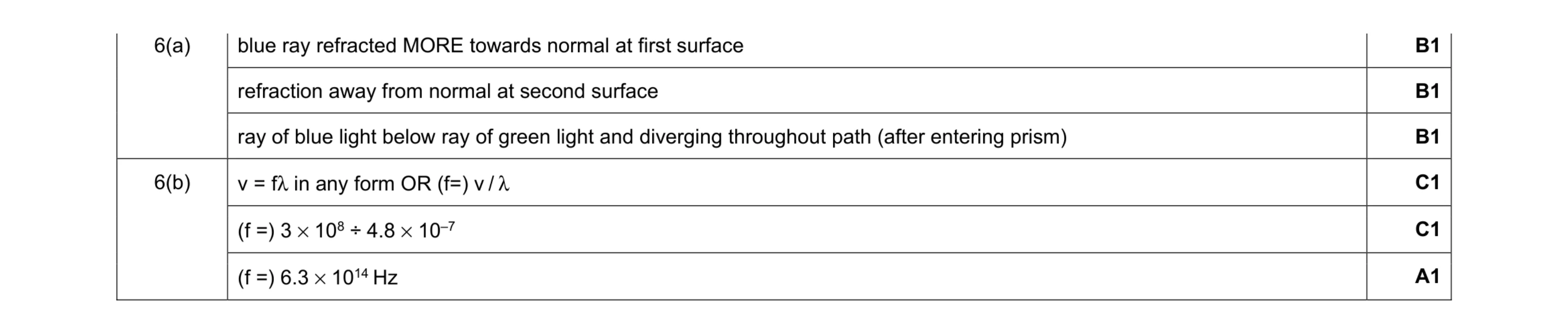 6
6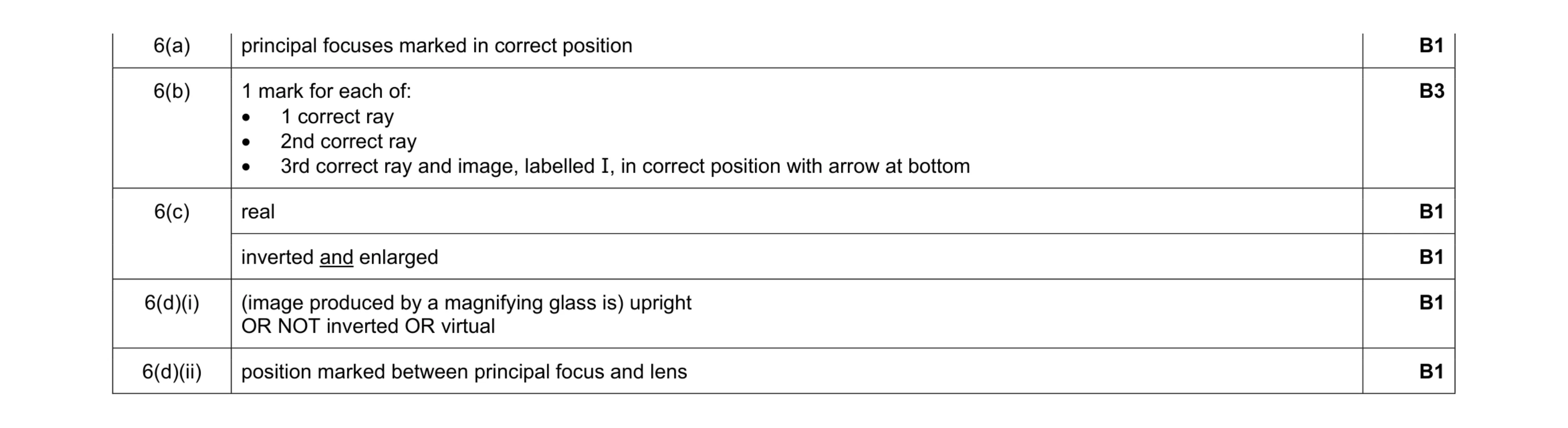 8
8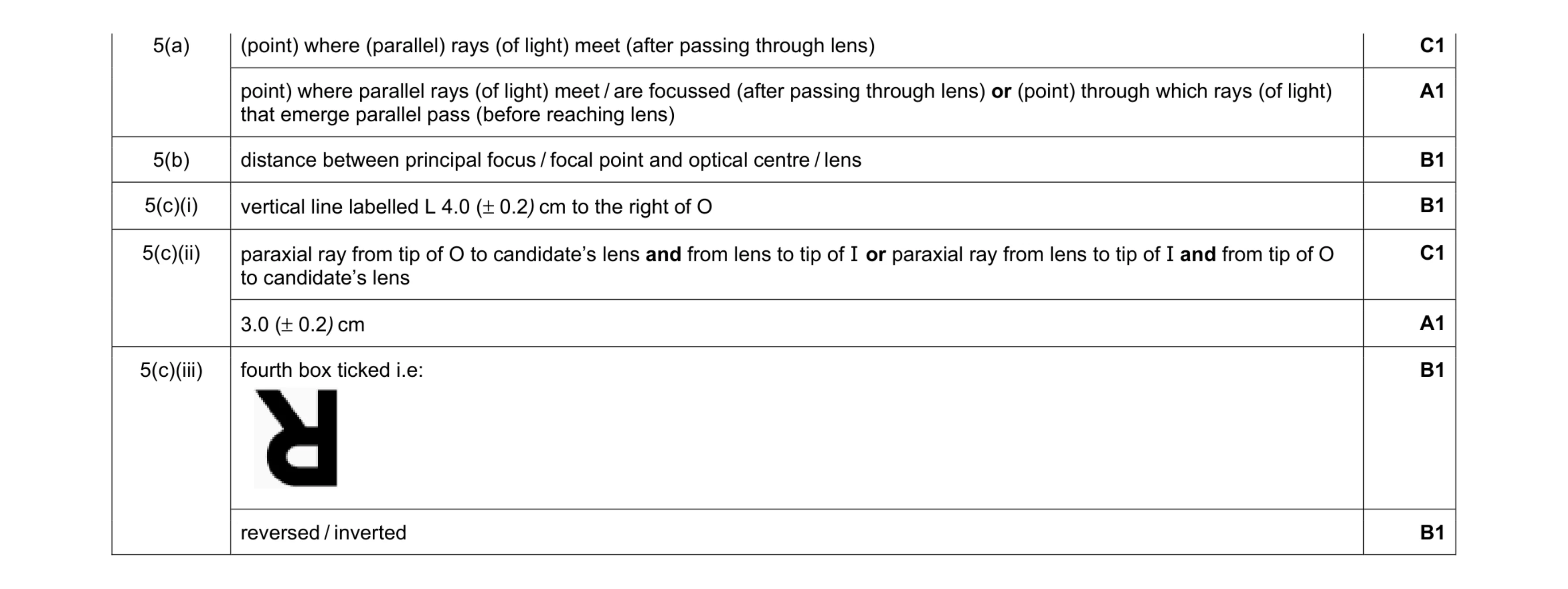 8
8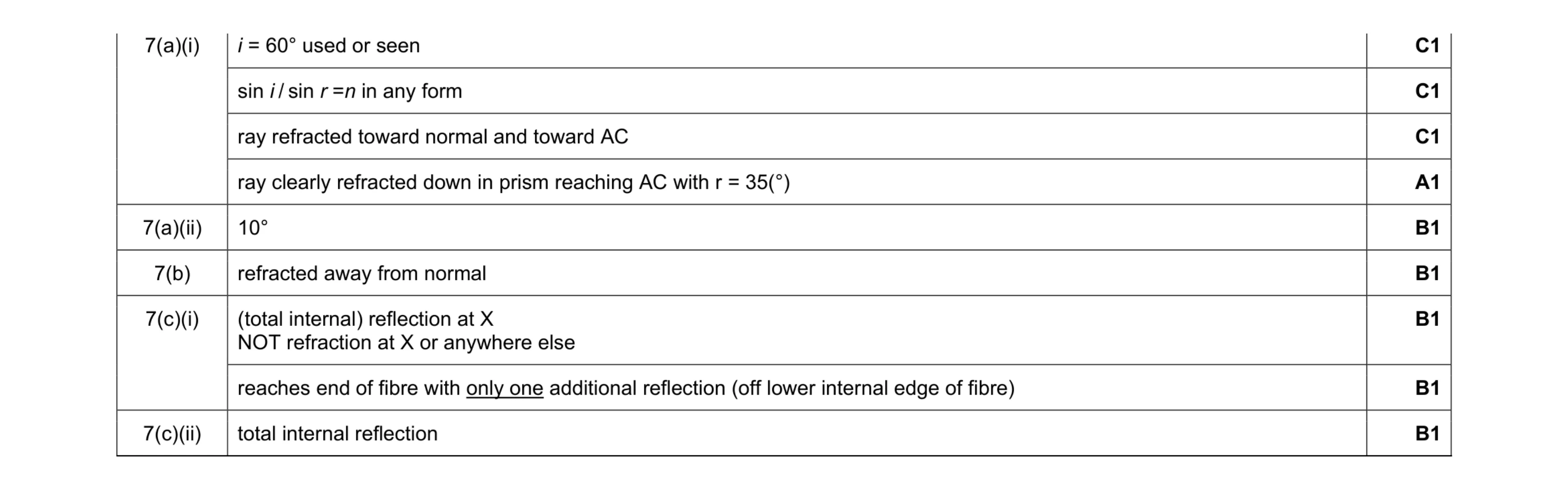 9
9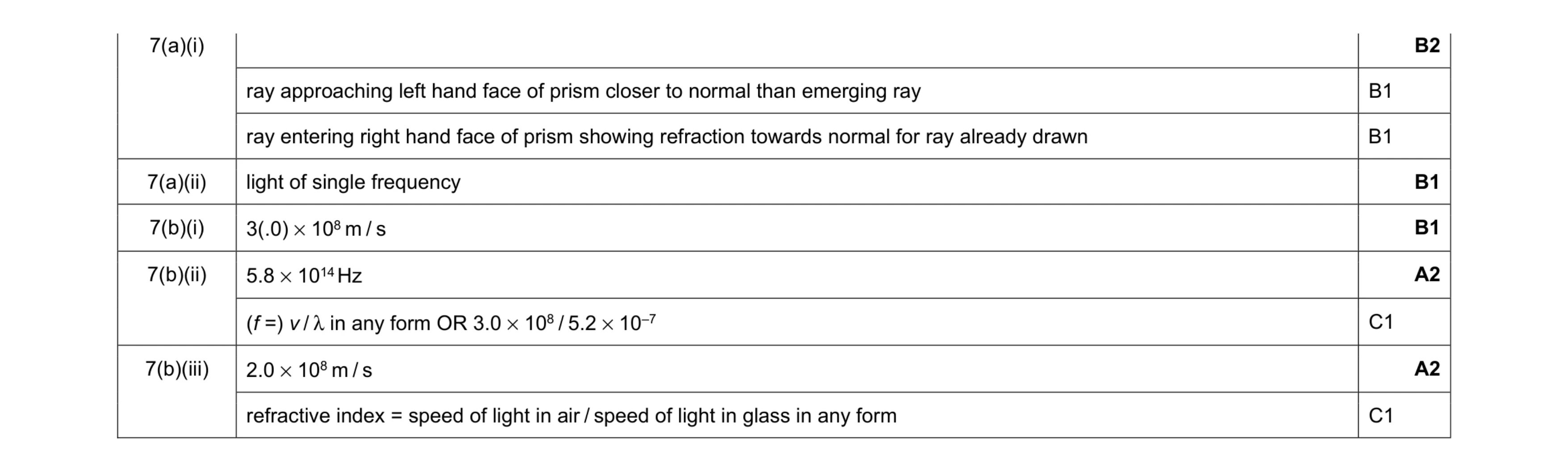 8
8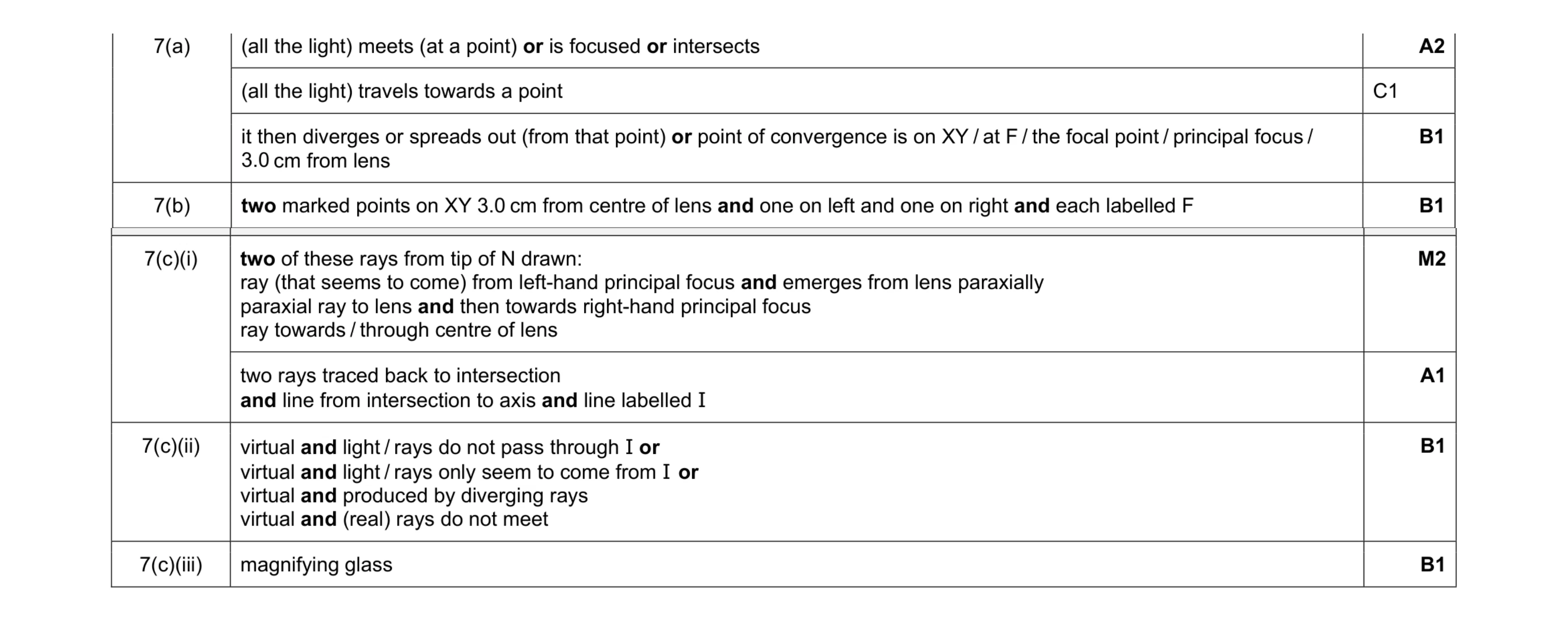 9
9 5
5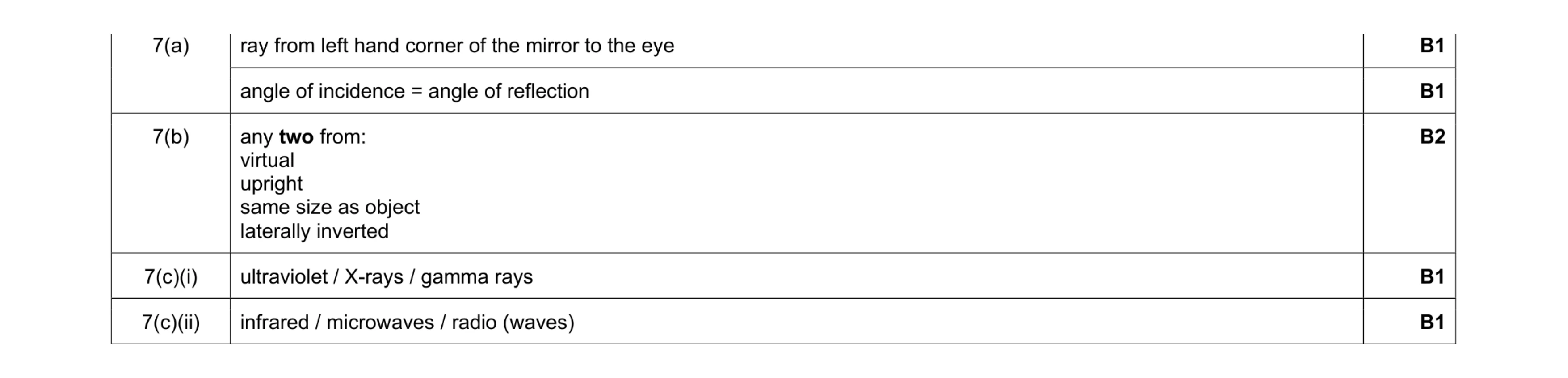 6
6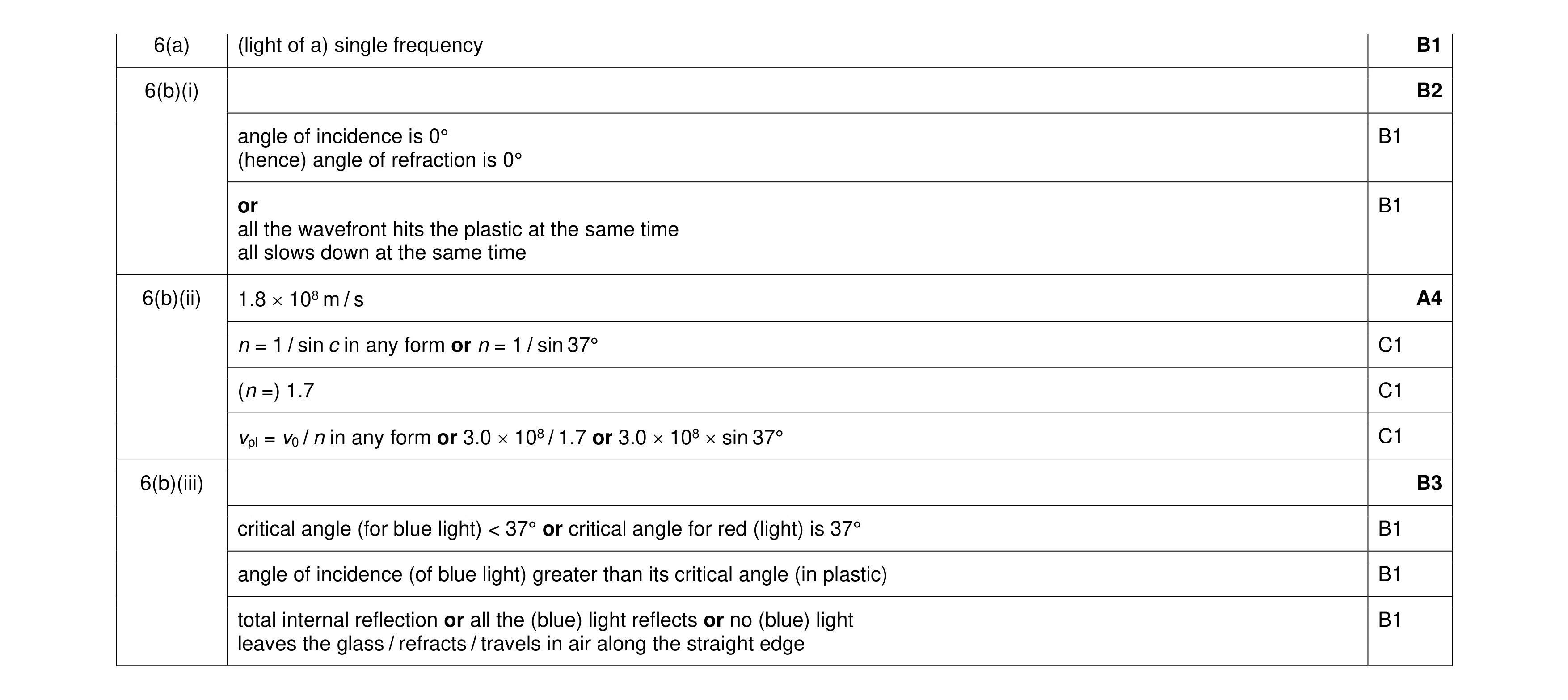 10
10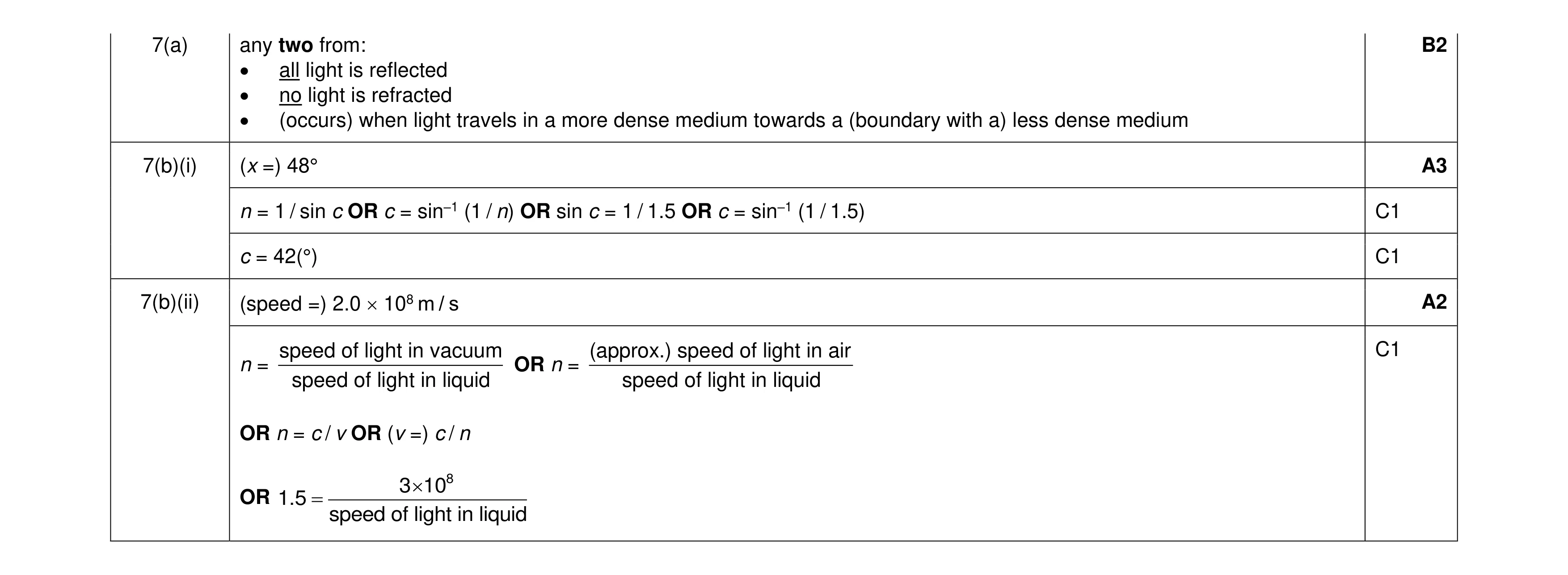 7
7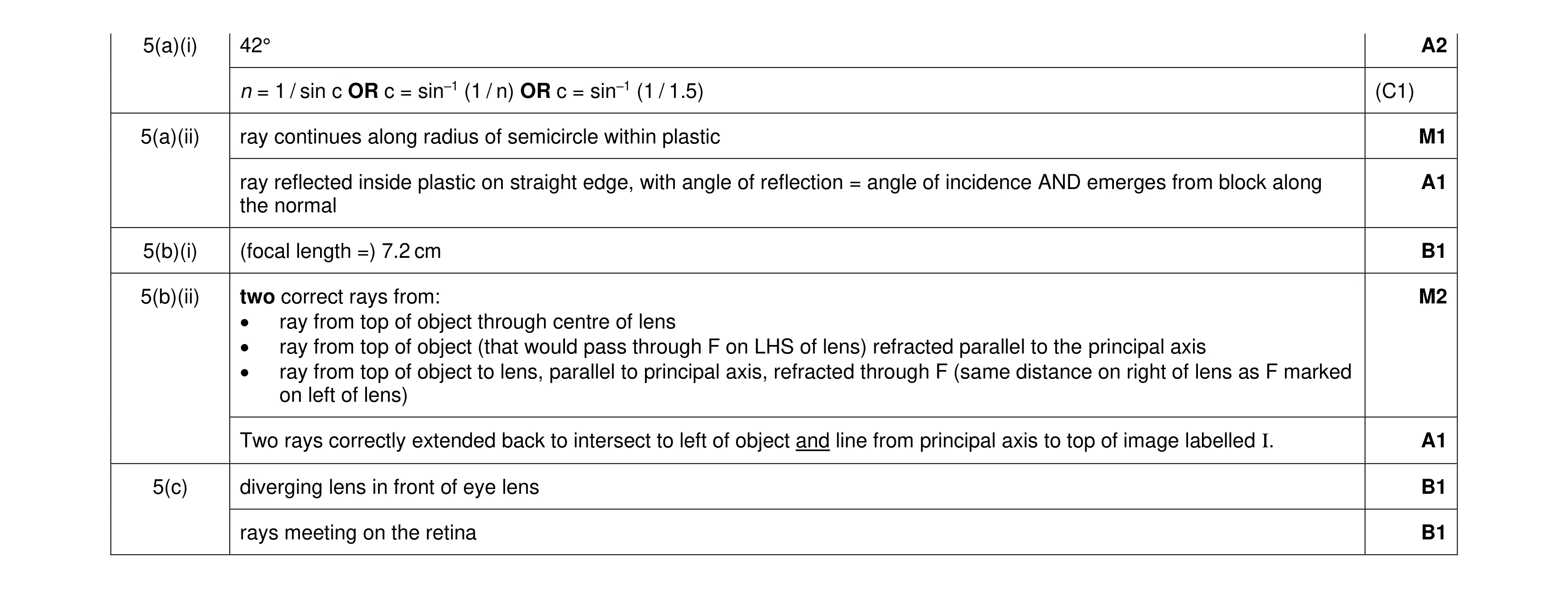 10
10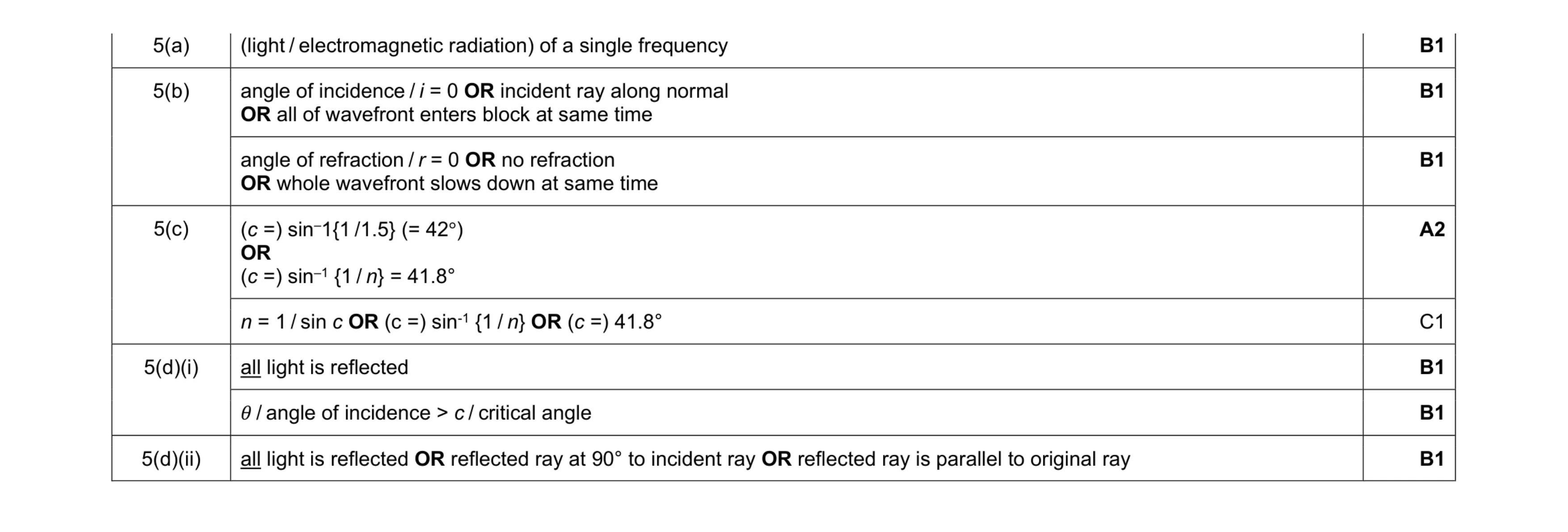 8
8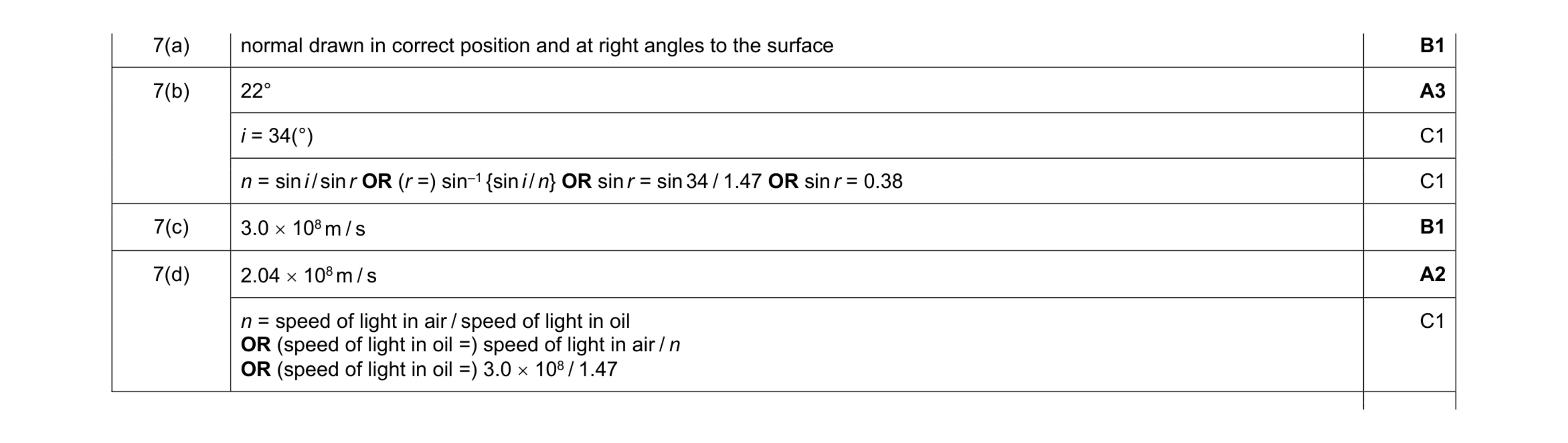 7
7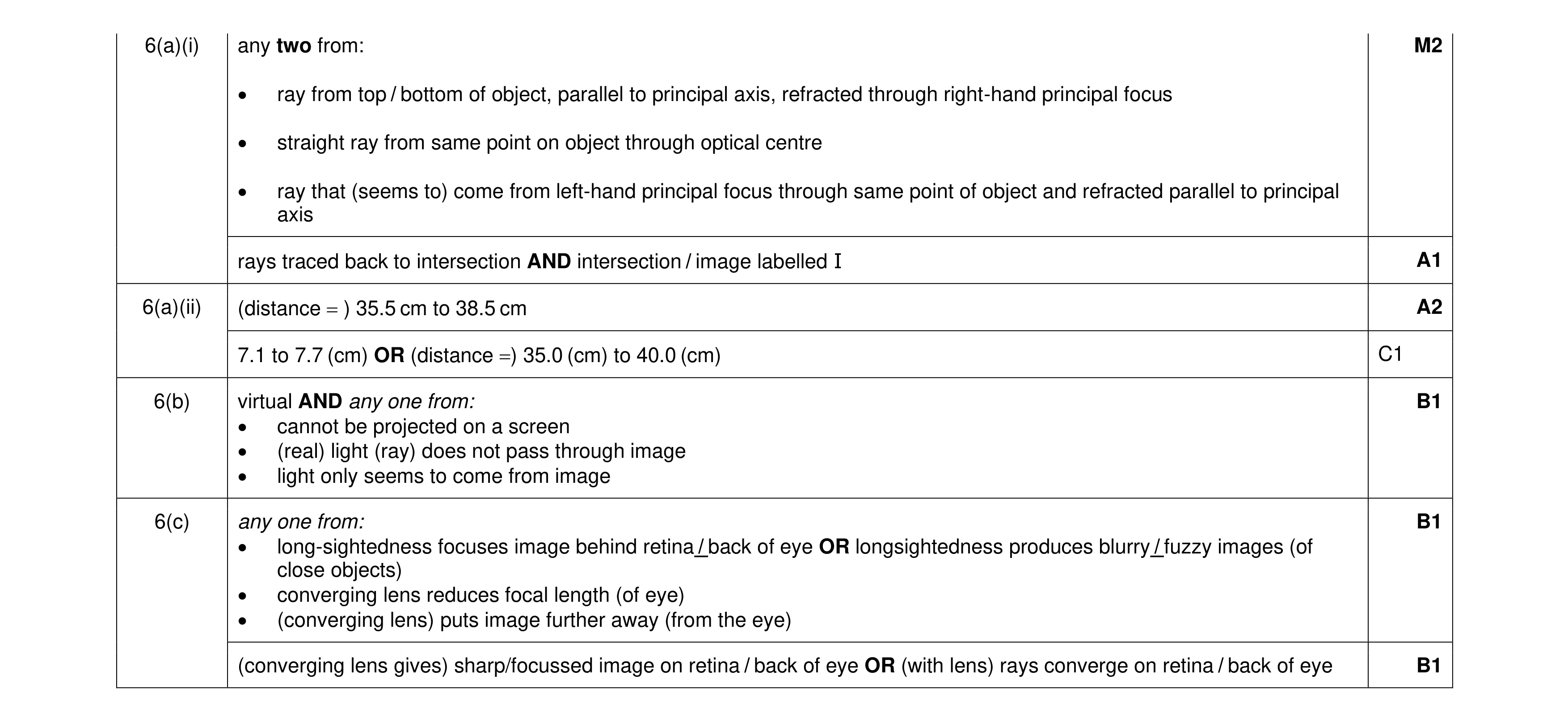 8
8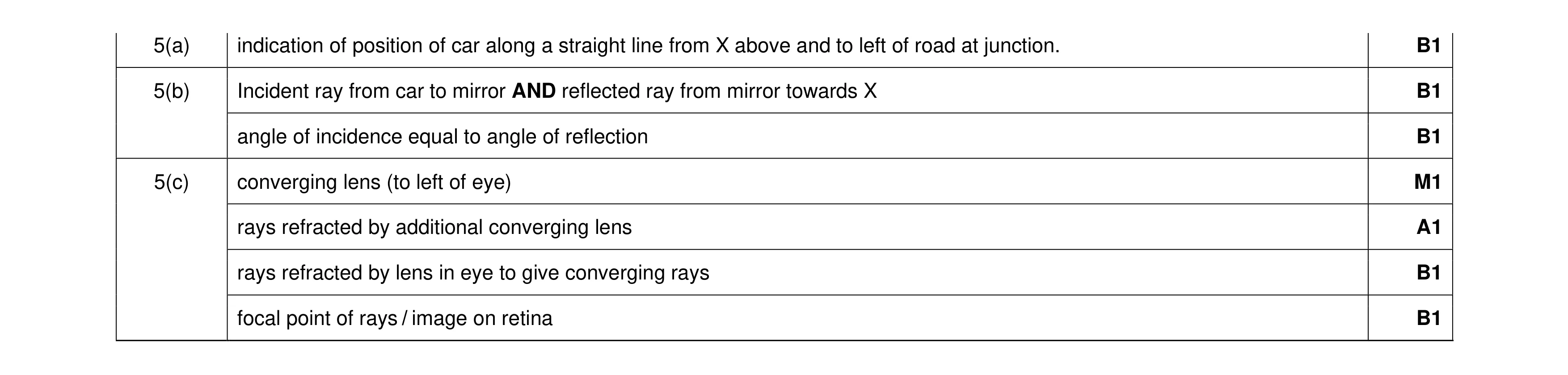 7
7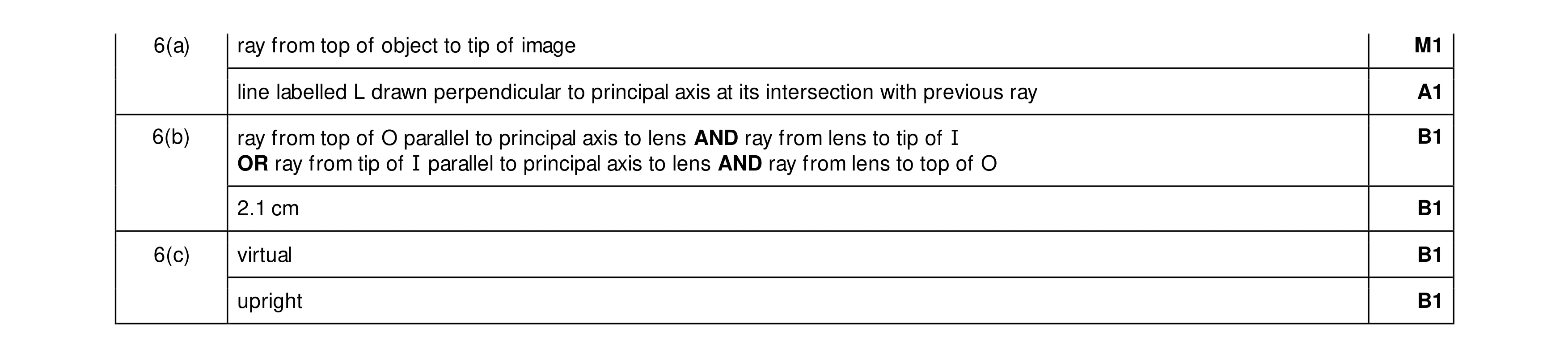 6
6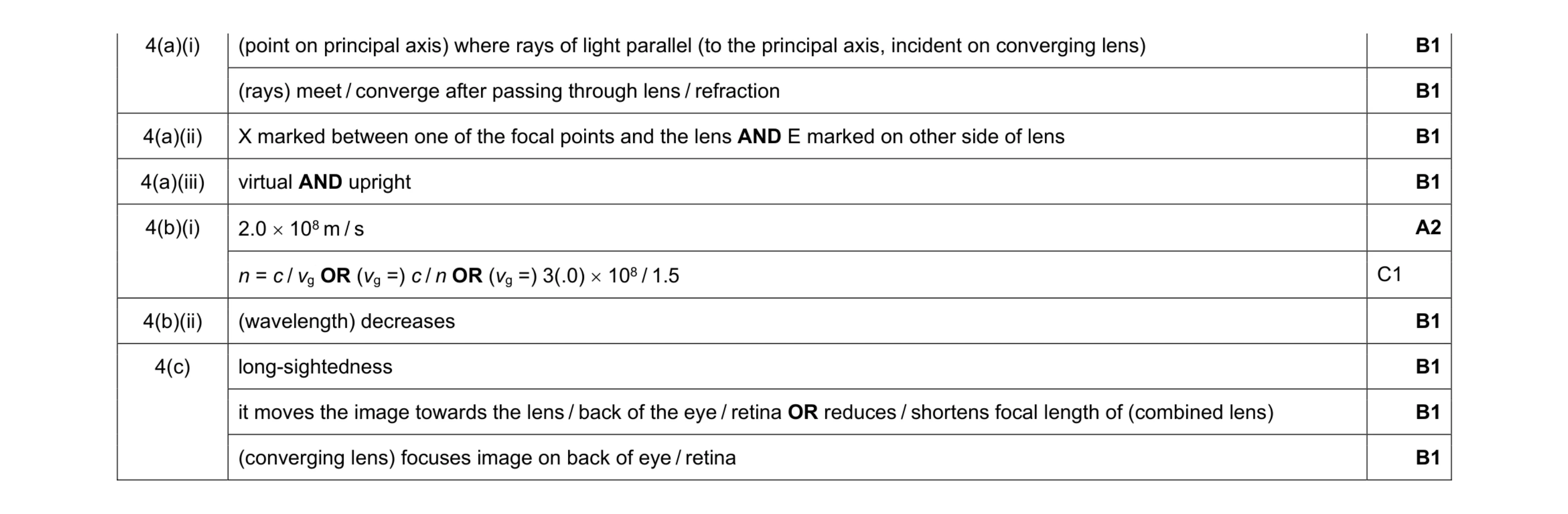 10
10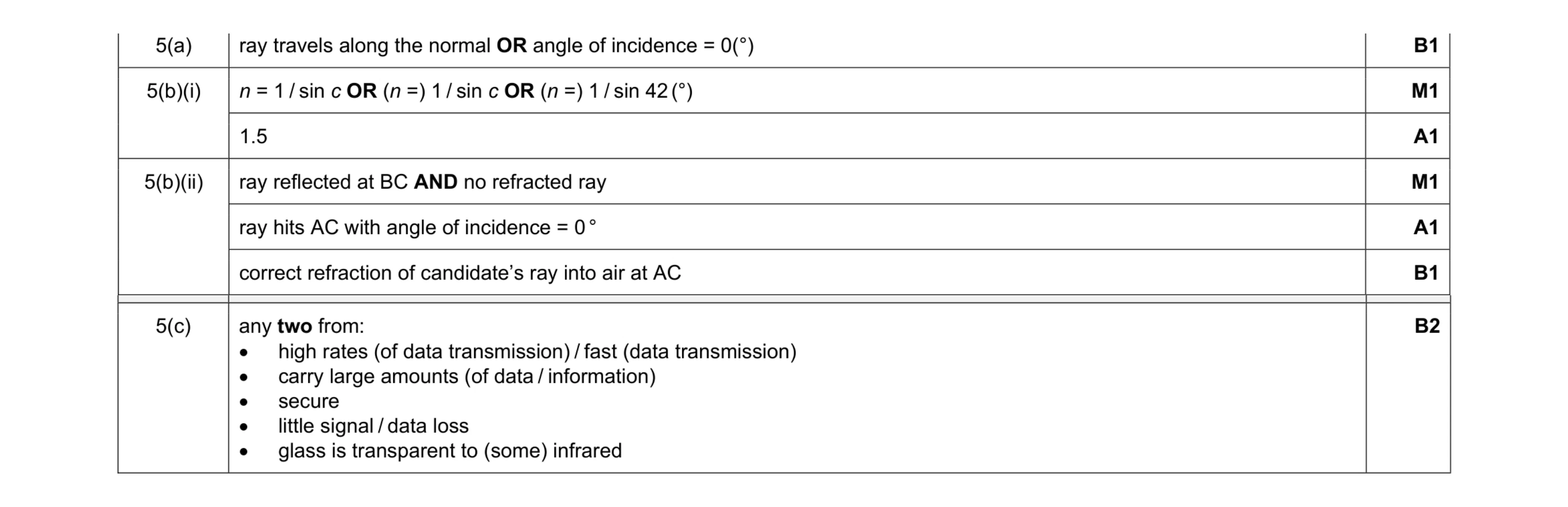 8
8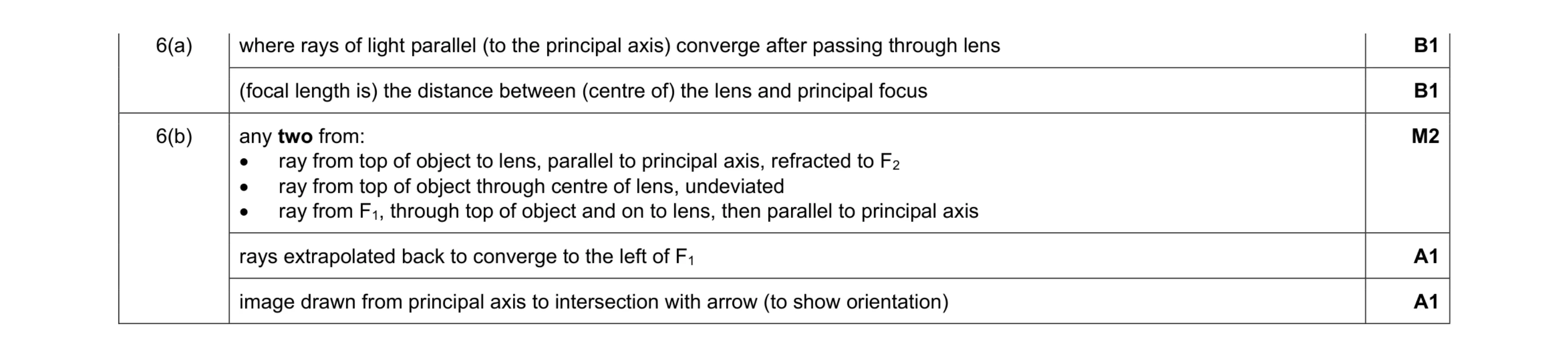 6
6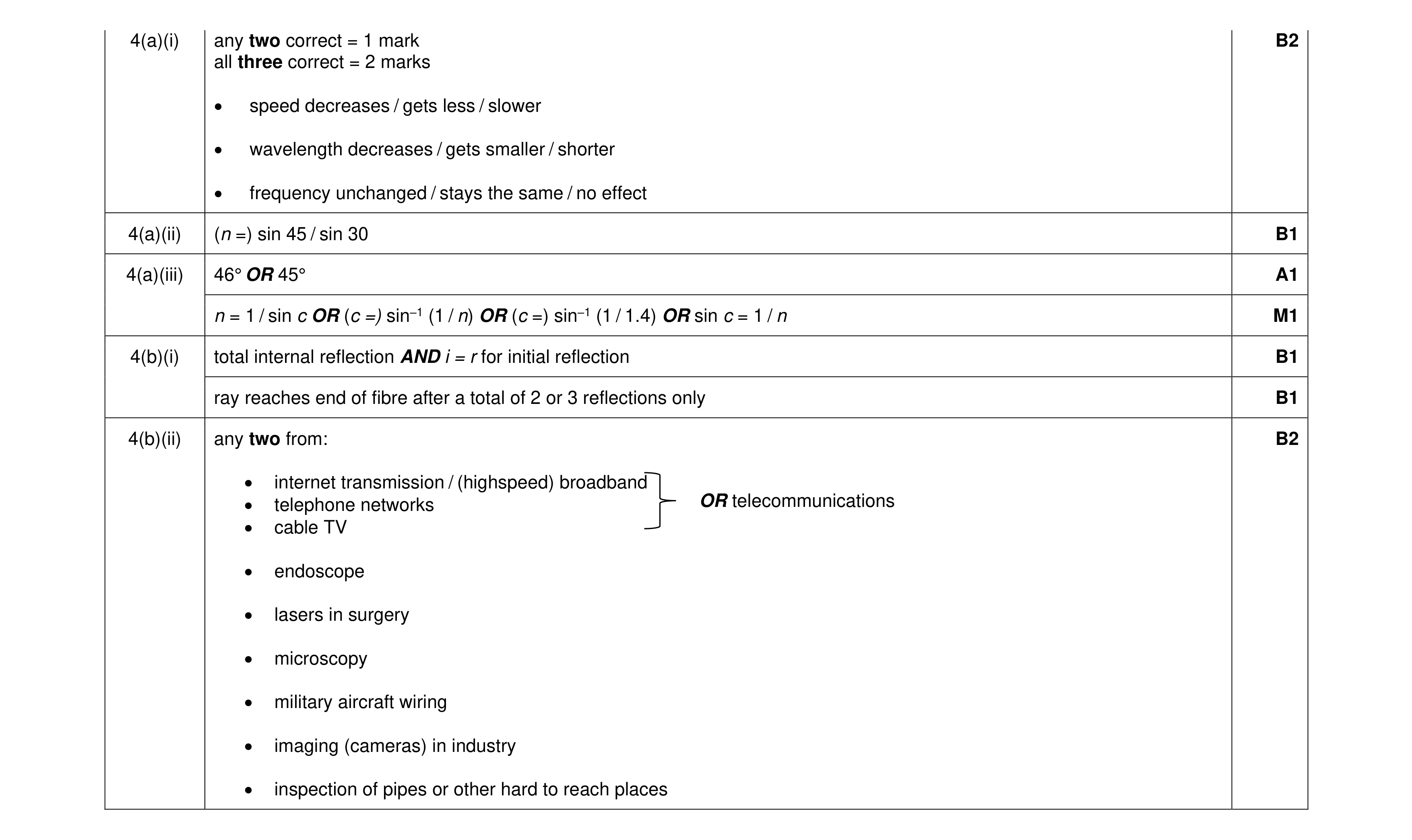 9
9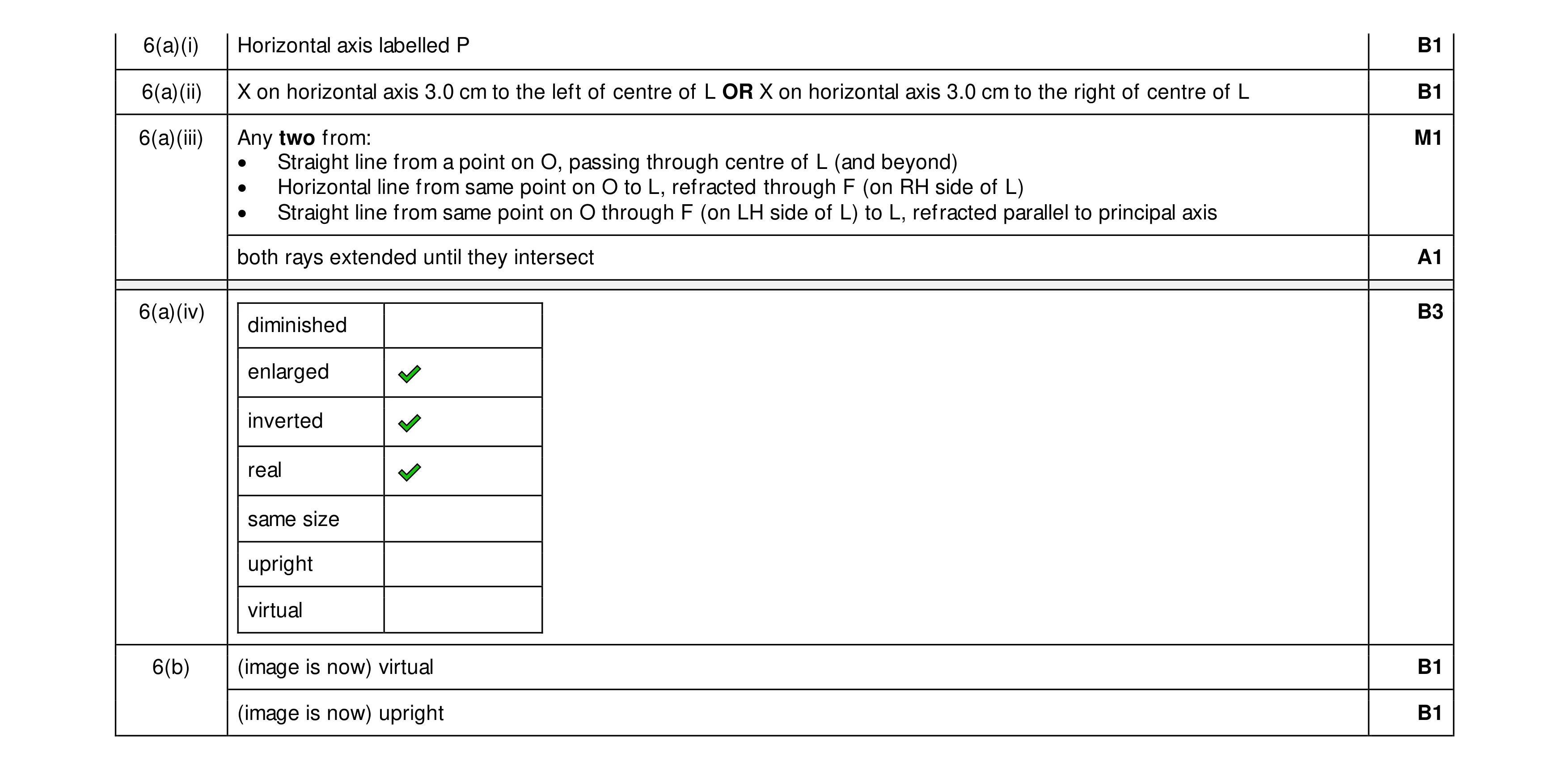 9
9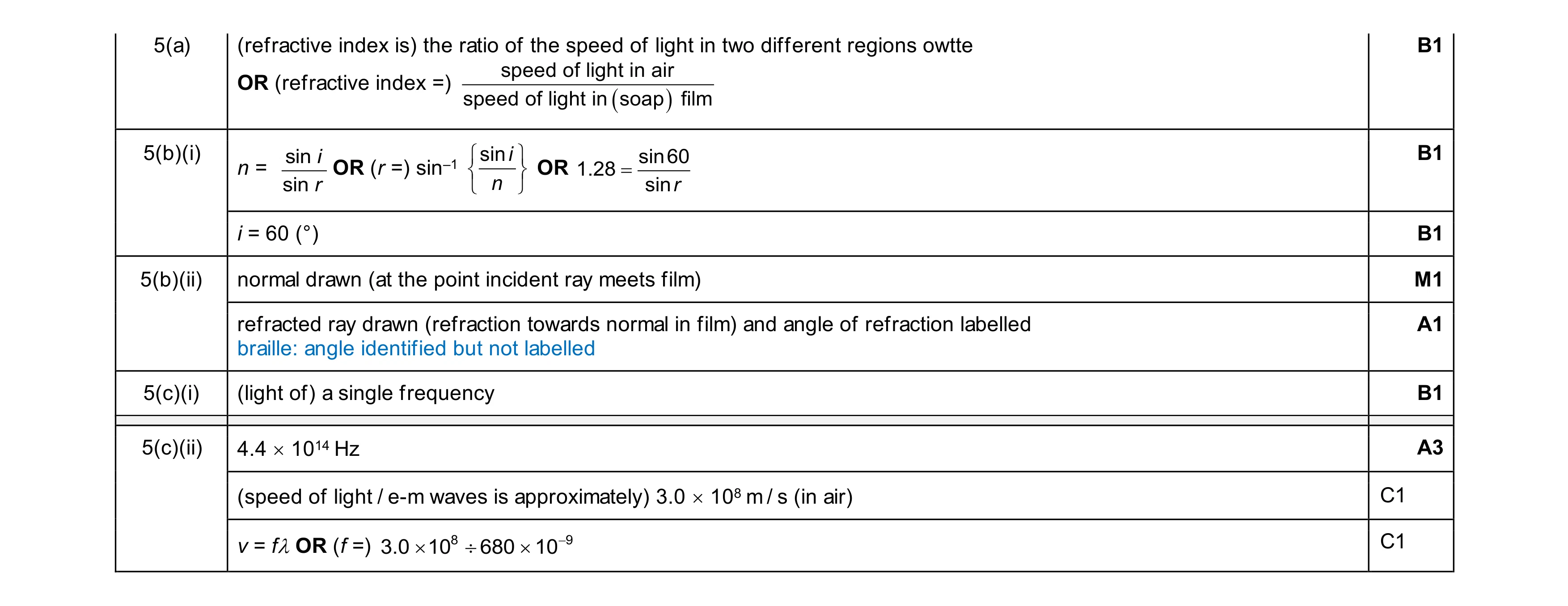 9
9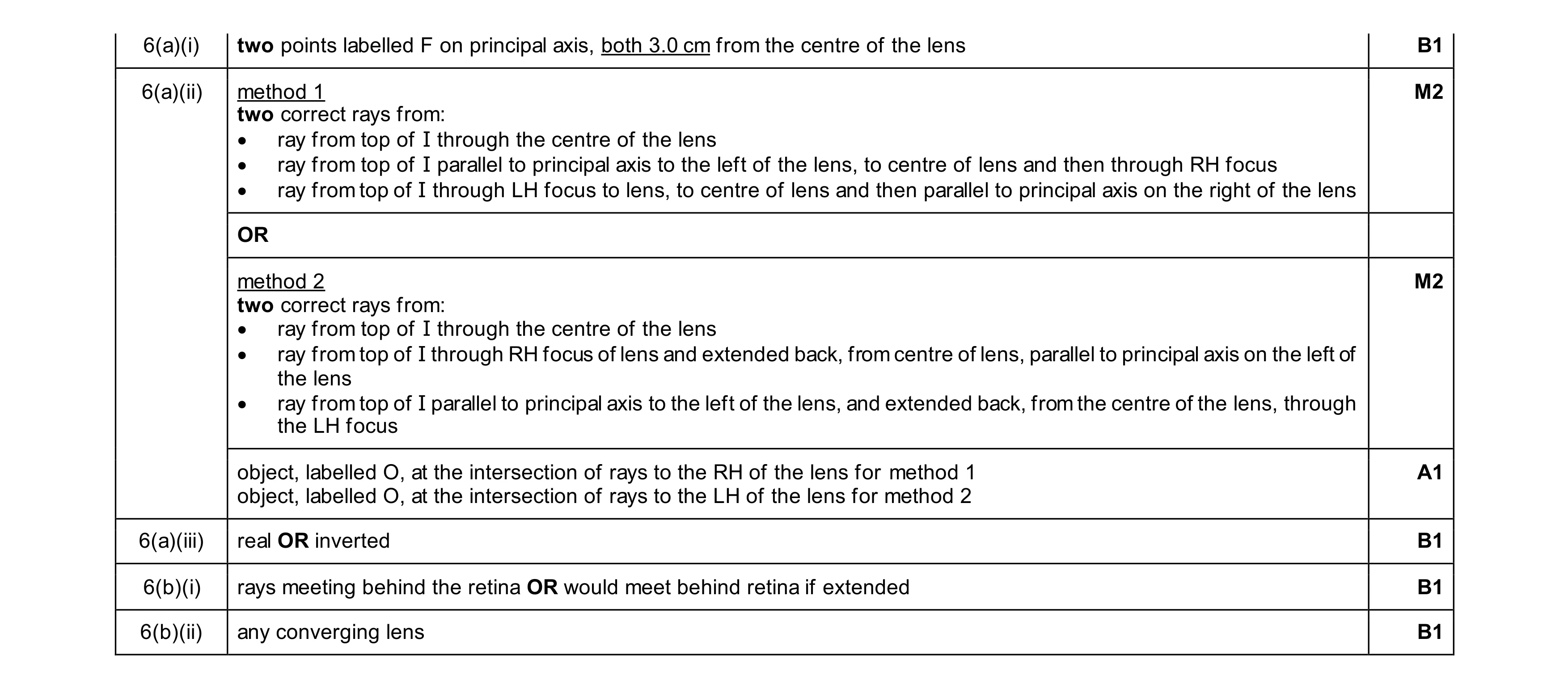 7
7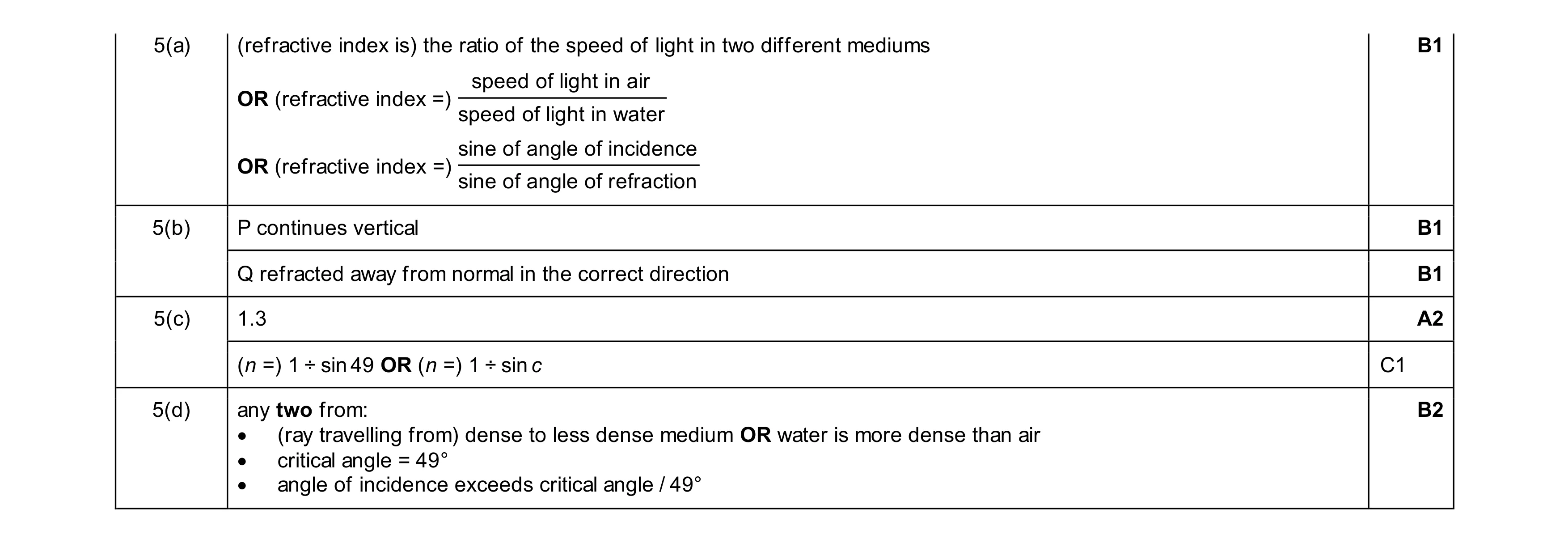 7
7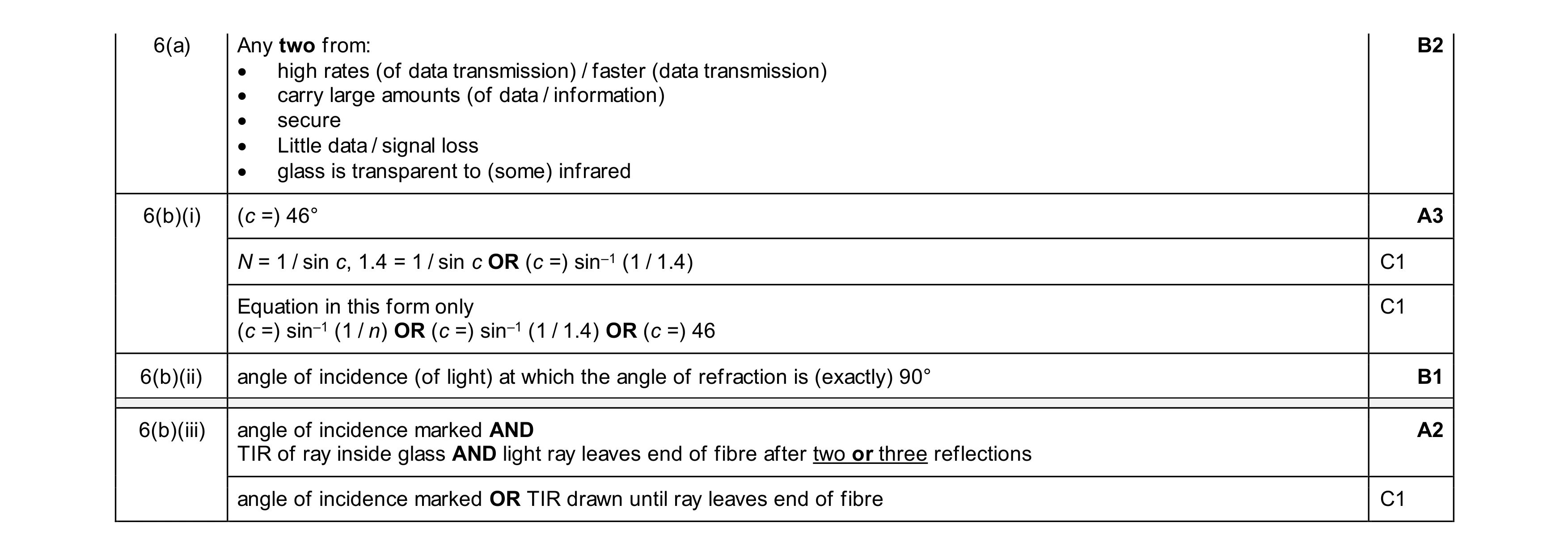 8
8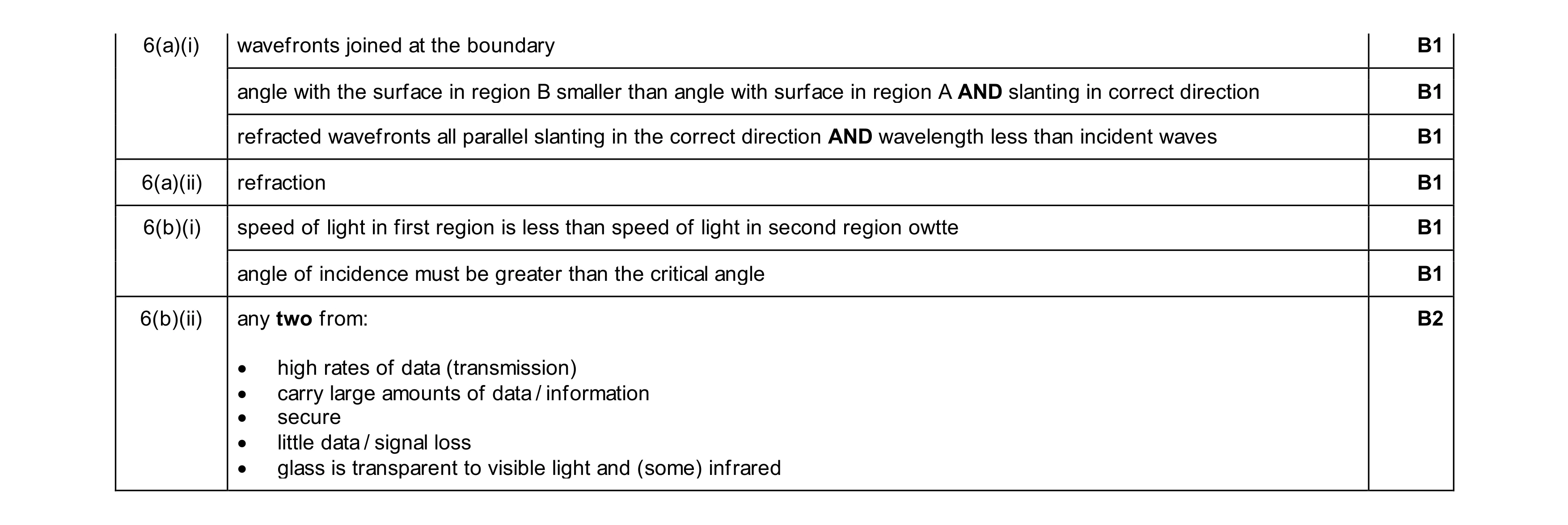 8
8