Cambridge IGCSE Physics 0625 — 2018 Oct/Nov Paper 4 · Variant 1
0625/41/O/N/18 · 11 questions · 80 marks · ≈90 min
The question paper and its mark scheme, free to read here and free to download. This is Cambridge’s own paper, exactly as it was sat.
Question paper16 pages

Mark scheme14 pages
Answers below. Sit the paper first if you are practising.
Questions as text
Q1 · A train of mass 5.6 × 10⁵ kg is at rest in a station
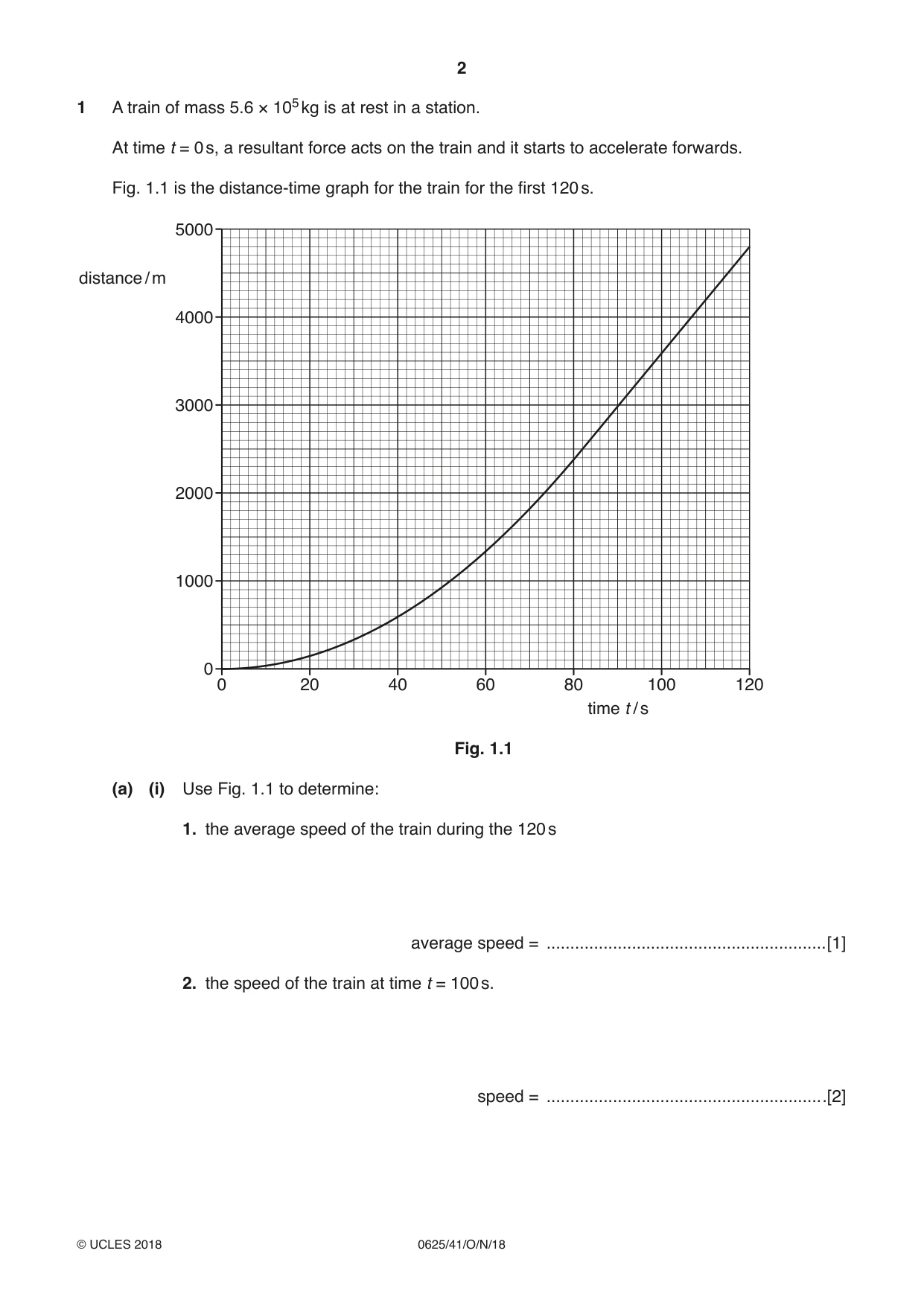
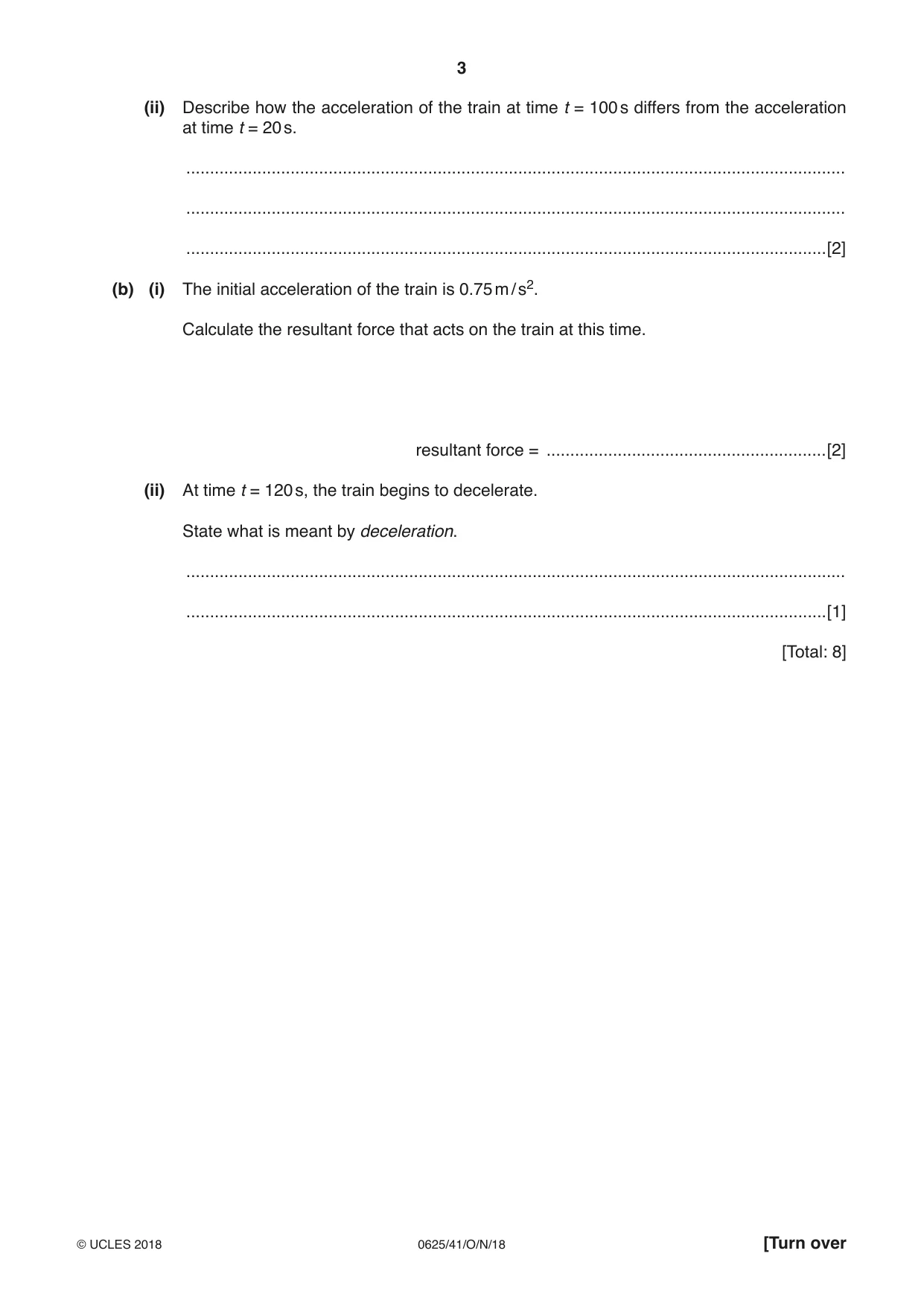
1 A train of mass 5.6 × 10⁵ kg is at rest in a station. At time t = 0 s, a resultant force acts on the train and it starts to accelerate forwards. Fig. 1.1 is the distance-time graph for the train for the first 120 s. 5000 distance / m 4000 3000 2000 1000 0 0 20 40 60 80 100 120 time t / s Fig. 1.1 (a) (i) Use Fig. 1.1 to determine: 1. the average speed of the train during the 120 s average speed = ...........................................................[1] 2. the speed of the train at time t = 100 s. speed = ...........................................................[2] (ii) Describe how the acceleration of the train at time t = 100 s differs from the acceleration at time t = 20 s. ........................................................................................................................................... ........................................................................................................................................... .......................................................................................................................................[2] (b) (i) The initial acceleration of the train is 0.75 m / s2. Calculate the resultant force that acts on the train at this time. resultant force = ...........................................................[2] (ii) At time t = 120 s, the train begins to decelerate. State what is meant by deceleration. ........................................................................................................................................... .......................................................................................................................................[1] [Total: 8]
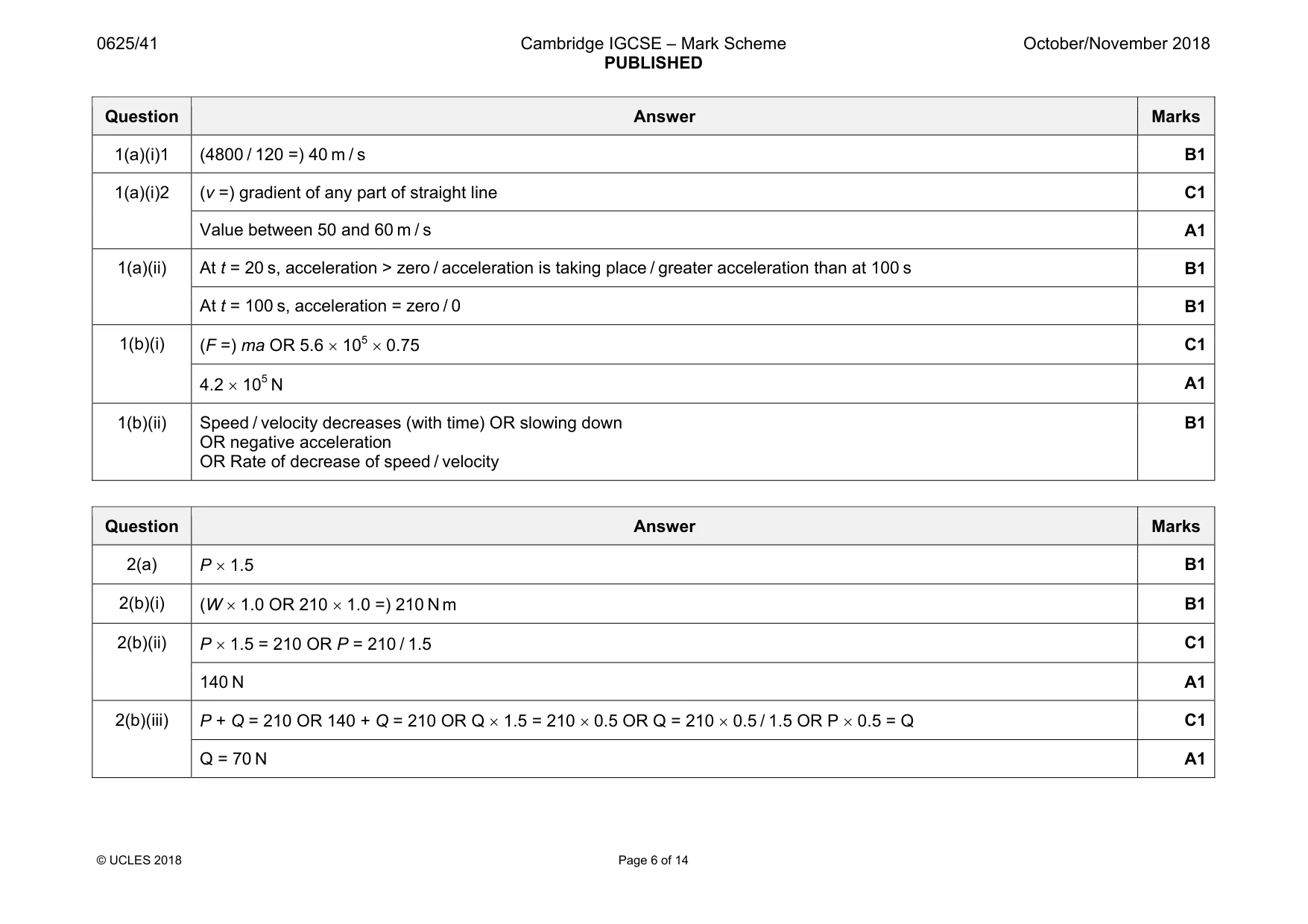
Mark scheme: 1(a)(i)1 (4800 / 120 =) 40 m / s B1 1(a)(i)2 (v =) gradient of any part of straight line C1 Value between 50 and 60 m / s A1 1(a)(ii) At t = 20 s, acceleration > zero / acceleration is taking place / greater acceleration than at 100 s B1 At t = 100 s, acceleration = zero / 0 B1 1(b)(i) (F =) ma OR 5.6 × 105 × 0.75 C1 4.2 × 10⁵ N A1 1(b)(ii) Speed / velocity decreases (with time) OR slowing down OR negative acceleration OR Rate of decrease of speed / velocity B1
Q2 · A uniform plank AB of length 2.0 m suspended from two ropes X and Y
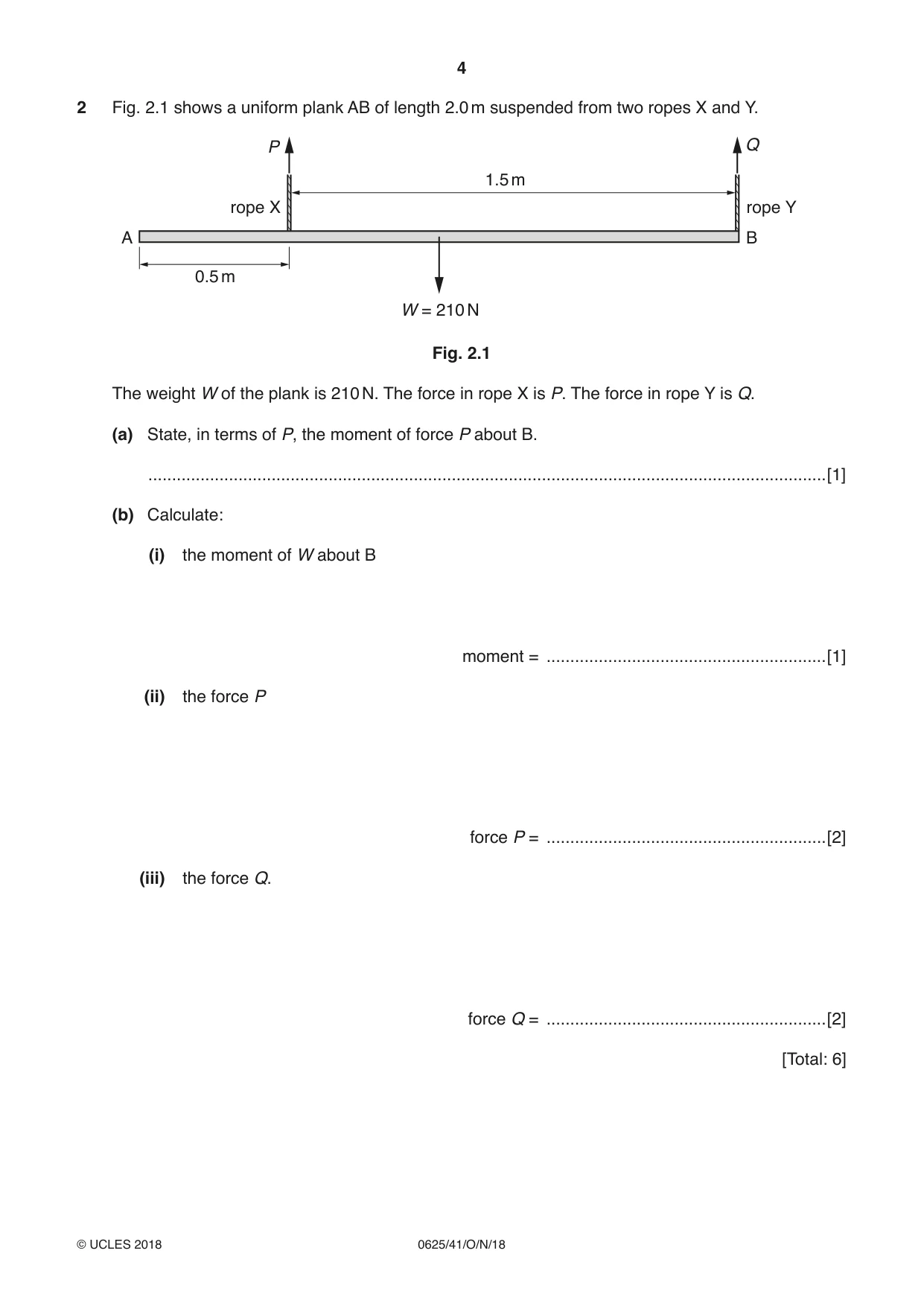
2 Fig. 2.1 shows a uniform plank AB of length 2.0 m suspended from two ropes X and Y. P Q 1.5 m rope X rope Y A B 0.5 m W = 210 N Fig. 2.1 The weight W of the plank is 210 N. The force in rope X is P. The force in rope Y is Q. (a) State, in terms of P, the moment of force P about B. ...............................................................................................................................................[1] (b) Calculate: (i) the moment of W about B moment = ...........................................................[1] (ii) the force P force P = ...........................................................[2] (iii) the force Q. force Q = ...........................................................[2] [Total: 6]
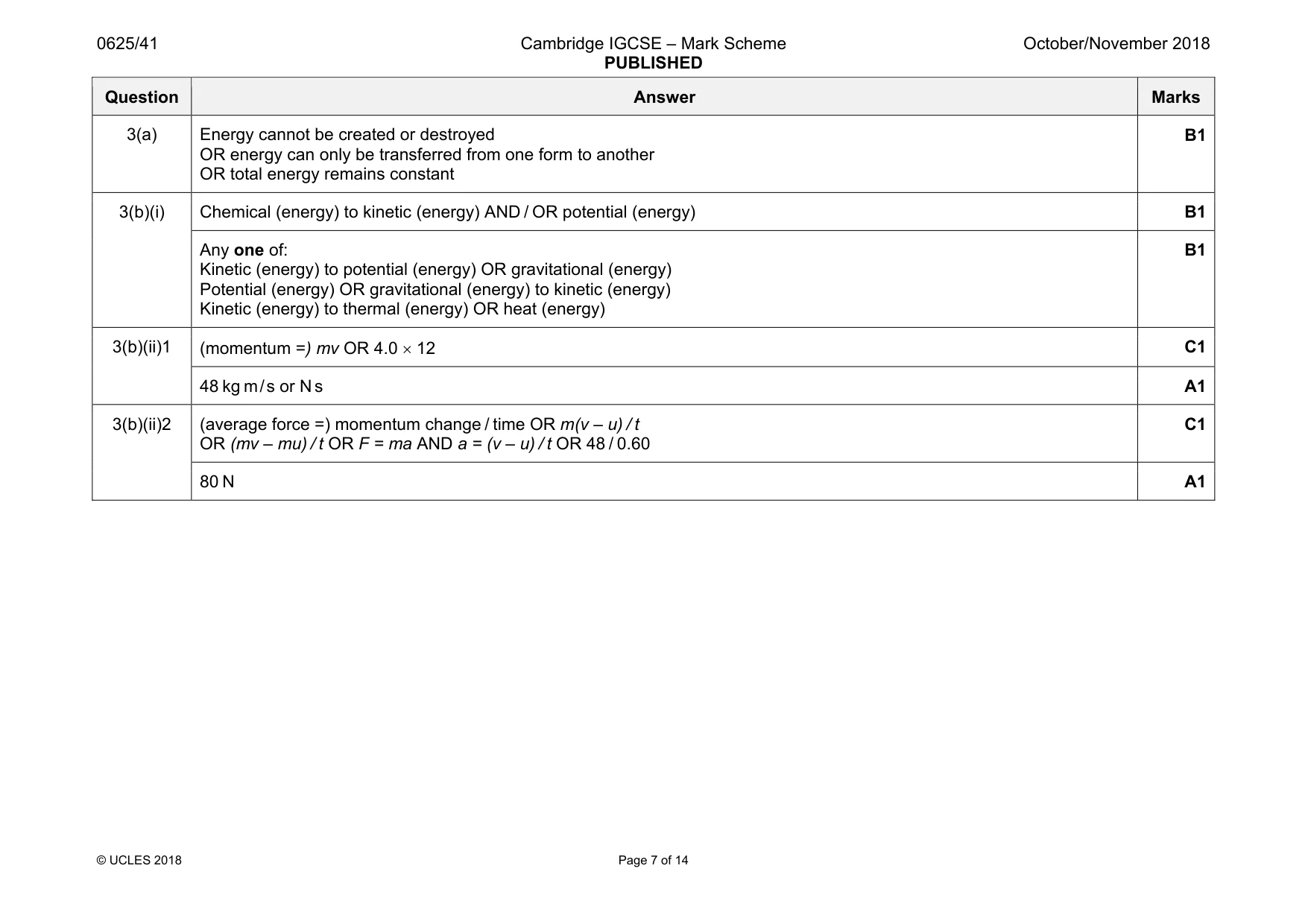
Mark scheme: 2(a) B1 2(b)(i) (W × 1.0 OR 210 × 1.0 =) 210 N m B1 2(b)(ii) P × 1.5 = 210 OR P = 210 / 1.5 C1 140 N A1 2(b)(iii) P + Q = 210 OR 140 + Q = 210 OR Q × 1.5 = 210 × 0.5 OR Q = 210 × 0.5 / 1.5 OR P × 0.5 = Q C1 Q = 70 N A1
Q3 · State what is meant by the principle of conservation of energy
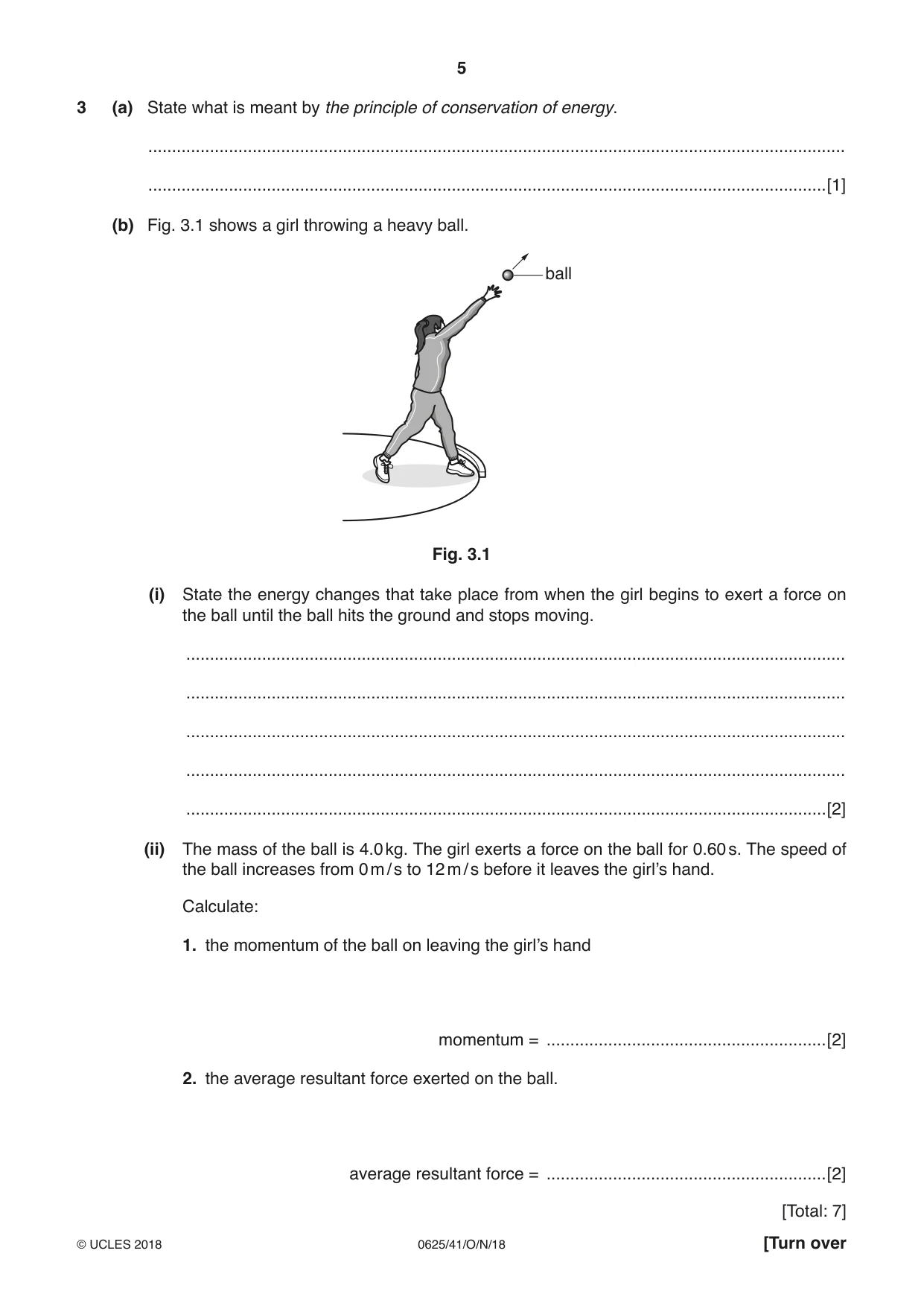
3 (a) State what is meant by the principle of conservation of energy. ................................................................................................................................................... ...............................................................................................................................................[1] (b) Fig. 3.1 shows a girl throwing a heavy ball. ball Fig. 3.1 (i) State the energy changes that take place from when the girl begins to exert a force on the ball until the ball hits the ground and stops moving. ........................................................................................................................................... ........................................................................................................................................... ........................................................................................................................................... ........................................................................................................................................... .......................................................................................................................................[2] (ii) The mass of the ball is 4.0 kg. The girl exerts a force on the ball for 0.60 s. The speed of the ball increases from 0 m / s to 12 m / s before it leaves the girl’s hand. Calculate: 1. the momentum of the ball on leaving the girl’s hand momentum = ...........................................................[2] 2. the average resultant force exerted on the ball. average resultant force = ...........................................................[2] [Total: 7]
Mark scheme: 3(a) Energy cannot be created or destroyed OR energy can only be transferred from one form to another OR total energy remains constant B1 3(b)(i) Chemical (energy) to kinetic (energy) AND / OR potential (energy) B1 Any one of: Kinetic (energy) to potential (energy) OR gravitational (energy) Potential (energy) OR gravitational (energy) to kinetic (energy) Kinetic (energy) to thermal (energy) OR heat (energy) B1 3(b)(ii)1 (momentum =) mv OR 4.0 × 12 C1 48 kg m / s or N s A1 3(b)(ii)2 (average force =) momentum change / time OR m(v – u) / t OR (mv – mu) / t OR F = ma AND a = (v – u) / t OR 48 / 0.60 C1 80 N A1
Q4 · Liquid in a cylinder
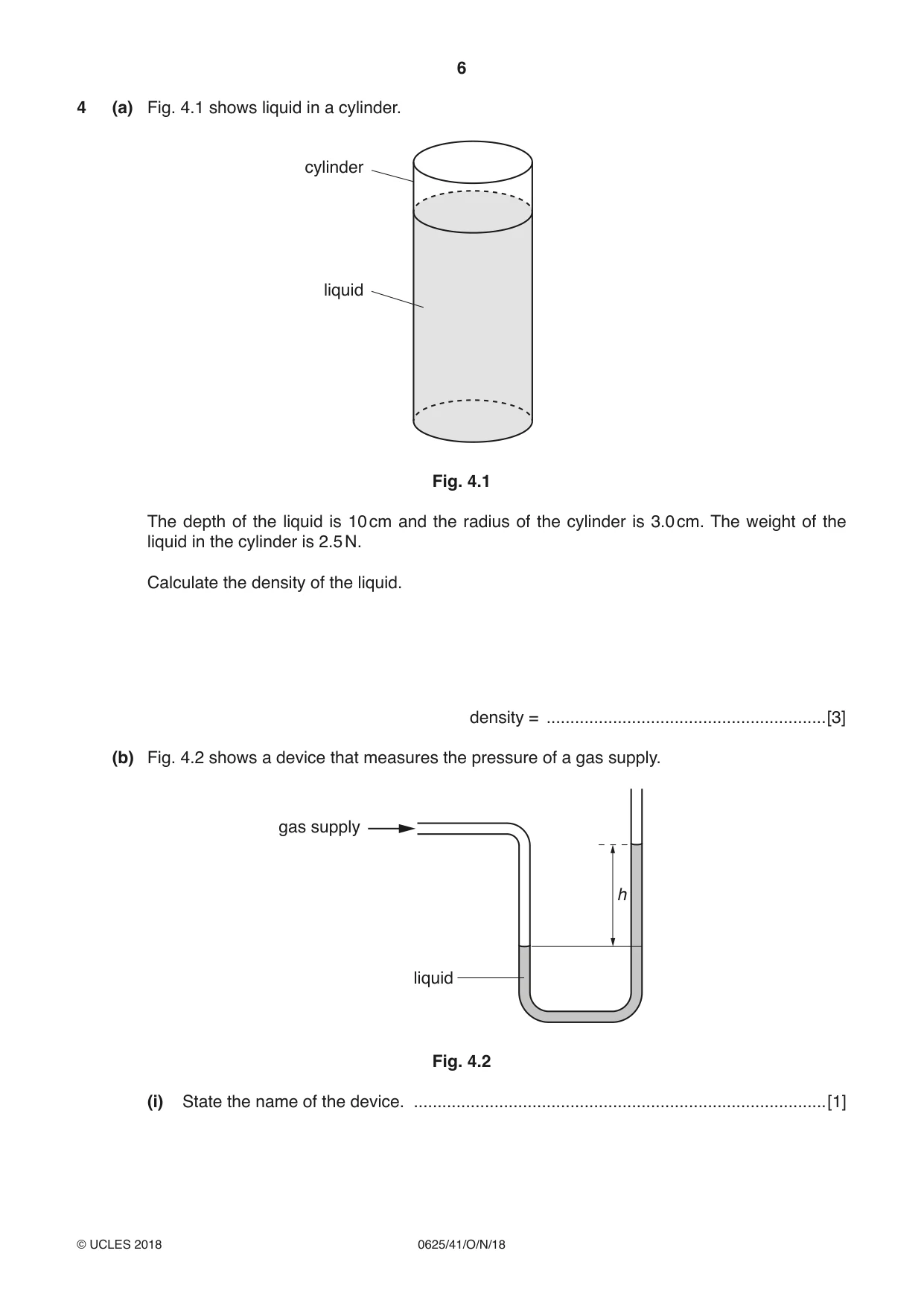
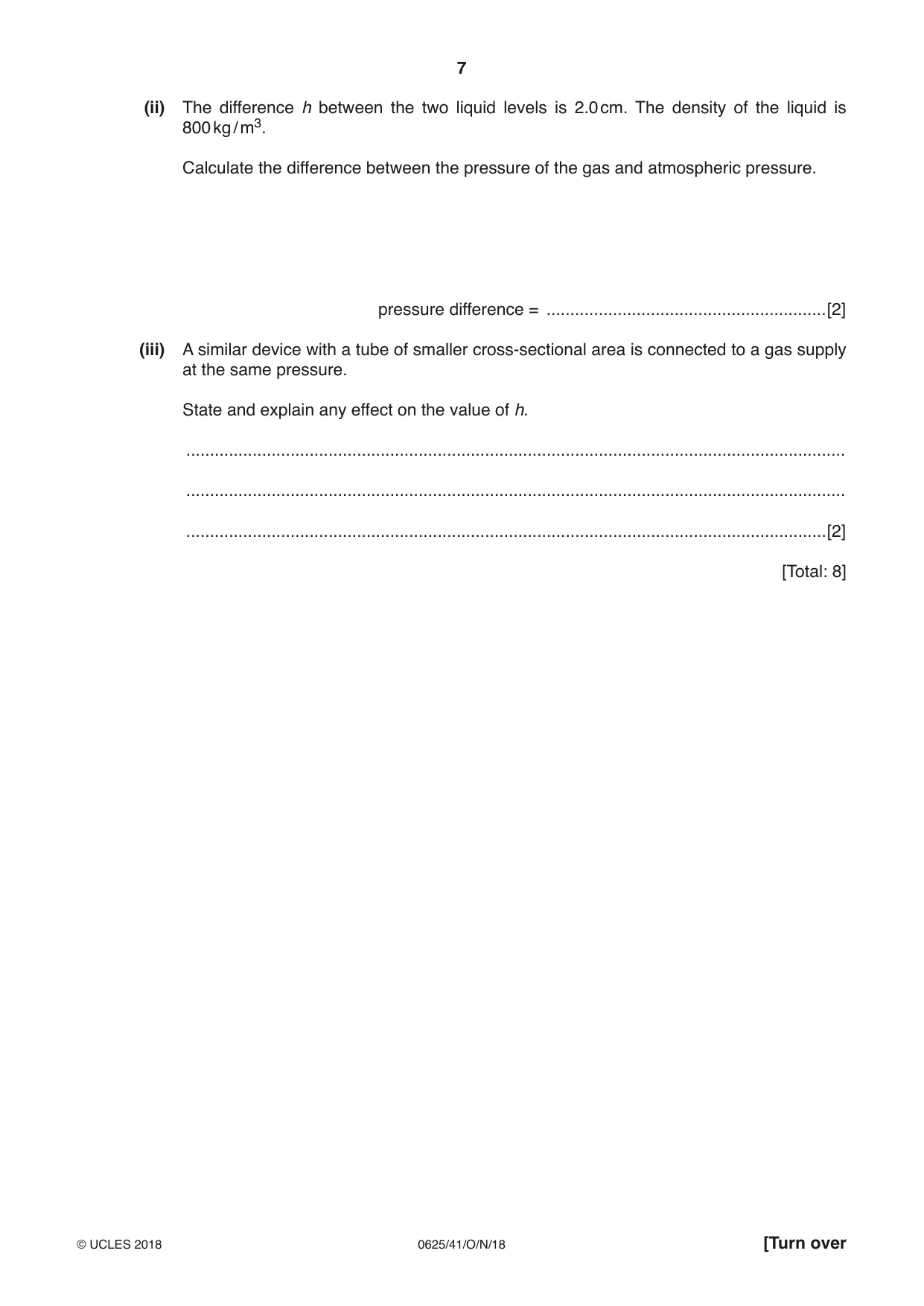
4 (a) Fig. 4.1 shows liquid in a cylinder. cylinder liquid Fig. 4.1 The depth of the liquid is 10 cm and the radius of the cylinder is 3.0 cm. The weight of the liquid in the cylinder is 2.5 N. Calculate the density of the liquid. density = ...........................................................[3] (b) Fig. 4.2 shows a device that measures the pressure of a gas supply. gas supply h liquid Fig. 4.2 (i) State the name of the device. .......................................................................................[1] (ii) The difference h between the two liquid levels is 2.0 cm. The density of the liquid is 800 kg / m3. Calculate the difference between the pressure of the gas and atmospheric pressure. pressure difference = ...........................................................[2] (iii) A similar device with a tube of smaller cross-sectional area is connected to a gas supply at the same pressure. State and explain any effect on the value of h. ........................................................................................................................................... ........................................................................................................................................... .......................................................................................................................................[2] [Total: 8]
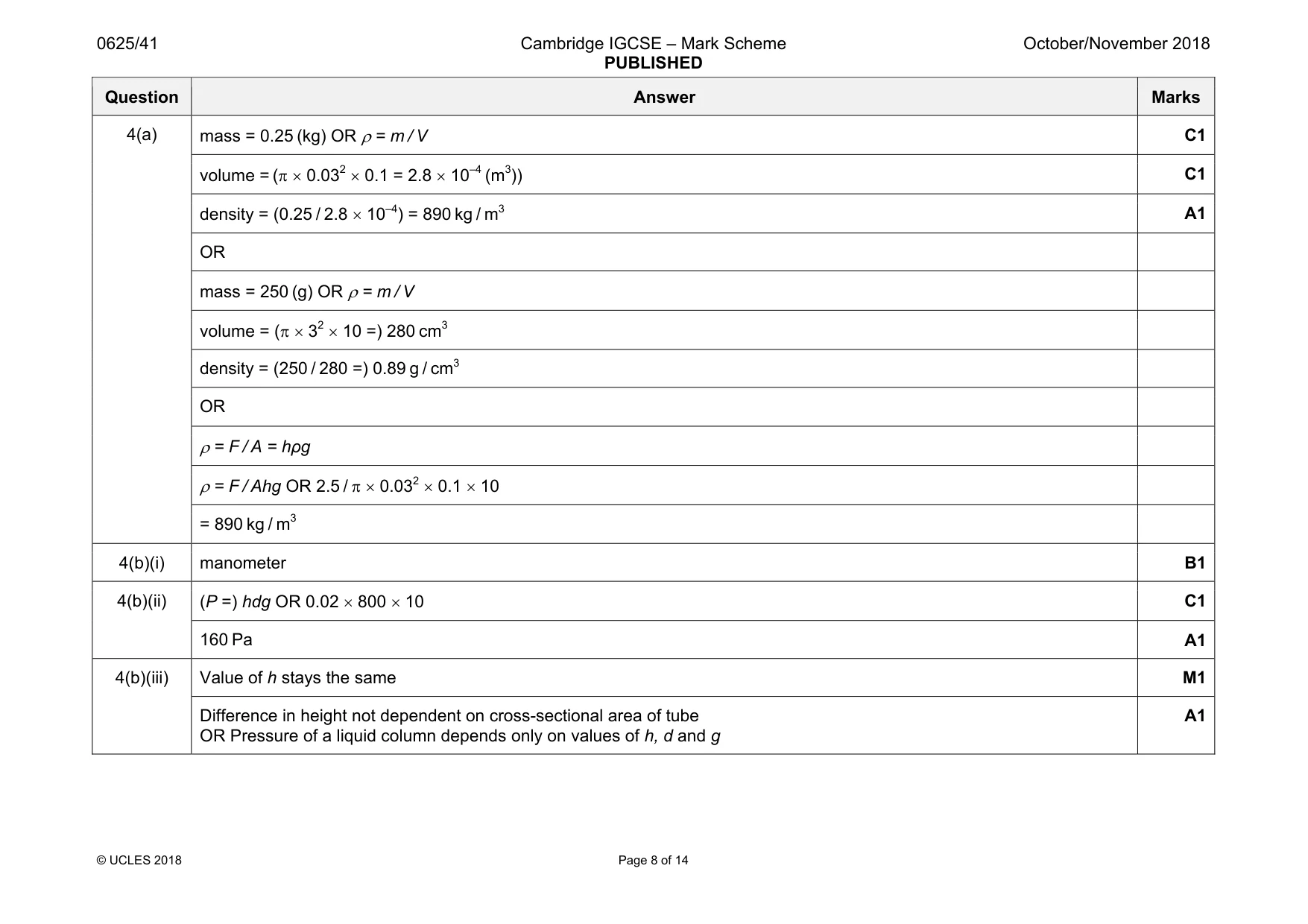
Mark scheme: 4(a) C1 volume = (π × 0.032 × 0.1 = 2.8 × 10⁻⁴ (m3)) C1 density = (0.25 / 2.8 × 10⁻⁴) = 890 kg / m3 A1 OR mass = 250 (g) OR ρ = m / V volume = (π × 32 × 10 =) 280 cm3 density = (250 / 280 =) 0.89 g / cm3 OR ρ = F / A = hρg ρ = F / Ahg OR 2.5 / π × 0.032 × 0.1 × 10 = 890 kg / m3 4(b)(i) manometer B1 4(b)(ii) (P =) hdg OR 0.02 × 800 × 10 C1 160 Pa A1 4(b)(iii) Value of h stays the same M1 Difference in height not dependent on cross-sectional area of tube OR Pressure of a liquid column depends only on values of h, d and g A1
Q5 · In the space below, draw a labelled diagram of the structure of a thermocouple thermometer
5 (a) (i) In the space below, draw a labelled diagram of the structure of a thermocouple thermometer. Include the device from which a reading is taken. [3] (ii) A thermocouple thermometer is used to measure the temperature of the flame of a small candle. State two reasons why the thermocouple thermometer is suitable for this application. 1. ....................................................................................................................................... ........................................................................................................................................... 2. ....................................................................................................................................... ........................................................................................................................................... [2] (b) State and explain any effect on the sensitivity of a liquid-in-glass thermometer of: (i) reducing the diameter of the capillary tube ........................................................................................................................................... ........................................................................................................................................... .......................................................................................................................................[2] (ii) increasing the volume of the liquid-filled bulb. ........................................................................................................................................... ........................................................................................................................................... .......................................................................................................................................[2] [Total: 9]
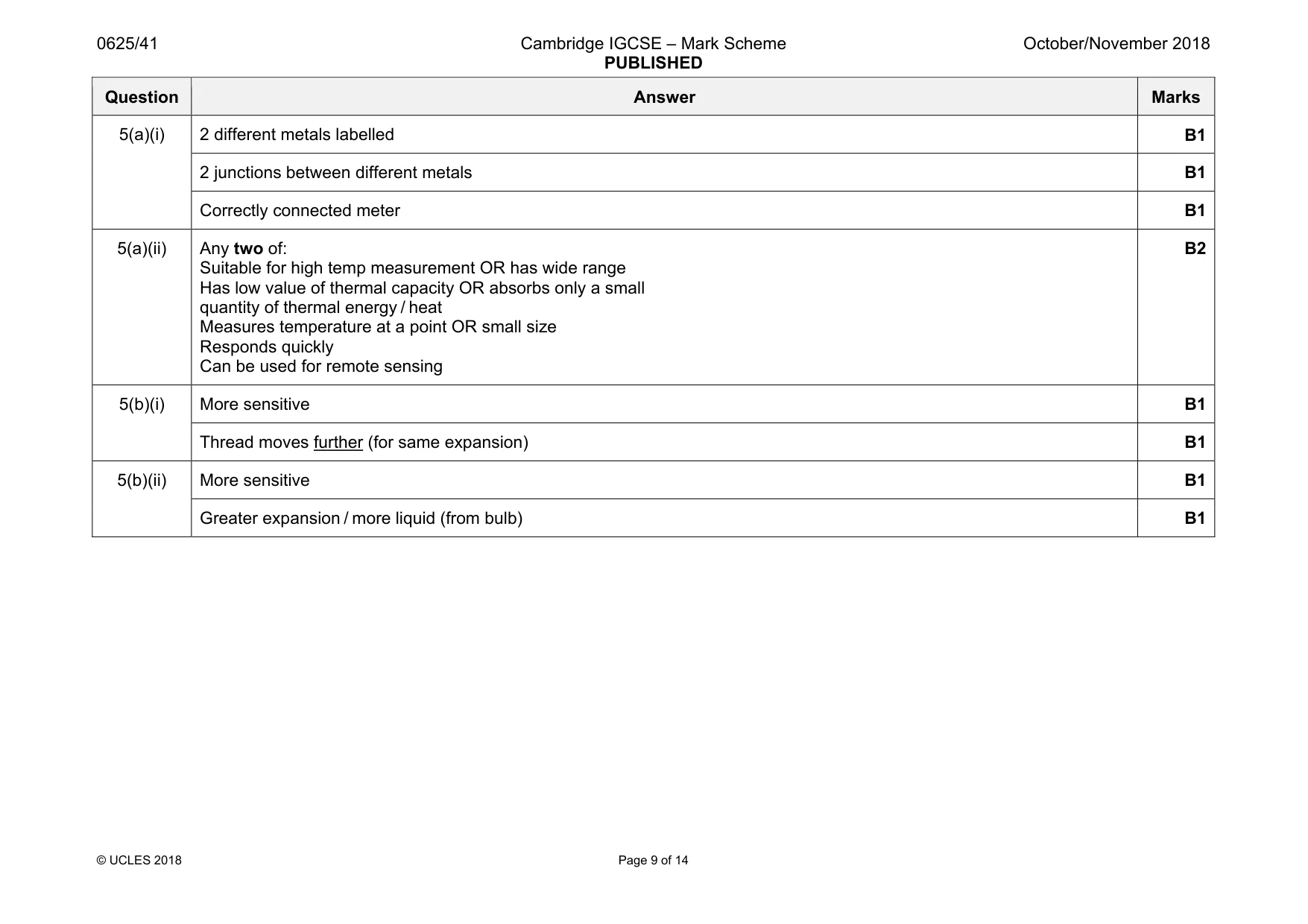
Mark scheme: 5(a)(i) 2 different metals labelled B1 2 junctions between different metals B1 Correctly connected meter B1 5(a)(ii) Any two of: Suitable for high temp measurement OR has wide range Has low value of thermal capacity OR absorbs only a small quantity of thermal energy / heat Measures temperature at a point OR small size Responds quickly Can be used for remote sensing B2 5(b)(i) More sensitive B1 Thread moves further (for same expansion) B1 5(b)(ii) More sensitive B1 Greater expansion / more liquid (from bulb) B1
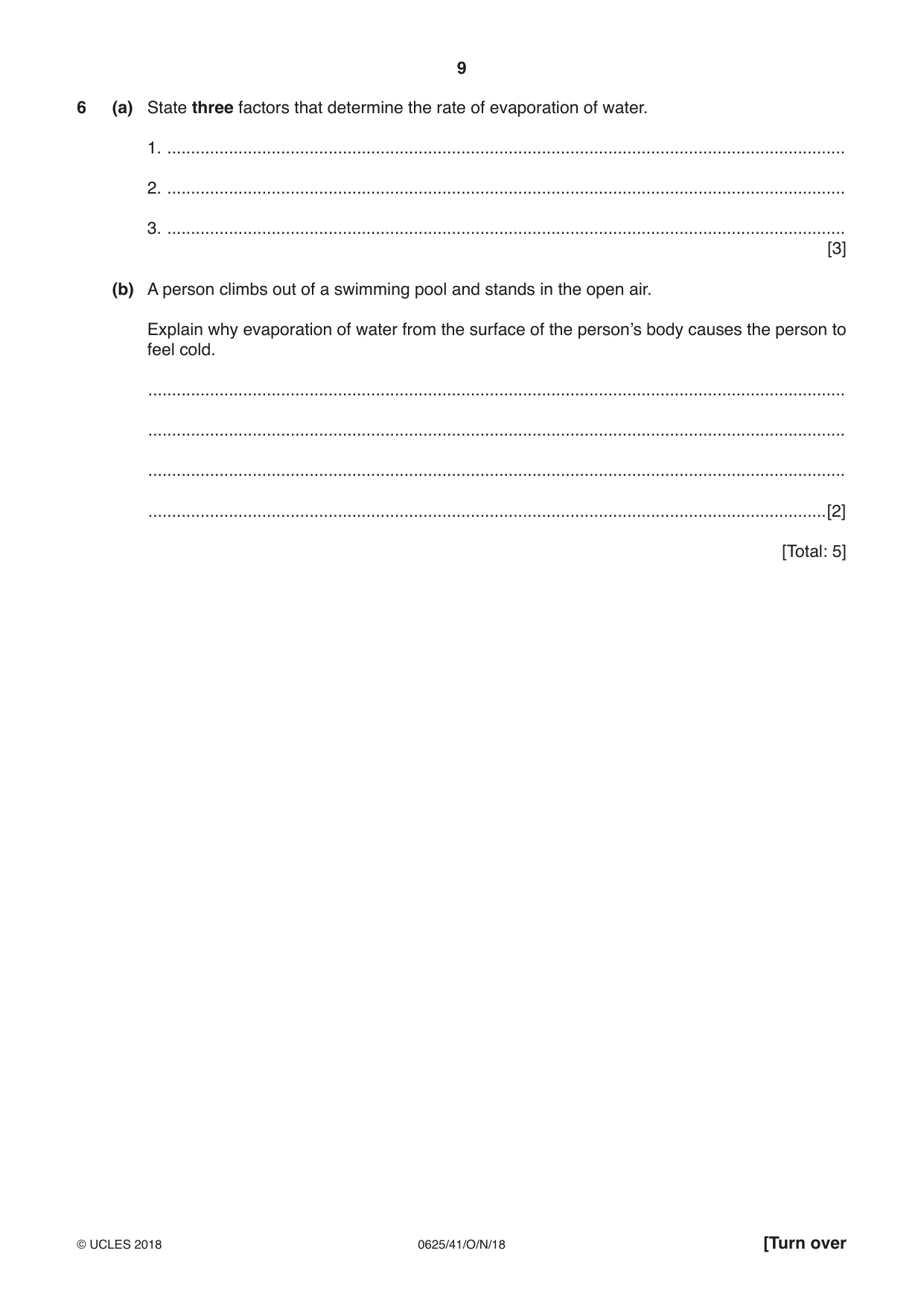
Q6 · State three factors that determine the rate of evaporation of water
6 (a) State three factors that determine the rate of evaporation of water. 1. ............................................................................................................................................... 2. ............................................................................................................................................... 3. ............................................................................................................................................... [3] (b) A person climbs out of a swimming pool and stands in the open air. Explain why evaporation of water from the surface of the person’s body causes the person to feel cold. ................................................................................................................................................... ................................................................................................................................................... ................................................................................................................................................... ...............................................................................................................................................[2] [Total: 5]
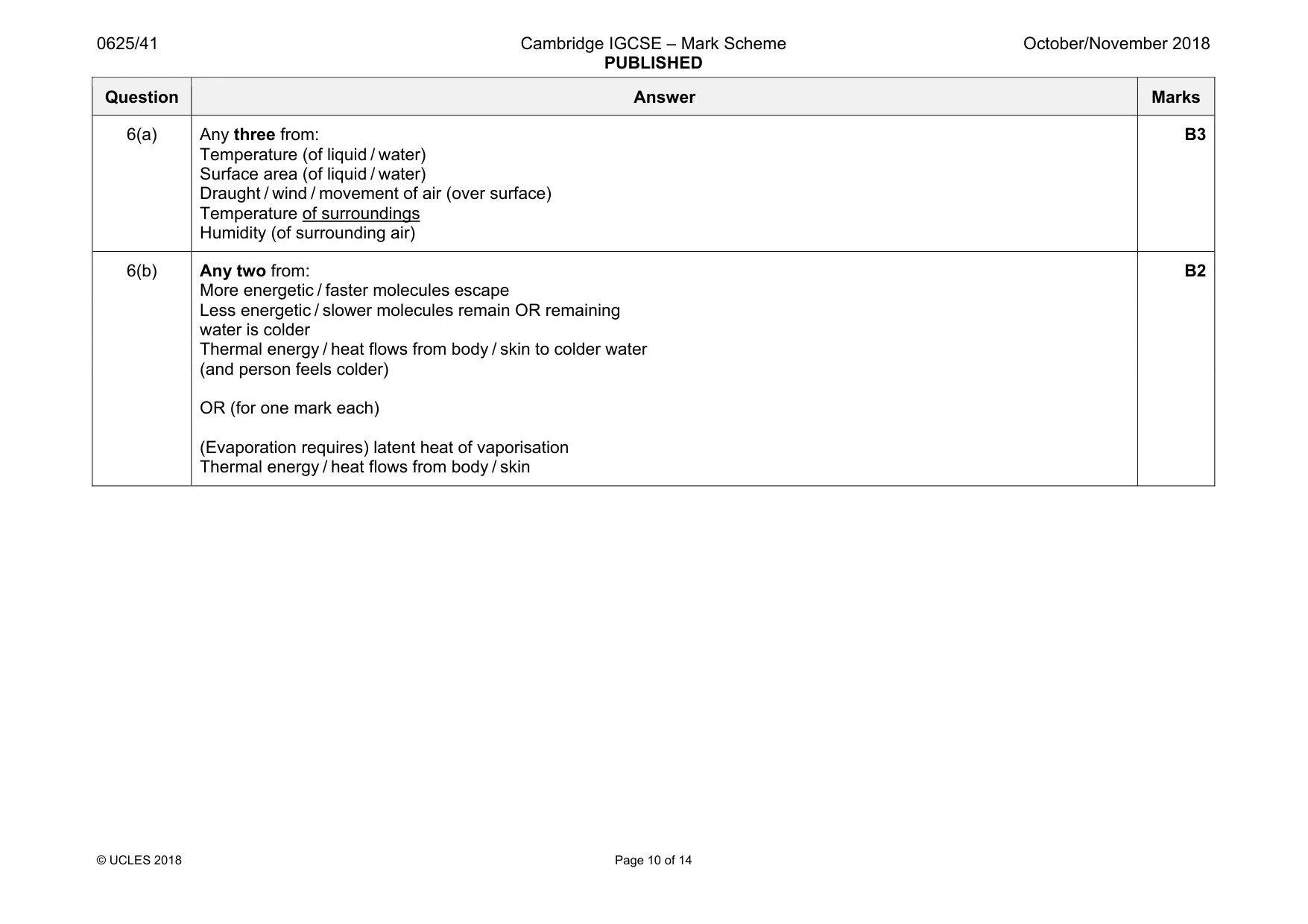
Mark scheme: 6(a) Any three from: Temperature (of liquid / water) Surface area (of liquid / water) Draught / wind / movement of air (over surface) Temperature of surroundings Humidity (of surrounding air) B3 6(b) Any two from: More energetic / faster molecules escape Less energetic / slower molecules remain OR remaining water is colder Thermal energy / heat flows from body / skin to colder water (and person feels colder) OR (for one mark each) (Evaporation requires) latent heat of vaporisation Thermal energy / heat flows from body / skin B2
Q7 · A laser produces a beam of monochromatic light
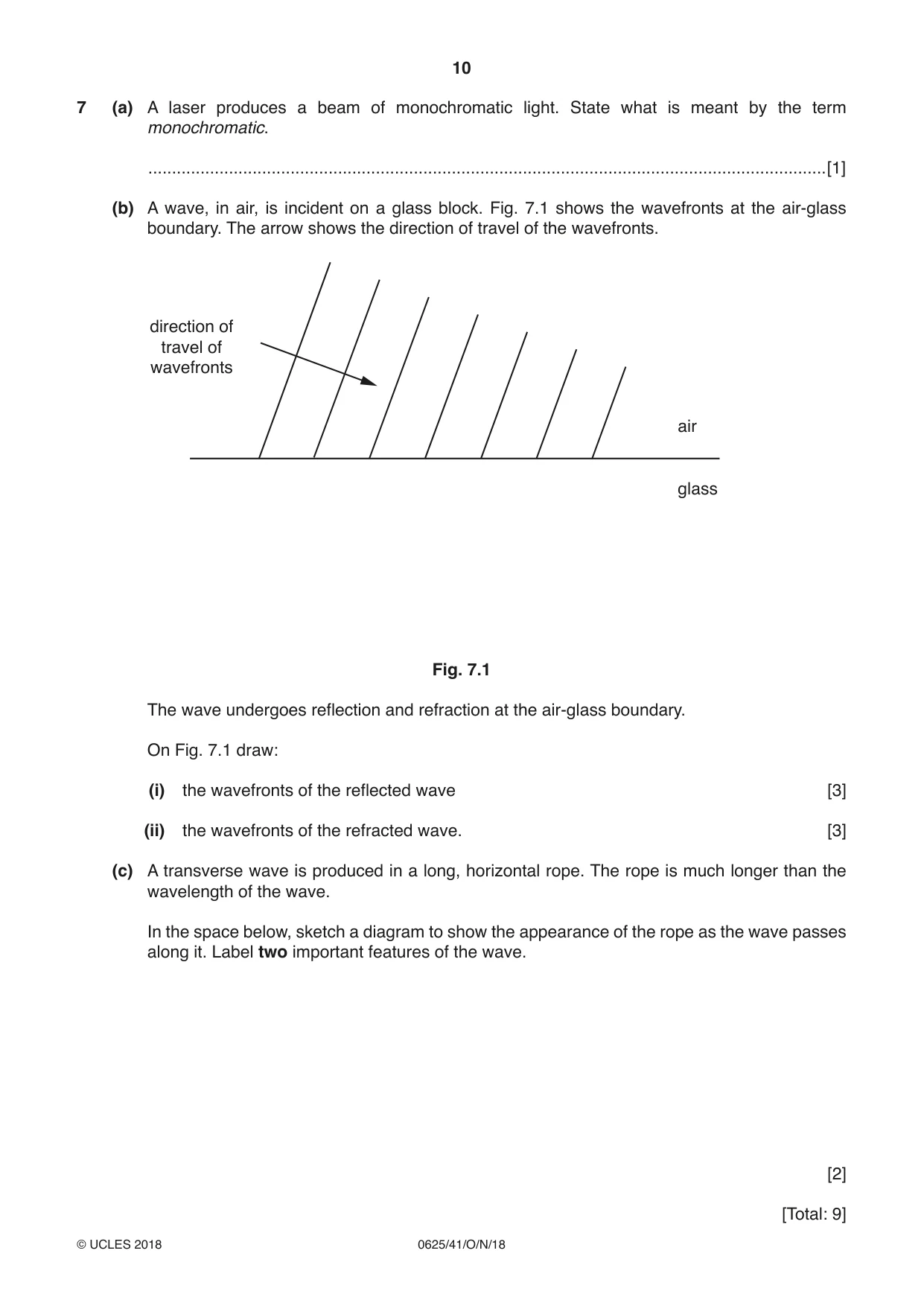
7 (a) A laser produces a beam of monochromatic light. State what is meant by the term monochromatic. ...............................................................................................................................................[1] (b) A wave, in air, is incident on a glass block. Fig. 7.1 shows the wavefronts at the air-glass boundary. The arrow shows the direction of travel of the wavefronts. direction of travel of wavefronts air glass Fig. 7.1 The wave undergoes reflection and refraction at the air-glass boundary. On Fig. 7.1 draw: (i) the wavefronts of the reflected wave [3] (ii) the wavefronts of the refracted wave. [3] (c) A transverse wave is produced in a long, horizontal rope. The rope is much longer than the wavelength of the wave. In the space below, sketch a diagram to show the appearance of the rope as the wave passes along it. Label two important features of the wave. [2] [Total: 9]
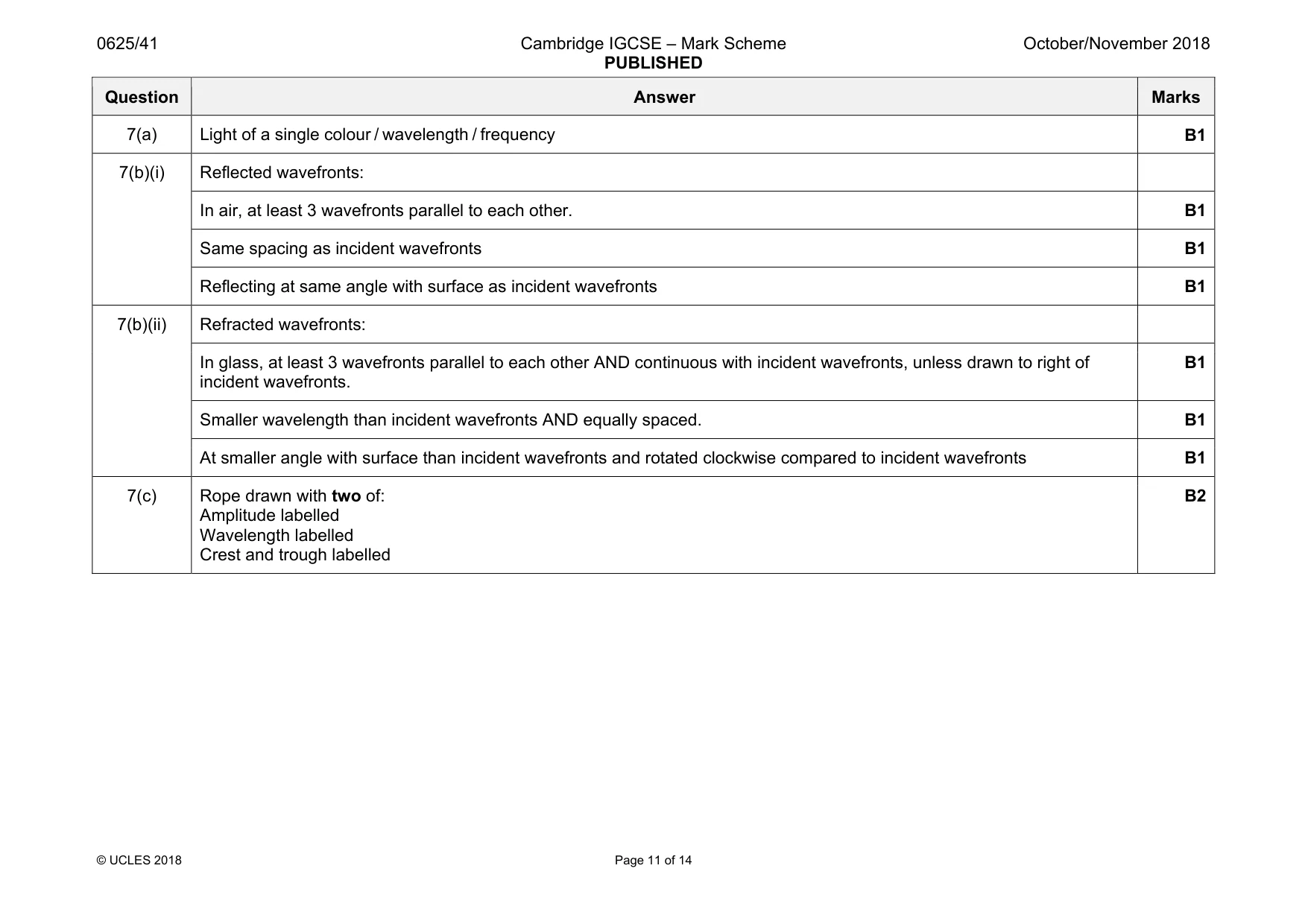
Mark scheme: 7(a) Light of a single colour / wavelength / frequency B1 7(b)(i) Reflected wavefronts: In air, at least 3 wavefronts parallel to each other. B1 Same spacing as incident wavefronts B1 Reflecting at same angle with surface as incident wavefronts B1 7(b)(ii) Refracted wavefronts: In glass, at least 3 wavefronts parallel to each other AND continuous with incident wavefronts, unless drawn to right of incident wavefronts. B1 Smaller wavelength than incident wavefronts AND equally spaced. B1 At smaller angle with surface than incident wavefronts and rotated clockwise compared to incident wavefronts B1 7(c) Rope drawn with two of: Amplitude labelled Wavelength labelled Crest and trough labelled B2
Q8 · A vibrating source on a ship produces a sound wave that travels through the ocean
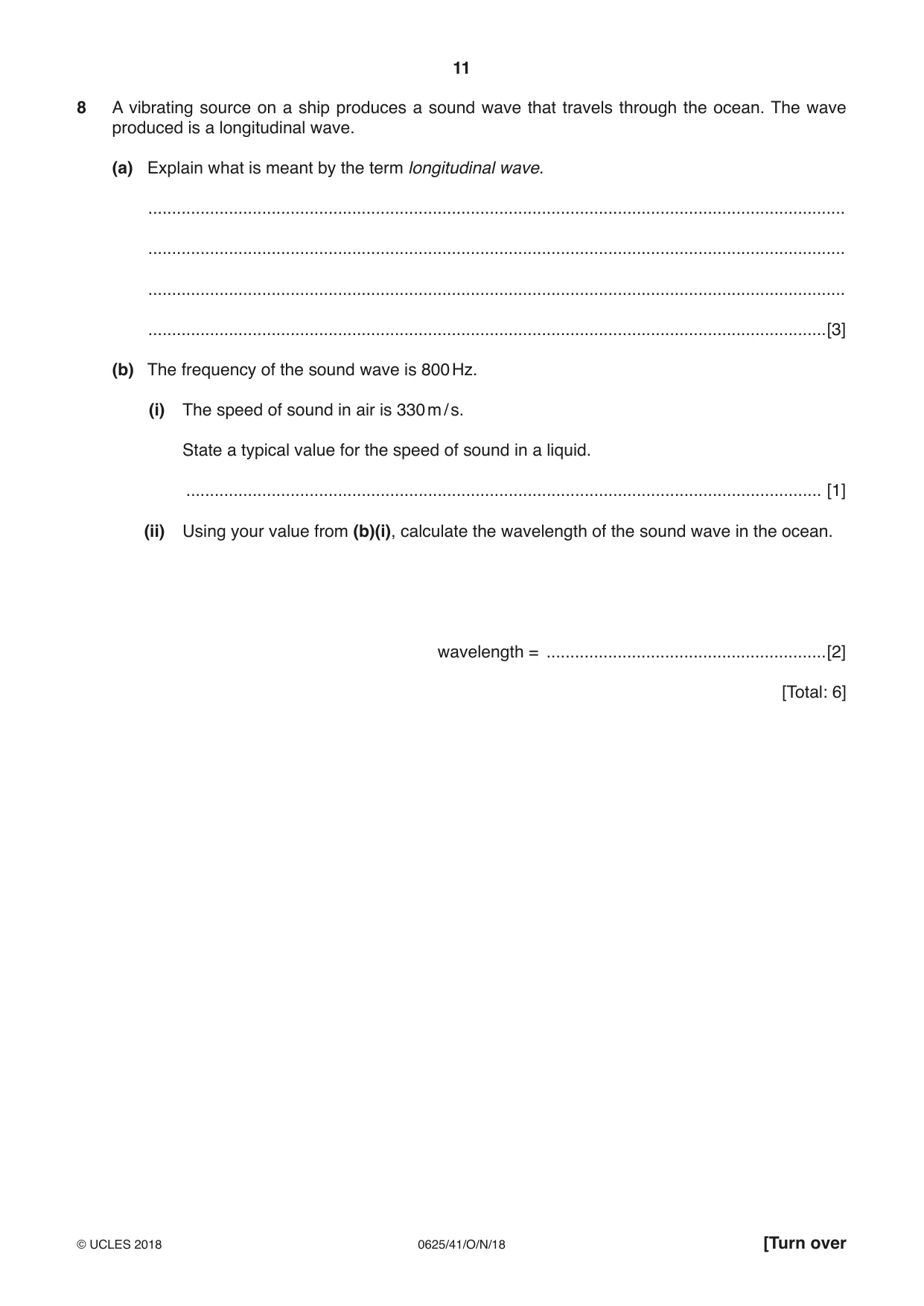
8 A vibrating source on a ship produces a sound wave that travels through the ocean. The wave produced is a longitudinal wave. (a) Explain what is meant by the term longitudinal wave. ................................................................................................................................................... ................................................................................................................................................... ................................................................................................................................................... ...............................................................................................................................................[3] (b) The frequency of the sound wave is 800 Hz. (i) The speed of sound in air is 330 m / s. State a typical value for the speed of sound in a liquid. ...................................................................................................................................... [1] (ii) Using your value from (b)(i), calculate the wavelength of the sound wave in the ocean. wavelength = ...........................................................[2] [Total: 6]
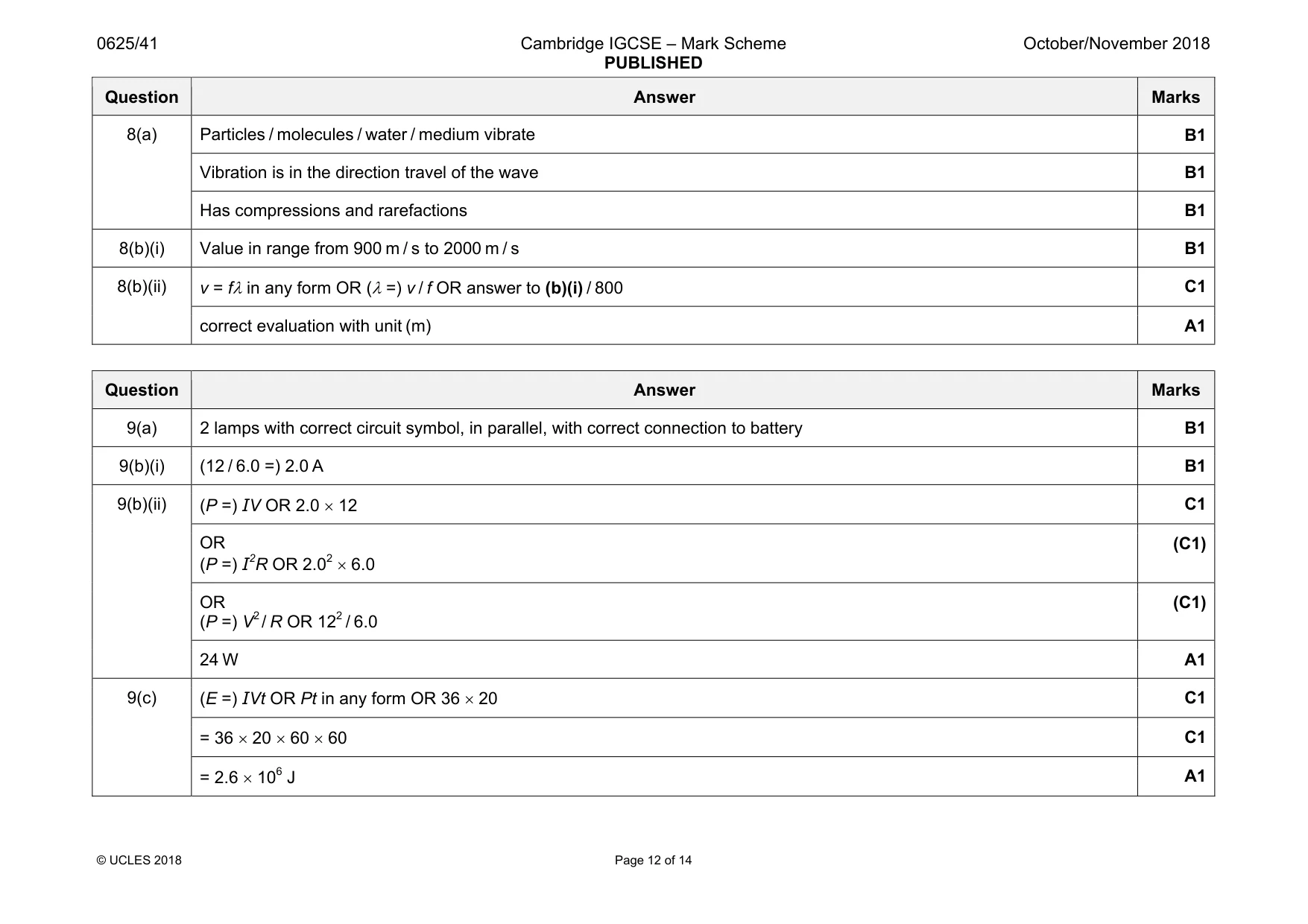
Mark scheme: 8(a) Particles / molecules / water / medium vibrate B1 Vibration is in the direction travel of the wave B1 Has compressions and rarefactions B1 8(b)(i) Value in range from 900 m / s to 2000 m / s B1 8(b)(ii) v = fλ in any form OR (λ =) v / f OR answer to (b)(i) / 800 C1 correct evaluation with unit (m) A1
Q9 · The symbol for a 12 V battery
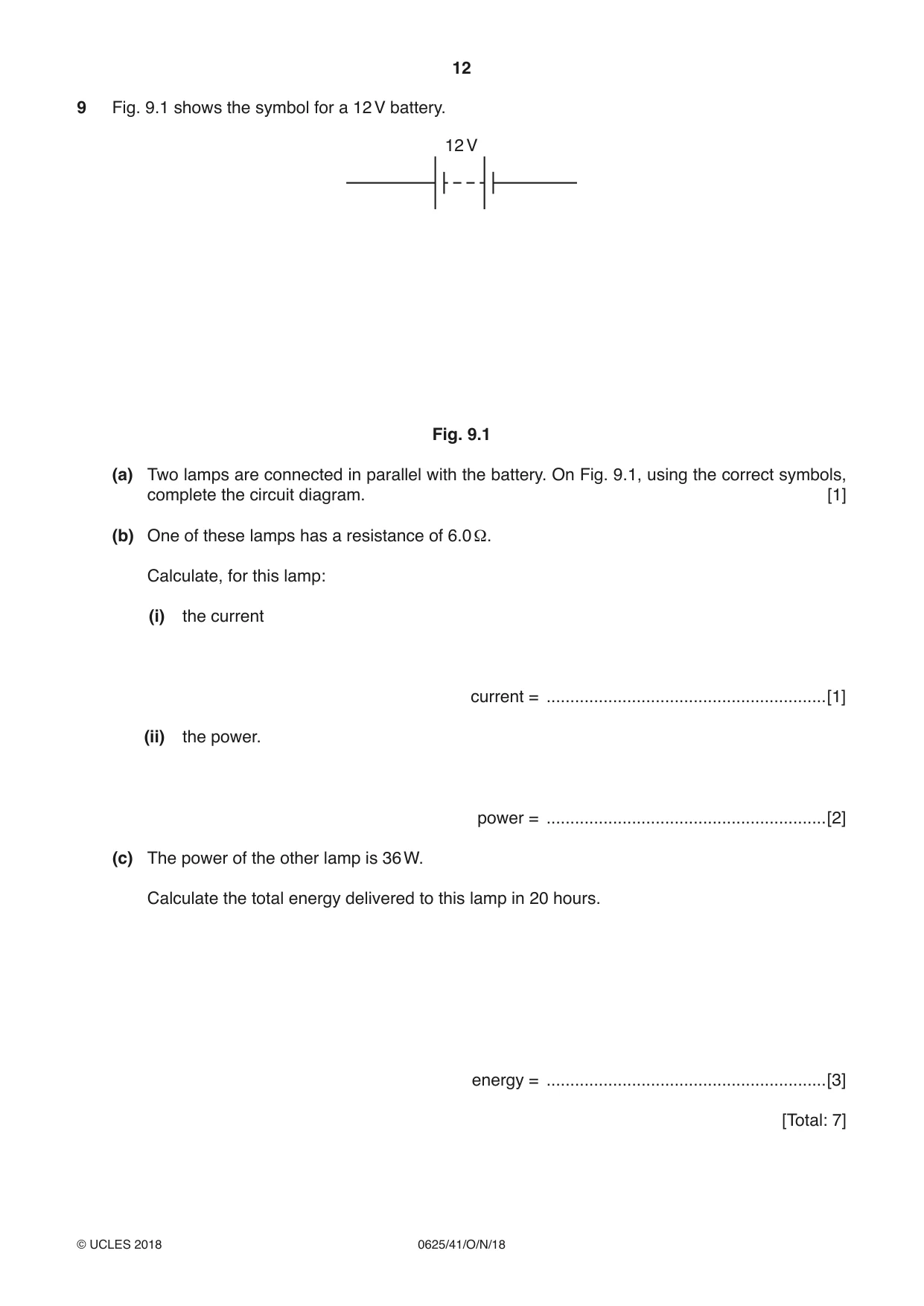
9 Fig. 9.1 shows the symbol for a 12 V battery. 12 V Fig. 9.1 (a) Two lamps are connected in parallel with the battery. On Fig. 9.1, using the correct symbols, complete the circuit diagram. [1] (b) One of these lamps has a resistance of 6.0 Ω. Calculate, for this lamp: (i) the current current = ...........................................................[1] (ii) the power. power = ...........................................................[2] (c) The power of the other lamp is 36 W. Calculate the total energy delivered to this lamp in 20 hours. energy = ...........................................................[3] [Total: 7]
Mark scheme: 9(a) 2 lamps with correct circuit symbol, in parallel, with correct connection to battery B1 9(b)(i) (12 / 6.0 =) 2.0 A B1 9(b)(ii) (P =) IV OR 2.0 × 12 C1 OR (P =) I2R OR 2.02 × 6.0 (C1) OR (P =) V2 / R OR 122 / 6.0 (C1) 24 W A1 9(c) (E =) IVt OR Pt in any form OR 36 × 20 C1 = 36 × 20 × 60 × 60 C1 = 2.6 × 10⁶ J A1
Q10 · A transformer consists of two coils of wire wound on a metal core
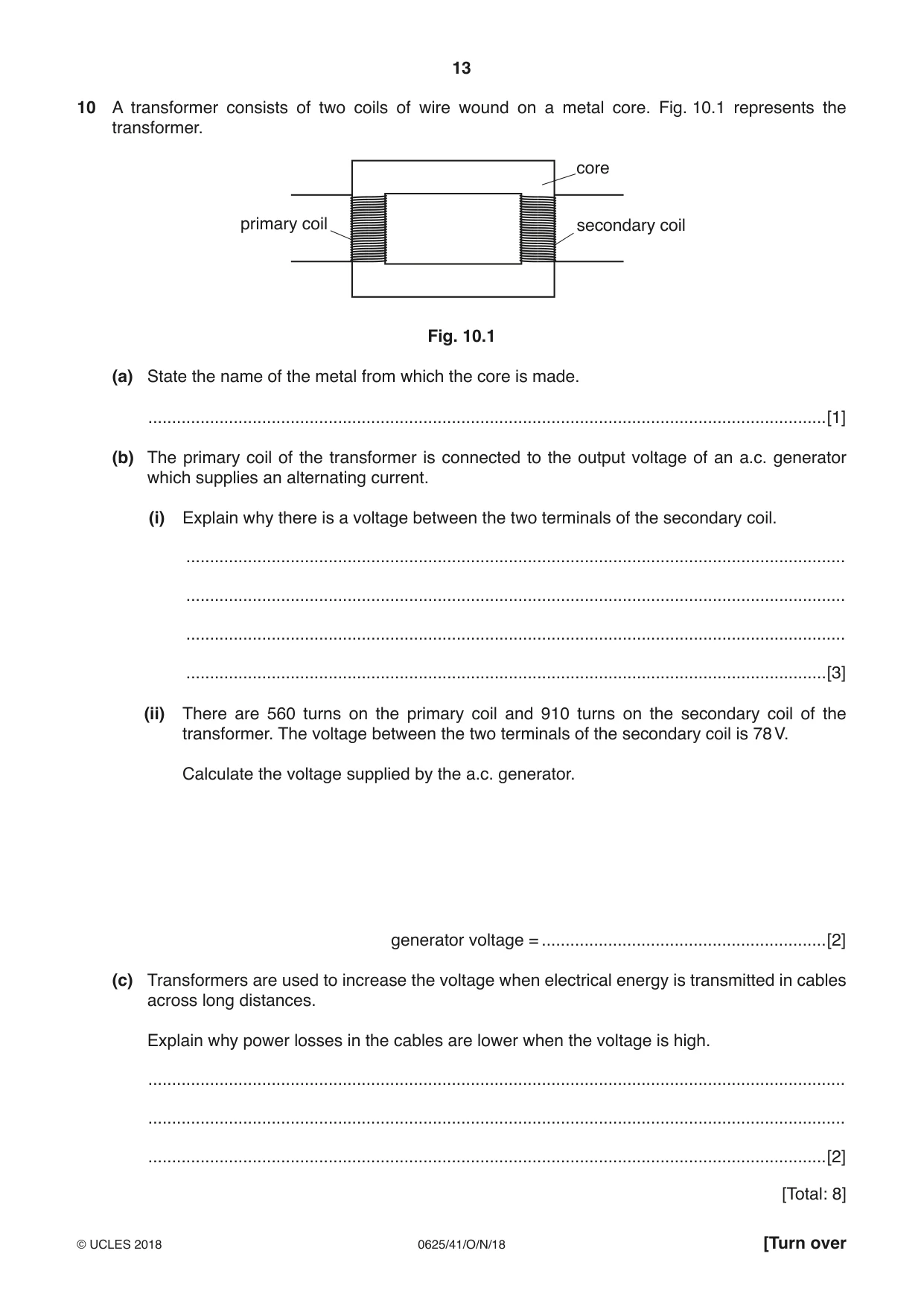
10 A transformer consists of two coils of wire wound on a metal core. Fig. 10.1 represents the transformer. core primary coil secondary coil Fig. 10.1 (a) State the name of the metal from which the core is made. ...............................................................................................................................................[1] (b) The primary coil of the transformer is connected to the output voltage of an a.c. generator which supplies an alternating current. (i) Explain why there is a voltage between the two terminals of the secondary coil. ........................................................................................................................................... ........................................................................................................................................... ........................................................................................................................................... .......................................................................................................................................[3] (ii) There are 560 turns on the primary coil and 910 turns on the secondary coil of the transformer. The voltage between the two terminals of the secondary coil is 78 V. Calculate the voltage supplied by the a.c. generator. generator voltage = ............................................................[2] (c) Transformers are used to increase the voltage when electrical energy is transmitted in cables across long distances. Explain why power losses in the cables are lower when the voltage is high. ................................................................................................................................................... ................................................................................................................................................... ...............................................................................................................................................[2] [Total: 8]
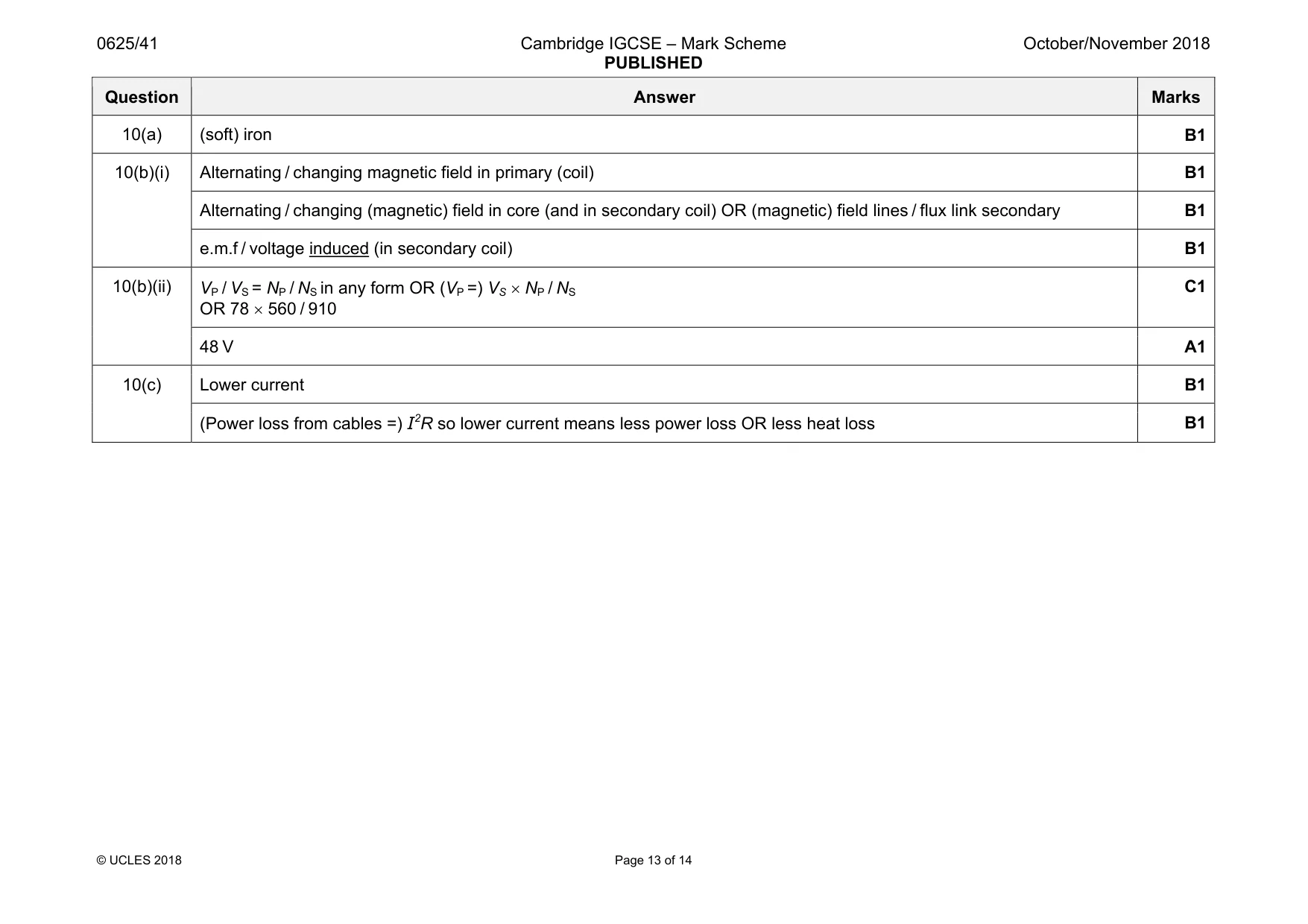
Mark scheme: 10(a) (soft) iron B1 10(b)(i) Alternating / changing magnetic field in primary (coil) B1 Alternating / changing (magnetic) field in core (and in secondary coil) OR (magnetic) field lines / flux link secondary B1 e.m.f / voltage induced (in secondary coil) B1 10(b)(ii) VP / VS = NP / NS in any form OR (VP =) VS × NP / NS OR 78 × 560 / 910 C1 48 V A1 10(c) Lower current B1 (Power loss from cables =) I2R so lower current means less power loss OR less heat loss B1
Q11 · Data about nine elements
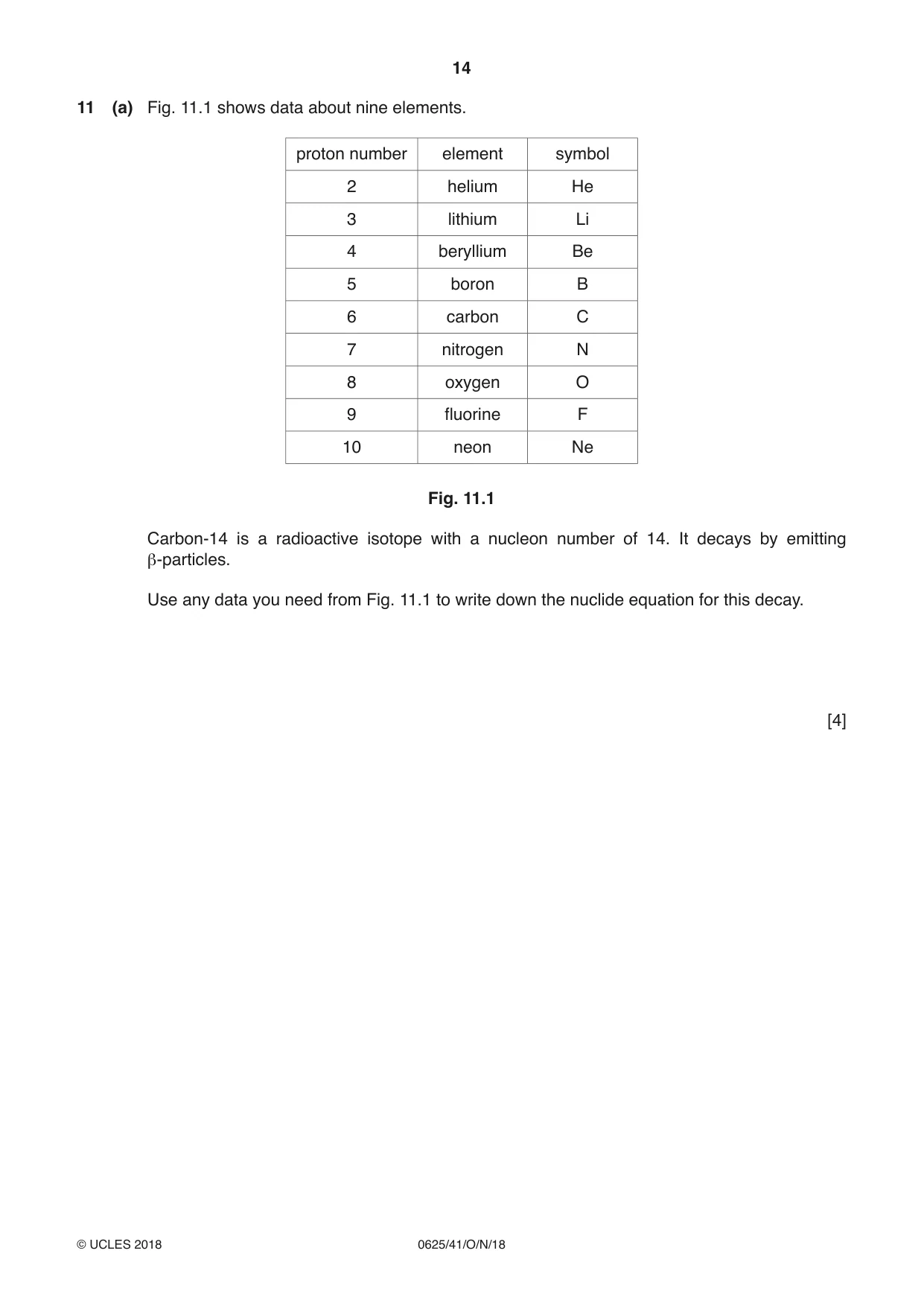
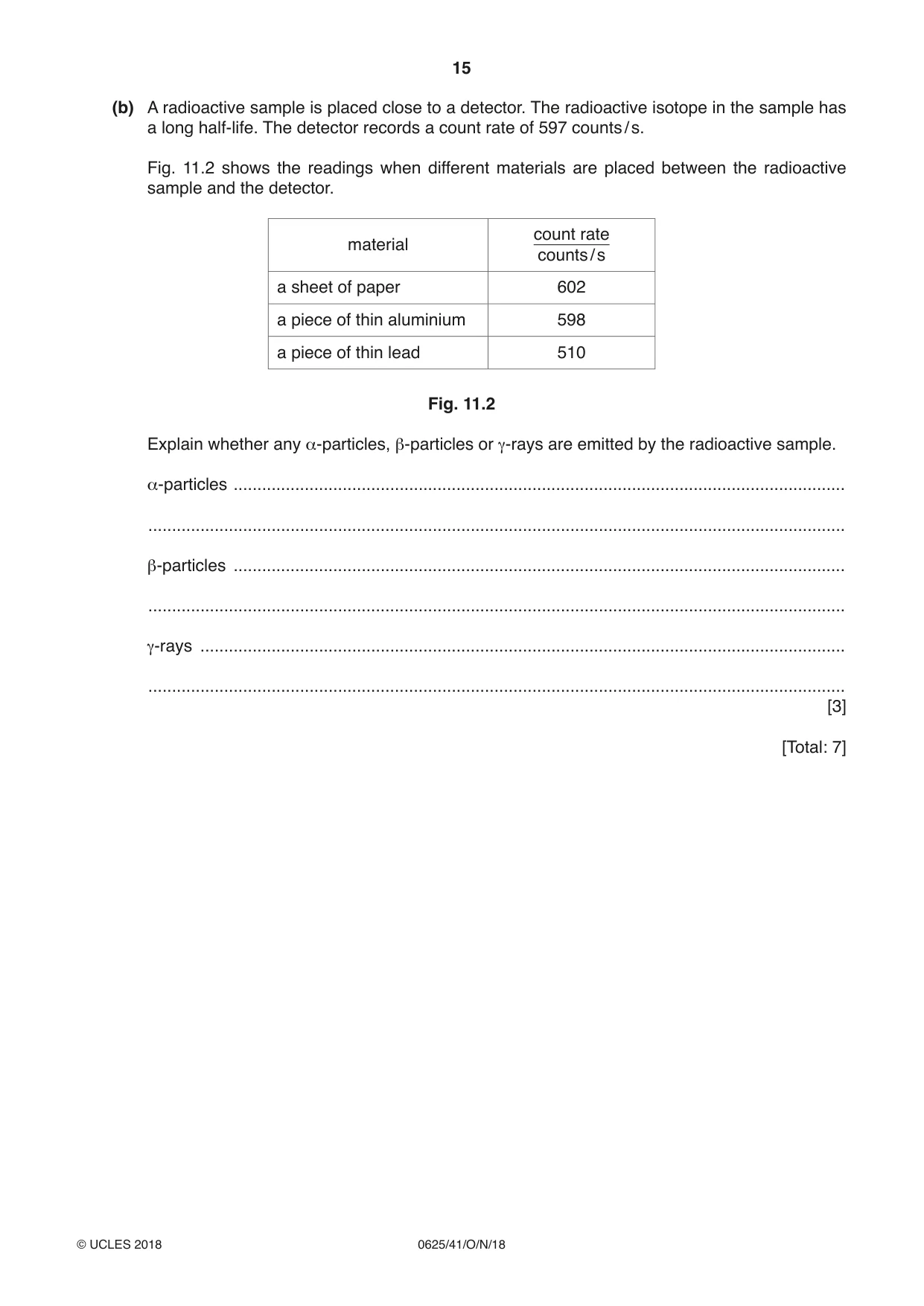
11 (a) Fig. 11.1 shows data about nine elements. proton number element symbol 2 helium He 3 lithium Li 4 beryllium Be 5 boron B 6 carbon C 7 nitrogen N 8 oxygen O 9 fluorine F 10 neon Ne Fig. 11.1 Carbon-14 is a radioactive isotope with a nucleon number of 14. It decays by emitting β-particles. Use any data you need from Fig. 11.1 to write down the nuclide equation for this decay. [4] (b) A radioactive sample is placed close to a detector. The radioactive isotope in the sample has a long half-life. The detector records a count rate of 597 counts / s. Fig. 11.2 shows the readings when different materials are placed between the radioactive sample and the detector. count rate material counts / s a sheet of paper 602 a piece of thin aluminium 598 a piece of thin lead 510 Fig. 11.2 Explain whether any α-particles, β-particles or γ-rays are emitted by the radioactive sample. α-particles ................................................................................................................................. ................................................................................................................................................... β-particles ................................................................................................................................. ................................................................................................................................................... γ-rays ........................................................................................................................................ ................................................................................................................................................... [3] [Total: 7]
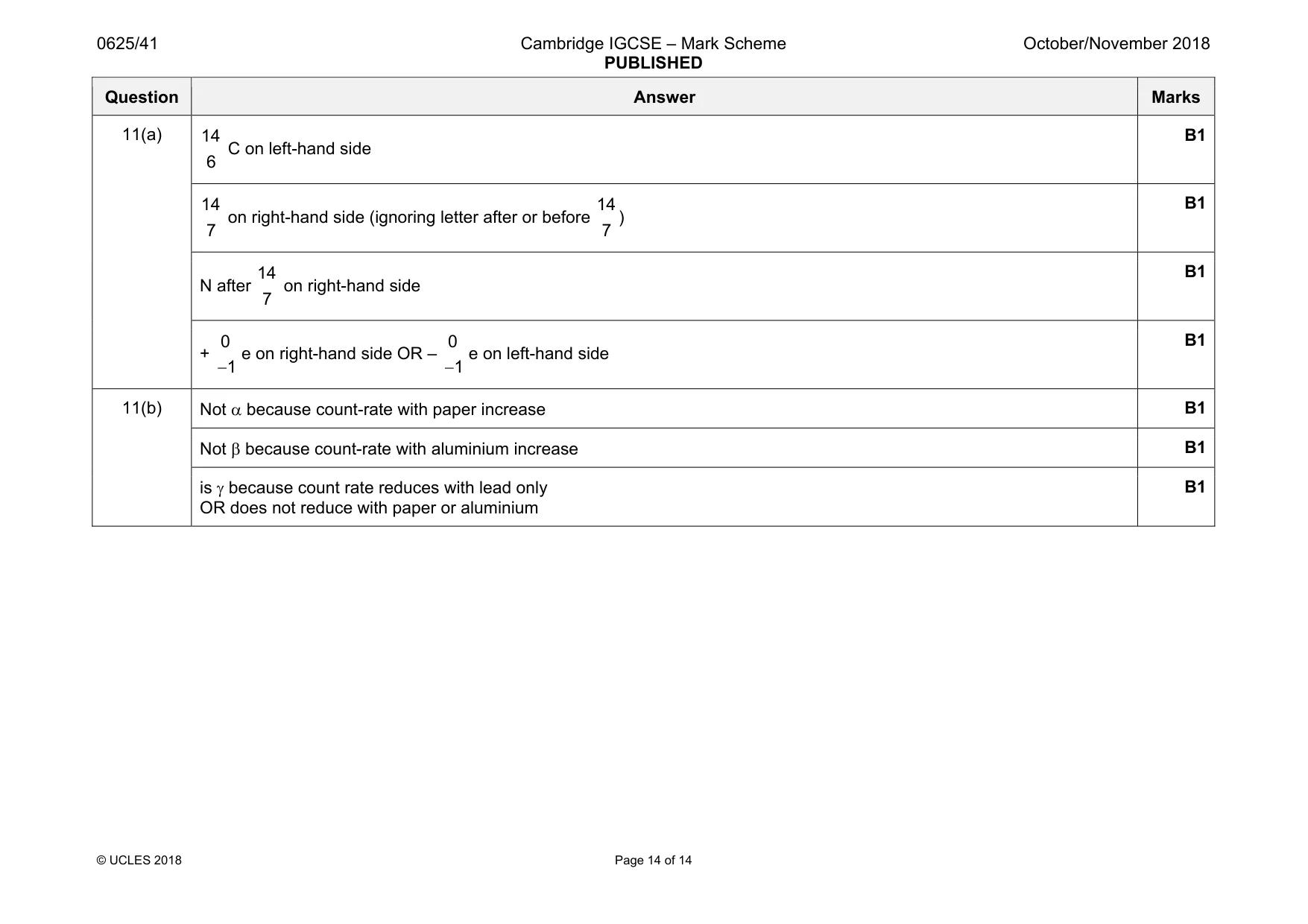
Mark scheme: 11(a) 14 6 C on left-hand side B1 14 7 on right-hand side (ignoring letter after or before 14 7 ) B1 N after 14 7 on right-hand side B1 + 0 1 − e on right-hand side OR – 0 1 − e on left-hand side B1 11(b) Not α because count-rate with paper increase B1 Not β because count-rate with aluminium increase B1 is γ because count rate reduces with lead only OR does not reduce with paper or aluminium B1
What was in this paper
The subtopics covered by these 11 questions, and how many questions each got. Open one in a new tab to see every Cambridge question on it.
What you needed in this session
Cambridge’s own grade thresholds for 2018 Oct/Nov, Paper 4 · Variant 1. A higher threshold means an easier paper — the bar moves with how the cohort did.