Cambridge IGCSE Physics 0625 — 2016 Oct/Nov Paper 4 · Variant 1
0625/41/O/N/16 · 12 questions · 80 marks · ≈90 min
The question paper and its mark scheme, free to read here and free to download. This is Cambridge’s own paper, exactly as it was sat.
Question paper16 pages
Mark scheme11 pages
Answers below. Sit the paper first if you are practising.
Questions as text
Q1 · An astronaut on the Moon drops a feather from rest, off the top of a small cliff
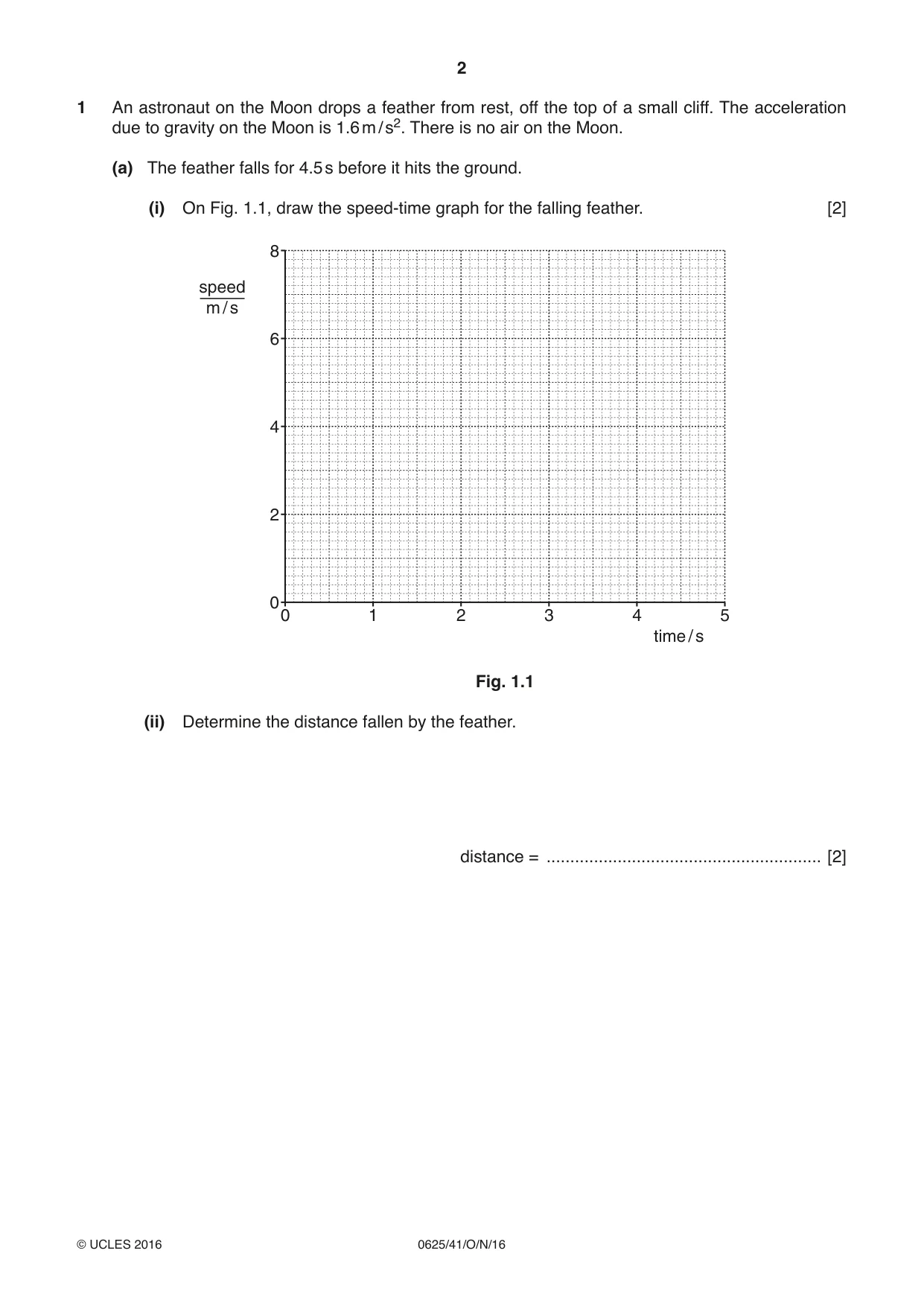
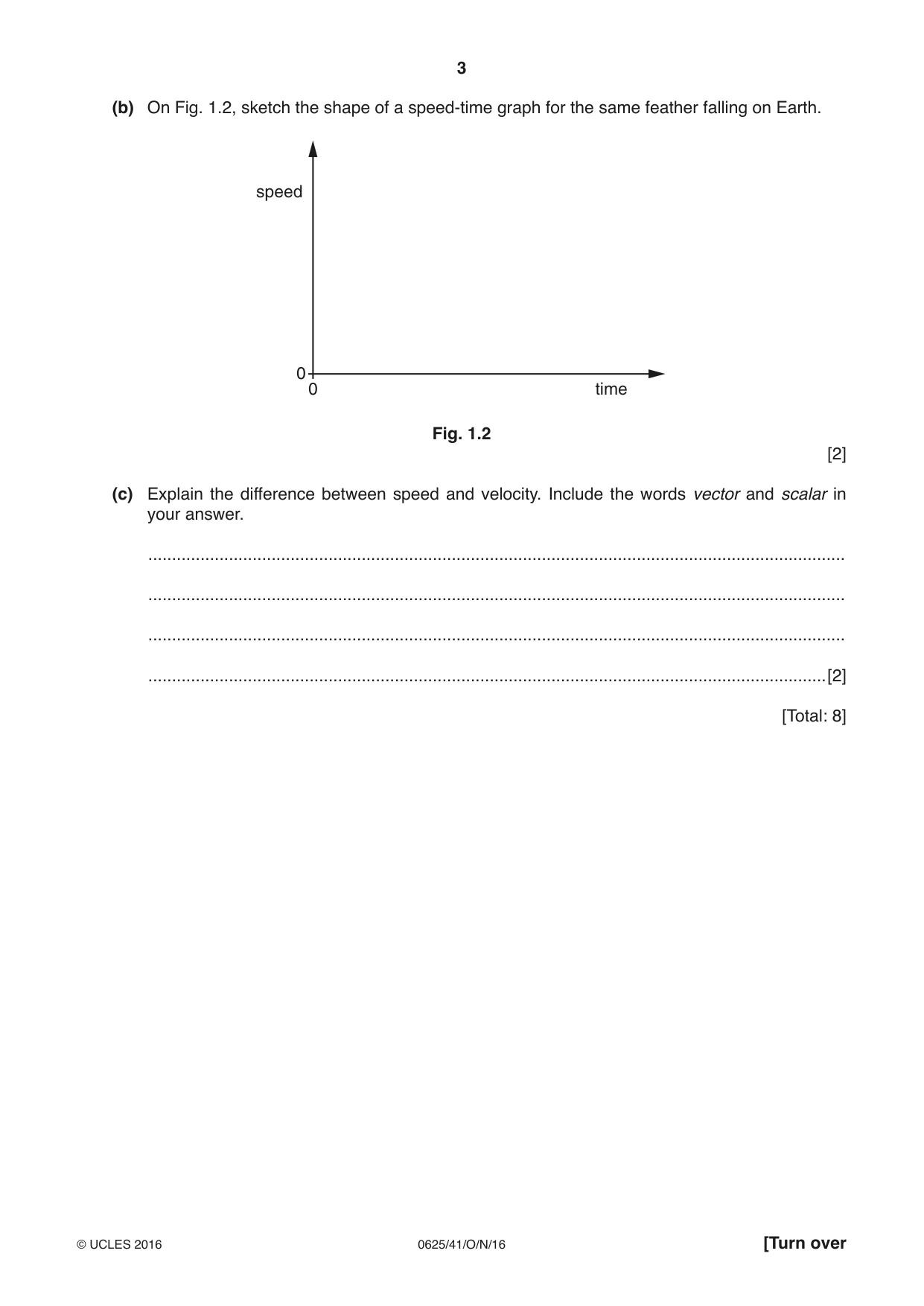
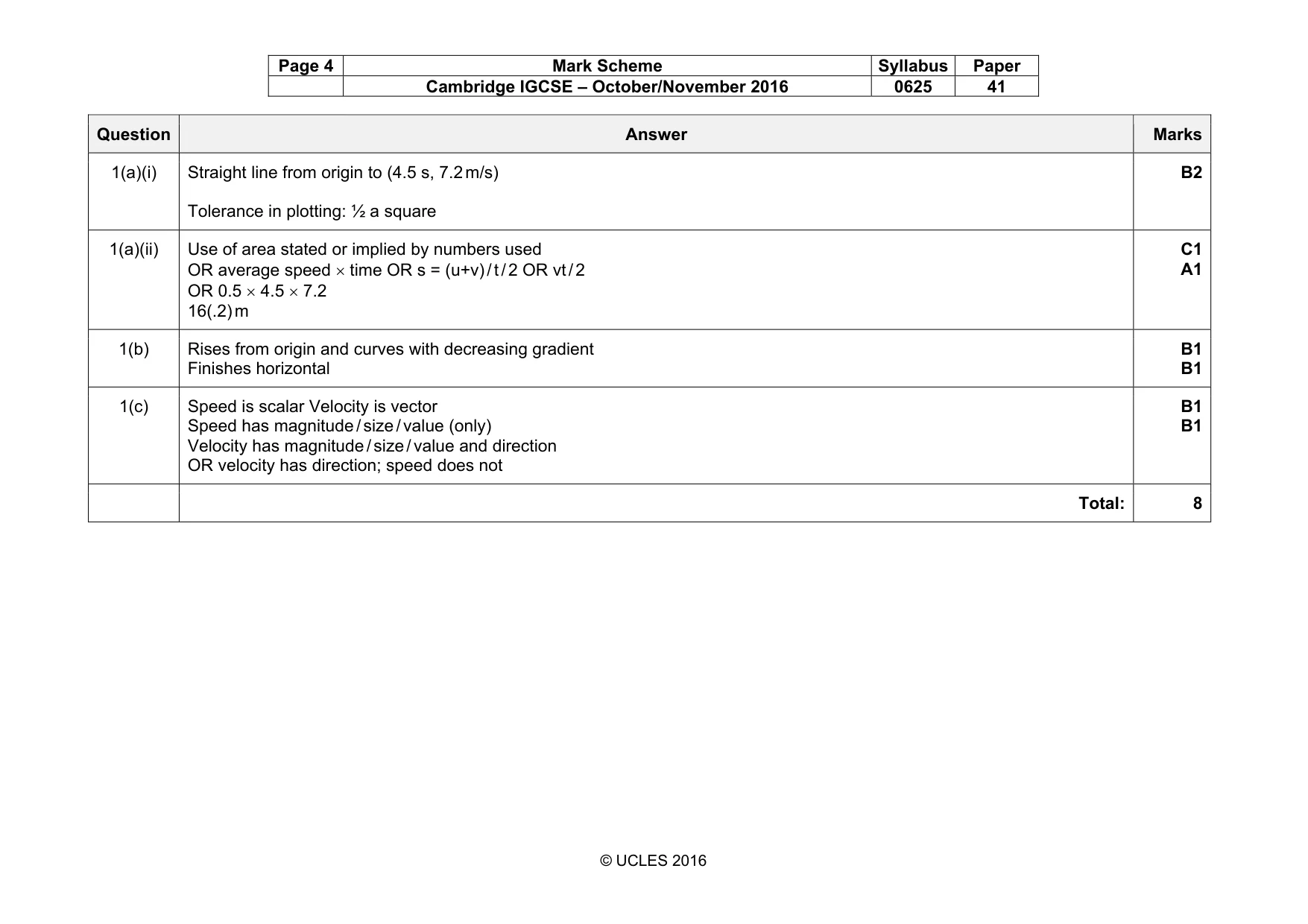
1 An astronaut on the Moon drops a feather from rest, off the top of a small cliff. The acceleration due to gravity on the Moon is 1.6 m / s2. There is no air on the Moon. (a) The feather falls for 4.5 s before it hits the ground. (i) On Fig. 1.1, draw the speed-time graph for the falling feather. [2] 8 speed m / s 6 4 2 0 0 1 2 3 4 5 time / s Fig. 1.1 (ii) Determine the distance fallen by the feather. distance = .......................................................... [2] (b) On Fig. 1.2, sketch the shape of a speed-time graph for the same feather falling on Earth. speed 0 0 time Fig. 1.2 [2] (c) Explain the difference between speed and velocity. Include the words vector and scalar in your answer. ................................................................................................................................................... ................................................................................................................................................... ................................................................................................................................................... ...............................................................................................................................................[2] [Total: 8]
Mark scheme: 1(a)(i) Straight line from origin to (4.5 s, 7.2 m/s) Tolerance in plotting: ½ a square B2 1(a)(ii) Use of area stated or implied by numbers used OR average speed × time OR s = (u+v) / t / 2 OR vt / 2 OR 0.5 × 4.5 × 7.2 16(.2) m C1 A1 1(b) Rises from origin and curves with decreasing gradient Finishes horizontal B1 B1 1(c) Speed is scalar Velocity is vector Speed has magnitude / size / value (only) Velocity has magnitude / size / value and direction OR velocity has direction; speed does not B1 B1 Total: 8
Q2 · The cross-section of an oil tanker in a river
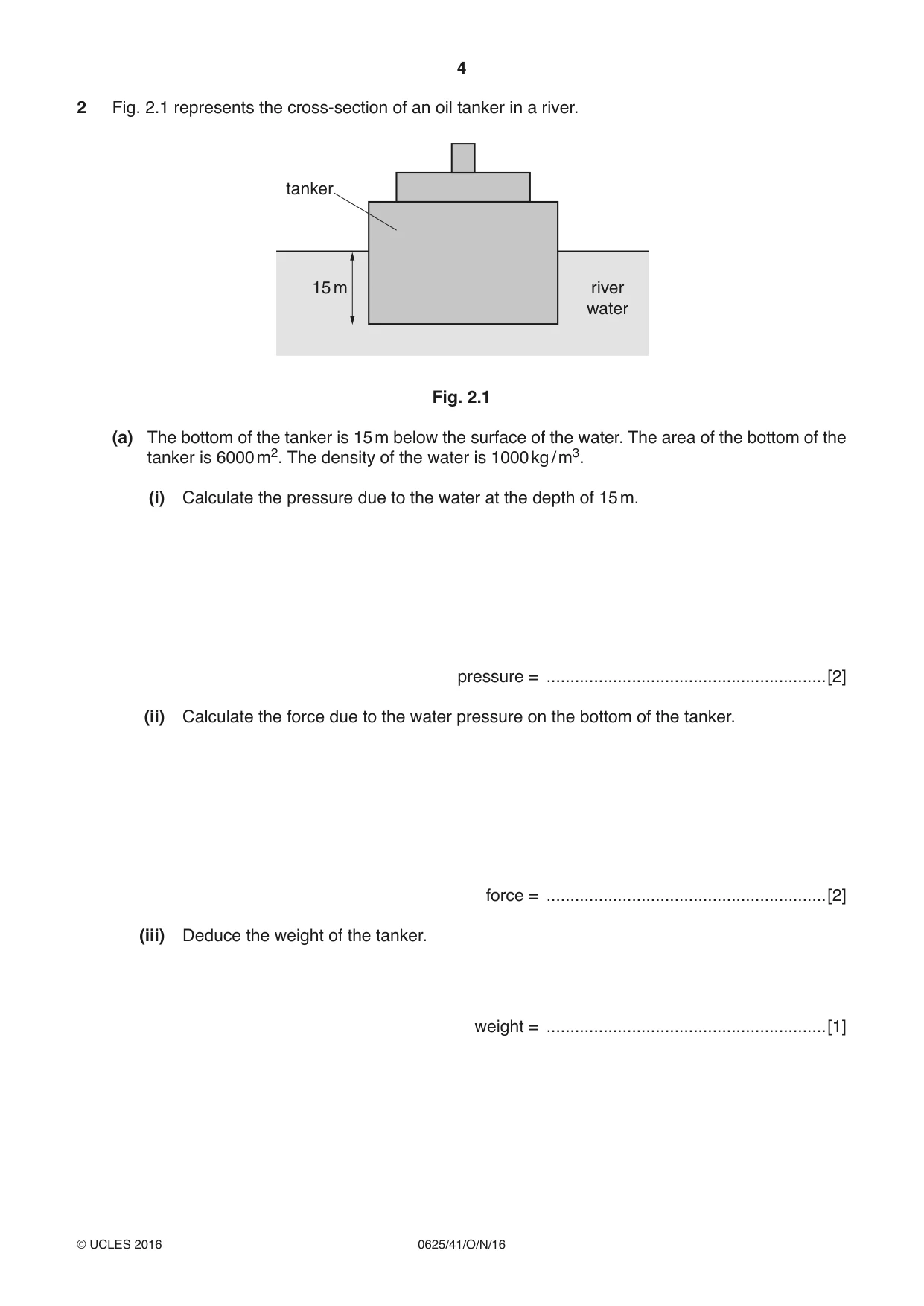
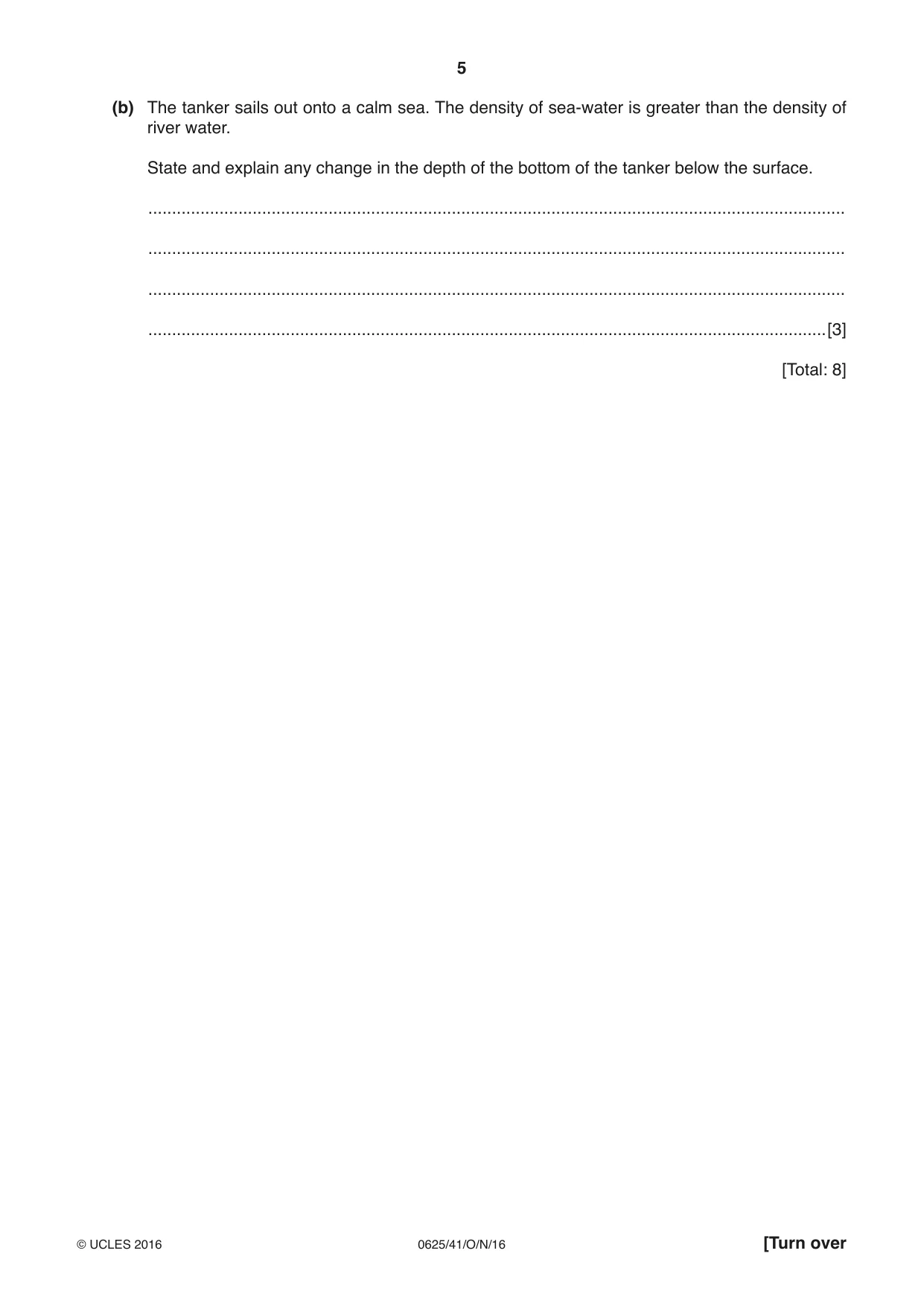
2 Fig. 2.1 represents the cross-section of an oil tanker in a river. tanker 15 m river water Fig. 2.1 (a) The bottom of the tanker is 15 m below the surface of the water. The area of the bottom of the tanker is 6000 m2. The density of the water is 1000 kg / m3. (i) Calculate the pressure due to the water at the depth of 15 m. pressure = ...........................................................[2] (ii) Calculate the force due to the water pressure on the bottom of the tanker. force = ...........................................................[2] (iii) Deduce the weight of the tanker. weight = ...........................................................[1] (b) The tanker sails out onto a calm sea. The density of sea-water is greater than the density of river water. State and explain any change in the depth of the bottom of the tanker below the surface. ................................................................................................................................................... ................................................................................................................................................... ................................................................................................................................................... ...............................................................................................................................................[3] [Total: 8]
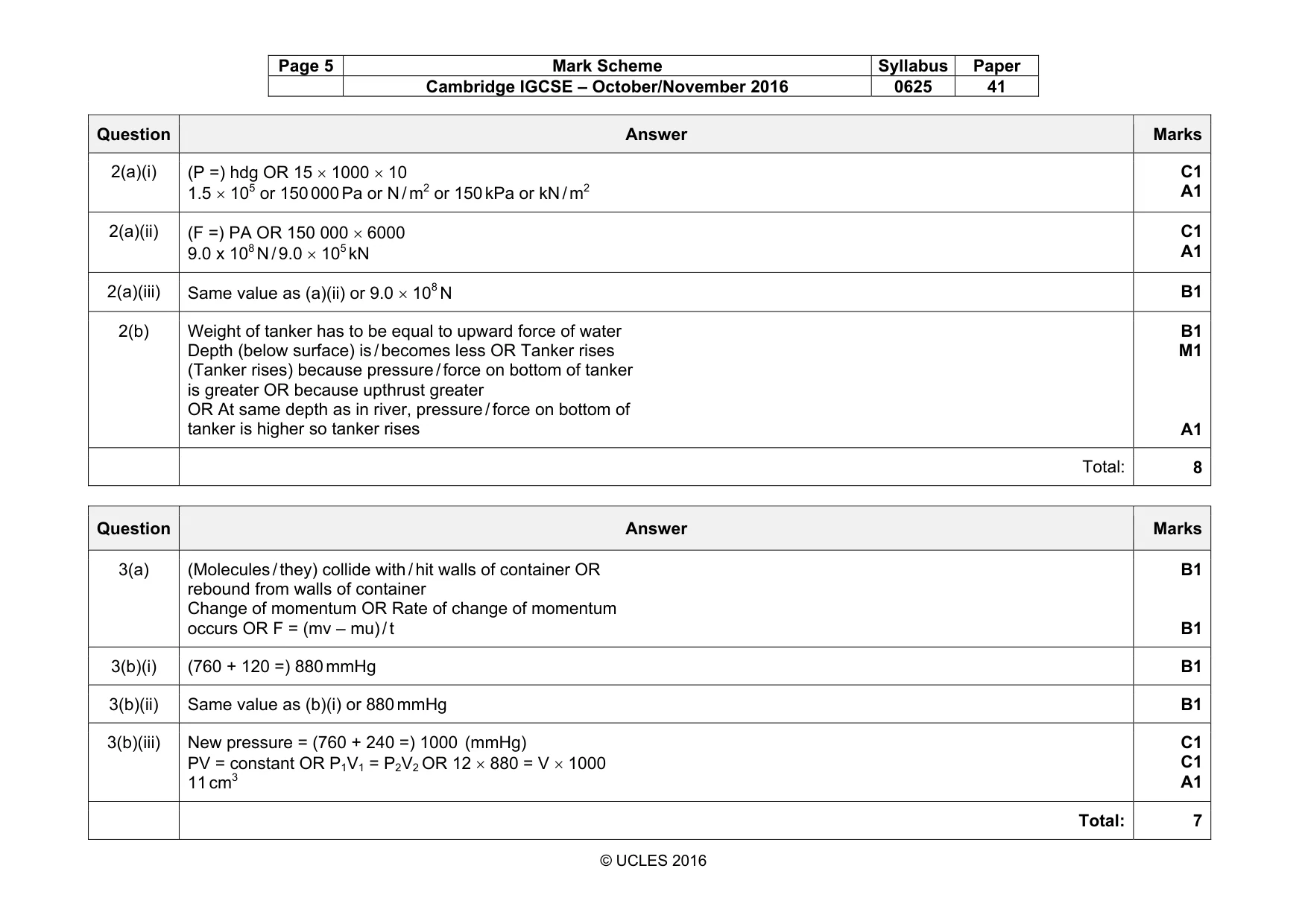
Mark scheme: 2(a)(i) 1.5 × 10⁵ or 150 000 Pa or N / m2 or 150 kPa or kN / m2 C1 A1 2(a)(ii) (F =) PA OR 150 000 × 6000 9.0 x 10⁸ N / 9.0 × 10⁵ kN C1 A1 2(a)(iii) Same value as (a)(ii) or 9.0 × 10⁸ N B1 2(b) Weight of tanker has to be equal to upward force of water Depth (below surface) is / becomes less OR Tanker rises (Tanker rises) because pressure / force on bottom of tanker is greater OR because upthrust greater OR At same depth as in river, pressure / force on bottom of tanker is higher so tanker rises B1 M1 A1 Total: 8
Q3 · A closed container holds a quantity of gas
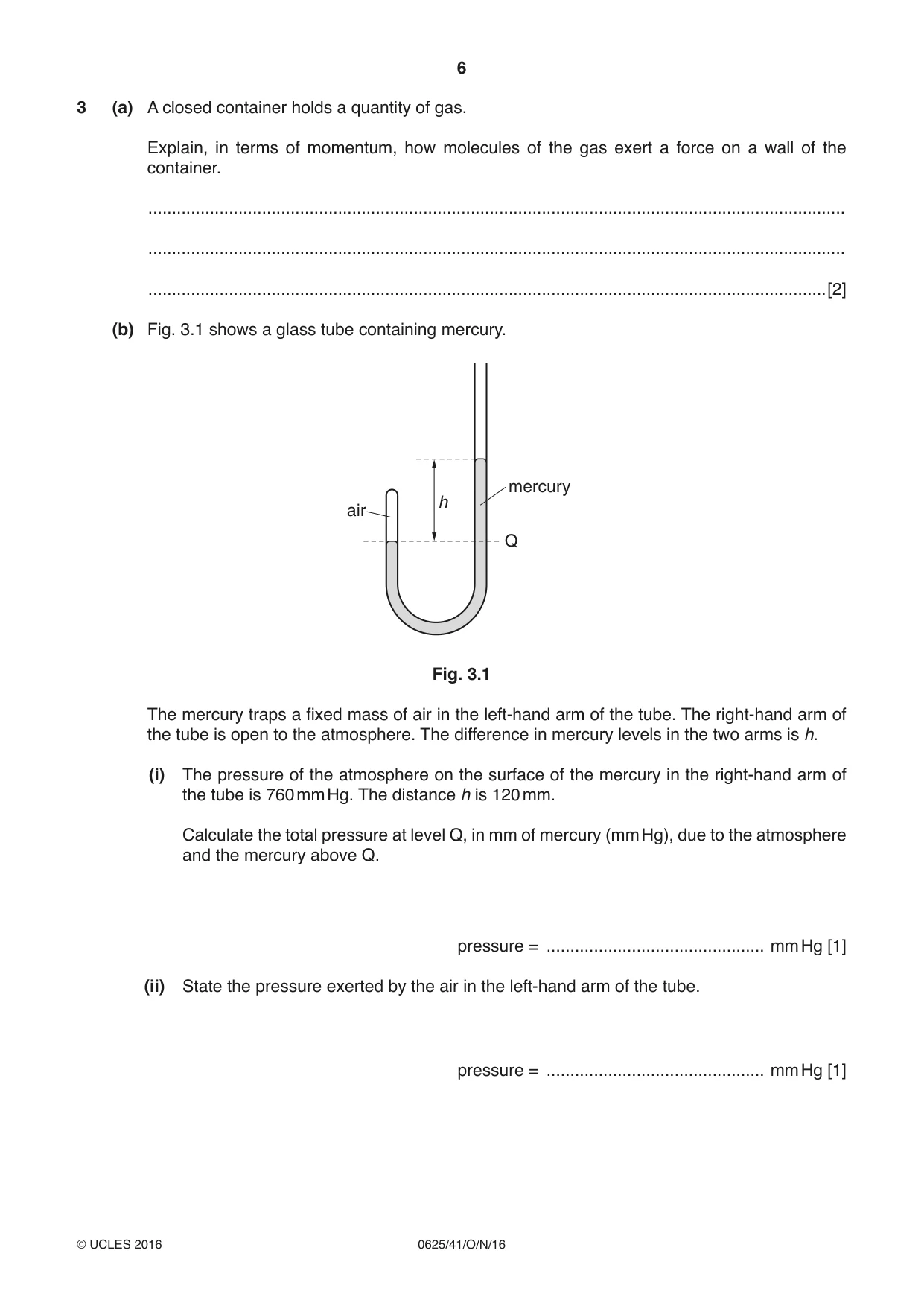
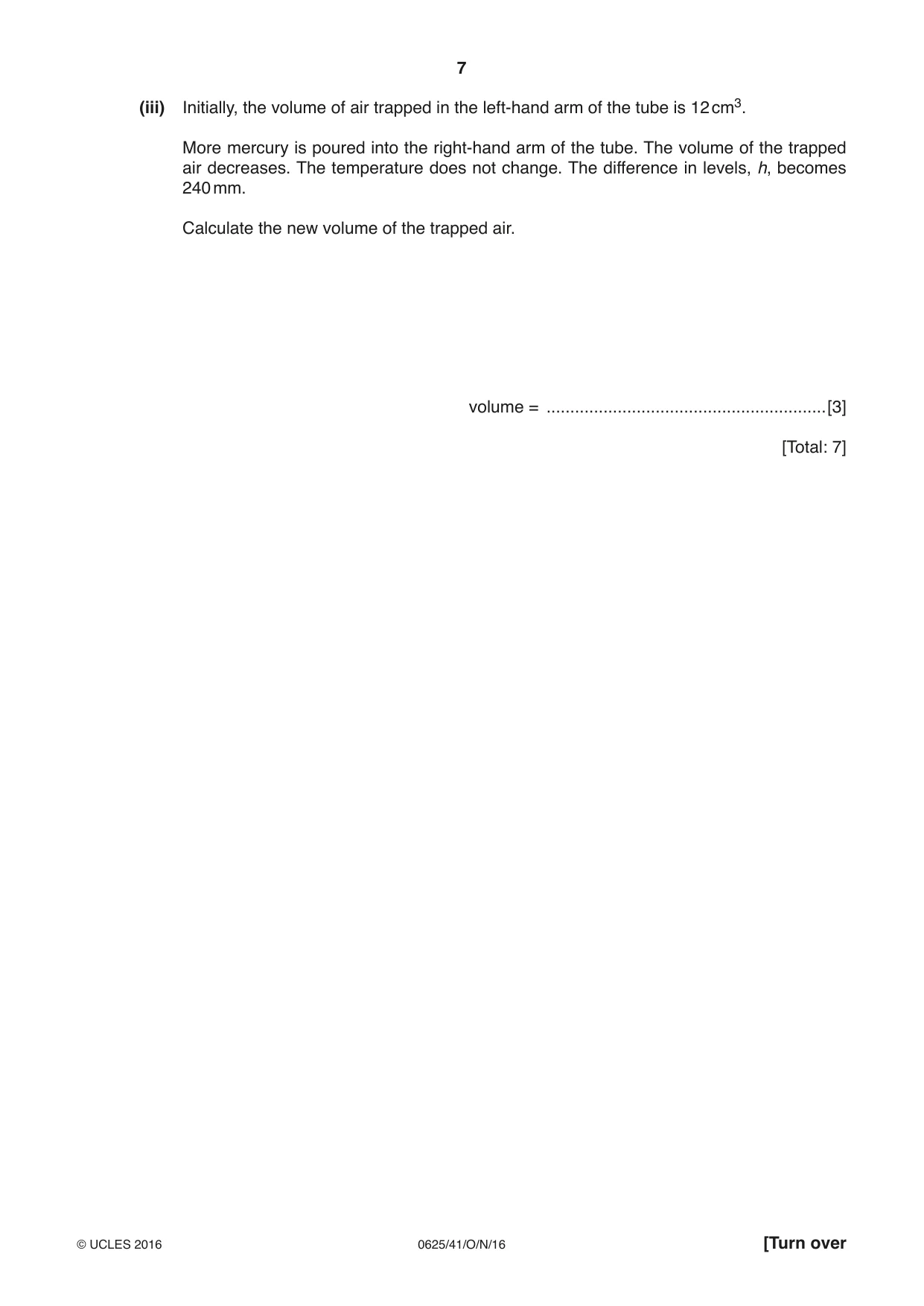
3 (a) A closed container holds a quantity of gas. Explain, in terms of momentum, how molecules of the gas exert a force on a wall of the container. ................................................................................................................................................... ................................................................................................................................................... ...............................................................................................................................................[2] (b) Fig. 3.1 shows a glass tube containing mercury. mercury air h Q Fig. 3.1 The mercury traps a fixed mass of air in the left-hand arm of the tube. The right-hand arm of the tube is open to the atmosphere. The difference in mercury levels in the two arms is h. (i) The pressure of the atmosphere on the surface of the mercury in the right-hand arm of the tube is 760 mm Hg. The distance h is 120 mm. Calculate the total pressure at level Q, in mm of mercury (mm Hg), due to the atmosphere and the mercury above Q. pressure = .............................................. mm Hg [1] (ii) State the pressure exerted by the air in the left-hand arm of the tube. pressure = .............................................. mm Hg [1] (iii) Initially, the volume of air trapped in the left-hand arm of the tube is 12 cm3. More mercury is poured into the right-hand arm of the tube. The volume of the trapped air decreases. The temperature does not change. The difference in levels, h, becomes 240 mm. Calculate the new volume of the trapped air. volume = ...........................................................[3] [Total: 7]
Mark scheme: 3(a) (Molecules / they) collide with / hit walls of container OR rebound from walls of container Change of momentum OR Rate of change of momentum occurs OR F = (mv – mu) / t B1 B1 3(b)(i) (760 + 120 =) 880 mmHg B1 3(b)(ii) Same value as (b)(i) or 880 mmHg B1 3(b)(iii) New pressure = (760 + 240 =) 1000 (mmHg) PV = constant OR P1V1 = P2V2 OR 12 × 880 = V × 1000 11 cm3 C1 C1 A1 Total: 7
Q4 · In an experiment, cold water is poured into a bowl made of an insulating material
4 (a) In an experiment, cold water is poured into a bowl made of an insulating material. The container is placed in a draught-free room. After several hours, the volume and the temperature of the water are found to have decreased. Name and describe the process that causes the decrease in the volume of the water, and explain why the temperature of the water decreases. ................................................................................................................................................... ................................................................................................................................................... ................................................................................................................................................... ................................................................................................................................................... ................................................................................................................................................... ................................................................................................................................................... ................................................................................................................................................... ...............................................................................................................................................[4] (b) In a second experiment, using the same apparatus and the same initial amount of cold water as in (a), an electric fan blows air over the top of the bowl. Predict and explain how the results of this experiment compare with the results of the experiment in (a). ................................................................................................................................................... ................................................................................................................................................... ...............................................................................................................................................[2] (c) In a third experiment, the same initial amount of cold water as in (a) is poured into a metal bowl. The metal bowl is the same shape and size as the bowl used in (a). Compared with the experiment in (a), the decrease in temperature is less in the same time. Explain why. ................................................................................................................................................... ................................................................................................................................................... ...............................................................................................................................................[2] [Total: 8]
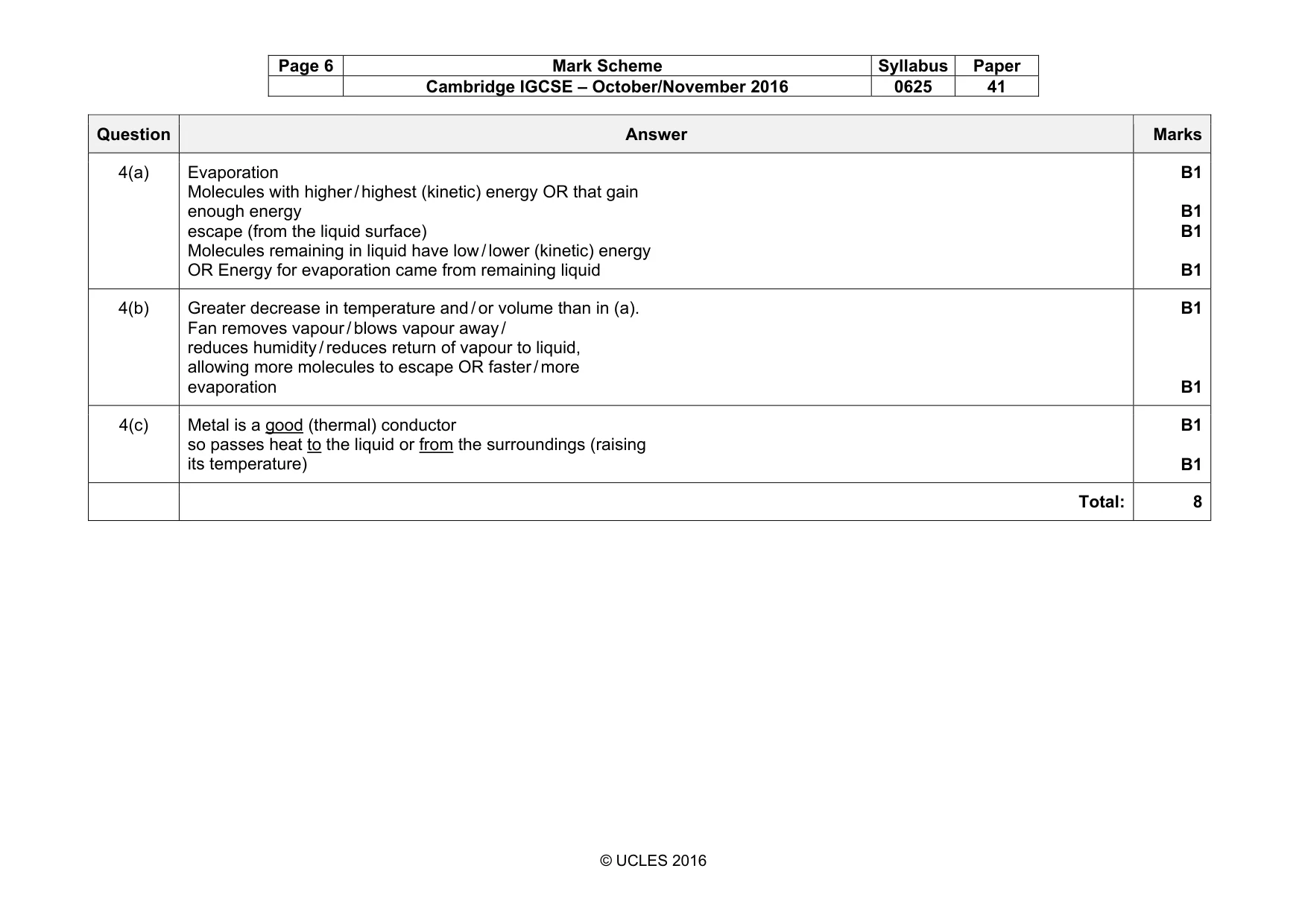
Mark scheme: 4(a) Evaporation Molecules with higher / highest (kinetic) energy OR that gain enough energy escape (from the liquid surface) Molecules remaining in liquid have low / lower (kinetic) energy OR Energy for evaporation came from remaining liquid B1 B1 B1 B1 4(b) Greater decrease in temperature and / or volume than in (a). Fan removes vapour / blows vapour away / reduces humidity / reduces return of vapour to liquid, allowing more molecules to escape OR faster / more evaporation B1 B1 4(c) Metal is a good (thermal) conductor so passes heat to the liquid or from the surroundings (raising its temperature) B1 B1 Total: 8
Q5 · Compare the arrangement and motion of the molecules in ice and in liquid water
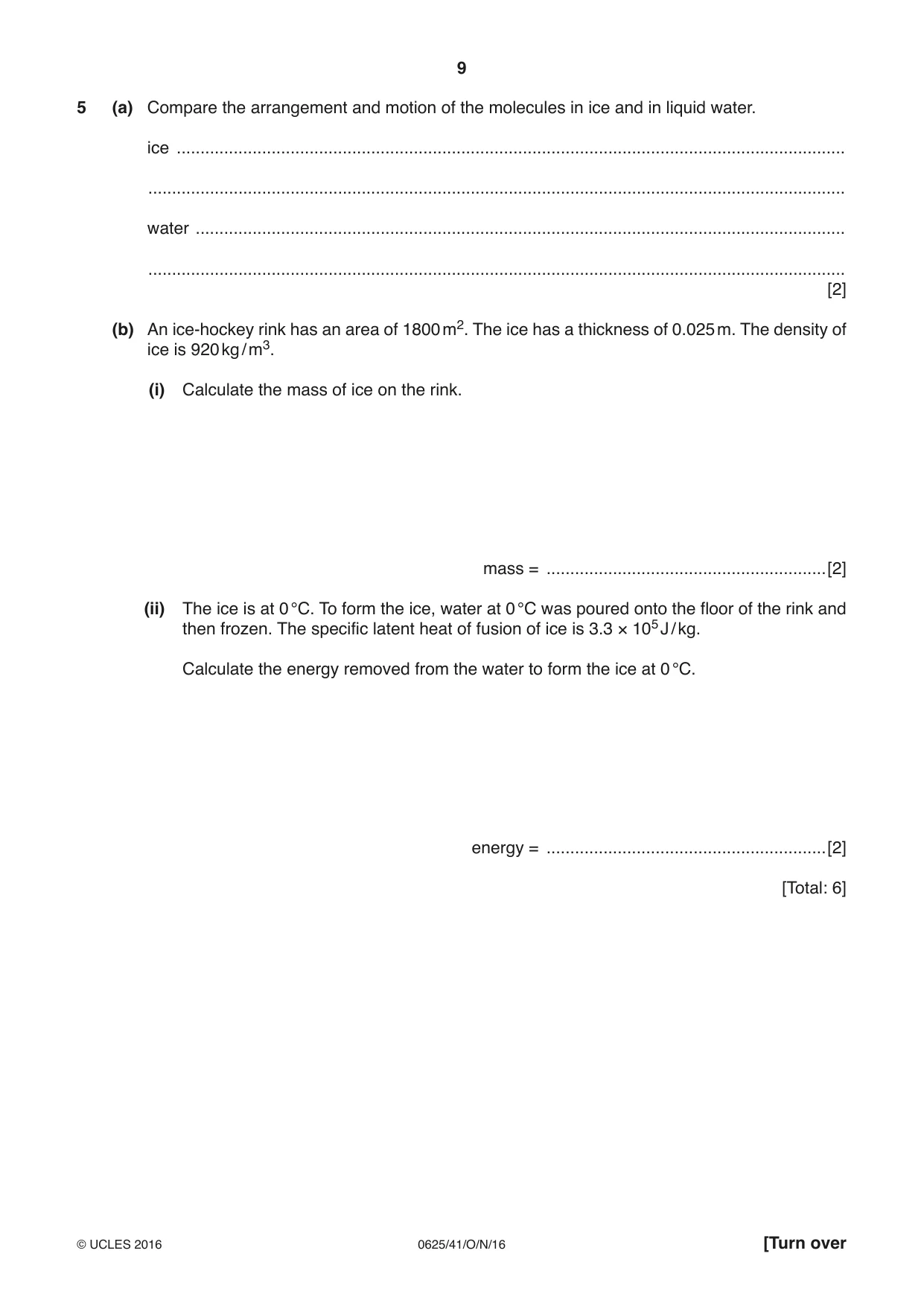
5 (a) Compare the arrangement and motion of the molecules in ice and in liquid water. ice ............................................................................................................................................. ................................................................................................................................................... water ......................................................................................................................................... ................................................................................................................................................... [2] (b) An ice-hockey rink has an area of 1800 m2. The ice has a thickness of 0.025 m. The density of ice is 920 kg / m3. (i) Calculate the mass of ice on the rink. mass = ...........................................................[2] (ii) The ice is at 0 °C. To form the ice, water at 0 °C was poured onto the floor of the rink and then frozen. The specific latent heat of fusion of ice is 3.3 × 10⁵ J / kg. Calculate the energy removed from the water to form the ice at 0 °C. energy = ...........................................................[2] [Total: 6]
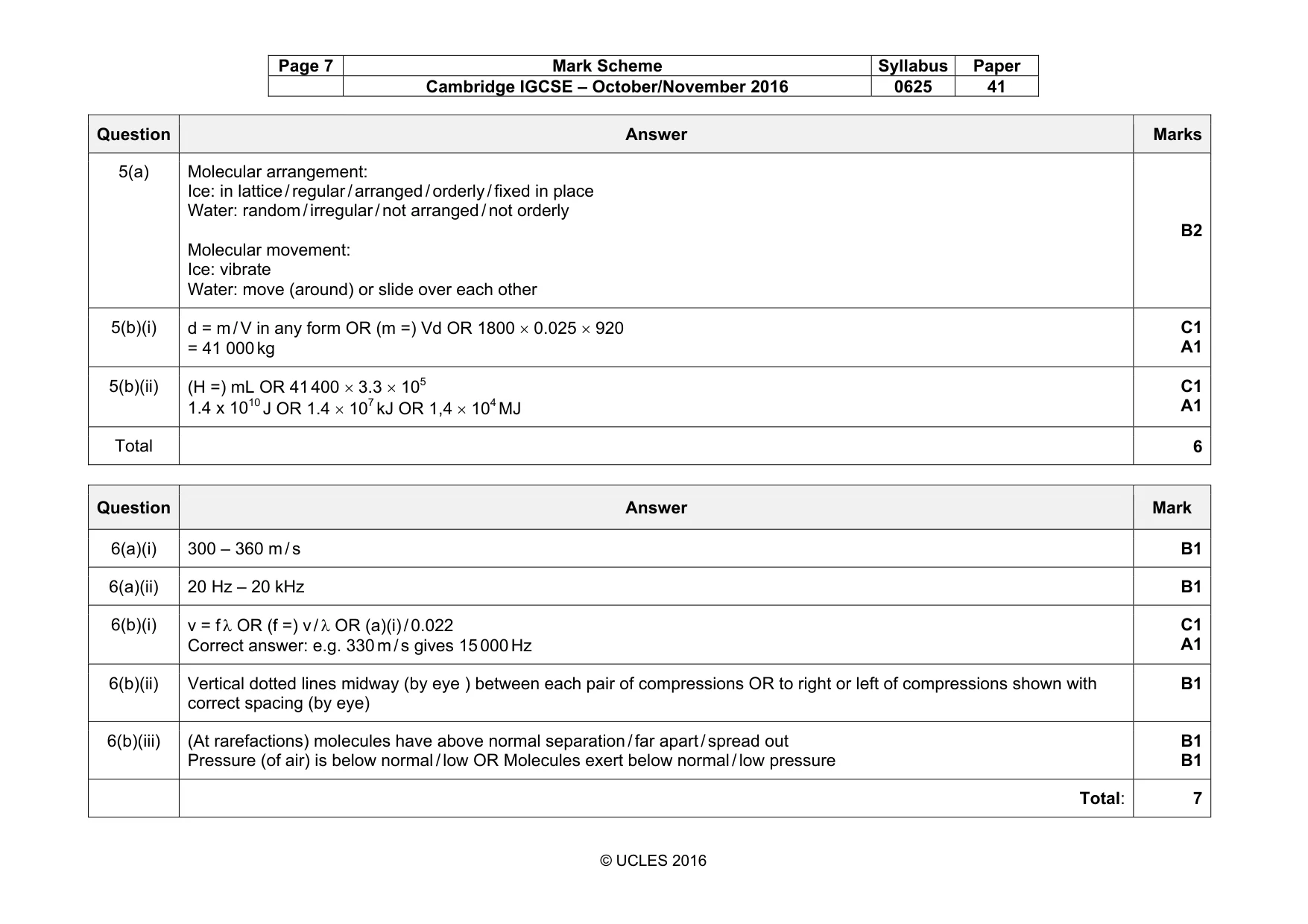
Mark scheme: 5(a) Molecular arrangement: Ice: in lattice / regular / arranged / orderly / fixed in place Water: random / irregular / not arranged / not orderly Molecular movement: Ice: vibrate Water: move (around) or slide over each other B2 5(b)(i) d = m / V in any form OR (m =) Vd OR 1800 × 0.025 × 920 = 41 000 kg C1 A1 5(b)(ii) (H =) mL OR 41 400 × 3.3 × 105 1.4 x 10¹⁰ J OR 1.4 × 10⁷ kJ OR 1,4 × 10⁴ MJ C1 A1 Total 6
Q6 · State a typical value for the speed of sound in air
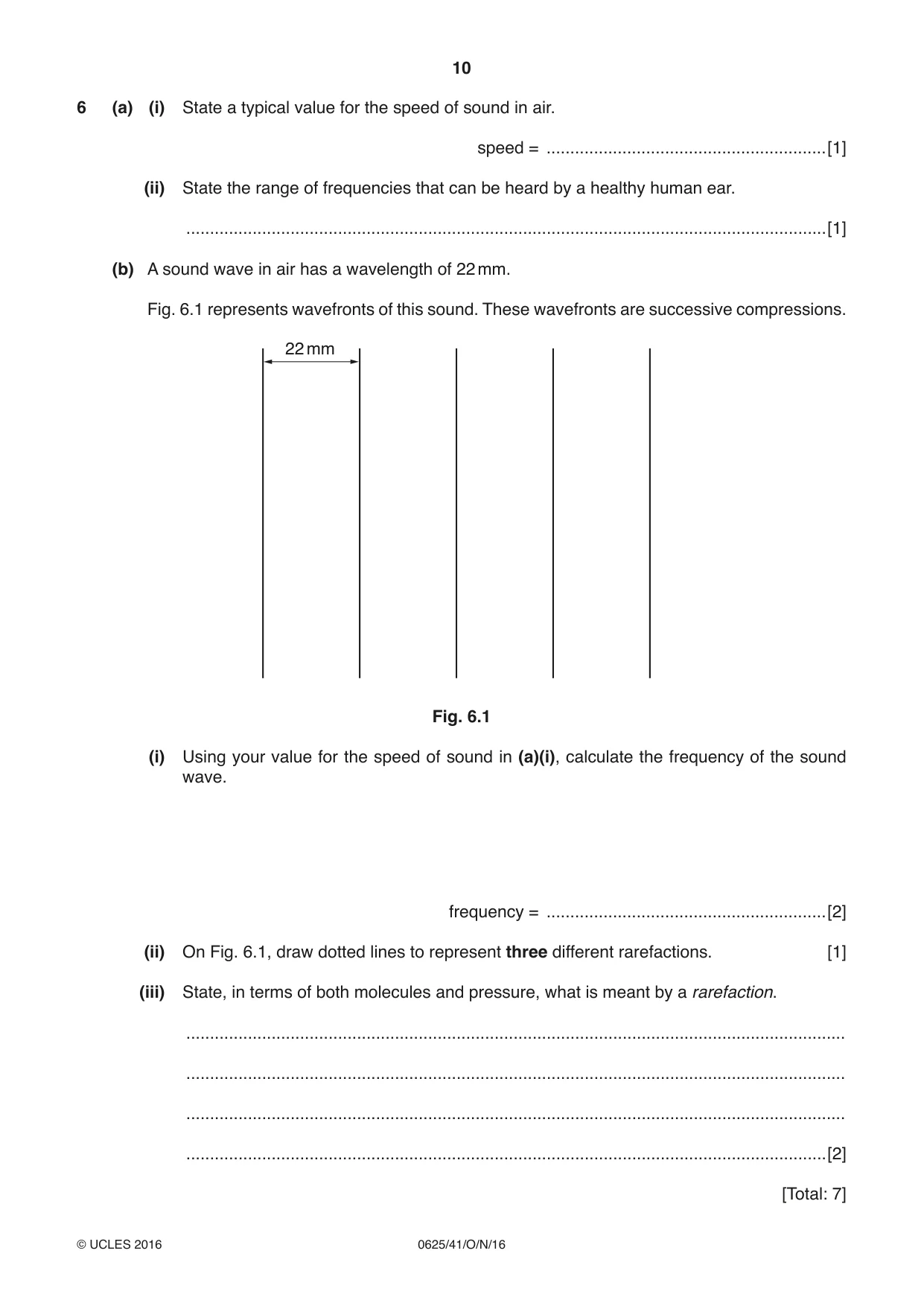
6 (a) (i) State a typical value for the speed of sound in air. speed = ...........................................................[1] (ii) State the range of frequencies that can be heard by a healthy human ear. .......................................................................................................................................[1] (b) A sound wave in air has a wavelength of 22 mm. Fig. 6.1 represents wavefronts of this sound. These wavefronts are successive compressions. 22 mm Fig. 6.1 (i) Using your value for the speed of sound in (a)(i), calculate the frequency of the sound wave. frequency = ...........................................................[2] (ii) On Fig. 6.1, draw dotted lines to represent three different rarefactions. [1] (iii) State, in terms of both molecules and pressure, what is meant by a rarefaction. ........................................................................................................................................... ........................................................................................................................................... ........................................................................................................................................... .......................................................................................................................................[2] [Total: 7]
Mark scheme: 6(a)(i) 300 – 360 m / s B1 6(a)(ii) 20 Hz – 20 kHz B1 6(b)(i) v = f λ OR (f =) v / λ OR (a)(i) / 0.022 Correct answer: e.g. 330 m / s gives 15 000 Hz C1 A1 6(b)(ii) Vertical dotted lines midway (by eye ) between each pair of compressions OR to right or left of compressions shown with correct spacing (by eye) B1 6(b)(iii) (At rarefactions) molecules have above normal separation / far apart / spread out Pressure (of air) is below normal / low OR Molecules exert below normal / low pressure B1 B1 Total: 7
Question 7
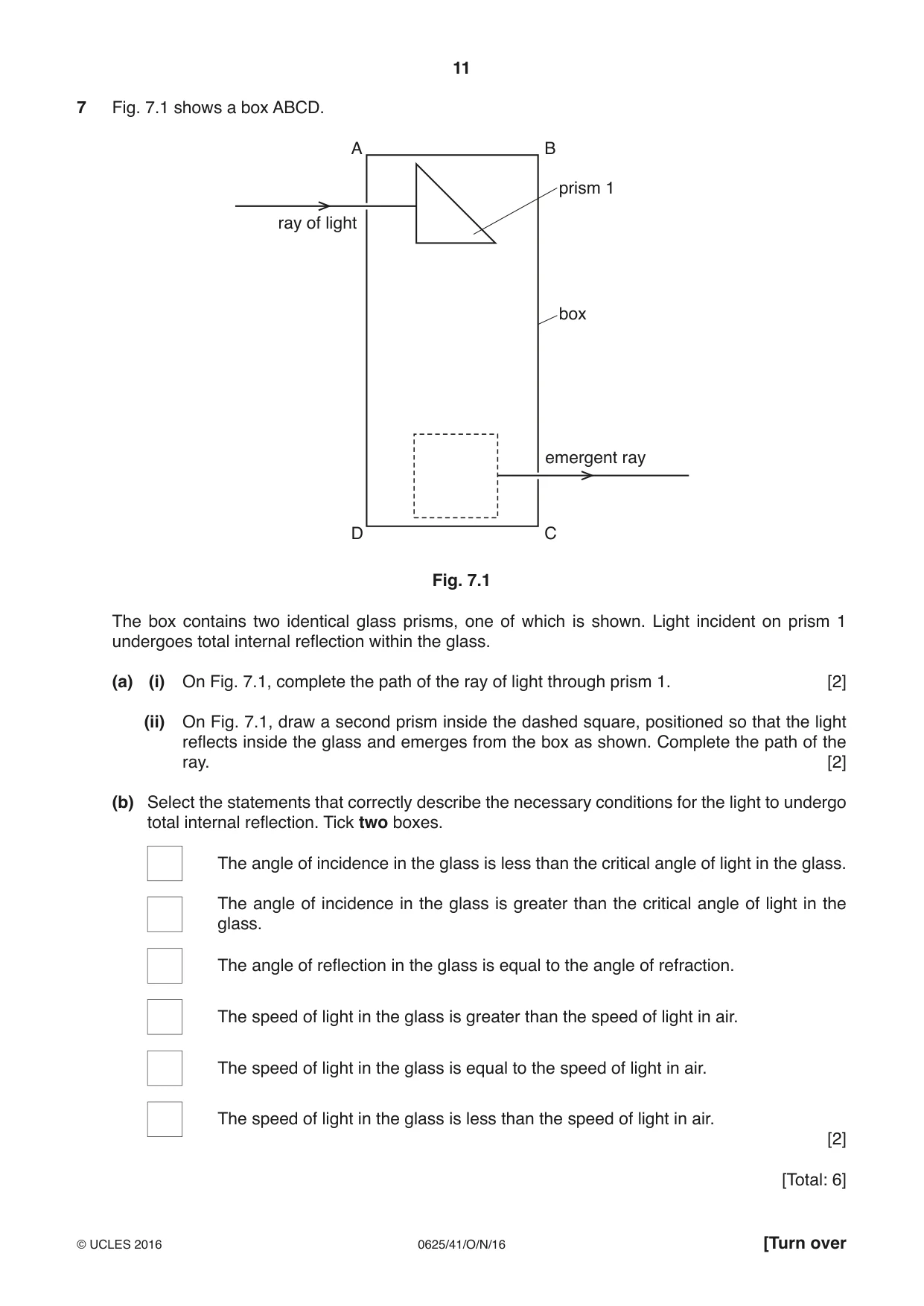
7 Fig. 7.1 shows a box ABCD. A B prism 1 ray of light box emergent ray D C Fig. 7.1 The box contains two identical glass prisms, one of which is shown. Light incident on prism 1 undergoes total internal reflection within the glass. (a) (i) On Fig. 7.1, complete the path of the ray of light through prism 1. [2] (ii) On Fig. 7.1, draw a second prism inside the dashed square, positioned so that the light reflects inside the glass and emerges from the box as shown. Complete the path of the ray. [2] (b) Select the statements that correctly describe the necessary conditions for the light to undergo total internal reflection. Tick two boxes. The angle of incidence in the glass is less than the critical angle of light in the glass. The angle of incidence in the glass is greater than the critical angle of light in the glass. The angle of reflection in the glass is equal to the angle of refraction. The speed of light in the glass is greater than the speed of light in air. The speed of light in the glass is equal to the speed of light in air. The speed of light in the glass is less than the speed of light in air. [2] [Total: 6]
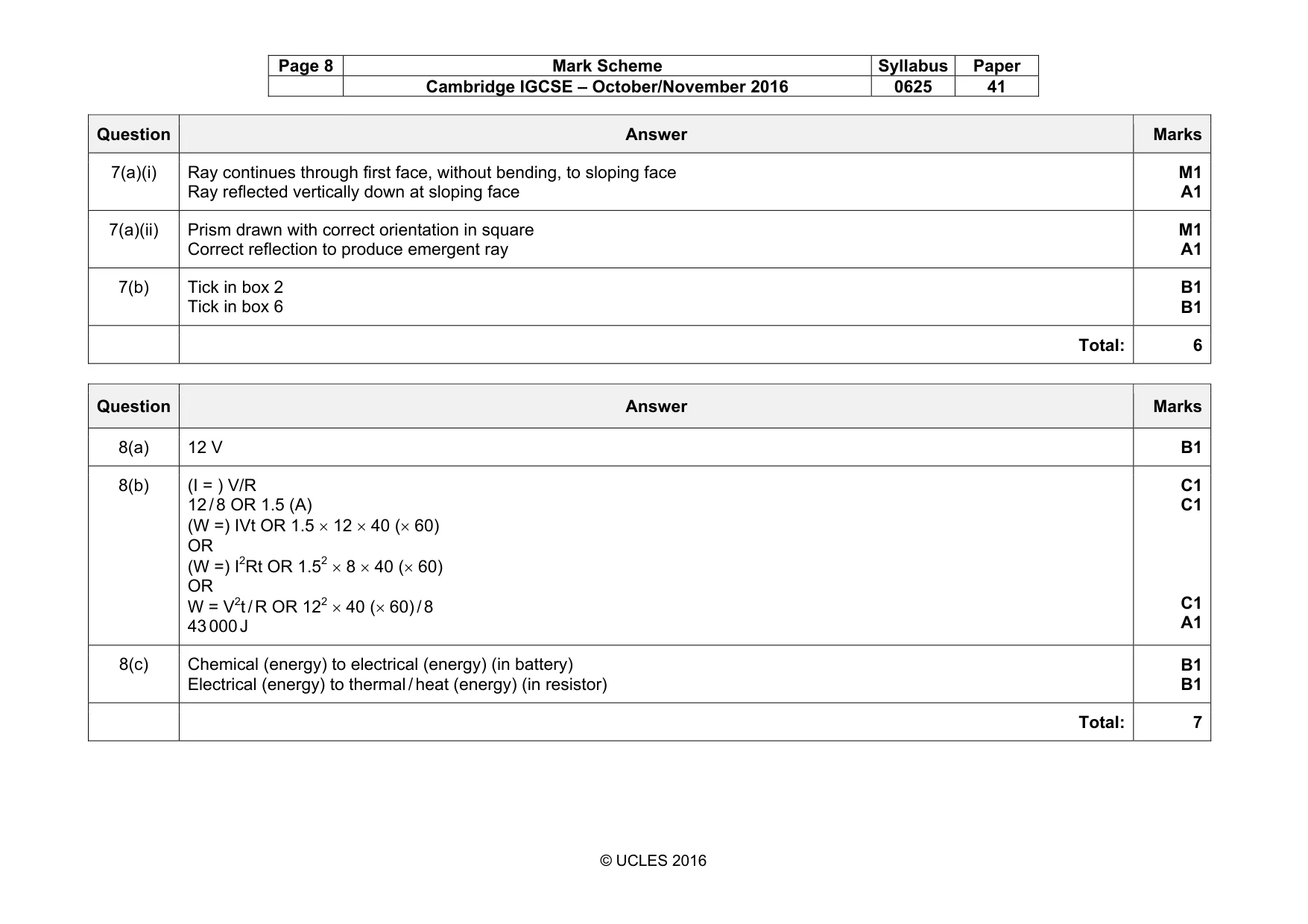
Mark scheme: 7(a)(i) Ray continues through first face, without bending, to sloping face Ray reflected vertically down at sloping face M1 A1 7(a)(ii) Prism drawn with correct orientation in square Correct reflection to produce emergent ray M1 A1 7(b) Tick in box 2 Tick in box 6 B1 B1 Total: 6
Q8 · A battery is made up of 8 cells in series
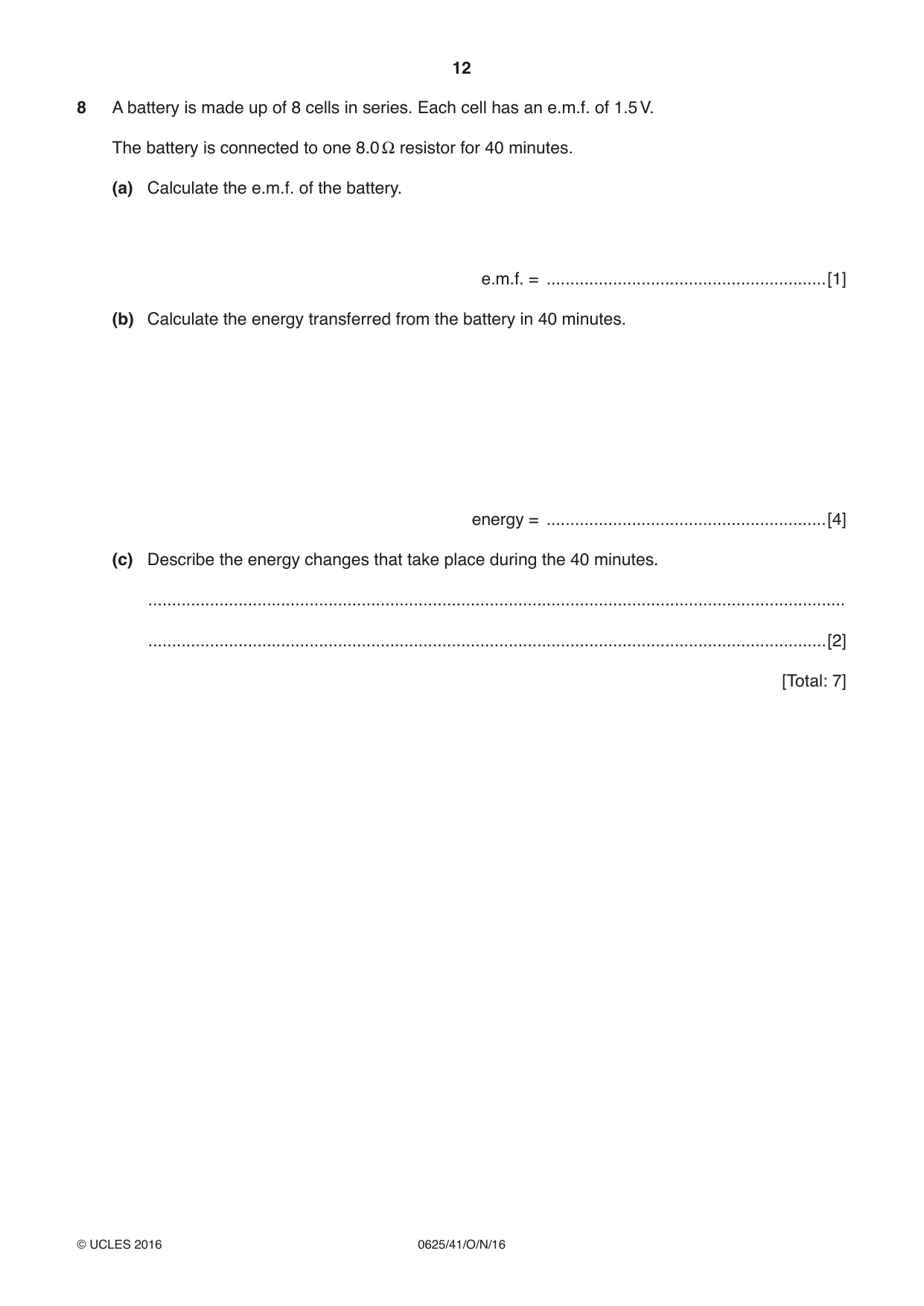
8 A battery is made up of 8 cells in series. Each cell has an e.m.f. of 1.5 V. The battery is connected to one 8.0 Ω resistor for 40 minutes. (a) Calculate the e.m.f. of the battery. e.m.f. = ...........................................................[1] (b) Calculate the energy transferred from the battery in 40 minutes. energy = ...........................................................[4] (c) Describe the energy changes that take place during the 40 minutes. ................................................................................................................................................... ...............................................................................................................................................[2] [Total: 7]
Mark scheme: 8(a) 12 V B1 8(b) (I = ) V/R 12 / 8 OR 1.5 (A) (W =) IVt OR 1.5 × 12 × 40 (× 60) OR (W =) I2Rt OR 1.52 × 8 × 40 (× 60) OR W = V2t / R OR 122 × 40 (× 60) / 8 43 000 J C1 C1 C1 A1 8(c) Chemical (energy) to electrical (energy) (in battery) Electrical (energy) to thermal / heat (energy) (in resistor) B1 B1 Total: 7
Q9 · A gardener cutting damp grass with a high-powered electric mower
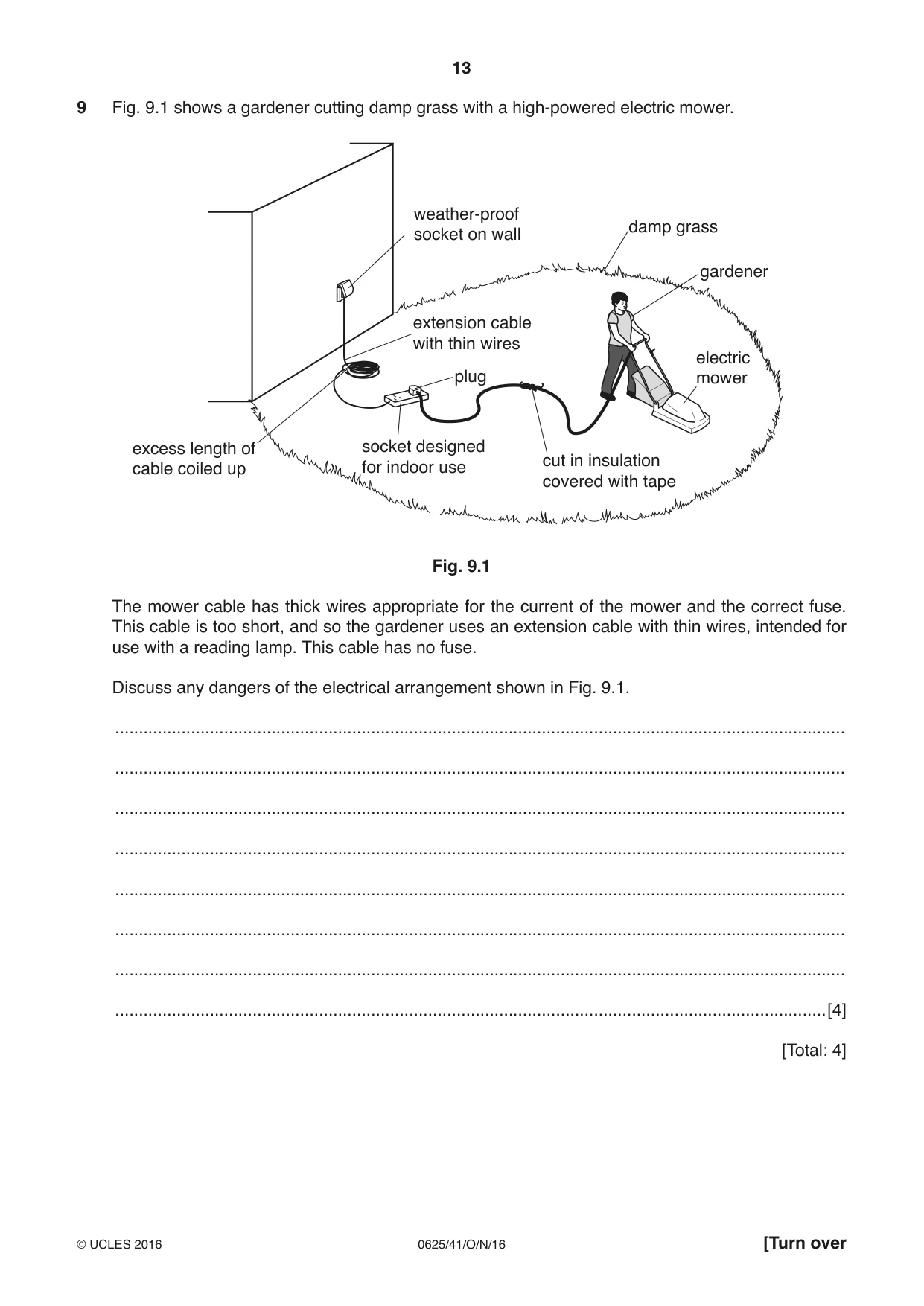
9 Fig. 9.1 shows a gardener cutting damp grass with a high-powered electric mower. weather-proof damp grass socket on wall gardener extension cable with thin wires electric plug mower excess length of socket designed cut in insulation cable coiled up for indoor use covered with tape Fig. 9.1 The mower cable has thick wires appropriate for the current of the mower and the correct fuse. This cable is too short, and so the gardener uses an extension cable with thin wires, intended for use with a reading lamp. This cable has no fuse. Discuss any dangers of the electrical arrangement shown in Fig. 9.1. .......................................................................................................................................................... .......................................................................................................................................................... .......................................................................................................................................................... .......................................................................................................................................................... .......................................................................................................................................................... .......................................................................................................................................................... .......................................................................................................................................................... ......................................................................................................................................................[4] [Total: 4]
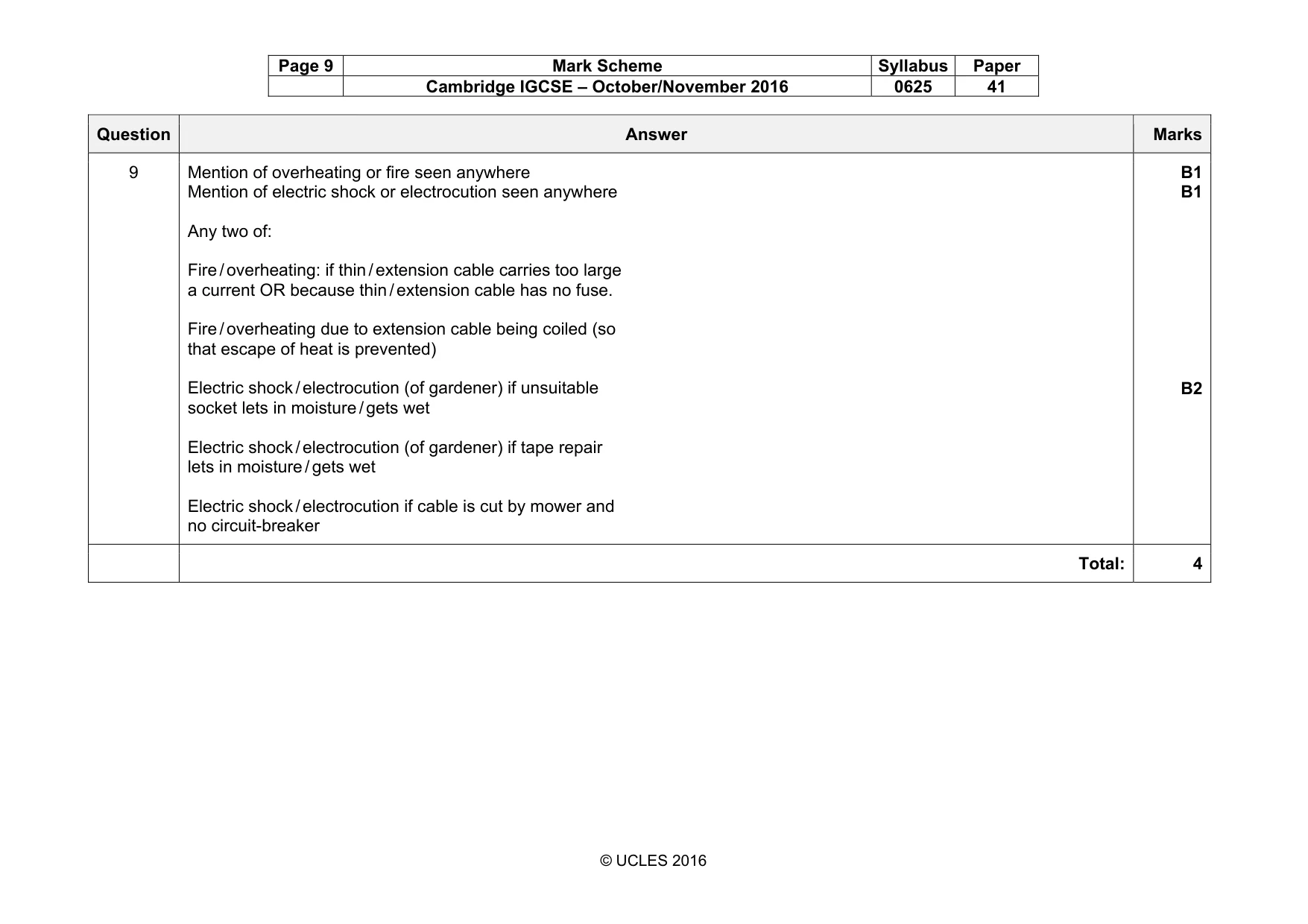
Mark scheme: 9 Mention of overheating or fire seen anywhere Mention of electric shock or electrocution seen anywhere Any two of: Fire / overheating: if thin / extension cable carries too large a current OR because thin / extension cable has no fuse. Fire / overheating due to extension cable being coiled (so that escape of heat is prevented) Electric shock / electrocution (of gardener) if unsuitable socket lets in moisture / gets wet Electric shock / electrocution (of gardener) if tape repair lets in moisture / gets wet Electric shock / electrocution if cable is cut by mower and no circuit-breaker B1 B1 B2 Total: 4
Q10 · A wire AB suspended on two supports so that it is between the poles of a strong magnet
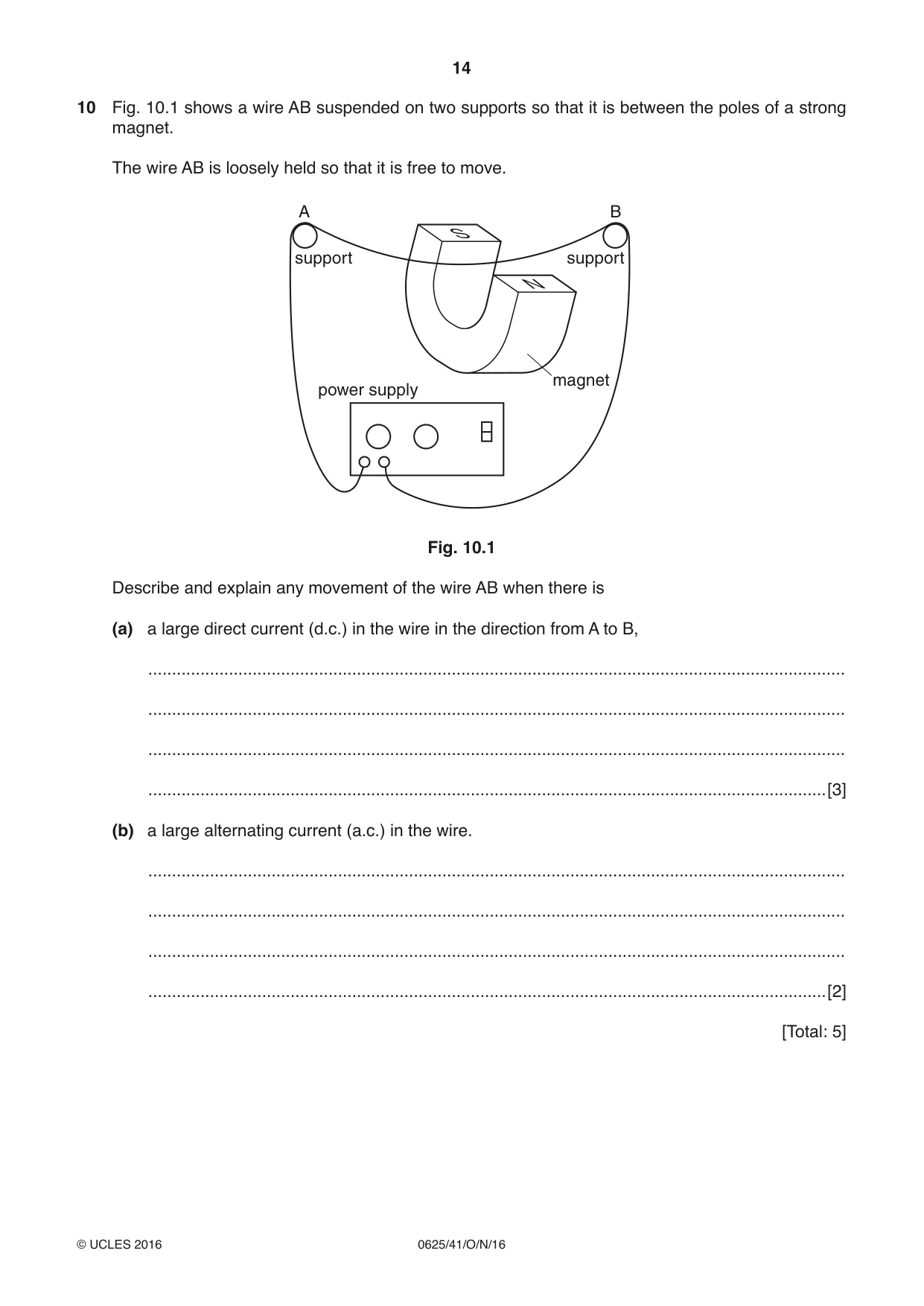
10 Fig. 10.1 shows a wire AB suspended on two supports so that it is between the poles of a strong magnet. The wire AB is loosely held so that it is free to move. A B S support support N magnet power supply Fig. 10.1 Describe and explain any movement of the wire AB when there is (a) a large direct current (d.c.) in the wire in the direction from A to B, ................................................................................................................................................... ................................................................................................................................................... ................................................................................................................................................... ...............................................................................................................................................[3] (b) a large alternating current (a.c.) in the wire. ................................................................................................................................................... ................................................................................................................................................... ................................................................................................................................................... ...............................................................................................................................................[2] [Total: 5]
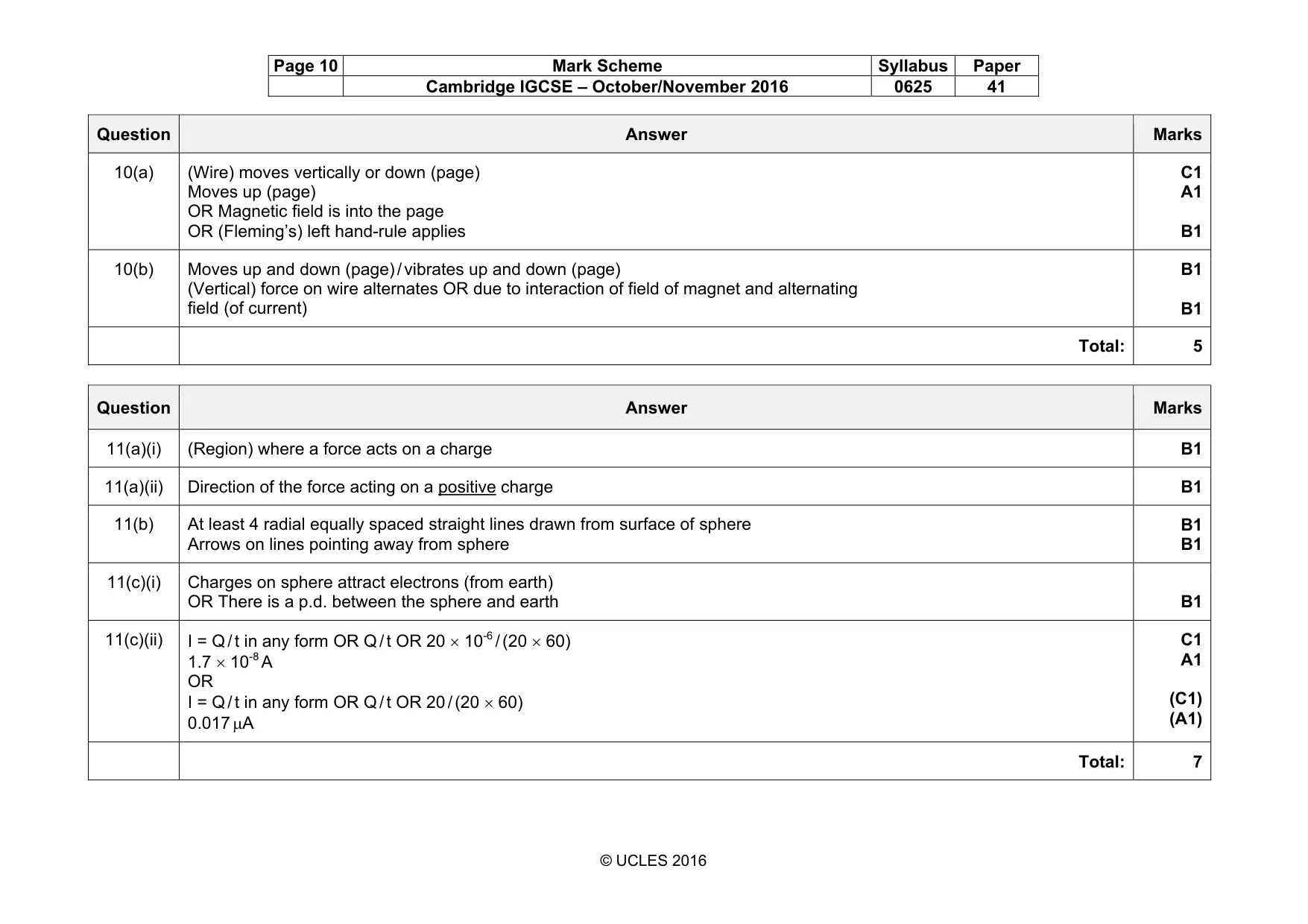
Mark scheme: 10(a) (Wire) moves vertically or down (page) Moves up (page) OR Magnetic field is into the page OR (Fleming’s) left hand-rule applies C1 A1 B1 10(b) Moves up and down (page) / vibrates up and down (page) (Vertical) force on wire alternates OR due to interaction of field of magnet and alternating field (of current) B1 B1 Total: 5
Q11 · State what is meant by (i) an electric field…
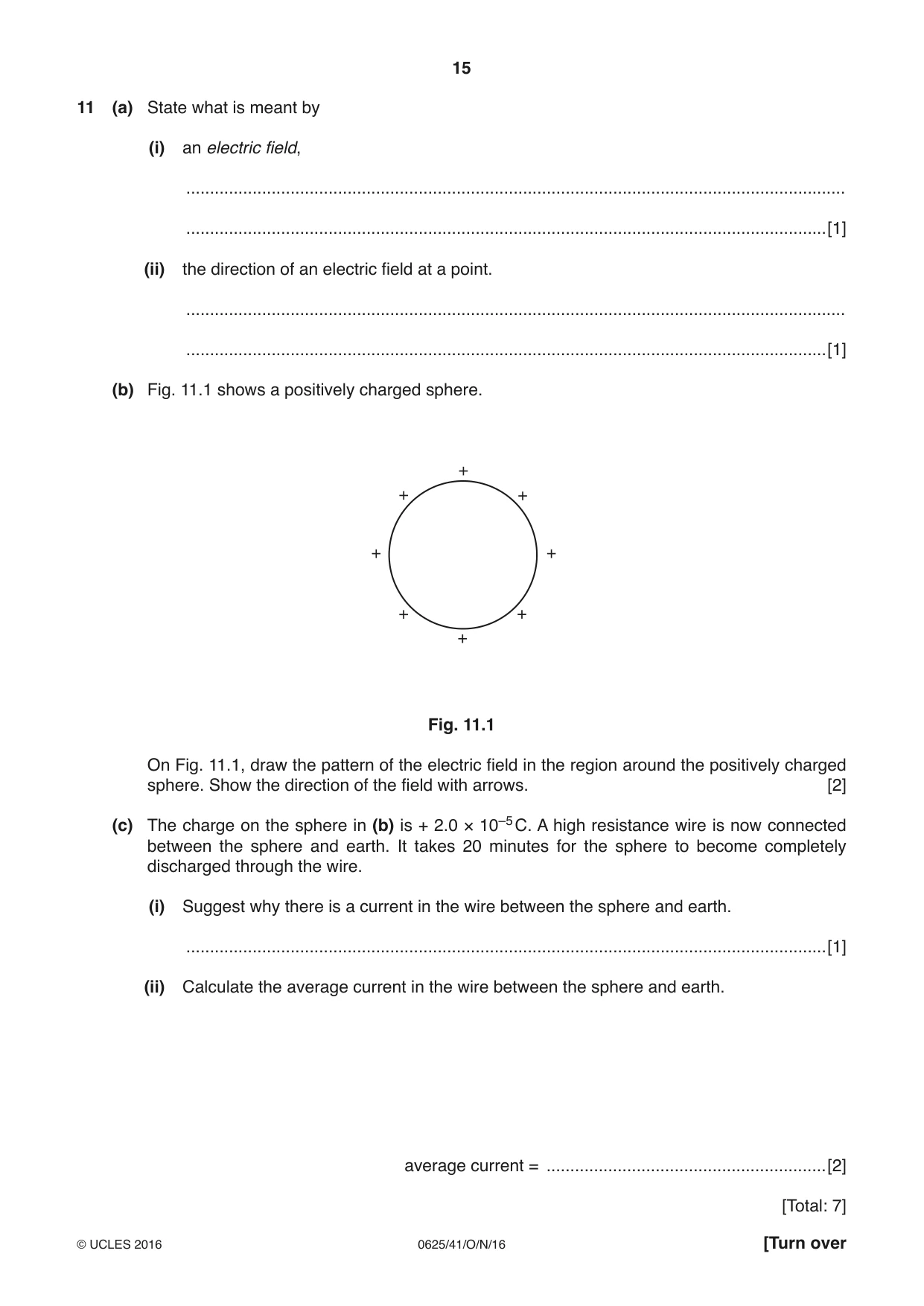
11 (a) State what is meant by (i) an electric field, ........................................................................................................................................... .......................................................................................................................................[1] (ii) the direction of an electric field at a point. ........................................................................................................................................... .......................................................................................................................................[1] (b) Fig. 11.1 shows a positively charged sphere. Fig. 11.1 On Fig. 11.1, draw the pattern of the electric field in the region around the positively charged sphere. Show the direction of the field with arrows. [2] (c) The charge on the sphere in (b) is + 2.0 × 10⁻⁵ C. A high resistance wire is now connected between the sphere and earth. It takes 20 minutes for the sphere to become completely discharged through the wire. (i) Suggest why there is a current in the wire between the sphere and earth. .......................................................................................................................................[1] (ii) Calculate the average current in the wire between the sphere and earth. average current = ...........................................................[2] [Total: 7]
Mark scheme: 11(a)(i) (Region) where a force acts on a charge B1 11(a)(ii) Direction of the force acting on a positive charge B1 11(b) At least 4 radial equally spaced straight lines drawn from surface of sphere Arrows on lines pointing away from sphere B1 B1 11(c)(i) Charges on sphere attract electrons (from earth) OR There is a p.d. between the sphere and earth B1 11(c)(ii) I = Q / t in any form OR Q / t OR 20 × 10-6 / (20 × 60) 1.7 × 10⁻⁸ A OR I = Q / t in any form OR Q / t OR 20 / (20 × 60) 0.017 µA C1 A1 (C1) (A1) Total: 7
Q12 · The nuclear equation below shows the decay of a plutonium (Pu) nucleus to an americium…
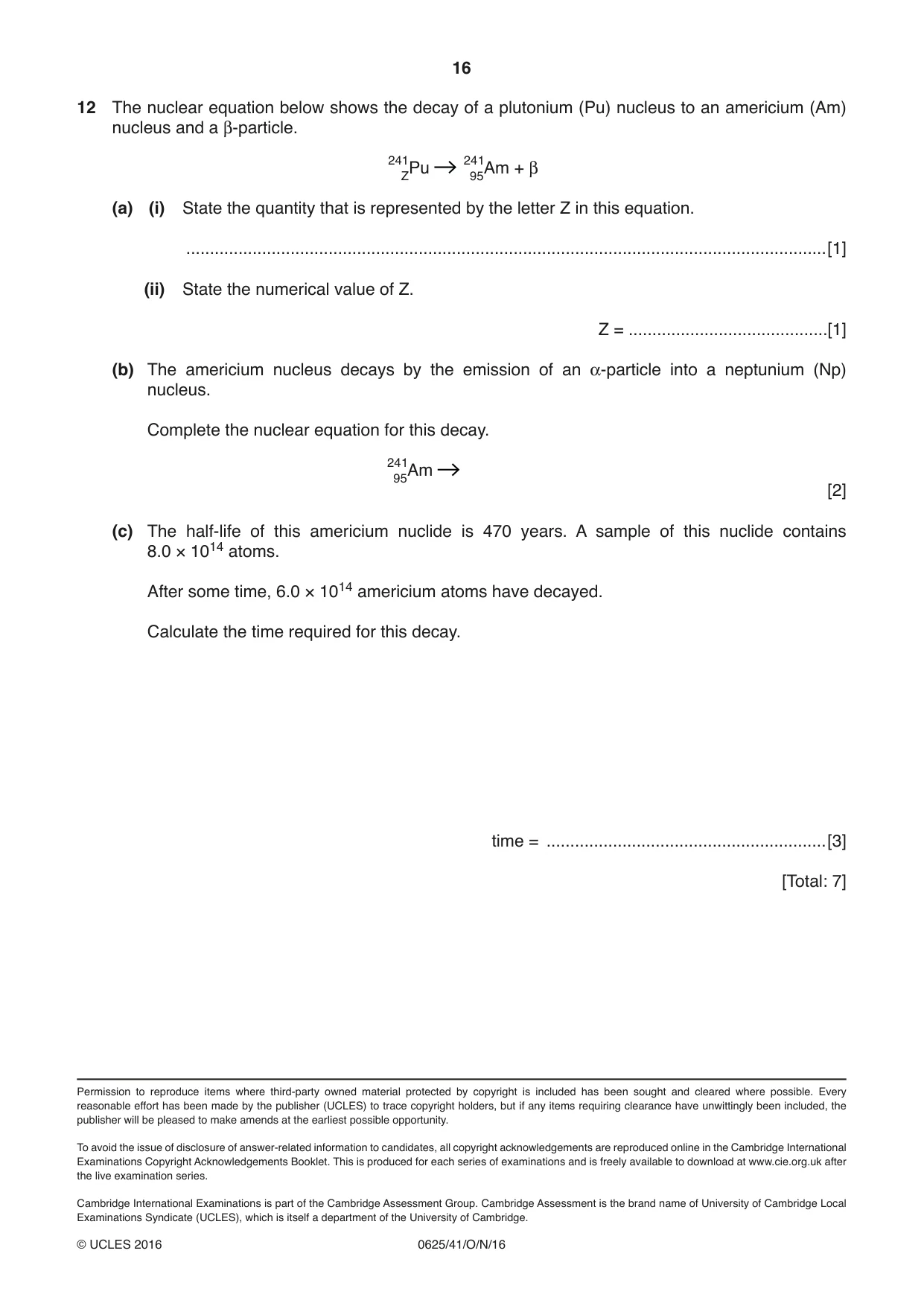
12 The nuclear equation below shows the decay of a plutonium (Pu) nucleus to an americium (Am) nucleus and a β-particle. β 241ZPu 24195Am + (a) (i) State the quantity that is represented by the letter Z in this equation. .......................................................................................................................................[1] (ii) State the numerical value of Z. Z = ..........................................[1] (b) The americium nucleus decays by the emission of an α-particle into a neptunium (Np) nucleus. Complete the nuclear equation for this decay. 24195Am [2] (c) The half-life of this americium nuclide is 470 years. A sample of this nuclide contains 8.0 × 10¹⁴ atoms. After some time, 6.0 × 10¹⁴ americium atoms have decayed. Calculate the time required for this decay. time = ...........................................................[3] [Total: 7]
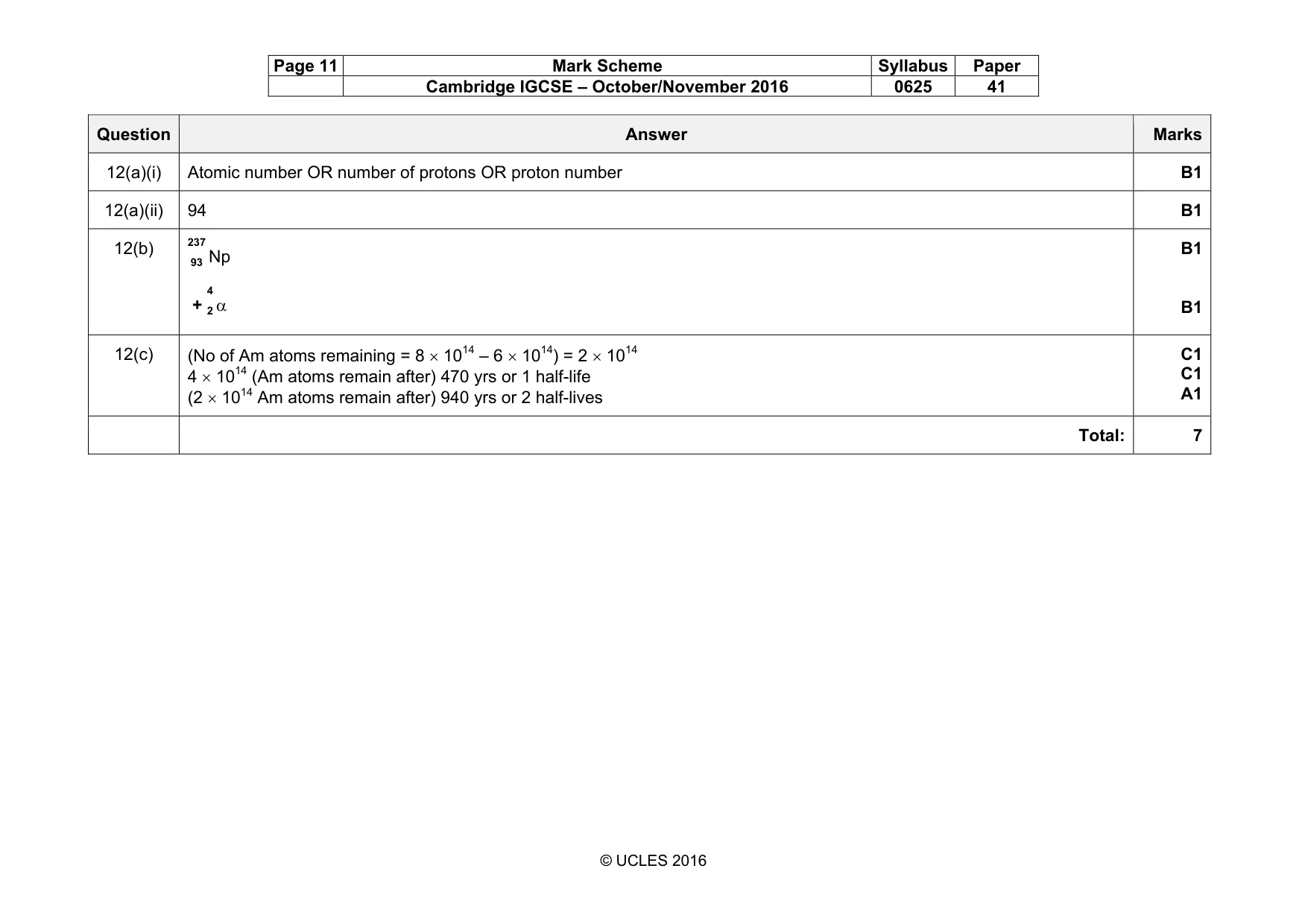
Mark scheme: 12(a)(i) Atomic number OR number of protons OR proton number B1 12(a)(ii) 94 B1 12(b) 237 93 Np + 4 2 α B1 B1 12(c) (No of Am atoms remaining = 8 × 10¹⁴ – 6 × 10¹⁴) = 2 × 10¹⁴ 4 × 10¹⁴ (Am atoms remain after) 470 yrs or 1 half-life (2 × 10¹⁴ Am atoms remain after) 940 yrs or 2 half-lives C1 C1 A1 Total: 7
What was in this paper
The subtopics covered by these 12 questions, and how many questions each got. Open one in a new tab to see every Cambridge question on it.
What you needed in this session
Cambridge’s own grade thresholds for 2016 Oct/Nov, Paper 4 · Variant 1. A higher threshold means an easier paper — the bar moves with how the cohort did.