Cambridge IGCSE Physics 0625 — 2023 May/June Paper 4 · Variant 3
0625/43/M/J/23 · 10 questions · 80 marks · ≈90 min
The question paper and its mark scheme, free to read here and free to download. This is Cambridge’s own paper, exactly as it was sat.
Question paper16 pages

Mark scheme14 pages
Answers below. Sit the paper first if you are practising.
Questions as text
Q1 · A balloon filled with helium gas
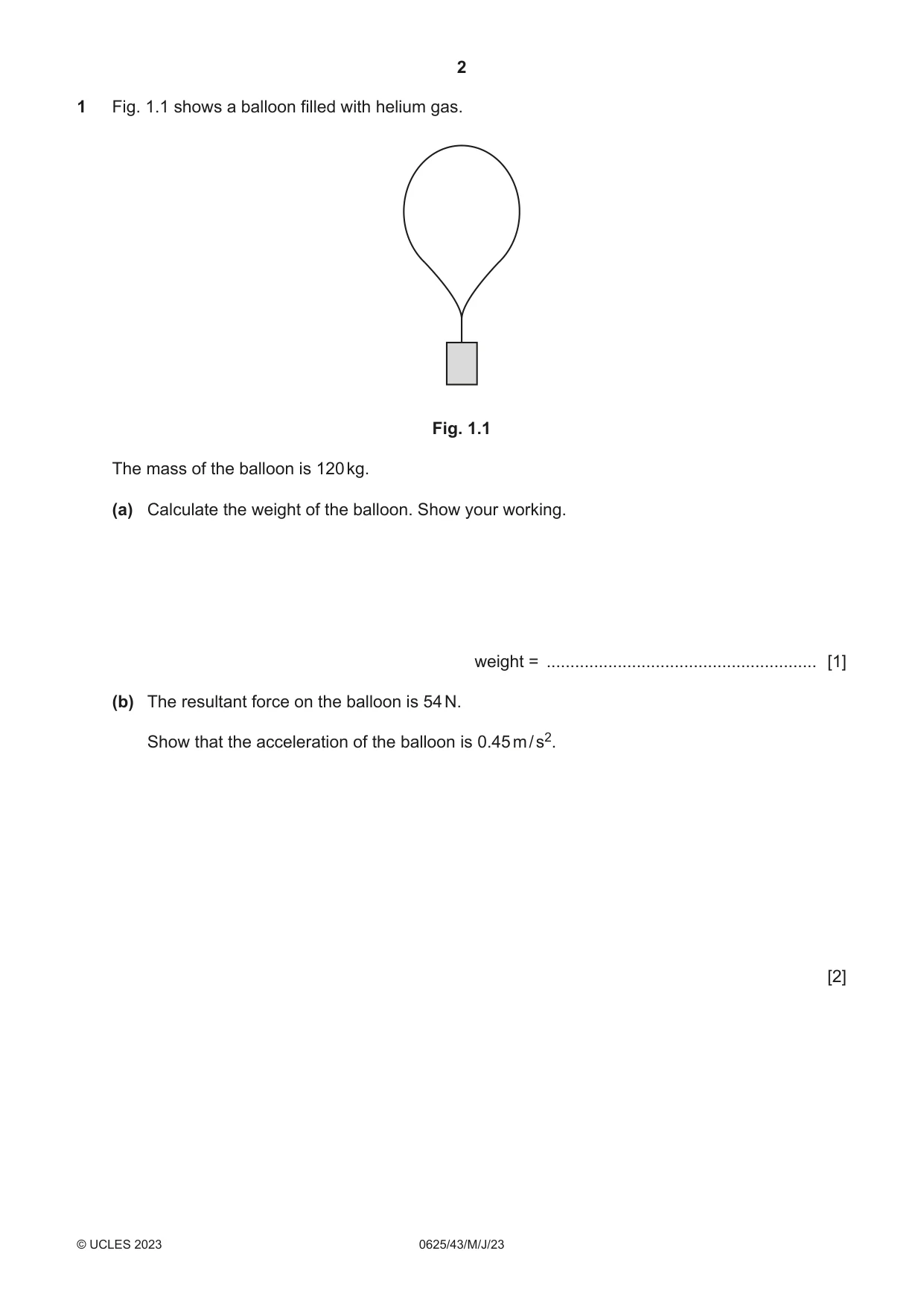
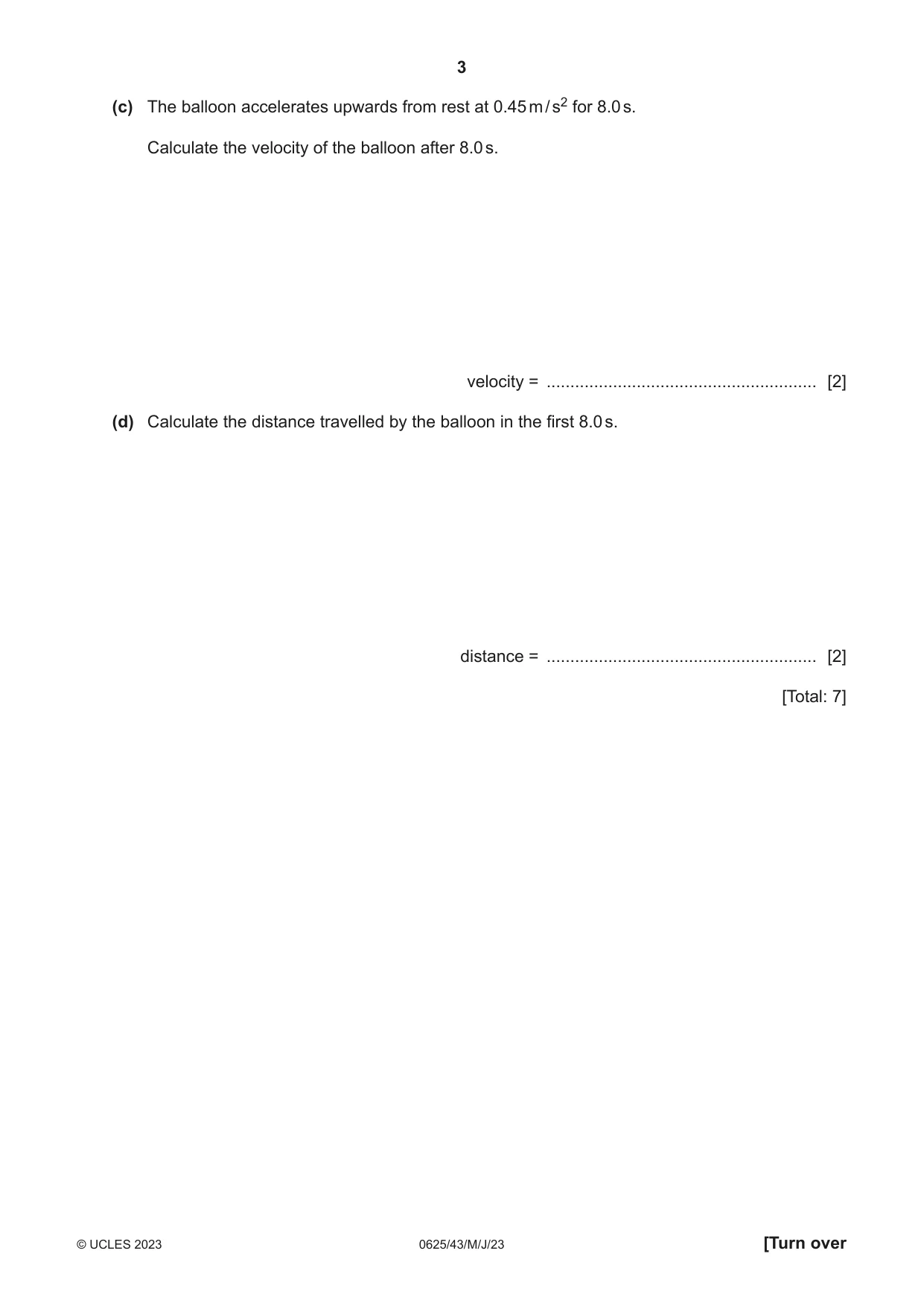
1 Fig. 1.1 shows a balloon filled with helium gas. Fig. 1.1 The mass of the balloon is 120 kg. (a) Calculate the weight of the balloon. Show your working. weight = ......................................................... [1] (b) The resultant force on the balloon is 54 N. Show that the acceleration of the balloon is 0.45 m / s2. [2] (c) The balloon accelerates upwards from rest at 0.45 m / s2 for 8.0 s. Calculate the velocity of the balloon after 8.0 s. velocity = ......................................................... [2] (d) Calculate the distance travelled by the balloon in the first 8.0 s. distance = ......................................................... [2] [Total: 7]
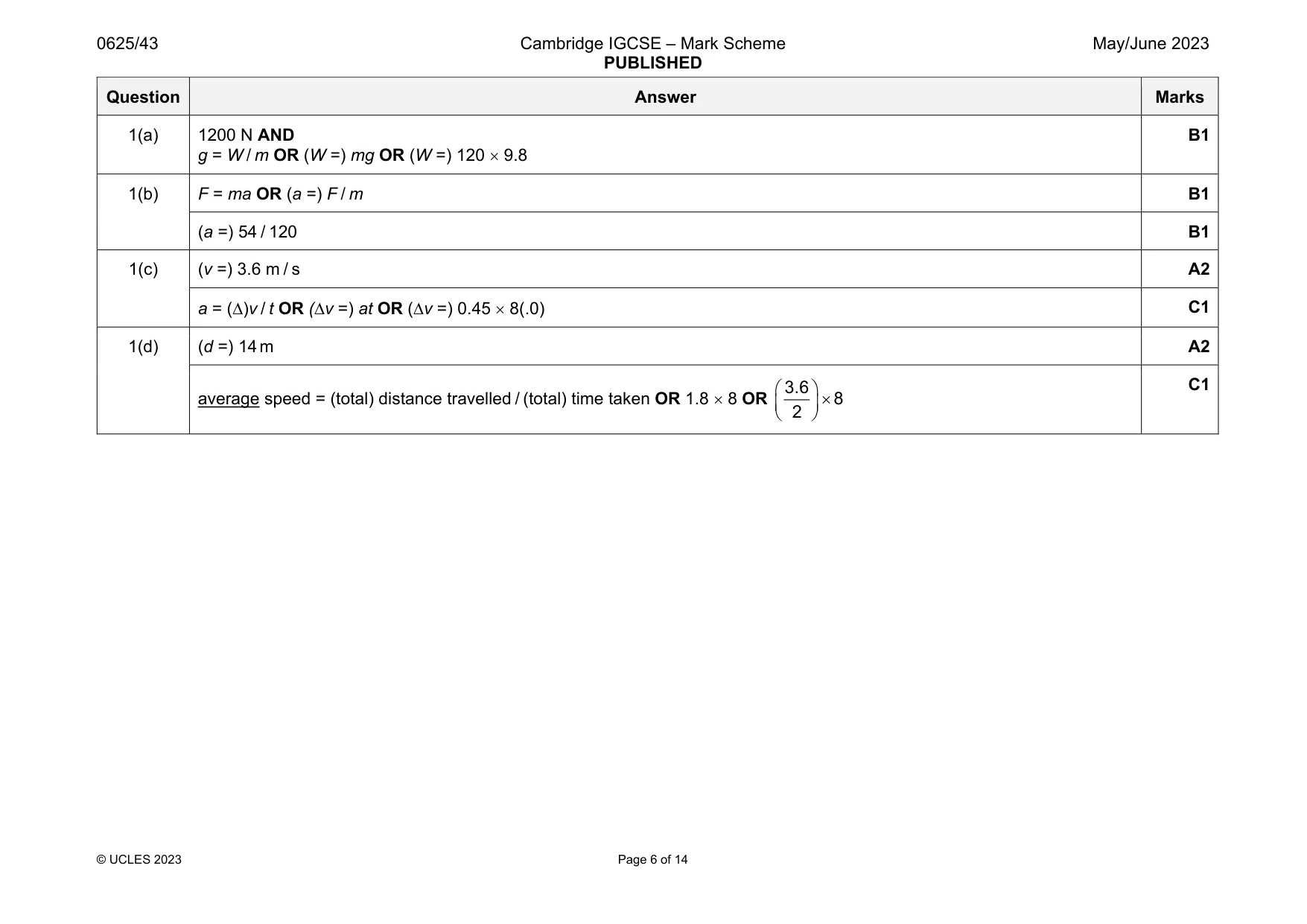
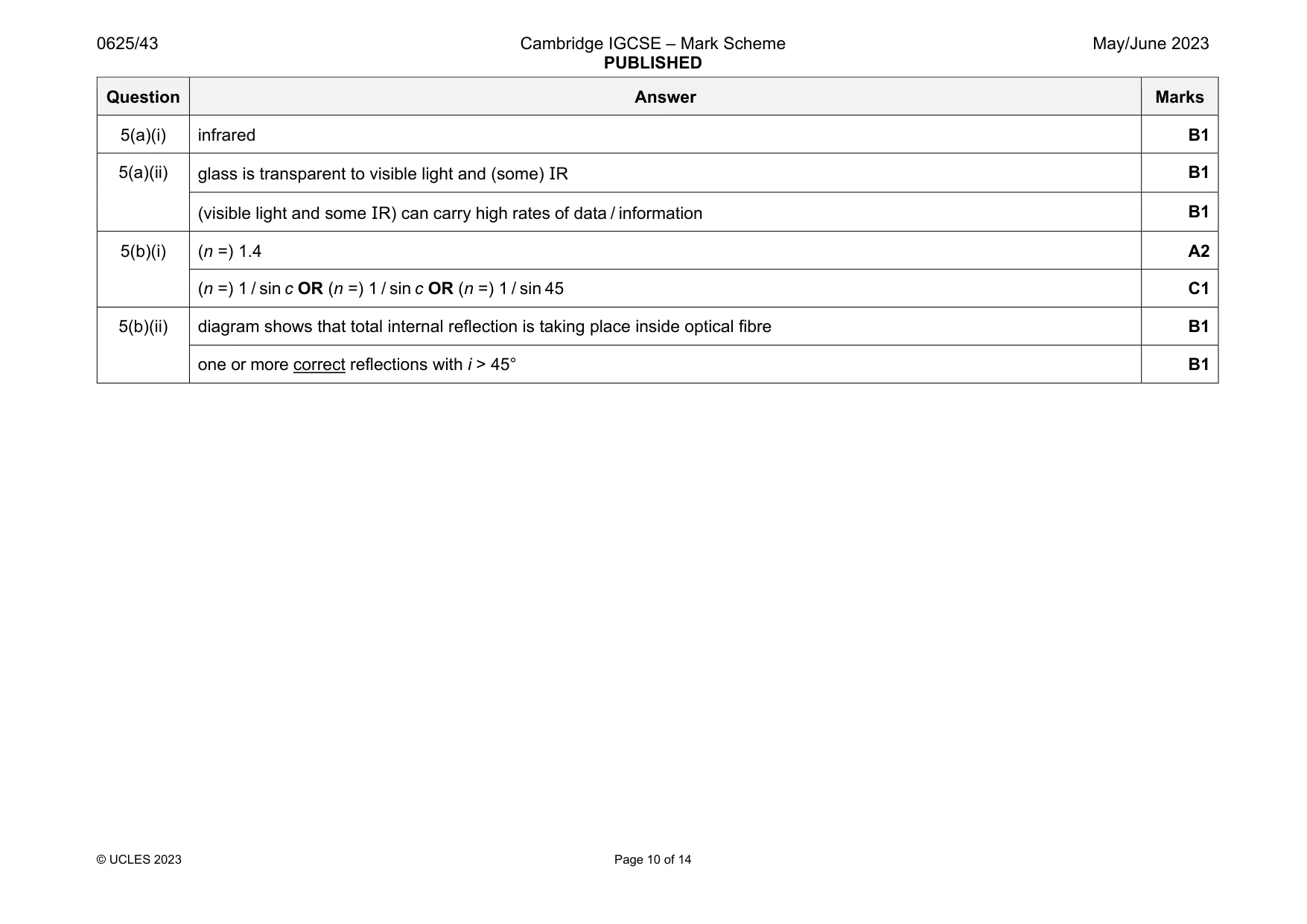
Mark scheme: 1(a) 1200 N AND g = W / m OR (W =) mg OR (W =) 120 9.8 B1 1(b) F = ma OR (a =) F / m B1 (a =) 54 / 120 B1 1(c) (v =) 3.6 m / s A2 a = (∆)v / t OR (∆v =) at OR (∆v =) 0.45 8(.0) C1 1(d) (d =) 14 m A2 average speed = (total) distance travelled / (total) time taken OR 1.8 8 OR 3.6 8 2 C1
Question 2
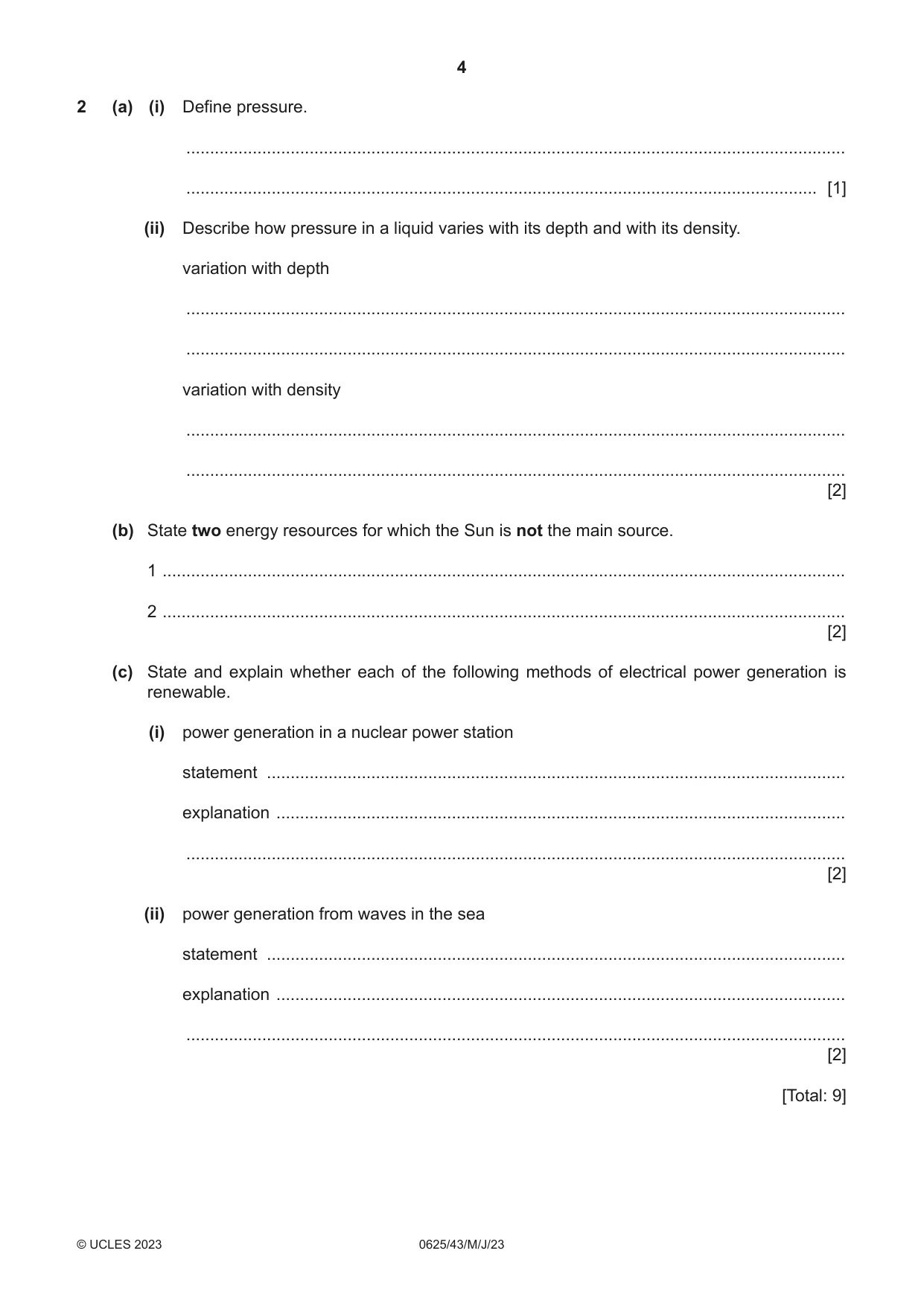
2 (a) (i) Define pressure. ........................................................................................................................................... ..................................................................................................................................... [1] (ii) Describe how pressure in a liquid varies with its depth and with its density. variation with depth ........................................................................................................................................... ........................................................................................................................................... variation with density ........................................................................................................................................... ........................................................................................................................................... [2] (b) State two energy resources for which the Sun is not the main source. 1 ................................................................................................................................................ 2 ................................................................................................................................................ [2] (c) State and explain whether each of the following methods of electrical power generation is renewable. (i) power generation in a nuclear power station statement .......................................................................................................................... explanation ........................................................................................................................ ........................................................................................................................................... [2] (ii) power generation from waves in the sea statement .......................................................................................................................... explanation ........................................................................................................................ ........................................................................................................................................... [2] [Total: 9]
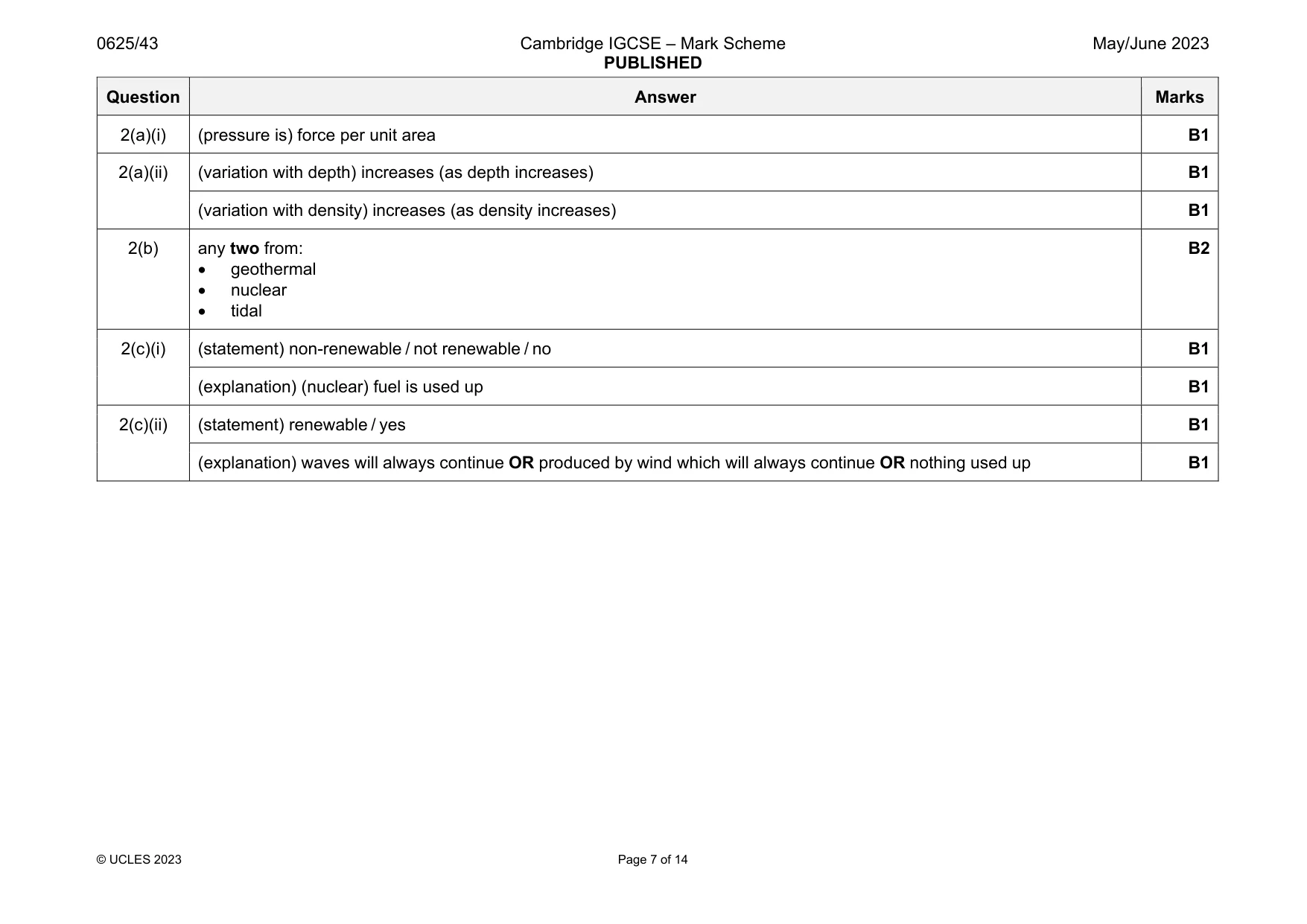
Mark scheme: 2(a)(i) (pressure is) force per unit area B1 2(a)(ii) (variation with depth) increases (as depth increases) B1 (variation with density) increases (as density increases) B1 2(b) any two from: geothermal nuclear tidal B2 2(c)(i) (statement) non-renewable / not renewable / no B1 (explanation) (nuclear) fuel is used up B1 2(c)(ii) (statement) renewable / yes B1 (explanation) waves will always continue OR produced by wind which will always continue OR nothing used up B1
Q3 · State which state of matter, solid, liquid or gas, has the greatest thermal expansion and…
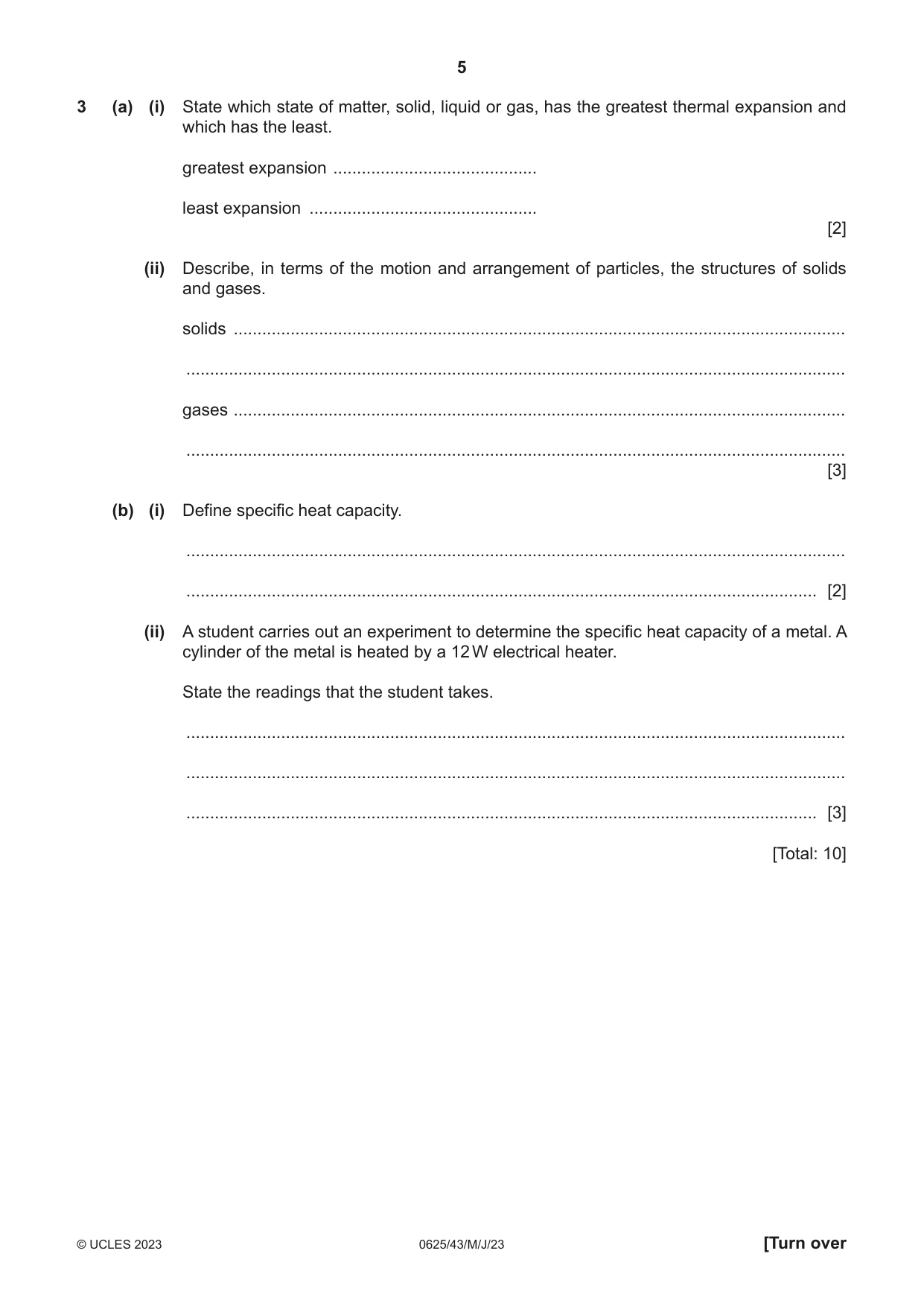
3 (a) (i) State which state of matter, solid, liquid or gas, has the greatest thermal expansion and which has the least. greatest expansion ........................................... least expansion ................................................ [2] (ii) Describe, in terms of the motion and arrangement of particles, the structures of solids and gases. solids ................................................................................................................................. ........................................................................................................................................... gases ................................................................................................................................. ........................................................................................................................................... [3] (b) (i) Define specific heat capacity. ........................................................................................................................................... ..................................................................................................................................... [2] (ii) A student carries out an experiment to determine the specific heat capacity of a metal. A cylinder of the metal is heated by a 12 W electrical heater. State the readings that the student takes. ........................................................................................................................................... ........................................................................................................................................... ..................................................................................................................................... [3] [Total: 10]
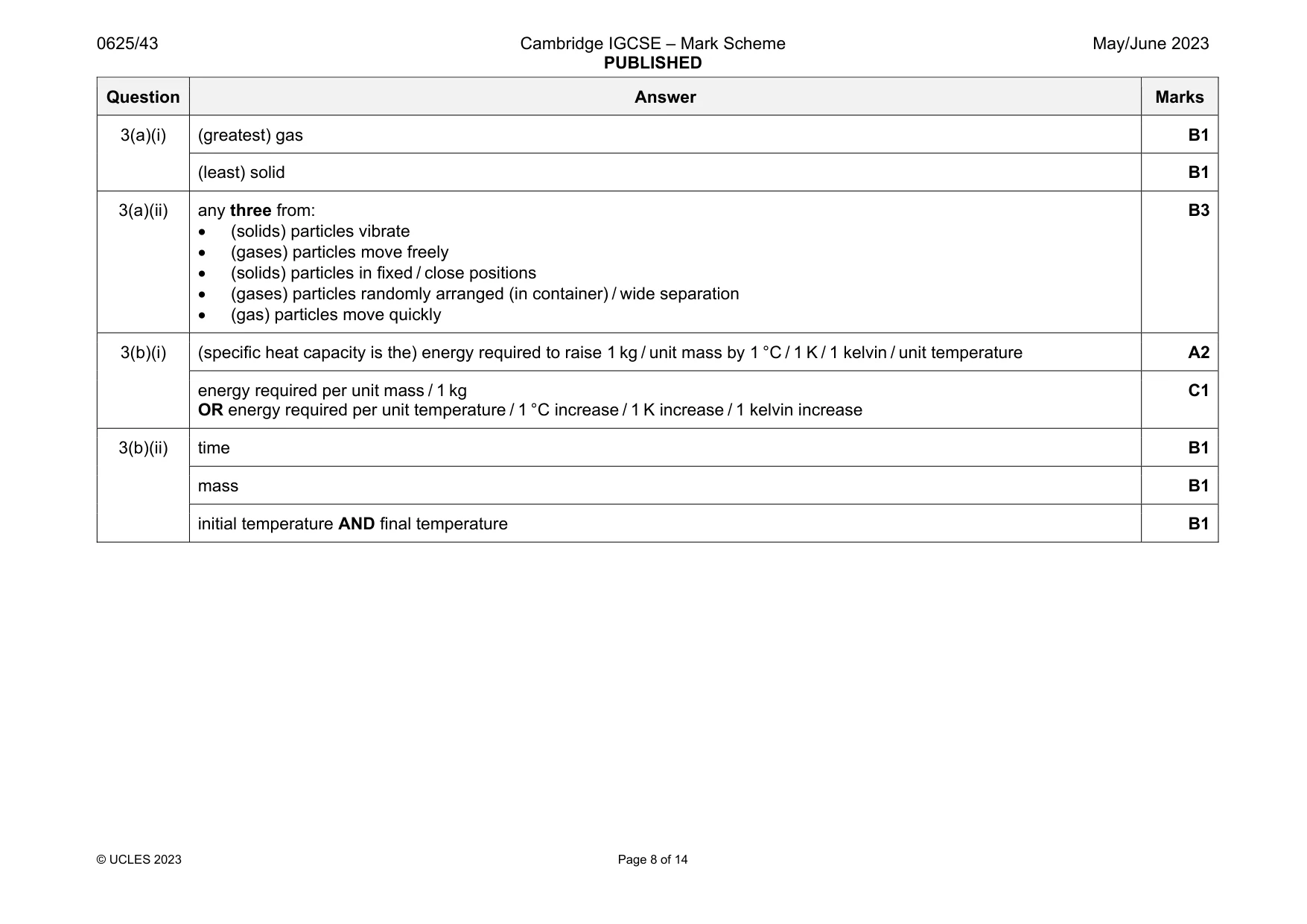
Mark scheme: 3(a)(i) (greatest) gas B1 (least) solid B1 3(a)(ii) any three from: (solids) particles vibrate (gases) particles move freely (solids) particles in fixed / close positions (gases) particles randomly arranged (in container) / wide separation (gas) particles move quickly B3 3(b)(i) (specific heat capacity is the) energy required to raise 1 kg / unit mass by 1 °C / 1 K / 1 kelvin / unit temperature A2 energy required per unit mass / 1 kg OR energy required per unit temperature / 1 °C increase / 1 K increase / 1 kelvin increase C1 3(b)(ii) time B1 mass B1 initial temperature AND final temperature B1
Q4 · An incomplete ray diagram showing an object O, a converging lens and the principal axis
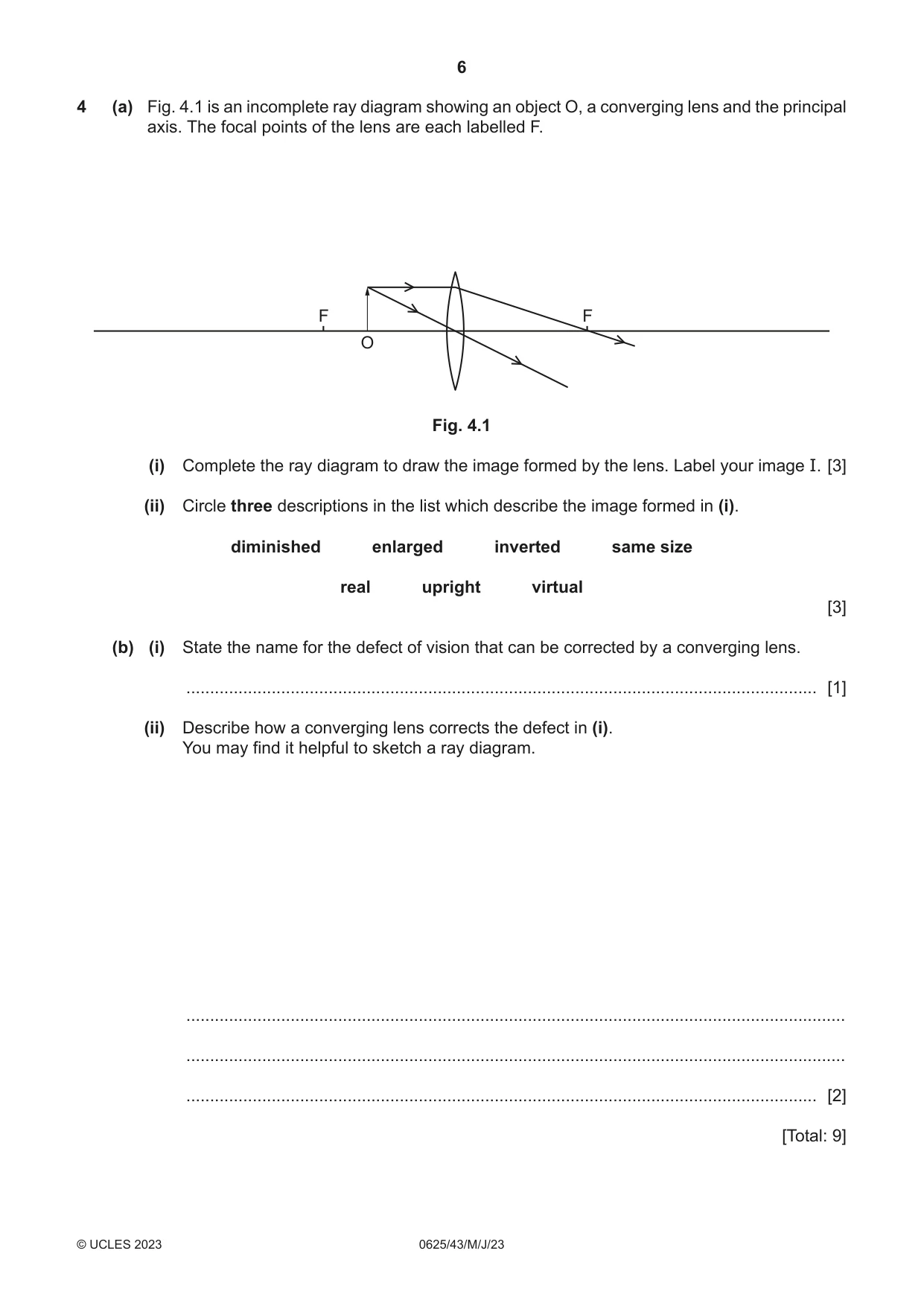
4 (a) Fig. 4.1 is an incomplete ray diagram showing an object O, a converging lens and the principal axis. The focal points of the lens are each labelled F. F F O Fig. 4.1 (i) Complete the ray diagram to draw the image formed by the lens. Label your image I. [3] (ii) Circle three descriptions in the list which describe the image formed in (i). diminished enlarged inverted same size real upright virtual [3] (b) (i) State the name for the defect of vision that can be corrected by a converging lens. ..................................................................................................................................... [1] (ii) Describe how a converging lens corrects the defect in (i). You may find it helpful to sketch a ray diagram. ........................................................................................................................................... ........................................................................................................................................... ..................................................................................................................................... [2] [Total: 9]
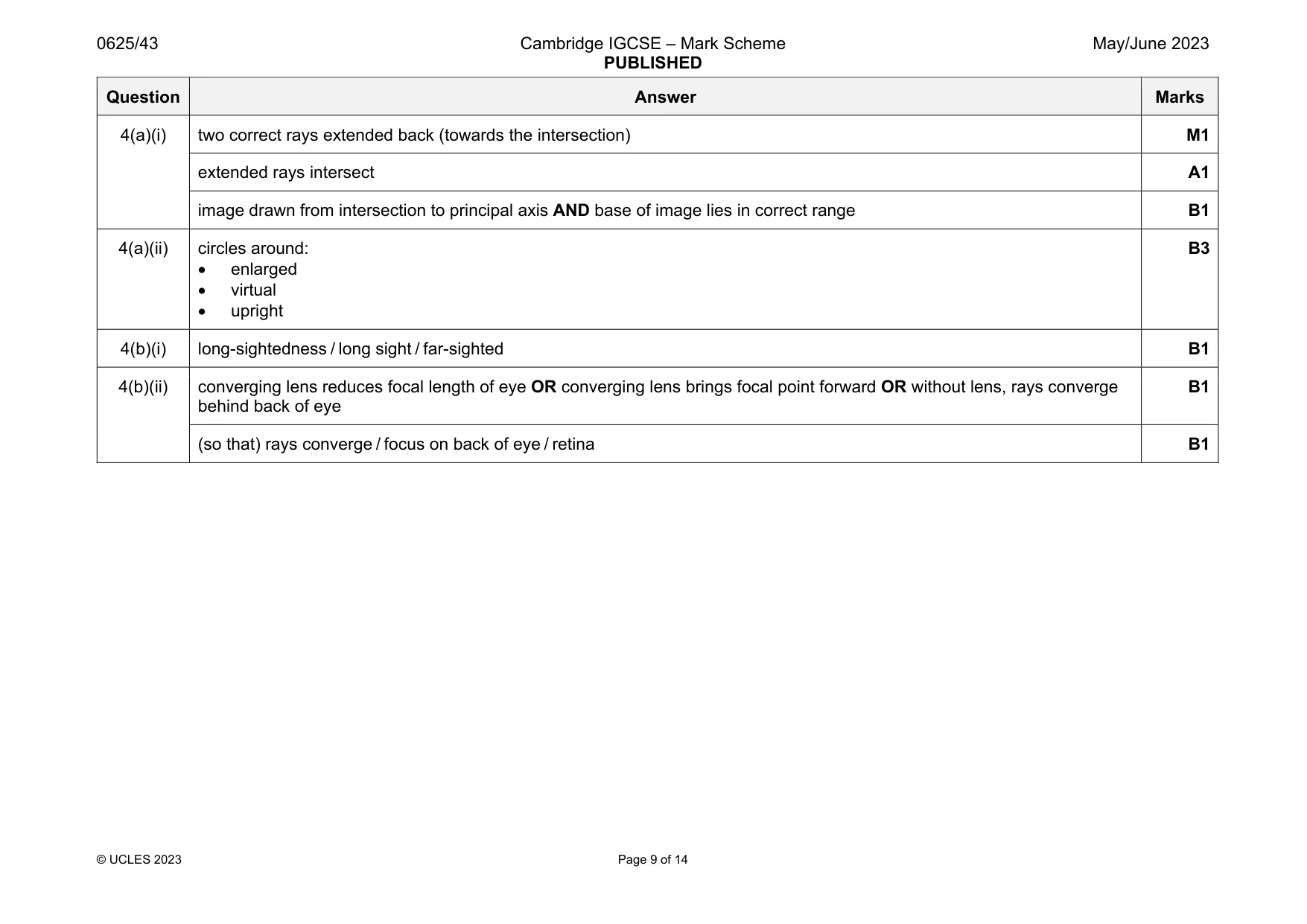
Mark scheme: 4(a)(i) two correct rays extended back (towards the intersection) M1 extended rays intersect A1 image drawn from intersection to principal axis AND base of image lies in correct range B1 4(a)(ii) circles around: enlarged virtual upright B3 4(b)(i) long-sightedness / long sight / far-sighted B1 4(b)(ii) converging lens reduces focal length of eye OR converging lens brings focal point forward OR without lens, rays converge behind back of eye B1 (so that) rays converge / focus on back of eye / retina B1
Q5 · Two types of electromagnetic radiation are used in glass optical fibres for high-speed…
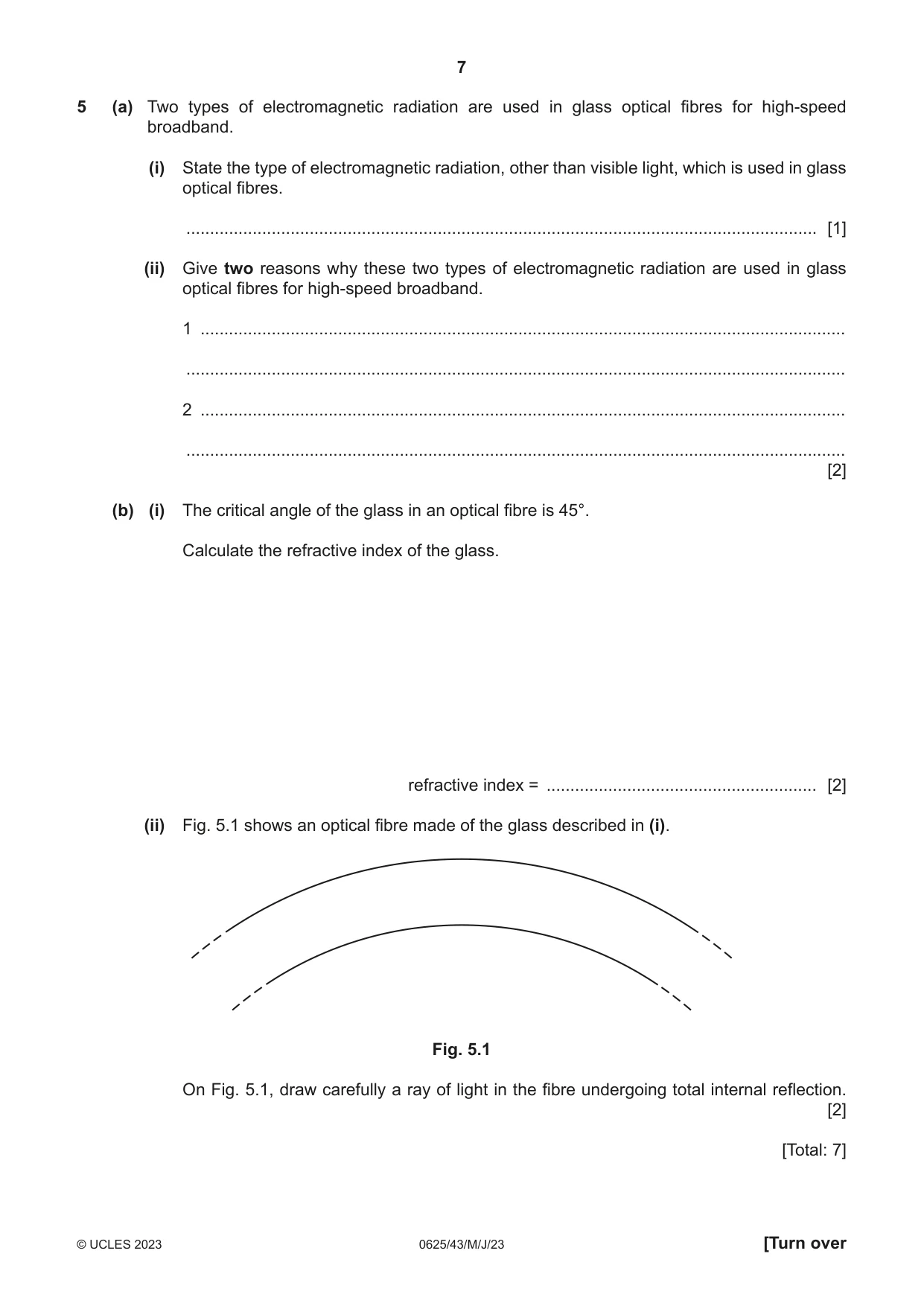
5 (a) Two types of electromagnetic radiation are used in glass optical fibres for high-speed broadband. (i) State the type of electromagnetic radiation, other than visible light, which is used in glass optical fibres. ..................................................................................................................................... [1] (ii) Give two reasons why these two types of electromagnetic radiation are used in glass optical fibres for high-speed broadband. 1 ........................................................................................................................................ ........................................................................................................................................... 2 ........................................................................................................................................ ........................................................................................................................................... [2] (b) (i) The critical angle of the glass in an optical fibre is 45°. Calculate the refractive index of the glass. refractive index = ......................................................... [2] (ii) Fig. 5.1 shows an optical fibre made of the glass described in (i). Fig. 5.1 On Fig. 5.1, draw carefully a ray of light in the fibre undergoing total internal reflection. [2] [Total: 7]
Mark scheme: 5(a)(i) infrared B1 5(a)(ii) glass is transparent to visible light and (some) IR B1 (visible light and some IR) can carry high rates of data / information B1 5(b)(i) (n =) 1.4 A2 (n =) 1 / sin c OR (n =) 1 / sin c OR (n =) 1 / sin 45 C1 5(b)(ii) diagram shows that total internal reflection is taking place inside optical fibre B1 one or more correct reflections with i > 45° B1
Q6 · An electric heater uses a resistance wire of resistance 26 Ω
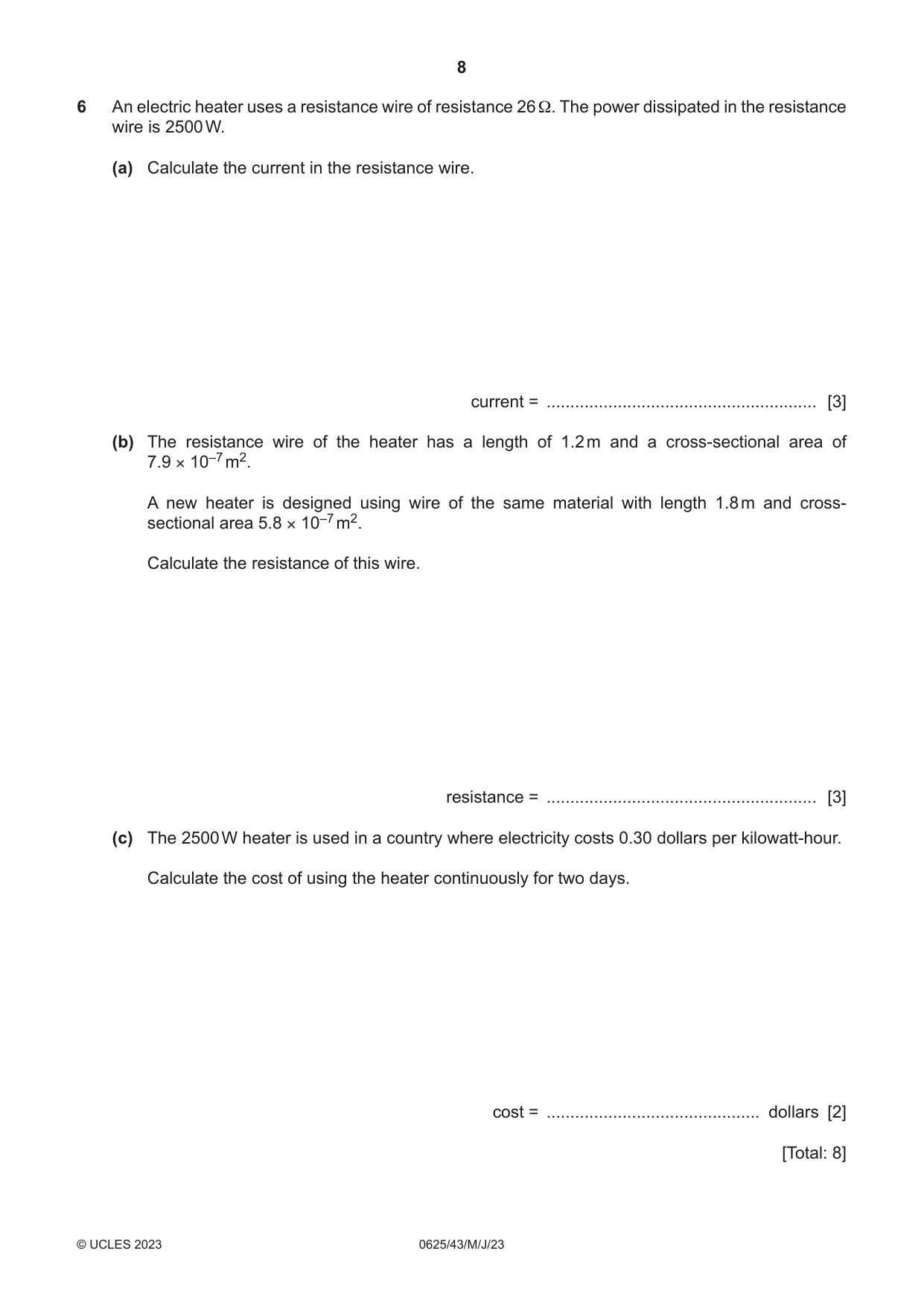
6 An electric heater uses a resistance wire of resistance 26 Ω. The power dissipated in the resistance wire is 2500 W. (a) Calculate the current in the resistance wire. current = ......................................................... [3] (b) The resistance wire of the heater has a length of 1.2 m and a cross-sectional area of 7.9 × 10⁻⁷ m2. A new heater is designed using wire of the same material with length 1.8 m and cross- sectional area 5.8 × 10⁻⁷ m2. Calculate the resistance of this wire. resistance = ......................................................... [3] (c) The 2500 W heater is used in a country where electricity costs 0.30 dollars per kilowatt-hour. Calculate the cost of using the heater continuously for two days. cost = ............................................. dollars [2] [Total: 8]
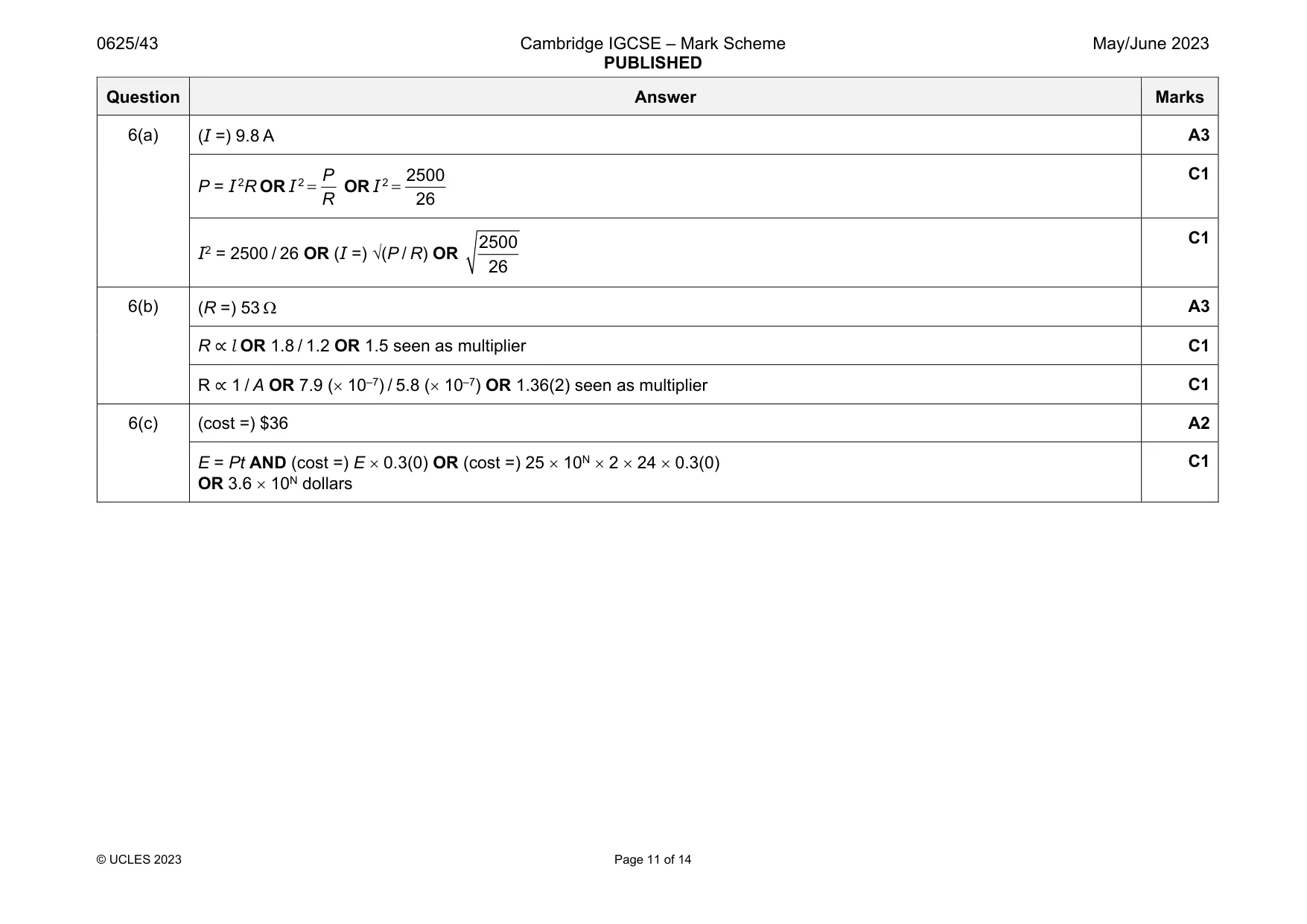
Mark scheme: 6(a) A3 P = I 2R OR I 2 P R OR I 2 2500 26 C1 I2 = 2500 / 26 OR (I =) √(P / R) OR 2500 26 C1 6(b) (R =) 53 A3 R ∝ l OR 1.8 / 1.2 OR 1.5 seen as multiplier C1 R ∝ 1 / A OR 7.9 ( 10–7) / 5.8 ( 10–7) OR 1.36(2) seen as multiplier C1 6(c) (cost =) $36 A2 E = Pt AND (cost =) E 0.3(0) OR (cost =) 25 10N 2 24 0.3(0) OR 3.6 10N dollars C1
Q7 · The voltage across the primary coil of a 100% efficient transformer is 220 V and the…
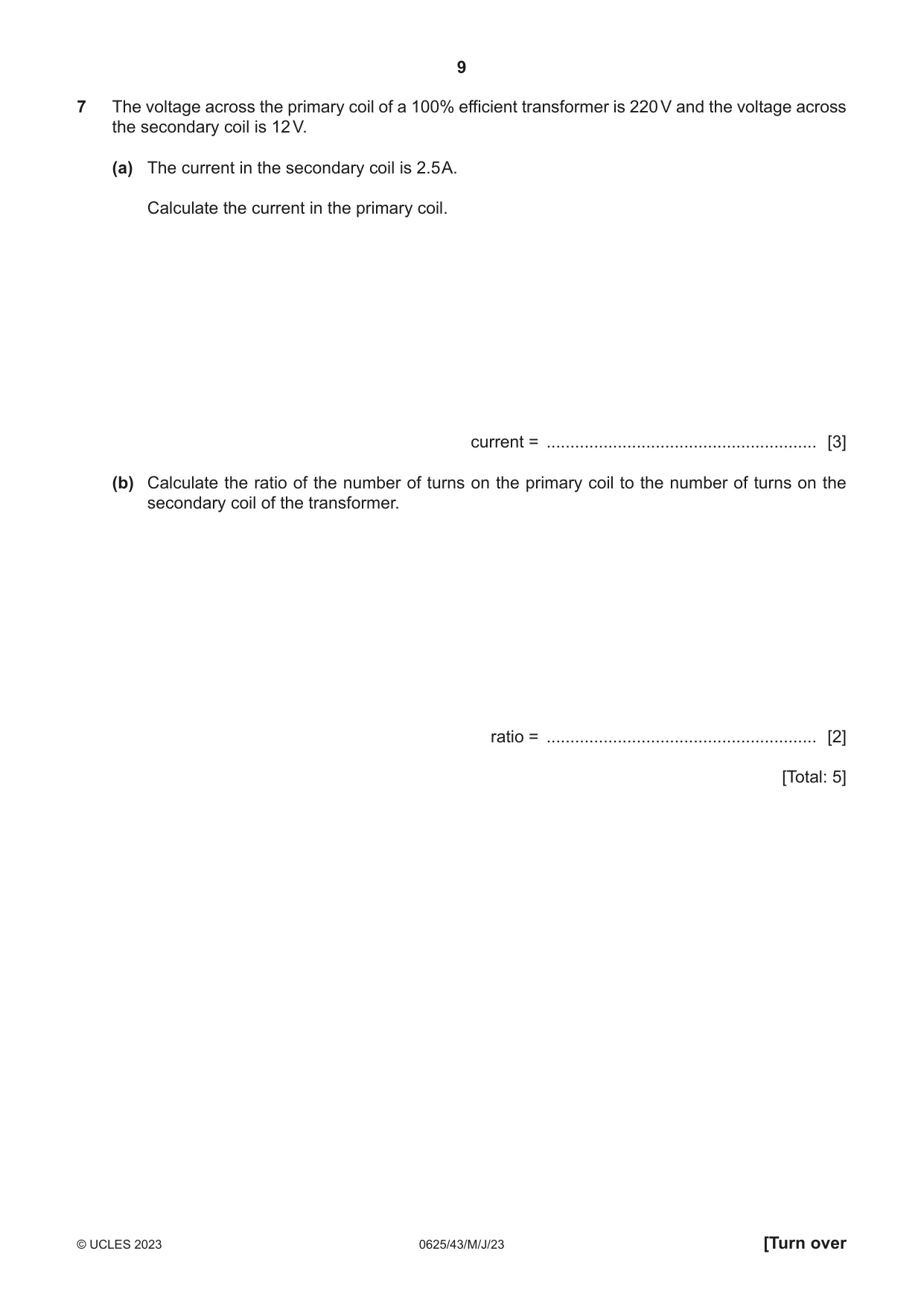
7 The voltage across the primary coil of a 100% efficient transformer is 220 V and the voltage across the secondary coil is 12 V. (a) The current in the secondary coil is 2.5 A. Calculate the current in the primary coil. current = ......................................................... [3] (b) Calculate the ratio of the number of turns on the primary coil to the number of turns on the secondary coil of the transformer. ratio = ......................................................... [2] [Total: 5]
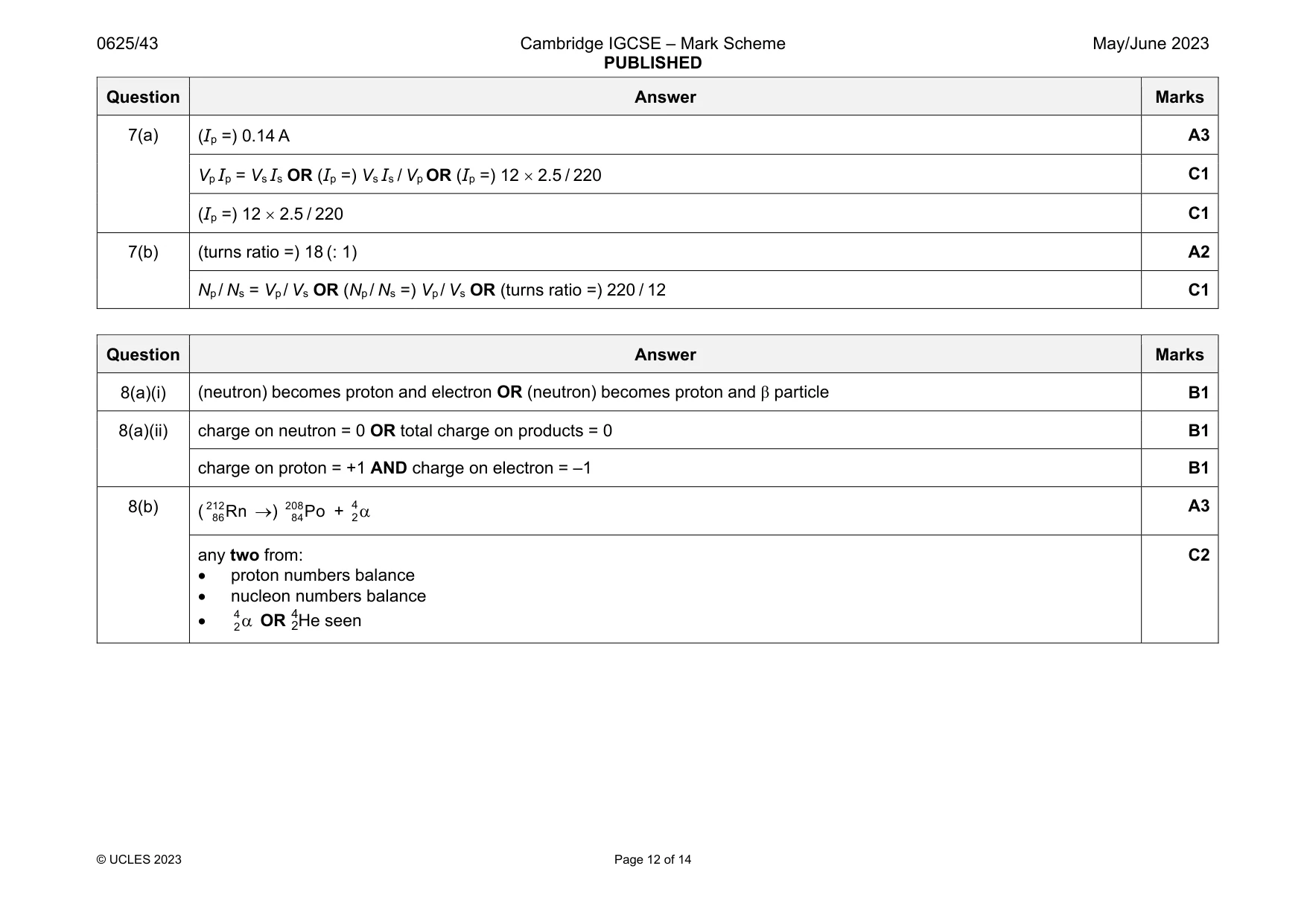
Mark scheme: 7(a) A3 Vp Ip = Vs Is OR (Ip =) Vs Is / Vp OR (Ip =) 12 2.5 / 220 C1 (Ip =) 12 2.5 / 220 C1 7(b) (turns ratio =) 18 (: 1) A2 Np/ Ns = Vp/ Vs OR (Np/ Ns =) Vp/ Vs OR (turns ratio =) 220 / 12 C1
Q8 · During β-decay, one of the neutrons in the nucleus changes
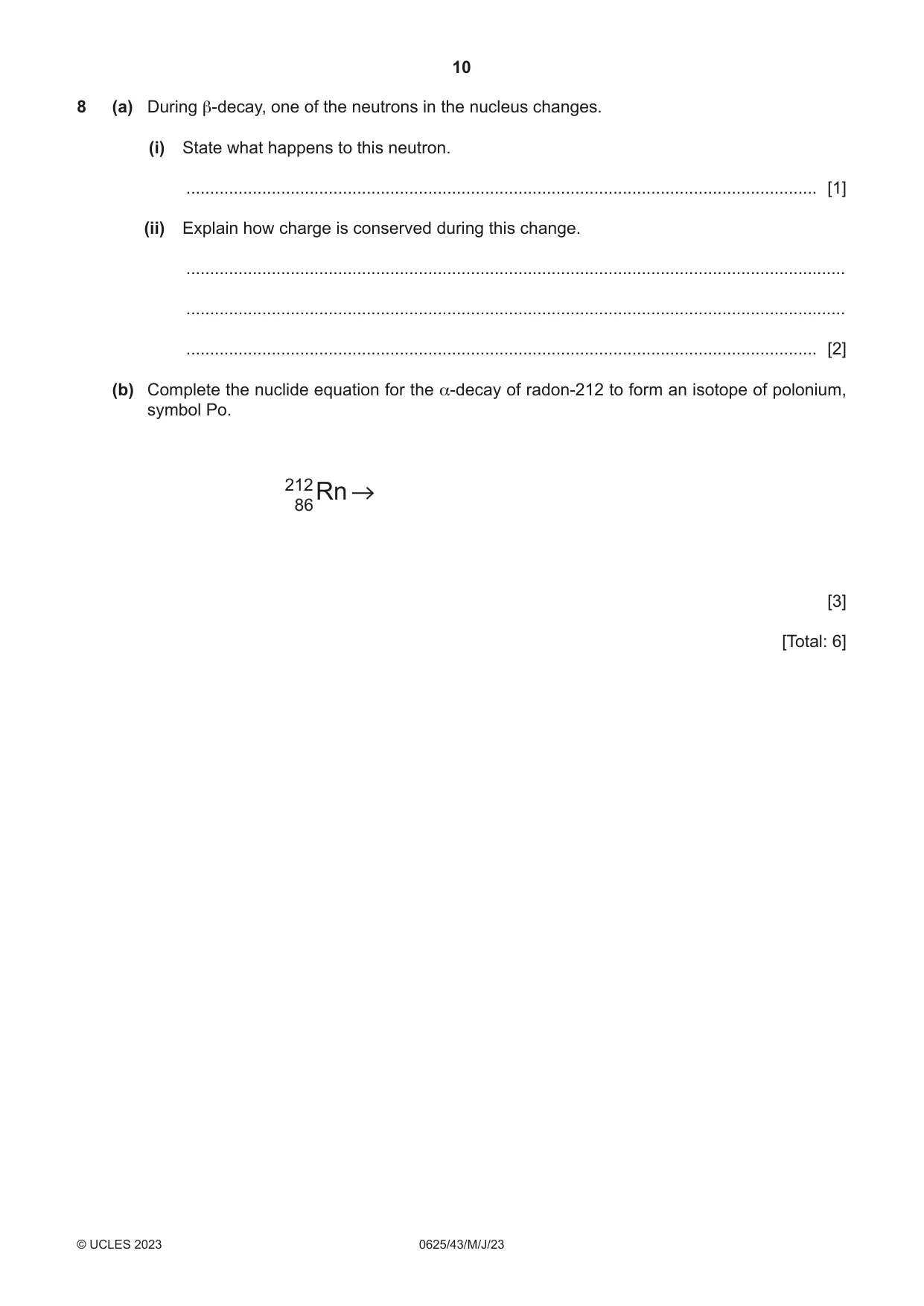
8 (a) During β-decay, one of the neutrons in the nucleus changes. (i) State what happens to this neutron. ..................................................................................................................................... [1] (ii) Explain how charge is conserved during this change. ........................................................................................................................................... ........................................................................................................................................... ..................................................................................................................................... [2] (b) Complete the nuclide equation for the α-decay of radon-212 to form an isotope of polonium, symbol Po. 21286Rn [3] [Total: 6]
Mark scheme: 8(a)(i) B1 8(a)(ii) charge on neutron = 0 OR total charge on products = 0 B1 charge on proton = +1 AND charge on electron = –1 B1 8(b) ( 212 86Rn ) 208 84Po + 4 2 A3 any two from: proton numbers balance nucleon numbers balance 4 2 OR H 2 4 e seen C2
Q9 · The Sun as the central dot and the planets Saturn, Jupiter and Earth labelled S0, J0 and…
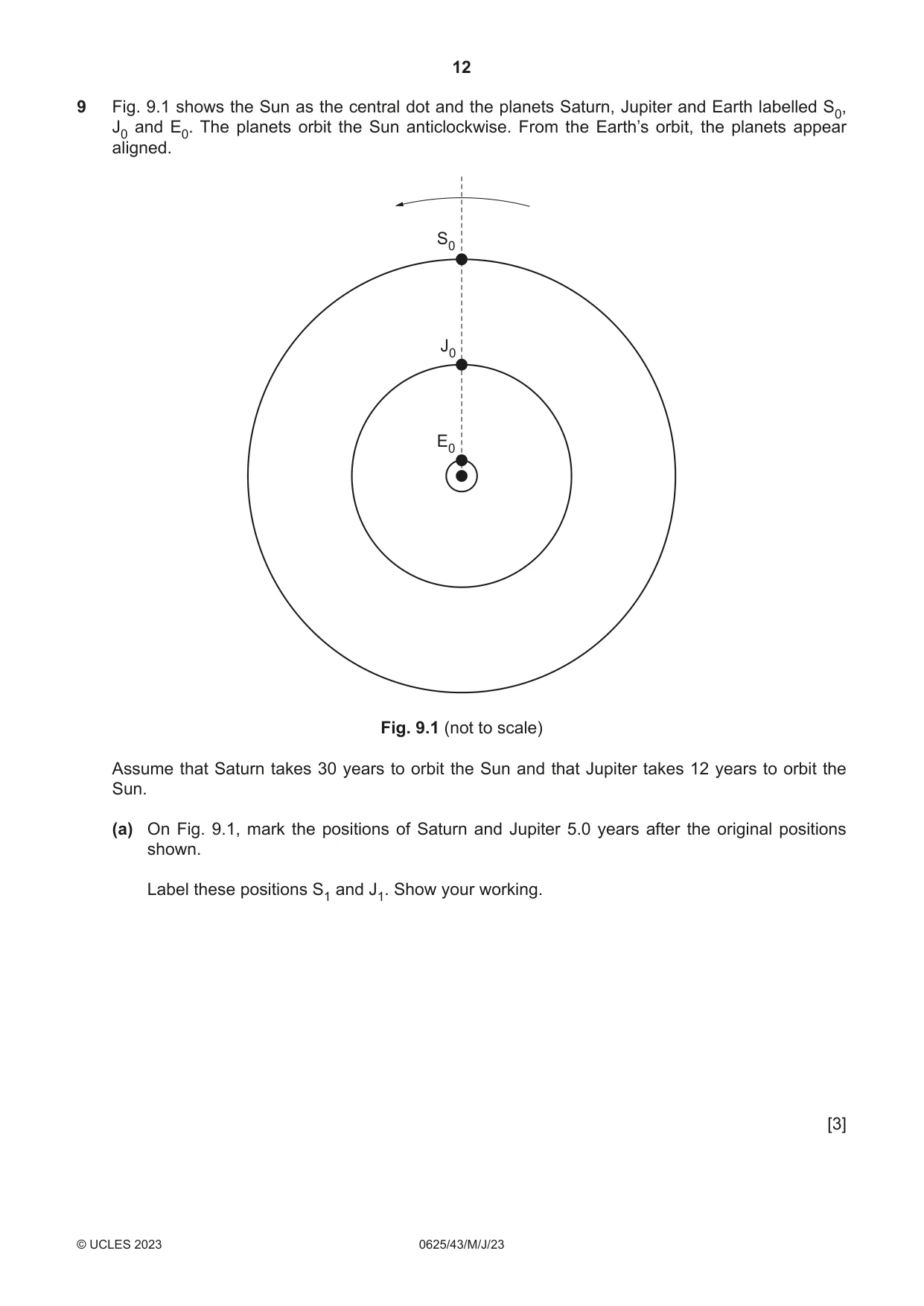
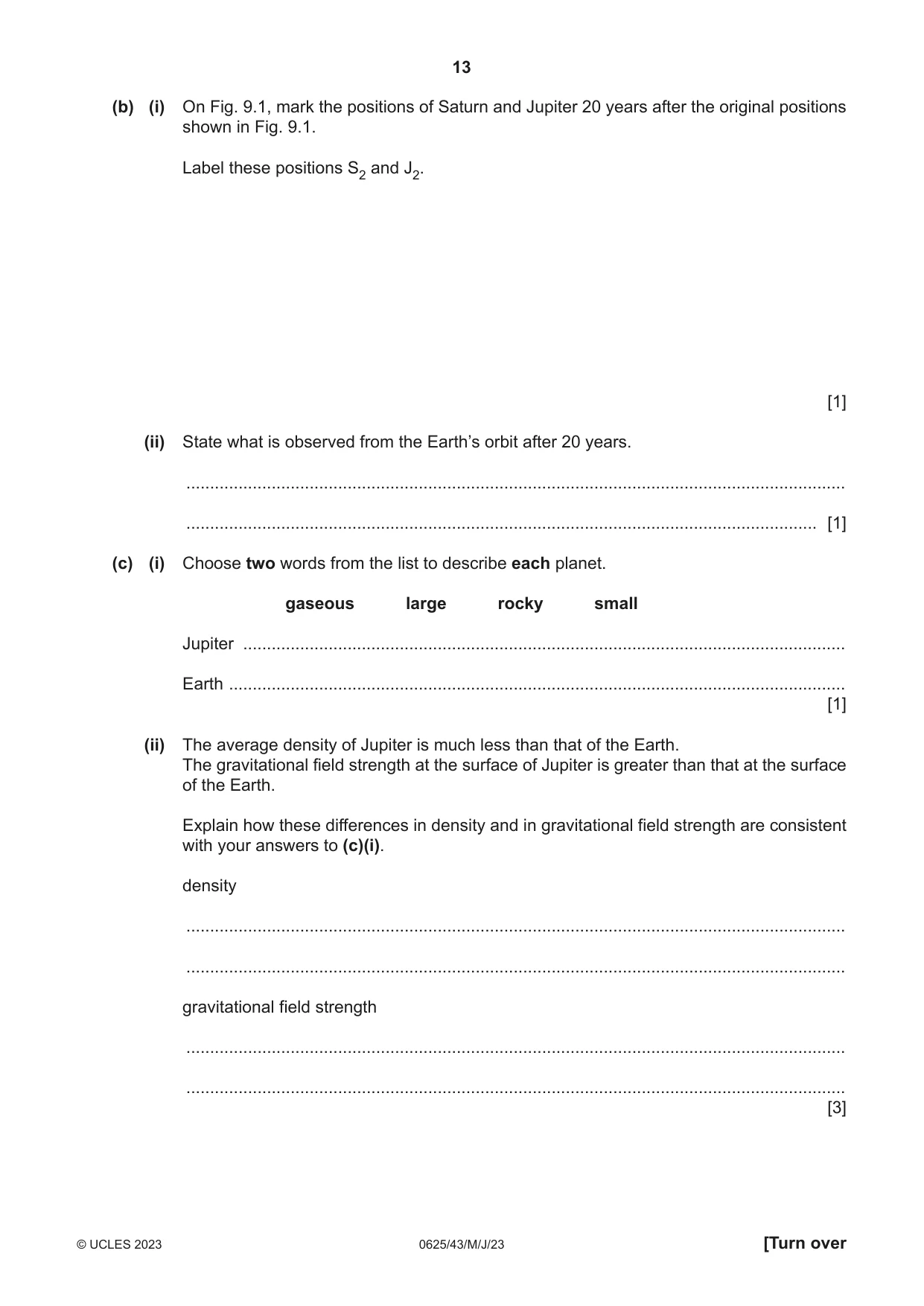
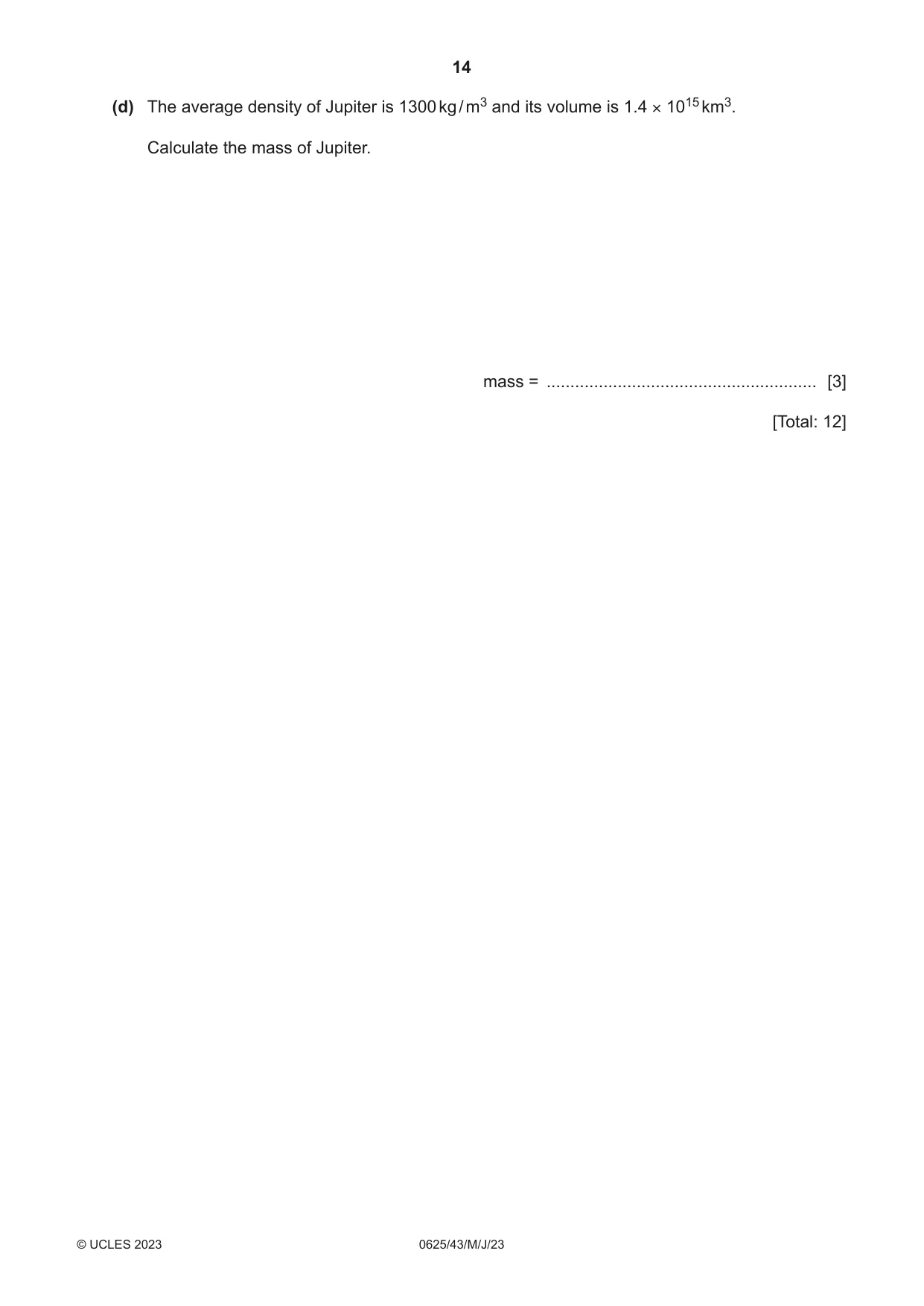
9 Fig. 9.1 shows the Sun as the central dot and the planets Saturn, Jupiter and Earth labelled S0, J0 and E0. The planets orbit the Sun anticlockwise. From the Earth’s orbit, the planets appear aligned. S0 J0 E0 Fig. 9.1 (not to scale) Assume that Saturn takes 30 years to orbit the Sun and that Jupiter takes 12 years to orbit the Sun. (a) On Fig. 9.1, mark the positions of Saturn and Jupiter 5.0 years after the original positions shown. Label these positions S1 and J1. Show your working. [3] (b) (i) On Fig. 9.1, mark the positions of Saturn and Jupiter 20 years after the original positions shown in Fig. 9.1. Label these positions S2 and J2. [1] (ii) State what is observed from the Earth’s orbit after 20 years. ........................................................................................................................................... ..................................................................................................................................... [1] (c) (i) Choose two words from the list to describe each planet. gaseous large rocky small Jupiter ............................................................................................................................... Earth .................................................................................................................................. [1] (ii) The average density of Jupiter is much less than that of the Earth. The gravitational field strength at the surface of Jupiter is greater than that at the surface of the Earth. Explain how these differences in density and in gravitational field strength are consistent with your answers to (c)(i). density ........................................................................................................................................... ........................................................................................................................................... gravitational field strength ........................................................................................................................................... ........................................................................................................................................... [3] (d) The average density of Jupiter is 1300 kg / m3 and its volume is 1.4 × 10¹⁵ km3. Calculate the mass of Jupiter. mass = ......................................................... [3] [Total: 12]
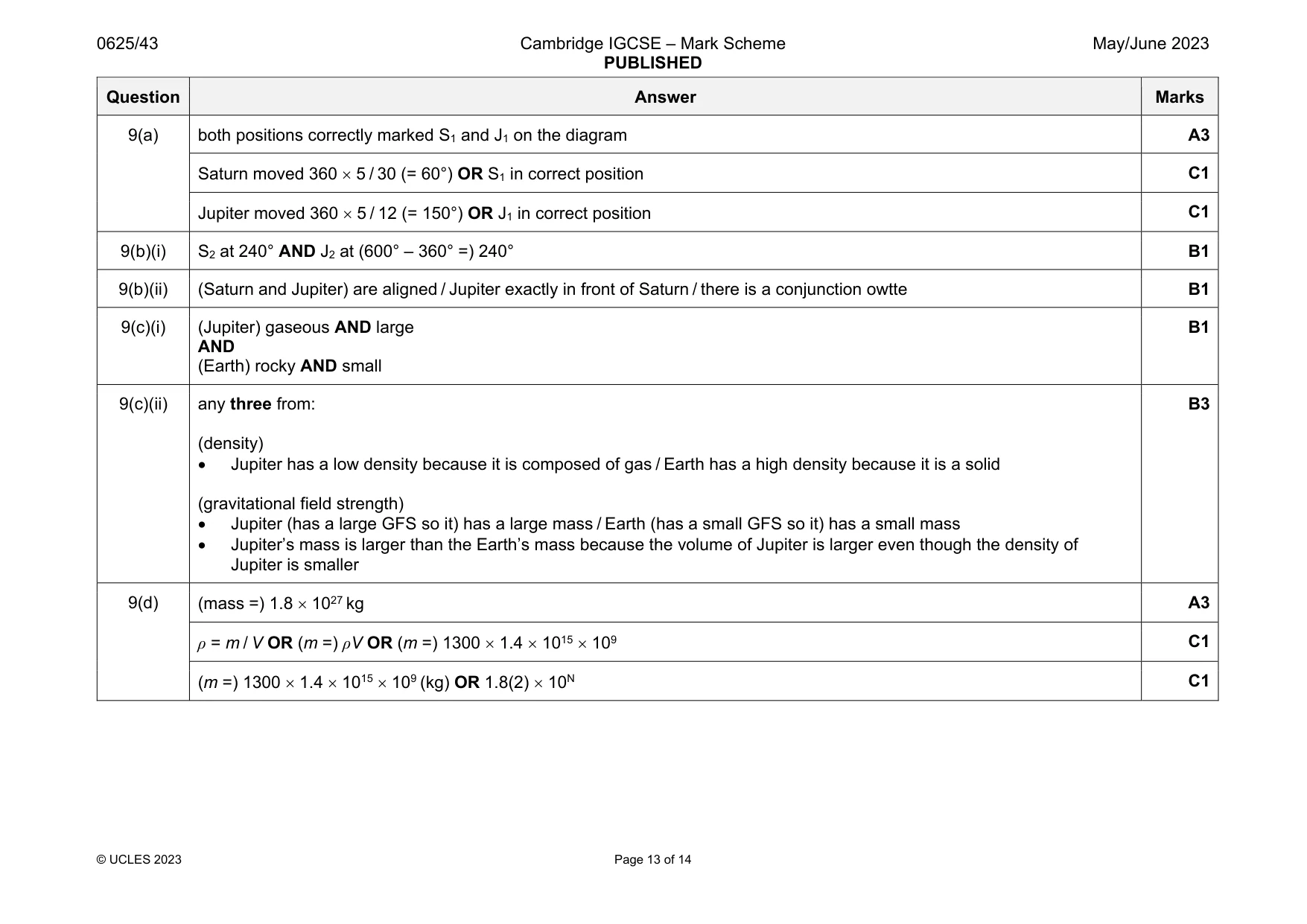
Mark scheme: 9(a) both positions correctly marked S1 and J1 on the diagram A3 Saturn moved 360 5 / 30 (= 60°) OR S1 in correct position C1 Jupiter moved 360 5 / 12 (= 150°) OR J1 in correct position C1 9(b)(i) S2 at 240° AND J2 at (600° – 360° =) 240° B1 9(b)(ii) (Saturn and Jupiter) are aligned / Jupiter exactly in front of Saturn / there is a conjunction owtte B1 9(c)(i) (Jupiter) gaseous AND large AND (Earth) rocky AND small B1 9(c)(ii) any three from: (density) Jupiter has a low density because it is composed of gas / Earth has a high density because it is a solid (gravitational field strength) Jupiter (has a large GFS so it) has a large mass / Earth (has a small GFS so it) has a small mass Jupiter’s mass is larger than the Earth’s mass because the volume of Jupiter is larger even though the density of Jupiter is smaller B3 9(d) (mass =) 1.8 1027 kg A3 ρ = m / V OR (m =) ρV OR (m =) 1300 1.4 1015 109 C1 (m =) 1300 1.4 1015 109 (kg) OR 1.8(2) 10N C1
Q10 · Show that 1 light-year = 9.5 × 10¹⁵ m
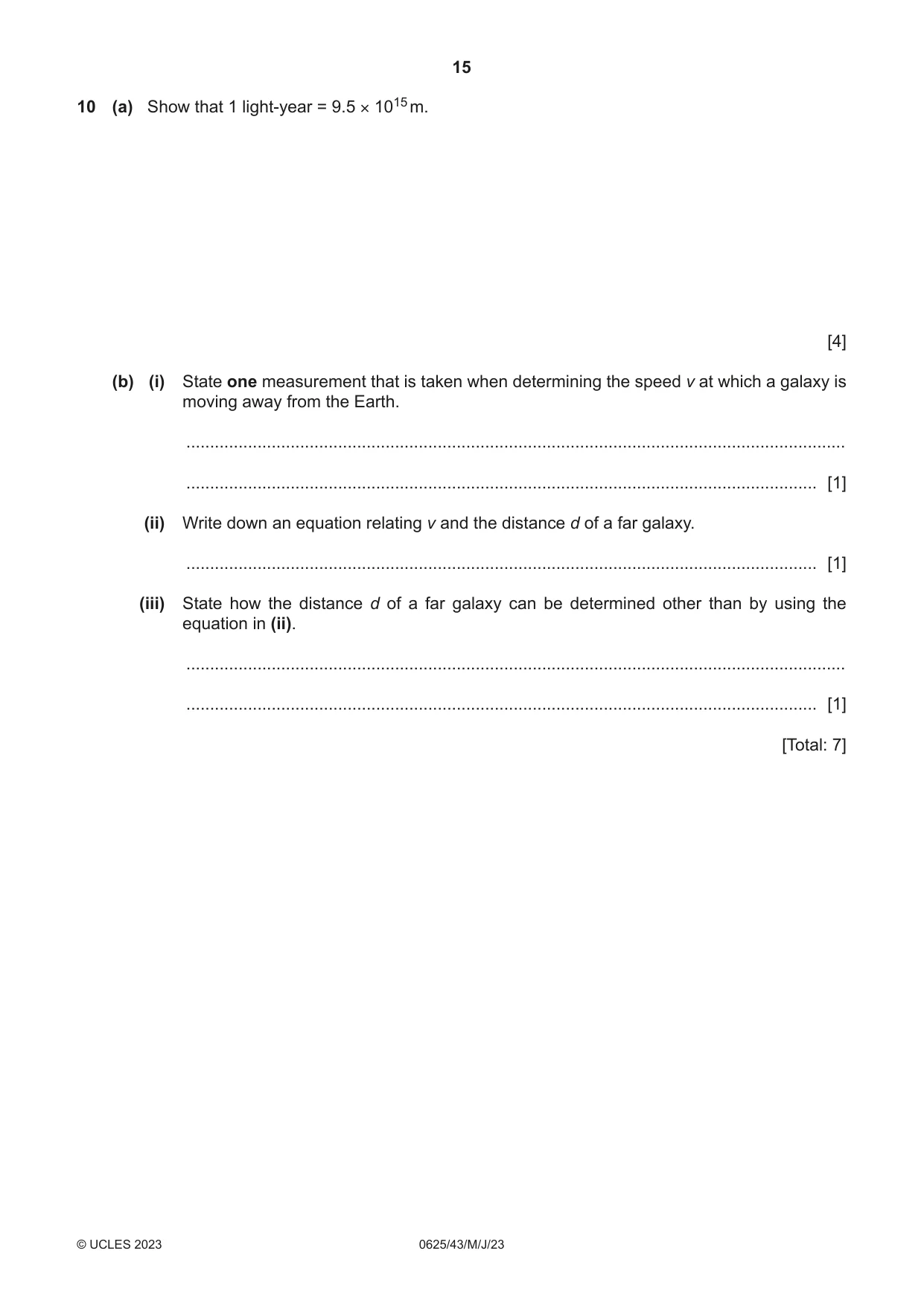
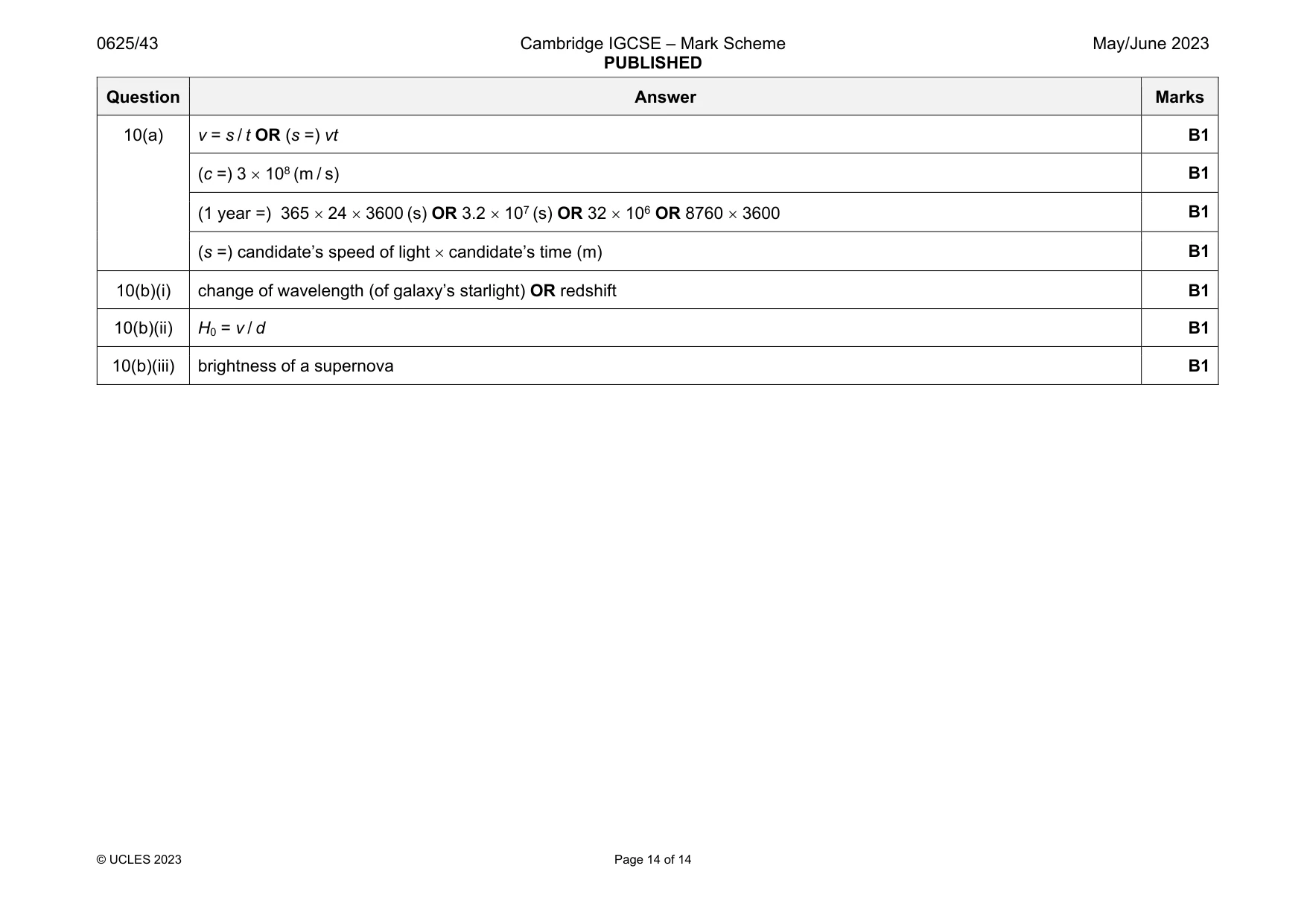
10 (a) Show that 1 light-year = 9.5 × 10¹⁵ m. [4] (b) (i) State one measurement that is taken when determining the speed v at which a galaxy is moving away from the Earth. ........................................................................................................................................... ..................................................................................................................................... [1] (ii) Write down an equation relating v and the distance d of a far galaxy. ..................................................................................................................................... [1] (iii) State how the distance d of a far galaxy can be determined other than by using the equation in (ii). ........................................................................................................................................... ..................................................................................................................................... [1] [Total: 7]
Mark scheme: 10(a) v = s / t OR (s =) vt B1 (c =) 3 108 (m / s) B1 (1 year =) 365 24 3600 (s) OR 3.2 107 (s) OR 32 106 OR 8760 3600 B1 (s =) candidate’s speed of light candidate’s time (m) B1 10(b)(i) change of wavelength (of galaxy’s starlight) OR red shift B1 10(b)(ii) H0 = v / d B1 10(b)(iii) brightness of a supernova B1
What was in this paper
The subtopics covered by these 10 questions, and how many questions each got. Open one in a new tab to see every Cambridge question on it.
What you needed in this session
Cambridge’s own grade thresholds for 2023 May/June, Paper 4 · Variant 3. A higher threshold means an easier paper — the bar moves with how the cohort did.