Cambridge IGCSE Physics 0625 — 2021 May/June Paper 4 · Variant 2
0625/42/M/J/21 · 11 questions · 80 marks · ≈90 min
The question paper and its mark scheme, free to read here and free to download. This is Cambridge’s own paper, exactly as it was sat.
Question paper16 pages
Mark scheme11 pages
Answers below. Sit the paper first if you are practising.
Questions as text
Q1 · A sealed weather balloon which is stationary in still air
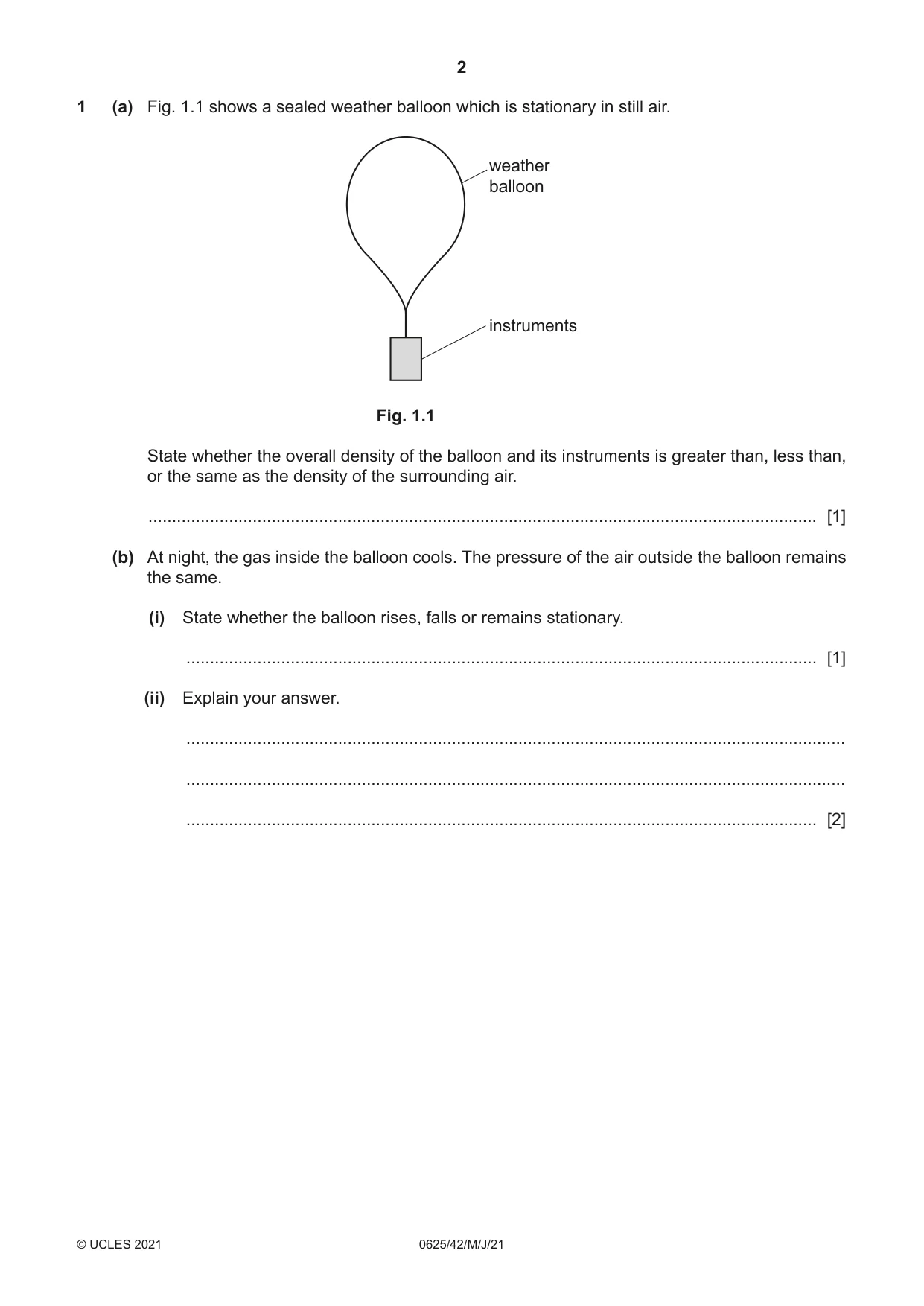
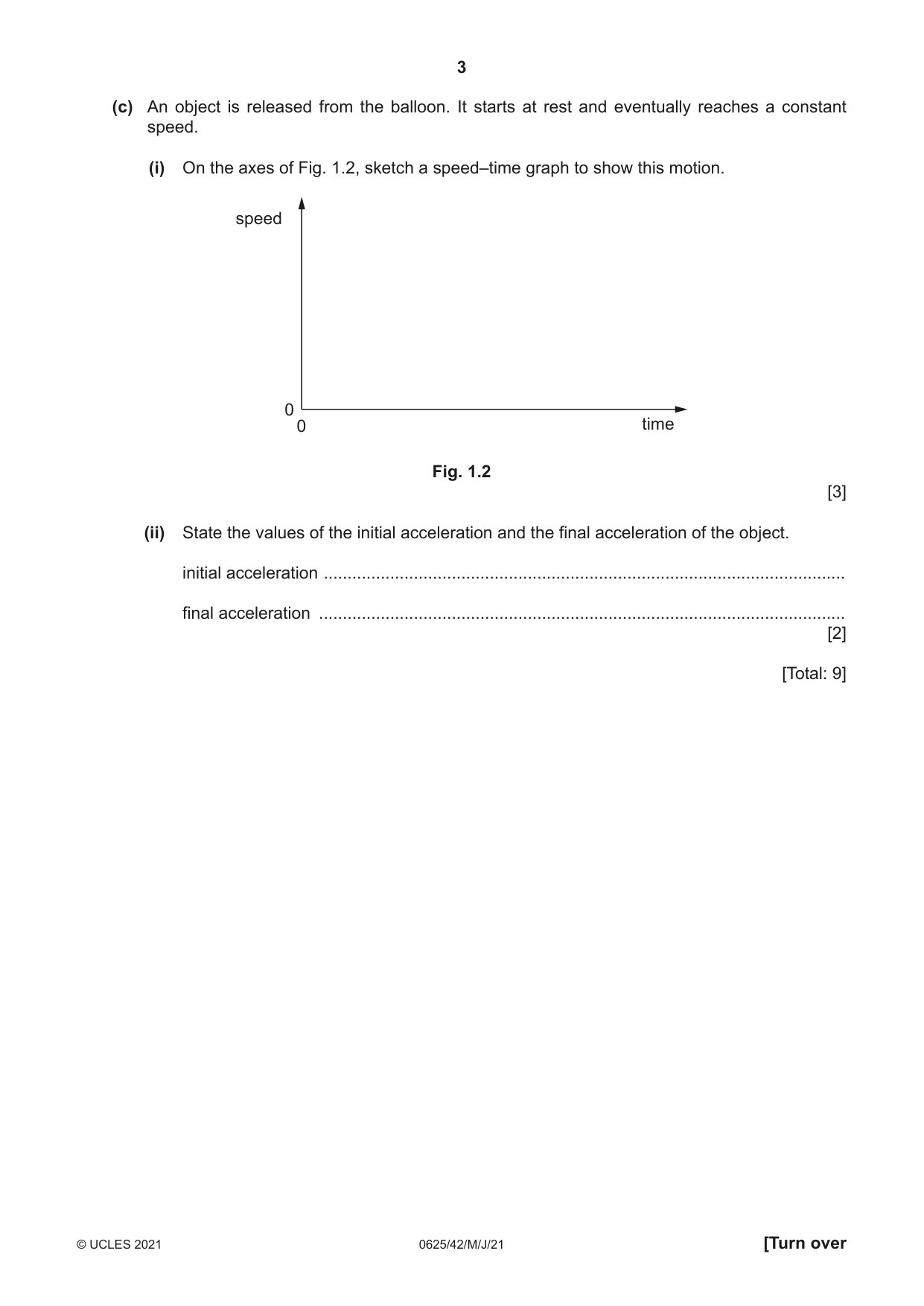
1 (a) Fig. 1.1 shows a sealed weather balloon which is stationary in still air. weather balloon instruments Fig. 1.1 State whether the overall density of the balloon and its instruments is greater than, less than, or the same as the density of the surrounding air. ............................................................................................................................................. [1] (b) At night, the gas inside the balloon cools. The pressure of the air outside the balloon remains the same. (i) State whether the balloon rises, falls or remains stationary. ..................................................................................................................................... [1] (ii) Explain your answer. ........................................................................................................................................... ........................................................................................................................................... ..................................................................................................................................... [2] (c) An object is released from the balloon. It starts at rest and eventually reaches a constant speed. (i) On the axes of Fig. 1.2, sketch a speed–time graph to show this motion. speed 0 0 time Fig. 1.2 [3] (ii) State the values of the initial acceleration and the final acceleration of the object. initial acceleration .............................................................................................................. final acceleration ............................................................................................................... [2] [Total: 9]
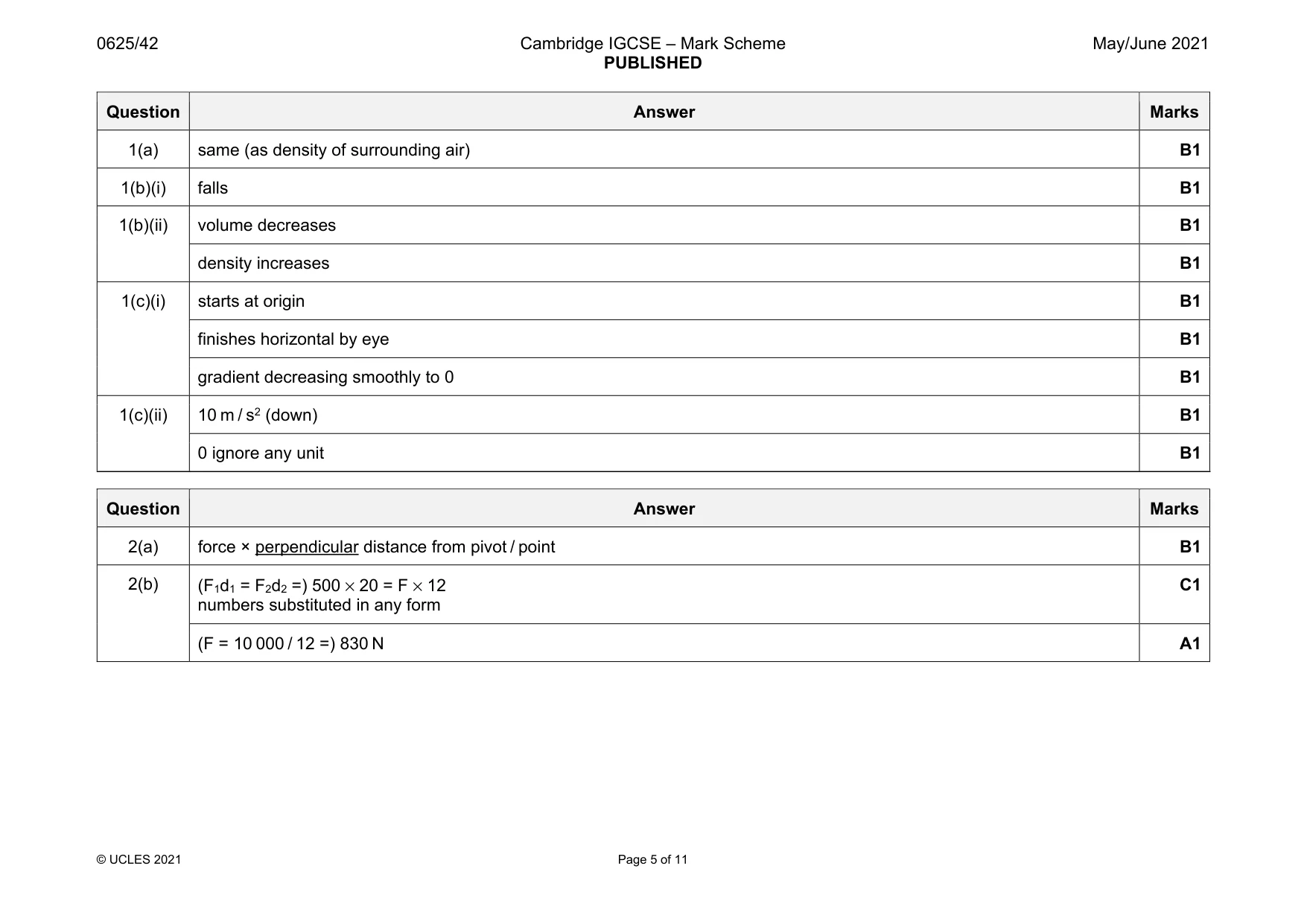
Mark scheme: 1(a) same (as density of surrounding air) B1 1(b)(i) falls B1 1(b)(ii) volume decreases B1 density increases B1 1(c)(i) starts at origin B1 finishes horizontal by eye B1 gradient decreasing smoothly to 0 B1 1(c)(ii) 10 m / s2 (down) B1 0 ignore any unit B1
Q2 · Define the moment of a force
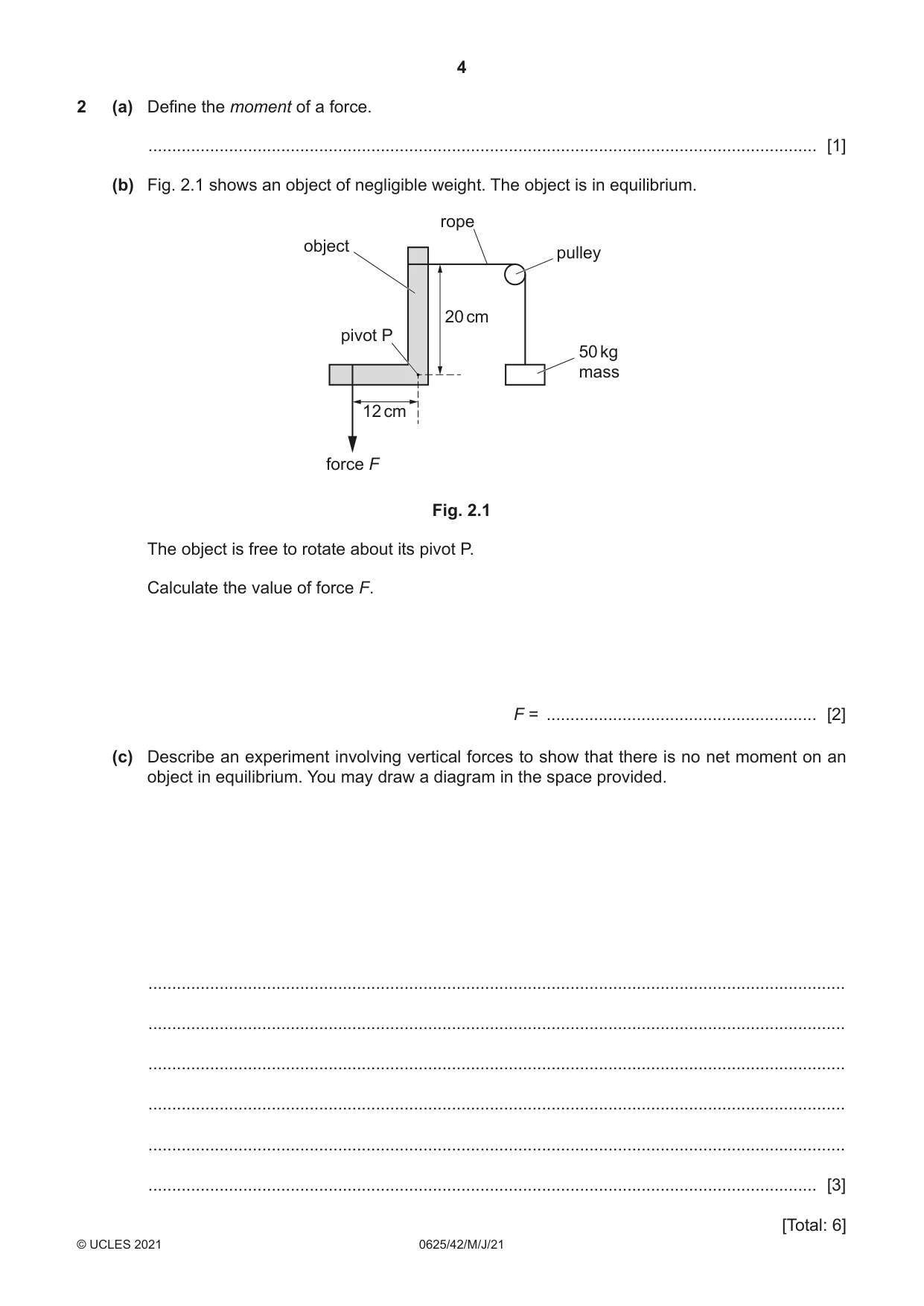
2 (a) Define the moment of a force. ............................................................................................................................................. [1] (b) Fig. 2.1 shows an object of negligible weight. The object is in equilibrium. rope object pulley 20 cm pivot P 50 kg mass 12 cm force F Fig. 2.1 The object is free to rotate about its pivot P. Calculate the value of force F. F = ......................................................... [2] (c) Describe an experiment involving vertical forces to show that there is no net moment on an object in equilibrium. You may draw a diagram in the space provided. ................................................................................................................................................... ................................................................................................................................................... ................................................................................................................................................... ................................................................................................................................................... ................................................................................................................................................... ............................................................................................................................................. [3] [Total: 6]
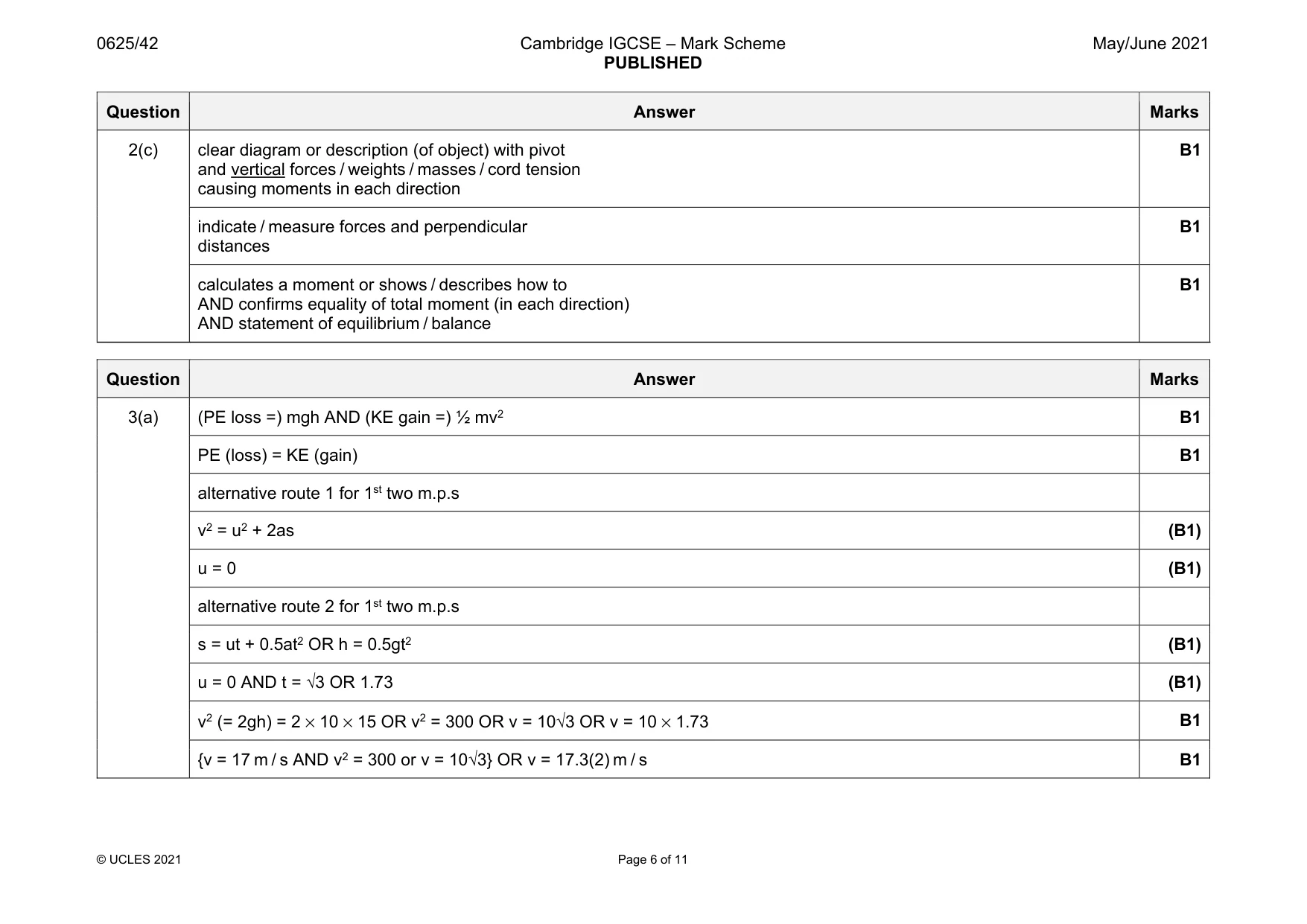
Mark scheme: 2(a) force × perpendicular distance from pivot / point B1 2(b) (F1d1 = F2d2 =) 500 × 20 = F × 12 numbers substituted in any form C1 (F = 10 000 / 12 =) 830 N A1 Question Answer Marks 2(c) clear diagram or description (of object) with pivot and vertical forces / weights / masses / cord tension causing moments in each direction B1 indicate / measure forces and perpendicular distances B1 calculates a moment or shows / describes how to AND confirms equality of total moment (in each direction) AND statement of equilibrium / balance B1
Q3 · Water flowing at very slow speed over a cliff edge
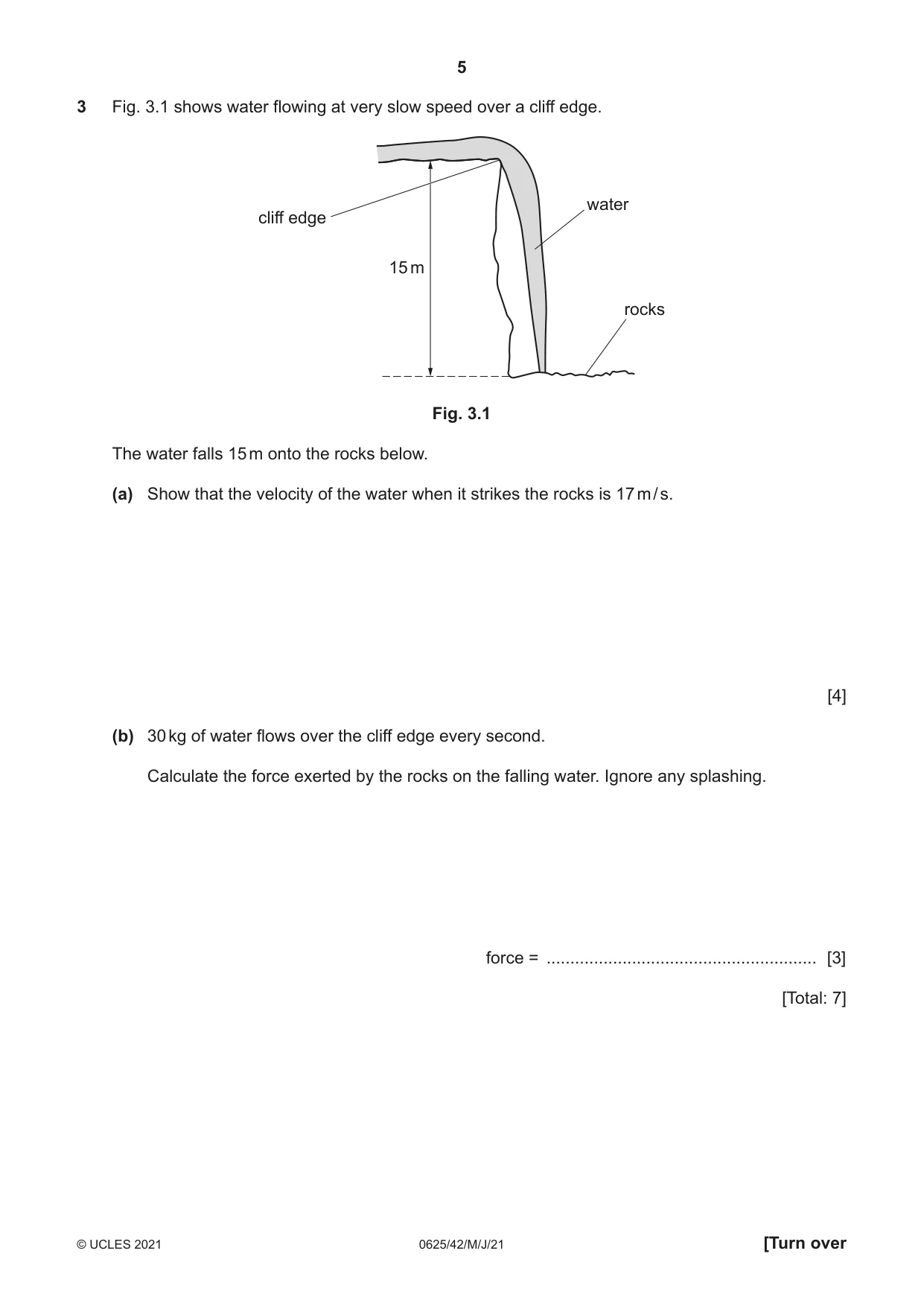
3 Fig. 3.1 shows water flowing at very slow speed over a cliff edge. water cliff edge 15 m rocks Fig. 3.1 The water falls 15 m onto the rocks below. (a) Show that the velocity of the water when it strikes the rocks is 17 m / s. [4] (b) 30 kg of water flows over the cliff edge every second. Calculate the force exerted by the rocks on the falling water. Ignore any splashing. force = ......................................................... [3] [Total: 7]
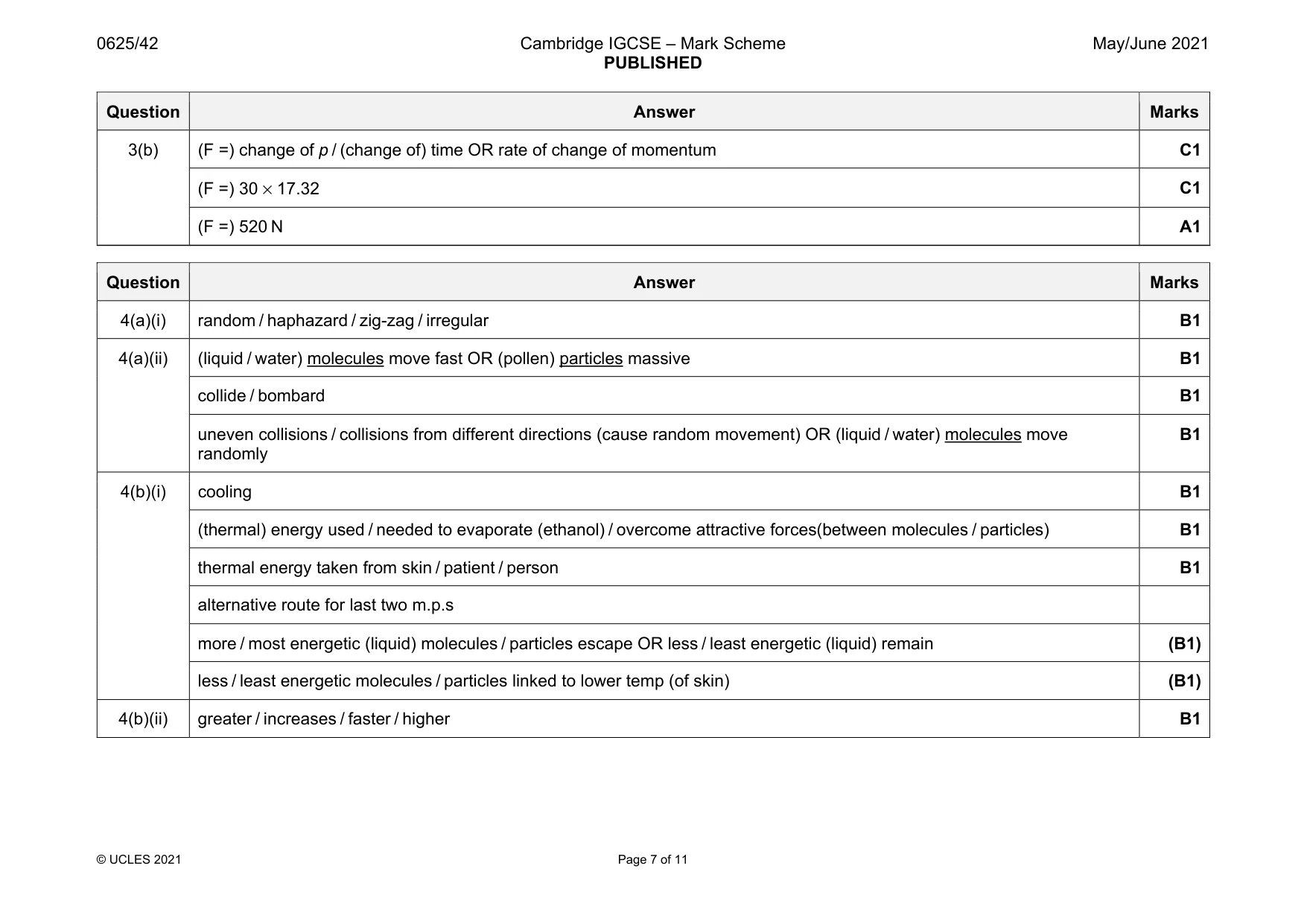
Mark scheme: 3(a) (PE loss =) mgh AND (KE gain =) ½ mv2 B1 PE (loss) = KE (gain) B1 alternative route 1 for 1st two m.p.s v2 = u2 + 2as (B1) u = 0 (B1) alternative route 2 for 1st two m.p.s s = ut + 0.5at2 OR h = 0.5gt2 (B1) u = 0 AND t = √3 OR 1.73 (B1) v2 (= 2gh) = 2 × 10 × 15 OR v2 = 300 OR v = 10√3 OR v = 10 × 1.73 B1 {v = 17 m / s AND v2 = 300 or v = 10√3} OR v = 17.3(2) m / s B1 Question Answer Marks 3(b) (F =) change of p / (change of) time OR rate of change of momentum C1 (F =) 30 × 17.32 C1 (F =) 520 N A1
Q4 · Pollen particles are mixed into a liquid
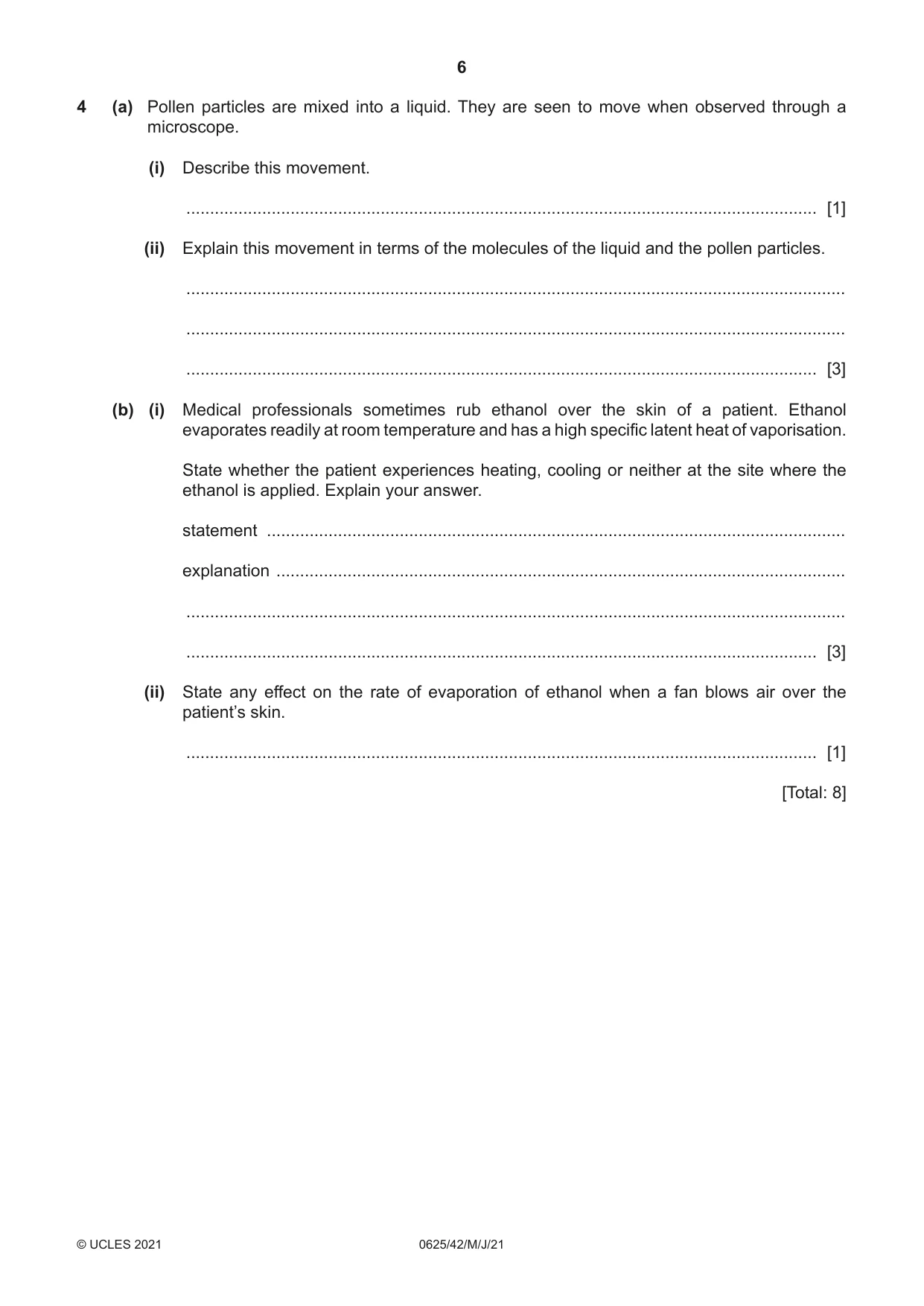
4 (a) Pollen particles are mixed into a liquid. They are seen to move when observed through a microscope. (i) Describe this movement. ..................................................................................................................................... [1] (ii) Explain this movement in terms of the molecules of the liquid and the pollen particles. ........................................................................................................................................... ........................................................................................................................................... ..................................................................................................................................... [3] (b) (i) Medical professionals sometimes rub ethanol over the skin of a patient. Ethanol evaporates readily at room temperature and has a high specific latent heat of vaporisation. State whether the patient experiences heating, cooling or neither at the site where the ethanol is applied. Explain your answer. statement .......................................................................................................................... explanation ........................................................................................................................ ........................................................................................................................................... ..................................................................................................................................... [3] (ii) State any effect on the rate of evaporation of ethanol when a fan blows air over the patient’s skin. ..................................................................................................................................... [1] [Total: 8]
Mark scheme: 4(a)(i) random / haphazard / zig-zag / irregular B1 4(a)(ii) (liquid / water) molecules move fast OR (pollen) particles massive B1 collide / bombard B1 uneven collisions / collisions from different directions (cause random movement) OR (liquid / water) molecules move randomly B1 4(b)(i) cooling B1 (thermal) energy used / needed to evaporate (ethanol) / overcome attractive forces(between molecules / particles) B1 thermal energy taken from skin / patient / person B1 alternative route for last two m.p.s more / most energetic (liquid) molecules / particles escape OR less / least energetic (liquid) remain (B1) less / least energetic molecules / particles linked to lower temp (of skin) (B1) 4(b)(ii) greater / increases / faster / higher B1
Q5 · A machine delivers a hot drink in a plastic cup, which is uncomfortably hot to hold
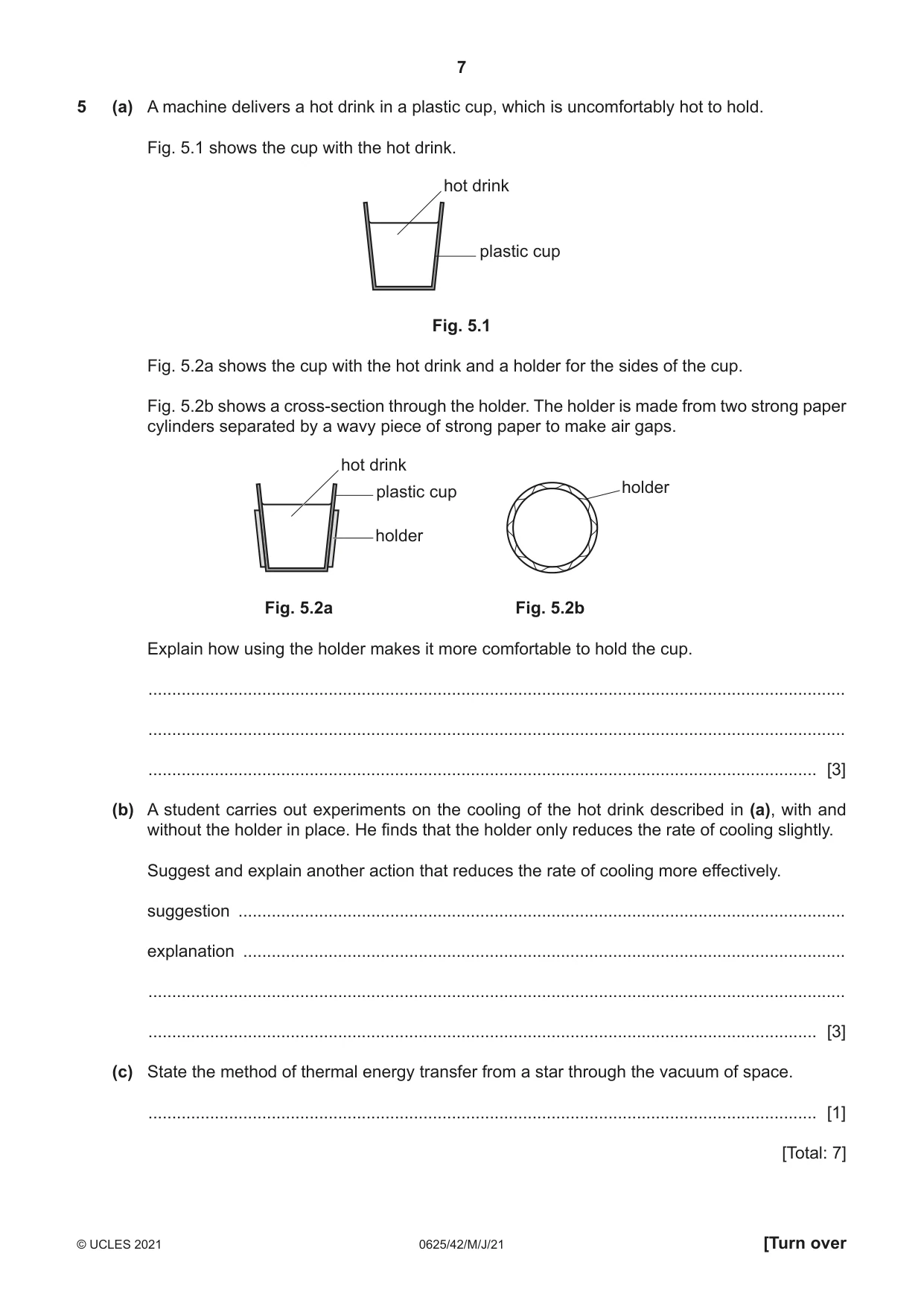
5 (a) A machine delivers a hot drink in a plastic cup, which is uncomfortably hot to hold. Fig. 5.1 shows the cup with the hot drink. hot drink plastic cup Fig. 5.1 Fig. 5.2a shows the cup with the hot drink and a holder for the sides of the cup. Fig. 5.2b shows a cross-section through the holder. The holder is made from two strong paper cylinders separated by a wavy piece of strong paper to make air gaps. hot drink holder plastic cup holder Fig. 5.2a Fig. 5.2b Explain how using the holder makes it more comfortable to hold the cup. ................................................................................................................................................... ................................................................................................................................................... ............................................................................................................................................. [3] (b) A student carries out experiments on the cooling of the hot drink described in (a), with and without the holder in place. He finds that the holder only reduces the rate of cooling slightly. Suggest and explain another action that reduces the rate of cooling more effectively. suggestion ................................................................................................................................ explanation ............................................................................................................................... ................................................................................................................................................... ............................................................................................................................................. [3] (c) State the method of thermal energy transfer from a star through the vacuum of space. ............................................................................................................................................. [1] [Total: 7]
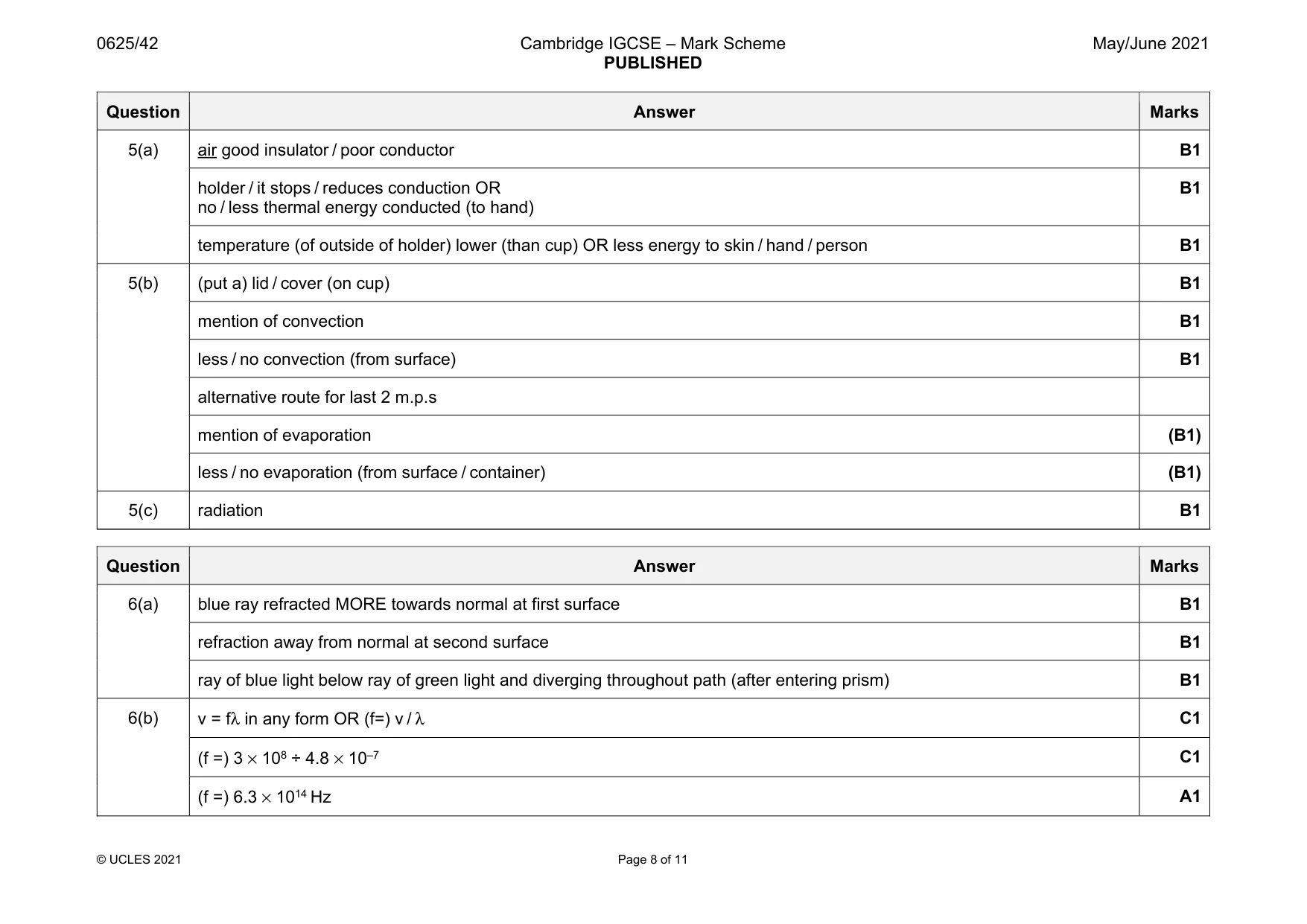
Mark scheme: 5(a) air good insulator / poor conductor B1 holder / it stops / reduces conduction OR no / less thermal energy conducted (to hand) B1 temperature (of outside of holder) lower (than cup) OR less energy to skin / hand / person B1 5(b) (put a) lid / cover (on cup) B1 mention of convection B1 less / no convection (from surface) B1 alternative route for last 2 m.p.s mention of evaporation (B1) less / no evaporation (from surface / container) (B1) 5(c) radiation B1
Q6 · A ray of green light passing through a prism
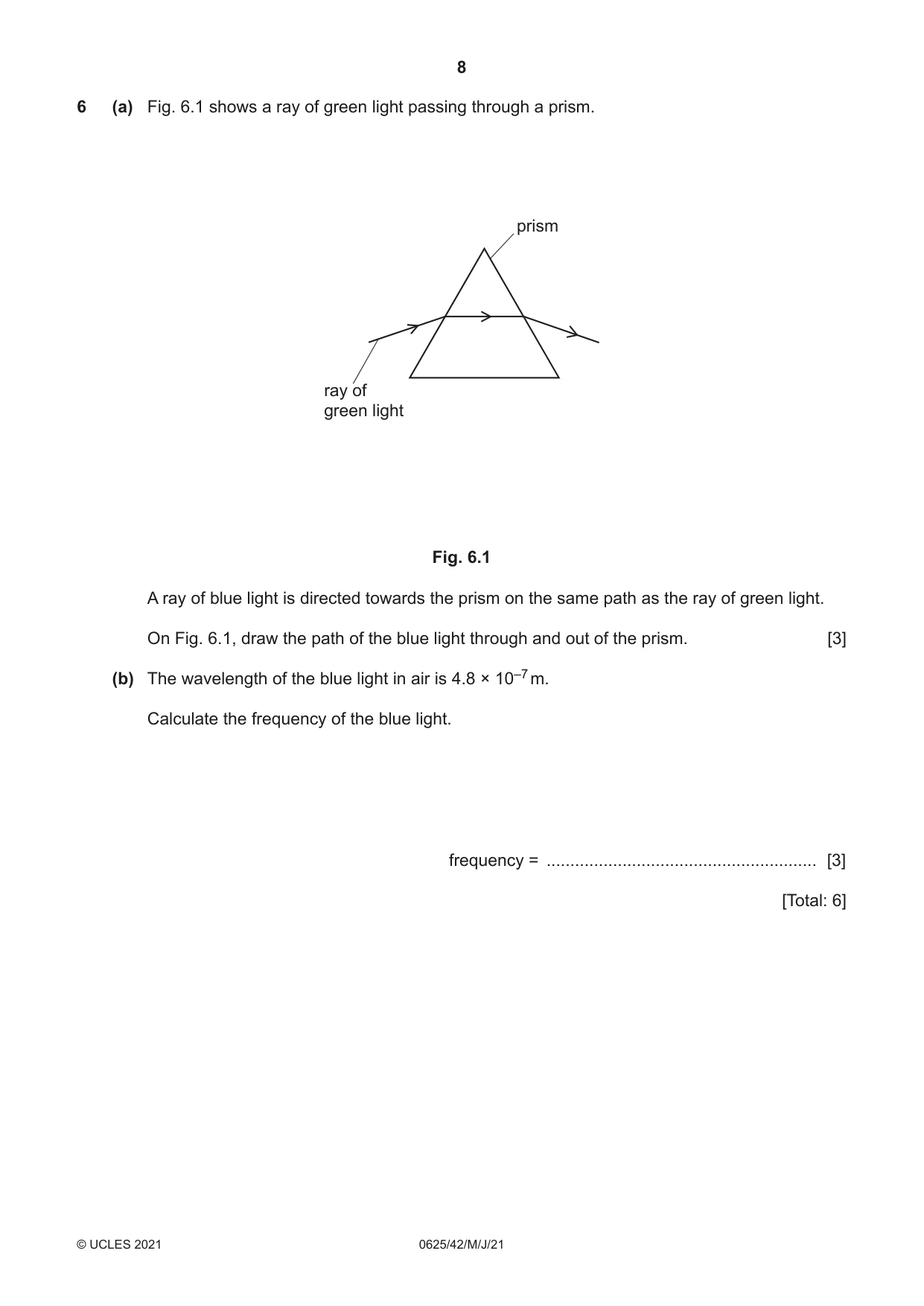
6 (a) Fig. 6.1 shows a ray of green light passing through a prism. prism ray of green light Fig. 6.1 A ray of blue light is directed towards the prism on the same path as the ray of green light. On Fig. 6.1, draw the path of the blue light through and out of the prism. [3] (b) The wavelength of the blue light in air is 4.8 × 10⁻⁷ m. Calculate the frequency of the blue light. frequency = ......................................................... [3] [Total: 6]
Mark scheme: 6(a) blue ray refracted MORE towards normal at first surface B1 refraction away from normal at second surface B1 ray of blue light below ray of green light and diverging throughout path (after entering prism) B1 6(b) v = fλ in any form OR (f=) v / λ C1 (f =) 3 × 10⁸ ÷ 4.8 × 10⁻⁷ C1 (f =) 6.3 × 10¹⁴ Hz A1
Q7 · Two magnets and the gap between the N pole of one magnet and the S pole of the other…
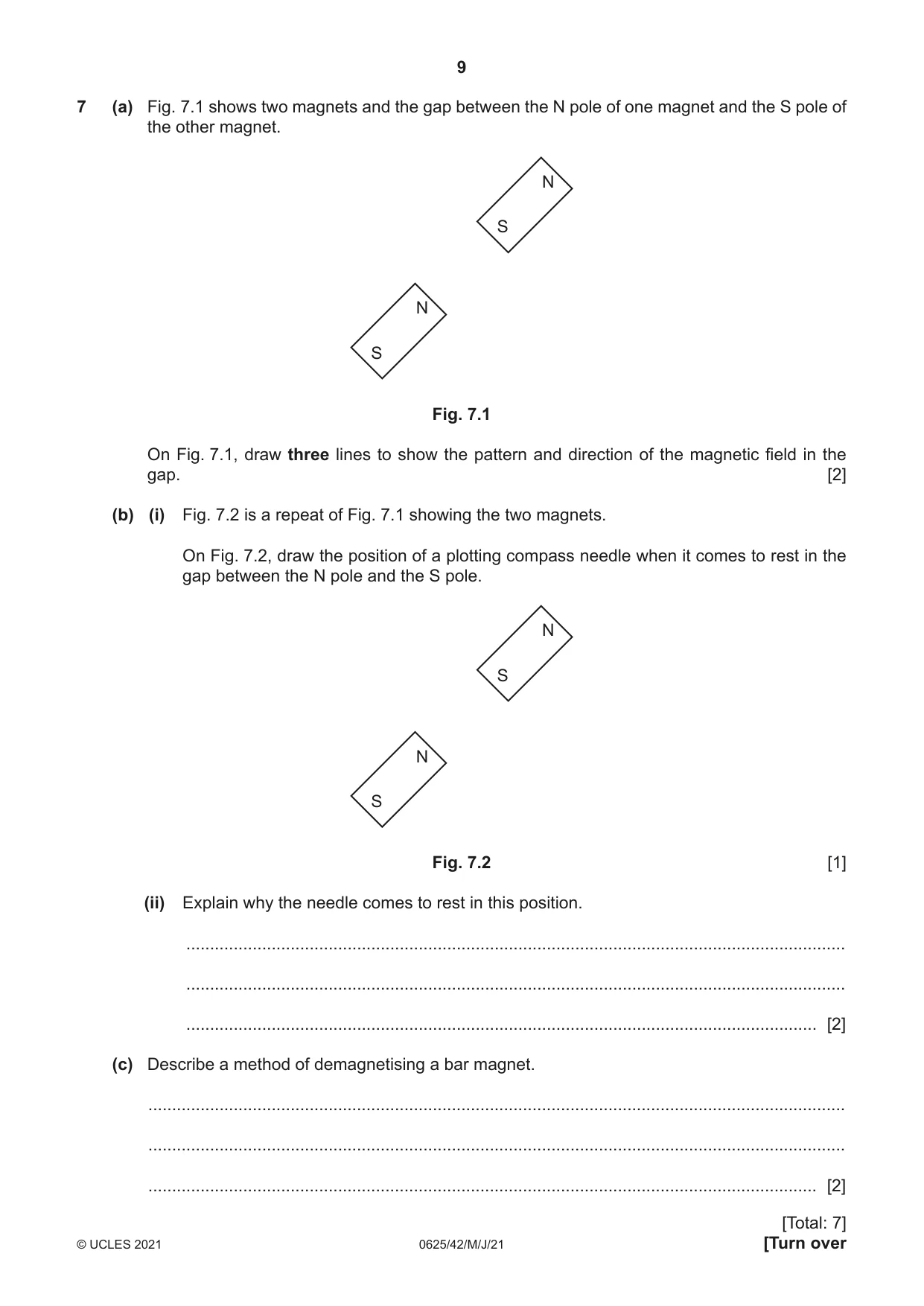
7 (a) Fig. 7.1 shows two magnets and the gap between the N pole of one magnet and the S pole of the other magnet. N S N S Fig. 7.1 On Fig. 7.1, draw three lines to show the pattern and direction of the magnetic field in the gap. [2] (b) (i) Fig. 7.2 is a repeat of Fig. 7.1 showing the two magnets. On Fig. 7.2, draw the position of a plotting compass needle when it comes to rest in the gap between the N pole and the S pole. N S N S Fig. 7.2 [1] (ii) Explain why the needle comes to rest in this position. ........................................................................................................................................... ........................................................................................................................................... ..................................................................................................................................... [2] (c) Describe a method of demagnetising a bar magnet. ................................................................................................................................................... ................................................................................................................................................... ............................................................................................................................................. [2] [Total: 7]
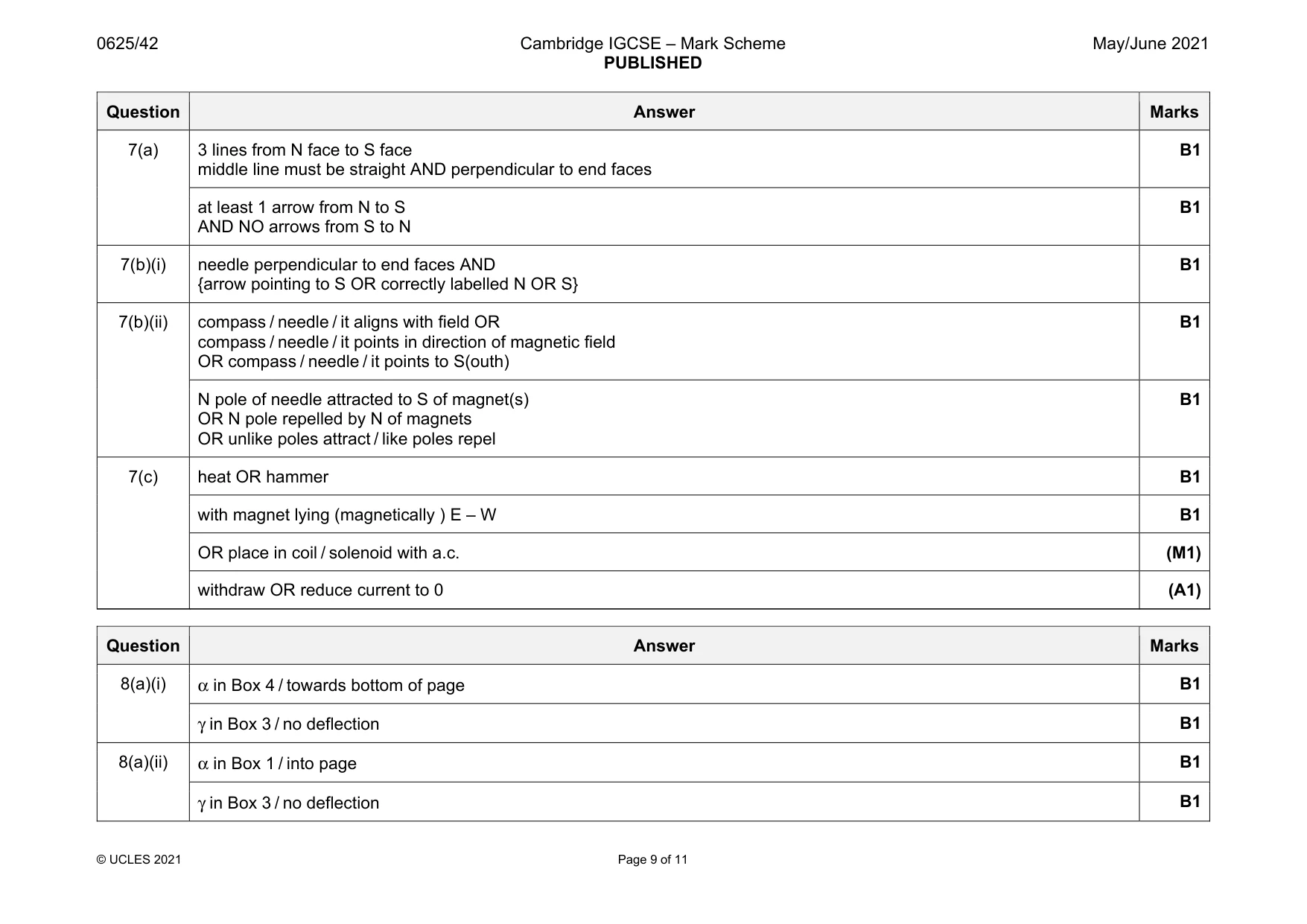
Mark scheme: 7(a) 3 lines from N face to S face middle line must be straight AND perpendicular to end faces B1 at least 1 arrow from N to S AND NO arrows from S to N B1 7(b)(i) needle perpendicular to end faces AND {arrow pointing to S OR correctly labelled N OR S} B1 7(b)(ii) compass / needle / it aligns with field OR compass / needle / it points in direction of magnetic field OR compass / needle / it points to S(outh) B1 N pole of needle attracted to S of magnet(s) OR N pole repelled by N of magnets OR unlike poles attract / like poles repel B1 7(c) heat OR hammer B1 with magnet lying (magnetically ) E – W B1 OR place in coil / solenoid with a.c. (M1) withdraw OR reduce current to 0 (A1)
Q8 · Two identical radioactive sources emit α-particles and γ-rays into two vacuum tubes
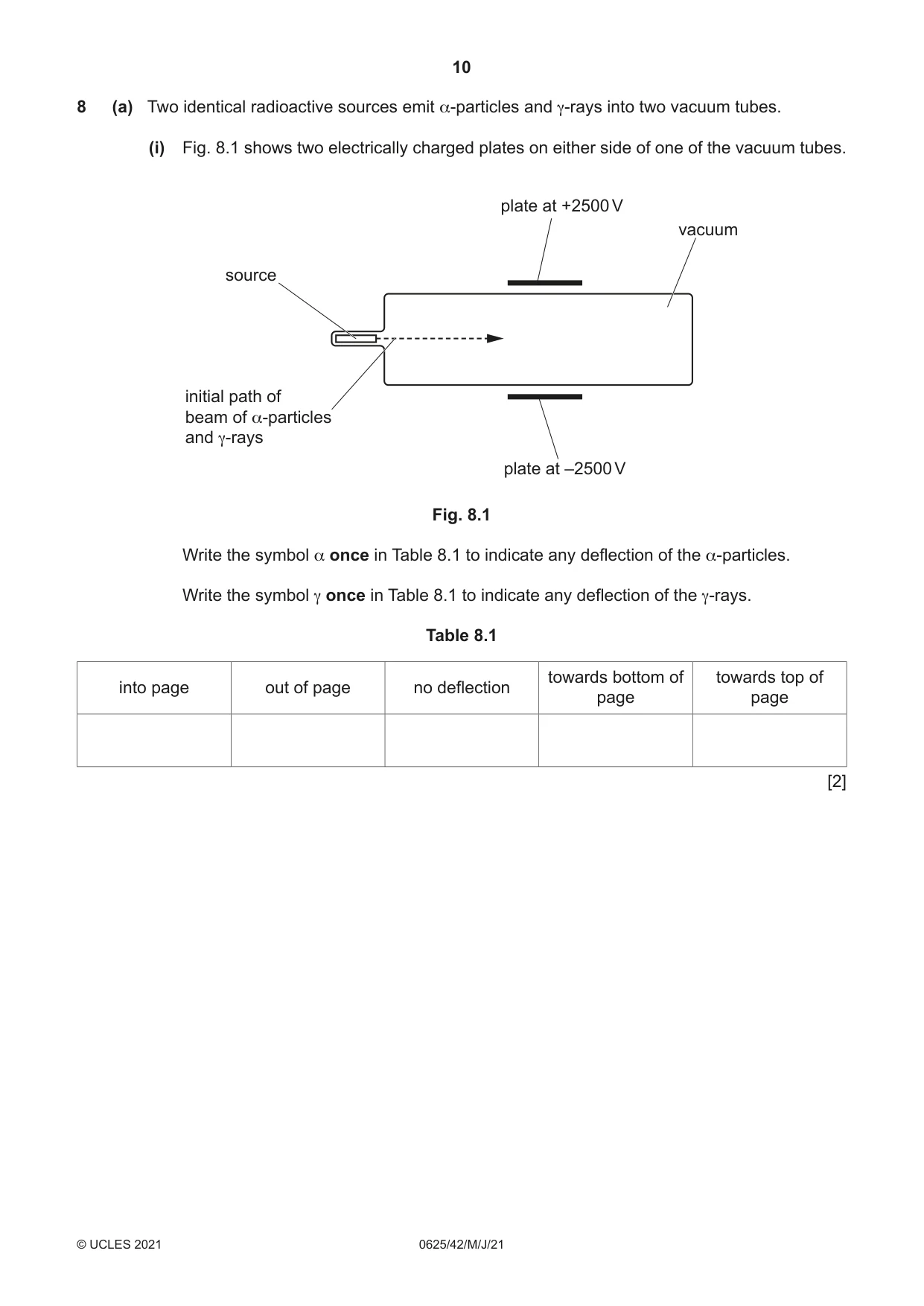
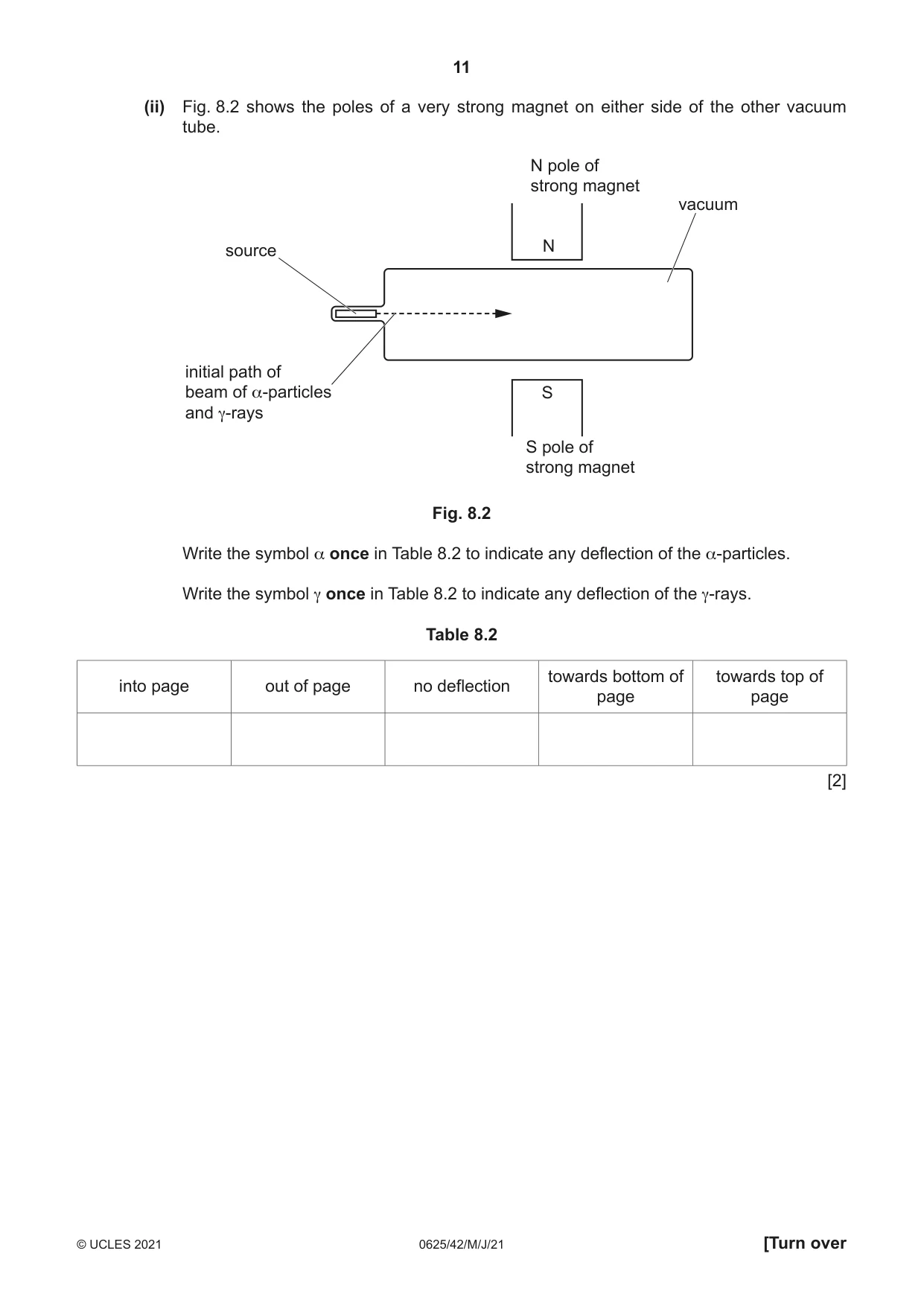
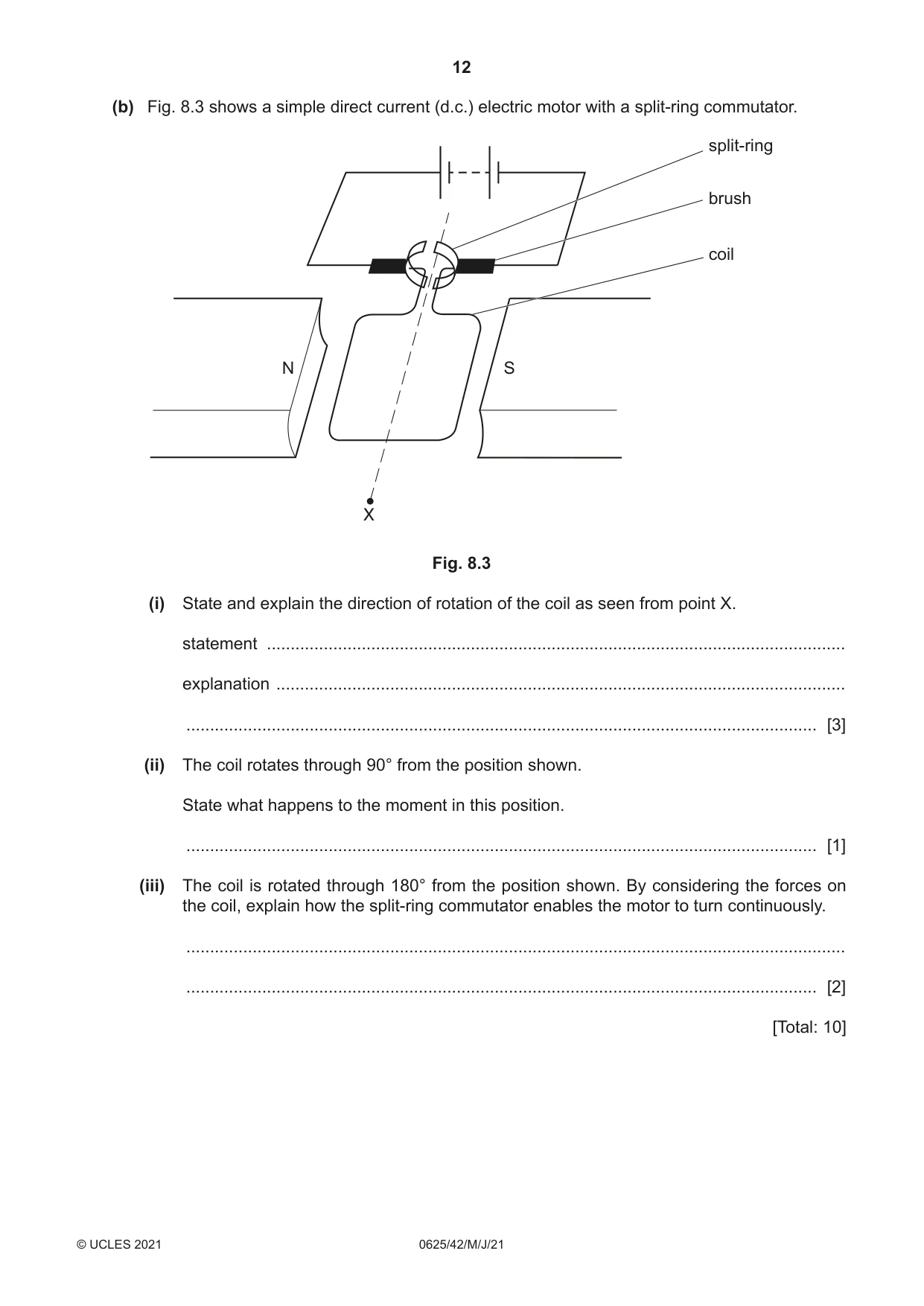
8 (a) Two identical radioactive sources emit α-particles and γ-rays into two vacuum tubes. (i) Fig. 8.1 shows two electrically charged plates on either side of one of the vacuum tubes. plate at +2500 V vacuum source initial path of beam of α-particles and γ-rays plate at –2500 V Fig. 8.1 Write the symbol α once in Table 8.1 to indicate any deflection of the α-particles. Write the symbol γ once in Table 8.1 to indicate any deflection of the γ-rays. Table 8.1 towards bottom of towards top of into page out of page no deflection page page [2] (ii) Fig. 8.2 shows the poles of a very strong magnet on either side of the other vacuum tube. N pole of strong magnet vacuum source N initial path of beam of α-particles S and γ-rays S pole of strong magnet Fig. 8.2 Write the symbol α once in Table 8.2 to indicate any deflection of the α-particles. Write the symbol γ once in Table 8.2 to indicate any deflection of the γ-rays. Table 8.2 towards bottom of towards top ofinto page out of page no deflection page page [2] (b) Fig. 8.3 shows a simple direct current (d.c.) electric motor with a split-ring commutator. split-ring brush coil N S X Fig. 8.3 (i) State and explain the direction of rotation of the coil as seen from point X. statement .......................................................................................................................... explanation ........................................................................................................................ ..................................................................................................................................... [3] (ii) The coil rotates through 90° from the position shown. State what happens to the moment in this position. ..................................................................................................................................... [1] (iii) The coil is rotated through 180° from the position shown. By considering the forces on the coil, explain how the split-ring commutator enables the motor to turn continuously. ........................................................................................................................................... ..................................................................................................................................... [2] [Total: 10]
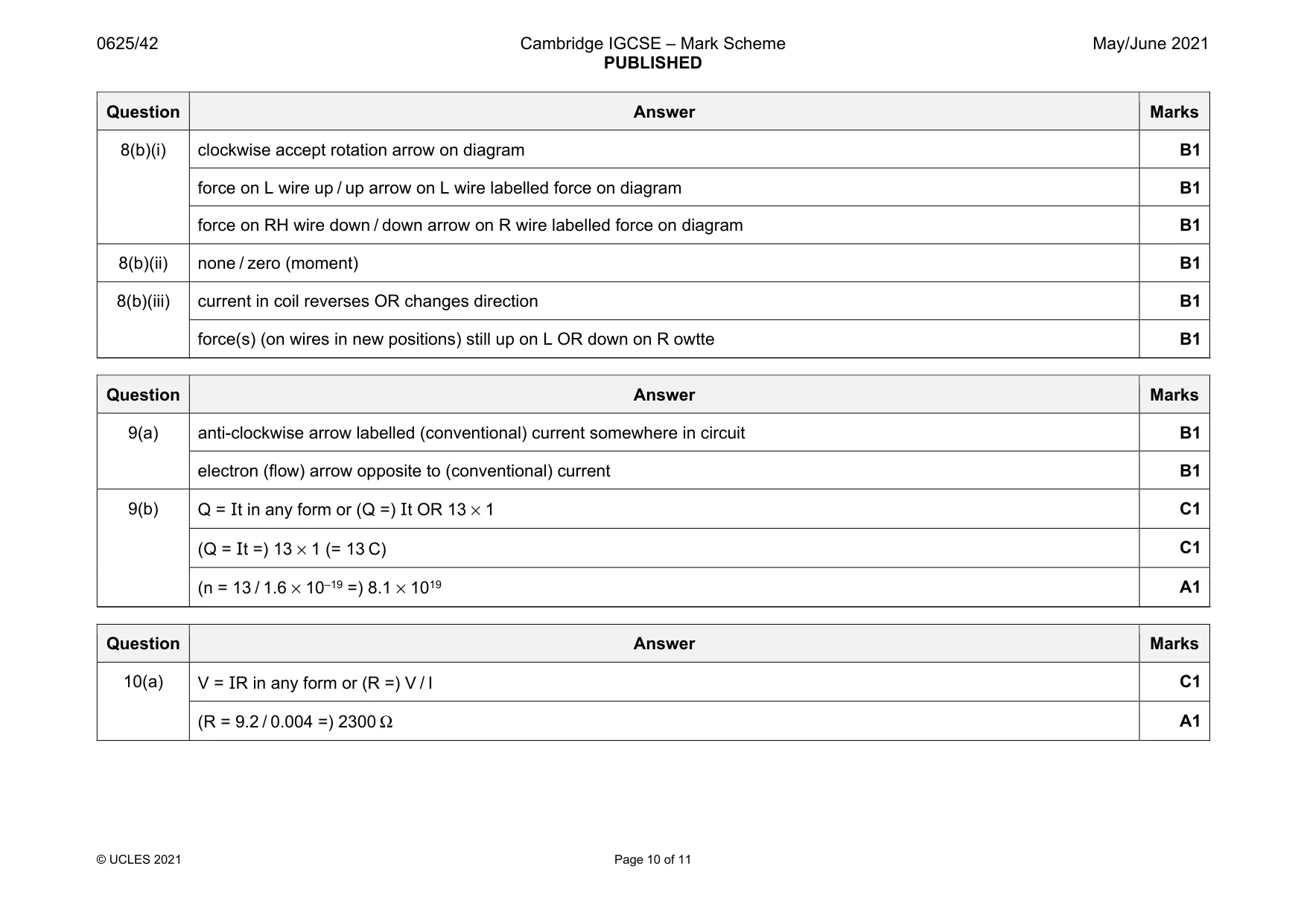
Mark scheme: 8(a)(i) α in Box 4 / towards bottom of page B1 γ in Box 3 / no deflection B1 8(a)(ii) α in Box 1 / into page B1 γ in Box 3 / no deflection B1 Question Answer Marks 8(b)(i) clockwise accept rotation arrow on diagram B1 force on L wire up / up arrow on L wire labelled force on diagram B1 force on RH wire down / down arrow on R wire labelled force on diagram B1 8(b)(ii) none / zero (moment) B1 8(b)(iii) current in coil reverses OR changes direction B1 force(s) (on wires in new positions) still up on L OR down on R owtte B1
Question 9
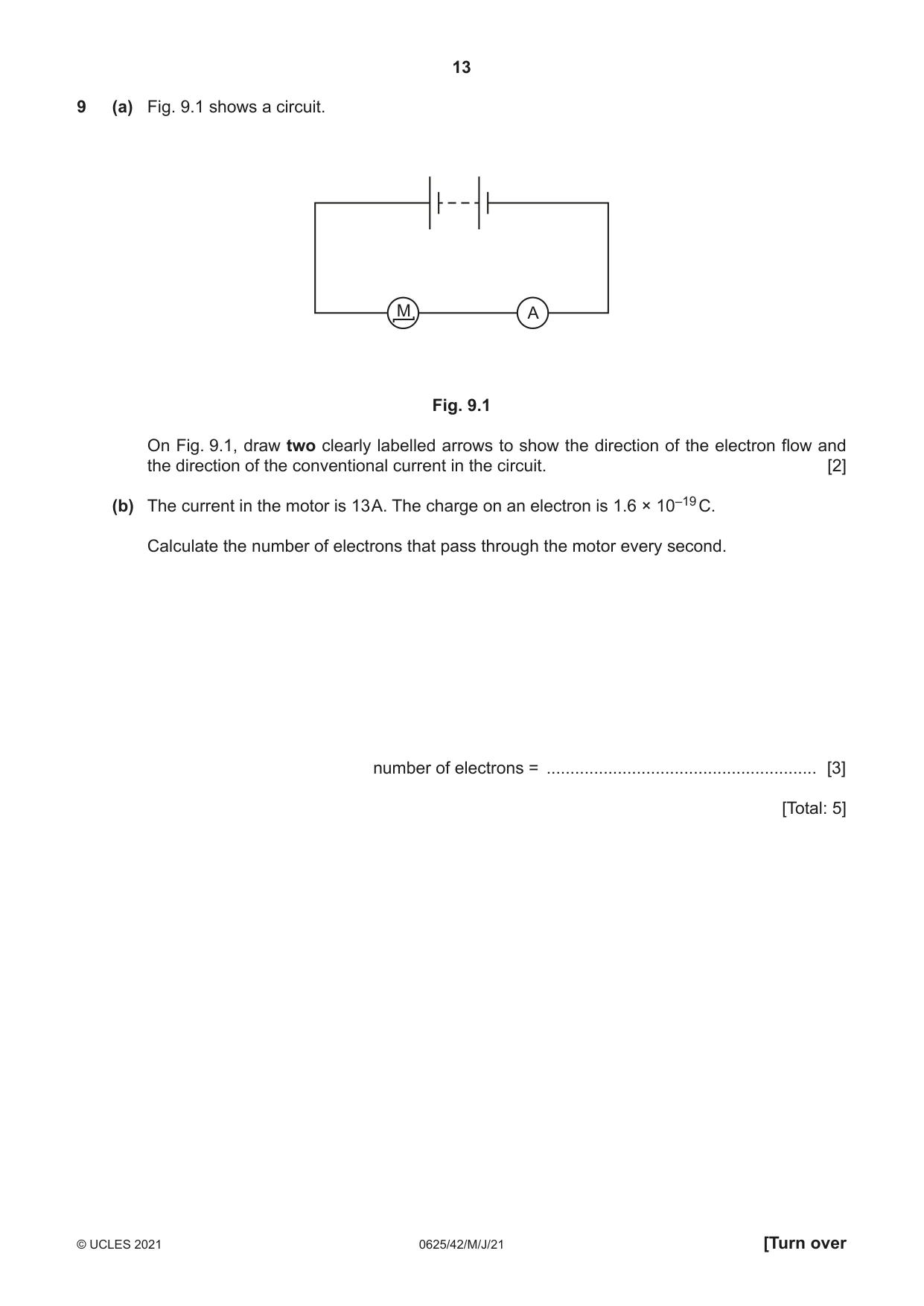
9 (a) Fig. 9.1 shows a circuit. M A Fig. 9.1 On Fig. 9.1, draw two clearly labelled arrows to show the direction of the electron flow and the direction of the conventional current in the circuit. [2] (b) The current in the motor is 13 A. The charge on an electron is 1.6 × 10⁻¹⁹ C. Calculate the number of electrons that pass through the motor every second. number of electrons = ......................................................... [3] [Total: 5]
Mark scheme: 9(a) anti-clockwise arrow labelled (conventional) current somewhere in circuit B1 electron (flow) arrow opposite to (conventional) current B1 9(b) Q = It in any form or (Q =) It OR 13 × 1 C1 (Q = It =) 13 × 1 (= 13 C) C1 (n = 13 / 1.6 × 10–19 =) 8.1 × 10¹⁹ A1
Q10 · The potential difference–current graph for a circuit component K
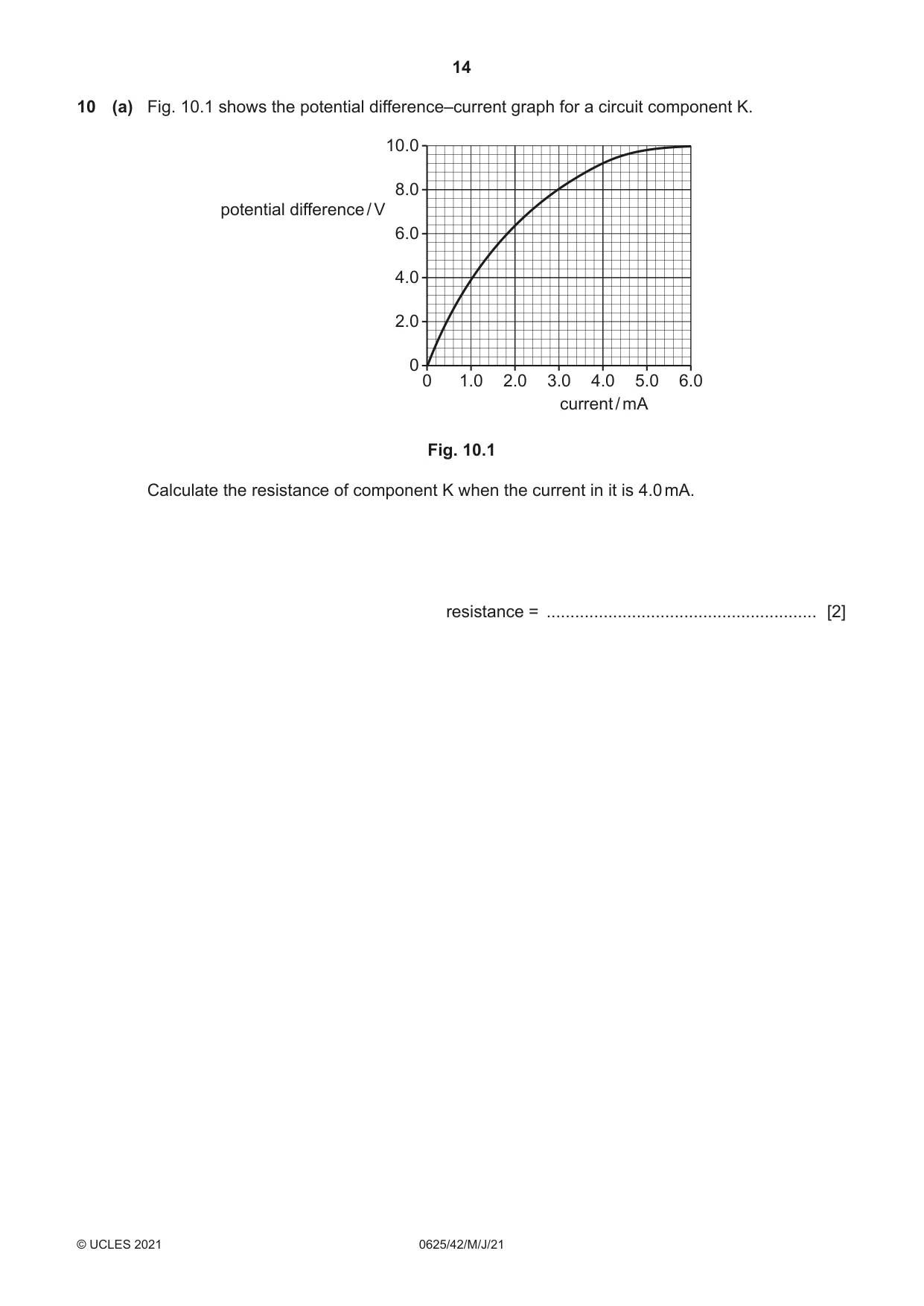
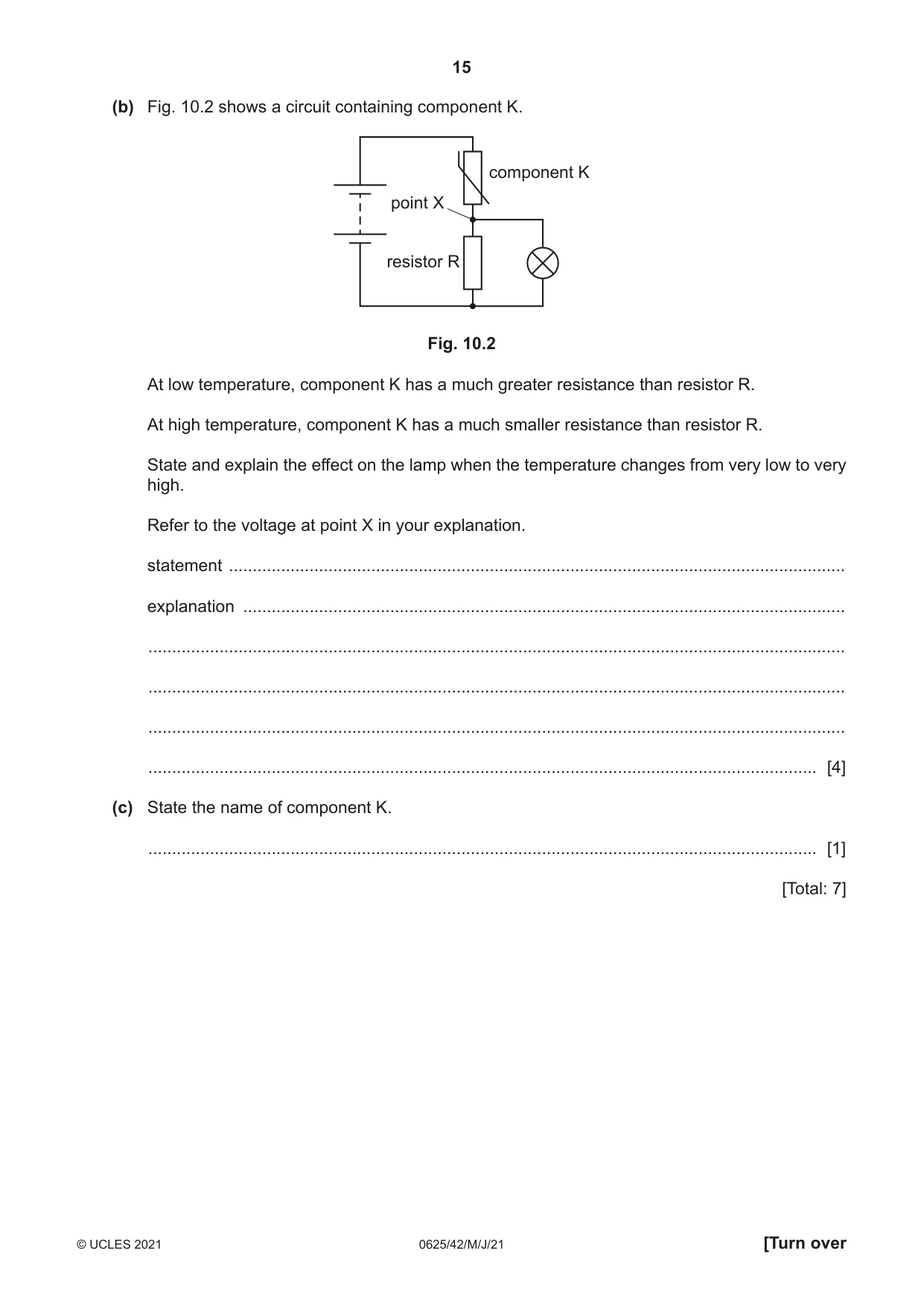
10 (a) Fig. 10.1 shows the potential difference–current graph for a circuit component K. 10.0 8.0 potential difference / V 6.0 4.0 2.0 0 0 1.0 2.0 3.0 4.0 5.0 6.0 current / mA Fig. 10.1 Calculate the resistance of component K when the current in it is 4.0 mA. resistance = ......................................................... [2] (b) Fig. 10.2 shows a circuit containing component K. component K point X resistor R Fig. 10.2 At low temperature, component K has a much greater resistance than resistor R. At high temperature, component K has a much smaller resistance than resistor R. State and explain the effect on the lamp when the temperature changes from very low to very high. Refer to the voltage at point X in your explanation. statement .................................................................................................................................. explanation ............................................................................................................................... ................................................................................................................................................... ................................................................................................................................................... ................................................................................................................................................... ............................................................................................................................................. [4] (c) State the name of component K. ............................................................................................................................................. [1] [Total: 7]
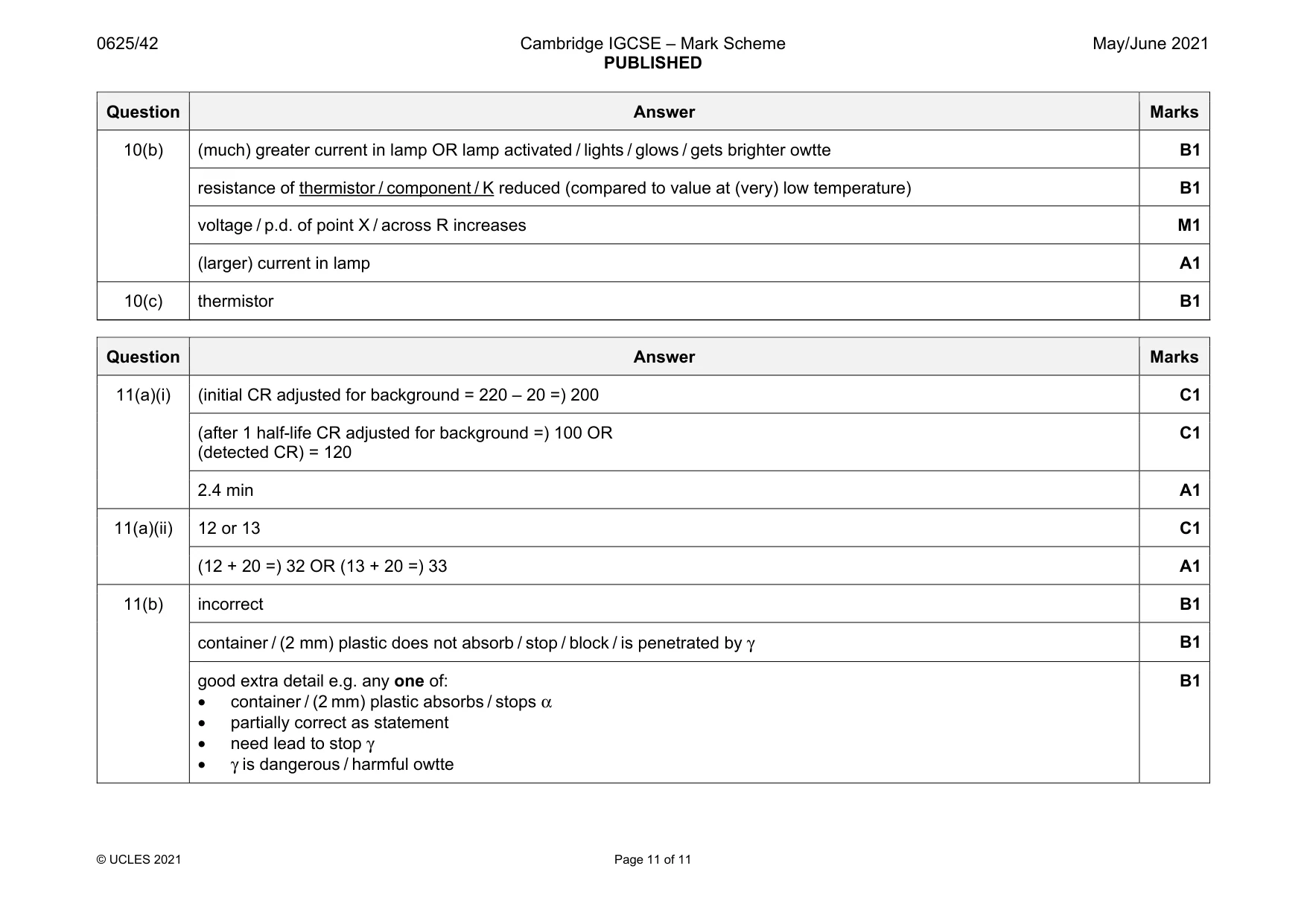
Mark scheme: 10(a) C1 (R = 9.2 / 0.004 =) 2300 Ω A1 Question Answer Marks 10(b) (much) greater current in lamp OR lamp activated / lights / glows / gets brighter owtte B1 resistance of thermistor / component / K reduced (compared to value at (very) low temperature) B1 voltage / p.d. of point X / across R increases M1 (larger) current in lamp A1 10(c) thermistor B1
Q11 · A student investigates a radioactive substance in a laboratory
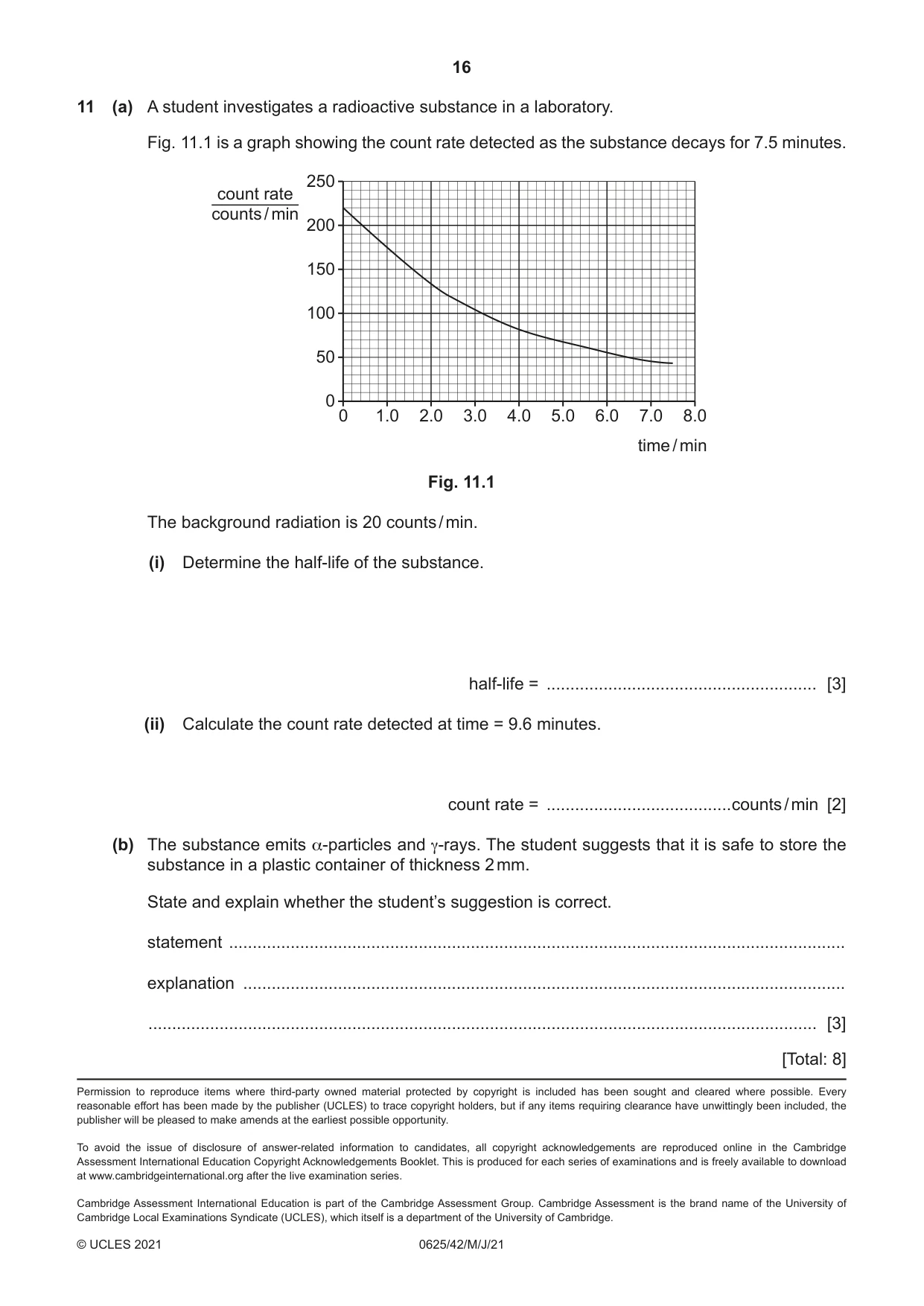
11 (a) A student investigates a radioactive substance in a laboratory. Fig. 11.1 is a graph showing the count rate detected as the substance decays for 7.5 minutes. 250 count rate counts / min 200 150 100 50 0 0 1.0 2.0 3.0 4.0 5.0 6.0 7.0 8.0 time / min Fig. 11.1 The background radiation is 20 counts / min. (i) Determine the half-life of the substance. half-life = ......................................................... [3] (ii) Calculate the count rate detected at time = 9.6 minutes. count rate = .......................................counts / min [2] (b) The substance emits α-particles and γ-rays. The student suggests that it is safe to store the substance in a plastic container of thickness 2 mm. State and explain whether the student’s suggestion is correct. statement .................................................................................................................................. explanation ............................................................................................................................... ............................................................................................................................................. [3] [Total: 8]
Mark scheme: 11(a)(i) (initial CR adjusted for background = 220 – 20 =) 200 C1 (after 1 half-life CR adjusted for background =) 100 OR (detected CR) = 120 C1 2.4 min A1 11(a)(ii) 12 or 13 C1 (12 + 20 =) 32 OR (13 + 20 =) 33 A1 11(b) incorrect B1 container / (2 mm) plastic does not absorb / stop / block / is penetrated by γ B1 good extra detail e.g. any one of: • container / (2 mm) plastic absorbs / stops α • partially correct as statement • need lead to stop γ • γ is dangerous / harmful owtte B1
What was in this paper
The subtopics covered by these 11 questions, and how many questions each got. Open one in a new tab to see every Cambridge question on it.
What you needed in this session
Cambridge’s own grade thresholds for 2021 May/June, Paper 4 · Variant 2. A higher threshold means an easier paper — the bar moves with how the cohort did.