Cambridge IGCSE Physics 0625 — 2024 May/June Paper 4 · Variant 2
0625/42/M/J/24 · 11 questions · 80 marks · ≈90 min
The question paper and its mark scheme, free to read here and free to download. This is Cambridge’s own paper, exactly as it was sat.
Question paper20 pages



Mark scheme12 pages
Answers below. Sit the paper first if you are practising.
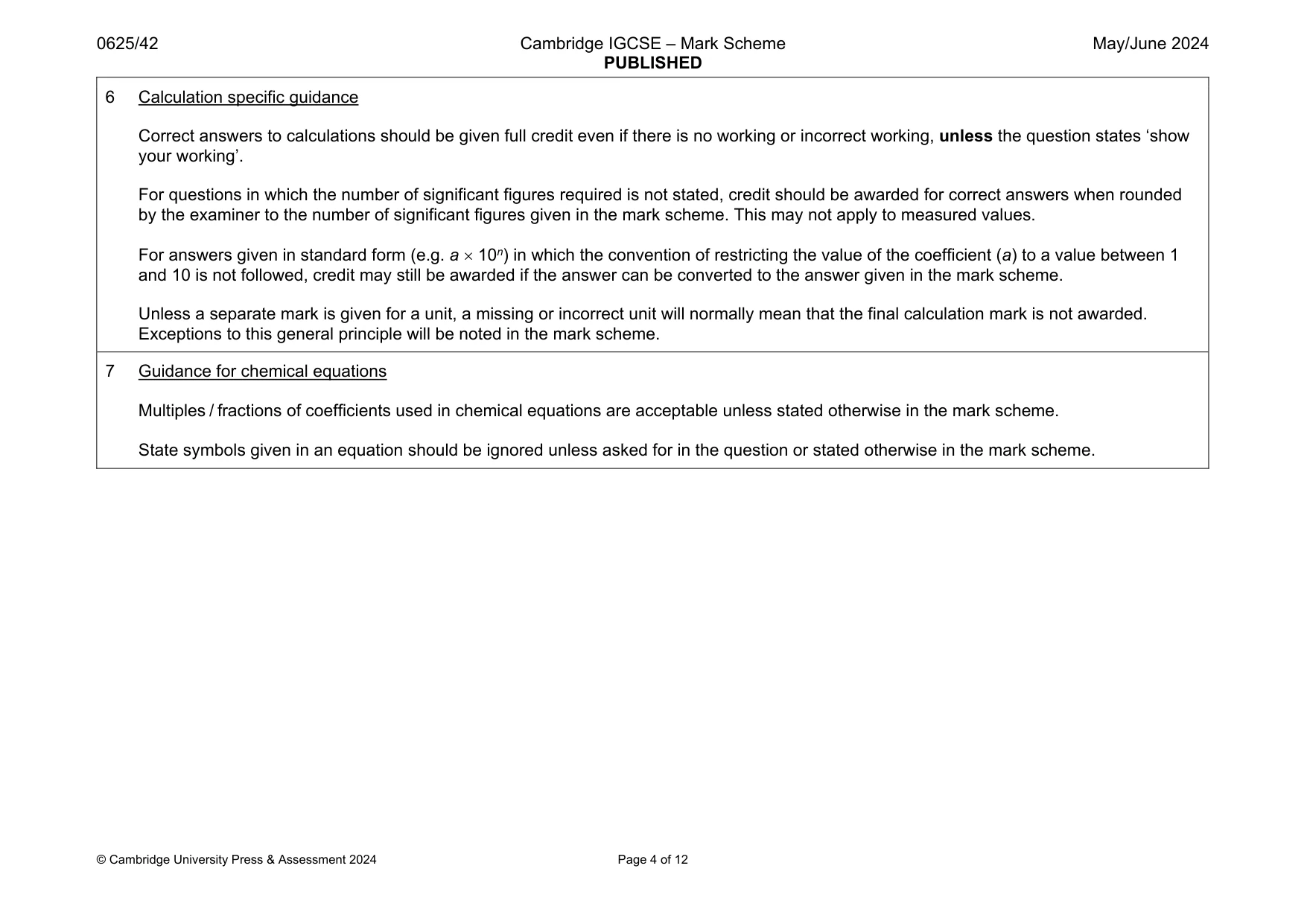
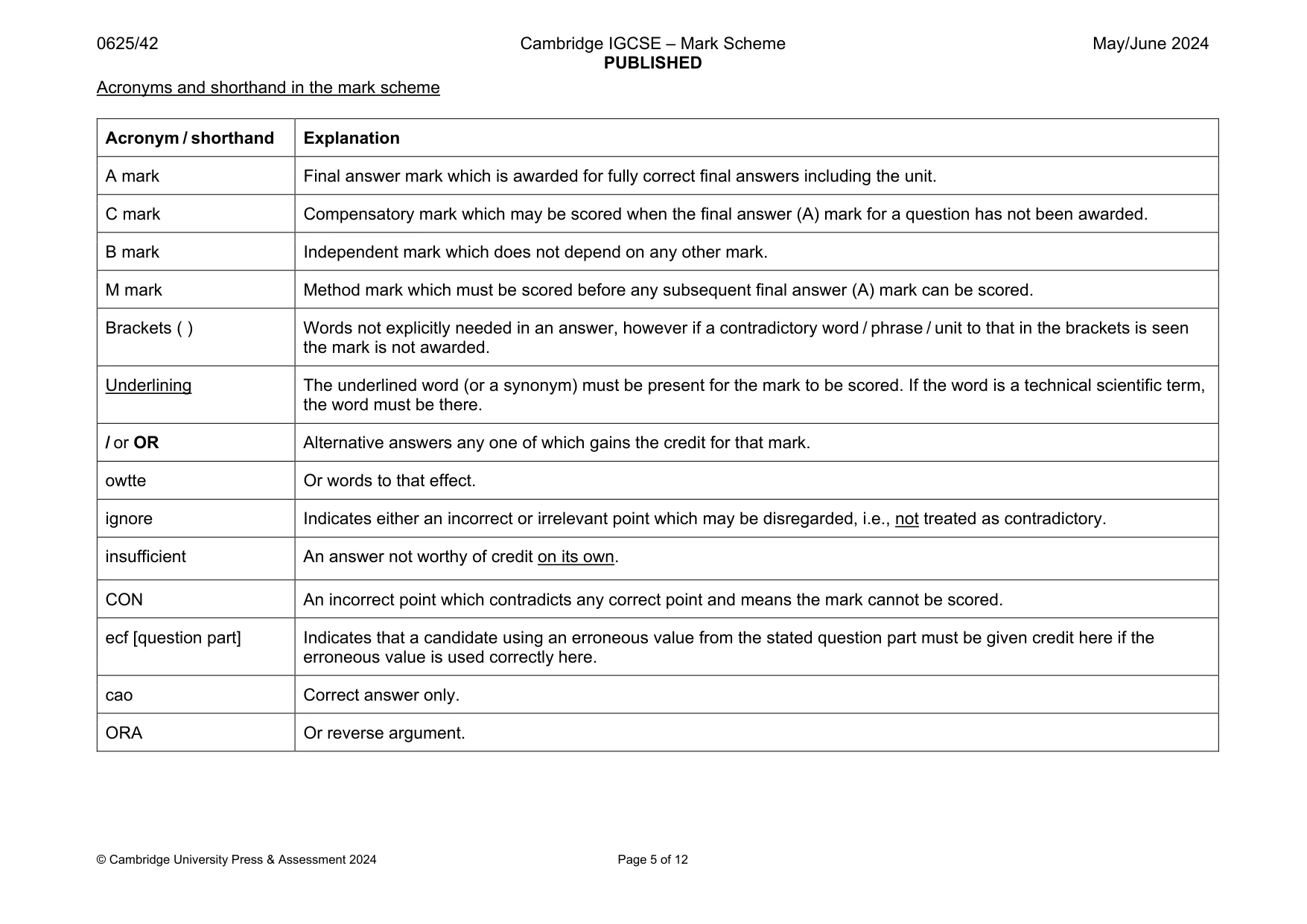
Questions as text
Q1 · A load is suspended from a thread
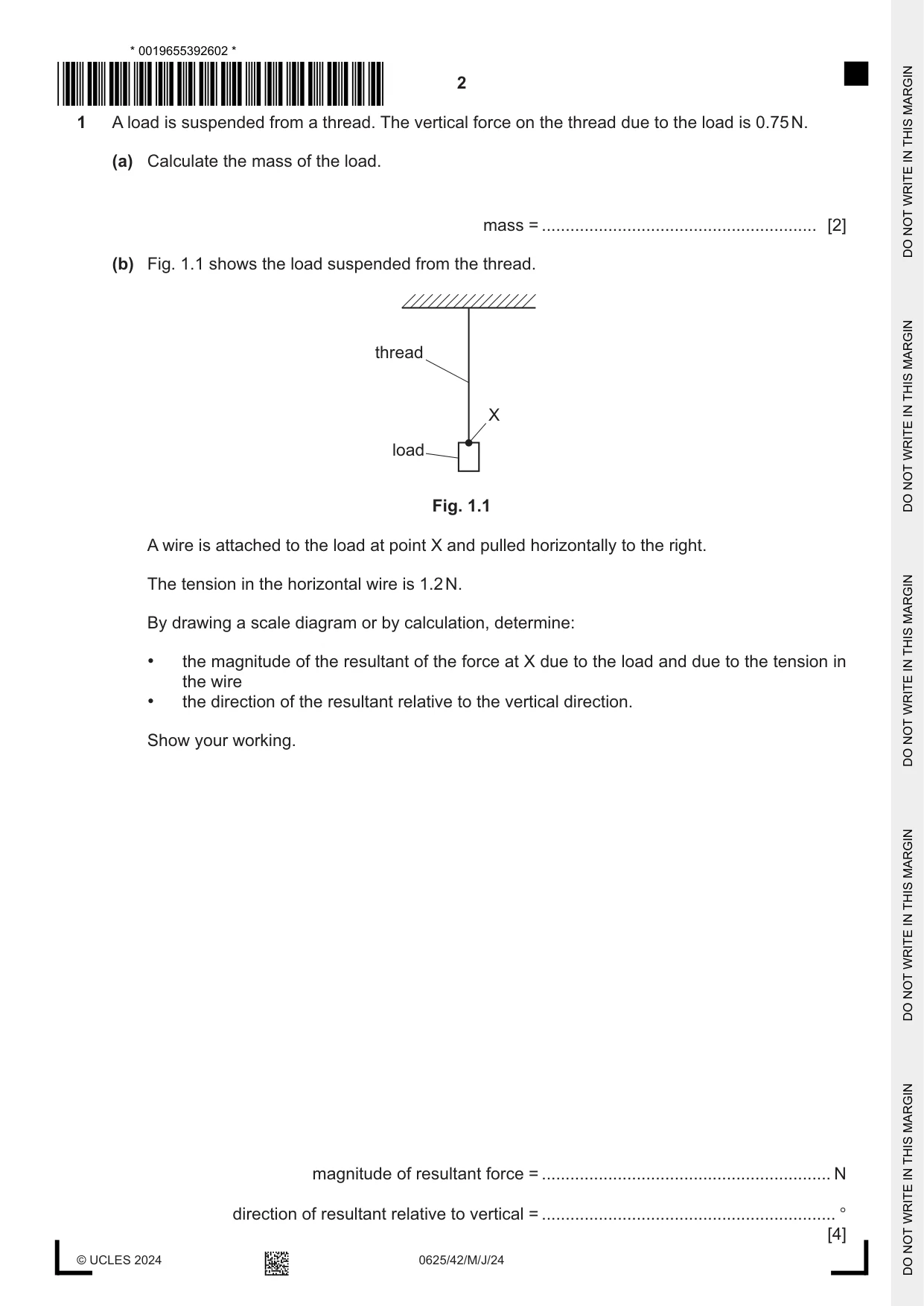
1 A load is suspended from a thread. The vertical force on the thread due to the load is 0.75 N. (a) Calculate the mass of the load. mass = .......................................................... [2] (b) Fig. 1.1 shows the load suspended from the thread. thread X load Fig. 1.1 A wire is attached to the load at point X and pulled horizontally to the right. The tension in the horizontal wire is 1.2 N. By drawing a scale diagram or by calculation, determine: • the magnitude of the resultant of the force at X due to the load and due to the tension in the wire • the direction of the resultant relative to the vertical direction. Show your working. magnitude of resultant force = ............................................................. N direction of resultant relative to vertical = .............................................................. ° [4] (c) Forces may produce changes in the size and the shape of an object. State two other changes that forces may produce. 1 ................................................................................................................................................ 2 ................................................................................................................................................ [2] [Total: 8]
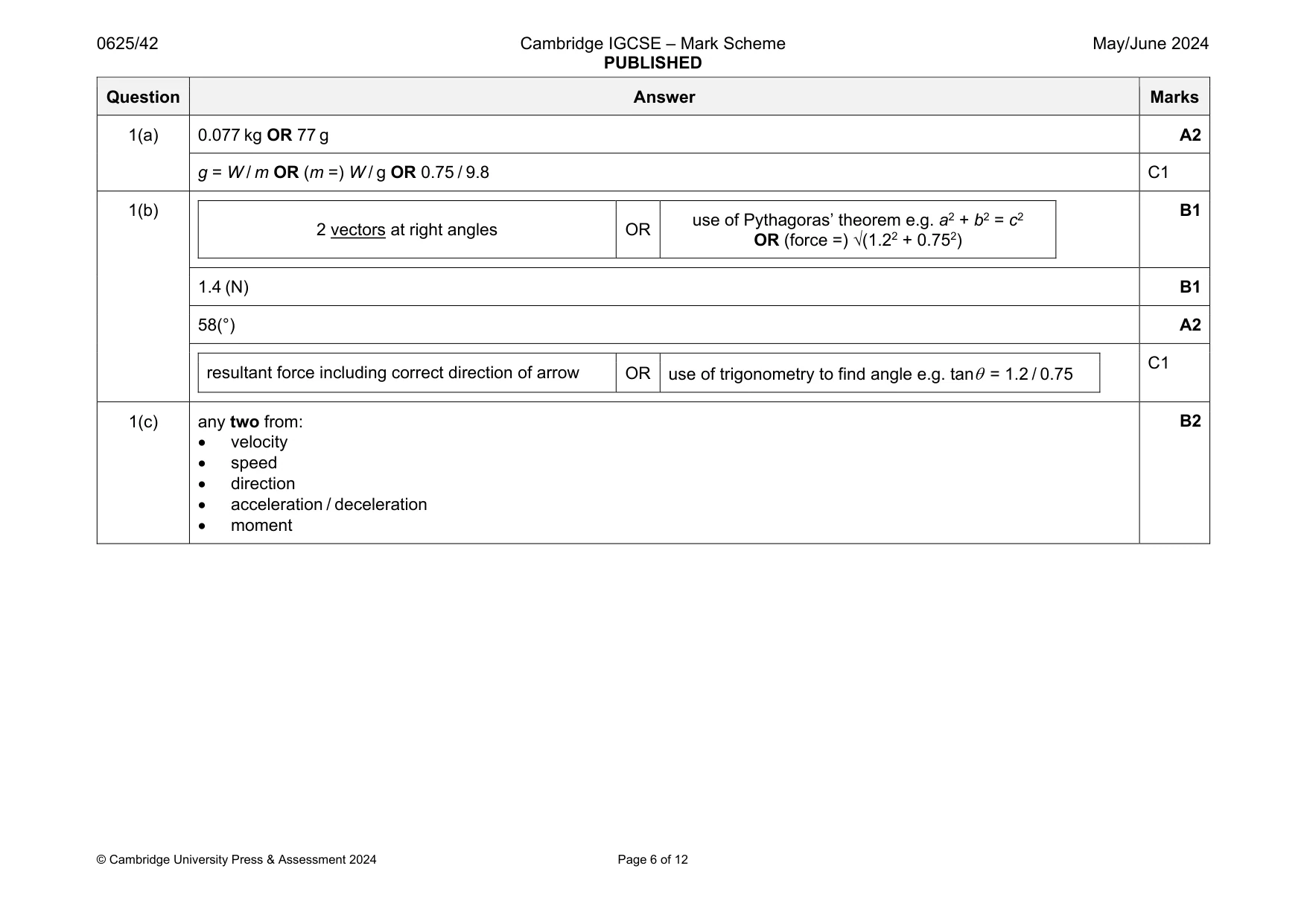
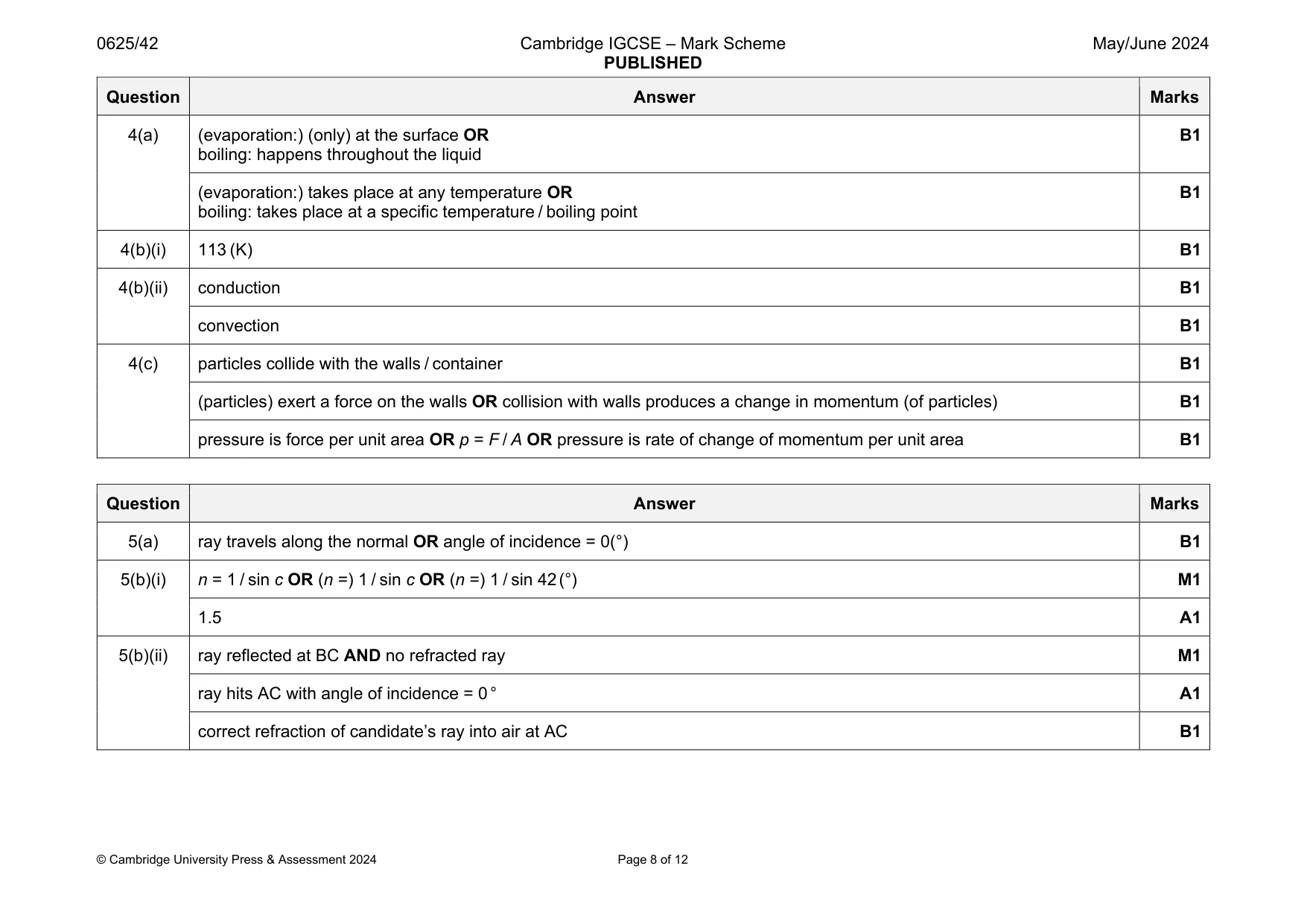
Mark scheme: 1(a) 0.077 kg OR 77 g A2 g = W / m OR (m =) W / g OR 0.75 / 9.8 C1 1(b) 2 vectors at right angles OR use of Pythagoras’ theorem e.g. a2 + b2 = c2 OR (force =) √(1.22 + 0.752) B1 1.4 (N) B1 58(°) A2 resultant force including correct direction of arrow OR use of trigonometry to find angle e.g. tan = 1.2 / 0.75 C1 1(c) any two from: velocity speed direction acceleration / deceleration moment B2
Question 2
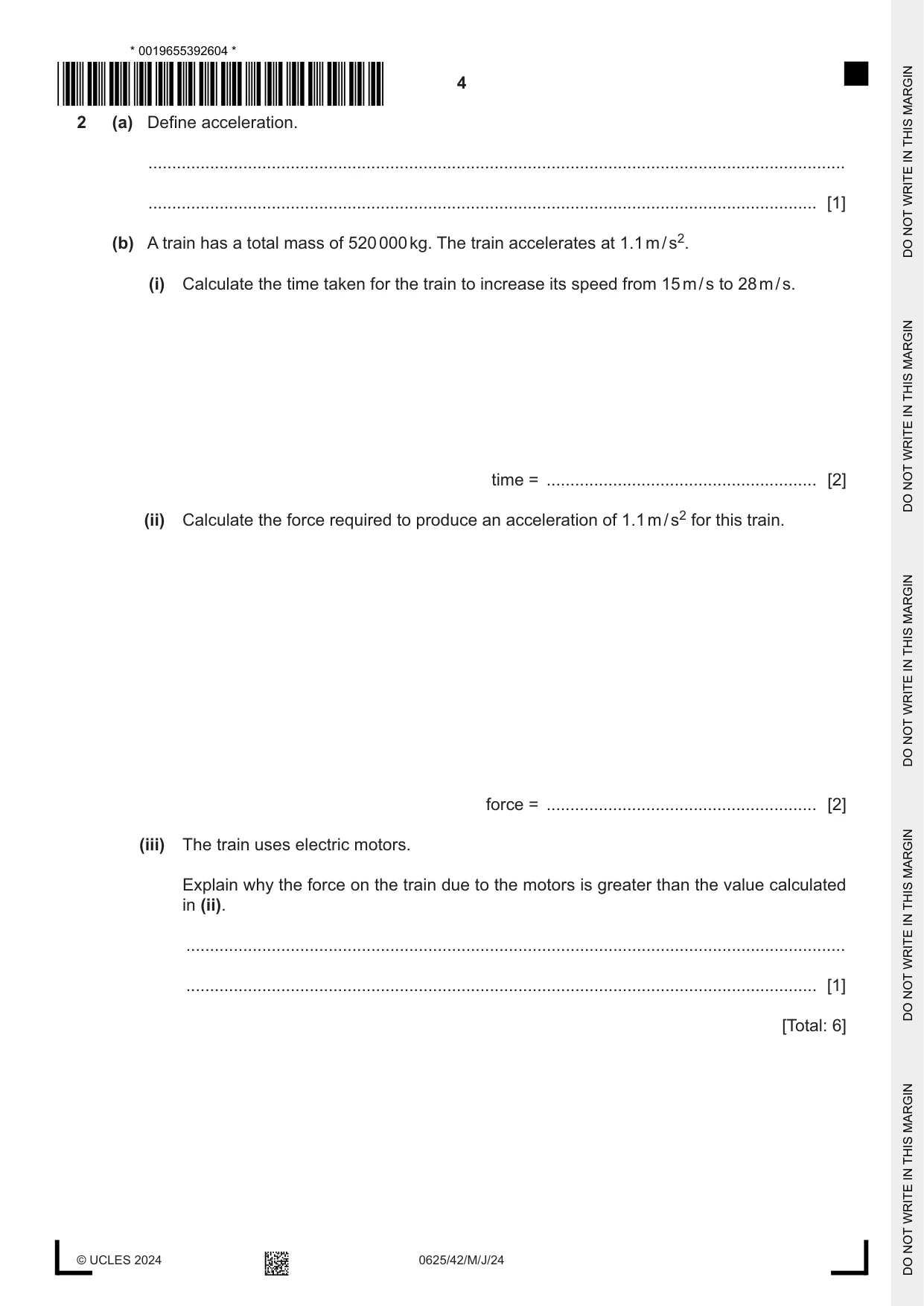
2 (a) Define acceleration. ................................................................................................................................................... ............................................................................................................................................. [1] (b) A train has a total mass of 520 000 kg. The train accelerates at 1.1 m / s2. (i) Calculate the time taken for the train to increase its speed from 15 m / s to 28 m / s. time = ......................................................... [2] (ii) Calculate the force required to produce an acceleration of 1.1 m / s2 for this train. force = ......................................................... [2] (iii) The train uses electric motors. Explain why the force on the train due to the motors is greater than the value calculated in (ii). ........................................................................................................................................... ..................................................................................................................................... [1] [Total: 6]
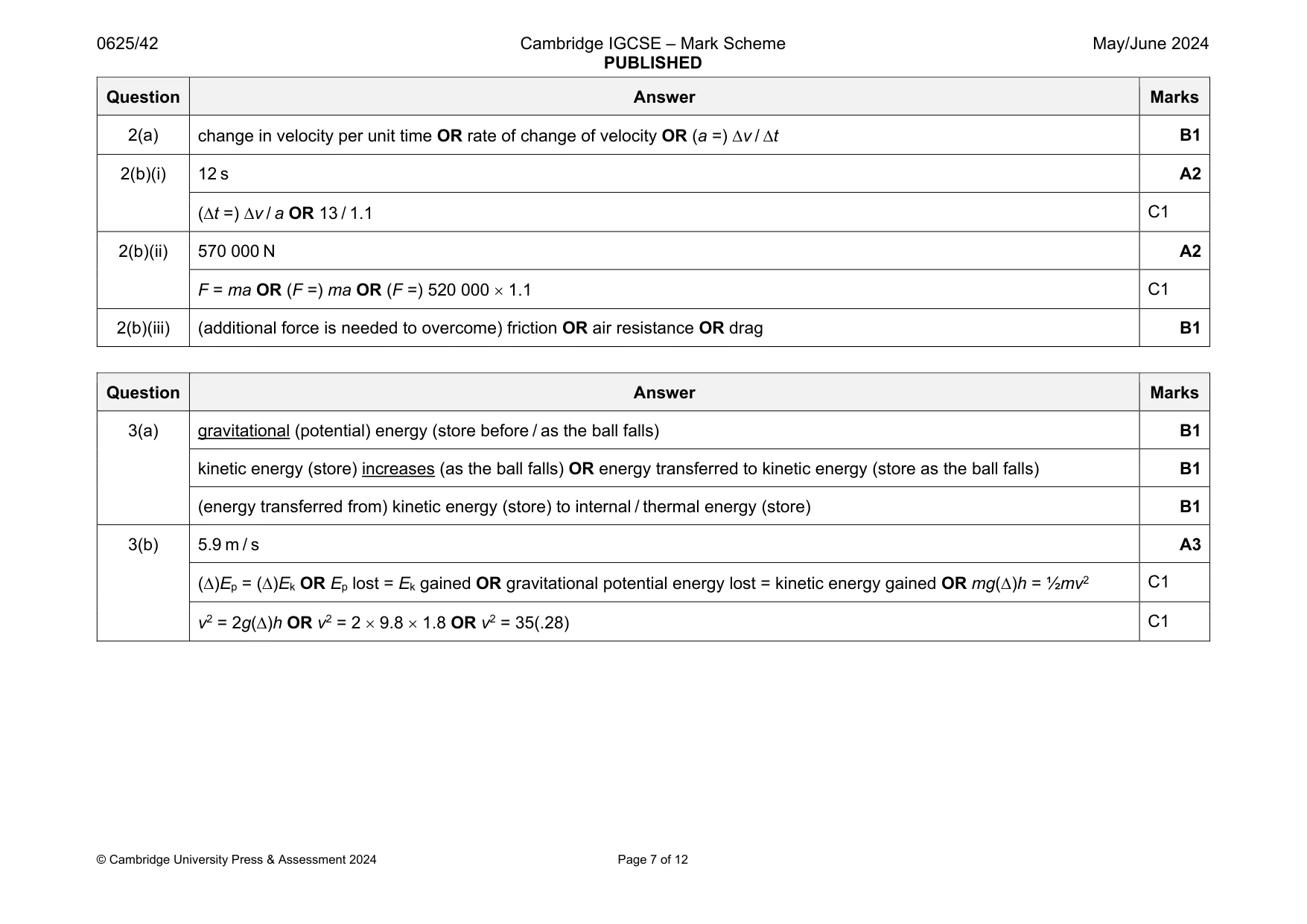
Mark scheme: 2(a) B1 2(b)(i) 12 s A2 (t =) v / a OR 13 / 1.1 C1 2(b)(ii) 570 000 N A2 F = ma OR (F =) ma OR (F =) 520 000 1.1 C1 2(b)(iii) (additional force is needed to overcome) friction OR air resistance OR drag B1
Q3 · A student drops a heavy ball from a vertical height of 1.8 m above the ground
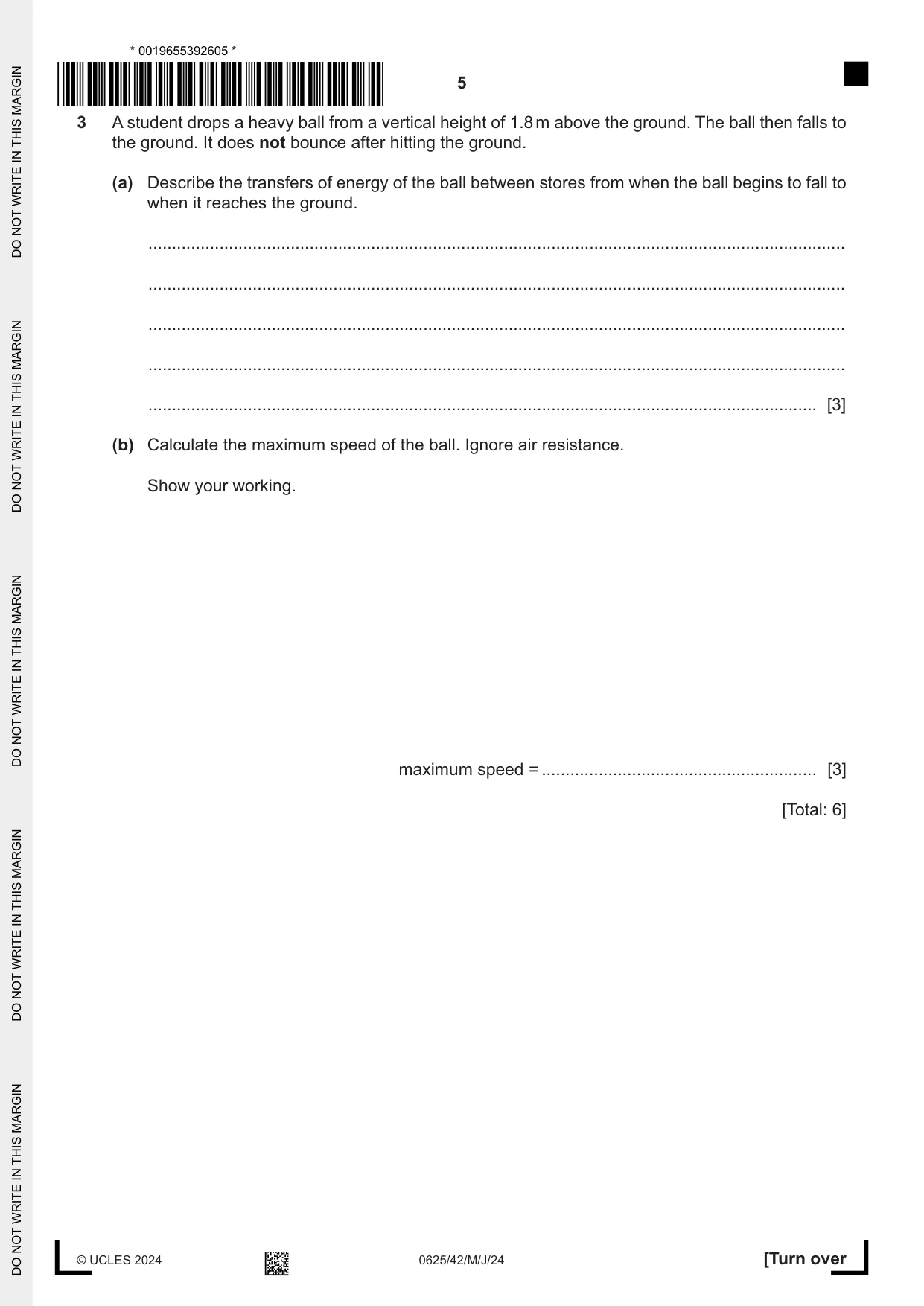
3 A student drops a heavy ball from a vertical height of 1.8 m above the ground. The ball then falls to the ground. It does not bounce after hitting the ground. (a) Describe the transfers of energy of the ball between stores from when the ball begins to fall to when it reaches the ground. ................................................................................................................................................... ................................................................................................................................................... ................................................................................................................................................... ................................................................................................................................................... ............................................................................................................................................. [3] (b) Calculate the maximum speed of the ball. Ignore air resistance. Show your working. maximum speed = .......................................................... [3] [Total: 6]
Mark scheme: 3(a) gravitational (potential) energy (store before / as the ball falls) B1 kinetic energy (store) increases (as the ball falls) OR energy transferred to kinetic energy (store as the ball falls) B1 (energy transferred from) kinetic energy (store) to internal / thermal energy (store) B1 3(b) 5.9 m / s A3 ()Ep = ()Ek OR Ep lost = Ek gained OR gravitational potential energy lost = kinetic energy gained OR mg()h = ½mv2 C1 v2 = 2g()h OR v2 = 2 9.8 1.8 OR v2 = 35(.28) C1
Q4 · State two ways that evaporation differs from boiling
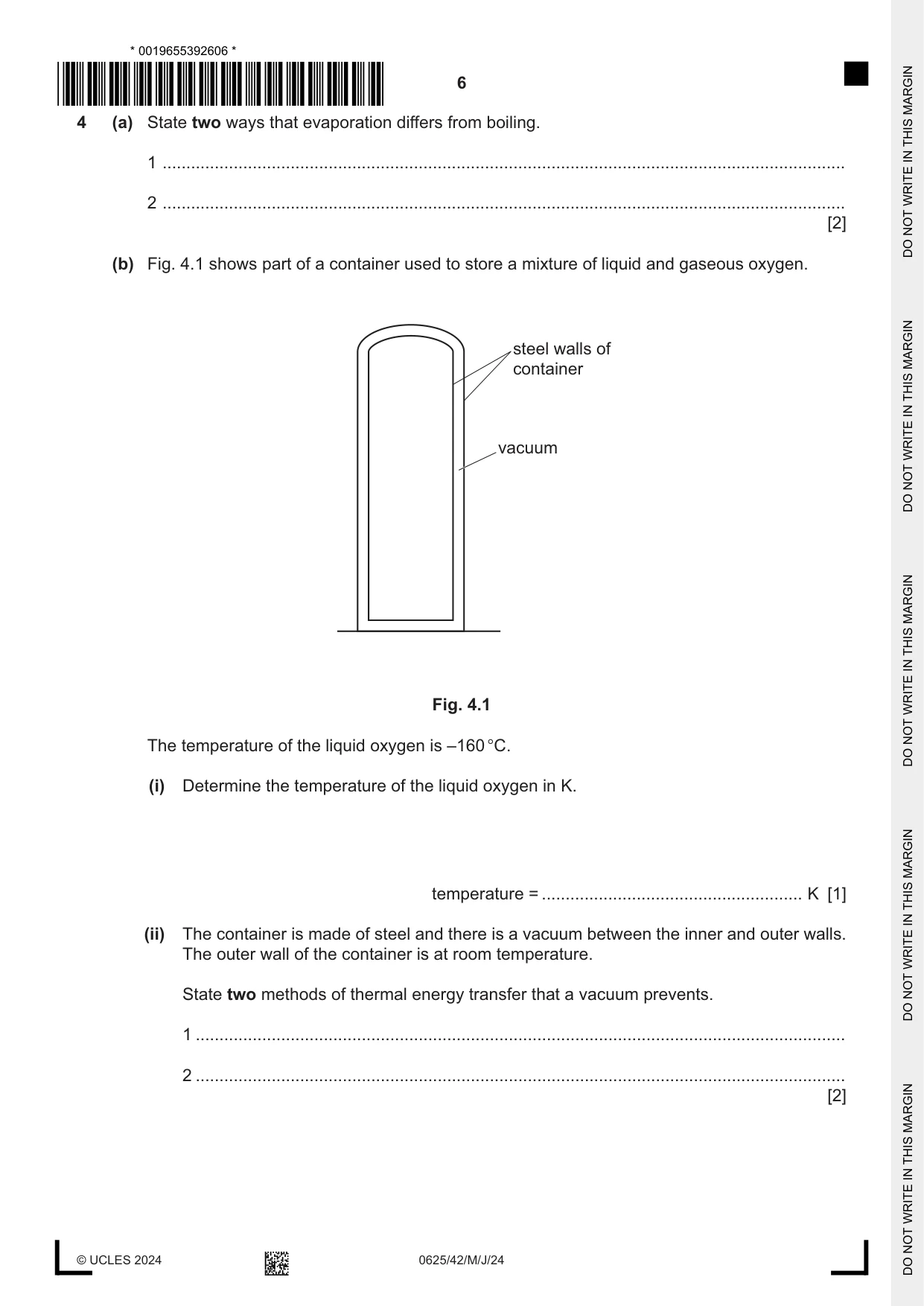
4 (a) State two ways that evaporation differs from boiling. 1 ................................................................................................................................................ 2 ................................................................................................................................................ [2] (b) Fig. 4.1 shows part of a container used to store a mixture of liquid and gaseous oxygen. steel walls of container vacuum Fig. 4.1 The temperature of the liquid oxygen is –160 °C. (i) Determine the temperature of the liquid oxygen in K. temperature = ....................................................... K [1] (ii) The container is made of steel and there is a vacuum between the inner and outer walls. The outer wall of the container is at room temperature. State two methods of thermal energy transfer that a vacuum prevents. 1 ......................................................................................................................................... 2 ......................................................................................................................................... [2] (c) Describe, in terms of particles, how a gas exerts a pressure on the walls of its container. ................................................................................................................................................... ................................................................................................................................................... ................................................................................................................................................... ............................................................................................................................................. [3] [Total: 8]
Mark scheme: 4(a) (evaporation:) (only) at the surface OR boiling: happens throughout the liquid B1 (evaporation:) takes place at any temperature OR boiling: takes place at a specific temperature / boiling point B1 4(b)(i) 113 (K) B1 4(b)(ii) conduction B1 convection B1 4(c) particles collide with the walls / container B1 (particles) exert a force on the walls OR collision with walls produces a change in momentum (of particles) B1 pressure is force per unit area OR p = F / A OR pressure is rate of change of momentum per unit area B1
Q5 · A ray of yellow light incident on a glass prism ABC
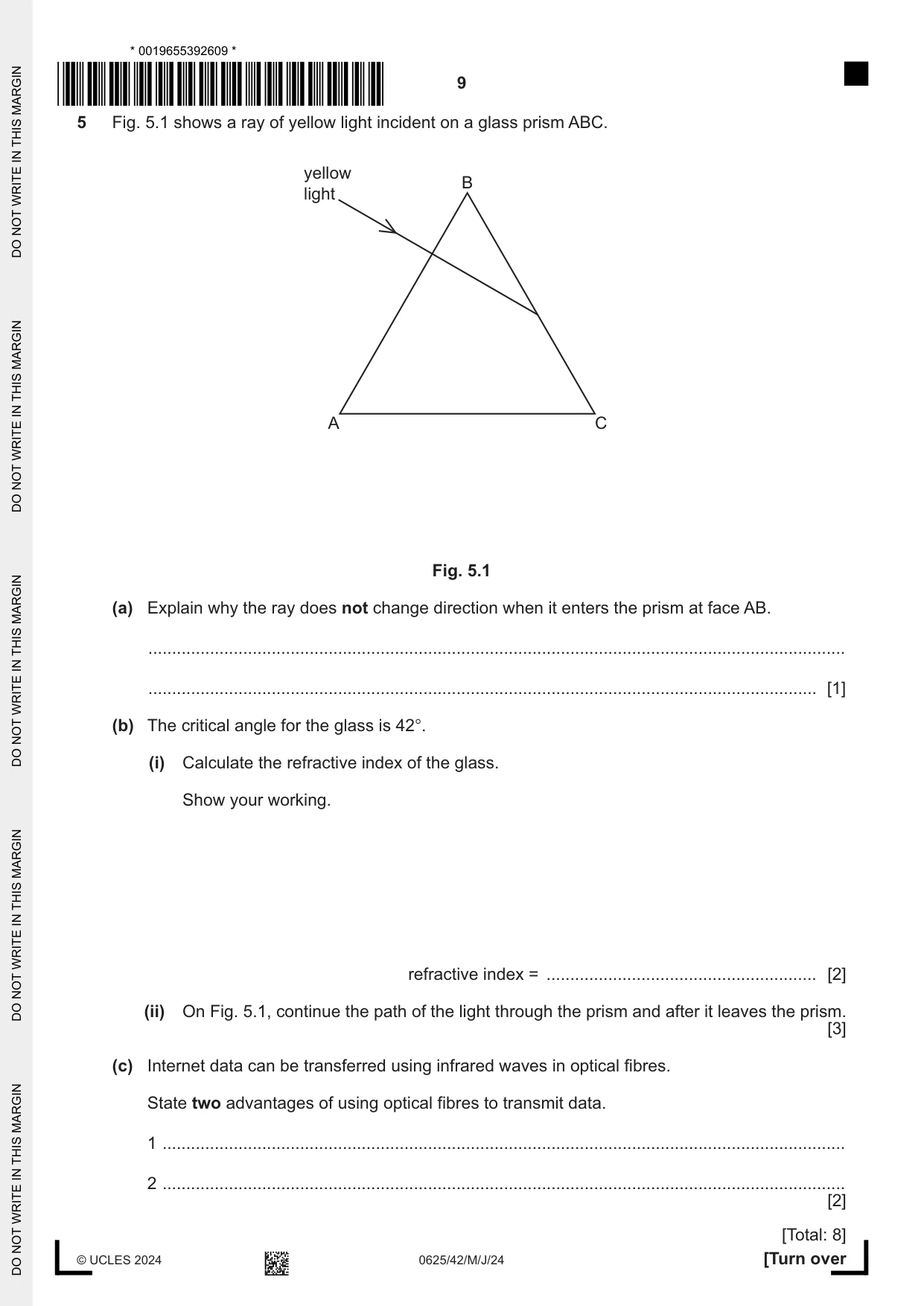
5 Fig. 5.1 shows a ray of yellow light incident on a glass prism ABC. yellow B light A C Fig. 5.1 (a) Explain why the ray does not change direction when it enters the prism at face AB. ................................................................................................................................................... ............................................................................................................................................. [1] (b) The critical angle for the glass is 42°. (i) Calculate the refractive index of the glass. Show your working. refractive index = ......................................................... [2] (ii) On Fig. 5.1, continue the path of the light through the prism and after it leaves the prism. [3] (c) Internet data can be transferred using infrared waves in optical fibres. State two advantages of using optical fibres to transmit data. 1 ................................................................................................................................................ 2 ................................................................................................................................................ [2] [Total: 8]
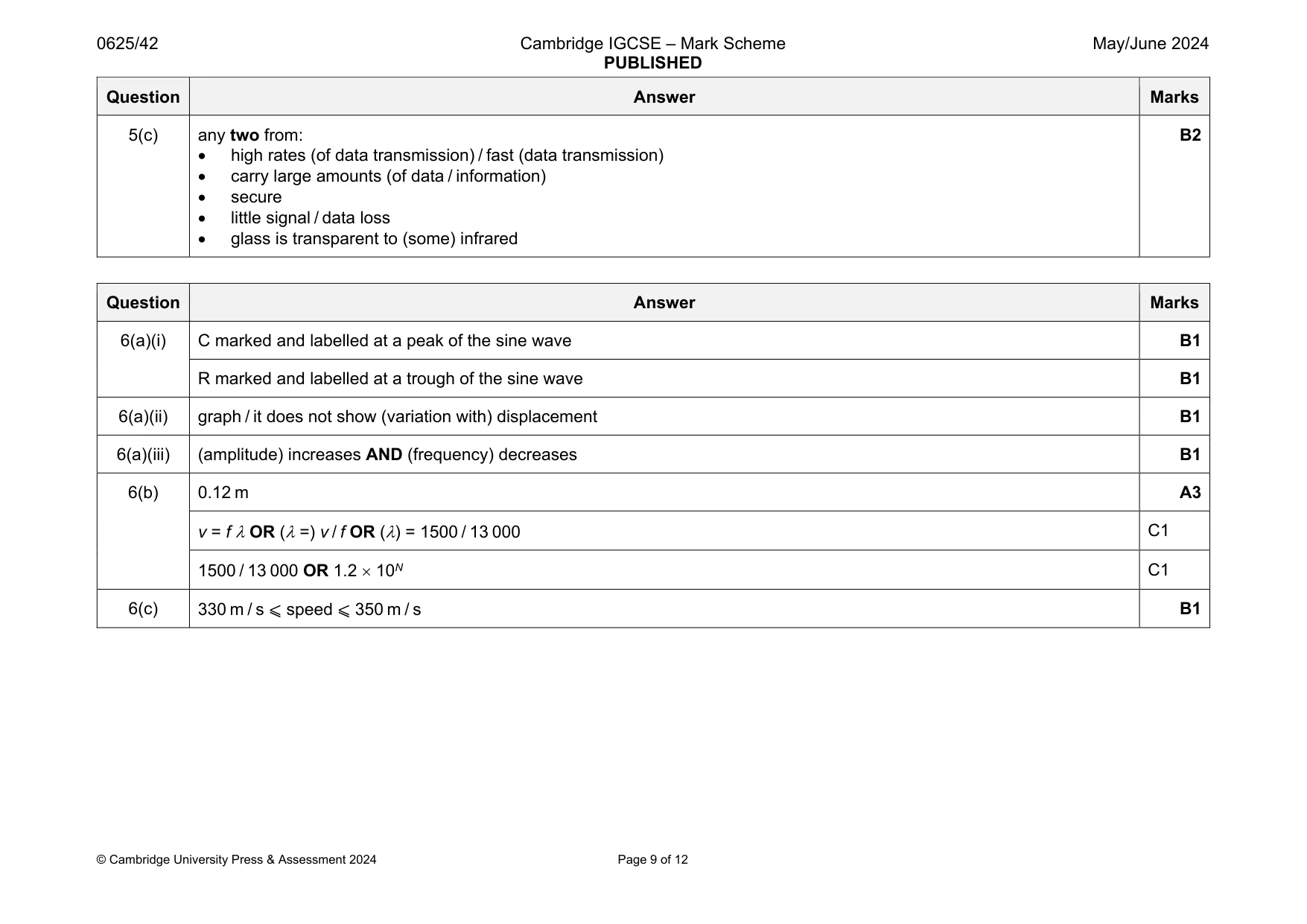
Mark scheme: 5(a) ray travels along the normal OR angle of incidence = 0(°) B1 5(b)(i) n = 1 / sin c OR (n =) 1 / sin c OR (n =) 1 / sin 42 (°) M1 1.5 A1 5(b)(ii) ray reflected at BC AND no refracted ray M1 ray hits AC with angle of incidence = 0 ° A1 correct refraction of candidate’s ray into air at AC B1 Question Answer Marks 5(c) any two from: high rates (of data transmission) / fast (data transmission) carry large amounts (of data / information) secure little signal / data loss glass is transparent to (some) infrared B2
Q6 · A sound wave travels through air
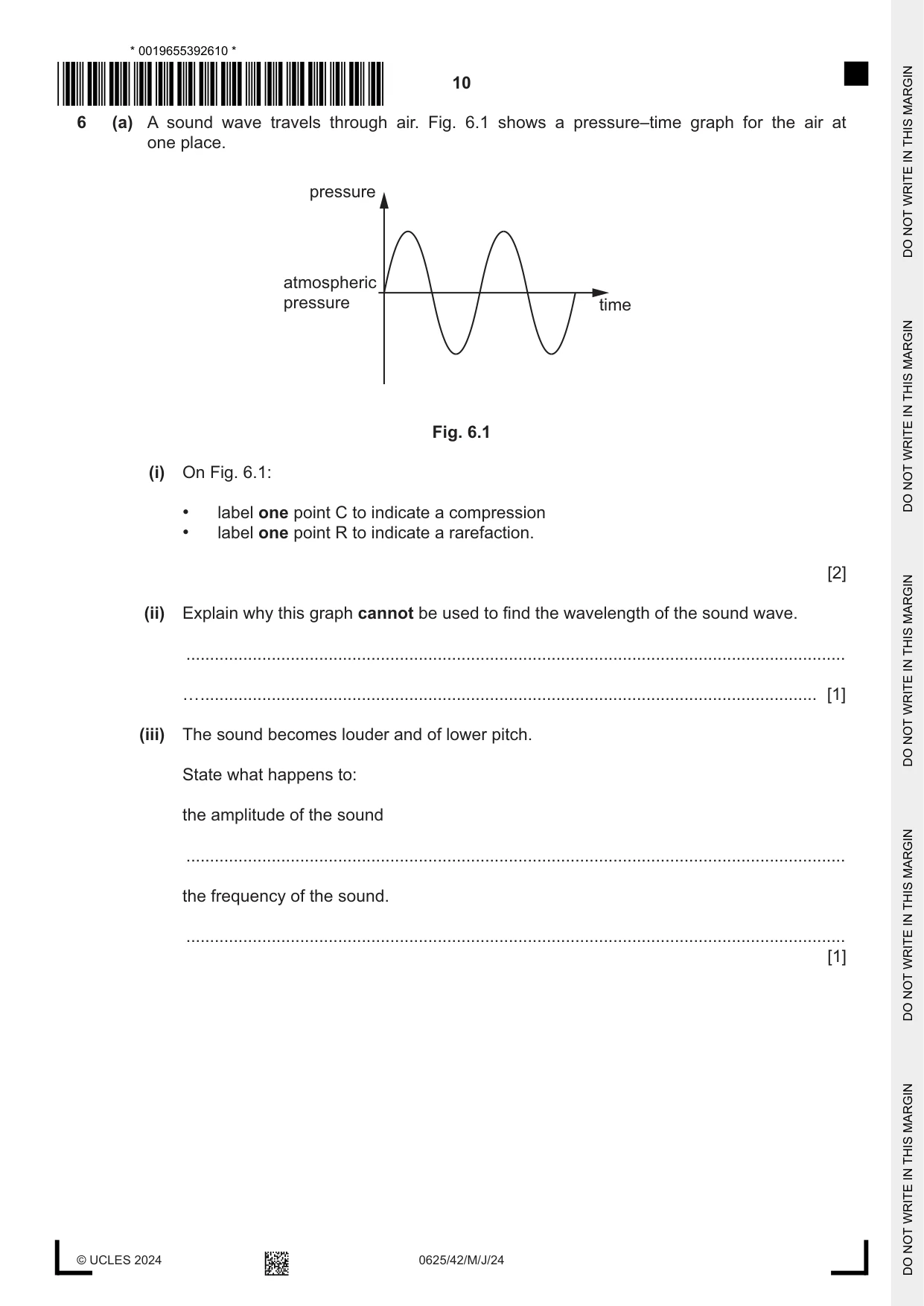
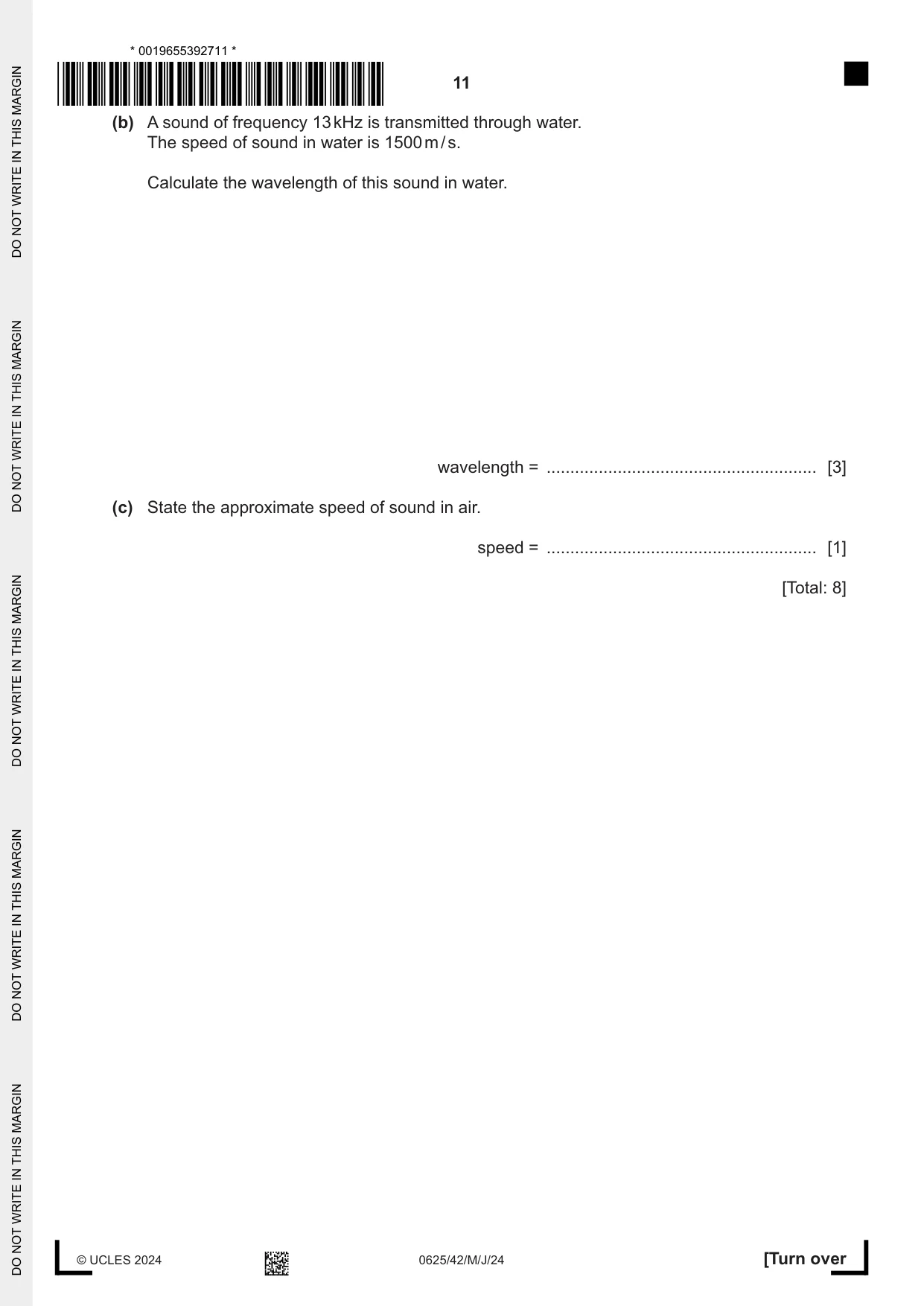
6 (a) A sound wave travels through air. Fig. 6.1 shows a pressure–time graph for the air at one place. pressure atmospheric pressure time Fig. 6.1 (i) On Fig. 6.1: • label one point C to indicate a compression • label one point R to indicate a rarefaction. [2] (ii) Explain why this graph cannot be used to find the wavelength of the sound wave. ........................................................................................................................................... … .................................................................................................................................. [1] (iii) The sound becomes louder and of lower pitch. State what happens to: the amplitude of the sound ........................................................................................................................................... the frequency of the sound. ........................................................................................................................................... [1] (b) A sound of frequency 13 kHz is transmitted through water. The speed of sound in water is 1500 m / s. Calculate the wavelength of this sound in water. wavelength = ......................................................... [3] (c) State the approximate speed of sound in air. speed = ......................................................... [1] [Total: 8]
Mark scheme: 6(a)(i) C marked and labelled at a peak of the sine wave B1 R marked and labelled at a trough of the sine wave B1 6(a)(ii) graph / it does not show (variation with) displacement B1 6(a)(iii) (amplitude) increases AND (frequency) decreases B1 6(b) 0.12 m A3 v = f OR ( =) v / f OR () = 1500 / 13 000 C1 1500 / 13 000 OR 1.2 10N C1 6(c) 330 m / s ⩽ speed ⩽ 350 m / s B1
Q7 · Three bars of steel, A, B and C
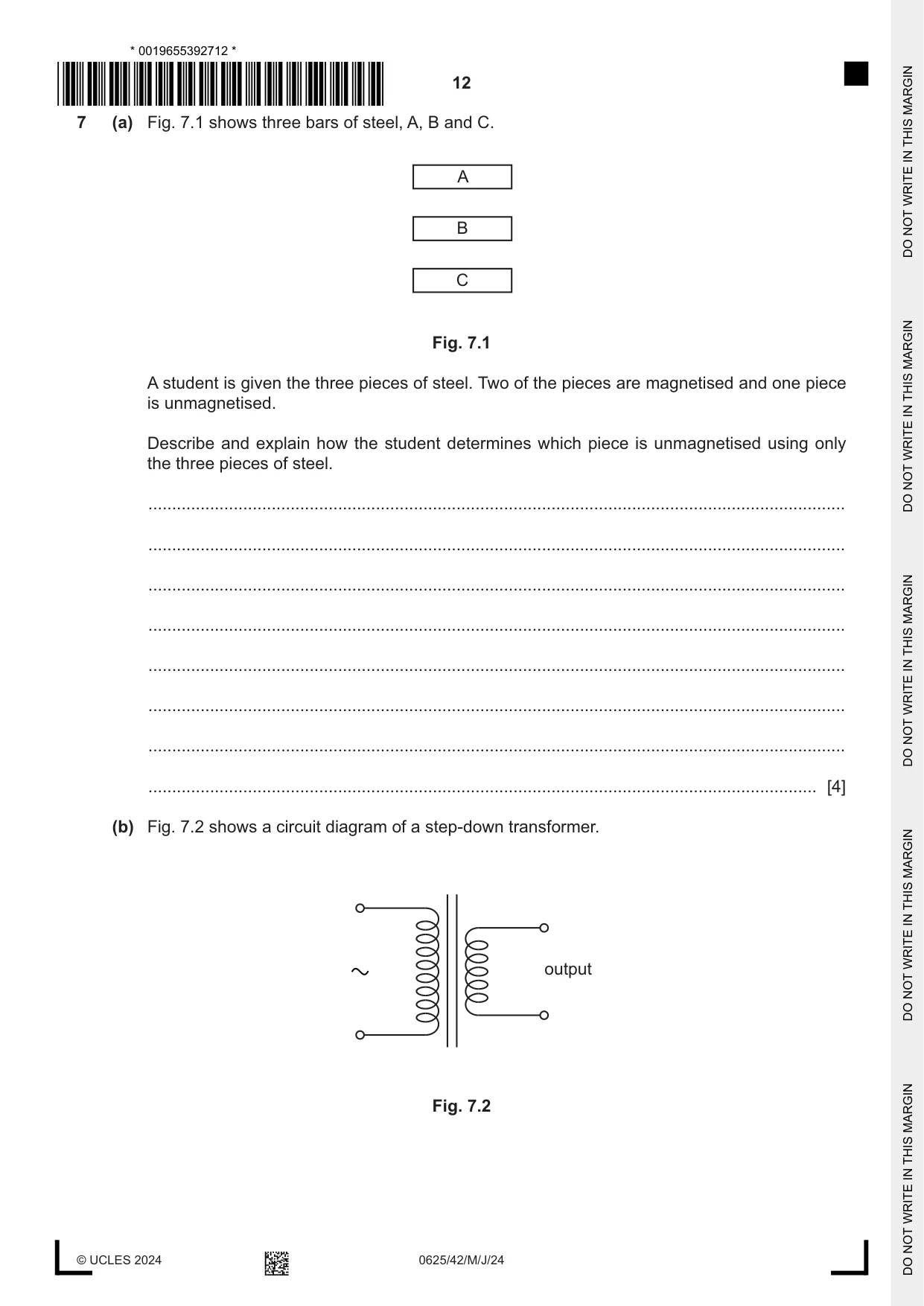
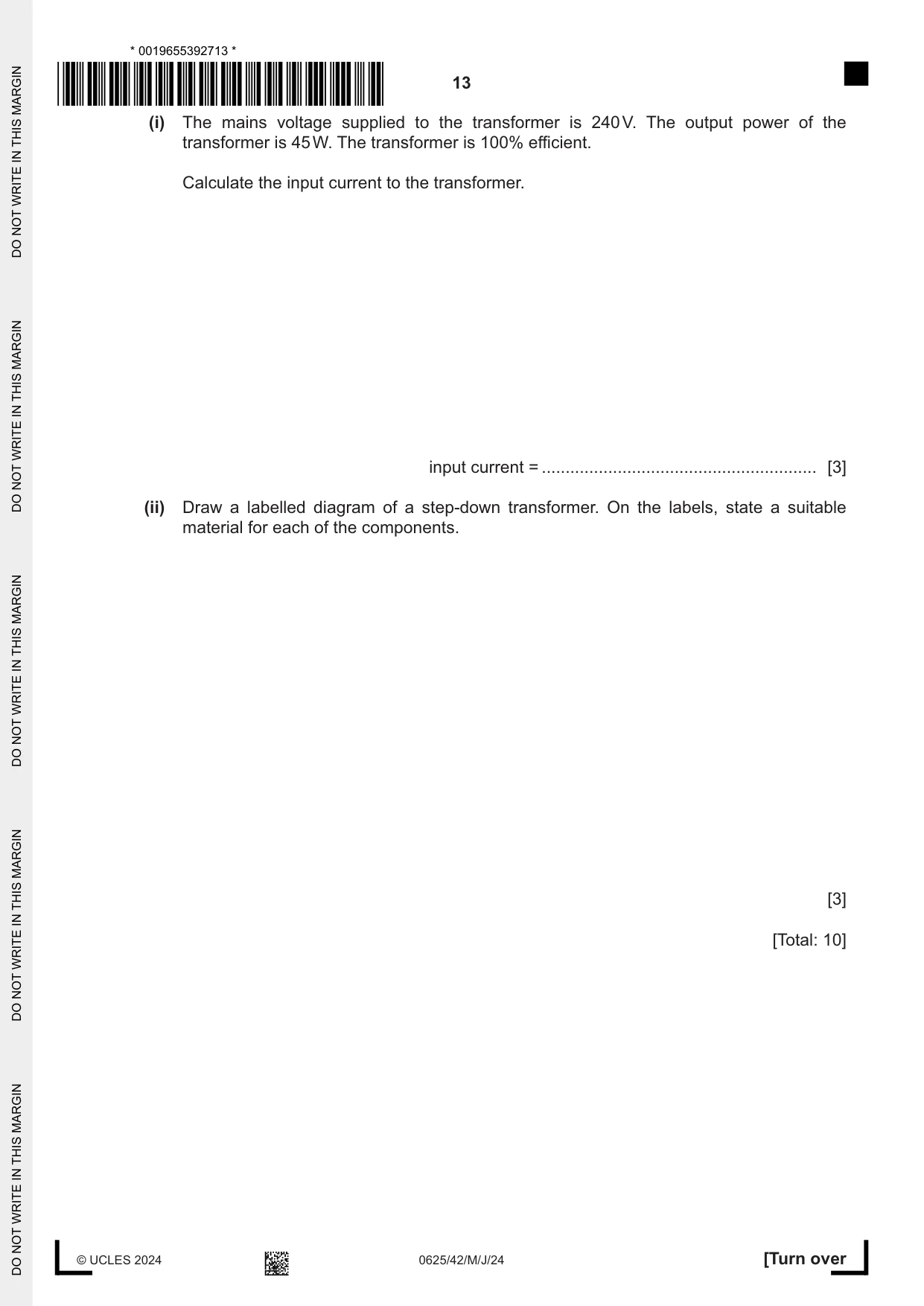
7 (a) Fig. 7.1 shows three bars of steel, A, B and C. A B C Fig. 7.1 A student is given the three pieces of steel. Two of the pieces are magnetised and one piece is unmagnetised. Describe and explain how the student determines which piece is unmagnetised using only the three pieces of steel. ................................................................................................................................................... ................................................................................................................................................... ................................................................................................................................................... ................................................................................................................................................... ................................................................................................................................................... ................................................................................................................................................... ................................................................................................................................................... ............................................................................................................................................. [4] (b) Fig. 7.2 shows a circuit diagram of a step‑down transformer. output Fig. 7.2 (i) The mains voltage supplied to the transformer is 240 V. The output power of the transformer is 45 W. The transformer is 100% efficient. Calculate the input current to the transformer. input current = .......................................................... [3] (ii) Draw a labelled diagram of a step‑down transformer. On the labels, state a suitable material for each of the components. [3] [Total: 10]
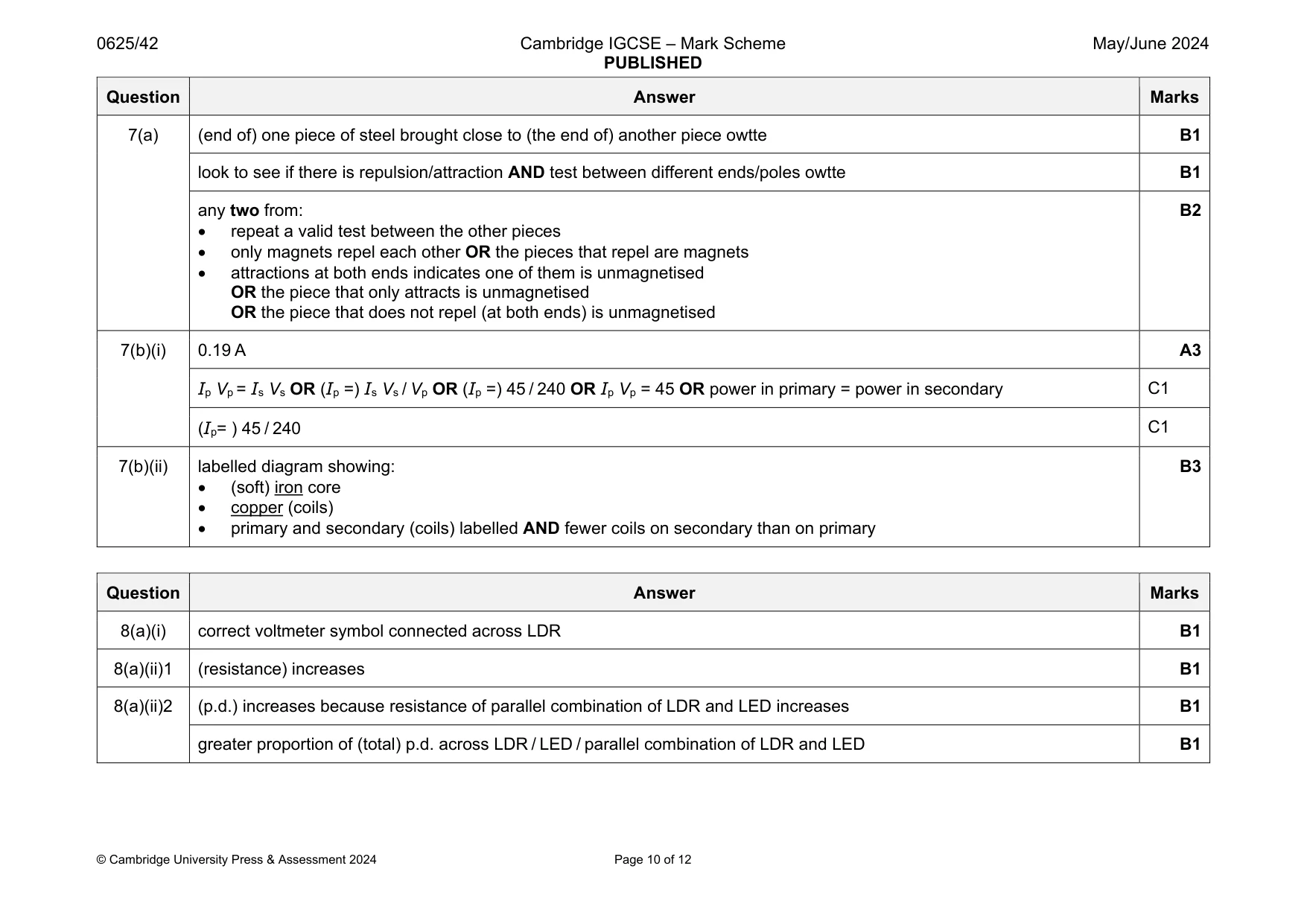
Mark scheme: 7(a) (end of) one piece of steel brought close to (the end of) another piece owtte B1 look to see if there is repulsion/attraction AND test between different ends/poles owtte B1 any two from: repeat a valid test between the other pieces only magnets repel each other OR the pieces that repel are magnets attractions at both ends indicates one of them is unmagnetised OR the piece that only attracts is unmagnetised OR the piece that does not repel (at both ends) is unmagnetised B2 7(b)(i) 0.19 A A3 Ip Vp = Is Vs OR (Ip =) Is Vs / Vp OR (Ip =) 45 / 240 OR Ip Vp = 45 OR power in primary = power in secondary C1 (Ip= ) 45 / 240 C1 7(b)(ii) labelled diagram showing: (soft) iron core copper (coils) primary and secondary (coils) labelled AND fewer coils on secondary than on primary B3
Question 8
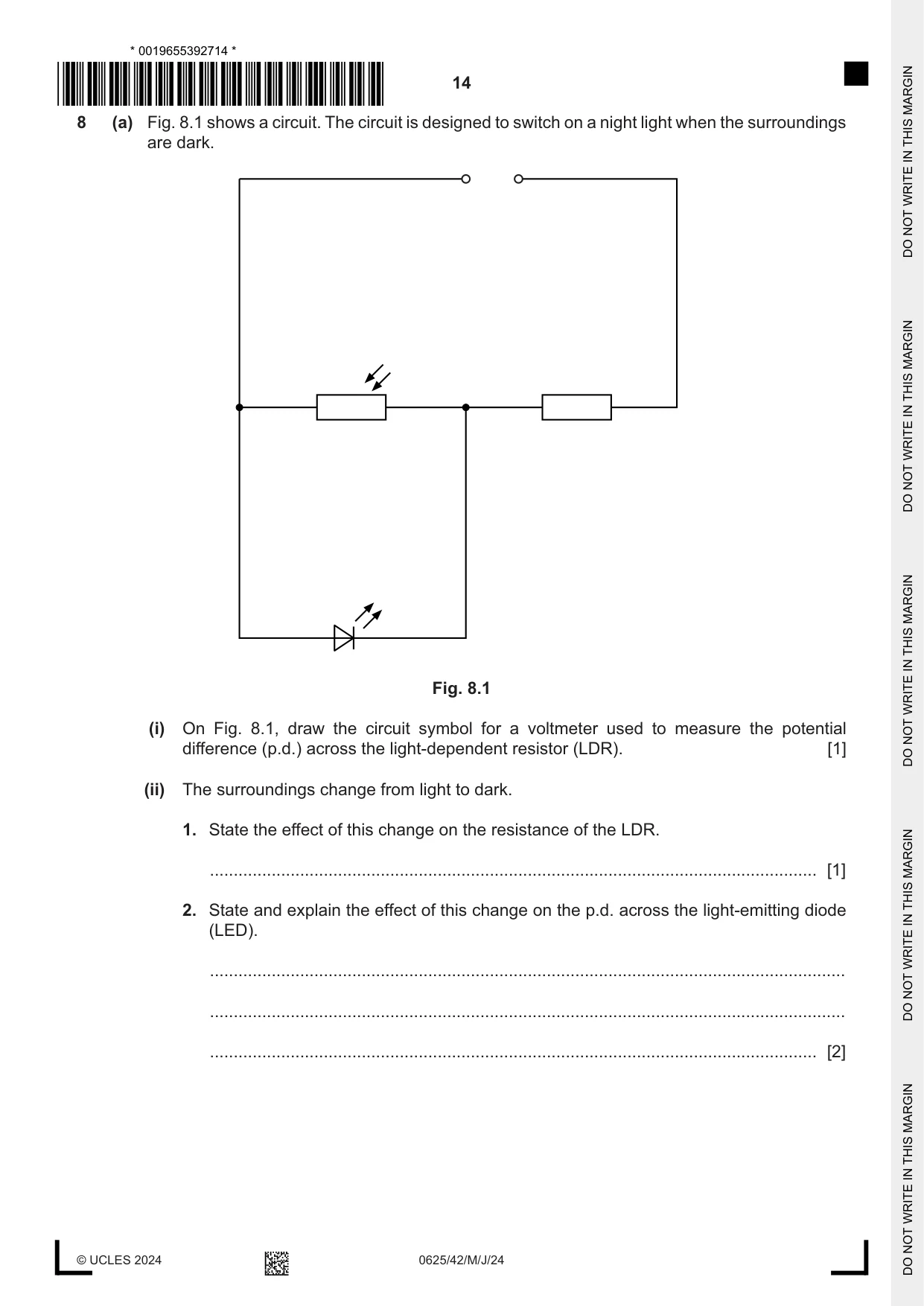
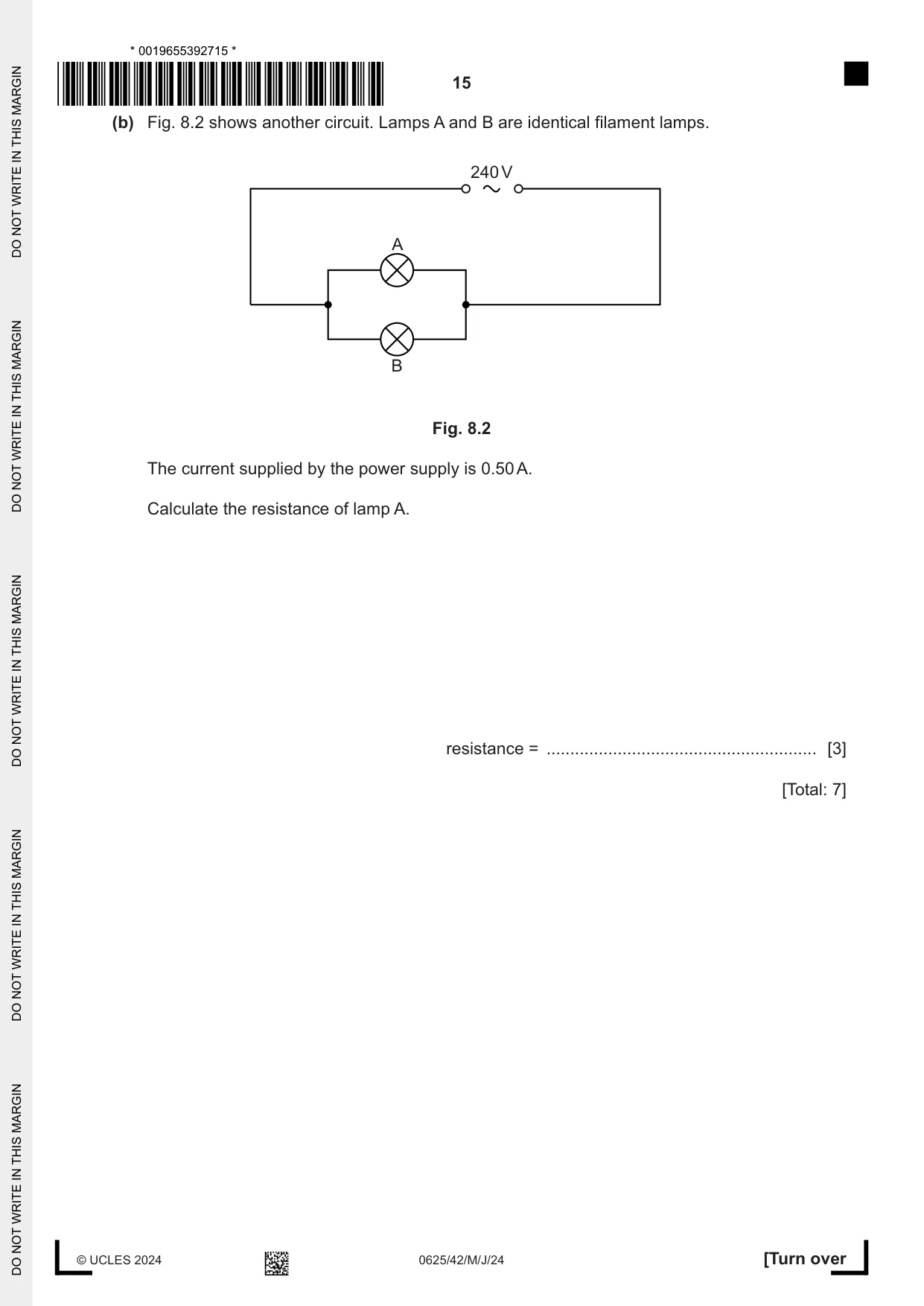
8 (a) Fig. 8.1 shows a circuit. The circuit is designed to switch on a night light when the surroundings are dark. Fig. 8.1 (i) On Fig. 8.1, draw the circuit symbol for a voltmeter used to measure the potential difference (p.d.) across the light‑dependent resistor (LDR). [1] (ii) The surroundings change from light to dark. 1. State the effect of this change on the resistance of the LDR. ................................................................................................................................ [1] 2. State and explain the effect of this change on the p.d. across the light‑emitting diode (LED). ...................................................................................................................................... ...................................................................................................................................... ................................................................................................................................ [2] (b) Fig. 8.2 shows another circuit. Lamps A and B are identical filament lamps. 240 V A B Fig. 8.2 The current supplied by the power supply is 0.50 A. Calculate the resistance of lamp A. resistance = ......................................................... [3] [Total: 7]
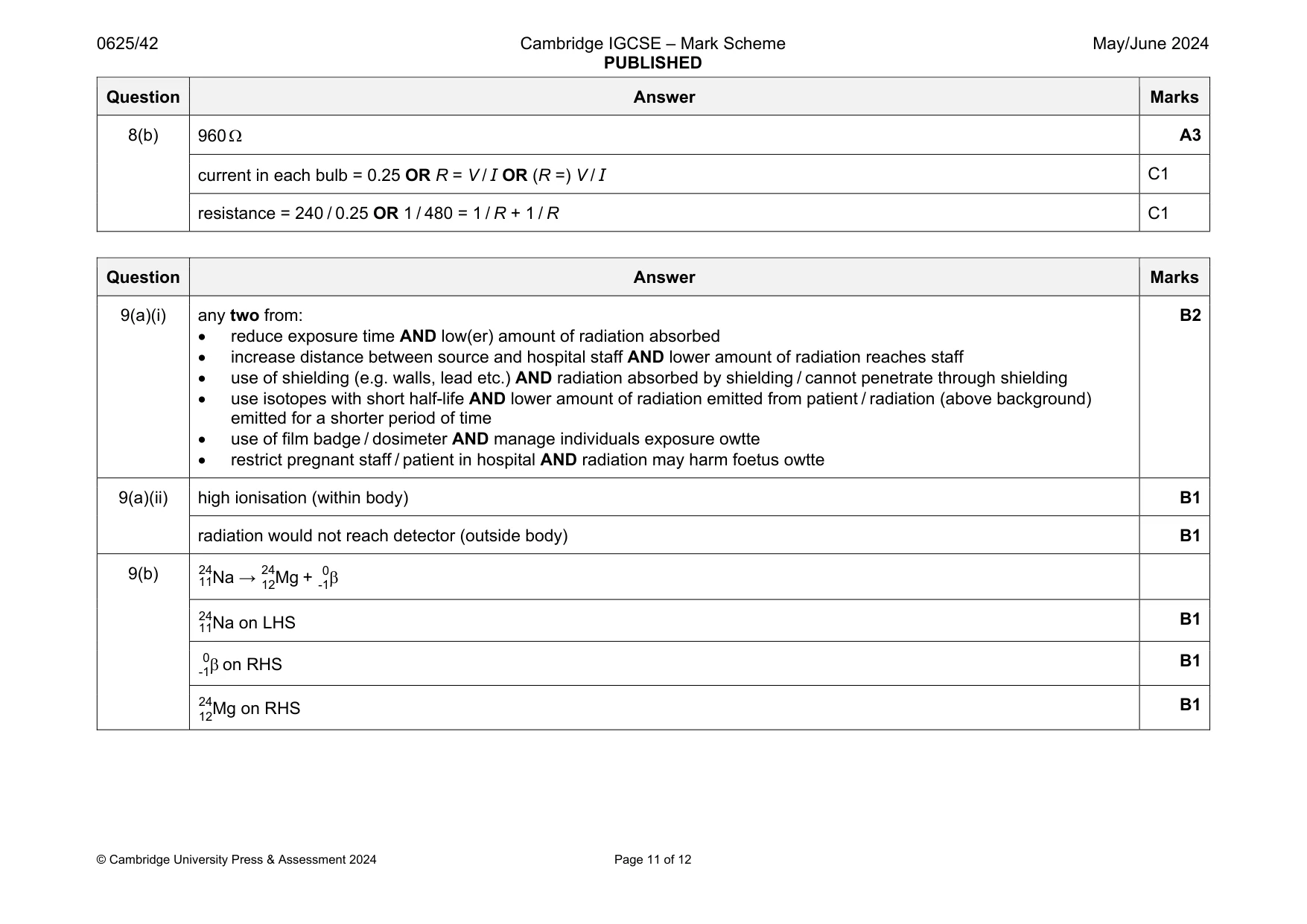
Mark scheme: 8(a)(i) correct voltmeter symbol connected across LDR B1 8(a)(ii)1 (resistance) increases B1 8(a)(ii)2 (p.d.) increases because resistance of parallel combination of LDR and LED increases B1 greater proportion of (total) p.d. across LDR / LED / parallel combination of LDR and LED B1 Question Answer Marks 8(b) 960 A3 current in each bulb = 0.25 OR R = V / I OR (R =) V / I C1 resistance = 240 / 0.25 OR 1 / 480 = 1 / R + 1 / R C1
Q9 · Radioactive isotopes that emit ionising radiation are used in hospitals
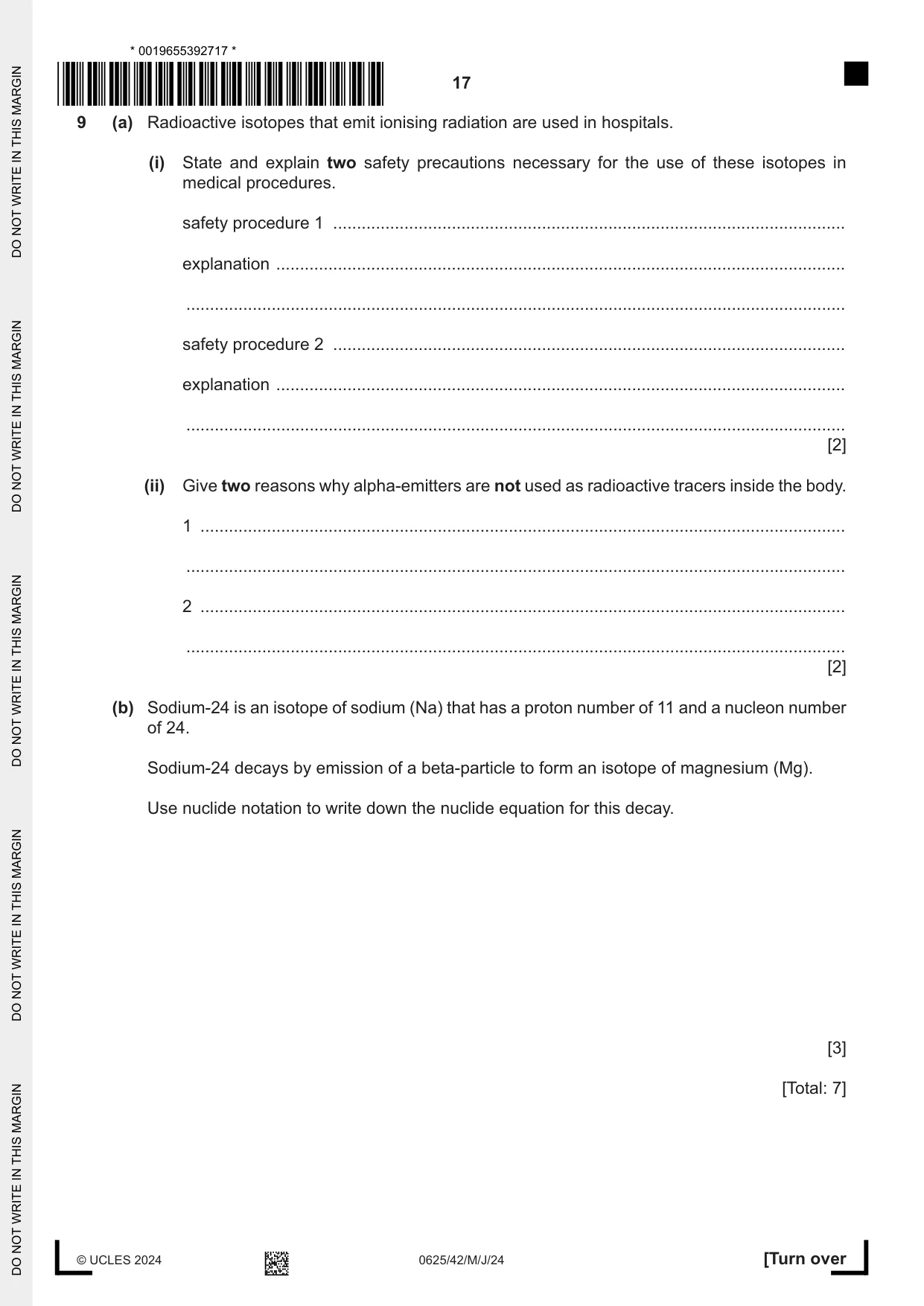
9 (a) Radioactive isotopes that emit ionising radiation are used in hospitals. (i) State and explain two safety precautions necessary for the use of these isotopes in medical procedures. safety procedure 1 ............................................................................................................ explanation ........................................................................................................................ ........................................................................................................................................... safety procedure 2 ............................................................................................................ explanation ........................................................................................................................ ........................................................................................................................................... [2] (ii) Give two reasons why alpha‑emitters are not used as radioactive tracers inside the body. 1 ........................................................................................................................................ ........................................................................................................................................... 2 ........................................................................................................................................ ........................................................................................................................................... [2] (b) Sodium‑24 is an isotope of sodium (Na) that has a proton number of 11 and a nucleon number of 24. Sodium‑24 decays by emission of a beta‑particle to form an isotope of magnesium (Mg). Use nuclide notation to write down the nuclide equation for this decay. [3] [Total: 7]
Mark scheme: 9(a)(i) any two from: reduce exposure time AND low(er) amount of radiation absorbed increase distance between source and hospital staff AND lower amount of radiation reaches staff use of shielding (e.g. walls, lead etc.) AND radiation absorbed by shielding / cannot penetrate through shielding use isotopes with short half-life AND lower amount of radiation emitted from patient / radiation (above background) emitted for a shorter period of time use of film badge / dosimeter AND manage individuals exposure owtte restrict pregnant staff / patient in hospital AND radiation may harm foetus owtte B2 9(a)(ii) high ionisation (within body) B1 radiation would not reach detector (outside body) B1 9(b) Na 11 24 → Mg 12 24 + -1 0 Na 11 24 on LHS B1 -1 0 on RHS B1 Mg 12 24 on RHS B1
Q10 · The Solar System includes the Sun and planets
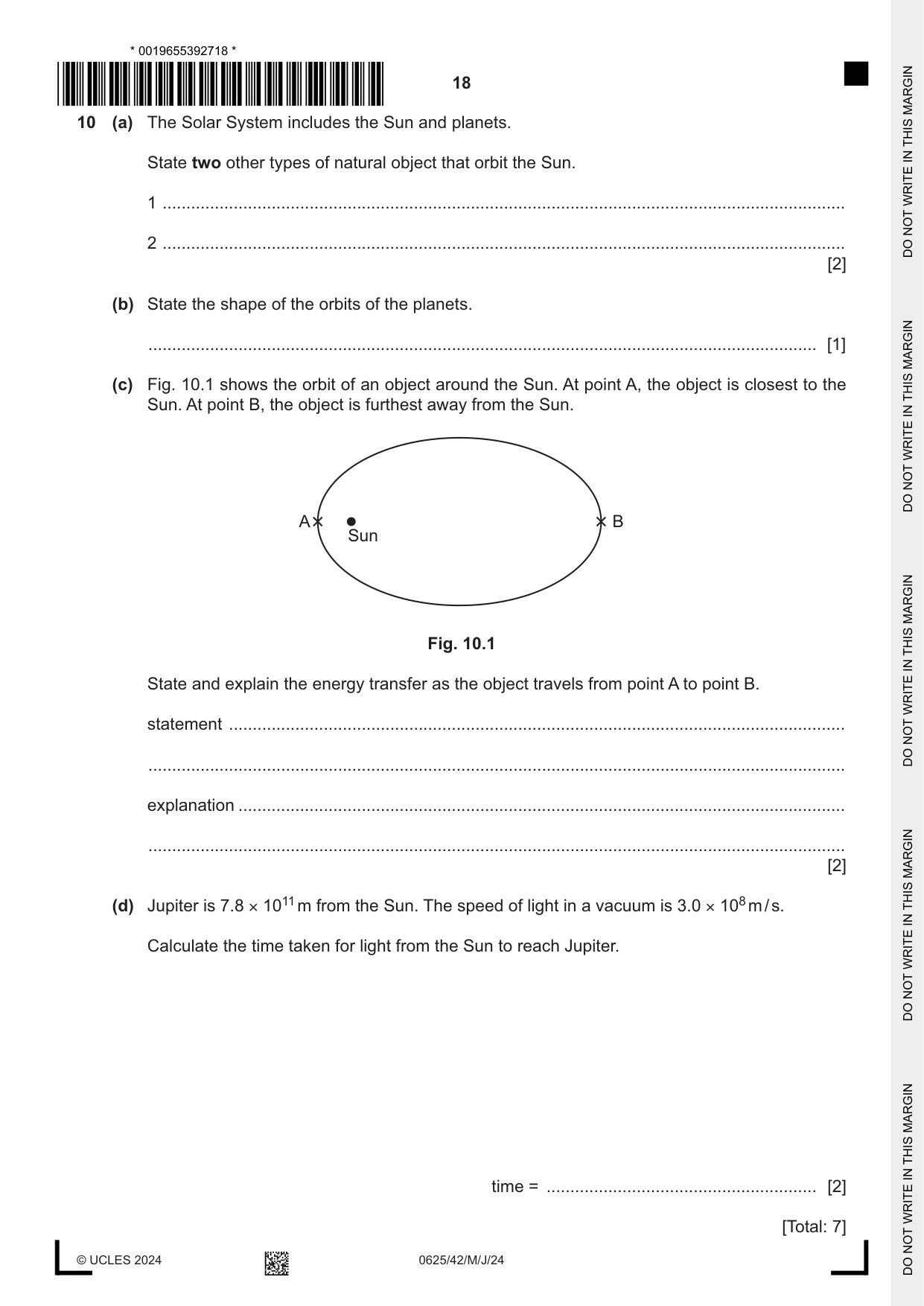
10 (a) The Solar System includes the Sun and planets. State two other types of natural object that orbit the Sun. 1 ................................................................................................................................................ 2 ................................................................................................................................................ [2] (b) State the shape of the orbits of the planets. ............................................................................................................................................. [1] (c) Fig. 10.1 shows the orbit of an object around the Sun. At point A, the object is closest to the Sun. At point B, the object is furthest away from the Sun. A B Sun Fig. 10.1 State and explain the energy transfer as the object travels from point A to point B. statement .................................................................................................................................. ................................................................................................................................................... explanation ................................................................................................................................ ................................................................................................................................................... [2] (d) Jupiter is 7.8 × 10¹¹ m from the Sun. The speed of light in a vacuum is 3.0 × 10⁸ m / s. Calculate the time taken for light from the Sun to reach Jupiter. time = ......................................................... [2] [Total: 7]
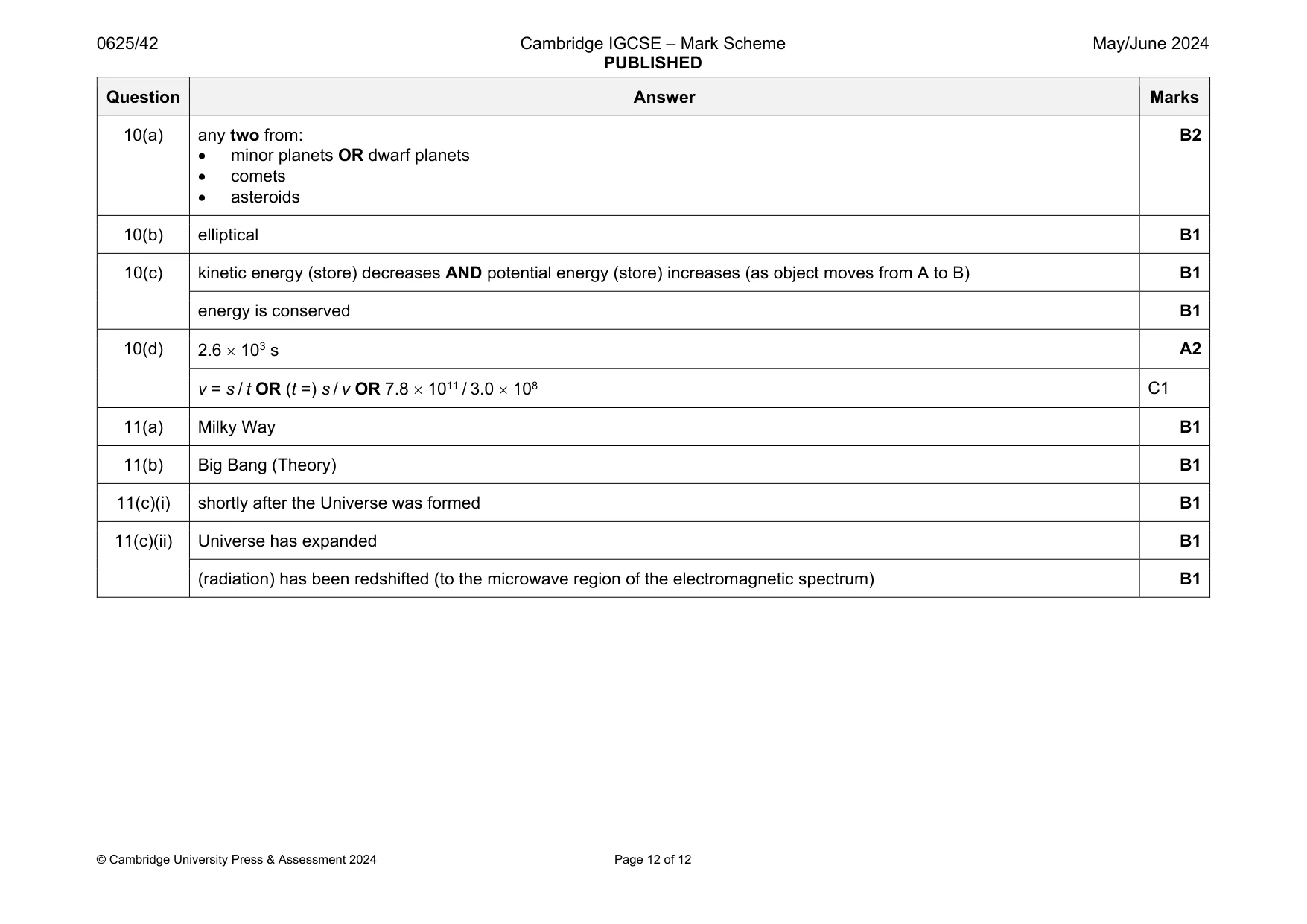
Mark scheme: 10(a) any two from: minor planets OR dwarf planets comets asteroids B2 10(b) elliptical B1 10(c) kinetic energy (store) decreases AND potential energy (store) increases (as object moves from A to B) B1 energy is conserved B1 10(d) 2.6 103 s A2 v = s / t OR (t =) s / v OR 7.8 1011 / 3.0 108 C1
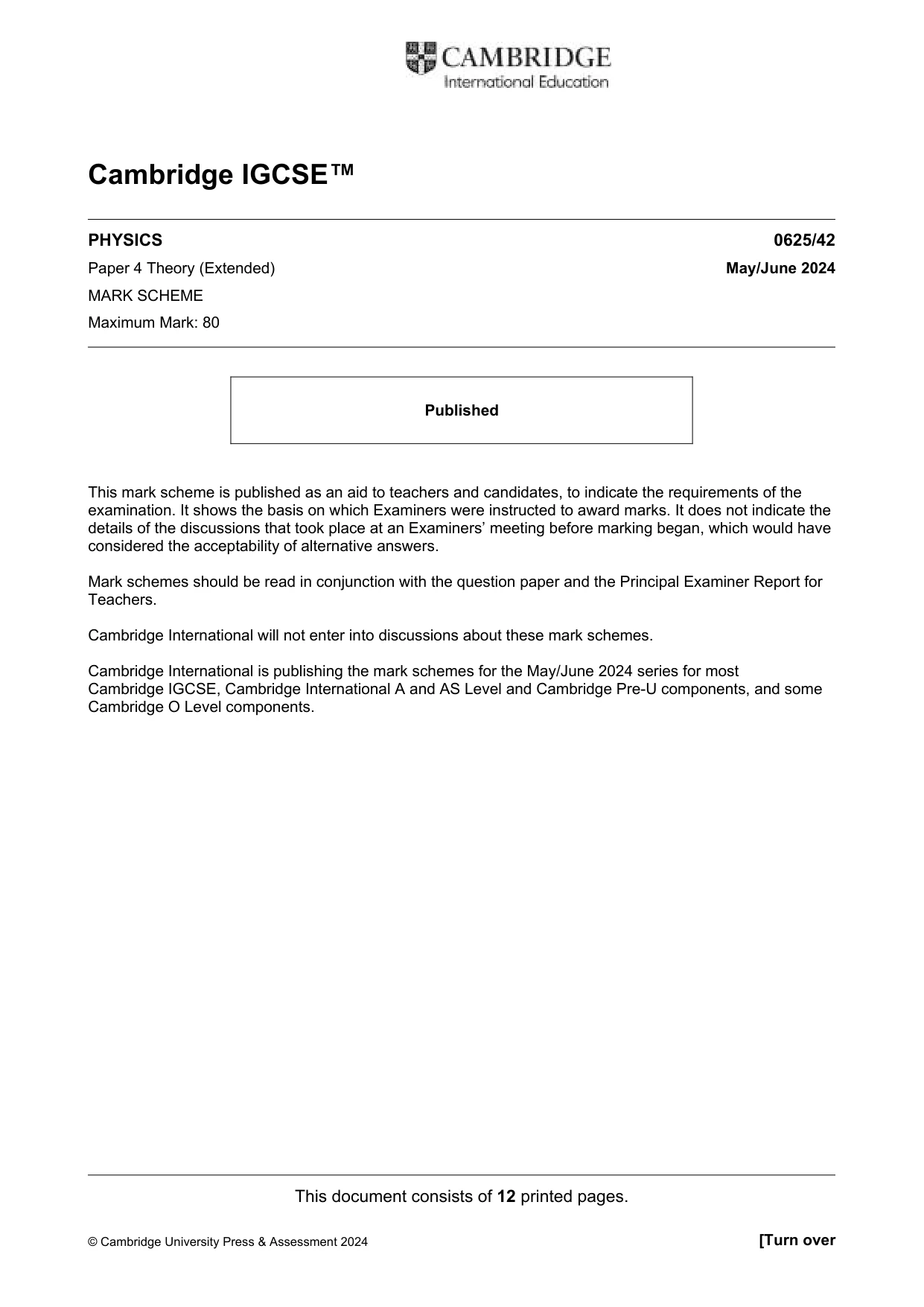
Q11 · Name the galaxy that contains the Sun
11 (a) Name the galaxy that contains the Sun. ............................................................................................................................................. [1] (b) Light observed from distant galaxies is redshifted. State the theory of the Universe that this observation supports. ............................................................................................................................................. [1] (c) Cosmic microwave background radiation (CMBR) is observed at all points in space. (i) State when this radiation was produced. ..................................................................................................................................... [1] (ii) Explain why this radiation is now in the microwave region of the electromagnetic spectrum. ........................................................................................................................................... ..................................................................................................................................... [2] [Total: 5]
Mark scheme: 11(a) Milky Way B1 11(b) Big Bang (Theory) B1 11(c)(i) shortly after the Universe was formed B1 11(c)(ii) Universe has expanded B1 (radiation) has been redshifted (to the microwave region of the electromagnetic spectrum) B1
What was in this paper
The subtopics covered by these 11 questions, and how many questions each got. Open one in a new tab to see every Cambridge question on it.
What you needed in this session
Cambridge’s own grade thresholds for 2024 May/June, Paper 4 · Variant 2. A higher threshold means an easier paper — the bar moves with how the cohort did.