Cambridge IGCSE Physics 0625 — 2022 May/June Paper 4 · Variant 1
0625/41/M/J/22 · 10 questions · 80 marks · ≈90 min
The question paper and its mark scheme, free to read here and free to download. This is Cambridge’s own paper, exactly as it was sat.
Question paper16 pages
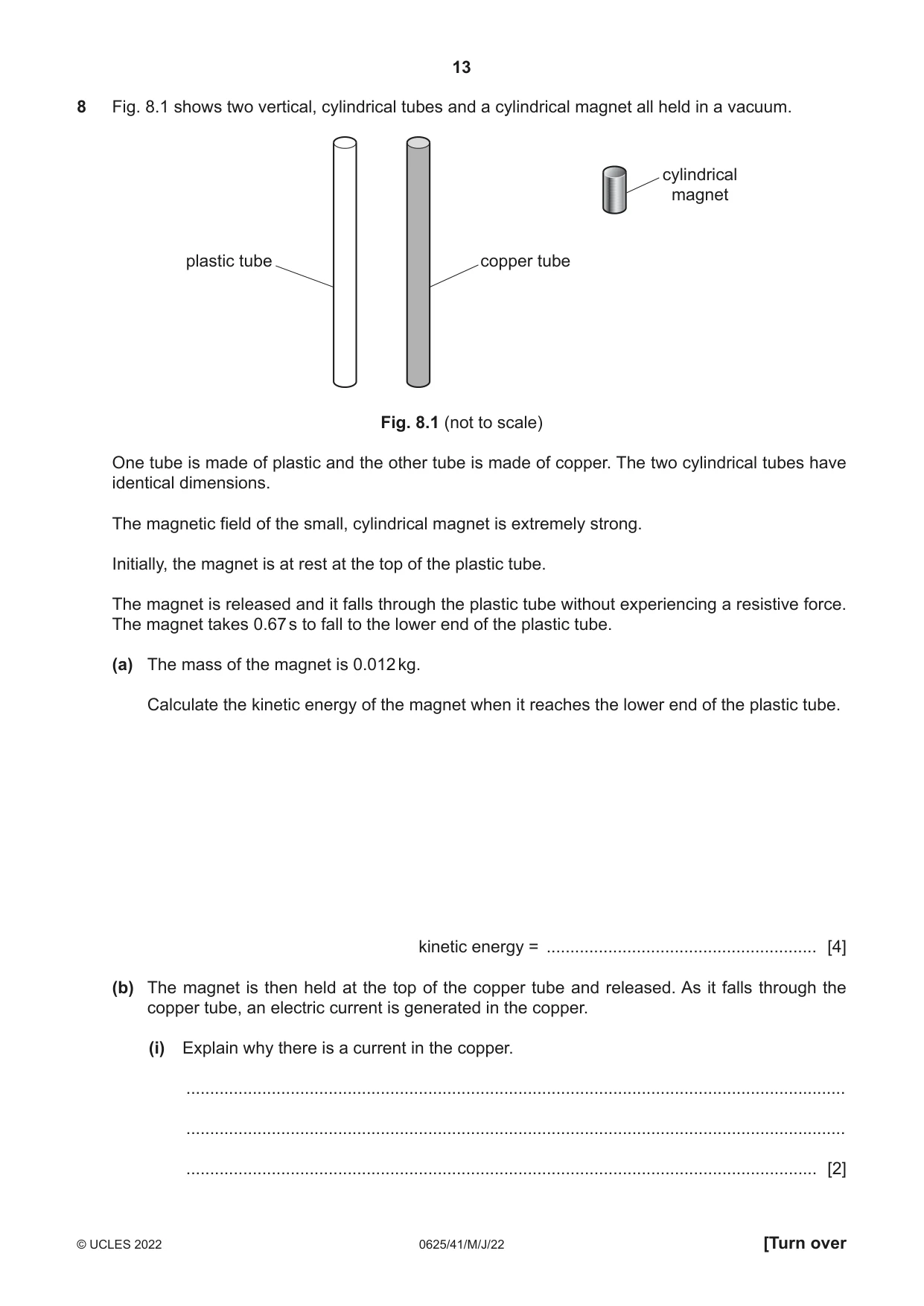
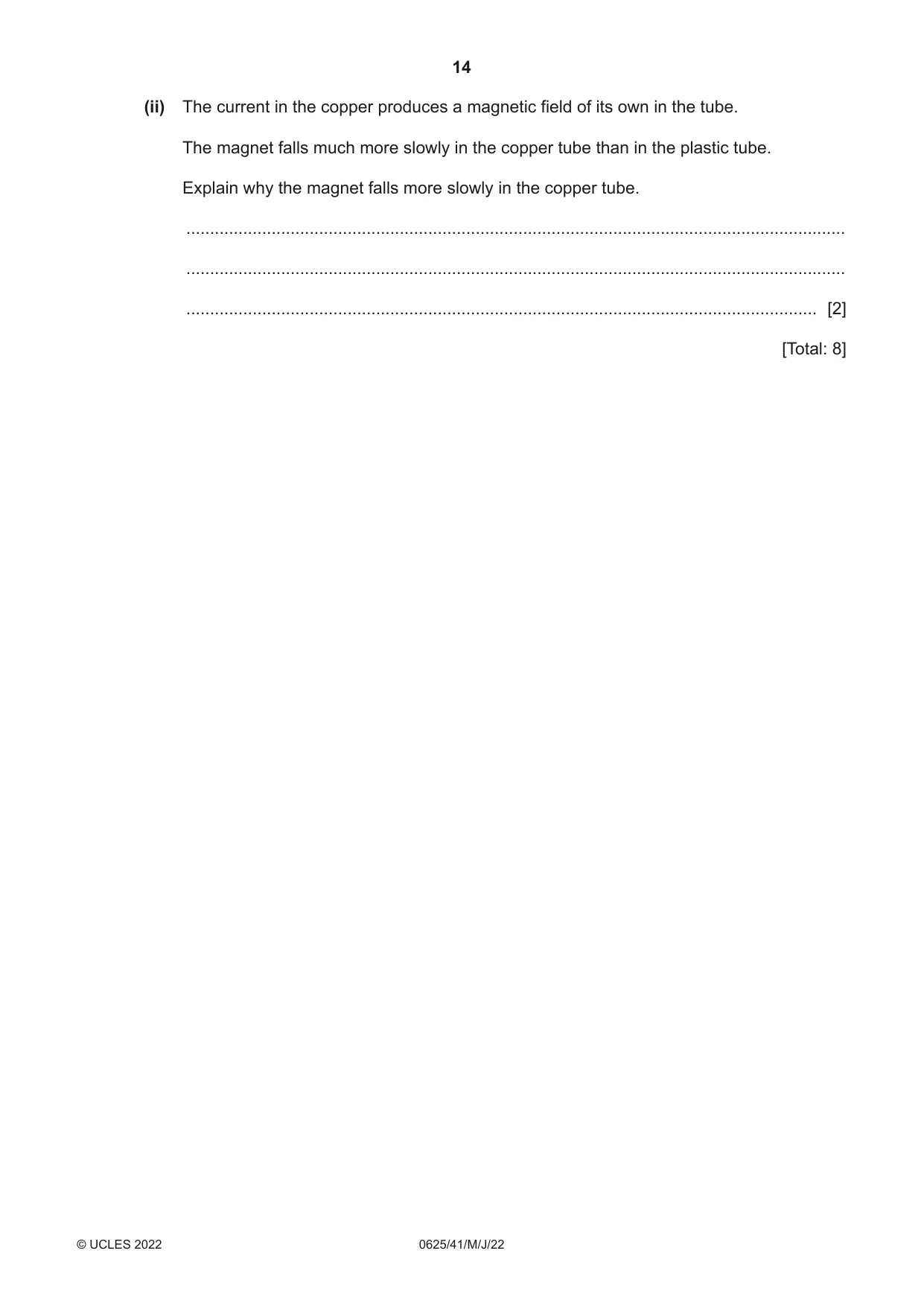
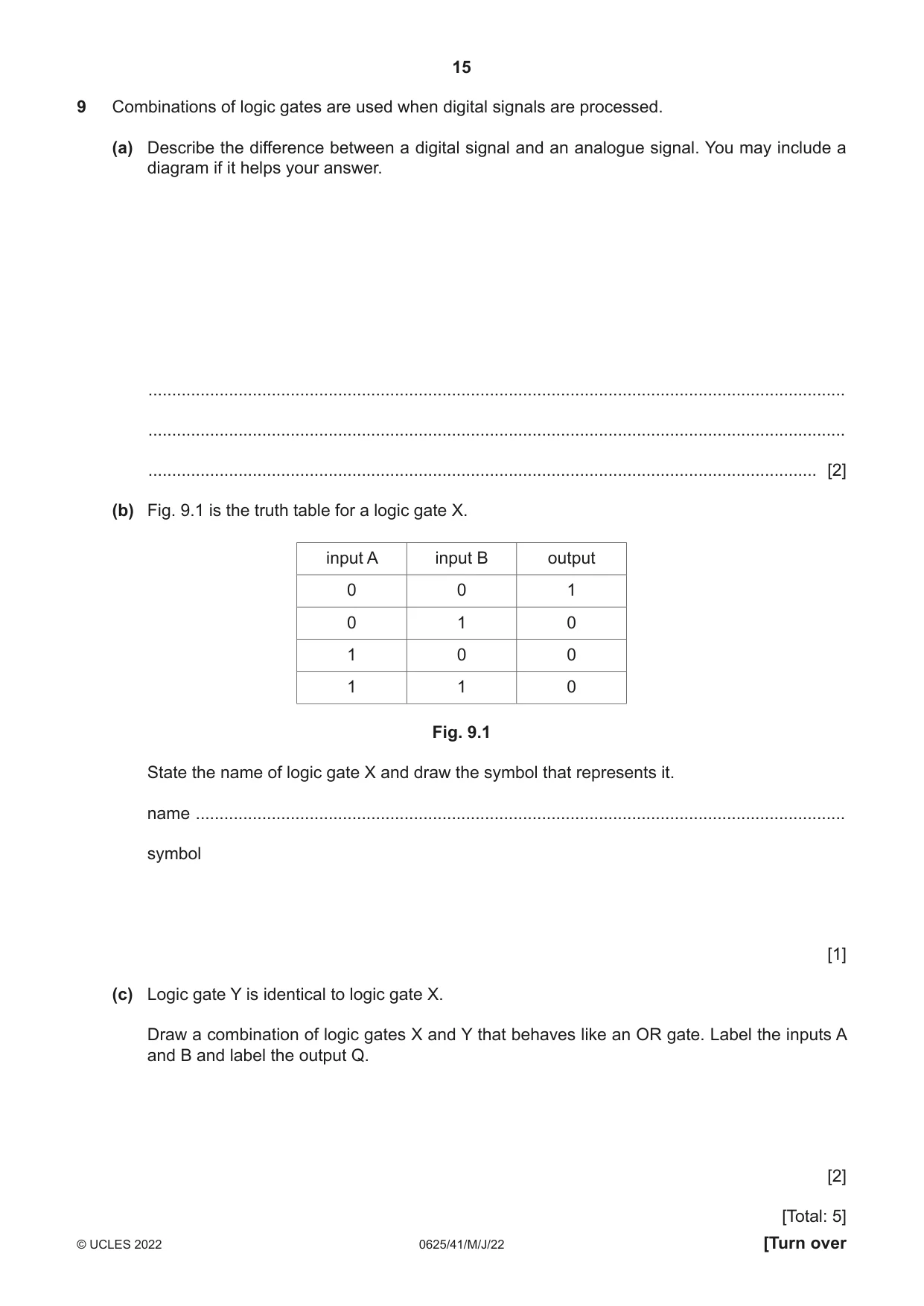
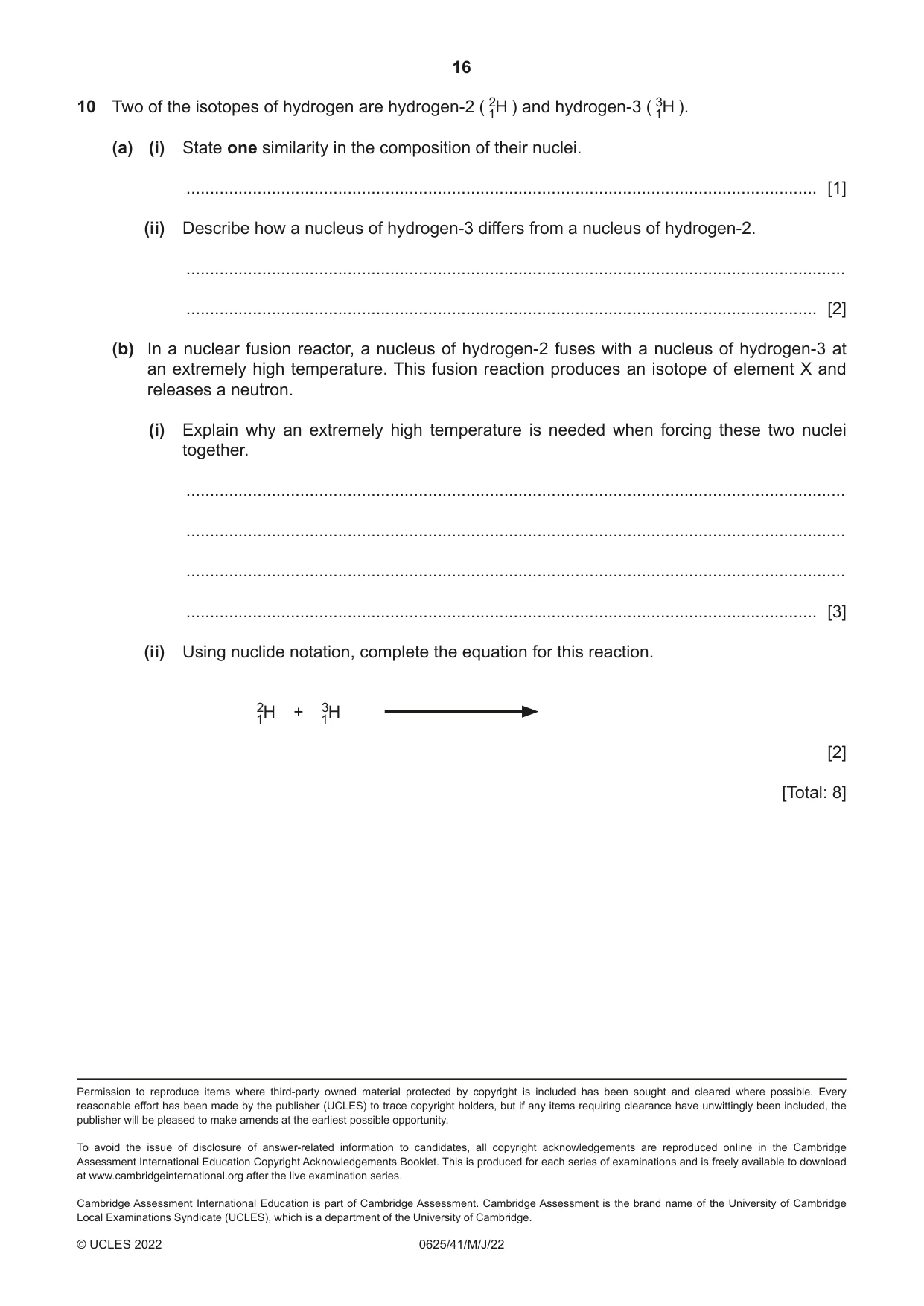
Mark scheme12 pages
Answers below. Sit the paper first if you are practising.
Questions as text
Q1 · A car of mass m is travelling along a straight, horizontal road at a constant speed v
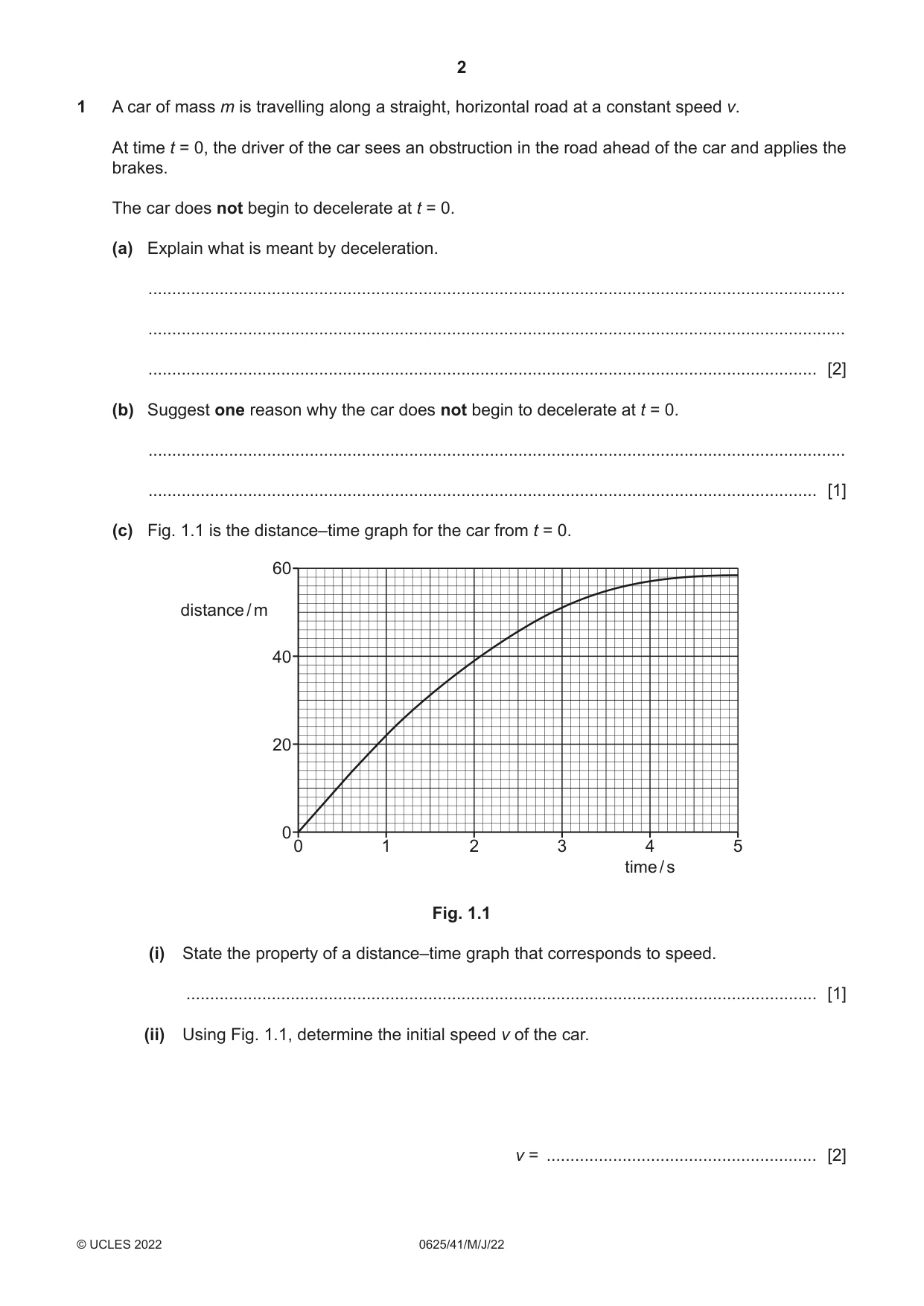
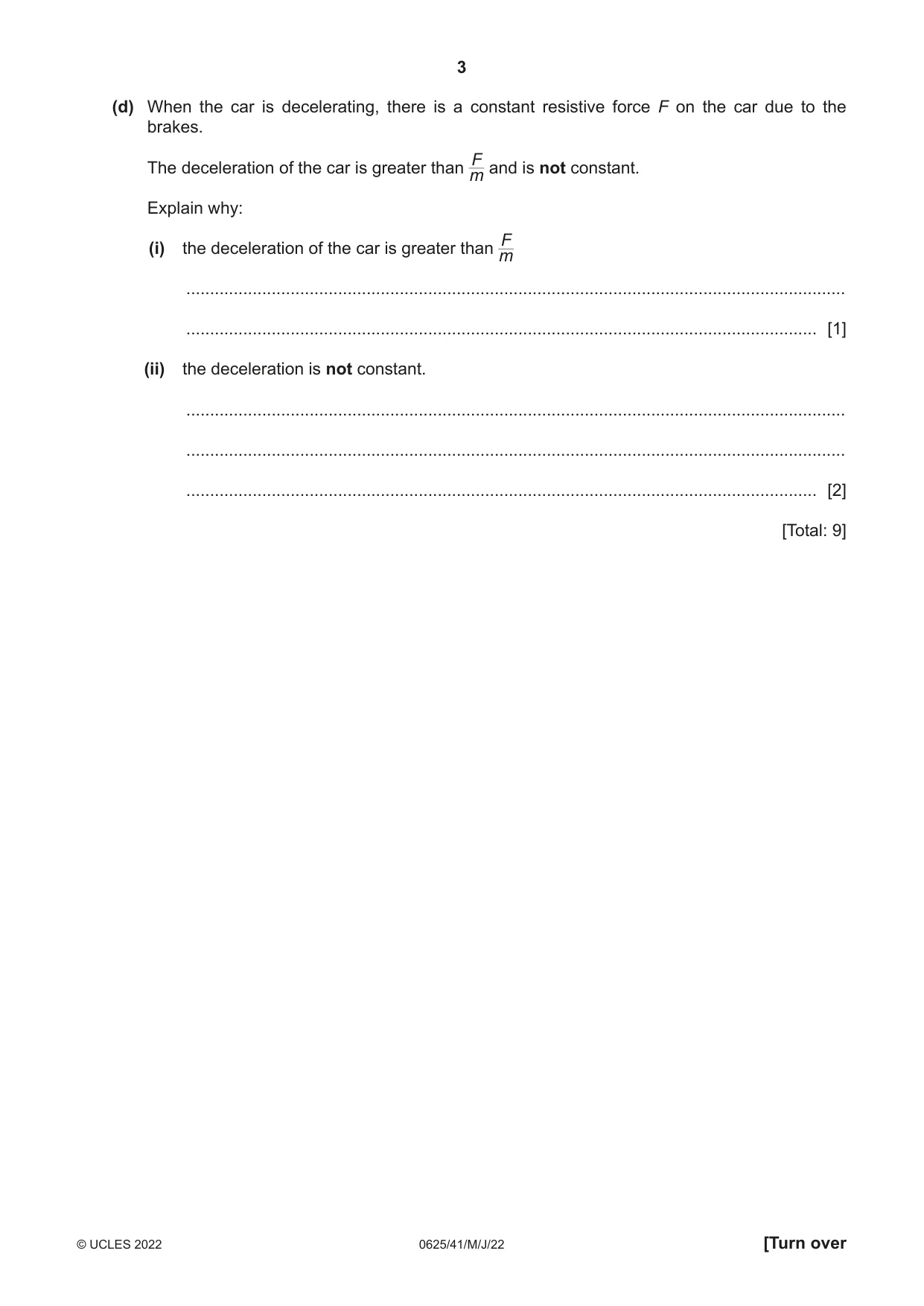
1 A car of mass m is travelling along a straight, horizontal road at a constant speed v. At time t = 0, the driver of the car sees an obstruction in the road ahead of the car and applies the brakes. The car does not begin to decelerate at t = 0. (a) Explain what is meant by deceleration. ................................................................................................................................................... ................................................................................................................................................... ............................................................................................................................................. [2] (b) Suggest one reason why the car does not begin to decelerate at t = 0. ................................................................................................................................................... ............................................................................................................................................. [1] (c) Fig. 1.1 is the distance–time graph for the car from t = 0. 60 distance / m 40 20 0 0 1 2 3 4 5 time / s Fig. 1.1 (i) State the property of a distance–time graph that corresponds to speed. ..................................................................................................................................... [1] (ii) Using Fig. 1.1, determine the initial speed v of the car. v = ......................................................... [2] (d) When the car is decelerating, there is a constant resistive force F on the car due to the brakes. F The deceleration of the car is greater than and is not constant. m Explain why: F (i) the deceleration of the car is greater than m ........................................................................................................................................... ..................................................................................................................................... [1] (ii) the deceleration is not constant. ........................................................................................................................................... ........................................................................................................................................... ..................................................................................................................................... [2] [Total: 9]
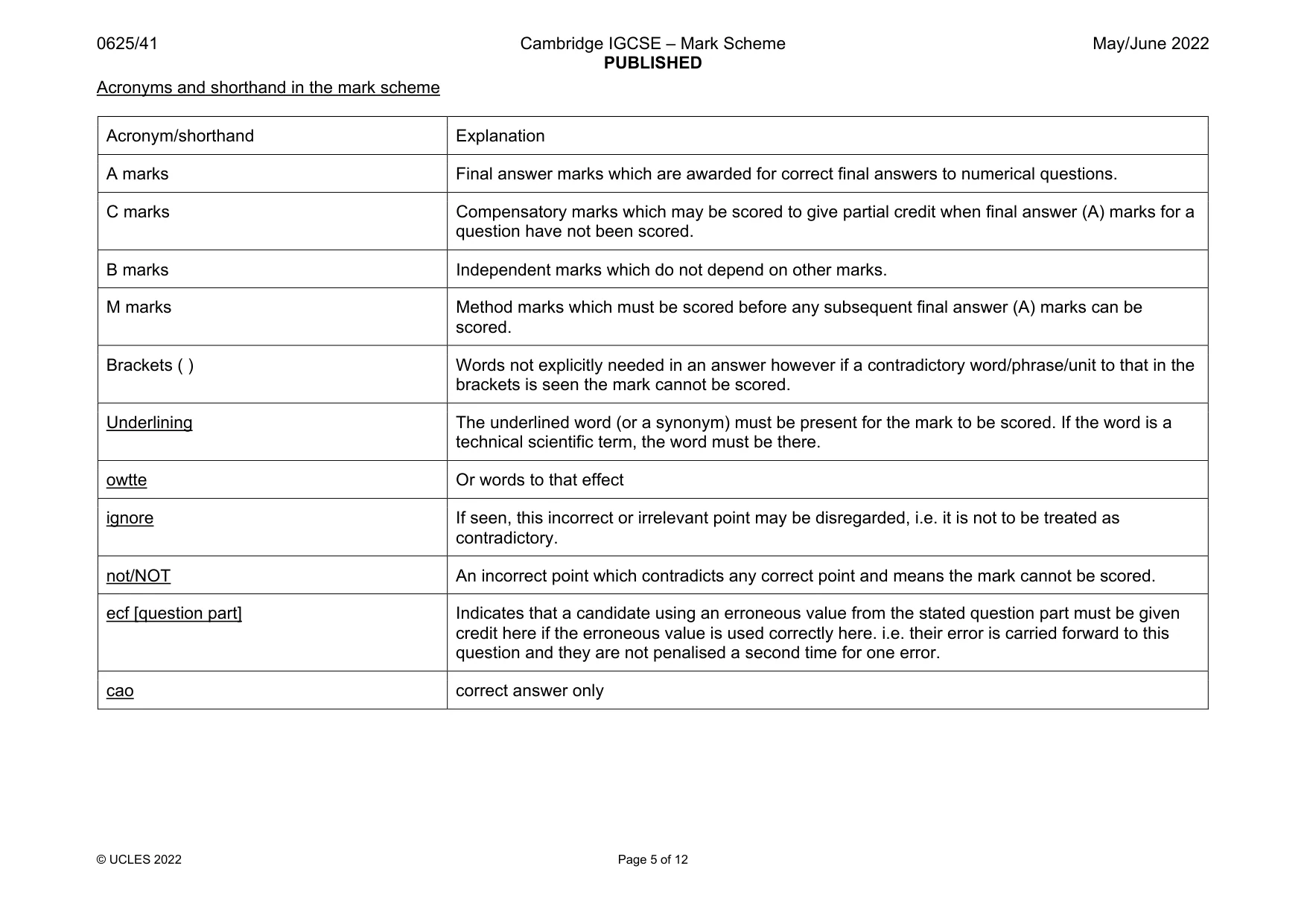
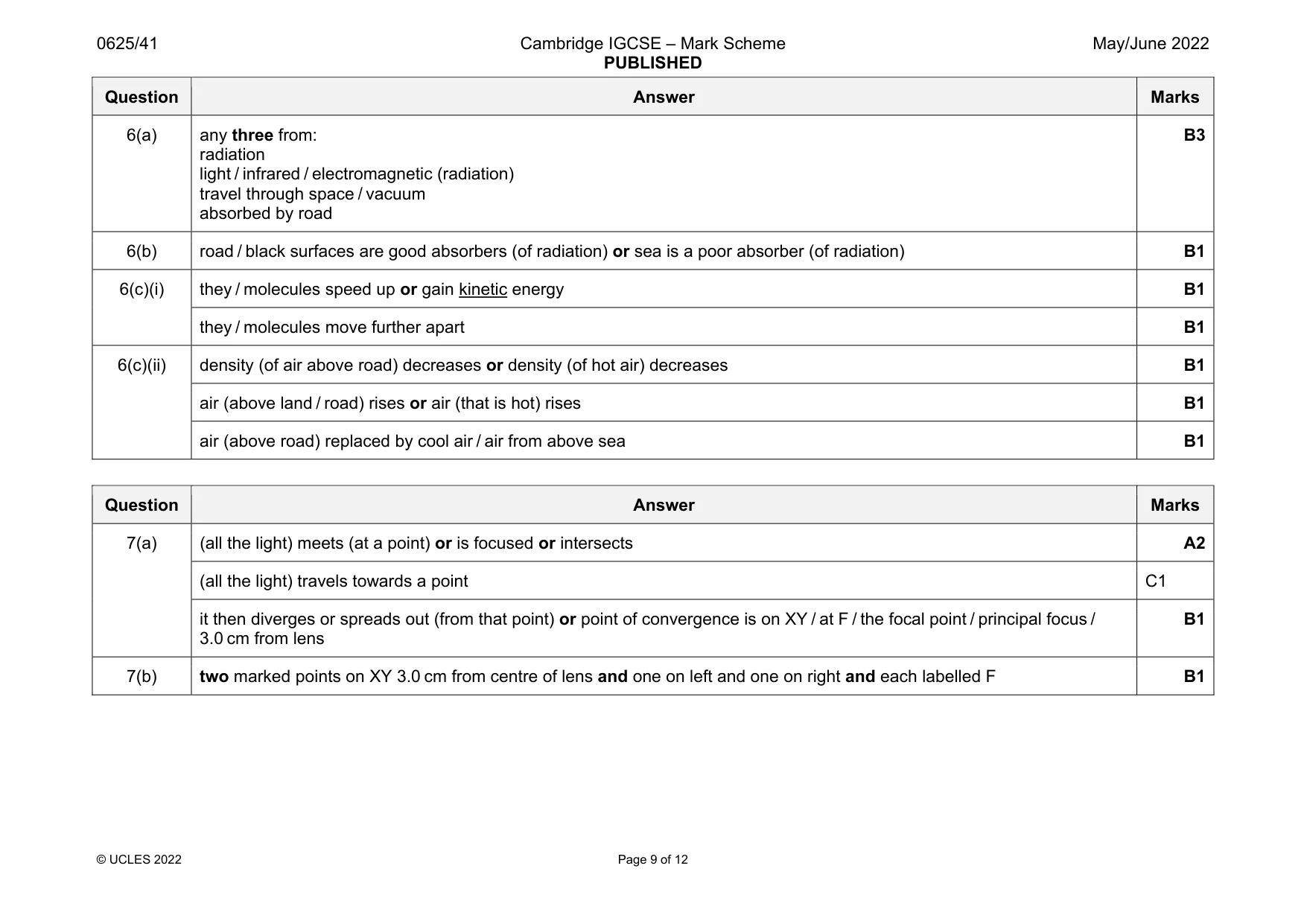
Mark scheme: 1(a) negative acceleration or decrease in velocity B1 change in velocity per unit time or rate of change of velocity B1 1(b) delay in applying brakes or (human) reaction time or foot not removed from accelerator B1 1(c)(i) gradient or slope B1 1(c)(ii) 20.5 m / s ⩽ answer ⩽ 23.5 m / s A2 the coordinates at one point on curve (e.g. (0.50, 11)) and (upper) time coordinate ⩽ 1.0 s C1 1(d)(i) air resistance / air friction acts on the car B1 1(d)(ii) air resistance / resultant / resistive force decreases and as speed decreases / car decelerates A2 air resistance / resultant / resistive force decreases / changes C1
Q2 · Water stored in a reservoir behind a hydroelectric dam
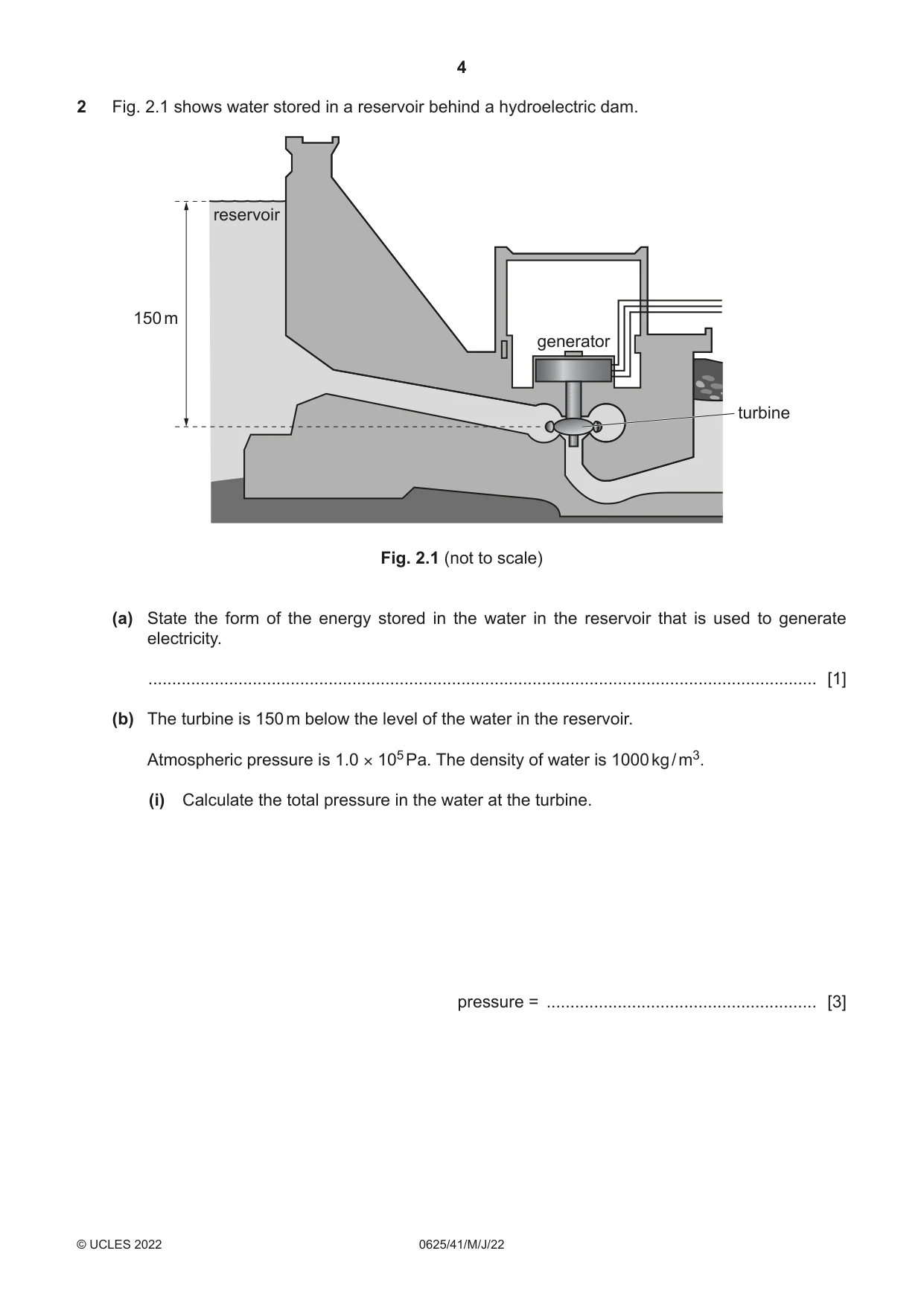
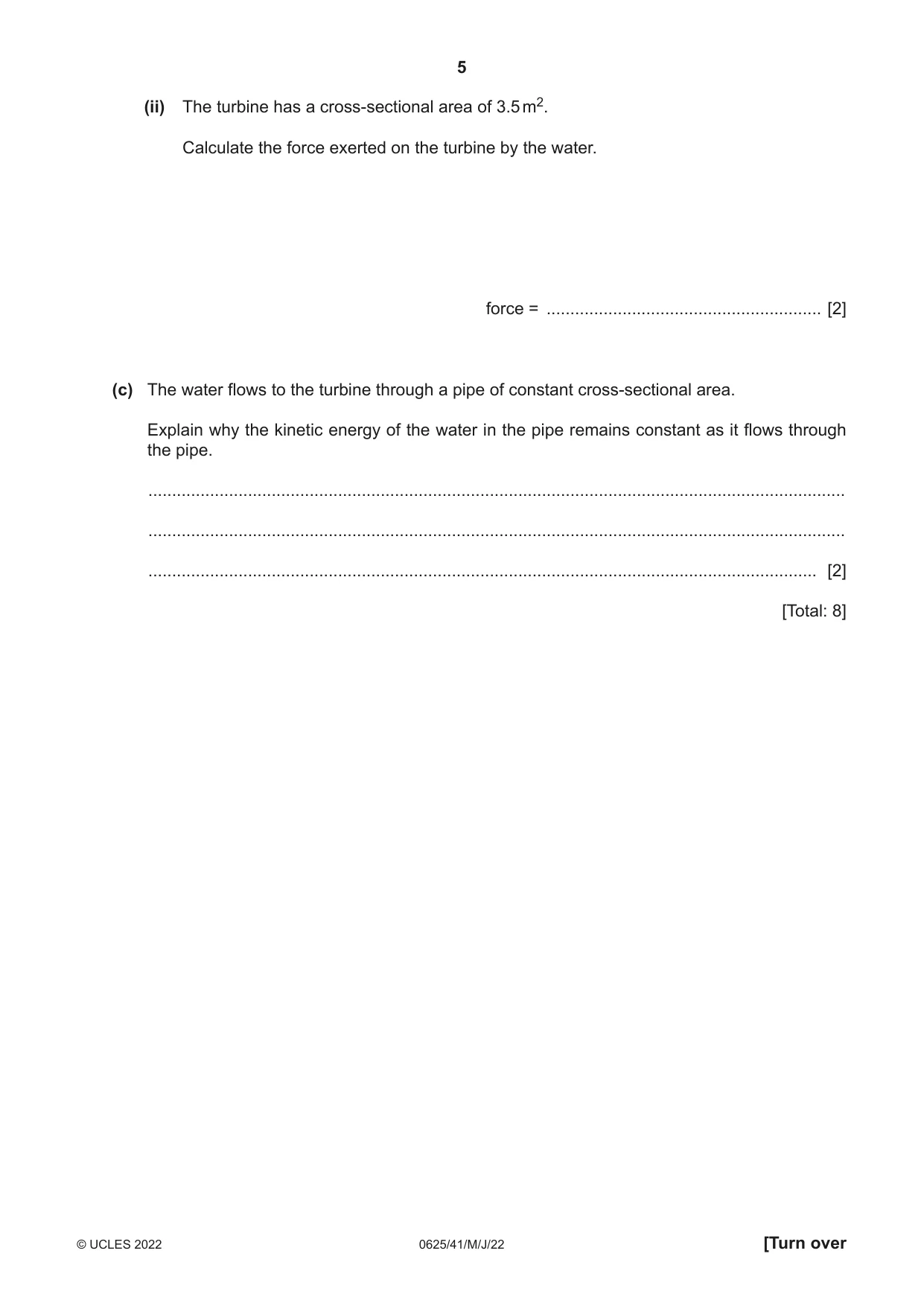
2 Fig. 2.1 shows water stored in a reservoir behind a hydroelectric dam. reservoir 150 m generator turbine Fig. 2.1 (not to scale) (a) State the form of the energy stored in the water in the reservoir that is used to generate electricity. ............................................................................................................................................. [1] (b) The turbine is 150 m below the level of the water in the reservoir. Atmospheric pressure is 1.0 × 10⁵ Pa. The density of water is 1000 kg / m3. (i) Calculate the total pressure in the water at the turbine. pressure = ......................................................... [3] (ii) The turbine has a cross-sectional area of 3.5 m2. Calculate the force exerted on the turbine by the water. force = .......................................................... [2] (c) The water flows to the turbine through a pipe of constant cross-sectional area. Explain why the kinetic energy of the water in the pipe remains constant as it flows through the pipe. ................................................................................................................................................... ................................................................................................................................................... ............................................................................................................................................. [2] [Total: 8]
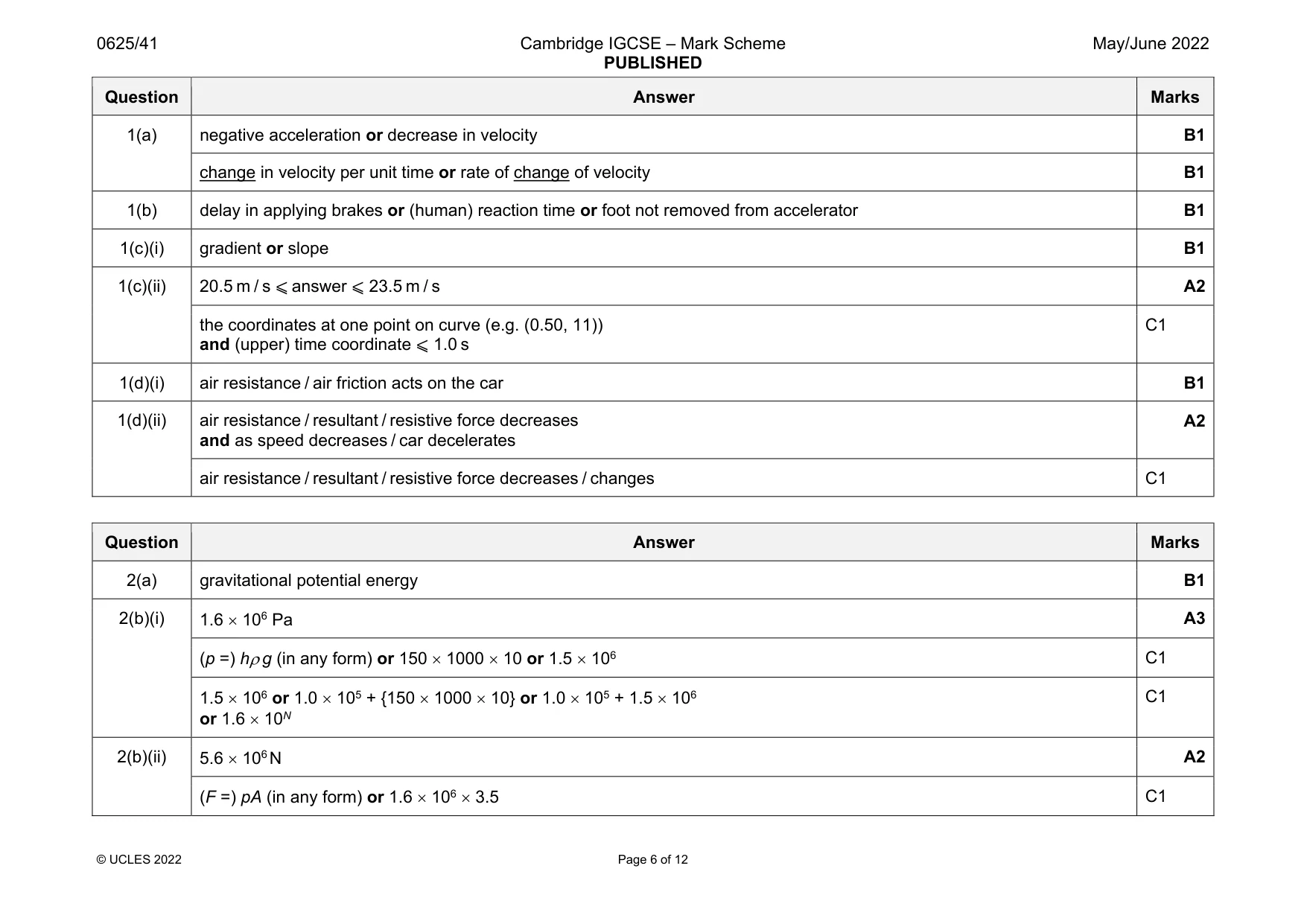
Mark scheme: 2(a) gravitational potential energy B1 2(b)(i) 1.6 106 Pa A3 (p =) h g (in any form) or 150 1000 10 or 1.5 106 C1 1.5 106 or 1.0 105 + {150 1000 10} or 1.0 105 + 1.5 106 or 1.6 10N C1 2(b)(ii) 5.6 106 N A2 (F =) pA (in any form) or 1.6 106 3.5 C1 Question Answer Marks 2(c) speed (of water) remains constant B1 otherwise density would decrease or gaps would appear in the water or volume / density does not change or liquids incompressible or water enters / leaves at constant rate or quantity of water remains constant B1
Q3 · During a picnic on a warm, dry day, a metal can of lemonade is wrapped in a damp cloth
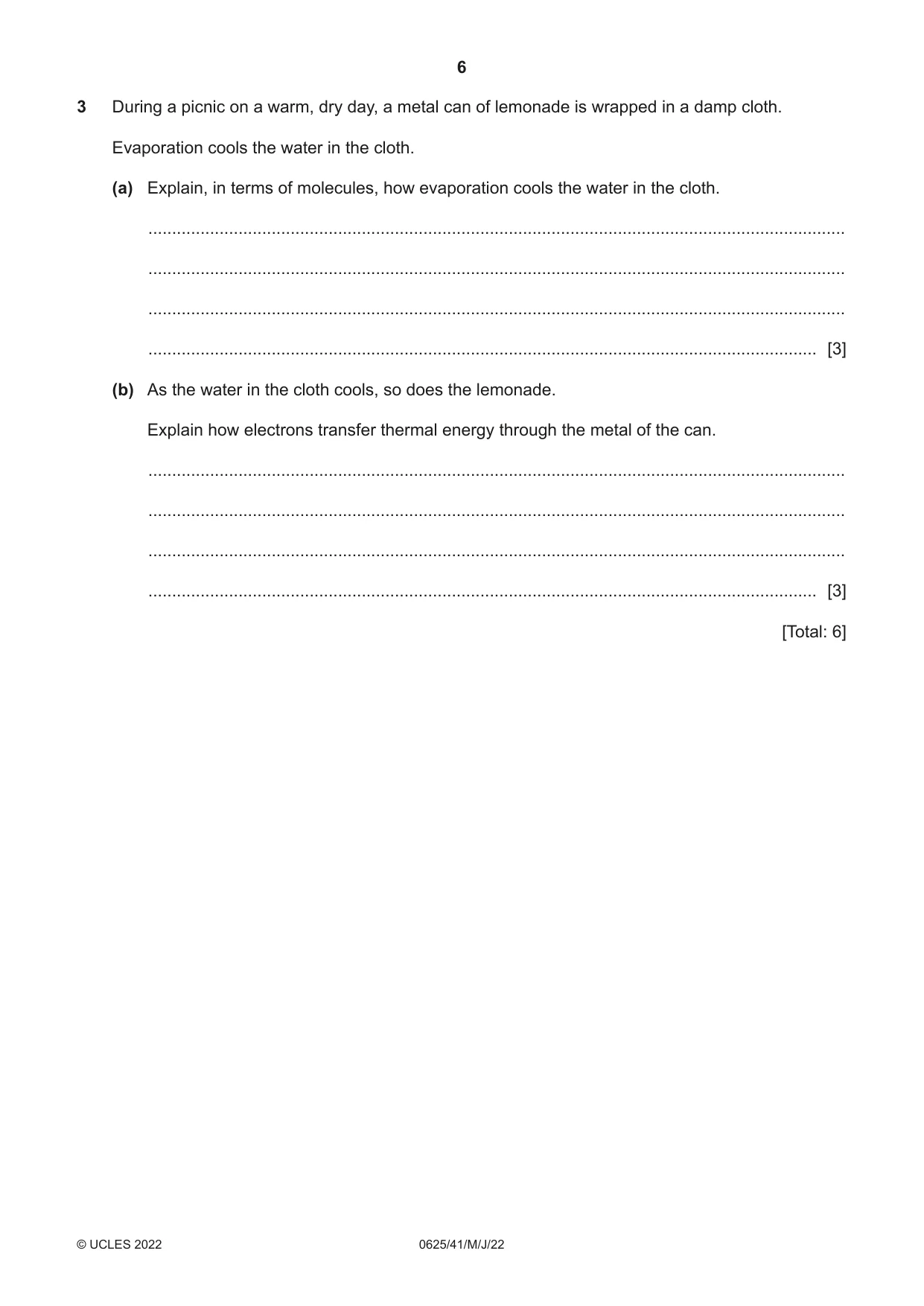
3 During a picnic on a warm, dry day, a metal can of lemonade is wrapped in a damp cloth. Evaporation cools the water in the cloth. (a) Explain, in terms of molecules, how evaporation cools the water in the cloth. ................................................................................................................................................... ................................................................................................................................................... ................................................................................................................................................... ............................................................................................................................................. [3] (b) As the water in the cloth cools, so does the lemonade. Explain how electrons transfer thermal energy through the metal of the can. ................................................................................................................................................... ................................................................................................................................................... ................................................................................................................................................... ............................................................................................................................................. [3] [Total: 6]
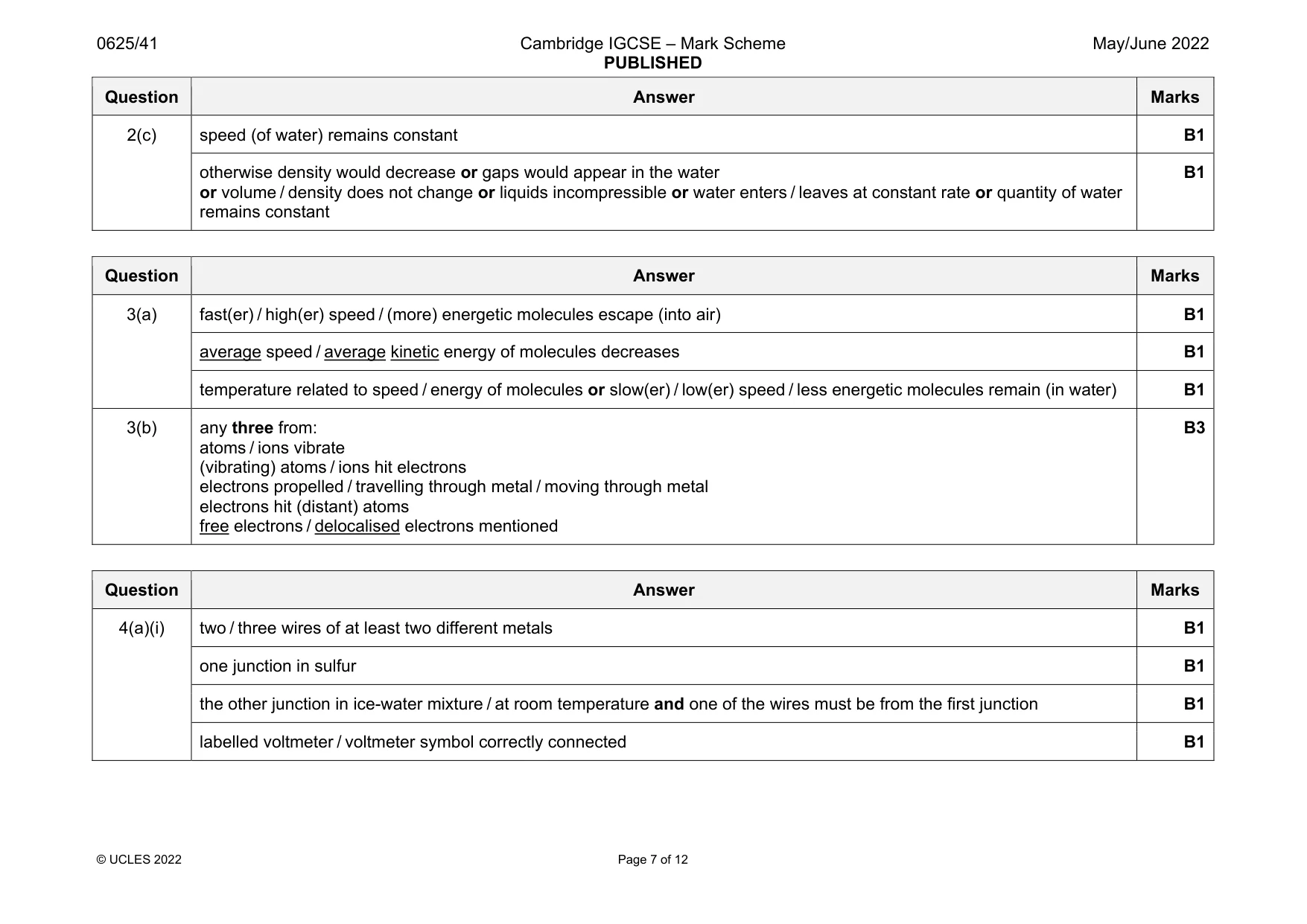
Mark scheme: 3(a) fast(er) / high(er) speed / (more) energetic molecules escape (into air) B1 average speed / average kinetic energy of molecules decreases B1 temperature related to speed / energy of molecules or slow(er) / low(er) speed / less energetic molecules remain (in water) B1 3(b) any three from: atoms / ions vibrate (vibrating) atoms / ions hit electrons electrons propelled / travelling through metal / moving through metal electrons hit (distant) atoms free electrons / delocalised electrons mentioned B3
Q4 · A thermocouple is a device that is used as a thermometer
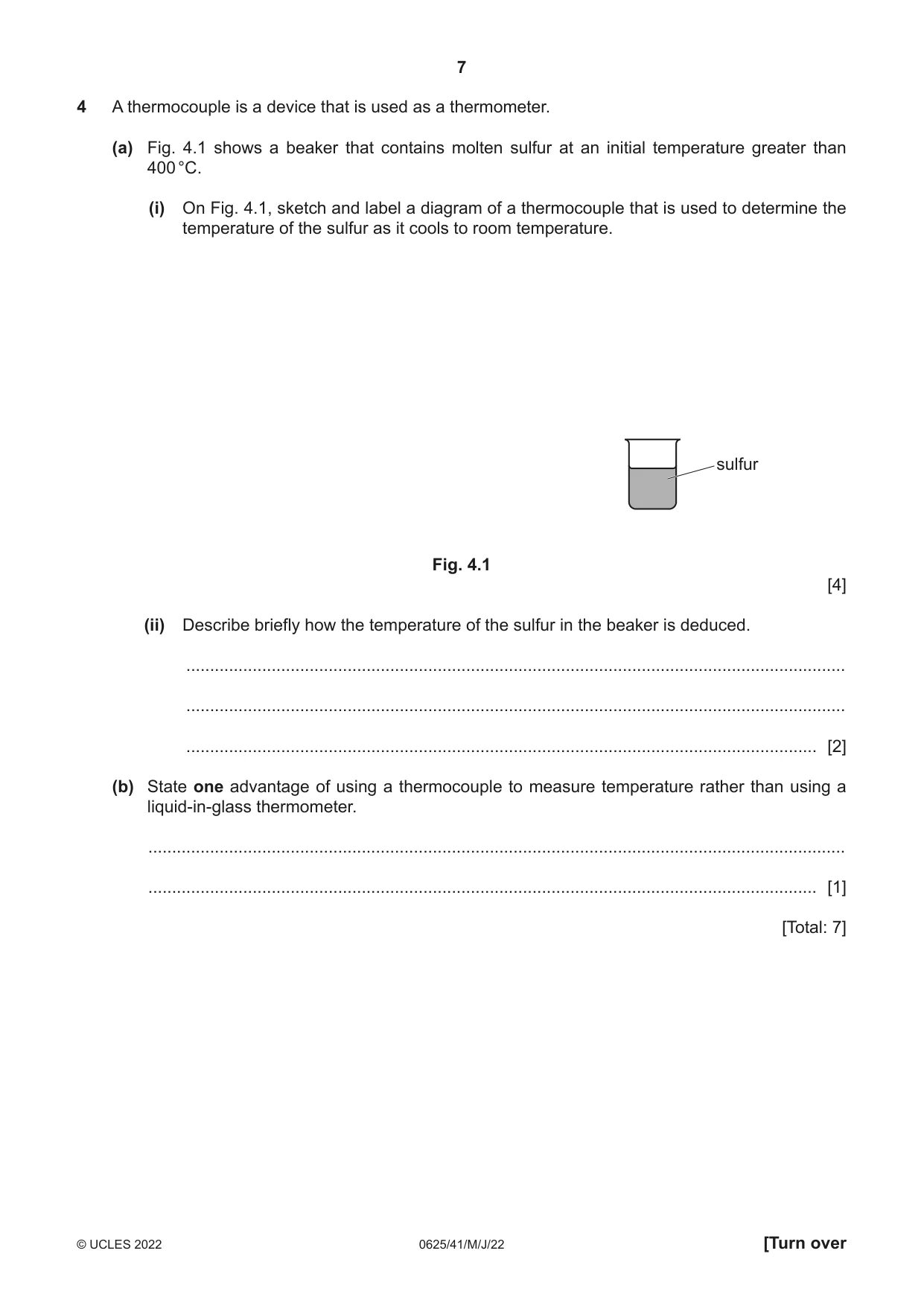
4 A thermocouple is a device that is used as a thermometer. (a) Fig. 4.1 shows a beaker that contains molten sulfur at an initial temperature greater than 400 °C. (i) On Fig. 4.1, sketch and label a diagram of a thermocouple that is used to determine the temperature of the sulfur as it cools to room temperature. sulfur Fig. 4.1 [4] (ii) Describe briefly how the temperature of the sulfur in the beaker is deduced. ........................................................................................................................................... ........................................................................................................................................... ..................................................................................................................................... [2] (b) State one advantage of using a thermocouple to measure temperature rather than using a liquid-in-glass thermometer. ................................................................................................................................................... ............................................................................................................................................. [1] [Total: 7]
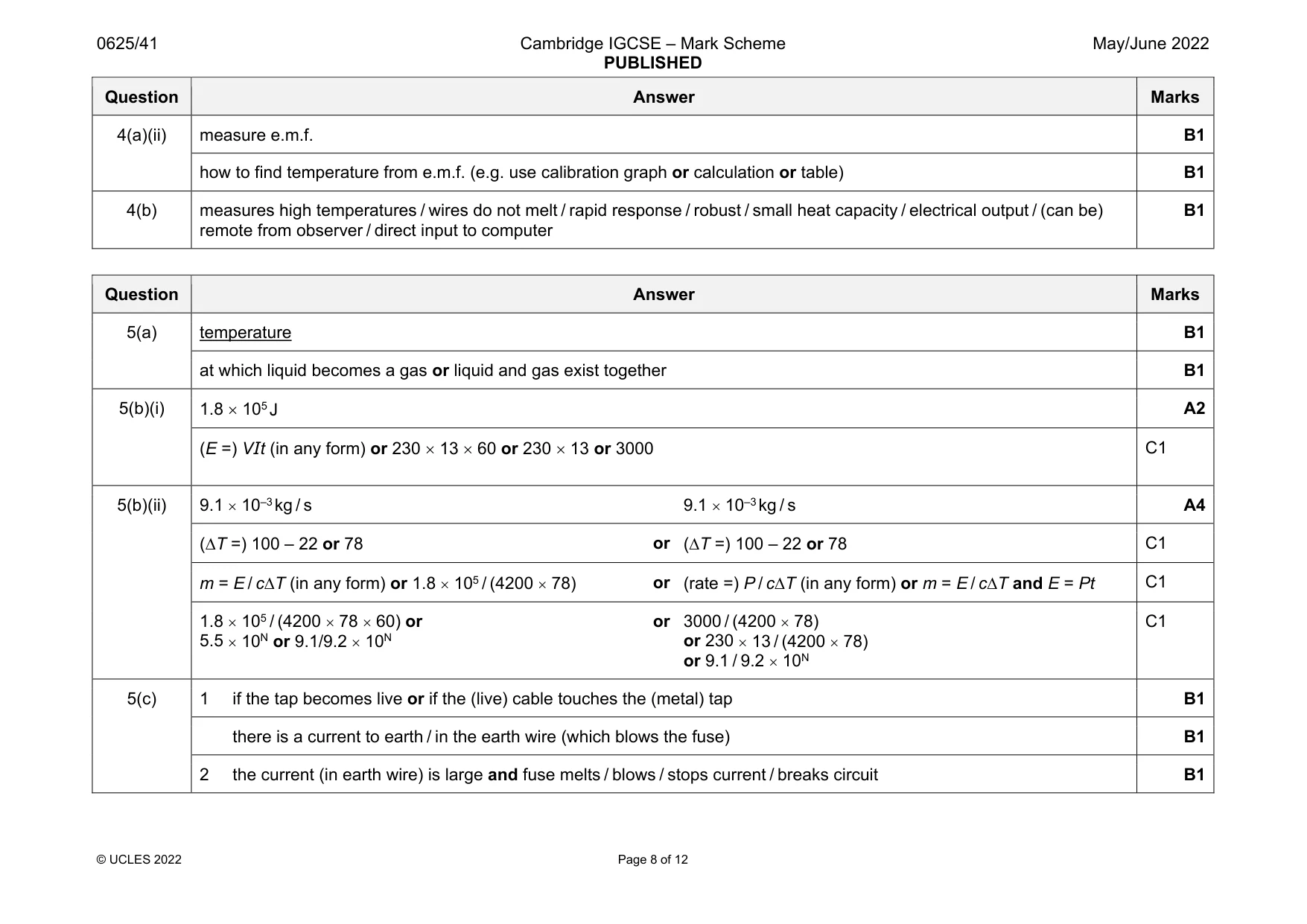
Mark scheme: 4(a)(i) two / three wires of at least two different metals B1 one junction in sulfur B1 the other junction in ice-water mixture / at room temperature and one of the wires must be from the first junction B1 labelled voltmeter / voltmeter symbol correctly connected B1 Question Answer Marks 4(a)(ii) measure e.m.f. B1 how to find temperature from e.m.f. (e.g. use calibration graph or calculation or table) B1 4(b) measures high temperatures / wires do not melt / rapid response / robust / small heat capacity / electrical output / (can be) remote from observer / direct input to computer B1
Q5 · A kitchen tap that supplies instant boiling water
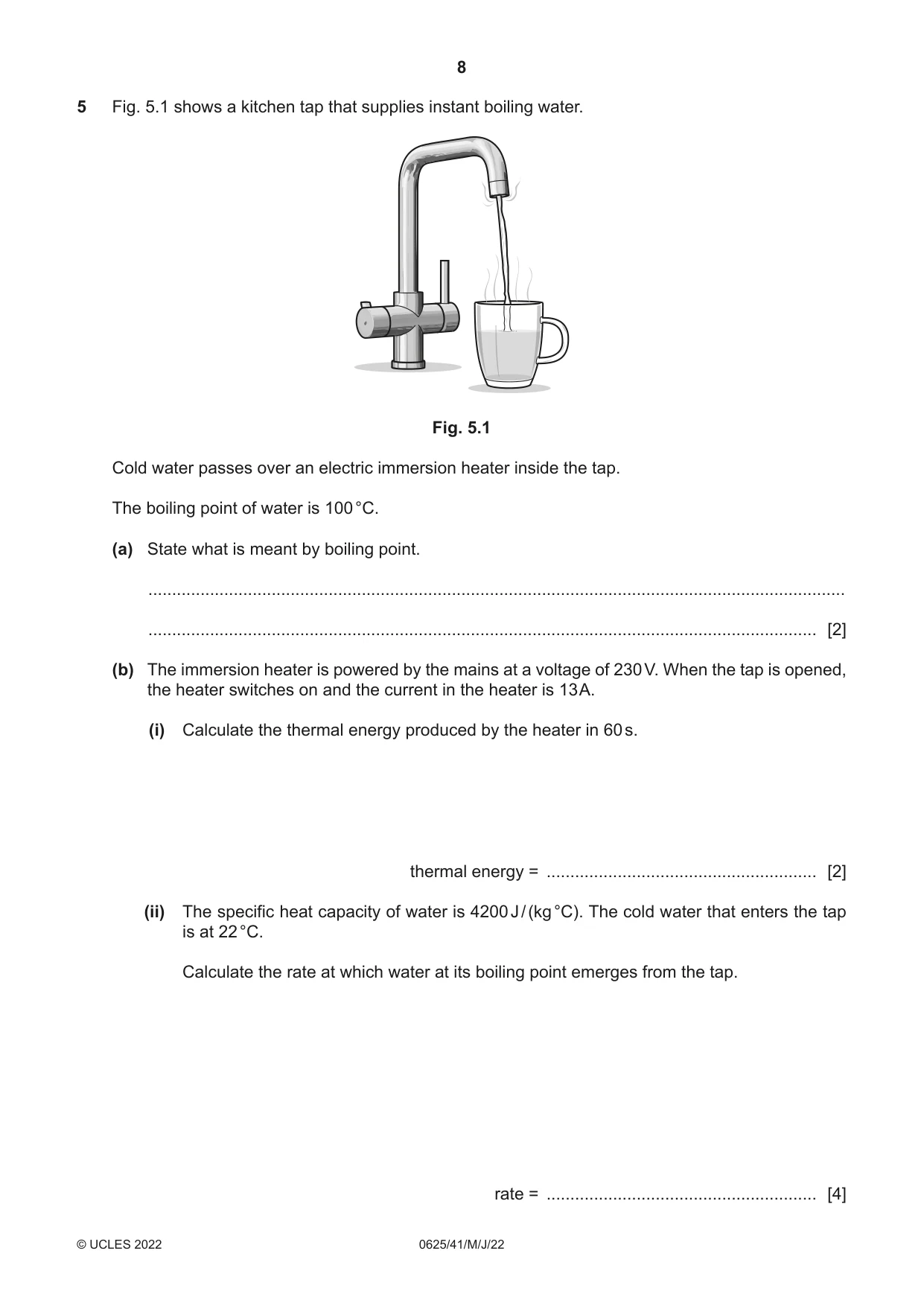
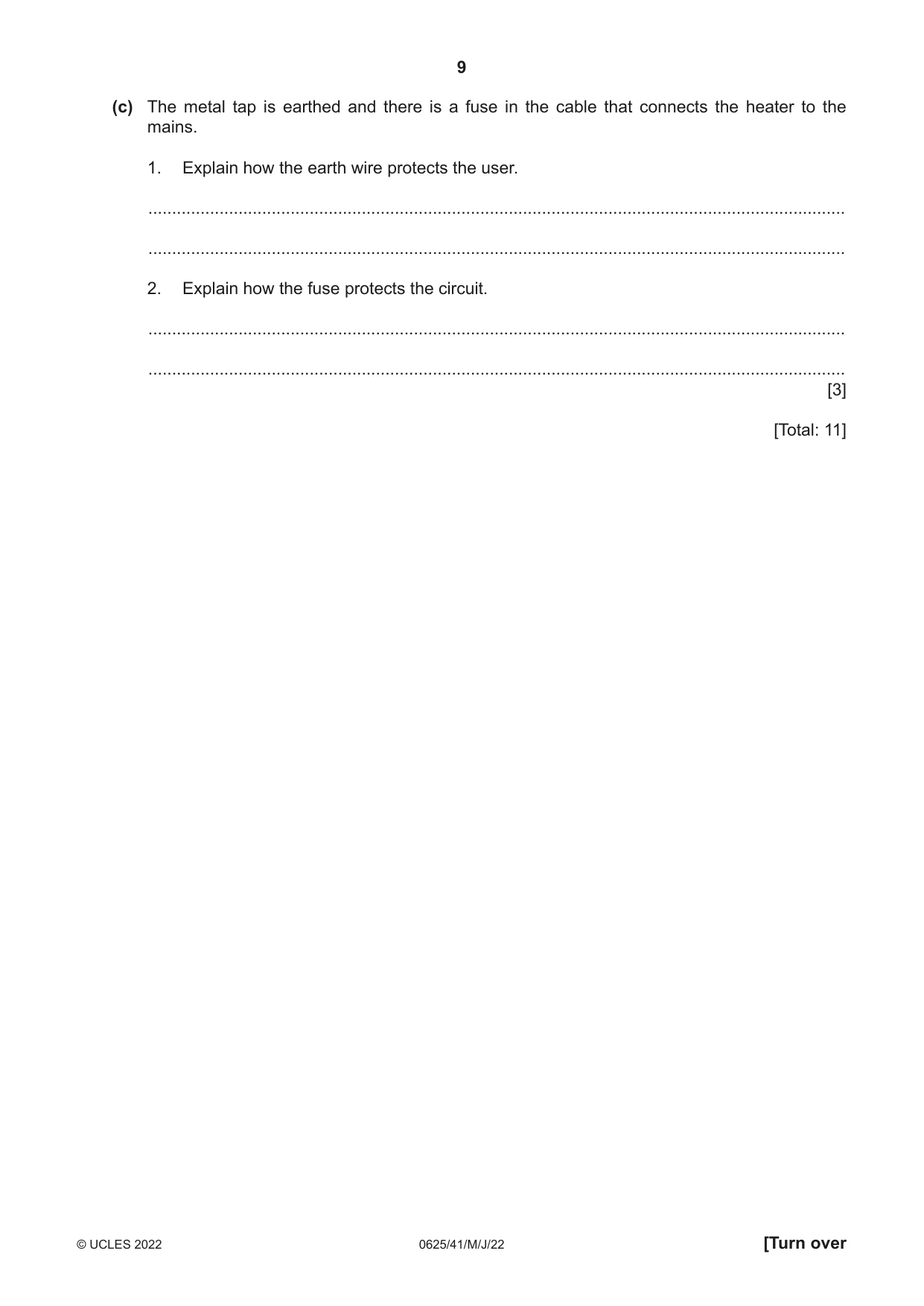
5 Fig. 5.1 shows a kitchen tap that supplies instant boiling water. Fig. 5.1 Cold water passes over an electric immersion heater inside the tap. The boiling point of water is 100 °C. (a) State what is meant by boiling point. ................................................................................................................................................... ............................................................................................................................................. [2] (b) The immersion heater is powered by the mains at a voltage of 230 V. When the tap is opened, the heater switches on and the current in the heater is 13 A. (i) Calculate the thermal energy produced by the heater in 60 s. thermal energy = ......................................................... [2] (ii) The specific heat capacity of water is 4200 J / (kg °C). The cold water that enters the tap is at 22 °C. Calculate the rate at which water at its boiling point emerges from the tap. rate = ......................................................... [4] (c) The metal tap is earthed and there is a fuse in the cable that connects the heater to the mains. 1. Explain how the earth wire protects the user. ................................................................................................................................................... ................................................................................................................................................... 2. Explain how the fuse protects the circuit. ................................................................................................................................................... ................................................................................................................................................... [3] [Total: 11]
Mark scheme: 5(a) temperature B1 at which liquid becomes a gas or liquid and gas exist together B1 5(b)(i) 1.8 105 J A2 (E =) VIt (in any form) or 230 13 60 or 230 13 or 3000 C1 5(b)(ii) 9.1 10–3 kg / s 9.1 10–3 kg / s A4 (T =) 100 – 22 or 78 or (T =) 100 – 22 or 78 C1 m = E / cT (in any form) or 1.8 105 / (4200 78) or (rate =) P / cT (in any form) or m = E / cT and E = Pt C1 1.8 105 / (4200 78 60) or 5.5 10N or 9.1/9.2 10N or 3000 / (4200 78) or 230 13 / (4200 78) or 9.1 / 9.2 10N C1 5(c) 1 if the tap becomes live or if the (live) cable touches the (metal) tap B1 there is a current to earth / in the earth wire (which blows the fuse) B1 2 the current (in earth wire) is large and fuse melts / blows / stops current / breaks circuit B1
Q6 · A road next to the sea
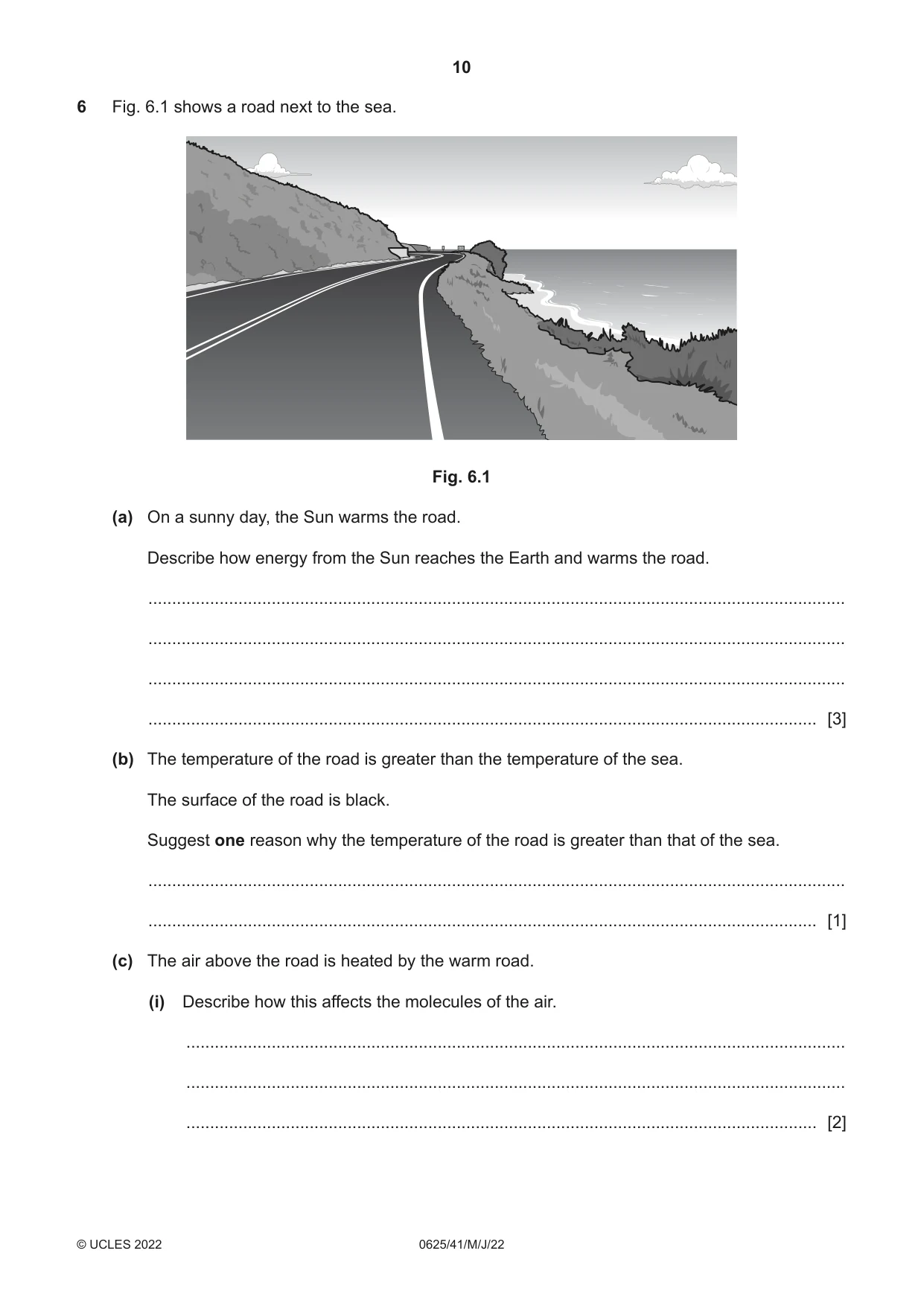
6 Fig. 6.1 shows a road next to the sea. Fig. 6.1 (a) On a sunny day, the Sun warms the road. Describe how energy from the Sun reaches the Earth and warms the road. ................................................................................................................................................... ................................................................................................................................................... ................................................................................................................................................... ............................................................................................................................................. [3] (b) The temperature of the road is greater than the temperature of the sea. The surface of the road is black. Suggest one reason why the temperature of the road is greater than that of the sea. ................................................................................................................................................... ............................................................................................................................................. [1] (c) The air above the road is heated by the warm road. (i) Describe how this affects the molecules of the air. ........................................................................................................................................... ........................................................................................................................................... ..................................................................................................................................... [2] (ii) A cyclist travelling along the road notices that a cool breeze is blowing from the sea to the land. Explain how convection produces this breeze. You may include a diagram if it helps your answer. ........................................................................................................................................... ........................................................................................................................................... ........................................................................................................................................... ..................................................................................................................................... [3] [Total: 9]
Mark scheme: 6(a) any three from: radiation light / infrared / electromagnetic (radiation) travel through space / vacuum absorbed by road B3 6(b) road / black surfaces are good absorbers (of radiation) or sea is a poor absorber (of radiation) B1 6(c)(i) they / molecules speed up or gain kinetic energy B1 they / molecules move further apart B1 6(c)(ii) density (of air above road) decreases or density (of hot air) decreases B1 air (above land / road) rises or air (that is hot) rises B1 air (above road) replaced by cool air / air from above sea B1
Q7 · A full-scale diagram of a small nail N in front of a thin converging lens
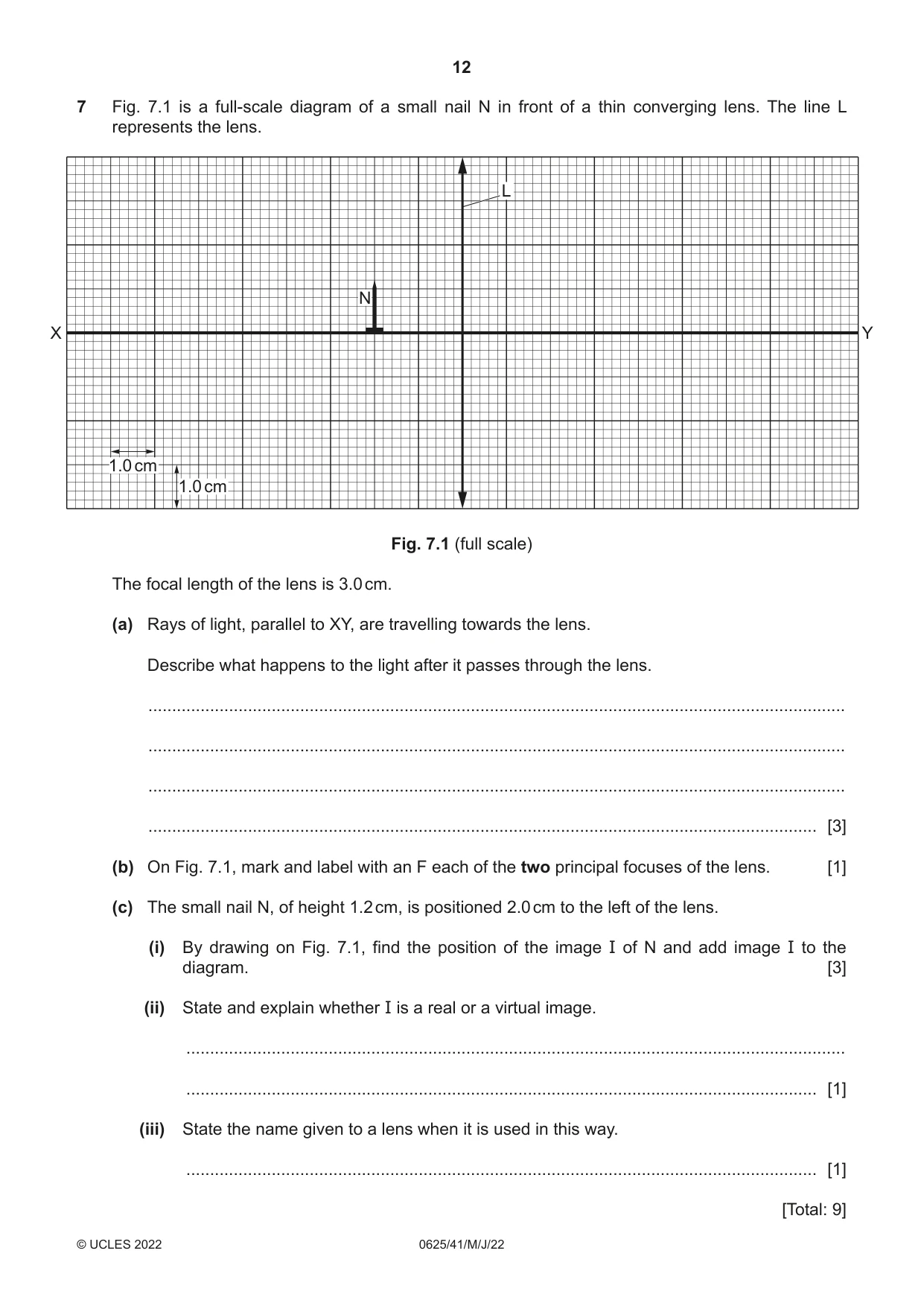
7 Fig. 7.1 is a full-scale diagram of a small nail N in front of a thin converging lens. The line L represents the lens. L N X Y 1.0 cm 1.0 cm Fig. 7.1 (full scale) The focal length of the lens is 3.0 cm. (a) Rays of light, parallel to XY, are travelling towards the lens. Describe what happens to the light after it passes through the lens. ................................................................................................................................................... ................................................................................................................................................... ................................................................................................................................................... ............................................................................................................................................. [3] (b) On Fig. 7.1, mark and label with an F each of the two principal focuses of the lens. [1] (c) The small nail N, of height 1.2 cm, is positioned 2.0 cm to the left of the lens. (i) By drawing on Fig. 7.1, find the position of the image I of N and add image I to the diagram. [3] (ii) State and explain whether I is a real or a virtual image. ........................................................................................................................................... ..................................................................................................................................... [1] (iii) State the name given to a lens when it is used in this way. ..................................................................................................................................... [1] [Total: 9]
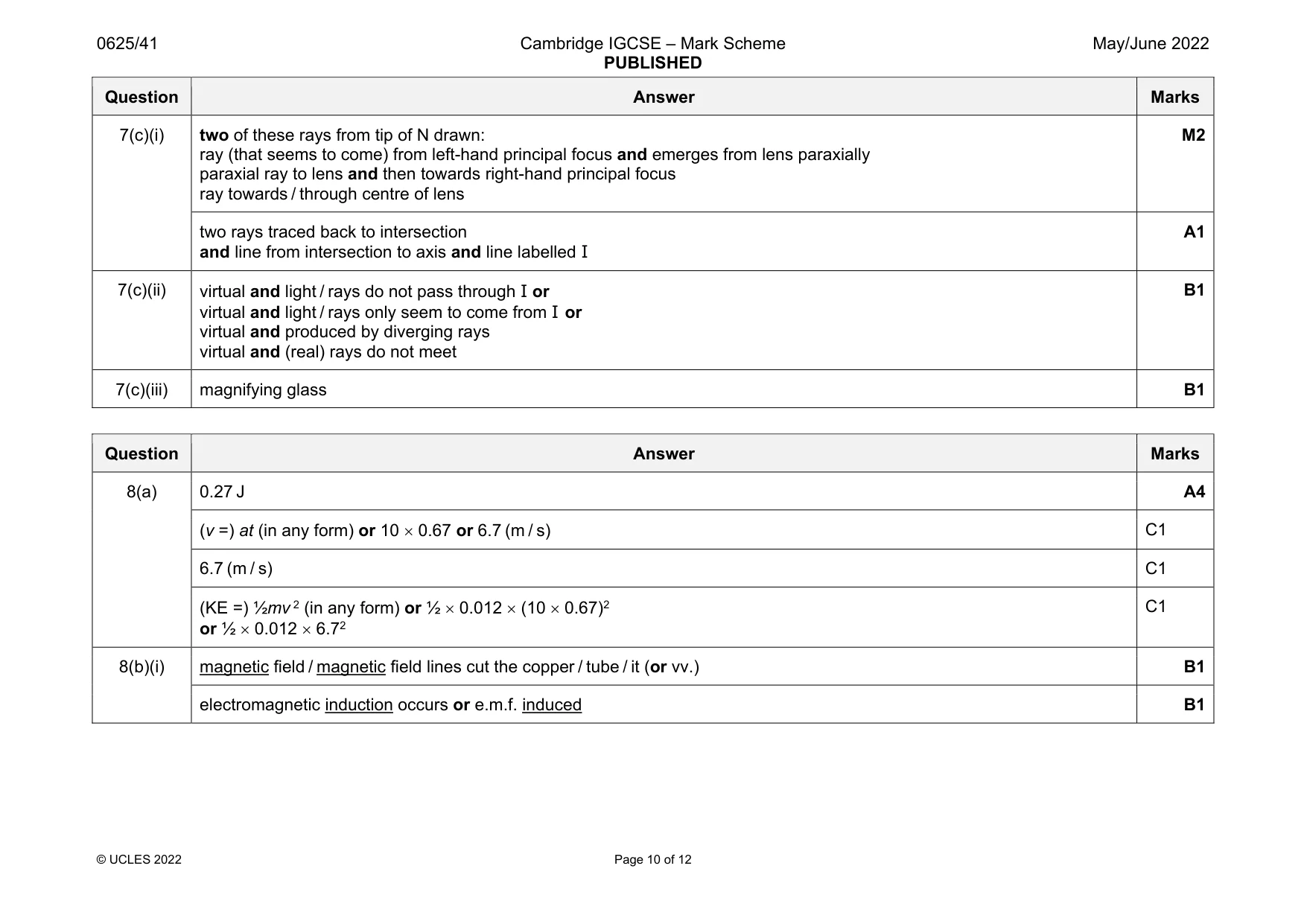
Mark scheme: 7(a) (all the light) meets (at a point) or is focused or intersects A2 (all the light) travels towards a point C1 it then diverges or spreads out (from that point) or point of convergence is on XY / at F / the focal point / principal focus / 3.0 cm from lens B1 7(b) two marked points on XY 3.0 cm from centre of lens and one on left and one on right and each labelled F B1 Question Answer Marks 7(c)(i) two of these rays from tip of N drawn: ray (that seems to come) from left-hand principal focus and emerges from lens paraxially paraxial ray to lens and then towards right-hand principal focus ray towards / through centre of lens M2 two rays traced back to intersection and line from intersection to axis and line labelled I A1 7(c)(ii) virtual and light / rays do not pass through I or virtual and light / rays only seem to come from I or virtual and produced by diverging rays virtual and (real) rays do not meet B1 7(c)(iii) magnifying glass B1
Q8 · Two vertical, cylindrical tubes and a cylindrical magnet all held in a vacuum
8 Fig. 8.1 shows two vertical, cylindrical tubes and a cylindrical magnet all held in a vacuum. cylindrical magnet plastic tube copper tube Fig. 8.1 (not to scale) One tube is made of plastic and the other tube is made of copper. The two cylindrical tubes have identical dimensions. The magnetic field of the small, cylindrical magnet is extremely strong. Initially, the magnet is at rest at the top of the plastic tube. The magnet is released and it falls through the plastic tube without experiencing a resistive force. The magnet takes 0.67 s to fall to the lower end of the plastic tube. (a) The mass of the magnet is 0.012 kg. Calculate the kinetic energy of the magnet when it reaches the lower end of the plastic tube. kinetic energy = ......................................................... [4] (b) The magnet is then held at the top of the copper tube and released. As it falls through the copper tube, an electric current is generated in the copper. (i) Explain why there is a current in the copper. ........................................................................................................................................... ........................................................................................................................................... ..................................................................................................................................... [2] (ii) The current in the copper produces a magnetic field of its own in the tube. The magnet falls much more slowly in the copper tube than in the plastic tube. Explain why the magnet falls more slowly in the copper tube. ........................................................................................................................................... ........................................................................................................................................... ..................................................................................................................................... [2] [Total: 8]
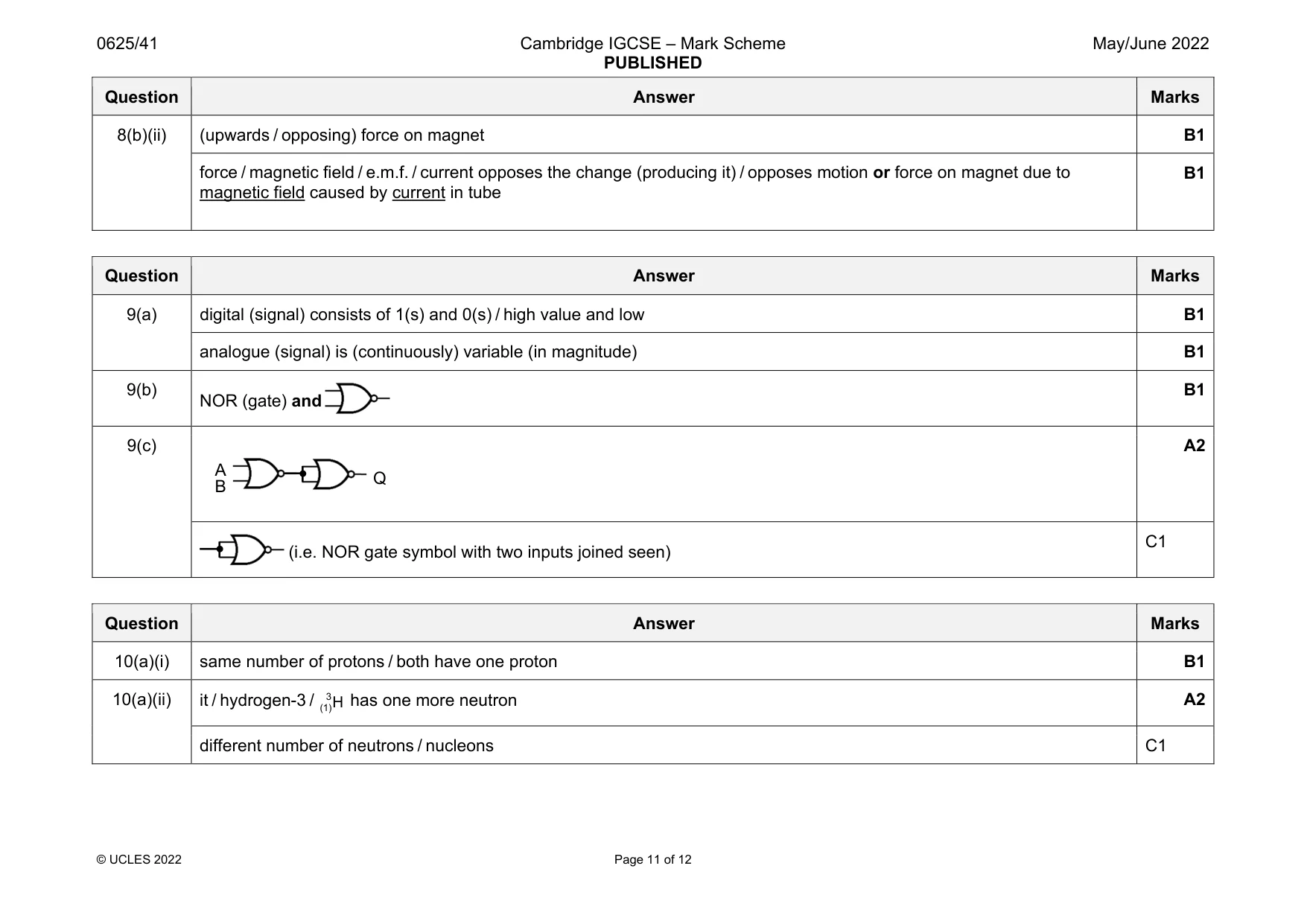
Mark scheme: 8(a) 0.27 J A4 (v =) at (in any form) or 10 0.67 or 6.7 (m / s) C1 6.7 (m / s) C1 (KE =) ½mv 2 (in any form) or ½ 0.012 (10 0.67)2 or ½ 0.012 6.72 C1 8(b)(i) magnetic field / magnetic field lines cut the copper / tube / it (or vv.) B1 electromagnetic induction occurs or e.m.f. induced B1 Question Answer Marks 8(b)(ii) (upwards / opposing) force on magnet B1 force / magnetic field / e.m.f. / current opposes the change (producing it) / opposes motion or force on magnet due to magnetic field caused by current in tube B1
Q9 · Combinations of logic gates are used when digital signals are processed
9 Combinations of logic gates are used when digital signals are processed. (a) Describe the difference between a digital signal and an analogue signal. You may include a diagram if it helps your answer. ................................................................................................................................................... ................................................................................................................................................... ............................................................................................................................................. [2] (b) Fig. 9.1 is the truth table for a logic gate X. input A input B output 0 0 1 0 1 0 1 0 0 1 1 0 Fig. 9.1 State the name of logic gate X and draw the symbol that represents it. name ......................................................................................................................................... symbol [1] (c) Logic gate Y is identical to logic gate X. Draw a combination of logic gates X and Y that behaves like an OR gate. Label the inputs A and B and label the output Q. [2] [Total: 5]
Mark scheme: 9(a) digital (signal) consists of 1(s) and 0(s) / high value and low B1 analogue (signal) is (continuously) variable (in magnitude) B1 9(b) NOR (gate) and B1 9(c) A2 (i.e. NOR gate symbol with two inputs joined seen) C1 A B Q
Q10 · Two of the isotopes of hydrogen are hydrogen-2 ( 1H2 ) and hydrogen-3 ( 1H3 )
10 Two of the isotopes of hydrogen are hydrogen-2 ( 1H2 ) and hydrogen-3 ( 1H3 ). (a) (i) State one similarity in the composition of their nuclei. ..................................................................................................................................... [1] (ii) Describe how a nucleus of hydrogen-3 differs from a nucleus of hydrogen-2. ........................................................................................................................................... ..................................................................................................................................... [2] (b) In a nuclear fusion reactor, a nucleus of hydrogen-2 fuses with a nucleus of hydrogen-3 at an extremely high temperature. This fusion reaction produces an isotope of element X and releases a neutron. (i) Explain why an extremely high temperature is needed when forcing these two nuclei together. ........................................................................................................................................... ........................................................................................................................................... ........................................................................................................................................... ..................................................................................................................................... [3] (ii) Using nuclide notation, complete the equation for this reaction. 1H2 + 1H3 [2] [Total: 8]
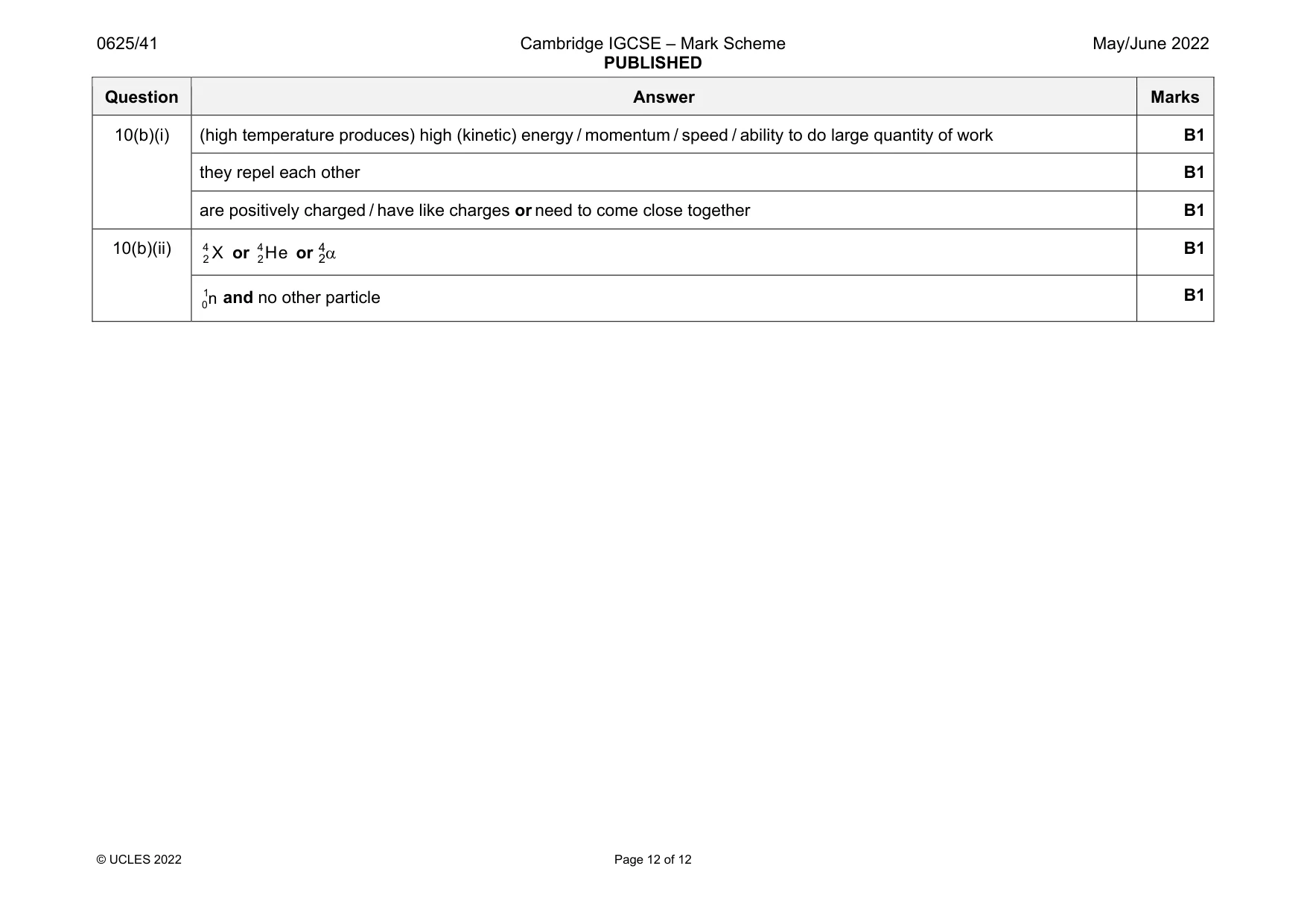
Mark scheme: 10(a)(i) same number of protons / both have one proton B1 10(a)(ii) it / hydrogen-3 / 3 (1)H has one more neutron A2 different number of neutrons / nucleons C1 Question Answer Marks 10(b)(i) (high temperature produces) high (kinetic) energy / momentum / speed / ability to do large quantity of work B1 they repel each other B1 are positively charged / have like charges or need to come close together B1 10(b)(ii) 4 2 X or 4 2He or 2 4 B1 1 0n and no other particle B1
What was in this paper
The subtopics covered by these 10 questions, and how many questions each got. Open one in a new tab to see every Cambridge question on it.
What you needed in this session
Cambridge’s own grade thresholds for 2022 May/June, Paper 4 · Variant 1. A higher threshold means an easier paper — the bar moves with how the cohort did.